Mutiny Broke Out in Pennsylvania Line, January 1, 1781 — General Assembly Occupies New State Capitol, January 2, 1822 — Lucretia Mott, Celebrated Advocate of Anti-Slavery, Born January 3, 1793 — Samuel Maclay Resigned From United States Senate January 4, 1809 — Amusing and Memorable “Battle of the Kegs,” January 5, 1778 — Bishop Cammerhoff Started Journey Among Indians on January 6, 1748 — Bank of North America, First Incorporated Bank in the United States, Commenced Business January 7, 1782 — Matthias Baldwin Completed First Successful Locomotive January 8, 1831 — Fort Hunter, an Important Defense, Garrisoned January 9, 1756 — Founder of Stumpstown Murdered Ten Indians, January 10, 1768 — First Records of Courts in State Preserved January 11, 1682 — Pious Henry Antes Organized First Moravian Synod January 12, 1742 — General Simon Cameron Defeated Colonel Forney for United States Senate, January 13, 1857 — Railroads Fight to Enter Pittsburgh. Great State Convention January 14, 1846 — Governor Andrew G. Curtin Inaugurated War Governor January 15, 1861 — Simon Girty, Outlaw and Renegade, Born January 16, 1744 — Benjamin Franklin, Youngest Son of Seventeen Children, Born January 17, 1706 — Long Reign of Terror by Mollie Maguires Brought to End January 18, 1876 — Prophetic Letter to President Buchanan by Governor Governor Packer, Who Was Inaugurated January 19, 1858 — Albert Gallatin, Soldier, Statesman and Financier, Born January 20, 1761 — General Thomas Mifflin, Soldier, Statesman and Several Times Governor, Died January 21, 1800 — Story of the Old Log College and the Reverend Charles Beatty, Born January 22, 1715 — Militia Organized at Provincial Council Meeting January 23, 1775 — Captain Thomas McKee, Indian Trader, Makes Deposition Before Governor January 24, 1743 — Work Commenced on Erection of Fort Henry January 25, 1756 — James Trimble, First Deputy Secretary of the Commonwealth, Public Servant Sixty-seven Years, Died January 26, 1837 — Great Indian Conference Began in Easton on January 27, 1777 — Massacre of Settlers Along the Juniata River Began January 28, 1756 — John Penn, “The American,” Born in Slate-Roof House January 29, 1700 — Betsy Ross, Who Made First American Flag, Died January 30, 1836 — Robert Morris, Financier of the Revolution, Born January 31, 1734 — First Division of Province Into Counties Begun February 1, 1685 — Governor Pattison’s Administration to Burning of Capitol, February 2, 1897 — Benedict Arnold Arrested for Conduct in Philadelphia February 3, 1779 — John Penn, Last Proprietary Proprietary Governor, Succeeds Richard Penn, Who Died February 4, 1771 — Ole Bull, Founder of Colony in Potter — Dr. Joseph Priestley, Discoverer of Oxygen, Died at Northumberland February 6, 1804 — — First Members of Susquehanna Company Settle in Wyoming, February 8, 1769 — John Penn, Last of Proprietary Governors, Died February 9, 1795 — Munley and McAllister, Mollie Maguires, Arrested for Murder of Thomas Sanger and William Uren, February — First Anthracite Coal Burned in Grate by — Quakers Make Protest Against Slavery to Congress February 12, 1790 — First Magazine in America Published in — Christopher L. Sholes, Inventor of Typewriter, Born in Mooresburg, February 14, 1819 — German Christians Organized Harmony Society in Butler, February 15, 1805 — Johan Printz Arrives as Governor of New Sweden, February 16, 1643 — Captain William Trent Leads First English Armed Force to Forks of Ohio, February 17, 1754 — William Rittenhouse, Who Built First Paper — Canal System Started with Committee Report of February 19, 1791 — French and Indian War Started by Arrival of — State Capital Removed to Harrisburg by Act — Service and Captivity of Captain John Boyd, Born February 22, 1750 — Simon Girty, the Renegade, and Indians Attacked Fort Laurens, February 23,1779 — General Jacob Brown, Hero of War of 1812, Died February 24, 1828; Native of Pennsylvania — Andrew McFarlane Captured by Indians at — Westmoreland County, Last Under Proprietary, — Early Days of Witchcraft in Pennsylvania—Two Women on Trial February 27, 1683 — Towns Laid Out in Erie County by Act of Assembly, February 28, 1794 — Commissioners Appointed to Purchase Last Indian Lands, February 29, 1784 — First Law to Educate Poor Children Signed — Pennsylvania on Paper Money Basis When Bills of Credit Are Issued March 2, 1722–23 — General Clark Began Draft for Troops in — William Penn Received Charter for Pennsylvania — Colonel Daniel Brodhead Arrives at Fort Pitt to Fight Indians, March 5, 1779 — Settlers Attack Pack Trains Near Fort Loudoun, March 6, 1765 — Andrew Lycans Killed in Attack by Indians in Wiconisco Valley, March 7,1756 — Frightful Slaughter of Indians at Gnadenhuetten, March 8, 1782 — County of Bedford Formed from a Part of Cumberland, March 9, 1771 — Organization of Sixty-seven Counties of Pennsylvania Began with Philadelphia, March 10, 1682 — Public Education Established by Governor George Wolf, Who Died March 11, 1840 — Lands Set Apart for Soldiers of Revolution, March 12, 1783 — Colonel Matthew Smith, Hero of Early Wars, Born March 13, 1740 — Fries’ Rebellion or Hot-Water War Arouses Governor, March 14, 1799 — Mollie Maguires Murder Wm. H. Littlehales, March 15, 1869, Which Brings Detective McParlan to the Coal Regions — David Wilmot, Author of Proviso, Died at Towanda, March 16, 1868 — First Excise Laws of Pennsylvania Enacted — Pittsburgh Built in 1760, Incorporated April 22, 1794, and Chartered as City March 18, 1816 — — Military Laws of Province Repealed by Import Act, March 20, 1780 — Old Northumberland, Mother of Counties, — Peter Pence, Indian Fighter, Captured — John Bartram, First Great American Botanist and Founder of Bartram Gardens, Born at Darby, March 23, 1699 — Proposal for Second Constitution for Pennsylvania Adopted March 24, 1789 — David Lewis, Robber and Counterfeiter, Born March 25, 1790 — More Exploits of Lewis, the Robber—Conclusion — Bethlehem Hospital Base During Revolution, Moved March 27, 1777 — Flight of Tory Leaders from Pittsburgh, March 28, 1778 — Colonel Clapham Commissioned to Build — Swedes Come to the Delaware—Peter Minuit Steps Ashore, March 30, 1638 — History of Pennsylvania Railroad Begins with Organization of Company March 31, 1847 — Great Indian Council Opened at Harris’ Ferry, April 1, 1757 — First Mint Established in Philadelphia by Act — Act for Purchase of Erie Triangle Passed — Reading Railroad Incorporated by Act Passed April 4, 1833 — Mary Jemison, White Woman of Genesee, Captured April 5, 1758 — Governor Penn Makes Trip Through State, Starting April 6, 1788 — Edwin Forrest, the Great American Actor, Founded the Home for Actors, April 7, 1873 — Monument Erected to Colonel Kelly, Revolutionary — Captain John Armstrong Murdered in Jack’s Narrows April 9, 1744 — Tories of Sinking Valley Take Oath to King April 10,1778 — Captain John Brady, Noted Hero, Killed by Indians April 11, 1779 — General Abner Lacock, United States Senator and Distinguished Citizen, Died in Beaver County, April 12, 1837 — Family of Richard Bard Captured by Indians April 13, 1758 — Bounties for Scalps of Indians Proclaimed April 14, 1756 — Theatrical Performances Begun in State April 15, 1754 — Tedyuskung, Indian Chieftain, Burns to Death in Cabin, April 16, 1763 — Lottery for Union Canal for $400,000 Authorized by Legislature, April 17, 1795 — First Northern Camp in Civil War Established April 18, 1861 — Training of Troops Began at Camp Curtin, April 19, 1861 — Colonel Brodhead Destroyed Indian Town of Coshocton, April 20, 1781 — Cornerstones Laid for Germantown Academy, April 21, 1760 — Eccentric John Mason’s Leaning Tower on Blue Hill Destroyed April 22, 1864 — James Buchanan, Pennsylvania’s Only President, Born April 23, 1791 — News of Revolution Reached Philadelphia by Messenger, April 24, 1775 — Frame of Government Written by William Penn, April 25, 1682 — Indians Captured James McKnight, Assemblyman, April 26, 1779 — Steam Boat Susquehanna, in Effort to Navigate River, Starts Fatal Trip, April 27, 1826 — Shawnee Indians Murder Conestoga Tribesmen April 28, 1728 — Christian Post, Moravian Missionary and Messenger, Died April 29, 1785 — Veterans of French and Indian Wars Organize April 30, 1765 — British Foragers Massacre Americans at Crooked Billet, May 1, 1778 — General Edward Hand Relieved of Command Following Squaw Campaign May 2, 1778 — Evangelist Whitefield Bought Site for Negro School at Nazareth May 3, 1740 — Trial of Five Mollie Maguires for Murder of B. F. Yost Begun at Pottsville May 4, 1876 — French and Indian Wars—Lieutenant Governor Thomas Resigned May 5, 1747 — Work Begun on Building Braddock Road — George Croghan, King of Traders, Sent on — Pennsylvania Navy Meets British in Action, May 8, 1776 — Bishop John Heyl Vincent, Founder of Chautauqua, Died May 9, 1920 — Long Standing Boundary Line Dispute Between Maryland and Pennsylvania Proprietaries Signed May 10, 1732 — Captain Stephen Chambers Fatally Wounded in Duel with Dr. Rieger May 11, 1789 — War of 1812 Began in Pennsylvania with Message of Governor Snyder May 12, 1812 — Lieutenant Colonel Antes, Soldier and Frontiersman, Died May 13, 1820 — Provincial Council Hears of Border Trouble May 14, 1734 — Dr. Nicholas More, First Chief Justice, Impeached May 15, 1685 — Massacre at French Jacob Groshong’s in Union County, May 16, 1780 — Indian War Known as Pontiac Conspiracy Opened May 17, 1763 — Meschianza, Stupendous Entertainment for Sir Wm. Howe, May 18, 1778 — Colonel Pluck Parades His Celebrated “Bloody Eighty-Fourth” Regiment, — Lafayette Executes Skillful Retreat at Matson’s Ford, May 20, 1778 — Stephen Girard, Resident of Philadelphia by Accident, Born May 21, 1750 — Philadelphia Paid Homage to Lady Washington, May 22, 1789 — Moravian Mission at Wyalusing Established May 23, 1763 — Peaceful Family of Chief Logan Slain by Whites, May 24, 1774 — Hamilton Pleads with Governor of Maryland for Release of Pennsylvanians, May 25, 1734 — General Sullivan Arrives at Easton to Subdue Six Nations, May 26, 1779 — Patriotic Women Feed Soldiers at Cooper Shop and Union Saloons, May 27, 1861 — Colonel William Clapham and Family Murdered by Indians, May 28, 1763 — Free Society of Traders Organized with Aid of Penn, May 29, 1682 — Davy, the Lame Indian, Surrenders at Fort Pitt, May 30, 1783 — Thousands of Lives Lost in Johnstown Flood, May 31, 1889 — General John Bull, Officer of Province and the Continental Army, Born June 1, 1731 — Liberty Bell Hung in Old State House on June 2, 1753 — Transit of Venus Observed in Yard of State House June 3, 1769 — Indians Succeed in Destroying Presqu' Isle, June 4, 1763 — James Pollock Nominated by Know Nothing Party, June 5, 1854 — John Penn Found First Wife Dying After Second Marriage, June 6, 1766 — Colonel William Clapham Began Erection of Fort Halifax, June 7, 1756 — Earliest Court Removed from Upland to Kingsesse June 8, 1680 — Last Purchase from Indians Caused by Boundary Dispute, June 9, 1769 — Massacre at Lycoming Creek, Present Williamsport, June 10, 1778 — Colonel William Crawford Captured by Indians June 11, 1782 — Death of Colonel Crawford and Escape of Dr. Knight June 12, 1782 — Conrad Weiser and Family Arrive in America June 13, 1710 — United States Flag Adopted by Act of Congress June 14, 1777 — French Plant Leaden Plates to Prove Possession on June 15, 1749 — Penns Secure First Manor West of Susquehanna June 16, 1722 — British and Tory Refugees Evacuate Philadelphia June 17, 1778 — Provincial Conference Meets at Carpenters’ Hall June 18, 1776 — Massacre at Indian Town of Standing Stone on June 19, 1777 — Moravians Dedicate First Church West of Alleghenies June 20, 1771 — Revolutionary Forces Threaten Executive Council June 21, 1783 — Colonel Turbutt Francis Marches Provincial Troops to Wyoming June 22, 1769 — Pennsylvanian Makes First Report in Congress for Railway to Pacific June 23, 1848 — John Binns, English Politician and Editor, Died June 24, 1860 — First Deed for Chester County Conveyed to William Penn, June 25, 1683 — Colonel Timothy Pickering Abducted by Yankees at Wyoming June 26, 1787 — Ewell’s Force of Rebels Made Raid on Carlisle June 27, 1863 — British Flag Captured by Pennsylvanians in Battle of Monmouth June 28, 1778 — Duke of York Receives New Patent for His Grant, June 29, 1674 — Provincial Government and Indians Open Conference June 30, 1742 — Decisive Battle of Gettysburg Opened Wednesday, July 1, 1863 — Sickles’ Corps Holds Confederates Off Both Round Tops at Gettysburg July 2, 1863 — British and Indians Massacre Hundreds at Wyoming July 3, 1778 — Declaration of Independence Adopted by Congress July 4, 1776 — Massacre at Wyoming Followed by “The Great Runaway” on July 5, 1778 — John Conrad Beissel, Founder of Ephrata Society, Died There July 6, 1768 — Riots in Philadelphia Brought to an End on July 7, 1844 — Widow Smith’s Mill Destroyed by Indians on July 8, 1779 — General Braddock Defeated by French and Indians July 9, 1755 — “Sawdust War” in Williamsport Lumber Regions Began July 10, 1872 — Moravians Visit Indian Town of Great Island, July 11, 1748 — Riots in Philadelphia Caused by Boy Assaulting Master, July 12, 1835 — Hannastown, Seat of Justice for Westmoreland County, Burned by Indians July 13, 1782 — George Ross, Lawyer, Iron Manufacturer, Soldier, Statesman, Patriot, Signer of Declaration of Independence, Died July 14, 1779 — Provincial Convention Ends Proprietary Government July 15, 1776 — Gibson’s Lambs Start on Expedition for Powder, July 16, 1776 — Virginia Sends Captain John Neville to Command Fort Pitt, July 17, 1775 — Susquehanna Company Organized in Connecticut, July 18, 1753 — Tom Quick, the Indian Killer and Picturesque Character, Born July 19, 1734 — William Maclay, First United States Senator, Born in Chester, July 20, 1737 — Colonel James Cameron, First Pennsylvania Officer Killed in Civil War July 21, 1861 — Battle of Minisink Fought Opposite Lackawaxen July 22, 1779 — General Howe Sails From New York to Capture Philadelphia, July 23, 1777 — Captain John Smith Sails From Jamestown, July 24, 1608, to Explore Chesapeake Bay — Colonel Thompson’s Battalion of Riflemen Among First to Reach Boston, July 25, 1775 — Indians Massacre Inhabitants in the Conococheague Valley on July 26, 1756 — Ruffians Mob Pastor and Cause Organization of First Moravian Church July 27, 1742 — British and Seneca Indian Allies Destroy Fort Freeland, July 28, 1779 — First Newspaper West of the Allegheny Mountains, the Gazette, of Pittsburgh, Established July 29, 1786 — Chambersburg Sacked and Burned by McCausland’s Rebel Force July 30, 1864 — Carlisle Indian School Established by Congress, July 31, 1882 — French and Indians Attack and Burn Fort Granville, August 1,1756 — Colonel Lochry Musters Westmoreland County Troops August 2, 1781 — Civil Government in Pennsylvania Established at Meeting of Council August 3, 1681 — Saturday Evening Post Launched from Gazette, August 4, 1821 — Patrick Gordon, Administrator of Penn’s Will, Died August 5, 1736 — Colonel Bouquet Defeats Indians by Stratagem at Bushy Run, August 6, 1763 — Indian Council Between Governor Denny and Tedyuskung Ended at Easton August 7, 1757 — Indians Surprise Reapers and Mortally Wound James Brady August 8, 1778 — General John Bull, Distinguished Officer of Revolutionary War, Died August 9, 1824 — Colonel Bouquet Relieved Garrison at Fort Pitt August 10, 1763 — Colonel Brodhead Wins Thanks of Congress for Raid Started August 11, 1779 — Era of Indian Traders to Death of Allummapees, August 12, 1731 — Indians Massacre Major John Lee and Family, August 13, 1782 — Mollie Maguires Commit Murders on Bloody Saturday, August 14, 1875 — Yankees Drive Pennamites from Wyoming Valley in Battle Which Began August 15, 1771 — Great Land Purchase Made at Indian Council in Philadelphia, August 16, 1749 — Robert Fulton, Native of Lancaster County, Operates First Steamboat, August 17, 1807. — Anti-Masonic Outbreak in Pennsylvania First Felt at New Berlin, August 18, 1829 — York County and Its Part in the Revolution, Erected August 19, 1749 — Greatest Victory Over Indians Gained by General Wayne at Fallen Timbers, August 20, 1794 — Chief Tedyuskung Annoys Moravian Brethren; Arrives at Bethlehem August 21, 1756 — Gilbert Family in Indian Captivity Twenty-nine Months Released August 22,1782 — Alexander Wilson, the Great American Ornithologist, Died at Philadelphia, August 23, 1813 — Governor Snyder Calls on Pennsylvania When British Burn National Capitol August 24, 1814 — British Destroy Moravian Indian Town on Order of De Peyster, August 25,1781 — Volunteers Fight Two Battles in Hills Along West Branch August 26, 1763 — Europeans Explore Waters of Pennsylvania, Delaware Bay So Named August 27, 1610 — World Struggle for Oil Began at Titusville, August 28, 1859 — Joseph Galloway, Loyalist Politician, and Member Continental Congress, Died August 29, 1803 — Etymology of Pennsylvania Counties Erected Since Penn Set Sail August 30, 1682 — Penn Obtains Deed to Province, Then Obtains Lower Counties August 31, 1682 — Dr. John Cochran, Native of Pennsylvania, Director-General Hospitals, Born September 1, 1730 — Constitution of 1790, the First for the State, Adopted September 2, 1790 — General Edward Hand, Distinguished Officer of Revolution, Died September 3, 1802 — First Permanent Settlement and Earliest Church, Dedicated September 4, 1646 — First Continental Congress Meets in Carpenters’ Hall, Philadelphia, September 5, 1774 — Fort Montgomery Withstands Attack of British and Indians, September 6, 1780 — Colonel Hartley Leads Expedition Against Six Nation Indians—Born September 7, 1746 — Colonel John Armstrong Destroyed Indian Town of Kittanning September 8, 1756 — Franklin County Erected from Part of Cumberland County September 9, 1784 — Commodore Perry Defeats British Squadron on Lake Erie, September 10, 1813 — Lord Cornwallis Defeats American Forces on the Brandywine, September 11, 1777 — Mob Storms Mifflin County Courthouse September 12, 1791 — Inhuman Murder of Lieutenant Thomas Boyd by Tory Butler, September 13, 1779 — Major Grant Meets Defeat at Fort Duquesne, September 14, 1758 — Madame Montour Resents Murder of Her Brother, September 15, 1711 — Matthew Carey, Editor and Influential Writer of Philadelphia, Died There September 16, 1839 — First Constitution of United States Adopted in Philadelphia September 17, 1787 — Labor Riots Follow Civil War; Jay Cooke Company Failed September 18, 1873 — Indians Defrauded by Deceptive Walking Land Measure, September 19, 1737 — British Surprise and Slaughter Americans at Paoli, September 20, 1777 — Unholy Alliance with Delaware Indians Concluded at Fort Pitt, September 21, 1778 — Franklin Attends Conference of Indians in Carlisle, September 22, 1753 — Boundary Dispute with Virginia Ended When Assembly Ratified Agreement, September 23, 1780 — Two Brothers of Doan Family of Outlaw Sons Hanged September 24, 1788 — Dutch Gain Control of the Delaware River September 25, 1655 — British Under General Howe Invest City of Philadelphia, September 26, 1777 — British Open Hostilities in Long Siege on Fort Mifflin, September 27, 1777 — Colonel William Plunket Defeats Yankees in Pennamite War, September 28, 1775 — Captain John Smith Who First Meets Native Pennsylvanians Sailed for England, September 29, 1609 — Washington Started March Through Pennsylvania During Whisky Rebellion, September 30, 1794 — Sailors Cause of Bloody Election in Philadelphia October 1, 1742 — Massacre in Vicinity of Patterson’s Fort, October 2, 1755 — Washington Joins Troops in Whisky Insurrection October 3, 1794 — Americans Defeated in Battle of Germantown, October 4, 1777 — Riotous Mob Attacks “Fort Wilson” in Philadelphia, October 5, 1779 — First German Immigrants Settle Germantown October 6, 1683 — Colonel Richard McAllister, Soldier, Statesman and Citizen of York County, Died October 7, 1795 — King Tedyuskung Questioned at Great Indian Conference in Easton, October 8, 1758 — Governor William Denny Removed and Superseded by James Hamilton, Native of Pennsylvania, October 9, 1759 — First of Three Confederate Raids into Pennsylvania Began October 10, 1862 — Colonel Matthew Smith, War Veteran, Elected Vice President October 11, 1779 — Attempted Slaughter of Indians at Wichetunk, Monroe County, October 12, 1763 — Molly Pitcher, Heroine of the Battle of Monmouth, Born October 13, 1754 — William Penn, Born October 14, 1644—His Youth and Early Struggles for Religious Belief — First Massacre in Wyoming Launched During Pontiac’s War by Captain Bull, October 15, 1763 — First Terrible Massacre of Settlers at Penn’s Creek, October 16, 1755 — Railroad from Williamsport to Lake Erie Completed October 17, 1864 — None Escaped in Massacre at Mahanoy Creek, October 18, 1755 — General Edward Hand Starts on Expedition from Fort Pitt to Wheeling, October 19,1777 — Great Meeting in the Interest of Inland Waterways Held at Harrisburg, October 20, 1789 — Bicentennial Opened in Chester and Philadelphia, October 21, 1882 — Daniel Boone, Pioneer Kentucky Frontiersman, Born in Berks County October 22, 1733 — General Sir Guy Carleton Puts End to Indian War October 23, 1782 — Susquehanna River First Explored by Etienne Brulé in October, 1615 — John Harris, Who Laid Out Harrisburg, Had Narrow Escape, October 25, 1755 — Fail to End Warfare Through Treaty at Albany, October 26, 1745 — William Wilson Sent on Important Mission to Ohio Indians After Fort Pitt Treaty, October 27, 1775 — James Logan, Penn’s Secretary and Trusted Friend and Agent, Born October 28, 1674 — Penn Lands at Upland and Changes Name to Chester, October 29, 1682 — Frightened Settlers Build and Defend Fort Swatara October 30, 1755 — Indian Ravages at McDowell’s Mill, Franklin County, October 31, 1755 — Turmoil in Lower Counties; Penn Sails for England, November 1, 1701 — Indians Captured Frances Slocum, the “Lost Sister of Wyoming,” November 2, 1778 — George Major, Chief Burgess of Mahanoy City, Murdered by Mollie Maguires, November 3, 1874 — Captain John Hambright Leads Expedition from Fort Augusta Against Great Island, November 4, 1756 — Disputed Boundary Lines Settled at Fort Stanwix November 5, 1768 — First Siege of Yellow Fever Checked in Philadelphia November 6, 1793 — Philadelphia Merchants Rebel Against Stamp Act in Great Meeting, November 7, 1765 — Expeditions Against Indians—Franklin Sails for England, November 8, 1764 — Governor Simon Snyder, Prey of Kidnappers Kidnappers , Died November 9, 1819 — John Dickinson Writes First “Farmer” Letter, November 10, 1767 — In Anticipation of War with France General Washington Arrives in Philadelphia, November 11, 1798 — First Jury Drawn in Early Courts of Province on November 12, 1678 — Council of Censors First Met Under Constitution of 1776, November 13, 1783 — Indian Outrages in Berks County Began November 14, 1755 — Indian Shoots at Major Washington While on Important Mission November 15, 1753 — John Binns, English Political Prisoner, American Politician and Editor, Died November 16, 1860 — Administration of Sir William Keith as Deputy-Governor. He Died November 17, 1749 — Governor Joseph Hiester, Distinguished Revolutionary Officer and Statesman, Born November 18, 1872 — President Lincoln Delivered Address at Dedication of the National Cemetery at Gettysburg, November 19, 1863 — The Seneca Chief Hiokatoo, “Most Cruel Human Being,” Died November 20, 1811 — Delegates to the Constitutional Convention Chosen November 21, 1789 — Joe Disberry, Remarkable Thief, First Arrested November 22, 1783 — Border Invasion by Thomas Cresap Ceased After His Arrest, November 23, 1736 — Moravians Slaughtered in Indian Village of Gnadenhutten, November 24, 1755 — General Forbes Invested Fort Duquesne and Named It Pittsburgh, November 25, 1758 — Captain James Smith, of the “Black Boys,” Born in Chester County, November 26, 1737 — Pioneer Postoffice of Pennsylvania Established in Philadelphia, November — Conway Cabal Started in Reading by General Mifflin on November 28, 1777 — Federal Party Is Broken Up in Closing Days — Major George Washington Meets French Commander Joncaire at Logstown, November 30, 1753 — William Penn and Family Arrive in Province on His Second Visit, December 1, 1699 — Morgan Powell Cruelly Murdered by Mollie Maguires, December 2, 1871 — General Anthony Wayne Defeats Indians; Congress Ratifies Treaty, December 3, 1795 — — Troops Called Out in “Buck Shot War” on December 5, 1838 — De Vries Finds Entire Dutch Colony Destroyed, December 6, 1632 — Fires of Early Days; First Fire Fighting Company Organized December 7, 1736 — Washington’s Headquarters in Several Bucks County Mansions Began December — Railroad Riots in Erie; Bridges Destroyed December 9, 1853 — Count Zinzindorf, Moravian Church Founder, Arrives December 10, 1741 — General Washington Praises Lydia Darrah to Congress December 11, 1777 — Federal Constitution Adopted by Pennsylvania December 12, 1787 — Attempt to Impeach Justices Yeates, Shippen and Smith Fails, December 13, 1803 — John Binns and Samuel Stewart Fight Last Duel in Pennsylvania December 14, 1805 — Pennsylvania Troops Mustered for Mexican War, December 15, 1846 — General U. S. Grant Leaves Philadelphia on Trip Around World, Arriving There on Return December 16, 1879 — Shikellamy, Vicegerent of Six Nations, Died in Shamokin, December 17, 1748 — Barbara Frietchie, Native of Pennsylvania, Died December 18, 1862 — Thaddeus Stevens Inquiry of Masonry and Odd Fellowship Began December 19, 1835 — Storm Stops French Refugees in Settlement Work December 20, 1793 — General Thomas Mifflin Inaugurated First Governor of Pennsylvania December 21, 1790 — First Newspaper in Pennsylvania Published December 22, 1719 — John F. Watson, Annalist, Historian, Antiquarian and Collector of Historical Objects, Died December 23, 1860 — Colonel Plunket Begins Action in Second Pennamite War on December 24, 1775 — Pennamites Humiliatingly Defeated by Yankees, December 25, 1775 — Pennsylvania Militia in Battle of Trenton, December 26, 1776 — Paxtang Boys Wipe Out Conestoga Indians on December 27, 1763 — Benjamin Franklin Presents Treaty Plan to King of France, December 28, 1776 — Franklin Begins Building Chain of Forts on December 29, 1755 — Mason and Dixon Determined Starting Point for Boundary Survey, December 30, 1763 — First Bank in America Chartered in Philadelphia, December 31, 1781
1
As the year 1780 drew to a close there were warm disputes in
the Pennsylvania regiments as to the terms on which the men
had been enlisted. This led to such a condition by New Year’s
Day, 1781, that there broke out in the encampment at Morristown,
N. J., a mutiny among the soldiers that required the
best efforts of Congress, the Government of Pennsylvania and
the officers of the army to subdue.
New Year’s Day being a day of customary festivity, an extra proportion
of rum was served to the soldiers. This, together with what
they were able to purchase, was sufficient to influence the minds of the
men, already predisposed by a mixture of real and imaginary injuries,
to break forth into outrage and disorder.
The Pennsylvania Line comprised 2500 troops, almost two-thirds of
the Continental Army, the soldiers from the other colonies having, in
the main, gone home. The officers maintained that at least a quarter
part of the soldiers had enlisted for three years and the war. This
seems to have been the fact, but the soldiers, distressed and disgusted for
want of pay and clothing, and seeing the large bounties paid to those
who re-enlisted, declared that the enlistment was for three years or the
war.
As the three years had now expired, they demanded their discharges.
They were refused, and on January 1, 1781, the whole line, 1300 in
number, broke out into open revolt. An officer attempting to restrain
them was killed and several others were wounded.
Under the leadership of a board of sergeants, the men marched
toward Princeton, with the avowed purpose of going to Philadelphia to
demand of Congress a fulfillment of their many promises.
General “Mad” Anthony Wayne was in command of these troops,
and was much beloved by them. By threats and persuasions he tried
to bring them back to duty until their real grievances could be redressed.
They would not listen to him; and when he cocked his pistol,
in a menacing manner, they presented their bayonets to his breast, saying:
“We respect and love you; you have often led us into the line of
battle; but we are no longer under your command. We warn you to
be on your guard. If you fire your pistol or attempt to enforce your
commands, we shall put you instantly to death.”
General Wayne appealed to their patriotism. They pointed to the
broken promises of Congress. He reminded them of the effect their
conduct would have on the enemy. They pointed to their tattered garments
and emaciated forms. They avowed their willingness to support
2the cause of independence if adequate provision could be made for their
comfort and they boldly reiterated their determination to march to Philadelphia,
at all hazards, to demand from Congress a redress of their
grievances.
General Wayne determined to accompany them to Philadelphia.
When they reached Princeton the soldiers presented the general with a
written list of their demands. These demands appeared so reasonable
that he had them laid before Congress. They consisted of six general
items of complaint and were signed by William Bearnell and the other
sergeants of the committee, William Bouzar, acting as secretary.
Joseph Reed, President of Pennsylvania, who had been authorized
by Congress to make propositions to the mutineers, advanced near Princeton
on January 6, when he wrote to General Wayne in which he expressed
some doubts as to going into the camp of the insurgents. The
general showed this letter to the sergeants and they immediately wrote
the President:
“Your Excellency need not be in the least afraid or apprehensive of
any irregularities or ill treatment.”
President Reed went into Princeton. His entry was greeted with the
whole line drawn up for his reception, and every mark of military honor
and respect was shown him.
Articles of agreement were finally assented to and confirmed on both
sides, January 7, 1781. These articles consisted of five sections and
related to the time of their enlistment, terms of payment, arrearages and
clothes. It was also agreed that the State of Pennsylvania should carry
out its part of their contract.
The agreement was signed by Joseph Reed and General James Potter.
General Arthur St. Clair, the distinguished Pennsylvanian, and General
Lafayette went voluntarily to Princeton and offered their services
in the settlement of the difficulty, especially as they had learned of the
attempt of the British to win the malcontents to their cause.
When Sir Henry Clinton heard of the revolt of the Pennsylvania
Line he misunderstood the spirit of the mutineers and dispatched two
emissaries—a British sergeant named John Mason and a New Jersey
Tory named James Ogden—to the insurgents, with a written offer that,
on laying down their arms and marching to New York, they should
receive their arrearages; be furnished with good clothes, have a free pardon
for all past offenses and be taken under the protection of the British
Government and that no military service should be required of them
unless voluntarily offered.
Sir Henry entirely misapprehended the temper of the Pennsylvanians.
They felt justified in using their power to obtain a redress of
grievances, but they looked with horror upon the armed oppressors of
their country; and they regarded the act and stain of treason under the
circumstances as worse than the infliction of death.
3Clinton’s proposals were rejected with disdain. “See, comrades,”
said one of them, “he takes us for traitors. Let us show him that the
American army can furnish but one Arnold, and that America has no
truer friends than we.”
They seized the two emissaries, and delivered them, with Clinton’s
papers, into the hands of General Wayne.
The court of inquiry sat January 10, 1781, at Somerset, N. J., with
the court composed of General Wayne, president, and General William
Irvine, Colonel Richard Butler, Colonel Walter Stewart and Major
Benjamin Fishbourne. The court found John Mason and James Ogden
guilty and condemned them to be hanged.
Lieutenant Colonel Harmar, Inspector General of the Pennsylvania
Line, was directed to carry the execution into effect. The prisoners
were taken to “cross roads from the upper ferry from Trenton to Philadelphia
at four lanes’ ends,” and executed.
The reward which had been offered for the apprehension of the offenders
was tendered to the mutineers who seized them. They sealed
the pledge of patriotism by nobly refusing it, saying: “Necessity wrung
from us the act of demanding justice from Congress, but we desire no
reward for doing our duty to our bleeding country.”
The whole movement, when all the circumstances are taken into
account, should not be execrated as a military rebellion, for, if ever there
was a just cause for men to lift up their strength against authority, these
mutineers of the Pennsylvania Line possessed it. It must be acknowledged
that they conducted themselves in the business, culpable as it
was, with unexpected order and regularity.
A great part of the Pennsylvania Line was disbanded for the winter,
but was promptly filled by new recruits in the spring and many
of the old soldiers re-enlisted.
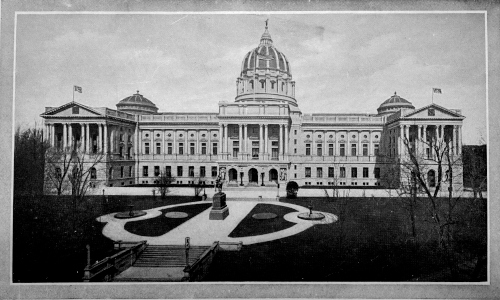
The General Assembly of Pennsylvania met in the Dauphin
County courthouse for the last time December 21, 1821, and
then a joint resolution was adopted:
“Resolved by the Senate and House of Representatives,
That when the Legislature meets at the new State Capitol, on
Wednesday, the 2d of January next, that it is highly proper,
before either house proceeds to business, they unite in prayer to the
Almighty God, imploring His blessing on their future deliberations,
and that the joint committee already appointed be authorized to make
the necessary arrangements for that purpose.”
4On Wednesday, January 2, 1822, on motion of Mr. Lehman and
Mr. Todd, the House proceeded to the building lately occupied by the
Legislature. There they joined the procession to the Capitol and attended
to the solemnities directed by the resolution of December 21,
relative to the ceremonies to be observed by the Legislature upon taking
possession of the State Capitol.
The Harrisburg Chronicle of January 3, 1822, printed an account
of the proceedings from which the following is taken:
“The members of both branches of the Legislature met in the morning
at 10 o’clock, at the old State House (court house) whence they
moved to the Capitol in the following
Order of Procession
The Architect and his Workmen, two and two.
Clergy.
Governor and Heads of Departments.
Officers of the Senate.
Speaker of the Senate.
Members of the Senate, two and two.
Officers of the House of Representatives.
Speaker of the House of Representatives.
Members, two and two.
Judges.
Civil Authorities of Harrisburg.
Citizens.
“In front of the Capitol the architect and his workmen opened into
two lines and admitted the procession to pass between them and the
Capitol.
“The service was opened by a pertinent and impressive prayer, by
Rev. Dr. A. Lochman, of Harrisburg. The prayer was followed by an
appropriate discourse, by Rev. D. Mason, principal of Dickinson College,
Carlisle, Pa., which concluded as follows:
“Sixty years have not elapsed since the sound of the first axe was
heard in the woods of Harrisburg. The wild beasts and wilder men
occupied the banks of the Susquehanna. Since that time, with the mildness
which has characterized the descendants of William Penn, and that
industry which has marked all the generations of Pennsylvania, the
forests have been subdued, the wild beasts driven away to parts more
congenial to their nature, and the wilder men have withdrawn to regions
where they hunt the deer and entrap the fish according to the mode
practiced by their ancestors.
“In the room of all these there has started up, in the course of a few
years, a town respectable for the number of its inhabitants, for its
progressive industry, for the seat of legislation in this powerful State.
“What remains to be accomplished of all our temporal wishes?
5What more have we to say? What more can be said, but go on and
prosper, carry the spirit of your improvements through till the sound of
the hammer, the whip of the wagoner, the busy hum of man, the voices
of innumerable children issuing from the places of instruction, the lofty
spires of worship, till richly endowed colleges of education, till all those
arts which embellish man shall gladden the banks of the Susquehanna
and the Delaware, and exact from admiring strangers that cheerful
and grateful tribute, this is the work of a Pennsylvania Legislature!”
The act to erect the State Capitol was passed March 18, 1816, and
carried an appropriation of $50,000. A supplement to this act was approved
February 27, 1819, when there was appropriated $70,000, with
the provision that the said Capitol should not cost more than $120,000.
But a further supplement was approved March 28, 1820, for “the
purpose of constructing columns and capitols there of hewn stone, and
to cover the roof of the dome, etc.,” there was appropriated $15,000.
At this time the total cost of all the public buildings was $275,000,
and consisted of the new Capitol, $135,000; executive offices on both
sides of the Capitol building, $93,000; Arsenal, $12,000, and public
grounds, its enclosure and embellishment, $35,000.
The cornerstone of this new Capitol was laid at 12 o’clock on Monday,
May 31, 1819, by Governor William Findlay, assisted by Stephen
Hills, the architect and contractor for the execution of the work; William
Smith, stone cutter, and Valentine Kergan and Samuel White,
masons, in the presence of the Commissioners and a large concourse of
citizens. The ceremony was followed by the firing of three volleys from
the public cannon.
The newspaper account of the event states that the above-mentioned
citizens then partook of a cold collation, provided on the public ground
by Mr. Rahn.
The Building Commissioners deposited in the cornerstone the following
documents:
Charter of Charles II to William Penn.
Declaration of Independence.
Constitution of Pennsylvania, 1776.
Articles of Confederation and perpetual union between the several
States.
Copy of so much of an act of the General Assembly of Pennsylvania,
by which indemnity was made to the heirs of William Penn for their
interest in Pennsylvania.
Treaty of peace and acknowledgment by Great Britain of the independence
of the United States.
Constitution of the United States, 1787.
Constitution of Pennsylvania, 1790.
Acts of the Legislature of Pennsylvania, by which the seat of
government was removed from Philadelphia to Lancaster and Harrisburg,
6and the building of a State Capitol at the latter place authorized.
A list of the names of the Commissioners, architects, stonecutter and
chief masons; likewise, a list of the then officers of the Government of
Pennsylvania, embracing the Speakers of the two Houses of the Legislature,
the Governor, the heads of departments, the Judges of the Supreme
Court and Attorney General, with the names of the President and
Vice President of the United States.
It was a singular oversight that this cornerstone was not marked as
such, and in after years it was not known at which corner of the building
the stone was situated.
An act providing for the furnishing of the State Capitol was approved
March 30, 1821: Section 1. The Governor, Auditor General,
State Treasurer, William Graydon, Jacob Bucher, Francis R. Shunk
and Joseph A. McGinsey were appointed Commissioners to superintend
the furnishing of the State Capitol. This able commission expended the
$15,000 appropriated, and the new Capitol was a credit to the Commonwealth
of Pennsylvania when the General Assembly formally occupied it
January 2, 1822.
From the earliest settlement at Germantown, and especially
in the period following the Revolutionary War, there were
many thoughtful people in all walks of life who considered
slavery to be an evil which should be stopped. But the question
of actually freeing the slaves was first seriously brought
forward in 1831, by William Lloyd Garrison, in his excellent
paper, “The Liberator,” published in Boston.
Seventy-five delegates met in Philadelphia in 1833 to form a National
Anti-Slavery Society. It was unpopular in those stirring days to
be an abolitionist. John Greenleaf Whittier acted as one of the secretaries,
and four women, all Quakers, attended the convention.
When the platform of this new society was being discussed, one
of the four women rose to speak. A gentleman present afterward said:
“I had never before heard a woman speak at a public meeting. She
said only a few words, but these were spoken so modestly, in such sweet
tones and yet so decisively, that no one could fail to be pleased.” The
woman who spoke was Lucretia Mott.
Lucretia Coffin was born in Nantucket January 3, 1793. In 1804
her parents, who were Quakers, removed to Boston. She was soon
afterward sent to the Nine Partners’ Boarding School in Duchess
7County, N. Y., where her teacher (Deborah Willetts) lived until 1879.
Thence she went to Philadelphia, where her parents were residing.
At the age of eighteen years she married James Mott. In 1818 she
became a preacher among Friends, and all her long life she labored for
the good of her fellow creatures, especially for those who were in bonds
of any kind.
She was ever a most earnest advocate of temperance, pleaded for
the freedom of the slaves, and was one of the active founders of the
“American Anti-Slavery Society” in Philadelphia in 1833.
She was appointed a delegate to the World’s Anti-Slavery convention,
held in London in 1840, but was denied a seat in it on account of
her sex. She also was a very prominent advocate of the emancipation of
her sex from the disabilities to which law and custom subjected them.
When the Female Anti-Slavery Society was organized Lucretia
Mott was its first president and served in that office for many years.
The anti-slavery enthusiasts dedicated a building, Pennsylvania Hall,
in Philadelphia, May 14, 1838, which excited the rage of their enemies
and the mob burned the building three days later. The excited crowd
marched through the streets, threatening also to burn the houses of the
abolitionists.
The home of Mr. and Mrs. James Mott stood on Ninth Street
above Race. Lucretia Mott and her husband were warned of their danger,
but refused to leave their home. Their son ran in from the street,
crying, “They’re coming!”
The mob intended to burn the house, but a young man friendly to
the family assumed leadership and with the cry “On to Motts!” led
them past the place and the mob satisfied its thirst by burning a home
for colored orphans, and did not return.
Such incidents failed to daunt the spirit of Lucretia Mott, and her
husband, who approved the part she took.
A meeting of the Anti-Slavery Society in New York City was
broken up by roughs, and several of the speakers, as they left the hall,
were beaten by the mob. Lucretia Mott was being escorted from the
hall by a gentleman.
When she noticed some of the other ladies were frightened, she
asked her friend to leave her and take care of the others. “Who will
look after you?” he asked. Lucretia laid her hand on the arm of one of
the roughest in the mob, saying: “This man will see me safely through
the crowd.” Pleased by the mark of confidence, the rioter did as she
asked and took her to safety.
The home of the Motts was always open for the relief of poor
colored persons, and they helped in sending fugitive slaves to places of
refuge. On one occasion the Motts heard the noise of an approaching
mob. Mr. Mott rushed to the door and found a poor colored man, pursued
by the mob, rushing toward the friendly Mott house. He entered
8and escaped by the rear door. A brick hurled at Mr. Mott fortunately
missed him, but broke the door directly over his head.
A sequel to the riot at Christiana, Lancaster County, September 11,
1851, which occurred on the farm then owned by Levi Powell, was the
arrest of Castner Hanway and Elijah Lewis, two Quakers of the
neighborhood, and nearly fifty others, mostly Negroes, on the charge of
high treason for levying war against the Government of the United
States.
The trial began in the United States Court at Philadelphia, before
Judges Green and Kane, November 24. It was one of the most exciting
ever held in the State. Thaddeus Stevens, John M. Read, Theodore
C. Cuyler, and Joseph J. Lewis, conducted the defense, while District
Attorney John W. Ashmead was assisted by the Attorney General of
Maryland, and by James Cooper, then a Whig United States Senator
from Pennsylvania.
Lucretia Mott attended the trial personally every day, and after the
elaborate argument of counsel, Judge Green delivered his charge. The
jury returned a verdict, in ten minutes, of “not guilty.”
A colored man named Dangerfield was seized on a farm near Harrisburg
on a charge of being a fugitive slave. He was manacled and taken
to Philadelphia for trial.
The abolitionists engaged a lawyer to defend the Negro. Lucretia
Mott sat by the side of the prisoner during the trial. Largely through
her presence and influence Dangerfield was released. The mob outside
the court awaited Dangerfield to deliver him over to his former master,
but a band of young Quakers deceived the crowd by accompanying
another Negro to a carriage and Dangerfield walked off in another
direction.
Lucretia Mott and her friends were rejoiced to see the Negroes all
free. There was still much to be done after the Civil War. This noble
woman remained a hard worker for their cause all through her life.
Lucretia Mott died in Philadelphia, November 21, 1881, at the age
of nearly ninety years. Thousands attended her funeral, the proceedings
were mostly in silence. At last some one said, “Will no one speak?”
The answer came back: “Who can speak now? The preacher is dead.”
Her motto in life had been “Truth for authority, not authority for
truth.”
Lucretia Mott’s influence still lives. Tuskegee Institute in Alabama,
Hampton Institute in Virginia, and Lincoln University in Chester
County, Pennsylvania, are institutions made possible by such as she, and
in them young colored persons are taught occupations and professions in
which they can render the best service to themselves and to their
country.
9
A monument was unveiled in memory of Samuel Maclay, a
great Pennsylvanian, October 16, 1908. The scene of these
impressive ceremonies was a beautiful little cemetery close by
the old Dreisbach Church, a few miles west of Lewisburg in
the picturesque Buffalo Valley, Union County.
Samuel Maclay was the eighth United States Senator from
Pennsylvania and had the proud distinction of being the brother of William
Maclay, one of the first United States Senators from Pennsylvania.
The Maclays are the only brothers to ever sit in the highest legislative
body of this country. The third brother, John, was also prominent and
served in the Senate of Pennsylvania.
The imposing shaft was erected by Pennsylvania at a cost of only
$1000, which included the contract for the marble shaft and the reinterment
of the Senator’s body.
Miss Helen Argyl Maclay, of Belleville, a great-great-granddaughter
of Samuel Maclay, unveiled the monument assisted by her two
brothers, Ralph and Robert Maclay. Rev. A. A. Stapleton, D. D., delivered
the principal address. Other speakers included Frank L. Dersham,
then the Representative in the General Assembly from Union
County, who introduced the bill for this memorial; Alfred Hayes, now
deceased, also a former member of the Assembly, who represented the
Union County Historical Society; Captain Samuel R. Maclay, of Mineral
Point, Mo., a grandson of Senator Samuel Maclay.
Lieutenant Governor Robert Murphy attended the ceremony, as did
many distinguished citizens from this and other States, school children
and military, civic, historical and patriotic societies. There were thirty-five
representatives of the Maclay family in attendance.
Perhaps the strangest emotion during the preparation of this shaft
and its unveiling was caused by the seeming lack of knowledge of this
statesman, farmer, frontiersman, soldier, surveyor, citizen, who was an
officer in the Continental Army during the Revolution, who was a foremost
actor in the actual development of the interior of the State to commerce,
one who sat in the highest legislative councils of this Commonwealth
and presided over its Senate, who represented his State in Congress
and later in the United States Senate, and so serving was the compeer
of men whose names are radiant with luster on the pages of American
history.
Yet, strange to say, the memory of this man had so completely faded
from public view that college professors, members of the General Assembly
10and men who held some claim to be styled historians asked in
wonder, when the bill was before the Legislature, “Who was this man?”
The ancestors of Senator Maclay came from Scotland, where the
clan Maclay inhabited the mountains of County Boss in the northlands.
When the darkest chapter of Scotch-Irish history was written in
tears and blood, emigration was the only alternative to starvation, and
among the 30,000 exiles who left for these shores were two Maclays.
These two exiles were sons of Charles Maclay, of County Antrim
and titular Baron of Finga. Their names were Charles, born in 1703,
and John, born in 1707. They set sail for America May 30, 1734.
Upon arrival they first settled in Chester County, Pennsylvania,
where they remained nearly seven years, when they removed to what is
now Lurgan Township, Franklin County, on an estate, which is still
in possession of their descendants.
Here John, son of Charles, the immigrant, built a mill in 1755,
which, with modern improvements and alterations, is still operated by
the third succeeding generation. This mill was stockaded during the
French and Indian War, as it was located on the well-traveled highway
leading from McAllister’s Gap to Shippensburg.
During the Revolution every male member of the Maclay family, of
military age, was in the service, and every one an officer.
John Maclay, the younger of the immigrant brothers, married Jane
MacDonald in 1747. To this union were born three sons and one
daughter; John born 1748, a soldier of the Revolution, died 1800;
Charles, born 1750, a captain in the Continental Army, who fell in the
action at Crooked Billet, 1778; Samuel, born 1751, also an officer, fell
at Bunker Hill; Elizabeth, wife of Colonel Samuel Culbertson, of the
Revolution.
Charles Maclay, the elder immigrant brother, died in 1753. His
wife, Eleanore, whom he had married in Ireland, died in 1789. To
them were born four sons and one daughter: John, born in Ireland,
1734, for many years a magistrate, and in 1776 he was a delegate to
convention in Carpenters’ Hall, Philadelphia. He also served in the
General Assembly, 1790–1792 and 1794; William, born in Chester
County, July 20, 1737, whose sketch appears in another story; Charles,
also born in Chester County, in 1739, was a soldier of the Revolution,
died in 1834 at Maclays Mills; Samuel, the subject of our sketch, was
born June 17, 1741.
Samuel Maclay was educated in the classical school conducted by
Dr. J. Allison, of Middle Spring. He also mastered the science of surveying,
which he followed for years. In 1769 he was engaged with his
brother William and Surveyor General Lukens in surveying the officers’
tracts on the West Branch of the Susquehanna, which had been awarded
to the officers of First Battalion in Bouquet’s expedition.
A coincident fact is that the remains of this distinguished patriot lie
11buried on the allotment awarded Captain John Brady, who drew the
third choice, and which was surveyed for him by Maclay.
Samuel Maclay, November 10, 1773, married Elizabeth, daughter
of Colonel William Plunket, then President Judge of Northumberland
County, and commandant of the garrison at Fort Augusta. They took
up their residence on the Brady tract in Buffalo Valley. To this union
six sons and three daughters were born.
From the moment Samuel Maclay became a resident of what is now
Union County until his death he was identified with the important history
of the valley.
Samuel Maclay was one of the commissioners to survey the headwaters
of the Schuylkill, Susquehanna and Allegheny Rivers. The
others were Timothy Matlack, of Philadelphia, and John Adlum, of
York. They were commissioned April 9, 1789. These eminent men
were skilled hydrographical and topographical engineers and completed
the first great survey of Pennsylvania.
The journal kept by Maclay is interesting and valuable and relates
many thrilling experiences quite foreign to those of present-day surveyors.
He was lieutenant colonel of the First Battalion, Northumberland
County Militia, organized at Derr’s Mills, now Lewisburg, September
12, 1775.
In 1787 Samuel Maclay was elected to Pennsylvania Assembly and
served until 1791, when he became Associate Justice of Northumberland
County. In 1794 he was elected to Congress. Three years later
he was elected to Pennsylvania Senate, where he served six years. He
was elected Speaker in 1802 and he served in this capacity until March
16, 1802, when he took his seat in the United States Senate, where he
continued until January 4, 1809, resigning on account of broken health.
He died October 5, 1811, at the age of seventy years. His wife,
Elizabeth Plunket Maclay, survived her distinguished husband until
1835.
12
In January, 1778, while the British were in possession of
Philadelphia, some Americans had formed a project of sending
down by the ebb tide a number of kegs, or machines that resembled
kegs as they were floating, charged with gunpowder
and furnished with machinery, so constructed that on the least
touch of anything obstructing their free passage they would immediately
explode with great force.
The plan was to injure the British shipping, which lay at anchor
opposite the city in such great numbers that the kegs could not pass
without encountering some of them. But on January 4, the very evening
in which these kegs were sent down, the first hard frost came on
and the vessels were hauled into the docks to avoid the ice which was
forming, and the entire scheme failed.
One of the kegs, however, happened to explode near the town. This
gave a general alarm in the city, and soon the wharves were filled with
troops, and the greater part of the following day was spent in firing at
every chip or stick that was seen floating in the river. The kegs were
under water, nothing appearing on the surface but a small buoy.
This circumstance gave occasion for many stories of this incident to
be published in the papers of that day. The following account is taken
from a letter dated Philadelphia, January 9, 1778:
“This city hath lately been entertained with a most astonishing instance
of activity, bravery and military skill of the royal army and navy
of Great Britain. The affair is somewhat particular and deserves your
notice. Some time last week a keg of singular construction was observed
floating in the river. The crew of a barge attempting to take it
up, it suddenly exploded, killed four of the hands and wounded the rest.
“On Monday last some of the kegs of a singular construction made
their appearance. The alarm was immediately given. Various reports
prevailed in the city, filling the royal troops with unspeakable consternation.
Some asserted that these kegs were filled with rebels, who were
to issue forth in the dead of night, as the Grecians did of old from the
wooden horse at the siege of Troy, and take the city by surprise. Some
declared they had seen the points of bayonets sticking out of the bung-holes
of the kegs. Others said they were filled with inflammable combustibles
which would set the Delaware in flames and consume all the
shipping in the harbor. Others conjectured that they were machines
constructed by art magic and expected to see them mount the wharves
and roll, all flaming with infernal fire, through the streets of the city.
13“I say nothing as to these reports and apprehensions, but certain it
is, the ships of war were immediately manned and the wharves crowded
with chosen men. Hostilities were commenced without much ceremony
and it was surprising to behold the incessant firing that was poured
upon the enemy’s kegs. Both officers and men exhibited unparalleled
skill and prowess on the occasion, whilst the citizens stood gaping as
solemn witnesses of this dreadful scene.
“In truth, not a chip, stick or drift log passed by without experiencing
the vigor of the British arms. The action began about sunrise
and would have terminated in favor of the British by noon had not
an old market woman, in crossing the river with provisions, unfortunately
let a keg of butter fall overboard, which as it was then ebb tide,
floated down to the scene of battle. At sight of this unexpected re-enforcement
of the enemy the attack was renewed with fresh forces, and
the firing from the marine and land troops was beyond imagination and
so continued until night closed the conflict.
“The rebel kegs were either totally demolished or obliged to fly, as
none of them have shown their heads since. It is said that His Excellency,
Lord Howe, has dispatched a swift sailing packet with an account
of this signal victory to the Court of London. In short, Monday,
January 5, 1778, will be memorable in history for the renowned
battle of the kegs.”
The entire transaction was laughable in the extreme and furnished
the theme for unnumbered sallies of wit from the Whig press, while the
distinguished author of “Hail Columbia,” Joseph H. Hopkinson, paraphrased
it in a ballad which was immensely popular at the time.
This ballad is worthy of reproduction and is given almost in full:
The Battle of The Kegs
By Joseph H. Hopkinson
Gallants attend and hear a friend,
Trill forth harmonious ditty,
Strange things I‘ll tell which late befell
In Philadelphia City.
‘Twas early day, as poets say,
Just when the sun was rising,
A soldier stood on a log of wood
And saw a thing surprising.
As in a maze he stood to gaze,
The truth can’t be denied, sir,
He spied a score of kegs or more,
Come floating down the tide, sir.
14A sailor too in jerkin blue,
This strange appearance viewing,
First d—d his eyes, in great surprise,
Then said “some mischief’s brewing.
“These kegs, I‘m told, the rebels bold
Pack up like pickl’d herring;
And they’re come down t’attack the town
In this new way of ferry’ng.”
The soldier flew, the sailor too,
And scar’d almost to death, sir,
Wore out their shoes, to spread the news,
And ran till out of breath, sir.
Now up and down throughout the town,
Most frantic scenes were acted;
And some ran here, and others there,
Like men almost distracted.
Some fire cry’d, which some denied,
But said the earth had quaked;
And girls and boys, with hideous noise
Ran thro‘ the streets half naked.
“The motley crew, in vessels new,
With Satan for their guide, sir,
Pack’d up in bags, or wooden kegs,
Come driving down the tide, sir.
“Therefore prepare for bloody war,
These kegs must all be routed,
Or surely despis’d we shall be
And British courage doubted.”
The cannons roar from shore to shore,
The small arms loud did rattle,
Since wars began I‘m sure no man
E‘er saw so strange a battle.
The rebel dales, the rebel vales,
With rebel trees surrounded;
The distant woods, the hills and floods,
With rebel echoes sounded.
The fish below swam to and fro,
Attack’d from ev’ry quarter;
Why sure, thought they, the devil’s to pay,
‘Mongst folks above the water.
15The kegs, ’tis said, tho’ strongly made
Of rebel staves and hoops, sir,
Could not oppose their powerful foes,
The conqr’ing British troops, sir.
From morn to night these men of might,
Display’d amazing courage—
And when the sun was fairly down,
Retir’d to sup their porrage.
A hundred men with each a pen,
Or more upon my word, sir,
It is most true would be too few,
Their valor to record, sir.
Such feats did they perform that day,
Against these wicked kegs, sir,
That years to come, if they get home
They’ll make their boasts and brags, sir.
John Christopher Cammerhoff was a Moravian
missionary who undertook several hazardous trips to the Indians
along the Susquehanna and to Onondaga, and of whom
there is an interesting story to be told.
He came to America in the summer of 1747, in company
with Baron John de Watteville, a bishop of the Moravian
Church, and son-in-law and principal assistant of Count Zinzindorf.
They were also accompanied on the voyage by the Reverend John Martin
Mack and the Reverend David Zeisberger, the latter also an interpreter,
and each of these figured very prominently in the early history
among the Indians of the great Susquehanna Valleys.
Cammerhoff was born near Magdeburg, Germany, July 28, 1721;
died at Bethlehem, Pa., April 28, 1751. He was educated at Jena and
at the age of twenty-five was consecrated Bishop in London and came
to America.
His greatest success was among the Indians of Pennsylvania and
New York. The Iroquois adopted him into the Turtle Tribe of the
Oneida Nation, and gave him the name of Gallichwio or “A Good
Message.”
Accompanied only by Joseph Powell, he set out from Bethlehem
for Shamokin on the afternoon of January 6, 1748, and reached Macungy,
now Emaus, by night. The next day they traveled through deep
16snow, sleeping that night at the home of Moses Starr, a Quaker. Early
next morning the Schuylkill was reached, which was partly frozen over.
A crossing was effected with great risk over the thin ice, leading their
horses, which broke through and nearly drowned. They passed through
Heidelberg, Berks County, and reached Tulpehocken, where they slept
at Michael Schaeffer’s.
Next morning they arrived at George Loesch’s and here determined
to leave the mountain road via the Great Swatara Gap and Mahanoy
Mountains, and to travel along the Indian path leading from Harris’
Ferry, which they were to meet at the river.
They got as far as Henry Zender’s, where they spent the night, and
next morning set out for Harris’ Ferry, a long day’s journey along the
Great Swatara, which they reached at noon. Seven miles from Harris’
they got lost in the woods, but the missionaries arrived at Harris’ at 7
o’clock and found there a great company of traders.
Next morning, January 11, they proceeded toward Shamokin, following
the path made by some Indians who the previous day had
traveled from Shamokin to Harris’ Ferry. They passed by Chambers’
Mill, at the mouth of Fishing Creek, seven miles above the ferry. They
proceeded, after a sumptuous noonday meal, and in a few hours struck
the base of the mountain, which marked the northern limit of Proprietaries’
land. They passed over Peter’s Mountain, then forded Powell’s
Creek, and, completely exhausted, arrived at Armstrong’s house, which
was at the mouth of the present Armstrong Creek, above Halifax.
In spite of a hard storm during the night they pressed on the next
day and nearly lost their lives crossing Manhantango Creek, which was
very high, reached the house of Captain Thomas McKee and passed the
night.
At 3 o’clock next day they reached Mahanoy Creek, which they
forded at a place McKee had advised, and night overtook them five
miles from their destination, but in the moonlight they pressed on, and
descending the steep hills they encountered a miraculous escape, and again
at Shamokin Creek were carried nearly 100 yards down stream by the
raging current. Here Missionary Mack and others, anticipating their
approach, met them at 9 o’clock at night and cheered them on the last
two miles of their long and tedious trip. They arrived at Shamokin
(now Sunbury) at daybreak on Sunday, January 14.
Shikellamy went to see Cammerhoff and expressed his regret that
he had such a fatiguing journey, and during his stay at that great
Indian capital showed him every attention.
Following the great conference at Philadelphia, in August, 1749, it
became necessary the next spring for the Moravian missionaries to visit
the Great Council of the Six Nations at Onondaga.
It was arranged that the Rev. David Zeisberger, who was then at
Shamokin, should join Bishop Cammerhoff at Wyoming and accompany
17him on this journey. The latter, having obtained a passport from Governor
Hamilton, set out from Bethlehem on May 14, accompanied by
John Martin Mark, Timothy Horsfield and Gottlieb Bezold. They
journeyed on foot up the Lehigh to Gnadenhutten, then over the mountains
to Wyoming, where they arrived May 20, 1750, and “at once went
to Nanticoke town; there they were kindly welcomed, and where they
awaited the Indian who was to guide them.”
When the Cayuga chief arrived, accompanied by his wife, his son,
aged fourteen, and his daughter, aged four years, they departed in
canoes on the afternoon of May 28. “David and I, with the boy and
girl, set out in our canoe and the Cayuga and his wife in their hunting
skiff,” records Cammerhoff.
On June 6, they passed Wyalusing Falls, and then came to Gahontoto,
the site of an ancient Indian city where a peculiar nation once lived.
Traces of their former Indian city were discernible in the old ruined
corn fields. The Cayuga chief told the Bishop that the Five Nations
had fought and exterminated the inhabitants of this city long before
they fought with guns.
They proceeded up the Susquehanna and then into the Tioga or
Chemung River, and disembarked at Gandtscherat, a Cayuga village
near Waverly, N. Y. Thence they traveled overland by way of Cayuga
to Onondaga, where they arrived June 21, the very day the big council
was to convene, but its actual assembly was delayed because a majority
of the Indians got drunk.
When the council finally met at Onondaga, the design of the proposed
negotiations, as made known to the visitors, was that emissaries
of the French were endeavoring to entice the Six Nations from their
compact with the English.
During the course of the conference, Cammerhoff presented to the
Council a petition from the Nanticoke Indians at Wyoming, to the effect
that they might have a blacksmith shop, under Moravian auspices, set
up in their village. This request was denied by the Council, and the
Nanticokes informed that they could avail themselves of the services of
the blacksmith at Shamokin. This smith was Anthony Schmidt, who
was sent to Shamokin from the Moravian Mission at Bethlehem. He
arrived there August 3, 1747, accompanied by his wife. He remained
there many years and performed his task to the general satisfaction of
the Indians who traveled 100 or more miles to have a gun barrel
straightened or the firelock repaired.
Their business at Onondaga being finished, Cammerhoff and Zeisberger
journeyed overland to the Susquehanna, where they embarked
in a canoe and floated down the river as far as the village of the Nanticoke,
which they reached Sunday, August 2, 1750. They tarried only
a day and then proceeded to Shamokin, where they arrived August 6,
having traveled more than 600 miles on horseback, afoot and in canoes.
18
The first incorporated bank in America was the Bank of North
America, and its operations commenced January 7, 1782, in
the commodious store belonging to its cashier, Tench Francis,
on the north side of Chestnut Street, west of Third.
In 1780 the Assembly of Pennsylvania made a strong effort
to relieve the people from the withering blight of the Continental
money. It tried to redeem it by taxation at the rate of 1 to
40. But neither this nor any other measure prevented the coinage of
the phrase, “It is not worth a Continental.”
To assist Congress in providing for the army, Robert Morris and
other financiers of the State established the Bank of Pennsylvania, the
first bank in America. The last attempt to prolong the life of the
“Continentals” was made by the Supreme Executive Council in May,
1781; but the remedy proved fatal. Pelatiah Webster said of the proceedings:
“Thus fell, ended and died the Continental currency, aged
six years.”
During the Revolutionary War the country was extremely poor,
with few industries but agriculture, and was quite denuded of
the precious metals, owing to a heavy and long continued adverse
foreign trade, so that the Congress of the United States experienced
great difficulties in providing the requisite means for carrying on the
hostilities.
On May 10, 1775, soon after the battle of Lexington, Congress
made preparation to issue Continental paper, $2,000,000 of which were
put in circulation on June 22 following.
From month to month these issues, which in the aggregate reached
three hundred millions, depreciated, until eventually they became entirely
valueless, notwithstanding the passage of laws making them a
legal tender for the payment of debts.
On May 17, 1781, a plan for a National Bank was submitted to
Congress by Robert Morris, of Pennsylvania, the principal provisions
of which were as follows: The capital to be $400,000, in shares of
$400 each; that each share be entitled to a vote for directors; that
there be twelve directors chosen from those entitled to vote, who at
their first meeting shall choose one as president; that the directors meet
quarterly; that the board be empowered from time to time to open new
subscriptions for the purpose of increasing the capital of the bank;
statements to be made to the Superintendent of the Finances of America;
19that the bank notes payable on demand shall by law be made receivable
for duties and taxes in any state, and from the respective states by the
treasury of the United States; that the Superintendent of Finances of
America shall have a right at all times to examine into the affairs of
the bank.
On May 26, 1781, Congress adopted the following: “Resolved,
that Congress do approve of the plan for the establishment of a National
Bank in these United States, submitted for their consideration by Mr.
R. Morris, May 17, 1781, and that they will promote and support the
same by such ways and means, from time to time, as may appear necessary
for the institution and consistent with the public good; that the
subscribers to the said bank shall be incorporated agreeably to the principles
and terms of the plan, under the name of ‘The President, Directors,
and Company of the Bank of North America,’ so soon as the
subscription shall be filled, the directors and president chosen, and application
for that purpose made to Congress by the president and
directors elected.”
On December 31 following Congress adopted “an ordinance to incorporate
the subscribers to the Bank of North America.”
The first president was Thomas Willing, and the cashier was Tench
Francis. The bank became at once a most important auxiliary in aid
of the finances of the government, and so continued to the end of the
war.
This institution was also incorporated by the State of Pennsylvania,
on April 18, 1782.
Robert Morris subscribed for 633 shares of the bank on account
of the United States, paying therefore $254,000, but, owing to the
necessities of the government, he was almost immediately compelled to
borrow a like amount from the bank, so that the institution derived but
little benefit from the government subscription.
The deposits gradually assumed large proportions. Some of the
States gave to the bank the assistance of their recognition. Connecticut
made the notes receivable in payment of taxes, Rhode Island provided
punishment for counterfeiting its issue, and Massachusetts created it a
corporation according to the laws of that Commonwealth.
The operations of the bank were almost immediately attended with
the restoration of confidence and credit. The State of Pennsylvania
being unable to pay the officers of its army, relief was found in the bank,
which advanced the money for the state, and received its reimbursement
when the revenue was collected.
The public enemy infested the Delaware River and Bay, and seized
vessels in the port of Philadelphia. The bank advanced $22,500, which
enabled the merchants to fit out a ship of war, which not only cleared
the river of the enemy, but captured a cruiser of twenty guns belonging
to the BritishBritish fleet.
20The defense of the Western frontier was promoted by the advance of
£5000 by the bank in 1782.
In the year 1785, when an ill feeling had arisen between the government
of the State of Pennsylvania and the bank, the former repealed
the charter which it had granted in 1782. The bank, however, continued
its operations under the charter granted by the Federal Government
till 1787, when it was rechartered by Pennsylvania.
The charter of the Bank of North America has been renewed from
time to time, and was made a National Bank, December, 1864, and is
still one of the leading financial institutions of the State and Nation.
It is one of the only three banks in existence at the time of the
adoption of the Federal Constitution, the others being the Bank of
New York, at New York City, and the Bank of Massachusetts, at
Boston.
The first successful American locomotive was made in Philadelphia
by Matthias William Baldwin, and completed January
8, 1831.
The story of the man and his wonderful achievement is
the story of one of the greatest industrial plans in the world
and is full of human interest.
Matthias Baldwin was born December 10, 1795, the son of an
Elizabeth, N. J., carriage-maker, who was in affluent circumstances at
the time of his death, but the mismanagement of his property caused
the loss of nearly all. Matthias was the youngest of five children and
but four years old when his father died. He inherited his father’s skill
with tools and early began to construct labor-saving devices to assist
his mother in her housework.
At the age of sixteen he was apprenticed to a firm of jewelers in
Frankford, now a part of Philadelphia. His habits were sober, industrious
and earnest. He devoted much of his spare time to singing in the
little Presbyterian Church.
At twenty-one he became an apprentice in the firm of Fletcher &
Gardner, silversmiths and jewelers, of Chestnut Street, Philadelphia.
In 1825 he formed a partnership with David Mason, a machinist,
for the manufacture of bookbinder tools and cylinders for calico printing.
Their first shop was in a small alley running north from Walnut
Street above Fourth. Afterwards they moved into a shop on Minor
Street, where they also began to manufacture machines of Mr. Baldwin’s
invention.
21The first such invention was a small upright engine adapted to the
motive power of a small factory. From this success the manufacture of
stationary steam engines took a prominent place in the establishment.
The plant now employed a number of young men. Baldwin felt
that these needed some place where they could get instruction in science
and mechanical art, so that they might become more intelligent and inventive.
He talked over the matter with many other employers, and
the result was the founding of Franklin Institute, the cornerstone of
which was laid with Masonic ceremonies, June 8, 1824. This is still
one of the active and valuable institutions of the country.
About this time Mr. Mason withdrew from the firm, Mr. Baldwin
continuing the manufacture of engines.
It was in 1829–30 that steam, as a motive power on railroads, began
to attract the attention of American engineers. George Stephenson had
produced a successful locomotive in England. In 1830 the Camden and
Amboy Railroad Company brought across the ocean a locomotive, which
was kept hidden from the public eye until it should be used.
Franklin Peale, who owned the Philadelphia Museum, where up-to-date
novelties were shown, wished to have a small working model of a
locomotive to exhibit, and he turned to Matthias Baldwin.
The two men found out where the locomotive was kept, and visited
the place. Baldwin was already familiar with the published description
and sketches of engines which had taken part in the Rainhill competitions
in England, but he now had an opportunity to see and measure
for himself an actual engine.
Baldwin made the model, completing it January 8, 1831. It was
taken to the museum and on April 25 was put in motion on a circular
track made of pine boards, covered with hoop-iron. It drew two small
cars, each holding four persons, and attracted great attention from the
crowds who saw it. Both anthracite and pine-knot coal were used as
fuel, and the steam was discharged through the smokestack to increase
the draught.
The success of the model obtained for Mr. Baldwin an order for a
locomotive for the Philadelphia, Germantown and Norristown Railroad
Company.
This engine when completed was called “Old Ironsides” and left the
shop November 23, 1832. It stood on the rails like a “thing of life.”
Its light weight, between four and five tons, did not give it that tractive
power necessary to draw a loaded train on wet and slippery rails, hence
the newspapers of that day termed it a “fair weather” locomotive, because
the notices specified that “the locomotive built by Mr. M. W.
Baldwin, of this city, will depart daily, when the weather is fair, with
a train of passenger cars. On rainy days horses will be attached.”
The “Old Ironsides” was a four-wheeled engine, modeled essentially
on the English fashion of that day. The wheels were made with
22heavy cast-iron hubs, wooden spokes and rims, and wrought-iron tires.
The price of this engine was $4,000, but the company claimed that it
did not perform according to contract, and after correction had been
made as far as possible, a compromise was effected and Mr. Baldwin
received $3,500 for his work.
“Old Ironsides” on subsequent trials attained a speed of thirty miles
an hour with the usual train.
Only one man in Baldwin’s shop, besides the inventor himself, could
properly run “Old Ironsides.” This man fell sick, and others who tried,
could not get it to run satisfactorily. The president of the road was
about to throw it back on Baldwin’s hands when the engineer recovered
and the locomotive gave satisfaction. But Baldwin was so thoroughly
disgusted with all the complaints, and such was his first locomotive that
he said with much decision, “That is our last locomotive.” But other
great men have been known to change their minds, and when Matthias
Baldwin died, his works had built more than 1500 locomotives.
“The Miller,” for the Charleston and Hamburg, S. C., Railroad
Company was the next engine built by Mr. Baldwin. During 1834 he
completed five locomotives, and his business was now fairly established.
It was during this year that larger quarters were necessary, and Mr.
Baldwin removed his shops to the location on Broad and Hamilton
Streets, where, in 1835, the present Baldwin Locomotive Works had
their origin, and where they have since developed into their immense
proportions.
The financial difficulties of 1836–37 did not leave Mr. Baldwin unscathed.
Great as his embarrassments were a full consultation with his
creditors resulted in the wise determination to leave him in full and
complete possession of the plant and business, under an agreement to pay
full amount of indebtedness, principal and interest. In five years Baldwin
discharged every dollar of debt.
August 25, 1842, Mr. Baldwin obtained a patent for a six-wheel
connected engine, which revived the business. In 1840 Baldwin built
a locomotive for Austria and in 1845 he built three for Wurtemburg.
Mr. Baldwin died September 7, 1865, after he had virtually perfected
the locomotive and witnessed the rise and wonderful increase of
the most important material interest of the age, to the completion of
which he had contributed more than any other individual. His name
was familiar where the locomotive was known and his personal character
as a Christian and a philanthropist was as highly esteemed by his
associates and acquaintances as his scientific achievements were valued
by the profession.
23
A motorist touring north along the Susquehanna Trail,
when six miles above Harrisburg, just at the point in the roadway
where one would turn off sharply to the right, if going to
the beautiful Country Club of Harrisburg, can see a boulder
which marks the site of Fort Hunter, one of the busy places
during the stirring period immediately following hostilities
which inaugurated the French and Indian War.
This fort stood on the south bank of Fishing Creek, at its junction
with the Susquehanna River, on property now occupied by John W.
Reily near the village known as Rockville.
The date of its erection is uncertain, but it is probable that it was
built by the settlers about October, 1755, immediately after the two
terrible Indian massacres at Penn’s Creek and Mahanoy Creek. It was
completed by the Provincial Government in January, 1756.
Benjamin Chambers was the first white man to settle in that
vicinity, where he built a mill in 1720. He was the senior of four
brothers, all sturdy Presbyterians from the County of Antrim in the
north of Ireland. He was subsequently joined by his three brothers,
and in 1735 all but Thomas removed to the Cumberland Valley.
Benjamin erected Fort Chambers and became a most influential
citizen. Thomas remained on Fishing Creek and operated a mill. His
son-in-law, Robert Hunter, subsequently fell heir to the improvements
and henceforth the stockade was known as the fort at Hunter’s Mill, or
Fort Hunter.
The first orders on record relating to Fort Hunter were issued
January 9, 1756, by Governor Morris to Adam Read, of Hanover
Township, Lancaster County, and were as follows:
“The Commissioner thinking that a company of fifty men under
your command are sufficient to guard the frontier along the Kittektiny
Hills, from your own house to Hunter’s Mill, have refused for the
present to take any other men in that quarter into the pay of the Government,
and requested me to order, and I do hereby order you to
detach twenty-five of the men now at your house, to the fort at Hunter’s
Mill, upon Susquehanna, under the command of your lieutenant, or
officer next under yourself, or in case there be none such appointed by
the Government, then under the command of such person as you shall
appoint for that service; and you are to give orders to the commander
of such detachment to keep his men in order and fit for duty, and to
cause a party of them, from time to time, to range the woods along
24and near the mountains toward your house; and you are in like manner
to keep the men with you in good order, and to cause a party of
them from time to time, to range the woods on or near the mountains
toward Hunter’s Mill, and you and they are to continue upon this
service till further order.
“You are to add ten men to your company out of the township of
Paxton, and to make the detachment at Hunter’s Mill of twenty more
men, which with those ten, are to complete thirty for service, and keep
an account of the time when these ten enter themselves, that you may be
enabled to make up your muster roll upon oath.”
Hardly had the above order been executed and the men recruited
until additional orders were dispatched by the Governor to Captain
Read: “I have also appointed Thomas McKee to take post at or near
Hunter’s Mill with thirty men.”
An interesting sentence in his letter revealed the hardships of a
Provincial soldier: “But as the Province is at present in want of
arms and blankets, if any of the men you shall enlist will find themselves
with those articles, they shall receive half a dollar for the use of
their gun, and half a dollar for the use of a blanket.”
At the same time Governor Morris wrote to James Galbraith, Esq.,
a Provincial Commissioner, rehearsing the sundry orders given to Captains
Read and McKee, to which he added:
“I have also instructed Capt. McKee to advise with you whether to
finish the fort already begun at Hunter’s Mill, or to build a new one,
and as to the place where it would be best to erect such new one. I
therefore desire you will assist him in those matters, or in anything
else that the King’s service and the safety of the inhabitants may
require.”
On December 9, 1755, Thomas Foster and Thomas McKee were
furnished with “12½ pounds powder and 25 pounds swan shot.” It is
therefore more than probable the soldiers ordered there in January,
1756, by Governor Morris were the first Provincial soldiers put on
duty at Fort Hunter.
The activity of the French, in their efforts to enlist the Indians of the
Province to take up the hatchet against the English, was felt at this
post, as letters written by Captain McKee to Edward Shippen and others
reveal.
At this time the Province had decided to erect a great fortress at
the forks of the Susquehanna, which was subsequently built and named
Fort Augusta. Colonel William Clapham was commissioned early in
April, 1756, to recruit a regiment of 400 men for this purpose.
Governor Morris advised Colonel ClaphamClapham, April 7, that he had
directed a rendezvous to be established at Fort Hunter and advised
the colonel to use it for the safe storage of supplies and stocks which
he would require in his expedition farther up the river.
25June 11, 1756, Colonel Clapham stationed twenty-four troops there,
under command of a Mr. Johnson, and directed him to “escort provisions,
from there to McKee’s store.” November 3 the garrison consisted
of “2 sargants and 34 Private Men.”
March 14, 1757, at a conference on the defense of the Province,
held at Philadelphia, it was decided that 400 men should be kept at
Fort Augusta; 100 should constitute the garrison at Fort Halifax, and
that Fort Hunter should be demolished, only fifty being retained there
temporarily until the removal of the magazine which was to take place
as soon as possible.
The long frontier of the Blue Mountain, between the Susquehanna
and Delaware was to be defended by Colonel Conrad Weiser’s battalion,
and the forts reduced to three in number.
This caused consternation among the settlers near Fort Hunter and
they appealed to the Provincial authorities.
Commissary Young, the Reverend John Elder and others appeared
in person August 25 in Philadelphia, and strongly urged the retention
of the garrison at this important place. Their appeal was effective.
Fort Hunter was not demolished but strengthened.
Indians appeared within twenty rods of Fort Hunter, October, 1757.
William Martin was killed and scalped while picking chestnuts.
Colonel James Patterson was in command of the garrison in January,
1758. From that time until the Pontiac Conspiracy in 1763, there was
not much activity about Fort Hunter, when it again became the rendezvous
of Provincial troops. After peace was declared Fort Hunter slowly
but surely passed out of existence until the last log was rotted and disappeared
and the old fort only existed as an historical memory.
About a dozen years ago the members of the Lebanon County
Historical Society enjoyed three evenings of entertainment
when that able and clever historian, Dr. E. Grumbine, of Mt.
Zion, gave a history of interesting events, traditions and anecdotes
of early Fredericksburg, known for many years as
Stumpstown.
The village was laid out in 1761 by Frederick Stump, who for
years afterwards led a most unusual and exciting life. The town was
then in Lancaster County, later in Dauphin, then after 1813 in Lebanon
County.
In the year 1826 a postoffice was established in the place, which with
eminent propriety received the name Stumpstown. In 1843 the name of
the postoffice became Fredericksburg.
26In 1828 two enterprising citizens, named Henry and Martin Meily,
built a canal boat, as the Union Canal had recently been opened and the
canal was the talk of the day. While Stumpstown was distant from the
canal, the Meilys did not seem to care for this handicap, but using a
vacant corner of the only graveyard in the village, they constructed
their boat and when finished they loaded it on heavy wagons and conveyed
it four miles overland to Jonestown, where they christened it
“Columbus” and launched it on the raging canal. It carried freight
to and from Philadelphia for many years.
In 1767 the German Lutherans erected a church of logs, which
served its purpose for sixty years.
Like many places, Stumpstown had a big fire which destroyed
nearly one-fourth of the village. That was in 1827, and was caused
by a boy shooting at a crow perched on the thatched roof of a stable.
His old flint-rock was wadded with tow, which being inflammable, set
fire to the straw thatch, and soon the barn was in flames, and fanned by
a strong northwest breeze, a total of twenty buildings including a tannery,
sheds, dwelling of owner, blacksmith shop, the only school house,
and other houses were consumed.
Frederick Stump, the founder, was a notorious character. He was
born in 1735 in the neighborhood of Stumpstown, and in 1768 was
living near the mouth of Middle Creek in what is now Snyder County.
On Sunday morning, January 10, 1768, six Indians went to the
house of Frederick Stump. They were White Mingo, Cornelius, John
Campbell, Jones and two squaws. They were in a drunken condition
and behaved in a suspicious manner. Stump endeavored to get them to
leave, but without success. Fearing injury to himself, he and his servant,
John Ironcutter, killed them all, dragging their bodies to the creek, where
they cut a hole in the ice and pushed their bodies into the stream.
Fearing the news might be carried to the other Indians, Stump
went the next day to their cabins, fourteen miles up the creek, where he
found one squaw, two girls and one child. These he killed and threw
their bodies in the cabin and burned it.
The details of these murders were told by Stump to William Blythe,
who found the charred remains of the four in the cabin ruins. Blythe
testified to these acts before the Provincial authorities in Philadelphia,
January 19, 1768.
One of the bodies which Stump pushed through the hole in the ice
floated down the Susquehanna until it finally lodged against the shore on
the Cumberland County side, opposite Harrisburg, below the site of the
present bridge at Market Street.
The Indian had been killed by being struck on the forehead with
some blunt instrument, which crushed in his skull. His entire scalp,
including his ears, was torn from his head. An inquest was held
February 28, 1768, at the spot where his body was found.
27John Blair Linn, in his “Annals of Buffalo Valley,” places the scene
of this crime on the run that enters the creek at Middleburgh, known
by the name of Stump’s Run to this day.
This crime caused the greatest consternation throughout the Province,
as the authorities had just cause to fear a repetition of the Indian
outrages unless Stump was apprehended and punished for his crime.
A few Indians who escaped the wrath of Stump chased him toward
Fort Augusta. Stump did not enter the fort, but rushed into a house
occupied by two women. He claimed their protection, alleging he was
pursued by Indians. They did not believe him, and feared the Indians,
if his story be true, but he begged piteously they hide him between two
beds.
The Indians were but a moment behind Stump, but the women insisted
they knew nothing of him. Before the Indians left the house
they seized a cat, plucked out its hair and tore it to pieces, illustrating
the reception which awaited Stump, had they found him.
Captain William Patterson led a score of his neighbors to assist
in arresting Stump and Ironcutter.
On their approach Stump fled to the woods, but Patterson pretended
that he wanted Stump to accompany him to Great Island to kill Indians.
This appealed to Stump, who returned to the house, when Patterson
arrested and bound him and took him and his servant to Carlisle,
where they were lodged in jail, Saturday evening, March 23, 1768.
But justice was to be cheated. The magistrates fought over the place
of Stump’s trial, and it was decided to try him in Philadelphia.
On Monday morning following his arrest, the Sheriff proceeded
to do his duty, but was restrained by the magistrates. On Wednesday,
forty of the country people assembled on the outskirts of Carlisle, and
sent two messengers to the jail. When they learned Stump was not
to be sent to Philadelphia for trial, they dispersed.
On Friday a company from Sherman’s Valley, where Stump had
lived, marched toward Carlisle, about eight entering the town. Two of
them went to the jail and asked the jailor for liquor. As he was
serving them the others entered with drawn cutlasses and pistols and
demanded he make no outcry. Sixty others now surrounded the jail.
Stump was taken from the dungeon, the handcuffs removed and he was
released.
The Sheriff, Colonel John Armstrong and others attempted to restrain
the mob, but in the struggle which ensued Stump escaped, as
did his servant, Ironcutter.
The Governor was angered at this escape and issued instructions
for his rearrest and then a formal proclamation offering a reward of
£200 for Stump and £100 for Ironcutter.
After their rescue from the Carlisle jail both Stump and Ironcutter
returned to the neighborhood of their bloody crime, but as their presence
28was not longer agreeable to the inhabitants, Stump soon left and went
to the residence of his father at Tulpehocken and Ironcutter was spirited
away by friends.
They were never again arrested, for the settlers generally sympathized
with them, but Stump and his servant both went to Virginia,
where it is known that Stump died at an advanced age.
Nearly a month after the signing of the charter, March 4,
1681, King Charles II, April 2, issued a declaration informing
the inhabitants and planters of the Province that William
Penn, their absolute Proprietary, was clothed with all the
powers and pre-eminences necessary for the Government. A
few days later, April 8, the Proprietary addressed a proclamation
to the inhabitants of Pennsylvania.
Captain William Markham, a cousin of William Penn, was appointed
Deputy Governor and his commission contained five items of
instructions, the fourth being “to erect courts, appoint sheriffs, justices
of the peace, etc.” These courts were established and the new Government
was soon functioning.
The records of these early courts are interesting to both the lawyer
and those who care for the history of our State.
Most of our citizens are but little attracted by the tedious accounts
of routine practice, or the fine distinction between one jurisdiction and
another, yet they find gratification in contemplating the manners, customs
and modes of thought once prevalent in our courts of justice.
A review of the practice of the courts of Pennsylvania in the seventeenth
century and as late as the eighteenth present many interesting
subjects.
The power to erect courts of justice and to appoint all judicial
officers in and for the Province of Pennsylvania was by the express terms
of the charter conferred upon the Proprietary. But, in deference to the
wishes of the people, Penn was willing to forego to some degree the
exercise of this extraordinary right and the concurrence of the Assembly
was invariably required to the bill for the erection of a court. The
judges during the early years of the Province were also selected by
the Provincial Council, the members of which were elected annually
by the people in accordance with provisions of the Frame of Government.
The County Courts of the Province had their origin in 1673, under
the Government of James, Duke of York, and were established in every
29county, “to decide all matters under twenty pounds without appeal,”
and to have exclusive jurisdiction in the administration of criminal justice,
with an appeal, however, in cases extending to “Life, Limbo and
Banishment,” to the Court of Assizes in New York. These courts
usually consisted of five or six justices, which met quarterly. No one
learned in the law presided on the bench, no attorney was allowed to
practice for pay. Juries were only allowed to consist of six or seven
men, except in cases of life and death, and in all save those instances,
the conclusions of the majority were allowed to prevail.
The first court held in the Province, the records of which are preserved,
was held in Philadelphia January 11, 1682. There were six
bills presented to the Grand Jury, all but one having to do with the
highway. That one exception was a petition for a court house.
These tribunals lacked almost every element of distinctly English
procedure, but were continued by Penn. Justices of the Peace were
from time to time commissioned, some for the whole Province and some
for a particular county. Their attendance at court was secured by the
penalty of a fine.
Twelve jurymen were subsequently provided whose unanimous
opinion was required to bring in a verdict. The panel of jurymen was
drawn in a highly primitive manner. “The names of the freemen were
writ on small pieces of paper and put into a hat and shaken, forty-eight
of whom were drawn by a child, and those so drawn stood for the
Sheriff’s return.”
The civil jurisdiction of the County Courts was first distinctly defined
in 1683, when all actions of debt, account or slander and all
actions of trespass were by Act of Assembly declared to be originally
cognizable solely by them. Other jurisdiction was given them by subsequent
action of the Legislature.
The justices interfered to promote and defend the popular interests
in all matters that were of public concern. In very early times they
granted letters of administration. They superintended the laying out
of roads, apportioned the town lots to responsible applicants, took
acknowledgments of deeds and registered the private brands and marks
of considerable owners of cattle.
They exercised, too, a supervision over all bond servants, regulated
the sale of their time, afforded summary relief if they were abused by
their masters, punished them with stripes or the pillory if they attempted
to escape, and took care that they were at liberty to purchase
their freedom on reasonable terms.
July 8, 1683, “Philip England made complaint against Sea Captain
James Kilner, who denieth all alleged against him, only the kicking of
the maid, and that was for spilling a chamber vessel upon the deck;
otherwise he was very kind to them.”
They were also intrusted with other duties. The minutes of the
30Provincial Council for February 12, 1687–8, show that the County
Court of Philadelphia was ordered to cause “stocks and a cage to be
provided,” and was required “to suppress the noise and drunkenness of
Indians, especially in the night, and to cause the crier to go to the extent
of each street when he has anything to cry, and to put a check to
horse racing.”
In 1702 the Grand Jury found true bills for the following offenses:
“John Simes, ordinary, and others, for keeping a disorderly house
to debauch the youth. John was disguised in women’s clothes walking
the streets openly, and going from house to house against the laws of
God and this Province, to the staining of the holy profession, and
against the law of nature. Edward James, a like offender, at an unreasonable
hour of night.
“Dorothy, wife of Richard Conterill, is indicted also for being
masked in men’s clothes, walking and dancing in the house of said John
Simes at 10 o’clock at night. Sarah Stiver, wife of John Stiver, was
also at the same house, dressed in men’s clothes, and walked the streets.”
It is quite probable that these indictments stopped any further attempts
to hold “masquerade balls” in Philadelphia for some years.
In 1703 three barbers were indicted for “trimming on the First
day”; three persons were brought before the Court for playing cards; a
butcher was in court for “killing meat in the street and leaving their
blood and offals there,” another for “setting up a great reed stack on
Mulberry Street, and making a close fence about the same.” Many
runaways were publicly whipped.
In the year 1708 “Solomon Cresson, a constable of the City of
Philadelphia, going his rounds at 1 o’clock at night and discovering a
very riotous assembly in a tavern, immediately ordered them to disperse,
when John Evans, Esq., Governor of the Province, happened to be one
of them, and called Solomon in the house and flogged him very
severely, and had him imprisoned for two days.”
In 1731, at New Castle, “Catherine Bevan is ordered to be burned
alive, for the murder of her husband; and Peter Murphy, the servant
who assisted her, to be hanged.”
31
Pious Henry Antes assembled at his home in Germantown
on January 12, 1742, thirty-five persons, representing
eight distinct denominations of the Christian religion, and
formed the first Moravian Synod.
Heinrich Antes (Von Blume) of a noble family in the
Palatinate, was born about 1620. He left a son, Philip Frederick,
born about 1670.
When Philip Frederick and his wife came to America they brought
only the oldest, Johann Heinrich, born in 1701, and the youngest, Mary
Elizabeth, along.
It is not known exactly when the Antes family arrived in America.
The last time we find the name of Philip Frederick Antes in the Freinsheim
Church book of baptisms is in September, 1716. The first time
we find his name in America is in the Deed Book of Philadelphia
County, in February, 1723, when there was recorded a deed conveying
to Antes a tract of 154 acres along the Swamp Creek. In the deed
Antes is described as a resident of Germantown. On April 9, 1742, he
married Elizabeth Wayman. In 1725, Philip Frederick Antes lived in
Frederick Township, where he died November 28, 1746.
Henry Antes, the son, was taught the trade of carpenter and mill-wright
before coming to America. He was tall in stature, of a large
frame, strong physique and enjoyed robust health.
After his father moved to New Hanover Township, Henry stayed
in Germantown, where he engaged in partnership with William Dewees
in the construction of a paper mill and grist mill, both at Crefeld along
the Wissahickon.
On February 2, 1726, Henry Antes was married to his partner’s
daughter, Christina Elizabeth Dewees, who was born in Pennsylvania
in 1702. She died October 5, 1782. The ceremony was celebrated by
John Philip Boehm, pastor of the German Reformed congregations of
Falkner Swamp, Skippack and Whitemarsh.
His trade took him to various parts of the settled portion of
Pennsylvania. His services were in constant demand. Antes became
known to many people. He was thoroughly familiar with the streams,
water power, forest and soil of many localities.
On September 2, 1735, he bought 175 acres in Frederick Township,
near his father’s farm. In partnership with George Heebner he at once
began the erection of a grist mill upon his own property, which for
many years was known far and wide as Antes’ Mill.
32Antes lived the rest of his life on his Frederick Township farm,
except when temporarily called away, and during his short residence in
Bethlehem among the Moravians.
In 1736 Antes had a quarrel with the Reverend Mr. Boehm, the
cause of which is not known. Boehm said he had occasion to speak to
Antes several times on necessary matters. A statement friendly to
Antes said it was caused by Antes rebuking Boehm for unbecoming
behavior. It was probably caused by Boehm speaking to Antes in protest
at his close association with Bishop Spangenberg. At any rate Antes
left Boehm’s church and became a Moravian.
In religious matters Henry Antes displayed much zeal and activity.
He became known as the “Pious Layman of Fredericktown.” He
taught the proper way of life to his countrymen, frequently calling them
together in their homes for prayers, reading of the scriptures and
exhortation. He was thus employed in Oley as early as 1736.
In 1740 a great religious revival occurred in Falkner Swamp.
George Whitefield, the great revivalist, preached at the house of Christopher
Wiegner at Skippack, then later in the day he preached at the
house of Henry Antes. About two thousand persons, mostly Germans,
with some Quakers, Dunkards, Swedes, Huguenots and other
church people were in attendance.
Antes yearned for the unity of the followers of the Christian religion.
On November 24, 1741, Count Zinzindorf came to Philadelphia
to unite the leading men of the several denominations in Pennsylvania
for evangelical work. John Bechtel indorsed the movement, and Henry
Antes issued a call for the first meeting in furtherance of this object to
be held in Germantown. In order to command the confidence of
German colonists it was necessary that the movement be recommended
by one well known to the people, so Antes issued the call.
Because the movement did not meet with success in the way anticipated
Henry Antes really died of a broken heart. The Moravian
Church, however, was one of the results.
During the session of the Moravian Synod, March, 1745, at the
home of Henry Antes, he offered the use of his farm and buildings and
his mill for the brethren to be used as boarding school for boys.
On June 3, 1745, the school was started with thirty-four scholars.
Christina Francke Christopher, of Bethlehem, was superintendent, and
John C. Heyne, a teacher. The Moravians named it Mount Frederick
School, and it was the first nonsectarian school in Pennsylvania.
Antes and his family, excepting two sons, John and Henry, who remained
as pupils, moved to Bethlehem. Here he gave his whole time
to the temporal affairs of the Moravians. He planned and superintended
the building of the first mills, dams, bridges and houses at the
different Moravian settlements.
On December 15, 1745, he was appointed by King George of England,
33to be Justice of the Peace for Bucks County, in which Bethlehem
was then a part. October 27, 1748, Henry Antes was appointed business
manager of the Moravians.
In 1750 Antes withdrew from the Moravians, because he did not
approve of the introduction of the wearing of a white surplice by the
minister at the celebration of the Eucharist.
During the summer of that year the white scholars were transferred
to the schools at Oley and Macgungie and the Indians and Negroes to
Bethlehem, and in September, 1750, Mount Frederick School was
closed and Henry Antes moved back to his farm.
In 1752 Antes was appointed justice of the peace for Philadelphia
County, but at this time his health was broken, caused by an injury
received during the construction of the Friedenstal Mill, near Nazareth.
On August 25, 1752, Antes accompanied Bishop Spangenberg to
North Carolina. Antes was in miserable health and returned home in
the spring of 1753. He was an invalid until he died July 20, 1755.
He was buried by the Moravians in the family graveyard beside his
father. Bishop Spangenberg preached the funeral sermon. Ten pall-bearers
from Bethlehem carried his body to its final resting place.
Antes left four distinguished sons: Frederick, a delegate to the
Provincial Convention in Carpenters’ Hall, a colonel of the Sixth Battalion
of Philadelphia County Militia, which participated in the Battle
of Brandywine, etc. He removed to Northumberland where he held
many important positions of honor and trust, and was president judge of
the county. He was the father-in-law of Governor Simon Snyder;
William, a lieutenant colonel in the Revolution; John, a Moravian who
suffered untold agonies in a mission field in Egypt; and John Henry,
Lieutenant Colonel in Revolution, sheriff of Northumberland County
and the pioneer settler of what is Nippenose Valley in Lycoming County.
Five daughters also survived Pious Henry Antes.
Great excitement prevailed all over the State of Pennsylvania,
and the Democracy of the great Commonwealth were thrown
into intense perturbation and indignation, January 13, 1857,
by dispatches from Harrisburg announcing that Representatives
Samuel Manear, of York County, William H. Lebo, and
G. Wagenseller, of Schuylkill County, Democratic members
of the Legislature, had not only refused to support John W. Forney,
the caucus nominee of their party for United States Senator, but had
given their votes to the opposition candidate, Simon Cameron.
34Forney was one of the favorites of the Philadelphia Democracy at
this time, and they were moved to the warmest feelings of resentment
by the base treachery which had removed from his grasp the cherished
object of his ambition.
Meetings were held by various clubs and organizations, denouncing
the traitors in unmeasured terms. The names of Manear, Lebo and
Wagonseller remained for many years synonymous with corruption.
At Harrisburg the hotels long refused to receive them, and in
Philadelphia and other places there yet remain some who have not
forgotten to regard them with contempt.
The result of this unforeseen defeat of Colonel Forney was the loss
of an accomplished publicist and statesman, and to give Philadelphia,
in the career which opened before him a few months later, its most
eminent journalist.
The story of this political event is interesting to students of the
history of our state.
When Hon. James Buchanan was appointed Secretary of State, by
President Polk, in 1845, he resigned from the United States Senate to
accept the cabinet portfolio.
This vacancy brought into the political limelight Simon Cameron,
then one of the leaders of the Democratic Party in the State.
Cameron had arisen from his printer’s case in his native county of
Lancaster, and had attained prominence as a newspaper publisher in
Doylestown and Harrisburg, and had been appointed to the office of
Adjutant General by Governor Shulze, when he was but thirty years
of age. He had extensive banking and large iron interests for that day.
He had become a wealthy and influential man.
On account of his business interests he did not give enthusiastic support
to Polk, yet held his grip on the management of the party in
Pennsylvania.
There were a number of prominent candidates for the senatorship to
succeed Buchanan, one of whom was the able George W. Woodward,
who finally received the nomination of his party, and there did not
seem to be a ripple on the political surface.
But Cameron saw his opportunity, and with the power of the canal
board, which he controlled, together with a combination of Protection or
Cameron Democrats with the Whigs, Cameron defeated Woodward,
and served from 1845 to 1849. His election was a keen disappointment
to President Polk and Secretary of State Buchanan.
The new Republican Party became a national organization in 1856.
Former Senator Simon Cameron was in the Know Nothing organization
but was smarting under his long and bitter contest for Senator
in 1855, when he was defeated by former Governor William
Bigler.
Colonel John W. Forney was chairman of Democratic State Committee
35and had absolute charge of the battle that was fought for the
election of James Buchanan, to whom he was romantically attached.
In the event of Buchanan’s election Forney was assured the editorship
of the Washington Union, the organ of the administration, and the
Senate printing. There were subsequent developments which led the
President to assent to the sacrifice of Forney, and when tendered a
cabinet position, the President was forced to recall it.
President Buchanan then turned to the Legislature of Pennsylvania,
which was still Democratic, and asked that Colonel Forney be elected
United States Senator.
The Democratic Party was demoralized in 1856, when many of its
most distinguished members supported Fremont, and in this condition,
the party lines were rather closely drawn. The Senate stood fifteen
Democrats to eighteen opposition, and the House had fifty-three Democrats
to forty-seven opposition, giving the Democrats three majority on
joint ballot.
The nomination of Forney was not cordially supported by those
who were smarting under the defeat he had given them in October, but
there were very few who were favorable to Cameron, and certainly not
one-fourth of the members would have preferred him as a candidate.
But Cameron, with his exceptional shrewdness as a political manager,
saw that he could depend upon the resentments against Forney
among the opposition members to support him if he could assure them
of his ability to defeat Forney.
Cameron was most fortunate in having in the Senate as one of his
earnest friends Charles B. Penrose, of Philadelphia, a former Senator,
and a man of ripe experience and great political sagacity. He was quite
as earnest in his desire to punish Forney as he was to promote his
friend, General Cameron.
Cameron was not nominated in the caucus, but had the assurance
from Representatives Lebo, Manear and Wagonseller, all Democrats,
that they would vote for him if their votes could elect him.
This information was communicated to Senator Penrose, who very
shrewdly stated to the Republican caucus that the defection of these
three votes would elect General Cameron, if they would unite in their
support. The Republicans refused to take any action until the members
could have absolute information as to the Democratic defection.
Penrose had the caucus name three members who could be trusted
and he would arrange for an interview. This was held at Omit’s
Hotel, and Lebo, Manear and Wagonseller gave the assurance required,
and the committee reported the fact to the caucus, but they
were pledged not to divulge the names of the three persons.
The caucus was somewhat distrustful, but agreed to vote once for
Cameron.
The voting took place only in joint convention, and when the House
36and Senate met, the compact was carried out to the letter, and Cameron
was elected over Forney for a full term senatorship.
The whole arrangement was conducted with such secrecy that not
one of the opposition legislators had any idea as to what Democrats had
bolted, and the Democrats themselves did not doubt the fidelity of any
of their members.
It was but natural that the great undeveloped wealth of the
Mississippi Valley should attract those who had any vision as
to the future of this vast country. This enormous wealth
must be dumped into the great cities planted along the Atlantic
seaboard.
General Washington, skilled surveyor that he was, early
trained his eyes westward, and he spent much time in outlining plans
for connecting the Potomac and Ohio Rivers by means of a canal.
Twenty-five years after his death the Erie Canal was opened, when the
merchants of Philadelphia and Baltimore realized they must awaken
or succumb.
Baltimore believed a railroad should be built to the West. The
Baltimore and Ohio, first of all great railroads, shows by its name the
purpose for which it was incorporated. Pennsylvania, however, undertook
to connect the West by a system of combined railroads and canals.
From the first both cities looked to Pittsburgh as the logical terminus
of their improvements. Then began a struggle of Philadelphia-Baltimore
rivalry, which lasted for forty-three years, from 1828 to 1871.
In 1828 Pennsylvania had given a charter to the Baltimore and
Ohio, by which it could construct its line through Southwestern
Pennsylvania to Pittsburgh. The members of the Legislature at that
time did not consider future competition, for the State works had not
been built.
The charter was granted for fifteen years, and, in 1839, another act
extended its provisions until 1847. This act, among other onerous conditions,
was discriminating in favor of traffic to Philadelphia; it also contained
a heavy State tax on freight, and the company could not accept it.
The Pennsylvania State works from Philadelphia to Pittsburgh were
completed in 1834. When the charter of the Baltimore and Ohio
expired in 1843, the road was completed only as far as Cumberland.
The company tried to obtain better terms from Pennsylvania. The
residents of the western part of the State were all eager for an additional
outlet to the coast, but the Philadelphia politicians were unwilling
to yield any concession to their Baltimore rivals.
37Several years later it was admitted that the State works would never
provide adequate transportation facilities to the West, even though in
excess of $10,000,000 had already been expended and the State seriously
involved. Pennsylvanians were made to realize that railroads were
superior to canals and that the commercial solution of Philadelphia lay
in a central railroad to Pittsburgh.
The feeling in all three cities reached fever heat. The legislative
hall was the battleground and all interests were well represented. The
battle centered on the bill granting right of way through Pennsylvania
to the Baltimore and Ohio Railroad.
Public meetings were held in Philadelphia and elsewhere. A State
railroad convention was held at Harrisburg, January 14, 1846, where
resolutions were adopted favoring the Central Railroad scheme and
against the Baltimore and Ohio right of way grant.
The people of Pennsylvania believed since a railroad must be built
it would be better for it to be run entirely through Pennsylvania and
be a Pennsylvania institution. They also felt that if the Baltimore and
Ohio Railroad was given the franchise, it would be next to impossible
to raise money to build the Pennsylvania Railroad.
Pittsburgh business interests were fearful if the Baltimore and Ohio
Railroad was refused admission to Pennsylvania that road would extend
its rails farther down the Ohio to Wheeling, perhaps, and thus control
river trade, which had been long enjoyed at Pittsburgh. Many meetings
were held in Pittsburgh urging the support of the Baltimore bill.
It must also be understood that State prejudice held back railroads from
entering other States. In 1846 States rights theories were more potential
than they are today.
In this connection the position of the Baltimore and Ohio was unfortunate
and interesting. Either Pennsylvania or Virginia must charter
the company before a road of great importance could be built. Neither
State was willing to do so.
The Baltimore and Ohio bill was defeated in the Senate February
23, 1846, by a single vote. Philadelphia rejoiced and Pittsburgh was
sad. The Senate reversed itself February 26, and Philadelphia was
maddened beyond reason.
On April 10 the Baltimore bill passed the House, with an amendment
providing that the grant to the Baltimore and Ohio should be
null and void if the Pennsylvania Railroad obtained subscriptions of
$3,000,000 in capital stock, of which $900,000 must be paid in cash by
July 31. The bill passed the Senate and was signed by Governor
Shunk, April 21.
Every effort was exerted to procure the subscriptions, a house-to-house
canvass resulting in 2600 subscriptions. Nearly all of which were
for five shares or less.
Philadelphia won the struggle and the conditions were met in time.
38Governor Shunk issued a proclamation announcing the grant to Baltimore
and Ohio Railroad to be null and void.
In 1837 a group of Pittsburgh men obtained a charter for the
Pittsburgh and Connellsville Railroad. This with the design to get
into Baltimore, as it would build fifty-eight miles of the route to that
city.
That scheme fell through, but in 1843 the charter was renewed and
the interest of the Baltimore crowd was obtained. But they did not
seem to appreciate the advantage secured for them by the astute Pittsburgh
business men, and the Pittsburgh and Connellsville relapsed into
slumberland until 1853.
The Baltimore and Ohio had completed its line to Wheeling and the
Pennsylvania was about to finish its line into Pittsburgh. The Pittsburgh
and Connellsville obtained authority to make connection with the
Baltimore and Ohio at Cumberland. But new troubles arose. The
president of the company embezzled the funds and the City of Baltimore
failed to give as liberally as promised.
In spite of those obstacles the road was opened from Pittsburgh to
Connellsville January, 1857. Then came the panic of 1857 and the
depression by the prospect of the Civil War.
In 1864 the stretch of ninety miles between Uniontown and Cumberland
again became a political matter. Thomas A. Scott, president
of the Pennsylvania Railroad, determined this link should not be built,
as the last thing he wanted was a competing line in Pittsburgh.
On April 11, 1864, two bills were introduced into the Legislature.
One claimed the Pittsburgh and Connellsville Railroad had misused its
charter; the other incorporated a new railroad from Connellsville. The
bills passed and became laws without the approval of Governor Curtin.
Judge Grier in United States Court June 20, 1865, held the repeal
of the Pittsburgh and Connellsville to be unconstitutional. This case
now became a legal battle for years and eventually got into Congress
and back into the Pennsylvania Legislature. On January 29, 1868,
the Supreme Court of Pennsylvania unanimously decided in favor of the
Pittsburgh and Connellsville Railroad. The next day the Legislature
repealed the Act of 1864.
The happy ending was in spite of all litigation. Pittsburgh and the
great mineral and lumber wealth along the Monongahela and Youghiogheny
Valleys was opened up, and on June 26, 1871, the Pittsburgh,
Washington and Baltimore Railroad was formally opened and the long
struggle for Pittsburgh ended.
39
Andrew Gregg Curtin, of Bellefonte, was inaugurated
Governor of Pennsylvania January 15, 1861, and assumed
the office at a time when the gravest problems ever
presented to American statesmanship were to be solved. The
mutterings of the coming storm were approaching nearer and
nearer, and the year opened up gloomily.
In his inaugural he took occasion “to declare that Pennsylvania
would, under any circumstances, render a full and determined support
of the free institutions of the Union,” and pledged himself to stand
between the Constitution and all encroachments instigated by hatred,
ambition, fanaticism and folly.
He spoke with words of deliberation, decision and wisdom, and made
a record of statesmanship that stood the severe test of years of bloody
and lasting war. The conflict obliterated old and sacred landmarks in
political teaching.
On February 17, the House adopted resolutions pledging to Maryland
the fellowship and support of Pennsylvania. On January 24, the
House had adopted resolutions taking high ground in favor of sustaining
the Constitution of the Union.
Threatening as was the danger, while the Legislature was in session
and meetings were being held in Philadelphia and throughout the
State, no one anticipated that the strife would actually break forth so
suddenly, nor that it would grow to such fearful proportions at the very
beginning.
It is true, that the soldiers of the South, who had long secretly been
preparing to dissolve the Union unmasked their design when the guns of
Fort Moultrie were trained on Fort Sumter, in Charleston harbor,
South Carolina, April 12, 1861. No State in the Union was less prepared,
so far as munitions of war were concerned, to take its part in the
conflict than Pennsylvania. Her volunteer soldiery system had fallen
in decay.
There were fewer volunteer companies of militia in Pennsylvania at
that moment than ever before on the rolls of the Adjutant General’s
office. But when the first overt act was committed, and the news was
flashed over the Northland, it created no fiercer feeling of resentment
anywhere than it did throughout the Keystone State.
On the morning of April 12, 1861, a message was handed to Governor
Curtin in Harrisburg which read as follows:
“The war is commenced. The batteries began firing at 4 o’clock
this morning. Major Anderson replied, and a brisk cannonading commenced.
40This is reliable and has just come by Associated Press. The
vessels were not in sight.”
Later in the day, in response to the Governor’s suggestion, the Legislature
passed an act reorganizing the military department of the State
and appropriated $500,000 for the purpose.
President Lincoln issued a proclamation, April 15, calling out
75,000 militia from the different States to serve for three months. A
requisition was at once made on Pennsylvania for fourteen regiments.
The alacrity with which these regiments were furnished demonstrated
not so much the military ardor as it did the patriotic spirit of the people.
Sufficient men were rushed to Harrisburg not only to fill up the State
quota of fourteen regiments, but enough to organize twenty-five.
There were two distinguished patriotic Pennsylvanians who comprehended
the seriousness of the situation from the outset. General
Simon Cameron, who had resigned his seat in the United States Senate
to become the Secretary of War in President Lincoln’s Cabinet, advised
the organization of the most powerful army the North could raise, so
that at one blow armed rebellion might be effectually crushed. Governor
Curtin took advantage of the excess men offering their services and
began at once, after the complement of the three months’ men had been
furnished to the Federal Government, to organize the famous Reserve
Corps.
He discovered the approaching tornado in the distance, and thus
commenced to prepare for its fury, the Reserves being the only troops
well organized and disciplined in the North ready for the services of the
Union at the moment of the disaster of the first battle of Bull Run.
During the second year of the Civil War, Governor Curtin broke
down his health through overwork and anxiety, and was compelled to
give himself, for weeks at a time, to the exclusive care of eminent
physicians.
President Lincoln, appreciating Curtin’s faithful services, and recognizing
the necessity for a change of climate and employment, formally
tendered him a first-class Foreign Mission, which the Governor signified
his willingness to accept when his term should expire. But in the meantime
he was nominated for re-election, and again entered upon the
canvass, and was elected by more than 15,000 majority.
As is well known, the early part of the war went against the Union
forces. All through the North there were many persons, the “peace at
any price” men, who thought war was wrong, or a failure, and tried
to have it end. Governor Curtin, in order to check this feeling, issued
an invitation to the Northern Governors to hold a meeting, for the
purpose of considering how the Government might be more strongly
supported and how the loyalty of the people might be increased.
In September, 1862, just after the battle of Antietam, which
stopped Lee’s invasion of the north, eleven Governors met at Altoona.
41They adopted an address to President Lincoln, warmly commending
his Emancipation Proclamation. The Governors then went to Washington,
presented the address, and asked Lincoln to keep on hand in the
various states a reserve army of 100,000, and pledged “Loyal and cordial
support, hereafter as heretofore.” It gave Lincoln renewed courage
for his heavy task.
In 1866, his health was such that his life was despaired of and in
November his physicians ordered him to Cuba to recuperate. President
Johnson offered him a foreign post but he again declined to leave his
executive duties in the state and completed his term.
In 1867 he was a strong candidate for the United States Senate and
a year later received a large vote for vice president in the Republican
Convention which nominated General Grant for President. Soon after
Grant became President, he nominated former Governor Curtin for
Minister to Russia, and he was promptly confirmed by the Senate.
Before embarking for his new post of duty Governor Curtin was the
recipient of a marked evidence of devotion. The Councils of Philadelphia
unanimously invited him to a public reception in Independence
Hall and in addition, the leading citizens, without distinction of party,
united in giving him a banquet at the Academy of Music, that has
seldom been equalled for elegance and every manifestation of popular
affection and applause.
He sailed June, 1869, and in the discharge of his diplomatic duties
proved himself one of the most popular representatives ever sent abroad
by our nation. He was again supported for the vice presidential nomination
in 1872.
Governor Curtin died October 7, 1894, in fullness of years, and
Bellefonte mourned as it had never done before, and there was given
to the great War Governor the biggest soldier’s funeral that the Bald
Eagle Valley ever saw.
Much of the ride along the Susquehanna trail on the western
side of the Susquehanna River is at the base of majestic hills
along the old Pennsylvania Canal bed, and more beautiful
scenery it is not possible to find anywhere. Especially is this
true as the motorist nears the quaint town of Liverpool. A
few miles before reaching this place there is a gap in the mountains
long known as Girty’s Gap, named in memory of one of the most
despised outlaws in the provincial history of Pennsylvania.
The rocks on the face of the precipitous hills at this point have
42formed an almost perfect Indian head; indeed, it seems to be smiling
down upon the thousands who pause to view this wonderful natural
likeness of the primitive American race.
So important is this rock-face that when the new State highway was
being built at this point summer of 1922, the engineers intended that
the rocks should be blasted out and the road straightened at this bend,
but on account of the sentiment connected with this really wonderful
image the roadway was finally laid around the rocks and so the Indian
face at Girty’s Notch is still to be seen.
Simon Girty, Senior, was a licensed Indian trader on the frontiers
of Pennsylvania as early as 1740, and about that period he located on
Sherman’s Creek, in what is now Perry County. Here his son, Simon,
who figures so conspicuously in the annals of border life, was born
January 16, 1744. There were three other sons, Thomas, George and
James.
In 1750, the father and sundry other “squatters” on Sherman’s
Creek, were dispossessed of their settlements by the Sheriff of Cumberland
County and his posses, under orders of the Provincial authorities.
Girty removed his family to the east side of the Susquehanna River,
near where the town of Halifax is now situated. Afterward he moved
to the Conococheague settlement, where it is related he was killed in a
drunken brawl. In 1756, his widow was killed by the savages, and
Simon, George and James were taken captives by the Indians. Thomas,
the eldest brother, being absent at his uncle’s at Antietam, was the only
one who escaped.
Simon Girty was adopted by the Seneca and given the Indian name
of Katepacomen. He became an expert hunter, and in dress, language
and habits became a thorough Indian. The author of “Crawford’s Campaign”
says that “it must be passed to his credit that his early training
as a savage was compulsory, not voluntary as has generally been supposed.”
George Girty was adopted by the Delaware and became a fierce and
ferocious savage, while James, who was adopted into the Shawnee nation,
became no less infamous as a cruel and bloodthirsty raider of the Kentucky
border, “sparing not even women and children from horrid tortures.”
Simon Girty and his tribe roamed the wilderness northwest of the
Ohio, and when the expedition under Colonel Henry Bouquet, at the
close of the Pontiac War, in 1764, dictated peace to the Indian tribe on
the Muskingum, one of the hostages given up by the Ohio Indians was
Simon Girty. Preferring the wild life of the savage, Girty soon escaped
and returned to his home among the Seneca.
One of the conditions of the treaty referred to, was the yielding up
by the Ohio Indians of all their captives, willing or unwilling. This
being the case, Girty was again returned to the settlements and took
43up his home near Fort Pitt, on the little run emptying into the Allegheny
and since known as Girty’s Run.
In the unprovoked war of Lord Dunmore, in company with Simon
Kenton, Girty served as a hunter and scout. He subsequently acted
as an Indian agent, and became intimately acquainted with Colonel
William Crawford, at whose cabin on the Youghiogheny he was a frequent
and welcome guest, and it is stated by some writers, although
without any worthwhile evidence to substantiate it, was a suitor for
the hand of one of his daughters, but was rejected.
At the outset of the Revolution, Simon Girty was a commissioned
officer of militia at Fort Pitt, took the test oath as required by the Committee
of Safety, but March 28, 1778, deserted to the enemy, in company
with the notorious Alexander McKee and Matthew Elliott.
Simon Girty began his wild career by sudden forays against the borderers,
and in his fierceness and cruelty outdid the Indians themselves.
Hence the sobriquet of “Girty the White Savage.”
Many atrocious crimes were attributed to the notorious renegade,
but the campaign against the Sandusky Indian towns in 1782, under
the command of Colonel William Crawford, proved to be the one in
which Girty displayed the most hardened nature and showed him to be
a relentless foe of the Colonies.
Girty’s brutality reached its climax when he refused any request,
even to discuss terms of easier punishment for his former friend and
brother officer, but viewed with apparent satisfaction the most horrible
and excruciating tortures which that ill-fated but brave and gallant
Crawford was doomed to suffer. This episode in his career has placed
his name among the most infamous whose long list of crimes causes a
shudder as the details are told, even after a lapse of a century and a half.
During the next seven years but little is recorded of this renegade
and desperado, except that a year after Crawford’s defeat, he married
Catharine Malott, a captive among the Shawnee. They had several children
and she survived her husband many years, dying at an advanced age.
Notwithstanding Girty’s brutality and depravity he never lost the
confidence of the Indians; the advice of Simon Girty was always conclusive.
Girty acted as interpreter when the United States attempted to
negotiate with the Confederated Nations, for an adjustment of the difficulties
during which his conduct was insolent, and he was false in his
duty as interpreter.
In the defeat of General St. Clair, Girty saw and knew General
Richard Butler, who was writhing in agony with his wounds. The
traitor told a savage warrior he was a high officer, whereupon the Indian
buried his tomahawk in General Butler’s head, scalped him, took
his heart out and divided it into as many pieces as there were tribes engaged
in the battle.
44When General Anthony Wayne in 1795 forever destroyed the power
of the Indians of the Northwest, Girty sold his trading post and removed
to Canada, where he settled upon a farm near Malden, on the
Detroit River, the recipient of a British pension. Here he resided until
the War of 1812 undisturbed, but almost blind.
After the capture of the British fleet on Lake Erie, Girty followed
the British in retreat and remained away from his home until the treaty
of peace was signed, when he returned to his farm, where he died in
the fall of 1819, aged seventy-four years.
There have been efforts to make a hero of Girty, but without success.
He was without one redeeming quality. He reveled in the very
excess of malignity and above all in his hatred for his own countrymen.
Such was the life and career of Simon Girty, the outlaw and renegade.
Benjamin Franklin, American statesman, philosopher
and printer, was born in Boston January 17, 1706, youngest
son of the seventeen children of Josiah and Abiah Folger
Franklin.
Born a subject of Queen Anne of England and on the
same day receiving the baptismal name of Benjamin in the Old
South Church, he continued for more than seventy of the eighty-four
years of his life a subject of four successive British monarchs. During
that period, neither Anne nor the three Georges, who succeeded her, had
a subject of whom they had more reason to be proud nor one whom at
his death their people generally supposed they had more reason to detest.
Franklin learned the art of printing with his brother, but they disagreeing,
Benjamin left Boston when seventeen years old, sought employment
in New York, but, not succeeding, went to Philadelphia and
there found success, and for much more than half a century was the
greatest man in Pennsylvania.
Franklin soon attracted the attention of Governor Keith, who, making
him a promise of the Government printing, induced young Franklin
to go to England to purchase printing materials. He was deceived and
remained there eighteen months, working as a journeyman printer in
London. He returned to Philadelphia late in 1726, an accomplished
printer and a man of the world.
In 1730 he had a printing establishment and newspaper, the Pennsylvania
Gazette, and stationers’ shop of his own. Was married to Deborah
Read, a young woman whose husband had absconded, and was
already pressing upon public opinion with a powerful leverage.
45For many years he published an almanac under the assumed name
of Richard Saunders. It became widely known as “Poor Richard’s
Almanac,” and is still one of the marvels of modern literature.
As a practical printer Franklin was reported to have had no
superiors. As a journalist he exerted an influence not only unrivaled in
his day, but more potent, on this continent at least, than either of his
sovereigns or their parliaments.
Franklin was the chief founder of the Philadelphia Library in 1731.
The organization of a police and later of the militia for Philadelphia;
of companies for extinguishing fires; making the sweeping and paving
of the streets a municipal function, and establishment of an academy
which has matured into the now famous University of Pennsylvania,
were among the conspicuous reforms which he planted and watered in
the columns of the Gazette.
In 1736 he became clerk of the Provincial Assembly, and the following
year was postmaster of Philadelphia. He was the founder of the
Philosophical Society of Philadelphia in 1744, and six years later was
elected to the Provincial Assembly.
In 1753 Franklin was appointed deputy postmaster for the English-American
colonies. In 1754 he was a delegate to the Colonial Congress
at Albany, in which he prepared a plan of union for the colonies,
which was the basis of the Articles of Confederation adopted by Congress
more than twenty years afterward.
Franklin graduated from journalism into diplomacy as naturally as
winter glides into spring.
The question of taxing the Penn Proprietary estates for the defense
of the Province from the French and Indians had assumed such an acute
stage in 1757 that the Assembly decided to petition the King upon the
subject, and selected Franklin to visit London and present their petition.
The next forty-one years of his life were virtually spent in the diplomatic
service.
Franklin was five years absent on this first mission. Every interest
in London was againstagainst him. He finally obtained a compromise, and for
his success the Penns and their partisans never forgave him, and his
fellow Colonists never forgot him.
Franklin returned to Philadelphia in 1762, but not to remain. The
question of taxing the Colonies without representation was soon thrust
upon them in the shape of a stamp duty, and Franklin was sent out
again to urge its repeal. He reached London in November, 1764,
where he remained the next eleven years, until it became apparent that
there would never be a change during the reign of George III.
Satisfied that his usefulness was at an end, he sailed for Philadelphia
March 21, 1775, and on the morning of his arrival was elected by the
Assembly of Pennsylvania a delegate to Continental Congress.
Franklin served on ten committees in this Congress. He was one
46of five who drew up the Declaration of Independence, July, 1776, and
in September following was chosen unanimously as one of the three
commissioners to be sent to solicit for the infant Republic the aid of
France and the sympathies of Continental Europe.
Franklin had begun his investigations and experiments in electricity,
by which he demonstrated its identity with lightning, as early as 1746.
The publication of his account of these experiments procured his election
as an honorary member of the Royal Society of London and his undisputed
rank among the most eminent natural philosophers of his time.
He received the Copley gold medal and the degree of LL.D. from
Oxford and Edinburgh in 1762. Harvard and Yale had previously
conferred upon him the degree of master of arts.
When Franklin arrived in Paris, therefore, he was already a member
of every important learned society in Europe.
The history of his mission and how Franklin succeeded in procuring
financial aid from the French King, and finally a treaty of peace more
favorable to his country than either England or France wished to concede,
has been often told.
Franklin’s reputation grew with his success. More was published
about him in the newspapers of the world than of any other man that
ever lived.
Franklin landed in Philadelphia on September 13, 1785, on the
same wharf on which sixty-two years before he had stepped, a friendless
and virtually penniless runaway apprentice of seventeen.
Though now in his seventy-ninth year and a victim of infirmities,
he had hardly unpacked his trunks when he was chosen a member of
the Municipal Council of Philadelphia and its chairman. Shortly after
he was elected President of Pennsylvania, his own vote only lacking
to make the vote unanimous.
He was unanimously elected for two succeeding years, and while
holding that office was chosen a member of the convention which met
in May, 1787, to frame the Constitution under which the people of the
United States are still living. With the adoption of that instrument,
to which he contributed as much as any other individual, he retired
from official life, though not from the service of the public.
His last public act was the signing of a memorial to Congress on
the subject of human slavery by the Abolition Society, of which he was
the founder and president.
He died in Philadelphia April 17, 1790, and four days later his
body was interred in Christ Church burying ground. His funeral was
such as the greatest philosopher and statesman had deserved.
47
January 18, 1876, was an eventful day in Mauch Chunk,
the county seat of Carbon County, and, in fact, for the State
of Pennsylvania and the entire country.
On that day Michael J. Doyle, of Mount Laffee, Schuylkill
County, and Edward Kelly were arraigned charged with
the crime of the murder of John P. Jones, of Lansford.
For years preceding this murder the coal regions of Pennsylvania
had been infested by a most desperate class of men, banded together for
the worst purposes—called by some the Buckshots, by others the Mollie
Maguires. They made such sad havoc of the country that life was no
longer secure and the regions suffered in many ways.
The unusual circumstance of this trial was the fact that it was the
first indictment of a “Mollie Maguire” in this country which had a possible
chance for ultimate conviction.
John P. Jones was a mine boss who had incurred the illwill of some
of the Irish connected with the organization of Mollie Maguires, masking
under the Ancient Order of Hibernians, and on the morning of
September 3, 1875, he left his home in Lansford, in which were his
wife and seven children, and traveled toward the breaker where he was
employed. The three assassins, James Kerrigan, Mike Doyle and Edward
Kelly, were lying in wait for him and cruelly shot him down,
killing him on the spot.
This crime was no more revolting or cruel than the many others committed
by this murderous organization, but it was the one in which the
Pinkerton detective, James McParlan, had been able to connect all the
facts in the case, and with the additional assistance of James Kerrigan
turning State’s witness the civil authorities were able to conduct such a
trial that the two other murderers were convicted.
Michael Doyle was found guilty January 22, 1876, and sentenced
to death. This was the first conviction of a Mollie Maguire in this
country. Edward Kelly was subsequently placed on trial for the same
crime and on March 29 was found guilty. Doyle and Kelly both were
hanged at Mauch Chunk, June 21, 1876, and the Mollie Maguires
ceased to be the terror of civilized people.
To form some idea of the operations of these desperadoes it must
be known that the Mollie Maguires were more than bloodthirsty and
active in 1865. On August 25, that year, David Muir, superintendent
of a colliery, was shot and killed in broad daylight. On January 10,
1866, Henry H. Dunne, a well known citizen of Pottsville, and superintendent
48of a large colliery, was murdered on the highway near the
city limits, while riding home in his carriage. On Saturday, October
17, 1868, Alexander Rea, another mining superintendent, was killed on
the wagon road, near Centralia, Columbia County. Several arrests
were made but no convictions.
On March 15, 1869, William H. Littlehales, superintendent of the
Glen Carbon Company, was killed on the highway enroute to his home
in Pottsville. F. W. S. Langdon, George K. Smith and Graham Powell,
all mine officials, met death at the hands of assassins.
On December 2, 1871, Morgan Powell, assistant superintendent of
the Lehigh and Wilkes-Barre Coal and Iron Company, at Summitt Hill,
Carbon County, was shot down on the street.
In October, 1873, F. B. Gowen, president of the Philadelphia and
Reading Railway Company and the Philadelphia and Reading Coal and
Iron Company, employed Allan Pinkerton, the noted detective, to take
charge of a thorough investigation of this organization.
Pinkerton accepted the commission and selected James McParlan, a
young Irish street-car conductor of Chicago, to be his chief operative
in this hazardous enterprise. On the evening of October 27, 1873,
there arrived at Port Carbon a tramp who gave his name as one James
McKenna, who was seeking work in the mines. This McKenna was
none other than Detective McParlan and well did he perform his task.
McParlan cleverly assumed the role of an old member of the order,
and as one who had committed such atrocious crimes in other parts of
this country that he must be careful of undue publicity. He could sing
and dance, and was an all around good fellow, but only feigned the
drunken stupor in which he was so constantly being found by his associates.
The crowning event in his three years’ work was his initiation into
the Ancient Order of Hibernians, at Shenandoah, April 14, 1874. He
was soon appointed secretary on account of his better education. In
fact, he was a leader and supposedly the most hardened criminal of the
coal regions.
October 31, 1874, George Major, Chief Burgess of Mahanoy City,
was shot and killed by Mollie Maguires. On April 6, 1875, a despicable
plot to destroy the great bridge on the Catawissa Railroad only failed
because the Mollies in charge of the work failed to make the fire burn
the structure. McParlan was in on this crime, but had much to do
with its failure.
Conditions were so serious by June 1, 1875, that Governor Hartranft
sent militia to Shenandoah and in their very faces 700 Mollies
attempted to capture and destroy a breaker, June 3. August 11 there
was a great riot in Shenandoah. Edward Cosgrove and Gomer James
were murdered and a bystander was killed during the riot.
August 14, 1875, has since been known as “Bloody Saturday” in
49the coal regions. On that day Thomas Gwyther, a justice of the peace,
of Girardville, was murdered. Miners rioted in many places.
September 1, Thomas Sanger, boss at Heaton & Co., colliery, near
Ashland, and William Uren were murdered. On September 3, John J.
Jones, already mentioned, was killed.
At the great trial the Commonwealth was represented by E. R.
Siewers, the able district attorney; F. W. Hughes, of Pottsville; General
Charles Albright, of Mauch Chunk, and Allen Craig. For the defense
appeared Linn Bartholomew, J. B. Reilly and John W. Ryon, of Pottsville;
Daniel Kalbfus and Edward Mulhearn of Mauch Chunk. James
Kerrigan gave State’s testimony, which left no doubt of the guilt of the
prisoner, and this also was the death knell to the Mollies. Arrests
rapidly followed for the other murders.
When the Mollies learned of McParlan’s true character, they
planned his destruction, March 5, 1876, but now it was too late. Their
nefarious work was at an end.
What might be said to be the closing climax of this reign of terror
was the trial in Bloomsburg, February 24, 1877, when Pat Hester, Pat
Tully and Peter McHugh were arraigned for the murder of Alexander
Rea. The first trial February 2, 1869, had resulted in acquittal for
Thomas Donahue, and the other cases were dropped, but this time the
three prisoners were found “guilty” and were hanged in Columbia
County jail, March 25, 1878, nine years after the murder of Rea.
On May 21, 1877, Governor Hartranft signed the death warrants
for eight other Mollies and on June 21 they were hanged. These, with
the three hanged at Bloomsburg, brought to a close the business of the
Mollie Maguires.
The campaign of 1857 was unusually active, as there were
three prominent candidates in the contest. The Democrats
nominated State Senator William F. Packer, of Williamsport,
one of the most widely known of the representative men of the
State; the Republicans named the Hon. David Wilmot, of
Towanda, author of the “Wilmot Proviso,” who enjoyed a
wide-spread reputation as a public speaker and a politician; and the Hon.
Isaac Hazlehurst, was the choice of the Native American Party, still
quite a factor in Pennsylvania politics. After a spirited campaign Senator
Packer was elected by a majority of fourteen thousand votes over
both the other candidates. He was inaugurated January 19, 1858.
50The political question which overshadowed all others at this period
was, whether Kansas should be admitted into the union with or without
a constitutional recognition of slavery.
Governor Packer was an ardent friend of James Buchanan, and
labored zealously to secure his nomination for the Presidency. Mr.
Buchanan was inaugurated about the time of Packer’s nomination for
Governor. The clouds were rapidly forming in Kansas where a state of
hostility existed between the inhabitants and the general Government,
and the agents of the latter, for their safety, had been compelled to flee
from the territory. The slave-holders were making a desperate effort
to control the state and thus extend their sway.
Buchanan had been in Washington only a few days when he received
a letter from Mr. Packer, which in view of his prophetic utterances,
honest advice and the further fact that it was written by a
Pennsylvanian, so soon to become Governor, to a Pennsylvania President
of the United States, that the following paragraphs should prove
of interest.
The letter was dated Harrisburg, March 24, 1857.
“Our people confidently expect that your administration will see
that equal and exact justice shall be done to all parties—the free-state
as well as the pro-slavery men—and they will be satisfied with nothing
short of that. We approve of the Kansas bill; but in God’s name let
its provisions be honestly carried out; let the law be faithfully executed.
Let the conduct of the public agents in Kansas not only be right, but
let it appear to be right. If slavery should be instituted by, or under
a slave-holding executive; and Kansas should claim admission as a slave
state, it does not require a prophet to foretell the consequences north
of Mason and Dixon’s line.
“The Democratic party, which has stood by the Constitution and
the rights of the South with such unflinching fidelity, would be stricken
down in the few remaining States where it is yet in the ascendancy;
the balance of power would be lost; and Black Republicans would rule
this nation, or civil war, and disunion would inevitably follow.
“What, then, is to be done? Will you permit me to make a suggestion?
The post of honor and renown, if successfully and satisfactorily
filled, at this moment in the gift of the President, is the Governorship
of Kansas. Send one of the first men of the nation there—some
gentleman who enjoys the confidence of the North and the South—and
let him cover himself with glory by a fearless and a faithful discharge
of the duties of his station. Sustain him, then, with the whole
power of the Government, and follow with swift vengeance any party
that dares to raise a hand against the law or its prompt and faithful
execution.
“The time for trifling is past. Bold, efficient action is required. To
waver or to vacillate, is to fail. Who, then, should be appointed? If
51General Scott would accept of the position, and if the duties are compatible
with those of the military station he now holds, I answer,
appoint General Winfield Scott. He has the confidence of the nation.
He is acceptable to the South, having been born and reared in Virginia;
and he is not unacceptable to the North, inasmuch as he now resides
there. If requested by the President, in view of the importance of the
Mission, I do not think that he would decline. However, let some such
man be appointed—some man well known to the American people, and
in whom they confide, and the result will be the same. All will be
well. Otherwise I tremble for the result.”
It was during Governor Packer’s administration in 1858, that the
office of superintendent of public schools was separated from that of
secretary of the Commonwealth. The first state normal school was
located at Millersville, Lancaster County.
In 1859 the celebrated raid into Virginia by John Brown occurred,
by which the public property of the United States at Harper’s Ferry
was seized, and the lives of citizens of that State sacrificed by that band
of fanatics, who, in their mad zeal, attempted to excite the slave population
to insurrection. The plans for this raid were perfected in Chambersburg,
where John Brown and his associates lived for a time, under
assumed names.
The subsequent trial and conviction of John Brown, and his followers,
by no means quenched the fire of disunion which was then
kindling.
Governor Packer, in his last message to the Legislature, expressed
in plain terms the fearful position in which South Carolina, and the
other states preparing for similar rebellious action, had placed themselves.
Mutterings of the coming storm were approaching nearer and
nearer and the year 1861 opened up with a gloomy aspect. In the
midst of this portentous overshadowing, Andrew G. Curtin took charge
of the helm of State.
Albert Gallatin was born in Geneva, Switzerland, January
20, 1761. Both of his parents were of distinguished
families and died while he was an infant. He graduated from
the University of Geneva in 1779.
Feeling a great sympathy for the American colonists in
their struggle for liberty, he came to Massachusetts in 1780,
entered the military service, and for a few months commanded the post
at Passamaquoddy.
At the close of the war he taught French at Harvard University,
52where he remained until 1784, when he received his patrimonial estate.
He invested it in land in West Virginia and Western Pennsylvania, and,
in 1786, he settled on land on the banks of the Monongahela River, in
Fayette County, Pennsylvania. Here he lived and became naturalized.
The town was named New Geneva from his native place in Switzerland.
Here he built a log house, which subsequently gave place to a
stone structure yet standing. He was a partner in establishing the first
glass house in that section of the State. He became one of the foremost
citizens of America.
He served in the General Assembly of Pennsylvania for several
terms and in 1793 was chosen a United States Senator for Pennsylvania,
but was declared ineligible on the ground that he had not been a citizen
of the United States the required nine years.
During the Whisky Insurrection in Western Pennsylvania, 1794,
Albert Gallatin played a conspicuous role.
In the meeting of the malcontents, August 14, 1794, at Parkinson’s
Ferry, where 260 delegates, elected by the several counties, organized
and adopted some intemperate resolutions, Colonel Edward Cook was
appointed chairman, and Albert Gallatin, secretary. The organic force
of the insurrection was condensed into a committee of sixty and that
committee was again represented by a Standing Committee of twelve.
Gallatin was energetic in working with his friends to gain time and
restore quietness. He presented with great force the folly of resistance
and the ruinous consequences to the country of the continuance of the
insurrection. He urged that the Government was bound to vindicate
the laws and that it would surely send an overwhelming force against
them. He placed the subject in a new light and showed the insurrection
to be a much more serious affair than it had before appeared.
After the Pennsylvania commissioners had reached Pittsburgh and
met with those of the National Government and the committee appointed
at the meeting at Parkinson’s Ferry, a conference of the committee
of sixty was held at Redstone Old Fort, now Brownsville.
This meeting was opened by a long, sensible and eloquent speech by
Albert Gallatin in favor of law and order. Backed by Judge Hugh H.
Brackenridge, Gallatin won the day, and the insurrection was happily
ended before the army was called into action.
Gallatin was censured for the part he had taken, but no man stood
higher in the opinion, not only of President Washington, but of the
Pennsylvania authorities. In the General Assembly December, 1794,
in an able speech Gallatin admitted his “political sin” in the course he
had taken in the insurrectionary movement.
He was elected to Congress in 1795, and in a debate on Jay’s Treaty
in 1796 he charged Washington and Jay with having pusillanimously
surrendered the honor of their country. This, from the lips of a young
53foreigner, exasperated the Federalists. He was a leader of the Democrats
and directed his attention particularly to financial matters.
Gallatin remained in Congress until 1801, when President Thomas
Jefferson appointed him Secretary of the Treasury, which office he held
until 1813, and obtained the credit of being one of the best financiers
of the age.
The opponents of Jefferson’s Administration complained vehemently
in 1808 that the country was threatened with direct taxation at a time
when the sources of its wealth, by the orders and decrees of Great
Britain and France, were drying up. Gallatin replied to these complaints,
as Secretary of the Treasury, by reproducing a flattering but delusive
suggestion contained in his annual report the preceding year.
He suggested that as the United States was not likely to be involved
in frequent wars, a revenue derived solely from duties on imports, even
though liable to diminution during war, would yet amply suffice to pay
off, during long intervals of peace, the expenses of such wars as might
be undertaken.
Should the United States become involved in war with both France
and Great Britain, no internal taxes would be necessary to carry it on,
nor any other financial expedient, beyond borrowing money and
doubling the duties on import. The scheme, afterwards tried, bore bitter
fruit.
His influence was felt in other departments of Government and in
the politics of the country. Opposed to going to war against Great
Britain in 1812, he exerted all his influence to avert it.
In March, 1813, he was appointed one of the envoys to Russia to
negotiate for the mediation of the Czar between the United States and
Great Britain. He sailed for St. Petersburg, but the Senate in special
sessions, refused to ratify his appointment because he was Secretary of
the Treasury. The attempt at mediation was unsuccessful.
When, in January, 1814, Great Britain proposed a direct negotiation
for peace, Gallatin, who was still abroad, was appointed one of the
United States Commissioners. He resigned his secretaryship. He was
one of the signers of the Treaty of Ghent.
In 1815 he was appointed Minister to France, where he remained
until 1823. He refused a seat in the Cabinet of President Monroe on
his return and also declined to be a candidate for Vice President to
which the dominant Democratic Party nominated him.
President Adams appointed him Minister to Great Britain, where
he negotiated several important commercial conventions.
Returning to America in 1827, he took up his residence in New York
City. There he was engaged in public service in various ways until
1839, when he withdrew from public duties and directed the remainder
of his life to literary pursuits.
Although strictly in private life, Gallatin took special interest in the
54progress of the country, and wrote much on the subject. His published
works include such subjects as finance, politics and ethnology.
Mr. Gallatin was chief founder, in 1842, and the first president of
the American Ethnological Society, and was president of the New York
Historical Society from 1843 until his death, August 12, 1849, at
Astoria, L. I.
When the venerable Franklin was about to step aside as the
President of the Council and withdraw from public employment,
the people of Pennsylvania became concerned in the successor
to so brilliant a man. The choice fell upon Thomas
Mifflin, and he occupied the enviable position of Chief Executive
of the Commonwealth longer than any other Pennsylvanian,
two years as President of the Council and three times Governor,
an aggregate of eleven years.
Thomas Mifflin was the son of Quaker parents, and was born in
Philadelphia in 1744. He was educated in the Philadelphia College, and
his parents intended that Thomas should follow a mercantile profession.
Upon the completion of his college course he entered the counting house
of William Coleman. At the age of twenty-one he made a tour of
Europe and then entered into a business partnership with his brother in
Philadelphia.
In 1772 he was elected one of the two members of the Legislature
from the City of Philadelphia, and was re-elected the following year,
when he was the colleague of Franklin, then just returned from his
mission to England.
So conspicuous were his services in the Assembly, that when the appointment
of delegates to the first Continental Congress came to be
made, Mifflin was selected as one, and he occupied a position of commanding
influence.
“When the news,” says Dr. Rawle, his biographer, “of the battle
of Lexington reached Philadelphia, a town meeting was called and the
fellow citizens of Mifflin were delighted by his animated oratory.”
None did more than he to arouse the populace to a sense of the danger
which threatened. He did not only exhort, but he put in practice his
pleading. When the troops were to be enlisted and drilled, Mifflin was
among the foremost to train them, and was selected as a major in one of
the earliest formed regiments.
The patriot blood spilled at Lexington and Concord fired a martial
55spirit throughout America by which the bold leaders in every State were
nerved to resist and resent those unprovoked assaults, and when Washington
appeared at the camp in Boston as the Commander-in-Chief of the
American armies, Mifflin was by his side.
Recognizing his great personal popularity, the ease and dignity of his
manners, breadth and soundness of his views, Washington placed Mifflin
at the head of his military family. In the absence of, or at the retirement
from the table of the chief it fell upon Mifflin to occupy his
place and do the honors; and for this duty, by his social position at
home and his foreign travel he was admirably fitted. Colonel Mifflin
was the first person in America who officiated as aide-de-camp.
When Washington, July, 1775, organized the entire army, the difficult
position of quartermaster general was assigned to Mifflin. The
duties were new and arduous. Everything was in chaos. Order had to
be established and system inaugurated.
On May 19, 1776, Congress appointed and commissioned Mifflin
to be a brigadier general and he was given command of Pennsylvania
troops. An assignment to the active field was much more to his liking
than one at headquarters.
Upon taking the field Mifflin was relieved as quartermaster general
by General Stephen Moylan, who was ill suited to the difficult task of
providing for an army where the authority for calling in supplies was
little respected and the means of paying for them was rarely in hand;
and not long after accepting the position he abandoned it.
Congress called upon Mifflin to again assume the duties of quartermaster
general and he reluctantly responded to the call of his country,
deeming it a matter of duty.
The reverses of the American Army during the summer and fall of
1776 culminated in its withdrawal into New Jersey, hotly pursued by
the British troops. Pennsylvania was threatened and especially Philadelphia,
where Congress was sitting. At this dark hour Mifflin was sent
with dispatches from Washington to Congress, calling on that body
loudly for help.
Mifflin, at the request of Congress, made a stirring address, setting
forth the perilous situation, and appealing for the means to oppose the
further advance of the defiant enemy. That body was greatly exercised
and ordered that General Mifflin should remain near Congress for consultation
and advice.
As the enemy pressed toward Philadelphia, General Putnam was
sent to take command in the city and General Mifflin was placed in
charge of the war material and stores.
The victory at Trenton produced a gleam of hope and Congress
dispatched Mifflin throughout the State of Pennsylvania in order that,
by his personal appeals, volunteers might be drawn to the support of
Washington’s decimated ranks. He caused large numbers to enlist.
56Mifflin was mixed up in the “Conway Cabal,” but in after years
he explained his position, and it would seem to prove the intensity of
his devotion to the struggle in which he had staked fortune and life
itself.
In 1783 General Mifflin was elected a member of Congress, and had
the satisfaction of being President of that body, when General Washington,
December 23, 1783, resigned his commission into its hands. Mifflin
made an eloquent reply.
General Mifflin was a member of the Assembly of Pennsylvania
which met in 1785; also of the convention which sat in 1787 and
framed the Constitution of the United States.
In 1788 he was chosen a member of the Supreme Executive Council,
and upon the retirement of Franklin, he was elected President.
General Mifflin was the president of the convention that framed
the State Constitution of 1790, and he and General Arthur St. Clair
were the two candidates for Governor. Mifflin triumphed and was
continued in office for that and the two succeeding terms.
Governor Mifflin was very efficient in quelling the Whisky Insurrection
of 1794, and personally commanded the troops from Pennsylvania.
His last official communication as Governor was made December 7,
1799. It contained his farewell sentiments on taking leave of office
and was received with every manifestation of respect by the Assembly.
He was elected to the Assembly and took his seat, but did not long
survive. He died during a session of the House, then sitting in Lancaster,
on January 21, 1800. His decease was noticed with becoming
ceremonies, resolutions being adopted expressive of the high sense entertained
for him as a soldier and statesman, authorizing his interment
at the public expense and providing for the erection of a monument to
his memory.
“Thus ended,” says Dr. Rawle, “the checkered life of Thomas
Mifflin—brilliant in its outset—troubled and perplexed at a period
more advanced—again distinguished, prosperous and happy—finally
clouded by poverty and oppressed by creditors. In patriotic principle
never changing—in public action never faltering—in personal friendship
sincerely warm—in relieving the distressed always active and humane—in
his own affairs improvident—in the business of others scrupulously
just.”
57
The pioneer seminary for aspirants to the Presbyterian ministry
nearly two hundred years ago, was long known as “The Old
Log College.” It stood at Neshaminy in Warwick Township,
Bucks County.
When the celebrated evangelist George Whitefield came to
America in 1739, he preached here to three thousand persons.
The deed for the land upon which this early educational institution
was built, was dated 1728, and was given by Hon. James Logan, the
secretary of the Province and one of the most illustrious of the early
officials of Pennsylvania, to his cousin, Reverend William Tennent, an
Irish emigrant, who shortly after his arrival in America renounced his
allegiance to the Church of England and united with the Philadelphia
Presbytery.
The gift consisted of fifty acres of land and the part of it on which
the college stood is believed to have been an ancient Indian burying
ground. The log college, twenty feet by thirty feet in size, was for
many years the only institute south of New England where young men
could be prepared for the ministry.
The Log College flourished under Mr. Tennent for twenty years,
when its place was eminently supplied by kindred institutions thereabouts.
From its walls came many noted preachers of Scotch-Irish
descent, among them four of his own sons. One of the latter, Gilbert
Tennent, preached most eloquently to stir up patriotism during the
French and Indian War.
It is said that a carload of these sermons were very opportunely discovered
in an old lumber room of Dr. Benjamin Franklin’s when the
American patriots were hunting for paper to make cartridges, after the
British evacuated Philadelphia, June 17, 1778. The sermons were
utilized as cases for cartridges, and told effectively afterwards on the
retreating British in the battle of Monmouth. Thus these eloquent sermons
served the country in two great wars, more than is usually the case.
The Reverend Charles Beatty, an Irish Presbyterian, who was
chaplain with Colonel Benjamin Franklin in his army on the Lehigh
and later with Colonel William Clapham in his regiment which
marched to Fort Augusta at the Forks of the Susquehanna, was a student
here.
The Rev. Mr. Beatty was the son of an officer in the British Army,
and was born in Ireland, January 22, 1715. He obtained a fairly accurate
58classical education in his own country and when he emigrated to
America in 1740, his circumstances being meager, he employed several
of the first years of his residence as a peddler.
He halted one day at the Log College, where he addressed the
Reverend William Tennent familiarly in correct and classical Latin.
After some conversation in which the peddler manifested much piety
and considerable religious zeal, Tennent said, “Go and sell the contents
of your pack, and return immediately and study with me. It will be a
sin for you to continue a peddler, when you can be so much more
useful in another profession.”
Beatty accepted Tennent’s offer, became an eminent preacher, and
succeeded his preceptor, as head of the Log College. He was ordained
in the Presbyterian Ministry, December 1, 1743, and passed most of
his life in charge of “ye congregation of Warwick, in ye forks of the
Neshaminy.”
An interesting incident is related of his military service. The
soldiers were issued a gill of rum each day in addition to their regular
stipulation, one-half being dealt out in the morning and the balance in
the evening.
Chaplain Beatty complained to Colonel Franklin that the soldiers
were not punctual in attending divine service, when Franklin suggested,
“It is, perhaps, below the dignity of your profession to act as a steward
of the rum, but if you were to distribute it out only just after prayers,
you would have them all about you.”
Mr. Beatty profited by the advice and in the future had no reason
to complain of non-attendance. A few hands regularly measured out
the liquor after prayers.
When Colonel William Clapham was detached from Franklin’s
command and ordered to recruit a regiment to build Fort Augusta, he
selected Beatty as the chaplain of the regiment. He kept an interesting
journal of this tour of duty, of which the following is the first paragraph:
“Having received his honor, the Governor’s commission to be chaplain
to the regiment of foot in the provincial service under the command
of Colonel William Clapham, and having the advice and concurrence
of the Commission of the Synod, who appointed supplies for
the congregation in my absence—set out from home in order to join
the regiment at Harris’ Ferry, Monday, May 3, 1756. I was accompanied
as far as Schuylkill by my elders and some other friends,
and having stopped at a friend’s house, not far from the road to refresh
myself, reached as far as the Sign of the Ship on the Lancaster road, at
which I lodged. Felt my need of the Divine Presence to be with me
in my dangerous or at least difficult undertaking.”
He reached Lancaster the following afternoon, where he was met
by Colonel Clapham and Captain Thomas Lloyd, who advised him that
59Governor Morris was in town. They called on His Excellency, who
received them very kindly.
They all set out the following morning for Harris’ Ferry, arrived
at Barney Hughes’ hotel in time for dinner and reached Harris’ Ferry
in the evening, when the soldiers were ordered to assemble for prayer
and to meet their distinguished guests.
Just as the assembly call sounded, a fire broke out in John Harris’
house and there were no prayers.
He frequently lamented in his well-kept journal, that some trifling
incident prevented officers or men, or both, from attending prayer.
“Just as service began in the afternoon, had an alarm, but few, alas,
seemed to regret the disappointment. Wickedness seems to increase in
the camp, which gives me a great deal of uneasiness.”
The following Sunday, “One of the bateaux which had on it a cannon
was upset, which occasioned a great deal of labor, and what profane
swearing there was. If I stay in the camp my ears are greeted
with profane oaths, and if I go out to shun it, I am in danger of the
enemy—what a dilemma is this? But my eyes would be toward the
Lord.”
In 1766 he was appointed, with the Rev. George Duffield, missionary
to the frontier settlements in the new purchase and to the
Indians of the Ohio River. He died August 12, 1772, at Barbados
whither he had gone to collect money for the New Jersey College, which
is now Princeton University.
The Rev. Philip Fithian, who traveled through Central Pennsylvania
in 1775, and who kept such an interesting journal of his experiences,
was a son-in-law of the Rev. Charles Beatty.[1]
A Provincial Convention was held in Philadelphia,
January 23, 1775, which lasted six days. At the organization
of the convention, General Joseph Reed was chosen chairman.
Strong resolutions were adopted, heartily approving the
conduct and proceedings of the Continental Congress; opposing
future importation of slaves into this Province; protecting
members of committees of Congress from embarrassment on account of
this service, and one, “That in case the trade of the city and liberties
of Philadelphia shall be suspended in consequence of the present struggle,
60it is the opinion of this convention that the several counties should,
and that the members of this convention will exert themselves to afford
the necessary relief and assistance to the inhabitants of the said city and
liberties; who will be more immediately affected by such an event.”
This convention also adopted a lengthy resolution which tended
toward the regulation of the supply and consumption of foodstuffs, and
the necessities of life, especially such as had been regulated by laws of
England.
The crisis to which the convention looked forward when framing
these resolutions had arrived. The battle of Lexington had been fought
and submission to the arbitrary acts of Parliament was attempted to be
enforced by the bayonet. Soon as the news of this battle spread multitudes
of men, at the suggestion of the county committees of observation,
entered into an association for defense.
The officers of these organizations were generally men of unusual
military skill, men who were veterans of several campaigns and some
of innumerable Indian incursions. This was not as generally true of the
older portion of the Province. This had been peaceable, and remote
from the frontiers, so the chief officers in these countries were frequently
without military experience, who owed their preferment to political
activity, or social prominence.
Dickinson accepted the colonelcy of the first battalion, while the
others raised in the City of Philadelphia were commanded by Daniel
Roderdeau, merchant and politician; John Cadwallader, a shopkeeper,
son of one of the Governor’s Council; Thomas McKean, lawyer and
lately Speaker of the Delaware Assembly, and Timothy Matlack,
politician.
The colonels of the six battalions raised in Philadelphia County,
which then included what is now Montgomery County were: William
Hamilton, Robert Lewis, Thomas Potts, Samuel Miles, a veteran of
French and Indian War, and Hill Tench Francis, brother of Colonel
Turbutt Francis, also a hero of the French and Indian War, sons of
the deceased Attorney General Tench Francis. The colonels from the
other counties were:
Bucks County—Joseph Kirkbride, Joseph Hart, Andrew Kachlein
and Arthur Erwin.
Chester County—James Moore, Thomas Hockley, Hugh Lloyd,
William Montgomery and Richard Thomas.
Lancaster—George Ross, Matthias Slough, Curtis Grubb, Thomas
Porter, John Ferree, James Burd, hero of the French and Indian War
and of many other campaigns; Peter Grubb and Bartram Galbraith.
York County—Robert Callender, William Thompson, John Montgomery
and James Wilson.
Berks County—Edward Biddle, Mark Bird, Daniel Brodhead, veteran
of the French and Indian War; Balzer Geehr and Christian Louer.
61Northampton County—George Taylor, Henry Geiger, Yost Dreisbach
and Jacob Stroud.
Bedford County—Bernard Dougherty and Samuel Davidson.
Northumberland County—Samuel Hunter, James Potter and William
Plunket, each a hero of the French and Indian War and thoroughly
trained as officers.
Westmoreland County—John Proctor and John Cornahan.
To assist in carrying into effect the many measures passed for the
defense of the province, the Assembly on June 30, appointed a Committee
of Safety, consisting of ten from City of Philadelphia, four from
the county and one from each of the other counties excepting Chester,
which had two members.
Benjamin Franklin was chosen president of the committee at its
first meeting, July 3, 1775; William Garrett was named clerk and
Michael Hillegas treasurer.
The several County Commissioners were asked to purchase a specified
number of guns with bayonets, cartridge boxes with twenty-three
rounds of cartridges and knapsacks.
The Assembly offered £20 for every hundredweight of saltpeter
manufactured in the province within the next three months.
Among the first labors of the Committee of Safety was that of preparing
articles for the government of the military organizations known
as Associators. A set of resolutions to that effect were adopted August
19, which included every possible phase of a soldier’s life, including his
personal appearance, conduct, sobriety, loyalty, demeanor as an officer,
noncommissioned officer or private, etc.
Many of the citizens refused to subscribe to the regulations, alleging
that numerous persons, rich and able to perform military duty claimed
exemption under pretense of conscientious scruples and asserting that
where liberty of all was at stake, all should aid in its defense, and that
where the cause was common to all, it was inconsistent with justice
and equity that the burden should be partial.
The Friends addressed the Legislature, setting forth their religious
faith and practice with respect to bearing arms, and claiming exemption
from military service by virtue of laws agreed upon in England and the
Charter of William Penn. The Mennonites and German Baptists also
remonstrated, praying exemption, but willing to contribute pecuniary
aid.
Assembly resolved that “all persons between the ages of sixteen and
fifty capable of bearing arms, who do not associate for the defense of the
Province, ought to contribute an equivalent for the time spent by the
associators in acquiring military discipline; ministers of the gospel of
all denominations and servants purchased bona fide for valuable consideration
only excepted.”
Returns were required from the assessors of all persons within military
62age, and the captains of the companies of the Associators were directed
to furnish to their colonels and the colonels to the County Commissioners
lists of such persons as had joined the Associators. The commissioners
were empowered to assess those not associated £2 10s annually,
in addition to the ordinary tax.
The Assembly also adopted rules and regulations for the better
government of the military association, the thirty-fifth article of which
provided “that if any associator called into actual service should leave
a family not of ability to maintain themselves in his absence, the justices
of the peace of the proper city or county, with the overseer of the
poor, should make provisions for their maintenance.”
Thomas McKee was the most noted of the later Shamokin
Traders, and we have records of his trading expeditions as
far west as the Ohio.
His career was highly romantic, and a consideration of the
same will enable us to understand his son, Captain Alexander
McKee, who afterwards became well-known at Fort Pitt, and
rendered himself notorious in border history by deserting to the British
during the time of the Revolutionary War, carrying over to that interest
a great many Indians whom he had befriended during his service as
Deputy Indian Agent under the Crown. We will then know better
why he should seek more congenial company among the Ohio Indians
and in the service of the King, than he had found among the American
forces at Fort Pitt, who were enemies of both.
Dr. W. H. Egle has stated that Thomas McKee was a son of
Patrick, but it is quite possible that he was the son of one Alexander
McKee who died in Donegal Township, Lancaster County, in May,
1740, leaving a son, Thomas, who was the executor of his will.
A contributor to Dr. Egle’s “Notes and Queries” relates a traditionary
account of Thomas McKee’s marriage, which had been told to
him in his boyhood days by his father, a native of the Susquehanna Valley.
This story was to the effect that Thomas McKee, in his early
manhood began trading with the Indians, and after learning the language
of the Delaware, established a trading post among them, in the
vicinity of Shamokin (now Sunbury), at or near the Forks of the Susquehanna.
In the performance of this enterprise while he was on a trading
63expedition farther up the West Branch, he ventured into the camp of
strange Indians, who stole his goods, drank his rum, and then becoming
incensed at the resistance he made to their proceedings, bound him as a
captive, and decided to burn him at the stake the following day.
During the night, an Indian maiden came to the wigwam where he
lay bound to a log. She released him, and they fled together, making
their escape. McKee from gratitude, made the girl his squaw and
they lived together during the remainder of their lives as husband and
wife.
Edward Shippen, of Lancaster, wrote to Governor Morris April
19, 1756, after a visit to Captain McKee’s fort, where he found ten
Indians, among them John Shikellamy. He adds; “Shikellamy let me
know that he wished the Indians would be moved down to Barney
Hughes, where Captain McKee’s woman and children live.”
In a conference between Sir William Johnson and Canaghquiesa, an
Oneida chief, the latter reported on his mission to the hostile Shawnee
of Northern Pennsylvania. He advised Sir William that one who lived
near those Indians had applied to the Delaware to accompany them to
the proposed meeting at Onondaga, which they refused to do, saying
that “One Thomas McGeeMcGee, who lives on the Susquehanna and is married
to a Shawnese squaw, had told them that in ten days’ time an army
of the English would come and destroy them.”
The Moravian Bishop, Cammerhoff, visited Captain Thomas McKee’s
trading post in 1748. In his journal he writes under date of
January 13:
“We have before us twenty long miles to Shamokin, also two bad
creeks and the narrowest passes along the river to pass. At 9 o’clock
we reached Thomas McKee’s, the last white settlement on the river,
below Shamokin.”
This trading post was at the site of the present village of Dalmatia,
Northumberland County. His other post at this time was below the
mouth of the Juniata, not far distant from Big (now Haldeman’s)
Island. Both these trading posts are shown on Scull’s map of 1759.
The bishop further wrote in his journal: “McKee holds a captain’s
commission under the Government, is an extensive Indian trader,
bears a good name among them and drives a brisk trade with the Allegheny
country. His wife, who was brought up among the Indians,
speaks but little English. They received us with much kindness and
hospitality.”
Thomas McKee’s “woman,” “squaw” or “wife” as referred to by
Edward Shippen, Chief Canaghquiesa and Bishop Cammerhoff, respectively,
may have been the same who assisted him to escape from the
unfriendly party of Indians in the early winter of 1743. The details
of that adventure are set forth in an affidavit which McKee made before
Governor Thomas in Philadelphia, January 24, 1743.
64In this deposition McKee states he had a store near the Big Island,
and that “on the 12th or 13th of this instant, January, about 7 o’clock
in the morning, the Indians of the town came to the deponent’s store
and told him they had heard the Dead Halloa and were much surprised
at it. Whereupon he, with a servant of his, took a canoe and went over
to the island, and in his passage heard the Indians belonging to the town
call over to those on the island. To which they answered that the white
men had killed some of their men. A council was called, and this deponent
attended at the Council House and was admitted.”
At the council the leader of the Iroquois war band informed the
Shawnee of an attack made upon their war expedition in Virginia, in
which four Indians were killed.
McKee addressed the council, reminding them that these disorders
had not happened in Pennsylvania, and urged them to press in their council
a treaty of peace with Pennsylvania. The Shawnee did not receive
the suggestion kindly. A short time after McKee was informed by a
white woman, who had been taken prisoner, that it was left with the
Shawnee to deal with him as they pleased and that they were going to
hold a council concerning him at some distance from the town, and that
if he did not escape he would certainly be cut off.
McKee realized the advice was timely and, with his servant, they
departed, leaving all his goods behind. The two traveled three days and
three nights before they believed themselves out of danger.
Captain Thomas McKee was in command at Fort Hunter in 1756.
He died near McKee’s Half Falls, on the eastern side of the Susquehanna,
in 1772, leaving two sons, Alexander and James. The former
was then at Fort Pitt as an assistant to George Croghan, the deputy
Indian agent for the Crown, and where he owned a large tract of land
at the mouth of the Chartiers Creek, including McKee’s Rock, still a
noted landmark on the Ohio River, just below Pittsburgh. When he
deserted from the garrison at Fort Pitt and joined the British in 1777 his
possessions in Pennsylvania passed to his brother, whose descendants are
still living in Allegheny County.
If the woman Captain Thomas McKee had made his wife was the
white captive of the Shawnee, who had been adopted into their tribe, it
is not hard to understand why her son, Alexander the renegade, should
have inherited a half-savage nature. This would be even more true if
his mother was a Shawnee squaw. His adherence to the British Government
when the Revolution came, a government which had so long
been his paymaster, is less to be wondered at than his temporary defection
therefrom during the first two years of the struggle.
65
The Provincial authorities in 1755 sent Colonel Benjamin
Franklin and others to erect a chain of forts, about ten or
twelve miles apart, stretching in a line from the Delaware
to the Susquehanna River.
The principal fort on the Lehigh River was Fort Allen,
where the town of Weissport, Carbon County, now stands.
Fort Swatara was the principal fort on the end of the chain as it approached
the Susquehanna, although Fort Hunter was situated on the
east bank of that river, about six miles above the present City of Harrisburg.
Fourteen miles east of Fort Swatara was erected Fort Henry, and
it soon became the most important place of defense between the two
great rivers in this chain of forts.
It is sometimes referred to as Busse’s Fort, in honor of Captain
Christian Busse, who commanded the garrison there during its most
active period. It was frequently referred to as the “Fort at Deitrick
Six’s,” because of the Indian atrocities which occurred there and which
had much to do with the decision to erect the fort on part of Six’s farm.
Fort Henry was situated on the main road to Shamokin (now Sunbury),
where Fort Augusta commanded the forks of the Susquehanna,
and protected the settlers resident on both the north and west branches
of that river.
There was no town in the vicinity of Fort Henry, nor did it guard
any mountain pass or prominent stream, but it did command the connecting
highways between the Swatara Creek and the settlements near
that stream. The Indians were obliged to pass through Talihaio Gap
to reach any of the white settlements in that region.
The history of Fort Henry really begins with the attack from ambush
made on a company of six settlers traveling to Deitrick Six’s,
Saturday afternoon, November 15, 1755.
None was killed in the first attack, but as the terrified settlers hastened
toward a watch-house, a half mile distant, they were overtaken
by the savages and three of them killed and scalped, and one Indian was
killed. During the late afternoon three other settlers were killed and
three wounded.
The Indians remained in the neighborhood and the following night
killed a servant of Thomas Bower and set fire to his house and barn.
Conrad Weiser informed Governor Morris of this tragic affair in a
long letter and related this and many other incursions made by the
66Indians in the region now embraced by Berks, Lebanon, Dauphin, and
part of Northumberland Counties. Weiser concluded his letter as follows:
“The Fire alarmed a neighbor, who came with two or three more
Men; they fired by the way and made a great noise, scared the Indians
away from Bower’s House, after they had set fire to it, but by Thomas
Bower’s Diligence and Conduct was timely put out again. So, Thos.
Bower, with his Family, went off that night to his Neighbor Daniel
Schneider, who came to his assistance. By 8 of ye Clock Parties came
up from Tulpenhacon & Heidleberg.
“The“The first Party saw four Indians running off. They had some prisoners,
whom they scalped immediately; three children lay scalped, yet
alive, one died since, the other two are like to do well. Another Party
found a woman just expired, with a Male Child by her side, both killed
and Scalped. The Woman lay upon her Face, my son Frederick turned
her about to see who she might have been and to his and his companions
Surprize they found a Babe of about 14 Days old under her, and
life was yet in it, and recovered again.
“Upon the whole, there is about 15 killed of our People, Including
Men, Women and Children, and the Enemy not beat but scared off.
Several Houses and Barns are Burned; I have no true account how
many. We are in a dismal Situation, some of this Murder has been
committed in Tulpenhacon Township. The People left their Plantation
to within 6 or 7 miles of my house (which was located at the present
town of Womelsdorf) against another attack.
“Guns and Ammunition is very much wanted here. My Sons have
been obliged to part with most of what was sent for the use of the
Indians. I pray your Honour will be pleased, if it lies in your Power,
to send us up a Quantity upon any Condition. I must stand my Ground
or my Neighbours will all go away, and leave their Habitations to be
destroyed by the Enemy or our own People. This enough of such melancholy
Account for this.”
Conrad Weiser had been on a mission to the seat of government, to
which place he had escorted a band of friendly Indians, and it was on
his return that he learned of the terrible murders. In fact, the trusted
chief Scarouady, also known as the Half-King, and a company of Delaware
were still with him at his home when his sons recited the melancholy
news.
It is not to be wondered that many of the settlers did not fully
understand the exact position which Colonel Weiser held, both toward
the Provincial Government and towards the Indians. Both had implicit
faith and confidence in him. The angry settlers were so incensed
at Weiser that had not the smoke of fire along the mountain scared
them off he might have paid the price of his friendship toward the Indians
with his own life.
67These atrocities decided the position of Fort Henry, and January 25,
1756, Captain Christian Busse, with a company of fifty provincial soldiers,
reported there and began the erection of a fort. Governor Morris
advised Governor Dinwiddie, of Virginia, and Colonel George Washington
that he had ordered Fort Henry built at this important place.
It was at Fort Henry where Colonel Weiser held his councils with
the officers of the other forts and planned the protection of the farmers
during harvest, etc.
During June, 1756, Fort Henry was honored by a visit from Governor
Morris, which was occasioned by a threatened attack by the French
on Fort Augusta, and at a time when the terms of enlistment of many
men had expired.
The Governor directed the movement of troops to the larger fortresses.
More than fifty of the inhabitants called at Fort Henry and
laid their grievances before the Governor in person.
Soon after this visit the Indians committed many murders. Five
children were carried off in one day and a sick man was slain in his bed.
His daughter, hidden under a bed in the adjoining room, saw her father
killed. Two other families were destroyed.
A French deserter was captured and held at Fort Henry. He was
taken to Weiser’s home, and put through the third degree. He proved
to be quite clever and nothing of value was learned. He was a lad of
seventeen and had been sent from Fort Machault, on the Allegheny
River, on a marauding expedition in command of thirty-three Indians,
when he accidentally got lost in the mountains and he approached the
sentry at Fort Henry, as he had been seven days without food.
June 19, 1757, the Indians carried away the wife of John Frantz
and three of their children, who lived only six miles from Fort Henry.
The actual history of Fort Henry, except for the incidents recorded
here, was one of routine military work, but it remained a garrisoned
fortification for some years, surely until the summer of 1763, for at
that time Governor Hamilton wrote to Colonel John Armstrong about
disposition of troops for Lancaster, Berks and Northampton Counties,
and mentioned Fort Henry as one of the chain of forts then occupied by
provincial troops.
68
When James Trimble died at his home in Harrisburg, January
26, 1837, he closed a record of sixty-seven years service as an
official of Pennsylvania, a record which none other has ever
approached.
Another unusual feature of this record is the fact that Mr.
Trimble was the first Deputy Secretary of the Commonwealth,
beginning his service as such March 6, 1777, and being the only occupant
of that important office until his death, nearly sixty years afterwards.
James Trimble was born in Philadelphia, July 19, 1755. His father,
Alexander Trimble, emigrated from the North of Ireland; was a Protestant,
and soon became a member of the Second Presbyterian Church of
Philadelphia, then under the care of Reverend Gilbert Tennent, of
whom it is believed he was a relative.
Alexander Trimble was married to Eleanor Rogers, of Abington,
June 20, 1754. Alexander died about 1769.
James was the eldest of several children, and though only a lad at
the time of his father’s death, he manifested all those qualities of mind
and heart for which he was so justly noted throughout a long life devoted
to the service of his country.
When his mother was left a widow with a store, James assisted her
in the conduct of the business.
One day James Tilghman, Secretary of the Land Office under the
Proprietaries, called at the Trimble store and made some purchases.
Young Trimble, who waited upon him, also made out his bill, and the
great gentleman was so much pleased with his writing and business
style that he at once took measures to secure his services in his department.
Thus James Trimble at the age of fifteen years became an apprenticed
clerk in the Land Office.
The endorsement upon the archives of the Board of War and the
Council of Safety indicates that James Trimble was subordinate clerk
in the State Council as early as 1775, and when Colonel Timothy
Matlack became the first Secretary of the Commonwealth, March 6,
1777, James Trimble became Deputy Secretary, and so continued down
to Thursday, January 14, 1837.
Pending some difficulties with the Supreme Executive Council in
regard to his accounts of his money trust, Colonel Matlack resigned his
69position as Secretary, and March 25, 1783, General John Armstrong,
Jr., was commissioned in his stead.
General Armstrong was elected a member of Congress in 1787, and
November 7 of that year Charles Biddle became Secretary. He served
in that office until January 19, 1791, when Alexander James Dallas,
Esq., was commissioned by Governor Thomas Mifflin the first secretary
of the Commonwealth, under the Constitution of 1790.
On March 12, 1791, the very day the Governor approved the Act
of Assembly providing for a Deputy Secretary, Mr. Dallas appointed
James Trimble, who had served continuously under his several predecessors,
to be Deputy Secretary, and the appointment was approved by the
Governor.
Secretary Dallas resigned his commission December 2, 1801, when
Thomas McKean Thompson succeeded him. Nathaniel B. Boileau became
Secretary of the Commonwealth, December 20, 1808, and remained
through the three terms of Governor Simon Snyder, when he
was succeeded by Thomas Sergeant, December 16, 1817; he resigned
July 6, 1819, when Samuel B. Ingham was commissioned; Andrew
Gregg took up the reins of office December 19, 1820, serving three
years, when Molton C. Rogers became Secretary; he resigned January
2, 1826, to be succeeded by Isaac G. Barnhard, who served less than two
years, when Calvin Blythe was commissioned November 28, 1827; Samuel
McKean was commissioned December 16, 1829, and was succeeded
by James Findley who served until December 15, 1835, when Thomas
H. Burrowes became Secretary of the Commonwealth, and in all this
time, and with these fifteen changes in the office of Secretary, a commission
and dedimus issued regularly every three years to James Trimble
as Deputy Secretary of the Commonwealth.
His records are models of neatness, his papers elaborately endorsed,
and filed with great care, so that in those days of tallow candles, when
he was wont to enter his office at night, he could, without striking a
light, lay his hands on any paper he wished.
James Trimble was of slight stature, dignified, brisk in his movements
and carefully dressed in solemn black knee pants, queue, long
hose, and buckle shoes.
When he died, Harrisburg lost its last gentleman of the old school
for Alexander Graydon, his peer in dress and address, had gone before.
In the judgment of his contemporaries James Trimble was a faithful
public servant, a man of unimpeachable integrity, and obliging manners,
and respected by the community at large.
On April 22, 1782, he married Clarissa, widow of John Hastings;
her maiden name was Claypoole. She was a descendant of James Claypoole,
an intimate of William Penn, and brother to John Claypoole
who married Elizabeth, daughter of Oliver Cromwell. Mrs. Trimble
died at Lancaster, February 6, 1810. Of their eleven children two only
70survived them—Dr. James Trimble, who died in Huntingdon County,
in 1838, and Thomas R., who died in Chester County in 1868.
James Trimble helped pack and remove the State papers at the time
the British occupied Philadelphia, and again when the seat of government
was removed to Lancaster in 1799, and from Lancaster to Harrisburg
in 1812.
After he removed to Harrisburg he was chosen trustee and treasurer
of the Presbyterian Church there, in which capacity he served until his
death.
That he survived his removal from office only eleven days many
believed he died of a broken heart. Truly if such be the case, party
spirit must have been at fever heat to cause the removal of such a public
servant, without some other position for him.
The year 1777 opened for the colonists with much brighter
prospects, as General Washington had defeated the Hessians
at Trenton, and close upon this victory followed the action at
Princeton, in which many Pennsylvania organizations displayed
such valor, but in which General Hugh Mercer and a number
of other officers and men fell.
On Monday, January 20, Brigadier General Philemon Dickinson,
with about 400 militia, composed of the two Westmoreland independent
companies, of Wyoming, Pa., and New Jersey militia, defeated a foraging
party of the enemy of an equal number, near a bridge at Millstone
River, two miles from Somerset Court House, New Jersey, and took
forty wagons and one hundred horses, a large number of sheep and
cattle, and some prisoners. General Dickinson lost but five men.
To return to internal affairs: early in January, 1777, Continental
Congress received information “that certain tribes of Indians living in
the back parts of the country, near the waters of the Susquehanna within
the Confederacy and under the protection of the Six Nations, the friends
and allies of the United States,” were on their way to Easton for the
purpose of holding a conference or treaty with the General Government.
Congress thereupon appointed a commission, consisting of George
Taylor, of Easton; George Walton and others to purchase suitable presents
for the Indians and conduct a treaty with them. The Assembly of
Pennsylvania named Colonels Lowrey and Cunningham, while the
Council of Safety sent Colonels Dean and Bull. Thomas Paine was
appointed secretary to the commission.
On January 7, a company of Indians arrived at Wilkes-Barre to
71announce the coming of the larger body en route to Easton. About
January 15 the main delegation reached Wilkes-Barre. There were
seventy men and one hundred women and children in the party.
Among the chiefs were the following: Taasquah, or “King Charles,”
of the Cayuga; Tawanah, or “The Big Tree,” of the Seneca; Mytakawha,
or “Walking on Foot,” and Kaknah, or “Standing by a Tree,” of
the Munsee; Amatincka, or “Raising Anything” of the Nanticoke;
Wilakinko, or “King Last Night” of the Conoy, and Thomas Green,
whose wife was a Mohawk, as interpreter.
The Indians held an informal conference there and received food
from the Wyoming authorities.
The conference was formally opened at Easton, January 27, in the
new First (German) Reformed Church, on North Third street. It is
said that while the organ played the members of the commission and
the Indians shook hands with each other and drank rum to the health
of the Congress and the Six Nations and their allies before proceeding
to business.
It was soon learned that the English, through the influence of Colonel
John Butler, in the King’s service at Niagara, were making a great
effort to turn the Indians against the Americans.
In an official report of the treaty, subsequently made to the Supreme
Executive Council of Pennsylvania, it was stated: “The Indians seem
to be inclined to act the wise part with respect to the present dispute.
If they are to be relied upon, they mean to be neuter. We have already
learnt their good intentions.”
The members of the Supreme Executive Council, chosen under the
Constitution of the State, met for the first time March 4, 1777, and
proceeded to form an organization and the Council of Safety was dissolved.
In joint convention with the Assembly, Thomas Wharton, Jr.,
was elected president, and George Bryan, vice president. To give new
dignity to the executive of the new Government, the inauguration took
place on the following day, March 5.
Thomas Wharton, Jr., was born in Philadelphia in 1735. He was
descended from an ancient English family and was the grandson of
Richard Wharton, who emigrated to Pennsylvania in 1683. His father,
Joseph Wharton, of Walnut Grove, was an aristocrat of the day.
Thomas Wharton was twice married, first to Susan, daughter of Thomas
Lloyd, and subsequently to Elizabeth, daughter of William Fishbourne.
He was a warm supporter of the principles of the Revolution, and on
the change of government was elected to the highest office in the State.
President Wharton died suddenly May 25 of the following year of
an attack of quinsy, at Lancaster. His funeral on the day following
was conducted by the State authorities, and as commander-in-chief of the
forces of the State he was buried with military honors, and at the request
of the vestry was interred within the walls of Trinity Church in
72Lancaster. By his decease, the Vice President, George Bryan, assumed
the executive functions.
On March 13 the Supreme Executive Council appointed a navy
board, consisting of Andrew Caldwell, Joseph Blewer, Joseph Marsh,
Emmanuel Eyre, Robert Ritchie, Paul Cox, Samuel Massey, William
Bradford, Thomas Fitzsimmons, Samuel Morris, Jr., and J. Thomas
Barclay, to which board was committed all powers necessary for that
service. The board entered very promptly upon its duties, meeting
with many difficulties, boats out of repair and inefficiently manned,
difficulties about rank in the fleet, all of which it succeeded in overcoming.
The same day a Board of War was appointed consisting of David
Rittenhouse, Owen Biddle, William Moore, Joseph Dean, Samuel Morris,
Sr., Samuel Cadwallader Morris, John Bayard, George Gray and
Colonel John Bull. This board served most capably in assisting to carry
out the provisions of the new militia law.
The Speaker of the House being seriously ill, John Bayard was
chosen Speaker March 17. On the 20th Joseph Reed was appointed
Chief Justice of Pennsylvania, but he declined on account of military
engagements and on July 28 Thomas McKean was named for that
office.
On June 13, the Assembly required all white male inhabitants over
eighteen years of age, except in Bedford, Northumberland, and Westmoreland
Counties to take an oath of allegiance before July 1, and those
in said counties before August 1, excepting, however, delegates in Congress,
prisoners of war, officers and soldiers in the Continental army and
merchants and marines in port trading from foreign powers and not
becoming subjects. Any person refusing should be incapable of holding
office, serving on juries, electing or being elected or even bringing lawsuits,
or buying or selling lands and as was perfectly reasonable, should
be disarmed.
Early in June, General Howe, commander of the British forces at
New York, showed a disposition to advance by land across New Jersey,
and to take possession of Philadelphia. On the 14th of that month he
actually made an advance by two columns, which led General Washington
to believe that this was his real intention. General Mifflin
again came to Philadelphia with messages to Congress and the Assembly,
and there was intrusted to him and De Coudray the arrangements
of the defense of the Delaware River.
The same day General Morris appeared before Congress to say that
Philadelphia was in danger.
73
The Delaware Indians, especially those who lived west of the
Susquehanna River, were exceedingly angry because of the
sale of the lands along the Susquehanna and Juniata to the
whites, and declared that those coveted hunting grounds had
been given to them (the Delaware) by the Six Nations, and
that therefore the latter had no right to sell them.
The Six Nations admitted that they had given the region to their
cousins, the Delaware, as a hunting ground, yet they did not hesitate
to make the sale to the English in 1754, and to confirm it in 1758.
The Delaware received none of the 400 pounds which had been
paid to the Six Nations, and it is little wonder that they sought an opportunity
and pretext for that revenge against the English which they
dared not show against their ancient conquerors, the Six Nations.
Such an opportunity was presented by General Braddock’s disaster
on the Monongahela, July 9, 1755, immediately after which they, with
the Shawnee, became the active allies of the French.
Within three months their war parties had crossed the Alleghanies
eastward, and had committed atrocities among the frontier settlements.
On October 16 occurred the massacre on Penn’s Creek, in what
is now Snyder County, and on the 25th, John Harris’ party was ambushed
at Mahanoy Creek.
On January 27, 1756, a party of Indians from Shamokin (now
Sunbury) made a foray in the Juniata Valley, first attacking the house
of Hugh Mitcheltree, who was absent at Carlisle, having left his house
in the care of his wife and a young man named Edward Nicholas. Both
of these were killed by the Indians, who then went up the river to the
house of Edward Nicholas, Sr., whom they killed, also his wife, and took
seven prisoners, namely, Joseph, Thomas and Catherine Nicholas, John
Wilcox and the wife and two children of James Armstrong.
The scene of the first of these incursions was on the farm of James
Mitcheltree, who was a warrantee in Delaware Township in 1755,
and where he died in the early part of 1803. This farm then passed
into the hands of John Thompson, and it is still in the hands of his
descendants. Hugh Mitcheltree, who escaped death or capture in this
foray, was carried off by the Indians two months later, March 29, 1756.
The Mitcheltree family lived near the present Thompsontown, Juniata
County.
While the Indians were committing the murders at the Mitcheltree
and Nicholas homes, an Indian named James Cotties, who wished to be
74captain of the party, but could not be so chosen, took with him a young
brave and went to Sherman’s Creek, where they killed William Sheridan
and his family, thirteen in number. They then went down the creek
to the home of two old men and an elderly woman, named French, whom
they killed. Cotties often boasted afterward that he and the boy took
more scalps than all the others of the party.
James Cotties, in 1757, went to Fort Hunter and killed a young
man named William Martin, while he was busy picking chestnuts.
After the war was over, the same Cotties being again at the same fort
was reproached by another Indian, named Hambus, for the death of
young Martin, and a quarrel ensued in which Hambus killed Cotties.
There are letters extant which give an account of the massacre by
the Indians, on the river between Thompsontown and Mexico. They
reveal the fact that this was the largest butchery of the whites that ever
took place in the east end of Juniata County.
A letter of January 28 proves that Captain James Patterson was
with his company at his fort, on the Juniata, the day of the massacres.
Extract from a letter dated Carlisle January 29, 1756, says:
“This afternoon came to town a man that lived on Juniata, who in
his journey this way called at the house where the woolcombers lived,
about ten miles from this place, and saw at his door a bed-tick, and going
into the house found a child lying dead and scalped. This alarmed us
much and while we were consulting what to do, we received the enclosed,
which puts it past all doubt that the enemy intend to attack Sherman’s
Valley or this place. We thought it necessary to acquaint you
as soon as possible, not only to hurry you home, but, if thought needful,
that the people of York might send over some aid.”
The “enclosed” referred to in the above, was a long letter written
by a soldier in the garrison at “Patterson’s Fort, of Juniata,” dated January
28, 1756, in which the fifteen murders of the Wilcox, Nicholas and
Armstrong families were explained in all their horrible details, the
writer having visited the several places and witnessed for himself the
bodies of the victims.
The letter continues:
“The party that went to bury the dead, found one Sheridan and his
wife, three children and a man-servant, all murdered; also two others
in another house: these within a few miles of Carlisle.
“I am heartily sorry that I must grieve you with an account of a
most inhuman murder committed by the Indians at Juniata and Sherman’s
Creek on the 27th of last month. Within three miles of Patterson’s
Fort was found Adam Nicholson and his wife dead and scalped
and his two sons and a daughter carried off; William Wilcock and his
wife dead and scalped; Mrs. Hugh Micheltree and son of said Nicholson
dead and scalped, with many children, in all about seventeen. The
same day one Sheridan, a Quaker, his wife and three children, and a
75servant were killed and scalped, together with one William Hamilton
and his wife and daughter and one French, within ten miles of Carlisle,
a little beyond Stephen’s Gap.”
On March 24, Captain James Patterson with his scouting party of
borderers fell in with a party of Indians on Middle Creek, now Snyder
County, attacked them, killed and scalped one and put the rest to flight.
On their return, Patterson reported that the country from the forks of
the Susquehanna to the Juniata was “swarming with Indians, looking
for scalps and plunder, and burning all the houses and destroying all
the grain which the fugitive settlers had left in the region.”
The Indians who committed these depredations were of the Delaware
Nation; there were no Shawnee among them. They had their
headquarters on the North Branch at Nescopeck and Wyoming, and
were so incited by the craftiness of the French that they threatened “to
break the heads of any of their own race who advised peace with the
English.”
When William Penn crossed the ocean in the Canterbury to visit
his province in 1699, he came up to Chester, December 1.
Two days later Penn reached Philadelphia, and made a formal
call upon his deputy, Governor William Markham, and
other dignitaries of the town and province.
From Markham’s house Penn proceeded to the Friends’
meeting house at Second and High Streets, and took part in the afternoon
meeting, offering a prayer and delivering one of those short incisive
addresses in which he was so happy.
Penn was very well received by all classes, says James Logan, who
had come out with the Governor and was in constant attendance upon
him.
After the meeting was over and the Friends had dispersed to their
homes, Penn and his suite went to the house of Edward Shippen, and
lived there for a month. About January 14 he took up his residence in
the “Slate-Roof House,” which was his home during his sojourn in his
province.
On January 29, his son John, known as “The American,” was born.
John was the only one of William Penn’s children born in his province.
This old mansion when first built was the largest house in Philadelphia,
and better known than any other, not excepting the “Letitia
House,” of any place of historic interest connected with William Penn
and the city he founded.
76The Slate-Roof House was built on the southeast corner of Second
Street and Norris Alley, the site for many years of the Chamber of
Commerce. The house was built by Samuel Carpenter, and it stood
until 1867.
Besides being the residence of Penn in 1699, James Logan entertained
Lord Cornbury there in 1702 and Governor James Hamilton,
Mrs. Howell and Mrs. Graydon were successively its occupants, the
ladies using it for a boarding house.
Alexander Graydon, who lived there and whose mother was the
Desdemona of the pert British officers of the day and kept the place as
a boarding house just before the Revolution, describes the old house, “as
a singular old-fashioned structure, laid out in the style of a fortification,
with abundance of angles, both salient and re-entering. Its two wings
projected to the street in the manner of bastions, to which the main
building, retreating from sixteen to eighteen feet, served for a curtain.
Within it was cut up into a number of apartments and on that account
was exceedingly well adapted to the purpose of a lodging house, to which
it had long been appropriated.”
The yard or garden was graced with a row of venerable pine trees,
and the association of the place gave it a substantial historic interest.
It bore much less the look of a fortress than Captain Graydon’s military
eye conceived.
The back building was as peaceful looking as the culinary offices
should be and the neat little chambers in the so-called bastions were
cozy nooks, with chimney places in the corners. The kitchen had a giant
pile of chimney, with a great fireplace and the garrets were high and
roomy.
This house was built for Samuel Carpenter by James Portens. It
was erected about 1698, and William Penn was probably its first occupant.
Samuel Carpenter had built in 1684–85 a house on Front Street,
near his wharf and warehouses, and it is likely he lived there after the
Slate-Roof House was completed.
Carpenter was a man of great ability and enterprise, accumulating
wealth rapidly and doing much to build up the city of his adoption. He
married Hannah Hardiman, a Welsh Quakeress and preacher, in 1684,
and held many important positions, member of the Assembly, treasurer
of the province, etc. He bought large tracts of land, owned numerous
vessels, mines, quarries and mill seats, so much property, in fact, that it
impoverished him and threw him into serious pecuniary embarrassment,
though he was ranked as the richest man in the province.
Samuel Carpenter died in his house on King Street (now Water
Street) between Chestnut and Walnut Streets, April 10, 1714, and
the Friends Meeting, after his death, said of him that “he was a pattern
of humility, patience and self-denial; a man fearing God and
77hating covetousness; much given to hospitality and good works. He was
a loving, affectionate husband, tender father, and a faithful friend and
brother.”
When Carpenter leased his Slate-Roof House to Penn it was furnished
and so occupied until his departure for England, when James
Logan moved into it.
The Slate-Roof House was sold in the latter part of 1703 to William
Trent, the Iverness miller, who founded and gave his name to
Trenton, N. J.
Trent paid £850 for the property. In 1709 he sold it for £900
Pennsylvania currency to Isaac Norris, who occupied it until his removal
to Fairhill in 1717.
Logan was very desirous that Penn should buy the house when
Trent offered it for sale, and said that it was hard that the Governor
did not have the money to spare. “I would give twenty to thirty pounds
out of my own pocket, that it were thine, nobody’s but thine,” said
honest James.
The Slate-Roof House remained in possession of the Norris family
until 1807, when it was bought by the Chamber of Commerce and
torn down.
From 1717 onward it seems to have been used as a boarding and
lodging house, being in the hands of Mrs. Howell and then of Mrs.
Graydon.
General John Forbes, successor to General Edward Braddock, died
in the Slate-Roof House in 1759, at which time the house was kept by
Mrs. Howell. Baron de Kalb lodged there in 1768–69, when he was
the secret agent of France. Sir William Draper, the target of Junius’
sarcasm, lodged there during his visit to the colonies. James Rivington,
the Tory printer and publisher, ate and slept there.
It is also reported that John Hancock and George Washington
lodged there during the first sessions of the Continental Congress.
Baron Steuben, Peter S. Duponceau and others lodged there after the
British evacuated Philadelphia.
The Slate-Roof House then became the seat of a boarding school,
kept by Madame Berdeau, reputed to be the widow of Dr. Dodd,
hanged in London for forgery in 1777.
Then this historic old mansion became a workshop, a general place
of business, a tenement house, with shops on the ground floor, which
were occupied by tailors, engravers, watch-makers, silversmiths, etc.
Under one of the “bastions,” a notable oyster cellar was opened, the
resort of the merchants and bankers doing business in that vicinity.
78
When Elizabeth Claypoole died at her home in Arch Street,
Philadelphia, January 30, 1836, aged eighty-four years, her
body was borne to Mount Moriah Cemetery and interred by
the side of her husband, who had preceded her in death nearly
twenty years. A simple monument records the above facts,
but does not tell those of the present generation that this heroine
was none other than Betsy Ross.
The school children of today are learning more of the history of
our country and its flag, but the story of the woman who made the first
American flag is always interesting.
The fact that the flag of our country had its birth in the City of
Philadelphia; that it was a patriotic woman of Philadelphia who made
the first flag; that it first waved over the United States Congress then
in session in Independence Hall, is sufficient incentive for every boy
and girl in Pennsylvania to be justly proud.
The story of the flag is told on another day, but the story of how
Betsy Ross became associated with it is to be today’s story.
Ever since the Revolution began there was real necessity for an
American flag, but there was, however, no national flag authorized by
an act of the Continental Congress until June 14, 1777.
The committee appointed by Congress to prepare a design for the
new flag consisted of General George Washington, Robert Morris and
Colonel George Ross.
Colonel Ross had a relative, Betsy Ross, who lived at 239 Arch
Street, and who had previously made flags for the American Army and
Navy.
The committee called upon Mrs. Ross, stated their mission, and
asked her if she would make a flag such as was ordered by Congress.
“I do not know whether I can, but I’ll try,” was her reply.
The act of Congress did not specify the number of points of the
stars, or their arrangement, simply stating: “That the flag of the thirteen
United States be thirteen stripes, alternate red and white; that the
union be thirteen stars, white in a blue field, representing a new constellation.”
Mrs. Ross suggested that a star of five points would be more distinct,
pleasing and appropriative than the six-pointed star which the
committee had designed. Folding a piece of white paper, she cut, with
a single clip of her scissors, a five-pointed star, and placing it on a blue
field, delighted the committee with her taste, ingenuity and judgment.
79The committee decided that the stars, thirteen in number, should
be arranged in a circle in a blue field, as the circle is typical of
eternity.
So well pleased were the committee with the flag which Betsy Ross
made that they authorized her, in the name of Congress, to make the
United States flags. Betsy Ross employed many hands to aid her, and
made flags for the army, navy and public buildings.
The maiden name of Betsy Ross was Elizabeth Griscom. She was
born in Philadelphia in 1752, of Quaker parents. At an early age she
married John Ross, son of an English clergyman, an upholsterer. He
was a nephew of Colonel George Ross, of Lancaster, one of the signers
of the Declaration and one of the leaders of the young republic. Betsy
never went back to “Friends’ Meeting,” and was “read out” of meeting
for this marriage.
John Ross died soon after his marriage and Mrs. Ross continued the
upholstering business at 239 Arch Street, which had once been number
89. This house is still standing, and is one of the most valued of the
many historic places in old Philadelphia. It was in this little house,
where Betsy Ross, a widow at twenty-five years of age, made the first
United States flag.
Betsy Ross was not only noted for her skill with the needle, but
quite as well for her piety and patriotism. So widely was her extraordinary
skill recognized that she adorned the parlors of the wealthy with
draperies, the theatres with curtains, hotels with quilts and even state-rooms
of the finest packet boats were fitted up by her. It is also said
that she made the handsome ruffled shirt bosoms worn by General Washington,
and not a few for other patriots who held high office in the young
nation.
At an early date, and before she made United States flags, she
made Colonial flags for the army and navy and there is a minute dated
May 29, 1777, “an order on William Webb to Elizabeth Ross for fourteen
pounds twelve shillings and two pence, for making ships’ colors,”
etc.
In time Mrs. Ross married Joseph Ashburn, who was captured on
the privateer Luzerene and died a prisoner of war in Mill Prison, England.
By this marriage she had two children, Zillah, who died in
infancy, and Eliza, who married a Mr. Sullivan. Ashburn sent a farewell
message to his wife by a fellow-prisoner, John Claypoole, who
later was exchanged for a British prisoner. On reaching Philadelphia he
delivered his message and personal effects, and about a year later married
Mrs. Elizabeth Ashburn.
In April, 1783, the Stars and Stripes were put to their first national
use in the demonstration for peace throughout the new nation. The
Flag of Peace was the name given to it in this widespread employment
of the ensign.
80Two weeks after this occasion Betsy Ross (Ashburn) and John Claypoole
were married.
By this marriage five children were born. One, Clarissa by name,
the first child of this marriage, married a Mr. Wilson and succeeded to
the business of upholstering and making American flags. Subsequently
Mrs. Wilson became a member of the Society of Friends, and relinquished
the business of making flags for the United States Army and
Navy, and thus after many years, the making of the American flags
passed from the house and family of Betsy Ross.
Clarissa was thirty-one years old when her father died from war-inflicted
diseases.
After about eighty years of making American flags for the United
States Government, the contracts passed from the Ross family, when
Clarissa Claypoole Wilson made the following public declarations:
“From conscientious motives ceased to furnish flags for military and
naval purposes,” and “retired from the business on account of conscientious
scruples.”scruples.”
Thus the Ross family discontinued to fill Government contracts a
quarter of a century after the death of Betsy Ross.
During all the eighty years women and girls were exclusively employed
in making flags, mostly daughters and granddaughters of Betsy
Ross and her neighbors, as the work grew in volume.
So the tradition of Betsy Ross, as the maker of the first American
flag, known as the Stars and Stripes, has quite as interesting a sequel in
the action of her daughter.
Robert Morris was born in Liverpool, England, January
31, 1734, son of Robert Morris, a nail maker, and grandson
of Andrew Morris, who was a seafearingseafearing man of the British
Isles.
Robert Morris, Sr., was the Maryland agent of a London
tobacco firm. When Robert, Jr., was thirteen years old, his
mother having died, he came to America, rejoined his father and was
for a time under the tuition of a clergyman and then entered the mercantile
firm of Charles and Thomas Willing.
In 1750, Morris, the father, died leaving a small estate. When
Robert, the son, reached the age of twenty-one, Charles Willing made
him a partner in the business and turned over his own share to his son,
Thomas. The firm of Willing & Morris became famous, and soon
their trade was extended to Europe and the West Indies. Long before
81the battle drums of the Revolution were heard the two partners became
wealthy men and were regarded as among the foremost people of
the city.
Willing and Morris were among the merchants who protested
against the Stamp Act, and in 1766 Robert Morris was one of the Board
of Port Wardens.
As soon as the news of Lexington reached Philadelphia, the Assembly
appointed a Committee of Safety. Robert Morris was a member
and helped greatly to get powder and firearms, to organize troops and
to fortify the Delaware.
The Assembly elected him a member of the Continental Congress
and his practical knowledge of ships made him a member of the Naval
Committee and the first American Navy was soon launched.
April, 1776, he was specially commissioned to suggest methods and
provide plans for procuring money to prosecute the war. No other man
in Congress, probably, could have succeeded so well, and he was not
relieved from this task while the war lasted.
However reluctantly he subscribed to the Declaration of Independence,
when the crucial moment came he risked his fortune and faced
beggary for his family and he looked at the gallows for himself as
bravely as any of his contemporaries. Other Pennsylvanians who voted
against it lost their places, but neither Pennsylvania nor the Colonies
could spare Robert Morris.
When Congress in a fright fled from Philadelphia to Baltimore,
Morris, with two other men, was left in charge of its affairs and the
defense of the capital of the infant republic. The two men who were
to assist Morris failed to appear, but Morris stuck faithfully to his post,
and he became really the ruler of the city.
When Washington defeated the British at Trenton, the English
were surprised but not troubled. They expected Washington’s unpaid
army to disband and Morris thought so too. He promised $10 extra
pay to each soldier if he would remain six weeks longer, then went to
his Quaker friends and on his personal credit borrowed the money and
turned the cash over to Washington on New Year’s Day. Hope sprang
up again in patriotic hearts.
After the battle of Brandywine there remained no hope of saving
Philadelphia. Congress fled once more, this time to Lancaster, then to
York. The Liberty Bell was hauled away to Allentown, where it was
hidden under the floor of the Zion Reformed Church. The State officials
went to Lancaster, and Morris traveled there also.
Morris was not eligible for re-election in 1778, but he worked to
supply the army. He turned over a cargo of ninety tons of lead for
cartridges at a time when the troops sorely needed them. In 1780 he
was again chosen to the Assembly, and a year later was chosen by Congress
to be Superintendent of Finance.
82Some persons had wished Alexander Hamilton to take this post,
but Hamilton himself proposed Morris. Until the end of the war
Morris had power to appoint and dismiss all employes in his own department
and could even fix their salaries. No one else connected with the
Government possessed such extensive powers.
Morris counseled with Washington the project of transferring his
army southward to block Cornwallis. When the troops appeared in
Philadelphia, Washington, Count dede Rochambeau and other generals
dined with Morris and used his house on Market Street as their headquarters.
During this visit Morris borrowed money which the Count de
Rochambeau had brought to pay his own soldiers and gave it to the
Americans. He advanced every shilling of his own money and borrowed
all he could obtain from his friends.
Robert Morris realized that a national bank was necessary, but few
had sufficient confidence to invest in the shares, but just at this time
France sent over some hard money, which was landed at Boston.
Morris sent two trustworthy men to bring the coins to Philadelphia.
The treasure amounted to half a million dollars. The coins were
packed in great oak boxes, which when filled weighed a ton. These
chests were set on the axle of a cart and driven by oxenoxen, through country
which contained many English troops. After a drive of two months,
the coins were safely dragged into Philadelphia. Half the money was
used to start the bank, which was chartered December 31, 1781, as the
“Bank of North America.”
At the same time the bank opened its doors, Morris reported to Congress
that a mint should be established, in which money could be coined
of one kind and one standard. The mint was established and has been
making coins to this day.
Robert Morris was a member of the convention which framed the
Federal Constitution, and he had the pleasure of nominating his friend,
General Washington, for presiding officer.
After this Constitution was ratified by the States, Pennsylvania chose
Robert Morris and William Maclay as her first two Senators.
Morris owned several magnificent homes, and much desirable real
estate, and was regarded as the richest man in America. But he had
been too hopeful. Land values did not rise quickly and he and his
partners could not sell their properties, nor were they able to pay their
debts.
At last the crash came and Morris was sent to prison for debt,
February 15, 1798. Close to the prison sat the Congress which, on
April 4, 1800, passed the Bankrupt Act, though it was not until
August 26, 1801, that Morris regained his liberty. He came out with
three millions of debt to be a pensioner on his family.
On May 7, 1806, Robert Morris died and was buried in Christ
83Churchyard. His widow, who survived him twenty-one years, in 1824
received the first private call made by Lafayette in Philadelphia.
It is sad to think that a man who did so much for his country
should at last have done so badly for himself. If we had had no Robert
Morris there would probably have been no United States. All he had
was at the service of America. There was no truer patriot. It was his
confidence in the quick growth of the young nation that ruined him.
Our country owes a great debt to Robert Morris, the Financier of the
Revolution.
84
After William Penn had spent nearly two years in his new
province and had made a trip of investigation as far interior
as the Susquehanna River, held many interviews with Lord
Baltimore over the vexed question of boundary, made several
treaties with the Indians and placed the government of his
province in competent hands, he returned to England, where
he arrived during August, 1684.
Charles II died December 12 following, and was succeeded by
James, Duke of York, whose accession was greatly dreaded by the
Protestants, who apprehended a revival of the persecutions during the
reign of Mary. Penn might have taken advantage of these apprehensions
to induce more emigrants to settle in Pennsylvania, but he was
disinterested and used his influence with the King to grant liberty of
conscience to all religionists, and more especially to the Quakers.
Penn stood in high favor with King James long before he ascended
the throne, on account of friendship which James had for his father,
who had bravely fought under his flag, and this was increased by the
son, who by that means succeeded in obtaining from the King’s Council
a favorable decree in his dispute with Lord Baltimore over the boundaries
of his province.
The lines of separation between the County of Philadelphia and
those of Bucks and Chester were confirmed by the Provincial Assembly
February 1, 1685.
This was a peculiar situation. Bucks and Chester were laid out with
specified boundaries adjoining Philadelphia, and, as a consequence, the
County of Philadelphia embraced the whole province between Chester
and Bucks and north-northwest and northeast to an indefinite extent.
This, of course, meant as far as Penn had purchased the land from the
Indians.
During his absence from the province all was not well with William
Penn in England or with his followers in the beloved Pennsylvania.
Dissensions sprang up between the Legislature and the Executive, and
between the members from the territories and those from the province
proper, which threatened the loss of all his possessions. Troubles of
Penn in America were not all confined to civil affairs, for his religious
society was torn with dissension.
In 1685, the Proprietary appointed Nicholas More, a London lawyer,
president of the “Free Traders” and a member of the Assembly,
to the office of Chief Justice. The Assembly was jealous of its prerogatives
and disregarded the fundamental laws of the province in enacting
85statutes without previously publishing them as required to do by the
constitution.
Chief Justice More opposed some of the laws of the Assembly, and
particularly those which attempted to alter the organization of the
courts, and he incurred the enmity of the House, which proceeded to
impeach him. He was charged with violence, partiality and negligence,
in a cause in which the society of Free Traders was interested. Ten
articles were preferred against him, which he refused to answer, though
frequently summoned by the Council.
More was saved from conviction by a technicality, but was not protected
from punishment. He was expelled from the Assembly, and was
interdicted all places of trust by the Council until he should be tried
upon the articles of impeachment or give satisfaction to the board. His
punishment was not severe because he retained the confidence of the
Proprietary.
The anger of the House was extended to Patrick Robinson, clerk of
the Provincial Court, who refused to produce the minutes of that court.
They voted him to be a public enemy and ordered him into the custody
of the Sheriff.
When brought before the House Robinson refused to answer questions
and threw himself at full length upon the floor. He was disqualified
from holding any office in the province or territories, but this
sentence does not seem to have been enforced, for he afterward held the
clerkship in the Council and other offices.
Neither More nor Robinson were Quakers. They were charged
with enmity to that sect, or, in the language of Penn, “were esteemed
the most unquiet and cross to Friends.”
There were other disturbances at this time in the province. John
Curtis was charged with “uttering troublesome and dangerous words
against the King.”
Charges were made against several officers of the Government for
extortion, and gross immoralities were practiced among the lower class
of people inhabiting the caves on the banks of the Delaware. These and
other things were reported with great exaggeration in England by the
enemies of Penn and the Quakers. They prevented emigration and
greatly affected the reputation of the Society of Friends and the Proprietary.
In 1686 Penn changed the form of executive government to a board
of five commissioners, any three of whom were empowered to act. The
board consisted of Thomas Lloyd, Nicholas More, James Claypoole,
Robert Turner and John Eckley.
In 1688 the actions of the Assembly were marked by the usual want
of unanimity and the objectionable act of laying on its members a solemn
injunction of secrecy. This measure was not without an exhibition of
undignified violence. Lloyd requested to be relieved from his office, and
his request was reluctantly granted, and on his recommendation the
86Proprietary changed the plural executive into a single deputy, and named
Captain John Blackwell, formerly an officer of Cromwell, under whom
he had earned a distinguished reputation in England and Ireland. He
was in New England when he received his commission, dated July 25,
1688.
Governor Blackwell met the Assembly in March, 1689, but through
some misunderstanding between him and some of the Council the public
affairs were not managed with harmony, and but little was done during
his administration, which terminated in December when he returned to
England, and the government of the province, according to charter,
again devolved upon the Council, with Thomas Lloyd as president.
The revolution in England during 1688, which drove James from
the throne, also lost for the Proprietary all his influence at the English
court. He was now an object of suspicion. His religious and political
principles were misrepresented. He was denounced as a Catholic, a
Jesuit of St. Omers, and a self-devoted slave of despotism, and was even
charged with conspiracy to restore James. He was freed of all these
charges and arranged to again visit his Province of Pennsylvania, and
was about to set sail when he was detained by another persecution.
He was charged with being engaged in a conspiracy of the Papists
to raise a rebellion, and restore James to the throne. He narrowly
escaped arrest on his return from the funeral of George Fox, the celebrated
founder of the Society of Friends. Rather than suffer the ordeal
of another trial he retired to privacy and his contemplated colony failed
and the expense of the outfit was lost.
In the campaign of 1890 the political conditions in Pennsylvania
were somewhat similar to those of the preceding gubernatorial
campaign.
Four candidates were again in the field. The Republicans
named as their standard bearer George W. Delamater, who
defeated Daniel H. Hastings in the convention by eleven votes;
former Governor Robert E. Pattison was now eligible to again become a
candidate and was promptly nominated by the Democrats, and the Prohibition
and Labor parties named John D. Gill and T. P. Rynder as
their candidates.
The campaign again revealed great dissatisfaction in the majority
party and Pattison was elected for a second time. He was inaugurated
on January 20, 1891.
During the month of May, 1891, there occurred great excitement
87by failure of the Keystone and Spring Garden National Banks of Philadelphia.
John Bardsley, familiarly known as “Honest John,” was City
Treasurer, and a depositor not only of moneys belonging to that city,
but also of taxes collected for the Commonwealth.
A few days after the failure of these banks it was found that Bardsley’s
losses would make him a defaulter to the city and the State to a
large amount. He at once resigned his office, and was as promptly prosecuted
for embezzling public funds. On trial, he pleaded guilty and was
sentenced to fifteen years’ imprisonment and to pay a fine of $237,000.
Ballot reform became one of the leading questions before the Legislature
and on June 19, 1891, a reform act was passed, which was known
as the “Australian” ballot system, which provided for secrecy in voting.
There were several serious labor disputes during Governor Pattison’s
Administration, in the suppression of which it was necessary to use
the strong arm of State authority. April 2, 1891, a riot occurred in
Westmoreland County in which seven persons were killed and twenty-one
wounded. Two regiments of the National Guard were sent to assist
the sheriff in restoring peace.
The great labor riots at Homestead occurred early in July, 1892,
and on the sixth the sheriff of Allegheny County asked the Governor
for militia assistance.
The cause of the trouble here was a reduction of wages in the
Carnegie Steel Company, and the officials of the corporation employed
armed men to patrol the property and protect the men who accepted the
cut in wages and remained at their jobs. A large force of Pinkerton
detectives was also employed to assist in this protection. The striking
miners attacked those detectives and in the riots a dozen lives were lost.
The militia was not sent on first call for aid, but on July 10, after
other riots, Governor Pattison ordered two brigades of the National
Guard to Homestead. They arrived there on the morning of July 12.
The presence of the troopers overawed the malcontents and peace was
immediately restored.
Another riot occurred January 27, 1893, at Mansfield, Allegheny
County, which resulted in loss of life and property. In June, 1894, it
was necessary to send two regiments of militia into Jefferson County to
preserve life and property on account of rioting among foreign miners.
There were fifty-three strikes in 1893, and twenty-seven in 1894, all
failing in their purpose save three.
The interest in forestry had increased to such an extent that in 1893
a commission on forestry was created by Act of Legislature. William
F. Shunk was appointed engineer and Dr. J. F. Rothrock, botanist of the
commission.
In 1893, the Legislature appropriated half a million dollars for the
erection of a fireproof building on the east side of the Capitol grounds,
to be occupied by the State Library and various executive offices.
88In the campaign of 1894, five candidates contested the election for
Governor. General Daniel H. Hastings, of Bellefonte, was nominated
by the Republicans, William M. Singerly, of Philadelphia, was the
Democratic standard bearer, while Charles I. Hawley, Jerome T. Allman
and Thomas H. Grundy, represented the Prohibition, People’s and
Socialist-Labor parties respectively. The Republicans presented a united
front and easily elected General Hastings, who assumed office on January
15, 1895.
The first important change in the Government was the creation of
the Superior Court, which was done by an act passed June 24, 1895.
Governor Hastings, June 28, appointed Ex-Governor James A.
Beaver, Edward N. Willard, John J. Wickham, Charles E. Rice,
Howard J. Reeder, George B. Orlady and Henry J. McCarthy as the
original members of the Court, with Charles E. Rice as President
Judge. At the ensuing election the six first named and Peter P. Smith
were elected for the full term of ten years.
The first vacancy was occasioned by the resignation of Justice Willard,
September 1, 1897, and William W. Porter was commissioned September
14; next was the death of Justice John J. Wickham, June 18,
1898, and he was succeeded by William D. Porter, July 6; then
Justice Reeder died December 28, 1898, to be succeeded by Dimner
Beeber, January 2, 1899, who served only until his successor was
elected.
James I. Mitchell was commissioned December 6, 1899, and resigned
November 28, 1902, his place being filled by Thomas A. Morrison,
December 30, 1902; Justice William W. Porter resigned January
27, 1903, his place being filled by John J. Henderson. John B. Head
was elected 1905, and resigned April 12, 1922. John W. Kephart was
elected 1913, and resigned January 6, 1919, to become a member of the
Supreme Court, his place being filled by the commission of William H.
Keller.
Former Governor James A. Beaver died January 31, 1914, and
Frank M. Trexler was commissioned February 6. J. Henry Williams
succeeded Justice Morrison December 9, 1915; he died October 24,
1919, and was succeeded by William B. Linn, November 5. President
Charles E. Rice retired at the end of his term, December, 1915. Justice
Head resigned April 12, 1922, and Robert S. Gawthrop was commissioned.
The present court is composed of President Judge George B. Orlady,
the only survivor of the original court; William D. Porter, who has
served since July 6, 1898; John J. Henderson, who was commissioned
March 11, 1903; Frank M. Trexler, William H. Keller, William B.
Linn and Robert S. Gawthrop.
The Department of Agriculture was created by act of March 13,
1895, and Thomas J. Edge was commissioned the first Secretary. His
89successors have been John Hamilton, N. B. Critchfield, Charles E.
Patton, Frederic Rasmussen and Frank P. Willits, the incumbent.
July 3, 1895, the Legislature authorized the erection of a monument
to each Pennsylvania regiment engaged in battles of Chickamauga
and Chattanooga. These were all placed in the proper positions by
1898, and reflect much credit to the State and those who had this
patriotic work in charge.
The old Capitol Building was destroyed by fire February 2, 1897.
The Governor took immediate steps for the erection of a new Capitol
Building and the Legislature promptly authorized a commission to supervise
the erection of the same.
When our troops took possession of Philadelphia the day following
the evacuation of the British, June 18, 1778, General Benedict
Arnold, then flushed with the recent capture of Burgoyne,
was sent by General Washington to assume command of the
city, and his headquarters were established at Henry Gurney’s.
The autocratic demeanor of Arnold would make it appear
as if Philadelphia, appalled at the circumstances, deemed it provident
to make no resistance. Arnold, however, to their agreeable surprise,
was polite and clever, as were his able aides, Major Franks and Captain
Clarkson.
It was here that Arnold entered upon a style of living but ill according
with republican simplicity. He issued a proclamation, among
other things, to prevent the removal, transfer, or sale of goods or merchandise
in possession of the inhabitants belonging to the King of Great
Britain.
Arnold prevented even army officers from purchasing while he made
purchases on his own account, and then through agents sold them at
exorbitant prices.
The first incident in Arnold’s administration which attracted attention
to his conduct was his questionable handling of the award of prize
money obtained in the capture of the British sloop “Active.”
Having succeeded in ingratiating himself into the good will of the
Shippen family, Arnold won the affections of Margaret (“Peggy”)
Shippen, the young and accomplished daughter of Edward Shippen,
afterward Chief Justice of the State, who became his second wife.
Owing to a recent wound received under circumstances which would
alone havehave established a claim to grateful remembrances, had not his subsequent
extraordinary defection obliterated his name from the roll of his
90country’s heroes, Arnold during his marriage ceremony was supported
by a soldier and when seated his disabled limb was propped upon a camp
stool. These wounds may perhaps have made him more interesting to
the lovely but unfortunate bride.
At all events, her “hero,” except for his character for extravagance,
was at that moment regarded with a share of public favor, if not with
any feeling of popular affection. He had rendered “some service to the
State,” and was distinguished for gallantry among the bravest of the
land.
It is as unjust as vain to urge, as some have done, in palliation of
his stupendous crime, the fashionable and expensive propensities of his
beautiful and accomplished wife. That she was addicted to displays of
wealth inconsistent with the spirit of her time and the condition of
public affairs may not with propriety be questioned; but no external influence
can move a truly great and honorable mind and heart from a
fixed purpose of patriotic or social duty.
When a mob was formed which gave out an intention to assault
the house of Hon. James Wilson, which became known as “Fort Wilson,”
and assault his person, it was a day of great excitement in Philadelphia.
Wilson’s friends gathered around him and prepared to defend
him as best they could.
In the meantime, the mob and militia assembled on the commons,
while a meeting of the principal citizens took place at the Coffee
House. The mob began its march from Arch above Fifth Street. General
Arnold came to repress the mob, but he was so unpopular they
stoned him.
Arnold’s conduct had given great offense to many of the active supporters
of the American cause, which involved him in a quarrel with the
authorities of Pennsylvania, and February 3, 1779, the Supreme Executive
Council ordered the Attorney General of the State to prosecute
General Arnold for illegal and oppressive conduct while in command
of the military in Philadelphia. Active among those who urged an investigation
of the charges was General Joseph Reed, President of the
Council.
A copy of the charges was presented to General Arnold, but he did
not care to meet them, and under pretense of attending to his duty,
“fled from the inquiry.”
From the camp on the Raritan, whence he had gone, he addressed a
letter “To the Publick,” expressing his willingness that Congress should
direct a court-martial to inquire into his conduct. The accusations of
the Supreme Executive Council were laid before that body, but the trial
was delayed and not until January, 1780, was the court-martial held.
Arnold was “convicted of using the public wagons for his own
benefit,” but he was acquitted of any corrupt intent and sentenced to be
reprimanded by General Washington.
91The verdict exasperated Arnold, who was still further humiliated by
the action of Congress on claims preferred by him growing out of the
Canadian expedition. His estimate was materially reduced by the Treasury
officers, and when Arnold appealed to Congress a committee reported
that a larger sum had been allowed him than was really due. Having
failed to secure a loan from the French Ambassador, he determined to
betray his country for British gold.
The extravagance of Arnold produced the want of money and probably
the predilections of the wife for what was splendid in the British
army influenced them both to forfeit home and country for a splendid
but elusive hope.
It must be remarked of “Peggy” Shippen that she had been the
belle of Philadelphia and the standing toast of the British officers while
their army was in Philadelphia. She had been brought up in British
affections. Her father, Chief Justice Edward Shippen, was biased on
that side. Major Andre was intimate in the family, which led to a
friendly correspondence between Miss Shippen and him.
After Arnold married her he, of course, became acquainted with that
fact, and encouraged its continuance. It was continued, until at last
Arnold and Andre opened it more directly between themselves, under
the names of Gustavus for the former and John Anderson for the latter.
The failure of Arnold’s scheme to surrender West Point, his flight,
the execution of Andre, and the unhappy life of “Peggy” Shippen Arnold
are familiar facts of history.
In September, 1780, the populace of the city of Philadelphia were
drawn together in great excitement to witness the degradation and burning
of Arnold, the traitor, in effigy. His figure, in regimental uniform,
was placed on a cart and drawn through the city, to be burned on High
Street Hill.
The effigy had two faces and a mask in his left hand. Near him was
the devil, in black robes, holding out to him a purse of money. Near
them were transparencies of pictures and letters describing his treachery
and treason.
The procession began from the rear of St. George’s Methodist
Church, in Fourth Street, and was in the following order: Gentlemen
on horseback, a line of Continental officers, sundry gentlemen in a line,
a guard of the City Infantry. Just before the cart, drums and fifes
playing all the way the “Rogues’ March.” Guards on each side of the
cart.
The procession was attended with a numerous concourse of people
who after expressing their abhorrence of the treason and traitor, committed
him to the flames, and left both the effigy and the original to
sink into ashes and oblivion.
92
Richard Penn, one of the Proprietors, died February 4,
1771, and under the terms of the family settlement, and his
own will, Lieutenant Governor John Penn succeeded to
Richard Penn’s one-fourth interest in Pennsylvania, and to the
legal title of Governor.
On May 4, Governor John Penn embarked for England,
when Mr. James Hamilton administered the executive powers of the
government as president of council.
Richard Penn, second son of the deceased Proprietary, and previously
a member of the Governor’s Council, was appointed by his uncle
and brother to be Lieutenant Governor of Pennsylvania and the Lower
Counties.
He arrived a second time in Pennsylvania on October 6, 1771.
The following May he married Miss Mary Masters, of Philadelphia.
She was a lady possessed of sufficient property to make her distinguished
husband somewhat independent.
Richard Penn was blessed with a pleasing personality and most
charming manners, which, with his genuine desire to keep on intimate
and friendly terms with the people, contributed much toward making
him the most popular member of the founder’s family.
He had a dispute with his brother, John, concerning his father’s
will. He claimed that the manors were not appurtenant to the Proprietorship,
but were included in the private real estate directed to be
sold for the benefit of the residuary legatees.
Thomas Penn took the side of John, and the two found fault with
Richard’s conduct in the government, but the latter defended himself,
and spoke of his father’s promise to try to have the family agreement of
1732 dissolved as unfair to his younger children in its stipulation that
the Proprietaryship should go to the eldest son, charged only with payments
to the widows and younger children of certain sums which had
since become entirely disproportionate to the estates.
Governor Richard Penn was superseded in office by his brother,
John, who arrived back in the Province in August, 1773.
For a long time Richard did not go near him, and maintained that
he had been greatly injured. John offered, as long as he should be
governor, to allow him £500 a year, but Richard declared he would
not be his brother’s pensioner.
There is a story told that the brothers attended a banquet, sitting
93opposite to each other, on the right and left hand of the head of the
feast, but they did not speak to each other during the whole entertainment.
Richard was, in May, 1774, induced to execute a release of his claim,
and a reconciliation took place, when John appointed him naval officer,
and Richard, accepting the position, called to thank him.
During the administration of John Penn the counties of Northumberland,
March 21, 1772, and Westmoreland, February 26, 1773, were
erected.
The Connecticut claimants were unusually active at this time and
extended their settlements, not only in the Wyoming Valley, but built
forts and houses as far east as Shoholy and Lackawaxen, on the Delaware,
where the Proprietary had manors, and on the west they seated
themselves on the West Branch of the Susquehanna.
He made strenuous efforts to eject the Pennsylvania claimants,
but the Provincial authorities succeeded in holding the Yankees in
check.
The colony of Connecticut endeavored to have Governor John
Penn define a boundary, who would not accede to their demands, but
advised the claimants that they should take their dispute before the King
and Council, where the Proprietaries of Pennsylvania would appear,
and use their best offices toward a final decision.
But this was not the only trouble Governor Penn had to contend
with usurpers, for at this very moment the boundary dispute with Virginia
claimed his best effort.
This contest was over the western limit of the province, where many
settlers, west of the Allegheny Mountains, believed they were the subjects
of the government of Virginia. Even George Croghan maintained
that the limits of Pennsylvania ended at the Laurel Hill Range. He
understood that a degree of longitude meant forty-eight miles only.
But other and darker clouds were appearing above the horizon than
those of boundary strips.
The importation of tea had been forbidden by the determined colonists,
and but a small quantity had been brought into the country.
Large accumulations had to be disposed of and the owners were
determined to unload it on the American market.
On the approach of tea ships pilots refused to conduct them into the
harbor. A large cargo landed in Charleston, S. C., was stored in damp
cellars, and rotted.
Ships designed for Boston entered that port, but before the tea
could be landed, a number of colonists boarded the vessels and emptied
the cargo into the sea.
The King and Parliament closed the port of Boston, and the colonists
believed that their civil rights were destroyed.
The terms “Whigs” and “Tories” were introduced at this time—the
94former to describe those in sympathy with the cause of Boston, and
arrayed on the side of the colonies against Parliament; the latter to
designate those whose sympathies were with Great Britain against the
colonies.
Throughout the Province of Pennsylvania the warmest interest and
most cordial sympathy were manifested for the people of Boston.
Governor Penn declined to convene the Assembly. The Committee
of Correspondence for Philadelphia sought the sentiments of the inhabitants,
and in a meeting held in the State House, resolutions were
adopted which resulted in the great meeting of Provincial deputies in
Philadelphia, July 15, 1774, which called upon the colonies to organize
a Continental Congress.
Such was the determined stand taken by the people of Pennsylvania,
says Sherman Day, who, with loyalty upon their lips, but the spirit of
resistance in their hearts, pushed forward the Revolution.
County, Born February 5, 1810
Several years ago more than one thousand persons from
every section of Pennsylvania, and not a few from Southern
New York State, journeyed to a most out-of-the-way place up
in the wilds of Potter County to do homage to the memory
of a great man, and to view the scene of one of the saddest
failures in the history of the settlement of our great Commonwealth.
This pilgrimage was to the land of Ole Bull, the great Norwegian
violinist, who during his lifetime played before the royal families of
Europe and distinguished personages all over the world.
Ole Bornemann Bull was bornborn in Bergen, Norway, February 5, 1810,
and in his earliest childhood developed a fondness for music, especially
that of a violin.
Ole was destined for the church but failed to pass the necessary examination,
and at once decided that he would make music his vocation
in life. He became a pupil of Paulsen for a short time, about the only
instruction he ever received from a master.
It was upon a visit to Paris that Paganini heard of the youthful
genius and saw in him the latent possibility of a great musician. He
encouraged him to become a violin virtuoso. His first appearance on the
concert stage was with Ernst and Chopin, and he was received with
such approval that it was not long before his fame had spread over the
entire continent of Europe.
At a time before his talent was appreciated he had become so despondent
95that he attempted suicide by drowning in the river Seine, but was
rescued by a young French woman, Alexandriene Felice Villeminot,
whom he married in 1836, and with whom he lived happily until her
death in 1863.
He married a second time in 1870, taking as his bride Sara C.
Thorpe, of Wisconsin. Ole Bull died on the island of Lyso, near his
native Bergen, in Norway, August 17, 1880.
Ole Bull first visited the United States in the winter of 1843–44.
He had grave doubts of the success of an American tour but was persuaded
by friends to come here. His success was instantaneous. He
was received with wild acclaim and the financial returns were far beyond
his fondest dreams.
He again returned to America in 1852, and it was during this concert
tour that he went to Williamsport and played before a vast audience,
when the newspapers of that time wrote of him as “an attractive figure
with gold snuff box, diamond-studded buttons in his shirt and his fingers
almost covered with rings.”
Certainly a fastidious personage and one with such talent could not
fail his audiences. The bow with which he produced such perfect
melody contained a large diamond setting which sparkled as he drew it
across the strings.
During his trip to Williamsport Ole Bull was entertained in the
home of John F. Cowan, and the attention of the great violinist was
called to certain tracts of land owned by Cowan situated in Abbott and
Stewardson Townships, Potter County, and the great advantages of this
location for colonization purposes, which so impressed Bull that he
visited the site and noting a striking resemblance to his native Norway,
decided at once to found a colony of his countrymen at this spot on the
headwaters of Kettle Creek.
The following year about thirty of his countrymen, forming the advance
guard, arrived in this country and proceeded to their new home
in the wilderness. These adventurers were not of the ordinary immigrant
class, but persons of culture and refinement, many being musicians
of repute.
Ten days following the arrival of the first settlers, 105 other colonists
joined them and settled in one of the four villages. These brought
a minister and religious services were begun the first Sunday following.
The first difficulty encountered by these new arrivals was the transportation
of their personal effects, which could only be hauled by wagon
and then under the worst conditions imaginable.
Ole Bull’s colonization scheme attracted much attention, and friends
and admirers of his contributed stock, machinery and farming implements.
Among those who thus offered encouragement was Henry Clay,
of Kentucky, who gave blooded horses and cattle, descendants of which
are still among those in use in Potter County.
96Four villages were laid out: Oleona, named in honor of Ole Bull;
New Norway, New Bergen and Walhalla. Sixteen houses were soon
under construction at Oleona, all finished within a year.
Ole Bull soon after his arrival selected a site for his castle and garden.
Soon as the spot was determined upon, a flag pole of beautiful
straight pine was cut, trimmed and placed. By arrangement the name
by which the town was to be known was to be pronounced as the flag
was unfurled to the mountain breeze; “Oleona” was the name of the
home of the Norwegians. Thirty-one cheers, one for each State, were
given and three long ones for Ole Bull.
The evening was one of rejoicing and celebration. Bonfires were
burning everywhere. Ole Bull made an address and then, taking his
violin, played an anthem suitable to the occasion. At the conclusion of
the hymn of liberty of old Norway, a gentleman representing the State
of Pennsylvania, stepped forward and welcomed Ole Bull and the
Norwegians to the United States of America, and to the Commonwealth
of Pennsylvania.
Old Bull turned his attention to the erection of his castle, which was
built on a high eminence, about 200 feet above the valley below. From
this site he could view every part of his colony. A great retaining wall
was built at its base, extending one hundred and twenty feet in length
and rising to a height of sixteen feet. This wall gave to the place the
appearance of a large fortress and resembled some ancient castle of the
old world.
A broad road was constructed leading up to the castle, which was
broad enough to drive three teams abreast.
Any one familiar with the conditions these colonists had to face, in an
almost unbroken wilderness, far from any base of supplies with little
money and less business sagacity, can realize that the colony was doomed
to failure the very day it started. Bull was compelled to abandon his
project with the loss of his wealth, and again play in concert to recoup
his fortune.
Ole Bull was a musical genius, but building five cities in the wilds
of Potter County was a different thing than playing Beethoven’s
Eighth Sonata on a violin. He could move audiences but not mountains.
The title of the lands he bought was defective, and, while it has
been charged that he was defrauded by Cowan, there is no evidence to
substantiate that. Cowan took back the property and refunded Bull
the purchase money.
The castle was never fully completed and never occupied by Bull.
The doors and windows were never put in place, and soon after this
breaking up of the colony the building began to fall into decay until
all that now remains are the cellar and retaining wall.
Ole Bull never again visited the scene of his visionary paradise, but
his name is still perpetuated in the town of Oleona.
97
Dr. Joseph Priestley was born near Leeds in Yorkshire,
England, March 13, 1733. He died at Northumberland,
Pennsylvania, February 6, 1804.
Joseph was the youngest of nine children. His father and
grandfather were prosperous cloth makers, employing, for that
age, a large force of workmen. From his parents, who were
strict Calvinists, Joseph inherited a deeply religious nature. He attended
the school of the neighborhood and at eleven had read most of
the Latin authors, and in a few years had made considerable progress in
Greek and Hebrew, with some knowledge of Chaldee, Syrian and Arabic.
He began to experiment at the age of eleven, when he selected
spiders and insects and placed them in bottles to ascertain how long they
could live without fresh air.
A few years later he made “electrifying machines,” and a kite of
fine silk, six feet wide, which he could take apart and carry in his pocket.
The string was composed of thirty-six threads and a wire, similar to that
used by Dr. Franklin, in Philadelphia, to “bring electric fire from the
clouds.”
At nineteen, Priestley was sent to Daventry, where he embraced the
heterodox side of almost every question, as he afterwards wrote of his
three years at Daventry: “In my time the academy was in a state
peculiarly favorable to the serious pursuits of truth, and the students
were about equally divided upon every question of much importance,
such as ‘Liberty and Necessity,’ the ‘Sleep of the Soul’ and all the articles
of theological orthodoxy and heresy.”
After leaving Daventry, he preached for three years to a dissenting
congregation at Needham. In 1761 he was a professor at Warrington
Academy. While here he published several of his books and made such
experiments in electricity and “fixed air,” that the results began to be
noised abroad. He married, while at Warrington, a daughter of a
wealthy iron manufacturer, a Mr. Wilkinson.
In one of his visits to London he met Benjamin Franklin. He became
a member of a famous club which met at the London Coffee
House, and here he interested Franklin in his experiments, and they became
the closest friends. Both became members of the Royal Society
and both in turn received its highest honor, the Copley medal. Each
obtained from Edinburgh University the degree LL. D. Oxford conferred
a like degree upon Franklin, while for a space of a century it
ignored his heretical friend.
98In 1860 a statue of Dr. Priestley was erected at Oxford by Prince
Albert, afterward King Edward.
Franklin wrote to Priestley, in 1777: “I rejoice to hear of your continual
progress in those useful discoveries. I find you have set all the
philosophers of Europe at work upon fixed air (carbonic acid gas); and
it is with great pleasure I observe how high you stand in their opinion,
for I enjoy my friend’s fame as my own.”
When Franklin was in France during the closing days of the Revolution,
Priestley was there pursuing literary work. He was afterward
made a citizen and offered a seat in the National Assembly.
Shortly before the American Revolution, Priestley wrote anonymously
three pamphlets in defense of the colonies. His influence was
potent.
Dr. Priestley announced his discovery of “dephlogisticated air” (oxygen)
in 1774, to a large assemblage of philosophers who were dining at
the house of M. Lavoisier in Paris. This was man’s first introduction
to the mighty element that makes one-fifth of the atmosphere in volume
and eight-ninths of the ocean by weight, besides forming one-half of the
earth’s solid crust and supporting all fire and all life.
It is unfortunate that Dr. Priestley did not have a biographer
worthy the name, for his life is full of dramatic incidents, scientific attainment,
learning and human interest.
We find him the central figure in the great gatherings of that day,
receiving the highest honors of his own and other Governments, and,
when the tide turned, denounced, persecuted, the victim of the mob,
home and library burned and pillaged. Through all the changes of this
eventful life we find him the same able, earnest, fearless and cheerful
spirit to the end.
Dr. Priestley, disregarding the warning of David Hume, and against
the wishes of his philosophic friends, took up the cause of liberty in
religion. In his letters he makes a strong appeal for Christianity. His
desire was to revive in France and England the simple spiritual communion
of the early church.
He published many works upon his religious views which made him
the most hated man in England. He was everywhere detested. The
streets of London were strewn with scurrilous handbills and caricatures
of him. Even his fellow associates in the Royal Society turned their
backs upon him.
But it must be remembered that the men, at home and abroad, who
opposed Priestley’s doctrines, were the very men who honored him as
a man.
At Birmingham, in 1791, the last great religious riot in England
occurred. It is often spoken of today as “Priestley’s Riots,” for the
doctor was the chief object of the mobs.
It was during a celebration on the anniversary of the fall of the
99Bastille, at which Dr. Priestley was not present, that the cry of the mob
was “Church and King.” Dr. Priestley had favored the agitation, then
rife in Birmingham, for the repeal of the Test and Corporation Acts.
The mob suddenly marched toward his home and Dr. and Mrs. Priestley,
who were playing a game of backgammon, barely succeeded in escaping.
The doctor was pursued for several days and his life threatened.
The mob vented its rage by pillaging Priestley’s house and tearing
it to pieces. The rioters made a pyre of his furniture, manuscripts,
priceless apparatus, a library of 30,000 volumes, his private correspondence,
and his diaries, and all were destroyed by fire.
In 1794 Dr. Priestley came to America and settled at Northumberland,
Pa. Here he erected a fine house and laboratory, and resumed his
experiments, which resulted in the discovery of three new gases. Here
he wrote many books.
Dr. Priestley made trips to Philadelphia, where he lectured on historical
and religious subjects, founding, in 1796, the first Unitarian
Church in that city.
The University of Pennsylvania offered him the chair of chemistry,
and afterward its presidency, but he preferred the quiet of his home
at the “Forks of the Susquehanna.”
In 1874 the chemists of America met at Northumberland to celebrate
at the grave of Dr. Priestley the centennial of his great discovery.
Messages were flashed across the Atlantic to chemists who met the same
day at Birmingham to unveil a colossal statuestatue of the man whom that
city had, eighty years before, driven from the streets, and burned his
home and possessions.
Dr. Joseph Priestley was one of the most distinguished adopted citizens
of our great State.
Western Boundary in Dispute—Jail at| Hannastown Stormed FebruaryFebruary
7, 1775
Virginia, by virtue of her “sea-to-sea” charter, made an indefinite
claim to all lands west and northwest of her coast
line. She therefore held that the region about the forks of
the Ohio belonged to her. Accordingly, in 1749, the Ohio
Land Company obtained from King George II a grant of half
a million acres on the branches of the Ohio. The object was
to form a barrier against the French and to establish trade with the
Indians.
Christopher Gist was sent to explore the country, and, with eleven
other families, he settled within the present limits of Fayette County.
100A fort was begun in 1754 on the present site of Pittsburgh, but the
French captured the Virginians, finished the fort and named it Fort
Duquesne. In November, 1758, General John Forbes captured the fort
from the French. It was rebuilt and named Fort Pitt.
Before 1758 the western part of Pennsylvania could be approached
from the east only by the route of the Juniata and the Kiskiminitas.
In that year Forbes finished as far as Loyalhanna the road previously
begun from Fort Loudon by way of Bedford. Many Scotch-Irish settlers
seated themselves in the Ligonier Valley at Hannastown, and about
the forks of the Ohio, and, with settlers from Maryland and Virginia,
they possessed the land in comparative quiet until Pontiac’s War.
Pittsburgh, begun in 1760, was cut off from communication during
Pontiac’s conspiracy, and had it not have been for Colonel Bouquet’s
victory over the savages at Busby Run in 1764 it might have been entirely
destroyed.
The growth of Pittsburgh was slow. England after the French
and Indian War had forbidden colonists to settle west of the headwaters
of the rivers in the Atlantic basin, and the settlers on Redstone
Creek and the Cheat River were at one time driven off by the same
British proclamation. A law was passed by the Assembly of Pennsylvania
which imposed a death penalty, without benefit of clergy, for trespassing
upon lands not purchased from the Indians.
But the continued accession of emigrants into this region made it
necessary to erect a new county, and the General Assembly, February
26, 1773, established Westmoreland County, which included all of the
southwestern portion of the province west of Laurel Hill. Robert
Hanna’s settlement, on the old Forbes road near the present site of
Greensburg, was made the county seat and named Hannastown.
When Virginia saw that Pennsylvania was extending jurisdiction
over the forks of the Ohio she renewed her claims to that country.
The Earl of Dunmore, Governor of Virginia, asserted that Pittsburgh
was outside the limits of Pennsylvania. In this contention he was
supported by Colonel George Croghan and many others, who believed
that the five degrees of longitude which were to be the extent westward
of Pennsylvania placed the Monongahela beyond the limits of that
province. Croghan maintained that the limits were at the Alleghenies
or Laurel Hill Range, “having heard, among other things, that a degree
of longitude at the time of the charter of William Penn meant
forty-eight miles.”
At the close of 1773 Governor Dunmore appointed Dr. John Connelly,
a Pennsylvanian, as commandant of the militia of Pittsburgh. He
took possession of Fort Pitt and changed its name to Fort Dunmore.
Connelly defied Pennsylvania authority and commanded all the
people to appear as a militia under the authority of Lord Dunmore.
Arthur St. Clair, Prothonotary, Clerk, and Recorder of Westmoreland
101County, had Connelly arrested and bound over to keep the peace.
St. Clair reported his actions to Governor Penn, who sent to Lord Dunmore
a draught of the lines of Pennsylvania as surveyed by David Rittenhouse,
William Smith and Surveyor General John Lukens, showing
that Pittsburgh was east of the westernmost limit of the grant to the
Proprietaries.
Dunmore demanded better evidence and that St. Clair should be dismissed
from office for committing Dr. Connelly to jail.
A large company paraded in arms through the streets of Pittsburgh,
and opened a cask of rum. St. Clair issued an order for them to disperse.
The Sheriff allowed Connelly to go to Pittsburgh under promise to
return. He traveled about collecting adherents, and on the day he was
to return he appeared before the Hannastown court house at the head
of 200 men, all armed and colors flying. He placed sentinels at the
door and kept the magistrates from entering unless they agreed to act
under Virginia authority, and he demanded their decision in writing.
The magistrates declared they would continue to act under authority
of Pennsylvania, when Connelly, a few days later, had them arrested
and brought before him in Pittsburgh. When they refused to give bail,
he sent them to the court of Augusta County, at Staunton, Va.
Governor Penn advised the three magistrates to get bail, but sent
the Attorney General of Pennsylvania and James Tilghman, as commissioners
to induce Lord Dunmore to join with the Proprietaries in a
petition to the King to have the boundary line run and marked, and in
the meantime to agree to a temporary line of jurisdiction, suggesting
that the Monongahela River would answer for a line.
The application to the King was consented to, but the boundary was
not agreed upon.
The adherents of Virginia increased in strength at Pittsburgh, and
it became impossible to collect taxes imposed by Pennsylvania. How
these troubles would have ended is unforeseen, for during the latter part
of 1774, the attention of all the western frontier was turned to the
Indian invasion, since known as Dunmore’s War.
While this war was confined to the western border of Virginia, the
inhabitants of Westmoreland County organized, under command of St.
Clair, assisted by Colonels Proctor and Lochrey and Captain James
Smith, and put the frontier in a state of defense.
On February 7, 1775, by order of a Virginia magistrate, a man
named Benjamin Harrison with an armed party broke open the jail at
Hannastown and set free the prisoners. Robert Hanna, who was a
magistrate, read to them the riot act, but Harrison said he did not regard
that act, or those who read it, or those who made it. Two weeks
later Hanna and another magistrate, James Cavett, were arrested and
confined in Fort Dunmore, where they remained for months.
The controversy got into Congress, but the Revolution brought
102about a more amicable feeling, and by 1779 the Virginians and Pennsylvanians
agreed to a settlement.
A commission surveyed the boundary by extending the Mason and
Dixon’s line to its western limit of five degrees. There a meridian
was drawn as far north as the Ohio.
Ceding her western lands, north of the Ohio to Congress in 1784,
Virginia had no further interest in the boundary and the next year
Pennsylvania alone extended the meridian to Lake Erie.
After the Revolution, affairs in Western Pennsylvania were generally
peaceful.
The Proprietaries of Pennsylvania, determined to hold possession
of lands in the Wyoming Valley, which were claimed by
the Connecticut settlers, sent Captain Amos Ogden, John Anderson,
Charles Stewart, Alexander Patterson, John Jennings
and several other Pennsylvanians and New Jerseymen
into that section with the intention of becoming lessees or purchasers
of the proprietary lands at Wyoming.
They established themselves on Mill Creek, December, 1768, where
they erected a small fort or blockhouse, this settlement being within the
Manor of Stoke, which had been located and surveyed for the Proprietaries
December 9 of that year.
The Susquehanna Company, which had been organized at Windham,
Conn., July 18, 1753, determined to take possession formally of
the lands located at Wyoming, purchased by them from the Indians at
Albany. The first forty settlers under this company arrived at Wyoming
February 8, 1769. A large body, led by Major John Durkee, with
authority from the Susquehanna Company, arrived at Wyoming from
Connecticut and New York May 12, 1769. They immediately began
the erection of about twenty substantial and commodious one-story log
cabins. A few days later 150 additional settlers arrived.
The Connecticut settlers finished the erection of their first twenty-five
cabins by May 20 and a week later began the erection of the stockade
to surround them, which, when completed, they named “Fort
Durkee,” in honor of their leader, Major John Durkee.
Governor John Penn was immediately advised of the arrival of the
Connecticut settlers, and he at once planned to discourage their permanent
location and directed letters to Colonel Turbutt Francis, then in
command of the small garrison of provincial troops stationed at Fort
Augusta, and to John Jennings, of Bethlehem, Sheriff of Northampton
103County. These letters urged them to discourage unlawful settlements,
but to use force, if necessary, to drive them off.
May 24 Sheriff Jennings arrived at Wyoming and read the Governor’s
proclamation to the “intruders.”
An exciting occurrence took place when “Colonel Turbut Francis,
commanding a fine company from the city (Philadelphia), in full military
array, with colors streaming and martial music, descended into the
plain and sat down before Fort Durkee about the 20th of June, but
finding the Yankees too strongly fortified, returned to await re-enforcements
below the mountains.”
Another version of the affair is: “June 22 Colonel Francis, with
sixty men, in a hostile manner demanded a surrender of our houses and
possessions. He embodied his forces within thirty or forty rods of their
(the settlers) dwelling, threatened to fire their houses and kill our people
unless they surrendered and quitted their possessions, which they refused
to do; and after many terrible threatenings by him he withdrew.”
Soon as Major Durkee, who had been in Easton on court business,
returned to Wyoming and learned of the hostile demonstration of Colonel
Francis and his small force he set about to strengthen the defenses
of Fort Durkee. It was at this time, July 1, 1769, that the major compounded
and originated the almost unique name “Wilkes-Barre” and
bestowed it upon the settlement and territory at and immediately adjacent
to Fort Durkee.
Governor Penn was fully aware that the Yankees were determined
to keep possession of the lands upon which they were settled, and on
August 24, 1769, wrote to Colonel Francis at Fort Augusta, directing
him to raise an expedition to assist the Sheriff of Northampton County
in executing the King’s writ, and concluded as follows: “It is hoped you
will be able to procure the people to go without pay, as they have already
manifested a very good disposition to bring the intruders to justice.”
The attempt to serve these writs in September, 1769, precipitated
the first of the so-called Pennamite-Yankee Wars. The Sheriff approached
a number of the settlers at work, and they were attacked by
men of his posse under the command of Amos and Nathan Ogden, and
“several of the settlers were beat and wounded.” This action and its
results may be understood from a letter written to Governor Trumbull,
of Connecticut:
“In September Amos and Nathan Ogden, with twenty-six others
armed with pistols and clubs, assaulted and wounded sundry of our
people, whereby their lives were endangered. The same month thirteen
of our people in three canoes loaded with wheat and flour, about sixty
miles below Wyoming, were met and robbed of their canoes and loading
by thirty armed men who came from Fort Augusta, about one-half
mile away.
104“In the same month came the trial of many of our men at Easton;
the charge against them was riot. * * * In the course of the trial challenge
was made to a juryman for having some time before expressed
an opinion openly against our people; but neither that nor any other
exception would prevail. The jury were treated with wine by the
King’s attorney before verdict, which verdict was brought in against the
prisoners, and they condemned them to pay a fine of £10 each, with
large costs, in which was included the cost of the wine the jury were
treated with.”
Some paid the fine, others were imprisoned. These later escaped
from jail at Easton September 24, and a reward of £60 was offered by
the sheriff for their apprehension. None of the twelve was captured,
for they all fled to Connecticut.
Another skirmish took place in November, 1769, between the
Yankee settlers at Fort Durkee and a small party of Pennsylvanians
under the command of the Ogdens.
On the afternoon of November 11 Captain Ogden, apprised of the
approach of Sheriff Jennings and his “posse comitatus,” gathered together
his whole force of Pennamites, numbering about forty, and
dashed rapidly and unexpectedly on a small party of Yankees, among
whom was Major Durkee, and captured them.
Captain Ogden, also a justice of the peace, prepared legal papers
for the commitment of Major Durkee in the city jail at Philadelphia,
shackled him with irons and sent him under heavy escort to Philadelphia,
where he was imprisoned. Emboldened by their success, Ogden
and his men that night surrounded Fort Durkee and fired upon the
men within.
Sheriff Jennings and his posse arrived upon the scene the next morning
(Sunday) and paraded the whole body of Pennamites, about 200
in number, before Fort Durkee. While Jennings was carrying on a
parley with the Yankee garrison, Ogden and a party drove off all the
horses and cattle belonging to the Yankees.
The following day the Pennamites assembled in front of Fort Durkee,
where they threw up breastworks, upon which they mounted a four-pounder
brought from Fort Augusta. They demanded the surrender
of the fort, or its destruction. Deprived of their commander and having
nothing but rifles, the Yankees agreed to sign articles of capitulation.
By the terms of this agreement all but fourteen of the settlers were
to leave the region within three days; the others were allowed to remain
and live at Fort Durkee until His Majesty’s decree should determine
who had proper title to the lands at Wyoming.
Ogden and his men, however, starved out the fourteen settlers who
remained, and in a short time they were compelled to follow their companions
in exile.
105
John Penn, son of Richard, and grandson of William Penn,
the founder, arrived in Philadelphia October 30, 1763, and
assumed the duties of Deputy Governor.
John was the eldest son of Richard, and was born in England
in 1728. At the age of twenty-five, he first visited the
Province of Pennsylvania, and ten years later, he came bearing
the commission of Deputy Governor. The day he arrived to assume
his office was on Sunday, and was marked by the shock of an
earthquake, which the superstitious interpreted as an evil omen to his
administration.
At the time of his appointment as Governor, his father was
proprietor of one-third of the Province, and his uncle, Thomas, of
two-thirds, the latter having inherited the share of John, the oldest
of the three original proprietors, upon the occasion of his death in
1746.
When John Penn arrived as Deputy Governor he was received with
great demonstrations of respect, and many entertainments were given
in his honor, one of which was a civic feast which cost £203 17s.
The administration of John Penn began when the Province was in
the throes of the terrible Pontiac War, and the condition along the
frontier was deplorable. The “Paxtang Boys” soon thereafter murdered
the Moravian Indians in the work house at Conestoga, and Governor
Penn issued several proclamations, offering rewards for the chief actors
in that affair.
On July 7, 1765, Governor Penn again declared war against the
Shawnee and Delaware Indians, and sent Colonel Bouquet to Fort Pitt,
who subdued the savages.
On March 22, 1765, the obnoxious Stamp Act was passed by the
British Parliament, and the real troubles for Governor Penn began in
earnest. This in addition to the long controversy with the Government
of Connecticut over the claims of the Susquehanna Company for lands
in the Susquehanna Valley.
Early in 1771 Governor Penn was called to England by the death
of his father, leaving the government of the Province in the hands of
the Council, of which James Hamilton was President, who thus for
the third time became in effect Governor.
On October 17, 1771, Richard Penn, second son of the late Richard,
arrived in the Province, bearing the commission of Lieutenant Governor.
His administration was marked by the troubles with the Connecticut
106settlers, which extended throughout his administration, a little less than
two years.
He was well fitted by nature and education to serve as Governor
and when his commission was unexpectedly revoked August 30, 1773,
there was much genuine regret among the people of the Province.
In May, 1772, he married Miss Mary Masters, of Philadelphia,
and on being superseded as Governor, he became a member of Council.
A few months later the merchants presented him with an address and
invited him to dine with them. He had acted with prudence and manliness
in difficult times, and the people believed in him.
Governor John Penn was present at the dinner. Robert Morris,
who presided, placed one on his right and the other on his left, but the
brothers did not speak. Richard had been deprived of his office without
cause and he resented it. However, Richard was induced to execute
in May, 1774, a release of his claim, and a reconciliation took
place when John appointed him naval officer, and Richard, accepting
the position, called to thank him.
Richard was intimate with members of the Continental Congress
and when, in 1775, he returned to England, he was intrusted with the
last petition from the Colonies ever presented to the King. He was
examined respecting American affairs at the bar of the House of Lords
and gave testimony so favorable to the Colonial cause that he incurred
the displeasure of the Peers.
Upon the death of his father, February 4, 1771, Governor John
Penn inherited the one-third of the Proprietary interest.
Soon after John Penn again assumed the gubernatorial powers his
attention was directed to Indian hostilities on the western border of the
Province. Then soon came the harsh measures adopted by Parliament
toward the Massachusetts Colony, especially toward the town of Boston.
A public meeting was held in Philadelphia, but the Governor refused
to convene the Assembly, and another meeting was held, at which
nearly 8000 persons were present and John Dickinson and Thomas Willing
presided.
The outcome of these meetings was a movement to urge the convening
of a Continental Congress and committees to that end were appointed.
The first Continental Congress met in Philadelphia, September
4, 1774.
Without manifesting partisan zeal, Governor Penn was believed to
sympathize with the Colonies, though he mildly remonstrated against
the system of congressional rather than Colonial action.
During the stirring times of the early days of the Revolution, Governor
Penn was only a witness to the proceedings in the province he
claimed as his own.
On September 28, 1776, the Assembly, which had existed for nearly
a century under the organic law of William Penn, ceased to exist,
107and John Penn was shorn of his power as Proprietary Governor of
Pennsylvania.
After he was superseded in authority by the Supreme Executive
Council, he seems to have submitted gracefully to the progress of events,
which he found himself unable to control, and remained during the
Revolution a quiet spectator of the long struggle without manifesting
any particular interest in its result.
He married Anne Allen, daughter of William Allen, Chief Justice
of the province.
In person he is described as of middle size, reserved in manners and
very nearsighted.
When Howe sailed with his army from New York to make a
mighty effort to end the Revolution by capturing Philadelphia, the Continental
Congress, July 31, 1777, recommended to the Government of
Pennsylvania to make prisoners of such of the Crown and proprietary
officers as were disaffected.
Accordingly a warrant was made out for the apprehension of the
former Governor, John Penn, and his Chief Justice, Benjamin Chew.
Some of the City Troop made the arrest.
Both Penn and Chew refused to sign any parole, and they were
taken to Fredericksburg, Va., under care of an officer and six of the
troopers. They were soon paroled and resided at the Union Iron
Works until May 15, 1778, when Congress discharged them from their
parole.
Penn continued to reside in Bucks County, where he died February
9, 1795. He was buried in the aisle of Christ Church in front of the
chancel, nineteen feet from the north wall. He was sixty-seven years
old.
10, 1876
Thomas Munley and Charles McAllister were arrested
February 10, 1876, charged with the murder of Thomas Sanger
and William Uren, at Raven’s Run, near Ashland,
Wednesday, September 1, 1875.
These two Mollie Maguires were brought to trial in June
1876, at Pottsville. Munley was tried first, before Judge
D. B. Green, and a verdict of guilty of murder in the first degree was
returned July 12.
108It was in this case that Hon. Franklin B. Gowen, assisting the
prosecution, made his memorable address against the Mollie Maguires.
To return to the crime, which followed in two weeks the murders
of Gomer James and Squire Gwyther.
Facts brought to light by James McParlan, the Pinkerton detective,
who joined the Mollies under the name of James McKenna and lived
among them until he collected sufficient evidence to send so many to
the gallows that they ceased to function as an organization, are as
follows:
On the eventful morning, Hiram Beninger, a carpenter connected
with the colliery owned by Heaton & Company, near Ashland, was on
his way to work, when he noticed two strangers sitting on some lumber
near the carpenter shop, but such being a common occurrence he passed
by, but remembered their personal appearance. John Nicolls noticed
three strangers resting on some idle trucks as he passed by to enter the
colliery, one of whom addressed him, when he returned the salutation
and almost immediately noticed the two others, where the carpenter
found them. He also remembered how they were dressed, and the fact
that they spoke to him, he could recall many details in their clothing
and personal appearance.
About fifteen minutes afterward Thomas Sanger, a boss in Heaton
& Company’s colliery, accompanied by William Uren, a miner, who
boarded in his family and who was employed in the same mine, came
along the road, carrying their dinner pails in their hands.
Sanger was a man greatly respected by his employes and neighbors,
about thirty-three years of age, and while he had long been in the employ
of the firm, he had failed to make any enemies, excepting among
the Mollies. He had been several times threatened, but more recently
believed the anger of his organized enemies was buried, forgotten, or
appeased. This proved to be a great mistake.
Sanger and his companion had not gone far from the Sanger home,
when they were both fired upon and both mortally wounded, by the
same strange men noticed by the carpenter and Nicolls.
Beninger heard the shots, and rushed out of the shop, and saw Mr.
Robert Heaton, one of the proprietors of the colliery, firing his pistol
at and running after two of the murderers.
Two of the five assassins at this moment stopped in the flight,
turned and fired their revolvers at Heaton, but without hitting him.
Mr. Heaton boldly stood his ground and continued to empty his revolver
at the strangers.
The five men then quickly turned and ran up the mountains. Heaton
followed and when opportunity offered he continued to fire at
them, but apparently none was wounded.
It was this dogged and determined courage of Mr. Heaton which
made him a marked man for the nefarious organization of murderers,
109and which eventually drove him from the coal regions to reside elsewhere.
Had any of the others who witnessed the exchange of shots between
Mr. Heaton and the Mollies been armed and helped in the uneven
chase, some of them might have been killed or captured.
The assassins made good their escape in the timber and bushes of
the mountains.
Both Sanger and Uren were removed to the home of a neighbor
named Wheevil, where every attention was given them. Mrs. Sanger
soon arrived and almost immediately that a physician came into the
house Sanger expired. Uren, who had been shot in the right groin,
about same place as Sanger had been hit, lingered until next day, when
he died. Neither man retained consciousness long enough to give any
coherent description of the manner in which they had been attacked.
Mr. Heaton was eating his breakfast when he heard the firing, and
at once his mind reverted to the men he had seen sitting by the carpenter
shop. He seized his pistol and ran out of the house. He first
saw Sanger, groaning on the ground, who said: “Don’t stop for me, Bob,
but give it to them!”
Heaton then gave the chase, as before related.
A young Williams, who wanted to join Heaton in pursuit, was
prevented by his mother, but they both saw the men attack Sanger and
were able to relate the manner in which the cold-blooded murder was
committed.
The careful description of the story of this murder as related in the
Shenandoah Herald, gave McParlan the clue which he pursued in
running down the murderers. It was at this time that he was believed
to be the worst Mollie in the world and was in constant danger of
being killed by people who did not know his true character.
On February 10, 1875, Captain R. J. Linden, a fellow Pinkerton
operative with McParlan, captured Thomas Munley at his home in
Gilberton. Charles McAllister was apprehended at the same time.
McAllister demanded a separate trial and George Kaercher, Esq.,
the District Attorney, elected to try Munley first.
McParlan voluntarily testified in the case, and his evidence was so
accurate and convincing that no other verdict could be possible.
The wonderful address of Mr. Gowen, and those of General Charles
Albright, Hon. F. W. Hughes, and Guy E. Farquhar, Esq., added just
the argument which the jury required to find a just verdict of “guilty
of murder in the first degree.”degree.”
In November McAllister was convicted.
Munley was hanged in the Pottsville jail August 16, 1876, and
McAllister was hanged later.
110
Judge Jesse Fell, February 11, 1808
The first knowledge of anthracite in America dates back to
about 1750 or 1755, when an Indian brought a supply of it
to a gunsmith at Nazareth for repairing his rifle, the smith’s
supply of charcoal having become exhausted.
Stone coal was used by the garrison at Fort Augusta, mention
of which fact is made by Colonel William Plunket, who
was one of the original soldiers sent to build this important provincial
fortress. The records in the British War Office also contain references
to its use there.
A certain Ensign Holler, of the fort’s garrison, wrote that in the
winter of 1758 the house was heated by stone coal brought down the
river from near Nanticoke and that a wagon load had been brought from
a place six leagues from Fort Augusta, which point must have been at
or near either the present Shamokin or Mount Carmel.
Anthracite had been used in the Wyoming Valley before 1755, and
during the Revolutionary War it was shipped down the Susquehanna
for the use of the arsenal at Carlisle.
On November 25, 1780, the Congress “Resolved, That all the
artificers in the department of military stores in Pennsylvania be removed
to Carlisle and that in the future only an issuing store and an
elaboratory fixing ammunition be kept in Philadelphia.”
Immediately thereafter Colonel Blaine was directed to prepare
stores, etc., for the troops, and during the month of December of 1780
nearly all the artificers were sent to Carlisle.
There is no doubt that coal from Wyoming was there used in the
casting of cannon, as it could have been more readily brought down the
Susquehanna in bateaux than hauled from the seaports for that purpose.
It is also well known that provisions were taken up the Susquehanna,
and as coal was then known and probably mined, the bateaux in returning
evidently conveyed the fuel to Kelso’s ferry, opposite Harrisburg.
The barracks erected by the Hessian soldiers captured by General
Washington at the battle of Trenton, and sent to Carlisle as prisoners
of war, later became one of the historic buildings of Pennsylvania. The
building was one long used by the Carlisle Indian School and is still
standing on the Government reservation there.
Pittsburgh, too, had used fuel dug from a high bluff before the town.
Coal was known to have existed near the present City of Pottsville as
early as 1790, when Nicho Allen is said to have discovered some of the
black stones and tested their burning qualities.
111An act approved by the Legislature of Pennsylvania, March 15,
1784, was “for the purpose of improving the navigation of the Schuylkill
so as to make it passable at all times, enabling the inhabitants to
bring their produce to market, furnishing the county adjoining the same
and the City of Philadelphia with coal, masts, boards,” etc.
In 1766 a company of Nanticoke and Mohican Indians visited Philadelphia
and reported to the Governor that there were mines in Wyoming.
A survey of Wyoming in 1768 notes “stone coal” near the mouth
of Toby’s Creek. One of General Sullivan’s officers in 1779 records the
presence of “vast mines of coal, pewter, lead and copperas.”
Obadiah Gore used coal in his blacksmith forge as early as 1769.
He also used it in nailing in 1788.
The Conestoga wagons might have transported the products of the
farm to market for many years more had not Philip Ginter, the hunter,
in 1791 discovered “stone coals” under the roots of a fallen tree nine
miles west of Mauch Chunk.
About the same time that Ginter made his discovery coal was discovered
by Isaac Tomlinson at what is now Shamokin. He had recently
removed on a farm between there and Mount Carmel and found
the coals lying in the bed of Quaker Run, a stream running through his
farm and so called because he was a member of the Society of Friends.
Thus we see that the three discoverers of anthracite were Allen,
Ginter and Tomlinson, and what is more remarkable, all these discoveries
were made about the same time, and yet it is a fact that coal
was mined at Wyoming nearly a quarter century before these “discoveries.”
Philip Ginter did not exactly “discover anthracite.” He knew all
about the existence of coal at Wyoming and something of its use. But
his discovery of coal in 1791 while hunting on the mountains where is
now Summit Hill is the date from which the great business of the
Lehigh Coal and Navigation Company originated, though it was twenty-nine
years before the coal trade really began.
The date is usually accepted as 1820, the time that the Lehigh
schemes got into action.
Ginter made known his discovery to Colonel Jacob Weiss, residing
at what is now known as Weissport, who took a sample in his saddlebags
to Philadelphia.
But the coal trade was active in Wyoming Valley as early as 1807,
when the Smiths shipped a boat load to Columbia. George H. Hollenback
shipped two loads down the river in 1813, and sent coal by wagon
to Philadelphia. Lord Butler and Crandall Wilcox both shipped coal
in 1814.
The use of anthracite for domestic purposes seems to have been discovered
by Judge Jesse Fell, of Wilkes-Barre. The following memorandum
was made at the time on the fly-leaf of one of his books:
112“February 11, 1808, made the experiment of burning the common
stone coal of the valley in a grate, in a common fireplace in my house,
and found it will answer the purpose of fuel, making a clearer and
better fire, at less expense, than burning wood in the common way.
Jesse Fell.”
News of this successful experiment soon spread through the town
and country, and people flocked to witness the discovery. Similar grates
were soon constructed by Judge Fell’s neighbors, and in a short time
were in general use throughout the valley.
In the spring of that year, John and Abijah Smith loaded two arks
with coal at Ransoms Creek, in Plymouth, and took it down the river
to Columbia; but on offering it for sale, no person could be induced to
purchase. They were compelled to leave the black stones behind them
unsold, when they returned to their homes.
The next year the Smiths, not in the least discouraged, took two arks
of coal and a grate, and again proceeded to Columbia. The grate was
put up, and the coals were burned in it, thus proving the practicability
of using coal as a fuel. The result was a sale of the coal, and thus
began the initiative of the immense coal trade of Pennsylvania.
There is unmistakable evidence of Negro slavery among the
Dutch on the South (now Delaware) River as early as the
year 1639. In that year a convict from Manhattan was sentenced
to serve with the blacks on that river.
In September and October, 1664, the English defeated the
Dutch, and some of the Dutch soldiers were sold in Virginia
as slaves. The Negro slaves were also confiscated by the victors and
sold. A cargo of three hundred of those unhappy beings having just
landed, failed to escape capture.
In 1688 Pastorius, the Op den Graffs (now Updegraffs), and Gerhardt
Hendricks sent to the Friends’ meeting house the first public protest
ever made on this continent against the holding of slaves, or as they
uncompromisingly styled it, “the traffick of men’s body.”
These early residents of Germantown compared Negro slavery to
slavery under Turkish pirates, and failed to note that one was better
than the other. Their protest said:
“There is a saying that we shall doe to all men licke as we will be
done ourselves; making no difference of what generation, descent, or
colour they are. And those who steal or robb men, and those who buy
or purchase them, are they not all alicke? Here is liberty of Conscience,
113which is right and reasonable; here ought to be likewise liberty of ye
body, except of evil doers, which is another case. In Europe there are
many oppressed for Conscience sake; and here there are those oppressed
which are of a black colour.”
This memorial is believed to be in the handwriting of Francis
Daniel Pastorius, and at the date it was written New England was
doing a large business in the Guinea trade, the slave depots being located
chiefly at Newport, where the gangs for the Southern market
were arranged.
All honor is due these honest first settlers of Germantown, who
asked categorically: “Have these Negers not as much right to fight for
their freedom as you have to keep them slaves?”
They asked, further, to be informed what right Christians have to
maintain slavery, “to the end we shall be satisfied on this point and
satisfy likewise our good friends and acquaintances in our natif country,
to whom it is a fairfull thing that men should be handled so in Pennsilvania.”
The Quakers were embarrassed by the memorial and its blunt style
of interrogatory. It was submitted to the Monthly Meeting at Dublin
Township, “inspected” and found so “weighty” that it was passed on to
the Philadelphia Quarterly Meeting, which “recommended” it to the
Yearly Meeting at Burlington, where it was adjudged “not to be so
proper for this meeting to give a positive judgment in the case, it having
so general a relation to many other parts, and, therefore, at present they
forebore it.” So the matter slept.
Very soon thereafter slavery in Philadelphia was not very different
from what it was in the South at a later period. The white mechanics
and laborers complained to the authorities that their wages were reduced
by the competition of Negroes hired out by their owners, and the
owners objected to the capital punishment of slaves for crime, as thereby
their property would be destroyed.
In 1708 two slaves, Tony and Quashy, were sentenced to death
for burglary, but their owners were allowed to sell them out of the
province after a severe flogging had been given them upon the streets on
three successive market days.
The Assembly of Pennsylvania soon viewed with much concern and
apprehension the introduction of so many slaves into the province, but
the House would not consider any proposition to free Negroes, deciding
that to attempt to do so would be “neither just nor convenient,” but it
did resolve to discourage the introduction of Negroes from Africa and
the West Indies. It laid a tax of £20 a head upon all such importations.
The Queen and Royal Council failed to approve the act, for the British
Government was set like flint against any provincial attempt to arrest
the African slave trade or tax it out of existence—that trade was a
royal perquisite.
114The year 1780 is memorable in the annals of Pennsylvania for the
passage of an act for the gradual abolition of slavery in this State. On
February 5, 1780, the Supreme Executive Council in its message to the
Assembly, called the attention of that body to this subject, and although
it was forcibly presented, the matter was dismissed, “as the Constitution
would not allow them to receive the law from the Council.”
On March 1, 1780, by a vote of thirty-four to twenty-one, an
abolition act passed the Assembly. It provided for the registration of
every Negro or mulatto slave or servant for life, or till the age of
thirty-one years, before the first of November following, and also provided
“that no man or woman of any nation or color except the Negroes
or mulattoes who shall be registered as aforesaid, shall at any time hereafter
be deemed, or adjudged, or holden within the territory of this
Commonwealth, as slaves or servants for life, but as free men and free
women.”
The Quakers partly forgot their woes on hearing of an act which
they so much approved, as in 1774 the Pennsylvania Yearly Meeting
had taken a definite and decided stand against slavery.
They proceeded without delay to urge war on the system.
On February 12, 1790, the Quakers made their first formal protest
to Congress for the abolition of slavery in every form.
The movement against slavery had been making quiet progress during
all these years, and on January 1, 1794, a convention was held in
Philadelphia by invitation of the Pennsylvania Abolition Society, of delegates
from all societies throughout the United States.
At this convention two memorials were adopted, one to the Legislature
of Pennsylvania, and the other to Congress, asking for suitable
laws to suppress the slave trade.
The petition to Congress was referred to a committee, which made a
report recommending the passage of a law against the fitting out of any
ship or vessel in any port of the United States, or by foreigners, for the
purpose of procuring from any part of the coast of Africa the inhabitants
of the said country, to be transshipped into any foreign ports or places
of the world to be sold or disposed of as slaves. The law was finally
passed on March 22, 1794, and vessels were thereafter liable to heavy
fine and forfeiture, and the freedom of the slaves on board.
Thus after the taunt of the early German settlers, the Quakers
cleared their own skirts and then led in the movement which abolished
slaves from Pennsylvania and were the first to lay this great question
before Congress.
115
Philadelphia, February 13, 1741
There has been recent controversy, especially among New York
newspapers, regarding the oldest magazine in America, one
such newspaper concluding that the oldest such publication was
Oliver Oldschool’s “Portfolio,” published by Bradford and
Inskeep, of Philadelphia, and Inskeep and Bradford, in New
York, 1809–1810.
That is not the fact and Pennsylvania cannot be denied the honor of
being the home of the earliest magazine published on this continent.
On November 6, 1740, Andrew Bradford’s “Mercury,” published
in Philadelphia, contained a two page editorial which must surely have
caused some sensation, heralding as it did a genuine innovation.
“’Tis not in mortals to command success,” and if the innovator in
this case failed, he was at least the first to make the attempt, not alone
in Philadelphia, but throughout America.
The editorial plunged headlong into the business at hand as follows:
“The PLAN of an intended MAGAZINE.”
“The Success and Approbation which the Magazines, published in
Great Britain, have met with for many years past among all Ranks and
Degrees of People, Encouraged us to Attempt a Work of the like Nature
in America. But the Plan on which we intend to proceed, being in
many respects different from the British Models, it therefore becomes
necessary, in the first Place, to lay before the Reader a general Prospect
of the present Design.
“It is proposed to publish Monthly, ‘An Account of the Publick
Affairs transacted in His Majesty’s Colonies, as well on the Continent of
America, as well as in the West India Islands,’ and at the end of each
session, ‘an Extract of the Laws therein passed, with the Reasons on
which they were founded, the Grievances intended to be Remedied by
them, and the Benefits expected from them.”
The prospectus then proceeds to apologize beforehand for “the mistakes
which will probably be committed in handling so great a Variety
of Matter.” It sketches the general lines of the future magazine in regard
to “remarkable Trials as well Civil as Criminal,” also the “Course
of Exchange, Party-Disputes, Free Inquiry into all sorts of Subjects,
its views of the Liberty and Licentiousness of the Press, its contempt for
the rude Clamours of envious Ignorance,’ and the ‘base suggestions of
the Malevolence’,” and then terminates as follows:
“To conclude, the Reader is desired to consider the Undertaking as
an attempt to Erect on Neutral Principles A PUBLIC THEATRE in
116the Center of the British Empire in America, on which the most remarkable
Transactions of each Government may be impartially represented,
and fairly exhibited to the View of all His Majesty’s Subjects,
whether at Home or abroad, who are disposed to be Spectators.
“This is TRUE Liberty, when freeborn Men,
Having to advise the Publick, may speak free,
Which he who can, and will, deserves high Praise;
Who neither can, nor will, may hold his Peace;
What can be juster in a State than this?
“From Euripides, by Milton, for a motto to his Vindication of the
Subject’s Right to the Liberty of the Press.”
The first number of this, The American Magazine, was to be published
“in March next, if by that Time there are a Sufficient Number
of Subscriptions.”
But something went wrong with the plans. The very week following
this announcement, out came Benjamin Franklin with the charge
that this scheme now put forth by John Webbe and Bradford was
really his own, “Communicated in Confidence,” to the said Webbe,
who was to be the editor of his magazine.
Webbe was not slow to indignantly repudiate the charge, and an
unseemly controversy followed between the two rival printing houses,
which, no doubt, interfered considerably with the ultimate result or
their respective ventures.
Be that as it may, “The American Magazine, or a monthly view of
the Political State of the British Colonies,” 8vo size, price eight pence
sterling, made its appearance, not in March as advertised and expected,
but on February 13, 1741.
Thus the first magazine in America made its initial bow to the public,
and only three days later, Franklin’s press brought out “The General
Magazine and Historical Chronicle, for All the British Plantations
in America.”
Both of these periodicals were advertised as monthly publications,
and the Mercury carried a small advertisement March 19, which announced
the issuance of “The American Magazine” for February; but
alas! that is the last we read of Andrew Bradford’s pioneer magazine
publication.
Franklin’s “General Magazine” reached its sixth month of existence,
after which it simply ceased, no explanation of its discontinuance, not a
semblance of a valedictory appeared in “The Gazette,” where its
monthly advent had been so well heralded and advertised.
The name of these original “magazines” naturally suggests to the
present-day reader a very incorrect idea of their general appearance and
contents, thanks to the luxurious works of art that American enterprise
has put into publications now classed as magazines.
117Franklin’s magazine, for example, had but one illustration, and a
poor one at that, a representation of the Prince of Wales’ feathers and
the motto “Ich dien” on its front page.
It was only a 12mo; yet under existing conditions the labor of filling
seventy-six pages with small print month after month and the neat manner
in which the work was performed reflect the highest credit upon the
publisher and was deserving of more favorable circumstances. The contents
of each number bear a favorable comparison with the best magazines
of today.
Dr. William Smith, provost of the University of Pennsylvania, soon
manifested a practical interest in intellectual affairs in the province in
an effort to found a literary review called “The American Magazine and
Monthly Chronicle for the British Colonies.”
The first number appeared October, 1757, and was printed by William
Bradford, presumably for “a society of gentlemen,” which in truth
consisted of Dr. Smith and several of his pupils in the college. This
periodical was principally devoted to political matters, literary discussions
and poetry. It was discontinued November 14, 1758, and Pennsylvania
had not yet had a successful magazine.
Between 1741 and the close of the century nearly fifty magazines
were born in America, only deservedly to die. Philadelphia and Boston
struggled for literary supremacy, yet the four magazines of today which
may be called the veterans of the field are the North American Review,
Harper’s, and Scribner’s, each published in New York, and the
Atlantic, published in Boston.
But Philadelphia was long the home of three widely circulated magazines—Graham’s,
Peterson’s and Godey’s Lady’s Book. The last
named was perhaps the most famous, established in July, 1830, by Louis
A. Godey, and it reached the enormous circulation of 150,000 a month
in the heyday of its prosperity.
If the Saturday Evening Post is regarded as a magazine, Philadelphia
is today the home of the oldest and largest in the world.
118
More than a score of attempts, both in this country and abroad,
were made to perfect a typewriter after the birth of the idea
in the mind of Henry Mill, an English engineer, who obtained
a patent from Queen Ann of England, January 1, 1714,
but none was successful.
It remained for an humble country boy, a printer, by the
name of Christopher Latham Sholes, who was born in the little village
of Mooresburg, Montour County, Pennsylvania, February 14, 1819, to
perfect a model in the winter of 1866–67, which, after later improvements,
was the basis for the typewriting machines which are now so
much a part of commercial life throughout the world.
The patent granted to Henry Mill by Queen Ann never availed the
imaginative engineer anything, because he lacked the essential ability to
perfect a model which might be manufactured on a commercial basis. It
is true, nevertheless, that he had the idea for a “writing machine for the
impressing or transcribing of letters singly or progressively one after the
other,” but this was not sufficient to be practical in any sense of the term.
The same difficulty that beset Mill prevented others from attaining
success, and it was a century and a half before the actual birth of a
commercial typewriter.
This interesting event was enacted in a small machine shop in the
outskirts of Milwaukee. An interesting history was published recently
by the Herkimer County (New York) Historical Society in commemoration
of the fiftieth anniversary of the manufacture of the first typewriter
for commercial use. According to this story the principals were
Carlos Gliden, the son of a successful iron monger of Ohio, who was
engaged in developing a mechanical plow; Samuel W. Soule and Christopher
Latham Sholes, both printers, who were engaged in developing a
machine for numbering serially the pages of blank books, etc.
Sholes was the central figure in the association subsequently formed
among the three. Sholes began his active life as an apprentice in the
office of the Danville, Pa., Intelligencer.
The Intelligencer was then the oldest paper in Montour County,
founded in 1828 by Valentine Best. At the time of Sholes’ apprenticeship
the newspaper was a leading Democratic organ. The Intelligencer
office was an excellent school for a boy when Christopher Sholes became
the “devil” and began the career which was to stamp him as one
of the great inventors of the country.
119Thomas Chalfant purchased the property July 15, 1861. He was a
prominent Democratic politician, serving as member of the Legislature
and as State Senator. He was a Civil War veteran and many years
postmaster at Danville. Through all his various offices Chalfant devoted
much time to his newspaper.
Sholes was diligent and progressed in his chosen profession, becoming
in turn, editor of several newspapers and ultimately an owner. In 1866
he was collector of the port of Milwaukee and had held other public
offices, including State Senator and Assemblyman.
Sholes’ subsequent invention of the typewriter is ascribed to inspiration
he and Glidden obtained from a description of a machine invented
by John Pratt, of Alabama, which, however, was very crude
and impracticable.
The three friends engaged the services of skilled mechanics to help
them in the construction of their typewriter, the first working model of
which was completed in that small Milwaukee shop in the fall of 1866,
but it was not until the following June that a patent was obtained for
the invention.
This original machine had innumerable defects and was a crude and
cumbersome affair, but it wrote accurately and rapidly, and after all
that was their objective.
Sholes was the one of the trio who did most to produce this machine,
and while he was not satisfied, he soon scored a notable triumph and
made the machine its own best advertiser. A number of letters were
written with it, among them one to James Densmore, then a resident of
Meadville, Pa. Densmore was immediately interested. Like Sholes and
Soule, he had been both printer and editor, and could realize the importance
of such a machine.
The relationship between Sholes and Densmore was a strange meeting
of opposites, the former was a dreamer and an idealist, the latter was
bold, aggressive and arrogant and by some considered a plain “crank.”
Densmore was not impressed with the machine more than to regard
the idea as feasible, but he determined to make an attempt at selling it
to some firm with the facility and financial resources to manufacture it.
Densmore paid all the debts incurred by Sholes whereby he obtained
an interest in the invention. He then engaged the services of a Mr. Yost,
with whom he had been associated in a Pennsylvania oil business, and
together they presented the proposition to the old firm of gun makers,
E. Remington & Son, of Ilion, N. Y.
A tentative agreement was effected between the Remingtons and
Sholes and his new partners, and the first contract signed for the manufacture
of a typewriter for commercial use, the one built by Sholes was
made in March, 1873.
The original contract was for the manufacture only, but in time the
Remingtons acquired complete ownership.
120Sholes, soon thereafter, sold out his royalty right to Densmore for
$12,000, which was a goodly sum in those days, but was the only reward
that he ever received for his priceless invention and the years of earnest
labor and expense he had bestowed upon it.
Densmore did not part with his royalty rights and was subsequently
enriched.
Further improvements were made on Sholes’ invention when the
skilled mechanics of the Remington factory were brought into service,
but the fact remains that the Montour County printer was the inventor
of the almost universally used typewriter and Densmore, another Pennsylvanian,
was the medium by which the invention was saved from the
scrap heap and commercially developed to the almost perfect machine
of today. Thus Pennsylvania has given to the world the typewriter.
The Harmony Society, as it was organized by George Rapp in
Wurtemberg and established in America, was an outgrowth of
a Separatistic movement in Germany and an attempt to put
into practice, under favorable circumstances, Separatistic principles.
The members of the society had constituted a congregation
of Separatists, where they listened to the teachings of their pastor,
George Rapp. According to his instructions, they left their homes in
Wurtemberg and followed him to America. They settled at Harmony,
Butler County, Pennsylvania.
Without election, by common consent George Rapp had maintained
himself as their leader.
In order to put their society on a firm basis, and to prevent misunderstanding,
articles of association were drawn up and signed by the
members February 15, 1805. This was the date recognized as the birthday
of the society, and in after years its anniversary was celebrated as
the “Harmoniefest.”
The agreement contains five articles to which the subscribers pledged
themselves:
(1) To give absolutely all their property to George Rapp and his
associates.
(2) To obey the rules and regulations of the community and to
work for its welfare.
(3) If they desired to withdraw from the society, not to demand
any reward for labor or services.
In return, George Rapp and his associates pledged themselves:
121(1) To supply the subscribers with all the necessities of life, both
in health and sickness, and after death, to provide for their families.
(2) In case of withdrawal to return them the value of property
contributed without interest and to give a donation in moneys to such
as contributed nothing.
The original of this agreement was in German, which was the language
used by the society.
George Rapp was born November 1, 1757, in Iptingen, Wurtemberg,
the son of Adam Rapp, a peasant. He learned the trade of weaving.
Like many of his neighbors he also engaged in wine growing.
Early in life he became deeply interested in religion. He identified
himself with the Separatists of Wurtemberg, who believed that the true
Christian must live a life of self-denial and that he must suffer ridicule
and persecution on account of the purity of his life. They regarded the
established clergy as hypocrites.
The Government interferedinterfered with their plans for living in the manner
of the early Christians with community of goods, and their religious
meetings were prohibited at the instigation of the clergy. George Rapp
decided to lead his congregation to America.
In this great undertaking, as in others of a similar nature in later
years, he displayed rare judgment in making his plans and great ability
in executing them. He did not underestimate the difficulties of such
an enterprise.
He advised his people of the hardships to be expected. He directed
those who were determined to follow him to sell their property and prepare
themselves for the journey.
He came to America in 1803, with money of his own amounting to
2000 gulden, to choose a site for the proposed settlement. He left behind
him in charge of his congregation a young man of high character,
Frederick Reickert, who in Pennsylvania was adopted by him as his son
and is known in the history of the society as Frederick Rapp.
George Rapp landed at Baltimore and early in September, 1803, was
in Lancaster, Pa., considering offers of land for his settlement.
After inspecting several tracts of land, Rapp purchased 5000 acres in
Butler County, on the Connoquenessing Creek, about twelve miles from
the Ohio River at Beaver. He then sent for his people.
They came in several companies. The ship “Aurora” brought about
300 persons to Baltimore, July 4, 1804.
Another party of 260 persons, headed by Frederick Rapp, arrived
on the ship “Atlantic” at Philadelphia in August.
The remainder of the people came in a third ship, the “Margaretta,”
but these settled in Lycoming County, under the direction of Mr. Haller,
who had assisted George Rapp in exploration for a site.
The settlers who went to the new settlement worked hard to build
their town, Harmony. They were sustained in their labors by religious
122enthusiasm. After a few months they were joined by their friends and
on February 15, 1805, the Harmony Society was formally organized.
During the first year fifty log houses were erected, nearly 200 acres
cleared and a house of worship, grist mill, barn and shops were built.
The following year 400 acres more were cleared, a saw mill, tannery,
distillery and brick store house were erected and a vineyard planted.
They raised 600 bushels of wheat more than their requirements and
had 3000 gallons of whisky to sell.
They soon made woolen cloth, spinning the yarn by hand. In 1809
they erected a woolen factory for manufacturing of broadcloth from the
wool of merino sheep, which they were among the first to introduce
in this country. They had their own mechanics and tradesmen.
The society was always a religious community and George Rapp, in
temporal affairs was extremely practical, but he was an enthusiast only
in religion. He would not allow his authority to be questioned.
While the settlers were prosperous, they were disappointed in their
settlement in some respects. In Germany they had raised grapes and
made wine, and had hoped to engage in that industry here, but the land
was poorly adapted to the culture of the vine. As their manufactures
increased their transportation troubles also increased, as they were twelve
miles distant from the Ohio River.
They accordingly decided to move, and in 1814 George Rapp, John
L. Baker and Lewis Shriver explored the Western country in search of
a new site for settlement. They found a suitable place on the Wabash,
in Posey County, Indiana, and in 1815 the whole society moved there.
They had lived in Harmony ten years, during which time 100 members
had died. They were buried in a small plot, and, as was their
custom, the graves were not marked, but only numbered.
This little graveyard, together with the substantial brick buildings
of the village, is all the memorial the Harmonists have left of their
first home in America.
The society again removed, in 1825, to Economy, Beaver County,
Pennsylvania, where they arrived May 17, 1825, making the trip by
boat, their new home being located on the Ohio River twenty miles
from the first home of the society, at Harmony, and eighteen miles
from Pittsburgh.
George Rapp died August 7, 1847, aged ninety years. The society
remained intact, although reduced in membership, until May 12, 1903,
when there were but four members.
123
The Swedes followed the Dutch in settling along the Delaware
River, which they called the Zuydt or South River. The
Swedes formed several companies for the purpose of trade with
the New World, as America was then called.
The first expedition came under Peter Minuit, a Hollander,
in March, 1638, and settled on Christiana Creek, near
the present Wilmington, Del. Here they built Fort Christiana and gave
the country the name New Sweden. Two other expeditions came from
Sweden and with them came colonists whose names are still borne by
families in Pennsylvania.
In 1642, Johan Printz, who had been kept busy capturing delinquent
Finns, who were committing all sorts of depredations in Sweden, and
refusing to either desist or return to their own Finland, was knighted
by the Swedish Government and appointed Governor of New Sweden.
He had been a lieutenant colonel of a regiment of cavalry in the
Thirty Years’ War, and had been dismissed from the service because
of what was held to be a too feeble defense of a city in which he had
command.
Accompanied by his wife, daughter Armegot, and a minister, the
Rev. John Campanius, and two vessels, the Fawn and the Swan, loaded
with wine, malt, grain, peas, nets, muskets, shoes, stockings, wearing apparel,
writing paper, sealing wax, oranges, lemons and hay, and having
on board a number of poachers, deserters and culprit Finns, he arrived
at Fort Christiana, February 16, 1643, after a stormy voyage of five
months.
This was an unusual expedition in that it was the most important
of all those sent out by Sweden and in the further fact that Printz was,
next to Minuit, the most conspicuous figure connected with New
Sweden.
In the instructions he received with his commission, he was to deal
with the English at Varkens Kill, near the present Salem, New Jersey,
and the Dutch at Fort Nassau; to treat with the Indians with humanity,
protect them, and “civilize” them—especially to sell them goods at
lower prices than the English or Dutch.
He was allowed to choose his residence at Cape Henlopen, Christiana,
or Jacques Island; but he was ordered to see that his fort commanded
the river, and that a good winter harbor for vessels was close
at hand.
Printz lost no time in carrying out his instructions. Proceeding
124up the river from Christiana, he decided to make the seat of government
at Jacques Island, the place called by the Indians Tenacong and
since Tinicum. Here he built a fort of green logs, mounted on it four
brass cannon, and called it Nye (New) Gottenburg.
Thus Printz made the first settlement by white men in what is
now Pennsylvania which was destined to survive. Kling was sent to
make a settlement on the Schuylkill, and he built a fort near its mouth,
called New Korsholm.
Printz, however, was not content with the forts already erected, but
a third was built, in 1643, on the east side of the river below Mill
Creek, called Fort Elfborg, which was mounted with eight cannon and
a mortar, and garrisoned with thirteen soldiers, under Swen Skute.
The story is that later the men were driven out by mosquitoes. This
fort was intended to shut up the river, a matter which greatly exasperated
the Dutch, whose ships, when passing, had to lower their colors
and were boarded by the Swedes.
In 1645 these Swedes started what was undoubtedly the first industrial
plant in Pennsylvania. That was a small grist mill, which they
built on the waters of Cobbs Creek, and when its wheels began to turn
the industry of the greatest industrial State in the world began its
production.
At Tinicum the Swedish settlements now centered. In three or
four years following Printz’s arrival, Tinicum gradually assumed the
character of a hamlet.
In 1645, he built a mansion on Tinicum Island, and it long bore
the name of Printzhof.
A church was also built at this time, which the Reverend Mr. Campanius
dedicated September 4, 1646. This was the first house of
Christian worship within the present limits of Pennsylvania.
Indian troubles threatened during 1644. The shocking and unpardonable
cruelties of Kieft, the Governor of Manhattan, in which
hundreds of Indians, along the Hudson, were slain, caused the belief
among the natives that the newcomers were cruel.
In the spring of 1644, two white soldiers and a laborer were killed
on the Delaware, below Christiana, and later a Swedish woman and
her English husband were killed between Tinicum and Upland. This
event was the first tragedy in which white blood was shed in Pennsylvania
by the Indians.
Printz assembled his people for defense at Upland, but the Indian
chiefs of the region came in, disowned the act, and effected a treaty.
There was a long period during which no ships from Sweden came,
and the colonists were destitute for necessities which they depended on
receiving from the homeland. There was no vessel from March, 1644,
until the “Golden Shark” arrived October 1, 1646.
The settlement of the country, however, proceeded very slowly
under Swedish enterprise, while trade was pushed to an extent never
125before known upon the river. This greatly annoyed the Dutch, and in
consequence of having lost this trade to the Swedes, the Dutch Governor,
Kieft, sent Hudde to keep watch on the proceedings of Governor
Printz and to resist his supposed innovation. These two soon got into
angry controversy, but through the negotiationnegotiation of the Reverend Mr.
Campanius, an amicable arrangement was entered into regarding the
trade of the Schuylkill.
But the real object of the Dutch was to plant a settlement on the
western shore of the Delaware, and to this Governor Printz entered a
sharp protest.
Governor Kieft was recalled about this time, and he was succeeded
by Peter Stuyvesant, whose Administration commenced May 27, 1647,
and continued until 1664, when the American interests of the Dutch
passed into the hands of the English.
The disagreement between the Dutch and Swedes continued, giving
rise to mutual hatred and jealousy. The Dutch “arms” were set
up on the west bank and as promptly taken down by the Swedes.
Printz had requested to be relieved, but he was ordered to remain
when new grants of land were made to him, and he remained at his
post until October, 1653, when he transferred the charge of the Government
to his son-in-law, John Papegoja, and sailed for Sweden.
Previous to the French and Indian War, and in fact until
the Revolution, Virginia held that the upper Ohio Valley, in
what is now Pennsylvania, was a part of their Dominion.
Governor Dinwiddie feared the aggressions of the French
in that region and commenced preparations for raising a force
to be sent to the “Forks of the Ohio” (Pittsburgh), to occupy
that strategic point, and build a defensive work that would enable him
to resist the French.
This force, a company of Colonial Militiamen under command of
Captain William Trent, marched from Virginia, in January, 1754, and
reached the Forks February 17, following.
Work was begun, but proceeded slowly on account of the severity
of the weather, and Captain Trent returning to Will’s Creek, left in
charge a young commissioned officer, an ensign, named Edward Ward.
This was not, however, the first aggressive action on the part of
Virginia.
Pennsylvania authorities believed that the limits of the State were
126about what they are today, but they had so many internal jealousies and
quarrels on their hands at the time the French became active intruders
along the French Creek, Allegheny and Ohio Rivers, that they delayed
making any action against them.
While Virginia was experiencing almost similar difficulties as Pennsylvania,
she did, in 1753, take steps to put a stop to the farther advance
of the French.
Governor Dinwiddie dispatched Captain William Trent to ascertain
the activities of the French, but he neglected his duty, and went
no farther than Logstown. In a letter to the Lords of Trade, Dinwiddie
said of them: “He reports the French were then one hundred
and fifty miles up the river, and, I believe, was afraid to go to them.”
The home government advised Dinwiddie to obtain information
and for this purpose to dispatch a messenger. Acting under these instructions,
Dinwiddie sent a young man who was destined to becomebecome
finally the most illustrious figure in American history. This was George
Washington.
Following out his instructions, young Washington proceeded to Logstown,
and thence with Tanacharison or the Half-King, Jeskakake,
White Thunder, and Guyasutha or the Hunter, he set out November
30, and on December 11, reached Fort Le Boeuf, which was on the
site of the present Waterford, Erie County, Pennsylvania.
Having accomplished the purpose of his mission, and obtained full
information of the strength and plans of the French, and an answer to
the letter which he had carried from Governor Dinwiddie to the French
commandant, he returned with much hardship to Virginia, reaching
Williamsburg, January 16, 1754, where he made his report to the
Governor.
This information led at once to military measures for the defense
of the Ohio, and the command of Captain Trent pushed forward.
The French were promptly warned of the arrival of Trent’s troops,
and were not long idle.
On April 17, when the fort was still uncompleted, Ensign Ward
suddenly found himself surrounded by a force of one thousand men,
French and Indians, under the command of Captain Contrecoeur, with
eighteen pieces of artillery.
By Chevalier Le Mercier, captain of the artillery of Canada, Contrecoeur
sent a summons to the commanding officer of the English to surrender,
informing him that he, Contrecoeur, “was come out into this
place, charged with orders from his General to request him (the English
commander) to retreat peaceably, with his troops from off the lands
of the French king, and not to return, or else he would find himself
obliged to fulfill his duty, and compel him to it.” “I hope,” continued
Contrecoeur, in his summons, “that you will not defer one instant, and
that you will not force me to the last extremity. In that case, sir, you
127may be persuaded that I will give orders that there shall be no damage
done by my detachment.”
The friendly Half King, who was present, advised Ward to reply
that he was not an officer of rank with power to answer the demand,
and to request delay until he could send for his superior officer.
Contrecoeur refused to parley, and demanded immediate surrender.
Having less than forty men in a half finished stockade, Ward was
unable to resist the force opposed to him, and therefore prudently
yielded to the demand without further hesitation.
He was allowed to withdraw his men and take his tools with him,
and on the morning of April 18, he left the position and started on his
return to Virginia.
This affair was one of the initial events of the French and Indian
War, an epoch-making struggle.
The French took possession of the half-finished fort and completed it,
naming it Fort Duquesne, in honor of Marquis Du Quesne, then Governor
General of Canada.
Captain William Trent who led the first English armed force into
the Ohio Valley, February 17, 1754, was a native of Chester County,
Pennsylvania. His name is given to Trenton, N. J.
In 1746, Governor Thomas appointed him captain of one of the
four companies raised in Pennsylvania, for an intended expedition
against Canada. In 1749, Governor Hamilton appointed him a justice
for Cumberland County, where in the following year he formed a
partnership with George Croghan to engage in the Indian trade, and he
went to Logstown.
In 1753, the Governor of Virginia directed him to build a fort at the
“Forks of the Ohio,” which seems to be the first time he recognized
the authority of Virginia.
Captain Trent again entered the service of Pennsylvania, in 1755,
as a member of the Council, but two years later he again entered the
employ of Virginia.
In 1763, his large trading house near Fort Pitt was destroyed by
the Indians.
During the Revolution Congress gave him a commission as major.
128
Mill in America, Died February 18,1708
The first paper mill on the American continent was established
in 1690 by the Reverend William Rittenhouse, upon a branch
of Wissahickon Creek, and from that date until 1710 there
was no other paper mill in the American Colonies.
This mill was situated on a meadow along the bank of a
stream known as Paper-Mill Run, which empties into the Wissahickon
Creek, about two miles above its confluence with the Schuylkill.
The founder emigrated from Holland, where he was born in the
Principality of Broich, in the year 1644. He spelled his name then
Ryttinhuisen, which is anglicized into Rittenhouse.
His ancestors had been engaged for generations in paper-making, and
he had learned the same business. It has been stated that he had a
brother who originally came to New York while it was a Dutch Colony;
that the brother settled in New Jersey, but William, with his two sons,
Claus or Nicholas, and Garrett or Gerhard, came to Pennsylvania
prior to or during the year 1690. The Rittenhouses were among
“sixty-four of the first Germantown inhabitants,” as they were styled,
who were granted naturalization by Thomas Lloyd, Deputy Governor,
on May 7, 1691.
At the time Rittenhouse arrived in Germantown there was a
printer, William Bradford, already established in an office in Philadelphia,
and it may be that he induced the paper-makers to locate there.
Anyway they no sooner settled at Germantown than they began the
erection of a paper mill, on property purchased from Samuel Carpenter,
of Philadelphia.
It appears from the original deed that William Bradford, Robert
Turner and Thomas TresseTresse were interested with William Rittenhouse
in the enterprise. They were deeded twenty acres.
The mill was built, but soon thereafter Robert Turner died, and
Bradford and Tresse assigned their rights to William Rittenhouse, who
became the sole owner. Their deed for this property was acknowledged
December 6, 1693. The term of the lease was for 975 years from the
29th of September, 1705, and the rent reserved was five shillings sterling
per annum.
It thus appears that there was at first a company regularly organized
to establish a paper mill. Samuel Carpenter and Robert Turner were
extensive land owners and were advisers and coadjutors of William
Penn. Thomas Tresse was a rich iron monger and William Bradford
was the famous printer who established the first printing press in the
middle colonies of America, in 1685.
129The chief and most important member of this company was William
Rittenhouse, who became the sole proprietor prior to 1705, unless the
interest of Tresse was purchased by Claus Rittenhouse, about 1701. It
also seems that the son bought Bradford’s interest in 1704. Father and
son were practical papermakers and the owners.
Bradford got himself into trouble when he printed the charter without
leave of the ruling powers, and then for printing a pamphlet of
George Keith, a seceding Scotch Quaker. He was arraigned in court,
and in 1693 left Philadelphia and established himself in New York,
where he introduced the first printing plant in that province.
When Bradford left Philadelphia he was to receive for his share of
the mill paper of the value of six pounds, two shillings, and the assurance
that he had a monopoly of the entire printing paper that was made
in America from September 1, 1697, until September 1, 1707. The
quantity is not stated, neither is there anything by which we can determine,
at this late day, the capacity of the mill.
All paper was then manufactured by hand, each sheet being made
separately. At that early day and long afterward the rags were pounded
into pulp in stone and iron mortars by the aid of trip-hammers, and several
days were required to furnish a sample sheet of dry-finished paper.
At that time a day’s production per man was one and a half reams of
newspaper of the size of 20 by 30 inches. Small as was this mill, its
importance can hardly be understood, for the greatest commercial
metropolis of America drew its supply of printing paper from this mill.
There, in this secluded spot, away from any except the hermits who
lived in the caves along the Wissahickon, and with no access to Philadelphia
except by Germantown, William Rittenhouse, and his son devoted
themselves with untiring industry to their useful and honorable
art. They soon acquired a wide reputation as producers of “good
paper,” and to this they usually affixed a water-mark.
In 1701 a great misfortune overtook the honest craftsmen. The
little stream on which they depended for their water-power experienced
a freshet of such fury that the mill was swept away and entirely destroyed,
and all machinery, stock, tools and much personal property
carried away in the flood.
Nothing daunted they resolved to begin anew. They chose another
site a short distance below the first mill and in 1702 a mill, better than
the original, was erected.
In the new mill Bradford still retained an interest but Claus Rittenhouse
would not renew his monopoly on the mill’s supply. On June
30, 1704, Bradford sold his share in the mill, and from that day the
paper mill became a Rittenhouse concern and so continued for generations,
until the mill had been rebuilt a fourth time, when it was converted
into a cotton factory.
William Rittenhouse died February 18, 1708, and was succeeded in
130the business by his son, Claus. Both father and son were also Mennonite
preachers.
Claus continued to supply not only Bradford in New York, but the
home market in Germantown and Philadelphia. Bradford paid partly
in fine rags for his paper.
A second paper mill was erected in 1710, in Germantown, by William
De Wees, a brother-in-law of Claus Rittenhouse, under whom he
learned the trade of papermaking. Claus Rittenhouse obtained possession
of this mill in 1713, and it was operated for many years.
When Andrew Bradford established The American Mercury, in
Philadelphia, December 22, 1719, the first newspaper ever printed in
the British Middle Colonies, the paper for his Mercury was made at the
Rittenhouse mill.
Claus Rittenhouse, the second papermaker in America, died in May,
1734, aged sixty-eight. He was born in Holland, June 15, 1666. He
was the grandfather of David Rittenhouse, the American astronomer,
who was also treasurer of Pennsylvania during the Revolution.
In the earliest days, before railroads and steam power were
developed, water communication was the popular mode of
commercial transportation. The spirit of the early settlers in
Pennsylvania was alive with the idea of internal improvement,
and very early they were anxious to reach out toward the
western empire that was to become the promised land and furnish
food for the world. The ultimate result of this vision was the construction
of the grand system of canals connecting the navigable rivers,
Delaware and Ohio, by which products of the States and Territories
to the westward could be carried to Philadelphia, the metropolitan seaport
city of Pennsylvania.
William Penn fostered the idea and recommended a scheme to connect
the Susquehanna at what is now Middletown with Philadelphia by
uniting the waters of the Schuylkill River at Reading with those of
Tulpehocken Creek and the Quittapahilla, which flowed into the
Swatara ten miles westward and thence into the Susquehanna at Middletown.
As early as 1761 Commissioners were appointed by the Proprietaries
to clear, scour and make the Schuylkill navigable for boats, flats, rafts,
canoes and other small vessels, from the ridge of mountains commonly
called the Blue Mountains to the river Delaware. This action was the
initial step in the formation of the Schuylkill Navigation Company.
The broad river itself in many portions was concentrated into pools
131forming slack water navigation and these pools were connected by sections
of canals with a depth of six feet of water, passing boats with a
capacity of 200 tons.
The committee appointed in January, 1791, to examine the report of
the Commissioners who explored the Delaware and western waters of
the Susquehanna, reported February 19. They considered the Delaware
toward New York State and to Lake Ontario; the Lehigh and Schuylkill,
the latter with the object of reaching Harrisburg; the Juniata and
the north and west branches of the Susquehanna.
The several principal canals of the State in the order of the dates
in which they were created by acts of Assembly, and from which all
others were either extensions or feeders, were as follows:
1. Schuylkill and Susquehanna Navigation Company, created September
29, 1791, passed through the counties of Dauphin, Lebanon and
Berks. It began at Columbia on the Susquehanna and extended to the
mouth of the Juniata, then later on up along that river to Hollidaysburg
at the eastern base of the Allegheny Mountains—a total length of 171
miles.
2. Delaware and Schuylkill, April 10, 1792, in Berks, Montgomery
and Philadelphia Counties.
3. Conewago Canal in York County, April 10, 1793.
4. Brandywine Canal and Lock Navigation, April 10, 1793.
5. Lehigh Navigation, February 27, 1798, in Northampton and
Luzerne Counties. A total of forty-six miles.
6. Chesapeake and Delaware Canal, February 19, 1801.
7. Concocheague Navigation, February 7, 1803; connected Chambersburg
with the Potomac.
8. Conestoga Lock and Dam Navigation, March 17, 1806, in Lancaster
County, was an improvement of Conestoga Creek by locks and
dams from its mouth to the city of Lancaster, a distance of fourteen
miles.
9. Union Canal Company, April 2, 1811, connected the Susquehanna
at Middletown to the Schuylkill two miles below Reading;
length eighty-two miles. There was also a branch canal and feeder
twenty-two miles in length with a railroad of four miles to Pine Grove
coal mines.
10. Neshaminy Lock Navigation, March 26, 1814.
11. Schuylkill Navigation, March 8, 1815, in Schuylkill, Berks,
Montgomery, Chester and Philadelphia Counties. This began at Port
Carbon on Schuylkill, and ran to Philadelphia, a distance of 108 miles.
12. Lackawanna Navigation, February 5, 1817, a part of the Delaware
and Hudson Canal, from Honesdale on the Lackawaxen to the
mouth of that stream, a distance of twenty miles.
13. Monongahela Navigation, March 24, 1817, in Fayette, Greene,
Westmoreland, Washington and Allegheny Counties. From Johnstown
132on the Conemaugh, at the western base of the Allegheny down the Conemaugh,
Kiskiminetas and Allegheny to Pittsburgh—distance, 105 miles.
14. Octoraro Navigation, March 29, 1819.
15. Conewago Canal, east side, March 29, 1814.
In the report of Canal Commissioners made in 1827 was this paragraph:
“In the latter end of May the location of a line from the mouth of
the Juniata to Northumberland was commenced, beginning at Duncan
Island, and extending up the west side to a point opposite Northumberland.”
This canal was thirty-seven miles in length.
The North Branch began at Northumberland and extended to two
miles below Wilkes-Barre, and later extended to New York State line.
The West Branch began at Northumberland and ran to Muncy
Dam, a distance of twenty-six miles, but later was extended to Bald
Eagle, where it united with the Erie Canal.
After extensive surveys made in 1824 and 1825, the Commonwealth
entered, in the year 1826, into the actual construction of an extended
system of internal improvements and continued the annual expenditure
of large sums of money for canals and railroads for fifteen years, or
until 1841.
Ground was broken at Harrisburg for the building of the Pennsylvania
Canal, on July 4, 1826. By the year 1834 a total of 673 miles of
public works had been completed, at a time when the credit of the State
was good. But unfortunately too extensive a system was undertaken
and the works were not constructed or managed with economy. The
debt of 1834 had mounted to twenty-three millions. By 1841 it reached
forty-two millions, and the State defaulted even the interest on these
bonds and all work ceased.
Braddock’s Troops February 20, 1755
The French and Indian War opened April 17, 1754, when Ensign
Ward was surprised by the appearance of a large French
force, under Contrecoeur, while he was engaged in completing
a stockade at the forks of the Ohio. The Ensign was obliged
to surrender his position to the superior forces and retreat.
Governor Hamilton strongly urged the Pennsylvania Assembly
to organize the militia and aid the Virginians, but they questioned
the right of Governor Dinwiddie of Virginia to invade the
Province of Pennsylvania and charged his action as impudent.
Virginia raised a force of 300 men, under command of Colonel Fry
and Lieutenant Colonel George Washington, and near the Great
133Meadows, in Pennsylvania, a detachment of the French forces, under
Jumonville, which had been sent to intercept the Virginians, was defeated
and Jumonville killed.
Colonel Washington erected Fort Necessity near this point, and
upon the death of Colonel Fry was promoted to the command.
Washington led the small column against Fort Duquesne, but a
large French force compelled the Virginians to fall back upon their
stockade. The French, under M. de Villier, attacked them and, after
a desperate defense, Washington was obliged to capitulate.
In October, 1754, Governor Hamilton was succeeded by Robert
Hunter Morris, who assumed his duties at the same time that a new
Assembly was elected. At the session in December the Governor laid
before it the royal order for a concert of action with the other colonies,
commanding them to act vigorously in defense of their own province
and to aid the other colonies to repel every hostile invasion.
The Assembly appropriated £40,000 of which £20,000 was for the
King’s use, redeemable by the excise in twelve years, the balance to supplant
the torn and defaced bills of former issues.
Great Britain determined to oppose the growing power of France in
America, and ordered two regiments of foot from Ireland, under command
of Colonels Dunbar and Halkett, to Virginia, to be there reinforced;
other troops were ordered to be raised in America, 2000 in New
England, 3000 in Pennsylvania, which were to be placed at the disposal
of a commander-in-chief, who would be sent over for that purpose.
Pennsylvania was, in addition, required to supply the foreign troops
on their arrival with provisions and all necessaries for the soldiers
landed or raised in the Province; also to provide the officers with means
for traveling; and to impress carriages and quarter troops. All the expense
of this program was to be borne by the Province; whilst articles
of more general concern would be charged upon a common fund to be
raised from all the colonies of North America, of which the Province
of Pennsylvania would be required to bear its proportionate share. The
Governor of Pennsylvania was also directed to urge the Assembly to
contribute liberally, until a union of the northern colonies for general
defense could be effected. At this late day it would appear that the
mother country depended more on Pennsylvania and Virginia than on
all her other possessions in North America; and more on Pennsylvania
than on Virginia for men and provisions.
Governor Morris and the Assembly fenced for position on the
proposition of a grant of an enormous sum for the King’s use. Neither
side would yield. Finally the Assembly borrowed, on the credit of the
House, £5000, to be expended in the purchase of fresh provisions, for
the use of the King’s troops on their arrival, and appointed a committee
to negotiate the loan. This action was unquestionably arrived at in an
effort to prove to the Crown that their disposition was to assist the
134mother government, if treated by the Proprietary as they had a right
to expect.
On January 14, 1755, Major General Edward Braddock, Sir John
St. Clair, Adjutant General, and the regiments of Colonels Dunbar and
Halkett sailed from Cork. They arrived at Alexandria, Va., February
20, whence they marched to Fredericktown, Md.
The place of debarkation was selected with that ignorance and want
of judgment which distinguished the British Ministry. Neither the
country of Maryland nor Virginia could furnish provisions or carriages
for the army, while Pennsylvania, rich in grain and well stocked with
wagons and stock, could readily supply food and the means of transportation
required by officers and men in moving an army to any point.
The Assembly could hardly feel otherwise at such a move, than that
either the British ministry or Major-General Braddock was prejudiced
against the government of this Province, so Dr. Franklin was sent to
General Braddock, to undeceive him.
While Franklin was yet with the army the return of the wagons
obtainable was made to the general, from which it appeared that there
were not more than twenty-five, and not all these serviceable.
Braddock was so thoroughly disgusted with this condition of affairs
that he declared the expedition at an end and exclaimed against the
Ministers who would send him into a country destitute of the means of
transportation. Franklin expressed his regret that the army had not
been landed in Pennsylvania, where such means abounded. Braddock
seized his words and at once commissioned him on liberal terms
to procure 150 wagons and 1500 pack horses.
Franklin immediately returned to Philadelphia and circulated advertisements
through the counties of Lancaster, York and Cumberland, and
by a clever address obtained in two weeks all the wagons, 250 pack
horses and much popularity for himself.
Franklin stated in his address that he found General Braddock incensed
at the delay of the horses and carriages he had expected from
Philadelphia, and was disposed to send an armed force to seize carriages,
horses and drivers necessary to the service. But that he, apprehending
the visit of British soldiers in their present temper would be very inconvenient
to the inhabitants and that he was desirous to try what
might be done by fair and equitable means; and that now an opportunity
was presented of obtaining £30,000 in silver and gold, which
would supply the deficiency of the Provincial currency. He expended
£800 received from the general, advanced £200 from his own purse and
gave his personal bond for the payment of the value of such horses as
should be lost in the service. The claims made upon him in consequence
of this engagement amounted to £20,000, and were not settled by the
Government until after much trouble and delay.
135
of February 21, 1810
Very soon after the close of the Revolution there began an agitation
about the removal of the seat of the State Government
from Philadelphia.
In March, 1787, the Assembly, then a single branch, resolved
that Philadelphia was “an unfortunate location” and
expressed by their votes its determination to build a State
house at Harrisburg on a plot of ground the property of the Commonwealth,
etc., being four and a half acres, conveyed by John Harris in
1785. Harrisburg was then a town of nearly 600 inhabitants.
Action was not taken, but again in subsequent sessions, as in 1795,
the House voted thirty-six to thirty-four in favor of moving the seat
of Government to Carlisle. The Senate did not concur.
In 1798 the House agreed to remove to Wrightsville, York County,
“without delay.” Again the Senate refused to concur.
But in 1799 the effort in favor of removal was crowned with success.
Both branches voted this time to remove to Lancaster, then a
town of great importance, by far the most considerable in the interior.
Accordingly, in December, 1799, the Legislature met in Lancaster, continuing
to do so until the spring of 1812, when the seat of Government
was removed to its present location in Harrisburg.
The provisions of the Constitution now require that no removal
can hereafter be made without the consent of the people at a general
election, and, although there have been many attempts made to relocate
at Philadelphia and elsewhere since 1812, it is hardly probable that any
other city or section will ever be acceptable to the citizens.
It appears the choice of Lancaster was not as satisfactory as expected
as agitation for another removal was almost immediately commenced. On
December 9, 1801, a motion was made by Stacy Potts, of Dauphin
County, seconded by Mr. Lord Butler, of Luzerne County, calling for
the appointment of a committee to consider and report on “the most
eligible place to fix the permanent seat of government of this State.”
The House voted to consider the report, January 13, 1802, but nothing
further was done during that session, except an attempt to introduce the
measure under a fresh dress. A measure was introduced for the erection
of a structure for the “safe preservation” of the State papers.
Under this thin disguise, the subject of removal was very skillfully
avoided by those opposed to removal in a debate extending through December,
1802, and ending latter part of the following January.
Senator Laird, January 4, 1809, presented the petition of sundry
136inhabitants of the town of Northumberland, at the forks of the Susquehanna,
setting forth the central situation of that growing town, and
showing the advantages of fixing the State government there, offering
accommodations for the officers of the State and members of the Legislature,
and praying a removal of the seat of government thither.
This petition was referred to a committee consisting of Senators
Laird, Heston, Doty, Hiester and Laycock.
The committee shortly after submitted a report recommending the
removal of the seat of government to the town of Northumberland.
The Senate, however, when the report was under consideration, struck
out the word “Northumberland,” and from that moment onward the
subject was constantly agitated.
On February 17, 1809, the Senate, in Committee of the Whole, endeavored
to have the words “City of Philadelphia,” inserted as the place
for the seat of government, but, on vote, the motion was lost when
only eight Senators supported the motion. Then another effort to insert
the name of Northumberland was made, also Middletown, and Harrisburg.
Northumberland received only seven votes, but when Harrisburg
was voted upon the Senate supported it by a vote of fourteen to ten,
but the House refused to consider the bill during that session. No
further action was taken until February, 1810, when a bill passed both
branches of the Legislature and became a law, February 21, 1810.
This act consisted of ten sections and provided “that within the
month of October, 1812, all the offices attached to the seat of government
of this State shall be removed to the Borough of Harrisburg,” etc.
Robert Harris, George Hoyer and George Ziegler were named in
the act as commissioners to superintend and direct the removal of books,
records, papers and other documents, etc., and to provide good and suitable
rooms and apartments for the accommodation of the Legislature
and the State departments.
The Governor was directed to accept “on behalf and in the name
of the Commonwealth the offer of ten acres of land in or adjoining the
said Borough of Harrisburg, at $100 per acre, made by William Maclay,
adjoining to the four-acre lot formerly appropriated by John Harris
for the use of the State,” etc.
Appropriations were made for the payment of this land and for the
erection of office buildings. The Governor was authorized to appoint
three commissioners to fix upon a site, procure plans for and superintend
the erection of the buildings.
Governor Simon Snyder appointed William Findlay, Richard M.
Crain, George Bryan, John B. Gibson and William Gibbons as commissioners
and they selected Stephen Mills as architect.
A supplement to the act passed February 7, 1812, provided that all
the offices should be removed to Harrisburg during the month of April.
A second supplement passed March 10, 1812, directed “the clerks of
137the two houses, on or before the 1st of June next (1812), to remove
or cause to be removed all the papers, records, books and documents belonging
to each house aforesaid, together with whatever furniture may
be thought fit for removal.”
From these records it is ascertained that the Government of the
State was removed in all its departments, in the year 1812, from Lancaster
to Harrisburg, and that the first organization at the latter place
was in December of that year.
The first sessions of the Legislature were held in the old court
house.
The cornerstone of the capitol was laid Monday, May 31, 1819, by
Governor William Findlay. The construction was rapidly pushed forward,
and the building made ready for occupancy in December, 1821.
The Legislature met in the new capitol, Wednesday, January 2,
1822, when proper ceremonies were held in honor of the event. This
building was destroyed by fire February 2, 1897.
The present magnificent capitol building was constructed by a Commission
composed of Governor William A. Stone, Edward Bailey, William
P. Snyder, Nathan C. Schaeffer and William H. Graham. Other
officers of the commission were T. L. Erye, superintendent; Robert K.
Young, general counsel; Edgar C. Gerwig, secretary; Joseph M. Huston,
architect, and George F. Payne, contractor.
The capitol was dedicated, October 4, 1906, when President Roosevelt
delivered the oration, and was entertained at luncheon by Governor
Pennypacker.
One of the distinguished patriots of the Continental Army during
the Revolution was Captain John Boyd, a frontiersman,
who suffered Indian captivity and lived to rejoin his family and
again become one of the foremost citizens of his time.
The Boyd family gained a foothold in America when John
Boyd, the emigrant from the North of Ireland, landed on
these shores in 1744, and settled in Chester County. He married Sarah
De Vane, and they removed to Northumberland County, where they
continued to reside until their decease. They were the parents of three
patriotic sons—John, born February 22, 1750; Thomas, born in 1752,
and William, born in 1755.
William Boyd was a lieutenant in the Twelfth Regiment of the
Continental Line, under Colonel William Cooke. He fell at the Battle
of Brandywine.
138Thomas Boyd was a lieutenant in General John Sullivan’s command
when he made his successful campaign against the Six Nations in
Northern Pennsylvania and Southern New York in 1779. Lieutenant
Boyd was in charge of a scouting detail on the march when he was captured
by the Indians and Tories under command of Colonel John Butler,
near Little Beard’s Town, in the Genesee.
Boyd was surrounded by a strong detachment of the enemy, who
killed fourteen of his men. He and a soldier were captured and only
eight escaped. When General Sullivan learned of Boyd’s fate the advance
was quickened in the hope they could reach him, but on arriving
at Genesee Castle his remains and those of the other prisoners were
found, surrounded by all the horrid evidences of savage barbarity. The
torture fires were yet burning. Flaming pine knots had been thrust
into their flesh, their fingernails pulled out, their tongues cut off and
their heads severed from their bodies.
John, the eldest brother, was commissioned as a first lieutenant in
the Continental Army in May, 1777, which rank he held until February,
1781, when he received a captain’s commission from the State of
Pennsylvania, which had resolved to raise and equip three companies of
Rangers for the defense of the western frontier, then sorely distressed
by the hostile incursions of the savages. It was to the command of one
of these companies, that Captain John Boyd was promoted.
In June, 1781, while marching his men across the Allegheny Mountains,
he fell into an ambuscade of Indians near the headwaters of the
Raystown branch of the Juniata River, in Bedford County, and was
made a prisoner with a number of his soldiers, and led captive through
the wilderness to Canada.
Captain Boyd was confined during his imprisonment in Canada on
an island in the St. Lawrence, near Montreal.
In the spring of 1782 an exchange of prisoners took place and he
was returned to Philadelphia with a number of his fellow soldiers.
Previous to his capture he had been engaged in the Battles of
White Plains, Germantown, Brandywine and Stony Point. He was
one of the fifty who composed the “forlorn hope,” led by Mad Anthony
Wayne at Stony Point, who met within the fort. He was at West
Point and witnessed the execution of the unfortunate Major Andre.
At the time of the ambuscade Captain Boyd was wounded during
the skirmish, but after his capture and in spite of his wounds, he made
a desperate effort to escape by running, but was pursued and received
three terrible gashes in his head with a tomahawk when he was re-captured.
The Indians immediately struck across the country, reaching the
West Branch of the Susquehanna near the mouth of the Sinnemahoning
Creek. They also had another prisoner named Ross, who was wounded
even more severely than Boyd, and could travel no farther. He was
139fastened to a stake, with his arms tied behind his back; his body was
cut with sharp points and pitch-pine splinters stuck into the incisions;
the fire was lighted and the savages danced around him in fiendish glee.
His tortures were terrible before death relieved him.
During this tragic scene Captain Boyd, faint from the loss of blood,
was tied to a small oak sapling, in such a position that he could not
refrain from being a silent spectator of the horrible scene; realizing that
he was soon to suffer the same tortures.
He summoned up all his courage and resigned himself to his fate.
Certainly his thoughts must have reminded him of the sufferings of
his heroic brother only two years before, almost in the same manner.
While the incarnate fiends were making preparations to torture
him to death by inches, he sang a pretty Masonic song, with a plaintive
air which attracted their attention and they listened to it closely until
it was finished. At this critical moment an old squaw came up and
claimed him for her son. The Indians did not interfere and she immediately
dressed his wounds and attended to his comfort, carefully
guarding him during their journey to Canada.
This old squaw accompanied Captain Boyd to Quebec, where he
was placed in a hospital and attended by an English surgeon. When he
recovered he was turned out on the street without a penny or a friend.
He found a Masonic Inn and made himself known to the proprietor
who cared for him until he was exchanged.
The old squaw who befriended him belonged to the Oneida tribe.
Captain Boyd remembered her kindly as one of his best friends and frequently
sent her presents of money and trinkets. On one occasion he
made a journey north to visit her in her aboriginal home and personally
thank her for saving his life.
Captain Boyd, in partnership with Colonel William Wilson,
operated a mill on Chillisquaque Creek, Northumberland County, for
many years.
He was one of the surviving officers who enjoyed the provisions of
the act of Congress, May, 1828.
He was a delegate to the convention which ratified the Federal
Constitution December 12, 1787.
He was an elector of President and Vice President in 1792, when
he voted for Washington and Adams. He was appointed by President
Washington Inspector of Internal Revenue for Pennsylvania. He also
served as Register and Recorder of Northumberland County.
Captain Boyd married May 13, 1794, Rebecca, daughter of Colonel
John Bull, famous Revolutionary officer. They were the parents of five
daughters and two sons. He died February 23, 1831.
140
Brigadier General Lachlan McIntosh, who
had been sent by Congress and General Washington to restore
peace on the harried western frontier of Pennsylvania, relieved
General Edward Hand of his command at Fort Pitt.
A treaty of peace with the Delaware Indians was concluded
September 17, 1778, and General McIntosh immediately prepared
an expedition against the British post at Detroit.
On October 1, the army, consisting of 1300 troops, of whom 500
were regulars of the Eighth Pennsylvania and Thirteenth Virginia,
marched from Fort Pitt down the Ohio, to the mouth of the Beaver.
Four weeks were occupied in building a fort within the present town
of Beaver, which was named Fort McIntosh, in honor of the commanding
officer.
A herd of lean cattle arrived at Fort McIntosh November 3, and on
the 5th the army began its march, but they did not reach the Tuscarawas
River until November 19.
In accord with a provision in the treaty with the Delaware, General
McIntosh was pledged to erect a protection for the Indian women and
children. During the march to the Tuscarawas a Delaware chief was
shot by a Virginia militiaman, and many Indians deserted the American
force.
General McIntosh, with great reluctance, determined not to continue
the campaign so late in the year, and to employ the troops and make a
show of enterprise, he began the construction of a stockade fort at Tuscarawas,
where the army then encamped and from which place it
would again set out in the spring on another attempt against Detroit.
The fort was named Fort Laurens, in honor of the President of
the Continental Congress.
Before this fort was finished General McIntosh realized he could
not get forward a sufficient quantity of provisions to maintain his large
force in the Indian country long enough even for an expedition against
the Sandusky towns.
The Virginians were enlisted only until the end of the year, the
weather became intensely cold, starvation and deep snows threatened,
which seemed enough to discourage any commander and the general
was forced to march his army to the Ohio.
He left 150 men of the Thirteenth Virginia, under command of
Colonel John Gibson, one of the stoutest-hearted of the frontiersmen.
141Colonel Daniel Brodhead, of Northampton County, with a detachment
of the Eighth Pennsylvania, formed the winter garrison at Fort McIntosh,
while General McIntosh took up his quarters at Fort Pitt much
chagrined over his disappointments.
The little garrison at Fort Laurens experienced a terrible winter.
They were short of food and clothing. The troops hunted until driven
out of the woods by the hostile Indians.
The erection of this fort in the very heart of the Indian country
greatly provoked the Wyandot, Miami and Mingo tribes, and they
plotted its destruction. Early in January, 1779, they began to prowl
about the post.
General McIntosh promised to send provisions to the post by the
middle of January, and Captain John Clark, of the Eighth Pennsylvania,
was sent from McIntosh with fifteen men to convoy the pack
horses loaded with flour and meat to the relief of the post on the Tuscarawas.
This detail reached the fort January 21, and two days later set out
on their return to the Ohio. Three miles from the fort the party was
attacked from ambush by seventeen Mingo Indians, under the leadership
of Simon Girty, the renegade and Tory, and two soldiers were
killed, four wounded and one captured.
Captain Clark was forced back to Fort Laurens, but a few days
afterward he again started and led his little detail through without
molestation. Girty led his captive soldier to Detroit, and while there
raised a much larger force and returned to the vicinity of Fort Laurens,
where he arrived about the middle of February.
Fort Laurens was now surrounded by a band of 200 Miami and
Mingo Indians led by Girty and Captain Henry Bird. Colonel Gibson
succeeded in sending a messenger through the savage lines, who carried
the distressing news to General McIntosh.
On February 23, 1779, a wagon was sent out from the fort under
an escort of eighteen soldiers to haul some firewood which had been cut
by the troops. About a half a mile from the fort the little party
passed an ancient Indian mound behind which a band of Indians lay
hidden. The Indians burst upon them, both front and rear, and every
man in the detail was killed and scalped except two, who were taken
prisoners.
The Indians then planned a regular siege upon the fort and endeavored
to starve the garrison into surrender.
Colonel Gibson dispatched another messenger, who eluded the
watchful Indians and reached Fort McCord March 3.
In the interim the condition in the garrison became desperate. A
sortie in force was contemplated but the strength of the savages caused
this plan to be abandoned. The Indians paraded over the crest of the
hill within plain sight, and about 850 warriors were counted. It was
142afterward learned that 200 had been marched to make a show, four
times the strength.
Captain Bird after this stratagem, sent in a demand for surrender,
promising safe passage for the soldiers to Fort McIntosh, but Gibson
sternly refused. The Indians then promised to withdraw if Gibson
would furnish them with a barrel of flour and a barrel of meat.
Bird believed the garrison was reduced to its last ration and would,
of necessity, refuse the request, and therefore he felt certain that in a
few days the garrison must surrender.
Gibson had but a few barrels of food, and that in bad condition; but
he quickly complied with the demand, sent out two barrels and said
he had plenty yet inside. They enjoyed a feast on the flour and meat,
and on the following day left that vicinity and returned to their towns
in Northwestern Ohio.
On March 23, General McIntosh appeared with his relieving force
of 300 regulars and 200 militia escorting a train of pack horses with
provisions. For more than a week the men had subsisted on roots
and soup made by boiling raw hides.
The famished troops sallied forth, and fired a volley to express their
joy. The shooting frightened the pack horses, causing them to stampede
through the woods, scattering food in every direction. Many of the
horses were never recovered and the food lost.
By the middle of May the garrison was compelled to return to Fort
McIntosh to escape actual starvation. The fort was finally dismantled
and the men returned to Fort Pitt.
When General Jacob Brown died in Washington, D. C., February
24, 1828, a monument was erected over his remains in
the historic Congressional burial ground, which bore the following
inscription:
“Sacred to the memory of General Jacob Brown. He was
born in Bucks County, Pennsylvania, on the 9th of May,
1775, and died in the city of Washington, commanding-general of the
army, on the 24th of February, 1828.
“Let him who e’er in after days
Shall view this monument of praise,
For honor heave the patriot sigh
And for his country learn to die.”
143Then this surely was an unusual man and such is the fact.
He was born of Quaker parentage, in the house long since known as
the Warner mansion, about three and a half miles below Morrisville,
on the banks of the Delaware River, where his father lived until the
son Jacob was grown, and they removed to New York toward the close
of the century.
From his eighteenth to his twenty-first year Jacob Brown taught
school at Crosswicks, N. J., and passed the next two years in surveying
lands in Ohio.
In 1798 he opened a select school in New York City, and at the
same time studied law.
Some of his newspaper essays attracted the attention of General
Alexander Hamilton, to whom he became secretary while that officer
was acting General-in-Chief of the army raised in anticipation of a
war with France.
When those war clouds disappeared Brown went to northern New
York, purchased lands on the banks of the Black River, not far distant
from Sackett’s Harbor, and founded the flourishing settlement of
Brownsville, where he erected the first building within thirty miles of
Lake Ontario.
There Brown became county judge; colonel of the local militia in
1809; brigadier general in 1810; and, in 1812, received the appointment
of commander of the frontier from Oswego to Lake St. Francis,
a line two hundred miles in extent.
During the War of 1812–14, he performed most conspicuous service,
receiving two severe wounds in battle.
At the second attack upon Sackett’s Harbor, May 27, 1813, when
the news of the approach of the British squadron reached there Colonel
Backus was in command. General Jacob Brown was at his home, a few
miles distant. He was notified and arrived before dawn of the 28th.
He sent expresses in all directions to summon the militia to the field,
and fired guns to arouse the inhabitants.
As rapidly as the militia came in they were armed and sent to
Horse Island, where it was expected the enemy would attempt to land.
On the appearance of some American gun boats the British squadron
went out on the open lake. But when the enemy discovered the real
weakness of the defenders, the squadron returned on the morning of
the 29th and landed a large force on Horse Island.
The militia had been withdrawn from the island to the mainland,
and fled at the first fire of the invaders.
This disgraceful conduct astonished General Brown, who rallied
his troops, when he discovered the store houses and a ship in flames,
set on fire by Americans who believed their militia was in full retreat.
This caused General Brown to redouble his exertions to rally the
144militia. He succeeded, and so turned the fortunes of the day in favor
of his country.
When Sir George Prevost, mounted on a high stump, saw the
rallying militia on his flank and rear, he believed them to be American
reinforcements and sounded a retreat.
For his conduct in the defense of Sackett’s Harbor, Brown was
made a brigadier in the United States Army.
General Brown made the only redeeming movement in Wilkinson’s
disgraceful expedition down the St. Lawrence River against Montreal,
November, 1813. Brown captured and held the post at the foot of
the rapids, which movement permitted the union of the several armies,
or the defeat would have been even more disastrous.
General Brown was severely wounded at the repulse of the British
at Fort Erie, August 15, 1814.
Both parties prepared to renew the contest, and General Brown remained
in command. On September 17, he stormed the attacking
forces by a sortie from the fort, and won a brilliant victory. This
saved Fort Erie with Buffalo, and the stores on the Niagara frontier.
Public honors were bestowed upon Generals Brown, Porter and
Ripley. Congress presented each with a gold medal.
To the chief commander, General Brown, it was said, “no enterprise
which he undertook ever failed,” and the city of New York gave
him the freedom of the city in a beautiful gold box. The Governor of
New York presented him with an elegant sword.
At the function in New York City, held February 4, 1815, Mayor
DeWitt Clinton presided, and the aldermen and principal citizens
hailed him as the hero of Chippewa and Lundy’s Lane.
The citizens of Philadelphia gave him a great public banquet at
Washington Hall, Chief Justice Tilghman presiding, and Major Jackson,
vice president.
The sanguinary battle near the cataract of the Niagara is known
in history as the battle of Lundy’s Lane.
The British had just been defeated (July 5, 1814), at Chippewa,
and were smarting under the disgrace of having their veteran troops
defeated by raw Americans.
General Brown was ably supported by General Scott in this action
and both were severely wounded. The command devolved upon General
Ripley who disobeyed General Brown’s orders, lost the advantage
of a brilliant victory, and was soon replaced by General E. P. Gaines.
At the close of the war, General Brown was retained in command
of the northern division of the army, and was made general-in-chief,
March 10, 1821, which exalted position he held with honor and credit
till his death.
145
Kittanning February 25, 1777
The Indian depredations along the Ohio River in the fall of
1776 began along its eastern shore, when small parties of the
Mingo tribe made incursions among the settlements, inflicting
only slight damage. But in the spring of 1777, the outrages
became general and more destructive. The first outrage was
on the frontier of Westmoreland County when Andrew McFarlane
was captured at an outpost of Kittanning.
McFarlane soon after the close of the French and Indian War, made
his way west to Fort Pitt, where he engaged in the Indian trade with his
brother James. When the territorial dispute with Virginia became
acute, in January, 1774, Andrew McFarlane was appointed a justice
of the peace by Governor Penn and he vigorously upheld the Pennsylvania
authority.
Captain John Connolly, at the head of his Virginia militia, interrupted
the sessions of the Pennsylvania court at Hannastown, April,
1774, and arrested three Pennsylvania justices, who resided in Pittsburgh;
Andrew McFarlane, Devereux Smith and Captain Aeneas
Mackay. They were taken as prisoners to Staunton, Va., and there detained
four weeks, until released by order of Governor Dunmore.
On the evening of his arrest in Pittsburgh, McFarlane managed to
send a letter to Governor Penn, in which he said: “I am taken at a
great inconvenience, as my business is suffering much on account of my
absence, but I am willing to suffer a great deal more rather than bring
a disgrace upon the commission which I bear under your honor.” One
result of his arrest indicates that McFarlane did not really suffer much
during his captivity at Staunton for there he met and married Margaret
Lynn Lewis, daughter of William Lewis, famed in the military history
of Virginia.
Andrew and James McFarlane, to escape exactions and persecutions
of Virginia military authority, removed their store, in the autumn of
1774, to Kittanning, at that time the extreme limit of white settlements
toward the North. Here they prospered.
When the Iroquois tribe began to give concern to the settlers on
the western frontier, after the Revolution opened, the Continental
Congress in July 1776, ordered the raising of a regiment consisting of
seven companies from Westmoreland and one from Bedford, to build
and garrison forts at Kittanning, Le Boeuf and Erie and protect that
region from British and Iroquois.
These troops were promptly raised under command of Colonel
146Aeneas Mackay, with George Wilson, lieutenant colonel, and Richard
Butler, as major. This regiment rendezvoused at Kittanning preparatory
to an advance up the Allegheny, to build two other forts.
A call was received for the regiment to march eastward, across the
State, and join the hard-pressed army of General Washington, then
near the Delaware. This regiment obeyed the call, in spite of a storm
of protest on the frontier, and became known as the Eighth Pennsylvania.
The long march began early in January, 1777.
Many settlers believed the western frontier was not in imminent
danger but Andrew McFarlane was not one of these. As soon as
Mackay’s regiment departed Justice McFarlane begged of the Westmoreland
Commissioners that a company of militia be sent to Kittanning.
He could hardly restrain his neighbors from running away, and during
the late winter many did flee, leaving McFarlane and two clerks the
only men at the place.
There were many stores left at Kittanning by Colonel Mackay but
no soldiers could be spared to guard them. In this emergency Samuel
Moorhead, who lived at Black Lick Creek, undertook the formation of
a company of volunteer rangers. He chose McFarlane as his lieutenant,
and these two spent much time trying to recruit a small company from
the scattered settlers.
The story of the capture of Andrew McFarlane is preserved in two
forms: One is gathered from letters written at the time, while the
other is a tradition handed down in the Lewis family of Virginia. The
Lewis story is now preserved in a history of Lynchburg, Va., and is in
part as follows:
“When Margaret Lynn Lewis married Mr. McFarlane, of Pittsburgh,
and left the parental roof, she traveled through a wilderness infested
with hostile Indians till she reached that place. Once, when they
least apprehended danger, a war whoop was heard, her husband taken
prisoner, the tomahawk raised and she averted her eyes to avoid witnessing
the fatal stroke.
The river was between them and she, with her infant and maid
servant, of course endeavored to fly, knowing the inevitable consequences
of delay. After starting, the servant reminded Mrs. McFarlane of her
husband’s money and valuable papers, but she desired the girl not to
mention anything of that sort at such a moment; but, regardless of the
commands of her mistress, the servant returned to the dwelling, bringing
with her all of the money and as many of the papers as she could hold
in her apron, overtaking, in a short time, her mistress, as the snow was
three feet deep. On looking back she saw the house in flames, and pursuing
their journey with incredible fatigue, reached the house of
Colonel Crawford, a distance of fourteen miles.
The contemporary account of this event is found in letters from the
frontier, written to the officers of the Pennsylvania Government at
147Philadelphia and made public in later years. “Two British subalterns,
two Chippewa and two Iroquois Indians were sent by the commandant
of Fort Niagara, to descend to Allegheny.
“On February 25, 1777, they arrived opposite the little settlement
of Kittanning. Standing on the shore, they shouted toward the far
shore, calling for a canoe. Thinking the Indians had come to trade or
to bring important news McFarlane decided to venture across. The
instant he stepped from his boat he was seized by the savages and told
he was their prisoner. His capture was witnessed by his wife and some
men at the settlement.”
At the time Andrew McFarlane was captured, his brother James
was a lieutenant in the First Pennsylvania of the Continental Line. It
was through his personal efforts that Andrew was exchanged, in the
fall of 1780. The released man immediately rejoined his wife and child
at Staunton, and they soon afterward returned to the vicinity of Pittsburgh.
Kittanning being deserted and exposed, Andrew McFarlane
opened a store on Chartier’s Creek, where he lived for many years.
His eldest son, Andrew, doubtless the infant whom Mrs. McFarlane
carried in her arms when she fled from Kittanning, became one of the
pioneer settlers on the Shenango, near the present New Castle, Pa., and
his descendants are numerous in Lawrence County.
Erected February 26, 1773
The county of Westmoreland was erected by the Assembly of
the Province of Pennsylvania by an act of February 26, 1773.
It was the eleventh county in Pennsylvania and the last erected
under the Proprietary Government. Like all the other counties,
except Philadelphia, it received its name from a county in
England.
In 1771 this wide region was included in the county of Bedford, but
settlements grew so rapidly west of the mountains during the year 1772
that a new frontier county was demanded. The evacuation of Fort
Pitt by the British troops in the fall of 1772 also led the frontiersmen
to demand a stronger civil government.
When Westmoreland was erected it included all the Province west
of Laurel Hill, being what is broadly known as Southwestern Pennsylvania
and included what is now Westmoreland, Fayette, Washington,
Greene, and the parts of Allegheny and Beaver Counties south of the
Ohio River and about two-thirds of Indiana and one-third of Armstrong
County, a total area of 4,700 square miles.
While this was the area of Westmoreland County in the intent of
148the Provincial Government, it was restricted in fact by Virginia’s seizure
and government of a large portion of the territory.
A general settlement of the country west of the Allegheny Mountains
did not begin until after the land office was opened in
April, 1769.
The settlers flocked into this new region from two directions. The
Scots from the Cumberland Valley and other settled posts of the Province
made their way westward along the Forbes military road and
planted their cabins along its course. These men were loyal Pennsylvanians,
and they held their lands under the Provincial Government.
Other Scots came from the South, principally from the Old Dominion;
they crossed the mountains by the Braddock road and occupied the fertile
lands along the Monongahela and Youghiogheny Rivers and
Chartiers Creek. These men were Virginians and believed their
settlements were still within that territory.
A lively contest was carried on between Pennsylvania and Virginia
for control of this region, and the organization of Westmoreland County
had signal influence in strengthening the Pennsylvania authority, especially
when sixteen magistrates were commissioned to administer justice
within its boundaries.
The county seat was established at Robert Hanna’s little settlement
on Forbes Road, about thirty-five miles east of Fort Pitt, and here at
Hannastown, the first Pennsylvania court, west of the mountains, was
held April 13, 1773. It was a Court of Quarter Sessions and William
Crawford presided. These proceedings stirred up the Virginia authorities.
The Earl of Dunmore, Governor of Virginia, took forcible possession
of the disputed territory. He appointed John Connolly, of Pittsburgh,
“captain commandant of Pittsburgh and its dependencies.”
Connolly mustered the militia under the Virginia law, seized and
garrisoned Fort Pitt, intimidated the Pennsylvania magistrates, marched
some of them off to prison, and established the authority of Virginia
throughout all the region between the Monongahela and the Ohio.
Pennsylvania had no militia law at that time and was powerless to
resist the usurpation.
By this action upon the part of Virginia the territory of Westmoreland
County, during the period of the Revolution, was limited to about
half its actual area. It was not until the summer of 1780 that Virginia
finally agreed to accept the results of a joint survey which would
extend the southern boundary line of Pennsylvania to a distance of 5
degrees of longitude west of the Delaware River.
Ligonier Valley, which extends along the eastern border of the
county, was well settled by 1775, the largest settlement being Ligonier,
where the British had built a fort in 1758. The principal citizen here
was Captain, afterwards General Arthur St. Clair, a Scotchman who
149served under Wolfe at Quebec and afterwards became the agent of the
Penn family in Western Pennsylvania.
Settlements also became numerous west of Chestnut Ridge, along
the Loyalhanna and its tributaries, as far as Hannastown on the Forbes
Road. Derry settlement was to the north of the road, between the
Loyalhanna and the Conemaugh. Nearly all the settlers were Scots
from Ulster, or their immediate descendants, with a sprinkling of Irish
of Presbyterian faith. There was another Ulster settlement at the
Braddock road crossing of Big Sewickley Creek, while lower down that
stream were cabins and blockhouses of German emigrants from the
Rhine Palatinate.
The Virginia settlers along the Monongahela and Youghiogheny
were a generation or more removed from the old country, but were
nearly all of Scotch stock. The richest of these brought their slaves
with them from Virginia, who were held in bondage long after the
Revolution.
The traders and principal citizens in the vicinity of Fort Pitt were
members of the Church of England; it was from among these that the
Tory sentiment developed during the Revolution. Old Westmoreland
was, however, decidedly a Scotch and CalvinisticCalvinistic settlement.
The Scotch pioneers were bold, stout and industrious men, sharp at
bargains, fond of religious and political controversy and not strongly
attached to government either of the royal or the proprietary brand. In
nearly every cabin could be found three principal articles, the Bible, a
rifle and a whiskey jug. Their hatred of the treacherous Indian was a
strong characteristic.
In 1775 the most prominent representatives of the Pennsylvania
interests, in addition to General Arthur St. Clair, were Colonel John
Proctor and Colonel Archibald Lochry, who lived near the Forbes Road,
west of Chestnut Ridge; Robert Hanna and Michael Huffnagle, of
Hannastown; James Cavet and Christopher Hays, of Sewickley; John
Ormsby, Devereux Smith and Aeneas Mackay, traders and storekeepers
at Pittsburgh; Edward Cook, near Redstone, and George Wilson, whose
plantation was in the very heart of the Virginia sympathizers, on the
Monongahela at the mouth of George’s Creek.
150
The most conspicuous of the early provincial tribunals and by
far the best known to the present-day reader was the Provincial
Council. Its duties were at once executive, legislative and
judicial.
The judicial functions discharged by the members of the
Council were both interesting and important, and the volume
of such business was very great. Its members were regarded by all
classes as the supreme judges of the land.
The trial of Margaret Mattson, which took place on February 27,
1683, before William Penn himself, is of great interest, both on account
of the peculiarity of the accusation and the notoriety it has acquired as
illustrating the temper of our ancestors.
The records of the early Provincial Council contain this item:
“1683, 7th, 12th mo., Margaret Mattson and Yethro Hendrickson
were examined and about to be proved witches; whereupon this board
ordered that Neels Mattson should enter into a recognizance of fifty
pounds for his wife’s appearance before this board on the 27th instant.
Hendrick Jacobson doth the same for his wife.”
“27th of the 12th mo. Margaret Mattson’s indictment was read,
and she pleads not guilty, and will be tryed by ye country.”
It is a matter of historical interest that the Council was then composed
of William Penn, Proprietor and Governor, and James Harrison,
William Biles, Lasse Cock, William Haigue, Chris Taylor, William
Clayton and Thomas Holmes.
The Grand Jury was as follows: Robert Euer, foreman; Samuel
Carpenter, Andrew Griscom, Benjamin Whiteman, John Barnes, Samuel
Allen, John Parsons, Richard Orne, John Day, John Fisher, John
Barnes, Gunner Rambo, Enoch Flower, Henry Drystreet, Thomas
Mosse, Thomas Duckett, Dennis Lince, Thomas Phillips, Thomas Millard,
John Yattman and Harnaby Wilcox.
The petit jury was composed of John Hastings, foreman; Robert
Wade, William Hewes, John Gibbons, Albortus Hendrickson, Nathaniel
Evans, Jeremiah Collett, Walter Martin, Robert Piles, Edward Carter,
John Kinsman and Edward Bezac.
The evidence adduced against the prisoner was of the most trifling
character, and such as now would be scouted from the witness-box of a
court of justice.
“Henry Drystreet, one of the Grand Jurors attested, saith he was
tould 20 years agoe that the prisoner at the Barr was a witch and that
151severall cows were bewitcht by her, also that James Sunderling’s mother
tould that she bewitcht her cow but afterwards said it was a mistake
and that her cow should doe well againe for it was not her cow but
another persons that should dye.
“Charles Ashcom attested, saith, that Anthony’s wife being asked
why she sould her cattle was because his mother had bewitcht them
having taken the witchcraft off of Hendricks cattle and put on their
oxen, she might keep but noe other cattle; and also that one night the
Daughter of the Prisoner called him up hastily and when he came she
sayd there was a great Light but just before and an old woman with a
knife in her hand at the Bedd’s feet and therefore shee cryed out and
desired Jno. Symcock to take away his calves or else she would send
them to Hell.
“Annakey Coolin attested, saith, her husband tooke the heart of a
calfe that dyed as they thought by witchcraft and Boyled it whereupon
the Prisoner at the Barr came in and asked them what they were doing,
they said boyling of flesh, she said they had better they had boyled the
bones with severall other unseemly Expressions.
“Margaret Mattson saith that she values not Drystreets Evidence
but if Sunderlin’s mother had come she would have answered her also
denyeth Charles Ashcoms attestation at her soul and saith where is my
daughter lett her come and say so.
“Annakey Coolin’sCoolin’s attestation concerning the Gees she denyeth,
saying she was never out of her conoo, and also that she never said any
such things concerning the calves heart.
“The Prisoner denyeth all things and saith that ye witnesses speake
only by hear say.
“After which the Govr. gave the jury their charge concerning ye
Prisoner at ye Barr.
“The jury went forth and upon their Returne brought her in
Guilty of having the common fame of a witch but not Guilty in the
manner and forme as she stands indicted.
“Neels Mattson and Anthon. Neelson Enters into Recognizance
of fifty pounds apiece for the good behavior of Margaret Mattson for
six months.”
In 1695 Robert Roman, presented by the grand inquest of Chester
County for practicing geomancy according to Hidon, and divining by a
stick. He submitted himself to the bench and was fined £5, and his
books, Hidon’s Temple of Wisdom, Scott’s Discovery of Witchcraft,
and Cornelius Agrippa’s Geomancy, were ordered to be taken from
him and brought into Court.
In 1701 a petition of Robert Guard and his wife was read before
Council, setting forth “That a certain strange woman lately arrived in
this town, being seized with a very sudden illness after she had been in
their company on the 17th instant, and several pins being taken out of
152her breasts, one John Richards Butler and his wife Ann charged the
petitioners with witchcraft and as being the authors of the said mischief.”
A summons was issued accordingly, but the matter, being judged trifling,
was dismissed.
Even as late as 1719, the Commissions to the justices of Chester
County empowered them to inquire of all “witchcrafts, enchantments,
sorceries and magic arts.”
George Shrunk, of Germantown, known as “Old Shrunk,” was a
great conjuror and many persons from Philadelphia and elsewhere went
to him to learn where stolen goods were secreted and to have him tell
their fortunes. They believed he could make any thieves stand still,
while they desired to run away. They believed he could tell them
where to dig for money and hidden treasures, and this brought “Old
Shrunk” much business, for the idea was very prevalent that the pirates
of Blackbeard’s day had deposited treasures along the Delaware and
Schuylkill Rivers.
The frontiers of Pennsylvania had not been seriously harassed
by the Indians since the close of the Revolution, but late in
1793 they again became restive and early in the following year
so many depredations had been committed along the western
frontier of the State that the Assembly on February 28, 1794,
passed an act for enlisting soldiers for the defense of the Delaware
River and the western frontiers. At the same time efforts were
made toward the laying out of a town at Presqu’ Isle, “in order to
facilitate and promote the progress of settlement within the Commonwealth
and to afford additional security to the frontiers thereof.”
Governor Mifflin transmitted to the President of the United States
a copy of this act, apprehending the difficulties which soon manifested
themselves. Prior to this he had sent to Captain Ebenezer Denny a
commission, giving him command of the Allegheny Company, which was
ordered to protect William Irvine, Andrew Elliott and Albert Gallatin,
who had been appointed Commissioners to lay out the town. For
the same object a post had been established at Le Boeuf, two miles below
the old French fort of the same name.
The three Commissioners were instructed to lay out 1,600 acres
for town lots and thirty-four acres for out-lots at Erie, the town lots
to contain about one-third of an acre and the out-lots to contain five
acres. In addition, sixty acres were reserved for the use of the United
States near the entrance of the harbor for forts, etc. Upon completion
of the surveys the Governor was authorized to offer at auction one-third
153of all the lots, conditioned upon the building upon the lots within two
years of a house with a stone or brick chimney.
The troops were busily employed to protect the surveyors from
the incursions of the Indians. Miss Sanford in her History of Erie
County says:
“Thomas Rees, Esq., for more than half a century a citizen of Erie
County, made a deposition in 1806 as follows: ‘Thomas Rees of Harbor
Creek Township, in Erie County, farmer, being sworn according
to law, etc. I was appointed deputy surveyor of District No. 1 north
and west of the rivers Ohio, Allegheny and Connewango Creek, now
Erie County, in May, 1792, and opened an office in Northumberland
County, which was the adjoining. The reason of this was, all the
accounts of the country north and west of the rivers, Ohio, Allegheny,
and the Connewango Creek, represented it as dangerous to go into the
country. In the latter part of said year I received three hundred and
ninety warrants, the property of the Penn Population company for land
situated in the Triangle and entered the same year in my book of entries.
In 1793 I made an attempt to go; went to the mouth of Buffalo
Creek to inquire of the Indians there whether they would permit me
to go into my district to make surveys. They refused and added that if
I went into the country I would be killed. At the same time I received
information from different quarters which prevented me from
going that year.
“‘In 1794 I went into District No. 1, now Erie County, and made
surveys on the three hundred and ninety warrants, mentioned above in
the Triangle, except one or two for which no lands could be found.
Among the surveys made on the warrants above mentioned, was that
on the warrant in the name of John McCullough.
“‘Before I had completed I was frequently alarmed by hearing of
Indians killing persons on the Allegheny River, in consequence of which,
as soon as the surveys were completed, I moved from the country and
went to Franklin, where I was informed that there were a number of
Indians belonging to the Six Nations going to Le Boeuf to order the
troops off that ground. I immediately returned to Le Boeuf. The
Indians had left the place one day before I arrived there. I was told
by Major Denny, then commanding at that place, that the Indians had
brought General Chapin, the Indian agent, with them to Le Boeuf;
that they were very much displeased, and told him not to build a garrison
at Presqu’ Isle.
“‘There were no improvements made, nor any person living on any
tract of land within my district during the year 1794.
“‘In 1795 I went into the country and took a number of men with
me. We kept in a body, as there appeared to be great danger, and continued
so for that season. There was no work done of any consequence,
nor was any person, to my knowledge, residing on any tract within my
154district. In the course of the summer the Commissioners came on to
lay out the town of Erie, with a company of men to guard them.
“There were two persons killed within one mile of Presqu’ Isle, and
others in different parts of the country. Such were the fears that
though some did occasionally venture out to view the lands, many would
not. We all laid under the protection of the troops. I sold, as agent
of the Penn Population Company, during that season, 79,700 acres of
land, of which 7,150 acres were a gratuity. The above quantity of land
was applied for and sold to 200 persons. That fall we left the
country,’”
Captain Martin Strong, of Waterford, who had arrived at Presqu’
Isle the last of July, 1795, said:
“A few days previous to this a company of United States troops had
commenced felling the timber on Garrison hill, headed by General
Elliott, escorted by a company of Pennsylvania militia commanded by
Captain John Grubb, to lay out the town of Erie. We were in some
degree under martial law, the two Rutledges having been shot a few
days before (July 26 or 27) by the Indians near the present site of the
present railway depot.
“In 1795 there were but four families residing in what is now Erie
County. These were the names of Reed, Talmadge, Miles and Baird.
The first mill built in the Triangle was at the mouth of Walnut Creek;
there were two others built about the same time in what is now Erie
County; one by William Miles, on the north branch of French Creek,
now Union; the other by William Culbertson, at the inlet of Conneautte
Lake, near Edinboro.”
In spite of all these preparations, the Legislature suspended the laying
out of a town at Presqu’ Isle, and it was not until April 18, 1795, the
difficulties were removed and the Assembly authorized the laying out
of the towns at Le Boeuf, at the mouth of Conewango Creek, at the
mouth of French Creek and at Presqu’ Isle.
July 25, 1796, the Harrisburg and Presqu’ Isle Company was
formed “for the settling, improving and populating the country near and
adjoining to Lake Erie.”
Erie County was erected March 12, 1800, and Erie named as the
place for holding courts of justice, but it was not organized judicially
until April, 1803, when Judge Jesse Moore held the first court near
French and Third Streets.
155
William Maclay, Samuel John Atlee and Francis Johnson
were appointed February 29, 1784, by the Supreme Executive
Council to be Commissioners to treat with the Indians
claiming the unpurchased territory within the acknowledged
limits of the State.
At the close of the Revolution, in 1783, the ownership of
a large area of the territory within the charter boundaries of Pennsylvania
was still claimed by the Indians of the several tribes that were
commonly known as the Six Nations.
The last purchase of lands from these Indians by the Proprietaries
was made at Fort Stanwix, November 5, 1768. The Indian claim,
therefore, embraced all that part of the State lying to the northwest of
the purchase lines of 1768.
As early as March 12, 1783, the General Assembly had passed an
act setting apart certain lands lying north and west of the Ohio and
Allegheny Rivers and Conewango Creek to be sold for the purpose of
redeeming the depreciation certificates given to the officers and soldiers
of the Pennsylvania Line, and for the purpose of making donations of
land to the same officers and soldiers in compliance with a resolution
adopted in 1780.
At the time this resolution was adopted the Indian claim of title to
these lands was still in force, but the authorities were fully alive to
the necessity of securing the right to all the lands within the State—about
five-sixteenths of its area—that remained unpurchased after the
treaty of 1768.
September 25, 1783, the General Assembly placed itself on record
in the form of a resolution which recommended the appointment of a
committee to devise ways and means for this acquisition.
The three persons named as commissioners acknowledged their appointment
to the trust May 17, and recommended that Samuel Weiser,
a son of Colonel Conrad Weiser, a proper person to notify the
Indians of the desire to treat with them, as he was familiar with their
language and customs and could also act as interpreter.
The Continental Congress had likewise appointed Commissioners to
meet the Six Nations for the purpose of purchasing lands beyond the
limits of Pennsylvania, and these arranged for the meeting at Fort
Stanwix. The Commissioners of Pennsylvania reached Fort Stanwix
early in the month of October, where they found some of the tribes
already assembled, and with them the Commissioners of the Continental
Congress.
156The negotiations continued until the twenty-third of the month, and
on that day ended in an agreement by which the Indian title to all the
lands within the boundaries of the State that remained after the title of
1768 was extinguishedextinguished. The consideration agreed upon for this surrender
of their rights was $5,000.
This deed, dated October 23, 1784, is signed by all the chiefs of
the Six Nations and by the Continental Commissioners as witnesses.
The territory thus acquired included a part of the present Bradford,
Tioga, Clinton, Center, Clearfield, Indiana, Armstrong, Allegheny and
Beaver Counties, and all of the land within Crawford, Mercer, Lawrence,
Butler, Venango, Clarion, Forest, Jefferson, Elk, Warren, McKean,
Potter and Cameron Counties and all of Erie County, excepting
the small portion of the Erie triangle which did not become a part of
Erie County until 1792.
After the Commissioners had accomplished in so satisfactory a manner
the object for which they journeyed to Fort Stanwix, it became necessary
to appease the Western Indians, the Wyandot and the Delaware,
who also claimed rights to the same lands.
The same Commissioners were therefore sent to Fort Mcintosh, on
the Ohio River, at the site of the present town of Beaver, where in January,
1785, they were successful in reaching an agreement with those
Indians for the same lands. This deed, signed by the chiefs of both
tribes, is dated January 21, 1785, and is in the same words (except as
to the consideration money, which is $2,000) and recites the same boundaries
as the deed signed at Fort Stanwix.
The Indian claim of right to the soil of Pennsylvania, within its
charter limits, had thus, in a period of a little more than one hundred
years ceased to exist.
This large and important division of our great Commonwealth, now
teeming with population and wealth, thriving villages, busy towns and
great cities, was, in 1784, largely an uninhabited and untraversed wilderness.
After the purchase of 1768 a disagreement arose between the Proprietary
Government and the Indians as to whether the creek flowing
into the West Branch of the Susquehanna, and called in the deed
“Tyadaghton” was intended for Lycoming Creek or Pine Creek. The
Indians said it was the former, the proprietaries claimed the latter stream
to be the extent of the purchase, but in order to avoid any trouble that
might arise from the dispute, it was wisely determined that no rights
should be granted for lands west of Lycoming Creek.
This determination, however, did not deter or prevent adventurous
pioneers from making settlements within the disputed territory.
These settlers, being classed as outlaws, were compelled to enter into
an agreement for their government and protection. This resulted in an
organization known as Fair Play Men.
157It is handed down as a tradition that they met when and where the
exigencies arose, and on short notice, tried the case at hand.
It is related that when a squatter refused to abide by the decision of
the court, he was immediately placed in a canoe, in which was a small
quantity of food, then rowed to the mouth of Lycoming Creek, the
boundary line of civilization, and there sent adrift down the river.
These Fair Play courts were composed of three commissioners as
they were termed, and after hearing a case and making a decision, there
was no appeal.
After the purchase of 1784 it was discovered that the trouble was
likely to arise with the original squatters and the Legislature passed an
act entitling those who had made actual settlement prior to 1780, the
benefit of pre-emption to their respective possessions.
158
March 1, 1802
The same earnest solicitude for public education which made
itself manifest in the settlement of the New England Colonies
in an unusual degree does not run through the early history
of Pennsylvania, yet, outside of the Puritan settlements, there
was no other colony which paid so much attention as Pennsylvania
to the mental training of youth.
During the seventeenth century the general character of the province,
as regards the intelligence of its people, stood deservedly high. The
school-house, with its inevitable concomitant, the printing-press, never
at any time ceased to exert its wholesome influence in training up a
population which as regards sobriety, thrift, and all the substantial qualities
that flow from instructions, has never been surpassed by any other
great community.
William Penn, who was one of the most accomplished scholars of
his time, never wearied in pointing out to the colony the advantages of
public education. The Constitution which he proposed for the infant
Commonwealth contains the direction that virtue and wisdom must be
propagated by educating the youth, and that after ages would have the
benefit of the care and prudence of the founders in this respect.
It was one of the provisions of the great law of April 25, 1683, that
“schools should be established for the education of the young” and those
in authority did not long delay in carrying it into practical effect.
On December 26, 1683, the subject of education was brought up in
the Provincial Council, when it was agreed that there existed a great
necessity for a schoolmaster. Accordingly an agreement was entered
into with Enoch Flower, who promised that in conducting such an
establishment as was needed he would charge only four shillings for
teaching English each quarter, six shillings for reading, writing and
costing accounts. A scholar who boarded with him would receive his
tuition as well as his lodging, meals and washing for £10 a year.
This was the first regular English school in Pennsylvania. There
had been schools during the ascendancy of the Swedes and the Dutch.
The former are known to have maintained schools at Chester and Tinicum
as early as 1642, and the Dutch records show that in 1657 Evert
Pieterson came over from Holland, and in the capacity of “schoolmaster,
comforter of the sick and setter of Psalms,” sought twenty-five
pupils.
In 1689 George Keith was engaged at a salary of £50 a year, the
use of a house, and the profits of the school for one year, to open a grammar
school in Philadelphia. This institution was a flourishing one for
159many years. Here the children of the poor were instructed free of
charge, the schoolhouse being located on Fourth Street, below Chestnut,
and conducted under a charter which had been procured by Edward
Shippen, David Lloyd, John Jones, Samuel Carpenter, Anthony Morris,
James Fox, William Southby and others.
Darby became the seat of a school in 1692. One was established in
Germantown in 1701, with the learned Pastorius at its head.
No church or sect was more active in education than the Moravians,
and schools were established at Germantown, Nazareth, Bethlehem
and Lititz. Christopher Dock, “the pious schoolmaster of the Skippack,”
taught a Moravian school in Germantown, and is the author of the first
book on school teaching published in America.
During the sixty years following the establishment of Keith’s school
there was no attempt made to start schools that would be free to all and
not marked by the distinction between the rich and poor children. This
democratic principle was not clearly formulated and advanced until it
was taken up by Benjamin Franklin in 1749, when he distributed gratis
a pamphlet which soon became productive of important results in the
establishment of the future University of Pennsylvania. Prior to that
time most of the schools in the province were conducted either under
strictly private auspices or under the patronage of religious denominations.
March 1, 1802, Governor Thomas McKean signed the first law for
the education of the children of the poor gratis, although both the Constitution
of 1776 and that of 1790 provided for the establishment of “a
school or schools in every county.” Owing to the lameness of this law,
it remained a dead statute so far as some of the counties of the State
were concerned.
The City and County of Philadelphia had been erected into “the
first school district of Pennsylvania” in 1818, and in 1822 the City and
County of Lancaster were erected into “the second school district.”
These, termed the Lancasterian methods, were the beginnings of that
glorious system of free education which has been a blessing to our great
Commonwealth.
Up to 1830, the great free-school system, as we now have it, was
still in embryo. The people began to awaken; public meetings were
held all over the State, resolutions were adopted, comparisons with other
States were made. The result was that on March 15, 1834, “An Act
to Establish a General System of Education by Common Schools” was
passed. Only a single member of the House and three Senators voted
nay.
Late in 1834 the enemies of free schools attacked the measure all over
the State, and the Senate voted to repeal the act of 1834, but Thaddeus
Stevens saved the measure in the House. By 1848 this school law had
grown much in favor, but it was not until 1874 that the last district in
160the State accepted the law. State Superintendent Wickersham then
said in his annual report: “For the first time in our history the door of
a public school house stands open to receive every child of proper age
within the limits of the State.”
The progress of education after 1850 was very rapid. The crowning
acts to make elementary education universal were the free textbook
law of 1893 and the compulsory attendance law of 1895.
The first bills of credit, or paper-money, issued in the English
American colonies were put forth by Massachusetts, in 1690,
to pay the troops who went on an expedition against Quebec,
under Sir William Phipps.
It was Governor Sir William Keith who first introduced
the people of Pennsylvania to the pleasures and benefits of an
irredeemable paper currency.
There had been great and long-standing complaint about the deficiency
of a circulating medium, for the use of wampum had ceased,
and foreign coin had never become plenty. The course of exchange ran
heavily against the Province, and those who possessed money made enormous
profits by the purchase and sale of bills.
The merchants of England did not ship bank-notes or coin to the
Provinces. They paid for the produce which they purchased here with
English goods, and settled the balances by shipments of sugar, rum, etc.,
from Barbadoes and other places in the West Indies, and by Negroes
and indentured servants.
There seems to have been more hard money in Philadelphia than in
New England, for Franklin, a paper-money man, notes in his autobiography
how his fellow-workmen in Boston were surprised when he
returned to his brother’s place in 1724 from Philadelphia. Franklin
displayed a handful of silver, which was a rare sight, for they only had
paper-money in Boston.
When Franklin first visited Philadelphia, in 1723, he noticed with
surprise the free circulation of metallic money among the people of Pennsylvania.
The whole of his own money then consisted of a Dutch dollar
and a shilling’s worth of coppers.
But this condition soon changed for James Logan, in writing to the
Proprietaries late in 1724, says, “No gold or silver passes amongst us.”
The Proprietary demanded sterling money in payment of quit-rents,
no matter what the depreciation of the provincial currency. This was
161their right since they had nothing to do either with the emission of the
currency or its depreciation.
As early as 1729 Logan wrote, “I dare not speak one word against
it. The popular phrenzy will never stop till their credit will be as
bad as they are in New England, where an ounce of silver is worth
twenty shillings of this paper. They already talk of making more,
and no man dares appear to stem the fury of popular rage.” Logan
at that early date thought the king should arrest the delusion by
proclamation.
The peltries, grain, flour, ships, cooper-stuff, and lumber of Philadelphia
were always good for hard money with a good mercantile system.
But the people were not satisfied.
It is quite likely that wages and small debts were paid almost entirely
in the way of barter instead of money, and this, by the losses it occasioned
produced discontent. The capitalists opposed a change in the currency,
the farmers, laborers, and small trades people favored it.
In the language of petitions sent to the Assembly at this time, the
friends of paper money contended that they were sensibly “aggrieved
in their estates and dealings, to the great loss and growing ruin of
themselves, and the evident decay of the province in general, for want of
a medium to buy and sell with,” and they therefore prayed a paper
currency.
The people of Chester County, on the other hand, asked to have
the value of the current money of the Province raised, the exportation
of money prohibited, and produce made a legal tender, so as to obviate
the necessity for paper money. They did not want a regular State
issue, but nevertheless, like men of more modern greenback times, they
wanted an inconvertible paper money, a non-exportable currency, as if
that were a blessing.
On March 2, 1722–23 an act was passed to issue £15,000. Governor
Keith, in consenting to and promoting this experimental load, had
been encouraged by the popularity of a similar measure matured by
Governor Burnett of New Jersey.
Pennsylvania was the very last of the middle colonies to embark in
the paper money manufacture; but once embarked, she plunged in rapidly
and deeply.
This first small loan of £15,000 was to be redeemed within eight
years. In 1723 £30,000 was issued; in 1740 the issue reached a total
of £80,000.
Benjamin Franklin, who had urged and used his personal influence
for this currency became alarmed and wrote, “I now think there are
limits beyond which the quantity may be hurtful.” He was right.
In 1755 Pennsylvania had £160,000 currency out; and in 1783 the
State’s irredeemable currency had been increased by various issues until
it reached $4,325,000, a sum simply ruinous to all values.
162The general plan of these loans was good. No bills were loaned but
on good security. The friends of the system were many.
Paper money was also issued at times by individuals. In May, 1746,
Joseph Gray gave notice that Franklin had printed for him £27,100 in
notes of hand of 2 d., 3 d., and 6 d., “out of sheer necessity for want of
pence for running change. Whoever takes them shall have them exchanged
on demand with the best money I have.”
In 1749 the scarcity of small change was so great that the inhabitants
petitioned for relief, and a committee of the Assembly was appointed to
bring in a bill for the issue of £20,000, mostly in small bills.
An association was formed for issuing paper money to relieve the
pressure for change. Eight reputable merchants issued five-pound notes
to the amount of £20,000, payable at nine months with five per cent
interest. It was soon evident that anyone might do the same thing, and
the community be flooded with valueless currency. It was also at the
same time a new way of borrowing capital. A petition signed by two
hundred tradesmen was presented to the Assembly, which forbade it.
In 1763 the whole paper-money system of the colonies, including
that of Pennsylvania, was outlawed by act of Parliament, when Franklin
wrote a pamphlet, protesting against the act.
This outlawing of colonial money had much to do with prejudicing
the people of the colonies against the rule of Parliament.
Drive Against Detroit, March 3, 1781
The Western frontiers of Pennsylvania were sorely distressed
during the spring and summer of 1781 by the efforts of
General George Rogers Clark, an officer of the Dominion of
Virginia, to raise troops for an expedition in the interest of
Virginia against the British post at Detroit.
Clark received a commission as brigadier general and was
given ample funds with which to purchase provisions in the country west
of the Allegheny Mountains. Also a small force of 140 Virginia regulars
was placed at his service and he was empowered to equip additional
volunteers in the border counties.
Agents were sent in advance of General Clark into the country between
the Laurel Hill range and the Ohio River, who began to buy
flour and live cattle. This caused much uneasiness among the Pennsylvania
militiamen stationed in that country, and Colonel Daniel Brodhead
made complaint to the State Government.
Colonel Brodhead received a letter from General Washington directing
him to give aid to General Clark’s undertaking and to detach from
163his own force the field artillery under command of Captain Isaac Craig,
and at least a captain’s command of infantry, to assist the Virginia
expedition.
General Clark arrived on the Pennsylvania frontier March 3 and
established his headquarters at the house of Colonel William Crawford,
on the Youghiogheny, spending part of his time with Colonel Dorsey
Pentecost on Chartiers Creek.
It was generally known by this time that all of Virginia county of
Yohogania and much of the counties of Monongahela and Ohio, claimed
as part of Virginia, really belonged to Pennsylvania, but the actual
boundary line had not been surveyed west of the Monongahela River.
Among the settlers there were many factions, some who would only
obey the laws of Pennsylvania, and who declared that Clark was a
Virginia officer and had no business in Pennsylvania; others adhered to
Virginia authority until the line should be permanently settled. A few
took advantage of the situation and refused to obey either government
saying they did not know which had authority over them, and they
had enough to do to plant and keep their rifles in readiness for the
savages.
Clark intended to raise a force of 2,000 men. When he arrived at
Colonel Crawford’s he learned that the frontiers were being raided by
bands of Shawnee from the Scioto, Delaware from the Muskingum and
Wyandot from the Sandusky.
An expedition against those tribes would be more popular among
the Western Pennsylvanians than a campaign against distant Detroit,
and Clark very adroitly made an ostensible change in his plans. He
gave it out that he was going against the Ohio savages, for the immediate
benefit of the Westmoreland frontier, but his real design to conquer
Detroit was not altered.
Colonel Brodhead was not for one moment deceived by General
Clark, but many Pennsylvania officials were. On March 23 Clark
wrote to President Reed, of Pennsylvania, asking his indorsement of the
enterprise, for the effect it might have on the frontiersmen who called
themselves Pennsylvanians.
Colonel Christopher Hays, the Westmoreland County member of
the Supreme Executive Council, was directed to aid Clark’s expedition,
but he was at heart opposed to it.
Colonel Hays called a meeting of all the commissioned officers of the
Westmoreland militia to arrange a plan for the frontier defense. The
officers met June 18, at the home of Captain John McClelland, on Big
Sewickley Creek, and, much to the chagrin of Colonel Hays, decided by
a majority vote to give aid to General Clark. It was resolved to furnish
300 men out of the county militia to join Clark’s army and Colonel
Lochry was directed to see that this quota was raised by “volunteer or
draft.”
164This was the initial effort on the Pennsylvania frontier to raise
soldiers by draft and it caused an outcry.
Such prominent citizens as Colonel Pentecost, John Canon, Gabriel
Cox and Daniel Leet worked zealously to recruit men for General
Clark, while county lieutenant Marshel and his adherents were just as
active to defeat the Virginian project. This rivalry, which grew exceedingly
bitter, was fatal to Clark’s enterprise.
Few assembled at the general rendezvous, and Clark began to draft
men for his army. This afforded the rougher element among the Virginians
an opportunity to exploit their hatred toward Pennsylvanians.
The draft proceeded amid pillage, cruelty and personal violence. Virginian
raiding parties scoured the country, seizing and beating men,
frightening and abusing women, breaking into houses and barns and
causing a general reign of terror.
Captain John Hardin was most vigorous in denouncing the Virginia
proceedings and advising against the draft. He owned a grist mill
near Redstone. His eldest son, John, was a lieutenant in the Eighth
Pennsylvania, afterward famous as General John Hardin, of Kentucky.
At the head of forty horsemen General Clark visited Hardin’s settlement
and announced his purpose of hanging the stubborn old pioneer.
Hardin could not be found, but one of his sons was caught and kept
bound for several days. They broke open the mill, fed the grain to
their horses, occupied his dwelling, killed his sheep and hogs for food
and feasted there several days.
General Clark declared Hardin’s estate forfeited for treason. The
general threatened to hang those opposed to the draft, but none were
hanged.
On August 8, Clark began the descent of the Ohio with a force of
400, but with his spirit broken. The evening of the day he left Colonel
Archibald Lochry arrived with 100 volunteers from Westmoreland
County. These expert riflemen could have been used to advantage by
Clark and at the same time they would have avoided the disaster which
befell Lochry during his effort to join Clark.
Most of Clark’s force deserted him before he reached Louisville, so
that he could not venture upon his march into the enemy’s country. He
soon returned with small detachments, who dispersed to their homes in
Virginia and Pennsylvania.
165
from King, March 4, 1681
Admiral Sir William Penn, renowned in English history
by his martial valor as an officer of the British Navy, left
to his son a claim against the Government for £16,000, consisting
to a great extent of money advanced by him in the sea
service and of arrearages in his pay.
Sir William Penn was in command of an English warship
at the age of twenty-three, when sent to the coast of Ireland to help
fight the battle of Parliament against Charles the First.
When the war with the Dutch followed—caused by the seizure of
New Netherlands—Admiral Penn commanded the English fleet, under
the Duke of York, in a fierce naval engagement off the east coast of
England at Lowestoft, in June, 1665. Just before this battle the admiral’s
son, William Penn, Jr., was sent to the King with dispatches.
Admiral Penn died in 1670, worn out at forty-nine, and his son
succeeded to his estates.
In 1680 William Penn petitioned Charles II to grant him, in lieu
of the sum due to his father’s estate, letter-patent, “for a tract of land
in America, lying north of Maryland, on the east bounded with the
Delaware River, on the west limited as Maryland, and northward to
extend as far as plantable.”
King Charles II was at once willing to grant the petition of William
Penn because he could thus pay the debt owed Sir William. Some of
his counselors objected, saying, that it would be ridiculous to suppose
that the interests of the British nation were to be promoted by sending
a colony of people that would not fight, that would have nothing to do
with gin and gunpowder in dealing with the Indians. But the young
Quaker stood high in the favor of the Duke of York, and of Charles
II, and the King gladly consented to this easy mode of discharging the
obligation.
The Duke of York desired to retain the three lower counties,
or the present State of Delaware, as an appendage to New York, but
his objections were finally withdrawn, as were those of Lord Baltimore.
After sundry conferences and discussions concerning the boundary
lines and other matters of minor importance, the committee finally sent
in a favorable recommendation and presented a draft of charter, constituting
William Penn, Esq., absolute Proprietary of a tract of land in
America, therein mentioned, to the King for his approbation; and leaving
to him also the naming of the Province.
The King affixed his signature on March 4, 1681. The original
charter is in the State Library. It is written on three pieces of strong
166parchment, in old English handwriting, with each line underscored with
lines of red ink. The borders are gorgeously decorated with heraldic devices,
and the top of the first page exhibits a finely executed likeness of
His Majesty, in good preservation.
Penn wished his province to be called New Wales, but the King insisted
on Pennsylvania. Penn next proposed Sylvania, on the ground
that the prefix “Penn” would appear like a vanity on his part, and not as
a mark of respect for his father; but no amendment was accepted.
The extent of the province was three degrees of latitude by five degrees
of longitude, the eastern boundary being the Delaware River, the
northern boundary “the beginning of the three and fortieth degree of
northern latitude, and on the south a circle drawn at twelve miles distant
from New Castle, northward and westward into the beginning of
the fortieth degree of northern latitude, and then by a straight line westward
to the limits of longitude above mentioned.” The three lower
counties on the Delaware were not included in the charter.
The charter gave title to more than 45,000 square miles of land, and
was among the largest tracts in America ever granted to a single individual.
This grant gave Penn no coast line for his colony; so, August
2, 1682, he purchased from the Duke of York the “Three Counties
Upon the Delaware,” which now form the State of Delaware. Although
these were separated from Pennsylvania in 1702, they remained a
part of the domain of the Penn family until the American Revolution.
Three things moved Penn to plant a colony in the New World; first,
he would get payment for the amount of £16,000 due his father; secondly,
he would find a place for his brethren, the Quakers, or Friends,
where they would not be openly insulted in the streets, or dragged from
their meeting houses to loathsome jails and robbed of the last bed or
cow to pay the fines for not attending the established church; and
thirdly, he would satisfy the desire which the glowing accounts of the
brethren in the present New Jersey had created in him.
The second of these motives was by far the strongest. Penn himself
had been tried for preaching to “an unlawful, seditious and riotous assembly.”
Penn and his people enjoyed neither religious nor civil liberty
in England.
The charter to Penn sets forth three objects; a desire on the part of
Penn to enlarge the English empire; to promote trade; and to bring the
savage natives by gentleness and justice to the love of civil society and
the Christian religion.
Besides the territory granted, the charter gave Penn the power to
make laws, set up courts, to trade, to erect towns, to collect customs
duties; to make war, to sell lands and to impose taxes.
Copies of all laws were to be sent to England, and if disapproved
within six months they became void. No war was to be made upon any
State at peace with England. Any twenty of the people could request
167the Bishop of London to send them a preacher of the Church of England,
who was to reside within the province without being molested.
Penn offered attractive concessions to the settlers. Land was sold
to them at the rate of $10 for 100 acres and every purchaser of lands
should have a lot in the city, to be laid out along the river. In clearing
the ground care was to be taken “to leave one acre of trees for every
five acres cleared.” This was the beginning of forestry in America.
At the time of the charter the present limits of the State were inhabited
by the Indians, with some Swedes and Dutch settled along the
Delaware.
The first real settlement under the new proprietor was made in
1681, when Penn sent William Markham, his cousin, to take possession
of the province. The next year Penn himself arrived, bringing in his
ship, the Welcome, a hundred colonists of his own faith, to found
Philadelphia, the city of “Brotherly Love.”
Penn bought the land from the Indians, making a treaty of peace
with them which remained unbroken for more than fifty years. “We
shall never forget the counsel he gave us,” said an Indian chief at Conestoga
in 1721.
Colonel Daniel Brodhead was sent to Fort Pitt to
relieve General Edward Hand, and he arrived there March 5,
1779. He was a trained soldier and knew how to fight Indians.
General Hand turned over to him seven hundred militiamen.
Some of these were stationed at Fort McIntosh, at what
is now Beaver, some at Fort Henry, now Wheeling, W. Va., a
few at Fort Randolph, now Point Pleasant, details at Fort Hand,
near Kiskimimetas, near Apollo, and another guard at Fort Crawford,
now Parnassus.
Forts Hand and Crawford were intended to protect the northern
border of Westmoreland County from the raids of the Iroquois who
lived on the upper waters of the Allegheny River.
With the first mild weather of spring the incursions of the savages
began. The Seneca and Munsee descended the Allegheny in canoes
and scattered in little bands throughout the country. They burned
cabins, killed and scalped men, carried off the women and children and
household goods.
Colonel Brodhead put into operation a system of scouting along the
border from one fort to another. From his regulars at Fort Pitt, he
selected his boldest and most experienced frontiersmen and organized
ranging parties and sent them on extended tours through the forests.
168To the command of these important details he selected three of the
bravest woodsmen in the Eighth Pennsylvania, Captain Van Swearingen,
Lieutenant Samuel Brady and Lieutenant John Hardin. It was in this
service that Brady won his fame as an Indian fighter.
Samuel Brady’s hatred of the savages was personal and he made it
his business to kill them. In this he was justified in the cruel death of
his brother, James, August 8, 1778, which was followed by the treacherous
murder of his father, the celebrated Captain John Brady, April
11, 1779.
Samuel Brady received the news of his father’s death about the time
he was chosen by Colonel Brodhead to the command of forest rangers.
This increased his hatred of the red men and moved him to execute
vengeance.
Brady and his scouts were clad entirely in Indian fashion. In the
forest excursions they even painted their bodies and faces and wore
feathers in their hair, in imitation of savage warriors.
An attack was made on Ligonier settlement in April. On April 26,
one hundred Indians and Tories attacked Fort Hand, in both affairs
defenders were killed and many captured, and other places were attacked
and habitations burned.
During May, Brodhead kept his scouts out along the upper Allegheny
to give warning of the approach of hostile bands.
Brodhead learned, about June 1, that a large band of Seneca and
Tories, under Colonel John Butler was preparing to descend the Allegheny,
and he dispatched three scouts, in canoes as far as Venango, the
present Franklin. The scouts were discovered and pursued, and narrowly
escaped capture, but brought the news which confirmed the report
received by Brodhead.
The savages penetrated into Westmoreland, where they killed and
scalped a solitary soldier, then attacked the little settlement at James
Perry’s Mills, on Big Sewickley Creek, killed a woman and four children,
and carried off two children, many cattle and much plunder.
Two ranging parties were sent after these marauders. One was
marched to the Sewickley settlement and an attempt was made to follow
the trail. The other band consisted of twenty men under Brady,
which ascended the Allegheny River.
As Brady’s detail advanced one evening along the beach within the
mouth of the Big Mahoning where it empties into the Allegheny, they
found many Indian canoes drawn up and hidden among the shrubbery.
The Indians had gone into camp in the woods, on a little knoll north
of the creek, and were preparing the evening meal when discovered by
Brady. They had hobbled their horses and turned them out to graze.
The stream was very high and the scouts were compelled to ascend it
two miles before they could wade across.
After nightfall Brady and his men hid themselves in the tall grass
169near the Indian camp. Brady and Chief Nonowland, laying aside their
tomahawks, knives, powder horns and bullet pouches, crept to within
a few yards of the Indian camp to count the savages and ascertain the
position of the captive children.
One of the Indians suddenly cast off his blanket, arose, stepped forth
to within six feet of where Brady lay, stood there awhile, stretched
himself and then returned to his slumber.
Brady and Nonowland then prepared for an attack at daybreak.
The whole party of scouts made their way through the grass and weeds
to a position as near the camp as was considered safe, and lay awaiting
the dawn.
As daylight appeared an Indian awoke and aroused the others. They
stood about the fire laughing and chatting when a deadly volley broke
forth from the rifles of the scouts lying in the bushes. The chief and
seven Indian warriors fell dead and the others, almost naked, fled into
the dense forest, two of them severely wounded. Brady’s own rifle
brought down the chief, and with a shout of almost fiendish triumph
he sprang forward and scalped him.
The traditions of the Brady family say that the chief was none other
than Bald Eagle, who had struck down and scalped Brady’s younger
brother, James, ten months before. Brodhead reported to Washington
that the chief was “a notorious warrior of the Munsee nation.”
The children captured at Sewickley were recovered unharmed and
Brady and his men returned to Fort Pitt with the stolen horses and
plunder, the blankets, guns, tomahawks and knives of the savages and
many scalps.
The period immediately following Colonel Bouquet’s successful
expedition against the Indians at Muskingum October, 1764,
was one of comparative peace, but this did not long continue.
A most interesting episode occurred about this time in the
Conococheague Valley, from the North to the South Mountain.
The people who had been driven off had gradually returned
and were now determined to make a better stand against the
enemy. They raised a sum of money and recruited a company of riflemen,
of which James Smith was elected captain. They dressed in Indian
fashion and painted their faces red and black like the Indian warriors.
Two of the officers had long been in Indian captivity, and they
drilled their men in Indian discipline, and so expert did this company
become that it was recognized by the British Government and Captain
170Smith received a commission in the regular service under King George
III, and the following year was with Bouquet’s expedition against Muskingum.
George Croghan, the deputy agent for Indian affairs, went to Fort
Pitt in February, 1765, and brought about the meeting with Sir William
Johnson, whereby on May 8, 1765, a definite treaty of peace was
made with the Delaware.
When Croghan set out from Philadelphia for Fort Pitt, March 1,
1765, he gave a pass for a large number of wagons belonging to Boynton
and Wharton, of Philadelphia, loaded with merchandise, which was intended
as presents for the Indians at Fort Pitt.
But the people of Cumberland County took the law into their own
hands to prevent warlike stores being supplied to savages recently in
arms against them. These goods were hauled to Henry Collins, at
Conococheague, and there he contracted to pack them on eighty-one
horses, by which they were to be delivered into Fort Pitt.
This large transaction alarmed the country and William Duffield
raised and armed about fifty of the trained men of that valley and
marched to Fort Loudoun, where Duffield made a request that this
consignment of goods be stored up until further orders, but this was
refused, and on March 6 the pack train proceeded on its journey.
The same morning a large company started from the house of William
Smith, one of the Justices of Cumberland County. They came up
with this pack train at Sideling Hill, about seventeen miles beyond
Fort Loudoun, when sixty-three of the horse loads were burned or
pillaged.
A sergeant and twelve men of the Highlanders sent from the fort,
went through the neighborhood, saved the balance of the goods, captured
several persons, five rifles and four smooth bore guns.
The traders, after losing their caravan, went back to the fort and
complained to the commanding officer. It was then that three hundred
riflemen marched to Fort Loudoun and encamped on the hill in sight of
the fort.
James Smith, a relative of Justice Smith, and the captain who served
with Bouquet, appeared in a few days at the head of a large crowd of
his infuriated neighbors, and declared that they would suffer death to
the last man, rather than let the prisoners be put to jail at Carlisle.
Two months later another caravan of horses laden with liquors, etc.,
for the troops at Fort Pitt, under a pass from the commander there, arrived
at Fort Loudoun, about May 1, and were relieved of their burden
in the fort. The drivers led their horses out to pasture, when about
thirty men, with their faces painted black, rushed upon them, flogged
the drivers, killed five horses and burned all the saddles. In the battle
which ensued one of the attacking party was wounded.
Again Captain James Smith led his neighbors to the fort. He was
171accompanied by three Justices who demanded right to search the goods
in store there, but intended for transportation to Fort Pitt.
Lieutenant Charles Grant, of the Highlanders, commandant of the
fort, explained that the general had committed the goods to his care,
but had ordered an inventory to be taken before a justice of the peace,
but this inventory could not be taken in the presence of a mob.
The vigilance men threw off the restraints of decent appearance
by issuing the following:
“Advertisement. These are to give notice to all our Loyal Volunteers
to those that has not yet inlisted, you are to come to our Town
and come to our Tavern and fill your Belly’s with Liquor and your
mouth with swearing, and you will have your pass, but if not, your
Back must be whipt and mouth gagged. * * * We will have Grant, the
officer of Loudoun, whip’d or hanged. * * * The Governor will pardon
our Crimes, and the Clergy will give-us absolution, and the Country
will stand by us; so we may do what we please. * * * free toleration for
drinking, swearing, sabbath breaking, and any outrage what we have a
mind to, to let those Strangers know their place. * * * We call it
Hell’s town, in Cumberland County, the 25th May, 1765. Peter’s
Township.”
The crowning deed was reserved for May 28. Lieutenant Grant,
while riding about a mile from the fort, was fired upon. His horse
started suddenly at the crack of the rifle and he was thrown off. Captain
James Smith and others seized him, carried him six miles distant
and kept him a prisoner all night in the woods. He was there threatened
unless he agreed to give up all the arms taken from the rioters.
Governor Penn and General Gage were humiliated by these insults
to the King’s uniform and their inability to punish the offenders, but the
more serious concern was in the obstruction of the communication for
traders with their goods to reach the Illinois country, where the French
across the Mississippi, were ready to obtain an influence by commerce.
While allegiance of the Indians was thus jeopardized, white men
began to creep over the mountains and encroach upon land not yet sold
by the aborigines. Red Stone settlement was thus made, at the risk of
another war. Gage sent a detachment of Highlanders to this region
to compel all whites west of the Alleghenies to return to their own
provinces, but those who left soon went back again with others.
On June 4, 1765, Governor Penn declared trade with the Indians
open from June 20 to all inhabitants of the Province who should apply
for and obtain his license.
172
The Wiconisco or Lykens Valley includes that section of the
“Upper End” of Dauphin County that is watered by the
Wiconisco Creek and its branches, save where local names
have been given to certain portions, such as Williams Valley,
etc.
In 1732 Andrew Lycans settled on the Swartara Creek,
where he took up 250 acres of land. In 1740 he removed to the west
side of the Susquehanna, where he settled between Sherman’s Creek
and the Juniata, in then Cumberland County.
This land had not been included in the last Indian purchase and the
Shawnee Indians, who had a few scattered villages on the Juniata, complained
of the encroachments of these settlers and demanded their removal.
To pacify the Indians the provincial authorities sent, in 1748,
the Sheriff of Lancaster County, with three magistrates, accompanied by
Conrad Weiser, to warn the people to leave at once, but they remained,
determined not to be driven away, at least by threats.
On May 22, 1750, a number of high dignitaries appointed by the
Lieutenant Governor, held a conference at the house of George Croghan,
in Pennsborough Township, Cumberland County. Subsequently,
accompanied by Deputy Sheriff Andrew Work, of that county, they
went to the place where Andrew Lycans and his neighbors lived, took
them all into custody and burned their cabins.
Sheriff Work presented his account for the “removal of trespassers
at Juniata,” in which he asked for ten days’ pay for his “attendance on
the Secretary Magistrates of the County of Cumberland, by his Hon’s.
the Governor’s command to remove sundry persons settled to the northward
of the Kickitania Mountains.” This and the expenses of a messenger
sent from Lancaster amounted to three pounds and seven shillings.
Then he asked for “the Under-Sheriff’s attendance in taking
down Andrew Lycan to prison to Lancaster; other expenses on the journey;
two pounds ten shillings.”
Lycans and his neighbors were subsequently released by order of
Governor Hamilton. Andrew Lycans removed with his family to the
east side of the Susquehanna, beyond the Kittochtinny Mountains, and
by permission of the authorities “settled on a tract of about 200 acres
situated on the northerly side of Whiconesong Creek.” Here he made
extensive improvements.
Until the spring of 1756 these pioneers were not disturbed, but following
the defeat of General Braddock, everywhere along the frontier
the savages began their work of devastation and death.
173On March 7, 1756, Andrew Lycans and John Rewalt went out
early to feed their cattle, when they were suddenly startled by the report
of two rifles. Neither of them being harmed, they were able to reach
the house, where they prepared themselves for defense in case of an
attack.
The Indians concealed themselves behind a hog-house not far from
the dwelling. John Lycans, a son of Andrew; John Rewalt and Ludwig
Shutt, a neighbor, crept out of the house in an effort to discover the
whereabouts of the savages and get a shot at them, but they were fired
upon by five Indians and each one wounded, Shutt receiving a dangerous
wound in the abdomen.
At this moment Andrew Lycans discovered one of the Indians named
Joshua James near the hog-house and also two white men running away
from their hiding place. Lycans fired and killed James.
Lycans and his party in the house believed this a favorable opportunity
for escape and started from the dwelling, but they were observed
and closely pursued by a score of the enemy.
John Lycans and John Rewalt were too badly wounded to put up
much resistance, but with the aid of a Negro servant they escaped, leaving
Andrew Lycans, Ludwig Shutt and a boy to engage the Indians.
The savages rushed in upon them, and one Indian in the act of
striking the boy with his tomahawk was shot dead by Shutt, while
Lycans killed another and wounded a third Indian.
The Indian killed by Shutt was named Bill Davis. Two others
recognized by Lycans were Tom Hickman and Tom Hayes, all of the
Delaware tribe, and well known in that neighborhood.
This upset in the plan of attack caused the Indians to momentarily
cease their pursuit and Lycans, Shutt and the lad, being exhausted from
loss of blood, sat down on a log to rest themselves, believing they were
no longer in danger. The Indians stood some distance off to keep
them in view, but in spite of this caution, Lycans managed to lead his
little party to a place of safe concealment and later over the mountain
into Hanover Township, where neighbors gave them assistance; but
Andrew Lycans died from his injuries and exposure.
This pioneer martyr left a wife, one son and five daughters. These
returned to their home soon as the danger was over, and on more than
one subsequent occasion were compelled to flee before the marauding
savages. The one attack in which Andrew Lycans was killed is the
only occasion where a life was lost by the Indian incursions in the
Wiconisco Valley.
John Lycans, son of Andrew, became an officer in the provincial
service, commissioned July 12, 1762. In June, 1764, he was stationed
at Manada Gap. His mother, Jane Lycans, in February, 1765, had a
patent issued to her for the land on which her husband had located.
The original Lycans cabin stood until about fifty years ago. It was
174situated near the present site of Oakdale, a few yards north of the bridge
that crosses the Wiconisco. It was built of hewn logs with windows
about nine inches square, which were also used as port holes.
Andrew Lycans has given his name to the beautiful valley of the
Wiconisco, owing possibly to his fatal encounter with the Indians, March
7, 1756.
Ludwig Shutt recovered from his serious wounds and lived until
1790, and left a large family, some of his descendants being present
residents of Lykens Valley. John Rewalt subsequently removed to another
part of the province as did John Lycans, following his tour of
duty as an officer in the provincial service.
In the fall of 1781, Pennsylvania frontiersmen decided that
their safety would no longer permit the residence of the Moravian
Indians on the Muskingum, which was about seventy
miles from Fort McIntosh, in the present State of Ohio. Fort
McIntosh was on the right bank of the Ohio River at the
mouth of Beaver River, now Beaver, Pennsylvania.
Colonel David Williamson, one of the battalion commanders of
Washington County, gathered a company of 100 men and on November
5 started for the Tuscarawa Indians to compel the Moravians
either to migrate into the hostile country or to move in a body to Fort
Pitt. They found the village deserted save by a few Indian men and
women. Colonel Williamson conducted these Indians safely to Fort
Pitt.
A small settlement of Delaware had already been established near
Fort Pitt. After Colonel Daniel Brodhead destroyed Coshocton, in the
spring of 1781, Killbuck, the chief sachem of the Delaware, with his
immediate kindred and the families of Big Cat, Nonowland and other
chiefs, who remained friends to the American cause took possession of a
small island at the mouth of the Allegheny River, opposite Fort Pitt,
where they built bark wigwams, planted corn and vegetables and otherwise
supported themselves by hunting and the sale of furs. This place
became known as Killbuck Island, afterwards Smoky Island.
Many of this settlement accompanied military scouting parties, and
were of much service in the defense of the Western frontier. Chief
Killbuck, also known as Gelemend, meaning “leader,” became a soldier
and officer in the United States Army. He died in 1811.
In the spring of 1782, which was unusually early, came the
marauding Indians. The first blow fell February 8, when John Fink
175was killed near Buchanan’s Fort, on the upper Monongahela. On Sunday,
February 10, a large body of Indians visited the dwelling of Robert
Wallace, on Raccoon Creek, Beaver County. The head of the family
being absent at the time, the savages killed all his cattle and hogs,
plundered the house of its contents and carried away Mrs. Wallace and
her three children.
About February 15, six Indians captured John Carpenter and two
of his horses on the Dutch Fork, of Buffalo Creek. They crossed the
Ohio at Mingo Bottom and made off toward the Tuscarawa villages.
Four of these Indians were Wyandot. Two spoke Dutch, and told
Carpenter they were Moravians. On the morning of the second day,
Carpenter was sent to the woods to get the horses. Finding them some
distance from the camp fire, he mounted one of the horses and dashed
for Fort Pitt, where he told his story to Colonel Gibson.
Gibson mustered 160 young men of Washington County, and placed
Colonel Williamson in command of the expedition, which moved immediately.
The Ohio was at flood height and they effected a crossing
Monday, March 4, and hastened along the beaten trail toward Gnadenhuetten
on the Muskingum. As may well be imagined Robert Wallace
was an eager volunteer in this expedition.
They had not proceeded far until they found the torn corpse of Mrs.
Wallace, impaled on the trunk of a sapling, just off the path. The
mutilated body of her infant lay nearby. The infuriated frontiersmen
remounted their horses, reached the environs of Gnadenhuetten in the
evening of March 6, when their scouts brought back word that the
village was now full of Indians.
Colonel Williamson divided his force into three parties, sending one
command to strike the river below the town, a second to cross the stream
above and cut off retreat in that direction, the third forming the center
to advance upon the place directly.
The attack was begun on the morning of March 7, and not a shot
was fired by the center or left. The presence of women and children
warned the frontiersmen that it was not occupied simply by a war party,
and Colonel Williamson quickly learned the Indians were Moravians.
No resistance was made and soon the frontiersmen were conversing with
the Indians who could speak English. In a council the colonel told
them they must go to Fort Pitt, which the Indians appeared willing to
do. The Indians sent messengers down the river to Salem to tell their
people to come to Gnadenhuetten.
The right wing had a more thrilling experience when they found
the Tuscarawas was in flood and too swift for their horses to swim.
A young man named Sloughter swam across to get a canoe, which proved
to be a maple sugar trough, but he paddled it across the swollen stream.
The others stripped, placed their clothing and rifles in the trough, swam
across, pushing the trough before them.
176Advancing down the western shore, a solitary Indian was shot and
wounded in the arm. This act was witnessed by another Indian named
Jacob, who sought escape in a canoe, but was killed.
The company advancing upon the Indians working in the corn
field, found them to be Moravians and led them to the village. Soon
the Indians from Salem arrived to the number of 96, all of whom were
confined in a log church, after being disarmed.
An Indian woman was found to be wearing the dress of Mrs. Wallace.
The garment was identified by the bereaved husband. A search
of the cabins was then made which resulted in finding stolen household
effects.
The volunteers could hardly be restrained longer. Colonel Williamson
consulted with his captains, some of whom favored the execution
of the whole band. But during this council many Indians were brought
before it, one at a time, and examined. Not one acknowledged his own
guilt, but some confessed that others had been on the war path. Some
were even then in their war paint. These revelations produced such
an effect upon the borderers that the Colonel could no longer resist their
outcry for vengeance. He put the question to a vote and only eighteen
of the entire body of volunteers voted for mercy.
Friday morning, March 8th, the decree of condemnation was executed.
The Indian men were led, two by two, to the cooper shop and
there beaten to death with mallets and hatchets. Two broke away and
ran for the river, but were shot dead. The women were led to another
building and slain like the men.
Only forty of the volunteers participated in the execution of forty
men, twenty women and thirty-four children. It is probable that even
the frontiersmen who stood aside and looked on did not consider their
deed a crime.
The volunteers then burned the Indian village at Schoenbrun, and
before they departed from Gnadenhuetten they set fire to every building.
Salem was also destroyed.
Two weeks later, on Sunday, March 24, some militiamen attacked
the Indians on Killbuck Island. Several Indians were killed. Killbuck
and most of his band escaped in canoes.
General Irvine returned to Fort Pitt from a visit to Philadelphia and
Carlisle the day after the attack and immediately put a stop to the raids.
177
The county of Bedford was erected March 9, 1771, by an act of
the General Assembly of the Province of Pennsylvania.
The entire territory for the new county was cut from
Cumberland County.
The commissioners appointed to “run, mark out, and distinguish
the boundary lines between the said counties of Cumberland
and Bedford,” were Robert McCrea, William Miller, and Robert
Moore.
The boundaries of the new county embraced the entire southwestern
portion of the State, from the Tuscarora Mountains westward to the
Ohio and Virginia line.
March 21, 1772, at the time Northumberland County was erected,
the limits of Bedford County were more definitely explained. Northumberland
County was given a part of the original territory of Bedford.
The limits of Bedford were afterward reduced by the erection of
Westmoreland in 1773, Huntingdon in 1787, Somerset in 1795, Cambria
in 1804, Blair in 1846, and Fulton in 1850. The territory now wholly
or in part of twenty of the present counties of Pennsylvania was in the
original Bedford County.
The name was taken from the county town, which was selected
when the county was erected. The town was so called from the fort
of that name, which had been given to it by Governor John Penn, when,
by his order the fort at Raystown was built. This was in honor of
one of the dukes of the house of Bedford, in England, during the latter
part of the reign of King George II.
The exact date of the building of Fort Bedford is not certain, but
there is no doubt that the place of defense was celebrated during the
French and Indian Wars. It was one of the earliest settlements west of
the Allegheny Mountains. Mr. Jones in his History of the Juniata
Valley claims that the earliest settlement on the Raystown Branch of
the Juniata was made by a man named Ray in 1751, who built three
cabins near where Bedford now stands. He further says: “In 1755
the province agreed to open a wagon road from Fort Loudon, in
Cumberland County, to the forks of the Youghiogheny River. For this
purpose three hundred men were sent up, but for some cause or other the
project was abandoned.”
This road was completed in 1758, when the allied forces of Virginia,
Maryland, and Pennsylvania marched against Fort Duquesne, under
General John Forbes.
178A fort was built at this same time at Raystown, and called Fort
Bedford.
Mr. Charles N. Hickok, of Bedford, who has written much of the
history of that county, claims that Rae, as he spells the name, defended
his settlement as early as 1751, almost a decade before the soldiers of
Forbes’ exposition arrived there. The settlement was known as “Camp
at Raystown” before General Forbes was encamped there, and his first
official papers were so dated.
Early in April, 1757, Governor Denny ordered Colonel John Armstrong
and his battalion to encamp at Raystown, “a well chosen situation
on this side of the Allegheny Hills between two Indian roads.”
In June following Captain Hance Hamilton led a scouting party
from the “Fort at Carlisle to Raystown, but encountered no Indians.”
On August 16, 1758, Major Joseph Shippen wrote from the camp
at Raystown: “We have a good stockade fort here, with several convenient
and large store houses. Our camps are all secured with good
breast works and a small ditch on the outside, and everything goes well.”
The “Old Fort House,” which is still standing, was a large and
commodious building for the period in which it was erected. It was
used as the officers’ quarters, and was designated as the “King’s House.”
Fort Bedford was the center of much activity during the latter part
of the French and Indian and the Pontiac Wars. At times more than
a thousand troops were quartered there. There are accounts of mutiny
among the troops and other exciting incidents.
In 1763, Fort Bedford was the principal depot for military stores
between Carlisle and Fort Pitt, and in order to further strengthen it,
the small stockades at Juniata Crossing and Stony Creek were abandoned
and the force concentrated at Fort Bedford.
Indians never made an attack upon the fort, but killed, scalped, or
took prisoner, eighteen persons, in that immediate neighborhood.
The town of Bedford was laid out by Surveyor-General John Lukens,
in 1766.
Following the Pontiac War Colonel James Smith, and his celebrated
band of “Black Boys,” were conspicuous for several years and kept the
Indians in check and administered a lasting rebuke to the Proprietary
Government when it attempted to furnish food and clothing to the
Indians on the western frontier.
The history of Fort Bedford was celebrated by the visitations of
such celebrities as Generals Forbes and Washington, Colonels Armstrong,
Bouquet, Burd and others.
The first white child born at Raystown was William Fraser.
The county buildings, court house and prison, were arranged for
in the act which erected the county. The first session of court was held
April 16, 1771, before “William Proctor, Jr., Robert Cluggage, Robert
Hanna, George Wilson, William Lochrey, and William McConnell,
179Esquires, justices of our Lord the King.” William Proctor was the first
sheriff, and Arthur St. Clair was appointed first prothonotary, recorder,
and clerk of the court.
The first attorney to be sworn was Robert Magraw.
The names recommended to the Governor for license as tavern-keepers
were Margaret Fraser, Jean Woods, Frederic Naugel, George
Funk, John Campbell, Joseph Irwin, John Miller, and Samuel Paxton.
Bedford County became an active unit in the State and when the
Revolution broke out she sent her best men into the State Conventions
and during all that long struggle for independence performed her full
duty to Pennsylvania and the colonies.
Bedford County has had some illustrious sons among whom were
Hon. Thomas Smith, Hon. Jonathan Walker, Hon. Charles Huston,
Hon. John Tod, Hon. Jeremiah S. Black, all members of the Supreme
Court, and other high offices; United States Senator Hon. William Wilkins,
and Hon. John S. Carlisle, who served as United States Senator
from West Virginia, and others
The medicinal springs at Bedford are widely and justly celebrated,
and the town is one of the most attractive resorts in all this country.
The three original counties of Pennsylvania were Philadelphia,
Chester and Bucks. Some authorities claim Philadelphia was
the original county and the others formed soon thereafter.
These authorities give the date of the erection of Philadelphia
County as March 10, 1682.
Pennsylvania historians generally agree that the three were
originally erected at the same time by William Penn. Philadelphia extended
toward the northwest, bounded on either side by its neighboring
counties, Bucks and Chester.
Bucks was called Buckingham in a letter written by William Penn
to the Society of Free Traders in 1683. At that time its northern
boundary was the Kittatinny Mountains, or as far as the land might
be purchased from the Indians—a very indeterminate line.
Chester County included what is now Delaware County, and all
the territory, except a small portion now in Philadelphia County southwest
of the Schuykill, to the extreme limits of the Province.
The first county to be formed in addition to the three original
counties was Lancaster, which was taken from the territory of Chester
County May 10, 1729. Its boundaries then comprised “all the province
180lying to the northward of the Octararo Creek, and westward of a line
of marked trees running from the north branch of the said Octararo
Creek northeasterly to the Schuylkill.” This new county was first
reduced in size August 19, 1749, when York County was cut from its
territory; and secondly on January 27, 1750, when the big county of
Cumberland was erected from Lancaster. The limits of Cumberland
then included the whole country west to the boundary of the State, or
as far as the preceding Indian purchase.
Bucks County was reduced in size when Northampton County was
erected from its territory, March 11, 1752, and on the same day the
County of Berks was erected from Philadelphia, Bucks and Lancaster.
Thus the Province of Pennsylvania continued with the eight counties
until March 9, 1771, when Bedford was formed from Cumberland, the
first of the many counties taken from her territory.
Northumberland County was erected March 21, 1772, from parts
of Lancaster, Cumberland, Berks, Bedford and Northampton. On
account of Indian purchases now reaching to the western boundaries
of the State, the limits of Northumberland reached to the western and
northern boundaries of the State. Her territory was so extensive that
she has been known as “The Mother of Counties,” and all or parts of
thirty of the present counties of Pennsylvania have been taken from the
original territory of “Old Mother Northumberland.”
February 26, 1773, was erected the County of Westmoreland, whose
territory was taken from Bedford County. It then included the entire
southwestern section of the State. The next county to be erected was
Washington, on March 28, 1781, and its territory was taken from Westmoreland,
as was the County of Fayette, formed September 26, 1783.
Thus, Westmoreland was considerably reduced in size within ten years
from its organization.
Franklin County was erected September 9, 1784, and its territory
taken from Cumberland. The following day, September 10, 1784,
Montgomery County was formed from a part of Philadelphia County,
the last territory to be taken from the original county.
March 4, 1785, Dauphin was cut off from Lancaster; September 25,
1786, Luzerne was erected from Northumberland, and September 20,
1787, Huntingdon was formed from Bedford.
Allegheny County was formed from Westmoreland and Washington
Counties, September 24, 1788. Mifflin was formed from Cumberland
and Northumberland Counties September 19, 1789.
Old Chester County lost part of its territory when Delaware County
was cut from it September 26, 1789. Thus the county which comprised
the most ancient settlements in Pennsylvania was now formed into the
new County of Delaware, and the organization of counties in the southeastern
part of the State completed.
When the County of Lycoming was cut from Northumberland,
181April 13, 1795, it was for years the largest county of the State. Four
days later the County of Somerset was formed from Bedford. Green
County was cut from Washington February 9, 1796, thus completing
the formation of counties in the southwest corner of the State.
The next county to be formed was that of Wayne, which was set off
from Northampton March 21, 1797, and formed the northeastern corner
of the State.
Adams was erected from York January 22, 1800, and February 13
following Center was formed from parts of Northumberland, Lycoming,
Mifflin and Huntingdon, and March 12 eight new counties—Armstrong,
Beaver, Butler, Crawford, Erie, Mercer, Venango and Warren—were
formed. Thus, the remaining corner of the State was
organized. The counties were taken from Lycoming and Allegheny,
Westmoreland furnished a part of Armstrong and Washington yielded
up a portion for Beaver, but Allegheny furnished the largest amount
of territory for the new counties.
Indiana was cut from Westmoreland and Lycoming, March 30,
1803.
Six new counties were erected on March 26, 1804, when Cambria,
Clearfield, Jefferson, McKean, Potter and Tioga were formed. The
latter four being taken from Lycoming, while Northumberland helped
with Clearfield, but Cambria was cut from parts of Huntingdon, Somerset
and Bedford. Bradford and Susquehanna, were formed February
21, 1810, the former from Lycoming and Luzerne and the latter from
Luzerne alone.
March 11, 1811, Schuylkill was formed from Berks and Northampton.
March 6, 1812, Lehigh was taken from Northampton, and February
16, 1813, Lebanon was erected from Lancaster and Dauphin.
Columbia and Union were erected March 22, 1813, both being taken
from Northumberland. Pike was cut from Wayne, March 26, 1814,
and Perry was taken from Cumberland, March 22, 1820.
The State remained thus until Juniata was formed, March 2, 1831,
from Mifflin; Monroe was taken from Northampton and Pike, April 1,
1836; Clarion was taken from Venango and Armstrong, March 11,
1839, and on June 21 following Clinton was formed from Lycoming
and Center. Wyoming was erected from Luzerne, April 4, 1842, and
Carbon was formed from Northampton and Monroe, March 13, 1843.
April 18 following, Elk was cut from Jefferson, Clearfield and McKean.
Blair was formed February 26, 1846 from Huntingdon and Bedford;
Sullivan was taken from Lycoming, March 15, 1847; Forest was
formed from Jefferson and Venango, April 11, 1848; Lawrence from
Beaver and Mercer, March 20, 1849; Fulton was cut from Bedford,
April 19, 1850, and little Montour was taken from Columbia, May 3,
of the same year.
Snyder was formed from Union March 2, 1855, and March 29,
1821860, Cameron was cut from parts of Clinton, Elk, McKean and
Potter.
The last of the sixty-seven counties of Pennsylvania is Lackawanna
which was cut from Luzerne, August 13, 1878.
George Wolf, the seventh Governor of Pennsylvania, was
born in Allen Township, Northampton County, August 12,
1777, and died March 11, 1840.
He attended a classical school established in the county by
a society formed for the purpose, which was presided over by
Robert Andrews, A. M., a graduate of Trinity College,
Dublin. Here he acquired a good knowledge of the Latin and Greek
languages and of the sciences usually pursued in a liberal education.
Leaving school he took charge of his father’s farm and also acted as
principal of the academy in his native township. Before his majority
he acted as clerk to the prothonotary, at the same time studying law
under the direction of John Ross.
He early espoused the political principles of Thomas Jefferson, and
when the latter became President he appointed Mr. Wolf Postmaster
at Easton, and shortly after Governor Thomas McKean appointed him
Clerk of the Orphans’ Court of Northampton County, which office he
held until 1809.
In 1814 he was elected a member of the Legislature, and in 1824
he was elected a Representative in Congress, a position he acceptably
filled for three terms.
In 1829 he was chosen Governor of Pennsylvania over Joseph Ritner.
Mr. Wolf was not an active aspirant for the office of Governor
and received the nomination without knowing that any considerable
strength in the convention was in his favor. He accepted the nomination,
abandoned his lucrative practice and entered vigorously into the
campaign.
At this period there began to be a change in the political horizon
of the state. A fearful crusade was made against secret societies, which
were denounced as tending to subvert government.
Commencing in the New England States, the reported abduction
of a traitor to the Freemasons in Batavia, New York, assisted to spread
rapidly the contagion, and party lines were almost equally drawn in the
State of Pennsylvania. The Federal party lost its identity, and the
Anti-Masons sprang up like mushrooms. Their candidate, Joseph Ritner,
was defeated at the first election by seventeen thousand and at the
183second by only three thousand out of a poll of almost two hundred
thousand.
When Governor Wolf came into office the financial affairs of the
Commonwealth, owing to the extensive scheme of public improvements,
then progressing at a fair rate, were in deplorable condition. There was
but one course to pursue which would maintain the credit of the State
and that was to push the works to rapid completion. This was done
and in a few years he with others had the proud satisfaction of beholding
how far these needed improvements went towards developing the
great natural resources of Pennsylvania.
But the most substantial and enduring merit of Governor Wolf was
evinced in his advocacy of a system of popular education.
James Buchanan, in a speech delivered at West Chester previous
to the election of the Governor, had said: “If ever the passion of envy
could be excused a man ambitious of true glory, he might almost be
justified in envying the fame of the favored individual, whoever he may
be, whom Providence intends to make the instrument in establishing
Common Schools throughout the Commonwealth. His task will be
arduous. He will have many difficulties to encounter and many prejudices
to overcome; but his fame will exceed that of the great Clinton, in
the same proportion that mind is superior to matter. Whilst, the one
has erected a frail memorial, which like everything human must decay
and perish, the other will raise a monument which shall flourish in
immortal youth, and endure whilst the human soul shall continue to
exist. ‘Ages unborn and nations yet behind’ shall bless his memory.”
To Governor George Wolf that honor was accorded.
The Governor, in his annual message, December, 1831 said in reference
to this subject: “It is cause for no ordinary measure of gratification
that the Legislature, at its last session, considered this subject worthy of
its deliberations, and advancing one step toward the intellectual regeneration
of the State by laying a foundation for raising a fund to be employed
hereafter in the righteous cause of a practical general education. It is
no less gratifying to know that public opinion is giving strong indications
of having undergone a favorable change in reference to this momentous
measure, and by its gradual but powerful workings is fast dispelling the
groveling fallacies, but too long prevalent, that gold is preferable to
knowledge and that dollars and cents are of a higher estimation than
learning. I would suggest for your consideration the propriety of
appointing a commission, to consist of three or more talented and
intelligent individuals, known friends of a liberal and enlightened
system of education, whose duty it should be to collect all the information
and possess themselves of all the facts and knowledge that can be
obtained from any quarter having a bearing upon or connection with the
subject of education, and arrange and embody the same in a report to
the Legislature.”
184In compliance with this wise recommendation, Senator Samuel Breck,
of Philadelphia, was made chairman of the committee, which reported
a bill, embodying what were believed to be the best features of those
systems which had been most successful in other States, and at the
session of 1834 it passed both branches of the Legislature with a unanimity
rarely equaled in legislation. The bill was approved by the
Governor April 1, 1834.
Although the school bill was adopted with comparative unanimity,
it was at once attacked by a storm of opposition in certain sections of
the State. The opposition was well crystallized when the Legislature
convened in the fall of 1834.
Governor Wolf’s message was firm, but the members had been
flooded with petitions for the repeal of the measure.
On April 11, 1835, Thaddeus Stevens, by a memorable speech and a
remarkable parliamentary effort, swayed the opposition, and by a vote
of 55 to 30 successfully defended the schools when threatened with
destruction.
Thus public education in Pennsylvania was saved; but Governor
Wolf, who had advocated it so strenuously, was defeated for a third
term by Joseph Ritner.
Retiring from the gubernatorial chair, he was appointed by President
Jackson in 1836, to the office of First Comptroller of the Treasury.
After holding this position for two years he was appointed by President
Van Buren to be Collector of the Port of Philadelphia, which he held
until his death on March 11, 1840.
The soldiers of the Pennsylvania Line who served in the War
of the Revolution were by act of legislation entitled to wild
lands of the State and a large area of the northwestern portion
of the State north of the depreciation lands and west of
the Allegheny River was set apart and surveyed to the officers
and soldiers.
As early as March 7, 1780, while the war for the independence of
the American colonies was still in active progress, and being vigorously
waged by the hostile armies in the field, the General Assembly of Pennsylvania,
by resolution, made a promise of “certain donations and
quantities of land” to the soldiers of the State, known as the “Pennsylvania
Line,” then serving in the Continental Army.
This resolution provided that these lands should be “surveyed and
divided off” at the end of the war, and allotted to those entitled to receive
185them according to their several rank. In order to comply with
the letter and intention of the resolution, an act was passed by the General
Assembly on March 12, 1783, by the provisions of which certain
lands were set apart to be sold for the purpose of redeeming the certificates
of depreciation given to the soldiers of the Pennsylvania Line.
It also provided that a certain tract of country, beginning at the mouth
of Mogulbughtition Creek, now known as Mahoning Creek, in Armstrong
County; then up the Allegheny River to the mouth of Cagnawaga
Creek, in now Warren County; thence due north to the northern
boundary of the State; thence west by the said boundary, to the northwest
corner of the State, thence south, by the western boundary of the
State, to the northwest corner of lands appropriated by the act for discharging
the depreciation certificates; and thence by the same lands east
to the place of beginning, “which said tract of country shall be reserved
and set apart for the only and sole use of fulfilling and carrying into
execution the said resolve.”
The territory thus set apart comprised parts of the present counties
of Lawrence, Butler, Armstrong, Venango, Forest and Warren, all of
the counties of Mercer and Crawford and that portion of Erie County
which lies south of the triangle.
This territory was a wild and unbroken wilderness, except at the few
places fortified by the French and later occupied by the English and
Colonists during the Revolution.
The officers of the First and Second Battalions of the Province of
Pennsylvania in the French and Indian War petitioned for and received
twenty-four thousand acres of land along the West Branch of the
Susquehanna River, and these officers and their families thus became
pioneer settlers in that picturesque valley, and now the veterans of the
Revolution were given homes in the northwestern section of the State
and there planted the settlements which have grown into the most important
industrial centers of the Western Hemisphere.
The act of March 12, 1783, gave a clear title to the land, for under
Section 6, all rights, titles, or claims to land within the described
bounds, whether obtained from the Indians, the late Proprietaries, or
any other person or persons, were declared to be null and void, thus
reserving the entire tract from sale or settlement until after the
allotments to the soldiers were duly made and their claims fully
satisfied.
By the following section of the act the officers and enlisted soldiers
were to be allowed two years after the declaration of peace in which to
make their applications, and in event of death occurring before any
veteran made his application, an additional year was allowed his heirs,
executors or administrators to make application. Thereafter the unlocated
tracts were to be disposed of upon such terms as the Legislature
might direct. This period for making applications was many
186times extended, so that no veteran was deprived of a fair opportunity to
obtain his tract of the donation land.
The authorities of Pennsylvania were even more thoughtful of
these Revolutionary veterans, for the General Assembly passed an act
which exempted from taxation during lifetime the land which fell to
lot of each veteran unless the same was transferred or assigned to another
person.
Then followed the great purchase of October 23, 1784, and then the
Act of March 24, 1785, which directed the manner in which the allowances
of land were to be distributed to the troops, and provided for
legal titles, vesting in them the right of ownership.
A section of the act described the persons who should be entitled to
land, and Section 5, in order to comply with a previous resolution of
the General Assembly, included the names of Baron Steuben, the German
patriot drill master of the Continental Army, who was to receive
a grant equal to that of a major general of the Pennsylvania Line, and
Lieutenant Colonel Tilghman a grant equal to his rank.
Complete lists of all soldiers entitled to land were furnished by the
Comptroller General to the Supreme Executive Council, and these
claimants were divided into four classes.
Upon application of the officers of the Pennsylvania Line, General
William Irvine, the commanding officer at Fort Pitt, was appointed
agent to explore the lands, as he was well acquainted with all the land
appropriated for donation purposes.
General Irvine entered upon his duties promptly and seemed to have
exercised good judgment. An interesting report of his notes and observations
was transmitted to President John Dickinson of the Supreme
Executive Council in a letter dated at Carlisle, August 17, 1785. The
streams, boundaries and other natural terrain were carefully described,
and the general gave a most comprehensive narrative of his every act
while on this important tour of duty.
Section 8 provided minute directions for the distribution of the
tracts by lottery.
The drawing of the lottery commenced October 1, 1786, and was
to continue one year. The committee of the Supreme Executive Council
selected to superintend the drawing consisted of Captain John Boyd,
Jonathan Hoge, Stephen Balliet and William Brown, to which was
shortly added Peter Muhlenberg and Samuel Dean.
The time of the drawing was subsequently extended until under
various laws the last limit of time was fixed as April 1, 1810, and from
that day the offices were closed against any further applications for donation
lands.
187
Matthew Smith was the eldest son of Robert Smith, and
was born March 13, 1740, in Paxtang, then Lancaster County,
but since March 4, 1785, a part of Dauphin County. At the
age of fifteen he was a soldier under Colonel Henry Bouquet,
serving in the final campaign of the French and Indian War.
During the interim between that war and the Revolutionary
War he was an active leader among the early settlers in what are now
Dauphin, Cumberland and Northumberland Counties, a leader in the
struggles against the Indians and a respected and brave frontiersman.
Late in 1763 the Indians, especially the Conestoga, caused much
suffering in the lower Susquehanna region and the territory between
Harris’ Ferry and the Schuylkill. The terrible incursions perpetrated
and the many murders committed by these savages resulted in having
the provincial authorities place these Indians under their care in Lancaster,
Conestoga and Philadelphia.
This protection so incensed the settlers, who had lost many of their
kin through the perfidy of the so-called friendly Indians, that an appeal
was made to the authorities against this support and protection, but no
attention was given the frontiersmen.
These settlers continued to suffer until their patience was sorely
tried. They then took matters in their own hands and banded together
as the “Paxtang Boys,” under the leadership of Captains Matthew
Smith and Lazarus Stewart, and they made a clean job of their
design.
The “Paxtang Boys” marched to Lancaster, December 27, 1763,
broke into the workhouse, and before their anger could be suppressed
the last of the so-called “Conestogas” had yielded up his life. After this
no other murder was committed by the Indians among the settlers in
this vicinity.
Captain Matthew Smith, as one of the actual leaders, seems to have
borne the lion’s share of the blame for the act.
February 13, 1764, a lengthy declaration was prepared for presentation
to the General Assembly, then meeting in Philadelphia, signed
by two of the citizens, Matthew Smith and James Gibson. The petition
stated, however, that they signed it “on behalf of ourselves and by
appointment of a great number of the frontier inhabitants.” This petition
was one of the most important ever presented to a Pennsylvania
Legislature and caused much heated debate.
A long and exciting siege in the Assembly was enacted by the
leaders. On one side were Benjamin Franklin, Israel Pemberton, the
188Quaker leader, and Joseph Galloway, and on the popular side, or that
of the people and the “Paxtang Boys,” were the Rev. John Ewing, the
Rev. Gilbert Tennent, Dr. David James Dove and many others.
As a stronger act in supporting their position the “Paxtang Boys”
planned a march to Philadelphia and started in a body under Captain
Matthew Smith. Great consternation was witnessed in the capital
city. The militia was called out and all business was suspended. But
the delegation was not warlike and totally unaware of the anxiety felt
in Philadelphia or of the military preparations made to receive them.
Proudly bearing their declaration, approved by fifteen hundred of the
frontier inhabitants, with many letters from prominent personages, they
were met by commissioners sent out by the Governor, to whom they
made known their intentions. Captain Smith presented their declarations
to the Assembly, which was termed in the minutes of that day as
“The declaration of the rioters and the petition of the back inhabitants.”
During the long debate the main body of the party returned home and
thus ended the “Paxtang Boys’ Insurrection.”
At the very outbreak of the Revolution Captain Smith organized
a company of riflemen, which was assigned to Colonel Thompson’s
battalion. After a tedious march overland from Dauphin County to
Boston, the company joined the Continental Army at that place and on
September 5, 1775, his company was detached to General Arnold’s
command for the expedition to Canada.
He survived the hardships of the march through the Maine woods,
the disastrous assault at Quebec December 31, and the brief confinement
as a prisoner of war which followed, when he joined his regiment
together with the few survivors of his company, but he soon thereafter
resigned his commission on December 5, 1776. Captain Smith’s services
were, however, much appreciated and he was promoted to full
rank of major, September 27, 1777, and assigned to the Ninth Pennsylvania
Regiment.
In the spring of 1778 he was elected by the citizens of the central
part of the Province as a member of the Supreme Executive Council.
October 11, 1779, he was elected vice president of the Commonwealth
of Pennsylvania, but resigned shortly after assuming the responsible
duties of his high office.
When the intelligence of the capture and total destruction of Fort
Freeland, on Warrior Run, in Northumberland County, reached Paxtang,
Matthew Smith marched to Sunbury with a volunteer militia of
fifty men raised by his own efforts and made a hurried march to overtake
the British commander, Captain McDonald, and the retreating
British invaders, including their Indian allies.
This distinguished statesman-soldier-patriot established himself in
a fine residence, in what is now the Fourth Ward of Milton and became
its most influential and revered citizen.
189The following obituary appeared in Kennedy’s Gazette, published at
Northumberland, under date July 30, 1794:
“Died, the 22d inst., about sunset at Milton, Colonel Matthew
Smith, aged fifty-four years, being one of the first patriots for liberty;
went to Canada in the year 1775, and suffered extremities. He was
once prothonotary of Northumberland County. Was interred 23d
inst., attended by a large number of his friends and acquaintances, together
with a volunteer company of light infantry from Milton, conducted
by Major Pratt, and commanded by Captain James Boyd, who,
marching about six miles to Warrior Run burying ground and shedding
a tear over the old patriot’s grave, deposited his remains with three well
directed volleys and returned home in good order.”
Linn’s Annals of Buffalo Valley is authority for the statement that
these soldiers actually carried the body the entire distance of six miles
to the old cemetery, where his bones now repose. The dust of this
patriot, soldier and statesman lies within a few rods of the very fort he
rushed from Paxtang with his brave militiamen to protect. His grave
is unmarked and few have knowledge that he is buried there.
In 1798 the Federal Government enacted a direct tax law,
which became known as the “house tax,” and was unpopular
in many parts of the country, especially in some of the counties
of Pennsylvania, and it led to an insurrection known in
history as “Fries’ Rebellion.”
The story of this insurrection, as told in “Pennsylvania
Colonial and Federal” by Jenkins, is as follows:
“The troubles between the United States and France at this time
assumed the form of active hostilities, and James McHenry, Secretary
of War, began to organize an army. The President was given authority
to borrow $5,000,000, and $2,000,000 more was to be raised by a
new and odious tax. This tax was direct, and fell upon houses, lands
and slaves.
“For every slave between the ages of twelve and fifty years, fifty
cents was to be required of the owner. For every house valued at
from $200 to $500, twenty cents per $100 was required, while the tax
was thirty cents per 100 on houses valued from $500 to $1000.
“There were but few slaves in Pennsylvania, and as a result the tax
fell mainly on houses and lands. The value of the houses was determined
by counting the number and measuring the size of the windows.
Houses with but few and small windows were rated lower, and in
190order to save the tax the farmers usually had small windows in their
houses. Pennsylvania’s share of the tax was $232,177.72.”
The assessors and collectors of the tax found very little difficulty
and opposition until the eastern part of the State was reached. It was
in the counties of Bucks, Montgomery and Northampton, almost within
sight of the Federal capital, that the opposition became alarming, arising
from the fact that the German people did not understand the law.
Many a farmer knew nothing of the tax until the assessor came around.
The people remembered the old hearth tax of Germany, and they
thought this tax was a revival of it.
Women set dogs on the assessors, and poured scalding water on them
when they tried to measure windows. This fact has also given the
name “Hot Water War” to the affair. In a number of townships, associations
of the people were formed in order to prevent the officers
from performing their duty.
In many places, violence was actually used and the assessors were
taken and imprisoned by armed parties. The insurrection rose to such
a height that it became necessary to compel the execution of the laws,
and warrants were issued against certain persons and served upon them.
Headquarters were appointed for the prisoners at Bethlehem but a
number of persons marched there and demanded the release of the
prisoners. The operations of the mob were so hostile that the marshals
could offer no resistance, so the prisoners were released.
The leading spirit in the opposition to the Government was John
Fries, a farmer’s son, born in Hatfield Township, Montgomery County,
in 1750. He learned the cooper trade and in 1779 married Mary
Brunner, of Whitemarsh Township. In 1775 Fries removed to Lower
Milford Township, Bucks County. He saw service in the Revolution.
He also helped to put down the Whisky Insurrection in Western Pennsylvania.
After settling in Bucks County, Fries became a traveling auctioneer
and journeyed from village to village in this employment. He and his
dog, Whiskey, were familiar figures in every country store. He could
speak German fluently and in his rounds had excellent opportunities to
denounce the tax.
Fries was present at a meeting in February, 1798, at the house of
Jacob Kline, near the point of union of the four counties of Montgomery,
Bucks, Lehigh and Berks. Fries assisted in drawing up a
paper in opposition to the tax, which received fifty-five names. He also
pledged himself to raise 700 men to resist the tax. His expressions
against the law were very violent, and he threatened to shoot one of
the assessors, Mr. Foulke, through the legs if he proceeded to assess
the houses. Fries and his partisans followed and persecuted a number
of the assessors, chasing them from township to township.
Fries was armed with a large horse pistol, and a man named Kuyder
191assisted him in command. Learning that the marshal had taken a number
of prisoners, the rioters determined to rescue them. Fries drew up
a paper at his own house, setting forth their design, and the next morning
more than twenty followers appeared in arms. They then set out
for Bethlehem to release the prisoners. The marshal was intimidated
and the imprisoned rioters were released.
The Government became greatly alarmed at these proceedings. The
President issued a proclamation commanding rioters to disperse. He
also called upon the Governor and militia of Pennsylvania to assist
in maintaining order. Governor Mifflin issued a proclamation March
14, 1799, and on March 20 the cavalry from Philadelphia, Chester,
Montgomery, Bucks and Lancaster Counties was called out and encamped
at Springhouse, Montgomery County. Here General MacPherson
issued a proclamation to the rioters. Proceeding to Quakertown,
the army began to make arrests and to scour the country in
search of rioters.
After releasing the prisoners at Bethlehem, Fries returned to his old
employment, but was arrested while holding a vendue. At the cry of
the soldiers he leaped to the ground and fled to a swamp. He was arrested
for treason, and with some thirty others taken to Philadelphia
for trial.
The case of Fries was called up in Federal Court at Philadelphia
on April 30, 1799. His lawyers were Alexander J. Dallas and Messrs.
Ewing and Lewis. Messrs. Rawle and Sitgrave were the counsel for
the United States. The verdict was guilty, but as it appeared after the
verdict that one of the jury, previous to being empaneled, had expressed
the opinion that Fries ought to be hanged, a new trial was granted. The
second trial was called April 29, 1800. At the former trial Fries’ lawyers
argued at great length that the offense was only riot and not
treason. They cited many cases in support of their view. But the
Court relied upon the definition of treason in the Constitution.
Fries’ counsel then refused to appear further in the case. He was
again declared guilty, the Friday for the hanging was named and the
sheriff’s posse was selected.
The cause of Fries was espoused by the old Republican Party and
by a number of newspapers throughout the State. The Aurora denounced
the action of the officers and charged that the Army lived in
free quarters on the inhabitants. The Adler, a German paper published
in Reading also condemned the course of the Government and claimed
that the troops imposed upon the people as they marched through the
country. Discussion on the subject became so bitter that it entered into
National and State politics and became an important issue.
In the meantime National political affairs were so developing that
President Adams was led to pardon Fries.
192
The bloody record of the Mollie Maguires during the decade
1865 to 1875 marks the darkest and most terrible period in
the history of the anthracite coal regions of Pennsylvania.
This was a secret organization, composed of lawless Irishmen,
who resorted to murder in its most cowardly form, to
attain their ends and satisfy their revengeful feelings toward
mine owners, superintendents and bosses, and also justices of the peace
and borough officials who had the integrity to administer justice, and
not cringe before these criminals, when under arrest.
The members of this organization became unusually active and
bloodthirsty in 1865. On August 25 of that year David Muir, a
colliery superintendent, was cruelly murdered in Foster Township,
Schuylkill County; January 10, 1866, Henry H. Dunne, superintendent
of a colliery and one of the leading citizens of Pottsville, was murdered
on the public road, near his home.
There were other crimes committed by the members of this organization,
but those which most aroused the indignation of the public
were where prominent men were killed from ambush for no apparent
reason than that they held responsible position in a coal company.
October 17, 1868, Alexander Rea was murdered near Centralia,
Columbia County, and this crime was the most heinous up to this time.
Arrests were made, and a strong chain of circumstantial evidence made
out by the Commonwealth against them. One of the accomplices even
gave out the facts which caused the apprehension of the others.
Separate trials were granted by the Columbia County Court, and
Thomas Donahue was tried first. He was defended by Messrs. Ryon,
Freeze, Strouse, Wolverton and Marr. He was acquitted February,
1869. The others, Pat Hester, Peter McHugh, and Pat Tully, were
not then placed on trial.
But the next and most important outrage committed by the Mollie
Maguires was the murder of William H. Littlehales, superintendent of
the Glen Carbon Coal Company, in Cass Township, Schuylkill County.
This crime occurred March 15, 1869, on the main highway leading
from his home to the mines. The act was witnessed by several persons,
but the assassins escaped.
It was this act which caused Hon. Franklin B. Gowen, President of
the Philadelphia and Reading Railway Company, and the Philadelphia
193and Reading Coal and Iron Company to send for Mr. Allan Pinkerton,
and engage his services in dispersing this murderous crew.
Mr. Pinkerton accepted the employment offered him and assigned
to the principal task a young man named James McParlan, a native of
Ireland, aged twenty-eight years.
McParlan set out on his mission Monday, October 27, 1873, in
the disguise of a vagabond Irishman seeking employment in the mines,
and as a criminal who was seeking refuge from crimes committed in the
vicinity of Buffalo, N. Y.
He assumed the name of James McKenna, and as such won his
way into the confidence of the Mollies, joined their organization and
became known as the most desperate Mollie in all the anthracite region.
Many others were murdered after McParlan arrived in the region.
He prevented murder when it was possible to do so. He warned those
who were to be victims through Mr. Franklin, superintendent of the
Philadelphia and Reading Coal Company, with whom he kept in daily
contact by clever correspondence.
Up to the hour that James McParlan arrived in Schuylkill County,
no information had been obtained concerning the identity of those who
murdered Littlehales, nor had it been possible to convict a single Mollie
Maguire in any court where they were brought to trial.
Another crime which McParlan was sent to investigate was the
murder of Morgan Powell, at Summit Hill, Carbon County, which occurred
December 2, 1871. These were enough to occupy the time of
a man even as clever as Detective McParlan alias James McKenna.
During the more than two years that McParlan lived among the
Mollies he did not learn the murderers of Littlehales but succeeded in
bringing to justice many other murderers.
The arrests quickly followed one another when once begun early in
1876. The trials began in Mauch Chunk in March. While McParlan
did not testify in the first case he furnished very valuable information,
and greatly assisted the prosecution.
Then followed the arrest and trial of others in Pottsville, Mauch
Chunk and Bloomsburg with the conviction of many.
McParlan went upon the stand in the trial of James Carrol, Thomas
Duffy, James Roarty, Hugh McGehan, and James Boyle, for the murder
of B. F. Yost, which occurred at Tamaqua, July 6, 1875. This trial
was held at Pottsville, before a full bench of Hon. C. L. Pershing, D. B.
Green and T. H. Walker. James Kerrigan, a Mollie, was a witness
for the Commonwealth.
The trial of Thomas Munley in June, 1876, in the same court, for
the murder of Thomas Sanger and William Uren, brought Mr. F. B.
Gowen into the case and the delivery of his wonderful speech, which
will ever remain one of the greatest in the history of the criminal courts
of our State.
194The Mollies were convicted of murder in the first degree and paid
the extreme penalty on the gallows.
Many other Mollies were hanged, and on May 21, 1877, Governor
J. F. Hartranft issued warrants for the execution of eight of the Mollie
Maguires, which brought to an end the bloody record of this nefarious
organization.
David Wilmot, of Pennsylvania, retired from Congress
after six years of service, March 4, 1851, with his name more
generally involved in the political discussion of the country
than that of any other of our statesmen. He was born in
Bethany, Wayne County, Pennsylvania, January 20, 1814, and
died in Towanda, March 16, 1868.
After acquiring an academic education wholly by his own efforts he
was admitted to the bar in Wilkes-Barre in 1834. He at once located
at Towanda, the county seat of Bradford, where he commenced his
career and to which place he brought great and lasting honor.
He took a leading part in the support of Van Buren for the presidency
in 1836, and in 1844 he was elected to Congress from the TwelfthTwelfth District,
then composed of the Counties of Bradford, Susquehanna and
Tioga.
At that time there existed much friction with Mexico over the
boundary line, also ominous signs of a determined effort to extend
slavery beyond its then existing limits, tariff agitation, trouble with Great
Britain in the Oregon region, and other grave questions of national
import.
The admission of Texas as a State, March 1, 1845, which was
favored by Wilmot and his party, was followed by the war with Mexico
a year later.
A bill was introduced August 8, 1846, which authorized the placing
of $2,000,000 at the disposal of President Polk for the purpose of
negotiating peace with Mexico and the crucial hour in our history had
arrived. The prospect of the erection of future slave States out of
Mexican territory aroused the anti-slavery sentiment of the North, and
among the most pronounced of the dozen or more anti-slavery Democrats
was David Wilmot.
At a conference of anti-slavery Democrats was presented what became
known as the Wilmot proviso, of which the text was a repetition
of the Jefferson proviso to the ordinance of 1787, except that it was
framed for the present situation. The following is the full text:
“Provided, that as an expressed and fundamental condition to the
195acquisition of any territory from the Republic of Mexico by the United
States, by virtue of any treaty that may be negotiated between them, and
to the use by the Executive of the moneys herein appropriated, neither
slavery nor involuntary servitude shall ever exist in any part of such
territory, except for crime whereof the party shall be first duly convicted.”
When offered by Wilmot the proviso produced the utmost consternation
in the House, as many members had become alarmed at the anti-slavery
sentiment in their districts. The House was in committee of
the whole, and to the surprise of both sides the proviso was adopted by
a vote of 83 to 64, the Democrats of the North supporting it with but
three exceptions.
An effort was made in the Senate to remove the proviso, but the
last day of the session the gavel fell while the proviso was being debated,
the first instance in which a bill was defeated by speaking against time
in the Senate.
Wilmot was vehemently assailed by most of the leaders of his party,
but the growing anti-slavery sentiment in the North only served to inspire
Wilmot in his great battle, and he developed wonderful power as a
public disputant.
Wilmot’s contest for re-election in 1848 attracted the attention of
the whole Nation, and his triumph did much to strengthen the anti-slavery
movement throughout the North.
Opposition to the Wilmot Proviso was finally forced as a cardinal
doctrine of the party. When Wilmot came up for re-election in 1850
he was nominated at the Democratic primaries, but the newspapers
opposed him and his defeat was regarded as one of the first duties of
those who desired the success of the Democracy against him, and it
appeared as if a Whig was sure to be elected.
Conservative Democrats suggested that both the Democratic candidates
withdraw and select another upon whom all could unite. Wilmot
promptly agreed on condition that the one nominated would sustain his
anti-slavery faith and be personally acceptable to himself. He was
asked to suggest a man, and he named Galusha A. Grow, then a young
member of the bar in Susquehanna County, who had studied law with
him.
Grow was found by a committee in his mountain retreat and hurried
back to make his battle. He was elected and became the Speaker of
Congress in the trying days of the Civil War.
The year Wilmot retired from Congress he succeeded Hon. Horace
Willston on the bench of the judicial district then composed of Bradford,
Susquehanna and Sullivan Counties, and ably served in that capacity
until 1857, when he resigned to become a candidate for the governorship
against William F. Packer, by whom he was defeated. After his defeat,
Wilmot, by appointment of Governor Pollock, resumed his place on
the bench and served until 1861.
196When Wilmot cast his lot with the Republican Party he was
recognized as a leader in the first national convention in 1856. He was
tendered the nomination as Vice President on the ticket with Fremont,
which was declined. He was chairman of the Committee on Resolutions
and to him belongs the honor of drafting the first platform of the
Republican Party.
In the campaign of 1860 Wilmot was a delegate at large and was
honored by being selected as the temporary chairman of that historic body
that nominated Abraham Lincoln.
Wilmot was a candidate for Senator in 1861, but Simon Cameron
held the balance of power in the contest, and gave the victory to Edgar
Cowan. Later during the same session when Cameron resigned his seat
in the Senate to enter the Cabinet of President Lincoln, as Secretary of
War, Wilmot was chosen to succeedsucceed him.
At the end of his two years’ term the Democrats had carried the
Legislature by one majority and made Charles R. Buckalew, of Columbia
County, the Senator. Soon thereafter he was appointed by President
Lincoln Judge of the Court of Claims, which position he held until
death terminated his remarkable career.
His vigor was much impaired during the last few years of his life
by steadily failing health, and he was finally able to give but little of
his time to his judicial duties, and March 16, 1868, he quietly passed
away in his home at Towanda.
In the beautiful suburbs of the town may be seen Riverside Cemetery,
and near the public road stands the simple marble headstone of the grave
of David Wilmot, with his name and date of birth and death on the
inner surface, and on the outer surface, where it can be seen by every
passerby, is inscribed the text of the Wilmot Proviso.
March 17, 1684
The first excise tax in Pennsylvania was imposed by the Assembly
of the Province March 17, 1684, in an act entitled “Bill for
Aid and Assistance of the Government.”
This act seems to have been prompted by a record in the
minutes of the Assembly for February 20, 1684: “The Govr. &
Provll Councill have thought fitt. from the Exteriordinary in
the Case, to place Patrick Robinson as administrator to Benj. Acrods
Estate, and to have a recourse to this board from time to time.
“Wheras, the Verdict of the Coroner’s Jury was, that Benj. Acrod
killed himselfe with drinke, wch might give the Province a pretence to
his Estate therin. The Propor & Govr. Relinquished all his Claime
197thereunto in Council, and desired ye Council to take Care that some
person be appoynted to take Care of ye Estate of ye sd Acrod, for ye
paymt of his debts, and the remaineder to be disposed of according to
Law, &c.”
At the session held on March 26 a bill was read that it should be
left to the Governor and Provincial Council to discuss with Indians
matters concerning the use of rum among them. Another bill was read
which prohibited bargains being made “when People are in Drinke.”
This bill was passed.
The objectionable features of the first excise bill passed by the
Assembly were soon after repealed and not again renewed until the
year 1738, when the Provincial Assembly, August 14, heard a bill
“sent by the House of Representatives, entitled an Act for laying an
Excise on Wine, Rum, Brandy and other Spirits.” This bill was passed
without amendments and signed by Lieutenant Governor George
Thomas, August 25, 1738.
This bill proved to be very unpopular, and it remained in force
only a few months.
In 1744 this subject was again revived when at the session of the
Provincial Council held May 25 Lieutenant Governor Thomas in a
message sent to him by the Assembly was advised among other things
that “We are also of the Opinion that it will be for the Interests of
Our Constituents to make further Provision concerning the Excise Act
and we have a bill before us to this Purpose; and we hope these Bills,
and such others as shall be truly useful to the Province, when offered,
will meet with the Governor’s assent. And we, on our Part, shall then
Cheerfully make Provision for his Support for the Current Year, equal
to any granted for the like Time to either of his immediate Predecessors.”
This bill proposed an excise tax as a means of providing money without
resorting to a general tax, not only to be used to purchase arms
and ammunition for defense, but as well to answer such demands as
might be made upon the inhabitants of the Province by his Majesty for
distressing the public enemy in America. This bill, like the former ones,
was not long in operation.
March 31, 1764, a bill was passed by the Assembly and Council and
signed by Lieutenant Governor John Penn, which tended to suppress
“Idleness, Drunkenness, & other Debaucheries, within this Government.”
The attention of the Assembly was once more called to the excise
as a productive source of revenue on February 24, 1772, when Lieutenant
Governor Richard Penn laid before the Council a bill sent to him by the
Assembly, entitled “An Act for the support of the Government of this
Province making the Excise on Wine, Rum, Brandy, and other spirits
more equal, and preventing Frauds in the Collecting and paying the
said Excise.”
That a considerable portion of the money expended in the Provincial
198Government was raised by excise is evidenced from a report made by
Governor John Penn June 26, 1775, which was an account of the
several amounts of the excise tax collected for the years 1771, 72, 73
and 74, the total amount of which, after deducting the commissions to
the Treasurer and collectors exceeded £28,000. Together with this
report was another indorsed “State of the Bills of Credit struck on
the Excise for several years, laid before the Governor with the bill for
the support of Government & paymt of public debts.”
In the Act of 1722 a duty was levied on domestic and foreign spirits.
At first, however, as to home-distilled spirits it was not executed, and,
indeed, hardly any steps were taken for the purpose particularly in the
older counties. But, during the Revolutionary War, the necessities of
the State and a temporary unpopularity of distillation, owing to the
immense amount of grain consumed, when the troops so much needed
it as a food, rendered the collection of duties both necessary and
practicable, and a considerable revenue was thereby obtained. Toward
the end of the war the act was repealed.
In 1780 Congress resolved that an allowance of an additional sum
should be made to the army, to compensate the troops for the depreciation
in their pay. This was distributed among the several States for
discharge. Pennsylvania made several appropriations for the purpose,
but the revenues so applied turned out to be unproductive.
The depreciation fund was always favorably regarded, and upon an
application of officers of the Pennsylvania Line, another effort was made,
the revenue arising from the excise remaining uncollected was appropriated
to this fund, and vigorous measures were taken for its collection.
Great changes, however, had taken place in the disposition of the
people since the first imposition of these duties. The neighboring States
were free from the burden, and in New Jersey, where a law had been
passed for the purpose, its execution had been entirely prevented by a
powerful combination. The Pennsylvania law, therefore, met with great
opposition, especially west of the Allegheny Mountains and there is no
evidence that the excise was ever paid in that section.
The excise law of Pennsylvania, after remaining for years a dead
letter, was repealed, and the people were to submit to a similar law
passed by the Congress of the new Federal Government March 3, 1791.
This laid an excise of fourpence per gallon on all distilled spirits.
The members of Congress from Western Pennsylvania, Smilie, of
Fayette, and Findley, of Westmoreland, stoutly opposed the passage of
the law, and on their return among their constituents loudly and openly
disapproved of it. Albert Gallatin, then residing in Fayette County,
also opposed the law by all constitutional methods.
The majority of the people in the western counties of the State were
of Scotch-Irish descent. They had heard of the exaction and oppression
in the Old Country under the excise laws—that houses were entered
199by excise officers, the most private apartments examined, and confiscation
and imprisonment followed if the smallest quantity of whisky was discovered
not marked with the official brand. They also remembered the
effective resistance to the Stamp Act, that those who forced the repeal
of the odious law were the real factors in bringing about the independence
of America. Holding these opinions, it is not to be wondered at
that the more hot-headed resorted to threats of violence and precipitated
the riotous proceedings known in Pennsylvania history as the Whisky
Insurrection.
On April 17, 1754, Ensign Ward was surprised by the appearance
of Frenchmen, who landed, planted their cannon and
summoned the English to surrender. The French soon demolished
an unfinished fort and built in its place a much
larger and better one, calling it Fort Duquesne, in honor of the
Marquis Duquesne, the French Governor of Canada.
This was the actual beginning of what is now Pittsburgh, but there
were many stirring conflicts for permanent possession of the site at the
“Forks of the Ohio.”
When General John Forbes invested Fort Duquesne November 25,
1758, he marched into a place which had been abandoned by the French
and instead of a formidable fortress it was now nothing but a mass of
blackened and smoldering ruins. The enemy, after burning the barracks
and storehouses, had blown up the fortifications. Forbes’ first care was
to provide a better defense and shelter for his troops, and a strong
stockade was built, which he named Pittsburgh, in honor of England’s
great Minister William Pitt.
A strong fort was subsequently built, which was known as Fort Pitt,
and which continued until after the Revolutionary War to be the
western base of the military department.
The first town of Pittsburgh was built near Fort Pitt in 1760. In a
very carefully prepared list of the houses and the inhabitants outside of
the fort, headed “a return of the number of houses of the names of the
owners and number of the names of the owners and number of men,
women and children in each house Fort Pitt, April 14, 1761,” the
number of inhabitants is 233, with the additionaddition of ninety-five officers,
soldiers and their families residing in the town, making the whole number
328. There were 104 houses. The lower town was nearer the fort,
200the upper on higher ground, principally along the bank of the
Monongahela, extending as far as the present Market Street.
This town enjoyed comparative quiet until the Pontiac War, in
1763, when Fort Pitt was completely surrounded by the savage foe and
the garrison reduced to dire straits until relieved by Colonel Bouquet.
The second town of Pittsburgh was laid out in 1765, by Colonel
John Campbell, by permission of the commandant of Fort Pitt. It
comprised the ground bounded by present Water Street, Second and
Ferry Streets. Campbell’s plan of lots was subsequently incorporated
unaltered in the survey made by George Woods for the Penns in 1784,
and is known as the “Old Military Plan.” Several of these houses built
of hewn logs and weather-boarded stood until quite recently and the old
redoubt of Colonel Bouquet, built in 1764, north of the present Penn
Street, west of Point, remains the most valued relic of the pre-Revolutionary
days in Western Pennsylvania.
The little building is of brick, five-sided, with two floors having a
squared oak log with loop holes on each floor. There are two underground
passages, one connecting it with the fort, and the other leading
to the Monongahela River. This building and ground upon which it
stands is owned by the Daughters of the American Revolution of Allegheny
County, who keep it in excellent repair. It was the gift of Mrs.
Mary E. Schenley, April 1, 1894.
During the Revolution the Assembly confiscated the property of the
Penn family, excepting certain manors and other property which the
Proprietaries held in their private capacities by devise, purchase, or
descent. The Manor of Pittsburgh contained 5766 acres and included
the present city of Pittsburgh and the country eastward of it and south
of the Monongahela; this was surveyed March 27, 1769, and remained
as the property of the Penns.
In 1784 Tench Francis, of Philadelphia, as agent for the Proprietaries,
laid out this Manor in town and outlots. The surveyor’s work
was done by George Woods, of Bedford. These lots found ready sale
and by 1786 there were 100 houses and 500 population. The fur trade
was still the most important, although the general business was improving.
The first newspaper published west of the Alleghenies was the Pittsburgh
Gazette, now the Pittsburgh Gazette-Times, established July 29,
1786. Pittsburgh was incorporated as a borough April 22, 1794.
Another important event occurred May 19, 1798, when the galley
President Adams was launched at Pittsburgh. She was the first vessel
built here which was competent for a sea voyage, and was constructed
by the Government, in preparation for the threatened war with France.
The Senator Ross was launched the following spring.
The first glass works were established here in 1797 by James O’Hara
and Isaac Craig. William Eichbaum was brought from near Philadelphia
201to superintend this new enterprise, the first real manufacturing
venture in this place. The first paper mill west of the Alleghenies was
erected this same year in Pittsburgh.
During the three years from 1802 to 1805 four ships, three brigs
and three schooners were built in Pittsburgh.
The first bank in the western part of the State was a branch of the
Bank of Pennsylvania, which opened for business January 1, 1804, on
Second Street, between Ferry and Chancery Lane. An iron foundry
was established by Joseph McClurg during 1804.
On March 24, 1811, the New Orleans, the first steamboat ever
built or run on Western waters, was launched at Pittsburgh. This boat
started on its initial trip to the Crescent City, December 24 following.
The second such boat was christened the Comet and launched in Pittsburgh
in 1813. A large number of boats was built in this city, and the
trade was immense.
The first canal boat ever built or run west of the mountains was the
General Abner Lacock. She was owned by Patrick Leonard, of Pittsburgh,
but was built in ApolloApollo. This was a fine packet boat, with
berths and dining service, as well as capacity for carrying freight.
The first railroad entered Pittsburgh in the fall of 1834, on the
completion of the Philadelphia and Columbia, and the AlleghenyAllegheny
portage railroads.
Pittsburgh became a city by an Act of Assembly at the sessions of
1815–1816, the date of the change in city government being March 18,
1816. At the first election for municipal officers under the City Charter,
Major Ebenezer Denny was chosen Mayor.
The first great consolidation was effected March 29, 1872, when
the South side was united with Pittsburgh. This brought into the city
the boroughs of Birmingham, East Birmingham, Ormsby, Allentown,
St. Clair, South Pittsburgh, Monongahela, Mount Washington, Union,
West Pittsburgh and Temperanceville.
The population of Pittsburgh according to the census of 1920 was
588,343.
202
Margaret Junkin Preston, Poetess-Laureate,| Died March 19, 1897
It is a matter of just pride that the most brilliant and beloved
poetess of yesteryear was none other than a Pennsylvania girl,
Margaret Junkin Preston, who through her writings, both in
prose and poetry, attained Nation-wide distinction and won
the title “Poetess-Laureate of the South.”
Margaret Junkin was born in Milton, Northumberland
County, Pennsylvania, May 19, 1820, the eldest child of Rev. George
and Julia Rush Miller Junkin.
Her parents were of that stalwart, heroic race, the Covenanters of
Scotland.
Dr. Junkin’s life was devoted to religion and education, and at the
time of his marriage he was the minister of the Presbyterian Church at
Milton.
When Margaret was ten years old her parents moved to Germantown,
where her father assumed charge of the Manual Labor Academy
of Pennsylvania. After a delightful residence of two years Dr. Junkin
was called to the first presidency of Lafayette College, and the family
moved to the “Forks of the Delaware.”
It was during the incumbency of Dr. Junkin that the college, which
for two years was conducted on a farm south of the Lehigh, was moved
to the present site, on what has since been known as College Hill
Easton, and Old South College built. President and Mrs. Junkin and
their seven children moved into the original building, where they continued
to reside until March 30, 1841, when the doctor accepted the
presidency of Miami College, Oxford, O.
It was during her residence at Easton that Margaret and her sister,
Eleanor, became members of the First Presbyterian Church and that
her first productions in verse appeared in the columns of a local newspaper;
they were “Childhood,” “The Forest Grave” and “Where
Dwelleth the Scent of the Rose.” After her removal to Oxford, O., she
wrote “Lines Written on Reading Letters Bringing Sad News From
Easton.”
In 1844 Dr. Junkin returned to Easton to again assume the presidency
of Lafayette College, in which position he capably served until
1848, when he accepted the presidency of Washington College, now
Washington and Lee University, at Lexington, Va.
Upon Margaret Junkin’s return to Easton, she wrote “Love’s Tribute
to the Departed,” occasioned by the death of an intimate friend, and
“The Fate of a Raindrop.” These were followed after removing to
Lexington, by “Thoughts Suggested by Powers’ Proserpine,” “The Old
203Dominion,” “The Solaced Grief,” “Galileo Before the Inquisition,”
and “The Polish Boy.”
The life of Margaret Junkin at Lexington differed from that which
she experienced as a young girl at Germantown, Easton and Oxford.
She had reached the age of twenty-eight, and the old town in the
Shenandoah Valley, with its educational institutions, social atmosphere
and local culture brought many interesting persons as visitors, not to
speak of the quaint life among the slaves. This all appealed to her.
She entered into the spirit of this environment to the fullest extent.
Her lovely character, unusual attainments, literary and social, were fully
recognized at home and abroad.
The death, in 1849, of her brother, Joseph, followed by that of her
mother, in 1854, and only a few months later by that of her favorite
sister, Eleanor, brought profound grief to the Junkin household.
The sister, Eleanor, survived only a year her marriage to Major
Thomas J. Jackson, a graduate of West Point, and then a professor in
the Virginia Military Institute, who later achieved fame in the Civil
War and gained the sobriquet of “Stonewall Jackson,” second only to
his commander-in-chief, Robert E. Lee. After the death of Mrs.
Jackson, her husband continued to be a member of Dr. Junkin’s household
for four years.
Margaret Junkin married, August 3, 1857, Major T. L. Preston,
professor of Latin in the Virginia Military Institute, a widower with
seven children. To this family she proved to be an affectionate and devoted
mother.
Two sons were born to Major and Margaret Junkin Preston—George
Junkin Preston, for many years a successful specialist in nervous
diseases at Baltimore, now deceased, and Herbert Preston, now General
Solicitor for the Baltimore and Ohio Railroad Company.
The war clouds were lowering for a bitter conflict between the
North and South, and the Junkin family became divided. The father,
Rev. George Junkin, a pronounced abolitionist and opposed to secession,
resigned the presidency of Washington College, and, with his
widowed daughter departed for Philadelphia.
The story told of this trip, which was made overland, is that when
the Mason and Dixon line was reached the team pulling the heavy
load of household effects, and the one attached to the carriage in which
the doctor and his daughter were riding, were halted, the goods unloaded,
the horses, harness, wagon, carriage and themselves all carefully
washed, then again loaded and driven over the boundary line into
Pennsylvania. As the doctor afterwards related, no Southern soil
should be brought into Pennsylvania, he wanted to leave it all where
it belonged.
His son, William, espoused the Southern cause and became a captain,
but his son, John M., served as a surgeon in the Federal Army.
204Following the close of the Civil War, Mrs. Preston devoted much
time to reviewing books for various publishers, and in compiling and
arranging for publication her own compositions in prose and verse, the
latter resulting in the publication, in 1866, of her “Bechenbrook,” a book
of poems voicing the sorrow and patriotism of the Southern people, and
of “Old Songs and New” in 1870.
These were followed by “Cartoons,” “Handful of Monographs,”
“For Love’s Sake,” “Colonial Ballads and Sonnets,” “Chimes for
Church Children” and “Aunt Dorothy.” In addition she contributed
to Century Magazine in the early eighties some reminiscences of General
Robert E. Lee, and personal reminiscences of General “Stonewall”
Jackson.
Colonel Preston resigned his professorship in 1882, when he and his
talented wife traveled and visited among their children. The husband
died July 15, 1890, and Mrs. Preston continued to live at Lexington
for two years, but late in December, 1892, she removed to Baltimore
and made her home with her eldest son, Dr. George Junkin Preston.
Margaret Junkin Preston died March 19, 1897.
There was much written about this poetess at the time, and possibly
the best known was “An Appreciation of Margaret J. Preston, a Sketch
of her Fifty Years of Literary Life,” by Prof. James A. Harrison, of
the University of Virginia.
Mrs. Elizabeth Randolph Preston Allan compiled and published a
volumevolume entitled “The Life and Letters of Margaret Junkin Preston,”
and an excellent sketch of her interesting life has also been written by
Ethan Allen Weaver, of Germantown, from which much of this story
of the “Poetess-Laureate of the South” has been taken.
On March 20, 1780, a law was passed to effect a reorganization
of the whole militia system in Pennsylvania. It provided
for the appointment of a lieutenant for each county, and two
sub-lieutenants or more, not exceeding the number of battalions,
which were to be divided into classes as heretofore.
Fines, however for non-attendance on muster days were fixed
for commissioned officers at the price of three days’ labor.
When called out, the pay of privates was to be equal to one day’s
labor. Persons called out, but neglecting or refusing to go, were liable
to pay in each case the price of a day’s labor during the term of service,
beside a tax of fifteen shillings on the hundred pounds upon their
estates. As a relief to this class, the hiring of substitutes was allowed.
205Pensions were promised the wounded in battle, and support to the families
of those militiamen who were killed, at rates to be fixed by the
courts. Considerable opposition was made to this law, from the fact
that by permitting the hiring of substitutes it would relieve the disaffected
and Tories.
While this bill, undoubtedly, had many defects, it was the first real
effort toward the establishment of a military system in the Commonwealth
upon a practical basis.
Militia companies were provided in each county, the State being
divided into districts, and all males were required to enroll, who were
between eighteen and fifty-three years of age.
This act was modified in 1783, when a more specific code of discipline
was adopted. This act remained in force until 1793.
The militia act of March 20, 1780, was the outgrowth or development
of the militia system of Pennsylvania which may be considered to
have begun in the year 1747. Altho in the charter given to William
Penn, the Governor was given authority to levy, muster and train men,
to make war upon and pursue the enemy, even beyond the limits of
the province.
As early as 1702, Lieutenant Governor Hamilton asked the Assembly
to enact a bill to provide for “what may come against us by land
or by sea.”
Several years later Lieutenant Governor Evans urged a similar law,
but the idea was unpopular. Several other similar bills were subsequently
defeated, yet the Assembly occasionally appropriated funds for
“the King’s use,” for the purchase of bread, beef, pork, flour, wheat and
“other“other grain.” Franklin later commented that “other grain” meant black
grains of gunpowder.
It was through the effort and influence of Franklin, in 1747, that a
volunteer military association was effected, consisting of about 1200
of the most influential men in the province. This soon grew to 10,000
and the following year the “Associated Companies,” by which name
the organization became known, had enrolled 12,000 horse, foot and
artillery, each armed and equipped at personal expense, and the officers
chosen from the members. Franklin was one of the original colonels.
This association rendered conspicuous service in the French and
Indian wars and preserved its organization. Many of the companies
volunteered for service in the Revolution and formed the backbone of
the State’s militia.
In 1756 there were in Philadelphia three of these companies, with
a total of seventeen officers and 260 private men, one troop of horse
with five officers and forty men and one battery of artillery with three
officers and 150 men. In Bucks County there were nine companies
with thirty-nine officers and 513 men; in Chester County there were
several companies, under command of Captain John Singleton, Samuel
206West, Robert Boyd and Jacob Richardson. In York County there
were eight companies with an enrollment of 642 men and in Lancaster
County there were nine companies and 545 men.
It was not until Braddock’s defeat that the Assembly voted a substantial
sum for the “King’s use,” but made no provision for an organized
military force. November 25, 1755, the Assembly passed “an Act
for the better ordering and regulating such as are willing and desirous
to be united for military purposes within the province.”
This was the first act of Assembly which in any way provided for
the organized defense of the province, and this was to remain in force
only until October 30, 1756.
By March 29, 1757, the Quakers had become a minority in the
Assembly and an act was passed which was more satisfactory. It also
provided for the compulsory enrollment of all male persons between the
ages of seventeen and fifty-five years. It also stated the financial responsibility
required of those who would serve as officers.
One section of this act provided “that all Quakers, Menonists,
Moravians and others conscientiously scrupulous of bearing arms, who
shall appear on any alarm with the militia, though without arms, and
obey the commands of the officers in extinguishing fires, suppressing insurrection
of slaves or other evil-minded persons during an attack, in
caring for the wounded, conveying intelligence as expresses or messengers,
carrying refreshments to such as are on duty, and in conveying
to places of safety women and children, aged and infirm, and
wounded persons are free and exempt from penalties of this act.” This
act remained in force until the close of the French and Indian War in
1763.
There was no special control of military affairs again until June 30,
1775, when the Assembly passed an act for “the defense of their lives,
liberty and property.”
At this same session there was established a Committee of Safety,
of twenty-five members, which constituted the Board of War, whose
powers enabled them to call into service so many of the associators as
they deemed necessary or the occasion required.
The Committee of Safety was organized July 3, 1775, with Benjamin
Franklin as president.
This committee exercised supreme control of the land and naval
forces of the province until October 13, 1777, when its powers were
transferred to the body known as the Council of Safety, this comprising
the Supreme Executive Council and nine others. The Council of
Safety was dissolved December 6, 1777, when the military authority was
assumed by the Supreme Executive Council and the Assembly.
The aggregate number of men furnished by the Associators during
the Revolution was in excess of 35,000.
Pennsylvania furnished in all arms of the service, under the various
207calls, a total of 120,514 men, which number does not include many
bodies of militia and many men who were under arms for a brief
period, a record of which service was not kept during the early years
of the war.
Laws were passed during the war relating to the military forces, but
these were all repealed by the formal act of March 20, 1780.
Erected March 21, 1772
The political development of Pennsylvania followed closely in
the wake of its expanding settlements. In 1682 the Counties
of Philadelphia, Bucks and Chester were formed, with limits
intended to include not only the populated area, but territory
enough in addition to meet for a considerable time to come the
growing necessities of the rapidly increasing immigration.
It was not until 1729, therefore, that the extension of the settlements
and the purchase of new lands from the Indians led to the erection
of Lancaster County. At that time the Susquehanna River marked
the western limit of the land purchased from the Indians in the province.
But the purchase of October 11, 1736, opened a triangular area west
of the river, which was attached to Lancaster until the convenience of
the increasing settlements in this region in 1749 demanded the erection
of York County, and a year later for the erection of Cumberland
County.
The northern extension of these counties was limited by the Indian
boundary line, marked by the Kittatinny Range.
Again the extension of settlements and the treaty of August 22,
1749, demanded new county organizations, and in 1752 Berks and
Northampton were formed to include in their jurisdiction the northern
portions of the older counties and the newly acquired territory between
the Delaware and Susquehanna Rivers. Berks embraced the larger
area.
Additional territory west of the Susquehanna was acquired from
the Indians by the treaties of 1754 and 1758, which made the outlying
county of Cumberland too large for the convenience of its inhabitants,
and in 1771 Bedford County was erected.
A similar development was rapidly taking place east of the Susquehanna,
occasioned by the activity about Fort Augusta, at the Forks of
the Susquehanna, and the Pennamite-Yankee War, which was being
waged for possession of the territory in the Wyoming Valley and elsewhere,
claimed by the Susquehanna Company of Connecticut, and the
treaty of November 5, 1768, added much new territory.
208By an act passed March 21, 1772, the County of Northumberland
was erected out of parts of the counties of Lancaster, Cumberland,
Berks, Bedford and Northampton. The bounds of the new county
stretched to the New York-Pennsylvania boundary line on the north
and to the Allegheny River on the west, including in its extensive territory
the present-day counties of Susquehanna, Lackawanna, Luzerne,
Wyoming, Bradford, Sullivan, Columbia, Montour, Northumberland,
Snyder, Union, Lycoming, Tioga, Potter, Clinton, Cameron, Elk,
McKean, Forest, Jefferson, Clarion and parts of Schuylkill, Center,
Mifflin, Juniata, Clearfield, Indiana, Armstrong, Venango and
Warren.
It is with eminent propriety this tenth county of Pennsylvania has
been frequently styled “Old Mother Northumberland,” and each of
her twenty-nine children refer back to her for their earliest political
history.
Its greatest proportions were attained in 1785, when, by the Act of
April 9, all that part of the purchase of October 22, 1784, east of the
Conewango Creek and Allegheny River was placed within its limits.
The county thus extended along the northern line of the State as far
west as the Conewango Creek, which crosses the New York-Pennsylvania
boundary line in Warren County, and from the Lehigh River
to the Allegheny River, with a maximum width of nearly two-thirds
that of the State. The extent of this region exceeds that of several
States of the Union.
By the Act of September 24, 1788, Allegheny County was created,
including all the territory in the State north and west of the Ohio and
Allegheny Rivers, and from this territory, by act of March 12, 1800,
the counties of Beaver, Butler, Mercer, Crawford, Erie, Warren, Venango
and Armstrong were erected. Thus it would seem that the first
five of these should be added with the offspring of Old Northumberland,
for three years at least. If this be the case her children would number
thirty-four of the sixty-seven counties of the State.
The first curtailment of this generous domain resulted from the
erection of Luzerne County, September 25, 1786. West of the Susquehanna
the first county to which Northumberland contributed was
Mifflin, erected September 19, 1789, but the part taken from Northumberland
with additional territory from Northumberland and other
counties, was erected into Center, February 13, 1800. The formation
of Lycoming County, April 13, 1795, deprived Northumberland of the
large extent of territory it had acquired under the purchase of 1784,
with a considerable part of its original area.
Northumberland was thus reduced to the position of an interior
county. With this reduced territory the statesmen of Pennsylvania
were not fully satisfied, and March 22, 1813, the townships of Chillisquaque
and Turbot were detached to form part of the new Columbia
209County, but this was an unpopular move and the greater part of these
townships were re-annexed to Northumberland, February 21, 1815.
On June 16, 1772, the surveyor general was directed to “lay out a
town for the county of Northumberland, to be called by the name of
Sunbury, at the most commodious place between the fort (Augusta)
and the mouth of Shamokin Creek.”
Until the court house was built the courts were held at Fort Augusta,
the first session being held April 9, 1772.
The first jail in the county was the dungeon beneath the magazine
of Fort Augusta. This is the only part of the early county buildings
now in existence, and this particular dungeon and the old well which
supplied water for the garrison are now the property of the Commonwealth.
When the county was erected the Governor appointed William
Plunket, Turbut Francis, Samuel Hunter, James Potter, William Maclay,
Caleb Graydon, Benjamin Allison, Robert Moodie, John Lowdon,
Thomas Lemon, Ellis Hughes and Benjamin Weiser to be justices.
William Plunket was the president of the court and served as such
four years.
William Maclay was the Prothonotary and Register and Recorder,
and served until March 22, 1777; George Nagel, Sheriff of Berks
County, served in a similar capacity in the new county; Edward Burd
was the State’s attorney, and the Coroner was James Parr. The original
County Commissioners were William Gray, Thomas Hewitt and
John Weitzel. Alexander Hunter was Treasurer, and Walter Clark,
Jonathan Lodge, Peter Hosterman, James Harrison, Nicholas Miller,
Jacob Heverling and Samuel Weiser, Assessors; Thomas Lemon, Collector
of Excise; Joshua Elder, James Potter, Jesse Lukens and William
Scull were appointed to run the boundary line; Samuel Hunter was the
first member of the Assembly.
March 22, 1780
One of the conspicuous characters along the Susquehanna Valleys
during the period of the Revolutionary War, and afterwards,
was a Pennsylvania Dutchman by the name of Peter Pence.
It is generally believed that his proper name was Bentz, a name
which occurs frequently in Lancaster County, from which
place he went to Shamokin. The well-known aptitude of the
Dutchman to incorrectly sound his letters is given as the reason that his
name was pronounced and spelled Pence.
In accord with the resolution adopted by Congress, June 14, 1775,
directing the formation of six companies of expert riflemen in Pennsylvania
210to be employed as light infantry, one of the companies was recruited
in Northumberland County, June 25, 1775, under the command
of Captain John Lowdon.
Captain Lowdon then resided on a farm called Silver Spring, adjoining
the present town of Mifflinburg, Union County, where he died in
February, 1798, aged sixty-eight years.
The company formed part of the battalion of riflemen commanded
by Colonel William Thompson, of Carlisle. This company boarded
boats on the Susquehanna River and were conveyed to Harris’ Ferry,
then marched overland to Reading, where they arrived July 13, and
received knapsacks, blankets and other equipment. This battalion was
composed of nine companies, two from Cumberland County, two from
Lancaster, and one each from York and Northumberland, Berks, Bedford
and Northampton.
The battalion arrived at Cambridge August 7, and soon became the
picketguard of the 2000 provincials there. It also became the First
Regiment of the Continental Line, Colonel Thompson being promoted
to brigadier general, March 1, 1776. He was succeeded by Colonel
Edward Hand, of Lancaster, who also became a brigadier, September
17, 1778.
This battalion participated in the Battle of Trenton, was at the
taking of Burgoyne, was with Sullivan in his expedition against the Six
Nation Indians, was at Stony Point under General Wayne and finally
served in the campaign of South Carolina during the latter days of the
war.
The first record of Peter Pence is as a private soldier in Lowdon’s
company, and the further fact that he served faithfully is sufficient
introduction to the thrilling life he led in the frontiers of Pennsylvania.
On March 22, 1780, the Indians made an attack on some settlers in
the vicinity of Fort Wheeler, on the banks of Fishing Creek, about three
miles above the present town of Bloomsburg, Columbia County. The
Indians killed and scalped Cornelius Van Campen and his brother,
and a son was tomahawked, scalped and thrown into the fire. Lieutenant
Moses Van Campen, another son, was taken captive, as was his
cousin, a young lad, and Peter Pence. Soon after this, at another place,
the Indians took a lad named Jonah Rogers and a man named Abram
Pike.
With their captives the Indians made their way over the mountains,
into what is now Bradford County. The savage warriors were ten in
number.
One evening, while the prisoners were being bound for the night,
an Indian accidentally dropped his knife close to Van Campen’s feet,
and he covered the knife unobserved.
About midnight, when the warriors were all asleep, Van Campen
got the knife and released Peter Pence, who in turn released the others.
211Cautiously and quickly the weapons were obtained and a plan of action
determined. The prisoners had been placed in the midst of the warriors.
Van Campen and Pike were to use the tomahawk on one group, while
Peter Pence opened fire on the other with the rifles.
The work was well done, Van Campen and Pike dispatched four
while Pence, with unerring aim speedily killed his group. A hand to
hand fight between the remaining Indian, John, a Mohawk sachem, and
Van Campen, resulted in the Indian making his escape.
The liberated captives scalped the Indians, picked up their plunder
and hastily constructed a raft, and, after a series of adventures, reached
Wyoming, April 4, 1780, where Pike and young Rogers left the party.
Peter Pence and the Van Campens reached Fort Jenkins on the
morning of April 6, where they found Colonel John Kelly, with 100
frontiersmen who had hurried there from the West Branch. The following
day Pence and Van Campen reached Fort Augusta, where they
were received in a regular frontier triumph.
The next exploit in which we find Pence engagedengaged is in the year
1781, when one of the most atrocious murders was committed near
Selinsgrove.
Three brothers by the name of Stock were at work in the field when
a party of about thirty Indians appeared. They did not attack the boys,
but passed on to the house, which they entered. On the way they
found another son plowing, whom they killed. Mrs. Stock and a
daughter-in-law were found in the house. The mother defended herself
with a canoe pole, as she retreated toward the field where her
husband was working. She was tomahawked, however, the house
plundered and the young woman carried into the woods nearby and
killed and scalped. When Stock returned and found his wife, son and
daughter-in-law inhumanly butchered he gave an alarm.
Three experienced Indian fighters, Michael Grove, John Stroh and
Peter Pence went in pursuit of the enemy. They found them encamped
on the North Branch, on the side of a hill covered with fern. Grove
crept close enough to discover that their rifles were stacked around a
tree and that all but three were asleep.
One of the Indians was narrating in high glee how Mrs. Stock
defended herself with the pole. Grove lay quiet until all the Indians
fell asleep. He then returned to his companions, Stroh and Pence. They
decided to attack, and crept up close to the camp, when they dashed
among the sleeping savages. Grove plied his deadly tomahawk, while
Stroh and Pence seized the rifles and fired among the sleepers. Several
Indians were killed; the others, believing they were attacked by a large
party fled to the woods.
A captive white boy was liberated and the three brave men brought
home a number of scalps and the best rifles.
March 10, 1810, the Legislature passed an act granting an annuity
212to Peter Pence, in consideration of his services, of $40 per annum. He
died in the Nippenose Valley, in 1812. He left several sons and
daughters. Robert Hamilton, of Pine Creek Township, Clinton County,
was the executor of his estate. He left a will which is recorded in
Lycoming County.
It is not generally known, at least outside of Pennsylvania,
that that State was the birth place of a man whom the celebrated
Linnaeus pronounced the greatest natural botanist in the
world. This man was John Bartram, a native of Delaware
County.
August 30, 1685 John Bartram bought three hundred acres
of land from Thomas Brassey, which land was situated along Darby
Creek, in now Delaware County. Here John Bartram was born March
23, 1699.
His early attention was first directed to botanical studies by one of
those accidents which seem to shape the destinies of all great men.
When a mere lad and helping his father with the work about the
farm he plowed up a daisy. Despite everything the modest little flower
kept intruding itself on his consideration, until after several days he
hired a man to plow while he rode to Philadelphia to procure a treatise
on botany and a Latin grammar.
Fortunately for himself and the world he inherited a farm from a
bachelor uncle, which gave him the means to marry early, and purchase
the land where he afterwards established the noted “Botanical Gardens.”
His wife was Mary, daughter of Richard and Elizabeth Maris; they
were married April 25, 1723. Mrs. Bartram died within a few years,
and he then married Ann Mendenhall, February 11, 1729.
Bartram bought his piece of ground at Gray’s Ferry in 1728. On
this estate he built with his own hands a stone house, and on one of the
stones in the gable was cut “John * Ann Bartram, 1731.”
Here he pursued his studious habits, his reputation spreading abroad
until correspondence was solicited by the leading botanists of the Old
World,—Linnaeus, Dr. Fothergill, and others,—while in the colonies,
all scientific men in the same line of study sought his favor, advice and
opinions. Dr. Benjamin Franklin was his earnest friend, and constantly
urged Bartram to authorship.
His fame had so extended that in 1765 King George III appointed
him botanist to the King.
213He transmitted both his talents and tastes to his son William, and
their joint labors during a period of nearly one hundred years were the
most valuable contributions that this country has made to the science in
whose behalf they were devoted.
They were pious Quakers, admired and loved by their acquaintances.
James Logan was probably the first person who directed the mind of
John Bartram seriously to botany as the pursuit of a lifetime.
Logan was a lover of plants and flowers and enjoyed a wonderful
garden at “Stenton,” and Bartram was a welcome guest.
Logan, in 1729, sent to England for a copy of “Parkinson’s Herbal,”
saying he wanted to present it to John Bartram, who was a person
worthier of a heavier purse than fortune had yet allowed him, and had
“a genius perfectly well turned for botany.”
A subscription was started in 1742 to enable Bartram to travel in
search of botanical specimens. It was proposed to raise enough for him
to continue his travels for three years, he being described as a person who
“has had a propensity to Botanicks from his infancy,” and “an accurate
observer, of great industry and temperance, and of unquestionable
veracity.”
The result of these travels was the publication of two very delightful
books by this earliest of American botanists.
The specimens he collected were sent to Europe, where they attracted
Kahn and many other naturalists to this country.
In 1751 he published his work, “Observations on the Inhabitants,
Climate, Soil, Divers Productions, Animals, etc., made in his Travels
from Pennsylvania to Onondaga, Oswego, and the Lake Ontario.” In
1766 appeared “An Account of East Florida, by William Stork, with a
Journal kept by John Bartram, of Philadelphia, upon a Journey from
St. Augustine, Fla., up the River St. John’s.”
He also contributed numerous papers to the Philosophical Transactions
from 1740 to 1763.
He was the first in this country to form a botanical garden.
On the outside of his house, over the front window of his study, was
a stone with the inscription, carved by his own hand:
“’Tis God alone, Almighty God,
The Holy One, by me Adored.
John Bartram, 1770;”
and an inscription over the door of his greenhouse was:
“Slave to no sect, who takes no private road,
But looks through nature up to Nature’s God.”
As the British soldiers were approaching Philadelphia from the Battle
of Brandywine, John Bartram greatly feared they would destroy his
“beloved garden,” the work of a lifetime. He became very much
214excited, and said, “I want to die!” and expired half an hour later,
September 22, 1777. His remains lie buried in the Friends’ burying
ground, Darby.
His son William went to Florida to study and collect botanical
specimens, returning home in 1771. In 1773, at the instance of the distinguished
Quaker physician, Dr. John Fothergill, of London, William
spent five years in the study of the natural productions of the Southern
States. The results of these investigations were published by Dr.
Fothergill.
In 1782 he was elected Professor of Botany in the University of
Pennsylvania, but declined the appointment on the score of ill health.
Besides his discoveries and publications on botany, he prepared the
most complete table of American ornithology prior to Wilson’s great
work, and he was an assistant of the latter in a portion of his work.
He died suddenly, July 22, 1823, just a moment after he had completed
writing a sketch of a new specimen of a plant.
This first botanical garden in America is situated in West Philadelphia,
near Fifty-fourth Street and Woodland Avenue. There is a
cider mill, and close by the grave of an old and faithful slave.
The house is sufficient to attract any visitor, and it was here where
the illustrious visitors from various parts of the world were received by
the Bartrams.
The city authorities assumed control of this property in 1891.
The Pennsylvania Constitution of 1776 proving inadequate for
the requirements of a useful and effective Government, its revision
was demanded. On March 24, 1789, the Assembly
adopted resolutions recommending the election of delegates
to form a new Constitution.
The struggle for independence had been fought and won,
but with the triumph of the Revolution even those who had been opposed
to the movement speedily acquiesced, though many years elapsed
before all the bitter memories engendered by the strife could pass away.
Time was healing the wounds of war, and others were growing up who
had not suffered.
The adoption of the Federal Constitution had rendered the institution
of measures necessary for the election of members of Congress
and electors of President and Vice President of the United States. In
order to avail themselves as fully as possible of the privileges afforded,
the Anti-Federalists were early at work.
215A few of the leading men of this party assembled in convention at
Harrisburg in September, 1788, ostensibly for the purpose of recommending
revision of the new Constitution. Blair McClenachen was
chosen as the chairman of this small assembly, and General John A.
Hanna, secretary. They resolved that it was expedient to recommend
an acquiescence in the Constitution but that a revision of the instrument
was necessary. They debated among other topics, a reform in the ratio
of congressional representation, and a referendum on the term of a
Senator. Several other changes were advocated, but the body contented
itself by nominating a general ticket for Congress.
The action of this body was immediately denounced and as the
nominees were Anti-Federalists, it was said that power to enforce the
new constitutional system ought not to be granted to its opponents.
A new convention was to meet at Lancaster, which selected candidates
for Congress and electors for President. The election took place
in November, and in the State six of the nominees on the Federal
ticket were elected and two (David Muhlenberg, of Montgomery, and
Daniel Hiester, of Berks), who, although Federalists, had with two
others of the same politics, been placed as a matter of policy with the
opposition ticket.
The political condition of Pennsylvania had undergone a great
change, and now the three original counties had multiplied by 1790
to twenty-one. Immigration was strongly flowing into the State. The
abundance of fertile lands formed an attraction to the immigrant almost
without parallel in the county.
Then the Constitution of 1776 had been rather hastily prepared
amid great excitement and was adopted with the determined spirit
that characterized all public measures during the Revolutionary period.
Even though the instrument had become somewhat antiquated, it
might have been improved by regular methods, and the amended Constitution
would have been acceptable to a large number of people, but
such action would not have served the personal ambitions of the
leaders.
The chief objections to the Constitution were the single legislative
body, and a Council of Censors whose functions were of such an
unusual character, the latter body being the real bone of contention.
When the people had grown discontented with the old Constitution,
believing they had suffered long enough through lack of action and
authority, they were willing to adopt another Constitution containing
the principles of enduring life.
The same movement that led to the ratification of the Federal Constitution
by Pennsylvania stirred the waters in another direction. If
the Federal Constitution could be ratified by a convention, why could
not a convention be called to make and adopt another Constitution for
Pennsylvania?
216A petition was addressed to the Legislature, which adopted a resolution
March 24, 1789, but the Supreme Executive Council refused to
promulgate this action of the Assembly.
September 15, 1789, the Assembly adopted another resolution calling
for a convention by a vote of 39 to 17.
At the election in October delegates were chosen, and on Tuesday,
November 24, 1789, the convention assembled in Philadelphia, but a
quorum not being present, the organization was effected the following
day with sixty-four delegates in attendance. No returns had been received
from the counties of Northumberland and Allegheny, and Mifflin
had sent a double delegation.
Thomas Mifflin was chosen president; Joseph Redman, secretary;
Frederick Snyder, messenger, and Joseph Fry, doorkeeper.
On the Republican side, those in favor of a new constitution were
James Wilson, Thomas McKean and Thomas Mifflin, all of Philadelphia;
Timothy Pickering, of Luzerne; Edward Hand, of Lancaster.
Among the Constitutionalists were William Findley, of Westmoreland;
John Smilie and Albert Gallatin, of Fayette; Robert Whitehill and
William Irvine, of Cumberland.
After a long session the convention adjourned Friday, February 26,
1790, to meet Monday, August 9.
The second session of the convention met pursuant to adjournment
and got down to business the third day, and concluded its work by the
final adoption of a new instrument September 2, 1790, the final vote
being sixty-one to one, Mr. George Roberts, of Philadelphia, voting
against its adoption.
The most radical changes were made in the executive and legislative
branches of government. The Assembly ceased to have the sole right to
make laws, a Senate being created. The Supreme Executive Council
was abolished. A Governor was directed to be elected to whom the
administration of affairs was to be entrusted.
The former judicial system was continued, excepting that the judges
of the higher courts were to be appointed during good behavior, instead
of seven years. The Bill of Rights re-enacted the old Provincial provision
copied into the first Constitution, respecting freedom of worship
and the rights of conscience. The Council of Censors ceased to have
authority and Pennsylvania conformed in all important matters to the
system upon which the new Federal Government was to be administered.
The first election held under the Constitution of the Commonwealth,
that of 1790, resulted in the choice of Thomas Mifflin, the president of
the convention, which made, adopted and proclaimed the Constitution,
for Governor. He served three terms.
217
David Lewis was the most notorious robber and counterfeiter
in this country a little more than a century ago.
He was born at Carlisle, March 25, 1790, of poor, but
respectable parents, being one of a large family of children.
The father died when David was less than ten years old, and
the widow had a hard struggle to raise her family. Be it said
to the credit of David that he remained with her and assisted in raising
the family until he was seventeen years old. Then he worked at different
occupations in and about Bellefonte until he enlisted in the army.
During this service he was punished by a sergeant for some offense
and deserted, only to re-enlist a few months later, as a private in Captain
William N. Irvine’s company of light artillery, under an assumed name.
By this time he had formed vicious habits and he immediately
planned to decamp with his bounty money, but he was discovered as a
former deserter. The War of 1812 was imminent and discipline rigid,
so that the sentence of his court martial was death. Through the efforts
of his distressed mother, his sentence was commuted to imprisonment in
a guard house, secured by ball and chain.
He served only one week of this sentence, for he then made his escape
and safely reached a cave on the banks of the Conodoguinet Creek,
less than two miles from Carlisle. The very night he arrived in this
favorite haunt Lewis began his long and varied career of robbery and
lawlessness. This cave and another on Little Chickies Creek near
Mount Joy, Lancaster County, were the storehouses for the major portion
of the ill-gotten loot of Lewis and his gang.
The first victims of Lewis were the country banks, but recently established
and whose bank notes were easy to counterfeit. Lewis was
quick to make the most of this condition. He journeyed to Vermont and
there made enormous quantities of spurious bank bills, purporting to
have been issued from banks in Philadelphia and various Pennsylvania
towns. These were successfully passed in New York.
Lewis was captured and committed to jail at Troy, from which he
soon escaped, with the assistance of the jailer’s daughter, who fled with
him and became his wife. His devotion to her was so genuine that it is
strange her influence did not prove sufficient for him to have become a
valuable member of society instead of one of the worst criminals on
record.
Lewis was a man of unusual physical strength, handsome, and possessed
a most pleasing personality. He was conscious of that fact, and
218made many friends, not in crime, but those who would aid him in making
escape or give him timely warning. The story is told of Nicholas
Howard, a prominent landlord near Doubling Gap, who would display
a flag from a certain upper window when the coast was clear, and
Lewis was thus advised of the movements of the officers seeking his apprehension.
Food was often carried to him in his hiding place by those
who never suspected they were befriending an outlaw.
A Mr. Black, of Cumberland, Md., related a personal adventure
with Lewis in the Allegheny Mountains. Black had crossed the mountain
on horseback to Brownsville, where he collected a large sum of
money. He rode a speedy black horse. While in Brownsville he won
another horse in a race and the following day started home, riding the
new horse, leading his own “Blacky.”
In a lonely ravine a man suddenly appeared and jumped on Blacky’s
back and rode alongside Black and began to barter for the horse. The
horse was not for sale and they rode together until a spring was reached,
where they dismounted and quenched their thirst and ate a bite and
drank some peach brandy. By the time a second spring was reached
Black and his new-found companion were on intimate terms. The
stranger asked Black if he had ever seen Lewis, about whom there was
so much fear and excitement. He replied that he had not.
“Well, sir,” replied the stranger, jumping to his feet, “here is Lewis—I
am the man.”
Black further stated that Lewis told him he had seen the race in
Brownsville and knew he had collected much money there, and that he
had preceded him to waylay and rob him, but that Black had treated
him like a gentleman and he would not harm him or take a cent from
his pocket.
At another time when a large searching party in Adams County in
pursuit of Lewis met a well-dressed stranger on horseback, they asked
him if he had “seen or heard anything of Lewis, the robber.” He replied
that he had not and joined in the pursuit. Later he had the
audacity to send a letter stating that they had been riding with Lewis,
and he was anxious to learn if they had thought him an agreeable
companion.
One of the best of his exploits took place in Mifflin County. Having
failed in the execution of some plots to rob several wealthy farmers,
his ready cash uncomfortably low, he set out to replenish his finances.
Coming across a fine, large house that stood back from the highway, he
knocked at the door, which was opened by an elderly woman of respectable
appearance. Lewis, to ascertain where her money was kept,
asked her to change a five dollar note.
“That I am not able to do,” replied the woman, “for I am unfortunate
and have not a dollar in the house, and what is worse,” she
added despondently, as she caught sight of a man coming through the
219woods toward the house, “there comes the constable to take my cow for
the last half-year’s rent. I don’t know what to do without her.”
“How much do you owe?” inquired Lewis, hurriedly.
“Twenty dollars, sir,” answered the woman.
“Have you no one to help you?” inquired Lewis.
“No one,” she replied.
“Then I will,” said the robber, as he drew from his pocket the exact
sum. “Pay that fellow his demand and be sure to take his receipt, but
don’t say anything about me.”
Lewis had just time to make his escape, unobserved, when the constable
arrived and proceeded to drive away the widow’s cow, but she
rushed forward, paid him the money and took his receipt.
He immediately set out upon his return, but had not proceeded far,
when Lewis bounded into the road and greeted him as follows:
“How d’ye do, stranger? Got any spare change about you?”
“No,” answered the frightened constable.
“Come, shell out, old fellow, or I’ll save you the trouble,” retorted
Lewis, as he presented his pistol. This argument convinced the worthy
official that the stranger meant business and he quickly handed over his
money.
Lewis got back his twenty dollars and forty dollars in addition. He
often afterward boasted that the loan of that twenty to the widow
was one of the best investments he ever made.
of Yesterday’s Story, March 26
Yesterday’s story was a brief outline of the early life of
David Lewis, the robber and counterfeiter, and in this will be
told those events which followed and ended in his death.
In 1818, Dr. Peter Shoenberger, owner of the Huntingdon
Furnace, in Huntingdon County, had made extensive shipments
of iron to Harper’s Ferry and prepared to cross the
mountains to receive his pay. Lewis and his band knew of this proposed
trip and determined to waylay and rob him. The sum to be collected
amounted to more than $13,000, and the ironmaster’s credit would be
ruined if this sum was not in deposit in Bellefonte by a certain date.
While they were scheming to rob Shoenberger news reached them
that their victim was returning home by way of the Cumberland Valley
and Harrisburg.
When Lewis and his gang arrived at Harrisburg they learned that
the doctor, warned of their designs, had again changed his route, but
the highwaymen knew the country and soon got in advance of their victim.
220In the early hours of the morning, a few miles east of Bellefonte,
the doctor was confronted by a large man on horseback, who, with a
pistol in hand, ordered him to “stand and deliver.”
The doctor was in a dilemma; he faced financial ruin or loss of life.
As he reached for his saddlebag he heard a shout and at the same time
saw the top of a Conestoga wagon reaching the top of the hill. The
wagoners were encouraging their horses as the doctor yelled in desperation,
“Men, I am being robbed. Help! Help!”
Lewis snapped his pistol, but it failed to discharge. Connelly, a
mate of Lewis, rode up and would have killed the doctor, but for Lewis.
A shot by one of the wagoners struck Connelly in the shoulder, but he
and Lewis escaped in the woods.
During his operations in New York City Lewis formed a partnership
with other noted crooks. Each one signed an ironclad compact with
blood drawn from the veins of each member as they formed in a circle,
while Lewis held a basin to receive the blood of each, which was used
as ink.
Lewis knew that Mrs. John Jacob Astor was to attend a well-advertised
auction sale, where she made many purchases of rare laces and
jewelry, placing them in a reticule, which she kept on a bench close by
her side. While she was engaged in conversation, Lewis stole the bag
and made his escape. He failed to divide the plunder with the gang, but
gave it all to his wife, barely escaping their wrath.
Lewis headed for Princeton, where, he said, he found “empty heads
and full purses.” He succeeded in fleecing many of the students of all
the money they had or could obtain.
His next exploits were in Philadelphia, where he was the leader of a
band which attempted to decoy Stephen Girard out of the city into the
country, to keep him in confinement until forced to purchase his freedom.
They also planned to dig a tunnel from the Dock Street sewer
to Girard’s banking house, where they intended to reach the bank vaults
from below. The dangerous illness of Lewis’ daughter caused a delay
in these plans, his gang drifted apart, and the scheme was abandoned.
He then drove a team in the United States Army, where he robbed
officers and men. When he received his pay for his services and for
his employer’s teams and wagons, he stole the entire proceeds and left
for Western Pennsylvania, where he was most active and successful in
his nefarious pursuit.
His wife died about this time and his grief was so genuine that he
almost changed his mode of life, but soon fell in with another gang and
for some time devoted his attention to making and circulating spurious
money. He was caught passing bad money and arrested at Bedford
and sentenced to the penitentiary, from which he was pardoned by Governor
Findlay.
Lewis and his band robbed a Mr. McClelland, who was riding from
221Pittsburgh to Bedford. Lewis saved McClelland’s life when Connelly
insisted on shooting him, saying “Dead men tell no tales.” Lewis was
again caught and confined in the Bedford jail. He not only escaped,
but he set free all the convicts who entered in the plan with him, leaving
behind “an ordinary thief who had robbed a poor widow. Such a
thief should remain in jail and pay the price,” wrote Lewis in his
confession.
Lewis and Connelly made a trip through York and Cumberland
Counties robbing wealthy German farmers. A well-laid plot to rob a
wealthy Mr. Bashore was frustrated through the presence of mind and
bravery of his wife, who blew a horn to alarm the neighborhood, as
Lewis confessed, “displaying as much courage as any man and more
resolution than any woman I had met with.”
On several occasions he was known to have risked capture, and even
his life, just to spend a few hours with his mother, whom he dearly loved.
Lewis learned that a wagon load of merchandise belonging to Hamilton
and Page, of Bellefonte, was expected to pass through the Seven
Mountains. He and his gang quickly planned and successfully executed
this robbery, and immediately thereafter made a rich haul from the store
of General James Potter, in Penn’s Valley near the Old Fort.
Lewis was a shrewd mountaineer and smart as a steel trap, but like
all such criminals of his daring was sure to meet his fate. Even though
frequently arrested and confined in jail, none was strong enough to hold
him. He never served a sentence in a single institution.
After the robbery of General Potter’s store, Lewis and Connelly
started for Sinnemahoning, meeting at the house of Samuel Smith,
where they participated in shooting at a mark, and mingled in the crowd.
Lewis and Connelly were recognized and their surrender demanded as
rewards were everywhere offered for their arrest. Connelly opened fire,
killing one of the captors.
Lewis, never having taken life, snapped his pistol in the air, but the
fire was returned in earnest, Lewis being shot in the right arm and Connelly
in the hip. The latter was found hiding in a tree top. Lewis and
Connelly were loaded in canoes and taken down the river to Great
Island, now Lock Haven, where three physicians attended them. Connelly
died that night. Lewis was removed, as soon as his wounds would
permit to Bellefonte jail, where he died a month later, July 13, 1820.
Thus a sad commentary in the life of Lewis, the Robber, that the
only jail from which he failed to escape was the Bellefonte bastile, and
while there his wounds were of such a nature he could not plan nor did
he desire to escape, but he often told his jailer he could easily get away
any hour he pleased.
222
Bethlehem was the seat of a general hospital twice during
the Revolution and during the six years from 1775 to 1781,
it was a thoroughfare for Continental troops. Heavy baggage
and munitions of war and General Washington’s private baggage
were stored in the town and guarded by 200 Continentals
under command of Colonel William Polk, of North Carolina,
while many houses were occupied by American troops and British prisoners
of war. The Continental Congress found refuge there when on its
flight from Philadelphia.
The inhabitants of Bethlehem, therefore, witnessed not only the
horrors and experienced the discomforts of war, but also its “pomp and
circumstance,” for at times there were sojourning among them Generals
Washington, Lafayette, Greene, Knox, Sterling, Schuyler, Gates,
Sullivan, De Kalb, Steuben, Pulaski and Arnold, with members of their
staffs, and General Charles Lee’s division of the army in command of
General Sullivan was encamped opposite the town.
The population of Bethlehem in those stirring days was about 500
souls, principally Moravians. The “Church Store,” on Market Street,
was well stocked and spacious; in its cellars were stored supplies for the
hospital and in the dwelling part sick and wounded soldiers found desirable
quarters.
The dwelling of Thomas Horsfield was nearby. He was a hero of
the French and Indian War, a colonel of the Provincial forces and a
magistrate. Many refugees from Philadelphia and New York were
provided a temporary home by the old veteran. Beyond, to the west,
resided William Boehler, where Captain Thomas Webb, the founder of
Methodism in America, and a British prisoner of war with his family
of seven persons, were comfortably accommodated.
On what is now Main Street, and north of the “Brethren House,”
stood the “Family House,” for married people, in which were confined
more than 200 British prisoners, whose guard of 100 Continentals were
quartered in the water works building. When they marched for Reading
and Lancaster, the surgeons of the hospital occupied the building.
Farther up the thoroughfares were the farm buildings and dwelling
of Frederick Boeckel, the farmer general of the Moravian estates, where
Lafayette, after being wounded at Brandywine, was tenderly nursed to
convalescence by Dame Barbara Boeckel and her pretty daughter, Liesel.
The last house overlooking the Valley of the Monocacy was the Sun
Inn, a hostelry unsurpassed in the Colonies, and surely none other
223entertained and sheltered so many of the patriots of the American Revolution.
The Single Brethren’s House now the middle building of the
Moravian Seminary and College for Women, which has weathered the
storms of more than 175 years, was twice during the Revolution occupied
as a general hospital, the first time from December, 1776, to April,
1777, and for the last time from September, 1777, to April, 1778. The
cornerstone of this large building was laid April 1, 1748.
The Americans were defeated at Long Island in August, 1776, when
Washington withdrew his troops to New York City, which a few days
later fell into the hands of the enemy. This loss was quickly followed
by that of Fort Washington and Fort Lee, when Washington crossed
the North River into New Jersey, and continued his retreat to Trenton,
in which he was closely pursued by Cornwallis. It was at this crisis
that the general hospital, in which more than 1,000 sick and wounded
were living, was removed from Morristown to Bethlehem.
On December 3, 1776, Dr. Cornelius Baldwin rode up to the clergy
house and delivered to Reverend John Ettwein an order from General
John Warren, general hospital surgeon, which stated that General
Washington had ordered the General Hospital to Bethlehem and directed
the Moravian brethren to put their buildings in condition for the
reception of the invalids and he doubted not “but you will act upon this
occasion as becomes men and Christians.”
Toward evening Drs. William Shippen and John Warren arrived
and made arrangements with Reverend Ettwein for the reception of 250
of the sick. During the ensuing two days the invalids, in charge of their
surgeons, commenced to arrive. Their suffering from exposure and
improper transportation made them pitiable objects to behold and two
died before they were removed from the wagons. Food was scarce and
the Moravians relieved their distress from their own supplies. Some of
the sick were taken to Easton and Allentown.
On December 7 two deaths occurred and a site for a cemetery was
selected on the bluff on the west bank of the Monocacy Creek.
The Moravians constantly attended the sick and Mr. Ettwein visited
the patients daily. In February smallpox was brought to the hospital
by some soldiers, but an epidemic was averted. On March 27,
1777, the hospital was transferred to Philadelphia.
During the time the hospital was in Bethlehem more than 100
died, coffins for whom were made by the Moravian carpenters, who also
dug the graves and served at the burial of the deceased patriots.
Again when the Continental army failed to defend Philadelphia, the
hospital was removed to Bethlehem. On September 13, 1777, Washington
ordered all military stores of the army, in 700 wagons to Bethlehem.
The Church bells of Philadelphia, with the Liberty Bell, were
also transported to Bethlehem en route to Allentown. Again the
224Moravians were directed to prepare their buildings for hospital use and
September 20, the sick and wounded began to arrive, among them
Lafayette and Colonel, later General John Armstrong, of Carlisle. On
the twenty-second the archives and money of Congress, under an escort,
arrived.
On October 7 the wounded from the Battle of Germantown began
to arrive and in a fortnight 450 patients were being treated. A rain
lasting six days set in and the suffering was indescribable. The Moravians
furnished many blankets and much clothing for the destitute soldiers.
During December many sick soldiers were brought to Bethlehem
from hospitals in New Jersey. The loss was enormous due to lack of
proper facilities with which to treat the patients, and the mortality during
eight months and ten days was 120.
Among the surgeons from Pennsylvania were William Shippen, Jr.,
John Morgan, Thomas Bond, Jr., William Smith, Bodo Otto, Aquila
Wilmot, James Houston, S. Halling and Francis Allison, Jr.
On August 28, 1778, the remaining sixty-five patients were removed
to Lancaster and Yellow Springs, and Bethlehem ceased to be a hospital
base during the war.
General Edward Hand, the commandant at Fort Pitt,
had failed in two expeditions, and the resultant effect was
disastrous to the American cause on the border, especially in
the spring of 1778. During the previous winter the British,
under General Howe, had occupied Philadelphia, the capital of
the colonies; the Continental Congress had been driven to
York, and Washington’s Army, reduced to half-naked and half-starved
condition, had suffered in camp at Valley Forge, so there was not much
to win adherents to the cause of liberty among those otherwise inclined.
Governor Hamilton, the British commander at Detroit, sent many
agents, red and white, to penetrate the border settlements to organize
the Tories into effective military units. In February and March, 1778,
a daring and shrewd British spy visited Pittsburgh and carried on his
plotting against the colonies almost under the nose of General Hand.
Most of the Tories of this neighborhood were at the house of Alexander
McKee, at what is now called McKees Rocks. Another place of assembly
was at Redstone, where a British flag flew nearly all of that
winter.
Captain Alexander McKee, the Tory leader at Pittsburgh, was an
educated man of wide influence on the frontier. He had been an Indian
trader and for twelve years prior to the Revolution had been the King’s
225deputy agent for Indian affairs at Fort Pitt. For a short time he had
been one of the justices of the peace for Westmoreland County, and he
was intimately acquainted with most of the Indian chiefs. In 1764 he
received a grant of 1,400 acres of land from Colonel Henry Bouquet, at
the mouth of Chartier’s Creek, and he divided his time between his
house in Pittsburgh and his farm at McKees Rocks.
In the spring of 1776, McKee was discovered to be in correspondence
with the British officers in Canada, and he was put on his parole not to
give aid or comfort to the enemies of American liberty, and not to leave
the vicinity of Pittsburgh without the consent of the Revolutionary
Committee.
In February, 1778, General Hand had reason to suspect that McKee
had resumed his relations and correspondence with the British authorities
and ordered the captain to go to York and report himself to the
Continental Congress. For a time McKee avoided compliance, on plea
of illness, but unable to further delay, he contrived to escape to Detroit
and there openly ally himself with the British cause.
About a year before this a young trader, Matthew Elliott, who
understood the Shawnee language, had been employed by the Americans
to carry messages from Fort Pitt to the Shawnee and other Indian tribes
to the westward, in the interest of peace. On one of his missions he was
captured by hostile savages and carried to Detroit, where, after a short
imprisonment, he had been released on parole.
He returned to Pittsburgh via Quebec, New York and Philadelphia,
all then in British possession. He had been impressed by the show
of British power in the East, in contrast to the miserable conditions of
the American forces, especially along the frontier. He became convinced
that the colonists would fail in the Revolution, and on his return
to Pittsburgh got into communication with Captain McKee and
others of the Tory party.
Elliott was suspected of having poured into McKee’s ears the wild
tale that he was to be waylaid and killed on his journey to York. McKee
heard such a story and believed it, which decided him to escape from
Fort Pitt and go to Detroit.
The flight of the Tories took place from Alexander McKee’s house
during the night of March 28, 1778. General Hand received a hint of
this move early in the evening and dispatched a squad of soldiers to
McKee’s house Sunday morning to remove McKee to Fort Pitt. The
soldiers arrived too late. The members of the little party who had fled
into Indian land in that rough season were Captain McKee, his cousin,
Robert Surphlit; Simon Girty, Matthew Elliott, a man of the name
of Higgins, and two Negro slaves belonging to McKee.
Simon Girty was a Pennsylvanian, who had been captured by the
Indians when eleven years old, kept in captivity for three years by the
Seneca, and afterward employed at Fort Pitt as an interpreter and messenger.
226He had served the American cause faithfully. He then became
the most notorious renegade and Tory in Pennsylvania.
The Tories in their flight made their way through the woods to
the Delaware town Coshocton, where they tarried several days endeavoring
to incite the tribe to rise against the colonists. Their efforts were
thwarted by Chief White Eyes, who declared his friendship for the
“buckskins” as he called the Americans, and he proved his sincerity
until his death.
Chief White Eyes and Captain Pipe, an influential chief, debated
in the Coshocton council on the advocacy of war, White Eyes pleading
the cause of peace. The oratory of White Eyes carried the day and
the seven Tories departed to the Shawnee towns on the Scioto, where
they were welcomed. Many of the Shawnee were already on the warpath,
and all were eager to hear the arguments of their friend McKee.
James Girty, a brother of Simon, was then with the Shawnee tribe, having
been sent from Fort Pitt by General Hand on a futile peace mission.
He had been raised among the Shawnee, was a natural savage
and at once joined his brother and the other Tories.
When Governor Hamilton heard of the flight of Captain McKee
and his companions from Fort Pitt, he dispatched Edward Hazle to the
Scioto to conduct the renegades safely through the several Indian tribes
to Detroit. Hamilton, as would be expected, received them cordially
and gave them commissions in the British service. For sixteen years
McKee, Elliott and the Girtys were the merciless scourges of the border.
They were the instigators and leaders of many Indian raids, and
their intimate knowledge of the frontier rendered their operations especially
effective. Long after the close of the Revolution they continued
their deadly enmity to the American cause and were largely responsible
for the general Indian war of 1790–94.
McKee and his associate renegades left behind them at Fort Pitt a
band of Tories who had planned to blow up the fortress and escape in
boats at night. In some way the scheme was frustrated just in time,
probably by the confession of one of the conspirators, and the disaster
averted. A score of the traitors escaped in boats during the
night, and fled down the Ohio River. On the following day
they were pursued and overtaken near the mouth of the Muskingum.
Eight of the runaways escaped to the shore and were lost
in the trackless woods; some were killed in the conflict which then occurred
and the others were taken back as prisoners to Fort Pitt.
Two were shot, another hanged and two were publicly whipped on
the parade ground of the fort. The punishment of these men was
almost the last act performed by General Hand before he was relieved
by General Lachlan McIntosh, but it put an end to the machinations of
the Tories at Pittsburgh.
227
Fort Augusta, March 29, 1756
From the moment Captain John Smith beheld the waters of the
Susquehanna to the present, it has been the main artery for the
development of Central and Northern Pennsylvania.
The two great branches of the Susquehanna River join at
what is now Northumberland, but opposite is a plain, where
the old Indian town of Shamokin was located, upon which the
present city of Sunbury was laid out July 4, 1772.
It was at Shamokin where the Indians established a vice-regal government
and installed the noble Shikellamy, the friend of the English
and foe of intemperance and vice. This was the largest and most important
Indian town south of Tioga Point. It was visited by the Moravian
missionaries and the interpreter, Conrad Weiser, tarried there in
1737 on his way to a council at Onondaga. He and Shikellamy became
intimate friends and remained so until the latter’s death, December
17, 1748.
The erection of a fort at Shamokin was repeatedly urged by friendly
Indians, especially Andrew Montour and Monakatuatha or the Delaware
Half King, at a council at Harris’ Ferry, November 1, 1755. This
request was favorably considered by Governor Morris, but refused by
the Assembly.
After Braddock’s defeat, when the French and Indians began to
attack the settlers along the frontier, occurred the terrible massacre at
Penn’s Creek, October 16. Later forty-six terrified settlers fled to
Shamokin for protection, but the attitude of the Indians caused them
to leave the following day, and as they traveled south they were fired
upon from ambush near Mahonoy Creek and four killed.
The Moravians broke up their mission at Shamokin and soon thereafter
the Indians abandoned the town.
October 31, 1755, a number of inhabitants gathered at John Harris’
and signed a petition for a fort at Shamokin as a protection against the
French and Indians. On the same day a like gathering at Conrad
Weiser’s sent a similar petition to the provincial authorities. John
Shikellamy, son of the great vicegerentvicegerent, went to Philadelphia and personally
solicited the Governor to build a fort, saying “that such Indians
as continue true to you want a place to come to and live in security
against your and their enemies, and to Shamokin, when you erect the
fort, they will come and bring their wives and children. Brethren,
hasten the work; our warriors will assist you in building the fort.”
At a conference held at Carlisle January 17, 1756, this necessity was
228again brought to the notice of the Governor, who replied that he would
build a strong house at Shamokin.
The fear of delay was because the French had for some time realized
the importance of the strategic situation of Shamokin and if they
could gain a foothold there the places below would be easy prey.
The Governor was determined that the fort should be built and made
his plans accordingly. He informed the Board of Commissioners April
15, 1756, that he had on March 29 commissioned Lieutenant Colonel
William Clapham to recruit a battalion for the purpose. This was the
third battalion and was known as the Augusta Regiment. Major
James Burd was second in command and Asher Clayton was commissioned
adjutant of the battalion.
The regiment rendezvoused at Harris’ Ferry, where Governor Morris
attended the recruiting and training in person. On June 12 orders
were received to march.
A stockade was built at Halifax, where supplies were stored and a
garrison maintained. While at this camp Colonel Clapham had a conference
with the Iroquois chief, Oghagradisha, assuring him they were
on their way to Shamokin.
Sufficient bateaux were built by July 1, when the regiment marched
from Halifax, and by a tedious march the 400 troops reached Shamokin
without mishap July 6 and immediately began the construction of the
fort, which was built from plans drawn by E. Meyer, engineer of the
British Government. It was called Fort Augusta in honor of the
daughter of King George II.
Colonel Clapham pushed the work of construction with dispatch
and September 23, wrote to Governor Denny, “The fort is now almost
finished, and a fine one it is.” The construction required less than seven
weeks upon the main works, but much time was employed in better protecting
the fortress and in adding necessary buildings.
Much difficulty was experienced in obtaining adequate supplies of
provisions and ammunition, as the only means of transportation were
pack horses over a mountainous Indian trail or by bateaux and the latter
was impossible during the severe winters.
Colonel Clapham was succeeded by Colonel James Burd, who left
such a fascinating journal of his experiences at that frontier fort.
Expeditions were sent out from the fort to the Great Island, now
Lock Haven; to Chinklacamoose, now Clearfield; to Penn’s Creek, to
Wyoming, and other places.
The fort faced the main river and was nearly 300 feet square, with
bastions at the four corners. The total length of the fortification was
more than 600 feet. A magazine was later built in the south bastion
and a covered way to the river. This was strongly built with a brick
arched roof and was reached by a narrow stairway descending into it.
This is now the surviving structure of that dark and gloomy period in
229the State’s history. It is the property of the Commonwealth and it is
well marked and well kept.
Fort Augusta was far in advance of any English settlement in the
Province, holding the only passage by water and blocking the pathway
along the river by land, to the settlements below.
The Assembly wanted to dismantle the fort and save the expense
of the garrison, but no Governor would agree to this plan, as it was
an actual protection for the inhabitants.
During the Revolution Fort Augusta again became an important
place, the headquarters of the Military Department of the Susquehanna.
Colonel Samuel Hunter, the county lieutenant, mustered and trained
troops there for the Continental Army. It was here where Colonel
Thomas Hartley drew his supplies for his expedition against the Indians
in 1778.
It was at Fort Augusta where the terrified inhabitants found safety
in the “Great Runaway,” following the Indian incursions which culminated
in the Wyoming massacre, July 3, 1778.
The work of dismantling the fort began about 1780, as the ground
then passed into private hands. Thus this old fort has crumbled into
ruins, its story unsung, its heroes forgotten.
But for the wisdom of the Indians this fort would not have been
built and the horrors of the French and Indian War would have been
carried to the banks of the Delaware. This fort was where the high
tide of the Revolution was turned backward and the English and their
Indian allies forced to turn their faces again toward Canada. It was the
largest and most important provincial fortification on the frontier of
this continent.
Samuel Blummaert, of Holland, who had business interests
in Sweden, directed the attention of the Swedish Chancellor,
Axel Oxenstierna, to the possibilities of the copper trade
with the West Indies. At that time Peter Minuit, who had
been Governor of New Netherlands, 1626 to 1632, and was
dissatisfied with his treatment, having been dismissed, offered
his service to Blummaert, knowing that the latter owned lands on the
South River, now the Delaware.
The great Gustavus died in November, 1632, and upon Oxenstierna
devolved all the burdens of the American scheme. Sweden was poor;
the times were unpropitious; he was forced to wait five years until practical
plans could be matured. Minuit had suggested the founding of a
230colony upon the South River to trade with the Indians. A company
was formed with the exclusive right to trade on that river for twenty
years and to send goods to Sweden for a period of ten years free of duty.
The ownership of this company was half Swedish and half Dutch.
An expedition reached the South River, landing at the mouth of
Mispillon Creek, which they called “Paradise Point.” Passing on upward
they cast anchor at Minquas-kill, where Minuit went ashore
March 30, 1638, to confer with the Indians. He knew well the story
of Swanendael and meant to avoid a recurrence. The chief with whom
he talked was Mattahoorn, the principal sachem of that region and an
Indian of worthy character, who came often into the early history of
Pennsylvania before William Penn arrived. Minuit concluded an agreement,
obtaining land on which to build a house for “a kettle and other
articles,” and for ground on which to plant, he was to give half the tobacco
raised upon it. The land was defined as “within six trees.”
Minuit had instructions to set up the arms of Sweden and take possession
of the country, avoiding New Netherlands, to do no harm to
the Indians, to name the country New Sweden, to dispose of his cargo
and then, leaving the sloop, return to Sweden.
Minuit built Fort Christiana, named in honor of the girl queen at
Stockholm, five miles below the Dutch Fort Nassau, and left in it when
he departed twenty-four men.
Nearly coincident with the arrival of the Swedes at Minquas-kill,
came a new Director-General of the Dutch at Manhattan, in the person
of William Kieft, who sailed into that port, March 18, 1638. He was
disturbed over this Swedish intrusion, and promptly wrote to his company
in Holland and, May 6 addressed a formal letter to Minuit, protesting
against his settlement, declaring that both banks of the river
belonged to the Dutch.
This claim by the Dutch to the west bank was based on De Vries’
adventure at Swanendael. Minuit made no reply, he knew that no
white man had more than six years been living on the west side of the
river. So he pushed the work on his fort and built log-houses. Trade
with the Indians was firmly established. A second treaty with the
Indians was made, which purchase included land down the river and bay
and northward as far as the Falls of Trenton. Minuit returned with
his two vessels, July, 1638.
The twenty-four persons now comprising the colony at Christiana
were under command of Mans Kling, with Hendrik Huyghen as commissary.
This company formed the first permanent settlement by white
men on the Delaware Bay, or River, on either side.
Minuit was lost at sea on his return voyage and New Sweden suffered
a hard stroke of misfortune. He and De Vries were the ablest
men ever sent to the South River.
The colony was in such distress in 1639 that the people thought seriously
231of abandoning the locality and going to Manhattan, but the
following year another vessel arrived from Sweden with supplies. She
sailed into Christiana, April 17, 1640. On board were four mares and
two horses, a number of farming implements, thirty-one barrels of beer,
and colonists, made up to some extent of deserters from the army and
people accused of offenses. This vessel soon returned laden with beaver
skins and other peltry. At this time the Dutch members of the company
sold their interest to the Swedes.
Peter Hollender, who succeeded Peter Minuit as Governor of the
Swedes, arrived in April, 1640, and continued in authority until February,
1643.
Another effort to send colonists to New Sweden originated in
Utrecht. A charter granted to Hendrik Hooghkamer and others authorized
them to start a settlement on the west side of South River
twenty miles above Fort Christiana. They were to have what land was
needed, provided they improved it within ten years. They could start
manufactories and carry on trade. They were given religious liberty
and were required to support ministers of the Gospel and schoolmasters.
But they were compelled to submit to the Swedish law and Government
and pay a tax of three florins a year for each family.
Under this arrangement the ship Fredenburg sailed from Holland,
and arrived at Christiana, November 2, 1640. This ship was armed
with twenty-five cannon and carried fifty Dutch colonists, headed by
Jost de Bogharat. The Fredenburg took back to Sweden 737 beaver
skins, 29 bear skins and some other productions of the New World.
It was a difficult matter to find colonists. At this time there were
many Finns scattered over Sweden, who lived a somewhat nomadic life.
They roamed about, burned the forests, and shot deer and other game
unlawfully. Severe laws were passed to prevent this wantonness, but
the Finns paid little attention to them, and they refused to return to
Finland. New Sweden seemed to be the solution and the Government
of Sweden ordered the capture of these law-breaking Finns.
Among those engaged in the pursuit of these Finns was Johan Printz,
who was later Governor of New Sweden. When he caught a Finn, who
had cut down six apple trees in the King’s orchard, he was given his
choice between going to New Sweden or being hanged.
Two vessels were fitted out for the voyage to the New World; one
of them carried thirty-five colonists, mostly Finns. They set sail in
November, 1641, and arrived in New Sweden the following April.
Among these arrivals were Olaf Paullsson, Anders Hansson, Axel Stille,
Henrich Mattson, Olaf Stille, Mans Swensson, and Per Kock, and
their names are still borne by families in Pennsylvania. Tobacco soon
became the main article of commerce sent from New Sweden.
When the Swedes first arrived with Peter Minuit they built inside
the fort little cottages of round logs, with low doors and no windows
232except the loop-holes cut between the logs. The cracks were closed with
mud or clay. The fireplaces were made of stone, and a bake-oven was
built within the house.
In 1640 lands were bought from the Indians on the west side of the
South River from the Schuylkill as far north as the site of Trenton.
Prior to 1809, Oliver Evans, of Philadelphia, urged repeatedly
in public addresses the construction of a passenger railroad
from Philadelphia to New York, and in that year attempted
to form a company for this purpose.
In 1829 a railroad, sixteen miles long, from Honesdale to
Carbondale, to carry coal, was completed.
In 1827 the Mauch Chunk railroad, nine miles long, was built to
connect coal mines with the Lehigh River; the gauge was three feet
seven inches, and wooden rails were faced with iron.
The Baltimore and Ohio finished, in 1829, the first six miles of
track upon which passengers were carried.
The Philadelphia and Reading Railroad Company was incorporated
by special act of the Legislature of Pennsylvania, approved April 4, 1833.
The charter granted to the company, December 5, 1833, authorized
it to construct a railroad from Reading to Philadelphia. At Reading
it was proposed to connect with the Little Schuylkill Navigation and
Railroad, which had been incorporated in 1827, to build a railroad from
Tamaqua to Reading.
Then followed the development of the rails in this country, and the
first T-rails made in America were rolled at the Montour Mill, in
Danville, Pa., in 1845. This was also an American invention. The
first rails, thirty feet in length, were made at the Cambria Iron Works,
at Johnstown, Pa., in 1856.
The greatest development of the locomotive was made by the great
Baldwin plant in Philadelphia.
Among the several great railroad groups of America is that of the
Pennsylvania system, and this corporation enjoys the distinction of having
the greatest number of individual stock holders.
The Pennsylvania Railroad Company, the most important carrier
in Pennsylvania and in the Eastern United States, and one of the greatest
and most extensive railroad systems in the entire world, was brought
into existence by an act of Assembly of Pennsylvania, approved by Governor
233Francis R. Shunk, April 13, 1846. Letters patent were issued
February 15, 1847, and the company organized March 20, but the election
of officers was held and the actual beginning of this great corporation
dates from March 31, 1847.
Under the articles of incorporation this company was authorized to
construct, equip, and operate a line of steam railroad to connect with the
then known Harrisburg, Portsmouth, Mount Joy and Lancaster Railroad,
and to run to Pittsburgh or to any point in Allegheny County, or
to Erie, in Erie County, as its management might deem expedient.
This charter was not obtained without opposition, as it was understood
that the operation of this new railroad would draw from the
revenues upon which the State system of public works largely depended
for support. This was undoubtedly true, but the charter was granted
and the work of construction was carried forward with such vigor that
in 1850 portions of the line were completed and ready for operation.
The Erie Canal, devised by DeWitt Clinton, and constructed by
David Thomas, a Pennsylvanian, had deflected the trade of the Great
Lakes and the West from Philadelphia to New York, and made the
latter the leading city of the nation. It was expected that a railroad
over the mountains would bring this trade back to Philadelphia and
restore the supremacy of that city.
In order to make sure that no outside influence should get control,
the charter provided that all of the directors “shall be citizens and residents
of this Commonwealth.” This part of the plan failed, but the
leading capitalists of Philadelphia, Pittsburgh, and elsewhere in the
State, subscribed liberally to the stock of the company and from the
beginning the enterprise was well backed with ample funds and equally
valuable influence.
Hardly had the original road been opened for traffic before the company
began to extend its lines and enlarge the field of its operations.
The movement which proved of the greatest benefit to the public,
and to the company itself, was in 1857, when the Legislature passed an
act, May 16, directing the line of public works between Philadelphia
and Pittsburgh to be sold, and the Pennsylvania Railroad Company became
the purchaser.
The purchase price was seven and one-half millions, and ownership
was obtained for the combined State canal and railroad. The State
was relieved of a burdensome property, and at the same time these public
works were placed under the control of a corporation whose methods of
management must result in great benefit to the people of the State.
Governor James Pollock caused the sale to be made, June 25, and
on July 31 following the actual transfer was consummated.
This transaction fixes the date from which the progressive history of
the Pennsylvania Railroad Company begins.
The canals on the Susquehanna and its branches above the mouth
234of the Juniata, together with the Delaware division, were sold the following
year to the Sunbury and Erie Railroad Company, now a part of
the great Pennsylvania system, and the work of extension did not cease.
The Pennsylvania Railroad Company, in 1861, leased for 999 years
the Harrisburg, Portsmouth, Mount Joy and Lancaster road and
brought it under the Pennsylvania’s management.
The work of extension has ever kept pace with the opportunity to
develop this great railroad system until it includes, in whole, or in part,
more than one hundred lesser lines of road, with its main line, branches
and spurs.
The great terminal station in Philadelphia, recently damaged by
fire, will soon be replaced by one of the finest railroad stations in the
world, even comparable with the great Pennsylvania Station in New
York City.
The greatest corporation in Pennsylvania is the railroad system
which so gloriously carries the name of the Keystone State into every
part of the Western Hemisphere.
235
September 10, 1756, Governor Denny ordered a suspension
of hostilities against the Indians on the east side of the Susquehanna.
A month later Major Parsons wrote from Easton
that nine Indian men and one Indian woman with four white
prisoners had arrived at Easton. One of the prisoners was
Henry Hess, who had been taken prisoner on New Year’s day
from his father’s plantation in Lower Smithfield, Northampton (now
Monroe) County. These had been sent by Tedyuskung from Wyoming.
The Governor sent ConradConrad Weiser to Easton, who met and greeted
the Indians in his behalf. Weiser concluded his mission by inviting
Tedyuskung to meet the Governor in Philadelphia, but he declined and
demanded the Governor convene a council at Easton.
This attitude incensed the Governor, who refused to humor the
Indians, and said no treaty should be held outside of Philadelphia. The
Governor finally yielded and under escort of a heavy guard proceeded
to Easton. This treaty was formally opened on Monday, November
8, with a great display of militia and ceremonial pomp. Tedyuskung
was again the principal speaker for the Indians and he assured the
Governor that the Delaware were glad to meet again their old friends,
the English. The council continued nine days, during which Governor
Denny appears to have conducted himself with much tact and good
judgment.
Early in December accounts were received that some of the Indians
who had been at the Easton treaty had, on their way home, murdered
certain white settlers on the frontiers—thus making it appear that
Tedyuskung’s authority over these Indians was very doubtful.
About the middle of January George Croghan, next to Sir William
Johnson the most prominent figure among British Indian agents, sent
Joe Peepy, son of the deceased Shikellamy, and Lewis Montour, son of
the celebrated Madame Montour, with a message to the Susquehanna
Indians, inviting them to attend a council, or treaty, at Lancaster.
Peepy and Montour delivered the message to the Indians assembled in
council at Tioga when they went to the Ohio to inform the Delaware
and Shawnee there of the proposed Lancaster meeting.
Upon their return Peepy and Montour reported to Croghan that
all the Susquehanna Indians were disposed for peace except the Munsee,
or Minisink Indians, although the messengers believe that these Indians
would come down to the treaty with King Tedyuskung.
On February 18, 1757, Zaccheus, a Delaware Indian, formerly of
236Gnadenhuetten, arrived at Fort Allen and on the following day seven
Indian women and three children arrived there, all sent from Tioga by
Tedyuskung to announce to Governor Denny that they intended to
come in March to Easton to hold a treaty.
Early in March Tedyuskung with two of his sons, his half-brothers,
Captain Harris and Sam Evans, squaws and children, in all numbering
about fifty, arrived at Fort Allen. Captain Arndt, commandant of the
fort, advised Major Parsons that these Indians had “built cabins about
sixty perches from the fort, where they live and intend to stay till the
King comes.”
About the time these Indians had departed from Wyoming for Fort
Allen all the Six Nations, Nanticoke and Delaware, who had accompanied
Tedyuskung there from the Council at Tioga, proceeded down
the river to Fort Augusta at Shamokin.
Major James Burd, then in command of the garrison, wrote, March
21, advising Governor Denny that 150 Six Nations had arrived there.
“Sent by Sir William Johnson to oblige the Delawares to lay down
the hatchet, and to be present at the treaty proposed between the Government
and the Delawares.” These Indians did not tarry long at Fort
Augusta, for they arrived at John Harris’ March 29, where they were
met by George Croghan, who reported there were “about 160 of them—men,
women and children—part of eight tribes.” A day later they
were joined by some Conestoga Indians.
April 1 a formal conference between Croghan and the Indians was
begun at Harris’ Ferry. Thus this much-discussed council was opened
at neither Lancaster, where Croghan had suggested it be held, nor at
Easton, where Tedyuskung said it would be held, but at John Harris’
Ferry, now Harrisburg.
Among the white men present were the Reverend John Elder, of
the Paxton Presbyterian Church, known as the “Fighting Parson,”
Captain Thomas McKee, John Harris and Hugh Crawford. Scarouady
was the principal speaker for the Indians.
On April 6 it was decided to remove the council-fire to Lancaster,
and the next day the entire company marched thither, being met on the
outskirts of Lancaster by a number of the principal inhabitants.
The conference at Lancaster was delayed by the failure of Governor
Denny to attend. Smallpox had broken out among the Indians, and
they were uneasy. At length the Governor reached Lancaster, attended
by members of the Provincial Council, the Assembly, the Indian
Commissioners, Colonel Stanwix of the “Royal Americans,” and a number
of citizens.
Three days later, May 12, 1757, the conference was formally opened
in the Lancaster Courthouse. “Little Abe” and Thomas King were the
chief speakers for the Indians. The former told of the declaration of
the Delaware at a council where they denied the allegation they were
237women, and further said they acknowledged no authority over them
among the Six Nations, but would listen to the Seneca.
Little Abe then advised that the Seneca be invited to a meeting with
the Delaware and Shawnee at Lancaster or elsewhere. Messengers
were accordingly sent, who were also instructed to see Tedyuskung and
inquire as to the reasons for his absence from the Lancaster conference,
which was that day brought to a close.
On the 23d all the Indians, in charge of Captain McKee, departed
from Lancaster and arrived at Fort Augusta June 1. They tarried four
days, and on the 5th all, except the Delaware, left the fort “in canoes,
with plenty of flour, rum, etc., sufficient to carry them home.” The
Delaware started a few days later across the country to Bethlehem.
Edward Shippen, of Lancaster, in a letter to his son-in-law, Major
James Burd, at Fort Augusta, dated May 22, 1757, among other interesting
things wrote: “We have had many meetings of the Indians
here, to whom valuable presents have been given by the Governor and
the Quakers; but as Tedyuskung and the Indians who were expected
along with him were not come, a very handsome part is reserved for
them.
“It appears to me that unless the Militia Act be passed we of this
borough shall in less than a month become the frontiers.”
On June 16, 1757, Sir William Johnson held a conference with the
Onondaga, Cayuga and Seneca, of the Six Nations, and made an earnest
and successful appeal for them to remain loyal to the English. Tedyuskung
was severely censured for his conduct, and Sir William charged
the Seneca to bring him around to a sensible understanding.
of April 2, 1792
The project of a national mint for the United States was first
introduced by Robert Morris, of Philadelphia, the patriot and
financier of the Revolution.
As the head of the Finance Department, Mr. Morris was
instructed by Congress to prepare a report on the foreign coins
then in circulation in the United States. On January 15, 1782,
he laid before Congress an exposition of the whole subject, and accompanying
this report, was a plan for American coinage.
Robert Morris was assisted in his effort to establish a mint by
Thomas Jefferson and Alexander Hamilton.
On April 15, 1790, Congress instructed the Secretary of the Treasury,
Alexander Hamilton, to prepare and report a proper plan for the
238establishment of a national mint. This was done at the ensuing session
of Congress. The act was framed and passed finally March 26, 1792,
and received the approval of President George Washington April 2,
1792.
A lot of ground was purchased on Seventh Street near Arch, and
appropriations were made for erecting the necessary buildings. An old
stillhouse, which stood on the lot, had first to be removed. In an account
book of that time we find an entry on July 31, 1792, of the sale of
some old material from the stillhouse for seven shillings and sixpence,
which Mr. Rittenhouse directed “should be laid out for punch in laying
the foundation stone.”
David Rittenhouse was the first Director of the Mint, April 14,
1792, until his health compelled him to resign in June, 1795.
This building for the United States Mint in Philadelphia was the
first structure erected in America for public use under authority of the
Federal Government. It was a brick building, the cornerstone of which
was laid by David Rittenhouse July 31, 1792.
In the following October operations were commenced by the coinage
of the silver half dimes. President Washington mentions this first
coinage in his address to Congress, November 6, 1792, as follows:
“There has been a small beginning in the coinage of half dimes, the
want of small coins in circulation calling the first attention to them.”
The original purchase of metal for coinage was six pounds of old
copper at one shilling and three pence per pound, which was coined and
delivered to the Treasurer in 1793. The first deposit of silver bullion
was made July 18, 1794, by the Bank of Maryland. This consisted of
coins of France amounting to $80,715.73½. The first return of silver
coins to the Treasurer was made on October 15, 1794. The first deposit
of gold bullion was made by Moses Brown, a Boston merchant, on
February 12, 1795, and paid for in silver coins. The first gold coins
turned into the Treasury were 744 half eagles, on July 31, 1795.
Eagles were first delivered September 22, when 400 were delivered.
There were four different currencies or rates, in different parts of the
Union, and a consequent perplexity, until the passage of the law which
regulated the coins of the United States. The present system of coins
is formed upon the principles laid down in the resolution of 1786, by
which Congress determined the denominations should be dollars (the
dollar being the unit), dimes or tenths, cents or hundredths, and mills or
thousandths of a dollar.
Nothing could be more simple or convenient than this decimal sub-division.
The terms are proper because they express the proportions
which they are intended to designate. The dollar was wisely chosen,
as it corresponded with the Spanish coin, with which the colonists had
long been familiar.
The mills were imaginary and never coined. The first cents were
239made of copper, round and about an inch in diameter and one-sixth of
an inch in thickness.
It is an interesting fact that silver was first coined in money 869
years before the Christian era.
Previous to the coinage of silver dollars at the Philadelphia mint, in
1794, there occurred an amusing incident in Congress, when a member
from the South bitterly opposed the choice of the eagle, on the ground
of its being the “king of birds,” and hence neither proper nor suitable
to represent a nation whose institutions were inimical to monarchial
forms of government.
Judge Thatcher playfully in reply suggested that perhaps a goose
might suit the gentleman, as it was a rather humble and republican
bird, and would also be serviceable in other respects, as the goslings
would answer to place on the dimes.
This answer created considerable merriment, and the irate Southerner,
conceiving the humorous rejoinder as an insult, sent a challenge
to the Judge who promptly declined it. The bearer, rather astonished,
asked, “Will you be branded as a coward?” “Certainly, if he pleases,”
replied Thatcher; “I always was one and he knew it, or he would never
have risked a challenge.”
The affair occasioned much mirth, and, in due time, former existing
cordial relations were restored; the irritable Southerner concluding
there was nothing to gain fighting one who fired nothing but jokes.
March 2, 1829, provisions were made by Congress, for extending the
Mint establishment, the supply of bullion for coinage having increased
beyond the capacity of the existing accommodations.
The Mint edifice under this provision was erected at the northwest
corner of Chestnut and Juniper Streets. The corner-stone was laid
July 4, 1829, by Samuel Moore, then Director of the Mint. The
building was occupied in 1833.
This was among the finest of Philadelphia’s classic structures, and
it was admired by every resident and visitor. The building was of
marble and of the Grecian style of architecture, the roof being covered
with copper. Each front on Chestnut Street and Penn Square was
ornamented with a portico of sixty feet, containing six Ionic columns.
The present structure on Spring Garden Street is huge and an impressive
building, but a disappointment when compared with the beautiful
edifice that it supplanted. It was first occupied October 1, 1901,
and was about three years in building.
Nearly two-thirds of our coinage comes from the mint at Philadelphia,
which is the largest and most completely equipped mint in the
world. The coins for nearly all the South American countries are also
made in this mint.
A wonderful collection of coins and medals of all lands can be seen
by the public in this building.
240
April 3, 1792
For many years after William Penn received the charter for
Pennsylvania he was engaged in controversies over the boundary
line of his Province, and long after his death the several
proprietaries were concerned with the question. It was not
until 1774 that the controversy with Maryland was concluded,
and it was after the Revolution that the armed conflict with
Connecticut was finally determined by Congress, and the imminent conflict
with Virginia over the territory west of the Alleghenies was satisfactorily
settled.
It was not until 1786, after many difficulties between the States of
Pennsylvania and Virginia, that the western boundary of our State was
surveyed by extending the Mason and Dixon line to the end of the five
degrees west from the Delaware River and a meridian drawn from the
western extremity to the northern limit.
In 1785 commissioners were appointed on the part of Pennsylvania
and New York to ascertain the northern boundary of the former from
the Delaware River westward to the northwest corner. The commissioners
were David Rittenhouse on the part of Pennsylvania, and
Samuel Holland on the part of New York. They proceeded to act in
pursuance of that appointment, and in December, 1786, ascertained and
fixed the beginning of the forty-third degree of north latitude, erected
suitable monuments there and near the Delaware River, but were prevented
by inclement weather from proceeding further in the survey.
The next year Andrew Ellicott was appointed a commissioner, on
the part of Pennsylvania, and James Clinton and Simeon Dewitt on the
part of New York. In 1787 they completed the running and marking
of this northern boundary 259 miles and 88 perches from its commencement
at the Delaware River, to its termination in Lake Erie, five or six
miles east of the Ohio State line and marked the whole distance
throughout by milestones, each one indicating the distance from the
Delaware River. In 1789 an act of Assembly confirmed the acts of
the commissioners.
The Indians being recognized as owners of the soil, the whole was
purchased from them by different treaties. One at Fort Stanwix extinguished
their title to the lands of Western Pennsylvania and New
York, excepting the Triangle or Presqu’ Isle lands, which were accidentally
left out of Pennsylvania, New York, Massachusetts, Connecticut
and Virginia and were supposed at different times to belong to each.
General William Irvine discovered while surveying the Donation
Lands that Pennsylvania had but a few miles of lake coast and not any
241harbor, and in consequence of his representations the State of Pennsylvania
made propositions for its purchase from Philips and Gorham, the
reputed owners, in the year 1788. Surveyor General Andrew Ellicott
surveyed and established lines at the request of the Federal Government,
but Frederic Saxton accompanied him on behalf of the owners.
It was finally determined by comparison with the charters of New
York, Massachusetts and Connecticut just what was the western limit
of New York. This was found to be twenty miles east of Presqu’ Isle.
On June 6, 1788, the Board of Treasury was induced to make a
contract for the sale of this tract described as bounded “on the east by
New York, on the south by Pennsylvania and on the north and west by
Lake Erie.”
On September 4 it was resolved by Congress “that the United States
do relinquish and transfer to Pennsylvania all their right, title and
claim to the Government and jurisdiction of the said land forever, and
it is declared and made known that the laws and public acts of Pennsylvania
shall extend over every part of said tract as if the said tract had
originally been within the charter bounds of the State.”
By an act of October 2, 1788, the sum of £1200 was appropriated
to purchase the Indian title to the tract, in fulfillment of the contract to
sell it to Pennsylvania.
At the treaty of Fort McIntosh, January 9, 1789, Chief Cornplanter
and other chiefs of the Six Nations signed a deed in consideration of
the sum of £1200, ceding the Presqu’ Isle lands to the United States. It
was then, by a deed dated March 3, 1792, ceded by the United States
to Pennsylvania. This deed is signed by George Washington, President,
and Thomas Jefferson, Secretary of State.
In 1790 Surveyor-General Andrew Ellicott made a survey of the
triangle and found it to contain 202,287 acres. The purchase-money paid
to the United States, at seventy-five cents an acre, was $151,640.25.
This purchase having been completed before the passage of the act
of April 3, 1792, the lands within it except the reservations were sold
under the provisions of this act. The first settlements in Erie County
were made under the provisions of that law, and many instances of personal
violence occurred between the contending claimants. The squatters
would league together to prevent the legal claimants from depriving
them of their improvements.
The settlement of the lands northwest of the Allegheny River, and
especially the Presqu’ Isle lands, was never cordially acquiesced in by the
Six Nations, and Cornplanter became very unpopular among his own
people. It was charged upon him that he and Little Billy had received
the purchase price both at Fort McIntosh and Philadelphia. Cornplanter
himself protested to the United States at Buffalo Creek in June,
1794, against the garrison established by General Anthony Wayne at
Presqu’ Isle, when he went out against the Miami Indians.
242
The Philadelphia and Reading Railway Company was incorporated
by special act of the Legislature of Pennsylvania, approved
April 4, 1833.
The charter granted to the company, December 5, 1833,
authorized it to construct a railroad from Reading to Philadelphia.
At Reading it was proposed to connect with the
Little Schuylkill Navigation and Railroad, which had been incorporated
in 1827, to build a railroad from Tamaqua to Reading. By a latter
statute the company was authorized to extend its road from Reading to
Port Clinton, where connection was made with the Little Schuylkill
and Navigation and Railroad.
The Philadelphia and Reading Railroad was planned primarily to
transport anthracite from the Schuylkill region to Philadelphia and intermediate
points, especially where a number of blast furnaces were then
operating.
Anthracite was known to exist in the Schuylkill Valley as early as
1800, since which time the iron industry had become one of much importance,
the first furnace being established on Manatawney Creek,
near Pottstown, in 1716. Wood and charcoal were first used in smelting
the ore, but the increasing scarcity of these fuels led to experiments,
which, in 1808, proved that anthracite could be used advantageously
as furnace fuel.
Anthracite was first transported by the Schuylkill Canal from the
vicinity of Pottsville to Philadelphia, and the furnaces in the Schuylkill
Valley. The growing need for this new fuel in domestic and furnace
use and the limitations of canal transportation led to the
era of railroad construction between the anthracite regions and tidewater
ports.
On December 5, 1839, the railroad was opened to traffic from Reading
to Philadelphia, and on January 1, 1842, the first locomotive and
train passed over the entire line between Mount Carbon in Schuylkill
County, and Philadelphia. On May 17, 1842, the Richmond Branch,
from the Falls of the Schuylkill to the terminal at Port Richmond, on
the Delaware, was opened, from which time the Reading has been an
important railroad.
In 1853 the Philadelphia and Reading Railroad Company began
the construction of the Lebanon Valley Railroad, extending from Reading
to Harrisburg. The line was completed in 1858, and merged into
the Reading Railroad.
May 8, 1871, the parent company bought the Northern Liberties
243and Penn Township Railroad, in Philadelphia, control of which had
been obtained in 1857.
In the period between 1859 and 1870, the Philadelphia and Reading
Railroad Company commenced the systematic extension which has resulted
in the development of the present Reading System. In that
period the company acquired through purchase or lease twenty-six railroads.
Between 1870 and 1880, thirteen more were acquired; in the
next decade nine were added; from 1890 to 1900 eight were acquired
and since 1900, four more were added, until, at the present time the
Reading Company, with its affiliated lines operates 1619.15 miles of
railroad, exclusive of the Central Railroad of New Jersey, and 3.63
miles of road leased jointly by the Reading Company and the Central
Railroad of New Jersey.
Forming quite a contrast with the huge high-speed Pacific type locomotives
used today, are the locomotives used in the early days. At first
these locomotives in appearance were somewhat grotesque. Their loud
puffing was alarming, and the twenty-mile speed was terrifying.
One of these early engines, the RocketRocket, has been preserved for
posterity and is on exhibition in the Columbia Avenue Station in Philadelphia.
The Rocket never ran when it rained. On clear days it was capable
of taking a train at nearly thirty miles per hour. It burned wood as
fuel but later adopted coal.
The engineer of the Rocket was also the fireman. When his steam
was running low he reached over, grabbed a log from the pile along
the platform, thrust it into the fire box, then again became an engineer.
There was only one lever, and that was the throttle. All the way
ahead there was one speed, same in reverse. There were only four
wheels and no driving rods. There were no brakes on the Rocket. It
had a kerosene bull’s eye and a pop whistle, and at night when it came
crashing along at its twenty-mile clip, its bull’s-eye quivering, its stack
emitting sparks, its whistle popping, it was the marvel of the countryside.
Of almost equal interest are the stories of the first day coaches and
the Pullman cars. In the early days the coaches were very narrow, built
to meet the conditions of the narrow-gauge tracks, as there was a
row of double seats in one side of the aisle and a row of single seats on
the other.
There were first and second class coaches, designated by the figure 1
and 2 on the sides of the car. Those of the first class were upholstered
with black hair cloth, while the second-class had only plain wooden
seats and backs. The windows were small and placed near the roof.
In the winter the cars were heated with wood stoves. The cars
were lighted with candles. When a change from one line to another was
made each passenger picked out his own baggage and attended to its
loading on the new train.
244At the dining stations the menu consisted of coffee and ham sandwiches
and sometimes beef stew.
The first sleeping cars were the ordinary day coaches changed by
adding sleeping requirements. They were usually divided into four
compartments, in each of which three bunks were built against one side
of the car, while in a corner of the rear end of the car were provided
water, a towel and a basin. No bedclothes were furnished, and the
passengers, fully dressed, retired upon rough mattresses with their overcoats
pulled over them for covering.
Continued patronage by the public of the day coaches, parlor, sleeping
and dining cars led, step by step to the facilities for comfortable
and luxurious travel offered today, where there is nothing left to be
desired and modern American railroad comfort is supreme.
The thrilling narrative of the life of Mary Jemison, who was
captured by the Indians April 5, 1758, when only twelve years
old, and who continued to live among them during her long
and eventful life, marrying two chiefs of renown, continues to
this day to be a wondrous story of one of the most remarkable
captivities suffered at the hands of the Indians by the pioneer
settlers of this country.
Mary Jemison, who came to be known as “The White Woman of
the Genesee,” related her own story of her capture and life among the
Indians when eighty years old.
She endured hardship and suffering with astonishing fortitude, and
amidst all the surrounding of barbaric life she preserved the sensibilities
of a white woman. The story of the captivity may be briefly told as
follows: Thomas and Jane Erwin Jemison emigrated from Ireland
about the year 1746. Mary, the fourth child, was born on shipboard
during the voyage to America.
Thomas Jemison removed his family to the then frontier settlements
of Pennsylvania on a tract of excellent land lying on Marsh Creek, in
Franklin Township, Adams County. They removed to another place
near the confluence of Sharps Run and Conewago Creek, a short distance
from their first home.
A few neighbors had come to live with the Jemison family on account
of the men being with Washington’s army and their fear of the
Indians.
One morning Mary returned from an errand to the mill, and a man
took her horse to his house after a bag of grain. Mary’s father was busy
245with the chores, her mother was getting breakfast; the two older brothers
were in the barn, and the little ones with Mary and the neighbor
woman and her three children in the house.
Breakfast was not yet ready when they were alarmed by the discharge
of a number of guns. On opening the door the man and horse
lay dead. The Indians captured Mr. Jemison, then rushed into the
house and made prisoners of Mrs. Jemison, Robert, Matthew, Betsey
and Mary and the other woman and her three children and then plundered
the house. The two brothers in the barn escaped and afterward
went to Virginia.
In the attacking party were six Indians and four Frenchmen, and
after they took everything they wanted and all the food in the house,
they set out in great haste with their prisoners, keeping them in single
file, using a whip when any one lagged behind. No food or water was
given them all that day, and at night, fatigued and hungry, they were
compelled to lie upon the ground without fire or shelter. In the morning
they were given breakfast from the provisions taken from the Jemison
home.
They were made to march a great distance the second day and at
night had a meal with bread and meat.
An Indian removed Mary’s shoes and stockings and put a pair of
moccasins on her feet which Mrs. Jemison believed meant they intended
to spare her life and destroy the other captives. An Indian removed
the shoes and stockings from the neighbor boy, and after putting
moccasins on him, led him and Mary off from the others some distance
into the woods and there laid down with them for the night.
That was the last time Mary ever saw her parents, for during the
night, the Indians murdered in most cruel manner the rest of the captives
and left their bodies in the swamps to be devoured by wild beasts.
During the next day’s march Mary had to watch them scrape and
dry the scalps of her parents, brothers and sisters and neighbors. Her
mother’s hair being red, she could easily distinguish it from the others,
but she knew them all, and the sight was one which remained with her
during all her life.
The boy was given to the French and Mary was given to two
Shawnee squaws. They started down the Ohio in canoes, toward their
home at Sciota. Upon arrival at the home of the squaws, Mary was
given a suit of Indian clothing and formally adopted according to Indian
custom, replacing a brother of the squaws, who had been killed in war.
She was given the Indian name Dickewamis, which means pretty girl
or good thing. She was not allowed to speak English, so soon learned
the Indian tongue.
At this time the English had taken Fort Pitt, and as soon as the corn
was harvested the Indians went to the fort to make peace with the
British and Mary was taken along. She went with a light heart, feeling
246sure she was to be restored to her brothers. The English asked her
many questions about herself, and this interest so alarmed her Indian
sisters that they hurried her away in their canoe. She learned later
that some white people had come to take her away, but could not find
her.
Her Indian sisters made her marry a Delaware Indian named
Sheninjee. Mary spoke of him as noble, large in stature, elegant in appearance,
generous in conduct, courageous in war, a friend to peace and
a great lover of justice. Truly a fine tribute for an Indian warrior.
Her first child died soon after birth, but the fourth year she had a
son who she named in memory of her father, Thomas Jemison.
She had many hardships traveling with her child to the Genesee
country, which was 600 miles through an almost pathless wilderness.
Her husband died while she was en route to her new home. Several
times efforts were made to restore her to the English, and on one
occasion the chiefs determined she should be given up, but she fought
against it herself and her Indian brother helped her in her effort to remain
among the Indians.
Several years after the death of her husband she married Hiokatoo,
commonly called Gardow, by whom she had four daughters and two
sons. Her second husband was the most cruel Indian known.
Mary Jemison continued to live in the German Flats, N. Y., and
upon the death of Hiokatoo became possessed of much valuable land.
Two great sorrows were experienced when a feud between her sons
resulted in John, a wayward fellow, killing Thomas, who was a great
comfort to his mother and a leader among the Indians, and some years
later John killed his other brother, Jesse.
This double grief was almost more than the venerable woman could
endure and it was not assuaged when John was murdered in a drunken
quarrel with two Indians.
She was naturalized April 19, 1817, by which she received a clear
title to her reservation. In 1823 she disposed of the major portion of
her real estate holdings, reserving a tract two miles long and one mile
wide.
She died September 19, 1833, aged ninety-one years, and was buried
with Christian service in the cemetery of Seneca Mission Church, Buffalo
Creek Reservation. Her body was reinterred on March 7, 1874, in
the Indian Council House Grounds at Letchworth Park, where an
elegant bronze statue marks the grave of Mary Jemison, “The White
Woman of the Genesee.”
247
Following the last great purchase from the Indians at
Fort Stanwix, October 23, 1784, the State enjoyed a steady
flow of immigration. There was an abundance of fertile and
cheap lands, a desirable climate and low taxes. It was possible
for a foreigner to buy and hold lands with relinquishment
of their allegiance to the country of their birth. This right
had been granted for three years from 1787, and was continued for a
longer period after 1790.
About this time John Penn, son of Thomas Penn, and a grandson
of William Penn, and twice governor of the Province, traveled
through the State to look after some of the Proprietary estates, and
during his trip from Philadelphia to Carlisle and return he made some
notes that are replete with interest.
He set out from Philadelphia on the morning of April 6, 1788, on
horse back. He passed through the Township of Roxborough, and on
his way saw two meeting houses filled with people, another proof that
the Friends were still faithful to their old traditions.
At a tavern where he alighted he met a hoary-headed guest who
invited him within, calling him the “honorable proprietor.” That night
he rested at Brooke’s tavern and very much admired the sign, which
was a striking likeness of Dr. Benjamin Franklin, painted by George
Rutter (Ritter), a noted sign painter of that period. He then called
on Frederick A. Muhlenberg, Speaker of the last Assembly.
As Penn drew near Reading he was questioned by a person concerning
a manor of which he was the owner. This was Penn’s Mount,
at that time on the eastern limits of the town. Penn thought Reading
was finely situated. He dined on catfish with Abraham Whitman, the
only tavern keeper who had not voted against the confirmation of the
proprietary estate. He visited a ferry, still belonging to him, and from
there went to a farm “belonging to the proprietors,” which he determined
to divide and sell in smaller parcels.
Penn paid a visit to Angelica, the beautiful farm belonging to General
Thomas Mifflin, situated a few miles from Reading. A neighbor
of General Mifflin’s, who attracted Penn’s attention, was “one of the
marrying Dunkers, who live in their own houses like other countrymen,
but wear their beards long.”
Penn tarried here until the 9th, then went to Womelsdorf, passing
on the way one place that was “remarkable for its European appearance.”
He then rode through Lebanon, “a handsome town containing
some hundred inhabitants.” The horses were “baited” at Millerstown.
248About sunset Penn caught his first glimpse of the Susquehanna
“flowing between its wooded and cultivated banks close to the town” of
Harrisburg.
Penn adds: “Mr. Harris, the owner and founder of the town, informed
me that three years ago there was but one house built and
seemed to possess pride and pleasure in his success.
“Though the courts are held here generally, Lebanon is infinitely
larger. The situation of this place is one of the finest I ever saw. One
good point of view is the tavern, almost close to the river. It is called
the Compass, and is one of the first public houses in Pennsylvania. The
room I had is twenty-two feet square and high in proportion.”
After breakfast on the morning of April 11 Penn and John Harris
walked to the ferry and had a thrilling experience while ferrying across
the river, and on account of the high water and swift current they were
carried far out of their course.
About two miles west of the river they passed the home of Robert
Whitehill, the Assemblyman, and about 3 o’clock in the afternoon they
reached the town of Carlisle.
The first buildings seen were three or four separate wings, intended
for magazines originally, but granted by Congress to the trustees of
Dickinson College for twenty years. The Reverend Charles Nisbet,
D. D., was then at the head of the institution.
In the neighborhood of Carlisle Penn had lands in charge of General
John Armstrong. Colonel Robert Magaw was also his companion
during his stay in Carlisle.
After remaining in Carlisle until the 13th Penn commenced his
return to Philadelphia by rising early in order “to see a cave near Conedoguinet
Creek,” in which the water petrifies as it drops from the roof.
Then he resumed his route and noted the “Yellow Breeches Creek,”
reaching the Susquehanna, again crossed Harris’ Ferry and then traveled
along the eastern bank of the river to Middletown. He was impressed
with the scenery and made many comments about both banks
of the river. He wrote:
“At Middletown I put up at one More’s, who was a teacher formerly
at Philadelphia of Latin and Greek. He talked very sensibly,
chiefly on subjects which discovered him to be a warm Tory and friend
of passive obedience. Here the Great Swatara joins the Susquehanna,
and a very fine mill is kept at their confluence by Mr. Frey, a Dutchman,
to whom I carried a letter from Mr. D. Clymer.”
“April 14. Before my departure Mr. Frey showed me his excellent
mill and still more extraordinary millstream, running from one part of
the Swatara for above a mile till it rejoins it at the mouth. It was
cut by himself, with great expense and trouble, and is the only work of
the kind in Pennsylvania. Middletown is in a situation as beautiful as
it is adapted to trade, and already of respectable size.”
249Penn then writes of passing through Elizabethtown, and over Creeks
Conewago and Chickesalunga, and adds: “As you leave Dauphin for
Lancaster County the lands improve.” He was told of a farm “said to
be worth £15 per acre.”
On his return through Lancaster Penn learned that the country was
friendly to the new Federal Constitution, the argument being “that matters
could not be worse nor taxes higher.”
“April 15. I rode alone over to Bluerock and spent a great part of
the day in examining the grounds, not returning till dusk. The consequence
of this ride was the resolution I made of keeping or purchasing
nearly 200 acres round a spot admirably calculated for a country seat.”
Penn’s next stop was at the Horse and Groom, next to Nottingham
Meeting House. To this society William Penn had given forty acres
as a place of worship. The titles were in dispute, owing to the boundary
lines being uncertain between Pennsylvania and Maryland, and the
grandson, having his eyes wide open to all possibilities, remarked that
he could gain little information of his “claims to these lands.”
Continuing his journey Penn reached Wilmington, and after a brief
visit there returned to Philadelphia.
One of the asylums which has attracted more attention than
many others is the Edwin Forrest Home for Retired Actors.
It was founded under the direction of Edwin Forrest, the
famous tragedian, who by his will, dated April 5, 1866, bequeathed
to his executors, James Oakes of Boston, James
Lawson of New York, and David Dougherty of Philadelphia,
all his property, with the exception of annuities to his sisters and some
personal legacies, in trust for an institution “which they will call the
Edwin Forrest Home.” He further directed that it should be established
at his country place called Spring Brook, below Holmesburg, in
the city of Philadelphia, which he had purchased some years before.
Mr. Forrest recommended that an application should be made to
the Legislature for a charter to trustees, with authority to conduct the
affairs of the institution in accordance with his plans.
Application was accordingly made, and on April 7, 1873, James
Oakes of Boston, James Lawson of New York, Daniel Dougherty,
John W. Forney, James H. Castle, John H. Michener, and the mayor
of Philadelphia for the time being, were made a body politic by the
250name of the Edwin Forrest Home, with authority to carry out the
designs of the donor.
The estate which Mr. Forrest left was largely in real property, land
and houses, some of it unproductive and waiting for a market, so that
there was no product from it. In addition there was a claim on behalf
of his wife, who had been separated from him for years, which seemed
to affect his property. She had been divorced in the State of New York,
where the judge had allowed her alimony, three thousand dollars per
year, and this claim was thought to be good against Mr. Forrest’s estate
during the entire period of her life.
This condition embarrassed the executors, but a compromise was
arrived at which released the property, upon payment of a large sum of
money, by which the aggregate fund for the support of the home was
considerably diminished.
The executors were not able to open the home until 1876, when it
commenced with four inmates, William Lomas, George G. Spear, Mrs.
Rhoda Wood and Mrs. Burroughs. To these old actors and actresses
was shortly added Jacob W. Thoman, who had made his first appearance
at the Chestnut Street Theater, Philadelphia, in 1834.
The location of the home was far out in the country and the actors
who spent their life in the environment of the stage, would prefer to
spend their declining days near the theatres, so that they could frequently
visit them and renew acquaintances and friendships with old
companions of the mask and wig.
The mansion was a fine house, and capable of being made comfortable.
It was of old style, three stories high, skirted by broad pillared
porticos, tastefully decorated with growing plants.
The halls and rooms were hung with portraits and works of arts, and
marble busts of the great characters of earlier days were there in abundance.
Many fine oil portraits of Forrest in different roles were among
the collection of art. Many interesting play-bills of his early performances,
and portraits of most of the actors who had won fame before
the footlights were on the walls.
The bedrooms were each furnished with high-post bedsteads, and
old types of bureaus and dressers.
The library was unique and wonderfully furnished, and the eight
thousand volumes embraced the classics, treatises upon art, and interesting
histories of the stage. In niches of the walls were busts of the
nation’s great men. Art masterpieces in oil and marble were to be found
in the old home.
The farm attached to the fine mansion contains one hundred and
eleven acres.
Edwin Forrest was born in Philadelphia, March 9, 1806. He died
there December 12, 1872.
His father was Scotch, his mother of German birth. He exhibited
251from early age a taste for the stage, and when eleven years old participated
in theatrical representations as a member of an amateur club,
sometimes performing female roles.
His first appearance on the regular stage was on November 27,
1820, in the part of Douglas in Home’s tragedy of that name.
A protracted professional tour in the west and south ensued, in
which he won considerable reputation.
His first great success was achieved May 26, 1826, in the Park
Theater, New York, as Othello. This led to a long engagement at the
Bowery Theater, where he enjoyed extraordinary popularity.
In 1836 he crossed the Atlantic and first appeared as Spartacus in
Drury Lane Theater, London, October 17. He achieved distinguished
success, and acquired the friendship of Macready, Kemble, and others.
In 1837 he married Catherine Norton Sinclair, daughter of John
Sinclair the singer, and soon afterward returned to the United States,
where he was welcomed by enthusiastic audiences.
In 1845 Mr. and Mrs. Forrest returned to London. During this
visit, which lasted two years, a rupture occurred in the friendly relations
between Forrest and Macready, and to the zeal with which the friends
of the former espoused his quarrel was due the disgraceful riot in New
York, May 10, 1849, during an engagement of Macready at the Astor
Place Theater. This was accompanied by serious loss of life.
Soon after Forrest separated from his wife, and between 1853 and
1860 he retired from professional life, but when he returned to the
stage he filled the role of Hamlet with all his former acceptance.
Latterly he suffered considerably from illness, and his last engagement
began on February 6, 1871.
He died of apoplexy, surviving the attack only half an hour.
He was a man of fine presence, well equipped for his profession,
naturally frank and engaging.
A large part of his valuable library and Shakespeare collection,
which he had spent many years in gathering, was almost entirely destroyed
by fire in his house in Philadelphia, January 15, 1873.
252
War Hero, April 8, 1835
A monument to the memory of Colonel John Kelly was
erected with impressive ceremonies April 8, 1835, in the Presbyterian
burial-ground, in the borough of Lewisburg. A company
of cavalry from Northumberland County, one from
Union, and three infantry companies participated. General
Abbott Green was grand marshal, with General Robert H.
Hammond, General Michael Brobst, Colonel Philip Ruhl and Surgeon
Major Dr. James S. Dougal as aids.
The parade was formed by the adjutant, Colonel Jackson McFadden,
with the citizen militia on the right of line, followed by the veterans
of the Revolutionary War and those of the War of 1812, and hundreds
of citizens.
The most interesting feature of the large procession was a float which
was drawn by four gray horses, upon which was placed the monument.
Cavalry on either side acted as a guard of honor. In the carriages were
the orator, General James Merrill, the clergy, and relatives of the old
hero in whose honor the celebration was being held.
Upon its arrival at the ground, after the proper military manoeuver
was performed, the monument was set by the architects, William
Hubbard, F. Stoughton, Samuel Hursh and Charles Penny. The
orator had a subject worthy of his best efforts, for such was Colonel
John Kelly.
Colonel Kelly was born in Lancaster County, February, 1744.
Almost immediately after the purchase from the Indians, November 5,
1768, he went to Buffalo Valley, in what is now Union County. There
he endured hardships common to all the settlers who pushed out along
the frontiers. He was in the prime of manhood, of a robust constitution,
vigorous and muscular, 6 feet 2 inches in height, and almost insensible
to fatigue, and so accustomed to dangers that bodily fear was
foreign to his nature.
Colonel Kelly served in the Revolutionary War and distinguished
himself in the battles of Trenton and Princeton. In the course of one
of the retreats Colonel James Potter sent an order to Major Kelly to
have a certain bridge cut down to prevent the advance of the British,
who were then in sight. Kelly sent for an ax, but represented that the
enterprise would be very hazardous. Still the British advance must be
stopped and the order was not withdrawn. He said he could not order
another to do what some would say he was afraid to do himself—he
would cut down the bridge.
Before all the logs were cut away he was within range of the British
253fire, and many balls struck the logs. The last log fell sooner than he
expected and he fell with it into the swollen stream. The American
soldiers moved off, not believing it possible to assist him to make his
escape. He, however, reached the shore and joined the troops and
managed to capture an armed British scout on the way and took him into
camp a prisoner of war.
History records the fact that our army was saved by the destruction
of that bridge, but the manner in which it was done or the person who
did it is not mentioned.
After his discharge Major Kelly returned to his farm and family,
and during the three succeeding years the Indians were troublesome to
the settlers on the West Branch. He became colonel of the regiment,
and it was his duty to guard the valley against the incursions of the
savages.
When the “Big Runaway” occurred following the Wyoming
massacre, Colonel Kelly was among the first to return. For at least two
harvests reapers took their rifles to the field, and some of the company
watched while others wrought.
Colonel Kelly had the principal command of scouting parties in the
valley, and very often he went in person. Many nights he laid on the
branches of trees without a fire, because it would have indicated his
position to the enemy. He was skilled in Indian mode of warfare and
was a terror to their marauding bands.
So greatly was he feared by the savages that they determined on his
destruction and, being too cowardly to attack him openly, sought his
life by stealth. One night he apprehended they were near. He rose
early next morning and, looking through the crevices of his log house,
he ascertained that two at least, if not more, were lying with their arms
so as to shoot him when he should open his door. He fixed his own rifle
and took his position so that by a string he could open the door and
watch the Indians. The moment he pulled the door open two balls came
into the house and the Indians rose to advance. He fired and wounded
one, when they both retreated. When safe to do so he followed them
by the blood, but they escaped.
After the capture and destruction of Fort Freeland, Colonel Kelly
with a company of men went to the scene of the battle and buried the
dead.
For many years Colonel Kelly held the office of Justice of the Peace,
and, in the administration of justice, he exhibited the same anxiety to do
right, which had characterized him in his military service. He would at
any time forego his own fees, and, if the parties were poor, pay the constable’s
costs, to procure a compromise.
While he was a devout Presbyterian he entertained an intense hatred
for an Indian. When the Presbytery of Northumberland called on
Colonel Kelly for a contribution to be used to evangelize the savages,
254he refused to give one cent, but said he would cheerfully subscribe any
sum required to buy ropes to hang them.
Toward the end of a long and active life, Colonel Kelly became by
disease incapable of much motion; and seldom left his home. He died
February 18, 1832, aged eighty-eight years. He was greatly respected
by his neighbors and friends, and it is little wonder that a monument
was unveiled to his memory three years later.
The spring of 1856 the monument, together with his remains, were
removed to the new and beautiful cemetery on the western border of
the Union County seat.
The old colonel was survived by his wife, seven sons and two
daughters. One son, James, was the father of United States Senator
James K. Kelly, of Oregon.
John Armstrong, a trader among the Indians, residing
on the Susquehanna above Peter’s Mountain, on the east
bank of the river, and two of his servants, James Smith and
Woodward Arnold, were barbarously murdered April 9, 1744,
by an Indian of the Delaware tribe named Musemeelin in
Jack’s Narrows, now Huntingdon County.
The murderer was apprehended and delivered up by his own nation
and imprisoned at Lancaster, whence he was removed to Philadelphia lest
he should escape or his trial and execution, if found guilty, produce an
unfavorable impression on the Indians. This was particularly important,
as a large council was about to convene at Lancaster.
Governor George Thomas directed that the property of Armstrong
be returned to his family. He also invited a deputation of the Delaware
tribe to attend the trial of Musemeelin and to be present at his execution,
if such was to take place.
Nine of Armstrong’s relatives and neighbors went in search of the
remains of the murdered men and to gather such evidence as they could
about the details of the crime. They signed a deposition before James
Armstrong, one of His Majesty’s justices of the peace for Lancaster
County, dated “Paxtang, 19th day of April, 1744.”
These deponents testified that when they learned of the murder they
met at the house of Joseph Chambers, in Paxtang, and determined to go
to Shamokin and consult with Shilkellamy, the vicegerent of the Six
Nations, what they should do concerning the affair.
Shikellamy sent eight Indians to accompany the deponents. The
entire party then went to the house of James Berry, on Mahantango
255Creek, which empties into the Susquehanna above the mouth of the
Juniata.
On the way to Berry’s three of the Indians ran away, but on the
morning after their arrival there, the deponents, with the five Indians,
set out in quest of the bodies.
They proceeded to the last known sleeping place of John Armstrong
and his men, and a short distance from this place James Berry picked
up the shoulder bone of a human being. He showed his find to his
companions, and the action of the Indians at this time proved to the
whites that they knew more about the crime than they had made known.
The party proceeded along a path three miles, heading to the
Juniata Narrows, to a point where they suspected the crime to have
been committed. Here the white men directed the Indians to go farther
down the creek, but they hung back, and actually followed the white
men. Some eagles or vultures were noticed and then the Indians disappeared.
At this place a corpse was discovered, which they believed to be
that of James Smith; three shots were heard at a short distance, and the
deponents, believing the Indians had fired them to advise the finding
of another corpse, rushed to the place, but the Indians had run away.
A quarter of a mile farther down the creek the corpse of Woodward
Arnold was found lying on a rock.
The deponents examined the bodies of Arnold and Smith and found
them to have been most barbarously and inhumanely murdered by being
gashed with deep cuts on their heads with tomahawks, and other parts
of their bodies mutilated. The body of Armstrong was believed to have
been eaten by the savages.
This deposition was signed by Alexander Armstrong, a brother of
John, the murdered man, who lived at the mouth of Armstrong’s
Creek, above the present town of Halifax, Dauphin County; Thomas
McKee; John Foster, who also lived on the west side of the Susquehanna;
William Baskins, James Berry, who lived on the east side, near
the Juniata, and John Watts, James Armstrong and David Denny.
The atrocity of this outrage was so revolting that a Provincial Council
was held to take the matter into consideration, and it was finally
resolved that Conrad Weiser should be sent to Shamokin to make demands,
in the name of the Governor, for those concerned in the crime.
Mr. Weiser arrived at Shamokin, May, 1744, and delivered Governor
Thomas’ message to Allummapees, then the Delaware King, a large
number of that tribe and in the presence of Shikellamy and a small
number of the Six Nations.
Following the presentation of the affidavit, Allummapees replied,
confessing the guilt of Musemeelin. Shikellamy then arose and entered
into a full account of the unhappy affair.
He claimed that Musemeelin owed Armstrong some skins, and that
256Armstrong seized a horse and rifled gun belonging to the Indian in lieu
of the skins. These were taken by Smith for Armstrong.
When Musemeelin met Armstrong near the Juniata, he paid all the
account but twenty shillings and demanded his horse. Armstrong refused
to give up the animal, and after a quarrel the Indian went away in
great anger.
Some time later Armstrong and his two servants, on their way to
the Ohio country, passed by the cabin of Musemeelin, and his wife demanded
the horse of Armstrong, but by this time he had sold the beast
to James Berry.
Upon his return from a hunting trip his wife told Musemeelin of
her demand to Armstrong. This angered the Indian, who determined
on revenge.
Musemeelin engaged two young Indians to go on a hunting trip,
but he led them to the camp of Armstrong and his men. When they
arrived at a fire James Smith was sitting there alone. Musemeelin told
Smith he wanted to speak with him privately, and they went into the
woods. Musemeelin soon came back laughing, as he had killed Smith
and shot Arnold, whom he found coming back to the camp.
The young Indians were terrified, but too afraid of Musemeelin to
leave him. They soon came across John Armstrong sitting on an old
log. Musemeelin asked: “Where is my horse?” Armstrong replied:
“He will come by and by.” “I want him now,” said Musemeelin.
“You shall have him. Come to the fire and let us smoke and talk together,”
said Armstrong. As they proceeded, Armstrong in the advance,
Musemeelin shot him in the back, then tomahawked him.
Shikellamy further said that the three Indians buried John Armstrong
and that the others were thrown into the river.
Jacks Narrows, where this crime was committed, takes it name
from Captain John (Jack) Armstrong, the victim.
Musemeelin was not convicted of the crime, but returned to his
wigwam and was looked upon by his savage people as a hero.
257
Among the tragedies during the Revolutionary war, none seem
more melancholy than those connected with efforts of the disaffected
to escape to the enemy. During the winter of 1777–78,
British agents were busy along the western frontier and as far
east as Cumberland County, seeking to corrupt the frontier
settlers, insinuating sentiments of discontent, assuring them
that the American cause was sure to fail and making glittering promises
of reward for those who should join the cause of the King.
One of the agents visited the valleys of the Allegheny Mountains in
what is now Blair County, but then was a part of Bedford. He was
successful in deluding a considerable band of ignorant frontiersmen by
the most despicable methods.
This rascal held out to these mountaineers a vision of wholesale
plunder and carnage on the property of their patriot neighbors. His
appeals were made only to the vicious, who were promised if they would
organize and join a force of British and Indians coming down the Allegheny
Valley in the spring they would be permitted to participate in a
general onslaught on the settlements and would receive their share of the
pillage and, in addition to this, they should each receive grants for the
lands of the rebel neighbors to the extent of 300 acres each, wherever
they should select.
One of the men who entered into this despicable plot afterward confessed
that it was the design to slaughter the peaceable inhabitants
without mercy—men, women and children—and seize their property
and lands.
In the northern part of Blair County is a deep valley called Sinking
Spring Valley. It is still a wild and romantic country, but 150 years
ago was singularly desolate and lonely and seemed a fitting place for
the meeting of such conspirators as had been enlisted in this cruel Tory
plot.
In Sinking Spring Valley the tory band held its gatherings during
February and March, 1778. Many of the plotters were from the
frontier settlement of Frankstown, near what is now Hollidaysburg.
The leader was John Weston, a bold, lawless man, half farmer, half
hunter, half civilized, who lived with his wife and brother, Richard, in
a crude mountain cabin.
The British agent, having thoroughly enlisted Weston in the murderous
enterprise, returned up the Allegheny, promising to be at Kittanning
about the middle of April, with 300 Indians and white men, there
to meet his mountain friends and with them swoop down on the other
258settlements, and make all of his partisans weary under the burden of
their rich plunder.
Weston furthered the propaganda and enlisted thirty of his neighbors
in the adventure. Alarming intelligence of the Tory plans leaked
out, reached the larger settlement of Standing Stone, now Huntingdon,
where it was reported that a thousand Indians and Tories were about
to fall on the frontier.
A stockade had been built at Standing Stone, but its garrison never
consisted of more than a score of green militiamen, and there was a
general flight of the terrified people from the upper valley of the Juniata
toward Carlisle and York.
The band of plotters was joined, about April 1, by a man named
McKee, of Carlisle. He had been in communication with a British
officer, who was confined in Carlisle, with other prisoners of war. He
gave McKee a letter addressed to all British officers, vouching for the
loyalty of McKee and his associates. This letter was to be used in
securing protection and a welcome for the Sinking Spring Valley Tories
when they should meet with the British and Indians on their flight to
the Allegheny.
At the appointed time word reached the valley that a large force
of Indians had gathered at Kittanning. The last meeting of the plotters
was held April 10, in the forest, and thirty-one took the oath of allegiance
and pledged themselves to follow Weston.
On the following morning, at the break of day they began their
march over the mountains. In the afternoon of the second day they
had come within a few miles of their intended destination, when they
encountered a band of about 100 Iroquois Indians. The savages burst
suddenly out of the thicket in full war paint.
John Weston sprang forward, waving his hand and crying out,
“Friends! Friends!” The Indians were not in the British conspiracy,
but were bent on a plundering raid on their own account and regarded
Weston and his armed companions as a hostile party.
The Indian chieftain fired at Weston, and the Tory leader fell
dead. His startled and horrified followers halted in dread astonishment.
Another of the savages sprang forward and, before the ignorant
borderers could recover from their surprise, tore the scalp from Weston’s
head.
At this point McKee rushed out, holding aloft in one hand a white
handkerchief and in the other hand the letter from the British officer
at Carlisle, and called out to the Indians: “Brothers! Brothers!” The
savages did not respond. Almost as suddenly as they appeared they
vanished into the undergrowth, leaving the bewildered mountaineers
alone with their dead and scalped leader. Weston was buried where
he fell.
The Tories feared to go forward and even more to return to their
259homes. They held a consultation, when some declared their intention
to return to Bedford County, but others feared arrest and determined
they would seek safety elsewhere.
Hard was the fate of this company. Some of them wandered in the
forests and perished from hunger. Some of them made their way to the
southward, and reached British posts after great suffering. Five of
them returned to their homes in Sinking Spring Valley and were seized
by the aroused frontiersmen and lodged in the log jail at Bedford.
Richard Weston, brother of the slain leader, was caught near his
home by a party of settlers going to work in the lead mines there, and
he was sent under guard to Carlisle. Weston confessed the whole plot,
but claimed he had been misled by his older brother. He escaped
from prison before his trial, so his taint of treason was hardly to be
blamed on his brother.
The Supreme Executive Council ordered a special court to try the
prisoners at Bedford. It held two sessions in the fall of 1778 and
spring of 1779, with General John Armstrong, of Carlisle, as president.
The court failed to convict any of the defendants on the charge of high
treason. The leaders were either dead or out of the country, and the
few men brought before the court seemed to be sufficiently punished
by their imprisonment and the contempt of their neighbors.
Those who fled away were tainted with treason and their estates
were declared forfeited.
Captain John Brady was foremost in all the expeditions
that went out from the West Branch of the Susquehanna settlements,
and his untimely death, April 11, 1779, was the
worst blow ever inflicted upon the distressed settlers.
John Brady, second son of Hugh and Hannah Brady
was born in 1733, near Newark, Delaware. He came with his
parents to Pennsylvania, married Mary Quigley, when he was twenty-two
years old, and soon thereafter enlisted in the French and Indian
War. On July 19, 1763, he was commissioned captain and assigned to
the Second Battalion of the Pennsylvania Regiment, commanded by
Governor John Penn and LieutenantLieutenant Colonels Turbutt Francis and
Asher Clayton.
The following year his command was with Colonel Henry Bouquet
on his expedition west of the Ohio, and was actively engaged against
the Indians who made terrible slaughter in Bedford and Cumberland
Counties.
260Captain Brady was one of the officers who received land grants from
the Proprietaries, and, in 1768, he removed his family to Standing
Stone, now Huntingdon. The following year he changed his residence
to a site opposite the present town of Lewisburg. He was a land surveyor
and his note books furnish much valuable land data.
In 1776 Brady removed to Muncy Manor, where he built a semi-fortified
log house, known later as Fort Brady. It was in what is now
the borough of Muncy, and was a private affair but was classed among
the provincial fortifications.
In December, 1775, when Colonel William Plunket made his
famous expedition to the Wyoming Valley, Captain John Brady was
one of his ablest assistants. When the Twelfth Regiment of the Continental
Line was organized under command of Colonel William Cooke,
September 28, 1776, Captain Brady was one of the original captains.
Two of Captain Brady’s sons married daughters of Colonel Cooke.
At the Battle of Brandywine the Twelfth was engaged under General
John Sullivan and was cut to pieces in the desperate fighting near
the Birmingham Meeting House. Captain John Brady was among
those seriously wounded, and his son, John, a lad of only fifteen, who
had come like David of old, with supplies for the camp and had remained
for the battle, was also wounded, and only saved from capture
by the act of his colonel in throwing the boy upon a horse when the
troops retreated. So fierce was the fighting that every officer in Captain
Brady’s company was killed or wounded, together with most of his
men.
Captain Brady was given a leave of absence while the army was in
winter quarters at Valley Forge, and during this time was at his home
at Fort Brady. When the Indians became so troublesome between
the North and West Branch Valleys, he removed his family to Sunbury,
and September 1, 1778 returned to the army. He served for a
time with Colonel Daniel Brodhead’s regiment at Fort Pitt.
James Brady, Captain John’s second son, who was himself a militia
captain, was mortally wounded August 8, 1778, while he was working
in the field near Fort Muncy. Young Brady survived his frightful
wound for five days and died at Sunbury in the arms of his mother, an
heroic pioneer woman.
Captain John Brady had taken such an active part in the efforts
of the settlers to subdue the Indian atrocitiesatrocities, and his daring and repeated
endeavors had so intensified their hatred, that they determined
his capture above all other efforts.
April 11, 1779, Captain Brady went up the river some distance to
procure supplies for those in the fort, and he took with him a wagon,
team and guard, and was in charge of the party. They secured the
supplies and were returning in the afternoon, Captain Brady astride
a fine mare. Within a short distance of the fort, where the road
261forked, he was riding a little distance in the rear of the team and guard,
and engaged in conversation with Peter Smith, who was walking. He
determined that they would not follow the team, but would take another
and shorter road to the fort. They rode and walked along together
until they reached a small run where the same roads again joined.
Brady observed, “This would be a good place for Indians to secrete
themselves.” Smith replied “yes.” That instant three rifles cracked
and Brady fell.
The mare ran toward Smith, who grabbed her and threw himself
upon her back and in a few moments reached the fort.
The people in the fort heard the rifle shots and, seeing Smith on the
mare coming at full speed, all rushed out to learn the fate of Captain
Brady. Mrs. Brady led those of the party in reaching Smith’s side.
Smith told them, “Brady is in heaven or hell or on his way to Tioga,”
meaning that he was either killed or taken prisoner. Those in the fort
ran to the spot and soon found the captain lying on the ground, his
scalp and rifle gone; but the Indians had been in too much haste to
take his watch or shot-pouch.
Samuel, known as “Old Sam,” Brady happened to be at the fort
when Captain John Brady was killed, and it was he who rushed out,
followed by some of the garrison, and bore his brother’s body into the
fort.
Thus perished one of the most skilled and daring Indians fighters,
on whose sterling qualities and sound judgment the pioneers so much
depended.
His remains are interred in the old graveyard near Halls, where a
heavy granite marker was erected bearing the inscription:
Captain John Brady
Fell in defense of our forefathers
at Wolf Run, April 11, 1779.
Aged 46 years.
One hundred years after his death funds for a monument were raised
by public subscription and $1600 secured, and on October 15, 1879,
the shaft was unveiled in Muncy cemetery. The oration was delivered
by the Hon. John Blair Linn, in the presence of an immense concourse
made up of military and patriotic organizations and thousands of citizens,
including several hundred of the Brady family.
262
In the Biographical Annals of the Civil Government of the
United States published in 1876, appears the following brief
notice of a once prominent citizen of Pennsylvania:
“Abner Lacock, born in Virginia, in 1770. Without the
advantage of much early education, he raised himself by his
talents to eminence as a legislator, statesman and civilian. He
filled various public stations for a period of nearly forty years; was a
Representative in Congress from Pennsylvania from 1811 to 1813, and
United States Senator from 1813 to 1819. He died in Beaver County,
Pennsylvania, April 12, 1837.”
A search for further information concerning one of whom so little
is known by the public, but who was honored with the highest offices
in the gift of his neighbors and of the whole people of our State,
reveals many interesting details and important events in the life of this
man.
Abner Lacock was popularly known as General Lacock. He was
born in Cobs Run, near Alexandria, Virginia, July 9, 1770. His father
was a native of England, and his mother a native of France. The
father emigrated to Washington County, Pennsylvania, while Abner
was quite young, and settled on a farm.
In 1796 Abner removed to the town of Beaver, then in Allegheny
County, and was one of the first settlers in that neighborhood.
His public career commenced almost immediately after his settlement
at Beaver. On September 19, 1796, he was commissioned by
Governor Thomas Mifflin a justice of the peace for Pitt Township,
Allegheny County. This appointment made him the first public official
within the present limits of Beaver County, which was formed
out of parts of Allegheny and Washington Counties, March 12, 1800.
In his first office Lacock evinced such a natural strength of mind
and sound intelligence that he was elected in 1801, the first Representative
to the State Legislature from Beaver County, which post he
filled until 1803, when he was commissioned the first associate judge
for the new county, but he resigned at the end of the year to again
enter the Legislature. The first session of court was held in Abner
Lacock’s house, February 6, 1804.
After serving four successive terms in the House, in 1808, he was
elected to the Senate, representing Allegheny, Beaver and Butler
Counties in the upper body of the Pennsylvania Legislature with
marked ability.
263The War of 1812 with the agitation which preceded it brought
him into the larger field of national politics. In 1810 he was elected
by the people of his district as the “War Candidate” to Congress, when
he showed such qualities of leadership that in 1813 the Legislature of
his State with great unanimity elected him a Senator of the United
States. He served in the House during the Twelfth Congress and in
the Senate in the Thirteenth, Fourteenth and Fifteenth Congresses.
General Lacock was a warm friend of Madison and Monroe, and
a bitter enemy of Andrew Jackson. In his later years he was an
Adams and Henry Clay Whig.
On December 18, 1818, a select committee of five members was
appointed in the Senate of the United States, to investigate the conduct
of General Andrew Jackson in connection with the Seminole War. Of
this committee Senator Lacock was chairman, and author of the report
made February 24, 1819, which severely arraigned Jackson with the
violation of the Constitution and International Laws.
This action of the committee made Jackson and his friends furious,
he threatening members of the committee with personal violence.
Lacock was unafraid and wrote frequently about Jackson’s boasting
only in public, and that he should never avoid him a single inch.
The clash never came, and they left the capital on the same day,
and in the same public conveyance.
General Lacock was one of the most active promoters of internal
improvements in the State of Pennsylvania. Soon after his term in the
United States Senate had ceased, he entered heartilyheartily into the scheme
for uniting the waters of the Delaware and the Ohio by a State line
of Canals and railroads. On April 11, 1825, he was appointed one of
five commissioners to make a complete survey of the route for the contemplated
improvementsimprovements.
On February 25, 1826, the Legislature authorized the commencement
of the work on the canal. General Lacock was chosen to supervise
the construction of the Western division of the canal from Pittsburgh
to Johnstown.
The first canal boat built or run west of the Allegheny Mountains
was named the “General Abner Lacock.” It was built at Apollo by
Philip Dally.
Later General Lacock repeatedly served Beaver County in the State
Legislature, and in 1836 was appointed to survey and construct the
Pennsylvania and Ohio Canal, known as the “cross-cut canal,” connecting
the Erie division of the Pennsylvania Canal with the Portsmouth
and Ohio Canal, contracting in its service in that year his last
illness.
Besides those named, General Lacock held, or was offered many
other positions of high public trust, both in this and other states.
Abner Lacock obtained the title of General in the early part of his
264public career while serving as an officer of the Pennsylvania militia.
As early as 1807 he was a brigadier general, commanding a brigade in
the counties of Beaver and Butler.
General Lacock was the friend and earnest champion of the common
school system, which when first proposed was very unpopular in
Pennsylvania. His library was one of the largest in Western Pennsylvania,
and was partially destroyed by a flood in the Ohio River in
1832.
General Lacock was of medium height and well proportioned. He
was strong and athletic. He was the father of a large family, but there
are no living male descendants of this distinguished citizen.
He died at his residence, near Freedom, on Wednesday morning,
April 12, 1837, after a long and painful illness.
During the French and Indian War of 1755–58, the barrier
of the South Mountain shielded the settlers of York County,
from the savage incursions that desolated the Cumberland
Valley and other parts of the frontier of Pennsylvania. Yet
occasionally a party more daring than the rest would push
across the mountain and murder or carry defenseless families
into captivity.
An affecting instance of this kind was the captivity of Richard Bard,
which is narrated in detail by his son, the late Archibald Bard, of
Franklin County.
Richard Bard owned and resided near a mill, which was later known
as Marshall’s Mill, on the Carroll tract, in now Adams County.
On the morning of April 13, 1758, his house was invested by a
party of nineteen Delaware Indians, who were discovered by a little
girl named Hannah McBride. She was at the door and when they
approached she screamed and ran into the house, where were Richard
Bard and his wife, a child six months old, a bound boy, and a relative
of the Bards, Lieutenant Thomas Potter, a brother of General James
Potter.
The Indians rushed into the house, and one of them, with a large
cutlass in his grasp, made a blow at Potter, who wrested it from the
savage. Mr. Bard laid hold of a pistol that hung on the wall and
snapped it at the breast of one of the Indians, but there being tow in
the pan it did not fire, but the Indians ran out of the house.
The savages were numerous and there was no ammunition in the
Bard home, and fearing a slaughter or being burned alive, those inside
265surrendered, as the Indians promised no harm would befall them. The
Indians went to a field and made prisoners of Samuel Hunter, Daniel
McManimy, and a lad named William White, who was coming to
the mill.
Having secured the prisoners the Indians plundered the house and
set fire to the mill. About seventy rods from the house, contrary to
their promises, they put to death Thomas Potter; and having proceeded
on the mountain three or four miles, one of the Indians sunk the spear
of his tomahawk into the breast of the small child, and after repeated
blows scalped it.
The prisoners were taken over the mountain past McCord’s fort,
into the Path Valley, where they encamped for the night. The second
day the Indians discovered a party of white men in pursuit, on which
they hastened the pace of their prisoners, under threat of being tomahawked.
When they reached the top of the Tuscarora Mountain, they sat
down to rest, when an Indian, without any previous warning, sunk a
tomahawk into the forehead of Samuel Hunter, who was seated next
to Richard Bard, killed and scalped him.
Passing over Sideling Hill, and the Allegheny Mountains, by Blair’s
Gap, they encamped beyond Stony Creek. Here Bard’s head had been
painted red on one side only, denoting that a council has been held, and
an equal number were for killing him, and for saving his life, and that
his fate would be determined at the next council.
While Mr. and Mrs. Bard were engaged together in plucking a
turkey, the former told his wife of his design to escape. Some of the
Indians were asleep, and one was amusing the others by dressing himself
in Mrs. Bard’s gown. Bard was sent to the spring for water and contrived
to escape, while his wife kept the Indians amused with the gown.
The Indians made an unsuccessful search for Bard, and proceeded
to Fort Duquesne, then twenty miles down the Ohio River to Kuskusky,
in what is now Butler County.
Here Mrs. Bard and two boys and girls were compelled to run the
gauntlet, and were beaten in an unmerciful manner. It was at this
place that Daniel McManimy was put to death. The Indians formed
themselves into a circle round the prisoner, and beat him with sticks
and tomahawks, then tied him to a post, and after more torturing he
was scalped alive, a gun barrel was heated and passed over his body,
and he was pierced in the body until he was relieved from further torture
by death.
Mrs. Bard was taken from the other prisoners and led from place
to place, until she was finally adopted into the tribe by two Indian men,
to take the place of a deceased sister.
She was next taken to the headwaters of the Susquehanna, and
during this journey she suffered much from fatigue and illness. She lay
266two months in this doleful situation, with none to comfort or sympathize
with her, a blanket her only covering, and boiled corn her only food.
She met with a woman who had been in captivity several years and
was married to an Indian. She told Mrs. Bard that soon as she could
speak the Delaware tongue she would be obliged to marry one of the
Indians or be put to death. She then resolved not to learn the language.
She was kept in captivity two years and five months, during
which time she was treated with much kindness by her adopted relations.
Richard Bard suffered extreme hardships in effecting his escape and
return to his home, traveling over mountains thick with laurel and
briers and covered with snow. His feet were sore, his clothes wet and
frozen and he was often exhausted and ready to lie down and perish
for want of food. His food during a journey of nine days was a few
buds and four snakes, when he reached Fort Littleton, in now Bedford
County.
After this he did but little else than wander from place to place in
quest of information respecting his wife. He made several perilous
journeys to Fort Duquesne, in which he narrowly escaped capture
several times. He at length learned she was at Fort Augusta, at
Shamokin, and redeemed her.
Before the Bards departed from Shamokin, Richard Bard requested
the Indian, who was the adopted brother of his wife, to visit them at
their home. Accordingly, some time afterwards the Indian paid them
a visit, when the Bards were living about ten miles from Chambersburg.
The Indian remained there for some time and one day went to McCormack’s
tavern and became intoxicated, when he fell into a brawl
with a rough named Newgen, who stabbed the Indian in the neck.
Newgen escaped the wrath of the settlers by fleeing the neighborhood.
The Indian was attended by a physician and recovered, being nursed
back to health by his adopted sister, Mrs. Richard Bard.
When he returned to his own people he was put to death on the
pretext of having, as they said, joined the white people.
267
After Braddock’s defeat, the protection of the frontiers of
Pennsylvania being left to the inhabitants themselves, they
rapidly formed companies, designated their own officers and
received commissions from Lieutenant Governor Morris.
It was thought that the Indians would do no mischief in
Pennsylvania until they could draw all the others out of the
province and away from the Susquehanna. But the Delaware and
Shawnee had been ravaging in the neighborhood of Fort Cumberland
on both sides of the Potomac. In the middle of October, 1755, occurred
the terrible massacres of John Penn’s Creek, at the mouth of
Mahanoy Creek, and when the Great and Little Coves were destroyed.
Shortly after occurred the massacres at Tulpehocken and other places.
When any Indians of the Delaware or Shawnee Nations were discovered
they were found in their war paint. These were under the
command of Chief Shingass.
These incursions aroused the Quakers, and November 7, 1775, an
address signed by Anthony Morris and twenty-two other Quakers was
presented to the Assembly, expressing willingness to contribute toward
the exigencies of government. But the Assembly and the Executive
still fought over the tax bill.
At this juncture Scarouady went to Philadelphia and demanded to
know if the people of Pennsylvania intended to fight, yes or no. The
Governor explained to the chieftain how the Assembly and he could
not agree.
Scarouady, who had suffered defeat with Braddock and remained
a firm friend of the English, with many other Indians went to Shamokin
to live, or at least hunt, during the ensuing season.
Governor Morris sent Scarouady to the Six Nations to report the
conduct of the Delawares. While he was on this mission the Delaware
destroyed Gnadenhutten, in Northampton County, and the farm
houses between that place and Nazareth were burned January 1, 1756.
Benjamin Franklin, as Commissioner, then marched with several
companies and built Fort Allen.
The Delaware, forcing even John Shikellamy to go against the
English, sent representatives to the Six Nations to justify their conduct,
but were condemned and ordered to desist.
When Lieutenant Governor Morris heard this chastisement given
the Delaware, and seeing that it so far had not deterred the enemy, he
determined to meet barbarity with barbarity, and gave a hatchet to
Scarouady, as a declaration of war against the Delaware, and obtained
268an offer in writing from Commissioners Fox, Hamilton, Morgan,
Mifflin and Hughes to pay rewards for Indian prisoners.
Governor Morris issued a proclamation April 14, 1756, offering
such bounties that he hoped would incite not only the soldiers and more
venturesome of the inhabitants, but which would also alarm those
Indians who still remained friendly to the English.
The proclamation contains the following provisions:
“For every male Indian enemy above twelve years old, who shall
be taken prisoner and delivered at any fort, garrisoned by the troops
in pay of this Province, or at any of the county towns to the keepers
of the common jail there, the sum of 150 Spanish dollars or pieces of
eight; for the scalp of every male enemy above the age of twelve years,
produced to evidence of their being killed the sum of 130 pieces of eight;
for every female Indian taken prisoner and brought in as aforesaid, and
for every male Indian prisoner under the age of twelve years, taken
and brought in as aforesaid, 130 pieces of eight; for the scalp of every
Indian woman, produced as evidence of their being killed, the sum of
fifty pieces of eight, and for every English subject that has been killed
and carried from this Province into captivity that shall be recovered and
brought in and delivered at the City of Philadelphia, to the Governor
of this Province, the sum of 130 pieces of eight, but nothing for their
scalps; and that there shall be paid to every officer or soldier as are or
shall be in the pay of the Province who shall redeem and deliver any
English subject carried into captivity as aforesaid, or shall take, bring
in and produce any enemy prisoner, or scalp as aforesaid, one-half of the
said several and respective premiums and bounties.”
This proclamation gave great offense to the Assembly, but not to
the population, especially those who lived in the counties distant from
Philadelphia. The times were perilous, and the bounties were absolutely
necessary to secure better protection of the borders. To the
credit of the hardy and brave frontier pioneers of Pennsylvania be it
said no Indian was wantonly killed for the sake of the reward.
Robert Morris resigned the office of Lieutenant Governor he had
held during these stirring years, and on August 20, 1756, William
Denny arrived from England, and superseded him. Governor Denny
was well educated and held in high favor at Court. His advent here
was hailed with joy by the Assembly, who flattered themselves that
with a change of the executives at this time there would come a change
of such measures as had caused their enmity with his predecessors.
Upon his assumption of the office and making known the Proprietary instructions,
to which he stated he was compelled to adhere, all friendly
feeling was at an end, and there was a renewal of the old discord.
Before Governor Morris resigned as Lieutenant Governor he had
concerted with Colonel John Armstrong an expedition against the
strong Indian town of Kittanning, on the Allegheny River.
269
The amusements of the young people were for many
years of the simplest and most innocent kind. Riding,
swimming and skating afforded pleasant outdoor sport.
Yearly Meeting, in 1716, advised Friends against “going
to or being in any way concerned in plays, games, lotteries,
music and dancing.” In 1719 advice was given “that such be
dealt with as run races, either on horseback or on foot, laying wagers, or
use any gaming or needless and vain sport and pastimes, for our time
passeth swiftly away, and our pleasure and delight ought to be in the
law of the Lord.”
Various early laws of the Province prohibited stage plays and amusements,
not only bull-baiting, bear-baiting and cock-fighting, but such as
were neither immoral nor cruel, as bowls, billiards and quoits.
Macauley said of the Puritans that they opposed bear-baiting “not
because it gave pain to the bear, but because it gave pleasure to the
spectators.”
Quaker legislation as to games was, indeed, scarcely stricter than
Henry VIII’s, but Quakerism discountenanced excitement.
In 1723 a wandering showman arrived in Philadelphia and set up
a stage just below South Street, where he was outside the jurisdiction
of the City Corporation. At the desire of the Quaker Assemblymen,
the Speaker, Joseph Growdon, on March 30, asked Lieutenant Governor
Keith to prohibit any performance. This he declined to do, but
promised that good order should be kept.
So the actor issued his playbills and gave what is supposed to have
been the first entertainment in Pennsylvania that might be called
theatrical.
As the man who entertained by his “Comical Humour” in April,
1724, called himself the audience’s “Old friend Pickle Herring,” he
may be presumed to have been the owner of both shows. In 1724, he
introduced the “Roap-Dancing” as “newly arrived.” The rope-walkers
were a lad of seven years and a woman. There was also a woman who
would spin around rapidly for a quarter of an hour with seven or eight
swords pointed at her eyes, mouth and breast. Governor Keith himself
attended one or more of these performances.
Small shows now, from time to time, made their appearance. In
1727, “The Lion, King of Beasts,” was advertised to be exhibited on
Water Street.
The Quakers and rigid Presbyterians, who in the early days frowned
down dancing and other “frivolous amusements,” could not be expected
270to countenance the introduction of the drama in Philadelphia.
So when Murray and Kean’s company of Thespians made their appearance
in 1749 they were not permitted to make a long stay, but were
ordered off as soon as the worthy rulers of the city’s morals realized
the fact that their entertainments possessed irresistible attractions. So
Murray and Kean went to New York and for five years the Philadelphians
did not see a play.
In August, 1749, mention is made of the tragedy of Cato being
acted; but January 8, 1750, attention being called to some persons
having lately taken upon themselves to act plays, and intending “to
make a frequent practice thereof,” the City Council asked the magistrates
to suppress the same.
In the year 1753 Lewis Hallam’s English company, after traveling
a year in the Southern colonies and performing in various places in
Virginia and Maryland, went to New York, where they opened their
theatre in the month of September. The report of the great success of
their talented actors awakened a desire among the more liberal-minded
Philadelphians that Hallam should visit the Quaker City.
On April 15, 1754, they gave their first performance in the large
brick warehouse of William Plumstead, situated in King or Water
Street, between Pine and Lombard Streets. This house remained standing
until 1849, when it was pulled down.
The opening piece was the tragedy of “The Fair Penitent,” followed
by the farce “Miss in Her Teens.”
Mr. Rigby spoke a prologue and Mrs. Hallam an epilogue written
for the occasion, in which, after defending the stage from the accusation
of sinfulness and alluding to the effect produced by the tragedy
upon the audience, she asked:
“If then the soul in Virtue’s cause we move
Why should the friends of Virtue disapprove?”
This temporary theatre was neatly fitted up and opened to a full
house. The license was for twenty-four nights but this number was
extended to thirty, and the theatre closed June 24 after having had a
brilliant and profitable season. One of the performances was given
for the benefit of the charity school.
Hallam’s company came back to Philadelphia in 1759 to occupy a
permanent theatre erected for them in Southwark, at the corner of
Cedar (or South) and Vernon Streets, on Society Hill.
This theatre was opened June 25, 1759, but either because the
house was too small and not well equipped or because of discouraging
opposition the company only played in it one season. They remained
away five years.
On their return a new house, much larger than the first one, was
271built at the corner of South and Apollo Streets. This new theatre was
opened November 12, 1766.
It was in this theatre and by “The American Company” that the
first play by an American author performed on any regular stage was
given April 24, 1767. This was “The Prince of Porthia,” by Thomas
Godfrey, Jr., of Philadelphia.
The American Company played at this theatre several seasons. The
theatre remained closed from the beginning of the Revolutionary War
until it was opened by the British officers during their occupancy of the
city, 1777–78.
These amateur performers gave regular plays, the proceeds going to
widows and orphan children of the soldiers. The ill-fated Major
Andre and Captain Delancy painted the scenes and other decorations.
The curtain, representing a waterfall scene, the work of young Andre,
remained in use until the theatre was destroyed by fire May 9, 1823.
After the return of the Continental Congress the Legislature of
Pennsylvania legislated against theatrical performances. No plays
were given until 1789, when a petition signed by 1900 citizens, asking
the repeal of the prohibiting provision relating to theatres, was presented
to the Legislature. The religious community presented a petition
signed by more than 1000 citizens as a remonstrance against the repeal.
The restrictive portion of the act was repealed and Hallam and
Henry opened the Southwark Theatre January 6, 1790, with “The
Rivals” and “The Critic.”
The season was unusually brilliant, and the theatre in Philadelphia
and elsewhere throughout Pennsylvania has since been popular.
Tedyuskung was made king of the Delaware nation in the
spring of 1756, and from that date until his untimely death
this great Indian chieftain exerted a most powerful influence
throughout the entire Province of Pennsylvania.
The name is of Munsee dialect, and signifies “the healer,”
or “one who cures wounds, bruises, etc.”
He was one of the most famous and crafty of the Delaware chiefs
during the period of discussion of the Indian claims, following the sale
of the lands along the Delaware and Susquehanna to the Proprietors of
Pennsylvania by the Iroquois.
Tedyuskung was born at the present site of Trenton, N.J., about
1705, and died April 16, 1763. Nothing is known of his life before the
time he first appears as an historic character, prior to which he was known
as “Honest John.”
272When about fifty years old he was chosen chief of the Delaware
on the Susquehanna, and from that time wielded a potent influence,
although he occupied a peculiar position.
Sir William Johnson, of New York, was a zealous friend of the
Iroquois, while Conrad Weiser and George Croghan, of Pennsylvania,
were strongly prejudiced against the Delaware and Shawnee. The
problem which the Provincial Government of Pennsylvania had to solve
was how to keep peace with the Iroquois and at the same time prevent
the Delaware and the Shawnee who were then becoming independent of
the Iroquois, from going over to the French.
The Delaware were conscious they had been unjustly deprived of
their lands by the Pennsylvania authorities, aided by the Iroquois. They
had been driven from the Delaware to the Susquehanna, and many had
been forced even as far west as the Ohio, and now that France and
England had commenced to struggle for the possession of that region
the Delaware felt they were to be again driven from their home. They
were revolting not only against the English, but against their masters,
the Iroquois.
At this critical time, when the border settlements in Western Pennsylvania
were being ravaged by hostile bands of Delaware and Shawnee,
and when the English were making preparations for an expedition to
take Fort Duquesne, Tedyuskung took his stand as a friend of the
English.
Christian Frederic Post had been sent on a mission to the Ohio
Indians, and Conrad Weiser and others were working to retain the
friendship of these Indians. The many squatters along the Juniata River
and the illegal sale of land at Wyoming made by the Mohawk to the
Connecticut settlers complicated the situation and made the work of these
emissaries much more difficult and trying. Then the Indians who had
been in conference at Albany in 1754, found when they returned home
that lands had been sold to the Proprietors which they did not comprehend.
Washington suffered defeat at Fort Necessity and this was followed
by the terrible Braddock disaster; which with the evil effects of the
rum traffic among the Indians and the almost total neglect by the
Province of Pennsylvania had almost entirely alienated them from the
English cause.
Then began the several attempts to win them back, but the passage
of the Scalp Act and the declaration of war against the Delaware
caused this tribe to rise in rebellion against the Province and also against
their hated title of “women,” given them by the Iroquois.
Such was the situation when the great council was called at Easton,
July, 1756, at which Tedyuskung appeared as the champion of the Delaware.
Governor Morris opened the council with a speech, in which
he warmly welcomed the chief. Tedyuskung replied: “The Delaware
273are no longer the slaves of the Six Nations. I, Tedyuskung, have been
appointed King over the Five United Nations. What I do here will be
approved by all. This is a good day. I wish the same good that
possessed the good old man, William Penn, who was a friend of the
Indian, may inspire the people of the Province at this time.”
The first session was followed by a grand feast and reception, during
which King Tedyuskung and Chief Newcastle were sent to give the
“big peace halloo” to the Indians and invite them to a larger conference,
which was held at a later time.
Tedyuskung left Easton, but loitered about Fort Allen, where he became
drunk and disorderly, and so incensed Lieutenant Miller that the
whole outcome of the peace conference was, for a time, endangered.
During this drunken spree Tedyuskung was blamed for having dealings
with the French, but no evidence was produced to prove the charges;
yet Governor Morris dispatched Chief Newcastle to Sir William Johnson
to learn if the Iroquois had deputized Tedyuskung to act for them.
This they denied.
Then followed endless discussions in Provincial Council. Governor
Morris had been succeeded by Governor Denny, who went to the
council at Easton, July, 1757, under a heavy guard. Tedyuskung, in
his opening speech, said: “I am sorry for what our people have done.
I have gone among our people pleading for peace. If it cost me my life
I would do it.”
Tedyuskung demanded a clerk at this Easton Council on threat of
leaving, and he was assigned such official. While Tedyuskung was drunk
each night, he appeared at council each morning with a clear head and
was the equal of any in debate.
This second Easton council determined upon a general peace and
Tedyuskung promised to see that their white prisoners were all returned.
He then went to Fort Allen, where he and his warriors had a drunken
frolic. Conrad Weiser says of him at this time: “Though he is a
drunkard and a very irregular man, yet he is a man that can think well,
and I believe him to be sincere in what he said.”
A fourth council was held at Easton in October, 1758, when Post
had returned from his Western mission. Land disputes again became a
principal topic, and Tedyuskung was discredited by the Iroquois, who
attempted to destroy his influence with the Provincial Government.
They even left the council when he spoke, but the old King won out and
the council finally ended in a treaty of peace.
In 1762 the Governor offered Tedyuskung £400 as a present if he
would withdraw his charges of fraud in the “Walking Purchase,” and
he accepted the bribe.
After all the dealing with the Governors and councils of Pennsylvania,
and his personal controversies with the enemy tribes, this last of
the chiefs of the eastern Delaware traveled from Philadelphia to his
274home at Wyoming, and on the night of April 16, 1763, his house was
set on fire while he lay on his couch in a drunken debauch and he was
burned to death in the flames. The perpetrators of this crime were
either Seneca or Mohawk.
He was the most virile chief of the Delaware nation during the years
of their subjugation to the Iroquois. His efforts for peace did much to
win the Ohio region from the French.
A monument to Tedyuskung has been erected in Fairmount Park,
Philadelphia.
By the act of April 17, 1795, the president and managers of
the Schuykill and Susquehanna Navigation, and the president
and managers of the Delaware and Schuykill Canal Navigation,
were authorized to raise by means of a lottery, a sum of $400,000
for the purpose of completing the works cited in their
acts of incorporation, under a prohibition that neither of them
should form the same into capital stock, upon which to declare a dividend
of profits.
An Act Passed March 4, 1807, authorized the said companies to
raise their respective sums separately, subject to the prohibition as to
dividends.
The two companies were consolidated by act of April 2, 1811 into a
corporation known as the Union Canal Company of Pennsylvania. The
new company was authorized to raise money by loan to complete the
canal and to use the proceeds of the lotteries already authorized, and by
the twenty-eighth section of the act authority was given to raise the
residue of the original sum equal to $340,000 by a lottery.
By the act of March 29, 1819 the proceeds of the above lottery
were pledged as a fund for the payment of an annual interest of 6 per
cent upon the stock of the company.
By these and subsequent acts it appears that the lottery grants were
given in the first instance, to the two companies, and afterwards continued
to the Union Canal Company to aid and encourage the construction
and completion of a canal and lock navigation uniting the waters
of the Susquehanna and Schuylkill.
In consequence of these lottery grants, individuals were induced to
invest their funds in the furtherance of the work, and loans to the
amount of $830,400 were made upon the credit of the capital stock and
the profits of the lotteries.
The Union Canal Company entered into contracts for the conduct
275of these lotteries, the last one, October 6, 1824, for five years, which
expired December 31, 1829.
There was much sentiment against these lotteries and as there were
laws in force for suppressing and preventing lotteries, there was objection
made when the extension of this lottery was brought to the General
Assembly. The Committee on Ways and Means, February 9, 1828,
reported that it was inexpedient to resume the lottery grants to the
Union Canal Company at this time and further resolved, “that the
committee be instructed to bring in a bill to regulate lottery brokers,
and to restrain the sale of lottery tickets within this Commonwealth.”
For more than half a century after the founding of the Province,
Pennsylvania was dominated by the Quakers, who were constantly opposed
to all games of chance. At the very first meeting of the Assembly,
at Chester, in 1682, an act was passed against cards, dice, lotteries, etc.
This and similar acts were annulled by the English Government.
Although lotteries were not legally prohibited only one lottery appears
to have been drawn during the next several decades. In 1720 a
Mr. Reed by means of a lottery of 350 tickets, which were sold for
twenty shillings each, disposed of a new brick house and several lots in
Philadelphia.
In 1730 lotteries were prohibited under a penalty of £100, half of
which was to go to the Governor, and half to the party bringing suit.
It seems probable that the Provincial Assembly authorized lotteries
by special legislation for at least two lotteries had the official sanction of
the Philadelphia Council; one in 1747, for the fortification of the City,
the other a year later for street paving. From this time until the
passage of the anti-lottery act of 1762, lotteries increased in number.
During this period lotteries were drawn for the college, academy and
charitable school of Philadelphia, to complete the Episcopal Church, etc.
The act of 1762 proved to be effective in limiting the number and
purposes for which lotteries might be established. Between 1762 and
1796, there were only twenty-three lotteries in Pennsylvania. Of these
six were private, eight were for public use and nine for the erection of
church buildings, in which twenty-one churches were concerned.
With the establishment of the Federal Government the financial
condition of the country rapidly improved. With the gradual growth of
population, and rapid development of business, came increased demands
for new churches, schools, public buildings and improved transportation.
To meet these public needs the regular revenue was insufficient and to
avoid an abnormal increase in taxation, petitions were presented to the
Legislature for the privilege of establishing public or semi-public
lotteries.
The Legislature rejected all requests for lotteries, except when some
important purpose was to be served. Only one lottery was authorized
in 1790, for the erection of a Jewish synagogue; none then until 1795,
276when one was granted the Aaronsburg Town Lottery, in now Center
County, and the other was to aid in opening the canal navigation between
the Schuylkill and Susquehanna Rivers.
From 1796 to 1808 inclusive seventy-eight different lotteries were
authorized.
The lottery of 1782 for the improvement of roads west of Philadelphia
was managed as a state lottery. Others were county, city,
borough and township schemes. Some were for erection of bridges,
ferries and even improving creeks. One was for a garden and public
bath in Philadelphia, one for the pay of soldiers in the French and Indian
War; hospitals were also included, as were schools.
Many churches were built by means of lotteries and the newspapers
of that period carried many advertisements, both from those authorized
by the Pennsylvania Legislature and those of other States. It is estimated
that at least fifty lotteries chartered by other States had agencies
in Pennsylvania.
From 1747 to 1883 there were 176 separate lotteries. One single
lottery, Union Canal lottery, awarded in prizes more than $33,000,000
between 1811 and December 31, 1833.
The State became flooded with local and foreign lottery tickets, and
many memorials were presented to the Legislature against all form of
lotteries, but they continued to thrive until December 31, 1833, when
they were abolished by law, Pennsylvania taking the lead of all States in
banishing lotteries.
Governor George Wolf said in a message to the General Assembly:
“A more pernicious, ruinous and demoralizing evil can scarcely be
imagined.”
On April 18, 1861, Camp Curtin was regularly and formally
established in the northwestern suburbs of Harrisburg. It was
the first regular camp formed north of the Susquehanna in
the loyal States, and before the end of the month twenty-five
regiments were sent to the front from the counties of Pennsylvania.
The willing and prompt response to the call of President Lincoln
and the appeal of Governor Curtin created immediately the necessity
for a great rendezvous for the State’s troops. Harrisburg was the logical
place for such a camp, for it had the advantage of being the seat of
government and railroad lines extending in all directions.
The troops began to pour into Harrisburg so suddenly that temporary
277shelter was erected on all public grounds, within three days after the
President’s call for volunteers.
Governor Curtin acted promptly in procuring accommodationsaccommodations for the
troops, and on April 18 requested Captain E. C. Williams to take
charge of the grounds controlled by the Dauphin County Agricultural
Society, near the tracks of the Pennsylvania Railroad Company on the
east and less than a quarter of a mile from the Susquehanna on the west.
It was the original intention to call this rendezvous “Camp Union,”
but Captain E. C. Williams, Captain J. P. Knipe and others very
appropriately changed the name in honor of the patriotic and beloved
Governor of Pennsylvania.
When the war broke out in all its suddenness, and Washington was
cut off from the loyal States of the North by the riotous proceedings at
Baltimore, there was an utter lack of military organization in Pennsylvania.
The military system of the State had decayed and aside from
Philadelphia and Pittsburgh, there were very few military companies
in the State fully armed and equipped. Of these only a few contained
the minimum number of thirty-two men. But, as the appeal for men
was disseminated through the towns and villages of the interior counties,
the officers of such military companies as did exist very promptly rallied
their men and tendered their services to the Governor.
Ringgold Light Artillery, Captain McKnight, of Reading; the
Logan Guards, Captain Selheimer, of Lewistown; the Washington
Artillery, Captain Wren, and the National Light Infantry, Captain
McDonald, both of Pottsville, and the Allen Rifles, Captain Yeager, of
Allentown, were the first to offer their services in an armed and disciplined
condition for immediate action. When the Ringgold Light
Artillery, numbering one hundred and two men, reached Harrisburg
and word was sent to the Secretary of War of the presence of so strong
a company at the State Capital, he at once telegraphed for its immediate
presence in Washington, but for prudence the order was suppressed.
On the morning of the 18th, the day Camp Curtin was established,
a detachment of Company H, Fourth United States Artillery, numbering
fifty, arrived from the West, in command of Lieutenant Pemberton.
The five volunteer companies, first to report at Camp Curtin, were
promptly mustered into the United States service by Captain, afterwards
Colonel Seneca G. Simmons, of the Seventh United States Infantry,
and the regulars, mentioned above, and these volunteers departed on the
same train for Fort McHenry, to assist in the defense of Washington.
The volunteers marched through Baltimore, then filled with Southern
sympathizers, ready and eager to obstruct their passage through the
city. On leaving the cars at Bolton station to march to the Camden
station, a battalion was formed. As the march began the Baltimore
police appeared in large force, headed by Marshall Kane, followed by a
mob, who at once attacked the volunteers and were countenanced by the
278police sent to give safe conduct through the city. The troops were ordered
to maintain their discipline.
When in the center of the city, the regulars under Lieutenant Pemberton
marched off toward Fort McHenry leaving the volunteers to pursue
their march to Camden station. This seemed to be a signal to the mob,
and at once the air was filled with flying missiles, while every species of
oath and imprecation were flung at the volunteers as they marched
forward. Not a man made a reply, but steadily, sternly, and undauntedly
the five companies of Pennsylvanians moved over the cobble-stoned
streets of the city. At every step the mob increased, but with
unblanched faces and martial step the brave men never for one moment
wavered, marching like veterans as the mob gave way before and around
them as they forced their passage to the depot.
The mob believed that a portion of the Logan Guards carried loaded
guns, because their half-cocked pieces displayed percussion caps, but in
reality there was not a load of powder and ball in the entire five companies.
Nevertheless, the feint of displaying the caps, which was done
partly as a jest on leaving the cars at Bolton Station, saved the men
from the bloody attack which was hurled the next day at the force of
Massachusetts troops passing through the city. As it was, when the
troops were boarding the cars at Camden station, the infuriated rabble
who had dogged their steps, hurled bricks, stones, clubs and mud into
their disorganized ranks, without, fortunately, injuring a single volunteer.
Attempts were made to throw the cars from the track, to detach the
locomotive, and even to break the driving mechanism of the engine, all of
which failed, and the train pulled out of the station amid the demoniac
yells of the disappointed ruffians whose thirst for blood was now
aroused to a savage fury.
The solicitude of Governor Curtin for the safe transportation of
these troops through Baltimore was intense. He remained at the telegraph
office in Harrisburg receiving dispatches which depicted the stirring
scenes in the streets of Baltimore. When it was finally announced
that the trains had passed out of reach of their assailants with the men
safely aboard, he emphatically declared that not another Pennsylvania
soldier should march through Baltimore unarmed, but fully prepared to
defend himself.
At 7 o’clock in the evening of the eighteenth, the five Pennsylvania
companies reached Washington, the first troops which arrived from any
State to defend the National Capital. On July 22 Congress adopted a
resolution commending these Pennsylvania volunteers for the gallantry
displayed in passing through the Baltimore mob and reaching Washington
so promptly. It is of interest to note that our own Pennsylvanian,
Galusha A. Grow, was then Speaker of the House of Representatives
and signed this resolution.
279
When the First Defenders departed from Camp Curtin and
were the first troops which arrived at Washington from any
State to defend the National Capital, the real activities of
this famous training camp began.
Beginning on the morning of April 19 every inbound
train brought troops to Harrisburg, and soon Camp Curtin
was a hive of activity.
Eli Seifer, Secretary of the Commonwealth, assumed the discharge
of certain military functions, such as replying to telegraphic offer of
troops, etc., but beginning April 19, Captain G. A. C. Seiler, the
commandant, assumed the responsibilities, and displayed great energy.
His administration was characterized by earnestness and activity, until
by exposure and over-work, he contracted a disease from which he died.
He was succeeded July 31 by Colonel John H. Taggart, of Philadelphia.
Colonel Taggart was the editor of the Sunday Times, in Philadelphia,
and when the news of hostilities reached there, he raised a
company of volunteers called “The Wayne Guards” and marched them
from Philadelphia to Harrisburg. They arrived at Camp Curtin
June 7.
Governor Curtin was not over sanguine that the war was likely to
be concluded at the first contest so when the responses to the first call
for volunteers brought enough to make twenty-five regiments instead
of only the eight asked for, the Governor did not disband them, but
directed that they preserve their organizations, and immediately applied
to the Legislature for authority to form a corps of thirteen regiments
of infantry, one of cavalry, and one of artillery, to be organized and
equipped by the State, to be subject to the call of the National Government
if needed, and at all times to be in readiness for immediate service.
On May 15, the Legislature passed an act authorizing the organization
of the “Reserve Volunteer Corps of the Commonwealth,” and
Governor Curtin issued his call for men to compose the corps, and
apportioned the number that would be received from each county, in
order that each section of the State and every class of its people should
be duly represented in it.
Four camps of instruction were established; one at Easton, under
command of Colonel William B. Mann, of Philadelphia; one at West
Chester, under Captain Henry M. McIntire, of West Chester; one at
Pittsburgh, under Colonel John W. McLean; and one at Camp Curtin,
Harrisburg, under Colonel G. A. C. Seiler, of Harrisburg.
280George A. McCall, a graduate of the West Point Military Academy,
of the class of 1822, a distinguished soldier in the war with Mexico,
was appointed a Major General to command the corps. General McCall
immediately organized his staff by appointing Henry J. Biddle,
Assistant Adjutant General, and Henry Sheets and Eldrige McConkey,
Aids-de-Camp. Subsequently, Professor Henry Coppee was attached
to the staff as Inspector General.
On June 22 two of the regiments were ordered to Cumberland, Md.,
and soon afterward rendered excellent service at New Creek and Piedmont,
in West Virginia until ordered to the lower Potomac regions.
On July 22, the day after the disaster at Bull Run, a requisition
was made on the State for its Reserve Corps, and as quickly as the means
of transportation could be provided, eleven thousand of these troops,
fully armed and equipped, were sent to the defenses of Washington,
and a few days later the regiments were mustered into the United States
service for three years, or during the war.
This was the beginning of the Pennsylvania Reserves, an organization,
which, during the later years of the war, won fame on many
battlefields, and many of whose members sleep beneath the sod in
Southern States. Their skill was everywhere recognized, and no others
were more renowned for bravery.
Reverend A. S. Williams who gave the historical address on the
occasion of the dedication of the statue to Governor Curtin on the site
of Camp Curtin, among other interesting facts said: “When General
McDowell’s soldiers were defeated at Bull’s Run, the trained Pennsylvania
Reserve Regiment from Camp Curtin, steadied the Government
at Washington. When General Lee attempted to invade the North in
1862, Governor Curtin called for fifty thousand volunteers, and a strong
reserve was maintained at Camp Curtin ready to march at a moment’s
notice.
“During the early months of the war, on one occasion trucks were
pushed on the tracks of the railroad to the east of the Camp and a
Brigade of Soldiers stepped on them and was carried by way of Huntingdon
over the Broad Top Railroad to Hopewell; from here they marched
through Bedford to Cumberland, Md. For two months these soldiers
protected this community from the harrassing enemy.
“In June 1863 when the people of the State became apprehensive lest
Harrisburg and Philadelphia fall into the hands of General Lee, again
the troops from Camp Curtin met the enemy but a few miles from
Harrisburg along the Carlisle Pike.”
Camp Curtin was available and often used as an Army hospital.
Among the commanders at Camp Curtin besides those above mentioned
were Colonel Thomas Welsh, of Lancaster; Colonel Charles J.
Biddle, of Philadelphia; and Colonel James A. Beaver, afterwards General
and later Governor of Pennsylvania.
281Governor Curtin, after all, was the leading spirit in this greatest of
Army Camps and it is appropriate that the words on a bronze tablet
on his statue should read: “His administration of the Gubernatorial
office during the dark days of the Republic made an imperishable name
for his family, and added historic grandeur to the annals of the
Commonwealth.”
Colonel Daniel Brodhead, the commandant at Fort
Pitt, had not been able to execute his design to lead a force
against the Wyandot and Shawnee Indian towns in Ohio. He
had expected to obtain the help of the Delaware warriors at
Coshocton for this expedition, but in the spring of 1781, a
change in the situation impelled him to strike at the Delaware.
Until December, 1780, the Delaware took no part, as a nation, in
the warfare against the frontiers of Pennsylvania, and the alliance with
the United States, made by their three principal chiefs in the autumn
of 1778, was outwardly observed for more than two years. The death
of their noted chief, White Eyes, which occurred from an attack of
smallpox, at Pittsburgh, November, 1778, was followed by the election
of Killbuck, or Gelelemand, the celebrated sachem, who proved himself
to be an unswerving friend of the Americans. Chief Killbuck found
himself the leader of the minority of his nation, but his influence was
sufficient to delay the union of the Delaware with the other hostile
Indian nations.
The Americans gave no presents to the Indians and had little else
of value to offer them, while the British, especially those at the Detroit
post, gave them not only alluring promises but showered many valuable
presents upon them. It was then only a matter of time until the
Shawnee, Seneca, Miami, Wyandot and other Indians hostile to the
Americans could persuade the Delaware to join with them in war
against the Colonists. Captain Pipe was the principal Delaware chief
who had long led the war party and finally controlled their determination
to take up the hatchet.
In February, 1781, a council was held at Coshocton, at which Killbuck
was not present, being then on an important mission to Fort Pitt,
and the Delaware yielded to the pressure and voted to join in warfare
against the borders of Pennsylvania and Virginia.
Killbuck was afraid to return to Coshocton, as he learned of threats
against his life, so he made his home with the Moravians and their
converted Indians at Salem, on the western branch of the Tuscarawas
282River, fourteen miles below New Philadelphia. Here he professed
Christianity and was baptized and received the Christian name William
Henry, in honor of a distinguished citizen of Lancaster, Pa. He was
afterward commissioned by the United States Congress and was proud
to call himself “Colonel Henry.” When he removed his family to Salem
he took also with him the family of White Eyes and other Delaware
Indians, including the aged warriors Big Cat and Nonowland.
Killbuck wrote a long letter to Colonel Brodhead informing him of
the hostile action of the council at Coshocton. The missionary, the
Reverend John Heckewelder, who penned this letter, also sent another
by the same messenger, John Montour, in which he suggested an expedition
against Coshocton.
Colonel Brodhead at once determined to attack the place and punish
the Delaware for their perfidy. The Pennsylvania Government gave
him much assistance and a supply of provisions, but his force of regular
troops at Fort Pitt had been reduced, from various causes, to about 200
men. He made a call for assistance to the officers of the border counties,
but no troops were furnished by them. Colonel David Shepherd, county
lieutenant of Ohio County, Virginia (now Green County, Pa.) however,
sent him a body of excellent volunteers consisting of 134 Virginia
militiamen, arranged in four companies, under Captains John Ogle,
Benjamin Royce, Jacob Leffler and William Crawford. These men
were hardy young farmers from the settlements in Washington County;
most of them rode their own horses, and cheerfully responded to Colonel
Shepherd’s call.
These troops rendezvousedrendezvoused at Fort Henry, the stockade at Wheeling,
where Colonel Brodhead and his command joined them. On Tuesday,
April 19, the little army of 300 was ferried over the Ohio River and
marched over the Indian trail for Muskingum River. John Montour,
Nonowland and Delaware braves joined the Americans to fight their
own treacherous tribesmen.
The purpose was to march rapidly and take the village of Coshocton
by surprise; yet it required ten days to reach that place on account of
severe weather and unusually heavy rains. A short pause was made at
Salem, where Colonel Brodhead held a conference with the Reverend
John Heckewelder.
He learned there were no Christian Indians at Coshocton. The
Moravians were to prepare corn and cattle for the soldiers against the
return march. The missionary then hastened back to Gnadenhuetten
and Salem to carry the news that the Americans were in the country and
Killbuck and his warriors again donned the war paint to join the
Continentals against other savages.
Although it required ten days to reach the Muskingum, the Delaware
were taken by surprise. They had no expectation that the Americans
would act so promptly and, on account of stormy weather, they were
283careless and kept out no scouts. Then some of the principal chiefs were
at Detroit, in attendance at a big council with De Peyster, the British
governor.
On Friday morning, April 20, during a heavy downpour, the advance
guard came upon three Indians in the woods, not more than a mile distant
from Coshocton. One of the savages was captured, but the two
others escaped to the town and gave the alarm. The captured Indian
said there were not many warriors at home, that a band of forty had
just returned from a border raid, with scalps and prisoners, but had
crossed to the farther side of the river, a few miles above the town, to
enjoy a drunken revel.
Brodhead hurried forward and dashed into the Indian capital, finding
but fifteen warriors there, who made a brave resistance, but every
one was either killed by rifle ball or tomahawked by an American
soldier. The mounted men were first in the town and they would not
accept surrender or suffer the wounded to linger long in agony. No
harm was done to any of the old men, women or children, of whom
more than a score were captured. These were removed and every building
in Coshocton set on fire. A great quantity of peltry and other stores
was taken and forty head of cattle furnished good food for the hungry
soldiers.
As a result of the Coshocton campaign the hostile Delaware migrated
to the headwaters of the Sandusky and other places farther westward,
while the adherents of Chief Killbuck and those friendly to the Americans
moved to Pittsburgh and erected their rude wigwams on Smoky
Island, sometimes called Killbuck Island, at the northern side of the
junction of the Allegheny and Monongahela Rivers.
By the year 1760, the French and Indian War had narrowed
its area and was confined chiefly to Canada. This was then a
period of development in and about Philadelphia.
The Germantown Academy was organized January 1,
1760, and four cornerstones were laid with appropriate ceremonies,
April 21, 1760.
This ancient and honorable institution was originated in a meeting
held December 6, 1759, at the house of Daniel Mackinet, when it was
resolved to start a subscription for erecting a large and commodious
building near the center of the town for the use of an English and
High Dutch School, with suitable dwelling houses for the teachers.
Christopher Meng, Christopher Sower, Baltus Reser, Daniel Machinet,
John Jones, and Charles Bensell were appointed to solicit and receive
subscriptions.
284At the organization meeting held by the contributors, January 1,
1760, Richard Johnson was appointed treasurer, and Christopher Sower,
Thomas Rosse, John Jones, Daniel Mackinet, Jacob Rizer, John Bowman,
Thomas Livezey, David Dreshler, George Absentz, Joseph Galloway,
Charles Bensell, Jacob Naglee and Benjamin Engle were chosen
trustees.
The trustees purchased a lot from George Bringhurst in Bensell’s
Lane, subsequently called Schoolhouse Lane. The institution was named
Germantown Union High School House.
It was also decided that the school should be free to persons of all
religious denominations.
The buildings were completed by the following year, when the school
was opened in September.
The schoolhouse was eighty feet long and forty feet wide, two stories
high, and six schoolrooms, and wings supplying two dwelling houses for
the use of the masters.
The Academy is a long-fronted building of rough gray stone topped
by a quaint little belfry tower, and with small stone houses on either
side, which balance the pleasing effect. There is a worn stone sill, which
doubtless is the same upon which Washington stepped when he visited
the institution.
Hilarius Becker made his appearance as the German teacher, with
seventy pupils, and David James Dove as the English teacher, with
sixty-one pupils and Thomas Pratt was the English usher.
Although the mass of people used the German language, these numbers
show that those of the English-speaking tongue were rapidly creeping
on them.
David James Dove was one of the most famous characters in old
Philadelphia. He had formerly taught grammar sixteen years at Chichester,
England. He was an excellent master and his scholars made
surprising progress. He was the first English teacher in Franklin’s
Academy, and then conducted a school of his own in Vidells Alley before
he became the first English teacher in the new academy at Germantown.
He became rather overbearing and also divided too much of his
time with private scholars, and in 1763 the trustees tried to remove him,
but he refused to be removed, even though Pelatiah Webster had already
been appointed as his successor. Dove held possession of the schoolhouse
and declared he would not retire. Finally Joseph Galloway and Thomas
Wharton were charged with the duty of dealing with Dove.
Of course, Dove made way after a time for his successor, but for
many years he continued to teach a private school in Germantown.
Dove’s method of reclaiming truants was to send a committee of five
or six boys in search of them with a lighted lantern and a bell and in
an odd equipage in broad daylight. The bell was always tinkling as
285they went about the town, and soon they would bring the culprits back
filled with shame.
The progress of the academy was most satisfactory, for in 1764
Greek, Latin and the higher mathematics were taught. In the early
seventies additional ground in the rear of the lot was obtained.
The rudiments of good manners were taught along with those of
learning, but it was expressly enjoined that youths of Quaker parentage
should not be required to take off their hats in saluting the teachers.
In March, 1761, a lottery scheme was put forth to raise £1125 for
the use of this school. Another lottery the same year was for the Germantown
Public School. The academy lottery consisted of 6667 tickets
at $3 to raise $3000.
As the Revolution approached, and, at last, swept over them, the
school experienced troubled times; it was difficult even to get a quorum
of the trustees.
In July, 1777, a new teacher was appointed because Thomas Dungan,
the master of the English school, had joined the American army.
After the Battle of Germantown the academy was used by the
British as a hospital. Some twenty feet to the east of the back part of
the grounds six British soldiers, who died of their wounds, were buried
in what was Dreshler’s lot.
After the war the revival was slow. In 1784 a charter was obtained
incorporating it as the “Public School at Germantown,” which was
amended in 1786. The school was poor, the State could not furnish
much assistance and contributions were solicited. These and the increase
in the enrollment kept the Academy forging ahead. In 1808 another
lottery was held which yielded about $500, but John Bowman, the
treasurer, refused to receive the money.
In the yellow fever epidemic of 1793 the Legislature of Pennsylvania
and the Congress of the United States made proposals for an occupation.
It was given to Congress, on the rather easy terms of the restoration of
“104 panes of glass, two window shutters, two door linings, three door
locks, the steps front and back both of new wood, the hearths to be laid
with new bricks, sundry patchings and white washing for which repairs
and no others, the sum of $60 will be allowed out of the rent, which
is to be $300 for one session.”
In the yellow fever of 1798 the use of the lower floor and cellar was
granted to the Banks of North America and Pennsylvania, they agreeing
as compensation to paint the building and to renew its roof.
The centennial anniversary of the laying of the cornerstone was
celebrated with great enthusiasm April 21, 1860, by ringing the bell,
parade, 100 guns, and in the evening an address by John S. Littell and
an oration by Sidney George Foster.
These are only incidents in the career of more than 160 years, and
the Academy has long been one of the most celebrated in the country.
286
Travelers up and down both branches of the Susquehanna
River years ago will well remember the leaning tower high up
on Blue Hill, opposite Northumberland. This peculiar building
hung over a precipice and viewed from the river level,
looked as if a breath of air would topple it to the rocks below.
It was built by John Mason, who owned a farm of ninety
acres of land on the hill, and who, from his eccentricities, came to be
known as the “Hermit of Blue Hill.”
The tower, which was built as an observatory, was about sixteen
by eighteen feet, two stories in height and of octagonal shape. It leaned
at an angle of about twenty-two degrees and for safety was clamped to
the rock upon which it was built with strong iron rods. The roof was
flat, and there was a railing around it for protection of those who had
courage to go upon it and look down the frightful precipice.
The view from the roof of “John Mason’s Leaning Tower,” as it
was called, was one of superlative grandeur. Both the North and
West Branches of the Susquehanna, as well as the main stream below
their confluence, the majestic hills and pretty towns of Northumberland
and Sunbury could all be taken in one panoramic view. Blue Hill at
this point is 301 feet in height, as determined by the engineers who laid
out the railroad in after years.
The leaning tower was built very near the spot one now sees, in
seeking the profile of old “Shikellamy,” which would be located about
where the top of the forehead would be seen. The tower was almost
destroyed by visitors who cut their initials upon everything of wood,
until it was entirely covered by these characters.
John Mason built this odd-looking house in 1839. William Henry
did the carpenter work. It stood there until the spring of 1864—a
period of twenty-five years—when, on a Sunday afternoon, April 22, it
was destroyed by a party of railroad men in a spirit of deviltry. They
loosened its moorings and the curious tower rolled down the rocky
precipice with a tremendous crash and landed on a raft of logs passing
down stream.
Its destruction removed one of the oddest, as well as one of the
most conspicuous, landmarks along the Susquehanna River.
There are several stories related of John Mason’s eccentricities and
the motives which induced him to erect this leaning tower.
About the time the vandals destroyed the tower a most interesting
novel was written entitled “Eros and Antiros,” which story was woven
about this scene and its unusual builder. In fact, John Mason was
287the hero of the story. The author, being a personal acquaintance, may
have written from a knowledge of the facts.
In the story John Mason had been disappointed in a love affair and
sought this manner to remove himself from the busier world and to
live and die in seclusion.
Another version of the eccentric John Mason’s leaning tower is that
it was his eyrie, where he gathered together a rare collection of queer
old English books—they sold at 75 cents the bushel-basketful at his sale—and
here he slung his hammock and here he read his books.
That story says John Mason’s father was a Quaker, living in
Philadelphia, an old acquaintance of James Jenkins, Jr., at Turtle Creek,
opposite the town of Northumberland, at the base of Blue Hill, who said
to him one day, speaking of his son John, that he was a restless fellow
and wanted to go to sea, and that it would be the death of his mother.
“Can’t thee take him out with thee?” Jenkins replied that it was a
wild place and not likely to suit the taste of one who wanted to go
sea-faring.
But John Mason did go up into the wilderness, engaged in the
mercantile business for a time at Northumberland, then moved his stock
of merchandise to the western side of the river and opened a store at
Turtle Creek.
John Mason never recognized or became intimate with women. One
evening at the Jenkins home, Mason came in as was his custom from
the store, about 9 o’clock, and seated himself by the ample fireplace to
read a book. There was a number of young people in the room, who
were playing pawns and forfeits. One pretty girl was condemned in a
whisper, to kiss John Mason. He was apparently paying no attention
to the others, but, as she slyly approached within reaching distance, he
raised the tongs between them, saying, “Not one step nearer.”
Jenkins and he went alternately to Philadelphia to buy goods.
Mason always walked there and back. He lived to an extreme age and
was buried on his hill-top.
So much for that story. It is generally accepted that John Mason
was of English origin, born in Philadelphia, December 7, 1768, and died
on the farm of Colonel Meens above the present city of Williamsport,
April 25, 1849.
During his life at the Blue Hill home, it is told of him that he was
a sterling athlete, and could skate to Harrisburg in half a day; that he
often walked to Williamsport, always carrying an old umbrella. His
eccentricities were much talked about in his day.
During the winter following his death his remains were removed by
friends, on a sled and carried to the scene of his hermit life, and buried
under the wide spreading branches of a chestnut tree a few yards in the
rear of his leaning tower. A neat marble tombstone, properly inscribed,
was erected to mark the place of his burial.
288This grave has long since been so trampled upon by curious visitors,
that it was entirely obliteratedobliterated many years ago. Relic hunters so defaced
the stone that it was removed to a neighboring farm house for
preservation. This is all that remains by which to remember John
Mason, “The Hermit of Blue Hill,” the builder of the “Leaning
Tower.”
James Buchanan, Pennsylvania’s only President of the
United States, was born in a little settlement which bore the
odd name of Stony Batter, near Mercersburg, Franklin County,
Pa., April 23, 1791.
Among the Scotch-Irish, whose enterprise brought them to
America, was James Buchanan, a native of Donegal, Ireland.
He settled in Franklin County in 1783, where he set up a store, married
Elizabeth Speer, daughter of a farmer of Adams County, a woman of
remarkable native intellect, and distinguished for her good sense and rare
literary taste.
Many a man has owed his success to his mother. James Buchanan
said: “My mother was a remarkable woman. The daughter of a
country farmer, engaged in household employment from early life until
after my father’s death, she yet found time to read much and to reflect
on it. What she read once she remembered forever. For her sons she
was a delightful and instructive companion. I attribute any distinction
which I may have gained to the blessing which God conferred upon me
in granting me such a mother.”
After he was grown a man, James might often be found sitting in
the kitchen to talk with his mother while she worked.
In 1798 James Buchanan, the elder, removed to Mercersburg, where
his son received his academical education and made such progress that
his parents determined to give him the benefit of a collegiate course.
He entered Dickinson College at Carlisle at the age of fourteen.
Here he found that many of the students did very much as they pleased.
“To be a sober, industrious, plodding youth,” said Buchanan afterwards,
“was to incur the ridicule of the mass of students.” He imitated the
majority and soon learned that he was not longer desired as a student.
Knowing his father would not help him out of his plight, he turned to
the pastor of his church, and by his aid James received another chance
and made good use of it. He graduated in June, 1809.
In December, following, he commenced to study law with James
Hopkins, of Lancaster. He applied himself, “determined” said he, “that
if severe application would make me a good lawyer, I should not fail.
289I studied law and nothing but law.” He was admitted to practice
November 17, 1812, and at once took the first rank in his profession.
So successful was he, that when but forty years old he had acquired
means that enabled him to retire from the profession.
When the British burned the Capitol at Washington and threatened
Baltimore, James Buchanan displayed his patriotism by enlisting as a
private in the company commanded by Captain Henry Shipman, which
marched from Lancaster to the defense of Baltimore and with which
he served until honorably discharged.
In October, 1814, he was selected a representative in the Legislature,
and re-elected. His intention, however, was to return to the practice of
law and stay out of political office. A sad event changed the current of
Buchanan’s life.
A young woman, to whom Buchanan was engaged in early manhood,
a daughter of the wealthiest family in the county, wrote him a letter of
dismissal under the spell of jealousy which had been aroused by gossips.
Pride on both sides kept the two apart until their separation was made
irrevocable by her sudden death. In grief and horror, the young lover
wrote to the father of the dead girl, begging the privilege of looking
upon her remains and of following them to the grave. But the letter
was returned to him unopened.
Four and forty years passed, and Buchanan went to his grave without
ever having taken any other woman to his heart.
To help him forget his grief, Buchanan accepted the nomination for
Congress. He did not expect to win but did, and his career thenceforward
became political. He served five terms and at the end of his
service the Democrats of Pennsylvania brought forward his name for
the vice presidency. Then President Jackson appointed him Minister to
Russia. In this position he concluded the first commercial treaty
between the United States and Russia, securing to our seamen important
privileges in the Baltic and Black Seas.
In 1833, on his return to the United States, he was elected United
States Senator, taking his seat December 15, 1834.
President Van Buren offered Buchanan the place of Attorney General,
but it was declined. When Polk became President, the post of
Secretary of State was offered and accepted. The most pressing question
Buchanan had before him was the northern boundary of the Oregon
Territory. Buchanan closed this transaction with Great Britain in
1846, and completed our boundary line to the Pacific.
At the close of Polk’s Administration, Buchanan retired to private
life at his country home, called Wheatland, just outside of Lancaster.
A niece and nephew were taken into his home and raised as his own
children.
When Pierce became President, on March 4, 1853, Buchanan was
sent as United States Minister to England. On his return from this
290mission he was nominated and elected to the presidency, and inaugurated
March 4, 1857.
Buchanan clung to the idea that freedom rather than slavery was
to blame for all the trouble. He believed that since this Government
had permitted slavery when the Union was formed, the Nation had no
right to interfere with it in States already in the Union.
When South Carolina seceded he was within ten weeks of the end
of his term, with a hostile Congress in front of him and behind him a
country as resolute as himself.
Buchanan lived quietly at Wheatland and saw the Rebellion begin
and triumphantly end.
Whatever the writers of history may say concerning the wisdom of
Buchanan’s political ideas, no one can deny the honesty of his character.
No President could have been more careful to set a good example to
others. He considered that his time belonged to the Nation. When
presented with gifts of any value, he at once returned them to the
sender.
In his travels he paid his own fare, and never used a pass even when
out of office. “When I cannot afford to pay my way,” he declared, “I
will stay at home.”
His niece, Harriet Lane, while “Mistress of the White House,” took
a trip to West Point on a Government vessel which had been named
after her. Her uncle wrote to her that national vessels should not be
employed on pleasure excursions, and that he would put a stop to the
practice.
James Buchanan died at Wheatland, June 1, 1868.
At 5 o’clock in the afternoon of Tuesday, April 24, 1775,
an express rider came galloping into Philadelphia from Trenton,
with the greatest possible haste, excitement in his looks
and on his lips. The rider hurried up to the City Tavern,
where the people crowded in eagerness to learn of his mission.
Members of the Committee of Correspondence were in the
crowd and to these the rider delivered his dispatch. It was a brief and
hurried message, but it had come a long route and it was big with the
fate of a nation.
It was a dispatch from Watertown, dated April 19, announcing that
General Gage’s men had marched out of Boston the night before,
crossed to Cambridge, fired on and killed the militia at Lexington,
destroyed a store at Concord, were now on the retreat and hotly pursued.
Many were killed on both sides and the country was rising.
291The message had come by way of Worchester, where it was vised
by the town clerk. It then went to Brookline, Thursday, 20th, and
was forwarded at 4 o’clock in the afternoon from Norwich; at 7
that evening it was expressed from New London.
The committee at Lynn received, copied and started the rider with
it at 1 o’clock Friday morning. It came to Saybrook before sun-up. At
breakfast time another messenger took it up to Killingworth. At 8
o’clock it was at East Guilford; at 10 in Guilford, and at noon in
Brandford. It was sent from New Haven with further details on Saturday,
and dispatched from the New York committee rooms 4 o’clock
Sunday afternoon. It reached New Brunswick at 2 o’clock Monday
morning, Princeton at 6 o’clock in the evening and Trenton at 9 o’clock
Tuesday morning. It was indorsed: “Rec’d the above p. express and
forwarded the same to the Committee of Philadelphia.”
Thus was the news of the actual opening battle of the Revolution
carried by express riders from Watertown to Philadelphia, which had
been selected as the seat of Government for the Thirteen Colonies.
Two days later another express came into Philadelphia bringing
fuller particulars of “the Battle of Lexington,” as that memorable fight
has since been called.
The news of Lexington arrived too late in the day to spread at
once over the city. But next morning every man, woman and child
knew it, and, borne by intense patriotic feeling the people assembled in
public meeting, as if by common consent at the State House.
There were 8000 persons present, and all seemed to be actuated
with but a single purpose. The Committee of Correspondence took
charge of the meeting and its authority was recognized and accepted.
Only one resolution was proposed and adopted, to “associate together,
to defend with arms their property, liberty and lives against
all attempts to deprive them of it,” and then, with impatience and eagerness,
to action. The time for words was passed. The time for organization,
arming, drilling and marching had come.
The enrollment began at this meeting. The committee besought all
who had arms to let them know, so that they might be purchased and
secured. The associates availed themselves of their existing organization
to turn themselves forthwith into military companies.
It was agreed that two troops of light horse, two companies of riflemen
and two companies of artillery, with brass and iron field pieces,
should be formed immediately.
Drilling was started at once, and the progress was so marked that
the companies were ready to parade by May 10, when they turned out
to receive Continentalreceive Continental Congress, and also to honor John Hancock.
The foot company and riflemen turned out to meet the Southern
delegates to Congress at Gray’s Ferry. The officers of all the companies
mounted, went out to meet the Eastern delegates and Hancock.
292The associators’ organization was officered as follows: First Battalion,
John Dickinson, colonel; John Chevalier, lieutenant colonel;
Jacob Morgan and William Coates, majors. Second Battalion, Daniel
Roderdeau, colonel; Joseph Reed, lieutenant colonel; John Cox and
John Bayard, majors. Third Battalion, John Cadwallader, colonel;
John Nixon, lieutenant colonel; Thomas Mifflin and Samuel Merideth,
majors.
Peter Markoe was captain of the light horse, Joseph Cowperthwait
of the Quaker Blues, James Biddle, Benjamin Loxley, Thomas Proctor
and Joseph Moulder, were officers of the artillery, and Richard Peters,
Tench Francis, William Bradford and Lambert Cadwallader were in
command of the Greens. John Shee, John Wilcocks, Thomas Willing,
Francis Gurney and others were of the staff.
The battalions, mustering 1500 men, all uniformed and equipped,
and 500 artillerymen and troops of horse, gave a drill early in June
in the presence of the “honorable members of the Continental Congress
and several thousand spectators.”
The troops were reviewed by General Washington on June 20 and
next day he set out for Boston escorted across New Jersey by the cavalry
troop.
On June 23, the associators listened to an eloquent sermon by the
Reverend Dr. William Smith.
They petitioned the Assembly, setting forth a full and detailed account
of their organization into companies, etc., and asked that they be
put into service at once. Neither the Governor nor the Council had the
power or funds to comply, and even the Congress had no direct authority
as yet to raise an army.
Franklin had returned from England May 5, and the next morning
he was elected to Congress. But his work on the Committee of Safety
is really the history of the defense of Philadelphia during the first
year of the war.
It was late in June before the Committee of Safety was given
power to employ the associators, and the city and counties were called
upon to provide arms and equipment, the House agreeing to pay for
the service of the troops.
A committee was named whose duty it was to call troops into the
service as necessity demanded and to provide for the defense of this
Province against insurrections and invasion.
The Committee of Safety met July 3. Franklin was unanimously
chosen president, and William Govett, clerk. It proceeded to business
with energy and dispatch.
293
Penn’s remarkable frame of Government, dated April 25,
1682, was so far in advance of the age that, as Bancroft says,
“its essential principles remain to this day without change.”
Another competent critic has said that in it was “the germ if
not the development of every valuable improvement in Government
or legislation which has been introduced into the political
systems of more modern epochs.”
The government was to consist of the Governor, a Provincial Council,
and a General Assembly. These bodies, which were to make laws,
create courts, choose officers and transact public affairs, were to be
elected by the freemen by ballot. By freemen, were meant not only
handholders, but “every inhabitant, artificer, or other resident that pays
scot or lot to the Government.” Penn believed that “any government
is free to the people under it, whatever be the frame, where the laws
rule and the people are a party to those laws, and more than this is
tyranny, oligarchy or confusion.”
The “Frame of Government” and the “Laws Agreed Upon in England”
were the final products of all Penn’s best thinking and conferences,
and were brought with him to the Colony. Though changed in
form many times, they shaped all future Constitutions of Pennsylvania,
of other States and even the Federal Union.
This frame was published by Penn, together with certain laws
agreed on between himself and the purchasers under him, entitled “The
Frame of the Government of the Province of Pennsylvania, in America;
together with certain laws, agreed upon in England by the Governor
and divers of the Free Men of the aforesaid Province. To be further
Explained and Confirmed there, by the First Provincial Council and
General Assembly that shall be held, if they seem meet.”
James Claypoole called it in one of his letters, “the fundamentals
for government.” In effect it was the first Constitution of Pennsylvania.
It was the work of William Penn and reflects precisely some of
the brightest and some of the much less bright traits of his genius and
character.
The “preface” or preamble to this Constitution is curious, for it is
written as if Penn felt that the eyes of the court were upon him. The
first two paragraphs form a simple excursus upon the doctrine of the
law and the transgressor as expounded in St. Paul’s Epistle to the
Romans: “For we know that the law is spiritual; but I am carnal,
sold under the sin,” etc. From this Penn derives “the divine right of
294government,” the object of government being two-fold, to terrify evildoers
and to cherish those who do well “which gives government a life
beyond corruption (i. e., divine right), and makes it as durable in the
world as good men should be.” Hence Penn thought that government
seemed like a part of religion itself, a thing sacred in its institution
and end.
“They weakly err,” continues Penn, “that think there is no other
use of government than correction; which is the coarsest part of it.
* * * Men side with their passions against their reason, and their
sinister interests have so strong a bias upon their minds that they lean
to them against the good of the things they know.”
The form, he concludes, does not matter much after all, “Any government
is free to the people under it (whatever be the frame) where
the laws rule and the people are a party to these laws.” Good men are
to be preferred even above good laws. The frame of laws now published,
Penn adds, “has been carefully contrived to secure the people
from abuse of power.”
In the Constitution which follows the preamble, Penn begins by
confirming to the freemen of the province all the liberties, franchises
and properties secured to them by the patent of King Charles II.
After stating how the government was to be organized, he directed
that the council of seventy-two members, was to be elected at once,
one-third of the members to go out, and their successors elected each
year, and after the first seven years those going out each year shall not
be returned within a year. Two-thirds of the members constituted a
quorum on all important matters, but twenty-four would suffice on
minor questions.
The Governor was to preside and to have three votes. All bills
should be prepared and proposed by the Council for presentation to the
General Assembly, which body, on the ninth day should pass or defeat
such measures as presented.
To be sure the Provincial Council also was an elective body, but the
difference was in the fact that it was meant to consist of the Governor’s
friends; it was an aristocratic body, and therefore not entirely
representative.
Aside from this fatal defect there is much to praise in Penn’s Constitution
and something to wonder at, as being so far in advance of his
age.
Besides carefully defining and limiting the executive functions of
the Governor and Council a wholesome and liberal provision was made
for education, public schools, inventions and useful scientific discoveries.
The Constitution could not be altered without the consent of the
Governor and six-sevenths of the Council and the General Assembly,
which rule, if enforced, would have perpetuated any Constitution, however
bad.
295On May 15, 1682, Penn’s code of laws, passed in England, to be
altered or amended in Pennsylvania, was promulgated. It consisted of
forty statutes, the first of which declared the character or Constitution,
which has just been analyzed to be “fundamental in the Government
itself.”
Regulations as to taxes, trials, prisons and marriage were clearly
set forth in the code. It was also arranged that every child of twelve
should be taught some useful trade. Members of the Council and General
Assembly, as well as Judges, were to be professing Christians.
Every one was to be allowed to worship God according to the dictates of
his own conscience and this not as a mere matter of toleration, but because
it was an inherent right.
The penalty of death was to be inflicted sparingly; some 200 offenses
which were named as capital by English law were to be punished
in a lighter manner.
During Penn’s absence there was clashing, dissension and tumult.
If he could have kept his hand in person on the Government for a
generation there would have been a wonderful difference in the results
attained.
In the spring of 1779 conditions along the frontier became
more serious than in any time past. The Indians were more
active and destroyed growing crops and burned the homes and
outbuildings of the settlers, whom they murdered or took away
in captivity.
The condition was so alarming it was reported to the Supreme
Executive Council. One such letter, dated “Fort Augusta 27th
April, 1779” written by Colonel Samuel Hunter, was in part: “I am
really sorry to inform you of our present Disturbances; not a day, but
there is some of the Enemy makes their appearances on our Frontiers.
On Sunday last, there was a party of Savages attact’d the inhabitants
that lived near Fort Jenkins, and had taken two or three familysfamilys prisoners,
but the Garrison being appris’d of it, about thirty men turned
out of the Fort and Rescued the Prisoners; the Indians collecting Themselves
in a body drove our men under Cover of the Fort, with the loss
of three men kill’d & four Badly Wounded; they burned several houses
near the Fort, kill’d cattle, & drove off a number of Horses.
“Yesterday there was another party of Indians, about thirty or forty,
kill’d and took seven of our militia, that was stationed at a little Fort
near Muncy Hill, call’d Fort Freeland; there was two or three of the
inhabitants taken prisoners; among the latter is James McKnight, Esqr.,
296one of our Assemblymen; the same day a party of thirteen of the inhabitants
that went to hunt their Horses, about four or five miles from
Fort Muncy was fired upon by a large party of Indians, and all taken
or kill’d except one man. Captain Walker, of the Continental Troops,
who commands at that post turned out with thirty-four men to the
place he heard the firing, and found four men kill’d and scalped and
supposes they Captured ye Remaind’r.
“This is the way our Frontiers is harrassed by a cruel Savage
Enemy, so that they cannot get any Spring crops in to induce them to
stay in the County. I am afraid in a very short time we shall have no
inhabitants above this place unless when General Hand arrives here he
may order some of the Troops at Wyoming down on our Frontiers, all
Col. Hartley’s Regiment, our two month’s men, and what militia we
can turn out, is very inadequate to guard our Country.
“I am certain everything is doing for our relief but afraid it will be
too late for this County, as its impossible to prevail on the inhabitants
to make a stand, upon account of their Women and Childer.
“Our case is Really deplorable and alarming, and our County on
ye Eve of breaking up, as I am informed at the time I am writing
this by two or three expresses that there is nothing to be seen but
Desolation, fire & smoke, as the inhabitants is collected at particular
places, the Enemy burns all their Houses that they have evacuated.”
The bearer of this important letter was James Hepburn.
It is a matter of interest that the James McKnight captured at Fort
Freeland had secured 300 acres of land, April 3, 1769, in what is now
Union County, where he brought his family. In 1774 they purchased
three tracts of land “contiguous to and bounded on each other,” on
Limestone Run, in Turbut Township, Northumberland County.
In 1776 William McKnight was chosen a member of the Committee
of Safety, and was a most zealous and active patriot.
Both he and his wife perished at the hands of the Indians, when they
attempted to make a trip from Fort Freeland, where they had sought
refuge from the savages. Their only son, James, carried their bodies
from Fort Freeland to the graveyard now known as Chillisquaque, and
there buried them himself.
James McKnight had three sisters. He married Elizabeth Gillen,
and was regarded as a man of great courage and rectitude. In 1778 he
was elected to the General Assembly, but did not long survive to
enjoy the honor.
The McKnight family had frequent and terrible experiences with
the Indians. In the autumn of 1778 Mrs. James McKnight and Mrs.
Margaret Wilson Durham, each with an infant in her arms, started on
horseback from Fort Freeland to go to Northumberland. Near the
mouth of Warrior Run, about two miles from the fort, they were fired
upon by a band of Indians, lying in ambush. Mrs. Durham’s child was
297killed in her arms, and she fell from her horse. An Indian rushed out
of the bushes, scalped her and fled.
Alexander Guffy and two companions named Peter and Ellis Williams
rushed to the scene of the shooting and when they approached
Mrs. Durham, whom they supposed dead, they were greatly surprised
to see her rise up and piteously call for water. With the loss of her
scalp she presented a horrible appearance. Guffy ran to the river and
brought water in his hat. They then bound up her head, as best they
could, and placed her in a canoe and hastily paddled down stream
fifteen miles to Sunbury, where Colonel William Plunket, also a distinguished
physician, dressed her wounded head, and she recovered. She
died in 1829, aged seventy-four years.
Mrs. McKnight escaped unhurt from the surprise attack. The
shots frightened the horse she was riding, it turned and ran back to the
fort. Mrs. McKnight came near losing her child, when the horse
wheeled and the child fell from her arms, but she caught it by the
foot and held to it until the fort was reached.
Two sons of Mrs. McKnight, who were accompanying the party
on foot, attempted to escape by hiding under the bank of the river, but
were taken by the Indians.
James Durham, husband of Margaret, was taken at the same time.
The three prisoners survived their captivity in Canada, and returned to
their homes at the close of the Revolution in 1783.
On the eventful day that the little stockade was next attacked,
April 26, 1779, Hon. James McKnight, was captured by the Indians.
William McKnight and his wife and James and his wife are interred
in the old Chillisquaque burying ground.
Even before the advent of canals or railroads the enterprising
merchants of Baltimore sensed the importance of facilitating
the commerce along the great Susquehanna River.
They believed it would materially enhance their volume
of business, especially in lumber, iron, grain, and whiskey, if
the river would be freed of such obstructions as impeded or
hindered navigation.
Large sums of money were expended in removing rocky channels
in the river below Columbia, so as to admit the passage of arks and
rafts down stream, on their way to tide water. A canal had been
constructed from Port Deposit, northward, in order that the returning
298craft might avoid the shoals and dangerous reefs along the first ten
miles above tide water.
Yet in spite of all these improvements no satisfactory way had been
found which would return to the producers of the Susquehanna Valley
such articles of commerce and merchandise as they would naturally
require in return for the raw products of the forest, field and mine.
The authorities of Pennsylvania were also awake to the situation,
as were the citizens. Several attempts had been made to have complete
surveys of the river and estimates of the cost of the work required
to make the great river navigable.
To Baltimore, more than to Pennsylvania, belongs the credit of an
actual attempt to establish steamboat navigation.
In 1825 a small steamboat, named the Susquehanna, was built in
Baltimore and, when launched, was towed up to Port Deposit.
The Harrisburg Chronicle said:
“The Susquehanna was expected at Columbia on Sunday night,
Tuesday’s reports were, that she had not got to Columbia. Eye-witnesses
to her progress put the matter to rest on Wednesday; they
had seen her a short distance above the head of the Maryland Canal,
with a posse of men tugging at the ropes, and when they had tugged
nine miles gave up the job. So ended all the romance about the Susquehanna.
She drew too much water (22 inches) for the purpose
and started at the wrong point. Watermen say that the crookedness
of the channel, with the rapidity of the current, makes it utterly impossible
for a steamboat to ascend the falls between the head of the
canal and Columbia.”
The Chronicle article says further: “We have a report that Mr.
Winchester, of Baltimore, has contracted for the building of a steamboat
at York Haven. We also learn that the York Company are
making great progress with the sheet-iron steamboat, and that she will
be launched about the 4th of July.”
This sheetiron boat was called the Codorus, and early in April
of the next year ascended the river as far as Binghamton, after which
she returned to York Haven. Her captain, a Mr. Elger, reported that
navigation of the Susquehanna by steam was impracticable.
Either the original Susquehanna renamed or another steamboat
built by the BaltimoreBaltimore promoters, and named Susquehanna and Baltimore
was put on the river and operation above Conewago Falls by
Captain Cornwell, an experienced river pilot.
She was accompanied on her trial trip on this portion of the river
by a board of Commissioners of the State of Maryland, Messrs. Patterson,
Ellicott and Morris, three distinguished citizens of Baltimore.
Capt. Cornwell had already in March made several successful trips as
far up as Northumberland and Danville on the North Branch and to
Milton on the West Branch, returning to York Haven without accident.
299April 17, 1826, the boat started from York Haven, having in tow
a large keel boat capable of carrying a thousand bushels of wheat, and
proceeded on her fatal trip, arriving at the Nescopeck Falls at 4
o’clock on May 3. At these falls there was an outer and an artificial
inner channel of shallow water for the accommodation of rafts and
arks. Capt. Cornwell decided after consulting with other river men
on board, to try first the main, or deep water channel, and the captain
argued that if the boat would not stem it, that he could then drop
back and try the other one. The boat made a halt in a small eddy
below the falls on the east side of the river and some of the passengers
went ashore; this was the case with the Maryland Commissioners.
The boat was directed into the main channel, and had proceeded
perhaps two-thirds of the distance through the falls, when she ceased
to make further progress, the engine was stopped and she was permitted
to drift back to the foot of the rapid, where she struck upon a
wall dividing the artificial from the main channel, and at that instant
one of her boilers exploded.
The scene was as awful as the imagination can picture. Two of
the passengers on board, named John Turk and Heber Whitmarsh,
raftmen from Chenango, N.Y., were instantly killed; William Camp,
a merchant from Owego, was fatally scalded by escaping steam. Dave
Rose, of Chenango, N. Y., was fatally injured. Quincy Maynard, the
engineer, as stated in the account published in the Danville Watchman,
one week after the occurrence, was not expected to recover.
Christian Brobst, of Catawissa and Jeremiah Miller, of Juniata, were
seriously injured. Messrs. Woodside, Colt and Underwood, of Danville,
were more or less injured, as were Messrs. Barton, Hurley, Foster
and Colonel Paxton, of Catawissa, and Benjamin Edwards, of
Braintrim, Luzerne County.
It was said by somebody on board that at the time of the explosion,
a passenger was holding down the lever of the safety valve, but why
this should be done after the boat had ceased her efforts to pull
through is difficult to conjecture. Thus ended the second attempt to
navigate the Susquehanna by steam power.
300
Two Shawnee Indians cruelly murdered a man and a woman
of the Conestoga tribe, April 28, 1728. John Wright, of
Hempfield, wrote from Lancaster, May 2, advising James
Logan of this murder, and that the Conestoga have demanded
of the Shawnee the surrender of the murderers. He further
wrote that some Shawnee had brought the Shawnee murderers
as far as Peter Chartier’s house, but there the party engaged in
a drinking bout and through the connivance of Chartier the two murderers
escaped.
Chartier was an Indian trader among the Shawnee and was himself
a half-blood Shawnee. He had traded for a time on the Pequea Creek
and at Paxtang. Later he settled at the Shawnee town on the west side
of the Susquehanna, at the mouth of the Yellow Breeches Creek, the
present site of New Cumberland. He later removed on the Conemaugh,
then to the Allegheny, about 1734.
The action upon the part of Chartier incensed the Conestoga so
much that they threatened to wipe out the whole section of the
Shawnee.
John Wright further states in his letter, “Yesterday there came
seventeen or eighteen of the young men, commanded by Tilehausey, all
Conestoga Indians, painted for war, all armed. We inquired which
way they were going. They would not tell us, but said they or some
of them were going to war, and that there were some Canoy to go
along with them. But we hearing the above report, are apt to think
that they are going against the Shawnee.”
Almost contemporary with this murder, the whites along the Schuylkill
had their safety threatened from another quarter. Kakowwatchy,
head of the Shawnee at Pechoquealon, claimed to have heard that the
Flatheads, or Catawba from Carolina, had entered Pennsylvania to
strike the Indians along the Susquehanna. He sent eleven warriors
to ascertain the truth of this incursion of the Southern Indians, and
as they approached the neighborhood of the Durham Iron Works, at
Manatawny, their provisions failing, forced the inhabitants to give them
victuals and drink.
The people did not know these Indians and believing the chief of
the band to be a Spanish Indian, caused great alarm.
Families left their plantations, and the women and children were
in great danger from exposure, as the weather was cold. About twenty
white men took arms, approached the band, and soon a battle was in
progress. The whites said that the Indians refused a parley and fired
301first, wounding several of the inhabitants. The red men made off into
the woods and were not seen again. Their leader was wounded, but
escaped.
The identity of this band was not known until ten days later, May
20, when the Lieutenant Governor Patrick Gordon was waited upon
by John Smith and Nicholas Schonhoven, two Indian traders from
Pechoquealon, who delivered to him a verbal message from Kakowwatchy,
which was an explanation of the unfortunate affair, and for
which the chief sent his regrets, and asked the Governor for a return
of the gun which the wounded leader had lost.
The Lieutenant Governor, accompanied by many other citizens of
Philadelphia went to the troubled district, and personally pleaded with
those who had fled from their plantations to return. So excited were
the whites that they seemed ready to kill any red man or woman.
On May 20, an Indian man, two women and two girls, appeared
at John Roberts, at Cucussea, then in Chester County. Their neighbors
fearing danger, rallied to their defense, and shot the man and one of
the women, beat out the brains of the other woman, and wounded the
girls. Their excuse was that the Indian had put an arrow into his bow.
The Provincial authorities were fearful that revenge upon the
people might be attempted, so the two neighbors who committed the
atrocity were arrested and sent to Chester for trial, and notice of the
affair was sent to Sassoonan, Opekasset, and Manawhyhickon, with a
request that they bring their people to a treaty, arranged to be held at
Conestoga with Chief Civility and the Indians there.
The Pennsylvania Government did not leave all to diplomacydiplomacy.
John Pawling, Marcus Hulings and Mordecai Lincoln (a relative of
President Abraham Lincoln) were commissioned to gather the inhabitants
and to put them in a posture to defend themselves.
Having forwarded to Kakowwatchy the watchcoats, belts and tomahawks
dropped by the eleven warriors, and having sent a present, together
with a request that he warn his Indians to be more cautious in
the future, Governor Gordon expressed a wish to see Kakowwatchy
at Durham, then went to Conestoga, and met Civility, Tawenne and
other Conestoga, some Delaware and three Shawnee chiefs.
Gordon began by reminding the Indians of the links in the chain
of friendship and that neither the Indians nor Christians would believe
ill reports of each other without investigation of the facts. The
Governor then made them presents of watchcoats, duffels, blankets,
shirts, gunpowder, lead, flints and knives.
The Governor then told them of the recent murders, and of the
intention to punish those who killed the Indians, if found guilty. The
chiefs, in turn, declared that they had no cause of complaint.
Sassoonan, or Allummapees, the head of the Delaware, and his
nephew, Opekasset, and some other chiefs, including the great Shikellamy,
302vicegerent of the Six Nations, met with Governor Gordon at
Molatton, and from there went to Philadelphia, where a great council
was held June 4, 1728, which was concluded most satisfactorily for all
concerned.
Christian Frederic Post, who has been denominated
“the great Moravian peace-maker,” was a simple uneducated
missionary of the Moravian Church. He was born
in Polish Prussia, in 1710, and at an early age came under
the influence of the Moravians. He emigrated to this country
as a member of the “Sea Congregation,” which arrived on the
Catherine, at New London, Conn., May 30, 1742. Post, with the other
members, joined the congregation at Bethlehem, Pa., three weeks later.
From that time until his death, at Germantown, April 29, 1785,
he performed many hazardous missions for his church and the Provincial
Government of Pennsylvania, and many times was in imminent peril.
The first several years of his residence in Pennsylvania he was employed
as a Moravian missionary, but afterwards was almost constantly performing
important services for the Province in its Indian dealings.
Some of the journals of Post, which appear in the Archives of
Pennsylvania, and have been republished elsewhere, are valuable for the
intimate history of the peoples and the country through which he
traveled. One of the editors who republished his journals, wrote as
follows concerning the missionary and mediator: “Antiquarians and
historians have alike admired the sublime courage of the man and the
heroic patriotism which made him capable of advancing into the heart of
a hostile territory, into the very hands of a cruel and treacherous foe.
But aside from Post’s supreme religious faith, he had a shrewd knowledge
of Indian customs, and knew that in the character of an ambassador
requested by the Western tribes his mission would be a source of protection.
Therefore, even under the very walls of Fort Dusquesne, he
trusted not in vain to Indian good faith.”
When Conrad Weiser visited Shikellamy at Shamokin, May, 1743,
he wrote: “As I saw their old men seated on rude benches and on the
ground listening with decorous gravity and rapt attention to Post, I
fancied I saw before me a congregation of primitive Christians.”
In 1743 Post was married to a converted Indian woman, and endeared
himself to all the Indians. But all was not smooth, for the
Brethren were persecuted and humbled before their converts. Post, who
had been on a journey to the Iroquois country, in March, 1745, was
arrested at Canajoharie and sent to New York, where he was imprisoned
303for weeks, on a trumped-up charge of abetting Indian raids. He was
released April 10.
In 1758 it became a matter of importance with Governor Denny
and Sir William Johnson, that a treaty of peace be secured with the
Western Indians. Post was selected to convey to them the white belt of
peace and reconciliation. Tedyuskung, the Delaware king, protested
against his going, declaring he would never return alive, but the bold
and confident Christian said it was a mission of peace, that God would
protect him, and that he must go.
On July 15, 1758, Post departed from Philadelphia with five Indian
guides. He carried with him copies of the treaties made with Tedyuskung,
belts of wampum and messages from the Governor. He made his
trip by way of Bethlehem, Shamokin, Great Island, Chinclamoose, etc.
It was a perilous journey. Twice he got lost in the woods, and
one of his guides strayed away and could not be found. Without food
and drenched with rain, night after night he slept on the cold, wet
ground. He was frequently very near the French. Finally he arrived
at King Beaver’s, who ruled over the Delaware in the West. These
Indians remembered him when he preached the gospel at Wyoming, and
were glad to see him. They gave him a public dinner, to which they
invited the surroundingsurrounding tribes.
The French sent spies to watch him and to induce him to go to
Fort Duquesne. Post refused to be trapped, but instead succeeded in
making arrangements for kindling a great council-fire at Easton in
October following.
Post now set out on his return and had not proceeded far when he
heard the thunder of nineteen cannon discharged at the fort. Under
the very mouths of these guns he had, singly and alone, with the full
knowledge of the French, laid a plan which rent asunder the alliance
between them and their Indian allies.
Post succeeded in his mission, and the French at the fort, finding
themselves abandoned by their allies, fired it and fled, as the invalid
general, John Forbes, and his army made their appearance.
Frank Cowan, poet of Southwestern Pennsylvania, tells the story
in one of his songs, of which the following is a verse:
“The Head of Iron from his couch,
Gave courage and command,
Which Washington, Bouquet and Grant
Repeated to the band;
Till Hark! the Highlanders began
With their chieftain’s word to swell,
‘Tonight, I shall sup and drain my cup
In Fort Du Quense—or Hell!’
But the Man of Prayer, and not of boast,
Had spoken first, in Frederic Post.”
304Again, in 1761, he proceeded to the Muskingum and built the first
white man’s house within the present State of Ohio. He had made
previous trips into this country, and always succeeded in persuading the
Shawnee and Delaware to “bury the hatchet” and desert the French.
He did this with a heavy reward upon his scalp, and while his every
footstep was surrounded with danger.
In 1762 the Reverend John G. B. Heckewelder, the Moravian
missionary and writer, especially among the Delaware, was an assistant
to Post.
Toward the close of his eventful life Post retired from the Moravian
sect and entered the Protestant Episcopal Church. He died at Germantown
on April 29, 1785, and on May 1 his remains were interred in the
“Lower graveyard of that place, the Reverend William White, then
rector of Christ Church,” conducting the funeral service.
As early as 1764 officers of the First and Second Battalions
of Pennsylvania who had served under Colonel Henry Bouquet
during the French and Indian War tarried at Bedford on their
way home and formed an association. The purpose of this
organization was that they be awarded the land to which they
were entitled for service rendered.
This association held another and more important meeting at Carlisle,
April 30, 1765, when they elected officers and renewed their
application to the proprietaries and asked for 24,000 acres of land along
the West Branch of the Susquehanna.
In this formal application they stated their object was “to embody
themselves on some good land at some distance from the inhabited part
of the Province, where by their industry they might procure a comfortable
subsistance for themselves and by their arms, union and increase
become a powerful barrier to the Province.”
These officers knew that the Proprietaries had not that much land
to award them and that they had not yet purchased the West Branch
lands from the Indians, but at this meeting they adopted a strong
resolution calling upon them to make such a purchase.
Following the French and Indian War the lawless white men had
been encroaching upon Indian lands, provoked hostilities and murdered
many innocent Indians. The situation became so acute that General
Gage offered troops to assist Governor Penn in removing and punishing
these intruders.
Governor Penn appealed to the Assembly for help. In the discussion
305of this important matter it was learned from George Croghan,
Sir William Johnson and others that the Indians designed a northern
confederacy, and were determined to avenge this intrusion and the
murder of the Conestoga Indians at Lancaster.
The Assembly agreed to pass a boundary bill. They also sent a
message to the Indians promising to punish those responsible for the
Conestoga massacre, and urged a conference at which a boundary line
could be established. They also appropriated £3000 as a present to
appease the Indians.
During the following spring several conferences were held, the
largest being at Fort Pitt, where many chiefs and warriors of the Six
Nations were present; in all 1103 men, women and children. The
explanations were satisfactory and the presents and cash joyously
received.
But it is quite probable that another savage war was averted by the
intervention of Sir William Johnson, who, at this critical period, suggested
a great council be held at Fort Stanwix, where this vital question
could be definitely decided. This council was held in October, 1768,
with Governor Penn present in person, as well as the principal chiefs
of the tribes which had grievances to air.
The council, in the treaty of November 5, 1768, settled the boundary
dispute and the Indians sold to the Proprietaries of Pennsylvania most
of the central and western end of the State, excepting a small strip along
Lake Erie. The consideration was $10,000.
Now that the Proprietaries had purchased the land desired by the
association, on February 3, 1769, it was ordered by the Board of
Property “that Colonel Francis and the officers of the First and Second
Battalions of the Pennsylvania Regiment be allowed to take up 24,000
acres, to be divided among them in district surveys on the waters of the
West Branch of the Susquehanna, to be seated with a family for each
300 acres, within two years from the time of the survey, paying £5 per
hundred and one penny sterling per acre.”
Near the close of February many of the officers met at Fort Augusta
and agreed to take the land proposed by the Proprietaries, and that one
of the tracts should be surveyed on the West Branch, adjoining Andrew
Montour’s place at Chillisquaque Creek, and one in Buffalo Valley.
It was also agreed that Captains Plunket, Brady, Piper and Lieutenant
Askey should accompany William Scull to the eastern side of the river
as they made the surveys.
These surveys were promptly made and another meeting was held at
Fort Augusta, when it was determined that the third tract of 8000
acres should be surveyed on Bald Eagle Creek. Captains Hunter, Brady
and Piper were appointed to accompany Charles Lukens as he made
the survey.
May 16, 1769, the officers met at Harris Ferry, where Messrs.
306Maclay, Scull and Lukens laid before them the drafts of their respective
surveys. They agreed that Colonel Turbutt Francis should receive his
share, 2075 acres, surveyed to him in one tract. Accordingly he selected
land upon which the town of Milton is now the center.
Lots were then drawn by the other officers for the choice of lands.
Captain William Hendricks, Captain William Plunket, Captain John
Brady, Captain John Kern, Lieutenant Dr. Thomas Wiggins, Captain
Conrad Bucher, Captain William Irvine and Lieutenants Askey, Stewart
and McAllister took land in Buffalo Valley.
Ensign A. Stein, Lieutenant Daniel Hunsicker, Captain William
Piper, Lieutenant James Hayes, Captain Samuel Hunter, Captain
Nicholas Hausegger took lands above Chillisquaque Creek. Major John
Philip de Haas was the principal officer to be awarded land on the Bald
Eagle, and near him were Lieutenant James Hays and Thomas Wiggans,
Ensign William McMeen, Lieutenant Hunsicker, Captain Timothy
Green, Captain John Brady, Captain James Irvine and Captain
William Plunket.
Colonel Francis acquired by purchase land from Chillisquaque Creek
to and including the present town of Northumberland, and then owned
a continuous strip from the North Branch to a point near Watsontown,
a distance of eighteen miles along the West Branch. This made him
one of the most extensive land owners of that time.
By these awards the West Branch Valley was permanently settled
by these distinguished officers or their kin, and many of the families
resident there today are descendants of these sturdy patriots.
307
With the exception of occasional depredations committed by the
British foraging parties during the winter of 1777–78, all was
quiet on the Delaware. The vigilance of Generals James
Potter and John Lacey greatly restrained these forays. In the
meantime General Washington, with the aid of Baron von
Steuben and other foreign officers in the Continental army,
transformed the band of American patriots into a well-disciplined, well-drilled
and confident army.
General Wayne’s command was encamped during the whole winter
and spring at Mount Joy, in MontgomeryMontgomery County, and materially assisted
in securing supplies of provisions for the army at Valley Forge.
When Washington withdrew from Whitemarsh, he was anxious that
the upper part of the Delaware-Schuylkill peninsula should be well
guarded. A thousand Pennsylvania militia were placed under command
of General John Lacey, January 9, 1778. Lacey established his headquarters
at the Crooked Billet Tavern, Bucks County, now called
Hatboro, about twenty-five miles north of Philadelphia.
The country nearer Philadelphia, where the British were encamped,
was thus open to the Queen’s Rangers and James’ and Hovenden’s
Loyalists, who foraged and ravaged as they pleased. There was intense
hatred between these Tories and the Continentals.
The British continually employed troops to forage and plunder, and
while Lacey was himself in Bucks County, he could do nothing to save
it from their ravages. But his energy and enterprise, even with his
small forces, enabled him to reduce the supplies of Philadelphia so
materially that the attempt was made to destroy his command, and
an expedition was sent against him.
The party was under command of Lieutenant-Colonel Abercrombie,
comprising light infantry, cavalry and Simcoe’s Rangers, and started
on May 1, 1778. Simcoe was to get in Lacey’s rear and a party was
to be placed in ambush, while the mounted infantry and cavalry advanced
along the road.
Lacey’s officers and patrols were negligent, and his force was completely
surprised and surrounded on all sides. They retreated fighting,
but without their baggage, and finally got away with a loss of twenty-six
killed, eight or ten wounded, and fifty-eight missing.
The British, as at Paoli, bayoneted many of the American troops
after they were so seriously wounded they could be of no further effect
against them; others of the wounded were thrown in among some buckwheat
308straw, which was then set on fire, and they were roasted to death.
The bodies of many of the killed among the Americans were then thrown
into the burning straw. The famous scoundrels who committed these
atrocities were the Tory soldiers of Simcoe’s Rangers. The British loss
was nominal.
Among the American slain in this massacre was Captain John
Downey, who had been a schoolmaster in Philadelphia and a gallant
volunteer at Trenton and Princeton. He had surveyed the Delaware
River for the Committee of Safety, and was acting as commissary to
General Lacey’s brigade. He was bayoneted and mutilated while lying
wounded and a prisoner at the Crooked Billet.
A monument was erected in December, 1861, to the victims of
Lacey’s command in this fight, on the battlefield at Hatboro. The surprise
was a legitimate act of war, but the massacre after surrender was
a barbarous atrocity.
The Supreme Executive Council of the State, and the Assembly in
session at Lancaster, and the Continental Congress at York had been
principally engaged in legislating for the interests of the army, preparing
for the ensuing campaign. The Assembly passed the “act for the attainder
of divers traitors,” among whom were specially mentioned Joseph
Galloway, Andrew Allen, Reverend Jacob Duche, John Biddle, John
Allen, William Allen, James Rankin, of York County, Gilbert Hicks, of
Bucks County, Samuel Shoemaker, late of Penn’s Council, John Potts,
Nathaniel Vernon, ex-Sheriff of Chester County, Christian Fouts, formerly
lieutenant-colonel in Lancaster militia, Reynold Keen and John
Biddle, latter two of Berks County. Reverend Duche had made the
prayer at the opening of the first Continental Congress and since had
been chaplain to Congress, but had prayed for the King.
Joseph Galloway’s estate was worth in excess of £40,000 sterling,
and his handsome home on the southeast corner of Sixth and High
Streets in Philadelphia, was appropriated by the State of Pennsylvania
as a residence for the President of the Supreme ExecutiveExecutive Council, who
was the chief executive officer of the State. This house was afterwards
sold to Robert Morris.
Through the influence and negotiations of Benjamin Franklin
Silas Deane and Arthur Lee, Commissioners sent to Paris by Congress,
France had now openly espoused the American cause. The joyful news
reached Congress sitting at York, May 2, 1778.
On May 7, Lord Howe was superseded by Sir Henry Clinton.
Previous to the British commander’s departure, a magnificent fete
called the “Mischianza,” was held May 18 in his honor.
On the following day, Lafayette with 2500 men and eight cannon
crossed the Schuylkill to Barren Hill. Howe, with 5700 under Clinton
and Knyphausen, supported by Grant in his rear, with 5,300 troops,
marched to overwhelm this important post of the American army.
309Lafayette escaped by Matson’s Ford. Four days later, May 24, Howe
embarked for England.
The same day a council of war was held under Sir Henry Clinton,
and it was resolved to evacuate the city, which event occurred on June
19. This movement had been delayed owing to the arrival on June 6,
of three British Commissioners to negotiate peace and a reconciliation.
It was too late.
Among other intrigues, it is stated, the Commissioners secretly offered
to General Joseph Reed, then delegate to Congress, and afterwards
President of the Supreme Executive Council of Pennsylvania,
£10,000 sterling, with the best office in the Colonies to promote their
plans. General Reed promptly replied: “I am not worth purchasing,
but such as I am, the King of Great Britain is not rich enough to do
it.”
Upon occupation of Philadelphia, General Benedict Arnold was ordered
by General Washington to take command of the city, and “prevent
the disorders which were expected upon the evacuation of the
place and return of the Whigs after being so long kept out of their
property.”
For some time General Washington had believed that the permanent
safety of the western section of Pennsylvania could
only be secured by carrying on a successful war, in an aggressive
manner, against the enemy in their own country. That
determination was strengthened by the Commissioners of Congress,
who met in Pittsburgh late in 1777, and learned first
handed of the barbarous warfare carried on against the western frontier
by the British under Henry Hamilton, then Governor of Detroit, with
the assistance of their Indian allies.
During October and November, 1777, while General Edward Hand,
then commandant at Fort Pitt, was trying to recruit his army for the
invasion of the Indian country, many raids were made in Westmoreland
County. Eleven men were killed and scalped near Palmer’s
Fort, in Ligonier Valley, and a few days later four children were killed
within sight of the fort. Three men were killed and a woman captured
within a few miles of Ligonier. A band of Indians, led by a Canadian,
made a fierce attack on Fort Wallace, near Blairsville, but the Canadian
was killed and the savages repulsed. These mauraudersmaurauders were pursued
by a party of rangers led by Captain James Smith and overtaken
310near Kittanning, where five redskins were killed and scalped. The
snows of winter prevented other ravages.
During the Christmas holidays General Hand learned that the British
had built a magazine where Cleveland now stands and had stored
arms, ammunition, clothing and provisions in it for the use of the Indians
in the spring. He immediately planned an expedition for the
destruction of the magazine. His call for troops required each man to
be mounted and provided with food for a short campaign. He promised
to provide the arms and ammunition.
The general proposed, as a special inducement to enlist, that all
plunder would be sold and the cash proceeds divided among the force.
February 15, about 500 horsemen were at Pittsburgh ready for the
adventure, and this considerable force caused General Hand to be
sanguine for its success.
The expedition followed the old Indian trail which descended the
Ohio River to the Beaver and then ascended that stream and the Mahoning
toward the Cuyahoga. The snow on the ground was soon
melted by heavy rains and the marching was made difficult.
By the time the Mahoning was reached that stream was almost
impassable, even some of the level lands were covered with water for
wide stretches. The horsemen grumbled and Hand too was so discouraged
that he was about to give up the expedition and return,
when the foot-prints of some Indians were discovered on the high
ground.
The tracks led to a small village, where a sudden attack was made,
but the place contained only one old man, some squaws and children.
The warriors were away on a hunt. The startled savages scattered
and all escaped except the old man and one woman, who were shot
and a woman taken prisoner.
This affair took place about where Edenburg is, in Lawrence
County. The Indian told her captors that ten Wolf, or Munsee, Indians
were making salt ten miles farther up the Mahoning. Hand
dispatched a detachment after these savages and he went into camp
under uncomfortable conditions.
The reported Munsee proved to be four squaws and a boy. The
soldiers killed three of the squaws and the boy, the other squaw was
taken prisoner. One of the soldiers was wounded here and another
drowned during the march.
The weather conditions made further campaigns impossible and
General Hand led his dispirited and hungry men back to Fort Pitt.
The trophies were two Indian women. His formidable force had slain
one old man, four women and a boy. On his arrival at Fort Pitt his
work was generally derided by the frontiersmen and his expedition was
dubbed the Squaw Campaign.
This finished General Hand as an Indian fighter. He asked General
311Washington to relieve him and May 2, 1778, Congress voted his
recall and commissioned General Lachlan McIntosh to succeed him.
General Edward Hand won distinction in other directions. He
was born at Elzduffs, Kings County, Ireland, December 31, 1744.
In 1767 he was appointed by George III surgeon of the 18th Royal
Irish Regiment of foot, and sailed with the regiment from Cork on
May 20 of the same year, arriving in Philadelphia July 11.
He served with this regiment at Fort Pitt and returning to Philadelphia
in 1774, resigned his commission, receiving a regular discharge
from the British service. In the same year he went to Lancaster and
began the practice of his profession.
He joined the First Battalion of Pennsylvania Riflemen as lieutenant-colonel
at the outbreak of the Revolution and served in the siege of
Boston. He was promoted to colonel in 1776, and led his regiment in
the Battle of Long Island, and also at Trenton. In April, 1777, he
was appointed brigadier-general; and in this capacity served in command
of the Western Department until relieved May 2, 1778; in
October following he succeeded General Stark in command at Albany.
In the successful expedition against the Six Nations Indians in
1779, led by General John Sullivan, General Hand was an active participant.
Near the close of 1780, General Hand succeeded General Scammel
as adjutant-general. He was an intimate friend of General Washington
and had his full confidence during the entire struggle of the colonies.
He was one of the original members of the Order of the Cincinnati.
In 1785 General Hand was elected to the Assembly; then he was
a member of Congress and assisted in the formation of the Constitution
of Pennsylvania in 1789, when the second Constitution of the State
was written, and adopted the following year.
General Hand died at Rockford, Lancaster County, September 3,
1802.
312
The Reverend George Whitefield was an exceeding earnest
worker for the good of souls. He came to America and
spent much of his time in Georgia, where he preached effectively
and established an orphan house and school near
Savannah, laying the first brick himself for the building,
March 25, 1740. He named it “Bethesda”—a house of
mercy. It afterward became eminently useful.
Whitefield undertook to found a school for Negroes in Pennsylvania,
and with it a settlement for persons converted in England by his
preaching and subjected to annoyance on that account.
An agreement for a site was made with William Allen, May 3,
1740, when 5000 acres of land were purchased, situated at the Forks
of the Delaware, the consideration being £2200. The title was made
to Whitefield and then assigned to his friend William Seward, who
was a man of considerable wealth, as security for Seward’s advancing
the purchase money.
Two days afterward Whitefield preached in the morning at the
German settlement on the Skippack Creek to about 5000 persons, and
in the evening, after riding twelve miles to Henry Antes’, he preached
to about 3000. The Moravian Boehler followed with an address in
German.
During this same day Whitefield offered to hire as builders the
Moravians who had arrived from Savannah on the sloop with him.
Whitefield and the Moravians then visited the ground, when the
latter, by the cast of the lot, according to their custom, felt directed to
engage in the enterprise.
Seward, several days after the purchase of the site was made, sailed
from Philadelphia for England, partly to convert some securities into
cash and also to solicit further contributions. He was accidentally hit
on the head while at Caerleon, Wales, from the effect of which blow
he died a few days later, October 22, 1740.
The Moravians arrived in that part of Northampton County, which
is now within the limits of Upper and Lower Nazareth and Bethlehem
Townships, and there commenced to erect a large stone house
which Whitefield proposed to use as the school for Negroes. This tract
its proprietor named Nazareth.
Here the Moravians worked for the remainder of the year and by
their efforts had built two houses. But at this time there arose a dispute
between Whitefield and those employed on the buildings. It is
believed Whitefield disapproved of Boehler’s doctrinal opinions and,
313unable in an argument conducted in Latin to convince him, discharged
the workmen.
The Moravians were allowed to stay on the property for some time
by Allen’s agent, but the whole project failed, largely through Seward’s
death. Whitefield again secured the title and cheerfully assigned it to
the Moravians.
The Moravian workmen were compelled to seek a new home. This
they found when their Bishop, David Nitcshmann, secured a tract of
5000 acres at the confluence of the Monocacy Creek and the Delaware
River, on which, in March, 1741, they began to build Bethlehem. This
eventually became the principal settlement of the Moravians in the
province.
George Whitefield was born in Gloucester, England, December 16,
1714, and entered Oxford in 1732. He was a religious enthusiast in
very early life, fasting twice a week for thirty-six hours and while an
undergraduate became a member of the “Holy Club,” in which the
denomination of Methodists took its rise.
Whitefield became intimately associated in religious matters with
John and Charles Wesley. He was made deacon by the Bishop of
Gloucester on Sunday, June 20, 1736, two weeks before his graduation,
and attracted attention even by his first sermon; he drew such crowds
in London and Bristol that people hung upon the rails of the organ
loft and climbed in the windows.
The Wesleys accompanied Oglethorpe to Georgia in 1736 and the
following year John Wesley invited Whitefield to join him in his work
in America. He came in May, 1738, and after laboring for months
as a missionary in the colony of Georgia he returned to England and
was ordained priest at Oxford, Sunday, January 14, 1739. On his way
a second time to Georgia he first visited Pennsylvania.
Whitefield and his friend, William Seward, arrived in Philadelphia
in the evening of Friday, November 2, 1739, on horseback from Lewes,
where they had disembarked.
He read prayers and assisted at Christ Church in the services of the
following Sunday, and preached there in the afternoon and every day
for the rest of the week with increasing congregations. He dined at
Thomas Penn’s, and was visited by the ministers of the Presbyterian
and Baptist Churches and by many Quakers. He preached twice to
more than three thousand persons.
He made a trip to New York, and on his return preached from
the yard of the Reverend William Tennent’s church on the Neshaminy
to about three thousand, and from the porch window of the Presbyterian
Church at Abington, and again several times at Christ Church.
When Whitefield was to preach his farewell sermon in the afternoon
of November 28, the church not being large enough for those expected
he adjourned to the fields, and preached to 10,000. Twenty gentlemen
314on horseback accompanied him out of town. At Chester he spoke
from a balcony to 5000, of whom one-fifth had come from Philadelphia.
He was energetically philanthropic. His main purpose in going
back to Georgia was to carry on his work among the poor orphans.
On Boston Common he preached to 20,000 at one time, and was
distinctly heard.
Although he was active in the establishment of the Methodist denomination,
he disagreed with Wesley on points of doctrine, and was
finally an evangelist without the discipline of any denomination.
Whitefield crossed the ocean many times, and made tours from
Georgia to New Hampshire. In September, 1769, he started on his
seventh tour there, and the day before his death he preached two hours
at Exeter, N. H., and the same evening preached in the open air at
Newburyport, Mass. He died of asthma the next day, September 30,
1770, and was buried under the pulpit of the Federal Street Church
in that town.
On May 4, 1876, James Carroll, Thomas Duffy, James
Roarty, Hugh McGehan, and James Boyle, were placed on
trial in Schuylkill County Court at Pottsville, for the murder
of Benjamin F. Yost, of Tamaqua.
The details of this revolting crime and the apprehension
of the Mollie Maguires are of interest as they reveal the terrible
horrors experienced in the anthracite coal fields during the reign
of this lawless organization.
James McParlan, the Pinkerton detective, who joined the Mollies
under the alias of James McKenna, and successfully brought their
leaders to the gallows, was working on the Gomer James murder outrage,
when he learned that the next victim was to be an excellent and
competent policeman of Tamaqua, of the name of Benjamin F. Yost.
McParlan had been unable to learn sufficient of their designs to get
a warning to Yost, as he had so frequently done in other cases.
Yost had experienced considerable trouble with the Mollies, especially
as he had several times arrested James Kerrigan, their local
leader, for drunkenness. Barney McCarron, the other member of the
Tamaqua police force, had also come in for his share of their ill-will,
but, from his German parentage, Yost was the more intensely hated.
Yost had been threatened several times but was a fearless man, a veteran
of the Civil War, where he displayed conspicuous valor on many battlefields,
and a policeman who served his community with fidelity.
315About midnight of July 5, 1875, the two policemen in passing Carroll’s
saloon, noted that the place was still open, went inside and saw
Kerrigan and another man drinking.
The policemen proceeded with their duties, and extinguished the
street lamps on their route. They arrived at Yost’s residence about two
o’clock and partook of a lunch, preparatory to finishing up the night’s
work.
The two officers parted at Yost’s front gate, and Mrs. Yost, looking
out of her bedroom window, saw her husband place a small ladder
against a lamp post a short distance from their home, and step upon
the rungs, but he never reached the light.
The woman saw two flashes from a pistol; heard the two loud reports
and saw her husband fall from the ladder. She ran down the
stairs and into the street, and met the wounded man, staggering and
weak with loss of blood, clinging to the fence, looking toward his once
happy home.
Yost lived long enough to say that his murderers were two Irishmen
who had been in Carroll’s saloon that evening. He exonerated
Kerrigan of the crime, saying one was larger and the other smaller
than he. He did not see Kerrigan.
Yost died at nine o’clock that morning; he was then thirty-three
years of age.
McParlan was soon on the trail of the Mollies who committed this
cruel murder, and Captain Linden, another Pinkerton operative, was
also active on the case.
McParlan was at this time under suspicion by the Mollies of being
a detective and his work was the most dangerous any man was ever
called upon to perform, but he was a hero.
He now affected the role of a drunken man and while sleeping off
his debauch listened to a conversation which gave him a clue; he then
fell in with Carroll, engaged his wife in conversation and soon learned
much of importance.
The next day he learned the names of two of the men who had
killed Yost, Hugh McGehan and James Boyle, both of Summit Hill.
The following day he went to Coaldale and visited James Roarty,
head of the Mollie branch there, ostensibly to see another person. Here
they had a drinking bout, and Roarty told too much, and he was Mollie
number three.
Two days later McParlan was back in Tamaqua and lounging
about Carroll’s saloon where he got more information from Roarty and
Carroll. He then learned that Thomas Duffy was an actor in the
crime.
Sunday, July 26, McParlan and Carroll spent some time together,
when the latter related the conversation he had had with some detectives
(which McParlan had sent there), and boasted about loaning
316his pistol to the man who did the job. This made Carroll number four.
Soon afterwards Duffy bragged to McParlan of the part he had
taken and the fifth Mollie was trapped.
All that was then needed was to gather his evidence so that it could
be used against these criminals, and for this purpose Captain Linden
was most valuable.
Kerrigan took McParlan to the scene of the murder and enacted
the crime for his friend’s benefit, and soon after this incident the detective
learned that McGehan fired the two shots which killed Yost.
This is the same James Kerrigan who turned State’s evidence in
the great trial of Mollies at Mauch Chunk, January 18, 1876, which
resulted in the conviction of Kerrigan, Michael J. Doyle, and Edward
Kelly for the murder of John P. Jones. Kerrigan’s evidence was the
most stunning blow the Mollies had thus far received, but they knew
not the heavier blows which were to fall on their villainous heads.
The great trial of Thomas Munley and Charles McAllister for
the murder of Thomas Sanger and William Uren, which was held at
Pottsville, June, 1876, brought the great Franklin B. Gowen into the
case, and the testimony of McParlan, the Pinkerton detective. Conviction
followed.
Then May 4, when the five Mollies were placed on trial at Pottsville
for the murder of Yost. Judges C. L. Pershing, D. B. Green
and T. H. Walker presided.
A juror was taken sick and died, and the second trial was begun
July 6, each of the Mollies was found guilty of murder in the first
degree, and each was hanged in the Pottsville jail yard, the warrants
being signed by Governor Hartranft, May 21, 1877, the executions
being held June 21, the day eight Mollies expiated their crimes.
Coincident with the announcement in the Assembly of
the death of John Penn, one of the Proprietors, was the resignation
of Lieutenant Governor Sir George Thomas, May 5,
1747, on account of ill-health.
On the departure of Governor Thomas, the executive
functions again devolved on the Provincial Council, of which
Anthony Palmer was president; he served until the arrival of James
Hamilton, son of Andrew Hamilton, former Speaker of the Assembly,
as Lieutenant Governor, November 23, 1749.
The harvests of the years 1750 to 1752 were so abundant that an
317extract of the time is interesting: “The years 1751 and 1752 have
been so fruitful in wheat and other grain that men in wanton carelessness
sought to waste the supply: for the precious wheat which might
have supported many poor, they used to fatten hogs, which afterward
they consumed in their sumptuousness. Besides, distilleries were erected
everywhere, and thus this great blessing was turned into strong drink,
which gave rise to much disorder.
These years of plenty were followed by three years of scarcity, 1753–1755,
and on the heels of it came the terrible Indian hostilities.
The progress of the white population toward the West alarmed and
irritated the Indians. The new settlers did not suffer the delays of the
land office, nor did they pay for their lands, but in search for richer soils
sought homes in regions where the Indian title had not been extinguished.
Some of these settlements were commenced prior to 1740, and
rapidly increased, despite the complaints of the Indians, the laws of the
Province or the several proclamations of the Governor.
An alarming crisis was now at hand. The French in the neighborhood
of the Great Lakes were sedulously applying themselves to seduce
the Indians from their allegiance to the English. The Shawnee had
already joined the French cause; the Delaware only waited for an opportunity
to avenge their wrongs; and of the Six Nations, the Onondaga,
Cayuga and Seneca were wavering and listening to overtures from the
agents of both the English and French.
To keep the Indians in favor of the province required much cunning
diplomacydiplomacy and many expensive presents. In the midst of this
alarming condition the old flame of civil dissension burst out with increased
fury. The presents so frequently procured for the Indians, the
erection of a chain of forts along the frontier and the maintenance of
a military force drew too heavily upon the provincial purse, which never
was burdened with any great surplus.
The Assembly urged that the Proprietary estates be taxed, as well
as those of humble individuals. The Proprietaries, as would be expected,
refused to be taxed and pleaded prerogative, charter and law;
the Assembly in turn pleaded equity, common danger, common benefit
and at common expense.
The Proprietaries offered bounties in lands not yet acquired from
the Indians by treaty or purchase, and in addition proposed the issuing
of more paper money. The Assembly was not satisfied; they wanted
something more tangible. They passed laws laying taxes and granting
supplies, but the Proprietaries opposed the conditions. They were willing
to aid the Assembly in taxing the people, but not the Proprietaries.
Here were sown the germs of the Revolution, though not fully matured
until twenty years later.
During those frivolous disputes in the Assembly the frontiers
were left fully exposed. The pacific principles, too, of the Quakers,
318Dunkards, Mennonites and Schwenckfelders came in to complicate the
strife, but as the danger increased they prudently kept aloof from public
office, leaving the management of the war to sects less scrupulous. The
pulpit and the press were deeply involved, and the inhabitants divided
into opposing factions upon this question.
The treaty of Aix-la-Chapelle was scarcely regarded more seriously
than a truce by the French in America. In their eagerness to extend
their territories and connect their northern possessions with Louisiana,
they projected a line of forts and military posts from one to the other
along the Mississippi and Ohio Rivers. They explored and occupied
the land upon the latter stream, buried in many places leaden plates, by
which they claimed possession of those lands.
The French established themselves at Presqu’ Isle and extended
themselves southward; they erected a fort at Au Boeuf and another at
the mouth of French Creek, which they called Fort Machault.
Virginia was much interested in this foothold gained by the French
along the Ohio, for they claimed the territory of Pennsylvania west of
the Allegheny Mountains as part of their dominion.
The English Government having learned that the French claimed
right to the Ohio River country by virtue of the discovery of La Salle,
made sixty years previous, remonstrated with the Court of Versailles,
but without avail, and resolved to oppose force with force.
The first move made by the English was to present a solid front by
combining the efforts of all the colonies. To this end a conference was
called at Albany in July, 1754, to which the Six Nations were invited.
Governor Hamilton could not attend this conference, and John Penn
and Richard Peters, of the Council, and Isaac Norris and Benjamin
Franklin, of the Assembly, were commissioned to represent the Province
of Pennsylvania. They carried with them £500 as the provincial
present to the Indians.
The results of this confederated council were not satisfactory, but
the Pennsylvania Commissioners obtained a great part of the land in the
province, to which the Indian title was not extinct, comprising the
lands lying southwest of a line beginning one mile above the mouth of
Penns Creek, in what is now Snyder County, and running northwest
by west “to the western boundary of the State.”
The Shawnee, Delaware and Munsee Indians, on the Susquehanna,
Juniata, Allegheny and Ohio Rivers, thus found their lands “sold from
under their feet,” which the Six Nations had guaranteed to them on
their removal from the Eastern waters. This proved of great dissatisfaction
to these Indians and had not a little part in causing their
alienation from the English interest.
319
Over Alleghenies May 6, 1755
Preparatory to the ill-fated expedition of General Braddock,
which precipitated the forays of the French and Indians
upon the unprotected frontiers of Pennsylvania, was the letter
to Governor Morris, of Pennsylvania, asking to have a road
cut so that there might be communication between Philadelphia
and the Three Forks of the Youghiogheny, both for the
security of retreat and to facilitate the transport of provisions. These
English officers were unacquainted with American geography, and at
best the maps used by them were by no means accurate.
Governor Morris in response advised Sir John St. Clair, deputy
quartermaster general, that there was a very good wagon road from
Philadelphia to the mouth of the Conococheague, but only a horse path
through the mountains by which the Indian traders carried their goods,
and that there would be great difficulty in making a wagon road that
way. He also gently intimated that the distance was much greater than
the English officers realized.
Governor Morris, with the sanction of the Assembly, sent George
Croghan, John Armstrong, James Burd, William Buchanan and Adam
Hoopes as commissioners to explore the country west of the “Great Virginia
Road,” as the road through the Cumberland Valley was called,
and to survey and lay out such roads as were most direct and commodious.
No better men could have been chosen. They were acquainted
with the country, and Armstrong was the best surveyor on the frontier.
These commissioners projected a road from McDowell’s Mill, in
present Franklin County, to within eighteen miles of the Three Forks,
where they found too many French and Indians scouting and hunting
to venture farther. The length of projected road so far as it was
surveyed was sixty-nine miles.
The commissioners could not effect a meeting with Sir John until
April 16. When they showed him the drafts he raved like a wild man,
and the commissioners, believing they had done their part well, were
abashed by their unusual reception.
Sir John told them it was too late to build this road now, and
instead of marching to the Ohio they would march into Cumberland
County. Not a soldier should handle an ax, but by fire and sword
General Braddock would compel the inhabitants to build it. He would
kill all the cattle and drive away the horses, burn the houses, and if the
French defeated the army by the delays of the Province, he would, with
his sword drawn, pass through it and treat the inhabitants as a parcel
of traitors to his master. He even avowed his purpose to “shake Mr.
320Penn’s Proprietaryship” by representing Pennsylvania as a disaffected
province.
Braddock was constantly complaining of the failure of Pennsylvania
and Virginia. He spoke slightingly of the provincial contingent and
scoffed at danger from the Indians. “These savages,” he said to Franklin,
“may indeed be a formidable enemy to raw American militia, but
upon the King’s regular and disciplined troops, sir, it is impossible they
should make an impression.”
Governor Morris early in May sent Secretary Peters to expedite the
work of the road-makers by his presence. Neither General Braddock
nor Sir John had any distinct idea of the obstacles to road-building over
the Pennsylvania mountains or of the difficulties which confronted Governor
Morris in a work of such magnitude, who lacked both money and
men for the undertaking.
This road, which afterward received the name of Braddock’s Road,
passed beyond McDowell’s Mill, around Parnell’s and Jordan’s Knobs
into Path Valley, into Cowan’s Gap, past Burnt Cabins and Sugar
Cabins to Sideling Hill. From the latter point the road extended to
the crossing of the Juniata, thence to Raystown (now Bedford), and it
then went over the Alleghenies to the Great Crossing, three miles from
Turkey’s Foot.
The entire expense of making the road was to be paid by the
Province. Advertisements were broadcasted in Cumberland, York and
Lancaster Counties for laborers. James Wright and John Smith contracted
to supply the workmen with provisions.
Ground was broken May 6, 1755, when only ten men reported for
work under command of James Burd. By the 15th there were seventy
men at work and by the end of the month 120.
Mr. Burd was in sole charge of the work at the outset, the other
commissioners being too busy—Croghan with the Indian contingent
ordered by Braddock, Armstrong with complications growing out of the
purchase of 1754 and Buchanan and Hoopes with their private affairs.
The road was built thirty feet wide for about ten miles, when it was
determined to make it twenty feet, and parts requiring digging or
quarrying only ten feet.
Twenty days were required to make the road from Anthony Thompson’s
to Sideling Hill, a distance of nineteen miles. William Smith was
commissioned to assist Mr. Burd and reported May 28.
Much of the money required for the work was supplied by Joseph
Armstrong and Samuel Smith, members of the Assembly from Cumberland
County, from their private purse, for the Legislature held its
pursestrings with a tight grip. The workmen at times suffered for the
want of bread and liquor.
By June 16, Mr. Burd wrote from “Alloqueepy’s Town,” thirty-four
and a half miles from Thompson’s, that he expected to finish the work
321there the next day, and join the advance division, under Smith, at
Raystown.
The Indians menaced the work at this time and Braddock, who at
first refused aid, sent 100 men, under Captain Hogg, as a guard. The
soldiers came none too soon.
As Braddock penetrated the Alleghenies, Indian ravages began in his
rear. True to their character, the savages spared neither sex nor age.
The soldiers deserted and the workmen were unprotected and in constant
danger.
By July 5 the road was completed to the eastern base of the
Alleghenies.
On the day that Braddock’s body was buried at Great Meadows,
John Armstrong wrote to him from Carlisle to say that the new road
would soon be completed. It was too late. Braddock had no further
need for a road, except a spot for a burial place in that great highway
over which he had marched to defeat with so much military pomp.
Mission to Logstown May 7, 1751
George Croghan and Andrew Montour were sent, May
7, 1751, to Logstown to carry a Provincial present to the
Indians. While there the wily Irishman met Joncaire, the
French Indian agent, but succeeded in outwitting him in
diplomacy; and the chiefs ordered the French from their lands
and reasserted their friendship for the English. At this time
the Indians requested Croghan to ask Governor Hamilton to build a
strong house on the Ohio River for the protection of their wives and
children in event they should be obliged to engage in war.
George Croghan, next to Sir William Johnson, was the most prominent
figure among British-Indian agents during the period of the later
French wars and the conspiracy of Pontiac, from 1746 until the Revolutionary
War, when he unfortunately cast his lot with the British.
He was born in Ireland and educated at Dublin, and emigrated to
America in 1741. He settled in Pennsylvania near John Harris’ Ferry,
now Harrisburg. He became an Indian trader in 1744, and was made
a Councilor of the Six Nations at Onondaga in 1746.
Croghan first appears in the official correspondence of Pennsylvania
as writing to Secretary Richard Peters, May 26, 1747, that he had just
returned from the woods, bringing a letter, a French scalp, and some
wampum, for the Governor from a party of the Six Nations Indians
having their dwelling on the borders of Lake Erie, who had formerly
been in the French interest; and who now, thanks to Croghan’s diplomacy,
had declared against the French.
322Croghan went to Logstown in April, 1748, with a message and
present from Pennsylvania Council to the Ohio Indians. Conrad Weiser
carried a larger present to these same Indians, and on his trip lodged in
Croghan’s storehouse in Logstown.
In 1750, Croghan accompanied Secretary Peters and other officials
on a trip among the settlers in Path, Tuscarora, Juniata and Aughwick
Valleys warning them off, burning their cabins and confining some of
the intruders in prison.
At the great Shawnee Council at Logstown, he, Andrew Montour
and Christopher Gist were present and Croghan boldly announced to
the Indians that the French had offered a large sum of money to any one
who would bring them the bodies or scalps of Croghan or Montour. So
the mission to Logstown, May 7, 1751, when the French-Indian Agent
was present, was a most unusual moment to the intrepid Croghan, and
his almost equally celebrated companion, Andrew Montour.
Croghan succeeded in making a treaty between the Indians and Virginia
Commissioners. He was again at Logstown, May 7, 1753, in
company with William Trent, Robert Callender and other traders, when
a messenger arrived with the news that the French were on Lake Erie
in large force, with brass cannon, on their way to the Ohio. Croghan
held a conference with Scarouady, the Half King, on May 12; and then
attended an important council between Pennsylvania Commissioners and
chiefs of the Six Nations, Shawnee, Delaware, Wyandot and Twightwee
at Carlisle in October, 1753. About this time he was compelled, by
impending bankruptcy and fear of being imprisoned for debt, to remove
to the Indian country, and he built a house at Aughwick Old Town,
near the Juniata.
Croghan accompanied George Washington and his little army on the
march from Fort Necessity to Redstone. When he returned to Aughwick
he kept Governor Morris informed of the movements of the French
and their Indian allies.
Croghan attended the important Indian conferences at Easton,
Harris’ Ferry, Lancaster, Onondaga, Philadelphia, Pittsburgh and other
places, and always faithfully represented the English cause. He and
Weiser were the most active agents at Easton, June, 1762, when King
Tedyuskung retracted his charges of fraud and forgery in land transactions
made against the Proprietaries by him at Easton six years before.
He was commissioned captain and served with Braddock, when he
commanded a company of Indians. He resigned his commission in
spring of 1756 and joined his fortunes with those of Sir William Johnson
in the Mohawk Valley. He was appointed a deputy in the Indian
service, with the rank of colonel.
December 1, 1763, he sailed for England to confer with the ministry
about some boundary lines, but he was shipwrecked off the coast of
France and did not reach his destinationdestination until February, 1764.
323Croghan made an affidavit while in London which relates much of
his early movements. He also presented to the Lords of Trade an
interesting Memorial on Indian Affairs in America.
He returned to Pennsylvania in October, 1764, and was induced to
continue as Deputy Indian Agent in the Western Department.
Croghan was sent by General Gage to Illinois for the purpose of
making peace with the Indians. He embarked from Fort Pitt, May 15,
1765, and experienced a hazardous trip during which his party was
attacked by hostile Indians. He being severely wounded and taken
prisoner, was carried to what is now Lafayette, Indiana, where he was
recognized by some chiefs with whom he had previous dealings, and in
spite of the fact that the French demanded his execution, Croghan was
liberated, July 18. He set off that day for the Illinois country. On
the way he met Pontiac and other chiefs, and effected the treaty he had
been sent to make.
Colonel Croghan kept journals of all his trips and these are both
interesting and valuable. They reveal many exciting adventures and
some very harrowing experiences.
Croghan mortgaged his Otsego tract of land to William Franklin,
son of Benjamin, and lost it under foreclosure in 1773. This became
the home of James Fennimore Cooper, now Cooperstown, N. Y.
In the controversy between Pennsylvania and Virginia for the territory
which lies west of the Laurel Hills, Croghan was a partisan of
Virginia, and one of those who stirred up the most trouble.
At the beginning of the Revolution Colonel Croghan embarked in
the patriot cause, being elected chairman of the Committee of Safety of
Augusta County, May 16, 1775. He later became an object of
suspicion.
June 15, 1778, he was declared by Pennsylvania a public enemy, and
his office of Indian Agent was conferred upon Colonel George Morgan.
He continued, however, to reside in Pennsylvania, and died at Passyunk,
in the summer of 1782. His will is dated June 12, 1782.
Colonel Croghan married a Mohawk Indian, and their daughter,
Catherine, became the third wife of Joseph Brant, the celebrated Mohawk
chieftain of the Revolutionary period.
324
The Committee of Safety, which organized July 3, 1775, early
in the following year, had a survey made of the Delaware
River, with a view to its more extensive fortification. Leave
was obtained from New Jersey to construct works on that side
of the river; a permanent fort was determined upon at Billingsport;
the fort at Fort Island was hurried to completion; it was
decided to fortify Liberty Island, and additions were made to the
chevaux-de-frise. To the naval flotilla were added the floating battery
Arnold, the ship-of-war Montgomery, the fireship Aetna and some
guardboats for Philadelphia harbor. This naval force soon had a chance
to show its mettle.
On May 6 news came to Philadelphia by express from Fort Penn
that two warships, a schooner and three tenders were coming up the
river. The Committee of Safety ordered the gunboat flotilla and the
Montgomery and Aetna, under command of Commodore Andrew Caldwell
and Captain James Reed, to attack the enemy. His vessels were
the Roebuck, forty-eight guns, under command of Captain Hammond,
and the sloop-of-war Liverpool, twenty-eight guns, under command of
Captain Bellew, and their tenders.
Captain Proctor, in command of the fort at Fort Island, volunteered
for the fight with 100 of his men and served on board the Hornet. The
Montgomery, the Continental ship Reprisal, under command of Captain
Wickes, and the battery Arnold, under Captain Samuel Davidson, remained
near the chevaux-de-frise, in a line with the forts. The other
boats went down the river to the mouth of Christiana Creek, coming up
with the enemy on the afternoon of May 8.
Fire was immediately opened on both sides and was maintained with
much spirit until dark. The Roebuck ran ashore and careened; the
Liverpool came to anchor to protect her and the provincial boats withdrew
to obtain more ammunition.
During this engagement, the Continental schooner Wasp, with
Captain Alexander, which had been previously chased into Wilmington,
came out and captured an English brig belonging to the squadron. The
fireship was not brought into use, and before morning the Roebuck was
again afloat.
The attack was renewed at 5 o’clock in the morning when the British
ships retired, being closely pursued as far as New Castle by the Philadelphia
navy.
The officers of the flotilla complained grievously of the supplies furnished
them by the Committee of Safety as being defective in quality
325and deficient in quantity; the powder was so bad that the men had to
cut up their clothes and equipments to make the cartridges serviceable.
There were also other defects, so that the officers threw the whole blame
of their failure to destroy or capture the enemy vessels upon the committee.
The Assembly investigated, however, and exonerated the committee.
The American loss was one killed and two wounded. The British
lost one killed and five wounded. So it was quite probable this engagement
was fought at long range. Members of the Provincial Navy,
however, brought up some splinters from the enemy’s ships to exhibit
at the Coffee House as trophies of the fight. The Roebuck and the
Liverpool returned to their stations at Cape May, depending upon New
Jersey, instead of Pennsylvania, for poultry and fresh provisionsprovisions.
This engagement served a valuable purpose. Congress and the Provincial
Assembly were certainly admonished to increase their navies.
The Committee of Safety added to the galleys and other vessels, sloops,
schooners, guard boats and also firerafts. This added force was composed
of 743 men. Samuel Davidson was appointed to succeed Commodore
Caldwell, as commander of the flotilla, soon after the fight, but
on account of much opposition from other officers, never took up the
command.
The Committee of Safety organized a system of privateers and letters
of marque at this time, with the sanction of Congress. They created a
Court of Admiralty, of which George Ross, of Lancaster, was judge;
Matthew Clarkson, marshal, and Andrew Robinson, register.
Before July there had also been commissioned the brigs Hancock and
Congress, and the sloop Chance, under Captains Wingate Newman, John
Kaye, and James Robertson. As early as May the Congress and Chance
had taken three valuable ships from Jamaica bound for London, with
large cargoes of rum, sugar and molasses, 22,420 “pieces of eight,” 187
ounces of plate and a fine turtle, intended as a present to Lord North. The
President of the Continental Congress received and enjoyed this turtle.
It is also of interest to our Province to note that the activities of the
young navy resulted in other important prizes. The privateer Congress
captured the schooner Thistle; the privateer Franklin, of Philadelphia,
took a British storeship with seventy-five tons of gunpowder and 1000
stands of arms; the ship Lexington, under Captain John Barry, of Philadelphia,
captured the Edward; the Wasp took the schooner Betsy. In
the meantime the British Roebuck and Liverpool, with their tenders,
made many captures of vessels about the Delaware Capes, chasing others
ashore. But the record of the young American Navy was glorious and
certainly a fine beginning for the brilliant successes which were to follow.
Thus we find that the Committee of Safety constructed the Pennsylvania
State Navy three months before Congress proposed a Continental
navy.
326By August, 1776, the fleet numbered twenty-seven vessels, with Captain
Thomas Reed as commodore, the first officer of that title in America.
Another distinguished officer was Nicholas Biddle.
Three months after the State Navy was begun the Continental Congress
took action for the construction of a Continental navy, which was
also fitted out in Philadelphia. When the Congress of the United States
established the Navy Department in 1798, the first navy yard was located
in Philadelphia, where ship building had been an established enterprise
since 1683. The city is today famous for the quality and quantity of
ships built for this and other nations of the world.
General Grant once introduced Bishop J. H. Vincent to
President Lincoln and said: “Dr. Vincent was my pastor at
Galena (Illinois), and I do not think I missed one of his sermons
while I lived there.”
This same Bishop Vincent, of good old Pennsylvania stock
and many years a resident of Pennsylvania, was the founder
of the Chautauqua Assembly, next only to the public-school system in
bringing to the masses of the people some share of their inheritance in
the world’s great creations in art and literature. This is the work of a
man—a great teacher and educator and university preacher—who did
not himself have a college education.
In 1772 the Vincent family, consisting of John Vincent and wife,
their sons, Cornelius and Peter; their sons-in-law, Timothy Williams
and Samuel Gould, removed from Essex County, N. J., and settled in
Northumberland County, Pa., near the present town of Milton.
When the Indians became hostile during the Revolutionary War the
early settlers along the West branch of the Susquehanna erected
stockade forts at central points, into which the women and children of
the neighborhood were gathered for protection at the approach of danger.
In one of these forts, known as Fort Freeland, situated on Warrior Run,
were gathered the Vincents, the Himrods, the Miles, the McKnights,
the Boyds, the Kings, the Littles and others.
June 21, 1779, a party of Indians approached stealthily and fired
upon six men hoeing corn in a field near the fort. They killed Isaac
Vincent and James Miles and took Michael Freeland and Benjamin Vincent
prisoners.
July 28, 1779, 200 British under Captain John McDonald and 300
Seneca Indians, under Chief Hiokatoo attacked the fort and compelled
it to capitulate, the conditions of surrender being that all the men over
327seventeen should become prisoners of war, and the women and children
and the aged should be set at liberty. Under this capitulation, Cornelius
Vincent and his sons, Daniel and Bethuel, with their neighbors, were
marched across the country to the Lakes, then to Quebec, where they
remained prisoners till the close of the war.
The aged John Vincent and wife, with the wife and younger children
of Cornelius, wended their way back on foot to New Jersey and were
scattered among their friends until the return of the captives.
Soon after their return from captivity Cornelius Vincent and his wife
and their sons, Daniel and Bethuel, returned to the West Branch Valley
and resumed the settlement they had been obliged to abandon. Daniel
built and owned a large mill on Warrior Run. Bethuel built a large
hotel in Milton, and became its most prominent citizen. Bethuel Vincent
was postmaster at Milton, June 29, 1803 to February 22, 1822,
and again July 13, 1822 to June 23, 1829.
Cornelius Vincent died in Milton, July 16, 1812. Daniel Vincent
died near his mills, January 26, 1826, and BethuelBethuel died at his home in
Milton, April 30, 1837.
BethuelBethuel Vincent, born June 3, 1762, married Martha Himrod,
January 1, 1788. They were the parents of nine children, of whom
John Himrod, born April 20, 1798, was the youngest of the four sons.
John Himrod married Mary Raser, a native of Philadelphia, who
died at Chillisquaque, Pa., February 16, 1852. They were old-fashioned
Methodists, and parents of Bishop Vincent.
During a short residence in Tuscaloosa, Ala., John Heyl Vincent,
the subject of this sketch, was born February 23, 1832. The parents
soon moved back to their Pennsylvania home, where John H. attended
the schools at Milton and Lewisburg. He began to preach at eighteen
years and studied for awhile at Wesleyan Institute, Newark, N. J.
Reverend John Heyl Vincent joined the New Jersey Conference in
1853. Was ordained deacon, 1855; elder, in 1857. Transferred to
Rock River, Ill. Conference, he became pastor at Galena in 1857, and
General U. S. Grant was one of his parishioners. He then preached
elsewhere and in Chicago.
A trip to the old world in 1862, contributed an important part to his
intellectual training. He visited Egypt, Palestine, Greece, Italy and
other countries.
In 1866 he was elected general agent of the Methodist Episcopal
Sunday School Union and in 1868, corresponding secretary of the Sunday
School Union and Tract Society, with residence in New York City. A
complete series of his books forms an encyclopedia of modern Sunday
School literature.
This work culminated in 1874, in the Chautauqua Sunday School
Assembly, from which he founded, in 1878, the Chautauqua Literary
and Scientific Circle and was its Chancellor until his death.
328He was made resident bishop at Zurich, Switzerland, 1900, and
placed in charge of European work of the Methodist Church.
Bishop Vincent became preacher to Harvard, Yale, Cornell, Wellesley
and other universities and colleges, and was the recipient of many
honorary degrees.
In speaking of his great work at Chautauqua he remarked: “I do not
expect to make a second Harvard and Yale out of Chautauqua, but I
do want to give the people of this generation such a taste of what it is to
be intelligent that they will see to it that their children have the best
education the country can give.”
Bishop Vincent died in Chicago, May 9, 1920, aged 88 years.
Bishop Vincent’s son, Hon. George Edgar Vincent, a distinguished
educator and powerful orator, is president of the Rockefeller Foundation.
Pennsylvania may well be proud to claim the ancestors of Bishop
Vincent, the founder of Chautauqua, as their own.
In the boundary dispute between Pennsylvania and Maryland
Lord Baltimore had observations taken of the latitude of
New Castle, Delaware, which showed that town to be
39° 39′ 30″, which would place the end of the fortieth degree
many miles to the north, and its beginning far beyond the
reach of the radius of twelve miles as called for by Lord Chief
Justice North, of England.
A degree of latitude is a band about sixty-nine and a half miles wide,
extending around the earth parallel to the equator.
Lord North, William Penn, Lord Baltimore, and others, in the
absence of better knowledge, simply assumed that the degrees on the
maps were all too far south, which was only a guess, but in fact they
were nearly correct.
Penn obtained his charter and sent William Markham, his cousin
and deputy, to the Delaware to take an observation of the latitude, and
he was to meet Lord Baltimore, or his agents, and settle the boundaries.
This meeting was held in Upland, now Chester, in latter part of the
year 1681. The observation was taken, and it became manifest that
an absurd mistake in latitude was revealed, and that the fortieth degree,
the southern boundary of Pennsylvania was twelve miles farther to the
North. Lord Baltimore already knew that the end of the fortieth
degree was many miles north of its position on Captain John Smith’s
329map, and he renewed his old claim that his province of Maryland extended
to the fortieth degree complete. Thus began the controversy
which lasted twenty years.
This claim carried the northern boundary of Maryland far into
Penn’s province, just north of Philadelphia, and if successfully defended
would have cut from the southern part of our State all the territory
south of a line running through Philadelphia, Dowingtown, just south
of Lancaster, and north of York, Bedford, Somerset, Connellsville,
Brownsville, and the village of West Finley in Washington County.
But Penn had a strong case to defend his territorial limits, his charter
expressly defined the southern limit of Pennsylvania, as on the beginning
of the fortieth degree, which would make its southern limit reach nearly
to the City of Washington, and would have cut off from Lord Baltimore’s
province much more territory than he was trying to cut from
Penn’s. Penn also possessed the later grant from the Crown, and
in such a dispute, where the limits overlapped, it would be taken to have
annulled the older.
Penn was willing to yield his stronger position and compromise,
all he demanded was that the line be placed where it was supposed to
be when his charter was granted. The mistake in latitude made Penn’s
boundary on the Delaware ridiculous, for the circle of twelve miles from
New Castle could not possibly touch the beginning of the fortieth degree,
which was forty miles to the south of it.
It would have been unfortunate to obstruct the settlement of this
country by putting claims in which both seemed to be justified, but
Penn did even more than expected. He offered to purchase from Baltimore
sufficient land to give Pennsylvania a harbor at the head of the
Chesapeake. At another personal interview with Baltimore at West
River he suggested a compromise even more favorable to Maryland,
by suggesting that additional territory should be given Baltimore to
make up the loss of the increased length of a degree, which was recently
ascertained to be 69½ instead of 60 miles. This would have placed
the northern line of Maryland about seven miles north of the head of
the Chesapeake.
Lord Baltimore refused all compromises offered by William Penn.
He fancied he could obtain great acquisitions of territory, and was determined
his province should consist of the present Maryland, Delaware
and the southern strip of Pennsylvania above described.
The controversy was thrown in the privy council. The case was
argued for two years, the council finally deciding that Baltimore’s
charter did not give him a title to Delaware, because at the time of
granting the charter that region had been in possession of the Dutch,
and they ordered Baltimore and Penn to divide Delaware equally
between them by a north and south line, midway between the Chesapeake
and the Delaware. The decision of the council was confined to the
330controversy between Delaware and Maryland, and nothing was said
about the disputed boundary of the 40° between Maryland and Pennsylvania
and it remained unsettled.
This condition proved a great hardship, the inhabitants on the border,
uncertain of their position, refused to pay taxes to either government,
and the sheriffs of adjoining counties carried on a warfare of petty
annoyance. This gave the rougher and lawless men an excuse for
fighting. One of the most notable of these was Thomas Cresap. He
caused so much trouble in the southern counties that when he was
arrested and carried to Philadelphia, which he called a pretty Maryland
town, his exploits were known as the Cresap War.
William Penn died July 30, 1718, leaving the question as unsettled
as it was in 1682. Charles Calvert, the fifth Lord Baltimore, was now
the proprietor of Maryland, and the first of the family to show much
cleverness.
He went to Penn’s widow and admitted he had no just claim to the
title of Delaware, and suggested that no more land should be granted
near either of the disputed borders by either government for eighteen
months, within which time they could settle all difficulties. This
agreement was signed in February, 1723, and long after the eighteen
months had passed into history, the agreement was faithfully observed
by Hannah Penn, and after her death by her children. Baltimore also
observed it.
William Penn’s widow died in 1726, and her young sons did not
immediately mark the boundary, and Baltimore now assumed the role
of an injured person, and in 1731 petitioned the Crown to compel the
Proprietors of Pennsylvania to join with him in settling the boundaries.
He applied to John and Thomas Penn to meet with him and sign
an agreement of settlementsettlement, which they agreed to do, and they also
accepted the terms proposed in it by Baltimore and the articles were
signed May 10, 1732.
The southern boundary of Pennsylvania was fixed about seven miles
north of the head of Chesapeake, and the same as William Penn had
offered Baltimore in their interview at West River. By this agreement
Lord Baltimore received more than had ever belonged to him.
A map was prepared, and attached to the agreement, on which the
boundaries were plainly marked. This map was prepared by Baltimore,
and the Penns accepted it as correct.
331
In May, 1789, there was a brilliant banquet given at the public
house of Colonel Mathias Slough, on the southeast corner of
Penn Square and South Queen Street, Lancaster. This social
function was attended by a large number of officers and soldiers
who had fought in the Revolutionary War, among whom were
Captain Stephen Chambers and Surgeon Jacob Rieger.
Captain Chambers was neatly dressed in his military uniform, and
in personal appearance was one of the finest-looking officers of that
period. Dr. Rieger was quite the opposite, rather diminutive in stature,
unshaven and otherwise very untidy.
During the progress of the banquet Captain Chambers made some
disparaging remark about Dr. Rieger, which the latter overheard and
deemed insulting. The result was a challenge to a duel, which was as
promptly accepted.
The parties immediately named their seconds, who fixed the following
Monday evening, May 11, as the time. The parties met according
to arrangement on the outskirts of Lancaster, and after the necessary
details were concluded the antagonists faced each other, and at the command
of fire neither shot took effect. The seconds, at this point, made
an earnest effort to reconcile the principals, Captain Chambers and his
seconds being in a mood to offer such terms as they believed to be
proper and satisfactory, but Dr. Rieger would not consent to any terms
of reconciliation.
They took their places and on the command of fire Captain Chambers
snapped his pistol without discharging, but Dr. Rieger sent a ball crashing
through both legs of Captain Chambers. His wounds bled freely,
and for two days it was thought they were not dangerous; mortification,
however, set in and he died in great agony on Saturday morning following,
May 16.
Thus perished one of the noblest patriots and most brilliant legal
minds of the bar, an event which agitated the public mind for years afterward
as an unwarranted and cold-blooded murder.
Judge John Joseph Henry married Chambers’ sister, Jane, and was
the attorney for his executors.
Captain Chambers was a native of Ireland, being born there in 1750.
He came to Pennsylvania prior to the Revolution, and settled at Lancaster.
He studied law and as soon as he was admitted to practice
in 1773, he removed to Sunbury, where he became the first resident
attorney of Northumberland County. Fithian, in his journal under
332date July 20, 1775, met him at Sunbury, “a lawyer, serious, civil and
social.”
At the outset of the Revolution he entered the service. He was
appointed first lieutenant of the Twelfth Regiment of the Continental
Line, October 16, 1776, and promoted to captain in 1777.
He was chosen to the General Assembly from Northumberland
County, October 2, 1778, and while in attendance thereon was admitted
to the Philadelphia bar, March 6, 1779. In 1779 he was a member of
the Republican Society of Philadelphia, whose object was the revision
of the Constitution of 1776.
In the fall of 1780 he returned to his former home in Lancaster and
soon attained a large and lucrative practice, owned several farms and
also became interested in the iron business. He represented Lancaster
County in the Council of Censors, 1783 and 1784. He also was one
of the original members of the Pennsylvania Society of the Cincinnati.
He was a delegate to the convention November 29, 1787, which
ratified, on the part of Pennsylvania, the Federal Constitution. In the
debate he took a most aggressive part, frequently becoming very personal
in his attack upon members of the opposite side, especially toward William
Findlay. Captain Chambers voted with his comrades in arms,
and on the side of the adoption of the Federal Constitution.
It is a matter of interest that Captain Chambers was among the
distinguished patriots who were in the house of James Wilson, in
Philadelphia, when the mob made a disgraceful attack against it, October
4, 1779. Captain Chambers appeared with James Wilson, and others,
before Supreme Executive Council, October 19, 1779, and was bound
over to appear at the next term of court, in the sum of £5000. George
Clymer and Samuel Caldwell becoming his suretiessureties in the sum of
£2,500 each.
The evening of the day of the riot at “Fort Wilson,” Captain
Chambers attended the Quarterly Communication of the Grand Lodge
of Ancient York Masons and was installed Worshipful Master of
Lodge No. 22, which was constituted at Northumberland the following
month.
At the constitution of Lodge No. 22, about the middle of November,
1779, Chambers became its first Worshipful Master, and the warrant
for that body was produced and presented by him at “his own proper
cost and charges.”
In July, 1785, he became the warrant Worshipful Master of Lodge
No. 43, at Lancaster, and both of these ancient lodges are still at labor,
the former, Lodge No. 22, now at Sunbury.
Dr. Joseph Rieger was the surgeon of the Pennsylvania Rifle Regiment,
commanded by Colonel Samuel Hiles. He was commissioned
March 22, 1776. He was a highly respected physician of Lancaster.
He died there in 1795.
333
The inhabitants of the infant Nation believed that Great Britain
had wantonly trampled on their rights, and on May 12, 1812,
Governor Simon Snyder expressed the feelings of the people
in his call for Pennsylvania’s quota of 14,000 militia, when he
stated that for thirty years we had lived at peace with all the
nations of the earth, while the storm of war had been desolating
many countries of the civilized world, and that all means which
wisdom and patience could devise had been in vain resorted to in the
hope of preserving peace.
“The cup of patience, of humiliation and long suffering,” declared
the Governor, “had been filled to overflowing; and the indignant arm
of an injured people must be raised to dash it to the earth and grasp the
avenging sword. If ever a nation had justifiable cause for war, that
nation is the United States. If ever a people had motives to fight, we
are that people. It would give the Governor inexpressible satisfaction if
Pennsylvania would volunteer her quota.”
Such was the enthusiasm of the hour that in response to the Governor’s
call three times as many troops tendered their services as were
required. The disappointment of some was so great that money was
freely offered to secure a place among those accepted by the authorities.
General William Reed, the Adjutant General of the State, speedily
organized this force, which was formed into two divisions, four brigades
and twenty-two regiments. The first, or Philadelphia division, was
commanded by Major General Isaac Morrell and the second, from
Pittsburgh and vicinity, by Major General Adamson Tannehill.
The differences which had so long existed between the United States
and Great Britain finally resulted in war, which was declared by Congress
June 18, 1812. Every Representative, but two from Pennsylvania
and both the Senators, voted in favor of a declaration and the people at
home proved in demonstrative terms that they approved their vote.
In July a general alarm prevailed in Erie and vicinity, in consequence
of the appearance of a British-Indian force on the opposite side of the
lake.
On July 15 the sixteenth division of Pennsylvania militia was organized
under General Kelso. Four thousand men called for by the
President rendezvoused at Meadville and Pittsburgh looking to a movement
on Canada.
Soon the 2000 men at Meadville were ordered to Western New
334York, where they participated in the battles along the Canadian border.
After the unsuccessful efforts of General Dearborn and Wilkinson, the
rank of major general was conferred upon Jacob Brown, of Bucks
County, and he was given the command of the Northern Department.
General Brown at Ogdensburg, October 4, 1812, defeated the
British, and won a signal victory, May 29, when he took Sackett’s
Harbor, which he retained until the close of the war. General Brown
also won a brilliant victory at Fort Erie, which is on the Canadian shore,
opposite Buffalo, N. Y., on July 3, 1814.
Winfield Scott, later the successful commander in the war with
Mexico, was an officer under General Brown. He won the brilliant
and important engagement at Chippewa, under directions of General
Brown. Captain Thomas Biddle, of Philadelphia, commanded one of
the three batteries of artillery engaged.
General Brown then won the severe battle of Lundy’s Lane, July 25,
in which 2600 Americans defeated 7000 British, and captured one of
their batteries. In this engagement General Brown was twice wounded,
Major Daniel McFarland was killed, Captain Biddle and Colonel Hugh
Brady, of Northumberland County, afterward a distinguished general
of the United States Army, were severely wounded.
General Brown defended Fort Erie against two attacks and at the
close of the campaign was honored by the State of New York with a
gift of gold and a decorated sword, “in testimony of the high sense they
entertained of his valor and skill in defeating the British forces, superior
in number.” Congress gave him the thanks of the Nation and a gold
medal, and he was made Commander-in-Chief of the armies of the
United States. He died February 24, 1828, from the effects of wounds
received at Lundy’s Lane.
Other Pennsylvanians who were heroes in this war included General
Thomas Bodley and Colonel William Carroll, a native of Pittsburgh,
who afterward served as Governor of Tennessee from 1821 to
1827, and again from 1830 to 1835.
The defense of Philadelphia was chiefly maintained by volunteers
from Pennsylvania. One camp was established at Shell Pot, north of
Wilmington, where the “Philadelphia Blues” under Captain Lewis Rush
formed a part of the command. He was promoted and Lieutenant
Henry Myers succeeded him as captain of the Blues, or “Bucktails,” as
they were more generally called.
In the summer of 1814, Governor Snyder ordered out troops to
serve for the defense of Delaware and the Elk River. A camp was
established near Wilmington, called Camp Dupont, and was under the
command of General Thomas Cadwalader, of Philadelphia. The
infantry regiment was commanded by Colonel Clement C. Biddle, and a
battalion of artillery was there under command of Colonel Prevost.
Another camp was formed near Marcus Hook, called Camp Gaines.
335General Snyder commanded this brigade. In this camp were Colonel
William Duane and others. The First or old “City Troop,” commanded
then by Captain Charles Ross, was in Camp Gaines.
Another camp of 5000 troops was established at York under Major
General Nathaniel Watson. When General Ross attempted the capture
of Baltimore these Pennsylvanians marched there and aided in repelling
the enemy.
An important event of this war was the blockade of the Delaware
River in March, 1813, by the British fleet under Commodore Sir John
P. Beresford.
The closing scenes of the war were enacted in the regions north and
south of Pennsylvania, and the State was not seriously threatened with
invasion.
On August 24, 1814, Washington fell into the enemy’s hands, the
city pillaged and the Capitol burned.
Just as Robert Morris was the financier of the Revolution, so
Stephen Girard also of Philadelphia, was the financier of the War of
1812. The Government needed $5,000,000 and offered high interest,
but only $200,000 was subscribed, when Girard stepped into the scene
and subscribed the balance. He staked his whole fortune in his trust
of his adopted country, which none other would do, and saved the Nation
from a humiliating defeat. He also took Treasury bills at their face
value, and his example shamed other creditors, who then accepted the
money of the Government.
Lieutenant Colonel John Henry Antes died
at his stockaded home, long known as Antes’ Fort, May 13,
1820, aged eighty-three years.
This pioneer statesman and soldier was an early settler on
the frontier of Pennsylvania, a member of a distinguished
family in the Province, an officer of the Revolution, Sheriff of
Northumberland County during the stirring days of the Wyoming controversy,
and an ardent patriot whose influence, both in civic and military
affairs, was most potent a century and a quarter since.
The ancestral home of Colonel Antes was in the beautiful and fertile
valley, called Falkner’s Swamp, in what is now Montgomery
County, about six miles from Pottstown.
Philip Frederick Antes, grandfather of Lieutenant Colonel John
Henry Antes, of the noble family of Von Blume, of Rhenish Bavaria,
Germany, owing to religious persecutions, came from Friensheim, Germany,
336sometime between 1716 and 1723, and settled for a short time in
Germantown.
On February 29, 1722–23, he bought 154 acres in the Van Bebber
tract in what has since been called Falkner’s Swamp. This was a tract
of 500 acres in the original patent made by William Penn, October 25,
1701, to the Frankford Land Company, and comprised 22,337 acres
of the most fertile land in the State.
On December 16, 1708, the tract was sold by the agent, Daniel
Falkner, to John Henry Sprogel for £500, current money of Pennsylvania
and was paid for in “Silver Coyne.” This was known as the
German tract and also by other names.
In 1726 Henry Antes, the only son, married Christina, the daughter
of William Dewees, who built the second paper mill in America, in
1710, in that part of Germantown known as Crefeld, near the line of
the present Montgomery County. A flour mill was added to the Crefeld
paper mill and here Henry Antes worked for three years. This
was the birthplace of three of their children, Frederick, William and
Elizabeth. Henry Antes served for more than ten years as one of the
Justices of the Province.
September 2, 1735, Henry Antes purchased more than 200 acres
about two miles away, just across the line from the German tract, in
what is now Frederick Township, Montgomery County, and built a
grist mill and a stone mansion, in which the rest of his distinguished
family was born, and which was destined to become one of the valued
historic buildings of the State.
It was in this home that Lieutenant Colonel John Henry Antes was
born, October 5, 1736. Here Reverend George Whitefield, the great
evangelist, preached from the porch, April 23, 1740, to a multitude
estimated at 3000 persons.
In 1745 Pious Henry Antes gave up his home to the needs of the
Moravian Society, and his house became the school for boys. He and
his wife removed to Bethlehem. Henry Antes’ home thus became the
first boarding school for boys in America.
It was in this mansion, then owned by Colonel Frederic Antes, that
General Washington made his headquarters, September 18 to 24, 1777,
during his stay at Camp Pottsgrove, the most westerly point ever
reached by the Continental Army.
When still quite a young man John Henry Antes, being of a romantic
disposition, went to the Susquehanna region, being induced to do so
by Conrad Weiser, who was a great friend of the family, and who had
made frequent trips to the West Branch in the interest of the Provincial
Government. He settled on a farm situated on Shamokin Creek, near
the present Sunbury, and soon became one of the prominent men of
that region.
On July 29, 1775, he was appointed a Justice of Quarter Sessions.
337On January 24, 1776, he was commissioned a captain in the Second
Battalion, under Colonel James Potter, and on March 13, following
was assigned to the command of Colonel William Plunket, when he
made his expedition against the Connecticut settlers; then Captain
Antes was assigned to the Second Battalion of Associators.
On May 21, 1777, he was commissioned lieutenant colonel of the
Fourth Battalion, of Northumberland County Militia, and in this service
endeared himself to the frontier inhabitants by his active work in
protecting the settlements from the frequent incursions of the Indians.
He established his headquarters in the Nippenose Valley. Here he
built the stockade, called Antes’ Fort, which was the most exposed place
on the frontier. This stockade and the cabin home of Colonel Antes
were destroyed by the Tories and Indians at the time of the “Great
Runaway,” July, 1778.
Towards the close of the Revolution, Colonel Antes was elected
Sheriff of Northumberland County, October 18, 1782, and re-elected.
At this time his jurisdiction extended over what is now thirty counties
of Pennsylvania.
At the close of his political and military career, he removed from his
farm to a tract of land on Nippenose Creek, which he had purchased
September 29, 1773. This site was near the mouth of that creek opposite
the mouth of Pine Creek, near the present Jersey Shore, and here
he built a mill, known as Antes’ Fort. His log mansion built at the
same time, 1785, which he stockaded, and which was later occupied
by his son, Henry, until 1830, is still in use. The grist mill, now
in operation, is the fourth one erected on the original site.
A gap in the mountains, a small town, and other places have taken
their name from this sturdy pioneer.
The Antes Burying Ground is not far distant from the home and
mill site, and in it is the grave of Colonel John Henry Antes.
The numerous descendants of Colonel Antes meet in annual reunion
and recount his many exploits and services so unselfishly rendered in
time of need.
338
Thomas and John Penn, the Proprietaries, arrived in the
Province, the former in 1732, and his elder brother, John, two
years later. They were cordially and affectionately received
by the colonists as the sons of the most illustrious founder.
John Penn remained only one year, as he hurried back to
England to oppose the pretensionspretensions of Lord Baltimore, but
Thomas Penn remained for some years in the Province, spending his
time generally after the manner of an English country gentleman. He
was cold and distant in his intercourse with society and consequently
unpopular. He returned to England in 1741.
In the year 1733 the Provincial Government for the first time became
apprehensive of the designs of the French in the Western country,
where they began to establish trading posts along the headwaters of the
Allegheny and Ohio Rivers and claimed all the land on those waters by
virtue of some treaty of which the Provincial Government was not
apprised.
With a view to frustrate their designs, which obviously tended to
alienate the Indians from the English, James Logan proposed that a
treaty should be made with the Shawnee and other tribes, and that they
should be invited to remove nearer the English settlements. In accord
with this suggestion, a treaty was held with the Six Nations at Philadelphia,
when the savages confirmed the fears of the English by advising
them of the French designs, and they promised perpetual friendship
with the English.
Then trouble began on the Maryland border. At a meeting of
Council held in Philadelphia May 14, 1734, Thomas Penn informed
the board of some very unneighborly proceedings of the Province of
Maryland in not only harassing some of the inhabitants of this Province
who lived along the border, but that they extended their claims much
farther than they had ever before pretended they had a right. They
went so far as to carry off several persons, whom they imprisoned,
among them being John Hendricks and Joshua Minshall, who lived on
the Susquehanna in what is now York County. At the time of this
report they were still confined in prison at Annapolis.
Penn advised Council he had engaged Andrew Hamilton, Esq., to
appear for them when they should be brought to trial at the ensuing
Provincial Court of Maryland. Penn said this action of the Marylanders
made settlements along the border insecure and he proposed
that the Council decide on measures for maintaining the peace between
his Majesty’s subjects in both Provinces.
339Mr. Hamilton, accompanied by Mr. Georges, private secretary to
Governor Thomas Penn, went to Annapolis on their mission. They
were also acting in capacity of commissioners for the Proprietaries,
with the approval of the Assembly, to execute articles of agreement,
and to run, mark and lay out the lines, limits and boundaries between
the two Provinces. They did not meet with much success, in consequence
of which, the Governor, under date of August 19, 1734, wrote
to the Justices of the Counties of Chester, Lancaster on the Susquehanna,
and New Castle, Kent and Sussex on the Delaware as follows:
“You are not, I believe, insensible how much the whole country
has been disappointed in the just hopes which had been entertained of
seeing a final period put to those long pending disputes between this
Government and that of Maryland, touching their respective boundaries,
by the execution of the solemn agreement concluded between the
Proprietaries of each. It is, however, no small satisfaction to me that
I can now acquaint you that this agreement, with the proceedings of
the commissioners thereon, having been laid before his Majesty’s attorney
and solicitor general, we have had the pleasure of lately receiving
the opinion, that the agreement still remains valid and binding, on both
Proprietaries, although their commissioners, by reason of difference in
sentiments, have not carried into execution.
“Now, as the northern bounds, formerly set by Lord Baltimore to
himself, differ not much from those lately agreed upon, I know not
how we can judge better or with more certainty of any bounds by which
we limit our present jurisdiction than near the place where it is known
they will fall when the lines shall be actually run.
“In the meantime, that a stop may be put to any further insults on
the people of this Government, and encroachments on lands within the
bounds of the same, I am again to renew to you those pressing instances
I have repeatedly made, that agreeable to the duty of your
stations, you exert your utmost endeavors for preserving peace throughout
your county, and protecting all the inhabitants in the just and right
possessions, in legal and necessary defense of which every person ought
to be encouraged to appear with boldness, and to be assured of receiving
all the countenance that lawful authority can give.
“And as the late disturbances have been in a great measure owing
to the unjust attempts of those who, pretending right to, or claiming
disputed lands, under that pretense, have come many miles into this
Province, and with force possessed themselves of lands for which they
can have no lawful grant from any other persons but our Honorable
Proprietaries only, and have likewise committed very great violences
upon sundry of our inhabitants, you are to give strict orders for apprehending
and securing all such who have been principals or accessories
therein, as well as those who hereafter shall presume to offer an injury
to the persons or professions of his Majesty’s peaceable subjects or encroach
340on any lands within the known and reputed limits of your
county, that they may be brought to condign punishment.
“But as in the year 1724, it was agreed ‘that for avoiding all manner
of contention or difference between the inhabitants of the two
Provinces, no person or persons should be disturbed or molested in their
possessions they then held on either side,’ you are desired still to have a
particular regard to those entitled to the benefit of that agreement,
while they behave themselves peaceably.”
The letters then gave implicit instructions to the sheriffs, directing
them to frequently visit the borders, particularly where the disturbances
happened, and give all assistance possible to the injured and apprehend
those who caused the trouble and seize and secure them.
It was particularly fortunate that the Indians continued to live
amicably with the settlers at this period.
William Penn appointed his cousin, Captain William
Markham, Deputy Governor, and he arrived in the Province
in October, 1681. He then appointed commissioners to lay
out the proposed great city, who came over toward the end
of that year. The commissioners, as originally appointed were
William Crispin, Nathaniel Allen and John Bezar.
These commissioners sailed in the ship John and Sarah, taking the
southern passage and stopping at Barbadoes, where Crispin died.
Crispin was head of the commission, a man of mature years and Penn’s
own kinsman, like Markham.
It appears by a letter from Penn to Markham, dated London,
October 18, 1681, that Penn intended Crispin to hold high office in
the new province. He says:
“I have sent my cosen, William Crispen, to be thy assistant, as my
commission will appear. His Skill, experience, Industry and Integrity
are well known to me, and particularly in Court keeping &c., so yt is
my will and pleasure that he be as Chief Justice to keep ye Seal, ye
Courts and Sessions, & he shall be accountable to me for it.”
The honor, therefore, of discharging the highest judicial office in
Pennsylvania is to be attributed to the man appointed by the proprietary
in pursuance of the act of 1684—that man was Dr. Nicholas More.
It is difficult to understand the abilities and character of More.
He was educated in medicine, but drifted away, in his mature years,
from the practice of his profession, and in 1681 became the president of
341the Society of Free Traders, and a large purchaser of land in the new
Province of Pennsylvania.
Nicholas More arrived in the province with Penn in 1682, and
though not a member of the Society of Friends, he so far won their confidence
that he was returned a member of the first Assembly at Chester,
and probably was the speaker of that body. He continued a member
for three years, and in 1684 was again elected its speaker.
In August, 1684, he was commissioned Chief Justice by the Proprietary
and at once entered upon the discharge of the functions of
that high office.
In spite of the estimable qualities which entitled him to these honors,
his character was stained with faults, and his haughty demeanor, harsh
and ungoverned temper, incensed those with whom he was brought in
contact.
In 1683 a Council and Assembly attempted to function with less
members than required by the Frame of Government. More reminded
them they had broken the Charter and their acts would amount to
nothing. He further said: “Hundreds in England will curse you * * *
and their children after them, and you may be impeached for treason
for what you do.”
He denounced them when they passed laws which he opposed, and
used language which was not in common usage among the pious
Quakers.
These practices and his overbearing and haughty spirit made More
many enemies in all classes. It is therefore with but little surprise
that the Assembly formally impeached him early in his judicial career.
On the morning of May 15, 1685, a member of the House presented
a formal complaint. More, who was sitting as a delegate, was ordered
to withdraw. The articles of accusation were read and approved, and
a committee named to conduct the impeachment. But the Council
received the accusers with grave civility and gave the Judge until 7
o’clock the following morning to answer the charges.
More was not inclined to gracefully submit himself to the judgment
of the Council and bitterly accused Abraham Mann as “a person of a
seditious spirit.” He did not appear before Council and also refused
to attend when warned by a committee.
The Assembly prudently resolved to collect the testimony necessary
to make good their charges. They required the records of the Provincial
Court, which were in possession of Patrick Robinson, clerk of the Court,
who happened to be present in the House. He was little in sympathy
with the impeachment and refused to produce the desired records. He
even alleged that the records were “written in Latin where one word
stood for a sentence and in unintelligible characters which no person
could read but himself; no, not an angel from Heaven.”
The clerk held firm and then withdrew from the House. A warrant
342was issued by the Speaker and he was placed in the custody of
the sheriff.
More all this time, secretly supported by the Governor and his
friends in the Council, took no notice of the proceedings against him.
He told John Briggs, a member of the House, “Either I myself or
some of you will be hanged and I advise you to enter your protest
against it.”
On the morning of May 18 the Assembly met after a long conference
with the Council. They once more endeavored to extort the
records from Robinson, who was brought into the House in the custody
of the Sheriff, but in vain. Robinson threw himself on the floor and
refused to arise or answer any questions put to him. The House,
therefore, hastened to make an end of the business. They expelled
More, resolved to ask that Robinson should be removed from office,
hastily gathered together their evidence, and presented themselves before
the Council.
More again absented himself, but the evidence against him was
sufficiently serious. He was proved to have acted in a summary and
unlawful way in summoning juries; to have perverted the sense of the
testimony; to have unduly harassed a jury into finding an unjust
verdict, etc., and finally of having used “several contemptuous and
derogatory expressions ... of the Provincial Council and of the
present state of Government by calling the members thereof fooles and
loggerheads,” and by saying “it was well if all the laws had dropt and
that it never would be good times as long as ye Quakers had ye
administration.”
The speaker requested that both More and Robinson be dismissed
from office, and the Assembly withdrew.
The Governor and Council were puzzled how to act. Robinson
was retained until he became so insolent that he was dismissed. But
More had incurred the displeasure of public opinion, yet they could
not proceed against him. The further prosecution of his case was
postponed month by month by trivial excuses, till more important matters
took its place in the public mind.
It is reasonable to conclude that Judge More must have been
possessed of some sterling qualities and considerable natural parts to
warrant Penn in his appointment. His dismissal from office ended
his career as a public man.
Dr. More was the founder of the Manor of Moreland. He died
after a languishing illness in 1689.
343
In the spring of 1780 occurred an Indian massacre at what
was then known as French Jacob’s Mill. The site of this
fatal attack is on a farm long in the possession of the Wohlheiter
family, situated about one-half a mile southeast of the
Forest House, at the end of Brush Valley Narrows, in what
is now Union County.
Here in 1776 Jacob Groshong, or French Jacob, as he was called
by his neighbors, built a log mill, which was patronized by the settlers
for many miles around.
On May 16, 1780, a patrol of Continental soldiers on duty as a
garrison at the mill, was attacked by a party of Indians, and four of the
defenders were killed and several wounded. Those killed were John
Foster, James Chambers, George Etzweiler and Samuel McLaughlin.
The soldiers were outside the mill at the time of the attack washing
themselves. They had just returned from patroling that neighborhood
and were confident the immediate country was free of redskins.
Christian Shively heard the firing as he was threshing grain in a
field. He immediately concealed his wife and two small children near
the creek, then rolled some logs into the stream and tied them into a
raft, put his wife and children on, and floated down stream to safety.
Henry Pontius, a neighbor, also heard the shots, secured his gun, hurriedly
mounted a horse and made a circuit through the woods, and came
to the mill just in time to see the Indians fleeing with their plunder.
An appeal for assistance was sent to the seat of Government, and
the following day messengers set off for Philadelphia. A detail started
for New Berlin, bearing the bodies of the murdered soldiers, but when
John Clark’s farm was reached the party was divided. Those carrying
the bodies of John Foster and James Chambers were compelled to make
burial in the Lewis graveyard, as the weather was too excessively hot.
The other party, bearing the body of George Etzweiler, buried it on
the farm of John Brook, where his grave was suitably marked. The
body of Samuel McLaughlin was carried to New Berlin and buried in
the Dry Run Cemetery.
Colonel Matthew Smith sent a letter to General Joseph Reed,
president of the State, dated Northumberland, May 18, 1780, in which
he complained bitterly of the defenseless frontiers, and begged for
immediate assistance. He said:
“Sir, unless some support can be instantly afforded, the State must
shortly count one county less than formerly—which God forbid. I
344refer you, Dear Sir, to the bearer, General Potter, for further information,
as he waits on horseback, whilst I write this imperfect, distressed
account. Provisions none; cash none, nor can it be had in this
place. General Potter’s account from this place to the Honorable Assembly,
which I doubt not you will see, will fully satisfy you of the
state of this place.”
This mill, where the Indian fight occurred, was a favorite place
for visitors as long as it stood.
Some time between 1776 and 1779 Jacob Groshong built a little
log mill on a site long afterward known as Solomon Heberling’s. He
thought he had a clear title to the location, but he was defeated in a
law suit for possession.
Groshong later moved up into the Nittany Mountain, in now Center
County, and then went West. His name, or rather his nickname, is
still preserved in connection with a rather large spring a little above the
tavern, on the Bush Valley road. He is the hero of many of the wild
tales of Indian troubles in that part of the valley.
On July 14, following this attack at French Jacob’s, the Indians
attacked the family of Allens living at the mouth of Buffalo Creek,
now Lewisburg. The woman succeeded in making her escape across
the creek, but the husband and three children were killed.
The same day Baltzer Klinesmith was killed and his two daughters,
Elizabeth and Catherine, were carried off. This was in the vicinity of
the present Dreisbach Church, Union County.
The Indians and their prisoners arrived at a spring north of New
Berlin, where they left the girls in charge of an old Indian and went
down Dry Valley. It soon began to rain and the Indian made the
girls gather brush to cover a bag of flour they had stolen. He laid
down under a tree with his tomahawk under his head. The girls,
passing with brush, gradually worked it from under him as he slept.
Elizabeth secured it and motioned to her sister to run. She then sank
it into the old Indian’s head and made her escape.
The Indians returned about this time and pursued the girls, reaching
them when they neared the house. A rifle ball passed through
Catherine’s shoulder, which maimed her for life, but the girls succeeded
in reaching their home and the men, already alarmed and prepared,
gave chase to the savages.
Two days after these attacks Colonel John Kelly enrolled a company
of Northumberland County militia, with James Thompson as
captain; Joseph Poak, lieutenant, and Alexander Ewing, ensign.
345
General John Forbes and his invincible army invested
the ruins of Fort Duquesne, November 24, 1758. There was
no attempt made to restore the old fortification, but about one
year later work was begun on a new fort, under the personal
direction of General John Stanwix, who succeeded General
Forbes, which has since been known as Fort Pitt.
It was built near the point where the Allegheny and Monongahela
unite their waters, but a little farther inland than the site of Fort
Duquesne. The exact date of its completion is not known, but on
March 21, 1760, Major General Stanwix, having finished his work,
set out on his return journey to Philadelphia.
The effect of this stronghold was soon apparent in the return of
about 4000 settlers to their lands on the frontiers of Pennsylvania,
Maryland and Virginia, from which they had been driven by their
savage enemies, and the brisk trade which at once began to be carried
on with the now, to all appearance, friendly Indians. However, this
security was not of long duration. The definite treaty of peace between
England, Spain and France was signed February 10, 1763, but before
that time, Pontiac, the great chief of the Ottawas, was planning his
conspiracy, which carried death and desolation throughout the frontier.
The French had always tried to ingratiate themselves with the
Indians. When their warriors came to the French forts they were
hospitably welcomed and liberally supplied with guns, ammunition and
clothing. The English, on the contrary, either gave reluctantly or did
not give at all.
In a spirit of revenge and hatred a powerful confederacy was
formed which included all the Western tribes, under the command of
Pontiac, alike renowned for his warlike spirit, his wisdom and his
bravery, and whose name was a terror to the entire region of the
lakes. The blow was to be struck the middle of May, 1763. The
tribes were to rise simultaneously and attack the English garrisons.
Thus a sudden attack was made May 17, on all Western posts.
Detroit was saved after a long and close siege. Forts Pitt and
Niagara narrowly escaped, while Le Boeuff, Venango, Presque Isle,
Miami, St. Joseph, Ouachtown, Sandusky, and Michillimackimac all
fell into the hands of the savages. Their garrisons were either
butchered on the spot, or carried off to be tortured for the amusement
of their cruel captors.
The Indians swept over the surrounding country, carrying death
346and destruction wherever they went. Hundreds of traders were
slaughtered without mercy, while their wives and children, if not murdered,
were carried off captives. The property destroyed or stolen
amounted, it is said, to five hundred thousand pounds.
Attacks were made at Forts Bedford and Ligonier, but without
success. Fort Ligonier was under siege for two months. The preservation
of this post was of the utmost importance, and Lieutenant Blaine,
by his courage and good conduct, managed to hold out until August
2, 1763, when Colonel Henry Bouquet arrived with his little army to
relieve him.
In the meantime, every preparation was made at Fort Pitt for an
attack. The garrison at that post numbered 330, commanded by Captain
Simeon Ecuyer, a brave Swiss. The fortifications were repaired,
barracks were made shot-proof and a rude fire-engine was constructed to
extinguish any flames kindled by the fire arrows of the Indians. All
the houses and cabins outside the walls were leveled to the ground.
The fort was crowded with the families of the settlers.
Several weeks elapsed before there was any determined attack from
the enemy. Only July 26 some chiefs asked for a parley with Captain
Ecuyer, which was granted. They demanded that he and all in the
fort should leave it immediately or it and they would all be destroyed.
On the night succeeding this parley the Indians approached in great
numbers, crawling under the banks of the two rivers, in which they
were completely sheltered from the fire of the fort. On the one side
the entire bank was lined with the burrows, from which they shot volleys
of bullets, arrows and fire-arrows into the fort. The yelling was
terrific, and the women and children in the crowded barracks clung to
each other in abject terror. This attack lasted for five days. On
August 1, the Indians heard the rumor that Colonel Bouquet was approaching
with a large force of troops, which caused them to give up
the attack and move off, thus relieving the garrison.
When the news of this sudden Indian uprising reached General
Amherst he ordered Colonel Bouquet to march with a detachment of
500 men to the relief of the besieged forts. This force was composed
of regulars and six companies of Provincial Rangers.
Bouquet established his rendezvous in Carlisle, where he arrived
the latter part of June, 1763. Here he found every building, every
house, every barn, every hovel crowded with terrified refugees. He
wrote to General Amherst, July 13, as follows:
“The list of people known to be killed increases every day. The
desolation of so many families, reduced to the last extremity of want
and misery; the despair of those who have lost their parents, relations
and friends, with the cries of distracted women and children who fill
the streets, form a scene painful to humanity and impossible to describe.”
Strange as it may seem, the Province of Pennsylvania would do
347nothing to aid the troops who gathered for its defense. Colonel Bouquet,
in another letter to General Amherst, said: “I hope we shall
be able to save that infatuated people from destruction, notwithstandingnotwithstanding
all their endeavors to defeat your vigorous measures.”
While Bouquet, harassed and exasperated, labored on at his difficult
task, the terror of the frontier people increased, until at last,
finding they could hope for but little aid from the Government, they
bestirred themselves with admirable spirit in their own defense. They
raised small bodies of riflemen, who scoured the woods in front of the
settlements, and succeeded in driving the enemy back. In many instances
the men dressed themselves in Indian fashion, painted their
faces red and black, and adopted the savage mode of warfare.
Forts Pitt, Niagara and Detroit were saved. Colonel Bouquet relieved
Fort Pitt; Niagara was not attacked, and Detroit, after a long
siege by Pontiac in person, was relieved by Colonel Bradstreet in 1764.
The Indians were speedily subdued, but Pontiac remained hostile
until his death in 1769.
The British spent the winter of 1777–78 in Philadelphia, and
while the Americans were suffering at Valley Forge, Sir William
Howe’s army enjoyed one long round of pleasure in the
capital city. The officers entertained themselves with fetes,
dances and theatre parties, and they played cricket and had
cock-fights. As Franklin said: “Howe did not take Philadelphia—Philadelphia
took Howe.”
Howe was criticized at home, where he was regarded as indolent
in command and he resigned. Sir Henry Clinton superseded him.
On May 18, 1778, before Howe’s departure, a fete at the home of
Thomas Wharton, at Walnut Grove, was arranged for him by Major
John Andre, a talented man, attractive to the ladies, who was later
hanged as a spy. It was called the Meschianza, and comprised a regatta,
tournament, feast and ball. It was a splendid folly in itself, and
is notorious in American history.
After all, the performance must have been crude and some of the
features of it in bad taste and incongruous. The elements of the medley
would not mix. Major Andre says the cost of the entertainment was
defrayed by twenty-two officers of Howe’s staff.
The Meschianza began with a regatta, which was in fact a military
procession along the waterfront; boats, barges and galleys, filled with
guests and officers, including Lord Howe, General Howe, Sir Henry
348Clinton, Lord Rawdon and General Knyphausen, moving in three
divisions down the river, the surrounding vessels decked with flags and
the wharves teaming with spectators.
As the company disembarked at the Wharton mansion they
marched through files of grenadiers and light horse. On the lawn the
bands in massed formation played favorite airs. Triumphal arches
were erected on the lawn near the mansion, under which the ladies
were received as at a royal court.
Here were seated seven of the principal belles dressed in Turkish
habits and wearing in their turbans the favors with which they meant
to reward the several knights who were to contend in their honor. At a
blast of the trumpets, a band of knights, dressed in ancient habits and
mounted on gray horses, with rich trappings, dashed into the court.
Each knight was accompanied by an esquire on foot. There were
heralds and others, all in robes of ceremony.
Lord Cathcart, superbly mounted, appeared as the chief of the
White Knights. His lady was Miss Auchmuty. Then came Captain
Cathcart, the first knight, in honor of Miss N. White; Lieutenant
Bygrove and Miss Jane Craig; Captain Andre and Miss Peggy Chew;
Captain Horneck and Miss Nancy Redman; Captain Matthews and
Miss Wilhelmina Bond, Lieutenant Sloper and Miss Mary Shippen.
A herald then proclaimed a challenge for “The Knights of the
Blended Rose,” which was accepted by “The Knights of the Burning
Mountain,” led by Captain Watson, of the Black Knights, whose particular
lady was Miss Rebecca Franks. These knights and their ladies
were Lieutenant Underwood and Miss Sarah Shippen, Lieutenant Winyard
and Miss Peggy Shippen, Lieutenant Delaval and Miss Becky
Bond, Monsier Montluissant and Miss Rebecca Redman, Lieutenant
Hobart and Miss Sophia Chew and Major Tarleton and Miss Wilhelmina
Smith.
These ladies wore costumes uniformly similar to that adopted by
their knights. The ladies of the Blended Rose each wore white silk,
pink sash and spangled shoes and stockings. The ladies of the Burning
Mountain wore white silk gowns trimmed with black and white sashes
edged with black.
The Black Knights threw down the gauntlet to the White Knights.
It was picked up. Then the knights fixed their lances and shields and,
galloping at full speed, encountered several times. The third such
charge was ended by the firing of pistols, then the sword of combat, and
at last the two chiefs engaged in single combat, till the marshal, Major
Gwynne, rushed between them and declared that the fair damsels of the
Blended Rose and the Burning Mountain were satisfied with the feats
of valor of their respective knights, and favors were then distributed,
and the knights rode off the field.
They then reappeared riding through the triumphal arch and presented
349themselves to Lord Howe, which was followed by a grand procession.
The entertainment then continued in the mansion, which
had been transformed for the occasion into an Egyptian palace. The
ballroom contained eighty-five large mirrors, and was lighted with
thirty-four branches of wax-lights.
The four drawing rooms where the refreshments were served were
decorated and lighted in the same style and taste as the ballroom.
The ball by the knights and their ladies, and the dancing continued
until 10 o’clock when the windows were thrown open and a magnificent
bouquet of rockets began the fireworks.
This part of the elaborate entertainment was designed by Captain
Montressor, the chief engineer, and consisted of twenty different exhibitions,
displayed under his direction and to the delight and satisfaction
of all present. The conclusion was the illumination of the
triumphal arch, with a display of all the trophies.
At midnight supper was announced, and large folding-doors, suddenly
thrown open, disclosed a magnificent salon 210 feet by 40.
Here again many mirrors, artificial flowers and clusters of lights were
made to produce a wonderful effect. Covers were laid for 430 guests.
Toward the end of the supper the herald of the Blended Rose attended,
entered the saloon and proclaimed the King’s health, the
Queen, royal family, army, navy, their commanders, the knights and
their ladies and the ladies in general, each of these toasts being accompanied
by a flourish of music. Dancing was then continued until
4 o’clock.
While this revelry was at its height the sound of cannon was heard
in the North. The English officers explained to their frightened partners
in the dance that it was part of the ceremony. But it was not.
Captain McLane, a dashing officer, hearing of the Meschianza, at the
head of 100 infantry and Clow’s dragoons, reached the line of redoubts
between the Delaware and Schuylkill, painted everything within reach
with tar and, at a given signal, set it on fire. The sudden blaze took
the British by surprise, the long roll was beaten, every cannon in the
redoubts was fired. The British cavalry dashed out into the night, but
the daring Americans were nowhere to be found.
350
May 19, 1825
An amusing sensation started in 1824 continued to attract
attention in Philadelphia during the following year.
There had been more or less laxity in the various militia
organizations in the election of their officers and this was
much more evident in Philadelphia than elsewhere in the
State.
John Pluck, an ignorant hostler, was elected colonel of the Eighty-fourth
Regiment as a joke and to ridicule the militia system, which at
that moment was very unpopular with the members.
This election had been resisted by many who were disinclined to
treat so serious a matter jocularly, and the board of officers set aside the
election as illegal, and ordered a new election.
At the next election John Pluck received 447 votes; Benjamin
Harter, 64; and John Ferdey, commonly called “Whistling Johnny,”
15.
The successful candidate treated the matter seriously and issued
an order for a parade of the First Battalion on May 1, on Callowhill
Street, the right resting on Sixth Street; and the Second Battalion was
ordered to parade at the same place on May 19.
The order further directed that Lieutenant-Colonel Joseph Norbury
was to command the training of the First Battalion. The colonel
himself was to take charge of the Second Battalion.
The papers of that day do not notice the parade of the First
Battalion, which was scheduled for May 1, but they have much to say
about the big parade of May 19.
It seems that by this time most of the militiamen in the regiment
fully sensed the ridiculous position they were in with such an ignorant
commander, and on the occasion of this much heralded parade the
members appeared in fantastic costumes.
Many of the militiamen were armed with ponderous imitations of
weapons, and a large number of the populace turned out in the parade,
dressed in every imaginable sort of costume, such as would even cause
a ripple of laughter at Hallowe’en; these were armed with brooms,
rakes, hoes and every conception of weapon.
Philadelphia had never before witnessed such a “military” parade,
and was quite unaccustomed to such a display, and this regimental
review of “horribles” attracted much attention.
Colonel Pluck was mounted on a fine steed, and Adjutant Roberts,
351also well mounted, were the moving spirits of the parade and did not
seem to fully realize the burlesque features of it.
The regiment marched out to Bush Hill, followed by thousands
of people on foot and hundreds on horseback.
The press was either silent or expressed dissatisfaction. It could
not have done otherwise.
A few days following the parade Colonel Pluck issued new orders.
He said: “Well, I am an honest man, anyhow. And I ain’t afraid to
fight, and that’s more than most of them can say.”
The United States Gazette said, “Pluck is the head groom at the
corner of Third and Callowhill Streets. Some months ago he was
chosen commander-in-chief of the ‘bloody Eighty-fourth;’ but the
powers that be refused to commission him. * * * The Militia system
is a farce. DemagoguesDemagogues have been using commissions in the militia as
stepping-stones to offices of profit and honor. A cure must be found
for the evil, which is to make fun of it.”
The “Pluck Parade” rendered one other good service to Philadelphia.
When the regiment paraded to Bush Hill and wound up the
day in disorderly frivolities, the grand jury in June declared Bush Hill a
public nuisance. This was a large open field on the north side of Callowhill
Street, between Schuylkill Fourth and Schuylkill Fifth.
The presentment of the grand jury states that men and women
resorted there on various days, as well as on the Sabbath, “drinking,
tippling, cursing, swearing, etc.” The grand jury further said that it
had “particular reference to the days on which regiments and battalions
of militia parade, when numerous booths, tents, and gaming
tables are there erected.”
It would be supposed that such a fantastic exhibition, directed
against the militia system, would soon cause a change in the existing
law, but it did no such thing.
The act of Assembly of April 2, 1822, had reorganized the militia
of Pennsylvania, and divided the State into sixteen military divisions.
But the act did not work to the advantage of the militia system. It
developed a lot of merely dress parade organizations, which were usually
equipped with costly and gaudy uniforms, while discipline and military
regulations became at once of secondary importance.
From 1808 to 1844, the laws were principally for designating
independent companies with high-sounding names. Such militiamen
were exempted from drilling with regular militia, and occasionally
the Legislature made appropriations to certain favored companies.
The music on days of general muster was not only made a special
feature of the occasion but its cost was borne by the State.
So it is little wonder that the “Bloody Eighty-fourth,” elected
“Colonel Pluck,” or that the populace and papers of that day demanded
a change in the militia system of the State.
352
As an appropriate closing to the round of dissipation in which
the British Army had indulged during its occupation of Philadelphia,
the officers gave a magnificent entertainment,
called the Meschianza, in honor of Sir William Howe, as
commander-in-chief of the British Army in America. This
stupendous folly was given May 18, 1778, at the Wharton
mansion.
Shortly after the close of the entertainment, on the following day,
the British commander was informed that General Lafayette with
2400 men and five cannon had crossed the Schuylkill and was then at
Barren Hill, about eleven miles from Philadelphia.
In the hope of capturing this force, and thus signalizing his retirement
from the command by a brilliant stroke, General Howe, on
the night of the 19th, sent General Grant, with Sir William Erskine
and General Grey, at the head of 5300 chosen men, to gain the rear
of Lafayette’s position by a circuitous route. General Howe, accompanied
by Sir Henry Clinton, General Knyphausen and Admiral Howe,
set out with 5700 troops on the following morning, May 20, expecting
to intercept the American Army in retreat at Chestnut Hill.
Lafayette’s position was skillfully chosen. His troops were encamped
on a commanding eminence west of the Wissahickon, flanked
by the Schuylkill and rocky precipices on the right and by woods and
several strong stone houses on the left. His cannon were in front. A
few hundred yards in advance of his left wing, on the Ridge road,
were Captain Allen McLane’s company of about fifty Indians and a
company of Morgan’s Riflemen, under Captain Parr. Videttes and
pickets were stationed on the roads leading to Philadelphia and those
toward Whitemarsh he had ordered to be watched by 600 Pennsylvania
militia.
The British plan of surprise was well conceived. Grant, with
the grenadiers and light infantry, undertook to get in Lafayette’s rear
by the Whitemarsh road. Grey, with the Hessians, was to cross the
river and post his men at the fords in order to prevent the Americans
from making their escape.
Early in the morning of the 20th, while Lafayette was conversing
with a girl who was preparing to go into Philadelphia for intelligence
under the pretense of visiting her relations, news came that a body of
cavalry had been seen at Whitemarsh, dressed in red. As Lafayette
was expecting a detachment of dragoons to join him in that direction,
he at first supposed they were his own men and felt no concern.
353Lafayette, however, sent out an officer to reconnoiter, who soon returned
with the report that a column of the enemy was in full march
along the road from Whitemarsh to Swede’s Ford, a little more than
a mile from his encampment, and that the front of the column
had actually gained the road which led from Barren Hill to Valley
Forge.
This was Grant’s division and as another was approaching on the
Philadelphia road, the situation of Lafayette’s force was alarming and
critical, being nearly surrounded by the enemy.
No time was to be lost. In a few minutes retreat would have been
cut off and the army would have fallen an easy prey to the British.
Lafayette immediately sent forward small bodies of troops with the
view of deceiving Grant into the belief that they were the heads of a
large attacking force.
This ruse succeeded. Grant halted and prepared for action to prevent
his line from being attacked on its flank, and during the interval
thus gained Lafayette and General Poor, with the main body, conducted
a skillful retreat over the country between the Ridge road and
the Schuylkill, which he crossed at Matson’s Ford.
Grey, with his intercepting force, had cut off the direct retreat to
Valley Forge, but had failed to cover Matson’s Ford. The detachments
which Lafayette had thrown forward as a “blind” retreated in
good order, and when the two columns of the British Army united near
Barren Hill Church, General Howe discovered that his intended prize
had outwitted and escaped him.
While the artillery was crossing the river, there was a skirmish at
Matson’s Ford, in which nine Americans were killed or captured and
two British troopers killed and several wounded.
Lafayette drew up his force in strong position on the west bank of
the river, and, having planted his cannon, awaited the enemy’s
approach. But the British generals made no further movement in
that direction, and the army was forced to return to Philadelphia,
after a long and fatiguing march, without having accomplished anything.
Seldom has a military maneuvre been executed with more
success.
Howe and the British officers were intensely mortified at this
failure. So sure were they of success that it is said that before the
troops left for Barren Hill the General invited some ladies to sup with
Lafayette upon his return, while his brother, the admiral, prepared
a frigate to send the distinguished prisoner immediately to
England.
Fortune had favored the British in so far that Lafayette would not
have been surprised, but for the negligence of the Pennsylvania militia,
who in disobedience of orders, had removed from their station at Whitemarsh
without the General’s knowledge.
354An amusing adventure occurred during the retreat. A body of
British light horse came suddenly upon the Indians, who were posted
in a wood at a considerable distance from the main army. The Indians
fired their muskets and set up a hideous yell, according to their custom
in battle. Both parties ran off, equally frightened at the unexpected
and terrific appearance of their antagonists.
Stephen Girard was born near Bordeaux, France, May
21, 1750, the son of a sea captain. At the age of eight a little
playmate threw an oyster shell into the open fire, it cracked,
a piece struck Stephen and put out his right eye. The other
boys of the neighborhood made fun of the one-eyed lad, which,
with the sternness of his parents soured Stephen’s disposition,
and he became sullen and gloomy.
His mother died, and Stephen could no longer bear to live at home.
Although but fourteen he sailed as cabin boy on the ship Pelerin for St.
Domingo, and then for nine years sailed between Bordeaux and the
French West Indies, during which time he studied navigation, until
October 4, 1773, a license was issued “to Stephen Girard, of Bordeaux,
full authority to act as captain, master and patron of a merchant vessel.”
His attention now turned to commercial affairs in connection with
the pursuit of the sea. His journal contains records of invoices and
sales of goods suited to a West Indian market. These goods, amounting
in value to $3000 Federal money, were disposed of in St. Domingo,
February, 1774.
From the West Indies he sailed to New York, arrived there July,
1774. Here his business tact and shrewdness in trade attracted the
notice of Thomas Randall, a prosperous merchant, and for more than
two years Girard traded with New York, New Orleans and Port au
Prince, on his own account and jointly with Mr. Randall.
One night in May, 1776, Stephen Girard’s vessel was overtaken by a
storm and the ship was driven before the gale, until Captain Girard
could hear the waves upon the shore. He cast anchor and waited for
the morning. When daylight dawned the fog was too heavy for him to
locate his position.
Girard fired a cannon as a signal of distress, which was soon answered
by the approach of a pilot. “Where are we?” asked Captain
Girard. “You are in Delaware Bay,” answered the pilot. “I wish to
go to New York,” said Girard. “It can’t be done,” was the reply, “the
British ships are swarming outside. You escaped them because of the
355fog but as soon as it disappears they will see and capture you. You must
sail up to Philadelphia.”
Captain Stephen Girard saw that the advice was good, went to
Philadelphia, sold his vessel and cargo, and made the city his home.
He set up a small store on Water Street, a short distance from the
spot where he afterward located. He had no friends, and could speak
English but poorly, but his business ability was so pronounced that he
succeeded from the very beginning.
In July, 1777, he married Mary Lumm, of Philadelphia, the
daughter of a shipbuilder, but the union was unhappy. Mr. Girard applied
for a divorce, but his wife died of insanity in a hospital.
The approach of the British troops to Philadelphia drove Mr. Girard
to Mount Holly, N. J., where he enjoyed a profitable trade with the
American sailors, until the evacuation of Philadelphia, when he returned
and for a few years was associated in business with his brother, John.
This connection was dissolved in 1780, by which time Stephen had
gained a fortune of $30,000.
During the next ten years he acquired a number of vessels, and had
secured the lease on a range of stores at a time when rents were low,
which he underlet at a large profit. He began to build a splendid fleet
of ships, and soon every ocean saw Girard’s vessels.
Once when the United States was again troubled by the British, a
ship owned by Girard, carrying a rich cargo from the East, almost in
sight of Delaware Bay, was captured. Girard drove a bargain with
the British captain and bought back his vessel for $180,000. Then he
brought her to Philadelphia and sold the cargo for $500,000. It was
difficult to beat Stephen Girard.
He was very frugal in private life, but generous in public affairs.
During the yellow fever epidemic in 1793, Girard personally devoted
several hours each day serving in the hospital. Of all his benefactions
for the poor of his adopted country, this was really his noblest work.
His mercantile business had grown so profitable and his fortune
had increased so rapidly that in June, 1812, he determined to devote
his attention to banking. To this end he purchased the bank-house of
the Bank of the United States and opened “The Bank of Stephen
Girard,” with a capital of $1,200,000, which was increased afterward to
$4,000,000.
Just as Robert Morris was the financier of the Revolution, so
Stephen Girard was the financier of the War of 1812. In 1814 it
looked as though the American cause must fail for lack of funds, and
the heads of the national Government were in despair. A loan was
offered in the money market, but so low was the credit of the Nation
that only $200,000 was subscribed. Thereupon Stephen Girard took
the whole issue of bonds, amounting to $5,000,000, and saved us from
defeat and a disgraceful peace with England.
356Girard contributed liberally to public improvements, and adorned
Philadelphia with many handsome buildings.
At the age of eighty Girard was the richest man in America.
The same year he was knocked down by a carriage and badly injured.
“Go on, doctor, I am an old sailor; I can bear a great deal,”
he said to his physician. He lived two years afterward.
When he died, December 26, 1831, his estate was valued at
$9,000,000. Besides large bequests to public institutions, he gave
$500,000 to improve the water front of Philadelphia. He gave
$2,000,000 and a plot of ground for the erection and support of a college
for orphans, which was opened January 1, 1848.
At his death he was buried in the vault of the Holy Trinity
Roman Catholic Church, but on the completion of Girard College his
remains were reinterred in a sarcophagus beneath the statue of the
donor in the vestibule of the main building of the college.
Girard College is the most richly endowed educational institution
in the world, and its founder was one of the most remarkable
men who ever lived, and his accidental residence in Philadelphia was
one of the most fortunate incidents in the history of Pennsylvania.
The completion of the Federal Constitution and its adoption
by ten of the United States was celebrated on July 4, 1788,
by a great procession in the City of Philadelphia. And it
was truly a great affair, far surpassing in extent and magnificence
anything of the kind the young Nation had yet
known.
Immediately after the close of the constitutional convention which
this pageant celebrated, General Washington, who had presided over
the convention as its president, left Philadelphia for his home at
Mount Vernon, again hoping that he might enjoy the freedom of life
on his extensive lands on the banks of the Potomac. But this could
not be so in his case.
The first election for President of the United States was held
January 7, 1789, and the country called Washington to be its first
President under the Constitution which he had helped to formulate.
President-elect Washington set out from Mount Vernon for New
York, where Congress was in session, in April, after having been
officially notified of his election.
His many friends in Philadelphia were reluctant to see him go to
New York, but made elaborate preparations for his reception in Philadelphia
357when he should pass through that city on the way to assume
the high office. He was met by the Hon. Thomas Mifflin, president
of the State; distinguished officers, the First City Troop of Horse and
citizens. The imposing parade passed through arches formed of laurel,
and along streets crowded with people and buildings decorated with
flags. A banquet was spread, toasts were drunk and addresses delivered
by the high officials of the State.
The next day President Washington set out for Trenton in his
carriage.
Less than a month later Mrs. Washington, or Lady Washington,
as many persisted in calling her, followed the general to New York
and like her distinguished husband, she was delightfully entertained by
her many friends and admirers in Philadelphia.
On Friday, May 22, the two troops of Light Horse, commanded
by Captain Miles and Bingham, accompanied by General Mifflin,
president of the State; Richard Peters, Speaker of the Assembly, and
many ladies and gentlemen prominent in Philadelphia and the State,
went to a point near Darby to meet her. Mrs. Robert Morris with a
company of ladies in carriages joined the escort there.
When Mrs. Washington arrived all went to Grays Ferry where a
fine collation was served at Gray’s Garden. In the party besides the
president of the State and Speaker of the Assembly, were Temple
Franklin, Benjamin Crew, Jr., Robert Morris, Jr., William Morris,
Richard Bache, John Ross, Robert Hare, George Harrison, Samuel
Meredith, also the gentlemen troopers, a large number of Continental
officers, citizens and about twenty ladies.
There is a record of this luncheon and bill of expenses which reveal
that the company consumed ten bottles of Madeira wine, one bottle of
champagne, two bottles of claret, forty-five bowls of punch, ten bottles
of American porter, one bottle of ale, and two bottles of cider.
The honored visitor was then escorted by the troopers to the residence
of Robert Morris, on High Street, amid the ringing of bells,
the discharge of salvos of artillery, and the shouts of great crowds of
people.
Mrs. Washington remained in Philadelphia over the week-end.
There were entertainments given in her honor during these two days.
On Monday she was similarly complimented upon her departure for
New York, and accompanied by Mrs. Robert Morris, she was escorted
upon her way for a considerable distance.
In New York, on May 29, at the opening levee, Mrs. Morris occupied
the first place on the right of the hostess. This position of honor
was accorded her whenever she was present at a similar function,
either in New York or Philadelphia.
The glad news was soon received in Philadelphia that the capital
was to be removed from New York to the city which had been the capital
358of the thirteen colonies during the Revolution and where the Constitution
of the United States was born.
President and Mrs. Washington soon became comfortably settled in
the fine home of Robert Morris, the same house which Sir William
Howe occupied while the British were in possession of Philadelphia and
General Washington was suffering with the Colonial troops at Valley
Forge. The Morris house was built of brick, three stories high. The
stable could accommodate twelve horses. This property was purchased
by Mr. Morris in August, 1785, and at once he rebuilt the house, which
had been destroyed by fire in 1780. Mr. and Mrs. Morris moved into
the house which had been confiscated from Joseph Galloway during the
Revolution. It adjoined the other residence.
The President and Mrs. Washington reached Philadelphia November
27, 1790. At the first levee given Mr. and Mrs. Morris were, as
usual, honored guests.
The home of the Washingtons became noted for its generous hospitality.
The younger people of the President’s household, as well as
their elders, were fond of going to the theatre.
The family of the President and his wife included Miss Custis, a
granddaughter of Mrs. Washington, aged about sixteen, and George
Washington Custis, her brother, about eighteen years old.
Their dinners were elegant and in good taste. President Washington
had a stud of twelve or fourteen horses and occasionally rode
out to take the air with six horses to the coach, and always two footmen
behind his carriage.
When the news reached Philadelphia that Washington had died,died,
bells were muffled for three days, a funeral procession was held and
Major General Henry Lee delivered an oration.
With Washington gone, the removal of the capital to the new
Federal City did not bring such a wrench to the people of Philadelphia,
who dearly loved the great and good man and his estimable wife.
359
During the month of May, 1760, Christian Frederic Post,
the renowned Moravian, on his way with a message from
James Hamilton, Lieutenant Governor of the Province of
Pennsylvania, to the Great Indian Council at Onondaga, the
seat of government of the Six Nations, stopped overnight at
Wyalusing in now Bradford County. At the request of
Papunhank, the chief of the Munsee, and the other Indians, he preached
a sermon. Among those in the crowd on that occasion were Job Chilloway,
the friendly Delaware Indian interpreter, and Tom Curtis,
another Indian of much consequence.
Papunhank was losing his influence among his people on account of
his own dissolute life, and a movement was started to bring in white
teachers. In their councils, however, they were divided in opinion, one
party favoring the Quakers and the other the Moravians, and so equal
was the strength of the two parties that neither was willing to yield to
the other. Their differences were compromised by agreeing to accept
the first teacher who came.
John Woolman, the prominent Quaker evangelist, having made the
acquaintance of some of the Wyalusing Indians at Philadelphia, probably
of Papunhank himself, after much deliberation, set out in company with
Benjamin Parvin, to visit the town, in May, 1763, purposing, if he
should be well received, to remain with them and teach them the gospel.
In the meantime, news of the awakened interest in religion at Wyalusing
reached the ears of Reverend David Zeisberger, the celebrated
Moravian apostle to the Indians, and he left Bethlehem May 18, 1763,
meeting Woolman on the mountain below Wilkes-Barre, where they
dined together. Zeisberger proceeded on his way and reached Wyalusing
on May 23, two days before Woolman arrived there.
When Zeisberger had arrived a short distance above the Lackawanna,
he was met by Job Chilloway who informed him of the conclusion of the
council at Onondaga, and accompanied him to Papunhank’s town. Here
Zeisberger was received as the divinely sent messenger, and though
wearied by his long journey, at once set about preaching the gospel to
his waiting and anxious hearers.
Woolman, on his arrival two days later, was received kindly, but was
informed that, according to the decisions of their council, Zeisberger
must be regarded as their accepted teacher. After remaining five days
to assist in inaugurating the good work, he departed, with many prayers
for the abundant success of the mission. The opportune arrival of
360Zeisberger was the occasion of founding one of the most important and
successful missions ever established among the North American Indians.
Zeisberger was appointed resident missionary at Wyalusing soon as
it was learned that he had been so well received. He prosecuted his
labors there and at Tawandaemenk, a village at the mouth of Towanda
Creek, with great success.
Scarcely had a month elapsed from the time Zeisberger’s first visit to
Wyalusing, before the Pontiac War broke out, and the messengers of
that celebrated chieftain were sent to every village on the Susquehanna,
to urge the Indians to again take up the hatchet which they had so
recently buried. These emissaries arrived at Wyalusing and Zeisberger
was soon commanded to leave the town. All was now excitement and
commotion. The intrepid missionary was compelled to suspend the work
so auspiciously begun, but not before he had baptised Papunhank, who
received the name of John, and another Indian who was called Peter.
The Moravian Christian Indians, for their greater security during
the Pontiac War, in which they refused to take any part, were removed
first to a settlement near Bethlehem, and then to Province Island, in
the Delaware River, a little below Philadelphia, where they were
sheltered in Government barracks. Thither Papunhank and twenty of
his followers hastened. Here they lived for seventeen months, and at
the first dawn of peace, emerged from their prison-like home and again
sought homes in the forest. Papunhank invited the whole company to
settle in his town on the Susquehanna. They accepted and marched to
that place, led by their beloved teachers, Reverend Zeisberger and
Reverend John Jacob Schmick.
This company, consisting of eighty adults and ninety children, set
out from Bethlehem and after a tedious march of thirty-six days, arrived
at Wyalusing May 9, 1765. They immediately set about building their
town, and during the season thirty bark-covered huts, four log cabins,
a mission house and church were erected.
The town was built on the east side of the river, about two miles
south of the present borough of Wyalusing, and near the Sugar Run
Station on the P. and N. Y. Railroad. The church was built of logs
and had a belfry in which hung a bell. The town was surrounded by a
post and rail fence. The streets were regularly cleaned by the Indian
women. Adjoining the town were 250 acres of plantations. They also
maintained sugar camps on Sugar Run.
The mission in 1766 received the name of Friedenshutten, meaning
“Huts of Peace.” A schoolhouse was built next to the church, where
adults and children were taught to read in both Delaware and German.
Traders were not allowed to bring spirituous liquors into the town.
In 1767 the mission entertained Tuscarora and Nanticoke Indians on
their migration northward.
Another mission was started at Sheshequanink, the present Ulster,
361soon after the close of the Pontiac War, but did not prosper as much as
the older one. At the treaty of Fort Stanwix, November 5, 1768, the
Six Nations sold this land away from the Delaware, and the Moravians
were unable to induce Governor Penn to give them the land.
In September, 1766, Zeisberger left FriedenhuttenFriedenhutten, and went to the
Delaware Indians on the Ohio River, where he established a mission.
He soon induced the Indians at Wyalusing to follow him, and on June
11, 1772, the Indians at Wyalusing assembled in the church for the last
time and then they marched in two companies for the Big Beaver, in
now Lawrence County. They were led by the Reverend John Ettwein
on this journey.
In the spring of the year 1774, at a time when the Indians
seemed to be quiet and tranquil, a party of Virginians attacked
the Mingo settlement, on the Ohio River, and slaughtered the
entire population, even the women with their children in their
arms, and members of the great Chief Logan’s family were
among the slain.
This tragic event occurred on May 24, 1774, and according to the
common belief at the time was perpetrated by Captain Michael Cresap,
and a party who deliberately set out to kill every Indian they met,
without regard to age or sex.
The first person to state that Logan’s family was murdered by
Cresap was no other than Thomas Jefferson, in his “Notes in Virginia.”
The main authority for the vindication of Michael Cresap’s memory,
is the extremely rare little volume, Jacob’s “Life of Cresap,” published
in 1826. Jacob sets up an alibi for Cresap, but the present writer accepts
the popular story that the wanton murder was perpetrated under the
direction of Cresap.
Tahgahjute was the second son of Shikellamy, the great vicegerent of
the Six Nations. He was born at Shamokin, about 1725, and was
given his Christian name Logan in honor of James Logan, Secretary of
the Province, who was a devoted friend of the great Shikellamy.
But little is known of the early life of Logan, but he worked his
way West by degrees. He was for a time on the Juniata, where several
places still bear his name, but his final home was near the mouth of the
Yellow Creek, thirty miles above Wheeling.
Reverend John Heckewelder, the noted Moravian missionary among
the Indians, while passing down the Ohio, in April, 1773, stopped at
Logan’s settlement and in his interesting journal notes that “I received
362every civility I could expect from such of the family as were at home.”
Cresap was on the Ohio, below Wheeling, engaged in making a
settlement. Some pioneers resolved to attack an Indian town near the
mouth of the Sciota, and solicited Cresap to command the expedition.
They attacked two canoes filled with Indians, chased them fifteen miles
down the river, where a skirmish ensued, and the Indians who were not
killed were taken. On the return of this party they planned an
expedition against the settlement of Logan.
Cresap and his party proceeded to a point near the settlement and
encamped on the bank, when some Indians passed them peaceably and
encamped at the mouth of Grave Creek, a little below. Cresap attacked
and killed the party. One of Cresap’s men fell in this action. Among
the slain of the Indians were some of Logan’s family. Smith, one of
the murderers, boasted of this fact in the presence of Logan’s friends.
This party then proceeded to Baker’s Bottom, opposite the mouth of
Yellow Creek, when Greathouse, a spy, crossed over and approached the
Indian camp as a friend and counted them. He reported their number
too large to attack and was then warned by an Indian woman to leave,
as the Indians had learned of Cresap’s murder of their relatives at
Grave Creek and were angry and that they were drinking.
He returned to Baker’s, collected a large enough force, all got drunk,
and then in that condition they fell upon and massacred the whole Indian
camp except a girl, whom they kept as a prisoner. Among the slain
was the woman who had warned him of his danger. A sister of Logan
was inhumanly and indecently butchered in this attack.
This commenced the war, of which Logan’s war club was the chief
factor. The first family murdered by him was the warning of what
might be expected. Logan left a note in the house of the murdered
family, and, true to his threat, great numbers of innocent men, women
and children fell victims to the tomahawk and scalping knife until the
decisive battle at Point Pleasant October 10, 1774.
When Lord Dunmore finally conquered the Indians and the treaty
was held, Cornstalk was the principal speaker. He laid much stress for
the cause of the war on the murder of Logan’s family. Logan disdained
to meet with the white men in council and sat sullenly in his cabin
while the treaty was in progress. Dunmore sent Captain (afterward
Major General) John Gibson to invite him to the council. General
Gibson later became one of the Associate Judges of Allegheny County.
The old Mingo chief took Gibson into the woods and, sitting down
upon a mossy root, told him the story of the wrongs done to him and, as
Gibson related, shedding many bitter tears. He refused to go to the
council, but, unwilling to disturb the deliberations by seeming opposition,
he sent a speech by the hand of Gibson to Governor Dunmore, which
has been preserved and greatly admired for its pathetic eloquence. The
speech was as follows:
363“I appeal to any white man to say, if ever he entered Logan’s
cabin hungry, and he gave him not meat; if ever he came cold and naked,
and he clothed him not. During the course of the last long and bloody
war, Logan remained idle in his cabin, an advocate for peace. Such was
my love for the white, that my countrymen pointed as they passed and
said, ‘Logan is the friend of the white man.’ I had ever thought to have
lived with you, but for the injuries of one man, Colonel Cresap, the
last spring, in cold blood, and unprovoked, murdered all the relations
of Logan, not even sparing my women and children. There runs not
a drop of my blood in the veins of any living creature. This called on
me for revenge. I have sought it. I have killed many; I have fully
glutted my vengeance. For my country, I rejoice at the beams of
peace. But do not harbor a thought that mine is the joy of fear. Logan
never felt fear. He will not turn on his heel to save his life. Who is
there to mourn for Logan? Not one.”
Lossing, in his “Field-Book of the Revolution,” says: “Logan, whose
majestic person and mental accomplishments were the theme of favorable
remark, became a victim of intemperance. Earlier than the time
when Dunmore called him to council, he was addicted to the habit. The
last three years of his life were very melancholy. Notwithstanding the
miseries he had suffered at the hands of the white men, his benevolences
made him the prisoner’s friend, until intemperance blunted his sensibilities,
and in 1780 we find him among the marauders at Ruddell’s
Station.”
The manner of his death is differently related. The patient researches
of Mr. Mayer lead the writer to adopt his as the correct one, as it was
from the lips of an aged Mohawk whom he saw at Caghnawaga, twelve
miles from Montreal, in the summer of 1848. His mother was a
Shawnee woman, and when he was a boy he often saw Logan. Mayer
says:
“In a drunken frenzy near Detroit, in 1780, Logan struck his wife
to the ground. Believing her dead, he fled to the wilderness. Between
Detroit and Sandusky, he was overtaken by a troop of Indian men,
women and children. Not yet sober, he imagined that the penalty of his
crime was about to be inflicted by a relative. Being well armed, he
declared that the whole party should be destroyed. In defense, his
nephew, Todkahdohs, killed him on the spot, by a shot from his gun.
His wife recovered from his blow.” Chief Logan died November 28,
1780.
364
Thomas Penn informed the Council, May 14, 1734, that
the business then to be considered by them related to some very
unneighborly proceedings in the province of Maryland, in not
only harassing some of the inhabitants of this province who
live on the border, but likewise extending their claims much
farther than has heretofore been pretended to be Maryland,
and carrying off several persons and imprisoning them.
Governor Penn then advised the Council that Marylanders had
entered the settlements of John Hendricks and Joshua Minshall, on
the Susquehanna, in what is now York County, and carried them off
to Annapolis and confined them in jail.
The Governor arranged with Andrew Hamilton, Esq., to appear
for the prisoners. He was accompanied by John Georges, his secretary.
They made their visit and on their return made a full report to
Governor Penn.
Hamilton related that they were denied an interview with the
prisoners, but this was allowed them the following day, when the
prisoners gave an account of their arrest. They did not know what
charges were lodged against them.
The lawyer then appealed to Governor Ogle who advised them that
the charges against the prisoners were serious. Hamilton suggested that
even if this be true the men were taken into custody by Maryland
officials on Pennsylvania soil, and should be punished in that province.
Governor Ogle then ennumerated the many abuses the inhabitants
of Maryland had suffered from those of Pennsylvania. This interview
ended by appointment for a meeting before council on the following
morning. At this meeting, which was pretty much bluff and bluster, but
little was accomplished.
It was, however, agreed that each party should reduce their claims
to writing and then present them to the King for settlement.
Hamilton prepared his instrument and ably defended the part of
Pennsylvania, and recited the agreements of 1724 and 1732, which were
intended to quiet all disputes on the border, until actual surveys should
be concluded.
He stated that notwithstanding these agreements, “two of his
Majesty’s subjects, John Hendricks and Joshua Minshall, inhabitants
of Lancaster County, settled upon lands legally surveyed and patented
to them under the proprietors of Pennsylvania, on the west side of the
365river Susquehanna, had been taken from their homes, which were at
least eight miles to the northward of Philadelphia, and about twenty-three
miles to the northward of the line agreed upon by the aforesaid
articles to be the northern bounds of Maryland, which line runs near
the mouth of Octoraroe Creek, to the northward of which Maryland
has never exercised any jurisdiction, except over thirteen families, that
is known to Pennsylvania, till within two or three years, about the
time when an absolute boundary was agreed upon by the proprietors,
though Pennsylvania has maintained its government as far southward
as the mouth of the said creek for above these thirty years.”
The jail was too filthy to hold further conversation with the four
Pennsylvanians and permission was obtained for the sheriff to take them
to his home, where the interview was had.
They insisted they had never done or said anything against Lord
Baltimore, and that if such was charged against them Thomas Cresap
is the only man wicked enough to bring such false charges.
Hamilton could not get his clients into court as they were under
prosecution in Provincial Court, and Governor Ogle would not interfere.
Several interviews were held with the Governor, even in his own
home, but at each the executive insisted on reviewing a long list of
transgressions along the border and would not agree to anything Hamilton
had to propose.
On May 25 the most important session was had and Governor Ogle
refused even to concur in the proposal made by Hamilton that they
agree upon bounds which should be judged reasonable, upon which
lands no persons should plant new settlements under severe penalties.
Hamilton and Georges then said, in their report, that they saw from
the first that the Governor was resolved to avoid doing anything that
might prevent further differences upon the boundaries. The Governor
finally ceased to further discuss the question.
When the four prisoners were tried in Provincial Court they were
denied their liberty, lest it should be understood as giving up his Lordship’s
right to the lands in question.
Hamilton then drew up a memorial, citing the unreasonable proceedings
of Maryland and the absolute necessity Pennsylvania would be
under for its own protection. It was a strong argument, but of no avail.
They returned to Philadelphia in disgust.
The border troubles grew in intensity and especially when Cresap
and his followers were the most active.
Hendricks and Minshall were released at the end of their sentence
and many of the stirring scenes along the border occurred in the vicinity
of their settlements and with them as provincial actors in the drama.
The arrest of Cresap put a stop to the local warfare but the
survey of the Mason and Dixon Line fixed for all time the actual
boundary between the States.
366
In the summer of 1778 Colonel Thomas Hartley made a successful
expedition against the Six Nations Indians, marching
from Fort Muncy, in present Lycoming County, to Tioga, covering
300 miles in two weeks. His army destroyed every
Indian town, defeated the Indians in each encounter and
brought off much food and Indian goods.
The settlers, who had taken flight, now ventured back and harvested
their crops, but by spring the Indians had become bolder and more
treacherous than ever before. The attention of Congress was drawn to
this distress along the frontier and General Washington was directed
to relieve the situation.
The Commander-in-chief selected Major General John Sullivan, and
in April, 1779, directed him to prepare for an expedition into the heart
of the Six Nations’ country. General Washington made no mistake in
the selection of General Sullivan. He proved equal to the stupendous
undertaking.
General Sullivan immediately began his preparations, but the real
start of this expedition may properly be considered as of May 26, 1779,
when he arrived at Easton with his command. General Washington
gave him his directions in a long and interesting letter of instructions.
He told him that the expedition he was to command against the hostile
tribes of the Six Nations was to discourage predatory marauds on our
frontier settlements and to retaliate for the horrible massacres at
Wyoming and Cherry Valley, and, “if opportunity favored, for the
capture of Niagara and an invasion into Canada.”
But Washington advised him that “the immediate objects are the
total destruction and devastation of their settlements and the capture
of as many prisoners of every age and sex as possible. So soon as your
preparations are in sufficient forwardness you will assemble your main
body at Wyoming and proceed thence to Tioga, taking from that place
the most direct and practicable route into the heart of the Indian settlements.”
General Sullivan established a rendezvous at Easton, May 26, 1779,
and then marched to Wyoming, where he experienced a long and tedious
wait, caused by the failure of both Continental and State authorities to
properly clothe and provision the army, and the further embarrassment
that promised re-enforcements were not furnished.
In spite of these discouragements, General Sullivan determined to
march, and July 31, 1779, at 1 o’clock in the afternoon, the army left
Wyoming on its march up the Susquehanna, accompanied by 120 boats.
367The army was composed of the following: General Edward Hand’s
brigade, which consisted of the light corps, made up of the German
Regiment and that commanded by Colonel Adam Hubley and the Independent
regiments of Colonels Shott and Spalding; and General Maxwell’s
brigade, consisting of four regiments under Colonels Dayton,
Shreeve, Ogden, and Spencer; and General Poor’s brigade, with four
regiments under Colonels Cilley, Reed, Scammel and Courland. The
second line, or reserves were the commands of Colonels Livingston,
Dubois, Gainsworth and Olden. Colonel Thomas Proctor’s artillery
was also a most important part of this army.
The several encampments were made at Lackawanna, then at Quiltimunk,
Tunkhannock, Vanderlip’s farm, and Wyalusing, which was
reached August 6, when a heavy rain kept the army in camp two days.
On Sunday, August 8, the army reached Standing Stone, a place
which derives its name from a large stone standing erect in the river.
It is twenty feet in height, fourteen feet wide and three feet in thickness.
The army was forced to go into camp at Standing Stone on account
of the indisposition of General Sullivan and inability to bring up the
boats.
Their next encampment was at Sheshecununk, and on the following
day, August 11, had extreme difficulty fording the river before reaching
Tioga Flats, where Queen Esther’s Town stood, until destroyed by
Colonel Hartley the previous year.
Indians were discovered at Chemung, twelve miles distant, and an
expedition was set in motion to destroy their village. The main army
marched through the night and arrived at daylight, but the Indians,
aware of the advancing army, had evacuated the village, but made a
determined stand at Newtown.
General Sullivan pushed on with great vigor and formed a junction
with General Clinton’s army August 19. On August 29, 1500 Indians,
under Joe Brant and Captain John MacDonald, and the British and
Tories, under Colonel John Butler and the two Johnstons, attacked
the Americans near the scene of the Newtown battle.
The enemy was well entrenched, thinking to destroy our army at a
narrow defile in front of their breastworks. This situation was discovered
by Captain Parr when Colonel Proctor opened a cannon fire on
the enemy, who retreated to a much stronger position, but too closely
pursued by Poor’s troops.
The Americans charged up the hill with bayonets and poured deadly
fire into their ranks, driving them from the field. Nine Indians were
killed and left on the ground to be scalped by the troops.
Every Indian village was burned and the savages were made to understand
that the Americans were their masters.
The return march was made to Wyoming, where the army arrived
368October 8. A great feast on venison and wild turkey was had in honor
of their effective service.
The army reached Easton October 15, and Congress set apart October
26, as a day for a general thanksgiving.
General Sullivan had shattered his constitution by years of constant
exposure in the field and suffered much from an accident received in this
campaign, and he was given a leave “as long as he shall judge it expedient
for the recovery of his health.” He was thanked by Congress for
his services. During the whole campaign his conduct was distinguished
by courage, energy and skill.
General Sullivan could not recover his full vigor and resigned from
the army at the close of 1779, but was convalescing when elected to
Congress. He went to that body with much reluctance, but his services
there were as conspicuous and patriotic as they had been on many a
bloody battlefield. He died January 23, 1795.
During the Civil War Philadelphia lay in the channel of the
great stream of volunteers from New England, New York,
New Jersey and part of Pennsylvania, that commenced flowing
early in May, 1861. Working in grand harmony the national
and more extended organizations for the relief of the soldiers,
were houses of refreshment and temporary hospital accommodationsaccommodations
furnished by the citizens of Philadelphia.
The soldiers crossing New Jersey, and the Delaware River at
Camden, were landed at the foot of Washington Avenue, where, weary
and hungry, they often sought in vain for sufficient refreshments in the
bakeries and groceries in the neighborhood before entering the cars for
Washington or other points of rendezvous.
One morning the wife of a mechanic living near, commiseratingcommiserating the
situation of some soldiers who had just arrived, went out with her coffee-pot
and a cup, and distributed its contents among them. That generous
hint was the germ of a wonderful system of relief for the passing soldiers,
which was immediately developed in this patriotic and historic city.
Soon other benevolent women, living in the vicinity of the landing-place
of the volunteers, imitated their patriotic sister, and a few of them
formed themselves into a committee for the regular distribution of
coffee on the arrival of soldiers. Soon the men in the neighborhood
interested themselves in procuring other supplies.
369The women who formed this original committee were Mrs. William
M. Cooper, Mrs. Grace Nickles, Mrs. Sarah Ewing, Mrs. Elizabeth
Vansdale, Mrs. Catherine Vansdale, Mrs. Jane Coward, Mrs. Susan
Turner, Mrs. Sarah Mellen, Mrs. Catherine Alexander, Mrs. Mary
Plant, and Mrs. Captain Watson.
For a few days the refreshments were dispensed under the shade of
trees in front of the cooper shop owned by William M. Cooper and
Henry W. Pearce, on Otsego Street near Washington Avenue. Then
this shop was generously offered for the purpose by the proprietors, and
immediately it was equipped with tables and such kitchen arrangements
as were necessary to prepare such foods as was supplied by the voluntary
contributions raised among the citizens of Philadelphia. The young
women, wives and daughters of those resident in the neighborhood waited
upon the soldiers.
The first body of troops fed at the saloon was the Eighth New York
Regiment, called the German Rifles, under Colonel Blenker. There
were 780 men who partook of a coffee breakfast there on the morning
of May 27, 1861.
The cooper shop was not spacious enough to accommodate the daily
increasing number of soldiers, and another place of refreshment was
opened on the corner of Washington Avenue and Swanson Street, in a
building formerly used as a boathouse and rigger’s loft. Two Volunteer
Refreshment Saloon Committees were formed and known respectively
as the “Cooper Shop” and the “Union.”
Both were in effective working order on May 27. The following
were the principal officers of the two associations, respectively:
The Cooper Shop: President, William M. Cooper; vice president,
C. V. Fort; treasurer, Adam M. Simpson; secretaries, William
M. Maull and E. S. Hall. The Union: Chairman, Arad Barrows;
secretary, J. B. Wade; treasurer, B. S. Brown; steward, J. T. Williams.
These two organizations worked in harmony and generous rivalry
all through the period of the war and rendered wonderful service. Both
saloons were enlarged as necessity required and both had temporary hospitals
attached to them. These were used for such soldiers who were
sick or wounded and who were unable to leave Philadelphia and who
required rest or nursing and medical attendance to restore them to
health and duty.
Cooper Hospital was under the charge of Dr. Andrew Nebinger, assisted
by his brother, Dr. George Nebinger, and Miss Anna M. Ross.
After the death of Miss Ross, Mrs. Abigail Horner became the lady
principal of the “Cooper Shop Hospital.”
Dr. Eliab Ward had charge of the “Union Hospital.” He gave his
services throughout the war free of charge. Nearly 11,000 sick and
wounded soldiers were nursed and received medical attention at this
370hospital, and nearly twice that number had their wounds dressed, and
more than 40,000 had a night’s lodging.
An accurate record was kept of all the operations of the “Union
Saloon,” which show that 800,000 soldiers were received and 1,025,000
meals were furnished, and the total amount of money expended being
$98,204.34, and for materials used there was expended $30,000, a grand
total of $128,204.34, all of which was received by voluntary contributions.
The women who devoted themselves to the service of preparing the
meals and waiting upon this vast host deserve the choicest blessings of
their country.
At all hours of the day and night these self-sacrificing heroines,
when a little signal gun employed for the purpose announced the approach
of a train bearing soldiers, would repair to their saloons and
cheerfully dispense their generous bounties.
The little cannon used as a signal had a notable history. It was
part of the ordnance in the army of General Taylor on the Rio Grande
in 1846, where it was captured, only to be recaptured by a United States
cruiser.
The last regiment of soldiers fed in either of these saloons was the
104th Pennsylvania, Colonel Kephart, numbering 748 men, on August
28, 1865.
Colonel William Clapham was an English officer
who rendered conspicuous service on the frontiers of Pennsylvania
and who, like many others, paid the price with his scalp
in the uneven warfare waged by the Indians and their French
allies.
William Clapham was born in England July 5, 1722, and
after graduating from college, entered the army as an ensign. He was
sent to America during the French and Indian War. He subsequently
resigned his commission and took up his residence in Philadelphia, where
he was living at the time of Braddock’s defeat.
This disaster to the English arms caused Captain Clapham to again
offer his services, this time to the Province of Pennsylvania. He was
commissioned a captain and sent by Governor Morris into Bucks County
to recruit troops and to muster into the Provincial service the company
recruited by Captain Insley, who were ordered to join the regular
troops then posted at Reading and Easton.
While Captain Clapham was on this tour of duty he journeyed to
Fort Allen to make a visit with some friends. The Assembly at this
371moment was pressing Colonel Benjamin Franklin to return to his seat
in that body. The three forts being completed, and the inhabitants
willing to remain on their plantations with soldiers in these garrisons,
Colonel Franklin placed Captain Clapham in full command and departed.
This was only a temporary command, but Governor Morris, March
29, 1756, commissioned him lieutenant-colonel, and assigned him to the
Third Battalion. He also ordered the Colonel to assemble his troops
as soon as possible at Hunter’s Mill, preparatory to marching to Shamokin
(now Sunbury), where he was to build a substantial fort.
Colonel Clapham recruited 400 men for that purpose. He assembled
his force at Fort Hunter, where he began training them. Before
they marched from this encampment Governor Morris paid them an
official visit, the incidents of which are quite entertaining and very
interesting.
Colonel Clapham marched his command to Armstrongs, built Fort
Halifax, stationed a garrison there, and finally proceeded up the river to
Shamokin, where he arrived July 1, and immediately set about building
Fort Augusta. This formidable fortress was finished in October.
From the very beginning of this frontier service Colonel Clapham
experienced no end of trouble with his officers. He seems to have been
overbearing and a hard taskmaster. He bore many insults, as he
termed them, from the Assembly. These frequent disputes and misunderstandings
with his officers wore out his patience and he resigned in
November, 1756, being succeeded by Major James Burd of Lancaster.
Notwithstanding the confusion and ill-feeling which prevailed among
the officers and men during the building of Fort Augusta, it seems that
a secret directing power had prevented everything from falling into
chaos and much good was accomplished. Had it not been for this unseen
power, the fort would have been captured by the French and
Indians and the whole North and West Branch Valleys would have
been overrun and held by the enemy at this most critical period in the
history of the Province.
He was a most conspicuous figure on the early frontiers. Even
Colonel Clapham’s enemies, or those who thought he was not an acceptable
officer, must have been moved to deep and sincere sympathy
when they learned the sad fate which so soon afterward befell him and
his family on the western frontier of Pennsylvania.
He did not long remain out of the service when his resignation as
commander of the garrison at Fort Augusta was accepted. In 1763 he
was an active officer in the expedition of Colonel Henry Bouquet on
the western frontier of the Province.
He was in command of a formidable scouting party when he was
murdered on Sewickley Creek, near where the town of West Newton
now stands.
372This tragedy occurred on the afternoon of May 28, 1763, and was
committed by The Wolf, Kektuscung and two other Indians, one of
whom was called Butler.
Colonel Clapham had taken his family to this frontier, and was very
near his own home when these Indians shot him from ambush, rushed
into his house, killed and scalped his wife and three children and a
woman. The two women were treated with brutal indecency. They
left evidences of the fact that they were paying an old score with Colonel
Clapham, and the scene was horrible to behold.
At the time of the murder of the Claphams, three men who were
working at some distance from the Clapham house escaped through the
woods and carried the terrible news to the garrison in Fort Pitt.
Two soldiers, who were in Colonel Clapham’s detail, and stationed
at a sawmill near the fort, were killed and scalped by these same
Indians.
It seems that there were others slain in this massacre for Colonel
Burd entered in his journal, June 5, 1763, that “John Harris gave me
an account of Colonel Clapham and twelve men being killed near Pittsburgh,
and two Royal Americans being killed at the saw mill.”
Colonel Bouquet in a letter to General Amherst, dated Fort Pitt,
May 31, 1763, says: “We have most melancholy reports here * * * the
Indians have broke out in several places, and murdered Colonel Clapham
and his family.”
Judge Jasper Yeates made a visit to Braddock’s battlefield in August,
1776, and then to the site of Fort Pitt. He remarked about seeing the
grave of Colonel Clapham.
It is probable that the family became extinct after the Indians perpetrated
their dastardly crime, and the ashes of the famous commander
and builder of Fort Augusta have long since mingled with the soil.
Soon as William Penn received the grant of land in America
which is now Pennsylvania, he immediately issued advertisements
in which certain concessions were offered to settlers.
Among those who made application for large quantities of land
were companies organized for colonization purposes.
One such company was “The Free Society of Traders,”
whose plans Penn favored and whose constitution and charter he helped
to draw.
The first general court of this society was held in London May 29,
3731682, at which time the “Articles, Settlement and Offices” of the society
were adopted and the actual operations begun.
The charter to the Pennsylvania Company, the Free Society of
Traders, bears date March 24, 1862. The incorporators named in
Penn’s deed to them were “Nicholas More, of London, medical doctor;
James Claypoole, merchant; Philip Ford (Penn’s unworthy steward);
William Sherloe, of London, merchant; Edward Pierce, of London,
leather seller; John Symcock and Thomas Brassey, of Cheshire, yeoman;
Thomas Barker, of London, wine cooper, and Edward Brookes, of London,
grocer.”
The deed recites Penn’s authority under his patent, mentions the
conveyance to the company of 20,000 acres in Philadelphia, erects this
tract into the manor of Frank, “in free and common Socage, by such
rents, customs and services, as to them and their successors shall seem
meet, so as to be consistent with said tenure.” It allowed them two justices’
courts a year and other legal privileges.
In addition to the first 20,000 acres, their appurtenant city lots “was
an entire street, and one side of a street from river to river,” comprising
100 acres, exclusive of an additional 400 acres owned in the Liberties.
The location of the property was the tract between Spruce and Pine
streets, from the Delaware to the Schuylkill River, 366 feet in width.
Their lands were given the name Society Hill.
The society was empowered to appoint and remove its officers and
servants, to levy taxes, etc. An important privilege was the authority
given to be represented in the Provincial Council by three representatives
of the society.
This society was given title to three-fifths of the products of all
mines and minerals found, free privilege to fish in all waters of the
Province, and to establish fairs, markets, etc., and the books of the
society were to be exempted from all inspection.
May 29, 1682, the general court prepared and published an address,
and mapped out an ambitious program of operations.
The address, which is ingenuous, points to the fact that while it
proposes to employ the principles of the association in order to conduct
a large business, it is no monopoly, but an absolutely free society in a
free country. “It is,” says the prospectus, “an enduring estate, and a
lasting as well as certain credit; a portion and inheritance that is clear
and growing, free from the mischief of frauds and false securities, supported
by the concurrent strength and care of a great and prudent body,
a kind of perpetual trustees, the friends of the widow and orphan, for
it takes no advantages of minority or simplicity.”
In the society votes were to be on a basis of amount of stock held,
up to three votes, which was the limit. No one in England was allowed
more than a single vote, and proxies could be voted. The officers were
president, deputy, treasurer, secretary and twelve committeemen. Five,
374with president or deputy a quorum. The officers were to live on the
society’s property.
All the society’s servants were bound to secrecy, and the books were
kept in the society’s house, under three locks, the keys in charge of the
president, treasurer and oldest committeeman, and not to be entrusted
to any persons longer than to transcribe any part in daytime and in the
house, before seven persons appointed by the committee.
The society was to send 200 servants to Pennsylvania the first year,
“to build two or more general factories in Pennsylvania, one upon Chesapeake
Bay, and the other upon Delaware River, or where else the committee
shall see necessary for the more speedy conveyance of goods in the
country and Maryland, but that the government of the whole be in the
Capital City of Pennsylvania.”
The society was to aid Indians in building houses, etc., and to hold
Negroes for fourteen years’ service, when they were to go free “on giving
to the society two-thirds of what they can produce on land allotted
to them by the society, with a stock and tools; if they agree not to this,
to be servants till they do.”
The leading object of the society at the outset seems to have been an
extensive free trade with the Indians, agriculture, establishment of manufactories,
for carrying on the lumber trade and whale fishing. An
agent in London was to sell the goods.
Nicholas More, president of the society and one of Penn’s Judges,
was the first purchaser of land in the province who had a manor granted
to him.
The Free Society of Traders obtained land on the river front south
of Dock Creek. The society built a sawmill and a glasshouse, both in
the same year, 1683. They also established a tannery, which was well
supplied with bark and hides. Leather was in general use for articles
of clothing, such as are now made of other goods. Penn himself wore
leather stockings.
In 1695 the exportation of dressed and undressed deerskins was prohibited
in order to promote their utilization at home.
But as the people arrived and settled they probably found they could
do better by themselves than in a company and its schemes were not
carried out. So the Free Society of Traders, from which much had
been expected and which actually yielded so little, came to an end
March 2, 1723, when an act of Assembly placed its property into the
hands of trustees for sale to pay its debts.
The trustees appointed were Charles Reed, Job Goodson, Evan
Owen, George Fitzwater and Joseph Pigeon, merchants of Philadelphia.
These soon disposed of the property.
375
During the morning of May 30, 1783, an Indian was discovered
sitting on a porch in Pittsburgh, holding in his hand a
light pole.
When a girl of the household responded to his alarm he
asked her in broken English for milk. She told members of
the family that the Indian was a mere skeleton and they appeared
on the porch and found him so thin and emaciated that they
could scarcely detect any flesh upon his bones. One of his limbs had
been wounded, and the pole had been used as a sort of crutch.
On being questioned, he appeared too weak to give much of an
account of himself, but drank of the milk. Word was immediately sent
to General William Irvine, commandant of the garrison of Fort Pitt,
who sent a guard and had him taken to the fort.
When questioned, he said that he had been trapping along Beaver
River, and had a difference with a Mingo Indian who shot him in the
leg, because he had said he wished to come to the white people. This
story was not believed, especially by some who thought they recognized
him as an Indian known as Davy. He was told to tell the truth, he
would fare better, and he gave an account of the attack on the Walthour
settlement, April 24, in which the following facts were related:
Five or six men were working in Christopher Walthour’s field, about
eight miles west of the present Greensburg. Among the workers was
a son-in-law, named Willard, whose daughter, sixteen years old, was
carrying water to the men.
The workers were surprised by the appearance of a band of Delaware
who captured the girl. The men reached their guns, which were
a short distance away, and made a running fight as they retired toward
the fort. Old man Walthour and Willard were killed, the latter falling
not far from the stockade. An Indian rushed out of the bushes to
scalp Willard, and was just in the act of twisting his fingers in the white
man’s long hair, when a well-directed rifle shot, fired from the fort,
struck the savage in the leg, who gave a horrid yell and made off
toward the woods, leaving his gun beside his victim.
As soon as a band of frontiersmen could be collected they pursued
the Indians, following their trail as far as the Allegheny River.
Almost two months after the attack the badly decomposed body of
the Willard girl was found in the woods not far from Negley’s Run.
Her head had been crushed in with a tomahawk and her scalp was gone.
The lame Indian after relating many horrid details told that he lay
376three days without moving from the first place he threw himself in the
bushes fearing pursuit; then he crawled on hands and one foot until
he found the pole in a marsh, which he used to assist him, and in the
meantime lived on berries and roots. He lay all day on a hill overlooking
a garrison of militiamen, thinking of giving himself up, but as
they were not regulars he did not venture. Driven to desperation by
hunger, he decided to make his way to Fort Pitt, and give himself up
to regular soldiers.
Davy was confined in the guard house in the fort, but the news of
his capture and his identity reached the settlement of Brush Creek and
caused considerable excitement there.
Kindred and friends of the victims were hot for revenge and the
chance presented itself. Mrs. Mary Willard, the widow of the man
Davy killed and mother of the girl killed and scalped by his companions,
accompanied by a deputation of her neighbors, arrived at Fort Pitt and
asked General Irvine to deliver up the prisoner.
At first the request was refused, but when the body of the Willard
girl was afterward found, a mass-meeting was held and a committee
chosen to go to Fort Pitt and renew negotiations with General
Irvine for the surrender of Davy.
After much deliberation, General Irvine yielded to the pleadings of
the committee and surrendered the prisoner. The order of General
Irvine to the frontiersmen was as follows: “You are hereby enjoined
and required to take the Indian delivered into your charge by my order
and carry him safe into the settlement of Brush Creek. You will
afterward warn two justices of the peace and request their attendance
at such times as they shall think proper to appoint, with several other
reputable inhabitants. Until this is done and their advise and direction
had in the matter you are, at your peril, not to hurt him, nor suffer
any person to do it. Given under my hand at Fort Pitt, July 21, 1782.
“WILLIAM IRVINE.”
The general also sent a note to Mrs. Willard, in which he urged her
to do nothing rash in retaliating her vengeance on the prisoner, and not
to permit him to be put to death until after “some form of trial.”
The intention of the frontiersmen was to summon a jury of their
neighbors and try him, at least to comply with the General’s orders.
But the fact he was an Indian would be sufficient evidence to condemn
him, even if the wounded leg was not added evidence. In event of
conviction he was to suffer death in regular Indian fashion, by torture
and burning.
On arrival at Walthour’s, Davy was confined in a log blockhouse
for two days and three nights, while the neighbors and magistrates could
assemble for the trial and execution.
While a few were guarding the prisoner, some were in quest of the
neighbors and others collected wood and materials for the burning, which
377it was already determined should be at the identical spot where he had
received his wound while in the act of scalping Willard.
On the night preceding the great day the guard was somewhat careless
and, realizing their prisoner was a bad cripple, they joined rather
enthusiastically in the preparations for the execution.
On arising in the morning the blockhouse was empty. The guards
were aroused and an investigation revealed the guardhouse door securely
locked. No human being could get through the loopholes. It
was found the only possible way of escape was through the narrow space
between the overjutting roof and the top of the wall, and through this
he must have escaped.
Bitter was their disappointment, when they learned their prey had
escaped. In every direction eager searching parties ranged the country,
but no trace of the wounded Delaware. The hunt continued for two
days, but Davy had made good his escape and saved himself from the
warm reception which awaited him later in the day.
When an avalanche of water swept down the Conemaugh Valley
destroying everything in its descent, including the thriving
city of Johnstown, containing thirty thousand souls, many
great industrial establishments were nearly wiped from the
earth, many thousands were drowned or burned to death, and
property worth many millions was destroyed. This disaster
was so far beyond all experience that it is difficult for the mind to
grasp it.
Johnstown was a community of seven or eight towns with a combined
population of quite thirty thousand souls. It is situated in a deep
valley where the Little Conemaugh River and Stony Creek unite to
form the Conemaugh River.
Early on Friday, May 31, 1889, a freshet in Stony Creek broke
away the boom above the town and swept down the mass of logs against
the inundated houses.
This was followed in the afternoon by a far worse disaster, when
the dam of the South Fork Lake broke and the mass of water swept
down the valley, carrying everything before it. The logs and wreckage
piled against the bridge, forming a partial dam, that raised the
water level still higher, and in a short time the whole town was submerged.
Hundreds were drowned in their houses, others were swept along
by the torrent and perished either by water or by fire among the debris.
378Nothing in the history of the United States in time of peace ever approached
this appalling catastrophe.
Conemaugh Lake was a body of water about three and a half miles
long, one and a quarter miles in width, and in some places one hundred
feet in depth. It was located on the mountain some three or four hundred
feet above the level of Johnstown and was, of course, a menace to
that city. It was believed to hold more water than any reservoir in
America. This lake was the property of some wealthy sportsmen of
Pittsburgh and elsewhere, members of the South Fork Hunting and
Fishing Club.
Every known precaution had been taken to insure the safety of the
reservoir. An inspection was made monthly by competent engineers,
and it was believed nothing less than some extraordinary freak of nature
could destroy the barrier that held this large body of water in check.
These waters were held in bounds by a dam nearly one thousand feet
wide, more than one hundred feet high and ninety feet in thickness at
the base.
The streams were already unusually swollen, when a heavy downpour
of rain fell steadily for forty-eight hours which increased the volume
of water in all the mountain streams. In fact, the entire State
suffered from floods. The regions along the West Branch of the Susquehanna,
the Lehigh, the Juniata and the Conemaugh Rivers were the
principal scenes of desolation.
The water in the South Fork Lake rose slowly until it poured over
the top of the big dam, and then some of the old leakages became larger,
then the breast broke, and sixteen million tons of water rushed forth
like a demon.
John Baker, the Paul Revere of the occasion, rode a race with it for
a while and saved many people, but the death-dealing torrent laden with
trees, houses, wreckage and human beings, defied even steam whistles
and telegraph instruments.
The water plowed through South Fork, Mineral Point, Franklin,
East Conemaugh, Woodvale, Conemaugh, Johnstown, Kernville, Millville
and Cambria.
It was late in the afternoon and the night that followed was one of
unutterable agony. Darkness added to the terror of the situation.
The wreckage could not pass through the big stone bridge. That
caused the water to back up and flood the city, but soon a channel was
made which cut through the heart of Johnstown. This caused the terrible
destruction of life and property that was incurred at Cambria Iron
Works.
Then came the flames to make the calamity more appalling. Hundreds
of houses had been piled up against the stone bridge, the inmates
of but a few being able to escape; these took fire and many hundreds
of souls perished in them. Men, women and children, held down by
379timbers, watched with indescribable agony the flames creep surely
toward them, and they were slowly roasted to death.
There were many instances of personal heroism and self-sacrifice in
which many persons were saved from drowning or being burned to
death. There were many cases of most remarkable escapes, and not a
few instances of heroic rescue, which a moment later were rendered useless
by another catastrophe in which both hero and victim lost their
lives. Edward C. Will is credited with saving twenty-two lives.
Governor Beaver issued a proclamation, calling upon the people for
their benefactions. Adjutant General Hastings was promptly on the
scene and personally directed the patrol, composed of the Fourteenth
Regiment and one company of the Fifth Regiment of the National
Guard.
Governor Beaver appointed a Flood Relief Commission to distribute
a fund which had been raised from every section of the State and all over
the country. The fund exceeded $3,000,000.
The State Board of Health was early on the ground to enforce the
sanitary laws. The debris was removed as promptly as possible, and
healthful conditions were soon restored.
To pay the State’s expenses, generous men of means advanced the
money till the Legislature would reimburse them. There never was a
more beautiful example of public and private charity in all history.
The loss of lives was 2,235, or more, and the property loss exceeded
$10,000,000 in value.
The people of Johnstown, although prostrated by their misfortune,
soon recovered, rebuilt their city and re-established their industrial
plants, making it a more beautiful and more modern place than ever
before.
380
General John Bull was one of the distinguished
patriots of the Province and State and a veteran of the French
and Indian War, a trusted agent of the Proprietaries to the
Indians, an early adherent of the colonists, a member of the
first Constitutional Convention, an officer of troops and builder
of forts, a member of the Board of War and of the General
Assembly, a prominent citizen in every particular, yet one of whose life
little is known.
John Bull was born in Providence Township, now Montgomery
County, June 1, 1731, and spent his early life in that immediate neighborhood.
His active military life began May 12, 1758, when he was commissioned
captain in the Provincial service, and with his command was
on duty at Fort Allen, now Weissport, Carbon County.
Later in that year he commanded a company in the expedition led
by General John Forbes, for the reduction of Fort DuQuesne, and
during this tour of duty he rendered most conspicuous service in negotiations
with the Indians.
This treaty was attended by Governor Bernard of New Jersey, who
had come principally to demand of the Munsee that they keep a treaty
promise by which they were to deliver captives taken from his province.
The treaty ended at Easton, October 24, when mutual releases were
executed; Pisquitomen and Thomas Hickman, an Ohio Indian, were
sent back to the Ohio to bear assurance of pardon, and invitations to
those western Indians to come to Philadelphia. Captain John Bull and
William Hayes and Isaac Still, the interpreter, and two Indians of the
Six Nations, one of whom was John Shikellamy, accompanied them.
The mission was wholly successful.
In 1771 Captain Bull owned the Norris plantation and mill, and
resided there on the site of the present Norristown, then called Norriton.
He was a delegate to the Provincial Conference of January 23,
1775, and of June 18, 1775.
On July 8, 1776, the day of the reading of the Declaration of Independence,
an election was held at the State House for members of
the Convention to form a Constitution for the State. Those elected
from Philadelphia County were Frederic Antes, Henry Hill, Robert
Loller, Joseph Blewer, John Bull, Thomas Potts, Edward Bartholomew,
and William Coats.
381Captain Bull was elected a member of the Board of War, March 14,
1777.
Congress asked in October, 1775, that a battalion from Pennsylvania
be raised to take part in the expedition against Canada. John
Bull was appointed its colonel, but resigned January 20, 1776, owing
to a threat of about half the officers to do so if he continued in command,
so John Philip DeHaas, of Lebanon, was appointed.
Colonel Bull was one of the commissioners at the Indian Treaty held
at Easton January 30, 1777.
At the election held February 14, 1777, Colonel Bull was one of
four elected to the Assembly.
After the evacuation of Philadelphia by the British, Colonel Bull
was sent to Mud Island, with workmen and laborers, to repair the
banks and sluices and complete barracks sufficient for the garrison.
On May 2, 1777, he was appointed colonel of the First State Regiment
of Foot, and on July 16 was commissioned Adjutant-General of
Pennsylvania.
In October of this year his barns, barracks, grain, and hay were
burned by the British, and his wagons, horses, cattle, sheep and Negroes
carried off, although General Howe had given his word to Mrs. Bull
that they would not be disturbed.
In December, when General James Irvine was captured, General
Bull succeeded to the command of the Second Brigade of Pennsylvania
militia, under General John Armstrong.
While the British were in possession of Philadelphia a brigade of
Continental troops under Colonel John Bull on the evening of December
24, 1777, made an excursion into Fourth Street in Philadelphia, with
two thousand militia, and three pieces of cannon, and alarmed the city
by firing off the heavy guns, whereby some of the balls fell about old
Christ Church. Colonel Bull then made a good retreat back to his
station, without the loss of a man.
During 1778 and 1779 he was engaged in erecting defenses for
Philadelphia and in latter year he put down the chevaux de frize in
the Delaware to obstruct the approach of British ships. In 1780 he
served as Commissary of Purchase at Philadelphia, and appears to have
been one of the busiest and most indefatigable of workers.
In the year 1785 he removed to Northumberland, being attracted
there by the location of the town and the belief that it would become a
large place.
In 1802 he was a candidate for the Legislature but was defeated by
Simon Snyder, afterwards Governor of the State. In 1805 General
Bull was elected to the General Assembly, but in 1808 he was defeated
for Congress when he ran as the Federalist candidate.
Mrs. Mary Bull, his wife, died February 23, 1811, aged eighty
years. The Northumberland Argus says, “She was buried in the
382Quaker graveyard, and General Bull, though much reduced by sickness
and old age, previous to the grave being closed, addressed the people as
follows: 'The Lord gave and the Lord hath taken away, blessed be
the name of the Lord; may we who are soon to follow be as well prepared
as she was.'”
General Bull died August 9, 1824, in the 94th year of his age.
This distinguished patriot and citizen lies buried beside his wife in
the Riverside Cemetery, Northumberland, where a monument should
be erected in memory of this distinguished, yet eccentric, officer of the
French and Indian and Revolutionary Wars.
Though not the largest nor yet the oldest, but to all Americans
by far the most celebrated bell is the grand old “Liberty
Bell,” whose tones on July 4, 1776, proclaimed the birthday
of our Nation.
This historic bell was originally cast in London, in 1752,
for the State House in Philadelphia. There it hung in the
belfry of Independence Hall until July 8, 1835, when it cracked while
tolling the news of the death of John Marshall, Chief Justice of the
United States.
In the Centennial year, 1876, a new bell, modeled after the original
Liberty Bell, was made by an American bell founder for the tower of
the old State House, or Independence Hall.
It weighs 13,000 pounds to represent the thirteen original States,
and carries in addition to the decoration of the old Liberty Bell, a border
of stars and the additional inscription: “Glory to God and on
earth peace, good will toward men.”
The story of the original bell begins in the year 1749, when the
tower was erected on the south side of the main building of the State
House. The superintendents were ordered to proceed as soon as they
conveniently might, and the tower was to contain “the staircase with a
suitable place therein for hanging a bell.”
A year later the House adopted a resolution directing “that the superintendents
provide a bell of such weight and dimensions as they shall
think suitable.” Isaac Norris, Thomas Leech and Edward Warner accordingly
prepared a letter, which is interesting as it is the commencement
of proceedings which resulted in the casting of what was afterward
known as the “Liberty Bell.” The letter follows:
“To Robert Charles, of London, Nov. 1, 1751. Respected Friend.—The
Assembly having ordered us (the superintendents of the State
383House) to procure a bell from England, to be purchased for their use,
we take the liberty to apply ourselves to thee to get us a good bell of
about two thousand weight, the cost of which we presume may amount
to about one hundred pounds sterling, or perhaps more with the
charges, etc.
“We hope and rely on thy care and assistance in this affair, and that
thou will procure and forward it by the first opportunity, as our workmen
inform us it will be less trouble to hang the bell before their scaffolds
are struck from the building where we intend to place it, which
will not be done until the end of next summer or beginning of the fall.
Let the bell be cast by the best workmen, and examine it carefully before
it is shipped with the following words, well shaped, in long letters
around it, viz.:
“‘By order of the Assembly of the Province of Pennsylvania, for
the State House in the city of Philadelphia, 1752.’
“and underneath.—'Proclaim Liberty through all the land unto
all the inhabitants thereof.—Levit. xxv. 10.'”
The bell was brought over in the ship Matilda, Captain Budden,
and was unloaded on the wharf in Philadelphia about the end of
August, 1752.
It was hung in position and when given its trial for sound “it was
cracked by a stroke of the clapper, without any other violence.” Needless
to state, the superintendents were disappointed and they determined
to ship the bell back to England to be recast. But Captain Budden had
already too heavy a cargo to carry the bell.
In this emergency two Philadelphians, Pass and Stow, undertook to
recast it, using the material in the original bell. The mold was opened
March 10, 1753. The work had been well done, even the letters being
better than those on the first bell.
Pass and Stow first cast several small bells to test the quality of the
material, and its sound, and found that there was too much copper in
the mixture. It was their third mixture which was finally used.
A newspaper of June 7, 1753, carried this notice: “Last week was
raised and fixed in the State House steeple the new great bell cast here
by Pass and Stow, weighing 2080 pounds with this motto: ‘Proclaim
Liberty to all the land and all the inhabitants thereof.’.” It was tested
June 2 and proved satisfactory.
On July 8, 1776, the Declaration of Independence was read in the
State House yard. At the same time the King’s Arms were taken from
the court room and publicly burned, while merry chimes from the
church steeples and peals from the State House bell “proclaimed liberty
throughout the land.”
This was an event which made the inscription on the bell prophetic.
John Adams, in writing to Samuel Chase on July 9, said, “The bells
rang all day and almost all night.”
384The British success on the Brandywine caused great consternation in
Philadelphia. On September 15, 1777, the Supreme Executive Council
ordered “the bells of Christ Church and St. Peter’s as well as the State
House to be taken down and removed to a place of safety.” The church
bells were sunk in the river or carried away, but the Liberty Bell, with
ten others, was loaded on wagons and hauled via Bethlehem to Allentown.
In Bethlehem the wagon bearing the State House bell broke
down, and it had to be reloaded and, when Allentown was reached, the
bell was hidden under the floor of Zion Reformed Church.
After the evacuation of Philadelphia by the British Army these bells
were brought back, and the State House bell was placed in its old
position in the latter part of 1778.
The “Liberty Bell” became a venerated object, and it was tacitly
determined that it should only be rung on special occasions of rejoicing,
or to commemorate some event of public importance. It was tolled in
1828 upon the news of the emancipation of the Catholics by act of the
British Parliament. It celebrated the centennial anniversary of the
birthday of Washington, February 22, 1832.
But an end was put to its usefulness for sound early in the morning
of July 8, 1835. The break was at first only about eight inches in
length, but when rung February 22, 1843, it was increased so much
that it henceforth became a silent memento of the historic past.
The Liberty Bell has made several trips to great national expositions,
notably the World’s Fair at Chicago, and the great San Francisco exposition,
where it always was the most popular historic relic and viewed
by millions of our citizens, but the danger incident to such exposure
caused public disapproval of the bell again leaving the State House, and
it will rest in this historic spot and continue to be the most popular
relic in Pennsylvania.
The year 1769 was memorable in the annals of astronomy,
owing to the transit of Venus over the sun’s disc, which occurred
June 3. Astronomers throughout the entire world were
anxious to make an observation of this celestial phenomenon,
which would not occur again until 1874.
The great interest centered in this observation arose from
the fact that by means of it the distance between the heavenly bodies
could be more accurately calculated. It was the belief that the transits
of Venus afforded the best method of measuring the distance of the sun
from the earth.
385This was a period of intense interest, and many expeditions were
fitted out to observe the transit at different places in both the northern
and southern hemispheres.
Mason and Dixon, the English astronomers, who gained undying
fame as the surveyors of the boundary line between Pennsylvania and
Maryland, started on a ship of war for their station on the southern
hemisphere, but they were attacked by a French frigate and were compelled
to return to port after a severe battle. Other expeditions became
celebrated through the adventures to which they gave rise.
The transit of 1769 was visible in the Atlantic States and observations
upon it were made under the auspices of the American Philosophical
Society at Philadelphia. The most celebrated of all these observers
was David Rittenhouse.
Benjamin Franklin had organized the society and in 1769 became
the society’s first president. He was annually elected to that position
for twenty-two years, being succeeded in 1791 by another Pennsylvanian,
David Rittenhouse.
In 1768 the American Philosophical Society petitioned the Assembly
of Pennsylvania for assistance to observe the transit of Venus, and the
proposition was treated with liberality.
One hundred pounds was granted to enable the society to procure a
reflecting telescope of two and a half or three feet focus and a micrometer
of Dolland’s make, which had to be procured from England. They
were purchased there by Dr. Franklin.
The society erected a wooden building as an observatory in the State
House yard. This was of circular shape, and about twenty feet high,
twelve to fifteen feet square and placed about sixty feet south of the
State House.
On the morning of June 3 the sky was cloudless. The transit was
observed from this building in the State House yard by Dr. John
Ewing, Joseph Shippen, Dr. Hugh Williamson, Thomas Prior, Charles
Thomson and James Pearson.
While they were thus engaged, David Rittenhouse, Dr. William
Smith, John Sellers and John Lukens noticed the phenomena at Norriton,
the home of the celebrated astronomer. Owen Biddle made an
observation at Henlopen lighthouse.
Rittenhouse was already a member of the American Philosophical
Society and made his observations for that society. He used a telescope
and other instruments made by his own hands.
When he observed the contact, and the planet had fairly entered the
sun’s disk, his emotions so overpowered him that he sank fainting to the
ground, unable to bear the intense feelings of delight which attended
the consummation of the long hoped for event. Rising from his exhaustion,
he proceeded to measure the distance between the centers of
the two bodies at stated intervals during the transit.
386The observations of Rittenhouse were received with interest by scientific
men everywhere. Subsequently they were found to be nearly accurate
and his computations placed him among the greatest of astronomers.
The royal astronomer of England bore testimony to their value
and another high authority said:
“The first approximately accurate results in the measurements of
the spheres were given to the world, not by schooled and salaried
astronomers who watched from the magnificent royal observatories of
Europe, but by unpaid amateurs and devotees to science in the youthful
province of Pennsylvania.”
On November 9 of the same year David Rittenhouse made an observation
of the transit of Mercury, which was the fourth ever witnessed.
About this time he also determined the difference of the
meridians of Norriton and Philadelphia.
David Rittenhouse was without doubt the first inventor of a practical
planetarium, erroneously called the “orrery,” an instrument so constructed
as to exhibit the movements of the planets around the sun. In
theory the idea was not new. Such an instrument had been made for
the Earl of Orrery in 1715, but this was a mere toy and gave the movements
of only two heavenly bodies.
Rittenhouse determined that he would make an elaborate instrument,
based on scientific principles and on the astronomical calculations which
he had prepared. After three years of labor, in 1779, the “Rittenhouse
orrery” was completed.
This orrery was purchased by Princeton University for £300. The
trustees of the College of Philadelphia were offended, but Rittenhouse
immediately set to work and constructed a duplicate, which was purchased
for the college by the proceeds of a series of lectures on astronomy
by Dr. William Smith, provost of the college.
The second orrery was much larger than the original, but was
constructed on the same model. This was sold for £400.
David Rittenhouse was elected one of the secretaries of the American
Philosophical Society in 1771. He delivered a most elaborate address
before the society February 23, 1775, entitled “An Oration on Astronomy.”
This address was inscribed and dedicated to the delegates assembled
in the Continental Congress. In 1790 he became one of its vice
presidents.
On the death of Dr. Franklin he succeeded to the office of president,
January, 1791, which office he held until his death, when he was succeeded
by Thomas Jefferson.
387
In 1763 Pontiac’s grand scheme of destroying all the English
forts was completed, and it was determined the attack should
be made simultaneously on June 4. Henry L. Harvey, in the
Erie Observer, gives the following account of the attack on
Fort Presqu' Isle.
“The troops had retired to their quarters to procure their
morning repast; some had already finished, and were sauntering about
the fortress or the shores of the lake. All were joyous, in holiday attire
and dreaming of nought but the pleasures of the occasion. A knocking
was heard at the gate, and three Indians were announced, in hunting
garb, desiring an interview with the commander. Their tale was soon
told; they said they belonged to a hunting party which had started to
Niagara with a lot of furs; that their canoes were bad, and they would
prefer disposing of them here, if they could do so to advantage, and
return rather than go farther; that their party was encamped by a
small stream west of the fort, about a mile, where they had landed the
previous night, and where they wished the commander to go and examine
their peltries, as it was difficult to bring them as they wished
to embark from where they were if they did not trade.
“The commander, accompanied by a clerk, left the fort with the
Indians, charging his lieutenant that none should leave the fort, and
none but its inmates be admitted until his return. Well would it probably
have been had this order been obeyed. After the lapse of sufficient
time for the captain to have visited the encampment of the Indians and
return, a party of the latter—variously estimated, but probably about
one hundred and fifty—advanced toward the fort, bearing upon their
backs what appeared to be large packs of furs, which they informed the
lieutenant the captain had purchased and ordered deposited in the fort.
“The stratagem succeeded, and when the party were all within the
fort, the work of an instant threw off the packs and the short cloaks
which covered their weapons—the whole being fastened by one loop
and button at the neck. Resistance at this time was useless or ineffectual,
and the work of death was as rapid as savage strength and weapons
could make it. The shortened rifles, which had been sawed off for the
purpose of concealing them under their cloaks and in the packs of furs,
were once discharged, and of what remained the tomahawk and knife
were made to do the execution.
“The history of savage war presents not a scene of more heartless
or blood-thirsty vengeance than was exhibited on this occasion, and few
its equal in horror. The few who were taken prisoners in the fort were
388doomed to the various tortures devised by savage ingenuity, until, save
two individuals, all who awoke to celebrate that day at the fort had
passed away to the eternal world.
“Of these two, one was a soldier who had gone into the woods near
the fort, and on his return, observing a body of Indians dragging away
some prisoners, he escaped and immediately proceeded to Niagara. The
other was a female who had taken shelter in a small building below
the hill, near the mouth of the creek. Here she remained undiscovered
until near night of the fatal day, when she was drawn forth, but her
life, for some reason, was spared, and she was made prisoner, and ultimately
ransomed and restored to civilized life. She was subsequently
married and settled in Canada. From her statement, and the information
she obtained during her captivity, corroborated by other sources,
this account of the massacre is gathered.
“Others have varied it so far as relates to the result, particularly
Thatcher, who, in his Life of Pontiac, says: ‘The officer who commanded
at Presqu’ Isle defended himself two days during which time the
savages are said to have fired his blockhouse about fifty times, but the
soldiers extinguished the flames as often. It was then undermined, and
a train laid for an explosion, when a capitulation was proposed and
agreed upon, under which a part of the garrison was carried captive
to the Northwest. The officer was afterward given up at Detroit.' He
does not, however, give any authority for his statements, while most
writers concur that all were destroyed.
“The number who escaped from Le Boeuf is variously estimated
from three to seven. Their escape was effected through a secret or
underground passage, having its outlet in the direction of the swamp
adjoining Le Boeuf Lake. Tradition, however, says that of these only
one survived to reach a civilized settlement.”
So adroitly was the whole campaign managed that nine of the garrisons
received no notice of the design in time to guard against it, and
fell an easy conquest to the assailants.
Niagara, Pittsburgh, Ligonier and Bedford were strongly invested,
but withstood the attacks until relief arrived from the Eastern settlements.
The scattered settlers in their vicinity were generally murdered
or forced to flee to the fort. Depredations were committed as far east
as Carlisle and Reading, and the whole country was alarmed.
Colonel Bradstreet and Colonel Bouquet attacked the savages
everywhere. General Gage directed the movements against the Indians.
Bradstreet failed to comprehend the Indian character, but Bouquet
conquered the savages everywhere on his route, and so completely
defeated them that he was able to dictate terms of peace, and received a
large number of persons who had been carried into captivity from Pennsylvania
and Virginia. He was hailed as a deliverer by the people and
received the thanks of the Governments of Pennsylvania and Virginia.
389
Governor William Bigler’s administration was universally
acceptable to his party, and even his most earnest
political opponents found little ground for criticism, but when
he came up for re-election two entirely new and unexpected
factors confronted him and doomed him to defeat on issues
which had no relation to the administration of State affairs.
First of these was the repeal of the Missouri Compromise, and second,
the advent of the secret American, or Know Nothing Party.
The American, or Know Nothing, organization that became such an
important political power in 1854, was the culmination of various spasmodic
native American organizations beginning in New York, as early
as 1835, and extending to Philadelphia and Boston. The original
Native American organization of New York was directed wholly against
foreigners who held positions on the police force and in other city departments.
It came into its greatest power in 1844, when it controlled
the entire city government.
The Native Americans carried the fall elections in Philadelphia, in
1844, with material aid from the Whigs, and remained an important
element in both City and State politics in Pennsylvania for a number of
years.
The name Know Nothing was applied to this organization because
the members were ordered to reply to any question in regard to the
party or its purposes, “I don’t know.” In the same way “Sam” was
nicknamed for that party. This was applied frequently to persons suspected
of being members of which it was said they had “seen Sam.”
Chief Justice Black said of the Know Nothings: “They’re like the
bee, biggest when it’s born; it will perish as quickly as it rose to power.”
Truly a prophecy.
In 1854 the Whig candidate for the office of Mayor, Robert T.
Conrad, was supported by the Know Nothings and defeated Richard
Vaux by more than 8000 votes. After this the Know Nothing Party
declined in strength, and finally what was left of it and the remnant of
the Whig organization were absorbed in the Republican Party. After
1856 the Know Nothing party practically disappeared as a general
political factor.
The Whigs and Democrats held their regular State conventions early
in the year of 1854. Governor Bigler was renominated by the Democrats,
and James Pollock was nominated by the Whigs.
Pollock indicated Andrew G. Curtin as the man to take charge of
his campaign, and Curtin was made chairman of the Whig State Committee.
390He entered upon his new duties with the ardor that was always
manifested in his public efforts, and everything seemed to be going
along smoothly, until he learned that there was a secret organization
in the State that embraced a clear majority of the Whig voters and not
a few of the Democratic voters.
There were three men of low cunning who had managed to obtain
possession of the machinery of the Know Nothing organization and they
availed themselves of the peculiar facilities offered by a secret organization
to assume autocratic authority.
These three leaders sought out Curtin, and, proving to him that they
had it in their power to compute the returns of the Know Nothing
lodges and declare for or against any candidate for office, declared their
purpose to defeat the Whig candidate for Governor if their wishes were
not acceded to. Each of the three men required of Curtin a pledge
that three of the most lucrative offices in the gift of the Governor, the
inspectorships of Philadelphia, should be given them.
They did not conceal the fact that it made no difference how the
Know Nothing lodges voted, they would declare the nomination in
favor of or against Pollock, depending upon Curtin’s agreement to their
proposition. Curtin deliberated long and had several conferences before
he finally acceded to their demands to the extent that he would recommend
the appointments they demanded, but that he would not give an
unqualified pledge as to the action of the Governor, and that Pollock
was to have no knowledge nor was he to be advised of it during the
contest.
The entire program was then arranged that the State Council on
June 5 should announce as the nominees of the Know Nothing Party
James Pollock, Whig, for Governor; Henry S. Mott, Democrat, for
Canal Commissioner, and Thomas Bair, Know Nothing Party, for
Supreme Judge.
Neither Pollock nor Mott were members of the Know Nothing
Party, and both were placed in nomination without their personal
knowledge of being candidates of that organization.
Pollock was elected by 37,007 over Bigler; Mott was elected over
Darsie by 190,743; and Jeremiah S. Black was elected by 45,535 over
Bair, Know NothingNothing, and Smyser, Whig.
As soon as the election was over and Mott realized that he had been
given this large majority by the Know Nothing vote, he openly denounced
the organization as deliberately guilty of a fraud in making
him its candidate, and from that day was the most vindictive opponent
of Know Nothingism the State could furnish.
The alleged nomination of Pollock and Mott by the Know Nothing
organization was a deliberate fraud upon the Know Nothing people, as
was evidenced by the fact that their names were submitted to the various
lodges by the State Council as candidates and as members of the order,
391when, in fact, neither of them was a member, but it mattered little
whether the lodges voted for or against Pollock and Mott, there was
no power to revise the returns, and they were accepted as candidates
without a question and their election assured.
Few knew of the Know Nothing organization. Even Curtin had
no conception of its strength and never dreamed of the political revolution
that it was about to work out.
The three Know Nothing traders decided that they would accept the
position of flour inspector, leather inspector and bark inspector. Curtin
literally fulfilled his pledge, stating to the Governor all that had
transpired and left the Governor to solve the problem.
The Governor was first determined to appoint none of them, but
reconsidered and gave one of them a minor inspectorship of the city.
The disappointed Know Nothing leaders had to accept defeat as they
had no other way of visiting vengeance upon any one, and their party
went to pieces within a year.
A sad incident in the life of John Penn has been told in the
story of Tulliallan.[2] While Richard and Thomas Penn, sons
of the founder, were selecting plate they intended to present
to the English battleship Admiral Penn, John, the seventeen-year-old
son of Richard, accompanied them to the establishment
of James Cox, the silversmith.
During this errand John Penn met for the first time Marie Cox, the
silversmith’s only daughter, and they fell desperately in love with each
other. Many visits were made to the fine Quaker home of James Cox,
which annoyed the elder Penn, and remonstrate as he did it proved of
no avail. A trip to Gretna Green was made, and John Penn, aged
nineteen, and Marie Cox, aged seventeen, were duly made husband
and wife.
When Richard Penn, the father, and his brother Thomas were apprised
by young John of what he had done, he was locked in his room,
and after dark he was taken to the waterfront and placed aboard a ship
sailing for the coast of France. He was carried to Paris, and there
carefully watched, but supplied with all the money he required.
Temporarily John Penn forgot about his wife, Marie, as he plunged
into the gayeties of the French capital. The pace was rapid and he
soon became seriously ill, but he grew better and was taken to Geneva
392to convalesce. There he was followed by agents of his creditors,
who threatened him with imprisonment for debt. John wrote his
father in London, who turned a deaf ear to the prodigal; not so Uncle
Thomas.
Thomas Penn wrote to his nephew that he would save him from a
debtor’s cell provided he would divorce his wife and go to Pennsylvania
for an indefinite period. John was in an attitude to promise anything,
and soon his bills were settled. While awaiting his ship to take him
to Philadelphia, the young man went to London for a day to say good-by
to his relations.
The ship was delayed several days by a severe storm and as John
was strolling up the streets in Cheapside, to his surprise he met his bride,
the deserted Marie Cox Penn. He was much in love with her and she
was ready to forgive. They spent the balance of that day together and
during dinner in a restaurant it was arranged that Marie should follow
her husband to America; meanwhile he would provide a home for her
under an assumed name, until he became of age, when he would defy
his family to again tear them apart.
John Penn arrived in Philadelphia in November, 1752. He evinced
but little interest in provincial affairs, except to make a trip into the
interior. He was accompanied by a bodyguard, among whom was Peter
Allen. Penn took a fancy to the sturdy frontiersman, “a poor relation”
of Chief Justice William Allen.
Allen had built a stone house twelve miles west of Harris’ Ferry,
which he called “Tulliallan.” This was the outpost of civilization.
John Penn selected this place for his bride, and as Peter Allen had
three young daughters, Penn soon arranged that Marie should be their
teacher.
John Penn dispatched his valet to London to escort Marie to America.
She arrived and her husband took her to Peter Allen’s, where she
became a great favorite and found the new life agreeable. She assumed
the name Maria Warren. That was in 1754.
All went well until the Penns in London learned that Marie Cox
Penn had gone to America, and they traced her to “Tulliallan.”
Maria Warren mysteriously disappeared. At the same time went
two friendly Indians from that neighborhood.
Early the following summer, John Penn set out for Peter Allen’s,
and when he arrived he learned that his wife was gone a fortnight, they
knew not how or where.
Accompanied by servants and settlers, Penn hunted the mountains,
far and wide, and inquired of all with whom he came in contact, red or
white, but no trace of his wife could be found. He never gave up the
search until he suffered a nervous collapse, and was sent to his home in
England.
In 1763, he returned as Lieutenant Governor, and arrived in Philadelphia
393October 30. On June 6, 1766, he married Anne, daughter of
William Allen, Chief Justice of Pennsylvania.
A few years later he took a trip through the interior. He stopped at
Peter Allen’s and there learned that the Indians had carried his beloved
Marie a captive to Canada. It was not long after returning that
he again started on another expedition up the Susquehanna River.
A stop was made at Fisher’s Stone House, at what is now known as
Fisher’s Ferry, below Sunbury. He was given a noisy welcome and he
enjoyed these plain frontier people. While seated by the fireplace he
heard coughing in an inner room, and inquired of Peter Fisher who it
was who was ill.
“It’s an English woman, your Honor,” replied Fisher. “Tell me
about her,” said the Governor. Then Fisher related the strange story,
telling Penn that it is said he once loved this woman, that she was kidnapped
and carried to Canada, that the Indians were paid for keeping
her, that she made her escape and walked all the way back, but became
ill and could not reach Peter Allen’s, and was now on her deathbed.
Penn insisted on seeing her, and he went into the room. There lay
his wife. They were soon in fond embrace and others left them alone
in the room. Ten minutes later Penn ran to the door and called,
“Come quick, I fear she is going.” The household assembled but in a
few minutes Marie Cox Penn was dead. It is said she lies buried there
on a hill which overlooks the Susquehanna.
John Penn returned to Philadelphia and took no more trips through
the interior of Pennsylvania. He died childless, February 9, 1795. His
wife, nee Allen, survived him until 1813.
Early in the year of 1756 Governor Morris commissioned Lieutenant
Colonel William Clapham to recruit the “Augusta Regiment”
and build Fort Augusta, at Shamokin, now Sunbury.
Clapham rendezvoused his troops at Hunter’s Mills, also
known as Fort Hunter and then started his march up the river
toward Shamokin.
The first camp was established at Armstrong’s, where on June 7 the
commander wrote to Governor Morris saying this was the “most convenient
place on the river between Harris’ and Shamokin for a magazine
on account of its good natural situation above the Juniata Falls,
the vast plenty of pine timber at hand, its nearness to Shamokin and a
saw within a quarter of a mile.”
The saw was at Armstrong’s place, at the mouth of Armstrong’s
394Creek. The soldiers cut and squared two hundred logs, each thirty
feet in length, and erected the fortification.
During the progress of this work an important Indian conference
between Colonel Clapham and the Iroquois was held. The speaker for
the Indians was Oghaghradisha, the noted chieftain of that nation. At
this conference, held June 10, 1756, the Indians agreed to the building
of a fort at Shamokin, but also wanted another fort built three days’
journey in a canoe farther up the North Branch in their branch, called
Adjouquay, the mouth of present Lackawanna Creek. The Indians
agreed to help build this fort.
Colonel Clapham wrote to Governor Morris from the “Camp at
Armstrong’s” on June 20, 1756:
“The progress already made in this fort renders it impracticable for
me to comply with the commissioner’s desire to contract it, at which I
am more surprised, as I expected every day orders to enlarge it, it
being as yet, in my opinion, too small. I shall leave an officer and
thirty men, with orders to finish it, when I march from hence, which
will be with all possible expedition after the arrival of the blankets, the
rum and the money for the payment of the battoe-men, for want of
which I am obliged to detain them here in idleness, not thinking it prudent
to trust them on another trip for fear of their desertion, which may
totally impede the service. I could wish the commissioners would invent
some expedient to pay these men without money, or at least without
the danger of trusting me with their money, the charge of which I
am not ambitious of, or the much envied honor and trouble of expending
it. This far is certain, that without such expedient or money we
cannot stir.
“I have pursuant to your Honor’s command sent down two Indian
Sachems, properly escorted and committed particularly in the care of
Mr. Shippen (Edward, of Lancaster), and hope their coming will
fully answer the ends proposed by your Honor and your Council. I
have found Captain McKee extremely useful, and have sent him also at
the Sachem’s particular request.
“The carpenters are still employed in building Battoes and carriages
for the canoes, and everybody seems disposed cheerfully to contribute
their services toward the public good; if there ever was any
prospect or assurance of being paid for it.
“I assure myself, your Honor, will omit no opportunity of extricating
me from embarrassments arising from the want of money, both for
the Battoe-men and the soldiers; twenty-six of whom being Dutch
(German) are now in confinement for mutiny on that very account.
I am with all respect your Honor’s obedient servant.
”William Clapham.
“P. S.—The Fort at this place is without a name till your Honor
is pleased to confer one.”
395On the 25th of the month the Governor wrote from Philadelphia
to Colonel Clapham. “The Fort at Armstrong’s I would have it called
Fort Halifax.” This was in honor of the Earl of Halifax.
The exact location of this fort is discernible today, if one will drive
along the concrete highway above the present borough of Halifax and
turn off toward the river, after crossing the bridge which spans Armstrong’s
Run. The covered bridge, near the mouth of the creek is the
site of the old Armstrong sawmill to which Colonel Clapham
referred. A short distance below are the remains of the foundation of
the Armstrong home which was built prior to 1755, and a few hundreds
yards below will be seen a small rise in the ground which is also
marked with a small square monument. It was on this slight eminence
that Fort Halifax was built.
Colonel Clapham, July 1, thanked the Governor for £100, which
he distributed to the bateau men, but complained that the sum sent was
insufficient. He commented upon the difficulties of conducting so
“amphibious” an expedition.
When Colonel Clapham departed from Fort Halifax he left a detail
of thirty men, under command of Captain Nathaniel Miles, to whom
he gave most explicit instructions, even down to the detail of mounting
guard and where the sentries should be stationed about the post, and
in event of a surprise attack, just how each one should demean himself.
During the long period in which the provincial soldiers were building
the most important Fort Augusta at Shamokin, there was much
activity at Fort Halifax.
Ammunition, clothing, food and supplies were all stored there and
carried farther up stream in bateaux when conditions permitted such
transportation. The garrison usually consisted of thirty to fifty soldiers,
under command of a captain. Escorts were furnished from this
post in either direction as the urgency of the mission required.
Colonel Clapham was convinced that the garrison at Fort Halifax
should never be less than 100 men, so that proper communication between
the inhabitants and Fort Augusta could be maintained.
There are no positive records of an attack upon Fort Halifax. U.
J. Jones, in his “Story of Simon Girty, the Outlaw,” writes of an
Indian attack, led by this notorious Tory, which was successfully repulsed,
with heavy loss among the besiegers. However, this is more
a story of fiction than history.
In July, 1757, after the completion of Fort Augusta, a petition was
presented to the Governor, praying the removal of the garrison from
Fort Halifax to Hunter’s, the defense of the former being considered
of little importance to the inhabitants south of the mountains. This
removal was soon thereafter effected, and Fort Halifax passed into
history.
396
At a court held at Upland, now Chester, “on ye 2d Tuesday,
being ye 8th day of ye month of June in ye 32 yeare of his
Majesty’s Raigne Anno Dom. 1680,” with Otto Ernest Cock,
Israel Helm, Henry Jones and Laurens Cock, as justices,
there was a busy session and much business of importance
transacted.
James Sandelands sued Hanna Salter for the account due him of
two hundred and seven gilders, and the Court ordered judgment to be
entered with costs, with stay of execution until the defendant could get
in her wheat.
Gunla Andries brought suit against Jonas Nielsen for unlawful possession
of some land at Kingsesse. “The debates of both parties being
heard, & ye Pattent & former orders of Court examined: The Court
Doe confirme the former orders of this Court in that Case made and
doe order the Sheriffe to Put the Plt. in Possession of ye Land according
to Pattent & ye sd former orders of this Court.”
The Court granted William Clark liberty to take up two hundred
acres in Nieshambenies Creek; Peter Cock, Neeles Jonassen, Thomas
Fairman, and Henry Jacobs, were granted each a like amount of land.
Moens Staecket, who had been in trouble, was bound over so that
in future he would behave himself.
The Court took into consideration the raising of their own salaries,
when they ordered each person should “pay yearly one Scipple of wheat
or 5 gilders.” According to a former order, they also decreed that those
in arrears should be brought before Justice Otto Ernest at Tinicum
Island, and those who failed to report there should “be fetched by ye
Constable by way of restraynt.”
Richard Noble, the surveyor for Upland County, made a return of
surveys having been made for Andrew Boen, William Clayton, Christian
Claess, Andrew Homman, William Woodmancy, Peter Nealson and
William Orian. Which surveys were approved by the Court and returned
to the office in New York, for confirmation by the Governor.
Then came the most important event of the day’s business. It seems
that there was complaint about the location of Upland, as it was “att
ye Lower End of ye County. The Court therefore for ye most ease of
ye people have thought fitt for ye future to sit & meet att ye Town of
Kingsesse in ye Schuylkills.”
The site of Kingsesse was probably in the immediate vicinity of the
Swedish mill erected by Governor Printz, near the Blue Bell tavern on
the Darby road.
397Then followed the last action brought before the Court at Upland,
it was the case of Gunla Andries and her husband, in a land dispute
with the heirs of Peter Andries and Jonas Neelson.
The Court then moved to Kingsesse and its next session was held
October 13. The same justices with the addition of George Browne,
who qualified at the opening of the court.
Slander suits were the order of the day. That between Claes Cram
and Hans Peters is interesting. Cram claimed Peters called him a thief,
and two witnesses swore that they heard Peters say that Cram had stolen
aboard a ship and in the same manner stole all his riches. The verdict
was that since the defendant was not able to prove “what he hath said
or any part thereof the Court ordered that ye defendant openly shall
declare himself a liar and that he shall further declare ye plaintiff to
be an honest man and pay twenty gilders to ye plaintiff for his loss of
time, together with the cost of ye suite.”
Hans Jurian declared that Moens Staecket, during September, assaulted
and beat him at his own door, followed him into his house,
calling him a rogue and a dog and a thousand more names, and moreover
threatened to kill Jurian whenever he met him.
One witness swore that he saw the defendant all bloody and he
told him Jurian did it, that Staecket later appeared “on horseback and
called for his sword, his gun, powder and shot and then rode before
Hans Jurian’s door and, calling him, saying you dog, you rogue, come
out, I will shoot you a bullet through your head.”
The Court bound both over to keep the peace for one year and six
weeks, under penalty of £40 of lawful money of England, to be paid
by him that shall first break ye peace. Staecket was also fined 200
gilders; the costs of the case were divided between the litigants.
Later in the same day the same Staecket was defendant in another
action brought by the presiding justice, Otto Ernest Cock, complaining
that Staecket maliciously defamed and slandered him by calling him a
hog thief. The defendant protested that he never knew, heard or saw
the plaintiff steal a hog, and that he to his knowledge never said any
such thing but that he hath said it, as the witness doth affirm, that it
must have been, when he was in his drink, and he humbly desired forgiveness,
since he finds himself in a great fault. Staecket was ordered
to openly declare that Justice Cock was not a hog thief, and he was fined
1000 gilders.
There were eleven cases tried this day, one, at least, before a jury.
Nine petitions were disposed of and the Court issued a written direction
for the overseers of the highways. Certainly a busy day in court.
The Court adjourned until second Tuesday of ye month of March
next ensuing.
398
One important feature of the last treaty made with the Indians
at Fort Stanwix, October, 1784, was the settlement of
the difficulties which had existed for sixteen years among the
white settlers over the disputed boundary line embraced by
Tiadaghton.
It was contended by some that Lycoming Creek was this
line, and by others that it was Pine Creek. The territory between
these streams is that which lies between the present City of Williamsport
and Jersey Shore, and includes nearly half of the present Lycoming
County and all of Tioga.
Previous to the purchase of November 5, 1768, this part of the
West Branch Valley was occupied by tribes of Shawnee and Munsee,
and the way for its settlement by whites was not opened until the “New
Purchase” was made at Fort Stanwix.
On June 9, 1769, a serious difference arose between the Provincial
Government and the settlers whether the stream called Tiadaghton,
mentioned in the treaty was Lycoming or Pine Creek when translated
into English. This question remained in dispute until the last treaty,
October, 1784.
This early settlement is made clear by the reference to Smith’s
Laws, where is the following:
“There existed a great number of locations on the 3d of April,
1769, for the choicest lands on the West Branch of Susquehanna, between
the mouths of Lycoming and Pine Creeks; but the Proprietaries
from extreme caution, the result of that experience which had also
produced the very penal laws of 1768 and 1769, and the proclamation
already stated, had prohibited any surveys being made beyond the
Lycoming. In the meantime, in violation of all laws, a set of hardy
adventurers had from time to time seated themselves on this doubtful
territory. They made improvements, and formed a very considerable
population.
“It is true, so far as regarded the rights to real property, they were
not under the protection of the laws of the country, and were we to
adopt the visionary theories of some philosophers, who have drawn
their arguments from a supposed state of nature, we might be led to
believe that the state of these people would have been a state of continual
warfare; and that in contests for property the weakest must give
way to the strongest.
“To prevent the consequences, real or supposed, of this state of
399things, they formed a mutual compact among themselves. They annually
elected a tribunal, in rotation, of three of their settlers, whom
they called fair-play men, who were to decide all controversies, and settle
disputed boundaries. From their decision there was no appeal. There
could be no resistance. The decree was enforced by the whole body,
who started up in mass, at the mandate of the court, and execution
and eviction were as sudden and irresistible as the judgment. Every
new comer was obliged to apply to this powerful tribunal, and upon
his solemn engagement to submit in all respects to the law of the land
he was permitted to take possession of some vacant spot. Their decrees
were, however, just; and when their settlements were recognized
by law, and fair play had ceased, their decisions were received in evidence,
and confirmed by judgment of courts.”
In those early days, as later, the white man was pushing the Indian
back, in spite of the proclamation of Governor Penn, which
warned all persons not to settle on lands not purchased of the Indians
and unsurveyed, and advised those that had settled to make haste and
leave. But they did not vacate, and in the enforcement of their “fair-play”
code, it became necessary to adopt rigid measures. Any person
resisting the decrees was placed in a canoe, rowed to the mouth of
Lycoming Creek, and there sent adrift. Subsequently a law was
passed, allowing the settlers from Lycoming and Pine Creeks a preemption
right to not over three hundred acres of land each, upon satisfactory
proof being presented that they were actual settlers previous
to 1780.
For seven years after the purchase of 1768, the pioneers swung the
axe, felled the giant trees, builded their cabins, and tilled their fields
unmolested; but just when they began to enjoy the comforts of their
cabin homes, and reap the rewards of their industry, the cry of the
Revolution was heard, and the hardy backwoodsmen trained to the
vicissitudes of war during the frontier campaigns of 1755 to 1763,
with true patriotism, seized their rifles and went forth to battle for
liberty, leaving their families scantily provided for and exposed to the
raids of the Indians.
All along the West Branch, wherever there was a white settlement,
stockade forts were built, garrisoned by settlers or Provincial troops.
At the treaty of October 23, 1784, the Pennsylvania Commissioners
were specially instructed to inquire of the Indians which stream was
really Tiadaghton, and, also the Indian name of Burnetts’ Hills, left
blank in deed of 1768. The Indians informed them Tiadaghton was
what the whites call Pine Creek, being the largest stream flowing
into the Otzinachson, or West Branch. They did not know the name
of the hills. The authorities apprehended difficulty in settling disputes
among the actual settlers.
The Commissioners at this treaty secured title from the Indians
400for the residue of the lands within the limits of Pennsylvania. This
purchase was confirmed by the Wyandotte and Delaware nations at
Fort McIntosh, January 21, 1785.
Thus in a period of 102 years was the whole right of the Indians
to the soil of Pennsylvania extinguished.
The land office was opened for the new purchase in 1785 and
settlers rapidly flocked to the West Branch Valley.
As early as 1773 settlers had made improvements at the
mouth of Lycoming Creek, where the city of Williamsport now
stands. For the next three or four years there was no protection
for settlers between there and Antes Fort, about thirteen
miles west.
Some brave spirits, among whom were William King,
Robert Covenhoven, and James Armstrong, built a stockade inclosure at
the mouth of the Lycoming. This was located near what is now Fourth
and Cemetery Streets, Williamsport.
The rumors of a descent by the Tories and Indians on the North
Branch had reached the settlement at Northumberland, where William
King, wife and two daughters lived. They thought the new stockade
on the Lycoming would be safe and a hurried trip was made up the
West Branch.
The driver of the team remarked, as they approached Loyalsock
Creek: “Here is the last stream we will cross before reaching the fort,
and we will stop for water.” The horses had no sooner halted than
rifles cracked and the utmost confusion at once ensued.
A description of the terrible massacre that followed is given in a long
letter by Colonel Hosterman to Colonel Winter from Fort Muncy,
under date June 10, 1778.
Colonel Hosterman began his letter with the statement that nothing
material had happened since he was stationed at Fort Muncy until
that day. He was in command of a party, consisting of Captain Reynolds
and thirteen men which set out for Antes Fort, carrying a supply
of ammunition for the garrisons stationed there and at the Big Island.
The same day, remarks the Colonel, Peter Smith and his wife and
six children; William King’s wife and two daughters, Ruth and Sarah;
Michael Smith, Michael Campbell and David Chambers, the latter a
member of Captain Reynolds’ company, and two men named Snodgrass
and Hammond, a total of six men, two women and eight children, were
going in wagons to Lycoming. When they arrived at Loyalsock Creek,
401John Harris (son of Samuel Harris) met them and told them that he
had heard firing up the creek and advised that they return to Fort
Muncy, that to advance farther was dangerous.
Peter Smith said that firing would not stop him. Harris proceeded
to Fort Muncy, and the other party continued up the river. Soon as
Harris reached the fort and told his story, a detail of fifteen soldiers
started from the fort in the direction of where the firing had been
heard.
When Smith and his party arrived within a half mile of Lycoming
Creek, the Indians, lying in ambush, fired upon them, and at the first
fire Snodgrass fell dead with a bullet through his forehead. The Indians
gave a halloo and rushed toward the wagon. The men hurried toward
trees and with these as a shelter returned the fire. A small lad and a
girl escaped into the woods.
The Indians closed in on the party in an endeavor to surround them.
This movement was discovered by the men, who fled as rapidly as possible,
leaving only Campbell, who was fighting at too close quarters to
join his companions in their flight. He was killed and scalped on the
spot.
Before the men were out of sight of the wagon they saw the Indians
attacking the women and children with their tomahawks. Chambers
stated that he believed there were about twenty Indians in the party.
This bloody affair occurred just before sundown. The lad who
escaped pushed on to the stockade on Lycoming Creek and informed the
men there what had happened. They started immediately, but mistaking
the intelligence the boy gave, hastened to the river to the place
where they lived, thinking it was the canoe that was attacked instead
of a wagon.
In the meantime Captain William Hepburn, with the detail which
started from Fort Muncy, arrived at the scene of the massacre, and
found the bodies of Snodgrass and Campbell. It was too dark to
pursue the savages, but they pressed on toward Lycoming and met the
party going out from there. They waited until the next day.
On the morning of June 11 they returned to the scene and found
the bodies of Peter Smith’s wife shot through, stabbed, scalped and a
knife by her side.
A little girl and a boy were killed and scalped. Snodgrass was
found shot through the head and scalped, and a knife left sticking in
his body. The rifles had been taken by the Indians, but nothing of
value was removed from the wagon.
The lad who made his escape insisted that Mrs. King must be
somewhere in the thicket, as he heard her scream and say she would not
go along with the Indians when they were dragging her away. They
made another search and found her near the stream where she had
dragged herself and rested with her hand under her bleeding head.
402She had been tomahawked and scalped, but not dead. She was sitting
up and greeted her husband when he approached her, but she expired
almost instantly. She did not live long enough to speak of the affair.
William King was the picture of despair. He soon returned to
Northumberland, and later moved up to Vincents Island. Many years
later he learned that his daughter was still alive, and he started on foot
with knapsack on his back, accompanied by an old Indian, for Niagara.
He soon found Sarah, but had to travel far and suffered severe hardships
before he succeeded in finding Ruth.
They reached their home on the island at Milton. They afterward
lived at Jaysburg, the present Williamsport. Descendants of the
sturdy people are now residents of that city.
Among those taken captive were Peter Wyckoff and son, Cornelius;
Thomas Covenhoven and a Negro. The latter was burned in the
presence of the other prisoners. Peter Wyckoff was fifty-four years old,
and lived with the Indians two years before he and his son were given
their freedom.
This affair occurred in the present city of Williamsport, where West
Fourth Street crosses the stream which flows down Cemetery Street.
There is a boulder erected near the spot which bears a bronze tablet
telling of the event.
At the time this was a natural thicket of wild plum trees, which
yielded fruit of remarkable size and flavor for nearly a century after
the massacre. The road leading to this spot was the old Indian trail
and formed a safe place for the concealment of lurking savages.
During the spring of 1782 the Indians, who had removed the
seat of their depredations and war to the western frontiers
of Pennsylvania, and Eastern Ohio, assembled in large numbers
at Upper Sandusky, Ohio, which they used as place of
general rendezvous and from which they went out to the
places they decided in council should be attacked and destroyed.
The principal places to which they made incursions were along the
Ohio River, especially in Western Pennsylvania. So serious was the
situation along the frontier, and so bold had the savages become that
Congress directed a regiment of volunteers to be raised to subdue them.
General Washington commissioned Colonel William Crawford, of
Westmoreland County, Pa., to command the regiment and David Williamson,
Lieutenant Colonel. These men were seasoned soldiers and
unusually well qualified to lead troops against the Indians.
403In May, 1782, the command marched from Fort Pitt, well armed
and provided with sufficient quantity of provisions. The command
consisted of 462 officers and men. Each volunteer furnished his own
horse, gun and a month’s provision. They were to be exempt from two
tours of military duty, and in the event they captured any Indian towns,
such plunder as fell into their hands should be returned to its former
owner, if he could identify and prove his property, and all horses lost
during the expedition by unavoidable accident were to be replaced by
horses taken from the Indians.
After a fatiguing march of eleven days through the wilderness the
command reached the site of Sandusky, but the inhabitants had moved
eighteen miles farther down the stream. The officers decided there were
no Indian towns nearer than forty miles, and while refreshing their
horses the scouts advanced to search for Indian settlements. They had
not gone far when the savages were discovered in great numbers and
advancing toward them.
Colonel Crawford and his brave band advanced to meet the attack
June 11, 1782, and when they had reached a point only a short distance
from the town they were met by a white man bearing a flag of truce
from the Indians, who proposed to Colonel Crawford that if he would
surrender himself and his men to the Indians, who were of overwhelming
force, their lives would be spared, but if they persisted further in
their expedition and attacked the town they should all be massacred to
the last man.
Crawford, while listening to the proposition, thought he recognized
the bearer of it as one whose features were those of a former schoolmate
and companion, one he knew by the name of Simon Girty, and with
whom he had only recently served in the same regiment in the Continental
Army.
Crawford sternly inquired of the traitor if his name was not Simon
Girty. Answered in the affirmative, the colonel informed him that he
despised the offer he had made; that he would not surrender his army
unless he was compelled to do so by a superior force.
Girty returned and Colonel Crawford immediately commenced an
engagement which lasted till darkness, without advantage to either side,
when firing ceased. The troops encamped in the woods a half mile
from the town. After refreshments they slept on their arms, so that
they should not be caught unprepared in a surprise attack.
The sentinels reported during the night that they were surrounded
by Indians upon every side, except a narrow space between them and
the town. The officers consulted upon the best way of escape, for they
realized to fight was useless and to surrender meant death.
Colonel Crawford proposed to retreat through the ranks of the
enemy in an opposite direction from the town. Lieutenant Colonel
Williamson thought the better plan would be to march directly through
404the town, where there appeared to be no Indians. It was no time for
debate.
Colonel Crawford with sixty followers retreated on the route he had
proposed by attempting to rush the enemy, but every man was killed
or captured, the colonel and his surgeon, Dr. Knight, being among the
prisoners. Lieutenant Colonel Williamson, with the remainder of the
command and the wounded of the day’s battle, set out the same moment
Colonel Crawford did, went through the town without losing a
man, and by the aid of experienced guides arrived at their homes in
safety.
The next day the Indians paraded their prisoners and disposed of
all of them among the different tribes except Colonel Crawford and
Surgeon Knight, who were reserved for a more cruel fate.
At the Indian council they were brought forward and seated in
the center of the circle. The chiefs questioned Crawford on subjects
relative to war. They inquired who conducted the operations of the
American Army on the Ohio and Susquehanna Rivers the previous year;
also who had led that army against them with so much skill and such
uniform success.
Crawford very honestly and without suspecting any harm from his
reply promptly stated that he was the man. Upon learning this, Chief
Pipe, who had lost a son in battle where Colonel Crawford commanded,
left his station in the council ring, stepped up to Crawford,
blackened his face and at the same time told him he should be burned
the next day.
The terrible disaster which occurred to the Pennsylvania militiamen
under command of Colonel William Crawford, June 10,
1782, was one of the most unfortunate which is recorded in
annals of border warfare.
The Indians under Captain Pipe and Chief Wyngenim,
Delaware chieftains, and that white savage Simon Girty, the
renegade, had surrounded the militiamen and captured or killed the
entire command, except a small detachment under Lieutenant Colonel
David Williamson, which made a miraculous escape through the Indian
town during the progress of the battle.
The following day Colonel Crawford, his son, Captain John Crawford;
son-in-law, Major Harrison; nephews, Major Rose and William
Crawford, Dr. Knight and many other militiamen, who had been recruited
in Westmoreland County, were being marched to the Indian
towns, where they were tortured according to Indian savagery.
405Dr. Knight was informed he would be sent to the Shawnee town,
but he and the Colonel were to march to the place where the former
was to be executed. During the march they saw five of their comrades
in custody of the Indians. They were all required to sit down, when a
number of squaws and boys tomahawked the five prisoners. An elderly
soldier among the five, named John McKinley, from the Thirteenth
Virginia, was killed, his head cut off and kicked about upon the ground.
The scalps of the other four were slapped into the faces of Colonel
Crawford and Surgeon Knight.
At this point Simon Girty came upon the scene in company with
several Indians on horseback. Colonel Crawford engaged him in conversation
and made every possible offer for relief from his perilous situation,
offering Girty any price to deliver him from the savages and
their torments. Girty heard his prayers with indifference.
Colonel Crawford was led to a post to which he was fastened. A
pile of wood lay a few feet distant. The colonel was stripped naked
and ordered to sit down on the fire which had been kindled, when the
Indians began to beat him with sticks and their fists. They then bound
the Colonel’s hands behind his back and fastened the rope with which
he was tied to this ligature.
Girty stood and composedly looked on the preparations that were to
be the death of one of his former playmates; a hero by whose side he
had fought. Crawford again pleaded with Girty to save him, but he
refused to procure him a moment’s respite or afford him the most
trifling assistance. Crawford retorted that he would take it all patiently.
The rope was now pulled over the cross arm on the post so that
the Colonel’s arms were extended above his head, with his feet just
standing upon the ground. The wood was placed in a circle around
him at a distance of a few feet, in order that his misery might be protracted
and the fire then applied to the wood at several places in the
circle.
As the flames rose and the scorching heat became unbearable
he again prayed to Girty in all the anguish of his torment to rescue him
from the fire, or shoot him dead. Girty, with a demoniac smile, calmly
replied that he had no pity for his sufferings. Squaws took broad
boards, heaped with burning embers and threw them on him, so that
he had nothing but coals of fire to walk upon.
Dr. Knight who witnessed all of this horrible execution, related that
Colonel Crawford at this stage of his sufferings, prayed to the Almighty
to have mercy on his soul. He bore his torments with the most manly
fortitude. He suffered these extremities of pain nearly two hours,
when, exhausted, he fell over. They then scalped him and repeatedly
slapped the bleeding scalp in the doctor’s face, remarking, “That was your
great captain.” An old squaw laid a pile of coals upon his back and
head where his scalp had been removed, the Colonel raised himself upon
406his feet and began to walk around the post, but he soon expired. His
body was entirely consumed.
Colonel Crawford was about fifty years old, was a patriot and hero.
He had been an intimate of General Washington and shared to an
unusual degree the confidence of that great man and soldier.
Soon as brave Colonel Crawford had expired Girty went to Dr.
Knight and bade him prepare for death. He told him he was to be
burned in the Shawnee town. He was led away during that night.
The Indian who had Dr. Knight in custody rode on horseback and
drove his captive before him. During the march the doctor pleaded
ignorance of the fate which was to befall him and assumed a cheerful
countenance and asked him if it was true they were to live together as
brothers in one house. This pleased the Indian, who replied yes. They
traveled about twenty-five miles that day.
At daybreak, June 12, the Indian untied Knight and began to make
a fire. Knight took the heaviest dogwood stick he could find and in an
unguarded moment struck the Indian a terrible blow on the head, which
so stunned him that he fell forward into the fire. Knight seized his
gun, blanket, powder horn, bullet bag and made off through the woods.
He had a fatiguing tramp, many days without food or shelter. He
reached the Ohio River, five miles below Fort McIntosh, twenty-one
days after his escape, and at 7 o’clock in the morning of July 4, arrived
safely at the fort.
He lived many years afterward and gave a thrilling narrative of the
defeat and cruel death of Colonel Crawford and his own miraculous
escape.
During the early days of the eighteenth century many Germans,
or “Palatines” as they were called, came to America.
Many of them settled near Albany, New York.
Among these Germans were John Conrad Weiser and his
son Conrad, who arrived in New York June 13, 1710, and
settled on Livingston Manor, in Columbia County, N. Y.
Conrad was then a lad of fourteen, being born November 2, 1696, near
Wurtemberg, Germany.
The company of which the Weisers were members did not prosper
in their new home; many of them starved. So in 1714 the Weisers
removed to Schoharie, in the Mohawk Valley.
The removal made matters worse. The family had almost nothing
to eat. The friendly Mohawk chief, Quagnant, offered to take Conrad
407into his wigwam for the winter, and his father consented. The lad
learned the Mohawk language, but often wished himself back in his
own poor home. “I endured a great deal of cold,” he said, “but by
spring my hunger much surpassed the cold.” Conrad did not then
foresee how valuable his knowledge of Indian language and customs
would become.
Conrad did not long remain at home after his return from the Mohawk
camp, but acted as an interpreter between the Dutch traders and
the Indians.
The son may have been headstrong and the sire harsh, at any rate
the youth left home and built himself a cabin in the neighborhood, earned
a good income by selling furs, and spent the greater part of the next
fifteen years among the Indians. Evidently, however, he retained a respect
for the teachings of his ancestors, for he says: “I married my
Anna Eve, and was given in marriage by Rev. John L. Haeger, Reformed
clergyman, on 22d of November (1720), in my father’s house
at Schoharie.” Weiser, the elder, was at that time in Europe.
When Governor Keith, of Pennsylvania, heard of the plight of the
Germans at Schoharie, he invited them to come to his colony, and
promised them good land. John Weiser, a leader of the colony, set
out at the head of a company and cut a road through the woods to the
Susquehanna. In rough boats they floated down stream to the mouth
of Swatara Creek, which they followed up to the beautiful Lebanon
Valley, where they settled along Tulpehocken Creek.
Conrad Weiser and his young wife followed the elder Weisers, and
settled near Womelsdorf, where he continued to reside until a few
years before his death, when he removed to Reading.
It is said of Weiser that while on a hunting trip he met the great
Shikellamy, and that the vicegerent was well pleased with him, and
particularly so when he learned that Weiser could speak Mohawk.
They became great friends.
In 1732 by special request of certain deputies of the Six Nations,
Weiser was appointed by Lieutenant Governor Patrick Gordon, of
Pennsylvania, interpreter for the Iroquois Confederacy. His Indian
name was “Tharachiawakon.” From this time until his death he was
identified with the history of the Province in all its relations with the
Indians. His popularity and influence never waned, for he was honest
in all his dealings.
In 1734 he was appointed a justice of the peace by the Pennsylvania
Government and in the old French War was commissioned colonel and
appointed to the command of all the forces that were raised west of
the Susquehanna.
When Shikellamy complained to the Governor of Pennsylvania that
the trade in liquor was causing the ruin of the Delaware and Shawnee,
the Governor asked him to come to Philadelphia to discuss the matter.
408Shikellamy took with him Weiser, as interpreter, who he called “an
adopted son of the Mohawk nation.”
James Logan saw the value an honest man like Weiser could render
the Province, and he was made an agent for Pennsylvania in dealing
with the Six Nations. Weiser thus represented both the Indians and
the whites. The Iroquois declared that “Conrad Weiser is a good,
true man, who will speak our words and not his own.”
Weiser entered also into the Indian affairs of Virginia and Maryland,
and prevented those colonies from becoming involved in an Indian
war. This was done at a great Indian council at Lancaster, in 1744.
Weiser was able, through his Indian friends to be kept informed of
the French movements in the Ohio Valley. He early realized the importance
of the English country “at the forks of the Ohio.” He made
a journey to the western tribes and concluded a most important treaty
at Logstown in 1748.
Squatters encroached upon lands in the Juniata Valley, which incensed
the Indians so much that Conrad Weiser was sent to order them
off the Indian lands. He succeeded in moving them off and then
burned their cabins.
Following Braddock’s defeat, Conrad Weiser led many delegations
of Indians to Philadelphia, and they always were entertained at his home
en route. This hospitality was misunderstood by his neighbors, but his
well-known integrity saved him in the hour of his greatest peril.
When the Indians committed so many murders in Penns Valley,
at Mahanoy Creek and elsewhere, Weiser warned his neighbors at Tulpehocken,
and when they gathered at his house for defense Weiser was
made their commander.
An ungrateful Pennsylvania Assembly failed to pay Weiser’s bills,
and for three years his accounts were unsettled. He refused to do further
service until his bills were paid, and as Weiser was in demand his
expense accounts were satisfied.
At the great Indian treaties at Easton Weiser was a prominent
personage, and the final peace was due principally to his influence.
Weiser was now past sixty years of age. His work was almost
done. While visiting near Womelsdorf he died July 13, 1760.
When he died one of his associates remarked: “He has left no
one to fill his place.” An Iroquois orator declared: “We are at a great
loss and sit in darkness.”
If all white men had been as just and friendly to the Indians as
was this Pennsylvania German, the history of our westward advance
might have been spared some bloody chapters.
It is said that President Washington, standing at the grave of
Weiser, in 1794, remarked that the services of the latter to the Government
had been of great importance and had been rendered in a difficult
period and posterity would not forget him.
409
On June 14, 1777, Continental Congress resolved “that the
flag of the thirteen United States be thirteen stripes, alternate
red and white; that the union be thirteen stars, white, in a
blue field, representing a new constellation.”
The flag was a modification of the so-called “Great Union
Flag,” used since January 2, 1776, when it was raised in the
camp on Prospect Hill. Before that time different flags had been used
under authority of the several provinces.
In autumn, 1775, Philadelphia floating batteries used a white flag,
tree in the field, motto “An Appeal to Heaven.” The “Great Union”
flag had the thirteen alternate stripes of red and white, with the union of
the British Union Jack. The Philadelphia Light Horse, which escorted
Washington on his way out of the city on the morning of June 21,
1775, to his command of the American forces at Cambridge, carried a
flag of alternate stripes.
The popular idea was a flag of thirteen stripes, alternate red and
white, emblematic of the thirteen original colonies. The field of blue
with the King’s colors acknowledged fealty to the King, but though
the Americans were in arms against the mother country, they still
hoped that the English Parliament would repeal the obnoxious laws and
restore to the colonists those English rights that were theirs by inheritance
and by royal colonial charters.
Up to January 1, 1776, the Americans had no red, white and blue
flag. This popular design of a flag was called “Washington’s Grand
Union” flag, and it was first unfurled by Washington over the camps
at Cambridge, Mass., January 2, 1776, when it was saluted with
thirteen guns and thirteen cheers.
When the committee appointed by Congress to prepare a design for
a new flag, consisting of General George Washington, Robert Morris
and Colonel George Ross, called upon Mrs. Elizabeth (Betsy) Ross,
at her home, 239 Arch street, Philadelphia, there was not much change
in the popular ensign, only the displacement of the British union by
thirteen white stars.
As the act of Congress did not specify the number of points of the
stars or their arrangement, Mrs. Ross suggested that a star of five
points would be more distinct, pleasing and appropriate than the six-pointed
star which the committee had designed. Folding a piece of
paper, she cut, with a single clip of her scissors, a five-pointed star, and,
placing it on a blue field, delighted the committee with her taste, ingenuity
410and judgment. The committee decided the thirteen stars should
be arranged in a circle, typifying eternity.
Betsy Ross had been making colonial flags for the army and navy,
and was skilled in needlework. The committee was well pleased with
the flag which she made, and authorized her, in the name of Congress,
to make United States flags. She continued in that occupation for
many years.
The first display of the “Stars and Stripes” as the flag soon became
known, was August 3, 1777, over Fort Stanwix, now Rome, N. Y.
The first time the American flag was baptized in blood was at the
Battle of Brandywine, September 11, 1777, which was only eight days
after it was officially adopted by Congress, September 3, 1777.
The first appearance on a foreign stronghold was at Nassau, Bahama
Islands, January 22, 1778, when the Americans captured Fort
Nassau from the British.
On April 24, 1778, John Paul Jones achieved the honor of being
the first officer of the American navy to compel a British man-of-war
to strike her colors to the new flag.
John Singleton Copley, the American-born artist, in London, claimed
to be the first to display the Stars and Stripes in Great Britain. On
the day when George III acknowledged the independence of the United
States, December 5, 1782, he painted the flag of the United States
in the background of a portrait which he was painting in his London
studio.
January 13, 1794, the flag was changed by act of Congress owing
to the new States of Vermont and Kentucky being admitted to the
Union. The flag now had two stars and two stripes added to it. The
act went into effect May 1, 1795. This was the “Star Spangled Banner,”
and under this flag our country fought and won three wars to
maintain her existence; the so-called naval war with France, in 1798;
that with the Barbary States in 1801–05, and that with England in
1812–15.
On April 4, 1818, Congress by act, decreed a return to the original
thirteen stripes, and a star for every State in the Union to be added
to the flag on July 4, following a State’s admission to the Union. This
is the present law.
The arrangement of the stars on the flag is regulated by law and
executive order. An executive order, issued October 26, 1912, provided
for forty-eight stars to be arranged in six horizontal rows of eight
stars each.
Starting in the upper left hand corner and reading each row from
left to right gives the stars of each State’s ratification of the Constitution
and admission to the Union, as follows:
First row—Delaware, Pennsylvania, New Jersey, Georgia, Connecticut,
Massachusetts, Maryland, South Carolina.
411Second row—New Hampshire, Virginia, New York, North Carolina,
Rhode Island, Vermont, Kentucky, Tennessee.
Third row—Ohio, Louisiana, Indiana, Mississippi, Illinois, Alabama,
Maine, Missouri.
Fourth row—Arkansas, Michigan, Florida, Texas, Iowa, Wisconsin,
California, Minnesota.
Fifth row—Oregon, Kansas, West Virginia, Nevada, Nebraska,
Colorado, North Dakota, South Dakota.
Sixth row—Montana, Washington, Idaho, Wyoming, Utah, Oklahoma,
New Mexico and Arizona.
Today the flags float over nearly every school house in the land.
The custom of having a flag displayed on all public buildings in the
United States was inaugurated by President Benjamin Harrison.
June 14 is now generally observed as Flag Day wherever floats the
Stars and Stripes.
The treaty of Aix-la-Chapelle, which was concluded October 1,
1748, secured peace between Great Britain and France, and
should have put an end to all hostile encounters between their
representatives on the American continent.
This treaty was supposed to have settled all difficulties
between the two courts, but the French were determined to
occupy the whole territory drained by the Mississippi, which they
claimed by priority of discovery by La Salle. The British complained
to the French Government about encroachments being made by the
French upon English soil in America.
The French deemed it necessary, in order to establish legal claim
to the country which they believed to be theirs, to take formal possession
of it. Accordingly, the Marquis de la Galissoniere, who was at that
time Governor General of Canada, dispatched Captain Bienville de
Celeron with a party of two hundred and fifteen French and fifty-five
Indians to publicly proclaim possession and bury at prominent points
plates of lead, bearing inscriptions declaring occupation in the name of
the French King.
Celeron started on June 15, 1749, following the southern shore
of Lakes Ontario and Erie, until he reached a point opposite Lake
Chautauqua, when the boats were drawn up and carried over the dividing
ridge, a distance of ten miles. They followed down the lake and
the Conewago Creek, where they arrived at what is now Warren, near
the confluence of the creek with the Allegheny River. Here the first
plate was buried.
412These plates were eleven inches long, seven and a half wide, and
one-eighth of an inch thick. The inscription was in French, and in
the following terms, as fairly translated into English:
“In the year, 1749, of the reign of LouisLouis XIV, King of France,
We Celeron, commander of a detachment sent by Monsieur the Marquis
de la Galissoniere, Governor General of New France, to re-establish
tranquillity in some Indian villages of these cantons, have buried this
plate of lead at the confluence of the Ohio with the Chautauqua this
29th day of July, near the River Ohio, otherwise Belle Riviere, as a
monument of the renewal of the possession we have taken of the said
River Ohio, and of all those which empty into it, and of all the lands on
both sides as far as the sources of the said river, as enjoyed or ought
to have been enjoyed by the King of France preceding, and as they
have there maintained themselves by arms and by treaties, especially
those of Ryswick, Utrecht and Aix-la-Chapelle.”
The burying of this plate was attended with much form and ceremony.
All the men were drawn up in battle array, when the commander,
Celeron, proclaimed in a loud voice, “Vive le Roi!” and
declared that possession of the country was now taken in the name of
the King. A plate on which was inscribed the arms of France was
affixed to the nearest tree.
The same formality was observed in planting each of the other
plates, the second at the rock known as “Indian God,” on which are
ancient inscriptions, a few miles below the present Franklin; a third,
at the mouth of the Wheeling Creek; a fourth at the mouth of the
Muskingum; the fifth and sixth, at the mouths of the Great Kanawha
and the Great Miami.
At the last point, the party burned their canoes, and obtained ponies
for the return trip to the portage, when they returned to Fort Frontenac,
arriving on November 6.
The Indians through whose territory this expedition passed viewed
this planting with great suspicion. By some means they got possession
of one of the plates, generally supposed to have been planted at the very
commencement of their journey near the mouth of the Chautauqua
Creek. An account of this stolen plate, taken from the original manuscript
journal of Celeron and the diary of Father Bonnecamps in Paris
secured by Mr. O. H. Marshall, is interesting:
“The first of the leaden plates was brought to the attention of the
public by Governor George Clinton to the Lords of Trade in London
dated New York, December 19, 1750, in which he states that he would
send to their Lordships in two or three weeks a plate of lead full of
writing, which some of the upper nations of Indians stole from Jean
Coeur, the French interpreter at Niagara, on his way to the Ohio River,
which river, and all the lands thereabouts, the French claim, as will
appear by said writing. He further states that the lead plates gave the
413Indians so much uneasiness that they immediately dispatched some of
the Cayuga chiefs to him with it, saying that their only reliance was
on him, and earnestly begged he would communicate the contents to
them, which he had done, much to their satisfaction and the interests of
the English. The Governor concludes by saying that ‘the contents of
the plate may be of great importance in clearing up the encroachment
which the French have made on the British Empire in America.’ The
plate was delivered to Colonel, afterwards Sir William Johnson, on
December 4, 1750, at his residence on the Mohawk, by a Cayuga sachem
who accompanied it by the following speech:
“‘Brother Corlear and War-ragh-i-ya-ghey: I am sent here by the
Five Nations with a piece of writing which the Seneca, our brethren,
got by some artifice from Jean Coeur, earnestly beseeching you will let
us know what it means and as we put all confidence in you, we hope
you will explain it ingeniously to us.’
“Colonel Johnson replied to the sachem and through him to the
Five Nations, returning a belt of wampum, and explaining the inscription
on the plate. He told them that, ‘it was a matter of the greatest
consequence, involving the possession of their lands and hunting grounds
and that Jean Coeur and the French ought immediately to be expelled
from the Ohio and Niagara.’ In reply, the sachem said that ‘he heard
with great attention and surprise the substance of the devilish writing
he had brought, and that Colonel Johnson’s remarks were fully approved.’
He promised that belts from each of the Five Nations should
be sent from the Seneca’s castle to the Indians at the Ohio, to warn
and strengthen them against the French encroachments in that direction.”
On January 29, 1751, Governor Clinton sent a copy of this inscription
to Governor Hamilton, of Pennsylvania.
The French followed up this formal act of possession by laying out
a line of military posts, on substantially the same line as that pursued
by the Celeron expedition, but instead of crossing over to Lake Chautauqua,
they kept on down to Presqu’ Isle, now Erie, where there was
a good harbor, with a fort established, and then up to Le Boeuf, now
Waterford, where another post was placed; thence down the Venango
River, now called French Creek, to its mouth at Franklin, establishing
Fort Venango there; thence by the Allegheny to Pittsburgh, where Fort
Duquesne was seated, and so on down the Ohio.
414
Governor Sir William Keith’s visit to the Indians
at Conestoga in June, 1721, produced a strong impression upon
the minds of the aborigines whom he met. The chiefs of the
Six Nations who had been present at this conference, told of its
success to their people.
The Conestoga and other tribes of Indians along the Susquehanna
River seemed to look upon Lieutenant-Governor Keith with
almost the same favor and regard which they entertained for William
Penn.
Keith determined to secure a right and title to the lands in Pennsylvania
upon which Maryland settlers had encroached. He laid his plan
for this purpose before he went to attend the conference at Albany,
N. Y. where he was to meet Cayuga chiefs, who had offered some
objection to the conclusion of the conference he had held with the
Indians at Conestoga in 1721.
The trouble along the border line between Maryland and Pennsylvania
had begun in Chester County, soon after the earliest settlements.
The boundary continued to be a bone of contention until a temporary
line was run in 1739, and even this did not fully settle the difficulty,
for there was dispute until Mason and Dixon’s line was run 1767–8.
Governor Keith had frequent controversies with Governor Ogle,
of Maryland, concerning encroachments in the southern part of Lancaster
County.
The Marylanders were attempting to make settlements west of the
Susquehanna, in the present York County.
Governor Keith conceived the idea of obtaining permission of the
Indians along the Susquehanna to lay off a large manor, as the proprietor’sproprietor’s
one-tenth, and he proceeded to Conestoga, early in June, 1722, for
this purpose.
Here he called together the Conestoga, Shawnee, who lived farther
up the river, and the Ganawese, afterwards known as the Canoy, who
lived at the present site of Columbia.
Keith had authority from the heirs of William Penn to lay off a
manor west of the river for the benefit of Springett Penn, the favorite
grandson of the founder of Pennsylvania and son of Richard Penn.
This conference was first assembled June 15. Here Governor Keith,
with persuasive eloquence, commended the Indians for their virtues,
praised them for what they had already done for William Penn and his
heirs, and obtained their consent to cross the river and make a survey
of 70,000 acres.
415Governor Keith spoke at great length and earnestness. He began
by saying:
“Friends and Brothers: You say you love me because I come from
your father, William Penn. You call me William Penn, and I am very
proud of the name you give me; but if we have a true love for the
memory of William Penn, we must show it to his family and his
children that are grown to be men in England, and will soon come
over to represent him here.”
He then referred to the previous treaty where they showed him the
parchment received from William Penn, and he then told the Indians
of the encroachments of the Marylanders.
Keith then said he came to consult with them how they could
prevent such settlements and suggested the plan to take up a large tract
of land on the other side of the Susquehanna River for Springett Penn.
He told the Indians that Penn’s grandson was now a man as tall as
he; that the land should be marked with Springett’s name upon the
trees, so that the Marylanders would then keep off and it would also
warn every other person from settling near enough to the Indians to
disturb them. He added that the grandson bore the same kind of
a heart as his grandfather did, and he would be glad to give the Indians
part of the land for their use and convenience. With these and similar
phrases Keith won his point.
At a council held June 16, 1722, with Governor Keith, Colonel John
French, Francis Worley, Esq., the chief of several tribes, and Smith and
Le Tort, as interpreters, present, the Indians made reply through Chief
Tawena, and agreed to give up the land, but suggested that the Governor
take up the matter further with the Cayuga when he attended a
treaty at Albany.
The Indians requested that the surveyor begin his work immediately
and not wait until the Governor was absent at Albany.
The warrant was made out, and the surveyors, John French,
Francis Worley and James Mitchell made a report of their survey,
June 21.
This tract contained 75,500 acres and began opposite the mouth of
Conestoga Creek, at Lockport Run and ran south by west ten miles,
thence northwest twelve miles to a point north of the present city of
York. Thence northeast eight miles to the Susquehanna River again,
and from thence along the river to the place of beginning.
The exact positions and boundary lines of the original Springettsbury
Manor were never thoroughly understood, and there resulted much
controversy about the survey.
The warrant and survey were not returned into the land office, but
the entire transaction appeared to have been done under the private
seal of Governor Keith, and no actual purchase was ever made from
the Indians, June 15 or 16.
416The origin of the Penn Manors began with the charter to William
Penn, which contained several powers to erect manors.
On July 11, 1681, Penn agreed with the purchasers in England,
who were interested in his grant on certain conditions and concessions.
The ninth of these was, that “in every one hundred thousand acres, the
Governor and Proprietary, by lot, reserveth ten to himself which shall
lie but in one place.” The name of “Manor” was given to these portions
of reserved land in its genuine legal sense.
There were eighty-two Proprietary manors set apart, fourteen in
Northumberland, twelve in Northampton, nine in Chester, seven each
in Philadelphia, Bucks, Lancaster, and Bedford, six in Westmoreland,
four in Cumberland, and three each in York and Berks Counties. Three
of the manors were not located.
The largest in territory was Springettsbury, with Manor of Maske,
in York (now Adams) County, next in size with 43,500 acres. Fagg
Manor in Chester County, contained 39,250 acres. The smallest was
Lake Paupunauming Manor, in Northampton County, which contained
only 215 acres.
When the Revolution changed the form of government for Pennsylvania
all the confiscations by which lesser men were punished are cast
into the shade by the great Divesting Act. The Proprietary family were
deprived of their lordship of the soil of Pennsylvania, their unlocated
and unappropriated lands and the quit rents which had been reserved
outside of their manors. This was the destruction of the greatest private
estate in the world, but it was necessary.
There were saved to the Penns all manors which had been surveyed
for them prior to July 4, 1776.
Sir William Howe had found the occupation of Philadelphia
a barren conquest, and the evacuation of the city was
felt by General Washington to be so certain only a question
of time that as early as March, 1778, he began to collect
wagons and organize teams for the transportation service of
his army, when it should be required to march after the enemy.
Howe’s proper point for operations was New York, and Washington
felt sure he would return thither. Instead of that, however, Howe
yielded to the complaints at his supineness in England and, being desirous
to return home, resigned.
Sir Henry Clinton, successor to General Howe, arrived in Philadelphia
May 8, and took formal command of the British Army May 11.
417Before Howe’s departure a fete was arranged May 18 in his honor called
the Meschianza, and it comprised a regatta, tournament, feast and ball.
Lord Howe embarked for England May 24, and the same day
Clinton held a council of war. They were fearful that the French fleet
would cut off their communication with England, also the knowledge
that the American capital was not of much importance to them after all,
the fact that Congress had fled on wheels, and that Pennsylvania had
remained loyal, they resolved to evacuate Philadelphia.
Not the least fear was for Washington’s army, now thoroughly
drilled by Baron Steuben, a Prussian officer, who had come to Valley
Forge in February. This army now became a source of real danger to
the British.
But the movement of the British troops was delayed, as on June 6
three commissioners to effect peace, the Earl of Carlisle, William Eden
and George Johnston, arrived in Philadelphia. They were willing to
gratify every wish that America had expressed. But it was too late.
Franklin and his associates had secured an alliance with France and the
American Congress refused to entertain such propositions.
It is said that Joseph Reed, one of Pennsylvania’s delegates in Congress,
was offered £10,000 and the best office in the colonies if he
would promote the plans for peace; but he promptly replied: “I am not
worth purchasing; but such as I am, the King of Great Britain is not
rich enough to do it.”
Clinton’s army, accompanied by Tory refugees, evacuated Philadelphia
June 17, crossed the Delaware at Camden and Gloucester in
great haste, while the fleet floated slowly down the bay.
Washington learned of the retreat of the enemy and moved his army
out of Valley Forge, followed Clinton, and on Sunday, June 28, fought
the Battle of Monmouth, which resulted in the precipitate flight of
Clinton, with the wreck of his army, to New York. About 800 of
Clinton’s men deserted, of whom seventy came to Philadelphia in one
day.
An incident occurred following the Battle of Monmouth which
exerted a greater effect upon the American Army than many a skirmish
between brigades, for it ended the unfortunate “Conway’s Cabal.”
Certain remarks upon General Conway’s behavior at the Battle of
Germantown brought a challenge from General Conway to General
Cadwallader, who of all the American high officers remained the most
loyal friend, supporter and admirer of General Washington.
A duel was fought, in which Conway was severely wounded, and,
believing himself to be dying, repented and expressed to General Washington
his grief, adding, “My career will soon be over, therefore justice
and truth prompt me to declare my last sentiments—May you long enjoy
the love, veneration and esteem of these States whose liberties you have
asserted by your virtues.”
418Upon the re-occupation of Philadelphia by the Continental Army,
Major General Benedict Arnold was ordered by General Washington
to take command of the city and “prevent the disorders which were
expected upon the evacuation of the place and the return of the Whigs,
after being so long kept out of their property.”
Arnold occupied, during part of his stay, a handsome country estate,
which is now in Fairmount Park, lived most extravagantly and married
Margaret, popularly known as “Peggy” Shippen, daughter of one of
Governor Penn’s councillors, afterward Chief Justice of the State.
On June 25 the Supreme Executive Council took into consideration
the case of John Gilfray, boatswain of the ship Montgomery, found
guilty of deserting to the enemy and under sentence of death. It being
the first conviction of an offense of this kind in the State fleet, he was
pardoned, and Commodore Hazelwood was authorized to offer full
pardon to all deserters who returned before September 1.
Beginning of this month, however, Lieutenant Lyon, of the “Dickinson,”
and Lieutenant Ford, of the “Effingham,” who deserted during
the attack upon Fort Mifflin, were executed on board of one of the
guard boats on the Delaware. Lieutenant Wilson, of the Rangers,
and John Lawrence, one of the gunners of the fleet, who deserted at the
same time and were under sentence of death, were reprieved.
Active measures were taken for the speedy trial of all persons accused
of high treason, and the conviction of quite a number excited an intense
sensation and much alarm among the Tories and Quakers. Several
were executed, notwithstanding every exertion to save them. The
Whigs had suffered too severely at the hands of the disaffected, and some
victims were necessary to mollify the animosities.
Congress closed its business at York and went back to Philadelphia,
June 25, and the State government left Lancaster the following day and
again resumed their duties at Philadelphia.
President Wharton died suddenly at Lancaster, May 23, and
George Bryan was made President of the Supreme Executive Council.
The Whigs now began to punish the Tories. The Assembly passed
an “act for the attainder of divers traitors,” among whom were Joseph
Galloway, Reverend Jacob Duché and the Allens. The Quakers and
the German sects were special objects of suspicion, because they thought
it wrong to take up arms.
419
In April, 1776, the Assembly renewed its instructions to the
Pennsylvania delegates in Congress not to give their consent
to a separation or a change of the Proprietary Government.
But Congress, May 15, recommended State governments in
the colonies, and declared that all authority under the Crown
should be totally suppressed.
On June 8, the day after Richard Henry Lee, in Congress, had
proposed the independence of the colonies, the Pennsylvania Assembly
gave instructions which neither advised nor forbade a declaration of
independence, but left the question to the “ability, prudence and integrity”
of the delegates. This doubtful action proved the end of the
Proprietary Assembly. Only once did it again have a quorum of its
members.
Instead of allowing the State Government, as suggested by Congress,
to be formed by members of the Assembly sworn to support the King,
the people of Pennsylvania took the matter in their own hands and
issued a call for a provincial convention for that purpose.
This was the death blow to Proprietary authority. A public meeting
held in Philadelphia sent a protest against the Assembly of the Province
undertaking to frame a new government, as it derived its power from a
royal charter, and did not truly represent the people. The meeting
called for a convention. Opposed to this was a remonstrance against
amending the constitution except by the authority provided in the
charter itself.
The Declaration of Independence had given the old State Government
a mortal blow, and it soon expired without a sigh—thus ending
forever the Proprietary and royal authority in Pennsylvania.
In the meantime, the Committee of Correspondence for Philadelphia
issued a circular to all the county committees for a conference in that
city on Tuesday, June 18.
On the day appointed there was a meeting of the deputies at Carpenters’
Hall, which organized by electing Colonel Thomas McKean,
president; Colonel Joseph Hart, of Bucks County, vice president, and
Jonathan B. Smith and Samuel C. Morris, both of Philadelphia,
secretaries.
The conference was composed of twenty-five delegates from the city
of Philadelphia; eleven from the county of Philadelphia; five from
Bucks; thirteen from Chester; nine from Lancaster; ten from Berks;
five from Northampton; nine from York; ten from Cumberland; three
420from Bedford; five from Northumberland, and two from Westmoreland;
a total of 107 of the most representative and patriotic citizens
to be found in the Province.
The conference at once unanimously resolved: “That the present
government of this Province is not competent to the exigencies of our
affairs, and
“That it is necessary that a Provincial Convention be called by this
Conference for the purpose of forming a new government in the
Province on the authority of the people only.”
Preparations were taken immediately to secure a proper representation
in the convention. The qualifications of an elector were defined.
Every voter was obliged to take an oath of renunciation of the authority
of George the Third, and one of allegiance to the State of Pennsylvania,
and a religious test as prescribed for the members of the convention.
The following declaration was signed by all the deputies on June 24,
and presented to Congress:
“We, the deputies of the people of Pennsylvania, assembled in full
Provincial Conference, for forming a plan for executing the resolve of
Congress of the 15th day of May last, for suppressing all authority in
this Province derived from the Crown of Great Britain, and for establishing
a Government upon the authority of the people only, now in this
public manner, in behalf of ourselves, and with the approbation, consent
and authority of our constituents, unanimously declare our willingness
to concur in a vote of the Congress, declaring the United Colonies free
and independent States:
“Provided, The forming the government and the regulation of internal
police of this Colony be always reserved to the people of the said
Colony; and we further call upon the nations of Europe, and appeal to
the Great Arbiter and Governor of the empires of the world, to witness
for us, that this declaration did not originate in ambition or in an
impatience of lawful authority, but that we were driven to it in
obedience to the first principle of nature by the oppressions and cruelties
of the aforesaid King and Parliament of Great Britain, as the only
possible measure that was left us to preserve and establish our liberties,
and to transmit them inviolate to posterity.”
The Conference prepared an address to the Associators of Pennsylvania,
which was adopted unanimously. This address issued particular
instructions to associators to exercise great care in the election of delegates,
charging them to select only the best men and to eschew all such
as were in the proprietary interest.
It is obvious that the adoption of the Declaration of Independence
was assumed as a fixed fact, for they expressed much greater anxiety
in regard to the complexion of the Constitutional Convention of Pennsylvania,
which was to meet in Philadelphia July 15.
After the adjournment of the Conference, on June 25, a dinner was
421given to the members at the Indian Queen Tavern, on Fourth Street.
The toasts were drunk to “The Congress,” “The Free and Independent
States of America,” “Washington,” “The Army and Navy,” “A Wise
and Patriotic Convention to Pennsylvania on the 15th of July,” “Lasting
dependence to the enemies of independence,” etc.
Pennsylvania was truly on the brink of a crisis, and Congress was
face to face with the question of independence and the expediency of
an immediate declaration of it and the instant severing of all ties
binding the united colonies to the mother country.
As an Indian post of ancient date, few are better known than
Standing Stone, the present site of the beautiful borough of
Huntingdon, on the Juniata. It was here where two of the
great Indian paths crossed, one leading on to Kittanning and
the west, the other to Bedford and the Potomac. The earliest
maps of which we have any record indicate that an important
Indian village was situated at this point.
Standing Stone was known to the Indians by the name of Achsinnink,
meaning original stone. The word alludes to a large rock, standing
separate and where there is no other rock.
Conrad Weiser has left us the oldest record of Standing Stone,
August 18, 1748, then seemingly already a well-known name of the
place.
John Harris, in 1753, wrote of Standing Stone as “about fourteen
feet high and six inches square.” It stood on the right bank of Stone
Creek, near its mouth, and in such a position as to enable persons to
see it at considerable distance, either up or down the river.
The Reverend Philip Fithian, in 1755, says it was “a tall stone
column or pillar nearly square and seven feet above the ground.”
There have been conflicting opinions whether any of this original
Standing Stone still exists or not, some holding to the belief that it was
used not only as a finger board at the crossing of the great Indian paths,
but also contained the official record of the tribe.
There is no doubt that the stone was carved with names and Indian
characters, which depicted important epochs in the tribe’s history, its
wars, mighty deeds, its prowess in battle, and, perhaps, its skill in the
chase. It also is quite possible that the stone was a sacred tablet to the
memory of one or more noble chiefs who fell in battle. The stone
contained many hieroglyphicshieroglyphics and each may have told a story in the
Indian language.
422This stone was once the cause of a war, when the Tuscarora tribe,
living about thirty or forty miles below on the river, declared war on
the tribe at Standing Stone for some real or fancied insult, and for this
purpose sent them repeated messages which the Standing Stone Indians
failed to heed. The Tuscarora awaited a time when their enemy
warriors were on a hunt, when they fell on the village with a great
force, driving away those who were at home, and carried the stone
away. Upon the return of the hunters the entire war force was immediately
sent after their enemy, who were soon overtaken, when a
bloody conflict ensued, and the stone was recaptured and carried back
in triumph.
It seems to be an undisputed fact that the original stone was removed
by the Indians and carried away by them about 1755, at the time the
Indians in that valley joined the French.
A few white settlers seated themselves at Standing Stone in 1762
and began the erection of a stockade fort, but in the following spring
were forced to abandon it, as well as their houses and other improvements,
and fly to Carlisle for protection from the Indians.
Standing Stone was laid out as a town in 1767 by the Reverend
William Smith, D. D., the proprietor at that time and for many years
afterward provost of the University of Pennsylvania. Dr. Smith called
the town Huntingdon, in honor of Selina, Countess of Huntingdon, in
England, a lady of remarkable liberality and piety, who, at the solicitation
of Dr. Smith, had made a handsome donation to the funds of the
University.
The old name Standing Stone, however, clung to the place for many
years. Nearly all the traders and military officers of the eighteenth
century used the old name, and it is marked Standing Stone on the
Lewis Evans map of 1755 and 1770; it is “Standing Stone, Huntingdon,”
on the Powell map of 1776.
On the second stone erected at this place were found the names of
John and Charles Lukens, Thomas Smith and a number of others, with
dates varying from 1768 to 1770, cut or chiseled in the stone. This
stone seems to have been erected by one or other of the men whose names
it bore, on the same spot where the original stone stood. This stone
was subsequently removed to a spot near the present court house in
Huntingdon and forms the most valuable and interesting historic relic
in the Juniata county seat.
The only massacre to take place at Standing Stone occurred June 19,
1777, at what was known as Big Spring, several miles west of the fort.
The Indians had infested the plantations and the inhabitants fled to
the fort. Felix Donnelly and his son, Francis, and Bartholomew
Maguire and his daughter, residing near the mouth of Shaver’s Creek,
placed their effects upon horses and, with a cow, started for the fort.
Jane Maguire was driving the cow ahead of the party, the Donnellys
423and Maguire bringing up the rear on the horses. When nearly opposite
the Big Spring, an Indian fired from ambuscade and killed young Donnelly.
His father, who was close to him, caught him as he was falling
from his horse. Maguire rode to his side and the two men held the dead
body of Francis upon the horse.
The Indians rushed from their hiding place with terrific yells, and
fired a volley at the party, one bullet struck Felix Donnelly, and another
grazed Maguire’s ear. Donnelly fell to the ground as did the body of
his dead son. The Indians rushed forward, scalped Francis and followed
Jane, who succeeded in escaping, but not until she lost her dress when
an Indian attempted to make her captive.
Some men on the opposite bank of the stream, hearing the Indian
yells and shooting, rushed to the scene. The Indians, not knowing their
strength, disappeared in the woods. Maguire and his daughter reached
the fort and alarmed the garrison, which started in hot pursuit of the
savages but did not overtake them. The dead body of Francis Donnelly
was buried in a vacant spot which now is a garden in the heart of
the borough of Huntingdon.
Among those who figured in the thrilling drama about Standing
Stone were the Bradys, who later moved to the West Branch of the
Susquehanna; Colonel Fee, who gained renown in Captain Blair’s
expedition against the Tories, and the Cryder family, consisting of father,
mother and seven sons, every one a hero.
At the organization of the new county in 1787, it took the name of
Huntingdon, and Standing Stone became even more only a historic
memory.
The first church building dedicated to the worship of God west
of the Allegheny Mountains was the chapel built by Reverend
David Zeisberger, at Friedenstadt, on the Big Beaver, in now
Beaver County, Pennsylvania.
In 1743 Zeisberger was at Shamokin laboring as a Moravian
missionary among the Indians, with the approbation and
support of the great Shikellamy. This mission was broken up in 1756,
and for several years Zeisberger assisted in ministering to the Christian
Indians, for whom the Provincial Government had provided a refuge in
the barracks at Philadelphia.
Peace having been concluded at the end of the Pontiac War, Zeisberger
led the remnant of these Indians to Wyalusing, on the North
Branch of the Susquehanna River, in Bradford County. Here Zeisberger
424established the mission of Friedenschuetten, “tents of peace.”
This mission prospered greatly, and much good was done among the
Indians.
In October, 1767, he traversed the solitude of the forest and reached
the Munsee Indians, who were then living in what is now Forest
County. This pious missionary remained with these savages but seven
days. They were good listeners to his sermons, but every day he was
in danger of being murdered. Of these Indians he wrote:
“I have never found such heathenism in any other part of the
Indian country. Here Satan has a stronghold. Here he sits upon his
throne. Here he is worshipped by true savages, and carries on his work
in the hearts of the children of darkness.”
He returned to Friedenschuetten and labored there until the Six
Nations sold the land in that part of the State, November 5, 1768.
The Six Nations had by this treaty sold the land from “under the
feet” of the Wyalusing converts and the Reverend Zeisberger was
compelled to take measures for the removal of these Christian Indians,
with their horses and cattle, to some other field.
This company penetrated through the wilderness to the Allegheny
River, and established a church at a Delaware town of three villages
called Goschgoschunk, near the mouth of Tionesta Creek in which
is now Venango County. Here they built a log chapel, planted corn
and commenced the work of evangelization.
They were soon rewarded by gaining a number of converts, among
whom was the blind old chief Allemewi, who was baptized with the
name of Solomon.
As usual, however, their success excited opposition and their lives
were threatened by the hostile Indians, who called the converts “Sunday
Indians” or “Swannocks,” a name of great opprobrium.
Wangomen, an Indian prophet, declared that he had a vision in
which he was shown by the Great Spirit that the white man had displeased
him by coming among the Indians; and the old squaws went
about complaining that since their arrival the corn was devoured by
worms, that the game was leaving the country, and that neither chestnuts
nor bilberries ripened any more.
Some said, “The white men ought to be killed,” and, others agreeing,
said, “Yes, and all the baptized Indians with them and their bodies
thrown into the river.”
The name of the town, Goschgoschunk, meant “the place of the
hogs,” and the missionaries believed it was well named.
In 1769 they removed their converts to Lawunakhanna, on the opposite
side of the river about three miles above Goschgoschunk. A
strange thing occurred here in the friendly attitude of their old
enemy, Wangomen. He carried news of their success to Kuskuskee, a
celebrated Delaware town on the Beaver, in the present Lawrence
425County. From this place Chief Pakanke sent Glikhickan, a celebrated
Delaware warrior and orator, to refute the teachings of the missionaries.
Glikhickan listened to the preaching of Zeisberger, and received
private instructions in the Gospel, and was completely won by them.
On his return to Kuskuskee Glikhickan made a favorable report to
Pakanke, who invited the missionaries and their converts to remove
to Beaver, where a tract of land was promised them for their exclusive
use.
Zeisberger asked and received the consent of the Mission Board at
Bethlehem to accept the invitation, and he promptly prepared to remove
thither.
April 17, 1770, the congregation at Lawunakhanna, set out in sixteen
canoes, passed down the river to Fort Pitt, and on to the mouth
of the Big Beaver, where they arrived in the forenoon of April 23
and paddled up the stream to the falls. At this point a portage was
necessary and it took four days to carry their baggage and canoes around
the rapids. Here they were met by Glikhickan and others with horses,
who assisted them in this labor.
Five days later Zeisberger tarried at New Kuskuskee to visit with
Pakanke, who received him with a genuine welcome.
The site of their new encampment was reached May 7. Corn was
planted, a large hut for meetings of the congregation and smaller ones
of bark for dwellings were put up and all were happy in their new
home. This town was called Friedenstadt, or “town of peace.”
Glikhickan became a devoted friend of the Christians, and when
he removed to Friedenstadt old Pakanke attacked him publicly. Colonel
George Croghan used his influence to appease Pakanke and secure a
fair hearing for the missionaries, and the labors of the brethren began
to bear fruit.
On June 12 the wife of the blind chief Solomon was baptized. Six
months later Glikhickan and Genaskund were baptized. Glikhickan
took the name of Isaac and became an assistant in the work of the
Gospel.
On July 14 Zeisberger was adopted into the Munsee tribe and
Pakanke was present at the ceremony.
July 23, Zeisberger laid out a new and larger town on the west
side of the Beaver, near the present Moravia. This was a more
permanent settlement. The houses were built of logs, with stone
foundations and chimneys and the church was much larger. Here, too,
they built a blacksmith shop and stockades.
Other missionaries came from Bethlehem. On the one hand, they
enjoyed success in their work, and, on the other, they were subjected
to much disagreeable treatment by those still unfavorable to them, their
lives being more than once seriously imperiled by visits of hostile and
426drunken savages. But they continued their labors undaunted by trials
and persecutions.
May 27, 1771, the foundation stone of the chapel was laid, and
June 20 the house was dedicated with great rejoicings. In all probability
this was the first church building dedicated to the worship of God west
of the Allegheny Mountains.
A change in the British Ministry had encouraged Dr. Benjamin
Franklin to renew his efforts for a peaceful adjustment,
and after working with the utmost industry and skill throughout
the summer and most of the autumn of 1782, he had the
satisfaction of seeing his labors crowned with success.
A preliminary treaty of peace between the Colonies and
Great Britain was signed at Paris, November 30, 1782, but the news did
not reach this country until March 12, 1783, when the packet George
Washington, Captain Joshua Barney, arrived at Philadelphia with the
joyful intelligence that a treaty had been concluded, acknowledging the
independence of the United States. This was the initial step necessary
in the negotiations for peace between all belligerents.
On March 23 the French cutter Triumph arrived at Philadelphia
from Cadiz, bringing the news that a preliminary treaty of peace had
been signed January 20, 1783.
M. de Luzerne, the French Minister, at once issued an official
notification of the fact, directing French cruisers to cease hostilities.
Intelligence of the state of affairs was also communicated to Sir Guy
Carleton, who had succeeded Sir Henry Clinton as the British commander-in-chief
at New York.
On April 11, the British officers received official notice from home
that peace had been concluded, and the same day Congress issued a
proclamation enjoining a cessation of hostilities.
On April 16 the Supreme Executive Council of Pennsylvania made
public announcement of the happy event at the Court House, where
the official document was read by the Sheriff in the presence of an
immense concourse of people. The State flag was hoisted as usual on
such occasions, at Market Street wharf; church bells were rung amid
general demonstrations of joy at the termination of the war. In the
evening Charles Wilson Peale exhibited the patriotic transparencies
which had done good service on previous occasions, and one week later
Thomas Paine published the last number of the Crisis, in which he
declared that “the times that tried men’s souls were over.”
427The definite treaty of peace was signed at Versailles, September 3,
1783, in which the United States was formally acknowledged to be
sovereign, free and independent.
One of the first measures made necessary by the cessation of the
war was the exchange of prisoners. The soldiers of Burgoyne’s army
were principally at Lancaster, and they were put in motion before the
proclamation, and arrived in Philadelphia on their way to New York
a day or two previous to the official announcement. The obstructions
that had been placed in the Delaware River were removed and commerce
resumed.
In June, 1783, a number of the non-commissioned officers and soldiers
of the Pennsylvania Line wearied, and exasperated by the delay in
the settlement of their claims, resolved to demand a redress of their
grievances and a prompt settlement of their accounts.
A body of them accordingly marched from Lancaster toward the
city of Philadelphia, and although the Supreme Executive Council and
Congress were informed of their coming, no measures were taken to
check the advance of the malcontents.
A committee of Congress requested the Executive Council to call
out the militia in order to prevent the progress of the rioters, but the
State authorities took no action, in the belief apparently that the troops
could be conciliated.
Orders were issued from the War Office that the soldiers be
received into the barracks and supplied with rations. On reaching the
city they marched to those quarters in good order and without creating
any disturbance.
Congress and the Executive Council both held their sessions in the
State House at this time.
On Saturday, June 21, Congress not being in session, having adjourned
from Friday until Monday, about thirty of the soldiers marched
from the barracks to the State House, where the Executive Council was
in regular meeting.
They sent to that body a memorial in writing stating that as their
general officers had left them, they should have authority to appoint
commissioned officers to command them and redress their grievances.
With this demand went a threatening message that in case they refused,
the soldiers would be let in upon the Council, who must then abide by
the consequences. Only twenty minutes were given for the deliberation,
but so insolent were the terms that the Council at once unanimously
rejected the proposition.
This action created a widespread alarm. Other bodies of soldiers
joined the mutineers, who now numbered 300. The president of Congress
assembled that body in special session and demanded that the
militia of the State should be immediately called forth in sufficient force
to reduce the soldiers to obedience, disarm them and put them in the
428power of Congress. Prior to the assembling of Congress at Carpenters’
Hall the soldiers were at their barracks and all was quiet.
A session of the Supreme Executive Council was held the following
day, Sunday, at the house of President Dickinson. That body did not
agree on the extreme measures of Congress. The result was that the
latter, dissatisfieddissatisfied with the indisposition of the Council, adjourned to
meet at Princeton, N. J. This action of Congress was neither necessary
nor prudent. It was prompted by pride and a disposition to construe an
undesigned affront into the wanton insult, or it was in consequence of
fear that was unjustifiable by the succession of events.
The promoters of this meeting escaped, but several of the ringleaders
were arrested and court-martialed. Two of the sergeants of the Third
Pennsylvania were sentenced to be shot, while several others were to
receive corporal punishment, but all were subsequently pardoned by
Congress.
Congress remained during the summer at Princeton. The Assembly
of Pennsylvania, the Council, and prominent citizens of the State
invited it to return to Philadelphia, and although Congress seemed
pleased and satisfied at the measures taken, yet they were ashamed to go
back to a city they had deserted so precipitately and carelessly, and they
adjourned at Princeton to meet at Annapolis, Md.
The Connecticut people had gained complete possession of the
Wyoming Valley at the conclusion of the so-called first
Pennanite-Yankee War, in 1769.
These Yankees entered with enthusiasm upon their agricultural
pursuit, while their surveyors were employed in running
out the five townships which had been allotted to the
actual settlers by the Connecticut authorities. But no one supposed that
peace and security were finally yielded them by their alert and powerful
Pennsylvania opponents.
Captain Amos Ogden with the civil magistrate, Sheriff John Jennings,
of Northampton County, of which county the Wyoming Valley
was then a part, appeared at the head of an armed party in the plains
May 20. They found the Yankees too strongly entrenched and returned
to Easton.
Sheriff Jennings informed Governor John Penn that the intruders
mustered three hundred able bodied men, and it was not in his power
to collect sufficient force in Northampton County to dislodge them.
At the same time that the Governor sent Sheriff Jennings to
429Wyoming, he sent instructions to Colonel Turbutt Francis, who was
then commandant of the garrison at Fort Augusta, to extend such aid
as was necessary to secure the Proprietary settlements at Wyoming, and
to hold his troops in readiness for any emergency or call that he might
make for them.
The records of Fort Augusta, or those published in the Archives
do not give much detailed information of the instructions which Colonel
Francis received, but in a long report of the committee of the Susquehanna
Company, written from Windham, Connecticut, and signed by
four members, is this paragraph:
“June 22nd, 1769, Colonel Francis, with sixty armed men in a
hostile manner demanded a surrender of our houses and possessions.
He embodied his forces within thirty or forty rods of their dwellings,
threatened to fire their houses and kill our people, unless they surrendered
and quitted their possessions, which they refused to do, and
after many terrible threatenings by him, he withdrew. Our people went
on peaceably with their business.”
Miner, in his History of Wyoming, says of this event: “Col. Turbutt
Francis, commanding a fine company from the city, in full military
array, with colors streaming, and martial music, descended into the
plain, and sat down before Fort Durkee about the 20th of June; but
finding the Yankees too strongly fortified, returned to await reinforcements
below the mountains.”
On June 15 Major Durkee, and others of the New England adherents
went to Easton to attend the Northampton County Court, but
the case against the Yankees was continued to the September term,
and the defendants returned with Major Durkee to Wyoming.
It was during Major Durkee’s absence that the exciting events
took place.
Colonel Francis was a native of Philadelphia and a distinguished
officer of the French and Indian War, since which service he had spent
the greater part of his life in and about Fort Augusta. He was in
command of the garrison at that fortress when Governor Penn sent
him to Wyoming, and his troops were in the provincial service.
A Yankee report of this event says: “The 22d of June our spies
gave fresh information, that the mob was on their way, and they judged
their number consisted of between 60 and 70, and in the evening
they came and strung along the opposite side of the River for more than
a mile, judging by their whooping, yelling and hideous noise and firing
of guns.
“The 23d, in the morning, one Captain Ogden, with two more,
came to know if our committee could be spoke with by Colonel Francis,
which was consented to. About 8 in the morning the Colonel came,
seemingly in an angry frame by his looks and behavior. He told us he
had orders from the Governor of Pennsylvania to remove us off (which
430he in a short time contradicted), and demanded entrance into our town,
which was refused; and continued he—'You have lost your case at
Easton, and I have 300 men here with me, and 100 more coming,
and my men are so unruly and ungoverned that it is hardly in my
power to keep them from you; and they will kill your cattle and horses,
and destroy your corn, and block up the way so as to cut you off from
all communication for provisions, and your Government will not own
you.'
“We told him that we had a good right to the land by Charter from
the Crown, and Deed from the Indians, and that we could not, consistent
with the votes of the Susquehanna Company, give it up, and
should not. He then made proposals of agreement that we should
possess the land on the East Branch, except that what Ogden and some
others of them improved, and they enjoy the West Branch, till decided
by law; and he would give us an hour to consider, and give him an
answer. We sent him word that we would not comply with his terms,
for it was not in our power.
“Finally he concluded to move off with his mob to Shamokin (which
is about 60 miles) and wait there about ten days for the committee to
send our proposals, which, if he liked, it was well; if not, he could come
again. And further, he desired our men might be kept in the Fort
till his men should be gone, lest they should hurt us. Towards night
they moved off, seemingly well pleased with their Conquest. As near
as we could learn their number did not exceed 50 men, and a considerable
part of them in our favor.”
Colonel Francis was called to Philadelphia in July and gave a full
verbal report of his expedition to the Governor and Council.
In September thirteen of the Connecticut settlers in three canoes
loaded with flour were halted at Fort Augusta. They were on theirtheir
way up the river with the cargo which they had purchased at Harris’
Ferry for the Wyoming settlement.
The Yankees were detained by armed troops for three hours, but
their cargoes were confiscated, even in spite of the fact they agreed to
pay for the food.
Thus the trouble between the Connecticut and Pennsylvania claimants
continued for many years.
431
James Pollock had exhibited unusual personal and political
strength in carrying at three consecutive elections his
Democratic congressional district. He was first chosen to
fill a vacancy occasioned by the death of Congressman General
Henry Frick, then again in 1844 and 1846 he won his re-election.
He was one of the younger members, but during his
nearly six sessions of service he exhibited not only great efficiency, but
he was in advance of most of his older associates in heartily sustaining
all progressive movements.
Pollock was one of the few members of Congress who took kindly
to Professor S. B. Morse, when he went to Washington and was
shunned by nearly every Government official as a crank or lunatic
because he proposed to utilize the lightning for the transmission of
messages.
Pollock also was one of the earliest public men to accept Benton’s
idea of the great destiny of the West after the extension of our territory
to the Pacific by Mexican annexation. He served on the Committees
of Claims, Territories, and in the Thirtieth Congress he was on the
important Committee of Ways and Means.
On June 23, 1848, Pollock offered a resolution for the appointment
of a special committee to inquire into the necessity and practicability of
constructing a railroad to the Pacific Coast. As chairman of that committee
he made a report to the House in favor of the construction of
such a road which was the first favorable official act on the subject on
the part of the Congress of the United States.
The report discussed the question in its international and domestic
aspects, its feasibility and probable results. The opening paragraph is
in these words:
“The proposition at first view is a startling one. The magnitude of
the work itself, and the still greater and more magnificent results
promised by its accomplishmentaccomplishment—that of revolutionizing morally and
commercially, if not politically, a greater part of the habitable globe,
and making the vast commerce of the world tributary to us—almost
overwhelm the mind. But your committee, on examination, finds it a
subject as simple as it is vast and magnificent, and sees no insurmountable
difficulties in the way of its successful accomplishment.”
A bill accompanied the report, and was referred to the Committee
of the Whole, but no further action was taken on it at that time, and
432Pollock soon after left Congress. In the fall of 1848, however, he
delivered a lecture on the Pacific Railroad, by invitation to a crowded
house at Lewisburg, Union County, closing with the following remark:
“At the risk of being insane, I will venture the prediction, that in
less than twenty-five years from this evening a railroad will be completed
and in operation between New York and San Francisco, Calif.; that
a line of steamships will be established between San Francisco, Japan
and China; and there are now in my audience, ladies who will, before
the expiration of the period named, drink tea brought from China and
Japan by this route, to their own doors.”
That prophetic announcement was received by the audience with a
smile of good-natured incredulity, but some of those very ladies, during
the year 1869, were able to sip their favorite beverage in exact
accordance with the terms of the speaker’s prediction. On May 10,
1869, the last rail was laid, the last spike driven, and the great
Pacific Railway, so long in embryo, became an accomplished fact.
Pollock gave special interest during his Congressional service to the
annexation of Texas, the Mexican War, the acquisition of California,
the repeal of the Tariff Act of 1842, and the “Wilmot Proviso,” in its
application to the newly acquired territories of the United States. In
all the discussions on those exciting topics he was the leading factor.
His speeches and votes demonstrated the consistency of his views, and
the breadth and soundness of his understanding.
In 1850 he became President-Judge of the eighth judicial district,
then composed of the counties of Northumberland, Montour, Columbia,
Sullivan and Lycoming.
In 1854 he was nominated and elected by a large majority Governor
of Pennsylvania.
It was during his administration, May 16, 1857, that the main line
of the public works of the State was directed to be sold. On July 25
following Governor Pollock caused the same to be done, and on July
31 the whole line of the public works between Philadelphia and Pittsburgh
was transferred to the Pennsylvania Railroad Company, at the
price of $7,500,000.
In the summer of 1857 a serious financial revulsion occurred, resulting
in the suspension of specie payments by the banks of Pennsylvania
and other States of the Union, followed by the failure of many long-established
commercial houses, leading to the destruction of confidence
and to the general depression of trade, and threatening to affect disastrously
the credit of the Commonwealth and the great industrial
interests of the people.
In order to release the banks from the penalties incurred by a suspension
of specie payments, Governor Pollock convened the Legislature
in “extraordinary session” October 6.
On October 13 an act was passed “providing for the resumption of
433specie payments by the banks and for the relief of debtors,” to go into
immediate effect. The law had the desired result, the different branches
of industry revived and the community saved from bankruptcy and ruin.
He declined a renomination for a second term.
While serving in Congress, Pollock became intimately acquainted
with Abraham Lincoln, who was then also a member, and they boarded
at the same house.
This friendship was renewed after Lincoln became President, when
he called Pollock to Washington to consult with him upon the grave
questions confronting the country and to consult with him regarding
certain men he was considering for his Cabinet. In 1861 President
Lincoln appointed his Director of the Mint at Philadelphia, and it was
through his efforts, while so serving, that the motto, “In God We
Trust,” was placed upon our coins.
Governor Pollock died at Lock Haven April 19, 1890, and his body
was interred in the cemetery at Milton.
Editor John Binns died in Philadelphia June 24, 1860,
at the advanced age of eighty-eight years, each one of which
was one of prominence, either in England or America.
In 1854 he wrote the “Recollections of the Life of John
Binns; Twenty-nine Years in Europe and Fifty-three in
the United States.” In the introduction he says:
“Soon after my arrival in the United States, which was on the first
day of September, 1801, I was urged by the late Dr. Joseph Priestley,
his son Joseph, and Thomas Cooper, Esq., to write my life. They
were among my earliest American acquaintances, and continued my
zealous and faithful friends to their death. Some few American gentlemen
who have subsequently, in Philadelphia, read the account of my
arrest and examination before the Privy Council in London, and my
trials for sedition and high treason in 1797 and 1798, have also urged
me to publish my Recollections. Let these facts be received as an apology
for this publication.”
John Binns was born in Dublin, Ireland, son of John and Mary
Pemberton Binns. His father’s family were Moravians; his mother’s
Episcopalians. His father was drowned at sea when John was two years
old. He left a comfortable estate, and John and his brother and sister
received a liberal education. His mother married again when John was
yet in school.
When fourteen years old John Binns was apprenticed to a soap
434boiler, but on the death of his grandfather he purchased his apprentice
fee and took a deep interest in politics. He left Dublin April, 1794,
and went to London. Then his troubles began.
John Binns was first arrested March 11, 1796, at Birmingham, and
confined in the dungeon, but his trial was postponed until August. In
the interim he returned to Dublin, but returned for his trial, when he
was acquitted.
He was soon again arrested together with two celebrated politicians
at Margate and imprisoned at London. He was discharged and again
rearrested on a charge of high treason, then sent to the Tower of
London, from which he was removed to Maidstone Jail. He was again
tried and acquitted, following a serious riot in court, May 24, 1798.
He was next arrested and imprisoned in Gloucester, where he was
frequently visited by many persons of distinction.
During this imprisonment Binns determined he would go to the
United States as soon as liberated. July 1, 1801, he embarked for Baltimore,
arriving there September 1 after a stormy and perilous voyage.
Upon his arrival he loaded his goods on three wagons and set out on
foot for Northumberland, Pa., where he purposed to reside. At Harrisburg
he hired a boat to take his goods and himself as a passenger up
the river to Northumberland.
Binns was given a hearty welcome by Dr. Priestley and Judge
Cooper, and soon became a most prominent resident. He was invited
to deliver the oration on July 4, 1802, and his effort stamped him as a
most learned and eloquent speaker.
Binns established the Republican Argus at Northumberland, and his
success exceeded his fondest expectations. It soon became one of the
prominent papers of the State. He was a bold and determined man
and wielded a severe pen.
December 14, 1805, Binns fought a duel with Samuel Stewart, of
Williamsport, a member of the Legislature.
In January, 1807, friends in Philadelphia urged him to remove to
that city and establish a Democratic newspaper. He sounded members
of the Quid Party and found them willing to support Snyder, but
they would not do so under the leadership of William Duane, editor of
the Aurora.
Binns removed to Philadelphia and established the Democratic
Press, March 27, 1807. This was the first paper which used the word
“Democratic” in its title.
May 15 Binns delivered the “Long Talk” before the Tammany
Society, which caused him in September to be dismissed from the society.
Then the fight between the Aurora and Democratic Press opened in all
its fury, and the battle for the leadership between Duane and Dr. Leib
on one side and John Binns on the other was commenced.
Binns came out against Dr. Leib for Assembly and Duane for the
435Senate. The former was elected, but Duane was badly beaten. This
was the Aurora’s first defeat and it groaned aloud.
Binns was powerful in the election of Snyder in 1808. He had
brought back the Constitutional Republicans into the fold and was able
to control the party against both Duane and Leib.
Dr. Leib was elected to the United States Senate early in 1809, but
Governor Snyder’s course was by no means pleasing to Duane. The
Press defended him, while the Aurora criticized everything he did. The
Aurora threatened to impeach the Governor, and Binns called the
Aurora and its supporters “The Philadelphia Junto.”
Binns and his party favored war with England, and here again he
came into opposition with “Leib, Duane & Co.,” as the Press called
them.
Duane and Leib lost all control of the Legislature. In 1811 the
Federalists were successful, and Snyder was overwhelmingly re-elected.
The Aurora published nothing about the impending war, the Press
supported every movement which forwarded its progress, and this was
the popular side. Governor Snyder appointed his friend Binns as aide-de-camp,
and he was active throughout the war.
Leib was appointed Postmaster at Philadelphia in February, 1814,
but Binns succeeded in having Postmaster General Granger removed,
and his successor immediately removed Leib, who then disappeared
from the political field.
Duane soon followed Leib into political obscurity and Binns was
in the zenith of his power. Had Binns not quarreled with Findlay soon
as his election he would have held his power for many more years. It
was particularly unfortunate that he opposed the election of Andrew
Jackson in 1824 and afterward.
He was appointed an alderman by Governor Hiester in 1822, a
position he held for many years.
The Democratic Press was issued for the last time on November 14,
1829, it having been absorbed by the Philadelphia Inquirer.
In 1840 Binns published “A Digest of the Laws and Judicial
Decisions of Pennsylvania Touching of Authority of Justices of the
Peace,” which was revised and republished under the title “Magistrate’s
Manual,” a book popularly known as “Binns’ Justice.”
Binns held a number of positions of honor and trust, among which
was directorship of the Pennsylvania Bank.
436
The territory now included in Chester County was honorably
purchased of the Indians by William Penn and conveyed in
several distinct deeds. The first, bearing date June 25, 1683,
and signed by an Indian called Wingebone, conveys to William
Penn all his lands on the west side of the Schuylkill, beginning
at the first falls and extending along and back from that river,
in the language of the instrument, “so far as my right goeth.”
By another deed of July 14, 1683, two chiefs granted to the
Proprietary the land lying between the Chester and Schuylkill Rivers.
From Kekelappan and Machaloa, the Conestoga chiefs, he purchased
half the land between the Susquehanna and the Delaware in September,
and from Malchaloa all the lands from the Delaware to Chesapeake Bay
up to the falls of the Susquehanna in October.
These were all the land transactions Penn had with the Indians in
1683 of which the conveyances have been recorded.
By a deed of July 30, 1684, Shakhoppoh, Secane and Malibor conveyed
the land between the Chester and Pennypack Creeks. Another
conveyance was made on October 2, 1685, for the greater portion of
the lands constituting the present county of Chester. This last instrument
is a quaint piece of conveyancing and shows the value attached by
the natives to their lands.
“This indenture witnesseth that we, Packenah, Jackham, Sikals,
Portquesott, Jervis, Essepenaick, Felkstrug, Porvey, Indian kings,
sachemmakers, right owners of all lands from Quing Quingus, called
Duck cr., unto Upland, called Chester cr., all along said west side of
Delaware River, and so between the said creeks backwards as far as man
can ride in two days with a horse, for in consideration of these following
goods to us in hand paid, and secured to be paid by William Penn,
Proprietary of Pennsylvania and the territories thereof, viz.; 20 guns,
20 fathoms match coat, 20 fathoms stroud water, 20 blankets, 20 kettles,
20 pounds of powder, 100 bars of lead, 40 tomahawks, 100 knives, 40
pairs of stockings, 1 barrel of beer, 20 pounds of red lead, 100 fathoms
of wampum, 30 glass bottles, 30 pewter spoons, 100 awl blades, 300
tobacco pipes, 100 hands tobacco, 20 tobacco tongs, 20 steels, 300 flints,
30 pair of scissors, 30 combs, 60 looking glasses, 200 needles, 1 skipple
of salt, 30 pounds of sugar, 5 gallons of molasses, 20 tobacco boxes, 100
jews harps, 20 hoes, 30 gimlets, 30 wooden screw boxes, 103 strings of
beads—do hereby acknowledge, &c., &c. Given under our hands and
seals, at New Castle, 2d of the 8th month, 1685.”
437The Quing Quingus Creek referred to Duck Creek, in present Delaware
County, or to Appoquinimink Creek, which runs some distance
north of Duck Creek.
In June, 1692, Kings Tamment, Tangorus, Swampes and Hickoqueon
gave a confirmatory deed of their former conveyances of land
lying between Neshaminey and Poquessing Creeks, “upon the Delaware,
and extending backwards to the utmost bounds of the Province.” Taminy,
his brother, and his three sons executed a second deed in confirmation
of his former ones, July 5, 1697, for lands between Neshaminy
and Pennypack, extending backward from the Delaware “so far as a
horse can travel in two summer days.”
In this last deed the grantors are described as: “Taminy, sachem,
and Weheelam, my brother, and Weheequeckhon (alias Andrew), who
is to be king after my death; Yaqueekhon (alias Nicholas), and
Quenameckquid (alias Charles), my sons.” Weheequekhon was none
other than the celebrated Sassoonan, or Allummapees, head chief of the
Delaware from 1715 to 1747.
The title of the particular Indian chiefs to the lands claimed by them
was not always very clear, but it was the policy of the Proprietary
Government to quiet all claims which might be made by purchasing
them. Accordingly, purchases were made from time to time of claims
made by chiefs which they alleged had not been extinguished by purchase.
The Indians, after the sale of their lands, continued to occupy them
until needed by the settlers, and gradually abandoned them as the
whites advanced and took possession.
They were an amiable race, and when they left the burial places of
their fathers, in search of new homes, it was without a stain on their
honor. Considerable numbers, however, remained in Chester County,
inhabiting the woods and unoccupied places, until the breaking out of
the French and Indian War in 1755; about which time they generally
removed beyond the limits of the county and took up their abode in
the valley of Wyoming, at the Forks of the Susquehanna, and at Wyalusing
in the North Branch of the Susquehanna.
At the making of the treaty of St. Mary’s, in 1720, there were
present some chiefs of the Nanticoke, one of whom had withstood the
storms of ninety winters, who told the commissioners that he and his
people had once roamed through their own domains along the Brandywine.
At the close of the Revolutionary War, the number of Indians resident
in the county was reduced to four who dwelt in wigwams in
Marlborough Township. After the death of three of them, the remaining
one known as Indian Hannah, took up her abode in a wigwam
near the Brandywine, or as she considered it, her own lands. During
the summer she traveled through different parts of the county, selling
438willow baskets of her own production and visiting those who would
receive her kindly.
As she grew old she quitted her wigwam and dwelt in friendly
families. Though a long time domesticated with the whites, she retained
her Indian character to the last. She had a proud haughty
spirit, hated the blacks and did not even deign to associate with the
lower order of the whites.
Without a companion of her race—without kindred—she felt her
situation desolate, and often spoke of the wrongs and misfortunes of
her people. She died in the year 1803, at the age of nearly one hundred
years—the last of the Lenni Lenape resident in Chester County.
The County of Luzerne was erected from parts of Northumberland
County by act of September 26, 1786.
The act of December 27, 1786, provided, “That Timothy
Pickering, Zebulon Butler and John Franklin notify the
electors that an election would be holden to choose a Counsellor,
member of the Assembly, Sheriff, Coroner, and Commissioners
on the first day of February.”
Colonel Pickering was one of the eminent men in the Union. He
had the confidence of Washington and Congress, having executed with
fidelity the office of Quartermaster General of the Continental Army.
A native of Massachusetts, after the peace he settled in Philadelphia,
becoming a citizen of Pennsylvania. He was selected, in addition to his
great abilities and weight of character, for the reason that he was a New
England man, to organize the new county and introduce the laws of
the State among the Wyoming people.
Colonel Zebulon Butler was a hero of the French and Indian War,
a colonel in the Revolution and an honored and respected citizen among
the Connecticut people in the Wyoming Valley. He was now old
and desired peace.
Colonel John Franklin, except in education and polish, was in no
respect the inferior of Pickering. It was a wise stroke of policy to
endeavor to conciliate the great Yankee leader by naming him as one
of the deputies.
When Colonel Pickering arrived at Wyoming, January, 1787, he
assured the Connecticut settlers that he had strong reasons to believe
the Legislature would pass a law to quiet them in their possessions.
Major John Jenkins, a leader of the Yankees, replied they had too often
experienced the bad faith of Pennsylvania. Colonel Franklin at that
439moment was consulting with the Susquehanna Company on means of
defeating the pacific measures of Pennsylvania.
Colonel Pickering was soon brought into collision with Franklin
and Jenkins and their followers. Franklin became so aggressive in opposing
the jurisdiction of Pennsylvania that Chief Justice McKean ordered
his arrest by four resolute men. A scuffle ensued, in which Colonel
Pickering interfered and advised them to place Colonel Franklin
on a horse, with his legs tied together, and in this condition he was
carried to Philadelphia. This act, of course, exposed Colonel Pickering
to the vengeful resentment of Franklin’s adherents.
Colonel Pickering had taken up his abode in the Wyoming Valley,
near Wilkes-Barre, to show the confidence he had that quiet would
soon be restored. On June 26, 1788, at the dead of night, a party of
armed men, with their faces blackened, broke into his bedroom, where
he and his wife were asleep. His arms were secured with cords, and
he was led off up the Susquehanna River.
Immediately on the abduction of Colonel Pickering being known,
vigorous measures were adopted for his rescue. Four companies of
militia were ordered out, and a thorough search for him was pursued.
It was evident from many circumstances that their object was
merely to make reprisals for Colonel Franklin’s imprisonment and to
endeavor to procure his release. No attempt was made upon Colonel
Pickering’s life; even certain instances of respect were shown for his
person and rank in society.
The party crossed Lackawannock Creek and camped in the wild
glens. The Colonel endured much suffering, incident to a march
through a wilderness and on account of heavy rains.
The fifth day of his captivity Colonel Pickering discovered that two
of his captors were Gideon and Joseph Dudley, near neighbors of his;
also two Earle brothers, two more by the name of Kilborn, and one
Cady, all neighbors.
The next day they formed an iron band, with a chain attached to it,
round the Colonel’s ankle and fastened the chain to a tree. They told
him their “great men” said that is the way Colonel Franklin is held in
Philadelphia. At night the chain was fastened to one of the party, so
the Colonel could not escape without awakening him.
Colonel Pickering had no thought of escape, for he expected them to
weary of their enterprise, as well as to come to an understanding of the
seriousness of their crime. He also realized they could easily capture
him at any time they determined.
During breakfast one of the party, who had gone for provisions,
returned in great haste and told his comrades that their militia had
met in battle and Captain William Ross had been seriously wounded.
This battle occurred near Black Walnut Bottom, about sixteen miles
above Tunkhannock.
440The next day they crossed the river and went to the home of the
Kilborn boys, where they kept Colonel Pickering overnight. Then they
pushed back into the woods about four miles from the river. Here the
party wearied of their enterprise and began to make overtures to the
Colonel, suggesting they would liberate him if he would intercede with
the Supreme Executive Council for the discharge of Colonel Franklin.
The Colonel would make no promises, which enraged them, and once
he feared they might tomahawk him.
Colonel Pickering agreed to endeavor to obtain their pardon, if they
would name their “great men,” who had deceived them in planning his
abduction. This they would not do.
After an imprisonment of nineteen days, during ten of which he
had worn the chain, and sleeping night after night in the woods, with
stones for pillows, living on scanty rations of salt pork, venison, corn
bread and wintergreen tea, and without change of clothing, the Colonel
was released on his own terms—which were merely that he would write
a petition for them to the Executive Council, take it in person to
Wilkes-Barre, and send it to Philadelphia.
In 1787 Colonel Pickering represented Luzerne County in the
Pennsylvania convention to ratify the Federal constitution, but did not
sign the ratification. At that period he was prothonotary, for that county,
and was subsequently a member of the convention called to revise the
Constitution of 1776.
President Washington appointed him Postmaster General November
7, 1791, which he held until January 2, 1795, when on the resignation
of General Knox he was appointed Secretary of War. December
10, 1795, Washington made him Secretary of State, which position he
held until May 12, 1800.
He was poor on leaving office, and, building a log house for his
family upon some wild land that he owned in Pennsylvania, he commenced
clearing it for cultivation, until discovered by some friends who
enabled him to return to Salem, Mass., in 1801. He became Judge in
1802, and United States Senator from 1803 to 1811, when he was
made a member of the Council. During the War of 1812 he was a
member of Board of War, and then served as a member of Congress
from 1815 to 1817. He died at Salem, Mass., January 29, 1829.
441
General A. G. Jenkins, of the Southern Confederacy,
with nearly 1000 cavalry, entered Chambersburg June 16,
1863. On June 23 his advance force re-entered the town
when the Union troops fell back. On June 27 this advance
force moved eastward toward Carlisle.
General Knipe, commanding the Union troops, abandoned
Carlisle on the approach of the enemy, considering it a folly to offer
resistance to so formidable an invader. Accordingly, the rebels were
met by Colonel W. M. Penrose and Robert Allison, assistant burgess,
and informed that the town was without troops and that no resistance
would be made. The cavalrymen entered the town from the west
about 10 o’clock Saturday morning, June 27, and rode their horses at
a walk, but with their carbines in position to be used at a moment’s
warning.
This force consisted of nearly 500 mounted cavalry. They passed
down Main Street to the junction of the Trindle Spring and Dillsburg
roads, where some of them proceeded to the garrison and the rest rode
back and halted in the public square. The hotels were soon filled with
officers and the streets with soldiers.
General Jenkins made a requisition on the borough authorities for
1500 rations, to be furnished in one hour and to be deposited in the
market house. The demand was complied with, but not within the
specified time. Soon as the troops were refreshed and their horses fed
and watered the troopers remounted and rode through the streets of
the town, visiting the garrison and other places of interest.
At 2 o’clock in the afternoon General Ewell’s corps marched into
Carlisle, Early’s division having crossed the mountains via Fayetteville
to York. The soldiers moved along shouting and laughing. The
Confederate army was at this time in high spirits. The bands played
“Dixie” as they swung through the town to the garrison. The condition
of the troops was pitiable. The men were miserably clad, many
without shoes or hats, many really ragged and dirty.
A brigade encamped upon the grounds of Dickinson College, and
others at the United States garrison; guards were immediately posted
and strict orders issued that no violence or outrage would be permitted.
Most of the troops behaved like gentlemen, and so well did they obey
their commander that but little trace of occupation by a hostile force
was visible after their departure.
General Ewell and his staff, numbering thirty officers, established
442headquarters at the barracks. The General then dispatched one of
his aides to town, with an extravagant demand on the authorities of
the borough for supplies. The general wanted 1500 barrels of flour,
large supplies of medicines and several cases of amputating instruments.
Especially urgent was his demand for a large quantity of quinine and
chloroform. The authorities could not have complied with the demand,
because the articles were not to be had in Carlisle.
Strict orders were issued against the selling of intoxicating drinks
to soldiers and the pillaging of private property by them.
All communication with the outside world was cut off Sunday.
Services were conducted in the churches as usual and the army chaplains
of the rebel regiments encamped on the campus and at the garrison
conducted services for their troops. All conversations with
Southern officers and soldiers led the people to believe that their movement
was directed toward Harrisburg and Philadelphia.
On Monday, however, the railroad bridge was destroyed. A sigh
of relief was had toward evening when rumors spread that the troops
had orders to leave.
Early Tuesday morning, June 30, the trains of Rode’s division
began to move, then brigade after brigade passed until the main army
had disappeared by 9 o’clock, leaving less than 200 cavalrymen on
provost duty in the town. These left toward evening.
Rebel pickets thronged the turnpike and the Trindle Spring road,
some being very near Carlisle. Two o’clock in the afternoon about
400 cavalrymen under Colonel Cochran, entered the town from the
Dillsburg road, and were soon dashing wildly through the streets,
shouting, screaming and acting like madmen. During the night
the entire Confederate force left Carlisle and the town was clear of
rebels.
At sunrise on Wednesday Captain Boyd’s efficient command of
Union troops entered Carlisle, and after a hearty meal he started in
pursuit of the departing enemy. During all of this day regiment after
regiment arrived and took position along the streets and in the public
square. A battery of artillery arrived toward evening.
After 6 o’clock General Smith arrived, bringing three regiments of
infantry and about one hundred cavalry. The General posted his
artillery for action. This had hardly been done, when, at 7 o’clock, a
body of rebel cavalry under command of General Fitzhugh Lee, made
its appearance at the junction of the Trindle Spring and Dillsburg
roads. These troops at first were supposed to be a portion of our own
forces. Their boldness was well calculated to produce such an impression.
The call to arms brought the infantry into position. Members of
the local militia companies, commanded by Captains Low, Kuhn, Black
and Smiley, each on his own account, hurried to the eastern section of
443the town and, selecting secure positions, opened a very effective fire on
the invading cavalry, which compelled them to fall back.
Soon the shelling of the town commenced, which was kept up
nearly an hour. This was followed by raking Main Street with grape
and canister until nearly dark, when a rebel officer came in with a flag
of truce to General Smith’s headquarters, demanding an unconditional
surrender of the town. General Smith refused and the officer, bearing
the flag of truce, returned to his command.
Then began a second shelling of the town, more terrific than the
first. To add to the general consternation the rebels applied the torch;
the gas works, barracks, dwellings, stores, etc., were fired. Again an
officer interviewed General Smith and again he refused to surrender.
A third bombardment commenced, which, however, did not last
long. By 3 o’clock Thursday morning the rebel command left by way
of Boiling Spring road, thence across South Mountain for Gettysburg,
to join General Robert E. Lee’s forces in the great battle which had
opened there the previous day.
During the bombardment of Carlisle not one citizen was killed,
neither was a Union soldier, but fifteen of the latter were wounded.
Just before dawn June 18, 1778, the British began their
evacuation of Philadelphia. They crossed the Delaware, and
that evening encamped around Haddonfield, N. J.
The news of this evacuation reached Washington, at Valley
Forge, before morning. He immediately sent General
Maxwell, with his brigade, to co-operate with the New Jersey
militia, under General Dickinson, in retarding the march of the
British.
They were 17,000 strong, marching in two divisions, one under
Cornwallis and the other led by Knyphausen.
General Arnold, whose wounds kept him from the field, entered
Philadelphia with a detachment before the rear guard of the British
had left it. The remainder of the army, under the immediate command
of Washington, crossed the Delaware above Trenton and pursued.
General Clinton had intended to march to New Brunswick and
embark his army for New York, but, finding Washington’s army in his
path, he turned toward Monmouth Court House. Washington followed
him in a parallel line, prepared to strike him whenever an opportunity
should offer. But Clinton wished to avoid a battle, for he
was encumbered with baggage, wagons and a host of camp followers,
444which made his line twelve miles in length. He encamped in Freehold
on the night of June 27, and there Washington resolved to strike him
if he should move the next morning.
General Lee was in command of the advanced corps. Washington
ordered him to form a plan of attack, but he failed to do so, or to forward
any orders to Generals Wayne, Lafayette or Maxwell, who called
upon him.
On the morning of June 28, a hot Sabbath, Washington was told
Clinton was about to move, and he ordered Lee to fall upon the British
rear, but he was so tardy that the enemy had ample time to prepare for
battle. When Lee did move he had no plan for battle, and his orders
so perplexed his generals that they requested Washington to appear on
the field with the main army immediately.
Wayne attacked with vigor, with a sure prospect of victory, Lee
ordered him only to make a feint. Clinton, at that moment changed
front, and sent a large force against Wayne; Lafayette sensed the situation
and asked Lee for permission to gain the rear of the British.
At first he refused, then ordered him to attack Clinton’s left. At the
same time he weakened Wayne’s detachment by taking three regiments
from it to support the right. While Wayne was in a desperate struggle
Lee’s courage weakened and he withdrew, saying that the temerity of
Wayne had brought against him the whole flower of the British
army.
Washington was pressing forward to the support of Lee, when he
learned that his division was in full retreat. Washington, angered at
the actions of Lee, ordered Wayne with three Pennsylvania regiments
and two others from Virginia and Maryland to stop the British pursuit.
The British, about 7000 strong, attempted to turn the American
left flank, but were repulsed and disappointed. A severe battle ensued,
in which the Americans did great execution. For a while the
result seemed doubtful, when General Wayne came up with his troops
and gave victory to the Americans.
Colonel Henry Monckton tried to drive Wayne from his position,
leading his troops in a bayonet charge. So terrible was Wayne’s storm
of bullets that almost every British officer was slain, Colonel Monckton
being among the killed.
The battle ended at twilight, when both armies rested on their
weapons, prepared for another conflict at dawn. But Clinton withdrew
his army so silently, that he was far away when the American sentinels
discovered his flight in the morning. Washington did not pursue.
The British lost 1000 by desertion while crossing New Jersey, and
they left 245 on the field. The Americans lost 228 killed, wounded
and missing.
It was during part of this action that Molly McKolly, wife of an
artilleryman in Proctor’s regiment, carried water for the thirsty soldiers,
445and when her husband was wounded, an officer ordered the
piece to be withdrawn.
Molly dropped her pitcher, seized the rammer and, displaying great
courage and presence of mind, kept the gun in action. She performed
the duty with a skill and daring that attracted the attention of all who
saw her. On the following morning, covered with dirt and blood,
General Greene presented her to Washington, who, admiring her
bravery, conferred upon her the commission of sergeant.
She was called Captain Molly, and became a heroine, always afterward
known as “Molly Pitcher.” A monument on the battlefield at
Monmouth attests to her act, and her grave in the Carlisle, Pa., cemetery
is marked by a stone and cannon.
John Blair Linn, in his Annals of Buffalo Valley, says that the flag
of the Royal Grenadiers and the sword of Colonel Monckton were
captured on the field of Monmouth by Captain William Wilson, of
Northumberland County.
The flag is five feet four inches by four feet eight, lemon color
ground, heavy corded silk; the device at upper right corner is twenty
inches square, British Union, consisting of the cross of St. George and
St. Andrew’s Cross. The field of the device is blue, the central stripes
red, the marginal ones white.
When Monckton waved his sword and ordered his grenadiers to
charge and Wayne met them with a deadly fire, the colors were in advance,
to the right, with the colonel, and they went down with him.
Captain Wilson and his company, who were on the right of the First
Pennsylvania, made a rush for the colors and the body of the brave
colonel.
Captain Wilson gave Monckton’s sword to General Wayne, who
presented it to General Lafayette, who took it with him to Europe.
When he returned to the United States in 1824, he brought the sword
with him, intending to restore it in person to Captain Wilson.
Captain Wilson having died in 1813, General Lafayette handed the
sword to Colonel Samuel Hunter, who turned it over to Judge A. S.
Wilson, a son of Captain William Wilson.
The flag has frequently been brought into requisition in patriotic
demonstrations in subsequent years. It is still in the possession of
descendantsdescendants of Captain Wilson, now residents of Bellefonte.
446
The English claimed the right to the country upon the South,
or Delaware River, because of the fact that John Cabot sailed
up and down the Atlantic coast.
Captain Thomas Young and his nephew, Robert Evelin,
under a commission from King Charles “to go forth and discover
lands in America,” arrived in the South River July 24,
1634. They remained at the mouth of the Schuylkill five days, and
made two attempts to pass beyond the falls near Trenton. They built
a fort at a place called Eriwoneck, probably the site of Philadelphia.
In 1635 the governor of Virginia sent fifteen armed men, under
command of Captain George Holmes, to the South River, and they
took possession of Fort Nassau and the contiguous country. The Dutch
governor of New Netherland promptly sent a force which recaptured
the fort and made prisoners of Holmes and his invaders.
In 1641 New Haven merchants and planters sent George Lamberton
and Nathaniel Turner to make land purchases on the South
River. They bought from the Indians and built a block house, to
which place about sixty persons from Connecticut settled. The venture
proved profitable, and soon other colonists arrived, and many
houses were built near the mouth of the Schuylkill.
The Swedes and Dutch both protested and in May, 1642, two
sloops arrived from Manhattan with instructions to expel the English
quietly, if possible, but by force, if necessary. The Dutch were compelled
to use force, sent the English prisoners to Manhattan and burned
their improvements.
Charles II having been restored to the throne of Great Britain, he
granted to his brother, James, Duke of York, later King of England,
the lands lying between the Connecticut and Delaware Rivers. The
duke fitted out an expedition, sailed to the mouth of the Hudson, and
demanded the surrender, which was made August 27, 1664.
This expedition then proceeded to the Delaware and November 3
forced the surrender of that colony. Colonel Robert Carr was appointed
Deputy Governor.
This conquest caused a war between Great Britain and Holland,
which ended in favor of the former. The City of New Amsterdam
became City of New York; Fort Orange became Albany; the South
River became Delaware River, and New Amstel became New Castle.
Colonel Richard Nicholls governed the territory with justice and
good sense until August, 1668, when he was succeeded by Colonel
Francis Lovelace.
447The first rebellion in the country was stirred up about this time,
1669, when Konigsmark, known as the “Long Finn,” with another
Finn, named Henry Coleman, who understood the Indian language,
went about preaching sedition and creating disturbances among settlers
and Indians.
Madame Papegoja, daughter of former Governor Printz, and
Carolus Lock, the Swedish preacher, were said to have been adherents.
Konigsmark was finally captured, put in irons, publicly whipped,
branded with the letter “R” (for Rebellion), and sold into slavery in
Barbados.
George Fox, the founder of the sect of Quakers, arrived from England
and rode through New Jersey, crossed the Delaware where is
now Burlington by swimming his horse. He then rode thirty miles
that day and slept on some straw in the house of a Swede. This was
in 1672, and the coming of this visitor had great significance for the
future of Pennsylvania.
The Maryland Government sent a surveyor in April, 1672, to
survey lands in the Delaware Colony for Lord Baltimore. In a few
months a more warlike demonstration was made, when a detail of
thirty, commanded by one Jones, rode into the Horekill and “bound
the magistrates and inhabitants, despitefully treated them, rifled and
plundered them of their goods,” and when it was demanded “by what
authority were these proceedings,” it was answered with a “cock’t pistol
to the breast of the impudent questioner.” Jones seized all the
Indian goods and skins, drove a spike into the touch-hole of the great
gun, and seized all the small arms and mill stones.
War again broke out between Great Britain and Holland in March,
1672, and had its consequent effect on the affairs along the Delaware.
In August Governor Lovelace declared that the war included those
in America. The blow fell suddenly at New York, and Lovelace was
taken while on a visit in Connecticut.
A Dutch fleet appeared before New York, July 30, 1673, of such
superior strength that effective resistance was impossible. The fort
capitulated and New York again became a Dutch city.
The Delaware colony made no resistance; the English were too few
in numbers, the Dutch too willing, and the Swedes too indifferent.
Peter Alricks again became the commander of the Delaware River.
The renewed Dutch Government lasted only a year, when, by the
treaty of Westminster, February 19, 1674, New Netherland was
finally ceded to Great Britain.
On June 29, 1674, King Charles gave a new grant to the Duke of
York, who appointed Major Edmund Andros governor.
Andros set up a court at Upland in which were settled the controversies
of the settlers. He reinstated in office those who had been
magistrates at the time of the Dutch conquest, Peter AlricksAlricks excepted.
448The administration of Andros continued quite seven years, during
which the only courts in what is now Pennsylvania were held at Upland.
Nearly always the justices were Swedes.
The settlers above Christina Creek formed what later became the
Pennsylvania Community. The settlers above the creek attended court
at Upland, those below obtained justice at New Castle. This marked
division was made November 12, 1678, and from that date the designation
“county” became commonly employed.
Swedes’ Mill on Cobb’s Creek set up by Printz, in 1643, continued
in use, but another was now built below New Castle. Others
were built afterward.
At this time there were no roads, simply paths for man or horse,
and cartways where merchandise was to be transported. Such were
indicated by blazed trees. November, 1678, the court ordered “that
every person should within the space of two months, as far as his land
reaches, make good and passable ways from neighbor to neighbor, with
bridges where needed, to the end that neighbors on occasion may come
together.”
The time now approached when the lands along the shores of the
Delaware became a place of refuge for all the sect of Quakers, and
March 4, 1681, William Penn received a patent for the lands in
America, to which the King gave the name Pennsylvania.
In September, 1737, occurred the so-called “Walking Purchase,”
by which there passed from the lands of the Delaware
Indians into those of the Proprietaries, the upper portion
of Bucks County, a large slice of Carbon County, and one-fourth
each of Monroe and Pike counties, an area of 1200
square miles. The “walk” upon which the purchase was made
was a deception and as a consequence caused trouble for the Proprietaries
for many years.
The lands at the “Forks” of the Delaware were still in the occupancy
of the Delaware in 1741, although the Six Nations had ordered
the Delaware to remove to the Susquehanna.
In October, 1741, a Cayuga deputation returned to their county
from Philadelphia bearing with them to the “Long House” of the Six
Nations a message from the Lieutenant Governor urging the Six Nations
“to come down and force the Delaware to quit the 'Forks’.”
In response to this appeal 230 Indians from the Six Nations, including
the principal chiefs and sachems, arrived at Philadelphia June
30, 1742, and found awaiting them a number of Pennsylvania Indians,
449including Shikellamy, the vicegerent of the Six Nations; Allummapees,
King of the Delaware, also from Shamokin, and a large delegation
from the Forks of the Susquehanna, representing the different clans.
All the tribes of the Six Nations were represented except the
Mohawk.
In a message to the Provincial Assembly, Governor Thomas stated
the coming of the Six Nations at this time “was not necessary for the
present peace of the province, but for the province’s future security,
likewise, in case of a rupture with the French, who will leave no
methods unessayed to corrupt the Six Nations’ fidelity and to persuade
them to turn their arms against us.” At this time declaration of war between
England and France was daily expected.
The conference between the Governor and the Council on the one
side and the Six Nations on the other lasted until July 12, during which
time eight sessions were held. The Council opened in the house of
James Logan, then met at “the Great Meeting House,” where the last
meeting was held in the presence of “a great number of the inhabitants
of Philadelphia.” Conrad Weiser was present as interpreter for the
Government and the Six Nations and Cornelius Spring and Nicholas
Scull appeared for the Delaware.
In opening the conference the Governor referred to the fact that
the Six Nations, at the time they had released their claim to all the
lands on both sides of the Susquehanna as far north as the Kittatinny
Mountains, had declined to take their pay for the lands on the west
side of the river, preferring to receive the same at some future time.
He then announced that the goods to be given in payment for those
lands were ready for delivery to the Indians.
In reply to the Governor, Canassatego, chief of the Onondaga and
principal speaker of the Indians at the conference, said, among other
things: “The Six Nations have obligated themselves to sell none of
the land that falls within the province of Pennsylvania to any but our
Brother Onas, and that to sell lands to any other is an high breach
of the league of friendship.”
The Governor replied that they were correct in their position.
On the seventh day the Governor referred to the trouble with the
“Forks” Indians, to which Canassatego replied that the deputies would
take the matter into consideration and give an answer in a few days.
Three days later Canassatego arose and said:
“The other day you informed us of the misbehavior of our Cousins
the Delawares, with respect to their continuing to claim and refusing
to remove from some land on the Delaware notwithstanding their ancestors
had sold it by deed upwards of fifty years ago, and notwithstanding
they themselves had about five years ago ratified that deed
and given a fresh one. We have concluded to remove them and oblige
them to go over the river Delaware and to quit all claim to any lands
450on this side for the future, since they have received pay for them and
it has gone through their guts long ago.”
Then turning toward the Delaware and holding a belt of wampum
in his hand, Canassatego continued: “Cousins—Let this belt of wampum
serve to chastise you. You ought to be taken by the hair of the
head and shaked severely till you recover your senses and become sober.
You don’t know what ground you stand on, nor what you are doing.
Our Brother Onas’ case is very just and plain * * * on the other
hand your cause is bad.
“But how came you to take upon you to sell land at all? We conquered
you! We made women of you! You know you are women
and can no more sell land than women. Nor is it fit you should have
the power of selling lands, since you would abuse it.” The old chief
concluded his cutting arraignment as follows:
“We don’t give you the liberty to think about it. You are women.
Take the advice of a wise man and remove immediately. We therefore
assign you two places to go—either to Wyoming or Shamokin.
You may go to either of these places and then we shall have you
more under our eye and shall see how you behave. Don’t deliberate,
but remove away and take this belt of wampum.”
The old chief handed them the wampum and told the Delaware
that, as there was other business to transact, they should depart from
the council. There was no diplomatic mincing of words in the speech
of the Onondaga chief. He spoke with the air of one having authority.
This speech scattered seed which in time caused more bloodshed
in peaceful Pennsylvania than the “Walking Purchase” ever did.
In 1815, John Watson, of Bucks County, wrote of this speech:
“When this terrible sentence was ended, it is said that the unfeeling
political philosopher (Canassatego) walked forward, and, taking strong
hold of the long hair of King Nutimus, of the Delaware, led him to the
door and forcibly sent him out of the room, and stood there while all
the trembling inferiors followed him. He then walked back to his
place like another Cato, and calmly proceeded to another subject as
if nothing had happened. The poor fellows (Nutimus and his company),
in great and silent grief, went directly home, collected their
families and goods, and, burning their cabins to signify they were
never to return, marched reluctantly to their new homes.”
Leaving their wigwams on the banks of their favorite Delaware, the
once powerful Lenni Lenape commenced their march westward. A
portion went to Shamokin, a few settled on the Juniata, near Lewistown,
but the greater part of them, under their chief Tadame, went
to Wyoming.
451
The Battle of Gettysburg, July 1, 2 and 3, 1863, marked the
high tide of the Civil War. Here General Robert E. Lee
hoped to win a victory which would compel the withdrawal
of Union troops from other parts of the country, secure
recognition of the Confederacy by foreign Governments, carry
panic into the North and furnish supplies for his hungry troops.
Fresh from his brilliant victory at Chancellorsville, he moved north
until his van was within sight of Harrisburg, and there, learning that
General George G. Meade was in close pursuit, Lee turned his army
to meet him, and Gettysburg became the scene of the decisive battle.
The battle of Gettysburg was the bloodiest of the Civil War and the
most terrible battle in the world’s history previous to the World’s War,
and probably greater than any single action in that gigantic conflict.
The Union losses in the three days’ battle were 23,000, and the
Confederate losses were probably as high in killed, wounded, captured
and missing, as 29,000.
At Gettysburg was concentrated Lee’s magnificent and confident
army of Confederate troops, which had invaded Pennsylvania through
the Cumberland Valley, and was then on its way to Philadelphia, and
then to Baltimore and Washington. The advance of Ewell’s corps
marched as far as Wrightsville, seventy-five miles from Philadelphia, or
only four days’ march and had watered their horses in the Susquehanna
River. There the mile-long Columbia-Wrightsville bridge was burned
to prevent the rebels from crossing the river.
The concentration of his forces at Gettysburg was forced upon
General Lee by the rapid movement of General Hooker with the Federal
army, who hurried northward, as soon as Washington was uncovered, to
intercept the invading host, and so to loosen the grip it had upon the
fair valleys, rich with ripe grain and teeming with money, horses, cattle,
clothing, shoes and provisions. Curiously, the Southern army came into
Gettysburg from the North and the Northern army came in from the
South.
Lee’s army was in fine condition and Hooker’s was recently
reorganized into a great machine. The two armies were well matched.
Each had approximately 80,000 men, including 10,000 cavalry to each;
the Union had 327 pieces of artillery, and the Southern army only forty
less pieces. The main difference was in commanders, for the Federal
army had at Gettysburg, a new and untried commander, General Meade,
who only three days before the battle had superseded General Hooker,
and had with him two new corps commanders, Sykes and Newton, while
452the Confederate army under Lee had their able and accomplished Longstreet
as well as the competent A. P. Hill and renowned Ewell in command
of their three corps.
Excluding the ground of the great cavalry fight between Gregg and
Stuart on the afternoon of July 3, on the Rommel farm three miles east
of Gettysburg, where for hours these skillful generals fought for possession
of the field in the immediate rear of the Union army, the area
of the battlefield was about twenty square miles.
Lee’s intention had been to have Stuart’s cavalry strike the Union
army from the rear the same moment Pickett was carrying the line in
the front. The first skirmish in the great battle occurred June 27,
when part of Early’s command, on their way to the Susquehanna, drove
the Twenty-fifth Pennsylvania Emergency Regiment out of the borough.
On June 30, Buford’s cavalrymen, reconnoitering out on the Cashtown
road, one of the seven prominent roads which converge at Gettysburg,
ran into some of Pettigrew’s infantry and in the evening of that
day, Colonel Gamble stationed his pickets along Marsh Creek.
Early in the following morning, July 1, Pettigrew’s Division
advanced toward the town, and at Willoughby Run, with his whole
brigade dismounted, Gamble held back the Confederates for two hours.
Buford had advised General John F. Reynolds of this expected encounter;
he placed the first division of his First Army Corps upon the
road, and he then hurried forward the few miles to meet General
Buford.
The two rode out the Cashtown Pike, where a conference was held
at 9 o’clock. Reynolds then hurried back to his advancing troops to
spur them forward and as he was leading the foremost regiment into
the woods he was struck in the head and instantly killed. So passed
away the greatest soldier in the Army of the Potomac.
An hour later Archer’s Brigade was captured by the Federals near
Willoughby Run. Then followed two hours’ lull, during which the
Confederates were preparing their lines to sweep the Union troops off
Seminary Ridge. General Doubleday skillfully met this attack by
throwing his two Pennsylvania brigades (of the Third Division, First
Corps) into the front line, Biddle’s on the north of the woods and Stone’s
on the south, both in open ground; the Second Division to the woods on
the road toward Carlisle.
For three hours these fresh troops received the assaults of the enemy
ten times their number, and when night came it was learned that Doubleday’s
Corps had been reduced from 9403 officers and men to 2400, the
150th Pennsylvania Volunteers out of 380 men and seventeen officers
brought back eighty men and only one officer not wounded. The 121st,
142d, 143d, 149th and 151st Pennsylvania all lost quite as heavily.
While the First Corps was thus engaged, General Howard with the
Eleventh Corps came down the Emmetsburg road onto the field. Three
453divisions were started for Oak Hill, that they might hold it against
Ewell’s Corps, coming back from near Harrisburg. Unfortunately the
enemy had already seized the hill and Howard was forced into the
open, but his two divisions were skillfully placed, and for two hours
he sustained an unequal and hopeless fight, being forced back to Cemetery
Hill, just as Doubleday had been, and at about the same time.
Among the incidents of the first day’s fight was the appearance on
the field of John Burns, citizen, who came out from town dressed in a
swallow tail coat with brass buttons on it, wearing a tall hat and his
pockets full of powder and balls and a musket which he had used in the
Mexican War. He approached the firing line, where Major Thomas
Chamberlin, of the 150th Pennsylvania Volunteers was standing, and
begged to be allowed to fight with that regiment. While discussing the
matter, he was advised to go into the woods and fight from behind a
tree, which the old man did, receiving three wounds, for which Pennsylvania
has erected to his memory a handsome statue, located on the
ground where the 150th fought.
One civilian killed was Jennie Wade, eighteen years old, who was
struck by a stray shot as she was baking bread in her home.
During the night of July 1 the two army commanders hurried
up their troops to Gettysburg, but it was on the night of July
2 before the last of Sedgwick’s Sixth Corps and the last of
Longstreet’s First Corps came into position. Meantime, at
Hanover Junction, twelve miles east of Gettysburg, Kilpatrick
was fighting Stuart, and, having whipped him and forced the
enemy cavalry around to the left and rear of the Confederate Army, he
took his position on the west of the Emmetsburg road, a mile and a half
from Peach Orchard, on the left flank of the Union Army.
On July 2 General Daniel E. Sickles, with his Third Corps, came
up. He was assigned to a position on the “left of Hancock,” and
occupied the Emmetsburg road as far as the Peach Orchard, throwing
his left toward Round Top. He was hardly in position before Longstreet
enveloped the Union line, where, for five hours, from 3 until 8
o’clock, the battle raged furiously, the scene changing from the Peach
Orchard to the Wheatfield and from there to the valley between Round
Top and back again to the Devil’s Den and again back to the
Wheatfield.
The interposition of Sickles’ corps between the Confederate Army
and Round Top was what Longstreet least desired, for he intended to
454make a vigorous attack upon that strategic position, but the Union forces
obtained the eminence just as the enemy was ascending the western slope.
In the desperate struggle for Little Round Top four Union generals
were killed. On the Wheatfield two colonels were killed, and near the
Peach Orchard General Sickles lost his leg.
In the second day’s fight Hood was wounded, but, minus a leg and
an arm, he commanded the Western Confederate Army and fought
Sherman near Atlanta.
The Confederate forces had pushed the Federal line back half a
mile, but had failed to seize either Big or Little Round Top, and each
side had suffered frightfully in killed and wounded.
When Longstreet opened his battle behind Cemetery Hill and Culp’s
Hill it was expected that Ewell would attack the Union lines in front.
He did not hear Longstreet’s guns and failed to attack until 7 o’clock
in the evening, when, supported by numerous guns in a hot artillery
fire, the Louisiana Tigers and North Carolina brigade of Early’s division
stormed East Cemetery Hill, carrying everything before them, even to
clubbing Wiedrich’s artillerymen in their hastily thrown up intrenchments.
But Carroll’s brigade of infantrymen was back of the guns
across the Baltimore pike, and this brigade Hancock personally led
against the foe, with the result that the Union guns and positions
were saved and the Louisiana Tigers as an organization went out of
existence.
Ewell, failing to win East Cemetery Hill, at 7 o’clock pushed Johnson’s
troops against the enemy on the east side of Culp’s Hill, and, after
an hour’s fighting, gained a lodgment in part of the works of the Twelfth
Corps, which had been vacated by troops called to aid in defending the
line on the extreme left against the attack of Longstreet.
Johnson’s troops pushed their advance by 9 o’clock as far as the
Baltimore road; but on account of darkness and fearful of being led
into a trap, did not go farther. In this contest the Confederates secured
Spangler’s Spring, but all through the long night boys of both sides
filled their canteens at the gurgling fountain.
At daybreak on the morning of July 3 General Slocum, of the
Twelfth Corps, made a successful attempt to drive the Confederates
from the Union breastworks they had gained the previous night, and
for six hours the woods howled with shot and shell, as this was one of
the most desperate battles. Slowly, but surely, foot by foot, the Union
troops advanced until the breastworks were wrested from the enemy,
who was forced back across Rock Creek. This ended the Battle of
Gettysburg, so far as Ewell’s and Slocum’s corps of the two sides were
considered.
From 10 until 1 there was an ominous silence over the whole field
in both armies. Then came the shot and shell from 150 Confederate
guns posted along Seminary Ridge, directed upon the center of the
455Union line, and immediately 150 guns on the Union side responded,
and for nearly two hours the earth trembled.
General Hunt ordered the Federal pieces to cease firing to cool off,
while he replaced disabled guns with fresh ones and replenished his
supply of ammunition for the assault which was sure to come.
Lee thought the Union guns were silenced from exhaustion and
promptly gave orders for 15,000 of Longstreet’s and A. P. Hill’s choicest
troops to force the Federal line. Pickett was in front with his 5500 men,
and bravely they marched on and on when the charge commenced.
From there it was a rush, until on and beyond the stone wall, at the
Angle, both sides mingled in wildest disorder, shooting and clubbing
each other in a hand-to-hand struggle that seemed to have no end. One
by one the Confederates threw down their arms and sought retreat.
Of Pickett’s 5500 men, 224 had been killed, 1140 wounded and
1499 surrendered. Out of fifteen Confederate flags, twelve were left
with the Federals, only three with the few brave troops making their
way back to the Southland.
On this third day of the battle General Hancock was carried off the
field badly wounded.
While Pickett was making his charge, Stuart, with the Rebel cavalry,
endeavored to break the Union line in the center of the rear, but there
he met General David McMurtrie Gregg, of Berks county, in command
of the Union cavalry, and was defeated in the most important cavalry
battle of the war.
All night long after the battle, Lee pushed his trains to the river
through Fairfield Gap, and on July 4 he commenced to move his army;
by the 14th he had carried it safely across the Potomac into Virginia.
Gettysburg was a drawn battle, yet, strange to state, was the decisive
battle of the war and was treated by both sides and by the world
as a great Union victory. The Gettysburg campaign was the last of
several incursions upon Northern soil. Lee was afterward on the
defensive.
While all the Northern states contributed their courage and manhood,
Gettysburg, in its location, its leadership, and its incidents, was
essentially a Pennsylvania battle.
456
The year 1778 brought great distress and fear to the frontier
generally, but particularly to Wyoming. The defeat and
surrender of Burgoyne, at Saratoga, in October, 1777, had left
the British without sufficient available force in America to carry
on a regular campaign for this year, and as the war was to
be continued, the only resource left to the British commanders
was to employ the Indians and Tories almost exclusively in carrying
on a war of desolation on the frontier.
Late in June Colonel John Butler, with his own Tory rangers, a
detachment of Sir John Johnson’s Royal Greens, and a large body
of Indians, chiefly Seneca, descended the Susquehanna. This force
numbered about 400 British and Tories, and 700 Indians.
At Fort Jenkins, the uppermost in the valley, were gathered the
families of John Jenkins, Hardings, Gardners and others. This fort
capitulated July 2, to a force under Captain Caldwell. Four defenders
were killed and three taken prisoners.
Wintermoot’s Fort was one mile below Fort Jenkins, with a view,
as afterward appeared, to aiding the Tories. Soon as the enemy appeared
Wintermoot’s Fort at once threw open its gates, and here the British
and Tories assembled.
There were several stockades at Wyoming, but no other means
of defense than small arms. No one of the forts was able to hold out
an hour against such a force as the enemy mustered. Some of the old
men formed themselves into companies to garrison these forts and yield
such protection as they could.
Colonel Zebulon Butler happened to be home from the Continental
Army, and assumed command of the settlers. History does not record
an instance of more courage displayed or more gallant devotion. There
was no alternative but to fight and conquer, or die, for to retreat with
their families was impossible.
On July 3 they marched out to meet the enemy. Colonel Butler
commanded the right wing, aided by Major Garrett. Colonel Dennison
commanded the left, assisted by Lieutenant Colonel George Dorrance.
The field of fight was a plain only partly cleared. Opposed to Colonel
Zebulon Butler, of Wyoming, was Colonel John Butler, with his Tory
rangers, in their green uniforms.
It was between 4 and 5 o’clock when the engagement began, but the
enemy outnumbered the defenders nearly three to one, and they were
soon able to outflank them, especially on the left, where was a swamp
exactly suited for savage warfare.
457The Wyoming men fell rapidly, and it became impossible to maintain
the position. Colonel Dennison gave an order to fall back, so as to
present a better front to the enemy, but the command was mistaken as
a signal for retreat.
The fiendish enemy sprang forward, raised horrid yells, rushed in
with tomahawk and spear, and slaughtered the Americans.
There are related many instances of personal and heroic bravery on
part of both officers and men. They deserved a better fate, but the
battle was lost.
Then followed the most dreadful massacre in the annals of Pennsylvania—the
most heart-rending tortures. The brave soldiers were
slaughtered without mercy, principally in the flight, and after surrendering
themselves prisoners of war.
Prisoners taken under solemn promise of quarter were gathered
together, and placed in circles. Sixteen men were arranged around one
large stone, since known as the bloody rock. Surrounded by a body
of powerful Indians, Queen Esther Montour, a fury in the form of
a woman, assumed the office of executioner, and with the death maul or
tomahawk, she passed round the circle and dashed out the brains of each
prisoner.
Three strong men named Hammond, Lebbens and Joseph Elliott
escaped by a desperate effort. In another similar ring nine persons were
slain in the same manner. Many were shot swimming the river and
hunted out and killed in their hiding places. Only sixty of those who
went into the battle survived. The forts were filled with widows and
orphans. It is said that 150 widows and six orphans were the result
of the battle.[3]
About two-thirds of those who went out fell. Naked, panting and
bloody, a few who had escaped, rushed into Wilkes-Barre Fort where
they told the dreadful news that all was lost. Mr. Hollenback, who
swam the river amid the shots of the enemy, was the first to spread
the appalling news. They fled to the mountains and down the river.
Their sufferings were terrible, and they were almost famished for want
of bread. In one party of nearly a hundred there was but a single man.
In Forty Fort they heard the firing distinctly, and their spirits were
high, until they learned the dreadful news. The first fugitives reached
the fort in the evening, and then a few others arrived during the night.
Colonel Dennison also came in, and rallied the little band for defense.
He succeeded the next day in entering into a capitulation for the settlement
with Colonel John Butler, by which doubtless many lives were
saved.
The enemy marched in, six abreast, the British and Tories at the
northern gate, the Indians at the southern. On paper the terms of
458capitulation were fair, but the Indians immediately began to rob and
burn, plunder and destroy. Even when appealed to, Tory Butler did
not put a stop to it. But the Indians did not take life within the fort,
only confined themselves to wanton plunder and insult.
When night fell the blaze of twenty dwellings lighted up the valley.
In almost every house and field the murderous work was performed.
When the moon rose, the terrified survivors of the massacre fled to
the Poconos and beyond to Stroudsburg. In the morasses of the dreadful
wilderness many women and children perished, these places are still
called “Shades of Death.”
In a few days Colonel Butler led the chief part of his army away,
but the Indians continued in the valley burning and plundering, until
nearly every building was consumed and it was clearly shown that the
articles of capitulation afforded no security.
Soon after the battle Captain Spalding, with a company from
Stroudsburg, took possession of the desolate valley, and rebuilt the fort
at Wilkes-Barre. Colonel Thomas Hartley marched from Fort Muncy,
on the West Branch, along the Sheshequin trail up into what is now
Bradford County, and burned the Indian villages at Wyalusing, Sheshequin
and Tioga, and cut off a part of the enemy who were taking a
boat-load of plunder from Wyoming.
Continental Congress was confronted with a serious
situation when it convened in the early winter of 1775.
John Dickinson, of Pennsylvania, continued to be one of
the most important members. He was placed on the committee
to correspond with foreign Powers and was intrusted with the
framing of the Articles of Confederation.
The majority of Congress were now determined to destroy the
authority of the British King, and, although Dickinson held the Pennsylvania
delegation, with the exception of Benjamin Franklin, to his
own views, the progress of events changed the public sentiment in the
province. Many were to be found who, while they regretted the cruel
necessity, were now ready to give up the name Englishmen. The
Assembly sensed this growing feeling and at length released the delegates
from former instruction and left the matter to their own judgment.
A committee with John Dickinson, the author of the Farmer’s
Letters, at its head, reported:
“The happiness of these Colonies has during the whole course of
this fatal controversy been our first wish; their reconciliation with Great
459Britain our next. Ardently have we prayed for the accomplishment of
both. But if we must renounce the one or the other we humbly trust in
the mercies of the Supreme Governor of the universe that we shall not
stand condemned before His throne if our choice is determined by the
overruling law of self-preservation which His divine wisdom has thought
proper to implant in the hearts of His creatures.”
Congress now resolved itself into a committee of the whole on the
question of independence. Many of the illustrious members of Congress
advocated it with great warmth, principally John Adams, of Massachusetts;
R. R. Livingstone, of New York, and Edward Rutledge, of
South Carolina, while James Wilson, of Pennsylvania, joined with John
Dickinson in opposing it.
Wilson avowed, that notwithstanding the recall of the instructions
against independence by the Assembly, his own sentiments remained the
same. Dickinson declared that America could be wisely governed by
the King and Parliament, not as independent, but as subject States. He
believed the restraining power of the King and Parliament was indispensable
to protect the Colonies from disunion and civil war. The
debate was adjourned until July 1, and when Congress again took up
the question James Wilson had turned for independence.
Adams led the debate in favor, and Dickinson on the side opposing
it. The time had not come for independence; he feared disunion among
the Colonies. He pointed out that foreign aid would not be obtained
without success in battle. He believed the Colonies ought at least have
agreed upon the terms of their own confederation, as had been begun,
and it would have been well to have fixed the bounds of each colony.
Dickinson’s argument was sound and proved he had a correct grasp on
public affairs, for even after the long war for independence the Colonies
were divided.
Pennsylvania had been maintaining a border war with Virginia for
the possession of the lands west of the Allegheny Mountains, and another
and more serious war with Connecticut because of the conflicting or
misunderstood boundaries.
New York had a similar dispute with Connecticut and New Hampshire,
the latter contesting the region which has since become the State
of Vermont. Further trouble was also to be expected as population
pushed toward the West, the older colonies claiming under their original
charters as far as the Pacific Ocean.
In committee, when Richard Henry Lee’s resolution declaring
independence was up for vote, Dickinson, Morris, Willing and Humphreys
voted against it, making a majority of the delegation from Pennsylvania,
but every other colony, excepting Delaware, voted in favor of
the resolution. Franklin, Wilson and Morton voted in favor of
independence.
As far-seeing a man as John Dickinson was, he could not fully
460comprehend the idea of a separate existence of the Colonies from the
mother country, and yet no purer patriot breathed the air of freedom.
A zealous advocate of liberty, it was his words that startled the Colonies
and struck the keynote which aroused the energies of the provincialists
and made them contend for independence. NotwithstandingNotwithstanding his overcautiousness,
the declaration having been determined on, Dickinson
entered heartily into its support and took an active part in all the affairs
transpiring in the Colonies—even wielding his sword in the cause.
On July 2, 1776, the resolution being reported by the Committee of
the Whole, came before the House. Dickinson and Morris made no
further opposition, but by absenting themselves allowed the Keystone
State, which Pennsylvania’s population and geographical position made
her, to be put into the national arch then being erected.
John Morton is credited with casting the decisive vote. He felt the
great responsibility and with it odium which he incurred in the locality
which he lived. His health broke and he died the following year. From
his deathbed he sent this protest to the friends who had turned from
him: “Tell them they will live to see the hour when they shall acknowledge
my signing of the Declaration of Independence to have been the
most glorious service that I ever rendered my country.”
Pending the consideration of this important question of independence,
a committee, consisting of Thomas Jefferson, John Adams, Benjamin
Franklin, Roger Sherman and R. R. Livingstone, was appointed to prepare
a Declaration of Independence. Jefferson and Adams were named
a subcommittee, and the original draft of this eloquent manifesto was
made by Jefferson. It was adopted by the committee without amendment
and reported to Congress on June 28.
On July 4, having received some alterations, it was sanctioned by
the vote of every Colony. Of the Pennsylvania delegation, Dickinson
and Morris were absent when the vote was taken; Franklin, Wilson
and Morton voted for, and Willing and Humphreys voted against it.
The great massacre at Wyoming occurred on July 3, 1778,
and as the news passed down the North Branch of the Susquehanna
and spread over the hills and valleys leading to the
West Branch Valley it caused a general stampede, a wild,
precipitate flight of the settlers from the upper region which
has ever since been known as the “Great Runaway.”
The history of Pennsylvania has failed to record any flight of its
inhabitants, either in numbers or the harrowing details of its movement,
comparable with this catastrophe.
461Within two days following the massacre the news had penetrated
the entire North Branch Valley and had reached as far up the West
Branch Valley as Fort Antes, now Jersey Shore.
On July 9 Colonel Samuel Hunter, the county lieutenant and commandant
of the garrison at Fort Augusta (Sunbury), wrote to the
Governor:
“Nothing but a firm reliance upon Divine Providence and the virtue
of our neighbors induces the few to stand that remain; and if they
are not speedily re-enforced they must give way; but will have this consolation,
that they have stood in defense of their liberty and country as
long as they could. In justice to this county (Northumberland) I
must bear testimony that the States never applied to it for men in
vain.
“I am sure the State must know that we have reduced ourselves to
our present feeble condition by our readiness to turn out upon all occasions
when called for in defense of the common cause. Should we
now fall for want of assistance, let the neighboring counties reconcile
themselves, if they can, the breach of brotherly love, charity and every
other virtue which adorns and advances the human species above the
brute creation. I will not attempt to point out the particular cruelties
or barbarities that have been practiced on our unhappy inhabitants, but
assure you that for the number history affords no instance of more
heathenish cruelty or savage barbarity than has been exhibited in this
county.”
Colonel Matthew Smith wrote from Paxtang July 12 that he “had
just arrived at Harris’ Ferry and beheld the greatest scenes of distress
I ever saw. It was crowded with people who had come down the river,
leaving everything.”
If the distress was the worst this old patriot ever beheld, it was
truly a sad scene, for Colonel Smith had suffered in both the French
and Indian and Revolutionary Wars. He was in command of a company
in the Arnold expedition to Quebec, when the troops for long
months experienced nothing but suffering and distress.
On the same day Peter DeHaven wrote from Hummelstown:
“This day there were twenty or thirty passed through this town from
Buffalo Valley (Union County) and Sunbury, and the people inform
me that there are 200 wagons on the road coming down.”
Another letter, written by William Maclay, later the first United
States Senator from Pennsylvania, dated Paxtang, July 12: “I left
Sunbury and almost my whole property on Wednesday last. I will
not trouble you with a recital of the inconveniences I suffered while I
brought my family by water to this place. I never in my life saw such
scenes of distress. The river and roads leading down it were covered
with men, women and children flying for their lives. In short, Northumberland
County is broken up.
462“Colonel Hunter only remained, using his utmost endeavors to rally
the inhabitants to make a stand. I left him with a few—I cannot
speak confidently as to numbers—but he had not 100 men on whom he
could depend. Mrs. Hunter came down with me. As he is now disencumbered
of his family, I am convinced he will do everything that can
be expected from a brave and determined man. Something in the way
of charity ought to be done for the miserable objects that crowd the
banks of this river, especially those who fled from Wyoming. You
know I did not use to love them, but I now sincerely pity their
distress.”
Colonel Hunter the same day sent a most pathetic appeal to the
president of the Supreme Executive Council, dated Fort Augusta,
July 12:
“The calamities so long dreaded and of which you have been more
than once informed must fall upon this country, if not assisted by Continental
troops or the militia of the neighboring counties. At this date
the towns of Sunbury and Northumberland are the frontiers where
a few virtuous inhabitants and fugitives seem determined to stand,
though doubtful whether tomorrow’s sun shall rise on them free men,
captives or in eternity.”
Robert Covenhoven wrote: “I took my own family safely to Sunbury,
and came back in a keel-boat to secure my furniture. Just as I
rounded a point above Derrstown (now Lewisburg) I met the whole
convoy from all the forts above. Such a sight I never saw in all my
life. Boats, canoes, hogtroughs, rafts, hastily made of dry sticks, every
sort of floating article had been put in requisition, and was crowded
with women, children and plunder. There were several hundred
people in all.
“Whenever an obstruction occurred at any shoal or ripple, the
women would leap out into the water and put their shoulders to the
boat or raft, and launch it again into deep water. The men of the
settlement came down in single file, on each side of the river to guard
the women and children. The whole convoy arrived safely at Sunbury,
leaving the entire range of farms along the West Branch to the ravages
of the Indians.”
Several persons are known to have been killed by the Indians during
the “Great Runaway,” but it remains a most remarkable fact that
almost the entire population moved from the settlements and for several
days were in the open along the river and yet but few were killed.
In answer to the appeal from Colonel Hunter and those who really
knew the situation, Colonel Daniel Brodhead with his Eighth Regiment,
then on a march to Fort Pitt, was suddenly ordered to the West
Branch. He arrived at Fort Muncy, July 24.
Colonel Thomas Hartley, with a small regiment, was ordered to the
Susquehanna and arrived at Fort Augusta August 1, and marched to
463the relief of Colonel Brodhead at Fort Muncy, reaching there a week
later.
Colonel Hartley was the master of the situation and using the good
advice of General Potter, Colonel John Kelly, Colonel Samuel Hunter
and others, who knew how to fight Indians, led a successful expedition
against them, which allowed the more venturesome of the settlers to
return to their fields and reap their harvests.
The founder of the German religious society of Seventh Day
Baptists at Ephrata was Reverend John Conrad Beissel, who
died there July 6, 1768.
Beissel was born in Eberbach, Germany, in 1690, learned
the trade of a baker, and came to America in 1720. He embraced
the religious views of Alexander Mock, lived as a recluse
for several years and at different points, and finally located on the
banks of the Cocalico Creek in Lancaster County, February 4, 1732.
Here he continued to live as a hermit and advocated the doctrine of
celibacy and the seventh day of the week as the proper day of rest and
religious worship.
He was well versed in New Testament theology; possessed a commanding
appearance, a fluent talker, and in most respects was well
calculated to gather around him a large class of both sexes.
He was soon joined in his new home by Martin Brener, Samuel
Eckerline, and another whose religious name was “Brother Jethro.”
These were soon followed by Anna and Maria Eicher, from the Conestoga
Church, two of Beissel’s former converts, who could not endure the
pangs of separation from their spiritual teacher.
This nucleus of a church was joined in 1733 by Israel and Gabriel
Eckerline, and in the following year by a large number from Oley and
Coventry, in Chester County, as well as a large congregation of Germans
who came from Schoharie County, N. Y., and placed themselves
under the spiritual guidance of Beissel. Soon the congregation at Falkner
Swamp joined them and Beissel had suddenly become the teacher
of a large settlement named Lager, meaning an encampment, but the
name of which was subsequently changed to Ephrata, by which the
place is still known.
Peter Miller came to America in 1730, and soon became pastor of
a small Reformed congregation at Tulpehocken. He was a classical
scholar and a good theologian, and after an interview with Beissel,
he became one of his apostles, casting his lot with the Brotherhood of
Ephrata.
464Within five years the people of this religious community had accumulated
a large area of landed property which was held as common
stock.
Soon after the founding of this society the monastic system was inaugurated,
and Beissel invested with the title of father, and assumed the
name of “Friedsam,” to which was added the suffix “Gottrecht,” together
meaning Peaceable, God-right.
The first building erected under the monastic system, in 1735, was
on “Mount Zion,” and named Kedar. It contained one principal room
for religious worship, love-feasts, and the ceremony of feet-washing.
Besides this there were other rooms, very small, for the use of the
brethren and sisters, those of the latter being in the upper story. Another
building larger in dimensions, and called “Zion,” was built on the
same hill in 1738. These, as well as several buildings of a later
erection, were covered with shingles on the roof and outside walls, and
remain thus covered to the present time.
In the year 1740 there were in the Ephrata cloisters thirty-six single
brethren and thirty-five sisters; and at one time in later years, when
the society was at the height of its prosperity, the whole congregation,
including those living outside the principal buildings, but in the immediate
neighborhood, numbered about three hundred.
The buildings in this cloister afforded but rude and poor accommodations
to the inmates. With ceilings barely seven feet in height,
passages so narrow that two persons could not pass each other in them,
with very low and narrow doors, swinging on wooden hinges and fastened
by wooden latches, with cells hardly large enough to hold a cot,
and each having only the light and ventilation afforded by a single
window, eighteen by twenty-four inches in size, and containing only
the most indispensable articles of furniture, and that of the rudest
description, these houses were certainly anything else than abodes of
luxury for those who inhabited them.
It is stated that the brethren slept on wooden benches, with wooden
blocks for pillows. Probably the dormitories of the sisters were a little
better furnished in that particular.
In each cell was an hour-glass, and the walls were covered with
German text passages of scripture, and verses of original poetry by
Beissel.
These people wore a cowl and gown of white—linen in summer,
woolen in winter. The cowl of the sisters differed but little from that
of the brethren. The difference between monk and nun could scarcely
be discovered at a little distance. Both sexes went barefooted, except
in extreme weather. They lived on food of the plainest kind, consisting
almost entirely of bread, vegetables, and mush. No animal food
was on their tables, and even butter, cheese, and milk were discountenanced.
465All their vessels for communion and ordinary drinking purposes,
also their trays, plates and other articles for table service, and even
their candle-sticks, were of wood, and manufactured by the brethren.
In the beginning of Ephrata the plow was drawn by the brethren,
ranged in a long line on each side of a rope, and even the sisters often
assisted in this labor. But in a short time oxen and horses were procured
to perform this work.
A paper mill was built and paper manufactured for use on their
own printing presses, which had been introduced as early as 1742, the
first book being printed for Israel Eckerline in 1744. Many very fine
publications came from these presses.
A saw mill, a flour mill, a fulling mill, and a mill for making oil
from flaxseed were put in operation. All these served the outside community
and the workmen were renowned for scrupulous honesty.
Singing schools were begun in 1742 and a Sabbath school was
started as early as 1740. This was the first Sabbath School in America.
The building for the latter was used in the fall of 1777 as a hospital
for the wounded from the Battle of Brandywine.
After more than forty years of spiritual leadership Beissel died in
1768, and Peter Miller succeeded him, but the society steadily declined,
until the year 1875, when disputes divided them into two factions, and
consequently into legal entanglements and the effect of the community
as a religious enterprise became inconsequential.
Between the years 1843 and 1844 a spirit of turbulence, riot
and disorder seemed prevalent throughout the United States.
Philadelphia felt the influence, which first manifested itself
in 1834.
On August 12, 1834, a riot took place which was much
more serious than any occurrence of that character previously
known. A meeting house, near the Wharton Market, was torn down
and many colored people assaulted and badly beaten and their houses
ransacked.
In October following occurred the Robb’s Row riot, in the Moyamensing
district. A row of houses on Christian Street, west of Ninth,
was burned by the mob and many persons injured. This disturbance
was created by heated political antagonism, and was fought between rival
partisans.
Another riot in which the blacks suffered, and many of their houses
burned, occurred in July, 1835.
466On May 17, 1838, occurred the Pennsylvania Hall riot, during
which a large and elegant building dedicated three days before, to the
purpose of public discussion by the Pennsylvania Society for the Abolition
of Slavery, was broken into, set on fire and totally destroyed.
The Kensington railroad riots took place in 1840, and were a manifestation
of opposition to an attempt by the Philadelphia and Trenton
Railroad Company to lay their tracks on Front Street, in the business
and builtup section of the city. In this disturbance the rails were torn
up, houses burned and many persons injured.
Another riot in which Negroes were the victims, took place on
August 1, 1842, during which Smith’s Beneficial Hall was destroyed
by fire. This building was erected by Stephen Smith, a prominent colored
man, to be used for the meetings of the literary and beneficial societies
of colored people.
The Negro riots ceased at midnight, but on the next day the Irish
laborers in the coal yards on the Schuylkill got mixed up with a band of
colored laborers and the ensuing riot required militia to quell it.
Then came the weavers’ riots in Kensington, early in 1843. This
was in consequence of disputes in regard to wages.
But the most terrible riots known in the history of Philadelphia took
place in 1844, and resulted from political and sectarian prejudices which
were aroused into activity by the formation of the Native American
Party.
The movement for the organization of this party took place early in
1844. On May 6 a meeting was called, which was intended to be held
on an open lot at the southeast corner of Second and Master Streets.
Before the proceedings were concluded some difficulty arose between the
persons holding the meeting and outsiders, who had gathered on the
edge of the crowd, and assumed a rather menacing attitude.
Soon there was an attack made upon those in meeting and with
such force that the participants were dispersed. They soon rallied their
numbers and proceeded to a market house nearby, on Washington
Street above Master. The meeting was reorganized, but the disturbances
were as promptly renewed, and at this time firearms were brought
into play by the assailants.
This unfortunate affair took place in a locality where the majority
of the inhabitants were of the Roman Catholic faith, and although there
was nothing to show that the latter were combined for purposes of
breaking up the meeting, the feelings of the persons assailed led them
to a bitter extremity. They soon obtained firearms and an attack was
made on the buildings in the neighborhood. Seven persons were killed.
The Native Americans being victors set fire to the houses attacked.
Other outrages were perpetrated and other buildings burned, including
a female seminary under charge of the sisters of a religious
order.
467Troops were called out and quelled the rioting.
The Native Americans celebrated July 4 with a large and showy
procession and ended the day’s program of festivities with a grand display
of fireworks. All dispersed in good order.
On the evening of July 6 persons were discovered carrying muskets
into the church of St. Philip de Neri, on Queen Street. Crowds soon
assembled, but a Sheriff’s posse promptly appeared upon the scene.
An unfortunate arrest of a member of the posse, who was kept under
military guard in the church through the night, caused a mob on the
morning of July 7 to assemble determined to release the prisoner. A
cannon loaded with slugs was fired against the rear of the church. Then
it was brought to the front, but further trouble was prevented by the
citizens and the prisoner was released.
Those in the church marched out and were chased and dispersed.
The city was thoroughly excited with these proceedings and the people
gathered in great crowds, many intent on destroying the church.
A committee, many of whom were Native Americans, organized to
protect the church property and it seemed as if the trouble was at an
end. But at this moment the military marched upon the scene, followed
by a crowd of Sunday idlers. The soldiers attempted to clear the
streets with fixed bayonets, when some one hurled a brick, striking a
soldier. The captain gave orders to fire, and two volleys were sent into
the crowd of men, women and children. Several were killed and many
wounded.
The crowd now procured artillery and small arms and the most
sanguinary street battle ensued, which continued through the night of
the 7th and the morning of July 8. Two soldiers were killed and many
wounded. Seven citizens were killed and several wounded.
The militia were withdrawn, the trouble subsided, and the most
serious riot in the history of Philadelphia brought to an end.
During the year 1774 Catherine Smith, widow of Peter Smith,
commenced building a large grist mill near the mouth of White
Deer Creek, in the present Union County, which she completed
the following year.
When Peter Smith died in the fall of 1773, he left his
widow and ten children with no estate to support his family,
except a location for three hundred acres of land, including the mouth
of White Deer Creek, whereon was an excellent mill seat. His widow
was of the type who did not sit idly by and let her neighbors help support
468her family, but realizing that a grist and saw mill were both much
wanted in that new country at that time, and being urged to erect these
mills, she set about the task.
The widow Smith was able to borrow some money and by June,
1775, she had both mills in operation. They served the inhabitants in
the White Deer Valley and for many miles on the east side of the West
Branch of the Susquehanna.
During the summer of 1776, there was an urgent demand for rifles
for the Continental Army and for the use of the old men and boys who
remained at home to protect the women and children from the sudden
attacks of the Indians, while they were doing the work about the farm
and the fireside. So Catherine Smith installed a boring mill, and the
records show that a great number of gun barrels were bored in this mill.
She also added a hemp mill.
Her eldest son went to the army and this made her work the heavier,
as he was her best help. He was killed in the service.
The Indians became active following the great Wyoming massacre,
July 3, 1778, and after Colonel Thomas Hartley had chastised them
during his successful expedition in the late autumn of 1778, they again
became bolder when the soldiers were withdrawn and the year 1779
was one of the most terrible along the frontier of the Susquehanna
Valleys.
Nearly all the inhabitants had left during the “Great Runaway,” in
July, 1778, and only the most venturesome had returned. The militia
were recruited locally and were under the command of Colonel John
Kelly.
In May a band of nearly a score of Indians killed John Sample
and wife in White Deer. Christian Van Gundy and Henry Vandyke
with four others learned of the murder and went to the scene to bring
away any who survived the massacre. Six more men were to follow the
next day.
When Van Gundy arrived at Sample’s he had slabs put up against
the door and water carried up in the loft. After dark an Indian approached
the house, barking like a dog, and rubbing against the door,
but no attention was paid to him. The party inside lay down and
slept until three o’clock, when Van Gundy got up to light a fire. The
Indians surrounded the house, and mounting a log on their shoulders,
tried to beat in the door. Those inside fired, wounding two, whom the
Indians carried off, but not before they set fire to the house.
Van Gundy mounted the roof, and knocked off enough boards to
reach the fire, which he extinguished. An Indian shot him in the leg
and one of the others was shot in the face.
At daybreak they voted whether to remain and fight or attempt
escape.
Two voted to stay, four to go. On opening the door they discovered
469the Indian chief lying dead in front of it. Van Grundy secured
his rifle and Vandyke his powder horn.
The Indians came from ambush and the men separated. Van
Grundy, with his two guns, took into a ravine, and tried to get the
others to follow him. They refused. The Indians killed the old people,
who were scalped.
Colonel Kelly pursued these Indians and came upon five of them
sitting on a log. He placed his men and at a signal four of the Indians
were killed at one volley, the fifth escaped.
The Widow Smith’s mills were now the frontier and the only place
of refuge, except a small stockade, named Fort Meninger, which was
built about eighty rods from the river, on the north bank of White
Deer Creek, covering Widow Smith’s mills. The fort was situated
west of the mills forming an apex of an irregular triangle of which the
mills formed one base, and a small stone house, the home of Widow
Smith, the other. This stone house, with a modern addition, is still
standing.
The fort and mills were abandoned at the time of the Great Runaway,
July, 1778, and the fort and mills were burned by the Indians,
July 8, 1779. One man was killed in the attack.
Widow Smith returned to the ruins in 1783, and was urged to rebuild
the grist and saw mills, which she accomplished with much difficulty.
Ejectments were brought against her by Messrs. Claypoole and
Morris, and she did not have the means to support actions at law and
lost her improvements.
She petitioned the Legislature, which, of course, could grant no relief
under the circumstances and her petition was dismissed. The facts
set forth in her petition were certified to by William Blythe, Charles
Gillespie, Colonel John Kelly, General James Potter and many prominent
citizens of Northumberland County.
She is said to have walked to Philadelphia and back thirteen times
in this business.[4]
How long the litigation continued is not a matter of record, but
in 1801, Seth Iredell took possession of the premises as tenant of ClaypooleClaypoole
& Morris.
She died there and is buried in the old settlers’ graveyard. Her
bones were disturbed when a barn was erected many years later, being
identified by a venerable neighbor, by her peculiar protruding teeth.
A few years after this incident a man came to the place, having
traveled from Ohio to see the old mill site. He said he was a son of
Catherine Smith, and that if justice had been done her, they would still
own the place.
A part of the foundation of the second mill, built by Widow Smith,
serves the same purpose in a fine modern mill of today.
470When soldiers were sent into that vicinity they used the Widow
Smith’s stone house. General James Potter, under date of September
18, 1780, says: “I marched the remainder, consisting of 170 men up
the West Branch to Fort Swartz. I then went to Colonel Kelly, who
lay at the mouth of White Deer Creek, with eighty men.” This was
the Widow Smith’s Mill.
General Edward Braddock arrived in March, 1755,
at Alexandria, Virginia, and at the head of two Irish regiments,
under Colonels Dunbar and Halket, marched to Fredericksburg,
Maryland.
This distinguished officer was sent to command an expedition
against the French at Fort Duquesne. He commenced
his march from Wills Creek, now called Cumberland, Md., June 10,
1755, with 2000 men, regulars and provincials.
Braddock was haughty and egotistical and entertained no doubt of
his success. He advised the Governors of Pennsylvania, Maryland and
Virginia, that soon as he captured Fort Duquesne he would leave there
the guns, ammunition and stores he captured in it, but if the enemy
first destroyed the fort, he would build another.
By forced marches he reached Little Meadows June 18, when 1200
men were chosen to continue the expedition, the balance remained in
camp under command of Colonel Dunbar. A halt of two days was
made twenty-five miles from their objective, to await reports of the
Indian scouts. That was fatal.
On the morning of July 9 the little army forded the Monongahela
River and advanced in solid platoons along the southern shore of that
stream. Colonel Washington saw the perilous arrangement of the troops
after the fashion of European tactics, and he ventured to advise Braddock
to disperse his men in open order and employ the Indian mode of
fighting in the forests.
The haughty General angrily replied: “What! a provincial
colonel teach a British General how to fight!”
The army moved forward, recrossing the river. Meantime the
French commander Contrecœur had decided to withdraw, but Captain
Beaujeu gained his permission to resist Braddock’s passage at the
second ford. Beaujeu’sBeaujeu’s command was reinforced by several hundred
savages.
When Captain Beaujeu came in sight of the English they had already
crossed the river, and had advanced so that both flanks would
471be exposed about two hundred yards to an enemy occupying the deep
ravines, thick with tangled forest growth and vines.
Braddock marched directly into the worst ambuscade known in
American history. Into these ravines the Indians glided while their
white comrades blocked the English path in front and the head of the
marching column went down under a storm of lead. Shaken for a
moment, the vanguard moved against the concentric ring and, after
another terrible discharge, returned the fire with such deadly effect that
every enemy in sight was swept before it. Beaujeu and dozens of
others fell victims.
The Indians turned to flee, but rallied by other French officers,
they returned to cover and under their unerring fire the English advance
broke and retreated. Mixing with the rear in the narrow path,
both became mingled in a mob which Braddock could not restore to
order. Huddled in a twelve-foot roadway, shut in by a forest alive
with yells and filled with invisible fire, they lost all sense or perception,
and twice shot down bodies of their own men who had gained slight
vantage points, mistaking their smoke for that of the enemy. Fifty
Virginians were thus slain at one blow.
The regulars refused to charge, though Braddock, with four horses
successively shot from under him, and other officers strove to hearten
them to invade the woods. The Provincials fought Indian fashion
from behind trees and fallen logs, but Braddock with furious threats
and blows drove them back again into the ranks, where they fell in
scores. Washington and Halket both pleaded to have them allowed to
leave the ranks and fight the Indians in their own way, but Braddock
still refused.
AtAt this point the supply of ammunition failed; the baggage train was
attacked; all Braddock’s aides excepting Washington were shot down;
three-fourths of the officers and three-fifths of the entire army were
killed or wounded, and only then would the ill-judging but heroic Braddock
give the signal for retreat. Shortly afterward Braddock received
a ball through his lungs, and not one English soldier remained to carry
him off the field. He was picked up by one English and two American
officers and carried to a spot across the river a half mile distant.
The dying commander tried to rally his troops, by establishing a
camp to care for the wounded. Here he waited for Washington to
return from Dunbar’s camp, where he had been sent by Braddock. The
French and Indians did not follow Braddock across the river, yet the
hundred or more English soldiers he had induced to halt there, stole
away and fled.
On the 10th the officers who remained with General Braddock
marched with him until 10 o’clock at night, when they halted and met
the convoy sent by Dunbar. Braddock never ceased to give calm, skillful
and humane orders. He reached Dunbar’s camp on the 11th, where
472the news of his rout had already reached the soldiers under Dunbar,
and they were fleeing in wild panic.
Braddock by this time realized that any further attempt to pursue
the expedition was futile, and he must have known his wounds were
fatal, for he ordered the stores destroyed lest they fall into the enemy’s
hands, saving only sufficient for a flying march. He then proceeded
with the remnant of his army toward Great Meadows, where he died
and was buried in the center of the road. The entire army marched
over the spot in order that the remains of the unfortunate general
might not be desecrated by the savages. In 1802, his body was reinterred
at the foot of a large white oak tree.
After the retreat of Braddock’s army, the savages, unwilling to
follow the French in pursuit, fell upon the field and preyed on the rich
plunder which lay before them. Three years later (1758) by direction
of General Forbes, the remains of many of the slain in Braddock’s army
were gathered up and buried.
Of 1460 men in the battle, 456 were killed and 421 wounded; 63
of the 89 commissioned officers, and every field officer, were killed or
wounded. The enemy’s casualties were only about sixty.
The entire borders were left defenseless and this defeat was not
only a fatal termination of a campaign which had been expected would
inflict a decisive blow upon the French and their Indian allies, but it
gave the signal to the disaffected Indians to make the frontiers of the
Province the scene of a predatory warfare in which every section was
severely scourged.
In the decade from 1870 to 1880, Williamsport was the
largest lumbering center in the United States. Everywhere
Williamsport was known as “The Lumber City.”
It was customary to send gangs into the woods in winter to
cut down the trees, saw them into logs and pile them on the
banks of small streams and afterward, when the water was at
flood height in the spring, to roll them into the streams whence they
floated down the river to Williamsport, where they were caught in the
big boom and rafted to the various mills to be sawed and manufactured
into lumber.
After the men were through their work in the woods it was customary
to bring them to Williamsport and place them in the mills to
help saw up the logs. As the season was short and it was important
to clean up the work of sawing before the next winter, the mills
operated twelve hours a day.
473The “sawdust war,” as it was called, was a strike on the part of
the workmen in the mills for a ten-hour day instead of twelve. There
was no question of wages involved, and the principal advocates for the
change were men who were not employed in the lumber industry, but
were simply labor agitators.
The move for the ten-hour day began in June, 1872, and was characterized
by frequent public meetings at which the speakers urged the
men to go on strike. This finally culminated in a large number of men
walking out, July 1, 1872, and adopting as their slogan, “ten-hour day
or no sawdust.”
The strike reached to Lock Haven, where the men followed the
lead of their Williamsport fellow-workmen.
Many of the mills were compelled to shut down on account of a
depleted force until July 10, when an attempt was made to start up the
mills, but without success. This precipitated the “Sawdust War.”
Parades and marches were held every day, the strikers going to the
several mills and endeavoring to induce the workers still on the job to
quit. Meetings were held every night. Thomas H. Greevy, by reason
of being secretary of the local union and secretary of the State Labor
Organization, was a prominent figure and always addressed these meetings.
After the strike had been in progress for a few weeks some of the
men were induced to go back to work, but others, who were not willing
to return, interfered, when a number of breaches of the peace took place.
The marches to the mills finally resulted in assaults being made
upon the loyal workmen, and several attacks were made on mill owners
on the streets of the city. These assaults finally became so frequent and
so serious that Mayor S. W. Starkweather and Samuel Van Buskirk,
sheriff of the county, called upon Governor John W. Geary for militia
to be sent to Williamsport.
This request was complied with, and on July 22 troops were ordered
to the city. They arrived the next day, July 23, and consisted of the
following units: City Grays, Harrisburg, Captain Thomas Maloney;
City Zouaves, Harrisburg, Captain Robert V. Vaughn; Middletown
Zouaves, Middletown, Captain James Stanley; Washington Zouaves,
Lebanon, Captain B. Y. Hean; Coleman Guards, Lebanon, Captain J.
P. S. Gobin; City Grays, Williamsport, Captain A. H. Stead; Taylor
Guards, Williamsport, Captain John H. White.
Williamsport was placed under martial law. On the same day,
July 23, Thomas H. Greevy, James M. Birmingham, A. J. Whitten,
Thomas F. Blake, Henry Crook and Alem Tate were arrested on
charge of inciting to riot and at a hearing on July 25, before the City
Recorder, were held in $10,000 bail for their appearance at the September
term of court. Bail was promptly furnished, but an hour later
Greevy was rearrested and $15,000 additional bail demanded. As other
474charges were pending, the men were taken to jail to await trial. On
July 27 motion was made for a writ of habeas corpus and reduction of
the amount of bail, which, on July 29, was refused by the court.
Subsequent arrests were made on the same charge and all held for
the next term of court, but those above mentioned were the principals.
On July 31 all defendants were released on bail.
On July 25 the troops on duty in the city went into camp at Herdic
Park under command of Brigadier General Jesse Merrill, of Lock
Haven. On July 27 the troops were reinforced by the Packer Guards,
Sunbury; Sanderson Guards, Mill Hall; Langlon Fencibles, Shamokin.
On July 30 five companies on duty were relieved and sent home.
The others were relieved a few days later.
At the September term of court for Lycoming County, on September
7, all the twenty-nine defendants were brought to trial before Judge
James Gamble. James M. Birmingham, Thomas H. Greevy, A. J.
Whitten, Thomas H. Blake, Patrick Conlin, Jacob Wolf, Timothy
Shannon, Jr., Henry Crook, Patrick Dugan, Louis Plant, Michael
Eustice, John Benway, William Iam, Daniel McMullen, David Deauchamp,
Thomas Hackett, Joseph Ludget, James Spulong, James Sladen,
John Bezel and Joseph Shear were found guilty and sentenced to jail
for periods of thirty, sixty and ninety days, pay a fine of one dollar and
the costs of prosecution, except James M. Birmingham, A. J. Whitten,
Thomas H. Greevy and Thomas F. Blake, who, because they were outsiders
and in no way connected with the lumber industry, were sentenced
to one year in the penitentiary and costs of the prosecution.
They were sentenced on September 14; and on September 16 Peter
Herdic who was then one of the leading and most influential men in
the State, went to Harrisburg and induced Governor Geary to pardon
them all.
The parties soon after left Williamsport, and except for two of them,
all other records are lost. James M. Birmingham became a prominent
citizen of Kansas City, Mo., as did his son. Thomas H. Greevy removed
to Altoona, and became a prominent citizen of the State.
Greevy was engaged in journalism and edited the Labor Reform
Journal of Williamsport. He also held important offices in the local
and State organizations.
The first labor convention in Pennsylvania was held at Danville,
in 1871, and Greevy was elected secretary, a position he held at the
time of the Sawdust War. John Siney, of Schuylkill County, was State
president.
After taking up his residence in Altoona, Mr. Greevy studied law,
was admitted to the bar and since has become one of the leading attorneys
of the State. He is a prominent adviser of the Democratic State
Committee, and was a candidate for Lieutenant Governor. In every
walk of life he is one of the leading citizens of the country.
475
Great Island, situated on the West Branch of the Susquehanna
River, a short distance east of Lock Haven and opposite
the mouth of Bald Eagle Creek, was a favorite camping
place and council grounds for the Indians. An Indian
village was situated on this island, which is frequently mentioned
in the early records of the Province.
In the year 1745 David Brainerd, a missionary stationed at Shamokin,
tells in his journal of a journey which he took up the West Branch.
In this he speaks of extending his journey to Great Island and of the
sufferings he endured.
In the summer of 1748 David Zeisberger and John Martin Mack
made a missionary trip up the West Branch for the purpose of visiting
the Indians, who were undergoing terrible hardships as a result of a
famine. On July 11, 1748, two days after their start from Shamokin,
we find the following entry in Mack’s journal:
“July 11. Toward evening reached Great Island and found Indians
at home residing on this side of the island. They asked us whence
we came and whether we had ought to sell. When told that we were
not traders, but had only come to visit them, it was incomprehensible to
them. But a few old squaws were living on the island; the men had
been driven away by famine. We consequently remained on this side
of the island and asked an Indian whether we could lodge in his hut.
He took us in cordially and spread a bear skin for us to sleep on, but
he had nothing for us to eat. Ascertained that he was a Five Nation
Indian and his wife a Shawnese. Whereupon Brother Zeisberger conversed
with him. His father, who is upward of seventy years, was dying
of smallpox and was a most pitiful object. His care and that of the
Indians here enlisted our sympathies and silent prayers.
“In the evening we were visited by a number of Indians—Shawnese
and Cayugas. Here dwell in three houses Shawnese, Maquas and Delaware;
among the latter an Indian from Albany, who spoke Low Dutch.
In all three houses were cases of smallpox. In one hut hung a kettle
in which grass was being stewed, which they ate with avidity.
“July 12. Brother Zeisberger learned from our host that many Indians
passed and repassed his hut. Today he brought out some dried
venison and gave us some, and we in turn gave his child some of our
bread, for which they were very thankful.
“In the afternoon told our host we desired to visit the island to see the
Indians there, and he, unasked, went with us, and led us to all the huts.
476“We found some clever people here who had just returned from
the woods and who shared with us grapes, green and hard, which they
ate with avidity. We prayed silently to the Lord to have mercy on this
people.
“Returned to our lodgings, and our host again asked us why we
had come so far and had we not come in search of land? He said there
was fine land in the neighborhood. We explained that was not our
object.
“July 13. We found an opportunity to speak to our host of the
Saviour. He had heard somewhat of God, and said he believed what we
had told him was good and true. He then gave us some dried venison
and we in turn some needles and thread to his wife.
“Set out on our return down the Susquehanna. At night camped
on a large flat by a creek, ate some mouldy bread, the last of our stock
and built four fires to keep off the vermin.”
In the year 1758 Christian Frederic Post, another Moravian missionary,
was sent by the Government of Pennsylvania to the Delaware,
Shawnee and Mingo Indians settled on the Ohio. In his journal under
the date of July 29 we find the following entry:
“29th. We crossed the Susquehanna over the Big Island. My companions
were now very fearful and this night went a great way out of
the road, to sleep without fire, but could not sleep on account of the
mosquitoes and vermin.”
On his return from his mission under the date of September 18,
he records:
“Came to the Big Island, where having nothing to live on, we were
obliged to stay and hunt.
“19th. We met twenty warriors, who were returning from the
habitations with five prisoners and one scalp; six of them were Delaware
and the rest Mingo. We sat down all in one ring together. I
informed them where I had been and what was done; they asked me
to go back a little and so I did, and slept all night with them. I
informed them of the particulars of the peace proposed; they said if
they had known so much before they would not have gone to war.
They killed two deer and gave us one.”
Post’s mission had been undertaken with the object of making peace
with the Indians, for, following Braddock’s disastrous campaign against
Fort Duquesne, the Indians had attacked the settlements, and the entire
West Branch Valley as far down as Sunbury was in complete control
of the French and their Indian allies.
In 1755 Andrew Montour, who had been employed on various occasions
as interpreter for the province, and who at this time was captain
of a company of Indians in the English service, following an attack
upon settlers on Penn’s Creek, in which a number of the settlers were
killed, was summoned to the Great Island by the friendly Delaware
477living there. Here he was informed that the French had made overtures
to the Indians to go on the war path against the English settlers
in Pennsylvania.
In November these Indians also sent word that two messengers had
come from Ohio to Great Island; and seeing an Englishman who happened
to be there at the time, said “Kill him.” “No,” said the Indians
of the Great Island, “we will not kill him nor suffer him to be killed.
We have lived in peace many years with the English; if you are so
bloodthirsty go somewhere else for blood. We will have no blood spilt
here.”
At this period as well as at the time of Post’s mission, three years
later, Great Island was being visited by both French and English in
their desires to secure the Indians as their allies. It was at this period
also that the Governor of the Province of Pennsylvania issued a proclamation
which encouraged the whites to scalp the Indians by the offer of
a bounty for every Indian scalp brought in.
Feelings of animosity against people of color had been manifested
in Philadelphia for several years, and were again
brought forth conspicuously through a most unfortunate circumstance
July 12, 1835.
Robert E. Stewart, a prominent citizen of Philadelphia,
who had been United States Consul to Trinidad, resided on the
east side of Sixth Street, between Prune and Walnut.
He had in his service an African boy, called Juan, who was a native
of the Eboe nation, the representatives of which bore the character of
being vindictive, revengeful and easily moved to anger. Juan had
been brought to the United States from the West Indies by Mr. Stewart.
For some reason not known Juan determined to take the life of his
master. The attack was made upon Mr. Stewart while he was sleeping
in the afternoon in his chamber. The butt end of a hatchet was used
in a shocking manner upon his head. He was frightfully mutilated and
injured, and it was supposed that he could never recover. He died
several years afterward.
The brutal attack upon Stewart was made July 12. A statement of
the circumstances in the newspapers of the next day created intense
excitement, and soon as the story was read crowds began to assemble,
and by evening a large crowd had gathered in the neighborhood of
Sixth and Locust Streets.
By this time the city authorities had learned something from the
478events of former years, when the racial hatred had caused many fatal
clashes, and a large body of watchmen and police were dispatched to
that section of the city.
Crowds began to join those already in that neighborhood, and they
were made up of men and half-grown boys, usually in an angry mood.
The citizens soon dispersed about the neighborhood, talking together,
in small groups.
The presence of the police rendered any outburst impossible so they
carried their destructive propensities into an adjoining district, and there
commenced an attack upon houses occupied by colored people in Small
Street between Sixth and Seventh. The inmates were beaten and put
to flight, and their furniture destroyed.
From that place their ravages were resumed upon the colored residents
in Seventh and Shippen Streets. Thence the destruction was
transferred to “Red Row”—a block of eight houses on Eighth Street
below Shippen.
The mob here made a discrimination. All the young colored men
who could be found were brutally assaulted, because the colored youth
were generally saucy and impudent, but the old men and women of
color were not molested or in any manner injured.
During the proceedings “Red Row” was set on fire and all the
houses destroyed. The mob had now become so infuriated that they
were unrestrained even by the presence of police, and from the burning
homes in “Red Row” they proceeded to Christian and Ninth Streets,
where several brick and frame houses occupied by colored people were
attacked.
Several of those houses were defended by the owners, and others
who had sought refuge in them. Several shots were fired from behind
doors and windows, and two persons in the mob were wounded. By the
time the houses were finally entered the residents had escaped.
The houses in flames in “Red Row” had brought the firemen to the
scene, but when they set up their apparatus, they were opposed by the
mob. The hose was cut and no water could be brought into play.
The firemen, however, fought their way and succeeded in saving from
total destruction all the houses, except the one in which the fire was
started. The mob became even more determined and attacked houses
which had been passed by at the beginning of the attack.
By these occurrences the colored people in the lower part of the
city were frightened to a degree of terror which had not affected them
in previous years.
On the day after this riot hundreds of families moved out of the
neighborhood, or, locking up their houses, sought refuge where they
could find it. Numbers of men, women and children bivouacked in the
woods and fields, and not a few fugitives were given shelter in barns
and outbuildings.
479On Tuesday evening, July 14, crowds again began to assemble in
the vicinity of Sixth and South Streets, on the rumor that a house on
St. Mary Street was garrisoned by armed Negroes.
The mob proceeded to this house and upon their arrival found that
the statement was true. Fifty or sixty colored men were in the building,
armed with knives, razors, bludgeons and pistols, besides a great
stock of bricks and paving stones, which were stored on the third floor,
where they could be hurled with effect upon an attacking party. These
men were desperate and were rendered savage by the occurrences of
the two previous days.
The city police force was promptly upon the scene and prepared to
prevent the assault intended to be made by the whites upon the house.
The police, at the same time, had the difficult task of getting the colored
men away from the building in safety. This they were able to do.
With this attack frustrated, the trouble was finally quieted and
there were no further racial disturbances.
The county of Westmoreland was established by the Provincial
Assembly, February 26, 1773, and the courts directed to be
held at Hannastown. This was the first place west of the
Allegheny Mountains where justice was dispensed according
to the legal forms by the white man.
Hannastown contained about thirty habitations and a few
crude cabins. Most of the former were two stories high and built of
hewn logs. There was also a wooden court house, a jail and a stockade,
both built of logs.
Robert Hanna, the first presiding Judge, was a member of the family
from whom the town derived its name. Arthur St. Clair, afterward
the distinguished general in the Continental Army, was the first
prothonotary and clerk of the courts.
On the morning of July 13, 1782, a party of townsfolk went to
O'Connor’s fields, about a mile north of the village, to cut wheat. The
reapers had completed one field when one of their number reported that
he had seen a number of Indians approaching. Every one rushed for
town, each intent upon his own safety, each seeking his own wife and
children, to hurry them into the stockade.
After a period of frightful suspense, it was agreed that some one
should reconnoiter and relieve the balance from uncertainty. David
Shaw, James Brison and two other young men, armed with rifles,
480started on foot through the highlands between the fort and Crabtree
Creek, pursuing a direct course toward O'Conner’s fields.
An officer who had been on duty in the town pursued a more circuitous
route on horseback, and no sooner arrived at the fields than he
beheld the whole force of the savages there assembled. He turned his
horse to escape, but was followed. He met the four others who were on
foot and warned them to fly for their lives.
The four young men were hotly pursued by the Indians, who did
not fire upon them, for they expected to take the inhabitants by a surprise
attack. Shaw rushed into the town to learn if his kindred had
gone into the fort. As he reached his father’s threshold he saw all
within desolate and, as he turned, discovered the savages rushing toward
him with their brandished tomahawks, and yelling the fearful warwhoop.
He counted upon making one give the death halloo, and raising
his rifle, the bullet sped true, for the savage at whom he aimed bounded
in the air and fell dead. Shaw then darted for the fort, which he
reached in safety.
The Indians were exasperated when they found the village deserted,
pillaged the houses and then set them on fire.
An Indian who had donned a military coat of one of the inhabitants
and paraded himself in the open was shot down. Except this one and
the Indian killed by Shaw, it is not believed any others were killed.
Only fourteen or fifteen rifles were in the fort, and but few of the
men of military experience, as a company had been recruited there but
a short time before and marched away with Lochry’s ill-fated campaign,
leaving not more than a score of men in the village. A maiden, Janet
Shaw, and a child were killed in the fort.
Soon after the Indians had set fire to the buildings of the village
some of them were observed to break away from the main body and
go towards Miller’s Station.
Unfortunately there had been a wedding at that place the day before
and many guests were still at the scene of the festivities. Among them
was John Brownlee, known along the frontier for his courage in scouting
against the savage marauder. The bridal party was in the midst
of their happy games, when, like a lightning flash, came the dreaded
warwhoop.
Those in the cabins and the men in the fields made their escape.
In the house, where all was merriment, the scene was instantly changed
by the cries of women and children mingled with the yell of the savage.
Few escaped.
Among those who got away are two incidents of intense interest.
A man was carrying his child and assisting his aged mother in the
flight, the savages were gaining on them, the son and father put down
and abandoned the child, the better to assist his mother. The next
morning the father returned to his cabin and found his little innocent
481curled up in his bed, sound asleep, the only human thing left amidst
the desolation.
The other incident occurred when a powerful young man grasped
a child, who stood near him and made his escape, reaching a rye field
and taking advantage of some large bushes, he mounted a fence and
leaped far into the tall rye, where he lay down with the child. He
heard the quick tread of the savages as they rushed by and their slower
steps as they returned, voicing their disappointment.
The wedding party were made prisoners, including the bride and
groom, and several of the Miller family.
When the Indians were all assembled and the prisoners secured,
the latter were loaded with plunder and the march commenced. They
had proceeded less than a mile when one of the Indians recognized
Brownlee and communicated it to the others. As he stooped to readjust
the child on his back, who he carried in addition to the luggage they
had put on him, an Indian buried a tomahawk in his head. When he
fell the child was killed by the same Indian.
One woman screamed at the sight of this butchery and the same
tomahawk ended her agony. These bodies were found next day and
decently buried.
At nightfall thirty men assembled and determined to give succor to
those in the fort. They armed themselves and hastened with great caution,
knowing that if the Indians intended to attack the fort at dawn
that they had retired to the low land at Crabtree Creek.
Fifty rifles were too few to attack 300 Indians and sixty white savages,
so they put in action strategy which won. They mounted all the
horses they had and trotted back and forth across a bridge of plank,
near the stockade, two drums and a fife completed the deception that
re-enforcements were arriving in great numbers. The ruse had the
desired effect. The cowardly Indians, fearing the retribution they deserved,
stealthily fled during the night.
The prisoners were surrendered by the Indians to the British and
taken to Canada. After the peace eighty-three prisoners who survived
were freed and returned to their homes.
482
The Philadelphia Packet, July 15, 1779, contained this item:
“Yesterday died at his seat near this city, the Honorable
George Ross, Judge of Admiralty of this State.” He was interred
in the churchyard of Christ’s Church, Philadelphia,
the day following his death. The Supreme Executive Council
attended the obsequies in a body.
George Ross, the son of Reverend George Ross, minister of the
Established Church, and Catherine Van Gezel Ross, was born in New
Castle, Lower Counties, May 10, 1730. He was of excellent Scotch
stock, his family traced their descent from the Earls of Ross.
George received an excellent education, with special instruction in
the classics; studied law in Philadelphia, with his half brother, John,
and was admitted to the bar at Lancaster in 1750. He rose rapidly
in his profession, and was interested in the manufacture of iron, which
he continued to the time of his death.
Soon after settling at Lancaster, in 1751, he married Miss Anne
Lawlor.
He was made prosecutor for the Crown and took a deep interest
in the welfare of the growing town of Lancaster, which was soon
recognized by his neighbors and he was elected to the Assembly of
Pennsylvania in 1768. From this time on his short life of forty-nine
years was crowded with civic and patriotic duties; while the State and
Federal Governments honored him with many positions of trust.
He immediately became a leader in the Assembly where he was a
most pronounced Whig. By successive elections he was continued in
that body until 1774, when he was a member of the Provincial Conference
and then a member of the first Continental Congress.
George Ross was one of a committee to whom was referred the
patriotic communication of the House of Burgesses of Virginia, recommending
a Congress of the colonies for the purpose of resisting British
arbitrary enactments, and in Congress he consistently furthered those
measures which finally led to American Independence.
In 1775, Governor John Penn having written a message disapproving
any protective measures on the part of the colonies, Mr. Ross
drew up a strong and convincing reply.
He was a true friend of the Indians, and served as one of the
Commissioners to Fort Pitt in 1776.
483Mr. Ross was made a member of the Committee of Safety for
Pennsylvania; vice president of the Constitutional Convention of 1776;
colonel of the First Battalion of Associators for Lancaster County; and
as a fitting climax, he signed the Declaration of Independence.
During his service as a member of the Continental Congress he was
named on the committee with General George Washington and Robert
Morris to prepare a design for a new flag. It was through his suggestion
that the committee called on his niece, Betsy Ross, and with
her help the beautiful flag of the United States was designed and
adopted.
Ill health forced Colonel Ross to resign from Congress and on leaving
office the citizens of Lancaster voted him a piece of silver to cost
£150, which he declined to receive.
After varied and valuable labors in the service of the colonies and
of Pennsylvania he was appointed a judge of the Court of Admiralty,
as a minute of the Supreme Executive Council for March 1, 1779,
records the following:
“Resolved, That the Honorable George Ross, Esquire, be commissioned
Judge of the Admiralty of this State, under the Act of Assembly;
that this Board highly approve the firmness and ability he has
hitherto shown in the discharge of his said office.”
During his incumbency, which lasted but a brief period, he was regarded
as learned and prompt, a happy combination.
Judge Ross probably knew the standing of every merchant in Philadelphia.
His house in Lancaster stood on the site of the present Court House,
and his country home was a farm in what was then a suburb of Lancaster,
now a part of the city, called in his honor, Rossmere.
He was interested in several iron furnaces, the most important of
which was the Mary Ann furnace of York County. This was the
first blast furnace west of the Susquehanna. His partners were George
Stephenson, one of the first lawyers in York County, and William
Thompson, the latter’s brother-in-law, later distinguished as a general
in the Revolution. George Ross also owned Spring Forge III, also in
York County, and he was a partner with George Taylor, of Easton,
another signer of the Declaration of Independence, in a furnace in
New Jersey called Bloomsbury Forge.
His half brother John Ross, was also much interested in the iron
business, and seems to have been a rather picturesque character. He
was an officer of the King, and Graydon says of him: “Mr. John
Ross, who loved ease and Madeira much better than liberty and strife,
declared for neutrality, saying, that let who would be king, he well
knew that he would be a subject.”
His health seems to have been poor for some time before his death
as a letter from Edward Burd to Jasper Yeates, July 16, 1779, says:
484“Poor Mr. Ross is gone at last. I was one of his Carriers. He
said he was going to a cooler climate, and behaved in the same cheerful
way at his exit as he did all thro the different trying scenes of life.”
He was a Churchman by inheritance, and was vestryman and warden
of St. James’ Church, Lancaster, contributing liberally to its varied
interests. Genial, kind and considerate, his sense of humor evidently
lightened the cares of his strenuous life.
A memorial pillar was erected in 1897, on the site of his house in
Lancaster.
During the debate in the Continental Congress upon the
Declaration of Independence, the old Provincial Government
of Pennsylvania received such a mortal blow, that it soon expired
without a sigh, ending forever the proprietary and royal
authority in Pennsylvania.
In the meantime the Committee of Correspondence for
Philadelphia issued a circular to all the county committees calling for a
conference in that city on June 18, 1776. This conference unanimously
resolved “that the present Government of this Province is not competent
to the exigencies of our affairs, and that it is necessary that a
Provincial Convention be called by this Conference for the express purpose
of forming a new Government in this Province on the authority
of the people only.”
The delegates to this convention to frame a constitution for the
proposed new Government consisted of the representative men of the
Province. It is only natural that in time of excitement the men chosen
for such important duty should be those most active in the military organizations,
or local committeemen, men whose ability, patriotism and
personal popularity was unquestioned. It was to be expected that the
old statesmen would be crowded out unless they were leaders in the
revolutionary movement.
As such they met in Philadelphia, July 15, each taking without
hesitancy the prescribed test oath and then organized by the selection of
Benjamin Franklin, president; George Ross, of Lancaster, vice president,
and John Morris and Jacob Garrigues, secretaries.
On July 18, Owen Biddle, Colonel John Bull, the Reverend William
Vanhorn, John Jacobs, Colonel George Ross, Colonel James
Smith, Jonathan Hoge, Colonel Jacob Morgan, Colonel Jacob Stroud,
Colonel Thomas Smith and Robert Martin were appointed members
of a committee to “make an essay for a declaration of rights for this
State.”
485On July 24 the same persons were directed to draw up an essay
for a frame or system of Government, and John Lesher was appointed
in place of Colonel Morgan, who was absent with leave.
The same day the convention established a Council of Safety to
exercise authority of the Government until the new Constitution went
into effect. At the head of the Council was Thomas Wharton, Jr.
During the convention the delegates not only discussed and perfected
the measures for the adoption of a Constitution, but assumed the
supreme authority of the State, and legislated upon matters foreign to
the object for which it was convened. Not only did it form the Council
of Safety, but it approved of the Declaration of Independence, recently
adopted by the Continental Congress, and also it appointed justices
of the peace, who were required, before assuming their functions,
to each take an oath of renunciation from the authority of King George
III, and one of allegiance to the State of Pennsylvania.
July 25, Colonel Timothy Matlack, James Cannon, Colonel James
Potter, David Rittenhouse, Robert Whitehall and Colonel Bertram
Galbraith were added to the Committee on the Frame of Government.
The convention completed its labors on September 28, by adopting
the first State Constitution, which went into immediate effect, without
a vote of the people.
The Constitution as finally adopted vested all legislative power in
the General Assembly of the Representatives of the freemen to be composed
for three years of six persons annually chosen from the City of
Philadelphia and six from each county of the State including Philadelphia,
outside the city, afterwards the representation to be apportioned
every seven years to the number of taxable inhabitants.
Laws, except in sudden necessity, were not to be passed until the
next session after proposal. The executive power was vested in a Supreme
Executive Council of twelve elected members, one from the City
of Philadelphia, and one from each of the counties, including Philadelphia,
so chosen that one-third would retire each year and no member,
after serving three years, should be eligible within four years.
A president and vice president were to be annually chosen from this
body, by the joint ballot of the Councillors and Assemblymen. New
counties were each to have a councillor. The president and the Council,
five of whom constituted a quorum, were to appoint all Judges, the
Attorney General, etc.
The right to vote was given to all freemen over twenty-one years
of age who had resided within the State a year before the election and
paid taxes, but the sons, twenty-one years old, of Freeholders were not
required to pay taxes. The freemen and their sons should be trained
and armed for defense of the State under regulations and with exceptions
according to law, but with the right to choose their own colonels
and officers under that rank.
486A debtor, except for fraud, should not be kept in prison, after
giving up his real and personal estate for the benefit of his creditors. A
foreigner having taken the oath of allegiance could purchase and transfer
real estate and after a year’s residence have all the rights of a natural-born
subject, but be ineligible as a member of Assembly until after
two years’ residence.
A Council of Censors of two members chosen from each city and
county every seven years beginning with 1783 should inquire into the
violation of the Constitution and whether the legislative and executive
branches of the Government had exercised greater powers than they
were entitled to, and could impeach or, by a two-thirds vote of those
elected, call a convention to amend the Constitution.
Articles to be amended were to be published six months before
election, in order that the people might have opportunity of instructing
their delegates concerning them.
Powder has always been an essential product in every epoch
of the stirring history of our country. The situation was
always serious, but on the western side of the Allegheny Mountains
there were many times when the settlers were in desperate
situation on account of little or no powder.
In times of peace the powder used in these western counties
was purchased with furs, and every farmer had a quantity in his home
for both hunting and defense, but when the Revolution broke out the
demand was greater than the supply, and the Indian hostilities stopped
the fur trade.
Companies of rangers were organized and a patrol maintained along
the Allegheny and Ohio Rivers, so that the Indian marauders could be
detected and pursued. The work of the frontiersmen was of no use
without gunpowder, and in their desperation these hardy pioneers planned
an exploit to New Orleans, where they could purchase a quantity from
the Spanish Government.
The band of volunteers was under the leadership of Captain George
Gibson and Lieutenant William Linn. The former, the son of a
Lancaster tavern keeper, was a trapper and had gone to Pittsburgh with
his brother John, where they engaged in the fur trade. In his youth
he had made several voyages at sea and nearly all his life had traveled
through the Indian country. William Linn was from Maryland, a
farmer and skilled hunter. He had fought under Braddock and had
been used as a scout along the Monongahela River.
487Captain Gibson selected fifteen of the hardiest and bravest of his
command. These came to be known as Gibson’s Lambs, on account of
their fearlessness. Flatboats were built in Pittsburgh and the expedition
started from that place Tuesday, July 16, 1776. A trip down the Ohio
was extremely dangerous, as all along the river and especially the lower
part, the Indians kept a constant watch.
The “Lambs” left behind them every evidence that they were
soldiers. They retained rifles, tomahawks and knives, but were clad
in coarse clothes resembling boatmen or traders. So clever was their
disguise that even when in Pittsburgh their errand remained a secret.
The impression was that they were venturing on a trading trip. The
expedition successfully passed the British posts at Natchez and reached
New Orleans in safety after five weeks on the water.
Louisiana was then a Spanish province, under the governorship of
Don Luis de Ungaza, to whom Captain Gibson bore letters of commendation
and credit, as well as to Oliver Pollock and other American
merchants, then resident in New Orleans. Pollock was a wealthy
Philadelphian and exercised great influence with the Spanish authorities.
He assisted in negotiating for the powder. Spain was at peace with
Great Britain, but willing to give secret aid to the Americans.
The British agents in New Orleans soon learned of the arrival of
the Gibson party and, sensing their mission, made complaint to the
Spanish authorities that rebels against the British Government were
in the city.
Captain Gibson was arrested and lodged in a Spanish prison, where
he was treated with the greatest consideration. While he was confined,
Oliver Pollock obtained the powder and secreted it in his warehouse.
The purchase amounted to 12,000 pounds and cost $1800.
The powder was divided into two portions. Three thousand pounds
of it was packed in boxes, falsely marked as merchandise of various
kinds, and quietly conveyed to a sailing vessel bound for Philadelphia
by way of the gulf and ocean.
There was a coincidence in the fact that on the very night the ship
sailed Captain Gibson “escaped” from prison, got on board the vessel
and accompanied the precious powder to its destination.
The balance of the powder was turned over to Lieutenant Linn, as
this was to be used on the Western frontier. This was in half casks,
each containing about sixty pounds. These were smuggled during the
night to the barges which were tied up in a secluded place above the
city.
Lieutenant Linn hired a score of extra boatmen, mostly Americans,
and on September 22, 1776, the little flotilla made a fine getaway without
discovery and began its long journey up the Mississippi. The work was
hard and the trip took seven months.
At the falls of the Ohio it was necessary to unload the cargoes and
488carry the heavy casks to the head of the rapids, when the barges were
dragged over the shallow stream and reladen. Several times the expedition
was forced to tie up by ice and many hardships were experienced
before the return of the spring weather.
May 2, 1777, the expedition reached the little settlement of Wheeling,
where Fort Henry had been erected. There Lieutenant Linn turned
over his precious cargo to David Shepherd, county lieutenant of the
newly erected Ohio County, Virginia.
Linn’s responsibility ended at Wheeling. County Lieutenant Shepherd
sent the powder to Fort Pitt, under heavy guard, where it was
turned over to Colonel William Crawford and safely stored in the brick
magazine of the fort. The safe arrival of this powder was the cause
of great rejoicing and nothing was too good for Lieutenant Linn and
the fearless “Lambs.”
Virginia paid for the powder, but it was turned over for “the use
of the continent.” Portions were distributed to the frontier rangers
and to the two regiments then being mustered in Southern Pennsylvania
for continental service. It was from this powder that Colonel George
Rogers Clark drew his supply, in the spring of 1778, for his famous and
successful expedition to the Illinois country.
George Gibson was promoted to rank of lieutenant colonel in the
Virginia service and Lieutenant Linn was made a captain and placed
in command of the “Lambs.” To each of these officers the Virginia
Legislature made a grant of money in addition to their regular pay.
Both these brave men performed other acts of heroism during the
Revolution and both were killed by the Indians. Linn made a settlement
ten miles from Louisville. While riding alone, March 5, 1781, on
his way to attend court, he was surprised by a small party of Indians
in the forest. Next morning his mutilated body was found, with his
horse standing guard over it. Colonel Gibson was mortally wounded
at St. Clair’s defeat in Northwestern Ohio, November 4, 1791.
By the original charter of Virginia the northern boundary
of that colony was supposed to be at the end of the fortieth
degree, which was as far north as Philadelphia. This charter
was dissolved in 1624, and instead of narrowing the limits of
Virginia it apparently increased them.
Virginia became a royal province without any definite
boundaries, and she considered herself as a keeper or trustee for the
King of England of all contiguous territory not lawfully granted to
another colony.
489The Maryland grant to Lord Baltimore was taken out of the domain
of Virginia, and she acquiesced in it. But west of Maryland she insisted
that her ownership extended for an indefinite distance northward and
westward, and she had made it good by occupation as far north as
Pittsburgh.
This was certainly a broad claim of title, and the only remnant of
it now is that curious narrow strip of land, called the Pan-Handle, which
extends northward between Pennsylvania and Ohio for some distance
above the fortieth degree.
The Indian trade at the confluence of the Allegheny and Monongahela
had always been an object of Virginia’s desire. In 1752 Virginia
determined to erect a fort there, and Pennsylvania was willing because
the fort would stop the advance of the French, their common enemy,
but she reminded Virginia that the land belonged to the Penns.
The French, in 1754, had seated themselves at Logstown, and the
Governor of Virginia began to construct a fort on the site of Pittsburgh,
but the French surprised the little garrison, captured the works, finished
it, and named it Fort Duquesne.
The French held the fort until English forces, under General John
Forbes, invested it November 25, 1758. It was abandoned in 1771.
Some time prior to 1756 Virginia erected the District of West
Augusta, covering the territory of Pennsylvania west of the Laurel
Hills and south of the Ohio and Allegheny Rivers, and in that year
divided it into three counties, viz: Monongalia, Yohogania and Ohio.
Pennsylvania also erected upon this disputed territory Bedford
County, in 1771, and Westmoreland County, in 1773 Penn’s Manor of
Pittsburgh, too, was surveyed for the proprietaries early in 1769, and in
the beginning of 1771 magistrates were appointed by Pennsylvania and
for some time discharged the duties of their offices without having their
authority questioned.
The new Governor of Virginia was John, Earl of Dunmore, or Lord
Dunmore, of whom Bancroft says: “No royal governor ever showed
more rapacity in the use of royal power.” He at once determined on
seizing control of the “Forks of the Ohio,” for Virginia and for himself.
He appointed Dr. John Connolly, a man of much energy and talent,
but without principle, to be “captain commandant of Pittsburgh and its
dependencies.”
Connolly arrived in Pittsburgh late in December, 1773, and early
in January, 1774, took possession of the dismantled fort, which he
renamed, calling it “Fort Dunmore,” required and commanded the
people to assemble themselves there as a militia.
He mustered the militia under Virginia law, intimidated the Pennsylvania
magistrates, marched some of them off to prison and established
the authority of Virginia throughout all the region between the Monongahela
and the Ohio.
490While a large part of the inhabitants of that region were Virginians
by birth and predilection, there were some fearless and loyal Pennsylvania
adherents who did all in their power to resist Connolly’s high-handed
proceedings.
One of these, Arthur St. Clair (afterward General St. Clair), then
prothonotary of the new county of Westmoreland, issued a warrant
against Connolly and had him committed to jail at Hannastown, from
which he was soon released on giving bail for court appearance there.
Connolly returned to Virginia, was sworn in as a Justice of the
Peace for Augusta County, and when court met at Hannastown, he
appeared with his militia, armed and with colors flying, and refused to
admit the Pennsylvania magistrates. He arrested three of the magistrates
and sent them to Staunton, where they were confined in jail.
Subsequently, Simon Girty led a mob to Hannastown, stormed the
jail and released such prisoners as were Virginia partisans.
The Tory conduct of Connolly at Pittsburgh became so bold and
obnoxious that in June, 1775, he was seized by twenty men, under orders
of Captain St. Clair, and carried to Ligonier, with the intention of
delivering him to the Continental Government at Philadelphia. He was
released, however, and fled from Pittsburgh by night and made his way
to Portsmouth, Virginia, where he joined Lord Dunmore on a man-of-war,
taking refuge in Canada.
Virginia had revolted from Dunmore’s tyranny at home, but showed
no disposition to repudiate his aggressions in Pennsylvania nor the
machinations of Connolly.
The boundary dispute was maintained, although, in view of the
troubles with the mother country fast approaching, the Virginia and
Pennsylvania delegates in Congress, including such men as Thomas
Jefferson, Patrick Henry and Benjamin Franklin, had united in a
circular urging the people in the disturbed region to mutual forbearance.
This action of Congress and the constant fear of an Indian uprising
persuaded the Virginia Provincial Convention, in session at Williamsburg,
July 17, 1775, to pass a resolution which sent Captain John
Neville with one hundred men from the Shenandoah Valley to take
possession of Fort Pitt.
The following year the Virginia counties in the disputed territory
were organized with their loyal and administrative machinery, but the
rancor of the contest had, however, somewhat diminished and there
were no such acts of violence committed as during the regime of Connolly
and his master.
Captain John Neville continued to command until the Continental
Congress determined to take Fort Pitt under its care and provide a
garrison at the continental expense. The offer was accepted by Virginia
and General Washington selected Brigadier General Edward
Hand to relieve Captain Neville of his command.
491
Early charters granted to Massachusetts, Connecticut,
Virginia and the Carolinas made the Pacific Ocean the nominal
western boundary of those colonies. Prior occupancy by the
Dutch and the settlement of the boundaries had created an
exception in favor of New York and New Jersey, but all the
country west of the Delaware River within the same parallel
of latitude with Connecticut was still claimed by that colony as part
of her domain.
The southern boundary was to be a straight line beginning at the
mouth of Narragansett Bay. The line extended west would have
entered Pennsylvania near Stroudsburg and crossed the North Branch
of the Susquehanna at Bloomsburg, the West Branch at Milton, and
passing through Clearfield and Newcastle would cut the State nearly
through the middle. Penn’s charter fixed the northern boundary of his
province at the forty-second degree of latitude. A large strip of territory
was thus granted to both Connecticut and Pennsylvania.
On July 18, 1753, about 250 men, mostly from Connecticut, met
at Windham, that State, and organized “The Susquehanna Company.”
Then, with the consent of the Connecticut Assembly, application was
made to the Crown for leave to plant a new colony west of the Delaware.
It was granted, and the company sent agents to the Indian treaty at
Albany, June, 1754, who succeeded in obtaining from representatives of
the Six Nations the cession of a tract of land on the northern branch
of the Susquehanna River, where eleven years before King Tedyuskung
and his tribe had built the town of Wyoming.
The Proprietaries of Pennsylvania protested against this purchase,
and claimed that this land was within the limits of their charter. They
also claimed that the purchase had not been made in open council, but
had been effected after making the Indians drunk.
As this council at Albany had been called to form a union of the
Colonies with the Six Nations as their allies against the French, the
purchase was not then seriously opposed. Besides, Pennsylvania bought
a large tract of land from the Six Nations at the same treaty, and in a
way not satisfactory to the Indians.
The French and Indian War prevented any attempt at settlement
of the Wyoming Valley until 1762, when about 200 colonists and their
families entered the valley and commenced building and planting near
the site of the present Wilkes-Barre. Before winter set in, extensive
fields of wheat had been sown upon lands covered with forest trees in
492August. But owing to the scantiness of provisions, the settlers returned
to Connecticut for the winter.
About the same time another Connecticut association, called the
“Delaware Company,” had begun a settlement on the Delaware River.
Proclamations were issued and writs of ejectment were placed in the
hands of the Sheriff of Northampton County.
Early in the month of May, 1763, the settlers returned, accompanied
by many others. Notwithstanding the remonstrances of Northampton
County, to which the Wyoming Valley then belonged, settlements were
made at Wilkes-Barre, Kingston, Plymouth and Hanover.
Several hundred acres were improved with corn and other grain,
and a large quantity of hay cut and gathered, and everything was moving
forward in a prosperous and happy manner when, without the least
warning, on October 15, the settlers were attacked while dispersed and
engaged in their work, and about twenty of them slain.
Men, women and children fled to the mountains, from which they
saw their homes plundered and burned and their cattle taken away.
They abandoned their settlement and made their way back to Connecticut
or to Orange County, New York. This is known in the history of
Pennsylvania as the first massacre of Wyoming. It was the work of
the Delaware Indians, led by Captain Bull, son of King Tedyuskung.
Some believe the Iroquois convinced the Delaware that the white
settlers had murdered Tedyuskung and that this massacre was committed
in retribution.
For six years after this assault no settlement was attempted. The
Indians, anticipating revenge for the massacre, left the valley.
Meanwhile the Penn family made every effort to prove that the
title given to the Susquehanna Company was not complete and that
their charter was valid. Finally some chiefs, assisted by Sir William
Johnson, openly disclaimed the sale to the Susquehanna Company. Then
the Six Nations assembled in council at Fort Stanwix and on November
5, 1768, gave a deed of the disputed lands to the Penns.
Meanwhile Pennsylvanians took possession of the Wyoming Valley
and built a fortified trading house there. They laid out two manors,
one on each side of the river, and extending over the farms abandoned
by the New Englanders.
In February, 1769, the Susquehanna Company sent forty men into
the valley, to be followed shortly by 200 more. They were given land
and 200 pounds Connecticut currency to provide themselves with farming
tools and weapons, on condition that they would stay in the valley
and defend it against Pennsylvania. They built a blockhouse called,
from their numbers, Forty Fort. Their leader was Colonel Zebulon
Butler, a hero of the French and Indian War, a brave partisan
commander.
A civil war prevailed for some years known as the “Pennamite and
493Yankee War.” Forts were constructed and many sieges and skirmishes
followed. Both parties led men to prison, drove women and children
away and committed other outrages.
The Connecticut men were generally successful in this strife. They
organized a separate State, but could not maintain it. So in 1774 they
attached themselves to Connecticut, as the town of Westmoreland, in
the County of Litchfield.
During the Revolution there was a lull in the strife in Wyoming.
However, as soon as the war ended the old feud broke out in all its
former fury.
Pennsylvania having, in 1779, succeeded the heirs of William Penn,
now appealed to Congress to settle the dispute. A commission met at
Trenton in 1782 and, after five weeks of deliberation, decided that
Connecticut had no right to the land, and that the jurisdiction of the
same belonged to Pennsylvania.
Early in the year 1733 a Hollander, named Thomas Quick,
came to the colony of New York, a few months later located
on the Delaware River, on what afterward became known as
Upper Smithfield, near where Milford, Pike County, now
stands. He appears to have been the pioneer settler on the
Pennsylvania side; here he cleared lands, erected a log cabin
and barns, and raised wheat and maize. A son was born July 19, 1734,
named Thomas, and he was familiarly known in after years as Tom
Quick, the Indian killer.
He was the pet of the household, and even the Indians who roamed
over that region frequently visited Quick’s place and much admired the
fine looking, stout lad, and often made him presents of plumes, feathers,
skins and other articles.
Tom grew up among these Indians, learned their language, and
was taught by them how to hunt wild animals, and fish after the manner
of the Indians. He grew fond of the Indian life, and became such an
expert hunter, trapper and fisherman, that his father could never induce
him to follow any other occupation. He even refused to attend school
with his sisters, and in fact became almost an Indian by nature.
In the meantime Thomas Quick, Sr., had become the prosperous
owner of a grist and saw mill on a small stream entering the Delaware
near Milford, called the Vandemark. But Tom, Jr., never became an
employe, but did learn much of the beautiful Minisink Valley, with
its high cliffs on the Pennsylvania side and receding hills on the New
494Jersey side, as it extends from Port Jervis to the Delaware Water Gap.
The romantic water falls and rocky glens were his hunting and fishing
grounds. This knowledge afterward served his purpose in waylaying
and murdering Indians.
The Delaware Indians viewed with alarm the steady encroachments
of the whites, and many had already taken up arms against the English.
The Quick family, however, had always lived on friendly terms with
them, but the Indians were not unmindful of the fact that this sturdy
Hollander had been the very first to push that far into their favorite
hunting grounds.
The prospect of plundering an opulent man like Quick overcame
any feelings of gratitude that might linger in the savage breast.
When the French and Indian War commenced, the Quicks were
uneasy and their alarm increased as the Indians grew less sociable, and
finally withdrew altogether from the Delaware River.
Quiet reigned until the Quicks became careless and one day the
father crossed the river to grind grist, accompanied by Tom and his
brother-in-law, all unarmed. As they rounded a point near the river
they were fired upon from ambush, and the old man fell mortally
wounded.
The young men endeavored to carry him across the frozen river
but as they stepped on the ice they were fired on and Tom was hit in
the foot. They soon got out of danger, but not before they saw the
savages take Tom Quick’s scalp.
Young Tom was frantic with rage and grief, and that moment
swore that he would never make peace with the Indians as long as
one remained upon the banks of the river.
From this time forth the demon of unrelenting savage hatred entered
Tom’s heart and he became more like the savages he pursued than
like a civilized man. He never entered the army but took Indians at
all times, whether in peace or war, and without regard to age or sex.
He seems to have operated about the close of the Indian War, at
a time when they began to again visit their former haunts, supposing
they would be well received.
Among the Indians who returned was a drunken vagabond named
Muskwink, one who had assisted in murdering Tom’s father.
Tom met Muskwink at Decker’s Tavern, on the Neversink, where
he had become very bold and abusive, claiming Tom’s acquaintance and
desiring him to drink with him. Tom refused and cursed him, which
caused a heated exchange of words, during which Muskwink boasted
of the part he played in the murder of Tom Quick, Sr. He bragged
that he scalped him with his own hands, and at the same time mimicked
the grimaces of the dying man, to corroborate his assertion, exhibited the
sleeve buttons worn by his victim at the time.
Tom seized a musket, which was hanging in the bar room, and
495ordered Muskwink to leave the place. He arose slowly and departed,
pursued by Tom until they had gone about a mile, when Tom overtook
the savage and shot him dead. Tom returned to the tavern, gave up
the musket, drank a glass of rum, and left the neighborhood.
His next exploit was when he espied an Indian family in a canoe
near Butler’s Rift. Tom concealed himself in the tall grass and as the
canoe glided nearer he recognized the Indian as one who had committed
many outrages on the frontier.
Only a few words were exchanged when Quick shot the man and
tomahawked the woman and three children. He sank the bodies and
destroyed the canoe, and did not tell of this crime for years, when he was
asked why he killed the children. He replied, “Nits make lice.”
There are many stories told of Tom Quick, which have been
preserved by tradition and which are firmly believed by descendants of
the older families of Pike County.
One story is told in which several Indians caught him splitting rails
and told him to go along with them. Tom asked them to assist him
split open the last log and as they put their fingers in the crack to help
pull it apart Tom knocked out the wedge and caught them all. He
then killed each one at his leisure.
He went on a hunting trip with an Indian and they killed seven
deer. He took the meat but gave the Indian the skins. He threw them
across his shoulder, Tom fell behind and shot the Indian and took the
skins as well as the meat, saying he had shot a buck with seven skins.
He was hunting with another Indian and pushed him off of the high
rocks.
Tradition says that on his death bed he claimed to have killed
ninety-nine Indians, and that he begged them to bring an old Indian,
who lived near, in order that he might bring his record to an even
hundred.
In his old age he was regarded as a hero by the pioneer hunters and
trappers. He died at James Rosencrantz’s in 1795, and was buried on
his farm.
The time has long since passed when such a revengeful murderer
can be exalted to the rank of a hero, yet Tom Quick, the Indian slayer,
weather-beaten, and with wornout accoutrements and costume in keeping,
presented a picturesque and Rip Van Winkle-like appearance that
would have formed no bad subject for an artist’s pencil.
496
William Maclay, son of Charles and Eleanor Query
Maclay, was born July 20, 1737, in New Garden Township,
Chester County, Pa. He attended the classical school of the
Reverend John Blair, in Chester County. He studied law
and was admitted to practice at the York County bar in 1760.
During the French and Indian War he served as a lieutenant
in Colonel Hugh Mercer’s battalion, and distinguished himself during
General Forbes expedition in 1758. In 1763 he participated at the
Battle of Bushy Run, and during the subsequent progress of Colonel
Bouquet’s campaign was stationed in command of a company at one of
the stockades on the route of the expedition.
On account of this service he never practiced his profession. Much
of his time was taken up in surveying lands allotted to officers, but at a
later period Governor John Penn was instrumental in having him
admitted to the Cumberland County bar, and for a short time he acted
as Prothonotary.
At the close of the French and Indian War he visited England and
had an interview with Thomas Penn, one of the Proprietaries, relative
to surveys in parts of the Province, and on his return became an assistant
of Surveyor General Lukens on the frontier.
In April, 1769, he married Mary McClure Harris, daughter of
John Harris, the founder of Harrisburg.
On the organization of Northumberland County March 21, 1772,
he was appointed Prothonotary and Clerk of the Courts.
In July, 1772, he laid out the town of Sunbury and erected for
himself a fine stone house, which, with modern improvements, is still
standing.[5]
At the outset of the Revolution, although an officer of the Proprietary
Government, William Maclay took a prominent and active part in favor
of independence, not only assisting in equipping and forwarding troops
to the Continental Army, but marched with the associators which participated
in the Battles of Trenton and Princeton. He held the position
of assistant commissary of purchases.
During the “Great Runaway,” following the Wyoming massacre,
July 3, 1778, William Maclay fled with his family from Sunbury to
Harris’ Ferry, and in a letter to the president of the Executive Council
he gave a very graphic picture of the distress. Again after the attack and
destruction of Fort Freeland by the British, Tories and Indians, July
49728, 1779, Maclay again wrote to the seat of government in which he
described the forlorn situation of the frontiers. In a later letter he
deplored the removal of soldiers from the West Branch Valley, where
the Indians had committed such terrible depredations.
In 1781 he was elected to the Assembly, and from that time forward
he filled the various offices of member of the Supreme Executive Council,
Judge of the Court of Common Pleas, deputy surveyor, etc. After the
Revolution he made a visit to England in the interest of the Penn
family.
In January, 1789, he was elected to the United States Senate, taking
his seat there as the first Senator from Pennsylvania. He drew the
short term, and his position terminated March 3, 1791, his colleague,
Robert Morris, securing the long term.
Maclay’s election to this body raised him upon a higher plane of
political activity, but contact with the Federal chiefs of the young
Republic only strengthened his political convictions, which, formed by
long intercourse with the people of Central Pennsylvania, were intensely
democratic.
Maclay differed with the opinions of President Washington; he did
not approve of the state and ceremony attendant upon the intercourse of
the President with Congress, he flatly objected to the presence of the
President in the Senate while business was being transacted, and in
that chamber boldly spoke against his policy in the immediate presence of
President Washington.
Maclay was the original promoter and later the actual founder of
the Democratic Party. Long before Thomas Jefferson’s return from
Europe, William Maclay assumed an independent position, and in his
short career of only two years in the Senate propounded ideas and
gathered about him elements to form the opposition which developed
with the meeting of Congress at Philadelphia, October 24, 1791, in a
division of the people into two great parties, the Federalists and Democrats,
when, for the first time, appeared an open and organized opposition
to the Administration.
The funding of the public debt and chartering the United States
Bank were opposed by Maclay, even at a sacrifice of personal popularity,
for he was succeeded in the Senate by James Ross, a pronounced
Federalist.
While in the Senate Maclay preserved notes of his discussions, both
in open and executive sessions, with observations upon the social customs
of the statesmen of the Republic, which have since been published.
On his retirement from the Senate William Maclay resided on his
farm adjoining Harrisburg, where he erected a fine stone mansion,
afterward, for many years, occupied by the Harrisburg Academy.
In 1795 he was elected a member of the Pennsylvania House of
Representatives and was again elected in 1803. He was a presidential
498candidate in 1796, and from 1801 to 1803 was one of the Associate
Judges of Dauphin County.
William Maclay’s brother, Samuel, was almost as distinguished a
citizen as his older brother. He, too, was a soldier in the Continental
Army, a surveyor and statesman. He served as Associate Judge, was
in the Fourth Congress, State Senate and Speaker of that body, and
December 14, 1802, he was elected to the United States Senate. William
and Samuel Maclay are the only brothers to sit in that body.
William Maclay was the father of nine children. He died at his
home at Harrisburg April 16, 1804, and was interred in the old Paxton
Presbyterian Church graveyard at Paxtang. An elegant stone marks the
final resting place of this distinguished Pennsylvanian.
It may not be generally known that the first officer of his
rank to be killed in the Civil War was none other than Colonel
James Cameron, who commanded the Seventy-ninth New York
Highlanders, yet was a native of Lancaster County, Pa., a
resident of this State, and a brother of the distinguished General
Simon Cameron.
The Cameron family in America is of fighting stock, descendants of
the Camerons of Scotland, who shared their fortunes with the disastrous
Charles Edward, whose star of hope went down on the bloody field of
Culloden. Donald Cameron, their great-grandfather, was a participant
in that memorable battle, and having escaped the carnage made his way
to America, arriving here about 1746. He afterward fought under the
gallant Wolfe upon the heights of Abraham at Quebec.
On his mother’s side, Colonel James Cameron was descended from
Conrad Pfoutz, one of those sturdy German Protestants, whose faith
no terrors could conquer. An exile from his native land for conscience
sake, he sought the western wilds, and was for a time the companion
of that famous Indian fighter, Captain Samuel Brady, the history of
whose life is more captivating than romance.
James Cameron was born at Maytown, Lancaster County, March 1,
1801, and spent his boyhood there. He was apprenticed to his older
brother, Simon, in the printing trade, and as early as 1827 he became
associated with John Brandon in the publication of the “Lycoming
Gazette,” at Williamsport, but only for a short time, as the business
was not successful, and in December of that year the paper was sold
to William F. Packer, who later became Governor of Pennsylvania.
James Cameron returned to Lancaster County and in 1829 obtained
499control of “The Political Sentinel,” which he published for a few years
only. In 1839 he was appointed superintendent of motive power on
the Columbia Railroad, succeeding Andrew Mehaffy. In 1843 he was
appointed Deputy Attorney General of the Mayor’s Court, at Lancaster,
succeeding S. Humes Porter.
Thus we find he worked his way through various steps from an
orphan in poverty to a position of distinction in business and society.
When the Northern Central Railroad was constructed he held an
official position under the management with headquarters at Sunbury.
It was about this time that he purchased a magnificent farm along the
beautiful Susquehanna River, just below the borough of Milton.
James Cameron was also stung with the political bee which seemed
to hunt Cameron victims for many years in Pennsylvania. In 1856 he
sought a seat in Congress, but was defeated for the Democratic
nomination.
When the Civil War broke out he was called to the command of the
Seventy-ninth New York Regiment of Volunteers, known as the “Highlanders,”
and he marched at the head of his command on the ever-memorable
advance on Bull Run.
He repeatedly rallied his men, who seemed paralyzed at the reverse,
and none of his men felt this more than the brave colonel. He dropped
his sword from his hand as he stared at the retreating mass of troops.
Some of his command were still firing, when one of his lieutenants
rushed forward to receive orders about the wounded soldiers. The
colonel turned suddenly towards him, when at that instant a minnie
bullet pierced his heart and he fell without uttering a word.
After the death of Colonel Cameron the rout became complete and
the army fell back in great confusion on Washington.
Colonel Cameron’s body with hundreds of others, was left on the
field and afterwards buried in a trench. Through the efforts of his
brother, General Simon Cameron, then Secretary of War in President
Lincoln’s Cabinet, his grave was located and his body identified by the
peculiar buckskin shirt he wore, and was removed from the place of its
rude burial. The remains were taken to Lewisburg and reinterred with
the military honors due such a hero. Colonel Cameron left a wife,
but no issue.
Colonel Cameron was the first soldier from Northumberland County
to lose his life in the war. He was the first officer of his rank in the
Union Army and the first officer from Pennsylvania to fall in battle in
the Civil War.
The Northumberland County Soldiers’ Monument Memorial
Association was organized May 25, 1872, and incorporated August 5,
following.
On July 4, 1872, a site at the eastern end of Market square in
Sunbury, was marked out by Judge Alexander Jordan and General
500Simon Cameron, and from that time plans were perfected for the erection
of a memorial which should do justice to the boys from “Old
Mother Northumberland” who had made the supreme sacrifice in that
greatest of all civil wars in the world’s history.
The cornerstone was laid May 30, 1874, with a great Masonic
ceremony. Robert L. Muench, of Harrisburg, district deputy grand
master, acting for the grand master, was in charge of the exercises,
assisted by Maclay C. Gearhart, Henry Y. Fryling, James M. McDevitt,
Jacob R. Cressinger and William Hoover, the elective officers of Lodge
No. 22, Free and Accepted Masons, of Sunbury.
There were many distinguished members of the order in attendance,
hundreds of veterans of the Civil War, including a large delegation
of the Seventy-ninth New York Cameronian Volunteers and thousands
of citizens from Sunbury and the nearby towns.
The monument itself is an imposing shaft, resting upon a pedestal
elevated upon a mound. At the outer edge are mounted four cannon
used in the Civil War.
This shaft is surmounted by a lifesize statue in granite, of the
gallant Colonel Cameron. It represents him clad in his military uniform
and standing “at ease.” A tablet in one of the panels bears this
inscription:
“James Cameron, of Northumberland County, Colonel of the
Seventy-ninth New York Cameronian Volunteers. Fell at the head of
his regiment at the Battle of Bull Run, July 21, 1861, aged sixty-one
years.
On July 22, 1779, near what is now the little town of Lackawaxen,
Pike County, Pa., was fought one of the fiercest Indian
battles on record. This massacre actually took place in
the State of New York at Minisink, where the town of Port
Jervis, Orange County, now is. Only the Delaware River
separated the battleground from Pike County, in this State.
The Shawnee at Minisink are said to have built a town on the east
side of the Delaware, three miles south of the mouth of Flat Brook,
which was called Pechoquealin. They also had a town on the Pennsylvania
side of the river which had the same name, and probably stood
near the site of the present town of Shawnee, at the mouth of Shawnee
Run, in what is now Lower Smithfield Township, Monroe County.
Secretary James Logan stated in a letter to Governor Clark, of New
York, dated August 4, 1737, that when the Shawnee came from the
501South in 1692 one party of them “was placed at Pechoquealin, near
Durham, to take care of the iron mines.” Their village was probably
on the high ground back of the lower end of Rieglesville, and near the
furnace, where traces of an Indian town still are to be seen.
The territory known as the Minisinks was often the scene of strife
with the red men, and almost every dell, in what is now Pike County,
Pa., and Orange County, N. Y., has its local tradition.
Count Pulaski and his legion of cavalry were stationed at Minisink,
during part of the winter of 1778–79. In February he was ordered to
South Carolina to join the army under Lincoln. The settlement was
thus left wholly unprotected, which being perceived by Joseph Brant,
the accomplished Indian warrior, he resolved to make a descent
upon it.
Early in July, Joseph Brant, the daring and treacherous Mohawk
chief, left the Susquehanna with some 400 warriors. The settlers had
received timely warning and threw out scouts to watch the approach
of the invaders.
On the night of July 19 the Indians, with Tories disguised as savages,
stole upon the little town of Minisink, where Port Jervis now
stands, and before the people were aroused from their slumbers several
dwellings were set on fire. Without means of defense, the inhabitants
sought safety in flight to the mountains. Their small stockade fort, a
mill and twelve houses and barns were burned, several persons killed,
some taken prisoners, cattle driven away and the booty carried to
Grassy Brook, where Brant had left the main body of his warriors.
While these events were being enacted a call for volunteers was
responded to and 150 men met the following morning, determined to
pursue the savages.
Colonel Tusten, who knew the craftiness of Brant, opposed pursuit,
but was overruled. Major Meeker, mounting his horse, shouted,
“Let the brave men follow me; the cowards may stay behind.” The
line of march was formed, and they traveled seventeen miles, then
encamped for the night.
The march was resumed the morning of July 22, and at Half-Way
Brook came upon the Indian encampment of the previous night.
The number of smoldering fires indicated a large savage force, and the
two colonels, with the more prudent, advocated a return rather than
further pursuit. The majority determined to pursue.
A scouting party was sent forward, but was discovered and the captain
slain. The volunteers pressed onward, and at 9 o’clock the enemy
could be seen marching in the direction of the fording place. Brant
had already deposited a large part of his plunder in Pike County. The
commander of the volunteers determined to intercept them at the ford,
but Brant had been watching the movements of his pursuers and, comprehending
their designs, he wheeled his column and by a strategicstrategic movement
502brought his whole force in the rear of the Americans. Here he
formed an ambuscade and deliberately selected his battleground.
The volunteers were surprised and disappointed at not finding the
enemy where they expected him to be, and were marching back when
they discovered some of the Indians. One of them, mounted on a
horse stolen at Minisink, was shot. This was a signal for action, and
the firing soon became general. It was a long and bloody conflict.
The Indians greatly outnumbered the whites, and as the ammunition
of the latter was limited, they were careful not to fire at random,
but to make every shot count. The fight began at 11 o’clock and at
twilight was yet undecided. The ammunition of the militia was expended
and the enemy attacked and broke through their line.
The survivors attempted to retreat. Behind a ledge of rocks, Doctor
Tusten was dressing the wounds of seventeen who were injured. The
Indians fell upon them furiously, and all, including the doctor, were
slain.
Some attempted escape by swimming the river; the Indians killed
many, but a few reached the wilds of Pike County. A few more escaped
under the cover of darkness. Of the whole number that went
forth, only thirty returned to relate the dreadful scenes of that day.
This massacre of the wounded is one of the darkest stains upon
the memory of Brant, whose honor and humanity were often more
conspicuous than that of his Tory allies.
He made a weak defense of his conduct by asserting he had offered
good treatment if they would surrender and that his humane proposition
was answered by a bullet from an American musket, which pierced
his belt.
In the year 1822, the bones of friend and foe were picked up, put in
boxes, taken to Goshen, in Orange County, and given a decent burial,
and a beautiful monument marks the spot where the mortal remains
of the heroes lay who fought what is known as the battle of Minisink.
503
General Howe, commander of the British forces in America,
sailed with his army from New York, July 23, 1777, to
make a mighty effort to end the Revolution by capturing Philadelphia,
the seat of government of the Continental Congress.
His intentions were to approach the city by the Delaware.
Soon as this became known every effort was made for the
defense of the river. Howe experienced much difficulty, therefore, in
navigating his immense naval armament and meeting these obstructions
in the Delaware Bay, he decided to make his approach by way of the
Chesapeake, where he anchored at the head of the bay, in Elk River,
August 25.
Howe disembarked with 18,000 troops, well equipped, except for
horses. The movement was delayed by heavy rains, but when they
reached Elkton the Philadelphia Light Horse, under Colonel Patterson
retired, but annoyed the enemy by skirmishing.
On September 3, the militia and light horse with 720 Continentals,
under General Maxwell, kept up an attack which checked somewhat the
progress towards Philadelphia of two divisions of British, under Cornwallis
and Knyphausen.
Washington marched his army through Philadelphia to encourage
the partisans of independence and overawe the disaffected, and took
up a position between Chester and Wilmington.
On hearing of the actual invasion of Pennsylvania the Supreme
Executive Council issued a proclamation entreating all persons to march
instantly to the assistance of General Washington, to enable him to
demolish the only British army that remained formidable in America
or in the world.
Those addressed were asked to consider the wanton ravages, the
rapes, the butcheries perpetrated in New Jersey, and on the frontier
of New York, and the prospect of Americans being “like the wretched
inhabitants of India, stripped of their freedom, robbed of their property,
degraded beneath brutes, and left to starve amid plenty at the will of
their lordly masters.”
Washington had moved from White Clay Creek, leaving only the
riflemen in camp, and with the main body of his army retired behind the
Red Clay Creek, occupying with his right wing the town of Newport,
upon the great road to Philadelphia; his left was at Hockhesson.
When Howe brought the army to attack the right flank on September
9, the Americans had slipped away and crossed the Brandywine at
Chadd’s Ford in Chester County, where they awaited the enemy. General
504Sullivan commanded the right, General Armstrong the left. The
riflemen of Maxwell scoured the right bank of the Brandywine, in
order to harass and retard the enemy. Stephen’s and Lord Sterling’s
divisions were under General Sullivan.
The British reached Kennett Square September 10. The next
morning half the British army, led by Howe and Cornwallis, moved
up the valley road to cross at the forks of the creek. At 10 o’clock
Knyphausen began a cannonade at Chadd’s Ford.
Sullivan crossed the creek above, while Washington with Greene’s
division was to attack Knyphausen, but Sullivan was too late and had
not made the crossing when the attack began, for Cornwallis had
made the crossing as intended and came down upon the Americans.
Sterling and Stephen faced his attack southwest of the Birmingham
meeting house. Sullivan should have taken his division to their right,
and when he started to change his position, he was put to flight and
lost his artillery.
The story of the Battle of the Brandywine will not be repeated,
except to state that after a terrible day’s battle the Americans retreated
at nightfall, having lost 1000 killed and wounded, Lafayette among
the latter. Howe’s army did not pursue in the darkness, and Washington
reached Chester. Thence it went to Germantown and collected
provisions and ammunition. Battalions of militia joined the main body
at the Falls of the Schuylkill and at Darby.
The public money of Pennsylvania was sent to Easton, the Liberty
Bell and church bells at Philadelphia were sent to Bethlehem and Allentown,
the Market Street bridge was removed and the boats at the ferries
of the Schuylkill brought to the city side.
Washington advanced to the Lancaster road, and Howe and Cornwallis
left the vicinity of Chester and marched toward the road
through what is now West Chester and by Goshen Meeting, and the
Sign of the Boot Inn, which General Howe occupied and made his
headquarters.
The two armies on September 16, were drawn in battle array
near the White Horse Inn on the Lancaster Road, where a fight occurred
between Count Donop and his Hessians and “Mad Anthony”
Wayne without much result. A violent and incessant rain storm prevented
any general action.
During this storm the American army suffered a heavy loss in
ammunition, which got wet; so it turned aside until a new supply
could be obtained. The enemy moved toward Philadelphia.
The day after the battle of Brandywine, toward evening, the British
dispatched a detachment of light troops to Wilmington. There they
took prisoner the Governor of the State of Delaware, and seized a
considerable quantity of coined money, as well as other property, both
public and private, and some papers of importance.
505General Mifflin was too ill to take command of the defense of Philadelphia,
and all was confusion, when at 1 o’clock in the morning of
September 19, the alarm was given that the British had crossed the
Schuylkill.
Lord Cornwallis entered Philadelphia September 26, at the head
of British and Hessian grenadiers. The rest of the army remained in
camp at Germantown.
Two Indian messengers hurried to the Susquehannock Indian
town situated on the banks of the Susquehanna River, in what
is now Lancaster County, in midsummer, 1608, and brought
the tidings that there were strangers arrived in the great bay
who wished to see them. The Susquehanna Indians, or Susquehannocks,
as they are usually called, went to meet these
white men, whom they believed to be gods worthy of worship.
The strangers were thirteen in number, and under the leadership
of Captain John Smith, who had effected a settlement at Jamestown, Va.,
the preceding year. They had sailed away from Jamestown, July 24,
on a voyage of discovery in an open boat of less than three tons burden.
The party had a tedious voyage. The vessel entered Chesapeake
Bay, and the party spent seven weeks exploring its shores, returning to
Jamestown September 7.
It was after Smith reached the head of the bay, on the Tockwogh
(Sassafras) River, that he first met Indians. Here he found “many
hatchets, knives and peeces of yron and brasse, which they reported to
have from the Sasquesahanockes, a mighty people, and mortal enemies
with the Massawomeckes.”
Smith approached these Indians warily, for he had already heard of
them as a ferocious tribe. Smith “prevailed with the Interpreter to
take with him another interpreter, to perswade the Sasquesahoncks to
come to visit us, for their language are different.”
Smith made a visit to the tribe on the east side of the Chesapeake
the following morning, and they received him in friendship.
He navigated his boats as far up the Susquehanna as was possible
on account of the rocks, and there awaited the return of the two Indian
messengers. In four days they arrived, and with them came the
Indians. Captain Smith’s own story says:
“Sixty Susquehannocks came to us, with skins, bows, arrowes, targets,
beeds, swords & tobacco pipes for presents. Such great and well
506proportioned men are seldom seen, for they seemed like giants to the
English, yea, and to the neighbors, yet seemed of an honest and simple
disposition. They were with much adoe restrained from adoring us as
gods.
“These are the strangest people of all these countries, both in language
and attire; for their language may well become their proportions; sounding
from them as a voyce in the vault. Their attire is the skinnes of
bears, and wolves, some have cossacks made of beares heads and skinnes,
that a man’s head goes through the skinnes neck, and the eares of the
beare fastened to his shoulders, the nose and teeth hanging down his
breast, another beares face split behind him, and at the end of the nose
hung a paw, the half sleeves coming to the elbowes were the necks of
the beares, and the arms through the mouth with the pawes hanging at
their noses. One had the head of a wolfe hanging in a chain for a jewell,
his tobacco-pipe three-quarters of a yard long, prettily carved with a
bird, a deare, or some such devise at the great end, sufficient to beat
out ones braines; with bowes, arrowes, and clubs, sutable to their greatness.
Five of their chiefe warriors came aboord us and crossed the bay
in the barge. The picture of the greatest of them is signified in the
mappe.
“The calf of whose leg was three quarters of a yard about, and all
the rest of his limbs so answerable to that proportion that he seemed the
goodliest man we ever beheld. His hayre, the one side was long, the
other shore close with a ridge over his crowne like a cocks combe. His
arrowes were five quarters long, headed with the splinters of a white
christall-like stone, in form of a heart, an inch broad, an inch and a halfe
or more long. These he wore in a woolves skinne at his backe for his
quiver, his bow in the one hand and his clubbe in the other, as is
described.
“They can make neere 600 able and mighty men, and are pallisadoed
in their townes to defend them from the Massawomekes, their mortal
enemies * * * They are seated (on the Susquehanna River) 2
daies higher than was passage for the discoverer’s barge.”
Smith further describes the Susquehannocks, and very much exaggerates
their strength of numbers and other qualifications, but there
can be no doubt that the great adventurer was thoroughly impressed
with this powerful tribe. This was the first contact of white men with
the native people of Pennsylvania. Smith almost reached Pennsylvania
on this voyage.
His map of Virginia made in 1612 also shows a number of Indian
villages in the interior of Pennsylvania. Besides the town of Sasquesahanough,
he locates on the east bank of the Susquehanna, near its
head, Tesinigh, and about midway between these two, Quadroque,
which is also on the east bank. Near the heads of two tributaries of the
same river he locates Attaock, and some distance north, Utchowig.
507Mr. A. L. Guss places Attaock as on the Juniata; Quadroque at or near
the forks of the North and West Branches; Tesinigh on the North
Branch, towards Wyoming; and Utchowig, Mr. Guss suggests might
have been a town of the Erie, or Cat Nation.
During another voyage in December, 1607, Captain Smith was
taken prisoner by the Indians, but afterwards released on promise to
furnish a ransom of two great guns and a grindstone. Tradition says
that he was saved from death during this captivity by Pocahontas.
Smith made maps of his exploration and, in 1614, explored the New
England coast and made a map of that shore from the Penobscot to
Cape Cod.
Captain Smith served as president of the colony of Jamestown, but
he was too strict a disciplinarian. When his successor was elected, September
29, 1609, Smith sailed for England and never returned to
Jamestown.
He had achieved much for Virginia, he was a good example of
Elizabethian versatility, “bookman, penman, swordsman, diplomat,
sailor, courtier, orator, explorer.” His works have been published.
Colonel Thompson’s Battalion of Riflemen, so styled in
General Washington’s general orders, was one of the Pennsylvania
regiments in the Revolutionary War of which every
citizen has pardonable right to be proud.
This command was enlisted in the latter part of June, and
in the beginning of July, 1775, in pursuance of a resolution
of Congress, dated June 14, for raising six companies of expert riflemen
in Pennsylvania, two in Maryland, and two in Virginia, which,
as soon as completed, were to join the army near Boston.
By a resolution adopted June 22, the “Colony of Pennsylvania” was
directed to raise two more companies, which with the six, were to be
formed into a battalion, and be commanded by such officers as the Assembly
or Convention should recommend.
This resolution having been communicated to the Assembly of Pennsylvania,
it resolved, June 24, “that the members of Congress deputed
by this Assembly be a committee to consider of, and recommend proper
officers of the said battalion.”
This committee performed the duty thus delegated them and William
Thompson, of Carlisle, was commissioned colonel; Edward Hand,
508of Lancaster, lieutenant colonel; Robert Magaw, of Carlisle, major;
and William Magaw, Carlisle, surgeon.
Each company in this battalion consisted of one captain, three lieutenants,
four sergeants, four corporals, a drummer or trumpeter, and
sixty-eight privates.
On July 11 Congress was informed that two companies had been
raised in Lancaster instead of one, and it resolved that both companies
be taken into the Continental service. The battalion, therefore, consisted
of nine companies, enlisted as follows:
James Chambers and William Hendricks in Cumberland County;
Michael Doudel in York County; James Ross and Matthew Smith in
Lancaster County; John Lowden in Northumberland County; Robert
Cluggage in Bedford County; George Nagel in Berks County; and
Abraham Miller in Northampton County.
The pay of the officers and privates was as follows: Captain,
twenty dollars per month; a lieutenant, thirteen and one-third dollars;
sergeant, eight; corporal, seven and one-third; drummer, the same;
privates, six and two-thirds, and to find their own arms and clothes.
The patriotism of Pennsylvania was still further evinced in the
haste with which these companies of Colonel Thompson’s battalion were
filled to overflowing and the promptitude with which they took up
their march.
Eight of the companies arrived at Boston by July 25, which may
properly be the date the activities of these riflemen actually began.
A large number of gentlemen went along as independent volunteers.
Their names were not entered on the rolls, and they claimed the privilege
of paying their own expenses and returning at their pleasure.
Among them were Edward Burd, afterwards prothonotary of the Supreme
Court, Jesse Lukens and Matthew Duncan.
The command got into action almost upon its arrival at Cambridge.
The Military Journal of the Revolution described this battalion as
“remarkably stout and hardy men; many of them exceeding six feet in
height. They are dressed in white frocks or rifle shirts and round hats.
These men are remarkable for the accuracy of their aim; striking a
mark with great certainty at 200 yards distance. At a review, a company
of them, while on a quick advance, fired their balls into objects of
seven inches diameter, at a distance of 250 yards. They are now stationed
in our lines, and their shot have frequently proved fatal to British
officers and soldiers who expose themselves to view, even at more
than double the distance of common musket shot.”
The battalion became the Second regiment (after January 1, 1776,
the First regiment) of the army of the United Colonies.
This regiment formed the picket guard of the 2,000 provincials,
who, on the evening of August 26, took possession of and threw up intrenchments
on Ploughed Hill, and on the following morning met with
509its first loss, Private William Simpson, of Paxtang, a member of Captain
Matthew Smith’s company, who was wounded in the leg in front
of Boston. A cannon ball shattered his leg, which was amputated but
the lad died three days later.
The first soldier to make the supreme sacrifice was a brother of
Lieutenant, afterward General Michael Simpson, and of John Simpson,
for years recorder of Northumberland County.
On September 5 the companies of Captain Matthew Smith and Captain
William Hendricks were ordered to join the expedition against
Quebec, commanded by General Benedict Arnold.
An interesting account of the hardships and sufferings of these two
companies was written by Judge John Joseph Henry, of Lancaster, a
private in Smith’s company. At the attack on Quebec, December 31,
Captain Hendricks was killed, and those who did not fall were taken
prisoners, and held until paroled August 7, 1776.
The balance of Colonel Thompson’s command earned the public
thanks of General Washington for services rendered at Lechmere’s
Point, November 9, 1775. In this action the men waded through the
tide up to their armpits and drove the British from their cover and into
their boats. Colonel Thompson lost only one killed and three wounded.
British loss was seventeen killed and one wounded.
January 1, 1776, the new army organization was commenced and
this battalion became the First Regiment of the Continental Army.
Colonel Thompson was promoted to brigadier general, March 1, 1776,
and Edward Hand became colonel. He was later promoted to brigadier.
The First Pennsylvania participated with General Sullivan in New
York and Long Island.
Washington wrote to Congress, on April 22, 1776:
“The time for which the riflemen enlisted will expire on the 1st of
July next, and as the loss of such a valuable and brave body of men
will be of great injury to the service, I would submit it to the consideration
of Congress whether it would not be best to adopt some method
to induce them to continue. They are, indeed, a very useful corps;
but I need not mention this, as their importance is already well known
to the Congress.”
On July 1 the battalion entered upon another term of service.
510
July 26 is a date which recalls to the minds of many inhabitants
of the present Franklin County two atrocities committed
by Indians, either of which is horrible in its every detail.
On July 26, 1756, the Indians killed Joseph Martin, and
took captive two brothers, named John and James McCullough,
all residents of the Conococheague settlement. This
was followed, August 27, with a great slaughter, wherein the Indians
killed thirty-nine persons, near the mouth of the Conococheague Creek.
Early in November following, the Indians discovered some soldiers
of the garrison at Fort McDowell, a few miles distant, ambushed them
and killed and scalped Privates James McDonald, William McDonald,
Bartholemew McCafferty, and Anthony McQuoid; and carried off Captain
James Corken and Private William Cornwall. The following inhabitants
were killed: John Culbertson, Samuel Perry, Hugh Kerrel,
John Woods and his mother-in-law, and Elizabeth Archer; and carried
off four children belonging to John Archer; and two lads named Samuel
Neily and James McQuoid.
To return to the first atrocity. James McCullough had but a few
years before removed from Delaware to what is now Montgomery
Township, Franklin County, where he immediately began to clear the
land and till the soil.
The McCullough family had been temporarily living in a cabin
three miles distant from their home, and the parents and their daughter,
Mary, went home to pull flax. A neighbor, John Allen, who had business
at Fort Loudon accompanied them, and promised to come that way
in the evening and go along back to the cabin.
Allen had proceeded about two miles when he learned that the
Indians had that morning killed a man, a short distance from the McCullough
home. Allen failed to keep his promise and returned by a
circuitous route.
When he reached the McCulloughs he told the lads to hide, that
Indians were near at hand, and added, at the same time, that he supposed
they had killed their parents.
John McCullough was eight years old and James but five. They
alarmed their neighbors, but all hurried to make preparations to go to
the fort, a mile distant. None would volunteer to warn Mr. and Mrs.
McCullough of their danger, so the lads determined to do it themselves.
They left their little sister, Elizabeth, aged two years sleeping in bed.
The brave lads reached a point where they could see their house and
began to halloo. They were happy to reach their parents in safety.
511When about sixty yards from the house, five Indians and one Frenchman
came rushing out of the thicket and took the lads captive. The
Indians missed capturing the parents by the mere accident that the
father had heard the lads and left his work to meet them and thus the
Indians missed him, and failed to notice the mother and daughter in a
field at work.
The lads were taken to the forks of the Ohio, whence James, the
younger, was carried into Canada and all trace of him lost. John remained
with the Indians for nine years, when he and hundreds of other
captives were released. They eventually were able to find their way back
to their homes in Pennsylvania, Maryland and Virginia.
John lived in the community from which he had been taken for
nearly sixty years and left a written record of what he suffered during
this long captivity.
The other Indian massacres, which inhabitants of the Conococheague
Valley will ever relate, began with the appearance of savages on
Sunday, July 22, 1764, when several were discovered near Fort Loudon.
On Wednesday Susan King Cunningham left her home and started
through the woods to call on a neighbor. As she did not return when
expected a search was made, and soon her body was found lying near
her home. The fiends had not been content to murder and scalp this
good woman, but had performed a Caesarian operation and had placed
her child on the ground beside her.
The next day, July 26, occurred the murder of Enoch Brown,
schoolmaster, and ten of his pupils. A tragedy unique in the long story
of Indian atrocities.
This terrible massacre occurred about three miles north of Greencastle,
Franklin County. Brown and each of the ten small children were
killed and scalped, and a lad, Archibald McCullough, was scalped and
left for dead among the other victims, but he recovered and lived for
many years.
With few exceptions the scholars were much averse to going to
school that morning. And the account afterward given by McCullough
is that two of the scholars informed Mr. Brown that on their way to
school they had seen Indians. The master paid no attention to what
had been told him, and ordered them to their books.
Soon after school had opened three Indians rushed up to the door.
The schoolmaster, seeing them, prayed the Indians only to take his life
and spare the children, but they refused. The Indians stood at the
door, whilst the third entered the school room, and with a piece of
wood in the shape of a maul, killed the master and the scholars, after
which all of them were scalped.
Young McCollough, left for dead, dragged himself to a spring a
short distance from the school house where he slaked his burning thirst
and washed his wound.
512This Archie was a cousin of John and James McCullough, taken
by the Indians in that same place exactly eight years before. John
was at that time a captive and living with the Indians. In his interesting
narrative he says that he knew the three Indians who murdered
Brown and the children, and that he was present when they returned
to their chief.
They were young Indians, not over twenty years of age. Old
Night Walker, the chief, called them cowards for having so many
children’s scalps.
Thus it is a singular coincidence that these two crimes should be
committed on July 26, that McCulloughs should figure in them both,
and that the only accurate details of each massacre are given by the
only two survivors, John and Archie McCullough, yet they occurred
eight years apart.
An affair occurred in Philadelphia July 27, 1742, which, disgraceful
as were the proceedings, was the means of establishing
a separate Moravian Church in that city.
Count Nicholas Ludwig Zinzindorf arrived in Philadelphia,
December 10, 1741. He came with the hope of uniting
all Protestant Christians into a confederacy or league.
Almost immediately upon his arrival Henry Antes, a pious wheel-wright
and farmer in Falkner’s Swamp, now Frederick Township,
Montgomery County, invited Zinzindorf to attend a synod or conference
at Germantown, which had for its object a movement similar
to that of the distinguisheddistinguished visitor.
Zinzindorf accepted the invitation and attended the Synod, January
12, 1742. Indeed he went there before that date, and preached in the
German Reformed Church, January 1, his first sermon in America. He
got acquainted with the people and earnestly began his great work.
This Synod was the first of seven. It was held in the house of Theobold
Endt, a Germantown clockmaker. Zinzindorf was made moderator.
The delegates of the different sects met and discussed the best way
of bringing about a more perfect union of all Protestant denominations.
There were a number of Moravians present, but not as delegates,
for no settled congregation of that sect as yet existed.
No definite results were reached though Zinzindorf’s ideas impressed
the assemblies.
During the earlier months of 1742 Zinzindorf preached at Oley,
Falkner’s Swamp, Germantown, and other places, and gathered the
nuclei of subsequent Moravian congregations.
513A house was rented in Germantown for Count Zinzindorf and his
assistants, which was opened as a school May 4, of that year. The
Countess Benigna assisted as a teacher, as did also Anna Nitschmann,
who subsequently became the second wife of Zinzindorf. The school
opened with twenty-five girls as pupils.
In Philadelphia Zinzindorf began ministrations in a barn on Arch
Street below Fifth, then fitted up with seats and used in partnership
by the German Reformed and the Lutherans.
His Lutheran tendencies and training fitted him to take charge of
a Lutheran Church, and May 30, 1742, this congregation called him
to take its charge. Indeed, it is said that he claimed to be inspector-general
of the Lutherans, and had for some months supplied a Lutheran
Church in Germantown.
Zinzindorf accepted the call of the Philadelphia Lutherans, but wishing
to do a certain amount of missionary work elsewhere, associated
John Christopher Pyrlaeus, a Saxony Presbyter, with him as assistant,
and left matters much in his charge.
Reverend Henry Jacobson, in his “History of the Moravian Church
in Philadelphia,” proceeds to tell what the consequence was.
Pyrlaeus, though evidently a hard worker, gave offense to a strong
faction, and on July 27, 1742, while in the pulpit and officiating, a gang
of his opponents dragged him down from his place, trampled upon
him, and roughlyroughly handled him, as they ejected him from the building.
The only accounts left do not enable us to identify the cowardly
assailants, except that there seems to have been serious trouble between
the growing Moravian faction and the conservative Lutheran element.
The affair was the prime cause of the establishment of a separate
Moravian Church as soon as Count Zinzindorf returned from his
preaching tour. Without this event to crystallize the tendencies of
things, separation might have been long delayed.
Another view of this movement is that Zinzindorf built the church
for the Lutheran congregation over which he claimed authority, upon
his first arrival in the country, but that the arrival of Henry MelchiorMelchior
Muhlenberg, with direct authority from the University at Halle, in
the latter part of 1742, changed the tactics of Zinzindorf, and so he
made arrangements to transfer the church to the Moravians.
The congregation organized by Zinzindorf consisted of thirty-four
persons. They took up a lot on the east side of Bread Street and south
of Sassafras (now Race) Street, which on August 20, 1742, was transferred
by William Allen and wife to Samuel Powell, Joseph Powell,
Edward Evans, William Rice, John Okley, and Owen Rice, for another
lot on Sassafras Street.
The parties named were not all Moravians, but the deed was made
to them in trust for “a certain congregation of Christian people, as
well German as English, residing in the City of Philadelphia, belonging
514to the church of the Evangelical Brethren, who have caused to be
erected thereon a new building for and to their use and service as a
church and school house to S. Lewis Zinzindorf, David Nitschmann,
Joseph Spangenberg, Henry Antes, John Bloomfield, and Charles
Brockden.”
Additional real estate was acquired and the church building was
commenced immediately. The corner stone was laid September 10,
1742, by Count Zinzindorf, and the work proceeded so rapidly that
it was dedicated by him on November 25, following.
This building was set back from Sassafras Street thirty-five feet.
It had a front of forty-five feet on Bread Street, afterward called
Moravian Alley.
The edifice was two stories high, the first story being used as the
church proper. This room was twenty feet in height from the floor,
wainscoted about five feet, and whitewashed above to the ceiling.
The roof was of the hip-roof design. There were large windows in
each side. The congregation used this church for more than fifty
years without a stove in winter.
The first Moravian congregation in Philadelphia contained those
who had left the Lutherans when the Pyrlaeus affair occurred, and a
number of Moravians who had been awhile at Nazareth and Bethlehem.
On the evening of his departure from America Count Zinzindorf
organized these members into the First Moravian Church.
Many Pennsylvanians may not know that a definite, well-planned
battle of the Revolution was fought far up in old
Northumberland County. This is a fact and until now this
battle has only been known of as an ordinary Indian incursion.
Such was not the case.
True there were Indians in the battle of Fort Freeland,
July 28, 1779, and they were the ferocious Seneca, 300 of them under
the command of Hiokatoo, the most bloodthirsty and cruel Indian of
whom we have any direct evidence.
After Colonel Thomas Hartley led his successful expedition against
the Indians in 1778, the savages did not long remain subdued, but the
year following again became so vicious that the settlers, who had returned
after the Great Runaway, lived in such constant fear of attack
that General Washington ordered General John Sullivan to rendezvous
his troops at Wyoming and wipe out every Indian town from that point
to Elmira in New York State.
515The troops were supplied with rations and stores from Fort
Augusta. This fort was defended by a line of forts, or blockhouses extending
in an almost straight line from Fort Jenkins near Berwick, on
the North Branch, to Fort Wheeler, at Fishing Creek, to Fort Bostley,
at Washingtonville, to Fort Montgomery, to Fort Freeland, two
miles above McEwensville, to Fort Muncy, where the line of defense
touched the West Branch.
No sooner had General Sullivan started his march from Easton
toward Wyoming than the Indians learned of his plans and put into
operation a series of movements which were intended to defeat the
design of the Continental troops.
Captain John MacDonald, of the British Army, a Tory of New
York State, was in command of a large detachment of British who had
employed 300 Seneca Indians as allies. They made a forced march
from the vicinity of Wyalusing, and arrived near Fort Muncy on the
morning of July 28, 1779, and immediately started down, over what is
now the Susquehanna Trail, toward Fort Augusta. The Continental
troops had unfortunately been withdrawn from Fort Muncy.
Less than six miles march brought the British and their Indian
allies in contact with the garrison at Fort Freeland, where, in addition
to the troops, all the inhabitants of the valley below Muncy Hill and
as far south as Chillisquaque Creek, had fled for protection.
When the battle for possession of the fort began, the firing could
be heard at Fort Boone, about four miles south, a mile above the present
site of Milton. Captain Hawkins Boone, cousin of Daniel Boone, and
himself one of the bravest soldiers in the Continental army, with a
detail, consisting of thirty-two as brave men as ever fired a gun, rushed
to the relief of the unfortunate defenders of Fort Freeland.
But in a few terrible hours the most advanced haven of refuge for
the frontier settlers in the West Branch Valley was a mass of ruins;
its defenders either victims of the tomahawk or prisoners of war; and
the women and children objects of charity.
The defenders of Fort Freeland did their utmost in this trying
hour. Their resistance was so stubborn that the articles of capitulation
were not accepted until the third proposal, and not then until all their
ammunition was expended. The women even melted the pewter into
bullets, while the men fired them at the besiegers. No further relief was
believed possible.
After Captain MacDonald had sent the third demand for surrender,
the defenders, under a flag of truce, agreed with the victors upon the
terms which were as follows:
“Articles of Capitulation Entd into Between Captain John McDonald
on his Majesties part & John Little on that of the Continental
Congress.
“Article 1st. The Men in Garrison to March out & Ground their
516Arms in the Green, in Front of the Fort which is to be taken in possession
of Immediately by his Majesty’s Troops. Agreed to.
“2ndly. All Men Bearing Arms are to Surrender themselves
Prisoners of War & to be Sent to Niagara. Agd. to.
“3d. The Women and Children not to be Stript of their Clothing
nor Molested by the Indians and to be at Liberty to move down the
Country where they please. Agd. to.
John Mac Donald
Capt. of Rangers.
John Little.”
As soon as the fort capitulated, the Indians took possession of it,
and their squaws became mischievous and destructive. Having completed
the pillage of the fort, both Indians and British gathered together
all the provisions they could find and proceeded to the creek, where
they made preparations for a feast, but did not long enjoy it.
Captain Boone’s party soon arrived on opposite bank of creek, within
less than one hundred yards of the feast. Not knowing the fort had
been surrendered, they fired upon the British and Indians. We are
advised thirty fell dead at the first volley. It was but a brief triumph,
however, for the others rallied and surrounded the handful of Continentals,
killing thirteen men, among the slain being Captain Boone
himself.
When this party found itself caught in an ambuscade, word was
quickly passed for each man to save himself, thus enabling a few to
escape.
Every male in the fort had been taken prisoner and started toward
Niagara where the few who survived the hardship of the forced march
and the privations of the long imprisonment, remained until after the
close of the war, when they rejoined the surviving members of their
families.
In and about Fort Freeland, as a result of the attack 108 settlers
were killed or led away as prisoners of war, not by Indians, but by
the organized militia of Great Britain.
Fifty-two women and children, and four old men, were permitted
to depart for Fort Augusta. Among the latter was John Vincent, who
was permitted to care for his crippled wife. But Bethuel, Cornelius
and Daniel Vincent were taken prisoners. Among others taken to
Canada, who also lived to return to their families, were Captain John
Little, James Daugherty, Moses Kirk, James Durham, Samuel Gould
and two of the Freelands.
The enemy ravaged the country in the vicinity of the fort and
burned and destroyed everything they could find. They advanced as
far as Milton, where they burned Marcus Huling’s blacksmith shop,
mill and dwelling house. The country presented a scene of desolation,
517and it remained in this condition for several years, the settlers being
afraid to return.
This heavy toll of human life, to which should also be added the
killed and wounded among the British and their Indian allies, numbering
possibly as many more, marks a definite battle of the Revolution;
with the magazines and stores at Fort Augusta and the cutting off of
the rear of General Sullivan’s army, as the object of the attack.
The first newspaper published west of the Allegheny Mountains
was the Pittsburgh Gazette which made its initial bow
to the public, July 29, 1786, and today, one hundred and
thirty-eight years later, it is the largest paper published in
the world’s greatest industrial district.
When the United States were yet very young, in fact, before
the Federal Constitution was even proposed, before Washington was
elected president, when the small cluster of log huts, protected by a
stockade called Fort Pitt, was all that constituted Pittsburgh, is the
time this old newspaper began its long and honorable career.
Early in the year 1786, John Scull and Joseph Hall rode into that
western frontier post on the backs of heavy pack horses, over a long and
rough trail, all the way from Philadelphia. They brought with them
a small printing press, some type and a small supply of paper.
The pioneer printers established a printing office in a log cabin,
along the bank of the Monongahela River, at the end of Chancery Lane.
This primitive office soon attracted the attention of the more progressive
citizens, among whom was Hugh H. Brackenridge, a lawyer, and an
acknowledged leader of the Federal party in that section of Pennsylvania.
Through his earnest solicitation and promise of patronage, Scull
and Hall determined to establish a weekly newspaper. Brackenridge
had agreed to edit the publication; and the first issue of the Pittsburgh
Gazette appeared July 29.
The original subscription price was seventeen shillings and six pence
per year. Advertising was paid for at the rate of four shillings a square.
In lieu of cash, the publishers made known the fact that they would
accept furs and skins and various kinds of country produce.
There was no postoffice in Pittsburgh at this time, nor for twenty
years after the Gazette was established. The paper found its way east
by means of the weekly mail service between Pittsburgh and Philadelphia.
518When Pittsburgh was considered a place of sufficient importance
to have a postoffice, John Scull, one of the publishers of the Gazette,
was appointed Postmaster.
It is rather fortunate that the duties of the government position
were not too exacting, for Postmaster Scull was the practical printer
and performed the principal part of the actual publication. He even
acted as carrier and tramped about town each week with the paper.
The story is told of Scull that when the pack trains from Philadelphia
failed to arrive on time, or no white paper came when expected,
that he used his close friendship for the commandant at Fort Pitt to
his advantage by borrowing sufficient quantity of cartridge paper on
which to print that week’s issue of the Gazette.
On November 10, 1786, the Gazette, in three lines announced the
death of Joseph Hall, aged 22 years. Hall’s interest was acquired by
John Boyd, but Scull as before, continued to be the real spirit behind
the enterprise.
In June, 1789, a paper mill was built on Redstone Creek, in what
is now Fayette County, by Jackson and Sharpless. This mill supplied
the Gazette with cheaper paper, which enabled the owners to increase
its size and reduce the subscription price to $2 a year.
Lawyer BrackenridgeBrackenridge, in 1799, left the Federal party and threw all
his influence with the Antifederalists, but Scull refused to go along
with his editor, and Morgan Neville became the editorial writer.
BrackenridgeBrackenridge and some of his adherents set up an opposition paper
called the “Tree of LifeLife.” Soon both papers were busy with libel
suits, assaults and challenges to fight duels.
When the conflict of 1812 was precipitated the Gazette, like the
other Federal organs, was adverse to war and urged a pacific settlement
of difficulties with England. But when the war broke the
Gazette supported the Federal Government with all its power. Its
extra editions, containing the news brought in two days from Washington,
were then looked upon as “prodigious feats of journalism.”
After full thirty years as the guiding spirit of the Gazette, August
1, 1816, John Scull transferred his interest in the paper to his son,
John I. Scull. The editor, Morgan Neville, also became a partner.
Even with two other papers in Pittsburgh, the “Commonwealth”
and the “Mercury,” the Gazette retained its leadership and now appeared
semi-weekly.
In March, 1820, Eichbaum and Johnson purchased the Gazette
and changed its name to “The Gazette and Manufacturer and Mercantile
Advertiser.” Two years later David M. MacLean purchased
the property and re-established the original title. In September, 1829,
Neville B. Craig, became the owner and four years later the Gazette
appeared as a daily. It strongly supported the Anti-Masonic party.
In September, 1856, Russell Errett, and D. L. Eaton became joint
519owners of the Gazette and under their editorial management the paper
made unusual progress.
Errett was one of the organizers of the Republican party and the
Gazette became one of the first organs of that party in the country.
There were several other changes in ownership until June 1, 1900,
when the late United States Senator George T. Oliver purchased the
plant. May 1, 1906, the Pittsburgh Times was absorbed and the title
changed to The Pittsburgh Gazette-Times.
On February 7, 1915, the Gazette-Times moved into the eight-story
publication building on Gazette Square, where the paper is now
published.
Since December 4, 1917, George S. Oliver has served as president
and Charles W. Danziger, secretary and managing editor.
Even as Pittsburgh has grown from a village of log houses when
the Gazette was established there, to one of the world’s most important
cities, so the Gazette has evolved into one of the greatest newspapers
published in America.
Three times during the Civil War the rebel horde rode into
Pennsylvania, but two occasions stand out as conspicuous.
First when Lee, with nearly 90,000 troops, in personal command,
marched to his Waterloo at Gettysburg, the other was
when three thousand Confederates were sent by General Early
into Pennsylvania to burn Chambersburg in retaliation for
General Hunter’s disgraceful and disastrous raid into Virginia.
General Darius N. Couch was in command of the Union forces at
Chambersburg. Although a department he had but one hundred and
fourteen men under his command and they were scattered over the
country as scouts.
The startling news came to General Couch’s headquarters on the
evening of July 29, 1864, that a Confederate force had entered Mercersburg
and was marching toward Chambersburg. This was untimely
news for less than twenty-four hours earlier a sufficient number of
troops had passed through Chambersburg on their way to join General
Hunter, to have repelled this rebel invasion.
The rebels reached the outskirts of Chambersburg before daylight,
and employed their time in planting two batteries in commanding positions,
and getting up the whole column, fully three thousand strong.
At 6 o’clock Saturday morning they opened with their batteries and
fired six shots into the town. Immediately thereafter their skirmishers
entered by almost every street and alley, and finding the way clear,
520their cavalry, to the number of 831, came in under the immediate
command of General McCausland. General Bradley Johnson and the
notorious Major Harry Gilmore were also with him.
McCausland and Gilmore demanded of the citizens, who were on
the street, that they collect some of the prominent inhabitants with a
view of entering into negotiations; the court house bell was rung, but
only a few responded. To the few citizens who did come together,
Captain Fitzhugh, of McCausland’s staff, produced and read a written
order, signed by General Jubal Early, directing the command to proceed
to Chambersburg, to demand a tribute of $100,000 in gold or
$500,000 in greenbacks, and on failure to secure the sum, to proceed
to burn the town in retaliation of the burning of six or eight houses
specified as having been burned in certain counties in Virginia, by General
Hunter. He was promptly answered that Chambersburg could
not and would not pay the ransom.
Infuriated at the determination of the people to do nothing, Major
Gilmore rode up to a group of citizens, consisting of Thomas B. Kennedy,
William McLellan, J. McDowell Sharpe, Dr. J. C. Richards,
William H. McDowell, W. S. Everett, Edward G. Etter and M. A.
Faltz, and ordered them under arrest. He said that they would be
held for the payment of the money, and if not paid he would take them
to Richmond as hostages and also burn every house in the town.
While the officer was endeavoring to force them into an effort to
raise the money, his men commenced the work of firing, and they were
liberated when it was found that intimidation would effect nothing.
The main part of the town was enveloped in flames in ten minutes.
No time was given to remove women or children, the aged and infirm,
or sick, or even the dead. They divided into squads, beat down the
doors, smashed furniture, rifled drawers, appropriated money, jewelry,
watches and valuables, then threw kerosene upon the combustible
articles and plied the match. They invariably demanded ransom, before
burning, but even when it was paid the property was burned. The
people escaped with only the clothes on their backs, and some even then
with difficulty.
The work of demolition continued two hours, more than half the
town on fire at once. Three million dollars worth of property was
destroyed, three thousand rendered homeless and many penniless, and
not one of the innocent victims had violated any accepted rule of civilized
warfare.
There were many incidents of the burning but only a few can be
related. The house of James Watson, an old and feeble man past
eighty, was entered, and because his wife remonstrated, they fired the
room, hurled her into it and locked the door on the outside. Her
daughters rescued her by bursting in the door before her clothing took
fire. The widow of a Union soldier, pleading on her knees, was robbed
521of her last ten dollars and her little home fired. An aged invalid, unable
to be out of his bed, pleaded to be spared a horrible death in the
flames, but they laughed at him as they fired his home. Father McCullom,
the Catholic priest, was robbed of his watch.
Colonel Stumbaugh was arrested near his home early in the morning,
and with a pistol presented to his head ordered to procure some whiskey.
He refused, for he had none, and was released. But afterwards was
rearrested by another squad, the officer of which referred to him by
name, when he was insulted in every possible way. He informed the
officer that he had been in the service, and that if General Battles was
present, they would not dare to insult him. When asked why, he answered:
“I captured him at Shiloh, and treated him like a soldier.”
A rebel major present, who had been under Battles, upon inquiry, was
satisfied that Colonel Stumbaugh’s statement was correct, ordered his
release and withdrew the entire rebel force from that part of Second
Street, and no buildings were burned.
Soon after the work of destruction had commenced, a squad was
detailed to burn “Norland,” the beautiful residence of Colonel Alexander
K. McClure afterwards for many years the editor of the Philadelphia
“Times.” “Norland” was a mile from the center of the town,
and no other building was fired within a half mile of it, although fifty
houses intervened. They would not allow Mrs. McClure or any servant
to save anything belonging to the Colonel.
Several of the rebel thieves perpetrated their last pillage. Major
Bowen, of the 8th Virginia Cavalry, got too far ahead of the firing in
his greed for plunder and he was captured by several citizens and,
slightly wounded, he took refuge in a burning cellar, where the intense
heat blistered him. He begged to be spared, but he burned to death.
Another demon, caught in an atrocious act of vandalism, was shot dead.
A Captain Cochran, quartermaster of 11th Virginia Cavalry, was
caught by Thomas H. Doyle, of Loudon, and at the point of his pistol
was given just fifteen minutes to live. Cochran begged piteously for his
life, but Doyle, on the very second, shot the thief dead, and found on
his person $815 in greenbacks, all stolen from citizens, and $1750 of
rebel currency.
Scores of McCausland’s command were killed on the retreat by General
Averill’s forces. Many of them were intoxicated and so demoralized
by their plunder they became an easy prey to the Federal troops
who passed through Chambersburg in pursuit of the barbarians.
522
The first non-reservation school established by the Government
was at Carlisle, Pennsylvania, and was only recently discontinued.
This school had its inception in the untiring efforts of General
R. H. Pratt, U. S. A., when a lieutenant in charge of
Indian prisoners of war at old Fort San Marco, St. Augustine,
Florida, from May 11, 1875, to April 14, 1878.
When the release of these prisoners was ordered twenty-two of the
young men were led to ask for further education, agreeing to remain
in the east three years longer if they could attend school. These were
sent to Hampton, Virginia, and several other places where they could
attend a government school.
On September 6, 1879, an order was issued transferring the Carlisle
Barracks, Pennsylvania, comprising 27 acres, from the War Department
to the Department of the Interior for Indian school purposes,
pending action by Congress on a bill to establish such an institution.
This bill became a law July 31, 1882.
Lieutenant Pratt was, on September 6, 1879, ordered to report to the
Secretary of the Interior, and by him was directed to proceed to Carlisle
and there establish an Indian school. He was ordered to then
proceed to Dakota and Indian territory for the purpose of obtaining
pupils for the new school. So successful was the young officer that by
the end of October, he had gathered together one hundred and thirty-six
Indians from the Rosebud, Pine Ridge, and other agencies, and with
eleven of the former Florida prisoners, then at school at Hampton, the
new institution was opened at Carlisle Barracks, November 1, 1879,
with an enrollment of one hundred and fifty-seven original Americans.
The school steadily progressed until more than a thousand pupils
were enrolled and during its existence nearly every tribe in the United
States had representatives on its rolls and at one period one hundred
Alaskan Indians were in attendance.
The aim of the school was to teach English and give a primary education;
and a knowledge of some common and practical industry, and
means of self-support among civilized people.
To this end regular shops and farms were provided, the principal
mechanical arts and farming were taught the boys, and the girls, cooking,
sewing, laundry and housework. The instruction was made interesting
so that the young Indians would not desire to return to reservation
523life, but would prefer to make for themselves a place among the
people of the East.
During the summer vacation months, the young Indians would be
placed in the homes of prosperous citizens, where they could do certain
work and at the same time learn by direct example and association
the ways of higher civilization. This was known as the “outing system,”
and was a distinct feature not only of the Carlisle school, but
of the Indian school service generally.
The literary curriculum of Carlisle stopped at that point where the
student might enter the higher grades of the public schools. The pupil
was left to his own resources for any further development of his intellectual
faculties.
Many of the graduates of the Carlisle school are today filling responsible
positions in the business world, and especially in the Indian
service, in which they are employed as teachers, clerks and all the way
to laborers.
Many of the Indians are musical and the school band was one of
the features. The late Joel B. Ettinger, of Seattle, Wash., but formerly
of Chester, Pa., where he conducted the famous old Sixth Regiment
Band, organized the first band from among the various tribes represented
in the school and soon developed a band which won the acclaim
of the people wherever it played. Dennison and James Wheelock,
Oneida Indians, became great leaders and succeeded Ettinger as instructors.
The former was a successful composer of band music.
The Carlisle school produced the first paper printed by Indian boys.
The printery was early established and became a potent factor in the
industrial development of the students. The Indian Helper, a small
leaflet, was first produced, and afterwards a larger magazine, The
Red Man, was published, these being merged into Red Man and
Helper, and creditably reflected the life and policies of the school.
Many prominent writers and educators frequently contributed to
this magazine, thus helping the deserving wards of our government to
make their effort a representative publication. Among those who sent
valuable contributions to this paper was Reverend George P. Donehoo,
then secretary of the Pennsylvania State Historical Society, late State
Librarian, and one of the most eminent authorities on Indian history in
the United States. The doctor is the proud possessor of a complete file
of this valuable and interesting publication, which has become a very
rare possession.
The physical training, both indoors and out, was a most important
part of the life of the school. Indians take naturally to many of our
popular sports, and many athletes of national and even international
reputation have been developed at the school. Most conspicuous of
these is Jim Thorpe, the world’s champion all-around athlete, winner
of the pentathlon event in the Olympic games; Chief Charles A. Bender,
524the celebrated pitcher, a close second to Thorpe, while mention may also
be made of Hudson, the Pierce brothers, Johnson, Metoxen and many
others who have excelled above the average.
General Pratt remained in charge of the school from its organization
until his retirement from the superintendency, June 30, 1904, when
he was succeeded by Major (then Captain) William A. Mercer, U. S. A.
525
Fort Granville was about one mile west of the present
town of Lewistown, immediately on the north bank of the
Juniata River and westward of the mouth of the Kishcoquillas
Creek about one mile. There was a spring in the enclosure
of the fort which was destroyed when the canal was dug at that
place. No other evidences of this fort are seen today.
This was one of a chain of forts erected on the west side of the Susquehanna.
Fort Shirley, at Aughwick, was fifteen miles southwest, and
Fort Patterson, at Mexico, was fifteen miles northeast.
The site commanded a narrow pass where the Juniata falls through
the mountains; where a few men could hold it against a stronger
enemy, as the rocks were high on each bank and extended six miles, so
that the enemy could be easily detected advancing from either direction.
When the stockade was completed it was garrisoned by a company of
enlisted men, under regularly commissioned officers. George Croghan,
the Indian trader, was directed to build the fort as is shown by a letter
written by Captain Elisha Salter, dated Carlisle, April 4, 1756.
The attack was made upon Fort Granville during the harvest of
1756. The garrison at that time was commanded by Lieutenant Edward
Armstrong, brother of General John Armstrong, who destroyed Kittanning.
The Indians had been lurking about the stockade some time
and knowing that the garrison was not strong, sixty of them appeared
before the fort, July 22, and challenged the garrison to fight, which was
declined by the commander on account of the weakness of his force. The
Indians fired at one of the soldiers who was outside the stockade, but he
succeeded in getting safely inside.
The Indians divided their force into smaller parties, one attacked
the Baskins plantation, near the Juniata, where they murdered Baskins,
burned his house, and carried off his wife and children; another party
made Hugh Cornell and his family prisoners.
On the morning of July 30, Captain Edward Ward marched from
Fort Granville, with a detachment destined for Tuscarora Valley, where
they were needed to protect the settlers while harvesting their grain.
The few remaining in defense of the post were commanded by Lieutenant
Armstrong.
Soon after the departure of Captain Ward’s detail, the fort was suddenly
surrounded by a hostile force of fifty French and a hundred Indians,
who immediately began a fierce attack, which they continued in
their skulking Indian manner through the afternoon and night, but without
inflicting much damage. About midnight the enemy got below the
526bank of the river, and by a deep ravine reached to within twelve or fifteen
yards of the fort, and from that secure position were able to set fire
to the logs of the fort, burning out a large hole, through which the
Indians fired on the defenders as they fought the flames. Lieutenant
Armstrong and one private soldier were killed and three wounded.
The French commander ordered a suspension of hostilities, and demanded
the surrender of the fort and garrison, promising to spare their
lives if the demands was accepted. Upon promise of quarter, a man
named John Turner, previously a resident of Buffalo Valley, opened the
gates and the besiegers at once entered and took possession. There was
no commissioned officer to assume command and Turner acted on his own
initiative, as was afterwards explained by a prisoner who survived.
The French and Indians captured twenty-two men, three women and
a number of children. The fort was then burned by Chief Jacobs, on
the order of the French officer in command. The prisoners were lined
up and driven by the Indians, each soldier carrying a heavy portion of
the plunder secured in the fort, and in the several raids made on the
settlers’ homes.
The march to Kittanning was most terrible, the prisoners were horribly
whipped and punished when fatigue caused any to lag behind.
When the party arrived at Kittanning, all the prisoners were cruelly
treated, and Turner, the man who opened the gates of the fort to the
savages, suffered the torture of being burned to death at the stake. He
endured the most horrible torment for more than three hours, during
which time red hot gun barrels were forced through parts of his body,
his scalp was torn from his head and burning splinters of pine were
stuck in his flesh until at last an Indian boy, who was held up for the
purpose, sunk a tomahawk into his brain and released him from his
misery.
General Armstrong in a letter sent to Governor Morris, dated at
Carlisle, August 20, 1756, said: “Captains Armstrong and Ward, whom
I ordered on the march to Fort Shirley to examine everything at Fort
Granville and send me a list of what remained among the ruins, assure
me that they found some parts of eight of the enemy burnt in two different
places, and part of their shirts through which there were bullet holes.
To secrete these from the prisoners was doubtless the reason why the
French officer marched our people some distance from the fort before he
gave orders to burn the barracks, &c.
“Walker says that some of the Germans flagged very much on the
second day, and that the lieutenant (Armstrong) behaved with the
greatest bravery to the last, despising all the terrors and threats of the
enemy whereby they often urged him to surrender. Though he had been
near two days without water, but little ammunition, the fort on fire, and
the enemy situated within twelve or fourteen yards of the fort under the
natural bank, he was as far from yielding as when first attacked.
527“A Frenchman, in our service, fearful of being burned up, asked
leave of the lieutenant to treat with his countrymen in the French language.
The Lieutenant answered, 'The first word of French you speak
in this engagement, I'll blow your brains out,' telling his men to hold
out bravely, for the flame was falling and would soon have it extinguished,
but he soon after received the fatal ball.”
The destruction of Fort Granville spread terror among the settlers
west of the Susquehanna and they abandoned their settlements and fled
in great haste to Fort Augusta and Carlisle. This attack on Fort Granville
resulted in the successful expedition of Col. John Armstrong against
the Indians at Kittanning, where the English not only gained a signal
victory, but the savages were taught a lesson which they ever remembered.
In 1781, General George Rogers Clark, of Virginia, raised an
expedition, ostensibly to destroy the Indian towns of the
Shawnee, Delaware, and Wyandot, which were situated on
the Scioto, Muskingum and Sandusky Rivers, in what is now
the State of Ohio, but his real and earnest purpose was the
reduction of the British post at Detroit, and the winning by
conquest of another empire for the Dominion of Virginia.
At this time Virginia claimed ownership to that part of Pennsylvania,
which laid west of the Laurel Hill range including what is now Fayette,
Westmoreland, Green, Washington, Allegheny and part of Beaver Counties.
In spite of the fact that the boundary line had been settled in 1779,
many of the inhabitants and officials still acknowledged allegiance to the
Old Dominion.
A force of volunteers to the number of one hundred was raised in
Westmoreland County and placed under the command of that intrepid
soldier, Colonel Archibald Lochry.
Colonel Lochry’s command was composed of a company raised and
commanded by Captain Thomas Stokely, another under Captain Samuel
Shannon; a small company of riflemen under Captain Robert Orr, was
raised in Hannastown, now Greensburg; and Captain William Campbell
commanded a squad of horsemen.
The men recruited for this service remained on their settlements
until harvest was finished in July, and on August 1, rendezvoused at
Carnaghan’s blockhouse, eleven miles northwest of Hannastown. Here
they mustered August 2, and on the following day Colonel Lochry began
his march to join General Clark at Wheeling.
528The determined little band crossed the Youghiogheny at the site of
West Newton, then crossed the Monongahela at Devore’s Ferry, where
Monongahela City now stands; went overland by the settlements on the
headwaters of Chartiers and Raccoon Creeks, and reached Fort Henry
in the evening of Wednesday, August 8.
Here was a disappointment. General Clark had left by boats early
that morning, and he left a message that he would wait for Colonel
Lochry at the mouth of Little Kanawha. But no boats were provided
for Lochry’s command, and he waited at Wheeling four days, while
seven boats were being built, but these four days were fatal.
On August 13, Colonel Lochry embarked in the seven boats, the
horses following along the shores of the river. At this time the Ohio was
the dividing line between the white man’s country and that of the Indians.
The boats kept near the southern shore and all encampments
were made on the left bank. Although Colonel Lochry did not know it,
his men and their movements were watched by Indian spies who followed
them through the forests and thickets on the opposite shore of
the Ohio.
Colonel Lochry met seventeen men at Fishing Creek, who had deserted
from Clark, who were making their way back to Fort Pitt. These
he forced to join his party. At the Three Islands, Lochry found Major
Charles Crascraft and six men who had been left by Clark in charge of
a large house boat, intended for Lochry’s horses, which were put aboard,
and this enabled the force to move with increased speed.
On the following day, August 16, Colonel Lochry sent Captain
Shannon and seven men in a small boat to endeavor to overtake Clark
and beg him to leave some provisions for his command. Lochry’s flour
was about exhausted, and food could only be secured by sending out
hunters, whose excursions delayed progress. On August 17, the two
men sent out for food failed to return, and were never heard from
again.
Three days later two of Captain Shannon’s men, half starved, were
picked up from the southern shore. They told the story of the first
disaster to Lochry’s command. This little detail had landed on the
Kentucky shore to prepare a meal and the two survivors, with a sergeant,
had gone off to hunt. When they had gone a half mile into the
woods, they heard the firing of guns in the direction of their camp. Fearing
Indians had attacked the rest of Captain Shannon’s little party,
these three were afraid to return to investigate and started to join
Lochry. In scrambling through the thick underbrush the sergeant’s
knife fell from its sheath, and, sticking point upward, the sergeant trod
upon it, the blade passing through his foot, and the young man died in
great agony in a few hours.
The expedition suffered not only the death of Captain Shannon and
his men but the Indians captured the letter from Colonel Lochry to
529General Clark, revealing the distressed condition of his men, through
which information their doom was sealed.
Lochry now realized that his movement down the stream was being
watched by the savages from both shores, and for two days and nights
no landing or halt was made. The little flotilla glided swiftly down the
stream, until necessity compelled landing, to graze the horses and seek
meat for the men.
The boats approached the mouth of a small creek, in the forenoon of
August 24. This creek has since been called Lochry’s Run. A buffalo
was drinking at the river’s edge and a soldier brought it down, when
Colonel Lochry ordered a landing, for here was meat and fine grass for
the horses.
No sooner had a landing been made than a hundred rifles cracked
from the wooded bank, many white men were killed and many wounded.
The men made for the boats and shoved off for the opposite shore.
Painted savages then appeared, shrieking and firing, and a fleet of canoes
filled with other savages shot out from the Kentucky shore, completely
cutting off the escape of Lochry’s men. The volunteers returned the
fire for a few moments, but were entrapped, and Colonel Lochry offered
to surrender. The fight ceased, the boats poled back to shore and the
force again landed.
The Westmorelanders found themselves the prisoners of Joseph
Brant, the most famous Mohawk Chief, who commanded a large force of
Iroquois, Shawnee and Wyandot. George Girty, brother of the notorious
Simon, also commanded an Indian force. The Shawnee could not
be controlled and killed the prisoners they claimed as their share. While
Colonel Lochry was sitting on a log a Shawnee warrior slipped up behind
him and sank a tomahawk into his skull, tearing off his scalp before
life was extinct. It was with great difficulty Brant was able to prevent
the massacre of the men assigned to the Mohawk and Wyandot.
In this massacre forty Westmoreland volunteers were slain, and sixty-four
taken captives. Among those who escaped death were Captains
Stokely and Orr, the latter being severely wounded. The dead were
left unburied and the prisoners hurried away to Detroit, where most of
them were turned over to the British, and afterward transferred to Montreal.
Only nineteen of the men ever returned to Westmoreland
County.
530
When William Penn was granted the charter for Pennsylvania,
he and his heirs were constituted the true and absolute Proprietary
of the country. Penn was empowered to establish
laws, appoint officers, and to do other acts and things necessary
to govern the country, including the right to erect manors.
The first act of William Penn was to write a letter to the
inhabitants of Pennsylvania, dated April 8, 1681. Two days later he
appointed his cousin Captain William Markham deputy governor and
commander-in-chief of the province, whom he clothed with full powers
to put the machinery of the new government into motion.
At what time Captain Markham sailed for America is not known,
but we find him in New York, with the King’s letter in June, which,
with his commission, he laid before the council and commander in the
absence of Governor Andros.
On June 21, the authorities at New York addressed a letter to the
justice and other magistrates on the Delaware notifying them of the
change of government.
Markham departed from New York a few days later and repaired
to Pennsylvania to enter upon his duties, bearing with him Penn’s letter
to the inhabitants, which assured them that they should be governed
by laws of their own making, and would receive the most ample protection
to person and property.
Markham was authorized to call a council of nine, which met and
organized August 3, from which time we may date the establishment of a
civil government in Pennsylvania.
There was very little interference in the established order of things,
and the people found a mild ruler in the deputy governor.
The seat of government was fixed at Upland, the present Chester.
The old court closed its session September 13, and the new court opened
the next day.
Among the business transacted at the opening of the new court was
the appointment of William Biles and Robert Lucas, who lived at the
falls, justices of the peace. Pounds, shillings, and pence were declared
to be the currency of the country. But it was difficult to get rid of the
guilders after they had been so long in circulation.
Markham was instructed by William Penn to select a site, and
build for him a dwelling, and he chose the spot whereon Pennsbury
house was erected, in Falls Township, Bucks County.
531On September 30, William Penn appointed William Crispin, John
Bezar, and Christopher Allen, commissioners, to go to Pennsylvania
with power to purchase land of the Indians and to select site for, and
lay out a great city. About this same time he appointed James Harrison
his “lawful agent,” to sell for him any parcel of land in Pennsylvania
of not less than 250 acres.
Silas Crispen was appointed surveyor-general, and sailed with this
commission but, dying on the voyage, Captain Thomas Holme was appointed
in his place and commissioned April 18, 1682.
Among the earliest acts of Markham and the commissioners was the
selection of a site for a great city, which resulted in the founding of
Philadelphia. Soundings along the west side of the Delaware River
were made to ascertain “where most ships may best ride of deepest
draft of water.”
The growth of the new “city” was remarkable from its very inception.
Within a few months Philadelphia contained eighty houses, and
more than 300 farms were laid out and partly cleared.
In the summer of 1684 the city contained 357 houses, many of
them large and well-built, with cellars. A year later the number of
houses had increased to 600. There were nearly 3000 souls in the
city at this time.
William Penn sailed for Pennsylvania in the ship Welcome, of
300 tons burden, Captain Robert Greenway, September 1, 1682, accompanied
by 100 emigrants, mostly Friends.
He first landed at New Castle October 27, and then at Upland
on the 29th. On November 9, Penn visited Philadelphia.
Penn was very favorably impressed with virgin Pennsylvania. Pastorius
writes that Penn found the air so perfumed that it seemed to him
like an orchard in full bloom; that the trees and shrubs were everywhere
covered with leaves, and filled with birds, which, by their beautiful
colors and delightful notes proclaimed the praise of their Creator.
Penn’s policy from the beginning of his province was to extinguish
the Indian title to his grant of Pennsylvania by purchase. This he did
in fact, and the several treaty purchases made by him were executed
fairly and honorably.
At the first provincial assembly held at Philadelphia, in March,
1683, a number of acts were passed necessary to put Penn’s government
in operation. The country was divided into three counties, Philadelphia,
Chester, and Bucks, and their boundaries fixed. A house of correction
was ordered for each county, 24 x 16 feet, in size.
The poor, who received relief from the county, with their families,
were obliged to wear the letter P made of red or blue cloth, with the
first letter of the name of the place they inhabited, in a conspicuous place
upon the shoulder of the right sleeve.
The county court was authorized to fix a price on linen and
532woolen cloth, justices were to regulate wages of servants and women;
a meal of victuals was fixed at seven pence half-penny, and beer at a
penny a quart.
The products of the farms were to be received in payment of debts.
Each settler of three years was to sow a bushel of barley, and persons
were to be punished who put water in rum.
The civil government as established August 3, 1681, was soon functioning.
In his excellent and interesting “A Man from Maine,” Edward
W. Bok devotes a chapter to the story of the purchase
and development of The Saturday Evening Post by Cyrus H.
K. Curtis. This chapter is styled “The Story of the 'Singed
Cat.'”
Mr. Curtis was born in Portland, Maine, June 18, 1850.
He went to Philadelphia in 1876, and seven years later started The
Ladies’ Home Journal.
Mr. Curtis first developed the Ladies Home Journal and then
turned his energy and wonderful organization to a magazine for men.
Somehow he fixed his mind upon The Saturday Evening Post as
the medium through which he was to realize his pet dream. Mr. Bok
is authority for the statement that Mr. Curtis himself does not remember
how he came to fix up this old paper, but says that the publication
had always attracted him as he met it each week in his exchanges as a
legacy left to Philadelphia by Benjamin Franklin, who, in 1728, founded
the paper under the title of The Pennsylvania Gazette.
Franklin edited and published this paper for a number of years, and
then sold it to his grandson. Meanwhile six other papers of all sorts
had been born in Philadelphia, all having as part of their title the word
Gazette. So in 1821, to avoid a constant confusion of names, the
name was changed to The Saturday Evening Post, August 4, 1821.
The spirit of enterprise of that early day must have been put into the
venture, for in 1839, it had a circulation of thirty-five thousand copies,
the largest circulation of that day of any weekly in the United States.
The most famous statesmen and writers of the time were among its contributors,
and it ranked as the most important publication of the time.
The Saturday Evening Post, like other old newspapers, frequently
passed into various ownerships, nearly all of whom were Philadelphians,
but a resident of Brooklyn, N. Y., owned it for a time, although the place
of publication remained at Philadelphia, and finally it passed into the
533possession of Albert Smyth, of Philadelphia, whose publication it was
when Mr. Curtis went to Philadelphia in 1876, to begin the career
which has made him the most successful and most beloved of all publishers
in all the world.
During the time that Philadelphia was in possession of the British,
under Lord Howe, the publication was suspended, but after the last
British “Tommy” marched away, the paper was revived and from that
time to this day it has never missed an issue. With this record of over a
century Mr. Smyth was justly proud and its ownership was a matter of
pride, as well as the distinguished record of long service. He was fond
of its history and tradition, and as he and Mr. Curtis were friends, it
is not improbable that the latter’s interest in this old paper was fostered
during these chats, and he began a little search on his own account
for the intimate history of the paper, and before long, Mr. Curtis
knew quite as much about it as did its proud owner.
Yet the paper was losing out, the circulation was steadily and surely
diminishing, no one seemed to care. The editorship was entrusted to a
reporter of the Philadelphia Times, who devoted his odd moments upon
The Saturday Evening Post, at the elegant salary of ten dollars a week,
and the articles published were just what a ten dollar editor would be
expected to use.
A man with the vision and patriotism of Mr. Curtis could not help
feeling regret that a paper with such traditions was allowed to run
down, and he began to bargain with Mr. Smyth.
True it was only a name, but it had a long history and valuable
heritage. Best of all, Benjamin Franklin had founded it, and that was
an asset upon which Mr. Curtis could build.
Mr. Smyth went to Chicago, where he was interested in a gas project,
and left The Saturday Evening Post in charge of a friend named Brady,
but in 1897 Smyth died, leaving a sister as his only heir. She could not
or would not finance the publication, and Brady turned to Mr. Curtis
for the money to get out that week’s issue.
To Brady’s surprise Mr. Curtis told him that the name of the paper
was not protected with a copyright, and that if the sister did not put up
the money and an issue was missed anyone could take up the name.
Brady’s lawyer confirmed the statement. Mr. Curtis said he would
not do anything like that, but told Brady he had nothing to sell.
“However, I'll give you one thousand dollars for the paper, type and
all.”
Mr. Curtis became the owner of the paper, and sent a young man in
his establishment with a wagon to the printing office to bring away the
battered type, and as soon as it arrived, that week’s issue was printed, so
as to save the right to the title by continuous publication.
At this time the subscription list was about two thousand and soon
as Mr. Curtis improved the paper these few subscribers cancelled their
534subscriptions, when it was learned that the new owner had in fact purchased
only the title and name of Benjamin Franklin.
The outlook for the future for this new venture was so gloomy that
men in his employ called it “the singed cat.”
Mr. Curtis selected George Horace Lorimer, of Boston, as the
editor and he got behind him, even in the face of the most discouraging
criticism, but neither Mr. Curtis nor Mr. Lorimer ever for a single
moment doubted that the project would make good. A half million
dollars were spent upon advertising the periodical, and at one time the
loss totalled nearly a million dollars, but during all this period there was
being developed just the kind of a paper that Mr. Curtis wanted The
Saturday Evening Post to be.
Then the circulation grew and when it reached five hundred thousand
copies the advertisers began to use its pages, and Mr. Curtis had
now put into the paper a million and a quarter dollars. Then the paper
appeared with a “circulation of one million copies” printed on the cover,
and the fight was won.
The circulation is now in excess of two million, and is, without a
doubt, the greatest publication in the history of journalism.
The Curtis Publishing Company publish The Ladies Home Journal,
The Saturday Evening Post, The Country Gentleman, The Public
Ledger and The Evening Public Ledger and the output of this plant is
six hundred and fifty thousand complete magazines, each working day,
and all this in addition to seventy-three million newspapers each year.
More than one hundred railroad cars each month are required to
circulate the magazines, as the Ladies Home Journal goes to one out of
every ten women in the United States and The Saturday Evening Post
goes into more than one out of every ten homes in this country. Such
is the story of not only Pennsylvania’s oldest and best magazine, but the
largest and most successful in the world.
William Penn was financially involved when stricken and
during the six years he suffered until relieved by death, July
30, 1718, did not place his affairs in more favorable condition.
The Province of Pennsylvania was encumbered by Proprietary’s
mortgage given in 1708, and by his contract with the
Crown for the sale of the government. His will, which was
drawn in 1712, was in contemplation of this contract.
To his only surviving son, William, by his first marriage, he bequeathed
all his estates in England and Ireland, which, producing fifteen
535hundred pounds sterling per annum, were estimated of greater value
than his American possessions.
By his first wife, Gulielma Maria Springett, he had issue of three
sons, William, Springett and William, and four daughters, Gulielma,
Margaret, Gulielma and Letitia. From his American possession he made
provision for the payment of his debts, and for his widow, Hannah
Callowhill and four sons, John, Thomas, Richard and Dennis. To his
wife, Hannah, whom he made the sole executrix of his estate, he gave
for the equal benefit of herself and her children, all his personal estate
in Pennsylvania and elsewhere, after paying all debts, and allottingallotting ten
thousand acres of land in the Province to his daughter Letitia, by his
first marriage, and each of the three children of his son William, and
to convey the remainder at the discretion of his widow, to her children,
subject to an annuity to herself of £300 sterling per annum.
Doubts having arisen as to the force of the provisions of this will, it
was finally determined to institute a suit in chancery for its determination.
Before a decision was reached in March, 1720, William Penn,
Jr., died, and while it was still pending, his son, Springett, died.
During the more than nine years of litigation, Hannah Penn, as
executrix of the will, assumed the Proprietary power, issued instructions
to her Lieutenant-Governor, heard complaints and settled differences
with the skill and assurance of a veteran diplomat. In 1727 a decision
was reached that, upon the death of William Penn, Jr., and his son
Springett, the proprietary rights in Pennsylvania descended to the three
surviving sons, John, Thomas and Richard, issue by the second marriage.
The Province now entered upon a period of great prosperity. The
almost unbounded confidence of the Province in Governor Keith enabled
him, in 1720, to establish two measures hitherto repugnant to the
Assembly, and equity court, dependent on the Governor’s will, of which
he was chancellor, and a militia organized by like authority.
The great influx of foreigners alarmed the Assembly, who feared
their settlement on the frontier. Attempts to naturalize them were
treated with coldness. Even the Governor, whose industry and utility
were proverbial, could not remove the jealousy.
Many Palatines, long resident in the Province, applied for naturalization
in 1721, but not until 1724 was leave granted to bring in a bill,
and then conditioned upon the proviso that they should individually obtain
from the justice of the peace a certificate of the value of their property,
and nature of their religious faith. A bill to that effect reached
the Governor the following year, but he returned it on the ground that
in a country where English liberty and law prevailed, a scrutiny into the
private conversation and faith of the citizens, and particularly into their
estates, was unjust and dangerous in precedent. The House yielded,
but it was not for some time that the privilege of subjects were granted
to the Palatines.
536Following the death of Springett Penn and Mrs. Hannah Penn, the
Assembly conceived that the authority of Governor Patrick Gordon
was determined, and accordingly refused to act upon a message which
he had sent them, and adjourned themselves to the last day of their
term.
A new commission, signed by John, Thomas and Richard Penn, in
whom the government was now vested, was received by Governor
Gordon in October. When the King gave his approbation to this new
commission he reserved as the right of the Crown, the government of the
Lower Counties on the Delaware.
Patrick Gordon who served as Deputy Governor from July 26,
1726, to his death had been a soldier in the regular army, serving from
his youth to near the close of Queen Anne’s reign, with a high reputation.
He was appointed successor of Governor Keith by the family, and formally
proposed to the Crown by Springett Penn, their heir-at-law.
He arrived in the Province with his family in the summer of 1726,
and met the Assembly during the first week of August. In his first address
he alluded to the fact of his having been a soldier, that he consequently
knew nothing of the crooked ways of professed politicians and
must rely upon a blunt, straightforward course in his communications
with them in his administration of the government. His whole public
career seems to have been characterized by this same frankness and integrity.
Governor Gordon took prompt measures to apprehend and punish
worthless drunken Indians who committed outrages. He concluded
several very important treaties with the Six Nations, and attended these
in person. He published “Two Indians Treaties at Conestogoe,” in
1728.
Governor Gordon died August 5, 1736. His administration was in
all respects a happy one. The unanimity of the Assembly, the Council
and the Governor, gave an uninterrupted course to the prosperity of the
Province. The wisdom which guided her counsels was strongly portrayed
in her internal peace, increased population, improved morals and
thriving commerce. The death of Governor Gordon was equally lamented
by the Proprietaries and the people.
Upon the death of Governor Gordon, the administration of the government
again devolved on the Council, of which James Logan was president.
He so governed until August, 1738, when Sir George Thomas, a
wealthy planter, of the island of Antigua, was appointed by the Proprietaries.
Governor Thomas immediately devoted his energies toward the
settlement of the boundary dispute, by which it was mutually agreed,
that matters should rest along the border, until final settlement of the
boundary lines.
The famous “Indian Walk” was performed by Edward Marshall,
and others on September 19, 1737. This walk, according to Charles
537Thomson, was the cause of jealousies and heart burnings among the Indians,
which eventually broke out in loud complaints of injustice and
atrocious acts of savage vengeance. The very first murder committed
by them after this deception was on the very land from which they believed
themselves cheated.
In 1763 the savages, angered by the losses of the French and by
finding the English settlers pressing upon them, organized what
has been called a conspiracy under Pontiac. It nearly succeeded
and many English forts were captured.
In Pennsylvania there were many murders and burnings all
around Forts Pitt, Le Boeuf, Presque Isle and Ligonier; many
were killed at Bedford and Carlisle, and even Fort Augusta, on the Susquehanna
at Sunbury, was seriously threatened.
Colonel Henry Bouquet, an energetic and capable officer, took a battalion
of the Royal American Regiment and two companies of Highlanders
and English and started from Philadelphia for Fort Pitt.
Upon his arrival he found Carlisle crowded with fugitives, and
learned that Presque Isle, Le Boeuf and Venango, now English forts,
had fallen. Homes were burning all through the neighboring valleys.
With five hundred men Bouquet pushed over the mountain to Bedford
and Fort Ligonier, which he relieved from a siege just in time.
At Bedford thirty hunters with rifles joined him. He heard from Fort
Pitt that the commander and nine others had been wounded.
Bouquet resolved to leave behind the oxen and wagons, which formed
the most cumbersome part of the convoy. Thus relieved, the army resumed
its march August 4, taking with them 350 pack horses and a few
cattle, and at nightfall encamped at no great distance from Ligonier.
Within less than a day’s march lay the dangerous defiles of Turtle
Creek. Fearing that the enemy would lay in ambuscade at this place,
Bouquet determined to march on the following day as far as a small
stream called Bushy Run, to rest there until night and then, by a forced
march, to cross Turtle Creek under cover of the darkness.
On the morning of August 5, the tents were struck at an early hour,
and the troops began their march through a rough country, everywhere
covered with a tall, dense forest.
By noon they had advanced to within less than a mile of Bushy Run.
Suddenly the report of rifles from the front sent a thrill along the
ranks. The firing became terrific, while the shouts and whoops showed
that the advance guard was hotly engaged. The two foremost companies
538were sent to support it, but far from abating, the fire grew so
furious that it revealed the presence of an enemy at once numerous and
resolute.
The convoy was halted, the troops formed into line, and a general
charge ordered. Bearing down through the forest with fixed bayonets,
they drove the yelping savages before them, and swept the ground clear.
At this very moment of success, a fresh burst of whoops and firing
was heard from either flank, while noise from the rear showed that the
convoy was attacked. The column fell back for its support, drove off
the assailants, and formed in a circle around the terrified horses. No
man lost his composure, but each displayed implicit confidence in their
commander.
Now ensued a combat most discouraging. Again and again, now one
side and now on the other, a crowd of Indians rushed up, pouring in a
heavy fire, in their effort to break into the circle. A well directed volley
met them, followed by a charge of the bayonet. The Indians fled behind
trees, few of them were hurt, while the English suffered severely.
Thus the fight went on without intermission for seven hours, until
approaching night, when the Indian fire slackened, and the exhausted
soldiers found time to rest.
It was impossible to change their ground in the enemy’s presence,
and the troops were obliged to encamp where the combat had taken
place, though not a drop of water was to be found there.
Bouquet, doubtful of surviving the battle of the morrow, wrote to
Sir Jeffrey Amherst, in a few, clear, concise words, an account of the
day’s events.
The condition of the troops was deplorable. About sixty soldiers,
besides several officers, had been killed or disabled. A space in the
center of the camp was prepared for the care of the wounded, and surrounded
by a wall built of bags of flour. Here they lay upon the ground,
enduring agonies of thirst, as well as of pain.
The situation of those who hitherto escaped was not an enviable
one. In event of defeat, a fate inexpressibly horrible waited them, while
even victory did not assure their safety, since so many wounded comrades
made it difficult to transport them. On the other side the enemy were
exulting in the fullest confidence of success.
With the earliest dawn of day there broke out a general burst of
those horrid yells which form the prelude of an Indian battle. Instantly
from every side the fire poured in with deadly aim.
At each furious rush the savages were repulsed. The English, maddened
more by the torments of thirst than the fire of the enemy, fought
furiously. But the enemy saw their distress and pressed them closer
and more desperately.
The center of the camp was all confusion. The horses broke away
a dozen at a time and stampeded through the wounded troops. At ten
539o’clock the circle was yet unbroken, but there had been many killed.
If the day was to be saved, the effort must be made at once and Bouquet
was equal to the emergency.
In the midst of the confusion he conceived a masterly stratagem.
Could the Indians be brought together in a body and made to stand their
ground, there could be little doubt of the result. Bouquet instructed
the men who were in the most exposed place to give way. The Indians
mistook this movement for a retreat. Confident that their victory was
sure, they leaped up on all sides and rushed headlong towards the spot.
Here they found themselves between two deadly fires and with the
reserve troops blocking their retreat they were utterly routed. The
Highlanders, with yells as wild as their own, fell on them with bayonet.
The shock was irresistible and they fled before the charging ranks, not a
living Indian remained near the spot. Among the dead were found
several prominent chiefs.
The battle of Bushy Run was the best contested battle ever fought
between white men and Indians. It was the most serious defeat ever
inflicted upon the savages down to that time.
With the loss of eight officers and 115 men, Bouquet reached Fort
Pitt August 10. It was a joyous moment both to the troops and the
garrison, which had been surrounded and hotly pressed by the Indians
since July 28.
The next year Bouquet led an expedition beyond the Ohio, but the
Indians sued for peace and he compelled them to bring all their captives
to Fort Pitt, where their friends could identify them.
The fact that the great Delaware King Tedyuskung was not
present at the important council at Lancaster in April, 1757,
caused much more concern in the Provincial Government than
is usually the case when one person of importance fails to attend.
The Delaware Indians were still chafing under the rebuke
they received at the hands of CanassetogaCanassetoga, the great Onondaga
Chief Sachem, and the Six Nations, who ordered them from the
lands at the Forks of the Delaware River to the Wyoming and Shamokin
Valleys.
Soon as the Lancaster council was concluded, messengers were dispatched
to Tedyuskung and to the Seneca and Shawnee, inviting them
to hold a treaty with the English.
540On June 16, Sir Wm. Johnson held a general conference with the
Onondaga, Cayuga and Seneca, of the Six Nations, at his estate “Fort
Johnson,” in which he strongly urged these tribes to come to the support
of the English in their warfare against the French. He severely censured
Tedyuskung and the Seneca for their conduct.
The Indian messengers, Nathanial and Zacharias, failed to find
Tedyuskung at Wyoming, and journeyed to the Seneca villages in New
York where they found the King and delivered the Governor’s message.
Tedyuskung and the messengers immediately set out for Pennsylvania,
and on their way met Joe Peepy, Shikellamy’s son, and Tapescawen,
the two messengers sent out by the Lancaster Council in quest
of Tedyuskung. Nathanial and Zacharias hastened on to advise the
Governor that Tedyuskung and his followers would set out from Tioga
for Easton the middle of June.
Tedyuskung and his retinue arrived at Fort Allen July 3, 200
strong and waited there for the arrival of 100 Seneca. On July 8, 155
men, women and children followed Tedyuskung out of Fort Allen toward
Easton, and a few days later 117 Seneca and other Six Nations’
Indians arrived at Easton, via Wyoming; among the Seneca delegation
were old King Nutimus and “French Margaret.”
Governor Denny, accompanied by members of the Council, Board of
Indian Commissioners and a large number of citizens, including many
Quakers, arrived at Easton, July 20, and the next day the conference
with the Indians was formally begun. Colonel Conrad Weiser and
Colonel George Croghan were in attendance as interpreters and agents;
there were more than 300 Indians representing ten nations, and Tedyuskung
claimed authority over them all.
Tedyuskung demanded a clerk and refused to participate until furnished
one, when a long debate ensued, but the old king won his point
and chose Charles Thomson. Thomson exercised great influence over
Tedyuskung and was his counsel as well as clerk.
The conference proceeded in peace. Tedyuskung declared it was
time to declare mutual friendship and gave the Governor a belt of
wampum. The Governor rejoiced in this expression of alliance and
gave the Delaware a fine belt of wampum. This was a large belt with
the figures of three men worked in the wampum, representing King
George, taking hold of the King of the Five Nations with one hand,
and Tedyuskung with the other, and marked “G. R., 5 N and D. K.,”
for King George, Five Nations and Delaware King.
On Saturday, August 6, Paxinosa, with Abraham, the Mohegan
Chief, arrived at Easton, with about sixty of their people. The Governor
personally welcomed the newcomers to the council.
The most important matter broached by Tedyuskung touched on the
future home of the Delaware. He then asked that persons be sent to
instruct them to build permanent houses of a better class, and that other
541persons be sent “to instruct us in Christian religion, and instruct our
children in reading and writing.”
Tedyuskung then expressed a desire that the Governor would send
people to Wyoming during the coming fall or nearly next Spring, that a
little fort might be built. The Indians would then move down from
Tioga, about the beginning of May.
The conference came to an end on Sunday, August 7. The Governor
and his attendants left for Bethlehem, enroute to Philadelphia. The following
day many Indians were escorted by Conrad Weiser and a detachment
of Provincials under Captain Jacob Arndt, towards Bethlehem.
The “Memorials of the Moravian Church” says, “Some of these
unwelcome visitors halted for a few days and some proceeded as far as
Fort Allen and then returned, undecided as to where to go and what to
do. During the month full 200 were counted—men, women and children—among
them lawless crowds who annoyed the Brethren by depredations,
molested the Indians at Manakasy, and wrangled with each
other over their cup at “The Crown.”
Tedyuskung, Abraham and Paxinosa set out from Fort Allen for
Tioga, August 17, the former with a new saddle and bridle, and a supply
of snuff, gingerbread, soap and other luxuries—in addition to the
gifts he had received at the treaty.
When near Tunkhannock, this company was met by three Indian
messengers, with a Peace Belt and four-fold string of wampum, for
Tedyuskung from the two principal chiefs in the Ohio region. The
King gave the Peace Belt he had received at Easton into the hands of
one of his sons and messengers, directing them to carry it with a message
which he dictated to the Ohio chiefs. Then he left his companions
and started back to Bethlehem, where he arrived August 25. Five days
later he arrived in Philadelphia and delivered the message from the Ohio
Indians to the Governor and Council.
Tedyuskung urged the prompt assistance of the government in helping
them locate at Wyoming, and a week later the Governor and Council
decided to send proper persons to build a fort and houses for the Delaware.
After much discussion it was decided to send John Hughes, one
of the Indian Commissioners, Edward Shippen, prothonotary of the
Lancaster County courts, and James Galbraith, also of Lancaster, and
a prominent citizen to undertake the journey to Wyoming. On
October 5, 1757, they set out and satisfactorily fulfilled the mission
on which they were sent.
542
During the first several years of the Revolution no section
of Pennsylvania suffered more from the incursions of the hostile
Indians than along both branches of the Susquehanna
River, where nearly every man capable of bearing arms responded
to the call and left his home and fireside in the care
of aged men or young men of his family.
The Indians had taken a heavy toll along the West Branch, so
small numbers of local militia and a few provincials garrisoned the several
stockades erected as places of refuge for the inhabitants, when the
Indians were reported by the scouts to be approaching.
August 8, 1778, a party of Indians fell upon a number of reapers
and cruelly murdered young James Brady. The circumstances of the
tragic affair, and the prominence of the victim and his illustrious
family make the story one of value.
Colonel Thomas Hartley had been sent by General Washington to
guard the West Branch Valley, and after arriving at Fort Augusta
with his command, it was determined he should proceed to Muncy, erect
a stockade, and from that place distribute his soldiers to points where
they were most needed.
On the fatal day a corporal and three militiamen were ordered to go
to Loyalsock and protect fourteen reapers and cradlers who were assisting
Peter Smith, the unfortunate man who lost his wife and four
children in the massacre, at what is now Williamsport, June 10.
Smith’s farm was on Bull Run, nearly three miles east of Williamsport,
and on the north side of the river.
It was the custom in those days of unusual peril, when no commissioned
officer was present, for the company to select a leader, who
was called “Captain,” and to obey him accordingly. Young James
Brady, on account of his shrewdness, dash and well known bravery, was
selected to take command of the party.
“Captain” Brady stationed a few sentinels and the rest proceeded to
the work at hand on Friday, August 7. At sundown four of the party
left and returned to Fort Muncy. The balance of the detail commenced
work early the next day; the morning was foggy.
Not an hour had passed before the workers were surprised by the
stealthy approach of a large band of Indians, who were able to draw near
under the cover of the fog before being discovered.
The sentinels discharged their rifles at the savages and ran towards
the reapers. A panic ensued and they all fled with the exception of young
543Brady, who ran for his rifle, closely pursued by three Indians. When
almost within reach of his gun, an Indian shot at Brady, who was probably
saved by his timely fall over a sheaf of wheat. When he grasped
for his rifle he was shot in the arm, but succeeded in killing the Indian
who fired at him.
Brady grabbed a second rifle and as quickly dispatched another Indian,
but the savages now closed in on him, and he fought bravely until
a warrior struck him with his tomahawk and another pierced him with
a spear, which felled him to the ground. Brady had no sooner fallen
than his scalp was torn from his head, and a young Indian was called
upon to strike him with his tomahawk. The Indians then fled in great
haste.
Brady recovered consciousness, and succeeded by walking and creeping,
in reaching the cabin of an old man, named Jerome Vanness, near
the bank of the river, who had been employed to cook for Brady and his
companions while on this tour of duty.
Vanness heard the firing and had concealed himself, but on seeing
Brady approach, rushed to his assistance. Brady urged the aged man to
fly for his own safety, but he refused to leave his “captain,” and dressed
his terrible wounds as best he could.
Brady requested to be assisted down to the river, where he drank
much water, and lay until Vanness went back for his gun.
When the terrified reapers and militiamen reached Fort Muncy,
Captain Andrew Walker hurried a detail to Smith’s farm. On approaching
the spot where the gallant Brady lay weltering in his blood,
he heard the relief party, and supposing them to be Indians, immediately
jumped to his feet, cocked his rifle, and prepared to defend
himself.
When Brady found the party to be friends, he requested to be taken
to his mother, who was visiting among relatives at Sunbury.
He was tenderly cared for, placed in a canoe, and taken rapidly down
the river. During the trip of nearly thirty miles he became delirious.
When the party arrived at Sunbury, although it was nearly midnight,
his mother met the canoe at the landing and assisted to convey
her wounded son to the house.
Brady presented a frightful appearance and the grief of his mother
was pitiable. He lived five days, dying in the arms of his devoted
mother, August 13, 1778.
On the day of his death his reason returned and he related with
much detail the bloody scene through which he had passed.
Some writers have stated that Chief Bald Eagle scalped him, and
that his brother, Captain Samuel Brady, afterwards avenged his death
by shooting Bald Eagle through the heart.
The unfortunate young hero was buried near Fort Augusta. He
was mourned by all who knew him.
544James Brady was the second son of Captain John and Mary Brady,
and a younger brother of Captain Samuel Brady, the famous scout and
Indian killer. He was born in 1758, while his parents lived at Shippensburg,
Cumberland County, and was in his twenty-first year at the
time of his tragic death.
Many anecdotes of the Brady family have been handed down, and
one relating to James is interesting. The men of that time wore their
hair long, plaited and cued behind the head. James had a remarkably
fine head of fiery red hair. A neighbor remarked that she feared the
Indians would get this red scalp. James replied: “If they do, it will
make them a bright light of a dark night.” In less than a week the
noble youth fell beneath the cruel tomahawk and the savages had his
red scalp.
His father, Captain John Brady, was murdered near Muncy by the
Indians, April 11, 1779, while home on a leave of absence from the Continental
Army.
Among the early patriots of the Revolution was Colonel John
Bull, and he was quite as much a distinguished citizen and
statesman. John Bull was born in 1730, in Providence Township,
now Montgomery County. He was appointed captain in
the Provincial service, May 12, 1758, and the following
month was in command of the garrison at Fort Allen.
In October the same year he accompanied General John Forbes’
expedition for the reduction of Fort Duquesne, and rendered important
service in the negotiations with the Indians. The instructions to Captain
Bull were dated Easton, October 21, 1758, and are most specific.
He and William Hayes had volunteeredvolunteered to carry important messages to
the Indians on the Ohio.
Pesquetomen and Thomas Hickman, two Delaware Indians from
the Ohio, accompanied the provincial messengers, who set out in October,
going by way of Reading and Fort Henry to Fort Augusta, where
they were equipped and supplied with such articles as they needed.
They carried belts of wampum and even the outlines of the speeches they
were to make to the western Indians when in council. This mission was
performed to the entire satisfaction of the Provincial Government and
John Bull became at once a trusted official on important occasions.
In 1771 Captain Bull owned the Norris plantation and mill, and was
residing there at the opening of the Revolution. This is on the present
site of Norristown. He was a delegate to the Provincial Conferences
545of January 23, 1775, and of June 18, 1775, and a member of the
Provincial Convention of July 15, 1776.
The First Pennsylvania Battalion was raised in pursuance of a resolution
of Congress, October 12, 1775. The field officers were elected by
Congress, November 25, and John Bull was commissioned a colonel.
On January 20, 1776, the Colonel resigned in a communication to
Congress setting forth that he was ill-treated by many of the officers
and that nearly one-half of them threatened to resign if he continued in
command. He also stated that this circumstance would not alter his conduct
or abate his zeal, and whenever called upon again to serve his
country, he would, with the greatest pleasure, obey the summons. Colonel
Bull was succeeded by Colonel John Philip DeHaas, of Lebanon,
who was commissioned two days later.
Colonel Bull served as one of the Commissioners at the important
Indian treaty held at Easton, January 30, 1777; in February he was in
command of the works at Billingsport.
The Supreme Executive Council created the Board of War, March
13, 1777, and named Colonel John Bull as one of the original members.
They organized the following day.
On May 2, he was commissioned colonel of the State Regiment of
Foot, which was organized with the residue of the battalions of Colonels
Samuel Miles and Samuel J. Atlee, as a nucleus. June 2 this regiment
was stationed at Fort Mercer, under command of Colonel Bull, its
strength being four hundred and sixty-three.
As Colonel Bull was not an officer of either battalion, the other officers
claimed his appointment ruined their rank, and as the regiment
was put in the Continental service, June 10, 1777, the Supreme Executive
Council appointed Colonel Bull adjutant general of the militia of
Pennsylvania, and appointed Walter Stewart to the command of the
regiment, which participated at Brandywine and Germantown.
He was also colonel of the Sixth Battalion of Associators, of Philadelphia,
during 1777. During October of this year, Colonel Bull’s
barns, barracks, grain and hay were burned by the British, and his
wagons, horses, sheep and Negroes carried off, although General Howe
had given his word to Mrs. Bull that they would not be disturbed.
In December, Brigadier General James Irvine was wounded and
captured in the attempted surprise by the British at Whitemarsh, and
Colonel Bull succeeded to the command of the Second Brigade Pennsylvania
Militia, under command of General John Armstrong.
During Christmas week, 1777, the British crossed the Delaware and
made a raid into New Jersey, another detachment at the same time
crossed at Gray’s Ferry and took the road to Chester and Darby, with
three hundred wagons. Howe and Erskine were with them; they made
a demonstration towards Chester. Several pickets and detachments
skirmished on their front and flank, under Captain Potterfield.
546Colonel John Bull, with his brigade marched to force the foragers
to retire by demonstrating against the enemy’s lines. His forces were
distributed on the Frankford, Germantown and Ridge Roads, and
caused the enemy to sound a general alarm. Bull planted his cannon,
on Christmas Day, and fired several shots at the heart of the city, then
withdrew to Frankford.
Marshall says: “Col. Bull, on the twenty-fifth instant, made an excursion
into Fourth Street, Philadelphia, with two thousand militia, and
alarmed the city by firing some pieces of cannon into the air, whereby
some of the ball fell about Christ Church. He then made a good retreat
back to his station, without the loss of a man.” The enemy, however,
made no more raids.
In 1778 and 1779 he was engaged in erecting the defenses for Philadelphia;
in 1779 he put down the chevaux de frize in the Delaware, and
in 1780 he was Commissary of Purchases at Philadelphia, and appears
to have been one of the busiest and most indefatigable of workers.
After the Revolution General Bull located at Northumberland, this
was about 1785. In 1802 he was a candidate for the Legislature, but
was defeated by Simon Snyder; in 1803, 1804 and 1805 he was elected
to the Legislature, and three years later was defeated for Congress on
the Federalist ticket.
General Bull died August 9, 1824, at the extreme age of ninety-four
years. His wife, Mary Phillips Bull, died February 23, 1811,
aged eighty years. The Northumberland Argus says “she was buried in
the Quaker graveyard and General Bull, though much reduced by sickness
and old age, previous to the grave being closed addressed the people
as follows:
“'The Lord gave and the Lord hath taken away, blessed be the
name of the Lord; may we who are soon to follow be as well prepared
as she was.'”
Truly a soldier to the very end of his eventful life.
547
Colonel Henry Bouquet established his rendezvous
in Carlisle during the latter part of June, 1763, where he had
assembled five hundred troops, selected from his British forces
and several companies of Provincial Rangers. He was preparing
to rush to the succor of Fort Pitt and other places which
were being attacked by Indians under the inspiring leadership
of Pontiac, the great chief of the Ottawa, who had formed a confederation
of the Indians against the English.
Everywhere along the frontier of Pennsylvania was desolation, the
settlers had fled in terror and the interior settlements were crowded
with refugees. Especially is this true of Carlisle, where the brave
Swiss, Colonel Bouquet, was receiving first hand intelligence of the
sufferings and devastation caused by the savages.
On July 3, 1763, a courier from Fort Bedford rode into Carlisle,
and as he stopped to water his horse, he was surrounded by an anxious
crowd, to whom he told a sad tale of woe, and as he hurriedly mounted
his horse to ride to Colonel Bouquet’s tent, he shouted, “The Indians
will soon be here.”
Terror and excitement spread everywhere, messengers were dispatched
in every direction to give the alarm, and the reports, harrowing
as they had been, were confirmed by the fugitives who were met on every
road and by-path hurrying to Carlisle for refuge.
A party armed themselves and went out to warn the living and bury
the dead. They found death and destruction everywhere, and sickened
with horror at seeing groups of hogs tearing and devouring the bodies
of the dead.
After a delay of eighteen days, Bouquet secured enough wagons,
horses and oxen, and began his perilous march towards Fort Pitt. His
force was much smaller than General Braddock’s and he had to encounter
a foe much more formidable. But Bouquet, the man of iron
will and iron hand, had served seven years in American forests and,
unlike the unfortunate Braddock, understood his work.
On July 25 Bouquet reached Fort Bedford, where he was fortunate
in securing thirty backwoodsmen to accompany him. This
little army toiled through the blazing heat of July over the Allegheny
Mountains, and reached Fort Ligonier August 2.
The Indians who had besieged that fort for two months disappeared
at the approach of the troops. Here Bouquet left his oxen and wagons
and resumed his march two days later. At noon on the 5th he encountered
548the enemy at Bushy Run. A terrible battle raged for two
days when the Indians were put to rout. The loss of the British was
one hundred and fifteen men and eight officers. The little army was
then twenty-five miles distant from Fort Pitt, which place was reached
August 10.
The enemy had abandoned the siegesiege on this fort and marched their
forces to unite with those engaged in combat with Colonel Bouquet at
Bushy Run, so when they were compelled to retreat after that battle,
they had not sufficient time, or lacked the courage to attack Fort Pitt
with Colonel Bouquet in hot pursuit.
It was at this time that Colonel Bouquet built the little redoubt
which is at the present all that remains of Fort Pitt, in fact is the only
existing monument of British occupancy in the vicinity of Pittsburgh.
The Indians abandoned all their former settlements, and retreated
to the Muskingum; here they formed new settlements, and in the spring
of 1764 again began to ravage the frontier. To put an end to these
depredations, General Gage planned a campaign into the western wilderness
from two points. General Bradstreet was ordered to advance by
way of the lakes, and Colonel Bouquet was to go forward from Fort
Pitt.
After the usual delays and disappointments in securing troops from
Pennsylvania and Virginia to aid in this expedition Colonel Bouquet
again arrived at Fort Pitt, September 17, where he was detained until
October 3. He led his troops from Fort Pitt following the north bank
of the Ohio until he reached the Beaver, where he turned towards
central Ohio.
Bouquet refused to listen to either threats or promises from the Indians,
and declined to treat with them at all until they should deliver
up their prisoners. Although not a single blow was struck the Indians
were vanquished.
Bouquet continued his march down the valley of the MuskingumMuskingum
until he reached a spot where some broad meadows offered a suitable
place for encampment. Here he received a deputation of principal
chiefs, listened to their offers of peace, and demanded the delivery of
all the prisoners. Soon band after band of captives arrived, until more
than three hundred were brought into the encampment.
The scenes which followed the restoration of these prisoners to
their families and friends beggar all description; wives recovering their
husbands, husbands their wives, parents regaining children whom they
could scarcely recognize, brothers and sisters meeting after long separation
and sometimes hardly able to converse in the same language.
The story is told of a woman whose daughter had been carried
off nine years before. The mother recognized her child among the
prisoners, but the girl, who had almost forgotten her mother tongue,
showed no sign of recognition. The mother complained to Colonel
549Bouquet that the daughter she had so often sung to sleep on her knee
had forgotten her. “Sing the song to her that you used to sing when
she was a child,” said Colonel Bouquet. She did so, and with a passionate
flood of tears the long lost daughter flung herself into her
mother’s arms.
Everything being settled the army broke camp November 18, and
arrived again at Fort Pitt on the 28th.
Early in January Colonel Bouquet returned to Philadelphia, receiving
wherever he went every possible mark of gratitude and esteem
from the people. The Assembly of Pennsylvania and the House of
Burgesses of Virginia each unanimously voted him addresses of thanks,
and on the arrival in England of the first account of this expedition the
King promoted him to the rank of Brigadier General, to command the
Southern District of North America.
Raids on the Pennsylvania and Virginia frontier in 1778 were
made by the Indians of the Ohio country; those of 1779 by the
Seneca and Munsee of the North, from the upper tributaries of
the Susquehanna and Allegheny Rivers.
The Seneca tribe of Western New York was the largest
of the Six Nations, and its warriors second only to the Mohawk
in courage and military prowess. Under Cornplanter, Guyasuta and
other war captains they distressed a wide extent of territory in New
York and Pennsylvania and decorated their huts with the scalps of hundreds
of white persons.
Early in the summer of 1779, Washington directed that General
John Sullivan lead a large force against the Iroquois country from the
east, and in July Colonel Brodhead received permission to undertake
a movement of cooperation up the Allegheny Valley.
The expedition consisting of 615 men under Colonel Brodhead left
Pittsburgh August 11, 1779. Small garrisons were left to guard Forts
Pitt, McIntosh, Crawford and Armstrong. A small band of Delaware
accompanied the expedition, and acted as scouting parties under Captain
Samuel Brady and Lieutenant Hardin.
The provisions were conveyed up the river by boats as far as the
mouth of the Big Mahoning, where the supplies were taken from the
boats, loaded on the horses, and the expedition proceeded under the
most unfavorable conditions. The expedition here left the river and
followed an Indian trail almost due north, through what is now Clarion
county.
550A few miles below Brokenstraw Creek occurred a fight with savages,
near where Thompson is now situated. Lieutenant Hardin was leading
the advance, with fifteen white scouts and eight Delaware, when
they discovered more than thirty Seneca warriors coming down the river
in seven canoes, under the famous Chief Guyasuta. Each party discovered
the other at about the same time. The Seneca paddled for
shore, threw off their shirts and prepared for battle, little aware of the
number of their opponents.
Both sides took to trees and rocks and began a sharp fusillade,
until a few minutes another party of scouts appeared, took the Seneca
on the flank and poured a hot fire upon them. At the sound of this
firing Colonel Brodhead formed his column so as to protect his pack
train and then hurried forward with reinforcements. He arrived just
in time to witness the retreat of the Seneca, who now realized the
strength of the white force. Five Indians were killed and several
wounded. Eight guns and seven canoes containing their blankets, shirts
and provisions were prizes. Only three of Brodhead’s men were slightly
wounded.
The army went into camp near the scene of the conflict and on the
following morning moved to Brokenstraw Creek. Here Colonel Brodhead
decided to leave his stores and baggage and march light to Conewago.
A rude breastwork was constructed of fallen trees and bundles of
faggots, on a high bluff which commanded an extensive view up and
down the river. This post was garrisoned by an officer and forty men,
while the expedition pushed on for Conewago. Upon arrival the Colonel
was disappointed to find the Iroquois town deserted and their huts falling
into decay.
After a hard march of twenty miles the army came again within
sight of the Allegheny River, and from a hilltop they discovered a
number of Indian villages, surrounded by great fields of splendid corn
and patches of beans, squashes and melons. This Iroquois settlement
extended for eight miles along the fertile bottom land of the Allegheny
River, where the great Cornplanter reservation was afterwards
established.
The Indian spies had discovered the approach of the American
forces, and the warriors had fled so hastily with their women and children
that they left behind many deer skins and other articles of value.
The Iroquois had long before this learned to build substantial log
houses, even squaring the timbers as was the custom of the white pioneer
settlers. In this village there were about 130 houses, some of them large
enough to accommodate three or four families.
Colonel Brodhead sent a report to General Washington, saying:
“The troops remained on the ground three whole days, destroying the
towns and corn fields. I never saw finer corn, although it was planted
much thicker than is common with our farmers. The quantity of
551corn and vegetables destroyed at the several towns, from the best
accounts I can collect from the officers employed to destroy it, must certainly
exceed 500 acres, which is the lowest estimate and the plunder
taken is estimated at $3,000. From the great quantity of corn in the
ground and the number of new houses built and building, it appears
that the whole Seneca and Muncy nations intended to collect in this
settlement.”
On the return march the supplies were picked up at Buckaloons and
the troops marched across country to French Creek. At Oil Creek the
soldiers rubbed themselves freely with oil which they found floating on
the water, and received great relief from their rheumatic pains and
stiffness. For many years this petroleum was called Seneca oil, and was
supposed to be valuable only for its medicinal qualities.
The army soon reached French Creek, at the mouth of the Conneaut
Creek, where the Munsee town of Maghingue-chahocking was
found to be deserted. It consisted of 35 large huts, which were
burned. The Munsee formed a branch of the Wolf clan of the Delaware,
and they enjoyed an unenviable reputation as thieves, murderers
and general desperadoes.
The army descended French Creek almost to its mouth and thence
returned to Fort Pitt by what is known as the Venango path almost due
north and south through the heart of Butler County.
The expedition arrived at Fort Pitt on September 14 without the
loss of a man or a horse. Brodhead wrote: “I have a happy presage
that the counties of Westmoreland, Bedford and Northumberland, if
not the whole western frontier, will experience the good effect of it.
Too much praise cannot be given to both officers and soldiers of every
corps during the whole expedition. Their perseverance and zeal can
scarcely be equaled in history.”
The thanks of Congress were voted to Colonel Brodhead, and in a
general order, issued October 18, General Washington said: “The
activity, perseverance, and firmness of all the officers and men of every
description in this expedition, do them great honor, and their services
entitle them to the thanks and to this testimonial of the General’s
acknowledgement.”
552
At what date and by whom the North and West Branch
Valleys of the Susquehanna and the Juniata Valley were first
traversed, and the Alleghenies first crossed by Europeans in a
journey to the Ohio, is unrecorded, and must forever remain
unknown.
The first white men who ventured into the unexplored
forests among these mountains were not given to keeping journals of
their travels for future historians. No one seems to have thought of
immortalizing himself by bequeathing to us a good description giving
minute details of the country and its tribes.
At first the natives brought their peltry hundreds of miles to the
Delaware River; but, in course of time, these skins and furs became so
valuable in Europe that many of the worst class of men were stimulated
to penetrate the depths of the forest in order to hasten and
monopolize the trade. In this way the entire Juniata and West Branch
regions were traversed many years before there was a settlement established
in those fertile valleys.
From the days of William Penn’s advent up to 1722 the Indian
expenses to the Province were inconsiderable, being limited by law to
£50 per annum. In that year the Assembly paid Governor Keith’s
expenses for a trip to Albany, where an important council with the Six
Nations was held, but in 1727 they refused to pay more than half the
amount of an account of Conrad Weiser, who was sent on a similar
mission. In 1728, under an alarm, they agreed to pay without limitation
the expenses of an Indian conference. After this they sometimes
paid half, and sometimes all.
The appetite for presents which the Indians acquired was not easily
appeased. Constant disturbances, frequently caused by rum, called for
expensive treaties, and the donations allured the Indians and made them
more insolent and exacting. The expenses soon rose above £8,000, and
the question whether these treaties were more for the benefit of the
Proprietaries in buying lands than for the safety of the inhabitants gave
rise to heated controversy. The result was that Indian affairs began to
take a wider and more public range, and the records of those days
begin to throw more light upon the uninhabited interior of the
Province.
As early as 1722 we read that “William Wilkins was 150 miles up
the Sasquehannah trading for his master.” His master was John Cartlidge,
an Indian trader living at Conestoga, and 150 miles farther up the
553Susquehanna was a venturesome trip at that date. There are also
records of several Frenchmen engaged in the trade living among the
Indians east of the mountains, extending their travels up the Susquehanna
and its branches.
A great council was held in Philadelphia, July 3, 1727, with the
chiefs of the Six Nations, but most of those in attendance were Cayuga,
Conestoga and Ganawese. Madame Montour, the celebrated interpreter,
was present at this conference and exerted her great influence
toward an amicable treaty.
In an address made by one of the chiefs to the Governor, he said:
“They desire that there may be no settlements made up the Sasquhannah
higher than Pextan (Harrisburg), and that none of the settlers thereabouts
be suffered to sell or keep any rum there, for that being the road
by which their people go out to war, they are apprehensive of mischief
if they meet with liquor in these parts. They desire also, for the same
reasons, that none of the traders be allowed to carry any rum to the
remoter parts where James Le Tort trades,—that is, AlleganyAllegany on the
branch of Ohio. And this they desire may be taken notice of, as the
mind of the chiefs of all the Five Nations, for it is all those nations
that now speak by them to all our people.”
The following day the Governor made this reply: “We have not
hitherto allowed any settlements to be made above Pextan, but, as the
young people grow up, they will spread, of course, yet it will not be
very speedily. The Governor, however, will give orders to them all to
be civil to those of the Five Nations as they pass that way, though it
would be better if they would pass the SusquehannahSusquehannah above the mountains.
And the sale of rum shall be prohibited both there and at
Alegany; but the woods are so thick and dark we cannot see what
is done in them. The Indians may stave any rum they find in
the Woods, but, as has been said, they must not drink or carry any
away.”
The interesting fact ascertained from these two addresses is that
James Le Tort, who had settled near Carlisle, as early as 1720, and
was a well known trader, had already passed over the Allegheny Mountains
and established his trading post on the Ohio River. As he was also
known to have lived and traded as early as 1701 on the island at the
Forks of the Susquehanna, long known as Packer’s Island, between Sunbury
and Northumberland, it may be fairly inferred that Le Tort
found his way to the West through the West Branch Valley and thence
by the Indian path leading from Great Island through what is now
Clearfield and Kittaning to the west.
This is interesting also because it was at this time that the Shawnee
began to pass over the mountains, followed by some Delaware, especially
those of Conestoga descent, and began to settle on the Ohio. The
Shawnee had established a large village at the mouth of Chillisquaque
554Creek, where it empties into the West Branch, a mile below Lewisburg
on the east side of the stream.
The second inference is that at the date of the above conference there
were white people already seated on the Juniata and Susquehanna,
farther west than Paxtang, or there were already such decided symptoms
of danger in that direction that the Iroquois deputies considered it
necessary to forbid that anyone should presume to settle beyond the
Kittatinny Mountains. A violation of this precautionary restriction led
to a series of complaints about intruders into these valleys for the next
thirty years.
During the first quarter of the eighteenth century the history of
Indian affairs on the Susquehanna and Juniata, and especially the West
Branch of the former river, is nearly all connected closely with the
Iroquois agency on the northern border of the Province.
The principal representatives of this great Nation were Allummapees,
also called Sassoonan, the great Delaware King, and Shikellamy,
the great Oneida vicegerentvicegerent.
Allummapees resided at Paxtang, as early as 1709. He removed
from Paxtang to Shamokin about 1718, and there resided among the
Munsee, the most belligerent of the Lenape clans. He ruled as king
from 1718 till his death. He was a good-hearted chieftain, true to
the English and an advocate of peace. When he died he was supposed
to be one hundred years of age. His death occurred August 12, 1731,
when in a state of helpless intoxication he was stabbed to the heart by
his nephew, Shockatawlin, of whom Allummapees was jealous.
On the evening of August 13, 1782, John Lee and his family
with one or two neighbors were seated at the supper table in
their comfortable log home in what is now Winfield, Union
County. Without a moment’s warning a band of Indians,
supposed to be sixty or seventy in number, rushed in on them,
and killed Lee and his family. The events of this crime rank
among the most cruel and revolting of those along the frontier.
A young woman, named Katy Stoner, hurried upstairs and concealed
herself behind the chimney, where she remained undiscovered and
escaped. She related the details of this horrible tragedy.
Lee was tomahawked and scalped, and an old man named John
Walker shared the same fate. Mrs. Claudius Boatman and daughter,
who were guests of the Lees, were killed and scalped; Mrs. Lee, with
555her small child, and a larger boy, named Thomas, were led away
captives.
The savages fled from the scene along the Great Path, leading up
that side of the West Branch Valley, over the White Deer Mountains,
and then crossed to the eastern side of the river below Muncy.
One of Lee’s sons, Robert, happened to be absent and thus
escaped the fate of his parents. He was returning, however, and came in
sight of the house just as the Indians were leaving it, but they did not
observe him. He fled to Northumberland and gave the alarm.
A party of about twenty volunteers was organized by Colonel
Samuel Hunter, at Fort Augusta, and hastened in pursuit. On arriving
at Lee’s house they beheld some of the victims yet alive and writhing in
agony. Lee was not dead, and Mrs. Boatman’s daughter also survived.
Litters were hastily constructed, and they were carried to Fort Augusta.
Lee expired in great agony soon after arrival at the fort. Miss Boatman
was nursed back to health and lived many years afterwards.
Colonel Hunter and his party, without delaying to bury the dead,
pushed on after the savages as rapidly as possible with a view of overtaking
them, and releasing the captives. They came in sight of them
above Lycoming Creek.
In crossing White Deer Mountains Mrs. Lee was accidentally bitten
on her ankle by a rattlesnake, and her leg became so swollen and pained
her so severely, that she traveled with great difficulty. The Indians,
finding themselves pursued, urged her along as fast as possible, but she
weakened rapidly. When near the mouth of Pine Creek, about four
miles below the present Jersey Shore, Mrs. Lee’s strength failed her and
she seated herself on the ground.
The whites were rapidly approaching and the Indians were afraid
she would fall into their hands. A warrior stealthily slipped up behind
her, placed the muzzle of his rifle close to her head and fired. The
entire upper portion of her head was blown off. One of the Indians
then snatched up her young child and holding it by the feet, dashed
it against a tree.
The Indians then fled with renewed speed, crossing the river at
Smith’s fording, at Level Corner, and hurried up through Nippenose
Valley.
When Colonel Hunter and his men came up to where Mrs. Lee
was murdered her body was yet warm. The sight was horrible. The
child was but little injured, but was found moaning piteously.
The pursuit was now so hot that near Antes’ Gap, the Indians
separated, and ran up both sides of the mountains. Colonel Hunter
concluded that further pursuit was imprudent, and the chase was
abandoned.
The detail returned, buried the body of Mrs. Lee, and brought back
the child. At Lee’s house they halted and buried the dead there.
556Young Thomas Lee who was taken prisoner, was not recovered for
many years afterwards. The son, Robert, made arrangements with the
Indians to bring his brother to Tioga Point, where he was delivered to
his friends. Such was the love of Indian life, however, that he was so
reluctant to return, they were obliged to bind him and place him in a
canoe. When near Wilkes Barre they untied him, but as soon as the
canoe touched shore he darted off like a deer. It was several hours
before he was retaken. On arriving at Northumberland he evinced all
the sullenness of a captive. Indian boys and girls, near his own age were
made to play about him for days before he showed any disposition to
join with them. At last he began to inquire the names of things, and
by degrees he became civilized, obtained a good education, and lived
a useful life.
Thomas lived on the home farm for many years, as is proved by a
deed which he and his wife, Eliza, executed April 1, 1797, to William
Beard and Sarah, his wife. Robert Lee and his descendants lived on
part of the property as late as the beginning of the 19th century.
The massacre at Lee’s home resulted in the death of seven persons,
and only four of the six taken captive were returned to their kin. The
others were two sisters and a brother, liberated in 1785.
Since the beginning of spring in the year 1782, there had been sixty-two
inhabitants butchered by the Indians.
Judge John Joseph Henry, in a letter to Secretary of War, says that
when his father was returning home from Congress, then sitting in
New York (1784–85), he found Rebecca Lee on the road desolate and
moneyless. He took her to his own home in Lancaster, and, a few
months later, restored her to their brother, Robert, at Northumberland.
The sister was recovered at Albany a year later, and Thomas was
turned over to his brother in 1788.
Lee was the assessor in the township in which he lived. The
Indians hated him because they believed he had cheated them in a
trade and they sought an opportunity for revenge.
Lee was a prominent citizen, a major in the Northumberland
militia, February 7, 1776, and December 26, following, when a company
volunteered for the main army, Lee was chosen captain. The
company was attached to Colonel James Potter’s Second Battalion and
saw much active service.
Claudius Boatman was a Frenchman and after the massacre of his
wife, he took the remainder of his family, in 1786, and settled far up
Pine Creek. He had several daughters, one of whom married John
English. Claudius died in 1802, and was buried in the village of
Waterville.
557
Such a great number of outrages were committed in the
anthracite coal regions by the Mollie Maguires on August 14,
1875, that the day came to be known as “Bloody Saturday.”
Early in the month symptoms of smouldering disorder
began to increase in severity and numbers. The situation
became so alarming that Superintendent Franklin, of the Philadelphia
and Reading Company arranged to hold a meeting with the two
great Pinkerton detectives, James McParlan and Captain Linden, who
had been working for some time among the members of this outrageous
organization of criminals.
This meeting was held at Glen Onoko, in the environs of Mauch
Chunk. Here the three men cleverly managed to get together, and in the
quiet shadows of the great hills, in that Switzerland of America, they
fully discussed the situation and the work being performed.
It so happened that while they were returning from this meeting
McParlan, otherwise James McKenna, as he was known to the Mollies,
encountered some of the ringleaders of that organization: Alexander
Campbell, Hugh McGehan, and others, all under suspicion for murder.
McParlan found himself in the position where it was necessary to
accompany the Mollies to their homes, but he never was in their company
very many minutes before he learned much of value to his chief,
Allan Pinkerton. Captain Linden remained in Mauch Chunk, and
Superintendent Franklin returned to Philadelphia.
B. F. Yost, a policeman of Tamaqua, had been cruelly murdered,
July 6, and word had reached the detective that John P. Jones, of near
Lansford, Carbon County, was marked as the next victim of the Mollies.
He was murdered by James Kerrigan, Mike Doyle and Edward Kelly,
September 3, following.
The Mollies sat together in the smoking car bound for the Summit.
McParlan was under suspicion by the Mollies, and Linden had slipped
into the car unobserved, ready at any moment to take the part of his
brother detective, should he find himself in trouble. Nothing occurred
to require his services and Captain Linden feigned to sleep the time
away, until the drunken crowd left the car. Linden continued his
journey to Tamaqua, and there awaited McParlan’s arrival.
Reaching Summit, Campbell pressed the detective to remain all
night at his house, and he thought it best not to refuse and did so.
Campbell believed McParlan or McKenna as he knew him, had
been in Mauch Chunk that day to obtain a new stock of counterfeit
558money, which he was supposed to be passing. McKenna had exchanged
some money for crisp bills, but they were genuine. Campbell arranged
with the detective for a supply of the “spurious” bills, to be delivered
in the near future.
This tended to restore Campbell’s confidence in McKenna, and they
were soon discussing Mollie topics with their former freedom of speech.
Campbell was a candidate for the office of body master and McKenna
was strongly for his election.
Campbell then told him the plans for killing Jones, and after
McKenna sang “Widow Machree” for Mrs. Campbell, he retired
to his apartment.
Then came the Bloody Saturday events, which proved a horrible
experience for the people of Mahanoy Valley. The crimes for that day
were two dastardly assassinations and one case of manslaughter, besides
several cases of lesser crimes.
The most heinous crime was the murder of Thomas Gwyther,
Justice of the Peace, of Girardville. He was an inoffensive man, of mild
disposition and a reputable, public spirited citizen.
The miners of the Mahanoy Valley had this day received the first
pay of any consequence since the long strike began and the result
was that Girardville, in the evening, was crowded with drunken
men.
Gangs of ruffians flourished revolvers, looking for some one to shoot.
A fight ensued and an arrest resulted. Application was made of
Squire Gwyther for a warrant and as he was in the act of preparing it
a man stepped up to him and shot him dead. The assassin fled and
escaped.
At Shenandoah, Gomer James, a young Welsh miner, who had
defended his friend, Tom Jones, when assaulted by Mollies, August
11, 1873, and had since been marked by them, was killed at a picnic
in Hecksher’s Grove, while he was inside a bar, waiting upon his
patrons. The assassin escaped in the darkness.
Many disturbances occurred in Mahanoy City, and an innocent citizen
lost his life, when a disturbance arose between William M. Thomas
and James Dugan. Both drew revolvers and fired at each other.
Thomas was shot in the face, but Christian Zimmerman, who was
standing across the street, waiting for his wife to complete her shopping,
received a bullet through his lungs and died the following afternoon.
Thomas was arrested for assault on Dugan, but no one was arrested
for killing Zimmerman. Another man was shot through the leg during
this wild duel, and a rioter was stabbed during the excitement.
McKenna hurried to Mahanoy City where he found the country in
a blaze of excitement, and as the people believed him the worst Mollie
Maguire in the regions, he remained but a short time, when he took a
train for Shenandoah. He was in Shenandoah four hours when he
559learned who had fired the shot which killed Gomer James, and Tom
Hurley became a refugee from justice.
The result of this unexpected success, was that all the Mollies in
Shenandoah engaged in grand bacchanal, and to get rid of them McKenna
left the place and went to Girardville. Here Jack Kehoe, one
of the notorious Mollie leaders told him in a moment of confidence, that
the murder of Squire Gwyther was the result of a drunken spree, and
that Thomas Love, he was glad to say, had made his escape.
This was truly Bloody Saturday, but by no means was it the end of
the reign of the Mollie Maguires in the coal regions of Pennsylvania.
Following the first massacre at Wyoming, October 15,
1763, it was more than five years before the first forty settlers
arrived from Connecticut to reclaim their improvements. On
their arrival they found Amos Ogden and a few other persons
in possession of the lands, occupying them by authority of the
Proprietary Government of Pennsylvania.
Now commenced a bitter civil war, which lasted with alternate success
of the different parties for upwards of six years. The settlements of
both parties were alternately broken up—the men led off to prison, the
women and children driven away, and other outrages committed. Blood
was often shed in this strange and civil strife.
Ogden and his little band were defeated, April 29, 1770, and the
Yankees became the masters of the situation.
The Proprietaries of Pennsylvania raised a force in September, 1770,
under Captain Ogden, to recover Wyoming. Governor Penn issued
a proclamation, June 28, 1770, directing all intruders to depart from
Wyoming.
Ogden planned a surprise attack and marching by way of Fort Allen,
traveled the Warrior’s Path, then but little used. The stratagem succeeded,
for the Yankees watched for them only along the regular path.
Ogden again proved his shrewdness by outwitting the Yankees, and
defeated them, capturing Major John Durkee, and others.
Ogden also captured Fort Durkee through a deception, and
marched his prisoners off to Easton, where they were confined in jail.
Major John Durkee, Major Simeon Draper and Captain Zebulon
Butler, were put in irons and sent to Philadelphia.
Fort Durkee remained in possession of the Pennamites until December
56018, 1770, when Captain Lazerus Stewart, and the “Paxtang Boys”
surprised the garrison, and captured the fort.
The Pennsylvania authorities determined on the arrest of Captain
Stewart, and a warrant was placed in the hands of Captain Ogden. He
called upon Sheriff Peter Kechlin, of Northampton County, and a
posse reached Wyoming, January 18, 1771. Stewart refused to submit
to arrest and in the short fight, Nathan Ogden, brother of the Captain,
was killed and three others wounded.
During the night Captain Stewart and forty of his men stole out
of the fort and fled to the woods; the twelve remaining surrendered
themselves to the sheriff. The death of his brother caused Captain Amos
Ogden much distress. The coroner’s inquest found that Nathan Ogden
had been horridly and wilfully murdered by Lazerus Stewart.
Fort Durkee was garrisoned by thirty Pennamites, when the sheriff,
Captain Ogden, Justice Charles Stewart, with their associates, January
23, set out for Easton. Five of the ten prisoners taken at the capture
of the fort were sent to Philadelphia and committed to jail, where
Major Durkee and Captain Butler were still languishing. Those who
escaped with Captain Lazerus Stewart scattered and returned to their
homes. Thus was consummated the fifth expulsion of the Yankees from
Wyoming.
The Pennamites in the two forts at Wilkes-Barre were reinforced
by other Pennsylvanians and Captain Amos Ogden and Charles Stewart,
Esq. Fort Wyoming was enlarged and strengthened and all the
Pennamite settlers dwelt therein. Fort Durkee was abandoned and
dismantled.
During the next four months peace reigned supreme, and the Proprietaries
had much land surveyed in the Manors of Stoke and Sunbury,
and laid out to various persons, under warrants of the Provincial Land
Office.
In the mid-summer seventy men of Connecticut, formerly owners
of land at Wyoming, were enlisted under Captain Zebulon Butler to go
forward to the much-coveted valley. While preparations were going
on in Connecticut for the Wyoming expedition Lazerus Stewart was
gathering together a few of the “Paxtang Boys,” who hastened to
join Captain Butler on the march to Wyoming.
Colonel Asher Clayton was the chief man among the Pennamites,
who now seemed secure and thrifty. On July 6, news reached him
that armed forces of Yankees were approaching, and scouts brought him
intelligence that the Yankees were determined to secure possession of
this country. Clayton went forward and met Butler, but they could not
come to terms, and Clayton returned to the fort. Captain Butler and
his men invested the block house at Mill Creek and awaited
developments.
Captain Amos Ogden again arrived at Wyoming and almost as
561soon as the Yankees. He found the situation so serious that he determined
to be his own messenger to Philadelphia, where he arrived July
16, in three days’ travel. He appeared before Provincial Council and
related the story. They agreed to raise 100 men and immediately set
about to recruit them, but met with unexpected difficulty.
Captain Butler did not wait for these reinforcements to reach the
Pennamites, but, Sunday, July 21, believed the time had come for the
offensive. That night he silently marched them to the vicinity of Fort
Wyoming, where, before daylight he had entrenched. By Monday
these intrenchments were occupied by Yankees and the battle for Fort
Wyoming was begun. Other redoubts were erected by which all communication
with the outside was cut off from Fort Wyoming, but the
Pennamites possessed means of defense so long as their provisions and
ammunition would hold out.
Reinforcements under Captains John Dick and Joseph Morris left
their rendezvous in the Blue Mountains, Sunday, July 28, and arrived
before daybreak on the 30th. Within 200 yards of the block house they
were attacked by the Yankees and lost two loads of flour and nine men.
The Yankees continued a constant fire, day and night, until August 10,
the defenders returning the fire.
Efforts to send volunteers to the relief of the Pennamites were
unavailing, until Ogden, Van Campen and others, who had extensive
land claims there, induced 62 men to march under command of Dr.
Andrew Leslie from Reemeys, they arrived August 15, at “Ten-Mile
Run,” where they bivouacked, after sending a messenger to the inmates
of the fort.
But before the arrival of this detail and the supplies which they
brought, the garrison was nearly starved and on the 15th Colonel
Clayton sent out a flag of truce, and after several consultations accepted
the best terms he could obtain. By the Articles of Capitulation 23 men
were to march out armed, the remainder unarmed, and all to return to
their homes unmolested; men who had families could remain two weeks
to collect their effects; and the sick and wounded could be cared for
until able to leave. The Indian messenger from the relief party arrived
just as the fort was surrendered.
Thus Wyoming was again in the possession of the settlers of the
Susquehanna Company and Captain Zebulon Butler the hero of the hour.
562
Early in April, 1749, the Six Nations held a Grand Council at
Onondaga Castle, when it was decided to send deputies from
each of the nations to Philadelphia, to shake hands with Governor
James Hamilton, who had assumed the office in the previous
November; to answer a proposal for peace with the
Catawba, which had been made by the former Governor of
Pennsylvania, and to consider other matters. It was agreed that all the
deputies should meet together at Wyoming, and proceed thence in a
body to Philadelphia.
About the middle of May the four deputies of the Seneca accompanied
by other members of their nation, arrived at Wyoming, where
they waited a month for the arrival of the deputies of the other
nations, who, however, failed to appear. The Seneca thereupon continued
their journey via the North Branch to Shamokin, then the
main river, and arrived at Philadelphia, June 26, accompanied by some
Tutelo, Nanticoke and Conoy. These Indians were received by the
Governor and Council on July 1, when Ogashtash, the Seneca speaker,
stated that the Grand Council at Onondaga had heard that the white
people had begun to settle on the Indians’ side of the Blue Mountains,
in the present Juniata Valley.
Ogashtash further said that during their stay at Wyoming they had
heard things which made them believe this was true. They wanted to
know if this was done wickedly by bad people or if the new Governor
had brought some instructions from the King, or Proprietaries, which
the Grand Council did not yet know, but would cause much hurt.
Governor Hamilton informed the Seneca that the settling of the
white squatters along the Juniata was contrary to the terms of the
treaties made by the Government with the Indians, and that a proclamation
would be issued commanding all the white people who had settled
north of the Blue Mountains to remove by November 1, 1749.
Presents to the value of £100 were distributed on July 4 to the
Indians, and a day or two later Conrad Weiser conducted them out of
the city and journeyed with them as far as his house in Heidelberg
Township. Here the Indians concluded to remain for a few days to
visit with their old friend and brother, and without invitation they
camped out near his house and made themselves very much at home.
The Tutelo injured and destroyed a large amount of Weiser’s movable
property and damaged his plantation generally. Weiser tried in vain to
influence them to proceed on their journey. Finally, after an unpleasant
563experience of a week or ten days with these unruly visitors, Weiser
induced the Seneca to take their departure, and they forced the Tutelo
to go along.
The Tutelo were from villages on the West Branch of the Susquehanna.
Zeisberger speaks of this tribe as a “degenerate remnant of
thieves and drunkards”; he says that their village near Shamokin was
“the only town on the continent inhabited by Tutelos.”
These Indians loafed and loitered along the way to the Susquehanna,
taking along anything which struck their fancy, and when that stream
was reached they paddled their canoes up the river, stopped awhile at
Shamokin, then at Nescopeck, then at Wyoming, where they arrived
August 1.
Two days after these Indians arrived at Wyoming, a large fleet of
canoes came unexpectedly down the North Branch bearing the belated
deputies of the Onondaga, Mohawk, Oneida, Cayuga and Tuscarora
nations together with many other representatives—chiefs, warriors,
squaws and children of these several nations, and many Indians of
other tribes.
This large company remained at Wyoming for a day, and then proceeded
down the river, accompanied by the Seneca deputies, and their
party, who had just returned from Philadelphia, also by Chief Paxinosa
and a large number of his Shawnee from their new home in what is now
Plymouth, Luzerne County, and by a number of Delaware, Nanticoke
and Mohican from the different villages along their route. At Nescopeck
they were joined by King Nutimus and a number of his people,
and then, without further delay, they floated down the river to Shamokin.
Arriving at this old Indian town at the Forks of the Susquehanna,
now Sunbury, a messenger was sent in haste over the mountains to
Conrad Weiser to announce the coming of the deputies. Soon as Weiser
received this intelligence he dispatched an express to Governor Hamilton,
who immediately directed the messenger to hurry back to Weiser, who
was instructed by the Governor and Council “to try all ways to divert
the Indians from coming to Philadelphia.” This the good old interpreter
tried to do, but his efforts were resented by the Indians with so
much spirit that he was obliged “to turn his protestations into invitations
and make the best of circumstances.”
When this small army of deputies reached Tulpehocken, Conrad
Weiser joined them and was the leader of the party from there to
Philadelphia, where they arrived August 14, and according to the
official records they numbered 280 in all. Governor Hamilton paid a
ceremonious visit to the Indians, and appointed August 16 as the date
for the conference with them.
Several days time of this conference was consumed in discussing the
matters which had brought the Indians to Philadelphia. As a result of
the conference the Proprietaries obtained for £500 a deed dated August
56422, 1749, for a strip of land northwest and contiguous to the Blue
Mountains, and extending from the Susquehanna to the Delaware
River, the northwest boundary of this strip being a straight line running
in a northeasterly direction from the north side of the mouth of the
“Cantagny or Maghonoy Creek,” and now known as Mahanoy Creek,
a mile below the present city of Sunbury, “to the north side of the
south of the creek called Lechawachsein,” now Lackawaxon, which
flows into the Delaware near the northern limit of Pike County; the
southern boundary was the mountain range, beginning near Dauphin
and running in a northeasterly direction until it falls into the Delaware
River at the present Delaware Water Gap.
This new purchase included all or parts of the present counties of
Dauphin, Northumberland, Lebanon, Schuylkill, Columbia, Carbon,
Luzerne, Monroe, Pike and Wayne.
Robert Fulton demonstrated the first successful commercial
steam vessel August 17, 1807, when he opened the
throttle and the Clermont slowly, but surely, moved against
the swift current of the Hudson River.
Robert Fulton was born on a farm in Little Britain Township,
Lancaster County, in 1765. His father was a native of
Kilkenny, Ireland, and emigrated to Lancaster County in 1735, where
he soon became one of the foremost citizens, but did not make a success
of farming. A year after Robert’s birth he mortgaged the farm and
moved to Lancaster, where he died in 1768.
Mrs. Fulton was left with three daughters and two sons, and but
little money and less time to spare to help meet the mortgage. She
managed well with her family but the farm was lost.
The boyhood of Robert was filled with a desire to express his
feelings through the dual medium of painting and mechanics. He
seemed to love both with equal ardor.
His first great thrill came through the acquisition of some discarded
paints and brushes brought to school one day by a companion. Fulton
accomplished great things with them, and quite forgot he was in
school to study.
When Robert was thirteen, the citizens of Lancaster wished to
light up the town on the evening of July 4. It was in the midst of the
Revolution and candles were as scarce as money. The demonstration
was given up until Robert thought out a plan for skyrockets and the
lad made possible the celebration.
565In Lancaster lived a clever man named William Henry, who had
made some experiments with a steamboat. Robert often visited the
Henry home, and there saw some pictures painted by Benjamin West,
a former Chester County boy, who had gained great fame as an artist.
Here was a man who appealed to young Fulton.
Robert placed a paddle wheel on his rowboat after the Henry plan,
but propelled it by hand. It is quite possible that he dreamed of the
greater speed if steam power could be applied.
When Robert was seventeen his mother apprenticed him to a Philadelphia
silversmith. This was a mistake. He showed his character by
quitting and establishing himself as a miniature painter—work that
he loved. His plain studio was at the corner of Second and Walnut
Streets. Here he supported himself for four years. He sketched and
painted portraits and landscapes, and made drawings of machinery. So
well did he work that at twenty-one he returned to Lancaster with
enough money to buy a small farm for his mother.
Following the advice of some friends in 1786, he went to England,
where he devoted several years to his profession, under the tuition of
Benjamin West, who received him into his own home. Here he became
acquainted with the Duke of Bridgewater, the founder of the great
canal system of Great Britain, who induced Fulton to abandon art, and
take up the study of mechanical science.
Fulton soon invented a double-inclined plane for raising or lowering
boats from one level to another. In 1794 he devised a mill for sawing
marble. In 1796 he evolved the idea of cast iron aqueducts, and a
structure of this kind was built over the River Dee. He designed several
bridges; he invented machinery for spinning flax; another for making
ropes; one for digging ditches, and a dispatch boat.
In 1796 he published a “Treatise on the Improvement of Canal
Navigation,” copies of which were sent to President Washington, and
other public officials, accompanied by letters telling of the advantages to
be derived by canal navigation in America.
From 1797 to 1804 he resided in Paris with Joel Barlow, the
American representative at the French court. During this period
Fulton invented a submarine or plunging boat, called a “torpedo”
designed to be used in naval warfare. Bonaparte appointed a commission
to examine it. Fulton could easily descend to any depth, or rise
to the surface. On one occasion he remained below the surface for four
hours.
The French Government declined to patronize the project, and
Fulton accepted the invitation from the English ministry, but would not
agree to sell them a secret which the United States might need.
In 1806, after an absence of nineteen years, Fulton returned to the
United States, and devoted his thought to the perfection of a steamboat,
a project which he had in his mind for many years.
566When in France Fulton met Robert R. Livingston, a rich man from
New York, who was much interested in steamboats. Livingston had
already built one, which proved a failure. The two men now joined
forces. This made a fine association for Fulton’s knowledge of
machinery was far greater than Livingston’s, but the latter had the
wealth and influence which could bring an invention to the public.
Livingston obtained the sole right for them to navigate the waters
of New York State for twenty years, if they could produce a steam
vessel capable of a speed of four miles an hour against the current of
the Hudson River.
Fulton finished his first steamboat in the Spring of 1807. He called
it the Clermont, which was the name of Livingston’s estate near
Albany. The first trip from New York to Albany was made on
Monday, August 17, 1807—a day that will never be forgotten.
Crowds assembled at the wharf to see the Clermont start. Few
believed it would move; most called it “Fulton’s Folly.” The trip was
even more successful than Fulton had anticipated; it excited great
admiration, and steamboats were rapidly multiplied on American waters.
The Clermont made regular trips between New York and Albany, at
the rate of five miles per hour, but this speed was soon increased by
improvements in the machinery.
The success of the Clermont caused Fulton to construct other and
larger boats and ferry boats. He also built the world’s first steam propelled
warship, in the War of 1812.
In 1806 he married Harriet, daughter of Walter Livingston, by
whom he had four children. He possessed great personal dignity and
agreeable manners, and many noble qualities of heart.
In the midst of his triumph and in the height of his prosperity he
died.
During the winter of 1814–15 he was building a floating steam
battery and visited the works at Paulus Hook, now Jersey City. He
stood three hours in the cold, and then tramped through pools of water.
He became ill from this exposure, but again visited the construction,
and died February 24, 1815. The New York Legislature wore mourning
six weeks. His funeral was the largest ever held in New York
City up to that time. The body of this distinguished Pennsylvanian
rests in Trinity churchyard on Broadway, at the head of Wall Street.
567
From 1826 to 1838 may be termed the Anti-Masonic period,
for during those eventful years bigotry ran wild, while superstition
and fanaticism, like the demons of old, took possession
of the many. They were the halcyon days for broken-down
politicians to ride into power and place.
Seizing the opportunity, these demagogues originated a
political party, whose platform denounced all secret societies, particularly
the Freemasons, as destructive of every principle of religion, justice and
good government.
During the years 1823 to 1826 there resided in Western New York
one William Morgan, a native of Virginia, by trade a stone mason.
It has been represented that he was a veteran of the War of 1812,
but he earned his title of Captain as the owner of a fishing smack, with
piratical tendencies, which plied along the gulf coast.
In 1825 “Captain” Morgan was residing in Batavia, N. Y., where
a poor printer, named Wilbur, concocted with Morgan to publish a
book containing the revelations of Freemasonry, which was in fact the
copy of a volume formerly published in England in 1750, under the
title “Jachin and Boaz.”
As would be expected, the announcement of the publication of the
book in question wrought up members of the Masonic fraternity to
fever heat. Efforts to suppress the work were freely discussed, and
some even proposed doing so by force if it could not be done otherwise.
The respectable part of the fraternity, supposing that no book of
that kind would really be published, and, like a nine days’ wonder, if it
was, would soon vanish and wholly disappear, took little or no interest
in the matter. While they were folding their arms, an inconsiderate
scheme was developed by individuals for suppressing by force the contemplated
work.
But at this time Morgan was arrested for debt, September 12, 1826,
and placed in a carriage and driven to Rochester. That was the last
ever seen of him.
Morgan’s sudden disappearance caused great excitement, and gossips
gave out the statement that Freemasons had conveyed him to Fort
Niagara, while others claimed they had drowned him in Lake Ontario.
Public meetings were held and finally a reprobate named Edward
Giddings spread the sensational story that Freemasons had abducted
and foully put Morgan to death.
568At this time the body of a man was washed ashore on Lake Ontario,
and a week after interment the body was exhumed and a second
inquest determined that “William Morgan had come to his death by
drowning.” The corpse did not, in any particular, resemble Morgan,
but the crowd determined that “it was a good enough Morgan until
after election.” This body was identified as that of Timothy Monroe,
who had drowned September 26. The remains were buried by his
widow.
This should have ended the Morgan excitement but it did no such
thing. “A lie well stuck to is more convincing than the truth.” So a
most infamous deception was practiced upon the people.
Prosecutions were instituted against those who were supposed to have
anything to do with the abduction of Morgan. Many trials resulted,
but no murder was ever established.
What had become of Morgan? Was he drowned or murdered?
As early as September 26, 1826, the “Intelligencer,” of Harrisburg,
as well as other newspapers, cautioned the Masonic fraternity against
“a man calling himself Captain Morgan, as he is a swindler and a
dangerous man.”
It has been authentically settled that after the night of the so-called
abduction, being threatened with numerous suits for debt and other misdemeanors,
Morgan left the country of his own free will, going directly
to Australia, the passage money being furnished him. Arriving in that
far distant clime, he established a newspaper, but died ten years later.
A son, who accompanied him, continued the business, and was living
just prior to our Civil War.
The Freemasons of New York State, as a body and individually, disclaimed
all knowledge of any abduction of “Captain” Morgan.
By 1828 the Anti-Masonic movement had gained such impetus in
New York that a candidate for governor was placed on their ticket.
Anti-Masonic tickets were named in Massachusetts, Vermont and Ohio.
In 1829 the storm broke out in Pennsylvania, and was first felt in
the little town of New Berlin, Union County, where Lafayette Lodge
No. 194 was holding a public procession August 18. The speakers for
the occasion were Hon. Jesse Merrill, General Henry Frick, Henry C.
Eyer, Reverend Just Henry Fries, Reverend John Kessler and Reverend
Henry Piggott. Henry W. and George A. Snyder, distinguished sons
of former Governor Simon Snyder, were officers of the lodge and had
arranged the program.
The meeting was broken up by the hostile action of a mob. It was
these same people who sent Ner Middlesworth, that great exponent of
Anti-Masonry to the General Assembly; it was also in New Berlin
where the first Anti-Masonic newspapers were established.
Joseph Ritner was placed in nomination for the office of Governor
by the Anti-Masonic convention, which met in Harrisburg in 1829,
569and he received 51,000 votes, only 30,000 less than his successful
opponent, George Wolf.
A national convention was held in Baltimore September, 1831,
which placed a complete ticket in the field. In 1832 the Anti-Masons of
Pennsylvania again placed Joseph Ritner in nomination, but he was
again defeated by Governor Wolf, but two years later the Anti-Masons
gained control of the Legislature, and under the capable leadership of
Thaddeus Stevens, made political history in the Keystone State.
In the election of October, 1835, Joseph Ritner was elected, and
with both branches of the General Assembly, the Anti-Masons were
determined to carry out their various unlawful measures with a high
hand.
The Stevens Legislative investigation held December, 1835, proved
to be a fiasco, as the inquisition failed to disclose a single unlawful act
upon the part of any member of the order of Freemasons or Odd
Fellows.
By 1838 the clouds of ignorant oppression had cleared away, and the
people, who cared to do so, could unite with either secret organization
without fear of social ostracism or political suicide.
York County, erected August 19, 1749, from part of Lancaster
County, played a conspicuous part and contributed its full share
of troops during the period of the early troubles of our Republic.
Indeed York County seems to have been in the struggle
from the earliest moment to the end of the conflict and in
addition furnished men who assumed a leading role in that
stirring drama.
Colonel Thomas Hartley, himself one of the greatest patriots of the
Revolutionary times, in a letter to President Reed, of the Supreme
Executive Council of Pennsylvania, says:
“They knew they had been as patriotic as any, that the York district
had armed the first in Pennsylvania, and had furnished more men
in it than any other district on the continent of the same number of
inhabitants.”
As early as December, 1774, James Smith, who was a Provincial
statesman and sensed the impending struggle with the Mother Country,
employed himself in raising and drilling a volunteer company, of which
he was elected captain. This is said to be the very first body of volunteer
soldiers organized in Pennsylvania, with a view to oppose the
armies of Great Britain. The officers were James Smith, captain;
570Thomas Hartley, first lieutenant; David Grier, second lieutenant, and
Henry Miller, ensign. Each of these officers, thus early attached to the
cause of liberty, became distinguished in the subsequent history of the
country.
A company of riflemen was recruited in York County under the
Resolution of Congress, June 14, 1775, which was attached to
Thompson’s Riflemen, the first command to receive commissions after
General Washington. This company reached Cambridge, Mass., July
25, 1775, and was the first company to arrive there from any point
south of Long Island or west of the Hudson River. It got into action
July 29, before all the regiment had arrived.
Another rifle company was recruited in York County for fifteen
months’ service, which marched from York early in May, 1776, and at
Philadelphia became a part of Colonel Samuel Miles’ rifle regiment.
In July five battalions of militia marched from York County to New
Jersey. Of these five battalions two were formed and attached to the
Flying Corps; Colonel Michael Swope commanded the first battalion,
and Colonel Richard McAllister the second. Colonel Swope’s battalion
suffered severe losses in battles of Long Island and Fort Washington.
One company in this battalion lost all but eighteen men at Long Island.
Colonel Swope and fourteen of his officers were taken prisoners when
Fort Washington fell into the hands of the enemy November 16, 1776.
Ensign Jacob Barnitz, of York, was wounded in this battle and lay
fifteen months in prison.
Toward the close of 1777, events occurred which brought York into
prominence and made it for a time the capital of the now independent
States of America. The Continental Congress sat there for nine
months, and at a time when its proceedings were of the greatest
importance.
The disastrous Battle of Brandywine, fought September 11, 1777,
decided the fate of Philadelphia. On the approach of the British
towards the Schuylkill, Congress adjourned to meet in Lancaster on
September 27, and on the same day adjourned to York. The Susquehanna
was regarded as a safe barrier between them and the enemy, and
they began their sessions there September 30, where they continued until
the British evacuated Philadelphia. The Congress left York June
27, 1778.
October 17, 1777, Congress passed a Resolve, to procure a printing
press so that the intelligence which Congress would receive from time
to time could be given to the public. The press of Hall and Sellers, of
Philadelphia, was set up in York, and even Continental money printed
there. This was the first printing press erected in Pennsylvania west
of the Susquehanna.
On November 15, Congress adopted the Articles of Confederation;
on November 27, a new Board of War was organized. On December 1,
571Baron Steuben landed at Portsmouth, N. H., and started for York,
where he arrived February 5, 1778, and remained two weeks. He was
received by Congress with every mark of distinction, and was appointed
Inspector General of the Army.
The treaty with France was ratified by Congress May 4, 1778,
which was the occasion for a general celebration.
General Gates resided in York during part of the time Congress met
there and when Lafayette called upon him, he was surrounded by friends,
seated about the table and it was at this dinner the conspiracy was
revealed to supplant Washington and make Gates the Commander in
Chief of the Army. It was in York that General Gates and Colonel
Wilkinson planned to fight a duel to settle their differences, but before
the meeting, their troubles were adjusted.
General Wayne arrived in York February 27, 1781, on his way to
assume command of part of the Pennsylvania Line which was to reinforce
General Greene, then in the south. On May 20, Wayne’s corps,
smaller in number than he anticipated, and by no means well equipped,
but reduced to discipline and harmony, marched southward from York.
On April 17, 1777, Congress changed the name of the “Committee of
Secret Correspondence,” to “Committee of Foreign Affairs,” and
appointed Thomas Paine, secretary of the committee. His “American
Crisis,” Number V., addressed to General Sir William Howe, commenced
in the house of Hon. William Henry of Lancaster, was finished
and printed at York.
Major John André, afterwards executed as a spy, was in York for
a short time after he was taken prisoner at St. John’s, September, 1775,
and was from there transferred to Carlisle.
General Washington visited York in 1791, when he journeyed from
Mount Vernon to Philadelphia. He arrived in York from Hanover at
2 o’clock in the afternoon of Saturday, July 2, 1791, and took lodging
at the tavern of Baltzer Spangler. He was met with the Independent
Light Infantry, commanded by Captain George Hay, which fired a salute
of fifteen rounds. He had dinner with Colonel Thomas Hartley, and
walked through the principal streets, and drank tea with his distinguished
host.
At night there were illuminations and every other demonstration of
joy. The next morning his excellency was waited upon by the Chief
Burgess and principal inhabitants, and was given an address, to which
the President replied. General Washington attended divine service and
then proceeded on his journey, being accompanied as far as Wright’s
Ferry by a number of the principal inhabitants, among the latter being
his close friend Colonel Thomas Hartley.
572
After the close of the Revolution the country west of the
Ohio was still occupied with Indian tribes ever ready to bring
devastation, destruction, and desolation to the homes of the
border settlers, and ever incited and aided by the British, who
held a number of posts along the lakes. The Indians had
determined the Ohio River should be the permanent boundary
between them and the United States.
President Washington sent Generals Josiah Harmar and Arthur St.
Clair in succession to command troops selected to overawe them, and
each in turn experienced bitter defeat by the savages. Washington then
sent for General Anthony Wayne and in April, 1782, placed him in
command of the Army of the United States.
Wayne understood his mission. He organized his “Legion” in
Pittsburgh, June, 1792, consisting of only 2,631 troops recruited from
Pennsylvania, Maryland, Virginia and New Jersey. Pennsylvania
furnished all but 232 of the command.
Wayne inaugurated strict discipline. Two soldiers were shot down
for sleeping on their posts. Whiskey was forbidden in the camp and
drunkenness severely punished. He insisted upon cleanliness and regularity
of diet. He taught the use of the bayonet and the sword. He
dined with his officers, and carefully planned every detail of his expedition
with their full knowledge.
Wayne had Chief Cornplanter, ninety Choctaw and twenty-five
Chicasaw Indians with him, whom he used to sow dissension among the
hostile Indians.
The war lasted more than two years during which time there were
periods of four and five months that he was without communication
with the seat of government. The Government viewed this Indian war
with alarm, and not without cause, as two previous defeats made the
outcome doubtful.
While the hostile Indians were perfecting their combinations the
Government sent commissioners to Fort Erie to sue for peace. The
result was that the Indians gained the time they needed, then refused to
treat at all, and the burden fell upon Wayne to see that the commissioners
reached their homes with their scalps on their heads, for
which they formally gave him thanks.
On October 13 he had marched to a point on the Miami River,
eighty miles north of Cincinnati, where he found a camp which he
573fortified and called Greenville and remained there through the winter.
From this camp he sent out scouts and spies to secure intelligence and
scalps. He also sent a force to the field where St. Clair had been
defeated to bury the bones of the dead and erect a stockade called Fort
Recovery.
In May a lieutenant with a convoy gallantly charged and repulsed
an assault. About seventeen hundred of the enemy made a desperate
attempt June 13, to capture an escort under the walls of Fort Recovery
and to carry the Fort by storm, keeping up a heavy fire and making
repeated efforts for two days, but were finally repulsed. Twenty-one
soldiers were killed and twenty-nine wounded.
A few days later, after receiving reinforcements of mounted men
from Kentucky, General Wayne marched seventy miles in the heart
of the Indian country, built Fort Defiance, and then within sight of a
British fort on the Miami River made his preparations for the battle
which was inevitable.
He had marched nearly four hundred miles through the country of
an enemy, both watchful and vindictive; had cut a road through the
woods the entire way, upon a route longer, more remote and more
surrounded with dangers than that of Braddock; had overcome almost
insuperable difficulties in securing supplies; had built three forts, and
now had reached a position where the issue must be decided by arms.
On the morning of August 20, 1794, the army advanced five miles,
with the Miami on the right, a brigade of mounted volunteers on the
left, a light brigade in their rear, and a selected battalion of horsemen
in the lead. They came to a place where a tornado had swept through
the forest, and thrown down the trees, since called Fallen Timbers,
and where the twisted trunks and uprooted trees lay in such profusion
as to impede the movements of the cavalry.
Here the Indians, two thousand in number, encouraged by the
proximity of the British fort, determined to make a stand. Hidden in
the woods and the high grass, they opened fire upon the mounted men
in front and succeeded in driving them back to the main army. The
enemy were formed in three lines in supporting distance of each other,
extending two miles at right angles to the river and were protected and
covered by the woods.
Wayne formed his force in two lines. He saw the enemy was strong
in numbers and intended to turn his flank, and met this situation by
ordering up the rear line to support the first, by sending a force by a
circuitous route to turn the right of the enemy; by sending another force
at the same time along the river to turn their left, and by a direct
charge in the front to drive the Indians from their covert with the
bayonet.
The Indians could not stand this attack, broke in confusion, and
were driven two miles in the course of an hour through the woods with
574great loss. Their dead bodies and the British muskets lay scattered in
all directions. All of the village, corn fields and houses, including that
of Alexander McKee, the British Indian agent, within a scope of one
hundred miles were burned and destroyed.
American annals disclose no such other victory over the savage
tribes. It secured for civilization the territory between the Ohio and
Mississippi Rivers. It made possible the development of such states as
Ohio, Indiana and Illinois.
When the news reached London, the British Government, recognizing
that the cause of the Indians was hopeless, ordered the evacuation of
the posts at Detroit, Oswego and Niagara.
Two weeks later General Wayne was crushed to earth by a falling
tree, so much bruised as to cause great pain and hemorrhages, and only
the fortunate location of a stump, on which the tree finally rested, saved
his life.
After the treaty of cession and peace had been executed, and after
an absence in the wilderness for three years, he returned home in 1795,
everywhere hailed with loud acclaim as the hero of the time and
received in Philadelphia by the City Troop and with salvos from cannon,
ringing of bells and fireworks.
His last battle had been fought. His work was done. “Both body
and mind were fatigued by the contest,” were his pathetic words. Soon
afterwards the President sent him as a commissioner to Detroit and on
his return he died at Presque Isle, now Erie, December 15, 1796.
Tedyuskung, the great king of the Delaware tribe and one
of the most powerful of the Indian sachems in Pennsylvania,
much enjoyed the prominence he gained by frequent councils
and conferences with the Governor and other Provincial
dignitaries, even at the expense of causing a great jealousy
among Indian chiefs of other nations. He was a skilled diplomat,
a good speaker and a friend of the English, yet he was rather crafty
in his dealings with both the whites and his own race, and was given
over to excessive intemperance.
At the conclusion of the great treaty held at Easton, July 24–31,
1756, the Governor and others in authority doubted the sincerity of
Tedyuskung, but he satisfied them on that score, and during August
remained almost constantly in or about Fort Allen on a drunken
575debauch. Finally on August 21, he removed with his retinue to Bethlehem,
where his wife, Elizabeth, and her three young children determined
to remain, while the King went on an expedition to the Minisinks
to put a stop to some Indian depredations.
Tedyuskung went from there to Wyoming and sent word to Major
Parsons, at Easton, that he wanted his wife and children sent to him.
Major Parsons went immediately to Bethlehem and made known the
King’s desire to his wife, but she decided to remain where she was. This
then was the cause of frequent visits to Bethlehem, where Tedyuskung
much annoyed the Moravian Brethren, who were not in position to control
his actions when he was their unwelcome visitor.
July, 1757, he was for some time in and about Fort Allen and
then in attendance at the second great conference at Easton, during
which time his wife and children were with him. Two days after
this conference closed Tedyuskung, his family and others went to
Bethlehem. Reichel, in his “Memorials of the Moravian Church,”
says:
“Some of these unwelcome visitors halted for a few days, and some
proceeded as far as Fort Allen and then returned, undecided as to where
to go and what to do. During the month full 200 were counted—men,
women and children—among them lawless crowds who annoyed the
Brethren by depredations, molested the Indians at the Manakasy, and
wrangled with each other over their cups at ‘The Crown’.”
Tedyuskung tarried in Bethlehem several days when he set out on a
mission to Tioga, but on the way he was met by messengers from the
Ohio Indians, who bore such glad tidings that the King determined he
should go to Philadelphia and appraise the Governor and Council of the
good news.
At Bethlehem Tedyuskung spent a few days with his wife and
family, meantime holding a conference with Bishop Spangenberg, Reverend
Mack and other Moravian Brethren—Augustus, the christianized
Delaware chief serving as interpreter. Tedyuskung inquired of the
Moravians why the converted Indians could not move to Wyoming.
Bishop Spangenberg told him they would require a town of their own,
where a school and church could be built. The king said these should
be built there.
He then surprised the Brethren by telling them that reports had
been circulated among the Indians that the Moravians had decapitated
the Indians among them, placed their heads in bags and sent them to
Philadelphia. These charges had so exasperated the Indians that they
conspired to attack the Brethren’s settlements and cut off the inhabitants
without regard to age or sex. He and Paxinoso had on one occasion persuaded
200 warriors, who had banded together for this purpose, to
desist from their design.
After his interview with the Governor and Council in Philadelphia,
576Tedyuskung returned to Bethlehem, where he remained with his wife
and children until October 7 when he again went to Philadelphia.
During all her sojourn in Bethlehem the King’s wife was maintained
by the Moravian Brethren at the expense of the Province. Tedyuskung
was back in Bethlehem in about ten days and remained until the 27th,
when they set out for Wyoming, where the Commissioners were daily
expected to build a fort and some houses for the Delaware.
Having previously signified to the Moravian Brethren at Bethlehem
his desire to spend the winter at Bethlehem, permission for him and his
family to do so was reluctantly granted. Thereupon, upon his return
from New Jersey, a lodge was built for him near “The Crown” inn.
There he held court and gave audience to the wild embassies that
would come from the Indian country.
In addition to Tedyuskung and his family nearly one hundred
Indians spent the winter of 1757–58 in the neighborhood of “The
Crown.” Reichel says: “Government was imposing an additional
burden upon the Brethren when it committed this lawless crowd to
their keeping * * * We are at a loss how to act. Furthermore, we
are told that some of our neighbors are growing uneasy at our receiving
such murdering Indians, as they style them. I fear we shall be obliged
to set watches to keep such of them off as are disposed to quarrel with,
or may attempt to hurt any of them.”
Tedyuskung attended a long conference in Philadelphia in the early
part of 1758, and made trips to and from Bethlehem for this purpose.
He was back in Bethlehem in April, and on the 17th sent a number
of the Delaware, who had wintered in the Moravian town, to Fort
Allen, there to join Captain Jacob Arndt’s soldiers in ranging the frontiers.
He also sent his sons, Captains John Jacob and Amos and three
other Delaware over the Allegheny to the Indians towns of the Delaware
and Shawnee.
Tedyuskung remained in Bethlehem, and Justice Horsfield wrote on
April 18: “I never before was so much convinced of Tedyuskung’s zeal
for the English cause.” Five days later, however, a soldier came to
Bethlehem from Fort Allen with a letter from Captain Arndt in
which he stated that he was having trouble with the Indians sent to the
fort by Tedyuskung—the messengers, who were still there, as well as
those who were to range being continually drunk, having brought with
them some casks of rum from Easton.
Tedyuskung made another trip to Philadelphia in May to urge the
Governor to again send the Commissioners to finish the fort and the
houses. He returned to Bethlehem about May 8.
Reichel says: “When the swelling of the maple buds and the
whitening of the shad-bush on the river’s bank betokened the advent of
Spring, there were busy preparations going on in Tedyuskung’s company
over the matter of their long-expected removal to the Indian Eldorado
577on the flats of the Winding River. It was the 16th of cornplanting
month (May), the month called Tauwinipen, when the Delaware King,
his Queen, his counsellors and his warriors led by the Commissioners,
took up the line of march for Fort Allen, beyond there to strike the
Indian trail that led over the mountains to Wyoming Valley—and on the
going out of these spirits ‘The Crown’ was swept and garnished and
Ephriam Colver, the publican, had rest.”
Benjamin Gilbert and family, living on Mahoning
Creek, about five miles from Fort Allen, now Weissport,
Carbon County, were carried into a bitterly painful captivity
by a party of Indians, who took them to Canada, and there
separated them. At the time of this occurrence, April 25,
1780, the event caused intense excitement throughout the
State, and from an interesting narrative published shortly after their
release from captivity, August 22, 1782, the following facts are
ascertained.
Benjamin Gilbert was a Quaker from Byberry, near Philadelphia,
and in 1775 removed with his family to a farm on Mahoning Creek,
near Fort Allen. They lived comfortably in a good log dwelling house,
with barn and saw and grist mill. For five years all was peace and
industry.
On the eventful day, about sunrise they were surprised by a party
of Indians who took the following prisoners: Benjamin Gilbert, aged
69; Elizabeth, his wife, 55 years; sons, Joseph, aged 41; Jesse, 19;
Abner, 14; and daughters, Rebecca, 16; and Elizabeth, 12; and Sarah,
wife of Jesse; Thomas Peart, son of Benjamin Gilbert’s wife; Benjamin
Gilbert, a nephew of the elder Gilbert; Andrew Harrigar, a
German servant and Abigail Dodson, a neighbor’s daughter, the
whole number taken being twelve. The Indians then proceeded about
half a mile to Benjamin Peart’s and there captured himself and his wife
and their nine months’ old child.
The last look the poor captives had of their once comfortable homes
was to view the buildings in flames as they were led over Summer Hill,
on their way over Mauch Chunk and Broad Mountains into the
Nescopeck Path, and then across Quakake Creek to Mahanoy Mountain,
where they passed the first night, fastened between notched saplings,
with straps around their necks and fastened to a tree.
Their march was resumed soon after dawn and day after day they
578tramped over the wild and rugged region between the Lehigh and the
Chemunk branch of the Susquehanna. Often ready to faint by the way,
the cruel threat of instant death urged them again to march. The old
man, Benjamin Gilbert, had begun to fail, and was already painted
black, the fatal omen among the Indians; but when they were to kill him,
the pitiful pleadings of his wife saved him. Subsequently in Canada,
Gilbert told the chief he could say what none of the other Indians
could, “that he had brought in the oldest man and the youngest child.”
On the fifty-fourth day of their captivity, the Gilbert family had to
experience the fearful ordeal of running the gauntlet.
“The prisoners,” says the narrative, “were released from the heavy
loads they had heretofore been compelled to carry, and were it not for
the treatment they expected on approaching the Indian towns, and the
hardship of separation, their situation would have been tolerable; but
the horror of their minds, arising from the dreadful yells of the Indians
as they approached the hamlets, is easier conceived than described—for
they were no strangers to the customary cruelty exercised upon the
captives on entering their towns. The Indians, men, women and children,
collect together, bringing clubs and stones in order to beat them,
which they usually do with great severity. The blows must be borne
without complaint. The prisoners are beaten until the Indians weary
with the cruel sport.
“Two of the women who were on horseback were much bruised by
falling from their horses, which were frightened by the Indians.
Elizabeth, the mother, took shelter by the side of a warrior, who sent
her away, she then received several violent blows, so that she was almost
disabled. The blood trickled from their heads in a stream. Their hair
being cropped close and the clothes they had on in rags, made their
situation truly piteous. Whilst the Indians were inflicting this revenge
upon the captives, the chief came and put a stop to any further cruelty.”
Soon after this torture, a severer trial awaited them, when they were
separated. Some were given over to other Indians to be adopted, others
were hired out as servants, and the remainder were sent down the lake to
Montreal. Among the latter was old Benjamin Gilbert, by this time
broken in body and mind, and he there succumbed. His remains were
interred near old Fort Coeur du Lac, below Ogdensburg.
Some of the family met with kind treatment from the hands of
British officers, who were interested in their story, and exerted themselves
to release them from captivity. Sarah Gilbert, wife of Jesse,
became a mother, and Elizabeth Gilbert was allowed to give her daughter
every necessary attendance. One day while Elizabeth was ironing
for the family of Adam Scott, a little girl told her some one wanted to
see her and upon entering another room, she found six of her own
children. A messenger was sent to inform Jesse and his wife, so that
Joseph Gilbert, Benjamin Peart and Elizabeth, his wife, and their
579young child, and Abner and Elizabeth Gilbert the younger, were with
their mother on this occasion.
Elizabeth Gilbert, the younger, only twelve years of age, had been
adopted by an Indian family, but was permitted to live with a white
family named Secord, by whom she was treated with endearing
attention.
A year later Mr. Secord took Betsy on a trip to Niagara, and there
she saw six of her relatives, most of whom had been released and were
preparing to leave for Montreal, perhaps never again to see the others.
The sight of their beloved little sister roused every energy to effect her
release, which desire was generously seconded by John Secord and the
Tory leader, Colonel John Butler, who, soon after her visit to Niagara
sent for the Indian who claimed Elizabeth as his child and made overtures
for her ransom. At first he declared that he “would not sell his
own flesh and blood,” but, attacked through his interest, or in other
words, his necessities, the negotiation succeeded and her youngest child
was among the treasures first restored to the mother at Montreal.
Eventually they were all released and collected at Montreal and on
August 22, 1782, they took leave of their friends there and returned to
Byberry, after a captivity of two years and five months.
The premises where stood the dwelling and improvements of the
Gilbert family were on the north side of Mahoning Creek, on an
elevated bank about forty perches from the main road leading from
Lehighton and Weissport to Tamaqua, and about four miles from the
former. Benjamin Peart lived about a mile farther up the creek, and
about a quarter of a mile from it on the south side.
Alexander Wilson, the great American ornithologist,
was born in Paisley, Scotland, July 6, 1766, and died in Philadelphia,
August 23, 1813. He was the son of a distiller, but
at the age of thirteen was apprenticed to a weaver, and after
seven years abandoned the loom and adopted the life of a
peddler.
Three years were thus spent and in 1789, having prepared a volume
of poems for publication, he offered his muslins and solicited subscriptions
for this work. It was published in 1790, but had little success;
and he again returned to the loom.
In 1792 he published “Watty and Meg,” which having appeared
anonymously, was ascribed to Robert Burns though the style is very
580different. It is said to have had a sale of 100,000 copies in a few weeks.
He wrote a severe satire upon a person in Paisley and was thrown into
prison, and was afterwards compelled to burn the libel with his own
hand at Paisley Cross. Upon his release, he resolved to emigrate, and
arrived at New Castle, Delaware, July 14, 1794, with only a few
borrowed shillings, without an acquaintance, and with no decided
purpose.
After working at various trades, sometimes as a copperplate printer
under Alexander Lawson, in which he showed both ambition and talent,
he went through New Jersey as a peddler and during this journey
seems to have first paid minute attention to the habits and appearance
of birds.
He afterward taught school at various places in New Jersey and
Pennsylvania, finally settling in 1802 at Kingsessing on the Schuylkill.
One of the schools he taught was situated on the Darby Road, a
short distance west of the intersection with Gray’s Ferry Road. His
home was near the celebrated botanical garden of William Bartram,
and he became acquainted with the famous naturalist, who, by his own
love of birds, deeply interested young Wilson in that branch of nature.
It was at this time that Alexander Wilson resolved to form a collection
of all the birds of America.
His first excursion, October, 1804, was to Niagara Falls. He
walked from Philadelphia through the unopened wilderness of western
New York, and wrote a metrical description of his journey in the
“Port Folio” under the title of “The Foresters, a Poem.”
Elsewhere Wilson wrote:
“Sweet flows the Schuylkill’s winding tide,
By Bartram’s green emblossomed bowers,
Where nature sports in all her pride,
Of choicest plants and fruits and flowers.”
Wilson learned drawing, coloring, and etching from Alexander
Lawson, the celebrated engraver, whose tastes and instructions stimulated
his own talents.
He persuaded Bradford, a Philadelphia publisher, who had employed
him in 1806, in editing the American edition of Rees’s Cyclopedia, to
furnish funds for an American ornithology on an adequate scale. The
first volume of this work appeared in September, 1808, but it was too
expensive to be very successful. The seventh volume appeared in 1813.
The interval had been passed in exploring different parts of the
country for the purpose of extending his observations, collecting specimens
and watching the habits of birds in their native haunts.
In January, 1810, the second volume appeared, but before the next
was prepared Wilson sailed down the Ohio River in a small boat as far
as Louisville, he set out on horseback from Nashville for New Orleans
581in May, 1811, and arrived June 6. Sailing from there he arrived back
in Philadelphia in August, and began the third volume.
In September, 1812, he started on another tour of the eastern
States. He completed the publication of seven volumes.
In 1813 the literary materials for the eighth volume of the
“Ornithology” were ready, but its progress was greatly retarded for
want of proper assistants to color the plates. Wilson was therefore
obliged to undertake the whole of this department himself in addition
to his other duties. He employed himself so unceasingly in the preparation
of his work that he impaired his already weakened condition and
hastened death. It is said that in his eagerness to obtain a rare bird,
he swam across a river and caught cold from which he never recovered.
All the plates for the remainder of his work having been completed
under Wilson’s own eye the letter press work on the ninth volume was
supplied by his friend, George Ord, his companion in several of his
expeditions, who also wrote a memoir of Wilson to accompany the last
volume, and edited the eighth. Four supplementary volumes were
afterwards added by Charles Lincoln Bonaparte.
An edition of Alexander Wilson’s poems was published at Paisley
in 1816, and another at Belfast in 1857. A statue of him was erected at
Paisley in October, 1874.
Wilson was followed by another Pennsylvanian, John James Audubon,
who lived for many years on the Perkiomen near its mouth. He
published an immense work upon the “Birds of America,” which
brought him lasting fame. Thus the two greatest ornithologists of
America are claimed as residents of our state.
In the quiet retreat of the churchyard of the old Swedes Church, or
“Gloria Dei,” at Weccacoe, where he delighted to worship, repose the
remains of Alexander Wilson. The distinguished ornithologist requested
to be laid to rest there, as it was “a silent, shady place where the birds
would be apt to come and sing over his grave.”
582
During the summer of 1813 the shores of the Chesapeake and
its tributary rivers were made a general scene of ruin and
distress. The British forces assumed the character of the
incendiary in retaliation for the burning of the town of York,
in Upper Canada, which had been taken by the American
army under General Dearborn in April of that year. The
burning of York was accidental, but its destruction served as a pretext
for the general pillage and conflagration which followed the marching
of the British army.
The enemy took possession of Washington August 24, 1814, and
the commanders of the invading force, General Ross and Admiral
Blackburn, proceeded in person to direct and superintend the business
of burning the Capitol and city.
On August 26, Governor Simon Snyder issued a strong appeal for
a call to arms: “The landing upon our shores, by the enemy, of hordes
of marauders, for the purpose avowedly to create by plunder, burning
and general devastation, all possible individual and public distress, gives
scope for action to the militia of Pennsylvania by repelling that foe,
and with just indignation seek to avenge the unprovoked wrongs
heaped on our unoffending country.
“The militia generally within the counties of Dauphin, Lebannon,
Berks, Schuylkill, York, Adams and Lancaster, and that part of Chester
County which constitutes the Second Brigade of the Third Division,
and those corps particularly, who, when danger first threatened,
patriotically tendered their services in the field, are earnestly invited to
rise (as on many occasions Pennsylvania has heretofore done) superior
to local feeling and evasives that might possibly be drawn from an
imperfect military system, and to repair with that alacrity which duty
commands, and it is fondly hoped inclination will prompt, to the
several places of brigade or regimental rendezvous that shall respectively
be designated by the proper officer, and thence to march to the
place of general rendezvous.
“Pennsylvanians, whose hearts must be gladdened at the recital of
the deeds of heroism achieved by their fellow citizens, soldiers now in
arms on the Lake frontier, and within the enemy’s country, now the
occasion has occurred, will with order seek and punish that same
implacable foe, now marauding on the Atlantic shore of two of our
sister States.”
583Camps were established at Marcus Hook, on the Delaware, and at
York. At the latter place 5,000 men were soon under the command of
Major General Nathaniel Watson, and Brigadier Generals John
Forster and John Adams.
When General Ross attempted the capture of Baltimore, these
Pennsylvania militia marched thither and had the high honor to aid
in repelling the enemy. In the same year other of the State’s military
forces rendered excellent services at Chippewa and Bridgewater, and
thereby won the gratitude of the people of the entire country.
During the entire war the soil of Pennsylvania had never been
trodden by a hostile foot, yet it had at one time a greater number of
militia and volunteers in the service of the United States than were at
any time in the field from any other state in the Union, and as she
furnished more men, so did she furnish more money to carry on
the war.
The treaty of Ghent was concluded December 24, 1814, but the
closing acts in the tragedy of the war were the battle of New Orleans,
January 8, 1815, and the gallant capture of the British warships
“Cyane” and “Levant,” by Captain Charles Stewart’s grand old frigate,
“Constitution,” February 20, 1815.
On February 17, 1815, the treaty of peace between the United
States and Great Britain was ratified by the Senate.
Pennsylvania’s finances were in such sound condition that only one
small temporary loan was required to pay all expenditures incurred
during the war. Business did not suffer, yet during the war period a
cloud was gathering which soon was to have a serious effect on the
financial situation in the State. The United States Bank, after twenty
years of honorable and useful life, came to an end in 1811, and
at a time when its services were needed by the government and the
people.
The State banks were envious of the power of the larger institution,
and in the failure to renew its charter their officers saw the opportunity
to advance their personal ends.
The Legislature chartered State banks over the Governor’s veto,
and again the State was flooded with paper money, as it had been during
the Revolution, but the terrible consequences of that deluge had long
since been forgotten. The excess of issue and lack of faith in them was
soon reflected by rising prices. The banks had little or no specie for
redeeming their notes. Soon many banks were without funds, hence
were compelled to close their doors, and both the promoters and their
victims were led into financial ruin.
Governor Snyder’s great friend, Editor John Binns, had the courage
to maintain that, although individuals were thus made bankrupt, the
State was benefited by the results of the banking acts, for, says he:
“The titles to lands became more clear, settled and certain; strangers
584were induced to purchase and come to Pennsylvania and settle.” Quite
a costly way to clear titles.
The downfall of the banking system was followed by general depression,
and many men and business institutions were forced into involuntary
bankruptcy. This was an unfortunate period in Pennsylvania
history, and was not a condition single to this State alone.
Normal conditions were eventually restored and then followed an
era of progress which was not marred for many years.
Throughout all this trying period Governor Snyder exhibited many
splendid traits of character, and met every emergency with determined
courage. He was not always able to control the Legislature, and his
conduct in trying to stay the deluge of paper money was one of the
most noteworthy of his three successful administrations.
Colonel Daniel Brodhead had been sent with his
Eighth Pennsylvania Regiment to the Western frontier, and
as most of the soldiers in this renowned command had
been recruited in that part of the State this assignment
was gladly received. The men could do double duty by
serving their country and at the same time assist in protecting
their own homes.
But all did not go well for Brodhead. He was a great soldier and
knew how to fight Indians, but was remiss in other matters and soon
got into trouble with the Supreme Executive Council, on account of
becoming involved in quarrels with officers and civilians.
Congress selected Brigadier General William Irvine, of Carlisle, to
succeed Colonel Brodhead in the command of the Western Department,
September 24, 1781, and he repaired to that post of duty.
Colonel J. W. de Peyster, the British commandant at Detroit, who
believed the presence of the Moravian missionaries along the Tuscarawas
River had seriously interfered with prosecution of the war, ordered
their removal to the Sandusky Valley, where they were planted amid
the villages of the hostile Wyandot and Shawnee.
On August 25, 1781, he sent Captain Matthew Elliott, the Tory
officer, with a small party of Tories and French-Canadians, and 250
savages, including Wyandot under Dunquat, Delaware under Captain
Pipe, and a few Shawnee to carry his order into effect. Elliott performed
his errand with unnecessary brutality.
The missionaries and their converts claimed a strict neutrality, but
did not observe it. Bishop Zeisberger and Reverend Heckewelder were
585secretly the friends of the Americans and conducted a regular clandestine
correspondence with the officers at Fort Pitt, giving valuable information
of the movements of the British and hostile savages. This was
suspected by Colonel de Peyster and he ordered the Moravians to move
nearer Detroit. The hostile Indians threatened the converts with destruction
because they would not join in the war, while many borderers
believed these Indians did occasionally participate in raids upon the
settlements. The settlers did not take much stock in the Christianity of
the Moravian Indians.
To save the Moravians from dangers on both sides, Colonel Brodhead
advised them to take up their residence near Fort Pitt, but they
refused to heed his warning. These converts remained between the
two fires, but Zeisberger and Heckewelder were blind to their imminent
peril.
The Moravian Indians numbered about one hundred families in
their three villages of Schoenbrun, Gnadenhuetten, and Salem. Their
homes were log cabins, with vegetable gardens and cultivated fields,
and fine herds of cattle, hogs and many horses.
Elliott seized and confined the missionaries and their families and
gathered them and all the converted Indians at Gnadenhuetten. They
were marched from there September 11, leaving behind their great
stock of corn and many effects. The sad procession descended the Tuscarawas
to its junction with the Walhonding and passed up the latter
stream to its source, thence over the dividing ridge to the Sandusky.
By the time the Moravians had reached the Sandusky they had been
robbed of their best blankets and cooking vessels and their food was
about exhausted. On the east side of the stream, about two miles above
the site of Upper Sandusky, they settled down in poverty and privation,
built rude shelters of logs and bark and spent the winter in great distress.
In March the missionaries were again taken to Detroit and closely
examined by de Peyster, and nothing detrimental could be proved against
them, yet de Peyster would not allow them to return to the Sandusky,
and they made a new settlement on the Huron River.
During the forcible removal of the Moravians seven Wyandot
warriors left the party and went on a raid across the Ohio River.
Among the seven were three sons of Dunquat, the half-king; the eldest
son, Scotosh, was the leader of the party. They visited the farm of
Philip Jackson, on Harman’s Creek, and captured Jackson, who was a
carpenter about 60 years of age. This capture was witnessed by Jackson’s
son, who ran nine miles to Fort Cherry, on Little Raccoon Creek,
and gave the alarm, but a heavy rain that night prevented immediate
pursuit.
Bright and early next morning seventeen stout young men, all
mounted, gathered at Jackson’s farm, and John Jack, a professional
scout, declared he knew where the Indians had hidden their canoes.
586But only six would follow him, John Cherry, Andrew Poe, Adam Poe,
William Castleman, William Rankin and James Whitacre, and they
started on a gallop for the mouth of Tomlinson’s Run. Jack’s surmise
was a shrewd one, based on a thorough knowledge of the Ohio River
and the habits of the Indians.
After dismounting the borderers descended cautiously, and at the
mouth of the run were five Indians, with their prisoner, ready to shove
off. John Cherry fired and killed an Indian and was himself killed by
the return fire. Four of the five Indians were killed, and Philip Jackson
rescued unharmed, and Scotosh escaped up the river with a wound in
his arm.
Andrew Poe in a hand to hand scuffle with two sons of the half-king,
succeeded in killing one of them, who had first wounded him. The
other Indian escaped and was in the act of firing at Poe when he was
shot and killed. Andrew Poe fell into the stream and was mistaken for
an Indian and shot in the shoulder by mistake.
The triumphant return of the party to Fort Cherry was saddened
by the death of John Cherry, a great and popular leader. Scotosh was
the only Indian who escaped, and he made his way back to the Upper
Sandusky, with a sad message for his father and the tribe.
For boldness of attempt and depth of design the Pontiac War
was perhaps unsurpassed in the annals of border warfare.
Soon as the English had been able to push past the French
line of forts, which reached from Presqu’ Isle to the Monongahela,
and had gained such a strong foothold in Canada, the
Indians planned to destroy them at one stroke.
The renowned chiefs, Kiyasuta, of the Seneca, and Pontiac, of the
Ottawa, conceived the gigantic plan of uniting all the northwestern
tribes in a simultaneous attack upon the whole frontier. Utter extermination
was their object.
The forts were to be taken by stratagem by separate parties, all on
the same day. The border settlements were to be attacked during
harvest and men, women, children, crops, cattle and cabins, were to be
destroyed.
The English traders among the Indians were the first victims; out
of a total of 120, only a few escaped. The frontier settlements among
or near the mountains were overrun with scalping parties, marking
their pathway with blood and fire.
The forts in Pennsylvania at Presqu’ Isle, Le Boeuf and Venango
587were taken with great slaughter. Those at Fort Pitt, Bedford and
Ligonier were preserved with great difficulty. Carlisle and Fort
Augusta were threatened.
General Amherst promptly dispatched Colonel Henry Bouquet to
the relief of Fort Pitt, and he defeated the Indians and saved the
garrison.
It was during this distressing period that the Indians planned to
attack the interior settlements of Pennsylvania as far as Tulpehocken,
and their great object was the capture of Fort Augusta, which had
been built at the suggestion of the Indians themselves.
Alarming intelligence was everywhere received of the contemplated
attacks; friendly Indians gave timely warning of each approaching danger.
Especially was the situation critical in the vicinity of Paxtang
where the treachery of the so-called friendly Indians was several times
discovered.
Preparations were carefully made and the utmost vigilance exercised
and every available resistance planned by the sturdy frontiersmen. The
garrison at Fort Augusta was reinforced by additional troops recruited
in the countries nearer the seat of government.
With reports constantly reaching Carlisle and other places that the
Indians would attack Fort Augusta in great numbers, and believing
that the Moravian Indian converts were treacherously giving information
to the enemy, it was determined to check them.
Colonel John Armstrong, with about three hundred volunteers from
Cumberland and Bedford Counties marched from Carlisle on an expedition
to destroy the Indian town at Great Island, now Lock Haven,
Pennsylvania.
When Armstrong’s party arrived at Great Island the Indians had
already deserted their village a few days previous. But on his march he
fell upon another village near the Big Island, now Jersey Shore. So
sudden was his advance that the Indians were scarcely able to escape;
they left the food hot upon their bark tables, which was prepared for
dinner. The army destroyed Great Island village and a large quantity
of grain and provisions.
A part of this little army was returning down the West Branch,
Friday, August 26, when they encountered the enemy at Muncy Creek
hill, present Lycoming County, and, in a hot skirmish which ensued,
four of the volunteers were killed and four wounded. There were
quite as many casualties among the savages, but they were able to bear
away their dead and wounded.
Captains William Patterson, Sharp, Bedford, Laughlin and Crawford
with seventy-six of their commands, arrived at Fort Augusta, Saturday,
August 27, 1763. Other stragglers reached the fort during that
and the following day.
These soldiers reported details of the sanguinary battle and confirmed
588the fears of the inhabitants about the treachery of the Moravian
Indians. They reported that after the battle a party of Indians returning
to Great Island from a mission to Bethlehem, were attacked by them
on a hill north of the present borough of Northumberland, in which
action the troops believed they had killed all of the Indian party of
twelve.
There can be no doubt that these two attacks were made for
there are several references to them from different sources, also J. F.
Meginness in his “Otzinachson,” says:
“It is to be regretted that so little was left on record concerning the
operations of this great expedition. It was the largest that had invaded
the West Branch Valley up to that time, but instead of wiping out the
savages and rendering them powerless, it only tended to still further
enrage and cause them to commit greater deeds of blood as was proved
by subsequent events.”
The first great massacre at Wyoming soon followed. A party of
Six Nations stealthily murdered Tedyuskung, the Delaware King, by
burning him to death in his cabin during a drunken bout. They convinced
the Delaware that the crime was perpetrated by whites, who
October 15, 1763, suddenly turned on the settlers while at work in the
fields, brutally murdered ten of them, and left their scalped bodies in
the fields, while they burned their homes, destroyed their crops and
drove away the cattle. None escaped but those who fled in time to
reach the mountains. This massacre was led by Captain Bull, a son
of Tedyuskung.
Only the brilliant success of Colonel Henry Bouquet at Bushy Run
checked the Indians, and with this repulse they became disheartened
and soon after sued for peace.
Quite different from all other colonies was Pennsylvania in
the fact that many settlements were made within its borders
and many races contributed to her people.
In 1608, the famous Captain John Smith, of Virginia, sailed
up the Chesapeake Bay to its head, where he was stopped by the
rocks.
At this same time the Dutch of Holland, during a lull in their war
with Spain, were sending maritime expeditions over the world. They
sent Henry Hudson to America. He sailed up the coast, on August 28,
1609, in his ship the “Half Moon,” entered the bay now called Delaware
589Bay, and cast anchor. Hudson was an Englishman, but in the
service now of the Dutch.
The republic of the Netherlands, after a struggle never surpassed for
heroism and constancy, had won a truce with King Philip of Spain, and
the Dutch merchants had sent the English captain out upon the old
quest, a short route to China.
Hudson’s appearance in Delaware Bay was before his discovery of
the Hudson River, and, therefore, New Netherlands had its origin on
the Delaware, called by the Dutch the Zuyd Revier, or South River.
Hudson navigated his little ship into the bay with great caution.
He spent the day in making soundings, and learned that “he who would
thoroughly discover this great bay must have a small pinnace to send
before him, that must draw but four or five feet to sound before him.”
Hudson then sailed up the New Jersey coast, on the third day of
September, anchored his ship within Sandy Hook, and the 12th he
entered New York Bay through the Narrows, and discovered the
great river that since has borne his name.
So far as the history of Pennsylvania is concerned there is much
import in the exploration of Hudson in Delaware Bay. He made
known to his employers, the Dutch East India Company, and to the seafaring
nations of western Europe, the existence of this wide bay, into
which, as he perceived, a great river must discharge. His discovery laid
the ground for the claim by the Dutch to the country on the Delaware.
Exploration followed, then trade, then occupancy, then a new State, in
which the present Pennsylvania, Delaware, New Jersey and New York
were united under one government, called New Netherlands.
On August 27, 1610, Captain Samuel Argall, from Jamestown, Va.,
sailed into the Delaware Bay, and, remaining a few hours, gave it the
name of Delaware, in honor of Lord Delaware, then Governor of
Virginia. Thus we notice that neither Captain John Smith nor Henry
Hudson entered Pennsylvania, they approached the very doorway, but
did not come inside.
The first actual visit of a white man seems to have been six years
later, when Etienne Brulé, a Frenchman, and a follower of Champlain,
the first Governor of New France, came into Pennsylvania via the
headwaters of the Susquehanna River and explored its entire length.
Hudson’s report of a land rich in furs attracted the attention of
the Dutch, and before 1614, five vessels came to Manhattan on the
North River. One of them, the “Fortune,” commanded by Captain
Cornelius Jacobson Mey, sailed in the Zuyd River, and he named the
cape at the east entrance of the bay Cape Mey, and the cape on the
west Cape Cornelius.
One of these vessels, the “Tiger,” was burned and her captain,
Adrian Block, built a yacht forty-four and a half feet long, eleven and
a half feet wide, of sixteen tons burden, to take her place. This boat,
590the “Onrust,” was the first built within the limits of the United
States, and she was destined to fame. Cornelius Hendrickson brought
the “Onrust” to the Delaware in 1616, and made the first exploration of
the Delaware River, and discovered the mouth of the Schuylkill and first
saw the site of Philadelphia. Here he ransomed from the Indians a
Dutchman named Kleynties and two companions, who had come down
from the North River by land, and who may have been the first
Europeans in Pennsylvania.
On June 3, 1621, the Dutch West India Company was formed.
The charter by the Dutch Government gave it the exclusive right to
trade on the coast of America between Newfoundland and the Straits
of Magellan. This company, by virtue of its charter, took possession of
the country, and dispatched the ship “New Netherland,” with a number
of people, under command of Captain Mey, to the Delaware, where,
on the eastern bank, fifteen leagues from its mouth, Captain Mey erected
Fort Nassau.
The site of this fort was about five miles above Wilmington, and
here four married couples and eight seamen lived. This was, probably,
the first settlement on the Delaware River. Fort Nassau was a log
structure, capable of defense against bows and arrows, sufficient for a
depot of furs, but badly situated to command the commerce of the
river. It stood for nearly thirty years, until 1651, and in that time
was the center on this continent of Dutch authority and trade. It was
to this fort that the Indians of Pennsylvania brought their peltries to
exchange for articles that served their use or pleased their fancy, or
for rum that made them drunk.
Another settlement was made farther north, on the same side of the
river, which consisted of three or four families.
The administration of the affairs of New Netherlands was confided
by the Dutch West Indian Company to Peter Minuit, who arrived at
Manhattan, May 4, 1626. He came from Wesel, and was commissioned
as director-general. It was he who soon after his arrival “purchased
the island of Manhattan from the Indians for sixty guilders, or
the sum of twenty-five dollars in real money.”
In spite of the fact that the Dutch West Indian Company in 1629
granted special privileges to all persons who should plant any colony in
New Netherland, up until 1631 no white man had made a settlement
on the west bank of the Delaware.
On December 30, 1630, David Pieterzoon De Vries, with thirty-two
people and a large stock of cattle, sailed from the Texel, in the
ship “Walrus,” and arrived at the southern cape, Cornelius, now Henlopen,
and made a settlement near the present town of Lewes, and
called it Swanendael, or the Valley of the Swans. De Vries is the
finest figure among the early pioneer history of the settlement of this
part of our country. He was intelligent, energetic and humane.
591
The gigantic struggle for oil began in Titusville, Pennsylvania,
August 28, 1859, when Colonel Edwin L. Drake struck oil in
the world’s first well.
This small hole drilled through the rock so peacefully
opened the way to wealth hitherto unknown. It yielded about
forty barrels per day, but the precious fuel was now produced
in commercial quantities. It opened also the most important natural
production of Pennsylvania, after iron and coal.
This first well was in Cherry Tree Township, on the Watson Flats,
on the bank of Oil Creek, about two miles below the thrifty borough
of Titusville.
Venango County seems to have been the native home for petroleum
for although it has been found in large quantities in neighboring counties,
it was first gathered there and its presence was known from the
advent of man in that vast region.
The Indians gathered oil from a stream called Oil Creek, in this
vicinity, which they used for medicinal purposes. It became well known
all over the country as “Seneca Oil,” “British Oil” and other names.
It was collected by digging out the place where it oozed out of the
ground, and when oil and water had accumulated, blankets were thrown
in, taking up the oil, when it was wrung out, and the process repeated.
A century since the product of Oil Creek Valley amounted to a
dozen barrels a year. The first shipment in bulk was made by a man
named Cary, who filled two five-gallon kegs and lashed them on either
side of the horse he rode to the market at Pittsburgh. This supply
stocked the market.
By the year 1865 Venango County shipped 13,000 barrels per day
about the only oil produced in this country.
Petroleum was desired as an illuminator, but the small quantity
obtainable made it too expensive.
According to the production records more than one billion barrels
of oil were produced in 1923 for a world’s record in oil production—and
yet the supply is far short of the world demand.
Fish oil is the earliest known illuminant and lubricant. “Coal oil,”
however, still used erroneously as the name for kerosene, was discovered
less than eighty years ago by Dr. Abraham Gesner, who, in 1846,
obtained oil from coal. That was enough to ruin the fish oil industry,
and soon more than fifty coal oil works were put in operation, distilling
oil from bituminous, or soft coal.
592A man named Kier, at Tarentum, Pennsylvania, in 1847, bored for
salt water and pumped up oil. He put it in barrels and sold it. A
professor at Dartmouth College, using some of the oil, told George H.
Bissell that in his opinion it could be used for illuminating purposes.
Bissell investigated these claims and organized the Petroleum Oil Company—which
was the first of its kind in the United States, and sent a
quantity to Benjamin Silliman, Professor of Chemistry in Yale College,
who reported that nearly the whole of the raw product could be treated
so as to be used for illuminating and other purposes without any waste.
In December, 1857, Colonel Edwin L. Drake, one of the stockholders
of this company, rode into Titusville on a mail coach from Erie.
He carried with him $1,000 with which to begin boring for oil. He
started immediately to his work, but met with many discouragements.
Well drillers were unknown and well drilling machinery almost
unheard of in 1858. He built his “pump house” and derrick, and with
the assistance of “Uncle Billy” Smith, began drilling.
The beginning was made in quicksand and clay, and as soon as the
hole was made it filled up with water and caved in. Drake then hit
upon the scheme of driving an iron pipe through to bedrock, and its
success made the use of this method the standard practice of today in
the oil fields everywhere.
After rock was reached they bored but three feet per day, but by
Saturday, August 27, 1859, the well had reached the depth of sixty-nine
feet and the drill was working in coarse sand. Smith and his sons,
who were helping him, had finished for the week. As they were quitting
the drill dropped six inches, apparently into a crevice, as was common
in salt wells. No attention was paid to this circumstance, the tools
were drawn out and all hands adjourned to Titusville.
Sunday morning Uncle Billy strolled out to the drill, and to his
astonishment found the well filled within a few feet of the surface with
a dark fluid. It was oil. The news soon spread to the village, and
when Colonel-Drake appeared he found Uncle Billy guarding three
barrels of petroleum. The pumping apparatus was adjusted, and by
noon the well was producing at the rate of twenty barrels per day.
The problem of the ages had been solved. The world’s first oil well was
in production.
Then began what has been called the “oil fever.” People from
all parts of the country flocked to western Pennsylvania. Oil companies
were everywhere organized, whose stock was sold on the market. Land
which for generations had been regarded as almost barren sold for
fabulous prices.
“Coal Oil Johnnie,” an ignorant young man whose paternal acres
had long brought only poverty and were now found to be located with
wealth, appeared in Philadelphia, scattering ten dollar bills in all directions,
and buying teams of horses on one day, only to give them to his
593coachman on the next. He built an opera house in Cincinnati and
ended his career as its doorkeeper.
In 1860, near Rouseville, the oil flowed out of a well without the
use of a pump, and other flowing wells in adjacent localities were
soon found.
Oil was first transported in wagons and boats. The railroads were
laid out to Oil City in 1865. In 1864 Samuel Van Syckel had constructed
a pipe line four miles in length, and the result was a change
in the entire method of transportation. A refinery was built at
Corry in 1862.
The Pennsylvania grade of crude oil is the best lubricant that man
has ever found. And since refineries can add nothing to an oil that
was not present in its crude state, Pennsylvania grade of crude oil is
still supreme.
In recent years the Standard Oil Company has controlled to a
great extent the oil production of the country.
The largest individual fortune the world has ever seen is the outcome
of the development of the business of securing and distributing
coal oil.
Joseph Galloway, the Loyalist Politician, was born in
the town of West River, Anne Arundel County, Maryland,
in the year 1731. His great-grandfather, Richard Galloway,
of London, England, acquired considerable land in Lord Baltimore’s
province in 1662, thus indicating that he was a man of
good fortune and respectability.
Peter Galloway, father of Joseph, removed with his family in 1740
to Kent, not far from Philadelphia, where he died while Joseph was yet
a mere boy. Being possessed of large landed property Joseph chose the
study of law, and was admitted to the bar and allowed to practice
before the Supreme Court of Pennsylvania as early as 1749. In the
meantime he had obtained a good social standing, and as early as 1748
had been made a member of the Schuylkill Fishing Company, a club
composed of the most prominent and aristocratic men of Philadelphia.
Mr. Galloway still further enhanced his prospects by his marriage
in 1753 with Grace Growden, daughter of Lawrence Growden, an
influential character and a former Speaker of the Assembly. The
Growdens were the owners of the famous iron works at Durham,
Pennsylvania, and possessed large means.
594Mr. Galloway rapidly acquired a large practice and became one of
the eminent lawyers in the province. He and John Dickinson succeeded
Andrew Hamilton in the leadership of the Philadelphia bar prior
to the Revolution.
Galloway became a member of the Pennsylvania Assembly in 1756,
and his legal talents proved of especial service in that body. In recognition
of his unusual attainments as a lawyer and public man, Mr.
Galloway was given the degree LL.D., by Princeton College in 1769.
Mr. Galloway several times served as an Indian Commissioner and
attended important conferences at Easton and on missions to the Indian
country.
He became an opponent of the Proprietaries and fought a successful
battle with the Governor over the question of preserving to the Assembly
the disposal of the money and forbidding the Governor to assist in its
expenditure.
When the effort was made to abolish the Proprietorship and make
Pennsylvania a royal province, the Assembly passed resolutions rehearsing
the tyranny of the Proprietary and a bitter factional struggle ensued
among the people. In October, 1764, the Assembly passed the resolution
for a change of government by a vote of 27 to 3. Rather than sign the
document Isaac Norris resigned as speaker.
In the final debate, Joseph Galloway and John Dickinson made the
leading speeches for and against, respectively. Galloway favored the
abolition of the Proprietary government, while Dickinson believed its
continuance would better serve the province. Benjamin Franklin and
Galloway were so closely associated that their leadership was hard
to beat.
Galloway was at the head of the committee which considered and
reported upon the grievances of the Province in the “Paxtang Riot”
affair following the murder of the Conestoga Indians, December, 1763.
The conduct of Galloway during the excitement attending the passage
of the Stamp Act was conspicuously loyal. He feared the tyranny
of mob rule more than the tyranny of Parliament.
Mr. Galloway gave expression to his views in an article signed
“Americanus,” printed in the Pennsylvania Journal, in which he
warned his countrymen of the evils to which their seditious conduct
would lead. This article aroused great indignation against him. He
was called a Tory and went by the name of “Americanus” for some time.
Mr. Galloway had an extreme aversion to the Presbyterians. He
associated them with rioters, and in their support of the “Paxtang Boys”
he was convinced they were dangerous characters.
Although he had taken a rather unpopular stand in the Stamp Act
controversy, he was returned to the Assembly in 1766, and elected
its Speaker.
Mr. Galloway approved the proposal for a Continental Congress
595and was one of the eight Pennsylvanians who composed the First Continental
Congress. Although Dickinson was the leader, Galloway
played a conspicuous but not very honorable part. According to Bancroft,
he “acted as a volunteer spy for the British Government.”
It is a fact that he was a conservative in his views, and that his line
of argument in his first debates tended towards political independence.
He proposed a plan of colonial government, which was rejected. This
plan contemplated a government with a president-general appointed by
the king, and a Grand Council, chosen every three years by the colonial
assemblies, who were to be authorized to act jointly with Parliament
in the regulation of affairs of the colonies.
The following year Galloway was permitted to resign and thus be
relieved from serving on account of the radical acts against England.
He abandoned the Whigs soon as the question of independence had
begun to be agitated, and thence forward he was regarded as a zealous
Tory.
When the Howes issued their proclamation in 1776, granting
amnesty to such Americans as would forsake the Revolutionary cause,
Galloway’s courage failed him and he accepted the offer.
“Galloway has fled and joined the venal Howe;
To prove his baseness, see him cringe and bow,
A traitor to his country and its laws,
A friend to tyrants and their cursed cause,” etc.
Galloway accompanied Howe’s expedition against Philadelphia.
When the British assumed control he was appointed Superintendent of
the Police of the City and Suburbs, of the Port and of the Prohibited
Articles. Thus he was for about five months the head of the civil
government.
He raised and disciplined troops; and gathered a company of Bucks
County refugees, and with these two bodies he carried on military enterprises
against Americans.
The Pennsylvania Assembly, March 6, 1778, passed an “act for the
attainder of divers traitors,” among whom was Joseph Galloway. His
estate was confiscated, and according to his testimony before Parliament,
was worth at least £40,000 sterling. His house was appropriated by
the State of Pennsylvania as a residence for the President of the
Supreme Executive Council, but was afterwards sold to Robert Morris.
Forbidden the privilege of returning to Pennsylvania, Mr. Galloway
devoted his leisure time to religious studies. He died at Watford,
Herts, England, August 29, 1803.
596
William Penn sailed from England in the ship “Welcome,”
August 30, 1682.
Upon his arrival the organization of his province was
pushed with dispatch, and today that vast territory is divided
into sixty-seven counties, each one of which possesses history
worth the telling.
The genealogy of the counties of Pennsylvania is both interesting
and historical, and presents some valuable data. The three original
counties were Philadelphia, Chester and Bucks, so named by William
Penn in the latter part of the year 1682.
It is a singular coincidence that Philadelphia County should be surrounded
with counties somewhat similar to those which surround London
in England; Buckingham, or Bucks, Chester and Lancashire.
The name Philadelphia means “brotherly love,” the other three were
given their names in honor of their English importance. In fact all the
counties formed and named prior to the Revolution were named identically
and relatively after the counties in England in this chronological
order in the Province—Philadelphia, Chester, Bucks, Lancaster, York,
Cumberland, Berks, Northampton, Bedford, Northumberland and
Westmoreland.
Following the independence of the colonies only three of the counties
of Pennsylvania were afterwards given names of English Counties.
They were Huntingdon, Somerset and Cambria.
In an interesting paper prepared by the late Dr. Hugh Hamilton, of
Harrisburg and read before the Federation of Historical Societies of
Pennsylvania, of which he was then president, the sixty-seven counties
were grouped etymologically as follows:
“Sentimental—Philadelphia, Columbia, Lebanon and Union.
“Familiar—Bedford, Berks, Bucks, Cambria, Chester, Cumberland,
Huntingdon, Lancaster, Northampton, Northumberland, Somerset,
York and Westmoreland.
“Gratitude—Armstrong, Bradford, Butler, Clinton, Crawford,
Dauphin, Luzerne, Mercer, Mifflin, Montgomery, Fayette, Fulton,
Greene, Lawrence, Montour, Perry, Pike, Sullivan, Warren, Washington
and Wayne.
“Political—Adams, Blair, Cameron, Franklin, Jefferson, McKean,
Monroe and Snyder.
“Aboriginal—Allegheny, Delaware, Erie, Indiana, Juniata, Lackawanna,
Lehigh, Lycoming, Susquehanna, Tioga, Venango and
Wyoming.
597“Topographical—Center and Clarion.
“Faunal—Beaver, Carbon, Clearfield, Elk, Forest, Schuylkill.”
It would seem as if Schuylkill should be placed with the aboriginal
group and a new one placed in the list called possibly natural characteristics,
when Carbon, Clearfield and Forest would be placed and taken
from the faunal group. However, the grouping is of much interest
and value.
Many of these counties were formed and received their names at
times of some event in history or when a distinguished person seemed
entitled to be thus honored.
Washington County was named in honor of the commander-in-chief
of the Continental Army in 1781, before he was even thought of as the
first president of the United States. And it is an interesting fact that
Washington County was the first one erected after the Declaration of
Independence. Thus Washington became first in Pennsylvania, as well
as in war, peace and the hearts of his countrymen. And it is equally
interesting that the very next county to be formed in the patriotic State
of Pennsylvania should be named after General La Fayette, who rendered
such conspicuous service to the colonies and was so close to
Washington during the trying days of the great war for liberty.
Fayette was organized September 26, 1783.
Then the statesmen paid a great tribute to Franklin, who was the
great American patriot and statesman. Armstrong was named in honor
of Colonel John Armstrong of Carlisle, who led the successful expedition
against the Indian town at Kittanning and who afterwards
became a general and rendered distinguished service in the Revolution.
The counties of Butler, Crawford, Mifflin, Pike, Potter and Wayne
were named in honor of distinguished Pennsylvania officers of the Revolution;
while Greene and Mercer were names suggested by General
Washington, both as a tribute to distinguished generals of the Revolution,
who were much in Pennsylvania; Sullivan and Perry were named
for generals whose great triumphs were enacted here, and Warren
County was named in honor of the general who made the supreme
sacrifice at Bunker Hill.
Bradford County was originally Ontario in the bill creating it, but
the name was changed in honor of former Attorney General William
Bradford, of Pennsylvania. Lawrence was so named in honor of the
flagship of Commodore Oliver H. Perry; Fulton in honor of Lancaster
County’s native son, Robert Fulton, who first successfully ran a steamboat.
Clinton was intended to be called Eagle County, but the name
was changed to Clinton. Montour was so named in honor of
Madame Montour and her two distinguished sons, Henry and
Andrew, Indians who were ever loyal to the Provincial Government
of Pennsylvania.
Dauphin and Luzerne were so named in thankfulness to France,
598the former in honor of the eldest son of Louis XVI, and the latter in
tribute to the Minister of France then in the United States.
It is rather to be regretted that more of our counties, cities,
boroughs and villages do not still retain their original aboriginal names
such as have been retained in Allegheny, Delaware, Erie, Indiana,
Juniata, Lackawanna, Lehigh, Lycoming, Susquehanna, Tioga, Venango,
Wyoming and Schuylkill Counties.
Two motives operated in the early colonization of the American
Continent; one was the desire of amassing sudden wealth without
working for it; this tempted the adventurous to seek gold
here, to trade valueless trinkets to the Indians for valuable furs
and skins; the other was the desire to escape unjust restrictions
of government and the hated ban of society against the worship
of God according to the dictates of one’s own conscience, which
incited devotees of Christianity to forego the comforts of home in the
midst of civilization, and to make for themselves a habitation on the
shores of the new world.
William Penn, the founder of Pennsylvania, had felt the heavy hand
of persecution for religious opinion’s sake. As a gentleman commoner
at Oxford, he had been fined and finally expelled for nonconformity to
the established church; at home he was whipped and turned out of
doors by his father; he was sent to prison by the Mayor of Cork,
where for seven months he languished in the Tower of London, and,
finally, to complete his disgrace, he was cast into Newgate with common
felons.
Upon the accession of James II to the throne of England, more than
fourteen hundred persons of Quaker faith were immured in prisons for
a conscientious adherence to their religious convictions. To escape this
persecution Penn and his followers were moved to emigrate to the
New World, as they called it.
In 1680 Penn made application to Charles II for a grant of land
in America. He based his claim upon moneys due to his father because
of losses in the public service, where he was a distinguished officer of
the British navy.
The Duke of York gave his consent and the king issued a patent to
William Penn, March 4, 1681.
Penn was not prepared to visit his new province during the first
year, but he dispatched three shiploads of settlers, and with them sent
599his cousin, Captain William Markham, to take formal possession of
the country and act as deputy governor.
Markham arrived at New York, June 21, 1681, and exhibited his
commission, bearing date April 10, 1681. He also presented the king’s
charter and proclamation.
Armed with these credentials Markham proceeded to the Delaware,
where he was kindly received. He met Lord Baltimore, who happened
to be in the province, and the Maryland proprietor discovered by
observation that Upland was at least twelve miles south of the fortieth
degree of latitude, and believed his province, therefore, extended to the
Schuylkill.
This claim by Baltimore induced Penn to obtain additional grants,
as without them he feared the loss of his whole peninsula.
Markham was accompanied to Pennsylvania by four commissioners
appointed by Penn, who, in conjunction with the Governor, had two
chief duties assigned them; the first was to meet and preserve friendly
relations with the Indians, and acquire lands by actual purchase, and
the second was to select the site of a great city and to make the necessary
surveys.
In the beginning of the year following, Penn published his frame of
government, and certain laws, agreed on in England by himself and the
purchasers under him, entitled: “The frame of the government of the
Province of Pennsylvania, in America; together with certain laws,
agreed upon in England by the Governor and Divers of the Free-Men
of the aforesaid Province. To be further Explained and Confirmed
there, by the first Provincial Council and General Assembly that shall
be held, if they see meet.”
Lest any trouble might arise in the future from claims founded on
the grant of land in America to the Duke of York, of “Long Island
and adjacent territories occupied by the Dutch,” the prudent forethought
of William Penn prompted him to obtain a deed from the Duke, which
he succeeded in doing August 31, 1682.
The deed included the land in Pennsylvania, substantially in the
terms cited in the original Royal Charter.
But Penn, even with the new deed, was not quite satisfied. He
was cut off from the ocean by the uncertain navigation of some narrow
stream. He, therefore, obtained an additional deed from the Duke of
York which was for the grant of New Castle and district twelve miles
in radius around it, and also a further grant from the Duke of a tract
extending to Cape Henlopen, embracing the two counties of Kent and
Sussex.
This new grant to Penn was thereafter termed “the territories,” or
“the three lower counties,” and for many years remained a part of
Pennsylvania, until finally separated, since which time it has formed
the State of Delaware.
600William Penn was now satisfied with the limits of his province and
drew up such a description of the country from his limited knowledge
as he was able to give.
This description was published in an attractive booklet, together
with the Royal Charter and proclamation; terms of settlement, and
other matters pertaining thereto, and broadcast throughout the Kingdom.
He took particular pains to have these books fall into the hands
of Friends.
The terms of sale of lands were forty shillings for one hundred acres
and one shilling per acre annual rental.
The question had been raised regarding the annual rental, but the
terms of the grant by the Royal Charter to Penn were made absolute
on the “payment therefore to us, our heirs and successors, two beaver
skins, to be delivered at our castle on Windsor, on the first day of
January in every year, and the contingent payment of one-fifth part of
all gold and silver which, from time to time, happened to be found,
clear of all charges.” William Penn, therefore, held his title only by
the payments of quit-rents. He could in consequence give a valid title
only by exacting the quit-rents.
These deeds for the “lower counties” were duly recorded in New
York, and, by proclamation of the commander there, November 21,
1682, to the magistrates on the west side of the Delaware, the rights of
Penn under them were publicly recognized and allegiance was cheerfully
transferred to Penn’s new government.
Penn then completed his arrangements for his voyage to his
Province, where he arrived October, 1682.
601
A century and a half has almost elapsed since the American
Revolution, and in the interim much has been written and
published concerning it. But comparatively little has ever
been accessible to the public concerning the medical department
of the army of patriots.
To Pennsylvanians particularly this feature of the war
should prove of interest, for the only Directors General of Military
Hospitals were none other than Dr. William Shippen and Dr. John
Cochran, both of Pennsylvania.
In the year 1570 John Cochran, of kin to the Earl of Dundonald,
emigrated from Paisley in Scotland, to the North of Ireland. James,
his descendant in the sixth generation, crossed the sea to America, and
in the early part of the eighteenth century settled in Pennsylvania.
His third son, born at Sadsbury, Pennsylvania, September 1, 1730, was
Doctor John Cochran, of the Revolution, who was educated for a
surgeon by Dr. Robert Thompson of Lancaster.
Having qualified as a physician at the time of the outbreak of the
French and Indian War, he entered the English service as surgeon’s
mate, and remained on active duty until the close of hostilities. In
the campaigns of this war he acquired the medical proficiency and
surgical expertness for which he was afterward celebrated.
On December 4, 1760, he married Gertrude Schuyler, only sister
of General Philip Schuyler, of New York.
Dr. Cochran afterward removed to Brunswick, N. J., where he
practiced his profession, until the British burned his house in the early
part of the Revolutionary War.
At the close of 1776 he volunteered his services in the Continental
army and General Washington, remembering his experience and usefulness
in the French war, was prompt in recommending his name to
the Continental Congress.
Dr. Cochran and Dr. William Shippen had prepared a report on
hospitals upon plans modeled after those of the British army, and
submitted their efforts to Congress, after they were approved by General
Washington. On April 7, 1777, Congress adopted this report, which
remained in effect until remodeled by Congress, September 30, 1780.
On April 11, 1777, in pursuance of General Washington’s recommendation,
Doctor John Cochran received the appointment of Chief
Physician and Surgeon-General of the Army.
After nearly four years of exacting service in this position, he was,
602on January 17, 1781, on the resignation of Dr. William Shippen,
promoted to be Director of the Military Hospitals of the United
States, in which capacity he continued until the end of the war.
Fortunately a letter book kept by Doctor Cochran has been preserved.
The entries, memorandums and letters partake of the authority
of an official record. They also disclose the many distressing difficulties
of the situation.
The Medical Department, as re-arranged October 6, 1780, consisted
of a Director, stationed at general headquarters, a Chief Physician
and Surgeon, stationed with the army, three chief physicians and
surgeons of the hospitals stationed variously at the principal hospitals,
and other assistants, mates, orderlies, matrons and nurses, as occasion
required.
When Doctor Cochran was promoted to be Director, Dr. James
Craik was given the place of Chief Physician and Surgeon of the
Army, and Dr. William Burnet was made first of the three chief
physicians, with Dr. Malichi Treat and Dr. Charles McKnight as
the other two chiefs. Dr. Thomas Bond was made purveyor and Dr.
Andrew Cragie, the apothecary.
Some estimate may be had of Doctor Cochran’s real worth, when
it is known that Dr. Craik was the life-long friend and personal
physician of General Washington, yet was his subordinate.
Previous to this time there had been several very important hospitals
in Pennsylvania, the base hospital twice being at Bethlehem; first on
December 3, 1776, until March 27, 1777, when the hospital was
removed to Philadelphia; then after the battle of Brandywine, September
11, 1777, Bethlehem again became the base hospital. The
wounded from the battle of Germantown were also treated there. On
August 28, 1778, the remaining patients were removed to Lancaster
and Yellow Springs. Other hospitals in Pennsylvania were at Ephrata,
Lititz and Reading.
The position of Director was always most exacting; not only
were his duties the alleviation of the suffering, in the rigors of a Valley
Forge, or stimulating its convalescence in the camp at Norristown, but
often the finances were expended and the medical stores entirely exhausted.
At no time did the army abound in medical stores.
At times hundreds were sick and lame when there were no supplies
to relieve them, Untended wounds or languishing disease filled hospitals
destitute of medicines. Scarcely was convalescence a boon, when lack
of subsistence faced the soldier in the hospital and often compelled
him to beg in the streets for the very necessaries of life.
In this appalling crisis Doctor Cochran seemed to be the right man in
the right place. He remained almost constantly in the field and purchased
supplies as they moved from place to place, and made such
strong and insistent appeals to Congress that some better support was
603given him, but not before his staff had been reduced to eight hospital
physicians out of the fifteen established by Congress, and only five of
these on actual duty.
Early in 1782 a quantity of medicine was received from France
and it arrived none too soon.
But the lack of medicine was not the only hardship of those in
the Medical Department. A letter from Dr. Cochran to Abram
Clark, President of Congress, dated February 28, 1781, says: “I hope
some pay is ordered to be advanced to the officers of the department,
without which it cannot much longer exist. Many of us have not
received a shilling in near two years, nor can we procure public
clothing.”
Many hospital physicians resigned owing to their inability to subsist
themselves longer. When Congress at length issued warrants they
were as worthless as the credit of Congress, and they afforded no relief.
Dr. Cochran was of stately presence and most genial. He won his
high place by real merit and experience.
He pawned his personal credit for the cause; the last sheets from
his bed were used on the wounded. He quieted dissensions in the
department, composed the difficulties of individuals, presented petitions
for his subordinate officers, and performed routine work which should
have been done by others. All this various labor was performed with
cheerfulness in adversity, and courage amid danger.
He was on terms of intimacy with Washington, Lafayette, Wayne,
Paul Jones and many more. Washington presented him with his camp
furniture, Lafayette gave him his watch, Wayne gave him his sword,
the silver hilt of which was melted into goblets.
Dr. Cochran was a charter member of the Society of the Cincinnati.
He died at his country-seat at Palatine, Montgomery County,
N. Y., April 6, 1807. His widow survived him until March, 1813.
The convention to frame a Constitution for the government
of Pennsylvania as a State completed its labors September
2, 1790.
On that day the members signed the instrument, after
which they went in procession from the State House to the
court-house, where the new Constitution was proclaimed.
Provision had been made for the continuance in office, until the
new government went into operation, of the Supreme Executive Council
and other State officers, but not of the Legislature, and the latter
604body believing its authority had ceased, did not proceed to the transaction
of business on the following day.
At the election held in October, Thomas Mifflin, of Philadelphia,
who had been president of the Supreme Executive Council since
November 5, 1788, was elected governor over General Arthur St.
Clair.
The new Legislature met in the State House December 7, and on
December 21 the change of government was formally effected.
A procession was formed at the chamber of the Supreme Executive
Council, which moved to the old court-house at Second and Market
Streets, where the old government yielded up its powers, and the new
government was proclaimed. Governor Mifflin was inaugurated “with
much ceremony.”
On January 1, 1791, the City Councils, Mayor, Recorder and a
great number of citizens waited on Governor Mifflin and tendered him
their congratulations.
The first constitutional convention, whose most conspicuous members
were Benjamin Franklin, David Rittenhouse, George Ross and James
Smith, met at Philadelphia July 15, 1776, each one taking, without
hesitancy, the prescribed test oath, and organized by the selection of
Benjamin Franklin, president.
The labors of this convention were completed September 28, when
the Constitution was adopted, and went into immediate effect without a
vote of the people.
This Constitution vested executive authority in a Council of Safety,
presided over by Thomas Wharton, Jr., composed of twelve members,
one from Philadelphia and one from each of the counties. The
legislative power was vested in a General Assembly of one house
elected annually, and consisting of six members from Philadelphia and
six from each county. The supreme executive power was vested in
a President, chosen annually by the Assembly and Council.
A Council of Censors, consisting of two persons from Philadelphia
and two from each county, was to be elected in 1783, and in each
seventh year thereafter, whose duty was to supervise the Constitution
and the branches of government, with a power to impeach.
The Constitution of 1776 also provided that, “all useful learning
shall be duly encouraged and promoted in one or more universities.”
This was the first time in America that higher education was made a
part of the fundamental law.
Following the successful termination of the Revolution the Pennsylvania
Constitution of 1776 proved inadequate for the requirements of
a useful and effective State Government, and its revision was demanded.
On March 24, 1789, the Assembly adopted resolutions recommending
the election of delegates to form a new Constitution. The Supreme
Executive Council refused to promulgate this action of the Assembly,
605but acquiesced in September. An election was held in October, when
delegates were chosen.
The convention met November 24, 1789, and in it were the first
talents that Pennsylvania could boast. Thomas McKean, Thomas
Mifflin, Albert Gallatin, William Findlay, James Wilson, William
Lewis, James Ross, Alexander Addison, Edward Hand, Samuel Sitgreaves,
Joseph Hiester and Thomas Pickering were among the
members. Thomas Mifflin was elected President.
After a long session the members adjourned in the ensuing year
to meet again, when the subject of the Constitution was again taken
up and concluded, and the new instrument adopted September 2, 1790.
The most radical changes were made in the executive and legislative
branches of government.
The Supreme Executive Council was abolished, and a single
executive called a governor was created. The Assembly ceased to
have the sole right to make laws, as the legislative body was divided
into two branches, a Senate and a House.
The former judicial system was continued, excepting that a Supreme
Court was provided, the judges of which were to be appointed during
good behavior, instead of for seven years.
The Bill of Rights re-enacted the old Provincial provision copied
into the first Constitution, respecting freedom of worship, rights of
conscience, and exemptions from compulsory contributions for the support
of any ministry. The recognition of God, and of a future state
of rewards and punishments, was still demanded of all holding office,
but a belief in the divine inspiration of the Old and New Testaments
was not included.
The Council of Censors ceased to have authority, and the veto
power was given to the Governor.
This body, with Frederick A. Muhlenberg as president, had met
but once, in 1783. It then got itself into such a snarl with the
Assembly that it became very unpopular.
Pennsylvania conformed in all important matters to the system
upon which the New Federal Government was to be administered.
General Mifflin continued to discharge the duties of the chief
executive with great ability, and was re-elected twice, serving in all
three terms, the limit allowed by the Constitution.
Governor Mifflin was elected to the Legislature at the end of his
service as Governor, and died at Lancaster, January 21, 1800, while
serving in that body.
606
General Edward Hand, M.D., a native of Clyduff,
Kings County, Province of Leinster, Ireland, born December
31, 1744, became a resident of Lancaster, Pennsylvania, and
one of the first distinguished officers of the Revolution. He
died at his fine farm “Rockford,” near Lancaster, September
3, 1802.
In 1767 he was appointed by King George III surgeon of the
Eighteenth Royal Irish Regiment of Foot, and sailed with the regiment
from Cork, May 20 of the same year, arriving at Philadelphia July 11.
Dr. Hand was appointed ensign in the same regiment in 1772, and
accompanied the command to Fort Pitt, returning to Philadelphia in
1774, when he resigned his commission and was regularly discharged
from the service.
In the same year he went to Lancaster, with recommendations, in
order to practice his profession in that place.
The following year he married Catherine, daughter of Captain
John Ewing and Sarah Yeates, a sister of Hon. Jasper Yeates.
At the beginning of the American Revolution Dr. Hand gave his
allegiance to the colonies, and was commissioned, June 25, 1775, lieutenant-colonel
in Colonel William Thompson’s Battalion of Riflemen.
This battalion consisted of nine companies of troops enlisted in the
counties of Cumberland, York, Lancaster, Northumberland, Bedford,
Berks and Northampton. After January 1, 1776, it became known
as the First Regiment of the Army of the United Colonies.
Lieutenant-Colonel Hand accompanied Colonel Thompson and the
battalion to Boston, where they arrived August 17, 1775. He was
on Prospect Hill, August 20, when the battalion distinguished itself,
and participated in the siege of Boston during the following autumn
and winter.
The officers and men of the battalion were publicly thanked by
General Washington in general orders the day following the skirmish
at Lechmere’s Point, November 9, when each man demeaned himself
with unusual skill and daring. The British had landed under cover
of a fire from their batteries on Bunker, Breed’s and Copp’s Hills, as
well as from a frigate which lay three hundred yards off the point,
which at high tide was an island. The regiment marched instantly,
and, though the day was stormy, regarded not the tide, nor waited for
boats, but took to the water, although up to their armpits, for a quarter
607of a mile and, notwithstanding the regulars’ fire, reached the island
and drove the enemy from behind their cover into their boats.
March 7, 1776, Hand was appointed colonel of the regiment he
had commanded since February 2, and, with his command, left Cambridge
March 15 to join General John Sullivan in New York.
During May and June this regiment was on Long Island. It
picketed the shores until August.
Colonel Hand took part, with his regiment, in the battle of Long
Island, and assisted to successfully protect the retreat of the American
army. This was a skillful maneuver which effected the retreat of twelve
thousand men, within sight of a strong enemy, possessed of a mighty
fleet, without any loss of troops and saving all the baggage.
Colonel Hand took part in the battles of White Plains, Trenton
and Princeton. At the last of these conflicts, says General Wilkinson,
“at the time General Mercer engaged the 17th Regiment, Colonel
Hand endeavored, by a rapid movement, to turn the enemy’s left flank,
and had nearly succeeded when they fled in disorder ... the riflemen
were therefore the first in the pursuit, and in fact took the greatest part
of the prisoners; they were accompanied by General Washington in
person with a squad of the Philadelphia Troop.”
Colonel Hand continued in command of his regiment until April
1, 1777, when he was promoted to be brigadier-general, and was soon
thereafter sent to Fort Pitt in command of the western frontiers of
Pennsylvania.
A new fort was erected in Westmoreland County, named Fort
Hand.
General Hand did not meet with the expected success in fighting
Indians and asked to be relieved of his command, which Congress,
May 2, 1778, resolved to do. But before leaving Fort Pitt, General
Hand conducted a successful treaty with the Indians June 17, 1778.
In October following he succeeded General Stark in command at
Albany, and the next spring General Hand was ordered to take part
in General Sullivan’s campaign against the Six Nations. Although the
youngest of the generals engaged, Hand held the most important position
after that of General Sullivan. His experience in fighting Indians
gained on the western frontier was of great value in the expedition.
General Hand afterward joined General Washington and encamped
at Morristown, N. J., during the winter.
On the formation of the light infantry corps of the army, August,
1780, General Hand was given command of one of the two brigades.
He was a member of the tribunal that tried and convicted Major
André.
General Hand was appointed Adjutant-General of the Army of the
United States January 8, 1781. He was present at the siege of Yorktown
and returned with the troops to Philadelphia.
608September 30, 1783, he was commissioned Major-General of the
Pennsylvania Line.
Upon the close of the war he resumed his practice of medicine at
Lancaster.
He was a delegate to the Continental Congress in 1784 and 1785,
and a member of the General Assembly 1785, and an Elector for the
first election of a President and Vice President of the United States
in 1789.
General Hand helped frame the Constitution of Pennsylvania of
1790, and held other positions of honor and trust.
He was an original member of the Society of the Cincinnati, and
served as President in 1799. He was the lover of fine horses and
was himself an excellent horseman.
As a citizen he was highly esteemed, and as a physician greatly
sought after and much beloved. He was a great Pennsylvanian.
The first European settlement in what is now Pennsylvania was
made on Tinicum Island, now Essington, not far distant from
the mouth of Darby Creek on the Delaware River. The
beautiful buildings of the Corinthian Yacht Club are now
located on this historic spot.
A monument was unveiled June 14, 1923, to mark the
place where the first permanent settlement in what is now Pennsylvania
was made. This shaft was erected by the Swedish Colonial Society
and was unveiled by Miss Nancy J. Paxson, tenth in descent from
one of the original founders of the colony.
Here it was that Colonel John Printz, a Swedish military officer
of note, who had recently been knighted by the Swedish Government
for the conspicuous role he enacted in the Thirty Years’ War, accompanied
by a few adventurers of the same nationality, located in 1643,
erected a fort of green logs and named the settlement he founded New
Gottenberg. The fort was mounted with four cannon. Provisions were
made for the planting of corn and tobacco.
A short time thereafter Printz built a pretentious mansion on
Tinicum Island, “very splendid,” with an orchard and pleasure house,
and it bore the name of Printz Hof or Printz Hall. This mansion
house was two stories high and built of hewn logs, while two or more
fireplaces and ovens were made of bricks imported from Sweden for
that purpose. There were even glass windows. The utensils were of
copper and tin. Their light was candle. Printz Hall also contained a
609fine library and every convenience known at that period. This great
house stood 160 years, when it was accidentally destroyed by fire.
Printz planted orchards, cleared fields and firmly established himself
on the place he determined should be the seat of government for the
Swedish colony on the South River, as the Delaware was then known.
Printz sent Maus Kling, the engineer for the colony, to make a
settlement on the Schuylkill. Log houses were built there, and Kling
built on the east bank of the Schuylkill, near its mouth, probably on
what was afterward called Providence Island, a small fort which was
called New Korsholm.
These operations of Kling, the plantation and the fort, form the first
authenticated occupancy by Europeans of the site of the City of
Philadelphia.
On April 17, 1640, the Swedish ship Kalmer Nyckel sailed into
the Christiana Creek. Among the immigrants was the Reverend Reorus
Torkillus, a clergyman of the Swedish Lutheran Church, who thus
became the first minister of the gospel on the Delaware River. Soon
after this preacher’s arrival in the colony a meeting house was built,
in which the services of the Lutheran Church were conducted.
Governor Printz built a church on Tinicum Island, which had a
bell and belfry. It was succeeded by a more imposing and commodious
edifice in 1646, built of logs, with a roof of clapboards and an altar
with a silver cloth. This church was dedicated by the Reverend John
Campanius on September 4, 1646.
Printz reported to his home Government he had the church finished
and dedicated, “adorning and decorating it according to our Swedish
fashion, so far as our limited means and resources would allow.”
There was a graveyard located adjacent to the church, in which was
interred the corpse of Andrew Hanson’s daughter Catherine, who was
buried October 28, 1646. This was the first burial of any European
in Pennsylvania, certainly the first in any regularly established cemetery.
The marriage of Governor Printz’s daughter, Armegot, to Johan
Papegoja, the commandant at Fort Christina, was solemnized in this
old church at Tinicum, in 1644, and it is believed to have been the
first instance in which a matrimonial ceremony was performed between
Europeans within the limits of the present State of Pennsylvania.
The Old Swedes’ Church called the worshippers together with the
sound of the first “church-going bell” on the American Continent. But
in May, 1673, Armegot Papegoja was in such dire distress for funds
that she sold the bell to the congregation of the adherents of the
Augsburg Confession, at Laus Deo.
The worshippers believed this bell should be nowhere but in their
own Swedes’ Church and they determined to repurchase it, when the
members of the congregation gave their labor for two years at harvest
610time as the consideration. The bell was brought back to Tinicum,
but the facts relating to its subsequent history are lacking.[6]
It is quite probable that this Old Swedes’ Church remained the
active center for worship long after the Swedes were swept from power
on the Delaware.
Peter Stuyvesant, at the head of a large fleet and formidable expedition,
September, 1654, captured Fort Cassimer, or Trinity, as the
Swedes called it, then after a siege of fourteen days compelled the
surrender of Fort Christina, which was defended by Governor Johan
Claesson Rysingh.
In the articles of capitulation, which were formally drawn up and
signed September 25 by the two commanders on the “parade ground”
outside the fort, it was agreed that the Swedish soldiers were to march
out with the honors of war.
The “guns, ammunition, implements, victuals and other effects belonging
to the Crown of Sweden and to the South Company,” in the
fort or its vicinity, were to remain their property. The Swedish settlers
might stay or go, as they chose, and for a year and six weeks, if they
stayed, need not take the Dutch oath of allegiance. Swedes who remained
should enjoy the Lutheran faith, the “liberty of the Augsburg
Confession,” and have a minister to instruct them.
When the English came to the South River in the fall of 1664, the
Swedes at Tinicum still were worshiping in their Lutheran Church.
After the departure of Governor Rysingh, in 1653, there was only
one minister among the Swedes on the river, the man who was
variously called Laers, Laurentius Carolus, Lock, Lokenius, etc., was a
poor fellow whose missteps and mischances, moral lapses and legal
misdemeanors are repeatedly mentioned in the scanty chronicles of the
time. He preached in the Swedes’ Church at Tinicum and at Crane
Hook, between Christina and New Castle, where a log church was built
about 1667. Lock died in 1688.
When Governor Andros visited the Delaware, in 1675, the New
Castle Court decreed, when designating places of meeting for worship,
“that the church at Tinicum Island do serve for Upland and parts
adjacent.”
Great Tinicum Island stands with Jamestown and Plymouth as one
of the birthplaces of America.
Lewis, in the history of Chester County, says that the Swedes
came from New Castle and places along the Delaware, both above and
below, to worship in that building.
About this time the settlement at Upland, now Chester, began to
thrive, and it was not long before it became a more important place
than Tinicum.
611
The Assembly of Pennsylvania promptly responded to the “Instructions”
of the great meeting of the Provincial deputies
held in the State House July 15, 1774, and appointed Joseph
Galloway, speaker, Samuel Rhoads, Thomas Mifflin, John
Morton, Charles Humphreys, George Ross, Edward Biddle,
and, subsequently, John Dickinson as delegates to the Congress
to be held in Philadelphia in September.
This body assembled September 5 in Carpenters’ Hall and chose
Peyton Randolph, of Virginia, president, and Charles Thomson, of
Pennsylvania, secretary, of what proved to be the first Continental
Congress.
The Declaration of Rights was agreed upon. This claimed, first,
as natural rights, the enjoyment of life, liberty and fortune; secondly,
they claimed, as British subjects, to be bound by no law to which they
had not consented by their chosen representatives. They denied to
Parliament all power of taxation and vested the right of legislation
in their own Assemblies.
The common law of England they declared to be their birthright,
including the rights of trial by jury of the vicinage, of public meetings
and petition. They protested against the maintenance in the Colonies
of standing armies without their full consent, and against all legislation
by councils depending on the Crown.
Having thus proclaimed their rights, they calmly enumerated the
various acts which had been passed in derogation of them. There
were eleven in number, passed in as many years—the Sugar Act, the
Stamp Act, the Tea Act, those which provided for the quartering of
troops, for the supersedure of the New York Legislature, for the trial
in Great Britain of offenses committed in America, for the regulation
of the government of Massachusetts, for the closing of the port of
Boston, and the last straw, known as the Quebec bill.
On October 18, articles of confederation were adopted, the signing
of which, two days afterward, should be regarded as the commencement
of the American Union, based upon freedom and equality.
On October 26, an address to the people of Great Britain was
adopted, also a memorial to the inhabitants of British America, and
a loyal address to His Majesty. The Congress then adjourned to
meet in Philadelphia on the 10th of May following.
Dickinson was a powerful member of this first Congress, his master
612hand being first employed in the “Address to the inhabitants of Quebec,”
forwarded under date of October 26. This address set forth
the reasons why the people of that province should join with those of
the Colonies in their political interests.
Over the Pennsylvania delegation Galloway, with his wealth, education
and political prestige, and with some claim on their gratitude
as their advocate against the Proprietaries, was both presiding officer
and presiding genius. His influence was clearly seen in the selection
of delegates, for both Dickinson and Wilson were omitted in the original
list. The failure to name Mr. Dickinson was a grave error, but
was corrected when Mayor Rhoads could not serve.
As Congress assembled Galloway did the honors, but his conduct
soon revealed him acting as a volunteer spy for the British Government,
and he did everything in his power to exert a control over the
first Congress.
He even went so far as to hold secret meetings with the Governor
of New Jersey and the Lieutenant Governor of New York, when he
proposed in Congress a government for America to consist of a President
General appointed by the King, and holding office during his
pleasure, and a Grand Council chosen once in three years by the assemblies
of the various colonies, the members thereof to be apportioned
according to population.
His celebrated scheme was not popular, but in presenting it to Congress,
said: “I am as much a friend to liberty as exists, and no man
shall go further in point of fortune or in point of blood than the man
who now addresses you.”
The plan was favored by New York and South Carolina and on
final vote was rejected by the close vote of six colonies against five.
“With this defeat,” says Bancroft, “Galloway lost his mischievous importance.”
At the October election Galloway was re-elected to the Assembly,
but the many changes in the membership foretold the decided
advancement of the Whigs. Edward Biddle was elected Speaker. Galloway
did not attend until after the report of the preceding Congress
had been made.
The Assembly of Pennsylvania, which met on December 8, 1774,
was the first Provincial Legislature to which report of the congressional
proceedings was made. The Assembly unanimously approved them
December 15, and recommended them to the inviolable observance of
the people. This body then appointed Messrs. Biddle, Dickinson, Mifflin,
Galloway, Humphreys, Morton and Ross as delegates to the new
Congress. Mr. Samuel Rhoads, who was then the Mayor of Philadelphia,
was too occupied with those duties and was omitted from this
delegation.
Upon the return of Benjamin Franklin from London, he was immediately
613added to the congressional delegation, together with Messrs.
James Wilson and Thomas Willing. Mr. Galloway, who had repeatedly
requested to be excused from serving, was permitted to withdraw.
Galloway had become too much alarmed at the length to which
the opposition to the mother country was carried.
Hitherto Governor John Penn had looked upon the proceedings
of the Assembly without attempting to direct or control them. He was
supposed to favor the efforts made in support of American principles;
but now a semblance of regard to the instructions of the Crown induced
him to remonstrate in mild terms against the continental system of
petition and remonstrance.
In England the proceedings of the Americans were viewed with
great indignation by the King and his ministry, and the petition of Congress,
although declared by the Secretary of State, after a day’s perusal,
“to be decent and proper and received graciously by His Majesty, did
not receive much favor at the hands of the ministry, which resolved to
compel the obedience of the Americans.”
The remonstrances of three millions of people were therefore
treated, perhaps believed, as the clamors of an unruly multitude.
Both houses of Parliament joined in an address to the King, declaring
“that they find a rebellion actually exists in the Province of
Massachusetts.” That was followed by an act for restraining the
trade and commerce of the New England Provinces and prohibiting
them from carrying on the fisheries on the banks of Newfoundland,
which was subsequently extended to New Jersey, Pennsylvania, Maryland,
Virginia, South Carolina and the Lower Counties on the Delaware.
Conciliatory measures were introduced in Parliament, which provided
a relief from tax or duties for those colonies which would yield
strict obedience to the laws of the mother country. This proposition
was opposed as an admission of the correctness of the American views.
Upon Pennsylvania’s reply to the resolutions of Parliament much depended,
and the Assembly acted promptly and with unanimity.
By reason of Edward Biddle’s illness, John Morton was elected
Speaker, March 15, 1775.
614
In the early days of the Revolution the settlers on the
frontiers suffered much at the hands of the Indians, and this
was particularly true in the region of the Susquehanna valleys.
A chain of forts or blockhouses was established from
Fort Jenkins on the North Branch of the Susquehanna,
about midway between the present towns of Berwick and
Bloomsburg, to Fort Reid, in the present borough of Lock Haven.
Each of these forts was garrisoned by troops from large Fort
Augusta at the forks of the Susquehanna, and each in its turn was
attacked by Indians or by British and Indians, during the period of
the Revolution, and all but one or two of them were destroyed.
The most important attack on any of the above forts occurred
July 28, 1779, when the British under Captain John MacDonald and
Seneca Indians, under Chief Hiakatoo, defeated the garrison at Fort
Freeland, took all the men and boys prisoners and destroyed the fort.
This story is told on July 28.
In 1769, William Patterson patented 700 acres of land in what is
now Lewis Township, Northumberland County, which he named
Paradise. Two years later he sold his Paradise farm to John Montgomery,
of Paxtang, and removed to White Deer Creek, to reside
with his daughter, Mrs. Hunter. John Montgomery established his
family at Paradise, and his descendants still reside in that beautiful
valley.
At the time of the battle at Fort Freeland, John Montgomery
heard the firing, mounted two of his young sons on horses and sent
them to the top of a hill to learn the cause of the shooting. They soon
discovered the fort on fire and a fight raging in the timber below them.
They hurriedly returned and reported what they had seen, when their
father loaded his family in a wagon, with what provisions and clothing
they could carry, and rapidly drove across the country to the cabin
of Philip Davis, on Chillisquaque Creek, near the present village of
Pottsgrove. Davis gathered up his family and together they hurriedly
journeyed to Fort Augusta, then down the river to Paxtang, where they
remained until after the war was closed.
The precaution of Montgomery was intuitive, for the victorious
British and Indians soon reached Paradise and burned his home and
buildings.
With Fort Freeland destroyed and Montgomery’s home in ruins,
it was necessary that one of these places be immediately rebuilt and
fortified.
615A detachment of the German Regiment, then in that vicinity, was
sent to Paradise under command of Captain John Rice, and in the
winter of 1779–80 they built a stockade around a fine spring of water,
which forms the headwaters of Muddy Run. This was built permanently
out of limestone found in that locality and today is in an excellent
state of preservation and used by the tenant of the farm.
After completing this real fort they ably defended it, as an attack
took place there early in September, 1780, which is told in a letter
written by Colonel Samuel Hunter, county lieutenant, dated Fort
Augusta, September 21, 1780, as follows:
“We were alarmed by a large party of the enemy making their appearance
in our county on the 6th inst. They came first to a small fort
that Colonel Weltner’s troops had erected on the headwaters of the
Chillisquaque, calling it Fort Rice, about thirteen miles from Sunbury.
(Three errors: Headwaters of Muddy Run; should be Fort Montgomery,
the owner and original builder, and not Fort Rice, just because
such a soldier was in charge of the detail, and the distance is
seventeen miles from Sunbury, or about four from Milton).
“When the German Regiment marched off the enemy attacked the
fort about sundown, and fired very smartly. The garrison returned
the fire with spirit, which made them withdraw a little off, and in the
night they began to set fire to a number of houses and stacks of grain
which they consumed.
“In the meantime our militia had collected to the number of one
hundred men under command of Colonel John Kelly, who marched to
the relief of the garrison, and arrived there next day. The people of
the garrison acquainted Colonel Kelly that there must be two hundred
and fifty or three Hundred of the Enimy, which he did not think
prudent to engage without being Reinforced. The confusion this put
the inhabitants in, it was not easy to collect a party equal to fight the
savages.
“I immediately sent off an express to Col. Purdy on Juniata whom
I heard was marching to the Frontiers of Cumberland County with
the militia, he came as quick as possible to our assistance with one Hundred
and ten of the militia and about Eighty Volunteers, which was
no small Reinforcement to us.
“Genl. Potter just coming home from camp at this critical time
came up to Sunbury and took command of the party that went in
Quest of the Enimy. But previous to his marching, discharged the
Volunteers as he concluded by the information he had received from
spyes we had out that the enemy did not exceed one Hundred and
fifty and that they had withdrawn from the inhabitants to some Remote
place.
“General Potter, However, marched on to Muncy Hills, but was
a little baffled by the information to their route and did not come on
616their track till the 13th and followed on about 50 miles up Fishing
Creek, the road the enemy took, but finding they had got too far ahead
returned here the 17th inst. The enemy got but one scalp and one
prisoner. (Colonel Hunter did not know of the Sugar Loaf Massacre
when he wrote.)
“We all concluded the enimy had got off, but on the 18th there
was a small party made their appearance on the West Branch about
fourteen miles above this place, they killed one man and wounded
another, and killed their horses they had in the plow, which plainly
shows they have scattered into small parties to Harass the inhabitants,
which I am afraid will prevent the people from getting crops put in
the ground this fall.
“When the German Regiment marched off from here I gave orders
for the Frontier’s Companys to embody and keep one-fourth of the
men Constantly Reconnoitering.
“After garrisoning Fort Jenkins, Fort Rice and Fort Swartz with
twenty men in each of them, this was the only method I could think
of encouraging the people as we were left to our own exertions. Only
about thirty of Capt. McCoy’s company of Volunteers from Cumberland
County, until the 10 inst., that two companies of militia came here
from the same county in the whole about eighty men.
“When I received the intelligence of a large party of savages and
tories coming against Fort Rice, I gave orders to evacuate Fort Jenkins
as I did not look upon it to be tenable, which is since burned by the
Enimy, and would have shared the same had the men staid there on
act. of the Buildings, that were adjoining it, etc.”
John Montgomery and his family returned after peace was declared.
Finding the buildings of his farm destroyed and a good,
strong stone house supplying its place, he at once occupied the fort,
which, with additions, made him a comfortable home for years.
Colonel Thomas Hartley, who was one of the
most prominent Pennsylvanians during the period of the
Revolution, was born in Colebrookdale Township, Berks
County, Pennsylvania, September 7, 1746.
He was the son of George Hartley, a well-to-do farmer,
who was able to give his son a good classical education at
Reading. At the age of eighteen he began to read law in the office
of Samuel Johnson, at York, a prominent lawyer and relative of his
617mother. He was admitted to practice in the courts of York County
July 25, 1769, and in the courts of Philadelphia a month later. He
rose rapidly in his profession, and was enjoying a lucrative practice
when the War for Independence opened.
He served on the Committee of Observation for York County in
1774–75; he represented York County as a deputy in the Provincial
Conference held at Philadelphia July 15, 1774, and in the Provincial
Convention, January 23, 1775.
In December, 1774, he was chosen first lieutenant of Captain
James Smith’s company of Associators and a year later lieutenant
colonel of the First Battalion of York County. He was elected by
Committee of Safety January 10, 1776, to be lieutenant colonel of the
Sixth Battalion, commanded by Colonel William Irvine, of Carlisle,
and served with distinction in the Canadian campaign.
In December, 1776, Congress authorized General Washington to
raise sixteen battalions of infantry additional to those in service, and
the command of one of these was given to Colonel Hartley.
In the campaign for the defense of Philadelphia Hartley’s regiment
bore a conspicuous part. At the Battles of Brandywine and Germantown
it was attached to the First Philadelphia Brigade, of General
Wayne’s division, Colonel Hartley commanding the brigade, and was
also at Paoli.
To repel the inroads of the Tories and Indians from New York
and for the protection of the frontiers following the “Great Runaway,”
Colonel Hartley and his regiment, July 14, 1778, were ordered to Sunbury.
The order continues:
“A detachment of Colonel Hartley’s Regiment to march from New
Jersey to Easton, there to join Colonel Kowatz, who has under his
command a small number of horse. The remainder of Colonel Hartley’s
Reg’t, now in Philad’a, to march immediately to Sunbury and
join the Two Companies lately raised at Wioming. Col. Brodhead’s
Regiment, now on their march to Pittsburgh, to be ordered to the
Standing Stone. But it is necessary to add to these Continental troops
a considerable body of Militia. Council have therefore determined to
order to Sunbury three hundred Militia from the County of Northumberland,
four hundred from the County of Lancaster & one hundred
and fifty from the County of Berks.”
The troops at Standing Stone and Easton were also to be re-enforced
by militia.
This arrangement for the frontier defense was intended to rendezvous
at Sunbury 1050 troops, as follows: Part of Hartley’s Regiment
at Philadelphia, 100; two companies recruited at Wyoming, 100;
militia from Lancaster County, 400; from Berks, 150, and Northumberland,
300.
On July 16 the Board of War advised Council that they learned
618by letters that General McIntosh, who was at Carlisle, hearing of the
Indian incursions, ordered Colonel Brodhead, then on his way to Fort
Pitt, to hurry his Eighth Pennsylvania Regiment to the Susquehanna,
“to stop the progress of the enemy & encourage the militia to stand
in their own defence.”
Then General J. P. DeHaas, who was stationed at Lebanon, sent
an express to Colonel Samuel Hunter, at Fort Augusta, to learn the
exact situation, when he offered his services to the Board of War.
Colonel Brodhead and the Eighth Pennsylvania Regiment arrived
at Fort Augusta and soon as the colonel learned he could not be of
assistance there, he took up his march and arrived at Fort Muncy July
23, and immediately sent out scouting parties in every direction.
When Colonel Hartley and 300 of his command arrived at Fort
Augusta, General John P. DeHaas was already there and had assumed
command.
General James Potter wrote from Fort Augusta August 1, 1778:
“I came here last week to station the militia. I found General DeHaas
here, who said he commanded all the troops. The next day Colonel
Hartley came and showed me his orders to command the troops, and
politely requested me to take the command, which I declined, as I
never was very fond of command, and this is a disagreeable one.”
Colonel Hartley wrote to Council from Fort Augusta August 1,
advising the conditions when he arrived, and that General DeHaas,
who was in command, had given the command to him. Hartley gave
a very correct statement of the distressed situation following the great
Wyoming Massacre of July 3.
Soon as Colonel Hartley arrived at Fort Muncy, Colonel Brodhead
led his troops off toward Fort Pitt, via Carlisle, and Colonel
Hartley settled down to the difficult task of handling the unfortunate
conditions on that harassed frontier.
Colonel Hartley’s men built Fort Muncy. It was about a half a
mile above the present Hall’s Station, on the Philadelphia and Reading
Railway, in Lycoming County, a few hundred yards directly in front
of the famous Hall’s Stone House, built in 1769. It was intended to
be the most important stronghold, next to Fort Augusta, on the West
Branch of the Susquehanna.
Colonel Hartley immediately planned an expedition against the
Indians, as he believed the way to successfully combat the savage foe
was to carry the war into his own country.
He marched from Fort Muncy, September 18, with two hundred
troops and twelve days’ rations. In his report to Congress, the Colonel
says: “In our route we met with great rains and prodigious swamps,
mountains, defiles and rocks which impeded our march, we had to open
and clear the way as we passed.
“We waded or swam the River Lycoming upward of twenty times.
619In lonely woods and groves we found where the Indians had dressed
and dried scalps of the frontier victims. On the morning of the 26th,
the advance party met nineteen Indians in a skirmish. An important
Indian chief was killed and scalped.” They burnt Tioga, Queen
Esther’s Town and other settlements.
Colonel Hartley performed the marvelous feat of marching his
small army 300 miles and fighting several severe battles with Indians
and Tories in two weeks; bringing in fifty head of cattle, twenty-eight
canoes and much plunder and above all else rendered such signal
service to the frontiers that the settlers could return to their habitations
and harvest their crops in safety.
Both the Provincial Council and the Continental Congress, Nov.
14, 1778, adopted resolutions of commendation to Colonel Hartley for
the success of his expedition.
Before Governor Robert Morris was superseded by William
Denny he concerted with Colonel John Armstrong an expedition
against the Indian town of Kittanning, on the Allegheny,
the stronghold of Captains Jacobs and Shingas, the
most active Indian chiefs, and from which place they distributed
their war parties along the frontier.
When Governor Denny assumed the office of Governor his predecessor
communicated to him his plans for this expedition, which
were favorably received by the Governor and his Council.
The details of this enterprise had been perfected in great secrecy.
It is quite likely that Colonel Armstrong was selected for this purpose,
not only on account of his well-known military prowess, but for
the further fact that his beloved brother, Lieutenant Edward Armstrong,
had been killed in the attack and destruction of Fort Granville,
and for the many other depredations which the Indians had committed
in the Juniata Valley.
Colonel Armstrong collected his forces at Fort Shirley, at Aughwick,
now Huntingdon County, consisting of 300 troops, divided into
seven companies. Among the captains were James Hamilton, Hugh
Mercer, Edward Nord and James Potter, all afterward distinguished
officers of the Revolution and leading citizens of the State.
On September 2, 1756, he came up with the advanced party at
“Beaver Dams,” a few miles south of Frankstown, on the north branch
of the Juniata. Here the little army struck the celebrated Kittanning
path, well trodden by Indians in their travels to the westward.
620On the 7th, the evening, within six miles of Kittanning, the scouts
discovered a fire in the road, and four Indians about it, but these could
not be attacked, as one or more might escape and alarm the town.
Lieutenant Hogg and twelve men were left to watch them, with orders
to fall upon them at daybreak. The main body then made a circuit
and proceeded to the village.
Guided by the whooping of the Indians at a dance, the army approached
the place by the river, about 100 perches below the town.
They arrived at 3 o’clock on the morning of the 8th near a cornfield
in which some of the enemy were lodged, sleeping in the open on account
of the excessive heat of the weather.
As soon as the dawn of the new day made the town visible the
troops attacked it through the cornfield, killing several of the enemy.
The men were wearied by a forced march of thirty miles and had been
aroused from sound sleep to make the attack, but they fought with
great eagerness.
When the firing began Captain Jacobs immediately sounded the
war whoop, and with a number of Indians, as the English prisoners
afterward told Colonel Armstrong, cried: “The white men are at last
come, we will soon have scalps enough,” but at the same time ordered
their squaws and children to flee to the woods.
Captain Jacobs defended his house bravely and through loopholes
in the logs a deadly fire was poured into the provincial troops.
The Indians refused quarter, saying they were men and would not
be prisoners. At this point Colonel Armstrong turned his attention
to the houses from which the Indians were making such a stand. He
received a bad wound in his shoulder, but continued to direct the attack.
He found the houses must be destroyed, and ordered the contiguous
buildings set on fire, which was performed by his officers and soldiers
with much dispatch.
The Indians fired at every moving object and as their aim was
deadly many soldiers were killed or wounded.
Soon as the buildings were set on fire the Indians were given another
opportunity to surrender themselves prisoners, but again they refused.
One Indian declared he did not care for death; he could kill
four or five more before he died, and some began to sing as the
flames burned near them. The few who burst from the burning buildings
and ran for the river were shot down by the soldiers.
Captain Jacobs was shot as he attempted to get out of an upper
window. Armstrong’s soldiers identified the powder horn and pouch
he wore as one he had lately received from a French officer in exchange
for Lieutenant Edward Armstrong’s boots, which he carried
from Fort Granville, where the lieutenant was killed.
The soldiers got the scalp of the great Indian chief, as they also
did of his squaw and a young Indian, called the “King’s Son.”
621Before this time Captain Hugh Mercer had been severely wounded
in the arm and was carried to the top of the hill above the town,
where a number of the wounded men gathered. These soon discovered
from their elevated position that Indians were passing the river and
taking to the hills, they thought with the intention of surrounding
and cutting off the troops from any possible retreat. Colonel Armstrong
would not believe this their design, but sent men in every direction
to keep him posted upon the enemy’s movements. The Indians
in their hasty retreat left behind a number of English scalps and not
a few white prisoners.
Instead of cutting down the cornfield, the colonel immediately assembled
the wounded and loaded them upon the few Indian horses
which they had collected.
The return march was slow and tedious, made so by the many
wounded and the constant watch necessary to prevent a surprise attack
from ambush. Captain Mercer was carried by some of his men over a
different road and Colonel Armstrong was alarmed for his safety.
Colonel Armstrong in his report of the action at Kittanning said
he could not estimate the loss of the enemy, as many were burned in
the buildings, but he could account for thirty or forty killed. They
brought back a dozen scalps and eleven English prisoners.
The loss sustained by the provincial forces was seventeen killed,
thirteen wounded and nineteen missing. All the wounded recovered
and all but two of the missing reached their homes.
In speaking of the horrible Indian massacres which followed Braddock’s
defeat, Drake in his Indian history, says:
“Shingas and Captain Jacobs were supposed to have been the principal
instigators of them, and a reward of $700 was offered for their
heads.“
King Shingas was the greatest Delaware warrior at that time.
Heckwelder, who knew him personally, says:
“Were his war exploits all on record they would form an interesting
document, though a shocking one.”
King Shingas happened to be at Fort Duquesne when Colonel
Armstrong destroyed Kittanning.
The Corporation of Philadelphia, on the occasion of Colonel Armstrong’s
victory, addressed a complimentary letter to him, January 5
following, thanking him and his officers for their gallant conduct and
presented him with a piece of plate.
Many descendants of the gallant Colonel Armstrong are living
today and well may they be proud of such a distinguished ancestor.
622
On January 27, 1759, Lancaster County was divided by act
of Assembly, and the southern division thereof erected into
a new county, to which the name of “Cumberland” was
given, with the town of Carlisle as the seat of justice.
For a quarter of a century the county of Cumberland thus
constituted, remained intact, when the wants of the southwestern
part, known as the Conocheague settlement, led them to petition
the General Assembly of 1784 that their territory might be set
apart as a new county, with concomitant privileges setting forth in
glowing terms the hardships they were compelled to endure traveling
the long distance from their homes to the seat of justice at Carlisle, etc.
The General Assembly complied therewith and September 9, 1784,
erected the new county to be named “Franklin,” in honor of the great
Pennsylvanian, Benjamin Franklin.
By 1790 some doubts arose as to the correct boundary, and March 29,
in that year, a re-adjustment of the lines was made by running a new
line so as to leave the entire tract of land owned by Edward Shippen,
of Lancaster, and upon which Shippensburg now stands, in Cumberland
County.
On March 29, 1798, a portion of the then county of Bedford,
known as the “Little Cove” was detached from that county and annexed
to Franklin, and the county thus erected is the Franklin County
of today.
By the terms of the act establishing the county of Franklin, James
Maxwell, James McCalmont, Josiah Crawford, David Stoner, and
John Johnson were appointed trustees on behalf of the county, and
were directed to procure two lots of ground in the town of Chambersburg
or Chamberstown, for seats of a court house and of a county gaol.
The original court house was a brick building of two stories, surmounted
by a tall conical cupola and a spire. In the belfry was suspended
a bell of Spanish make, which had rendered service in an old
convent.
The first court in Franklin County was held September 15, 1784.
As the court house was not yet completed this first session was convened
in the stone house on the corner of the “square,” which was
built by John Jack in 1770. This historic building stood until July
30, 1864, when the rebel horde burned the town during the Civil War.
The first court was held before Judges Humphrey Fullerton
623Thomas Johnston and James Findley. Edward Crawford, Jr., was
prothonotary. Jeremiah Talbot was commissioned sheriff October 20,
1784.
The following named persons sat as the first grand jury: James
Poe, Henry Pawling, William Allison, William McDowell, Robert
Wilkins, John McConnell, John McCarny, John Ray, John Jack, Jr.,
John Dickson, D. McClintock, Joseph Chambers, and Joseph Long.
As late as 1748 there were many Indians within the present limits
of Franklin County. The first settlers of Franklin County were
Scotch-Irish, many of whose descendants yet remain, but the larger
proportion migrated west or south, giving way before the German
element coming from the eastern counties of the state.
It is believed that Joseph and Benjamin Chambers located at the
Falling Spring earlier than 1730. They had previously built at
Fort Hunter, above Harrisburg, on the Susquehanna, but an accidental
fire consumed their mill on the Fishing Creek, and they wandered westward,
finally located at Falling Spring, where they erected a log
house, and eventually a saw and grist mill.
Benjamin Chambers maintained a friendly intercourse with the
Indians in his vicinity. They became attached to him; with them he
traded, and had so much of their confidence and respect that they did
not injure him or offer to molest him.
After Braddock’s defeat July, 1755, the Western Indians became
so troublesome, and made so many incursions east of the mountains,
that Colonel Chambers, for the security of his family and his neighbors,
erected a large stone dwelling house, where Chambersburg now is.
This house was surrounded by water from Falling Spring, and, to
prevent the Indians from setting it on fire, the roof was made of lead.
The dwelling, buildings and mill were surrounded with a stockade.
This fort was provided with a blunderbluss and swivel, and the
garrison had an ample supply of smaller firearms. The Indians seldom
assaulted this fort and none of its defenders was killed or carried off.
Benjamin Chambers reported the terrible massacre at Great Cove,
Sunday morning, November 2, 1755. He wrote: “If you intend to
go to the assistance of your neighbors, you need wait no longer for the
certainty of the news. The Great Cove is destroyed.”
The Great Cove was burned by the Indians and fifty-seven persons
out of ninety-three settlers were killed or taken captive.
A record of the persons killed or taken captive by the Indians during
this period until the close of the Revolution reveals a long list of
savage cruelty.
In the war of 1812–14, Franklin County played an important part.
Eight companies were mustered in the county; Chambersburg furnished
four, Greencastle, Mercersburg, Waynesboro and Path Valley, each
one.
624During the Civil War Franklin County suffered as did no other
border county of Pennsylvania.
First came the great Confederate raid in October, 1862, led by
Generals J. E. B. Stuart and Wade Hampton; then during General
Lee’s invasion, June, 1863; and finally General McCausland’s invasion
when the town of Chambersburg was sacked and burned July 30, 1864.
The scenes presented on the latter terrible occasion beggar description.
Wilson College is situated in Chambersburg, and Mercersburg
Academy is in the borough of Mercersburg, which was also the home
of Marshall College, now a part of Franklin and Marshall College,
of Lancaster. The Soldiers’ Orphans’ Industrial School of the state
is located at Scotland, and the Pennsylvania State Sanitarium for
Tuberculosis, No. 1, is beautifully located at Mont Alto.
Green Castle and Waynesboro are the other towns of importance
in old Franklin County. James Buchanan, President of the United
States, and William Findlay, Governor of Pennsylvania, were both
born in Mercersburg.
Foreign nations, who still smiled incredulously at the pretensions
of the United States in carrying on an ocean warfare
with the proud “Mistress of the Seas,” as England was
everywhere acknowledged to be, were not prepared to receive,
in addition to the splendid victory of the United States frigate
Constitution over the Guerriere, fresh and decisive proof of
the naval supremacy of the youthful Republic, in the magnificent
triumph achieved by Commodore Oliver H. Perry on the waters of
Lake Erie September 10, 1813.
It was here for the first time in the history of the Western World
the flag of a British squadron was struck, humiliatingly, to the Americans.
Great Britain had already been signally defeated in single naval
combats during the War of 1812; she was now beaten in squadron;
every one of her ships striking their colors to the Stars and Stripes.
The unexpected and disgraceful surrender of the Northern Army
under General Hull to the British rendered a superior force on Lake
Erie necessary for the defense of the American territory bordering on
the lake, as well as for offensive operations in Canada.
Under those circumstances, Oliver H. Perry, a brave and capable
young officer, was designated to the command on Lake Erie. But at
this time the United States possessed no naval force on the lake; the
only vessels belonging to the Government had been captured at Detroit.
625Commodore Perry was directed to locate at Presque Isle, where a
peninsula extended a considerable distance into the lake, encircling a
harbor, on the borders of which was the port of Erie. He was to
build ships, and the only materials at hand were the vast forests—shipbuilders,
sailors, naval stores, guns and ammunition were all transported
overland by wagons over 400 miles of bad roads from Albany,
Buffalo and Philadelphia via Pittsburgh.
In spite of those embarrassments, by August 1, 1813, Perry had
provided a flotilla, consisting of the ships Lawrence and Niagara, of
twenty guns each, and seven smaller vessels, to wit: One of four guns,
one of three, two of two and three of one.
The enemy appeared off the harbor while this navy was being
built, but the shallowness of the water prevented their approach where
the construction work could be destroyed.
After Perry succeeded in getting his navy into the deep waters of
the lake, he proceeded to Put-in Bay, near where the British fleet lay
under the guns of the fort. Here he watched the movements of the
enemy and awaited a chance to offer battle.
On the morning of September 10, 1813, the enemy was discovered
bearing down upon the American force, which immediately prepared
to meet them. Perry had nine vessels with fifty-three guns and two
swivels. The British fleet consisted of six vessels, carrying sixty-three
guns, four howitzers and two swivels.
Perry advised his officers he proposed to bring the enemy to close
quarters. As soon, therefore, as the approach of the enemy warranted
the display of the signal, every vessel was under sail beating out against
the wind with the boats ahead towing the others.
Perry endeavored to beat to the windward of the islands, which
interposed between them and the two approaching squadrons, hoping thus
to be able to bear down upon the enemy with the wind, but that
proved to be too light and baffling, and so much time was lost by
tacking that Perry suddenly changed his plans and ordered his ships to
run to the leeward of the islands, when his sailing master replied:
“Then we’ll have to engage the enemy from the leeward.” “I
don’t care,” replied Perry; “to windward or leeward, they will fight
today.”
Perry formed his line of battle and the two squadrons slowly approached
each other. Realizing they would be in battle by the noon
hour, grog and bread were served in advance, and in a moment every
man was at quarters. Perry made a round of the deck, from gun to
gun, carefully examining each and exchanging cheering words with the
men.
At fifteen minutes after 11 a bugle was sounded on board the
enemy’s flagship, the Detroit. Loud cheers burst from all their crews,
and a tremendous fire opened upon the Lawrence from the British
626long guns, which on account of the range of the guns on the Lawrence
the fire could not be returned for nearly forty minutes.
The Lawrence kept her course in gallant and determined style, but
was badly cut up by the big guns of the Detroit. The enemy’s fire was
clearly directed toward the Lawrence. She was hit in every direction
and narrowly escaped several explosions.
Perry realized the seriousness of his situation and made full sail,
directing the other vessels to follow, for the purpose of closing with
the enemy. The terrible fire, however, to which he was exposed soon
cut away every brace and bowline of the Lawrence, and the boat became
unmanageable. The other vessels could not close up, and in this
disastrous situation the Lawrence continued to sustain the main force
of the enemy’s fire.
Throughout the ordeal order prevailed. There was no sign of fear,
and as rapidly as the men at the guns were wounded they were quietly
carried below, and others bravely stepped to their places. The dead
remained where they fell until after the action.
At this juncture the enemy believed the battle won. The Lawrence
was reduced to a mere wreck; her deck was streaming with blood and
covered with mangled limbs and bodies of the slain; nearly the whole
crew were either killed or wounded; her guns, too, were dismounted,
Commodore Perry and his officers working the very last one capable
of firing a shot.
At 2 o’clock Captain Elliott was enabled to bring the Niagara into
closer action; and Commodore Perry, finding he could get no further
use from the Lawrence, suddenly shifted his flag to the Niagara and
boarded her, leaving the gallant Lieutenant Yarnell in command of the
Lawrence.
The transfer of Perry was made in the face of a terrible fire from
the enemy ships, with the commodore standing erect in the small boat
and directing his oarsmen.
The entire squadron was soon in action and Perry alongside the
British Commodore Barclay, in the Lady Prevost. Approaching within
half pistol shot, Perry’s fire was so deadly that the enemy’s men were
compelled to run below.
The Caledonia opened a destructive fire upon the British, and she
was closely followed by the other American vessels, and the enemy was
soon enclosed between the Niagara and the American fleet, and in that
position the British ships suffered a terrible fire on both quarters.
Thus, after a contest of three hours, a naval victory was achieved
by the Americans, in which every vessel of the enemy fleet was captured.
If anything could enhance its brilliancy it was the modest and
laconic manner in which it was announced by the gallant victor—“We
have met the enemy and they are ours!”
627
The objective of the British forces, early in the Revolution,
was to occupy Philadelphia, which was then the largest city
in the revolting provinces. It was the seat of the Continental
Congress, and the center of the colonies. Although commanding
easy access to the sea, it was capable of being
readily protected from the approach of a hostile fleet, and it
lay in the heart of an open, extended country, rich, populous and so
far but little disturbed by war.
Philadelphia was, in a sense, regarded as the capital of the new-born
Nation, and the moral influence resulting from its occupation by
Congress was great, so that it was deemed an important point would
be gained by its conquest. There was much criticism hurled at an
army which could not penetrate to the headquarters of the infant
Nation.
Sir William Howe directed the campaign of 1777, and disposed
the troops under his command to that purpose. The British fleet under
Lord Howe, bearing a land force of 18,000, left New York in July,
1777, with the intention of approaching Philadelphia by way of the
Delaware River.
When about to enter it, however, the British commander was informed
that the Americans had placed obstructions in the channel, and
he, therefore, proceeded to the Chesapeake, and on August 25, landed
his forces at Turkey Point.
When the departure of the British fleet from New York was made
known to General Washington, he was uncertain as to its objects, but
directed the concentration of his army in Bucks County, so as to meet
the enemy should he attempt to approach Philadelphia.
Washington soon learned that the fleet was off the Capes of the
Chesapeake, and turned his attention in that direction. The very day
the British landed the Americans marched to Wilmington with a
force of about eleven thousand men.
Washington made immediate preparations to oppose the enemy. A
severe though brief encounter occurred September 3 at Iron Hill,
Delaware.
On the 8th the American Army took its position behind the Red
Clay Creek, where a battle was anticipated. Washington saw that the
object was to turn his right, cross the Brandywine, and cut off his
communication with Philadelphia.
After reconnoitering the enemy, Washington withdrew to Chadd’s
628Ford, on the Brandywine, where he arrived on the 9th of September,
and entrenched himself.
Maxwell’s Light Infantry occupied the advance posts, and during
the night of the 10th threw up defenses on the west side at the approaches
to the ford. Here Washington determined to take his stand.
On the evening of the 9th the British Army entered Chester
County in two divisions, one of which, under General Knyphausen, encamped
at New Garden and Kennet Square, and the other, under
Lord Cornwallis, a short distance below Hockesson Meeting House.
Early on the morning of the 10th they united at Kennet Square,
whence in the evening the forces under Knyphausen advanced toward
Welsh’s Tavern, later known as the Anvil, and those under Cornwallis
remained encamped on the hills north and west of Kennet
Square.
Early on the morning of the 11th the army divided into two
columns—one division, under Knyphausen, marched to Chadd’s Ford,
by the Philadelphia road; the other, under Cornwallis and accompanied
by Sir William Howe, took a circuitous route and crossed the west
branch of the Brandywine at Trimble’s Ford, and approached the Birmingham
Meeting House. The object of these movements was to hem
in the Americans between the two British forces and thus make them
easy prey.
Both British columns had moved early and through a dense fog
which did not lift until a later hour. The column under Knyphausen
skirmished with the advance parties of the American Army sent forward
to harass their march.
Maxwell’s corps, which occupied the hills west of the Brandywine,
was driven across the stream after a severe engagement, and joined
the main body of the American Army, which was already ranged in
battle order, awaiting the attack of the enemy.
Several detachments of the Continental troops subsequently recrossed
the creek and assailed the British, who were busy throwing up
intrenchments and planting batteries. A footing having thus been
gained on the western bank, General Maxwell returned in force, and a
hot conflict ensued, the Americans driving the enemy from the ground.
The spirit of this action soon drew upon them overwhelming numbers,
and the Americans were again repulsed.
Lord Cornwallis, with a larger division, under cover of the hills
and forests and aided by the fog, proceeded in a circuitous route a considerable
distance unobserved, and reached the hills south of Trimble’s
Ford about the time Knyphausen moved from his position east of Kennet
Square.
General John Sullivan, who commanded the right wing of the
American Army, had received instructions to guard the fords as far
up the stream as Buffingtons.
629About 9 o’clock intelligence was brought that the British left wing
was about crossing the Brandywine above its forks. Colonel Bland
sent word to General Washington that a large force of the enemy was
seen advancing up the road toward Trimble’s Ford.
That was confirmed by a note from Colonel Ross, who was in
their rear, and who advised their strength was 5000. Those reports
were in contradiction to one that Squire Thomas Cheney gave when
he rode up to General Sullivan and advised him that the main body of
the British had crossed the Brandywine and was already near at hand,
approaching from the north.
The squire was not believed, and demanded to be led to General
Washington, who doubted his information, but was at length convinced
of its truth and immediately disposed of his troops to meet the
emergency.
General Sullivan attacked the Hessians, who were the advance
guard, who returned the fire, and soon the action became general. The
artillery of both sides opened with terrible effect, and while the
Americans held their position, the carnage was great.
The right wing of the American army under General Debarre gave
way first, and the left under General Sullivan, soon followed. The
latter tried to rally his troops, but fled over the fields toward the
main army at Chadd’s Ford.
Sterling’s division in the center remained firm. General Sullivan
attached himself to this division, and with Lafayette he engaged personally
in the hottest of the battle. Cornwallis used his artillery with
telling effect. Two of Sullivan’s aides were killed and Lafayette fell
with a wounded leg. The troops fled into the woods, but were again
rallied and after a sharp conflict again retreated.
When Washington learned of the approach of the British, he
pushed forward with Green’s division of Pennsylvanians and Virginians
to the support of Sullivan, leaving Wayne at Chadd’s Ford to oppose
Knyphausen. Green, by a skillful movement, opened his ranks and
received the fleeing troops and closed them again.
Wayne was on the alert, and the moment Knyphausen moved forward
he opened a heavy artillery fire upon him. Soon as he learned
of Sullivan’s defeat he retreated.
The approach of night ended the bloody conflict, but not soon
enough to prevent the American army from a defeat which was most
distressing to the American cause at this critical period.
630
September, 1791, an incident occurred during a term of
court in Mifflin County, which has since been known as
the Lewistown Riot.
The cause of the disturbance centered in the act of
Samuel Bryson, then a resident of what is now the borough
of Mifflintown, who for several years had served as county
lieutenant, and while acting in that capacity refused to commission two
colonels who had been elected by their regiments, which so incensed the
members and their friends that when Mr. Bryson subsequently received
the appointment of Associate Justice they were indignant and determined
he should not act in that capacity.
On Monday, September 12, 1791, the Hon. William Brown,
Samuel Bryson and James Armstrong, Esqs., met in the forenoon in
order to open the Court and proceed to business, but Thomas Beale,
Esq., one of the Associate Judges, not having arrived, the others did not
attempt to convene the Court until he appeared, which was 3 o’clock,
when he was requested to proceed with them to the court house. Mr.
Beale declined to go, but the others went into the court room, where
the commissions of the Judges were read, the Court duly opened, the
officers sworn in, and Court adjourned until 10 o’clock next morning.
The following morning, John Clarke, Deputy State’s Attorney, received
the intelligence that a large body of men was assembled below
the Long Narrows, at David Jordan’s tavern, on the Juniata River
shore.
They were armed with guns, swords and pistols, with an avowed
intention to proceed to Lewistown and seize Judge Bryson on the
bench and drag him from his seat, and march him off before them, and
otherwise ill-treat him.
That information was immediately communicated to the Judges,
who, acting upon the suggestion of Mr. Clarke, named Samuel Edminston,
Esq., the Prothonotary; Judge Thomas Beale, Mr. Stewart,
William Bell, Esq., and the Sheriff of Mifflin County, a committee
to proceed to the place where the mob had assembled and meet with
the rioters.
The Sheriff was commanded to inquire of them their object and
intention, and if hostile, to order them to disperse and tell them the
Court was alarmed at their proceedings.
Two hours after this the Court opened. A fife was heard playing,
some guns were discharged and almost immediately the mob appeared,
631marching toward the court house. Three men on horseback were leading
the column. The gentlemen who had been sent to counsel with them
were being marched under a guard in the rear. When the column
reached Lewistown all the committee were permitted to go at large
except George Wilson, the Sheriff, who was held by an armed guard
of four men.
The Court ordered Mr. Clarke to go and meet the rioters and
remonstrate against their proceedings and warn them of their danger,
which order was obeyed, but his endeavors were in vain.
The mob cried out, “March on! March on! Draw your sword on
him! Ride over him!”
Mr. Clarke grabbed the reins of the leader’s horse, who refused to
be held, and threatened to proceed to the bench and drag Judge Bryson
off, take him down the Narrows to his own farm and there compel him
to sign a written paper that he would never again sit there as a Judge.
This leader was a brother of Sheriff George Wilson. The mob
cried out, “March on!” He drew his sword and ordered Clarke to
let go the reins. The crowd pressed on him and one of them, a nephew
of Judge Beale, pressed a pistol to his breast, when Clarke let go of the
horse, and the mob reached the stairs on the outside of the court house.
Clarke rushed ahead, and as he mounted the stairs he was met by Judge
Armstrong, who said: “Since nothing else will do, let us defend the
stairs.”
At that point several of the attorneys and citizens, who had been
in the court, reached the stairs, where they were met by the rioters,
now ably led by William Wilson, Colonel Walker and Colonel Holt.
They cried:
“March on, damn you; proceed and take him!”
Judge Armstrong replied, “You damned rascals, come on! We
will defend the Court ourselves, and before you shall take Judge Bryson
you shall kill me and many others, which seems to be your intention,
and which you may do.”
At this moment Colonel Holt seized Judge Armstrong by the arm
with the intention of dragging him down the stairs, but he freed himself.
Holt’s brother rushed to him with a sword and urged him to run
it through the Judge. The other leaders drew swords and pistols.
Clarke suggested that they name three of their most respectable persons
to meet with him to settle the dispute. Wilson, the leader, agreed
to that, but it was with difficulty he was able to get the mob to move
from the court house.
Mr. Hamilton went with Mr. Clarke to Alexander’s tavern, and
soon after their arrival Messrs. Wilson, Walker and Sterritt, of the
rioters, came in. Sterritt acted as their chief counselor.
Proposals were made that they should return home, offer no insult
to Judge Bryson or the Court and send to the Governor a decent petition,
632stating their grievances, so that they might be laid before the Legislature,
and that in the meantime Judge Bryson should sit on the bench
of the court.
They seemed to be agreed, when mutual honor was pledged, but
Sterritt stated that too great a delay was evident, that injuries had
been received which required immediate redress and even objected
to the power of the Governor as to the points proposed.
At that juncture Colonel Holt and young Beale rushed in, the latter
heavily armed, and insisted on Wilson joining them, which broke up the
conference. Clarke followed them to the field where the mob was
assembled. Clarke asked Wilson:
“Your object is that Judge Bryson leave the bench and not sit on
it this Court?”
He and Walker replied, “Yes.”
“Will you promise to disperse and go home and offer him no insult?”
They replied, “Yes.”
Their mutual honor was pledged for the performance of the agreement.
Mr. Hamilton then entered the Court, told Judge Bryson the agreement,
when he left his seat and retired.
Hardly had Messrs. Hamilton and Clarke reached the court house
when the mob again appeared in martial attitude at the foot of the
stairs. Clarke reminded Wilson of his broken pledge; he acknowledged
it, but said the mob would not have it that way. Clarke told him
Judge Bryson had left the bench and departed.
The next day Colonel McFarland, of the local militia, marched his
command to the court house.
The Court adjourned until 2 o’clock, and at that hour directed
the Sheriff to invite Judge Bryson to march in and sit with them.
The Sheriff returned and advised them Judge Beale would not
walk in or sit with Bryson. The Sheriff and Judge Bryson got into
an argument, when the Sheriff struck and kicked the Judge.
Judge Armstrong seized the Sheriff, and took his rod from him, the
Sheriff was brought before the Court, when he was committed to jail.
That night the mob again assembled with the object of rescuing
the Sheriff, but before a sufficient number could be raised the Sheriff
apologized to the Court and was released on his own recognizance.
The mob to the number of 300 assembled at the Narrows the following
day, but when they learned the Sheriff was no longer in jail
and had been forgiven by the Court they dispersed and went to their
homes. The Court then adjourned.
633
During the expedition of Major General John Sullivan
against the Six Nations, in August and September, 1779, there
occurred one of the most horrible Indian massacres recorded
in the frontier history of Pennsylvania.
On September 12, Lieutenant Thomas Boyd, of the Rifle
Corps, a resident of Northumberland and older brother of
the illustrious Captain John Boyd and brother of Lieutenant William
Boyd, who lost his life in the Battle of Brandywine, was sent with
about twenty-four soldiers to reconnoiter the town of Genesee. They
were guided by a friendly Oneida Indian named Hanjost, a chief of
that tribe.
This number was too few if a battle was intended and too
many for a secretive expedition. When the party reached Little
Castle, on September 13, they surprised, killed and scalped two
Indians.
They mistook this place for Genesee, and Lieutenant Boyd intended
to await there for the advance of the main army, and sent four men to
report his intentions. This party was fired on, a corporal was killed
and the others fled until the main army was reached.
Boyd dispatched two more men to learn what had detained
the army, when they discovered the dead corporal and at the
same time the presence of Indians. They informed Lieutenant
Boyd, who immediately assembled his party and gave chase, following
the British and Tories to within less than three miles from the
main army.
There they encountered a body of four or five hundred which lay
in ambush, probably awaiting to surprise the main army, who immediately
surrounded Boyd’s small party. Their defense against overwhelming
odds was not less gallant than it was hopeless.
In their extremity they posted themselves in a small grove, with a
considerable open space around it, and there they continued to fight.
Some of the enemy were so near that the powder from their muskets
burned the clothing and persons of the Americans, who fought bravely
until the overwhelming superiority of the enemy obliged them to attempt
a retreat, which they did, covering their movement with a
deadly fire.
This small army of British and Indians was under the command
of Colonel John Butler and the notorious Indian chieftain, Joseph
Brant.
634The Indians killed and in a most inhuman manner tomahawked
and scalped six of Boyd’s soldiers, whose bodies were found the next
day.
Nine of Boyd’s party escaped and reported the battle as soon as they
had reached the main army.
As Lieutenant Boyd, the Indian guide, Chief Hanjost, Timothy
Murphy and six others had not arrived safe in camp, there was much
anxiety for their safety.
Timothy Murphy was from Northumberland, a personal friend of
the Boyd brothers and one of the most famous marksmen in the service.
It was his unerring aim which killed General Frazer, the British commander
at the second battle of Stillwater, October 7, 1777.
Colonel Adam Hubley, in the journal which he kept during the
Sullivan expedition, writes of him:
“This Murphy is a noted marksman and a great soldier, he having
killed and scalped that morning in the Town they were at an Indian,
which makes the three & thirtieth man of the Enemy he has killed
(as is well known to his officers) in this War.”
It is also interesting to note that Murphy made his escape and
was the one to report that Lieutenant Boyd and Chief Hanjost
were taken prisoners, and he told in detail of the brave resistance
they made.
The army made a quick march with the hope of releasing
Lieutenant Boyd, but on arriving at Genesee Castle, or “Little
Beard’s Town,” the capital settlement of the Seneca country, Colonel
Hubley writes:
“At this place we found the body of the brave but unfortunate
Lieutenant Boyd and one Rifleman massacred in the most cruel and
barbarous manner that the human mind can possibly conceive. The
savages having put them to the most excruciating torments possible by
first plucking their nails from hands and feet, then spearing, cutting
and whipping them and mangling their bodys, then cutting off the
flesh from their shoulders, tomahawking & severing their heads from
their bodys and leaving them a prey to their dogs.
“This evening the remains of Lieutenant Boyd and the Rifleman
were interred with military honors. Mr. Boyd’s former good character
as a brave soldier and an honest man, and his behaviour in the skirmish
of yesterday (several of the Indians being found dead & some seen carried
off)off) must indear him to all friends of mankind. May his fate
await those who have been the cause of his. O! Britain—Behold—and
blush!”
Miner in his “History of Wyoming” says their tongues were pulled
out and flaming pine knots thrust into their flesh and that they were
slowly burned to death in addition to the tortures mentioned by Colonel
Hubley.
635Miner says that Lieutenant Boyd was taken before Colonel Butler,
the detestable Tory, who examined him, while Boyd was held by two
savages, with a third standing at his back, with a tomahawk raised.
Butler demanded: “How many men has Sullivan?”
Boyd replied: “I cannot tell you, sir.”
Butler then asked: “How is the army divided and disposed?”
Boyd replied: “I cannot give you any information, sir.”
Butler then taunted him: “Boyd, life is sweet, you had better
answer me.”
The brave lieutenant replied: “Duty forbids, and I would not if
life depended on the word—but Colonel Butler, I know the issue,
my doom is fixed.”
That a prisoner should be taken before Colonel John Butler for
examination is quite probable.
Sergeant Michael Parker was the rifleman who was murdered with
Lieutenant Boyd.
The remains of Lieutenant Boyd and Sergeant Parker were found
on the outskirts of the town and were interred with the honors of war.
In August, 1842, the remains of these two soldiers were exhumed and
removed to Mount Hope Cemetery, Rochester, N. Y., where they were
re-interred.
The unfortunate Lieutenant Boyd had shared all the hardships of
the ill-fated expedition to Quebec under General Arnold, and had
experienced many campaigns prior to the one in which he made the
supreme sacrifice.
The destruction of the Indian town at Kittanning September
8, 1755, was a severe blow to the Indians. The English had
never before that time assailed them in their own towns, and
they were led to believe they would not venture to approach
them. While they desired to retaliate the blow, they feared
another such attack upon their home, when they were absent
on war parties. Such of them as had belonged to Kittanning and
made their escape, refused to settle again east of Fort Duquesne.
Nothing was done to annoy the French or check the Indians, until
a change occurred in the English Ministry, and the master mind of
William Pitt assumed the control of the mother country. He seemed
to fully realize the situation of the English subjects in the colonies and
immediately determined to send troops in sufficient strength to maintain
her power.
636Pennsylvania, as usual, led the way and equipped 2700 men. The
other colonies contributed large quotas.
Three expeditions were determined upon, and the most active
measures taken to bring them to the field. The one in which Pennsylvanians
are more properly interested was known as the Western expedition.
It was placed under the command of Major General John
Forbes, an officer of great skill, energy and resolution. His army
consisted of nearly 9000 men, embracing British regulars and provincials
from Pennsylvania, and the Lower Counties, Virginia, Maryland and
North Carolina.
The troops from the other Governments rendezvoused at Winchester,
while the Pennsylvanians, under Colonel Henry Bouquet, assembled
at Raystown, now Bedford.
General Forbes, with his regulars, marched from Philadelphia to
effect a junction with the provincials at Raystown, but the serious
illness of the general compelled him to stop at Carlisle, where he remained
until the middle of September, when he reached Bedford and
the provincial troops under Colonel George Washington.
At the suggestion of Colonel Bouquet and the Pennsylvania officers,
a new road was cut direct from Raystown to Loyalhanna, a distance
of forty-five miles, where Colonel Bouquet erected Fort Ligonier.
Before the arrival of General Forbes at Loyalhanna, Colonel Bouquet
had dispatched Major William Grant, of the Highland Regiment,
with thirty-seven officers and 800 troops, to reconnoitre the fort
and adjacent country. His instructions were to approach not too near
the fort, and in no event to take the risk of an attack.
Grant camped the first day on the banks of the Nine Mile Run,
ten miles west of the camp on the Loyalhanna. The second day he
proceeded farther, and on the third reached to within about twelve
miles of Fort Duquesne.
Although the French and Indians were constantly watching
the movements of the army, yet Grant succeeded in coming within
sight of the fort, after marching fifty miles without being discovered.
The detachment halted here until 3 o’clock in the afternoon, when
the troops quietly marched to about two miles from the fort, where
they left their baggage under charge of Captain Bullitt, two subalterns
and fifty men. It was already dark, and later in the night Major
Grant appeared with his troops at the brow of the fatal hill, which
still bears his name, between the two rivers, about a quarter of a mile
from the fort.
From the apparent stillness of the enemy’s camp and not having
met with either French or Indians on the march, Major Grant supposed
that the forces in the fort must be comparatively small, and at
once determined to make an attack.
637Two officers and fifty men were dispatched to approach the fort
and fall upon the French and Indians that might be lying out, if not
in too great number. They saw none, nor were they challenged by
the sentinels, and as they returned they set fire to a large store house,
but the fire was discovered and extinguished.
At break of day, Major Lewis was sent with 200 men, principally
American regulars and Virginia volunteers, to take post about
half a mile back, and lie in ambush in the road on which they had left
their baggage, under the pretensionpretension of fears that the enemy would make
a bold attempt to capture it.
But Major Grant, who was jealous of Major Lewis, wished to
have the glory of capturing the enemy who had so signally repulsed
General Braddock with his army.
Four hundred men were posted along the hill facing the fort, to
cover the retreat of Captain McDonald’s company, who marched with
drums beating toward the enemy, in order to draw a party out of the
fort, as Major Grant believed there were not more than 200 men, including
Indians, in the fortress.
The garrison was aroused from its slumber by the music of the
invaders, and French and Indians sallied out in great numbers to the
attack. Their whole force was divided into three divisions. The
first two were sent directly under cover of the banks of the river to
surround the main body under Major Grant. The remaining division
was delayed while the others maneuvred, and then displayed themselves
before the fort, as if exhibiting their whole strength.
The attack then commenced, and Captain McDonald was immediately
obliged to fall back upon the main body and was a moment
later killed.
Major Grant received and returned a most destructive fire. At
this moment he suddenly found himself flanked on all sides by the
detachments from the banks of the river. The struggle became desperate.
The provincials put up a good defense while concealing themselves
behind trees, but the Highlanders who stood exposed to the enemy’s fire
without cover, fell in great numbers, and at last gave way and fled.
Soon the provincials, having lost all their support, and being overpowered
by numbers, were compelled to follow.
Major Grant retreated to the baggage where Captain Bullitt was
posted, where he again endeavored to rally his flying soldiers. His
earnest appeals for support were unavailing, as the French and Indians
were too close at their heels.
As soon as the enemy came up Captain Bullitt attacked them with
great fury for awhile, but not being supported, and most of his men
having been killed, he was obliged to give way.
The resistance shown by Captain Bullitt’s detail afforded many of
638the retreating and a few of the wounded to escape. Major Grant and
Captain Bullitt were the last to leave the field, but when they separated
Major Grant was taken prisoner.
In this conflict, which took place September 14, 1758, 270 men
were killed, forty-two wounded and several taken prisoners.
“It was,” says Colonel Washington, in a letter to the Governor of
Virginia, “a very ill-concerted, or a very ill-executed plan, perhaps
both; but it seems to be generally acknowledged that Major Grant
exceeded his orders and that no disposition was made for engaging.”
In the provincial history of Pennsylvania the name of the
Montours stands out among the many Indians of note, and the
intimate story of this large family presents many interesting
and contradictory characteristics.
The first one of this family, which has given us its name
for a county, town, river, creek and mountain range, was the
celebrated Madame Montour.
There has always been a question of doubt as to her birth. She
claimed to be a half-breed French-Indian, her father being a Governor
of Canada. Whether this is true or not, about 1665 a French nobleman
named Montour settled in Canada, where by an Indian woman,
probably a Huron, he became the father of a son and two daughters.
This son of Montour grew up among those Indians, who were at that
time in alliance with the French.
In 1685, while in the French service, he was wounded in a fight
with two Mohawk warriors on Lake Champlain. Subsequently he
deserted the French cause and again lived among the Indians. In 1709
he was killed while inducing twelve of the Western tribes to support
the English.
One of his sisters became a noted interpreter and friend of the
English, and was known as Madame Montour; the other sister married
a Miami Indian and her history is lost.
Madame Montour was born previous to the year 1684. When
about ten years old she was captured by some Iroquois warriors and
adopted, probably by the Seneca tribe, for at maturity she married a
Seneca named Roland Montour, by whom she had five children:
Andrew, Henry, Robert, Lewis and Margaret.
After the death of Roland, Madame Montour married the noted
Oneida chief, Carondowanen, or “Big Tree,” who later took the name
639Robert Hunter in honor of the royal governor of the province of New
York.
About 1729 Robert Hunter was killed in battle with the Catawba,
against whom he was waging war.
Madame Montour first appeared as an official interpreter at the conference
at Albany, September 15, 1711. At this conference the wanton
murder of her brother, Andrew, by Vaudreuil, was bitterly resented
by Madame Montour, and she employed her great influence
with telling effect against the French, who tried to induce her to remove
to Canada, but she remained loyal to the English and was put
in a position of great power with lucrative return.
Madame Montour was the interpreter in Philadelphia in 1727 at a
conference between Deputy Governor Patrick Gordon and the Provincial
Council on the one hand and the Six Nations, Conestoga, Ganawese
and Susquehanna Indians on the other.
It is claimed that Madame Montour was a lady in manner and
education, was very attractive in mind and body, and that she was entertained
by ladies of the best society on her trips to Philadelphia; but
as her sister married an Indian and she was twice wedded to an Indian
warrior, it is probable her education and refinement were not so marked
as is claimed.
Nevertheless, from the testimony of those who saw and knew her,
but contrary to the statement of Lord Cornbury, who knew her brother,
it seems almost certain that she was a French-Canadian without any
admixture of Indian blood, and that for some unaccountable reason
she preferred the life and dress of her adopted people.
Madame Montour was always uniformly friendly toward the proprietary
Government, and such was the loyalty of her family that at
least two of her sons, Henry and Andrew, received large grants of
“donation land” from the Government. That of Henry lay upon the
Chillisquaque Creek, in Northumberland County, and that of Andrew,
on the Loyalsock, where Montoursville, in Lycoming County, is now
situated.
Madame Montour resided at the village of Ostonwackin[7] in 1734.
This was some times known as Frenchtown. When Conrad Weiser
visited there in 1737, on his way to Onondaga, he wrote of Madame
Montour, as “a French woman by birth, of a good family, but now
in mode of life a complete Indian.”
When she attended the great treaty at Lancaster in 1744 she was
accompanied by two of her daughters, and at that time related to
Witham Marshe the story of her life. He represented her as genteel
and of polite address and as having been attractive in her prime.
When Count Zinzendorf, the Moravian missionary, visited Shamokin
640(now Sunbury) in 1742, he was welcomed by Madame Montour
and her son Andrew. She had moved to that place from Ostonwackin.
Upon learning that the Count came to preach the gospel, the truths
of which she had almost forgotten, she burst into tears. It was learned
that she believed that Bethlehem, the birthplace of Christ, was situated
in France, and that it was the English who crucified him—a silly perversion
of the truth that originated with French religious teachers.
It is thought she died at the home of her son, Andrew, in 1752.
Of the children of Madame Montour, Andrew became the most
prominent and indeed he was one of the strong men during a long
period of stirring times in the province. His Indian name was Sattelihu,
he was a son by her first husband.
Andrew became an interpreter at an early age and served the Proprietary
Government faithfully and well; he also was loved by his
Indian brethren, for he zealously guarded their interests.
In 1745 he accompanied Conrad Weiser and Shikellamy, the vicegerent
of the Six Nations on the Susquehanna, on a mission to Onondaga,
the Federal capital of the confederation.
He was sent on important missions to Maryland and other places
and in 1753 the French authorities set a price of $500 on his head. In
1755 he was living ten miles northwest from Carlisle, on land which
had been granted to him for his services.
During the French and Indian War he was captain of a company
of Indians in the English service, and later rose to the rank of major.
In 1762 he was King’s interpreter to the United Nations, and he
served as interpreter for the Delaware Indians at Fort Augusta, at
the time Conrad Weiser held a conference for the purpose of bringing
about peace between the Southern Confederation and the Six Nations.
October 29, 1768, the Proprietary Government surveyed and
granted to Andrew Montour 880 acres of land at the mouth of the
Loyalsock, where the borough of Montoursville now is. With this and
other grants he was considered a man of great wealth.
641
Matthew Carey came to Philadelphia in November
1784, and spent the remainder of his eventful life there,
dying September 16, 1839. He was born in Dublin, Ireland,
January 28, 1760, where he spent his early life.
He learned the business of printer and bookseller, and at
the age of seventeen he wrote and published a pamphlet on
duelling. This was soon followed by an address to Roman Catholics in
Ireland on their oppression by the penal code. This was so seditious
and inflammatory that he was compelled to fly to Paris, but returned
in the course of a year, and was soon after prosecuted for printing
a libel.
In 1783, he edited the Freeman’s Journal and established the
Volunteer’s Journal.
In 1784, he printed a libel on the Lord Mayor of Dublin, and was
imprisoned during the session of Parliament. He escaped on board a
ship in woman’s dress, and arrived in Philadelphia, November 15, 1784.
General Lafayette, then on a visit to the United States, heard his
story, and not only procured influence for him, but advanced $400 to
Carey, who immediately started the Pennsylvania Herald, the first
number of which publication appeared January 25, 1785.
The young printer, publisher, and editor attracted immediate attention
and patronage by giving the best reports of the Assembly yet
published. The Herald was in fact the first newspaper in America
which gave full and accurate reports of legislative proceedings.
Matthew Carey was most aggressive with his pen, and burning
with hate to England, he at once became one of the most notable of
the foreign-born editors in America.
But the spirited temper of the enterprising young Irishman aroused
collisions, one of which with Colonel Oswald, had serious result.
Eleazer Oswald had been a colonel in the Continental army during the
war, in which he appears to have served with credit; he was a kinsman
of Elizabeth Holt, wife of John Holt, and aided her in conducting the
Journal after the death of her husband, in 1785 and 1786. They
sold the Journal in 1787 to Thomas Greenleaf.
Oswald had an “unpleasantness” with Francis Child, of the New
York Advertiser, and then succeeded in getting himself into a political
dispute with Matthew Carey.
642This latter quarrel terminated in a duel, in which Carey was shot
above the knee, a wound that confined him to the house for nearly
sixteen months.
During the interval, Carey seems to have been able to continue his
editorial labors, and, in 1786, with several partners, he started the
Columbian Magazine, but withdrew from this enterprise the following
December, and founded the American Museum, a monthly eclectic
magazine, which he edited with marked ability for six years.
After abandoning the Museum Carey entered into business
as a bookseller and publisher, and among other works issued a
quarto edition of the Bible, called the standing edition—as it was kept
in type.
He took an active part in charitable enterprises, and every fortnight
dispensed food and other necessaries of life to hundreds of poor widows.
He was particularly active in works of benevolence during the prevalence
of yellow fever in Philadelphia in 1793, and wrote and published
a history of that epidemic.
In 1793 Carey founded the Hibernian Society and undertook with
Hugh Gaine a system of annual book fairs, resembling the present
trade sales.
He was an associate of Bishop William White and others in the
formation of the first American Sunday School Society.
While the War of 1812–14 was kindling he wrote much on political
subjects, and in 1814 the Olive Branch appeared, in which he attempted
to harmonize the contending parties in the United States. It
passed through ten editions.
In 1818 he published “Vindicia Hibernicæ,” which was a refutation
of charges made against the Catholics of Ireland of butchering
Protestants in the insurrection of 1640.
In 1820 he published “The New Olive Branch,” which was in
favor of protection to American industry; and two years later his
“Essays on Political Economy,” were also published in favor of protection.
These publications were widely circulated.
In 1830, under the title of “Miscellaneous Essays,” Carey republished
selections from his writings. There are fifty-eight papers, essays,
and longer compositions, and two hundred pieces collected under
the heading of “Light Reading.”
Carey also advocated the system of internal improvements which
led to the construction of the great canal system in Pennsylvania.
He was active in promoting education, and in forming associations
for the relief of those unable to help themselves.
As Matthew Carey advanced in years, he acquired a fair amount
of wealth, and in consequence of ease and comfortable environment,
he became a prolific writer, but always on subjects which were solid.
He gave no time to the elegancies of literature or fiction.
643In this field of literature he was succeeded by his son Henry Charles
Carey, who became well known for his robust works on political
economy.
In 1833–34 Matthew Carey contributed his autobiography to the
New England Magazine.
He acquired an enviable social position as well as one of wealth.
He died much lamented at his home in Philadelphia, September 16, 1839.
The Constitution of the United States, as is well known, was
framed during the summer of 1787, by a convention of Delegates
from twelve States. The convention sat in the old
State House at Philadelphia, and after a stormy session of
four months ended its labors on September 17, 1787.
In the preliminary movement to form a nation, only five
of the thirteen colonies were represented. Delegates from New York,
New Jersey, Pennsylvania, Delaware and Virginia, met at Annapolis,
Md., September 11, 1786, and after much discussion and consideration,
they recommended that a convention bebe called to meet in Philadelphia
on the second Monday of May, 1787.
When that day arrived the only delegates to appear at the State
House were those of Pennsylvania and Virginia. At the end of two
weeks no others had arrived except those from Delaware and New
Jersey. This fact indicates how little they appreciated the importance
of the event.
Finally, twelve States were represented; the largest delegation was
from Pennsylvania, and consisted of Benjamin Franklin, Thomas
Mifflin, Robert Morris, George Clymer, Thomas Fitzsimmons, Jared
Ingersoll, James Wilson and Gouverneur Morris. General George
Washington was elected president, and William Jackson, secretary.
The convention sat with closed doors.
Former Governor Pennypacker, in his excellent “Pennsylvania—The
Keystone,” says “Washington presided and the aged Franklin participated,
but the most learned lawyer among them was James Wilson,
and, perhaps, more than any other member, he affected the results
reached.”
On the afternoon of the day that the convention finished its labors,
the Constitution was duly signed by thirty-nine of the members. Some
resolutions and a letter from Washington were ordered to be sent to
Congress and to be by it transmitted to the States.
644The Constitution was adopted September 17, 1787, and by this
action of the convention a new Nation was born in Philadelphia.
While these things were taking place in a lower room of the State
House, the Legislature of Pennsylvania was in session in a room above,
and the Constitution was read to it on the morning of September 18.
Copies were then given to the press, and the next day the people
of Philadelphia were reading the new plan in the “Packet,” the “Journal”
and the “Gazetteer.” For a few days nothing but praise was
heard, but before a week was gone, it was attacked.
The principal supporters of the plan of the Federal Convention
were former officers of the Revolution, many of whom had served
throughout the entire struggle for independence, while not one prominent
soldier of that war was included among the twenty-three Anti-Federalists
who consistently voted against ratification.
All was not satisfactory, and there was much trouble about the
adoption of the Constitution, which did not go into effect until ratified
by nine States.
Patrick Henry, of Virginia, and Elbridge Gerry, of Massachusetts,
opposed it violently. It also had many opponents in Pennsylvania.
Particularly was this true among the partisans of the State Government.
A draft of the instrument was reported to the Assembly, when a
motion was made to authorize the calling of a State convention to
deliberate upon its adoption.
This body met November 21, and was organized by the choice of
Frederick A. Muhlenberg as president, and James Campbell, as secretary.
On December 12, following, the final adoption of the draft of
the Constitution was carried by a vote of 46 to 23 against it.
The following day the members of the convention and of the Supreme
Executive Council, with officers of the State and the City of
Philadelphia and others, went in procession from the State House to
the old court house, where the ratification of the instrument was
solemnly proclaimed. Twelve cannon were fired and the bells were
rung.
The convention returned to the State House, where two copies
of the ratification of the Constitution were signed. According to Hamilton,
a motion was made that all members should sign it as an
acquiescence to the principle that the majority should govern, which
was strenuously objected to by the opponents of this instrument.
Delaware ratified the Constitution December 7, 1787, making
Pennsylvania the second State to ratify. That is the reason that today
in all national processions these States are given the lead.
State after State approved the Constitution, and in several of them
processions had taken place to celebrate, but in Pennsylvania there had
been no celebration of this kind; but it was decided, however, that as
645soon as the ninth State acceded to it, measures should be taken for
public rejoicing.
Following Delaware and Pennsylvania came New Jersey, which
adopted the Constitution December 18; Georgia, January 2, 1788;
Connecticut, January 9; Massachusetts, February 6; Maryland, April
28; South Carolina, May 23.
On June 21, when New Hampshire, the ninth State, ratified it,
it was determined by the citizens of Philadelphia to celebrate the formation
of the new Union on the evening of the Fourth of July. By
that time Virginia had also ratified the Constitution by vote of June 26.
This pageant was as imposing as it was possible for the authorities
and the people of Pennsylvania in their enthusiasm to make it, and
not only in the metropolis but in every town in the State was the occasion
one of patriotism and splendor.
New York ratified the Constitution July 26, 1788; North Carolina,
November 21, 1789, and the last one of the thirteen original States to
ratify was Rhode Island, which did not accomplish it until May
29, 1790.
The adoption of the Constitution rendered the institution of
measures necessary for the election of members of Congress and
electors of President and Vice President of the United States.
The Anti-Federalists immediately got busy and endeavored to effect
a plan to revise the new Constitution, but were defeated in their purposes.
The actions of this body in Pennsylvania in their convention
in Harrisburg, September, 1788, were denounced by the people.
A new convention was called to meet in Lancaster, which selected
candidates for Congress and electors for President.
The election of members of Congress took place in November, and
in the State six of the nominees of the Federal ticket were elected, and
two, David Muhlenberg, of Montgomery, and Daniel Hiester, of Berks,
who, although Federalists, had, with two others of the same politics,
been placed as a matter of policy with the opposition ticket.
The centennial of the adoption of the Federal Constitution was
fittingly celebrated in Philadelphia.
On September 15, 1887, there was a large civic and industrial procession,
a military display on the 16th, and fine Memorial Day ceremonies
in Independence Square on the 17th.
The occasion was celebrated with great credit to Philadelphia,
Pennsylvania and the Nation, as it illustrated the dignity and grandeur
of the Republic.
646
Following the suggestion of Governor John White Geary,
the Legislature on June 2, 1871, adopted a resolution to submit
the question of calling a convention to amend the Constitution
to a vote of the people. The delegates were elected
October, 1872, and assembled in the Capitol November 12,
1872.
Hon. William M. Meredith was elected president and served until
his death, August 17, 1873, when Hon. John H. Walker, of Erie
County, was chosen to fill the vacancy. The convention adjourned
November 27 to meet in Philadelphia on January 7, 1873.
A new Constitution was drafted and adopted, after which it was
submitted to the people on December 16, 1873, and approved by a
vote of 263,560 to 109,198.
This new Constitution contained several important changes: An
increase in the number of Senators and Representatives in the General
Assembly; biennial sessions of the Legislature; the election by the people
of sundry officers heretofore appointed; minority representation;
modification of the pardoning power; the term of the Governor made
for four years, and not eligible to the office for the succeeding term;
the office of Lieutenant-Governor created; changes in tenure and mode
of electing Judges of the courts. The new Constitution became effective
January 1, 1874.
The good times which followed the Civil War were in a few years
followed by a financial depression that extended over the whole country
and reduced innumerable financial establishments to ruin.
These financial troubles began in Philadelphia with the failure of
the banking house of Jay Cooke & Co., September 18, 1873. Mr.
Cooke’s bank had given such help to the United States Government
during the period of the war that he was frequently called the “Financier
of the Rebellion.”
When this banking institution collapsed there followed a run on
other banks, the effects of which soon spread throughout the United
States.
The excellent “Pennsylvania Colonial and Federal,” by Howard
M. Jenkins, says: “The condition of the times was rendered more
deplorable by a series of labor difficulties, extending from 1874–1877.
In 1874, there was a conflict in Westmoreland County between
Italian and resident miners, in which four of the Italians were killed.
The same year there was a railroad strike at Susquehanna on the New
647York and Erie Railroad. A number of trains were seized by the mob,
and order was not restored until after the Governor had sent the
State militia into that region. In January, 1875, the miners of the
Lehigh and Schuylkill regions began a strike, which lasted six months.
There was but little violence; yet the Governor found it necessary to
order the militia to the scene of the disturbance.”
In 1877, the spirit of lawlessness increased, culminating in a series
of destructive riots in different parts of the State. The cause of all
this trouble was the railroad strike, which began on July 16, and soon
became general throughout the United States.
In the beginning of July, a circular was issued from the offices of the
Baltimore and Ohio Railroad, announcing a reduction of 10 per cent
from the wages which the men were then receiving. A new schedule
of wages was announced, to take effect on July 16. At all points
along the railroad, there were demonstrations against this reduction.
A strike was ordered, and before midnight of the 16th the
immense property of the Baltimore and Ohio was in the hands of the
rioters.
On July 19 the employes of the Pennsylvania Railroad at Pittsburgh
inaugurated a strike, and stopped the passage of all freight trains
east and west. By the evening of the 20th, a large number of freight
trains were tied up in the city. The striking workmen resisted all
efforts of the railroad officials to remove these trains, and threatened
acts of violence. At this time Governor John F. Hartranft was on a
trip across the continent, but upon the call of the Sheriff the Adjutant
General ordered the Sixteenth Division of the National Guard to assist
in restoring order.
Adjutant General James W. Latta arrived at Pittsburgh on July
21, to take personal charge of all the troops ordered out. The First
Division of the National Guard was also called into service, and on the
forenoon of the 21st, the troops took position upon the hill overlooking
the tracks at Twenty-eighth Street.
At 2 o’clock in the afternoon the troops from Philadelphia arrived,
and they at once proceeded to open the road. As they approached
Twenty-eighth Street, the crowds pressed in upon them and stones were
thrown by the mob.
There was considerable firing on both sides, and in the melee twenty
soldiers were wounded. In the evening the soldiers withdrew to the
roundhouse and adjacent buildings. At midnight the rioters determined
to drive them out by burning the freight cars in the vicinity. The
result was a great conflagration, in which vast quantities of freight were
consumed and all the rolling stock and buildings of the Pennsylvania
Railroad at Pittsburgh were destroyed.
Hastening from his trip, Governor Hartranft reached Pittsburgh
on July 24. After a consultation with the leading citizens he went to
648Philadelphia to confer with Generals Hancock and Schofield, of the
United States Army.
Arrangements were made to forward a detachment of the regular
army to Pittsburgh, there to join the State troops which the Governor
collected on the way.
A large force was soon gathered at the scene of the disturbance,
and, with Governor Hartranft in personal command, order was restored
in a few days and railroad communications were opened with
all parts of the country. In the meantime there were serious riots in
other parts of the State.
The lawless spirit in Philadelphia and Harrisburg was quelled by
the prompt action of the officials, but in Reading the work of destruction
was almost equal to that in Pittsburgh. The railroad bridge over the
Schuylkill was burned, and the mob virtually controlled the city.
As the authorities of Berks County were unable to suppress the riot,
General Reeder was sent there with a division of the National Guard.
On the evening of July 23 there was a severe street fight between the
mob and the soldiers, in which some of the latter were wounded, while
eleven of the crowd were killed. The next day a detachment of the
United States troops arrived and the railroad was opened to traffic.
The contagion of lawlessness affected the miners of Luzerne County,
and on July 25 they began a general strike. All railroad traffic was
suspended in that region, and at Scranton the rioters attempted to
drive the workmen from the shops. The Sheriff with a number of
aides dispersed the crowd, but he was seriously wounded and three of
the mob were killed.
As the conditions became more threatening, it was necessary to
forward a division of the National Guard to the coal regions. Early
in August all disorder was suppressed, and in a few weeks all the railroads
in the State were running on schedule time.
From the time of William Penn’s arrival, in 1682, while
he was a lowly Christian himself, he had followers who did
not have the same fear of God in their hearts, and who did
not hesitate to excite the cupidity of the unsophisticated children
of the forest, and by any and all means take advantage
of them.
William Penn formed many treaties with the Indians and concluded
many purchases, no one of which was well and accurately defined as
to its actual boundary.
649Penn and his agents were ignorant of the topography of the wilderness
in the interior of “Penn’s Woods,” and in their earlier purchases
had been in the habit of defining the boundaries of land by well-known
streams or highlands, or well-known natural objects.
They often indicated their extension into the unknown region by
such vague terms as: “To run two days’ journey with a horse up
into the country as the river doth go,” or “Northeasterly back into the
woods to make up two full days’ journey,” or “far as a man can go in
two days from said station,” etc.
The first purchase of land from the Indians above the Neshaminy,
in Bucks County, made by William Markham, the agent of William
Penn, was in 1682. This purchase was to be bounded by the River
Delaware on the northeast, and the Neshaminy on the northwest, and
was to extend as far back as a man could walk in three days.
It is stated that Penn and the Indians began to walk out this land,
commencing at the mouth of the Neshaminy, and walking up the
Delaware; in one day and a half they got to a spruce tree, near Baker’s
Creek, when Penn concluded this would be as much land as he would
want at present. A line was drawn and marked from the spruce tree
to the Neshaminy.
This was the only boundary which was ever settled by Penn in
person, and Penn wrote of this trip, saying that they frequently halted
to converse, smoke and eat.
Lines measured in that manner would often have extended far
beyond the expectations of the contracting parties, so more definite
terms were soon employed to define limits of land grants. But about
1718 the settlers, maintaining the authority of the original lines, pushed
their improvements beyond the designated lines, much to the dissatisfaction
of the Indians.
That act nearly precipitated war, had not wiser counsels prevailed,
but encroachments continued until a general meeting of the Iroquois
was held and their chiefs determined to put an end to the bickerings,
and sent their chief sachems to Philadelphia. There they renewed old
treaties, by the signatures of twenty-three of their chiefs, and deed to
Penn’s heirs “all the said river Susquehanna, with lands lying on both
sides thereof, to extend eastward as far as the heads of the branch or
springs which run into the said Susquehanna, and all lands lying on
the west side of the said river, northward, up the same to the hills or
mountains.”
That did not even stop the unscrupulous land seeker and much additional
land was taken from the natives, which in consequence provoked
trouble.
After the death of William Penn a copy of one of those walk-deeds
was found by Thomas and John Penn, who, at a council in 1733, fifty
years after it had been executed, presented it to the Indians and received
650from them an acknowledgment of its validity, and under that
an arrangement was made for a walk of one day and a half to settle
the boundaries.
The Penns, although strict Quakers, did not shrink from using
means about the honesty of which there could be some question, and
they advertised far and wide for the fastest walkers, offering five hundred
acres of land and five pounds in money to the man who would
walk the greatest distance in the allotted time.
Every facility was furnished them, a direct line was run, underbrush
was cleared away, refreshments were placed at convenient distances,
all arranged so that there might be little or no delay. Indeed,
the preparations for a modern marathon race could hardly be more
carefully made.
The persons selected by the Governor were Edward Marshall,
James Yeates and Solomon Jennings. One of the Indians was called
Combush, another Neepaheilomon, also known as Joe Tuneam, and
his brother-in-law, Tom.
The time appointed for the walk was the morning of September
19, 1737, when the days and nights were equal. The walk was to
commence at a chestnut tree just above the present site of Wrightstown
Meeting House, under the supervision of Timothy Smith, sheriff
of Bucks County, and Benjamin Eastburn, surveyor general.
Marshall was a noted hunter, chain carrier, etc.; Yeates was a tall,
slim fellow, very agile and fleet of foot; Jennings was remarkable for
his strength, but was of very stout build.
A great crowd of spectators gathered at the starting point. The
walkers were accompanied by a number of persons who carried refreshments
and otherwise encouraged the walkers to greater efforts.
They walked moderately at first, but soon quickened their pace,
so that the Indians frequently called to them to walk and not to run.
Those remonstrances produced no effect, and most of the Indians left
them in anger, saying they were being cheated. A number of persons
had collected about twenty miles from the starting point to see them
pass.
First came Yeates, stepping as lightly as a feather. After him,
but yet out of sight came Jennings, with a strong steady step, then far
behind him came Marshall, apparently careless, swinging a hatchet and
eating a biscuit. Bets ran in favor of Yeates.
In two and a half hours they arrived at Red Hill, in Bedminister,
but the pace by this time was too hot for Jennings and two of the
Indians and they gave up the contest. The other Indian, Combush,
continued with Marshall and Yeates, and when they arrived at the
fork of the road, near what is now Bethlehem, Combush laid down to
rest a moment, but on attempting to rise was unable to proceed farther.
Marshall and Yeates continued alone and by sunset arrived on the
651north of Blue Mountain. At sunrise the next morning they started
again, but when crossing a stream at the foot of the mountain near
Lehigh Water Gap, Yeates became faint and fell. Marshall turned
back and supported him until some of the attendants came up, and
then continued to walk on by himself. At noon, the hour when
the walk was to terminate, he had reached a spur on the Second
or Broad Mountain, estimated to be eighty-six miles from the starting
point.
Having thus reached the fartherest possible point to the northwestward,
a line was drawn from the end of the “walk” to the Delaware
River.
Not being described in the deed of purchase, the agent of the Proprietaries,
instead of running by the nearest course to the river, ran
northeastward across the country about sixty-six miles, so as to strike
the Delaware near the mouth of the Lackawaxen, thus extending far
up the river, taking in all the Minisink territory, and many thousand
acres more than they should have included had the line been run by
the direct course to the Delaware.
This walk gained for the Penn’s territory which now constitutes
the northern part of Bucks, virtually the whole of Northampton and
a portion of Pike, Carbon and Monroe counties.
Following the defeat of the Continental Army at Brandywine,
a detachment of the British Army under Major General
Grant marched to Concord Meeting House, where it
was joined by Lord Cornwallis and moved to near Chester.
The Americans retreated toward Chester. On the arrival
of Washington, about midnight, he sent an account of the
disaster to Congress. The next day the army marched by way of
Darby to Philadelphia. The main body was encamped near Germantown
for two or three days to rest.
Washington deemed it so important to save Philadelphia from falling
into the hands of the enemy that he resolved to risk another engagement.
On September 15 he crossed the Schuykill and marched up the
Lancaster road, with the intention of meeting the enemy. The British
commander learned of Washington’s plan to attack him, and disposed
his troops to meet the attack.
On the morning of the 16th Washington received information that
the enemy was approaching by way of the Goshen Meeting House, and
652was already in that vicinity. The two armies prepared for action.
Washington dispatched an advance guard to keep the enemy in check
until his army was properly arrayed.
General Anthony Wayne in command of the advance, was to open
the battle. Skirmishing began, but suddenly a rain storm of great
violence stopped its progress. A hurried consultation was had as to
whether the British should be fought on ground so soft there was danger
of losing the artillery in casecase of defeat.
Washington gave the order to reform east of the White Horse and
north of the Lancaster road.
The Americans discovered their ammunition was damaged by the
rain and continued to Warwick Furnace. The storm continued for
some time.
On the evening of the 18th, Cornwallis advanced to the Lancaster
road, and the following day the entire army joined at the White Horse,
and moved down the Lancaster and Swedes’ Ford road, where they
encamped near the present village of Howellville.
On the 17th General Wayne’s division was sent to French Creek to
annoy the enemy and endeavor to cut off the baggage train, and by this
means arrest his march toward the Schuylkill until the Americans could
cross the river higher up and pass down on the east side and intercept
the passage of the river by the British.
General Wayne proceeded to the duty assigned him, and on the
eighteenth encamped in the rear of the enemy, securely concealed from
the knowledge of General Howe. Wayne’s home being in the neighborhood,
he was acquainted with the locality.
On the nineteenth General Wayne watched the enemy with a
view of attacking him should he move. On the twentieth, he believed
the British Commander intended to take up the march, and it
was his intention to advance upon the enemy’s rear and attack while
in the operation of moving.
General Wayne had carefully guarded himself against surprise,
planted pickets and sentinels, and threw forward patrols upon the
roads leading to the enemy’s camp.
During the night a neighbor visited his quarters and advised him
that the British intended to attack him during the night. Wayne took
additional precautions, and awaited General Smallwood’s arrival with
re-enforcements to enable him to take the offensive.
Although the British commander did not know where the forces
of General Wayne lay, there were Tories residing in the neighborhood
who did, and by these he was advised of the precise locality and of
the nature of the approaches to it.
Howe sent General Grey to surprise and cut him off, and moved
Colonel Musgrave with the Fortieth and Fifty-fifth Regiments up the
Lancaster road, near to the Paoli Tavern, to intercept any attempt to
653retreat over that route. The watchword of the Americans for that
night, through some treachery was communicated to the enemy.
General Grey, guided by his Tory aides, marched up the Swedes’
Ford road, and massed his troops as near Wayne’s camp as possible.
General Grey cautiously moved through the woods up the ravine, and
near the present Malvern station of the Pennsylvania Railroad.
General Wayne received intelligence of the enemy’s advances, immediately
ordered the troops under arms, many were awakened by the
cry, “Up, men, the British are on you!”
The night was dark, and the surrounding woodland made it uncertain
as to the point of attack. General Wayne ascertained, however,
that the enemy was advancing upon his right, where the artillery was
placed, and ordered Colonel Humpton to wheel the division by sub-platoon
to the right, and march off by the left, and thus gain the road
leading to the summit of the hill.
The artillery moved off, but owing to a misapprehension the troops
failed to move, although in a position to do so. In addition to this
blunder, part of the force took the wrong road, which brought the
men within the light of their fires, and thus gave the enemy an advantage
which should have been avoided.
General Wayne took the light infantry and First regiment and
formed them on the right, to receive the enemy and cover the retreat
of the artillery.
General Grey had gained Wayne’s left about 1 o’clock in the
morning. The troops under Wayne met the enemy with spirit, gave
them several well-directed fires, which did considerable execution. They
were, however, soon compelled to give way before superior numbers.
General Wayne with the Fourth regiment received the shock of the
enemy’s charge, and covered the retreat of the rest of his line. He
rallied such of Colonel Humpton’s troops as had taken the proper
course in their retreat, where they were again formed to renew the
conflict.
Both parties, however drew off without further contest, and General
Wayne retreated to the White Horse, carrying with him his artillery
and ammunition.
The British attack was made by twice the number of the troops
commanded by Wayne. The enemy advanced with only bayonets and
light horseman’s swords in a most ferocious and merciless spirit. General
Grey ordered his men to remove the flints from their guns, that
not a single shot should be fired.
The British dashed into the woods, guided by the straggling fire
of the picket, and rushed into the camp yelling.
The Americans were completely surprised, some with arms, others
without, running in all directions in the greatest confusion.
The light infantry bayoneted every man they met. The camp was
654soon in flames, and this with the cries of the wounded formed a scene
terrible to behold.
In the slaughter even the sick and wounded were not spared. This
conduct of the British commander has stigmatized it as “British barbarity”
and has given to the action the title of the Paoli Massacre.
The loss of the Americans was about 150 killed and wounded. The
British reported their loss as eight killed, but this is probably an inaccurate
record.
The next morning the people in the neighborhood visited the scene
and decently buried fifty-three mangled dead whose bodies were found
upon the field.
When General Lachlan McIntosh was sent to relieve General
Edward Hand at Fort Pitt it was expected that the frontiers
would be made safe, as General Washington ordered the
Eighth Pennsylvania and the Thirteenth Virginia detached
from Valley Forge and marched to the Western post.
The plan of General McIntosh was to attack Detroit,
which involved a march of 300 miles through a wilderness inhabited
by savages, most of whom were hostile to the American cause. This
army must be carried far from its base of supplies, and Fort Pitt was
never strong. This was a stupendous enterprise.
The Delaware tribe, who had removed from the central part of
Pennsylvania, were now living on the Tuscarawas and the Muskingum,
and were the only Indians who had maintained neutrality between the
Colonists and the British.
White Eyes, the head sachem and the greatest chieftain ever produced
by this remarkable Indian nation, was devoted to the American
cause. He revealed a spirit of intelligent sympathy with the struggle
for liberty and even hoped that a Delaware Indian State might form
a fourteenth star in the American Union.
Preparations were made for a formal treaty of alliance, and June,
1778, Congress ordered it to be held at Fort Pitt July 23 following, and
requested Virginia to name two Commissioners and Pennsylvania one.
On account of the Continental troops being too far distant the
treaty was postponed until September.
Colonel Brodhead and the Eighth Pennsylvania, which had been
recruited in Western Pennsylvania, reached Fort Pitt September 10,
1778. Already the Delaware Indians were encamped near the shore
655of the river a short distance above the fort. Two days later the conference
began.
This was probably the most remarkable treaty ever made in the interest
of the United States.
By this treaty, the United States entered into an offensive and
defensive alliance with a tribe of savage Indians, recognizing them as an
independent nation, guaranteeing its integrity and territory. Each
party bound itself to assist the other against enemies.
The treaty even contained a provision for the admission of an
Indian State into the American Union. The Commissioners certainly
knew this was impossible, yet they deliberately provided for it in
solemn treaty, taking care, however, to subject the scheme to the approval
of Congress.
In present day parlance it was a “gold brick,” the white men handed
to their red brethren.
On the other hand, it was a most courageous act upon the part of
the Delaware tribe to form this alliance with the Americans, as all
the other Indian tribes of the West were in league with the British,
and had for months been trying to persuade the Delaware to join them.
In that alliance White Eyes exposed his people to absolute destruction
by the British and their red allies. He fully realized his danger,
yet he had the courage to do what he believed to be the right thing,
and he fell a martyr to his convictions.
The Shawnee were invited into the alliance, but made no response.
At the treaty the Delaware deputies were White Eyes, the chief sachem;
Killbuck, a famous medicine man and war chief, and Pipe, the chief
warrior of the Wolf clan. All were attired in holiday regalia, paint,
feathers and beads.
On the part of the Americans were General McIntosh and his
colonels and staff officers. The interpreter was Job Chilloway, the
noted Delaware Indian, who resided on the West Branch of the Susquehanna,
and who was ever the true friend of the whites. Soldiers
patrolled the parade ground or stood about watching the unusual
scene.
General Andrew Lewis, one of the Virginia Commissioners, opened
the conference on Saturday morning by presenting a belt of white
wampum, and praising the Delaware tribesmen because they alone remained
faithful to their treaties. He then presented a broad belt which
had the wampum so arranged that it depicted a red man and a white
man connected by a black line, denoting a road or path. He then
proposed a formal alliance, giving a third belt, showing a white man
and an Indian clasping hands.
General Lewis stated the intention of sending an army against
Detroit and asked permission of the Delaware Indians for passage
through their country.
656Chief White Eyes gave thanks for the offer of friendship and alliance.
He told them it was to form such an alliance that he and his
comrades had come to the council. He promised a prompt consultation
and an answer in the afternoon. He was the only Indian who spoke
at the conference.
The arrival of another delegation of Indians consumed much time.
The new arrivals were led by Wingenund, the Delaware wise man,
and Nimwha, chief of the small band of the Shawnee, who lived with
the Delaware at Coshocton.
The conference was resumed in the morning, when White Eyes announced
the readiness of the Indians to accept the alliance. The Commissioners
announced they would submit copy of the treaty in writing.
White Eyes then said: “Brothers, we are become one people.
The enemy Indians, as soon as they hear it, will strike us. We desire
that our brethren would build some place for our old men, women
and children to remain in safety whilst our warriors go with you.”
On Monday the articles of confederation between a civilized and a
savage nation were interpreted and explained to the Indians. On
Wednesday White Eyes accepted the treaty on behalf of the Delaware
and the Shawnee.
On the following day the articles of confederation were signed in
triplicate, one copy for Congress, one for the Delaware, and one for
General McIntosh. There were six articles:
First, all offenses were to be mutually forgiven; second, a perpetual
peace was pledged; third, the Delaware assented to passages through
their country for American Army and agreed to sell corn, meat and
horses to the army and to furnish guides, while the Americans agreed
to erect a garrison, within the Delaware country, a fort for the protection
of the old men, women and children; fourth, related to punishment
for offenses only by trial by judges of both parties, etc.; fifth, the
United States pledged the establishment of a fair trade under the control
of an honest agent.
The sixth article was the most remarkable of all. It guaranteed
the integrity of the Delaware territory so long as the nation should
keep peace with the United States, promised the Delaware nation
should have a representative in Congress, etc. All these articles were
contingent upon the proviso that “it meets with the approval of Congress.”
On the succeeding day, September 21, presents were given to the
Delaware on behalf of Congress and the Indians then departed for
Coshocton, to make preparations for joining the expedition against
Detroit.
Chief White Eyes was treacherously killed; the soldiers spent the
winter in the wilderness, where many hardships were endured, and the
expedition proved a failure.
657
During the summer of 1753 the Six Nations, Shawnee, Delaware
and Twightwee held a great treaty in Virginia, where
they were called by Governor Dinwiddie, but who much offended
them by his failure to attend the conference in person.
On their return the Indians sent word to Governor James
Hamilton, at Philadelphia, that they desired to negotiate a
new treaty at Carlisle. The Governor learned that Dinwiddie had
not met them in Virginia and he thought Carlisle too far distant
to travel on such a mission, so Isaac Norris, Speaker of the Provincial
Assembly, Richard Peters, the secretary, and Dr. Benjamin Franklin
were commissioned September 22, 1753, to meet and treat with the
Indians.
Those who today wander through the streets of historic old Carlisle
cannot realize that Franklin and his companions found little more
than a frontier fort. John O'Neal, in a letter to Governor Hamilton,
dated May 27, 1753, says there were only five houses in the town and
but twelve men in the garrison.
Fort Lowther, on High street, near the Public Square, was a harbor
of refuge for pioneer families so frequently exposed to Indian attack.
Court was held in a log building on the northeast corner of Center
Square.
Franklin never forgot his experience at Carlisle and referred to it
frequently. His visit to help make a new treaty with the Ohio Indians
was a mission of much importance. Through daring wiles of the
French, England’s position in the New World was being imperiled
more and more.
What attitude the Indians would take in a contest between English
and French was of vital importance, not only to the King, but more
especially to Pennsylvania settlers, who well knew the terror of Indian
massacres and wars.
The Indians attending the Carlisle pow-wow wanted fire water
as soon as the commissioners arrived, but Franklin and the other members
were shrewd enough to promise rum only when the conference
had been completed.
Scarouady, an Oneida chief, sometimes called Half King, who was
a person of great weight in their councils, went into caucus with the
commissioners before formal sessions began.
He regretfully advised that deliberations could not proceed until
belts, strings and goods sent by the Pennsylvania Assembly as condolences
658arrived “to cover the graves of braves killed by the French and
their Indians, and were spread out on the ground” before the assembled
red men.
The commissioners wanted to begin work at once and offered to
furnish a list and inventory of the delayed presents. It was then agreed
to confer with the chiefs of the “Shawnee and Delaware on the state
of affairs in Ohio,” pending arrival of the condolences.
Conrad Weiser and Andrew Montour acted as interpreters between
the commissioners and Indians, while several magistrates and
freeholders attended the conference, which was formally opened on the
morning of October 1, after the gifts costing £800, which had arrived
that morning, had been laid out on the ground.
During the three days following, when Indians and commissioners
were not passing presents to one another, speeches were delivered according
to the customary procedure of such gatherings.
At the closing of the first day, as is briefly mentioned in the report,
“the goods allotted for each nation as a present of condolence
were taken away by each.”
The forms of the condolences depended entirely on Indian custom
and were settled in conference with Scarouady and Cayanguileguoa, a
sensible Indian of the Mohawk Nation, and accordingly the proper
belts and strings were made ready.
But the commissioners had been compelled to await until the condolences
had arrived before they were able to assuage the Indian grief.
After the Oneida chieftain had offered the suggestion, “We dig a
grave for your warriors killed in your country and we bury their bones,
decently wrapping them in these blankets, and with these presents we
cover their graves,” the Indians aired their complaints and protestations
of loyalty to the English.
In return for all the delicate niceties of Indian procedure, which
the wise Franklin had been careful to observe the red men covered
graves of the English with a beaver skin blanket and offered as occasion
required a string or two of wampum, belts and bundles of skins.
A shell, painted green on the concave side, with a string of wampum
attached, was given the commissioners as evidence that the assembled
Indians had but a single heart and that “green and good and sound.”
The calumet, a pipe decorated with fine feathers, was offered in
proof that the Indians cherished no resentment against the English because
of French inroads.
They made Andrew Montour a counselor for the Six Nations, presented
him with a belt in token of their confidence and gave notice in
a speech that a horn had been set upon his head as evidence of Indian
respect for one of their number who served the English.
Franklin thus speaks of this treaty in his autobiography: “Being
commissioned, we went to Carlisle and met the Indians accordingly.
659As these people are extremely apt to get drunk, and when so are very
quarrelsome and disorderly, we strictly forbade the selling of any liquor
to them; and when they complained of this restriction, we told them,
if they would continue sober during the treaty, we would give them
plenty of rum when the business was over. They promised this, and
they kept their promise, because they could get no rum, and the treaty
was conducted very orderly and concluded to mutual satisfaction.
They then claimed and received the rum; this was in the afternoon.
“They were near one hundred men, women and children, some
were lodged in temporary cabins, built in the form of a square, just
without the town. In the evening, hearing a great noise among them,
the commissioners walked out to see what was the matter.
“We found they had made a great bonfire in the middle of the
square; they were all drunk, men and women quarreling and fighting.
Their dark-colored bodies, seen only by the gloomy light of the bonfire,
running after and beating one another with firebrands, accompanied by
their horrid yellings, formed a scene the most resembling our ideas of
an inferno that could be well imagined.
“There was no appeasing the tumult, and we retired to our lodgings.
At midnight a number of them came thundering at our door, demanding
more rum, of which we took no notice. The next day, sensible
they had misbehaved themselves in giving us that disturbance, they
sent three of their old counselors to make their apology.”
He concludes: “That if it be the design of Providence to extirpate
these savages in order to make room for the cultivators of the earth,
it seems not impossible that rum may be the appointed means. It has
already annihilated all the tribes who formerly inhabited the seacoast.”
Besides the Connecticut claims, which took in almost the entire
half of the Province of Pennsylvania, Virginia laid claim
to a large portion of the western part. The origin of this
claim dates very far back in the history of the country.
The charter of 1607 granted to the London Company all
the territory in America lying between the 34th and 38th
degrees of north latitude.
In 1609 the charter was amended and enlarged, so that it comprised
a region stretching two hundred miles north and the same distance south
of Point Comfort, and extending “up into the land throughout, from sea
to sea, west and northwest.”
660In 1623 the London Company was dissolved, and their territory,
except where grants had been made to private individuals, reverted to
the Crown.
The Virginians never fully accepted this decision. Penn’s grant was
respected; but any other territory within the limits of their charter they
continued to claim, notwithstanding the action of the King’s Bench.
To explore and occupy his vast domain was one of the most fascinating
objects of the early Virginians.
It was to vindicate their claim to the region about the forks of the
Ohio that the youthful Major George Washington was sent to the
French posts in 1753.
The authorities of Pennsylvania, however, now began to contend
that the claims of Virginia overlapped the charter granted to William
Penn, and some correspondence took place between Governor Dinwiddie,
of Virginia, and Governor Hamilton, of Pennsylvania, in the years 1752
and 1753.
Early in 1753 the Virginians undertook to secure possession of the
country about the Forks of the Ohio against the common enemy, the
French, by building a fort, where Pittsburgh now stands. The French,
under Contrecœur descended the Allegheny, drove the Virginians away,
and themselves built a stronghold at the same place, which they called
Fort Duquesne.
This disputed territory remained in the hands of the French until
General Forbes invested Fort Duquesne, November 24, 1758. The fort
was rebuilt and named Fort Pitt.
No revival of the dispute took place until January, 1774, when one
Dr. John Conolly, a native of Lancaster, and one whom Bancroft describes
as “a physician, land-jobber and subservient political intriguer,”
appeared with authority from Lord Dunmore, the governor
of Virginia, and took possession of Fort Pitt, and renamed it Fort
Dunmore.
Conolly issued a call to the public to assemble as a militia, and for
this conduct he was apprehended by Arthur (afterwards General) St.
Clair, a magistrate of Westmoreland County, and thrown into jail at
Hannastown.
He was released on bail and returned to Virginia. Here he was
appointed a justice of Augusta County, which the Virginians contended
embraced the territory in debate, and shortly returned to Pittsburgh
with a strong force.
He captured the court at Hannastown, and at Pittsburgh, April 9,
1774, he arrested Justices Mackey, Smith, and McFarlane, and sent
them prisoners to Staunton, Virginia.
Conolly’s high-handed proceedings called for action by Governor
John Penn, who wrote to Governor Dunmore, complaining of Conolly’s
actions, and describing the boundaries of Pennsylvania.
661Governor Penn gave a careful delineation of the several surveys and
closed his letter by suggesting a temporary line of jurisdiction until the
affair could be settled by King George III in Council.
Lord Dunmore replied March 3, 1774, in which he contravened the
opinions of Governor Penn and refused to comply with his suggestions.
He furthermore resented the arrest of Conolly and demanded the dismissal
of St. Clair.
Governor Penn replied, March 31, when he recapitulated
the history of the claim, and declined to dismiss St. Clair from
his office.
On May 7, James Tilghman and Andrew Allen were appointed commissioners
on the part of Pennsylvania to settle the question in dispute.
They reached Williamsburg, the capital of Virginia, May 19.
Governor Dunmore demanded their proposition in writing, and they
gave it to him on the 23rd.
The substance of the paper was that the Mason and Dixon’s line
should be continued to the end of the five degrees from the Delaware
River, and from the end of that line a line should be run corresponding
in direction to the courses of the Delaware, and drawn at every
point at the distance of five degrees of longitude from that river. This
proposition would have the western boundary of Pennsylvania of the
same form as the eastern.
Lord Dunmore replied that he did not believe the Crown intended
such an irregular western boundary. He then proceeded to explain
the boundary as he understood it.
It is a fact worthy of remark that Governor Penn’s proposition gave
to Virginia nearly all that she claimed, while Dunmore’s gave to Pennsylvania
far more than she demanded; the boundary lines as he defined
them being almost identical with those at present established.
No agreement was reached and Lord Dunmore refused to relinquish
his authority over Fort Pitt.
Meanwhile Conolly’s conduct was outrageous. He not only
oppressed the people, but stirred up a war with the Indians, who committed
great barbarities.
Governor Penn could not save the situation, nor could the law furnish
any protection.
The war with the mother country developed and Dunmore and
Conolly took sides against the colonists.
On the night of June 7, 1775, Dunmore was compelled to seek
safety on board the “Fowney,” an English man-of-war, at York, Va.,
and Conolly soon joined Dunmore in his place of refuge.
In December, 1776, the legislature of Virginia proposed a line of
demarcation, which was slightly different from those already suggested,
but Pennsylvania could not accept it.
In the meantime matters remained in a chaotic condition, especially
662as to Westmoreland inhabitants. But the time came when it was necessary
to do something.
Finally George Bryan, John Ewing, and David Rittenhouse, on the
part of Pennsylvania, and Dr. James Madison and Robert Andrews, on
the part of Virginia, met as commissioners at Baltimore, August 31,
1779, and after thorough consideration of the subject agreed as follows:
“To extend Mason and Dixon’s line due west five degrees of longitude,
to be computed from the river Delaware, for the southern boundary
of Pennsylvania, and that a meridian, drawn from the western extremity
thereof to the northern limit of said state, be the western
boundary of said state forever.”
This agreement was ratified and confirmed by the legislature of Virginia,
June 23, 1780, and by that of Pennsylvania, September 23, 1780.
In 1782 commissioners appointed by the two states ran the lines, but
these were only temporary. In 1783, David Rittenhouse, John Lukens,
John Ewing, and Captain Hutchins, on the part of Pennsylvania, and
Dr. James Madison, Andrew Ellicott, Robert Andrews, and T. Page,
on the part of Virginia, again ran the lines, and set up stone pillars at
regular intervals.
This work was accomplished in 1784, and ended further dispute in
the matter.
During the Revolutionary War a number of young men either
to escape from serving in army or paying fines, or for the
reason that they may have sympathized with the element which
opposed the independence of the young colonies, and did not
choose to enlist openly with the enemy, found a more profitable
employment in secret acts of treachery and piracy among their
neighbors.
For that service they were amply compensated by the British,
especially during their occupancy of Philadelphia and New York
City.
There were not a few such outlaws, and they did not reside in any
one quarter of the State, but the most notorious of them all were several
brothers by the name of Doan.
The Doans lived in Plumstead Township, near Doylestown, Bucks
County. The father, Israel Doan, was a worthy man, but his six sons
as they grew to manhood abandoned all the noble principles of the religious
sect with which they had been reared, and retaining only so
much of the outward forms as suited their nefarious schemes, they became
a gang of most desperate outlaws.
663The sons were professedly Tories and pursued for a time a very
profitable trade in stealing the horses and cattle of their Whig
neighbors, and disposing of them to the British Army, then in
Philadelphia.
The brothers lived in the highways and hedges and waged a predatory
and retaliatory war upon their persecutors. They were men of fine
figures and addresses, elegant horsemen, great runners and excellent at
stratagems and escapes.
The Doans were distinguished from their youth for great muscular
activity. They could run and jump beyond all competitors, and it is said
one of them could jump over a Conestoga wagon.
They delighted to injure public property, but did no injury to the
weak, the poor, or the peaceful.
One of the brothers, Joseph, was a school teacher in Plumstead
Township. Two of the brothers had joined the British in Philadelphia,
and through them the stolen horses were disposed of and the proceeds
shared.
The Doans at school were often displaying their pockets full of
guineas, which at first were believed to be counterfeit; but subsequent
events proved their genuineness, and disclosed the source from which
they had procured so considerable an amount of gold.
Suspicion had long fastened upon the family; they were closely
watched and eventually, about the year 1782, the stealing of a horse
belonging to John Shaw, of Plumstead, was positively traced to them.
This brought upon Mr. Shaw and a few others, who were active in their
detection, the combined malignity of the whole banditti and it was not
long before they obtained their revenge.
The Doans added to their band another villain of kindred spirit by
the name of Robert Steele. Under the leadership of Moses Doan and
Joseph, the schoolmaster, the seven outlaws fell upon Mr. Shaw in the
dead of the night, in his own house, bruised and lacerated him most
cruelly, and decamped with all his horses and everything of value they
could take from the house.
A son of Mr. Shaw was dispatched to the nearest neighbors for
assistance and to raise the hue and cry after the robbers. But these
neighbors being Mennonites, conscientiously opposed to bearing arms
and having besides an instinctive dread of personal danger, declined
interfering in the matter. Such was the timidity and cautiousness manifested
in those times between the nearest neighbors, when of different
religions and political sentiments.
Young Shaw, however, soon raised a number of the inhabitants, part
of whom responded to his father’s call for assistance, and part of whom
armed themselves and went in pursuit of the robbers.
When the Doans finished with Mr. Shaw, they proceeded to the
house of Joseph Grier, and robbed him, and then went to a tavern kept
by Colonel Robert Robinson, a very corpulent man, whom they dragged
664out of bed, bound him in a most excruciating position, and placed him
naked in the midst of them; then they whipped him until their ferocity
was satisfied.
They robbed and abused several other persons the same night, and
then fled into Montgomery County. Here they were overtaken, somewhere
on Skippack, and so hotly pursued that they were glad to abandon
the five horses on which they rode, and seek safer refuge in the thicket.
Joseph was shot through the cheeks, and captured when he fell from his
horse. The others escaped.
The prisoner was confined in jail at Newtown, then the county town
of Bucks, but while awaiting trial effected his escape. He fled into New
Jersey, where he taught school, under an assumed name, for nearly a
year.
The Federal Government offered a reward of $800 for him or his
brothers, dead or alive. While Joseph was in a saloon one evening a
man was heard to say that he would shoot any one of the Doans on sight
for the sake of the reward. Joseph took the hint and made his way
into Canada.
Moses, the captain of the gang, with two of his brothers, had taken
refuge in a cabin occupied by a drunken man, near the mouth
of Tohickon Creek. Mr. Shaw learned of the place of their concealment,
rallied a party with Colonel Hart as leader, and surrounded
them.
Instead of shooting them down at once, Colonel Hart opened the
door, and cried out, “Ah! You’re here, are you?”
The Doans seized their guns and shot down Mr. Kennedy, one of
the party. Two of the outlaws crawled through a window unseen, and
escaped in the woods. Moses, the most respectable of all the brothers,
surrendered. Immediately after he gave himself up he was shot down by
one of the attacking party. It was discovered that the man who killed
Moses was a former member of his outlaw band and killed him to close
his mouth forever.
Two others of the Doan brothers, Abraham and Levi, were later
captured in Chester County, and afterward hanged on September 24,
1788, in Philadelphia. Their bodies were taken back to Plumstead
Township for burial.
Their valor and generosity made them respected above ordinary robbers,
and many temperate people in the county expressed or felt great
commiseration for them.
The Doans made a desperate fight to obtain pardons and their case
caused intense excitement throughout the entire State, but they paid the
price their lawlessness deserved.
Many years after the Shaw robbery, young Shaw became a magistrate
in Doylestown. One day Joseph Doan, the robber and schoolmaster,
665now a refugee from prison, entered his office. The Squire gave
him a cool reception but inquired of his errand.
The old scoundrel had returned from Canada to bring suit against
a Quaker for a small legacy of $40. He had the impudence to require
Squire Shaw’s services, although he had robbed and nearly killed his
father. Squire Shaw performed his professional duties, but treated his
unwelcome client with cool disdain and hatred.
After the arrival of John Claudius Rysingh, as the successor
of John Printz, Governor of New Sweden, May 20, 1654, he
became a very aggressive officer. He began his administration
by capturing the Dutch Fort Casimer, thus destroying
the authority of the Dutch on the Delaware River.
On June 17, he held a great convocation of Indians at
Printz Hall, on Tinicum Island, now Essington, on the Delaware
River near Chester, at which a new treaty was successfully consummated.
The triumph of Rysingh was regarded as a reconquest of usurped
territory and no other means to reclaim it by the Dutch were apprehended.
That was a fatal delusion, for at the close of 1654, while
estimates were being made in Sweden for the support of their colony
during the ensuing year, on a peace basis, an armament was being fitted
out in Holland not only sufficient “to replace matters on the Delaware
in their former position,” but “to drive out the Swedes from every side
of the river.”
In the spring of 1655 five armed vessels, well equipped and with
600 men, were forwarded by Peter Stuyvesant, the Dutch Governor at
Manhattan. This expedition was commanded by Stuyvesant in person
and arrived in Delaware Bay Monday afternoon, September 5, 1655.
By Friday the fleet reached Fort Casimer, now in control of the
Swedes, and renamed Fort Trinity. The garrison was in command of
Sven Schute, while Governor Rysingh, in person, had charge of
Christina, in what is now Wilmington, Del.
To prevent a communication of the two forts Stuyvesant had landed
fifty men. The demand made by the Dutch was a “direct restitution
of their own property,” to which Commander Schute, after having had
an interview with Stuyvesant, reluctantly yielded on the following day
upon very favorable terms of capitulation.
The nine guns of the fort were to be reserved for the Swedish
“crown” and removed when convenient. The Swedes were to march
666out, twelve fully equipped, the rest with their side-arms. Stuyvesant
proclaimed that Swedes who would take the oath of allegiance to him
might remain unmolested, and twenty did so.
The surrender of Schute was unknown to Governor Rysingh, and
his position was virtually untenable. He had placed some of his best
men in the captured fort, and an additional party, sent the very day of
the surrender. He prepared for resistance, collected all the people for
the defense of Fort Christina, and strengthened the ramparts.
On September 12, the Dutch appeared on the opposite side of Christina
Creek, and the siege began, which was continued uninterruptedly
for fourteen days.
On the 16th, Stuyvesant sent a letter “claiming the whole river.”
Rysingh replied asserting the rights of the Swedes on the Delaware and
protesting against the Dutch invasion. Stuyvesant renewed his demand,
and Rysingh next urged that the boundaries between the Swedish and
Dutch colonies be settled by the Governments at home, or by commissioners
to be agreed upon.
Only delay resulted. Stuyvesant was cocksure of his ability to capture
the fort, and was satisfied to wait. It would have been folly in
Rysingh, with his thirty men to have begun to fight. During the long
siege no one was killed or wounded. September 25, Rysingh surrendered.
A formal capitulation was drawn up and signed by the two
commanders on the parade-ground outside the fort.
The soldiers were to march out with the honors of war. The guns
and everything to remain the property of the Swedes. The Swedish
settlers might stay or go, as they chose, and for a year and six weeks,
if they stayed, need not take the Dutch oath of allegiance.
Swedes who remained should enjoy the Lutheran faith, and have a
minister to instruct them. Rysingh and the commissary, Elswick, were
to be taken to Manhattan, and thence provided with passage to Europe.
Thus ended the short but exciting career of Governor Rysingh, and with
him fell the whole Swedish Colony.
Soon thereafter, Rysingh with other Swedish officials, proceeded to
Manhattan. Rysingh, Lindstrom, the engineer; Elswick, the commissary,
and the two clergymen, Hjort and Nertunius, sailed on a Dutch
merchant vessel early in November, and were landed in Plymouth, England,
where a report of the Dutch conquest was made to Lyderberg,
the Swedish Ambassador to England.
Had not internal troubles arisen in Sweden at this time, their claim
might have been pressed with effect, but in 1664 the whole of New
Netherlands was seized by the English, and both Sweden and Holland
had lost their colonies. Neither was likely to obtain much satisfaction
from the other, and the controversy faded away.
Many improvements had been made by the Swedes, from Henlopen
to the Falls of Alumingh. They laid the foundation of Upland, the
667present Chester; Korsholm Fort was built at Passyunk; Manayunk
Fort was placed at the mouth of the Schuylkill; they marked the sites
of Nya Wasa and Gripsholm, somewhere near the confluence of the
Delaware and Schuylkill, Straus Mijk, Nieu Causeland, the present
New Castle; and forts were erected at Kingsessing, Wicacoa, Finland
and other places.
The Swedes lived at peace with the Indians. The Government of
the Dutch was established by the appointment of John Paul JacquetJacquet as
vice director and commander-in-chief, and Andreas Hudde as secretary
and surveyor, keeper of the keys of the fort, etc.
The overthrow of the Swedish authority on the Delaware was complete
and final, and for a period of nine years the white settlements on
the river, on both sides, remained wholly under control of the Dutch.
The Swedes lived together, mostly north of Christina, and the Dutch
gathered about Fort Casimer, where a little hamlet sprang up, which
became known as New Amstel, the New Castle of the English and of
the present.
The authority centered at New Amstel. Christina was eclipsed,
and Tinicum ceased to have importance except as the residence of
Madam Popegoja and the location of a church. The log forts at both
places rotted down and were not rebuilt.
In April, 1657, Jacob Alricks assumed the governorship of the colony
for the Dutch, when Hudde was appointed to command at Fort
Christina, the name of which was changed to Altona.
Stuyvesant again visited the Delaware in May, 1658. At Tinicum
he conferred with Sheriff Van Dyck, Magistrate Olaf Stille, Mathys
Hansson, Peter Rambo and Peter Cock. These and Sven Schute and
others took the oath of allegiance to the Dutch authority and were
granted a number of requests.
In July, 1658, William Beekman was appointed by Stuyvesant to
represent the Dutch West India Company on the Delaware.
But Pennsylvania was soon to be wrested from the Dutch and England
gained possession October 1, 1664.
668
After the defeat of the American Army in the battle of
Brandywine, September 11, 1777, the British did not pursue
Washington’s Army, which marched to Chester and then to
Germantown. Here provisions and ammunition, both much
needed, were obtained.
The British advanced toward Philadelphia, which was
unprepared to make an adequate defense, and General Mifflin, who was
to take command, was too ill to do so.
When the news reached the city, early on the morning of September
19, that the British had crossed the Schuylkill, all was in confusion.
Congress and the Supreme Executive Council of the State, which
had remained in Philadelphia during the exciting events transpiring before
the city, now adjourned to meet elsewhere, the former, on the 18th,
to meet in Lancaster. After a flight to Bethlehem and then via Reading
it reached Lancaster, where it convened on the 27th, but three days
later removed to York, which became the capital of the United States.
The State Government remained until the 24th, when it also went
to Lancaster, the archives, etc., having previously been removed to
Easton. The first meeting of Wharton and his councilors was held in
Lancaster September 29.
On the 19th Washington passed the Schuylkill at Parkers Ford,
leaving Wayne with 2000 men on the west side to fall upon any detachment
of the enemy or destroy his baggage. That night occurred the
Paoli massacre.
The British crossed the Schuylkill at Fatland Ford on the 22d. General
Howe established headquarters at Norristown on the 23d and 24th.
Washington had marched his army in the direction of Reading. On
the 25th the British began an encampment at Germantown, Howe
making Stenton his headquarters.
Lord Cornwallis entered Philadelphia on September 26 at the head
of a detachment of British and Hessian grenadiers.
An American flotilla held the channel of the Delaware River below
the city, but the British immediately constructed batteries which repulsed
an attack the following day.
The main army of the enemy remained in camp at Germantown.
Thus the richest and most populous capital of the whole confederation
fell into the enemy’s hands, after a sanguinary battle, and a series of
maneuvers no less masterly than painful to the two armies.
Washington, descending along the left bank of the Schuylkill, approached
669to within sixteen miles of Germantown, where he encamped
at Skippack Creek.
General Howe, having occupied Philadelphia, at once took measures
to secure the unobstructed passage of his fleet up the Delaware. Colonel
Sterling was sent with a detachment to attack the American fort at Billingsport,
on the Jersey side of the Delaware River, as its capture would
place it in their power to make a passage through the obstructions in
the channel and enable their vessels to approach within striking distance
of Fort Mifflin.
Colonel Sterling’s attack was successful October 2, as no resistance
was offered by the small garrison under Colonel Bradford. They had
taken off all the ammunition and some of the cannon, spiking those
that remained and burned the barracks.
While this action was in progress, General Washington regarded
it as a favorable opportunity for making an attack on the British force
encamped at Germantown, and with between eight and nine thousand
Continentals, besides some militia marched toward that place on the
night of October 3.
When Washington gave the order to retire the Americans executed
their retreat in good order, followed by the British for about nine miles.
The American Army gathered at the back of Perkiomen Creek with
a post formed on the hillside of the road near White Marsh Church,
and Washington at Pennypacker’s mill.
The Congress expressed its approbation, both of the plan of enterprise
and the courage with which it was executed, for which votes of
thanks were given to General Washington and the army.
On October 13 the Assembly at Lancaster established a Council of
Safety consisting of the members of the Supreme Executive Council and
John Bayard, Jonathan Dickinson Sergeant, Jonathan B. Smith, David
Rittenhouse, Joseph Gardner, Robert Whitehill, Christopher Marshall,
James Smith, of York; Jacob Arndt, Curtis Grubb, James Cannon and
William Henry with power to punish even capitally in a summary manner,
and to take at their appraisement any necessaries for the army.
A rule also was made against profiteers, and any person who should
buy up more bar-iron, leather, salt, wheat, cattle or other merchandise,
or victuals, than proper for his own need and supply should be
punished severely.
During the British occupation there were as many as 20,000 troops
in and about Philadelphia. General Howe lived for a time in Stenton,
the home built by James Logan, and later in the Samuel Morris house;
he also lived for a time in the Perot mansion, which in 1793, was the
residence of General Washington, while President of the United States.
During the time he stayed in PhiladelphiaPhiladelphia he seized and kept for his
own use Mary Pemberton’s coach and horses, with which he rode
about town.
670General Knyphausen lived in General Cadwallader’s mansion, on
Second Street; Lord Cornwallis dwelt in David Lewis’ house, Second,
above Spruce Street; Major André dwelt in Benjamin Franklin’s mansion.
Other officers occupied fine residences and it was a season of
much social gayety.
On October 19 the main body of the British Army left Germantown
and encamped behind the line of redoubts in the Northern Liberties.
Philadelphia was now walled in from river to river by lines of
British troops, but yet the British men-of-war commanded by General
Howe’s brother, Lord Howe, could not freely pass the obstructions in
the Delaware River.
The artillery were quartered in Chestnut Street, between Third and
Sixth Streets, the State House yard being used as a park. The Forty-second
Highlanders occupied Chestnut Street below Third, and the Fifteenth
Regiment was quartered in Market Street, in and about Fifth
Street.
Later in October General Washington sent General McDougall to
attack 1500 British at Gray’s Ferry. Generals Sullivan and Greene
were to make a feint along the Germantown road. Greene got as far
as Three Mile Run, where he united with Sullivan and waited for the
signal that McDougall had begun the attack. The enemy had called
in his troops at Gray’s Ferry and the Americans were obliged to return.
The English forced the evacuation of Fort Mifflin, November 15,
and Fort Mercer was abandoned the 20th, but, in spite of this handicap,
the American fleet successfully passed Philadelphia and took refuge above
Bristol.
The British Army was in possession of Philadelphia, but the
communication was not open with their fleet, and General
Washington in evacuating the city had placed a garrison in
Fort Mifflin, not as strong as the importance and exigencies
of the place required, but such as the situation of his army
could afford.
Fort Mifflin was nothing more than a wooden fort with an inclosure
of palisades. It was situated on Mud Island, on the Pennsylvania side
of the Delaware River. The small Pennsylvania fleet was in command
of Commodore John Hazlewood.
The British were not unacquainted with the miserable situation of
the fort and knew its weaknesses and the best means to reduce it.
On September 27 the enemy on Providence Island opened two mortars
671and three heavy guns against the southeast blockhouse. That left
these batteries unsupported, which gave an opportunity for Colonel
Smith to order a sally above and below.
Two parties supported by the galleys under Commodore Hazlewood
landed on the beach of Providence Island and stormed the battery, which
was defended by two officers and sixty British, who surrendered themselves.
They were carried into the fort before the enemy’s guards could
attack the Americans, but not before the guns were spiked.
From October 10 to the 21st a severe fire was kept up; the two west
blockhouses were ruined and the north one blown up by the fall of several
shells.
The enemy, seeing the breaches made to the palisades, hoped to gain
possession of the fort, and as it was very important for their remaining
in Philadelphia that the communication be open, they determined a
general storm on Mud Island October 22.
Previous to it, in the evening of the 21st, the Hessian brigade
crossed at Cooper’s Ferry to storm Fort Mercer, on the Jersey shore
about 1500 yards northeast of Fort Mifflin and up the river. The
attack was so rash that even success could not justify its temerity.
Before the storm of the fort was attempted Colonel Donop sent a
flag to Colonel Christopher Green, who commanded the fort, threatening
to put the garrison to the sword if he did not surrender it immediately.
Colonel Green answered with disdain, saying he would defend
it till the last drop of his blood. About an hour before night the attack
was begun on the north and south side.
Both the British attacks were expected. The artillery and musketry
of the fort and the heavy guns of the galleys poured grapeshot and
cannon balls upon them and made great slaughter. They advanced as
far as the abattis, and being repulsed with great loss, they left their
commanding officer dying and retreated with hurry and confusion.
They rallied in the woods, and leaving their wounded and dead, about
300, in the hands of the victors, retired to Philadelphia the same night.
Colonel Green and the officers who had displayed so much courage
in repulsing the enemy, treated the wounded with much humanity.
Colonel Donop was attended with the greatest care, but he died a few
days after the action, and was buried with the honors of war.
The morning after the attack on Fort Mercer it became Fort Mifflin’s
turn. On the 22d, about 9 o’clock, the ships Eagle, Somerset,
Isis, Augusta, Pearl, Liverpool and several frigates, with a galley, came
up to the chevaux de frise, 500 yards from the fort. At the same
time the land batteries, the fort batteries and the American galleys and
the British squadron engaged.
The firing continued until noon with relentless fury; the fort frequently
fired red-hot balls, one of which struck the Augusta, a sixty-four-gun
ship, she took fire, and in a moment was ablaze, and soon
672after blew up with a thundering noise, before the enemy could take out
all their hands.
A moment after, the Merlin, a twenty-two-gun frigate, ran ashore
below the Augusta, and as she could not be removed before the explosion,
took fire and also blew up.
The other ships, frightened by the fate of these two, retired below
Hog Island; and the land batteries, which had hoisted the bloody flag,
to warn the garrison that they were not to expect any quarter, continued
their fighting until evening.
The weakened garrison had been re-inforced by Pennsylvania and
Virginia troops, but Colonel Smith found the garrison in great danger
from fatigue and salt provisions, the water they had to wade through,
the cold nights and constant firing by the enemy turned many men to
the hospital.
The enemy suffered also from the inclemency of the weather, and the
overflowing of the island. The water was two feet deep in their fort.
The British, believing they must evacuate Philadelphia or take the
fort, made new batteries, and on November 8 kept up an incessant fire.
All the palisades were broken down and the block houses ruined.
The ditch filled up with mud. Captain Treat and his lieutenant were
killed. Colonel Smith was wounded and the garrison nearly exhausted.
Major Thayer with some New England troops relieved the garrison.
Major Fleury would not be relieved and remained with the
garrison.
On November 15 the enemy made a furious attack by the river and
land and floating batteries on the fort.
The ships came as near the fort as possible in the main channel, and
the Vigilant, carrying 24-pounders, came up under the protection of the
land batteries, behind Hog Island, and anchored forty yards from the
angle of the battery.
Fort Mifflin had been so much exposed on that side that on it did
not remain a single gun. Major Thayer ordered the 32-pounder to be
carried there. Before the Vigilant began to fire that single gun put fourteen
shots in her board. But as soon as she was at anchor and began to
play all resistance became impossible.
In three or four broadsides not only the parapet and the carriages
but even the irons of the guns themselves were broken, and in half an
hour not a gun in the fort was able to fire.
Another sloop of war joined the Vigilant and played against the fort
all the afternoon.
The garrison was buried in ruins, unable to retreat during the day
and unwilling to do it as long as they could expect re-enforcements, had
not any expectation but to sell their lives dearly as they could.
It was impossible to defend the fort with so small a force, and Major
Thayer called for re-enforcements from Fort Mercer or he must evacuate
673the fort. At that moment Major Fleury and Major Talbot were
wounded and another officer of artillery killed.
At 10 o’clock at night, as no re-enforcements had arrived from New
Jersey, it was impossible to defend the fort any longer.
Major Thayer evacuated the fort with a degree of firmness equal to
the bravery of his defense. He set fire to the remains, and with less
than 200 men, having carried off all the wounded, he arrived at Fort
Mercer about 1 o’clock in the morning, being the last man to march
out of the fort.
The British took possession of Fort Mifflin half an hour after the
Americans left it.
There had been four years of tranquil enjoyment among the
Yankee settlers at Wyoming following the conclusion, in 1771,
of the first Pennamite War. The Proprietaries had been defeated
and driven out, and for four years they made no attempt
to retake their property.
With the defeat of Dick and Ogden, August, 1771, the
Penns were actually driven out of Wyoming and the Yankee settlers
poured into the valley in such numbers that it was considered advisable
to erect five new townships, each five miles square, along the West
Branch of the Susquehanna River, on the lands of the Susquehanna
Company.
Accordingly, in 1771 the township of Charlestown was erected at the
mouth of Muncy Creek, now Lycoming County; the township of
Judea was erected above the mouth of Limestone Run, which is in the
center of the present borough of Milton.
In May, 1773, the township of Westminster was erected above the
mouth of Buffalo Creek, in what is now Union County.
It was intended that another township, to be called New Simsburg,
should be erected on the south side of the West Branch, opposite
the mouth of Pine Creek. This survey was never made, but the site
selected was opposite the present borough of Jersey Shore, and included
the beautiful island at that place.
The fifth town, called Salem, was erected on the North Branch, May,
1773, below the mouth of Shickshinny Creek.
Northumberland County was erected March 21, 1772, and its territory,
which embraced 462 square miles, included the entire Wyoming
Valley, which was placed in the seventh and last township, called
Wyoming.
During that summer a number of settlers arrived in Turbot Township
674from the State of New Jersey, among whom were John, Cornelius
and Peter Vincent and their families. John and Peter were brothers
and Cornelius was the son of John. They settled on a plantation one
mile below the mouth of Warrior Run, which is two miles north of the
present borough of Milton.
John immediately became the leader of this pioneer settlement and
dominant factor and partisan of the Connecticut interest. In May,
1775, the Governor of Connecticut appointed him a justice of the peace
for Litchfield County. Accompanied by his son and several others, he
went to Wyoming in August and requested a number of people to go to
the West Branch and make settlements.
Major William Judd, Joseph Sluman, Esq., and about eighty others
arrived at Vincent’s September 23, and two days later Judd and Sluman
wrote a jointly signed letter to Judge William Plunket, in which they
acknowledged they had come with a view of settling, and stated that as
this might be a “matter of much conversation among the inhabitants, we
are willing to acquaint you with the principles on which we are come.
In the first place, we intend no hostilities; we will not disturb, molest or
endeavor to dispossess any person of his property, or in any ways abuse
his person by threats or any action that shall tend thereto. And, as we
are commissioners of the peace from the Colony of Connecticut, we mean
to be governed by the laws of that colony, and shall not refuse the exercise
of the law to those of the inhabitants that are now dwellers here on
their request, as the Colony of Connecticut extended last May their
jurisdiction over the land. Finally, as we are determined to govern
ourselves as above mentioned, we expect that those who think the title
of this land is not in this colony will give us no uneasiness or disturbance
in our proposed settlement.”
If Major Judd and his party really supposed that their movements
would meet with no opposition, they were egregiously mistaken. It is
also quite evident they prepared for defense.
According to the deposition of Peter Smith, one detachment was on
guard at a schoolhouse at Freeland’s Mills, three miles above the mouth
of Warrior Run, and another at John Vincent’s house.
The report reached the county seat at Sunbury that the settlers had
brought along entrenching tools, also swivels to be used in the entrenchments.
A petition was immediately prepared and sent to Governor John
Penn, as the Commander-in-Chief of the Province of Pennsylvania,
which was signed by William Cooke, Sheriff; James Murray, Coroner;
William Plunket, President Judge; Samuel Hunter, County Lieutenant
and Justice; Benjamin Alison, Robert Moodie, Michael Troy, Ellis
Hughes and William Maclay, Associate Justices.
The petitioners set forth that their utmost efforts had failed to halt
the “ambitious designs and enterprises of the intruders from the
675Colony of Connecticut. That they had been re-enforced with fresh
numbers: Officers, civil and military. Swarms of emissaries are seducing
the ignorant, frightening the timorous, and denouncing the utmost
vengeance against any who may be hardy enough to oppose them—In
fine, to such a situation we are already reduced as to be under the hard
necessity of keeping constant guards, not only to prevent the destruction
of our jail, but for the security of our houses and persons, all of which
are violently threatened.”
Without waiting for action on the above petition the militia of
Northumberland County was called out, and September 25 a company
of fifty men left Fort Augusta to join companies from other points, to
demand the reason for “this intrusion and hostile appearance.”
On September 28 the Yankees at their encampment at John Vincent’s
were attacked by the Provincial forces under Colonel Plunket.
Just how much resistance was offered is not a matter of record, but that
there was a battle fought is evidenced by the fact that one Yankee was
killed and eight wounded.
Plunket’s militiamen collected all the movable property, which was
then and there divided among the victors. The torch was applied and
all the buildings burned. They then marched the men, as prisoners, to
Sunbury, where they were confined in jail. The women and children
had been sent back to their friends and relatives at Wyoming.
At the hearing of the prisoners, Major Judd and Joseph Sluman,
the leaders, were sent to Philadelphia, where they were confined in gaol,
until December 20, when they were released by resolution of Congress.
Three others were detained ten days in the gaol at Sunbury, and the
remainder were dismissed.
This action of the county authorities and militia was approved by
the Provincial Assembly in a resolution which was passed October 27,
1775:
“Resolved, That the inhabitants of the County of Northumberland,
settled under the jurisdiction of this Province, were justifiable and did
their duty in repelling the said intruders and preventing the further extension
of the settlements.”
No doubt this expedition resulted in breaking up the Connecticut
settlements on the West Branch, and the Pennsylvania claimants remained
undisturbed in full possession of the territory.
676
There seems to be no doubt but that the first European to
meet the Indians who resided in what is now Pennsylvania was
Captain John Smith.
This adventurer explored the Chesapeake Bay and its tributaries
in 1608, and made a map of his observations, which with
the one he made at a later date, of his explorations along the
New England coast, were for many years recognized as the authority for
this hemisphere.
The Dutch who first came to these shores formed an acquaintance
with the Indians in 1615, and the Swedes first met them in 1638.
It seems, therefore, that a story about this intrepid navigator, statesman,
soldier, and writer is timely.
Captain John Smith, founder of the Virginia Colony, was an English
soldier, a native of Willoughby, in Lincolnshire, where he was born
January, 1579; he died in London, June 21, 1631.
From early youth he was a soldier, enlisting in 1596, in the French
Army to fight against Spain, but after the peace of 1598, he transferred
his services to the insurgents in the Netherlands, and there remained
until about 1600.
Returning home he almost immediately started on a career of
marvelous adventure.
He sailed from France to Italy, where he was thrown overboard
because it was learned he was a Protestant, but he was rescued by a
pirate and landed on Italian soil.
He traveled through Italy and Dalmatia to Styria and fought with
the Austrian Army against the Turks, distinguished himself in Hungary
and Transylvania, for which service he was ennobled and pensioned.
Taken prisoner by the Turks, Smith was sent a slave to Constantinople,
where he won the affections of his young mistress. He was sent
by her to her brother in the Crimea, with a letter avowing her attachment.
The indignant Turk cruelly maltreated Smith, when the latter
one day slew his taskmaster, put on the Ottoman’s clothes, mounted a
horse and escaped to a Russian port.
On his return to England, in 1605, Bartholomew Gosnold persuaded
Smith to engage in founding a colony in Virginia, and at the age of
twenty-seven years, already greatly renowned, he sailed from Blackwell
for America, December 16, 1606, with Captain C. Newport, who commanded
three vessels that bore one hundred and five emigrants.
677Smith was accompanied by men of property, and the voyage being by
the southern route was long and tedious. They landed, May 13, 1607,
about fifty miles from the mouth of the river they called the James,
where they built Jamestown, and chose that for the seat of the new
empire.
Captain Smith, with Newport and twenty men, explored the James
River as far as the falls, the site of Richmond, and made the acquaintance
of Powhatan, emperor of thirty Indian tribes.
On the voyage to Virginia, Smith had become boastful and arrogant,
causing him to be much disliked by Wingfield, of the London Company.
On his return from the first exploration trip Smith found Wingfield
had set himself up as president, and that he was under arrest, but was
acquitted at the trial and took his seat in the council, when that body
demanded that the president should pay Smith £200 for false imprisonment.
All of Wingfield’s property was seized to pay it, when Smith
generously placed it in the public store for the use of the colony.
Sickness prostrated the colony before the close of the summer.
Smith was soon made the leader of the colony, and brought order
out of chaos, made the Indians bring in stores of corn, and had the
colony well supplied with food for the ensuing winter.
After erecting fortifications Smith began a series of excursions into
the surrounding region. He proved an excellent leader and became in
fact the principal head of the colony.
He went up the Chickahominy in an open boat. Leaving the craft,
he with two others and two Indian guides penetrated the forest, when
Smith was seized by savages under Opechancanough, King of Pumunky,
an elder brother of Powhatan, and conducted to the presence of the
emperor.
At a great council presided over by Powhatan, Smith was doomed
to die. Matoa, or Pocahontas, a daughter of Powhatan, begged her
father to spare the prisoner’s life, but in vain.
Smith’s head was laid upon two stones, and two warriors had
raised heavy clubs to crush it, when Pocahontas sprang from her
father’s side, clasped Smith’s head with her arms, and laid her own
on his.
The emperor yielded, and Smith was released and returned to
Jamestown, where only forty persons were left, the little church burned
to the ground, and the inhabitants on the point of abandoning the settlement.
On September 10, 1608, Smith was elected president of the colony;
and, upon assuming this office, he enforced discipline, strove to convert
their unthrifty methods, had them rebuild the church, strengthen the defenses,
and make provision for agriculture and fishery.
678Smith made two voyages, covering hundreds of miles, about the
coast of the Chesapeake and its tributaries.
When his successor was elected Smith refused to surrender the government
and served until September 29, 1609, when he sailed for England,
and never again returned to Jamestown.
This was unfortunate for the colony, as his better leadership was
necessary at that time to save it from frequent and serious disturbance.
In 1614 he made a voyage of exploration to New England and prepared
a map of the coast from the Penobscot to Cape Cod.
When Captain Smith sailed his barge up the Chesapeake, entered
the Susquehanna River and pushed as far up that stream as was possible,
he made the first exploration of that great river from its mouth
for several miles, and if he did not actually enter Pennsylvania, he was
very close and certainly did meet some of the Susquehanna Indians, who
resided in what is now called Lancaster County.
Virginia claims George Washington as her native son, but
most of the deeds which made Washington famous and the
greater part of both his military and official life were passed
in this State.
While Philadelphia and the counties of the East have
stories, legends and traditions innumerable of the great Father
of His Country, while Western Pennsylvania was the scene of his early
military training, Central Pennsylvania, and the Cumberland Valley
especially, have also their Washington traditions.
A Lancaster County almanac, published in the latter part of 1778, is
credited by many with first having called Washington “Father of His
Country,” while Lebanon, Hummelstown, Harrisburg, New Cumberland,
Carlisle, Shippensburg, Chambersburg and many other valley
towns and places have Washington traditions as part of their historic
past, because of Washington’s trip to Bedford during the “Whisky Insurrection”
of 1794.
A force of 12,900 men was to be raised against the rebellion, and
Carlisle was the rendezvous for the Pennsylvania contingent of 5200.
Cumberland County furnished 363 men, including officers. These, with
similar quotas from York, Lancaster and Franklin Counties, were under
command of Brigadier General James Chambers, of Franklin County.
The President set out from his home on Market Street, Philadelphia,
679September 30, 1794, accompanied by Secretary Hamilton, his own
private secretary and a colored servant.
Accounts of the trip say that Washington was much interested in
the canals and locks between Myerstown and Lebanon; that he lodged
at Lebanon for the night, breakfasted at Hummelstown, the next morning
and reached Harrisburg in time for dinner October 3.
Washington’s diary mentions the First Regiment of New Jersey,
about 560 strong, which he found drawn up to receive him.
He spent the rest of that day in Harrisburg, received an address delivered
to him by the burgesses[8] in behalf of the citizens, and departed
the morning of October 4 for Carlisle, fording the Susquehanna in his
carriage, which he drove himself.
Washington’s diary says: “On the Cumberland side I found a detachment
of the Philadelphia Light Horse, ready to receive and escort
me to Carlisle, seventeen miles distant, where I arrived about 11 o’clock.”o’clock.”
The President remained seven days in Carlisle, the guest of Colonel
Ephraim Blaine. With him, according to one account, were “the members
of his Cabinet and Governor Mifflin, many Senators and Representatives
from Pennsylvania, and those, together with the New Jersey
troops, formed a brilliant and numerous assemblage.”
The day after his arrival General Washington attended public worship.
Before his departure a number of the principal inhabitants presented
him with an address.
Sunday morning, October 12, Washington set out from Carlisle on
the Walnut Bottom road. Near what is now Jacksonville stood the
residence of Colonel Arthur Buchanan, relative of the later President
James Buchanan, a large land owner and proprietor of Pine Grove
furnace.
Verification of Washington having accepted Buchanan’s hospitality,
for a short time at least, is said to have been founded on the story of
“Polly” Buchanan, a daughter of the host. She died in Shippensburg in
1884 at the age of 104.
As Washington and his party came down Shippensburg’s one long
street the citizens were at their doors. One account says:
“He was treated with great courtesy and respect by a majority of
those who came to see him. Yet there were those who sympathized with
the insurgents and did not join in the general rejoicing. This class, in
order to manifest their disapproval of the employment of the military
force for suppression of the rebellion, collected secretively a few nights
after the visit of Washington and erected a liberty pole on the corner
upon which the council house now stands. This was the cause of much
ill feeling and many a black eye and bloody nose. The pole was cut
down at night.”
After dining at Shippensburg the party set out for Chambersburg,
680entering that town by the Harper’s Ferry road the same evening. Many
of the citizens paid their respects to him and the night was spent at
Colonel William Morrow’s stone tavern.
At daylight on Monday morning, October 13, Washington left
Chambersburg. The people were at their doors and the President
acknowledged their salutations as he rode through the streets on
horseback, followed by his black servant carrying a large portmanteau.
After ten miles’ travel they reached Greencastle. While Washington
was breakfasting at Robert McCullough’s tavern, Tom McCullough,
the landlord’s ten-year-old son, who later represented the district
in Congress and became the first president of the Cumberland Valley
Railroad, was discovered under the table. Washington intervened
as the tavern keeper was about to send his son from the room for punishment,
and patted the young fellow on the head.
Leaving Greencastle, General Washington and his party went on
to Bedford, from which place the return journey was started on October
21.
The journey of thirty-seven miles to Burnt Cabins is said to have
been the longest of the entire trip. Leaving there the morning of
October 22, Washington crossed Tuscarora Mountain, passing through
Fannetsburg, where earlier a liberty pole had been erected.
The feeling of opposition had largely passed away by the time Washington
reached the town. After a hearty welcome, he proceeded to
Strasburg and then through Pleasant Hill.
On the west side of Herron’s Branch Washington and his party
halted at a tavern called the Black Horse. Here Washington inquired
if dinner could be served the retinue. “We have nothing but an old-fashioned
potpie ready, to which you are welcome,” replied the maid.
The great general partook and thus rescued one more hostelry from
oblivion.
Four miles farther he reached Shippensburg again, coming back into
the town he had left ten days before.
After spending the night at Captain William Ripley’s Black Horse
tavern in Shippensburg, where much entertainment was provided, the
President set out early the next morning and by evening had reached
New Cumberland, then called Simpson’s Ferry, in honor of Gen.
Michael Simpson, who as a boy of fifteen had marched with Colonel
Bouquet’s forces.
Washington spent the night of October 23 with his friend, General
Simpson, and the next day journeyed to York. The next afternoon, it
is said, he rode through the rain from York to Wright’s Ferry, now
Columbia, where he remained over night.
On Sunday, October 26, he proceeded to Lancaster, and on Tuesday
October 28, it was noted in Philadelphia that the “President of the
681United States with his suite arrived in Philadelphia from Bedford and
resumed his duties at the seat of government.”
Commenting on his trip, Washington wrote to Alexander Hamilton
from Wright’s Ferry on Sunday, October 26:
“Thus far I have proceeded without accident to man, horse or carriage,
although the latter has had wherewith to try its goodness, especially
in ascending the North Mountain from Skinners by a wrong
road, that is, by the old road, which never was good, and is rendered
next to impassable by neglect.”
682
One of the early Mayors of Philadelphia was the distinguished
Quaker, Isaac Norris, who had been a member of the Provincial
Assembly and the President Judge of the Court of Common
Pleas. He had also served as a member of the Governor’s
Council for more than thirty years, and was named by William
Penn in his will as one of the trustees of the Province.
He died June 4, 1735, and was succeeded by his son of the same name,
known in the history of Pennsylvania as “The Speaker.”
Isaac Norris, “The Speaker,” married one of the daughters of
James Logan, and soon retired from commercial life. He was a member
of the Assembly for thirty years and for the latter half of that time
its Speaker.
Notwithstanding his connection with Logan, and the further fact
that he was a grandson of Hon. Thomas Lloyd, one of the Commissioners
of the Province from December, 1686, to December, 1688, and
Deputy Governor from March, 1691, to April 26, 1693, he was a
leader of the strict Friends in the Assembly who differed in politics
from Logan, “who represented the Proprietary, or Governor’s party,” on
all questions relating to the Province.
So persistently did Speaker Norris oppose the Proprietaries in the
various disputes between the Governor and the Quakers, or “Norris
Party,” that there resulted such bitter contests for office as would be
fashionable in modern times.
The re-election of Norris to the Assembly in 1741 could not be prevented,
and the Quakers gained much ground with Norris in that body,
and with his brother-in-law, Griffiths, and uncle, Preston, who were
aldermen of the city of Philadelphia.
The corporation was too important a political factor to submit to
his influence and the Proprietary Party succeeded in electing four new
aldermen and five new members of the City Council who would further
the Governor’s plans, but it was no easy matter to defeat Norris at
a popular election.
In 1742 a most important session of the Assembly had been held,
the Speaker was the head of every committee, and he worked indefatigably
in superintending the completion of portions of the State House and
in purchasing a site and devising plans for a public pest house or municipal
hospital, and in these activities gave some reason to believe he could
be defeated. The wealthy Recorder of the City, William Allen, contended
for his seat in the Assembly.
Then ensued what is since known as “The Bloody Election,”
683but Norris proved himself an astute politician and won the support
of the German settlers, who constituted a large part of the electorate.
The Germans had invariably voted with the Quakers, and it was
charged that the “Norris party” would take possession of the polls,
crowd out their opponents, and thus elect their candidate with the aid of
unnaturalized voters.
The Governor’s friends cried “fraud” but they were not in possession
of any evidence of it.
On October 1, 1742, the day of the “Bloody Election,” a party of
sailors, coopers, and others, strong enough in numbers to make havoc
in the little city, marched uptown from the wharves, armed with clubs,
and, when they arrived at the Court House, a fight took place in which
several were wounded, and the disciples of peace and order were driven
from the historic building.
The affair made a great stir, and is well perpetuated in the caricatures
made at the time which were drawn with the intention to
traduce and stigmatize the political leaders in those days.
In the appendix to the “Votes of the Assembly” is published the
interesting testimony relating to this “Bloody Election.”
The witnesses were “examined in a solemn manner,” and it appeared
that some fifty to seventy sailors, armed with clubs, made their
appearance at the Court House, at Second and High Streets, in support
of the Proprietary Party.
William Till, Mayor of the city, was called upon to interfere against
the sailors, but he declined to do so, saying, as was testified: “They
had as much right at the election as the Dutchmen.”
It appears by the statement of the time, that a wagonload of hop-poles,
easy to cut into clubs, made its appearance at a point so convenient
that the other party availed itself of the boon.
Among the witnesses, Robert Hopkins testified that, “when the
sailors were moving off, and came by William Allen one among them
being a squat full-faced, pock-fretten man, with a light wig and red
breeches, as he supposes, said, 'Let’s give Mr. Allen a whorrah! And
said Allen reply’d: 'Ye villians begone: I'll have nothing to do with
you'.”
After this we are not surprised at that staunch Friend, Israel Pemberton,
the last witness examined, being able to testify that upward of
fifty sailors were arrested and secured in prison, “and then,” he goes on
to say, “the Freeholders proceeded to the choice of the Representatives
to serve in the Assembly, and the other officers, which was carried on
very peaceably the remainder of the day.”
A petition was read in the Provincial Council, November 5, 1742,
which was addressed to Lieutenant Governor George Thomas, and
among other statements the petitioners stated that the rioters attacked
684the constables and broke their staves and beat them up and grievously
wounded divers citizens, among whom was one of the Aldermen.
They claimed many were knocked down with stones without regard
to age or station. Sure enough a bloody election; especially must it
have seemed so to the staid Quakers of the City of Brotherly Love.
In September, 1759, Speaker Isaac Norris resolved to relinquish his
public duties and declined a re-election which was sure to be in his
favor. He made his announcement in the House, and among other
things said:
“You were pleased to make choice of me to succeed my father in
the Assembly at the election of the year, 1735. I never sought emolument
for myself or family, and I remained at disadvantage to my private
interest only to oppose the measures of unreasonable men. No man shall
ever stamp his foot on my grave and say, Curse him! or Here lies he
who so basely betrayed the liberties of his country.”
A true patriot in motive surely.
He was succeeded as speaker by Benjamin Franklin.
On October 2, 1755, the savages suddenly appeared in Tuscarora
Valley, in the vicinity of Patterson’s Fort, on the north
side of the Mahantango Creek, in Snyder County, and killed
and captured forty persons.
This fort was situated immediately beyond the dividing
line of Juniata and Snyder Counties, and in the vicinity of
Pomfret Castle, which seems to be often mistaken for Fort Patterson.
There were two Fort Pattersons and two Captain Pattersons, which
has also caused much confusion. The two captains were father and son,
and their places near each other, and both stockaded, although Captain
William Patterson’s fort was not built until 1763.
Benjamin Franklin gave the following directions to George Croghan
in a letter dated December 17, 1755: “You are desired to proceed to
Cumberland County and fix on proper places for erecting three stockades;
namely, one back of Patterson’s—each of them fifty feet square,
with a blockhouse on two of the corners and a barracks within, capable
of lodging fifty men.”
The one “back of Patterson’s” was to be on the Mahantango Creek,
where Richfield, Snyder County, now is situated, and was to be built
by Colonel James Burd and Captain James Patterson.
Captain James Patterson commanded a company of rangers in Braddock’s
685campaign, under Colonel James Burd, and assisted in cutting
the way through the forests.
In the year 1751 James Patterson, with five or six other settlers,
settled in the Juniata Valley at the present town of Mexico.
Patterson cleared his land, engaged in farming and erected a large
and strong log house, which afterward became known as Fort Patterson.
It became the haven of refuge and defense for the settlers in the attack
made upon them by the Indians.
Patterson was a man of daring and considered by the Indians to
be a crack marksman. Whenever Indians appeared at his plantation he
delighted to shoot at a mark, when his unerring aim impressed his visitors
that he would be a dangerous foe.
His son, William, was called to Fort Augusta for the purpose of
getting instructions to settle difficulties on the path through the valley.
While on this mission he fell in with some Indians at Middle Creek,
one of whom was killed and scalped and the rest put to flight.
One of Captain Patterson’s men was wounded. He advised the commander
of Fort Augusta that the woods were full of Indians; that they
found many houses burned, some still burning, and that he feared all
the grain would be destroyed by the savages, who are known to be
Delaware.
Fort Patterson was attacked at this time and one Hugh Mitcheltree
carried off.
October 5, 1755, the savages made an incursion near Fort Patterson.
Jennie McClain, a young girl, mounted a horse and hurriedly fled toward
the fort, when, but a short distance from it, an Indian shot the
horse through the body, when Jennie fell off the horse and was captured.
The Indians surrounded the fort, but the Pattersons defended
it so bravely that the savages were driven off.
In the summer of 1756 Captain Patterson marched to Shamokin
(now Sunbury) with Colonel Clapham’s “Augusta Regiment” and assisted
in building and defending that fort.
In 1757 Captain Patterson was detailed and placed in command of
Fort Hunter, above Harrisburg, and at this post he was constantly occupied
in sending out ranging parties, and had charge of the bateau men
who transported provisions from Harris’ Ferry to Fort Augusta.
In July, 1758, Captain Patterson left Fort Augusta on the march to
Raystown (Fort Bedford), where he joined in the Forbes expedition
against Fort Duquesne. After the Indians were finally subdued Captain
Patterson returned to his plantation and followed farming.
When the Indians again became violent in Pontiac’s War in 1763,
Captain Patterson and his son, William, then a lieutenant, were again
on guard.
Captain James Patterson died at his fort and is buried near it.
William, son of Captain James, was born in Donegal Township,
686Lancaster County, in 1737, and went with his father to the Juniata in
1751. Like his brave father, William was a keen marksman and a
most daring and valuable aid to his father. He was with his father’s
company, which was part of Braddock’s army. Later he was an ensign
at Fort Augusta.
For many months he and his father, with details of privates, ranged
the mountains and streams in search of Indians.
William Patterson not only displayed great capacity as a partisan soldier,
but was equally conspicuous in civil life. He marched in advance
of General Forbes’ army to Fort Duquesne in 1758. He also served
under Colonel Burd in conveying livestock and subsistence from Fort
Cumberland to Fort Burd and Fort Pitt in 1759.
After his return from the army Captain Patterson seems to have
devoted his time to land surveying. His fine presence and dashing
character won the admiration and esteem of the pioneer settlers, especially
of the young men, who followed the chase and provided game
for the large and growing settlements in Tuscarora Valley and around
Patterson’s Fort.
Following the Pontiac War, as late as 1767, when fort after fort
were destroyed and the feeble garrison put to the hatchet, Captain William
Patterson called his young hunters and defied the Indians.
Pontiac had boasted that no wooden fort or stockade could escape
destruction if he desired to destroy them.
When they could induce the garrison by cunning and lying to surrender,
they would load a wagon with straw and hay and set it on fire
and back it against the timbers and let the demon fire to do the work.
Although Patterson’s Fort was surrounded by savages repeatedly,
they were driven away and kept at a safe distance by the expert riflemen
under the command of Captain Patterson.
William Patterson, in 1768, arrested and safely lodged in the jail
at Carlisle Frederick Stump and his accomplice John Ironcutter for
committing an unprovoked massacre, the victims being Indians. This
action required the greatest heroism.
The Governor of the Province of Pennsylvania at that period was
so highly pleased with the prompt action of Captain Patterson that he
gave him a commission as Judge of the Common Pleas Court of Cumberland
County. He also was appointed a Commissioner to lay out
Northumberland County in March, 1772.
Captain William Patterson is described in the Shippen papers as
“a gentleman of limited education, a very good soldier and does his
duty well.” He is often mentioned in Colonel Burd’s journal.
A fine bronze tablet mounted on a large boulder recently has been
unveiled at the site of Fort Patterson, which will mark for this and
future generations the spot made famous by the progenitors of this great
Patterson family in Pennsylvania.
687
The year 1794 is distinguished in American history by a remarkable
revolt among a portion of the inhabitants of Pennsylvania,
known as the Whisky Insurrection.
In 1791 Congress enacted a law laying excise duties upon
spirits distilled within the United States. This tax excited
general opposition, but nowhere else was such violence exhibited
in resisting the execution of the law as in the western counties
of Pennsylvania, where the crops of grain were so over-abundant that,
in the absence of adequate market for its sale, an immense quantity of
the cereals was distilled into whisky, the far-famed “Monongahela,”
called from the name of the principal river in that region.
The inhabitants insisted that an article, produced almost exclusively
by an isolated people as their sole and necessary support, ought not to
be taxed for the support of the Federal Government, and to this opinion
they adhered with a tenacity worthy of a better cause.
Public meetings were held in all the chief towns, at which the action
of Congress was loudly denounced as oppression to be battled against to
the very last extremity; declaring, too, that any person who had acceptedaccepted
or might accept an office under the Government in order to
carry the law into effect should be regarded as an enemy of his country,
to be treated with contempt and officially and personally shunned.
The Federal Government was scoffed at, its coercive authority ridiculed,
and with the motto, “Liberty and No Excise!” the ball of the
rebellion rolled on.
One day preceding the assembling of an important meeting of malcontents
in Pittsburgh, the tax collector for the counties of Allegheny
and Washington made his appearance. Aware of his business, a party
of men, armed and disguised, waylaid him at a place on Pigeon Creek,
in Washington County, seized, tarred and feathered him, cut off his
hair and deprived him of his horse, obliging him to decamp on foot in
that painful condition.
In attempting to serve legal processes upon the perpetrators of this
outrage, the marshal’s deputy was also seized, whipped, tarred and
feathered; and, after having his money taken from him, he was blindfolded
and led into the depths of the forest, where he was tied to a
sapling and left to his fate. He was fortunately discovered and rescued
by friends.
Another man was similarly handled who remarked that they could
not reasonably expect protection from a Government whose laws they so
strenuously opposed. Two witnesses of this assault were seized by an
688armed banditti and carried off so they could not give testimony against
the perpetrators of the assault.
President Washington feared such open defiance of the laws, and
issued a proclamation condemning the lawless acts and warned all to
return at once to their allegiance. Bills of indictment were found
against the leaders of some of the outrages, and, at the same time,
process was also issued against a great number of noncomplying distillers.
The proclamation and warning did not produce the desired effect.
Washington then ordered the seizure of the spirits distilled in the
counties opposing the law.
Contractors for the army were forbidden to purchase spirits on
which duties had not been paid. The distillers were caught between
two millstones. They feared the wrath of the infuriated populace if
they paid the excise tax or lost their best customers.
The factionists were encouraged by the leniency of the Executive.
By violent threats they kept the marshal from serving precepts, committed
numerous outrages upon the friends of the Government and perfected
their organization into military bands, to resist any force that
might be sent to subject them to the laws. They styled their acts,
“mending the still.”
It is not to be doubted that this inflamed state of the public mind
was greatly aggravated by the ambitious designs and intemperate
speeches of a few leading men. Conspicuous among the malcontents
were David Bradford, Colonel John Marshall, Robert Smiley, Hugh
Brackenridge, William Findley and Albert Gallatin. The first named
was the chief agitator.
Hostilities broke out early in 1794, when those who paid the excise
tax were punished as well as those who attempted to collect the tax.
Even the Government officials were attacked by armed men.
General John Neville, inspector for the county, was compelled to
defend his home by force of arms, and Major Abraham Kirkpatrick,
with a detail of eleven soldiers, was compelled to surrender to a mob,
under the leadership of a desperado named John Holcroft.
After brisk fighting continued for nearly an hour, the insurgents set
fire to eight buildings, which finally compelled brave Kirkpatrick to
yield.
David Bradford assembled meetings to ascertain their secret enemies
as well as to learn their own strength. Mail was searched and the Government
stores attacked. There was even a plan developed which had
the capture of Fort Pitt and the United States Arsenal at Pittsburgh as
its objectives.
The greatest popular demonstration was at Parkinson’s Ferry, where
16,000 men were pledged to follow the leadership of Bradford.
President Washington called a cabinet meeting and had General
689Thomas Mifflin, Governor of Pennsylvania, in attendance. Commissioners
were sent to apprise the insurgents of their grave danger.
A proclamation was broadcast August 7, which warned of the impending
war, if all did not quietly return to their home by September 1.
The same day of the proclamation a requisition was made on the
Governor of New Jersey, Maryland, Virginia and Pennsylvania for
their several quotas of militia.
During the recruiting of this force Judge Jasper Yeates, James Ross
and William Bradford were sent as commissioners to the western counties
to extinguish the insurrection.
David Bradford laughed at the proclamations of the President and
Governors of New Jersey, Maryland, Virginia and Pennsylvania for
the Committee of Safety was held at Parkinson’s Ferry and appointed
commissioners to wait upon his Excellency and assure him
that submission and order could be restored without the aid of military
force.
In the meantime, the troops responded to the call, and, in response
to a second proclamation of President Washington, they rendezvoued at
Bedford, Pa., and Cumberland, Md. The command of the entire army
was given to General Henry Lee, of Virginia. Governor Mifflin took
command of the Pennsylvania troops in person.
The President departed for the front in a drenching rain. He arrived
at Harrisburg Friday, October 3. The same day a meeting of
the Committee of Safety was held at Parkinson’s Ferry and appointed
commissioners to wait upon his Excellency and assure him that submission
and order could be restored without the aid of military force.
The insurgents by this time had come to their senses, and intimidated
by the greatness of the force, fled in every direction. Those arrested
were pardoned. Bradford escaped to Spanish territory. The Whisky
Insurrection came to an end. As Washington said, “the contest decided
that a small portion of the United States could not dictate to the whole
Union.”
The Battle of Germantown was one of the most spirited actions
of the Revolution. It was a contest for the possession of a
widely extended and strongly posted line, between the two
armies, and at a time when the British had but a week earlier
invested Philadelphia, driving the Continental Congress to
Lancaster.
Howe’s army had crossed the Schuylkill, and was encamped near
Germantown.
690Washington was at Pennypacker’s Mill, between the Perkiomen and
the Skippack Creeks, thirty miles from the city, where he awaited re-enforcements
from the Northern Department. His army, which was
mainly composed of Continental troops from Pennsylvania, Maryland
and New Jersey, had suffered severe punishment at Brandywine and
Paoli. It was poorly equipped and poorly fed.
Washington learned, through two intercepted letters, that General
Howe had detached a part of his force to reduce Billingsport and the
forts on the Delaware.
He believed that a favorable opportunity was offered to make an
attack upon the troops which were encamped at Germantown, and fixed
the attack for the morning of October 4, 1777.
General Howe’s army was encamped upon the general line of School
and Church lanes.
On the 2d General Washington advanced his army to Worcester
Township. The British did not expect an attack as General Howe
fully understood the drubbing the Americans had recently received, but
he did not know the fighting temper of the Colonists.
Washington was well informed of the enemy’s position and prepared
his order of battle with great care. The divisions of Sullivan and
Wayne, flanked by Conway’s Brigade, were to enter the town by way
of Chestnut Hill.
General Armstrong, with the Pennsylvania Militia, was to go down
Manatawny road and get in the enemy’s left and rear. The divisions
of Greene and Stephen, flanked by McDougall’s Brigade, were to enter
by a circuitous route at the Market House, and attack the right wing,
and the militia of Maryland and New Jersey, under Generals Smallwood
and Forman, were to march by the Old York road and fall upon
the rear of their right. Lord Stirling, and Nash’s and Maxwell’s brigades
were to form the reserve.
General McDougall was to attack the right wing of the enemy in
front and rear; General Conway to attack the enemy’s left flank, and
General Armstrong to attack their left wing in flank and rear.
Each column was to move into position, two miles from the enemy’s
pickets by 2 o’clock, then halt until 4, and advance and attack the pickets
precisely at 5 o’clock, “with charge bayonets and without firing, and the
column to move to the attack as soon as possible.”
On the evening of October 3 the army left its encampment on
Metuchen Hills. It was a hard march through the darkness, over
rough roads and in a dense fog.
When the action opened the Americans soon gained much ground
and General Howe, who had hurried to the front, met his troop retreating.
He quickly galloped back to camp and prepared for the attack.
Sullivan and Wayne pressed forward, and Washington followed
with the reserve.
691While the advance was in progress, General Greene had made the
circuit of the Limekiln road, and engaged the enemy’s right. The incompetent
General Stephens became entangled with Wayne’s troops,
which confusion ended the efforts of General Sullivan’s columns upon
the east side of the town.
General Greene continued to advance, maintaining a line of battle
as long as practicable. McDougall was marching over ground so nearly
impassable that he was quite out of the action and failed to assist
Greene, leaving his flank exposed.
The morning was well advanced when the two wings of the army
had approached the central objective point, the Market House. But
the lines were broken and disordered, by the innumerable obstacles
and by the impenetrable fog, that the British had opportunity to
reform their own shattered line. Howe sent strong forces to oppose
each attack.
When Sullivan’s division had pushed forward nearly to School Lane,
while Greene was entering the town on the east, these generals found
themselves unsupported by other troops, their cartridges expended, the
force of the enemy on the right collecting to oppose them, and seeing
many of the American troops flying in retreat, they retired with all possible
haste.
When General Grey came from his camp at School Lane and advanced
to the attack, the few Americans there could not resist him, and
were soon repulsed. Grey advanced across lots and pushed on toward
the Chew house.
General Agnew, following in the rear of Grey, ascended the hill
and received a sudden volley from a party of citizens who were concealed
behind the Mennonite meeting house and he fell mortally
wounded.
Wayne’s division on the east of the town had already withdrawn
when General Grant moved up his Forty-ninth British regiment.
General Washington, who had remained at the head of the hill above
Chew’s house, saw the failure of his well-laid plans, and issued orders
for the retreat.
The American army had gone forward to gain full possession of the
enemy’s camp, which was on fire in many places. Dead and wounded
were strewn about everywhere. The troops were in much disorder.
Those in front had been driven back by the enemy and fell upon those
in the rear, which increased the confusion and rendered it impossible to
again form and oppose an advancing foe.
A general retreat was inevitably necessary to save the American army
from a general rout.
Lord Cornwallis, who was in Philadelphia, learned of the attack and
put in motion two battalions of British and one Hessian grenadiers,
with a squadron of dragoons, to Howe’s support.
692They arrived at Germantown just as the Americans were being
forced from the village. Cornwallis joined with General Grey, and,
placing himself in command, took up pursuit.
General Greene effected the withdrawal of his forces with considerable
difficulty and no slight loss, as Colonel Matthew’s gallant regiment,
or what remained of it, fell into the enemy’s hands, its heroic commander
and many of his officers being severely wounded by the enemy’s
bayonets.
General Greene also had much trouble in saving his cannon, when
Count Pulaski’s cavalry being hard-driven by the pursuing British, rode
into and scattered Greene’s division.
For two hours and forty minutes the battle waged at the very doors
of the inhabitants of Germantown, in their gardens, orchards and fields.
The entire loss sustained by two armies was never accurately determined.
The British did not gain much satisfaction in their victory for they
soon abandoned their well-earned fields, and moved within the entrenchments
directly north of Philadelphia.
In the year 1779 the lives of Mr. James Wilson, the signer
of the Declaration of Independence, and one of the foremost
practitioners of that day, and many of his friends, were put
in extreme hazard by a band of frenzied partisans, under the
pretext of his holding sentiments inimical to popular institutions.
At that time party spirit in Pennsylvania had taken definite shape,
and the politicians were divided into Constitutionalists and Republicans.
The former rallied around the Constitution of 1776, recently formed,
which was reprobated by the Republicans, who believed it tended toward
rash, precipitate and oppressive proceedings.
The term Republicans was embraced, as recognizing the principles
of the Revolution.
Mr. Wilson was among the leading men of the Republican Party
who had agreed that they would not accept of any office or appointment
under the Constitution, which, in that case, they would be bound
by oath, to support.
This circumstance offended and inflamed the Constitutional
Party, and as Mr. Wilson had become counsel for the defense of
some suspected traitors, and had succeeded in winning their acquittal,
693it angered the militiamen of Philadelphia and led to a most serious
outrage.
The consequences of a rapidly depreciating currency were distressing
to many who were incapable of tracing them to their causes. For example,
every tradesman who had engaged in a piece of work felt, when
paid for it, that he did not receive, except in name, the amount he had
contracted to receive.
Artful and designing incendiaries persuaded many of the sufferers
that the evil was owing to the merchants, who monopolized the goods,
and to certain lawyers who rescued the tories from punishment, by
pleading for them in Court.
Mr. Wilson had become particularly obnoxious. He was in fact
a most decided friend of the popular government. He was a native of
Scotland, and a Presbyterian, which should certainly stamp him as a
friend of those opposed to the British authority.
The affair of “Fort Wilson,” as his house was thereafter known,
flowed from this mistaken opinion, of which those who concocted the
disgraceful transaction took advantage for party purposes.
September 13, 1779, a committee appointed at a town meeting,
regulated the prices of rum, salt, sugar, coffee, flour, etc., a measure
which was strongly opposed by the importers.
Robert Morris, Blair McClenochan and John Willcocks and a number
of stanch Whigs had a quantity of these articles in their stores
which they refused to dispose of at the regulated prices.
About the last of the month, a great number of the lower class collected
and marched through the streets, threatening to break open the
stores, distribute the goods and punish those who refused to open their
warehouses.
On the morning of October 4, placards were posted menacing Robert
Morris, Blair McClenochan and many other merchants.
Mr. Wilson was proscribed by the mob for having exercised his professional
duty as a lawyer, and the punishment decreed for his crime
was banishment to the enemy, yet in New York. But this was not the
real cause which produced so lamentable an instance of popular delusion.
That was to be found in the superior talents and respectability of
the Republican Party.
The gentlemen threatened determined to defend themselves, and
with a great number of their friends, to the amount of thirty or forty,
took post at the southwest corner of Walnut and Third streets, in a
house belonging to and occupied by James Wilson. It was a large old-fashioned
brick building, with extensive gardens.
In the house were James Wilson, Robert Morris, Edward Burd,
George Clymer, John T. Mifflin, Allen McLane, Sharp Delaney,
George Campbell, Paul Beck, Thomas Lawrence, Andrew Robinson,
John Potts, Samuel C. Morris, Captain Robert Campbell, General
694Thomas Mifflin, General Nichols and General Thompson. They
were provided with arms but their supply of ammunition was very
limited.
While the mob was marching down town, General Nichols and
Daniel Clymer proceeded hastily to the arsenal at Carpenters’ Hall and
filled their pockets with cartridges, this constituting their entire supply.
In the meantime the mob and militia assembled on the commons,
while a meeting of the principal citizens took place at the coffee house.
A deputation was sent to prevail on them to disperse, but without effect.
The First Troop of City Cavalry being apprised of what was going
forward and anxious for the safety of their fellow citizens, quickly assembled
at their stables, a fixed place of rendezvous.
For a time a deceitful calm prevailed; at the hour of noon the members
of the troop retired to their respective homes for dinner, and the
rebels seized the opportunity to march into the city.
The armed men in the mob amounted to 200, and were commanded
by Captain Mills, a North Carolinian; one Falkner, a shipjoiner; Pickering,
a tailor, and John Bonham. They marched to the home of Mr.
Wilson, with drums beating, and two pieces of cannon. They immediately
commenced firing on the house, which was warmly returned
by the garrison.
Finding they could make no impression, the mob procured crowbars,
sledges and bars, and with them proceeded to force the door. At the
critical moment when the door yielded to their efforts, the First City
Troop appeared and saved the lives of those in the house.
Many of the mob were arrested and committed to prison, and as
the troopers used the sword very freely, many were severely wounded.
One man and one boy were killed in the streets. In “Fort Wilson,”
Captain Campbell was killed, and General Mifflin and Mr. Samuel C.
Morris were wounded.
The Troop patrolled the streets the greater part of the night. The
citizens turned out in great numbers and formed a volunteer guard at
the powder magazine and the arsenal.
It was some days before order was restored and the First Troop, on
account of the active part they had taken in the affair, found it necessary
to keep together in small groups, and be on the alert to support
each other.
The gentlemen who had comprised the garrison were advised to leave
the city where their lives were endangered.
General Mifflin, and about thirty others, accordingly met at Mr.
Gray’s home about five miles below Gray’s Ferry, where a council was
called, and it was resolved to return to town without any appearance of
intimidation.
But it was deemed expedient that Mr. Wilson should absent himself
for a time. The others continued to walk as usual in public and
695attended the funeral of the unfortunate Captain Campbell. For some
time each of them, however, was in danger of his life from the
sympathizers with the killed and wounded assailants.
Thus ended the disgraceful affair known as the “Mob of 1779” and
the “Attack on Fort Wilson.”
Had it not been for the spirited conduct of the First Troop, the lives
of many valuable citizens, and genuine Whigs, would have been sacrificed,
and an indelible disgrace entailed upon the City of Philadelphia.
The Germans have played a most important part in the history
of Pennsylvania, much more conspicuous than has been accorded
them. They are the progressive farmers, and leaders
in politics, literature and science.
The first great teacher was Pastorius; the first paper mill
was established in 1690, on a branch of Wissahickon Creek, by
William Rittinghuysen; the Bible was first printed in German, by
Christopher Saur, thirty-nine years before it appeared in English; the
same enterprising Germans, in 1735, established the first type foundry
in America in Germantown and so on, but it is of the establishment of
German Town or Germantown which this story is to relate.
The first German emigration was from Crefeld, a city of the lower
Rhine. William Penn conveyed 5000 acres in Pennsylvania to each of
three merchants of that city, March 10, 1682, one of whom, Jacob
Telner, had made a trip to America in 1678–81.
Francis Daniel Pastorius first heard of the Pennsylvania plan in
1682, and became a purchaser of land while in London between the 8th
of May and 6th of June, 1683.
Eight original purchasers, November 12, 1686, formed themselves
into a company which was called the Frankford Company. Up to June
8, 1683, these persons had purchased 15,000 acres, and they mostly lived
in Frankfort, but Pastorius was the only one of the original company
who ever came to Pennsylvania.
Thirteen families, comprising thirty-three persons, set out for London,
from which city, after many delays, they embarked, July 24, 1683,
aboard the Concord.
Of the original purchasers three were Mennonites, and many of the
remainder of the party belonged to that sect, so it must be stated that
this emigration was also the beginning of that great church in America.
The pioneers had a pleasant voyage and reached Philadelphia October
6. On the 10th of the same month a warrant was issued to Pastorius
for 6000 acres “on behalf of the German and Dutch purchasers.”
696On the 24th, Thomas Fairman measured off fourteen divisions of land,
and the next day, meeting together in the cave of Pastorius they drew
lots for choice of location.
Under a warrant, 5350 acres were laid out, May 2, 1684, for Pastorius,
as trustee for them and future purchasers; in addition 200 acres
were laid out for Pastorius in his own right, and 150 acres to Jurian
Hartsfelder, a stray Dutchman, who had been a deputy sheriff under
Andros in 1676 and who now cast in his lot with the settlers at Germantown.
Immediately after the division in the cave of Pastorius they began to
dig cellars and build the huts in which, not without much hardship,
they spent the following winter. Thus commenced the settlement of
Germantown.
Other emigrants began to appear in the little town, and soon we
catch a glimpse of the home life of the early dwellers of Germantown.
Pastorius had no glass, so he made windows of oiled paper.
Bom wrote to Rotterdam October 12, 1684: “I have here a shop of
many kinds of goods and edibles. Sometimes I ride out with merchandise,
and sometimes, bring something back, mostly from Indians,
and deal with them in many things. I have no regular servants except
one Negro, whom I bought. I have no rent or tax or excise to pay.
I have a cow which gives plenty of milk, a horse to ride around, my
pigs increase rapidly, so that in the summer I had seventeen when at
first I had only two. I have many chickens and geese, and a garden,
and shall next year have an orchard if I remain well, so that my wife
and I are in good spirits.”
Bom died before 1689, and his daughter, Agnes, married Anthony
Morris, the ancestor of the distinguished family of that name.
The first person to die in the new settlement was Jan Seimens. The
first time that fire caused a loss in the village was in 1686. A small
church was built that year. It is strange but true, that this was a
Quaker meeting house, and also that before 1692 all the original thirteen,
except Jan Lensen, had in one way or another been associated with
the Quakers.
An event of importance was the arrival of William Rittinghuysen,
a Mennonite minister, who with his two sons, Gerhard and Claus, and
a daughter, came from Holland. In 1690 he built the first paper mill
in America on a branch of the Wissahickon Creek.
On April 18, 1688, Gerhard Hendricks, Dirck Opden Graeff, Francis
Daniel Pastorius and Abraham Opden Graeff sent to the Friends’
Meeting the first public protest ever made on this continent against the
holding of slaves. There was then started something which became the
greatest question of all time in America.
On January 14, 1690, 2950 acres, north of Germantown, were
divided into three districts, called Krishelm, Sommerhausen and Crefeld.
697The village had now become populous enough to warrant a separate
existence, and on May 31, 1691, a charter of incorporation was issued
to Francis Daniel Pastorius, bailiff, and four burgesses and six committeemen,
with power to hold a court and a market, to admit citizens,
to impose fines, and to make ordinances.
It was ordered that “on the 19th of one month in each year the
people shall be called together and the laws and ordinances read aloud
to them.”
The seal was devised by Pastorius and he honored the weavers by
selecting a clover, on one of the leaves being a vine, on another
a stalk of flax, and on the third a weaver’s spool.
The corporation continued until January 11, 1707. Newcomers
were required to pay £1 for the right of citizenship.
On June 28, 1701, a tax was laid for the building of a
prison, erection of a market, and other objects for the public
good. The prison preceded the school house, but the interval was
not long.
December 30, following, “it was found good to start a school here
in Germantown.”Germantown.” Pastorius was the first pedagogue.
As early as January 25, 1694, stocks were erected for the punishment
of evildoers.
February 10, 1702, three square perches of land were given to the
Mennonites for a church, which edifice was built 1708.
Little did the industrious German of that day think, as he tilled
the soil, or worked at his trade, that in after years the countrymen of
Penn would be fighting the Quakers and others in that very town, that
the streets of Germantown would be reddened by English blood, as it
was on that eventful day, October 4, 1777.
The government of Germantown lasted fifteen years. Today this
old town is one of the most delightful sections of the old city of
Philadelphia.
Colonel Richard McAllister, a hero of the Revolution,
died at his home in Hanover, York County, October
7, 1795.
During that great struggle for the independence of the
colonies York County gave many of her loyal sons, and none
rendered more signal service or has been held in fonder
patriotic reverence than Colonel McAllister.
698He was the son of Archibald McAllister, who came to this
country from Scotland in 1732. Richard was born in Scotland
in 1724.
About 1745 Richard moved from Cumberland County to the present
site of Hanover, where he purchased a large tract of land, and
made a settlement.
On February 23, 1748, he married Mary Dill, daughter of Colonel
Matthew Dill, who commanded a regiment in the French and Indian
War, and whose son, Matthew, founded Dillsburg.
In 1750 Richard McAllister was a candidate for sheriff of York
County against Colonel Hance Hamilton, who resided near the present
site of Gettysburg. The result of the vote was so close that the election
was contested and the Provincial Assembly decided in favor of Hamilton.
In 1763 Richard McAllister founded the town of Hanover and
soon became one of the leading citizens of York County.
At the outbreak of the Revolution he was elected a member of the
Committee of Safety for York County, and in June of the same year,
1775, he served as a delegate in the Provincial Conference, which met
in Carpenters’ Hall, Philadelphia. He again served as a member of
the same body in January, 1776.
When the Fourth Battalion of York County militia was organized,
1775, Richard McAllister was commissioned colonel. And during the
fall of the same year, he was made colonel of a battalion of Minute
Men, formed out of the militia of York County.
In July, 1776, when Congress called for ten thousand troops,
Colonel McAllister marched his battalion through Lancaster and Philadelphia
to Perth Amboy, N. J.
General Hugh Mercer organized the Flying Camp, and selected
Colonel McAllister to command the Second Pennsylvania Regiment.
This command was soon engaged in and about New York City
and Staten Island. A short time later Colonel McAllister led the
regiment in the defense of Fort Washington, where a large number
of them were taken prisoners, among them being two of
his captains.
In the campaign of 1776 Colonel McAllister was present with his
regiment, under General James Ewing, when Washington captured the
Hessians in Trenton on Christmas night.
After the expiration of his term of service in the Flying Camp, in
1777, Colonel McAllister returned to his home at Hanover, and in
March of this year he was elected by the General Assembly, county
lieutenant.
In the discharge of this commission he recruited six different battalions
of militia in York County, which then included the present
Adams County.
699He drilled and disciplined the troops and made them ready for
the service in the field when they were required to defend the State
against the invasion of the British foe.
On August 28, 1777, Colonel McAllister wrote to President
Wharton that there were dissensions among the Associators in the German
townships near Hanover. Two hundred freemen had assembled at
one place for the purpose of opposing the draft of the militia for service
in the field.
He continued by saying that he had lived in peace among these
people for twenty years or more, and knew well their customs and
habits, but it was very difficult to induce them to take up arms against
the country to which they had sworn allegiance.
He said that notwithstanding the difficulties he had encountered in
the prosecution of his duties as lieutenant of York County, he had
marched five companies to the front fully armed and equipped, and
would soon have three more ready to take up the march for the main
army.
Nearly every man recruited was a substitute, which had obtained
by Colonel McAllister.
During the years 1783 to 1786, Colonel McAllister was a member
of the Supreme Executive Council, and also served as a member of the
Council of Censors. In the latter position he was engaged in the disposition
of the confiscated estates of Pennsylvania Tories.
Like such a great number of the soldiers of the Revolution, Colonel
McAllister also took a deep interest in legal affairs. He served as a
justice of the peace, and then as justice of the court of common pleas
in March, 1771.
He was a member of the First Constitutional Convention, in 1776,
and on February 17, 1784, he became the presiding justice of the York
County Courts.
When General Washington passed through Hanover, June 30,
1791, on his way to Philadelphia, he spent several hours the guest of
Colonel McAllister.
He died at his home in Hanover, October 7, 1795.
His remains were first buried in the graveyard belonging to
Emanuel’s Reformed Church of Hanover, of which he was a member
and one of the leading supporters.
About 1870 the remains of this distinguished patriot were removed
to Mount Olivet Cemetery, in the suburbs of Hanover, where they
now repose.
On every succeeding Memorial Day commemoration services are
held at the tomb of this hero and patriot, by the veterans of the Grand
Army of the Republic and allied organizations.
Colonel McAllister had eleven children. His eldest son, Abdiel,
commanded a company in Arnold’s expedition to Quebec; another son,
700Archibald, commanded a company in the battles of Germantown and
Monmouth.
A younger son, Matthew, became first United States district
attorney of Georgia, judge of the Superior Court of that State, and
was Mayor of Savannah during War of 1812.
A son of Matthew, named Julian McAllister, commanded a regiment
in the Union Army during the Civil War.
Governor Denny informed the Assembly September 12,
1758, that a general meeting of Indians has been agreed upon,
to take place in Easton.
Tedyuskung and some of his retinue arrived early in
Easton, and started on a debauch while awaiting the important
event. Whereupon Reverend Richard Peters, the Provincial
secretary, was requested to go to Easton immediately to keep the Indians
in order.
This conference was opened Sunday, October 8, 1758, with 500
Indians in attendance. Governor Denny, members of Council and the
Assembly, Commissioners for Indian Affairs in New Jersey, Conrad
Weiser, George Croghan and a large number of Quakers from Philadelphia
made up the attendance of the whites.
Governor Bernard, of New Jersey, joined the conference when it
had been in session three days, and promptly demanded that the Munsee
deliver up captives taken from that Province.
All the tribes of the Six Nations took part in the treaty; but the
Mohawk had only one deputy, Nikes Carigiatatie, in attendance, and
the Cayuga were represented by a single chief, Kandt, alias “Last
Night.”
Unlike the several previous conferences, Tedyuskung was not the
principal speaker at this treaty, but that proud position was assumed by
Takeghsatu, a Seneca. He early addressed the Governor and others in
these words:
“Brethren—I now speak at the request of Tedyuskung and our
cousins the Delawares, living at Wyoming and on the waters of the
River Susquehanna. We now remove the hatchet out of your heads
that was struck into them by our cousins, the Delawares. It was a
French hatchet that they unfortunately made use of, by the instigation
of the French. We take it out of your heads and bury it under the
ground, where it shall always rest and never be taken up again. Our
701cousins, the Delawares, have assured us they will never think of war
against their brethren, the English, any more, but will employ their
thoughts about peace and cultivating friendship with them, and never
suffer enmity against them to enter their minds again.”
Two days later, Nikes, the Mohawk, stood up and, addressing himself
to Governors Denny and Bernard, said:
“We thought proper to meet you here to have some discourse about
our nephew, Tedyuskung. You all know that he gives out that he is a
great man and chief of ten nations. This is his constant discourse.
Now I, on behalf of the Mohawks, say that we do not know he is such
a great man, if he is such a great man, we desire to know who made him
so. Perhaps you have; and if this be the case, tell us so. It may be the
French have made him so. We want to inquire and know whence the
greatness arose.”
Takeghsatu, on behalf of the Seneca, said his nation “say the same
as Nikes has done.”
Then Assarandongnas spoke on behalf of the Onondaga and said:
“I am here to represent the Onondagas, and I say for them that I never
heard before now that Tedyuskung was such a great man, and much
less can I tell who made him so. No such thing was ever said in our
town as that Tedyuskung was such a great man.”
Then followed, in the same strain, Thomas King, chief of Oneida,
in behalf of the Oneida, Cayuga, Tuscarora, Nanticoke, Conoy and
Tutelo.
Under this concerted attack upon his kingly pretensions Tedyuskung
sat like a stoic and never said a word in reply; but Governor Denny
arose and denied that he had made Tedyuskung “a great man,” but said
in explanation that he had represented the Delaware at appointed places
and had acted for the other Six Nations only as a messenger, who were
his uncles and superiors. The Governor of New Jersey indorsed Governor
Denny’s speech.
Five days after this discussion Tedyuskung arose in the public conference
and addressing himself to the deputies of the Six Nations, said:
“Uncles, you may remember that you have placed us at Wyoming
and Shamokin—places where Indians have lived before. Now I hear
that you have since sold that land to our brethren, the English. Let the
matter now be cleared up in the presence of our brethren the English.
I sit here as a bird on a bough. I look about and do not know where to
go. Let me, therefore, come down upon the ground and make that my
own by a good deed, and I shall have a home forever. For if you, my
uncles, or I, die, our brethren, the English, will say they have bought it
from you, and so wrong my posterity out of it.”
Thomas King, speaking for the Six Nations the following day, addressed
himself to the Delaware in these words:
“By this belt Tedyuskung desired us to make you, the Delawares,
702the owners of the lands at Wyoming, Shamokin and other places on
the Susquehanna River. In answer to which, we, who are present, say
that we have no power to convey lands to any one; but we will take
your request to the Great Council fire for their sentiments, as we never
sell or convey lands before it is agreed upon in the Great Council of
the Six Nations. In the meantime, you may make use of those lands
in conjunction with our people.”
Later in the open conference Thomas King presented Tedyuskung
with a string of wampum and said: “This serves to put Tedyuskung
in mind of his promises to return prisoners. You ought to have performed
it before. It is a shame for one who calls himself a great man
to tell lies.”
Last Night and Nikes, in behalf of the Six Nations, promised to satisfy
the English as to the return of captives, adding: “If any of them
are gone down our throats, we will heave them up again.”
Then Takeghsatu told Tedyuskung, the Six Nations having promised
to return all captives, the Delaware and Munsee must do
likewise.
Thus King Tedyuskung was humiliated in the conference, but never
to the point where he ceased to be a most potent factor on the frontiers
of Pennsylvania, and in the eyes of the English he was the king he professed
himself to be.
One of the most important matters disposed of at this treaty related
to the lands purchased by the Pennsylvania Proprietaries at Albany,
July 6, 1754.
During the progress of this conference one of the Seneca chiefs in
attendance died. He was interred with public ceremony; all the Indians
and many of the inhabitants attended the obsequies.
On October 26, the business of the treaty having been finished
after eighteen days of speech-making, “some wine and punch were
ordered, and the conferences were concluded, with great joy and mutual
satisfaction.”
The Indians were supplied with hats, caps, knives, jewsharps, powder,
lead paints and walking-sticks (the term by which the Indians
referred to rum). In addition, Tedyuskung and other chiefs each received
a military hat trimmed with gold lace, a regimental coat and a
ruffled shirt.
703
Following the destruction of the Indian town at Kittanning,
September 8, 1756, by Lieutenant Colonel John Armstrong,
and the Indian incursions which reached to every section
of the frontier, a chain of forts was built the following
year which extended from the Delaware River to the Maryland
line. These were garrisoned by troops in the pay of the
Province.
This defense was made possible only when the Assembly finally
awakened to the serious danger and distress, concerted to pass a bill for
raising by tax £100,000, with the exemption of the proprietary estates.
They also sent Dr. Benjamin Franklin, as provincial agent, to London,
to lay their grievance before the King.
Despite the wartime attitude of England, nothing was done to annoy
the French or to check the depredations of the savages, until Dr. Franklin’s
presence in London, and the fortunate change in the ministry,
which brought the master mind of William Pitt, Earl of Chatham, to
assume control of the government.
Pitt was endowed with a high order of intellect, eloquent, profound
and patriotic. He seemed to possess in an eminent degree the full confidence
of the nation and the command of its resources.
Franklin’s exertions resulted in gaining the influence of Pitt’s comprehensive
mind, and soon his attention was directed to America, when
the affairs in the colonies assumed an entirely different aspect.
Pitt’s plans of operation were grand, his policy bold, liberal and enlightened,
all of which seemed greatly to animate the colonists and inspire
them with new hopes.
The colonists resolved to make every effort and sacrifice which the
occasion might require. A circular from Pitt assured the Colonial governments
that he was determined to repair past losses, and would immediately
send to America a force sufficiently large to accomplish the
purpose. He called upon the different Governments to raise as many
men as possible, promising to send over all the necessary munitions of
war, and pledging himself to pay liberally all soldiers who enlisted.
Pennsylvania equipped two thousand seven hundred men, while the
neighboring provinces contributed large quotas. Three expeditions
were determined upon, and most active measures taken to bring them
to the field of action.
General James Abercrombie was appointed commander-in-chief and
704General Jeffrey Amherst second in command, aided by Brigadier Generals
Wolfe and Forbes.
The French were vigorously attacked on the northern frontiers
of New York. General Forbes was charged with an expedition
against Fort Duquesne, to be aided by the provincial troops of
Pennsylvania and Virginia, under Colonel Henry Bouquet and Colonel
George Washington. These troops rendezvoused at Raystown,
now Bedford.
General Forbes, with regulars, marched from Philadelphia to effect
a junction with the force at Raystown, but in consequence of severe indisposition
he did not get farther than Carlisle, when he was compelled
to stop. He marched to Bedford about the middle of September (1758),
where he met the provincial troops under Washington.
The march and investment of Fort Duquesne are told in another
story and the details will not be repeated here, except to state that
Washington strongly urged that General Forbes should use the road
cut by General Braddock three years earlier, as it was the most favorable
route. But the Pennsylvanians were bent upon the policy of securing
a new road exclusively through their province, and they succeeded.
Many weeks were consumed in cutting this road; but at length the
army, consisting of 7859 men, penetrated the thick forest, and on
reaching the Ohio River found Fort Duquesne abandoned by the
French after they had blown up a large magazine and burned the buildings.
The French had retreated down the river, relinquishing forever
their dominion in Pennsylvania. The fort was rebuilt, and received
the immortal name of Pitt.
The posts on French Creek still remained in French possession, but
it was deemed unnecessary to proceed against them, as the character of
the war in the north left very little doubt that the contest would soon
cease by complete overthrow of the French.
In 1759 Ticonderoga, Crown Point, Niagara and Quebec yielded to
British arms and on September 8, 1760, Montreal, Detroit and all of
Canada were surrendered by the French. The treaty of Fontainbleau,
in November, 1762, put an end to the war.
But in our own province, our troubles were not as easily solved as
were England’s under the great Sir William Pitt. A second great
Indian conference was convened at Easton in October, 1758.
Tedyuskung, the great Delaware King, at this treaty received one
of those insulting taunts from the Six Nations by which they, too often,
exhibited their national superiority; taunts, however, that were deeply
revenged upon the whites in after years, when the Delaware had thrown
off the galling yoke.
Tedyuskung again supported his station with dignity and firmness,
705and refused to succumb and the different Indian tribes at length became
reconciled to each other.
October 9, 1759, Governor William Denny was superseded by James
Hamilton. Governor Denny was removed by the Proprietary on account
of having yielded to the demands of the Assembly in giving his
approval to their money bill.
Governor Hamilton, son of Andrew Hamilton, was the first native
of Pennsylvania to serve as Lieutenant Governor. At the death of his
father, in 1741, he was left in possession of a handsome fortune, and
in the appointment of Prothonotary, then the most lucrative office in
the province.
He was first appointed Lieutenant Governor in 1748, serving until
October, 1754, then again called to this executive position, which he
filled until 1763. He held several other offices of distinction in the
province, and enjoyed the confidence and esteem of the people, but his
loyal feelings to the Crown caused him to be unfriendly to the Revolution.
The continued victories of the English put new inspiration into the
people, who now returned in great number to the plantations from
which they had been driven by the French and their Indian allies.
The part of our great Commonwealth which lies between the
South and Blue Mountains, in the fertile and beautiful Cumberland
Valley, since March 11, 1809, known as Franklin
County, was from the very earliest recorded history of Pennsylvania
the scene of many stirring events.
Being on the southern border of the State, it shared in the
land and animated border fight between the proprietary Governments
of Maryland and Pennsylvania.
It was in a valley loved as the home of the Indians and on the great
pathway through the Tuscarora Mountains and was the scene of many
terrible Indian incursions both before and after the French and Indian
War.
As the County of Franklin was not erected at the time of the
Revolutionary War its activities were not written into the martial story
of Pennsylvania as a division of the great State.
In the War of 1812 the county played an active role and sent to the
front eight companies organized within its limits.
But it is of a latter period that this county suffered at the hands
of an invading host and on three occasions had its homes raided, stores
706plundered and part of Chambersburg, the county seat, destroyed by
firebrand.
The Civil War was hardly begun when it became potent to every
one that the Cumberland Valley would be the objective of any Confederate
raid into Pennsylvania.
Easy of access from the Potomac and with the fertile fields as fresh
foraging grounds for guerilla cavalry, the people realized that they were
uncomfortably situated. This fear was well grounded from the fact that
our southern border was virtually unprotected.
The first Confederate raid into Pennsylvania was planned and successfully
executed October 10, 1862, by Generals J. E. B. Stuart and
Wade Hampton with about two thousand troops.
This force crossed the Potomac River and by hurried marches pushed
into Pennsylvania, reaching Chambersburg on the evening of that day.
With the fall of night came a drizzling rain, in the midst of which
the sound of fife and drum was heard, heralding the approach of a squad
of officers and men under a flag of truce, who rode to the public square
and there demanded the surrender of the town in the name of the
Confederate States of America.
There was no military authority in the town to treat with the
invaders, so the civil authorities, represented by the Chief Burgess,
formally delivered up the town into their custody, and in a few moments
the streets of the borough were filled with gray-uniformed soldiers, the
tramp of horses, the rattling of sabers and spurs, and the dull thud of
axes busied in demolishing store doors and in felling telegraph poles,
which made sad music for the frightened inhabitants.
Chambersburg could hardly have been in worse condition for a raid.
No soldiers were stationed there, and an enormous quantity of military
stores was within its confines.
During the night the business houses were ransacked and the office
and shops of the Cumberland Valley Railroad and the office of the
Western Union Telegraph Company demolished.
The next morning their attention was turned to the attack on the
military stores in the large brick warehouse of Messrs. Wunderlich &
Nead, in the northern section of the town. These stores consisted of
ammunition, shells, signal rockets and small arms, which only a short
time previous had been captured from General Longstreet, and sufficient
new equipment added for two full companies of cavalry, then being
mustered in Franklin County.
Soon as every article of value to an army had been removed, the
torch was applied to the building, and when the flames reached the
powder an explosion took place which completed the entire destruction
of the property. The rebels then beat a hasty retreat toward the
Southland, leaving the inhabitants of Chambersburg in a terrified
condition.
707The following summer found the star of secession at its greatest
height. Lee’s army was never in better spirits and every soldier looked
with covetous eyes on the rich fields of Pennsylvania.
Lee succumbed to the temptation, and in the face of his better
judgment, planned his northern campaign, and by a military movement,
seldom equaled, marched his entire army across the border line of
Pennsylvania, only to meet his Waterloo at Gettysburg. The approach
of this great invading horde caused a mighty panic which shook with
fear the very capital city of the old Keystone State, and every town
and hamlet felt the alarm.
The fight at Winchester on June 13, 1863, forced the retreat of
General Milroy, who stood alone as a barrier to Lee’s advance. On the
following day General Couch removed his headquarters from Chambersburg
to Carlisle.
About 9 o’clock on the morning of the 15th the advance of Milroy’s
retreating wagon train dashed into Chambersburg, closely pursued by
the rebels.
At the same moment General Jenkins with 1800 mounted rebel
infantry rode into Greencastle. After a reconnoissance the town was
occupied by the rebel horde and divested of everything movable, contraband
and otherwise.
The rebels then pushed on toward Chambersburg, where they reached
the outskirts about 11 o’clock that night.
Again the streets of Chambersburg resounded with the clatter of
cavalry, and a second time the town fell their easy prey.
This visit continued three days during which time everything of
value, especially horses, were taken without pretense of compensation.
General Jenkins on the 18th fell back to Greencastle, and then proceeded
to Mercersburg, whence a detachment crossed Cove Mountain
to McConnellsburg and down the valley. The main part of the invading
force remained in the vicinity of Greencastle and Waynesboro, where
plundering parties scoured that entire section.
The third terrible visitation of the Confederates in Chambersburg
was the deliberate sacking and burning of the town by Generals McCausland
and Johnson, on July 30, 1864.
708
On October 11, 1779, Vice President George Bryan resigned
his office, whereupon Colonel Matthew Smith, a veteran officer
of the French and Indian War, and one who commanded
a company in Arnold’s expedition to Quebec, then a citizen of
Milton, Northumberland County, was chosen to fill the
vacancy, which he, too, resigned on the 29th of the month.
William Moore was elected to the position, November 12.
On November 27, the Assembly after careful consideration, adopted
a resolution annulling the Royal Charter, and granting the Penns, as
a compensation for the rights of which they were deprived, £300,000.
They retained their manors, however, and were still the largest
landed proprietors in Pennsylvania. They subsequently received from
the British Government an annuity of £4000 for their losses by the
Revolution.
The act for the gradual abolition of slavery in Pennsylvania was
passed March 1, 1780. It provided for the registration of every Negro
or mulatto slave, or servant for life, before November 1, following, and
also provided, “No man or woman of any nation or color, except the
Negroes or mulattoes who shall be registered as aforesaid, shall at any
time hereafter be deemed, adjudged, or holden within the territory of this
Commonwealth, as slaves or servants for life, but as free men and free
women.”
During the year 1780, every effort was made to keep the State up to
par by passing several measures which brought but temporary relief.
An agent was sent to France and Holland to borrow £200,000,
with the faith and honor of the State pledged for its repayment, but the
mission was unfruitful.
The army was without clothing and short of provisions. Subscriptions
were solicited by the ladies to relieve this distress. The “Bank
of Pennsylvania” was established and still the Continental money continued
to sink in value.
Virginia was induced to accede to Pennsylvania’s proposition to appoint
commissioners to adjust the boundary. Pennsylvania appointed
George Bryan, the Rev. Dr. John Ewing and David Rittenhouse; Virginia
sent James Madison, afterward President of the United States,
and Robert Andrews.
These commissioners met August 31, 1779, and agreed that Mason
and Dixon’s line should be extended due west five degrees of longitude
709from the Delaware River for the southern boundary of Pennsylvania,
and that a meridian line drawn from the western extremity thereof to
the northern limit of the State should be the western boundary.
The Assembly of Pennsylvania ratified this on November 19, but
Virginia proceeded to Fort Burd and occupied it. In March, 1780, the
Assembly resolved to eject intruders under claims from other States,
and authorized Council to raise troops for internal defense of the frontier;
but Virginia afterward ratified the agreement and the southern line
was run in 1784 and the western afterward.
Toward the close of September, 1780, the Supreme Executive Council
received the startling intelligence of the treason of General Benedict
Arnold, who had been in command of the American post at West Point.
Among the people the news of the infamy of this officer excited the
greatest indignation.
In Philadelphia a parade was held, three days after the arrival of
the news, to give expression to the popular feeling.
During this demonstration an effigy of Arnold was carried through
the streets and finally hung upon a gallows. The Council at once
confiscated Arnold’s estate, and his wife was ordered deported from the
State within fourteen days.
The arrest, trial and execution of Major André, and the escape of
Arnold, his reward and price of dishonor, the sufferings and disgrace of
his unfortunate wife Peggy are not within the scope of these stories.
If the proceedings against Tories in Pennsylvania had been fierce
previous to this time, the feeling aroused by the defection of Arnold
produced the bitterest animosity and hatred against all who were not in
full sympathy with the American Colonies.
Many arrests were made, a number were tried and condemned, and
one, a Quaker, of Chester County, executed for high treason. The
property of prominent Tories was forfeited and sold, and, in fact, the
most energetic measures taken to crush out whatever might be inimical
to the cause of independence.
The situation among the soldiers from Pennsylvania in the Continental
Army at this period was deplorable. About December 1, the
division of General Wayne went into winter quarters in the environs
of Norristown. The soldiers were wearied out with privations, and
indignant at their officers, whom they accused of not properly representing
their situation to Congress.
On New Year’s Day, 1781, there broke out such a mutiny in the
Pennsylvania Line that it required the best efforts of Congress, the Government
of Pennsylvania, and the officers of the army to subdue.
The Pennsylvania Line comprised 2500, one-third to two-thirds of
the army, the soldiers from the other colonies having, in the main, gone
home. Their terms of service had long since expired. They had not
been paid for a year, and they were almost without clothes.
710Then under the leadership of a brave sergeant, named William
Bowser, they arose in arms and proceeded to settle matters for themselves.
Two emissaries from General Clinton seeking to corrupt them
they handed over to Washington to be hanged.
The terms of service of 1250 men had expired. They were discharged
and the matter of indebtedness to them was arranged. The
most of them re-enlisted.
However unjustifiable the conduct of the Pennsylvania Line was and
should be deemed in the first instance, it must be acknowledged that
they conducted themselves in the business, culpable as it was, with unexpected
order and regularity.
Their refusing to accept the large offer made by the enemy, in delivering
up the spies, and in refusing the hundred guineas they had so
justly merited, exhibits an instance of true patriotism not to be found
among mercenary troops who bear arms for pay and subsistence only,
uninspired by their country’s rights, or the justice of the cause which
they have engaged to support.
The expedition of Colonel Henry Bouquet, during the Pontiac
Conspiracy, to Fort Pitt, in a great measure served to check
the depredations of the Indians for a short time and the
frontiers of Pennsylvania were quiet, and under the protection
and assistance of 700 Provincial recruits the settlers gathered
their harvests.
Had the Provincial Assembly acted promptly in the matter an effective
defense could have been provided. The Government was deaf
to all entreaties, and General Jeffreys Amherst, commander of the British
forces in America, did not hesitate to vent his feelings in emphatic expression:
“The conduct of the Pennsylvania Assembly is altogether so infatuated
and stupidly obstinate that I want words to express my indignation
thereat. They tamely look on while their brethren are butchered
by the savages.”
The Assembly finally authorized the raising of 800 troops and voted
£24,000 to keep that force until December 1, but declared it was both
unjust and impracticable for the province to defend a frontier of nearly
300 miles, which covered a greater extent than that of New Jersey and
Maryland, without assistance from other provinces.
In September and October outrages were committed as far east as
the neighborhoods of Reading and Bethlehem, and it was believed that
711not only Fort Pitt but even Fort Augusta was destined for attack.
The road to Fort Pitt was interrupted. A supply of provisions,
under a convoy of sixty men, was forwarded from Fort Bedford to
Fort Pitt, but on gaining the foot of the Allegheny Mountains was
compelled to return. The officers learned that the passages were occupied
by the savages.
Some fragments of the Delaware and Six Nations remained at their
settlements in the interior, refusing to join their brethren in arms, professing
affection for the Colonists and avowing a determination to continue
neutral. But the neutrality of a part, at least, of these Indians
was very doubtful.
The situation of the frontiers became truly deplorable, and the
Quakers, who were in control, suffered the censure of the people. Captain
Lazerus Stewart, of Paxtang, expressed the views of those on the
frontiers, when he said: “The Quakers are more solicitous for the welfare
of the blood-thirsty Indians than for the lives of the frontiersmen.”
Colonel John Armstrong led 300 men of Cumberland County to
Great Island, on the West Branch of the Susquehanna, the present site
of the borough of Lock Haven, where certain of the marauders had
their headquarters. On their arrival they found the place evacuated,
horses, cattle and other spoils gathered in their forays being left behind.
With the main body of his men, Armstrong proceeded to another
Indian village near Jersey Shore, where he found the late occupants
had left in haste while eating a meal. So the expedition resulted in
destroying their houses and corn fields.
Major Asher Clayton led a party from Harris’ Ferry to remove the
Connecticut settlers from Wyoming and destroy their provisions, which
were likely to be seized by the red men. When the party arrived at
Wyoming, it found that the savages had been there before them and
had burned the town and killed more than twenty persons in horrible
torture.
A number of those Indians who had been converted by the Moravian
missionaries around Bethlehem were murdered, as they were found asleep
in a barn, by a party of Rangers, and the surprise and slaughter in turn
of the latter increased the suspicion of the frontiersmen, who were neither
Moravians nor Quakers, against the entire body of Christian red men,
who professed a desire to live at peace and friendship with the English.
The Provincial Commissioners, indeed, reported their belief that
those at Nain and Wichetunk (in what is now Polk Township, Monroe
County) were secretly supplied by the Moravian brethren with arms
and ammunition, which, in free intercourse with the hostile savages,
were traded off to the latter.
About October 12 a number of armed men marched toward Wichetunk,
but, waiting to surprise it by night, were frustrated by a violent
storm just before nightfall, which wet their powder.
712The missionary, the Rev. Bernard Adam Grube, then led the Indians
to Nazareth, but the Governor suggested that to watch their behavior
it would be better to disarm them and bring them to the interior parts
of the province. The Assembly, actuated more by a desire to save them,
agreed to the proposal.
Governor John Penn received the refugees from Nain and Wichetunk,
but their arrival in the Northern Liberties of Philadelphia excited
the lower classes nearly to a riot, and the soldiers refused to allow
them any part of the barracks as a sheltering place, so that different arrangements
were necessary.
For five hours these Indians were in great peril, but escorted by
Quakers, they were finally taken to Province Island.
The conduct of the Assembly, in which there were twenty-one
Quakers, failed to satisfy not only the royal and proprietary officers but
also the Presbyterians, who were ready to take up arms, and particularly
the Scotch-Irish on the frontier, who saw large sums of money
lavished in the presents to Indians, while they themselves lay destitute
from the ravages of an Indian war.
As every now and then some of their kinsmen or neighbors fell by
the tomahawk, they became exasperated, coupling their vengeance against
the guilty savages with jealousy of the Assembly’s partiality, and also
suspicion against those Indians who were treated as friends.
A cry like the Covenanters came from their descendants in Pennsylvania;
loud exhortations were heard on the frontier to carry out against
the heathen red men the decrees of heaven against the Canaanites.
There have been many stories of “Molly Pitcher,” and they
have not always agreed even on the main facts. But on the
occasion of the ceremonies incident to unveiling the cannon
erected over her grave in the “Old Graveyard,” in Carlisle, by
the Patriotic Orders Sons of America, on June 28, 1905, an
excellent short biography of the “Heroine of the Battle of
Monmouth” was prepared by John B. Landis, Esq., from which the following
story is taken.
The heroine’s name was not “Pitcher,” but Ludwig, and at the
time she earned her well-known sobriquet she was the wife of an artilleryman.
Her father, John George Ludwig, came to this country from
the Palatinate, and settled near Trenton, in Mercer County, New Jersey,
where he engaged in the occupation of dairyman. It was here his
daughter Mary was born, on October 13, 1754, and here among the
713surroundings of her father’s home were spent the youthful days of the
future “Molly Pitcher.”
The wife of Dr. William Irvine, of Carlisle, afterward General
William Irvine, and one of the greatest patriots of the Revolution, was
visiting friends in Trenton when she saw the youthful Mary Ludwig,
and, being pleased with her and in need of a domestic, took the young
girl with her on returning to Carlisle.
Mary had hardly become accustomed to her surroundings in the fine
home of Dr. and Mrs. Irvine until she met John Casper Hays, a barber,
whose shop was near the Irvine residence. Their courtship was of short
duration, for a marriage was solemnized on July 24, 1769.
A few years of quiet wedded life, disturbed only by the warlike
preparations centered about the patriotic town of Carlisle, and John
Casper Hays became a soldier. He enlisted December 1, 1775, in
Colonel Thomas Proctor’s First Pennsylvania Artillery, in which he
served as a gunner. His term of enlistment expired December, 1776,
but he re-enlisted January, 1777, in the Seventh Pennsylvania Regiment,
of the Continental Line, in the company commanded by Captain
John Alexander, of Carlisle.
Dr. Irvine also was one of the first patriots to respond to the cause
of the colonists, and January 9, 1776, was commissioned Colonel of the
Sixth Pennsylvania Regiment. He became Brigadier General May 2,
1779. Previous to that time, however, on June 6, 1776, he was captured
at Three Rivers, and remained a prisoner on parole until his exchange,
April 21, 1778, when he assumed command of the Seventh
Pennsylvania Regiment, in which John Casper Hays was a private
soldier.
After young Hays left Carlisle with his regiment, his wife remained
employed at Colonel Irvine’s. Some time thereafter her parents, who
still resided in New Jersey, sent a message with courier for her to visit
them, and the same horseman carried a letter from her husband, begging
her to go, as he might then get an opportunity to see her, as his regiment
was then nearby. With Mrs. Irvine’s consent Mary set out on
her long journey, traveling on horseback. At the time Molly Hays
was a young woman of twenty-five years.
To prevent the movement of the British on New York, General
Washington marched his troops again into New Jersey, and the Battle
of Monmouth was fought June 28, 1778.
The battle continued from 11 o’clock in the morning until dark,
and the day was one of the hottest of the year. Fifty soldiers are said
to have died of thirst, and the tongues of many said to have been so
greatly swollen as to protrude from the mouth.
While the battle was in progress Molly carried water for the
thirsting soldiers from a neighboring spring, which is still pointed out
on the historic battlefield. Back and forth she went under shelter or
714under fire, supplying the much-needed water. Possibly, as is stated by
some, it was carried in the cannoneer’s bucket. In whatever way it was
carried the sight of Molly with her “pitcher” was a welcome sight to the
weary and thirsty Continentals.
Molly’s husband, having served a year in Proctor’s Artillery, and
though now an infantryman, had been detailed as a gunner in a battery
that was engaged. Doubtless Molly was never out of sight of that battery.
As she approached with water she saw a soldier lying at the gun,
whom she thought to be her husband, and hurrying on she found her
husband wounded, but the dead man was one of his comrades. Her
husband recovered, but lived only a few years after the close of the war.
It is stated that the cannon was ordered to the rear and would have
been taken off the field had not Molly bravely sprung to her husband’s
place, and so kept the gun in action.
For her wonderful patriotism and self-sacrificing devotion to the
soldiers she was dubbed “Sergeant” and by some called “Major Molly.”
“Moll Pitcher she stood by her gun,
And rammed the charges home, sir.
And thus on Monmouth’s bloody field
A sergeant did become, sir.”
How long Molly stood by her gun, through the smoke and din of
battle, on that hot and terrible day, is not a matter of record, but the
water she carried to those soldiers and the service she rendered with the
battery has been testified to by many whom she helped.
Molly was no imaginary heroine, but a real buxom lass, a strong,
sturdy, courageous woman. Her name belongs on the roll of the world’s
heroines, and some years ago the State of New Jersey honored “Molly
Pitcher” by commemorating her heroic act on one of the five tablets surrounding
the base of the beautiful monument erected at Freehold on the
historic field.
Some years after the death of her first husband, Sergeant John Casper
Hays, she married George McKolly, another soldier and a comrade
of Hays, and she then became known as Molly McKolly. This name
was also written “McAuley,” and “McCauley” while on her tombstone
it was inscribed “McCauly.”
At the entrance to the grounds where until recently was the Carlisle
Indian School, formerly for many years United States barracks,
still stands the old stone guard house, which was built by the Hessian
prisoners taken at the Battle of Trenton, and which escaped the fire
when the barracks were burned by the Confederates in 1863.
At that post Molly lived for many years after the Revolutionary
War, cooking and washing for the soldiers. Subsequently she kept a
small store in the town proper, but the latter years of her life were
715lived in a stone house, where she died on Sunday, January 22,
1832. She attended the Lutheran Church and was respected by her
neighbors.
On July 4, 1876, a marble headstone was unveiled over her grave,
which had been erected by Peter Spohr, who knew her well and was
present at her funeral. On this occasion an eloquent and interesting
address was delivered by Captain Joseph G. Vale, a veteran officer of the
Civil War.
William Penn, founder of Pennsylvania and one of the
most distinguished members of the Society of Friends, or
Quakers, a preacher and writer, was born in London, October
14, 1644.
His father was Admiral Sir William Penn, of the English
Royal Navy, and his mother was Margaret Jasper, a remarkable
Dutch lady, of Rotterdam.
While the Admiral was off on the seas, his wife and little son resided
on one of his estates at Wanstead in Essex.
William Penn went to school at Chigwell, near by, where he was
apparently under influences largely Puritan. At the age of eleven strong
religious conviction came suddenly upon him.
His boyhood days were lived during the Protectorate. The Admiral,
after receiving honors and riches from Cromwell, had so timed
his change of loyalty as to gather in a good share of the rewards distributed
at the time of the Restoration.
He was in a condition to send his son to the most aristocratic of
Oxford Colleges, and at the age of fifteen, William Penn became a
“Gentleman Commoner of Christ Church.”
Through the preaching of Thomas Loe he became a convert to the
doctrine of the Quakers. The results were not exactly Quakerly, however,
for in company with a friend, he forcibly tore from the backs of
fellow students the “popish rags,” as surplices were called by the zealous
Puritans of the day.
For this he left college, whether by the action of the authorities
or not does not clearly appear.
He went to his home and announced himself a Quaker. His father
intended him for a high career in the state, and no news could have
been more unwelcome than this. His father turned him out of the house.
The mother reconciled them, and the youth was sent to France, with a
716hope that gay society in Paris might redeem him from his almost morbid
soberness.
Penn entered partially into the circle of fashion; thence he went to
Naumur, the Protestant college, where he laid the foundation of that
extensive knowledge of patristic literature so much in evidence in his
future writings; thence to Italy, where he received a letter from his
father calling him home.
On his return, in 1664, in compliance with the wishes of his father,
he became a student of law.
The great fire in London, in 1665, drove him from the city and
deepened his serious convictions.
He was sent by his father to manage his large Irish estates. He
joined the expedition to put down an insurrection in Carrickfergus, and
procured for himself a suit of armor, in which he seems to have been
painted. His martial ardor was of short duration.
Thomas Loe again crossed his path in Cork and Penn became a
Quaker never more to falter. He was soon imprisoned with his fellows,
and this was the beginning of many and severe confinements
which lasted at intervals through his life.
His father again drove him from his house. In time they were
reconciled and the Admiral on his deathbed endorsed the course of his
son.
Penn began immediately to preach and to enter into the theological
controversy of his time. He was soon arrested and confined in the
Tower nine months, during which he wrote his principal work, entitled
“No Cross, No Crown.”
Penn was again arrested for preaching in the streets of London,
and at his trial the jury declared him not guilty, but the court determined
to convict him, ordered the jury to bring in a verdict of guilty.
They refused and were fined and sent to Newgate Prison.
On his release from prison Penn made a trip to Holland and Germany,
preaching the gospel.
He took advantage of a little surcease from jails to marry, in his
28th year, Gulielma Maria Springett, daughter of Sir William
Springett, a woman of great beauty and sweetness.
A declaration of indulgence for dissenters issued by Charles II, in
1672, now made his life easier, and with an ample estate, he settled at
Rickmansworth, in Hertfordshire. He was active for a few years in
preaching and wrote much.
In 1675 his thoughts were first seriously turned to America. Lord
Berkeley and Sir George Carteret, who had received from the Duke of
York the promise of New Jersey, sold the western half to two Quakers,
John Fenwick and Edward Byllinge.
The new purchasers had some difficulty between themselves in the
settlement of their respective claims and asked William Penn to arbitrate
717the matter. Penn decided in favor of Byllinge, who soon afterwards
became embarrassed and transferred to Penn and two others his
interest for the benefit of his creditors.
West New Jersey was opened for sale and the persecuted Quakers
found there a haven of rest.
Penn wrote to Richard Hartshorne, a settler whom he appointed
his agent, “We lay a foundation for after ages to understand their
liberty as men and Christians, that they may not be brought in bondage
but by their own consent; for we put the power in the people.”
The colony prospered greatly under the management of Penn and
his friends.
In company with George Fox, Robert Barclay and others, in 1677,
Penn paid a religious visit to Holland and Germany. Here he made
a convert of the Princess Elizabeth Palatine, granddaughter of James
I, a woman of great intelligence, learning and spirituality, who became
a devoted adherent and correspondent.
More important, historically, however, he began that acquaintance
with the Rhine Valley which resulted in a great emigration of its inhabitants
to his future province of Pennsylvania, in the following century.
His journal of this trip is among his printed works.
When he returned he found persecution breaking out anew, many
of his friends in jail and their estates confiscated.
Penn published a plea for liberty, even for Papists—a sentiment
which, in that day, required no small courage—and gave rise to a report,
from which he afterward suffered greatly, that he was a Jesuit
in disguise.
He enjoyed great favor at court, and his influence was exerted for
the aid of his suffering brethren, and his advocacy of his favorite doctrine
of universal toleration.
The rest of William Penn’s life belongs largely to the history of
Pennsylvania.
718
The conspiracy fomented by Pontiac, the Ottawa chieftain, was
unmasked at Detroit on May 6, 1763, and then began the war
which continued until late in the summer of 1764.
Fort Sandusky was captured by the Indians May 16, 1763;
Fort Ouatanon (now Lafayette, Ind.), May 31; Fort Presqu’
Isle (now Erie County, Pa.), June 17; Fort Le Boeuf (in
Erie County), June 18; Fort Venango (in Venango County, Pa.), June
18 and the military posts at Carlisle and Bedford, Pa., on the same day.
On June 22 a large body of Indians surrounded Fort Pitt and
opened fire on all sides, but were easily repulsed. The Seneca were
the only Indians of the Six Nations in alliance with Pontiac.
The report which reached Philadelphia the second week in July,
1763, revealed a most alarming situation on the frontier.
Through the efforts of the Reverend John Elder the able-bodied
men of the Paxtang region in Lancaster County were soon organized
into a mounted military battalion of several companies, under the name
of the “Paxtang Rangers” or “Paxtang Boys,” with Elder as colonel in
command.
“Swift on foot, excellent horsemen, good shots, skillful in pursuit
or escape, dexterous as scouts and expert in maneuvering,” the “Paxtang
Boys” became the terror of the Indians. And yet, during the summer
and early autumn of that year numerous depredations and murders
were committed by Indians in the counties of Lancaster and Northampton.
On Sunday, August 7, Captain Andrew Montour arrived at Fort
Augusta from up the West Branch and informed Colonel James Burd
that Forts Pitt and Ligonier had been captured by the Indians. Later
this news was learned to be false, but the loss of Presqu’ Isle, Le Boeuf
and Venango was a fact.
Colonel John Elder wrote Governor Hamilton, requesting that his
command be allowed “to destroy the immense quantity of corn left by
the New England men at Wyoming which, if not consumed, will be a
considerable magazine to the enemy and enable them with more ease
to distress the inhabitants, etc.” The Governor in his reply stated that
he had no objection to their scouting as far as Wyoming.
On October 13 Major Asher Clayton, with a force of eighty soldiers
from Lancaster County, arrived at Fort Augusta, en route to
Wyoming. There he was joined by Lieutenant Samuel Hunter and
719twenty-four men of the garrison, and the combined force departed Saturday
the 15th for Wyoming.
Two companies of the Reverend Elder’s command set out from
Fort Hunter on the 11th destined for the same place, and “to intercept
the murdering party on their return to Northampton.”
This “murdering party” referred to by Colonel Elder was a band
of hostile Delaware led by Tedyuskung’s son, Captain Bull, and concerning
whose depredations Governor Hamilton sent a message to the
Provincial Assembly on October 15, in these words:
“Within a few days past I have received well-attested accounts of
many barbarous and shocking murders and other depredations having
been committed by Indians on inhabitants of Northampton County, in
consequence whereof great numbers of those who escaped the rage of
the enemy have already deserted, and are daily deserting their habitations;
so that, unless some effectual aid can be speedily granted them,
to induce them to stand their ground, it is difficult to say where these
desertions will stop, or to how small a distance from the capital our
frontier may be reduced.”
Captain Bull, who headed this war party of Western Delaware in
these incursions, had spent ten years among these Indians west of the
Ohio River. He was thoroughly familiar with their sentiments toward
the English.
The first intimation of the presence of hostile Indians was on October
8, 1763, when before daybreak, Captain Bull attacked the house of
John Stenton, on the road from Bethlehem to Fort Allen, where Captain
Wetherhold and a squad of soldiers were lodging for the night.
Wetherhold and several others of the whites were wounded and three
were killed.
A day or two later Yost’s mill, about eleven miles from Bethlehem,
was destroyed, and the people there cut off. Altogether twenty-three
persons were killed and many wounded, and these depredations committed
within a few miles of Captain Bull’s ancestral home.
On Saturday, October 15, the self-same day that Major Clayton’s
expedition set out from Fort Augusta for Wyoming, the settlers of
Mill Creek, in Wyoming Valley, were busily engaged in their various
occupations at different places unaware of danger and unprepared for
disaster.
Captain Bull and his warriors to the number of 135 swooped down
on the settlers and death, desperation and destruction quickly followed.
Eighteen or more were killed, including many persons of importance.
The scene was terrible.
The settlers who heard the gun shots and war whoops of the
Indians fled in great haste to the mountains. At night time the
torch was applied and soon the homes of the settlers were masses
of ruins.
720The settlers who escaped death tramped back to Connecticut, and
Wyoming was, in very truth, deserted and forsaken.
Major Clayton arrived soon after this massacre, but did not remain,
and returned to Fort Augusta. An extract from a letter written by a
soldier says:
“Our party under Major Asher Clayton is returned from Wyoming,
where we met with no Indians, but found the New Englanders who had
been killed and scalped a day or two before we got there. We buried
the dead—nine men and a woman—who had been most cruelly
butchered.
“The woman was roasted, and had two hinges in her hands—supposed
to be put in red hot—and several of the men had awls thrust in
their eyes, and spears, arrows, pitchforks, etc., sticking in their bodies.
“They (Clayton’s troops) burnt what houses the Indians had left,
and destroyed a quantity of Indian corn. The enemy’s tracks were up
the river toward Wyalusing.”
Many writers have expressed different opinions about this massacre.
Some thought it to have been done by the Delaware who believed
the Connecticut settlers killed their king Tedyuskung; some believe
it to have been done by Six Nations, who thought the whites had
assassinated the Delaware king; but others believe there is not sufficient
ground for supposing it to have been done by friends of Tedyuskung,
even though the hostile party was led by his son, Captain Bull.
Whoever was to blame, or whoever committed the bloodthirsty deed,
matters not, but the fact remains that the Delaware Indians were treacherous
and none of them more so than King Tedyuskung and his sons,
especially Captain Bull, the perpetrator of this horrible massacre.
The year 1755 was anything but one of promise for the EnglishEnglish
colonies in America. The French were aggressively pushing
their domain from Canada southward toward the Mississippi
Valley, and what was more alarming to the English
was the effort of the French to gain a foothold in the region
of the Allegheny Mountains, in what is now Western Pennsylvania.
Three great rivers virtually determined the strategic situation of
the territory involved between these two great nations. The Hudson
River Valley was held by the English, the Susquehanna River Valley
by the Six Nations of the great Indian Confederation and the Allegheny
River Valley by French, along the banks of which a chain of
721French forts had been erected. Fort Duquesne, at the forks of the
Ohio and Monongahela Rivers, where Pittsburgh now stands, was the
principal defense of that valley.
In the spring of 1755 the expedition was fitted out which made the
ill-fated march against Fort Duquesne and resulted in the defeat of
General Edward Braddock, July 9.
This defeat was a terrible disaster and left the frontiers of Pennsylvania
threatened with ruin by victorious French and their savage
allies, who pressed through the passes of the Blue Mountains on the
heels of the fleeing British regulars.
The main body of the French encamped on the Susquehanna River
near where the borough of Liverpool now stands, thirty miles above
Harris’ Ferry, where they extended themselves on both sides of the
main river.
Braddock’s defeat was not only a fatal termination of a campaign
which had been expected would inflict a decisive blow upon the French,
but it gave the signal to the disaffected Indians to make the frontiers
of the province the scene of predatory warfare in which many sections
of the Susquehanna Valley were severely scourged.
The Provincial Government did not act with the energy and promptness
which the emergency demanded. No means were adopted for the
protection of frontier settlements and the entire wilderness from the
Juniata River to Shamokin, now Sunbury, was filled with parties of
hostile Indians, murdering, scalping and burning. Every post brought
to the Provincial Council at Philadelphia heart-rending appeals for
help.
The Assembly and the Governor were deadlocked, no money bills
could be passed. Troops of frontiersmen rode through the city threateningly
brandishing their weapons. A party of Germans laid the corpses
of the countrymen, scalped within sixty-five miles of the capital, at the
door of the State House. The Quaker peace policy was denounced in
unmeasured terms from the backwoods pulpits.
The Indians had driven off the Moravian missions at Shamokin and
burned their own town at that important place.
Two of Colonel Weiser’s sons, Frederick and Peter, had been at
Shamokin several days previously, then stopped at the house of George
Gabriel, at the mouth of Penn’s Creek about the head of the Isle of
Que, near the present town of Selinsgrove. While there a messenger
arrived from Logan, one of Shikellamy’s sons and Lapacpicton, a
friendly Delaware, who brought the alarming news that a large body of
French and Indians was approaching by way of the West Branch.
The Provincial Government had been warned that a band of Indians
had left the West on an expedition to the forks of the Susquehanna, but
paid no heed until too late.
These Indians crossed the Allegheny Mountains, through the headwaters
722of the Otzinachson, now called West Branch, near Clearfield,
thence through the “Great Plains,” now known as Penn’s Valley, Center
County, through the gaps of Penn’s Creek, in Paddy Mountains,
where they struck the white settlements along the creek, commencing
at the present town of New Berlin and down the stream for about a
mile in what is now Snyder County.
October 16, 1755, occurred the terrible massacre at Penn’s Creek,
when fifteen persons were cruelly murdered and their bodies terribly
mangled and ten others were carried away as Indian prisoners.
Of the twenty-five victims, one man, who was wounded, was able
to reach Gabriel’s with the news of the massacre.
When the party went out to bury the dead they found thirteen
bodies of men and elderly women, and one child, two weeks old.
The house of Jacob Le Roy, where the massacre was ended, was
burned and his body lying just by it. He lay on his back, barbarously
burnt and two tomahawks sticking in his forehead.
The conditions in the immediate neighborhood of Penn’s Creek
beggared description. Conrad Weiser wrote to Governor Morris, upon
the arrival of his sons, advising of the massacre, and gave him the news
of the intended invasion. But John Harris rushed to the rescue of
those in distress, and, with a company of forty-six men from Paxtang,
arrived at the mouth of Penn’s Creek. He found the dead had been
buried, and proceeded to Shamokin to learn the attitude of the Indians
there.
In the Pennsylvania archives is to be found the examination of
Barbara Leininger and Mary Le Roy, taken after their return from
captivity. They testified that the others carried away captives at Penn’s
Creek were Jacob Le Roy, Rachel Leininger, brother and sister
of the testators; Marian Wheeler; Hannah, wife of Jacob Breylinger
and two of their children, one of whom died of starvation, while
they were being held at Kittanning; Peter Lick and two sons, John
and William.
They named the principal Indians and gave a detailed narrative of
their journey and captivity.
They were carried to Kittanning, where they were held prisoners
until Colonel John Armstrong destroyed the town, September 8, 1756,
when the Indians who had these prisoners in charge made their escape.
They were carried to Fort Duquesne and were then led twenty-five
miles lower down the river to the mouth of Big Beaver Creek. In the
spring of 1757 they were taken to Kuskusky, twenty-five miles up Big
Beaver Creek, where they remained until the Indians learned that the
English were marching against Fort Duquesne, when the Indians
evacuated Kuskusky and hurried their prisoners on a forced march to the
Muskingum, in the present State of Ohio.
March 16, 1759, the testators made their escape and were able to
723reach Fort Pitt fifteen days later. They reached their relatives subsequently,
and were in Philadelphia, May 6, 1759, when they gave their
testimony.
Ann M. LeRoy was residing in Lancaster in 1764, when she again
made an affidavit in regards to the details of her capture and the visits of
the supposed friendly Conestoga Indians at Kittanning.
A beautiful boulder with bronze tablet was unveiled at the site of
this massacre, October, 1915. This can be seen above the bridge over
Penn’s Creek, on the Susquehanna Trail, leading from Selinsgrove to
Sunbury. It marks the scene of one of the most horrible of the Indian
massacres in Pennsylvania.
During the administration of Governor James Pollock the
Main Line of public works had been sold by virtue of the act
of Assembly of May 16, 1857. Governor Pollock had very
strongly urged the sale of the public works, as they had become
a running sore of corruption, including political debauchery
and the systematic plunder of the treasury.
On June 25 following the Governor closed the transaction by
which the Pennsylvania Railroad Company, July 31, assumed ownership
of the whole line of public works between Philadelphia and Pittsburgh,
the consideration being $7,500,000.
Following that sale measures were taken for the disposal of the remainder
of the public improvement. They had failed to be a source
of revenue to the State, and the application of the proceeds to the payment
of the debt of the Commonwealth soon led to the removal of
taxation by the State.
With the disposal of the Main Line of public works, there were
left not a few local canals, such as the North Branch, West Branch and
others, to be managed by the Board of Canal Commissioners. This was
a sore point, and there was a very general desire that these should also
be disposed of and the State entirely divested of its interests in transportation
lines.
The Sunbury and Erie Railroad Company was chartered April 3,
1837. The road was opened between Williamsport and Milton, December
18, 1854, and between Milton and Northumberland, September
24, 1855.
The railroad bridges over the North Branch at Northumberland
were completed for traffic January 7, 1856, which opened the road from
Williamsport to Sunbury. From this time it became a long struggle
724to complete the line from Williamsport to Erie, which was to be the
western terminus.
Borough councils and prominent citizens subscribed for stock, and
various attempts were made to construct the road, but each new organization
only repeated the story of failure.
A number of very able and experienced railway men and the directors
conceived the idea of virtually borrowing the credit of the State,
without imposing any liability upon the Commonwealth, to aid in the
construction of this road.
Their proposition was that the various canals remaining in the
ownership of the State should be sold to the Sunbury and Erie Railway
Company for $3,000,000, giving the railway company the right to
sell or mortgage the several canals as might be deemed best, the proceeds
to be applied to the construction of the Erie line, and the State
to accept a mortgage upon the line for the $3,000,000 to be paid for
the canals. It was believed this would provide sufficient funds to complete
the line, and when this was accomplished the mortgage held by the
State would be abundant security against loss to the Commonwealth.
A bill to enable this sale of the canals was read in place in both
House and Senate and an earnest battle ensued as the members of the
canal board were not willing to be shorn of their immense powers,
which would result if the State sold the canals.
The Republicans in the House supported the bill; the personnel of
the canal board was entirely Democratic. No community in the State
would benefit more by the completion of the link from Williamsport
to Erie than would Philadelphia, and the great interests of that city soon
brought a solid support in both House and Senate in favor of the bill.
Many Democrats whose districts were traversed by the proposed
road also fell into line, so that in spite of desperate opposition, the bill
finally passed the House by a decided majority, and gained the narrow
margin of one vote in the Senate.
Governor William F. Packer was a resident of Williamsport, and,
of course, was intensely interested in the measure.
The bill reached the Governor only three days before final adjournment,
and when he examined it, the Governor discovered a vital error
in phraseology which had been overlooked, but which would result in
serious embarrassment in executing its provisions. He could not return
it with his objections, as it could not be passed over the veto;
there was not time for the passage of a new bill, and the bill could be
amended in the hands of the Governor only by the adoption of a joint
resolution instructing such change.
A joint resolution was required to lay over a day under the rules
and it required two-thirds vote to suspend the rule, while the delay of
a day would be fatal.
The matter was submitted to Speaker Longnecker, who presided
725with ability and dignity over the body, and he informed those who
were conferring with him that a joint resolution could not be read and
finally passed on the same day.
Among the prominent Democratic members was George Nelson
Smith, of Cambria County, a thorough parliamentarian and one of the
most popular members of the House.
It was suggested to the Speaker that he call Smith to the chair.
The Speaker consented, Smith took the gavel and the resolution to
amend the bill was changed from the usual form of a joint resolution
by saying, “Resolved, If the Senate concurs, etc.,” giving the appearance
of a House resolution requiring simply the concurrence of the Senate.
As soon as it was read the point was raised that it was a joint resolution
and must lie over for a day, but Smith faced the emergency
with magnificent boldness, deciding that it was not a joint resolution
and directing the final vote to be called.
It was evident that a majority of the House meant to save the bill;
tactics for delay would be defeated by previous question and by the aggressive
action of Acting Speaker Smith the House was suddenly
brought to a call of the yeas and nays and the bill was saved. The
Senate had ample time for concurrence and it was given.
Even after giving the Sunbury and Erie Railway Company the
benefit of the loan of $3,000,000 the work was pushed forward under
many embarrassments. It was on the verge of collapse in the general
prostrations of 1860, but the Legislature came to its relief by an extension
of credit.
The Civil War came with its quickening of business and large increase
of circulating medium, and the great enterprise of building a
railroad through an almost continued wilderness from Williamsport
to Lake Erie, a distance of nearly 250 miles, was completed October
17, 1864, and the State gained not only by the sale of its canals and the
abolishment of the Canal Board, but the $3,000,000 was abundantly
secured to it.
The new railroad brought multiplied wealth to the State and the
people that could never have been realized excepting by the construction
of a great railway through the boundless riches of that great region.
The name Sunbury and Erie was changed to the Philadelphia and
Erie Railroad Company by Act of Assembly March 7, 1861.
On January 1, 1862, it was leased to the Pennsylvania Railroad
Company for 999 years.
726
Following the defeat of General Edward Braddock, July
9, 1755, the savages roamed at will through the frontier settlements
of Pennsylvania. They now realized the English
were no longer invincible and became bolder and more terrible
in their predatory warfare.
The first outbreak was at Penn’s Creek, in the present
Snyder County, where on October 16, they swooped down upon the
industrious German settlers of that neighborhood and cruelly massacred
fifteen and carried away ten others into captivity.
The news of the massacre struck terror in the hearts of the settlers
and all, excepting a very few, fled down the river to the older settlements.
Only two days after the Penn’s Creek massacre another occurred
only a short distance to the eastward, at the mouth of Mahanoy Creek,
about five miles south of the present city of Sunbury.
On this eventful day, October 18, 1755, twenty-five of the inhabitants
were killed or carried away into captivity, often worse than death.
Every building of the little settlement was burned, and all the improvements
destroyed.
The difference in the two massacres lies in the fact that one escaped
from the murderous savages at Penn’s Creek, who was able to
make his way to George Gabriel’s at the mouth of the creek, where he
told the awful story in detail. It also happened that two sons of Conrad
Weiser were there at the time, and they hastened to their home in Berks
County.
Soon the old provincial interpreter had messengers on the way to
inform Governor Morris of the massacre and the threatened invasion
of the Forks of the Susquehanna by the French and their Indian allies,
who were approaching in great force.
Immediately the news of the massacre at Penn’s Creek reached
Harris’ Ferry, and without waiting for advice from the provincial
authorities, John Harris, with forty-six inhabitants of the neighborhood,
hastened to the scene of the disaster, where they found and buried a
number of the mangled bodies of the victims. From this place they
proceeded to Shamokin to see the Indians and prevail upon them, if
possible, to remain neutral.
Their reception at the Indian village was civil but not cordial, and
they remained there only till the next morning.
During the night they heard the Indians talking about the English
727in unfavorable terms, and soon after they sang a war song and four
Indians went away in the darkness in two canoes. They were well
armed. One canoe went down stream, the other across the river.
In the morning they made a few presents to the Indians. Before
their departure they were privately warned by Andrew Montour not
to take a certain road on the western side of the river, but to continue
down the eastern side.
They, however, disregarded his warning, either relying on the good
faith of the Indians, or suspecting that Montour intended to lead them
into an ambuscade, and they crossed the river and started to march
along the flats on the western shore.
Hardly had they got started on their march until they were fired
upon by some Indians who lay in ambush, and four were killed, four
drowned and the rest put to flight.
John Harris, under date of “Paxtang, ye 28th October, 1755,”
wrote to the Governor an account of the foregoing expedition, and how
near they all came to suffer through Indian treachery. Among other
things, he said:
“This is to acquaint you, that on the 24th of October, I arrived at
Shamokin, in order to protect our frontiers up that way till they might
make their escape from their cruel enemies, and learn the best intelligence
I could.
“The Indians on the West Branch certainly killed our inhabitants
on Penn’s Creek, and there are a hatchet and two English scalps sent
them up to North Branch, to desire them to strike with them if they are
men.”
He then described the situation and warned the Governor that the
Indians entertained serious designs upon the settlers in and about the
Forks of the Susquehanna. He then wrote:
“Montour knew many days ago of the enemy being on their march
against us before he informed, for which I said as much to him as I
thought prudent, considering the place I was in.
“On the 25th inst., on my return with about forty men, we were
attacked by about twenty or thirty Indians, received their fire, and about
fifteen of our men and myself took to the trees, attacked the villains,
killed four of them on the spot and lost but three more, retreating about
half a mile through the woods, and crossing the Susquehanna, one of
whom was shot off a horse riding behind myself, through the river. My
horse was wounded, and falling into the river, I was obliged to quit him
and swim part of the way.
“Four or five of our men were drowned crossing the river. I hope
our journey, though with fatigue and loss of our substance and some
of our lives, will be of service to our country by discovering our enemy,
who will be our ruin, if not timely prevented.
“I just now received information that there was a French officer,
728supposed captain, with a party of Shawnee, Delaware, etc., within six
miles of Shamokin, ten days ago, and no doubt intends to take possession
of it which will be a dreadful consequence to us, if suffered.”
Harris then told of his knowledge of the Indians who had made
the attack on Penn’s Creek; of an intended attack on Shamokin and
other places. He concluded his long and informative letter: “I expect
Montour and Monacatootha down here this week, with the determination
of their Shamokin council. The inhabitants are abandoning
their plantations and we are in a dreadful situation.”
The postscript to his interesting letter was as follows: “The night
ensuing our attack the Indians burned all George Gabriel’s houses;
danced around them.”
The person who was shot off the horse, while riding behind John
Harris in crossing the river, was a physician of Paxtang, who had accompanied
the party in his professional capacity.
On the following day John Harris wrote a letter to Edward Shippen,
at Lancaster, in which he expressed fear that the Indians would
attack them any day. He wrote: “I have this day cut loopholes in
my house, and am determined to hold out to the last extremity, if I
can get some men to stand by me. But few can be had at present,
as every one is in fear of his own family being cut off every hour.”
Harris advised the immediate building of a fort at the Forks of the
Susquehanna. The situation in the Province even as close to Philadelphia
as Harrisburg was truly desperate.
During the winter of 1776 and the following spring the
agents of Great Britain had been very active in organizing
Indian uprisings along the frontiers as a part of the general
campaign for the subjugation of the rebellious colonists.
Continental Congress decided to take charge of the defense
of the colonists, especially those in the western part of
the State, where the Indians had been more active and where the settlers
had been afforded less protection from the State and Colonial
governments.
The first move by Congress was a decision to take Fort Pitt under
its care and provide an adequate garrison at the Continental expense.
The offer was accepted by Virginia, which colony then claimed the
western part of Pennsylvania as its territory, and Captain John Neville
729was directed to transfer the fort to the United States officer appointed
to its command.
General Washington selected Brigadier General Edward Hand,
of Lancaster, for this important service. The brave and efficient
work of this distinguished officer led the commander-in-chief to
believe that he would be an able defender of the border, but
fighting British and Hessians along the seaboard and Indians in the
woods are two quite different propositions, as General Hand soon
discovered.
General Hand was no stranger at Fort Pitt, but during his former
service there he had no experience in fighting Indians.
He was a native of Ireland and educated to be a physician. At
the age of twenty-three years he was commissioned as assistant
surgeon in the Eighteenth Regiment of Foot, known as the Royal
Irish, and in the spring of 1767 he accompanied the command to
America.
He was stationed for a time in the Illinois country and afterward
at Fort Pitt. In 1774 he resigned his commission and took up the
practice of medicine in Lancaster, Pa.
Soon after the news of Lexington and Concord he interested himself
in raising troops for the cause of the colonists and was commissioned
lieutenant-colonel of Thompson’s celebrated regiment of Pennsylvania
riflemen, afterward the First Regiment of the Pennsylvania
Line.
In March, 1776, Hand succeeded as colonel and under his command
the regiment did gallant work in the battles of Long Island,
Trenton and Princeton.
On April 1, 1777, Hand was rewarded for his really exceptional
services by promotion to the rank of brigadier general and soon thereafter
General Washington further evinced his appreciation and confidence
by assigning General Hand, then only thirty-three years old,
to the defense of the western frontier.
General Hand arrived at Fort Pitt Sunday, June 1, 1777, and
took over the property from Captain Neville. He led no forces across
the mountains, being accompanied by only a few officers.
The garrison consisted of but two companies of the Thirteenth Virginia,
recruited in and about Pittsburgh, and they were shy of discipline.
The larger part of these soldiers had been with Washington in New
Jersey.
General Hand, in the East, had engaged in warfare where it was
never difficult to locate the enemy, in large bodies, ready to stand up
and fight. In that warfare the colonists did most of the dodging and
were the hardest to find.
On the frontier the conditions were reversed, the enemy could not
730be found yet was ever present. The savages, in small bands, entered
the settlements and struck quick but terrible blows, then fled by night
into the dense forests.
The only evidence of the presence of these savages were the dead
bodies of the victims and ashes of their former cabins, but they left no
trail that a white man could discover. The problem was perplexing to
General Hand.
Many murders had been committed before General Hand’s arrival,
but they became more numerous.
The British commandant, Colonel Henry Hamilton, at Detroit,
began about June 1 to equip and send out war parties to attack
the settlements of Kentucky, Virginia and Pennsylvania, which
parties consisted mostly of Indians of the Wyandotte and Miami
tribes of Northern Ohio and Shawnee of Southern Ohio and a few
British officers.
At the same time parties of Seneca invaded the Pennsylvania settlements
from Western New York.
Beside the bodies of many victims of the raids were found copies
of the proclamation by Hamilton, offering protection and reward to all
settlers who would make their way to any of the British posts and join
the cause of the King.
General Hand soon determined that the one way to fight Indians
was to invade their own country and destroy their towns and provisions.
The Ohio tribes had permanent villages and grew great crops of corn,
beans and pumpkins, which they stored in earth silos. If the Indians
lost their crops they would be driven to hunt in the winter and could
have no time for the warpath.
General Hand decided to descend the Ohio with a large force of
militiamen to the mouth of the Big Kanawha and to march thence overland
against the Shawnee towns.
Hand appealed to all the militia commanders of Westmoreland and
Bedford Counties in Pennsylvania, and of all the frontier counties of
Virginia, to muster men for the expedition.
He also appealed to the governments of both States and they directed
their officers to respond to the calls. The project was even
indorsed by Congress; yet in spite of all these efforts the expedition
was a failure.
General Hand expected 500 men from the two Pennsylvania counties
and 1500 men from Virginia. His expectations were unreasonable
in that he did not take into consideration the drained and distressed
condition of the border. Already the hardiest and most useful
men had gone to fight the British. Most of those who remained on
the plantations believed they were needed at home to protect their
families from the raids of the savages.
731No men responded from Bedford County and only 100 from Westmoreland,
under command of Colonel Lochry, reached Fort Pitt.
On October 19, 1777, General Hand left Fort Pitt and went
down the river to Wheeling, where he expected to meet the
recruits from Virginia. After a week of waiting only a few poorly
equipped squads reported to him. Hand gave up in disgust and
returned to Fort Pitt.
The following spring he requested to be recalled from the frontier
service, and General Washington called him to his army May 26, 1778.
During the latter part of the year 1789, the President and
members of the Supreme Executive Council appointed a commission
to view the Delaware, Schuylkill and Susquehanna
Rivers, in pursuance of an act of Assembly passed September
28, 1789, with the object of ascertaining data whether or not
these waters could be rendered navigable.
This commission, composed of Timothy Matlack, Reading Howell,
William Dean, John Adlum and Benjamin Rittenhouse, attended to the
important duty assigned them and in their report strongly recommended
that a commission of experienced surveyors be named for “the purpose
of ascertaining the most convenient and practicable place for connecting
the waters of the three rivers, with those of the Allegheny, Lake
Ontario and Lake Erie. And in cases where portage by land will be
necessary, to examine the face of the country and report the most suitable
places for landings and roads.”
A great meeting was held at Paxtang, October 20, 1789, which
was attended by citizens of eight counties, when an organization was
affected with James Ewing, of York County, as chairman. Committees
were named for each county to solicit subscriptions for the furtherance
of these surveys, and a commission was appointed, consisting of
Frederic Antes, of Northumberland County; John Brattan, of Huntingdon;
Andrew Galbraith, of Cumberland, and SebastianSebastian Graff and
John Haldeman, of Lancaster, to superintend the work of removing
obstructions in the Susquehanna and Juniata rivers.
A resolution was adopted which authorized the appointment of
three surveyors, to begin at the mouth of the Juniata and proceed up
the Susquehanna to Sunbury, thence up the West Branch to Sinnemahoning
Creek, thence to Canoe Place, or such place “as will connect
most easily with any practicable branch of the Allegheny, the Consua,
732Toby’s Creek, or any other which may discharge itself into the Allegheny
nearest to the mouth of French Creek, and thence examine
French Creek up to Le Boeuf and the portage to Presqu’ Isle.”
Timothy Matlack, John Adlum, Samuel Maclay, Reading Howell,
Frederick Antes, and William Dean were appointed April 6, and
commissioned and qualified April 9, 1790.
The three first mentioned set out on the work along the Susquehanna
and the others took up the work on the lower Susquehanna
and Schuylkill.
Samuel Maclay kept an interesting journal of the experiences of
the commission, from which the following is taken.
Messrs. Matlack and Adlum set out from Philadelphia May 6, and
met Maclay at Lebanon. They remained there nearly a week, and
began their work when they set out from the Swatara, having taken
James McLaughlin, Edward Sweeney, and Matthew Gray into the
pay of the State.
The party reached Herold’s, below Selinsgrove, by May 17, then
proceeded to Northumberland. Here Maclay went to visit his family
at now Lewisburg. John Adlum visited with his friend Colonel Frederic
Antes, and Timothy Matlack was the guest of Colonel William
Wilson, of Northumberland.
The party was organized during this stay at Northumberland and
proceeded up the West Branch to the mouth of the Loyalsock. They
next encamped on the Great Island, then reached the Sinnemahoning,
where they built several canoes.
The actual survey began at Canoe Place, where Adlum ran a line
to the Allegheny. He writes in his journal of catching beaver, and of
the large numbers of “wolves which frequently crossed their track, in
a very indifferent manner.”
June 14, they surveyed the West Branch of the Sinnemahoning as
far as Boyd’s quarry, the following day reached Bennett’s.
On July 2, the party reached the Ohio River, and went down it,
being guided by an Indian, named Doctor Thomas.
When the western boundary of the State was reached, Conne
Shangom, the chief, had gone to Venango, but another chief, Captain
John, made the commissioners a speech of welcome. At this place they
came across a Dutchman, who had been taken prisoner by the Indians
in the last war, but who chose to continue to live with them.
On July 7, the commissioners had an interesting interview with the
celebrated Indian Chieftain, Cornplanter, at Jenoshawdego.
Maclay records that the Indians were very jealous of them until
they were made to fully understand their mission. Cornplanter then
welcomed them with a speech. Maclay says, “we were addressed by
an orator, on behalf of the women.” This speech of Cornplanter’s
was responded to by Colonel Matlack.
733The Commissioners then went to Cornplanter’s town and “had the
honor of his company for supper.”
July 14, they struck the old French road to Erie. Maclay records
that “the cart ruts are quite plain yet.” He further records, “Lake
Erie is a fresh water sea. You can see the horizon and water meet.”
The party was here caught in a terrible storm and thoroughly
drenched.
The party pushed down the Allegheny a distance of eighty miles,
and Sunday morning, July 18, they met Mr. Adlum and his party.
Adlum finished a survey the next day, and the entire party was again
united at Buckaloon, or Brokenstraw, about five miles from the present
town of Warren.
On the 20th the party arrived at Fort Franklin, where the commanding
officer, Lieutenant Jeffries, was very polite to them.
Two days later Maclay records, “we paired off and discharged an
old Indian chief and a white savage.” The commissioners left Fort
Franklin this day, and reached David Meads, at present Meadville.
They then went to Le Boeuf, and from there back to Fort Franklin,
where they arrived August 1.
Maclay writes about using some oil, collected from a small oil
spring along French Creek, on his lame back. The effect was beneficial.
The survey of the Allegheny River began at this point, and they
also explored the tributary streams all the way down that river to the
Conemaugh, then to Frankstown, on the Juniata River, where they arrived
September 8.
The commissioners proceeded down the Juniata to the Susquehanna.
Samuel Maclay notes that he arrived at his home Friday, September 17,
and found his family all well and at dinner.
The report was made as three different surveys, and the cost
£561, 27s.
At the close of Governor John F. Hartranft’s second term
the Republicans nominated General Henry Martyn Hoyt, of
Wilkes-Barre, while the Democrats had as their standard-bearer
Honorable Andrew H. Dill, of Lewisburg.
The campaign was conducted along the line of national
issues, the leading discussion being the resumption of specie
payments. This became the keynote of the campaign and Hoyt was
elected by a large majority.
An interesting historical event occurred before the end of Hartranft’s
administration, on December 19, 1878, when Bayard Taylor
734died in the city of Berlin, Germany, while serving at his post as
Minister to Germany. He was a native of Chester County and
through his literary works had done much to increase the fame of
Pennsylvania.
After Governor Hartranft retired from the office of Governor he
removed to Philadelphia, where he served as Postmaster of the city,
and afterward as Collector of the Port.
His love for the National Guard continued and he was the commanding
general from 1879 until his death on October 17, 1889. His
memory as a soldier is perpetuated by an equestrian statue on the plaza
of the Capitol at Harrisburg and by a beautiful monument in the cemetery
at Norristown.
Governor Hoyt was inaugurated on January 21, 1879, being the
first such ceremony held under the provisions of the new Constitution
of 1874, and on January 7, following, the Legislature met
in biennial session for the first time, as provided in the new Constitution.
On May 16, 1881, the Legislature adopted a joint resolution, which
had for its purpose the reinterment of William Penn in the City of
Philadelphia.
George L. Harrison, Esq., of Philadelphia, at his own expense, carried
the Governor’s request to the legal representatives of William
Penn, and trustees of Jordan’s Meeting House, England, but after
some deliberation they refused to grant the request.
Had this been granted the body of the founder and former Proprietor
of Pennsylvania would have been resting in Pennsylvania soil
at the time the bicentennial of Penn’s arrival in the Province was observed
with fitting ceremonies in October, 1882.
This great celebration was held in Chester and Philadelphia, beginning
with appropriate religious services on Sunday, October 21.
“Landing Day” was observed at Chester on Monday, the following day
was known as “Landing Day” in Philadelphia, when the “Welcome”
arrived at the foot of Dock Street, where the landing scenes of the
previous day were again re-enacted, with Quakers, Swedes and Indians
in the large cast.
The parade up Dock Street passed a stand, where Governor Hoyt,
Alexander P. Colesberry, president Bi-Centennial Association Committee,
and other members of the committee and distinguished guests reviewed
the pageant. Here the character of William Penn made a
speech, to which Tamanend, sachem of the Delaware Nation, made
reply.
The great celebration ended on Friday with a grand military parade
under command of General John F. Hartranft. This was a fitting
and impressive observance in which the 200 years of history were recalled
in tableaux, story, music, pageantry and parade.
735The Republican Party received its first setback in a State campaign
in 1882, when Robert E. Pattison, of Philadelphia, defeated General
James A. Beaver, of Bellefonte, in a spirited contest.
The campaign disclosed the fact that there were too many members
of the Republican Party dissatisfied with the conditions in their organization.
The disaffected united in an independent movement and nominated
John Stewart, of Chambersburg, afterward a Justice of the Supreme
Court, as their candidate for Governor.
The Greenback-Labor Party also placed a candidate in the field in
the person of Thomas A. Armstrong. The Prohibition candidate was
Alfred C. Petit. Mr. Pattison easily overcame the normal Republican
majority on account of the divided vote and was elected by more than
40,000 plurality.
Governor Pattison was inaugurated January 16, 1883, at the age
of thirty-two years. He was of the opinion that the State should be
redistricted in congressional, senatorial and representative districts, as
required by the Constitution, and when the Legislature adjourned without
passing the necessary legislation, the Governor issued a proclamation
on the day fixed for final adjournment, June 6, 1883, and called an extra
session to convene the following day.
The Legislature continued in session until December 6, and
reapportioned the State into judicial districts, but the efforts in
behalf of new districts for Congress and the Legislature proved
unavailing.
The act creating the annual observance of Arbor Day was enacted
on March 17, 1885, and Governor Pattison appointed April 16 of that
year as the first Arbor Day in Pennsylvania, a custom which has been
followed to the present time.
In 1886 four candidates were placed in the field for the office of
Governor. The Republicans again nominated General James A. Beaver
and the Democrats named Chauncey F. Black, of York. The Prohibitionists
selected Charles S. Wolf, of Lewisburg, and the Greenback
Party named Robert J. Houston.
The Republicans presented a solid front this time and easily elected
General Beaver, who was inaugurated January 18, 1887.
In the first session of the General Assembly the State was
divided into twenty-eight congressional districts and 204 legislative
districts.
An amendment to the Constitution, proposing to “prohibit the manufacture,
sale or keeping for sale of any intoxicating liquor to be used
as a beverage” was defeated by the vote of the people almost two to one.
This amendment was strongly urged by Governor Beaver.
An important movement was put into action by the Governor, himself
a gallant veteran of the Civil War, when by the act of the Legislature
memorial tablets were erected on the battlefield of Gettysburg.
736These tablets were dedicated on Pennsylvania Day, September 11–12,
1889.
An interesting historical event was the centennial anniversary of the
adoption of the Federal Constitution, which was observed in Philadelphia
September 15, 16 and 17, 1887. The Constitutional Centennial
Commission arranged a civic and industrial procession, military parade
and memorial ceremonies in a manner reflecting great honor and credit
to all concerned.
One of the earliest of American romances is written about the
character and thrilling experiences of Daniel Boone, who forsook
the quiet and uneventful life of a Quaker, turned his
back on the civilization of his native State, deserted his
farm in North Carolina and went in search of adventure
in the wilderness of Kentucky.
George Boone, III, sailed from England with his wife and three of
their nine children, August 17, 1717, and landed in Philadelphia, October
10. This family resided for a short time at Abington, then for two
years at North Wales. They belonged to the sect of Quakers and were
members of the Gwynedd Meeting.
George Boone, next settled at Oley, then in Philadelphia County,
but later, a part of Exeter Township, Berks County; named Exeter
when Berks County was erected in honor of the Boone home in England.
Here George Boone built a log house, in 1720, situated seven
miles east of Reading. It is still standing, and is one of the priceless
relics of old Berks County.
The third son of George and Mary Maugridge Boone was Squire
Boone, the father of Daniel Boone, who was born on another farm in
the same neighborhood, on October 22, 1733.
Daniel left Berks County with his parents for North Carolina in
1750, at the age of seventeen years. They seated themselves in Yadkin
River Valley, and young Boone soon became the most expert
woodsman and hunter in that section of the State. In 1755 Daniel
married Rebecca Bryan, the prettiest girl in the neighborhood,
and they were happy in their new log house.
The settlers became too numerous and soon the hunting was more
difficult and longer trips necessary. Daniel grew restless, and about
that time he was attracted by the tales of John Finley, an experienced
Indian trader and adventurer, about the country beyond the mountains,
known as Kentucky.
737Boone then gathered together five companions and set out on a hunting
and exploration trip. After a long, weary march they reached
the heights overlooking the plains of Central Kentucky, and observed
the huge herds of buffalo and deer, and felt amply rewarded for the
hardships endured in getting there.
They erected a cabin and passed a happy and busy summer hunting
and exploring. A few days before Christmas the camp was broken
up through the capture of Boone and a companion while out hunting.
They were suddenly surprised by fifteen Indians and taken prisoners.
Boone and his companion made their captors believe they were
happy in their experience and promptly accepted the Indian manner of
doing things.
In the middle of the night Boone awakened his companion, grabbed
their rifles and escaped.
When they arrived at their cabin it was deserted. The two men
realized they were the only white men west of the mountains, but
they remained and resumed their hunting.
Some days later Squire Boone, a brother of Daniel, and a friend,
arrived at Daniel’s camp. The neighbor who accompanied Squire soon
grew homesick and returned to North Carolina. Boone’s other companion
was killed by the Indians, and only the brothers were left alone
in that wilderness of Kentucky.
They hunted all winter, and in the spring Squire tramped back
home for a supply of powder leaving Daniel alone. Three months later
Squire returned with powder, lead, horses and the happy tidings that
all was well at home.
The following spring Daniel and his brother made a trip home. A
year later he sold his farm and planned to make his home in Kentucky.
Several neighbors decided to join him, and soon five families, forty in
all, with cattle and household goods, were tramping toward the western
country.
Suddenly the men driving the cattle were fired at from ambush
and six of them killed, one of whom was Daniel Boone’s eldest son.
This so saddened the emigrants that Daniel Boone led them back to
the Clinch River, where they remained until 1774.
Dunmore, the Royal Governor of Virginia, employed Boone to
rescue a party of surveyors, and he made a round trip of 800 miles,
to the Falls of the Ohio and back to Virginia in sixty-two days,
bringing the men back without a mishap.
On April 1, 1775, he began the erection of his famous fort on the
Kentucky River. It was finished in June and named Boonesborough.
Boone then returned home, gathered up his family and took them
to the new home he had prepared. Here they were happy until the
Indians began to make trouble.
The day before Christmas one of his men was killed and another
738wounded. The following June, Boone’s young daughter and two girls
foolishly crossed the river in a boat and were carried away by the
Indians.
Boone and eight companions started in pursuit, and forty miles
distant came upon them at dinner. The Indians were taken by surprise
and fled without their rifles, two being killed on the jump. The girls
were rescued unharmed.
During the winter of 1778 Boone was captured at a salt springs,
with about thirty of his men. The Indians led them toward Canada,
reaching Detroit in March.
The English bought the prisoners, offering a large sum for Boone,
but the Indians refused it, saying they liked him and wanted to make
him one of their tribe. Boone returned with them, always conducting
himself in a cheerful manner. He was adopted in the tribe as a
son of Chief Blackfish.
One evening he learned the Indians planned an attack on Boonesborough.
He hid food in his shirt and at daybreak started on a hunting
trip. Covering his trail, he set out for home, walking day and
night, eating few meals during the 160 miles through the woods.
When he arrived he found his wife, believing him dead, had returned
to her father’s home. He assembled his sixty men and prepared
for the attack of 400 Indians.
The attack was made, British and Canadians being among the
savages under Chief Blackfish. A parley of two days was agreed to,
but Boone used the time to better protect the fort.
After a fierce fight lasting nine days the Indians gave up and
started home, leaving behind thirty-seven dead and many wounded.
Boone lost two men and had four wounded.
In 1780 Squire Boone was killed and Daniel had a narrow escape
from capture.
In 1782 Boone was commissioned a lieutenant colonel. One of
his sons was killed and the other wounded.
Kentucky was admitted as a State February 4, 1791. Boone’s
restless spirit then moved him westward and in 1795 he settled in Missouri.
He died September 26, 1820, and his body was buried beside
his wife, who had died seven years before.
In 1845 Boone’s remains were re-interred near Frankfort, Ky.
739
After the murder of Colonel William Crawford, which occurred
June, 1782, about five miles west of Upper Sandusky,
the Scots and other frontiersmen were saddened but far from
being discouraged.
The fugitives of the ill-fated expedition to the Sandusky
had hardly returned to their homes along the western frontier
of Pennsylvania when they began preparations for another expedition.
The borderers possessed a fierce determination to crush out the “red
vipers” and one more trip into the Indian country soon as harvest was
gathered was but an incident in their exciting life.
General William Irvine, the commandant at Fort Pitt, was urged to
command, and principal men of that vicinity agreed to furnish the
provisions, not only for the volunteers but for the regular troops.
The General determined to lead the expedition if he should be satisfied
with its size and equipment. Men who were too aged for service
agreed to furnish the horses and provisions.
It was intended to start early in August, but the summer had been
so dry that the mills could not grind until the water was sufficient, so
a postponement was announced until September 20.
General Irvine kept the State Government advised of the preparations
on the frontier and at the same time intimated that State and
Congress would materially assist in the enterprise.
After a conference between members of Congress and the Supreme
Executive Council a recommendation was made, September 1, 1782, to
General Washington that the General Government should aid in this
campaign against the savages. It was an opportune moment as operations
in the East were quiet and peace was soon expected with Great
Britain.
General Washington agreed that three expeditions should penetrate
the Indian country, each to be composed of regulars, militia and volunteers,
and Congress voted to bear the expenses of the regular troops.
Brigadier General Irvine was to command in person the expedition
which would move from Fort Pitt against the Wyandot and Delaware
on the Sandusky River; Major General James Potter, of Northumberland
County, was to advance from Sunbury into the Seneca land, in
the Genesee Valley of New York State, and a third expedition was to
be sent by the State of New York against the Eastern Iroquois in the
vicinity of Oswego.
Two companies of militia, one from York and the other from Cumberland
740County, were sent to Westmoreland to guard its settlements
while its own men were absent in the Indian country.
Detachments of Colonel Moses Hazen’s “Canadian Regiment” stationed
at Lancaster and Carlisle were ordered to march to Fort Pitt
and there join General Irvine, who had at that post two companies of
the Eighth Pennsylvania regiment, commanded by Captains Samuel
Brady and John Clark.
General Lincoln, Secretary of War, proposed that General Irvine’s
force should aggregate 1200 men and set October 8 as the date to begin
the campaign, and assured General Irvine that the additional troops
would be there by that time.
While preparations were being made the Indians struck a blow
against the border. Early in September, Captain Andrew Bradt and
forty Canadian Rangers and 238 Indians, Wyandot, Delaware and
Shawnee, set out from Upper Sandusky to attack Wheeling.
Fort Henry, at that place, was defended by twenty-seven men, only
eighteen of whom were fit for duty. One swivel gun, which had been
discarded by the French and thrown into the river when Fort Duquesne
was evacuated in 1758, had been recovered by the pioneers and again
set up.
All the inhabitants of that neighborhood flocked to the stockade on
the news of the approach of the enemy. Colonel Ebenezer Zane was
in command of the garrison.
Captain Bradt’s force crossed the Ohio and paraded in front of Fort
Henry in the evening of Wednesday, September 11. The captain displayed
the British flag and demanded a surrender, which was promptly
rejected, and soon firing was opened on the fort from long range.
At midnight the savages attempted to carry the fort by storm, but
were repulsed. The French swivel gun proved to be more than a relic
and rendered a good account of itself, and especially as the Indians were
much afraid of any sort of cannon.
Two more attempts to gain by storm were made before daybreak,
and both proved futile. The enemy, however, kept up a steady fire
during the day. Captain Bradt sent a Negro to the fort with a second
demand for surrender, and during Thursday night a fourth desperate
attempt to take the fort by storm was made.
Again the brave riflemen repulsed the savage horde and broke their
spirit, and they retired and recrossed the Ohio. Only one defender was
wounded in the foot.
After the failure to invest Wheeling, seventy of the Indians who cut
loose from the main force and went for scalps and plunder, attacked
the blockhouse of Abraham Rice, on Buffalo Creek, within the present
Donegal Township, Washington County.
Six men in that blockhouse successfully defended it from 2 o’clock
in the afternoon of September 13 until 2 o’clock the following morning.
741They killed four Indians and lost one of their own number, George
Felebaum, who was shot in the brain while looking through a loophole.
The savages killed many cattle and burned the barn. On their
return toward the Ohio they met and killed two settlers who were
going to the relief of Rice’s blockhouse. This was the last invasion of
Western Pennsylvania by a large body of Indians.
While General Irvine was impatient that Hazen’s regulars did
not arrive, on October 23, he received word from Philadelphia that
the Indian war was at an end and that his expedition was countermanded.
To the credit of General Sir Guy Carleton is due the cessation of
the Indian depredations. Soon after his appointment he was shocked
by the cruel burning of Colonel William Crawford and other American
prisoners, and he immediately put an end to the six years of terrible
savage butchery.
General Washington learned of General Carleton’s action September
23, when he directed the authorities in Philadelphia to stop General
Potter at Sunbury from marching to Fort Pitt.
On September 27 General Lincoln ordered Generals Hazen and
Irvine to call off the expedition. The former immediately returned with
his command to Lancaster. The letter to General Irvine was not
promptly delivered and Captain Samuel Brady found the bearer at
a wayside inn, and he hurried the intelligence to General Irvine too
late.
But in the autumn of 1782, the sorely harried frontiersmen
were encouraged to believe their distresses were at an end, and
with much joy they were able to participate in the first general
Thanksgiving Day celebrated in the United States on the last Thursday
of November.
Two great waters south of Pennsylvania admit ships from
Europe, and by them white men came. Their first approach
was up the Chesapeake.
Captain John Smith sailed from the colony of Jamestown,
Va., July 24, 1608, on an exploring expedition, and his little
craft, bearing thirteen souls, was propelled with sail and oar.oar.
Even with such a vessel he experienced some danger and suffered
privations, before he pushed as far up the “northwest branch” as he
could. This, of course, was the Susquehanna River.
Captain Smith first saw the Susquehanna Indians, and he is the one
742explorer who has given us a fine account of the country he visited and
the people he met.
Twelve months after Captain Smith’s visit to the head of the Chesapeake,
Henry Hudson, in the “Half Moon,” sailed along the Atlantic
Coast and discovered the existence of the Delaware Bay, on August 28,
1609.
But neither Captain John Smith nor Henry Hudson entered Pennsylvania.
They approached or reached the open doorway, but it is not
certain either came inside. The first actual visit of a white man was not
made until six years after Hudson’s call at the Capes.
The first exploration of the Susquehanna River for its entire length
was made in the fall, winter and spring of 1615–16 by Etienne (Stephen)
Brulé, a Frenchman in the employ of Samuel Champlain, the first Governor
of New France. He entered Pennsylvania via the North Branch
the latter part of October, 1615.
A narrative of Brulé's explorations is given by John G. Shea and
is to the effect that Brulé crossed from Lake Ontario to the headwaters
of the Susquehanna, descended the North Branch, and furnished the
Jesuit Fathers with the earliest information we have of the aborigines
of that section.
The glowing description which Brulé gave of these Neuters led
Father de la Roche Daillon to visit them. Brulé must have been among
these Indians as early as 1610, and perhaps earlier. He was one of the
first Europeans ever to visit the Huron country and acquire a knowledge
of their language.
Brulé was a dauntless woodsman, interpreter and guide and seems to
have possessed the requisite quantity of genuine bravado to have done
the things with which he is credited.
September 8, 1615, when Champlain was preparing to join the
Huron in their expedition against their ancient enemies, the Iroquois,
Brulé set out with a party of twelve Huron from Upper Canada for the
town of Carantouan on the Susquehanna, to obtain their co-operation
against the common enemy. The Indians formed part of the confederacy
known later as the Andastes.
Brulé, with his little band of Huron, crossed from Lake Ontario to
the Susquehanna, defeated on the way a war-party of Iroquois and
entered Carantouan in triumph.
This was that tribe’s principal town and was palisaded. From
this town they could send out 800 warriors, which would indicate a
total population of 4000 souls. Brulé obtained here a force of 500
Carantouan, and they set out to join Champlain and the Huron; but
as they proceeded slowly, they reached the Iroquoian town only to
find that Champlain had attacked it with his force, had failed, had
himself been wounded, and had returned to Canada.
Brulé and his allies returned to Carantouan, and here Brulé remained
743the rest of the autumn and winter, “for lack of company and
escort home.”
While thus waiting Brulé explored the country and visited tribes
adjacent to that region. He explored along the river “that debouches
in the direction of Florida,” and left the neighborhood of Oneida, N. Y.,
in the fall of 1615, and descended the Susquehanna River to at least the
present Pennsylvania-Maryland boundary. This is evidenced by the
fact that in the report of his journey he refers to meeting with tribes
who complained of the harshness of the Dutch.
Certainly these early settlers had not gone far from the mouth of
the great rivers at this early date, even to explore the country. He
reported many warlike nations carrying on wars against each other; the
climate as very temperate, and great numbers of animals and an abundance
of small game.
He continued his course “along the river as far as the sea, and to
islands and lands near them, which are inhabited by various tribes and
large numbers of savages, who are well disposed and love the French
above all nations. But those who know the Dutch complain severely
of them, since they treat them roughly.”
When he attempted to rejoin his countrymen, his party was attacked
and scattered by the Iroquois and Brulé, losing his way, entered an
Iroquois village. He tried to convince them that he was not of the
same nation of whites who had just been attacking them, but the savages
fell upon him, tore out his nails and beard and began to burn him in
different parts of the body.
He was far from being an exemplary character, but wore an Agnus
Dei, and when the Indians went to tear this from his neck he threatened
them with the vengeance of heaven. Just then a terrible thunderstorm
came up, his tormentors fled in all directions and the chief of the tribe
released Brulé.
After this he spent some time with them. They escorted him on
a four days’ journey to visit the Huron tribe on Lake Huron.
He found Champlain in 1618, and made his report to him. It was
apparently on this return trip that he passed through the territory of
the Neuters, as it would be his safest course.
It may be well to record here the ultimate fate of this intrepid
adventurer. In 1623 he was in Quebec, where he was sent to meet and
bring down the Huron coming to trade. He returned with them,
leading a very dissolute life among the Indians.
Sagard, in his “History of Canada,” says when Kirk took Quebec
Brulé deserted the French and went over to the English. He was sent
up to the Huron, in 1629, in the interest of the English, notwithstanding
the bitter reproaches of his old commander, Champlain. Sagard further
states that the traitorous conduct of Brulé provoked the Huron, who put
him to death and devoured him.
744The Jesuits do not mention this fate, but intimate that he met his
death at the town of Toanchain, about one mile from Thunder Bay.
Such was the fate of the man who was the first to cross from Lake
Ontario to the Susquehanna and pass from the villages of the Iroquois
through neutral country to the shores of Lake Huron. Certainly he was
the first European to discover the picturesque beauty of the great Susquehanna
River.
John Harris, Sr., built his log house on the bank of the
Susquehanna River where the City of Harrisburg now stands
in the year of 1705. This building was subsequently stockaded
and became known as Fort Harris.
Harris was especially an Indian trader, but engaged largely
in agriculture. It is said of him that he was the first person
to use a plow on the Susquehanna, and moreover, that “he was as
honest a man as ever broke bread.”
The elder Harris was born in the County of Yorkshire, England, of
Welsh parents, in the year 1673, and was brought up in the trade of his
father, that of a brewer. He was of middle age when he emigrated to
America and located in Philadelphia, where he became a contractor for
cleaning and grading the streets of the city. He married Esther Say, an
English lady, who possessed a remarkable personality and was noted for
her extraordinary energy and learning.
In January, 1705, John Harris was given a license to “seat himself
on the Susquehanna, and to erect such buildings as are necessary for his
trade, and to enclose and improve such quantities of land as he shall
think fit.”
He tarried at Conewago awhile, but soon learned of the beauty
and superior advantages of Paxtang, and that the best fording-place
on the Susquehanna was near there, so he removed and, immediately
upon his arrival, commenced the erection of a home and storehouse,
which were subsequently to figure so conspicuously in the pioneer history
of the young Province.
In connection with his farming he established a ferry which became
known throughout the entire Eastern section of the United States.
Miss Wharton, in her delightful story, “In Old Pennsylvania
Towns,” refers to the elder Harris as follows:
“John Harris is said to have lived on fairly good terms with the
surrounding Indians, but one thrilling experience of his is among the
cherished traditions of Harrisburg.
“It seems that a band of roving Indians from the Carolinas halted
745at his trading post to exchange their goods probably for rum, of which
the savages already had too much. They became riotous in their drunken
revelry and, demanding more rum, were refused by Mr. Harris, who
began to fear harm from his visitors.
“Not to be denied they again demanded ‘Lum’ and, seizing him,
they took him to a mulberry tree near by and bound him to it, intending
to burn him after they had helped themselves to his stores.
“Before the savages were able to carry out their evil designs, some
friendly Indians arrived on the scene, having been warned of the danger
of his master by Hercules, a faithful colored servant of Mr. Harris. It
is said that these friendly Indians had come to the rescue of Mr. Harris
in consequence of some act of kindness which they had received from
him.
“The grave of Mr. Harris may be seen in the river bank opposite
the Cameron house and is now inclosed by a railing. He is buried under
the mulberry tree to which he had once been bound, and at his feet
rest the remains of the faithful Hercules, who had saved his master’s
life.
“There are men living in Harrisburg who remember the stump of
the historic mulberry tree which residents of Harrisburg preserved for
years by applying cement and plaster and later a shoot from the original
tree flourished and bore fruit to which children strolling along the river
bank would stop and help themselves.”
He died in 1748, and was succeeded by his son, who was born in the
original Harris home, or Fort Harris, in 1727.
He was the first white child born in Pennsylvania west of the
Conewago hills. He was carried to Philadelphia by his mother for the
purpose of being baptized, and according to the parish register of Christ
Church, in Philadelphia, this event was duly solemnized September 22,
1728, his age at that time being eleven months.
When only a young man, John Harris, Jr., was occasionally employed
by the Province of Pennsylvania to transact important business
with the Indians at critical periods.
His house was frequently visited by the aborigines, and several very
important conferences were held there between the several tribes of
Indians on the Susquehanna, Ohio, etc., and the Provincial Government
of Pennsylvania.
Under the will of his father he became possessed of 700 acres of
land, on a part of which he later laid out the city of Harrisburg.
John Harris, Jr., was an energetic and an extensive farmer and an
Indian trader, who enjoyed the confidence of the Indians to an unusual
degree. His ferry became the most prominent place along the frontier.
Prior to 1754, he had been sent on an Indian mission to Ohio, and at
the same time to notice the practical route from his ferry to Logstown.
He performed his errand satisfactorily.
746Having accepted an Indian agency he was faithful to his charge,
both to the Indians and the Provincial Government. The latter was
kept constantly advised of happenings among the frontier settlements,
for at this time many of the Ohio Indians had already taken up the
hatchet against the English.
He frequently visited the Indians at Shamokin (now Sunbury), and
when the French and Indians had committed atrocious murders upon the
frontier inhabitants he, aided by others, rushed to their rescue and often
buried the bodies of the slain.
These missions were frequently carried out under great hardship
and danger. The most serious experience in the life of John Harris
occurred October 25, 1755, when the party he was leading from Shamokin
was attacked near Mahanoy Creek by Indians lying in ambush and
four of his party were killed and four drowned. The person riding on
the same horse with Harris was shot and killed, and a moment later
the horse was killed and Harris compelled to flee for safety by swimming
the river.
John Harris was a sincere patriot. When the independence of the
colonies was being agitated he thought it premature, fearing that the
colonies were unequal to the task of combating with Great Britain,
but when independence was declared, he advanced £3000 to carry on
the contest.
He was a man of keen foresight. He understood the natural advantages
of Harris’ Ferry, and twenty years before he laid out the town,
he observed that it would be a place of business and the seat of the
government of Pennsylvania.
When he laid out Harrisburg in 1785, he conveyed, with other
property, four acres on Capitol Hill, east of the present State buildings,
for public use.
After a life of usefulness, he closed his eventful career, July 29,
1791, and his remains rest in the old Paxton Presbyterian Church graveyard
alongside of the illustrious fellow-patriot, William Maclay, whose
daughter was his loving and devoted wife.
747
During the minority of Richard and Thomas Penn the
Proprietary Land Office had been closed from 1718 to 1732,
and many immigrants seated themselves without title on such
vacant lands as suited their convenience.
The number of such immigrants entitled them to great
consideration. Their rights accruing by priority of settlement
were recognized by the public and passed, together with their improvements,
through many hands, in confidence that they would receive proprietary
sanction.
Much agitation was produced when the Provincial proclamation
required all who had not obtained and paid for warrants to pay to the
Receiver General, within four months, the sums due for their lands,
under penalty of ejectment. As a consequence many and great difficulties
arose. The Assembly sought to compromise the matter by postponement
of payment of the purchase money for several years.
Great Britain and Spain declared war October 23, 1739, and the old
troubles between the Governor and Assembly again appeared to disturb
the peace of the Government. The Assembly refused to support England
with money or troops and Governor Thomas was compelled to raise
Pennsylvania’s quota of 400 men by his own exertion. This he accomplished
in three months, but many of his recruits were bond-servants
willing to exchange their service and freedom dues for nominal liberty
and soldier’s pay.
In March, 1744, hostilities were openly declared between Great
Britain and France. The peaceful era in the Province was now at an
end, and the dark cloud of the cruel savage warfare began to gather on
the western frontier.
The lands acquired by the infamous “Indian Walk,” and those of the
Shawnee, which were purchased without their consent, were now to
be paid for by the blood of the settlers.
The Delaware Indians refused to leave the forks of the Delaware,
even though the “walk” had determined these lands belonged to the
Proprietary. The Six Nations were called upon to order off the Delaware,
which they did in an overbearing manner. The Delaware retired
to Wyoming Valley and the forks of the Susquehanna, at Shamokin, with
this additional wrong done them rankling in their breasts.
Franklin published his “Plain Truth” in an endeavor to conciliate
the Assembly and the Governor and awaken them both to the importance
of military preparations. Franklin was appointed a Colonel, but declined.
He preferred to wield the pen, with which he could be of far
748greater influence to the province. James Logan justified defensive war
and assisted with his means.
Defenses were erected below the City of Philadelphia from funds
raised for the purpose by means of a public lottery, in which many
Quakers sowed a seed, trusting it would bring forth an hundredfold.
These military preparations were necessary for two purposes: to
intimidate a foreign enemy and to curb the hostile disposition of the
Indians.
The alienation of the Indians was greatly to be dreaded, and Governor
Thomas called Conrad Weiser, the provincial interpreter, to the
service and dispatched him on a mission to Shikellamy the great vicegerent
at Shamokin (now Sunbury), to renew the assurances of friendship
and to propose his mediation between the Indians and the Government
of Virginia, occasioned by an unpleasant encounter between some Onondaga
and Oneida with the English while on an expedition against the
Tallapoosa, resident of that colony.
Weiser was happily successful and a treaty was held the ensuing
summer. The Indians refrained from hostility in the meantime.
The treaty was convened at Lancaster, June 22, 1744, and ended
July 4 following. It was attended by Governor Thomas in person, and
by commissioners of Maryland and Virginia.
All matters of dispute were satisfactorily settled, and the Iroquois
engaged to prevent the French and their Indian allies from marching
through their country to attack the English settlements.
This conference did not, however, remove causes for future disquiet,
occasioned by the encroachments of the settlers and the unfair
conduct of the Indian traders.
The Shawnee, on the Ohio, allied to the French interest, now assumed
a hostile attitude. A great convention was held at Albany,
October 26, 1745, to which commissioners from New York, Massachusetts,
Connecticut and Pennsylvania were sent.
The Six Nations were urged to take up the hatchet against the
French and become parties in the war, but the Indians showed no
disposition to enter the contest, and the result of the conference was
far from being satisfactory.
In May, 1746, Governor Thomas was directed by the Crown to
raise forces for a conquest of Canada. After much delay, the Assembly
voted £5000, and Governor Thomas raised four companies of over one
hundred men each, commanded by Captain William Trent, John Shannon,
Samuel Perry and John Deimer, who marched at once to Albany.
The attempt on Canada was postponed, but the troops were retained
nearly eighteen months along the Hudson to intimidate the Indians.
John Penn died, and at a meeting of the Assembly held May 5,
1747, Governor Thomas communicated the news of his death, and at
the same time, on account of his own ill-health, he resigned his office.
749On the departure of Governor Thomas, the executive administration
devolved upon the Council, of which Anthony Palmer was president,
until the arrival of James Hamilton, son of Andrew Hamilton, former
Speaker of the Assembly, as Lieutenant Governor, November 23, 1749.
The crops were abundant in 1751 and 1752, but these years of plenty
were followed by a season of want, covering the years 1753–1755, and
on the heels of it came Indian hostilities.
The progress of the white population toward the west irritated the
Indians. Especially was this true of the Scotch-Irish, who seated themselves
on the west of the Susquehanna, on the Juniata, and in the Great
and Little Coves formed by the Kittatinny and the Tuscarora hills,
and at the Big and Little Connolloways.
The French applied themselves to seduce the Indians from their
allegiance to the English. The Shawnee had already joined them, the
Delaware awaited an opportunity to avenge their wrongs, and of the
Six Nations, the Onondaga, Cayuga and Seneca were wavering.
To keep the Indians in favor of the Province required much cunning
diplomacy and expensive presents. A chain of forts and the maintenance
of a military force, drew heavily on the Provincial purse, and it is but
little wonder that the Assembly and the Proprietaries early divided on
questions involving taxes and expenditures. The French and Indian
War soon broke in all its fierceness.
Early in the Revolution the Continental Congress opened
negotiations for peace with the Indians. The frontier was
divided into three Indian departments, of which the middle
department included the tribes west of Pennsylvania and
Virginia.
Congress named a committee, consisting of Benjamin Franklin
and James Wilson, of Pennsylvania, and Patrick Henry, of Virginia,
to hold a treaty with the Indians at Fort Pitt.
This treaty was assembled October 27, 1775, with the Seneca, Delaware,
Shawnee and Wyandot tribes, represented by their leading chiefs.
Guyasuta, the principal Seneca, also represented the Iroquois, and he
presumed to speak also for the Western tribes, which so aroused the ire
of White Eyes, the Delaware orator, that his tribe declared their absolute
independence.
The council was neither harmonious nor entirely successful, and the
English soon bribed the Indians to take up the hatchet against the
750Colonists. This they were easily able to accomplish, as they made
tempting offers and made a greater display of military prowess.
During the treaty at Fort Pitt the commission selected John Gibson
as Indian agent for the Ohio tribes, but he was soon succeeded by Richard
Butler.
Early in 1776 Congress assumed direct control of the Indian agencies
and placed George Morgan in charge of the most important post at
Fort Pitt.
Morgan was a man of education, high family connections and
considerable wealth. His home was in Princeton, N. J., but he owned
a mercantile establishment in Philadelphia, and as agent of his own trading
house he had traveled extensively in the Indian country, from the
Allegheny to Illinois.
He arrived at Pittsburgh May 1, 1776, and immediately opened
negotiations for a better treaty with the Indians. He sent agents with
pacific messages among the tribes, employing in this service William
Wilson, Peter Long, Simon Girty and Joseph Nicholson.
The mission upon which he sent Wilson was the most important.
He was an Indian trader and acquainted with the tribes between the
Ohio River and Detroit. It was his duty to invite the Delaware,
Shawnee and Wyandot chiefs to a council at Fort Pitt.
Early in June he departed, accompanied by Nicholson. They traveled
on horseback to the Delaware towns on the Muskingum River. There
the chiefs accepted his invitation. He then journeyed to the seats of
the Shawnee on the Scioto, where he found many of the warriors to be
in a very doubtful humor.
The chief sachem, Hardman, and the brave war chief, Cornstalk,
were inclined to peace, but advised that they had received an invitation
to take part in a great council with the British Governor at Detroit, and
must go there first.
While Wilson was yet at the Shawnee towns, Morgan himself
arrived there, and endeavored to arrange a definite date for the treaty.
Before Morgan departed for Fort Pitt, he handed to Wilson a large
peace belt of wampum and a written message to deliver to the Wyandot
chief. When Wilson and Nicholson departed, they were accompanied
by Cornstalk, but they advanced only as far as Pluggystown, on the
Upper Scioto. This place was inhabited by renegade Indians.
The chief, Pluggy, was a Mohawk, and his followers, called Mingo,
were horse thieves and murderers. Pluggy’s warriors formed a plot to
seize Wilson and Nicholson and carry them to the British fort at
Detroit, where a handsome reward would be theirs.
This plan was revealed to Cornstalk, who advised the white men to
flee to the Delaware town of Coshocton. They were barely able to
escape by night and arriving at Coshocton, they placed themselves under
the protection of old King Newcomer.
751That venerable sachem, believing it would not now be safe for Wilson
to proceed to Sandusky, lest the Mingo should waylay the trail,
sent Killbuck, a noted Delaware war captain, to bear the American
message to the Wyandot chiefs. Killbuck returned eleven days later
with the message the Wyandots wished to see Wilson in person as an
evidence of his good intentions, but that they could not give a definite
answer until they had consulted their great council beyond the lake.
The seat of the nation was in Canada, near Detroit.
Wilson determined to go to Sandusky, and the Delaware Council
appointed White Eyes and two young warriors to accompany him.
Nicholson had been sent back to Fort Pitt with a message to Morgan.
Wilson was joined later by John Montour, a grandson of the famous
Madam Montour, and he served Wilson faithfully.
Before reaching Sandusky Wilson learned that the Wyandot chief
had gone to the Detroit Council, and he therefore made up his mind
to venture into the immediate neighborhood of the British post, so
that he might deliver his message to the Wyandot chief.
It was the decision of a brave and bold man. He was received
with apparent friendliness by a majority of the chiefs and on September
2 he addressed them in council, presenting his peace belt and message
from Morgan. He invited them to attend the council at Fort Pitt
twenty-five days from that time.
The next morning the Wyandot betrayed Wilson’s presence to the
British commander, Colonel Henry Hamilton. They returned the belt
to Wilson and advised him to explain his errand to the British official.
Wilson, White Eyes and John Montour were compelled to go with
the Wyandots to the great Council House in Detroit. Wilson frankly
announced his purpose to the Lieutenant Governor, again presented the
peace belt and the written message to the Wyandot chief and handed
the articles to Colonel Hamilton.
The British commander addressed the Indians, saying those who
bore this message were enemies to his King, and before he would
take any of them by the hand he would suffer his right hand to be
cut off.
Hamilton thereupon tore up the speech, cut the belt in pieces and
scattered the fragments about the Council House. He then spoke to
the Wyandot Indians in French, which Wilson did not understand.
Hamilton abused Montour for aiding the colonists and denounced White
Eyes, whom he ordered to leave Detroit in twenty-four hours if he
valued his life.
Hamilton, notwithstanding his anger, respected Wilson’s character
as an ambassador and gave him safe conduct through the Indian country.
The trader returned to Fort Pitt much discouraged by the outlook
and reported to Morgan that the Wyandot would go on the warpath.
The Mingo were already in the British service.
752In spite of Hamilton’s opposition, Indians of four tribes attended
the council with the “rebels” at Fort Pitt, in the latter part of October.
The Delaware sent their ruling chiefs; the Wyandot sent Half King;
the Shawnee, the great Cornstalk, and the distant Ottawa sent one
sachem. Costly presents were given them by the commissioners, and
effusive peace speeches were made by the savages, but only the Delaware
were sincere.
The lives of men like James Logan ennoble the pages of history
and make its study an elevating pursuit and a reinforcement
to the resources of public morality. This man was worthy
the compliment which the great vicegerent Shikellamy paid
him, when he named his son in his honor; he was worthy to
have been the trusted friend of William Penn, and to have
had Benjamin Franklin for his printer.
The world has not produced many men, who, after forty years spent
in the whirl and muddy currents of active business and intense political
strife, can, with clean hands and unsullied reputation, calmly step aside
out of the turmoil and retire to the company of his books, to endow a
library and make a translation of Cicero’s “De Senectute,” printing it,
as the writer himself pleasantly says, “in a large and fair character so
that old men may not be vexed by the defective eyesight in reading what
was so appropriate to their years.”
James Logan was born in Lurgan, Ireland, October 28, 1674. His
father, Patrick Logan, grandson of Sir Robert Logan of Restairig,
Scotland, sprang from that stock of proud Scottish lairds, distinguished
for long pedigrees and barren acres, whose children have lent their
genius to the service of the world.
James Logan was a lad of precocious mind—at sixteen he knew
Latin, Greek and Hebrew, and made rapid progress in mathematics.
He afterwards mastered French, Italian and Spanish, and probably
Dutch and German. He became familiar with several Indian dialects.
He went into trade as a linen-draper’s apprentice in Dublin, then
in the Bristol trade for himself.
At Bristol, in 1698, he met William Penn, and became his private
secretary and devoted follower ever after.
In the year 1699, he sailed with William Penn on his second visit
753to his province in America. In mid-ocean another ship came into sight,
and as England and France were at war, all feared that the strange
vessel might be an enemy. The crew prepared for action. Penn and
his friends, who did not believe in warfare, went below. Only one of
Penn’s party remained on deck to help defend the ship, James Logan.
Soon Logan went below to tell Penn that the strange vessel was
English, when Penn reproved him for undertaking to engage in fighting,
as he was a Quaker. The young man replied with spirit: “Why did
thee not order me to come down? Thee was willing enough that I
should stay and help to fight, when thee thought there was danger!”
Penn expected to stay in Pennsylvania the rest of his life, but on
his visit he was able to spend less than two years here. But during his
stay, Logan had become not only a helper but also an intimate friend.
Penn trusted his secretary to the utmost, and when he sailed away,
left all his affairs in Pennsylvania under Logan’s direction. “I have left
thee in an uncommon trust,” wrote Penn, “with a singular dependence
on thy justice and care.”
There was no mistake in trusting James Logan. He kept Penn informed
of everything, and scrupulously attended to all Penn’s business
affairs.
William Penn never came back to see his province again. During
the last six years of his life his mind failed, so that his wife, Hannah,
carried on all business for him. Had it not been for James Logan,
poverty would often have oppressed the great founder and his family.
From the moment of Penn’s departure, in 1701, to Logan’s death,
1751, he was always the power behind the proprietary throne, wielding
what was sometimes almost absolute authority with singular propriety
and judgment.
He was secretary of the province, commissioner of property, and of
Indian affairs, member and president of Council, acting Governor, and
chief justice.
After more than twenty-five years of residence in Philadelphia,
Logan decided to build a country home for himself. He erected a fine
mansion, which he called Stenton, near the Old York Road. Here he
lived for nearly a quarter century more.
His thigh was broken in a fall, and he was compelled to live retired,
but his love of books was so constant and sincere that the pursuit of
literature became his passion.
But even in seclusion he never neglected his public duties for his
private tastes. Many important affairs of state were transacted at
Stenton, which was nearly always surrounded by deputations of Indians,
who camped about the house to seek advice and favors from their
honored friend “hid in the bushes.” As many as a hundred Iroquois
once stayed at Stenton for three days as Logan’s guests.
Thomas Godfrey’s improvements in the quadrant were made at
754Stenton under Logan’s eye, and Franklin and he worked together with
a thorough appreciation of each other’s good qualities.
The British determined to burn Stenton, when they captured Philadelphia,
but the cleverness of an old Negro woman servant saved the
historic mansion. Lord Howe afterwards made Stenton his headquarters.
Now the famous house, quite two hundred years old, is owned
by the Philadelphia Society of Colonial Dames, and is kept in good
condition and open for visitors. It stands near the station at Wayne
Junction.
Logan was an unsuccessful suitor for the hand of Ann, daughter of
Edward Shippen, who married Thomas Story. His wife was Sarah
Read, daughter of a wealthy merchant of Philadelphia, to whom he was
wedded eight years after his ill-success with Miss Shippen.
His children were not literary in their tastes and it was on this
account that he left his library to Philadelphia, endowing it for its perpetual
maintenance, with the Springettsbury Manor property which he
had received from Penn’s estate.
Logan was a fine type, dignified yet courteous, and his conversation
was quiet and reserved.
Gordon says, “Never was power and trust more safely bestowed for
the donor. The secretary faithfully devoted his time and his thoughts
to promote the interests of his master, and bore with firmness, if not
with cheerfulness, the odium which his unlimited devotion drew upon
himself.”
He died at Stenton, October 31, 1751.
After William Penn issued his frame of government for his
new Province of Pennsylvania and had sent a description of
his property throughout England, especially among the Friends,
offering easy terms of sale, there were many persons from London,
Liverpool and Bristol who embarked in this enterprise
and the association called “The Free Traders’ Society of Pennsylvania”
purchased large tracts of land.
Penn then obtained a deed for the three lower counties (now the
State of Delaware), which was duly recorded in New York November
21, 1682.
Having completed all arrangements for his voyage to America, Penn
wrote an affectionate letter to his wife and children and another “to
755all faithful friends in England.” Accompanied by about 100 passengers,
mostly Friends from Sussex, he embarked in August on the ship Welcome,
a vessel of about 300 tons burden.
After a voyage of two months they sighted the American coast about
Egg Harbor, in New Jersey, on October 24, 1682, and reached New
Castle, Del., on the 27th.
On the following morning Penn produced his deeds from the Duke
of York and received possession by the solemn “delivery of turf, and
twig, and water, and soil of the River Delaware.”
His arrival off the coast and passage up the river was a continuous
demonstration of great joy by all classes—English, Dutch, Swedes, and
especially by his devoted followers.
The day following his landing Penn summoned the inhabitants to
the court-house at New Castle, where, says Clarkson, “he made a speech
to the old magistrates, in which he explained to them the design of his
coming, the nature and end of government and of that more particularly
which he came to establish.”
At this time he took formal possession of the country and renewed
the commissions of the magistrates.
Penn then proceeded to Upland, where he arrived October 29, 1682.
This was a memorable event, says Clarkson, and to be distinguished by
some marked circumstances. Penn determined, therefore, to change the
name of the place, and turning toward his friend Pearson, one
of his own society, who had accompanied him on the ship Welcome,
he said:
“Providence has brought us here safe. Thou hast been the companion
of my perils. What wilt thou that I shall call this place?”
Pearson said, “Chester,” in remembrance of the place from which he
came. William Penn replied, that it should be called Chester, and that
when he divided the land into counties, one of them should be called by
the same name.
From Chester Penn proceeded, with some of his friends, in an open
barge, in the earliest days of November, to a place about four miles above
the mouth of the Schuylkill, called Coaquannock, “where there was a
high bold shore, covered with lofty pines.”
Here the infant city of Philadelphia had been established, and Penn’s
approach was hailed with joy by the whole population.
Immediately after his arrival in the “City of Brotherly Love,” Penn
dispatched two persons to Lord Baltimore to ask of his health, offer
kind neighborhood and agree upon a time of meeting. Penn then went
to New York to pay his respects to the Duke, returning to Philadelphia
before the close of November.
It was about this time that the “Great Treaty” took place at Shackamaxon.
Tradition has persisted that a great treaty took place here under
an elm tree, with William Penn, Deputy Governor Markham and
756others, and the representatives of the several Indian tribes of that and
other localities.
Even if tradition errs in the details of this treaty, it is a fact that the
Indians themselves alluded to “the treaty of amity and peace held with
the great and good Onas” on all public occasions.
Onas was the Indian name for the Governor of Pennsylvania, and
it is supposed that the “great and good Onas” referred particularly to
William Penn himself.
It is also true that for a period of forty or fifty years the treaty Penn
made with the Indians was not broken, and the land of Penn was preserved
during all the time from the suffering of the scalping-knife, the
tomahawk or the torch.
William Penn convened a General Assembly at Chester, December
4, 1682, of which Nicholas More, president of the Society of Free
Traders, was chosen speaker.
During a session of four days this Assembly enacted three laws:
(1) An act for the union of the Province and Territories; (2) An act
of Naturalization; and (3) The great law, or code of laws, consisting
of sixty-nine sections, and embracing most of the laws agreed upon in
England and several others afterward suggested.
Penn, by appointment, met Lord Baltimore at West River December
19, where he was received with great ceremony, but their interview
led to no solution of the vexatious question of boundary. The discussion
lasted two days, but the weather became severely cold, precluding
the possibility of taking observations or making the necessary surveys, so
it was agreed to adjourn further consideration of the subject until spring.
The two Governors were taking measure of each other and gaining
all possible knowledge of each other’s rights and claims preparatory to
the struggle for the possession of this disputed fortieth degree of latitude,
which case was destined to come before the home Government and
give Penn a great deal of trouble.
Early in 1683 Penn divided the province and territories each
into three counties—those of the former were called Bucks, Philadelphia
and Chester; those of the latter were New Castle, Kent
and Sussex.
Sheriffs and other officers were appointed for the several counties,
writs for the election of members of Council and Assembly were issued
conformable with the Constitution, and on January 10, 1683, Penn met
the Council in Philadelphia and the Assembly two days later.
The Provincial Council was composed of eighteen members, three
from each county, the Assembly fifty-four with nine from each county,
making in all seventy-two. Thus was the Government of the province
inaugurated, out of which has grown the great Commonwealth of
Pennsylvania.
Penn concluded two important treaties with the Indians during June
757and July, 1683. He also visited the interior of his province, going as
far west as the Susquehanna River.
The proprietary set sail for England June 12, 1684.
Penn wrote a farewell letter to his province when on board the vessel,
which was couched in the most endearing terms.
After his departure the province and territories were divided into
twenty-two townships. There were then 7000 inhabitants, of whom
2500 resided in Philadelphia, which already comprised 300 houses.
The stockades and small forts built along the frontiers during
the intense excitement which followed Braddock’s defeat in
July, 1755, have always been of great interest to local historians
and the many citizens who reside in the vicinity of these
provincial defenses.
One such place, to which not a little interesting history is
attached, was built about twelve miles east of Manada Gap, near the
passage through the Blue Mountains, by which the Swatara Creek
wends its way to the fertile acres below, and a few miles farther empties
into the Susquehanna.
In the immediate vicinity of Swatara Gap was located Fort Swatara
or Smith’s Fort, as it was sometimes called. An unfortunate fact was
that this fort was sometimes erroneously called Fort Henry or Busse’s
Fort, and many incidents in and about this place are confused.
After the disastrous beginning of the French and Indian War the
Indians swept through the frontiers of Pennsylvania and committed terrible
massacres.
The news of the Penn’s Creek massacre soon reached the settlements
on Swatara Creek and the farmers gathered together, October 30, armed
with guns, swords, axes, pitchforks, whatever they happened to possess,
until some 200 rendezvoused at Benjamin Spickers, near Stoucksburg,
about six miles above Womelsdorf.
The Rev. Mr. Kurtz[9] of the Lutheran faith, delivered an exhortation
and offered prayer, after which Conrad Weiser divided the people
into companies of thirty each.
They marched toward the Susquehanna, having first sent a company
of fifty men “to Tolkeo in order to possess themselves of the Capes or
Narrows of the Swahatawro, where we expected the enemy would come
through,” wrote Colonel Conrad Weiser, to Governor Robert Hunter
Morris.
758The forces were augmented on the way, and by the time they arrived
at Squire Adam Read’s plantation on Swatara Creek, they received the
intelligence of the surprise and slaughter of members of Captain John
Harris’ party at the mouth of the Mahanoy Creek.
This news dampened the ardor of the volunteers and they soon concluded
they could be of more effective service guarding their own firesides
and they hurried back. The news that 500 Indians had already
made their way through Tolkeo Gap and had killed a number of people
did not contribute to their joy on the long march home.
Colonel Weiser sensed the situation and fully understood he could
not count much upon this group, so he advised them to make a breastwork
of trees at Swatara Gap, promising to procure for them a
quantity of bread and ammunition. They got as far as the top of the
mountain; fired their guns to alarm the neighborhood, and then
hurried back.
Soon came the news of the murder of Henry Hartman, just over the
mountain. When Mr. Parsons and a party went to bury the body,
they learned that two others had been recently killed and scalped, and
some had been captured. The roads were filled with persons fleeing
from their homes and confusion reigned.
It was clearly apparent that Swatara Gap must be occupied by troops
and Colonel Weiser ordered Captain Christian Busse with his company
of fifty men to “proceed to Tolihaio Gap, and there erect a stoccado
fort of the form and dimensions given you, and to take posts there and
range the woods from the fort westward towards the Swatara and eastward
towards a stoccado to be built by Cap. Morgan, about half way
between the said fort and Fort Lebanon.”
Governor Morris writing to Governor Dinwiddie of Virginia, February
1, 1756, advised him that he had arranged to build a chain of
forts, about ten or twelve miles apart, between the Delaware and Susquehanna.
The best is “built at an important Pass through ye Kittahteny
Hills, on our Northern Frontier and I have called it Fort Henry.”
This is an error, as he should have written Fort Swatara.
This might be proved by a letter Colonel Conrad Weiser wrote to
Governor Morris, July 11, 1756, giving the assignment of his troops.
He stated that the men under Captain Smith are all placed in and about
Swatara Gap and the Manada Fort; Captain Busse’s men were at Fort
Henry and Captain Morgan’s at Fort Northkill and Fort Lebanon.
This definitely proves that Fort Swatara and Fort Henry were not one
and the same place.
The first and most important of the commanders of Fort Swatara
was Captain Frederick Smith, whose company was recruited in Chester
County. Captain Smith was ordered, January 26, to proceed as soon as
possible to Swatara and in some convenient place there to erect a fort.
Captain Adam Read and Captain Hendrick, who had been ranging
759the mountains, were ordered to dismiss their men and turn over their
arms and supplies to Captain Smith, all of which was done.
Further mention of the actual building of Fort Swatara is missing, as
is the case of Manada Fort, but it is very probable that the stockade
erected by the settlers was occupied by the provincial troops. This was
not a very formidable fortification, and was afterward referred to in a
letter to Colonel Washington as “only a block house.” It may therefore
be presumed, at this late day, that it consisted of a single building,
surrounded by a stockade.
The many murders committed by the savages and their stealthy approach,
made it necessary to distribute the soldiers among the various
farmhouses, especially during the harvest season.
The distribution of these men was usually made under the direction
of Colonel Weiser, at consultations with the several commanders at Fort
Henry.
This detail was not always satisfactory to the settlers, as may well be
imagined. Each wanted troops to be on guard and there were never
sufficient to supply the demand, but Captain Smith, at first negligent in
this particular, was afterward complimented by both Colonel Weiser
and Governor Morris for the faithful performance of his duty in the
face of many hardships.
At the treaty held in Easton, in 1757, Conrad Weiser once more
acted as agent for the Proprietaries, and interpreter. He arranged for
a guard of 110 men, who were to come from sundry forts, one of which
was Fort Swatara.
On February 5, 1758, Adjutant Kern reported Lieutenant Allen
and thirty-three men at Fort Swatara, and “its distance to Fort Hunter,
on the Susquehanna, as twenty-four miles.”
There are frequent references to be found in the Pennsylvania Archives
of Paymaster Young’s visits to Fort Swatara.
Colonel James Burd’s tour of inspection in early spring of 1758 included
Fort Swatara, where he remained two days longer than desired
on account of incessant rains. He reviewed the garrison Tuesday morning,
February 21. He did not seem very much pleased with conditions
about the fort and gave orders intended to correct weaknesses. He
ordered a cask of powder, 100 pounds of lead and blankets for the garrison.
After this tour of inspection there does not seem to be much more
recorded of the transaction of Fort Swatara.
760
A place of much consequence in provincial Pennsylvania and
frequently referred to by public officers and agents was
McDowell’s Mill. This was located midway between the
Reverend John Steel’s Fort and Fort Loudoun, east of Kittatinny
Mountains on the east bank of the Conococheague
Creek, in the western part of the present Franklin County.
This defense was built in the year 1756 and was a log structure,
rectangular in shape and provided with loop-holes. It stood until the
year 1840. There is at present a stone house erected on or near the site
of this old fort.
This place was a private establishment, and the earliest public notice
of it is in a letter written by Major General Edward Braddock to
Governor Morris, dated June 18, 1755, signifying his approbation of
the deposits being made at McDowell’s Mill instead of at Shippensburg.
Governor Morris wrote to General Braddock July 3, 1755, saying
that he had sent certain enumerated articles to Shippensburg, where
“they will remain until I go up into the country, which will be on
Tuesday next, and then I shall form the magazine at or near McDowell’s
Mill and put some stoccados around it to protect the magazine
and the people that will have the care of it; for without something of
this kind, as we have no militia and the Assembly will maintain no men,
four or five Indians may destroy the magazine whenever they please,
as the inhabitants of that part of the Province are very much scattered.
“I send you a plan of the fort or stoccado, which I shall make by
setting logs of about ten feet long in the ground, so as to inclose the
storehouses. I think to place two swivel guns in two of the opposite
bastions, which will be sufficient to guard it against any attack of small
arms.”
On October 31 began incursions which lasted for several days.
Adam Hoops wrote to Governor Morris, dated Conococheague, November
3, 1755:
“I am sorry I have to trouble you with this Melancholy and disagreeable
news, for on Saturday I recd. an Express from Peters Township
that the Inhabitants of the great Cove were all murdered or taken
Captive and their houses and barns all in Flames. Some few fled, upon
notice brought them by a certain Patrick Burns, a Captive, that made
his Escape that very Morning before this sad tragedy was done.
“Upon this information, John Potter, Esq., and Self, sent Expresses
through our Neighborhood, which induced many of them to Meet with
761us at John McDowell’s Mill, where I with many others had the unhappy
prospect to see the Smoke of two houses that was set on Fire by
the Indians, viz, Matthew Patton’s and Mesheck James’s, where their
cattle was shot down, the horses standing bleeding with Indian Arrows
in them, but the Indians fled.
“The Rev. Mr. SteelSteel, John Potter, Esq., and Several others with
us, to the Number of about an hundred, went in Quest of the Indians,
with all the Expedition Imaginable, but to no Success; these Indians
have likewise taken two Women Captives, belonging to said Township.
I very much fear the Path Valley has undergone the same Fate.
“We, to be sure, are in as bad Circumstances as ever any poor Christions
were in, For the Cries of the Widowers, Widows, fatherless and
Motherless Children, with many others for their Relations, are enough
to Pierce the hardest of hearts; Likewise it’s a very sorrowful spectacle
to see those that Escaped with their lives with not a Mouthful to Eat,
or Bed to lie on, or Clothes to Cover their Nakedness, or keep them
warm, but all they had consumed into Ashes.
“These deplorable Circumstances cries aloud for your Honours most
Wise Consideration, that you would take Cognizance of and Grant
what shall seem most meet, for it is really very Shocking, it must be,
for the Husband to see the wife of his Bosom, her head cut off, and the
Children’s blood drank like Water by these Bloody and Cruel Savages
as We are informed has been the fate of many.”
November 6, Hoops again wrote to Governor Morris, inclosing
qualifications for two officers, and said:
“Hans Hamilton is now at McDowell’s Mill with upwards of 200
men and about 200 from this county, in all about 400 men.”
So it may be safely presumed as a fact that Governor Morris finally
determined to establish his magazine at McDowell’s Mills and that
these soldiers stockaded the buildings according to the plans of Governor
Morris.
On Wednesday, February 11, 1756, “two lads were taken or killed
at the Widow Cox’s, just under Parnell’s Knob, and a lad who went
from McDowell’s Mills to see what fire it was never returned, the
horse coming back with reins over his neck; they burnt the House and
shot down the Cattle.”
Under date of March 25, 1756, Governor Morris sent the following
to the Reverend John Steele: “With these Instructions you will receive
a Commission appointing you a Captain of a Company in the pay
of the Province, which is to be made up by Draughts of thirteen men
out of Each of the Companys composed by James Burd, Hans Hamilton,
James Patterson and Hugh Mercer, Esq., * * * also a Commission
appointing James Hollowday your Lieutenant * * * When
you have formed your Company you are to take post at McDowell’s
Mills, upon the road to Ohio, which you are to make your Head Quarters,
762and to detach patroling partys from time to time to scour the woods.
* * * You are to apply to Mr. Adam Hoops, for the Provincial allowance
of Provisions for the men under your Command.”
Governor Morris sent instructions to Elisha Salter, Commissary
General of Musters, to proceed to McDowell’s Mill and muster the
company under Captain John Steel, and direct him to take post at McDowell’s
Mill.
Robert Callender wrote to Governor Denny from Carlisle, dated
November 4, 1756: “This day I received advice from Fort McDowell
that on Monday or Tuesday last, one Samuel Perry and his two sons
went from the Fort to their plantation, and not returning at the time
they proposed, the commanding Officer sent there a corporal and fourteen
men to know the cause of their stay, who not finding them at the
plantation, they marched back toward the Fort, and on their return
found the said Perry killed and scalped and covered over with leaves;
immediately after a party of Indians, in number about thirty, appeared
and attacked the soldiers, who returned the fire, and fought for sometime
until four of our people fell, the rest of them made off—six of them
got into the Fort, but what became of the rest is not yet known; there
are two families cut off, but cannot tell the number of people. It is likewise
reported that the enemy in their retreat burnt a quantity of grain
and sundry horses in the Cove.”
The activities of Fort McDowell ceased during December, 1756,
when Colonel John Armstrong removed the stores to Fort Loudoun, and
increased the capacity and strength of that place. Further references
to McDowell’s Mill are of no consequence, it being afterwards used
by rangers who were scouting along that frontier.
763
The Constitution, which had been under consideration for
eighteen months, was finally adopted October 28, 1701, and
William Penn, pressed by many claims for his presence in
England, set sail November 1 and arrived there about the middle
of January.
He had hardly landed before King William died, January
18, and Princess Anne of Denmark succeeded him. Penn was in great
favor with her.
The new Constitution which Penn personally assisted in giving his
Province was as comprehensive on the subject of civil and religious liberty
as the former ones.
There was established a Council of State, composed of ten members,
chiefly Quakers and his intimate friends, of whom four made a quorum
who were empowered “to consult and assist with the best of their advice
the Proprietary himself or his deputies in all public affairs and matters
relating to the government.”
Andrew Hamilton, a native of Scotland, one of the Proprietaries of
New Jersey, and formerly Governor of East and West Jersey, was
appointed Deputy Governor, and James Logan Provincial Secretary and
Clerk of the Council.
Governor Hamilton’s administration was very brief, for he died
while on a visit to Amboy, April 20, 1703. The government then devolved
upon the Council, of which Edward Shippen was president.
Almost the entire attention of the Government was directed to the
consummation of a union between the Province and Territories.
The Territories, or Lower Counties, persisted in the absolute refusal
to join with the Province in legislation until 1703, when it was
finally determined and settled between them that they should compose
different and distinct assemblies, entirely independent of each other,
pursuant to the liberty allowed by the clause in the charter for that
purpose.
The proprietary selected Mr. John Evans as the successor to Governor
Hamilton. He arrived in the province in February, 1704, and
soon increased the number of the council and called to that board, with
others, William Penn the younger, who had accompanied him to the
province. Pursuant to the instruction of the proprietary, he earnestly
applied himself to re-unite the province and Territories; and his lack of
success in this measure produced an unfavorable disposition toward the
province, which embittered his whole Administration.
Governor Evans was but twenty-six years old when appointed, and
764he was zealous and active in the proprietary’s interest; he was deficient
in neither wit nor talents, but lacked experience, prudence and tact, and
was offensive to the Quakers. He showed a partiality toward the lower
counties, which produced unpleasant effects in the province.
England was at war with France and Spain, and Evans was ordered
by the Queen to raise an armed force in Pennsylvania, but his efforts
proved unsuccessful. He incurred even greater unpopularity among
the Quakers and became odiousodious to the people of Philadelphia.
He offended the merchants of Philadelphia, when he authorized the
erection of a fort near New Castle, where it could be of little use to the
province, and inward bound ships, not owned by residents, were obliged
to deliver their half-pound of powder for each ton measurement. The
provincialists remonstrated against this abuse in vain.
At length Richard Hill, William Fishbourne and Samuel Preston,
three spirited Quakers, resolved to remove the nuisance by a method
different from any that had yet been attempted.
Hill and his companions, on board the Philadelphia, a vessel belonging
to the former, dropped down the river and anchored above the fort.
Two of them went ashore and informed French, the commander, that
their vessel was regularly cleared, demanding to pass without interruption.
This demand was refused, when Hill, who had been bred at
sea, stood at the helm and passed the fort with no other injury than a
shot through the mainsail. French pursued in an armed boat and was
taken aboard, while his boat, cut from the vessel, fell astern, and he was
led a prisoner to the cabin.
Governor Evans was apprized of the matter and followed the Philadelphia
by land to New Castle and, after she had passed the fort, pursued
her in a smaller but faster boat to Salem, where he boarded her in
great anger, and behaved with considerable intemperance.
Lord Cornbury, Governor of New Jersey, who was also Vice Admiral
of the Delaware, happened to be at Salem, and the prisoners were
taken before him. He gave them and Governor Evans, as well, a
severe reprimand, and when all promised to behave in the future they
were dismissed and Governor Evans was jeered.
Following this spirited action, the fort no longer impeded the navigation
of the Delaware.
Governor Evans made an extended trip among the Indians, which
began June 27, 1707. He was accompanied by several friends and servants.
The Conestoga and other Indians had advised him that the Nanticoke
of Maryland designed war against the Five Nations. Governor
Evans visited in turn: Pequehan, on the Pequea; Dekonoagah, on the
Susquehanna, about nine miles distant from Pequehan; Conestogoe and
Peixtang.
At the latter place he seized one Nicole, a French Indian trader,
against whom heavy complaints had been made. His capture was attended
765with difficulties, but he was finally secured and mounted upon a
horse with his legs tied together, beneath the horse’s belly.
The articles of remonstrance, subsequently addressed to the Proprietary
by the Assembly, make it appear that the Governor’s conduct
on this occasion and among the Indians was not free from censure, it
being described as “abominable, and unwarrantable.”
To add to Governor Evans’ other troubles he had a very unhappy
misunderstanding with his secretary, James Logan, which, with the
antagonism of the Assembly, almost paralyzed legislative action, and
led to a most lamentable exhibition of ill-temper on the part of the
Governor.
Remonstrances were sent to William Penn, which tended to produce
the very steps which the Assembly desired to guard against, of provoking
the Governor to relinquish a troublesome and ungrateful Province to
the Crown of England, which had long wished to possess it.
Governor Evans was removed early in the year 1709 and Captain
Charles Gookin appointed as his successor. Gookin was an officer in
Earle’s Royal Regiment, quite advanced in years, and in the language
of Penn “a man of pure morals, mild temper and moderate disposition.”
Among the many dramatic incidents in the history of the
Wyoming Valley few, if any, are more thrilling or unusual
than the carrying away into captivity of little Frances Slocum.
Jonathan Slocum, a Quaker, settled at Wyoming in 1762
and, with others who survived the awful Indian massacre of
October 15, 1763, left the valley.
In the autumn of 1777 he brought his wife, six sons and three daughters
from Rhode Island and again made his home at Wyoming.
On Monday, November 2, 1778, Jonathan Slocum and his sons, William
and Benjamin, were at work completing their corn harvest. At
the Slocum home were the other members of the family, together with
Mrs. Nathan Kingsley and her two sons. About noonday the Kingsley
lads were sharpening a knife on a grindstone in the front yard. Suddenly
the crack of a rifle was heard, and Mrs. Slocum hastened to the
front door, when she was horrified to see the lifeless body of the elder
Kingsley boy lying on the ground. The Indian who killed him was
preparing to scalp his victim with the very knife the boys were sharpening.
766The terrified mother snatched her infant from the cradle, called
to the others to run for their lives, and fled out of the rear door to
a log fence beyond which lay a swamp, and there hid herself and her
baby.
Meanwhile the younger Kingsley boy and Frances Slocum, then
five-and-a-half years old, hid themselves under a staircase; Judith Slocum,
with her three-year-old brother Isaac, fled toward the swamp,
while little Mary Slocum, less than ten years old, started on a run in
the direction of Fort Wyoming, carrying in her arms her baby brother,
aged one-and-a-half years. Ebenezer Slocum, then thirteen years old,
was a cripple and unable to get away with the others.
While the Slocums were fleeing from their home the Indian in their
door-yard was joined by two others, who made their way into the house
and quickly ransacked it. Frances Slocum and young Kingsley were
discovered in their hiding place, and dragged forth, while Ebenezer
Slocum was seized in another part of the house.
Mrs. Slocum, leaving her baby behind, rushed into the presence of
the Indians and implored the savages to release the children. She
pointed to the crippled feet of Ebenezer and exclaimed: “The child is
lame; he can do thee no good.”
The Indian who had him in his grasp released him to his mother.
She pleaded piteously for her daughter, but in vain.
The chief Indian of the three threw Frances athwart his shoulder,
one of the other Indians did likewise with young Kingsley, while
the third one of the party shouldered the big bundle of plunder
which had been taken from the house. They then dashed into the
woods, and that was the last Mrs. Slocum ever saw of her daughter,
Frances.
Years later it was learned from Frances Slocum herself that she and
young Kingsley were carried to a cave where they stayed all night.
Early the following morning they set out and traveled for many days.
When they arrived at the village to which the Indians belonged, young
Kingsley was taken away and Frances never learned what became of
him.
The chief took Frances to an aged couple of the Delaware nation,
who adopted her. She was given the name of Weletawash, which was
the name of their youngest child, whom they had lately buried.
They were living in Ontario when the Revolution ended. They
then moved to Kekionga, the present site of the city of Fort Wayne, Ind.
Frances states she was there long after she was full grown, and that
she could relate incidents of Harmar’s defeat, October, 1790. In 1790
Frances married a Delaware brave named “Little Turtle.”
During four years of war in what is Ohio and Indiana, Frances and
her husband and her foster-parents were almost constantly on the move.
Her foster-father could speak English and so could Frances, until he
767died, when she lost her mother-tongue. In 1794, “Little Turtle” left
her and went west.
Sometime in 1795 while on the move with her foster-parents, Frances
discovered an Indian lying in the path suffering from wounds received
in battle with the whites. She dressed his wounds and nursed
him back to health. He supplied them with game.
When about to leave he was promised the adopted daughter in marriage
and Frances became the wife of Shepoconah, a chief of the Miami
tribe. Soon thereafter her foster-parents died and Frances and her husband
removed to Fort Wayne.
In 1801 they, with their two sons and a daughter, removed to the
Osage Village, on the Mississineva River, about one mile from its
confluence with the Wabash. Here Shepoconah was made war chief,
and Frances was admitted into the Miami tribe and given the
name Maconaquah, signifying “A Young Bear.” Shepoconah died
in 1832.
After the capture of Frances her father was killed, but many efforts
were made to obtain clues as to the whereabouts of Frances. After peace
was declared her brothers made a journey to Fort Niagara, where they
offered a reward of 100 guineas for the recovery of their sister. These
brothers never gave up the search. They visited many Indian villages
and traveled thousands of miles, even enlisting the Government and
large parties of Indians in their search. They attended every gathering
of Indians where white children captives were to be given up. They
believed she still lived, and until 1797 every possible search was made,
but the Slocums could get no trace of their captive sister during the
life of their mother.
In January, 1835, Colonel George W. Ewing, an Indian trader, was
quartered in the home of Maconaquah and she related the story of her
life to him. The next day he marveled at its mystery and wrote a
narrative of this woman, and addressed it to the postmaster at Lancaster,
Pa. No one was interested. Two years later John W. Forney
became the publisher of the Intelligencer and ran across this letter and
published it, July, 1837.
Immediately it was read by those who knew the story of the “Lost
Sister of Wyoming.” Correspondence was started, and Joseph Slocum
and two nephews traveled to the home of Maconaquah, where she was
positively identified and acknowledged him as her brother, but expressed
no inclination to leave her wigwam to partake of the comforts of his
comfortable mansion in Wilkes-Barre.
She said in reply to their pleadings: “No, I cannot. I have always
lived with the Indians: they have always used me very kindly; I am
used to them. The Great Spirit has always allowed me to live with
them, and I wish to live and die with them.”
768She had indeed become an Indian even in looks. She thought, felt
and reasoned like an Indian.
The Slocums had this comfort, their “Lost Sister of Wyoming” was
not degraded in her habits or character; her Anglo-Saxon blood had not
been tainted by savage touch, but bore itself gloriously amid long series
of trials through which it had passed.
Correspondence was kept up between the relatives until the death
of Frances, which occurred March 9, 1847.
George Major, the popular chief burgess of Mahanoy City,
died Tuesday, November 3, 1874, from the effects of pistol
shot wounds received the Saturday previous, the assassins being
members of the notorious Mollie Maguires.
A great strike was in progress in the anthracite coal
regions of Pennsylvania, and during such periods of intense
excitement the Mollies were as active as a community of hornets whose
nest some schoolboys had invaded with paddles.
George Major had long since gained the enmity of this nefarious
organization, and was a doomed man.
James McParlan, a young Irishman from Chicago, was the Pinkerton
detective who lived among the Mollies, became one of them, and
who successfully rid the State of the whole organization.
On the day of this murder James McKenna (as McParlan was
known to the Mollies), was in Shenandoah, but soon received intelligence
of the affair. He was an officer of the Mollie organization and, in his
official capacity, was detailed with Charles Hayes to go to the scene of
the shooting and gather such particulars as it was possible to obtain.
This information, of course, was for the use of the Mollies in event
any of their members should be arrested for the crime, that an alibi
could be prepared for them.
McKenna and Hayes arrived on the scene early Monday morning,
while the victim was yet alive, but not expected to survive that day.
McKenna appeared particularly sad and dejected, declaring to his
fellow Mollies that his income from his (supposed) crooked peculations
had run several months behind, so that he had no funds to expend in
too many treats. This was an excuse to provide him with a safe cover
from which to carry on his observations, and he at once commenced
hunting up the facts connected with the shooting of Burgess Major.
Major had been shot through the left breast, two inches above the
769heart. This fact was learned by McKenna as soon as he arrived at
Clark’s house, the rendezvous of the Mollies.
The proprietor, Clark, was not a member of the order, but his two
sons were Mollies. He was alone when McKenna arrived, and soon
started to talk about the shooting.
After the usual greetings, McKenna asked Clark if he knew who
fired the shot.
“That I can’t, for the life of me, tell! There’s two stories about it.
One of them puts it on Dan Dougherty, but I believe him just as innocent
as the babe unborn—and the other charges it on Major’s own
brother, William, hitting him be mischance, when firing after the
Hibernian company’s boys—for ye must know that the whole trouble
came about through a quarrel between the Hibernian an' the Citizen
Fire Companies. One is wholly made up of our countrymen, an' the
other of Modocs—English, German, Welsh an' what not! I suppose
ye know that?
“Yes! But who started the row?” queried McKenna.
Clark replied that he was sure it was not Dougherty. He told
McKenna of the fire which had called out the companies, and the fact
that many firemen were drunk. That on the way home some firemen
got to fighting, when Chief Burgess George Major came out of his
house, flourished his revolver, and during the confusion shot a dog that
was barking nearby. This led to more shooting, when someone in the
crowd took off the Chief Burgess, and his brother shot Dougherty in
the neck.
McKenna then met Clark’s brother, who was a Mollie, and they
went to Dougherty’s home, and soon gained permission to see the
wounded man.
Dougherty was almost delirious, and barely recognized his friends.
He was terribly wounded, the surgeons even thinking it unsafe to probe
for the bullet.
McKenna and Clark then went to McCann’s and soon gained the
landlady’s confidence and she invited them upstairs, where McCann was
found in bed, also wounded. He claimed Major had fired three shots
at him.
Here the scheme was hatched to swear out a warrant for the Chief
Burgess before he should die, charging him with an assault with a
deadly weapon. That, they contended, would place McCann on the
witness-stand and prevent him from being brought to the bar as a defendant.
Others present desired McCann to make his escape.
The Chief Burgess succumbed to his wounds Tuesday, November
3, and received burial, with suitable honors, the ensuing day.
McKenna returned to Shenandoah and reported to the Mollies the
issue of his trip. He had previously sent to Mr. Allan Pinkerton daily
bulletins of his inquiries and their results.
770Dougherty recovered, had his trial, early in May, and was acquitted.
McKenna was not ready to call his work at an end. Sufficient evidence
had not yet been obtained to bring the band of criminals to
justice.
But it was only a few months later when the murderers of Alexander
Rae, Gomer James, William and Jesse Major, F. W. S. Langdon, Morgan
Powell, Thomas Sanger, William Uren, and others were brought
to trial and such evidence obtained that the usual Mollie alibi was
broken down and those guilty were made to suffer the penalty which
they deserved.
Fort Augusta was built and garrisoned during the summer
and fall of 1756 under the direction of Colonel William Clapham
and 400 Provincial soldiers recruited for that purpose.
This formidable fortress was situated at Shamokin, at the Forks
of the Susquehanna, in what is now the city of Sunbury.
The soldiers had barely landed at Shamokin until reports
were brought there that the French were coming in great force to besiegebesiege
the fort.
The Indians, hostile to the English, committed such depredations that
Colonel Clapham sent out expeditions against the Indian towns on the
Juniata, at Chincklamoose (now Clearfield); at Great Island (now
Lock Haven), and up both branches of the Susquehanna River.
During October, 1756, intelligence was received that Indian families,
resident at the Great Island, were making many incursions against
the settlements. Several of them had visited Shamokin in August, when
they killed a bullock guard at the spring. And as they had formerly
lived at Shamokin, they were capable of very great mischief.
Colonel Clapham directed Captain John Hambright, of Lancaster,
to lead a company of picked men and destroy the village.
The instructions for this perilous expedition are peculiar and of unusual
interest to the present day residents along the West Branch of the
Susquehanna as far up as Lock Haven and, because they reveal the
dangers such enterprises always encountered, they are given in full:
“Sir:
“You are to march with a Party of 2 Serjts., 2 Corporals and 38
Private men, under your Command to attack, burn and destroy an
Indian Town or Towns, with their Inhabitants, on the West Branch
of the Susquehanna, to which Monsieur Montour will conduct you,
whose advice you are directed to pursue in every Case.
771“You are to attack the Town agreeable to the Plan and Disposition
herewith given you, observing to Intermix the men with Bayonets equally
among the three Partys in the attack, and if any Indians are found there
you are to kill, Scalp, and captivate as many as you can, and if no
Indians are there you are to endeavor to act in such manner, and with
such Caution, as to prevent the Discovery of your having been there by
any Party, which may arrive Shortly after you, for which Reason you
are strictly forbid to burn, take away, Destroy or Meddle with anything
found at such Places, and immediately dispatch Monsieur Montour,
with one or two more to me with Intelligence.
“When ye come near the Place of action you are to detach Monsieur
Montour, with as many men as he shall Judge necessary to reconnoiter
the Parts, and to wait in concealment in the mean Time with your
whole Party till his Return, then to form your measures accordingly.
After having burnt and destroyed the Town, you are in your Retreat
to post an officer and twelve men in Ambush, close to the Road side,
at the most convenient Place for such Purpose which may offer, at about
Twelve miles Distance from the Place of action, who are to surprise
and cut off any Party who may attempt to pursue, or may happen to be
engaged in Hunting thereabouts, and at the same Time secure the Retreat
of your main Body.
“'Tis very probable, that on these Moon Light Nights, you will
find them engag’d in Dancing, in which case embrace that opportunity,
by all means, of attacking them, which you are not to attempt at a
greater distance than 20 to 25 yards, and be particularly careful to
prevent the Escape of the Women and Children, whose lives Humanity
will direct you to preserve as much as possible.
“If it does not happen that you find them Dancing, the attack is to
be made in the morning, just at a season when you have Light enough
to Execute it, in which attempt your party are to march to the several
houses, and bursting open the Doors, to rush in at once. Let the Signal
for the general attack be the Discharge of one Firelock, in the
Centre Division.
“If there are no Indians at the Several Towns, you are in such case
to proceed with the utmost Caution and Vigilance to the Road which
leads to Fort Duquesne, there to lye in Ambush and to intercept any
Party or partys of the Enemy on the march to or from the English Settlements,
and there to remain with the Design till the want of Provisions
obliges you to return.
“I wish you all imaginable Success, of which the Opinion I have of
your self, the Officers and Party under your Command, leave me no
Room to doubt,
& am, Sir,
“Your Humble Servant,
“William Clapham.
772“P. S.—You will not omit to post the Sergeant with a party on the
other side of the River during the attack, according to Direction, in
order to prevent the Enemy from escaping that way and to reserve always
one half of your Fire.
“Given at Fort Augusta, Nov. 4th, 1756.”
A close examination of the route of march reveals to those at all
familiar with the topography of that part of the State that the expedition
crossed the river at Fort Augusta and marched through the
ravine to the lower side of Blue Hill, into what is now known as
Granger’s Hollow, and continued up the country on the west side of
the river, passing through what is now Winfield, Lewisburg, West Milton,
New Columbia and White Deer, where they evidently marched
over the present Loganton road, following alongside White Deer Creek
and then into the Nippenose Valley; thence over the hills and down
again into McElhattan Gap, emerging at the river near Great Island.
This is the most direct route, and, as the Indians were good civil
engineers and usually found the easy grades for their beaten trails, there
is little doubt but that Captain Hambright and his sturdy band of
chosen men surely experienced a hard, rough march, even for that early
period.
He surely carried out his instructions, but what actually happened
on this march is unknown, as no records of his report are to be found
among the papers of that period. This is a matter of sincere regret, for
the expedition was one of great importance.
It is believed from notes made on a time-stained paper now in the
State Library that the first village visited was situated a few miles above
the mouth of Pine Creek, opposite what is now the village of Pine,
Clinton County. The paper bears the following indorsement: “4th
Nov., 1756. Route of Capt. Hambright’s Secret Expedition, Inclos’d in
Col. W. Clapham’s Ler of” (This sentence was unfinished).
Antiquarians inform us that many years ago great quantities of
Indian relics were found at this site. It is only a short distance east of
Great Island, and nearly the exact distance from Fort Augusta, by following
the river, that is noted in Colonel Clapham’s letter.
773
Notwithstanding the surrender to the Six Nations by
the Proprietaries of Pennsylvania, in September, 1758, of “all
the territory lying to the northward and westward of the
Allegheny Mountains,” the white settlers continued to encroach
on the hunting grounds of the Indians.
At the great treaty held at Albany, the Proprietaries purchased
and received a deed dated July 6, 1754, for the land of the
Province above Penn’s Creek, in what is now Snyder County.
The Indians afterward asserted they were defrauded in this sale;
that the territory included lands they did not purpose selling and there
was much dissatisfaction.
To settle their trouble a compromise was made at the Easton treaty,
October, 1758, by the terms of which the Proprietaries authorized
Richard Peters and Conrad Weiser to release and reconvey to the Six
Nations all the territory lying northward and westward of the Allegheny
Mountains which had been conveyed to the Proprietaries by the
deed of July 6, 1754, “provided the Six Nations fully stipulate and
settle the exact and certain bounds of the residue of the said lands included
in the before-mentioned purchase.”
Following the successful termination of the Pontiac Conspiracy in
1764, the whites were less fearful of the Indians and settled in the
Indian country with much more confidence. The Indians were quick
to grasp the situation and made vigorous complaint to the Governor and
all the other provincial authorities.
Proclamations were issued against the settlers without effect, and
finally, February 3, 1768, the Pennsylvania Assembly passed an act on
the subject. It was enacted that if any persons, already settled or afterward
moved on unpurchased lands, neglected or refused to remove from
the same within thirty days after they were required to do so by the
Governor after notice prohibiting occupancy as aforesaid, being legally
convicted, were to be punished with death without the benefit of clergy.
Three weeks after the enactment of the foregoing law Governor
Penn issued a proclamation to every person to remove themselves and
their families off and from the said lands on or before the first day of
May next ensuing.
But proclamations, edicts and acts seemed to be of no avail, and the
disputes between the whites and Indians became most acute. At length,
in the summer of 1768, Sir William Johnson, the great English agent
and true friend of the Six Nations Indians, determined to hold a great
774council with the Indians “not only for the purpose of renewing the
ancient covenant chain between the English and the Indians, but to establish
a scientific frontier.”
In preparation for this great council twenty large bateaux, laden
with presents best suited to propitiate the Indians, had been conveyed to
Fort Stanwix, now Rome, N. Y. Sir William Johnson ordered
sixty barrels of rice and seventy barrels of provisions. When the
council opened 3200 Indians were present, “each of whom,” wrote
Sir William, “consumes daily more than two ordinary men amongst
us, and would be extremely dissatisfied if stinted when convened for
business.”
The Indians invited to the council began to assemble at Fort Stanwix
early in October, 1768, and by the middle of the month the various
officials expected to be present were on the ground. From Pennsylvania
came Governor John Penn, the Reverend Richard Peters, Benjamin
Franklin and James Tilghman.
Governor Penn remained only for the preliminary negotiations, as
important business of the Province compelled his early presence in Philadelphia.
Messrs Peters and Tilghman represented Pennsylvania as Commissioners.
Connecticut, New Jersey, Virginia and New York were also
represented by high officials.
Eight tribes of Indians, including the Delaware, the Shawnee and
all the tribes of the Six Nations, were present in larger numbers, while
many other tribes were represented by small delegations.
The Seneca went to this great conference armed as if going on the
warpath. There were also present a large number of private citizens
either through curiosity or by reason of some personal interest in the
proceedings.
The records of this great council would indicate that Sir William
Johnson and the Commissioners dined together. They formally drank
various toasts, as was usual in those times. Frequently these toasts were
drunk to the King’s health, and on one or two occasions the language
used gave offense to certain of the King’s officers at the table. Once a
minister proposed a toast “not to the King of England, but to the King
that hears our prayers.” The trouble with the mother country was even
then brewing.
Sir William opened the council by telling the Indians that “the King
was resolved to terminate the grievances from which they suffered for
want of a boundary, and that the King had ordered presents proportionate
to the nature and extent of the interests involved.” The Indians
retired and for several days were in private council.
The new boundary had been practically agreed upon at a treaty
held in 1765, its course being diagonally through Pennsylvania from a
point one mile above the mouth of John Penn’s Creek, Snyder County,
775to a point then called Oswegy, now Oswego, N. Y. Beyond that point,
the direction in which the line should be run seems to have occasioned
the greatest discussion.
The question was finally and satisfactorily settled, and a deed was
made and signed November 5, 1768, by a representative from each tribe
of the Six Nations, fixing and describing the boundary-line and granting
the land east of it to the King of England. The actual sum paid for
this vast territory was about $50,600.
From a point on the Allegheny River several miles above Pittsburgh,
this historic line of property ran in a northeasterly direction to the head
of Towanda Creek, proceeding down the stream to the Susquehanna;
thence it went northward along the river to Tioga Point, eastward to
Owego, and crossed the country to the Delaware, reaching it at a point
a few miles below Hancock. From here it went up the Delaware to
what is now Deposit, Broome County, N. Y. Thence the line went
directly across the hills to the Unadilla, and up that stream “to the west
branch, to the head thereof.”
The “Fort Stanwix Treaty Lines” through Pennsylvania included
all or part of the present counties of Pike, Wayne, Susquehanna, Lackawanna,
Luzerne, Bradford, Sullivan, Wyoming, Montour, Northumberland,
Lycoming, Union, Clinton, Center, Clearfield, Cambria, Indiana,
Armstrong, Allegheny, Westmoreland, Somerset, Fayette, Green,
Washington and Beaver.
It was also at this treaty that the Proprietaries were actively
concerned in the purchase of the Wyoming lands then claimed by
the State of Connecticut. In this object the Pennsylvanians were successful.
Philadelphia was visited twice by the dreaded pestilence
of yellow fever, first in the year 1793 and again in 1798. The
general consternation which incited many to flee from the destroyer
“produced scenes of distress and misery,” wrote Matthew
Carey, “of which parallels are rarely met with, and
which nothing could palliate but the extraordinary public panic
and the great law of self-preservation. Men of affluent fortunes, who
gave daily employment and sustenance to hundreds, were abandoned to
the care of a Negro after their wives, children, friends, clerks and servants
had fled away and left them to their fate.
“In some cases, at the commencement of the disorder, no money
could procure proper attendance. With the poor the case was, as might
776be expected, infinitely worse than the rich, and many of these perished
without a human being to hand them a drink of water, to administer
medicine or to perform any charitable office for them. Various instances
occurred of dead bodies being found lying in the streets, of persons who
had no house or habitation and could procure no shelter.”
The cessation of business, in consequence of the plague, threw
hundreds of poor people out of employment. Want and famine made
their appearance. While the fatal atmosphere of contagion overspread
the devoted city the most frightful exaggerations of the real condition of
things were spread throughout the country, the consequence of which
very soon became serious.
In nearly all the cities and towns, near and far, with a few humane
exceptions, all intercourse with Philadelphia was prohibited. This
added to the general distress.
The deadly disease swept away whole families. Eleven persons died
in one house within a day.
Philadelphia with 50,000 population in 1792 was then not only the
largest and busiest city of the Nation but its seat of government.
The Congress moved from the city to Germantown; President George
Washington and the members of his Cabinet and their families
departed the city, and every person who could afford it followed their
example.
One out of every five who remained in Philadelphia died. Churches
and schools, as well as the stores and mills closed their doors. Half the
houses stood empty. Those who ventured to walk abroad held over their
nostrils handkerchiefs soaked in vinegar and avoided shaking hands with
any one.
Grass grew high in the main streets. Carts passed the main thoroughfares
to carry the bodies of those who had perished. The drivers
called out at intervals, “Bring out your dead!”
The disease itself was horrible and filthy. The sick were gathered
into hospitals, but these, unlike the great hospitals of today, added to
their misery. They were mere barns where patients lay crowded
together, without proper care. Nurses could not be obtained even at
high wages, for to nurse the victims of yellow fever meant almost certain
death.
Mayor Mathew Clarkson asked for volunteers to form a Committee
of Safety which should do whatever seemed possible for the health of
the city. Only twelve men in that greatest of American cities answered
the call, so serious was the situation.
One of these volunteers was none other than the greatest man of
his day, Captain Stephen Girard. Only two of these twelve volunteered
to serve at the hospital, and these heroes were Stephen Girard
and Peter Helm. Both possessed great wealth and might have fled
the city to live in safety and comfort far from the scene of this horrible
777pestilence, but they nobly chose to help their fellow men and risk their
own lives.
Of these two men Girard took the post of greatest danger, the
interior of the hospital. There for two months he spent a large part
of each day, nursing his patients. No money could pay for such services
and Girard would have accepted no return. Moreover, he went with
his own carriage to the houses where the sick lay, entered them, and
drove with them to the hospital.
At last the benevolence of the inhabitants elsewhere came to their
relief, and contributions in money and provisions were poured out with
a liberal hand, which relieved the physical distress. But it took the
return of cold weather to check the fever and on November 6 the
citizens who had fled at the beginning of the plague began to return,
and from that day conditions rapidly improved.
In the plague of 1793 the mortality was 3293, as reported by the
“Minutes of the Committee.”
In this scourge there were on Market Street and north thereof 1178
houses shut up and 1066 open, and 1152 deaths. Of the white inhabitants
4627 fled, 7332 remained in the city, and of the colored inhabitants
64 fled out of the city and 474 remained.
South of Market Street 1009 houses were closed and 969 remained
open and occupied, 1068 died, 4289 fled and 6133 remained, and 174
Negroes fled and 833 remained to face the plague.
In the Northern Liberties 302 houses were closed and 822 remained
occupied; 546 died, 1751 fled and 4943 remained; 28 Negroes ran away
and 205 remained.
In the district of Southwark 239 houses were empty and 742 occupied;
527 died, 1239 whites fled and 4521 remained, and 24 Negroes fled
and 234 remained.
Thus in the city 2728 houses were closed on account of the occupants
fleeing the city or dying and 3599 remained occupied. More than 12,000
inhabitants fled the city, while 25,000 remained and came into close
contact with the fever victims.
The figures given here were taken during the month of November,
when the cooler weather was beginning to check the ravages of the
plague. According to the statisticians of that day, the average of those
who fell victims to the fever amounted to more than six and one-third
persons to the house.
Among those attacked were Governor Thomas Mifflin and Alexander
Hamilton, Secretary of the Treasury in President Washington’s
Cabinet.
Both recovered and on November 14 the Governor issued a
proclamation stating the pestilence had ceased and fixing a day of thanksgiving,
fasting and prayer. The disease was considered to be conquered
about November 6, and from that time confidence returned.
778When the city was again desolated by yellow fever in 1798 the
deaths reached an enormous rate and much greater than in 1793.
In the month of August, 1798, the deaths in Philadelphia were 621
and in August, 1793, 264; in twelve days in September, 1798, 720 died,
and during the same days in 1793 there were 290 deaths reported. From
August 8 to October 3, 1798, there were 2778 deaths, and in this same
period in 1793 there were 1847 deaths, so it is safe to predict that about
twice as many deaths occurred in the second plague as in the first.
The relations between the colonies and the mother country at
end of the French and Indian War would doubtless have continued
friendly had the latter not seen fit to pursue a new
policy toward the former with respect to revenue and taxation.
The colonies, until then, had been permitted to tax themselves.
The first act of the British Parliament aiming at the drawing
of a revenue from the colonies was passed September 29, 1764. This
act imposed a duty on “clayed sugar, indigo, coffee, etc., being a produce
of a colony not under the dominion of his Majesty.”
In the colonies it was contended that “taxation and representation
were inseparable, and that they could not be safe if their property might
be taken from them without their consent.”
This claim of right of taxation on the one side and the denial of it
on the other was the very pivot on which the Revolution turned.
England maintained her position in this matter, and in 1765 the
famous Stamp Act passed both Houses of Parliament. This ordained
that instruments of writing, such as deeds, bonds, notes, etc., among the
colonies should be null and void unless executed on stamped paper, for
which duty should be paid to the Crown.
The efforts of the American colonists to stay the mad career of the
English Ministry proved unavailing. Dr. Benjamin Franklin, then in
London as the agent of the Province of Pennsylvania, labored earnestly
to avert a measure which his sagacity and extensive acquaintance with
the American people taught him was pregnant with danger to the British
Empire; but he did not entertain the thought that it would be forcibly
resisted.
The opposition to the Stamp Act was so decided and universal that
Lord Grenville, to conciliate the Americans, asked their agents to suggest
the person to have the sale of the stamps in their respective colonies.
779Franklin named his friend John Hughes, who in the Assembly had been
voting with the opponents of the Proprietaries.
Franklin’s enemies tried to make much capital out of this participation
in the introduction of the stamps, while Hughes and Galloway tried
to lay the blame for the popular outburst upon the Proprietary Party
in both contrivance and connivance.
Massachusetts Assembly suggested that the various Houses of Representatives
or Burgesses in America send committees to a meeting in New
York City on the first Tuesday of October, 1765, to consider a united
representation to the King and Parliament.
The Assembly of Pennsylvania decided unanimously that it ought
to remonstrate against the Stamp Act, and appointed as its committee
Speaker Fox and Messrs. John Dickinson, George Bryan and John
Morton. Nine resolutions on the subject of the “unconstitutional impositions”
were adopted unanimously.
Mr. Hughes feared being mobbed during the joy of celebration
incident to the change of ministry in England. He sat at his home,
armed, watching for an attack on his house, but at midnight those whom
he feared dispersed, after burning a “stamp man” in effigy.
Hughes wrote to Governor John Penn and to Mr. Dickinson, the
master of the ship which brought the stamps, that he had received no
commission to take charge of them. The ship then lay at New Castle,
afraid to proceed farther, but on October 5 she sailed up the river to
Philadelphia, escorted by a man-of-war.
All the vessels in the harbor put their flags at half-mast, the bells
of the State House and Christ Church were muffled and tolled until
evening, and two Negroes with drums summoned the people to a meeting
at the State House. This sent Robert Morris, Charles Thomson, and
others to Hughes, who was very ill at his home, asking him to resign,
or at least to promise not to execute his office.
The crowd, Hughes said, was stirred up by the son of Franklin’s
great enemy, Chief Justice Allen.
On the following Monday, Hughes gave assurance that neither he
nor his deputies would act until King George’s pleasure be known, or the
law be put into execution in other colonies, or the Governor commanded
him.
Hughes wrote to the Commissioners of the Stamp Office that he
would perform his duties if his hands were sufficiently strengthened, but
in due time he resigned.
On November 7, 1765, the merchants of Philadelphia assembled at
the Court House, where they adopted nonimportation resolutions which
were embodied in an agreement soon signed by almost everybody who
could be described as a merchant or trader, setting forth that the difficulties
they labored under were owing to the restrictions, prohibitions and
ill-advised resolutions in recent acts of Parliament.
780These measures had limited the exportation of some of the produce,
increased the expense of many imported articles and cut off the means
of supplying themselves with sufficient specie even to pay the duties
imposed.
The Province was heavily in debt to Great Britain for importations,
and the Stamp Act would tend to prevent remittances, and so it was
hoped the people of the Province would be frugal in the consumption of
all manufactures except those of America or of Ireland, coming directly
thence, and that the merchants and manufacturers of Great Britain
would find it to their interest to befriend them.
The subscribers agreed and pledged their honor to direct all goods
ordered from Great Britain not to be shipped and to cancel all former
orders until the Stamp Act be repealed. The ships already cleared for
Great Britain owned by the merchants were allowed to bring back the
usual bulky articles but no dry goods, except dye stuffs, and utensils
necessary for carrying on the manufactures, and to sell no articles sent
on commission after January 1, 1766.
The committee which circulated this agreement for signatures, and
was appointed to see to its being carried out, was composed of Thomas
Willing, Samuel Mifflin, Thomas Montgomery, Samuel Howell, Samuel
Wharton, John Rhea, William Fisher, Joshua Fisher, Peter Chevalier,
Benjamin Fuller and Abel Jones.
In February Franklin was examined before the House of Commons,
when he told them there was not enough gold and silver in the colonies
to pay the stamp duty for one year. He gave it as his opinion that the
people of America would never submit to paying the stamp duty unless
compelled by force.
Parliament had only the alternative to compel submission or to repeal
the act. It was repealed March 18, 1766, but accompanying it was the
one known as the Declaratory Act, more hostile to the American rights
than any of its predecessors. This act affirmed “that Parliament have,
and of right ought to have power to bind the colonies in all cases
whatsoever.”
The news of the repeal reached America in May and caused unbounded
demonstrations of joy. Though the Quakers generally would
not have violently resisted the execution of the law, they shared with
others the joy produced by the tidings of the repeal.
781
Soon after John Penn assumed the office of Lieutenant Governor,
November, 1763, he convened the Assembly and presented
General Gage’s request for 1000 men, to be used in the proposed
Indian campaign, which was granted, together with a
vote of credit for the additional force necessary “to frustrate
the further wicked designs of those lawless rioters.” This had
reference to the “Paxtang Boys” and their bold attack upon the
Conestoga Indians, December 14, 1763.
Sir William Johnson, of New York, who had charge of Indian
affairs for the Royal Government, having learned of both the above
massacre and those in the Nain and Wichetunk settlements, a short time
previous, and being possessed of the actual facts, was particularly
anxious to acquaint the Six Nations with the details, and thus remove
any bad impressions as to the faith of Pennsylvania in dealing with
friendly Indians. It was most vital that there should be no alienation
of the Six Nations from the English interest.
The affair of the Paxtang Boys was happily settled without any
unfair or unwise hardships and the attention of the authorities again
turned to bigger problems and those more difficult of solution.
Early in 1764 extensiveextensive measures were resolved upon for the reduction
of the Indians. General Gage determined to attack them on two
sides, and to force them from the frontiers by carrying the war into the
heart of their own country. One corps was sent under command of Colonel
Bradstreet to act against the Wyandot, Ottawa, Chippewa and other
nations living upon or near the lakes. Another, under command of
Colonel Henry Bouquet, was sent to attack the Delaware, Shawnee,
Mingo, Mohican and other nations between the Ohio River and the
lakes.
The two commands were to act in concert. Colonel Bradstreet was
directed to proceed to Detroit, Michilimackinack and other places, and
on his return to encamp and remain at Sandusky, and prevent the
Western Indians from rendering aid to those on the Ohio, while
Colonel Bouquet was to attack the latter in the midst of their
settlements.
Part of the Forty-second and Sixtieth Regiments were assigned to
Colonel Bouquet, to be joined with 200 friendly Indians, and provincial
troops from Pennsylvania and Virginia. The Indians never came and
Virginia could not spare any men, but Pennsylvania furnished the one
thousand men, which was its quota. The Provincial Assembly also voted
50,000 pounds to maintain it.
782This force was reduced by the desertion of 200 before leaving
Carlisle, and of others at Fort Bedford. Those remaining, with a very
few regulars, and less than 200 Virginians, made up the army of
Colonel Bouquet, which advanced from Fort Pitt in October, 1764, and
marched ninety-six miles to Muskingum, mostly through a wilderness
which the savages had deemed their sure defense.
This expedition appearing in such force in the heart of the enemy’s
country overawed the Indians, who sued for peace. The Delaware,
Shawnee and Seneca agreed to cease hostilities. Many white people
held as prisoners were liberated.
So thoroughly is Pennsylvania entitled to the credit of this successful
expedition, which not only restored so many of her men, women and
children to their families, but it had the chief part in securing peace to
the adjoining colonies.
The Legislatures of Maryland and Virginia did not contribute a
penny to the expense, but left Colonel Bouquet personally liable for the
pay of the volunteers from those provinces. The Pennsylvania Assembly
in due time came to his relief, and also paid for this.
By the agreement of 1760 the Assembly was allowed to tax the
Proprietaries’ lands upon certain conditions. The Assembly tried to
have the language of the bill changed so that the Proprietaries’ land
would not be taxed “only as high as the worst lands owned by the
settlers” was taxed, but no such change was allowed.
Indeed, harmony was scarcely to be expected between one of the
Proprietary family, as Governor on the one side, and the Assembly on
the other.
The Assembly was compelled to yield to the necessities of the
province, but the conduct of Governor John Penn so incensed the Assembly,
that it was determined by a large majority to petition the King
to purchase the jurisdiction of the province from the Proprietaries, and
vest the Government directly in the Crown.
Joseph Galloway sponsored the resolutions which resulted in the
petition being signed by three thousand five hundred persons and addressed
to King George III.
There was much opposition from leading men in the province against
throwing off the proprietary dominion, and these were not alone of the
Quaker belief.
Isaac Norris, the venerable Speaker; John Dickinson, afterwards
distinguished in the Revolution; the Reverend Gilbert Tennant, and the
Reverend Francis Allison, representing the Presbyterian interest, with
William Allen, Chief Justice, and afterward father-in-law of Governor
John Penn, were strong leaders in opposition to the measure.
The Quakers, on the other hand, supported it, and were sustained
by several successive Assemblies. The argument which lined up the
Presbyterians with those who opposed the change in Government was
783the important question of defending the province, and particularly their
brethren on the frontiers. It mattered comparatively little whether the
Proprietaries or the richer inhabitants paid for this protection.
They also feared that under the Crown the Church of England
might become the Established Church. The majority, which wished to
divest the Founder’s descendants of their authority, were the strict followers
of the Founder’s religion.
Dickinson was re-elected to the Assembly, as was Norris, even though
he did not desire to return to that body. Galloway and Franklin were
defeated, the latter by twenty-five majority out of 4000 votes. Only two
of the ten members from Philadelphia were in favor of the change of
Government.
Norris was again elected Speaker, but dissensions arose which caused
him to resign the speakership, when Joseph Fox was elected to succeed
him. He appointed Dr. Franklin as an additional provincial agent in
London, and directed him to go with all dispatch, and urge the adoption
of the measure before the British Ministry.
Franklin sailed for England on November 8, 1764, being escorted
by 300 admirers, to Chester, where he embarked.
He took with him a copy of the resolution which the Assembly, upon
hearing of the proposal in England of a stamp act or some other means
of revenue had passed, acknowledged it a duty to grant aid to the Crown,
according to ability, whenever required in the usual constitutional
manner.
Franklin found, on his arrival at London, that he had to contend
with a power far stronger and more obstinate than the Proprietaries
themselves, even with the very power whose protection he had come to
seek.
Simon Snyder, three times Governor of Pennsylvania, was
born in Lancaster County, November 5, 1749, and died in his
beautiful stone mansion in Selinsgrove November 9, 1819.
Snyder had been defeated in the gubernatorial contest of
1805, but his election was not long delayed.
Alderman John Binns, editor of the Democratic Press, then
the most powerful political leader in the State, was Snyder’s closest
friend and adviser and soon influenced such a current of popular sentiment
toward his friend’s candidacy that William J. Duane and Dr.
Michael Leib were compelled to support Snyder even though they realized
Binns would be more potent in guiding his Administration.
784Snyder carried every county except six and defeated James Ross by
28,400 votes.
No sooner had the election occurred than the Governor was importuned
to appoint Dr. Lieb to the office of Secretary of the Commonwealth,
but the astute Executive named N. B. Boileau, of Montgomery
County, to that important place.
Governor Snyder was re-elected in 1811 and again in 1814, being the
last Governor of Pennsylvania to serve three terms.
There were many thrilling events during the nine years of his Administration,
the most important of which was the War of 1812–14.
The Chief Executive of no State in the Union performed his part
more patriotically or with a firmer determination than did Governor
Snyder.
A month before the formal declaration of our second war with
England he had issued an order drafting 14,000 men as the quota of
Pennsylvania for the general defense. His several addresses to the
Legislature were of the most patriotic fervor and he deserved the hearty
support which was generously given him.
During the trying period of the war, Governor Snyder exhibited
many splendid traits of character, and met every emergency with determined
courage and the consciousness of having performed his full duty.
Pennsylvania has been remarkably free from crimes against officials
holding high office, and yet the nearest attempt was a plot to kidnap
Governor Snyder.
Early in the year of 1816 Richard Smith, as principal in the first
degree, and Ann Carson, in the second degree, were tried in Philadelphia
before the Hon. Jacob Rush and his associates for the murder of John
Carson, her husband. The trial resulted in the conviction of Smith and
the acquittal of Ann Carson.
Richard Smith was a lieutenant in the Twenty-third Infantry Regiment
U. S. A. He was of Irish descent, a nephew of Daniel Clark, of
New Orleans, and heir to his estate, worth in excess of $1,000,000.
Ann Carson was the most captivating beauty of the underworld and
the most notorious character in the State, according to the newspapers
of a century ago. She married a Scotchman, Captain John Carson, a
dissipated ex-captain of the United States Navy, who was nearly twice
her age.
Several years after this marriage Captain Carson sailed for China,
in command of the ship Ganges, and nothing more was heard of him
for four or five years, and his wife believed he had perished at sea.
During his absence Ann Carson became infatuated with the dashing
young Lieutenant Smith, who occupied an apartment in her home.
In the fall of 1815 Captain Carson appeared at the home and his
estranged wife had no welcome for him.
For the following several months the trio lived a life of continual
785strife. One evening in January, 1816, the two men met in the parlor
of the Carson home on Second and Dock Streets, when Smith shot and
killed Carson.
The murderer was taken before Alderman Binns, who committed
him to prison on a charge of murder. As already stated, Smith was
convicted and Mrs. Carson acquitted.
Mrs. Carson immediately planned to save Smith from the
scaffold. She was able to command the services of the most desperate
criminals.
Both Smith and Mrs. Carson knew that the Alderman and editor
had great influence with Governor Snyder, and their first effort was
to bring pressure upon him to obtain a pardon for the condemned man.
Binns refused to interfere, and in addition published a caustic warning
against any attempt to stay the course of justice. Never had there
been so much feeling manifested in the desire to obtain a pardon for
murder as on this occasion.
Ann Carson conceived the scheme to kidnap Binns and hold him as
a hostage for Smith. This plan failed. Then the desperate criminals
endeavored to coerce Binns into their measures by planning to kidnap his
son, who had been christened Snyder, after the then Governor. The
boy was not quite six years old, but daily went to his school.
This plot was communicated to Binns and the child was kept in his
home, and that plot also failed.
Then the notorious and desperate Ann Carson determined to kidnap
the Governor himself, and keep him in custody, under a threat of being
put to death, if he did not grant a pardon for Smith.
The very night this scheme was determined on, it was, through a
lay-cousin of Lieutenant Smith’s, communicated to John Binns, who
immediately dispatched the details of the plot to the Governor, who
was then at his home in Selinsgrove.
Ann Carson, accompanied by two ruffians named “Lige” Brown and
Henry Way, set out from Philadelphia on horsebackhorseback to Selinsgrove. At
Lancaster, Way robbed a drover, but was badly beaten over the head
and easily captured. The others, however, made their escape and proceeded
on their nefarious errand.
Governor Snyder hastened to Harrisburg, where he swore out a
warrant against the woman, and she was apprehended and held in
$5000 bail, which was furnished by her friends. She returned to
Philadelphia.
Way escaped from jail after nearly killing his jailer and was never
captured. Lieutenant Smith was executed.
Mrs. Carson’s subsequent career was merely a succession of crimes,
in which she affected the disguise of a demure Quakeress. It was in
this disguise she was detected passing a counterfeit note on the Girard
Bank. She was sentenced to seven years in the Walnut Street prison.
786A writer says she was appointed matron in the women’s ward, where
her cruel treatment drove the female convicts to revolt and that Mrs.
Carson was killed during one of these uprisings.
John Binns in his “Recollections” says that while in prison she was
a kind and most attentive nurse.
The latter is true. Ann Carson died in prison April 27, 1824, of
typhus fever, which she contracted while nursing other victims of the
plague.
In 1767 a bill was passed by Parliament which affirmed its right
“to bind the Colonies in all cases whatsoever” and levied duties
on tea, paper, glass and painters’ colors imported into the
Colonies from Great Britain, payable in America. This act,
with several others, rekindled the opposition of the Colonies.
Again associations were formed to prevent the importation of
British goods and meetings called to resolve, petition and remonstrate.
The first of the “Letters from a Farmer in Pennsylvania to the
Inhabitants of the British Colonies,” appeared November 10, 1767, the
authorship of which gave John Dickinson, of Philadelphia, so much of
his celebrity.
They were published in every colony, also in London, and afterwards
translated into French in Paris.
Dr. Benjamin Franklin, who had formerly been an enemy of Dickinson
wrote the preface to the London edition; while the people of Boston,
assembled in a town meeting, voted Dickinson their thanks.
Letter No. 1 began: “My Dear Countrymen: I am a farmer,
settled, after a variety of fortunes, near the banks of the Delaware, in
the Province of Pennsylvania. I received a liberal education, and have
been engaged in busy scenes of life; but am now convinced that a man
may be as happy without bustle as with it.
“My farm is small; my servants few and good; I have a little money
at interest; I wish for no more; my employment in my own affairs is
easy; and with a contented, grateful mind, undisturbed by worldly
hopes or fears, relating to myself, I am completing the number of days
allotted to me by Divine goodness.”
Every man ought to espouse the sacred cause of liberty to the extent
of his powers and “The Farmer” offered some thoughts on late transactions,
praying that his lines might be read with the same zeal for the
happiness of British America with which they had been written.
He had observed that little notice had been taken of the Act of
Parliament for suspending the legislation of New York. This was
787punishment for noncompliance by the Assembly of that Province with a
former act requiring certain provisions to be made for the troops. To
compel the colonies to furnish certain articles for the troops was, he
proceeded to show, taxation in another form and New York was being
punished for resisting such taxation.
In Letter No. 2, the “Farmer” took up the Act imposing duties on
paper, glass, etc., which he deemed a most dangerous innovation upon
the old practice of imposing duties merely for the regulation of trade.
Parliament had a right to regulate the trade of the colonies; but
here it was vowing the design of raising revenues from America; a right,
which, America felt, was inherent in her own representatives. This
taxation was attempted by the device of levying duties on certain articles
imported to the colonies. The effect of this was clearly pointed out.
Great Britain had prohibited certain manufactures in the colonies,
and had prohibited the purchase of such manufactured goods except
from the mother country.
“If you once admit that Great Britain may lay duties upon her
exportations to us, for the purpose of levying money on us only,” he
wrote, “she will then have nothing to do but to lay those duties on the
articles, which she prohibits us to manufacture—and the tragedy of
American liberty is finished.”
In Letter No. 3 the “Farmer” explained there were other modes of
resistance to oppression than any breach of peace and deprecated, as
Dickinson did ever afterward, any attempt to make the colonies
independent.
“If once we are separated from our mother country,” he said,
“what new form of government shall we adopt, or where shall we find
another Britain to supply our loss? Torn from the body to which we
are united by religion, liberty, laws, affections, relation, language and
commerce, we must bleed at every vein.”
In the subsequent letters, the dangers to American liberty were expiated,
objections answered and the people urged to make a stand for
themselves and their posterity peaceably, prudently, firmly, jointly.
“You are assigned by Divine Providence, in the appointed orders of
things the protectors of unborn ages, whose fate depends upon your
virtue,” he said. “Whether they shall arise the generous and indisputable
heirs of the noblest patrimonies or the dastardly and hereditary
drudges of imperious taskmasters, you must determine.”
The effect of the Farmer’s letters was tremendous. About this time
a letter to Governor Penn arrived from the Earl of Hillsborough, dated
April 21, 1768, informing him that King George III considered the
circular letter from the Massachusetts Legislature, calling upon the
other colonies to send commissioners to New York City to consider a
united representation to the King and Parliament to be of a most
dangerous and factious tendency, and that Governor Penn should exert
788his influence to prevail upon the Assembly of Pennsylvania to take no
notice of it, and to prorogue or dissolve that body.
The Assembly, September 16, resolved that the Governor had no
authority to prorogue or dissolve and that it was the undoubted right
of the Assembly to correspond with any of the American colonies to
obtain by decent petitions to the King and Parliament redress of any
grievances.
Four days later the Assembly addressed a petition to the King, the
following day one to the House of Lords and another to the House of
Commons. Each of these paraphrased in softer language and adapted to
Pennsylvania the latter from Massachusetts.
The petition to the King referred to the settlement of the province
when it was only a wilderness with a view of enjoying that liberty,
civil and religious, of which the petitioners’ ancestors were in a great
measure deprived in their native land, and also to extend the British
empire, increase its commerce and promote its wealth and power.
With inexpressible labor, toil and expense, and without assistance
from the mother country, that wilderness had been peopled, planted and
improved.
It was conceived that by no act had the people surrendered up or
forfeited their rights and liberties as natural-born subjects of the British
Government; but those rights had been brought over and were vested
by inheritance.
The duties and taxes for the sole purpose of raising revenue imposed
by parliament upon the Americans, they not being represented in that
body, and being taxable only by themselves or their representatives, were
destructive of those rights and without precedent until the passage of
the Stamp Act.
Whenever the King had had occasion for aid to defend and secure
the colonies, requisitions had been made upon the Pennsylvania Assemblies,
who with cheerfulness granted them, and “often so liberally
as to exceed the abilities and circumstances of the people.”
It was essential to the liberties of Englishmen that no laws be made
which would take away their property without their consent, and even
if this taxation had been constitutional the present law was injurious to
the mother country as well as America. And lastly, the revenue was to
be applied in such colonies as it should be thought proper. Thus Pennsylvania
would pay, without their consent, taxes which might be applied
to the use of other colonies.
789
On November 11, 1798, General George Washington, who
was then lieutenant-general of the army, arrived in Philadelphia
to assume charge of matters in relation to the threatened
war with France, and was received by the troops of horse
and a large number of uniformed companies of foot.
On the 24th President John Adams, who had left the city
on account of the recurrence of the yellow fever, returned, and was
received with salutes from the sloop-of-war “Delaware,” Captain
Stephen Decatur, and Captain Matthew Hale’s Ninth Company of
Philadelphia Artillery, which was stationed near Center Square.
The presence of John Jay, of New York, in England to make
a treaty with Great Britain aroused the French to a sense of the importanceimportance
of observing its own treaty stipulations with the United States,
which had been utterly disregarded since the war with England began.
Jay’s treaty with England, November 19, 1794, caused such a division
of the Americans that they were all either Frenchmen or Englishmen in
their politics.
Genet, the French minister, received the most flattering attention
from the day he arrived until he was recalled. When Adet, his successor,
ordered all Frenchmen in America to wear the tri-colored French
cockade, everybody in Philadelphia wore it.
On January 4, 1795, a new decree was issued, giving full force and
effect to those clauses of the treaty of commerce, signed in 1778, with
the United States.
When the news of the failure of the Americans to elect Thomas
Jefferson President reached France, the Directory issued a decree,
March 2, 1797, purporting to define the authority granted to French
cruisers by a former decree. It was intended to annihilate American
commerce in European waters.
The treaty with America was modified as to make American vessels
liable to capture for any cause recognized as lawful ground of capture
by Jay’s treaty.
They also decreed that any Americans found serving on board
hostile owned vessels should be treated as pirates; in other words,
American seamen, impressed by the British, were made liable to be
hanged by the French.
On January 18, 1798, a sweeping decree against American commerce
was promulgated by the French Directory.
790In consequence of this insolent attitude of the French Directory and
the continued seizures of American vessels by French cruisers, the popularity
of France had declined, and it soon became evident that the
country was slowly but surely drifting into war.
On March 5, 1798, President Adams, President Adams informed Congress of the
failure of the mission of the American Envoys, and accompanying this
information was a message from the French Directory to the Council
of Five Hundred urging the passage of further objectionable laws against
American commerce.
A few days later Congress was informed that the representatives of
Prince Talleyrand, one of the French ministers, had demanded a bribe
of £50,000 for the members of the Directory and a loan to the Republic,
in consideration of the adoption of a satisfactory treaty.
Great excitement was caused by the publication of these facts. In
every section of the country was re-echoed the vigorous language of
Charles Pinckney: “Millions for defense, but not one cent for
tribute.”
Governor Mifflin and his associates in the State Government openly
sympathized with France, and in the Pennsylvania Senate the feeling
in favor of France was still very strong. On March 20 that body
adopted resolutions declaring that the representatives of Pennsylvania
bear their public testimony against war in any shape or with any nation
unless the territories of the United States shall be invaded, but more
especially against the people with whom our hearts and hands have been
lately united in friendship.
In the House, however, the resolutions were received and laid upon
the table, but never taken up for consideration.
The councils of Philadelphia passed resolutions in favor of sustaining
friendly relations with France, but strongly endorsed the Federal
administration in its conduct of the matter. A great meeting of the
merchants and traders of Philadelphia was held, April 11, when an
address to the President was adopted, which expressed regret at the
failure of the negotiations with France, and their determination to support
the Government.
Popular indignation at the conduct of France was rapidly intensifying,
and the publication of a new patriotic song, “Hail Columbia,”
greatly stimulated the agitation.
At the request of Gilbert Fox, a young actor, Joseph Hopkinson, of
Philadelphia, then twenty-eight years of age, wrote “Hail Columbia”
to accompany the air of “The President’s March,” which had become
very popular in Philadelphia.
This new song was first sung by Fox at his benefit in the theater,
April 25, 1798, and excited the wildest applause. The words were
caught up and repeated throughout the country.
Among other demonstrations in support of the Government was a
791meeting of youths between eighteen and twenty-three years of age,
April 28, at James Cameron’s tavern.
Resolutions were passed approving the action of the Federal Government,
and a committee was appointed to prepare an address to the
President. On May 7, more than twelve hundred of them each wearing
a black cockade marched in procession to the home of President Adams.
On the following night parties of men wearing the French cockades
appeared on the streets and made some disorder, in consequence of which
the Citizens’ Volunteers were placed on guard at the mint and arsenal,
and troops of cavalry paraded the streets at night.
The newspapers contributed not a little to the excitation of feeling.
Editor William Cobbett was particularly violent and Benjamin Franklin
Bache, in the Aurora, was almost as vehement.
The citizen military organizations were most active and during the
summer months assembled frequently and performed various evolutions.
Early in June, Governor Mifflin addressed a circular letter to militiamilitia
officers, requesting their co-operation in preparation of measures for
defense.
The necessity for Lieutenant-General Washington and his army soon
passed. The trouble with France was brought to a satisfactory result
through diplomatic channels and President Adams issued a proclamation
calling for a day of solemn humiliation, fasting, and prayer, on April 25,
1799, over the happy event.
The early judicial history of Pennsylvania presents striking
features of interest to two classes in the community—the professional
lawyer and the student of history.
To the former it must be a matter of curiosity and interest
to study the first rude means devised to administer justice
between man and man—to discern among the transactions of
those early times the rise and development of institutions and practices.
But to the student of history the subject affords a different kind of
interest. He finds gratification in the manner, customs and modes of
thought once prevalent in these early courts.
In them he finds traces of the past life of the Nation, learns of the
matters which then interested the people, the nature of their industries,
the extent of their commerce, the character of their education, the
attention paid to their morals, and even the depth of their religious
convictions.
792The early courts of what is now Pennsylvania had their origin in
1673, under the government of James, Duke of York.
After the Swedish settlements on the Delaware were conquered by
the Dutch, the Swedes were directed to concentrate in villages, but they
never did so. Among the places named for this purpose was Upland,
now Chester.
The Swedish magistrates were permitted to remain in office—a
conciliatory policy which was imitated by the English when they
came into possession of Pennsylvania.
The Dutch divided the western shore of the Delaware into three
counties or judicial districts, the most northern of which was called
Ophlandt, its capital being Upland. This division was recognized and
continued by the English.
In 1676, under Governor Andross, the Magistrates of Upland were
Peter Cock (Cox), Peter Rambo, Israel Helm, Lace Andries, Oele
Swen, and Otto Ernest Cock, all Swedes.
At the court at Upland, November 13, 1677, Captain Hans Jargin
was ordered “to fit up the House of Defense for the use of the court at
its next sitting.” The court previously had been holding its sessions at
the house of Neeles Laersen, who kept a tavern, a troublesome fellow,
whose daughter seems to have taken after her father, both having appeared
several times in court.
On November 12, 1678, complaint was made against Laersen for
building a fence which stopped the usual path of travel over the meadow.
The Court ordered him to remove the obstruction.
At the same session of court the case of William Orian vs. John
D'haes was called. It was an action on a book account for the sum of
167 guilders, and the first jury known to have been called in Pennsylvania
was impaneled.
The names of these original jurymen were Hans Moens, Dunk
Williams, Xtopper Barnes, Edmund Draufton, Peter Jockum, Isaac
Sanoy, Jan Hendricks, Jonas Kien, Moens Cock, John Browne, Jan
Boelson and Henry Hastings.
The verdict was for the plaintiff for the full amount of his claim
which had been disputed.
These early county courts were vested with criminal jurisdiction in
all save cases of heinous or enormous crimes. Treason, murder and
manslaughter were outside their cognizance. Trials for larceny, swearing,
laboring on the first day of the week, assault and battery, shooting
or maiming the prosecutor’s hogs, unduly encouraging drunkenness, selling
rum to the Indians and offenses against the public morality and
decency constituted the great bulk of the criminal business.
“Lying in conversation” was fined half a crown, “drinking healths
which may provoke people to unnecessary and excessive drinking” was
fined five shillings, while the sale of beer made of molasses at more than
793a penny a quart was visited with a like penalty of five shillings for
every quart sold.
No person could “Smoak tobacco in the streets of Philadelphia or
New Castle, by day or by night,” on penalty of a fine of twelve pence,
to be applied to the purchase of leather buckets and other instruments
against fire.
Any person “convicted at playing of cards, dice, lotteries or such-like
enticing, vain and evil sports and games” was to pay five shillings
or to be imprisoned five days at hard labor, while those who introduced
or frequented “such rude and riotous sports and practices as prizes, stage
plays, masques, revels, bull baitings, cock fightings and the like” were
either to forfeit twenty shillings or to be imprisoned at hard labor for
ten days.
Smoking tobacco in the courtroom was an heinous offense. Luke
Watson, himself a Justice, twice offended the Court on the same day in
this manner and was fined the first time fifty pounds of tobacco, the
second 100 pounds. In 1687 William Bradford was fined for swearing
in the presence of the Justices, and Thomas Hasellum was fined for
singing and making a noise.
Thomas Jones, who was wanted in court as a witness, was a hardened
character and refused to appear. When two constables brought him into
court he cursed at a horrible rate.
The records state “said Jones being brought into court, the Court
told him of his misdemeanor, and told him he should suffer for it; he
told the Court he questioned their power, so the Court ordered the
Sheriff and constable to secure him and they carried and dragged him
to ye Smith Shop, where they put irons upon him, but he quickly got
the Irons off and Escaped, he having before wounded several persons’
legs with his spurs that strived with him, and when they was goeinggoeing to
put him in the Stocks, before that they put him in Irons, he kicked the
Sheriff on the mouth and was very unruly and abusive, and soon got out
of the Stocks.”
An excellent law in the early days of the Province provided “that
whereas there was a necessity for the sake of commerce in this infancy
of things, that the growth and produce of this Province should pass in
lieu of money, that, therefore, all merchantable wheat, rye, Indian corn,
barley, oats, pork, beef and tobacco should pass current at the market
price.”
Of this provision the people availed themselves largely. They frequently
gave bonds to each other acknowledging their debts in kinds.
Judgments were accordingly sometimes entered “for 172 pounds of pork
and two bushels of wheat, being the balance of an account brought into
court,” or for “32 shillings for a gun, and 150 pounds of pork for a
shirt,” while, perhaps, the climax is reached in an entry of judgment
for “One thousand of six-penny nails, and three bottles of rum.”
794The early Provincial Courts were unusual peace makers and made
peculiar awards.
In Chester County, in 1687, in an action of an assault and battery
by Samuel Baker against Samuel Rowland was this award: “Samuel
Rowland shall pay the lawful charges of this court, and give the
said Samuel Baker a Hatt, and so Discharge each other of all
manner of Differences from the Beginning of the World to this
Present day.”
The sentences imposed were not unusually severe. The whipping
post, the pillory and the imposition of fines were usually resorted to as
punishments in preference to long terms of imprisonment. The services
of the culprit were more desirable than to keep him within a prison’s
walls.
The Constitution of 1776, as would be expected, was hastily prepared.
Great excitement prevailed everywhere throughout the
Province and the document was adopted with the same determined
spirit which characterized all public movements during
that thrilling period of our history.
Nothing less than the impending war for liberty could justify
the methods that were employed to change the frame of government
under which the people had lived for nearly a century.
The most effective improvement in this instrument could have been
made by amendment in the regular manner, but this method would not
have served to satisfy the determined purposes of the leaders of that day.
The chief objections to the Constitution were the existence of a
single legislative body, and a council of censors consisting of two men
from each city and county in the State to hold office for seven years.
The function of the censors were of a most extraordinary character.
The members were to meet annually, and inquire whether the Constitution
had been kept inviolate; whether the legislative and executive
branches had carefully functioned; whether taxes had been justly levied
and collected, etc. A majority vote of their number was sufficient to
determine every action, excepting the calling of a convention to revise
the Constitution, which alone required the consent of two-thirds of the
council.
It is believed that George Bryan and James Cannon were the authors
of this unusual provision. Both were ardent patriots.
The Constitution fairly reflected the political opinions of those opposed
to the English Parliament.
The office of Governor was swept away, and the Constitution of
7951776 provided that the Supreme Executive Council should choose one
of its number President, whose duties were those of the Chief Executive.
Every effort to secure a revision of the Constitution proved unavailing
and public opinion waited impatiently for the first seven years to
pass, in the hopes that a revision would then be possible. If the enemies
of the Constitution were numerous and bitter, it had also many enthusiastic
supporters.
The Council of Censors assembled, as the Constitution required, on
November 13, 1783, and continuing in session nearly a year, adjourned
finally September 25, 1784. Frederick A. Muhlenberg was elected
President.
Various amendments were discussed and strong difference of opinion
manifested, but in the address of the freemen of the Commonwealth of
Pennsylvania, at the close of their labors, they recommended a continuance
of the frame of government.
They say, “if with heart and hand united, we will all combine to
support the Constitution, and apply its injunction to the best use of
society, we shall find it a source of the richest blessings. We would
earnestly recommend this to you. Give it a fair and honest trial; and
if after all, at the end of another seven years, it shall be found necessary
or proper to introduce any changes, they may then be brought in,
and established upon a full conviction of their usefulness, with harmony
and good temper, without noise, tumult, or violence.”
A majority of the members favored amending the Constitution, so
that the Legislature should consist of a house of representatives of 100
members and a legislative council of twenty-nine members; that the
executive power be vested in a Governor with a veto power; that the
Judges should be appointed by the Governor to serve during good behavior,
with fixed salaries and that the Council of Censors should be
abolished.
Twelve Councilors favored and nine opposed these amendments, a
two-thirds vote could not be had. The majority issued an appeal, as
did the minority. Then followed a pamphlet war on the action of the
convention, lasting all summer. It was not, however, especially
bitter.
On resuming its sessions the Council then assumed its rights under
the Constitution, but could arrive at no definite conclusion, and finally
resolved “that there does not appear to this Council an absolute necessity
to call a convention to alter or explain or amend the Constitution.”
This report was adopted by a vote of 14 to 8, a marked change in the
opinion of some of the censors since their previous action.
This change was occasioned by the people. A petition signed by
18,000 persons had been sent to the Council of Censors, opposing all
changes in the Constitution. Then, too, George Bryan had been elected
from Philadelphia to fill the vacancy caused by the resignation of a
796Conservative. Bryan was a radical of the radicals, and his election was
sensed as an indication of the drift of public sentiment.
President Muhlenberg admitted early in the summer that the Conservatives
were beaten, and attributed it to the “blind passion and mad
party spirit of the common crowd.” General Joseph Reed thought
their chief mistake was in presenting too many amendments. Bryan
was severely attacked, and was characterized as the censor general of
Pennsylvania.
In justification of their cause the censors simply issued an address to
the people and then adjourned. They admitted that there were defects
in the Constitution, but they could not agree on the changes. Even
this address lacked unanimity, for twelve voted for it and nine opposed
it. Thus the Constitution, which had been assailed so long, weathered
the first storm and still remained unchanged.
The discontent with the Constitution did not die with the inaction
of the censors. The old confederation was now expiring and the chaos
was becoming darker than ever. Finally when all authority was gone,
and the people had suffered enough for the lack of it, they were willing
to adopt another constitution containing the principles of enduring life.
The movement that led to the ratification of the Federal Constitution
by Pennsylvania gave the proponents of a new constitution the
suggestion that a convention should be called to adopt another constitution
for Pennsylvania.
The necessary steps were then taken, and the Legislature, acting
upon petitions addressed to it, after many heated debates, reported the
resolutions from the Committee of the Whole with favorable recommendations.
By this time it was clearly evident the majority of the people desired
this in preference to a new Constitution made by the Council of
Censors.
Furthermore, the Bill of Rights recognized the people as possessed
of all the necessary powers in the premises. The report recommended
a plan for the election of members to the proposed convention, and
method of procedure. The resolution was adopted by a vote of 39 to 17.
The learned members of the Council of Censors did not agree; indeed,
there was a strong and general feeling, especially among the most
influential and intelligent, that the Constitution of 1776 was inadequate,
and was still more so since the close of the war, when the situation was
entirely changed.changed. On November 24, 1789, the convention met to revise
the Constitution.
797
The first violent outbreak by the Indians in Berks County, after
the defeat of General Braddock in July, 1775, occurred in
the vicinity of DeitrickDeitrick Six’s plantation, near what is now the
village of Millersburg, in Bethel Township. This tragedy occurred
November 14, 1755.
Conrad Weiser, who resided in what is now Womeldsdorf,
frequently accompanied bands of friendly Indians on important missions
to Philadelphia, but after many cruel murders had been committed
upon the settlers, the inhabitants turned against Weiser, believing
him to be protecting Indians who did not deserve it.
The redskins all looked alike to the sturdy settlers, who so frequently
lost their own lives, or those of their dear ones, or suffered the
destruction of their homes and barns at the hands of these treacherous
savages.
There is no doubt of the loyalty of Colonel Weiser and his brave
sons, who were ever on the alert to help others in distress or travel to
the seat of government and plead the cause of the less fortunate.
Upon his return home from a trip to Philadelphia, while the trusted
Chief Scarouady and his friendly Delaware Indians were still under the
shelter of Weiser’s roof, his two sons, Philip and Frederic, just home
from a scouting expedition, related the story of the terrible massacre,
which they had received from the lips of those who felt the cruel blow,
but escaped death at the hands of the Indians.
The story they related to their father was immediately sent by him
to Governor Morris. The facts are of interest.
Six of the settlers were on the road going to Deitrick Six’s plantation
when a party of Indians fired upon them. The frightened white
men hurried toward a watchhouse, a half mile distant, but were ambushed
before reaching their haven of refuge and three of the party were
killed and scalped. A man named Ury shot an Indian through the
heart and his body was dragged off by the savages, but it was found by
the whites the next day, when a dead Indian lost his scalp.
After this attack the Indians divided themselves in two parties. The
one prowling around the watchhouse overtook some settlers fleeing
toward that place, when they killed three of them, making six of the
inhabitants killed by the Indians within an hour’s time.
On the following night the Indians crept up in the darkness to the
home of Thomas Bower, on Swatara Creek, pushed their guns through
a window and killed a cobbler, who was at work repairing a shoe. They
also set fire to Bower’s house before being driven away.
798The Bower family sought refuge through the night in the home of
Daniel Snyder, a neighbor, and returning to their home in the morning,
they saw four skulking Indians running away, who had with them the
scalps just taken from the heads of three children, two being yet alive.
They also ran across the body of a woman who had just been killed,
with a two-weeks old baby under her body, but unhurt.
Colonel Weiser dispatched a second letter the same day to Governor
Morris in which he wrote:
“That night after my arrival from Philadelphia, Emanuel Carpenter
and Simon Adam Kuhn, Esqr’s., came to my House and lodged with me.
They acquainted me that a meeting was appointed of the people of
Tulpenhacon and Heidelberg and adjacent places in Tulpenhacon
Township at Benjamin Spicker’s early next morning. I made all the
haste with the Indians I could, and gave them a letter to Thos. McKee,
to furnish them with necessaries for their journey. Scarouady had no
creature to ride on. I gave him one.
“Before I could get done with the Indians 3 or 4 Men came from
Benja. Spickers to warn the Indians not to go that way, for the People
were so enraged against all the Indians & would kill them without distinction.
I went with them; so did the Gentlemen before named.
“When we came near Benjamin Spickers I saw about 400 or 500
men, and there was loud noise, I rode before, and in riding along the
road and armed men on both Sides of the Road I heard some say, why
must we be killed by the Indians and we not kill them? Why are our
Hands so tied?
“I got the Indians to the House with much adoe, where I treated
them with a small Dram, and so parted in Love and Friendship. Capt’n
Diefenbach undertook to conduct them, with five other men, to the
Susquehanna. After this a sort of a counsel of war was held by the
officers present, the before named and other Freeholders.
“It was agreed that 150 men should be raised immediately to serve
as out scouts, and as Guards at Certain Places under the Kittitany
Hills for 40 days. That those so raised to have 2 Shillings a Day &
2 Pounds of Bread, 2 Pounds of Beaff and a Jill of Rum, and Powder
and lead. Arms they must find themselves.
“This Scheme was signed by a good many Freeholders and read to
the People. They cried out that so much for an Indian Scalp would
they have, be they Friends or Enemies, from the Governor. I told
them I had no such Power from the Governor nor Assembly. They
began, some to Curse the Governor; some the Assembly; called me a
Traitor of the Country who held with the Indians, and must have
known this murder beforehand. I sat in the House by a Lowe window,
some of my friends came to pull me away from it, telling me some of
the people threatened to shoot me.
“I offered to go out to the People and either Pasefy them or make
799the King’s Proclamation: But those in the House with me would not
let me go out. The cry was, The Land was betrayed and sold. The
Common People from Lancaster (now Lebanon County) were the
worst. The Wages they said was a Trifle and some Body pocketed the
Rest, and they would resent it. Some Body had put it in their Head
that I had it in my power to give them as much as I pleased. I was in
Danger of being Shot to Death.
“In the mean Time a great smoke arose under Tulpenhacon Mountain,
with the news following that the Indians had committed a murder
on Mill Creek (a false alarm) and set fire to a Barn, most of the People
Ran, and those that had Horses Rode off without any Order or Regulation.
I then took my Horse and went Home, where I intend to stay
and defend my own House as long as I can. The People of Tulpenhacon
all fled; till about 6 or 7 miles from me some few remains. Another
such attack will lay all the Country waste on the West side of
Schuylkill.”
There is undoubted sarcasm in Colonel Weiser’s account of how
the people fled upon the first faint rumor of an Indian attack, after
they had made mob threats against him, yet the gravity of the situation
cannot be questioned.
The principal inhabitants sent a petition to the Governor, November
24, in which they recited their distress and accurately stated the
lack of order and discipline among the people. They believed a reward
should be offered for Indian scalps.
George Washington had several very narrow escapes
from tragic death a long time before he led the Continental
Army through the eight years of the Revolution, and on one
occasion was actually shot at by a treacherous Indian guide.
Late in the year of 1753 Governor Dinwiddie dispatched
Major Washington on an important mission to the Ohio
River, in Pennsylvania, where he was to convene the Indian chiefs at
Logstown, learn from them the designs and strength of the French; then
proceed to the principal French post, present his credentials and in the
name of his Britannic Majesty demand the object of their invasion.
He departed from Williamsburg, the seat of Government of Virginia,
on October 31, 1753. The route he was to pursue was about 560
miles in great part over high and rugged mountains, and more than
800half of the way through the heart of the wilderness, where no traces
of civilization as yet appeared.
He arrived at Wills Creek, November 15, when John Davidson, an
Indian interpreter, and Jacob Vanbraam, a Dutchman, but acquainted
with the French language, were employed to accompany him. He was
also fortunate in securing the services of Christopher Gist, a surveyor
and guide, who was always his companion on this mission.
At length they arrived at the forks of the Ohio, where Pittsburgh
now stands. Washington was impressed with the advantages it afforded
as a military post.
They hastened to Logstown, twenty miles below the forks, where
Washington held conferences with Shingas, Lawmolach and Monakatuatha,
the Half-King. The latter had been sent by several tribes
to the headquarters of French, and he related to Washington the substance
of the speech he made on that mission.
Washington made a speech to the chiefs, and gave them a belt of
wampum. The Indians consulted and made a friendly reply and
promised an escort as soon as their young warriors would return from
hunting, but Washington could not wait and on November 30, his
party set out, accompanied by four Indians only, Half-King being of
the number.
The post of the French Commandant was 120 miles distant and
they arrived there December 11.
M. de St. Pierre, the commandant, promised immediate attention
to the letter from Governor Dinwiddie and provided for the comfort
of Major Washington and his party. During the two days the French
officers were framing an answer, Washington examined the fort, and
made accurate description of its form and size.
Washington and Gist clad themselves in Indian dress and set out
on foot, leaving the weak and miserable horses to transport the baggage
as best they could.
The next day an adventure occurred which is well narrated by Mr.
Gist in his diary:
“We rose early in the morning, and set out about two o clock, and
got to the Murdering Town on the southeast fork of Beaver Creek.
Here we met with an Indian, whom I thought I had seen at Joncaire’s,
at Venango, when on our journey up to the French fort.
“This fellow called me by an Indian name, and pretended to be glad
to see me. He asked us several questions, as, how we came to travel
on foot, when we left Venango, where we parted with our horses, and
when they would be there. Major Washington insisted on traveling
by the nearest way to the Forks of the Allegheny. We asked the Indian
if he could go with us and show us the nearest way. The Indian
seemed very glad, and ready to go with us; upon which we set out, and
the Indian took the Major’s pack.
801“We traveled very brisk for eight or ten miles, when the Major’s
feet grew very sore. The Major desired to encamp; upon which the
Indian asked to carry his gun, but he refused. Then the Indian grew
churlish, and pressed us to keep on, telling us there were Ottawa Indians
in those woods, and they would scalp us if we lay out; but go to
his cabin and we should be safe.
“I thought very ill of the fellow, but did not care to let the Major
know I mistrusted him. But he soon mistrusted him as much as I did.
The Indian said he could hear a gun from his cabin and steered up
more northwardly. We grew uneasy and then he said two whoops
might be heard from his cabin. We went two miles farther. Then
the Major said he would stay at the next water.
“We desired the Indian to stop at the next water, but before we
came to water, we came to a clear meadow. It was very light and
snow was on the ground.
“The Indian made a stop and turned about. The Major saw him
point his gun towards us and he fired. Said the Major, ‘Are you shot?’
‘No,’ said I; upon which the Indian ran forward to a big standing
light oak and began loading his gun, but we were soon with him. I
would have killed him, but the Major would not suffer me. We let
him charge his gun. We found he put in a ball; then we took care of
him. Either the Major or I always stood by the guns. We made
him make a fire for us by a little run, as if we intended to sleep there.”
The Indian was sent ahead to his cabin and Washington and Gist
traveled all night, reaching Piny Creek in the morning.
Whether it was the intention of the Indian to kill either of them
can only be conjectured. The circumstances were extremely suspicious.
Major Washington hints at this incident in his journal.
The next night, at dusk, the travelers came to the Allegheny River,
a little above Shannopino, where they expected to cross over on the ice.
In that they were disappointed, the river being frozen only a few yards
on each side, and a great body of broken ice driving rapidly down the
current.
There was no way of getting over the river but on a raft, which
they set about to build with the aid of but one poor hatchet. They
worked hard all day and finished the raft just after sundown. They
launched their raft, got aboard and pushed off. But before they got to
midstream they got caught in an ice jam. Washington set his pole in
an effort to stop the raft, but the current threw the raft against his
pole with much violence and he was hurled out into ten feet of water.
He fortunately saved himself by grabbing hold of a raft log, and was
assisted aboard by his companions, but in spite of all their efforts they
could not get the raft to either shore, but were obliged to land on a
small island and encamp for the night.
Mr. Gist’s hands and feet were frozen and their sufferings through
802the night were extreme. The ice had formed during the night of sufficient
thickness to bear their weight, and they crossed over without accident,
and the same day traveled about ten miles, reaching a trading posttrading post
established by John Frazier, at Turtle Creek, near the spot where
eighteen months afterward was fought the memorable battle of the
Monongahela.
Anxious to hasten back and report to Governor Dinwiddie the result
of his mission, Major Washington and Mr. Gist recrossed the Allegheny
Mountains to Gist’s house on Wills Creek and thence Washington
proceeded with dispatch to Williamsburg, where he arrived on
January 16, 1754, having been absent eleven weeks.
John Binns was one of the most influential citizens of the
State during the quarter century of which the War of 1812
might be considered the central period. He was a politician,
but more than all else an editor, who was a fearless and
trenchant writer.
Binns had experienced a stormy life in England before he
came to America. He was born December 22, 1772, in the city of
Dublin, Ireland, and received a fair education at an English school.
April, 1794, he went to London and soon became a member of the
London Corresponding Society, an event which gave much color to his
future life. This society was the leading opposition to the Crown and
many of its members were arrested and tried for high treason. Binns
was an officer and most active member, and was soon in trouble, being
arrested, March 11, 1796, while making an address in Birmingham, and
imprisoned in “The Dungeon,” charged with “delivering seditious and
inflammatory lectures.”
Binns was mixed up in the movement of the United Irishmen to have
France make an invasion of Ireland. He was arrested four times for
the same offense, and was sentenced to Clerkwell Prison. Soon as he
was liberated, he was again arrested for high treason, and sent to the
Tower of London, where he was confined under a strict watch.
After a number of trials he was freed, only to be again arrested,
and confined in Gloucester prison, where he was ill-treated. On his
liberation he embarked, July 1, 1801, for the United States and landed
in Baltimore September 1.
Upon his arrival at Baltimore, he hired three wagons, loaded them
with his personal effects, and set out, on foot to accompany them to
803Northumberland, where he proposed to reside. At Harrisburg he hired
a boat, and helped push it up the Susquehanna. At Northumberland
he joined Dr. Joseph Priestley and Judge Thomas Cooper, two former
Englishmen, who had sought refuge there.
Dr. Priestley lived an ideal life of peace and usefulness in Northumberland,
but Dr. Cooper, the most learned man of his time, a Judge,
president of two different colleges, and renowned chemist, was so
violent in his politics that he was imprisoned for a libel on President
John Adams.
On July 4, 1802, John Binns delivered an oration, which was printed
in the Northumberland Gazette, the only paper published beyond Harrisburg,
in the State, at that time. The many criticisms of this oration
led to a lengthy newspaper controversy, and finally resulted in John
Binns establishing at Northumberland the Republican Argus, which
soon became one of the best and most widely known papers in Pennsylvania.
John Binns, from that date and for many years thereafter, became
a dominant factor in politics. About this time he fought a duel, near
Milton, with a man from Williamsport, named Samuel Stewart, which
was one of the last duels fought on Pennsylvania soil.
In January, 1807, he was urged by the influential Democrats to remove
from Northumberland to Philadelphia and to establish a newspaper
there. The Aurora had lost its punch; William J. Duane was
losing his grip as a leader, and Binns’ power and influence were in the
ascendent.
Binns yielded to these solicitations and the first number of the
Democratic Press appeared in Philadelphia March 27, 1807. He was
advised against using the world “Democratic” in his paper’s title, and
later took much satisfaction in having started the first paper anywhere
published under the name. He claimed the title of his paper led to
the change of the party name to “Democratic.”
Binns was an ardent friend and admirer of Simon Snyder, then
Speaker of the House of Representatives. Governor McKean defeated
Snyder, “the Pennsylvania Dutchman,” but the latter was again returned
to the House and elected Speaker.
Snyder was again nominated in 1808. During this campaign Binns
wrote a series of letters, over the signature of “One of the People,” addressed
to Governor McKean, which were published in all the Democratic
newspapers of the State, and also in pamphlets.
Binns had no sooner arrived in Philadelphia than he had a clash
with Dr. Michael Leib, who had been the autocratic political leader,
but for some years with lessening power.
The Democratic Press openly opposed Dr. Leib’s candidacy for re-election
to the General Assembly, claiming the doctor was the cause of
the dissensions among the Republican Party. Leib was elected, but by a
804much reduced majority than the other Republican candidate received,
and Duane was defeated for the Senate. The Aurora groaned aloud
at this “first Federal triumph” since Jefferson’s election.
From its first issue Binn’s paper was highly successful. It soon was
published daily. Its circulation increased rapidly and in the same proportion
the Aurora began to lose subscribers.
The power of Binns was increased in the election of Simon Snyder
as Governor in 1808. Duane and Leib were, at heart, opposed to
Snyder, but could not stem the tide and supported him.
Dr. Leib was elected to the United States Senate in 1809, but
Duane was not pleased with Governor Snyder. The Press defended
him. The Aurora criticized his conduct and was soon in opposition in
all that he did. By August the Aurora threatened the Governor with
impeachment, and in October announced he should never again be Governor.
Binns called the Aurora and its supporters “The Philadelphia
Junto,” and they soon joined with the Federalists. Binns already was
in favor of a war with England, and he was active in pledging support
to the Administration.
In 1811, Governor Snyder was overwhelmingly re-elected, and by
1812 Binns was even stronger as a leader, possibly increased by his war
enthusiasm. The Democratic Press published strong articles on the war,
while the Aurora was silent.
In fall of 1813 the Democrats were successful, but in 1814, though
Snyder was elected for a third term by 20,000 votes over Wayne, and
the State Legislature was strongly Democratic, yet the Federalists were
largely successful in Philadelphia.
Leib was appointed postmaster at Philadelphia in February, 1814,
but the opposition was too strong and he was removed, and passed off
the political stage. Duane, who was supreme for a time, antagonized
large numbers of his party, and finally yielded to Binns, who completely
took from him his power.
Binns was an aid on the staff of Governor Snyder, with rank of
Lieutenant Colonel and was actively engaged during the War of
1812–14.
Governor Snyder always remained a close and intimate friend of
Binns, and while he was in office, Binns exercised great power, but only
maintained his sway a few years after Snyder’s last term.
Binns bitterly opposed Jackson for President. He issued the famous
coffin handbills in 1828, and excited thereby such opposition that his
house was mobbed, Binns escaping by the roof.
He was appointed an alderman by Governor Hiester in 1822, and
in 1829 the publication of the Democratic Press ceased.
John Binns died November 16, 1860.
805
During the administration of Sir William Keith, Deputy-Governor
of the Province, July, 1718, to July, 1726, a difficulty
arose between the Southern Indians upon the Shenandoah,
and those resident upon the Susquehanna in the Province
of Pennsylvania, respecting the limits of their hunting grounds.
Hostilities between them seemed imminent. It was necessary
to settle these difficulties amicably or the peace of the Province was
seriously threatened.
To avert this, says Proud, Governor Keith paid a visit to the Governor
of Virginia, with whom he framed a convention, confining the
Indians on the North and South of the Potomac to their respective side
of that river. A conference was held with the Pennsylvania Indians
and the Five Nations, at Conestoga, July 6, 1721, when this convention
was fully ratified.
Governor Keith made this visit in state. He was attended by
seventy horsemen, many of them were armed. He was welcomed upon
his return at the upper ferry on the Schuylkill, by Mayor William Fishbourne
and the Aldermen of Philadelphia, accompanied by two hundred
of the most respectable citizens, who conducted him through the
streets after the manner of a hero returned from a conquest.
Trouble over the boundary arose when the Governor of Maryland
proposed making a survey on the Susquehanna, within the limits of the
present York County.
Governor Keith resolved to resist this attempt by force, and ordered
out a militia company from New Castle. The Provincial Council
discouraged this show of violence.
The Indians became alarmed at the encroachments of the Marylanders
and conveyed to Governor Keith a large tract of land, that he
might have a better title to resist them. This land was given for the
use of Springett Penn, the grandson of William Penn, and was afterwards
known by the name of Springettsbury Manor.
The fears of the Province were soon after awakened by a quarrel
between two brothers named Cartlidge and an Indian near Conestoga,
in which the Indian was killed, with many evidences of cruelty. The
known principles of revenge professed by the Indians gave reason to
apprehend severe retaliation. Policy and justice required a rigid inquiry
and punishment of the murderers.
Governor Keith took prompt measures for their apprehension and the
806Assembly ordered a coroner’s inquest, though the body had been buried
two months, and the arrest of the Cartlidge brothers.
Messengers were dispatched to the Five Nations to deprecate hostilities,
and, to prevent further irregularities, the prohibition of sale of
spirituous liquors to the Indians was re-enacted, with additional penalties.
The Indians invited Governor Keith and the governors of Virginia,
New York, and the New England colonies, to meet with them in council
at Albany, where with great magnanimity, the Indians pardoned the
offense of the Cartlidges, and requested they might be discharged without
further punishment. The address of the Indian sachem is worth
repeating:
“The great King of the Five Nations is sorry for the death of the
Indian that was killed, for he was of his own flesh and blood; he believes
the Governor is also sorry; but, now that it is done, there is no
help for it, and he desires that Cartlidge may not be put to death, nor
that he should be spared for a time and afterwards executed; one life
is enough to be lost; there should not two die. The King’s heart is
good to the Governor, and all the English.”
Governor Keith was attended on this journey to Albany by Messrs.
Hill, Norris, and Hamilton, of his Council.
A considerable part of the emigration to the colonies was composed
of servants, who were of two classes. The first and the larger part,
were poor and oppressed in the land of their nativity, sometimes the
victims of political changes or religious intolerance, who submitted to
temporary servitude, as a price of freedom, plenty and peace. The
second, vagrants and felons, the dregs of the British populace, who were
cast by the mother country upon her colonies, with the most selfish
disregard of the feelings she outraged.
As early as 1682 the Council proposed to prohibit convicts from the
province, but as none had entered and this was only prospective, no law
was enacted. Now the Council did enact such a law, by placing a duty
of five pounds upon every convicted felon brought into the Province,
and the importer was also required to give surety for the good behavior
of the convict for one year.
In the year 1722 there were commercial embarrassments caused by
the deficiency of the circulating medium. Governor Keith proposed to
overcome this difficulty by the introduction of paper money. The Assembly
moved with caution, for they had full knowledge of the mistakes
of the colonies, and issued only £15,000 on favorable terms to
keep up their credit. This act was passed March 2, 1723. The emission
proved of advantage but was insufficient, so towards the end of
the year £30,000 more were emitted on the same terms.
Governor Keith, in espousing this popular cause, pleased the Assembly
but incurred the displeasure of the Proprietary party and its
leader, James Logan. Complications arose which eventuated in the
807triumph of Logan and the deposition of Keith, who was decidedly the
most successful of the Proprietary Governors.
Franklin said of Keith, that “he differed from the great body of the
people whom he governed, in religion and manners, yet he acquired
their esteem and confidence. If he sought popularity, he promoted the
public happiness; and his courage in resisting the demands of the family
may be ascribed to a higher motive than private interest. The conduct
of the Assembly toward him was neither honorable nor polite; for his
sins against his principles were virtues to the people, with whom he was
deservedly a favorite; and the House should have given him substantial
marks of their gratitude as would have tempted his successors to walk
in his steps. But fear of further offence to the Proprietary family, the
influence of Logan, and a quarrel between the Governor and Lloyd,
turned their attention from him to his successor.”
After his removal, Sir William Keith resided in the Province, and
was elected to the Assembly, but he manifested a most unjustifiable and
malicious spirit, and caused dissensions in the administration of his successor.
His power and influence rapidly waned.
In 1729 he returned to England, where, it is sad to record, he died
in obscurity, in London, November 17, 1749.
“It may be very little known,” says Watson, “that he who moved
with so much excitement and as our Governor in 1726, should at last
fall into such neglect, as to leave his widow among us unnoticed and
almost forgotten! She lived and died in a small wooden house on Third
Street, between High and Mulberry. There, much pinched for subsistence,
she eked out her existence with an old female, declining all intercourse
with society or with her neighbors. The house itself was burnt
in 1786.”
Lady Ann Keith died July 31, 1740, aged 65 years, and lies entombed
at Christ Church graveyard.
808
In the early settlement of that part of Pennsylvania which
is now included within the limits of Berks County a large
portion of the population was drawn from those parts of Germany
bordering on or near the River Rhine.
Among these sturdy emigrants were three brothers, John,
Joseph and Daniel Hiester.
John, the eldest, emigrated in 1732, and was followed in 1737 by
Joseph and Daniel, who sailed in that year in the ship St. Andrew from
Rotterdam.
These three brothers were sons of John and Catherine Hiester and
their birthplace was the village of Elcoff in the county of Wittgenstein,
in the province of Westphalia, Prussia. The father, John Hiester,
was born in January, 1708.
The three brothers first settled in Goshenhoppen, then Philadelphia,
now Montgomery County. Soon after the arrival of Joseph and Daniel,
they purchased of the Proprietary Government a tract of several
thousand acres in Bern Township, now Berks County.
Here John and Joseph settled, and the Hiester family in America
are their descendants. Here was born a patriot of the Revolution, distinguished
citizen and statesman, who afterwards became a governor
of the Commonwealth of Pennsylvania.
Joseph Hiester, son of John Hiester, was born in Bern Township,
November 18, 1752.
He spent his early days on the farm and in the intervals of the
routine from labor, Joseph received the rudiments of an English and
German education under the supervision of the pastor of Bern Reformed
Church.
In 1771, in his nineteenth year, he married Elizabeth Whitman,
daughter of Adam Whitman, of Reading, to which place he soon removed,
and went into the mercantile business with his father-in-law.
Joseph Hiester was an ardent Whig in politics and took an aggressive
part in espousing the cause of the Revolution.
As a representative of that party he was chosen a member of the
Pennsylvania Conference, which met in Philadelphia, June 18, 1776,
and which in reality assumed the government of the Province, called
a convention to frame a new constitution, gave instructions for the
guidance of its representatives in Congress, and authorized the calling
809out of troops for the Continental Army. In all these proceedings he
was a warm supporter of the popular cause.
He was then a captain of militia, and no sooner had the conference
adjourned, than he hastened home and aroused the young men of Reading
and vicinity to the importance of enlisting in the cause of American
independence, at that time but feebly supported.
Joseph Hiester called together, by beat of drum, his fellow-townsmen,
to take into consideration the alarming state and gloomy prospects
of their country. He explained to them the perilous situation of
General Washington in New Jersey, and urged them to enlist and
march to his support.
He was heard with attention and respect, and his proposition was
kindly received. He then laid forty dollars on the drum-head and said:
“I will give this sum as a bounty, and the appointment of a sergeant
to the first man who will subscribe to the articles of association to
form a volunteer company to march forthwith and join the Commander-in-Chief;
and I will also pledge myself to furnish the company
with blankets and necessary funds for their equipment, and on
the march!”
This promise he honorably and faithfully fulfilled.
Matthias Babb stepped forward, signed the article, and took the
money from the drumhead. His example, and the further advancement
of smaller sums of money, induced twenty men that evening to
subscribe to the articles of association. In ten days Captain Joseph
Hiester had enrolled a company of eighty men.
The company became a part of the Flying Camp, but soon Captain
Hiester was induced to extend his efforts, and a battalion was shortly
obtained. He could have been made their colonel but declined to be
even a major, so attached was he to his original company.
When his command reached Elizabethtown, N. J., it was learned
General Washington had moved to Long Island. Captain Hiester
used his best endeavor to induce the men to advance, as they had enlisted
only for Pennsylvania service, and following his patriotic lead,
they marched to join Washington.
The gallant captain little knew the hard fate that was to be his.
In the battle of Long Island he was taken prisoner, with most of
his men, and confined in the notorious prison-ship, Jersey, where
they were subjected to every indignity which refined cruelty could
invent.
After seven months’ imprisonment Captain Hiester was exchanged,
and returned in time to take part in the battle of Germantown, where
he received a wound in the head.
In the varied fortunes of the patriot army he continued to share
until the close of the war.
He was appointed by the Supreme Executive Council one of the
810commissioners of exchange, April 5, 1779, and on October 21, following,
one of the committee to seize the personal effects of traitors.
He was chosen to the General Assembly in 1780, and served almost
continuously from that date until 1790.
He was a delegate to the Pennsylvania convention to ratify the Federal
Constitution in 1787, and in 1789, he was a member of the convention
which framed the State Constitution of 1790. He was chosen a
presidential elector in 1792, and again in 1796.
He served in the fifth to eighth Congress, and again in the fifteenth
and sixteenth Congresses, and during his last term was elected Governor
of Pennsylvania by the Federalists, defeating Governor William Findlay,
in a campaign which for personal vituperation has never been
equalled in Pennsylvania.
Governor Hiester’s administration was most successful, but he
would not allow himself to be nominated for a second term.
Returning to Reading, he retired to private life, and died there
June 10, 1832.
Abraham Lincoln made many notable speeches, the
most prominent of which, probably, were those delivered
in his historic debates with Stephen A. Douglas, the “Little
Giant.”
On his way from his home in Springfield to Washington
for his inauguration he made a number of speeches, the most
notable of which was delivered in Philadelphia in Independence
Hall. But the most famous of all his addresses as President was delivered
November 19, 1863, at the dedication of the Soldiers’ National
Cemetery on the battlefield of Gettysburg.
President Lincoln left Washington at noon on Wednesday, November
18, 1863. There were four passenger coaches, in which were
seated the President, members of his Cabinet, several foreign ministers,
the private secretaries of the President, officers of the Army and Navy,
a military detail serving as a guard, and newspaper correspondents.
This special train pulled into the town of Gettysburg about dark of
that day.
Mr. Lincoln passed the evening and night in the home of David
Wills, who was the special representative of Governor Andrew G.
Curtin and the most active agent in the establishment of the Soldiers’
Cemetery.
811Arnold, in his “History of Lincoln and the Overthrow of Slavery,”
asserts that the President while on his way from the White House to
the battlefield was notified that he would be expected to make some remarks,
and that asking for some paper a rough sheet of foolscap was
handed to him. Retiring to a seat by himself, with a pencil be wrote
the address.
Mrs. Andrews in her beautiful story entitled “The Perfect Tribute”
says, “The President appealed to Secretary Seward for the brown paper
he had just removed from a package of books: ‘May I have this to
do a little writing?’ and then with a stump of a pencil labored for
hours over his speech.”
Contrary to those statements, General James B. Fry, who was
present in the car as one of the escort, says:
“I have no recollection of seeing him writing or even reading his
speech during the journey; in fact, there was hardly any opportunity
for him to read or write.”
That opinion is shared by no less an authority than Nicolay, the
senior of the President’s private secretaries, who in an interesting and
highly valuable paper on the Gettysburg address, says:
“There is neither record, evidence, nor well-founded tradition that
Mr. Lincoln did any writing or made any notes on the journey between
Washington and Gettysburg. The many interruptions incident to the
journey, together with the rocking and jolting of the train, made writing
virtually impossible.”
Morory in his “History of the United States for Schools,” says:
“There is conclusive evidence that the words of the address were not
written out until after the presidential party had arrived on the ground”;
and in an appendix it is stated:
“The following account of how the address was written was received
directly from the lips of ex-Governor Curtin, of Pennsylvania,
who was present on the occasion and knew whereof he affirmed. Governor
Curtin said that after the arrival of the party from Washington,
while the President and his Cabinet, Edward Everett, the orator of
the day, Governor Curtin, and others were sitting in the parlor of the
hotel, the President remarked that he understood that the committee
expected him to say something. He would, therefore, if they would
excuse him, retire to the next room and see if he could write out something.”
The Hon. Edward McPherson, of Gettysburg, for many years
Clerk of the House of Representatives and father of the present Judge
Hon. Donald P. McPherson, of Adams County, said in 1875, that
after Lincoln had retired to his room on the night of the 18th he sent
for his host and “inquired the order of exercises for the next day and
begun to put in writing what he called some stray thoughts to utter on
the morrow.” Mr. Wills always believed the address was written in
812his house and said in 1893, as he had earlier, that the President read
“from the same paper on which I had seen him writing it the night
before.”
Noah Brooks, a newspaper correspondent at Washington during the
war, who was on terms of friendly intimacy, declared that a few days
prior to November 19, 1863, Lincoln told him that Mr. Everett
had kindly sent him a copy of his oration in order that the same
ground might not be gone over by both. The President added,
“There is no danger that I shall; my speech is all blocked out—it is
very short.”
Ward H. Lamon, a personal friend and chief marshal of the ceremonies
at Gettysburg, in his “Recollections of Abraham Lincoln,”
states that Mr, Lincoln read to him, a day or two before the dedication,
what he claims to have been in substance, if not in exact words, what
was afterward printed in his famous Gettysburg speech.
Senator Simon Cameron, also asserted, in a newspaper interview,
that he had seen a draft of the address in the White House before the
President left Washington.
Such are the divergent testimonies concerning the preparation of the
Address. Fortunately there exists documentary evidence to substantiate
the statements of Noah Brooks, Ward H. Lamon and Senator Cameron
and to establish conclusively that the address was the outcome of deliberation
and careful thought.
That is further emphasized in the wording of the formal invitation
to the President, which was written on November 2, and specifically
stated that “it is the desire that you as Chief Executive of the Nation
formally set apart these grounds to their sacred use by a few appropriate
remarks.”
The address has been so long and so generously accepted as the
highest expression of American oratory, that it is difficult to realize that
it ever had less appreciation than now. The testimonies of those who
heard the address delivered differ widely as to the reception given and as
to the impression it made.
Bates in his “History of the Battle of Gettysburg,” in 1875, says:
“Its delivery was more solemn and impressive than is possible to conceive
from its perusal.”
Arnold says: “Before the last sentence was completed, a thrill of
feeling like an electric spark pervaded the crowd. As he closed, and
the tears and sobs and cheers which expressed the emotions of the people
subsided, he turned to Everett and, grasping his hand, said, ‘I congratulate
you on your success.’ The orator gratefully replied, 'Ah! Mr.
President, how gladly would I exchange all my hundred pages to have
been the author of your twenty lines’.” Major Nickerson, Robert Miller
and many others commented on a similar vein.
The reports of the address, published November 20, 1863, in the
813Public Ledger, the North American, the Press, and the Bulletin, of
Philadelphia, were furnished by the Associated Press, the text is identical
in each. But many variations of this address are to be found even
today.
Not until the war itself had ended and the great leader had fallen
did the Nation realize that this speech had given to Gettysburg another
claim to immortality and to American eloquence its highest glory.
The second husband of Mary Jemison, the celebrated Indian
captive known as “The White Woman of the Genesee” was
Chief Hiokatoo, who she describes as the most cruel human
being of whom we have any authentic record.
When Mary Jemison was an old woman she related the
thrilling narrative of her long life among the Indians. Nothing
told by the venerable captive was more thrilling than the life of
Hiokatoo, also known as Gardow.
She says: “He was an old man when I first saw him, but he was
by no means enervated. During the nearly fifty years that I lived with
him, I received, according to Indian customs, all the kindness and attention
that was my due as his wife. Although war was his trade from
youth till old age and decrepitudedecrepitude stopped his career, he uniformly
treated me with tenderness, and never offered an insult.
“I have frequently heard him repeat the history of his life from his
childhood; and when he came to that part which related to his actions,
his bravery and his valor in war; when he spoke of the ambush, the
combat, the spoiling of his enemies and the sacrifice of the victims, his
nerves seemed strung with youthful ardor. The warmth of the able
warrior seemed to animate his frame and to produce the heated gestures
he had practiced in middle age. He was a man of tender feelings to his
friends, ready and willing to assist them in distress. Yet, as a warrior,
his cruelties to his enemies perhaps were unparalleled, and will not
admit of a word of palliation.
“Hiokatoo was born in one of the tribes of the Six Nations that
inhabited the banks of the West Branch of the Susquehanna, in Pennsylvania.
He belonged to a tribe of the Seneca nation. He was a
cousin to Farmer’s Brother, a chief who has been justly celebrated for
his worth. Their mothers were sisters, and it was through the influence
of Farmer’s Brother that I became the wife of Hiokatoo.
“In early life Hiokatoo showed signs of thirst for blood by attending
814only to the art of war, in the use of the tomahawk and scalping knife
and in practicing cruelties upon everything that chanced to fall into his
hands which was susceptible of pain. In that way he learned to use his
implements of war effectually and at the same time blunted all those
fine feelings and tender sympathies that are naturally excited by seeing
or hearing a fellow being in distress.
“He could inflict the most excruciating tortures upon his enemies
and prided himself upon his fortitude in having performed the most
barbarous ceremonies and tortures without the least degree of pity or
remorse. Thus qualified, when very young he was initiated into scenes
of carnage by being engaged in the wars that prevailed among the Indian
tribes.”
In 1731 he was appointed a runner and assisted in collecting an
army to go against the Catawba, Cherokee and other Southern Indians.
In one great battle of this war the Northern Indians ambushed their
enemies and in two days massacred 1200 of their Southern enemies.
During the French and Indian War Hiokatoo was in every battle
that was fought along the Susquehanna and Ohio Rivers. At Braddock’s
defeat he took two white prisoners and burned them alive in a
fire of his own kindling.
Mary Jemison says he participated in the battle at Fort Freeland,
on Warrior Run, Northumberland County, July 28, 1779. She says:
“Hiokatoo was in command of the 300 Seneca Indians, and that Captain
John MacDonald commanded more than one hundred British regulars.
Hiokatoo, with the help of a few Indians, tomahawked every
wounded American while earnestly begging with uplifted hands for
quarter.”
In an expedition against Cherry Valley, N. Y., Hiokatoo was second
in command. This force of hundreds of Indians was determined upon
the total destruction of the whites.
Besides these instances, he was in a number of parties during the
Revolution, where he ever acted a conspicuous part.
When Tory Colonel John Butler and Chief Joe Brant were making
their terrible incursions against the settlers in lower New York and
Pennsylvania they frequently resided with Chief Hiokatoo and his wife,
Mary Jemison, at their home in the German Flats.
During General Sullivan’s expedition against the Indians in the
summer of 1779, Hiokatoo was most active in his attempt to frustrate
his plans. During this march Lieutenant Thomas Boyd was captured
by the Indians in ambush. While Chief Little Beard was in command
at Boyd’s cruel execution, Hiokatoo was a close second.
Hiokatoo was one of the leading actors in the diabolical scene following
the capture of Colonel William Crawford, July, 1782, when he
was put to death after the most inhuman barbarities were inflicted
upon him.
815The cruel Indian chief was assisted in these fiendish scenes by Simon
Girty, the white savage renegade and outlaw Tory. Hiokatoo was the
leading chief in the battle which destroyed Colonel Crawford’s command
and personally directed the colonel’s execution. He painted Dr.
Knight’s face black with his own hands and had him conducted to the
place where he was to be executed. Dr. Knight escaped during the
night and was able to reach his home and give the horrid details of
Crawford’s execution.
Chief Hiokatoo served in seventeen campaigns during the period of
the Revolution, until his death, which occurred on November 20, 1811,
at the advanced age of 103 years.
Hiokatoo was about six feet four inches tall, large boned and rather
inclined to leanness. He was very powerful and active for a man of
his unusual size, and his wife said of him that he never found an Indian
who could keep up with him in a race or throw him wrestling.
His eye was quick and penetrating and his voice was so harsh and
powerful that amongst the Indians it always commanded attention. His
health was uniformly good, and he was never confined by illness until
attacked with tuberculosis when quite 100 years of age.
During his married life as the husband of the White Woman of the
Genesee he was the father of four daughters and two sons. The elder
of the two sons, John, killed his half-brother, Thomas, in a family
feud which had existed between them since John was born, although
Thomas was a fine character and John dissolute.
John a few years later, May, 1812, killed his own brother, Jesse,
in a drunken frenzy, inflicting no less than eighteen wounds with a
knife, each so deep that it would have been fatal. Jesse was twenty-seven
years old and had been more like his mother than the other
children. He shunned the Indian frolics, dressed and acted more like
a white man and was sober and industrious.
Thus we see the cruelty of old Chief Hiokatoo inherited by his own
son and inflicted upon his own blood in a most fiendish manner.
816
On November 5, 1788, General Thomas Mifflin succeeded
Dr. Benjamin Franklin as president of the Supreme Executive
Council. Dr. Franklin was now eighty-two years old and desired
to be relieved of so exacting a responsibility and declined
the re-election, which was assured him. At the same time
George Ross, of Lancaster, was elected vice president.
The first election for electors of President and Vice President of
the United States, under the new Constitution was held January 7,
1789. The Federal ticket was successful. The ten votes of Pennsylvania
were given to General George Washington as President, and
eight votes for John Adams, and two for John Hancock, for Vice
President.
The National Government, feeble at first, had no buildings and no
home. During seven years of Washington’s term as President the capital
was at Philadelphia. Congress met at Sixth and Chestnut Streets.
The Supreme Court met at Fifth and Chestnut Streets. The President
lived on Market Street below Sixth Street. The Government of the
United States has never paid the rent for these public buildings and in
its infancy and weakness, Pennsylvania gave our National Government
a home without compensation therefor.
The Constitution of Pennsylvania as adopted in 1776, had long
since proved inadequate for the requirements of a useful and effective
government, and its revision was demanded. The Assembly, March
24, 1789, adopted resolutions recommending the election of delegates
to form a new Constitution. The Supreme Executive Council refused
to promulgate this action of the Assembly. In September following
the Assembly adopted resolutions for calling a convention.
At the election in October delegates were chosen and on November
21, 1789, the convention assembled in Philadelphia, and organized with
the election of General Thomas Mifflin, Chief Executive of the State,
as President of the convention. The sessions of the convention were
long and tedious, and an adjournment was had for a time in 1790, but
their labors were concluded, and the new Constitution adopted September
2, 1790.
The most radical changes were made in the executive and legislative
branches of the Government. The Assembly ceased to have the sole
right to make laws, a Senate being created. The Supreme Executive
Council was abolished. A Governor was directed to be elected, to whom
the administration of affairs was to be intrusted.
817The former judicial system was continued, excepting that the Judges
of the higher courts were to be appointed during good behavior instead
of for seven years. The Bill of Rights re-enacted the old provincial
provision copied into the first Constitution respecting freedom of worship,
rights of conscience and exemptions from compulsory contribution
for the support of any ministry.
The recognition of God and of a future state of rewards and punishments
was still demanded of all holding office, but a belief in the
divine inspiration of the Old and New Testaments was not included.
The Council of Censors ceased to have authority, and Pennsylvania
conformed in all important matters to the system upon which the new
Federal Government was to be administered.
The first election held in Pennsylvania under the new Constitution
of the Commonwealth—that of 1790—resulted in the election of General
Thomas Mifflin, then president of the Supreme Executive Council,
who had presided at the forming of the new instrument. Mifflin
had little or no opposition. His election was evident from the start,
for there were no real issues. The result turned chiefly on his better-known
personal qualities. Parties had not yet become crystallized with
definite issues.
General Arthur St. Clair, his opponent, was highly esteemed as
a citizen and brilliant soldier, but the popularity of Mifflin carried him
in triumph, and for three terms he was chosen to the chief magistracy
of Pennsylvania. His success was his own; he builded his own house.
Governor Mifflin’s chief political adviser was Alexander J. Dallas,
who was appointed to the office of Secretary of the Commonwealth.
That was a wise selection. Dallas was young, but brilliant and deeply
interested in politics. He knew the leading men of the State and maintained
a close relationship with them.
With the new Constitution functioning, the course of legislation
turned in various channels. The promotion of internal improvements
which have since become so important in Pennsylvania, and other enterprises
of a less public character, soon demanded the attention of the
General Assembly.
One of the first measures was that urged by the Society for the
Improvement of Roads and Canals, and which contemplated the construction
of highways and artificial waterways at the expense of the
State. This suggestion aroused such a storm of opposition that the
Legislature was compelled to reject the original proposition and to pass
bills providing only partial and doubtful encouragement for their establishment
by private enterprise.
A long and valuable report was made February 19, 1791, which
embodied the results of examinations made previously. The committee
reported that the Delaware River could be made an important channel
for the trade of New York by the construction of a portage canal of
818nineteen miles; that a safe boat and raft navigation might be made to
the northern boundary of the State for £25,000. They gave an estimate
of the grain which was brought down the Susquehanna and the
Juniata and they reported on the probable trade along the Allegheny
River and how it could be increased by canals at certain places.
They recommended that the Governor should issue a proclamation
inviting proposals for building canals and locks in and near the waters
of the Tulpehocken and Quittapahilla; for a canal from Frankstown to
Poplar Run, and for clearing the Susquehanna from Wright’s Ferry
to Havre de Grace. They also wanted proposals for a turnpike from
Philadelphia through Lancaster to the Susquehanna and for other roads
throughout the State.
A bill was passed April 6, 1792, and in August Governor Mifflin
apprised the Legislature that he had made contracts for the improvements
of certain streams, but that “several propositions had not yet
met with persons willing to undertake the specified work.”
During the year 1793 the Bank of Pennsylvania was incorporated by
the Legislature, the opinion being expressed that it would “promote the
regular, permanent and successful operations of the finances of the State
and be productive of great benefit to trade and industry in general.”
The State subscribed for one-third of the entire stock and branches
were established at Lancaster, Harrisburg, Reading, Easton and Pittsburgh.
These were discontinued in 1810; in 1843 the State sold its
stock, and with the great financial crisis of 1857 the Bank of Pennsylvania
sank in ruin.
About the close of the Revolutionary War a notorious character
named Disberry lived between Selinsgrove and Sunbury.
He was possessed of great physical strength and had few
superiors in running, jumping and skating. But in thieving
and lying he was considered a match for the prince of darkness
himself.
So bold was he that, according to reminiscences preserved by early
settlers, he was known to enter the kitchen of a dwelling when the
family were in bed, start up a fire, cook a meal and eat at his leisure.
If disturbed in this agreeable occupation he relied on his swiftness of
foot to escape.
At length Joe became so notorious on account of his thieving propensities
that the whole settlement was up in arms against him, and he
was finally arrested November 22, 1783, and imprisoned in the jail at
Sunbury. But as the jail—which was the first one built in Northumberland
819County—was not secure he quickly escaped, and Sheriff Antes
offered a reward for his apprehension.
On another occasion Disberry took refuge on the “Isle of Que”
and concealed himself in a thicket of bushes, where he fancied himself
secure. He might have remained undiscovered and escaped but for his
inordinate love of perpetrating jokes.
Lying on the watch near the road cut through the thicket Joe heard
the footstepsfootsteps of a horse and, slyly peeping from his covert, espied the
Sheriff’s wife approaching on horseback. He at once stepped into the
road and, pulling off his hat, made a polite bow, when he suddenly
disappeared in the bushes. The lady hurried to Selinsgrove and gave
the alarm.
A party headed by George Kremer was immediately formed and
went to the island in pursuit of Joe. Guided by the lady’s instructions,
Kremer went to the spot and soon had the culprit in custody. He was
taken back to jail, tried and sentenced, and his sentence is one of the
strangest found in the annals of criminal history of Pennsylvania.
In the Quarter Sessions docket of Northumberland County the
record shows that Joe Disberry was arraigned on the charge of felony,
tried and found guilty. The jury was composed as follows: Peter
Hosterman, Adam Grove, George Shaffer, Philip Frick, John Harrison,
Michael Grove, William Clark, Adam Christ, Robert Irwin, Paul
Baldy, John Shaffer, Alexander McGrady. The sentence of the
Court, which still stands out boldly on the record, was as follows:
“Judgment that the said Joseph Disberry receive thirty-nine lashes
between the hours of 8 and 9 o’clock tomorrow; to stand in the pillory
one hour; to have his ears cut off and nailed to the post; to return the
property stolen or the value thereof; remain in prison three months;
pay a fine of £30 to the honorable the president of this State for the
support of the Government, and stand convicted until fine, fees, etc.,
are paid.”
This remarkable sentence shows the estimate that was put on Joe as
a criminal. The whipping post and pillory stood in the public square in
Sunbury.
Colonel John Henry Antes was the Sheriff at that time and directed
the whipping, if he did not do it himself.
There is no record to show who did the ear chopping, but as the
surgical operation fell to the Sheriff also, it is probable that he did it.
John Buyers was the president of the court at that time, assisted by
associates, and the duty of imposing the sentence fell on him. The
Court met, according to the entry in the docket on the fourth Tuesday
of August, 1784, and as the trial took place at once, the sentence was
carried out on Wednesday.
Among the jurors were several men who were prominent as Indian
fighters and participants in the war for liberty.
820Peter Hosterman, foreman, was active as a militia officer and had
command of a body of militia to watch and repel savage attacks.
Adam and Michael Grove were famous as Indian scouts, and the
latter only a short time before he served on this jury, was one of a
company that pursued a party of marauding Indians up the Sinnemahoning.
Discovering their camp they stealthily approached at night, rushed
upon them, surprised them, captured their arms and killed several. The
balance escaped. The Grove brothers then lived in Buffalo Valley, now
Union County.
This severe sentence, it seems, did not cure Joe Disberry of his
thieving propensities, for the Quarter Sessions docket for August term,
1798 (Northumberland County), shows that he was arraigned and tried
on three indictments for burglarizing the houses of Philip Bower, Peter
Jones and Isaiah Willits, and convicted on each.
The jurors who found him guilty on each count were John Clark,
John Metzgar, John Friesbach, George Clark, John Armstrong, John
Cochran, Thomas Murray, Christian Gettig, John Dewart, George
Bright, Peter Disher and Hamelius Lomison.
Judge Jacob Rush was President Judge assisted by Captain William
Wilson, John McPherson, Thomas Strawbridge and Colonel William
Cooke as associates. Robert Irwin was high sheriff of the county.
Judge Rush, on sentencing Disberry, said:
“That the prisoner, Joseph Disberry, forfeit all and singular his
goods and chattels, lands and tenements, to and for the use of the
Commonwealth, and undergo a servitude of seven years for the burglary
committed in the house of Peter Bower, and be committed to the house
of correction, pay the cost of prosecution, &c.”
The Court then sentenced him on the two other indictments, seven
years each. Joe, who was listening very attentively remarked rather
jocosely: “Why, Your Honor, three sevens make twenty-one!”
Judge Rush then continued: “That the defendant be conveyed to
the gaol and penitentiary house of the city of Philadelphia to undergo
the servitude aforesaid for the term of twenty-one years. And that the
said Joe Disberry be kept for the space of two years in solitary cells out
of the term of twenty-one years.”
This remarkable criminal served his long sentence and returned in
1819 to his old haunts, about Sunbury and the Selinsgrove, an aged man,
but as merry as a cricket. Being a natural-born thief, he could not resist
the temptation to steal everything upon which he could lay his
hands.
The date of his death is unknown. But the late Dr. Robert Harris
Awl, of Sunbury, said that some time after his return from serving
his long sentence, he went one night to a mill in Union County to
steal flour and falling through a hatchway sustained injuries which
resulted in his death. It is said that when they came to bury him, the
821owner of the mill insisted that he should be buried deep. “For,” said
he, “if it is not done he will return and steal mill, dam and all!”
It is not positively known whence this remarkable man came. Tradition
says that he was a native of Connecticut. In that event he might
have been among the emigrants to Wyoming, but on account of his
evil propensities was banished to Sunbury as a punishment to Dr. Plunket
and his people, for whom the Wyomingites bore no love. Neither is
it known whether he had any family or property. His criminal record,
however, would furnish material enough for a first-class romance.
There was great conflict between the several Lords Baltimore,
Proprietaries of Maryland, and the Penns, Proprietaries
of Pennsylvania, over the boundary of their respective provinces,
which lasted from the time William Penn first received
his grant until the Mason and Dixon boundary line was surveyed
in 1763–67.
Conestoga Township, in what is now Lancaster County, was originally
organized about 1712. Prior to 1719 it was divided into East and
West Conestoga. The western boundaries of the latter were not
defined until 1722, when Donegal Township was erected and Chicques
Creek was made its eastern boundary. Pequea Township seems to have
been to the northeast of Conestoga, with not very well defined boundaries,
and was probably erected about the year 1720.
Lord Baltimore selected a pliant and bold adventurer for his agent
in this disputed territory named Thomas Cresap, aged twenty-six years,
a carpenter by occupation, and in religious faith a Roman Catholic,
same as the Calverts of Maryland. He was to go to Conejohela Valley
and settle, where he built a cabin and established a ferry, on March 16,
1730, near James Patterson’s land.
In a joint statement made by James Patterson to Justices John
Wright and Samuel Blunston they issued a warrant and wrote to Governor
Patrick Gordon, October 30, 1732, and said:
“About two years Since, Thomas Cresap, and some other people of
Loose Morals and Turbulent Spirits, Came and disturbed the Indians,
our friends and Allies, who were peaceably Settled on those lands from
when the said Parnel and others had been removed, Burnt their Cabbins,
and destroyed their goods, And with much threatening and Ill-usage,
drove them away, and by pretending to be under the Maryland government,
sought to Evade ours. Thus they proceeded to play booty. Disturbing
the Peace of the Government, Carrying people out of the
822Province by Violence, Taking away the guns from our friends, the
Indians, Tying and making them Prisoners without any offence given;
and threatening all who should Oppose them; And by Underhand and
Unfair practices, Endeavoring to Alienate the minds of the Inhabitants
of this Province, and Draw them from Obedience to their party.
Their Insolence Increasing, they killed the horses of Such of our people
whose trade with the Indians made it Necessary to Keep them on that
Side of the river, for Carrying their Goods and Skins; assaulted those
who were sent to look after them.”
Cresap’s house was a convenient refuge for runaway servants and
debtors. Samuel Chance, a runaway debtor of Edward Cartlidge, an
Indian trader who lived in the Manor, took up his abode with Cresap
and assisted him to row his ferryboat. A son of Cartlidge laid a plan
to capture Chance by decoying him to the east side of the river.
Cresap and Chance got into their boat and rowed over to the Blue
Rock, where they found Edward Beddock, Rice Morgan, and a Negro
servant of Mr. Cartlidge. After being taken into the boat, and rowed
out into the stream a few yards, Beddock and Morgan threw Cresap
into the river, and took Chance to shore with them. Cresap made his
escape to an island nearby, where he remained until after dark, when he
was discovered by an Indian and rescued.
Cresap made complaint to the Maryland authorities, and a sharp
correspondence between the Governors of the two Provinces resulted.
In the fall of 1733, Cresap came up to Wright’s Ferry and commenced
to build boats and erect a house. Wright and Blunston had
placed a number of men in the ferryhouse, who sallied forth and took
Cresap’s men prisoners.
John Emerson, a lawyer, who lived in Lancaster, was appointed
ranger and keeper of the Conestoga Manor. He also owned a ferry at
Blue Rock. On January 29, 1734, accompanied by Knowles Daunt and
five others, Emerson went down to Cresap’s house to arrest him. Cresap
shot Daunt in the leg, from the effects of which he died. They failed to
capture Cresap and he afterward made frequent raids into Kreitz Valley
with bands of armed men.
In July, 1735, when John Wright was harvesting his grain, Cresap
appeared with twenty men, women and lads, armed with guns, swords,
pistols, blunderbusses and drums beating.
Wright approached Cresap and demanded the reason of their military
display. Cresap replied that they came to fight the Pennsylvanians, drew
his sword and aimed his pistol at Wright’s breast, who, by his courage,
completely cowed Cresap and captured his wagons. Wright and his
men then made a fort of the ferryhouse on the west side of the river.
Cresap reported these doings to Governor Ogle, who ordered out the
Maryland militia. Wright learned of this martial movement and engaged
Benjamin Chambers to ascertain their designs. Chambers was
823suspected as a spy and arrested, but escaped to Wright’s Ferry and made
a full report. He then went to Donegal and collected a number of
Scotch-Irish, and marched them to Wright’s Ferry, where they repelled
two or three hundred Marylanders, under Colonel Hall.
Cresap built a fort from which bands of armed men went out to raid
plantations, destroy houses and take the settlers prisoners to Maryland.
Joshua Minshal and John Wright, Jr., were the only two men left in
Kreitz’s Valley.
Cresap had surveyed forty tracts of land, which were owned by
Germans. This state of affairs became so critical that Provincial Council
concluded to have Cresap arrested for the murder of Knowles Daunt.
On November 23, 1736, a warrant was placed in the hands of
Sheriff Samuel Smith, who lived at Donegal. He called upon John
Kelley, Benjamin Sterratt, Arthur Buchanan, Samuel Scott, David
Priest, John Sterratt, John Galbraith, James, John and Alexander
Mitchell, James Allison and nineteen others to assist him.
On the night of November 24, 1736, they surrounded Cresap’s
house, in which he had a number of armed men, who fired upon Sheriff
Smith and his party. Laughlin Malone, of Cresap’s party, was killed,
and John Copper, of the Sheriff’s party, was wounded.
Finding that Cresap would not surrender, the Sheriff set his house
on fire, when Cresap attempted to escape, but was overpowered and
carried in triumph to Philadelphia and placed in prison.
Colonel Hall and Captain Higgenbotham came to Cresap’s fort with
300 men, and at different times marched through the valley in martial
array. In January, 1737, a company attacked these Marylanders in
Cresap’s fort, but were repulsed with the loss of eight men.
The Governor of Maryland offered £100 reward for the arrest of
John Wright, Samuel Blunston, Sheriff Samuel Smith, John Ross,
Michael Tanner, Joshua Minshal and Charles Jones. The last three
persons were arrested and taken to Annapolis jail.
The Marylanders were finally driven back to their State, and all
efforts to colonize that part of Pennsylvania with Marylanders was
abandoned in 1738, and the Cresap invasions into Pennsylvania ceased.
824
The first settlement in what is now Carbon County was made
by the Moravian missionaries in the year 1746.
The converted Mohican Indians having been driven out
of Shekomeko, N. Y., near the border of Connecticut, and
from Pochgatgach, in the latter State, found an asylum for a
short time at Friedenshutten, near Bethlehem.
The missionaries considered it unwise to maintain a large Indian
congregation so near Bethlehem, and they purchased two hundred acres
on the north side of Mahoning Creek, about a half mile above its
junction with the Lehigh. Here the Indian town of Gnadenhutten
became a regular fixture, and in it each Indian family possessed its own
lot of ground.
The paths to Wyoming and other Indian towns passed through the
settlement. A church stood in the valley, the Indian houses formed a
crescent upon the higher ground, and on the open end stood the home of
the missionary and the burying ground.
In September, 1749, Baron John de Watteville, a noted bishop of
the Moravian Brethren, went to Gnadenhutten and laid the foundation
of a new church, replacing the one built in 1746, which was too small
for the growing congregation, which then consisted of 500 Indians.
About this time Reverend David Brainerd and several Indian converts
visited Gnadenhutten. The congregation continued in this pleasing
and regular state until 1754.
The Delaware and Shawnee on the Susquehanna began to waver in
their allegiance to the English. They were preparing to take up the
hatchet on the side of the French, and it became a matter of concern to
them to withdraw their Indian brethren in the Moravian settlements
beyond the reach of the whites, that the hostile savages might more
freely descend upon the white settlements.
The Christian Indians for some time resolutely refused to move to
Wyoming or Shamokin. At length, however, a considerable part of
them were seduced by the influence of the Delaware King Tedyuskung
to move.
The Mohicans who remained were joined by other Christian Delaware
and soon the land upon which they lived became so impoverished
that the inhabitants of Gnadenhutten removed to the north side of the
Lehigh River.
The dwellings were removed and a new chapel built in June, 1754.
This place was called New Gnadenhutten, and stood where the borough
of Weissport now stands.
825In New Gnadenhutten the Mohican lived on one side of the street,
the Delaware on the opposite side. The cultivation was under the
direct charge of the Moravian missionaries.
The Indians who had gone over to the French interests became
incensed that any of the Moravian converts among their people should
choose to remain at Gnadenhutten, and they determined to cut off the
settlement.
After Braddock’s defeat, July, 1755, the whole frontier was open
to the inroads of the savage foe. Every day disclosed new scenes of
barbarity committed by the Indians. The whole country was in terror;
the neighbors of the brethren in Gnadenhutten forsook their dwellings
and fled, but the brethren covenanted together to remain undaunted in
the place they believed Providence had allotted them.
In that decision they neglected no caution whatever. But it was
not to be as the Moravians had planned.
Late in the evening of November 24, 1755, the mission house on the
Mahoning was attacked by the French Indians, the house burned to
the ground and eleven of the inhabitants murdered.
The attack was made while the family was at supper. The uncommon
barking of the dogs was noticed, upon which Brother Senseman
went out to the back door to ascertain what was the matter. The report
of a gun was heard, when several of the family rushed to the open
door, where they were confronted with the Indians who stood with
their firearms pointed toward the door, who simultaneously fired upon
the Moravians.
Martin Nitschmann was instantly killed, his wife and several others
were wounded, but were able to flee with the rest of the household upstairs
into the garret, where they barricaded the door with bedsteads.
Brother Partsch escaped by jumping out of a rear window.
Brother Worbass, who was ill in bed in an adjoining house, also
escaped by a window, although the savages had placed a guard before
his door.
The savages pursued those who had taken refuge in the garret and
finding the door too strongly secured, they set fire to the house. A lad,
named Sturgis, jumped from the blazing roof and escaped, but not
before he was severely burned by the flames and shot in the face in
making his escape.
Soon as Sturgis was seen to get away, Sister Partsch took courage
and jumped from the burning roof, and escaped unhurt. Brother
Fabricius attempted to flee in the same manner, but was observed by
the Indians and twice wounded and captured. He was immediately
tomahawked and scalped. The rest of the household were all burnt
alive.
Brother Senseman witnessed his wife being consumed by the flames.
The scene was terrible to behold.
826Soon as the house was destroyed the savages set fire to the barns and
stables, by which all the corn, hay and cattle were destroyed.
The Indians then divided the spoils, soaked some bread in milk,
made a hearty meal, and departed—all this being observed by Sister
Partsch looking on from her hiding place behind a tree upon a hill
near the house.
This melancholy event proved to be the delivery of the Indian converts
at Gnadenhutten; for upon the first crack of the guns and seeing
the flames, they sensed the cause and would have rushed to the defense
of the Moravians had not a missionary advised them to the contrary.
Instead they all fled to the woods, and in a few minutes, Gnadenhutten
was cleared of everything worth while.
Reverend David Zeisberger, who had just arrived at Gnadenhutten
from Bethlehem, hastened back to give notice of this terrible event to
a body of English militia which had marched within five miles of the
spot, but they did not venture to pursue the savages in the dark.
The fugitive congregation arrived safely at Bethlehem. After the
French and Indians had retired, the remains of those killed on the
Mahoning were carefully collected from the ruins and solemnly interred.
A broad slab of marble placed there in 1788, now marks the grave,
which is situated on the hill a short distance from Lehighton, and a little
north of a small hamlet which occupies the site of the ancient missionary
village. The following is the inscription on the marble:
“To the memory of Gottleib and Joanna Anders, with their child,
Christiana; Martin and Susanna Nitschmann, Anna Catherine Senseman,
John Gattenmeyer, George Fabricius, clerk; George Schweigert
and Martin Presser, who lived here at Gnadenhutten unto the Lord, and
lost their lives in a surprise from Indian warriors, November the 24th,
1755.
“Precious in the sight of the Lord is the death of his saints—Psalms
cxvi, 15.”
827
After the humiliating defeat of Major Grant, September 14,
1758, when he disobeyed his orders and attacked the French
and Indians at Fort Duquesne and was himself taken prisoner,
the French, exulting over their unlooked-for victory,
believed that a successful attack could now be made upon the
main army of General John Forbes in camp at Loyalhanna.
By this bold stroke, in which they would use their entire force, they
could, in the discomfiture of the English, end all hostilities, as they had
done in the fateful defeat of Braddock.
General Forbes was wiser than his predecessor, and better appreciated
the talents and experience of Colonel George Washington, and
did not fail to seek his counsel.
General Forbes had joined Colonel Henry Bouquet at Loyalhanna
and determined to advance upon Fort Duquesne. Washington drew up
the plan, illustrating the proper disposition of the troops in the line of
march, so the English would not again be overwhelmed by a surprise
attack.
At this moment the forces of the French and their Indian allies
rushed through the woods toward Loyalhanna, dragging some light cannon
with them. They reached their objective before the British army
had moved. An attack was made and long sustained, but the English,
under General Forbes, repulsed the French, who returned to Fort
Duquesne.
The battle of Loyalhanna has never been given its proper place in
history for it was a noteworthy affair, important in its consequences.
The French had beaten Braddock by the aid of their Indian allies,
and they hoped to defeat Forbes in the same way, but Colonel Bouquet
had adopted the provincial practice of fighting Indians, which was the
means of bringing them to a realization of their inability to conquer the
English, and they abandoned hopes of success and quit the French.
The strength of the French garrison in Fort Duquesne in September,
1758, was 4000 troops, but by October this number was reduced
to less than 2000, including the Indians. On September 22, Christian
Frederic Post, the noted Moravian missionary and friend of the English,
who had visited the garrison, reported its strength as 1400, but added
he believed “there would be full 3000 French and Indians, almost all
Canadians, who would be ready to meet the army under Forbes.”
The militia of Louisiana and Illinois left the fort early in November
828and went home. The Indians of Detroit and the Wabash country
would remain no longer, and, what was even worse, the supplies destined
for Port Duquesne had been destroyed by Bradstreet at Fort
Frontenac. Hence M. de Ligneris, the commandant, was compelled by
prospective starvation to dismiss the greater part of his force, and await
the approach of the English with those that remained.
The French had always depended on the aid of the Indians to hold
this fort. But it was the custom of the Indians after a battle, whether
successful or not, to go home.
Colonel James Smith, at that time a prisoner who had been adopted
into one of the tribes, in his very valuable narrative, says that after the
defeat of Major Grant the Indians held a council, in which their opinions
were divided. Some believed General Forbes would now turn back
and go home the way he came, as Dunbar had done after the Braddock
defeat; others supposed he would press forward and make the attack.
The French urged the Indians to remain, but many returned to their
squaws, children and hunting.
These things were unknown to the English. But when the actual
condition of affairs in Fort Duquesne reached General Forbes, he concluded,
late as it was, to advance.
On November 13 Colonel John Armstrong with one thousand men
was sent forward to assist Colonel Washington in opening the road,
and four days later General Forbes pressed forward. He met with no
opposition, but the extremely disagreeable weather impeded his progress.
The wagons and all the artillery, except a few light pieces, were left
behind.
The force consisted of 2500 picked men, who marched without shelter
or baggage and burdened only with knapsack and blankets. There
were in addition the pioneers, wagoners and provincials engaged to work
on the roads. Friendly Indians were kept out as scouts, and the greatest
vigilance was exercised to avoid surprise. Washington and Armstrong
opened the way to within a day’s march of the fort.
On the evening of November 24, the army encamped among the hills
of Turtle Creek. That night they were informed by an Indian scout
that he had discovered a cloud of smoke above the fort and soon after
another scout came with the certain intelligence that the fort was burned
and abandoned by the enemy. A troop of horse was sent forward immediately
to extinguish the fire. At midnight the men on guard heard
a dull and heavy booming over the western woods.
In the morning the march was resumed, the strong advance guard
leading the column. Forbes came next, carried in his litter, as he was
quite ill. The troops followed in three parallel columns, the Highlanders,
under Montgomery, in the center, the Royal Americans on the
right and the provincials on the left under Colonels Bouquet and Washington.
It was dusk when they emerged upon the open plain and saw
829Fort Duquesne before them, with the background of wintry hills beyond
the Monongahela and Allegheny.
When the fort was invested on November 25 it presented a sorry
appearance. It had consisted of two fortifications, about 200 yards
apart. One, built with immense labor, was small but strong; the other
stood on the bank of the Allegheny, in form of a parallelogram, but
weaker than the other. There were about thirty chimneys standing, the
houses being destroyed by fire.
The French had also blown up one of the magazines, but in the other
was found sixteen barrels of ammunition, a large quantity of iron, gun
barrels, guns and a cartload of scalping knives. It has never been made
known if they buried their cannon in the river or carried them away
in their hasty retreat.
A boy twelve years old who had been an Indian prisoner two years
escaped during the retreat and told General Forbes that the French
had carried a large quantity of wood into the fort and that they burned
five of the prisoners they took at Major Grant’s defeat on the parade
and delivered the others to the Indians, who tomahawked the men on
the spot.
There were many dead bodies found within a short distance of the
fort, and many evidences of French inhumanity.
The Indians remaining about the fort were only too eager to treat
with General Forbes.
Bancroft says: “Armstrong’s own hand raised the British flag on
the ruined bastions of the fortress. As the banner of England floated
over the waters the place, at the suggestion of Forbes, was with one
voice called Pittsburgh.”
One of the first captives of the French and Indian War in 1755
was James Smith, of the Conococheague frontier, in what is
now Franklin County.
He survived a long captivity and afterward wrote a remarkable
account of his experiences which were published in
Archibald Loudon’s “Indian Narratives.”
He was born in Chester County November 26, 1737, and spent his
early youth in that neighborhood. In 1755 he was living along the
frontier in the vicinity of McDowell’s Mill, in present Franklin
County, where he was employed by his brother William, who was a commissioner
to build a road from the above mill to the Three Forks of
830the Youghiogheny, over which it was intended to transport supplies for
General Braddock.
When the builders reached the base of the Alleghenies a storehouse
for supplies was placed in charge of Robert McCoy. The supply of
meat was almost exhausted and McCoy dispatched young Smith to meet
the wagons, bringing a fresh supply, and hurry along the cattle and
provisions.
Before reaching the Juniata Smith met Arnold Vigorus, who advised
him that the wagons were near at hand. Smith then started
back with Vigorus, but when the wagons arrived at McCoy’s the wagoners
reported they had seen nothing of Smith or his companion.
McCoy sent out a searching party, who soon found the boy’s hat
and Vigorus’s gun, and a short distance away his scalped body.
James Smith was a captive for five years and experienced a most
varied and severe ordeal.
He effected his escape and returned to the Conococheague in 1760.
As his family and friends believed him dead, their surprise over his return
was the greater and even his gait and manners of the Indians did
not lessen their joy in his return.
Smith learned that the sweetheart of his boyhood, believing him
long since dead, had married only three days before his return, when
his thought was to claim her.
Smith had no sooner returned to his home than he organized a company
of Indian fighters, who wore Indian clothes, and were trained
to Indian methods. This company soon became known as the “Black
Boys,” because they painted their faces in the Indian colors—red and
black. Smith was the captain.
During the Pontiac War these “Black Boys” were put under regular
pay, and two other Indian captives served as Captain Smith’s lieutenants.
This company rendered effective service in the Cumberland
Valley.
As Smith had served with Colonel John Armstrong and Colonel
Henry Bouquet, he had become familiar with the attitude of the
Provincial authorities in their treatment of the Indians.
It so happened that one day he overheard an interview in the Great
Cove which revealed the arrogance of the traders and the unfairness of
those at the seat of government. He took matters in his own hands,
and determined food, clothing and other goods should not be sent to the
Western Indians if he could prevent it.
Captain Smith assembled ten of his command. They painted their
faces in the Indian fashion and waylaid a pack train at Sideling Hill, an
episode in frontier history which has been misunderstood and misrepresented
in history.
The engagement was brief and decisive. The horses fell one after
the other until the drivers were compelled to surrender.
831The goods were assembled on one side, and the drivers led off some
distance, under guard. The “Black Boys” examined the contents of the
packs, and, as they suspected, found them to consist of blankets, shirts,
vermilion, lead, beads, wampum, tomahawks, scalping-knifes, etc. The
whole lot was burned.
The English soldiers thought the “Black Boys” were rioters, but the
inhabitants viewed their acts with general satisfaction.
Lieutenant Grant attempted to effect the arrest of Captain Smith
and his command, but the latter soon raised a force of 300 frontiersmen
and promptly captured two British soldiers of the garrison at Fort
Loudoun for every one of the “Black Boys” they held as prisoners.
The result of this action was that very few pack trains passed through
that valley carrying goods to the Indians along the Ohio.
In 1769, when the Indians became troublesome in the vicinity of
Fort Bedford, a new company of “Black Boys” was organized, but
members were arrested and confined in irons, as they were not understood.
Captain Smith determined to release the men, and by a ruse managed
to apprize the British of his approach and intended attack, which
was to occur at midday. But at dawn his command was under the
bank of the Juniata awaiting word from William Thompson who had
entered the fort as a spy.
At the given signal the little band rushed the fort and secured the
arms which were stocked in the center of the parade.
The prisoners were released and the first British fort in America
was then and there captured by what they termed “American rebels.”
Captain Smith was afterward arrested in Bedford and confined in
jail, on a trumped up charge of murder.
His “Black Boys” would have rescued him but Smith was conscious
of his innocence and stood trial. In spite of the fact they desired it
otherwise he was acquitted.
Smith afterwards became a valued officer in the Revolution, attaining
the rank of colonel, and was several terms in the General Assembly
and a most distinguished citizen.
After the Revolution Colonel Smith removed to Kentucky where he
again earned an enviable reputation as an able member of the Legislature
of that State.
He died there in 1812.
832
27, 1700
In July, 1683, a post was established from Philadelphia to
Maryland by William Penn. Henry Waldy, of Tacony, had
authority to run the post and supply the passengers with
horses.
The rates of postage were: Letters from the Falls to
Philadelphia, three pence; to Chester, five pence; to New
Castle, seven pence; to Maryland, nine pence; from Philadelphia to
Chester, two pence; to New Castle, four pence; to Maryland, six pence.
It went once a week, notice having been placed on the meeting-house
door and at other public places. Communication was frequent with
Manhattan and New York, the road starting on the eastern side of the
Delaware at about Bordentown, New Jersey.
But the pioneer postoffice in the Province of Pennsylvania was established
in Philadelphia under an act of Assembly, November 27, 1700.
The act by which this postoffice was established recited that
“Whereas, The King and the late Queen Mary, by their royal letters
patent under the great seal of England, bearing date the seventeenth
day of February, which was in the year one thousand and six hundred
and ninety-one, did grant Thomas Neal, Esquire, his executors, administrators
and assigns, full power and authority to erect, settle, establish
within the King’s colonies and plantations in America, one or more office
or offices for receiving and dispatching of letters and packets by post,
and to receive, send and deliver the same, under such rates and sums of
money, as shall be agreeable to the rates established by act of Parliament
in England, or as the planters and others should agree to give on
the first settlement, to have, hold and enjoy the same for a term of
twenty-one years, with and under such powers, limitations and conditions
as in and by the said letters patent may more fully appear.
“And whereas, The King’s Postmaster General of England, and at
the request, desire and nomination of the said Thomas Neale, hath
deputed Andrew Hamilton, Esquire, for such time and under such conditions
as is his deputation is for that purpose mentioned to govern and
manage the said General Post Office for and throughout all the King’s
plantations and colonies in the mainland or continent of America and the
islands adjacent thereto, and in and by the said deputation may more
fully appear.
“And whereas, The said Andrew Hamilton hath, by and with the
good liking and approbation of the Post Master General of England
833made application to the proprietary and Governor of this Province and
Territories and freemen thereof convened in General Assembly, that
they would ascertain and establish such rates and sums of money upon
letters and packets going by post as may be an effectual encouragement
for carrying on and maintaining a general post, and the proprietary and
Governor and Freemen in General Assembly met, considering that
maintaining of mutual and speedy correspondencies is very beneficial to
the King and his subjects, and a great encouragement to trade, and that
the same is best carried on and managed by public post, as well as for
the preventing of inconveniences which heretofore have happened for
want thereof, as for a certain, safe and speedy dispatch, carrying and
recarrying of all letters and packets of letters by post to and from all
parts and places within the continent of America and several parts of
Europe, and that the well ordering thereof is matter of general concernment
and of great advantage, and being willing to encourage such a
public benefit.
“Section 1. Have therefore enacted and be it enacted, etc. That
there be from henceforth one general letter office erected and established
within the town of Philadelphia, from whence all letters and packets
whatsoever may be with speed and expedition sent into any part of the
neighboring Colonies and plantations on the mainland and continent of
America, or into any other of the King’s kingdoms or dominions, or unto
any kingdom or country beyond the seas; at which said office all returns
and answers may likewise be received, etc.”
Thus Governor Andrew Hamilton, of New Jersey, first devised the
postoffice scheme for America, for which he obtained a patent, and the
profits accruing. He afterwards sold it to the Crown.
The Assembly appropriated £20 yearly as a salary to Andrew Hamilton,
“the postmaster of North America under the Crown.”
Thus was the postal system established, and the postmaster empowered
to deliver mail to every corner of the Western World.
The first list of letters advertised appeared in the Pennsylvania
Gazette, March 21, 1738. It contained about 150 names of all the letters
collected and uncalled for in the previous six months, mostly for
non-residents.
In July, 1762, the following advertisement appeared in Bradford’s
Journal:
“The lad who was lately employed at the Postoffice as penny
post having run away, the gentlemen who expect letters are requested
to call for them until a suitable person can be procured to carry them.
William Dunlap.”
In November, 1756, the first stage was established between New
York and Philadelphia by John Butler. The Philadelphia terminal was
at the sign of the Death of the Fox in Strawberry Alley. It was to go
via Trenton and Perth Amboy, and to arrive in New York in three days.
834Butler was started in business by the old Hunting Club, to which he
had been huntsman and keeper of the kennels.
In 1765 a line of stage vessels and wagons was established between
Philadelphia and Baltimore, via Christiana and Frenchtown on the Elk
River. These trips were made weekly.
In 1773, Messrs. C. Bessonett & Co., of Bristol, started a stage coach
line which made the trip to New York in two days and charged $4 fare.
The old Postoffice was afterwards the Congress Hall Hotel. It was
kept by Robert Patton, postmaster from 1791 to 1814.
The first postmaster of Philadelphia who received a newspaper notice
as such was Peter Baynton in the Pennsylvania Gazette, of November
27, 1776.
When the Government was removed from New York to Philadelphia
in 1791 the departments were located in private homes, and the
“General Postoffice was on the east side of Water Street, a few doors
below High Street.”
An early pioneer mail route through the wilderness, across the State
was over the old State road. It was established in 1805. The mail was
carried on horseback from Bellefonte to Meadville. The first contractor
was James Randolph, of Meadville, the second was Hamilton, of
Bellefonte.
When the British marched triumphantly into Philadelphia there
was gloom over America such as to make people lose all confidence
in General Washington, the commander-in-chief, and
as General Gates had but recently, on October 19, 1777,
achieved such a brilliant victory over Burgoyne at Saratoga,
the one event to bring joy to their hearts, it was but natural
to suggest that Gates was the more competent. Many letters appeared
in the public press favoring a change of commanders and Pennsylvanians
were clamorous for the retaking of Philadelphia.
General Conway had written, “Heaven has been determined to save—your
country or a weak general and bad counselors would have ruined
it.” The words reached Washington’s ears, and he let Conway know
the fact. A personal interview ensued, but Conway refused to
apologize, and he boastfully told General Mifflin of his interview
with the commander-in-chief. He was commended by Gates, Mifflin
and others.
The Gates faction in Congress procured Conway’s appointment as
inspector general of the Army and made him independent of the chief.
General Thomas Mifflin at this time was head of the Board of
835War, but on November 27 Gates became its president and the following
day Mifflin declared to Gates that Conway’s letter was a “collection of
just sentiments.” This produced what has been known in history as the
“Conway Cabal.”
The principal events which led up to this cabal transpired in Reading,
which during the British occupation of Philadelphia became a favorite
place of resort for Philadelphians who wished to retire a little from
the stormy political atmosphere of the city.
More than a score of fugitive families made their homes there,
among them being General Thomas Mifflin, who at that moment was
out of command in the army, complaining, though not ill, considerably
restive, and apparently not in high favor at headquarters. He was resting
at his country estate, “Angelica,” three miles distant from Reading.
There were other officers of the Continental Army there and many
gay social gatherings were held.
It was in these dissipations that gossip among the high officers frequently
turned against General Washington, who, according to Mifflin,
would only counsel with General Greene.
They said Greene was not the wisest, the bravest, nor the most
patriotic of counselors.
In short, they averred that the campaign in this quarter was
stigmatized as a series of blunders, and those who conducted it were
incapable.
The better fortune of the northern army was ascribed to the superior
talents of its leader; and it began to be whispered that General Gates
was the man who of right should have the station sustained by Washington.
A cabal was soon formed, in which Gates, Mifflin and Conway were
already engaged, and in which the congenial spirit of General Charles
Lee, on his exchange as a prisoner of war, immediately took a share.
The well-known apostrophe of General Conway to America, imparting
that “Heaven had passed a decree in her favor, or her ruin must
long before have ensued from the imbecility of her military counsels,”
was at this time familiar wherever officers congregated.
On a visit which Conway made to Reading he expressed himself to
the effect that “no man was more a gentleman than General Washington,
or appeared to more advantage at his table, or in the usual intercourse
of life, but as to his talents for the command of an army, they
were miserable, indeed.”
These and similar expressions repeated frequently could not fail to
create an unfavorable sentiment against the commander-in-chief.
It is also fortunate that the general population did not yet believe any
of the officers busy in the cabal against Washington to be superior to
Washington.
Without the knowledge of Washington, the Board of War devised
836a winter campaign against Canada, and gave the command to Lafayette.
It was a trick of Gates to detach the marquis from Washington. It
failed.
Lafayette was summoned to York to receive his commission from
Congress, then in session there. That distinguished patriot met Gates,
Mifflin and others at table. The wine flowed freely and toasts abounded.
At length the marquis, thinking it time to show his colors, said:
“Gentlemen, I perceive one toast has been omitted, which I will now
propose.” They filled their glasses, when he gave praise to “the commander-in-chief
of the American armies.”
The coldness with which that toast was received confirmed Lafayette’s
worst opinion respecting the men around him, and he was disgusted.
The conspirators, finding they could not use the marquis, abandoned
the expedition. So, also, was the conspiracy abandoned soon
afterward.
There is no doubt that the duel which subsequently took place between
General Conway and General Cadwalader, though immediately
proceeding from an unfavorable opinion expressed by the latter of the
conduct of the former at the Battle of Germantown, had, perhaps,
deeper origin, and some reference to this intrigue, for the brave and competent
Philadelphian was an ardent champion of General Washington.
Some of Gates’ New England friends became tired of him. Conway,
found out, was despised, left the army and returned to France.
So the cabal resulted happily, in a thorough vindication of the wisdom
of Washington, and brought deserved censure on those who had not
done their full duty.
Bancroft says “that those who had caviled at Washington, being unable
to shake the confidence of the people, wished their words benevolently
interpreted or forgotten, and Gates and Mifflin asked to be excused
from serving on the committee,” meaning the committee which had been
appointed by Congress to consult with Washington upon a complete
reform in his administration of the army.
Mifflin became a major general in the following February and General
Greene was made quartermaster general a few days later. Mifflin
made a request to join the army in the field, but Congress desired Washington
to make an inquiry into his conduct, which Washington did not
do, and Mifflin then tendered his resignation, which Congress refused
to accept, and, although Mifflin’s health was miserable, he served
throughout the war.
The internment of the army at Valley Forge called forth remonstrances
of the Continental Congress, the Supreme Executive Council
and the Assembly of Pennsylvania and furnished much of the subject-matter
by which Washington was censured by those who were partisans
of other generals who coveted the high and important office. These
837discouragements weighed heavily upon the anxious commander, who had
quite enough trouble without those in authority adding thereto.
The men in camp erected huts of logs and mud, but blankets and
clothing were scantily provided. Yet amid all this suffering, day after
day, surrounded by the frosts and snows of a severe winter, patriotism
was still warm and hopeful in the hearts of the soldiers. It has often
been recorded that Washington considered his experiences at Valley
Forge as the most trying scenes of his life.
of November, 1823
It was during the administration of Governor John Andrew
Shulze, of Lebanon County, that in 1823, President Monroe
made his celebrated declaration in favor of the cause of liberty
in the Western Hemisphere and the noninterference of European
Powers in the political affairs of this continent.
The determined stand taken by President Monroe was
warmly indorsed by the people of Pennsylvania, and the Legislature of
the State at the subsequent session adopted resolutions to the effect that
it afforded them “the highest gratification to observe the President of
the United States, expressing the sentiments of millions of freemen, proclaiming
to the world that any attempt on the part of the allied sovereigns
of Europe to extend their political systems to any portion of the
continent of America, or in any other manner to interfere in their internal
concerns, would be considered as dangerous to the peace and
safety of the United States.”
Governor Shulze, in transmitting the resolutions to the President,
expressed his hearty indorsement of the doctrines therein set forth.
Soon after the election of Shulze, in the closing days of November,
1823, the old parties were broken up, none after that calling themselves
Federalists. Indeed, the term Federalist became odious; but from the
ashes there sprang a party that became more powerful than any which
before or since has borne sway in this country, the great Democratic
Party.
Every Federal newspaper in Pennsylvania except three—the
United States Gazette, of Philadelphia; The Village Record, of West
Chester, and the Pittsburgh Gazette—joined in its support.
In the national election of 1824, parties being in a disorganized state,
there was no choice for President by the people. Crawford, Adams,
Clay, Calhoun and Jackson were supported. John Quincy Adams was
elected to the House of Representatives. But in 1828 Jackson was
chosen, receiving a majority of 50,000 in Pennsylvania. His brilliant
838victory at New Orleans, gained with scarcely a casualty on our side,
created immense enthusiasm among the people in his favor.
In 1824 and 1825 the Nation’s early friend and benefactor, General
Lafayette, revisited the scenes of his former trials and final triumphs.
Governor Shulze had the satisfaction of welcoming the hero to the soil
of Pennsylvania, which he did at Morrisville in a brief but eloquent and
impressive speech.
This was Lafayette’s second visit to Pennsylvania and was an event
which produced marked and spontaneous enthusiasm among the entire
population. Next to the great Washington he was hailed as the deliverer
of this country, and nowhere was he made more welcome than in
Philadelphia, Harrisburg and other parts of Pennsylvania.
This was the era when stupendous plans for the internal improvement
of the Commonwealth were adopted and put into execution. The
Schuylkill navigation canal, which had been projected almost thirty
years previously, although not commenced until 1815, was completed
in 1825. The occasion was one of great rejoicing and the success of
the enterprise gave an impetus to other improvements.
Shortly afterward the Union Canal was also finished, and the great
Pennsylvania Canal was prosecuted with vigor. Governor Schulze hesitated
somewhat at this stupendous plan of internal improvements by the
State and opposed the loan of $1,000,000 authorized by the Legislature.
He was obliged to yield, however, to the popular will, and before the
close of his second term $6,000,000 had been borrowed.
At the session of the General Assembly in 1826 a Board of Commissioners
for internal improvements was established. The Legislature
authorized the Commissioners to contract for a canal from Middletown
extending up the Susquehanna River as far as the mouth of the Juniata,
and from Pittsburgh to the mouth of the Kiskiminitas, a navigable
feeder of a canal from French Creek to the summit level of Conneaut
Lake, and to survey a canal from there to Erie. These enterprises
were started with the modest appropriation of $300,000, which was to
be borrowed.
The board made two contracts, one for twenty-two and one-half miles
along the Susquehanna and twenty-four miles along the Allegheny. At
the following session the canals authorized were to be extended farther
up the Susquehanna, the Juniata, and up the valley of the Kiskiminetas
and the Conemaugh, another between Bristol and Easton and others
of lesser importance.
In 1826 Governor Shulze was renominated and received within 1000
of all the votes cast for Governor. This was the nearest to a unanimous
election ever known in Pennsylvania, and was an evidence of the confidence
the people had in him, his fine character and intelligence.
Previous to 1827 the only railroads in America were a short wooden
railroad constructed at Leiper’s stone quarry, in Delaware County, Pa.,
839and a road three miles in length opened at the Quincy granite quarries
in Massachusetts in 1826.
In May, 1827, a railroad nine miles in length was constructed from
Mauch Chunk to the coal mines. This was, at the time, the longest
and most important railroad in America.
In 1828 the State determined to engage in railroad building. The
canal extending through the center of the State was to be connected by
a railroad crossing the Allegheny Mountains, and with Philadelphia by
a railroad extending to Columbia. Thus by railroad and canal a system
of highway improved communication would extend from the Delaware
to the Ohio.
The expenditures were now so rapid and enormous that the State began
to suffer. Governor Shulze convened the Assembly in November,
1828, a month before retiring from office, and explained the tense situation.
Funds had given out, the work was stopped and something must
be done. But as he was soon to retire, he smoothed over the situation,
leaving his successor to wrestle with the problem.
On December 15, 1829, George Wolf, of Northampton County,
was inaugurated as Governor of Pennsylvania. He had defeated Joseph
Ritner, who attempted to seek this high office on the rising wave of the
anti-Masonic era, which at this time changed the political horizon of the
State and Nation.
Governor Wolf stepped into office at the time the financial affairs
were in a deplorable condition. His only remedy was to push the public
works to rapid completion. This was done, and in a few years he, with
others, had the proud satisfaction of beholding how far these needed improvements
went toward developing the natural resources of Pennsylvania.
The contention between Great Britain and France for the possession
of what is now Western Pennsylvania began about the
middle of the eighteenth century. The Treaty of Aix la
Chapelle, signed October 18, 1748, while it nominally closed
the war between those two countries, failed to establish the
boundaries between their respective colonies in America, and
this failure, together with the hostile and conflicting attitude of the
colonists in America, was the cause of another long and bloody war.
An association was formed in Virginia about 1748, called the Ohio
Company, which was given a royal grant. The object of the company,
840according to its charter, was to trade with the Indians, but its actual
purpose was to settle the region about the forks of the Ohio, now Pittsburgh,
with English colonists from Virginia and Maryland.
All the vast territory from the Mississippi to the Alleghany Mountains,
south of the Great Lakes, had been explored and partly occupied
by the French. They had forts, trading posts and missions at various
points and they made every endeavor to conciliate the Indians. It was
apparent they intended to extend their occupancy to the extreme tributaries
of the Ohio, which they claimed by virtue of prior discovery.
So it was but natural when the English sought to gain a permanent
occupancy of the Ohio Valley that the French should begin actively to
assert their claims to the same region.
The Governor-General of Canada, the Marquis de la Galissoniere,
sent Captain Bienville de Celeron in 1749 down the Allegheny and Ohio
Rivers to take possession in the name of the King of France. His command
consisted of two hundred and fifteen French and Canadian soldiers
and fifty-five Indians. The principal officers under him were Captain
Contrecœur, who afterwards built Fort Duquesne, Coulon de
Villiers, and Joncaire-Chabet.
They planted leaden plates, properly inscribed, at different points,
beginning at the present town of Warren, and then along the Allegheny
River, then along the Ohio, and up the Miami, and they reached Lake
Erie, October 19, 1749.
The French affairs were actively pushed by Joncaire-Chabet, who
occupied the house at the mouth of French Creek, or Venango, which
had been built by John Frazer, a Pennsylvania trader, whom Celeron
drove off when he found him there.
Early in January, 1753, a French expedition consisting of 300 men
under command of Monsieur Babier set out from Quebec. Traveling
over land and ice, they reached Fort Niagara in April, then pushed on
to the southeastern shore of Lake Erie, at the mouth of Chautauqua
Creek. In May Monsieur Morin arrived with an additional force of
500 men, and he assumed command.
It was intended to build a fort here, but the water was found to be
too shallow and the expedition moved to a place which, from the peculiar
formation of the lake shore, they named Presqu’ Isle, or the Peninsula.
This is now the City of Erie.
Here the first fort was built and named Fort la Presqu’ Isle. It
was constructed of square logs, was about 120 feet square and fifteen
feet high. It was finished in June, 1753 and garrisoned by about 100
men under command of Captain Depontency.
The remainder of the forces cut a road southward about fifteen miles
to Le Boeuf River, or French Creek. Here they built a second fort,
which they called Fort Le Boeuf, similar to the first, but smaller. This
is the site of the present Borough of Waterford, Erie County, Pa.
841In 1752 a treaty had been entered into with the Indians which secured
the right of occupancy, and twelve families, headed by Captain
Christopher Gist, established themselves on the Monongahela, and subsequently
commenced the erection of a fort where the City of Pittsburgh
now stands.
The activity of the French alarmed these settlers, and soon all their
proceedings were reported to Governor Dinwiddie, of Virginia. He
determined to send an official communication to the commander of the
French, who had established his headquarters at Fort Le Boeuf, protesting
against the forcible interference with their chartered rights,
granted by the Crown of Britain, pointing to the late treaties of peace
entered into between the English and French, whereby it was agreed
that each should respect the colonial possessions of the other.
George Washington, then only twenty-three years old, was selected
for this mission by Governor Dinwiddie. He performed his duty with
the greatest tact and to the satisfaction of his Government.
With a party of seven besides himself, among whom was Christopher
Gist, he set out November 15, 1753, from Wills Creek, the site of
Fort Cumberland, in Maryland, which was the limit of the road that
had been opened by the Ohio Company.
The first place of importance was Logstown, where they arrived on
November 30. This important Indian village was on the right bank of
the Ohio River, about fourteen miles below the present Pittsburgh. It
was at Logstown where the Treaty of 1752 was made. Here Washington
enlisted the services of the chief Indians and proceeded on his
mission.
Washington writes in his journal that they set out from Logstown
for Venango about 9 o’clock in the morning, with Tanacharison, the
Half-King, Jeskakake, White Thunder and the Hunter, and arrived at
Venango on December 4.
Soon as Captain Joncaire had finished his greetings wine was passed
and after much drinking all restraint was banished, which gave license
to their tongues and their true sentiments were revealed.
The French officers told young Washington that it was their absolute
design to take possession of the Ohio, to which they had undoubted
right from a discovery made by LaSalle sixty years since. They also
told him they had raised an expedition to prevent the English from
settling on the river.
Joncaire endeavored by every means to win the Half-King from the
English, but the chief remained true to his mission, and accompanied
Washington to Le Boeuf, to which place he was referred, as the commanding
officer of the French had his headquarters there.
The party arrived at Fort Le Boeuf on December 11. Washington
was received with courtesy by the commandant, Legardeur de Saint-Pierre.
842In regard to the message of Governor Dinwiddie, Saint-PierreSaint-Pierre replied
that he would forward it to the Governor-General of Canada, but
that in the meantime, his orders were to hold possession of the country,
and this he would do to the best of his ability.
With this answer Washington retraced his steps, enduring many
hardships and passing through many perils, until he presented his report
to the Governor at Williamsburg, Va., January 16, 1754.
843
Captain John Blackwell, an officer and one of the
heroes under Cromwell, was commissioned Deputy Governor
of the Province of Pennsylvania July 25, 1688, while he was
in New England, but did not present himself before the
Council until the following March. He and the Council
never acted in harmony, and nothing of importance was accomplished
during his short and stormy term, which ended the following
December.
Thomas Lloyd again became the Chief Executive. During 1691 the
six Councilors from the Lower Counties, without Lloyd’s knowledge,
formed themselves into a separate Council, appointed Judges for those
counties and made ordinances.
The President and Council of the Province immediately published
a proclamation declaring all the acts of the six seceding members illegal.
The latter made counter-proposals, but they were rejected.
Penn tried to restore better understanding between the two sections
of his Province and gave them the choice of three modes of executive
government, viz., by Joint Council, by five Commissioners or by a
Lieutenant Governor.
The members from Pennsylvania preferred the last, but those of the
Lower Counties declared for the Commissioners, but they could not
agree upon any plan, so the counties of Pennsylvania elected Thomas
Lloyd for their Governor and three lower counties rejected him.
Penn confirmed the appointment of Lloyd and sent William Markham,
who had joined with the protesting members, as the head of the
government in the Lower Counties. This was done against Penn’s
judgment and had the consequences he predicted.
These dissensions served to furnish the Crown with a pretext to
deprive Penn of his Province. William and Mary seized this opportunity
to punish him for this attachment to the late King, and they commissioned
Benjamin Fletcher, Governor General of New York,
also to be the Governor of Pennsylvania and the territories. The
Council of the Province was officially advised of his appointment
April 19, 1693.
Governor Fletcher was empowered to summon the General Assembly,
require its members to subscribe to the oaths and tests prescribed by
acts of parliament, and to make laws in conjunction with the Assembly,
he having a vote upon their acts, etc. No mention was made of William
Penn, nor of the Provincial constitution, yet, on the arrival of
Colonel Fletcher at Philadelphia, the Government was surrendered to
844him without objection, but most of the Quaker magistrates refused to
accept from him the renewal of their commissions.
William Penn condemned this ready abandonment of his rights,
and addressed a letter to Colonel Fletcher, warning him of the illegality
of his appointment, which might have restrained the latter from exercising
his authority had it been timely received, as he was attached to
Penn by many personal favors.
Trouble arose when Fletcher attempted a new form of election contrary
to the laws of the Province, and the rejection of eight of the old
laws, chiefly penal. The Assembly insisted that their rights should first
be redressed.
Fletcher claimed the right to alter laws without even the assent of
Assembly, and to strengthen his position threatened to annex the Province
to New York. The moderate party, rather than submit to this,
preferred receiving the confirmation of their rights and liberties as a
favor at the hands of the Governor.
Prior to his departure for New York, in 1694, Fletcher appointed
William Markham, the Proprietary’s cousin, to be Lieutenant Governor.
Governor Fletcher attended the second session of the Assembly and
insisted upon further appropriations for public defense. The Assembly
refused to comply with Fletcher’s demand and was dissolved.
The Proprietary was not wholly in accord with the resolute refusal
of the Assembly, nor was he unmindful of the effects which such opposition
to the wishes of the Crown might have upon his particular
interests.
William Penn was now no longer under the cloud of suspicion. He
had many friends among the nobles who surrounded the King, and his
true character was at last made known.
He succeeded in obtaining a hearing before a Privy Council and was
honorably acquitted and restored to his Proprietary rights by a patent
dated August, 1694, in which the disorders in the Province were
ascribed solely to his absence. Shortly before his reinstatement, William
Penn’s wife, Gulielma Maria, died.
Penn appointed Markham his Lieutenant Governor of Pennsylvania
and Territories September 24, 1694. The restoration of the former
government was not happy, for Governor Fletcher had made himself
unpopular, and it was not an easy matter for Markham to immediately
gain their confidence, even though he had called the Assembly according
to the forms prescribed by the charter.
The great bone of contention was the subsidy to be granted to the
King. Finally a joint committee of the two branches of the Legislature
was acceded to, when it was agreed to accept the new Constitution, and
a new subsidy of £300 was granted for the support of the Royal Government
and of the suffering Indians. This was raised by a tax of one
penny on the pound on all assessed property.
845The new Constitution was more democratic. The Council consisted
of two from each county, elected biennially. The Assembly had
four members from each county, elected annually. The latter was
given the right to originate bills, to sit on its adjournments and to be
indissoluble during the term for which it was elected.
This instrument was never formally sanctioned by the Proprietary
and continued in force only until after his second arrival, when a new
and more lasting one was substituted in its place. Under it the people
were content.
William Penn, accompanied by his second wife and children, sailed
from England in the ship Canterbury in September, 1699, and on account
of adverse winds had a tedious voyage of more than three months,
arriving in the Delaware, December 1, 1699. Penn was cordially welcomed,
it being generally understood that he intended to spend the remainder
of his life in the Province.
The Proprietary believed the time was ripe for an entirely new form
of government and labored earnestly to obtain additional legislative restrictions
upon intercourse with the Indians in order to protect them
from the artifices of the whites. Penn conferred frequently with the several
nations of the Province, visiting them familiarly in their forests,
participating in their festivals and entertaining them with much hospitality
and state at his mansion at Pennsbury.
He formed a new treaty with the tribes located on the Susquehanna
and its tributaries and also with the Five Nations. This treaty was
one of peace. In 1701, William Penn took a second trip into the interior
of the Province.
The bloody record of the Mollie Maguires began about the time
the Civil War was brought to a close and continued until
James McParlan, the able detective in the employ of the Pinkerton
agency, ferreted out these criminals and brought the
guilty to trials which resulted in their execution or long terms
of imprisonment.
The anthracite coal regions were not free of this scourge until 1877.
The Mollies were unusually active and bloodthirsty in 1865. August
25 of that year, David Muir, colliery superintendent, was killed
in Foster Township, shot to death on the public highway, in broad daylight,
within two hundred yards of the office in which he was employed.
January 10, 1866, Henry H. Dunne, of Pottsville, superintendent of
a colliery, was murdered on the turnpike, while riding to his home in
his carriage.
846October 17, 1868, occurred the tragic death of Alexander Rae, near
Centralia, Columbia County.
The next important outrage of this character was the murder of
William H. Littlehales, superintendent of the Glen Carbon Coal Mining
Company, March 15, 1869. He was killed on the highway in
Cass Township, Schuylkill County, while enroute to his home in Pottsville.
Then occurred the murders of F. W. S. Langdon, George K. Smith
and Graham Powell, each of whom was a mining official.
But the crowning act of the Mollie Maguires, up to the time James
McParlan was engaged by Mr. Allen Pinkerton to investigate the
workings of this nefarious organization, and the one reaching the culmination
of many previous and similar events, was the murder of Morgan
Powell.
This event exasperated the good people of the anthracite region to
the pitch where endurance ceases to be a virtue, and where only desperate
methods to put a stop to these crimes can be put in operation.
This unprovoked murder occurred December 2, 1871. Morgan
Powell was assistant superintendent of the Lehigh and Wilkes Barre
Coal and Iron Company, at Summit Hill, Carbon County.
The murder was committed about seven o’clock in the evening, on
the main street of the little town, not more than twenty feet from the
store of Henry Williamson, which place Powell had but a few minutes
earlier left to go to the office of Mr. Zehner, the general superintendent
of the company.
It seems that one of three men, who had been seen by different parties
waiting near the store, approached Mr. Powell from the rear, close
beside a gate leading into the stables, and fired a pistol shot into the left
breast of the victim. The assassin reached over the shoulder of Powell
to accomplish his deadly purpose.
The bullet passed through Powell’s body, lodged in the back near the
spinal column, producing immediate paralysis of the lower limbs, and
resulting in death two days afterward.
The wounded man was carried back to the store by some of his
friends and his son, Charles Powell, the latter then but fourteen years
of age, and there remained all night. The next day he was removed
to the residence of Morgan Price, where he died the following day.
Hardly had the smoke from the murderer’s pistol mingled with the
clear air of that star-lit winter evening, when the assassins were discovered
rapidly making their way from the scene of their savage deed
toward the top of Plant No. 1.
They were met by the Reverend Allan John Morton and Lewis
Richards, who were hurrying to the spot to learn what had caused the
firing.
Mr. Morton asked, as they halted on the rigging-stand, what was the
847trouble, when one of the three strangers answered: “I guess a man
has been shot!”
Descriptions of the three men were remembered by the Reverend
Morgan and Mr. Richards, and the trio started forward in the direction
in which Mr. Powell had pointed when asked which way the attacking
party had gone.
“I'm shot to death! My lower limbs have no feeling in them!”
exclaimed Mr. Powell, when Williamson first raised his head.
No one could tell who shot him. The three suspects were strangers.
Patrick Kildea, who was thought to resemble one of them, was arrested
and tried, but finally acquitted, from lack of evidence to convict.
This, for the time, was the end of the matter.
When McParlan, disguised as James McKenna, was working on
the case of the murder of B. F. Yost, of Tamaqua, in 1875, he learned
first-handed from John Donahue, alias “Yellow Jack,” that he was the
murderer of Morgan Powell.
Donahue related the circumstances to his “friend” and named his
two confederates. He bragged of the affair as being a clean job.
He said the escape was easy, as they did not go ten yards from the
spot where Powell dropped, until the excitement cooled down, when,
in the darkness, they quietly departed from the bushes, and reached their
homes in safety.
The detective made mental notes of this disclosure, and his report
subsequently transmitted to his superiors was the first light upon this
crime, which had, for four years baffled the best efforts of the officers
of justice.
The time was not ripe to press Donahue for more details, but as
the detective was supposed to have recently assisted in a murder, Donahue
talked freely with him about others who were soon to be victims
of the Mollies.
In the fall of 1876, when the arrests of the Mollies were made, John
Donahue, Thomas P. Fisher, Patrick McKenna, Alexander Campbell,
Patrick O'Donnell, and John Malloy were taken in Carbon County,
charged with the murder of Morgan Powell, at Summit Hill, December
2, 1871.
The defendants were tried at different terms of the Carbon County
Court, at Mauch Chunk. James McParlan, the detective, now in his
true character, frequently appeared as a witness and testified to the confessions
of the Mollies.
They were found guilty as follows: Donahue of murder in the first
degree, Fisher of murder in the first degree, McKenna of murder in
the first degree, and O'Donnell as an accessory. McKenna served nine
years and O'Donnell five years’ imprisonment.
Thus was the death of Morgan Powell avenged.
848
Congress ratified the treaty made at Greenville by General
Anthony Wayne, December 3, 1795. This is one of the few
such treaties the provisions of which were respected.
Anthony Wayne was a member of the convention which
met in Philadelphia and adopted a paper, drawn by John Dickinson,
which recommended the Assembly to appoint delegates
to a Congress of the Colonies. He was one of four members of that
committee who became distinguished generals in the Revolution. His
father had been an officer in the French and Indian War and Anthony
studied surveying, but his attention was more centered on things military.
At the age of twenty he managed an expedition sent to Nova Scotia
in the interest of Great Britain. On the very day that the battle of
Lexington was fought he was made a member of the Pennsylvania Committee
of Safety.
He was made a colonel of one of the first regiments raised by Pennsylvania
and soon was engaged in the perilous Canadian campaign.
Wayne then was given command of Fort Ticonderoga, which Ethan
Allen had captured “in the name of the Great Jehovah and the Continental
Congress.” During this tour of duty he was made a brigadier
general and begged General Washington for more active service.
He was called to general headquarters at Morristown and given
command of eight Pennsylvania regiments. These he taught to fight.
General Wayne fought bravely at Brandywine, and after Howe captured
Philadelphia Washington posted him to watch the British and
annoy them while the main army was being put in better condition to
meet the enemy.
Through the betrayal of his position by a Tory, Wayne’s command
was surprised at Paoli, when more than sixty of his soldiers were stabbed
to death by the British bayonets. It was due to no fault of General
Wayne and he managed to march away most of his men in good order.
Two weeks later the Battle of Germantown was fought and
Wayne’s troops had a chance to make a bayonet attack upon the same
soldiers who had rushed into their camp at Paoli. “They took ample
vengeance for that night’s work,” said Wayne. He was delighted to
see his Pennsylvanians beat the British at their own style of fighting.
Wayne’s troops suffered through the long winter following at Valley
Forge, and none worked harder to relieve their distress than did
the popular general.
849Washington dispatched Wayne on a foraging expedition through
New Jersey for much-needed supplies, and in spite of several skirmishes
with British troops on the same mission Wayne brought back the supplies.
When Howe evacuated Philadelphia and Washington followed him
across New Jersey, it was Wayne who encouraged Washington to fight
the enemy. The Battle of Monmouth resulted, and it was Wayne’s
line which held back the British until Washington could move up the
rest of his army.
In Washington’s report to Congress about this battle he mentioned
only one general by name, General Anthony Wayne.
Wayne’s most daring exploit was the capture of Stony Point, on
the Hudson. This was accomplished by 1300 men in a bayonet attack
at night. Wayne was wounded and afterward was spoken of by
envious officers as “Mad Anthony.”
He performed conspicuous service at Yorktown, and was afterward
sent to Georgia, where he fought Indians as well as British. The State
of Georgia gave Wayne a rice plantation in token of gratitude.
After Washington resigned the active command of the army, General
Josiah Harmar, one of a family living along the Perkiomen, succeeded
him. Harmar led an expedition against the Miami Indians
in the Northwest in 1790, but was defeated.
General Arthur St. Clair, who had been a major general of the
Pennsylvania Line and President of the Continental Congress, succeeded
Harmar. St. Clair at the time was also Governor of the Northwestern
Territory. He, too, suffered a humiliating defeat in a serious
engagement November 4, 1791, by the Miami, led by their chiefs and
aided by Simon Girty, the notorious Tory and renegade, another Pennsylvanian.
After his reverse Washington appointed Anthony Wayne a major
general and put him in command of the Army of the United States.
The Indians were aided by the British.
Within seven years they had killed 1500 people, and their object was
to prevent the settlements beyond the Ohio River.
General Wayne organized an army of 2631 men at Pittsburgh. A
large proportion of the soldiers were Pennsylvanians.
The war lasted more than two years. Wayne moved his army
down the Ohio, thence to the site of Cincinnati, to the Miami River,
400 miles into the wilderness.
On August 20, 1794, at the Fallen Timbers he encountered a force
of 2000 Indians and won the most important victory ever secured over
the Indian foes. Almost all the dead warriors were found with British
arms.
Wayne laid waste their country and by the middle of September
moved up to the junction of the St. Mary’s and St. Joseph’s Rivers,
850near the present City of Fort Wayne, Ind., and built a strong fortification,
which he named Fort Wayne. The little army wintered at Greenville,
O. The barbarians realized their weakness and sued for peace.
Wayne returned to Philadelphia to report his operations. As he
approached the city the cavalry troops met him as a guard of honor.
When he crossed the ferry over the Schuylkill a salute of fifteen guns
was fired, and the bells of the city pealed their acclaim. The people
crowded the sidewalks to catch a glimpse of the victorious general.
Congress voted him its thanks.
The following summer 1130 sachems and warriors, representing
twelve tribes or nations, met at Greenville on August 3 and concluded
a treaty the basis of which was that hostilities should permanently cease
and all prisoners be restored. The boundary line between the United
States and the lands of the several tribes was fixed. It made possible
the settlement of Ohio, Indiana, Illinois and the West.
When this treaty was successfully concluded Wayne embarked in a
schooner at Detroit for his home in Chester County. He was taken ill
with his old complaint, the gout, and landed at Presqu’ Isle in great
physical distress. Before an army surgeon could reach him he died
in the Block-House there, December 15, 1796.
BuryBury me at the foot of the flagstaff, boys,” he ordered, and his
command was obeyed. Thirteen years later his son, Colonel Isaac
Wayne, removed his remains to Radnor churchyard, in Delaware
County, over which the Pennsylvania State Society of Cincinnati erected
an elegant white marble monument.
Anti-Masonic Period Terminates in Trouble
on December 4, 1838
In the campaign of 1838 Governor Joseph Ritner was renominated
by the Fusionist Whig-Anti-Masonic-Abolitionist
Party for the office of Governor, and David R. Porter, of
Huntingdon, was the nominee of the Democratic organization
for the same office.
The campaign was one of vituperation and personal abuse
of the candidates unparalleled in the history of politics.
When the news of the election became known it showed that Porter
had been elected by a majority of 5540 votes.
Immediately thereafter Secretary of the Commonwealth Thomas H.
Burrowes, who was also chairman of the Anti-Masonic State Committee,
issued a circular to the “Friends of Governor Ritner,” calling upon
them to “treat the election held on October 9 as if it had never taken
place.” This circular had the desired effect and the defeated Anti-Masonic
851and weak candidates for the Legislature contested the seats of
their successful Democratic competitors on the slightest pretext.
Thaddeus Stevens said at a public meeting in the Courthouse at
Gettysburg that “the Anti-Masons would organize the House, and if
Governor Porter were declared elected the Legislature would elect
Canal Commissioners for three years and then adjourn before date
fixed by the new Constitution for the inauguration, and that Porter
would never be Governor.”
As the time approached for the meeting of the Legislature on December
4, trouble was anticipated and “Committees on Safety” were
appointed in nearly all of the counties, while many persons, especially
from the districts in which contests were expected, flocked to Harrisburg
to witness the result of the struggle.
It may not be generally known, but there had been a secret meeting
composed of Burrowes, Stevens and Fenn, none of whom was born in
Pennsylvania, at which were suggested some strong revolutionary measures.
After the excitement was over the Legislature settled down to business,
and Governor Porter having been inaugurated, it was seriously
considered whether these men should not be tried for treason.
The House then consisted of 100 members, eight of whom were from
Philadelphia, whose seats were contested, and of the remaining number
forty-eight were Democrats and forty-four anti-Masonic Whigs. The
majority of the Senate belonged to the latter party, and consequently
promptly organized by the election of Charles B. Penrose as
Speaker.
In the House the clerk read the names of the members as given him
by the Secretary of the Commonwealth.
Upon reading the returns from Philadelphia County it was discovered
that the legal returns had been withheld and fraudulent ones
substituted. This had been anticipated, as the Secretary of the Commonwealth
had determined to seat the minority members, thus compelling
the majority to be contestants and to witness the organization of
the House. The Democrats produced and read the true returns, as duly
certified by the Prothonotary of Philadelphia. This seated both sets of
contesting delegates and caused the wildest excitement.
At this moment Thaddeus Stevens moved that the House proceed to
the election of the Speaker. The clerk then called the roll of the Whig
and Anti-Masonic members and declared Thomas S. Cunningham, of
Beaver County, elected. He was conducted to the Speaker’s chair and
took his seat.
The Democrats paid very little attention to the movements of the
opposition and elected William Hopkins, of Washington County,
Speaker. Two members escorted Mr. Hopkins to the platform, where
Mr. Cunningham had already been seated.
852The Pennsylvania House of Representatives thus enjoyed a double-headed
organization. The members of the House of each party were
then sworn in by their respective officers—fifty-two members who had
elected Mr. Cunningham and fifty-six members who elected Mr. Hopkins.
After some necessary routine the Governor and the Senate were informed
the House was ready to proceed to business; then both bodies
adjourned their respective organizations to meet next day at 10 o’clock.
The Cunningham party did not wait until its appointed time. In
the afternoon they met again in the hall, and after being called to order
by their Speaker, he called Mr. Spackman, of Philadelphia, to act as
Speaker pro tem. Some Philadelphians who were in the lobby as spectators,
feeling indignant at the proceedings of the Cunningham party,
went up to the platform and carried SpackmanSpackman off and sat him down
in the aisle.
This interference from outsiders could not be resented by the rump
House and it immediately adjourned amid great confusion. They afterwards
met in Matthew Wilson’s Hall, until recently known as the
Lochiel Hotel. During these exciting scenes large crowds gathered outside
the Capitol and became boisterous. The aspect of affairs appeared
alarming.
While the foregoing incidents were transpiring in the House, there
were contests for seats in the Senate from several districts. Upon the
floor were members of the House, among them Thaddeus Stevens and
Secretary of the Commonwealth Burrowes, of Lancaster, who had gone
there with minority returns. These two individuals, who controlled the
Executive, were of the opinion that the first returns received were to
have precedence.
A large crowd in the rear of the Senate Chamber was composed of
excited and enraged citizens, especially toward those who were working
to seat Hanna and Wagner, of Philadelphia, in place of those legally
entitled to the seats. Threats of violence were heard.
The clerk had opened and read the returns, as far as Philadelphia.
When those were reached, Charles Brown, who had been elected on the
majority return, arose and presented to the Speaker what he said was a
copy of the true return, alleging the other false. The Speaker attempted
to stop him, but the crowd insisted that Brown be heard. Brown was
allowed to proceed, and during his remarks the crowds in the lobby and
gallery shouted, threatening violence to Penrose, Burrowes and Stevens.
The scene was now one of fearful confusion, disorder and terror,
and at last Speaker Penrose, unable to stem the current any longer,
abandoned his post, and with Stevens and Burrowes escaped through a
window in the rear of the Senate Chamber. The Senate adjourned until
next day.
On the night of the first day of the session a large public meeting
853was held in the Courthouse over which General Thomas Craig Miller,
of Adams County, presided.
The Governor then issued a proclamation which stated that “a lawless,
infuriated, armed mob, from the counties of Philadelphia, Lancaster,
Adams and other places, have assembled at the seat of government
with the avowed object of disturbing, interrupting and overawing
the Legislature of this Commonwealth and of preventing its proper organization
and the peaceful and free discharge of its duties. This mob
had entered the Senate Chamber and threatened the lives of the members
and it still remained in the city in force, etc.”
The Governor called upon the civil authorities, the military force
of the Commonwealth and the citizens to hold themselves in readiness
for instant duty.
Amid all the excitement of the first day of the “Buckshot” War,
December 4, 1837, at the moment Governor Joseph Ritner had
issued his proclamation calling upon the people to disperse the
lawless element and to add further excitement, the State
Arsenal was seized by friends of the Governor, where large
quantities of powder and cartridges were stored. The proclamation
and call for troops and the seizure of the arsenal filled the city
of Harrisburg with intense alarm.
William Cochran, Sheriff of Dauphin County, issued a proclamation
in which he stated that at no time had there been any riotous proceedings,
nor any disturbances which rendered necessary his interposition as
a civil officer to preserve peace.
The following day, December 5, the Governor made a requisition
on Major General Robert Patterson, commanding the First Division
Pennsylvania Militia to furnish sufficient of his command to “quell this
insurrection.”
General Patterson obtained from the Frankford Arsenal a supply
of the regular ammunition for infantry, which was then buckshot. About
a hundred of General Patterson’s command arrived in Harrisburg, on
Saturday night, December 8, and the next afternoon 800 troops arrived.
They were paraded through the streets to the public grounds in front
of the State Arsenal.
The general and his staff reported to the Governor. The door was
locked and barred, and the general could not gain admittance until the
Governor learned from a second-story window who was seeking an entrance.
854The Governor sent for his Cabinet, and five responded. They asked
the General many questions, among others, if he would obey an order
of the Speaker of the Senate, to which he replied in the negative. He
said he had not come on a political mission, and anyway, would not sustain
a party clearly in the wrong.
He was asked if he would obey an order from the Speaker of the
House. He replied he would not, for two reasons: They had two
Speakers, he did not know the right one, and he would not obey the
regular Speaker anyway, as he had no right to give him an order. He
said he would obey only the Governor, and then only when the Governor
gave him an order he had a right to give.
General Patterson refused to help seat either Speaker. He said
the House alone could do that. If ordered to fire, he would refuse to
issue the order. Nor would he permit a single shot to be fired except
in self-defense, if assailed by the rebels, or in the protection of public
property. The conference ended abruptly.
The Governor had called upon Captain Sumner, then in command
of the Carlisle Barracks, for troops, but he refused to send them to interfere
in political troubles.
Governor Ritner also wrote to President Van Buren, laying before
him a full account of the affair, requesting the President to take such
measures as would protect the State against violence. The Governor
named several Government officials who were active in the trouble.
The Governor’s party finding they could not get General Patterson
to install them in power, his troops were ordered home and a requisition
was made upon Major General Alexander, of the Eleventh Division
of State Militia, a citizen of Carlisle, and an ultra-Whig in politics.
Out of three companies only sixty-seven men responded. The battalion,
under the command of Colonel Willis Foulk, marched from
Carlisle to Harrisburg, December 15, arriving on the following day.
There never had been occasion for soldiers and now as the Carlisle
troops arrived the disturbance in the Legislature was nearing an end.
The soldiers regarded the trip as a frolic.
On December 17 Messrs. Butler and Sturdevant, of Luzerne, and
Montelius, of Union County, three legally elected Whig members,
abandoned their Anti-Masonic associates and were sworn in as members
of the “Hopkins House,” which gave it a legal quorum over and above
the eight Democrats from Philadelphia whose rights the “Rump
House” disputed.
Finally on December 27, Mr. Michler, of Northampton County,
submitted a resolution which recognized that the House was now
legally organized, and it was adopted, by the close vote of seventeen yeas
to sixteen nays.
The committee called for in the resolution was named and waited
on the Governor, informing him the Legislature was organized.
855With this reconciliation the returns were opened and read; the
amendment to the Constitution was declared carried and the election of
David R. Porter as Governor of the Commonwealth promulgated.
However, the animosity still existed, and resulted in the appointment by
both Houses of select committees to inquire into the causes of the disturbances
and other matters.
Mr. Stevens, the ring leader, refused at first to be reconciled, and
absented himself several months from the sessions of the House. It was
not until May 8 that his colleague in the House announced that Mr.
Stevens was now in his seat and ready to take the requisite qualifications.
Objection was made, and a resolution offered declaring that Mr.
Stevens had “forfeited that right by act in violation of the laws of the
land, by contempt to the House, and by the virtual resignation of his
character as a representative.” Action was postponed.
On the following day Mr. Stevens again appeared, and, through his
colleague, demanded that the oath be administered. This was on motion
postponed by a vote of forty-eight to thirty. Two days afterward Mr.
Stevens appeared a third time, but by a vote of fifty-three to thirty-three
the question was postponed, and a committee appointed to examine
whether he had not forfeited his right to a seat as a member.
On the 20th this committee reported that he was “not entitled” to
his seat.
The House, however, by declaring his seat vacant, caused an election,
when Mr. Stevens was again returned and appearing, was duly qualified.
Mr. Penrose, the Speaker of the Senate, issued a manifesto “To the
People of the State,” explaining his participation in the proceedings of
December 4.
Subsequently a number of pamphlets appeared, chiefly of the facetious
class, which attempted to make a farce of what might have resulted in a
very serious affair. One of these severely criticized Secretary Burrowes
for withholding the correct and legal returns; Speaker Penrose for the
violation of his duty; the six Senators who were denounced as traitors
and the last paragraph was:
“Finally, if the leaders of the party who claimed to be ‘all the decency,’
and were the first to cry out mob, had behaved themselves honorably
and honestly there would have been no ‘Buckshot War,’ and perhaps
they would not have so soon been compelled to witness the 'Last Kick
of Anti-Masonry.'”
The piper was now to pay and it took many years to heal the political
sores. The Anti-Masonic crusade had come to an end, and from that
date Masonry and Odd Fellowship, those “twin sisters of iniquity,” as
Thaddeus Stevens designated them, thrived more than ever. The term
“Buckshot War,” was a thorn in the side of its leaders.
856
The Dutch were the first Europeans to pursue explorations in
the New World, and as early as 1609, sent Henry Hudson on
an expedition to America, where he arrived at the head of
Delaware Bay, August 28 of that year. Hudson later sailed
up the New Jersey Coast and anchored off Sandy Hook, September
3; nine days later entered New York Bay through the
Narrows, and entered the great river that since has borne his name.
The Dutch East India Company received glowing reports from its
navigator and immediately set in motion other expeditions to the New
Netherlands.
Before 1614 a fleet of five vessels, under command of Captain Cornelius
Jacobson Mey, arrived in Delaware Bay, and two years later
Cornelius Hendrickson sailed up the Delaware and discovered the mouth
of the Schuylkill, the present site of Philadelphia.
In 1621 the Dutch West India Company was chartered and in 1623
Captain Mey built Fort Nassau about five miles above Wilmington,
Del., on the eastern shore. Another settlement of a few families was
made farther north upon the same side of the river, but in 1631 no
white man had made a settlement on the west bank of the Delaware
River.
In that year there came to the southern cape, now Henlopen, a
party of colonists from Holland, under David Pieterson De Vries, of
Hoorn, “a bold and skillful seaman,” and the finest personage in the
settlement of America.
On December 12, 1630, a ship and a yacht for the Zuydt Revier
(South River) were sent from the Texel “with a number of people and
a large stock of cattle,” the object being, said De Vries, “as well to
carry on a whale fishery in that region, as to plant a colony for the cultivation
of all sorts of grain, for which the country is well adapted, and
of tobacco.”
These colonists made a settlement near the present town of Lewes
and called it Swanendael, or the Valley of the Swans. They built a
substantial house, surrounded it with palisades, and began their settlement.
A few weeks later the Walrus sailed on its return to Holland
with De Vries aboard, who left the colony in charge of Gilles Hosset,
who had come out as “commissary.” This colony was destined to be the
most unfortunate and of short duration.
Early in 1632 De Vries agreed with his associates in Holland to go
out to Swanendael himself. He fitted out two vessels, and with them
857set sail from the Texel, May 24, 1632, to be in good time at his colony,
for the winter fishery. The whales, he understood, “come in the winter,
and remained until March.”
As he was leaving Holland the bad news reached him that Swanendael
had been destroyed by the Indians. The expedition proceeded,
however, and it was December 5 when they reached Cape Cornelius
and found the melancholy report only too true.
On the 6th De Vries went ashore to view the desolate place. He
says:
“I found lying here and there the skulls and bones of our people,
and the heads of the horses and cows which they had brought with
them.”
No Indians were visible, so he went aboard the boat and let the
gunner fire a shot to see if he could find any trace of them. The next
day some Indians appeared.
In the conferences which followed, De Vries obtained some explanation
of the disaster. It seems to have been the result of a misunderstanding.
An Indian, who was induced to remain on board all night
December 8, rehearsed the story. Commissary Hosset set up a pole,
upon which was fastened a piece of tin bearing the arms of The Netherlands,
as an evidence of its claim and profession.
An Indian, seeing the glitter of the tin, ignorant of the object of this
exhibition and unconscious of the right of exclusive property, appropriated
to his own use this honored symbol “for the purpose of making
tobacco pipes.”
The Dutch regarded the offense as an affair of state, not merely a
larceny, and Hosset urged his complaints and demands for redress with
so much vehemence that the perplexed tribe brought him the head of
the offender. This was a punishment which Hosset neither wished
nor had foreseen, and he dreaded its consequences.
In vain he reprehended the severity of the Indians, and told them
had they brought the delinquent to him, he would have been dismissed
with a reprimand. The love of vengeance, inseparable from the Indian
character, sought a dire gratification; and, though the culprit was
executed by his own tribe, still they beheld its cause in the exaction of
the strangers.
Availing themselves of the season in which many of the Dutch were
engaged in the cultivation of the fields, at a distance from their house,
the Indians entered it, under the amicable pretense of trade, and murdered
the unsuspicious Hosset, also a sentinel who attended him. They
proceeded to the fields, fell upon the laborers and massacred every individual.
De Vries did not put the blame on Hosset, but the colony was ruined.
Neither did he chastise the natives nor send out a punitive expedition
against them; more bloodshed would not heal the wounds already
858made. With a view to future fishing, he exchanged some goods with
the Indians, and made an engagement of peace.
On January 1, 1634, he proceeded up the river and on the 6th arrived
at Fort Nassau. It was now deserted, except by Indians. He
was suspicious of these, and traded with extreme caution. He remained
in the vicinity of the fort for four days, ever on the alert. He
nearly fell a victim here to the perfidy of the natives.
They directed him to haul his yacht into the narrow Timmer-Kill,
which furnished a convenient place for an attack, but he was warned by
a female of the tribe of their design, and told the English crew of a
vessel which had been sent from Virginia to explore the river the September
previous had been murdered. De Vries then hastened to Fort
Nassau, which he found filled with savages.
On January 10 he drifted his yacht off on the ebbtide, anchored at
noon “on the bar at Jacques Island” and on the 13th rejoined his ship
at Swanendael.
Jacques Island has been identified as Little Tinicum, opposite the
greater Tinicum which is now part of Delaware County. The kill in
which he lay was therefore Ridley, or perhaps Chester Creek. In either
case, it seems, De Vries was then within the State of Pennsylvania.
In April De Vries returned to Holland. Thus at the expiration of
twenty-five years from the discovery of the Delaware by Hudson, not a
single European remained upon its shores.
The City of Philadelphia had not been laid out one year until
it was visited by a fire, the sufferers being some recently arrived
Germans and for whose relief a subscription was made.
From this time until 1696 no public precautions seem to
have been taken against fire. In the latter year the Provincial
Assembly passed a law for preventing accidents that might
happen by fire in the towns of Philadelphia and New Castle, by which
persons were forbidden to fire their chimneys to cleanse them, or suffer
them to be so foul as to take fire, under a penalty of forty shillings,
and each house owner was required to provide and keep ready a swab
twelve or fourteen feet long, and a bucket or pail, under a penalty of
ten shillings.
No person should presume to smoke tobacco in the streets, either by
day or night, under a penalty of twelve pence. All such fines were to be
used to buy leather buckets and other instruments or engines against
fires for the public use.
859An act was passed in 1700, applying to Philadelphia, Bristol, Germantown,
Darby and Chester, which provided for two leather buckets,
and forbade more than six pounds of powder to be kept in any house
or shop, unless forty perches distant from any dwelling house, under the
penalty of ten pounds. A year later the magistrates were directed to
procure “six or eight good hooks for tearing down houses on fire.”
As the city grew, fires became more frequent, through faulty constructed
chimneys and the general use of wood for fuel. Mayor Samuel
Preston in 1711 recommended the purchase of buckets, hooks and an
engine. In December, 1718, the City Council purchased of Abraham
Bickley a fire engine he had imported from England for £50. This
fire engine was then in Bethlehem. It was the first fire engine purchased
by the city of Philadelphia.
The first “great fire” took place between 10 and 11 o’clock on the
night of April 24, 1730. The fire started in a store along the wharf
and burned several stores under one roof, two cooper shops and an immense
quantity of staves on King Street, and two new tenement houses,
all owned by Mr. Fishbourne; a new house of Mr. Plumstead’s; John
Dickinson’s fine new house, and Captain Anthony’s house. Several
other buildings were damaged and much property fell prey to thieves.
This disastrous fire made the whole population realize that new fire-fighting
apparatus was needed. The City Council at once ordered three
fire engines and 400 leather buckets to be purchased in England and
provided twenty ladders and twenty-five hooks and axes.
A year elapsed, however, before two of the engines and 250 buckets
were received, and Mayor Hassel directed one to be stationed in the
yard of the Friends’ Meeting House, Second and Market Streets, and
the other on the lot of Francis Jones, corner Second and Walnut Streets.
The old Bickley engine was stationed in the yard of the Baptist
Church, on Second near Arch Street. As late as 1771 only six fire engines
comprised the entire force of the city.
A third engine was built in Philadelphia by Anthony Nichols, in
1733, and other buckets were manufactured there. This is the first fire
engine ever built in Pennsylvania.
At a fire in January, 1733, this engine threw a stream higher than
any other engine had been able to do, but Nichols was not given another
order because his price was too high, he had “used wood instead of
brass and they feared it would not last long.”
In December, 1733, there appeared in Franklin’s Pennsylvania
Gazette an article on fires and their origin, and the mode of putting
them out. Another article suggested that public pumps should be built,
and gave a plan for the organization of a club or society for putting out
fires, after the manner of one in Boston.
Franklin was the author of both articles, and they caused such interest
that a project of forming such a company was soon undertaken.
860Thirty joined the association, and every member was obliged to keep in
order and fit for service a certain number of buckets. They were to
meet monthly and discuss topics which might be useful in their conduct
at fires.
The advantages of the association were so apparent they became so
numerous as to include quite all the inhabitants who were men of
property.
Out of this movement started by Benjamin Franklin was organized
the Union Fire Company, December 7, 1736, this being the first fire
company in Philadelphia. Among the early members were Franklin,
Isaac Paschal, Philip Syng, William Rawle and Samuel Powell.
The second company was the Fellowship Fire Company, organized
March 1, 1738; the third the Hand-in-Hand, organized March 1, 1742;
the fourth the Heart-in-Hand, organized February 22, 1743; the fifth
the Friendship, organized July 30, 1747; the sixth the Britannia, organized
in 1750.
Richard Mason in 1768 manufactured engines which were operated
by levers at the ends instead of the side of the engine. These were
successful, and he continued to produce his engines until 1801.
Patrick Lyon, about 1794, became the greatest fire-engine builder,
when he invented an engine which would throw more water and with
greater force than the others. He built fire engines as late as 1824.
The “Reliance” and “Old Diligent,” built by him, performed useful
service until the introduction of steam fire engines in 1855.
The first truly great fire in Philadelphia occurred July 9, 1850, when
367 houses were destroyed on Delaware Avenue, near Vine Street.
On November 12, 1851, three lives were lost in a fire which destroyed
Bruner’s cotton factory.
The borough of Somerset was almost totally destroyed in 1833, and
again on May 9, 1872. In the latter conflagration 117 buildings were
destroyed.
On April 10, 1845, the city of Pittsburgh was visited by its first
great fire, which burned over a space of fifty-six acres of the business
and residential section.
December 15, 1850, the greater portion of the borough of Carbondale
was wiped out.
Chambersburg suffered first in Stuart’s rebel raid, October 10, 1862,
and again when General McCausland destroyed the beautiful Franklin
County seat, July 30, 1864.
Selinsgrove was visited by a terrible fire February 22, 1872, and
another fire almost wiped out the town October 30, 1874.
Mifflintown suffered by a great fire in 1871, again on August 23,
1873, and the borough of Milton was almost destroyed May 14, 1880,
when 644 houses and business blocks were burned from noon until 4
o’clock in the afternoon.
861
8, 1776
During the Revolution General Washington established his
headquarters in no less than three of the old-time dwellings of
Bucks County.
When Washington crossed the Delaware into Bucks
County, Pennsylvania, with the rear guard of his army, Sunday,
December 8, 1776, he took up his quarters in the country
house of Mrs. Berkley, while the troops were stationed opposite the
crossing.
This dwelling was built in 1750, in the village of Morrisville. The
house is still in a fine state of preservation, occupies a commanding situation,
with a farm of one hundred and sixty-two acres belonging to it,
and is within the site once selected by Congress for the capital of the
United States.
In this house, George Clymer, a signer of the Declaration of Independence,
lived and died. It was then owned by his son, Henry Clymer,
afterwards it became the property of the Waddells.
Local tradition, seldom at fault in such cases, points this house out
as Washington’s quarters immediately after he crossed the river, and
mementos of the troops have been found in the adjacent fields.
After Washington had placed his troops in position to guard the
fords of the Delaware and prevent the enemy crossing, the headquarters
of the army, and the quarters of the commander-in-chief’s most
trusted lieutenants, were fixed at farm houses in the same neighborhood
in Upper Wakefield Township, where they were always within easy
communication.
General Washington occupied the dwelling of William Keith, on
the road from Brownsburg to the Eagle Tavern; General Green was at
Robert Merrick’s, a few hundred yards away across the fields and
meadows; General Sullivan was at John Hayhurst’s; and Generals
Knox and Hamilton were at Doctor Chapman’s over Jericho Hill.
The troops belonging to the headquarters were encamped in sheltered
places along the creeks, and not far removed from the river.
This position for headquarters was selected on account of its seclusion,
its nearness to the river and because of its proximity to Jericho
Mountain. From the top of this mountain in the winter, signals may
be seen a long distance up and down the river.
Here, too, Washington was near the fords, at which the enemy
862would attempt to cross, if pursuit was intended, and he was also within
a half hour’s ride of Newtown, the depot of supplies.
The three old mansions in which Washington, Greene and Knox
quartered, are still standing.
The Keith mansion was a two-story, pointed-stone house, twenty-four
by twenty-eight feet in size, built by William Keith in 1763.
The pine door, in two folds, set in a solid oaken frame, is garnished
with a wooden lock, fourteen by eighteen inches, the same which locked
out intruders when Washington occupied the house. The interior is
finished in yellow pine. At the time Washington used the dwelling the
yard was inclosed with a stone wall. The property, containing two hundred
and forty acres, and purchased by William Keith, of the London
Company, December 3, 1761, has never been out of the family.
The Merrick house, a quarter of a mile distant to the east, on the
road from Newtown to Neely’s Mill, is a pointed-stone dwelling, twenty
by twenty feet, and kitchen adjoining. It was bought by Samuel Merrick
in 1773, and was for many years owned by Edward, a descendant.
When General Greene occupied the dwelling, the first floor was
divided into three rooms, and the family lived in the log end on the
west. As the house was not then finished, the General had the walls of
the rooms on the ground floor painted in a tasteful manner, with a picture
of the rising sun over the fireplace.
At that time Samuel Merrick had a family of half-grown children,
who were deeply impressed with passing events, and many traditions
have been handed down to the present generations.
General Greene purchased the confidence of Hannah, a young
daughter, by the gift of a small tea canister, which was kept many years
in the family. They told how the Rhode Island blacksmith lived on
the fat of the land while quartered at the house of their ancestor, devouring
his flock of turkeys, and monopolizing the only fresh milk cow,
besides eating her calf.
At the last supper which General Washington took with General
Greene at the Merrick house, at which the daughter Hannah waited
upon the table, she kept the plate from which the commander-in-chief
ate as a memento of the occasion.
The Hayhurst house, where Sullivan quartered, was on the adjoining
farm to Keith’s, where this plain member of the Wrightstown meeting
lived with his family of five small children.
The Chapman mansion, the quarters of General Knox, is on the
north side of the Jericho Mountain, a mile from Brownsburg. It is
still in excellent condition.
Knox occupied the first floor of the east end, then divided into two
rooms. Alexander Hamilton, then a youthful captain of artillery, lay
sick in the back room.
A considerable portion of the Continental army found shelter in this
863neighborhood immediately preceding the attack on Trenton, Christmas
Day, 1776, and Washington had his headquarters at a quiet farm house
in the shadow of Jericho Hill.
In August, 1777, the Continental Army tarried thirteen days on
the Neshaminy Hills, Bucks County, on the York road from Coryell’s
Ferry, now New Hope, until it received notice of the departure of the
British fleet, which had recently sailed from New York, and which was
destined for the capture of Philadelphia.
During this time Washington was quartered in the stone house not
far from the north end of the bridge over the Neshaminy, and on the
left side of the York road going south. It was long since known as the
Bothwell home.
A whipping post was erected on the opposite side of the road.
While Washington was quartered in this house Lafayette reported to
him for service in the Continental army; and in it was held the first
council of war at which Lafayette had a seat.
The army marched hence August 22, through Philadelphia, and
then engaged the enemy on the field of Brandywine.
One of the most interesting and irritating episodes that became
interwoven with the administration of Governor James Pollock
was what was then known as the Erie Riots.
Pollock was seriously handicapped at the outset of his administration
by the only Know Nothing Legislature in the
history of the State. Nothing constructive came out of this
session, but a movement was begun which led to the sale of the Main
Line of the public works. In this the Governor was a strong advocate,
and two years later the Legislature passed the enabling acts by which
the Pennsylvania Railroad Company became the purchaser.
The Erie and Northwestern Railroad Company had built a short line
to connect with the New York Central at Buffalo, and with the Lake
Shore Line at Erie, by which a continuous railway line was made to the
West. The several railroads at that time did not have uniform gauge,
and the road west of Erie was of a different gauge than those east of that
city, which was the most important connecting point; and all passengers
and traffic were required to be transferred at Erie.
The necessities of the growing commerce required that the causes of
this detention in transfer should be removed, both on account of the
delay and the cost of handling of the freight, and the annoyance to the
864passengers in changing cars, all of which was because there was a difference
of one or two inches in the gauge of the rails of the two lines.
The railroads therefore changed the gauge. This action aroused
the hostility of the people of the city of Erie, whose sympathies the railway
company seemed to have generally alienated and the battle progressed
little by little until the entire community became involved in
one of the mostmost disgraceful local conflicts of the history of Pennsylvania.
On December 9, 1853, two railroad bridges and many crossings
were destroyed by a mob of women, and a great parade of the rioters was
held amid the shouts of their sympathizers and jeers of their opponents.
The people, however, were not all on one side. They were in fact,
about equally divided.
The contending forces were popularly known as “Rippers” and
“Shanghais.” The former term was applied to those who favored the
break of the gauge, as they repeatedly ripped up the tracks of the road.
This contest continued for several years and so completely inflamed
the entire community that the prominent citizens became divided on the
issue and ceased all social intercourse. They even carried that feeling
so far that they would not worship at the same church.
Erie was an important county, and although reliably Whig, all
political ties were disregarded and only those could be elected to the
Legislature who would work for the repeal of the charter of the Erie
and Northwestern Road.
After a long and bitter conflict the bill transferring the custody of
the road to the State was passed and approved by Governor Pollock.
The charter powers passed to the Commonwealth and the road in consequence
was operated by State authorities.
The Governor appointed ex-Congressman Joseph Casey as State
superintendent to operate the road. After struggling for a few months
in vain efforts to harmonize the people and to maintain an open line of
communication between the East and West, he resigned in disgust.
Governor Pollock then appointed General William F. Small, of
Philadelphia, a veteran of the Mexican War and an experienced member
of the State Senate, in the expectation that he would be able to calm
down the belligerents and operate the line. After a few weeks on the
job he resigned. The Governor urged his close friend, Colonel Alexander
K. McClure, of Philadelphia, but formerly of Chambersburg, to
assume the uninviting task.
Colonel McClure was given full authority to handle the situation
as he thought best. He went to Erie and soon won the confidence of
leaders of both factions, with many of whom he already had personal
acquaintance.
Lined up against the railroad were such men of importance as Judge
James Thompson, afterward Chief Justice of the State; State Senator
865James Skinner, Mr. Morrow B. Lowrey, later a member of the State
Senate, and a large number of men prominent in the business circles of
the city.
On the other side were men of like distinction, such as John H.
Walker, former State Senator and president of the last Constitutional
Convention; Senator J. B. Johnson, who was also editor of the Constitution,
one of the leading papers of the city; Milton C. Courtright, a
principal stockholder of the railroad company, and many others.
Each faction entertained Colonel McClure. The city was in distress;
even its population had dwindled to about 5000. Business was at
a standstill. The only question discussed in the home, shop, store,
church or on the street was the railroad issue.
Colonel McClure endeavored to hold conferences with the leaders,
but when one faction was willing to attend the other rebelled and vice
versa. Finally he worked out a plan by which it appeared the road
could be operated without interference.
Colonel McClure started East on a vacation, but only two days
later received a dispatch stating that rioting had again broken out afresh,
that Senator Johnson’s printing office had been destroyed and the materials
burned in a bonfire on the street.
McClure returned and immediately got into communication with the
leaders. It was learned that the mob spirit was to blame; the leaders
had endeavored to restrain them, but without avail.
Colonel McClure determined that no further efforts be made to harmonize
the difficulty but that he would operate the road if it required
a soldier upon every cross-tie to protect the property, whether the
offenders wore trousers or petticoats.
Two leaders of each faction were invited to the Colonel’s room without
either knowing the others were invited. Judge Thompson arrived
on the hour, and soon ex-Senator Walker entered. Walker and Courtright
on the one side and Thompson and Skinner on the other had had
no social, business or personal intercourse for more than a year.
With unusual diplomacy Colonel McClure induced these leaders to
shake hands and drink a friendly glass with him. Soon the others arrived
and then before many moments the five were enjoying the genial
hospitality of the colonel and the best supper that Brown’s Hotel could
furnish. A game of cards was enjoyed until the sun appeared in the
morning, when they all shook hands, each repaired to his own home and
the Erie riots became only a bit of the history of Pennsylvania.
866
Count Zinzindorf arrived in Philadelphia December
10, 1741. He was full of enthusiasm, eager to preach the gospel
to all men. His idea was to unite all Protestant denominations
into a Christian confederacy.
Nicholas Ludwig, Count von Zinzindorf, was born at
Dresden, Germany, May 26, 1700. In August, 1727, on his
estate at Herrnhut (“The Lord’s Keeping”), in Saxony, he organized
some three hundred persons, emigrants from Moravia and Bohemia,
into a religious organization known indiscriminately as “The Church of
the Brethren” and “Herrnhutters”—the forerunner of the United
Brethren, or Moravian Church in America.
In 1733 this society had become a distinct Church and in 1737,
Zinzindorf was consecrated Bishop, and was the “Advocate” of the
Church until his death.
He came to America to inspect the Moravian establishments in general
here, and especially to acquaint himself with the fruits of the Brethren’s
labors among the Indians. He certainly did not come to this country
with a view of founding Moravian congregations.
The nobleman’s activity consisted chiefly in preaching in Philadelphia
and the neighborhood, and holding seven synods or free meetings
of all denominations, most of them at Germantown, each lasting two or
three days. These meetings were without practical results, but they
surely served to awaken a greater interest in religious matters.
December 31, 1741, he appeared for the first time in an American
pulpit, preaching to a large congregation in the German Reformed
Church at Germantown. A few months later the Hon. James Logan
wrote to a friend concerning Zinzindorf as follows:
“He speaks Latin and French, is aged I suppose between forty and
fifty years, wears his own hair and is in all other respects very plain
as making the propagation of the gospel his whole purpose and business.”
Zinzindorf’s stay in this country was a period of varied and strenuous
activity. Few men could have accomplished in the same time what
he did.
Dr. Gill, in his “Life of Zinzindorf,” says the Count gave the Indians
among whom he went on his several missionary tours “a practical
insight into the religion he came to teach by simply leading a Christian
life among them; and, when favorable impressions had thus been made
and inquiry was excited, he preached the leading truths of the gospel,
867taking care not to put more things into their heads than their hearts
could lay hold of. His mode of approaching them was carefully adapted
to their distinctive peculiarities.”
Early in the spring of 1741 David Zeisberger and his son David,
John Martin, Mack and some four or five more of the Moravian
Brethren, who had already established several missions in this country,
began a new missionary settlement near the “Forks” of the Delaware,
on land derived from William Allen, Esq., of Philadelphia, and lying
at the confluence of the Lehigh River and Monacasy Creek, in Buck’s
(now Northampton) County.
On Christmas Eve of the same year this settlement received the name
of “Bethlehem” from Count Zinzindorf, who had arrived there a few
days previously. Ever since then Bethlehem has been the headquarters
in this country of the Moravian Church, now known as the “Church of
the United Brethren in the United States of America.”
From Bethlehem and other Moravian mission stations the Brethren
went out among the Indians, making converts and establishing new missions.
The Indian wars had hardened the hearts of the New England
Puritans against the aborigines, and it was left to the Moravians to
preach a gentler creed to the Indians.
In May, 1742, Zinzindorf was called by the Lutherans of Philadelphia
to be their pastor, but he declined, as he intended to journey to the
Indian country.
Reverend John C. Pyrlaeus, a minister of the Moravian Church, was
called in his stead. There was a strong faction in the Lutheran Church
hostile to the Moravians, and July 9, 1742, Pyrlaeus was forcibly
ejected by a gang of ruffians from the church. Some of the congregation
followed him, and this event led to the erection of the First Moravian
Church in Philadelphia. Zinzindorf paid for its erection out of his
own purse.
August 3, 1742, Count Zinzindorf visited Conrad Weiser at his
home, on Tulpehocken, and there met the chief deputies of the Six
Nations and some other Indians, who had been at the Philadelphia conference,
and on their way home were paying Weiser a visit. Among
them were Shikellamy and Canassatego.
With those chiefs the Count ratified a covenant of friendship in behalf
of the Brethren, stipulating for permission for the latter to pass to
and from and sojourn within the domains of the Iroquois Confederacy;
not as strangers, but as friends and without suspicion, until such times
as they should have “mutually learned each other’s peculiarities.”
In reply to the speech made by Zinzindorf, Canassatego said:
“Brother, you have journeyed a long way from beyond the sea in order
to preach to the white people and the Indians. You did not know we
were here (at Tulpehocken). We had no knowledge of your coming.
The Great Spirit has brought us together. Come to our people; you
868shall be welcome. Take this fathom of wampum; it is a token that
our words are true.”
This “fathom” was composed of 186 white wampums, and was preserved
by the Brethren for a long time, and was often used in conference
with Indians.
September 24, 1742, Zinzindorf and Weiser set out on horseback
for Shamokin and Wyoming. They were also accompanied by the
Count’s daughter, Benigna, Anna Nitschmann, two Indians and John
Martin Mack.
The Count kept a journal of his trip which is most interesting. The
little company spent several days the guests of the great vicegerent,
Shikellamy at Shamokin (now Sunbury), and then proceeded along the
West Branch to what is now Montoursville, where they met the celebrated
Madame Montour and her son, Andrew.
The Count and his companions remained with the Montours for
four days, during which several religious services were held.
The party left October 9, under the guidance of Andrew Montour,
and at the mouth of Warrior Run they took a southeasterly direction,
striking the North Branch at what is now Bloomsburg, and thence
traveled to Wyoming.
During his stay at this place they were several times seriously threatened
by Indians, and Weiser finally persuaded the missionaries to depart,
which they did on October 30. Zinzindorf returned to Bethlehem via
Shamokin, arriving there November 8.
January 20, 1743, Count Zinzindorf set sail from New York for
Dover, England, and never returned to this country. He died at
Herrnhut May 9, 1760. He was the author of many sermons, hymns,
catechisms and a number of controversial and devotional works. He
published more than 100 works of prose and verse.
When the British army held possession of Philadelphia, September
26, 1777, to June 19, 1778, General Howe’s headquarters
were in Second Street, the fourth door below Spruce, in a
house which was before occupied by General John Cadwallader.
Directly opposite resided William and Lydia Darrah,
members of the Society of Friends.
A superior officer of the British Army, believed to be the adjutant
general, fixed upon one of the chambers in the Darrah home, a back
room, for holding private conferences, and two or more officers, frequently
met there, by candle light, and remained long in consultation.
869On December 2, 1777, the adjutant general told Lydia Darrah that
they would be in the room at seven o’clock that evening; they would
remain late, and that he wished the family to retire early to bed, adding
that when they were going away they would call her to let them out and
to extinguish their candles and fire.
She accordingly sent all the family to bed, but as the high officer
had been so particular, her womanly curiosity was excited. She removed
her shoes, and walked quietly to the door, when she placed her
ear to the keyhole and listened to the conversation of the officers, which
was held in subdued tones. She overheard the reading of an order
which was to call out all the British troops on the evening of the 4th
to attack General Washington’s army, then encamped at White Marsh.
On hearing this news she returned in her chamber and lay down.
Soon after the officer knocked at the door, but she rose only at the third
summons, having feigned herself asleep. Her mind was so much agitated
that she could neither eat nor sleep, supposing it to be in her power
to save the lives of thousands of her fellow-countrymen, but not knowing
how she was to convey the information to General Washington, not
even daring to communicate it to her husband.
The time left, however, was short. She must act promptly. She
determined to make her way quickly as possible to the American outposts.
In the early morning she informed her family that, as she was in need
of flour, she would go to Frankford for some. Her husband insisted
that she take her maid servant with her, but to his surprise she politely
refused.
She got access to General Howe and solicited a pass through the
British line, which was readily granted. Leaving her bag at the mill, she
hastened toward the American lines and encountered on her way an
American lieutenant colonel by the name of Craig, of the Light Horse,
who, with some of his men, was on the lookout for information.
The officer recognized Mrs. Darrah as an acquaintance, and inquired
where she was going. She answered, in quest of her son, an officer in
the American Army, and prayed that the colonel might alight and walk
with her. He did so, ordering his troops to keep in sight.
To Colonel Craig she disclosed her secret after having obtained from
him a solemn promise never to betray her individually, as her life might
be at stake with the British.
The colonel conducted her to a house near at hand, directed something
be given her to eat, and he then hastened with all possible speed
to headquarters, where he immediately acquainted General Washington
with what he had heard.
Washington put in motion every possible preparation to baffle the
meditated surprise.
Mrs. Darrah obtained her flour and returned home; sat up alone to
watch the movement of the British troops, heard their footsteps as they
870silently marched away; but when they returned a few days after, she
did not dare to ask a question, though solicitous to learn of the event.
The following evening the adjutant general came to the house and
requested Mrs. Darrah to walk up to his room, as he wished to put
some questions to her.
She followed him in terror; and when he locked the door and begged
her, with an air of mystery, to be seated, she was sure that she was either
suspected or betrayed.
He inquired earnestly whether any of her family was up the last
night when he and the other officers met. She assured him that they all
retired at 8 o’clock. He then observed:
“I know you were asleep, for I knocked at your chamber door three
times before you heard me. I am entirely at a loss to imagine who gave
General Washington information of our intended attack, unless the walls
of the house could speak. When we arrived near White Marsh we
found all their cannon mounted and the troops prepared to receive us,
and we have marched back like a parcel of fools.”
Among the published correspondence of General Washington is a
letter written by him, addressed Headquarters, Whitemarsh, 10 December,
1777, which is as follows:
“Sir—I have the honor to inform you that in the course of last week,
from a variety of intelligence, I had reason to expect that General Howe
was preparing to give us a general action. Accordingly, on Thursday
night he moved from the city with all his force, except a very inconsiderable
part left in his lines and redoubts, and appeared the next morning
on Chestnut Hill, in front of, and about three miles distant from,
our right wing.
“As soon as our position was discovered, the Pennsylvania militia
were ordered from our right, to skirmish with their light advanced
parties; and I am sorry to mention, that Brigadier General Irvine, who
led them on, had the misfortune to be wounded and to be taken prisoner.
Nothing more occurred on that day.
“On Friday night the enemy changed their ground, and moved to
our left within a mile of our line, where they remained quiet and advantageously
posted the whole of the next day.
“On Sunday they inclined still further to our left; and, from every
appearance there was reason to apprehend they were determined on an
action. In this movement their advanced and flanking parties were
warmly attacked by Colonel Morgan and his corps and also by the
Maryland militia under Colonel Gist. Their loss I cannot ascertain;
but I am informed it was considerable.
“On Monday afternoon they began to move again, and instead of
advancing, filed off from their right; and the first certain account that
I could obtain of their intentions was, that they were in full march
toward Philadelphia.
871“The enemy’s loss, as I have observed, I cannot ascertain. One account
from the city is that 500 wounded had been sent in; another is
that eighty-two wagons had gone in with men in this situation. These,
I fear, are both exaggerated, and not to be depended upon. We lost
twenty-seven men in Morgan’s corps, killed and wounded, besides Major
Morris, a brave and gallant officer, who is among the latter.”
In a second letter to Congress, dated Headquarters near the Guelph,
11, December, 1777, General Washington referred to the bravery of a
Pennsylvanian as being the means of saving the army. There is hardly
a doubt but that he had in mind the brave action of Lydia Darrah, one
of the heroines of our country.
The establishment of a free nation resulted through the close of
the war of independence, yet it also brought anxious solicitude
to every patriot’s mind, and this state of apprehension increased
with each succeeding year.
The State debts operated severely on all classes, to meet the
payment of which was impossible. This and kindred troubles,
financial and governmental, impressed the people with the gloomy conviction
that the great work of independence was only half done. It was
felt that above all things a definite and organic form of government—reflecting
the will of the people—should be fixed upon, to give energy
to national power and success to individual and public enterprise.
So portentous a crisis as this formed another epoch for the display of
the intellectual and political attainments of American statesmen, and the
ordeal was one through which they passed with the highest honor and
with ever-enduring fame at home and abroad.
A change was now to be wrought. The same hall which had resounded
with words of patriotic defiance that shook the throne of King
George III and proclaimed to an astonished world the Declaration of
Independence, that same hall in which the Congress had continued to sit
during the greater part of that war, the State House in Philadelphia,
was soon to witness the assembling of such a body of men as in point of
intellectual talent, personal integrity and lofty purpose had perhaps
never before been brought together.
On the proposition of uniting the water of the Ohio and Potomac
Rivers deputies from five States met at Annapolis in September, 1786.
Their powers were too limited, and nothing was accomplished. This
meeting was not, however, without its beneficial effect, for there were
872assembled men who deeply felt the depressed and distracted condition of
the country, and put their sentiments into action.
They drew up a report and an address to all the States strongly
representing the inefficiency of the present Federal Government, and
earnestly urging them to send delegates to meet in Philadelphia in May,
1787. Congress responded to this proceeding in February by adopting
resolutions recommending the proposed measure.
On the day appointed for the meeting, May 14, 1787, only a small
number of delegates had arrived in Philadelphia. The deliberations did
not commence, therefore, until May 25, when there were present twenty-nine
members representing nine States. Others soon arrived, until there
were fifty-five to respond to their names. Never, perhaps, had any body
of men combined for so great a purpose, to form a constitution which was
to rule a great people for many generations.
Washington was the outstanding figure, and then the idol of the
whole people. And there was Rufus King, Gerry and Strong, of Massachusetts;
Langdon, of New Hampshire; Ellsworth and Sherman, of
Connecticut; Hamilton, of New York; Livingston and Dickinson, of
New Jersey; Randolph, Wythe and Madison, of Virginia; Martin, of
Maryland; Davies, of North Carolina; Rutledge and Pickens, of South
Carolina.
From our own great Commonwealth were Franklin, one of the
profoundest philosophers in the world, and, though nearly fourscore
years of age, was able to grasp and throw light upon the complex problems
relating to the science of government; Robert Morris, the great
financier, of whom it has been truthfully said, that “Americans owed,
and still owe, as much acknowledgment to the financial operations of
Robert Morris, as to the negotiations of Benjamin Franklin, or even
to the arms of George Washington.” Gouverneur Morris conspicuous
for his accomplishments in learning, his fluent conversation, and sterling
abilities in debate; George Clymer, distinguished among Pennsylvanians
as one of the first to raise a defiant voice against the aribitrary acts of
the mother country; Thomas Mifflin, ardent almost beyond discretion,
in zeal for his country’s rights and liberties; James Wilson, the most
distinguished lawyer in that body, and Jared Ingersoll, another of the
great lawyers of that day.
When the convention proceeded to organize, Robert Morris nominated
General Washington to preside, and he was unanimously elected.
Standing rules were adopted, one of which was that nothing spoken
during the deliberations be printed or otherwise published or made
known in any manner without special permission.
The delegates to the convention had been appointed merely with a
view to the revision or improvement of the old Articles of Confederation,
which still held the States together as a Nation.
Mr. Randolph, of Virginia, in opening the great discussion, laid
873bare the defects of the Articles of Confederation, and then submitted a
series of resolutions embodying the substance of a plan of government,
similar to that suggested in letters of Washington, Madison and Jefferson
a few months previous.
The plan in question proposed the formation of a general government,
constituted as follows: The national legislature to consist of
two branches, the members of the first branch to be elected by the people
of the several States, and the members of the second branch to be elected
by the first branch; a national chief executive to be chosen by the national
legislature; and a national judiciary. Provision also was made
for the admission of new states into the Union.
Mr. Randolph’s plan had many supporters, but other projects were
brought forward, which occasioned angry debates for some days, and
but for the timely and healing wisdom of Dr. Franklin, the mentor of
the Constitution, might have broken up the body.
The debate closed September 17, and the result of the convention’s
labors was the formation of a constitution establishing a national government
on the principles that the affairs of the people of the United
States were thenceforth to be administered not by a confederacy or
mere league of friendship between the Sovereign States, but by a government,
distributed into three great departments—legislative, judicial and
executive.
The final draft of the Constitution was signed by all members
present except Randolph and Mason, of Virginia and Gerry, of Massachusetts.
Washington signed first, and as he stood, pen in hand, said:
“Should the States reject this excellent Constitution, the probability is
that an opportunity will never again be offered to cancel another in
peace—the next will be drawn in blood.” The other members solemnly
signed the historic document.
The convention, however, was not clothed with legislative power,
nor was the Continental Congress, competent to accept or reject it. It
was referred to the several States to be the law of the Nation when
ratified by nine of the States.
It was not until the summer of 1788 that ratification of the nine
States was obtained, beginning with Delaware, December 7, 1787,
closely followed by Pennsylvania, five days later, December 12, 1787,
some by large and some by very small majorities.
In New York the opposition resulted in serious riots. Of the
thirteen original states, Rhode Island was the last to accept the Constitution,
which she did in May, 1790.
874
Thomas McKean became Governor of Pennsylvania December
17, 1799.
With the election of McKean there was at once a lively
commotion concerning the disposition of offices, and for the
first time in the history of the State the Governor found himself
confronted with this new and perplexing problem.
There never had been any radical change in the offices during the
long period of the Provincial Government, while the party of the Revolution,
after the war, with the single exception of Dickinson’s term,
had been in power until this time. But now the political ax was to be
swung. McKean knew how to swing it and the work suited his strong
nature. His course was sharply criticized, and party feeling during his
entire administration was exceedingly warm and bitter.
The Federalists in the Legislature made an attack upon the Governor
for holding the principles he enunciated, and the address of the
Senate was one of accusation instead of congratulation.
Governor McKean made a long reply, declaring that the objectionable
expressions were uttered before he assumed office, and that as regards
the removals from office he relied upon his right to make such
changes as he deemed proper, without accountability to any person or
party.
In the address of the Democratic nominee for 1803 is used the following
language: “As Pennsylvania is the keystone of the Democratic
arch, every engine will be used to sever it from its place”—being probably
the first instance in which the comparison of the Commonwealth
to the keystone of an arch was used, and the origin of a figure of
speech since very common.
During the session of the Legislature, December 13, 1803, a
memorial was presented from Thomas Passmore, of Philadelphia,
charging Justices Jasper Yeates, Edward Shippen and Thomas Smith of
the Supreme Court of Pennsylvania, with oppression and false imprisonment,
the complainant having been committed for contempt of court.
The matter was considered in General Assembly and the House
recommended that the court be impeached for high misdemeanors.
Articles of complaint were prepared and the impeachment sent to the
Senate. It was not until the subsequent session that proceedings were
had when upon the final vote in the Senate, 13 voted guilty and 11 not
guilty. The constitutional majority of two-thirds not being obtained
the accused were acquitted.
875In this proceeding the chief point in connection was the extent to
which the common law of England was applicable or in force in Pennsylvania;
whether the justices had exceeded their authority in construing
its provisions and harmonizing them with the statutes then in force,
and also with peculiar exigencies of the case out of which the impeachment
had grown.
As an element of State history the affair of the impeachment of the
justices was of minor importance. In its relation to the jurisprudence
of the Commonwealth, it was a subject of great moment, and was discussed
and commented upon in all the populous States of the country,
as the beginning of a movement to set aside the strict teachings of English
common law and to establish precedents applicable to our own necessities
without especial regard to those which originally had been imported
from the Mother Country.
The time had come when an independent judicial system in this
State was made necessary, and this was one of the beginnings.
It can hardly be questioned but that partisan politics played some
part in the impeachment proceedings, as Justices Yeates, Shippen and
Smith belonged to the Federalist Party, and their impeachment would
have made three fine places for their opponents. It was ever thus.
A movement was started in 1805 by a faction of the Democratic
Party for revision of the Constitution. It grew out of the impeachment
proceedings, and the advocates of the measure proposed to make
the election of Senators annual, to reduce the patronage of the Governor
and to limit the tenure of the judiciary.
This new party assumed the name of “Constitutionalists,” while
those opposed styled themselves “Friends of the People.” The controversy
for some reason was carried on with much bitterness.
Governor McKean strongly opposed another constitutional convention,
and in a message expressed his views as follows:
“The organization of the judicial power of Pennsylvania has been
long and fairly condemned. But there is not a defect suggested from
any quarter which the Legislature is not competent to remedy. The
authority of the Judges may be restricted or enlarged. The law they
dispense, whether statute law or common law, may be annulled or modified.
The delay of justice may be obviated by increasing the number of
judges in proportion to the obvious increase of judicial business or by
instituting local tribunals, where local cases demand a more constant
exercise of jurisdiction.”
Although the constitutional convention was not held, the proposition
found many supporters in all parties. Under the changed conditions
McKean’s friends knew that Editor Duane’s influence would seek
to defeat his renomination for Governor if possible. The nomination
for Governor was then made by a legislative caucus.
The legislative nominating caucus at Lancaster dissolved in confusion.
876Some were for McKean, while others equally enthusiastic were
for Simon Snyder, the speaker of the House. The “Freeman’s Journal”
characterized Snyder as a “Pennsylvania Dutchman” and intimated that
even Duane in the “Aurora” did not give him a very hearty support.
The campaign was spirited. Numerous societies were formed and addresses
in German broadcast.
Governor McKean was elected by 5601 majority and once more
found himself supported by those from whom he had broken away only
a few years before. The Constitutionalists soon disappeared from the
political stage.
The re-election of the Governor was not without its losses, however,
for soon afterward he became involved in libel suits with Duane,
Dr. Leib and others, while they in the spirit of retaliation presented the
Governor for impeachment on charges of abuse of the executive power.
The impeachment proceedings were hardly more than a revival of
the old political troubles in which envy and jealousy played the leading
roles. The committee of the House investigated the charges and reported
to the House, when a vote was taken which resulted in a tie.
The division was strictly on party lines, and the matter was therefore
indefinitely postponed. The Governor’s reputation was in no wise injured
in the unfortunate action.
The Governor, in a message to the General Assembly, reminded the
members that “libeling had become the crying sin of the Nation and
the times.” He strongly denounced a condition which permitted the
prostitution of the liberty of the press, the overwhelming torrent of
political dissension, the indiscriminate demolition of public characters,
and the barbarous inroads upon the peace and happiness of individuals,
etc.
Dueling was prohibited by an act of Assembly in Pennsylvania
March 31, 1806, and it is a fact that the passage of this
prohibitory measure was due wholly, or in a great degree, to
a duel which had occurred between John Binns and Samuel
Stewart December 14, 1805.
The prominence of the antagonists had much to do with
the public feeling which followed this affair.
Binns was the owner and editor of the Republican Argus, of Northumberland,
the most influential newspaper published at that time in the
877State save the Aurora, of Philadelphia, and Binns was the agency which,
a few years later, drove that paper out of publication.
Samuel Stewart was a resident of Williamsport, where he enjoyed
a wide political influence, which made him the object of attack in the
opposition newspapers.
John Binns in his autobiography says: “On Saturday, November
2, 1805, while I was in the public ball alley, in Sunbury, with a yellow
pine bat in my right hand, tossing a ball against a wall, waiting for
Major Charles Maclay to play a game, a very tall, stout stranger came
to me and said:
“‘My name is Sam Stewart, of Lycoming County; your name, I
understand, is John Binns, and that you are the editor of the Republican
Argus.’ I answered: ‘You have been correctly informed,’ ‘I wish,’
said he, ‘to know who is the author of the letters published in that
paper signed “One of the People.”' ‘For what purpose?’ said I. ‘Because,’
said he, ‘there are some remarks in one of them which reflect
upon my character, and I must know the author.’
“With this demand I declined to reply, but said: ‘If there be anything
in them untrue it shall be corrected.’ Stewart, who was standing
at my right side, instantly threw his left arm across my breast and with
it held both my arms tight above the elbows and at the same time threw
his right arm across the back of my head, violently pushing the end of
his forefinger into the corner of my right eye, evidently with intent to
tear it out of my head.
“Upon the instant I struck him, with all the strength I could command,
over the shin with the edge of the yellow pine bat, which I fortunately
had in my right hand. This severe blow made Stewart instantly
snatch his finger from my eye, and seizing me around the waist
with both arms lifted me from the ground and endeavored to throw me
down.
“This attack and struggle took place in the ball alley of Henry
Schaffer, into whose hotel I went and wrote a note, which was handed
to Mr. Stewart forthwith by Major Maclay, Sunbury, November 2,
1805. ‘After threatening me like a bravo, you have attacked me like a
ruffian. Some satisfaction ought to be rendered for such conduct. If
you have the spirit and the courage to meet me as a gentleman, and will
appoint time and place and meet me with pistols, accompanied by a
friend, what has passed shall be overlooked by John Binns.’
“To this note Mr. Stewart returned a verbal answer, by Major
Maclay, that he was going to the city, but would be back in two or
three weeks, when he would acquaint Mr. Binns of his arrival and
give him time to send to Buffalo (Union County) for Major Maclay,
who, he presumed, would attend Mr. Binns as his friend on the occasion.
“On the day of its date I received a note, of which the following
is a copy, from Andrew Kennedy, the printer of the Northumberland
878Gazette, who informed me Mr. Stewart was at his house, and requested
that any answer I thought proper to send should be sent there.
“‘Northumberland, Dec. 13, 1805.
“‘When I received your challenge I was at that time on my way
to the city, and had it not in my power to meet you, but now I am here,
ready to see you. You will therefore, mention the time and place, and
you will have it in your power to try my spirits that you so much
doubted; it must be immediately; let me hear from you.'
“To this note I forthwith returned the following answer:
“‘Yours I have just received. You are aware that my friend Major
Maclay is to attend me; so soon as he arrives, I shall be ready; I shall
send for him immediately, and expect he will lose no time in coming to
Northumberland, in which case I presume every necessary arrangement
can be made between him and your friend this evening and we
can meet tomorrow morning.’
“Immediately after writing the above note, I wrapped a pair of pistols
in my great-coat pocket and walked about half a mile to the house
of William Bonham, where I had directed that my horse, and any
answer sent to my note, should be forwarded. While waiting at Bonham’s,
Major Maclay arrived. I made him a statement of all that had
passed between Stewart and myself, put him in full possession of my
opinion and wishes, and he went to Northumberland to settle the time
and place.
“On Maclay’s return, he informed me that the meeting was to be
at 7 o’clock the next morning behind Lawshe’s house, opposite Derrstown,
where we agreed to sleep that night.
“We were on the ground at 7 o’clock just at the gray of the morning.
In a few minutes, we saw Stewart and Kennedy coming down the
lane. After mutual salutations, Maclay and Kennedy then retired and
after some conversation,conversation, stepped eight paces and placed Stewart and
myself at the extreme ends of the line. Maclay then said: ‘Gentlemen,
it is agreed between Kennedy and myself, that if either of the parties
shall leave his ground until the affair is finally settled, such party shall
be regarded as disgraced.’
“The seconds then tossed up to determine which of whom should
give the word. Maclay won. The pistols were presented and discharged
so simultaneously that but one report was heard. Neither of
the balls took effect. Maclay then addressed Kennedy and said, ‘You
had better consult your principal, and I will do the same.’ Maclay’s
first words to Binns were, ‘Kennedy is a scoundrel. He is determined,
if he can, to have you shot.’ Binns said, ‘Very well, you know the
terms agreed upon and we will carry them out.’
“Mr. Maclay came between the antagonists and said, 'Gentlemen, I
think this business has gone far enough and may be amicably and honorably
adjusted. To effect this I propose that Mr. Stewart shall apologize
879for the attack he made upon Mr. Binns, and then Mr. Binns declare
that the publication which gave offense to Mr. Stewart was not made
from any wish to wound the feelings or injuriously affect the character
of Mr. Stewart, but because Mr. Binns believed it to be true and that
it was a matter proper for public publication.’”
After a pause Mr. Stewart made the required apology and Binns
made the declaration which his friend proposed.
The matter being thus satisfactorily arranged, the parties shook
hands and at a tavern in the neighborhood they and their friends breakfasted
together. Stewart and Binns continued friends.
Stewart was elected to the Assembly from Lycoming County by the
Federal Party and every year voted for John Binns, then editor of the
Democratic Press, of Philadelphia, as a director of the Pennsylvania
Bank.
During the second year of Governor Francis R. Shunk’s administration
the war with Mexico was begun. Pennsylvania
was authorized to furnish six regiments of infantry. Two
were mustered into the service, the first on December 15, 1846,
at Pittsburgh, under command of Colonel Wynkoop, the second
on January 5, 1847, also at Pittsburgh, under command of
Colonel Roberts, who was succeeded by Colonel Geary.
The gallant services of the troops on the fields of Mexico at Vera
Cruz, Cerro Gordo, Chepultepec and the City of Mexico, their bravery
and valor, secured the highest commendation of their venerated chieftain.
During Governor Shunk’s administration the economic condition of
the State was greatly improved. The financial storm was passed and
men were recovering from their reverses. Banks were clamoring for
charters, but the Governor limited the number and refused to sponsor
the establishment of a system of free banking, such as was in operation
in several States.
It was during Governor Shunk’s term that the Legislature enacted
the first law extending to women the rights of property. There also
was a change made in the law relating to the separation of married
persons.
In 1847, Governor Shunk was re-elected for a second term. Early
in the year 1848 he was attacked with a pulmonary trouble which soon
assumed a serious character. Just as the remnants of our brave and
heroic troops were returning from the battlefields of Mexico with their
laurels, Governor Shunk suffered a severe hemorrhage of the lungs, on
the morning of July 9. On that day, feeling that his days were numbered,
880the Governor wrote a letter of resignation to the people of Pennsylvania
and a few days later, July 20, 1848, died. His body was laid
to rest in the old Lutheran burying ground at the Trappe.
Governor Shunk was succeeded by William Freame Johnston, the
Speaker of the Senate, according to the provisions of the Constitution,
the vacancy occurring three months before the general election. The
Acting Governor issued the necessary writs for the election of a Chief
Magistrate, which resulted in the election of Senator Johnston. The
new Governor was a native of Greensburg, Westmoreland County.
The attention of the Legislature having been called to the neglected
and suffering condition of the insane poor of the State, in 1844, there
was provision made for the establishment of an asylum to be located
within ten miles of the seat of Government. The citizens of Harrisburg,
with the aid of a liberal appropriation by Dauphin County, purchased
a farm adjoining that city, and in 1848, the commissioners appointed
by the State began the construction of the first building erected
by the Commonwealth for the reception and care of the indigent insane.
The Fugitive Slave Law was passed by Congress during Governor
Johnston’s administration, and the excitement incident to the return of
fugitives under it, soon became a subject of heated discussion. In 1851
a serious riot occurred at Christiana, Lancaster County, and in other
localities the arrest of fugitive slaves led to bloodshed.
Under the administration of Governor Johnston, the records of the
Provincial and State Government, which had remained in single manuscript
copy in a very confused condition, were preserved.
In compliance with the Governor’s recommendation, an act was
passed authorizing the appointment of a suitable agent to select and
superintend their publication. Samuel Hazard, of Philadelphia, was
delegated, and under his supervision twenty-eight volumes of colonial
records and Pennsylvania archives, containing a vast amount of original
papers of incalculable value and interest were published.
They form almost complete details of the transactions of Government
from 1682 to 1790, invaluable in their importance to a full comprehension
of the early history of Pennsylvania. The work has been
continued and only recently the seventh series of the Archives appeared.
In 1849 considerable excitement existed in Pittsburgh and in the
western part of the State, occasioned by the erection of a bridge over
the Ohio River at Wheeling, W. Va., which obstructed the river to
navigation in time of high water. Appeals for relief were made to the
Legislature, and to Congress, and finally to the Supreme Court of the
United States. Measures, however, were adopted which removed all
objections.
Governor Johnston was renominated for a second term. His Democratic
opponent was William Bigler, of Clearfield. The campaign was
unusually spirited and was carried on vigorously from midsummer
881until the day of the election in October. State questions were forgotten,
the Fugitive Slave law and slavery in the Territories now demanded
universal attention. Bigler was elected by a good majority,
and was inaugurated January 20, 1852.
By a remarkable coincidence his own election as Governor of Pennsylvania
was simultaneous with the election of his elder brother, John,
also a native of Pennsylvania, to the same dignity in the new State of
California.
Governor Bigler’s Administration is marked with stronger features
than any one of his immediate predecessors. Several very important
measures were adopted by the Legislature, the principle of which were
the establishing of the office of the County Superintendent of Common
Schools and the founding of the Pennsylvania Training School for
Feeble-Minded Children.
The completion of the Pennsylvania Railroad from Harrisburg to
Pittsburgh in February, 1854, added a powerful impulse to the development
of the resources of the State.
The County of Philadelphia was merged with the city February 2,
1854, a measure of great importance, as it enlarged the sphere of municipal
action.
Governor Bigler urged the payment of the public debt, and used his
great influence in behalf of the public schools with beneficent results.
In March, 1854, Bigler was unanimously nominated for a second
term and immediately entered upon another hard campaign for re-election.
Opposed to him was James Pollock, of Milton, a man of
rare culture and ability. In the midst of the campaign Governor Bigler
was stricken down with sickness, and he lay ill at his home in Clearfield
during most of the canvass, thus being unable to stir up his followers by
his personal presence and earnestness. Pollock’s campaign was allied with
the Native American or Know-Nothing Party. He also was an active
leader in the Free Soil movement. Bigler had violently opposed the
Know-Nothing Party from its first organization, and his attitude toward
the Kansas-Nebraska Bill cost him many votes. As a result Pollock was
elected Governor by a large majority.
882
There were several incidents in life of General Ulysses Simpson
Grant which are of especial interest to Pennsylvanians.
On June 10, 1865, he was tendered a formal reception at
the Union League Club house in Philadelphia, at which he was
received with such enthusiasm, the general was engaged more
than three hours in shaking hands with his visitors.
When the great fair was held at the Academy of Music, commencing
October 23, 1865, to aid the Soldiers and Sailors’ Home, the inauguration
ceremonies were conducted by Lieutenant-General Grant,
Major General Meade, and Admiral Farragut, and an executive committee,
including the most distinguished officers and civilians.
As these three most distinguished officers appeared together, the entire
audience rose and saluted them with long continued applause. They
each made short addresses.
August 14, 1866, General Grant accompanied President Johnson
and other distinguished citizens to Philadelphia, where they were received
by a great procession of militia and firemen.
The burial of General George G. Meade at Laurel Hill, Philadelphia,
November 11, 1872, was the occasion of much mourning.
General Meade was the one conspicuous Philadelphian who stood
out above all other Pennsylvanians in the Civil War, and in the years
after the Rebellion he was an object of admiration to all the people. His
death was regarded as a genuine public loss, and his funeral was attended
with most impressive ceremonies.
The procession contained many of the greatest soldiers and civilians
in the country, chiefest among whom was General Grant, President of
the United States.
On December 18, 1875, President Grant, members of his cabinet
and a large number of senators and representatives in Congress made
a trip to Philadelphia to inspect the Centennial buildings, then nearly
completed. They were entertained at a sumptuous banquet in
Horticultural Hall, at which President Grant delivered the principal
address.
President Grant was the guest of honor at the opening of the great
exhibition, May 10, 1876, when simple but appropriate exercises were
held. Four thousand soldiers escorted the President to the grounds.
One hundred and fifty thousand people acclaimed the President and the
Centennial Exposition.
883On May 15, 1877, ex-President Grant started on his memorable
trip around the world.
He sailed from the port of Philadelphia in the ship “Indiana.” His
departure attracted much attention, and on the day previous he had
held a public reception in Independence Hall.
He was accompanied down the Delaware River on the steamboat
“Twilight” by a crowd of distinguished citizens, among whom were
General Sherman, Senator Zachariah Chandler, Senator Simon Cameron,
and others prominent in State and Nation.
He was accompanied by his wife and one son, and they made a tour
of the whole civilized world, visiting especially the great countries of
Europe and Asia, and receiving, as a soldier and civilian and the first
citizen of the United States, all the honor which rulers and people could
bestow. As the unofficial representative of his country, his bearing was
such as to win universal admiration and respect.
When he arrived in the Mersey River, England, the ships of all
nations gathered there displayed their flags to greet him.
In England a grand reception was accorded him in every city he
visited. He was received by Queen Victoria and the Prince of Wales
in London, and later visited the Queen in Windsor Castle.
After visiting the other countries of Europe and being entertained
by all the crowned heads, the United States man-of-war “Vandalia”
was placed at his service and on board her he made a cruise of the
Mediterranean Sea.
He then visited Bombay and Calcutta in India, Hong Kong, Canton
and Peking in China, and finally Japan.
On September 20, 1879, he arrived at San Francisco, where a magnificent
demonstration was made in his honor, and during his route
East, across the United States, he was given public receptions and
greeted with every mark of honor wherever he stopped.
His circuit around the world was accomplished in two years and
seven months, and when he arrived back in Philadelphia, December 16,
1879, on the Pennsylvania Railroad, a great procession awaited him.
All business was suspended by general consent.
The decorations along the route of the parade were unprecedented
in number, variety and costliness.
The procession under the marshalship of Colonel A. Loudon Snowden,
took nearly half the day in passing a given point, and it is supposed
that hardly less than 40,000 men were in line.
For several days and nights the ex-President and great general had
hardly any time that he could call his own; receptions, entertainments,
banquets, and other methods of welcome and hospitality being kept up
in rapid succession.
He was placed on the retired list of the army by a special act of
Congress, March, 1884, with the rank and pay of General.
884During the last few months of his life he wrote his “Memoirs,”
which was published soon after his death, which occurred on Mount
McGregor, near Saratoga, N. Y., July 23, 1885.
His body found its final resting place in a magnificent mausoleum
in Riverside Park, New York City, overlooking the Hudson River.
Shikellamy is the most picturesque and historic Indian
character who ever lived in Pennsylvania. His early life is
shrouded in mystery.
It has been claimed that he was a Susquehannock by birth,
but others claim his father was a Frenchman. John Bartram,
who accompanied Conrad Weiser and Lewis Evans to Onondaga
in 1743, wrote of Shikellamy in his journal: “July 10, 1743—He
was of the Six Nations, or rather a Frenchman born at Montreal,
and adopted by the Oneidoes after being taken a prisoner, but his son
told me that he (the son) was of the Cayuga Nations.”
Dr. Crantz, in the “History of the Brethren,” 1768, writes of
Shikellamy:
“When he was spoken to concerning baptism, he said he had been
baptized in infancy. We were informed afterward that he was born of
European parents in French Canada, taken prisoner when a child two
years old and brought up among the Indians. He was so much
altered in his way of life that he was hardly distinguished from other
savages.”
His name, according to Dr. George P. Donehoo, State Librarian
and an eminent authority on the Indians of Pennsylvania, is a much
corrupted form of the Oneida chieftain title, Ongwaternohiat-he, meaning,
“It has caused the sky to be light for us.” The other name, Swataney,
is a corrupt form of Onkhiswathe-tani, “He causes it to be light
for us.”
The official spelling of the name is Skikellamy.
He was early trained in war, and for his valor was rewarded by
adoption into the Oneida tribe, of which he eventually became the chief,
an exceptional distinction for one not a member of the tribe and possibly
not a full-blooded Indian by birth. It is not probable that he was
appointed vicegerent before 1728. He was not present at the treaty
with the Five Nations in Philadelphia in July of the preceding year,
and James Le Tort does not mention him among the Indians of consequence
whom he met “on the upper parts of the River Susquehanna”
in the winter of 1727–28.
885The first conference that he attended in Philadelphia was that of
July 4–5, 1728, but it does not appear that he took any part in the
proceedings. He was present on a similar occasion in the following
October, when, after the close of the conference, the Council considered
“what present might be proper to be made to Shikellamy, of the Five
Nations, appointed to reside among the Shawnese, whose services had
been and may yet further be of great advantage to this Government.”
At the close of a conference several years later, the Governor having
represented that Shikellamy was “a trusty good man and a great lover of
the English,” commissioned him as a bearer of a present to the Six
Nations and a message inviting them to visit Philadelphia. This they
accordingly accepted, arriving August 18, 1732.
Shikellamy was present on this occasion and he and Conrad Weiser
were employed to transact business between the Indians and the Provincial
Government. He was a great friend of James Logan, and named
one of his sons after this popular provincial officer.
In August, 1740, he went to Philadelphia to inquire against whom
the British were making preparations for war, rumors of which had
reached the great council at Onondaga. He was also present at the
conference in Philadelphia July, 1742, at the treaty in Lancaster in
June and July, 1744, and at Philadelphia conference in the following
August. On April, 1748, accompanied by his son and Conrad Weiser,
he visited Philadelphia for the last time, but no business of a public
nature was transacted.
One of the chief facts of his life as vicegerent of the Iroquois confederation
was his great friendliness to the cause of the Moravian missionaries
among the Indians. All the prominent leaders of the Moravian
Church who came to the Susquehanna region, visited him at his home
at Shamokin, and were kindly received. Count Zinzindorf was among
these and none was more favorably impressed with the old Oneida diplomat.
His journal for September 22, 1742, reads:
“He was truly an excellent and good man, possessed of many noble
qualities of mind, that would do honor to many white men, laying claims
to refinement and intelligence. He was possessed of great dignity, sobriety
and prudence, and was particularly noted for his extreme kindness
to the inhabitants with whom he came in contact.”
Loskiel, who knew him well, thus speaks of him: “Being the first
magistrate, and head chief of all the Iroquois Indians living on the banks
of the Susquehanna, as far as Onondaga, he thought it incumbent upon
him to be very circumspect in his dealings with the white people. He
assisted the missionaries in building, and defended them against the insults
of the drunken Indians; being himself never addicted to drinking,
because, as he expressed it, he never wished to become a fool.”
He had built his house upon pillars, for safety, in which he always
shut himself up when any drunken frolic was going on in the village.
886He had been taken ill on a trip to Philadelphia, but so far recovered
that he had visited Conrad Weiser at Tulpehocken, April, 1748, and
completed the trip to Philadelphia.
He was again taken ill upon his return to Shamokin, and, in June,
Council was advised he was so ill that he might lose his eyesight, but he
recovered sufficiently to make a trip to Bethlehem early in December.
On his return he became so ill that he only reached his home by the
assistance of Bishop Zeisberger.
His death occurred December 17, 1748, and was extremely pathetic.
His daughter and the Reverend David Zeisberger were with him during
his last illness and death.
Bishop Zeisberger and Henry Fry made him a coffin, and the Indians
painted the body in their gayest colors, bedecked it with his choicest
ornaments, and placed with him his weapons, according to Indian custom.
Then after Christian rites conducted by the good Bishop, he was
buried in the Indian burying ground of his people, near the site of old
Fort Augusta, in the present Sunbury.
Shikellamy left to mourn him three sons and a daughter. Another
son, Unhappy Jake, was killed in the war with the Catawba in 1743.
The three sons who survived were Taghneghdoarus, also known as John
Shikellamy, who succeeded his distinguished father in authority, but
never gained the confidence in which he was held by Indians or whites;
Tahgahjute or Sayughtowa, better known as James Logan, the most
celebrated of the children of Shikellamy, and John Petty. His daughter
was the widow of Cajadies, the “best hunter among all the Indians,”
who died in November, 1747.
After the death of Shikellamy, Shamokin declined as a center of
Indian affairs. His death was the beginning of evil days. His son
Taghneghdoarus was made chief, but was unable to restrain his people.
Where is the person who has not been thrilled with the reading
or recitation of John Greenleaf Whittier’s poem, “Barbara
Frietchie?”
It is even doubtful if the Massachusetts Quaker poet realized
how famous he was going to make the venerable Barbara,
and himself, when he penned his immortal poem. But there
are few persons of the present generation who know anything about the
personal side of Barbara Frietchie.
This patriot was born in Lancaster County, Pa., December 3, 1766,
when George Washington was a young man of thirty-four. She was
887the third daughter of John Niclaus Hauer and Catherine Zeiler
Hauer, who were both born in Germany. In 1753 they emigrated to
America.
When Barbara was two years old her parents moved to Frederick,
Md., then a long distance away. The trip was made in old-fashioned
ox carts.
This noted woman was born during patriotic times. The hated
Stamp Act had just been repealed. In fact, Frederick County, in 1765,
was the first to officially protest against it.
It is said of Barbara that she met many of the patriots of that day,
and when she was twenty-five years old she had the pleasure of conversing
with George Washington.
This event occurred one afternoon in 1791 at Kimball’s Tavern,
now the City Hall of Frederick.
A number of ladies were participating in a quilting bee, when a messenger
leaped from his horse in front of the hotel and announced that
President Washington would soon arrive and intended to pass the night
at the tavern.
This unusual news broke up the party, and the ladies turned in to
assist in preparing for the reception to the great Washington.
The tavern did not possess a suitable coffee urn, and Barbara Hauer
hurried to her home and returned with her choice Liverpool coffee pot,
a precious heirloom in the family.
Barbara was the one who was specially assigned to look after the
personal comfort of the President, and her pretty face, pleasant manners
and vivacious spirit greatly pleased the first President of the United
States.
After supper he gave Barbara a beautiful china bowl, which he
was carrying to Mount Vernon in his traveling bag. Nothing
that she possessed in after life did she prize so highly as this
precious gift.
The beginning of the one romance of her life happened in an unusually
strange manner. When she was fourteen years old, Barbara accompanied
her mother to a quilting party, where all sorts of things and
events of that period were discussed, from parson to pig butchering,
petticoats, pumpkin pies, sickness, deaths and births. One old maiden
lady coyly announced that Mr. and Mrs. Casper Frietchie had that day
been presented with a fine baby boy. None present ventured the prediction
that some day little Barbara would become the bride of this little
John Casper Frietchie, but nevertheless, twenty-six years later, May 6,
1806, that is just what happened.
Despite the somewhat unusual difference in their ages, they lived
happily throughout their married life. It is claimed their home was one
of the most popular in Frederick.
888Young Frietchie was the proudproud proprietor of a prosperous glove
factory and he enjoyed a fair income.
Besides taking much pride in her housekeeping Barbara Frietchie
was a great reader and kept herself well informed upon subjects of that
period.
The Frietchies had no children of their own, but adopted Catharine
Stover, a niece of Mrs. Frietchie, who lived with them until she was
married in 1825.
Mr. Frietchie died after a very short illness in 1849. Mrs. Frietchie
continued to reside in their old home, where she devoted her time to
her flowers, garden and the entertainment of her young relatives.
At the breaking out of the Civil War, Barbara Frietchie was one of
Abraham Lincoln’s most loyal supporters.
The story of the flag-waving incident which resulted in Whittier’s
poem is heard in different ways, but it is a fact that the geographical
location of Frederick caused it to figure conspicuously in the movements
of both armies.
Sentiment was naturally divided, there being a strong feeling both
for and against the Union. It was a trying time, but the real bitterness
of the war came toward the close of the summer of 1862.
The Confederate forces had crossed the Potomac and entered Maryland
on September 5. The main body encamped at Frederick Junction,
three miles south of Frederick, but a large portion of the army marched
through the city on September 6 and went into camp.
The next morning (Sunday), while his troops lay resting General
“Stonewall” Jackson took advantage of the opportunity to attend divine
worship.
Early on the morning of the 10th the army broke camp and moved
westward, going out West Patrick street, passing the home of Barbara
Frietchie. It was at this time the flag incident occurred.
The venerable patriot hearing the troops were approaching, took
her silk flag from between the leaves of the old family Bible, and
stepped out on her front porch, thinking they were Union soldiers.
Immediately an officer rode up, saying: “Granny, give me your flag.”
“You can’t have it,” she said, and then she noticed the gray uniforms,
but she continued to wave the flag.
The officer spoke to his men, and they turned facing her. She
thought they intended to fire on her, but, instead, the officer rode off a
short distance to Mill Alley, and returned in a moment with another
officer and some soldiers.
This officer said to her: “Give me your flag, Granny, and I'll
stick it in my horse’s head.” “No, you can’t have it,” she said. One
of the men then called out, “Shoot her damned head off.”
The officer turned angrily upon him, saying: “If you harm a hair
of her head, I'll shoot you down like a dog.” Then turning to the
889trembling old lady, he said: “Go on, Granny, wave your flag as much
as you please.”
This version of the affair was related by Barbara Frietchie to her
niece who was visiting her, some time after the incident. It is also
said that this account has been certified by Confederate soldiers, who
also stated that the episode was talked about by the troops all through
the lines.
McClellan’s army followed closely and none gave them a more
joyous welcome than dame Barbara, who, with her silk flag in hand,
stood at her front window. She attracted much attention, many soldiers
going from the ranks to speak to her.
Mrs. Frietchie did not live to see the victorious end of the Civil
War. Shortly after the celebration of her ninety-sixth birthday, on
December 3, 1862, she was stricken with pneumonia and died December
18, 1862. Her body was tenderly carried to the churchyard and
placed by the side of her husband.
May 30, 1913, the bodies of Barbara and her husband were reinterred
in Mount Olivet Cemetery at Frederick. On September 9,
1914, an artistic monument in honor of the famous woman was unveiled
upon which is a large tablet bearing the words of Whittier’s
poem, “Barbara Frietchie.”
At the gubernatorial election in October, 1835, owing to an
unfortunate defection in the Democratic ranks whereby there
were two nominees for that office, Governor George Wolf
and Henry A. Muhlenberg, Joseph Ritner was elected to the
highest office of the State by a minority vote.
In possession of both the executive and legislative branches
of the State Government, the Anti-Masons were determined to carry
out various measures with a high hand.
No sooner did the session of the Legislature open in December
following than did Thaddeus Stevens, bring in a bill entitled: “An
act to suppress secret societies, bound together by secret and unlawful
oaths,” while both houses were deluged with petitions “praying God
an investigation into the evils of Freemasonry.”
On December 15, the oath of office was administered to Governor
Ritner, after which he addressed the members of both House and Senate.
In this inaugural he used the following:
“The supremacy of the laws, and the equal rights of the people,
890whether threatened or assailed by individuals or by secret sworn associations,
I shall, so far as may be compatible with the constitutional powers
of the executive, endeavor to maintain, as well in compliance with the
known will of the people, as from obligations of duty to the Commonwealth.
“In these endeavors I shall entertain no doubt of zealous cooperation
by the enlightened and patriotic Legislature of the State. The
people have willed the destruction of all secret bodies, and that will
cannot be disregarded.”
Four days later, December 19, on motion of Mr. Stevens himself,
all the petitions were referred to a committee consisting of “Messrs.
Stevens, Cox, Huston (of Fayette) Spackman and Frew, with power
to send for persons and papers.”
On the same day this committee organized and prepared a series of
eleven questions which were to be put to each person brought before the
committee. The questions were intended to establish the fact of membership
in Free Masonry or Odd Fellowship and whether or not such
witness could repeat the several oaths of the society to which he belonged.
This “Inquisition” held its first meeting December 23, 1835. To
this star chamber they obtained the evidence of a man named Shed, who
had been imported for the purpose from the State of Ohio. He seems
to have resided in several States, and to have arrived at Fort Niagara
about the time of Captain Morgan’s abduction, learned all about it, and
was acquainted with the scoundrel Giddings, who, if his story was true,
as well as Shed’s, ought to have been hanged with him. If not true,
they were perjured villains. But the High Court of Inquisition was
not after martyrs, it was wire-pulling in other directions.
A large number of prominent Masons, and citizens, were brought
before the committee, among them being ex-Governor Wolf, Francis
R. Shunk, George M. Dallas, Chief Justice Gibson, Josiah Randall,
Samuel H. Perkins, Joseph R. Chandler, and the Reverend William T.
Sproul. They invariably declined being qualified, or answering any
questions propounded by Mr. Stevens, and for their refusal to so testify,
several of the gentlemen were brought to the bar of the House, but
nothing more was done to any of them.
Mr. Stevens was obliged to depend for witnesses upon seceding
Masons, imported from Massachusetts, New York and Northern Pennsylvania.
Their evidence, however, was only a rehash of Morgan and
his successor, Bernard, in their so-called “Revelations of the Doings of
Freemasonry and Odd Fellowship.”
Mr. Stevens, unfortunately, could not control his temper, and in
the case of Rev. Mr. Sproul, when that gentleman, in reading his
protest, came to the expression, “Gentlemen, if you are willing to convert
yourselves into a modern Juggernaut, then roll on,” “Stop,” thundered
891the chairman of the “inquisition,” white with wrath and further
reading was dispensed with.
Governor Wolf, in his letter to the committee, wrote:
“The Constitution is explicit and declaratory of the personal security
of the people, and is the precious repository of the privileges of the freemen
of this Commonwealth which never shall have a wound inflicted
upon its sacred reservations, through any person, without a solemn asseveration
of its principles.
“What article of the Constitution clothes the House with power
to institute such an investigation? What article of the venerated instrument
forbids the people from associating together in pursuit of their
own happiness? If the association is criminal, or in violation of any
principle of the Constitution or laws, the mode and manner of suppressing
the unlawful combination must be in accordance with the Constitution
and laws.
“I have yet to learn that an inquisition at whose shrine the rights
and liberties of the citizens are to be invaded, is authorized by the principles
of our institutions; or that any power exists by which a citizen
can be coerced to give testimony before any tribunal, or for any object
other than the investigation of matters at issue, affecting the rights of
persons or of things.”
An incident occurred about this period which fully exemplified to
what length the enemies of Freemasonry would go. All sorts of crimes
or collusions with crimes were imputed to the craft. Everything that
was vile was blamed upon the fraternity.
A murder was committed between Middletown and Hummelstown.
Female apparel was found which was recognized as belonging to Sophia
Garman, who was missing from her home. Search was made, and some
one discovered where the earth had been recently disturbed in the center
of which was a branch of a spruce or cedar tree. An investigation resulted
in finding the body of the murdered girl.
The people who had been reading everything anti-Masonic at once
jumped to the conclusion that this was the work of one who was a
Mason. An individual who was last seen with the unfortunate girl
was arrested and it was broadcasted that he was a member of Perseverance
Lodge, No. 21, Free and Accepted Masons, of Harrisburg. His
name was Tom McHenry.
In the course of events, there not being the least evidence upon
which to convict him, the accused was declared not guilty.
The outside conclusion then was that the jury must have been composed
of Masons and the result could not be otherwise.
The fact is that McHenry was not a Mason nor was a single member
of the jury which tried him.
The Stevens investigation continued for nearly a month and ended
in nothing.
892The men whom the committee tried to impanel would not testify;
those who did were pretended renouncers of Masonry. Concerning the
real motive of Stevens public opinion was divided.
Stevens would have resorted to strong measures to compel witnesses
to testify if he had not seen that the tide of public opinion was turning
against the inquiry. To preserve appearances a lengthy report was submitted
and adopted.
Frenchtown, or Asylum, was the name of a settlement
founded in Northumberland County (now Bradford) in 1793,
by French refugees as the residence of the doomed Queen of
France, Marie Antoinette. But the Terrorists prevented her
ever seeing America.
During the French Revolution, when many of the Frenchmen
fled from their homes, not a few sought refuge in San Domingo,
and those jumped from the frying pan into the fire. The Negro slaves
soon heard of the success of the Revolution in France and revolted
against their masters. That bloody conflict was termed the “Horrors
of San Domingo.” Many of the French exiles came to America and
took up their residence in Philadelphia, where they were cordially
welcomed.
So great was the number of refugees it was deemed necessary that
some provision should be made for their settlement as a colony.
The two most active and influential promoters of the colony scheme
were Viscount Louis Marie de Noailles and the Marquis Antoine Omer
Talon. The former was a distinguished military officer under Rochambeau
in the siege of Yorktown, Va., where he commanded a regiment.
He was one of the Commissioners to arrange the articles of capitulation
for the surrender of Cornwallis. He was a brother-in-law of Lafayette.
Marquis Talon belonged to one of the most illustrious families of
the French magistracy. He was Advocate General when the Revolution
broke out. In 1790 he was compromised in the flight of the King,
Louis XVII, and was arrested and imprisoned for a time. He fled to
Marseilles, where a wine merchant, Bartholomew Laporte, placed him
in a large wine cask and carried him aboard a vessel sailing for America.
Laporte sailed with Talon and they became citizens of the United
States. The borough of Laporte takes its name from Judge John
Laporte, son of the early immigrant.
The refugees organized a company, and M. Charles Felix Beu
Boulogne, and Adam Hoopes were delegated to select a site. They
893proceeded to Wilkes-Barre, where they arrived August 27, 1793. Judge
Matthais Hollenback accepted their letter of credit from Robert Morris.
They examined several localities, and finally selected the Schufeldt
Flats, now called Frenchtown, in the Township of Asylum, nearly opposite
Rummerfield station, in Bradford County.
About the middle of November, M. de Noailles, who continued to
reside in Philadelphia, visited the place which took the name of Asylum,
or “Azilum,” as the French pronounced it. The plan of settlement
was determined, and the town surveyed into lots.
The tract consists of 2400 acres and, in addition, the Asylum Company
had secured title to a number of tracts of “wild land,” as it was
termed, in the present Counties of Bradford, Sullivan, Lycoming and
Luzerne, which were sold on liberal terms to actual settlers. The town,
as laid out, contained, besides an open square and fine wide streets, 413
house lots of an acre each.
M. Boulogne bent every energy to get the houses ready for the
colonists in the early spring, and was favored with mild weather until
five days before Christmas, when the weather became stormy. The
work, which was suspended December 20, was resumed in the spring.
The emigrants then began to arrive. They traveled by land to Catawissa,
thence in boats up the river.
The houses were built of hewn logs two stories high, roofed with
pine shingles, and all houses had a good cellar. To the native Americans
these houses looked like palaces.
The house built by M. Talon was the most pretentious, and is said
to be the largest log house ever built in America. It was known as
“La Grande Maison,” or the great house. This house stood until 1846,
when it was torn down.
M. Talon, who was general manager, planned improvements on a
large scale. He built a horsepower grist mill, several stores, a tavern,
for which a license was granted in August, 1794, to Mr. Lefevre. A
small Catholic chapel was erected, and later a theatre was built. They
set up a bakery and built a brewery. A post was established with
Philadelphia.
Most of the emigrants had been wealthy, and some of them members
of the royal household, entirely ignorant of farming and unused
to manual labor, found great difficulty in adapting themselves to their
new conditions. Yet they endured their privations with great fortitude.
The continuance of the Asylum settlement was less than ten years,
but the Frenchmen set their Pennsylvania neighbors the example of better
houses and roads, better gardens and orchards and courteous manners.
Robespierre issued a decree commanding all emigrants to return to
France under penalty of having their estates confiscated. When the
strong hand of Napoleon assumed power, all Frenchmen were invited
894to return. This was joyous news at Asylum, and they returned to their
beloved France as soon as they could dispose of their property, until
only two remained.
In 1796 Asylum consisted of about fifty log houses occupied by about
forty families. Among the most noted, besides those already mentioned,
were M. De Blacons, a member of the French Constituent Assembly
from Dauphine; M. Le Montule, a captain of a troop of horse; M. Beaulieu,
a captain of infantry in the French service, who served in the
Revolution in this country under Potosky; Dr. Buzzard a planter from
San Domingo, and M. Dandelot, an officer in the French Infantry.
But perhaps the best known of all, at least in this country, was M.
Dupretit-Thouars, or as he was generally called by the Americans, the
Admiral. Wrecked while on a voyage in search of La Perouse, he
reached Asylum destitute of everything but an unfaltering courage, a
genial temper and the chivalrous pride of a Frenchman.
Disdaining to be a pensioner on the bounty of his countrymen he
obtained a grant of four hundred acres in the dense wilderness of what
is now Sullivan County, and went out literally single-handed, having
lost an arm in the French naval service, commenced a clearing, built
himself a house, returning to Asylum once a week for necessary food
and change of apparel.
He returned to his native country, obtained a position in the navy,
saying he had yet another arm to give to France. He was placed in
command of the ship Le Tonnant and was killed in the battle of the
Nile.
The borough of Dushore, which includes the clearings of this indomitable
Frenchman, was named in honor of him this being nearly the
Anglicised pronunciation of his name.
During the continuance of the settlement, it was visited by many
very distinguished personages who since obtained a world-wide reputation.
Louis Philippe, a future King of France, spent several weeks at
Asylum enjoying the hospitality of M. Antoine Talon. In 1795 Talleyrand
spent some time there and Count de la Rochefoucauld de Laincourt
was several days at Asylum while on his journey through the
States in 1795–6. Another notable visitor was Mrs. Blennerhassett the
charming woman who figured in Aaron Burr’s conspiracy.
895
The inauguration of the first Governor of the Commonwealth
of Pennsylvania took place December 21, 1790, when Hon.
Thomas Mifflin was inducted into office amid all the splendor
of that now distant day.
The transfer of the present State of Pennsylvania from a
feudal province to a sovereign State was effected by the promulgation
on September 28, 1776, of the first Constitution. This was
so thoroughly revolutionary that it was never fully approved of by the
people of the State.
The Council of Censors, to which was delegated important duties,
met for its only meeting, November 10, 1783. This body discussed
various amendments and strong differences of opinion were manifested.
They sat eight months and then recommended a continuance of the
present form of government.
They said: “Give it a fair and honest trial, and if after all, at the
end of another seven years (the time when this Council of Censors
would again meet), it shall be found necessary or proper to cause any
changes they may then be brought in and established upon a full conviction
of their usefulness, with harmony and good temper, without
noise, tumult or violence.”
Nevertheless the Constitution of 1776 proved inadequate for the requirements
of a useful and an effective government, and its revision
was imperatively demanded. The newspapers, from the close of the
Revolution for a period of six years are filled with elaborate communications
in favor of, and opposed to, any change. The adoption of the
Federal Constitution in 1787, however, and its successful working, impressed
the people that some revisions should be made in the Constitution
of the State.
The resolutions of the Assembly were adopted by the electorate and
the convention called, and organized with General Thomas Mifflin as
president. After a long session, the new instrument was adopted September
2, 1790, and then by the people.
The personnel of the Constitutional Convention of 1790 was one
of unusual ability. Thomas Mifflin, soon to be elected the first
Governor under its provisions; James Wilson and William Lewis, two
of the most noted lawyers of that time; Thomas McKean, the second;
Simon Snyder, of Northumberland County; William Findlay, of Westmoreland
County, and Joseph Heister, of Berks County, each of whom
896filled in their turn the gubernatorial office, were members of this body.
General William Irvine, of Carlisle; General John Gibson, of Allegheny
County, and Colonel Jacob Cook, of Lancaster, all of Revolutionary
fame, and Robert Whitehill, of Dauphin County. Charles
Smith, author of “Smith’s Laws,” was Simon Snyder’s colleague from
Northumberland County.
Of the seventy-one persons who composed this illustrious body
there was not one who had not taken a prominent part in public affairs
during the struggle for liberty. It was a body of intellectual men, such
as any Commonwealth could be justly proud.
At the election in October, 1790, General Thomas Mifflin and
General Arthur St. Clair were the opposing candidates for Governor.
The vote in the State for Mifflin was 27,118, and for St. Clair 2819.
Under the Constitution the General Assembly met on the first Tuesday
in December, when the Senate and House promptly organized and a
committee of conference was appointed by both houses to consider and
report a time, place and manner in which the election of Governor
should be published, notified and proclaimed, and the oath prescribed
by the Constitution administered to the Governor.
On Friday, December 17, the House of Representatives attended in
the Senate chamber, where Richard Peters, Speaker of the House, was
seated on the right of William Bingham, Speaker of the Senate. The
returns of the election for Governor were opened, when Thomas Mifflin
was declared duly chosen Governor of the Commonwealth of Pennsylvania.
On the morning of December 21, 1790, after the members of the
Senate and House had assembled in the Senate chamber, the Speaker
of the Senate informed both houses that according to their order the
certificate of the election of the Governor was recorded in the rolls
office of this Commonwealth, whereupon the committee of both houses
of the Legislature, three representing the Senate and three representing
the House of Representatives, waited upon the Governor-elect and at
the hour of 12:30 introduced Thomas Mifflin into the Senate chamber
and he was seated in front of the Speakers.
The Chief Justice, the Hon. Thomas McKean, in solemn form
administered to Mr. Mifflin the oath required by the Constitution of
the Commonwealth and also the oath required by the Constitution of
the United States, which said oaths the Governor-elect took, and subscribed
in the Senate chamber, and Speaker and members of the House
of Representatives and the Governor then withdrew from the Senate
chamber in order to proceed to the court house on High Street, agreeably
to the following order of procession:
Constables with their staffs; sub-sheriffs with their wands; High
Sheriff and Coroner with their wands; Judges of the Supreme Court
and Judge of the High Court of Errors and Appeals; Attorney General
897and Prothonotary of the Supreme Court; wardens of the Port of
Philadelphia; Treasurer, Comptroller and Register General; Secretary
of the Land Office; Receiver General and Surveyor General; justices
of the peace; Prothonotary of the Court of Common Pleas and clerk
of the Court of Quarter Sessions; clerk of the Mayor’s court and the
corporation; Mayor, Recorder and aldermen; Common Council, two
and two; Master of the Rolls and Register of Wills; Register of German
Passengers and Collector of Excise in the City and County of Philadelphia;
assistant secretary of Council, members of Council, two and
two; the Governor-elect; sergeant-at-arms of the Senate; clerk of the
Senate; Speaker of the Senate; members of the Senate, two and two;
doorkeeper of the Senate; sergeant-at-arms of the House of Representatives;
assistant clerk; clerk; members, two and two; doorkeeper; provost
and faculty of the University, two and two; officers of the militia;
citizens.
Arriving at the court house, the certificate of the election of the
Governor was read by the clerk of the Senate, when the official proclamation
was thrice made by the clerk of the court declaring Thomas
Mifflin Governor of the Commonwealth of Pennsylvania and commander-in-chief
of the army and navy thereof. This being done, the
procession reformed, returning to the Senate chamber. The Governor
then delivered his inaugural address.
On the days following various bodies of tradesmen and society organizations
waited upon the Governor and tendered their congratulations,
and upon the first day of January following, City Councils, with
the Mayor and Recorder, waited upon his Excellency and formally
congratulated him on his accession to his high office.
The first newspaper published in Pennsylvania was entitled the
American Weekly Mercury, and was established by Andrew
Bradford, at Philadelphia, and sold by John Copsom. The
initial number appeared December 22, 1719.
The Mercury was published weekly, generally on Tuesday,
but the day of publication varied.
Andrew Bradford died November 23, 1742; and the next number
of the Mercury, dated December 2, appeared in mourning.
The widow, Cornelia Bradford, took into partnership Isaiah Warner
in March, 1742, and they continued to publish the Mercury until
October 18, 1744, when Cornelia Bradford resumed the publication
alone, and until the end of 1746, when it was discontinued.
898The second newspaper established in the Province was the Universal
Instructor in All Arts and Science; and Pennsylvania Gazette, which
continued in publication for many years, becoming the oldest newspaper
in the United States a half century after its establishment.
This newspaper first appeared December 24, 1728, and was edited
by Samuel Keimer, and printed on a small sheet, pot size folio, 15½
by 12½ inches.
Benjamin Franklin soon after he began business formed the design
of publishing a newspaper, but was prevented by the sudden appearance
of this Gazette, and was so greatly disappointed that he used his endeavors
to bring it into contempt. In this he was successful, and
Keimer was soon obliged to relinquish it, for a trifling consideration, and
Franklin purchased the good will and fixtures.
At this time Franklin was in partnership with Hugh Meredith.
The first part of the title was soon dropped and the paper was called
the Pennsylvania Gazette. It soon gained reputation, and when
Franklin became postmaster the Gazette enjoyed a wide circulation and
liberal advertising patronage.
The partnership was dissolved in 1732, and Franklin in 1748 took
into partnership David Hall.
On May 9, 1754, the device of a snake divided into parts, with
the motto—“Join or Die,” appeared in this paper. It accompanied an
account of the French and Indians having killed and scalped many inhabitants
along the frontiers. The account was published with this device,
with a view to rouse the British Colonies and cause them to unite
in effectual measures for their defense and security against common
enemy.
The snake was divided into eight parts to represent first New England;
second, New York; third, New Jersey; fourth, Pennsylvania;
fifth, Maryland; sixth, Virginia; seventh, North Carolina, and eighth,
South Carolina.
The Gazette put on mourning October 31, 1765, on account of the
Stamp Act, passed by the British Parliament, which was to take effect
the next day. From that time until November 21 following the publication
of it was suspended.
In the interim, large handbills, as substitutes, were published.
When revived, it was published without an imprint until February 6,
1766, when it then appeared with the name of David Hall, only, who
now became the proprietor and the printer of it.
In May, 1766, it was published by Hall and Sellers, who continued
it until 1777; but on the approach of the British Army, the publishers
retired from Philadelphia and the publication was suspended while the
British possessed the city.
On the evacuation of Philadelphia, the Gazette was again revived,
and published once a week until the death of Sellers in 1804. After
899this event, it was printed by William and David Hall, then later by
Hall and Pierre. When the Gazette observed its centennial of publication,
a grandson of David and son of William Hall was the publisher.
The next newspaper to be established in Pennsylvania was the Pennsylvania
Journal and Weekly Advertiser, which made its initial bow
to the public, Tuesday, December 2, 1742. Its publisher was William
Bradford.
In 1776, William and Thomas Bradford were the publishers and,
like the Gazette, suspended publication during the British occupancy
of Philadelphia, but it was revived soon afterward.
A newspaper in the German language was published in Philadelphia
as early as May, 1743, by Joseph Crellius. It was called the “High
Dutch Pennsylvania Journal.”
In September, 1751, the “Dutch and English Gazette” was published
in the two languages “at the German Printing Office,” in Arch
Street, by Gotthan Armbruster.
Der Wochentliche Philadelphische Staatsbote was first printed in
the German language in January, 1762, by Henry Miller. This was
a successful newspaper. It continued until 1779.
Two papers printed in German were published in Germantown,
one by Christopher Sower, in 1739, called the Pennsylvania German
Recorder of Events. This was discontinued in 1744, when Christopher
Sower, Jr., began the publication of the Germantown Zeitung, and
continued until the Revolutionary War.
The Pennsylvania Chronicle and Universal Advertiser made its appearance
Monday, January 6, 1767. It was published by William
Goddard.
This was the fourth paper in the English language established in
Philadelphia and the first one with four columns to the page, printed
in all the colonies. Joseph Galloway and Thomas Wharton were
silent partners of Goddard. The Chronicle was published until February,
1773, when it was removed to Baltimore.
The Pennsylvania Packet, or the General Advertiser, was first published
in November, 1771, by John Dunlap. During the British occupancy
Dunlap continued the publication of the Packet at Lancaster,
and in July, 1778, he published at Philadelphia, and made it a semi-weekly,
and then a tri-weekly.
In 1783, Dunlap sold his paper to D. C. Claypoole, who had
previously been a partner, and a year later the Packet was published
daily. This then became the first daily newspaper in the United States.
The Pennsylvania Ledger, or the Virginia, Maryland, Pennsylvania
and New Jersey Weekly Advertiser, was first published in Philadelphia,
January 28, 1775, by James Humphreys, Jr. Humphreys
was deemed a Tory and his paper denounced as being under corrupt
900influence. Humphreys was obliged in November, 1776, to discontinue
the Ledger, and leave the city.
He returned when the British occupied Philadelphia and revived
the publication as a semi-weekly. The last number was published May
23, 1778, a month before the British evacuated the city. He was in
possession of advance information, as are some editors of today.
The Pennsylvania Evening Post by Benjamin Towne, as a tri-weekly,
was first published January 24, 1775, and it was the third newspaper
in the colonies which was published as an evening paper. This
paper continued publication in Philadelphia during the British occupancy.
Towne was proscribed by a law of Pennsylvania. He did not,
however, leave the State, and continued to publish the Post until 1782,
when it died a natural death.
Story and Humphrey’s Pennsylvania Mercury and Universal Advertiser
first came before the public in April, 1775. This was the last
newspaper to be established in Pennsylvania prior to the Revolution.
The Mercury was short lived. The printing house, with all its contents,
was destroyed by fire in December, 1775, and in consequence of
the event, the paper was discontinued.
John Fanning Watson died December 23, 1860, at
the age of eighty-two years, and left behind him a monument
to his mental powers in his “Annals of Philadelphia.”
Mr. Watson was a native of Burlington County, N. J.,
where he was born June 13, 1779. His parents were of EnglishEnglish
origin; his grandfather, Thomas Watson, came to America
in 1667, settling at Salem, where William Watson, father of John
F. was born.
Among his ancestors were some of the earliest settlers of our country.
All were devoted patriots, with the exception of one, a distinguished
Tory, General Edmund Fanning, a graduate of Yale, in 1757,
of whom The Gentleman’s Magazine, for 1818, says, “the world contained
no better man.”
After completing the usual course of education to qualify himself
for mercantile pursuits, John Fanning Watson entered the counting-house
of James Vanuxem, an eminent merchant of Philadelphia, with
whom he remained but a short time, having offended the French interests
of that firm by becoming a member of the Macpherson Blues, of
901which body of volunteer militiamen, he was one of last six surviving
members at the time of his decease.
He was now nineteen years of age, and a clerkship in the War Department
at Washington was offered him, which he accepted, and held
until 1804, when he engaged himself in business with General James
O'Hara, formerly Quartermaster-General to General Anthony Wayne’s
Indian Army, and chief founder of the City of Pittsburgh.
During this business connection Watson resided at New Orleans,
holding the responsible position of Commissary of Provisions for the
United States Army at all the posts in Louisiana.
At this period there was no Protestant worship in that city, and to
remedy this, together with Edward Livingston, he became the prime.
mover in establishing the Protestant Episcopal Church by giving a call
to the Reverend Mr. Chase, since the venerable Bishop of Ohio and
Illinois.
After a residence of two years at New Orleans sudden domestic
affliction caused his return to Philadelphia to the support of his widowed
mother, and to this event the public are profoundly indebted for his invaluable
services as a local historian of the olden time. As such his
works will ever be enduring monuments of his wonderful assiduity and
laborious research.
Following his return to Philadelphia he made his first essay as a
bookseller and publisher, establishing a business on Chestnut Street.
Among the various works he published were Dr. Adam Clark’s
Commentary on the Old and New Testament, the Select Reviews of
Literature, etc.
He contributed frequently to the columns of various literary, scientific,
historical, and ecclesiastical serials.
Besides historical works, he left some unpublished manuscript volumes
on theology, which show great originality of thought and deep
research. He also devoted some pages to the vindication of Cromwell.
To his marriage with a lineal descendant of the Lord Protector may be
attributed some of the interest he evinced on this subject.
In 1814, Mr. Watson was elected cashier of the Bank of Germantown,
which position he held till 1847, when he was chosen treasurer
and secretary of the Philadelphia, Germantown and Norristown Railroad
Company.
During his connection with the Bank of Germantown he resided
in the stone bank building of which the celebrated annalist himself
says, “The house in which I now reside was once honoured with the
presence of Generals Washington, Knox and Greene, shortly after the
battle of Germantown. They slept in it one or two nights.”
In 1859, being at that time eighty years of age, he retired from all
active business.
In 1820, he began to collect antiquarian material, the first being
902history and legends of Germantown, though none of them were printed
until about 1828, when some extracts from his manuscript books were
printed in Hazard’s “Register of Pennsylvania.”
In 1830 the first edition of the “Annals of Philadelphia,Philadelphia,” was issued,
the same “being a Collection of Memoirs, Anecdotes, and Incidents
of the City and its Inhabitants from the days of the Pilgrim
Fathers; also Olden Time Researches and Reminiscences of New York
City in 1828.” It was in one volume of eight hundred pages, and
illustrated by lithographs.
In 1842 the work was republished in two volumes, revised and enlarged,
and again, in 1856, he made a full and final revision, adding an
appendix to the second volume. The editions subsequent to the first
did not contain the matter relative to New York.
A noteworthy characteristic of Watson was his reverence for the
graves of great and good men, who had been useful in their generation,
as illustrated in the removal of the remains of Thomas Godfrey,
the inventor of the quadrant, and family from a neglected spot on his
old farm to Laurel Hill, where a suitable monument was erected by
subscription to his memory.
In 1832, he published “Historic Tales of Olden Time” of New
York City, which was followed the next year by “Historic Tales of
Olden Time, concerning the Early Settlement and Progress of Philadelphia
and Pennsylvania.”
Then followed other volumes of both New York annals and works
other than history.
Mr. Watson’s first publisher and most active co-worker was Samuel
Hazard, and to them is due the awakening of that spirit of antiquarianism
and historical research from which sprung the great Historical
Society of Pennsylvania.
Mr. Watson was an ardent collector of all objects of historic interest,
many of which are now deposited in the Philadelphia Library and
with the Historical Society.
903
The first armed conflict between the Proprietary Government
and the Connecticut settlers in the Wyoming Valley occurred
when the Yankees came down into the region in 1769 and
seated themselves under the Government of Connecticut. The
conflict lasted, with more or less intensity, until 1771, when
the Penns were compelled to surrender and leave the intruders
in questioned possession of that territory. This series of attacks,
assaults and real battles has since been known as the first Pennamite
War.
For four years the Yankees lived in tranquillity, and were not even
seriously disturbed by the Indians.
On September 28, 1775, Colonel William Plunket, the Provincial
commandant at Fort Augusta, at the head of a large body of troops,
defeated the Yankees at Squire John Vincent’s in Judea Township on
the West Branch, and marched all the men as prisoners to Sunbury.
The old colonel was more elated than wisdom seems to have justified.
He became the man of the hour and, supported by a resolution of
the Provincial Assembly, October 27, 1775, which justified the attack
on the Yankees, he set about to muster troops for an expedition against
the Connecticut settlers at Wyoming, in spite of the fact that the
weather was becoming very severe. Snow had fallen early in November.
The Council of Safety of Connecticut learned of the determination
to send a large armed force against their settlement at Wyoming, and
Governor Trumbull wrote to the President of Congress, November 11,
1775, complaining of this invasion.
Congress adopted a resolution requesting both States to prevent hostilities.
But the Assembly did not welcome this interference, especially
as they had received a letter from Colonel Samuel Hunter, lieutenant
for Northumberland County, dated Sunbury, November 20, 1775, acquainting
the House that two of the Magistrates and Sheriff William
Cooke had an interview with Colonel Zebulon Butler and some of the
principal men among the Connecticut settlers at Wyoming. They read
the late Resolves of the Pennsylvania Assembly to them, and inquired
whether they would peaceably submit themselves to the laws of Pennsylvania.
They answered that they despised the laws of that Province and
never would submit unless compelled by force.
Two days later, November 25, Governor John Penn wrote to Judge
Plunket and his associate Justices as follows:
“I have just now received a message from the Assembly, founded on
904a letter addressed to them from the county of Northumberland, respecting
the Connecticut settlers at Wyoming, requesting me to give
orders for a due execution of the laws of this Province in the counties
of Northumberland and Northampton. In consequence thereof, I do
most cheerfully order you to use your utmost diligence and activity in
putting the laws of this Province in execution throughout the County of
Northumberland; and you may depend on the faith of the House, and
my concurrence with them, that every proper and necessary expense that
may be incurred on the occasion will be defrayed.”
After the failure of the expedition to Squire Vincent’s the New
Englanders in Wyoming managed, by the aid of spies, and in other ways,
to keep themselves informed as to the movements of the Pennamites.
There are letters extant which reveal the activities in and about
Sunbury which were written there and sent to Colonel Butler and others
in authority at Wyoming. One such letter advised Colonel Butler that
the Pennamites were surely going to march against Wyoming, and
would not be stopped even by Congress.
It was the purpose of Colonel Plunket to recruit all the troops which
could be raised along the West Branch settlements at Fort Augusta, and
then form a junction with the troops which were to be raised in Northampton
County, at Fishing Creek, about a mile and a half above the
present borough of Bloomsburg.
The Connecticut delegates in Congress presented a memorial in that
body on December 18, 1775, in which they complained bitterly of the
threatened invasion, and advised Congress that the troops had begun to
march December 11. This was accompanied by depositions from inhabitants,
tending to strengthen their statements about the number of the
invading forces and their intentions.
During the continuance of the first Pennamite War from 1769 to
1771, every expedition against Wyoming was of a civil character. There
were no direct military maneuvers. The Sheriff of Northampton
County, of which county Wyoming was then a part, was the chief officer
on duty, merely supported by the military commanders, with their
several companies; the burnished musket, the glittering bayonet, the
four-pounder, the whole martial array being simply an appurtenant to
a peace officer while he should serve a civil process.
The same policy was again pursued. Colonel Plunket and his large
force and fine equipment, were the mere accompaniments of the Sheriff,
whose business to Wyoming was to arrest two or three individuals on
civil writs.
The old colonel had mustered 600 well-armed and well-equipped
men and the march was taken up at Fort Augusta, December 15, 1775.
In order that the proposed expedition might be considered of a civil
rather than a military character, this small army was denominated the
“posse comitatus of Northumberland.” Moreover it was to be accompanied
905on its march by William Scull, the newly elected Sheriff of
Northumberland County, within whose jurisdiction the Wyoming lands
lay, if to be considered a part of the Province of Pennsylvania.
He was provided with a train of boats, with two small field-pieces,
one of which was mounted on the largest and leading boat, ready for
action on board or to be landed if necessary. There was a second field-piece
mounted on one of the other boats, a large supply of ammunition
for cannon, rifles and muskets, supplies and stores.
About the time Colonel Plunket began active preparations for his
expedition Benjamin Harvey, Jr., and another Yankee settler and trader
of Wyoming Valley, who were returning from Harris Ferry in bateaux
laden with supplies, and laboriously and slowly pulling their boats up
the Susquehanna toward home, were seized by the Pennsylvanians as
they reached Sunbury, thrown into jail, and their boats and cargoes
confiscated.
When Plunket was ready to proceed up the river he placed Harvey
in the leading boat, with orders to pilot the flotilla of the expedition
to its destination.
On December 20, the very day on which Congress adopted
resolutions calling on Pennsylvania and Connecticut to cease
armed conflict during the period of the Revolution, it was
learned by the Yankee scouts that Colonel William Plunket
and the Pennamites had pushed their flotilla up the North
Branch of the Susquehanna River as far as the mouth of Nescopeck
Creek, about nineteen miles below Nanticoke Falls, but that they
were advancing slowly on account of the snow, which was then falling,
and the ice which was gathering on the river.
Colonel Zebulon Butler quickly mustered his available force, which
numbered about 400 men and boys, on Saturday, December 23, and
marched to the left bank of Harvey’s Creek, where he encamped for the
night on a level stretch of land near the river.
The vanguard of Colonel Plunket’s expedition arrived at “Harvey’s
Landing” shortly after the Yankees had gone into camp above
Harvey’s Creek.
Major John Garrett was dispatched under a flag of truce to Colonel
Plunket to ascertain the meaning of his approach with armed militia.
The answer returned to Colonel Butler was that he came peaceably as
an attendant to Sheriff Scull, who was authorized to arrest several persons
at Wyoming for violating the laws of Pennsylvania, and he trusted
there would be no opposition to a measure so reasonable and pacific.
906Major Garrett reported to Colonel Butler and advised him of the
strength of the enemy.
Colonel Butler early Sunday morning (December 24) dispatched
Ensign Mason F. Alden with a detail of eighteen men to remain on
guard at Harvey’s Creek. Captain Lazarus Stewart, with twenty men,
was detached to the east side of the river, above Nanticoke Falls, with
orders to lie in ambush and prevent the landing on that shore of any
boat’s crew.
Colonel Butler, with the remainder of his force, then retired up the
river about a mile to a point of natural defense on the plantation of Benjamin
Harvey, Sr., where a precipitous ledge of rocks extends from
the Shawanese Mountains in a southerly direction almost to the bank
of the river, a distance of nearly half a mile. The Yankees took up their
position in this rocky rampart, and wherever it was defective for their
defense they erected breastworks of logs and stones.
Later in the morning of Sunday about 11 o’clock, Ensign Alden,
being apprised at the mouth of Harvey’s Creek of the approach of the
Plunket expedition, retired with his men up the river and joined Colonel
Butler.
Deploying his column on the flat just abandoned by the Yankees,
Plunket directed a spirited advance in pursuit of Alden, not doubting
but that the main force of the settlers was near and that the hour of
conflict had arrived. In less than thirty minutes the advancing line
was halted by Colonel Plunket, who exclaimed, “My God! What a
breastwork!”
Scarcely had those words been uttered when there came a discharge
of musketry, crackling from end to end of the long-extended rampart,
and giving no uncertain notice that the unlooked-for barricade was
garrisoned.
One of Plunket’s men, Hugh McWilliams, was killed and three
others wounded, while the whole body of Pennamites was thrown into
great confusion and without returning the fire of the Yankees immediately
retreated to Harvey’s Creek.
They then brought two of their boats from Harvey’s Landing past
Nanticoke Falls by land and made preparations to cross the river in
detachments, in order to march by way of the eastern shore against the
village of Wyoming, the objective point of the expedition.
After nightfall the boats, well filled with soldiers, started across the
river some distance above the falls. In the bow of the first boat sat
Benjamin Harvey, still held a prisoner by the Pennamites, and acting
as pilot under compulsion, while Colonel Plunket himself occupied a
place in the second boat.
When the boats nearly reached the opposite shore they were, without
warning, fired upon by Captain Lazarus Stewart and his men, who
were concealed in the thick brush on the river’s bank.
907Two or three men in the first boat were wounded, one of whom,
Jesse Lukens, subsequently died. All the occupants of the boat would
have been killed, probably, had not Harvey made his presence known
to the Yankees. The boats were hurriedly backed astern, whereby
they safely shot through the rifles and into the pool at Harvey’s Landing.
Thus ended the occurrences of Sunday.
Early in the morning of Monday, which was Christmas, the Pennamites
were astir. Colonel Plunket formed his men and marched them
into two divisions toward the breastworks held by the Yankees. While
one division stormed the works, the other ascended the mountain on
their left in an attempt to turn the right flank of Colonel Butler’s defenders.
The conflict lasted, with frequent cessations, during the greater part
of the day, and on the part of the Yankees three or four men were killed
and three times as many more wounded. Toward the close of the day
Colonel Plunket realized that the position of the Yankees was too
strong to be carried by assault and he ordered a retreat down the west
side of the river.
In this movement he was closely pursued by Captain Stewart and
his party on the east side of the river, who determined, if possible, to
capture at least one of the boats of the Pennamites. But Harvey, who
was still a prisoner, called to them not to fire. So the expedition was
permitted to float peaceably downstream toward Fort Augusta.
Colonel Zebulon Butler reported the battle to the Connecticut authorities
under date of December 27, 1775, and stated the losses among
the Plunket forces to have been fifty or sixty dead and wounded and
that two were killed and three wounded of his own party and that one
had since died.
The Pennamites reported the affair quite differently. William
Scull, the Sheriff; Samuel Harris, Coroner; William Plunket, Samuel
Hunter, Michael Troy and John Weitzel, Justices, wrote to Governor
Penn under date Sunbury, December 30, 1775, in which they related
the expedition as one to serve legal processes. They blamed the Yankees
for firing upon the Sheriff’s posse without warning, and even with
firing on the wounded as they retreated down the river.
The Governor transmitted this letter to the Provincial Assembly
and asked them to pay the bills.
908Four days after the battle the inhabitants of Westmoreland assembled
in town meeting, elected officers and appointed a committee to repair
to Philadelphia to “lay before the Honorable Continental Congress an
account of the late invasion made by the Tory Party of the Pennsylvania
people.” It was also voted to collect funds for three women whose
husbands were killed in the battle.
Jesse Lukens, who lost his life in this ill-fated expedition, was a
young man of much promise, the son of John Lukens, who was the Surveyor
General of Pennsylvania from 1769 till his death in 1789. Jesse
was born August 8, 1748, and had only recently arrived at Sunbury
on a vacation and joined the Plunket expedition as a lark.
Early in the Revolution Pennsylvania began to suffer severe
losses. Each of the battalions organized at the request of Congress
had been sent immediately to the front, some to Canada,
some to the defense of the Hudson, and the balance with the
main army.
During the summer of 1776 the necessities of the Continental
service were such that the Council of Safety of Pennsylvania
placed the State battalions under Colonels Samuel Miles, Samuel J.
Atlee and Daniel Brodhead at the disposal of Congress. These were
marched to Long Island, where, with the Continental Regiments of the
Pennsylvania Line, viz: Colonel Shee’s, Magaw’s and Lambert Cadwalader’s,
they were engaged in battle August 27, which resulted in
the defeat of the American forces and the evacuation of Long Island.
The Pennsylvanians sustained severe loss. Lieutenant Colonel Caleb
Perry and other officers were killed. Colonel Miles, Colonel Atlee
and Lieutenant Colonel James Piper were among the many taken prisoners.
Fort Washington was reduced November 16 and again Pennsylvania
lost heavily and the battalions of Morgan, Cadwalader, Atlee, Swope,
Watts and Montgomery were taken prisoners, and, in addition to those
losses, Howe was menacing Philadelphia.
Congress made a precipitate adjournment in Philadelphia and removed
to Baltimore. General Washington dispatched Major General
Israel Putnam to Philadelphia to direct the defense of that place. He
arrived December 12, and assumed military command of the city. The
fort at Billingsport was of little consequence, and works were commenced
at Red Bank, N. J.
General Howe returned for winter quarters in New York, leaving
909British troops at Trenton and Burlington, which threatened Philadelphia
from the east side of the Delaware. The Americans had brigades
under Lord Stirling and Generals Mercer, Stephen and De Fermoy, at
the several ferries from Coryells (New Hope) to Yardleys. General
Ewing was farther south with the Pennsylvania Flying Camp. Philemon
Dickinson’s troops were opposite Bordentown, Cadwalader’s were
near Bristol, and Colonel Nixon’s Third Pennsylvania Battalion was at
Dunks Ferry.
On December 25 Colonel John Cadwalader and Colonel Samuel
Miles, who was then a prisoner of war, were appointed by Pennsylvania
to be brigadier generals.
General Washington, with his army, was on the west bank of the
Delaware, encamped near Taylorsville, then McConkeys Ferry, eight
miles above Trenton.
When Washington matured his plans to cross the Delaware River
above the falls at Trenton with his main army, the two smaller divisions,
under Generals Ewing and Cadwalader were ordered to cross at the
same time at points lower down the shore. Cadwalader could not pass
through the ice, but finally got across on the 27th from Bristol and remained
on the Jersey side, the troops from Burlington having retreated.
Ewing’s command crossed on the 28th and 29th and took possession at
Bordentown.
General Washington made the crossing on Christmas night, and the
morning of the 26th took Trenton with more than 900 prisoners: General
Rall, who commanded the Hessians, was mortally wounded in the
engagement.
General Washington thought it best to get back to the Pennsylvania
side and before night had crossed with his forces, prisoners and other
trophies of victory. But in several days he crossed again and joined the
divisions of Cadwalader and Ewing. Mifflin brought to Bordentown
1800 recruits from Pennsylvania.
The British were alarmed by the blow at Trenton and broke up their
encampments along the Delaware, and retired to Princeton. Washington
thereupon reoccupied Trenton, where he was speedily joined by
Pennsylvania Militia.
On January 3, 1777, Washington made an attack on Princeton.
This battle was sharp and decisive. Mercer’s forces were furiously attacked
with the deadly bayonet, and they fled in disorder. The enemy
pursued until, on the brow of a hill, they discovered the American regulars
and Pennsylvania Militia, under Washington, marching to the support
of Mercer, who, in trying to rally his men, had his horse disabled
under him, and was finally knocked down by a clubbed musket and mortally
wounded.
Washington checked the flight and intercepted the British who were
in pursuit. In this action the Pennsylvania militia bore the brunt of
910the attack, and but for the personal leadership of General Washington
and the timely arrival of reinforcements, would have been compelled to
yield the field.
In this short but sharp battle the British lost in killed, wounded and
prisoners about 430 men. The American loss was about 100, including
Colonels Haslet and James Potter, Major Morris and Captains Shippen,
Fleming and Neal. General Hugh Mercer died nine days after
the battle.
Here General Cadwalader distinguished himself as an able and
brave officer.
Washington in his report to the president of Congress alluded to
General Cadwalader as “a man of ability, a good disciplinarian and a
man of good principle and of intrepid bravery.”
Chief Justice John Marshall, who was at that time an officer in the
army, in a letter speaks of General Cadwalader’sCadwalader’s “activity, talents and
zeal.”
General Joseph Reed in a letter to the President of Pennsylvania,
dated Morristown, January 24, 1777, said: “General Cadwalader has
conducted his command with great honor to himself and the province;
all the field officers supported their character; their example was followed
by the inferior officers and men; so they have returned with the
thanks of every general officer of the army.”
It was also in the Battle of Princeton that the Philadelphia City
Troop, under command of Captain Samuel Morris, and the company of
marines under Captain William Brown, belonging to the Pennsylvania
ship Montgomery, distinguished themselves by their bravery.
Cornwallis was about to sail for England when the Battle of Trenton
took place, and Howe detained him and rushed him to take command
of the troops at Princeton. When he arrived there Washington
and his little army and prisoners were far on their way in pursuit of
two British regiments.
On account of the fatigue of his soldiers, Washington gave up this
chase and moved into winter quarters at Morristown, N. J.
It is said that Frederick the Great of Prussia declared that the
achievements of Washington and his little band of patriots between
December 25, 1776, and January 4, 1777, were the most brilliant of
any recorded in military history.
911
It was during the Pontiac War that Governor James Hamilton,
in reply to earnest appeals for help and protection, said
he could give the frontiersmen no aid whatever. Neither the
Governor nor the Assembly showed the proper spirit. It was
a time when the tomahawk, the scalping knife and the torch
were desolating the frontiers of the Province.
The Indians set fire to houses, barns, corn, hay, in short, to everything
that was combustible, so that the whole frontier seemed to be one
general blaze. Great numbers of back inhabitants were murdered in
the most shocking manner and their dead bodies inhumanly mangled.
Paxtang, near what is now Harrisburg, became truly the frontier,
for west of the Susquehanna so great was the terror that scarcely an inhabitant
was left. At this juncture the Reverend John Elder, the
revered pastor of the Paxton Presbyterian Church, at Paxtang, organized
his rangers under authority of the Provincial Government. They
were mostly members of his own and the Hanover congregations.
These brave men were ever on the alert, watching with eagle eye
the Indian marauders. The Paxtang rangers were truly the terror of
the red men, swift on foot, excellent horsemen, good shots, skillful in
pursuit or in escape, dexterous as scouts, and expert in maneuvering.
In August, 1763, Colonel John Armstrong, the “hero of Kittanning,”
with 200 Paxtang and Hanover rangers and some soldiers from Cumberland
County, marched to the Indian town at Great Island (now
Lock Haven). Several skirmishes were fought, and some killed in the
Muncy Hills. These volunteers returned home enraged at learning
that the Conestoga Indians had sent messengers to inform their friends
of the expedition.
Subsequently, on September 9, 1763, the rangers who were scouting
in Berks County, were apprised by their out-scouts of the approach
of Indians. The savages intended to take the rangers by surprise, and
during a short engagement, it was discovered these Indians were from
the Moravian settlement in Northampton County. The “Paxtang
Boys” were determined to ascertain the treacherous.
In October occurred the murder of the Stinson family and others;
the Paxtang men solicited their colonel to make an excursion against
the enemy. The first massacre at Wyoming occurred October 15. Two
companies in command of Captain Lazarus Stewart and Captain Asher
Clayton were sent by Colonel Elder to Wyoming. Upon their arrival
they learned first handed of the awful outrages committed by the bloodthirsty
savages under “Captain Bull.”
912Indians had been traced by these scouts to the wigwams at Conestoga,
and some to those of the Moravian Indians at Nain and Wichetunk.
The rangers insisted on captivating the murderers but the merciful
colonel dissuaded them. It was then that Colonel Elder advised
Governor Hamilton to remove the Indians from Conestoga.
Colonel Timothy Green wrote to the Governor: “We live in daily
fear of our lives. At the Indian town the incarnate devils are secreted,
and the people here demand that those Indians be removed from among
us.”
John Harris wrote: “I hope Your Honor will be pleased to cause
these Indians to be removed to some other place, as I don’t like their
company.”
Governor Penn replied: “The Indians of Conestoga have been misrepresented
as innocent, helpless and dependent on this Government for
support. The faith of this Government is pledged for their protection.
I cannot remove them without adequate cause.”
The rangers resolved on taking the law into their own hands. The
destruction of the Conestoga Indians was not then projected. That
was the result. Colonel Elder approved the capture of the most notorious
Indians.
The “Paxtang Boys” reached the Indian settlement about daybreak,
when the barking of a dog made their approach known. The Indians
rushed from their wigwams, brandishing their tomahawks. This show
of resistance was sufficient excuse for the rangers to make use of their
guns.
In a few minutes every Indian fell before the unerring fire of
the brave frontiersmen. Unfortunately a number of Indians were absent
from Conestoga, prowling about the neighboring settlement.
Soon as this attack was known some Indians were placed in the
Lancaster workhouse and several, well known to Parson Elder’s scouts,
were hurried to Philadelphia, where they were secreted among the
Moravian Indians protected in that city.
Governor Penn did not act with dispatch in removing the Indians
from Lancaster, nor did he seem to care for them.
The “Paxtang Boys” realized their work was only half done. Captain
Stewart proposed they capture the principal Indian outlaw, in the
Lancaster workhouse, and take him to Carlisle jail, where he could be
held for trial. This plan was heartily approved and fifty of the “Paxtang
Boys” proceeded to Lancaster on December 27, broke into the
workhouse, and but for the show of resistance would have effected their
purpose.
But the rangers were so enraged at the defiance of the Indians
that before they could be repressed the last of the so-called Conestoga
Indians had yielded up his life. In a few minutes the daring rangers
were safe from pursuit.
913The excitement throughout the Province was great. No language
could describe the outcry which arose from the Quakers in Philadelphia,
or the excitement along the frontiers.
Fears were entertained for the safety of the Moravian Indian converts,
and they were removed to Philadelphia and lodged in the city
barracks.
This open and avowed protection of the Indians exasperated
the frontiersmen, and they started for Philadelphia with the avowed
purpose of killing the Indians and punishing the Quakers.
The city was greatly alarmed. Military companies were organized.
Even the staid, reverent, peaceful Quakers shouldered guns and drilled.
The wildest rumors were current as to the numbers and anger of the
Scotch-Irish.
But the “Paxtang Boys” when they learned the effective measures
for protection taken in the city, halted their march at Germantown. A
delegation of leading men composed of Benjamin Franklin, Israel Pemberton
and Joseph Galloway was sent by Governor Penn to meet the
insurgents and hear their grievances.
The “Paxtang Boys” presented their side, and left a committee consisting
of Captain Matthew Smith, afterward vice president of the
State, and James Gibson, to accompany the Provincial Commissioners
to Philadelphia, where they met the Governor and the Assembly, to
whom they presented their grievances in the form of a declaration. The
remaining members of the party returned to their homes, and the inhabitants
of the city to their peaceful avocations. And thus ended the
“Paxtang Boys’ Insurrection.”
So soon as the idea of independence had taken the practical
shape of a resolution and declaration adopted by the Continental
Congress, the Americans began to contemplate the necessity
of foreign aid, material and moral. Congress appointed
a Secret Committee of Correspondence for the purpose and
sent Silas Deane, of Connecticut, upon a half-commercial, half-diplomatic
mission to France.
Franklin was at first opposed to seeking foreign alliances. “A virgin
state,” he said, “should preserve the virgin character, and not go about
suitoring for alliance, but wait with decent dignity for the application
of others.”
But Franklin soon became chief suitor in Europe.
Later in the autumn of 1776 Dr. Franklin was sent by the Continental
914Congress as a diplomatic agent to France. He sailed in the ship
Reprisal. The passage occupied thirty days during which that vessel
had been chased by British cruisers and had taken two British brigantines
as prizes.
Franklin landed at Nantes, December 7. Europe was not prepared
for his arrival, having had no advance notice of his coming and the event
was in consequence one of great surprise. By this time Franklin’s fame
was world-wide.
The courts were filled with conjectures, and in England the story
was current that Dr. Franklin was a fugitive for his own personal safety.
Burke said, “I never will believe that he is going to conclude a long life,
which has brightened every hour it has continued, with so foul and dishonorable
a flight.”
On the Continent it was concluded that he was in Europe on a most
important mission. To the French he spoke frankly, saying that twenty
successful campaigns could not subdue the Americans, that their decision
for independence was irrevocable and that they would be forever independent
states.
On the morning of December 28, Franklin, with the other commissioners—Silas
Deane, of Connecticut, and Arthur Lee, of Virginia—waited
upon Vergennes, the French Minister of Foreign Affairs, when
he presented the plan as suggested by the Continental Congress for a
treaty, by which it was hoped the states might obtain their independence.
The Commissioners were instructed to press for an immediate declaration
of the French Government in favor of the Americans. Knowing
the desire of the French to widen the breach and cause a dismemberment
of the British Empire, the Commissioners were to intimate that a
reunion of the Colonies with Great Britain might be the consequence of
delay.
Vergennes spoke of the attachment of the French nation to the
American cause and requested a paper from Dr. Franklin upon the condition
of America and that in the future intercourse with the sage might
be in secret, without the intervention of a third person. Personal friendship
between these two distinguished men became strong and abiding.
The French Minister told Franklin that as Spain and France were in
perfect accord, he might communicate freely with the Spanish Minister,
the Count de Aranda.
With him Franklin, Deane and Lee held secret but barren interviews,
for Spain was quite indifferent. Aranda would only promise
the freedom of Spanish ports to American vessels.
As for France, she was at that time unwilling to incur the risk of
war with Great Britain, but when the defeat and surrender of Burgoyne
was made known at Versailles late in 1777, and assured thereby that
the American Colonies could help themselves, the French Court was
ready to listen to Franklin. To him was chiefly due the successful
915negotiation of the treaty of alliance which meant so much to the American
cause at that critical period in the War for Independence.
The presence of an agent of the British Ministry in Paris, on social
terms with the American Commissioners, hastened the negotiations, and
February, 1778, two treaties were secretly signed at Paris by the American
Commissioners and the Count de Vergennes on the part of France.
One was a commercial agreement, the other an alliance contingent on
the breaking out of hostilities between France and Great Britain.
It was stipulated in the treaty of alliance that peace should not be
made until the mercantile and political independence of the United
States should be secured.
Franklin continued to represent the States in France until 1785,
when he returned home. He took an important part in the negotiations
for peace. In 1786 he was elected Governor of Pennsylvania; and, in
1787 he was the leading member in the convention which framed the
National Constitution.
Dr. Franklin had deserved confidence in his ability and honesty.
To Silas Deane was intrusted the receipt and expenditure of money by
the Commissioners to France. The jealous, querulous Arthur Lee,
who was the third Commissioner, soon made trouble.
Lee wrote letters to his brother in Congress (Richard Henry Lee),
in which he made many insinuations against both his colleagues. Ralph
Izard, of South Carolina, Commissioner to the Grand Duke of Tuscany,
who felt offended because he was not consulted about the treaty with
France, when he also was in Paris, sent home similar letters to those
of Lee.
William Carmichael, of Maryland, a secretary of the Commissioners,
who had returned to Philadelphia, insinuated in Congress that
Deane had appropriated the public money to his own use. Deane was
recalled.
Out of this incident sprang two violent parties. Robert Morris, of
Philadelphia, and other members of Congress, who were commercial
experts, took the side of Deane, and Richard Henry Lee, then chairman
of the Committee on Foreign Affairs, opposed him.
Deane published in the Philadelphia Gazette an “Address to the
People of the United States,” in which he referred to the brothers Lee
with much severity and claiming for himself the credit of obtaining
supplies from France through Beaumarchais. Thomas Paine replied
to Deane, making use of public documents in his charge.
The statement called out loud complaints from the French Minister
and Paine’s indiscretion cost him his place as secretary of the Committee
on Foreign Affairs.
This discussion among diplomatic agents soon led to the recall of
all of them except Franklin, who remained sole Minister at the French
Court.
Franklin testified to Deane’s strict honesty and private worth, but
916Arthur Lee had the ear of Congress, and Deane had to suffer. He died
in obscurity and poverty at Deal, England, August 23, 1789. He has
since been vindicated and all unjust suspicions have been removed, thus
confirming the judgment of the wise Franklin.
From Franklin’s advent in the French Court, December 28, 1776,
until he sailed for his home in Philadelphia, in 1785, he was held in the
high esteem which his talents, experience and personality entitled him.
Governor Robert Hunter Morris summoned the
Provincial Assembly for November 3, 1755, when he laid before
them an account of the depredations committed by the
enemy, and demanded money and a militia law.
Petitions began to pour in from all parts of the Province;
from the frontier counties praying for arms and munitions;
from the middle counties, deprecating further resistance to the views of
the Governor, and urging, if necessary, a sacrifice of property for the
better defense of their lives. All wished that the religious scruples of
the members of the Assembly might no longer prevent the better defense
of the Province.
By the middle of November, and while the Assembly was receiving
these petitions, the Indians entered the passes of the Blue Mountains and
broke into the Counties of Lancaster, Berks and Northampton, committing
murder, devastation and every other kind of horrid mischief, and
yet the Assembly debated and debated the measures for defense.
The Governor, wearied with this delay, sent a message requesting
the Assembly to strengthen his hands and afford assistance to the back
inhabitants, but this time they made the excuse that in so doing they
might alienate the affections of the Indians, and to a large degree refused
to grant the means necessary for the protection of the frontiers.
This was truly an unfortunate position.
But at this time the alarming news of Braddock’s defeat reached the
proprietaries in England, and they came forward with a donation of
£5000 for defense, to be collected from arrears in quit-rents; but they
refused to grant it on any other ground than as a free gift. The Assembly
waived their rights for a time, in consideration of the distressed
state of the Province, and passed a bill to strike £30,000 in bills of
credit, based upon the excise. This bill was approved by Governor
Morris.
The population of the Province was not yet satisfied with the cold
indifference of the Assembly at such a crisis and throughout all the
917counties there were indignant protests. Public meetings were held
throughout Lancaster and the frontier counties, at which it was resolved
that the people should “repair to Philadelphia and compel the
provincial authorities to pass proper laws to defend the country and
oppose the enemy.”
In addition, the dead bodies of some of the murdered and mangled
were sent to Philadelphia and hauled about the streets with placards
announcing that they were victims of the Quaker policy of nonresistance.
A large and threatening mob surrounded the House of Assembly,
placed the dead bodies of their neighbors in the doorway and demanded
immediate relief for the people of the frontiers. Such indeed were the
desperate measures resorted to in their effort to obtain better defense.
One of the results of these demonstrative measures and the protests of
the people was the erection of a chain of forts and block-houses. These
were designed to guard against the Indian incursions and were erected
by the Province, at a cost of £85,000.
This chain extended from along the Kittatinny Hills, near where
Stroudsburg now stands, southeasterly through the Province, to the
Maryland line. They were constructed at the important passes of the
mountains and at important places, almost equi-distant, so that they
would the better serve as havens of refuge when attacked suddenly.
These forts were garrisoned by troops in the pay of the Province,
twenty to seventy-five men always under the command of a commissioned
officer. Even the Moravians at Bethlehem cheerfully fortified their
town and took up arms in self-defense.
Benjamin Franklin and James Hamilton were selected to repair to
the forks of the Delaware and raise troops for the execution of the plan.
They arrived at Easton, December 29, and appointed William Parsons
to be major of the troops to be raised in Northampton County.
In the meantime Captain Hays, with his company from the Irish
Settlement, in that county, had been ordered to New Gnadenhutten,
which had recently been the scene of an Indian raid, in which they
applied the torch, many being burned to death and others escaped to
Bethlehem in their nightclothes in the cold winter air.
The troops erected a temporary stockade and a garrison was placed
there to guard the Brethren’s mills, which were filled with grain, and
to protect the few settlers who had the hardihood to return and again
settle there.
Captain Hay’s detachment was attacked on New Year’s Day, 1756,
while some of the troops were amusing themselves skating on the ice
of the river, near the stockade. They noticed some Indians in the distance
and thinking it an easy matter to capture or kill them the soldiers
gave chase, and rapidly gained on these Indians, who proved to be decoys
skilfully maneuvering to draw the untrained Indian fighters into an
ambuscade.
918After the troops had gone some distance a party of Indians rushed
out behind them, cut off their retreat and, falling upon them with great
fury, as well as with the advantage of surprise and superior numbers,
quickly dispatched them. Some of the soldiers, remaining in the
stockade, filled with terror by the murder of their comrades, deserted,
and the few remaining thinking themselves incapable of defending the
place, withdrew.
The savages then seized upon such property as they could use and
set fire to the stockade, the Indians’ houses and the Brethren’s mills.
Seven farm houses between Gnadenhutten and Nazareth were burned
by those same Indians, who also murdered such of the people as they
discovered.
This incursion was the inception of Fort Allen. It seems that “it
was the intention to build a fort at New Gnadenhutten, and Colonel
Franklin started to Bethlehem to carry that plan into operation.”operation.” But
the situation required him to change his plans and he marched to what
is now Weissport, in Carbon County, and there erected Fort Allen.
The site of this provincial fort is now occupied by Fort Allen Hotel.
The old well is still in existence.
The Assembly requested Franklin’s appearance and when he responded
to this call he turned his command over to Colonel William
Clapham.
It is interesting to note that the chain of forts began with Fort
Dupui, built on the property of Samuel Dupui, a Huguenot settler, in
the present town of Shawnee, on the Delaware River, five and one-half
miles from the present town of Stroudsburg. Then Fort Hamilton was
built on the present site of Stroudsburg, where Fort Penn was also in
the eastern part of the town. These forts were in the heart of the territory
which the Minsink, or Munsee, Indians occupied.
Fort Norris came next in the chain and was near Greensweig’s, Monroe
County, and fifteen miles west was Fort Allen, and then Fort Franklin,
in Albany Township, Berks County, and nineteen miles west was
Fort Lebanon, also known as Fort William, about a mile and a half
from the present town of Auburn, a short distance from Port Clinton.
The next in the chain was the small fort at Deitrick Six’s, then Fort
Henry; then Fort Swatara, both described in former stories, and then
Fort Hunter, six miles above Harrisburg, and Fort Halifax, both on the
Susquehanna River.
Crossing the river was Fort Patterson, in the Tuscarora Valley,
opposite Mexico, Juniata County; Fort Granville, near Lewistown;
Fort Shirley, near Aughwick Creek; Fort Lyttleton, at Sugar Cabins,
and Fort McDowell, in Franklin County, the last of the line in the
Province of Pennsylvania.
919
The dispute over the boundary of the province on the south
began with the acquisition of the charter and continued through
the life of William Penn and his descendants, until almost the
end of Proprietary Government in Pennsylvania.
Charles Calvert, the fifth Lord Baltimore, drew an agreement,
defining the boundaries between Maryland and Delaware
and Maryland and Pennsylvania. On May 10, 1732, John and
Thomas Penn agreed to this and signed the instrument. John Penn
and Lord Baltimore then came to America, and, Baltimore changed his
mind and caused every possible delay in having a survey made of this
disputed line.
Commissioners had been appointed by both governments and they did
nothing but wrangle for the eighteen months allowed in the agreement,
and Baltimore believed this made it of no effect.
The Penn family won in court and the conduct of Baltimore was
censured.
Frederick, the sixth Lord Baltimore, declined to be bound by any
act of his predecessors, and again many years were wasted.
In 1760 a new agreement was made which was practically identical
with the one of 1732. Commissioners on the part of Pennsylvania
were the Governor, James Hamilton, Richard Peters, Reverend Dr.
Ewing, William Allen, William Coleman, Thomas Willing, Benjamin
Clew, and Edward Shippen, Jr., a selection which assured good and
faithful performance.
The first three years were spent by the surveyors employed in marking
the lines of Delaware. The circle around New Castle was drawn
by David Rittenhouse, and added much to his reputation.
This work proceeded too slowly and on August 4, 1763, Thomas
and Richard Penn, and Frederick, Lord Baltimore, then being together
in London, agreed with Charles Mason and Jeremiah Dixon, two well
known English astronomers, “to mark, run out, settle, fix, and determine
all such parts of the circle, marks, lines, and boundaries, as were mentioned
in the several articles or commissions, and were not yet completed.”
Mason and Dixon arrived in Philadelphia, November 15, 1763, and
forthwith engaged in work.
They began their survey by ascertaining the latitudelatitude of the southernmost
part of the City of Philadelphia, which they agreed was the
north wall of the house then occupied by Thomas Plumstead and Joseph
920Huddle, on the south side of Cedar Street. They determined it was
39° 56' 37.4”. This was ascertained December 30, 1763, and the actual
survey of the boundary line properly began on this date.
During January and February, 1764, they measured thirty-one miles
westward of the city to the forks of the Brandywine, where they planted
a quartzose stone, six miles west of the meridian of the court house in
West Chester.
With this stone as a fixed point they determined the point from
which they should start to run the horizontal line of five degrees longitude
to fix the southern boundary. This was of course the northeast
corner of the State of Maryland.
From this point they extended the line 230 miles, eighteen chains,
and twenty-one links, or 244 miles, thirty-eight chains, and thirty-six
links, from the Delaware River. This was done during 1766 and 1767.
The Indians could not understand the object of an exploring expedition
that spent every clear night gazing at the stars through big guns,
and they soon stopped their progress. The Penns used their influence
with the Indians and the work proceeded.
The western extremity of Maryland was reached and passed, and the
astronomers were encamped on the banks of the Monongahela, when
the Indians again interposed. Their attitude was so threatening that
many of the servants and workmen of the expedition deserted. But
the great delight and satisfaction of running an astronomical line through
primeval forests raised Mason and Dixon above all fears, and they
pressed on to the Warrior Branch of the great Catawba Indian
trail.
This was on the borders of a stream called Dunkard Creek, about
the middle point on the southern boundary line of the present Green
County. Here the Indians took such a menacing stand that Mason and
Dixon were obliged to return, and their Dunkard Creek trail, or
Warrior trail, remained the terminus of their line for many years.
This Mason and Dixon’s line was a great achievement in that day,
and a new thing in science. These two modest but skillful men had
made themselves immortal. Their line was not marked by river, creek
or even mountain range, it was an imaginary one. At every fifth mile a
stone was set up marked on the northern side with the arms of the
Penns and on the southern side with the arms of Baltimore, each intermediate
mile was marked with stones having P. on the one side and M.
on the opposite side.
This line, fixed after nearly a hundred years of conflict, is more
unalterable than if nature had originally made it. It became the
boundary line between the great sides of the slavery question, and divided
the armies of the North and South in the great Civil War.
The interference of the Indians having arrested further work,
Messrs. Mason and Dixon returned to Philadelphia, where they reported
921to the commissioner, and on December 26, 1767, received an honorable
discharge.
There were many minor disturbances occasioned by this line, and the
actions of the rough border population were slow to become satisfied.
A surveyor’s transit or astronomy was not enough to determine the limits
of their civil pride. These people had grown accustomed to the temporary
lines which had been run about 1740, which was about one-quarter
of a mile above the true one, and they became as much excited
over that narrow strip as they had been when they hoped to penetrate
miles into Pennsylvania.
The government of Pennsylvania determined to acquire its rightful
jurisdiction and in 1774, a proclamation was issued, which has generally
been considered the final act in the boundary controversy.
The residue of the southern boundary, a little less than twenty-two
miles, was run in 1782 by Robert Andrews, Andrew Ellicott, John
Ewing, David Rittenhouse, and John Hutchins, and completed and
permanently marked in 1784.
Congress again assembled in Philadelphia on July 2, 1778,
and on the 9th the “Articles of Confederation,” engrossed on
parchment, were signed by the delegates of eight States.
Pennsylvania was one of those states which immediately
acceded to the Confederation. The delegation from this State
consisted of Benjamin Franklin, Robert Morris, Daniel Roderdeau,
Jonathan Bayard Smith, James Smith, of Yorktown; William
Clingan and Joseph Reed.
The “Articles of Confederation” were submitted to the several State
Legislatures. Slowly the States ratified them, some of them pointing
out serious defects, and all taking time to discuss them. The first State
to ratify, in addition to the eight which immediately signed, was North
Carolina, July 21, but Maryland steadily refused until March 1, 1781,
when the League of States was perfected.
It was soon perceived that under this new Government the Congress
had no power, independent of the several States, to enforce taxation.
Robert Morris, then Superintendent of Finance (Secretary of the
Treasury), proposed the establishment of a bank in Philadelphia, to
supply the Government with money, with a capital of $400,000.
The promissory notes of the bank were to be a legal tender of currency,
to be received in payment of all taxes, duties and debts due the
United States.
922But before Congress could act the patriotic citizens of Philadelphia
moved for the establishment of a bank by which means the soldiers in
the Continental Army could be supplied with provisions.
A plan for this bank was prepared in Philadelphia which set forth
the entire scheme of subscription and operation, down to the minutest
detail, even stating that the factor (cashier) “shall provide his store
with rum, sugar, coffee, salt and other goods at the cheapest price to
those who supply him with provisions, that he may gain a preference
of what comes to market.” The provisions were to be purchased for
the army in the field.
This plan named the original board of inspectors, Robert Morris,
J. M. Nesbitt, Blair M'Clenachan, Samuel Miles and Cadwallader
Morris. The two directors were John Nixon and George Clymer and
the factor was Tench Francis.
The subscription list was headed:
“Whereas, in the present situation of public affairs in the United
States, the greatest and most vigorous exertions are required for the successful
management of the just and necessary war in which they are
engaged with Great Britain; We, the subscribers, deeply impressed with
the sentiments that on such an occasion should govern us, in the prosecution
of a war, in the event of which, our own freedom and that of our
posterity and the freedom and independence of the United States are
all involved, hereby severally pledge our property and credit for the
several sums specified and mentioned after our names, in order to support
the credit of a bank to be established for furnishing a supply of
provisions for the armies of the United States; and we do hereby severally
promise and engage to execute to the directors of the said bank
bonds of the form hereunto annexed.
“Witness our hands the 17th day of June, in the year of our Lord,
1780.”
There were ninety-two original patriot subscribers, the total pledges
of whom amounted to £300,000 Pennsylvania currency, payable in gold
or silver.
Robert Morris and Blair McClenachan each subscribed £10,000;
Bunner, Murray & Co., £6000; Tench Francis, £5500; James Wilson,
George Clymer, William Bingham, J. M. Nesbitt & Co., Richard
Peters, Samuel Meredith, James Mease, Thomas Barclay, Samuel Morris,
Jr., John Cox, Robert L. Hooper, Jr., Hugh Shiell, Samuel Eyre,
Matthew Irwin, Thomas Irwin, John Philip De Haas, Philip Moore,
John Nixon, Robert Bridges, John Benezet, Henry Hill, John Morgan,
Samuel Mifflin, Thomas Mifflin, Thomas Willing and Samuel Powell,
each subscribed £5000.
None of the subscribers pledged less than £1000, and it is a question
if ever a more liberal list of patriots could be found anywhere than
this one.
923This bank opened its doors on July 17, 1780, in Front Street, Philadelphia,
two doors above Walnut.
To show the mode of doing business an old advertisement says:
“All persons who have already lent money are desired to apply for bank
notes; and the directors request the favor of those who may hereafter
lodge their cash in the bank, that they would tie it up in bundles of
bills of one denomination, with labels, and their names indorsed, as the
business will thereby be done with less trouble and much greater dispatch.”
The bank continued in operation till the establishment of the Bank
of North America, December 31, 1781, and was the first banking institution
in America.
The plan for the bank for the Government was approved by the
Continental Congress, May 26, 1781, and this financial agent of the
Government was chartered by the Congress December 31, 1781. The
capital stock was divided into shares of $400 each, in money of gold
and silver, to be procured by subscriptions.
Twelve directors were appointed to manage the affairs of the bank,
which was entitled by the Congress “The President, Directors and Company
of the Bank of North America.”
Alexander Hamilton, observing the prosperity and usefulness to the
commercial community and the financial operations of the Government
of the Bank of North America, in Philadelphia, and of the Bank of
New York, and the Bank of Massachusetts, which were afterward established,
and which three banks held the entire banking capital of the
country before 1791, recommended the establishment of a Government
bank in his famous report on the finances (1790), as Secretary of the
Treasury.
Hamilton’s suggestion was speedily acted upon, and an act for the
purpose was adopted February 8, 1791.
President Washington asked the written opinion of his Cabinet concerning
its constitutionality. They were equally divided. The President,
believing it legal, signed the bill.
The bank was named “The United States Bank” and its charter
limited to twenty years.
This bank was soon established, with a capital of $10,000,000, of
which amount the Government subscribed $2,000,000 in specie and
$6,000,000 in stocks of the United States.
The measure was very popular. The shares of the bank rose to 25
and 45 per cent premium, and it paid an average dividend of 8½ per
cent on its capital. The shares were $400 each, same as the Bank of
North America.
The United States Bank was chartered February 25, 1791, and
established at Philadelphia, with branches at different points. Its charter
expired without renewal March 4, 1811.