DADDY JAKE THE RUNAWAY AND SHORT STORIES TOLD AFTER DARK
The Project Gutenberg eBook, Daddy Jake the Runaway, by Joel Chandler Harris
| Note: | Images of the original pages are available through Internet Archive. See https://archive.org/details/daddyjakerunaway00harruoft |
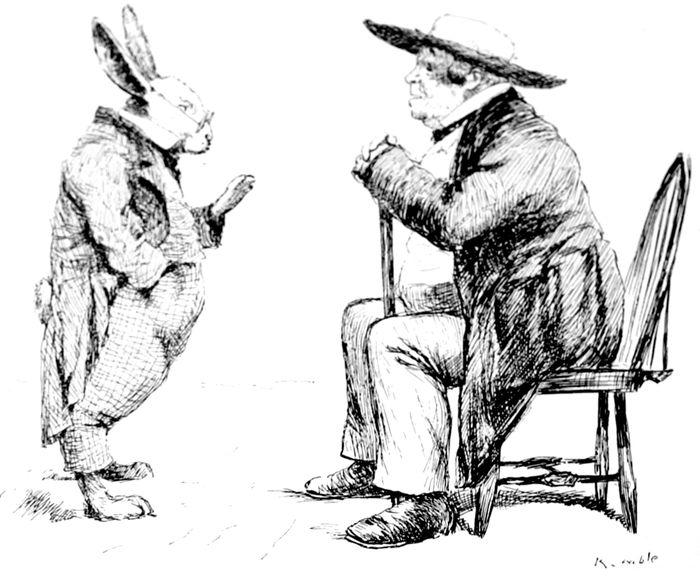
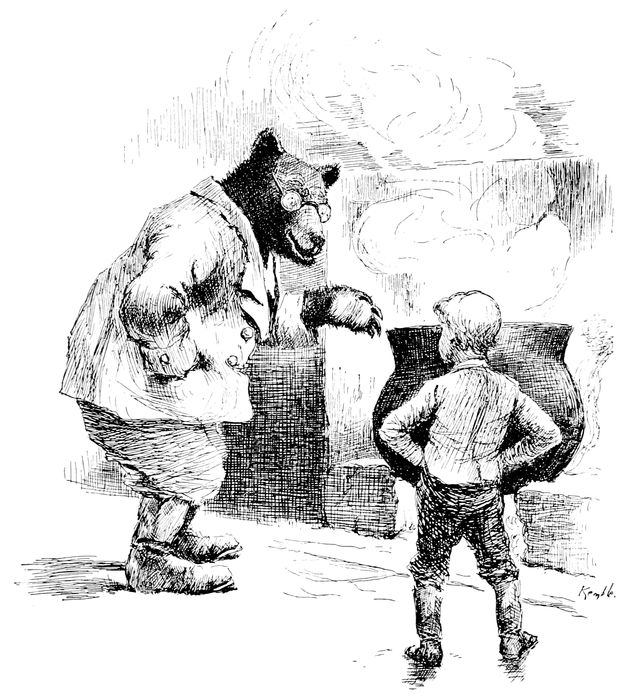
JUDGE RABBIT AND THE FAT MAN.

CONTENTS
| Page | ||
| Daddy Jake, the Runaway: | ||
| Chapter I | 1 | |
| Chapter II | 28 | |
| Chapter III | 53 | |
| How a Witch was Caught | 83 | |
| The Little Boy and his Dogs | 93 | |
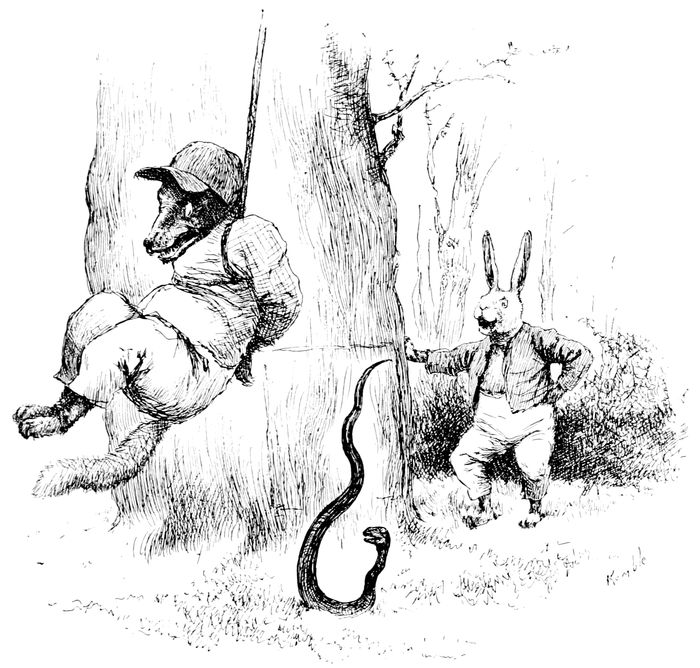
| How Black Snake Caught the Wolf | 108 | |
| Why the Guineas Stay Awake | 118 | |
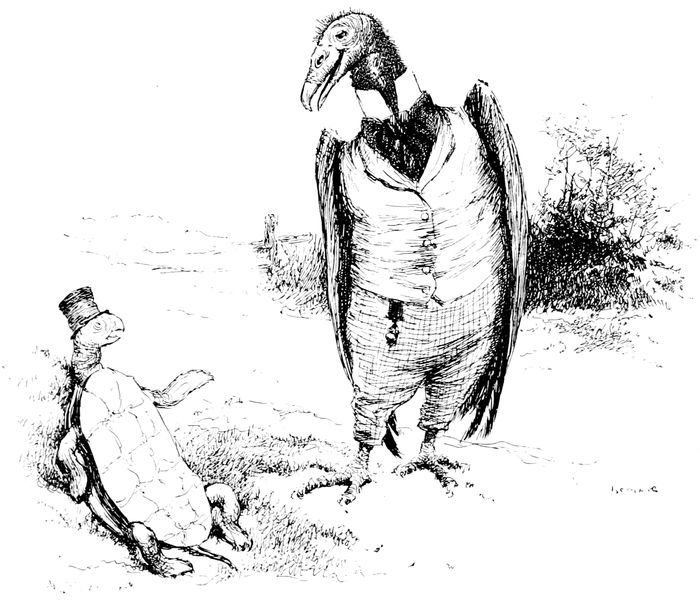
| How the Terrapin was Taught to Fly | 123 | |
| The Creature with no Claws | 134 | |
| Uncle Remus’s Wonder Story | 139 | |
| The Rattlesnake and the Polecat | 149 | |
| How the Birds Talk | 152 | |
| The Foolish Woman | 165 | |
| The Adventures of Simon and Susanna | 171 | |
| Brother Rabbit and the Gingercakes | 183 | |
| Brother Rabbit’s Courtship | 188 | |
ILLUSTRATIONS
| Page | |
| Judge Rabbit and the Fat Man, | Frontispiece |
| “The Youngsters Saw Daddy Jake, and Went Running After Him.” | 9 |
| “The Field-hands were Singing as they Picked the Opening Cotton.” | 19 |
| “‘Maybe he Knows Where Daddy Jake is,’ said Lillian.” | 25 |
| “The Field-hands Discussed the Matter.” | 29 |
| The Miller and his Children. | 41 |
| “An’ Ole Man Jake, he dar too.” | 49 |
| “Lucien Saw Him, and Rushed Toward Him.” | 57 |
| Poor Old Sue Tells her Story. | 63 |
| “Mr. Rabbit Squall Out, ‘Coon Dead!’” | 71 |
| “Den de Frogs dey Went to Work Sho Nuff.” | 75 |
| “The Old Negro Put his Hands to his Mouth and Called.” | 79 |
| “She Stood dar a Minit, dat Ole Black Cat Did.” | 87 |
| “‘All Ready, now. Stick yo’ Head In.’” | 105 |
| “En Eve’y Time He Swung Mr. Black Snake Tuck ’n Lash ’Im wid he Tail.” | 115 |
| “‘Brer Tarrypin, How You Feel?’” | 127 |
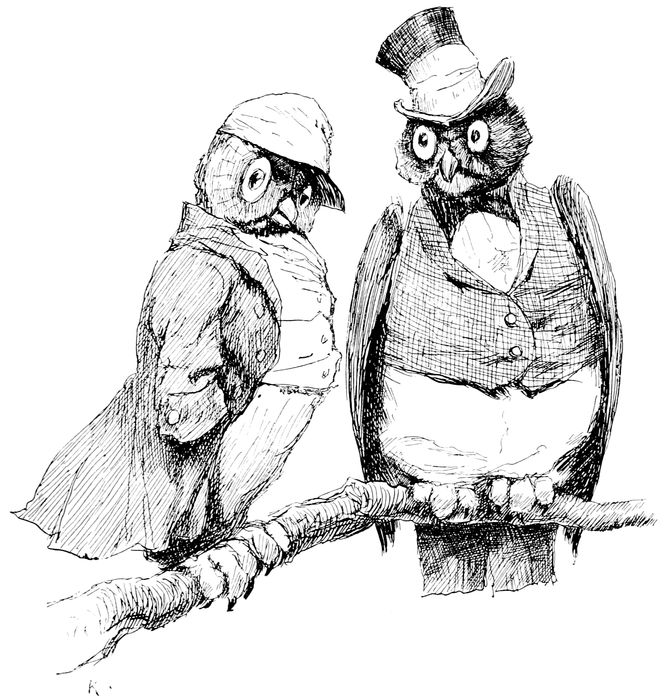
| Billy Big-Eye and Tommy Long-Wing. | 159 |
| Simon Shakes the Pebbles. | 175 |
DADDY JAKE, THE RUNAWAY — Chapter I — Chapter II — Chapter III
One fine day in September, in the year 1863, there was quite an uproar on the Gaston plantation, in Putnam County, in the State of Georgia. Uncle Jake, the carriage-driver, was missing. He was more than fifty years old, and it was the first time he had been missing since his mistress had been big enough to call him. But he was missing now. Here was his mistress waiting to order the carriage; here was his master fretting and fuming; and here were the two little children, Lucien and Lillian, crying because they didn’t know where Uncle Jake was—“Daddy Jake,” who had heretofore seemed always to be within sound of their voices, ready and anxious to amuse them in any and every way.
Then came the news that Daddy Jake had actually run away. This was, indeed, astounding 2news, and although it was brought by the son of the overseer, none of the Gastons would believe it, least of all Lucien and Lillian. The son of the overseer also brought the further information that Daddy Jake, who had never had an angry word for anybody, had struck the overseer across the head with a hoe-handle, and had then taken to the woods. Dr. Gaston was very angry, indeed, and he told the overseer’s son that if anybody was to blame it was his father. Mrs. Gaston, with her eyes full of tears, agreed with her husband, and Lucien and Lillian, when they found that Daddy Jake was really gone, refused to be comforted. Everybody seemed to be dazed. As it was Saturday, and Saturday was a holiday, the negroes stood around their quarters in little groups discussing the wonderful event. Some of them went so far as to say that if Daddy Jake had taken to the woods it was time for the rest of them to follow suit; but this proposition was hooted down by the more sensible among them.
Nevertheless, the excitement on the Gaston plantation ran very high when it was discovered that a negro so trusted and so trustworthy as Daddy Jake had actually run away; and it was not until all the facts were known that the other negroes became reconciled to Daddy Jake’s absence. 3What were the facts? They were very simple, indeed; and yet, many lads and lasses who read this may fail to fully comprehend them.
In the first place, the year in which Daddy Jake became a fugitive was the year 1863, and there was a great deal of doubt and confusion in the South at that time. The Conscription Act and the Impressment Law were in force. Under the one, nearly all the able-bodied men and boys were drafted into the army; and under the other, all the corn and hay and horses that the Confederacy needed were pressed into service. This state of things came near causing a revolt in some of the States, especially in Georgia, where the laws seemed to bear most heavily. Something of this is to be found in the history of that period, but nothing approaching the real facts has ever been published. After the Conscription Act was passed the planters were compelled to accept the services of such overseers as they could get, and the one whom Dr. Gaston had employed lacked both experience and discretion. He had never been trained to the business. He was the son of a shoemaker, and he became an overseer merely to keep out of the army. A majority of those who made overseeing their business had gone to the war either as volunteers or substitutes, and 4very few men capable of taking charge of a large plantation were left behind.
At the same time overseers were a necessity on some of the plantations. Many of the planters were either lawyers or doctors, and these, if they had any practice at all, were compelled to leave their farming interests to the care of agents; there were other planters who had been reared in the belief that an overseer was necessary on a large plantation; so that, for one cause and another, the overseer class was a pretty large one. It was a very respectable class, too; for, under ordinary circumstances, no person who was not known to be trustworthy would be permitted to take charge of the interests of a plantation, for these were as varied and as important as those of any other business.
But in 1863 it was a very hard matter to get a trustworthy overseer; and Dr. Gaston, having a large practice as a physician, had hired the first person who applied for the place, without waiting to make any inquiries about either his knowledge or his character; and it turned out that his overseer was not only utterly incompetent, but that he was something of a rowdy besides. An experienced overseer would have known that he was employed, not to exercise control over the house-servants, 5but to look after the farm-hands; but the new man began business by ordering Daddy Jake to do various things that were not in the line of his duty. Naturally, the old man, who was something of a boss himself, resented this sort of interference. A great many persons were of the opinion that he had been spoiled by kind treatment; but this is doubtful. He had been raised with the white people from a little child, and he was as proud in his way as he was faithful in all ways. Under the circumstances, Daddy Jake did what other confidential servants would have done; he ignored the commands of the new overseer, and went about his business as usual. This led to a quarrel—the overseer doing most of the quarreling. Daddy Jake was on his dignity, and the overseer was angry. Finally, in his fury, he struck the old negro with a strap which he was carrying across his shoulders. The blow was a stinging one, and it was delivered full in Uncle Jake’s face. For a moment the old negro was astonished. Then he became furious. Seizing an ax-handle that happened to be close to his hand, he brought it down upon the head of the overseer with full force. There was a tremendous crash as the blow fell, and the overseer went down as if he had been struck by a pile-driver. 6He gave an awful groan, and trembled a little in his limbs, and then lay perfectly still. Uncle Jake was both dazed and frightened. He would have gone to his master, but he remembered what he had heard about the law. In those days a negro who struck a white man was tried for his life, and if his guilt could be proven, he was either branded with a hot iron and sold to a speculator, or he was hanged.
The certainty of these punishments had no doubt been exaggerated by rumor, but even the rumor was enough to frighten the negroes. Daddy Jake looked at the overseer a moment, and then stopped and felt of him. He was motionless and, apparently, he had ceased to breathe. Then the old negro went to his cabin, gathered up his blanket and clothes, put some provisions in a little bag, and went off into the woods. He seemed to be in no hurry. He walked with his head bent, as if in deep thought. He appeared to understand and appreciate the situation. A short time ago he was the happy and trusted servant of a master and mistress who had rarely given him an unkind word; now he was a fugitive—a runaway. As he passed along by the garden palings he heard two little children playing and prattling on the other side. They 7were talking about him. He paused and listened.
“Daddy Jake likes me the best,” Lucien was saying, “because he tells me stories.”
“No,” said Lillian, “he likes me the best, ’cause he tells me all the stories and gives me some gingercake, too.”
The old negro paused and looked through the fence at the little children, and then he went on his way. But the youngsters saw Daddy Jake, and went running after him.
“Let me go, Uncle Jake!” cried Lucien. “Le’ me go, too!” cried Lillian. But Daddy Jake broke into a run and left the children standing in the garden, crying.
It was not very long after this before the whole population knew that Daddy Jake had knocked the overseer down and had taken to the woods. In fact, it was only a few minutes, for some of the other negroes had seen him strike the overseer and had seen the overseer fall, and they lost no time in raising the alarm. Fortunately the overseer was not seriously hurt. He had received a blow severe enough to render him unconscious for a few minutes,—but this was all; and he was soon able to describe the fracas to Dr. Gaston, which he did with considerable animation.
8“And who told you to order Jake around?” the doctor asked.
“Well, sir, I just thought I had charge of the whole crowd.”
“You were very much mistaken, then,” said Doctor Gaston, sharply; “and if I had seen you strike Jake with your strap, I should have been tempted to take my buggy-whip and give you a dose of your own medicine.”
As a matter of fact, Doctor Gaston was very angry, and he lost no time in giving the new overseer what the negroes called his “walking-papers.” He paid him up and discharged him on the spot, and it was not many days before everybody on the Gaston plantation knew that the man had fallen into the hands of the Conscription officers of the Confederacy, and that he had been sent on to the front.
At the same time, as Mrs. Gaston herself remarked, this fact, however gratifying it might be, did not bring Daddy Jake back. He was gone, and his absence caused a great deal of trouble on the plantation. It was found that half-a-dozen negroes had to be detailed to do the work which he had voluntarily taken upon himself—one to attend to the carriage-horses, another to look after the cows, another to feed the hogs and sheep, and still others to look after the thousand and one little things to be done about the “big house.” But not one of them, nor all of them, filled Daddy Jake’s place.
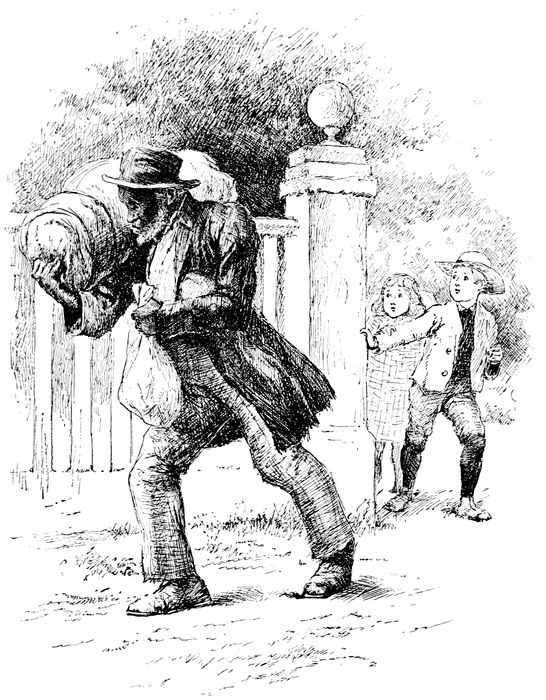
“THE YOUNGSTERS SAW DADDY JAKE, AND WENT RUNNING AFTER HIM.”
11Many and many a time Doctor Gaston walked up and down the veranda wondering where the old negro was, and Mrs. Gaston, sitting in her rocking-chair, looked down the avenue day after day, half expecting to see Daddy Jake make his appearance, hat in hand and with a broad grin on his face. Some of the neighbors, hearing that Uncle Jake had become a fugitive, wanted to get Bill Locke’s “track-dogs” and run him down, but Doctor Gaston and his wife would not hear to this. They said that the old negro wasn’t used to staying in the woods, and that it wouldn’t be long before he would come back home.
Doctor Gaston, although he was much troubled, looked at the matter from a man’s point of view. Here was Daddy Jake’s home; if he chose to come back, well and good; if he didn’t, why, it couldn’t be helped, and that was an end of the matter. But Mrs. Gaston took a different view. Daddy Jake had been raised with her father; he was an old family servant; he had known and loved her mother, who was dead; he had nursed Mrs. Gaston herself when she was a baby; in 12short, he was a fixture in the lady’s experience, and his absence worried her not a little. She could not bear to think that the old negro was out in the woods without food and without shelter. If there was a thunderstorm at night, as there sometimes is in the South during September, she could hardly sleep for thinking about the old negro.
Thinking about him led Mrs. Gaston to talk about him very often, especially to Lucien and Lillian, who had been in the habit of running out to the kitchen while Daddy Jake was eating his supper and begging him to tell a story. So far as they were concerned, his absence was a personal loss. While Uncle Jake was away they were not only deprived of a most agreeable companion, but they could give no excuse for not going to bed. They had no one to amuse them after supper, and, as a consequence, their evenings were very dull. The youngsters submitted to this for several days, expecting that Daddy Jake would return, but in this they were disappointed. They waited and waited for more than a week, and then they began to show their impatience.
“I used to be afraid of runaways,” said Lillian one day, “but I’m not afraid now, ’cause Daddy 13Jake is a runaway.” Lillian was only six years old, but she had her own way of looking at things.
“Pshaw!” exclaimed Lucien, who was nine, and very robust for his age; “I never was afraid of runaways. I know mighty well they wouldn’t hurt me. There was old Uncle Fed; he was a runaway when Papa bought him. Would he hurt anybody?”
“But there might be some bad ones,” said Lillian, “and you know Lucinda says Uncle Fed is a real, sure-enough witch.”
“Lucinda!” exclaimed Lucien, scornfully. “What does Lucinda know about witches? If one was to be seen she wouldn’t stick her head out of the door to see it. She’d be scared to death.”
“Yes, and so would anybody,” said Lillian, with an air of conviction. “I know I would.”
“Well, of course,—a little girl,” explained Lucien. “Any little girl would be afraid of a witch, but a great big double-fisted woman like Lucinda ought to be ashamed of herself to be afraid of witches, and that, too, when everybody knows there aren’t any witches at all, except in the stories.”
“Well, I heard Daddy Jake telling about a 14witch that turned herself into a black cat, and then into a big black wolf,” said Lillian.
“Oh, that was in old times,” said Lucien, “when the animals used to talk and go on like people. But you never heard Daddy Jake say he saw a witch,—now, did you?”
“No,” said Lillian, somewhat doubtfully; “but I heard him talking about them. I hope no witch will catch Daddy Jake.”
“Pshaw!” exclaimed Lucien. “Daddy Jake carried his rabbit-foot with him, and you know no witch can bother him as long as he has his rabbit-foot.”
“Well,” said Lillian, solemnly, “if he’s got his rabbit-foot and can keep off the witches all night, he won’t come back any more.”
“But he must come,” said Lucien. “I’m going after him. I’m going down to the landing to-morrow, and I’ll take the boat and go down the river and bring him back.”
“Oh, may I go, too?” asked Lillian.
“Yes,” said Lucien, loftily, “if you’ll help me get some things out of the house and not say anything about what we are going to do.”
Lillian was only too glad to pledge herself to secrecy, and the next day found the two children busily preparing for their journey in search of Daddy Jake.
15The Gaston plantation lay along the Oconee River in Putnam County, not far from Roach’s Ferry. In fact, it lay on both sides of the river, and, as the only method of communication was by means of a bateau, nearly everybody on the plantation knew how to manage the boat. There was not an hour during the day that the bateau was not in use. Lucien and Lillian had been carried across hundreds of times, and they were as much at home in the boat as they were in a buggy. Lucien was too young to row, but he knew how to guide the bateau with a paddle while others used the oars.
This fact gave him confidence, and the result was that the two children quietly made their arrangements to go in search of Daddy Jake. Lucien was the “provider,” as he said, and Lillian helped him to carry the things to the boat. They got some meal-sacks, two old quilts, and a good supply of biscuits and meat. Nobody meddled with them, for nobody knew what their plans were, but some of the negroes remarked that they were not only unusually quiet, but very busy—a state of things that is looked upon by those who are acquainted with the ways of children as a very bad sign, indeed.
The two youngsters worked pretty much all day, and they worked hard; so that when night 16came they were both tired and sleepy. They were tired and sleepy, but they managed to cover their supplies with the meal-sacks, and the next morning they were up bright and early. They were up so early, indeed, that they thought it was a very long time until breakfast was ready; and, at last, when the bell rang, they hurried to the table and ate ravenously, as became two travelers about to set out on a voyage of adventure.
It was all they could do to keep their scheme from their mother. Once Lillian was on the point of asking her something about it, but Lucien shook his head, and it was not long before the two youngsters embarked on their journey. After seating Lillian in the bateau, Lucien unfastened the chain from the stake, threw it into the boat, and jumped in himself. Then, as the clumsy affair drifted slowly with the current, he seized one of the paddles, placed the blade against the bank, and pushed the bateau out into the middle of the stream.
It was the beginning of a voyage of adventure, the end of which could not be foretold; but the sun was shining brightly, the mocking-birds were singing in the water-oaks, the blackbirds were whistling blithely in the reeds, and the children were light-hearted and happy. They were going 17to find Daddy Jake and fetch him back home, and not for a moment did it occur to them that the old negro might have gone in a different direction. It seemed somehow to those on the Gaston plantation that whatever was good, or great, or wonderful had its origin “down the river.” Rumor said that the biggest crops were grown in that direction, and that there the negroes were happiest. The river, indeed, seemed to flow to some far-off country where everything was finer and more flourishing. This was the idea of the negroes themselves, and it was natural that Lucien and Lillian should be impressed with the same belief. So they drifted down the river, confident that they would find Daddy Jake. They had no other motive—no other thought. They took no account of the hardships of a voyage such as they had embarked on.
Lazily, almost reluctantly as it seemed, the boat floated down the stream. At first, Lucien was inclined to use the broad oar, but it appeared that when he paddled on one side the clumsy boat tried to turn its head up stream on the other side, and so, after a while, he dropped the oar in the bottom of the boat.
The September sun was sultry that morning, but, obeying some impulse of the current, the 18boat drifted down the river in the shade of the water-oaks and willows that lined the eastern bank. On the western bank the Gaston plantation lay, and as the boat floated lazily along the little voyagers could hear the field-hands singing as they picked the opening cotton. The song was strangely melodious, though the words were ridiculous.
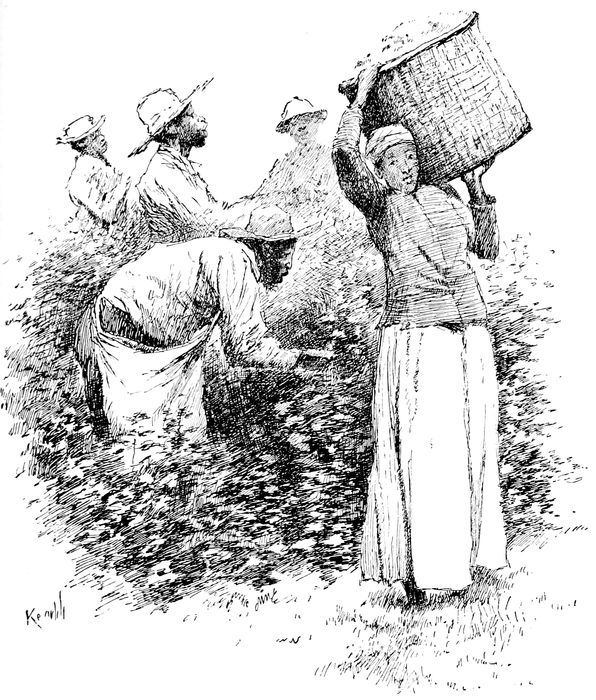
“THE FIELD-HANDS WERE SINGING AS THEY PICKED THE OPENING COTTON.”
21It was to the quaint melody of this song that the boat rocked and drifted along. One of the negroes saw the children and thought he knew them, and he called to them, but received no reply; and this fact was so puzzling that he went back and told the other negroes that there was some mistake about the children. “Ef dey’d ’a’ bin our chillun,” he said, “dey’d ’a’ hollered back at me, sho’.” Whereupon the field-hands resumed their work and their song, and the boat, gliding southward on the gently undulating current, was soon lost to view.
To the children it seemed to be a very pleasant journey. They had no thought of danger. The river was their familiar friend. They had crossed and recrossed it hundreds of times. They were as contented in the bateau as they would have been in their mother’s room. The weather was warm, but on the river and in the shade of the overhanging trees the air was cool and refreshing. And after a while the current grew swifter, and the children, dipping their hands in the water, laughed aloud.
Once, indeed, the bateau, in running over a long stretch of shoals, was caught against a rock. An ordinary boat would have foundered, but this boat, clumsy and deep-set, merely obeyed the current. 22It struck the rock, recoiled, touched it again, and then slowly turned around and pursued its course down the stream. The shoals were noisy but harmless. The water foamed and roared over the rocks, but the current was deep enough to carry the bateau safely down. It was not often that a boat took that course, but Lucien and Lillian had no sense of fear. The roaring and foaming of the water pleased them, and the rushing and whirling of the boat, as it went dashing down the rapids, appeared to be only part of a holiday frolic. After they had passed the shoals, the current became swifter, and the old bateau was swept along at a rapid rate. The trees on the river bank seemed to be running back toward home, and the shadows on the water ran with them.
Sometimes the boat swept through long stretches of meadow and marsh lands, and then the children were delighted to see the sandpipers and killdees running along the margin of the water. The swallows, not yet flown southward, skimmed along the river with quivering wing, and the kingfishers displayed their shining plumage in the sun. Once a moccasin, fat and rusty, frightened by the unexpected appearance of the young voyagers, dropped into the boat; but, before Lucien could strike him with the unwieldy oar, he 23tumbled overboard and disappeared. Then the youngsters ate their dinner. It was a very dry dinner; but they ate it with a relish. The crows, flying lazily over, regarded them curiously.
“I reckon they want some,” said Lucien.
“Well, they can’t get mine,” said Lillian, “’cause I jest about got enough for myself.”
They passed a white man who was sitting on the river bank, with his coat off, fishing.
“Where under the sun did you chaps come from?” he cried.
“Up the river,” replied Lucien.
“Where in the nation are you going?”
“Down the river.”
“Maybe he knows where Daddy Jake is,” said Lillian. “Ask him.”
“Why, he wouldn’t know Daddy Jake from a side of sole leather,” exclaimed Lucien.
By this time the boat had drifted around a bend in the river. The man on the bank took off his hat with his thumb and forefinger, rubbed his head with the other fingers, drove away a swarm of mosquitoes, and muttered, “Well, I’ll be switched!” Then he went on with his fishing.
Meanwhile the boat drifted steadily with the current. Sometimes it seemed to the children that the boat stood still, while the banks, the trees, 24and the fields moved by them like a double panorama. Queer-looking little birds peeped at them from the bushes; fox-squirrels chattered at them from the trees; green frogs greeted them by plunging into the water with a squeak; turtles slid noiselessly off the banks at their approach; a red fox that had come to the river to drink disappeared like a shadow before the sun; and once a great white crane rose in the air, flapping his wings heavily.
Altogether it was a very jolly journey, but after a while Lillian began to get restless.
“Do you reckon Daddy Jake will be in the river when we find him?” she asked.
Lucien himself was becoming somewhat tired, but he was resolved to go right on. Indeed, he could not do otherwise.
“Why, who ever heard of such a thing?” he exclaimed. “What would Daddy Jake be doing in the water?”
“Well, how are we’s to find him?”
“Oh, we’ll find him.”
“But I want to find him right now,” said Lillian, “and I want to see Mamma, and Papa, and my dollies.”
“Well,” said Lucien with unconscious humor, “if you don’t want to go, you can get out and walk back home.” At this Lillian began to cry.
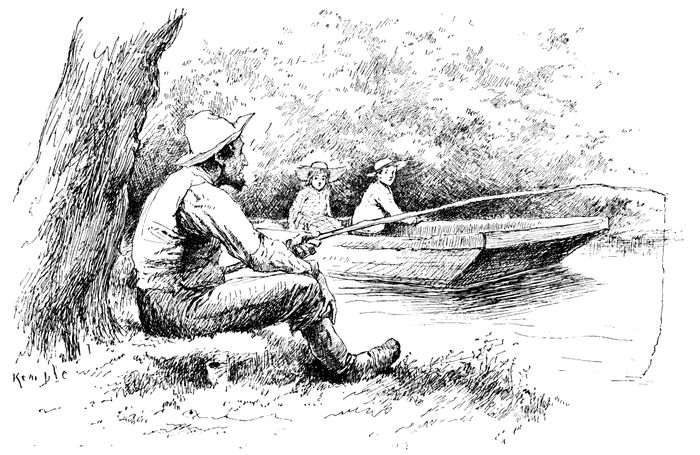
“‘MAYBE HE KNOWS WHERE DADDY JAKE IS,’ SAID LILLIAN.”
27“Well,” said Lucien, “if Daddy Jake was over there in the bushes and was to see you crying because you didn’t want to go and find him, he’d run off into the woods and nobody would see him any more.”
Lillian stopped crying at once, and, as the afternoon wore on, both children grew more cheerful; and even when twilight came, and after it the darkness, they were not very much afraid. The loneliness—the sighing of the wind through the trees, the rippling of the water against the sides of the boat, the hooting of the big swamp-owl, the cry of the whippoorwill, and the answer of its cousin, the chuck-will’s-widow—all these things would have awed and frightened the children. But, shining steadily in the evening sky, they saw the star they always watched at home. It seemed to be brighter than ever, this familiar star, and they hailed it as a friend and fellow-traveler. They felt that home couldn’t be so far away, for the star shone in its accustomed place, and this was a great comfort.
After a while the night grew chilly, and then Lucien and Lillian wrapped their quilts about them and cuddled down in the bottom of the boat. Thousands of stars shone overhead, and it seemed to the children that the old bateau, growing tired of its journey, had stopped to rest; but it continued to drift down the river.
You may be sure there was trouble on the Gaston place when night came and the children did not return. They were missed at dinner-time; but it frequently happened that they went off with some of the plantation wagons, or with some of the field-hands, and so nothing was thought of their absence at noon; but when night fell and all the negroes had returned from their work, and there was still no sign of the children, there was consternation in the big house and trouble all over the plantation. The field-hands, returned from their work, discussed the matter at the doors of their cabins and manifested considerable anxiety.
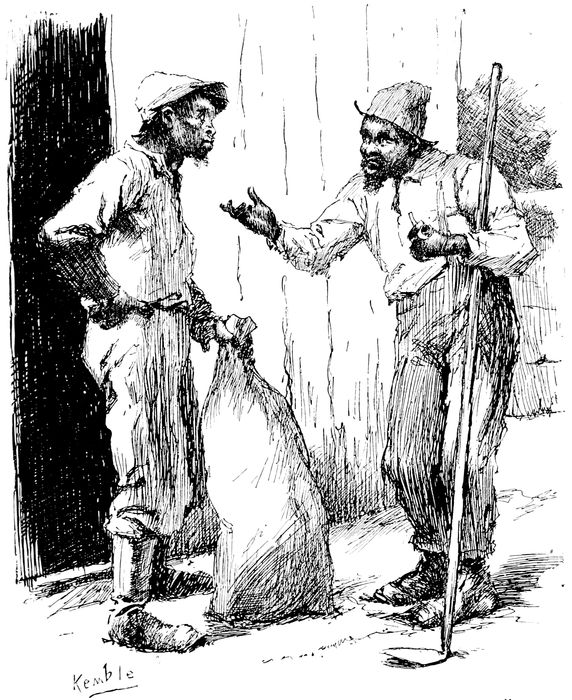
“THE FIELD-HANDS DISCUSSED THE MATTER.”
31At first the house-servants were sent scurrying about the place hunting for the truants. Then other negroes were pressed into service, until, finally, every negro on the place was engaged in the search, and torches could be seen bobbing up and down in all parts of the plantation. The negroes called and called, filling the air with their musical halloos, but there was no reply save from the startled birds, or from the dogs, who seemed to take it for granted that everybody was engaged in a grand ’possum hunt, and added the strength of their own voices to the general clamor.
While all this was going on, Mrs. Gaston was pacing up and down the long veranda wringing her hands in an agony of grief. There was but one thought in her mind—the river, the RIVER! Her husband in the midst of his own grief tried to console her, but he could not. He had almost as much as he could do to control himself, and there was in his own mind—the RIVER!
The search on the plantation and in its vicinity went on until nearly nine o’clock. About that time Big Sam, one of the plough-hands, who was also a famous fisherman, came running to the house with a frightened face.
“Marster,” he exclaimed, “de boat gone—she done gone!”
“Oh, I knew it!” exclaimed Mrs. Gaston—“the river, the river!”
“Well!” said Doctor Gaston, “the boat must be found. Blow the horn!”
Big Sam seized the dinner-horn and blew a 32blast that startled the echoes for miles around. The negroes understood this to be a signal to return, and most of them thought that the children had been found, so they came back laughing and singing, and went to the big house to see the children.
“Wh’abouts you fine um, marster?” asked the foreman.
“They haven’t been found, Jim,” said Dr. Gaston. “Big Sam says that the boat is gone from the landing, and that boat must be found to-night.”
“Marster,” said a negro, coming forward out of the group, “I seed a boat gwine down stream dis mornin’. I wuz way up on de hill—”
“And you didn’t come and tell me?” asked Dr. Gaston in a severe tone.
“Well, suh, I hollered at um, an’ dey ain’t make no answer, an’ den it look like ter me ’t wuz dem two Ransome boys. Hit mos’ drap out’n my min’. An’ den you know, suh, our chillun ain’t never had no doin’s like dat—gittin’ in de boat by dey own-alone se’f an’ sailin’ off dat a-way.”
“Well,” said Dr. Gaston, “the boat must be found. The children are in it. Where can we get another boat?”
“I got one, suh,” said Big Sam.
33“Me, too, marster,” said another negro.
“Then get them both, and be quick about it!”
“Ah-yi, suh,” was the response, and in a moment the group was scattered, and Big Sam could be heard giving orders in a loud and an energetic tone of voice. For once he was in his element. He could be foreman on the Oconee if he couldn’t in the cotton-patch. He knew every nook and cranny of the river for miles up and down; he had his fish-baskets sunk in many places, and the overhanging limbs of many a tree bore the marks of the lines of his set-hooks. So for once he appointed himself foreman, and took charge of affairs. He and Sandy Bill (so-called owing to the peculiar color of his hair) soon had their boats at the landing. The other negroes were assembled there, and the most of them had torches.
“Marster,” said Big Sam, “you git in my boat, an’ let little Willyum come fer ter hol’ de torch. Jesse, you git in dar wid Sandy Bill. Fling a armful er light’ood in bofe boats, boys, kaze we got ter have a light, and dey ain’t no tellin’ how fur we gwine.”
The fat pine was thrown in, everything made ready, and then the boats started. With one sweep of his broad paddle, Big Sam sent his boat 34into the middle of the stream, and, managed by his strong and willing arms, the clumsy old bateau became a thing of life. Sandy Bill was not far behind him.
The negroes used only one paddle in rowing, and each sat in the stern of his boat, using the rough but effective oar first on one side and then the other.
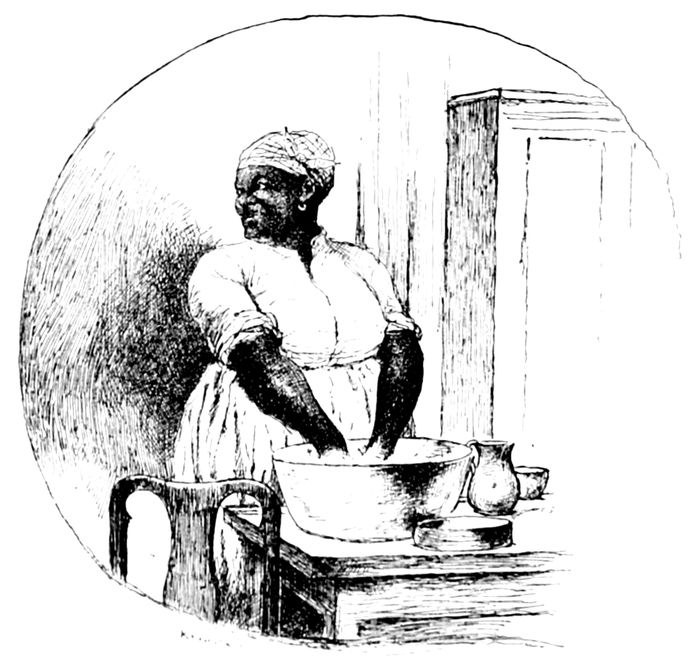
From a window, Mrs. Gaston watched the boats as they went speeding down the river. By her side was Charity, the cook.
35“Isn’t it terrible!” she exclaimed, as the boats passed out of sight. “Oh, what shall I do?”
“’T would be mighty bad, Mist’iss, ef dem chillun wuz los’; but dey ain’t no mo’ los’ dan I is, an’ I’m a-standin’ right yer in de cornder by dish yer cheer.”
“Not lost! Why, of course they are lost. Oh, my darling little children!”
“No ’m, dey ain’t no mo’ los’ dan you is. Dey tuck dat boat dis mornin’, an’ dey went atter ole man Jake—dat’s whar dey er gone. Dey ain’t gone nowhar else. Dey er in dat boat right now; dey may be asleep, but dey er in dar. Ain’t I year um talkin’ yistiddy wid my own years? Ain’t I year dat ar Marse Lucien boy ’low ter he sister dat he gwine go fetch ole man Jake back? Ain’t I miss a whole can full er biscuits? Ain’t I miss two er dem pies w’at I lef’ out dar in de kitchen? Ain’t I miss a great big hunk er light-bread? An’ who gwine dast ter take um less’n it’s dem ar chillun? Dey don’t fool me, mon. I’m one er de oldest rats in de barn—I is dat!”
Charity’s tone was emphatic and energetic. She was so confident that her theory was the right one that she succeeded in quieting her mistress somewhat.
36“An’ mo’ ’n dat,” she went on, seeing the effect of her remarks, “dem chillun ’ll come home yer all safe an’ soun’. Ef Marster an’ dem niggers don’t fetch um back, dey ’ll come deyse’f; an’ old man Jake ’ll come wid um. You min’ wa’t I tell you. You go an’ go ter bed, honey, an’ don’t pester yo’se’f ’bout dem chillun. I’ll set up yer in the cornder an’ nod, an’ keep my eyes on w’at’s gwine on outside.”
But Mrs. Gaston refused to go to bed. She went to the window, and away down the river she could see the red light of the torches projected against the fog. It seemed as if it were standing still, and the mother’s heart sank within her at the thought. Perhaps they had found the boat—empty! This and a thousand other cruel suggestions racked her brain.
But the boats were not standing still; they were moving down the river as rapidly as four of the stoutest arms to be found in the county could drive them. The pine torches lit up both banks perfectly. The negroes rowed in silence a mile or more, when Big Sam said:
“Marster, kin we sing some?”
“Does it seem to be much of a singing matter, Sam?” Dr. Gaston asked, grimly.
“No, suh, it don’t; but singin’ he’ps ’long 37might’ly w’en you workin’, mo’ speshually ef you er doin’ de kind er work whar you kin sorter hit a lick wid the chune—kinder keepin’ time, like.”
Dr. Gaston said nothing, and Big Sam went on:
“’Sides dat, Marster, we-all useter sing ter dem chillun, an’ dey knows our holler so well dat I boun’ you ef dey wuz ter year us singin’ an’ gwine on, dey’d holler back.”
“Well,” said Dr. Gaston, struck by the suggestion, “sing.”
“Bill,” said Big Sam to the negro in the other boat, “watch out for me; I’m gwine away.”
“You’ll year fum me w’en you git whar you gwine,” Sandy Bill replied.
With that Big Sam struck up a song. His voice was clear and strong, and he sang with a will.
The words of the song, foolish and trivial as they are, do not give the faintest idea of the melody to which it was sung. The other negroes joined in, and the tremulous tenor of little Willyum was especially effective. The deep dark woods on either side seemed to catch up and echo back the plaintive strain. To a spectator on the bank, the scene must have been an uncanny one—the song with its heart-breaking melody, the glistening arms and faces of the two gigantic blacks, the flaring torches, flinging their reflections on the swirling waters, the great gulfs of darkness beyond—all these must have been very impressive. But these things did not occur to those in the boats, least of all to Dr. Gaston. 39In the minds of all there was but one thought—the children.
The negroes rowed on, keeping time to their songs. Their arms appeared to be as tireless as machinery that has the impulse of steam. Finally Big Sam’s boat grounded.
“Hol’ on dar, Bill!” he shouted. “Watch out!” He took the torch from the little negro and held it over his head, and then behind him, peering into the darkness beyond. Then he laughed.
“De Lord he’p my soul!” he exclaimed; “I done clean fergit ’bout Moccasin Shoals! Back yo’ boat, Bill.” Suiting the action to the word, he backed his own, and they were soon away from the shoals.
“Now, den,” he said to Bill, “git yo’ boat in line wid mine, an’ hol’ yo’ paddle in yo’ lap.” Then the boats, caught by the current, moved toward the shoals, and one after the other touched a rock, turned completely around, and went safely down the rapids, just as the children’s boat had done in the forenoon. Once over the shoals, Big Sam and Sandy Bill resumed their oars and their songs, and sent the boats along at a rapid rate.
A man, sitting on the river bank, heard them 40coming, and put out his torch by covering it with sand. He crouched behind the bushes and watched them go by. After they had passed he straightened himself, and remarked:
“Well, I’ll be switched!” Then he relighted his torch, and went on with his fishing. It was the same man that Lucien and Lillian had seen.
The boats went on and on. With brief intervals the negroes rowed all night long, but Dr. Gaston found no trace of his children. In sheer desperation, however, he kept on. The sun rose, and the negroes were still rowing. At nine o’clock in the morning the boats entered Ross’s mill-pond. This Dr. Gaston knew was the end of his journey. If the boat had drifted into this pond, and been carried over the dam, the children were either drowned or crushed on the rocks below. If their boat had not entered the pond, then they had been rescued the day before by some one living near the river.
It was with a heavy heart that Dr. Gaston landed. And yet there were no signs of a tragedy anywhere near. John Cosby, the miller, fat and hearty, stood in the door of the mill, his arms akimbo, and watched the boats curiously. His children were playing near. A file of geese was marching down to the water, and a flock of pigeons was sailing overhead, taking their morning exercise. Everything seemed to be peaceful and serene. As he passed the dam on his way to the mill, Dr. Gaston saw that there was a heavy head of water, but possibly not enough to carry a large bateau over; still—the children were gone!
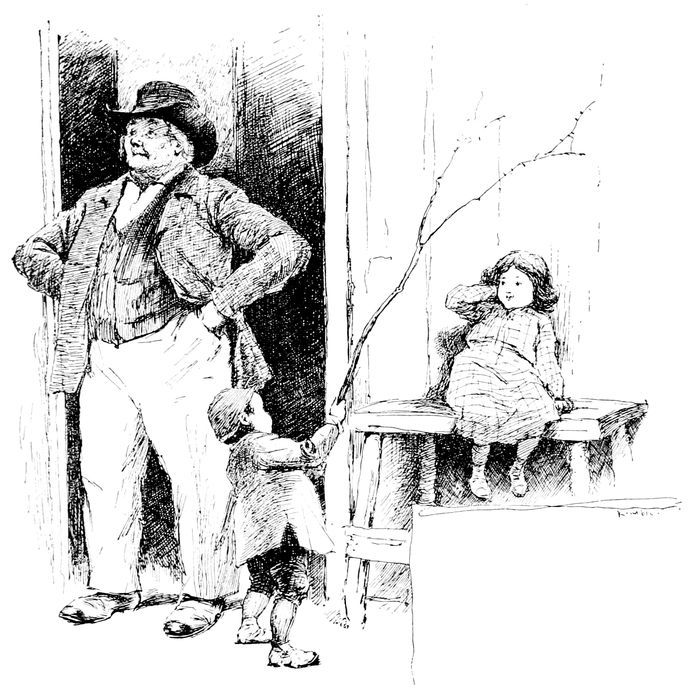
THE MILLER AND HIS CHILDREN
43The puzzled look on the miller’s face disappeared as Dr. Gaston approached.
“Well, the gracious goodness!” he exclaimed. “Why, howdy, Doc.—howdy! Why, I ’m right down glad to see you. Whichever an’ whichaway did you come?”
“My little children are lost,” said Dr. Gaston, shaking the miller’s hand. The jolly smile on John Cosby’s face disappeared as suddenly as if it had been wiped out with a sponge.
“Well, now, that’s too bad—too bad,” he exclaimed, looking at his own rosy-cheeked little ones standing near.
“They were in a bateau,” said Dr. Gaston, “and I thought maybe they might have drifted down here and over the mill-dam.”
The miller’s jolly smile appeared again. “Oh, no, Doc.—no, no! Whichever an’ whichaway they went, they never went over that dam. In time of a freshet, the thing might be did; but not now. Oh, no! Ef it lies betwixt goin’ over that 44dam an’ bein’ safe, them babies is jest as safe an’ soun’ as mine is.”
“I think,” said Dr. Gaston, “that they started out to hunt Jake, my carriage-driver, who has run away.”
“Jake run away!” exclaimed Mr. Cosby, growing very red in the face. “Why, the impident scoundull! Hit ain’t been three days sence the ole rascal wuz here. He come an’ ’lowed that some of your wagons was a-campin’ out about two mile from here, an’ he got a bushel of meal, an’ said that if you didn’t pay me the money down I could take it out in physic. The impident ole scoundull! An’ he was jest as ’umble-come-tumble as you please—a-bowin’, an’ a-scrapin’, an’ a-howdy-do-in’.”
But the old miller’s indignation cooled somewhat when Dr. Gaston briefly told him of the incident which caused the old negro to run away.
“Hit sorter sticks in my gizzard,” he remarked, “when I hear tell of a nigger hittin’ a white man; but I don’t blame Jake much.”
“And now,” said Dr. Gaston, “I want to ask your advice. You are a level-headed man, and I want to know what you think. The children got in the boat, and came down the river. There is no doubt in my mind that they started on a wild-goose 45chase after Jake; but they are not on the river now, nor is the boat on the river. How do you account for that?”
“Well, Doc., if you want my naked beliefs about it, I’ll give ’em to you, fa’r an’ squar’. It’s my beliefs that them youngsters have run up agin old Jake somewhar up the river, an’ that they are jest as safe’an’ soun’ as you is. Them’s my beliefs.”
“But what has become of the boat?”
“Well, I’ll tell you. Old Jake is jest as cunning as any other nigger. He took an’ took the youngsters out, an’ arterwards he drawed the boat out on dry land. He rightly thought there would be pursuit, an’ he didn’t mean to be ketched.”
“Then what would you advise me to do?” asked Dr. Gaston.
The old man scratched his head.
“Well, Doc., I’m a-talkin’ in the dark, but it’s my beliefs them youngsters ’ll be at home before you can get there to save your life. Jake may not be there, but if he’s found the boy an’ gal, he ’ll carry ’em safe home. Now you mind what I tell you.”
Dr. Gaston’s anxiety was too great to permit him to put much confidence in the old miller’s prediction. What he said seemed reasonable enough, but a thousand terrible doubts had possession of 46the father’s mind. He hardly dared go home without the children. He paced up and down before the mill, a most miserable man. He knew not where to go or what to do.
Mr. Cosby, the miller, watched him awhile, and shook his head. “If Doc. don’t find them youngsters,” he said to himself, “he ’ll go plum deestracted.” But he said aloud:
“Well, Doc., you an’ the niggers must have a breathing-spell. We’ll go up to the house an’ see ef we can’t find somethin’ to eat in the cubberd, an’ arterwards, in the time you are restin’, we’ll talk about findin’ the youngsters. If there’s any needcessity, I’ll go with you. My son John can run the mill e’en about as good as I can. We’ll go up yan to ’Squire Ross’s an’ git a horse or two, an’ we’ll scour the country on both sides of the river. But you’ve got to have a snack of somethin’ to eat, an’ you’ve got to take a rest. Human natur’ can’t stand the strain.”
Torn as he was by grief and anxiety, Dr. Gaston knew this was good advice. He gratefully accepted John Cosby’s invitation to breakfast, as well as his offer to aid in the search for the lost children. After Doctor Gaston had eaten, he sat on the miller’s porch and tried to collect his thoughts so as to be able to form some plan of 47search. While the two men were talking, they heard Big Sam burst out laughing. He laughed so loud and heartily that Mr. Cosby grew angry, and went into the back yard to see what the fun was about. In his heart the miller thought the negroes were laughing at the food his wife had set before them, and he was properly indignant.
“Well, well,” said he, “what’s this I hear? Two high-fed niggers a-laughin’ beca’se their master’s little ones are lost and gone! And has it come to this? A purty pass, a mighty purty pass!” Both the negroes grew very serious at this.
“Mars’ John, we-all was des projickin’ wid one an’er. You know how niggers is w’en dey git nuff ter eat. Dey feel so good dey ’bleege ter holler.”
Mr. Cosby sighed, and turned away. “Well,” said he, “I hope niggers ’s got souls, but I know right p’int-blank that they ain’t got no hearts.”
Now, what was Big Sam laughing at?
He was laughing because he had found out where Lucien and Lillian were. How did he find out? In the simplest manner imaginable. Sandy Bill and Big Sam were sitting in Mr. Cosby’s back yard eating their breakfast, while little Willyum was eating his in the kitchen. It 48was the first time the two older negroes had had an opportunity of talking together since they started from home the day before.
“Sam,” said Sandy Bill, “did you see whar de chillun landed w’en we come ’long des a’ter sun-up dis mornin’?”
“Dat I didn’t,” said Sam, wiping his mouth with the back of his hand—“dat I didn’t, an’ ef I had I’d a hollered out ter Marster.”
“Dat w’at I wuz feared un,” said Sandy Bill.
“Feared er what?” asked Big Sam.
“Feared you’d holler at Marster ef you seed whar dey landed. Dat how come I ter run foul er yo’ boat.”
“Look yer, nigger man, you ain’t done gone ’stracted, is you?”
“Shoo, chile! don’t talk ter me ’bout gwine ’stracted. I got ez much sense ez Ole Zip Coon.”
“Den whyn’t you tell Marster? Ain’t you done see how he troubled in he min’?”
“I done see dat, en it makes me feel bad; but t’er folks got trouble, too, lots wuss’n Marster.”
“Is dey los’ der chillun?”
“Yes—Lord! dey done los’ eve’ybody. But Marster ain’t los’ no chillun yit.”
“Den wat we doin’ way down yer?” asked Big Sam in an angry tone.
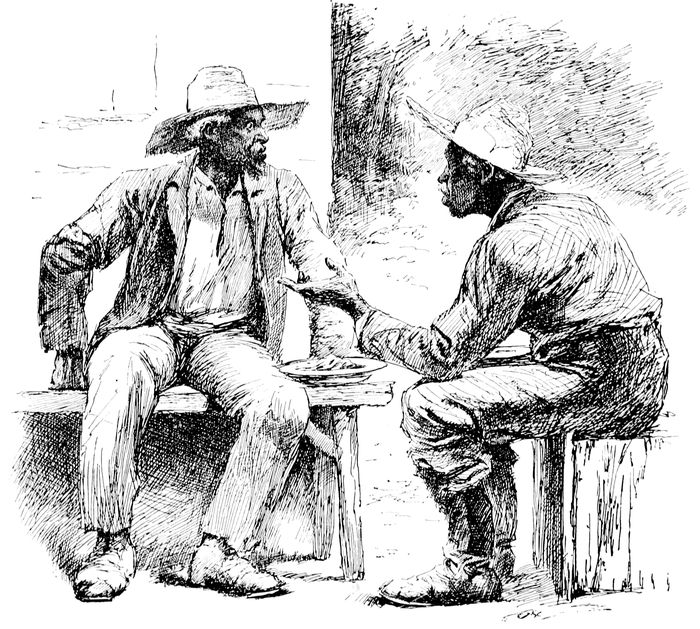
“AN’ OLE MAN JAKE, HE DAR TOO.”
51“Le’ me tell you,” said Sandy Bill, laying his hand on Big Sam’s shoulder; “le’ me tell you. Right cross dar fum whar I run foul er yo’ boat is de biggest cane-brake in all creation.”
“I know ’im,” said Big Sam. “Dey calls ’im Hudson’s cane-brake.”
“Now you talkin’,” said Sandy Bill. “Well, ef you go dar you ’ll fin’ right in the middle er dat cane-brake a heap er niggers dat you got ’quaintance wid—Randall Spivey, an’ Crazy Sue, an’ Cupid Mitchell, an’ Isaiah Little—dey er all dar; an’ ole man Jake, he dar too.”
“Look yer, nigger,” Sam exclaimed, “how you know?”
“I sent ’im dar. He come by me in de fiel’ an’ tole me he done kilt de overseer, an’ I up an’ tell ’im, I did, ‘Make fer Hudson’s cane-brake,’ an’ dar ’s right whar he went.”
It was at this point that Big Sam’s hearty laughter attracted the attention of Dr. Gaston and Mr. Cosby.
“Now, den,” said Sandy Bill, after the miller had rebuked them and returned to the other side of the house, “now, den, ef I’d ’a’ showed Marster whar dem chillun landed, en tole ’im whar dey wuz, he’d ’a’ gone ’cross dar, en seed dem niggers, an’ by dis time nex’ week ole Bill Locke’s 52nigger-dogs would ’a’ done run um all in jail. You know how Marster is. He think kaze he treat his niggers right dat eve’ybody else treat der’n des dat a-way. But don’t you worry ’bout dem chillun.”
Was it possible for Sandy Bill to be mistaken?
Lucien and Lillian, cuddled together in the bottom of their boat, were soon fast asleep. In dreams of home their loneliness and their troubles were all forgotten. Sometimes in the starlight, sometimes in the dark shadows of the overhanging trees, the boat drifted on. At last, toward morning, it was caught in an eddy and carried nearer the bank, where the current was almost imperceptible. Here the clumsy old bateau rocked and swung, sometimes going lazily forward, and then as lazily floating back again.
As the night faded away into the dim gray of morning, the bushes above the boat were thrust softly aside and a black face looked down upon the children. Then the black face disappeared as suddenly as it came. After awhile it appeared again. It was not an attractive face. In the dim light it seemed to look down on the sleeping children with a leer that was almost hideous. It was the face of a woman. Around her head was a 54faded red handkerchief, tied in a fantastic fashion, and as much of her dress as could be seen was ragged, dirty, and greasy. She was not pleasant to look upon, but the children slept on unconscious of her presence.
Presently the woman came nearer. On the lower bank a freshet had deposited a great heap of sand, which was now dry and soft. The woman sat down on this, hugging her knees with her arms, and gazed at the sleeping children long and earnestly. Then she looked up and down the river, but nothing was to be seen for the fog that lay on the water. She shook her head and muttered:
“Hit ’s p’izen down yer for dem babies. Yit how I gwine git um out er dar?”
She caught hold of the boat, turned it around, and, by means of the chain, drew it partially on the sand-bank. Then she lifted Lillian from the boat, wrapping the quilt closer about the child, carried her up the bank, and laid her beneath the trees where no dew had fallen. Returning, she lifted Lucien and placed him beside his sister. But the change aroused him. He raised himself on his elbow and rubbed his eyes. The negro woman, apparently by force of habit, slipped behind a tree.
55“Where am I?” Lucien exclaimed, looking around in something of a fright. He caught sight of the frazzled skirt of the woman’s dress. “Who is there behind that tree?” he cried.
“Nobody but me, honey—nobody ner nothin’ but po’ ole Crazy Sue. Don’t be skeerd er me. I ain’t nigh ez bad ez I looks ter be.”
It was now broad daylight, and Lucien could see that the hideous ugliness of the woman was caused by a burn on the side of her face and neck.
“Wasn’t I in a boat?”
“Yes, honey; I brung you up yer fer ter keep de fog fum pizenin’ you.”
“I dreamed the Bad Man had me,” said Lucien, shivering at the bare recollection.
“No, honey; ’t want nobody ner nothin’ but po’ ole Crazy Sue. De boat down dar on de sand-bank, an’ yo’ little sissy layin’ dar soun’ asleep. Whar in de name er goodness wuz you-all gwine, honey?” asked Crazy Sue, coming nearer.
“We were going down the river hunting for Daddy Jake. He’s a runaway now. I reckon we’ll find him after a while.”
“Is you-all Marse Doc. Gaston’ chillun?” asked Crazy Sue, with some show of eagerness.
“Why, of course we are,” said Lucien.
56Crazy Sue’s eyes fairly danced with joy. She clasped her hands together and exclaimed:
“Lord, honey, I could shout,—I could des holler and shout; but I ain’t gwine do it. You stay right dar by yo’ little sissy till I come back; I want ter run an’ make somebody feel good. Now, don’t you move, honey. Stay right dar.”
With that Crazy Sue disappeared in the bushes. Lucien kept very still. In the first place, he was more than half frightened by the strangeness of his surroundings, and, in the second place, he was afraid his little sister would wake and begin to cry. He felt like crying a little himself, for he knew he was many miles from home, and he felt very cold and uncomfortable. Indeed, he felt very lonely and miserable; but just when he was about to cry and call Daddy Jake, he heard voices near him. Crazy Sue came toward him in a half-trot, and behind her—close behind her—was Daddy Jake, his face wreathed in smiles and his eyes swimming in tears. Lucien saw him and rushed toward him, and the old man stooped and hugged the boy to his black bosom.
“Why, honey,” he exclaimed, “whar de name er goodness you come f’um! Bless you! ef my eyes wuz sore de sight un you would make um well. How you know whar yo’ Daddy Jake is?”
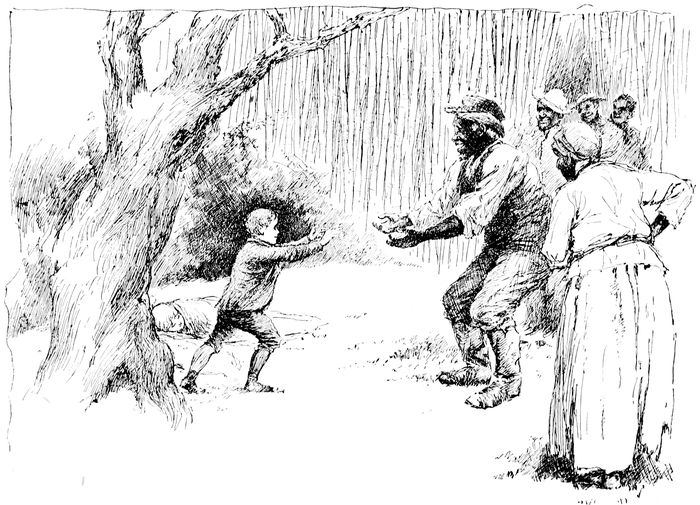
“LUCIEN SAW HIM AND RUSHED TOWARD HIM.”
59“Me and sister started out to hunt you,” said Lucien, whimpering a little, now that he had nothing to whimper for, “and I think you are mighty mean to run off and leave us all at home.”
“Now you talkin’, honey,” said Daddy Jake, laughing in his old fashion. “I boun’ I’m de meanes’ ole nigger in de Nunited State. Yit, ef I’d ’a’ know’d you wuz gwine ter foller me up so close, I’d ’a’ fotch you wid me, dat I would! An’ dar’s little Missy,” he exclaimed, leaning over the little girl, “an’ she’s a-sleepin’ des ez natchul ez ef she wuz in her bed at home. What I tell you-all?” he went on, turning to a group of negroes that had followed him,—Randall, Cupid, Isaiah, and others,—“What I tell you-all? Ain’t I done bin’ an’ gone an’ tole you dat deze chillun wuz de out-doin’est chillun on de top-side er de roun’ worl’?”
The negroes—runaways all—laughed and looked pleased, and Crazy Sue fairly danced. They made so much fuss that they woke Lillian, and when she saw Daddy Jake she gave one little cry and leaped in his arms. This made Crazy Sue dance again, and she would have kept it up for a long time, but Randall suggested to 60Daddy Jake that the boat ought to be hauled ashore and hidden in the bushes. Crazy Sue stayed with the children while the negro men went after the boat. They hauled it up the bank by the chain, and then they lifted and carried it several hundred yards away from the river, and hid it in the thick bushes and grass.
“Now,” said Daddy Jake, when they had returned to where they left the children, “we got ter git away f’um yer. Dey ain’t no tellin’ w’at gwine ter happen. Ef deze yer chillun kin slip up on us dis away w’at kin a grown man do?”
The old man intended this as a joke, but the others took him at his word, and were moving off. “Wait!” he exclaimed. “De chillun bleeze ter go whar I go. Sue, you pick up little Missy dar, an’ I’ll play hoss fer dish yer chap.”
Crazy Sue lifted Lillian in her arms, Daddy Jake stooped so that Lucien could climb up on his back, and then all took up their march for the middle of Hudson’s cane-brake. Randall brought up the rear in order, as he said, to “stop up de holes.”
It was a narrow, slippery, and winding path in which the negroes trod—a path that a white man would have found difficult to follow. It seemed to lead in all directions; but, finally, it stopped on a knoll high and dry above the surrounding 61swamp. A fire was burning brightly, and the smell of frying meat was in the air. On this knoll the runaway negroes had made their camp, and for safety they could not have selected a better place.
It was not long before Crazy Sue had warmed some breakfast for the children. The negroes had brought the food they found in the boat, and Crazy Sue put some of the biscuits in a tin bucket, hung the bucket on a stick, and held it over the fire. Then she gave them some bacon that had been broiled on a stone, and altogether they made a hearty breakfast.
During the morning most of the negro men stayed in the cane-brake, some nodding and some patching their clothes, which were already full of patches. But after dinner, a feast of broiled fish, roasted sweet potatoes, and ash-cake, they all went away, leaving Crazy Sue to take care of the children. After the men had all gone, the woman sat with her head covered with her arms. She sat thus for a long time. After a while Lucien went to her and put his hand on her shoulder.
“What’s the matter?” he asked.
“Nothin’, honey; I wuz des a-settin’ yer a-studyin’ an’ a-studyin’. Lots er times I gits took dat a-way.”
“What are you studying about?” said Lucien.
62“’Bout folks. I wuz des a-studyin’ ’bout folks, an’ ’bout how come I whar I is, w’en I oughter be somers else. W’en I set down dis a-way, I gits dat turrified in de min’ dat I can’t stay on de groun’ sca’cely. Look like I want ter rise up in de elements an’ fly.”
“What made you run away?” Lucien asked with some curiosity.
“Well, you know, honey,” said Crazy Sue, after a pause, “my marster ain’t nigh ez good ter his niggers ez yo’ pa is ter his’n. ’Tain’t dat my marster is any mo’ strick, but look like hit fret ’im ef he see one er his niggers settin’ down anywheres. Well, one time, long time ago, I had two babies, an’ dey wuz twins, an’ dey wuz des ’bout ez likely little niggers ez you ever did see. De w’ite folks had me at de house doin’ de washin’ so I could be where I kin nurse de babies. One time I wuz settin’ in my house nursin’ un um, an’ while I settin’ dar I went fast ter sleep. How long I sot dar ’sleep, de Lord only knows, but w’en I woked up, Marster wuz stan’in in de do’, watchin’ me. He ain’t say nothin, yit I knowed dat man wuz mad. He des turn on his heel an’ walk away. I let you know I put dem babies down an’ hustled out er dat house mighty quick.
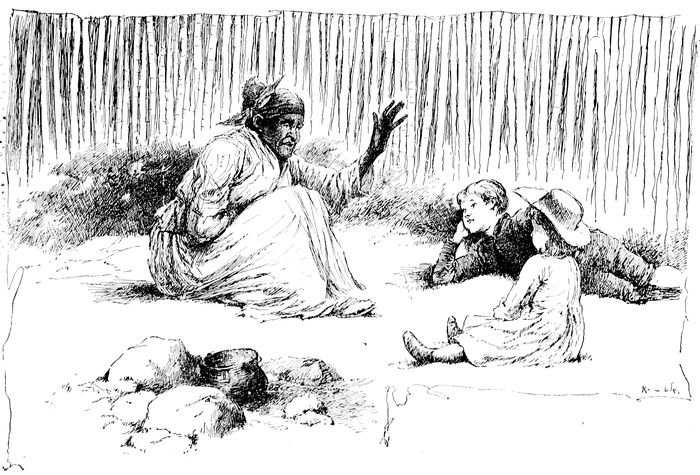
POOR OLD SUE TELLS HER STORY.
65“Well, sir, dat night de foreman come ’roun’ an’ tole me dat I mus’ go ter de fiel’ de nex’ mornin’. Soon ez he say dat, I up an’ went ter de big house an’ ax Marster w’at I gwine do wid de babies ef I went ter de fiel’. He stood an’ look at me, he did, an’ den he writ a note out er his pocket-book, an’ tol’ me ter han’ it ter de overseer. Dat w’at I done dat ve’y night, an’ de overseer, he took an’ read de note, an’ den he up an’ say dat I mus’ go wid de hoe-han’s, way over ter de two-mile place.
“I went, kaze I bleeze ter go; yit all day long, whiles I wuz hoein’ I kin year dem babies cryin’. Look like sometimes dey wuz right at me, an’ den ag’in look like dey wuz way off yander. I kep’ on a-goin’ an’ I kep’ on a-hoein’, an’ de babies kep’ on a-famishin’. Dey des fade away, an’ bimeby dey died, bofe un um on the same day. On dat day I had a fit an’ fell in de fier, an’ dat how come I burnt up so.
“Look like,” said the woman, marking on the ground with her bony forefinger—“look like I kin year dem babies cryin’ yit, an’ dat de reason folks call me Crazy Sue, kaze I kin year um cryin’ an’ yuther folks can’t. I’m mighty glad dey can’t, kaze it ’ud break der heart.”
“Why didn’t you come and tell Papa about it?” said Lucien, indignantly.
66“Ah, Lord, honey!” exclaimed Crazy Sue, “yo’ pa is a mighty good man, an’ a mighty good doctor, but he ain’t got no medicine wa’t could ’a’ kyored me an’ my marster.”
In a little while Daddy Jake put in an appearance, and the children soon forgot Crazy Sue’s troubles, and began to think about going home.
“Daddy Jake,” said Lucien, “when are you going to take us back home?”
“I want to go right now,” said Lillian.
Daddy Jake scratched his head and thought the matter over.
“Dey ain’t no use talkin’,” said he, “I got ter carry you back an’ set you down in sight er de house, but how I gwine do it an’ not git kotched? Dat w’at troublin’ me.”
“Why, Papa ain’t mad,” said Lucien. “I heard him tell that mean old overseer he had a great mind to take his buggy whip to him for hitting you.”
“Ain’t dat man dead?” exclaimed Daddy Jake in amazement.
“No, he ain’t,” said Lucien. “Papa drove him off the place.”
“Well, I be blest!” said the old man with a chuckle. “W’at kinder head you reckon dat w’ite man got?—Honey,” he went on, growing 67serious again, “is you sholy sho dat man ain’t dead?”
“Didn’t I see him after you went away? Didn’t I hear Papa tell him to go away? Didn’t I hear Papa tell Mamma he wished you had broken his neck? Didn’t I hear Papa tell Mamma that you were a fool for running away?” Lucien flung these questions at Daddy Jake with an emphasis that left nothing to be desired.
“Well,” said Daddy Jake, “dat mus’ be so, an’ dat bein’ de case, we’ll des start in de mornin’ an’ git home ter supper. We’ll go over yander ter Marse Meredy Ingram’s an’ borry his carriage an’ go home in style. I boun’ you, dey’ll all be glad to see us.”
Daddy Jake was happy once more. A great burden had been taken from his mind. The other negroes when they came in toward night seemed to be happy, too, because the old man could go back home; and there was not one but would have swapped places with him. Randall was the last to come, and he brought a big, fat chicken.
“I wuz cornin’ ’long cross de woods des now,” he said, winking his eye and shaking his head at Daddy Jake, “an’, bless gracious, dis chicken flew’d right in my han’. I say ter myse’f, I did, 68‘Ole lady, you mus’ know we got comp’ny at our house,’ an’ den I clamped down on ’er, an’ yer she is. Now, ’bout dark, I’ll take ’er up yander an’ make Marse Ingram’s cook fry ’er brown fer deze chillun, an’ I’ll make ’er gimme some milk.”
Crazy Sue took the chicken, which had already been killed, wet its feathers thoroughly, rolled it around in the hot embers, and then proceeded to pick and clean it.
Randall’s programme was carried out to the letter. Mr. Meredith Ingram’s cook fried the chicken for him, and put in some hot biscuit for good measure, and the milker gave him some fresh milk, which she said would not be missed.
The children had a good supper, and they would have gone to sleep directly afterward, but the thought of going home with Daddy Jake kept them awake. Randall managed to tell Daddy Jake, out of hearing of the children, that Dr. Gaston and some of his negroes had been seen at Ross’s mill that morning.
“Well,” said Daddy Jake, “I bleeze ter beat Marster home. Ef he go back dar widout de chillun, my mistiss’ll drap right dead on de flo’.” This was his only comment.
Around the fire the negroes laughed and joked, and told their adventures. Lillian felt comfortable 69and happy, and as for Lucien, he himself felt a hero. He had found Daddy Jake, and now he was going to carry him back home.
Once, when there was a lull in the talk, Lillian asked why the frogs made so much fuss.
“I speck it’s kaze dey er mad wid Mr. Rabbit,” said Crazy Sue. “Dey er tryin’ der best ter drive ’im outen de swamp.”
“What are they mad with the Rabbit for?” asked Lucien, thinking there might be a story in the explanation.
“Hit’s one er dem ole-time fusses,” said Crazy Sue. “Hit’s most too ole ter talk about.”
“Don’t you know what the fuss was about?” asked Lucien.
“Well,” said Crazy Sue, “one time Mr. Rabbit an’ Mr. Coon live close ter one anudder in de same neighborhoods. How dey does now, I ain’t a-tellin’ you; but in dem times dey wa’n’t no hard feelin’s ’twix’ um. Dey des went ’long like two ole cronies. Mr. Rabbit, he wuz a fisherman, and Mr. Coon, he wuz a fisherman—”
“And put ’em in pens,” said Lillian, remembering an old rhyme she had heard.
“No, honey, dey ain’t no Willium-Come-Trimbletoe in dis. Mr. Rabbit an’ Mr. Coon wuz 70bofe fishermans, but Mr. Rabbit, he kotch fish, an’ Mr. Coon, he fished fer frogs. Mr. Rabbit, he had mighty good luck, an’ Mr. Coon, he had mighty bad luck. Mr. Rabbit, he got fat an’ slick, an’ Mr. Coon, he got po’ an’ sick.
“Hit went on dis a-way tell one day Mr. Coon meet Mr. Rabbit in de big road. Dey shook han’s, dey did, an’ den Mr. Coon, he ’low:
“‘Brer Rabbit, whar you git sech a fine chance er fish?’
“Mr. Rabbit laugh an’ say: ‘I kotch um outen de river, Brer Coon. All I got ter do is ter bait my hook,’ sezee.
“Den Mr. Coon shake his head an’ ’low: ‘Den how come I ain’t kin ketch no frogs?’
“Mr. Rabbit sat down in de road an’ scratched fer fleas, an’ den he ’low: ‘Hit’s kaze you done make um all mad, Brer Coon. One time in de dark er de moon, you slipped down ter de branch an’ kotch de ole King Frog; an’ ever sence dat time, w’enever you er passin’ by, you kin year um sing out, fus’ one an’ den anudder—Yer he come! Dar he goes! Hit ’im in de eye; hit ’im in de eye! Mash ’im an’ smash ’im; mash ’im an’ smash ’im! Yasser, dat w’at dey say. I year um constant, Brer Coon, an’ dat des w’at dey say.’
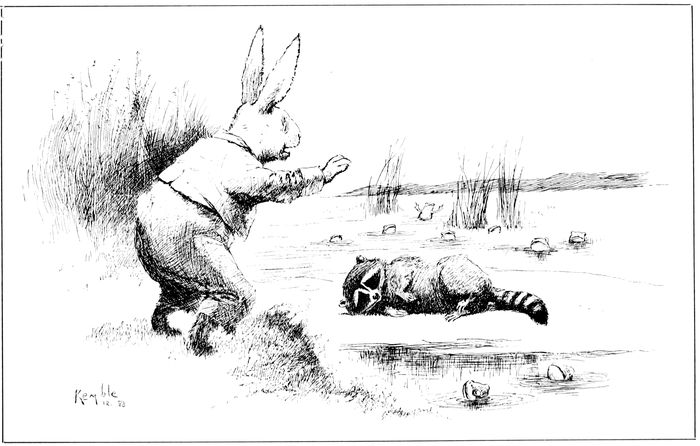
“MR. RABBIT SQUALL OUT, ‘COON DEAD!’”
73“Den Mr. Coon up an’ say: ‘Ef dat de way dey gwine on, how de name er goodness kin I ketch um, Brer Rabbit? I bleeze ter have sump’n ter eat fer me an’ my fambly connection.’
“Mr. Rabbit sorter grin in de cornder er his mouf, an’ den he say: ‘Well, Brer Coon, bein’ ez you bin so sociable ’long wid me, an’ ain’t never showed yo’ toofies w’en I pull yo’ tail, I’ll des whirl in an’ he’p you out.’
“Mr. Coon, he say: ‘Thanky, thanky-do, Brer Rabbit.’
“Mr. Rabbit hung his fish on a tree lim’, an’ say: ‘Now, Brer Coon, you bleeze ter do des like I tell you.’
“Mr. Coon ’lowed dat he would ef de Lord spared ’im.
“Den Mr. Rabbit say: ‘Now, Brer Coon, you des rack down yander, an’ git on de big san’-bar ’twix’ de river an’ de branch. W’en you git dar you mus’ stagger like you sick, and den you mus’ whirl roun’ an’ roun’ an’ drap down like you dead. After you drap down, you must sorter jerk yo’ legs once er twice, an’ den you mus’ lay right still. Ef fly light on yo’ nose, let ’im stay dar. Don’t move; don’t wink yo’ eye; don’t switch yo’ tail. Des lay right dar, an’ ’t won’t be long ’fo’ you year f’um me. Yit don’t you move till I give de word.’
74“Mr. Coon, he paced off, he did, an’ done des like Mr. Rabbit tol’ ’im. He staggered roun’ on de san’-bank, an’ den he drapped down dead. Atter so long a time, Mr. Rabbit come lopin’ ’long, an’ soon’s he git dar, he squall out, ‘Coon dead!’ Dis rousted de frogs, an’ dey stuck dey heads up fer ter see w’at all de rippit wuz ’bout. One great big green un up an’ holler, W’at de matter? W’at de matter? He talk like he got a bad col’.
“Mr. Rabbit ’low: ‘Coon dead!’
“Frog say: Don’t believe it! Don’t believe it!
“N’er frog say: Yes, he is! Yes, he is! Little bit er one say: No, he ain’t! No, he ain’t!
“Dey kep’ on ’sputin’ an’ ’sputin’, tell bimeby hit look like all de frogs in de neighborhoods wuz dar. Mr. Rabbit look like he ain’t a-yearin’ ner a-keerin’ wa’t dey do er say. He sot dar in de san’ like he gwine in mournin’ fer Mr. Coon. De Frogs kep’ gittin’ closer an’ closer. Mr. Coon, he ain’t move. W’en a fly’d git on ’im Mr. Rabbit he’d bresh ’im off.
“Bimeby he ’low: ‘Ef you want ter git ’im outen de way, now’s yo’ time, Cousin Frogs. Des whirl in an’ bury him deep in de san’.’
“Big ole Frog say: How we gwine ter do it? How we gwine ter do it?
“Mr. Rabbit ’low: ‘Dig de san’ out fum under ’im an’ let ’im down in de hole.’
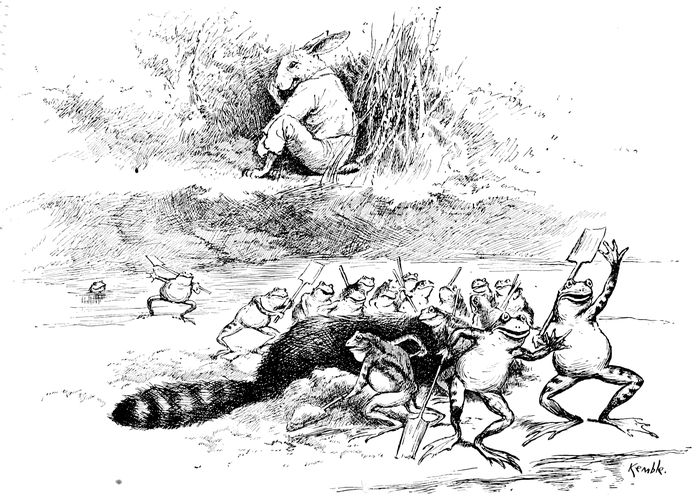
“DEN DE FROGS DEY WENT TO WORK SHO NUFF.”
77“Den de Frogs dey went ter work sho nuff. Dey mus’ ’a’ bin a hunderd un um, an’ dey make dat san’ fly, mon. Mr. Coon, he ain’t move. De Frogs, dey dig an’ scratch in de san’ tell atter while dey had a right smart hole, an’ Mr. Coon wuz down in dar.
“Bimeby big Frog holler: Dis deep nuff? Dis deep nuff?
“Mr. Rabbit ’low: ‘Kin you jump out?’
“Big Frog say: ‘Yes, I kin! Yes, I kin!’
“Mr. Rabbit say: ‘Den’t ain’t deep nuff.’
“Den de Frogs dey dig an’ dey dig, tell, bimeby, Big Frog say: Dis deep nuff? Dis deep nuff?
“Mr. Rabbit ’low: ‘Kin you jump out?’
“Big Frog say: I dess kin! I dess kin!
“Mr. Rabbit say: ‘Dig it deeper.’
“De Frogs keep on diggin’ tell bimeby, big Frog holler out: Dis deep nuff? Dis deep nuff?
“Mr. Rabbit ’low: ‘Kin you jump out?’
“Big Frog say: No, I can’t! No, I can’t! Come he’p me! Come he’p me!
“Mr. Rabbit bust out laughin’, and holler out:
“‘Rise up, Sandy, an’ git yo’ Meat!’ an’ Mr. Coon riz.”
Lucien and Lillian laughed heartily at this queer story, especially the curious imitation of 78frogs both big and little that Crazy Sue gave. Lucien wanted her to tell more stories, but Daddy Jake said it was bedtime; and the children were soon sound asleep.
The next morning Daddy Jake had them up betimes. Crazy Sue took Lillian in her arms, and Daddy Jake took Lucien on his back. As they had gone into the cane-brake, so they came out. Randall and some of the other negroes wanted to carry Lillian, but Crazy Sue wouldn’t listen to them. She had brought the little girl in, she said, and she was going to carry her out. Daddy Jake, followed by Crazy Sue, went in the direction of Mr. Meredith Ingram’s house. It was on a hill, more than a mile from the river, and was in a grove of oak-trees. As they were making their way through a plum orchard, not far from the house, Crazy Sue stopped.
“Brer Jake,” she said, “dis is all de fur I’m gwine. I’m ’mos’ too close ter dat house now. You take dis baby an’ let dat little man walk. ’Tain’t many steps ter whar you gwine.” Crazy Sue wrung Daddy Jake’s hand, stooped and kissed the children, and with a “God bless you all!” disappeared in the bushes, and none of the three ever saw her again.
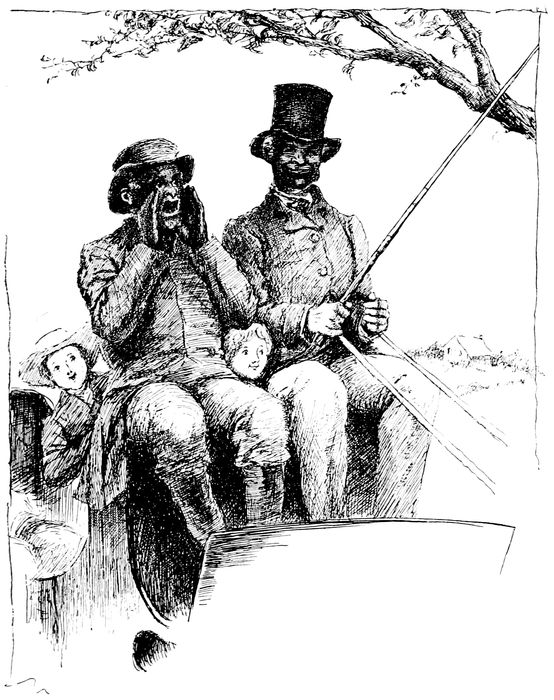
“THE OLD NEGRO PUT HIS HANDS TO HIS MOUTH AND CALLED.”
81Mr. Meredith Ingram was standing out in his front yard, enjoying a pipe before breakfast. He was talking to himself and laughing when Daddy Jake and the children approached.
“Howdy, Mars’ Meredy,” said the old negro, taking off his hat and bowing as politely as he could with the child in his arms. Mr. Ingram looked at him through his spectacles and over them.
“Ain’t that Gaston’s Jake?” he asked, after he had examined the group.
“Yasser,” said Daddy Jake, “an’ deze is my marster’s little chillun.”
Mr. Ingram took his pipe out of his mouth.
“Why, what in the world!—Why, what under the sun!—Well, if this doesn’t beat—why, what in the nation!”—Mr. Ingram failed to find words to express his surprise.
Daddy Jake, however, made haste to tell Mr. Ingram that the little ones had drifted down the river in a boat, that he had found them, and wished to get them home just as quickly as he could.
“My marster bin huntin’ fer um, suh,” said the old negro, and I want ter beat him home, kaze ef he go dar widout deze chillun, my mistiss’ll be a dead ’oman—she cert’n’y will, suh.”
“Well, well, well!” exclaimed Mr. Ingram. 82“If this don’t beat—why, of course, I’ll send them home. I’ll go with ’em myself. Of course I will. Well, if this doesn’t—George! hitch up the carriage. Fetch out Ben Bolt and Rob Roy, and go and get your breakfast. Jake, you go and help him, and I’ll take these chaps in the house and warm ’em up. Come on, little ones. We’ll have something to eat and then we’ll go right home to Pappy and Mammy.” They went in, Mr. Ingram muttering to himself, “Well, if this doesn’t beat—”
After breakfast Mr. Ingram, the children, Daddy Jake, and George, the driver, were up and away, as the fox-hunters say. Daddy Jake sat on the driver’s seat with George, and urged on the horses. They traveled rapidly, and it is well they did, for when they came in sight of the Gaston place, Daddy Jake saw his master entering the avenue that led to the house. The old negro put his hands to his mouth and called so loudly that the horses jumped. Doctor Gaston heard him and stopped, and in a minute more had his children in his arms, and that night there was a happy family in the Gaston house. But nobody was any happier than Daddy Jake.
HOW A WITCH WAS CAUGHT
The little boy sat in a high chair and used his legs as drumsticks, much to the confusion of Uncle Remus, as it appeared. After a while the old man exclaimed:
“Well, my goodness en de gracious! how you ever in de roun’ worl’ er anywheres else speck me fer ter make any headway in tellin’ a tale wiles all dish yer racket gwine on? I don’t want ter call nobody’s pa, kase he mos’ allers talks too loud, en if I call der ma’t won’t make so mighty much difference, kase she done got so usen ter it dat she dunner w’en dey er makin’ any fuss. I believe dat ef everything wuz ter git right good en still on deze premises des one time, you’ ma would in about die wid de headache. Anyway, she’d be mighty sick, bekaze she ain’t usen ter not havin’ no fuss, en she des couldn’t git ’long widout it.
“I tell you right now, I’d be afeard fer ter tell any tale roun’ yer, kaze de fust news I know’d 84I’d git my eyes put out, er my leg broke, er sump’n’ n’er. I knows deze yer w’ite chillun, mon! dat I does; I knows um. Dey’ll git de upper hand er de niggers ef de Lord spar’s um. En he mos’ inginner’lly spar’s um.
“Well, now, ef you want ter hear dish yer tale w’at I bin tu’nin’ over in my min’ you des got ter come en set right yer in front er me, whar I kin keep my two eyes on you; kaze I ain’t gwine ter take no resks er no foolishness. Now, den, you des better behave, bekaze hit don’t cost me nothin’ fer ter cut dis tale right short off.
“One time der wuz a miller man w’at live by a river en had a mill. He wuz a mighty smart man. He tuck so much toll dat he tuck ’n buyed ’im a house, en’ he want ter rent dat ’ar house out ter folks, but de folks dey ’lowed dat de house wuz ha’nted. Dey’d come ’en rent de house, dey would, en move in dar, en den go upsta’rs en go ter bed. Dey’d go ter bed, dey would, but dey couldn’t sleep, en time it got day dey’d git out er dat house.
“De miller man, he ax’d um w’at de matter wuz, but dey des shuck der head en’ ’low de house wuz ha’nted. Den he tuck ’n try ter fine out w’at kind er ha’nt she wuz dat skeer folks. He sleep in de house, but he ain’t see nothin’, en de mos’ 85w’at he year wuz a big ole gray cat a-promenadin’ roun’ en hollerin’. Bimeby hit got so dat dey want no fun in havin’ de ha’nted house, en w’en folks’d come ’long de miller man, he’d des up en tell um dat de house ’uz ha’nted. Some ’ud go up en some wouldn’t, but dem w’at went up didn’t stay, kaze des ’bout bedtime dey’d fetch a yell en des come a-rushin’ down, en all de money in de Nunited States er Georgy wouldn’t git um fer ter go back up dar.
“Hit went on dis away twel one time a preacher man com’ ’long dar en say he wanted some’rs ter stay. He was a great big man, en he look like he wuz good accordin’. De miller man say he hate mighty bad for to discommerdate ’im, but he des pintedly ain’t got no place whar he kin put ’im ’cep’ dat ’ar ha’nted house. De preacher man say he des soon stay dar ez anywhar’s, kase he bin livin’ in deze low-groun’s er sorrer too long fer ter be sot back by any one-hoss ha’nts. De miller man ’lowed dat he wuz afeard de ha’nts ’ud worry ’im might’ly, but de preacher man ’low, he did, dat he use ter bein’ worried, en he up en tell de miller man dat he’d a heap rather stay in de house wid de ha’nt, no matter how big she is, dan ter stay out doors in de rain.
“So de miller man, he ’low he ain’t got no mo’ 86’pology fer ter make, bekaze ef de preacher man wuz ready fer ter face de ha’nts and set up dar en out blink um, dey wouldn’t be nobody in de roun’ worl’ no gladder dan ’im. Den de miller man showed de preacher man how ter git in de house en had ’im a great big fier built. En atter de miller man wuz done gone, de preacher man drawed a cheer up ter de fier en waited fer de ha’nts, but dey ain’t no ha’nts come. Den w’en dey ain’t no ha’nts come, de preacher man tuck ’n open up he satchel en got ’im out some spar’ ribs en sot um by de fier fer ter cook, en den he got down en said he pra’rs, en den he got up en read he Bible. He wuz a mighty good man, mon, en he prayed en read a long time. Bimeby, w’en his spar’ ribs git done, he got some bread out’n he satchel, en fixed fer ter eat his supper.
“By de time he got all de meat off’n one er de ribs, de preacher man listened, en he year’d a monst’us scramblin’ en scratchin’ on de wall. He look aroun’, he did, en dar wuz a great big black cat a-sharpenin’ ’er claws on de door facin’. Folks, don’t talk! dat ’ar cat wuz er sight! Great long w’ite toofs en great big yaller eye-balls a-shinin’ like dey wuz lit up way back in ’er head. She stood dar a minit, dat ole black cat did, en den she ’gun ter sidle up like she wuz gwine ter mount dat preacher man right dar en den. But de preacher man, he des shoo’d at ’er, en it seem like dis sorter skeer’d ’er, kaze she went off.
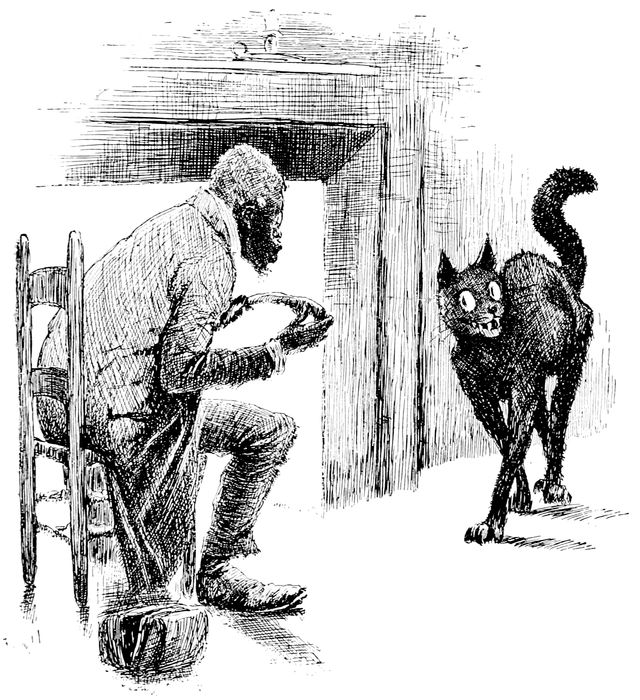
“SHE STOOD DAR A MINIT, DAT OLE BLACK CAT DID.”
89“But de preacher man, he kep’ his eye open, en helt on ter his spar’ rib. Present’y he year de ole black cat comin’ back, en dis time she fotch wid ’er a great big gang er cats. Dey wuz all black des like she wuz, en der eye-balls shineded en der lashes wuz long en w’ite. Hit look like de preacher man wuz a-gwine ter git surroundered.
“Dey come a-sidlin’ up, dey did, en de ole black cat made a pass at de preacher man like she wuz a-gwine ter t’ar he eyes out. De preacher man dodged, but de nex’ pass she made de preacher man fotch ’er wipe with his spar’ rib en cut off one er ’er toes. Wid dat de ole black cat fotch a yell dat you might a yeard a mile, en den she gin ’erself a sort er a twis’ en made her disappearance up de chimbley, en w’en she do dat all de yuther cats made der disappearance up de chimbley. De preacher man he got up, he did, en looked und’ de bed fer ter see ef he kin fine any mo’ cats, but dey wuz all done gone.
“Den he tuck ’n pick up de cat toe w’at he done knock off wid de spar’ rib, en wrop it up in a piece er paper en put it in he pocket. Den he 90say his pra’rs some mo’, en went ter bed en slep’ right straight along twel broad daylight, en nuthin’ ain’t dast ter bodder ’im.
“Nex’ mornin’ de preacher man got up, he did, en say his pra’rs en eat his breakkus, en den he ’low ter hisse’f dat he’ll go by en tell de miller man dat he mighty much erblige. ’Fo’ he start, hit come ’cross he min’ ’bout de cats w’at pester ’im de night befo’, and he tuck ’n feel in he pockets fer de big black cat toe w’at he done cut off wid de spar’ rib. But it seems like de toe done grow in de night, en bless goodness! w’en he unwrop it ’t want nuthin’ less dan a great big finger wid a ring on it.
“So de preacher man tuck ’n fix up all his contrapments, en den call on de miller man en tol’ ’im he wuz mighty much erblige kaze he let ’im stay in de house. De miller man wuz ’stonish’ fer ter see de preacher man, kaze he knew dat w’en folks stay all night in dat house dey ain’t come down no mo’. He wuz ’stonish’, but he didn’t say much. He des stan’ still en wunder.
“But de preacher man, he up ’n ax ’bout de miller man’s wife, en say he wants ter see ’er en tell ’er good-bye, bein’ ez how dey ’d all bin so good. So de miller man, he tuck ’n kyar de preacher inter de room whar his wife wuz layin’ 91in bed. De ole ’oman had de counterpin drawed up und’ ’er chin, but she look mighty bad roun’ de eyes. Yit, she tuck ’n’ howdied de preacher man en tole ’im he wuz mighty welcome.
“Dey talk en talk, dey did, en atter w’ile de preacher man hoi’ out his han’ fer ter tell de ’oman good-bye; but de ’oman, she belt out ’er lef’ han’, she did, like she want dat fer ter git shucken. But de preacher man wouldn’t shake dat un. He say dat ain’t nigh gwine ter do, bekaze w’en folks got any perliteness lef’ dey don’t never hol’ out de lef’ han’. De ’oman she say her right wuz cripple, but her ole man ’low he ain’t never hear ’bout dat befo’, en den he tuck’n make ’er pull it out from und’ de kivver, en den dey seed dat one er ’er fingers wuz done clean gone. De miller man he up ’n ’low:
“‘How come dis?’
“De ’oman she ’low, ‘I cut it off.’
“De miller man he ’low, ‘How you cut it off?’
“De ’oman she ’low, ‘I knock it off?’
“De miller man he ’low, ‘Wharbouts you knock it off?’
“De ’oman she ’low, ‘I broke it off’
“De miller man he ’low, ‘When you break it off?’
“Den de ’oman she ain’t say nuthin’. She des 92lay dar, she did, en pant en look skeered. De preacher man he study a little en den he say he speck he kin kyo’ dat han’, en he tuck de finger out ’n he pocket en tried it on de ’oman’s han’, en it fit! Yassar! it fit in de place right smick smack smoove. Den de preacher man he up en tell de miller man dat de ’oman wuz a witch, en wid dat de ’oman fetched a yell en kivvered ’er head wid de counterpin.
“Yit dis ain’t do ’er no good, kaze de preacher man say he done look in de books en de onliest way fer ter kyo’ a witch is ter bu’n ’er; en it ain’t look so bad, nuther, kaze when dey tied ’er she tuck ’n tu’n ter be a great big black cat, en dat’s de way she wuz w’en she wuz burnt.”