What manner of man was D’Orsay at this period
of his life, when he was treading so gaily the
primrose way of pleasure as a man about London
town? What were his claims to the reputation
he gained as a dandy and a wit? How did he
appear to his contemporaries?
That he was generally liked and by many looked
on with something approaching to affection there
is ample evidence to prove. Was ever a social
sinner so beloved? Was dandy ever so trusted?
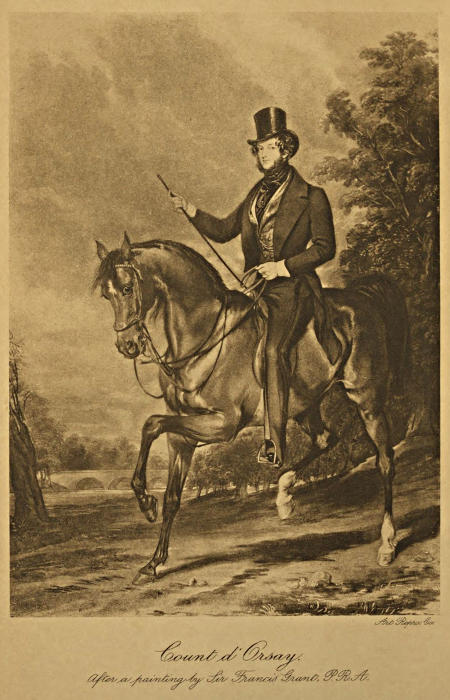
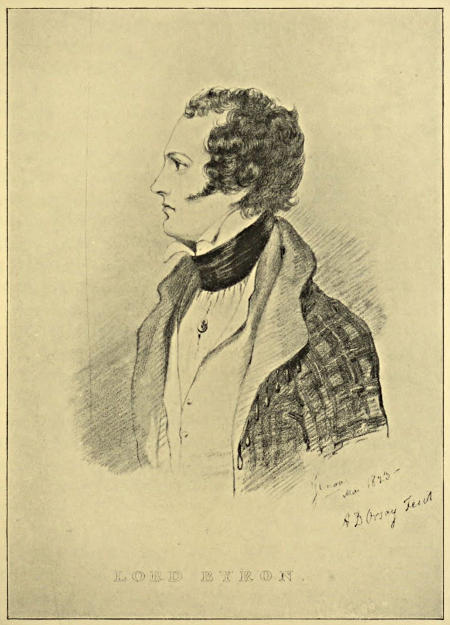
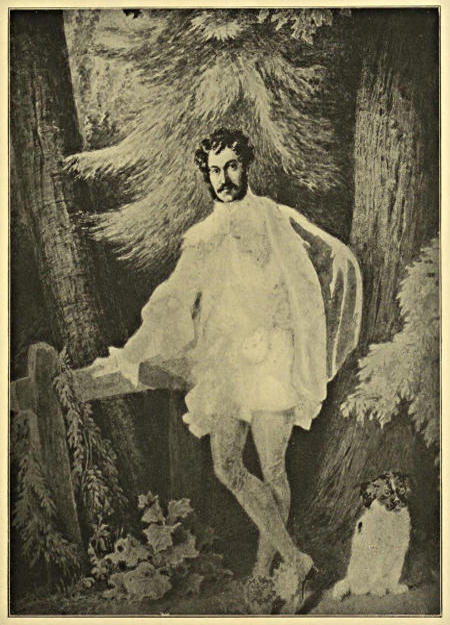
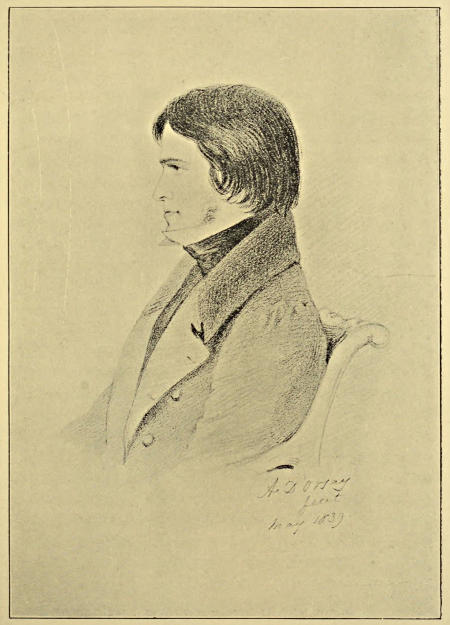
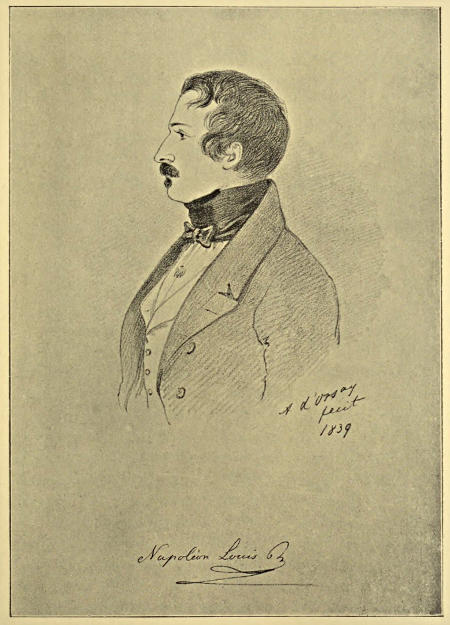
He was strikingly handsome in face and
figure, of that his portraits assure us. One
enthusiast tells us: “He was incomparably the
handsomest man of his time … uniting to a
figure scarcely inferior in the perfection of its
form to that of Apollo, a head and face that
blended the grace and dignity of the Antinous
with the beaming intellect of the younger
Bacchus, and the almost feminine softness and
beauty of the Ganymede.”
He was an adept in the mysteries of the toilet,
as careful of his complexion as a professional
belle; revelling in perfumed baths; equipped with
an enormous dressing-case fitted in gold, as became
the prince of dandies, which he carried
everywhere, though it took two men to lift it.
As to clothes, he led the fashion by the nose,
and led it whithersoever he wished. He indulged
in extravagances, which he knew his reputation
and his figure could carry off, and then laughed
to see his satellites and toadies making themselves
ridiculous by adopting them. His tailor, Herr
Stultz, is reported to have proudly described
himself as “Tailor to M. le Comte d’Orsay,” full
well knowing that the recommendation of mere
royalty could carry no such weight. Where
D’Orsay led the way all men of fashion must
follow. Indeed, it was said that D’Orsay was
fully aware of the value of his patronage, and that
he expected his tailors to express substantial
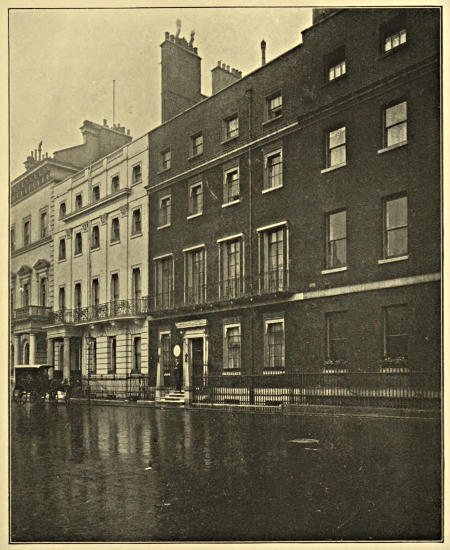
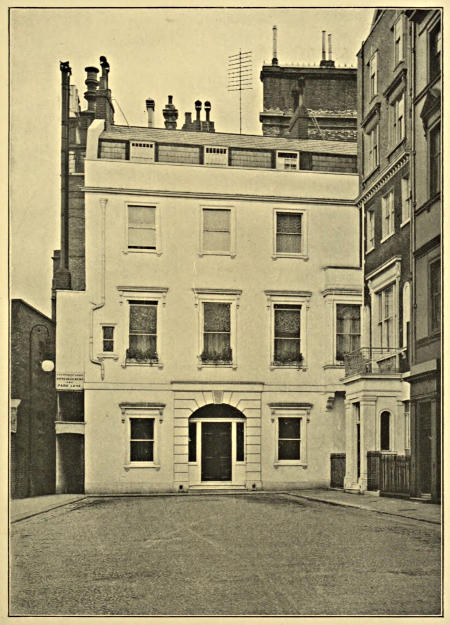
gratitude for it. When clothes arrived at Seamore
Place, in the most mysterious manner banknotes
had found their way into their pockets. Once
when this accident had not happened, D’Orsay
bade his valet return the garment with the message
that “the lining of the pockets had been forgotten.”
The ordinary man, as regards his costume,
takes care about the main points and permits
the details to take care of themselves. Not so
your true dandy. Thus we find D’Orsay writing
to Banker Moritz Feist at Frankfort: “Will you
send me a dozen pair of gloves colour ‘feuille-morte,’
such as they have on sale at the Tyrolean
glove shops? They ought to fit your hand (that’s
a compliment!), and (this is a fib!) I’ll send along
the cash.”
D’Orsay was sometimes quite unkind when
friends spoke to him on the subject of some new
garment he was sporting.
Gronow meeting D’Orsay one day arrayed in
a vest of supreme originality, exclaimed: “My dear
Count, you really must give me that waistcoat.”
“Wiz pleasure, Nogrow,”—the Count’s comical
misrendering of Gronow’s name—“but what shall
you do wiz him? Aha! he shall make you an
dressing-gown.”
What the Count could carry off would have
extinguished the less-distinguished Gronow.
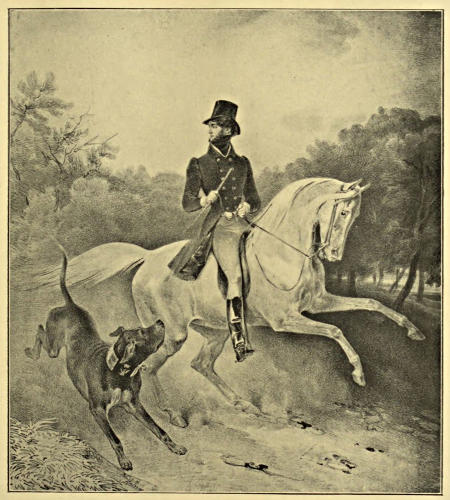
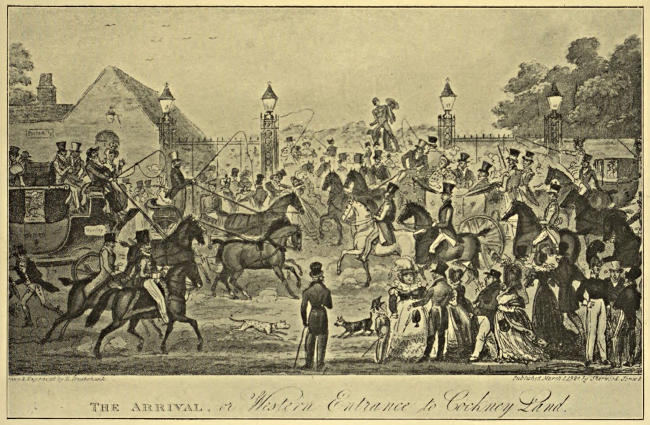
In Hyde Park, at the happy hour when all
“the world” assembled there, some driving, some
riding, some strolling, some leaning on the railings
and quizzing the passers-by, D’Orsay was to
be seen in all his glory. An afternoon lounge in
the Park was as delightful then as it is nowadays.
To quote Patmore:—
“See! what is this vision of the age of chivalry,
that comes careering towards us on horseback, in
the form of a stately cavalier, than whom nothing
has been witnessed in modern times more noble
in air and bearing, more splendid in person, more
distingué in dress, more consummate in equestrian
skill, more radiant in intellectual expression, and
altogether more worthy and fitting to represent
one of those knights of the olden time, who
warred for truth and beauty, beneath the banner
of Cœur de Lion. It is Count D’Orsay.”
This language is as dazzling as the vision
itself must have been!
Writing of various fashions in horsemanship,
Sidney says:—
“As late as 1835 it was the fashion for the
swells or dandies of the period—Count d’Orsay,
the Earl of Chesterfield, and their imitators—to
tittup along the streets and in the Park with their
toes just touching the stirrups, which hung three
inches lower than in the hunting-field.”
Abraham Hayward rode in the Park with
D’Orsay in March 1838, “to the admiration of all
beholders, for every eye is sure to be fixed upon
him, and the whole world was out, so that I
began to tremble for my character.”
Here is another contemporary account, which
deals rather with the outer habit than with
knight-like man:—
“From the colour and tie of the kerchief
which adorned his neck, to the spurs ornamenting
the heels of his patent boots, he was the original
for countless copyists, particularly and collectively.
The hue and cut of his many faultless coats, the
turn of his closely-fitting inexpressibles, the shade
of his gloves, the knot of his scarf, were studied
by the motley multitude with greater interest and
avidity than objects more profitable and worthy of
their regard, perchance, could possibly hope to
obtain. Nor did the beard that flourished
luxuriantly upon the delicate and nicely-chiselled
features of the Marquis (Count) escape the
universal imitation. Those who could not cultivate
their scanty crops into the desirable arrangement,
had recourse to art and stratagem to supply
the natural deficiency.”
D’Orsay was indeed the Prince of the Dandies,
it might be more truthfully said, the Tyrant.
What he did and wore, they must do and wear;
the cut of his coat and the cut of his hair, the
arrangement of his tie—the Prince could do no
wrong. Of this sincere form of flattery a comical
tale is told. Riding back to town one day, as
usual capitally mounted, D’Orsay was overtaken
by a downpour of rain. The groom, who usually
carried an overcoat for his master, had this day
forgotten to bring it. D’Orsay was equal to this
as to most occasions. He spied a sailor who
wore a long, heavy waistcoat which kept him snug.
“Hullo, friend,” called out D’Orsay, pulling up,
“would you like to go into that inn and drink to
my health until the rain’s over?”
The sailor was naturally enough somewhat surprised,
and asked D’Orsay why he was chaffing him.
“I’m not,” said D’Orsay, dismounting and
going into the inn, followed by the sailor, “but I
want your vest, sell it me.”
He took out and offered the poor devil ten
guineas, assuring him at the same time that he
“could buy another after the rain was over.”
D’Orsay put on the vest over his coat,
buttoned it from top to bottom, remounted and
rode on to town.
The rain passed over, the sun came out again,
and as it was the proper hour to show himself in
Hyde Park, D’Orsay showed himself.
“How original! How charming! How
delicious!” cried the elegant dandies, astonished
by D’Orsay’s new garment, “only a D’Orsay could
have thought of such a creation!”
The next day dandies similarly enveloped were
“the thing,” and thus the paletot was invented.
An anecdote is told, with what authority or
want of it we do not know, by the Comtesse de
Basanville, bearing upon D’Orsay’s good nature.
One day out riding he stopped at an inn, took out
a cigar, and was going to call out for a light, when
a lad who came out of the tavern, offered him the
match with which he had been going to light his
own pipe. D’Orsay, who was struck by the boy’s
politeness and good looks, began to chat with him.
“From what country do you come?”
“From Wales, my lord.”
“And you don’t mind leaving your mountains
for the smoky streets of London?”
“I’d go back without minding at all,” answered
the boy, “but poor folk can’t do what they want,
and God knows when I’ll be going back to my
old mother who’s crying and waiting for me.”
“You’re ambitious then?”
“I want to get bread. I’m young and strong,
and work’s better paid in London than at home.
That’s why I’ve come.”
“Well,” said D’Orsay, “I’d like to help you
make your fortune. Here’s a guinea for your
match. To-morrow, come to Hyde Park when
the promenade is full; bring with you a box of
matches, and when you see me with a lot of people
round me, come up and offer me your ware.”
Naturally enough the boy turned up at the
right hour and the right place.
“Who’ll buy my matches,” he called out.
“Aha! It’s you,” said D’Orsay. “Give me
one quick to light my cigar.”
Another guinea—and the Count said carelessly
to those grouped around him—
“Just imagine, that I couldn’t smoke a cigar
which is not lit with one of this boy’s matches—others
seem to me horrible.”
No sooner hinted than done; off went the
matches and down came the guineas, and
addresses even were given for delivery of a
further supply.
Even if this story be not true, it is characteristic.
One other story of his power.
A certain peer quarrelled violently with him;
result, a duel. It was pointed out to the unfortunate
gentleman that if D’Orsay fought with him
it would become the fashion to do so! When
D’Orsay heard of his adversary’s urgent reason
for wishing not to meet him, he agreed readily
that it was reasonable, and the affair was
arranged. D’Orsay laughingly added: “It’s
lucky I’m a Frenchman and don’t suffer from the
dumps. If I cut my throat, to-morrow there’d
be three hundred suicides in London, and for a time
at any rate the race of dandies would disappear.”
By Greville we are informed that D’Orsay was
“tolerably well-informed,” which surely must be
the judgment of jealousy.
In manner and habits D’Orsay grew to be
thoroughly English, no small feat, while retaining
all the vivacity, joie de vivre, and “little arts” of
the Frenchman. But he does not seem ever to
have acquired a perfect English accent; Willis in
1835 says of him, he “still speaks the language
with a very slight accent, but with a choice of
words that shows him to be a man of uncommon
tact and elegance of mind.” The language and
the waistcoats of those dandy days were alike
flowery.
It is difficult to decide, the evidence being
scanty, whether or not D’Orsay was a wit of
eminence, or a mere humorist. Chorley the
musical critic, or rather the critic of music, said
that his wit “was more quaint than anything I
have heard from Frenchmen (there are touches
of like quality in Rabelais), more airy than the
brightest London wit of my time, those of Sydney
Smith and Mr Fonblanque not excepted.” It was
a kindly wit, too, which counts for grace. It is
not unlikely that the broken English which he
knew well how to use to the best advantage
helped to add a sense of comicality to remarks
otherwise not particularly amusing; just as Lamb
found his stammer of assistance.
A little wit carried off with a radiant manner
goes a long way, and we are inclined to believe
that D’Orsay on account of his good-humoured
chaff and laughing impertinences gained a reputation
for a higher wit than he really possessed.
True wit raises only a smile, sometimes a rather
wry one; humour forces us to break out into
laughter such as apparently usually accompanied
D’Orsay’s sallies. The following is preserved for
us by Gronow, who held that D’Orsay’s conversation
was original and amusing, but “more humour
and à propos than actual wit.” Tom Raikes,
whose face was badly marked by small-pox, for
some reason or other, wrote D’Orsay an anonymous
letter, and sealed it, using something like the
top of a thimble for the purpose. D’Orsay found
out who was the writer of the epistle, and accosted
him with—“Ha! ha! my good Raikes, the next
time you write an anonymous letter, you must not
seal it with your nose!”—looking at that pock-pitted
organ. Which is more facetious than witty.
Here is another story of a somewhat similar
character, kindly provided me by Mr Charles
Brookfield:—“My father once met D’Orsay at
breakfast. After the meal was over and the
company were lounging about the fireplace, a
singularly tactless gentleman of the name of
Powell crept up behind the Count, and twitching
suddenly a hair out of the back of his head
exclaimed: ‘Excuse me, Count, one solitary
white hair!’ D’Orsay contrived to conceal his
annoyance, but bided his time. Very soon he
found his chance and approaching Mr Powell he
deliberately plucked a hair from his head, exclaiming,
‘Parrdon, Pow-ail, one solitary black ’air.’”
Gronow also tells this. “Lord Allen, none
the better for drink, was indulging in some rough
rather than ready chaff at D’Orsay’s expense.
When John Bush came in, d’Orsay greeted him
cordially, exclaiming: ‘Voilà la différence entre
une bonne bouche et une mauvaise haleine.’”
D’Orsay, Lord William Pitt Lennox and
“King” Allen were invited to dinner at the
house of a Jewish millionaire, and the first-named
promised to call for the other two.
“We shall be late,” grumbled Allen. “You’re
never in time, D’Orsay.”
“You shall see,” answered D’Orsay, unruffled,
and drove off at a fine pace.
Even though they arrived in time Allen was
not appeased, and grumbled at everything and
everybody, and the cup of his wrath hopelessly
overflowed when he overheard one of the servants
saying to another:
“The gents are come.”
“Gents,” snorted Allen. “Gents! What a
wretched low fellow! It’s worthy of a public-house!”
“I beg your pardon, Allen, it is quite correct.
The man is a Jew. He means to say the
Gentiles have arrived. Gent is the short for
Gentile!”
Landor writes in June 1840: “I sat at dinner
(at Gore House) by Charles Forester, Lady
Chesterfield’s brother. In the last hunting season
Lord Chesterfield, wanting to address a letter to
him, and not knowing exactly where to find him,
gave it to D’Orsay to direct it. He directed it—Charles
Forester, one field before the hounds,
Melton Mowbray. Lord Alvanley took it, and
(he himself told me) gave it to him on the very
spot.” Landor goes on to speak of meeting a lady
who accosted him with: “Sure, Landor, it is a
beautiful book, your Periwinkle and Asparagus!”
But surely the most delightful thing D’Orsay
ever said was on the occasion of a visit of him to
Lady Blessington’s publishers, whom he rated in
high language.
“Count d’Orsay,” said a solemn personage in
a high, white neckcloth, “I would sooner lose
Lady Blessington’s patronage than submit to
such personal abuse.”
“There is nothing personal,” retorted D’Orsay,
suavely. “If you are Otley, then damn Saunders;
if you are Saunders, then damn Otley.”
Edward Barrington de Fonblanque, nephew
of Albany, records that D’Orsay was a capital
raconteur, with an inexhaustible stock of stories,
which he retailed “in a manner irresistibly droll.”
One of these anecdotes ran thus:—
Méhémet Ali asked of a Frenchman what was
a republic.
The reply was—
“Si l’Egypte était une république, vous seriez
le peuple et le peuple serait le Pacha.”
Méhémet responded that he could not summon
up “aucun goût, aucune sympathie, pour une
république.”
Madden says: “A mere report would be in
vain, of the bons mots he uttered, without a faithful
representation of his quiet, imperturbable manner—his
arch look, the command of varied emphasis
in his utterance, the anticipatory indications of
coming drollery in the expression of his countenance—the
power of making his entourage enter
into his thoughts, and his success in prefacing his
jeux d’esprit by significant glances and gestures,
suggestive of ridiculous ideas.”
To turn to another essential of the equipment of
a complete dandy, D’Orsay was an accomplished
gourmet. This gift must have added greatly to
his usefulness in Lady Blessington’s establishment,
where doubtless he was master of the
menus. Other folk also availed themselves of
his skill in this direction.
We quote from that staid depository of learning,
The Quarterly Review, from an article published
in 1835 and written by Abraham Hayward:—
“It seems allowed on all hands that a first-rate
dinner in England is out of all comparison
better than a dinner of the same class in any
other country; for we get the best cooks, as we
get the best singers and dancers, by bidding
highest for them, and we have cultivated certain
national dishes to a point which makes them the
envy of the world. In proof of this bold assertion,
which is backed, moreover, by the unqualified
admission of Ude, we request attention to the
menu of the dinner given in May last to Lord
Chesterfield, on his quitting the office of Master
of the Buckhounds, at the Clarendon. The party
consisted of thirty; the price was six guineas a
head; and the dinner was ordered by Comte
d’Orsay, who stands without a rival amongst
connoisseurs in this department of art:—
“‘PREMIER SERVICE.
“‘Potages.—Printanier: à la reine: turtle
(two tureens).
“‘Poissons.—Turbot (lobster and Dutch
sauces): saumon à la Tartare: rougets à la
cardinal: friture de morue: white-bait.
“‘Relévés.—Filet de bœuf à la Napolitaine:
dindon à la chipolate: timballe de macaroni:
haunch of venison.
“‘Entrées.—Croquettes de volaille: petits
pâtés aux huîtres: côtelettes d’agneau: purée
de champignons: côtelettes d’agneau aux pointes
d’asperges: fricandeau de veau à l’oseille: ris de
veau piqué aux tomates: côtelettes de pigeons à
la Dusselle: chartreuse de légumes aux faisans:
filets de cannetons à la Bigarrade: boudins à la
Richelieu: sauté de volaille aux truffes: pâté de
mouton monté.
“‘Coté.—Bœuf rôti: jambon: salade.
“‘SECOND SERVICE.
“‘Rots.—Chapons, and quails, turkey poults,
green goose.
“‘Entremets.—Asperges: haricots à la Française:
mayonnaise d’homard: gelée Macédoine:
aspic d’œufs de pluvier: Charlotte Russe: gelée
au Marasquin: crême marbre: corbeille de pâtisserie:
vol-au-vent de rhubarb: tourte d’abricots:
corbeille de meringues: dressed crab: salade à la
gélantine.—Champignons aux fines herbes.
“‘Relévés.—Soufflée à la vanille: Nesselrode
pudding: Adelaide sandwiches: fondus. Pièces
montées, etc., etc.’
“The reader will not fail to observe how well the
English dishes—turtle, white-bait, and venison—relieve
the French in this dinner; and what a
breadth, depth, solidity, and dignity they add to it.
Green goose, also, may rank as English, the goose
being held in little honour, with the exception of
its liver, by the French; but we think Comte
d’Orsay did quite right in inserting it.… The
moderation of the price must strike everyone.”
The Clarendon Hotel was situated in Bond
Street and Albemarle Street, and with Mivart’s
in Brook Street shared the reputation of being
the best hotel in town, holding the premier place
for dining in luxury and elegance.
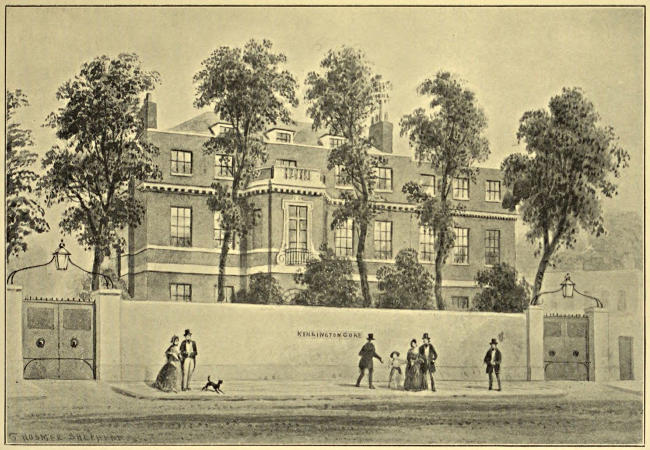
In the later Gore House days D’Orsay must
have been sorely vexed, though he showed it not
openly, at a mishap at a dinner given by Lady
Blessington and himself. It is best told in the
words of one who was present:—
“I well remember a dinner at Lady Blessington’s,
when an event occurred that proved how
ready the Cupidon déchainé, as Byron called him,
was to extricate himself from any difficulty. The
party consisted of ten, and out of them there were
about six who enjoyed what is called a glass of
wine, meaning a bottle. Before dinner the Count
had alluded to some splendid Clicquot champagne
and claret of celebrated vintage. While we were
waiting to sit down, D’Orsay was more than once
called out of the room, and a quick-sighted individual
hinted to me that he feared some unpleasant
visitors of the dun family were importunate for
some ‘small account.’ Still, there was nothing
on the light-hearted Frenchman’s face to show
that he was at all put out. Dinner was announced,
and all promised to go well, as the soup and the
fish were unexceptionable, when my quick-sighted
friend, who was a great gourmet, remarked that
he saw no champagne. ‘Perhaps,’ I replied,
sotto voce, ‘it is being kept in ice outside.’ The
sherry was handed round, and repeated looks
passed between the hostess and the Count, and
between the same and the head servant. The
entrées were handed round, and a thirsty soul,
with rather bad tact, for he was too gentlemanlike
to be deficient in taste, asked in an undertone
for a glass of champagne. The servant
looked confused; D’Orsay saw it, and exclaimed
aloud: ‘No champagne to-day; my Lady and I
have a treat for you—a royal treat. You know
that the Queen has lately patronised what is
called the Balmoral brose, and here is some.’
At this moment one of the servants entered with
a large jug containing this Scotch delicacy, which,
of course, following the example of our hostess,
we all declared to be excellent. ‘Far better than
wine,’ said the late Lord Pembroke, a sentiment,
I need scarcely say, in which the rest did not
agree. Balmoral brose did duty for champagne
and claret, and the only wine upon that memorable
occasion was sherry. Whether the butler
was absent without leave, or the key of the cellar
lost or mislaid, or, as was hinted by my neighbour
at dinner, the wine merchant had been seized
with a sudden fit of hard-heartedness, I know
not. All I do know is, that a mixture of Highland
whisky and honey was substituted for the
foaming grape of eastern France.”
“Foaming grape” is good! Not good, however,
is the taste left by this anecdote; a party of
well-to-do men dining with D’Orsay and Lady
Blessington, and cracking jokes behind their backs
at their impecuniosity.
D’Orsay was once dining with his brother
dandy Disraeli, and was grieved by the undoubted
fact that the dishes were served up distinctly cool.
But the climax was reached when tepid ices were
brought forward.
“Thank Heaven!” exclaimed D’Orsay, “at
last we have got something hot!”
As a matter of course the circumstances in which
he was so ostentatiously living and his general reputation
kept D’Orsay outside the houses of those
who did not open their doors to everybody, though
most male folk were pleased enough to visit him
and Lady Blessington at Seamore Place, where of
womankind, however, none except relatives and
exotics were to be met with. But even a dandy
must find occasionally a crumpled rose-leaf in his
bed. But what counted this exclusion against the
having been spoken of by young Ben Dizzy as
“the most delightful of men and best of friends,”
and by Victor Prévost, Viscount d’Arlincourt, as
“le roi de la grâce et du goût”?
It took much to disturb D’Orsay’s serenity
and peace of mind; he was one of those blessed
beings, whom all we poor miserable sinners must
envy, who did not own to a conscience. Certainly
the being head over ears in debt did not cause
him a moment’s anxiety. He did not realise that
money had any value; guineas to him were
simply counters of which it was convenient to
have a sufficient supply wherewith to pay gambling
debts and to discharge the incidental ready-money
expenditure of each day. As for other
expenses, were not tradesmen honoured by his
custom, were they not a race of slaves ordained
to supply the necessities of noble men such as
D’Orsay, was it not a scandal that they should
dare to ask him to pay his bills? What pleasure
is there in the bills we pay? D’Orsay never
denied himself anything which he could obtain
for love or by owing money. It has even been
said of him—and what will not little men say of
even the greatest?—that he was “unscrupulous
and indelicate about money matters.” How poor-spirited
the creature who could ask such a man
as D’Orsay to pay back the money he had lent
him or to render their due to the tailors and such
like whom he had honoured with his patronage!
The spirit of a D’Orsay cannot be appreciated
rightly save by one of kindred genius. Who that
was worthy to be his friend would not feel
honoured by a request from him for a loan,
and injured by even a hint at repayment? Of
what value is a rich friend if he will not be your
banker?
D’Orsay’s finances from now onward were in
a state of hopeless chaos, from which the efforts
of his friends signally failed to extricate him.
Which failure, however, in the long run cannot
have made any difference; to have hauled him
out of his ocean of debt would only have landed him
for a brief space upon dry land, whereon he would
have gasped like a fish out of water; he was a born
debtor. His marriage had replenished, or rather
filled, his exchequer; then he proceeded with skill
and rapidity to empty it. Why should not a colourless
wife contribute to the support of a resplendent
husband? Yet, marvellous, almost incredible, there
were carping and jealous spirits who boggled over
this and other transactions of Count d’Orsay.
As for instance Patmore, commenting on
D’Orsay’s social difficulties, writes:—
“And yet it was in England, that Count
d’Orsay while a mere boy, made the fatal mistake
of marrying one beautiful woman, while he was,
without daring to confess it even to himself,
madly in love with another, still more beautiful,
whom he could not marry—because, I say, under
these circumstances, and discovering his fatal
error when too late, he separated himself from
his wife almost at the church door, he was, during
the greatest part of his social career in England,
cut off from the advantages of the more fastidious
portion of female society, by the indignant fiat
of its heads and leaders.”
There are quite a wonderful number of
blunders in the above meandering sentences.
True as it was that he was cut by “the more
fastidious portion of female society,” D’Orsay found
consolation, sympathy and understanding—doubtless
also advice and counsel—in the comradeship
of Lady Blessington—and others. Grantley
Berkeley tells us that D’Orsay “was as fickle as a
French lover might be expected to be to a woman
some years his senior.” In which sneer there is
a smack of insular envy. On the other hand
Dickens, the exponent of the middle-class
conscience, wrote of him as one “whose gentle
heart even a world of fashion left unspoiled!” How
can history be written with any approach to truth
when contemporary evidence differs so widely?
Was D’Orsay a saint or a sinner? Who dare say?
Society gossiped evilly about him, as it will
do about anyone and everyone, telling tales that
did not redound to his credit. The Duchesse de
Dino retails this, under date February 20th,
1834:—
“A new and very ugly story is afloat concerning
Count Alfred d’Orsay, which is as follows:
Sir Willoughby Cotton, writing from Brighton at
the same time to Count d’Orsay and to Lady
Fitzroy Somerset, cross-directed the letters so
that M. d’Orsay on opening the letter which he
received, instead of seeing the mistake and
stopping at the first line, which ran ‘Dear Lady
Fitzroy,’ read it through and found, among other
Brighton gossip, some pleasantries about Lady
Tullemore and one of her lovers, and a sharp saying
about himself. What did he do but go to the
club, read out the letter before every one, and
finally put it under cover and send it to Lord
Tullemore! The result very nearly was a crop
of duels. Lady Tullemore is very ill, and the
guilty lover has fled to Paris. Friends intervened,
however, and the thing was hushed up
for the sake of the ladies, but M. d’Orsay cut
(and cuts) an odious figure.”
Such a story disgraces those who tell it, not
him of whom it is told. D’Orsay guilty of hurting
a woman’s reputation, directly or indirectly?
The idea is absurd! Of a man too who was a
philanthropist and one of the founders of the
Société de Bienfaisance in London!