COMPILED CHIEFLY FROM UNPUBLISHED
PAPERS AND LETTERS BY OCTAVE HOMBERG
AND FERNAND JOUSSELIN AND NOW TRANSLATED
INTO ENGLISH BY ALFRED RIEU
LONDON: MARTIN SECKER NUMBER FIVE JOHN STREET ADELPHI MCMXI
CONTENTS
PAGE
I From Tonnerre to St. Petersburg
Childhood—His first Successes and Friends—Enters Diplomatic Service—Employed
also by Louis XV. in his “Secret” Diplomacy—Mission
to Russia—Attached to Chevalier Douglas in negotiating
the Alliance of France and Russia—Triumphant Return to
Paris
Returns to Russia to join Marquis de L’Hospital—Embassy of Baron
de Breteuil—Carries the Ratification of the Treaty with Russia
to France, 1758—Gives up Diplomacy for the Army and is
appointed Aide-de-Camp to Marshal de Broglie—His brilliant
Services during the Seven Years’ War—Enters the Diplomatic
Service again and accompanies the Duc de Nivernais to London
Difficult Negotiations in London to bring about the Peace of 1763—The
English Government entrusts d’Eon to carry the Ratification of
the Treaty to Paris—He receives the Cross of St. Louis—The
Comte de Guerchy appointed to succeed the Duc de Nivernais
as Ambassador in London—D’Eon acts as Minister Plenipotentiary
in the Interim—Arrogates to himself the Style and
Position of Ambassador and quarrels with the Duc de Praslin and
de Guerchy
Comte de Guerchy arrives in London—D’Eon is disgraced and takes
Steps to revenge himself—Accuses de Guerchy of attempting to
murder him—The de Vergy Case—Mission of Carrelet de la
Rozière—The Duc de Choiseul urges d’Eon to return to France
and to restore the Secret Service Papers to the King—His Extradition
refused by the English Government—D’Eon’s Letter to his
Mother
Embittered and libellous Contention with de Guerchy—Publishes
Lettres, Mémoires et Negociations in London—Louis XV. sends
Emissaries to him—D’Hugonnet arrested in Calais, and the
Secret Correspondence endangered—Opens Proceedings against
de Guerchy, who is pronounced guilty by an English Jury—The
King grants a Pension to d’Eon, who decides to remain in
England
While in England continues in Secret Service of the King—Correspondence
with Comte de Broglie—Offers his Services to the King of
Poland, but Louis XV. opposes the Scheme—D’Eon’s Popularity
in London—The Bets regarding his Sex—Leaves London and
travels in England under assumed Name—Entertains the Idea
of passing as a Woman
Secret Service on behalf of Louis XV. and of Madame du Barry—The
Morande Case—Negotiation with Beaumarchais—Publishes
Les Loisirs du Chevalier d’Eon—Louis XV. loses Interest in the
Secret Diplomacy, of which his Ministers had grown suspicious—Favier
and Dumouriez imprisoned and Comte de Broglie exiled—Death
of the King—Louis XVI. discontinues the Secret Service—On
the Comte de Broglie’s Recommendation d’Eon receives a
Pension—Fresh Pretensions of the Chevalier
Louis XVI. refuses the Chevalier’s Claims—Creditors become pressing,
and d’Eon deposits his valuable Documents with Earl Ferrers—His
Lack of Means forces him to adopt the Plan of passing as
a Woman—His Avowal to Beaumarchais—Consents to sign a
Declaration in due Form—Comte de Vergennes sends a Safe
Conduct to the Chevalière d’Eon for her Return to France
The Chevalière arrives in France—Reception accorded at Tonnerre—Stays
at Versailles and presented at Court—Impressions of her
Family, Friends and Contemporaries—Popularity of the new
“Heroine” in France and her Success both at Court and in
Parisian Society—Her voluminous Correspondence—Fresh Disturbance
with Beaumarchais—Feminine Garments, contrary to
Arrangement, being discarded d’Eon is arrested and sent to
Dijon Castle
Imprisonment at Dijon—Set at Liberty and exiled to Tonnerre—New
Plans and fresh Movements—Attempts to equip La Chevalière
d’Eon—In Paris during winter of 1780-1781—Returns to Tonnerre
and lives quietly among Neighbours—In 1785 is called to London
on Private Business
Returns to London and settles with his Creditors—His former Popularity
revived—Endeavours to sell his Library and Collections—First
News of the Revolution—La Citoyenne Geneviève d’Eon an
ardent Jacobin—Petitions the National Assembly—In order to
obtain a Living gives Public Fencing Competitions—Wounded at
Southampton, 1796—Illness and Old Age—Dies in London, May,
1810
Lettres, Mémoires et Negociations particulières du Chevalier d’Eon.
Londres, 1764.
Boutaric. Correspondance secrète inedite de Louis XV. Paris 1866.
Duc de Broglie. Le Secret du Roi. Paris, 1888.
Mémoires du Duc de Luynes.
Mémoires du Marquis d’Argenson.
Archives des Affaires Etrangères.
Gaillardet. Mémoires sur la Chevalière d’Eon.
La Messelière. Voyage à Saint-Petersbourg. Paris, 1803.
Vandal, A. Louis XV. et Elizabeth de Russie. Paris, 1896.
De La Fortelle. Vie Militaire, politique et privée de Mlle.
Charles-Geneviève-Louise-Auguste-Andrée-Timothée
d’Eon de Beaumont.
Paris, 1779.
Perey, Lucien. Un Petit-Neveu de Mazarin. Paris, 1893.
Campan, Madame. Mémoires sur la vie privée de Marie-Antoinette.
MSS. of the Christie Collection, cited by Telfer.
Walpole, Horace. Letters.
Bachaumont. Journal d’un Observateur.
Telfer, B. The Strange Career of the Chevalier d’Eon de Beaumont.
Mémoires de Jacques Casanova. Bruxelles, 1871.
De Loménie. Beaumarchais et son Temps.
Grimm. Correspondance Littéraire. Paris, 1812.
Georgel, Abbé. Mémoires.
Fromageot. La Chevalière d’Eon à Versailles (Le Carnet historique et
littéraire, 1900).
PREFACE
After the death of the Chevalier d’Eon in
London in extreme poverty in the year
1810, a mass of his unpublished papers and
letters, which he had carefully preserved all his
life, fell into the hands of one of his creditors, and
lay neglected for nearly a hundred years in an
English bookseller’s shop. There it was that the
authors of this book were fortunate enough to discover
them by chance at a sale.
These private documents, in addition to the state
papers in the archives of the Ministry for Foreign
Affairs and the municipal records of his native
town of Tonnerre, enable his biographers to follow
the career of the Chevalier with particularity, and to
set at rest what was for so long a vexed question,
the mystery of his sex. It was a deliberate step,
the assumption of femininity, by which to regain a
waning popularity. After a brilliant military and
diplomatic career, as well as repeated employment
in the secret service of Louis XV., his ill-judged
conduct in London covered him with disgrace at
Versailles. Some fresh action was demanded to
reinstate himself in public notice, and as rumour
persistently named him a woman he felt the time
had come to play the part. As the result of long
negotiation he was permitted to return to France.
There he became the heroine of the hour, and the
ingenuity of his personification induced belief in the
Chevalière not only in Louis XVI. and his ministers,
but also—a more difficult matter—in the
friends of his youth.
These unpublished papers are of further value,
for they include correspondence with many notable
people of d’Eon’s day, and serve to reflect not only
his own personality but those prominent in a
society which differed in its striking contrasts from
that of any other historical period.
D’EON DE BEAUMONT HIS LIFE AND TIMES — I FROM TONNERRE TO ST. PETERSBURG
“If you want to know what I am, Monsieur le Duc, I
tell you frankly that I am of use only for thinking,
imagining, questioning, reflecting, comparing, reading,
writing, or to run from east to west, from north to
south, to fight over hill and dale. Had I lived in the time
of Alexander or of Don Quixote, I should certainly have
been Parmenion or Sancho Panza. Taken out of my
element I will squander the entire revenue of France
in the course of a twelvemonth without committing a
single folly, and afterwards present you with an able
treatise on economy.”
Such was the portrait the Chevalier d’Eon sketched
of himself for the Duc de Praslin, at the height of the
crisis which shaped his destiny; and it is exact enough.
To show all he could do, to fulfil his destiny to the end,
he should have lived in a country and at a period more
favourable to adventures than was France in the eighteenth
century; strongly organised and firmly established
as it was by Louis XIV. Owing to his lack of respect
for this powerful hierarchy and to his efforts to upset
its stability for his own ends, d’Eon, who had begun life
as a gentleman, ended his days equivocally as an adventurer.
In his haste to improve a fortune which was
too lagging and parsimonious for his taste, he exceeded
the bounds of legitimate ambition. He set aside all
restraint in his behaviour, forced and wasted his talent,
ruined at one stroke the brilliant prospects to which his
courage and intelligence entitled him, and, passing from
one adventure to another, concluded by playing for over
forty years, with skill and tenacity worthy of a better
part, the strangest masquerade on record. He says himself
with reference to the people of Tonnerre, his fellow-townsmen:
“They are like the flints that are found in
their vineyards; the harder they are struck the more
fire they give out.” This picturesque image admirably
illustrates his own history and the epic struggle which
he maintained with increasing stubbornness against all
who thwarted his ambition.
Nevertheless, his character is an interesting one, and
well repays study. Throughout the calculated extravagance
of his adventures, d’Eon’s indomitable energy
persists, and the scandal caused by his conduct a century
and a half ago should not blind us to his genuine services.
There is a sustained interest in following d’Eon into
many countries from Russia to England, and into many
surroundings from the court of the Empress Elizabeth
or the camp of Marshal de Broglie to the palace of
Versailles and the shops of London, wherever, in fact,
the Chevalier’s adventures led him for a period of more
than sixty years; at one time as a diplomatist, again
as a dragoon, or, as Latour represents him in one of
his charming pastels, as a woman.
“Charles-Geneviève-Louis-Auguste-André-Timothée,
son of the noble Louis d’Eon de Beaumont, director of
the King’s demesnes, and of Dame Françoise de Charenton”—so
runs the baptismal certificate—was born at
Tonnerre, on October 5, 1728. He was of petty noble
descent and fairly well connected, and through the
situations filled by his kinsmen was sure of finding
patrons of high position. His father had three brothers,
all of whom were in established positions: one, André-Timothée
d’Eon de Tissey, advocate in Parliament
and Censor-Royal, was principal secretary to the Duc
d’Orléans; another, Jacques d’Eon de Pommard, advocate
in Parliament, was one of the confidential secretaries
to the Comte d’Argenson, Minister of War; and the third,
Michel d’Eon de Germigny, Knight of St. Louis, was one
of the twenty-five gentlemen of the King’s Scottish
Guard.
D’Eon’s first years were not marked by any extraordinary
or even noteworthy event. He was put out to
nurse at Tonnerre, than which nothing could be more
commonplace; less so, however, was the gratitude he
always retained for this early care. From London,
June 1, 1763, he wrote to his old nurse and foster-mother,
informing her that he was ensuring her an annual pension
of a hundred livres, in recognition of the trouble he had
given her. When he was old enough to learn, the care
of his education was entrusted to M. Marcenay, the curé
of the Church of St. Peter. At the age of twelve he was
sent to Paris, and completed his studies at the College
Mazarin with distinction. Doctor of Civil and of
Canon Law, he was called to the bar of the Parliament,
and at the same time entered the service of M. Bertier de
Sauvigny as secretary, who was a friend of his family, and
intendant of the district of Paris. In 1749 he lost in the
course of five days his father and his eldest uncle, the
latter of whom he presently succeeded in the post of
Censor-Royal. Besides these relatives he had lost
other friends who had already shown interest in
him, and whose support would have been invaluable—the
Duchesse de Penthièvre, Marie d’Este, and the
Comte d’Ons-en-Bray, President of the Academy of
Science. The losses, however, were not without effect on
his career, for he wrote eulogiums in their honour which
attracted attention, and were inserted in the newspapers
and literary magazines of the time. This testimony
of gratitude towards his deceased patrons, the
origin of his public reputation, increased the goodwill of
the influential people interested in his early years. He
was received into the intimacy of old Marshal de Belle-Isle,
and frequented the house of the charming Duc de
Nivernais, a perfect type of nobleman, whom he met
again as ambassador in London at the height of his
prosperity. He was also known to the Prince de Conti,
who, much engrossed by politics and poetry, was ever
in quest either of a rhyme or of a throne, and was equally
unfortunate in both. The fascination of his ready wit,
the lively and original character of his conversation, his
taste for music, and especially for Italian music, together
with that genuine talent for the greatly prized art of
fencing which had obtained for him the title of Grand
Prévôt, soon made him appreciated and sought after
in society. Various serious publications—a historical
essay on finance, and also two volumes of political considerations
on the administration of ancient and modern
nations—attracted the attention of influential people,
saved him from all suspicion of frivolity, and won for
him the reputation both of an accomplished gentleman
and an indefatigable worker, one which followed him
throughout his career.
In truth, d’Eon was in search of a career, not being
the man to remain long contented with empty social
successes. He harassed his patrons, with true Burgundian
zeal and tenacity, in order to obtain from them
employment in which he might win distinction, and
perhaps too the favour and goodwill of the King. Exactly
what he wished for happened. The Prince de
Conti, who, as his most influential patron, was doubtless
the most importuned, could not fail to notice the genius
for intrigue, the courage and the adventurous disposition
of this “little d’Eon.” Seeing in the young man a
valuable recruit for the difficult enterprise which was
then being planned mysteriously in the King’s cabinet,
he spoke of his protégé to Louis XV., and d’Eon was
chosen to accompany the Chevalier Douglas to Russia,
and second him in the dangerous mission with which he
was to be entrusted.
So from the first d’Eon found himself engaged in
delicate and confidential affairs. He formed part of that
secret ministry which the King, with the assistance of
the Prince de Conti, the Comte de Broglie, and M.
Tercier, chief clerk at the Foreign Office, directed in
person, and employed to support, or more frequently
to oppose and secretly to ruin, the official policy which
he discussed with the ministers of State. What this
strange and mysterious policy was, this conspiracy
against himself, by means of which Louis XV. apparently
desired to take his revenge for the insignificant
part in the management of important affairs to which
his indolence and timidity had reduced him, has been
made known since Boutaric’s curious publication of the
secret correspondence, and the interesting work written
later by the Duc de Broglie from the material in the
archives of the Ministry for Foreign Affairs and the
papers of his ancestor. The deplorable result of this
secret diplomacy, which did not repair any, or hardly
any, of the blunders of the official policy, and was finally
reduced to impotence by its own conflicting intrigues, is
also known, and will appear in part in these pages. But
what will never be known are the endless windings of
this labyrinth, which had blind alleys even for the most
initiated, and in which the King himself at times lost his
way; for, writing one day to Tercier to give him his
instructions, he was obliged to confess that he was becoming
somewhat perplexed by the intricacies of all these
affairs. The secret diplomacy mysteriously superseded
the official diplomacy, and extended wherever the King’s
representatives were sent. Sometimes the ambassador
himself was admitted into the secret service, and so
found himself confronted by the difficult task of reconciling
the instructions—frequently at variance—of the
King and of the Minister for Foreign Affairs; more often,
a secretary of the embassy, or some subordinate agent,
was selected to play this part, becoming thus the spy of
his own chief. While ministers and official ambassadors
were as a rule chosen by the favourite of the time, the
agents of the secret correspondence were enlisted by
the King himself, who, out of excessive mistrust or a
stirring of pride, often selected them from among the
enemies of the reigning mistress. All the correspondents
of this obscure policy were paid, or rather suborned,
by the King out of his privy purse. The secret minister,
who was first the Prince de Conti and afterwards the Duc
de Broglie, answered for their discretion; their reports
were despatched by safe and indirect means, and then
forwarded through the medium of Tercier and Lebel,
the valet, to the King, who took as much pleasure in
reading, annotating and answering them as he showed
weariness when he presided at a cabinet council.
The origin of the secret diplomacy, the object and the
organisation of which underwent frequent modifications,
appears to have been the project cherished by the King,
and more especially by the interested party, of securing
for the Prince de Conti the throne of Poland. As for the
idea itself, it may possibly have been suggested to Louis
XV. by the correspondence he kept up at the beginning
of his reign with the Marshal de Noailles. His illness at
Metz and the love his people had shown him on that
occasion had, it would seem, illuminated for him his
kingly duty, and so for a time he displayed an ardent
desire to conduct himself well, and a certain determination
to devote himself to the government of his country.
The secret correspondence gives evidence of such
inclinations, but reveals at the same time that lack of
decision, that prodigious selfishness, that spirit of mistrust
and dissimulation which spoiled all the King’s
good qualities, and rendered useless the perspicacity and
good sense with which he was so plentifully endowed.
The Duc de Luynes says of him that he spoke and
thought historically of public affairs: this word expresses
wonderfully well, not only Louis XV.’s judgment and
penetration, but also the egoistic indifference and
dilettanteism with which he followed what his grandfather
had called the “trade of king.” History has
repeatedly shown the consequences of such a disposition
both in a statesman and in a sovereign.
In 1745 several Polish noblemen, disquieted by the
state of anarchy and impotence into which their country
had fallen, repaired to Paris with the object of attaining
a more assured future by offering the crown to a French
prince. They thought of the Prince de Conti, grandson
of the man who had been called to the throne of Poland
in the reign of Louis XIV. The King authorised the
Prince de Conti to accept their offers, and resolved to
attend to the matter himself, without mentioning it to
his ministers.
Thenceforth he made the Prince come to his study to
work with him; but the very precautions taken to ensure
the secrecy of their conferences excited the curiosity and
elicited the comments of the whole court. One Sunday
they noticed that scarcely had the King left his chapel
when he shut himself up with the Prince, and that
several secretaries had been sent for, who spent the whole
day busily employed in staining paper. Another day
they saw the Prince go to his Majesty’s apartments,
carrying, with an air of great mystery, some large portfolios.
The Marquis d’Argenson, who relates the incident,
set himself to find out the secret which had thus
become common talk. He succeeded in discovering that
the matter in question was to secure the throne of Poland
for the Prince; and in his Memoirs, under date of
March 31, 1753, he expresses himself as follows:—
Here is one of several secrets of which I have just been
informed. The long and frequent labours of the Prince
de Conti with the King solely concern the project for
making the Prince King of Poland. I had already seen
that this project was being secretly elaborated and
was known to the King only; but I could not believe
he thought of it seriously. Meanwhile he has been persuaded
it is a simple matter—for it is ever thus that great
and ruinous projects are made to appear to superficial
and unsystematic minds. That is the beginning of these
assiduous and oft-repeated efforts of the Prince de
Conti with the King, for the Prince sometimes receives
despatches when out hunting, and forthwith scribbles a
few lines which he sends to the King by his messengers.
Only the other day he came to work with the King, and
returned to the Isle-Adam immediately afterwards.
This secret correspondence cannot be attributed to other
matters of state for he has no influence in any other
affairs.
On this last point d’Argenson’s perspicacity was at
fault, for the Prince de Conti’s influence, aided besides
by the King’s partiality for this kind of conspiracy, had
proved powerful enough to spread the network of secret
diplomacy over nearly the whole of Europe. The chief
object was still the throne of Poland; but the means of
ensuring its conquest had increased and widened, which,
as often happens, proved detrimental to the success of
the enterprise.
The mission with which d’Eon was to be entrusted
was connected with the intricate scheme of these mysterious
negotiations. For fourteen years diplomatic relations
had been discontinued between France and Russia. The
irregular and discourteous proceedings, which had led
to the Marquis de la Chétardie being somewhat unceremoniously
escorted to the frontier at the time of his
last embassy, had left Elizabeth with a feeling of resentment
which her liking for Louis XV. had not entirely
effaced, and which the Grand Chancellor, Bestuchef, an
avowed enemy of France, did all he could to promote and
to revive. The personal sentiments of the Empress, her
dislike for Englishmen and Prussians, were known at
Versailles, and since that deplorable rupture attempts
had been repeatedly made to renew relations, which
seemed all the more important in proportion as the
friendship of the King of Prussia appeared more deceptive
and treacherous. Many envoys had set out, bearing
letters from Louis XV. to Elizabeth, but all had failed.
Russia was far from being easy of access, and Bestuchef’s
agents, who kept a good watch at the frontier, had
managed to detect all these political smugglers. One
of them, the Chevalier de Valcroissant, had avoided
detection; but, having been followed and recognised in
the interior of the empire, he was arrested and confined
in the fortress of Schlüsselburg, on Lake Ladoga, where
his jailers were barbarous enough to put him into irons.
The wretched man had been in prison for a year when
the enterprise which had turned out so badly for him was
attempted again.
Among the Prince de Conti’s protégés was Sir Mackenzie
Douglas, who had come to offer his services to
France. His attachment to the Stuarts had compelled
him to seek refuge in flight, and his hatred of the English
left no doubt as to the eagerness with which he would
undertake a mission directed against them. Douglas
had given proofs of his courage in accompanying the
Pretender in his romantic wanderings. A knowledge
of mineralogy enabled him to give his journey the
plausible appearance of a scientific expedition. His
English nationality and his ability were relied on to
avert all suspicions.
The scheme thus devised was approved by the King,
who deemed it prudent to impart it to his ministers,
doubtless the better to conceal the essential part of the
negotiations. The Minister for Foreign Affairs, Monsieur
Rouillé, gave his sanction, and countersigned Douglas’
mission.
The instructions, which were delivered to Douglas by
the Prince de Conti immediately after they had been
submitted to the King (they were written in small characters
and enclosed in the false bottom of a tortoise-shell
snuff-box), specified the route he was to take and
the principal subjects upon which he was to obtain
information.
He was directed to leave as an ordinary traveller,
supplied with the usual passport; to enter Germany
through Suabia, so as to avoid the great capitals, and
to pass thence into Bohemia, “under pretext of visiting
for his personal instruction the several mines in that
kingdom.” From Bohemia he was to proceed to Saxony,
not omitting to inspect the mines at Freiberg, and
after spending a few days at Dantzig he was to continue
his journey to St. Petersburg, passing through Prussia,
Courland and Livonia.
He had strict injunctions to become acquainted with
the progress of the negotiations undertaken by Sir
Hanbury Williams, the British ambassador, with a view
to obtaining troops from Russia. He was, subsequently,
to examine the resources of that country; the state of
its finance and commerce; to note the number of the
troops and fleets; to learn the extent of the influence
wielded by Count Bestuchef and Count Woronzow; to
study the factions of the court; and to find out as far
as possible the sentiments of the Empress herself. He
was directed, besides, but cursorily and without insistence,
to inquire into “the views of Russia in regard to
Poland, both immediately and for the future.” Lastly,
he was to observe the utmost discretion, and was never
to risk anything through the post except the briefest
intimations, written in a cryptic phraseology, which
had been agreed upon beforehand, and the alleged
subject of which was the purchase of furs. Sir Hanbury
Williams became the black fox, and Bestuchef the
lynx; squirrel skins were to signify troops in the pay of
England, and so forth.
All these preparations were completed during the summer
of 1755; and Douglas was able to begin his journey
with no more ado than would an ordinary English tourist.
There are no documents relating to the journey itself;
it is only known that Douglas arrived safely at St. Petersburg
in the beginning of October, 1755, and that he was
received and treated there as an English gentleman
travelling for amusement and instruction. But so far
he had only fulfilled the easiest part of his mission;
he had still to reach the Empress. The difficulties were
great, for Sir Hanbury Williams, the British ambassador,
being aware of Elizabeth’s personal feelings, was keeping
a good watch, and had arranged with Bestuchef that no
Englishman should be admitted at court unless he were
presented by himself. Douglas, therefore, applied to him,
as a loyal subject of the King of England to his natural
protector, requesting the ambassador to present him to
the Czarina. Sir Hanbury, however, was on his guard,
for the journey of this Scottish Catholic who had come
to Russia to pursue geological studies, and was so
anxious to see the Empress, appeared to him highly
suspicious. He therefore warned Bestuchef to have his
fellow-countryman carefully watched; and Douglas,
informed that Valcroissant’s fate threatened him, crossed
the frontier post-haste. It seemed to be a fresh defeat;
but less than five months afterwards, in the spring of
1756, Douglas returned to St. Petersburg. Before long
he was admitted everywhere, even to the great audience
chamber, where he solemnly presented to the Czarina
letters accrediting him as Minister Plenipotentiary,
charged with renewing diplomatic relations. D’Eon
was there to assist the new minister, whom he was
seconding in his official mission, as secretary of embassy.
What had passed during the winter, and who was
responsible for this remarkable change? How was it
that Douglas, who was defeated at St. Petersburg, had
conquered from Paris? Historians disagree on this
point; and the absence of clear, positive and authentic
documents further increases the mystery. Tradition
attributes the success of the enterprise to d’Eon, who is
said to have arrived secretly in Russia in Douglas’ company,
and to have found the means of prolonging his
stay there after the Chevalier’s flight. The legendary
story is full of romantic details of the artifices devised
by the young man to elude the watchful eye of Bestuchef,
and to reach the Empress.
The story goes that little d’Eon, taking advantage of
his slender figure, his delicate beardless face, and his
feminine voice, assumed the name, attire and habits of
a young girl. In this manner the Chevalier Douglas
introduced his niece, Mademoiselle Lia de Beaumont, to
Count Woronzow, Vice-Chancellor of the Empire, and the
avowed enemy of the Chancellor. Perceiving how useful
this new ally might be to his policy, Woronzow undertook
to obtain his admission at court as maid-of-honour
to the Empress. D’Eon was not slow to ingratiate
himself with Elizabeth, and then resolved to disclose his
deception, and the hidden purpose of his journey, by
delivering to the Czarina the King’s letters which he
had brought with him, concealed in the binding of one
of Montesquieu’s books. The romantic nature of the
adventure amused and captivated the Empress, who,
far from bearing him ill-will, was grateful to little d’Eon
for his daring and for his message, and entrusted him
with her reply to the King, which was entirely favourable
to the renewal of friendly relations between the two
courts. It was then that the Chevalier Douglas returned
at the head of the official mission in which d’Eon
participated—undisguised this time, in the capacity of
secretary of embassy, a fact which joins tradition to
history.
This story is mentioned by most of the historians of
the period in serious works, and even in the otherwise
well-substantiated account which Gaillardet wrote, fifty
years ago, to establish “the truth about the mysteries
of the life of the Chevalier d’Eon.” Like all traditions,
it is an amalgam composed of much fiction and a substratum
of truth, and, like most, it is grounded on evidence
and even on a few documents which make it look
genuine.
Nevertheless, the objection still holds good that it is
wildly improbable; and this is the chief argument put
forward by the Duc de Broglie, and, after him, by M.
Albert Vandal, in favour of its rejection as an ingenious
and romantic concoction.
But that is not all; even the examination of authentic
documents, far from throwing light on this minor
historical point, tends to increase its obscurity. There
have been discovered among d’Eon’s private papers
the originals of several letters which he received from
Tercier, when he was preparing to leave France for
Russia. These letters show that he took his departure
in the beginning of June, 1756, and seem to prove that
this was his first journey, being sent to St. Petersburg
on that occasion—but on that occasion only—to assist
Douglas in bringing about the alliance of the two courts,
and the realisation of the Prince de Conti’s secret ambition.
In that case the honour of having obtained official
recognition for Douglas at St. Petersburg must be ascribed
to another; but it will be seen that d’Eon undertook and
conducted to a successful issue negotiations of so delicate
a nature that no one can be said to suffer by comparison
with him. The clever intermediary of the reconcilement
of Louis XV. and Elizabeth appears to have been
simply a worthy French merchant of St. Petersburg,
called Michel, the care of whose own affairs did not prevent
him from applying himself with as much ability as
disinterestedness to those of his country. This Michel,
a native of Rouen, was often obliged, in the course of
business, to travel all the way from St. Petersburg to the
town of his birth, and had already, in 1753, carried a
private message to Versailles from the Empress, in which
she expressed herself willing to forget the offensive
behaviour of La Chétardie and to renew friendly relations
with a monarch in whom she had never ceased to take
great interest.
Regard for a policy directed at that time against
Russia had prevented Louis XV. from responding to
these first overtures. Elizabeth did not risk a second
rebuff; but she let it be understood that her personal
sentiments had not changed. According to La Messelière,
afterwards secretary of embassy in Russia to
the Marquis de L’Hospital, a miniature-painter named
Sompsoy, who was reproducing the Czarina’s features,
learnt from her positive proof of her friendly sentiments.
When he assured her, in the course of a sitting, that Louis
XV., as well as his subjects, revered the name of Elizabeth
he was rewarded by “a smile of which he caught the
expression, and which made the success of the portrait.”
La Messelière adds that the Empress, having thought the
matter over, gave the artist “more sittings than he
required for the painting,” and concluded by charging
him to inform the King that French gentlemen might
count on a warm reception at her court. Sompsoy discharged
the commission faithfully, but it was thought
undesirable to entrust him with the reply, for it would
have necessitated at the same time the disclosure both
of the King’s secret correspondence and of the Prince
de Conti’s projects. It was agreed, therefore, that he
should remain in Paris, and Douglas be sent to Russia
in his place.
We have seen how and why he failed in his first
mission; but before he had left St. Petersburg the
excellent idea occurred to him of conferring with the
Sieur Michel, whose services and goodwill he could
count upon, informing him who had sent him and for
what purpose. Michel, unperturbed by the risk he was
running in associating with one who was already under
suspicion, introduced him to Woronzow, who apprized
the Empress. Elizabeth expressed herself willing to
receive an envoy-extraordinary from the King, and
Douglas, armed with this promise, coolly eluded Bestuchef’s
spies, and took his departure for France. During
his absence Michel continued to negotiate with Woronzow,
and let the Chevalier know when the opportune
moment arrived for his reappearance. Douglas then
returned to St. Petersburg; but he deemed it prudent
to travel under an assumed name, and to conceal himself
on his arrival in his friend’s house, who passed him
off as one of his clerks. Here d’Eon rejoined him,
despatched officially by Monsieur Rouillé, Minister for
Foreign Affairs, to the Vice-Chancellor, Woronzow, to
act as his “companion and confidential man, whose sole
duties should consist in looking after a fine library and
transacting some important business with France.”
D’Eon was indeed surprised to find Count Woronzow’s
“fine library” on a single shelf, whereas he, a humble
private person, had left at the Comte d’Ons-en-Bray’s
a large room and six chests full of books. Douglas was
delighted to keep so earnest a collaborator, and forthwith
informed the Minister for Foreign Affairs of the
decision to which he had just come in regard to the young
secretary:
“I am very greatly pleased at the arrival of M. d’Eon,”
he wrote; “I have been long acquainted with his zeal,
and his attachment to his work. He will be most useful
to me, and also of good service to the King. Besides,
he is steady and prudent. I introduced him yesterday
evening to the Vice-Chancellor, Count Woronzow,
who received him kindly and courteously, and seemed
greatly pleased with him. Upon consideration, he
was not of his former opinion; he now thinks that the
original plan for the accomplishment of his mission
should not be followed, for particular reasons known to
the Empress, which I shall have the honour of specifying
later.”
Chevalier Douglas and d’Eon were exerting themselves
at that time to thwart the combined intrigues of
the Chancellor, Bestuchef, and the British ambassador,
Sir Hanbury Williams. This they succeeded in doing,
thanks to the support of Woronzow and also that of
Count Ivan Schouvalow, at that time the favourite of
the Empress. Douglas, accompanied by d’Eon, was
solemnly received in audience as the Envoy of the King
of France. Nevertheless, their enemies did not consider
themselves beaten, taking many measures and
even attempting assassination, if we are to believe
La Messelière, who relates that pistols were fired one
night at their windows. But their credit with Elizabeth
became greater than ever, and the negotiations soon
took, at least in part, an extremely favourable turn.
These negotiations were, indeed, twofold, comprising
those of which the Minister for Foreign Affairs was kept
informed, and those of which reports were sent directly
to the King and the Prince de Conti through the medium
of Tercier. The object of the official mission was to
bring about the reconciliation of the two countries, to
detach Russia from the English alliance so as to compel
her to sign the treaty which France had just concluded
with her old enemy, Austria. That of the secret commission
was to induce the Empress to favour a French
prince’s candidature for the throne of Poland, and even
to engage her affections on behalf of Conti. That prince
aspired to a throne and, if he could not reign in his own
right in Poland, was quite resigned to participate as
Elizabeth’s consort in the government of a great empire.
Moreover, the realisation of either of these ambitious
dreams would have served the political interests of
France equally well. Whether Conti was king in Poland
or the Czarina’s consort in Russia, Louis XV. had the
aid of an ally capable of flanking his enemies: Frederick,
with whom he had just fallen out, and Maria Theresa,
with whom he had just been reconciled, but upon whose
prolonged fidelity he hardly ventured to count.
Everything had been thought of to draw Elizabeth into
this intrigue. Tercier had entrusted to d’Eon a quarto
volume of L’Esprit des Lois, in the binding of which,
between two pieces of cardboard, enclosed and bound up
in the same calfskin, were concealed private letters from
the King to the Empress, as well as several cyphers.
One was for d’Eon’s correspondence with the King and
Tercier, another for d’Eon’s use in communicating with
the Prince de Conti and M. Monin, and a third designed
to enable Elizabeth or her confidant, Woronzow, to
correspond at any time with Louis XV. through the
medium of Tercier, without the ministers and ambassadors
becoming aware of it. Elizabeth, who did not
share the King’s fondness for dissimulation, and never
concealed even her wildest caprices, proved insensible to
the attraction of this mysterious correspondence. She
declined the cypher, but received d’Eon, and consented
to listen to the King’s and the Prince de Conti’s overtures.
She showed, however, no inclination to marry
the Prince, and even avoided pledging herself in regard
to Poland. All she promised was to appoint Conti
Commander-in-Chief of the Russian troops, with the
title of Duke of Courland, provided the King granted
his cousin permission to accept her offer and to proceed
to St. Petersburg. And there, on another account, the
matter stopped, for while d’Eon was negotiating for him
in Russia the Prince was ruining his prospects at Versailles.
By incurring the displeasure of the Marquise
de Pompadour, whom he had believed himself strong
enough to set at defiance and to ridicule almost openly,
he lost favour with the King, who ceased to place the
secret diplomacy at the disposal of his ambitious cousin.
D’Eon received instructions to protract the negotiation
and to correspond in future only with Tercier and the
Comte de Broglie, who succeeded the Prince de Conti as
secret minister in the middle of the year 1757.
If the private parleys met with only partial success,
which was soon made altogether useless by Conti’s disgrace,
the result of the official mission was more satisfactory.
Thanks to the patient and persistent efforts
of Douglas and d’Eon, the treaty concluded some months
before between Bestuchef and Sir Hanbury Williams
was annulled. Russia remitted to England the subsidies
she had already received, but recalled her troops;
it was decided that the eighty thousand men, who were
already assembled in Livonia and Courland for the
service of England and Prussia should change sides and
unite with the armies of Louis XV. and Maria Theresa.
At the same time it was resolved that, in order to indicate
more clearly the character of the relations about to be
established between France and Russia, there should be
an interchange of ambassadors of high rank between the
two courts. The choice of France fell on the Marquis
de L’Hospital, and that of Russia on Count Bestuchef,
the Chancellor’s brother.
Russia, then, had broken off her alliance to join the
new Franco-Austrian coalition. This unexpected change
caused some surprise in France, but met with general
commendation, and the success of the negotiations
appeared to be assured. Such was not the case, however,
for an objection raised by Bestuchef, who was striving to
revenge himself for his defeat by sowing discord among
his triumphant opponents, very nearly caused the whole
affair to be reconsidered, and threatened for a time to
wreck the transactions.
In soliciting Russia’s ratification of the treaty just
concluded at Versailles, France and Austria had entertained
the idea of stipulating for one exception to the
general alliance which they were about to contract with
the cabinet of St. Petersburg. This exception concerned
Turkey, France’s old ally, and certainly a source of
danger to Russia less formidable than was Russia to her.
It soon occurred to Bestuchef to make this restriction
the stumbling-block of the alliance to which he was so
strongly opposed. He endeavoured to make Elizabeth
believe that should she assent to this humiliating condition
she would be profaning the ancient Muscovite
gospel and disowning the duty held sacred by her predecessors—the
delivery of Constantinople. In treating
with Austria he artfully urged that it was no more to
her interest than to Russia’s to bind herself with regard
to Turkey, her past enemy and her future prey. This
argument prevailed at Vienna, the cabinet being all the
more easily persuaded as hostilities had been resumed,
and as Frederick’s victorious advance in Austrian territory
had already raised apprehensions far greater than
any that conjectural events could inspire. Austria,
therefore, entered eagerly into an alliance with Russia,
and, conscious of the immediate danger, took no account
of France’s allies, the Turks.
Then it was that Douglas began to fear he would lose
all the fruits of his labour, and, though d’Eon advised him
to stand his ground, he resolved to have recourse to an
expedient devised by Austria’s representative at St.
Petersburg, Count Esterhazy, a man devoid of scruples
as to the means of attaining his ends. It was
agreed that the Porte should be guaranteed against the
alliance in an ostensible treaty to be transmitted to
Constantinople, but that the exceptional clause should
be itself annulled by an article called secrétissime. This
despicable artifice, a real humiliation for France, allowed
Russia full scope for her aggressive designs, while giving
to the Turks a false and dangerous security.
Douglas consented; but, happily, his transactions
aroused the utmost indignation at Versailles, and the
ratification to the agreement was refused. The official
and the secret ministers were for once of the same mind,
and each of them sent to Douglas bitter reproaches for
his weakness, and his want of dignity, and the King,
however great his desire to obtain official recognition for
the reconciliation, shared those opinions.
Douglas was extremely mortified at the reproaches
which assailed him from all quarters, and was at a loss
how to save both his threatened reputation and the
result of all his prolonged negotiations. It was d’Eon
who got him out of this scrape.
Having first secured the support of Elizabeth’s
favourite, Schouvalow, who had been recently won over
to the French party, the intrepid young diplomat made
a sudden attack on the terrible Bestuchef. He had a
wordy quarrel with him which greatly entertained the
favourite, and even the Empress, who endured, rather
than liked, the omnipotent Chancellor. Bestuchef was
beside himself with rage, but finally gave in, not daring
to thwart Elizabeth in her increasing desire to enter into
an alliance with France. The secrétissime clause was
torn up, and the Chevalier Douglas hastened to inform
the Minister for Foreign Affairs of the happy issue of
the dispute. So far, indeed, did his satisfaction and his
gratitude surpass his natural jealousy that he even
insisted that d’Eon himself should be the bearer to the
court of Versailles of Elizabeth’s ratification to the
treaty, and the Russian plan of army operations for the
ensuing campaign. The Empress was not less thankful
to the young French secretary for the victory he had
gained over her own Chancellor, and, to crown the irony
of the situation, it was Bestuchef himself whom she made
her mouthpiece. Shortly before his departure, d’Eon
was invited to call on the Chancellor, who received him
graciously, overwhelmed him with congratulations, and
presented him with three hundred ducats as a token of
the Czarina’s favour. He set out in high spirits, his
wallet filled with Elizabeth’s money and the most
flattering testimonials from the Chevalier Douglas, who
was generous enough not to bear him a grudge for the
services he had rendered him.
On approaching Warsaw he met an imposing procession,
“the main part of which was made up of twenty-three
berlins and twenty-three waggons.” Couriers,
equerries and numerous liveried servants were crowding
round the luxuriously appointed coaches, astonishing
the peasants, unaccustomed to the sight of so resplendent
a pageant. It was the embassy of the Marquis de
L’Hospital, who was on his way to St. Petersburg, where
he was to take the place of Douglas. No expense had
been spared to make that mission as famous for the
rank of the secretaries attached to it as for the splendour
of the carriages by which it was conveyed. The ambassador
was escorted by the Marquis de Bermond, the Marquis
de Fougères, the Baron de L’Hospital, the Baron
de Wittinghoff, M. de Teleins, and the Comte de La
Messelière, whose account of the journey has been handed
down to us.
Availing himself of this chance meeting, d’Eon
retraced his steps as far as Bialestock, and accompanied
the Marquis de L’Hospital to the house of the great
Polish General Branicky. On the way he gave the
ambassador the latest news of the Russian court,
informed him that the annulment of the secret clause
was an accomplished fact, doubtless without concealing
the active part he had taken in the successful transaction,
and left him overjoyed at not having so unpleasant
a matter to settle on entering upon his functions at St.
Petersburg. D’Eon then urged on the six horses which
he had attached to his chaise, and crossed the plateaux
of Moravia and Silesia post-haste. Stopped on the road
by a band of four hundred Prussian deserters, he threw
to them part of the Czarina’s ducats, and reached Vienna
at nightfall. Here, despite his furious protestations,
the customs’ officials prevented him from entering the
city, and he had to resign himself to waiting in a guard-room
of hussars until he could obtain a pass from the
embassy. He was thinking of staying at Vienna for the
arrival of the Comte de Broglie, the new secret minister,
who was on his way to his post in Poland, when news
came of the Austrian victory won at Prague, on May 6,
over the King of Prussia. He at once set out again,
never halting, exhausting his horses, and driving at such
reckless speed that he fell headlong and broke his leg.
Barely allowing time to have his injury attended to he
continued his journey with the same hot haste, and
arrived at Paris, prostrate, and burnt up with fever, but
outstripping by thirty-six hours the courier sent by
Prince Kaunitz to the Austrian ambassador at the court
of France, and so bringing simultaneously the first
tidings of two happy events.
Louis XV. was glad of the message and highly pleased
with the messenger, whose unflagging zeal impressed
and flattered him the more as it emanated from one of
the agents of his secret correspondence. He instantly
despatched his own surgeon to the limping courier, and
a few days later sent him a gratuity from the privy
purse, a gold snuff-box ornamented with pearls, and a
commission as lieutenant of dragoons. This last mark
of favour d’Eon prized more highly than all the others,
and it did much to hasten his recovery, which promptly
followed. He was the first to acknowledge that by falling
he had picked up a fortune, since, thanks to his broken
leg, he was now a lieutenant of dragoons honoured by
the King, having henceforward, both literally and figuratively,
a foot in the stirrup. Nevertheless, he remained
in the diplomatic service, his initial success showing how
profitably he might still be employed in that career, and
he had to rest content for a few years with an honorary
rank in the army. During the period of compulsory
relaxation which ensued after his return to Paris, d’Eon
occupied his time in drawing up notes relating to his
mission.
II DIPLOMATIC AND MILITARY
D’Eon’s active mind, stimulated by success and
hope, adapted itself ill, it is true, to this temporary
rest, and the flattering reception he met with at
Compiègne from the King and the court did not help
him to restrain his impatience. He called at the Hôtel
du Temple to acquaint Conti with the indifferent result
of his mission, and to obtain the Prince’s directions for
pursuing the affair, in view of his departure. The duchy
of Courland and the command-in-chief of the Russian
troops were no longer in question. Louis XV. seemed
already to have lost his interest in that project, and, if
he permitted d’Eon to see his former secret minister, he
deferred giving him instructions with regard to it; and,
through fear of embroiling the already critical situation
at St. Petersburg, soon definitely abandoned the interests
of a cousin who had ventured to incur the displeasure
of Madame de Pompadour.
Meanwhile d’Eon’s departure had just been fixed
for the end of September. The Minister for Foreign
Affairs had granted his earnest request; Tercier, too,
was anxious that he should rejoin his post; and the
Marquis de L’Hospital, who had been impressed by
his shrewdness and the experience of Russian affairs he
had shown in their brief interview, was also urging him
to return to St. Petersburg.
In point of fact, the marquis found himself, almost
from the moment of his arrival, in an extremely false
and annoying position. He had been despatched to
Russia for the purpose of cementing the friendly relations
between the two courts; but an apparently insignificant
incident occurred which hindered his mission, and
threatened to compromise an alliance so arduously
obtained, and to wreck the new policy whereby past
blunders were to be remedied.
Elizabeth, who had never been deterred from making
advances to France—frequently complimentary, sometimes
of pecuniary interest, but in either case politely
evaded—had just found an opportunity for demonstrating
her friendly feelings towards the King at the same
time as her sympathy for her new allies. Godmother of
the child to which the Grand Duchess was about to give
birth, she desired that Louis XV. should stand godfather.
She devoted to this end all the energy and
tenacity of a woman intent upon the gratification of a
whim, and when the council suggested the choice of
some other god-parent she replied: “No, no; I will
have none but Louis XV. and myself....” Upon this,
Woronzow sounded the Marquis de L’Hospital, who
communicated the imperial proposal to the Minister for
Foreign Affairs.
With an obstinacy that would be unaccountable had
he not given numerous examples of similar scruples, the
King refused to accept “engagements which constrain
him to see that, as far as possible, the child be brought
up in the Catholic faith.” Elizabeth was greatly vexed
by this repulse to her advances, and the motives were
calculated to surprise her on the part of a monarch
whom she had good reasons for believing to be even more
sceptical than herself. She chose no other godfather,
and the child was baptised in her arms. The Marquis de
L’Hospital, fearing that the wound dealt her royal and
feminine self-esteem would be adroitly envenomed by
the party hostile to France led by Bestuchef, was impatiently
awaiting d’Eon’s return, knowing his favour
with the Empress. The able secretary did not disappoint
his chief’s expectations; thoroughly acquainted
with every intrigue of a palace in which he had been
plotting for two years, he worked to such good purpose
that Woronzow’s party got the upper hand again and
soon became strong enough to attack the omnipotent
Chancellor. At the time of his passing through the
Russian lines, d’Eon had ascertained beyond doubt the
existence of a secret correspondence between Apraxin
and the Chancellor. The marshal’s inaction after the
victory he had gained over the Prussian troops at Gros
Jägersdorf, and the defeat to which he had exposed
himself at Narva, made it manifest that instructions
contrary to those he had received from his sovereign
had been transmitted to him surreptitiously. Apprised
by d’Eon, who had discovered the hiding-place of
Bestuchef’s secret papers, Woronzow did not hesitate to
denounce to the Czarina the treason which threatened
completely to foil a campaign so successfully begun.
Elizabeth passed over definitely to the French party,
and Bestuchef’s disgrace was decreed a few days later.
When, in the course of an audience granted by the
Empress to the Marquis de L’Hospital, upon his recovery
after a long illness, the ambassador complained of ill
usage on the part of the Chancellor which was quite
inconsistent with the sovereign’s kindness, “Count
Bestuchef, who, according to etiquette, was standing
behind the Empress, on her right, rushed forward like a
madman, and went out, with his eyes glittering, boding
some catastrophe for the night.” He withdrew to his
palace; but the next day the Empress bade him attend
her council. He pleaded sickness, but was obliged to
comply with a second order. The following account of
his arrest, too graphic not to have been taken from life,
has been handed down to us by La Messelière:—
Bestuchef, thinking that his intrigues had not yet been
unravelled, stepped into his coach with the pomp and
circumstance of his rank. On reaching the gates of the
Palace he was greatly astonished to see the guard of
grenadiers, who usually presented arms to him, surround
the carriage by a movement made from the right and
left. A lieutenant-general of the guard arrested him
and got up beside him, to conduct him back to his palace
under escort. What was his surprise upon his arrival
at seeing it invested by four battalions, grenadiers at the
door of his study and seals affixed to all his papers. As
was customary, he was stripped to the skin, and all
razors, knives, scissors, pins, and needles were taken
from him. His cruel and immovable character made
him smile sardonically, notwithstanding all the evidence
against him that was to be found in his papers. Four
grenadiers, with fixed bayonets, kept a constant watch
over the four corners of the bed, the curtains of which
remained open. All attempts had failed to discover a
note which the Chancellor had written in anticipation
of his arrest, and which he intended to send to the Grand
Duchess. He asked to see his physician, Boirave, who
was summoned, and on his approach to feel his pulse
Bestuchef tried to slip this note into his hand; but the
doctor, not understanding what was expected of him,
let it fall to the ground. The major on guard picked it
up, and its contents were never known. The poor doctor,
thinking he was going to be involved, was so alarmed
that he died of the shock three days afterwards.
The Chancellor’s papers left no room for doubt as to
his secret schemes. Charged with high treason, it was
owing to Elizabeth’s mercy that he was not condemned
to death, and was exiled to Siberia. Over eighteen
hundred persons were arrested; Apraxin had just committed
suicide, and a movement more favourable to
French interests was in course of formation at the
instigation of Woronzow, who succeeded his rival in
office.
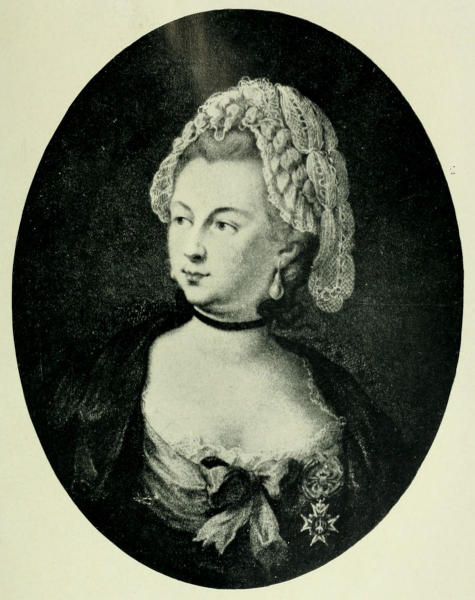
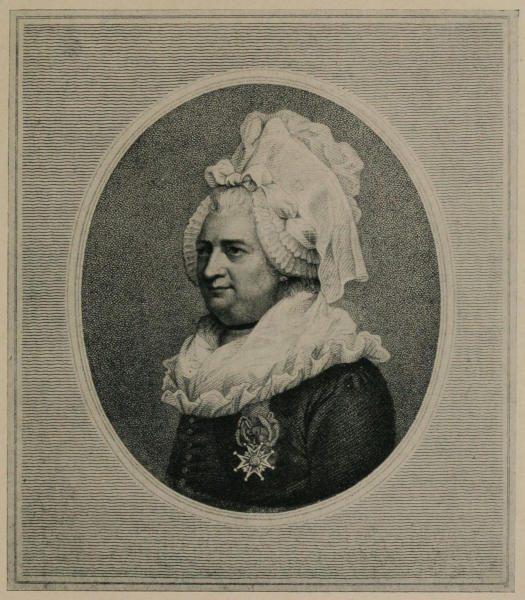
LA CHEVALIERE D’EON
From the Painting by Angelica Kaufmann after Latour
D’Eon, whose part in this affair was so active and
successful, had, according to La Messelière, unwittingly
saved his own head. At all events, he had a claim upon
Woronzow’s gratitude, and fresh titles to Elizabeth’s
confidence; consequently the idea was mooted of
attaching d’Eon to the service of Russia, and a formal
request to that effect was made by the Marquis de
L’Hospital to the Abbé de Bernis. The Minister for
Foreign Affairs and M. Tercier, being at one in this
matter, were not at all opposed to the scheme, suggested,
no doubt, by the Czarina herself, whereby an agent
esteemed at the same time by the ministry and the
secret service should be established at her court.
D’Eon, although flattered by this proposal, which he
never omitted to mention in the rough drafts of his
memoirs, did not think fit to accept it. The favour
which he enjoyed at Versailles, a career brilliantly opened
in diplomacy, the scope given to his aspirations in the
army—all gave promise of a sufficiently enviable future
for him in his own country. He knew, too, that foreigners
seldom attained to high places in Russia. Fortune was
particularly fickle there, and her wheel was more often
than not broken on the road to Siberia. Lastly, his
health was beginning to suffer from the effects of the
severe climate; and he did not hesitate to refuse.
“Had I a bastard brother,” he wrote to Tercier, “be
assured I should prevail upon him to accept such an
offer, but for myself, who am legitimate, I should be
glad to die like a faithful dog in a ditch in my native
land.” In thanking the Abbé de Bernis, “he begged
him to dismiss him from his memory whenever there
was a question of his destiny removing him entirely from
France.”
The Minister for Foreign Affairs did not insist, and
even congratulated him upon his attachment to his
country. At that time, moreover, d’Eon had other
projects in view. He was tired of Russia, where he
feared his energies would be wasted for many years to
come, while he aspired to other spheres of action. He
had followed from his distant post the disastrous campaign
of 1757, which ended in the crushing defeat of the
French army at Rosbach. Couriers arriving at the
embassy in March brought no better news. Hanover
had just been evacuated, and the Comte de Clermont’s
troops, compelled to quit Westphalia, had to cross the
Rhine again. Everywhere hostilities were being resumed
with fresh vigour. D’Eon, who had been for some time
impatiently waiting an opportunity for making his first
campaign, was longing to join his regiment before the
end of the war: “To do so after peace had been declared
would,” he said, “be too great a blow to his honour and
his self-esteem.”
He determined, therefore, to apply (April 14) to the
Minister for War for a captain’s commission. Marshal
de Belle-Isle did not refuse him such rapid promotion.
Less than three months afterwards d’Eon received a
commission as captain on half-pay; but he had again
to exercise patience and give up for the moment his
warlike plans.
Circumstances prevented him from leaving St. Petersburg,
the King’s secret diplomacy necessitating his
presence near the ambassador on whom he was constantly
to keep watch, and whose actions he had often to prompt.
The Duc de Choiseul, Bernis’ successor as Minister for
Foreign Affairs, had just informed the Marquis de
L’Hospital of the treaty, signed December 30, 1758,
which drew Louis XV. and Maria Theresa more closely
together in a policy directed against Prussia. The
ambassador’s task was to obtain Russia’s adhesion to
the agreement. He was, besides, to give the Czarina to
understand that her mediation between France and
England would be welcomed by the cabinet of Versailles,
who in return would show less devotion to the interests
of Poland. As circumstances might make the Grand
Duchess’s support invaluable, they would be obliged to
pay her greater deference, whereat it was hoped the
Empress would not take umbrage.
Such double-dealing was not calculated to attract the
ambassador, who, disliking intrigues, would not have
been successful and did not take part in it. He had
found favour with Elizabeth, and was particularly anxious
to retain her esteem. His witty conversation, his good
manners, and a liberality which Louis XV. called extravagant,
had won for him the sympathies of the court.
If he possessed all the qualities of the man of high rank
whom his government had sought as a worthy representative
of France at a stately court, his age, his
infirmities, and a want of natural energy prevented
him from reaping the advantages of an alliance which
he confined himself to maintaining and strengthening
as best he could. He deemed that to be the most important
part of his mission, and relied upon d’Eon, to
whom he had become genuinely attached, for the
management of current affairs. So highly did he value
his young secretary’s attainments, and his experience
of Russian people and affairs, that he made it a practice
never to come to a decision without first consulting
“his little d’Eon,” whose functions as secret agent were
thus singularly facilitated. Consequently the ambassador
did not omit to communicate to him the instructions
he had just received from the Duc de Choiseul.
D’Eon was already aware of their purport. But he
had learned too, by a letter from Tercier, that the King
would by no means consent to Elizabeth extending
her dominions at the expense of Poland; such an aggrandisement
being calculated to give her a preponderance
in Northern Europe which the offer of mediation
would strengthen. On those terms Louis XV. preferred
to continue the war with England. In short, he desired
no change in the attitude which had been adopted
towards the Grand Duchess. D’Eon, without revealing
his source of inspiration, pointed out these considerations
to the Marquis de L’Hospital, who contented
himself with negotiating the ratification to the treaty,
and awaited more urgent orders before broaching the
other points. These orders soon arrived. Choiseul,
put out of patience by an inaction so inconsistent with
the instructions transmitted, wrote a letter to the
ambassador, the intimate and affectionate character of
which alone mitigated the asperity of the language, and
in which he gave him the option of obeying or of applying
for his recall.
D’Eon renewed his entreaties to the Marquis de
L’Hospital, and did all he could to dissuade him from
launching out into intrigues which might not meet with
the King’s approval. So he managed to defer the project
for over a year, and the defeats inflicted upon
Frederick by the Russians made the minister abandon
it of his own accord.
Unable to obtain what he desired from an ambassador
whom his friendship prevented him from reprimanding,
Choiseul decided to appoint a colleague to the marquis,
with the title of minister plenipotentiary, and despatched
to St. Petersburg the Baron de Breteuil, a young man
enabled by his talents, his distinguished appearance,
and his high rank to ingratiate himself with the Grand
Duchess and the young count. The King approved
this mission officially; but as it was prejudicial to the
interests of his personal policy he resolved to counteract
its effects by admitting the baron to the secret correspondence.
Accordingly he signed a long letter, indited
by Tercier, instructing d’Eon to let the new envoy
know the King’s private designs.
D’Eon’s functions were thus about to become considerably
restricted. After intriguing during five years
and acting as intermediary in the secret correspondence
between Louis XV. and Elizabeth, after working at the
negotiations of several treaties, he found his diplomatic
career hindered, and so he again entertained the idea
of applying for active service in the army. He had,
moreover, kept up a friendly intercourse with the
superior officers of his regiment, having corresponded
on several occasions with his colonel, the Marquis de
Caraman, and his comrade, Captain de Chambry. He
had even been considerate enough to look for furs for
the Duc de Chevreuse, colonel-general of dragoons, who
had acknowledged the delicate attention in a friendly
note.
The historical studies to which he devoted the leisure
left him by the negotiations (the mere titles of which
show clearly that he lacked the sense of proportion in
all he did) could not reconcile d’Eon to the kind of life
which he led in Russia. In the month of July, 1760, he
lost all patience, his health being seriously impaired,
and he entreated the Marquis de L’Hospital for permission
to return to France:
Your Excellency is aware that for over eighteen
months I have been more often ill than well. M.
Poissonier has seriously advised me to leave Russia, in
order that I may recover my former strength by breathing
my native air. Though I fear neither death nor
physicians, and though I am fully persuaded that the
medical profession has not the privilege of alarming your
secretaries of embassy, yet I feel the approach of a
general collapse, which is more convincing than all the
doctors’ arguments, and warns me not to spend a fifth
winter in Russia.... By gaining still more experience
of politics, I may aspire to follow some better trade than
that of a scribe and a pharisee.
De L’Hospital did not detain d’Eon any longer,
and commissioned him to convey to Versailles the ratifications
to the treaty of 1758 and to the maritime
convention concluded between Russia, Sweden and
Denmark.
D’Eon left St. Petersburg with the fixed determination
of never returning, and carried away with him eulogistic
testimonials from the Marquis de L’Hospital and
the Baron de Breteuil, and letters of recommendation
to the Minister for War. The Czarina graciously presented
him with a snuff-box ornamented with diamonds,
and upon his taking leave of Woronzow, the Chancellor
said: “I am sorry you are going away, even though
your first journey here, with the Chevalier Douglas, cost
my sovereign more than two hundred thousand men
and fifteen million roubles.”
As on the first occasion, the bearer of excellent news,
d’Eon again met with a warm reception in Paris and at
Versailles. The Duc de Choiseul caused a pension of
two thousand livres to be conferred upon him out of the
privy purse, and promised to do something for his
career.
D’Eon, whom the journey had exhausted, had just
been attacked by small-pox, and was obliged to take
care of himself and to await until the spring the realisation
of his long-cherished wish. At last, in the month of
February, 1761, he was able to ask the Duc de Choiseul,
Minister for War, “for permission to serve as aide-de-camp
to the Marshal and the Comte de Broglie in the
army of the Upper Rhine, and for his transference to
the regiment of d’Autichamp’s dragoons, in the same
army, the colonel-general’s regiment doing duty that
year on the coast.”
The minister was anxious to comply with his request
by despatching him to the army; but this official
sanction was insufficient for d’Eon; he required further
the consent of the King. The Comte de Broglie, whose
aide-de-camp he wished to become, and who, in fact,
continued to attend to the business of the secret
diplomacy from the army, submitted his desire to
the sovereign, and obtained the following reply:—
... I do not think we have need at present of the
Sieur d’Eon; you may, therefore, take him as your
aide-de-camp, and it will be all the better as we shall
know where to find him in case of necessity.
D’Eon was immediately appointed and started without
delay for the army, where he at once entered active
service. At Höxter he was entrusted with the removal
of the ammunition and some of the King’s stores which
had been left in the fortress: these he put on board the
boats moored on the banks of the Weser, and crossed
the river several times under the enemy’s fire. A little
later, in an action at Ultrop, near Löft, he was wounded
in the face and thigh. On November 7, 1761, when
commanding the grenadiers of Champagne and the
Swiss, he attacked the Scottish Highlanders, who were
ambushed in the mountain gorges close to the camp of
Einbeck, dislodging them and pursuing them as far
as the English quarters. Lastly, at Osterwieck, when
in command of a small detachment of only about a
hundred dragoons and hussars, he fearlessly charged the
Frankish Prussian battalion of Rhes, which had intercepted
the communications of the French army near
Wolfenbüttel. So sudden was his attack that the enemy,
put to confusion, laid down their arms, enabling him to
take eight hundred prisoners. The Prince Xavier de
Saxe profited by this daring exploit in advancing his
troops and occupying Wolfenbüttel. All these great
feats, which d’Eon was wont to recount complacently,
and which he bade his biographer, La Fortelle, relate,
are attested besides by the certificate delivered to him
by the Marshal and the Comte de Broglie on his leaving
the army:
Victor-François, Duc de Broglie, Prince of the Holy
Empire, Marshal of France, Knight of the Royal Orders,
Commander in Alsace, Governor of the town and castle
of Béthune, and in command of the French army on the
Upper-Rhine;
And Charles, Comte de Broglie, Knight of the Royal
Orders, Lieutenant-General of the King’s armies, and
Quartermaster-General of the army of the Upper Rhine.
We certify that M. d’Eon de Beaumont, captain of the
regiment of dragoons of d’Autichamp, has made the last
campaign with us as our aide-de-camp; that during the
whole of the said campaign we very frequently employed
him in carrying the orders of the general, and that he has,
upon several occasions, given proofs of the greatest intelligence
and of the greatest valour; notably at Höxter,
in executing, in presence of, and under fire of, the enemy
the perilous operation of removing the powder and other
stores of the King; at the reconnaissance and at the
battle of Ultrop, where he was wounded in the head and
in the thigh; and near Osterwieck, where, as second
captain of a detachment of eighty dragoons under the
orders of M. de Saint-Victor, commanding the volunteers
of the army, they charged the Frankish Prussian battalion
of Rhes with such effect and determination that they
took them prisoners of war, notwithstanding the superior
number of the enemy.
In testimony whereof, we have delivered to him this
certificate, signed with our hand, and have affixed thereunto
our seals.
Cassel, December 24, 1761.
The Marshal Duc de Broglie. The Comte De Broglie.
The original of this certificate has been lost, but d’Eon
published the text himself in London in 1764, at the
time of his quarrels with the Comte de Guerchy, when
the Marshal and the Comte de Broglie were still alive,
so that the accuracy of the testimony cannot well be
questioned.
It was at this time that d’Eon met a man in de
Broglie’s army who exercised later a decisive influence
over his destiny, ruining his regular career, and launching
him in a series of adventures, one more bizarre than another,
which involved the ruin of his brilliant qualities,
and the loss, through an extravagant metamorphosis, of
his manly dignity. The Comte de Guerchy, future
ambassador of France in England, was then lieutenant-general
in Marshal de Broglie’s army. On August 19,
1761, the day that the French army crossed the Weser
below Höxter, Captain d’Eon was commissioned by his
chief to deliver to him the following order:—
The Marshal requests the Comte de Guerchy to order
the brigades of infantry on the right bank of the Weser
to take at once 400,000 cartridges which are there, and
which a storekeeper of artillery will distribute to them,
to the place to which M. d’Eon, the bearer of this note,
will conduct them.
Given at Höxter, August 19, 1761.
The Comte de Broglie.
P.S.—It is desirable that a staff officer should at once
accompany M. d’Eon to effect this distribution to the
troops under your orders.
Is it true, as d’Eon asserted later in the libel which he
published in London against the ambassador, that the
Comte de Guerchy contented himself with putting the
order in his pocket, saying to d’Eon: “If you have a
supply of ammunition, you have only to remove it to a
park of artillery you will find at half-a-league’s distance,”
and that, in spite of discipline, the young aide-de-camp
had to gallop after the lieutenant-general to recover the
order, and to take it upon himself to carry out the
marshal’s instructions? The Comte de Guerchy naturally
took care not to admit the truth of the story, which he
treated as a wild fabrication, and the tardy and interested
testimony of so biassed and insincere a person as
d’Eon can only be accepted with extreme caution.
However that may be, it is interesting to record this
first meeting on the battlefield of two officers who were
destined three years later, as colleagues in the same
embassy, to quarrel so violently and to astonish the whole
of Europe by the scandal of their dispute.
Yet despite his exemplary conduct in the army and
the ability he displayed in discharging the duties of a
dragoon on real battlefields after following in embassies
what he called “the trade of a scribe and pharisee,”
d’Eon quitted the service before the month of September
1762, when the preliminaries of peace were signed.
Towards the end of December, 1761, he returned to Paris
in compliance with an order from the ministry. There
was some question of sending him back to St. Petersburg,
where he had so successfully made his first diplomatic
campaign, and of appointing him successor to the Baron
de Breteuil. Once more he was about to change his
career, by gaining another promotion. He left Cassel,
where he chanced to be with Marshal de Broglie’s staff,
taking away with him the certificate which recorded his
brilliant military exploits, and reached France in the
beginning of the year 1762. Hardly had he set out when
the Czarina died, bearing away to her grave d’Eon’s
prospects of an embassy. If, notwithstanding his comparatively
inferior rank and origin, he had seemed in the
eyes of the Minister for Foreign Affairs and the King
peculiarly qualified for the accomplishment of a confidential
mission to the Empress, who had known him for
several years and had frequently given him proofs of her
good-will, the accession of a new sovereign at St. Petersburg
considerably diminished the importance of these
particular reasons, and the impetuous Burgundian
was thwarted once again in his aspirations by the
obstacle of caste.
In fact, instead of sending d’Eon to Russia, where the
ministry decided upon leaving the Baron de Breteuil, they
conceived the idea of turning the young diplomatist’s
indefatigable zeal and remarkable talents to profitable
account in the negotiations for peace. The Duc de
Choiseul appointed him secretary to the Duc de Nivernais,
selected as the most subtle and expert arbitrator in the
whole of France for the difficult task of concluding peace
with England.
III IN LONDON
If the conclusion of peace with England presented difficulties,
the choice of the arbitrator was an excellent
one. The Duc de Nivernais met with a thoroughly
good reception in English society, which was able to
appreciate the qualities of a true nobleman, and recognised
them in the person of the new French ambassador.
The son of the Duc de Nevers and of a princess of the
Spinola family, he had married Hélène de Pontchartrain.
To the influence which his birth and his alliance gave him
he had been able to add the intimate friendship of
Madame de Pompadour, gained by organising those
dramatic entertainments at Versailles by means of
which the favourite succeeded in retaining the King’s
interest. In the numerous notes which she sent him
the marquise hardly ever omitted to call him “my dear
little husband”; nicknames had been brought into
fashion by the King himself, and this one serves to show
on what an intimate footing the duke was treated at
the palace. He had talents, however, more genuine and
more rare than the qualities necessary to a good courtier.
As ambassador to the Holy See in 1748, at the time
that the Unigenitus bull was promulgated, he succeeded
at once in astonishing the Romans by the splendour of
his retinue, and in gaining the confidence of Pope Benedict
XIV. by the ability of his diplomacy. Sent afterwards
to Berlin, he managed to captivate Frederick,
but unfortunately too late to detach Prussia from the
English alliance, an understanding secretly arrived
at. The failure of his mission was due entirely to the
tardiness and hesitation of the King’s government. For
this reason nobody blamed him for it, and the general
opinion was that he was the man most likely to obtain
the least stringent terms for a treaty which had become
indispensable to France. An accomplished nobleman
and able negotiator, a witty talker and charming writer,
as well as a good horseman and musician, he was at home
in every society. No one then had a better chance of
reconciling two nations which pride themselves equally
on being judges of good breeding, and the English gave
him a warm reception, Horace Walpole going so far as to
say that France had sent them the best she had to offer.
Nivernais had been selected as the most able ambassador,
and d’Eon was appointed to assist him as the
cleverest and best-informed secretary.
Having already taken part, on several occasions, in
extremely delicate and important transactions, he was
likely to be an invaluable adviser for his chief and to
develop in his ingenious mind many an expedient for the
negotiation. They embarked at Calais together on
September 11, 1762, and reached London as soon as the
14th, thanks to the swift horses of the Duke of Bedford.
If the English seemed eager to receive the ambassador
of France, they were not in so great a hurry to proceed
with the negotiations for peace. The Opposition, which
desired to continue the war, were on the watch for an
opportunity for breaking them off and for upsetting
Lord Bute’s ministry. The news of the taking of
Havana, which was received in London on October 1,
turned everyone’s head, and the King and the cabinet
became more exacting under pressure of public opinion,
demanding Florida, which France had still, under
difficulties, to obtain from Spain. “That wretched
Havana, my little husband,” wrote Madame de Pompadour
to the Duc de Nivernais, “I am alarmed about it.”
It was important that the preliminaries of peace should
be signed before the opening of Parliament, the Opposition
being intent upon overthrowing the ministry, and
resuming hostilities. Nivernais was afraid, besides, that
another British naval victory would make the terms of
the treaty still less favourable: “I fear now,” he wrote
to Choiseul, “that Lisbon will be taken before that confounded
signature.”
Lisbon was not taken, for on November 5 Choiseul
was able to inform Nivernais that the preliminaries of
peace had just been signed at Fontainebleau, adding,
with self-complacency somewhat irritating for the
ambassador, whose task in London had proved less
profitable, that he had been raised on that occasion to
the peerage, with the title of Duc de Praslin. A large
share of the success of this first agreement, which, notwithstanding
all that it cost France, was regarded at
the French court as highly advantageous, was due
indeed to the mission of the Duc de Nivernais. Are we
to believe that in order to induce the English ministers
to conclude peace, in spite of the Opposition, the French
ambassador was obliged to bribe them, as was boldly
asserted in London some years later, at the time of the
action for libel brought against Dr. Musgrave? It would
not have been in the least improbable, for it is known
that more than once during the long struggle which fills
the history of the eighteenth century, England and
France endeavoured to bribe one another. At all events
d’Eon relates how he succeeded one day, at the Duc de
Nivernais’ house, in alluring Mr. Wood, Under Secretary
of State, by the offer of some good wine from Tonnerre,
and how he took copies, while this latter was drinking
copiously, of the papers he had brought in his portfolio.
Among these there happened to be the ultimatum about
to be transmitted to the Duke of Bedford, the British
ambassador at the court of Versailles. Thanks to this
impudent trick, Choiseul, already apprised of all the
difficulties about to be raised, was enabled to come to
terms with the Duke of Bedford, expeditiously and
without taking any risks. This amusing story was
given considerable publicity throughout France, and the
papers of the Opposition soon published it in England,
taking advantage of it to heckle the cabinet.
The preliminaries signed, there was nothing more for
the two governments to do but to come to an agreement
on certain minor points and the actual wording of the
treaty. This task, somewhat ungrateful and difficult
on account of Choiseul’s anxiety about recovering some
of the concessions he had made in his great haste to
negotiate before the opening of Parliament, kept Nivernais
and d’Eon occupied for three more months; the
definite treaty being signed only on February 10.
This disastrous peace, which cost France a fine colonial
empire full of still finer possibilities, was welcomed there
with transports of joy, while in England it raised genuine
reprobation. D’Eon was too ambitious not to turn to
good account the transactions in which he had taken
part. Two personal experiences had taught him that
it was always profitable to bear good news to the court,
and that the King showed his pleasure on such occasions
by granting favours to the messenger. He had won a
lieutenancy in the dragoons by bringing to Versailles
the Empress Elizabeth’s ratification to the Treaty of
Versailles, and three years later a life-pension of two
thousand livres by discharging a similar commission.
The new treaty which had been so earnestly desired and
so well received in France should evidently obtain from
him still greater advantages, only he must reach the
King himself, not surreptitiously, as the agent of the
secret correspondence, but before the whole court, as
the accredited secretary of an official embassy. D’Eon,
who thought nothing was impossible, urged his chief to
request the British Government to grant him the favour
of conveying the ratifications to the treaty to Versailles.
Such a selection on the part of a foreign government for
a mission regarded as highly honorific was unprecedented
and contrary to all usage. Nevertheless, the ambassador
consented to make the application, however irregular,
although the Duc de Praslin considered it to be doomed
to failure. The Minister for Foreign Affairs put Nivernais
on his guard, assuring him that the court of St. James’
would certainly not entrust such a mission to a French
secretary. It would appear also that the minister, out
of patience at the aspirations with which premature
successes had inspired d’Eon, was anxious to put him
in his place. “He is young,” he wrote, “and has still
time enough to be of good service and to earn distinction.
I take an interest in his welfare and will gladly put him
in the way of gaining advance by time and work.”
In spite of de Praslin’s sceptical conjectures, the Duc
de Nivernais obtained for “his little d’Eon” the difficult
favour he had requested. This success was a clearer
indication of Nivernais’ great influence at the court of
St. James’ than any testimonial; and the ambassador
did not omit to banter the minister on his incredulity:
I am very glad you were stupid enough to believe it
impossible that the French secretary—my little d’Eon—should
be the bearer of the King of England’s ratifications.
The fact is, you did not fully realise the great
kindness and esteem which your ambassador enjoys here,
and it is just as well that you have done so, for otherwise
you would be capable of despising me all your life,
while now you will doubtless have some regard for me.
D’Eon reached Paris on February 26, as bearer of
the ratifications. Praslin did not fail to remark that he
had made “great haste,” but, without grudging him his
success, exerted himself in his behalf. On March 1, he
informed Nivernais that the Cross of Saint Louis and a
gratuity were to be conferred upon his little d’Eon by
the King: “I think he will be satisfied,” he added; “as
for me, I am delighted, for he is a handsome young
fellow and a hard worker, and I am his well-wisher.”
D’Eon met with a warm reception at court, and took
good care not to forget the commissions with which his
chiefs had charged him. He gave Madame de Pompadour
news of the wretched health of her “little husband,”
and delivered to her some purses from England which
she pronounced to be very ugly and “coarse as ropes.”
The favourite thought d’Eon was “an excellent person,”
and considered it “a great act of politeness on the part
of the English to entrust him with the treaty.” Congratulating
Nivernais upon having terminated his work,
she urged him to return and “repair his health by the
good air of France.”
As the Duc de Nivernais had accomplished to his
master’s satisfaction the delicate and difficult negotiation
for which he had been sent to London, the Duc de
Praslin could not think of prolonging an embassy from
which his friend had reaped every advantage and honour,
and which was hardly better than an honourable exile
for that wealthy and literary nobleman. The choice of
a successor had, moreover, preoccupied Nivernais himself
for several months. He had thought of his friend,
the Comte de Guerchy, lieutenant-general of the King’s
armies, who had earned distinction in the Seven Years’
War, and enjoyed a great reputation for courage at
Versailles. A fearless soldier, Guerchy had never been
afforded the opportunity of proving himself a diplomat,
and even his friends doubted his qualifications for that
career. Such was the opinion of de Praslin, who replied,
on January 8, 1763, to the proposals which the Duc
de Nivernais had just made:
I am still much concerned about Guerchy. I am not
sure, however, that we are doing him a good service by
appointing him ambassador in London.... I dread
his despatches like fire, and you know how defective
despatches injure a man and his work. A minister is
often judged less by the manner in which he conducts
business than by the account he gives of it.... But he
cannot write at all; we must not deceive ourselves on
this point.
Nevertheless, Guerchy was named for the post—first,
because it was not deemed desirable that Nivernais’
candidate should be rejected—the ambassador being in
high favour at Versailles—secondly, because Praslin, in
spite of his too just opinion of Guerchy’s merits, was glad
to oblige two of his intimate friends at the same time.
On February 16, 1763, the Duc de Nivernais was
apprised of this selection in London. It was settled that
d’Eon should remain at the embassy for the purpose of
assisting his new chief, and wielding the pen in his stead.
In the interim he was even left in charge, and, upon
Nivernais’ earnest recommendation, Praslin agreed to
give him the title of Resident Minister. D’Eon was
still in France when Nivernais recalled him to London
to commit the embassy to his care. He was somewhat
long in complying with his chief’s order, and even gave
out that he was ill. In reality, the intrigues of the secret
diplomacy were detaining him in Paris.
The Comte de Broglie was at that time an exile in his
estates in Normandy. He had been involved in the
disgrace of his brother, the marshal, to whom the Marquise
de Pompadour, notwithstanding facts and the force of
public opinion, had attributed the responsibilities really
incurred by Soubise during the Seven Years’ War.
Louis XV., unable to oppose the favourite openly, but
unwilling to be deprived of his secret minister’s services,
resigned himself to transferring the headquarters of his
private diplomacy to the Château de Broglie. It was
during this temporary seclusion that the Comte de
Broglie matured a plan for the invasion of England which
had been formed a long time before, but the recent
hostilities had prevented its execution. If the conclusion
of peace put back the opportunity for doing so, it allowed,
at least, of the conditions and means likely to lead to a
successful issue being studied on the spot. The King
and the minister understood better than the nation the
fatal terms of the Treaty of Versailles, and were anxious
to prepare themselves quickly for counteracting its
effects. Accordingly Louis XV. examined with interest
the plan submitted to him, and sent it back to Tercier
with his approval. It was at this latter’s house that
d’Eon and the Comte de Broglie, who was passing
through Paris at the time, met for the purpose of organising
this perilous mission. D’Eon’s position in London
and his experience of intrigues of this description enabled
him to conduct the researches, and a colleague was given
to him—his cousin, the Sieur d’Eon de Mouloize, who
should take charge of the documents in the event of the
discovery of the scheme. As for the technical part, it
was to be entrusted to an engineer, Carrelet de la Rozière.
Lastly, the basis of a cypher to be employed in the affair
was arranged. The King gave his instructions himself:
The Chevalier d’Eon will receive through the Comte
de Broglie or M. Tercier my orders on the surveys to be
made in England, whether on the coast or in the interior
of the country, and he will comply with the instructions
he will receive to that end, as if he received them direct
from me. It is my desire that he shall observe the
greatest secrecy in this affair, and that he shall not make
any communications thereon to any living person, not
even to my ministers wheresoever they may be.
These instructions were precisely stated and commented
upon by the Comte de Broglie in a letter which
he sent, on May 7, 1763, to the Chevalier d’Eon in
London. He recommended him to observe the utmost
prudence in his conduct, apprising him that the Comte
de Guerchy’s suspicious character would render his
secret mission extremely difficult, and urged him to
take every conceivable precaution for the safety of the
papers connected with the correspondence. The Count
appointed him tutor to M. de la Rozière, adding: “He
is a somewhat wild pupil, but you will be pleased with
him.” In conclusion he congratulated himself upon
having d’Eon as “lieutenant in so important an affair,
which may contribute to the safety and even to the
prosperity of the nation,” and thanked him for the zeal
and devotion which he had never ceased to show to the
Marshal de Broglie and to himself.
D’Eon’s attachment to the exiled de Broglies had
awakened the suspicions of the Duc de Praslin, and the
Minister for Foreign Affairs did not hesitate to subject
the young representative of the King at the court of
St. James’ to a regular interrogatory, in the presence of
his senior clerk, Sainte-Foy, and the Comte de Guerchy.
He began by abruptly asking him to give an account of
the battle of Villinghausen, at which he was present
while serving in the dragoons. D’Eon did not require
much pressing, and boldly laid to the charge of Soubise
all the blunders officially imputed to the Duc de Broglie.
Praslin, who was striding impatiently up and down
the room, suddenly interrupted him, exclaiming: “I
know it to have been just the opposite of what you say,
and this from one of my intimate friends who was also
there.” And he turned to the Comte de Guerchy.
“But, my dear d’Eon, you surely did not witness all you
tell me.”
“The minister pulled a long face,” d’Eon relates,
“and gave a sardonic smile, for I persisted in assuring
him, as I shall do to the end of my days, that I had
indeed seen and heard what I had told him.” The
duke concluded by saying: “It is your attachment to
the Broglies that makes you speak as you do.” “Faith,
sir,” d’Eon replied, “it is my attachment to the truth.
You question me, and I can only tell you what I
myself know.”
Upon leaving the minister, Sainte-Foy rebuked d’Eon
and advised him not to remain “in a country where he
would never make his fortune, but to return to England.”
Another attempt to discover d’Eon’s real sentiments
towards the Broglie party was made—more discreetly
this time—by the Duchesse de Nivernais, who, chancing
one day to be alone with him, asked if he was not in
correspondence with M. de Broglie. “No, madam,”
replied d’Eon, “and I am sorry for it, as I am very fond
of Marshal de Broglie, but I do not wish to weary him
with my letters; I am satisfied with writing to him on
New Year’s Day.” “I am very glad to hear this for
your sake, my dear little friend,” continued the duchess.
“Let me tell you in confidence that intimacy with the
House of Broglie might be of injury to you at court, and
in the estimation of Guerchy, your future ambassador.”
D’Eon had barely arrived in London, where the Duc
de Nivernais, longing for departure, was impatiently
awaiting him, when he was invested “in the prescribed
forms” with the Cross of the Order of Saint Louis by
his chief, at his own request. He had brought with him
presents from the King to the Sardinian minister, one
of the negotiators of the peace. Count Viry accepted
“his Majesty’s favours with great pleasure and gratitude.”
The presents consisted of the King’s portrait
set in diamonds, accompanied by an autograph letter,
a Gobelin tapestry, and a Savonnerie carpet. The first
idea of the happy recipient of these gifts was to go to the
Prime Minister, Lord Bute, and show them to him. The
latter, Nivernais relates, “took them at once to the King
of England, who considered they were magnificent and
the letter charming.”
On May 4, the Duc de Nivernais was received in a
farewell audience by George III., and two weeks later
he set out for France, tired of London fogs, and happy
to be again at Versailles, and at the Academy, and on
his beautiful estate at St. Maur.
D’Eon became his own master in London, and began
immediately to play the part and to lead the life of an
ambassador. He kept open house, and among his
visitors there were de Fleury, the Chevalier Carrion,
a friend of the Duc de Nivernais, “a deputation of the
Academy of Sciences which was to go to the Equator for
the purpose of measuring the terrestrial meridian,”
scholars and men of letters, among them Duclos, Le
Camus, Lalande, and La Condamine. The Comtesse de
Boufflers, who had captivated the Prince de Conti and
the frequenters of the Hôtel du Temple by her wit and
elegance, did not disdain, when on a visit to London, to
do the honours of the embassy, as the following note
testifies:—
Madame de Boufflers and Lady Mary Coke will come
to dine with M. d’Eon on Monday if that suits him, and
will bring Lady Susannah Stuart. Madame de Boufflers
will, perhaps, avail herself of M. d’Eon’s offer by bringing
two other friends of hers if they have returned to town,
which she, however, thinks unlikely. She presents her
compliments to M. d’Eon, and begs to say that she will
help him to do the honours of the dinner to the ladies,
both as a fellow-countrywoman and as one quite ready
to be counted among his friends.
She has to inform M. d’Eon that Lord Holderness has
returned, and that he therefore should be invited.
Thanks to the Duc de Nivernais, who did not consider
himself quits with him, and was still exerting himself on
his behalf in France, he received letters in July accrediting
him minister plenipotentiary to the King of England.
Fortune and distinctions had come apace to “little
d’Eon.” In less than two years he had risen from the
post of secretary of embassy to that of Louis XV.’s
representative to his Britannic Majesty, and had
exchanged the title and uniform of a captain of dragoons
for the position of a minister plenipotentiary. The
obscure gentleman of Tonnerre could henceforth entertain
on an equal footing the ambassadors of the highest
rank and the great dignitaries of the court of St. James’.
He took care not to miss the opportunity, and on
August 25, St. Louis’ day, he gave a gala dinner, at
which Lord Hertford, Lord March, David Hume, and the
whole diplomatic corps were present. So sudden a success
intoxicated him. But everything was extraordinary in
the career of this young man of quite mediocre extraction,
who, employed occasionally in secret diplomacy, was
afterwards received into the regular service by favour;
rewarded for his services by a lieutenancy of dragoons,
and who, when barely thirty-six, was representing the King
of France at the most magnificent court of Europe, after
that of Versailles, and carrying on the mission of the Duc
de Nivernais, a peer of the realm. D’Eon did not realise
how surprising this rapid ascent through the most rigid
aristocracy and the most exclusive classes appeared to the
onlookers, nor how scandalous to his rivals. It was more
in keeping with his character to abuse his advantages than
to preserve them. His survey of the ground that had been
covered, the remembrance of innumerable obstacles he
had surmounted, far from teaching him prudence, only
increased his presumption. He did not believe he was
at the zenith of his fortune, but merely at the outset.
His head was turned, although, anticipating reproaches,
he denied it. He wished to access himself in the eyes of
the English, his countrymen, his minister, and even of
his King.
He continued to assume the position of ambassador
until they should decide to confer the title upon him, and
so raise him to the same rank as the premier lords of
France. But if his determination never waned, if the
resources of his active mind never diminished throughout
this wild enterprise, his money was rapidly dwindling
away. The almoner, the equerry, the five cooks and
butlers, the four footmen, the porter, the two coachmen,
the two grooms, and others, who formed his household,
had to be paid, and, as his emoluments were insufficient
for the purpose, d’Eon was obliged to apply to the Duc
de Praslin for additional subsidies. He did so with
admirably feigned moderation and disinterestedness,
explaining that the appointment of minister plenipotentiary,
for which he had never asked, compelled
him, much against his will, to wear a few decent clothes
and a little lace:
The appointment of minister plenipotentiary, for
which I never asked, has certainly not turned my head,
thanks to a little philosophy; it has only involved me in
heavier expenses, as the enclosed account testifies.
When I was secretary of embassy I went about plainly
dressed in my uniform and cambric cuffs; now, much
against my will, I must wear a few decent clothes and a
little lace. If the King’s affairs are in a bad state, mine
are going from bad to worse. Your kindness and your
sense of justice will not suffer this. Soon I shall complete
ten years’ service as a diplomatist, without having
become richer or more proud. Many promises have been
made to me, but promises and promisers have vanished.
Till now I have sown much and reaped little. When
the happy time comes for my release from politics, I
shall be obliged to abscond and become bankrupt, unless
you are humane enough to help me with some additional
donation. The more zealously and courageously I
work, the poorer I become: my youth is passing away,
and I have nothing left but bad health, which is growing
worse every day, and debts to the amount of over twenty
thousand livres. These various little debts have been
worrying me for so long that my mental capacities are
completely absorbed and are no longer free, as I should
wish, to serve the King’s interests. The time of reckoning
appearing to be imminent, I entreat you to decide
upon my present and future prospects, and upon the
favours I am to expect from your sense of justice and
kind-heartedness....
The Duc de Praslin was all the less inclined to grant
the request as he had received at the same time serious
complaints against d’Eon from the Comte de Guerchy.
Not satisfied with incurring debts, the Chevalier had
already spent a part of the future ambassador’s stipend.
He regarded these emoluments as his own, for he would
not admit that after being in the first rank he was once
more in a subordinate position, that “he should descend
from peer to peasant.” He persisted with Burgundian
tenacity in his fanciful dream of gaining the title as well
as the functions of ambassador, and of succeeding his
former chief, Nivernais, in London. In spite of the
warnings which he received from every quarter, and of
the counsels of moderation which his best-informed and
most devoted patrons, Sainte-Foy, the chief secretary of
the Foreign Office, and the Duc de Nivernais himself,
continually urged upon him, he would not yield and
ended by receiving a well-deserved reproof from the Duc
de Praslin:
I could never have believed that the title of minister
plenipotentiary would cause you so quickly to forget
the point whence you started, and I had no reason to
expect that your aspirations would increase in proportion
as you received new favours. In the first place, I
gave you no ground for anticipating the reimbursement
of your former journey to Russia, because three of my
predecessors upon whom you made a similar demand
had not, it appeared, found it legitimate. In the second
place, you complain to me of empty promises having
been made, but surely such has not been my way of
dealing with you. Remember that I received you at
Vienna when I had no reason for obliging you, for you
were a perfect stranger to me. Upon your arrival you
were ill, and I looked after you. When you left me
you were uncertain as to your prospects here, and it was
I who obtained the pension which was conferred upon
you. Two years afterwards, being without employment,
you applied to me, and I gave you the most suitable post
and the most favourable opportunity for rising to notice.
Lastly, when you brought the ratification of the treaty
with England to us, the expenses of your journey were
paid, and his Majesty rewarded you as if you had made
ten campaigns in the field. If you are not yet satisfied,
I shall be obliged to discontinue employing you, for fear
of being unable to recompense your services adequately.
But I prefer to believe you will feel the truth of my
statements, and put your trust in future rather in my
good will than in such groundless claims. I must not
forget to mention that I have not noticed that the character
of plenipotentiary involved M. de Neuville in any
expenses here; his style of living is the same as when he
was in the service of the Duke of Bedford. I cannot
conceive the necessity for this extraordinary outlay at
the expense of the Comte de Guerchy, which is quite out
of place. I do not conceal from you my displeasure
at your having involved in so great expenditure one in
whom I take such an interest, and who trusted in you
on my recommendation. I hope that you will be more
circumspect in your demands for the future, and more
sparing in your use of other people’s money, and that you
will endeavour to be as useful to him as you have been to
the Duc de Nivernais.
The Duc de Praslin was singularly mistaken if he expected
to have the last word with his impetuous correspondent.
D’Eon, far from giving in, was exasperated
by such sensible advice, and, giving full vent to his ill-humour,
replied the same day:
As soon as I learned, Monsieur le Duc, that the title of
minister plenipotentiary was to be conferred upon me
against my will, I had the honour of writing to the Duc
de Nivernais that I regarded the title rather as a misfortune
than as a boon.
The point whence I started, when very young, was
my native town, Tonnerre, where I possess a small
property and a house fully six times as large as that
occupied in London by the Duc de Nivernais. The point
whence I started in 1756 was the Hôtel d’Ons-en-Bray,
Rue de Bourbon, Faubourg St. Germain. I am the friend
of the owner of that mansion, which I left against his
will to make three journeys to Russia and to other
courts in Europe, to join the army, to come to England,
and to bring four or five treaties to Versailles, not as
courier, but as a man who had contributed to the framing
of them. I have frequently travelled when very ill,
and once with a broken leg. Nevertheless, I am prepared
to return to the place whence I started, if such
be my fate. I shall recover my former happiness there.
The points whence I started are those of being a gentleman,
a soldier, and a secretary of Embassy—all of them
naturally leading to the position of a minister at foreign
courts. The first gives a claim to it; the second confirms
the idea and endues with the necessary firmness for
such a post; but the third is the school for it....
If a marquis had accomplished one-half the things
which I have accomplished in ten years, he would ask no
less than the title of duke or of marshal. As for me,
my aspirations are so modest that I ask to be nothing at
all here, not even secretary of Embassy.
D’Eon, who felt excited that day, and courted disgrace
for the pleasure of indulging in witticisms, was not
yet satisfied. By the same post he sent similar impertinencies
to the Comte de Guerchy, who had not ceased
exhorting him to be more circumspect in his behaviour:
... I take the liberty of observing to you on the
character which chance has given me, that Solomon said,
a long time ago, everything here below was vanity,
opportunity, mere accident, happiness, and misfortune,
and that I am more than ever persuaded Solomon was
a great preacher. I will modestly add that the chance
which gave the title of minister plenipotentiary to a man
who has negotiated successfully during the last ten years
was perhaps not one of the blindest. What has come to
me by chance might come to another by good luck....
A man, no matter who, can only form an estimate of
himself by comparison with one or many men. There
are several proverbs which serve to prove the truth of
this. It is commonly said: He is as stupid as any thousand—he
is as wicked as any four—he is as mean as any ten—men.
This is the only scale by which we can be guided
except in certain cases where men measure themselves by
women. An ambassador, no matter who, may be worth
half a man, a whole man, twenty, or ten thousand men.
The question is to determine how a minister plenipotentiary,
who is a captain of dragoons, and has completed
ten political campaigns (without counting campaigns in
the field), stands relatively to an ambassador who is a
lieutenant-general, and is making his début....
I have already had the honour, sir, of thanking you
sincerely for all your kind offers of assistance. As to
my prospects, I frankly confess I am a second edition
of Sister Anne in Blue Beard, who was always watching
but saw nothing coming, and this often induces me to
sing that beautiful song:
Belle Philis, en désespère
Alors qu’on espère toujours.
IV CONTENTION WITH DE GUERCHY
In his letter to the Duc de Praslin d’Eon called
to mind “the point whence he started,” and only
found cause to pride himself on his success.
This was a fair estimate of himself, though not a very
modest one; but it showed little knowledge of his time.
Having obtained when still quite young a rank and
distinction which, to a man of his birth, should have
appeared an unlooked-for consummation of his whole
career, he could neither rest satisfied nor even equip
himself with patience. Above all he could not resign
himself to being put back. After contributing to an important
negotiation as secretary to an enlightened and
brilliant ambassador, whose tradition and bearing he
had striven to maintain as minister plenipotentiary, he
found himself compelled to act again as secretary under
the orders of a chief new to diplomacy, wanting in ideas
and resources, and bent on reaping the advantages of a
fat living from his embassy.
Short of money, and irritated by the recriminations
which the expenses of his temporary administration had
obtained for him, d’Eon angrily awaited his ambassador.
The Comte de Guerchy arrived on October 17.
“He received me with hypocritical politeness,” d’Eon
relates, “and asked me in a wheedling tone if I did not
regret having sent him my letter of September 25. I
replied quietly: ‘No, sir; my letter was perhaps a
somewhat sharp, but a fair, rejoinder to your attack of
September 4, and were you to address to me such another
letter, I should be obliged to send you a similar
reply.’ ‘Come, come, my dear M. d’Eon,’ he retorted.
‘I see you are rather a quarrelsome person.’ Thereupon
he drew from his pocket my letters of recall,
which he handed to me with a grieved air, expressing his
regret and assuring me once more of his friendship and
attachment. I answered him only with a look ...
and bowing distantly I withdrew, taking with me that
official document of my disgrace.”
If d’Eon was as successful as he relates in concealing
his mortification and in maintaining his composure,
which was hardly his wont, the Duc de Praslin’s letter
must have roused bitter reflections. Not only was he
recalled to Paris, but he was forbidden to appear at
court. This meant utter disgrace, exile and a severe
check, if not an end, to his career. Too irritated to give
way to despondency, and still hoping that Louis XV.
would intervene on behalf of his secret agent, he determined
upon awaiting events and deferring his departure
as long as possible. His imagination, which was never
at a loss for an expedient, supplied him with a complete
plan of resistance in the scandalous contest which he
did not hesitate to wage against the orders of his
ambassador, the Minister for Foreign Affairs, and the
King. The next day, upon delivering the papers of the
embassy to de Guerchy, d’Eon informed him that he
was not in the least hurry to obtain his audiences of
leave. Being accredited by letters bearing the King’s
signature, he could only be recalled, he contended, by
an act in the same form. Regarding, therefore, as null
and void the letters of recall which he had received, and
which were signed with the stamp alone, he declared his
intention of awaiting “further orders from his court.”
De Guerchy pointed out to him in violent language
the extreme impropriety of his behaviour, and the consequences
to which it exposed him; then, growing
gradually more and more heated, he told him—according
to d’Eon—that “he should soon get the mastery over
his obstinacy, and that, moreover, his ruin was already
decided upon.”
With a view to putting an end to an equivocal
situation and depriving d’Eon of every means of resistance,
Guerchy went so far as to ask the court of St.
James’ to hasten the audiences of leave of his embarrassing
colleague. D’Eon allowed the step to be taken, but
was most opportunely hindered from proceeding to the
palace on the appointed day. All these chicaneries
exasperated him and made him completely lose his
presence of mind. A single incident was enough to
make the dispute public, and to give this diplomatic
intrigue an unexpected notoriety.
A Frenchman, the Sieur Treyssac de Vergy, arrived
during the month of September. Advocate of the
Bordeaux Parliament, he gave himself out to be a man
of letters, made a parade of his grand acquaintances, and
even boasted of having come to England with the promise
of being appointed minister plenipotentiary in
place of d’Eon. Upon calling at the embassy, he was
somewhat harshly dismissed by d’Eon himself, who
gave him to understand that he would not be received
unless he brought with him the letters of introduction
of which he had made mention. De Vergy protested,
asserting that he was on intimate terms with the Comte
de Guerchy; nevertheless, he promised to produce the
recommendations required of him. D’Eon had not seen
this strange visitor again, but had received extremely
unfavourable reports concerning him from Paris. He
was described as being a mere adventurer, over head and
ears in debt, and of doubtful reputation, who imposed
upon people under an assumed name. Consequently,
the Chevalier was greatly surprised to meet de Vergy,
with whom de Guerchy was, or pretended to be, unacquainted,
at a reception given by the ambassador
soon after his arrival. He showed his astonishment at
seeing him at the embassy without an invitation, and
during the course of a somewhat heated altercation
“insulted him, and challenged him to a duel on foot or
on horseback,” and was only calmed at de Guerchy’s
intervention.
On the following day d’Eon happened to be dining at
Lord Halifax’s, in the company of Lord Sandwich and
the Comte de Guerchy. He was too excited by the
events of the previous day to maintain his composure,
even before the English ministers, and the ambassador’s
presence only served to aggravate him the more. He
thought it a good opportunity for declaring that he
would not leave England before being recalled in a
regular manner, and that, besides, he could not, in any
case, dream of taking his departure before settling an
affair of honour. The affair of honour in question was
the quarrel of the previous day, which he complacently
related to his hosts, informing them that he expected a
visit from de Vergy on the morrow, that he should accept
his challenge, and kill his adversary. When the English
ministers reproached him with causing a scandal, and
reminded him of the duties attached to his official position,
he replied that “if he was a minister plenipotentiary
he was above all a dragoon.” “Well, then,” retorted
Lord Halifax, “were you even the Duke of Bedford himself,
I should have to give you in charge of the guards.”
“I have not the honour of being the Duke of Bedford;
I am M. d’Eon, and have no need of any escort.”
He was so heated that Guerchy joined Lord Halifax in
making every effort to calm him. D’Eon heeded neither
entreaties nor threats and, pleading an engagement at
his club, attempted to make his escape. Thereupon the
minister ordered the passage to be barred, and d’Eon,
beside himself with rage, exclaimed that he never could
have believed it possible for a minister plenipotentiary
to be kept a prisoner, in the presence of his ambassador,
at the residence of a secretary of state. The scene was
becoming tragi-comic. Lord Halifax and de Guerchy felt
that they must put an end to it, so as to avoid a far greater
scandal than the one they had tried to prevent. They
began again to argue with d’Eon, who gradually grew
calmer, and finally consented to sign a paper whereby
he gave his word of honour to the Earls of Sandwich and
Halifax not to fight M. de Vergy, and “not to insult him
in any way, without previously informing the said earls
of his intention.”
D’Eon made a copy of his engagement and caused
Lord Halifax, Lord Sandwich and the Comte de Guerchy
to sign it.
This extraordinary scandal, brought about quite as
much by the ambassador’s tactlessness as by the very
undiplomatic excitement of his impetuous minister plenipotentiary,
had its sequel the next day. D’Eon himself
has written an account of it too graphic to be omitted.
“The affair passed without a blow being struck. My
position was far more difficult than his, for I had promised
not to molest him, and I could not foresee that the
brave Vergy was the man to take alarm at my every
movement. But when I secured the door, intending to
detain him until the ambassador’s servants for whom I
had sent arrived, he at once began to rush round the
room, crying, ‘Do not touch me, do not touch me!’
‘What!’ I replied, smiling, ‘you come to me in fighting
trim, and are afraid lest I should touch you!’ A few
dragoon-like expletives interlarded in this speech led
him to mistake the window for the door; and noticing
his pallor and his action, I said: ‘If you jump, I will
push you; but take care, for you will find a moat and
pikes below.’ This remark sufficed to stop him.
“Then, handing a paper to him, I said: ‘I require
you to read this note and sign it in duplicate.’ He ran
through it so hastily that on returning it to me he asked
for a delay of three weeks in order that he might receive
letters from Paris. ‘If your mind was not so confused,’
I replied, ‘you would see that I give you a month.’ And
taking him by the arm, I led him to my bedroom, where
my writing-table stands. Upon entering he cried out:
‘Do not kill me!’ I did not know what to make of this
exclamation, when suddenly I saw de Vergy’s eyes fixed
on my Turkish sabre and my cavalry pistols, which I
had brought back from the war in Germany. I then
understood the cause of his excessive alarm, and at once
laid one of the pistols on the floor, putting my foot on
it lest it should bite the so-called de Vergy. ‘You see
I am not going to hurt you or even to come near you,’
I said. ‘Now, sign with a good grace.’ Thereupon he
resigned himself gallantly to signing the note in duplicate,
and—I think it necessary to add—he did so with
his hat under his arm and one knee on the floor. He
did not see fit to take a copy of the note, although I
suggested that he should do so; he was in too great a
hurry to reach the door.”
Vergy made straight for a justice of the peace, to
whom he gave a dramatic account of what had just
passed, and obtained a summons against d’Eon. The
Chevalier, who still enjoyed diplomatic immunity, did not
think fit to reply. Besides, he was far too preoccupied
by his disputes with his ambassador, which were daily
growing more serious. He accused de Guerchy of an
attempt to poison him, declaring that on October 28,
when he dined at the embassy for the last time, Chazal,
the butler, had mixed with a certain brand of wine from
Tonnerre, to which he was known to be partial, so strong
a dose of opium “that he all but fell into a lethargy,” and
was obliged to keep his room for several days. The
following day the ambassador, accompanied by two of
his secretaries, came to inquire after his health, and
d’Eon imagined that de Guerchy wished to acquaint
himself with the plan of his apartments, with a view to
discovering the hiding-place of the secret papers. Upon
his visitor being announced, he even hastened to the room
of his cousin, d’Eon de Mouloize, and asked his secretary
to come—“in order,” as he said, “to prevent a sudden
attack.” He kept telling his friends of all these persecutions,
and assured them he was constantly watched.
His servant, having to put a new lock on the door of his
lodging, naturally sent for the nearest locksmith, who
happened to be the locksmith of the embassy. D’Eon
then thought that he was at the mercy of the Comte de
Guerchy, apprehending an attack upon his person, and
the immediate seizure of his papers. Accordingly,
driven to distraction and no longer able to contain himself,
he discharged his servant, and convoked his faithful
comrades to a secret meeting, at which it was resolved
that he should move immediately. D’Eon, who was
never prevented by any circumstance from indulging
his mania for writing, has left us a kind of official report
of the proceedings, which well depicts his state of mind:
“The Council of Three,” he writes, “after discussing
at some length the question of a change of lodgings, has
decided that the furniture and clothes shall be conveyed
to-morrow morning on a barrow, because everything can
be removed in two or three journeys.... All these
batteries are ready to be unmasked in case of need, and
the garrison is fully determined, in the event of a capitulation,
to leave the fortress, with drums beating, torches
alight, and all the honours of war—et operibus eorum
cognoscetis eos.”
D’Eon was not obliged to adopt the war-like proceedings
with which he threatened his ambassador. He
took up his residence in the house of Carrelet de la
Rozière, his kinsman, and his colleague in the secret
mission with which he was entrusted, bringing with him
arms and baggage; and then, still suffering from the
same obsession, he transformed his new habitation,
situated in the very centre of London, into a real stronghold,
occupied and commanded by soldiers.
De Guerchy was accustomed by now to d’Eon’s ways,
and yet this surreptitious and sudden departure filled
him with amazement, and made him all the more
anxious because he began to despair of settling the
accounts which d’Eon owed him, but always deferred
paying. On November 9, he wrote to him in his ambassador’s
style, which the Duc de Praslin had so justly
dreaded:
I learned yesterday that you had left the house which
I rented for you and for those whom Lord Holland’s
residence, which I occupy, was unable to accommodate.
I do not know what can be the reason for so hasty a
determination on your part, or why you omitted to
inform me of it. The day that I came to inquire after
your health, hearing you were unwell, I forgot to mention
the account which you have to settle, for the various
sums of money you have drawn on my credit. You
told me, some time since, you would let me have it within
two days, and I beg you will bring it or send it to me
immediately.
D’Eon did not send the account required of him, but
he proceeded to the King’s levee, and, as soon as his
Majesty had retired, he approached the ambassador,
saying: “I did not answer your letter of this morning,
because I rose late. If I have any accounts to settle, I
shall settle them with my court when I am asked to do
so. The minister plenipotentiary of France has lived
at the expense of the King, just as the ambassador now
lives. I am delighted at the opportunity you have given
me of stating that I never was, and never will be, your
steward.” And, without giving de Guerchy time to
reply, he made him a “deep bow,” and hastened back to
his stronghold. Summoning his council, he exerted his
utmost eloquence in convincing M. de la Rozière that, to
judge by the turn of events, the secret documents were
in imminent danger of being discovered. They were
voluminous enough to prove embarrassing, and difficult
to conceal in the event of a surprise visit. D’Eon spoke
to such good purpose that de la Rozière offered to convey
part of them to France. The mission was a perilous one,
though his somewhat obscure office and the discreet
attitude he had adopted made it easier for him than
for anybody else. D’Eon entrusted him with a large
number of the documents in his possession; but he was
careful to keep the most important and the most compromising,
those which could serve him as a weapon, or
at any rate as a guarantee which he would know how to
turn to account. These papers naturally included the
minutes concerning the mission which kept him in
England, the studying of plans for a military invasion.
Charged with the mysterious parcel, de la Rozière set
out for Paris a few days later, taking with him, besides,
in an envelope addressed to M. Tercier, letters which
were to be delivered to the King and the Comte de
Broglie. In them d’Eon told of all the plots which he
imagined he had discovered; the attempts which had
been made to poison, to abduct and to watch him. He
even boasted of having “humiliated and mystified his
ambassador,” and “of having fought like a dragoon for
the King, his secret correspondence, and the Comte de
Broglie.”
These letters, full of such obvious exaggerations, produced
an effect in Paris contrary to that which d’Eon
had expected. The King felt that in the keeping of
such a hare-brained individual his correspondence might
at any moment be seized by his ambassador, and sent
to his ministers. The entire scheme of his secret
diplomacy, which he had concealed so carefully, would
thus be discovered. Without consulting the Comte de
Broglie, or even M. Tercier, Louis XV. hastened to take
his precautions.
He despatched a courier to his ambassador in London
informing him that he had just countersigned a letter
from the Duc de Praslin, demanding d’Eon’s extradition.
In the event of d’Eon’s arrest, Guerchy was to take charge
of “all the papers he might find in the Sieur d’Eon’s
possession, without communicating their contents to
anybody.” These documents were to be “kept entirely,
and without exception, secret,” and, being first
carefully sealed, were to remain in the keeping of the
ambassador, who was to deliver them to the King in
person on his next journey to Paris. The Sieur Monin,
secretary to the Comte de Guerchy, and a friend of
d’Eon, was entrusted with the mission of discovering
the place where these papers had been deposited.
Louis XV. thought he had thus guarded against every
event, expecting to make sure of Guerchy’s discretion
by the semi-confidential attitude he had adopted towards
him, and prevent him from imparting his discoveries to
the Duc de Praslin. Tercier and the Comte de Broglie
were dismayed by the hasty step taken by the King,
who informed them of it the following day. They knew
that Guerchy was blundering enough to reveal everything
inadvertently, even if his attachment to the house
of Choiseul did not tempt him to commit an indiscretion
which would betray the secret of the King’s private
policy. If such disclosures were necessarily mortifying
for the King, they were to be dreaded by the secret
agents, upon whom the ministers would assuredly vent
their rage. Consequently, the Comte de Broglie, much
alarmed, at once made known to the King his apprehensions
with regard to the instructions sent to Guerchy,
and Tercier communicated to him equally pessimistic
reflections. Louis XV., relieved at having escaped so
imminent a danger, made a point of reassuring his
counsellors: “If Guerchy betrays the secret,” he wrote,
“he betrays me, and will be a lost man. If he is a man
of honour, he will not do so; if he is a knave, he deserves
to be hanged. It is very clear that you and the Comte
de Broglie are uneasy. Be reassured, I am quite calm.”
Guerchy, to do him justice, does not appear to have
abused the King’s confidence. Whether he perceived
the danger to which disclosures exposed him, or whether
he preferred to regard the King’s letter as a mark of
confidence of which he wished to prove himself worthy,
he divulged the matter only to Madame de Guerchy,
who kept the secret loyally. The ambassador was glad
enough, moreover, to have at his disposal fresh weapons
against d’Eon, for he was at a loss to know what he
should do next. Threats having failed, he had tried
flattery, suggesting to the Duc de Choiseul that he
should write a letter full of promises to d’Eon. The
minister had consented, couching his letter in the most
affectionate terms:
Whatever detains you in England, my dear d’Eon?
Abandon the diplomatic career and your ministerial
disputes with M. de Guerchy, and join me here, where I
intend to employ you usefully in the army. I promise
you will be quite free from annoyance in my service.
As the military contract will shortly expire, I have
requested M. de Praslin to recall you. Nothing should
prevent you from coming now, and you will please me
greatly by joining me at Versailles without delay. I
await you, my dear d’Eon, with the great interest which,
as you know, I take in you.
In spite of the alluring terms of this letter, d’Eon was
not tempted to relinquish the barren and interminable
contest which he had undertaken against his ambassador,
in order to seek again, on real battlefields, successes
worthier of his brilliant past. Fully aware of the reception
which awaited him in France, he limited himself to
declining the Duc de Choiseul’s proposals respectfully and
gratefully.
He was determined not to quit London, where every
citizen’s residence was protected so effectually by law.
Such a safeguard was indeed calculated to astonish a
Frenchman of the eighteenth century, and de Guerchy
was not yet accustomed to it. So unused was he to
English customs that he could not save his government
from an unpleasant miscalculation. Hardly had he
received the King’s further instructions than he hastened
to submit to the English ministers the demand for
extradition transmitted to him by the Duc de Praslin.
However great their desire to deliver the unfortunate
ambassador out of his embarrassments, the English
ministers did not consider they were justified in coming,
on their own initiative, to a decision so contrary to the
laws and spirit of their country, and they referred the
matter to the Privy Council. Guerchy made a second
still more urgent application to the secretaries of state,
but in vain; and the King of England only expressed to
the ambassador “his regret at being unable to comply
with the request of his cousin, the King of France, since
the laws of his kingdom did not empower him to do so.”
The defeat was the more mortifying for Guerchy as he
had involved his government in these unskilful tactics,
and he found but slight compensation in the formal
discharge which the chamberlain of the King of England
caused to be delivered to d’Eon:
Sir,—The King your master has informed the King
my master that you are no longer his Minister at the
Court of St. James’, and has at the same time required of
the King to forbid you the court, and I deeply regret
to have to inform you that I have this morning received
orders from the King my master to communicate to
you his intentions on that point.
I have the honour to be ...
Gower,
Chamberlain to the King of England.
This polite, but explicit, note marks the end of
the Chevalier d’Eon’s ordered career, confirming, in the
name of the King of England, the revocation of the
minister plenipotentiary of the King of France, brought
about by his excessive ambition. Officially repudiated
by the sovereign who had sent him and by the sovereign
who had received him, d’Eon was now divested of his
dignity. Anybody else would have given way to
despondency, and asked pardon. The Chevalier, however,
became more insolent and intractable than ever.
Unable to believe his patrons had deserted him, and
relying, in spite of everything, on the secret support of
the King, d’Eon deemed himself still capable of holding
his own against Guerchy. It was, in fact, the latter
who was obliged to own himself beaten, and to give an
account of his defeat to the King in person:
I have been expecting to execute the orders contained
in the letter your Majesty did me the honour to address
to me from Fontainebleau on November 4, before
replying to it, but I have found it quite impossible to
do so, notwithstanding the various means employed.
Your Majesty will have been informed, by my despatch,
of the obstacles I meet in my endeavours to possess
myself of d’Eon’s papers, for he persistently refuses to
deliver them to me, in spite of the order he has received
from M. de Praslin in the name of your Majesty. This
shows his lack of wisdom, which, however, is not
elsewhere apparent. Your Majesty will also have been
informed that the court of St. James’ has authoritatively
refused my request, replying that it is against the laws
of the country. Nevertheless, the King of England and
his ministers are extremely anxious to get rid of d’Eon.
I have found it impossible to seize him, either by force
or by stratagem, because he no longer lives in my house,
nor has he been here since running to such extremes....
I am deeply grieved, Sire, at being unable to furnish
your Majesty upon this occasion with proofs of the
fervent zeal by which I shall be actuated throughout
my life....
D’Eon had once more evaded Guerchy’s plots, and
had laughed at the ambassador’s official steps as he
did at his secret intrigues. He had beguiled Monin,
de Guerchy’s secretary, with false confidences, and had
let him believe that the important documents which he
possessed were not in England. As for the police officers
sent from Paris to carry him off, he intimidated them,
only going out in the company of several people and
remaining for the most part entrenched in his lodging.
“His bedroom, sitting-room, study, and staircase were
undermined; and he kept a lamp burning throughout
the night.... The garrison consisted of several dragoons
of his old regiment, and some deserters picked up in
London, who occupied the ground-floor.” These precautions,
which would appear to be a gross fabrication
had they not been the work of an adventurer anxious
above all to impress public opinion, were quite superfluous.
English law was a surer protection to d’Eon
than “the four brace of pistols, the two guns, and the
eight sabres of his arsenal,” and Lord Halifax, when
questioned as to the fate that awaited him, replied:
“He had better keep quiet; tell him his behaviour is
abominable, but his person inviolable.”
MADEMOISELLE DE BEAUMONT
From a Caricature in the London Magazine, Sept. 1777
Sure henceforth of being unmolested, d’Eon obstinately
refused to come to terms, and de Guerchy, having
exhausted his means of coercing a man who “put his
minister’s letters of recall in his pocket and refused to
return the ministerial papers,” decided upon drawing up
an official statement of his refusal. He proceeded to
d’Eon’s lodging towards the end of December, and the
drawing-up of the report gave rise to a scene in which the
Chevalier lost all self-control. Striding up and down
the room, he gesticulated, and declared “that he would
rather die than deliver up the King’s papers, and that
they would have to take them at the muzzle of his gun.”
D’Eon signed this statement, which was destined to
furnish Versailles with a formal proof of his folly. Louis
XV. had ceased, moreover, to take any interest in d’Eon,
dreading his disputes and bitterly regretting “the choice
of such an agent.” He determined upon keeping him
at a distance, without appearing to desert him entirely;
and if d’Eon obtained fresh favours in the sequel he
owed them to the fear he inspired rather than to the
esteem he had won by his former services. The King
wrote to Tercier on December 30: “I do not believe
that M. d’Eon is mad, but he is presumptuous and a very
extraordinary person. I think we must allow some time
to elapse and support him with a little money; let him
remain where he is in safety, and above all let him refrain
from fresh action.”
Harassed by these several persecutions to which his
pride had exposed him, and openly blamed in Paris and
at Versailles, d’Eon found himself deserted, even by his
friends. The little Burgundian town which had never
ceased to follow his career with interest, while predicting
a brilliant future for him, now re-echoed the general
reprobation. His relatives began to doubt if he was in
his right senses, and his aged mother was thinking of
coming to London herself, to implore his submission to
the King’s orders. But d’Eon wrote to her at the end
of this eventful year, with his wonted triumphant self-assurance:
I have received, my dear mother, all the woeful and
piteous letters you have taken the trouble to write to me.
Why weepest thou, woman of little faith? as Scripture
says. What is there in common between your affairs at
Tonnerre and my political affairs in London? Go on
planting your cabbages in peace, weeding your garden,
and eating its fruit; drink the milk of your cows and the
wine of your vines, and spare me the idle chatter of Paris
and Versailles, and your tears, which grieve but do not
comfort me. Not that I am in need of consolation, for
I am not in the least sad, and my heart plays the violin
and even the double-bass, as I have already written to
you, because I do my duty, and my enemies, who call
themselves great men, do not perform theirs—being
guided in their actions by caprice and personal interests,
and not in the least by the interests of justice and the
welfare of the King and country. Let them do as they
please, I will do as I think proper.... I do not fear
the thunderbolts of these little Jupiters, be they far or
near. That is all I have to say; therefore set your mind
at ease, as mine is, and if you come to see me in London
I shall be delighted, and I will take as good care of you
as I do of the court despatches and the accounts of the
Comte de Guerchy, which he will not have except on
good grounds, with colours flying, ammunition at hand,
and drums beating. He shall not even have the envelopes
of the letters, I swear it to you by all that is sacred,
unless he brings to me an authentic order from the King,
my master and his, and this is what he has not been able
to effect hitherto.
... If you wish to do what is best, remain quietly
in your charming retreat at the gate of Tonnerre,
and do not return to Paris unless the court pays
your travelling expenses in some surer way than it
has mine, and remember that, whether men praise or
blame you, you are none the better or the worse. The
glory of the righteous is in their conscience, and not in the
praise of men.
V LAWSUITS AND A PENSION
The storm of which d’Eon appeared to think
so lightly was far from abating, however, for de
Guerchy, enraged by his failure, had not yet given
up the fight. He began by attacking his adversary’s
partisans, and had just obtained from the minister an
order recalling M. d’Eon de Mouloize to France, and
arbitrarily divesting him of his rank of lieutenant of
cavalry. Then, having exhausted all the resources of
official pressure, he tried less circuitous means—launching
out in a paper war which originated in the incident
that occurred at Lord Halifax’s. The English newspapers
had given a discreet explanation of the dispute
on the following day. They were unfavourable to the
ambassador, who realised that the laughter was not with
him. Desirous of publishing his own version of the
incident, he employed the services of a writer called
Goudard, singularly unskilful in the profession by which
he earned his livelihood. In exchange for a few guineas,
Goudard delivered to de Guerchy a little pamphlet of a
harmless description, but in which the facts were related
in a light so favourable to the ambassador that d’Eon
naturally felt prompted to reply. De Guerchy knew by
experience how quick d’Eon was at repartee, and hoped
that his adversary, unable to resist such a temptation,
would expose himself in consequence to the penalties of
English law, so severe in matters of libel.
However, whether he did not deem himself insulted,
or whether he suspected a trap, d’Eon kept quiet, and
the ambassador was once more disappointed in his expectations.
At this juncture de Vergy came to offer his
services to de Guerchy for a modest consideration. He,
too, had reasons for taking offence at the pamphlet, and
this pretext was sufficient to envenom matters. Accordingly
he published a little brochure openly attacking the
Chevalier. This time d’Eon thought it necessary to
reply, but in doing so he made use of language mild
enough to put an end to the discussion. This did not
suit the ambassador, who never allowed his sense of
dignity to prevent him insisting on the last word. He
pursued the petty warfare, making one blunder after
another, and issued his “Contre-Note,” a genuine piece
of bathos, a severe and absurd condemnation of d’Eon.
This publication produced the singular effect of animating
persons unconcerned in the quarrel. Anonymous
lampoons written in English were distributed among
the public, also manuscript pamphlets, some taking
d’Eon’s part and some the ambassador’s. Vergy,
Lescalier, late clerk at the embassy, Henry Fielding,
Justice of the Peace in London, took up the quarrel. A
woman even, called Bac de Saint-Amand, signed a few
pages which were deemed so comic that a second edition
was rapidly exhausted.
For three months, during which over twenty different
publications were produced, d’Eon contained himself;
but his patience, as also his funds, was daily diminishing.
Deserted by the King and without resources he
wrote to the Duc de Choiseul asking him for permission
to enter the service of England with two of his cousins,
since, as he said, “he could not obtain justice in M. de
Guerchy’s proceedings.” At the same time he made a last
appeal to the Duc de Nivernais for support, in humbler
and more friendly terms, but in which the threatening
allusions were also clear. These letters remained
unnoticed, as well as those he sent to the Duc de Broglie
and to Tercier. Impelled by necessity as much as by a
desire for revenge, d’Eon then determined upon making
use of his last weapons against de Guerchy. On March
22, 1764, he published a book, full of impertinence and
gross allusions to the ambassador and the ministers. It
consisted of a vehement account of all his contentions
with de Guerchy, written in a sarcastic tone, at
times full of wit, and throughout aggressive. D’Eon
reproduced, besides, the letters he had ventured to
address to his ambassador and those he had received
from him; intimate letters in which de Guerchy displayed,
in a heavy, involved style, all his shabby parsimony
and perplexity at the outset of his diplomatic career.
Lastly, in a third part, d’Eon gave extracts from the
correspondence exchanged between the Duc de Praslin
and the Duc de Nivernais, which the latter had communicated
to him, and in which the two friends expressed
themselves freely and confidentially upon the subject of
de Guerchy’s meagre qualifications.
These disclosures, so painful and humiliating for the
ambassador, made a great stir in London. Fifteen
hundred copies of the work were sold in the course of a
few days. But the scandal did not in the least produce
the desired effect. D’Eon only lost much of the sympathy
which his wit and good-humour had formerly won
for him, and which all his wanton insults had not yet
exhausted. Walpole, writing at this time to the Earl of
Hertford, British Ambassador in Paris, reflects faithfully
the opinion of Englishmen, who blamed d’Eon severely,
though not without regret:
D’Eon has published (but to be sure you have
already heard so) a most scandalous quarto, abusing
Monsieur de Guerchy outrageously, and most offensive
to Messieurs de Praslin and Nivernais. In truth, I
think he will have made all three irreconcilable enemies.
The Duc de Praslin must be furious at de Nivernais’ carelessness
and partiality for d’Eon, and will certainly grow
to hate de Guerchy, concluding the latter can never
forgive him. D’Eon, even by his own account, is as
culpable as possible, mad with pride, insolent, abusive,
ungrateful, and dishonest—in short, a complication of
abominations, yet originally ill-used by his court, afterwards
too well; above all, he has great malice, and
great parts to put that malice in play.... The Council
have met to-day to consider what to do upon it. Most
people think it difficult for them to do anything. Lord
Mansfield thinks they can; but I fear he is a little apt
to be severe in such cases.
The Privy Council approved Lord Mansfield’s intentions.
If the work was not, strictly speaking, libellous,
it contained defamatory insinuations which admitted of
the application of the act. Moreover, the whole diplomatic
corps supported de Guerchy in his demand for an
inquiry, and the Attorney-General brought an action for
libel against d’Eon in the King’s name, which was tried
a few months later.
The sensation in London was enormous, and even
greater in Paris, where the author of the scandal was
far more severely condemned, as a contemporary who
kept a diary of political and literary events relates, under
date of April 14:
M. d’Eon de Beaumont’s book has made a great stir
here. It contains letters attributed to Messieurs de
Praslin, de Nivernais, and de Guerchy, annotated by
the inaccurate editor. They give a poor idea of the
talent, the wit, and the statecraft of those who wrote
them. The work is preceded by a preface in which M.
d’Eon sets forth his motives for publishing these letters.
His infamous behaviour, and the incongruity between
his conduct and his style in the statements denote a
malicious madman.
And he adds, under date of April 26:
The trial of M. d’Eon has begun, who is exciting much
interest just now as the author of a most scandalous
libel and most atrocious calumnies.
The volume so severely and justly condemned by public
opinion was destined not only to rouse indignation at
Versailles, but also to cause the utmost anxiety. Indeed,
there was everything to fear from a man whose mind was
so disordered. D’Eon had confined himself so far to
talking about his own affairs; but it was by no means
certain that he would prove equally circumspect for the
future, or that he would refrain from divulging the
secret and delicate negotiations in which he had been
implicated, at the time of the conclusion of the last
treaties.
The Duc de Praslin decided that the book should be
torn up; but while giving this order he bethought himself
of treating with the author. The King encouraged
him to do so, for he shared his minister’s apprehensions,
having just examined two letters addressed by d’Eon
to Tercier, who did not wish to answer them. Moreover,
they expressed only too plainly their author’s intentions:
I will never be the first to desert the King or my
country (wrote d’Eon in one of them); but if, unhappily,
the King and my country should think fit to
sacrifice me by deserting me, I shall be obliged, in spite
of myself, to abandon the latter, and in doing so, I will
justify myself before the whole of Europe, and nothing
will be easier, as you are well aware.
I will not conceal from you, sir, that the enemies of
France, believing they may be able to take advantage
of the cruel position in which I find myself, have invited
me to enter their service. Whatever the benefits they
offer, I cannot be influenced, and I shall be guided under
these circumstances by honour only. I have answered
as became me.
... The leaders of the opposition have offered me
any money I demand, on condition that I deliver to them
my papers and letters, under seal, promising to return
them to me in exactly the same state when the money is
brought to me. I unbosom myself to you, and you must
feel how repugnant to me must be such an expedient....
But if I am entirely forsaken, and if, between this
and April 22, Easter Sunday, I do not receive a promise,
signed by the King or by the Comte de Broglie, to
the effect that reparation will be made to me for all the
ills I have endured at the hands of M. de Guerchy—then,
sir, I declare to you, formally and authentically, I shall
lose all hope, and in forcing me to clear myself entirely
before the King of England, his ministry, and the
two Houses of Parliament, you must make up your
mind to a war at no distant period, of which I shall
surely be but the innocent cause, and this war will be
inevitable. The King of England will be driven into it
by the force and nature of circumstances, by the voice
of the nation and the opposition.
Louis XV., who did not go so far as to believe that
d’Eon had in his portfolio the means of bringing about
war with England, took the danger with which he was
threatened coolly enough; but he was aware that his
secret was in peril. M. de Praslin had not concealed
his earnest desire “to see d’Eon safe in France, under
lock and key.” The minister had even sent police
officers to England, with orders to secure d’Eon, but
only alive. Louis XV., however, “could not believe
his agent was a traitor.” He judged him more justly
and dispassionately than his secret ministers. Notwithstanding
his faults, his pride and his imprudence,
d’Eon was incapable of committing a disloyal action.
If he had been induced to write such compromising
letters, he had done so only under compulsion, and when
driven to extremities by the excessive severity, or by the
equally excessive weakness, of the means employed
against him, and also by the obstinate silence preserved
towards him by the Comte de Broglie and Tercier. On
learning of the death of Madame de Pompadour, which
occurred at this time, he believed that the secret ministers
were at last publicly to enjoy their credit with the King.
But his hopes were shattered: Louis XV. continued his
double game, and the Comte de Broglie did not feel
powerful enough to take advantage of the situation by
obtruding himself upon the King, nor did he venture even
to plead d’Eon’s cause.
Deserted by everybody, the Chevalier was extremely
flattered by the offers of the Liberal party, which compared
him to Wilkes, the idol of the people and the victim
of a trial for libel. His popularity was increased rapidly
in London, where his name was cheered after that of
the patriot, but he was flattered chiefly because it was
hoped that he might divulge some scandalous details
with regard to the conclusion of the last peace. The
Liberals expected him to furnish them with formidable
weapons against Lord Bute, the late ministers and their
successors, who were said to have been bribed by France.
Though d’Eon did not intend to respond to their advances,
he did not reject them, and he boasted of them to
the secret ministers, hoping to obtain by intimidation the
aid which had been denied to his entreaties. He was not
altogether unsuccessful, since he was causing the King
grave anxiety, if not on the score of the peace of Europe,
at least on that of his secret correspondence. At the
Comte de Broglie’s suggestion, Louis XV. despatched
M. de Nort to England, with the mission of pacifying de
Guerchy, but also with formal instructions to conciliate
d’Eon by advice and promises, and to discover at least
the nature of his demands. D’Eon, who had frequently
met de Nort at the Comte de Broglie’s, welcomed him
with enthusiasm, and proved unexpectedly moderate,
believing that his rehabilitation was now imminent.
Hardly had he read the Comte de Broglie’s letter,
brought by M. de Nort, when, elated with the alluring
promises and the flattery which it contained, he wrote to
the King on the spur of the moment:
Sire,—I am innocent, and have been condemned by
your ministers; but from the moment that your Majesty
wishes it, I place my life, and the recollection of every
outrage I have experienced from the Comte de Guerchy,
at your Majesty’s feet. Be persuaded, Sire, that I will
die your faithful subject, and that I am more than ever
in a position to serve your Majesty for your great secret
plan, of which you must never lose sight if you wish
your reign to be the period of France’s greatness, and
the humiliation and, perhaps, the total destruction of
England, which is the only power really always hostile
and formidable to your kingdom.
I am, Sire, your Majesty’s faithful servant in life and
in death,
D’Eon.
In writing this note, d’Eon allowed himself to be
guided by his first impulse, and he realised afterwards
that he had been too hasty. He was pleased to regard
the Comte de Broglie’s letter as an earnest of more extensive
negotiations. In this he was entirely mistaken, for
if M. de Nort was disposed to let things take their course,
he was obliged to confine himself to the terms of the
letter, which contained a promise of a sum of money not
stated, and the assurance of royal protection, but no
reference to his reinstatement, nor to any redress of the
injuries he had suffered at the hands of de Guerchy.
The infliction of this fresh and more bitter disappointment
was a blunder. It was irritating him unnecessarily,
and at the same time increasing his arrogance and
infatuation by idle parleys. The Chevalier became
aware the day after de Nort’s arrival that he had been
greatly deceiving himself, and, in a fit of temper, he sent
the Comte de Broglie’s letter back to the messenger,
adding that, “since he was not being dealt with fairly,”
he would rather remain, “like the goat in the fable, at
the bottom of the well into which the King’s and the
Comte de Broglie’s orders, and the personal hatred of
de Guerchy’s friends, had cast him.” M. de Nort did not
lose courage, and exerted himself to make him listen to
reason; but d’Eon proved intractable and Tercier’s
urgent letters did not meet with greater success. Feeling
he had gone too far, however, in not providing himself
with any loophole for the future, d’Eon declared that
he could not reasonably be expected to give up the only
weapons with which he could defend himself against M.
de Guerchy in his judicial proceedings. The ambassador
had but to desist from his action for the negotiations to
be immediately simplified. Thus rebuffed, M. de Nort
deemed that there was nothing more for him to do in
London. He had not succeeded better, moreover, in
the case of M. de Guerchy.
The time was indeed ill-chosen for urging the ambassador
to be moderate. Never was he so near the attainment
of his object, so sure before long of having the
Chevalier at his mercy. The humiliation he had just
experienced had, moreover, greatly increased his irritation.
He was awaiting the result of the trial for libel,
counting on English law for the conviction of his enemy,
and already keeping in readiness for his capture a few
carefully chosen myrmidons, despatched to him, at his
request, by the Duc de Praslin. “A vessel, manned by
twenty-one armed men, was moored at Gravesend,” and
they had “detached a little six-oared boat which lay
between Westminster and London Bridge,” and into
which he was to be put as soon as they had seized upon
his person. The admirers whom d’Eon had found in
the slums of London, among the mariners and the rabble
of the port, came immediately to report this to him, by
which means the Chevalier eluded once more the pursuit
of the prematurely triumphant ambassador. D’Eon
wrote letters to the Lord Chief Justice, the Earl of
Mansfield, to Lord Bute and to Mr. Pitt, which he had
printed, and which the newspapers published. In these
letters he represented what plots were being laid against
him, appealed to public opinion, and requested the
ministers to take measures for his safety.
Mr. Pitt alone replied by a few lines:
Considering the extremely delicate nature of the
circumstances, you will not, I trust, disapprove of my
confining myself to regretting a state of affairs with
regard to which I am unable to offer the advice you
do me the honour of soliciting.
The agitations fostered by d’Eon were sufficient to
protect him against de Guerchy’s attempts, in a country
where the liberty of the individual was so effectively
safeguarded. Summer was approaching, and he set out
for Staunton Harold, the seat of his friend, Earl Ferrers,
while the ambassador returned to France on leave of
absence.
Autumn brought de Guerchy back to London, where
the action for libel was on the point of being tried. The
cabinet had all but assured the ambassador that he
should obtain a favourable verdict, authorising him to
seize d’Eon and his papers. Meanwhile d’Eon, of whom
everything could be expected but a retreat, failed to
make his appearance in court. His counsel asked for an
adjournment, alleging that the defendant had not had
sufficient time to summon the witnesses whom he
intended to produce; the judges refused the application
and proceeded with the case. The desired verdict was
given, d’Eon being found guilty; but when the officers
of the law called at his residence to notify the sentence
they found his apartments empty—the Chevalier had
departed. Foreseeing that the trial would turn against
him, he had taken refuge in furnished lodgings in the
city, together with his cousin de Mouloize. So safe did
he think himself, and so little did he trouble himself
about his concealment, that he narrowly escaped being
arrested forthwith by “two messengers of State who
entered the house of Mrs. Eddowes, where the Sieur d’Eon
was supposed to have taken refuge, with a warrant and
a number of armed soldiers.” “The police officers,”
relates d’Eon, “burst open doors, cupboards, and
valises, in their search for me, and only found my cousin,
de Mouloize, who was quietly warming himself beside
the fire with Mrs. Eddowes and another lady. The other
lady was she who is generally called the Chevalier
d’Eon.”
The English ministers, goaded by de Guerchy, and
furious at the blundering of the police officers, as well
as at the laxity of their chief, were growing impatient.
Lord Halifax, extremely displeased that d’Eon was still
at large, was surprised at the Solicitor-General’s absence
at this critical moment, and requested him to return
hastily, in order that the affair might be no further
delayed, and that the culprit might be arrested legally
and brought before the court to receive sentence. All
these measures proved ineffectual, for d’Eon had hidden
himself, his recent adventure having taught him to be
more prudent. He had set his spies to work, going out
“only with all the vigilance a captain of dragoons should
observe in time of war,” and was engaged in his retreat
upon a “brilliant and exhaustive defence” against the
cabal of the court. He was preparing the crowning act
of his folly, the set-piece of the firework display with
which to astound the ambassador. His “brilliant
defence” was about to cause an unprecedented scandal,
in London and Paris, unique in the annals of diplomacy.
Having disdained to answer the notice of action served
on him in the Court of King’s Bench, he was about to
summon the ambassador of France before the grand jury
of the Old Bailey on a charge of attempted poison and
murder.
In fact, d’Eon renewed all his former accusations,
having discovered an invaluable witness and gathered
fresh proofs. At his instigation the Sieur Treyssac de
Vergy reappeared upon the scene. Imprisoned for debt
and deserted by the ambassador whom he had served
with his pen, but from whom he had been unable to
procure any help, Vergy turned to d’Eon quite repentant,
promising to give evidence in support of extremely grave
disclosures. He again affirmed that he had come to
England by order of the ministers, who had made him
understand that they desired “to bring d’Eon into
disgrace; but that a skilful and an alien hand must do
this.” No sooner had de Guerchy arrived in London than
he brought about the events which, thanks to d’Eon,
were already notorious. Vergy declared himself ready
to sigh his statements, and to recapitulate them, for
greater safety, in his will. In 1774, he again repeated
them, when on the point of death, as the Chevalier’s
papers prove.
However suspicious, such evidence was extremely
compromising in the eyes of a British jury. Guerchy
would not be convinced, refusing to believe that anybody
could credit these fabrications, which “were enough
to make one shudder.” More astonished than alarmed
he merely remarked that “d’Eon had crowned his
rascality.” The Chevalier was exulting openly; however,
in order to avoid breaking with the secret minister, he
strove to interest the Comte de Broglie in his behalf, and
to induce him to make common cause with him. In a
letter accompanying a copy of Treyssac de Vergy’s
lengthy deposition he wrote:
The horrible plot is at last disclosed. I can now
say to M. de Guerchy what the Prince de Conti said to
the Marshal de Luxembourg before the battle of Steenkerque:
“Sangaride! this is a great day for you, my
cousin! You will be indeed a clever man if you get out
of this mess.” ... The King cannot but be persuaded
now of the truth; it is as clear as daylight.... I have
informed the Duke of York and his brothers of the truth
and heinousness of the conspiracy against you, the
Marshal de Broglie, and myself. They will inform the
King, the Queen, and the Prince of Wales. M. de
Guerchy, who has been unfavourably received since his
return, is disturbed beyond measure, notwithstanding
his recklessness, and I know that the King of England is
disposed to be just towards the Marshal and myself. Do
your part and do not desert me as you appear to be
doing. I will defend myself to the last drop of my blood,
and fearlessly serve your house notwithstanding that you
desert me, for you send me no money, whereas I am
struggling on your behalf. Do not abandon me and do
not drive me to despair. I have expended more than
twelve hundred pounds in carrying on my war, and yet
you send me nothing. It is abominable, and allow me to
say that I should never have believed it.
The Comte de Broglie, who naturally desired to have
nothing to do with such a campaign, refrained from
sending the funds which d’Eon so insolently solicited.
Several months before he had ceased to submit to the
King the claims of his secret agent; but this time,
realising the imminence of the scandal which d’Eon
was about to cause, he asked Louis XV. to allow him to
proceed to London in person. The King agreed to the
Comte de Broglie’s proposal, and sought for a plea on
which to obtain M. de Praslin’s approval of this mission.
The design was abandoned, however, owing to an
incident which threatened his secret diplomacy and completely
absorbed his attention. D’Eon’s valet, a man
named Hugonnet, who had been employed formerly as
courier by the Marquis de L’Hospital, and afterwards
by the Duc de Nivernais, was arrested at Calais when
bearing despatches from Drouet, private secretary to
the Comte de Broglie. Long suspected of being the
intermediary of the secret correspondence, of which the
ministers had some inkling, he had succeeded hitherto
in baffling the spies set to watch him. Less fortunate
this time, he was forcibly detained on applying at
the offices of the Admiralty for his passport. “Upon
his stating his name,” d’Eon relates, “the naval commissioner
at once pointed his sword at his breast saying
that he made him a state prisoner. Two grenadiers
took him to M. de la Bouillie, commandant of Calais,
who seized the bundle of papers and caused the said
Sieur Hugonnet to be placed in close custody. He was
then made to undress, his clothes and even the heels of
his boots ripped open. A week later an officer of police
arrived from Paris who had Hugonnet fettered and
handcuffed, and removed him to the Bastille, chained
by the waist to the coach-box of a post chaise.”
Hugonnet’s arrest brought about that of Drouet.
The Duc de Praslin thought he had at last a proof of the
Comte de Broglie’s correspondence with the criminal of
the state, d’Eon, and he hastened to apprise the King of
his discovery and his suspicions. Louis XV., seeing his
secret again in danger, did not think of stopping the
inquiry by simply expressing his will. He preferred the
deplorable expedients to which his weakness had already
led him to resort. Irresistibly attracted at all times
by double-dealing, he contrived a comedy of which
the subordinate agents of the ministers were to be at once
the confidants and the actors. He sent for M. de
Sartine, lieutenant of police, and ordered him “to lay
aside all papers which might be seized in this affair
concerning the Comte de Broglie, Durand, and Tercier.”
Satisfied with this skilful, but still more strange, move,
he wrote to Tercier making this admission, unexpectedly
humble on the part of an absolute monarch: “I have
unburdened myself and confided in de Sartine. He
seemed pleased, and we must hope that his discretion
and this mark of confidence will guide him aright. If we
are disappointed, we will see what is to be done.”
Sartine had, at first, shown himself flattered with the
secret unexpectedly entrusted to him; but it was not
without misgivings that he undertook a dangerous part
which was equally incompatible with his character and
his office, and exposed him besides to the Duc de Praslin’s
resentment. Indeed, so diffident had the Comte de
Broglie found him that, in order to overcome his hesitation,
he was obliged to reprimand him twice and to
assure him that he could not refuse the service the
King expected of him. Drouet’s papers were in consequence
carefully sorted, and only a few unimportant
letters were left to be investigated. Though the documents
in question were now in safety there was still some
fear of indiscretion on the part of the two prisoners, and
Louis XV. was obliged to apply, directly and under the
seal of secrecy, to M. de Jumilhac, Governor of the
Bastille, in order that he should allow Tercier to enter
the prison and communicate to Drouet and Hugonnet
the depositions which the Comte de Broglie “had been
more than fifteen hours preparing.” So well did each
actor know his part, and so minutely was every detail
foreseen, that the comedy was a complete success. No
clear sign of a compromising correspondence could be
traced, and de Praslin, who was present at the investigation,
was forced to accept a judgment by which he was not
really deceived. “I know well enough they are playing
the fool with me,” he said to de Sartine angrily, as he
left the court. But, conjecturing that he was running
counter to a superior will, he resolved to await events
before reopening the case.
Drouet was released after a few days; but Hugonnet
was left in the Bastille, it being feared that too much
indulgence would arouse suspicions. During his detention,
which lasted over two years and a half, he lost all
the savings of the calling whereby he had lived. In
1778 he was reduced to poverty, and if he obtained some
slight compensation it was due entirely to the pressing
appeals in his behalf which d’Eon made to M. de Sartine.
This incident, which had created so many different
impressions at Versailles, had revived the hopes of
revenge which de Guerchy nourished against his adversary
and de Broglie’s partisans, and the news of this
fresh defeat proved a bitter disappointment which
increased the ambassador’s ire.
At this juncture strange reports began to be circulated
about d’Eon, which were countenanced at the embassy,
always ready to be malignant. The reserved habits of
the Chevalier and the total absence of feminine intrigues
in his life had long since excited ironical curiosity. Even
the least perfidious tongues mocked the weakness of his
constitution, others suspected him of being a woman;
but many, attracted by the unusual, ascribed both sexes
to the Chevalier. However strange and absurd such an
assertion may appear, there is no doubt that it was
made, and that it met, at this time as well as later, with
amazing credulity. Other less ridiculous but more
formidable insinuations, emanating from the same
enemies, attributed to him the authorship of a defamatory
pamphlet, published in the form of an anonymous letter
addressed to the Lord Chief Justice. D’Eon was obliged
to protest, and published a reply haughty enough to refute
such accusations; but public attention, which he had
courted so frequently, was now fixed upon him so persistently
that several of the satirical works which it was
becoming the fashion to treat with rigour were laid to his
account. He was regarded as the author of a “dialogue
between Mr. Frugality and Mr. Truth,” the ambassador
and the ex-minister plenipotentiary of France being
easily recognised under these pseudonyms. In Paris it
was thought his bitter style was discernible in a work in
six parts entitled: L’espion chinois ou l’envoyé secret de
la cour de Pékin pour examiner l’état present de l’Europe.
This was attributing to d’Eon many more books than he
could possibly have produced. Engrossed by the judicial
proceedings he had instituted against his ambassador,
he had, with the assistance of his secretary and his
lawyers, collected and often suggested the depositions of
his witnesses. The grand jury of the Old Bailey met on
March 1, 1765, and found a true bill against the Comte
de Guerchy for conspiracy against the life of the Chevalier
d’Eon. The case caused an extraordinary sensation.
M. de Guerchy was expecting to be arrested at any
moment; his butler, Chazal, who was accused of having
administered the poison, had just taken flight, and also
one of the secretaries who had written some of the libels.
The cabinets of London and Paris were exasperated;
Louis XV. and the Comte de Broglie thought it inconceivable
that an ambassador could be delivered up to
foreign tribunals. De Guerchy’s situation was all the
more serious because the English law was founded on a
number of intricate and not very well-known precedents.
The case in point had been provided for by an extremely
old statute, which jurisprudence had had no occasion
to revoke. Only one case could be cited as an exact
parallel, a trial which had led to the execution of the
Portuguese Ambassador in the time of Cromwell.
De Guerchy could not believe that a similar fate
awaited him; but the spirit of the English people had
so frequently afforded him surprise that uncertainty
increased his dejection, and drove him on to the most
incautious measures. He was deeply humiliated, and
his pitiful attitude was a source of infinite joy to d’Eon,
who, triumphant, arrogant and full of threats, gave free
rein to his malicious banter. “Considering the actual
state of affairs,” he wrote to the Comte de Broglie, “it
is absolutely necessary that the arrangement proposed
by you should be at once concluded, and that you should
be here without loss of time, say by the 20th of this
month.... This is the last letter I shall have the
honour of writing to you on the subject of the poisoner,
that scoundrel de Guerchy, who would be broken alive
on the wheel in France, did he meet with his deserts.
But, by the grace of God, he will only be hanged in
England.... I give you my word of honour that ere
long de Guerchy will be arrested as he leaves the court,
and taken to prison in the city of London. His friend
Praslin will try to set him free if he can; but it is more
likely that the friend to deliver him will be the executioner.”
The above ironical predictions were not fulfilled. So
strange a finding could not justify the application of an
expired law. The English cabinet would have dreaded
the consequences, had they not already realised the
injustice, and the absurdity even, of such a course. They
at once began to search for a means of avoiding the danger
of their immutable laws, and found one in the very
arcana of their statutes. The suit was removed by
writ of certiorari into the Court of King’s Bench. This
new tribunal declared the indictment suspended, and,
without settling the main point at issue, granted a
nolle prosequi in favour of the ambassador.
The case was definitely withdrawn. The Comte de
Guerchy was obliged to content himself with the paltry
expedient which he had urgently demanded, but which
did not efface in public opinion the disgrace of this
scandalous trial. He retained the esteem of the ministers
and of all discerning persons, but the general feeling in
England was hostile to him. The King’s interference
in a purely judicial matter was much criticised, and Lord
Chesterfield, writing to his son, Philip Stanhope, questioned
its legality. Among the people there was an
outburst of indignation which threatened the person of
the ambassador himself. The mob did not spare Guerchy
their hisses, and one day they even stopped his coach.
He had to hide his Cross of the Order of the Holy Spirit
and declare that he was not the French ambassador
but merely his secretary. Nevertheless, the threatening
crowd followed him to the embassy, where the lacqueys
hastily closed the gates, thus giving the police time to
arrive and put an end to a disturbance which might have
had extremely serious consequences.
De Guerchy’s position in London was becoming so
intolerable that he took leave of absence and spent
several months in France. In 1776 he made another
short stay in England, and never afterwards returned.
Durand was appointed his successor as minister plenipotentiary.
He was one of the most faithful agents of
the secret service, and had already represented the King
in Poland.
D’Eon did not wait for the arrival of the new envoy,
with whom he had been long acquainted, before attempting,
by entreaties and intimidations, to resume his
negotiations with the Comte de Broglie. The latter,
still indulgent towards him, consented, deeming the
opportunity favourable. The Chevalier made no further
difficulty about delivering the royal warrants for his
mission (but these only) to the new minister plenipotentiary,
and, as is stated in the report drawn up at the
time, he presented them “in good condition, folded in
a parchment cover addressed to the King, and enclosed
and cemented within a brick adapted for the purpose,
removed from the walls of the cellar.”
In exchange for these papers, Louis XV. earnestly
solicited by de Broglie and Tercier, and above all
dreading d’Eon’s indiscretions and disputes, granted
him a favour of which he deigned to inform him by
his own hand:
As a reward for the services rendered to me by M.
d’Eon in Russia, in my army, and in the execution of
other commissions entrusted to him, I am pleased to
bestow upon him a yearly allowance of twelve thousand
livres, which I shall cause to be paid to him punctually
at the expiration of every three months, wherever he
may be, except in a country with which I am at war;
and this until such time as I may think proper to nominate
him to some post, the emoluments of which will
greatly exceed the present allowance.
Louis.
So flattering a testimonial, which showed that his
many scandalous intrigues were forgiven, if not forgotten,
would have pacified a man less incensed. Sheltered by
a minister plenipotentiary’s pension from the complete
destitution in the midst of which he had been struggling
for three years, anybody else but d’Eon would have
gladly availed himself of this second opportunity for
wiping out the past, in order to resume later a career
greatly compromised, indeed, but in which his acknowledged
talents still afforded him some prospects of
advancement. Such was far from being the case, however;
his destiny had driven him into adventures, and
from this time adventures attracted him.
De Guerchy had died on his return to France. His
health, undermined, it was said, by the anxieties of his
embassy, never recovered from the final blow—the
ridicule, if not disgrace, of his condemnation, to which he
speedily succumbed. D’Eon’s hatred of this name which
had proved so fatal to him was not disarmed by the
death of his enemy, whom he continued to pursue with
his pen. He was quite prepared for a fresh outburst
of indignation against himself, in consequence of de
Guerchy’s death, for which he felt sure he would be held
responsible, and conjectured that he would meet with a
hostile reception at court, should he venture to return to
France.
The ministers’ resentment, which he had so freely
mocked and scoffed at, and the anger of the house of
de Guerchy, then all powerful, were sufficiently cogent
reasons for his abandoning any idea of return. In
England, where the judgment by which he was declared
to be outlawed had just been annulled by the suit he
had won against the ambassador, he was assured of a
safe asylum and a degree of liberty that he could not hope
to find elsewhere. Accordingly, he resigned himself to
remaining there, fully determined to improve, by every
possible means, a position he regarded as quite unjustly
lowered, and to sustain that notoriety to which he had
grown accustomed, and which had become indispensable
to him.
VI BIRTH OF AN IDEA
While demanding the restitution of the
warrant commissioning d’Eon to make surveys
in England with a view to an invasion
of that country, Louis XV. had no intention of depriving
himself of any services his secret agent could still
render him in the capacity of informant. He knew
that d’Eon had a thorough knowledge of the country,
that he was well received in the upper classes of English
society, and that he enjoyed genuine popularity, and consequently
invaluable influence, in the lower. The King
was anxious only to recover possession of a document
bearing his own signature, which in the hands of an adventurer
might prove dangerous, if not to French diplomacy,
at least to the security of the secret correspondence.
But, in his haste to make sure of the Chevalier’s silence,
he omitted to demand the restitution of other papers
which touched him less personally—namely, the instructions
for the mission, written by the Comte de Broglie,
and the entire correspondence relating to that subject,
not to mention original despatches and copies which had
been kept by d’Eon after his temporary position at the
embassy. D’Eon had carefully refrained from parting
with such precious documents, which might yet enable
him to bring pressure to bear upon a government from
whom he had received more promises than pay. Appeased
by de Guerchy’s death, and less apprehensive,
he applied himself again to the secret correspondence.
Moreover, the Comte de Broglie gave him every encouragement
in his letters. He tried also to make him
realise the full extent of the last royal favours, and
recommended him “to conduct himself with modesty
and wisdom in future, and to abandon the romantic pose
for the attitude and speech of a sensible man. Thus, and
in course of time,” he added, “your talents will be
remembered.... With an honest heart and a brave
spirit, but not a fierce or violent one, the hatred and
envy of the whole universe may be overcome.”
In another letter, written somewhat later, in which
one can see the personal anxiety caused by the weapons
remaining in his correspondent’s hands, the Comte de
Broglie urged d’Eon to win the good-will of M. du Châtelet,
the new ambassador, by delivering to M. Durand,
who was returning to France, “the ministerial and other
papers of every description” which were still in his
possession. He concluded as follows: “I have received
nothing from you since the letter I wrote to you in cypher
at the end of last month. You have not acquainted me
with what has passed in the interior of England. I
recollect, and have not concealed from his Majesty, that
you attribute the fact to the absence of your friend, Mr.
Cotes, from the capital, but your ingenuity should supply
the deficiency.”
The reproach itself proves how greatly the Comte de
Broglie prized the information supplied by his correspondent.
Entirely divested of any official position,
d’Eon was still a newsmonger to whom the King’s
secret counsellors constantly applied, and whose communications
frequently influenced them in their decisions.
His cultivated mind and natural curiosity had enabled
him to acquire knowledge of state affairs while engaged
in diplomatic negotiations. Unreasonable in his personal
resentments, pretentious and imprudent in all that
concerned himself, in politics he was a discerning judge,
an accurate, and frequently a shrewd, observer. His
fertile imagination, though wanting in tact, gave facts
a graphic and original turn. The portraits he sketched,
with a slight tendency towards caricature, were nevertheless
faithful. “D’Eon,” says the Duc de Broglie,
“was the precursor, if not the first, of those political
reporters who play so important a part in the destinies
of all the European parliaments.” He delighted and
excelled in his task.
If d’Eon declined to follow the Comte de Broglie’s
interested advice on the subject of the “ministerial
papers,” he at all events showed that he was affected by
the reproaches he had incurred for his negligence. Thus,
during the course of rather over seven years, we find him
drawing up reports, which he entitled “political letters,”
and which he sent to the secret minister, either corresponding
in cypher under his own name, or openly under
the name of William Wolf. In these reports he discourses
on war and finance; gives brief statements of
home administration and colonial aspirations; relates
carefully parliamentary debates and party quarrels;
and does not omit to mention the little incidents of the
court and the intrigues of the diplomatists. In one of
his letters, selected from among many others, in which he
expatiates on the question of General Warrants—a burning
question in England at that time—he reports the love
affairs of the royal princes. The Duke of York, surprised
with a lady by her jealous husband, had just received a
sword thrust in the shoulder; his brother, the Duke of
Gloucester, on the point of contracting a secret marriage,
was to be sent abroad. The Duke of Brunswick
neglected his wife because he had discovered that she
had contracted the king’s evil, which had broken out
on the leg.
In this same letter, after this scandalous gossip
(which, however, is not always a negligible quantity in
politics), d’Eon touches lightly upon a matter of the
greatest interest—namely, the overtures made to him
by Lord Bute, the ex-minister, with a view to an eventual
restoration of the Stuarts. Concerning this the Chevalier
stated as his own point of view that “men and matters
were not sufficiently matured.” The Comte de Broglie
hastened to reply that he should follow up the proposals
without binding himself; but the project, so frequently
considered by France, was once again abandoned. In
the same year d’Eon informed the cabinet of Versailles
and Prince Masseran, the Spanish Ambassador, of “England’s
design to invade Mexico and Peru in the approaching
war, on the plan devised by the Marquis d’Aubarède,
who was in receipt of a pension from England.” But the
sphere of his inquiries was not confined to England;
the correspondence he entertained with acquaintances
in Russia enabled him in 1769 to apprise the King of an
expedition which the Empress was then planning against
the Turks, and which actually took place eight months
later.
LA CHEVALIERE D’EON 1782
From a Contemporary Oil-painting
In an affair that occurred at the same time, and caused
a great stir in London, d’Eon played a more active part,
which, thanks to his great ability, obtained for him the
approbation of the two courts and of the whole of English
society. At this time the Liberal party, which had been
increasing from day to day under the leadership of
Wilkes, made a last effort to overthrow the cabinet.
Dr. Musgrave, one of the leaders of the party, had just
issued a virulent Address to the Gentlemen, Clergy, and
Freeholders of the County of Devon. In this document he
renewed the insinuations against which d’Eon had
already protested in the papers as early as the year 1764,
and which represented that the Princess of Wales, Lord
Bute, the Duke of Richmond, Lord Egremont, and Lord
Halifax had received money from France at the time of
the conclusion of the treaties. Dr. Musgrave further
stated that he was prepared to support his charge by
fresh evidence, which he had obtained during a recent
stay in Paris, and asserted that the overtures had been
made through the medium of the Chevalier d’Eon, in
whose possession the papers relating to that affair had
assuredly remained. Finally, in a direct attack on Lord
Halifax, he reproached him for having refused from
personal motives to prosecute a public inquiry with
regard to d’Eon’s papers, or to examine the Chevalier
himself. He invited that nobleman to justify his acts
before Parliament. The Secretary of State did not
hesitate to accept Dr. Musgrave’s challenge, and triumphantly
refuted his accusations in an eloquent speech.
Parliament declared them to be groundless, and severely
reprimanded the orator who had formulated them.
D’Eon, besides, contributed in some measure to Lord
Halifax’s success, protesting before the debate against
the pamphlet by “depositions and publications.” At
an early stage of the affair he addressed the following
letter to Dr. Musgrave, which was reproduced by the
periodicals of the day:
You will permit me to believe that you never knew
any more of me than I have the honour of knowing of
you, and if in your letter of August 12 you had not
made a wrong use of my name, I should not now find
myself obliged to enter into a correspondence with you.
You pretend that in the summer of 1764 overtures were
made in my name to several members of Parliament,
purporting that I was ready to impeach three persons
(two of whom were peers and members of the Privy
Council), of having sold the Peace to the French, and you
seem to found thereupon the evidence of a charge
which you yourself made against Lord Halifax. Therefore,
I hereby declare that I never made, or caused to
be made, any such overture, either in the winter or the
summer of 1764, nor at any other time.... I now call
upon you to make public the name of the audacious
person who has made use of mine to cover up his own
odious offers.... I swear to you, on my word of
honour, and before the public, that I never entered into
any negotiation for the sale of papers, and never either
by myself, or any agent authorised by me, offered to
disclose that the Peace had been sold to France. If
Lord Halifax had caused me to be cited, he might have
known by my answers what my thoughts were, that
England rather gave money to France than France to
England, to conclude the last Peace, and that the
happiness I had in concurring in the work of making
peace has inspired me with sentiments of the justest
veneration for the English commissioners who were employed
in it.... In order to enable you to be as
prudent as patriotic, I sign this letter and therein give
you my address, that to maintain your own sense of
justice you may furnish me with the means of publicly
confounding those slanderers who have dared to make
use of my name, in a manner still more opposed to real
facts than to the dignity of my character.
This reply was received with equal satisfaction by
the two governments, who, having no interest in
throwing too searching a light on the facts of the case,
did not fail to add their approbation to that which
public opinion had already bestowed upon the Chevalier.
However, if he had had no intercourse with Dr.
Musgrave, d’Eon had been able to secure the attachment
of another popular member of Parliament, the celebrated
John Wilkes. He had even proposed, for a moment, that
the cabinet of Versailles should assist the great agitator in
conspiring against the house of Hanover. The Comte
de Broglie almost suffered himself to be persuaded; but
the King refused to engage in so rash an undertaking;
and Drouet, the count’s secretary, was despatched to
London to put a stop to the enterprise. D’Eon, nevertheless,
had not broken with Wilkes; and, thinking that
he might make use of him in another way, he wrote to
the Count de Broglie:
Do you desire a riot at the opening of Parliament after
the next election? If so, I must have so much for Wilkes
and so much for the others.... Wilkes costs us very
dearly, but the English have the Corsican Paoli, whom
they lodge and feed on our account. He is a bomb
which they keep loaded to throw in our midst at the first
conflagration. Let us keep bomb for bomb.
These numerous intrigues testify to the ingenuity and
activity which d’Eon did not cease to display at every
turn. He was ever on the watch, ever ready to follow
the first trail which chance or even his imagination
supplied. Though wounded in his self-love and disappointed
in his ambition, d’Eon did not resign himself
to becoming useless, to being forgotten. Elated by too
rapid a success, he was attacked with a malady rarer
at that time than at the present day—the passion for
advertisement. He must attract attention, even at the
risk of incurring blame, preferring the questionable
reputation of an adventurer to the obscurity of an honest
servant of the King. Besides, he thought that by
rendering the King new services, even should they be
unsolicited, he would be strengthening his claim to a
pension which was paid to him with no regularity. The
privy purse was indeed often empty, as most of the
private letters reveal. The Chevalier was in consequence
sadly in want of money; he petitioned the Duc de
Choiseul, renewed his complaints to the Duc d’Aiguillon,
who, thanks to Madame du Barry’s protection, had just
succeeded the Duc de Praslin as Minister for Foreign
Affairs; and he entreated the Comte de Broglie. “I
am dying of starvation,” he wrote to the count, “between
the two pensions you have granted me, like Buridan’s
ass between the two bundles neither of which he could
reach with his mouth.” He was in despair, and although
he had always refused the offer of the English Cabinet,
which promised him an equal, but more punctually remunerated,
post if he applied for letters of naturalisation,
he would willingly have quitted the service of France,
provided it was for the benefit of a friendly nation.
Indeed, he was seriously thinking of transferring his
allegiance to Poland, where the nobles had just chosen
Stanislas Poniatowsky, the favourite of Catherine II.,
as their king. During his residence in Russia d’Eon
had been at great pains to ingratiate himself with that
brilliant prince, and his efforts had been crowned with
success. On the election of Stanislas, he therefore
hastened to present his respectful congratulations to the
new king, and informed him that he should be extremely
happy to enter his service. Stanislas having answered
him kindly and having even invited him to join him at
Warsaw as soon as he could, d’Eon at once wrote to him
a grateful and effusive letter, of which he kept a copy,
and in which he dwelt complacently upon his capabilities,
with a view, no doubt, to obtaining a more advantageous
offer.
Even if I had not the good fortune of being bound
to you by affection from my youth, I could not fail to
be deeply moved by the reply of February 26, with
which your Majesty has deigned to honour me. Were
I to follow the first impulse of my heart, I should set
out immediately in order to enjoy the inestimable
privilege of paying my court to you in Poland; but my
duty compels me first to crave your permission.
Time and again have I been tempted to offer my
services to your Majesty, both in the army and in
diplomacy; but my misfortunes have always made me
fear that your Majesty might look upon my offer as
interested, and as coming solely from my want of employment.
I will take the liberty of stating that I have an income
of fifteen thousand livres and a library of three thousand
volumes, consisting in large part of rare books and of
ancient and modern manuscripts. With these and a
little circle of English noblemen who are friendlily disposed
towards me I live the quiet life of an exiled philosopher
in a free country. But your greatest misfortune
and your happiness and your extreme kindness remind
me, Sire, that as I am only forty and enjoy good health,
and as I still possess my courage, my sword, and some
experience of war and politics, I might be able to serve
and avenge the cause of a king who knows me personally,
a king whose goodness is his glory, and who, like Socrates,
loves truth, and like Titus loves men.
If my poor talents can be of use to your Majesty you
have but to command, and I will wing my flight with
the remains of my small fortune, in order to devote them
to your Majesty’s service.
P.S.—On my return from Lord Ferrers’ seat I went
immediately to pay my court to his Highness the young
Prince Poniatowski, who has been entirely successful in
London. He has done me the honour of accepting my
invitation to a philosophical dinner with M. de Lind, his
worthy mentor, and of promising me to forward this
letter to your Majesty. Should you vouchsafe to cause
an answer to be sent, I beg you will not transmit it
through France but through the medium of his Highness
the Prince, your nephew, or of your envoy in
London.
D’Eon, still worried by the recollection of his scandalous
dispute, did not omit to send with his letter a copy
of the “literary productions which he had,” he said,
“been compelled to publish during his past unhappy
dissension with the deceased ambassador of France,
M. de Guerchy.”
D’Eon’s papers do not admit of the belief that he
received an answer to that letter, but if so, it was by
word of mouth and by the interposition of a chamberlain
of the King of Poland who happened to be in London.
At all events, d’Eon must certainly have hesitated to
follow up that attractive design, for M. de Broglie, of
whom he had asked permission to enter the service of
Poland, replied that it was “the wish of the King” that
he should not leave London without his Majesty’s orders,
that “there was no other place where he could be in
greater safety from the malice of his enemies or where
he could serve the King more usefully.” He advised him
to keep up a correspondence with the King of Poland,
overwhelmed him with compliments, and mentioned
in conclusion that his Majesty was convinced “of his
attachment and loyalty.” If d’Eon’s object in confiding
his design to the secret minister was merely to raise the
price of his work and to sound the King’s intentions concerning
him, he might have realised that the services
he had rendered in voluntary exile had not sufficed to
blot out from the King’s mind the recollection of his
follies. He sincerely considered himself a political
victim, and thought he had much in common with the
unfortunate Cato, to whom an eminent doctor of divinity
of Oxford had once compared him.
The Comte de Broglie’s letter must have confirmed his
proud conviction; but at the same time it vexed him
greatly, for he was too cautious to be deceived by the
count’s handsome promises and to fail to see that what
was demanded of him was his self-effacement. No
cruder punishment could have been meted out to
him.
In the course of his contentions with the ambassador
d’Eon had not scrupled to make use of one invective
after another; but he had, perforce, exposed himself
in his turn to most offensive repartees. A strange
insinuation had been made against him which had not
remained unnoticed, and which, cleverly turned to
account and well circulated, had finally excited the
curiosity of a people ever on the watch for eccentricities.
One of the pamphleteers in de Guerchy’s pay had raised
doubts as to the nature of the Chevalier’s sex, whose
“dragoon’s uniform,” he said, “concealed a woman
or a hermaphrodite.” D’Eon’s frail appearance, small
stature, slender figure, and the delicate features of his
almost beardless face lent colour to this idea. He was
not known to have had any of those amorous adventures
of which it was unusual at that time to make a mystery.
D’Eon, who, in the heat of the controversy, had probably
attached no importance to that strange insult, had taken
no notice of it. Besides, he must have felt it less than
anybody else, for he was wont to speak openly “of the
singular lack of passion of his temperament,” taking in
good part the banter which neither the Marquis de
L’Hospital nor the Duc de Nivernais had spared him.
His acquaintances in London had often expressed surprise
at the discrepancy in such an exuberant personality.
John Taylor, a contemporary of d’Eon, relates, in his
Records of My Life, that “several marriages with
ladies of good family, and with large fortunes, had been
proposed to him at the country seats he visited; but
that upon all such occasions he immediately left the
house, whence it was inferred he quitted the place on
account of his being really of the female sex.”
The French ambassador (at that time M. du Châtelet)
was persuaded that d’Eon was a woman, and had not
been slow to inform the King of the public report which
was spread upon Princess Daschkow’s arrival in London.
The princess, a niece of Woronzow, the Grand Chancellor
of Russia, who had so effectually assisted the Empress
Catherine II. to rid herself of her royal husband and to
ascend the throne, was living in exile by the order of
her sovereign. She had taken refuge in England and
had not omitted to relate at court and in society that the
Chevalier d’Eon, whom she knew well at St. Petersburg,
and whose eccentricities were the topic of every conversation,
had presented himself at the imperial palace
attired as a woman, and that the Empress Elizabeth,
deceived by the disguise, had admitted the young officer
of dragoons into the circle of her maids of honour. This
story, which confirmed the most credulous in their convictions
and excited the curiosity of the sceptics, made
the question of d’Eon’s sex the topic of the day, and
led to a succession of those bets which were then so common
in London, and for which the most trifling incident
served as a pretext. Insurance policies were effected at
Brooks’s and White’s, the quotations being posted up
in the coffee-houses; and the memoranda which have
been handed down to us show that the stakes frequently
reached a thousand pounds.
The news thus spread soon crossed the Channel,
causing no less astonishment in Paris, where it was
eagerly discussed in fashionable as well as official circles.
Bachaumont, the literary and political chronicler of the
time, states in his Mémoires, under date of September
25, 1771: “The reports which have been countenanced
for several months to the effect that the Sieur
d’Eon, that fiery person so celebrated for his adventures,
is only a woman dressed in man’s clothing, the confidence
with which the rumour has been received in England,
and the wagers for and against amounting to over a
hundred thousand pounds, have revived the attention
of Paris about that strange man....” This testimony,
which can easily be verified by the newspapers of the day,
does not in the least exaggerate the interest with which
the French public continued to follow d’Eon in his
exploits. It would be difficult to believe such extravagant
statements if the portraits of the hero and the most
varied caricatures which were published at that time
had not come down to us, and if traces of that curiosity
were not to be found in the periodicals and magazines of
the various capitals. Journalists, artists, song-writers
and minor poets exercised their talents in his honour to
their hearts’ content. Thus, among so many transient
documents, we find in the Almanach des Muses of 1771
the following verses, flattering in their credulity and kind
in their irony:—
À Mademoiselle * * *
qui s’etait déguisée en homme
Bonjour, fripon de Chevalier,
Qui savait si bien l’art de plaire
Que par un bonheur singulier
De nos beautés la plus sévère,
En faveur d’un tel écolier,
Déposant son ton minaudier
Et sa sagesse grimacière,
Pourrait peut-être s’oublier,
Ou plutôt moins se contrefaire.
Mon cher, nous le savons trop bien,
(Le ciel en tout est bon et sage),
Pour un si hardi personnage
Dans le fond vous ne valez rien.
Croyez moi: reprenez un rôle
Que vous jouez plus sûrement.
Que votre sexe se console,
Du mien vous faites le tourment
Et le vôtre, sur ma parole,
Vous doit son plus bel ornement.
Hélas, malheureux que nous sommes!
Vous avez tout pour nous charmer;
C’est bien être au-dessus des hommes
Que de savoir s’en faire aimer!
D’Arnaud.
This revival of popularity was anything but displeasing
to the vain Chevalier, whom the ambassador’s death had
reduced to a state of comparative oblivion. He did not
hesitate to brave ridicule, having furnished sufficient
proofs of virility, sword, sabre or pen in hand, and took
delight in being talked about. Ladies, especially,
showed curiosity, and seemed almost anxious to reckon
the dashing Chevalier as one of themselves. Their
curiosity encouraged them to ask him point blank for
the answer to the enigma, as the daughter of Wilkes,
the member of Parliament, did, with audacious ingenuousness:
Miss Wilkes presents her compliments to Monsieur
the Chevalier d’Eon, and is very anxious to know if he
is really a woman, as everybody asserts, or a man. It
would be extremely kind of the Chevalier to impart the
truth to Miss Wilkes, who earnestly entreats to be informed
of it. It would be kinder still of him if he would
come and dine with her and her papa, to-day or to-morrow,
or, in fact, as soon as he is able to do so.
If curiosity expressed so candidly was quite charming,
the much more practical interest which the uncertainty
had awakened in the gambling world was manifested
with greater boldness and impatience. It was also
harder to baffle, and d’Eon soon experienced again the
disadvantages of celebrity. Not only did the papers
report the wagers day by day, but extremely satirical
caricatures began to appear. Anxious to drive d’Eon
to extremities, those who had laid wagers became more
and more impertinent, and at last went so far as to assert
that the Chevalier shared in the insurance policies made
on his sex. This insinuation decided d’Eon to break the
silence he had preserved until then, by making an energetic
protest. On March 20, he proceeded to the
Exchange, and to several neighbouring coffee-houses, and
there, in uniform, walking-stick in hand, he compelled
“the money-broker Bird, who was the first to start one
of these impudent insurances, to beg his pardon.” Bird
assured him, in the face of his apologies, that, following
an Act of Parliament, he and other bankers besides had
the right to effect the most extraordinary wagers, even
with regard to the royal family, except so far as concerned
the life of the King, the Queen and their children.
D’Eon, who relates this incident in a letter to the Comte
de Broglie, adds: “Yielding the choice of weapons, I
challenged the most incredulous and the most insolent of
the entire assembly (which numbered several thousands)
to fight; but not one of those male adversaries in this
great city dared either to cross sticks or to fight me,
although I stayed among them from noon until two
o’clock.” This swaggering tirade had not exactly the
desired effect; for although his antagonists, intimidated
by so expert a swordsman, did not accept the challenge,
their curiosity was still as intense as ever, and became
so aggressive that the Chevalier was obliged, a few days
later, to furnish more obvious proofs “of a sex which he
stamped in a most virile fashion on the faces of two
insolent fellows.” Incessantly exposed to such impertinences,
and informed that several wealthy gamblers
were determined to kidnap him, by stratagem or by
force, d’Eon realised that he could not hope to avoid so
great a humiliation by hiding himself in London, as he
had formerly succeeded in doing, or even by shutting
himself up in his house in Brewer Street. Accordingly,
he resolved to follow the advice of his friend, Earl
Ferrers, and to accept that nobleman’s hospitality at his
seat at Staunton Harold. Thence he intended to repair
to Ireland, to spend several months there, and not to
return until the disturbance had subsided. He therefore
set out without taking leave of any of his friends,
and apprised only the Comte de Broglie of his flight. In
his letter he protested emphatically against the reports
accusing him of having an interest in the policies of
insurance, and concluded by this evidently sincere
confession, which fully explains many acts of his adventurous
life: “I am terribly mortified at being what
nature has made me, and that the natural lack of passion
in my temperament, which has prevented my engaging
in amorous intrigues, should induce my friends in France,
in Russia, and in England to imagine, in their innocence,
that I am of the female sex; and the malice of my enemies
has strengthened all this.”
D’Eon travelled in the north of England under an
assumed name and, after spending a few weeks in Scotland,
was preparing to proceed to Ireland when news
reached him through the papers which obliged him to
alter his plans. His friends, alarmed at his disappearance
and fearing that he had fallen a victim to some
attempt on the part of those interested in the wagers,
were causing inquiries to be made in London and had
published his description. His creditors, no less concerned,
had just demanded that the doors of his lodging
should be sealed; lastly, he was publicly accused of
participation in the wagers. Dreading lest the indiscreet
zeal of the officers of the law should lead to the discovery
of his papers, d’Eon hastily returned to London. Upon
his arrival he at once repaired to the Mansion House,
and delivered to the Lord Mayor a deposition under
oath to the effect that he was “not interested to the
value of one shilling, directly or indirectly, in the policies
of insurance” made on his sex. The Public Advertiser
published this affidavit the same evening, and d’Eon,
anxious to clear himself from such an imputation in
the sight of his chief, sent him an extract from the newspaper,
not without accompanying it by fresh protestations.
“It is not my fault,” he wrote, “if the rage for
betting on all matters is a national failing among Englishmen.
I have given proof, and will again do so to their
hearts’ content, that I am not only a man, but a captain
of dragoons with sword in hand.”
It is strange to find d’Eon claiming, in July 1771, so
energetically (for it was the last time that he did so without
ambiguity) his real sex. From that moment he
began to entertain the idea of the audacious farce which
he only decided to enact some time later, and the plot
of which was suggested by his contemporaries themselves.
His resolution to transform himself into a
woman was formed between the months of July 1771
and April 1772. If he still abstained for over a year
from avowing his supposed sex to his protectors, if he
still hesitated to make his transformation public, he
proved more communicative with a friend, who informed
the secret minister, and so indirectly the King. D’Eon
first confided in Drouet, secretary to the Comte de
Broglie, who happened to be in London at the time. The
latter had not omitted to rally d’Eon on the subject of
the sex which was already being ascribed to him in
Paris also, whereupon d’Eon exclaimed, and, to his
interlocutor’s profound astonishment, asserted that he
really was a woman. His parents, he said, misled at his
birth by doubtful appearances, and being particularly
anxious, as in every noble family, to have a male heir,
had compelled him to assume a sex other than that
which nature had bestowed upon him. His disposition
and education had enabled him to play his part in public,
and his talents to achieve a brilliant career. D’Eon
exerted in support of this theory all the eloquence of
which he was capable, and as Drouet remained incredulous
he indulged in an unseemly comedy, which he
revived at a later period in the presence of the adventurer
Morande, and thereby managed entirely to convince
the Comte de Broglie’s secretary. Upon his
return Drouet at once reported the unexpected
discovery to his master, who wrote to the King, in
May 1772:
I must not forget to inform your Majesty that the
suspicions entertained on the sex of this extraordinary
personage are well founded. The Sieur Drouet, whom I
had ordered to do his best to verify them, has assured
me, since his return, that he has succeeded, and that he
is able to certify ... that the Sieur d’Eon is a woman
and nothing but a woman, of whom he has all the attributes....
He begged the Sieur Drouet to keep the secret,
justly observing that if discovered his occupation was
gone.... May I entreat your Majesty to be pleased to
permit that the confidence he has reposed in his friend
be not betrayed, and that he will have no cause to regret
what he has done....
It is difficult to believe that this letter can have sufficed
to convince so shrewd a monarch, who had long since
taken d’Eon’s measure. Like Voltaire, Louis XV. must
have regarded all this as an absurd sham, the first news
of which had, some months previously, left him sceptical.
The very astonishment he had then shown disproves the
assertion that the sovereign was the Chevalier’s secret
accomplice. But that is the theory which Casanova has
ventured to sustain in his Mémoires:
The King alone knew, and always had known, that
d’Eon was a woman, and the entire quarrel between the
sham Chevalier and the Foreign Office was a farce which
the King allowed to be played out for his own amusement....
Nobody ever possessed in a more marked
degree the great royal virtue called dissimulation.
Faithful guardian of a secret, he was delighted when he
felt certain that none but he was aware of it.
VII THE MORANDE CASE
Louis XV., as his correspondence shows, was
unaware of the secret of his former agent’s real
sex or, more probably, indifferent to the question.
As for d’Eon, he had only just decided finally to adopt
the expedient, beginning to realise that his career was
at an end, and that the only asylum he could hope for in
France was at Tonnerre, or, as was even more likely, in
the Bastille. He had not much more to lose as a man,
and was seriously considering the advantages he should
obtain from assuming the sex which the public attributed
to him so persistently. Sensation, popularity, notoriety
and fresh pecuniary resources were the stakes of a
hazardous game, but one in which, in d’Eon’s opinion,
the gain outweighed the risk, and he therefore decided
to take his chance as soon as a favourable opportunity
offered.
Meanwhile he had not thought fit to make the Comte
de Broglie directly acquainted with the change. The
latter pretended to ignore it, and continued to employ his
services as formerly, an urgent and particularly delicate
affair just then needing his co-operation. The fact was
a report had just been spread in Madame du Barry’s set
to the effect that a scandalous work against herself, in
which even the person of the King was not spared, was
about to be published in London, and thence to be
circulated on the continent.
The author of this pamphlet was a certain Théveneau
de Morande, who, having incurred the displeasure of the
King’s tribunals, had sought in England the refuge of
which all people like himself availed themselves at the
time. A clever adventurer, and an intriguer of the
worst type, he openly trafficked in London in scandal
and slander. In a little blackmailing newspaper, which
he edited himself, he disseminated the most odious
calumnies to the prejudice of ministers and people about
the court, which he interlarded with scandalous anecdotes
current at Versailles, and “notices on several
opera dancers, the whole”—Bachaumont concludes—“forming
a most pernicious composition.”
This publication, in the style of the Paris Colporteur,
was called Le Gazetier Cuirassé, and displayed on the
title-page a print “representing the gazetteer in the
uniform of a hussar, with a little pointed cap on his
head, and a face expressive of sardonic laughter, aiming
to right and left the cannons, bombshells, and all the
artillery which surround him.” This dishonest livelihood,
however, did not satisfy Morande, who, not content
with demanding sums of money directly from the
persons whom it was his intention to blackmail, produced
more voluminous works of an equally depraved
nature.
Well and promptly informed by needy correspondents
whom he employed in France, he imparted the latest
news from Versailles to his acquaintances in London.
“Madame du Barry,” he wrote in one of his bulletins,
“has given balls to the high nobility during the carnival,
and bodyguards have been posted in all the avenues, just
as at the residence of Madame la Dauphine. Neither the
young Prince nor the Princesses were present, but the
Duc de Chartres and the Comte de la Marche made their
appearance for a moment with the King. Mimi opened
the ball with the Prince de Chimay. Madame du B——
was mightily disappointed to see so few guests. As for
me, they are hanging me, burning me, erecting altars to
me in Paris; in short, they are as eager to buy my book
as I am to sell it.” Indeed, M. des Cars was actively
engaged in suppressing the scandal, and he had induced
the Comte de Broglie to write to d’Eon instructing him
to make terms with the blackmailer. D’Eon’s reply was
not long in coming:
You could not have recourse to anybody more
able to assist and bring to a satisfactory conclusion
the affair you have mentioned to me, M. Morande being
a countryman of mine, who boasts of being connected
with a branch of my family in Burgundy. As soon as he
arrived in London, three years ago, he wrote to me that
he was a countryman of mine, and that he wished to
see me and make my acquaintance. For two years
I refused for very good reasons. He has so frequently
called since, that I have occasionally received him rather
than be annoyed by a young man of an exceedingly
turbulent and impetuous disposition.... He has married
his landlady’s daughter, who was in the habit of attending
to his room. (They have two children, and live on good
terms together.) He is a man who blackmailed several
rich people in Paris by means of his pen, and has libelled
the Comte de Laraguais in the grossest possible manner.
The King of England (himself so frequently attacked in
the papers) asked the Count, with reference to this
affair, what he thought of the liberty of the English
press. “I have nothing to complain of, Sire,” he replied,
“it treats me like a king.”
I am not informed that Morande is engaged on a
scandalous account of the du Barry family; but I
have very strong suspicions that such is the case. If it
should be so, there is nobody in a better position than
myself to negotiate for its suppression. He is very
fond of his wife, and I undertake to persuade her to do
anything I wish. I might even induce her to carry off
the manuscript, but that might make a quarrel between
them; in which case I should be compromised, and
another, and more annoying affair would ensue. I
believe that if Morande were offered eight hundred
guineas he would be quite satisfied. I know that he is in
want of money just now, and I will do my best to arrange
for a smaller sum. But, sir, to tell you the truth, I
should be delighted if the money were given to him
by some other person, so that nobody will imagine that
I have made a single guinea by such a transaction.
If d’Eon despised this intriguer as much as he said
he did, he had nevertheless always kept him on good
terms, and was far more intimate with him than he
wished it to appear. Morande was continually offering
his services, whether to assist him in “some literary
productions upon which he was engaged,” or to write,
“with true Burgundian zeal, the biography of the
enigmatical Chevalier.” D’Eon did not long remain indifferent
to his incessant flattery and respectful assurances
of devotion; he even entertained him, and
supplied him with money. Morande, his insolvent
debtor, and now his guest, soon confided to him his
blackmailing projects. These d’Eon often urged him
to give up, and if unsuccessfully, he was still in a position
where money arrangements for that end could
be easily made. The Comte de Broglie’s orders were
in consequence promptly executed. Morande entered
readily into terms of composition with “his countryman
and companion in exile,” as he was pleased to call
him. In a few days the bargain was made, d’Eon
obtaining a promise written and signed by the
hand of the Sieur Morande whereby the latter pledged
himself “not to confide this negotiation to a single
creature.” He promised besides “not only to refrain
from printing his work against the family of the Marquis
and the Comtesse du Barry, but also to sacrifice it
entirely, and to deliver faithfully to the Chevalier d’Eon
all the memoranda and copies, according to the stipulations
of the agreement.”
The negotiation had been conducted by d’Eon with
great rapidity and genuine skill; the terms were relatively
moderate; and there was every indication
that the King’s ratification and that of the interested
family would not be long in forthcoming. Such, however,
was far from being the case—either because Madame du
Barry did not desire to employ the services of the
Comte de Broglie, whom she particularly disliked, and
whose assistance had been sought without her consent;
or, more probably perhaps, because she scorned to
think her reputation at the mercy of these scandalous
disclosures. Less anxious about public opinion than
were her own courtiers, “she appeared to be easy about
a matter which should have concerned her so much,”
and when the conditions obtained by d’Eon were
submitted to her she replied somewhat evasively, “that
they must be considered.” The matter was never
“discussed more thoroughly.” The King shared the
favourite’s indifference to that which concerned himself
personally, and deemed, with like good sense, that it
was best not to trouble oneself about slanders which
threatened to increase in proportion to the importance
attached to them by the people concerned. Accordingly
he wrote to the Comte de Broglie: “This is not the
first time I have been abused in like fashion; they are
the masters, I do not hide that from myself. Surely,
they can only repeat what has been said about the
du Barry family. It is for them to do as they choose,
and I will fall in with their views.” This note throws
no new light on Louis XV.’s character; but it is not
one of the least striking testimonies of the innate unconscientiousness
and the complete lack of moral feeling in
a monarch otherwise full of shrewdness and good sense.
A few days later, the Comte de Broglie received a letter
from the King ordering him to suspend the negotiations
begun by d’Eon.
M. du Barry had at last thought it advisable to look
to the honour of his house. He had sent to London
an emissary selected from among the hangers-on of his
set, assisted by the police. This adventurer was as
ill-noted as Morande himself, but less cunning, and
he regarded his mission chiefly as an opportunity for a
pleasant, well-remunerated journey. As soon as he
arrived in London he had an interview with Morande,
during the course of which he astounded him by his
influential acquaintances, his fictitious post in the
household of the Comte d’Artois, and dazzled him by
the brilliancy of his promises. Morande raised his price
proportionately, at once broke with d’Eon, and introduced
everywhere in London the emissary who had
been sent to him. But after a few weeks the Sieur
de Lormoy, having squandered the sum of money with
which he had been provided, and being unable to persuade
Morande to moderate his new demands, left
London surreptitiously, without having done anything
but incur debts to the amount of a thousand pounds.
Morande, disappointed and extremely irritated, was
on the point of publishing his work, when the du Barry
family sent another negotiator, chosen this time by
M. de Sartine himself—Caron de Beaumarchais, the
pamphleteer, who was not yet the successful author of
the Mariage de Figaro, but merely the boisterous and
litigious antagonist of President Goëzman.
D’Eon has left another version of that mission which
is neither likely nor in good taste, and appears to have
been inspired by the bitter hatred he entertained against
Beaumarchais to the end of his days.
“The Sieur Caron de Beaumarchais,” he says, “under
censure of the Parliament of Paris, and on the point of
being arrested in accordance with the judgment, takes
refuge in the King’s wardrobe, an asylum worthy of such
a personage. M. de Laborde, the King’s valet, confides
to Beaumarchais, in the gloom of the wardrobe, that
the King’s heart is saddened by a scurrilous libel on the
love affairs of the charming du Barry, which is being
written in London by the scoundrel Morande.
“Forthwith, the romantic and gigantic heart of the
Sieur Caron swells with idle fancies; his ambition
rises to the height of the waves of the sea which he will
have to cross.... He communicates to Laborde his
idea of going to London, and secretly bribing with gold
the corrupt Morande. This project is imparted by
Laborde to Louis XV., who deigns to give his approval.
Accordingly, the Sieur Caron de Beaumarchais arrives
in London incognito, escorted by the Comte de Lauraguais
in publico.”
The day of their arrival Morande called on d’Eon,
if we may believe the latter, and informed him of the
advantageous offers he had just received. He did not
wish to accept them without consulting the Chevalier,
who was the first to open up negotiations, and mentioned
that “two gentlemen desired to confer with
the Chevalier d’Eon,” and were awaiting him “in their
coach at the corner of the street.” D’Eon, extremely
dignified, refused to see strangers who had brought
no letters of introduction “from official persons, and
might be emissaries of police.” He then dismissed
Morande, observing “that the love affairs of kings
being very delicate matters for anybody to meddle in,
he was exposing himself to the dangers associated with
the occupation of a highwayman; that such being the
case he was justified in exacting the largest sum out of the
richest gilt coach he might meet, and that his own only
contained eight hundred pounds sterling.”
A few days later, the Chevalier “learned that the
two gentlemen were the unknown Caron de Beaumarchais
and the most illustrious and well-known
Louis François de Brancas, Comte de Lauraguais.”
They had concluded, almost without discussion, an
extremely liberal agreement with Charles Théveneau de
Morande, whereby an annuity of 4000 livres was settled
on that adventurer, and one of 2000 livres on his wife,
after his death. In addition to that, Morande gained
a sum of 32,000 livres, which was handed to him in
exchange for the manuscripts.
D’Eon, after casting up the items of the bargain
and adding the expenses and emoluments of the “ambassadors
extraordinary,” asserts that the libel cost
the court the respectable sum of 154,000 livres, and
expresses great indignation at such deplorable extravagance.
He was, moreover, all the more inclined to
be critical as he had been excluded from a negotiation
which he had all but concluded with greater skill and
moderation, and had been counting on his success to
regain the King’s favour.
Beaumarchais, who, as we shall see presently, had
a lively private interview with his opponent a little
later, hastily returned to France to turn his advantage
to account, while d’Eon consoled himself by publishing
a work which was the fruit of his long years of inactivity,
and which he entitled philosophically, Les Loisirs
du Chevalier d’Eon. Studiously and patiently did he
beguile his leisure. In his shady retreat in Petty
France, the garden of which bordered on the park, he
indulged in the gravest meditations, to judge by the
subjects discussed in these thirteen octavo volumes.
War, administration, general politics, foreign affairs,
one after another, are studied at length; even finance
is not neglected, and suggests to the author such judicious
observations, such prudent measures of reform, that
the King of Prussia took care, it is said, to point them
out to his ministers. He is, at any rate, reported to
have done so in a London newspaper! Very favourably
received in Berlin, the work owed its success in London
chiefly to a daring dedication, which, on the other hand,
prevented its sale in the Paris booksellers’ shops, and,
particularly, in that of Antoine Boudet, in the Rue
Saint Jacques. The most eloquent petitions, the most
influential recommendations failed to appease M. de
Sartine’s wrath against a book published under the
auspices of the Duc de Choiseul, whose signal disgrace
had just created so great a sensation and aroused so
much indignation. D’Eon had placed himself of his own
accord under the duke’s patronage in the following
terms:—
“In dedicating this work to you, Monsieur le Duc, I
was not seeking a protector, for I am sufficiently protected
by my liberty and my innocence. I sought a
great man, and I have found him in his retreat at
Chanteloup.”
If history has not ratified d’Eon’s judgment of
Choiseul, it must be remembered how ungrateful and
difficult was the task of a minister whose foreign policy
was almost continually counteracted by the secret action
of the sovereign, and whose initiative, often very
happy, in home politics was well-nigh paralysed by the
hostile caprices of the favourite. A victim of Madame
du Barry’s resentment, whom his mordant wit had not
spared, Choiseul bore serenely and proudly an exile
during which the court, and even the royal princes,
visited him. Such a fine attitude attracted d’Eon, and
all the more because vanity made him compare the lot of
the exile with his own, and regard the fallen minister
as another victim of the same intrigues and the same
favourites. Pride or, to be more correct, bravado
had similarly prompted him to write to the duke, at the
time of his disgrace, a letter evidently inspired by a
desire of impressing the world by his noble sentiments:
Monsieur le Duc,—You have long honoured me
by your good-will and your undisguised protection.
The latter you withdrew from me only out of consideration
for the Duc de Praslin, my enemy and your
relative and colleague.
I have always been glad of your good-will and have
never complained of your desertion.
Now that your fair-weather friends are about to
disown and forsake you in the hour of your disgrace, I
draw nearer to you and lay at your feet the homage
of my devotion and gratitude, which will endure to the
end of my days.
Pray accept them, and believe me your very humble
and devoted servant,
The Chevalier d’Eon.
Louis XV., who had once more sacrificed his minister
to his favourite, no longer even bethought himself of
making up, as formerly, for his disgraceful surrenders
by clandestine intrigues. The secret correspondence,
at which he had laboured every day for fifteen years,
did not interest him any more. The letters published
by Boutaric testify to the fact, barely including a few
notes from the King for the years 1773 and 1774.
Such indifference on the part of the King continually
exposed the secret correspondence, formerly guarded so
jealously, to the danger of discovery. Moreover, the
ministers had not been long in suspecting its existence.
The Duc d’Aiguillon, who had guessed the part played
by the Comte de Broglie, was now watching for an
opportunity for detecting the intrigue, and also for
revenging himself on a hidden rival whose arrogance
had exasperated him. The still somewhat mysterious
excursion of two agents of the secret service, Favier and
Dumouriez, who appear to have attempted at that time
to enter into a negotiation with Prussia to the prejudice
of Austria, supplied the long-sought means of putting
the Comte de Broglie in a false position. The duke
caused a report to be spread at Versailles that a conspiracy
had lately been discovered, and gave orders for the
imprisonment in the Bastille of Favier and Dumouriez,
who had just been arrested—the former in Paris, and the
latter at The Hague, on his way to Germany. Failing
to discover anything sufficiently compromising on the
persons of these two subordinate agents, he made bold
to suggest to the King that the Comte de Broglie’s
papers should be seized.
Louis XV. replied, with feigned indifference, that he
saw no reason for doing so; that the count, it was true,
submitted to him, from time to time, reports relating to
foreign affairs; but that these were historical matters,
without any political tendency. D’Aiguillon was obliged
to content himself with this explanation, and knew how
to make the best of his ill success. Favier and Dumouriez
appeared alone before three commissioners, one of
whom the King had taken the precaution of seeing
should be M. de Sartine, duly apprised as on a former
occasion; they were sentenced to a few months’
imprisonment, Favier being sent to the fortress of
Doullens, and Dumouriez to the castle of Caen.
As for the Comte de Broglie, whom the King had
screened, guided by selfish motives rather than by a
sense of justice, he only escaped imprisonment to be
exiled. His arrogant character made it impossible
for him to endure the mistrust in which he was held at
court since the discovery of the intrigue. Conjecturing
that the Duc d’Aiguillon was responsible for his disgrace,
he wrote to him so imprudent a letter that, on its being
communicated to the King, he was forthwith exiled
to Ruffec. Louis XV. was not sorry to find a pretext
for ridding himself of a devoted, but at times indiscreet,
servant, whose zeal had become more and more importunate.
Consequently, he paid no heed to the submissive
and apologetic letters which the count sent to
him from Ruffec, to the entreaties of the countess, or
even to the appeals of the marshal. Nevertheless, he
did not wish, or did not dare, entirely to withdraw his
confidence from the secret minister, who, exiled and
disgraced officially, continued to correspond clandestinely
with the King’s private agents from his remote
provincial residence.
The Comte de Broglie’s occupation was not destined
to last long. It was now devoid of interest and utility,
and was a mystery to nobody. The agents of Austria
had made the cabinet of Vienna acquainted with the
secret correspondence, and it kept the other courts
of Germany punctually informed. In France even the
ministers were now aware of the intrigue, and the court
had had some inkling of it through the disclosures of the
Cardinal de Rohan, to whom a spy in the cabinet noir
had confided it.
When Louis XV. died his secret was common property,
and the policy on which he had vainly expended so
much ingenuity, and sacrificed so much devotion, ended
in a scandal which the death of the King himself was
alone powerful enough to suppress. France did not lose
a sovereign in this worn-out old man, become the
plaything of a worthless woman, and even the agents
of the secret service had no cause to regret a protector
who had never made demands on their devotion without
sacrificing them afterwards to his peace of mind. Consequently,
they were not far from joining in the general
rejoicings. By way of funeral oration, d’Eon wrote to
the Comte de Broglie, only a few months after the
King’s death:
It is time, after the cruel loss we have experienced of
our Counsellor-in-Chief at Versailles, who, in the midst
of his own court, had less power than a king’s advocate
at the Châtelet, who, through incredible weakness ever
suffered his faithless servants to triumph over his
faithful secret ones, and favoured his avowed enemies
rather than his real friends; it is time, I say, that you
should inform the new King (who loves truth, and of
whom it is said that he is as firm as his illustrious
grandfather was weak) of your having been the secret
minister of Louis XV. for upwards of twenty years, and
of my having been under-minister, under his orders
and yours.
D’Eon, whose estimation of his services, and the
functions which had been entrusted to him, was far
from modest, then recapitulated his claims and
grievances, compared himself with La Chalotais
and expressed his hopes of a similar reinstatement,
concluding as follows:—
As for you, Monsieur le Comte, you will know better
than I how to represent by what jealousy, treachery,
baseness, and foul vengeance the Duc d’Aiguillon
keeps you still an exile at Ruffec, without your having
ceased to be the friend and secret minister of the late
King, until his death. Posterity could never believe
in these facts, had not you and I all the necessary
documents to establish them, together with others still
more incredible. Had the late good King not expelled
the Jesuits from his kingdom, and had he had a Malagrida
for his confessor, nobody would then have wondered;
but, by the grace of God, I hope the new King will soon
deliver you and me out of our embarrassments. I trust
that no Jesuit will ever be his confessor, friend, or minister,
whether he be disguised as priest, chancellor, duke,
peer, courtier, or courtesan.
Louis XV.’s secret minister had not waited for that
letter before attempting to regain favour with the
new monarch. He was obliged to present his defence
in writing, being still in exile at Ruffec, and feeling the
burden of the suspicions aroused by Louis XV.’s obstinacy
in keeping so compromising a collaborator at a
distance. He had to contend with all those who had
formerly envied him; and Marie Antoinette’s influence
on her husband, and her intention of participating in
the administration of public affairs, did not improve
the case of the man who had secretly attacked the
Austrian alliance.
He therefore sent, on May 13, 1774, a memorandum
to Louis XVI., in which he informed him of the various
negotiations of the secret correspondence, and also of
the places where the late King might have concealed his
papers and letters, but which showed above all his
anxiety to clear himself and to explain the part he had
played personally. A fortnight later he wrote again
to the King; but this time it was chiefly d’Eon’s conduct
which he strove to explain and justify. In defending
d’Eon, the Comte de Broglie was serving his
own ends, and the very terms of his letter prove that
he was aware of that fatal joint responsibility. “I conceive
it to be possible,” he wrote, “that your Majesty
has heard him unfavourably spoken of, and that you will
therefore be astonished to find him included among the
number of those persons honoured with the confidence
of the late King.” He admitted that d’Eon’s excessive
hastiness had given rise to “unseemly incidents,”
but did not conceal the fact that the Chevalier was
first provoked by the Comte de Guerchy’s want of tact.
He concluded: “This curious person (since the Sieur
d’Eon is a woman) is, even more than most others, a
mixture of good and bad qualities, and he carries both
to extremes.” The Comte de Broglie therefore urged
upon the King that it would be wise to continue to pay
to Mademoiselle d’Eon the pension conferred upon the
Chevalier by Louis XV. For himself he asked more, and
intimated that he would not deliver the secret papers
until he should have been able to justify himself completely
before a special commission. Louis XVI., who
had bethought himself for a moment of continuing the
secret policy of his predecessor, soon abandoned this
project under the influence of Marie Antoinette herself,
urged by her mother. His immediate care then was to
pay off the staff of the secret service. In order to
put an end to the Comte de Broglie’s claims, he gave him
an opportunity of justifying his conduct before three
commissioners—De Muy, Vergennes and Sartine—who
did justice unreservedly to the discretion, penetration
and ability which Louis XV.’s secret minister had shown
during the course of extremely delicate negotiations.
Such striking testimony might satisfy the count’s
conscience, but it did not restore him to royal favour.
Louis XVI. obstinately refused to confer a peerage, or
even the least reward, upon his grandfather’s faithful
and unfortunate servant. He confined himself to
settling the pensions of the subordinate agents, henceforward
deprived of all employment by the abolition of
the secret service.
THE CHEVALIER D’EON
From an Engraving published in 1810
Among these d’Eon alone was not included. The
ministers thought that the figure of the pension which
Louis XV. had conferred upon him was excessive, and
hesitated to ensure payment in the same proportions.
The motive for such liberality still existed, however,
since numerous political papers were still in d’Eon’s
possession. The Comte de Vergennes had been able
to satisfy himself of this fact, and he wrote to the
King on August 22:
M. de Muy and I have already seen the entire correspondence
which the Comte de Broglie has entertained
with the Chevalier d’Eon since he made return to his
own country impossible. We are preparing a report
which we shall have the honour of communicating to
your Majesty, as well as the means we propose to employ
for recalling a man whom it would be unwise to allow
to remain in England.
The means in question were really suggested by the
Comte de Broglie, who interceded on d’Eon’s behalf and
undertook to induce him to come to an agreement. It
was he who persuaded the King to continue the payment
in full of the pension conferred upon the Chevalier
by Louis XV. in the year 1766, and to authorise him
to return to France.
In return, d’Eon was to surrender the secret papers
and give his word of honour that he would desist from
provoking or attacking in writing a family which he had
already so unjustly persecuted. Such were the offers
transmitted to d’Eon by the Comte de Vergennes in a
letter approved by the King. It was decided that the
Marquis de Prunevaux, captain in the regiment of
Burgundian Cavalry, should proceed to London for the
express purpose of conducting that negotiation. He
was to deliver to the Chevalier a safe conduct, together
with a note in which the Comte de Broglie exhorted him
to submit readily and gratefully to the King’s will.
“For my own part,” wrote the former secret minister
in conclusion, “I am delighted to have been able to
contribute to your securing a liberal and honourable
retiring pension in your own country.”
What the Comte de Broglie regarded as an honourable
pension was in d’Eon’s estimation a wretched gratuity,
which in no wise indemnified him for the pecuniary losses
he had sustained, and the disgrace he had incurred in
consequence of his obedience to royal commands.
Since the death of Louis XV. he had never ceased to
profess himself “ready to submit to anything that might
be agreeable to the new King,” but such feigned humility
was merely the result of fear. He was afraid of being
forgotten in London, and strove by the bait of the secret
papers to involve Louis XVI. in a negotiation which he
hoped to turn to good account.
Upon the arrival of the negotiator, he promptly forgot
the disinterestedness he had displayed, and set about
discussing eagerly the terms of the bargain. He did
not doubt that this was a final opportunity offered him
for deliverance once for all out of the unhappy plight
to which his foolish pride had reduced him. An unexpected
event revived his hope of reinstatement.
Treyssac de Vergy, who had been implicated in his
quarrels with the Comte de Guerchy, had just died, and,
in a will which d’Eon immediately caused to be published
in the papers, certified anew the truth of all the ambassador’s
plots and nefarious designs, of which he confessed
he had been the unwitting agent. The adventurer’s
confession in extremis was credited in London; Sir John
Fielding declared d’Eon’s innocence to be “clear as
daylight,” and Mr. Charles, tutor to the royal children,
sent to the Chevalier the congratulations of Lord Bute,
the minister. “The Chevalier’s old friend [Lord Bute],”
he wrote, “to whom Charles has shown the enclosed
document [a copy of the will], rejoices at the favourable
turn affairs appear to be taking.”
So well, indeed, did D’Eon think things were getting
on, that he protested strongly when the Marquis de
Prunevaux made him acquainted with the Comte de
Vergennes’ decision and offers. He declared heatedly that
the terms were unacceptable, as they did not take into
account “the amends due to his honour and the money
owed by the court” to the former minister plenipotentiary.
He proved so untractable that de Prunevaux
forthwith informed the minister of the Chevalier’s frame
of mind, which had completely upset their calculations.
De Vergennes, perceiving that d’Eon’s moments of
repentance were brief, charged the Comte de Broglie
to make a last effort to persuade his former agent, who
thereupon received a letter of judicious recommendations
and salutary warnings. “Upon my return from
Ruffec,” wrote the count, “I was greatly surprised to
hear that you had not accepted the Comte de Vergennes’
offers.... I confess I do not see what grounds you have
for such a refusal. I trust, therefore, you will listen to
reason, consider your duty and your own interests, and
redeem your faults, which prolonged resistance would
aggravate irretrievably.”
But d’Eon would not listen to advice, urging that a
minister plenipotentiary of France and a knight of the
Order of Saint Louis could not “run away like so many
despicable Frenchmen who had duped the generous
English.” “He had promised,” he added, “never
to quit the island before he had met his engagements.”
The Marquis de Prunevaux concluded that his mission
was at an end, and returned to Paris, bringing back
nothing but a letter, at once humble and threatening,
in which d’Eon permitted himself to state his own terms
for returning to the King and the minister. He asked
that he should be reinstated, if only temporarily, in
the diplomatic rank and title he had held, and that the
indemnities included in the enclosed detailed statement
should be paid to him in full. It was, as M. de Loménie
has justly remarked, the most impertinent compte
d’apothicaire (exorbitant bill) conceivable. Not only
did d’Eon claim his captain’s pay for a period of fifteen
years, as well as the reimbursement of his extravagant
expenses during his ostentatious administration ad
interim, but even the reimbursement of the “great
expenses occasioned by his twelve years’ residence in
London,” which amounted to the modest sum of 100,000
livres. His claims became completely farcical when the
sum of 6000 livres was demanded for having refused
Prince Poniatowsky’s present of a diamond of that
value.
Item (the Chevalier continued)—the Comte de
Guerchy dissuaded the King of England from making
the present of a thousand guineas to M. d’Eon which
he confers upon ministers plenipotentiary who reside
at his court
24,000 livres
Item for several family papers lost by Hugonnet at the
time of his arrest
27,000 livres
Item, to having been unable to look after his vineyards
in Burgundy from 1763 to 1773
15,000 livres
When a few other no less imaginary monetary payments
are added to the above, the sum total amounted
to between 200,000 and 250,000 livres.
VIII METAMORPHOSIS
The Comte de Vergennes, astounded and indignant,
was obliged, although regretfully, to
communicate to the King the extraordinary bill
he had just received.
It is only remarkable (he wrote to his master) for
its diffuseness and for the presumption and avidity
which it reveals: it is throughout a fresh example of
his extraordinary eccentricity. I wish I could spare your
Majesty the perusal of this lucubration; but I cannot
refuse the demands of this strange person without your
Majesty’s orders.
The Sieur d’Eon sets so high a price on the surrender
of the papers, of which he was the depositary, that all
hope of recovering them must be abandoned for the
present. But as it might be unwise to deprive him of
all resources, by compelling him to make an ill use of
the deposit, if your Majesty approves, things might be
allowed to remain as they were on your Majesty’s
accession to the throne.
Louis XVI. said that he had never read “a more
impertinent and ridiculous document than d’Eon’s
statement, and but for the importance of the papers in
his possession, he should certainly send him about his
business.” Moreover, he thought it useless to spend
12,000 livres a year for the safety of a secret which
was decreasing in value day by day. D’Eon accordingly
remained in London. He must have owned to himself
that he had seriously injured his prospects by showing
too much avidity, but he would not admit it officially,
and he hastened, as usual, to inform the public of the
negotiation which had been opened with him and which
had failed, according to a London paper, because “the
Chevalier deemed all pecuniary satisfaction beneath his
honour, gold being but a means and not the object of
great souls.”
It was, indeed, gold that d’Eon required. Harassed
by his creditors, he resolved to pledge, and also to put
in safe keeping, his precious correspondence, which he
deposited with his friend Lord Ferrers, an English peer
and an admiral. The latter advanced 100,000 livres on a
sealed coffer containing the secret papers. This sum of
money was not sufficient, however; in order to procure
fresh supplies, and also, no doubt, to emerge from an
inaction which weighed on him, he tried hard to obtain a
situation. He even applied abroad, offering his services
to the new Spanish ambassador, Prince Masseran, who
replied declining his proposal.
Continual failures and fresh disappointments revived
in d’Eon, more and more persistently, the idea which had
already occurred to him as a venturesome and quasi-heroic
means of extricating himself from his quandary.
It was a difficult way of recovering his vanishing popularity;
but he had little to lose and everything to gain.
The deception which circumstances had formerly suggested
to him might well become his last resort; and
consequently he allowed the report, which he was afterwards
to turn to account, to spread without any further
contradiction. When the public were tired of repeating
that d’Eon was a woman the papers took up the tale;
and a portrait even appeared of the “modern Minerva.”
This was the engraving which d’Eon took care to send to
his old friend, M. de la Rozière, then Governor of St. Malo,
who, quite amazed, acknowledged its receipt:
During my stay in Paris an English print was brought
to me in your name, in which you are represented as
Minerva, and the inscription of which so astonished me
that I still hesitate to believe that the present came
from you directly. I beg you will explain the meaning
of this, which I cannot regard but as a pleasantry until
you assure me that it is not so.
D’Eon took good care not to satisfy his correspondent’s
curiosity on the point, which was about to become
the talk of the town. But in order to effect the transformation
with all proper brilliance, he required an
auxiliary whose renown would further add to his own
celebrity, and nobody could serve his purpose better than
Beaumarchais, the intrepid and witty adversary of
President Goëzman. That is why, as he wrote later on,
“like a drowning man abandoned by the King and his
ministers to the current of an infected river, he endeavoured
to cling to the boat of Caron.”
At the time of the negotiation relating to the libel
published in London against Madame du Barry, d’Eon,
foreseeing all the advantages he might reap from such
intercourse, had already laboured hard to make the
acquaintance of Beaumarchais, his intermediary being
no less a person than Morande himself, the author of the
memoir, who had undertaken to bring about a meeting.
“Beaumarchais is at my disposal,” he wrote to d’Eon;
“he is an adorable man, and I see truth flowing from
his pen. He writes so gracefully that I feel consumed
with envy. Voltaire never approached him for style.
You will form your own opinion of him to-morrow.”
But the following day, Beaumarchais, put on his guard,
perhaps, by the suspicious patronage assumed by d’Eon,
begged to be excused on the score of work, and Morande,
vexed, was obliged to write to the Chevalier: “M. de
Beaumarchais will not stir abroad until Thursday
evening, as he has much business to attend to, which
prevents him from seeing anybody.” D’Eon related
afterwards that Beaumarchais and he met spontaneously,
“led, no doubt, by a curiosity natural to extraordinary
animals to seek each other’s society.” The explanation
is ingenious but incorrect, for, after buying Morande’s
libel on Madame du Barry, and studying the cause of the
American rebels, Beaumarchais returned to Paris, and it
was only during his second visit to London, in May, 1775,
that d’Eon was at last able to make his acquaintance.
The Chevalier made up for lost time, and his intriguing
skill won over the susceptible Beaumarchais to his
cause. The witty author, who seems to have made it his
profession to cover his contemporaries with ridicule,
became not only his intercessor but his dupe, for d’Eon
was clever enough to amuse himself at his expense.
Weepingly the Chevalier made his distressing confession
to Beaumarchais, admitting that he was a woman,
and drawing so touching a picture of his misfortunes
that no sooner had his interlocutor returned home than
he wrote to the King: “When it is considered that this
creature, so persecuted, is of a sex to which all is forgiven,
the heart is touched with gentle compassion.... I venture
to assure you, Sire, that by treating this wonderful
creature with tact and kindness, even though she be
soured by twelve years of adversity, she will be easily
prevailed upon to be submissive.”
Beaumarchais, then, was completely duped by d’Eon,
as his friend Gudin was also. Their mistake makes
it easier to understand how the King and his minister
could be deceived, in their turn, by the positive assertions
made to them in regard to a matter which had already
been confirmed in England by public opinion. Besides,
had not Drouet, three years previously, made the
same surprising communication to the Comte de Broglie,
who had attached sufficient importance to it to inform
Louis XV.?
Moved by d’Eon’s situation, Beaumarchais, therefore,
resolved to intervene in his behalf. He proposed to
Vergennes that he should resume the negotiations, which
he hoped to bring to a successful issue. The minister
gave his consent and specified the conditions of the
agreement. With regard to the financial question, he
directed Beaumarchais “to let things take their course,
so as to be in a position to dictate terms,” adding:
“M. d’Eon is of a violent disposition, but I believe him to
be an honest fellow, and I will do him the justice to say
that I am quite persuaded he is incapable of treachery.”
MDLLE. D’EON “RIPOSTING”
From a Contemporary Caricature
The settling of the amount of the indemnity was the
most serious, but not the only, difficulty. For d’Eon
had actually claimed the right of obtaining an audience
of the King of England on taking leave. Vergennes
proved inflexible on that point: “It is impossible,”
he wrote, “for M. d’Eon to take leave of the King of
England; the disclosure of his sex renders such a
thing unpermissible; it would be casting ridicule upon
the two courts. The substitution of a written attestation
will be a delicate matter; it may be granted,
however, provided he remains satisfied with the praise
that his zeal, intelligence, and loyalty have merited.”
Relying on his instructions Beaumarchais had not much
trouble in convincing d’Eon, who himself was quite
willing to come to terms. He obtained a first sign of
obedience, and thereupon hastened to proclaim his
victory to the minister:
Be that as it may, Monsieur le Comte, I believe I have
severed one of the heads of the English hydra. I place
at your disposal Captain d’Eon, a brave officer, an
accomplished diplomatist, and possessing all the virile
qualities of manhood as far as his head is concerned.
He brings to the King the keys of an iron safe, securely
sealed with my own seal, and containing all the papers
it is necessary for the King to recover.
It was, indeed, an important result; but another
was necessary, which alone, in Vergennes’ opinion, could
completely reassure the court in preventing for ever
any recurrence of the scandal. Since he was a woman,
d’Eon should declare the same officially, and wear in
future the attire of his real sex. The Chevalier was
hardly prepared for the last stipulation. He protested
and entreated, but, seeing there was nothing to be
gained by further resistance, in the end he yielded;
apprehending, moreover, that he could not persist in
his refusal without exciting suspicions as to the reality
of his presumed sex, which would spoil everything. On
October 7, 1775, Beaumarchais announced his victory
to the Minister for Foreign Affairs: “Written promises
to be prudent do not suffice to restrain one whose blood
boils at the mere mention of de Guerchy. The positive
declaration of her sex, and her engagement to live
henceforth in female attire, are the only means of
averting scandal and misfortunes. I have been resolute
in exacting this, and have succeeded.”
The semi-official negotiator had now come to a definite
understanding with the strange rebel who had kept
in check the French ambassador, the ministers, and the
King himself. But it would seem that this affair was
destined to be extraordinary from beginning to end, and
the climax surpassed all that the most fertile imagination
could conceive. In order that he might ratify the
agreement concluded between himself and d’Eon, a
kind of official character was conferred on Beaumarchais,
who was promoted, from the post of secret agent which
he had hitherto filled, to the rank of ambassador—ambassador
to the Chevalière d’Eon. Invested with full
powers, as if the matter in question were the negotiation
of some important treaty, Beaumarchais signed, in
the King’s name, a covenant into which d’Eon entered,
thus treating with his sovereign on a footing of equality.
The document, in its solemn form, is a comedy unquestionably
more brilliant than any that Beaumarchais
ever composed; but the merit is not due to the creator
of Figaro, for only d’Eon could enjoy to the full the
humour of the situation. The complete text of this
unprecedented diplomatic deed runs as follows:—
We, the undersigned, Pierre-Augustin Caron de
Beaumarchais, specially entrusted with the private
instructions of the King of France, dated Versailles,
August 25, 1775, communicated to the Chevalier d’Eon
in London, of which a copy certified by me shall be
appended to the present act, on the one part;
And Demoiselle Charles-Geneviève-Louise-Auguste-André-Timothée
d’Eon de Beaumont, spinster of
age, hitherto known by the name of the Chevalier d’Eon,
squire, formerly captain of dragoons, knight of the
royal and military order of Saint Louis, aide-de-camp to
Marshal the Duc and to the Comte de Broglie, minister
plenipotentiary of France at the Court of Great Britain,
late doctor of civil law and of canon law, advocate
in the Parliament of Paris, Censor Royal for History and
Belles Lettres; sent to Russia with the Chevalier Douglas,
for the purpose of effecting the reconciliation of the
two courts, secretary of embassy to the Marquis de
L’Hospital, ambassador plenipotentiary of France at
the court of her Imperial Majesty of all the Russias,
and secretary of Embassy to the Duc de Nivernais,
ambassador extraordinary and plenipotentiary from
France to England for the conclusion of the late peace,
are agreed upon what follows, and have hereunto subscribed
our names:
Art. I. That I, Caron de Beaumarchais, do require,
in the name of the King, that all official and private
papers having reference to the several political negotiations
with which the Chevalier d’Eon has been entrusted
in England, notably those concerning the peace of 1763,
correspondence, minutes, copies of letters, cyphers,
etc., at present deposited with Earl Ferrers, Peer of the
Realm, and Admiral, of Upper Seymour Street, Portman
Square, London, ever a particular friend of the said
Chevalier d’Eon in the course of his misfortunes and
law-suits in England, that the said papers, enclosed in a
large iron safe of which I have the key, be delivered to
me after having been initialled by me and by the said
Chevalier d’Eon, and of which the inventory shall be
added and appended to the present act, as a proof that
the said papers have been faithfully delivered.
Art. II. That all papers of the secret correspondence
between the Chevalier d’Eon, the late King, and the
several persons entrusted by his Majesty to entertain
that correspondence, designated in the letters by the
names deputy, solicitor, in the same way in which his
Majesty himself was styled the counsellor, etc. ... which
secret correspondence was concealed beneath the flooring
of the bed-chamber of the said Chevalier d’Eon, whence
it was withdrawn by him, on October 5 of the present
year, in my presence alone, being carefully sealed and
addressed: To the King only, at Versailles; that all
the copies of the said letters, minutes, cyphers, etc.,
shall be delivered to me, likewise attested with initials,
and with an exact inventory, the said secret correspondence
consisting of five portfolios or thick volumes in
quarto.
Art. III. That the said Chevalier d’Eon is to desist
from every kind of proceeding, judicial or personal,
against the memory of the late Comte de Guerchy,
his adversary, the successors to his title, the members
of his family, etc., and undertakes never to revive any
such proceedings under whatsoever form, unless he
be forced thereto by judicial or personal provocation
on the part of some relative, friend, or adherent of that
family; for which there can no longer be any apprehension,
his Majesty having, in his wisdom, taken
every necessary precaution to prevent the recurrence,
in the future, of any such unseemly quarrels, whether on
the one side or on the other.
Art. IV. And to the end that an insurmountable
barrier be for ever raised between the contending parties,
and that all ideas of law-suits or personal quarrels,
no matter whence they arise, be permanently nullified,
I require, in the name of his Majesty, that the disguise
which has to this day enabled a woman to pass for the
Chevalier d’Eon shall entirely cease, and without seeking
to blame Charles-Geneviève-Louise-Auguste-Andrée-Timothée
d’Eon de Beaumont for a concealment of
condition and sex, the responsibility of which rests
entirely with her relatives, and whilst rendering justice
to the prudent, decorous, and circumspect conduct she
has at all times observed in the dress of her adoption
whilst preserving a manly and vigorous bearing; I
require, absolutely, that the ambiguity of her sex,
which has afforded inexhaustible material for gossip,
indecent betting, and idle jesting liable to be renewed,
especially in France, which her pride would not tolerate,
and which would give rise to fresh quarrels that could
only serve, perhaps, to palliate and revive former ones;
I require, absolutely, I say, in the name of the King, that
the phantom Chevalier d’Eon shall entirely disappear,
and that the public mind shall for ever be set at rest
by a distinct, precise, and unambiguous declaration,
publicly made, of the true sex of Charles-Geneviève-Louise-Auguste-Andrée-Timothée
d’Eon de Beaumont
before she returns to France, and by her resumption of
female attire; with all of which she should the more
readily comply just now, considering how interesting
she will appear to both sexes, alike honoured by her
life, her courage, and her talents. Upon which conditions,
I will deliver to her the safe conduct on parchment,
signed by the King and his Minister for Foreign
Affairs, which allows her to return to France and there
remain under the special and immediate protection of his
Majesty, who is desirous not only of according protection
and security under his royal word, but who is good
enough to change the yearly pension of 12,000 livres
granted by the late King in 1766, which has been punctually
paid to her to this day, into a life-annuity of the
same amount, with an acknowledgment that the capital
of the said annuity has already been provided and
advanced by the said Chevalier d’Eon in furthering the
concerns of the late King, besides other larger sums,
the total of which will be remitted by me for the liquidation
of her debts in England, with a copy on parchment of
the deed for the said annuity of 12,000 livres tournois,
dated September 28, 1775.
And I, Charles-Geneviève-Louise-Auguste-Andrée-Timothée
d’Eon de Beaumont, hitherto known as the
Chevalier d’Eon, as above styled, submit to the whole
of the above conditions imposed in the name of the King,
solely that I may afford to his Majesty the greatest
possible proofs of my respect and submission, although
it would have been far more agreeable to me had he
deigned to employ me again in his army or in the diplomatic
service, in compliance with my earnest solicitations
and in accordance with my seniority. And
because, excepting some exhibition of feeling, rendered
in a measure excusable by a legitimate and natural
desire to defend myself and by the most justifiable
resentment, his Majesty is pleased to allow that I have
always conducted myself bravely as an officer, and that
I have been a laborious, intelligent, and discreet political
agent, I submit to declaring publicly my sex, to my
condition being established beyond a doubt, to resume
and wear female attire until death, unless, taking into
consideration my being so long accustomed to appear
in uniform, his Majesty will consent, on sufferance
only, to my resuming male attire should it become
impossible for me to endure the embarrassment of
adopting the other, after having tried to accustom
myself to it at the Abbaye-Royale of Bernardine Ladies
of Saint Antoine-des-Champs, Paris, or at any such
other convent as I might select, to which I wish to
withdraw for some months on arriving in France.
I declare that I entirely desist from all proceedings,
judicial or personal, against the memory of the late
Comte de Guerchy and his successors, promising never
to renew them unless driven to such a step by judicial
proceedings, as above stated.
I further pledge my word of honour that I will deliver
to M. Caron de Beaumarchais all official and secret
papers, whether concerning the embassy or the aforesaid
secret correspondence, without reserving or retaining
to myself a single document, upon the following conditions,
to which I entreat his Majesty’s approval:—
1. Seeing that the letter of the late King, my most
honoured lord and master, dated Versailles, April 1,
1766, by which he insured to me the annual pension of
12,000 livres until such time as he should improve my
position, is of no further service to me so far as the said
pension is concerned, which has been changed, to my
advantage, by the King his successor, into a life-annuity
of like amount—that the original letter should remain
in my possession as testimony of the honour the late
King deigned to bestow on my loyalty, my innocence,
and my irreproachable conduct during all my misfortunes,
and in all matters he deigned to confide to
me, whether in Russia, whilst serving in his army, or
in England.
2. That the original receipt given to me in London
on July 11, 1766, by M. Durand, minister plenipotentiary
in England, in exchange for the secret order of the
late King, dated Versailles, June 3, 1763, delivered to
him by me, intact, and of my own free-will, shall
remain in my possession, as authentic testimony of the
complete submission with which I surrendered the secret
order in the own hand of the King my master, which of
itself justified my conduct in England, so often described
as being obstinacy by my enemies, and which, in their
ignorance of my extraordinary situation in relation
to the King, they have even dared to qualify as high
treason.
3. That his Majesty will deign, as a special favour,
to satisfy himself at the expiration of every six months,
as did the late King, of my being alive and of my whereabouts,
to prevent my enemies from ever again being
tempted to undertake anything to the prejudice of my
honour, my liberty, my person, and my life.
4. That the cross of Saint Louis, won by me at the
peril of my life, in combats, sieges, and battles in which
I took part, where I was wounded, and served as aide-de-camp
to the general, and as captain of dragoons and
of volunteers in Marshal Broglie’s army, with bravery
to which all the generals under whom I served have
borne witness, shall never be taken from me, and that
the right to wear it on any garments I may adopt shall
be conceded to me for life.
And if I may be permitted to add a respectful demand
to these conditions, I would venture to observe that, at
the moment I am about to obey his Majesty in consenting
to abandon for ever my male attire, I am entirely destitute
of everything—linen, clothing, and apparel suited
to my sex, and that I have no money to procure even
ordinary necessaries, M. de Beaumarchais knowing well
to whom the amount destined in part payment of my
debts is owing, and of which I do not wish to touch
one penny myself. Consequently, although I have no
right to expect further favours from his Majesty, I do
not refrain from soliciting at his hands the gift of a
sum of money for the purchase of my female outfit, this
unexpected, extraordinary, and compulsory expense not
being my own idea, but solely in obedience to his orders.
And I, Caron de Beaumarchais, still as afore styled,
do leave with the said Demoiselle d’Eon de Beaumont
the original letter conferring so much distinction, which
the late King wrote to her from Versailles, April 1, 1766,
when granting her a pension of 12,000 livres, in acknowledgment
of faithful services.
I further leave with her M. Durand’s original document.
Neither of these papers can be taken from her
by me without a severity that would ill accord with the
benevolent and equitable intentions at present entertained
by his Majesty towards the said Demoiselle
d’Eon de Beaumont. As to the cross of Saint Louis,
which she desires to retain with the right of wearing
it in female attire, I must admit that, notwithstanding
the extreme kindness with which his Majesty has
deigned to trust to my prudence, zeal, and intelligence in
the conduct of this affair, I am afraid I should be exceeding
my powers in determining so delicate a question.
Considering, on the other hand, that the cross of the
royal and military order of Saint Louis has ever been
regarded solely as the proof of, and reward for, valour,
and that several officers who were thus decorated, having
abandoned the military career for the church or the law,
continued to wear on their new garments this honourable
evidence that they had worthily performed their duties
in a calling fraught with great dangers; I do not think
that there can be any objection to a like indulgence
being granted to a valorous maiden who, having been
brought up in male attire by her parents, and having
courageously fulfilled all the perilous duties imposed by
the profession of arms, may not have been aware of the
impropriety of adopting the attire in which she had been
compelled to live, until it became too late to change, and
is therefore not in the least to blame for not having
done so until now.
Considering, also, that the rare example offered by this
extraordinary maiden is not likely to be followed by
those of her sex, and can have no consequences; that
had Jeanne d’Arc, who saved the throne and the states
of Charles VII., fighting in male attire, obtained during
the war, as has the said Demoiselle d’Eon de Beaumont,
some military reward or other decoration, such as the
cross of Saint Louis, it does not appear that, her task
being completed, the King would have deprived her
of the honourable reward for valour when requiring her
to resume the garments of her sex, nor that any chivalrous
French knight would have considered the distinction
as being profaned because it ornamented the breast
and attire of a woman who, on the field of battle, had
ever shown herself worthy of being a man.
I, therefore, venture to take it upon myself, not in the
capacity of envoy, lest I should abuse the power confided
to me, but as a man persuaded of the rectitude of the
principles I have just enunciated; I take it upon myself,
I say, to leave with the Demoiselle Charles-Geneviève-Louise-Auguste-Andrée-Timothée
d’Eon de Beaumont
the cross of Saint Louis, and liberty to wear it on her
female attire, without, however, its being understood
that I bind his Majesty to this act should he disapprove
my conduct on this point; promising only, in the event
of any difficulty arising, that I will plead with his
Majesty on her behalf, and, if necessary, establish her
right thereto, which I believe to be legitimate, with all
the power of my pen and the strength of my heart.
With regard to the request made by the said Demoiselle
d’Eon de Beaumont to the King, for a sum of money
to enable her to procure a female outfit—although
such a matter is not included in my instructions, I will
not delay taking it into consideration, such an outlay
being, as a fact, the necessary consequence of the
instructions of which I am the bearer, to the effect that
she is to assume the garments of her sex. I therefore
allow her, for the purchase of a female outfit, a sum of
2000 crowns, on condition that she will not carry
away with her from London any of her clothing, arms,
or any male apparel, lest the desire to wear them should
at any time be stimulated by the sight of them. I
consent to her retaining one complete suit of uniform
of the regiment in which she has served, the helmet,
sabre, pistols, musket, and bayonet, as souvenirs of her
past life, just as are preserved the relics of loved ones
now no more. Everything else will be given up to me
in London, to be sold, the proceeds to be disposed of
in such way as his Majesty may direct.
And this act has been made out in duplicate, between
us, Pierre-Augustin-Caron de Beaumarchais, and Charles-Geneviève-Louise-Auguste-Andrée-Timothée
d’Eon de
Beaumont, under private seal, giving to it, on one side
and the other, the whole force and assent of which it is
susceptible, and we have, each of us, affixed the seals
of our arms, in London, the fifth day of October, 1775.
(Signed) Caron de Beaumarchais. D’Eon de Beaumont.
The safe deposited with Lord Ferrers was opened
and d’Eon added to the bundle of papers five boxes
which he had kept hidden beneath his flooring, securely
sealed and directed: Secret papers to be given to the
King only.... “I began by taking an inventory of
them,” says Beaumarchais, who narrates this incident,
“and affixed my initials to each sheet so that none could
be abstracted; but, to make quite sure that they completed
the collection, I hastily glanced through them.”
D’Eon did not omit to inform his former chief of his
transformation. On December 5, 1775, he wrote to
the Comte de Broglie:
Monsieur le Comte.—It is time to undeceive you.
For a captain of dragoons, and aide-de-camp in war
and politics, you have had but the semblance of a
man. I am only a maiden who would have perfectly
well sustained my part until death, had not politics
and your enemies rendered me the most unfortunate
of women, as you will see by the enclosed documents....
I am respectfully, Monsieur le Comte, your most
humble and most obedient servant,
Geneviève-Louise-Auguste d’Eon de Beaumont.
D’Eon simulated his gratitude to Beaumarchais
by prolonging a mystification which must have vastly
amused him, and which the author of the wittiest
comedies of his day countenanced with astounding
ingenuousness. Beaumarchais became the object of
the most feminine flattery on the part of d’Eon, who
styled himself “his little dragonne,” and, expressing
himself in the same terms as Rosina in the Barber of
Seville, wrote to him: “You are made to be loved,
and I feel that my greatest anguish would be having
to hate you.” And on another occasion: “Till now,
I only thought of doing justice to your merits, admiring
your talents and your generosity; I no doubt already
loved you! But the feeling was so novel to me, that
I was far from believing that love could be begotten in
the midst of distress and pain.”
The manœuvre was entirely successful, and Beaumarchais
allowed himself to be completely deceived by
such declarations, and even appeared to be considerably
flattered, although he made a show of taking them as a
jest.
Everybody tells me (he wrote to Vergennes) that
this crazy woman is in love with me; but who
the devil would ever have supposed that in order to
serve the King zealously I should have to become
the gallant knight of a captain of dragoons? The
adventure is so ridiculous that I find it very difficult
to write about it seriously.
Although Beaumarchais professed himself weary of
such sentimentalism, it was not he, but d’Eon, who put
an end to it. The flirtation of the new Chevalière did
not go so far as to make her despise money matters, and
when the question arose of settling the items of the
sums appropriated to the payment of debts there was
a struggle between d’Eon’s avidity and Beaumarchais’
parsimony. The correspondence of the two lovers soon
assumed a bitter tone, and d’Eon was thoroughly incensed
by a notice which appeared at this time in The Morning
Post to the effect that the insurance policies on his sex
had been revived, the bets running seven to four that
the Chevalier was a woman, and that a nobleman who
had taken part in such transactions had undertaken
to elucidate the question within a fortnight. D’Eon
did not fail to attribute the notice to Beaumarchais,
whom he accused of being associated with Morande in
scandalous and indecent speculations on his sex. At
the same time he challenged Morande to a duel; but the
latter, being well acquainted with d’Eon’s renown as a
fencer, was only too glad of the excuse that his honour
prevented him from fighting a woman. He did not
think it unfair, however, to publish a scurrilous libel
against the new Chevalière, which caused some sensation.
Annoyed by importunate Englishmen, who had been
stimulated by such incidents to revive their bets, d’Eon
resolved to write to the Comte de Vergennes to inform
him of his approaching arrival in France. The reply
which he received was most encouraging:
I have received, Mademoiselle, the letter you did me
the honour to write on the 1st of this month. Had you
not given way to feelings of mistrust, which, I am persuaded,
were not expressive of your real sentiments,
you might have been enjoying, for some time past,
in your native land, that tranquillity which should now,
more than ever, be the object of your desires. If you
are thinking seriously of returning, the way is still open
to you. You know the conditions imposed: the most
absolute reserve regarding the past; every precaution
to be taken to avoid meeting those persons whom you
regard as being the cause of your misfortunes; and,
finally, the resumption of the garments of your sex.
You can no longer hesitate, seeing the publicity given
to this in England. You are, no doubt, aware that our
laws do not tolerate such disguises. I have only to add
that if, after a trial, you should not feel at home in
France, you will be free to proceed elsewhere to suit your
own pleasure.
I have written the above in compliance with the
King’s orders. Let me add that the safe conduct with
which you have been supplied suffices, so that you
may now do as you please. If you decide upon pursuing
a wise course, I will congratulate you; otherwise I
shall only be able to pity you for not responding to the
kind master who offers you a helping hand. Set your
mind at rest, because when in France you will be able
to communicate with me directly, without the aid of
any intermediary.
D’Eon, however, did not wish to leave England without
endeavouring to put an end to the wagers which were
being transacted on his sex. He brought an action
before Lord Mansfield for the annulment of those
disgraceful contracts; but being non-suited by a
judgment which considered him to be a woman, since
the King of France treated him as such, he contented
himself with lodging an appeal, and hastened to return
to his native land.
IX RETURN OF A HEROINE
D’Eon left London on August 13, 1777, and
embarked for France the same night. However
glad he was to return to his native land, and to
revisit his home and his fertile, vine-bedecked Burgundy,
his meditations cannot have been free from bitterness.
Fifteen years had passed since his last journey: at that
time he was the Duc de Nivernais’ “little d’Eon,” the
Comte de Choiseul’s protégé, and was bringing to
Versailles the ratifications of an important treaty. His
wallet was not so full of state papers as his heart of
dreams and expectations. Fortune smiled upon his
ardent youth, bringing him brilliant rewards and giving
him glimpses of a promising future. He had been well
received at Versailles, honoured with the notice of Madame
de Pompadour, and had returned to London wearing the
Cross of Saint Louis on his breast. Shortly afterwards
he was appointed minister plenipotentiary, and, thanks
to a temporary vacancy, had represented his sovereign
most pompously for two months at the embassy. He
experienced at that time the rapture of triumph, but
immediately afterwards all the rancour of a sudden
disgrace. First came the harassing proceedings and the
disdainful attitude of the Comte de Guerchy; then a
struggle full of snares and subtilties; and finally the bold
stroke of the action brought against his rival, and his
exultation at the scandal caused by the condemnation
of the ambassador of France. But it was a perilous
victory fraught with danger, which had roused the indignation
of Paris and Versailles, and occasioned his desertion
by the King and, successively, by all his powerful
friends. Struggles and vicissitudes had been his lot,
reducing him by degrees to despair, and finally inciting
him to that expedient—suggested by the tenacious
idea of the public—long contemplated, and more than
once rejected before being finally adopted.
He was now returning vanquished. The “little
d’Eon,” once so petted by the Marquis de L’Hospital,
whom the Duc de Choiseul had introduced to the Duc de
Nivernais as a “very good-looking fellow,” on account
of his blue eyes with their bold and intelligent look and
his slender but supple and well-proportioned figure, was
now a man of fifty, with an awkward gait and a harsh
voice; his firm chin displayed the stubbly growth of an
ill-shaven black beard. He had kept the manners and
style of a dragoon as well as the uniform; that beloved
grey uniform, with red cuffs and facings, which he never
consented to lay aside during his residence in London,
and which made him a figure familiar alike to ministers
of state and to the man in the street. He was naturally
as reluctant to assume feminine attire as he was to resign
himself to the manner of life conformable to his new sex.
Notwithstanding the strange document in which he had
formally acknowledged his womanhood, he desired to
remain a man at least in so far as dress was concerned,
and endeavoured to induce the Comte de Broglie to relent
on that point. He averred that his fondest hope was to
continue his military career in the army, where, thanks
to his good conduct, he had never offered a bad example
to anybody; but at the same time he expressed his
readiness to comply with all the King’s orders, whether
his Majesty commanded him to live in the world dressed
in mob-cap and petticoats, or even to “retire into a
convent and cover his dragoon’s head with the sacred
veil.”
How much sincerity was there in these bombastic
declarations? Did he realise, in a last lucid interval,
that the loss of his dragoon’s uniform involved the ruin
of all the noble aspirations of his youth, wantonly sacrificed
to an inordinate, and henceforward vain, ambition?
Does this unwavering attachment to the symbol of discipline
and a regular career betoken a last regret for the
secure and honourable existence that would have been
his had he but bridled his desires? Perhaps; but
possibly it was merely another pretence, an indirect
means of prolonging an ambiguous situation and of
imposing on the world at large. The decision of the
English courts and the command of the King of France
had made a woman of him; but the reluctance he showed
to assuming the garments of his new sex tended to confirm
the opinion of those who still considered him a man.
By declaring so openly that he was being compelled to
wear female apparel d’Eon evidently intended to convey
the impression that the sex was as distasteful to him as
the garb, and that the King’s will, to which he must
perforce submit, could in no degree modify nature. He
thus averted the difficulties of the moment, while preparing
the way for a reappearance in male attire at some
future date. Voltaire alone, among his contemporaries,
appears to have seen through the pretence, to which he
does justice by a somewhat unkind comparison: “I
cannot believe,” he writes from Ferney to the Comte
d’Argental, “that the Chevalier or the Chevalière d’Eon,
whose chin is adorned with a very thick and very prickly
black beard, is a woman. I am inclined to think that
he has carried the eccentricity of his adventures to the
point of aspiring to change his sex in order to escape
the vengeance of the House of Guerchy, just as Pourceaungnac
disguised himself as a woman to escape from
justice and the apothecaries.”
Moreover, while protesting loudly against the King’s
command, by which his helmet was converted into a
mob-cap, d’Eon strove to turn his new condition to
account, and to attain fresh and still greater notoriety by
his metamorphosis. He relates himself how, passing
through Saint Denis, on his way to Versailles, he made
Dom Boudier lead him to the mother-superior of the
Carmelite convent, no less a person than Madame Louise
de France. Before drawing the curtains of the parlour
the daughter of Louis XV. asked, it is said, how Mademoiselle
d’Eon was dressed, and on being told that she
was still in riding-boots and uniform, having only just
arrived from London, “Madame Louise exhorted her
invisible interlocutor to assume the attire and to lead
the life of a Christian woman.” However, notwithstanding
the wise counsel of the venerable princess, and in spite
of the formal condition imposed by Vergennes in his letter
of July 12, it was only at Versailles, where he arrived
equipped as a dragoon, that d’Eon finally yielded, and
complied with an order which was renewed in the following
terms:—
In the King’s Name
“Charles-Geneviève-Louise-Auguste-Andrée-Timothée
d’Eon de Beaumont is hereby commanded to lay aside
the uniform of a dragoon, which she is in the habit of
wearing, and resume the garments of her sex, and is forbidden
to appear in any part of the kingdom in other
garments than those suitable to women.
“Given at Versailles, August 27, 1777.
“(Signed) Louis Gravier de Vergennes.”
When the Chevalier, at his wits’ end, again objected to
the Minister for Foreign Affairs that his modest means
did not enable him to procure a suitable outfit, Marie
Antoinette, affected by the misfortunes of so intrepid a
woman, gave orders (if we are to believe d’Eon and his
biographers) for the outfit to be made up at her own
expense. It is certain, at all events, that Mademoiselle
Bertin, the celebrated milliner and dressmaker to the
Queen, was the first to have the singular honour of
enveloping the fiery captain of dragoons in the austere
and decorous petticoats of an elderly spinster of quality.
For the rest of his wardrobe d’Eon had recourse to
Mademoiselle Maillot, a humbler milliner, and to
Madame Barmant, “manufacturer of flexible and elastic
corsets.” The Sieur Brunet, wigmaker, Rue de la
Paroisse, received an order for a “headdress composed
of three tiers.”
While so many nimble fingers were arranging
ribbons and laces or stiffening with whalebone the
stays destined to cause d’Eon so much discomfort, the
Chevalier took advantage of the few days during which
he was still at liberty to wear his uniform, and hastened
to take the coach which was to bear him to his old
mother.
He reached the little Burgundian town on September
2. If it is true that towns have, as it were, faces
in which we are pleased to recognise the characteristics
of their most famous men, Tonnerre seems wonderfully
to symbolise d’Eon’s disposition and to illuminate his
memory. Rocky and mountainous, it has at first sight
a bold and animated air. In a brisk, determined
manner the streets scale, as though to storm, the rock
whence the church of Saint Pierre commands the town,
surrounded by the double zone of the river and a range
of pleasantly wooded hills. One might fancy that the
little town, shut up in its natural prison, had put on that
bluff and rebellious look, that somewhat disorderly and
straggling appearance, as a protest against its pleasing
but restricted site.
The evening that d’Eon arrived, crossing the bridge
over the rushing Armençon, Tonnerre was illuminated,
all the inhabitants rejoicing, as though for the return of a
prodigal son, or rather of a prodigal daughter. “More
than twelve hundred persons,” writes d’Eon (probably
not without exaggeration), “came to meet me, with
cannon, guns, and pistols. My mother, although informed
so long ago of my positive return to France,
could not believe it, and fainted away in my arms,
while my nurse burst into tears. The next day the whole
town came in a body to my house before I was out of
bed. There I was, encamped in a room without any
curtains, mirrors, hangings, or chairs. Such a reminder
of my former campaigns pleases me more than a palace.”
The jovial humour displayed by the Chevalier does not
appear to have made him forget the distressful tone it is
wise to adopt towards a correspondent from whom a
favour is expected, and he goes on in his exaggerated
way, writing to Vergennes: “I found my patrimonial
estate, consisting chiefly of vineyards, in a sadly dilapidated
state. One would think that a company of hussars
had taken possession of it as well as my house, and the
river Armençon has flooded my gardens. But if anything
can make my life worth living,” he says in conclusion,
“it is my enjoyment of the pure friendships
which my countrymen, both of the town and of the
neighbouring villages, from the greatest to the humblest,
have so kindly shown; they have of their own accord
paid me the honours which would be due only to you
and to Mgr. the Comte de Maurepas if you were to pass
through Tonnerre on your way to your country house,
and he to his estate of Saint Florentin.”
In spite of the great pleasure he undoubtedly felt
at being in the midst of his family and of his countrymen,
wonder-struck at his adventures and escapades,
d’Eon was not the man to content himself long with
provincial celebrity. Experience had probably taught
him that nobody is a prophet in his own country, and
that the comedy which he was about to act required a
larger and more magnificent stage, as well as a more
intelligent audience. The Minister for Foreign Affairs
was growing impatient at his delay in executing the
King’s orders, and Mademoiselle Bertin averred that
his presence was necessary for the last trying-on of his
costume.
He at once left Tonnerre and proceeded to Versailles,
whence he hastened to inform the Comte de Vergennes
of his return, of his tardy obedience, and the mortification
it caused him. “It is about ten days since I
returned,” he wrote to the minister, “and a week since
I complied with your injunctions, as Mademoiselle Bertin
must have assured you at Fontainebleau. I am doing my
utmost to adapt myself to my sad lot in the privacy of
my apartments. Now that I have laid aside my sabre
and my uniform, I am as embarrassed as a fox which has
lost its tail. I try to walk in pointed shoes with high
heels, but I have more than once nearly broken my
neck; and instead of making a courtesy I frequently
remove my wig and my three-tiered headdress, mistaking
them for my hat or my helmet. I am not unlike Catherine
Petrovna, whom Peter the Great carried away by force
from a guard-house at the siege of Derpt, and exhibited
at his court before she had been taught to walk on her
two hind legs.”
D’Eon, to judge by his contemporaries, did not exaggerate
the ridiculous aspect of his new accoutrements,
and if, as he himself said, it is difficult to change in a day
one’s “garments, resolutions, opinions, language, complexion,
fashion, tone, and behaviour,” he at least found
consolation in eccentricity and affectation for the physical
discomfort he experienced. Nevertheless, he led a
retired life in the Rue de Conti, at Versailles, having
politely declined the invitation of the Sieur Jamin, a
priest of Fontainebleau, who, “without having the honour
of his acquaintance,” offered him, “in the event of his
coming to court at Fontainebleau, extremely agreeable
lodgings, not for gaiety but for walks in the forest,”
and assured his guest “that his incognito would be respected
there, and that he would be at liberty to dress
as he thought fit.” The kind invitation of this “pious
person” did not tempt d’Eon, who was not yet prepared
to brave the curiosity of the court. He was anxious,
moreover, to make that event as dramatic as possible,
and set his wits to work to insure its success. A few
months before his arrival in France, he had asked M. de
la Chèvre to act as “his herald,” and the latter boasted
of having “prepared the way with the greatest possible
enthusiasm and with indefatigable zeal.” There was
also a certain Sieur Dupré, formerly tutor to two English
noblemen, who “had opened the eyes of a large number
of people, at the Chevalier Lambert’s and the Vicomte
de Choiseul’s.” “They have not yet recovered from
their surprise,” he wrote to d’Eon, “and come to me
for an explanation of this political phenomenon; if I
were not so well informed I should frequently be at a
loss for an answer.” D’Eon, who was now quite enjoying
this masquerade, was everywhere, countenancing
all reports, discreetly receiving some of his old acquaintances,
and informing his influential friends of his return
to France.
I am delighted to hear, sir, that you are back in
France (wrote the Duc de Broglie in reply), and that
you are able to enjoy, in the bosom of your family, the
tranquillity of which you have been so long deprived.
The Dowager Countess d’Ons-en-Bray, wife of President
Legendre, who had known d’Eon from his early
childhood, and was naturally one of the first to be informed
of his return, could not help smiling when she
pictured the man whom she had known as a law student,
an expert fencer and a gallant secretary of the embassy
in the petticoats of the Chevalière. She consequently
received the new adventure, of which the hero gave her
an amusing account, with the utmost incredulity.
Your letter (she replied) made me laugh—at your
sallies until I cried, and for joy because you had
not forgotten me, Mademoiselle or Monsieur—I am
afraid of telling a lie. I admit I am still sceptical on the
subject of your metamorphosis, and yet I will not take
the liberty of clearing my doubts by following the example
of the good apostle Thomas. Mademoiselle, be
it so; it makes it easier for me to tell you how eagerly
I look forward to seeing you again on your return from
Versailles. I am sending these proofs of my gratitude
for your remembrance to that town, as I do not know
where your feminine charms are residing in Paris. Are
they adorned with feathers? In my opinion the only
headdress suitable to you is that of Mars, whom you
resemble as far as courage and disposition are concerned.
The two rivals whose acquaintance you desire to renew
are with me at present. They are more than ever
anxious to see you, as you may imagine, and one of them,
a big boy who occupies your old apartment, would
certainly be pleased to share it with you; but as a mother
of a family who must look after her household I should
have to be quite sure you were a dragoon before inviting
you to associate day and night with my children. As it
is, they will restrict themselves to the attentions due to
the fair sex, and are keeping some sugar-sticks for
you, to cure your lungs which are affected at present
by atmospheric influences. Take good care of your
health, Mademoiselle, and in whatever shape you may
make your reappearance in our midst, rest assured
that we shall always be greatly interested in your
welfare in memory of past proofs of your attachment,
which will ever be an earnest of mine.
As incredulous as Madame d’Ons-en-Bray with regard
to the change of sex, Madame Tercier, widow of Louis
XV.’s former secret minister who had so long corresponded
with d’Eon, was surprised not to have seen the
Chevalier again since his return, and reproached him
sharply for not having yet called on the Comte de
Broglie, while apparently guessing the cause of his
hesitation.
I am not astonished to hear (she wrote) that you
find it so difficult to accustom yourself to the new
disguise which you are about to assume, and which
inconveniences and embarrasses you, as well it may.
In the estimation of your friends you will ever be a
brave man and a faithful subject; they will love you
equally well, and will value your friendship, no matter
how you dress. I beg you will put me at the head of
your most devoted friends, and likewise all the members
of my family, who send many kind regards.
Madame Tercier’s friendly reproaches and affectionate
messages had not the desired effect, d’Eon remaining in
his lair, as he said, “like a fox without a tail.” Nor
did Madame d’Ons-en-Bray’s barley-sugar succeed in
curing the cold which kept him so opportunely confined
to his room. Embarrassed in his petticoats, he remained
invisible. Meanwhile, the report of his arrival, his
adventures, and his strange transformation rapidly
spread beyond the somewhat restricted circle of his
intimate friends and soon reached the ears of the Queen,
who was immediately seized with a desire to see this
modern Amazon. “She sent a footman,” relates
Madame Campan, “to tell my father to bring the
Chevalier to her apartments. My father thought it his
duty first to inform the minister of her Majesty’s desire.
The Comte de Vergennes expressed his approval of this
prudent course and bade him accompany him. The
minister conferred with the Queen for a few minutes,
after which her Majesty left her apartment with him,
and, seeing my father in the adjoining room, was good
enough to express her regret for having disturbed him
to no purpose. She added, with a smile, that a few
words which the Comte de Vergennes had just said to
her had cured her completely of her curiosity.” If,
in spite of the King’s official recognition of his new
sex, d’Eon was not received in private audience by the
Queen, he did not hesitate to show his new garments at
Versailles, and chanced on several occasions to be in the
galleries of the palace when their Majesties passed
through. On October 21, 1777, the Feast of St.
Ursula, as he takes care devoutly to record, the Chevalier
d’Eon, late captain of dragoons and minister plenipotentiary
from France to London, “resumed his first
robe of innocence to make his appearance at Versailles,
in conformity with the injunctions of the King and his
ministers.” The entry of this “political phenomenon,”
or of this “amphibian,” as Voltaire most contemptuously
called him, created a sensation at court.
Everybody wished to see the extraordinary woman,
who was plainly dressed and adorned merely with a
Cross of Saint Louis, won on the battlefield as well
as in embassies.
Some, formerly enemies of Choiseul, delighted in
contributing to the success of the Comte de Guerchy’s
fiery adversary; but the majority, impelled by curiosity,
chiefly showed perplexity at the sight of this pathological
wonder, who, with all the appearance and the manners
of a man, professed to be a woman. Several contemporaries
have described d’Eon as they saw him on that
occasion, and it must be admitted that their portraits
are far from flattering. “She looks more than ever
like a man now that she is a woman,” asserted a newspaper
of the time, with reference to the Chevalier.
“Indeed, it is impossible to believe that a person who
shaves and has a beard; whose proportions and muscular
development are herculean; who jumps in and out of a
carriage without assistance and goes upstairs four steps
at a time, belongs to the female sex.... She dresses in
black. Her hair is cut in a circle, like a priest’s, and is
plastered with pomade, powdered, and surmounted
by a black cap, such as pious ladies wear. She still
wears flat, round heels, being unaccustomed to the high,
narrow ones worn by women.” D’Eon, in whom the
elegant and fashionable paper recognises none of the
charms of the fair sex, had not wished to carry his
masquerade too far; but if he abstained from using
rouge, which was still in vogue, he does not appear to
have been entirely free from feminine coquetry, sometimes
wearing “black dresses en raz de Saint Maur,”
more often “sky-blue skirts with narrow, puce-coloured
stripes,” or even, “reddish-brown figured twill skirts,”
as we gather from the accounts of Mademoiselle Maillot,
his dressmaker. But in spite of his efforts to attain
elegancy, d’Eon remained supremely ridiculous. “The
long train of his gown and his triple row of ruffles”
contrasted so unhappily with “his deportment and
behaviour, which were those of a grenadier, that he had
an air of unmistakable vulgarity.” Such are the
unkind terms in which Madame Campan expresses
herself in her Mémoires, which she wrote after d’Eon’s
death, at a time when, enlightened as to the Chevalier’s
real sex, she could not entirely conceal her vexation
at having been hoaxed by one whom she and her
family had befriended.
The opinion of d’Eon’s contemporaries on his appearance,
his attire and his manner is, moreover, as unanimous
as it is unflattering. “However plain, however
prudish her large black head-dress may be,” says
Grimm in his Correspondance Littéraire, under date of
October 25, 1777, “it is difficult to conceive anything
more extraordinary, and, if it must be said, more indecent,
than Mademoiselle d’Eon in petticoats.” The Abbé
Georgel, secretary to the famous Cardinal de Rohan,
who was introduced to the Chevalière, sketches her
portrait in his Mémoires with a few touches of the pen.
“Her garments, to which she could not accustom herself,”
he writes, “gave her so awkward and embarrassed an
appearance, that she only made one forget that defect
by her flashes of wit and her very humorous account of
her adventures.”
The transformation naturally created great astonishment;
but, apart from a few inhabitants of Tonnerre,
who had excellent reasons for not changing their first
opinion, did not meet with obstinate incredulity. The
sex henceforth official of the Chevalière d’Eon was
accepted and respected. The person most interested
lent himself, moreover, to corroborating it, and the
very embarrassment which he affected, as well as his
reluctance to adapt himself to his new life, were but
masterly artifices for further concealing his subterfuge.
Besides ensuring his safety in France and the payment
of a pension which was now his only resource, his masquerade
obtained for him a revival of that popularity
of which he had always been passionately fond. From
the day of his presentation at court his popularity
steadily increased, growing to that extraordinary celebrity
which, at the present day, still preserves his name
from oblivion. He became at this time the subject of
every conversation, exciting universal curiosity. The
most inflated letters of congratulation and the most extravagant
tokens of admiration reached him from strangers,
wonder-struck by his amazing adventure, while his old
friends assailed him with extremely humorous notes.
One of them, the Duc de Chaulnes, who had known him
in London in the heat of his contentions with Guerchy,
wrote to him, with reference to the latest events:
I do not know if the Chevalière d’Eon recollects having
seen the Chevalier d’Eon, surrounded by grenadiers,
giving, in 1764, a page of the Guerchiade to the Duc de
Picquigny; but I do know that the Duc de Chaulnes
remembers it full well, and likewise his or her—for I
no longer know where I am—handsome behaviour
towards him. I am very much inclined to think, for
instance, that your mutual friend will find much more
of the Chevalier in the Chevalière than he desires.
As for me, who am only a good-natured man, and your
neighbour, I would fain know at what hour I may come
and talk with Mademoiselle for a few moments, as I was
wont to talk with Monsieur. As you have quite recently
retired from politics, perhaps you will prefer to come to
my house, which is only a few steps distant from yours.
But I would rather spare you the trouble, provided,
however, it be neither to-morrow, Saturday, nor Monday.
I hope you will excuse these ifs and buts, which are quite
out of place in a letter destined to express my profound
gratitude for all the kindness you have shown me and for
the friendship of the late Chevalier. I trust, Mademoiselle,
you will do justice to my respect.
D’Eon’s friends did not, indeed, know “where they
were,” nor what style to assume. In a gracious letter
of invitation to supper, the Marquise Le Camus, deeming
his “society unquestionably desirable,” began as
follows:—
Brave Being, had I your facility for writing, I should
not be in difficulties at the first word. I have, therefore,
sought for the epithet which I think most suitable to
what you deserve. I hope you will approve of my
attributing to you no precise sex, by placing you above
both, for fear of making a mistake.
Those who had known d’Eon from his early childhood,
and had never lost sight of him during his adventurous
career, were still more embarrassed. Such was the case
of Madame Campan’s father, M. Genêt, chief clerk at
the Ministry for Foreign Affairs, who confessed with
kindly irony that the French language was wanting in
epithets adapted to the condition of his strange correspondent.
“In order to avoid styling cardinals Monseigneur
as they demand,” he says, “dukes write to
them in Italian; and I, unique being, whose model I
find only among the gods of the ancients, will make
use of the English tongue, the appellatives of which
have no precise gender, and which scarcely acknowledges
any female besides a cat and a ship, to address you in a
manner worthy of you and the sublime mysteries of
which you are the emblem. I will therefore call you:
My Dear Friend, meaning thereby: mon cher ou ma chère
amie, ad libitum.”
Those who had met “little d’Eon” at the Prince de
Conti’s, in the fine reception rooms of the Temple, when
he was seeking his fortune and his fate, reminded the
illustrious Chevalière of their acquaintance in begging
to be received. He himself, still imperturbable, continued
to play his part of fashionable phenomenon, and
felt a supercilious satisfaction in duping his contemporaries,
or, at least, in exciting their astonishment.
Some he beguiled by his account of the dramatic events
in which he had been implicated; others he captivated by
racy stories told with inexhaustible animation. His odd
manners never became tiresome, and he was ever in request,
his friends finding it difficult to tear themselves away.
I am leaving with the regret of not having been
able to offer you my tribute of admiration (wrote the
Chevalier de Bonnard, tutor to the Duc de Chartres’
children). I enclose a letter from my aunt, your
cousin. I shall tell her, in three days’ time, that I have
seen you, and that you surpass your great reputation.
She will congratulate herself, no doubt, and will be
distressed on my account that I have not availed myself
longer and more often of a piece of good fortune which
I fully appreciate.
The interest and curiosity which d’Eon had aroused
had not won for him merely success at court. The
report of his adventure had carried his name far beyond
the frontiers. In England, where he had particularly
attracted attention, the public were curious to know
every detail. Miss Wilkes, who, in an interesting note
which has already been reproduced, had asked d’Eon from
the first to let her know the truth, inquired of the Baron
de Castille what sort of reception the celebrated Chevalière
had met with at Versailles, and the baron in sending
“extremely tender messages” to d’Eon, from the Lord
Mayor’s daughter, added: “I have replied to Miss
Wilkes, my dear heroine; I interpreted your sentiments
and, as a witness of your success at court, I told her
many things about you.”
The echoes of the affair coming from London and
Paris had aroused the sceptical curiosity “of the old
valetudinarian of Ferney,” who anxiously questioned
his faithful friend, the Comte d’Argental, concerning
the true condition of a guest who had very indiscreetly
announced his intention of paying a visit to the famous
patriarch of French literature.
I absolutely must speak to you about the amphibious
creature who is neither male nor female, and is at the
present moment, I am told, dressed as a woman, wearing
the order of Saint Louis on her bodice, and enjoying,
like yourself, a pension of 12,000 francs. Is all that
quite true? I do not think you are likely to be one of
his friends if he be of your own sex, nor one of his lovers
if he be of the other. You are better able than anybody
else to explain this mystery to me. He or she has sent
me word by an Englishman of my acquaintance, that
he or she is coming to Ferney, and I am much embarrassed
in consequence. I entreat you to solve this enigma for
me.
D’Eon’s old comrades in the dragoons had not shown
any particular incredulity, though he had led their
life in the army, and they heartily welcomed the new
heroine. The Baron de Bréget, at one time captain in
d’Autichamp’s regiment, who had campaigned with him
on the Rhine, asked him, a few months after the change,
if he might “flatter himself that he still lived in the
remembrance of his former brother-in-arms.”
I only returned from the seat of war a week ago
(he wrote), and I hasten to beg my good friend
to allow me to call and pay my renewed homage. I
most respectfully entreat Mademoiselle d’Eon to permit
me frankly and heartily to embrace my old comrade
in the regiment.
In a letter written at the same time, the Comte de
Chambry, another captain in the same regiment, bitterly
reproached d’Eon for not having informed him of his
return.
I hope (he added) to find in the Chevalière d’Eon
the same feelings of friendship as in the captain of
dragoons.... As for me, in whatever form he appears, I
shall always take the same interest in him, and am
eager to assure him myself of the fact.
The Marquis d’Autichamp, colonel and owner of the
regiment in which d’Eon had served, had been one of the
first to be apprised by the latter of his metamorphosis.
It is but too true, my dear and gallant Colonel (the
Chevalier had written), that, compelled to obey the
command of the King and of the law, I have resumed my
gown, for the edification of weak-minded persons who
were scandalised by the great liberty taken by a young
girl who, from prudence, had hidden and entrenched her
virtue in your regiment of dragoons, in order that it
might be better protected. My stratagem having been
discovered, proved, and made public in a Court of Justice,
people were surprised to find that I am still a woman.
Consequently, the Court, as a reward or punishment, forces
me to end my days as I began them, en cornette (mob-cap).
Whereupon the gallant colonel at once answered:
I was much attached to you when you were a captain
of dragoons. The new form you have assumed has never
prejudiced you in my estimation, and although it forces
me to respect you all the more, it does not deprive me of
the pleasure of loving you, and I hasten to assure you of
both these sentiments.
The same feeling of kindly credulity, the same affectionate
expressions are found in the letters of all d’Eon’s
old brother officers, and bear witness to the pleasant
impression he had made on them. The case, though
extraordinary, had seemed to them credible; moreover,
it was not without a precedent, as the Baron de Castille
hastened to inform the Chevalière in the following
letter:
Madame de Laubespin will tell you of the girl-dragoon
of the regiment of Belzunce, who has again been to see
me this morning. He is most anxious to be introduced
to you, and I am convinced that you will find him interesting.
He is twenty-seven years old, is nearly five
foot five, and has a pleasant face and a beautiful, well-dressed
head of hair. He is a junior officer at the Invalides,
and wears the insignia of a veteran. The Duc
d’Aiguillon gave him the two crossed swords when he
was discovered upon receiving a sword-thrust in his
hip. He was presented by the Prince de Beauvau to the
late King, when hunting at Fontainebleau, and he asked
him many questions.
It seems, too, that the adventure of the famous
Chevalière had turned the heads of several ladies. Among
his papers d’Eon left a whole bundle of letters written
to him by “young women of exceptional height,” desirous
“of changing their sex as far as appearance was
concerned,” in order to be able to enlist and serve in the
army. The bundle also included the epistles addressed
to him by a few madmen, disturbed, as often happens,
by the revelation of a curious personality.
This odd collection, together with notes from his
friends, his old comrades, and even strangers who wrote
to him directly after his return, leaves no doubt whatever
as to the astonishment which the affair excited, and the
amazing credulity with which it was generally accepted.
While d’Eon’s unbounded vanity found endless
satisfaction in this unhoped-for welcome, the ministers
who had flattered themselves that the avowal of his
sex and his compulsory change of attire would be
accompanied by the resumption of all needful propriety
and consideration, were obliged to acknowledge that
they had been strangely mistaken. Not only did d’Eon,
in his new costume, attract everybody’s attention;
but, unable to accustom himself to headdresses, stays
and petticoats, he began, notwithstanding the King’s
prohibition, to dress frequently as a man again. To
prevent a fresh scandal, M. de Vergennes decided to give
to the extravagant Chevalière a vigilant guardian.
M. Genêt, chief clerk at the Foreign Office, a friend of
d’Eon’s and also a Burgundian, seemed the very person
for this difficult task. On his estate at Petit-Montreuil,
in the immediate neighbourhood of the Comte de
Polignac and of M. de Vergennes, he happened to have
a pretty cottage, where the petulant Chevalière might be
able to resign herself to the quiet existence which she
was expected to lead. It was thought that she would
find the society of Madame Genêt and her daughters, all
attached to the service of the Queen, less austere than
that of the Ursuline, Bernardine or Augustine sisters,
into one of whose convents she had offered to retire in
the first joy of her return. Genêt, therefore, urged her
to join his family, and had the quarters of his “illustrious
heroine” repaired in great haste. There being prospects
of a severe winter, he tried to tempt her by the promise
of “very warm rooms” in her little house. “How I
dislike to see you,” he said, “boxed up as you are!”
Such tender pressure did not easily overcome d’Eon’s
reluctance to submit to a guardianship in which he
recognised the will of the minister. Consequently he
hesitated a long time, and only decided towards the
middle of December to accept the hospitality of the
kindly Burgundian family, in whose midst he was
received with cordiality.
From that day the relations between d’Eon and the
Genêts and Campans naturally became more intimate,
and led to a daily exchange of kind offices, which we
find mentioned in d’Eon’s papers. One day M. Campan
thanked him very pompously for an essay on natural
history, which he considered “pleasantly conceived, but
rather long”; d’Eon, it is true, was not addicted to
brevity. Another time, Madame Campan asked d’Eon,
in a most affected style, for a simple remedy against
deafness for the princes. The Queen’s woman of the
bedchamber, who had not yet the grievance against
d’Eon of having been duped by him, overwhelmed
him with invitations. “On April 24, 1778, the whole
Genêt family,” she writes, “are coming to spend the
evening at M. Campan’s. She would be overjoyed if
Mademoiselle d’Eon would do them the honour of accompanying
them; she would only meet her old friends at
supper, and Madame Campan begs that she will come
without the least ceremony.”
D’Eon was present at all the parties arranged by the
Queen’s women of the bedchamber. If, perchance, he
refused to accompany them, Sophie Genêt would despatch
a note to him, in her schoolgirlish hand, to entreat
him to reconsider his decision; at the same time she
dreaded being importunate, “for that would mean sadness
to her hosts.” When they went on a visit to their
Uncle Genêt de Charmontaut at his charming seat at
Mainville, near Melun, word was at once sent to d’Eon,
who allowed himself to be persuaded by such pressing
invitations. So entirely did he captivate the modest
lord of the manor, that the latter could not find
words flattering enough to thank him for coming,
nor terms humble enough to excuse his frugal
hospitality.
D’Eon always showed gratitude to the family which
had received him so cordially. Very faithful in his
friendships, he was equally generous, notwithstanding
his small means. He was constantly sending to them
various Burgundian produce from Tonnerre; truffles,
at that time highly prized and not much known;
venison, and especially wine from his own vineyards,
which M. Amelot, the Comte de Vergennes, and the
Duc de Chaulnes, as they themselves admitted, liked
particularly.
I have received, my dear friend (wrote Genêt),
two delicious presents from you in one week, both
calculated to rejoice the heart—namely, your portrait
as a dragoon, which M. Bradel has sent to me, and with
which I am much pleased, and a cask of your excellent
wine. We shall place the portrait on the table while
drinking your health. You are aware of our devotion
to you, and we rely on your friendship, knowing, as we
do, the kindness of your heart.
But d’Eon was able to prove his attachment better
than by these small attentions; for with the prudence
and authority of a dowager, who takes pleasure in the part
she is acting, he succeeded in bringing about the happiness
of one of his young friends, Adelaide Genêt, if we
may rely on a letter which she wrote to him the day after
her marriage with M. Auguié. According to M. Genêt,
it was “a successful piece of work, which was
crowned beyond all expectation” by the Queen
herself.
D’Eon must have found his patriarchal life very
monotonous, and after a few weeks “the charm of Petit-Montreuil
covered with snow” vanished. He could think
of nothing but fame, success and publicity, and avoided
with difficulty the attention of these unimportant people
who wished to meet this strange prodigy. His fame
was then universal, and everywhere people were courting
a heroine who was as modest as she was brave,
and whom her contemporaries could only compare to
Joan of Arc or Jeanne Hachette.
D’Eon had so ardently wished for and so cleverly
planned this apotheosis that, of course, he meant to play
a part in it. So he never missed an opportunity of
escaping from his retreat; and, as Genêt said of him,
“he was as fond of Paris as any dandy.” Among
his old acquaintances, the Comtesse de Boufflers, the
witty mistress of the Prince de Conti, “the idol of the
Temple,” as Madame du Deffand called her, had been
one of the first to express a wish to meet again the
former minister plenipotentiary by whose side she had
done the honours of the embassy in London:
M. d’Usson has told me, Mademoiselle, that you have
not forgotten that we had the pleasure of meeting you
in England, and that you seemed anxious to renew the
acquaintance then begun. I, too, am most anxious to
see again one who will be for ever famous on account of
the remarkable events of her life as well as her many
great qualities, and I shall be delighted if you will come
and dine with me at the Temple next Friday.
In truth the audacious adventurer had become the
favourite guest, the “lion” for whose presence at
their receptions hostesses contended. On the little
invitation-cards, which d’Eon religiously kept, appear
the names of the cleverest women and the most distinguished
people. The most inaccessible drawing-rooms
opened their doors to this phenomenon, and not
one of the least curious signs of the levity of the eighteenth
century may be found in this childish credulity
of a society which openly paraded its scepticism. The
decadent and exhausted intellects of that period,
divorced from all serious ideas and indifferent to both
the advancement of science and to the beauty of art,
concerned themselves with nothing but the bizarre.
At a time when they were unable to read the signs of
the tremendous social upheaval which was germinating
around them, idlers at the court and unattached officers
made bon-mots and told highly spiced stories for the
amusement of the ladies who held what was known as a
bureau d’esprit.
D’Eon excelled in this kind of thing; his imagination,
his inexhaustible spirits, his unexpected sallies made
his audience forget the occasional coarseness of his oft-told
tales. He attracted, in short, by a carefully
guarded and mysterious eccentricity. He was even
liked for the admirably feigned modesty which made
him appear only at small social gatherings; for he prided
himself on avoiding inquisitive people, and on being
so indifferent to the attention he attracted that his
friends found it necessary to press him to keep his
engagements.
“The Duc de Luynes is longing to see you, and so is
his father-in-law, M. de Laval,” wrote his friend Reine.
“He told me he had asked you to dine with him; since
you are in Paris, do go to see the Duchess, and be so
good as to present our respects to her.”
If it seems strange that he should have received
invitations, couched in most courteous terms, from the
Comte de la Rochefoucauld, M. de Villaine, the Marquis
de Chaponay, the Vicomtesse de Breteuil; that he
should have become the assiduous guest of the Duchesse
de Montmorency and the Vicomte de la Ferté, is it not
stranger still that this extraordinary person had the
entry of the drawing-rooms of the upper middle classes
and of the legal notabilities, who formed at that time a
very cultured and exclusive society? He excited the same
curiosity among these people; and Talon, Fraguier,
Tascher, Tanlay, Nicolaï, d’Agnesseau were all anxious
to entertain him and sent their coaches to fetch him.
One day the Comte de Polignac “begs him to come
to his garret in the Tuileries and share an informal meal
in military fashion. The Chevalière,” he adds, “will
find there some good coffee preceded by cutlets, also a
man of her acquaintance whom she will be glad to see.
Everything will be served to the minute and without
any fuss.” Another time the Baron de Castille tells
him of the famous Cardinal de Rohan’s desire to know
the Chevalière.
“I have given your address to Prince Louis,” he
informs him; “he will either call on you while you are
at Versailles, or request you to call on him; the short
time he had at his disposal in Paris did not allow
of his going to see you.” On Wednesday, March 11,
1778, as he carefully enters in a diary most scrupulously
kept from day to day, d’Eon lunched with Voltaire. The
day which he began with such a curious interview was
strangely crowded with engagements, for he dined with
the Comtesse de Béarn, and then proceeded to Madame
de Marchais for supper. At this time he had already
left Petit-Montreuil and settled down in the Rue de
Conti, where he found it easier to lead the life which he
neither could nor wished to avoid. His reception at court
was as flattering as his reception in town. He attended
the gala performances, which he watched from the box of
Madame de Marchais, whose husband had been formerly
gentleman of the bedchamber to Louis XV. Judging
by the portrait he has left, d’Eon particularly admired
her:
“She is an amiable little woman,” he says, “very
witty, extremely pretty, and well made, with fair hair
that reaches down to her heels, large blue eyes, and teeth
as white as ivory. She was,” he goes on to say, “the
friend of the late Marquise de Pompadour. She is a
candlelight beauty who spends her days in the bath, in
reading or writing, in her boudoir or at her toilet. She
is only to be seen at night, or after the play at Court is
over, when company meets at her house to partake of
a delicious supper.”
D’Eon seems, in fact, as his little diary shows, to have
admired the charming hostess no less than he appreciated
her suppers. He spent most of his evenings at her house,
and when, occasionally, he did not make his appearance,
the little coterie which he enlivened by his gaiety
was quite anxious about his health. If news reached
them that he was ill, all the ladies hastened to his house.
“Princess Sapieha, inquiring after him, sends to him the
calabash syrup which she has recommended to him, and
she sincerely hopes it will help to cure him.” On another
occasion the Marquis de Comeiras, major-general of the
King’s armies, acted as spokesman for d’Eon’s intimate
friends, and expressed their anxiety in the following
terms:—
I was more grieved than astonished, dear comrade,
to hear, yesterday, that your throat was bad, that you
had asked to be excused from going to Madame de Brige’s,
and that she had sent you some broth. I told all that
to Madame de Marchais last night: she at once wanted to
send you some soup, another lady some beef-tea....
The Princesse de Montbarrey is very anxious to see you
at her house; I have promised to mention this to you.
They flatter me very much, my dear old comrade, by
thinking that you are at my disposal. The fair sex,
wishing to see their heroine, is constantly speaking to
me of her.
Indeed d’Eon’s popularity was at its height, and he
did his best to sustain it. Conceiving the idea of handing
down to posterity the record of his exploits, he set about
composing a series of fantastic accounts of his resumption
of feminine dress, and also some important notes relating
to the negotiations in which he had taken part. These
various projects were not published, and are contained in
the voluminous collection of his papers, d’Eon contenting
himself with offering to the admiration of his contemporaries
The Military, Political, and Private Life of
Mademoiselle d’Eon, known until 1777 by the Name of
Chevalier d’Eon. He himself edited the greater part,
which appeared in the Fastes Militaires; but the signature
of M. de la Fortelle, which figures on the title-page of
the work, enabled the Chevalier to sing his own praises—praises
to which he considered himself honestly entitled—without
infringing the laws of modesty. Three
thousand copies were specially printed off and sold in
England, or distributed among friends, to whom the
donor also sent his portrait, either engraved or etched.
All the engravers of the time were anxious to reproduce
the features of the heroic Chevalière, who, of course,
took good care not to refuse them such a favour. D’Eon
was portrayed as a dragoon, with a helmet or a cocked
hat; half-length, full-length or on horseback; as a
woman, supplied with an elegant bust, bedecked with
lace, and wearing a very fascinating cap; or as a
dowager, soberly dressed in a tight-fitting black bodice,
relieved by the Cross of Saint Louis. Other prints represent
him as Minerva, wearing a sort of morion which is
anything but antique, and on which the owl, the goddess’s
emblem, has been replaced by the cock, which figures in
the coat-of-arms of the d’Eon family. But equally interesting
are the emblems, the inscriptions and the mottoes
that surround these portraits. D’Eon, who prided himself
on his learning as well as his courage, borrowed from
antiquity the most pompous allusions from the classics,
boldly inscribed round his own portrait the lines that
the Latin poets had consecrated to the most redoubtable
heroes and to the most fiery amazons of Greece and
Rome. These prints, of which there were many and
various, met with great success and are still much sought
after.
They were to be found at Bradel’s studio, or at the shop
of Esnault and Rapilly; but the hero himself circulated
them with the utmost liberality. He had one engraved
for his old comrades: “Dedicated to the Dragoons,”
ran the inscription, and they delighted in studying the
features of the illustrious captain, and in making of his
exploits an inspiring example. At least that is what
was asserted by the Abbé Moullet de Monbar, chaplain
of the regiment of Ségur’s dragoons.
I have not the happiness of seeing you, Mademoiselle
(he wrote to d’Eon), but I enjoy seeing your portrait,
which attracts many visitors to my room, where it is the
only ornament. This portrait penetrates my very soul
when I gaze upon it. I see before me a heroine greater
than the amazons and all the celebrated women of
antiquity, a soldier full of spirit and daring, a faithful and
patriotic minister plenipotentiary, who commands respect
for his king and himself; I see before me an illustrious
and interesting character, who will prove a perplexing
phenomenon for the ages to come.
The thanks received from persons of high rank, though
expressed in a less pompous style, were not less ardent
or less flattering. Chancellor Maupeon wrote: “This
attention from you has given me great pleasure; be
assured, Mademoiselle, that nothing could exceed the
esteem and affection I feel for you.”
The Duc de Guines, former ambassador of France in
London, received “with much gratitude the present”
which he had asked of d’Eon through the medium of
the Comtesse de Broglie, his sister-in-law. As for the
personal friends of the Chevalier, they never tired of the
prints which he heaped on them, and praised to the full
the charm of Latour’s pastel or the bold grace of Bradel’s
engraving. “Your print is superb,” exclaimed Genêt,
“particularly about the eyes, which are those of Bellona
herself. The look is as haughty as if you were face to
face with Beaumarchais. I defy him to bear it. Truth
and honesty shine from it, and it is the thunderbolt
which will annihilate him.”
Since death had delivered him from de Guerchy, d’Eon
had found in Beaumarchais a new and no less determined
adversary. Their quarrel had arisen just as that
to which the ambassador had fallen a victim—out of a
question of money. D’Eon did not hesitate to proclaim
aloud that he had been duped by Beaumarchais, and that
at the time of their covenant the latter had appropriated
a sum of 60,000 livres, which was to have been set apart
for indemnifying Lord Ferrers. This allegation, to
which d’Eon gave considerable publicity, was welcomed
by the enemies of the author of The Barber of Seville,
who, naturally enough, were many. The complacently-told
story of the ridiculous romance by which he allowed
himself to be carried away for a time, set court and
town shaking with laughter. For once the celebrated
pamphleteer was obliged to admit that the laughter was
not with him, and, after having so often diverted himself
at the expense of his contemporaries, he had to endure
their raillery. Certain impromptu comedies which were
performed at that time in fashionable circles, and some
burlesques inspired by the carnival, which represented
him as engaged in making love to the virile Chevalière,
exasperated him beyond measure. The point was all the
more telling as d’Eon amused himself by acting his own
part—that of an artless maiden—with an improvised
Beaumarchais. Seeing himself held up to ridicule in
this manner, and accused of such incredible blindness,
Beaumarchais was put out of countenance, and completely
lost his temper. Not knowing how to retaliate,
he complained to M. de Vergennes, the Minister for
Foreign Affairs, begging him to vindicate his character
from the calumnies that were being publicly circulated
about him:
As long as the Demoiselle d’Eon contented herself
with writing ill of me to you in reference to the services
I rendered her in England, or of sending word to you to
the same effect, I treated her ingratitude with silent
contempt, as you are aware, regretting her folly without
complaining. I concealed her faults and attributed them
to the weakness of a sex to which all is forgiven....
Now she no longer tries to injure me from a distance,
nor in writing; but in Paris, in the best houses, where
she is received out of curiosity, and even at dinner,
before lacqueys, she is base enough to accuse me of having
appropriated 60,000 livres, which sum, she says, was a
portion of the money confided to me for her use....
I do not wish the Demoiselle d’Eon to be punished, I
pardon her; but I entreat his Majesty to permit me to
make my justification as public as the insult which has
been offered to me.
Beaumarchais had no trouble in obtaining the vindication
which he desired. M. de Vergennes wrote to him a
most flattering letter, giving him permission to publish
it; making acknowledgments to the great scrupulousness
of the negotiator who “without claiming the reimbursement
of his personal expenses, had, throughout the transaction,
shown no other interest than that of facilitating
the Demoiselle d’Eon’s return to her native land.”
Beaumarchais was too well pleased with this testimony
not to hasten to publish it, adding thereto, by way of
postscript, an open letter addressed to d’Eon, in which he
showed himself disdainful if generous:
May this gentle treatment, which you so little
deserve, make you reflect seriously and teach you to
govern yourself, since the many services rendered by me
have neither inspired you with justice nor with gratitude.
Such a change of conduct is necessary to your own peace
of mind, believe me, who while pardoning would rue the
day when first I met you, if it were possible to regret
having placed ingratitude personified under obligation.
The author of The Barber of Seville had only sought
to justify himself before the public by issuing those documents,
for he knew his adversary too well to entertain
the hope of reducing him so easily to silence. Brought
before the tribunal of public opinion, whose approval he
had ever courted, stung to the quick by Beaumarchais’
disdain, humiliated by the minister’s offensive language,
d’Eon replied at once with malicious irony. His letter
to the Comte de Vergennes is too long to be cited here in
full; but a few passages will be sufficient to indicate the
tone:
Now that I have obeyed the King’s commands by
resuming female attire on the feast day of St. Ursula;
now that I am living in tranquillity and peace
in the habit of a vestal, and that I have completely
forgotten Caron and his boat, judge of my surprise in
receiving an epistle from the said Caron, enclosing copies,
duly certified, of a letter he addressed to you, and of your
reply.
Although I know my Beaumarchais by heart, I must
admit, Monseigneur, that his imposture and the way he
sets about causing its acceptance have nevertheless
astonished me.
Was it not M. de Beaumarchais who, unable to persuade
me to be dishonest and to support him in his
speculations on my sex, spread the report all over Paris
that he was to marry me after I had spent seven months
at the Abbey of the Ladies of St. Anthony, when, as a
fact, he was within an inch of being espoused to my cane,
while in London? But his name alone is a remedy
against nuptial love; the acheronic ring about it would
frighten any dragonne, however resolute she might be.
I must warn you, Monseigneur, that fictitious Demoiselles
d’Eon, wearing the order of Saint Louis, have made
their appearance in more than one fashionable house in
Paris. They were jesters who said the most absurd
things about all the acquaintances of the real Chevalière
d’Eon, but chiefly with reference to the agreeable,
honourable, and courageous Pierre-Augustin-Caron de
Beaumarchais.... This scene, of which there have
been an infinite number of variations, was repeated, I am
told, last week, while I was quietly working and sleeping
in my retreat at Petit-Montreuil. Does M. de Beaumarchais,
so fond of hoaxing others, desire to have the
monopoly of such a privilege?...
Let me tell you, Monseigneur, that all the integrity of
the four ministers joined to your own, even adding to
it that of the chief clerks, would fail to make an honest
man of M. de Beaumarchais in this business. The
searching light which his past conduct throws on
his character has compelled me much to my regret to
class him with those by whom one must be hated in order
to retain any self-respect.
To add further to the irony of this curious epistle, and
to win over to his cause the sex whose heroine he flattered
himself he had become, d’Eon, assuming the tone of an
outraged woman, ended the letter with a most fantastic
invocation which he entitled:
The Appeal of Mademoiselle d’Eon to her Contemporaries
M. de Beaumarchais has sought to deprive me of that
consideration so conducive to my peaceful existence. I
put him to confusion by ridiculing his impotent rage.
He is a Thersites who should be whipped for having dared
to be insolent to his betters, whom he ought to respect. I
denounce and abandon him to the whole feminine sex of
my time, as one who would fain have exalted himself
at the expense of a woman, and avenged his frustrated
hopes by humiliating a woman, who, of all others, has
at heart the glory of her sex.
This appeal to the feelings and pride of her feminine
contemporaries met with a ready response, and d’Eon,
who had not failed to scatter broadcast the newspapers
which published this strange polemic, received the heartiest
congratulations from far and near. “The elevation
of her sentiments” were contrasted with “the horror
with which her antagonist fills all thinking and sentient
persons.” “Unaware of the motives which prompt the
Minister for Foreign Affairs to employ such an agent,”
wrote a contemporary of d’Eon, “I think it desirable
that he should at least prevent his encouraging imitators.
Mankind were too much to be pitied if Beaumarchais
should form others after his own pattern.”
At Caen, “where all the honest folk of the province
wished to see him,” his malicious appeal met with great
success. “I received it at the house of the Comtesse
de la Tournelle,” wrote a certain Count d’Ormesson,
“where all the nobility of the neighbourhood were
assembled, as there have been balls and theatrical performances
for four successive days. I cannot describe
the effect it produced. Everybody was delighted with
your style and the simple and straightforward way in
which you tell your adversary his faults.”
The bitter enmity which Beaumarchais had brought
down on himself in every quarter had doubtless contributed
to d’Eon’s success; yet that would not of itself
entirely explain the interest which attached to the most
insignificant doings of the Chevalière. In spite of his
eccentric behaviour, and the scandal he created, d’Eon
had succeeded in pleasing serious and soberminded
people, while at the same time he won over the populace
by his art of self-advertisement. His keen perception had
gauged the power of the press, then still in its infancy,
and since his residence in England he had not ceased to
exploit himself in the newspapers. No doubt he shared
with many others the merit of having bravely done his
duty on the field of battle; but such modest deeds,
already made much of when they were known to have
been accomplished by a woman, had become exaggerated,
in the flattering brilliancy of enthusiastic accounts, into
veritable triumphs. “The Chevalière was a unique
heroine, whose whole life belonged to her contemporaries.”
Such was certainly d’Eon’s opinion. Accordingly, no
sooner had his dispute with Beaumarchais subsided than
he thought it necessary to announce in a rhodomontade,
which now appears absurdly pompous, the verdict of the
Lord Chief Justice, annulling the decision as to the validity
of the wagers regarding his sex. Men of affairs and
scholars even did not hesitate to congratulate the
illustrious Chevalière. M. de Lalande, with the gravity
befitting an astronomer and an academician, wrote to
her:
I heartily rejoiced when I saw that you had subjected
England to the laws of honour, while at the same time
punishing in France the rashness of the man who would
have feared the Chevalier, but thought he might brave
the Chevalière. Your jests are at once as bitter and
amusing as your style is noble and majestic when you
write to a minister. Permit me, Mademoiselle, to send
this letter to you by one of my friends who has never
seen a heroine, and is longing to pay his respects to you;
allow him to present mine also, with this tribute of
admiration, gratitude, and esteem.
Another member of the French Academy, the Comte
de Tressan, whom d’Eon had thanked for a book that
had recently appeared by sending two of her works,
replied in the same eulogistic vein, adding:
The letter with which you have honoured me fills me
with gratitude: it is an equal distinction to merit your
approbation, whether as a soldier or as an academician.
Your letter, Mademoiselle, having been forwarded on
Tuesday last to Paris, I would have hastened to call on
you, to thank you in person; but being seized that day
with a sort of catarrh accompanied by fever, I wrapped
myself up well and returned at once to my hermitage.
Feeling better, I seize the first opportunity of telling you
how extremely touched I am by the kindness of the one
person in the world whom I have always admired,
whether wielding the sword or the pen. You have
realised in your person the valour of both Morphiso and
Bradamante, so nobly sung by Ariosto. But you have
done more, you have parried the attacks of the spoiled
child to whom everybody yields, and you set an example
to the world of a mind which is proof against every form
of weakness. You were born, Mademoiselle, to vanquish
the warrior, the diplomat, and love itself, and deserve
the worship of the friends who have the honour of living
with you and of enjoying the charm as well as the advantage
of listening to you. There is no one of either sex
who does not feel some emulation when listening to you,
no one who is not moved by your speech and encouraged
by your example to become still braver or more virtuous.
As soon as I am able to return to Paris, Mademoiselle, I
will hasten to assure you of the regard, the attachment,
and the admiration which I have for you.
While welcoming these polite speeches with all the
sensibility of a woman of his time, d’Eon had already
thought of an excellent way of “vanquishing love,” and
was forming projects for retiring into a convent for a few
months. Full of his part, and taking a malicious pleasure
in the comedy, he chose the most equivocal situations,
and amused himself in playing the cynical dilettante.
Having obtained permission, through M. de Reine, to
retire to the convent of Saint Louis, at Saint Cyr, he
had been obliged to give up the idea, “as the Bishop of
Chartres, who was then in Rome, could alone grant so
rare a favour.” On being acquainted with the Chevalière’s
desire, the nuns had, without the slightest hesitation,
admitted her to their parlour for want of the coveted
cell, and d’Eon, short as had been his visit, had left
among the venerable dames a pleasant impression which
is expressed in the following note:—
Our Mother-Superior, Madame de Montchevreuil, has
given me a most agreeable commission, Mademoiselle, in
charging me to assure you once more of the pleasure
which your visit has afforded us, and also to express the
esteem with which you have inspired all the inhabitants
of our house. She wishes to convince you of the sincerity
of these sentiments, and she suggests Monday or Tuesday
next as the day for the second visit with which you propose
to honour us. But, Mademoiselle, as it is always
well to hasten the enjoyment of that which affords us
legitimate pleasure, we trust that your choice will fall
on Monday.... I remind you of your promise, which
you cannot fail to fulfil without being untrue to yourself.
As for myself, who had the honour of being in attendance
on you and of seeing you more frequently, I beg to assure
you that to my esteem and admiration for the Chevalier
d’Eon I add my attachment to Mademoiselle....
On reading this letter d’Eon was full of gratitude to
these saintly women and of humility towards himself.
He remembered that in his youth his knowledge of Holy
Writ had won for him the degree of Doctor of Canon
Law, and his answer to the invitation he had received
was couched in the language of an earnest, devout and
repentant person. In a few pages, the writing of which
must have afforded him the keenest enjoyment (he kept
three copies of this letter), d’Eon succeeded in judging
himself with an impartiality that would have been
meritorious in any other circumstance.
... I purpose going alone (he wrote), so that nothing
shall divert my attention whilst on my way to the house
of the Lord’s elect, and that I may be the better able to
benefit by the holiness of your discourse, which is the
living expression of the purity of your lives, and of the
peace that reigns in your hearts.
When I compare the happiness of the solitude you
enjoy, which I have ever delighted in without being able
to experience its pleasure, with my terribly restless life
in the world and in the various armies and courts of
Europe during the last forty years, I feel how far I have
been removed from the God of humility and consolation
by the demon of glory. Like a foolish virgin I have been
running after the shadows of things, while you, wise
virgins, possess the substance through steadfastly abiding
in the house of the Lord, and in the path of virtue.
Erravi a viâ justitiae et sol intelligentiae non luxit in me. I
pray that God may preserve all our sex from the passion of
vainglory. I alone know what it has cost me to rise
above myself! Alas! what restless nights I have passed
for the sake of a few brilliant and happy days! It is
better to admire from afar the example I have set than
to imitate it....
Together with this lengthy homily, and as if to counter-balance
the effect produced by such humble declarations,
d’Eon was careful to send his own portrait and his pamphlets.
He also promised to read to his correspondent
a few letters addressed to his uncle “by Madame de
Maintenon and her bosom friend, the Comtesse de
Caylus,” of which he possessed the originals. Sister
de Durfort replied immediately:
You are to be admired in everything, Mademoiselle,
whether wielding the pen or the sword; your letter is
delightful, and I shall keep it as carefully as a miser keeps
his hoard. It reveals the treasures of your inner life,
which are still more precious than your well-known
moral, political, and martial virtues, to which I pay the
homage they deserve. Our Mother Superior and all the
ladies here thank you, Mademoiselle, for the engraving
you have sent. Your features cannot be too often portrayed
in an age when heroic deeds are few and when
heroines would be unknown but for you.
Two days later the mother-superior invited d’Eon to
witness a taking of the veil at the convent. Hearing that
d’Eon was unwell she expressed the hope that the illustrious
patient’s fever would soon abate, and, with a view
to her recovery, she sent some leverets and partridges
“from the preserves of the community.”
Such delicate attentions, and above all the fervent
admiration of these saintly ladies, embarrassed d’Eon,
who sank under the burden of his remorse in this onset
of courtesy and humility.
I am leaving, Madame, the Abbey of Haute-Bruyère,
where Mademoiselle de Torigny, after having refused a
most advantageous marriage, from a worldly point of view,
has left all in order to espouse the poverty and sufferings
of the cross of Jesus Christ, and lead the life of the holy
women who, by the purity and sweetness of their lives,
render their solitude and their religion as attractive as
their society. This spectacle, almost incredible, which I
had never before witnessed, has saddened me and stirred
my soul more than anything, however marvellous, that
I ever beheld in my campaigns.
It is no doubt to humble my pride, and to confound
my worldly courage, that you wish me to witness again,
on Monday next, the touching sacrifice of the two royal
victims of your convent, who, like two innocent white
doves, are to be plucked and immolated before my eyes
on the altar of the King of Kings.
Notwithstanding the martial spirit with which men
and soldiers credit me, I cannot but feel from the bottom
of my heart that I am a coward, when I behold the greatness
and extent of the sacrifice you offer up to God.
Until now I have only sacrificed my body in serving my
King and my country, that is in serving my own ends;
the horse I mounted in the combats and battles in which
I have fought has done as much as I, while you, Mesdames,
have offered to God and to your community the
entire sacrifice of yourselves, body and soul; you have
kept back nothing save your innocence and submission.
It is very kind of Madame de Montchevreuil to
send me leverets and partridges for my dinner; one dish
and some salad constitute a good meal in my opinion.
Happily I am not addicted to sensual pleasures. I can
sleep on straw on the ground, and can live on bread and
water. Our Lord said that man does not live by bread
alone, but by the word of God; I will therefore strive
to feed my soul with His word while listening attentively
to the excellent sermon that will be preached in your
church, on Monday next, at the holy sacrifice of your
two victims.
After reading d’Eon’s works “with dragoon-like
voracity,” Sister de Durfort began to realise that the
remorse of the author of Lettres, Mémoires et Negociations
was far from being groundless. Without deceiving
herself as to the difficulty of transforming this “hero
in the eyes of the world” into a “heroine of religion,”
she strove, with touching simplicity, to bring him to
repentance. “You are right,” she wrote, “in saying
that I should have more trouble in bringing you back to
a state of grace than Madame d’Eon had in bringing
you into the world. However, I do not despair: with
so much courage, firmness, constancy, valour, and intrepidity—in
short, great as you are—it needs but one
effort to make a saint of you....”
D’Eon appears soon to have realised how ungenerous
it was of him to take advantage of her credulity, for he
put a stop to the pious correspondence. Far from entertaining
the idea of taking the veil, as his venerable correspondent
had hoped, the Chevalière had no more ardent
desire than to doff the mob-cap and resume the soldier’s
helmet. Too active for the part which he was reduced
to play, for the life of the court, the visits and entertainments,
the tedium of which he tried to forget by writing
incessantly; tired, also, of the perpetual mystery of which
he was at once the author and the victim, d’Eon regretted
his old life of adventure. The American War appeared
to him a favourable opportunity for resuming it, and
no sooner had hostilities begun with England than he
solicited de Sartine and de Vergennes for permission to
re-enter the army. But he met with a positive and quite
comprehensible refusal on the part of the two ministers,
who desired nothing better than to hear the last of him.
He entreated the Comte de Broglie to support his
petition, which the count declined to do, rather ungratefully
reproaching d’Eon—who had never ceased to be
faithful to him and had defended him in awkward situations—for
having referred to him.
I have received, Mademoiselle (he replied), the
letter you have taken the trouble of writing to me,
together with the copy of M. de Sartine’s letter. I must
point out to you with regard to the latter that, although
I fully appreciate the motives which have actuated you
in so far as I am concerned, it would undoubtedly have
been better had you abstained from mentioning my
name.
I hope that you may obtain the permission which
you require, but I think it extremely unlikely. In that
case I trust you will never do anything that may be
construed into the least resistance to the King’s will.
Embittered by such fresh disappointments, and irritated
by his sedentary life, which was beginning to tell
upon his health, d’Eon resolved—notwithstanding the
refusal he had already met with—to write a letter to
M. de Maurepas, which he was foolish enough to publish,
and also an open letter to several great ladies at court.
The two documents brought down upon the author
prompt retribution which, it must be admitted, their
extravagant tone fully justified.
I would not for an instant encroach on the valuable
time that you devote to the glory and welfare of
France; but, animated by the desire to contribute to
both myself, in so far as my humble position allows, I
must represent to you most firmly and respectfully
that the year of my female novitiate having expired,
it is impossible for me to pass on to a full profession.
The expenses are beyond my means, and my income is
too limited. Such being the case, I can neither be of
use to the King, nor to myself, nor to my family, and my
sedentary life is ruining the buoyancy of my body and
mind. From my youth up I have always led a most
active life and, whether in the army or in diplomacy,
inaction is fatal to me.
I renew, Monsieur, my entreaties that you will obtain
the King’s permission for me to re-enter his service, and,
as there is no fighting on land, that I be allowed to serve
as a volunteer in the fleet of the Comte d’Orvilliers. I
have managed to live in petticoats in time of peace, from
a desire to obey the orders of the King and of his ministers,
but I find it impossible to do so in time of war. I am
sick with vexation, and ashamed to be in such a position
when I might be serving my King and country with the
zeal, the courage, and the experience that God and my own
efforts have granted me. I am ashamed and distressed
to be quietly living in Paris on the pension which the
late King deigned to give me, when there is fighting
to be done elsewhere. I am always ready to sacrifice
both my pension and my life to his august grandson.
I returned to France under your auspices, Monseigneur,
I therefore confidently commend my present and future
fate to your generous protection.
An Open Letter addressed by the Chevalière d’Eon to
several Great Ladies at Court
Madame la Duchesse,—Foreseeing that there will
be less fighting on land this year than last, I earnestly
entreat you to use your influence with the ministers, in
favour of my petition (as stated in the enclosed copy of
my letter to the Comte de Maurepas) to serve as a volunteer
in the fleet of the Comte d’Orvilliers. Your name,
Madame, is one to which military glory is familiar, and,
as a woman, you must love the glory of our sex. I have
striven to sustain that throughout the late war with
Germany, and in negotiating at European courts during
the last twenty-five years. There is nothing left for me
to do but to fight at sea in the Royal Navy. I hope to
acquit myself in such a way that you will not regret
having fostered the good intention of one who has the
honour to be, with profoundest respect, faithfully yours,
La Chevalière d’Eon.
Tired of d’Eon’s eccentricities, weary of his attacks
on Beaumarchais, and informed, moreover, that he had
laid aside his female clothes, the ministers took strong
measures.
On Saturday, March 20, at an early hour and without
any warning, Mademoiselle d’Eon was arrested at her
house in the Rue de Noailles, by two officers of police,
and invited to enter a coach, which started off at once.
While the Sieur Clos, equerry and counsellor of the King,
assisted by his clerk, searched his house in vain, d’Eon
was being driven, by easy stages, towards Dijon Castle,
where, by a royal decree, he remained for a whole
month.
X TONNERRE ONCE MORE
Now that the archives of the Bastille are accessible
to historians, prison life in the eighteenth
century is no longer enveloped in mystery, and
this famous fortress, looked upon as the symbol of despotism,
appears rather to have been a sort of hostelry
where the best society was temporarily and involuntarily
brought together. In spite of the meagre comforts that
the abode could offer, the inmates were almost free to keep
up their customary style of living. The most favoured,
waited upon by their valets, had their regular reception
days, entertained at supper, and were at liberty to pass
through the prison-gates on merely pledging their word
that they would return before sunset. The less important
inmates were tolerably well catered for on payment
of ten francs a day, visited their neighbours in their
respective cells, and found sufficient relaxation in games
of faro, bouillotte or biribi. Those of a more serious turn
of mind, who soon tired of such a regimen, whiled away
the time in contriving plans of escape, which were often
crowned with success.
The prison in the castle of Dijon, though equally formidable
in appearance, was not less hospitable, and the
recalcitrant Chevalière found herself even better placed
than on her first arrival in Burgundy, when, crowned with
the aureole of misfortune, she had received the warmest
reception. The Abbé Pioret, senior priest at St. John’s,
the prisoners’ parish church for the time being, was one
of the first to inquire after his old comrade, and to offer
her such consolations as were in keeping with her condition
and her present circumstances. He reminded her
of the days of her childhood and of their intercourse at
Versailles, and ended as follows:—
As it is the duty of a pastor to seek his sheep, particularly
when they are, like yourself, inclined to wander
from the fold, I hope you will allow me to call upon you;
kindly let me know the hour which will be most convenient
to you.
On the following day visitors streamed into the castle
in such numbers that the governor was obliged to give
the sentinel “instructions not to admit anybody to the
Chevalière’s cell.” So unusual and unexpected an order
astonished M. Calon, former councillor of parliament,
and M. Buchotte de Vermond, who at once complained
to the Chevalière of having been brutally dismissed. In
lieu of visitors d’Eon received letters of condolence or of
congratulation from all quarters, and his old comrades
in the dragoons, who had followed his adventures step
by step, sent a fresh token of their affection by Major
d’Arras, “begging to be reassured as to the prisoner’s
fate.” As a matter of fact, the rigour of his confinement
was diminishing every day, and before a week was over
d’Eon was not only permitted to receive in his cell the
leading citizens of Dijon and the numerous visitors who
had solicited an audience out of curiosity, but even to
entertain a few friends at dinner. While he was cheerfully
resigning himself to his misfortune, and relishing
“the trout, crayfish, chickens, woodcocks, and snipe,”
washed down with the venerable Clos-Vougeot supplied
by the Sieur Gaudelet, innkeeper and purveyor to the
castle, his brother-in-law was endeavouring to shorten
his detention.
O’Gorman had been the more surprised and disquieted
by the Chevalière’s disappearance, as on coming to
Versailles on the very day of her arrest, to accompany
her to Tonnerre, he had found the door of the house
sealed up and the maid still “upset by the shock caused
by the arrest.” La Grenade, d’Eon’s valet, having been
unable to tell him whither his master had been taken,
O’Gorman proceeded at once to the audience-chamber
of M. Amelot, where the chief clerk informed him that
d’Eon was a prisoner at Dijon. He was assured, however,
“that neither the King nor his ministers had any desire
to harm the Chevalière, and that her resistance to and
disregard of the King’s orders had alone given rise to
such violent measures.” She would even be at liberty
“to retire to her paternal home,” as soon as she should
show a “submissive disposition to live quietly and
unostentatiously in her own province.”
Before long d’Eon himself seemed to wish for what
was required of him. He did nothing further to foster
the disturbance caused by his every movement, and submitted
quietly to his punishment. Such a satisfactory
frame of mind revived the good-will of his powerful
friends. The Marquis de Vergennes advised him to
write a humble letter to his brother, the minister, and
added thereto “his most urgent recommendation.”
But his most able defender was the Bishop of Mâcon,
who cleverly pleaded his protégé’s cause by representing
to the ministers that “too great a sensation” was being
caused at Dijon by the presence of the Chevalière.
Lastly, the search made at her house, far from confirming
the insinuations of her enemies, who were disposed to
accuse her of being a spy in the service of England, had
on the contrary proved nothing but “facts redounding
to her credit.” Accordingly the ministers granted a
pardon after a month’s imprisonment, enjoining her to
repair immediately to Tonnerre and not to leave the town
without the King’s permission.
D’Eon hastened to obey; but before leaving Dijon he
did not omit to give Marlet, the sculptor, an order for
several little medallions to commemorate his residence
in the capital of Burgundy.
Quieted by his long series of adventures, and dreading
no doubt the bitterness of his enemies, who wished for
nothing better than to see him “confined in a convent
for the rest of his days,” d’Eon made up his mind to
lead, in Burgundy, the quiet life of a maiden lady of
quality—a life “he had so often envied,” he said,
with more resignation than sincerity. The small pension
from the King enabled him to put his house at Tonnerre
in repair; he added a wing to it, embellished his park,
through which the river Armençon ran, with “terraces
and flower-beds,” and even managed to have a chapel
pulled down which intercepted the view from his windows,
“without falling out with Holy Mother Church.”
He exchanged “a box-tree for a marjoram” with the
prior of Saint Martin, planted new vines, and superintended
the gathering of the grapes, the wine from
which reached the capital in due course and graced the
board of M. Amelot and of the Marquis de Vergennes.
He kept his best vintages for his old protectors, who were
both touched by the attention and appreciative of the
gift.
I have received, Mademoiselle, the sixty-five bottles
of wine from Tonnerre, which you mentioned in your
letter. I would rather you had not deprived yourself
of them, for I did not need this token of your sentiments
to be convinced of your attachment to M. de Broglie.
The proofs which you have never ceased to give him,
persuade me that they will never change. I accept the
assurance with the deepest gratitude.
This note seems to have been the last that d’Eon
received from this influential family, whose dependant
he had been in his youth, and whose zealous champion
he had afterwards become. The Broglies were by this
time so completely neglected that their state was worse
than disgrace, and the death of the count, whose health
had been undermined by injustice and disappointments,
dealt a blow to his house from which it was slow to
recover. It was this painful moment that d’Eon had
chosen for proving that he had not forgotten the minister’s
patronage during a career so sadly and prematurely
brought to a close. His new life left him time for
reflecting on his past errors, and although he endeavoured
to appear content with his lot, he could not conceal his
regrets or convince his correspondents. On the same
day, January 1, 1780, General de Monet, who knew
all his adventures, wrote to him:
I envy the tranquillity you must enjoy with your
Penates. I trust that you look upon it with your habitual
philosophy, of which your life has given you so many
opportunities of making good use. Your leisure hours
are probably well employed for the benefit of posterity,
and the thoughts which fortunate or unfortunate circumstances
(it is difficult to say which) give you time
to leave in writing, will be a great boon for instruction,
and also a means of adding new lustre to the interesting
history of your life. But be that as it may, to tell you
the truth, I would rather you were in Paris than at
Tonnerre, although you would only see there many
people agitated by the reforms which our ministers have
wisely deemed necessary and just for procuring funds
to continue the war without the imposition of new
taxes. It is preferable at such critical moments to be
far from the tumult.
D’Eon was indeed thinking of following the advice
of his correspondent, and leaving to posterity a detailed
account of his exploits. The short sketch which he had
written of his life on his return to France seemed to
him insufficient, for it contained no reference to the
chief event in his career, his contentions with de Guerchy,
and also his secret mission in England; but the moment
would have been ill-chosen, and might have furnished
his enemies with fresh grounds for complaint. He
therefore occupied himself with less dangerous works,
planning a book on agriculture, and continually corresponding
on this subject with M. de Buffon, who sent
his works to him, discussed with him the merits of new
treatises, and even consented to provide him with the
documents that he lacked. The Marquis de Poncins submitted
to him his new book on “agriculture and war,”
saying that his glory would be complete “if to the
approbation of the greatest of kings, were added that of
the most illustrious woman who had ever figured in the
annals of the world.” De Lalande and Cassini kept
him informed of their discoveries. But such interesting
correspondence being insufficient, in d’Eon’s opinion, “to
dispel the stupefying fumes which one inhales in the
country,” he worked assiduously at drawing up, with
the help of M. de Palmus, the d’Eon family tree. He
set about this with the smallest display of modesty, or
rather with the fertile imagination of which he had
already given so many proofs. After having exhausted
the lineage of his immediate ancestors, who during the
two preceding centuries had done little to prove their
nobility in Burgundy, he unearthed far more remote
forebears in Brittany, and even claimed alliance with the
greatest houses of that province. Among those families
a few had survived who did not seem very flattered at
the relationship claimed by the illustrious Chevalière,
and, indeed, declined his offer somewhat insistently.
D’Eon consequently found himself engaged in a lengthy
law-suit against M. de Kergado, on which occasion he
distributed, as was his wont, a great many notes and
pamphlets; but the case went against him. No
sooner was this affair ended than d’Eon again began to
feel, with increasing intensity, the burden of his idleness,
of which he could not rid himself, and he was once more
seized with the nostalgia of adventure. He tried to
escape from the province to which he was confined by
order of the King, as in a prison, and renewed his
entreaties for permission to place at the disposal of
America a sword which, though rusty, could still render
useful service. As before, he met with the same unqualified
refusal, and although his petition obtained
for him the liberty of returning to Paris and Versailles,
when he should desire to do so, he was much depressed
by his failure. But he was not the man to own himself
beaten, and though he was prevented fighting in person
he was determined, nevertheless, to find means of distinguishing
himself in the coming campaign. He could
not go to the war, but he would send a representative,
and his scheme for fighting by proxy consisted in
equipping a frigate which was to bear the name of the
Chevalière d’Eon.
The Journal de Paris published, on September 8,
1780 and January 8, 1781, letters exchanged between
Messrs. Le Sesne, shipowners in Paris, and the Chevalière
d’Eon. In their first letter these gentlemen begged
to be allowed to give the name of the illustrious Chevalière
to one of the two vessels which they were fitting
out at Granville as privateers, at England’s expense.
This frigate was built to carry forty-four cannon, eighteen
and twenty-four pounders, broadside, and fourteen
eight-pounders on her quarter-deck and forecastle,
eighteen howitzers and twelve swivel guns, with a crew
of four hundred and fifty picked men under the command
of an experienced and distinguished captain, who would
take charge of the whole expedition.
“We feel sure, Mademoiselle,” continued Messrs.
Le Sesne and Co., “that once so commendable a name
has been submitted to the promoters of this enterprise
everyone will endeavour to share the glory attached to it,
and to imbue himself with the spirit that animates you
for the advantage and prosperity of the State.”
The tone of d’Eon’s reply to this flattering request
was proud, dignified and patronising.
I received this morning the letter which you did me
the honour of writing to me yesterday, for the purpose
of obtaining my permission to give my name to the
frigate which you are building at Granville.
I am too sensible of the honour that you pay me,
and too deeply impressed by the patriotic sentiments
that stimulate your spirit, zeal, and courage for the
service of the King, against the enemies of France, not
to do on this occasion all you wish, so as to contribute
promptly and efficaciously to the beneficial and glorious
end which you have in view.
I am aware, too, Gentlemen, of the care you will
devote to the selection of a good captain, of experienced
officers, and of the brave volunteers they will take with
them.
With such wise precautions, economy in your finance,
and great intrepidity in action, your enterprise should be
crowned with success.
All I regret is that I am unable to accompany the
expedition either as combatant or as spectator; but
if my personal esteem can increase your zeal, the sparks
emitted from my eyes and the fire from my heart should
mingle with your cannon at the first call of glory.
Together with this reply, Messrs. Le Sesne published
another letter, in which they expressed their great
gratitude to the “heroic Chevalière” for the invaluable
patronage which she deigned to confer upon them, and
declared that they could not find a better way of showing
their appreciation than by submitting to Mademoiselle
d’Eon the choice of the captain, officers and volunteers
of the frigate which was to bear her name.
This letter was followed by another reply from d’Eon,
stamped with the humility that befits a hero.
I have to answer the last letter with which you
honoured me on December 4.
Had I foreseen the consequences that resulted from
the reply which I thought it my duty to give to your
flattering request that I should name one of your frigates,
I would carefully have refrained from accepting such
an honour.
The praise which that compliance causes you to
bestow upon me, gives an idea of my talents and my
merit which is quite at variance with the opinion I ought
to have of them.
As to the choice of the captain, the officers, and the
volunteers who are anxious to distinguish themselves
on the vessel which you are fitting out, I believe, Gentlemen,
that once a career so glorious and so useful to the
government is open to our soldiers and sailors, they will
come in crowds to risk their fortunes and their lives for
the right of pursuing it. I therefore consider this
choice much more difficult on account of the great
number of competitors than on account of their courage
and merit, such qualities being natural to all French
soldiers, whom I am better able to applaud and imitate
than I am to criticise.
There was, indeed, no lack of men in quest of adventures
who applied for posts on the Chevalière d’Eon.
D’Eon’s papers include numerous letters of application,
and there was a rumour even that the Chevalière herself
would embark on the vessel which was to bear her
name.
Unfortunately, the shareholders’ money did not
flow into the offices of Messrs. Le Sesne and Co., Rue de
Bailleul, at the same rate as the offers of service. An
extract from the Journal de Paris, containing the letters
exchanged between the shipowners and the Chevalière
d’Eon, had been issued in form of a prospectus and
addressed to all persons thought likely to take an
interest in the matter. Even the vignette representing
the Chevalière d’Eon surrounded by the enemy’s vessels,
and firing two broadsides at once, did not induce people
to subscribe, and the undertaking had to be abandoned.
Such a turn of affairs did not answer the purpose of
those to whom d’Eon had already distributed appointments
on the frigate. A certain “mestre de camp de
dragons,” who signs only with his initial, and had been
chosen to command the ship, wrote to him on July 14,
1781, from Granville, where he had gone to watch the
preparations for the expedition:
The equipment of the Chevalière d’Eon, my faithful
old friend, is not taking the turn that I would have
wished for your sake, as well as for M. Le Sesne’s and
mine, notwithstanding all the efforts I have made and
am still making. I must not conceal from you the fact
that the vessel destined to bear your name exists as yet
only in M. Le Sesne’s imagination, and that there
is not in the dockyard at Granville a single foot of
timber for the framing of the ship. M. Le Sesne, it is
true, had bought a certain quantity of wood for that
purpose, which was seized, as it had not been paid for,
and in order to avoid disagreeable consequences a
certain M. Agaste has lately been sent here to prevent
legal proceedings; but all that does not, and will never,
further the building of the vessel La Chevalière d’Eon.
The scheme formed by Messrs. Le Sesne and Co.
failed, therefore, for want of money, and d’Eon found
himself obliged to disband the officers and crew whom
he had enlisted to fight under his colours. The idea,
however, was not lost; for a few months later, other
shipbuilders, Messrs. Charet and Ozenne, of Nantes,
gave the name of Chevalière d’Eon—a name which they
considered, no doubt, a symbol of successful audacity—to
one of the vessels they were fitting out to convey
the commodities which, in spite of the naval war, were
being exchanged with the French colonies in America
and India.
D’Eon, discouraged doubtless by the failure of the
first enterprise, does not appear to have concerned
himself about this fresh undertaking; but he remained
in Paris whither this business had called him.
He did not return to court, and only resided in the capital
during the winter of 1780-81. At that time he was
living in the house of Madame de Brie, in the Rue de
Grenelle-Saint-Germain, leading a quiet life with his
friend Drouet, formerly secretary to the Comte de Broglie.
His old acquaintances came to call upon him. Madame
Tercier invited him to dinner, promising “to talk of
secret affairs until they should be obliged to stop for
want of breath.” The Marquis de Courtenvaux, a
relative of Louvois, who called him “sa chère payse,”
would send his coach to fetch the Chevalière “at the
swing-bridge of the Tuileries.” They would go together
to visit the Abbey of Port Royal des Champs and
the Château of Bagatelle, the property of the Comte
d’Artois; or else, crossing the much-frequented Bois de
Boulogne, they would go to hear the beautiful singing
of the Ladies of the Abbey of Longchamp, who, during
Lent, attracted the most fashionable and, it would seem,
the least devout society. D’Eon led the life of a
tourist, being eager to see the beauties and the curiosities
of a town which he had left more than twenty years
before, and which he had not been able to explore on
his return from England, occupied as he then was with
his disguise. The diary which he kept at that time leads
us to suppose that he was not indifferent to the attractions,
new to him, of the boulevards. Although he did not
frequent the Café Turc, the Babillards and the Café
Sergent, where an elderly spinster of quality would
have felt out of place, he greatly enjoyed the Théâtre
des Danseuses du Roi, where Nicollet had lately made
changes, and instead of pantomimes, real plays were
being performed. He even visited Curtius’ famous shop,
where the “mannequins illuminés” could be seen, the
figures in wax of the royal family and of the leading
people of the day. On being informed of his arrival,
the impresario wished to avail himself of the opportunity
for taking his portrait. But we must conclude that
d’Eon did not care to appear in effigy amidst the illustrious
company assembled in the Salons du Boulevard
du Temple, for Curtius wrote, some time after, begging
him to grant him this favour. D’Eon was unable to
fall in with these renewed entreaties, for he had already
left Paris. Curtius’ letter followed him to Tonnerre,
whither he had retired at the beginning of spring, to
look after his small property.
From that date to the year 1785 nothing worthy of
note occurred to disturb, or even to relieve, the monotony
of his life. Famous travellers did not fail to call upon
him on their way through Tonnerre; they devoted the
time of changing horses to conversation with the Burgundian
heroine, admiring this odd phenomenon, by
no means the least interesting curiosity on their route.
Prince Henry of Prussia, whose acquaintance d’Eon
had made in Germany, wished to meet the former captain
of dragoons again. He did not think it beneath his
dignity to have supper with the Chevalière and her
aged mother, who was very nervous in the presence of
so illustrious a guest. The Comte d’Albon, an intrepid
traveller who had the gift of shrewd observation as well
as a rare talent for telling stories, scribbled on a sheet of
paper, which he hastily sealed with a crown-piece, the
following laconic note of regret:—
The Comte d’Albon greets, embraces, and loves Mademoiselle
d’Eon with all his heart. He is passing through
Tonnerre in a post-chaise and is in despair at being in so
great a hurry as to be unable to see her and tell her once
more how sincere are the sentiments that he has avowed
to her for life.
D’Eon was received with cordiality in neighbouring
country houses: at Persey, by the Comte d’Ailly;
at Croûtes, by the Vicomte de Lespinasse; and
especially at Anci-le-Franc, where all the members of the
Louvois family met in summer—the Marquis and the
Marquise de Louvois, the Marquis de Courtenvaux and
Madame de Souvré. Entertainments, balls and theatricals,
in which every guest was called upon to take part,
followed one another in rapid succession. D’Eon
supplied costumes, “some laced coats of brown camlet,”
and he himself, whose life was one long comedy, was one
of the actors, though the part was a small one for so
great a virtuoso.
Ever in great request at the châteaux of the neighbourhood,
he was in the eyes of the inhabitants of Tonnerre,
and of all Burgundians, the distinguished countryman,
the provincial celebrity, whose undisputed privilege it
was to preside at all public gatherings. Thus Father
Rosman invited him to witness the distribution of
prizes at the Royal Military College of Auxerre. “Your
presence,” he wrote, “can but stimulate the zeal and
the emulation of our pupils preparing for the army,
in which you have distinguished yourself. I add my
entreaties to those of your admirers (that is to say to
those of the whole town).”
The officers of the Languedoc dragoons, whose
regiment had crossed the Weser by the side of the
squadron commanded by d’Eon, came in a body from
Joigny to visit him at Tonnerre, and a few months
afterwards invited him to take part in an entertainment
which they were giving in honour of their colonel’s
wife. D’Eon sent the following reply to the Comte
d’Osseville, major and secretary of the regiment:—
It is with the feelings of the heart of a young woman
grafted on that of an old captain of dragoons, that
I received yesterday the very kind invitation with
which you have honoured me, in your name as well as
in that of all your brother officers. It would have
been a great pleasure for me to place myself under the
colours of Languedoc on the day of the entertainment
which you have organised for the Comtesse d’Arnouville,
who, while allowing only her husband to enchain her
heart, has nevertheless succeeded in captivating all the
dragoons as well as all those who have the good fortune
to know her. It is indeed much to my regret and
vexation that I am obliged to remain at home, on account
of a kind of sunstroke that seized me while watching
the making of a terrace on the bank of the river Armençon
during the great heat we had a week ago. I am in the
doctor’s hands, and extremely sorry to have met with
this disappointment. I trust that after your entertainment
and the review by the inspector you will find
time to visit some of the country-houses in the neighbourhood
of Tonnerre, and that you, or some of the
officers, will avail yourselves of the opportunity for
spending a few days with Mademoiselle d’Eon, who
will ever consider it an honour to receive and entertain
her old brother officers to the best of her ability.
I earnestly beg you will express to the Comte and
Comtesse d’Arnouville, and to all the officers of the
Languedoc regiment, my deep regret on this occasion.
Not only was the Chevalière the patroness of the
dragoons, but she also held a rank among the Freemasons,
and, in spite of her sex, which should have
excluded her, was summoned to the solemn assemblies
of the Lodge of the Nine Sisters.
I consider myself happy (wrote the F— to her)
to act as mouthpiece for the sisters of the R—, L—,
who beg that you will favour them by your presence at
the funeral service in memory of their deceased brothers.
I enclose the invitation card for this ceremony, in which
you have a prominent place as a mason, as an author,
and as one who is now the glory of her sex, and was
once the pride of ours.
Mademoiselle d’Eon alone has the right of crossing
the barrier which excludes the more beautiful half of
the world from our labours. The exception begins and
ends with you; do not neglect to avail yourself of the
privilege, and if you do us the favour of complying with
my wishes, add a second favour by arriving early, so as
to see the whole ceremony, which would not be complete
without you.
So firmly established was d’Eon’s popularity in
Burgundy, that the poets who sang the charms of this
fertile province would have considered they had forgotten
its chief attraction had they omitted to celebrate the
achievements of their strange countryman. The Prior
of Chablis composed a little poem in Latin on Tonnerre,
drawing a flattering portrait of the Chevalière, while
acknowledging, however, that her martial gait was not
in keeping with her virginal attire.
So much celebrity led his fellow-citizens and his old
comrades to suppose that his influence was equally
great, and never doubting that he was in high favour
at court, and with men in office, they hoped to obtain
through him every kind of favour. Naturally a great
many dragoons sought his aid. They aspired to an order
or a pension, a pass or a furlough. D’Eon was flattered
by such requests and received them with untiring good
grace, laying his numerous acquaintances under contribution
and even applying to persons whom he did
not know, but who, in his opinion, could not fail to know
him. Answers such as that of the Marquis de d’Espinay
Saint-Luc, who assured him that “the regard due to his
celebrity was a sure guarantee of the effect of his protection,”
confirmed d’Eon in his favourable appreciation
of himself. So in one year, 1783, he endeavoured
to obtain for his protégés appointments in the navy,
in the administration of taxes, and even in the King’s
household.
The religious orders ever found in him a kindly
advocate. The Abbé de Molly-Billorgues, on hearing
that Madame Elizabeth, the King’s sister, was to have
a household of her own, begged him to obtain from
M. Amelot the title of chaplain to the Princess. The
Abbé de Lacy requested to be attached to a certain
regiment. On another occasion d’Eon applied directly
to the Bishop-Duke of Langres, Mgr. de la Luzerne,
in favour of a prior who was afraid of being dispossessed
of a living obtained by a “surreptitious
decree.” A little later he wrote to the Archbishop of
Paris, recommending to him a curate of Epineul, who was
uncongenially situated in his present position.
At this time, too, when all his follies appear to have
been blotted out from the memory of his contemporaries
by the celebrity he had attained, d’Eon thought of his
relatives who were then in a poor plight. His brother-in-law
was penniless, having contracted numerous debts
at Tonnerre; and d’Eon, who was obliged to devote
several payments of his pension to meeting them,
solicited for O’Gorman first an inspectorship of post-houses,
then a consulate in America. He took particular
interest in his eldest nephew, and intended adopting
him; meanwhile he allowed him to bear the name of
d’Eon. On leaving the Military College the Chevalier
O’Gorman d’Eon, on the advice of his uncle, volunteered
for the American War. D’Eon gave him 700 livres for
his equipment, and, his services being accepted by the
Comte de la Bretonnière, he embarked on board the
Ceres. “M. de Treville promised to do all he could to
contribute to the promotion of the young officer”;
and M. d’Estaing “took as much interest in him as in
the modern Joan of Arc,” whose “loyal knight” the
intrepid sailor would have desired to be. No sooner
had the young man arrived in America than he gave
proofs of his bravery, and Count Macnamara hastened
to let the Chevalière know how happy he was “to have
such a comrade with him.” The future seemed to
smile on this young officer whom his chief treated
so familiarly, and d’Eon, who had afforded him an
opening, followed him, in imagination, into those distant
countries which he longed to visit himself. The heroine
of Tonnerre, shut up in her humble abode, saw in her
nephew the realisation of her hopes. She paid but
little heed apparently to the storm that was brewing in
France, and was so soon to burst out. She entertained
a regular correspondence with the generals and admirals
who were fighting in the Colonies; and they felt flattered
when she congratulated them upon their victories.
Every letter that you are kind enough to send to
me, Mademoiselle, fills me with new joy (writes the
Marquis de Bouillé). I take the keenest possible
interest in your relations and protégés, who, as such,
could not have better claims on my notice.
M. Rougeot is at present in command of the artillery
in the regiment of Martinique; it was not possible to
find a better post for him. Young O’Gorman has been
very ill; I have obtained a reward for him, which is all
I can do for the present. Later on perhaps some favourable
opportunity may offer.
I have been very successful hitherto; Fortune has
treated me with special favour; but if you were not the
Chevalière d’Eon I would say that Fortune is a woman
and consequently addicted to caprice. Poor Grasse
has had a terrible proof of this; he is old, it is true, and
I am still young, and she loves youth; I will therefore
continue to court her, and should she prove obdurate I
must use violence. You see I think like an old soldier.
Young O’Gorman being no longer able to support
the brave marquis in his hand-to-hand fight with fortune,
d’Eon wrote at once, inquiring anxiously about his
return, and, thanks to M. de Sartine, obtained for him a
commission as lieutenant.
I am delighted to hear, Mademoiselle, that your nephew
is included in the list of promotions in the navy; I congratulate
you and am pleased to have been able to use
my influence on his behalf. I have no doubt but that
he will follow the good example set by his family. His
elder brother’s success does not surprise me. They will
both win distinction if they follow your advice.
While d’Eon was making these successful efforts to
launch his nephews in an honourable career, he contemplated
quitting not only Tonnerre but France. The
peace which had just been concluded with England
enabled him to return to that country, where he had
learned to love liberty. Besides, business of an urgent
nature called him there: his extensive library and his
valuable collection of weapons had remained in the hands
of creditors whom he had been unable to indemnify, and
who kept threatening to sell the property left as security.
He appealed once more to the Comte de Vergennes for
assistance, and, in spite of a peremptory refusal, persisted
in his determination.
In the middle of the summer of 1785 he returned to
Paris, where the Duchesse de Montmorency offered him
hospitality. He saw his old and faithful friends again—the
Campans, the Fraguiers, the Tanlays, and made the
acquaintance of a family destined for a brilliant future,
being introduced to the Comtesse de Beauharnais, who
soon became infatuated with him. There seems, at this
time, to have been a revival of that same curiosity
which he had formerly excited; but the urgent affairs
which called him to London obliged him to disregard it,
and on November 25, 1785, he left his native country,
to which he never returned.
XI LONDON AND THE END
The business which called him to London was,
indeed, a complicated one. For several years
one of his creditors, to whose care he had confided
his library and papers on leaving England, a man
named Lautem, claimed from his debtor, who turned a
deaf ear, the payment of a sum of £400. Obtaining
nothing from d’Eon himself he had applied to the
Comte de Vergennes, and had not omitted to enforce
his request by a gentle threat: “D’Eon’s effects,” he
said, “are a security and not a deposit; I could therefore
have them sold, but I do not wish to sell state
papers. Born at Brussels, a subject of his Imperial
Majesty, an ally of the King of France, I have no desire
to amuse Englishmen at the expense of a Frenchman who
has been my tenant; but Mademoiselle d’Eon no longer
deserves any consideration on my part.” The Minister
for Foreign Affairs replied through the chief clerk, Durival,
that “the arrangements which the King had deigned to
authorise, in Mademoiselle d’Eon’s favour, for facilitating
her return to France, and the fact that she had then
surrendered her political correspondence, did not
allow of the supposition that she had left any of
value” in the keeping of the Sieur Lautem. It would
seem, however, that the Comte de Vergennes was not
quite sure, for though he did not send the £400
demanded he at least offered 200 louis. But
Lautem did not accept these terms, and proceeded
to advertise the sale by auction, in London, of all the
papers belonging to the Chevalier. The effect of this
announcement was immediate. D’Eon at once received
permission to visit England in person for the purpose
of winding up his affairs, and a sum of 6000 livres
was given to him, for the payment of his creditors.
He returned to London on November 18, 1785, and
took up his old quarters in the house of the Sieur Lautem,
displaying so little ill-feeling that it is difficult to believe
that debtor and creditor had not come to an understanding
on the matter. Besides his landlord, Lautem,
d’Eon paid his most exacting creditors. Having recovered
his books and documents, he was able to resume
his literary labours, for to the end of his days he was an
inveterate scribe. The events in which he had been
mixed up increased in importance, in his accommodating
imagination, as they became more remote, and formed
the basis of statements constantly laid aside and then
resumed, in a fresh, more grandiloquent and more
elaborate form. He again issued pamphlets broadcast
in English society, and entertained the public through
the columns of the papers, which found in him at the
same time a fertile and ingenious correspondent and
an attraction to please readers eager for something
out of the common. So anxious was he to bestir himself
that he even consented to employ the adventurer
Morande once again, though he had formerly treated
him with scant courtesy. The latter, however, did not
seem to bear him any malice. “I loved you sincerely,”
he wrote, “and you seemed to be attached to me; an
ill wind has passed over us, tossing us hither and thither
for a space; but after ten years of calm we should be
quite ourselves again.”
THE CHEVALIER D’EON
From a Cast taken after Death
Morande was indeed quite himself again, for intrigue
was his natural element, and he had lost nothing but
dignity in his successive gyrations. It was he who acted
as middleman between d’Eon and the London publishers,
business men, and, occasionally, moneylenders. Not
that the Chevalière d’Eon was bereft of acquaintances;
she had many in good society, and even among people
of high rank. Upon arriving in London d’Eon was
received by M. Barthélemy, chargé d’affaires during the
absence of the French ambassador, the Marquis de la
Luzerne, to whom the Comte de Vergennes had especially
recommended him. It would seem that honest
Barthélemy never for a moment entertained a doubt
upon the subject of d’Eon’s personality. Throughout
his residence in London, he was particularly gallant and
attentive to his illustrious countrywoman, continually
sending his coach to fetch her to dine at the embassy,
waiting upon her when she accepted the invitation of
some member of the English nobility, and calling on
her several times a week “to pay his court to her.”
Between the years 1785-89 he wrote no fewer than a
hundred and seventy-eight notes and letters to
her, which were all found among the papers left by the
Chevalier. The invitations are all couched in amiable
and respectful terms, such as the following, addressed
to “Mademoiselle la Chevalière d’Eon”:—
The Duc de Piennes and the Chevalier de Caraman,
who have just returned from Newmarket, are coming
to dine with me to-morrow. I cannot tell you, Mademoiselle,
how anxious I am to hear that you are free and
that you will be kind enough to join us. No entertainment
is complete without you. We shall be a small
party, for there is no time to invite others of our mutual
acquaintance.
Moreover, the Bishop of Langres had recommended
d’Eon very warmly to his brother, the Marquis de la
Luzerne, the French ambassador, who, by a strange
coincidence, happened to have met the Chevalier when
in the army with Marshal de Broglie. The following letter,
addressed to the Chevalière on her return to London, refers
to their old intercourse in the days of their youth:—
The Bishop of Langres has been absent a long time in
the country, Mademoiselle, and only delivered your
letter to me when I was on the point of starting for
England. I was much gratified to see that you thought
of me, and that you remembered our youth. Be assured
that I have followed your career since then with much
interest, and that I have always deeply regretted that our
different occupations have kept us apart. I shall be
delighted to see you again in London, and to express to
you by word of mouth my feelings of old and tender
attachment.
Either at the house of his friend, Barthélemy, or at
the ambassador’s, with whom he always kept up the
pleasant intercourse so strangely renewed after an
interval of several years, d’Eon met all the distinguished
Frenchmen living in London or passing through it.
Among them were the Duc de Chaulnes and the Marquis
du Hallay, the Prince de la Trémoille and the Marquis
d’Hautefort, Prince Rezzonico, nephew of Pope Clement
XIII., M. de Calonne, and the former Abbé du Bellay,
vicar-general of the diocese of Tréguier. He thus kept
in touch with the best French society. Never neglecting
an opportunity for putting pen to paper, he kept up,
besides, a most voluminous correspondence. Several of
his friends also informed him regularly of what was
passing in France. Thus Drouet, his old colleague in
the secret service, confided to the Comtesse Potocka a
letter in which, after expressing his ardent desire to see
him back again in France, tells of the great scandal
of the day, the trial of Cardinal de Rohan—“l’affaire
du collier”:
This important case has never been so much discussed
as at the present moment. M. Cagliostro is
making many partisans by a memorandum he has
published. As many people regard him as a swindler,
a charlatan, an empiric, and judge him by his conduct
at Warsaw where he was staying in 1777, I went yesterday
to see Count Rzewusky, who that same year was all-powerful
in Poland. He told me that when Cagliostro
arrived he did not conceal the fact that he had some
knowledge of physics and medicine, and even of alchemy.
A certain Prince Poninsky, experimenting in the latter,
became very intimate with him, and having seen his wife
he fell in love with her. Shortly afterwards he offered
her some diamonds, which she refused. Thereupon he
appealed to her husband, and succeeded, by dint of
entreaties, in inducing him to allow his wife to accept
the diamonds. Having failed to obtain what he desired
from Madame de Cagliostro, and not wishing to be a dupe,
Poninsky denounced Cagliostro as a swindler, and obtained
permission to take back his diamonds which would have
been returned to him had he asked for them.
A few days before the arrival of Cagliostro at Warsaw
the sister of Count Rzewusky, fearing lest she should
lose her sight on account of an eye-complaint which
completely baffled the doctors, consulted Cagliostro, who
cured her entirely in the course of a few days. This lady,
who is very rich, offered him two thousand ducats,
which he refused. She renewed her offer through her
brother, who met with no better success; and neither the
one nor the other has been able to persuade Cagliostro to
accept the smallest token of gratitude.
The worthy Drouet concluded with Count Rzewusky,
who declared that he was ready to sign a statement of
all these facts with his own blood, that Cagliostro might
well have been the victim of some plot; a hypothesis
calculated to please d’Eon, who had become more and
more inclined to see snares and pitfalls everywhere.
A little later the same Drouet sent news of his family:
his brother-in-law, O’Gorman, had obtained the Cross of
Saint Louis; his eldest nephew was doing very well.
“Before long,” Drouet adds, “he will be promoted to
the rank of lieutenant-colonel; and in three years’ time
he will make a good marriage, which will render him
independent. His two younger brothers went abroad
last October for a two years’ cruise; at the end of the
expedition they will both receive their commissions as
lieutenants in the navy.” And Drouet exhorts “sa
chère amie” to love her nephews as they thoroughly
deserve it. He also begs her to be patient in the settlement
of her affairs.
This liquidation was indeed a long business. No
sooner had d’Eon arrived in London than he entered an
action against the heirs of Lord Ferrers. He accused
the late earl of not having employed for the payment of
his debts, as stipulated by special mandate, the money
remitted to him in exchange for the papers of the secret
correspondence, in execution of the covenant signed,
on October 5, 1775, by the Sieur Caron de Beaumarchais
and the Demoiselle d’Eon. He won his suit as far as
the main point was concerned, but the judgment could
not be carried into effect on account of the impediments
of every description raised by the heirs. Consequently
d’Eon wrote, on April 1, 1787, to his friend M. de la
Flotte, chief clerk at the Foreign Office, complaining that
“this restitution of money which was to have made her
happy and serene was becoming the worry of her life.”
He expressed himself extremely sorry to be still living in
England; but added that, as long as he could not return
to France with honour, he would not return at all.
While waiting for the money that was owing to him
he endeavoured to earn his living—for he must live—by
some other means. In the intervals between the receptions
to which he was invited, and at which he mixed in
the best society, he occupied himself with every kind of
business. Once he traced a young man who had run
away to London; another time he assisted by his support
and letters of introduction a countryman of his, the Sieur
Petit, who wished to start a business house in the city.
Shortly afterwards he devoted his attention to the sale
of an estate, the marquisate of Cailly, in Normandy,
which the Duchesse de Montmorency-Boutteville wished
to part with, and for which d’Eon hoped to find a purchaser
among his English friends. His intercourse with
the duchess was quite of a friendly character, the latter
writing to him, on March 30, 1788, that she kept a
room ready for him in her house at Petit-Montreuil when
he should return to France. A few months later d’Eon
wrote to Barantin, the Keeper of the Seals, offering for
sale a number of valuable manuscripts collected by himself
during the course of his chequered life. The nucleus
of the collection consisted of a valuable series of the
Maréchal de Vauban’s papers, for which d’Eon asked so
high a price that in 1791 he had not yet found a purchaser.
He had somewhat exaggerated notions as to
the interest and importance of the manuscripts.
But the correspondence of the versatile Chevalière
was not connected only with money matters, for d’Eon
had too complex a nature not to rise on occasion above
material questions. Even during the time that he was
struggling against misfortune he daily exchanged most
humorous letters with all sorts of people. Some items
of his correspondence were charming; it may suffice to
quote that of the Abbé Sabatier de Castres, attached to
the household of the Dauphin. It is not perhaps free
from affectation, but is a perfect example of the style
used between themselves by the most polite society of
the time:
Mademoiselle,—M. de Lançon, who has been so good
as to bring me your charming letter himself, will be
rewarded for it by the pleasure of delivering my reply
to you. He has just told me that he is going to leave for
London to-morrow, and I hasten to take advantage of
his journey to tell you how flattered I feel, and how
grateful I am to you, for the ten pages to which you have
treated me. I should complain less bitterly of your
absence if it procured for me from time to time such
epistles. Never has so sad a nation as the English been
spoken of more gaily, neither has a gay and light-hearted
nation such as ours been discussed more rationally and
philosophically. You alone, Mademoiselle, possess the
gift of expressing humorously profound and earnest
thought. It is indeed a pity that you have not practised
the art of Thalia! You would have been more successful
than most of our present writers of comedy, who only
excite the hilarity of the ignorant and the vicious, such
as the author of the Marriage of Figaro, who (speaking
of marriage) has just married his mistress in order to
legitimatise a girl six or eight years old whom she had
borne him. Now that he is rich, people assert that his
wife, who, they say, is his fourth, will be happier with
him than her predecessors.
I am sorry, but not surprised, that the brother and
heir of Lord Ferrers is not like him as far as honesty is
concerned; sorry because it makes you suffer; not
surprised because of three of my brothers, whose
fortunes I have made at the expense of my own,
not one would sacrifice so much as a sovereign to
oblige me, such is their ingratitude and love of
money.
M. de Chalut, who enjoys good health and is in excellent
spirits, notwithstanding his eighty-two years, was
greatly touched by your kind offer, and would avail himself
of it, if he did not know that the pictures he could
sell are not worth half the money it would cost, in carriage
and duty, to send them to England. The last time I
saw him, he asked me to thank you again and pay his
respects to you. No doubt you know that he has
married his adopted daughter to M. Deville, who was
formerly private secretary to the Comte de Vergennes
and is now farmer-general, and that by the marriage
settlement he gives him a hundred thousand crowns.
M. de Lançon will tell you the rest, in case you are not
acquainted with this event. I envy him, since he will
see you in five or six days, and it follows that I should
set out for England too were I not detained here by the
necessity of supervising the illustrations and the printing
of the work with which I have been entrusted for the
Dauphin. I flatter myself that I shall not be forgotten
in your libations. On Monday M. de Lançon and
M. Le Vasseur dine with me, and it is to your health and
that of the inestimable traveller that we shall quaff the
champagne which I keep for great occasions. Sell your
library at once, you have no need of it; your own ideas
are better than those found in books. Try to get as
much money as you can for it—money is necessary to
those who make so noble a use of it as you do—and then
come back to Paris where, no doubt, you will not find
Princes of Wales to court you, but many persons who,
without being heir-apparents, are none the less fully
aware of your worth, and love you better than the best
princes could.
Excuse this scribble. My wish to avail myself of
M. Lançon’s departure has made me write in a hurry
and with a bad pen, but it is thoughtfully and with all
my heart that I repeat to you the assurance of the
feelings of esteem, admiration, attachment, and respect
which I have dedicated to you for life, and with which I
am your most humble obedient servant,
The Abbé Sabatier de Castres.
D’Eon was busy paying off his last creditors, and
preparing for his return to France, when grave news
reached London. The Revolution was beginning, that
at least was the general opinion in England, for in France
many of those destined to fall victims of the emancipation
of the people were still under the greatest illusions
about it. A curious letter addressed to d’Eon, July 2,
1789, by M. de Tanlay, parliamentary councillor, supplies
proof of it.
So you would make war on us again in England? It
would be very ill-advised. I think the English people
need peace as much as we do, and we are taking measures
which will give France more national energy than she
has ever had, for we shall manage our affairs and those
of the King for ourselves. I can understand that others
may base their hopes upon a momentary revolution of
our system of government, but when the nation has
everything to gain by it, when it is seen to be animated
by patriotism such as is guiding us at the present moment,
when a monarch makes so many sacrifices of his glory
for the welfare of his people, it is in no wise the time
to think of obtaining an advantage over us. I trust that
this temporary effervescence will subside, and that we
shall be permitted peacefully to establish a form of
government which will for ever ensure the happiness of
France, provided the work of reform be well directed, as
there is good reason to believe it will be.
M. de Tanlay’s idyllic dreams were not realised: the
Bastille was taken, the Tuileries invaded, and war
declared. His correspondent did not fail, however, to
applaud “the victories of liberty.” The Chevalière d’Eon
became the Citoyenne Geneviève, and—whether from
conviction or, perhaps, too, with a view to increasing her
fame by this new means of courting popularity—posed on
every occasion as the most ardent Jacobin.
At her instigation a great number of Frenchmen living
in London assembled at Turnham Green, on July 14,
1790, “to celebrate publicly the anniversary of the glorious
Revolution, and to take the civic oath.” D’Eon
read a speech written in the declamatory and sentimental
style of the time, and his harangue was so highly
appreciated that all the English papers reproduced it
immediately.
At the same time as the French gathering over
six hundred Englishmen met under the auspices and
presidency of Lord Stanhope, to celebrate the glorious
anniversary and to express “their desire for an eternal
alliance between the English and French nations, which
would for ever ensure peace, liberty, and happiness
throughout the whole world.”
D’Eon was unable to attend the English meeting,
being detained among his countrymen, but he sent a
present, the arrival of which excited the greatest enthusiasm.
It consisted of “a stone taken from the arch of
one of the principal gates of the Bastille, which has
endured the musketry volleys of our brave Parisians.”
The very next day he received a most grateful acknowledgment
from Lord Stanhope.
I have to return you many thanks for your
valuable gift and the kind letter which you have done
me the honour of writing to me. We held a meeting
yesterday of six hundred and fifty-two friends of the
indefeasible rights of man, to celebrate the brilliant
victory which liberty has lately won in France over
despotism and tyranny. By a unanimous resolution we
expressed the desire which has animated us, ever since
your glorious Revolution, to ally ourselves with France.
Nothing was wanting yesterday but a stone from the
Bastille; we became aware of our need only when we had
the pleasure of receiving it from you, and our satisfaction
was all the greater in that it was sent from one so famous
in history.
By such striking proofs of civism d’Eon felt sure of
concentrating upon himself the attention of French
patriots. He had also sent his nephew to offer his services
to the Legislative Assembly, and had entrusted
him with the presentation of a petition. The “Citoyenne
d’Eon” stated that although she had worn the dress
of a woman for fifteen years, she had never forgotten
that she was formerly a soldier; that since the Revolution
she felt her military ardour revive and that, ready to
abandon her cap and petticoats, she demanded her
helmet, her sword, her horse, and her rank in the
army.
In my eager impatience (she wrote) I have sold
everything but my uniform, and the sword which I wore
during my first campaign. My library is reduced to
manuscripts by Vauban, which I have preserved as an
offering to the National Assembly, for the glory of my
country, and the instruction of the brave generals employed
in her defence.
The reading of the above was interrupted several times
by bursts of applause, and, mention having been made of
it in the minutes, the petition was referred to the War
Committee, where it has remained buried for ever.
But if d’Eon appealed in vain to the Republic to
accept his services, he was, on the other hand, urgently
invited to side with the King and to join at Coblentz the
army of those emigrants among whom the ungrateful
Convention had included him. He received from one of
the faithful royalists who had followed the princes
beyond the frontiers the following curious letter:—
Is it possible, my dear heroine, that you still hesitate
to join the French nobility who are gathering together
from Coblentz to Houdenarde? At the moment of
writing there is nobody left in France but infirm old
nobles and children. What will all the others say if
they do not see you arrive either at Mons, Ath, Brussells,
or Coblentz? If you wait much longer you will not
come in time to reap much glory, and then all the brave
knights of France will say to you what Henri IV. said to
Crillon: “Go hang yourself, brave Crillon!” Many
are surprised not to see you where true honour leads, and
among those who do not know you some call you a
demagogue. Upon hearing such an odious accusation
I laid my hand on the sword which you had made for me,
and told them that I answered for it on the said weapon
which you gave me, that they would see you ere long,
and if not, the same weapon would be sent to you
together with a spindle. I do not tell you that, my dear
heroine, in order to excite your enthusiasm, for I believe
you to be too well disposed to require it, but really to
assure you that I am and wish ever to be your valiant
knight.
On reaching Coblentz, where I am going, call upon my
friend, M. de Preaurot, to whom the princes have confided
the duty of receiving all new arrivals. Before long
no honest folks will stay in France except those who
cannot do otherwise, whether on account of their infirmities
or their want of means. Many are helped by those
who are in a position to do so. I think we have reached
the time when you can outshine the Maid of Orléans herself:
what a distinction for our good town of Tonnerre,
whence I have heard that knowing your sound principles
they rely upon your not abandoning the cause of honour.
And lower down, in another hand, we learn:
The old-fashioned baroness can add nothing to the
style of the brave knight who writes this letter, except
the wish to see her heroine arrive soon. She begs her
to direct her reply to M. Mazorel, post-office, Tournay,
who will take charge of it.
D’Eon wrote in the margin of this letter that he did not
answer it. But it was in vain that he avoided compromising
himself with royalists and aristocrats; the loyalism
of his republican sentiments did not obtain for him from
the Convention the recovery of the pension which royalty
had conferred upon him, and which had not been paid to
him since 1790.
In order to procure the bare necessaries of life he was
obliged to resort to the sword which he was no longer
permitted to use in the service of his country, and was
reduced to taking part in public fencing competitions.
In default of glory on the field of battle, he attained, at
all events, real fame in the schools. He had as adversaries
the best fencers in England, the Chevalier St.
George himself, and beat them all on more than one
occasion. D’Eon was far from being a novice in the art,
having distinguished himself therein as far back as the
year 1750, when he was a young advocate, and was
writing learned historical treatises and essays on political
economy, in order to attract notice. His adventurous
life and his military career had led him to develop the
science of fencing, and consequently his already advanced
age did not prevent his justifying a reputation which his
adopted sex rendered piquant and unusual. Although
d’Eon generally wore his old uniform of the dragoons
when fencing in public, yet at several matches he appeared
in a semi-feminine costume. In this odd accoutrement
he took part, in September 1793, in a tournament at
which the Prince of Wales presided in person; he gained
a brilliant victory over an English officer. Some prints,
which are now much sought after, perpetuated the
memory of this curious match. So profitable did he find
these exhibitions of his rare skill that he resolved to
undertake a series of tours in the provinces. The English
papers report his victories at Dover, Canterbury and
Oxford. In the course of one of these journeys there
occurred, at Southampton, on August 26, 1796, the
unlucky accident which brought a sudden end to the
fencing-matches in which the Chevalière d’Eon still
distinguished herself at the age of sixty-nine. Her
adversary’s foil broke off, wounding her severely. D’Eon
published in the papers the certificate of the physicians
who attended him, together with an address in which,
after thanking the public for the interest they had taken
in him, he declared with bitterness that henceforth he
would be reduced “to cut his bread with his sword.”
His wound kept him confined to his bed for four
months. As soon as he could be moved, he was taken
back to London, where he had still to go through a long
convalescence. An old English lady, Mrs. Mary Cole, a
friend of his, received him into her house, and tended him
to the end of his life with the most touching devotion.
D’Eon’s sensational career was now at an end, and his life
terminated in the quietest way possible. He himself
remarks, with a touch of melancholy: “My life is spent
in eating, drinking, and sleeping; praying, writing, and
working with Mrs. Cole, repairing linen, gowns, and headdresses.”
Still, in spite of age and sickness, d’Eon never quite
resigned himself to his sad lot, and remained to the end
as indomitable in his energy as he was tenacious in his
hope of better days to come, renewing his appeals for
permission to return to France and preparing for his
departure. He succeeded in interesting in his cause
the Citoyen Otto, the Commissioner of the Republic in
London, through whom he sent, on June 18, 1800, to
Talleyrand, the Minister for Foreign Affairs, a lengthy
petition in which he recapitulated his services and
enumerated his misfortunes.
I have fought the good fight; I am seventy-three years
of age; I have a sabre-cut on my head, a broken leg
and two bayonet-thrusts. In 1756 I contributed largely
to the reunion of France and Russia. In 1762 and 1763
I laboured night and day to establish peace between
France and England. I was in direct and secret correspondence
with Louis XV. from 1756 to the year of his
death. My head belongs to the war department, my
heart to France, and my gratitude to Citizen Charles Max
Talleyrand, the worthy minister for foreign affairs, who
will do me justice, and will not leave me to die of despair
and starvation.
Despair was not a salient feature in d’Eon’s character,
for at the moment he sent this doleful letter he was
engaged in preparing an edition of Horace, and an
Englishman offered him, with a view to this work, a
collection of all the old editions of the Latin poet from
1476 to 1789. His poverty was such, however, that he
was reduced to pawning his Cross of Saint Louis and his
jewels; but at the same time he obtained from Citizen
Otto a passport to Paris and Tonnerre. His friends in
France did not fail to encourage him in his projects, and
promised him their support.
Barthélemy, formerly chargé d’affaires in London
during the Revolution and now a senator highly esteemed
by Bonaparte, offered to present to the all-powerful
First Consul the Chevalière, famous of yore, who had
assisted him more than once to do the honours of the
French embassy. This is what his friend Falconnet
wrote to him, on September 13, 1802:
But you, my illustrious friend, what will you do? I
still advise you to set out. The longer you wait the
harder you will find it. Remember the man in Horace:
Rusticus expectat dum defluat amnis; at ille
Labitur, et labetur in omne volubilis ævum.
Make a bundle of your valuables, and take them with
you. Arrange for the other things to follow you as you
require them. Mrs. Cole will see that they are sent, and
you will receive everything. Senator Barthélemy will
only be too happy to present you to the First Consul, and
I have no doubt but that you will obtain, if not the whole,
at least part of your pension. When you are here everything
will go well. At a distance nothing goes as it
should. Come, and to begin with take furnished lodgings;
even this circumstance may not be indifferent to
your success. The world will be more ready to pity the
lot of a heroine whom no party can reproach, when she is
seen, at her age, deprived of all resources.
But whether old age and sickness prevented his departure,
or whether he was discouraged by so many vain
efforts and expected nothing from the change, d’Eon
remained in London. He went through a time of great
need, although several of his old friends, and even some
members of the English aristocracy, continued to take
an interest in him and to help him until the end of his
days. The Marchioness of Townshend, the Duke of
Queensberry, and Mrs. Crawford regularly provided him
with money. His infirmities compelled him to keep his
bed during the last two years of his life, and throughout
that sad time he was tended affectionately by Mrs. Cole,
the friend whose house he shared. Several months
before his death he sent for a French physician, Dr.
Élisée—formerly attached to the “Pères de la Charité”
at Grenoble. When, on May 21, 1810, d’Eon breathed
his last, the doctor was not less surprised than Mrs. Cole
on discovering the real sex of this extraordinary individual,
who, notwithstanding old age, want and sickness, had
taken a pride in playing his part to the bitter end. A
certificate of the post-mortem examination made it
possible to record officially the answer to this singular
problem, which for forty years had excited so much
curiosity and given rise to so many disputes. But, published
at a time when public attention was being claimed
by so many great contemporary events, this document,
which definitely settled a point of dispute in the annals
of the eighteenth century, was scarcely noticed. It is
only in our time that patient scholars have unearthed it
from the depths of English archives. Mystery no longer
enshrouds the enigma that baffled even the perspicacity
of a Voltaire or of a Beaumarchais.
Freed from the disguise which she had assumed, and
to which tradition still faithfully adheres, the legendary
Chevalière d’Eon resumes his true aspect in the form of
the daring and brilliant adventurer, ruined by his inordinate
pride, whose life will remain for all time as one
of the strangest challenges that history has ever offered
to fiction.