THE journey to England in December, 1869, was taken in order, if
possible, to effect the consolidation of the Anglo-American and the
Atlantic Cable companies; this was done, the latter losing its name and
being absorbed in the other. Mr. Field also made a working arrangement
between the Anglo-American Telegraph Company, the French Cable Company,
and the New York, Newfoundland, and London Company, and a division of
revenue was arranged between the three companies.
He returned to his home in February, and he was in Washington in March,
and while there had a talk with Mr. Sumner on the settlement of the
Alabama claims.
The New York Herald of March 22d says:
“Mr. Field proposes that the United States shall name three eminent
persons, crowned heads, as arbitrators, from whom Great Britain
shall select one, and his decision of the case shall be binding on
both parties. Or that Great Britain shall name the arbitrators, and
that the United States shall make the selection of the fated
individuals. Mr. Field had a long conference yesterday with Mr.
Sumner upon the subject. The latter does not favor the proposition.
With all his respect for royalty, he does not think the United
States will get a fair show from any of the crowned heads of
Europe. He is opposed to all sorts of arbitration in this matter,
because he considers it beneath the dignity of our government to
submit to anything of the kind.”
Fourteen months later a treaty had been made and was before the Senate
of the United States.
On the evening of May 23, 1871, Mr. Field gave a dinner to Her Britannic
Majesty’s High Commissioners. The Marquis of Ripon said in his speech:
“It is sufficient for me to say that I believe—aye, I think that I
may say that I know—that it is an honest treaty, that it has been
the result of an honest endeavor to meet the just claims of both
countries. I do not doubt that if this treaty had been written
exclusively in London or exclusively in Washington it would have
contained different provisions from those now found in it. The
treaties which are not compromises, which represent only one side,
can be dictated only under the shadow of a victorious army. These
are not the treaties, these are not the conventions, that are made
between free and equal people.”
Before the evening closed the Marquis of Ripon said that he wished to
propose the health of the host of the evening, and then added:
“He trusted that both branches of the late commission had done
their share ... but far greater credit was due to the little wire
which tied the two nations so close together.”
He had written to Mr. Field two weeks before from Washington:
“I am delighted to hear that you are inclined to look with favor
upon our work. I believe the treaty to be equally fair and
honorable to both countries; and if it is to be confirmed by the
Senate it will, I trust, lay the foundation of a firm and lasting
friendship between the two nations.”
On May 18th Professor Goldwin Smith wrote:
“No doubt you rejoice, as I do, in the treaty. I suppose it is
safe.”
Thirteen years later the Marquis of Ripon wrote, expressing regret that
he would not be able to dine with his host of 1871, and added:
“Also because I might thus have had an opportunity of bearing my
testimony to the very important part which the telegraph cable
played in the negotiations for the treaty of Washington. If it had
not been for the existence of the cable, those negotiations must
have been protracted in a manner which might have been very
injurious to their success.”
And at the same time Lord Iddesleigh, who as Sir Stafford Northcote had
served as a member of the commission, wrote of the use of the Atlantic
cable during the Washington negotiations:
“There can be no doubt that it was a main agent in the matter. We
usually met our American colleagues at midday, and we were by that
time in possession of the views of our home government as adopted
by their Cabinet in the afternoon of the same day.”
At a dinner given by Mr. Field in London on Thanksgiving Day, November
28, 1872, Mr. Gladstone said:
“The union of the two countries means, after all, the union of the
men by whom they are inhabited; and among the men by whom they are
inhabited there are some whose happy lot it has been to contribute
more than others to the accomplishment of what I will venture to
call that sacred work. And who is there, gentlemen, of them all
that has been more marked, either by energetic motion or by happy
success in that great undertaking, than your chairman, who has
gathered us round his hospitable board to-night? His business has
been to unite these two countries by a telegraphic wire; but,
gentlemen, he is almost a telegraphic wire himself. With the
exception of the telegraphic wire, there is not, I believe, any one
who has so frequently passed anything between the two countries. I
am quite certain there is no man who, often as he has crossed the
ocean, has more weightily been charged upon every voyage with
sentiments of kindness and good-will, of which he has been the
messenger between the one and the other people.”
It is appropriate here to introduce a note from Mr. Beecher of May 7,
1870:
“My dear Mr. Field,—On Friday noon, as I sat writing in the
Christian Union office, about twelve of the clock, it suddenly
flashed across me that I had engaged to breakfast with you at nine
of the morning, alas! and have only to say in excuse that I forgot.
“Ordinarily that would be an aggravation, for it would argue
indifference; but in a man who forgets, he is grieved to say,
funerals, weddings, and social engagements; who forgets what he
reads, what he knows, it ought not to be considered as a specific
sin so much as a generic infirmity. I pray you forgive me, and
invite me again! Then see if I forget.
“I am very truly yours,
“Henry Ward Beecher.”
It was about this time that Mr. Field’s thoughts were turned to the
possibility of laying a cable across the Pacific, and in that way
carrying out his favorite project of completing the circuit of the
globe.
In writing on April 22, 1870, he says:
“I enclose a memorial and bill before Congress in regard to a
submarine cable from California to China and Japan.”
On April 23d:
“If I obtain (as I hope) my telegraph bill, I propose that the
Pacific Submarine Telegraph Company make an agreement, offensive
and defensive, with the submarine lines from England to China via
India. Our cable would give an alternate route from China to
England, and I would suggest that we have a joint office in China,
and that parties there have the option of sending by either line;
and in case one line should be down, messages should be immediately
forwarded by the other.”
“August 20, 1870.
“At the request of prominent members of the United States
government we have decided to adopt the following route for the
Pacific cable:
| San Francisco to Sandwich Islands | 2,080 | miles. |
| Sandwich Islands to Medway Island | 1,140 | “ |
| Medway Island to Yokohama | 2,260 | “ |
| Yokohama to Shang-Hai | 1,035 | “ |
| | 6,515 | “ |
“Medway Island is the new coaling station of the steamers between
California and Japan.”
He writes to Captain Sherard Osborn in August, 1870:
“In your letter of 10th June you state the total length required
for the Pacific cable as 7842 nautical miles, and give the price
for the whole, complete, as £2,900,000 sterling. This is at the
rate of over £382 9s. per nautical mile.”
From a letter written on January 21, 1871:
“It is uncertain what Congress will do with regard to the Pacific
telegraph.”
On the 13th of June, 1871, he sailed from New York as one of the
deputation from the American branch of the Evangelical Alliance,
commissioned to wait on His Majesty the Emperor of Russia in behalf of
religious liberty for all his subjects.
It was upon his return to England that he wrote the following letter to
the Grand Duke Constantine, and the one of September 19th on his return
to New York:
“London, 11th August, 1871.
“To His Imperial Highness the Grand Duke Constantine:
“Sir,—With this I have the honor to enclose a memorial addressed
to His Majesty the Emperor of Russia respecting the establishment
of a submarine telegraph communication between the west coast of
America and the eastern shores of Russia, China, etc.
“I shall esteem it a great favor if your Imperial Highness will be
so good as to forward the memorial to His Majesty, with any
observations on the subject which may be thought desirable.
“With respect to the gentlemen mentioned in the memorial as
prepared to join me in the enterprise, I may explain that they are
among the very first merchants and capitalists of the United
States.... As I am leaving for the United States this evening, my
address will be Gramercy Park, New York. I would express my sincere
thanks for the great kindness shown to myself by your Imperial
Highness, and for the interest you have taken in the subject I have
so much at heart.
“I beg to subscribe myself,
“With great respect,
“Your most obedient servant,
“Cyrus W. Field.
“ ‘To His Imperial Majesty the Emperor of Russia:
“ ‘The memorial of Cyrus West Field, a citizen of the United States
of America, respect fully thereto,
“ ‘That having taken an active part in the establishment of electric
telegraph communication across the Atlantic Ocean between America
and Europe, and having been also interested in the laying of the
existing submarine telegraph lines between Europe and the East, he
is now desirous of submitting to your Majesty a project for
completing the electric telegraph circle round the globe by uniting
by submarine cables the western coast of America with the eastern
shores of your Majesty’s dominions, and with China or Japan, or
both, as may be found most expedient.
“ ‘Having regard to the complete success, both scientific and
practical, of the submarine telegraph cables now working, which are
in the aggregate about 40,000 miles in length, your memorialist
deems it wholly unnecessary to enlarge on the perfection attained
in the manufacture of telegraph cables, or the facility and
certainty with which they are laid in all parts of the world.
“ ‘Experience has proved that submarine telegraph cables can readily
be recovered and repaired in case of accident, so that there is
practically no limit to the length of line which may be employed
or the depth of the water in which they may with perfect safety be
submerged.
“ ‘Memorialist is aware of the strong desire existing in the United
States of America for the establishment of a telegraph cable across
the Pacific Ocean in order to the furtherance of commercial
interests and to the strengthening of the friendly relations which
have for so many years existed between the United States and your
Imperial Majesty’s government.
“ ‘From communications which memorialist has had with the government
of the United States and with many leading members of Congress, he
is able to say with confidence that both the government and the
legislature take a deep interest in the subject, and that, as
memorialist believes, they will readily join with your Majesty in
making such arrangements as may be found necessary to carry out the
enterprise.
“ ‘Memorialist has made diligent inquiry from the persons best able
to advise with respect to the practicability of uniting the two
great continents by telegraphic cable, and he has received most
satisfactory assurances on the subject.
“ ‘The proposed line would be about 6000 miles in length, and would
be made in at least two lengths, landing at one or more of the
islands of the Pacific Ocean.
“ ‘From this point the line would extend on the one hand to Russian
territory, where it would be connected with the imperial system of
land lines, and on the other hand it would run to the western coast
of the United States, joining there the American wires, and thus
give direct communication between Russia and the whole continent of
America, and, by means of the cables now laid, with every important
telegraph line in the world.
“ ‘Your Majesty will not fail to appreciate the importance and value
of such a communication to Russia as well as to the United States
of America.
“ ‘It would be an act of presumption on the part of memorialist to
affect to point out to your Majesty the advantages of the line in
its international and political aspect. The cost of the line cannot
be ascertained until the route is definitely settled, but it will
be manifest that for such an undertaking the very best description
of cable must be used.
“ ‘From the best information which could be obtained, and from the
experience of existing lines, memorialist is led to believe that
for some years such a line would not in itself be remunerative as a
commercial speculation, although there would doubtless be a large
amount of business passing through it; and, further, that having
regard to the risks necessarily incident to so great a work, it is
and will be impossible to raise the capital required for
establishing the line without material aid from the governments
directly interested.
“ ‘Memorialist is therefore led to look to your Majesty and the
United States government for assistance in carrying out this great
undertaking, and, having taken counsel of his associates in former
telegraphic enterprises as to the best means of effecting the
desired object in the shortest time, he respectfully submits to
your Majesty the following project:
“ ‘1. That the proposed Pacific telegraph line should be established
by a company formed by responsible persons experienced in
telegraphic business, under the sanction and supervision of your
Majesty’s government and the government of the United States of
America.
“ ‘2. That the respective governments should each appoint a
permanent director of the company.
“ ‘3. That the course of the line, its termini and stations, and
other needful arrangements be determined under the joint approval
of the official directors representing the two governments.
“ ‘4. That each government should guarantee for twenty-five years
interest at three per cent. per annum on the cost of the line, the
net receipts for each year (after providing for maintenance and
repairs) being applied pro rata in relief of the guarantees.
“ ‘5. That one-half net profits above six per cent. per annum be set
apart as a sinking fund for return of capital, and the balance
divided equally between the stockholders and the government.
“ ‘6. That at the end of twenty-five years of guarantee the company
shall retain the cable and other property, but without any
exclusive right.
“ ‘Memorialist believes that with such assistance as is indicated
above the cables could be made and laid within three years.
“ ‘The following eminent citizens of the United States have
expressed their willingness to join memorialist in this important
enterprise:
| “ ‘Peter Cooper, | Prof. S. F. B. Morse, |
| Moses Taylor, | Dudley Field, |
| Marshall O. Roberts, | Wm. H. Webb, |
| Wilson G. Hunt, | Darius Ogden Mills. |
“ ‘Memorialist now humbly seeks your Majesty’s approval of the above
project, believing that if so approved the government of the United
States will give their concurrence, and that the work will be
speedily accomplished.
“ ‘Cyrus W. Field,
“ ‘of New York.’ ”
“Gramercy Park,
“New York, 19th September, 1871.
“Sir,—Referring to my personal interviews with you, and to my
letter of 11th ultimo, in which I enclosed a memorial to His
Majesty the Emperor of Russia respecting the establishment of a
submarine telegraph cable between Russia and the United States of
America, I now beg respectfully to submit to your Imperial Highness
the following modifications of the propositions contained in that
memorial, which I think will commend themselves to your good
judgment:
“1. The proposed guarantee of three per cent. not to commence
until the day the cable is completed and in successful working
order.
“2. The amount of capital guaranteed not to exceed £3,000,000.
“3. The company to bind itself not to kill seals, nor to deal in
furs on any portion of Russian territory.
“4. The cable not to be landed on the island of Saghalien.
“5. In the event of any dispute arising between the cable company
and any subject of His Imperial Majesty, the question to be
referred to the Russian courts. In disputes between the cable
company and American citizens, the courts of the United States to
have sole jurisdiction.
“May I respectfully solicit your Imperial Highness to take these
proposed modifications into your consideration, and, should they
meet with your approval, I would beg the favor of your laying them
before His Majesty the Emperor, with such suggestions as may seem
to you advisable.
“It is important that I should know the views of His Imperial
Majesty’s government at the earliest moment, as the Congress of
the United States meets on the first Monday in December.
“I beg again to express my sincere thanks for the great kindness
shown to myself by your Imperial Highness, and for the interest you
have taken in the subject I have so much at heart.
“I have the honor to subscribe myself,
“With great respect,
“Your Imperial Highness’s most obedient servant,
“Cyrus W. Field.”
In January, 1872, he was again in Russia, but after that time there
appears to be no mention made of that government’s taking any interest
in a Pacific cable, and it is only possible to give bits of
correspondence in connection with this project, to which he gave so much
of his time and thought.
On the 27th of November, 1876, he wrote:
“I strongly advise that the Pacific cable be landed a few miles
south of San Francisco, at a spot which I selected two years ago.
There is a most excellent sandy beach, and the cable could be
easily connected with the existing telegraph lines across the
continent.”
“July 11, 1878.
“When the Hawaiian government fulfil their promise to me in regard
to landing cables on their shores, the question of a Pacific
submarine telegraph may be entertained by me. Until then I
certainly shall do nothing towards the accomplishment of the
enterprise via the Sandwich Islands.”
“Hawaiian Legation, March 10, 1879.
“Sir,—The twenty-fifth anniversary of the formation of the
company for laying the Atlantic cable seems an appropriate occasion
for giving an impulse to the great work of extending a cable across
the Pacific.
“I am sure that you will not be satisfied with anything less than a
cable round the world.
“The Hawaiian Islands have a very central position for the
navigation of the North Pacific. They are a great resort for the
naval and mercantile marine of the commercial countries.
“His Majesty the King has long realized the great importance of a
submarine cable to his kingdom, as well as to all nations whose
vessels and citizens visit there, and has authorized me, by advice
of his Cabinet, to grant you, your associates and assigns, the
exclusive privilege of landing a submarine cable or cables on any
of the Hawaiian Islands, and for using the same for connection with
the United States, or any other country, and crossing any or all of
the islands, and this for the period of twenty-five years.
“Any land which you may find necessary to have for any of these
purposes will be furnished by the government free of expense to
you, not intended to include land for offices or houses.
“It is to be understood that if you do not within five years begin
the construction of the cable necessary to connect the islands with
the United States, and establish the connection within ten years,
this grant is to cease.
“The King and Cabinet, having the greatest confidence in your
ability and energy, anticipate the completion of the cable to the
islands at an early day.
“I have the honor to be, sir,
“With great respect,
“Your obedient servant,
“Elisha H. Allen,
“His Hawaiian Majesty’s Envoy Extraordinary and Minister
Plenipotentiary.”
It was on the evening of the 10th of March, 1879, that he said:
“One thing only remains which I still hope to be spared to see, and
in which to take a part: the laying of a cable from San Francisco
to the Sandwich Islands ... and from thence to Japan, by which the
island groups of the Pacific may be brought into communication with
the continents on either side—Asia and America—thus completing
the circuit of the globe.”
Two months later this note was sent:
“New York, May 17, 1879.
“Dear Judge Allen,—I sail for Europe on Wednesday next, the 21st
instant, and shall be absent five weeks from this city. During my
visit there I shall confer with my friends in regard to the Pacific
cable, and I am willing to head a subscription list with my own
subscription of one hundred thousand dollars.
“I shall be happy to confer with you on my return to this country.
“I have had a bill introduced into Congress granting permission to
land and operate cables in the United States, which I hope will
pass during this session.
“With great respect,
“I remain, dear Judge Allen,
“Very truly your friend,
“Cyrus W. Field.”
To follow his steps more closely, it is best to turn back to the fall of
1871. It was on October 10th that he cabled to London:
“A great fire has been raging in Chicago for the last two days, and
more than 100,000 persons are homeless and destitute of food,
shelter, and clothing. Five square miles in heart of Chicago
utterly destroyed. Loss between two and three hundred millions. All
principal business houses, banks, and hotels destroyed. Could not
you, Captain Hamilton, and Mr. Rate call upon the large
banking-houses connected with America, such as Morgan, Baring, Jay
Cooke, Morton, Brown, Shipley, and others, and endeavor to organize
a relief committee for the purpose of rendering the assistance that
is so much needed? The large cities of the United States are acting
nobly in this fearful calamity that has befallen Chicago, and the
citizens subscribe liberally.”
The cablegrams that he received and forwarded on this occasion were
numberless. Those that follow were sent by Mr. Mason, the Mayor of
Chicago:
“We are sorely afflicted, but our spirit is not broken.”
“God bless the noble people of London.”
“Receive our warmest blessing for your most noble response to our
stricken city. It was received by our committee in tears.”
“Your generosity defies space, as these wonderful gifts have been
flashed to us from all parts of the earth. We are lifted from our
desolation. The arm of the civilized world is thrown around us.
Heaven bless you for this needed help and for the language of
encouragement and deep love which it speaks to an afflicted
people.”
“Our people, lifted from despair by this regal aid, are to-day in
the work of restoration, full of hope. We read in these gifts the
determination of the universal world that we shall go forward.”
Mr. Field received an official invitation from the Italian government,
and he was also the representative of the New York, Newfoundland, and
London Telegraph Company, to attend the Triennial Telegraphic Convention
of representatives from the various governments and telegraph companies
of the world appointed to meet in Rome in December, 1871.
On the 4th of that month Professor Morse wrote:
“I have wished for a few calm moments to put on paper some thoughts
respecting the doings of the great telegraphic convention to which
you are a delegate.
“The telegraph has now assumed such a marvellous position in human
affairs throughout the world, its influences are so great and
important in all the varied concerns of nations, that its efficient
protection from injury has become a necessity. It is a powerful
advocate for universal peace. Not that, of itself, it can command a
‘Peace, be still’ to the angry waves of human passions, but that,
by its rapid interchange of thought and opinion, it gives the
opportunity of explanations to acts and to laws which, in their
ordinary wording, often create doubt and suspicion.
“Were there no means of quick explanation it is readily seen that
doubt and suspicion, working on the susceptibilities of the public
mind, would engender misconception, hatred, and strife. How
important, then, that in the intercourse of nations there should be
the ready means at hand for prompt correction and explanation!
“Could there not be passed in the great international convention
some resolution to the effect that, in whatever condition, whether
of peace or war between nations, the telegraph should be deemed a
sacred thing, to be by common consent effectually protected both on
the land and beneath the waters?
“In the interest of human happiness, of the ‘Peace on earth’ which,
in announcing the advent of the Saviour, the angels proclaimed with
‘good will to men,’ I hope that the convention will not adjourn
without adopting a resolution asking of the nations their united,
effective protection to this great agent of civilization.”
This telegram was sent from Rome on December 28th:
“Telegraphic conference to-day, after a long debate, by a unanimous
vote, adopted Mr. Cyrus Field’s proposition to recommend the
different governments represented at the conference to enter into a
treaty to protect submarine wires in war as well as peace, and
recommended that no government should grant any right to connect
its country with another without the joint consent of the countries
proposed to be connected.”
In speaking of this convention he said:
“It represented twenty-one countries, six hundred millions of
people, and twenty six different languages.”
The proposal of Professor Morse was so obviously in the interest of
peace and humanity that it may seem that its adoption was a matter of
course. In fact, however, the opposition to it was at first so strong
and general that it would have been defeated but for the personal
exertions of Mr. Field in its behalf, and his own narrative of how the
adoption was brought about is so interesting as to deserve being given
in full. In his report, dated Rome, January 14, 1872, to the directors
of the New York, Newfoundland, and London Telegraph Company, he said:
“The International Telegraph Conference adjourned this afternoon
after a session of six weeks and three days....
“The conference opened on Friday morning, December 1st, but I did
not arrive here till the 20th ultimo. On my arrival I was very
sorry to learn that the representative from Norway had on the 4th
of December proposed to the conference that they should recommend
to their different governments to enter into a treaty to protect
submarine cables in war as well as peace, and that his proposition
had met with such opposition that he had withdrawn it, as he was
sure it could not pass. As soon as I got all the facts, I
determined my course. It was to get personally acquainted with
every delegate and urge my views upon him before bringing them
before the conference. Finally, on Thursday, the 28th ultimo, I
presented my views in a carefully prepared argument to the
conference. Every single member was in his seat, and finally, after
a long discussion, in which there were forty-nine separate
speeches, my propositions were carried without a dissenting voice.
The representatives of nine governments, although personally in
favor of it, were not willing to take the responsibility of voting
without positive instructions from their governments, so they
simply abstained from voting.
“The Minister of Foreign Affairs of Italy, Visconte Venosta, will
prepare a circular and send it to the different governments,
inviting them to enter into an international treaty to protect
submarine cables in time of war.
“I shall leave here to-morrow morning for New York via Vienna,
St. Petersburg, Berlin, Paris, and London. In each of these cities
I hope to persuade the American minister to help on this treaty,
which I believe will add much to the security of submarine
telegraph property.”
Soon after he reached London he received this note from Mr. Gladstone;
he refers, doubtless, to the letter already given in this memoir,
setting forth the view he entertained, during the early part of the
civil war, of the hopelessness of endeavoring to restore the Union by
arms. It had not, however, been published in 1872, nor has it appeared
until the publication of this volume.
“11 Carlton House Terrace,
“February 10, 1872.
“Dear Mr. Cyrus Field,—Will you kindly refer me, if you can, to
a letter of mine, I think addressed to you respecting my
declaration in 1862 that the leaders of the South had made a
nation—as to its date, and, if possible, without inconvenience, as
to any publication in which I might find it, though probably the
date will suffice?
“Believe me,
“Very faithfully yours,
“W. E. Gladstone.”
Mr. Field was in London during the excitement caused by the claims for
indirect damages which were to be put forward by the American agents at
Geneva. These letters refer to that controversy:
“House of Commons,
“London, March 1, 1872.
“Dear Mr. Field,—As I hear, with regret, that you are detained
here by illness, I take the liberty, as an old acquaintance, of
asking whether you cannot do something in your compulsory leisure
to help our countries in this untoward business as to the case.
“If you, who are so well known here, believe your government to be
in the right, and that they never did waive, or meant to waive, the
claim for indirect damages, and if you will make this statement
publicly here, in any manner you please, it would certainly go far
to induce me, and I think most of the other public men who were
strong Unionists during your civil war, to advocate the submission
of the whole case as it stands to the Geneva board. On the other
hand, if you cannot do this, I really think we may ask for your
testimony on the other side.
“If you do not see your way to taking any action in the matter,
pray excuse this note, for which my apology must be that this is no
time for any of us who are likely to get a hearing to keep silence.
“I am always yours very truly,
“Thomas Hughes.”
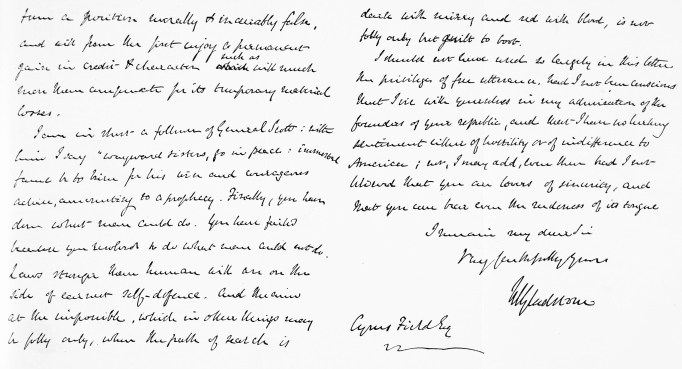
He thanked Mr. Hughes for his “kind note,” and at the same time gave to
him the letter he had written to Mr. Colfax on February 24th, and this
letter Mr. Hughes sent to the Times:
“London, 24th February, 1872.
“My dear Mr. Colfax,—Having read this morning a brief
telegraphic summary of the speech which you delivered at Brooklyn
on Washington’s Birthday, I feel constrained to address you on the
subject upon which you have spoken with so much emphasis. I refer
to the Treaty of Washington. I share your opinion that neither
nation will dare, in the face of civilization, to destroy the
treaty; but nevertheless the crisis is a grave one. It therefore
behooves every one who can assist to bring about a better
understanding on the points of difference between the two countries
to make his contribution to that end. This is my apology for
addressing you.
“The grave misunderstanding which has arisen between Great Britain
and the United States is due to the widely different manner in
which the Treaty of Washington has been from the outset interpreted
by the two nations. I have not met a single person on this side of
the Atlantic who expresses any desire “to back out” of the treaty,
or refuse the fulfilment of any one of the obligations which it is
believed to impose; nay, more, my conviction is that if the British
people were satisfied that the principle of referring vague and
indefinite claims to arbitration had somehow or other crept into
the treaty, they yet would, while passing emphatic votes of censure
on their representatives at Washington, at the same time never
dream of calling back the pledge which Lord Ripon and his
colleagues had given on their behalf.
“The excitement which followed the publication of the American case
was occasioned by the belief—universal among all classes of the
English people—that their own interpretation of the treaty was the
right one, and that indeed no other interpretation had ever been
or would be given to it. It is desirable that Americans should
remember this fact—that until the publication of the American case
nobody on this side of the water had the remotest idea that the
Washington Treaty contemplated more than arbitration with reference
to the direct losses inflicted by the Alabama and other
Confederate cruisers which escaped from British ports during our
civil war. This is not a matter of surmise; it is demonstrable on
the clearest evidence. I therefore contend that whether the public
sentiment of England be well founded or not, its existence is so
natural that even if we Americans are wholly in the right we ought
to make every allowance for it—in fact, treat it with generous
forbearance.
“So early as June 12th last, when Lord Russell, in moving a
resolution for the rejection of the treaty, charged the Americans
with having made no concessions, Lord Granville retorted by
pointing to the abandonment of the claim for consequential damages.
‘These were pretensions,’ he said, ‘which might have been carried
out under the former arbitration, but they entirely disappear under
the limited reference.’ There could be no mistake as to his
meaning, because in describing the aforesaid ‘pretensions’ he
quoted the strong and explicit language which Mr. Fish had
employed. We are bound to believe that Lord Granville spoke in
perfect good faith, especially as the American minister was present
during the debate, and sent the newspaper verbatim report of it to
his own government by the ensuing mail. When the debate took place
the ratification of the treaty had not been exchanged. If Lord
Granville was in error, why did not General Schenck correct him?
“On the same occasion the Marquis of Ripon, also replying to Lord
Russell’s taunt, remarked that ‘so far from our conduct being a
constant course of concession, there were, as my noble friend
behind me [Earl Granville] has said, numerous occasions on which it
was our duty to say that the proposals made to us were such as it
was impossible for us to think of entertaining.’ This, also, was
understood to refer to the indirect claims.
“Turning to the debate which took place in the House of Commons on
the 4th of August, one searches in vain for any remark in the
speeches of Mr. Gladstone, Sir Stafford Northcote, or Sir Roundell
Palmer which indicated any suspicion that the Alabama claims had
assumed the portentous character which now attaches to them. The
doubt which Lord Cairns at one time entertained had been set at
rest by the ministerial explanations made at the time in the House
of Lords, and not a single argument advanced in the Lower House,
either in support of or in opposition to the treaty, touched upon
the question of these claims. Even Mr. Baillie Cochrane, the
well-known Conservative member, who denounced the treaty on all
sorts of grounds, and whose avowed object was to pick as many holes
in it as possible, was unable to allege that England had consented
to an arbitration which might involve her in indefinite
liabilities.
“Sir Stafford Northcote, in the course of his humorous speech—a
speech instinct with good feeling towards the United States—said
that ‘a number of the claims under the convention which was not
adopted [the Johnson-Clarendon Treaty] were so vague that it would
have been possible for the Americans to have raised a number of
questions which the commissioners were unwilling to submit to
arbitration. They might have raised the question with regard to the
recognition of belligerency, with regard to constructive damages
arising out of the recognition of belligerency, and a number of
other matters which this country could not admit. But if honorable
gentlemen would look to the terms of the treaty actually contracted
they would see that the commissioners followed the subjects very
closely by making a reference only to a list growing out of the
acts of particular vessels, and in so doing shut out a large number
of claims which the Americans had previously insisted upon, but
which the commissioners had prevented from being raised before the
arbitrators.’ All this points unmistakably to the definite and
limited character of the claims which, in the judgment of the
English negotiators, were alone to be submitted to arbitration.
“It seems to me that Judge Williams, in the speech he made at the
banquet I had the honor to give to the British High Commissioners
in New York, expressed sentiments which can only be similarly
construed. ‘Many persons,’ he said, ‘no doubt, will be dissatisfied
with their [the Joint High Commissioners’] labors; but to deal with
questions so complicated, involving so many conflicting interests,
so as to please everybody, is a plain impossibility; but in view of
the irritation which the course of Great Britain produced in this
country during our late rebellion, and in view of the one-sided and
generally exaggerated statements of our case made to the people,
the American commissioners consider themselves quite fortunate that
what they have done has met with so much public favor in all parts
of the country and among men of all political parties.’
“That true friend of America, the Duke of Argyll, speaking in the
Upper House, was equally emphatic. ‘The great boon we have secured
by this treaty,’ he said, ‘is this: that for the future the law of
nations, as between the two greatest maritime states in the world,
is settled in regard to this matter, and that for this great boon
we have literally sacrificed nothing except the admission that we
are willing to apply to the case of the Alabama and that of other
vessels those rules, I do not say of international law, but of
international comity, which we have ourselves over and over again
admitted.’ It is impossible that the duke would have expressed
himself in language so hopeful and so contented if behind ‘the case
of the Alabama and that of other vessels’ he had seen looming up
the colossal demands which were originally embodied in Senator
Sumner’s memorable oration.
“The views thus put forward sank deep into the public mind, and the
treaty was accepted and ratified by popular opinion on this basis.
General Schenck, several months after the delivery of the above
speeches, in addressing a Lord Mayor’s banquet at the Guildhall,
bade the English ministry and Lord Ripon ‘congratulate themselves
upon the success with which they have endeavored to bring about
friendly relations between the United States and Great Britain.’
“People here ask how he could congratulate the British government
if he knew all the while that their construction of the treaty,
which was to cement the friendship of the two countries, fatally
differed from the construction put upon it by the government at
Washington.
“I have not given my own but the English view of the matter. When
such momentous issues are at stake—when a false move on the
diplomatic board may endanger the peace of two kindred nations—it
is absolutely necessary that our people should know what is the
English side in this controversy. The first duty of a loyal
American citizen is to ascertain the whole truth, and not by
ignorance or obstinacy to commit himself to a wrong course.
“Many hard words have been lately spoken and written about Mr.
Gladstone. I therefore feel it incumbent upon me to bear my
testimony to the large and statesmanlike view of American affairs
which he has taken for several years past, and to the cordial good
feeling he has shown towards our country since he has been at the
head of the present government. In spite of temporary
misunderstanding, I will continue to hope that the Treaty of
Washington will bear the fruit which he anticipated; that, to quote
his own eloquent words in the House of Commons on the 4th of
August, that treaty will do much ‘towards the accomplishment of the
great work of uniting the two countries in the ties of affection
where they are already bound by the ties of interest, of kindred,
of race, and of language, thereby promoting that strong and lasting
union between them which is in itself one of the main guarantees
for the peace of the civilized world.’
“With great respect I remain,
“My dear Mr. Colfax,
“Very truly your friend,
“Cyrus W. Field.”
Mr. Bright wrote to him at this time:
“This trouble about the treaty is very unfortunate. I think your
letter admirable, and I hope it will do good in the States, where,
I presume, it will be published. I confess I am greatly surprised
at the ‘case’ to be submitted to the Geneva tribunal. There is too
much of what we call ‘attorneyship’ in it, and too little of
‘statesmanship.’ It is rather like a passionate speech than a
thoughtful state document. And what a folly to offer to a tribunal
claims which cannot be proved. No facts and no figures can show
that the war was prolonged by the mischief of the pirate ships; and
surely what cannot be proved by distinct evidence cannot be made
the subject of an award. This country will not go into a court to
ask for an award which, if against it, it will never accept. An
award against it in the matter of the indirect claims will never be
paid, and therefore the only honest course is to object now before
going into court. Has the coming Presidential election or
nomination anything to do with this matter? Or is Mr. Sumner’s view
of the dispute dominant in Washington? I should have thought your
government might have said: ‘We will not press the claims objected
to before the tribunal, but we shall retain them in our “case” as
historic evidence of our sense of magnitude of the grievance of
which we complain.’
“This, I dare say, would have satisfied our government and people,
and practically it would have satisfied every reasonable man in the
States. To such as would not be content with it, friendship and
peace would, in the nature of things, seem to be denied.”
Soon after his return home he received the following letter, and
returned the answer to that of Mr. Bright:
“Washington, 1512 H Street, 29th March.
“My dear Mr. Field,—I cannot tell you how grieved I have been at
the difficulty which has arisen respecting the Washington Treaty.
“I do not think that anything would have induced me to accept the
appointment which brought me here but the pride I felt in taking a
part, however humble, in the execution of a treaty which I thought
the glory of the age and which seemed to me so full of promise to
all civilized nations.
“I cannot think with patience of all our hopes being dashed to the
ground by what Bright truly describes as a ‘passionate speech,’
followed by a claim utterly extravagant, from which the party
making it never expected to get a farthing.
“I confess that I should not have been afraid to go to arbitration
upon it, but I see the difficulty which any government would have
in justifying themselves to their people in leaving it to any five
persons to say whether a fine of two hundred millions should be
inflicted on them.
“You have done your part excellently, but why do not others raise
their voices against this tremendous folly which is not unlikely,
sooner or later, to lead us into war?
“I fully believe that both governments are very anxious to
accommodate matters, but I confess that I do not see how that
accommodation is to be brought about without a concession, which it
is very difficult for a government to make on the eve of a
Presidential election.
“Believe me
“Very sincerely yours,
“Russell Gurney.”
“Gramercy Park,
“New York, 2d April, 1872.
“My dear Mr. Bright,—I arrived on 25th March, after a very rough
passage of sixteen days....
“Since my return I have devoted much of my time to ascertain the
real sentiment of the people of this country in regard to the
Washington Treaty, and as far as I can judge, after seeing many
persons of different political parties, it appears to be almost
unanimous that our government has made a great mistake in including
these indirect claims in the ‘case.’ I am convinced that the best
people in England and America desire to have this question settled
in a fair and honorable manner. In fact, many say to me that they
have got tired of hearing about the indirect claims....
“With great respect and kind regards to your family,
“I remain, my dear Mr. Bright,
“Very truly your friend,
“Cyrus W. Field.”
It was while he was in London, in December, 1872, that Mr. Junius Morgan
said to him that he had just received a letter from Mr. John Taylor
Johnston about the Cesnola collection, then in London, and he asked him,
if he had the time to do so, to examine it and give him his opinion. Mr.
Field went at once to see it, and he was much impressed with its value.
Of this time General Cesnola writes:
“The officers of the British Museum had already examined the
collection, and it was perhaps on their report that Mr. Gladstone
came to see the collection; but whether he came with a view to
securing it for the British Museum or not I cannot say. Your father
asked me to drive back with him to Mr. Morgan’s office, and
suggested to Mr. Morgan (as agent for Mr. Johnston) to close the
purchase of the collection with me verbally at once, and a
payment was made on account without delay, and without waiting for
the papers to be drawn up.
“It was through your father that my collection became the property
of the Metropolitan Museum of Art. It was he who introduced me to
Mr. Gladstone, Earl Granville, Mr. Adams, then United States
minister in London; also to the Dean of Westminster and Lady
Augusta Stanley, and to many other of his English friends. He
invited a large party to meet me at dinner, and also brought many
to see my Cypriote collection. I doubt if, without the great
personal interest shown by your father, it would ever have become
the property of the Metropolitan Museum; because it was only after
this that the London press went wild over securing it for England.
“I have said, and shall always say, that it is chiefly, if not
wholly, due to Cyrus W. Field that my discoveries are in this city
to-day.”
The sale of the New York, Newfoundland, and London Telegraph Company was
made early in this year, and on July 2, 1873, he writes to Mr. Orton,
the president of the Western Union Telegraph Company:
“The New York, Newfoundland, and London Telegraph Company, having
been consolidated with the Anglo-American Telegraph Company,
Limited, drafts will hereafter be made upon your company, and
communications made in the name of the said Anglo-American
Telegraph Company, Limited.”
Among the cable messages sent during the autumn of this year these are
of interest:
“September 19th.—Great panic here in money market.”
“September 20th.—Confidently believed, reliable quarter,
government will take measures relieve market before Monday, but
thus far panic has exceeded anything ever known.”
“Saturday, October 30th.—Most of the firms that have suspended are
those that have been doing too much business for their capital, but
confidence is so shaken that many stocks are being sold at whatever
they will bring. Think perhaps have seen worst, but don’t yet see
signs permanent improvement.”
“Monday, November 1st.—Western Union sold before panic at 90. Has
sold in last few days less than 44.”
We find these entries in his diary:
“January 13th, 1874.—Arrived in London.”
“February 14th.—Sailed from Liverpool for New York in the Cuba;
fifty-sixth voyage.”
This letter followed him to New York:
“11 Carlton House Terrace,
“March 31, 1874.
“My dear Mr. Cyrus Field,—When I was about to thank you for your
kind letter of the 10th, I received that of the 17th announcing to
me the funeral of Mr. C. Sumner, and the great manifestation of
feeling which it called forth.
“His loss must be heavily felt, and his name will long be
remembered in connection with the abolition of slavery, which was
wrought out in the United States by methods so wonderful and so
remote from the general expectation.
“As respects events in this country, they have brought about for me
a great and personally not an unacceptable change. I have always
desired earnestly that the closing period of my life might be spent
in freedom from political commotion, and I have plenty of work cut
out for me in other regions of a more free and open atmosphere.
“As respects the political position, it has been one perfectly
honorable for us, inasmuch as we are dismissed for or upon having
done what we undertook or were charged to do; and as respects the
new ministry, they show at present a disposition to be quiet.
“Believe me, my dear Mr. Field,
“Yours very faithfully,
“W. E. Gladstone.”
The following extract is taken from Mr. Field’s private papers:
“The bill for the expansion of the currency, which at this period passed
both houses of Congress, after exhaustive debates, created much alarm
among the leading financial men of New York and the Eastern States.
Meetings were held at various places to protest against it, and to
request the President to exercise his veto.”
A number of the leading bankers, capitalists, and merchants of New York
assembled on April 15th at Mr. Field’s house on Gramercy Park to
consider what action should be taken in the matter. A petition very
extensively signed was read, and the following resolutions were adopted:
“Resolved, That the following gentlemen be appointed a committee
to take charge of and present the foregoing petition to the
President, bearing the signatures of all the 2500 leading bankers
and business firms of the City of New York, asking him to interpose
his veto to prevent the enactment of the Senate currency bill,
which has recently passed both houses of Congress; or any other
bill having in view the increase of inconvertible currency.
“Resolved, That the Senators from the State of New York, and such
members of the House of Representatives from this State as
entertain the views indicated in the foregoing resolution, be added
to the committee, and their co-operation invited. The members of
this committee are:
“J. J. Astor, Rev. Dr. Adams, Ethan Allen, W. H. Aspinwall, W. A.
Booth, James M. Brown, August Belmont, S. D. Babcock, S. B.
Chittenden, E. C. Cowdin, George S. Cole, John J. Cisco, W. B.
Duncan, W. M. Evarts, Cyrus W. Field, Wilson G. Hunt, B. W. Jaynes,
J. T. Johnston, A. A. Low, W. J. Lane, C. Lanier, C. P. Leverich,
W. H. Macy, C. H. Marshall, R. B. Minturn, Royal Phelps, Howard
Potter, M. O. Roberts, A. T. Stewart, J. H. Schultz, Isaac Sherman,
Jonathan Sturges, Moses Taylor, J. A. Agnew, J. D. Vermilye, G. C.
Ward, etc.”
Mr. Field, with many influential members of this committee, proceeded to
Washington with the petition, and had an interview with the President,
who promised to give the subject his mature consideration. It is thought
that the arguments adduced by the committee on this occasion had great
weight with the President, and, combined with other influences, finally
determined him to veto the bill, which he did shortly afterwards in a
message in which he committed himself strongly against any further
inflation of the currency. Had this bill passed into a law it would have
been the first step towards national repudiation, for the wedge once
inserted, it is impossible to predict how far it would eventually have
been driven, and what effect even a moderate addition to the
inconvertible currency would have had, not only on commerce, but on the
moral conscience of the nation. A return of government bonds held in
foreign countries would have been the inevitable result, and all values
would have been unsettled. Reasoning and thoughtful men foresaw the
crisis that was impending, and the country owes a debt of gratitude to
the Chamber of Commerce for its prompt action, and to President Grant
for listening attentively to the arguments of the committee for saving
the country from threatened disaster.
On May 6th, Mr. and Mrs. Field were members of a large party which left
New York for California, and on the 12th, at Omaha, Canon Kingsley and
Miss Kingsley joined them. The journey was a pleasant one, but
uneventful. Friday, May 22d, he writes:
“After breakfast I sent a telegraphic message to Dean Stanley,
informing him that Canon Kingsley was well and would preach for us
in the Yosemite Valley on Sunday.”
In his sermon on the afternoon of Whit Sunday, Dean Stanley alluded to
this message.
Early in June he sailed for England, and of his journey to Iceland,
undertaken during this summer, Mr. Murat Halstead writes:
“My judgment is that your father had no business reasons for going
to Iceland. Really the trip was a sentimental adventure. Mr. Field
had been a profound student of the North Atlantic, and was familiar
with the fact that Iceland is but nine hundred miles from Scotland
and Norway and three hundred from Greenland. ‘It seemed so near,
and yet so far.’ ... In the spring of 1874 Mr. and Mrs. Cyrus W.
Field visited Cincinnati, and at a reception given by Mr. Probasco
Mr. Field said to me: ‘Come and go with me to Iceland; it is the
millennial year of the settlement of the island. It would be very
interesting. The King of Denmark is to be there, and the whole
affair will be extraordinary.’ I asked how one could get to
Iceland, and Mr. Field had evidently made the subject a close
study. He said there were monthly boats from Copenhagen touching at
Leith, the port of Edinburgh, and we should sail from Scotland, and
Iceland was about a thousand miles from Scotland.
“Mr. Field must have gotten his impulse to go to Iceland from his
familiarity with the North Atlantic during the anxious years he
spent in studying it with reference to the cable. He was struck by
the narrowness of the ocean between Greenland and Norway, with
Iceland between just below the arctic circle. He had, of course,
contemplated a cable by way of Greenland and Iceland to Scotland if
it should be found impracticable to cross the Atlantic between
Newfoundland and Ireland. When it became known that Mr. Field was
going to Iceland there were conjectures that he thought of a cable
to the island; but that was a mere fancy. There was not a chance
for business over the line. There would be no news except of
volcanoes and the price of codfish. If there should ever be a cable
connection with Iceland it would be for the weather reports.
“I was thinking of a trip to Europe in the summer of 1874, when Mr.
Field spoke to me, and a few weeks later decided to go. Mr. Field
was going earlier than I could, and just before he sailed I
telegraphed, asking on what date it would be necessary for me to
meet him in London in order to go with him to Iceland. His reply
was, ‘July 9th.’ On my arrival at Southampton by the Bremen boat I
remembered the day was the 9th of July, and that night about ten
o’clock I found Mr. Field at the Buckingham Palace Hotel, and he
said he had been expecting me, and was waiting to see me before
going to bed. That, I suppose, was a joke, but it was not all a
joke. I found in London Bayard Taylor, going to the Icelandic
millennium for the New York Tribune, and Dr. I. I. Hayes, the
arctic explorer, going for the New York Herald; Dr. Kneeland, of
the Boston Institute of Technology, and Professor Magnussen, of
Cambridge University, an Icelander by birth. I resolved to go, and
we chartered the steam yacht Albion, Captain Howland, sailing
from Leith. Mr. Field and I made a tour through the Highlands, and,
passing Balmoral and the Earl of Fyfe’s hunting and fishing lodge,
found the rest of the party at Aberdeen, where it was necessary for
us to enlist as British seamen, and we were paid a shilling each
for our services during the voyage, which was one of great interest
and considerable hardship. We halted at the Orkney, Shetland, and
Faroe islands, at the latter place falling in with the king’s
fleet. Our Icelandic experiences are familiar, as Mr. Taylor and
Dr. Kneeland published books on the subject. Mr. Field’s Iceland
party, for he was our leader, attracted much attention—almost as
much sometimes as the king’s procession. We rode across the lava
beds to the geysers, saw Mount Hecla—and the Great Geyser would
not spout for the king.”
It will have been observed, in the course of this narrative, that with
Mr. Field, so inexhaustible was his energy, rest was only a “change of
motion.”
When he sought relaxation from exhausting business cares he found it in
fatiguing journeys, and he preferred that these should be as difficult
and adventurous as possible. This was the case in his journey to the
Andes with Mr. Church in his earlier manhood. It was the case with the
excursion in ripe middle age beyond the “furthest Thule” of the
ancients. He was now again, thanks to his own exertions, and after years
of struggle and of doubt that to others meant despair, independent in
circumstances, and, as it seemed, beyond the power of fortune, and he
was nearing his sixtieth birthday. Most men would have regarded this
condition as an occasion to “rest and be thankful.” But it was in this
condition that Mr. Field undertook a new and arduous enterprise, for
which he had had little specific training. It is evident that its very
difficulty, as in the case of the Atlantic cable, was to him an element
of attractiveness. But there was this difference between the Atlantic
cable and the elevated railway system of New York. He was the pioneer,
the projector, of the former. The latter had already been undertaken,
and practically, it may be said, to have failed. Indeed, there was no
“system” of elevated railways. The fragmentary roads that were in
operation or projected were unrelated to each other in ownership,
management, and traffic. Financially and practically they were
languishing. It will be seen from the letter which will presently be
given that the company with which he proposed to ally himself, the New
York, which possessed the franchise for Third Avenue, had been so far
from successful that sixty cents on the dollar was held to be a fair
price for its securities. It may fairly be said that the elevated
“system” is due to Mr. Field. Whoever remembers the conditions of
transit in New York before 1877, and indeed for some years after, must
own that the creation of this system has constituted a public
benefaction. Many millions have been transported, with a loss of life
that has been infinitesimal in comparison with the volume of the
traffic, at a cost no greater than that of the conveyances which the
system has superseded, and at a rate of speed that has built up the new
and large cities, one on the east and one on the west side of Manhattan
Island, which before it went into operation were outlying districts,
practically inaccessible to busy men for purposes of residence. It was
on May 16, 1877, that Mr. Field made this entry in his diary:
“Bought this day a controlling interest in the New York Elevated
Railroad Company and was elected president of the company.”

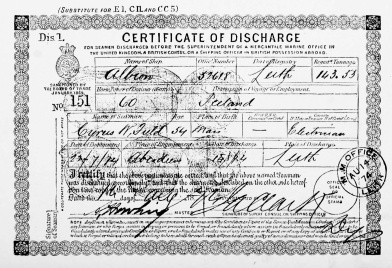 CERTIFICATE OF DISCHARGE
Some of the conditions on which he had made this investment and venture
are set forth in the following letter to his friend, Mr. John H. Hall:
“New York, 14th May, 1877.
“My dear Mr. Hall,—It is possible that I may purchase a majority
of the stock of the Elevated Railroad, but before deciding I wish
to ascertain whether, if I do, you will remain in the board with
Mr. David Dows, myself, and some other gentlemen of character and
financial strength, and also whether you will take bonds at sixty
cents for the debt now due you. If I have anything to do with the
company I want it free from all floating debt, and everything
purchased at the lowest price for cash.
“Mr. Dows has told me this morning that he will remain in the board
and will take bonds for the $25,000 due him, provided I make the
purchase and accept the presidency of the company.
“Will you have the kindness to see our mutual friend, Mr. A. S.
Barnes, and ascertain whether he will take bonds for the debt due
him and remain as a director. If I go into the concern I shall be
willing to be president, but without salary, for the enterprise,
to be a success, must be managed in every way with the greatest
economy.
“An early answer will oblige.
“Very truly your friend,
“Cyrus W. Field.”
His promptitude and energy are shown in the fact that on June 4th, less
than three weeks after he took charge, a public meeting in favor of
rapid transit was held.
“The Evening Post,
“New York, June 4, 1877.
“To Cyrus W. Field, Esq.:
“I cannot be present at the meeting to be held this evening at
Chickering Hall, but I am heartily with you and your friends in
the object of the meeting. I hope that a decided expression will be
given to the conviction that an absolute necessity has arisen of
instituting some method of conveying passengers between the upper
and lower parts of the city which shall unite the greatest
convenience with the utmost possible speed.
“Yours faithfully,
“Wm. C. Bryant.”
Mr. Charles O’Conor wrote on the same day to the chairman of the
meeting:
“I much regret my inability to attend the meeting in favor of rapid
transit, the state of my health not admitting of my doing so. I
fully sympathize, however, with the objects sought to be obtained,
and here repeat the remarks which I made in closing my address
before the New York Historical Society at the Academy of Music on
the 8th of last month:
“ ‘It is said, and doubtless with truth, that the great cities have
hitherto been destroyers of the human race. A single American
contrivance promises to correct the mischief. The cheap and rapid
transportation of passengers on the elevated rail, when its
capacity shall have been fully developed, will give healthful and
pleasant homes in rural territory to the toiling millions of our
commercial and manufacturing centres. It will snatch their wives
and children from tenement-house horrors, and, by promoting
domesticity, greatly diminish the habits of intemperance and vice
so liable to be forced upon the humbler classes or nurtured in them
by the present concomitants of their city life.’ ”
On the 26th of September of this year the new president wrote:
“I believe that the early completion of the New York Elevated
Railroad from the South Ferry, passing Wall, Fulton and Catharine
Street ferries up the Bowery and Third Avenue to the Grand Central
Depot, will be a benefit to the three great railroads the trains of
which start from the depot.”
And on the 1st of November, 1878, he was able to report to the
directors:
“It is not eighteen months since I purchased from some of your then
directors a majority of the stock of your company at such a price
that to-day it sells for more than five times as much as it cost
me; and at the same time I bought from the same parties a very
large amount of bonds, and to-day they sell for more than double
what they cost me, including seven per cent. interest to date. The
above stock and bonds I purchased on the express condition that the
contracts of the company with certain parties to build this road
for one million two hundred thousand dollars per mile ($1,200,000),
payable one-half in stock and the balance in first mortgage bonds
of this company at par, should be cancelled. The amount that has
been saved to this company by the cancelling of this contract you
all well know.”
William O. McDowell, in Harper’s Magazine for June, 1893, writes:
“At the time of the strike of the engineers on the elevated road in
New York I had a part in bringing the representatives of the
engineers and the late Cyrus W. Field, a director in the elevated
company, to a meeting that resulted in a quick understanding
between the conflicting interests and an ending of the strike. Mr.
Field was so pleased with the fairness of the committee
representing the engineers with whom he had to deal that he invited
them at once to dine with him at Delmonico’s, an invitation which
their representatives declined for them, fearing that its
acceptance might be misunderstood. Mr. Field, however, continued to
feel that he wished to extend some social courtesy to the employés
of the elevated road, and at a later date, when he was all-powerful
in that corporation, he issued a formal invitation to the employés
to a reception at his house. To a large number the initials ‘R. S.
V. P.’ on the lower corner of the invitation were a great mystery,
and, as the story goes, the invited compared notes and sought an
explanation of them. At last one bright young man announced that he
had discovered what they meant, and he explained to the others that
‘R. S. V. P.’ stood for ‘Reduced salaries very probable.’ ”
This story is true, but the end is not given. The men accepted the
invitation, enjoyed their supper, and listened with great interest to a
speech made by Mr. Peter Cooper, which lasted over an hour. Mr. Cooper
told the men of New York as it was in 1800, and the story of his life.
Dean Stanley preached in Calvary Church on Sunday evening, October 7,
1878. He came to Mr. Field’s home at Irvington the following morning.
Soon after breakfast on Tuesday the family realized that their guest was
more familiar with the history of this part of the country than they
were. It was just above Tarrytown that Major André had been captured; he
was executed across the river. That was enough to excite the curiosity
of the visitors, and at dinner on Tuesday evening it was proposed to the
dean that the next morning he should cross the river to Tappan and find
the spot. This was not easily done; no one knew the exact place. There
was Washington’s headquarters, and he had closed his shutters so as not
to see André hanged, so that the scene of the execution must have been
near that house. At last an old man of over ninety came and said that in
1821, when André’s body was removed to England, he had stood by and had
seen the grave opened; and that the roots of an apple-tree, which he
pointed out, were twisted about the head of the coffin. The drive had
been so long that it was past three o’clock before the party returned;
and not until dinner did they tell that their search had been
successful. It was then that Mr. Field said: “Mr. Dean, if you will
write an inscription I will buy the land and put up a stone, and then
the place will be known.” His idea was simply to mark an event in the
history of the country; but a part of the press insisted that an
American had erected a monument to a British spy, and this was
reiterated far and wide, and flew from the Atlantic to the Pacific.
Dean Stanley felt this keenly, and wrote:
“If you find that there is really a feeling against it, pray do not
think of it. The game is not worth the candle. Poor Major André,
engaging as he was, is not worth the rekindling forgotten
animosities.”
The monument was twice injured by explosion of dynamite. After the
second of these, on November 3, 1885, Mr. Field refused to replace the
stone. He said that the spot was now sufficiently marked. On the stone
were these words:
Here died, October 2, 1780,
Major John André, of the British Army,
Who, entering the American Lines
On a Secret Mission to Benedict Arnold,
For the Surrender of West Point,
Was taken Prisoner, tried, and condemned as a Spy.
His Death,
Though according to the stern code of war,
Moved even his enemies to pity,
And both armies mourned the fate
Of one so young and so brave.
In 1821 his remains were removed to Westminster Abbey.
A hundred years after the execution
This stone was placed above the spot where he lay
By a citizen of the United States, against which he fought,
Not to perpetuate the record of strife,
But in token of those better feelings
Which have since united two nations
One in race, in language, and one in religion,
With the hope that this friendly union
Will never be broken.
———
Arthur Penrhyn Stanley, Dean of Westminster.
The twenty-fifth anniversary of the signing of the first cable contract
was remembered on the evening of March 10, 1879. To use the words of the
New York Evening Post:
“It was a notable anniversary which Mr. Cyrus W. Field celebrated
last night, with the assistance of a multitude of his
fellow-citizens, many of them eminent in various departments of
public life. The obvious sentiment of the occasion, and the words
with which everybody would describe it, are contained in the
telegraphic message sent from Westminster Abbey by Dean Stanley,
who calls it the ‘silver wedding of England and America,’ and says:
‘What God hath joined together let no man put asunder.’ The event
which was commemorated is scarcely more remarkable than the rapid
advance of all nineteenth century events which the recollection of
this one suggests. It is only twenty-five years since a determined
effort was made to realize what had been wildly dreamed of; it is
considerably less than twenty-five years since the dream became a
reality; yet already instantaneous communication between the Old
World and the New has been consigned to the commonplace book of
history. It has become one of those familiar things which we forget
all about because they are familiar, but which are also
indispensable, as we would be sharply reminded if we should lose
them for a day, or an hour—things which are of the highest value,
but of which it is hard to speak without talking platitudes. With
this great event the names of Mr. Field and other men of business
whose intelligence, liberality, and energy make the work of Morse
and other men of science a practical triumph will be always and
honorably associated.”
A short extract is given from the speech of Rev. Dr. William Adams:
“I have no intention of saying a word in laudation of the Atlantic
cable. The time for that has passed. ‘He is of age: ask him: he
shall speak for himself.’ Though the ear catches no articulate
words passing along its quivering strands, yet this polyglot
interpreter is speaking now, with tongue of fire, beneath the
astonished sea, in all the languages of the civilized world.”
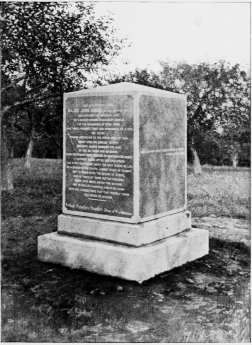 THE ANDRÉ MONUMENT, TAPPAN, NEW YORK
CHAPTER XV THE PACIFIC CABLE—THE GOLDEN WEDDING (1880-1891)
THE winter and early spring of 1880 were passed in the South of France
and in Algiers.
Mr. Field was back in New York in April; and on the 8th in a letter
says:
“I have already written to London in regard to the estimated cost
of manufacturing and laying a telegraphic cable across the Pacific.
The route I have suggested is as follows: One cable from San
Francisco to the Hawaiian Islands; one cable from the Hawaiian
Islands to Japan; one cable from the Hawaiian Islands to Australia,
touching at the Fiji Islands and New Caledonia.”
In a letter to England on the 9th, he writes that he had received a
letter from Washington in which the hope was expressed that he would
give some attention to the transpacific cable before he left America. He
answered the question as to the expense of manufacturing a cable
briefly: “A submarine cable, like a watch, can be manufactured at a
great variation in price.”
The two letters that follow were sent to Washington, the first on August
19, 1880:
“Referring to my letters to you dated May 26th and June 10th, in
relation to a telegraphic cable across the Pacific Ocean, I would
suggest:
“1. That the United States government obtain from some eminent
electrician specifications for the best description of cable
suitable for the great depths and the great lengths required to
connect the western with the eastern coasts of the Pacific.
“2. That the government advertise for tenders to manufacture and
lay such description of cable, one-fourth the amount to be paid
when the cables are all manufactured, one-fourth when they are on
board the steamers and the steamers ready to sail, one-fourth when
the cables have been successfully laid, and the remaining fourth
when they have been worked successfully and without interruption
for thirty days.
“By adopting this course I think you would obtain a good cable at
the lowest price.
“The government could pay for such a cable by selling its four per
cent, bonds, having a long time to run, at a considerable premium;
and the revenue from such a cable would, in my opinion, steadily
increase from year to year, and at no distant day be a source of
revenue to the country.”
“I thank you for your letter of yesterday, and for the interest you
are taking in the matter of the proposed Pacific cable.
“Have you ever written to the American ministers in Japan and China
on the subject? If the United States government desired it, and
took the proper steps, I think that England, Russia, France, Japan,
and China would each do something towards encouraging the
enterprise.”
The latest mention I find of this project is on the 30th of April, 1884,
and then it is suggested as only possible as far as the Sandwich
Islands, and that it would cost £650,000. There had been no enthusiasm
shown, and as no company had been formed the grant given on March 10,
1879, had become valueless; but as long as his brothers dined with him
the thought of a Pacific cable was recalled by the favorite toast of Mr.
David Dudley Field, who would say, before the family left the table,
“And now, Cyrus, we must not forget to drink to the world encircling.”
The recent revival of the subject has evidently been rather political
than commercial. It was during the summer of 1880 that this was written:
“I decided some weeks ago upon leaving New York, on my trip around
the world, on October 13th, provided I could find some Democratic
friend who would pair off with me; and if I cannot accomplish this
I shall wait and vote on November 2d, and leave on the 3d.”
And on September 13th:
“It appears to me to be all-important that the Republican party
should carry the election in Indiana in October.... I have now
decided not to leave for San Francisco until after the Presidential
election.”
And two days later, September 15th:
“After mature reflection, I have determined to remain until after
the election and do all I possibly can to secure the success of the
Republican ticket by working until the polls close on the evening
of November the 2d, and then leave on the morning of the 3d for San
Francisco, and sail from thence in the Oceanic on the 18th.... By
remaining and working I hope to induce others to vote for our
mutual friend, James A. Garfield.”
These letters were sent to the New York Historical Society on September
17th and 20th:
“I am glad to hear that it is proposed to erect a monument to
Nathan Hale. Many years ago I joined with others in such a memorial
at Coventry, Conn., where he was born. But one ought to be erected
in this city, and, if possible, on the very spot where he died.
That spot you have, I understand, ascertained to be at or very near
the armory of the Seventh Regiment. What an inspiration would a
monument there be to our young soldiers! There ought to be
inscribed on it his own immortal words: ‘I only regret that I have
but one life to give for my country.’
“If the New York Historical Society will obtain permission to have
a monument erected there, I will, with pleasure, bear the whole
expense.”
“I have the honor to acknowledge the receipt of your letter 18th
instant.
“Enclosed I send you a printed slip of an inscription which I
propose to put upon the stone which marks the spot where Major
André was executed, should the New York Historical Society decide
to accept the same, as suggested by me in a verbal conversation
with Mr. George H. Moore.”
This letter was received on September 30th:
“Cyrus W. Field, Esq, New York:
“Dear Sir,—A few of your neighbors and personal friends are
desirous of meeting you in a social and informal way before you
start upon your tour round the world. They will be glad if you will
give them the pleasure of your company at dinner on some evening in
the latter part of October. Tuesday, the 26th, is suggested as a
suitable time; but if any other day will better comport with your
convenience, you have only to name it. They are not willing you
should go away without their greeting and God-speed.”
In his reply to the toast to his health he said:
“Some of you began your business and professional life with me, and
it will be pleasant to take so many of my old friends by the hand
and to receive their kind wishes for a prosperous journey and safe
return.”
Mr. Field thoroughly enjoyed the evening. General Horace Porter closed
his speech with these words:
“Now let me simply say that beyond the sentiment of friendship we
all have a profound admiration for one who, at a period of life
when most men, having surrounded themselves with the rich things of
earth, in personal comfort, art, and literature, would be content
to retire to some shady Arcadia and enjoy the rest to which they
were so fully entitled, is bristling with all the activity of
youth, seeking new worlds to conquer and projecting new
enterprises.
“I know I speak the sentiment of all in saying that the hearty
leave-taking and hand-shaking will be surpassed by the cordial
welcome extended to him when, after passing over many lands and
many seas, he will gladden the hearts of his fellow-countrymen by
once more setting foot upon his native shore.”
He left New York, as he proposed, at four o’clock on the morning of the
3d of November, and it will surprise no one who knew him to hear that he
was in the South of France early in March and arrived in New York on May
the 15th.
“Department of State,
“Washington, D. C., 23d May, 1881.
“My dear Mr. Field,—Welcome, thou wanderer! We intend now to
anchor you for some time in your native waters.
“Your arrival is timely. You can be of great service to the country
and to the administration, which counts you among its chief
friends....
“Hastily and truly,
“James G. Blaine.”
And on June 3d:
“With reference to your kind invitation to visit you at Irvington
on the Hudson about the 29th of June, I beg to say for myself that
it is doubtful as to whether I shall be able to accompany the
President upon his proposed visit to Williams College. Should I do
so, however, it would give me the very greatest pleasure to accept
of your hospitality. I have taken the liberty to transmit your
letter to the President, and presume that he will write you
directly with reference to his ability to become your guest.”
This entry was made in his diary on June 6th:
“I have invited President Garfield to come to Irvington for a visit
and then go to Williamstown for Commencement on July 6th.”
To quote again from his private papers:
“Mr. and Mrs. Garfield, with several members of the Cabinet and
their wives, were to come to us at Irvington, pass Sunday with us,
and on Monday leave for Williamstown. It was as Mr. Garfield was
leaving Washington, that he was shot in the Pennsylvania depot.”
In a letter he writes:
“When the first excitement had in a measure subsided, I wrote to a
friend in Washington and asked if in case of Mr. Garfield’s death
his family would be left in comfortable circumstances.”
It was on July 6th that he sent this message by cable and telegraph to
friends in Europe and America:
“If President Garfield should die from the wounds received on 2d
instant he would leave for his wife and five children about
$20,000. I shall to-morrow, Thursday, morning exert myself to the
utmost to raise a sum of money to be presented to him at once, as I
feel confident it would help his recovery if he knew that in the
event of his death his family would be provided for. I shall
cheerfully subscribe $5000 towards the sum to be raised. If you or
any of your friends would like to join, please telegraph to me
early to-morrow, Thursday, for what amount I may put your name, and
oblige.”
The subscriptions were from $5000 to a ten-cent piece (given by an
office-boy), and there was deposited in the United States Trust Company
$362,238 52.
A silver coin of the value of ten cents was sold, and he sent this note
to the child who made the donation:
“145 Broadway,
“New York, 15th July, 1881.
“My dear young Friend.—I was very much pleased to read your nice
letter enclosing the silver coin you had kept so long. I showed
your letter to a gentleman who came to see me at my office, and he
kindly said he would give one hundred times the value of the coin,
and handed me twenty dollars in exchange for it and your letter,
so that you see your little offering to Mollie Garfield’s mamma has
realized quite a large sum.
“I thank you very much for your contribution, and am
“Very truly your friend,
“Cyrus W. Field.”
“Mr. Field:
“Dear Sir,—I thought it was very funny to see my little letter
printed in the newspaper, and I think it was so kind of that
gentleman to give twenty dollars in my name. I wish I knew who it
was, so I could thank him for it. Will you please thank him for me?
I am seven years old.
“Berdie Hazelton.
“I don’t know Mollie Garfield very well, for I never saw her, but I
am so sorry for her, ‘cause her poor papa got shot.”
With the invitation to attend the Garfield memorial service came this
note:
“Washington, February 18, 1882.
“My dear Mr. Field,—You must come to the address on the 27th,
Monday. You will go on the floor with me. I should feel that my
audience was incomplete if you were not present.
Sincerely,
“James G. Blaine.”
As he had received the thanks of Congress, he was entitled for life to
the privilege of going upon the floor.
A message sent from the Yorktown celebration, in October, 1881, to Mr.
Gladstone, called forth this answer:
“Hawarden Castle, Chester,
“October 21, 1881.
“Dear Mr. Cyrus Field,—I thank you for your telegram. The
gratifying intelligence which it contains may probably come through
another channel. In the meantime, unofficially, I express the hope
that we may one and all consider it a personal duty to cherish and
foster the feelings so admirably expressed in the President’s
order, and prevailing, happily, alike on both sides of the
Atlantic.
“I remain, very faithfully yours,
“Wm. E. Gladstone.”
In April, 1882, he suffered quite a disagreeable experience. One evening
a police officer and two or three gentlemen came to the house, bringing
the torn and burned remains of a package addressed to him. It had been
in the mail-bag which a postman threw on the platform of the Third
Avenue elevated road as he stepped off the train. As the bag fell there
was an immediate explosion, and, upon examination, the box and wrapper
of the package were found. The wrapper was an old German newspaper with
Mr. Field’s name on it, and another like package in the bag bore the
name of Mr. Wm. H. Vanderbilt.
He took the matter very calmly, only afterwards telling the butler that
no package brought to the house must be delivered until it had first
been plunged in a bucket of water. This order spread consternation among
some members of the family, who trembled for their new spring clothes.
On August 25, 1884, he left Tarrytown in the car “Railway Age,” with
several members of his family, for a journey that lasted six weeks, and
during that time he travelled 11,000 miles by rail and 300 by boat. On
September 12th he left Portland, Oregon, for Tacoma, and early on the
morning of the 13th, as he was waiting at Utsaladdy for the tide to
carry the North Pacific, the boat he was on, through Deception Pass,
went on shore, and found that it was from this place that the wooden
mast for the Great Eastern had been cut. It was sent to England by
the way of Cape Horn.
September 22d he joined Sir Donald Smith and his party at Silver
Heights, and his car was attached to their special train. Four days were
given to crossing the Rockies and returning to Winnipeg, to the then
western terminus of the Canadian Pacific. On the afternoon of September
24th the cars stopped in front of a large tent; it was the station, and
has since been known as Field.
A few hours earlier, as we all stood looking up at Mount Stephen, and
then off at the mountains, Sir Donald Smith turned to Mr. Field and
said, “That is Mount Field.” One of the employés of the road suggested
that it had been already named, but that was of no account; Sir Donald’s
word was law, and Mount Field it became.
It was upon one of his Western journeys that he stopped at a telegraph
office, wrote a message, and handed it to the clerk to send. Instead of
turning at once to his instrument, the man studied Mr. Field intently,
and then said, “Are you the original Cyrus?”
On his return home he was much interested in the Presidential election;
but he accepted the result quietly, and wrote to a friend:
“I thank you for what you say in regard to the election. Whoever
has received a majority of the votes will be declared elected. I do
not know of any human being who wishes to defeat the popular will
when known. In my own opinion, no one can tell who is elected until
after the official count.”
This year was that of the long and painful illness and affecting death
of General Grant. Mr. Field’s sympathy with the sufferer was intense,
and it was with regret that he received this letter, and also one from
one of General Grant’s sons, to which he refers in his answer:
“New York City, January 6, 1885.
“My dear Sir,—Through the press and otherwise I learn that you,
with a few other friends of mine, are engaged in raising a
subscription for my benefit. I appreciate both the motive and the
friendship which have dictated this course on your part, but, on
mature reflection, I regard it as due to myself and family to
decline this proffered generosity.
“I regret that I did not make this known earlier.
“Very truly yours,
“U. S. Grant.
“Cyrus W. Field, Esq.”
“6th January, 1885.
“My dear General Grant,—I have this moment received your letter
of this date, and I shall, as requested in the letter from your
son, send a copy immediately to Messrs. A. J. Drexel and George W.
Childs, of Philadelphia; to General W. T. Sherman, St. Louis, and
Mr. E. F. Beale, of Washington.
“I have for several days been very anxious to call and see you, but
have been prevented by press of business and a severe cold.
“With great respect, I remain,
“Dear General Grant,
“Very truly your friend,
“Cyrus W. Field.”
He was in London part of the summer of 1885, and the extracts that
follow are made from a letter written to the New York Tribune by Mr.
Smalley on July 5th, in which he gives an account of the Fourth in
London, and of a dinner given on the evening of that day. There were but
thirty present, and only eight Americans.
“The toast of the evening was proposed by Mr. Field, and responded
to first by the American minister and then by the Duke of Argyll.
Mr. Phelps’s speech had the one fault of being too brief. All he
said was to the point, and was said with genuine feeling and in
good taste. The duke has grown to be a venerable figure.... He
speaks to-night with a depth of regard for America and Americans
which goes straight to every American heart. The best friends of
his life, he tells us, have been Americans—Prescott, Charles
Sumner, Motley, Longfellow, and his host, Mr. Cyrus Field. He has
brought back vivid memories of his brief visit to America, and
paints for us one or two vivid pictures of American scenery and
American life. He rejoices in our joy; in our independence; in the
triumph of the Union over the rebellion; in the triumph we have
since won here in England over English unfriendliness. And he says,
truly, that it is difficult now to find an Englishman who is not
convinced he was on our side all the time.
“Mr. Bright followed. He is seldom heard in these days.... He gave
us of his best. He went back to the days of the civil war, when, as
he told us, and as I have heard him say often, he used to spend the
week in anxious expectation of the news which the Saturday steamer
was to bring of events in America, I forget whether it was in this
speech or later in the evening that Mr. Bright described the
emotion with which he received the tidings of the defeat of Bull
Run. At the first moment he thought, as so many of us in America
thought at the first moment, that all was over. ‘No calamity ever
seemed to me greater,’ said this English friend of America. The
ultimate victory of freedom over slavery filled his life with
happiness.... If anything could make us free-traders it might well
be Mr. Bright’s eloquence, and his unequalled power of seeing the
one side of the question in which his faith is so fervent. As long
as I hear his voice I suspend my convictions....
“This dinner of Mr. Cyrus Field’s, though private in one sense, was
pretty fully reported in the London papers.... Mr. Field’s health
was proposed by the Duke of Argyll, and drunk with all the honors.
Telegrams were read to and from General Grant and the President of
the United States.”
Just a month later Mr. Phelps, then American minister in London, wrote
to Mr. Field:
“You will be glad to know that I have a message from the Queen, who
desires to send a representation to our service. I have also a
telegram that Mr. Gladstone will attend, and Lord Harrowby, Lord
Privy Seal, for the government.”
The service referred to was the eulogy on General Grant, delivered at
Westminster Abbey, on August 4th, by Archbishop Farrar.
To this service these two letters also refer:
“August 6, 1885.
“My dear Mr. Field,—I had a long search for you among the crowds
at Westminster, after the service, when I found that you were not
among those bound to the dean’s lodging, but failed to find you,
and I therefore write a line to thank you for having asked me to
attend the service in memory of our great friend, as I was grateful
for the opportunity to be again among so many of your countrymen,
and to do honor to the memory of a most remarkable citizen.
“I think Farrar’s oration was excellent, and the place—the common
shrine of so much of our past glories, to which both nations can
equally look with pride—a very fitting one for the expression of
our common mourning.
“Believe me, dear Mr. Field,
“Yours very truly,
“Lorne.”
This is from Professor Roswell D. Hitchcock, of the Union Theological
Seminary in New York:
“I hardly need say how glad I am that such a service has been
provided for. Your countrymen owe you much gratitude for the lead
you have taken in the matter.”
It was after his return home this year that this telegraphic
correspondence occurred between him and his brothers and Mr. George
Bancroft, then at Newport:
“Most hearty congratulations on your eighty-fifth
birthday—congratulations which we hope to renew for many years to
come.
“David, Stephen, Cyrus, and Henry Field.”
“Dear David, Stephen, Cyrus, and Henry Field,—Thanks for your
good-will, and when I am gone keep the departed traveller kindly in
memory.
“Ever yours,
“George Bancroft.
“6th October.”
Mr. Field was again in London in 1886, and was at a dinner given on July
16th by the Liberal Club to Mr. Chesson, who, in his speech, said:
“My personal acquaintance with Mr. Field dates back for more than
twenty years—from the period when the first Atlantic cable was
laid; and I had reason then, as I have had greater reason since, to
admire his indomitable perseverance, his unwearied patience, and
his great ability. I was for a time on board the Great Eastern
with him in 1866, when the Atlantic cable was successfully laid and
permanent telegraphic communication established between the two
continents. I saw him daily, and held constant social intercourse
with him until the splicing of the shore end of the cable with the
huge coil which filled the vast tank of the Great Eastern took
place; and I noticed that there was nothing in his demeanor to
distinguish him from other persons on board, although when some of
us cast wistful looks at the big tank we knew that it contained all
his worldly goods, and, for aught he knew to the contrary, his
fortune was destined to be buried, with the cable, at the bottom of
the Atlantic.”
The last of August and part of September this year were spent in another
journey to the Pacific coast, in which he was much impressed with the
marvellous beauty of the Canadian road.
From a New York paper of November, 1886, this is taken:
“Mr. Field has fought almost since the very beginning of the system
as a public conveyance for a uniform charge of five cents at all
hours for passengers on all the New York elevated lines, and the
morning of the 1st of October, 1886, first saw the complete
victory which attended his effort in this direction.”
When, in 1882, he bought a large tract of land in the valley of the Saw
Mill River, adjoining on the east his home at Irvington, he intended
building there a number of small but comfortable houses for working-men.
Around each house he proposed that there should be a plot of ground, and
the rent was to be from ten to twenty dollars a month for house and
land. The building of the new aqueduct made it impossible for him to
carry out at once this project, and before the aqueduct was completed he
suffered, in 1887, heavy financial losses from the sudden decline of the
stock of the New York elevated roads, in which he was so largely
interested.
The last message that passed between Mr. Field and Mr. Bright was on the
11th of December, 1888, when he cabled:
“The Right Hon. John Bright,—Your friends in America read with
interest the news that comes daily from your sick-room. Accept the
affectionate remembrance of one who has known and loved you for
more than a quarter of a century.
“It may comfort you in your long illness to know that your name is
on the lips and in the hearts of millions on this side of the
Atlantic, who can never forget how you stood by the cause of their
country.
“Cyrus W. Field.”
December 2, 1890, was a day that his family had long looked forward to.
It was on this day that these messages and telegrams were received, and
that many friends came to offer their congratulations. Among the
messages of good-will was this poem from President Henry Morton, of the
Stevens Institute:
“MR. AND MRS. CYRUS W. FIELD
“ON THE FIFTIETH ANNIVERSARY OF THEIR MARRIAGE
“Golden light the sun is shedding,
Ushering in this golden wedding,
As he did on that bright day
Fifty golden years away.
Then as now the ‘golden flowers,’
Lingering after summer’s hours,
The chrysanthemums, foretold
Anniversary of gold.
Golden love and golden truth
To gold age from golden youth,
In the fire of life, thrice tried,
Pure themselves, yet purified
By the sorrows borne together,
By the stress of stormy weather;
This pure gold, outlasting earth,
Proves its own celestial birth,
And shall shine with golden light,
Star-like, from heaven’s dome of night.”
“Cyrus W. Field, Esq., Gramercy Park, New York:
“Dear Sir,—We, the undersigned, who have known you for many
years, and some of whom have been long and intimately associated
with you, desire to express to you and to your amiable and devoted
wife our earnest and heartfelt congratulations on your
golden-wedding day, the 2d of December, 1890.
“We earnestly wish you both many years of health and happiness,
enjoying the fruits of your useful and well-spent lives, and seeing
on every side the wide-spreading development of the submarine
telegraph enterprise in which you, Mr. Field, have labored so long,
so zealously, and so successfully. This great work, pursued by you
with unflagging energy and perseverance for many years, through the
greatest difficulties and hinderances, has now become a first
necessity of national and commercial life, and you have the
profound satisfaction of knowing that its object and its results
are, and ever have been, peaceable and beneficent in their
character.
“We ask you to accept this message of our good-will and good
wishes, which will be sent to you both over and under the sea.
Very faithfully yours,
| Frederic W. Farrar, | Julius Reuter, |
| Mouck, | H. A. C. Saunders, |
| W. E. Gladstone, | G. W. Campbell, |
| W. H. Russell, | H. M. Stanley, of Alderley, |
| Douglas Galton, | John H. Puleston, |
| Tweeddale, | George Cox Bompas, |
| Henry C. Forde, | James Stern, |
| W. Andrews, | H. L. Bischoffsheim, |
| H. Weaver, | Louis Floersheim, |
| G. von Chauvin, | T. H. Wells, |
| J. H. Carson, | J. H. Tritton, |
| Samuel Canning, | W. H. Preece, |
| Richard C. Mayne, | C. V. DeSauty, |
| C. W. Earle, | George Grove, |
| Catherine Gladstone, | Jane Cobden, |
| J. S. Forbes, | Thomas B. Potter, |
| Caroline Roberts Van Wart, | Charles Burt, |
| G. W. Smalley, | Margaret Anderson, |
| Gerald Harper, | Robert C. Halpin, |
| William Barber, | Edward Satterthwaite, |
| L. M. Rate, | Frank H. Hill, |
| John Muirhead, | J. C. Parkinson, |
| George Draper, | William Payton, |
| Richard Collett, | Henry Dever, |
| W. Leatham Bright, | Kenneth L. M. Anderson, |
| Latimer Clark, | Charles W. Stronge, |
| R. T. Brown, | Oscar Wilde, |
| F. A. Bevan, | Lewis Wells, |
| H. D. Gooch, | John G. Griffiths, |
| W. Thomson, | Robert Dudley, |
| G. Shaw Lefevre, | Emily F. Lloyd, |
| J. Russell Reynolds, | Ch. Gerhardi, |
| John Pender, | W. T. Ansell, |
| James Anderson, | Julian Goldsmid, |
| W. Cunard, | John Chatterton, |
| William Ford, | Frances Baillie, |
| George Elliot, | Constance Wilde, |
| George Henry Richards, | B. Smith, |
| W. Shuter, | John Temple, |
| Henry Clifford, | Montague McMurdo, |
| Willoughby Smith, | Philip Rawson.” |
“Winchester House,
“50 Old Broad Street,
“London, December 3, 1890.
“My dear Mr. Field,—It came to my knowledge last month that the
2d of December was the golden-wedding day of Mrs. Field and
yourself. It happened when we were in Paris at the telegraph
conference in the month of June that my birthday occurred, aged
sixty-six. (Is it not terrible that one should be so old?) But it
was also fifty years since I went to sea as a sailor boy, and it
was just twenty-five years since we made our first voyage in the
Great Eastern.
“Mr. Charles Burt, who was in Paris representing the Anglo-American
Company, was kind enough to get up a dinner in my honor, and I was
presented with an illuminated memorial or address. It occurred to
me that it would be a pleasing act on our part to get up a similar
address upon the occasion of your golden wedding, and no doubt you
would have the result yesterday.
“Mr. Charles Burt and the staff of the Anglo have cordially done
all they could to get as many names as we could recall, but as they
are a good deal scattered it has taken more time than we
anticipated. Then, oh, how many have passed away! It is like
calling the roll after a battle—so few could be found. We are
to-day trying to get at a few more, who we feel sure would like to
add their names. I was looking up Sir William Drake, but he was too
ill, and died this morning....
“Now, my dear Mr. Field, let me once more wish Mrs. Field and
yourself every sort of kind good wish. The days and years are
rolling away, and we may well cling to the memory of exciting and
active days when we were twenty-five to thirty years younger and
the future filled with nervous uncertainties.
“Always yours sincerely,
“James Anderson.”
“In the glow of the morning was the song of rejoicing,
Ye twain are now one till death shall you part;
In the calm of the evening is the song of thanksgiving,
Ye twain are still one in life and in heart.
“It was faith in the morning, it is knowledge this evening,
We sang of the future, we sing of the past;
But this jubilee hour finds the refrain unchanging,
We twain are still one, only one at the last.
“We wait in the evening for the dawn of the morrow,
But the song of our lives will not end with the day;
‘Midst the music celestial hear the anthem of glory—
We twain are still one, for ever and aye.”
D. J. B.
CHAPTER XVI LAST DAYS AND DEATH—IN MEMORIAM (1891-1892)
THE golden wedding was to be almost the last gleam of brightness and
happiness that came to the home of Mr. Field. It was in March, 1890,
that his children had been told that any sudden excitement might end his
life, and in April, 1891, they realized that their mother’s illness must
soon come to a fatal termination. Both father and mother were watched
with eager solicitude throughout the summer of 1891.
The family dined together for the last time on the 28th of August in
that year—Mrs. Field’s birthday—and her brother-in-law, Mr. David
Dudley Field, proposed her health and gave this toast:
“Mary Stone Field, the wife of Cyrus W. Field, the mother of seven
children and of sixteen grandchildren, a perfect wife, a perfect
mother, a perfect grandmother. God bless her.”
It was on the 23d of November that Mrs. Field died. An old friend writes
of the married life thus ended:
“Oh, what a family theirs was—so loving, considerate, and true!
How many hearts must be full of gratitude to them and all their
benevolence! For theirs was true charity ‘that vaunteth not
itself,’ not letting the left hand know what the right hand doeth.”
And of her the Rev. Dr. Arthur Brooks wrote in The Churchman:
“Mrs. Cyrus W. Field was one whose death has been felt as a great
loss in New York City. By those who have shared her gracious,
kindly, and intelligent hospitality she will never be forgotten.
“For her large charity, wide information, quick memory, and
unfailing tact made her the warm friend of all who met her. The
position in which her life placed her was one which made great
demands, and she met them all. As the centre of a large family
circle, involving wide and important interests, and also as the
intimate friend of men and women of leading position, she never
failed to manifest the ready wisdom and large sympathy for which
each occasion called. She was calm under all trouble, reasonable in
all perplexity, and thankful in all happiness.
“Mrs. Field’s earnest and deep religious spirit was recognized by
her intimate friends as the foundation of those graces which were
evident to all. Her Christian faith was eminently strong and
simple. It grew as the emergencies of life called for its exercise,
and her intelligence and information were in the closest relation
with her faith at all times. Her love for nature and her knowledge
of trees and flowers were remarkable, and, to those who did not
know her deep and large nature, surprising in one whose life in the
city was so engrossing. Her interest in missionary undertakings was
equally marked; it laid hold of her large experiences as a
traveller in all parts of the world, and made them helpful to a
large understanding of all movements in foreign lands.
“One recalls with constant pleasure all the circumstances of so
large, devoted, and refined a life, which, wherever it moved,
brought new brightness and larger confidence and deeper faith. Her
passage from this world to the larger realm of the life which is
unseen is but the farther expansion under perfect conditions of the
character which, while it was amongst us, was ever going from
strength to strength.”
It was at this time that disasters in business and calamities that were
calculated to affect him far more keenly fell upon him, and what
remained of his life was full of great anguish, both mental and
physical. On his seventy-second birthday, November 30th, he found that
of the fortunes that he had invested in the Atlantic cables, the
elevated roads, and the Washington Building, but one thousand pounds of
Anglo-American cable stock remained, and had it not been for the
kindness of his friend Mr. J. Pierpont Morgan, he could not in May,
1892, have gone to his country home. It was Mr. Morgan also who advanced
the necessary money to keep in force the premium on Mr. Field’s
life-insurance policies. That in the New York Mutual Insurance Company
had been taken out in 1843, and was number 421. It was thought that the
change to the country would benefit him, but in fact it only increased
his distress and his weakness. Early on the morning of July 12th his
family were called, and watched by his side from half-past four until
ten minutes before ten, when the rest he so longed for was given. It was
with a prayer of thanksgiving that they laid his tired head back on his
pillow. During those long hours he had spoken but once, and that was to
ask for air, but his loving eyes followed them almost to the end.
From the New York Tribune of July 15th these sentences are copied:
“As simple and as unostentatious as he would have wished was the
funeral of Cyrus W. Field, which was held yesterday. There was no
eulogy, and there were few floral tributes. The simple Protestant
Episcopal service was read.”
He was buried in Stockbridge.
Some mention of his personal traits may not be unwelcome here.
His disposition was sunny and genial, and he thoroughly enjoyed his
home. All his life he was subject to periods of depression, but they
were quickly over, and, in connection with the trials that come to all,
he would say that this or that had been for the best, and that it had
brought with it good results. When asked how he was his answer
invariably was, “Jolly,” and his telegrams ended with the words “All
well,” or, “In good health and spirits.”
His love for children was great. No matter how forlorn or poor the child
was, he would stop and speak to it, and offer to buy the little one, and
assure it that it was “an angel baby.” And he delighted to gather his
family and friends around him. Both summer and winter he was up by six
o’clock, and by seven was in his library. It was there that he planned
his work for the day. Each morning a list was made of those he wished to
see and the order in which he desired to meet each one, and this list
was placed in his hat on his way to breakfast. That meal was served at
the instant; and once when reproached for not having waited until all
were at the table, he answered that he could not afford to lose ten
minutes in the morning, for that meant seventy in a week, or rather
sixty hours, two and a half full days, in the year. Telegrams or letters
received late in the evening were placed on his desk unopened. He would
say, “If they bring me bad news I shall not sleep if I read them, and if
the news is good it will keep until morning.”
Letters that if seen would cause others pain or might be misunderstood
were instantly destroyed. Questions put to him that it would be
indiscreet to answer were apparently not heard.
An important paper was never thrust loosely into his pocket, but was
placed in an envelope and his name and address distinctly written upon
it; the same care was given to any package that he carried. His reason
for so doing was that if, after having taken this precaution, he lost
either paper or package, it would be at once returned to him.
His quick and energetic manner often amused his guests, and when a
friend was with him in 1885, he said, “It seemed like living on the top
of a ‘bus.” On Sunday evening, in reply to the question as to whether or
no he would be obliged to leave the next morning, this guest said: “I
shall go to town with you Mr. Field. At what hour do you breakfast?” The
answer surprised him: “At half-past seven o’clock sharp.” The reply was:
“I am ready now.” It was then past eleven.
These extracts are taken from two of Mr. Smalley’s letters sent from
London to the New York Tribune:
“Those in England who regret the great American’s death on the
grounds of private affection are many, and among them some of the
best and most prominent Englishmen now living....
“Mr. Cyrus Field was at one time almost as well known in London as
in New York. The tributes now paid him show that he was not
forgotten in the later years of his life, and that such misfortunes
as befell him did not shake his hold on his English friendships. Of
these he had a considerable number among the most eminent men in
England. Mr. Gladstone was one, Mr. Bright and the Duke of Argyll
were two others. These relations lasted for many years. They lasted
in Mr. Bright’s case till his death, and there was between him and
Mr. Field something which might be called affection. The great
orator spoke of the great American in terms which he did not bestow
lavishly, and never bestowed carelessly. His respect for Mr.
Field’s public work was sufficiently shown in the splendid eulogy
he passed upon him. To be called by such a man as Mr. Bright the
Columbus of the nineteenth century is renown enough for any man.
The epithet is imperishable. It is, as Thackeray said of a similar
tribute to Fielding in Gibbon, like having your name written on the
dome of St. Peter’s. The world knows it, and the world remembers. I
heard Mr. Bright use the phrase, and he adorned and emphasized it
in his noblest tones. He had, indeed, a deep regard for great
service done to the public, and for the doer of it, and he did not
stint his acknowledgments. He was great enough to be willing to
acknowledge greatness in others. Mr. Cyrus Field, for his part,
returned the good-will shown him with fulness. He took a great
pleasure in such friendships as these I have named. To secure Mr.
Bright as a speaker at one of his dinners was a delight to him; and
Mr. Bright made at least one of his most admirable speeches on such
an occasion.... Even those who thought Mr. Cyrus Field somewhat
masterful in business matters could not overcome their liking for
the man. I have in mind one or two men, famous in telegraphy, who
resented very strongly Mr. Field’s handling of certain matters, and
said strong things about it. I do not know whether he was right or
whether they were right, nor does it matter. The point is that
these very men remained attached to him, and were among his friends
to the last in England. The secret of his power of winning over men
might be difficult to define. Whatever it was, he possessed it in
no ordinary degree. He had an affectionate and persuasive manner.
No doubt, I think, ever crossed his mind that his aim, whatever it
might be, was a right one. This conviction, arising in his own
breast, he was able to impart to others. That is not an explanation
of the mystery, it is only another way of stating it.
“He seemed to me never to forget a friend, whether in prosperity or
adversity. If, as his adversaries sometimes asserted after their
defeat, he was hard in business matters, that is only what must be
said of all successful men of business. It is a condition of
success. He none the less had fine and generous impulses, and,
unlike some others, acted on them. A good impulse unacted on seldom
seems to be of any particular use to anybody—least of all to him
who controls it. There was in Mr. Field none of that cynicism which
led Talleyrand to say you must suspect your first impulse, because
it is generally a good one. He was not cynical, whatever else he
was.
“He made himself liked, or rather he was liked whether he tried to
be or not. He was genial, serviceable: liked to do a kind thing,
and to give pleasure. His sterner and more efficient traits of
character are known to everybody; on them there is no need to
dwell. Every message that flashes through the Atlantic cables is
his eulogy. His virtues are written in water in a new sense; and
the memory of his indomitable courage; of his just sense of the
right means to the right end; of his enthusiasm, and of his power
of generating enthusiasm in others; of his fortitude; of his wise
generalship; of his large views, and of much else, will endure.”
The next extract is taken from the report of the Century Club for 1892.
It was written by Judge Howland, the secretary of the Century:
“The name of Cyrus W. Field is worthy of association with those of
Fulton, Stephenson, Morse, and Ericsson as benefactors to mankind.
Inheriting from a vigorous ancestry a capacity, energy, and
perseverance that would brook no obstacles—characteristic of other
members of his family as well—he strode from poverty to wealth,
through various vicissitudes, but with unstained integrity. Engaged
in gigantic enterprises, he stood on the brink of financial ruin in
promoting them; endured failure on the verge of success, despair on
the heels of hope, ridicule swift after praise, long unbroken;
wearying suspense, varying with exaltation and depression, until
after thirteen years of doubt and trial and tireless labor his
triumph came, and with it fame and the honors of two continents.
The Atlantic cable is a monument to his memory that shall endure
while time shall last, but as the promoter of the elevated railroad
in New York, at a time when its feasibility was problematical,
success uncertain, and capital was timid, he is entitled no less to
the grateful memory of our people.
“Despite mistakes (and who has not made them?), what single
enterprise since the building of the Erie Canal has done more to
enhance the wealth and prosperity of the metropolis than this last
monument to his foresight and energy? Deceit and betrayal at
various times by his associates he bore without a murmur; but at
the last, when domestic sorrows came upon him—not as single spies,
but in battalions—he sank beneath them, and our pity follows him
as did our praise.”
At the meeting of the Chamber of Commerce on October 6, 1892, Mr. Orr
said:
“With sincere regret I announce the death of seven of our members
during the summer. Two were honorary members, namely:
“Cyrus W. Field, elected August 21, 1858, and died 12th July, 1892.
“George William Curtis, elected March 5, 1891, and died 31st
August, 1892.
“As resolutions of respect and sympathy are to be presented for
your consideration, I beg permission to suspend, for a short time,
the general order of business, and call upon Mr. William E. Dodge
to present the resolutions relative to the late Mr. Field.”
Mr. Dodge thereupon offered the following preamble and resolutions:
“Whereas, The death of Cyrus W. Field has removed from this
country one of its most distinguished citizens, and from this
chamber one of its oldest and most honored members, we wish to
place on record our sincere regard for his memory and our esteem
for his invaluable services to the cause of civilization and the
progress of commerce; therefore, be it
“Resolved, That the Chamber of Commerce of the State of New York,
in common with the citizens of all portions of our country,
sincerely mourns the death of Cyrus W. Field, the first honorary
member of this chamber, as one who had through a long and useful
life been closely identified with the commercial interests of this
city, and by his great ability, tireless activity, and large
achievements, had greatly honored the name of American merchant.
“Resolved, That by the successful carrying out of the project for
uniting the Old World with the New by the Atlantic cable he has
brought all nations into instant touch and given lasting honor to
his name, as among those who have done the world great service.
During the long and weary years of discouragement and failure
before this magnificent work was accomplished he showed an
undaunted courage, a fertility of resource, an unwearied patience
and untiring ability for work which won the wonder and admiration
of two continents. The example of his success was at once followed
by like communication across all seas, so that as the result of his
supreme effort the conditions of commercial and friendly
intercourse throughout the world have been changed, and instant
communication made between all nations.
“Resolved, That we wish to recall to our membership the words of
eulogy and sincere appreciation spoken at the brilliant banquet
given by this chamber to Mr. Field on the final successful laying
of the cable more than twenty-five years ago, and to indorse and
emphasize them by our action to-day.
“Resolved, That as a loyal and enthusiastic American, a useful
and enlightened citizen, and as a warm and faithful friend, Mr.
Field’s memory will always be held sacred by all who knew him here,
and his invaluable service to mankind will make his name honored in
all the civilized world.
“Resolved, That the Executive Committee be requested to suggest
to the chamber some plan by which an appropriate and lasting
memorial to Mr. Field’s great work may be procured for this city.
“Resolved, That a copy of these resolutions be sent to the family
of Mr. Field, with the assurances of our profound sympathy and
regard.”
“Mr. President, in presenting these resolutions for your
consideration may I be allowed to say a few words as to the
character and life of our honored friend? Mr. Field needs no
eulogy. His fame and his place in history are secure. The news that
comes to us every morning from all parts of the world; the daily
quotations on which we base our business action; the friendly
messages which assure us of the instant welfare of dear ones in
far-off countries, are ever-recurring reminders of his great
genius. Although nothing we can say will add to the lustre of great
deeds, still it is well for us, from time to time, to refresh our
memories as to the full meaning of the great achievements which
mark the progress of the world. In the rush and hurry of modern
life, what at first startles us soon falls into the commonplace
and is perhaps undervalued. In the pamphlet published in 1866 at
the time of the banquet given to Mr. Cyrus W. Field by this
chamber, the statement was made that ‘the success of the Atlantic
telegraph was one of the great events of the nineteenth century.’
History will point to it as one of the landmarks of modern
progress. On the morning after the landing of the cable at Valentia
the London Times said: ‘Since the discovery of Columbus nothing
has been done in any degree comparable to the enlargement thus
given to the sphere of human activity.’ This was confirmed by
unanimous statement of distinguished men and leading journals in
all parts of the world.
“Our country was filled with enthusiasm and the world with wonder.
John Bright, in a splendid tribute to ‘his friend Cyrus Field,’
spoke of him as ‘the Columbus of modern times, who, by his cable,
had moored the New World alongside the Old.’ Mr. Evarts said:
‘Columbus found one world and left it two. Cyrus W. Field found two
continents and left them one.’
“In all the years that have passed, this cord of connection between
the Old World and the New has grown more practical and useful, and
the old cities in the far Eastern world can now communicate with
the new cities of our Pacific shores in a few moments of time. What
will be the result of these facilities we cannot estimate. Already
practical schemes for the establishment of communication by
telephone are under advisement, and it may be but a short time
before we can converse with friends thousands of miles across the
sea.
“We do not claim for Mr. Field the discovery of the possibilities
of the cable, but it was owing to his superb and almost superhuman
exertions that the project was made practicable. It is hard for us
to estimate the severe trials through which he passed. For nearly
thirteen years he labored against every obstacle, crossing the
ocean more than forty times, spending months with the cable ships
on the stormy Atlantic, exhausting himself in the swamps and inland
forests of Newfoundland and Cape Breton, with alternations of hope
and fear, of success and discouragement, that would have exhausted
almost any other man.
“This was the great work of his life, but his energy, vigorous
thought, and executive ability enabled him to carry out many other
business enterprises, which were of great value to this city and
country.
“He was born of sturdy and choice New England stock. His father,
the Rev. Dr. David Dudley Field, was a distinguished clergyman in
Massachusetts, and his grandfather an officer in the Revolution.
“His home training, in New England, was of the kind that has
developed so many able men in the history of our country.
“He very early entered in business, but a few months afterwards,
through no fault or action of his, his firm became insolvent, and
although from his youth and small capital he was to a certain
extent exempt from the responsibility, he showed his nice sense of
honor by devoting his first earnings afterwards to the payment of
principal and interest of all the debts of the firm with which he
had been connected. Years afterwards, when he had been most
successful in his chosen line of enterprise, owing to the disturbed
condition of affairs he again became involved in business
difficulties, but with the same pluck and courage he resumed his
work, and paid principal and interest on all his indebtedness.
“But no details of ordinary business could confine his wide grasp
of affairs, and he took hold of telegraph and cable with a faith
and energy which deserved success.
“Time and distance were as nothing to him on carrying out his
projects. Although a loyal and enthusiastic American, he was, in
the best sense, a ‘citizen of the world.’ I remember meeting him
many years ago in southern Europe, and asking him to join some
excursion for the following day. He told me how much pleasure it
would give him, but that he unfortunately had to attend a meeting
the next day. I found that he left that night by the fast express,
and rushed through to London to spend two hours at a meeting of a
committee, and without rest returned immediately to the place where
I had met him.
“His last years were crowded with sorrow and disappointment, under
circumstances most pathetic and terrible. In all of this he had the
warm sympathy of loving friends and of all his business associates.
“I have felt that the terrific strain upon his whole system during
the thirteen years of trial, when the efforts were being made to
lay the cable, with their alternations of hope and fear and the
great exposure, told upon his constitution more than he knew, and
that when the reaction came he had not, perhaps, the same clearness
of vision and wise power of judgment as before.
“All the disappointment and sadness of his later life will be
forgotten, and history will only remember the great loyal American,
whose intense power and large faith enabled him to carry through
one of the greatest and most beneficial enterprises the world has
ever known.”
“Ah, me! how dark the discipline of pain
Were not the suffering followed by the sense
Of infinite rest and infinite release!
This is our consolation; and again
A great soul cries to us in our suspense:
‘I came from martyrdom unto this peace!’ ”
THE END
RHODES’S UNITED STATES
History of the United States from the Compromise of 1850. By James
Ford Rhodes. 8vo, Cloth, Uncut Edges and Gilt Tops. Vols. I. and
II., 1850-1860, $5 00; Vol. III., 1860-1862, $2 50.
If there is a book now in course of publication which supplies an
urgent want, it is the “History of the United States from the
Compromise of 1850,” by James Ford Rhodes.... It was high time that
the service herein rendered by the author of this work should have
been performed.—N. Y. Sun.
Mr. Rhodes’s pages bring before us a vivid picture of what we were
forty years ago.... The author’s candid and impartial spirit are as
evident as his intelligence.—N. Y. Times.
In no single publication can the student of American politics
obtain a more satisfactory and reliable account of the slavery
agitation beginning with the Compromise measures of 1850 and
culminating in civil war a decade thereafter than in the first two
volumes issued by Mr. Rhodes.... The third volume, now before us,
fully maintains the high character and complete research of the
first two volumes.—Philadelphia Times.
A work which no serious student of American affairs can afford to
overlook. In wealth of erudition, in breadth of view, in attainment
of the true historical perspective, it has qualities of obviously
high and impressive merit, while in the charm that comes from
graceful literary expression it has nothing to lose by comparison
with the histories of the country that have heretofore ranked as
standard.—Boston Beacon.
Volume III. is the fitting and able sequel of the two which have
preceded it. It is an informing work. The author draws from a
multitude of sources, digests his material well, and writes in a
style that is at once readable and instructive.... Such a history
as that which Mr. Rhodes is furnishing has great and permanent
value.—Observer, N. Y.
Mr. Rhodes is a historian, not a partisan; a chronicler of truth,
not an advocate, yet possessing a style which makes his chronicles
interesting and refreshing. Carefully sifting his material, with a
keen appreciation of literary and historical values, he has earned
a prominent place in the ranks of American historians.—Boston
Advertiser.
Published by HARPER & BROTHERS, New York
For sale by all booksellers, or will be sent by the publishers,
carriage prepaid, on receipt of the price.
BIGELOW’S LIFE OF TILDEN
The Life of Samuel J. Tilden. By John Bigelow, Author of “Life of
Benjamin Franklin,” “France and the Confederate Navy,” Editor of
“Writings and Speeches of Samuel J. Tilden,” etc. With Portraits
and Illustrations. Two Volumes. 8vo, Cloth, Uncut Edges and Gilt
Tops, $6 00. (In a Box.)
A complete and vivid portrait of a memorable figure in the public
life of the Empire commonwealth and of the nation, and also
materials of great value for the political history of the country
during the momentous period that intervened between 1830 and
1880.—N. Y. Sun.
Mr. Bigelow’s long and close intimacy with Tilden, and his own
large experience in politics and in authorship, made him naturally
the literary executor of his friend, as he was a trustee of his
estate. The resulting biography, now before us, has an assured
historical value, corresponding to the importance of Mr. Tilden’s
career.—Nation, N. Y.
Intensely interesting, because they deal with things that are
common to the knowledge of all Americans who have followed the
progress of the events of the last twenty-five years.—N. Y.
Herald.
The author has acquitted himself of his trust with rare skill,
judgment, and delicacy; and while there is never absent from the
pages of this memoir a distinct appreciation of the character and
achievements of its subject, it is happily free from the suggestion
of fulsome eulogism.—Philadelphia Press.
Of the literary quality and the fairness of this work nothing need
be said. Mr. Bigelow’s name is a guarantee of excellence, of
faithfulness, and fairness. The work will have first rank among the
biographies of the year.—Boston Advertiser.
The most important American biography that has been published in
many years. Moreover, its importance and interest are progressive
and cumulative.—Philadelphia Inquirer.
The Writings and Speeches of Samuel J. Tilden. Edited by John
Bigelow. Two Volumes. 8vo, Cloth, Uncut Edges and Gilt Tops, $6 00.
(In a Box.)
Published by HARPER & BROTHERS, New York
For sale by all booksellers, or will be sent by the publishers,
carriage prepaid, on receipt of the price.
CAMPBELL’S THE PURITAN
The Puritan in Holland, England, and America. An Introduction to
American History. By Douglas Campbell. Two Volumes. 8vo, Cloth,
Uncut Edges and Gilt Tops, $5 00. (In a Box.)
The tone of the work is calm and judicial, and the style of the
writer is clear and dignified, possessing a literary finish which
gives the work a place of honor among our national histories. It
will modify many prevalent conceptions of American history with its
novel way of accounting for some of the things existing among us;
but the facts the author summons from the results of his wide
researches, and his well-balanced judgment in dealing with these
results, amply sustain him in the novel positions he assumes. The
work is a classic of American history, and is an addition to the
literature of the country of which we may be proud.—Observer, N.
Y.
The more one scrutinizes this book the firmer becomes conviction
that the brilliant and scholarly author has made his point and
accomplished his end. The tone is rational and wholesome, and the
book itself a memorial of careful and laborious
investigation.—Philadelphia Ledger.
A more interesting book of the kind has not appeared since Mr.
Green wrote his “Short History of the English People.”—N. Y.
Herald.
The central idea of Mr. Campbell’s book is that our country with
its institutions is not as much a child of English parentage as it
is of Dutch.... It is a book remarkable for boldness, for breadth,
for analytical power, for commanding generalization, and for piling
up all this mass of learning and argument with comprehensive
system, and in a way to interest as well as instruct any reader of
intelligence.—Chicago Times.
This work is destined to create a revolution in our early American
history, as written by our standard historians.... In many respects
it is the most important contribution to the colonial history of
America that has yet been written.—Lutheran Observer,
Philadelphia.
A book of intense interest to every student of American
institutions and character, and the development of its republican
ideal.... This book is significant and suggestive.—Presbyterian,
Philadelphia.
Mr. Campbell enters very thoroughly and conscientiously into the
examination of his subject, and his book is one that is valuable to
the student of history, and full of interest for readers of all
classes.—Louisville Courier-Journal.
Published by HARPER & BROTHERS, New York
For sale by all booksellers, or will be sent by the publishers,
carriage prepaid, on receipt of the price.
CURTIS’S ORATIONS AND ADDRESSES
Orations and Addresses of George William Curtis. Edited by Charles
Eliot Norton. With Photogravure Portrait. Vol. I. Orations and
Addresses on the Principles and Character of American Institutions
and the Duties of American Citizens. Vol. II. Addresses and Reports
on the Reform of the Civil Service of the United States. Vol. III.
Historical and Memorial Addresses. 8vo, Cloth, Uncut Edges and Gilt
Tops, $3 50 per volume. (In a Box.)
An exceptionally interesting speaker, he is on record here—as so
often before now—as an exceptionally interesting writer. To young
Americans they are golden volumes that present the mind of such a
citizen and such a cultivated, discriminating literary mind.—N.
Y. Mail and Express.
It is a great book which these addresses make [Volume III.]. All
young men ought to read it and ponder it. Its insight into
character, uplifting of lofty ideals, and deep, sturdy patriotism
would cause it to live quite apart from its in their own way
equally admirable literary ability and grace.—Congregationalist,
Boston.
A splendid memorial of that ideal man and patriot, George William
Curtis. The books are a much-to-be-desired addition to any
library.—Interior, Chicago.
Mr. Curtis made a contribution of inestimable value in the
application of morals to politics—an application needing all the
time to be made, and which those noble discourses will assuredly do
much to promote.—Literary World, Boston.
The brilliancy, depth, power, and insight characteristic of the
orations included in the first volume of this series are in the
second volume displayed in a field Mr. Curtis had made peculiarly
his own.—Jewish Messenger, N. Y.
The eloquence of many of these addresses is of the highest order of
public oratory, and merely as examples of the art of expression
they are of permanent interest.—Boston Beacon.
Published by HARPER & BROTHERS, New York
For sale by all booksellers, or will be sent by the publishers,
carriage prepaid, on receipt of the price.
| Typographical errors corrected by the etext transcriber: |
|---|
| From you affectionate son=> From your affectionate son {pg 20} |
| Agamennon=> Agamemnon {pg 77} |
| arbritration=> arbitration {pg 285} |
| plus herueux=> plus heureux {pg 254} |