Robert Southey was born at Bristol, England, on the 12th of August,
1774. He was a sensitive child, easily affected by even the simple
tales told him in infancy by his loving mother and his faithful
nurse.
Little Robert was taken by an aunt to Bath when he was about four
years old. Here he led a lonely life without playmates, and guarded
upon every side. He was allowed to wander about the garden by
himself and made friends with the insects and flowers, often gazing
wistfully toward a sham castle on Clamton Hill, two miles distant.
Oh, how the little fellow longed for freedom! When he was six years
old he returned to his father’s house.
He went soon after to visit his grandmother at Bedminster. This was
a wonderful change for the boy. Free to roam at his own sweet will,
every hour in the day was a delight to him, and the influence of
this emancipation followed him throughout his entire life.
On his return home, he was sent as day scholar for a year to a Mr.
Foot and then to a boys’ school at Corston, nine miles from home.
The teaching was of little value, and the household arrangements
were very crude. Each morning the boys washed in a brook which ran
through the yard. This brook was like a jolly playfellow, bringing
apples from the orchards through which it ran, and affording scope
for many a game. Southey gained little learning from the two years
spent here, but he had formed a taste for literature when very
young. His aunt had taken him to see many of Shakespeare’s plays
while he visited her, and her conversation was largely of actors
and authors. Little Robert soon learned to look upon the authors
with reverence. His earliest efforts at literature were associated
with the drama. He began to write little plays. He read Shakespeare
again and again, and had read Beaumont and Fletcher before he was
eight years of age.
Southey was sent to school at Westminster when he was fourteen
years old and remained there four years. He was then sent away
because of a sarcastic article which he had written on flogging.
Through the generosity of an uncle he was enabled to go to Oxford.
He already took great delight in verse making and was a strong,
noble youth with a vivid imagination.
In 1794 Southey made the acquaintance of Coleridge. The two young
men dreamed of a world of their own creation. They would go to
America and live as brothers. Each would take a wife, and they
would live an ideal life, tilling the soil and studying among rural
surroundings. They had friends ready to join them, and Southey was
especially eager to carry out this scheme for he loved Edith
Flicker, who promised to be his wife.
But Edith was penniless, and Southey was cast off by his aunt when
she learned of the intended marriage. Young Southey had written an
epic poem on Joan of Arc and received fifty pounds for it—a most
timely assistance.
Soon after the publication of “Joan of Arc” Southey’s uncle arrived
from Lisbon and persuaded Robert to return with him. On the day he
sailed he was secretly married in Redcliffe Church, Bristol.
On Southey’s return from Spain he gave up his former plans for
founding a brotherhood, but was still busy with schemes for
tragedies, comedies, and romances which were to be written.
He spent twelve months in London drudging over law books and then
spent another year traveling through England. His health failing,
he made a second visit to Portugal, taking his wife with him. On
his return he accepted the position of secretary to the Chancellor
of the Exchequer for Ireland, but soon gave up the position and
went to Greta Hall, Keswick, the home of Coleridge, where he spent
the remainder of his life. Here Southey showed his true greatness,
supporting his own and Coleridge’s families by his literary work,
and always showing the loving nature of a good father, husband, and
friend.
In 1813 Southey was made Poet Laureate, a recognition of his
youthful work, for he now devoted the greater part of his time to
prose writing. The “History of Brazil,” “History of Portugal,” and
the lives of Nelson, Wesley, and Cowper are among his best known
works.
He spent what time he could in studying and found pleasure in the
friendships of Charles Lamb, Wordsworth, Landor, and Shelley.
He was offered a baronetcy, and later, a seat in Parliament, but
declined both honors.
He died on the 31st of March, 1843, his death being hastened by
overwork.
Early on the following morning Horatio Nelson reached Portsmouth; and,
having despatched his business on shore, endeavored to elude the
populace by taking a by-way to the beach; but a crowd collected in his
train, pressing forward to obtain a sight of his face;—many were in
tears, and many knelt down before him, and blessed him as he passed.
England has had many heroes, but never one who so entirely possessed the
love of his fellow-countrymen as Nelson. All men knew that his heart was
as humane as it was fearless; that there was not in his nature the
slightest alloy of selfishness or cupidity; but that, with perfect and
entire devotion, he served his country with all his heart, and with all
his soul, and with all his strength; and, therefore, they loved him as
truly and as fervently as he loved England.

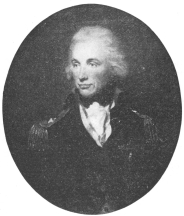 ADMIRAL NELSON.
They pressed upon the parapet to gaze after him when his barge pushed
off, and he was returning their cheers by waving his hat. The sentinels,
who endeavored to prevent them from trespassing upon this ground, were
wedged among the crowd; and an officer, who, not very prudently upon
such an occasion, ordered them to drive the people down with their
bayonets, was compelled speedily to retreat; for the people would not
be debarred from gazing, till the last moment, upon the hero, the
darling hero of England.
The station which Nelson had chosen was some fifty or sixty miles to the
west of Cadiz, near Cape St. Mary’s. At this distance he hoped to decoy
the enemy out, while he guarded against the danger of being caught with
a westerly wind near Cadiz, and driven within the Straits. The blockade
of the port was rigorously enforced, in hopes that the combined fleet
might be forced to sea by want.
The order of sailing was to be the order of battle; the fleet in two
lines, with an advanced squadron of eight of the fastest-sailing
two-deckers. The second in command, having the entire direction of his
line, was to break through the enemy, about the twelfth ship from their
rear: he would lead through the center, and the advanced squadron was to
cut off three or four ahead of the center. This plan was to be adapted
to the strength of the enemy, so that they should always be one-fourth
superior to those whom they cut off.
At daybreak the combined fleets were distinctly seen from the
Victory’s deck, formed in a close line of battle ahead, on the
starboard tack, about twelve miles to leeward, and standing to the
south. Our fleet consisted of twenty-seven sail of the line and four
frigates; theirs of thirty-three, and seven large frigates. Their
superiority was greater in size, and weight of metal, than in numbers.
They had four thousand troops on board; and the best riflemen who could
be procured, many of them Tyrolese, were dispersed through the ships.
Soon after daylight Nelson came upon deck. The 21st of October was a
festival in his family, because on that day his uncle, Captain Suckling,
in the Dreadnought, with two other line-of-battle ships, had beaten
off a French squadron of four sail of the line and three frigates.
Nelson had more than once expressed his persuasion that this was to be
the day of his battle also; and he was well pleased at seeing his
prediction about to be verified. The wind was now from the west,—light
breezes, with a long heavy swell. Signal was made to bear down upon the
enemy in two lines; and the fleet set all sail. Collingwood, in the
Royal Sovereign, led the lee-line of thirteen ships; the Victory led
the weather-line of fourteen. Having seen that all was as it should be,
Nelson retired to his cabin and wrote this prayer:—
“May the Great God whom I worship, grant to my country, and for the
benefit of Europe in general, a great and glorious victory; and may no
misconduct in any one tarnish it; and may humanity after victory be the
predominant feature in the British fleet! For myself individually, I
commit my life to Him that made me, and may his blessing alight on my
endeavors for serving my country faithfully! To Him I resign myself, and
the just cause which is intrusted to me to defend. Amen, Amen, Amen.”
. . . . . . . . . . . . . . . . . . . . . . . . . . . . . . . . . . .
Nelson, certain of a triumphant issue to the day, asked Blackwood what
he should consider as a victory. That officer answered, that,
considering the handsome way in which battle was offered by the enemy,
their apparent determination for a fair trial of strength, and the
situation of the land, he thought it would be a glorious result if
fourteen were captured. He replied: “I shall not be satisfied with less
than twenty.” Soon afterwards he asked him if he did not think there was
a signal wanting. Captain Blackwood made answer that he thought the
whole fleet seemed very clearly to understand what they were about.
These words were scarcely spoken before that signal was made, which will
be remembered as long as the language, or even the memory, of England
shall endure—Nelson’s last signal:—“England expects every man to do
his duty!” It was received throughout the fleet with a shout of
answering acclamation, made sublime by the spirit which it breathed and
the feeling which it expressed. “Now,” said Lord Nelson, “I can do no
more. We must trust to the Great Disposer of all events, and the justice
of our cause. I thank God for this great opportunity of doing my duty.”
He wore that day, as usual, his admiral’s frock coat, bearing on the
left breast four stars of the different orders with which he was
invested. Ornaments which rendered him so conspicuous a mark for the
enemy were beheld with ominous apprehensions by his officers. It was
known that there were riflemen on board the French ships, and it could
not be doubted but that his life would be particularly aimed at. They
communicated their fears to each other; and the surgeon, Mr. Beatty,
spoke to the chaplain, Dr. Scott, and to Mr. Scott, the public
secretary, desiring that some person would entreat him to change his
dress, or cover the stars: but they knew that such a request would
highly displease him. “In honor I gained them,” he had said, when such a
thing had been hinted to him formerly, “and in honor I will die with
them.”
A long swell was setting into the Bay of Cadiz: our ships, crowding all
sail, moved majestically before it, with light winds from the southwest.
The sun shone on the sails of the enemy; and their well-formed line,
with their numerous three-deckers, made an appearance which any other
assailants would have thought formidable; but the British sailors only
admired the beauty and the splendor of the spectacle; and, in full
confidence of winning what they saw, remarked to each other, what a fine
sight yonder ships would make at Spithead!
Ten minutes before twelve they opened their fire. Eight or nine of the
ships immediately ahead of the Victory, and across her bows, fired
single guns at her, to ascertain whether she was yet within their range.
As soon as Nelson perceived that their shot passed over him, he desired
Blackwood, and Captain Prowse of the Sirius, to repair to their
respective frigates.
Nelson’s column was steered about two points more to the north than
Collingwood’s, in order to cut off the enemy’s escape into Cadiz: the
lee-line, therefore, was first engaged. “See,” cried Nelson, pointing to
the Royal Sovereign, as she steered right for the center of the
enemy’s line, cut through it astern of the Santa Anna, three-decker,
and engaged her at the muzzle of her guns on the starboard side; “see
how that noble fellow, Collingwood, carries his ship into action!”
Collingwood, delighted at being first in the heat of the fire, and
knowing the feelings of his commander and old friend, turned to his
captain, and exclaimed, “Rotherham, what would Nelson give to be here!”
Both these brave officers, perhaps, at this moment thought of Nelson
with gratitude, for a circumstance which had occurred on the preceding
day. Admiral Collingwood, with some of the captains, having gone on
board the Victory to receive instructions, Nelson inquired of him
where his captain was? and was told, in reply, that they were not upon
good terms with each other. “Terms!” said Nelson;—“good terms with each
other!” Immediately he sent a boat for Captain Rotherham; led him, as
soon as he arrived, to Collingwood, and saying, “Look, yonder are the
enemy!” bade them “shake hands like Englishmen.”
The enemy continued to fire a gun at a time at the Victory, till they
saw that a shot had passed through her main-topgallant-sail; then they
opened their broadsides, aiming chiefly at her rigging, in the hope of
disabling her before she could close with them. Nelson, as usual, had
hoisted several flags, lest one should be shot away.
The enemy showed no colors till late in the action, when they began to
feel the necessity of having them to strike.
An incessant raking fire was kept up upon the Victory.
The admiral’s secretary was one of the first who fell: he was killed by
a cannon-shot, while conversing with Hardy. Captain Adair of the
marines, with the help of a sailor, endeavored to remove the body from
Nelson’s sight, who had a great regard for Mr. Scott; but he anxiously
asked, “Is that poor Scott that’s gone?” and being informed that it was
indeed so, exclaimed, “Poor fellow!”
Presently a double-headed shot struck a party of marines, who were drawn
up on the poop, and killed eight of them: upon which Nelson immediately
desired Captain Adair to disperse his men round the ship, that they
might not suffer so much from being together. A few minutes afterwards a
shot struck the fore brace bits on the quarter-deck, and passed between
Nelson and Hardy, a splinter from the bit tearing off Hardy’s buckle and
bruising his foot. Both stopped and looked anxiously at each other, each
supposing the other to be wounded. Nelson then smiled and said, “This is
too warm work, Hardy, to last long.”
The Victory had not yet returned a single gun; fifty of her men had
been by this time killed or wounded, and her main-topmast, with all her
studding sails and their booms, shot away. Nelson declared that, in all
his battles, he had seen nothing which surpassed the cool courage of his
crew on this occasion. At four minutes after twelve she opened her fire
from both sides of her deck. It was not possible to break the enemy’s
line without running on board one of their ships; Hardy informed him of
this, and asked which he would prefer. Nelson replied: “Take your
choice, Hardy, it does not signify much.” The master was then ordered to
put the helm to port, and the Victory ran on board the Redoubtable,
just as her tiller ropes were shot away. The French ship received her
with a broadside; then instantly let down her lower-deck ports, for fear
of being boarded through them, and never afterwards fired a great gun
during the action.
Captain Harvey, in the Téméraire, fell on board the Redoubtable on
the other side. Another enemy was in like manner on board the
Téméraire: so that these four ships formed as compact a tier as if
they had been moored together, their heads lying all the same way. The
lieutenants of the Victory, seeing this, depressed their guns of the
middle and lower decks, and fired with a diminished charge, lest the
shot should pass through, and injure the Téméraire. And because there
was danger that the Redoubtable might take fire from the lower-deck
guns, the muzzles of which touched her side when they were run out, the
fireman of each gun stood ready with a bucket of water, which, as soon
as the gun was discharged, he dashed into the hole made by the shot. An
incessant fire was kept up from the Victory from both sides; her
larboard guns playing upon the Bucentaure and the huge Santissima
Trinidad.
It had been part of Nelson’s prayer that the British fleet might be
distinguished by humanity in the victory which he expected. Setting an
example himself, he twice gave orders to cease firing upon the
Redoubtable, supposing that she had struck, because her great guns
were silent; for, as she carried no flag, there was no means of
instantly ascertaining the fact. From this ship, which he had thus twice
spared, he received his death. A ball fired from her mizzen-top, which,
in the then situation of the two vessels, was not more than fifteen
yards from that part of the deck where he was standing, struck the
epaulette on his left shoulder,—about a quarter after one, just in the
heat of the action.
He fell upon his face, on the spot which was covered with his poor
secretary’s blood. “They have done for me at last, Hardy!” said he.
Yet even now, not for a moment losing his presence of mind, he observed,
as they were carrying him down the ladder, that the tiller ropes, which
had been shot away, were not yet replaced, and ordered that new ones
should be rove immediately:—then, that he might not be seen by the
crew, he took out his handkerchief, and covered his face and his
stars.—Had he but concealed these badges of honor from the enemy,
England, perhaps, would not have had cause to receive with sorrow the
news of the battle of Trafalgar.
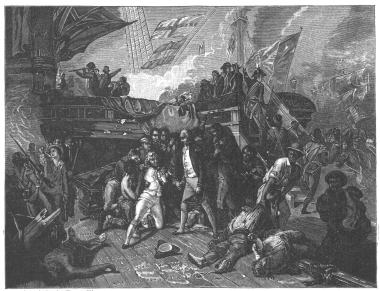 From the painting by Ernest Slingeneyer.
THE DEATH OF NELSON AT TRAFALGAR.
It was soon perceived, upon examination, that the wound was mortal.
This, however, was concealed from all except Captain Hardy, the
chaplain, and the medical attendants. He himself being certain that no
human care could avail him, insisted that the surgeon should leave him
and attend to those to whom he might be useful. “For,” said he, “you can
do nothing for me.”
As often as a ship struck, the crew of the Victory hurrahed; and at
every hurrah a visible expression of joy gleamed in the eyes and marked
the countenance of the dying hero.
An hour and ten minutes elapsed, from the time when Nelson received his
wound, before Hardy could come to him. They shook hands in silence;
Hardy in vain struggling to suppress the feelings of that most painful
and yet sublimest moment. “Well, Hardy,” said Nelson, “how goes the day
with us?”—“Very well,” replied Hardy; “ten ships have struck, but five
of their van have tacked, and show an intention of bearing down upon the
Victory. I have called two or three of our fresh ships round, and have
no doubt of giving them a drubbing.”—“I hope,” said Nelson, “none of
our ships have struck?” Hardy answered, “There was no fear of that.”
Then, and not till then, Nelson spoke of himself. “I am going fast,”
said he;—“it will be all over with me soon.” Hardy observed that he
hoped Mr. Beatty could yet hold out some prospect of life. “Oh, no!” he
replied; “it is impossible.” Captain Hardy then, once more, shook hands
with him; and, with a heart almost bursting, hastened upon deck.
Captain Hardy, some fifty minutes after he had left the cockpit,
returned; and, again taking the hand of his dying friend and commander,
congratulated him on having gained a complete victory. How many of the
enemy were taken he did not know, as it was impossible to perceive them
distinctly—but fourteen or fifteen at least. “That’s well,” cried
Nelson; “but I bargained for twenty.” And then, in a stronger voice, he
said, “Anchor, Hardy; anchor.” Hardy, upon this, hinted that Admiral
Collingwood would take upon himself the direction of affairs. “Not while
I live, Hardy!” said the dying Nelson, ineffectually endeavoring to
raise himself from the bed: “do you anchor.”
He desired that he might be buried by his parents, unless it should
please the king to order otherwise.—“Kiss me, Hardy,” said he. Hardy
knelt down and kissed his cheek: and Nelson said, “Now I am satisfied.
Thank God, I have done my duty!” Hardy stood over him in silence for a
moment or two, then knelt again, and kissed his forehead. “Who is that?”
said Nelson; and being informed, he replied, “God bless you, Hardy.” And
Hardy then left him—forever.
His articulation now became difficult; but he was distinctly heard to
say, “Thank God, I have done my duty!” These words he had repeatedly
pronounced; and they were the last. He expired at thirty minutes after
four,—three hours and a quarter after he had received his wound.
Once, amidst his sufferings, Nelson had expressed a wish that he were
dead; but immediately the spirit subdued the pains of death, and he
wished to live a little longer; doubtless that he might hear the
completion of the victory which he had seen so gloriously begun. That
consolation—that joy—that triumph, was afforded him. He lived to know
that the victory was decisive; and the last guns which were fired at the
flying enemy were heard a minute or two before he expired.
It is almost superfluous to add that all the honors which a grateful
country could bestow were heaped upon the memory of Nelson. His brother
was made an earl, with a grant of £6000 a year; £10,000 were voted to
each of his sisters; and £100,000 for the purchase of an estate. A
public funeral was decreed, and a public monument. Statues and monuments
also were voted by most of our principal cities. The leaden coffin, in
which he was brought home, was cut in pieces, which were distributed as
relics of Saint Nelson,—so the gunner of the Victory called
them,—and when, at his interment, his flag was about to be lowered into
the grave, the sailors who assisted at the ceremony, with one accord
rent it in pieces, that each might preserve a fragment while he lived.
The death of Nelson was felt in England as something more than a public
calamity: men started at the intelligence, and turned pale, as if they
had heard of the loss of a dear friend. An object of our admiration and
affection, of our pride and of our hopes, was suddenly taken from us;
and it seemed as if we had never till then known how deeply we loved and
reverenced him. What the country had lost in its great naval hero—the
greatest of our own and of all former times—was scarcely taken into the
account of grief. The people of England grieved that funeral ceremonies,
public monuments, and posthumous rewards were all which they could now
bestow upon him whom the king, the legislature, and the nation would
alike have delighted to honor; whom every tongue would have blessed;
whose presence in every village through which he might have passed would
have wakened the church bells, have given schoolboys a holiday, have
drawn children from their sports to gaze upon him, and “old men from the
chimney corner,” to look upon Nelson ere they died. The victory of
Trafalgar was celebrated, indeed, with the usual forms of rejoicing, but
they were without joy; for such already was the glory of the British
navy, through Nelson’s surpassing genius, that it scarcely seemed to
receive any addition from the most signal victory that ever was achieved
upon the seas; and the destruction of this mighty fleet, by which all
the maritime schemes of France were totally frustrated, hardly appeared
to add to our security or strength; for, while Nelson was living to
watch the combined squadrons of the enemy, we felt ourselves as secure
as now, when they were no longer in existence.
Yet he cannot be said to have fallen prematurely whose work was done;
nor ought he to be lamented who died so full of honors, and at the
height of human fame. The most triumphant death is that of the martyr;
the most awful, that of the martyred patriot; the most splendid, that of
the hero in the hour of victory; and if the chariot and the horses of
fire had been vouchsafed for Nelson’s translation he could scarcely have
departed in a brighter blaze of glory. He has left us, not indeed his
mantle of inspiration, but a name and an example which are at this hour
inspiring hundreds of the youth of England,—a name which is our pride,
and an example which will continue to be our shield and our strength.
From “Life of Nelson.”


