Frank Etheridge left the presence of Hermione Cavanagh, carrying with
him an indelible impression of her slender, white-robed figure and
pallid, passion-drawn face. There was such tragedy in the latter, that
he shuddered at its memory, and stopped before he reached the gate to
ask himself if the feeling she displayed was for him or another. If for
another, then was that other Dr. Sellick, and as the name formed itself
in his thoughts, he felt the dark cloud of jealousy creep over his mind,
obscuring the past and making dangerous the future.
"How can I know," thought he, "how can I know?" and just as the second
repetition passed his lips, he heard a soft step near him, and, looking
up, saw the gentle Emma watering her flowers.
To gain her side was his first impulse. To obtain her confidence the
second. Taking the heavy watering-pot from her hand, he poured its
contents on the rose-bush she was tending, and then setting it down,
said quietly:
"I have just made your sister very unhappy, Miss Cavanagh."
She started and her soft eyes showed the shadow of an alarm.
"I thought you were her friend," she said.
He drew her around the corner of the house towards the poplar trees.
"Had I been only that," he avowed, "I might have spared her pain, but I
am more than that, Miss Cavanagh, I am her lover."
The hesitating step at his side paused, and though no great change came
into her face, she seemed to have received a shock.
"I can understand," said she, "that you hurt her."
"Is she so wedded to the past, then?" he cried. "Was there some one, is
there some one whom she—she——"
He could not finish, but the candid-eyed girl beside him did not profess
to misunderstand him. A pitiful smile crossed her lips, and she looked
for a minute whiter than her sister had done, but she answered firmly:
"You could easily overcome any mere memory, but the decision she has
made never to leave the house, I fear you cannot overcome."
"Does it spring—forgive me if I go beyond the bounds of discretion, but
this mystery is driving me mad—does it spring from that past attachment
you have almost acknowledged?"
She drooped her head and his heart misgave him. Why should he hurt both
these women when his whole feeling towards them was one of kindness and
love?
"Pardon me," he pleaded. "I withdraw the question; I had no right to put
it."
"Thank you," said she, and looked away from him towards the distant
prospect of hill and valley lying before them.
He stood revolving the matter in his disturbed mind.
"I should have been glad to have been the means of happiness to your
sister and yourself. Such seclusion as you have imposed upon yourselves
seems unnecessary, but if it must be, and this garden wall is destined
to be the boundary of your world, it would have been a great pleasure to
me to have brought into it some freshness from the life which lies
beyond it. But it is destined not to be."
The sad expression in her face changed into one of wistfulness.
"Then you are not coming any more?" said she.
He caught his breath. There was disappointment in her tones and this
could mean nothing but regret, and regret meant the loss of something
which might have been hope. She felt, then, that he might have won her
sister if he had been more patient.
"Do you think it will do for me to come here after your sister has told
me that it was useless for me to aspire to her hand?"
She gave him for the first time a glance that had the element of
mirthfulness in it.
"Come as my friend," she suggested; then in a more serious mood added:
"It is her only chance of happiness, but I do not know that I would be
doing right in influencing you to pursue a suit which may not be for
yours. You know, or will know after reflection (and I advise you to
reflect well), whether an alliance with women situated as we are would
be conducive to your welfare. If you decide yes, think that a woman
taken by surprise, as my sister undoubtedly was, may not in the first
hurried moment of decision know her own mind, but also remember that no
woman who has taken such a decision as she has, is cast in the common
mould, and that you may but add to your regrets by a persistency she may
never fully reward."
Astonished at her manner and still more astonished at the intimation
conveyed in her last words, he looked at her as one who would say:
"But you also share her fate and the resolve that made it."
She seemed to understand him.
"Free Hermione," she whispered, "from the shackles she has wound about
herself and you will free me."
"Miss Emma," he began, but she put her finger on her lips.
"Hush!" she entreated; "let us not talk any more about it. I have
already said what I never meant should pass my lips; but the affection I
bear my sister made me forget myself; she does so need to love and be
loved."
"And you think I——"
"Ah, sir, you must be the judge of your own chances. You have heard her
refusal and must best know just how much it means."
"How much it means!" Long did Frank muse over that phrase, after he had
left the sweet girl who had uttered it. As he sat with Edgar at supper,
his abstracted countenance showed that he was still revolving the
question, though he endeavored to seem at home with his friend and
interested in the last serious case which had occupied the attention of
the newly settled doctor. How much it means! Not much, he was beginning
to say to himself, and insensibly his face began to brighten and his
manner to grow less restrained, when Edgar, who had been watching him
furtively, broke out:
"Now you are more like yourself. Business responsibilities are as hard
to shake off as a critical case in medicine."
"Yes," was the muttered reply, as Frank rose from the table, and took
the cigar his friend offered him. "And business with me just now is
particularly perplexing. I cannot get any clue to Harriet Smith or her
heirs, nor can the police or the presumably sharp detective I have put
upon the search."
"That must please Huckins."
"Yes, confound him! such a villain as he is! I sometimes wonder if he
killed his sister."
"That you can certainly find out."
"No, for she had a mortal complaint, and that satisfies the physicians.
But there are ways of hastening a death, and those I dare avow he would
not be above using. The greed in his eyes would do anything; it even
suffices to make him my very good friend, now that he sees that he might
lose everything by opposing me."
"I am glad you see through his friendship."
"See through a sieve?"
"He plays his part badly, then?"
"He cannot help it, with that face of his; and then he gave himself away
in the beginning. No attitude he could take now would make me forget the
sneak I saw in him then."
This topic was interesting, but Edgar knew it was no matter of business
which had caused the fitful changes he had been observing in Frank's
tell-tale countenance. Yet he did not broach any other theme, and it was
Frank who finally remarked:
"I suppose you think me a fool to fix my heart on a woman with a
secret."
"Fool is a strong word," answered Edgar, somewhat bitterly, "but that
you were unfortunate to have been attracted by Hermione Cavanagh, I
think any man would acknowledge. You would acknowledge it yourself, if
you stopped to weigh the consequences of indulging a passion for a woman
so eccentric."
"Perhaps I should, if my interest would allow me to stop. But it won't,
Edgar; it has got too strong a hold upon me; everything else sinks in
importance before it. I love her, and am willing to sacrifice something
for her sake."
"Something, perhaps; but in this case it would be everything."
"I do not think so."
"You do not think so now; but you would soon."
"Perhaps I should, but it is hard to realize it. Besides, she would drop
her eccentricities if her affections once became engaged."
"Oh, if you have assurance of that."
"Do I need assurance? Doesn't it stand to reason? A woman loved is so
different from a woman——" scorned, he was going to say, but,
remembering himself, added softly, "from a woman who has no one to think
of but herself."
"This woman has a sister," observed Edgar.
Frank faltered. "Yes, and that sister is involved in her fate," thought
he, but he said, quietly: "Emma Cavanagh does not complain of Hermione;
on the contrary, she expresses the greatest affection for her."
"They are both mysteries," exclaimed Edgar, and dropped the subject,
though it was not half talked out.
Frank was quite willing to accept his silence, for he was out of sorts
with his friend and with himself. He knew his passion was a mad one, and
yet he felt that it had made giant strides that day, and had really been
augmented instead of diminished by the refusal he had received from
Hermione, and the encouragement to persistence which he had received
from her usually shy sister. As the evening wore on and the night
approached, his thoughts not only grew in intensity, but deepened into
tenderness. It was undoubtedly a passion that had smitten him, but that
passion was hallowed by the unselfish feelings of a profound affection.
He did not want her to engage herself to him if it would not be for her
happiness. That it would be, every throb of his heart assured him, but
he might be mistaken, and if so, better her dreams of the past than a
future he could not make bright. He was so moved at the turmoil which
his thoughts made in his usually quiet breast, that he could not think
of sleep, but sat in his room for hours indulging in dreams which his
practical nature would have greatly scorned a few short weeks before. He
saw her again in fancy in every attitude in which his eyes had ever
beheld her, and sanctified thus by distance, her beauty seemed both
wonderful and touching. And that was not all. Some chord between them
seemed to have been struck, and he felt himself drawn towards her as if
(it was a strange fancy) she stood by that garden gate, and was looking
in his direction with rapt, appealing eyes. So strong became that fancy
at last, that he actually rose to his feet and went to the window which
opened towards the south.
"Hermione! Hermione!" broke in longing from his lips, and then annoyed
at what he could not but consider a display of weakness on his part, he
withdrew himself from the window, determined to forget for the moment
that there lived for him such a cause for love and sorrow. But what man
can forget by a mere effort of will, or what lover shut his eyes to the
haunting vision which projects itself upon the inner consciousness. In
fancy he saw her still, and this time she seemed to be pacing up and
down the poplar walk, wringing her hands and wildly calling his name. It
was more than he could bear. He must know if this was only an
hallucination, and in a feverish impulse he rushed from his room with
the intention of going to her at once.
But he no sooner stood in the hall than he realized he was not alone in
the house, and that he should have to pass Edgar's door. He naturally
felt some hesitation at this and was inclined to give up his purpose.
But the fever urging him on said no; so stealing warily down the hall he
stepped softly by the threshold of his friend's room, when to his
surprise he perceived that the door was ajar.
Pushing it gently open he found the room brilliant with moonlight but
empty. Greatly relieved and considering that the doctor had been sent
for by some suffering patient, he passed at once out of the house.
He went directly to that of Hermione, walking where the shadows were
thickest as if he were afraid of being recognized. But no one was in the
streets, and when he reached the point where the tall poplar-trees made
a wall against the moonbeams, he slid into the deep obscurity he found
there with a feeling of relief such as the heart experiences when it is
suddenly released from some great strain.
Was she in the poplar walk? He did not mean to accost her if she were,
nor to show himself or pass beyond the boundary of the wall, but he must
know if her restless spirit drove her to pace these moonlit walks, and
if it were true or not that she was murmuring his name.
The gate which opened in the wall at the side of the house was in a
direct line with the window he had long ago fixed upon as hers. He
accordingly took up his station at that spot and as he did so he was
sure that he saw the flitting of some dark form amid the alternate bands
of moonlight and shadow that lay across the weird pathway before him.
Holding his breath he listened. Oh, the stillness of the night! How
awesome and yet how sweet it was! But is there no break in the universal
silence? Above his head the ever restless leaves make a low murmuring,
and far away in the dim distances rises a faint sound that he cannot
mistake; it is the light footfall of a dainty woman.
He can see her now. She is coming towards him, her shadow gliding before
her. Seeing it he quails. From the rush of emotion seizing him, he knows
that he should not be upon this spot, and panting with the effort, he
turns and flees just as the sudden sound of a lifted window comes from
the house.
That arrests him. Pausing, he looks up. It is her window that is open,
and in the dark square thus made he sees her face bright with the
moonlight streaming over it. Instantly he recovers himself. It is Emma's
step, not Hermione's, he hears upon the walk. Hermione is above and in
an anxious mood, for she is looking eagerly out and calling her sister
by name.
"I am coming," answers back the clear, low voice of Emma from below.
"It is late," cries Hermione, "and very cold. Come in, Emma."
"I am coming," repeated the young girl. And in another moment he heard
her step draw nearer, saw her flitting figure halt for a moment on the
door-step before him and then disappear just as the window closed above.
He had not been observed.
Relieved, he drew a long breath and leaned his head against the garden
wall. Ah, how fair had been the vision of his beloved one's face in the
moonlight. It filled him with indescribable thoughts; it made his spirit
reel and his heart burn; it made him ten times her lover. Yet because he
was her lover he felt that he ought not to linger there any longer; that
the place was hallowed even from his presence, and that he should return
at once to the doctor's house. But when he lifted his head he heard
steps, this time not within the wall but on the roadside behind him, and
alert at once to the mischievous surmises which might be aroused by the
discovery of his presence there, he remained perfectly still in the
hope that his form would be so lost in the deep shadows where he had
withdrawn himself, that he would not be seen.
But the person, whoever it was, had evidently already detected him, for
the footsteps turned the corner and advanced rapidly to where he stood.
Should he step forward and meet the intruder, or remain still and await
the words of surprise he had every reason to expect? He decided to
remain where he was, and in another moment realized his wisdom in doing
so, for the footsteps passed on and did not halt till they had reached
the gate. But they paused there and at once he felt himself seized by a
sudden jealousy and took a step forward, eager to see what this man
would do.
He did not do much; he cast a look up at the house, and a heavy sigh
broke from his lips; then he leaned forward and plucked a rose that grew
inside the wall and kissed it there in the moonlight, and put it inside
his breast-pocket; then he turned again towards the highway, and started
back in surprise to see Frank Etheridge standing before him.
"Edgar!" cried the one.
"Frank!" exclaimed the other.
"You have misled me," accused Frank; "you do love her, or you would not
be here."
"Love whom?" asked Edgar, bitterly.
"Hermione."
"Does Hermione tend the flowers?"
"Ah!" ejaculated Frank, understanding his friend for the first time;
"it is Emma you are attached to. I see! I see! Forgive me, Edgar;
passion is so blind to everything but its own object. Of course it is
Emma; why shouldn't it be!"
Yet for all its assurance his voice had strange tones in it, and Edgar,
already annoyed at his own self-betrayal, looked at him suspiciously as
they drew away together towards the main street.
"I am glad to find this out," said Frank, with a hilarity slightly
forced, or so thought his friend, who could not know what thoughts and
hopes this discovery had awakened in the other's breast. "You have kept
your secret well, but now that I know it you cannot refuse to make me
your confidant, when there is so much to tell involving my happiness as
well as your own."
"I have no happiness, Frank."
"Nor I; but I mean to have."
"Mean to marry Miss Cavanagh?"
"Of course, if I can induce her to marry me."
"I do not mean to marry Emma."
"You do not? Because she has a secret? because she is involved in a
mystery?"
"Partly; that would be enough, Frank; but I have another good reason.
Miss Emma Cavanagh does not care for me."
"You know that? You have asked her?"
"A year ago; this is no sudden passion with me; I have loved her all my
life."
"Edgar! And you mean to give her up?"
"Give her up?"
"If I were you, nothing would induce me to resign my hopes, not even her
own coldness. I would win her. Have you tried again since your
return?"
"Frank, she is a recluse now; I could not marry a recluse; my wife must
play her part in the world, and be my helpmate abroad as well as at
home."
"Yes, yes; but as I said in my own case, win her love and that will all
right itself. No woman's resolve will hold out against a true passion."
"But you forget, she has no true passion for me."
Frank did not answer; he was musing over the subject. He had had an
opportunity for seeing into the hearts of these girls which had been
denied to Edgar. Had he seen love there? Yes, but in Hermione's breast,
not Emma's. And yet Emma was deeply sad, and it was Emma whom he had
just seen walking her restlessness off under the trees at midnight.
"Edgar," he suddenly exclaimed, "you may not understand this girl. Their
whole existence is a mystery, and so may their hearts be.
Won't
you tell me how it was she refused you? It may serve to throw some light
upon the facts."
"What light? She refused me as all coquettish women refuse the men whom
they have led to believe in their affection."
"Ah! you once believed, then, in her affection."
"Should I have offered myself if I had not?"
"I don't know; I only know I didn't wait for any such belief on the part
of Hermione."
"You are impulsive, Frank, I am not; I weigh well what I do, fortunately
for myself."
"Yet you did not prosper in this affair."
"No, because I did not take a woman's waywardness into consideration. I
thought I had a right to count upon her regard, and I found myself
mistaken."
"Explain yourself," entreated Frank.
"Will not to-morrow do? Here we are at home, and it must be one o'clock
at least."
"I should sleep better if I knew it all now," Frank intimated.
"Well, then, come to my room; but there is nothing in the story to
specially interest you. I loved her——"
"Edgar, you must be explicit. I am half lawyer in listening to this
tale; I want to understand these girls."
"Girls? It is of Emma only that I have to speak."
"I know, but tell the story with some details; tell me where you first
met her."
"Oh, if I must," sighed Edgar, who hated all talk about himself, "let's
be comfortable." And throwing himself into a chair, he pointed out
another to Frank.
"This is more like it," acknowledged the latter.
Edgar lit a cigar; perhaps he felt that he could hide all emotion behind
its fumes. Frank did not take one.
"I have known Emma Cavanagh ever since we were children," began Edgar.
"As a school-boy I thought her the merriest-eyed witch in town.—— Is
she merry now?"
Frank shook his head.
"Well, I suppose she has grown older, but then she was as full of
laughter and fun as any blue-eyed Mischief could well be, and I, who
have a cynical turn of mind, liked the brightness of hers as I shall
never like her sadness—if she is sad. But that was in my adolescence,
and being as shy as I was inclined to be cynical, I never showed her my
preference, or even joined the mirthful company of which she was the
head. I preferred to stand back and hear her laughter, or talk to
Hermione while watching her sister."
"Ah!" thought Frank.
"When I went to college she went to school, and when I graduated as a
doctor she was about graduating also. But she did not come home at that
time for more than a fleeting visit. Friends wished her company on a
trip abroad, and she went away from Marston just as I settled here for
my first year of practice. I was disappointed at this, but I made what
amends to myself I could by cultivating the acquaintance of her father,
and making myself necessary to him by my interest in his studies. I
spent much of my spare time at the house, and though I never asked after
Emma, I used to get continual news of her from her sister."
"Ah!" again ejaculated Frank to himself.
"At last she returned, and—I do not know how she looks now, but she was
pretty then, wonderfully pretty, and more animated in her manner than
any other woman I have ever seen. I saw her first at a picnic, and
though I lacked courage to betray the full force of my feeling, I
imagined she understood me, for her smiles became dazzling, and she
joked with everybody but me. At last I had her for a few minutes to
myself, and then the pent up passion of months had its way, and I asked
her to be my wife. Frank, you may find it easy to talk about these
things, but I do not. I can only say she seemed to listen to me with
modest delight, and when I asked her for her answer she gave me a look I
shall never forget, and would have spoken but that her father called her
just then, and we were obliged to separate. I saw her for just another
moment that day, but there were others about, and I could only whisper,
'If you love me, come to the ball next week'; to which she gave me no
other reply than an arch look and a smile which, as I have said before,
appeared to promise me all I could desire. Appeared, but did not; for
when I called at the house the next day I was told that Mr. Cavanagh was
engaged in an experiment that could not be interrupted, and when I asked
to see the ladies received word that they were very busy preparing for
the ball and could see no one. Relieved at this, for the ball was near
at hand, I went home, and being anxious to do the honorable thing, I
wrote to Mr. Cavanagh, and, telling him that I loved his daughter,
formally asked for the honor of her hand. This note I sent by a
messenger.
"I did not receive an immediate reply (why do you want all these
particulars, Frank?); but I did not worry, for her look was still warm
in my memory. But when two days passed and no message arrived I became
uneasy, and had it not been for the well-known indifference of Mr.
Cavanagh to all affairs of life outside of his laboratory, I should have
given up in despair. But as it was, I kept my courage up till the night
of the ball, when it suddenly fell, never to rise again. For will you
believe it, Frank, she was not there, nor any of her family, though all
had engaged to go, and had made many preparations for the affair, as I
knew."
"And did no letter come? Did you never see Miss Cavanagh again, or any
of her family?"
"I received a note, but it was very short, though it was in Emma's
handwriting. She had not been well, was her excuse, and so could not be
present at the ball. As for the offer I had been kind enough to make
her, it was far above her deserts, and so must be gratefully declined.
Then came a burst of something like contrition, and the prayer that I
would not seek to make her alter her mind, as her decision was
irrevocable. Added to this was one line from her father, to the effect
that interesting as our studies were, he felt compelled to tell me he
should have no further time to give to them at present, and so bade me a
kindly adieu. Was there ever a more complete dismissal? I felt as if I
had been thrust out of the house."
Frank, who was nothing if not sympathetic, nodded quickly, but did not
break into those open expressions of indignation which his friend had
evidently anticipated. The truth was, he was too busy considering the
affair, and asking himself what part Hermione had taken in it, and
whether all its incongruities were not in some way due to her. He was so
anxious to assure himself that this was not so, that he finally asked:
"And was that the end? Did you never see any of them again?"
"I did not wish to," was the answer. "I had already thought of trying my
fortunes in the West, and when this letter came, it determined me. In
three weeks I had left Marston as I thought forever, but I was not
successful in the West."
"And you will be here," observed Frank.
"I think so," said Edgar, and became suddenly silent.
Frank looked at him a long time and then said quietly:
"I am glad you love her still."
Edgar, flushing, opened his lips, but the other would not listen to any
denial.
"If you had not loved her, you would not have come back to Marston, and
if you did not love her still, you would not pluck roses from her wall
at midnight."
"I was returning from a patient," objected Edgar, shortly.
"I know, but you stopped. You need not blush to own it, for, as I say,
I think it a good thing that you have not forgotten Miss Cavanagh." And
not being willing to explain himself further, Frank rose and sauntered
towards the door. "We have talked well into the night," he remarked;
"supposing we let up now, and continue our conversation to-morrow."
"I am willing to let up," acquiesced Edgar, "but why continue to-morrow?
Nothing can be gained by fruitless conjectures on this subject, while
much peace of mind may be lost by them."
"Well, perhaps you are right," quoth Frank.
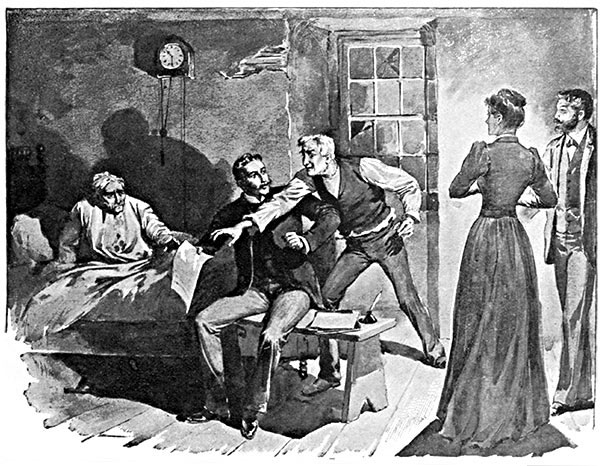 "'Let me have it!' cried Huckins. 'I have lived in this
hole for fifteen years, till I have almost rotted away like the place
itself!'"
"'Let me have it!' cried Huckins. 'I have lived in this
hole for fifteen years, till I have almost rotted away like the place
itself!'"

