FROM the remotest period a rod has been regarded
as the symbol of power and authority,
and Holy Scripture employs it in the popular sense.
Thus David speaks of “Thy rod and Thy staff comforting
me;” and Moses works his miracles before
Pharaoh with the rod as emblem of Divine commission.
It was his rod which became a serpent, which
turned the water of Egypt into blood, which opened
the waves of the Red Sea and restored them to their
former level, which “smote the rock of stone so that
the water gushed out abundantly.” The rod of Aaron
acted an oracular part in the contest with the princes;
laid up before the ark, it budded and brought forth
almonds. In this instance we have it no longer as
a symbol of authority, but as a means of divining
the will of God. And as such it became liable
to abuse; thus Hosea rebukes the chosen people
for practising similar divinations. “My people ask
55]
counsel at their stocks, and their staff declareth unto
them.”[23]
Long before this, Jacob had made a different use
of rods, employing them as a charm to make his
father-in-law’s sheep bear pied and spotted lambs.
We find rhabdomancy a popular form of divination
among the Greeks, and also among the Romans.
Cicero in his “De Officiis” alludes to it. “If all
that is needful for our nourishment and support arrives
to us by means of some divine rod, as people
say, then each of us, free from all care and trouble,
may give himself up to the exclusive pursuit of
study and science.”
Probably it is to this rod that the allusion of
Ennius, as the agent in discovering hidden treasures,
quoted in the first book of his “De Divinatione,”
refers.
According to Vetranius Maurus, Varro left a satire
on the “Virgula divina,” which has not been preserved.
Tacitus tells us that the Germans practised
some sort of divination by means of rods. “For
the purpose their method is simple. They cut a
rod off some fruit-tree into bits, and after having
distinguished them by various marks, they cast them
56]
into a white cloth.... Then the priest thrice
draws each piece, and explains the oracle according
to the marks.” Ammianus Marcellinus says that
the Alains employed an osier rod.
The fourteenth law of the Frisons ordered that
the discovery of murders should be made by means
of divining rods used in Church. These rods should
be laid before the altar, and on the sacred relics,
after which God was to be supplicated to indicate
the culprit. This was called the Lot of Rods, or
Tan-teen, the Rod of Rods.
But the middle ages was the date of the full
development of the superstition, and the divining rod
was believed to have efficacy in discovering hidden
treasures, veins of precious metal, springs of water,
thefts, and murders. The first notice of its general
use among late writers is in the “Testamentum
Novum,” lib. i. cap. 25, of Basil Valentine, a Benedictine
monk of the fifteenth century. Basil speaks
of the general faith in and adoption of this valuable
instrument for the discovery of metals, which is
carried by workmen in mines, either in their belts
or in their caps. He says that there are seven
names by which this rod is known, and to its
57]
excellences under each title he devotes a chapter of
his book. The names are: Divine Rod, Shining
Rod, Leaping Rod, Transcendent Rod, Trembling
Rod, Dipping Rod, Superior Rod. In his admirable
treatise on metals, Agricola speaks of the rod
in terms of disparagement; he considers its use as
a relic of ancient magical forms, and he says that
it is only irreligious workmen who employ it in
their search after metals. Goclenius, however, in
his treatise on the virtue of plants, stoutly does battle
for the properties of the hazel rod. Whereupon
Roberti, a Flemish Jesuit, falls upon him tooth and
nail, disputes his facts, overwhelms him with abuse,
and gibbets him for popular ridicule. Andreas Libavius,
a writer I have already quoted in my article
on the Wandering Jew, undertook a series of experiments
upon the hazel divining rod, and concluded
that there was truth in the popular belief.
The Jesuit Kircher also “experimentalized several
times on wooden rods which were declared to be
sympathetic with regard to certain metals, by placing
them on delicate pivots in equilibrium; but they
never turned on the approach of metal.” (De Arte
Magnetica.) However, a similar course of experiments
58]
over water led him to attribute to the rod the
power of indicating subterranean springs and water-courses;
“I would not affirm it,” he says, “unless I
had established the fact by my own experience.”
Dechales, another Jesuit, author of a treatise on
natural springs, and of a huge tome entitled “Mundus
Mathematicus,” declared in the latter work,
that no means of discovering sources is equal to
the divining rod; and he quotes a friend of his
who, with a hazel rod in his hand, could discover
springs with the utmost precision and facility, and
could trace on the surface of the ground the course
of a subterranean conduit. Another writer, Saint-Romain,
in his “Science dégagée des Chimères de
l’École,” exclaims, “Is it not astonishing to see a rod,
which is held firmly in the hands, bow itself and
turn visibly in the direction of water or metal, with
more or less promptitude, according as the metal or
the water are near or remote from the surface!”
In 1659 the Jesuit Gaspard Schott writes that the
rod is used in every town of Germany, and that he
had frequent opportunity of seeing it used in the
discovery of hidden treasures. “I searched with the
greatest care,” he adds, “into the question whether
59]
the hazel rod had any sympathy with gold and silver,
and whether any natural property set it in motion.
In like manner I tried whether a ring of
metal, held suspended by a thread in the midst of
a tumbler, and which strikes the hours, is moved
by any similar force. I ascertained that these effects
could only have rise from the deception of those
holding the rod or the pendulum, or, may be, from
some diabolic impulsion, or, more likely still, because
imagination sets the hand in motion.”
The Sieur le Royer, a lawyer of Rouen, in 1674,
published his “Traité du Bâton universel,” in which
he gives an account of a trial made with the rod
in the presence of Father Jean François, who had
ridiculed the operation in his treatise on the science
of waters, published at Rennes in 1655, and which
succeeded in convincing the blasphemer of the divine
Rod. Le Royer denies to it the power of picking
out criminals, which had been popularly attributed
to it, and as had been unhesitatingly claimed for it
by Debrio in his “Disquisitio Magica.”
And now I am brought to the extraordinary story
of Jacques Aymar, which attracted the attention of
Europe to the marvellous properties of the divining
60]
rod. I shall give the history of this man in full, as
such an account is rendered necessary by the mutilated
versions I have seen current in English magazine
articles, which follow the lead of Mrs. Crowe,
who narrates the earlier portion of this impostor’s
career, but says nothing of his exposé and downfall.
On the 5th July, 1692, at about ten o’clock in the
evening, a wine-seller of Lyons and his wife were
assassinated in their cellar, and their money carried
off. On the morrow, the officers of justice arrived,
and examined the premises. Beside the corpses, lay
a large bottle wrapped in straw, and a bloody hedging
bill, which undoubtedly had been the instrument
used to accomplish the murder. Not a trace of
those who had committed the horrible deed was to
be found, and the magistrates were quite at fault
as to the direction in which they should turn for a
clew to the murderer or murderers.
At this juncture a neighbor reminded the magistrates
of an incident which had taken place four
years previous. It was this. In 1688 a theft of
clothes had been made in Grenoble. In the parish
of Crôle lived a man named Jacques Aymar, supposed
to be endowed with the faculty of using the
61]
divining rod. This man was sent for. On reaching
the spot where the theft had been committed, his
rod moved in his hand. He followed the track indicated
by the rod, and it continued to rotate between
his fingers as long as he followed a certain direction,
but ceased to turn if he diverged from it in the smallest
degree. Guided by his rod, Aymar went from
street to street, till he was brought to a standstill
before the prison gates. These could not be opened
without leave of the magistrate, who hastened to witness
the experiment. The gates were unlocked, and
Aymar, under the same guidance, directed his steps
towards four prisoners lately incarcerated. He ordered
the four to be stood in a line, and then he
placed his foot on that of the first. The rod remained
immovable. He passed to the second, and
the rod turned at once. Before the third prisoner
there were no signs; the fourth trembled, and begged
to be heard. He owned himself the thief, along
with the second, who also acknowledged the theft,
and mentioned the name of the receiver of the stolen
goods. This was a farmer in the neighborhood of
Grenoble. The magistrate and officers visited him
and demanded the articles he had obtained. The
62]
farmer denied all knowledge of the theft and all participation
in the booty. Aymar, however, by means
of his rod, discovered the secreted property, and restored
it to the persons from whom it had been stolen.
On another occasion Aymar had been in quest of a
spring of water, when he felt his rod turn sharply in
his hand. On digging at the spot, expecting to discover
an abundant source, the body of a murdered
woman was found in a barrel, with a rope twisted
round her neck. The poor creature was recognized
as a woman of the neighborhood who had vanished
four months before. Aymar went to the house which
the victim had inhabited, and presented his rod to
each member of the household. It turned upon the
husband of the deceased, who at once took to flight.
The magistrates of Lyons, at their wits’ ends how
to discover the perpetrators of the double murder in
the wine shop, urged the Procureur du Roi to make
experiment of the powers of Jacques Aymar. The
fellow was sent for, and he boldly asserted his capacity
for detecting criminals, if he were first brought to
the spot of the murder, so as to be put en rapport
with the murderers.
He was at once conducted to the scene of the
63]
outrage, with the rod in his hand. This remained stationary
as he traversed the cellar, till he reached the
spot where the body of the wine seller had lain; then
the stick became violently agitated, and the man’s
pulse rose as though he were in an access of fever.
The same motions and symptoms manifested themselves
when he reached the place where the second
victim had lain.
Having thus received his impression, Aymar left
the cellar, and, guided by his rod, or rather by an
internal instinct, he ascended into the shop, and then
stepping into the street, he followed from one to
another, like a hound upon the scent, the track of the
murderers. It conducted him into the court of the
archiepiscopal palace, across it, and down to the gate
of the Rhone. It was now evening, and the city
gates being all closed, the quest of blood was relinquished
for the night.
Next morning Aymar returned to the scent. Accompanied
by three officers, he left the gate, and
descended the right bank of the Rhone. The rod
gave indications of there having been three involved
in the murder, and he pursued the traces till two of
them led to a gardener’s cottage. Into this he
64]
entered, and there he asserted with warmth, against the
asseverations of the proprietor to the contrary, that
the fugitives had entered his room, had seated themselves
at his table, and had drunk wine out of one of
the bottles which he indicated. Aymar tested each
of the household with his rod, to see if they had been
in contact with the murderers. The rod moved over
the two children only, aged respectively ten and nine
years. These little things, on being questioned, answered,
with reluctance, that during their father’s
absence on Sunday morning, against his express commands,
they had left the door open, and that two
men, whom they described, had come in suddenly
upon them, and had seated themselves and made
free with the wine in the bottle pointed out by the
man with the rod. This first verification of the talents
of Jacques Aymar convinced some of the sceptical, but
the Procurateur Général forbade the prosecution of the
experiment till the man had been further tested.
As already stated, a hedging bill had been discovered,
on the scene of the murder, smeared with
blood, and unquestionably the weapon with which
the crime had been committed. Three bills from the
same maker, and of precisely the same description,
65]
were obtained, and the four were taken into a garden,
and secretly buried at intervals. Aymar was then
brought, staff in hand, into the garden, and conducted
over the spots where lay the bills. The rod began to
vibrate as his feet stood upon the place where was
concealed the bill which had been used by the assassins,
but was motionless elsewhere. Still unsatisfied,
the four bills were exhumed and concealed anew.
The comptroller of the province himself bandaged
the sorcerer’s eyes, and led him by the hand from
place to place. The divining rod showed no signs
of movement till it approached the blood-stained
weapon, when it began to oscillate.
The magistrates were now so far satisfied as to
agree that Jacques Aymar should be authorized to
follow the trail of the murderers, and have a company
of archers to follow him.
Guided by his rod, Aymar now recommenced his
pursuit. He continued tracing down the right bank
of the Rhone till he came to half a league from the
bridge of Lyons. Here the footprints of three men
were observed in the sand, as though engaged in
entering a boat. A rowing boat was obtained, and
Aymar, with his escort, descended the river; he found
66]
some difficulty in following the trail upon water;
still he was able, with a little care, to detect it. It
brought him under an arch of the bridge of Vienne,
which boats rarely passed beneath. This proved that
the fugitives were without a guide. The way in
which this curious journey was made was singular.
At intervals Aymar was put ashore to test the banks
with his rod, and ascertain whether the murderers
had landed. He discovered the places where they
had slept, and indicated the chairs or benches on
which they had sat. In this manner, by slow degrees,
he arrived at the military camp of Sablon, between
Vienne and Saint-Valier. There Aymar felt violent
agitation, his cheeks flushed, and his pulse beat with
rapidity. He penetrated the crowds of soldiers, but
did not venture to use his rod, lest the men should
take it ill, and fall upon him. He could not do more
without special authority, and was constrained to return
to Lyons. The magistrates then provided him
with the requisite powers, and he went back to the
camp. Now he declared that the murderers were not
there. He recommenced his pursuit, and descended
the Rhone again as far as Beaucaire.
On entering the town he ascertained by means of
67]
his rod that those whom he was pursuing had parted
company. He traversed several streets, then crowded
on account of the annual fair, and was brought to a
standstill before the prison doors. One of the murderers
was within, he declared; he would track the
others afterwards. Having obtained permission to
enter, he was brought into the presence of fourteen
or fifteen prisoners. Amongst these was a hunchback,
who had only an hour previously been incarcerated
on account of a theft he had committed at the
fair. Aymar applied his rod to each of the prisoners
in succession: it turned upon the hunchback. The
sorcerer ascertained that the other two had left the
town by a little path leading into the Nismes road.
Instead of following this track, he returned to Lyons
with the hunchback and the guard. At Lyons a
triumph awaited him. The hunchback had hitherto
protested his innocence, and declared that he had
never set foot in Lyons. But as he was brought to
that town by the way along which Aymar had ascertained
that he had left it, the fellow was recognized
at the different houses where he had lodged the night,
or stopped for food. At the little town of Bagnols, he
was confronted with the host and hostess of a tavern
68]
where he and his comrades had slept, and they swore
to his identity, and accurately described his companions:
their description tallied with that given by the
children of the gardener. The wretched man was so
confounded by this recognition, that he avowed having
staid there, a few days before, along with two
Provençals. These men, he said, were the criminals;
he had been their servant, and had only kept guard
in the upper room whilst they committed the murders
in the cellar.
On his arrival in Lyons he was committed to
prison, and his trial was decided on. At his first
interrogation he told his tale precisely as he had
related it before, with these additions: the murderers
spoke patois, and had purchased two bills. At ten
o’clock in the evening all three had entered the wine
shop. The Provençals had a large bottle wrapped in
straw, and they persuaded the publican and his wife
to descend with them into the cellar to fill it, whilst
he, the hunchback, acted as watch in the shop. The
two men murdered the wine-seller and his wife with
their bills, and then mounted to the shop, where they
opened the coffer, and stole from it one hundred and
thirty crowns, eight louis-d’ors, and a silver belt.
69]
The crime accomplished, they took refuge in the
court of a large house,—this was the archbishop’s
palace, indicated by Aymar,—and passed the night
in it. Next day, early, they left Lyons, and only
stopped for a moment at a gardener’s cottage.
Some way down the river, they found a boat
moored to the bank. This they loosed from its
mooring and entered. They came ashore at the
spot pointed out by the man with the stick. They
staid some days in the camp at Sablon, and then
went on to Beaucaire.
Aymar was now sent in quest of the other murderers.
He resumed their trail at the gate of
Beaucaire, and that of one of them, after considerable
détours, led him to the prison doors of
Beaucaire, and he asked to be allowed to search
among the prisoners for his man. This time he
was mistaken. The second fugitive was not within;
but the jailer affirmed that a man whom he
described—and his description tallied with the
known appearance of one of the Provençals—had
called at the gate shortly after the removal of the
hunchback to inquire after him, and on learning
of his removal to Lyons, had hurried off
70]
precipitately. Aymar now followed his track from
the prison, and this brought him to that of the
third criminal. He pursued the double scent for
some days. But it became evident that the two
culprits had been alarmed at what had transpired in
Beaucaire, and were flying from France. Aymar
traced them to the frontier, and then returned to
Lyons.
On the 30th of August, 1692, the poor hunchback
was, according to sentence, broken on the
wheel, in the Place des Terreaux. On his way to
execution he had to pass the wine shop. There
the recorder publicly read his sentence, which had
been delivered by thirty judges. The criminal
knelt and asked pardon of the poor wretches in
whose murder he was involved, after which he
continued his course to the place fixed for his
execution.
It may be well here to give an account of the
authorities for this extraordinary story. There are
three circumstantial accounts, and numerous letters
written by the magistrate who sat during the trial,
and by an eye-witness of the whole transaction,
men honorable and disinterested, upon whose veracity
71]
not a shadow of doubt was supposed to rest
by their contemporaries.
M. Chauvin, Doctor of Medicine, published a
“Lettre à Mme. la Marquise de Senozan, sur
les moyens dont on s’est servi pour découvrir les
complices d’un assassinat commis à Lyon, le 5
Juillet, 1692.” Lyons, 1692. The procès-verbal
of the Procureur du Roi, M. de Vanini, is also
extant, and published in the Physique occulte of
the Abbé de Vallemont.
Pierre Gamier, Doctor of Medicine of the University
of Montpellier, wrote a Dissertation physique
en forme de lettre, à M. de Sève, seigneur
de Fléchères, on Jacques Aymar, printed the same
year at Lyons, and republished in the Histoire
critique des pratiques superstitieuses du Père
Lebrun.
Doctor Chauvin was witness of nearly all the
circumstances related, as was also the Abbé
Lagarde, who has written a careful account of the
whole transaction as far as to the execution of
the hunchback.
Another eye-witness writes to the Abbé Bignon
a letter printed by Lebrun in his Histoire
72]
critique cited above. “The following circumstance
happened to me yesterday evening,” he says: “M.
le Procureur du Roi here, who, by the way, is one
of the wisest and cleverest men in the country,
sent for me at six o’clock, and had me conducted
to the scene of the murder. We found there M.
Grimaut, director of the customs, whom I knew
to be a very upright man, and a young attorney
named Besson, with whom I am not acquainted,
but who M. le Procureur du Roi told me had the
power of using the rod as well as M. Grimaut.
We descended into the cellar where the murder
had been committed, and where there were still
traces of blood. Each time that M. Grimaut and
the attorney passed the spot where the murder had
been perpetrated, the rods they held in their hands
began to turn, but ceased when they stepped beyond
the spot. We tried experiments for more
than an hour, as also with the bill, which M.
le Procureur had brought along with him, and
they were satisfactory. I observed several curious
facts in the attorney. The rod in his hands was
more violently moved than in those of M. Grimaut,
and when I placed one of my fingers in each of
73]
his hands, whilst the rod turned, I felt the most extraordinary
throbbings of the arteries in his palms.
His pulse was at fever heat. He sweated profusely,
and at intervals he was compelled to go into the
court to obtain fresh air.”
The Sieur Pauthot, Dean of the College of
Medicine at Lyons, gave his observations to the
public as well. Some of them are as follows:
“We began at the cellar in which the murder had
been committed; into this the man with the rod
(Aymar) shrank from entering, because he felt
violent agitations which overcame him when he
used the stick over the place where the corpses
of those who had been assassinated had lain. On
entering the cellar, the rod was put in my hands,
and arranged by the master as most suitable for
operation; I passed and repassed over the spot
where the bodies had been found, but it remained
immovable, and I felt no agitation. A lady of rank
and merit, who was with us, took the rod after
me; she felt it begin to move, and was internally
agitated. Then the owner of the rod resumed it,
and, passing over the same places, the stick rotated
with such violence that it seemed easier to break
74]
than to stop it. The peasant then quitted our
company to faint away, as was his wont after
similar experiments. I followed him. He turned
very pale and broke into a profuse perspiration,
whilst for a quarter of an hour his pulse was violently
troubled; indeed, the faintness was so considerable,
that they were obliged to dash water in
his face and give him water to drink in order to
bring him round.” He then describes experiments
made over the bloody bill and others similar, which
succeeded in the hands of Aymar and the lady, but
failed when he attempted them himself. Pierre
Garnier, physician of the medical college of Montpellier,
appointed to that of Lyons, has also written
an account of what he saw, as mentioned above.
He gives a curious proof of Aymar’s powers.
“M. le Lieutenant-Général having been robbed
by one of his lackeys, seven or eight months ago,
and having lost by him twenty-five crowns which
had been taken out of one of the cabinets behind
his library, sent for Aymar, and asked him to
discover the circumstances. Aymar went several
times round the chamber, rod in hand, placing
one foot on the chairs, on the various articles of
75]
furniture, and on two bureaux which are in the
apartment, each of which contains several drawers.
He fixed on the very bureau and the identical
drawer out of which the money had been stolen.
M. le Lieutenant-Général bade him follow the
track of the robber. He did so. With his rod
he went out on a new terrace, upon which the
cabinet opens, thence back into the cabinet and
up to the fire, then into the library, and from
thence he went direct up stairs to the lackeys’
sleeping apartment, when the rod guided him to
one of the beds, and turned over one side of the
bed, remaining motionless over the other. The
lackeys then present cried out that the thief had
slept on the side indicated by the rod, the bed
having been shared with another footman, who
occupied the further side.” Garnier gives a lengthy
account of various experiments he made along with
the Lieutenant-Général, the uncle of the same, the
Abbé de St. Remain, and M. de Puget, to detect
whether there was imposture in the man. But all
their attempts failed to discover a trace of deception.
He gives a report of a verbal examination
of Aymar which is interesting. The man always
replied with candor.
76]
The report of the extraordinary discovery of
murder made by the divining rod at Lyons attracted
the attention of Paris, and Aymar was
ordered up to the capital. There, however, his
powers left him. The Prince de Condé submitted
him to various tests, and he broke down under
every one. Five holes were dug in the garden.
In one was secreted gold, in another silver, in
a third silver and gold, in the fourth copper, and
in the fifth stones. The rod made no signs in
presence of the metals, and at last actually began
to move over the buried pebbles. He was sent to
Chantilly to discover the perpetrators of a theft of
trout made in the ponds of the park. He went
round the water, rod in hand, and it turned at spots
where he said the fish had been drawn out. Then,
following the track of the thief, it led him to the
cottage of one of the keepers, but did not move
over any of the individuals then in the house. The
keeper himself was absent, but arrived late at
night, and, on hearing what was said, he roused
Aymar from his bed, insisting on having his innocence
vindicated. The divining rod, however, pronounced
him guilty, and the poor fellow took to his
77]
heels, much upon the principle recommended by
Montesquieu a while after. Said he, “If you are
accused of having stolen the towers of Notre-Dame,
bolt at once.”
A peasant, taken at haphazard from the street,
was brought to the sorcerer as one suspected. The
rod turned slightly, and Aymar declared that the
man did not steal the fish, but ate of them. A
boy was then introduced, who was said to be the
keeper’s son. The rod rotated violently at once.
This was the finishing stroke, and Aymar was
sent away by the Prince in disgrace. It now
transpired that the theft of fish had taken place
seven years before, and the lad was no relation of
the keeper, but a country boy who had only been
in Chantilly eight or ten months. M. Goyonnot,
Recorder of the King’s Council, broke a window
in his house, and sent for the diviner, to whom he
related a story of his having been robbed of valuables
during the night. Aymar indicated the
broken window as the means whereby the thief had
entered the house, and pointed out the window by
which he had left it with the booty. As no such
robbery had been committed, Aymar was turned
78]
out of the house as an impostor. A few similar
cases brought him into such disrepute that he was
obliged to leave Paris, and return to Grenoble.
Some years after, he was made use of by the
Maréchal Montrevel, in his cruel pursuit of the
Camisards.
Was Aymar an impostor from first to last, or
did his powers fail him in Paris? and was it only
then that he had recourse to fraud?
Much may be said in favor of either supposition.
His exposé at Paris tells heavily against him, but
need not be regarded as conclusive evidence of imposture
throughout his career. If he really did
possess the powers he claimed, it is not to be supposed
that these existed in full vigor under all conditions;
and Paris is a place most unsuitable for
testing them, built on artificial soil, and full of disturbing
influences of every description. It has been
remarked with others who used the rod, that their
powers languished under excitement, and that the
faculties had to be in repose, the attention to be
concentrated on the subject of inquiry, or the action—nervous,
magnetic, or electrical, or what you
will—was impeded.
79]
Now, Paris, visited for the first time by a poor
peasant, its salons open to him, dazzling him with
their splendor, and the novelty of finding himself in
the midst of princes, dukes, marquises, and their
families, not only may have agitated the countryman
to such an extent as to deprive him of his
peculiar faculty, but may have led him into simulating
what he felt had departed from him, at the
moment when he was under the eyes of the grandees
of the Court. We have analogous cases in
Bleton and Angelique Cottin. The former was a
hydroscope, who fell into convulsions whenever he
passed over running water. This peculiarity was
noticed in him when a child of seven years old.
When brought to Paris, he failed signally to detect
the presence of water conveyed underground by
pipes and conduits, but he pretended to feel the
influence of water where there certainly was none.
Angelique Cottin was a poor girl, highly charged
with electricity. Any one touching her received
a violent shock; one medical gentleman, having
seated her on his knee, was knocked clean out of
his chair by the electric fluid, which thus exhibited
its sense of propriety. But the electric condition
80]
of Angelique became feebler as she approached
Paris, and failed her altogether in the capital.
I believe that the imagination is the principal
motive force in those who use the divining rod;
but whether it is so solely, I am unable to decide.
The powers of nature are so mysterious and inscrutable
that we must be cautious in limiting
them, under abnormal conditions, to the ordinary
laws of experience.
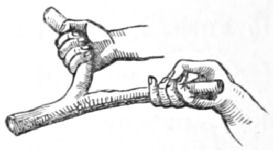
The manner in which the rod was used by certain
persons renders self-deception possible. The
rod is generally of hazel, and is forked like a Y;
the forefingers are placed against the diverging
arms of the rod, and the elbows are brought back
against the side; thus the implement is held in
front of the operator, delicately balanced before the
pit of the stomach at a distance of about eight
inches. Now, if the pressure of the balls of the
digits be in the least relaxed, the stalk of the rod
81]
will naturally fall. It has been assumed by some,
that a restoration of the pressure will bring the
stem up again, pointing towards the operator, and
a little further pressure will elevate it into a perpendicular
position. A relaxation of force will
again lower it, and thus the rotation observed in
the rod be maintained. I confess myself unable to
accomplish this. The lowering of the leg of the
rod is easy enough, but no efforts of mine to produce
a revolution on its axis have as yet succeeded.
The muscles which would contract the
fingers upon the arms of the stick, pass the shoulder;
and it is worthy of remark that one of the
medical men who witnessed the experiments made
on Bleton the hydroscope, expressly alludes to a
slight rising of the shoulders during the rotation of
the divining rod.
But the manner of using the rod was by no
means identical in all cases. If, in all cases, it
had simply been balanced between the fingers,
some probability might be given to the suggestion
above made, that the rotation was always
effected by the involuntary action of the muscles.
The usual manner of holding the rod, however,
82]
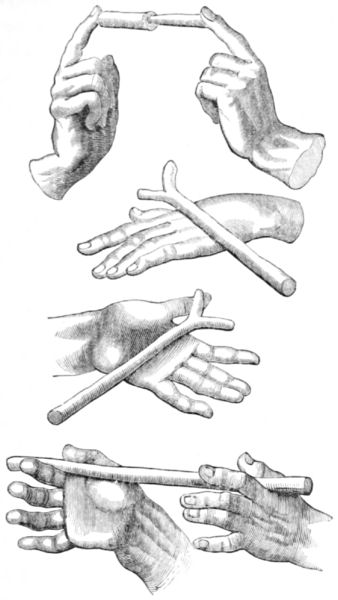
precluded such a possibility. The most ordinary use
consisted in taking a forked stick in such a manner
that the palms were turned upwards, and the fingers
closed upon the branching arms of the rod. Some
required the normal position of the rod to be horizontal,
others elevated the point, others again depressed
it.
If the implement were straight, it was held in a
similar manner, but the hands were brought somewhat
together, so as to produce a slight arc in the
rod. Some who practised rhabdomancy sustained this
species of rod between their thumbs and forefingers;
or else the thumb and forefingers were closed, and the
rod rested on their points; or again it reposed on the
flat of the hand, or on the back, the hand being held
vertically and the rod held in equilibrium.
A third species of divining rod consisted in a
straight staff cut in two: one extremity of the one
half was hollowed out, the other half was sharpened
at the end, and this end was inserted in the hollow,
and the pointed stick rotated in the cavity.
POSITIONS OF THE HANDS.
From “Lettres qui découvrent l’Illusion des Philosophes sur la Baguette.”
Paris, 1693.
The way in which Bleton used his rod is thus
minutely described: “He does not grasp it, nor
warm it in his hands, and he does not regard with
85]
preference a hazel branch lately cut and full of sap.
He places horizontally between his forefingers a rod
of any kind given to him, or picked up in the road,
of any sort of wood except elder, fresh or dry, not
always forked, but sometimes merely bent. If it is
straight, it rises slightly at the extremities by little
jerks, but does not turn. If bent, it revolves on its
axis with more or less rapidity, in more or less time,
according to the quantity and current of the water.
I counted from thirty to thirty-five revolutions in a
minute, and afterwards as many as eighty. A
curious phenomenon is, that Bleton is able to make
the rod turn between another person’s fingers, even
without seeing it or touching it, by approaching his
body towards it when his feet stand over a subterranean
watercourse. It is true, however, that the
motion is much less strong and less durable in other
fingers than his own. If Bleton stood on his head,
and placed the rod between his feet, though he felt
strongly the peculiar sensations produced in him by
flowing water, yet the rod remained stationary. If
he were insulated on glass, silk, or wax, the sensations
were less vivid, and the rotation of the stick
ceased.”
86]
But this experiment failed in Paris, under circumstances
which either proved that Bleton’s imagination
produced the movement, or that his integrity
was questionable. It is quite possible that in many
instances the action of the muscles is purely involuntary,
and is attributable to the imagination, so that
the operator deceives himself as well as others.
This is probably the explanation of the story of
Mdlle. Olivet, a young lady of tender conscience, who
was a skilful performer with the divining rod, but
shrank from putting her powers in operation, lest she
should be indulging in unlawful acts. She consulted
the Père Lebrun, author of a work already referred to
in this paper, and he advised her to ask God to withdraw
the power from her, if the exercise of it was
harmful to her spiritual condition. She entered into
retreat for two days, and prayed with fervor. Then
she made her communion, asking God what had been
recommended to her at the moment when she received
the Host. In the afternoon of the same
day she made experiment with her rod, and found
that it would no longer operate. The girl had
strong faith in it before—a faith coupled with fear;
and as long as that faith was strong in her, the rod
87]
moved; now she believed that the faculty was taken
from her; and the power ceased with the loss of her
faith.
If the divining rod is put in motion by any other
force except the involuntary action of the muscles, we
must confine its powers to the property of indicating
the presence of flowing water. There are numerous
instances of hydroscopes thus detecting the existence
of a spring, or of a subterranean watercourse; the
most remarkably endowed individuals of this description
are Jean-Jacques Parangue, born near Marseilles,
in 1760, who experienced a horror when near water
which no one else perceived. He was endowed with
the faculty of seeing water through the ground, says
l’Abbé Sauri, who gives his history. Jenny Leslie, a
Scotch girl, about the same date claimed similar
powers. In 1790, Pennet, a native of Dauphiné,
attracted attention in Italy, but when carefully tested
by scientific men in Padua, his attempts to discover
buried metals failed; at Florence he was detected
in an endeavor to find out by night what had been
secreted to test his powers on the morrow. Vincent
Amoretti was an Italian, who underwent peculiar
sensations when brought in proximity to water, coal,
88]
and salt; he was skilful in the use of the rod, but
made no public exhibition of his powers.
The rod is still employed, I have heard it asserted,
by Cornish miners; but I have never been able to
ascertain that such is really the case. The mining
captains whom I have questioned invariably repudiated
all knowledge of its use.
In Wiltshire, however, it is still employed for the
purpose of detecting water; and the following extract
from a letter I have just received will show that
it is still in vogue on the Continent:—
“I believe the use of the divining rod for discovering
springs of water has by no means been
confined to mediæval times; for I was personally
acquainted with a lady, now deceased, who has successfully
practised with it in this way. She was a
very clever and accomplished woman; Scotch by birth
and education; by no means credulous; possibly a
a little imaginative, for she wrote not unsuccessfully;
and of a remarkably open and straightforward disposition.
Captain C——, her husband, had a large
estate in Holstein, near Lubeck, supporting a considerable
population; and whether for the wants of the
people or for the improvement of the land, it now
89]
and then happened that an additional well was
needed.
“On one of these occasions a man was sent for
who made a regular profession of finding water by
the divining rod; there happened to be a large party
staying at the house, and the whole company turned
out to see the fun. The rod gave indications in the
usual way, and water was ultimately found at the
spot. Mrs. C——, utterly sceptical, took the rod
into her own hands to make experiment, believing
that she would prove the man an impostor; and she
said afterwards she was never more frightened in her
life than when it began to move, on her walking over
the spring. Several other gentlemen and ladies tried
it, but it was quite inactive in their hands. ‘Well,’
said the host to his wife, ‘we shall have no occasion
to send for the man again, as you are such an adept.’
“Some months after this, water was wanted in
another part of the estate, and it occurred to Mrs.
C—— that she would use the rod again. After some
trials, it again gave decided indications, and a well
was begun and carried down a very considerable
depth. At last she began to shrink from incurring
more expense, but the laborers had implicit faith; and
90]
begged to be allowed to persevere. Very soon the
water burst up with such force that the men escaped
with difficulty; and this proved afterwards the most
unfailing spring for miles round.
“You will take the above for what it is worth; the
facts I have given are undoubtedly true, whatever
conclusions may be drawn from them. I do not propose
that you should print my narrative, but I think
in these cases personal testimony, even indirect, is
more useful in forming one’s opinion than a hundred
old volumes. I did not hear it from Mrs. C——’s
own lips, but I was sufficiently acquainted with her to
form a very tolerable estimate of her character; and
my wife, who has known her intimately from her
own childhood, was in her younger days often staying
with her for months together.”
I remember having been much perplexed by reading
a series of experiments made with a pendulous
ring over metals, by a Mr. Mayo: he ascertained that
it oscillated in various directions under peculiar circumstances,
when suspended by a thread over the ball
of the thumb. I instituted a series of experiments,
and was surprised to find the ring vibrate in an unaccountable
manner in opposite directions over different
91]
metals. On consideration, I closed my eyes whilst
the ring was oscillating over gold, and on opening
them I found that it had become stationary. I got a
friend to change the metals whilst I was blindfolded—the
ring no longer vibrated. I was thus enabled
to judge of the involuntary action of muscles, quite
sufficient to have deceived an eminent medical man
like Mr. Mayo, and to have perplexed me till I succeeded
in solving the mystery.[24]
92]