Cookery, or the art of preparing good
and wholesome food, and of preserving all
sorts of alimentary substances in a state fit
for human sustenance, of rendering that
agreeable to the taste which is essential to
the support of life, and of pleasing the
palate without injury to the system, is,
strictly speaking, a branch of chemistry;
but, important as it is both to our enjoyments
and our health, it is also one of the
least cultivated branches of that science.
The culinary processes of roasting, boiling,
baking, stewing, frying, broiling, the art of
preserving meats, bacon, and hams; the
preparations of sauces, pickles, and other
condiments; the conserving of fruits; the
care and keeping of vegetables; the making
of jellies, jams, and marmalades, are
all founded upon the principles of this
science, and much waste of the material, as
well as labour to the parties might often be
spared, were those to whom the performance
of such tasks is committed, made acquainted
with simple chemical truths which
would invariably lead to certain results.
And, besides, the same knowledge would
enable them to attain a much greater degree
of perfection in curing and preserving all
kinds of animal and vegetable aliments, and
in combining the three grand requisites of
taste, nutriment, and salubrity, in whatever
manner they may be prepared. And,
though this art is at present in rude hands,
as all branches of chemistry were originally,
there is no reason that it should
remain so. A kitchen is, in fact, a chemical
laboratory; the boilers, stew-pans,
and cradle spit of the cook, correspond
to the digestors, the evaporating basins,
and the crucibles of the chemist. And
numerous as the receipts of cookery are,
the general operations (like the general
process of chemistry) are but few. In
some the object aimed at is, to extract the
constituent parts of the food, so as to exhibit
them in a separate state, or to combine
them with other substances, to produce
new compounds which differ widely
from those from which they originated. In
others, the qualities of the substances are
simply altered by the action of fire, to render
them more palatable and nutritious.
From the multiplicity of circumstances
to be attended to in this art, the whole of
which is founded upon the principles of
chemistry, we may easily see that it must
be a very precarious one; and, there is
reason to believe, that among the variety of
circumstances which produce diseases, the
improper modes of cooking food, are often the
primary cause. Will it be believed, that in
the cookery books which form the prevailing
oracles of the kitchens in this part of
the island, there are express injunctions to
“boil greens with halfpence, or verdigrise,
in order to improve their colour!”[1] That
our puddings are frequently seasoned with
laurel leaves, and our sweatmeats almost
uniformly prepared in copper vessels?[2]
Why are we thus compelled to swallow a
supererogatory quantity of poison which
may so easily be avoided? And why are we
constantly made to run the risk of our lives
by participating in custards, trifles, and
blancmanges, seasoned by a most deadly
poison extracted from the prunus lourocerasus?[3]
Verily, where such detestable
systems of cookery are practised, we may
exclaim with the sacred historian, that there
is “Death in the Pot.”
Food badly cooked is wasted to no purpose.
It seems to have been a complaint
familiar in the mouth of our ancestors, and
which we have too often seen reason to
re-echo in the present day—“That God
sends good meat, but the devil sends cooks.”
No animal eats such variety of food as
man; he claims, more justly than any other
creature, the title of omnivorous! for since
he is distinguished beyond all animals, but
the capability of living in the most distant
parts of the globe, under every variety of
climate which the earth affords, his food
could not be confined exclusively to either
the vegetable or animal kingdom, because
he inhabits regions that afford aliments
widely different from each other. Cattle
content themselves with green vegetables;
rapacious animals live on the flesh of other
creatures.
Those of the Linnæan order, glires,[4]
live on grain and fruits; each order of
birds, keeps, in the same manner, to one sort
of food, animal or vegetable. Fishes, reptiles,
and insects, also have each their peculiar
and exclusive bill of fare, beyond which
even hunger will scarcely force them to
wander. But however various each class,
and order, and species of animated nature
may be in the choice of food, man—all-devouring
man, will embrace the whole range
of the creation, “scarce a berry or a mushroom
can escape him.”
With the lion and the wolf he will eat
of fresh slain animals; with the dogs and
the vulture he will feed on putrid flesh;[5]
with the ox and the guinea-pig he will devour
raw vegetables, under the name of salads;
with the squirrel and the mouse he will feast
on nuts and grain; with birds of prey he
feeds on fowl of almost every species;
with fishes he feeds on fish; and with insects
and reptiles he sometimes lives on
insects and reptiles. Nor is he satisfied
even with this abundant variety, but must
go to the mineral kingdom for salt, as a
condiment before he can furnish out his
meal.
The variety of alimentary substances
used not only by individuals, but among
whole nations, are prodigiously diversified,
and climate seems to have some
effect in producing the diversity of taste,
though it must in a great measure depend
upon the natural productions of particular
countries, their religion, and their commercial
intercourse.
A vegetable diet seems suitable to the
hot countries under the Equator, and we
accordingly find nations there, who have
completely adopted it, and who abstain so
much the more from all animal food, in as
much as it is an article of their religious faith.
Potatoes, chesnuts, and the leguminous
and cereal seeds, satisfy the want of the
Alpine peasant, and numerous tribes solely
feed on vegetables and water. In the most
remote antiquity, we read of whole nations
in Africa, and of the Indian priests, who
lived entirely on vegetable substances.
Some wandering Moors subsist almost
entirely on gum senegal.
The nations which live on animal food
are very numerous.
The Ethiopeans, Scythians, and Arabians,
ate nothing but flesh.
The miserable inhabitants of New Holland
lived wholly on fish when that country
was first discovered, and other tribes on
the Arabian and Persian gulph.
In the Faro islands, in Iceland and Greenland,
the food arises from the same source.
The shepherds in the province of Caracas,
on the Oronoko, live wholly on flesh. The
Tartars in Asia, and some savage nations
in North America, live on raw and half
putrid flesh, and some barbarous tribes eat
their meat raw.
It appears to be the effect of climate and
religion that makes the Hindoo adopt vegetable
rather than animal food; it is the effect
of natural production that makes the Greenlander
relish whale-blubber and train-oil. It
is to one or other of these causes that we must
refer all such diversity of national tastes,
though it would be difficult in many cases to
separate the influence of each. We see the
Englishman enjoying his under-done roast
beef and his plum-pudding; the Scotsman
his hodge-podge and his haggis; the
Frenchman his ragouts, omlets, and fricandeaus;
the German his sour-crout, sausages,
and smoaked hams, the Italian his
maccaroni; and the Tartar his horse-flesh.[6]
“De gustibus non est disputandum.”—There
is no disputing about tastes. They
are too many, and too various, to be
objects of rational discussion.
Besides the before-mentioned diversities
of national and individual taste for different
kinds of substances, used as aliments, there
are other kinds of food which we at least
think more singular. Some of the tribes of
Arabs, Moors, the Californians, and Ethiopians,
eat tad-poles, locusts, and spiders.
In some places the flesh of serpents, that
of the coluber natrix for example, is eaten;
and the viper is made into broth. Several
other reptiles are used as food by the
European settlers in America, such as the
rana bombina and rana taurina, two species
of toads.
In the East, the lacerta scincus is considered
a great luxury, and also an approdisiac.
Even the rattle snake has been
eaten, and the head boiled along with the
rest of the body of the animal.
The horse, ass, and camel, are eaten in
several regions of the earth, and the seal,
walruss, and Arctic bear, have often yielded
a supply to sailors.
On the singular taste of epicures it is
not necessary to speak. Mæcenas, the
prime minister of Augustus, and refined
patron of Horace, had young asses served
upon his table when he treated his friends;
and, according to Pliny,[7] the Romans
delighted in the flavour of young and well
fattened puppies. This strange practice
subsists still in China, and among the
Esquimaux. Plump, and well roasted
bats, laid upon a bed of olives, are eaten
in the Levant as a dainty.
The Roman luxury, garum, which bore
so high a price, consisted of the putrid
entrails of fishes, (first of the garum,)
stewed in wine, and a similar dish is still
considered as a great luxury, in some parts of
the East. Some modern epicures delight in
the trail of the woodcock, and even collect
with care the contents of the intestines
which distill from it in the process of
roasting.
“The Irishman loves usquebah,
The Scot loves ale called blue cap,
The Welshman, he loves toasted cheese,
And makes his mouth like a mouse trap.”
Apicius,[8] among other whimsical personages
of ancient Rome, presented to his guests
ragouts, exclusively composed of tongues
of peacocks and nightingales. This celebrated
epicure, who instituted a gormandizing
academy at Rome, having heard that
shrimps and prawns of a superior flavour
were to be met with on the coasts of Africa
than on the Italian shore, freighted a
ship, and sailed in search of these far
famed marine insects. This person spent
more than £.60,000 merely to vary the
taste of culinary sauces.
Vitellus was treated by his brother with
a dinner, consisting of 2,000 dishes of fish,
and 7,000 of poultry—surely this is not
doing things by halves.
A Mr. Verditch de Bourbonne[9] is said to
have bought 3,000 carps for the mere sake
of their tongues, which were brought, well
seasoned and learnedly dressed, to his table,
in one dish.
However extravagant and whimsical the
rational pleasures of the table may appear
to a sober and sensible mind, we must, in
justice to epicures, cursorily observe, that
there exists a material difference between a
gormand or epicure, and a glutton.[10] The
first seeks for peculiar delicacy and distinct
flavour in the various dishes presented to
the judgment and enjoyment of his discerning
palate; while the other lays aside
nearly all that relates to the rational pleasures
of creating or stimulating an appetite
of the cates, and looks merely to quantity;
this, has his stomach in view, and tries
how heavy it may be laden, without endangering
his health.
“The gormand never loses sight of the
exquisite organs of taste, so admirably
disposed by Providence in the crimson
chamber, where sits the discriminating
judge, the human tongue.
“The glutton is anathematised in the
Scripture with those brutes quorum deus
venter est. The other appears guilty of no
other sin than of too great, and too minute,
an attention to refinement in commercial
sensuality.”
Our neighbours on the other side of the
channel, so famous for indulging in the
worship of Comus, consider the epicure
again under two distinct views, namely:
as a gormand, or a gourmet. The epicure
or gormand is defined—a man having
accidentally been able to study the different
tastes of eatables, does accordingly
select the best food and the most pleasing
to his palate. His character is that of a
practioner. The gourmet speculates more
than he practises, and eminently prides
himself in discerning the nicest degrees,
and most evanescent shades of goodness
and perfection in the different subjects proposed
to him. He may be designated a
man, who, by sipping a few drops out of
the silver cup of the vintner, can instantly
tell from what country the wine comes, and
its age.
The glutton practices without any regard
to theory.
The gormand, or epicure, unites theory
with practice.
The gourmet is merely theoretical.
As man differs from the inferior animals
in the variety of articles he feeds upon, so
he differs from them no less in the preparation
of these substances. Some animals, besides
man, prepare their food in a particular
manner. The racoon (ursus lutor)
is said to wash his roots before he eats them;
and the beaver stores his green boughs
under water that their bark and young
twigs may remain juicy and palatable.
The action of fire, however, has never
been applied to use by any animal except
man; not even monkies, with all their
knacks of imitation, and all their fondness
for the comforts of a fire, have ever been
observed to put on a single billet of wood
to keep up the fuel.
Domesticated animals, indeed, are
brought to eat, and even to relish, food
which has been cooked by the action of
heat.
The variety of productions introduced by
our different modes of preparing and preserving
food is almost endless; and it appears
particularly so when we compare the
usages, in this respect, of various countries.
The savage of New South Wales is
scarcely more knowing in the preparation
of food, by means of fire, than his neighbour,
the kangaroo, if the anecdote told by
Turnbull be true, that one of these savages
plunged his hand into boiling water to
take out a fish.
Some writers have humorously designated
man to be “a cooking animal,” and
he really is so. It is one of the leading
distinctions which Providence has seen meet
for wise purposes to establish, when it was
said that he might eat of the fruit of every
tree, and the flesh of every clean beast.
When we contemplate the aliments used
by men in a civilized state of existence,
we soon become convinced that only a
small part of our daily food can be eaten
in its natural state. Many of the substances
used as aliments, are disagreeable,
and some even poisonous until they have
been cooked. Few of them are to be had
at all seasons, although produced at others
in greater abundance than can be consumed.
The importance of a proper and competent
knowledge of the true and rational
principles of cookery, must be obvious,
when it is considered that there is scarcely
an individual, young or old, in any civilized
country, who has not some time or other
suffered severely from errors committed
in the practice of this art.
“A skilful and well directed cookery
abounds in chemical preparations highly
salutary. There exists a salubrity of aliments
suited to every age. Infancy, youth,
maturity, and old age, each has its peculiar
adapted food, and that not merely applicable
to the powers in full vigour, but to
stomachs feeble by nature, and to those
debilitated by excess.”[11]
Without abetting the unnatural and injurious
appetites of the epicure, or the
blameable indulgences of the glutton, we
shall not perhaps be far out in our reckoning,
if we assert, that almost every person
is an epicure in his own way.
There are amateurs in boiling potatoes,
as particular in the details, as others in
dressing beaf-stakes to the utmost nicety
of a single turn. Lord Blainey, still more
nice, informs us, that hams are not fit to be
eaten unless boiled in Champaign. Helluos
are not confined to salmon’s bellies, but are
to be found among the rudest peasants who
love porridge or frumenty—
A salmon’s belly, Helluo, was thy fate;
The doctor call’d, declares all help too late;
“Mercy!” cries Helluo, “mercy, on my soul!
Is there no hope?—Alas! then bring the jowl.”
Pope’s Moral Essays.
Precision in mixing ingredients is as often
and as closely laid down for the coarsest
dish of the peasant as for the most guarded
receipe of the Lady Bountiful of the village.
The pleasures of the table have always been
highly appreciated and sedulously cultivated
among civilized people of every age and
nation; and, in spite of the Stoic, it must
be admitted, that they are the first which
we enjoy, the last we abandon, and those of
which we most frequently partake.
“Cookery is the soul of every pleasure,
at all times and to all ages. How many
marriages have been the consequence of a
meeting at dinner; how much good fortune
has been the result of a good supper, at
what moment of our existence are we happier
than at table? there hatred and animosity
are lulled to sleep, and pleasure
alone reigns.”
Pythagoras, in his golden verses, gives
complete proof, that he was particularly nice
in the choice of food, and carefully points
out what will occasion indigestion and flatulency.
He is precise in commanding
his disciples to “abstain from beans.”
Apicius, declares that he never knew a
philosopher who refused to partake of a feast.
In later times, Dr. Johnson is well
known to have been exceedingly fond of
good dinners, considering them as the
highest enjoyment of human life. The
sentiments of our great moralist are a good
answer to those who think the pleasures
of the table incompatible with intellectual
pursuits or mental superiority. “Some
people,” says the Doctor, “have a foolish
way of not minding, or pretending not to
mind, what they eat; for my part, I mind
my belly very studiously, and very carefully,
and I look upon it that he who does
not mind his belly will hardly mind any
thing else.” Boswell, his biographer, says
of him, “I never knew a man who relished
good eating more than he did: and when
at table, he was wholly absorbed in the
business of the moment.” It was one of
the objects which displeased him so much
in his Northern tour, that the Scots were
rather ignorant of the more refined arts
of cookery. A lady in the Isle of Mull,
anxious to gratify him for once in a dinner,
had an excellent plum-pudding prepared,
at some expense, and with the utmost care;
but, to her great mortification, the doctor
would not taste it, because, he said, “it is
totally impossible to make a plum-pudding
at all fit to eat in the Isle of Mull.”
Another instance of this philosopher’s
illiberal prejudice against Scotch cookery,
may also be mentioned. A lady, at whose
table the Doctor was dining, enquired how
he liked their national dish, the hotch
potch, of which he was then partaking.
“Good enough for hogs,” said the surly
philosopher. “Shall I help you to a little
more of it?” retorted the lady. To Dr. Johnson
we can add the names of two distinguished
physicians, Darwin, and Beddoes, both of
whom were most outrageous in their published
works against the pleasures of good
living; they followed however a very different
practice, from what they prescribed to
others, as none were more fond of good
dinners than these guardians of health.
Cardinal Wolsey, we should have thought,
would have had something else to mind
than cooking and good eating. But no
person was more anxious than he, even in
the whirl of the immense public business
which he had to transact, to have the most
skilful cooks; for all Europe was ransacked,
and no expense spared, to procure culinary
operators, thoroughly acquainted with the
multifarious operations of the spit, the
stew-pan, and the rolling-pin.
Sir Walter Scott, has been most happy
in the illustration of our ancient manners
with respect to good eating, in the character
of Athelstan, in the Romance of Ivanhoe.
Count Rumford has not considered the
pleasure of eating, and the means that may
be employed for increasing it, as unworthy
the attention of a philosopher, for he
says, “the enjoyments which fall to
the bulk of mankind, are not so numerous
as to render an attempt to increase
them superfluous. And even in
regard to those who have it in their power
to gratify their appetites to the utmost extent
of their wishes, it is surely rendering
them a very important service to shew
them how they may increase their pleasures
without destroying their health.”
In the olden time, every man of consequence
had his magister coquorum, or
master cook, without whom he would not
think of making a day’s journey; and it
was often no easy matter to procure master
cooks of talent.
By a passage of Cicero[12] we are led to
understand, that among other miseries of
life, which constantly attended this consular
personage and eloquent orator, he laboured
under the disappointment of not having an
excellent cook of his own; for, he says,
“coquus meus, præter jus fervens, nihil
potest imitari.” Except hot broth, my cook
can do nothing cleverly.
The salary of the Roman cooks was
nearly £1000.[13] Mark Antony, hearing
Cleopatra, whom he had invited to a
splendid supper, (and who was as great a
gormand as she was handsome,) loudly
praise the elegance and delicacy of the
dishes, sent for the cook, and presented him
with the unexpected gift of a corporate
town.—Municipium.
Even in our own times great skill in
cookery is so highly praised by many, that
a very skilful cook can often command, in
this metropolis, a higher salary than a
learned and pious curate.
His Majesty’s first and second cooks are
esquires, by their office, from a period to
which, in the lawyer’s phrase, the memory
of man is not to the contrary. We are told
by Dr. Pegge, that when Cardinal Otto,
the Pope’s Legate, was at Oxford, in the
year 1248, his brother officiated as magister
coquinæ, an office which has always
been held as a situation of high trust and
confidence.
We might defend the art of cookery on
another principle, namely—on the axiom
recognized in the Malthusian Political Economy,
that he who causes two blades of
grass to grow where only one grew before,
is a benefactor to his country and to human
nature. Whether or not Malthus is
quite right in this, we are not competent to
decide; we leave that to Say, Godwin,
Ricardo, and[14] Drummond. But certainly it
must in many cases be of the utmost consequence,
for families in particular, when
embarrassed in circumstances, to make food
go twice as far as without the art and aid
of rational cookery it could do. We would
particularly press this remark, as it is
founded on numerous facts, and places the
art of cookery in a more interesting point of
view than any of the other circumstances
which we have been considering.
Cookery has often drawn down on itself
the animadversions of both moralists, physicians,
and wits, who have made it a
subject for their vituperations and their
ridicule.
So early as the time of the patriarch
Isaac, the sacred historian casts blame
upon Esau for being epicurean enough to
transfer his birth-right for a mess of pottage.
Jacob is blamed for making savoury meat
with a kid for his father, with a view to
rob Esau of the paternal blessing.
Diogenes, the Cynic, meeting a young
man who was going to a feast, took him up
in the street and carried him home to his
friends, as one who was running into evident
danger had he not prevented him. The
whole tribe, indeed, of the Stoics and Cynics,
laughed at cookery, pretending, in their
vanity and pride, to be above the desire of
eating niceties. Lucian, with his inexhaustible
satire, most effectually and humourously
exposed these their pretences.
In our own times, we have had writers of
eminence who have attacked the use of a
variety of food as a dreadful evil. “Should
we not think a man mad,” says Addison,
“who at one meal will devour fowl, flesh,
and fish; swallow oil, and vinegar, salt,
wines, and spices; throw down sallads of
twenty different herbs, sauces of an hundred
ingredients, confections, and fruits of
numberless sweets and flavours? What
unnatural effects must such a medley
produce in the body? For my part,
when I behold a table set out in all its
magnificence, I fancy, that I see gouts
and dropsies, fevers and lethargies, and other
innumerable distempers, lying in ambuscade
among the dishes.”
All this, and the like is, no doubt, very
plausible, and very fine, and, like many
other fine speeches of modern reformers,
it is more fine than just. It is indeed as
good a theory as may be, that cookery
is the source of most, or all, of our distempers;
but withal it is a mere theory,
and only true in a very limited degree.
The truth is, that it is not cookery which
is to blame, if we surfeit ourselves with its
good dishes; but our own sensual and
insatiable appetite, and gluttony, which
prompt us to seek their gratification at the
expense even of our health.
Savages, whose cookery is in the rudest
state, are more apt to over-eat themselves
than the veriest glutton of a luxurious and
refined people; a fact, which of itself, is
sufficient to prove, that it is not cookery
which is the cause of gluttony and surfeiting.
The savage, indeed, suffers less
from his gluttony than the sedentary and
refined gormand; for, after sleeping, sometimes
for a whole day, after gorging himself
with food, hunger again drives him
forth to the chace, in which he soon gets
rid of the ill-effects of his overloaded
stomach. Surely cookery is not to blame
for the effects of gluttony, indolence, and
sedentary occupations; yet it does appear,
that all its ill effects are erroneously charged
to the account of the refined art of cooking.
The defence of cookery, however, which
we thus bring forward to repel misrepresentation,
applies only to the art of preparing
good, nutritious, and wholesome food.
We cannot say one word in defence of
the wretched and injurious methods but
too often practised, under the name of
cookery, and the highly criminal practices
of adulterating food with substances deleterious
to health. On this subject we
have spoken elsewhere.[15]
“A good dinner[16] is one of the greatest
enjoyments of human life; but the practice
of cookery is attended with not only so
many disgusting and disagreeable circumstances,
and even dangers, that we ought
to have some regard for those who encounter
them for our pleasure.”
Almost every person who can afford it,
eats more than is requisite for promoting
the growth, and renewing the strength and
waste of his body. It would be ridiculous
to speak concerning the precise quantity of
food necessary to support the body of different
individuals. Such rules do not exist
in nature. The particular state or condition
of the individual, the variety of constitution,
and other circumstances, must be taken into
account. If, after dinner, we feel ourselves
as cheerful as before, we may be assured
that we have made a dietetical meal.
Much has been said of temperance. The
fact is, that there is an absolute determined
standard of temperance, the point of which
must be fixed by every man’s natural and
unprovoked appetite, while he continues
in a state of health. As long as a person
who pursues a right habit of life, eats and
drinks no more than his stomach calls for
and will bear, without occasioning uneasiness
of any kind to himself, he may be
said to live temperate. The stomach revolts
against the reverse of it; indeed, the
stomach is the grand organ of the human
system, it is the conscience of the body, and
like that, will become uneasy if all is not
right within; it speaks pretty plainly to
those who lead an intemperate life.
“We may compare,” says Doctor
Kitchener, “the human frame to a watch, of
which the heart is the main spring, the
stomach the regulator, and what we put
into it, the key, by which the machine is
set a-going; according to the quantity,
quality, and proper digestion of what we
eat and drink will be the action of the
system: and when a due proportion is
preserved between the quantum of exercise
and that of excitement, all goes well. If
the machine be disordered, the same expedients
are employed for its re-adjustment,
as are used by the watch-maker; it
must be carefully cleaned and then judiciously
oiled. To affirm that such a thing is
wholesome, or unwholesome, without considering
the subject in all the circumstances
to which it bears relation, and the unaccountable
idiosyncrasies of particular
constitutions is, with submission, talking
nonsense. Every man must consult his
stomach; whatever agrees with that perfectly
well, is wholesome for him, whilst it
continues to do so whenever natural appetite
calls for food.”
Celsus spoke very right when he said
that a healthy man ought not to tie himself
up by strict rules, nor to abstain from any
sort of food; that he ought sometimes to
fast, and sometimes to feast. When applied
to eating, nothing is more true than the
proverb—
“Bonarum rerum consuetudo pessima est.—Syrus.
“The too constant use, even of good things, is hurtful.”
It is certainly better to restrain ourselves,
so as to use, but not to abuse, our enjoyments;
and to this we may add the opinion
of doctor Fothergil, which the experience
of every individual confirms, namely, that
“the food we fancy most, sits easiest on the
stomach.”
What has been so far stated on the choice
and quantity of food to be taken at a time,
of course, relates only to persons in a state
of health; the diet of the delicate, the sickly,
and the infirm, must be regulated by the
physician, and even the aged require particular
kinds of food.
“Experience[17] has fully convinced me,
(says an eminent Physiologist), that the
latter stages of human life, are often
abridged by unsuitable diet.”
“The most numerous tribe of disorders
incident to advanced life, spring from the
failure or errors of the stomach, and its
dependancies, and perhaps the first sources
of all the infirmities of inability, may be
traced to effects arising from imperfectly
digested food.”
In some persons, an extraordinary great
appetite seems to be constitutional.
Charles Domery, aged 21 years, when a
prisoner of war, at Liverpool, consumed in
one day
| |
4lbs. |
of |
Raw Cow’s Udder. |
| 10lbs. |
Raw Beef. |
| 2lbs. |
Tallow Candles. |
| Total |
16lbs. |
|
and five bottles of porter; and although
allowed the daily rations of ten men, he
was not satisfied.
Another extraordinary instance has been
recorded by Baron Percy:—A soldier of the
name of Tarare, who, at the age of 17,
could devour in the course of 24 hours, a
leg of beef weighing 24lbs. and thought
nothing of swallowing the dinner dressed
for fifteen German peasants. But those men
were remarkable not only for the quantity
of food they consumed, but also for its
quality, giving a preference to raw meat,
and even living flesh and blood.
Domery, in one year, eat 174 cats, dead
and alive; and Tarare was strongly suspected
of having eaten an infant.
Man can sustain the privation of food for
several days, more or fewer in number,
according to circumstances—the old better
than the young, and the fat better than the
lean. The absolute want of drink can be
suffered only a short time, they have been
strikingly described by Mungo Park and
Ali Bey, as experienced in their own persons.
The narratives of ship-wrecked mariners
also prove, with how very little food life
may be supported for a considerable length
of time; and the history of those impostors
who pretend to live altogether without
food or drink, display this adaptation of
the wants of the body to its means of supply
in a still more striking manner; for, even
after the deception, in such cases as that of
Ann Moore, is exposed, it will be found
that the quantity of aliment actually taken
was incredibly small.
Captain Woodard has added to his interesting
narrative many instances of the
power of the human body to resist the effects
of severe abstinence. He himself
and his five companions rowed their boat
for seven days without any sustenance but
a bottle of brandy, and then wandered
about the shores of Celebes six more, without
any other food than a little water and
a few berries. Robert Scotney lived seventy-five
days alone in a boat with three
pounds and a half of meat, three pounds
of flour, two hogsheads of water, some
whale oil, and a small quantity of salt.
He also used an amazing quantity of tobacco.
Six soldiers deserted from St. Helena
in a boat, on the 10th of June 1799,
with twenty-five pounds of bread and about
thirteen gallons of water. On the 18th,
they reduced their allowance to one ounce
of bread and two mouthfuls of water, on
which they subsisted till the 26th, when
their store was expended. Captain Inglefield,
with eleven others, after five days of
scanty diet, were obliged to restrict it to a
biscuit divided into twelve morsels for
breakfast, and the same for dinner, with an
ounce or two of water daily. In ten days,
a very stout man died, unable to swallow,
and delirious. Lieutenant Bligh and his
crew lived forty-two days upon five day’s
provisions.
In the tenth volume of Hufland’s Journal,
is related a very remarkable, and well-authenticated
case of voluntary starvation.
A recruit, to avoid serving, had cut off
the fore-finger of his right hand. When
in hospital for the cure of the wound,
dreading the punishment which awaited
him, he resolved to starve himself; and on
the 2nd of August began obstinately to refuse
all food or drink, and persisted in this
resolution to the 24th of August. During
these twenty-two days he had absolutely taken
neither food, drink, nor medicine, and
had no evacuation from his bowels. He had
now become very much emaciated, his belly
somewhat distended, he had a violent pain
in his loins, his thirst was excessive, and
his febrile heat burning. His behaviour
had also become timid. Having been promised
his discharge, unpunished, he was
prevailed upon to take some sustenance,
but could not, at first, bear even weak soup
and luke-warm drinks. Under proper
treatment, he continued to mend for eight
days, and his strength was returning, when,
on the 1st of September, he again refused
food and got a wild look. He took a little
barley-water every four or five days to the
8th; from that day to the 11th, he took a
little biscuit with wine; but again from the
11th September to the 9th October, a period
of twenty-eight days, he neither took food,
drink, nor had any natural evacuation. From
the 9th to the 11th he again took a little nourishment,
and began to recruit; but, on the
11th, he finally renewed his resolution to
starve himself, and persevered until his
death, which took place on the 21st November,
after a total abstinence of 42 days.
We are told, that in the first ages of the
world, men lived upon acorns, berries, and
such fruits as the earth spontaneously produced,
and that in the Shepherd state of
society, milk, obtained from flocks and herds,
came into use. Soon afterwards the flesh
of wild animals was added to the food, and
the juice of grape to the drink of the
human species. Hogs were the first animals,
of the domestic kind, that were eaten by
men, for they held it ungrateful to eat the
animals that assisted them in their labour.
“We are happy to find, (says the author of
an elegant poem[18]) that it was not on account
of the solidity, wholesomeness, delicacy, and
other excellent qualities of his flesh, that
the ox was worshipped on the banks of the
Nile, and in the gorgeous temples of Memphis;
for, although professedly friends to
gastronomy, moderated by a decided aversion
to any thing like sensuality, we are of
opinion that man is less fit to feed upon
carnal than vegetable substance.”
“The noble horse, fierce and unsubdued,
was still roaming with all the roughness
and intractability of original freedom,
in his native groves, who already domesticated,
the honest steer had willingly lent
the strength of his powerful shoulders to
the laborious strife of the plough. This
had not only raised altars to him under the
name of Apis, but even placed him among
the first constellations of the Zodiac above
the watchful eyes of the Chaldeans. In
the reign of Erichtonius, fourth king of
Athens, Diomus was offering to Jupiter
the first fruits of the earth. Whilst the
priests were busied apart in preparing some
necessaries to the solemnity, an ox, passing
by, browsed of all that had been gathered
on the altar for the sacrifice. Diomus, in
his disappointment and passion, slew him
on the spot. The Gods, instead of countenancing
his religious zeal, sent forth immediately
all the horrors of a pestilence
upon the Athenians, which did not cease
until they had instituted a festival called
“The Death of the Ox.”[19]
“Porphyrius traces the custom of eating
meat to Pygmalion, king of Tyre, in Phœnicia.
Although the Jews were allowed
to eat the flesh of the immolated beasts, in
the golden age, man had not found courage
and appetite enough to eat the flesh of an
innocent animal; but soon after, this
cruelty extended to nearly all quadrupeds,
except those who were carnivorous. Tradition
states, that Prometheus was the
first who killed a bullock, Ceres a pig, and
Bacchus a goat, for the uses of their tables.
It is obvious that pigs, by turning up the
new-sown fields for the sake of the grain,
and goats browzing the tender sprouts of
the vine-tree, were respectively inimical to
Ceres and Bacchus. As for the killing of
the first bullock by Prometheus, we leave
to other commentators to explain.”
Animal food alone is ill adapted to form
the whole of our aliment. The inquiries of
physiologists have determined, that animal
food is highly stimulant, and like all other
stimulants, after the excitement has been
brought to its acmé, debility must by necessity
succeed. This, however, is not so
much the case where fresh meat is used
as when the meat is salted; but this may
be, because our examples, with regard to
fresh meat, are less marked than in the
case of salted provision. For few instances
occur in which fresh meat forms
the whole food, exclusive altogether of
fruits or other vegetable aliment. Salted
meat often constitutes a great proportion of
the food in long sea voyages, in the long
dreary winters in Lapland, and amongst
the inhabitants of besieged towns.
When this practice is continued for any
length of time, oppression and langour begin
to be felt, indigestion is brought on, and
hurried breathing and a quick pulse on taking
the slightest exercise, the gums become soft
and spongy, the breath becomes fœtid, and
the limbs swoln. Such are the dreadful
effects produced by salted provisions, when
a proper proportion of vegetable food is
not used along with them.
The fact is, that nations, whose food is
entirely vegetable, are less active and energetic
than those whose diet is more nutritive.
The inhabitants of Ireland, in the
most humble walks of life, for example,
who live almost exclusively on potatoes, are
said to be more indolent and sluggish, when
compared with their neighbours in England,
who would think such diet to be no better
than a prison allowance of bread and
water.
In the East, where rice forms the great
article of food with some tribes, the people
are far from being robust or able to undergo
much fatigue in labour or in war. The
striking fact, that the English soldiers
and sailors surpass all those of other nations
in bravery and hardihood, is sufficient, we
think, to demonstrate the effect of a considerable
proportion of animal food.—For,
though it be said, that a great number
of our soldiers are Irishmen, yet our
argument holds good, since, all these when
in the army, or navy, live exactly in the same
manner as the English themselves. The
change of diet, indeed, is in these brave men
very obvious; for the Irish and Scots
soldiers are often more hardy than the
English; not as it is supposed because
they have been innured to greater hardships
in their youth, but because their diet being
more generous than it was at that period,
its effects become more obvious than in
those who have always had animal food.
When we examine the structure of the
digestive organs of the inferior animals
which live wholly on vegetable food, we
find that they are very differently constituted
from man, and much more so from
the animals of prey. If the organs
for digestion of the ruminant animals
are more complicated, it should seem to
follow, that vegetable aliment is more
difficult to digest; otherwise, nature, who
never works in vain, would not have provided
for them such a series of stomachs.
Hence we infer, that since man has not this
apparatus peculiar to ruminant animals, it
must be plain that nature did not intend
him to live exclusively on vegetables. If
we consider the human teeth, we shall be
led to the same conclusion, for they are not
either like the teeth of ruminant animals or
those of beasts of prey, but intermediate
between the two. We have incisor teeth
like animals of the order glires: such as
the hare, the rabbit, and the guinea-pig;
canin teeth like those of the order feræ:
such as the dog, the tiger, and the lion;
and grinders, like herbivorous quadrupeds:
such as the horse, the sheep, and the cow.
Food, then, composed of animal and
vegetable substances, seems to be the best
adapted for our organs of mastication and
digestion, though it would not be easy to
say precisely what proportions of these are
most agreeable to the intentions of nature.
We may safely conclude, however, that the
vegetable food ought to exceed the animal
in quantity. The direction given by Dr.
Fothergill is the most judicious we have
met with. “I have only” says he “one
short caution to give. Those who think it
necessary to pay any attention to their
health at table, should take care that the
quantity of bread, of meat, of pudding, and
of greens, should not compose each of them
a meal, as if some were only thrown in to
make weight; but they should carefully observe,
that the sum of all together do not
exceed due bounds, or encroach upon the
first feeling of satiety.”
Of the different classes of animals used
for food, quadrupeds compose the greatest
proportion, and there is no part of their
bodies which does not contain nutritive
parts, and that has not been used as food
in some way or other. Even bones affords
an alimentary jelly fit for human food.
The largest portion of our aliment, however,
is derived from the voluntary muscles
of animals, or what is more strictly called,
the flesh, consisting of all the red fibrous
substance which covers the bones. It
should seem that this is both the most
nourishing and the most easily digested of
animal substances. The red colour arises
from the blood of minute vessels which run
in every direction among the fibres; but
whether this is the cause of the red muscle
being more nutritious is not well ascertained.
Thence the flesh of quadrupeds is
more largely consumed than of any other
class of animals; and, indeed, those in
common use in most parts of Europe possesses
all the alimentary properties in the
highest perfection. All animal flesh seems
more or less stimulating; and, in general,
the more so the darker its colour is—but it
does not absolutely follow that it is also
more nutritious.
There is a considerable difference in the
qualities of muscular flesh, according to
the size of the animal, and also according
to its activity. The small mountain
sheep, for example, which has to encounter
fatigue to procure its food, has flesh of a
different quality and flavour from the large
and lazy creature, which feeds luxuriously
and fattens rapidly, in the rich pastures of
the plain country. The beef of the western
islands also, is more esteemed, on account
of the same circumstance, than that of the
fat and brawny oxen which we see in the
London market. It is for this reason, we
have no doubt, that the flesh of the horse,
the rhinocerus, and elephant, is not used as
food except in cases when other food is not
to be procured. In the circumstance of
activity altering the qualities of flesh, we
may be allowed to instance the superiority
of venison to beef, in flavour and tenderness,
and easiness of digestion.
The age of animals is another circumstance
which has great influence on the
qualities of their flesh. The flesh of young
animals is composed of less rigid fibres, and
has fewer vessels which carry red blood
running through it, and besides, it has less
of the peculiar flavour of its particular
species than the flesh of older animals.
Gelatine is more abundant in the young,
and fibrin in the old; hence the former is
more bland and tender. Veal and lamb, for
example, are more tender and gelatinous
than beef or mutton; sucking pigs, chickens,
and ducklings, are also much more delicate
than the grown animals. The beef of an old
cow, however well fed, is quite tough and
unpalatable, while that of a very young
heifer is much relished. Although, however,
very young animals be so much more
tender, yet they are insipid and flabby.
In the case of pork, age is not required,
as in other sorts of butcher meat, to mellow
the fibre. It is an aliment containing much
nourishment; but to some palates its
flavour is disagreeable, though by most
people it is relished. It was much used by
the ancient athletæ, as half raw beef steaks
are now by our men of the fancy.
Sucking pigs are killed when three weeks
old; and for pork, pigs are killed from six
to twelve months old. It requires them to
be older for making brawn. The flesh of
young venison is not so good as when four
years old or more; though that of the fawn
is very tender and succulent.
But even in the fœtal state, the flesh of
animals, if recently taken from a healthy
mother, may be used. In the London
market the fœtus of the cow is regularly
sold to the pastry-cooks for the purpose of
making mock turtle soup, of which it often
forms the principal portion.
Veal, however, is reckoned not so good
when killed before it be eight or ten weeks
old. The most remarkable quality of flesh
of this kind is, its almost wholly dissolving
in boiling water, forming in the warm state
a bland and gelatinous soup, and when
cold, concreting into a tremulous transparent
jelly. It is less animalized, or more properly
speaking, contains less animal fibre
than almost any other flesh; hence its
tendency to become ascescent when made
into broth and jelly, which is not the case
with beef or mutton broth. The parts of
older animals, which contain a larger portion
of gelatine, are in this respect similar to
young flesh. Cow-heel and sheep’s-head
are well known instances. It may be
remarked that such food is less nutritious,
and unless very much boiled, is less digestible
than muscular flesh; but as it is also
more light and less stimulating, it is frequently
given to delicate people who cannot
take any thing stronger.
Tripe is intermediate between what we
have just described and the muscular flesh
of grown animals, insomuch as there is in
the stomach of ruminant animals a considerable
proportion of vessels, transmitting
red blood, and of muscular fibres, and
accordingly it is to be inferred that tripe is
more nutritive; it is certain it is more
palatable and savory.
As to other parts of animals, which are
abundantly furnished with red blood, though
destitute of muscle, we cannot speak so
decidedly. Some of the glands are coarse
and rank flavoured, from the peculiar
secretions which they produce, and are
only used by poor persons; others are
esteemed as delicacies, and seem not to be
unwholesome. As examples of the latter,
we may mention sweet bread or pancreas,
one of the glands belonging to the digestive
organs; and the liver of some species of
birds, and of young quadrupeds.
The liver of the goose reckoned a great
delicacy in Sicily, and they have there a
a method of enlarging this organ while the
bird is alive, but it is so cruel, that Brydon,
who mentions it, declines giving the particulars,
lest our epicures in England
should have the inhumanity to give it a
trial. The spleen is an instance of the
former case, being strongly ill flavoured.
Another circumstance which produces
difference of quality in flesh, is the sex of
the animal, the genital organs having in
this respect a very remarkable influence,
as appears from the effect of destroying
these by castration. This renders the flesh
of the male similar, and in some cases, as
in mutton, superior to that of the female,
which is always more tender, and of finer
fibre than that of the uncastrated male.
By destroying also the ovaries of the
females, their flesh is rendered more
delicate, though this operation is not often
practised. The sow is the animal which is
most usually operated upon with this view;
the flesh of the uncastrated boar is very
coarse and bad. Even in calves the difference
is observable, and veal is greatly
improved by castrating the males. The
same practice greatly improves fowl, as in
capons. Venison is rank, tough, lean,
and ill flavoured, and not fit to be eaten
when killed during the rutting season, in
September and October; and salmon, when
about to spawn, are also bad, and prohibited,
we believe, by our laws, to be
caught or sold.
The mode of feeding animals, designed
for the table, has also great influence on
the quality of the flesh, so much so, that
nice judges can distinguish whether mutton,
if from the same breed of sheep, has been
fed on grass or on turnips; and can tell,
still more accurately, on tasting the fat of
pork, whether the pigs have been fed on
sour skimmed milk, brewers grains, or
pease flour. It was the practice sometime
ago, but now almost laid aside, to feed
calves and oxen on oil cake. This did
certainly fatten them, but the fat was rather
rancid in most cases, and never of good
flavour. The truth seems to be, that,
though generally, the lean of fat animals is
the most tender and palatable, yet that
this is not so much the case when the fat
is rapidly produced by artificial management
in the feeding.
Sheep become very rapidly fat in the
first stage of the rot, in consequence,
perhaps, of their desire for food being
greatly increased by the disease; and,
taking advantage of this, it is said that
some butchers are in the practice of producing
rot artificially, which is certainly
very blameable. Some amateurs of mutton
are fond of such as has died of a sort of
colic, called in the North braxy, that produces
a very peculiar flavour in the meat,
which is always, however, roasted, and
never stewed or boiled. Such tastes are,
to say the least of them, surely unnatural.
It is, perhaps, owing to the different
quality and quantity of food, as much as
any thing, that the season of the year has
an effect upon the flesh of animals; the
heat or cold of the weather, and in some
cases, the periodical return of sexual
attachment, must also be taken int to be out of
seasono account.
In the instances of veal and lamb, the
words, in season, and out of season, refer,
perhaps, more to plenty and scarceness
than to any quality in the meat; for as
soon as any thing is so plentiful in the
market as to cause a fall in the price, and
bring it within reach of the poor, then the
wealthy classes pronounce it to be out of
season.
This is the case with some sorts of birds
which migrate at certain times of the year,
the woodcock for example, and are on that
account to be valued when they can be procured.
Such as breed here, the solan goose
for example, can be procured in the young
state before they take their flight to their
unknown retreat.
It has been roundly asserted, that there
is no bird, and no part of any birds, which
may not be safely used as food. Many
species, however, are very oily, tough, or
bad flavoured, and it is not at least very
desirable to eat any animal which feeds on
prey or carrion; even though this did not,
as it does, taint their flesh. The qualities
of the flesh of birds differ very much, both
in the several species, and in particular parts
of the same bird.
The flesh of birds which live on grain, is
for the most part preferred to those which
feed on insects or fish.
The pheasant, the turkey, as well as
partridge, and moor game, are more esteemed
than goose, duck, or woodcock.
Many of the water birds, however, are
preferred, though from the nature of their
food, they are apt to taste strongly of fish,
and to become too fat and oily: to remedy
these defects, skilful cooks sometimes bury
them under ground for some days, and
carefully remove all the skin, and as much
as possible of the fat and oil from the inside,
before dressing them.
Of the several sorts of birds, those of
larger size are coarser and more tough than
the smaller sorts; bustards, and larks, and
ortolans, for example, than swans, or turkeys,
and geese. This difference is also
rendered greater in proportion to their age.
With regard to the particular parts of the
same birds, the flesh of the wing, and the
part of the breast nearest the wing, consisting
of the muscles exerted in flying, are
more dry, tender, and of a whiter colour
than the muscles of the leg. This, however,
is not the case with black game, in which
the more superficial of these muscles are
dark-coloured, while those deeper seated
are pale; and the same is sometimes seen
in other birds. The belly and the muscles of
the thigh, when young enough, or when
long kept and properly cooked, are both
palatable, juicy, and sufficiently tender.
The tendons of these muscles, however, are
very tough, and at a certain age become
cartilaginous and even bony.
Birds in a domestic state do not readily
become fat, if allowed to go at large; for
this purpose, they should be confined in
coops, and supplied with as much wholesome
food as they can eat. Poulterers
even cram them with food. Domestic
water fowls, must, while fattening, be kept
from the water, otherwise they will acquire
a strong fishy taste, and besides, will always
remain lean. In general, over fatness may
be considered as a sort of oleagenous dropsy,
and seldom or never is met with in a state
of nature.
All the soft parts of fish contain gelatine
and fibrous substance, and are, consequently,
in the edible sorts, nutritious. The
fibrous portions are not, except in a few
species, red, like the muscular flesh of land
animals, but white and opake when dressed.
If cooked fish looks bluish and semi-transparent,
it is not in season. It is fortunate
for us, that few if any poisonous fish are
found in our seas, being chiefly confined to
the tropics.
The roe of the greater number of fishes
is eaten: caviar is the roe of the sturgeon.
Cods sounds, or the swim bladder of the
larger cod, are reckoned a great delicacy
when properly preserved. It is not usual
for the skin of any animal to be eaten,
though the skin of some sorts of fish which
are pulpy and gelatinous are relished—as
the skin of calves head is used for mock
turtle soup. The flavour of fish depends
greatly on their food, which, it is supposed,
is the main cause of the difference between
fresh and salt water fish, and between the
same sorts of fish taken in different lakes
and rivers, and on different parts of the coast.
Some shell fish, such as muscles and
cockles, are occasionally found to disagree
with some particular constitutions, but it
is not true that this arises from their feeding
on copper banks; some say, that it is
from the persons eating the beard or fibres,
by which the muscles attach themselves to
the rocks, which is not, we think, probable.
The limpet (Patella vulgata), the periwinkle
(turbo littoreus) and whilk (murex
antiquus), are used as food, boiled by the
common people in various districts of this
country.
The crustaceous shellfish of sufficient
size, are very generally esculent. These
chiefly belong to the family of Cancer.
Hence, several species of crabs, both short
and long tailed, are eaten. The lobster,
the crawfish, the shrimp, and the prawn
belong to this class.
The vegetable substances used for food
are, if we include fruits, much more numerous
than those derived from the animal
kingdom. The chief of these, however,
are the different sorts of grain and pulse,
the farina or flour of which, contains a
large proportion of starch, gluten, and
mucilage, and but little woody fibre, and is
consequently highly nutritious, and easily
digested. To this class of plants we are
also indebted for the food of the animals
whose flesh is most generally used.
In pulse, as well as in rye and oats, there
is, besides the principles just mentioned, a
considerable portion of sugar, which adds
to their nutritive qualities.
We would class the different sorts of
nuts, next to grain and pulse, in the proportion
of nutriment which they afford;
starch and mucilage are their chief elements,
but these are combined with a kind of oil
which is not of easy digestion, and makes
them disagree with most people when too
liberally used. Almonds, filberts, walnuts,
and cocoa, are the nuts in most request.
Chocolate is a preparation of this kind,
which is very nutritious to those with whom
it agrees.
Next to grain, pulse, and nuts, we may
place the farinaceous roots, potatoes,
carrots, parsnips, and Jerusalem artichokes.
Of these, the first, contains the most
nourishment, which depends on the great
proportion of starch with which it abounds.
Other pot-herbs possess little nourishment.
Cabbage and greens, for example, are
chiefly composed of fibre, mucilage, and
water, and the same is true of onions, leeks,
celery, lettuce, and broccoli.
Of fruits, those which are most farinaceous
and mucilaginous, and which are
sweet from the sugar contained in them,
are the most nutritious. The pear should
seem to answer this description the nearest,
but experience proves that this fruit is
of less easy digestion than the apple, whose
greater acidity corrects the heavy quality
of the saccharine matter with which the
pear abounds.
Few of the substances which we use for
food are consumed in the state in which they
are originally produced by nature. With
the exception of some fruits and salads, all
of them undergo some preparation. In
most cases, indeed, this is indispensable;
for, otherwise, they would not only be less
wholesome and nutritive, but less digestible.
The preceding observations, therefore,
are only applicable to the materials
when cooked, and not to the crude vegetables
and raw flesh in the undressed state.
The general processes of cookery resolve
themselves into the various modes of applying
heat under different circumstances.
They are the following—roasting, frying,
broiling, baking, stewing, and boiling.
These operations not only soften the raw
materials, and render them alimentary, but
the chemical constitution of the cooked
substance suffers also such alterations, that
its constituent parts can often no longer
be recognised.
Appears to be the most ancient process
of rendering animal food eatable by means
of the action of heat.
Spits were used very anciently in all
parts of the world, and perhaps, before the
plain practice of hanging the meat to a
string before the fire. Ere the iron age
had taught men the use of metals, these
roasting instruments were made of wood;
and as we find it in Virgil,[20] slender branches
of the hazel tree were particularly chosen—
————“Stabit sacer hircus ad aram
“Pinguiaque in verubus torrebimus extra colurnis.”
The altar let the guilty goat approach,
And roast his fat limbs on the hazel broach.”
Roasting is the most simple and
direct application of heat in the preparation
of food. The process is, for the most part,
confined to animal substances, though several
fruits, such as apples, chesnuts, and
some roots, are in this manner directly subjected
to fire.
But in dressing animal food, butcher’s
meat, venison, fowl, and fish, roasting is
one of the most usual processes, and it is,
we believe, the best for rendering food
nutritive and wholesome. The chemical
changes also which roasting induces, are
sufficiently slight, as a careful analysis
will procure from meat, properly roasted,
nearly all the elements which are to be
found in it in the raw state. Slight
as the change is however in a chemical,
it is considerable in a culinary, point
of view. The texture of the meat is
more relaxed and consequently it is more
tender; it is also more sapid and high
flavoured. It is absolutely essential that
the meat intended for roasting, has been
kept long enough for the fibres to become
flaccid, without which precaution the best
meat does not become tender. If the meat
be frozen, it should be thawed, by putting
it into cold water, before it is put on the
spit.
The process of roasting requires some
care to conduct it properly. The meat
should be gradually turned before the fire,
in order to effect its uniform exposure to
the rays of heat. A covering of paper
prevents the fat from taking fire, and frequently
basting the meat with gravy or
melted fat, prevents it from being scorched
or becoming dry, bitter, and unpalatable.
It is necessary to be very careful in placing
the meat to be roasted at a proper distance
from the fire. If it is put too near, the
surface will be scorched and burnt to a
cinder, while the inner portion will be quite
raw; and, if it be too distant, it will never
have either the tenderness or the flavour
it would have had by proper care. At first,
it should be placed at some distance, and
afterwards be gradually brought nearer the
fire, to give the heat time to penetrate the
whole piece equally; and, the larger the
joint is, the more gradually should this be
done. Poultry, in particular, should be
heated very gradually.
When the joint is of an unequal thickness,
the spit must be placed slanting, so
that the thinnest part is further removed
from the fire.
The less the spit is made to pass through
the prime part of the meat, the better.
Thus, in a shoulder of mutton, the spit is
made to enter close to the shank-bone,
and passed along the blade-bone of the
joint.
When the meat is nearly sufficiently roasted,
it is dusted over with a coating of flour;
this, uniting with the fat and other juices
exuded on the surface, covers the joint
with a brown crust, glazed and frothy,
which gives to the eye a prelude of the
palatable substance it encrusts.
The process, as just described, is very
similar, whatever may be the sort of meat
roasted, whether joints, and the several
species of fowl, or game. Fish is
not usually dressed in this way, though
the larger sorts are sometimes roasted.
Those who relish eels and pike prefer them
roasted to any other mode of dressing
them.
It is a general practice to move the spit
back when the meat is half done, in order
to clear the bottom part of the grate, and
to give the fire a good stirring, that it may
burn bright during the remainder of
the process. The meat is deemed sufficiently
roasted when the steam puffs out
of the joint in jets towards the fire.
To facilitate the process of roasting, a
metal screen, consisting of a shallow concave
reflector, is placed behind the meat,
in order to reflect the rays of heat of the
fire back again upon the meat. This
greatly hastens the process. The screen
is usually made of wood, lined with tin.
It should be kept bright, otherwise, it will
not reflect the rays of heat.
Is usually performed by means of the
useful contrivance called a bottle jack, a
well-known machine, so named from its
form. It only serves for small joints, but
does that better than the spit. It is cheap
and simple, and the turning motion is produced
by the twisting and untwisting of a
string. The sort of roasting machine,
called the Poor Man’s Spit, is something
of the same nature, but still more
simple. The meat is suspended by a
skein of worsted, a twirling motion being
given to the meat, the thread is twisted,
and when the force is spent, the string untwists
itself two or three times alternately,
till the action being discontinued, the meat
must again get a twirl round. When the
meat is half done, the lower extremity of
the joint is turned uppermost, and affixed
to the string, so that the gravy flows over
the joint the reverse way it did before.
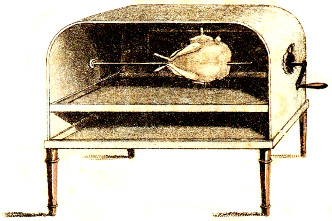
A Dutch or open oven is a machine for
roasting small joints, such as fowls, &c. It
consists of an arched box of tin open on
one side, which side is placed against the
fire. The joint being either suspended in
the machine on a spit, or by a hook, or put
on a low trevet placed on the bottom of the
oven, which is moveable. The inside of the
oven should be kept bright that it may reflect
the heat of the fire. This is the most
economical and most expeditious method
of roasting in the small way.
Roasting in a closed oven, or baking, consists
in exposing substances to be roasted
to the action of heat in a confined space,
or closed oven, which does not permit the
free access of air, to cause the vapour
arising from the roasted substance to escape
as fast as it is formed, and this circumstance
materially alters the flavour of roasted
animal substances.
Roasters and ovens of the common construction
are apt to give the meat a disagreeable
flavour, arising from the empyreumatic
oil, which is formed by the
decomposition of the fat, exposed to the
bottom of the oven. This inconvenience has
been completely remedied in two ways, by
providing against the evil of allowing the
fat to burn; and secondly, by carrying out
of the oven by a strong current of heated
air, the empyreumatic vapours, as fast as
they are formed.
Such are the different processes of
roasting meat.
Rationale.—The first effect of the fire is
to rarify the watery juices within its influence
which make their escape in the form
of steam. The albuminous portion then coagulates
in the same manner as the white of an
egg does, the gelatine and the osmazome[21]
become detached from the fibrine, and
unite with a portion of the fat, which
also is liquified by the expansive property
of heat. The union of these form a
compound fluid not to be found in the
meat previously. This is retained in the
interstices of the fibres where it is formed
by the brown frothy crust, but flows
abundantly from every pore when a cut is
made into the meat with a knife. In consequence
of the dissipation of the watery
juices, the fibrous portion becomes gradually
corrugated, and, if not attentively watched,
its texture is destroyed, and it becomes
rigid. Chemists prove that the peculiar
odour and taste of roasted meat depends
on the development of the principle which
has been called osmazome, or the animal
extractive matter of the old chemist, a
substance which differs very much from
every other constituent part of animal
matter chemically, in being soluble in alcohol—and
to the senses, in being extremely
savoury or sapid. It is upon this principle,
which seems to admit of considerable varieties,
that the peculiar grateful flavour of
animal food, (whether in the form of broth
or roasted,) and of each of its kinds,
depends. Osmazome exists in the largest
quantity in the fibrous organs, or combined
with fibrine in the muscles, while the tendons
and other gelatinous organs appear to be
destitute of it. The flesh of game, and old
animals, contains it in greater quantity than
that of young animals abounding in gelatine.
The tenderness produced by roasting,
we account for, from the expansion of the
watery juices into steam, loosening and
dissevering the fibres one from another, in
forcing a passage through the pores to
make their escape by. This violence, also,
must rupture all the finer network of the
cellular membranes, besides the smaller
nerves and blood vessels which ramify so
numerously through every hair’s-breadth
of animal substance. This dissolution of
all the minute parts of the meat, which
must take place before a particle of steam
can escape, will most clearly account both
for the tenderness and the altered colour
of roasted meat. The action of heat, also,
upon the more solid parts of the bundles of
fibres, will, independent of the expansion
of the juices, cause them to enlarge their
volume, and consequently make the smaller
fibres less firmly adhesive.
Another process in which meat is subjected
to the immediate action of fire is
broiling, which at first sight seems not to
differ from roasting. The effect on the
meat is, however, considerably different.
The process consists in laying chops or
slices of meat on clear burning coals, or a
gridiron placed over a clear fire. It is indispensable
that the chops or slices be moderately
thin, otherwise the outside will be
scorched to a cinder before they are cooked
within; from one fourth to three fourths
of an inch is a proper thickness.[22] It is
also necessary that the fire be moderately
brisk, without smoke or flame, lest the
meat should acquire a smoky taste. When a
gridiron is used it ought to be thoroughly
heated before the slices or chops are laid
on it, to prevent them from sticking to the
bars. In order to broil them equally, they
must be turned from time to time till the
cook can easily pierce them with a fork or
sharp skewer, which is the test of them
being sufficiently cooked. It is improper,
however, to cut into the chops to ascertain
whether they are broiled enough, because
it lets out the gravy.
Coke is the best fuel for broiling, for
it does not emit any smoke, and gives a
clear and moderate heat; a mixture of
coke and charcoal is exceedingly well calculated
for the broiling process.
Those gridirons of the usual appearance
and form, that have the bars fluted or
hollowed on the upper side, by which
means, the fat that comes from the meat
that is cooked on them, is prevented from
falling into the fire, and causing flame
and smoke are the best; for all the grease
that runs down the bars is received into a
small trough, which prevents it from being
wasted or lost. The upright gridiron is
a still better invention, as the meat cooked
on it, is entirely free from smoke, and the
melted fat is still more easily saved, and
kept more clean.
Rationale.—The heat being very quickly
and directly applied, not gradually as in
roasting and baking, the surface of the
meat is speedily freed from its watery
juices, and the fibres become corrugated,
forming a firm and crisp incrustation of
fibre and fat. This crust effectually prevents
the escape of the juices from within;
namely, the gelatine, and the osmazome,
which are more rapidly expanded by the
heat than in roasting, and consequently
must more violently dissever the small
fibres among which they are lodged, the
effect, however, is more mechanical than
chemical, for it does not appear that any
new combination is formed, nor much disorganization
produced. Accordingly, it is
found that broiled meat is more sapid, and
contains more liquid albumen, gelatine,
and free osmazome, than the same meat
would do if boiled or roasted. It is this
greater degree of juicyness, sapidity, and
tenderness, that constitutes the peculiarity
and perfection of this mode of cooking, compared
with roasting, baking, or frying in a
pan.
Every sort of meat, however, is not fit
for broiling. The chemistry of the process
will point out the sorts best adapted
for it. The flesh, for example, of old animals,
which is deficient in gelatine and
albumen, would be too much dried by
roasting. The larger muscles, also, which
abound in fibrous substance, such as the
rump of beef, are well fitted for broiling.
The flesh of game is likewise less juicy
and gelatinous, and forms a very savoury
dish when broiled. The process is peculiarly
fit for most sorts of fish, which roasting
or baking would render dry and
shrivelled, and in many cases boiling would
make it too soft and pulpy. Fresh caught
char, and trout,[23] are in the highest perfection
when dressed in this way.
On the other hand, the flesh which
abounds in watery juices and gelatine is
not well adapted for broiling. The flesh
of all young animals is of this kind; and
accordingly lamb, veal, and sucking pig;
the flesh of the fawn and kid do not answer
to be broiled but roasted. The same is
true of all the parts of an animal, whatever
be its age, which abound more in gelatine,
albumen, and fat, than in red muscular
fibre.
Broiled beaf steaks were the established
breakfast of the Maids of Honour of Queen
Elizabeth. At an earlier period they gave
strength and vigour to those who
“———————————————drew,
“And almost joined the horns of the tough yew.”
Frying is a process somewhat intermediate
between roasting and boiling. Indeed,
in one sense, it may be termed boiling,
as it is the application of heat to the substance
to be cooked, through the medium
of melted fat, raised to the boiling temperature.
The effect on the meat is very peculiar,
and easily distinguished from every
other mode of cooking. The meat is prepared
in the same way as in broiling, by
cutting it into chops, or slices, of not more
than half an inch or three quarters in thickness.
A sufficient quantity of mutton or
beef suet, butter, lard, or oil, being melted
in a pan, and made boiling-hot, the
meat is laid in it. It is not necessary that
the meat be wholly immersed in the boiling
fat; if it be immersed in part, it will be quite
sufficient. When flesh is the substance to
be fried, the pieces, previously to their being
put into the pan, are sometimes brushed
over with eggs and crumbs of stale bread,
flour, or any other farinaceous substance.
This application may also be made when
the meat is nearly cooked. The intention
of it is to cover the meat with a thin brown
crust, the savour of which increases the
relish of the dish. Fish are, for the most
part, treated in this manner when fried.
It answers well with trout, whitings, flounders,
and soles. When this application is
made to the meat previously to its being
put into the pan, the peculiar flavour of
the meat is more effectually retained.
One of the best preparations for this purpose
is oatmeal, flour, or crumbs of stale
bread, made into a liquid paste with the
yolk and white of eggs.
Vegetable, as well as animal substances,
are subjected to this process, though it is
always at the expense of their wholesome
and nutritive qualities; and not always to
the improvement of their taste and flavour.
As in the case of animal substances, all
the juices are, by frying, extracted from
the vegetables; with this difference, however,
that their place is not supplied by
the melted fat; for the starch of the vegetables
(potatoes for example) is rendered
insoluble in water by the fat, and exhibits a
corneous appearance and texture. Fried
potatoes are the most familiar instance
of the process. When cut into thin slices and
fried in oil, butter, or lard, they are rendered
semi-transparent. Cabbage, or the stalks,
leaves, and fruits of other vegetable substances,
previously boiled and then fried,
shrink, and become more easy to break, in
proportion as the water is driven off from
them, as this, during their previous boiling,
dissolves the saccharine and amylaceous
matter which rendered them supple
and juicy. These principles are much
better prepared and improved by boiling;
they are very much deteriorated by the
boiling fat in the frying pan.
The melted fat, or oil, should always be
brought to the boiling point, or nearly so.
The proper temperature is ascertained by
putting into the fat a few sprigs of parsley,
a thin slice of turnip, or a piece of bread,
and if any of these substances become crisp
without acquiring a black colour, the fat is
hot enough for frying; if it be made hotter,
it becomes blackened, and the meat acquires
a burnt and unpleasant flavour. Any sort
of hard fat, such as beef suet, is the best
fitted for frying meat; because, fat of this
description can be brought to a higher
temperature, without suffering decomposition,
than either lard, butter, or oil. There
are, however, particular kinds of meat
which answer better with some one or other
of these than with any of the rest. Fish,
for example, is best fried in oil.
A rich brown colour is communicated to
the fried substance, by pressing it, when
nearly cooked, against the bottom of the pan.
The fire for frying should be kept sharp
and clear, to keep the melted fat at a sufficient
high temperature, and without this
precaution the fried substance cannot be
browned. If the temperature of the fat
is not hot enough, the fried meat will be
sodden. Fish cannot be fried of a good
colour, and crisp, and firm texture, unless
the fat is boiling hot.
Frying, though one of the most common
culinary occupations, is one of those that is
least commonly performed.
Eggs are often fryed.
“Fresh butter, hissing in the pan, receives
the yolk and white together in its burning
bosom. One minute or two and all the
noise is over; and, sprinkled with pepper,
salt, and a few drops of vinegar, they appear
perfectly fit for the table. The salamander
is often held over them, and accelerates the
culinary process.”
Rationale.—The process of frying is
considerably different from those which we
have formerly been examining. In frying,
the high temperature of the melted fat has
the effect of extracting (at least from the
outer surface) all the gelatine, osmazome
and albumen, the place of which is, in part,
supplied by the melted fat entering between
the fibres, and gradually filling up the interstices.
It is this circumstance which
prevents the fibres of fried meat from becoming
hard and dry, and preserves them
in a tender and supple state. Meat which
has been fried, shrinks more in bulk than
when boiled or roasted, in consequence of
the melted fat having a stronger influence
in dislodging the animal juices. It is this
also which gives the meat the structure
which has not unaptly been compared to
leather.
Taste informs us, independently of our
rationale, that fried meat is less gelatinous
and less savoury than when simply boiled
or roasted. It is also less tender. The
gelatine and other juices of the animal
fibre, which are extracted during the process
may be discovered, after the melted
matter in the pan is suffered to settle, in
the form of a rich, brown, savoury jelly,
which separates spontaneously from the
rest of the substance.
Stewing differs from roasting and broiling,
in the heat being applied to the substance
through a small portion of a liquid medium;
and, from boiling and frying, in the process
being conducted by means of an aqueous, and
not by means of an oily fluid. It is necessary
that the fire be moderate; for a strong heat
suddenly applied would be very injurious.
The liquids employed as the medium for applying
the heat are usually water, gravy, or
broth, the quantity of which must be such as
shall prevent the meat from burning and adhering
to the pan. It is not requisite that
the liquid be made to boil in stewing. It
should only be raised nearly to a simmering
heat, which will retard the fluid being
evaporated too quickly. The closeness of
the vessel will also prevent the waste of the
liquid. If it diminish too quickly, it must,
from time to time, be replenished.
The management of the fire in cooking,
is, in all cases, a matter of importance, but
in no case is it so necessary to be attended
to as in preparing stews or made dishes;
not only the palatableness, but even the
strength or richness of all made dishes,
seems to depend very much upon the
management of the heat employed in
cooking them.
The most proper sorts of animal food for
stewing, are such as abound in fibrine, and
which are too dry or too tough for roasting.
When beef or mutton is rather old and too
coarse flavoured, and not tender enough
for the spit or the gridiron, it may, by stewing,
be not only rendered tolerably palatable,
but even sometimes savoury and
good. But the stewing process is not confined
to flesh of this sort; for veal and other
young flesh which abounds in gelatine,
when properly stewed, is much relished.
The vegetables most usually stewed are
carrots, turnips, potatoes, pease, beans,
and other leguminous seeds. Some fruits
are also cooked in this way.
Rationale.—Stewing is nothing else than
boiling by means of a small quantity of an
aqueous fluid, and continuing the operation
for a long time to render the substance tender,
to loosen its texture, to render it more
sapid, and to retain and concentrate the most
essential parts of animal or vegetable food.
If the stew-pan be close shut, it is evident
that none of the nutritive principles can
escape, and must either be found in the meat
itself or in the liquid. The water or gravy
in which the meat is stewed, being capable of
dissolving the gelatine and albumen, the
greater part of them become separated during
the simmering process. Now, since the
firm texture of the bundles of fibres of the
meat is owing to the solid gelatine and albumen
glueing them, as it were, together,
when they are dissolved and disengaged,
the meat must become greatly disorganized.
These principles, as well as the fat and
osmazome, are partly disengaged from the
meat, and become united with the gravy.
It is to these, indeed, that the gravy owes
all its richness and excellence. The muscular
fibres and the tendons acquire a gluey
appearance and texture, and the whole
forms a savoury gelatinous stew, gravy, or
soup.
No scorching or browning of the meat
takes place if the process is properly conducted;
for the temperature to which it is
exposed does not exceed the boiling point
of water.
In the stewing of vegetables, saccharine
matter is formed, the starch and
mucilage are rendered soluble, and of
course, set free the woody fibre, which
either floats through the liquid or adheres
together very slightly. It accordingly constitutes
either a pasty fluid, or converts
the vegetables to a soft pulp; sometimes
their original shape being preserved entire,
and at other times not.
Boiling is a much more common operation
than any of those we have considered,
with the exception perhaps of roasting.
It consists, as every body knows, in subjecting
the materials of food to the influence
of heat, through the medium of boiling
water, or of steam.
The water employed for boiling meat or
pulse should be soft, and the joint should
be put on the fire immersed in cold water, in
order that the heat may gradually cause
the whole mass to become boiled equally.
If the piece of meat is of an unequal
thickness, the thinner parts will be over-done
before the more massy portion is
sufficiently acted on by the boiling water.
Salted meat requires to be very slowly
boiled, or simmered only, for a quick and
rapid ebullition renders salted provisions
extremely hard.
Frozen substances should be thoroughly
thawed, and this is best effected by immersing
them in cold water.
Count Rumford has taken much pains
to impress on the minds of those who
exercise the culinary art, the following
simple but pratical, important fact, namely,
that when water begins only to be agitated
by the heat of the fire, it is incapable of
being made hotter, and that the violent
ebullition is nothing more than an unprofitable
dissipation of the water, in the form
of steam, and a considerable waste of fuel.
From the beginning of the process to
the end of it the boiling should be as gentle
as possible. Causing any thing to boil
violently in any culinary process, is very
ill-judged; for it not only does not expedite,
in the smallest degree, the process
of cooking, but it occasions a most enormous
waste of fuel, and by driving away
with the steam many of the more volatile
and more savoury particles of the ingredients,
renders the victuals less good and
less palatable: it is not by the bubbling up,
or violent boiling, as it is called, of the water
that culinary operations are expedited.
One of the most essential conditions to
be attended to in the boiling of meat is, to
skim the pot well, and keep it really boiling,
the slower the better. If the skimming be
neglected, the coagulated albuminous matter
will attach itself to the meat, and spoil
the good appearance of it.
It is not necessary to wrap meat or
poultry in a cloth, if the pot be carefully
skimmed. The general rule of the best
cooks is to allow from 20 to 30 minutes
slow simmering to a pound of meat, reckoning
from the time the pot begins to boil.
The cover of the boiling pot should fit
close, to prevent the unnecessary evaporation
of the water, and the smoke insinuating
itself under the edge of the cover, and
communicating to the boiled substance a
smoky taste.
Cooks often put a trevet, or plate, on
the bottom of the boiling pot, to prevent
the boiled substance sticking to the pot.
Rationale.—When flesh or fish is boiled
in an open vessel, or one not closely
covered, the fibrous texture is rendered
more tender: at the same time its nutritive
quality is not much diminished.
For the temperature of the water or steam,
never exceeding 212°, is insufficient to produce
the partial charring, which roasting
and broiling effect. But, as in stewing, the
gelatine, albumen, osmazome, and fat, are
developed and disengaged, and becoming
united with the liquid in the vessel, form a
soup, or broth. The paler colour of boiled
meat is owing to the blood being separated
and diffused in the water. In frying,
the boiling fat or oil enters into the interstices
of the fibres, which the disengaged
animal juices have left empty. In boiling,
in a similar way, the hot water takes the
place of the blood, gelatine, fat, and albumen,
which have been dissolved and separated
from the fibres. The fibres are in
this manner soaked and washed, first by
the boiling water, and afterwards by the
soup or broth which is formed, till the
whole texture assume a softened consistence,
and pale appearance. It is this,
rather than any softening of the fibres
themselves, which seems to be the real
effect produced, unless, with some, we
consider the fibres as nothing more than
minute and close-set bundles of blood vessels.
This doctrine, however, the experience
of every cook will disprove; for if
the boiling be long continued, the fibres of
the meat will alone remain, and so far
from becoming more soft and pulpy, they
will become dry and juiceless. If indeed
the boiling point of the water be artificially
increased above 212°, by pressure applied
to the surface of the liquid, the fibres may
be reduced to a pulp, quite homogeneous.
When this is done by Papin’s digester, or
by any other apparatus of the same kind,
and when the process under such circumstances
is long continued, the hardest
bones may be converted into jelly.
It is only by boiling that the more gelatinous
parts of flesh can be completely
extracted unaltered from such parts as are
cartilaginous, ligamentous, or tendinous.
The principal operations of cookery
which we have just examined and explained,
all agree in this, that they effect
some chemical change on the materials
operated upon, by which they are rendered
more digestible, more wholesome, and consequently
more nutritive.
In such of the operations as are
performed by the direct application of
heat to the flesh of animals, namely,
roasting, baking, frying, and broiling,
the meat loses the vapid and nauseous
taste and odour which it possesses in a raw
state, and becomes savoury, juicy, and
grateful to the taste. These effects arise
from the development of the gelatine and
osmazome from the smaller vessels, and
their being rendered soluble; while, at the
same time a portion of the fat is liquified,
and combines with them after they are disengaged.
The fibres again, on the surface of the
meat, are partly scorched, and form a
crust, which, except in the interstices of
the corrugations, is impermeable, and consequently
prevents the savoury gravy that
is disengaged from the fibres from oozing
out or becoming evaporated. It is thus
only disengaged from its chemical union
with the fibres, and remains mechanically
united with them in the meat, after it is
cooked, as we see upon cutting into the
fibrous portion.
The effect produced on the fat is
somewhat different. The direct application
of fire to this portion of the meat
soon melts part of the substance, and
raises it to the boiling point, or nearly so;
the water which it contains is consequently
given off in the form of steam, and it
carries with it a quantity of osmazome.
It is this which occasions the peculiar
odour that arises from meat while roasting.
The vapid taste is also corrected by the
empyreuma, combined with a minute quantity
of ammonia, which is soon developed
on the surface of the fat, by the partial
charring—not of the fat itself, but of the
cellular membrane in which it is enveloped.
This structure may easily be perceived on
a slight examination of a piece of recent
fat; all the membranous or skinny portions
being only the receptacles or nests for the
fat itself. And since these membranes are
for the most part exceedingly thin and
easily ruptured, and since heat increases the
volume of the fat which they contain, the
application of heat in roasting or broiling
will soon make all the membranes burst
which are within its influence, and thus give
a free passage for the juices to unite with
each other.
There is, according to these statements,
but little loss of the substance of meat
when roasted or broiled, and the chemical
changes produced are so slight, that nearly
all its nutritive elements must be preserved
and concentrated in the cooked meat.
When there is a watery medium used,
through which heat is applied to animal
food, as for example, in the process of
stewing or boiling, a portion of the fat,
gelatine, and osmazome, is dissolved, and
mixes with the water. Nutritive matter is
consequently lost, or, at least, it is transferred
from the meat to the broth or soup.
In the operation of stewing there is less
of this transfer made; and, besides, as the
medium is scarcely kept at a boiling heat,
less of the nutritive juices are dissolved.
When, however, the broth or gravy in
which meat is boiled is made use of, as
well as the meat itself, boiling is the most
economical practice; for though nothing
be added except the water, this itself, if it
contains no nourishment, at least fills the
stomach, and serves to diffuse more widely
the nutritive juices of the meat which it
holds in solution or in mixture.
But though boiling be thus the most
economical practice, it is not always
to the taste of individuals, or even of
whole nations to use the broth or soup.
The English and Irish, for example, rarely
follow this practice, while the Scots,
French, and Germans, prefer it to all other
modes of cooking. In general, then, it
should seem, that roasting as it is the simplest,
is also the best mode of rendering
the flesh of animals fit for human food.
Roasted meat is wholesome and highly
nourishing; and when there is not too
much of the empyreumatic crust formed,
it is for the most part easily digested. In
these respects, broiled meat differs little
from such as is roasted. What is fried is
always less tender. It is often found that
roasted or broiled meat sits more easily
on the stomach, and is sooner digested
by those whose digestive organs are feeble
or diseased, than fried or boiled meat, or
broths and stews.
The effects of the processes of cookery
on vegetable substances, though usually
very slight and simple, are in some instances
both striking and unexpected.
For example, some sorts of vegetables are
extremely acrid and even poisonous in their
crude state, and altogether unfit for human
food; yet, by simply boiling them in water,
they become bland, sweet, and wholesome.
Several species of arum (cuckoo-pint),
which are very acrid, and would be dangerous
to use raw, become quite palatable
pot-herbs when boiled. Their acrimony
must reside in a very volatile principle,
which, during the boiling, makes its escape,
or is chemically altered; but the nature of
this principle has not yet been accurately
investigated by chemists. A more familiar
example than this is found in onions, leeks,
and garlick, whose acrimony and strong
odour can be almost destroyed, or rather
driven off by a sufficiently long application
of heat, either directly, or through the
medium of water. Many other instances
could be given, but we shall content
ourselves with one more.
Every body knows that potatoes, in a
raw state, are nauseous and unpalatable.
It is not, perhaps, so generally known that
the potatoe, (solanum tuberosum,) belongs
to the night-shade genus of plants, which
are all more or less poisonous. If potatoes
were used raw, in any quantity, they
would be deleterious to man; nor does it
disprove this that cattle eat them with
impunity, as sheep and goats eat plants
much more strongly poisonous to man,
such as hemlockdropwort, [oenanthe crocata;]
and waterhemlock, [phelandrium
aquaticum].
By boiling or roasting, however, all the
unpalatable and all the unwholesome qualities
of the potatoe are changed, and it becomes
farinaceous, wholesome, digestible,
and highly nutritious. Yet, although this
change is remarkable, and could scarcely
have been anticipated, very little is lost
and nothing is added to the potatoe by
either roasting or boiling, yet its immediate
constituent parts have evidently suffered
a very great chemical alteration,
chiefly, in consequence it should seem, from
the farinaceous substance being acted on
by water.
Vegetables, when used as food, are
most commonly boiled, and seldom baked
or roasted. Salads, indeed, are eaten
raw, without any application of heat. The
chemical action of heat on pot-herbs, on
esculent roots, and leguminous seeds, does
not appear to be confined to the mere softening
of their fibres, or to the solution or
coagulation of some of their juices and
component parts; for we have just now
seen that their flavour, and other sensible
qualities, as well as their texture, suffer a
remarkable chemical change, which greatly
improves their alimentary properties.
In the cooking of vegetables, saccharine
matter is often formed, or mucilage and
jelly extracted; and the whole substance
is on that account rendered more palatable,
wholesome, and nourishing. These effects
are very well exemplified in the changes
which take place in flour when converted
into bread;[24] which differs materially from
flour paste, insomuch that the constituent
parts of the unbaked dough can no longer
be separated by the processes employed
in chemical analysis.
Vegetable substances are most commonly
boiled or baked; or, if occasionly fried or
roasted, there is always much water present,
which prevents the greater action of
the fire from penetrating below the surface.
The universal effect of cookery by boiling
upon vegetable substances, is to dissolve in
the water some of their constituents, such
as the mucilage and starch, and to render
those that are not properly soluble, as the
gluten and fibre, softer and more pulpy.
It is evident, that whether the heat be
applied directly or indirectly for cooking
animal food, there must be a considerable
diminution of weight. In the cooking of
animal substances in public institutions,
where the allowance of meat is generally
weighed out in its raw state, and includes
bones, and is served out cooked, and sometimes
without bone, it is a matter of importance
to ascertain nearly their relative
proportions. Much, no doubt, depends
upon the piece of the meat cooked, and
the degree of cookery, and the attention
bestowed on it. Persons who salt rounds
of beef to sell by retail, after it is
boiled, get 19 lbs. of cold boiled beef from
25 lbs. raw; but the meat is always rather
underdone.
Messrs. Donkin and Gamble boiled in
steam 56 lbs. of captain’s salt beef; the
meat, when cold, without the bones, which
amounted to 5 lbs. 6 oz. weighed only 35 lbs.
In another experiment, 113 lbs. of prime
mess beef, gave 9 lbs. 10 oz. of bones, and
47 lbs. 8 oz. meat; and in a third, 213 lbs.
mess beef gave 13 lbs. 8 oz. bones, and
103 lbs. 10 oz. meat; or, taken in the aggregate,
372 lbs. of salt beef, including bones,
furnish, when boiled, 186 lbs. 2 oz., without
bone, being about 50 per cent.; or, disregarding
the bone altogether, salt meat
loses, by boiling, about 44.2 per cwt. or
nearly half.
We are indebted to Professor Wallace
(of Edinburgh) for the detail of a very
accurate and extensive experiment in a
public establishment, of which the results
were, that, in pieces of 10 lbs. weight, each
100 lbs. of BEEF lost, on an average, by
boiling, 26.4; baking, 30.2; and roasting,
32.2: MUTTON, the leg, by boiling, 21.4;
by roasting the shoulder, 31.1; the neck,
32.4; the loin, 35.9. Hence, generally
speaking, mutton loses, by boiling, about
one-fifth of its original weight, and beef
about one-fourth; again, mutton and beef
lose, by roasting, about one-third of their
original weight.
The loss arises, in roasting, from the
melting out of the fat and the evaporation
of the watery part of the juices, but the
nutritious matters remain condensed in the
solid meat when cooked; but in boiling,
the loss arises partly from fat melted out,
but chiefly from gelatine and osmazome
becoming dissolved in the water in which
the meat is boiled; there is, therefore, a
real loss of nutritive matter in boiling, unless
the broth be used, when this mode of
cooking becomes the most economical.
The principal or chief dishes that are
prepared for the English table, what the
scientific cooks for the marshals and generals
of France would term dishes of the
first order, are few in number. Flesh,
fowl and fish, roasted, boiled or fried,
accompanied by some simple and easy
made puddings and pies, are the primary
dishes of an English table. Soups and
broths are less generally made use of; and
the flesh, fowl and fish, served up in
made dishes, are, like the lord mayor in
his state coach, generally less noticed than
the attendants.
May be defined a weak decoction of
meat, slightly seasoned with the addition
of aromatic herbs, roots or spices, in
which the flavour of the meat greatly predominates.
To produce a high flavoured broth, it is
essential that the boiling of the meat be
moderate, and continued for some time;
the simmering should be done in a vessel
nearly closed. Cooks consider it essential
that the broth be clear; the scum, or albumen
of the meat, which becomes coagulated
and rises to the surface during the
boiling, must therefore be removed from
time to time.
The meat employed for broth (and also
for soup and gravy), should be fresh, for
if in the slightest degree tainted or musty,
it infallibly communicates a very disagreeable
taste to the broth; besides, fresh meat
gives a more savoury broth than meat that
has been kept for two or three days. It is
also advisable to score the meat and to cut
it into slices, or to bruise it with a mallet
or cleaver.
Two pounds of muscular beef scored and
cut into slices, affords a stronger and far
more savoury broth, than 3 lbs. of the same
beef when boiled in one piece. Cooks usually
allow for good broth, one pound of
muscular meat, to two quarts of water, and
they suffer the fluid to simmer till reduced,
by evaporation, to one pint, or one pint and
a half. A second decoction may be made
by again covering the meat with a less quantity
of water, and suffering it to boil, taking
care to supply the water from time to time
as it becomes evaporated.
This reminds us of Rabelais, the humorous
vicar of Meudon, who distinguishes,
in his jocose way, two sorts of
broths. (Bouillon de Prime,) prime-broth;
and broth good for hounds; (Bouillon
de levriers,) the meaning of which stands
as follows.[25] The first designates that premature
delibation of broth which the young
monks in the convent used to steal, when
they could, from the kitchen, in their way
to the choir at the hour of “Prime,” a service
which was performed at about seven
or eight in the morning, when the porridge-pot,
with all its ingredients, had been boiling
for the space of one or two hours, and
when the broth, full of eyes swimming
gently on the golden surface, had already
obtained an interesting appearance and taste.
On the contrary, greyhound’s broth, (Bouillon
de levriers,) means that portion of
the porridge which was served to the novices
after an ample presumption in favour
of the Magnates of the monastery. This
was good for nothing, and monks of inferior
ranks were ready to throw it to the dogs.
The flavouring ingredients, which are
usually the domestic pot-herbs and indigenous
roots, such as cellery, carrots, &c.
should be added at the end of the process,
to prevent their aromatic substances becoming
dissipated by long simmering.
Dr. Kitchener[26] says, “meat from which
broth has been made, is excellently well
prepared for potting, and is quite as good,
or better than that which has been boiled,
till it is dry.”
Soups are decoctions of meat which differ
from broth, in being more concentrated,
and usually also more complex in their composition.
They are in fact strong broths,
containing either farinaceous roots and
seeds, or other parts of vegetable substances.
The erudite editor of the “Almanach
des Gourmands”[27] tells us, that ten folio
volumes would not contain the receipts of
all the soups that have been invented in
that grand school of good eating, the Parisian
kitchen. The author of Apicius
Redivivus[28]
says “the general fault of our
English soups seems to be the employment
of an excess of spice, and too small
a portion of roots and herbs.” “Point
des Legumes, point de Cuisiniere,” is deservedly
the common adage of the French
kitchen. A better soup may be made
with a couple of pounds of meat, and
plenty of vegetables, than our common
cooks will make with four times that quantity
of meat. The great art of composing
a rich soup consists in so proportioning
the several flavouring ingredients,
that no particular taste predominates.”—One
pound and a half of meat at least ought
to be allowed for making a quart of soup.
The full flavour can only be obtained by long
and slow simmering the meat, during which
time the vessel should be kept covered to
prevent the evaporation of the fluid as much
as possible.
The flavouring ingredients should not be
added till ten or fifteen minutes before the
soup is finished. Clear soups should be
perfectly transparent, and thickened soups,
should be of the consistence of cream.
The soup, says a writer, on Cookery,
might be called the portal of the edifice
of a French dinner, either plain or sumptuous.
It is a sine qua non article. It
leads to the several courses constituting
the essence of the repast, and lays the unsophisticated
foundation upon which the
whole is to rest, as upon a solid basis, in
the stomach. It is, perhaps, the most
wholesome food that can be used; and the
gaunt, yet strong frame of the French
soldiery, has long experienced the benefit
of it. They vulgarly say, “C’est la soupe
qui fait le Soldat.” ‘It is the soup that
makes the soldier.’ Partial to this mess, they
have it daily in barracks, in their marches,
and in the camp; and they often swallow a
large bowl of broth and bread, in the
morning a few minutes before the trumpets
calls them to the field of battle.
Are those dishes which consist either of
meat, or of fruit, covered with a farinaceous
crust, enriched with butter or other
fat, and rendered fit for eating by baking.
The crust of the pie is usually made of
two parts by weight of wheaten flour, and
one part of butter, lard, or other fat.
The flour is made into a stiff paste with
cold water, and rolled out on a board with
a paste pin to the thickness of about one
quarter of an inch, the board being previously
sprinkled over with flour to prevent
the dough from sticking to the board.
About one-sixth part of the butter, in
pieces of the size of a nutmeg, is put
over the extended paste, and the whole
again dusted with flour; the paste is then
doubled up and rolled out as before. A
like portion of butter is again distributed
over the paste, which, after being doubled
up, is rolled out, and the same operation
is repeated till the whole quantity of butter
is thus incorporated with the flour.
Part of the paste is then laid, one quarter
or half an inch in thickness, over the
inside of a deep dish in which the pie is to
be baked, and the meat, cut in chops or
slices, is put into the dish, together with the
seasonings, and a portion of water or gravy,
about one tea cup full, to one pound of
meat. The contents of the basin are then
covered with a lid, made of the remainder
of the paste, rolled out rather thicker than
the inside lining of the dish, and the lid is
made to adhere to the inside sheeting, which
should extend over the rim of the dish,
by pressing the top paste close upon the
margin. A few small holes are then made
in the top crust, and the pie is put in the
oven.
The baking should be slow. If the pie
be put into a hot oven, the crust becomes
hard, and many a cook is blamed for
making bad pies, when the fault really lies
with the baker. A light and flaky pie crust
can only be produced by the judicious
application in the manner stated, of the
butter, or fatty matter. By this means the
butter is distributed, in distinct layers,
through the mass of the pie crust. The
flour dusted over each layer prevents the
paste forming one mass, or, as it is called,
becoming heavy. The more frequently,
therefore, the paste is rolled out with butter,
lard, or other fat, interposed between
each layer, provided the layers are dusted
over with flour, the more flaky will be the
pie; and hence, also, by increasing the
quantity of butter, to a certain limit, the
flakeness of the pie crust becomes increased.
Pastry cooks usually allow from ten to
twelve ounces of butter to one pound of
flour for making a light puff paste, such as
they use for tarts and patties.
Are of two kinds; the first consists of a
farinaceous dough, containing a portion of
butter or other fat, inclosing any kind
of meat or fruit, and rendered eatable by
boiling; it may be termed a boiled pie.
The paste for a meat pudding is usually
made with beef suet, or marrow, one part
of it chopped as fine as possible, and intimately
mixed with four parts by weight of
flour, is made into a paste with water or
milk. With this paste, a pudding mould
or basin, previously rubbed with butter
within, is lined, and the meat is added to
fill up the vacancy. A lid of paste is now
put over the meat, and made to adhere to
the margin of the dish. The whole is then
tied over with a wetted cloth, dusted with
flour to prevent the dough sticking to it,
and then boiled in water till the pudding is
sufficiently cooked.
The other kind of pudding is a batter composed
of eggs, butter and flour, or any other
farinaceous substance, occasionally enriched
with the admixture of fruit, sugar, and
spices, and rendered eatable either by boiling
in the manner stated, or by baking in
an oven.
So called to distinguish them from plain,
roasted, boiled, or fried meat; are usually
composed of flesh, fish, poultry, or vegetables,
stewed with gravy, butter, cream,
or other savoury sauces. The composition
of made dishes is generally from
printed or written receipts, except when
done by what are termed professed cooks,
who, understanding completely their business,
follow their own judgment, in aid of
the receipt. There is a mistake very common
in supposing that there is a great difficulty
in cooking such dishes, though there
is indeed much trouble; but if a mistake
is made, it can in general be remedied,
which is not the case in the mere simple
operations of roasting and boiling, where a
mistake is very often irreparable.
When we take a view of the chemical
composition of made dishes, we soon perceive
that they are all compounds of animal
and vegetable substances, rendered sapid
or agreeable to the palate by strong decoctions
of meat, gravy, and spices, of various
descriptions; all of them abound in animal
gelatine and vegetable mucilage, or farinaceous
matter, rendered soluble in water.
The quantity of spices is generally small,
“[29]their presence should be rather supposed
than perceived, they are the invisible spirit
of good cookery.”
Made dishes are sometimes very expensive,
and sometimes very economical, for
ragouts and fricassees are often much less
expensive than the plain dishes made of
the same material, that is, a given weight
of meat will go farther than if plainly
roasted or boiled. French cookery consists
nearly altogether of made dishes, both
with the rich and poor. The rich have
them to gratify the palate, and the poor,
for the sake of economy. Many circumstances
combine to prevent made dishes
from becoming of very general or frequent
use in England. The care, attention, and
length of time necessary for preparing
them, are incompatible with the domestic
affairs and usages of life in this country,
where time is far more precious than in any
other country; it is for that reason, most
probably, that all the operations of English
cookery are such as can be performed
expeditiously.
The English cooks, both in the middling
and lower ranks, are generally in a hurry
to get a dinner dressed. The French cooks,
on the contrary, begin in the morning
early, and even in the house of the simple
Bourgois, the dinner begins to be cooked
immediately after breakfast.
The superior expedition, and inferior degree
of skill which distinguish English from
French cookery, would be sufficient alone
to give the former the preference in this
country; but there are a number of other
circumstances that have the same tendency.
A good table is a study in France: it is
with the master a grand object in life, and
with the cooks a constant employment, like
our journeymen in a manufactory. With
us, again, the dinner is readily prepared,
and expeditiously eaten. It is despatched
like a piece of business in this country;
but in France, and more or less all over
the Continent, people dine as if they had a
pleasure in dining; they converse more
during the repast than almost at any other
time, and they never hurry it over as if
they were in haste to be done, and as if
they had business always on their mind,
and were reflecting on the saying, so
common and so true, that “time is money.”
It is curious enough, however, to remark,
that the French, who sit so long, and enjoy
themselves so leisurely at dinner, rise, immediately
after the dessert, from the table,
and are ready for business; and that the
English, who hurry the dinner over, pass
whole hours over the bottle as if time were
of no value. Such are the inconsistencies
of mankind, arising from different tastes
and different circumstances.
The construction of our kitchen grates
and fire places, and the nature of the fuel
we burn, are unfavourable to the slow and
regular simmering with which made dishes
are prepared; and, at the same time, that
they are unfavourable for made dishes, they
are exactly what is wanted for English cookery.
The construction of the grates, together
with the nature of the fuel, produce
a fierce scorching fire, so that the direct rays
of heat may be made to impinge on the
substance to be cooked.
In France, roasting large joints is almost
impracticable with the form and nature of
the fire; so that it does not appear that
taste or will has been the only guide in the
mode of cooking in either country; but
that the practices most suitable to circumstances
have been a chief cause of the great
difference of the manner of dressing victuals.
English medical men have always been
at great pains to condemn made dishes
as injurious to health; but the French
physicians have been of a different opinion,
and if experientia docet is a true proverb,
they ought to be the best judges: but those
who have been used to both, will allow that
they are less heavy, and the stomach seems
to be less encumbered after the French
dinner on made dishes, than the English
one on single joints.
In made dishes, where butcher’s meat
enters, as although the chief ingredient is
generally much more done, to use the
common phrase, none of its nutritive substances
are lost; but as the arguments
for and against the real things of one or
the other is not to be determined by reason,
and has not been determined by experience,
it would be absurd to give an opinion on
the subject.
It may be well enough, however, to
observe, that the dispute about what are the
most healthy dishes, probably arises from
difference of tastes, and from those things to
which the stomach has not been accustomed,
not agreeing with it at first; so that most
people on finding it so, if they can avoid
doing it, never repeat the experiment.
The case is the same with Foreigners as
with Englishmen, for their stomachs do
not at first find our dishes agree with them.
When the muscular part of meat is gradually
exposed to a very moderate heat,
sufficient to brown the outer fibres, the gelatine,
osmazome, and other animal juices of
it, become disengaged, and separated in a
liquid state, and constitute a fluid of a
brown colour, possessing a highly savoury
and grateful taste. Hence gravy is
the soluble constituent or liquid part of
meat, which, spontaneously, exudes from
flesh, when gradually exposed to a continued
heat sufficient to corrugate the
animal fibre. Flavouring vegetables are
often added, and fried with the meat, such
as sliced onions, carrots or cellery, till they
are tender, together with some spices and
the usual condiments.
To extract gravy, the meat is cut into
thin slices, or it is scored, and the fibres are
bruised with a mallet. It is then usually
seasoned, with pepper and salt, and exposed
in a pan containing a small quantity of
butter, or other fat, (or without any fat,) to
the action of a gradual heat, just sufficient
to brown the outer fibre strongly. The
juices of the meat, which are thus during the
frying process, copiously disengaged, are
suffered to remain exposed to the action of
heat till they have assumed the consistence
of a thin cream, and a brown colour. A small
portion of water is then added to re-dissolve
the extracted mass, and after the whole has
been suffered to simmer with the spices and
roots for a short time, together with an
additional quantity of water, the liquid is
strained off through a sieve. If the gravy be
intended for made dishes, it is customary
to give it the consistence of cream, by means
of thickening paste. (See p. 160.) The
meat is capable of furnishing an additional
quantity of gravy. It is therefore covered
with water and suffered to simmer for
about one hour, or till the fluid is reduced
to one half its bulk.
One pound and a quarter of lean beef,
or one pound and a half of veal, will afford
one pint of strong gravy.
When broth, soups, or gravy, are preserved
from day to day, in hot weather,
they should be warmed up every day, and
put into fresh scalded pans, this renders
them less liable to spoil.
“The fundamental principle of all,
Is what ingenious cooks, the relish call;
For when the markets send in loads of food,
They all are tasteless till that makes them good.”
Dr. King’s Art of Cookery.
Sauces are intended to heighten the
taste and give a savoury flavour to a dish,
flesh, fish, fowl, or vegetables.
In England there is little variety in those
kind of relishes, and it was observed by a
foreigner, with a good deal of wit, and a
great deal of truth, “that the English had
a great variety of forms of religion and
no variety in their sauces; whereas, in
France they had uniformity in the former,
and an infinite variety in the latter.”
Melted butter is the grand and chief
basis of most English sauces. Melted
butter and oysters, melted butter and
parsley, melted butter and anchovies, melted
butter and eggs, melted butter and shrimps,
melted butter and lobsters, melted butter
and capers, are nearly all the sauces used in
England. Besides these, the following flavouring
substances are in common use: viz.
mushrooms, onions, spices, sweet herbs,
wine, soy, and the usual condiments, but
melted butter, gravy, or some farinaceous
mucilage, form the basis of all sauces.
These substances combined in different
proportions are quite sufficient to make
an endless variety of picquant sauces, as
pleasant to the palate and stomach, as the
most compound foreign sauces in which
every thing has the same taste, and none its
own taste. The aim of the English cooks, as
far as it regards sauces, appears to be to let
every sauce display a decided character, so
as to taste only of the material from which
it derives its name. Compound sauces are
seldom employed, but in the learned foreign
dishes.
What has been observed, relative to time
used in the article, of made dishes, namely,
that it was in this country too valuable to
be bestowed on eating, or on preparing to
eat, applies also in the case of making
sauces.
Nothing can be made more easily than
the English sauces, but the variety of
French sauces are great, and much skill
and time are necessary for preparing most
of them.
It is customary to thicken some dishes with
a compound of two parts of flour and one of
butter, first made into a paste by heating
slowly the ingredients in a pan, till the mass
acquires a yellow gold colour, the flour and
butter being stirred all the time to prevent
the mass from burning to the bottom of the
pan. The substance thus obtained is called
thickening, or thickening paste, for it is
the basis employed by cooks for thickening
soups, gravies, stews, sauces, and other
dishes. The mass readily combines with
water; a large table spoonful is sufficient
to thicken a quart of meat broth. Besides
this thickening paste, other farinaceous substances
are employed for that purpose, such
as bread raspings, crumbs of stale bread,
biscuit powder, potatoe mucilage, oatmeal,
sago powder, rice powder, &c. A cow-heel,
on account of the vast quantity of
gelatine with which it abounds, is excellently
well calculated for giving body to
soups: the cow-heel, after being cracked,
is boiled with the broth or soup.
The substance employed for colouring
soups, gravies, broths, and other dishes,
requiring a brown colour, is burnt sugar.
This imparts to the dish a fine yellowish
brown tinge, without giving any sensible
flavour to the dish. Eight ounces of powdered
lump sugar, and two or three table
spoonfuls of water, are suffered to boil
gently in an iron pan, till the mass has
assumed a dark brown colour, which takes
place when all the water is evaporated, and
the sugar begins to be partly charred by
the action of the heat. The mass is then
removed from the fire, and about a quarter
of a pint of water is gradually added to
effect a solution. The fluid thus obtained
is of a syrupy consistence, and of a fine
dark brown colour; a small quantity gives
to broth, soup, or gravy, a bright orange
colour, without altering sensibly the flavour
of the dish. Some cooks add to it mushroom
catsup and port wine.
The name of stock is given to meat jelly
produced from a decoction of meat, so
highly concentrated that the fluid, when
cold, exhibits an elastic tremulous consistence.
The meat is slowly boiled in water, with
the customary seasonings, as pot herbs, or
esculent roots, and the decoction skimmed,
and continued to simmer till it is charged
with a sufficient quantity of animal matter
to form a jelly when cold; this degree of
concentration is known by removing, from
time to time, a portion of the fluid, and suffering
it to cool. When the decoction has
been so far concentrated, it is strained off
through a sieve and suffered to repose, that
the insoluble part, if any, may subside.
When this has been effected, the clear fluid is
suffered to cool, which causes the fatty matter
it contains to become collected at the surface,
where it forms a cake or crust, which is
to be removed. The substance underneath
is a tremulous jelly; it is called first
stock, or long broth, (Le grand bouillon
of the French kitchen). If the jelly be not
transparent it is re-melted by a gentle
heat, and clarified by the addition of the
white of eggs added to it, as soon as it is
liquified. This substance becoming coagulated
at the boiling heat, entangles
with it the parts mechanically diffused
through the jelly, and rises to the top
as a dense scum. It may then be removed
by a skimmer. The name of second-stock
(Jus de bœuf of the French) is given
to a more concentrate jelly of meat made
in a similar manner. It is chiefly employed
as the basis of all savoury made
dishes and rich sauces, whilst the former
serves for making extemporaneous soups.
Second stock is usually prepared in the
following manner:—Put into a stew-pan
about half a pound of lean bacon or ham, a
few carrots and onions, two or three cloves,
about six or eight pounds of lean beef,
and a shin of beef of about the same weight,
break the bone, and having scored the
meat, suffer it to simmer over a very gentle
fire, with about two quarts of first stock,
or better put it into an oven, and suffer it
to stew, till the liquid assumes a light brown
colour. When this has taken place, add to
the mass six quarts of boiling water, suffer
it to boil up gently, and remove the scum
as it rises; and suffer it to evaporate till
reduced to about three quarts, then strain
it through a sieve, and clarify it as before
directed.
The flesh of animals which are suddenly
killed when in high health, so far as the
palate is concerned, is not yet fit for the
table, although fully nutritious and in perfection
for making soup; because sometime
after the death, the muscular parts suffer
contraction—their fibres become rigid.
When this has taken place, the flesh is not
long in experiencing the commencement
of those chemical changes which terminate
in putrefaction; and it is of the utmost
importance, in domestic economy, to take
care that all large joints of meat be in this
intermediate state when they are cooked:
for no skill in the culinary art will compensate
for negligence in this point, as every
one must have often experienced to his
great disappointment.
The degree of inteneration may be known
by the flesh yielding readily to the pressure
of the finger, and by its opposing little resistance
to an attempt to bend the joint.
Poultry also thus part readily with their
feathers; and it would be advisable to
leave a few when the bird is plucked, in
order to assist in determining their state.
The following wholesome advice on this
subject we copy from Doctor Kitchiner:[30]—“When
you order meat, poultry, or fish,
tell the tradesman when you intend to dress
it, and he will then have it in his power to
serve you with provision that will do him
credit, which the finest meat, &c. in the
world, will never do, unless it has been
kept a proper time to be ripe and tender.
If you have a well-ventilated larder, in a
shady, dry situation, you may make still
surer, by ordering in your meat and poultry,
such a time before you want it as will
render it tender, which the finest meat
cannot be, unless hung a proper time, according
to the season and nature of the
meat, &c. but always till it has made some
very slight advance towards putrefaction.”
—when of a young animal, has
a shining oily smoothness, a fine open
grain, and dark florid red colour. The fat
is splendish yellowish white. If the animal
has been fed upon oil cakes, the fat has a
golden yellow colour.
—is closer in the grain than ox-beef,
but the muscular parts are not of so
bright a red colour. In old meat there is a
streak of cartilage or bone in the ribs, called
by butchers, the crush-bone; the harder this
is, the older has been the animal.
—The flesh of a bull calf is firmer,
but not in general so white as that of a cow
calf. Exposures to the air for some time
reddens the colour of the flesh. Veal is best
of which the kidney is well covered with
thick white hard fat.
—A wether, five years old, affords
the most delicate meat. The grain of the
meat should be fine, and the fat white and
firm. The leg of a wether mutton is known
by a round lump of fat on the insides of the
thigh, the leg of an ewe by the udder.
—The flesh of fine lamb looks of
a delicate pale red colour; the fat is
splendid white, but it does not possess a
great solidity. Grass Lamb is in season
from Easter to Michaelmas. House Lamb
from Christmas to Lady-day.
—This species of meat of the best
fed animals is particularly fine grained, and
may be bruised by forcibly pressing it between
the fingers. The skin of the young
animal is thin; the flesh of old pigs is
hard and tough, and the skin very thick.
The prime season for pork is from Michaelmas
to March. The western pigs, chiefly
those of Berks, Oxford, and Bucks, possess
a decided superiority over the eastern of
Essex, Suffolk, and Norfolk.
—To ascertain its age, examine
the first joint of the fore foot; you will find
a small knob, if it is a leveret, which disappears
as the hare grows older; then examine
the ears; if they tear easily, the animal
is young. When newly killed, the body
is stiff; as it grows stale, it becomes
flaccid.
—is of a darker colour than mutton.
If the fat be clear, bright and thick, and
the cleft of the hoof smooth and close, it is
young, but if the cleft is wide and tough,
it is old. By pushing a skewer or knife
under the bone which sticks out of a haunch
or shoulder, the odour of the skewer will
tell whether the meat be fresh or tainted.
Venison is best flavoured in the month of
August, the animal should not be killed till
he is about four years old.
—for boiling should be chosen as
white as possible, those which have black
legs had better be roasted. The season of
perfection in poultry is just before they
have quite come to their full growth.
Chickens three months old are very delicate.
Age makes a striking difference in the
flesh of fowls, since after the age of twelve
months it becomes tougher. The cock
indeed, at that age, is only used for making
soup.
—are in their greatest perfection
in September, there is then the most
plentiful and best food for them; their
finest growth is just when they are full
feathered. When they are in the pen-feathers,
they are flabby; when they are
full grown, and have flown some time, they
are hard.
—may be distinguished by the
length and sharpness of their spurs, which
in the younger ones are short and blunt.
—if old are always to be known
during the early part of the season, by their
legs being of a pale blue, instead of a
yellowish brown colour: “so that when a
Londoner receives his brace of blue legged
birds in September, he should immediately
snap their legs and draw out the sinews, by
means of pulling off the feet, instead of
leaving them to torment him, like so many
strings, when he would be wishing to enjoy
his repast.” This remedy to make the legs
tender, removes the objection to old birds,
provided the weather will admit of their
being sufficiently long kept. If birds are
overkept, their eyes will be much sunk,
and the trail becomes soft, and somewhat
discoloured. The first place to ascertain
if they are beginning to be tainted, is the
inside of the bill.
—Both sea
and river fish cannot be eaten too fresh.
The gills should be of a fine red colour,
the eyes glistening, the scales brilliant,
and the whole fish should feel stiff and firm,
if soft or flabby the fish is old.
To improve the quality of fish, they are
sometimes subject to the process called
crimping. The operation has been examined
by Mr. Carlisle, to whom we are indebted
for the following particulars:
“Whenever the rigid contractions of
death have not taken place, this process
may be practised with success. The sea
fish destined for crimping, are usually
struck on the head when caught, which it
is said protracts the term of the contractibility
and the muscles which retain the property
longest are those about the head. Many
transverse sections of the muscles being
made, and the fish immersed in cold water,
the contractions called crimping takes place
in about five minutes, but if the mass be
large, it often requires 30 minutes to complete
the process. The crimping of fresh
water fish is said to require hard water,
and the London fishmongers usually employ
it.”
Mr. Carlisle found, that by crimping,
the muscles subjected to the process
have both their absolute weight, and their
specific gravity increased, so that it appears,
that water is absorbed and condensation
takes place. It was also observed that
the effect was greater in proportion to the
vivaciousness of the fish.
From these observations, it appears, that
the object of crimping is first to retard the
natural stiffening of the muscles, and then
by the sudden application of cold water, to
excite it in the greatest possible degree,
by which means the flesh both acquires the
desired firmness and keeps longer.
Larders, pantries and safes, for keeping
meat, should be sheltered from the direct
rays of the sun, and otherwise guarded
against the influence of warmth. All
places where provisions are kept should be
so constructed that a brisk current of cool
air can be made to pass through them at
command. With this view it would be
advisable to have openings on all sides
of larders, or meat safes, which might be
closed or opened according to the way
from which the wind blows, the time of the
day, or season of the year; they should
be kept, too, with the greatest attention to
cleanliness. It will be better also if the
sides or walls of meat safes are occasionally
scoured with soap, or soap and slacked
quicklime.
Warm weather is the worst for keeping
meat; the south wind has long been noted
as being hostile to keeping provisions.
Juvenal, in his 4th Satire, says:
“Now sickly autumn to dry frost give way,
Cold winter rag’d and fresh preserved the prey;
Yet with such haste the busy fisher flew,
As if hot south-wind corruption blew.”
A joint of meat may be preserved for several
days in the midst of summer by wrapping
it in a clean linen cloth, previously moistened
with strong vinegar, and sprinkled
over with salt, and then placing it in an
earthenware pan, or hanging it up, and
changing the cloth, or ringing it out a-fresh,
and again steeping it in vinegar once a day,
if the weather be very hot.
The best meat for keeping is mutton,
and the leg keeps best, and may with care,
if the temperature be only moderate, be
preserved without becoming tainted for
about a week; during frost a leg of mutton
will keep a fortnight.
A shoulder of mutton is next to the leg
the joint best calculated for keeping in
warm weather.
The scrag end of a neck is very liable
to become tainted; it cannot be kept with
safety during hot weather for more than
two days.
The kernels, or glands, in the thick part
of the leg should be dissected out, because
the mucous matter in which they abound
speedily becomes putrid, and then tends very
much to infect the adjoining part.
The chine and rib-bones should be wiped,
and sprinkled over with salt and pepper,
and the bloody part of the neck should be
removed. In the brisket, the commencement
of the putrefactive process takes place
in the breast, and if this part is to be kept,
it is advisable to guard against it becoming
tainted, by sprinkling a little salt and
pepper over it: the vein, or pipe near the
bone of the inside of a chine of mutton
should be cut out, and if the meat is to be
kept for some time, the part close round
the tail should be sprinkled with salt, after
having first cut out the gland or kernel.
In beef the ribs are less liable to become
tainted than any other joint; they may be
kept in a cool pantry in the summer months
for six days, and ten days in winter.
The round of beef will not keep long,
unless sprinkled over with salt. All the
glands or kernels which it contains should
be dissected out.
The brisket is still more liable to become
tainted by keeping, it cannot be kept
sweet with safety more than three days in
summer, and about a week in winter.
Lamb is the next in order for keeping,
though it is considered best to eat it soon,
or even the day after it is killed. If it is
not very young the leg will keep four or
five days, with care, in a cool place in summer.
Veal and Pork—a leg will keep very well
in summer for three or four days, and a
week in winter:—but the scrag end of veal
or pork will not keep well above a day in
summer, and two or three days in winter.
The part that becomes tainted first of a
leg of veal is where the udder is skewered
back. The skewer should be taken out,
and both that and the part beneath it wiped
dry every day, by which means it will keep
good three or four days in warm weather.
The vein or pipe that runs along the chine
of a loin of veal should be cut out, as is
usually done in mutton and beef. The skirt of
a breast of veal should likewise be taken off,
and the inside of the breast wiped, scraped,
and sprinkled with salt.
As the supply of food is always subject
to irregularities, the preservation of the
excess, obtained at one time, to meet the
deficiency of another, would soon engage
the attention of mankind. At first this
method would be simple and natural, and
derived from a very limited observation,
but in the progress of society, the wants
and occupations of mankind would lead
them to invent means, by which the more
perishable alimentary substances of one season,
might be reserved for the consumption
of another, or the superfluous productions
of distant countries might be transported
to others where they are more needed.
Common salt is advantageously employed
as an antiseptic, to preserve aliments
from spontaneous decomposition, and particularly
to prevent the putrefaction of
animal food. In general, however, the
large quantity of salt which is necessarily
employed in this way, deteriorates the
alimentary properties of the meat, and the
longer it has been preserved, the less wholesome
and digestible does it become.
Meat, however, which has not been too
long preserved, simply pickled, or corned
meat as it is called, is but little injured or
decomposed, it is still succulent and tender,
easily digested, nourishing and wholesome
enough.
The property of salt to preserve animal
substances from putrefaction is of the most
essential importance to the empire in general,
and to the remote grazing districts in
particular. It enables the latter to dispose
of their live stock, and distant navigation
is wholly dependant upon it. All kinds of
animal substances may be preserved by
salt, but beef and pork are the only staple
articles of this kind. In general, the pieces
of the animal best fitted for being salted
are those which contain fewest large
blood vessels, and are most solid. Some
recommend all the glands to be cut out,
they say, that without this precaution meat
cannot be preserved; but this is a mistake,
a dry salter of eminence, informs me, that
it is not essential, provided the glands or
kernels are properly covered with salt.
The salting may be performed either by
dry rubbing, or better by immersing the
meat in a salt pickle. Cured in the former
way the meat will keep longer, but it is
more altered in its valuable properties; in
the latter way it is more delicate and
nutritious. Eight pounds of salt, one pound
of sugar, and four ounces of saltpetre,
boiled for a few minutes with four gallons of
water, skimmed and allowed to cool, forms
a strong pickle, which will preserve meat
completely immersed in it. To effect this,
which is essential, either a heavy board, or
flat stone, must be laid upon the meat. The
same pickle may be used repeatedly, provided
it be boiled up occasionally with
additional salt to restore its strength,
diminished by the combination of part of the
salt with the meat, and by the dilution of
the pickle by the juices of the meat
extracted. By boiling, the albumen, which
would cause the pickle to spoil, is coagulated,
and rises in the form of scum, which
must be carefully removed.
Beef and pork, although properly salted
with salt alone, acquire a green colour;
but if an ounce of saltpetre be added
to each five pounds of salt employed,
the muscular fibre acquires a fine red
tinge; but this improvement in appearance
is more than compensated by its
becoming harder and harsher to the taste;
to correct which, a proportion of sugar or
molasses is often added. But the red colour
may be given if desired, without hardening
the meat, by the addition of a little cochineal.
Meat kept immersed in pickle rather
gains weight. In one experiment by
Messrs. Donkin and Gamble, there was a
gain of three per cent. and in another of two
and a half; but in the common way of
salting, when the meat is not immersed in
pickle there is a loss of about one pound,
or one and a half in sixteen.
Dry salting is performed by rubbing the
surface of the meat all over with salt; and
it is generally believed that the process of
salting is promoted if the salt be rubbed in
with a heavy hand. However this may be,
it is almost certain that very little salt
penetrates, except through the cut surfaces,
to which it should therefore be chiefly
applied; and all holes, whether natural or
artificial, should be particularly attended
to. For each twenty-five pounds of meat,
about two pounds of coarse grained salt
should be allowed, and the whole, previously
heated, rubbed in at once. When laid in
the pickling tub, a brine is soon formed by
the salt dissolved in the juice of the meat
which it extracts, and with this the meat
should be wetted every day, and a different
side turned down. In ten or twelve
days it will be sufficiently cured.
For domestic use the meat should not be
salted as soon as it comes from the market,
but kept until its fibre has become short
and tender, as these changes do not take
place after it has been acted upon by the
salt. But in the provision trade, “the expedition
with which the animals are
slaughtered, the meat cut up and salted,
and afterwards packed, is astonishing.”[31]
By salting the meat while still warm, and
before the fluids are coagulated, the salt
penetrates immediately, by means of the
vessels, through the whole substance of the
meat; and hence meat is admirably cured
at Tunis, even in the hottest season, so
that Mr. Jackson, in his Reflections on the
Trade in the Mediterranean, recommends
ships being supplied there with their provisions.
The following mixture of condiments is
exceedingly well calculated for dry salting.
Take a pound of black pepper, a quarter
of a pound of Cayenne pepper, and
a pound of saltpetre, all ground very fine;
mix these three well together, and blend
them alternately with about three quarts
of very fine salt: this mixture is sufficient
for eight hundred weight of beef. As
the pieces are brought from the person
cutting up, first sprinkle the pieces with
the spice, and introduce a little into all the
thickest parts; if it cannot be done otherwise,
make a small incision with a knife.
The first salter, after rubbing salt and spice
well into the meat, should take and mould
the piece, the same as washing a shirt upon
a board; this may be very easily done, and
the meat being lately killed, is soft and
pliable; this moulding opens the grain of
the meat, which will make it imbibe the
spice and salt much quicker than the common
method of salting. The first salter
hands his piece over to the second salter,
who moulds and rubs the salt well into the
meat, and if he observes occasion, introduces
the spice; when the second salter
has finished his piece, he folds it up as close
as possible, and hands it to the packer at
the harness or salting tubs, who must be
stationed near him: the packer must be careful
to pack his harness tubs as close as
possible.
All the work must be carried on in the
shade, but where there is a strong current
of air, the harness tubs in particular; this
being a very material point in curing the
meat in a hot climate. Meat may be cured
in this manner with the greatest safety,
when the thermometer, in the shade, is at
110°, the extreme heat assisting the
curing.
A good sized bullock, of six or seven
hundred weight, may be killed and salted
within the hour.
The person who attends with the spice
near the first salter, has the greatest trust
imposed upon him; besides the spice, he
should be well satisfied that the piece is
sufficiently salted, before he permits the
first salter to hand the piece over to the
second salter.
All the salt should be very fine, and the
packer, besides sprinkling the bottom of
his harness tubs, should be careful to put
plenty of salt between each tier of meat,
which is very soon turned into the finest
pickle. The pickle will nearly cover the
meat, as fast as the packer can stow it
away. It is always a good sign that the
meat is very safe when the packer begins
to complain that his hands are aching with
cold.
By this method there is no doubt but
that the meat is perfectly cured in three
hours from the time of killing the bullock:
the saltpetre in a very little time strikes
through the meat; however, it is always
better to let it lie in the harness tubs till
the following morning, when it will have
an exceeding pleasant smell on opening the
harness tubs; then take it out and pack it
in tight barrels, with its own pickle.
Meat, when salted, is sometimes dried,
when it gets the name of bacon, ham, or
hung beef.
The drying of salt meat is effected either
by hanging it in a dry and well-aired
place, or by exposing it at the same time
to wood smoke, which gives it a peculiar
flavour, much admired in Westphalia hams
and Hamburgh beef, and also tends to
preserve it, by the antiseptic action of the
pyrolignic acid. When meat is to be hung,
it need not be so highly salted.
The method of preparing bacon is peculiar
to certain districts. The following
is the method of making bacon in Hampshire
and Somersetshire:—
The season for killing hogs for bacon is
between October and March. The articles
to be salted are sprinkled over with bay-salt,
and put for twenty-four hours in the salting
trough, to allow the adhering blood to
drain away. After this they take them
out, wipe them very dry, and throw away
the draining. They then take some fresh
bay-salt, and heating it well in a frying-pan,
rub the meat very well with it, repeating
this every day for four days, turning the
sides every other day.
If the hog be very large, they keep the
sides in brine, turning them occasionally
for three weeks; after which they take
them out, and let them be thoroughly dried
in the usual manner.
The custom of fumigating hams with
wood smoke is of a very ancient date, it
was well known to the Romans, and Horace
mentions it.[32]
Several places on the Continent are
famous for the delicacy and flavour of their
hams; Westphalia, however, is at the head
of the list.
The method of curing bacon and hams
in Westphalia (in Germany) is as follows:
Families that kill one or more hogs a year,
which is a common practice in private
houses, have a closet in the garret, joining
to the chimney, made tight, to retain smoke,
in which they hang their hams and bacon
to dry; and out of the effect of the fire,
that they may be gradually dried by the
wood smoke, and not by heat.
The smoke of the fuel is conveyed into
the closet by a hole in the chimney, near
the floor, and a place is made for an iron
stopper to be thrust into the funnel of
the chimney, to force the smoke through
the hole into the closet. The smoke is
carried off again by another hole in the
funnel of the chimney, above the said
stopper, almost at the ceiling, where it
escapes. The upper hole must not be
too big, because the closet must be always
full of smoke, and that from wood fires.
Or the bacon and hams are simply placed
in the vicinity of an open fire-place, where
wood is burned, so as to be exposed to the
smoke of the wood.
The following account of the preservative
quality of pyro-ligneous[33] acid, exhibited
in a memoir by Dr. Wilkinson to the Bath
Society, is highly important:—
“Mr. Sockett having directed his attention
to the smoking of hams with wood
smoke, either in a building erected for that
purpose, or in a chimney where wood alone
is burned, in addition to its considerable
increase of flavour, he considered it more
effectually preserved from putrefaction by
being, what is commonly called, smoke-dried.
Mr. Sockett having ascertained
by experiments, that meat thus cured required
less salt, he was induced to suppose
some antiseptic quality in the same, and not
attributable to the mere application of heat.
A neighbouring manufactory of pyro-ligneous
acid afforded him an opportunity
of trying a variety of experiments, which
convinced him of the correctness of the
supposition of the antiseptic quality of
wood smoke, as the same effects as to
flavour and preservation were produced
in a superior degree without the aid of any
increase of temperature, which, by drying,
diminishes the nutritious quality of meat
thus exposed.”
“Mr. Sockett ascertained, that if a ham
had the reduced quantity of salt usually
employed for smoke-dried hams, and was
then exposed to smoke, putrefaction soon
took place when pyro-ligneous acid was not
used; even one half this reduced portion
of salt is sufficient when it is used, being
applied cold, and the ham is thus effectually
cured without any loss of weight, and retaining
more animal juices.”
“The mode adopted was by adding
about two table-spoonfuls of pyro-ligneous
acid to the pickle for a ham of 10
or 12 lbs.; and when taken out of the
pickle, previous to being hung up, painted
over with the acid, by means of a brush.
In many instances, Mr. Sockett has succeeded
by brushing the ham over with the
acid, without adding any to the pickle.
The same mode answers equally well with
tongues, requiring a little more acid, on
account of the thickness and hardness of
the integuments.”
“Upon dried salmon it answers admirably;
brushing it over once or twice had a better
effect than two months smoking in the
usual way, and without the same loss from
rancidity. From the result of a few experiments
on herrings, he is persuaded that
this mode of curing might be most advantageously
introduced in our fisheries, so
that herrings might be cured here superior
to those imported from Holland.”
“These experiments so satisfactorily demonstrating
the antiseptic qualities of this
acid, where only small portions of salt
were employed, Mr. Sockett was then induced
to try the results of the application
of this acid when no salt was employed:
he placed some beef steaks upon a plate,
and covered the bottom with the acid, the
steaks being daily turned; and at the time
of recording the experiment, he noticed
that they kept above six weeks without the
least tendency to putrefaction: this experiment
was made in the middle of July 1815.”
“Not only Mr. Sockett, but many families
in Swansea, and its vicinity, practise, with
the greatest success, this mode of curing
hams, tongues, beef, fish, &c.”
“This acid is very easily and cheaply prepared:
the first distilled product of the
wood, in that state denominated black acid,
answers the best when separated from its
tar and naphtha. More than 70 gallons of
acid, sufficiently strong, are procured from
a ton of wood; a gallon is quite sufficient
for 21⁄2 cwt. of pork, beef, and most animal
substances, with the addition of a comparatively
small portion of salt, not only affording
a considerable saving in this article, but
also materially contributing to the increase
of flavour and nutritive quality. Hams or
beef cured this way require no previous
soaking in water to being boiled, and when
boiled swell in size and are extremely succulent.”
“Herrings Mr. Sockett cures with very
little salt. Being well dried, as early after
being caught as can be effected, they are
then dipped into a vat of the acid, and when
dry, the same process repeated a few times,
suspending them like the manufacture of
candles. Mr. Sockett entertains no doubt,
from the result of his experiments with
herrings, that the same process would
answer for other kinds of fish, as salmon,
cod, &c.; and hence, when cooked, may
be salted according to each individual’s
taste.”
“I presume this acid would be found very
useful on board any vessel fitted out for
long voyages; it appears from calculations
on a small scale, that one hogshead of this
acid would suffice to cure six tons of fish,
in such a manner as to retain their nutritious
quality; and they could be cured on
board when opportunities occurred of procuring
them, independent of its being an
excellent substitute for common vinegar
in many culinary purposes on board.”
“Mr. Sockett recommends that fish, as
soon as practicable after taken, should be
a little rubbed with salt, and laid upon a
sloping board to drain, and when dry, to
be dipped in the acid as before stated.”
“One great advantage attending this mode
of curing hams or beef is, that when hung
up they are never attacked by the flies.”
Fish may be preserved either by dry
salting or in a liquid pickle. The former
method is employed to a great extent on
the banks of Newfoundland, and in Shetland.
When a liquid pickle is used, the
fish, as fresh as possible, are to be gutted,
or not, and without delay plunged into the
brine in quantity so as nearly to fill the
reservoir, and after remaining covered with
the pickle five or six days, they will be
so completely impregnated with salt as to
be perfectly fit to be re-packed in barrels,
with large-grained solid salt, for the hottest
climates and longest voyages.
The brine becomes frequently somewhat
weaker at the top; to remedy this, some
of the salt may be suspended in bags or
otherwise, just under the surface, which
will saturate whatever moisture may exude
from the fish, and thus the whole of the
brine will continue fully saturated and of
the most strength.
Such brine, although repeatedly used,
will not putrify, nor the fish, if kept under
the surface, become rancid.
By this process great quantities of herrings
may be salted when salt or casks
are not on the spot, and the fish may remain
for a great length of time immersed
in this brine without the least injury.
From Mr. London’s statement, it appears
that the brine ought always to contain
a redundancy of salt; and in such case
there is not the least danger of the fish
putrifying or growing rancid, as the extra
lumps of solid salt in the brine immediately
act upon any watery or other liquors which
proceed from the fish when inclosed in the
cask.
For judging of the relative strength of
different solutions of common salt, Mr.
London recommends a glass bottle, with a
ground-glass stopper, to be filled with
brine made from a solution of solid salt in
water; within this bottle are three glass
bubbles, of different specific gravities, so
graduated, that supposing the temperature
of the air to be at sixty degrees of Fahrenheit’s
thermometer, and only one bubble
floats on the surface, and that it indicates
the specific gravity of the brine to be 1.155,
containing about 20 parts salt, and 80 of
water, which is insufficient to cure animal
matters with certainty by immersion in it.
When the second bubble floats, it indicates
the specific gravity of the brine to be
1.180, or about 24 parts salt, and 76 parts
water, which may be used for the purpose
of immersion.
This brine will fully answer the purpose
in the hottest weather in most climates,
provided the meat or fish is always completely
covered with the brine.
After splitting the fish, and having taken
off their heads and part of the skin of the
belly, let them be laid in brine about three
or four hours; then put them in jars with
the following pickle:—two pounds common
salt, two ounces saltpetre, one ounce of
sugar, half ounce white pepper, one drachm
corriander seed, pounded all well together;
sprinkle with this mixture the bottom of
the jar; then put on a layer of mackerel,
with the back downwards; then a layer
of the spices, and then another of mackerel,
alternately, till the jar is full; press them
down, and cover them close. In six months
they will be ready for use.
Split the fish down the middle, and divide
each half into six pieces. Make a brine of
salt sufficient in quantity to cover the fish
when placed in a saucepan. Season with
bruised pepper, mace, and allspice, and
simmer the whole till the fish is done,
taking care not to boil the fish more than
is barely sufficient. Then take out the
pieces to cool, and put them into a jar.
Strain off the spice from the liquor in which
the fish was boiled, and add to it a like
quantity, by measure, of vinegar, and pour
it over the fish. When cold, tie it over
with paper, and keep the fish submersed
under the liquor, by placing a weight on it.
Skin and bone the eels; season them
with mace, chopped eschalots, pepper, salt
and pimento. Roll up the whole, and tie
it firmly with tape; put it in a stew-pan
with a pint of veal stock, half pint of white
wine, and half as much vinegar; and let
them simmer till done. Then put them
into a dish; skim off the fat, and season
with salt. Clear the liquor by simmering
it a few minutes, with the white of two
eggs, and pass it through a cloth: after
which boil it till it becomes a thick jelly
when cold. Then take the tape from the
eels, and pour the liquid transparent jelly
over the fish.
Of all the methods of preserving animal
substances for domestic purposes, or sea
store, the process found out by Mr. Appert,
and pursued in this metropolis upon a large
scale by Messrs. Donkin and Gamble, is
unquestionably the best. It is as follows:
Let the substance to be preserved be
first par-boiled, or rather somewhat more,
the bones of the meat being previously removed.
Put the meat into a tin cylinder,
fill up the vessel with the broth, and then
solder on the lid, furnished with a small
hole. When this has been done, let the
tin vessel, thus prepared, be placed in
water and heated to the boiling point to
complete the remainder of the cooking of
the meat. The hole in the lid is now
closed perfectly, by soldering, whilst the
air is rushing out.
The vessel is then allowed to cool, and
from the diminution of volume in the contents,
in consequence of the reduction of
temperature, both ends of the cylinder are
pressed inwards and become concave. The
tin cases, thus hermetically sealed, are exposed
in a test-chamber for at least a month,
to a temperature above what they are ever
likely to encounter; from 90° to 110°
Fahrenheit. If the process has failed,
putrefaction takes place, and gas is evolved,
which in process of time will bulge out
both ends of the case, so as to render them
convex instead of concave. But the contents
of whatever cases stand this test, will
infallibly keep perfectly sweet and good in
any climate, and for any length of time.
If there was any taint about the meat when
put up, it inevitably ferments, and is detected
in the proving process.
All kinds of animal food may be preserved
in this way—beef, mutton, veal, and
poultry, either boiled or roasted. The
testimonies in favour of the success of the
process are of the most unexceptionable
kind. At Messrs. Donkin and Gamble’s
establishment the meat is put up in canisters
of from 4 lbs. to 20 lbs. weight each.
It is charged from 1s. 8d. to 3s. a pound;
roast higher than boiled, and veal dearer
than mutton or beef. The weight of the
canister is deducted, and nothing is
charged for the canisters; and it should
be observed, that these provisions being
cooked, and without bone, render them
equivalent to double the weight of meat in
the raw state; for it is certain, that the
waste in cooking, together with the weight
of bone, are about one half.
Captain Neish took a quantity of provision,
thus prepared, to India, not one
canister spoiled; and one which he brought
home contained beef in the highest state of
preservation after two years, and having
been carried upwards of 35,000 miles in
the warmest climates.
The commissioners for victualling the
navy also examined some, nearly four years
old, which had been in the Mediterranean
and Quebec, and found it as sound, sweet,
and fresh, as if it had been only yesterday
boiled. We are enabled to add the testimony
of that distinguished navigator, captain
Basil Hall, who has liberally communicated
to us the result of his personal
experience and observation, which is as
follows:—“I can answer for the perfect
preservation of a great number of cases
which were in my possession during the
voyage to China. I had 88l. worth, and
not one failure. At that time milk was
preserved in bottles corked; but tin cases
have been substituted with very great
effect, as I have myself tried. It is really
astonishing how excellent the milk is;
and, indeed, every thing preserved in this
way is good.”
“You must, on examining the list of prices,
bear in mind, that meat thus preserved eats
nothing, nor drinks—is not apt to get the
rot, or to die—does not tumble over-board,
nor get its legs broken, or its flesh wore off
its bones, by knocking about the decks of
a ship in bad weather—it takes no care in
the keeping—it is always ready—may be
eat cold or hot—and thus enables you to
toss into a boat in a minute, as many days’
cooked provisions as you choose—it is not
exposed to the vicissitudes of markets, nor
is it scourged up to a monstrous price (as
at St. Helena), because there is no alternative.
Besides these advantages, it enables
one to indulge in a number of luxuries,
which no care or expence could procure.”
In this preservative process is displayed
a singular and important fact with regard
to the agency of oxygen in putrefaction.
The tin canisters being closed during the
exposure to heat, must necessarily contain
with the included matter some portion of air;
and if heat were not applied, or even if applied
imperfectly, putrefaction would take
place. This proves that the effect of the
high temperature is to produce some kind
of combination of the oxygen of the air
with the animal or included matter, not
leading to putrefaction, or even counter-acting
it, while by this combination it is
effectually removed. The air accordingly,
where the process is successful, is deprived
of oxygen; but if the heat were not sufficiently
prolonged, and by far the greatest
part of the air in the vessel not exhausted,
putrefaction soon comes on. From experiments
that have been made on this mode of
preserving alimentary substances, it has
been proved, that if the vessels were opened
only for a short time and again closed, without
heat being applied, the inclosed substances
soon putrefied: as they did also from
mere exposure to the air. But if, after having
been exposed even for an hour or two, they
were re-placed, the vessels again treated as
before, and then the due degree of heat applied,
they could be preserved as at first.
And this repeated exposure to the air, and
removal of its operation by heating, it
appears from Gay Lussac’s experiments,
can be renewed a number of times. Nay,
by occasional exposure to the heat of boiling
water, without the exclusion of the air,
he found the exemption from putrefaction
to be attained.
The theory of these effects is not very
apparent. Gay Lussac supposes, that the
oxygen may combine with that principle
analogous to gluten, which excites fermentation,
and which may equally excite
putrefaction; that this by a kind of coagulation
is separated by heat, and thus rendered
inert; and that it is only that part
of it which has suffered oxygenation which
is capable of this coagulation; it is thus
removed, while the exclusion of oxygen
prevents the putrefaction from taking place,
which would otherwise be excited by the
remainder. But this is rather hypothetical
and unsatisfactory.
The process of potting consists in reducing
cooked animal substances to a pulp, by
beating the meat in a mortar, and incorporating
the mass with a portion of salt and
spices. The pulp is then put into a jar,
and covered with a thick coat of melted
butter or lard, to prevent the contact of
air; and the surface is further protected
with a bladder-skin tied over the mouth of
the jar. The muscular part of meat is
best suited for potting, and the quantity
of salt and spices ought to be rather liberal.
Take three pounds of lean beef, salt it
twelve hours with half a pound of common
salt, and half an ounce of saltpetre; divide
it into pound pieces, and put it into an
earthen pan, that will just hold it; pour
in half a pint of water; cover it close with
paste, and set it in a very slow oven for four
hours; when it comes from the oven, pour
the gravy from it into a basin, shred the
meat fine, moisten it with the gravy poured
from the meat, and pound it thoroughly
in a marble mortar with fresh butter, till
it is as fine a paste as possible, season it
with black pepper and allspice, or cloves
pounded, or grated nutmeg; put it in
pots, press it down as close as possible;
put a weight on it, and let it stand all
night; next day, when it is quite cold,
cover it a quarter of an inch thick with
clarified butter, and tie it over with paper.
Cut a pound of the lean of boiled ham
into pieces, pound it in a mortar with fresh
butter, in the proportion of about two ounces
to a pound of the ham, till it is a fine paste,
season it by degrees with pounded mace,
pepper, and allspice; put it close down in
pots, and cover it with clarified butter a
quarter of an inch thick; let it stand one
night in a cool place, and tie it over with
paper.
Veal may be potted in a similar manner.
Take the meat and eggs from the shell;
season it with powdered mace, cloves, nutmeg,
pepper, salt, and anchovy liquor.
Pound the meat in a marble mortar, and
reduce the liquor, by evaporation, to a thick
jelly; then put it and the meat together,
with about one quarter of its weight of
butter. Mix all together, and press it into
a small pot; cover it with melted butter.
When it is cold, put paper over the pots,
and set them in a dry place.
Craw fish, crabs, shrimps, and prawns,
may be potted in the same way.
Eggs may be kept for three or four
months, or more, if the pores of the shell
be closed, and rendered impervious to
air by some unctuous application. We
generally anoint them with mutton-suet,
melted, and set them on end, wedged close
together, in bran, stratum super stratum,
the containing box being closely covered.
Another method of preserving eggs is,
to place them into a vessel containing lime
water, or more properly slacked quicklime
diluted with water, to the consistence
of a thin cream, taking care that the eggs
are completely covered with this liquid.
The first mentioned process is, however,
preferable, and answers exceedingly well.
The preservative effect of frost on dead
animal matter are of the utmost importance
to the northern nations, by enabling them
to store up a sufficient stock of all manner
of animal provisions for their winter supply,
and to receive stores from a great distance.
There is annually held at St. Petersburg
and Moscow what is called the frozen, or
winter market, for the sale of provisions
solidified by frost. In a vast open square,
the bodies of many thousand animals are
seen on all sides, piled in pyramidal and
quadrangular masses: fish, fowl, butter,
eggs, hogs, sheep, deer, oxen, all rendered
solid by frost. The different species of
fish are strikingly beautiful; they possess
the lustre and brilliancy of colour which
characterises the different species in a
living state.
Most of the larger kinds of quadrupeds
are skinned, and classed according to their
species; groups of many hundreds are piled
upon their hind-legs, one against another,
as if each were making an effort to climb
over the back of his neighbour. The
motionless, yet apparent animation of their
seemingly struggling attitudes (as if they
had died a sudden death), gives a horrid
life to this singular scene of death. The
solidity of the frozen creatures, is such,
that the natives chop and saw them up, for
the accommodation of the purchasers, like
wood. These frozen provisions are the
produce of countries very remote from each
other. Siberia, Archangel, and still more
distant provinces, furnish the merchandize
which, during the severity of the frost, is
conveyed hither on sledges.
In consequence of the multitude of these
commodities, and the short period allowed
to the existence of the market, they are
cheaper than at any other time of the year,
and are, therefore, purchased in larger
quantities, to be stored, as a winter stock.
When disposed in cellars, they will keep,
with care, for a considerable time during
the cold season. All the provisions which
remain, and are exposed to the temperate
atmosphere, speedily putrify; but as the
desertion of the frost is generally pretty
well calculated, almost to a day, but little
loss is suffered in this respect. The same
advantage is taken of the cold in Canada,
and all other countries, when the frost is
sufficiently steady.
Substances, so long as they are hard
frozen, probably undergo no chemical
change, of which the most striking proof
was afforded by the body of an animal,
probably antediluvian, being found imbedded
in a mass of ice at the mouth of the
Lena; but in the act of freezing, or of the
subsequent thawing, some alteration is
produced, which affects the nature of the
substance. This may be either merely mechanical,
from the particles of ice during
their formation, tearing asunder and separating
the fibres, or chemical, by destroying
the intimate union of the constituents of
the fluids, as in wine injured by having
been frozen; or by causing new combinations,
of which we have an example in the
sweetness acquired by the potatoe.
Captain Scoresby, contrary to popular
belief, states, that “the most surprising
action of the frost, on fresh provision, is
in preserving it a long time from putrefaction,
even after it is thawed and returns
into a warm climate.[34] I have,” says he,
“eaten unsalted mutton and beef nearly
five months old, which has been constantly
exposed to a temperature above the freezing
point for four or five weeks in the outset,
and occasionally assailed by the septical
influences of rain, fog, heat, and electricity,
and yet it has proved perfectly sweet. It
may be remarked, that unsalted meat that
has been preserved four or five months
in a cold climate, and then brought back
to the British coasts during the warmth of
summer, must be consumed very speedily
after it is cut into, or it will fail in a day
or two. It will seldom, indeed, keep sweet
after being cooked above twenty or thirty
hours.”
In freezing animal substances, for the
purpose of preserving them, no other precaution
is necessary than exposing them to
a sufficient degree of cold. “Animal substances,”
says Captain Scoresby, “requisite
as food, of all descriptions (fish excepted),
may be taken to Greenland and
there preserved any length of time, without
being smoked, dried, or salted. No preparation
of any kind is necessary for their
preservation; nor is any other precaution
requisite, excepting suspending them in
the air when taken on shipboard, shielding
them a little from the sun and wet, and
immersing them occasionally in sea-water,
or throwing sea-water over them after
heavy rains, which will effectually prevent
putrescency on the outward passage; and,
in Greenland, the cold becomes a sufficient
preservation, by freezing them as hard as
blocks of wood. The moisture is well
preserved by freezing, a little from the surface
only evaporating; so that if cooked
when three, four, or five months old, meat
will frequently appear as profuse of gravy,
as if it had been but recently killed.”
Captain Scoresby has not informed us why
fish cannot be taken to Greenland in a
frozen state, though this is a mode of preservation
much used in Russia and Germany,
and even in this country.
Some attention is necessary for thawing
provisions which have been frozen.
“When used, the beef cannot be divided
but by an axe or saw; the latter instrument
is preferred. It is then put into cold water,
from which it derives heat by the formation
of ice around it, and soon thaws;
but if put into hot water, much of the gravy
is extracted, and the meat is injured without
being thawed more readily. If an attempt
be made to cook it before it is thawed, it
may be burnt on the outside, while the
centre remains raw, or actually in a frozen
state.” These observations, which we
have transcribed from Captain Scoresby,
an excellent observer, agree with the directions
of earlier writers. Thus Krünitz
says,[35] “when fish taken under the ice are
frozen, lay them in cold water, which thus
draws the ice out of the fish, so that it can
be scraped off their scales. They taste
much better afterwards than when they
are allowed to thaw in a warm room.”