At the head of fair Loch Etive the sons of Usna
had built for themselves three spacious hunting-seats
among the pine-trees at the foot of the
cliffs that ran landward to deep Glen Etive. The wild
deer could be shot from the window, and the salmon
taken out of the stream from the door of their dwelling.
There they passed the spring and summer months,
Usna’s sons of the white steeds and the brown deer-hounds,
whose breasts were broader than the wooden
leaves of the door. Above the hunting-lodge, on the
grassy slope that is at the foot of the cascade, they built
a sunny summer home for Deirdre, and they called it the
‘Grianan,’ or sunny bower of Deirdre. It was thatched
on the outside with the long-stalked fern of the dells
and the red clay of the pools, and lined within with the
pine of the mountains and the downy feathers of the
wild birds; and round it was the apple-garden of
Clan Usna, with the apple-tree of Deirdre in its midst
and the apple-trees of Naisi and Ainle and Arden
encircling it.
And Deirdre loved her life, for she was free as the
brown partridge flying over the mountains, or as the
vessels with ruddy sails swinging upon the loch.
But in the winter they moved down to the broad
sheltered pasture-lands that lay on the western side of
the loch near the island that was in olden days called
Eilean Chlann Uisne or the Island of the Children of
Usna, but is called Eilean nan Ron or the Isle of the Seals
to-day; and there they built a mighty fortress for
Deirdre and the sons of Usna which men still call the
Caisteal Nighean Righ Eirinn or the Castle of the
Daughter of the King of Ireland, and thence they made
wars and conquered a great part of Western Alba and
became powerful princes.
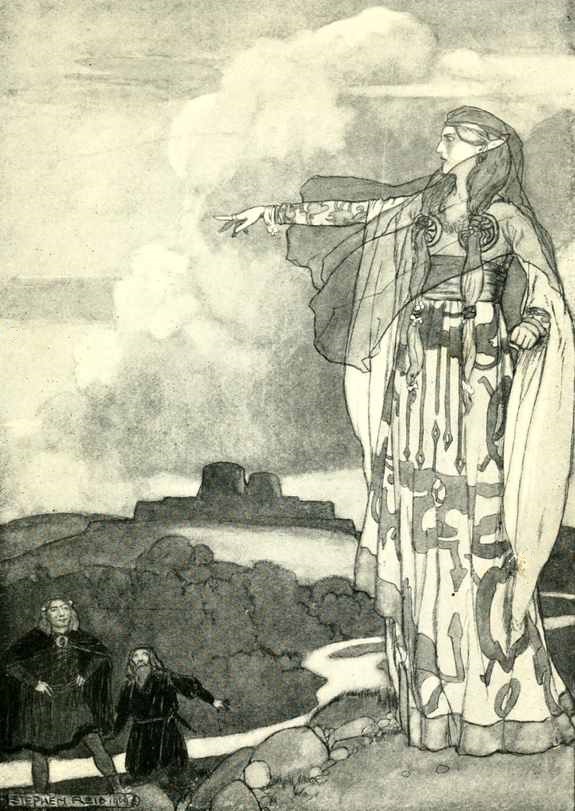
One sultry evening in the late autumn, Deirdre and
Naisi were resting before the door of her sunny bower
after a day spent by the brothers in the chase. Below,
their followers were cutting up the deer, and as they
brought in the bags of heavy game, and faggots for the
hearth, the voice of Ainle singing an evening melody
resounded through the wood. Like the sound of the wave
the voice of Ainle, and the rich bass of Arden answered
him, as together the two brothers came out from the
shadow of the trees, gathering to the trysting-place of
the evening meal.
Between Naisi and Deirdre a draught-board was set,
but Deirdre was winning, for a mood of oppression lay
upon Naisi and his thoughts were not in the game.
For of late, at evening, his exile weighed upon him, and
little good to him seemed his prosperity and his successes,
since he did not see his own home in Ireland and
his friends at the time of his rising in the morning or at
the time of his lying down at night. For great as were
his possessions in Alba, stronger in him than the love
of his kindred in Alba was the love of his native land in
Erin. He thought it strange, moreover, that of those
three who in the old time loved him most, Fergus and
Conall Cernach and Cuchulain, not one of them had all
this time come to bring him to his own land again under
his safeguard and protection.
So, as they played, Deirdre could see that the mind of
Naisi was wandering from the game, and her heart smote
her, as often it had smitten her before when she had seen
him thus oppressed, that for her sake so much had gone
from him of friends and home, and his allegiance to his
king, and honourable days among his clan. Wistfully
she smiled across the board at Naisi, but mournful was
the answering smile he sent her back.
“Play, play,” she said, “I win the game from you.”
“One game the more or less can matter little when all
else is lost,” he answered bitterly. But hardly had the
unkind words passed from him, the first unkindness
Deirdre ever heard from Naisi’s lips, when far below,
across the silent waters of the lake, he caught a distant
call, his own name uttered in a ringing voice that seemed
familiar, a voice that brought old days to memory.
“I hear the voice of a man from Erin call below,”
he cried, and started up. Now Deirdre too had heard
the cry and well she knew that it was Fergus’ voice they
heard, but deep foreboding passed across her mind that
all their hours of happiness were past, and grief and
rending of the heart in store. So quickly she replied:
“How could that be? It is some man of Alba coming
from the chase, belated in returning. No voice was
that from Erin; it was a Scotchman’s cry. Let us
play on.”
Three times the voice of Fergus came sounding up the
glen, and at the last, Naisi sprang up. “You are mistaken,
damsel; of a certainty I know this is the voice
of Fergus.” “I knew it all the time, whose voice it
was,” said Deirdre, when she saw he would not be put
off. “Why then didst thou not tell us?” Naisi asked.
“A vision that I saw last night hath hindered me,”
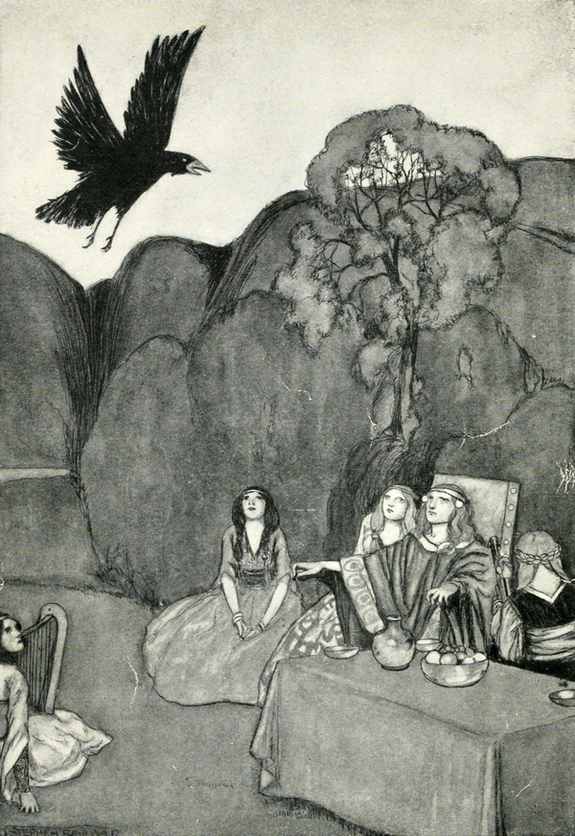
replied the girl. “I saw three birds come to us out of
Emain from the King, carrying three sips of honey in
their bills; the sips of honey they left here with us, but
took three sips of our red blood away with them.”
“What is thy rede of this vision, O Damsel?” Naisi
asked. “Thus do I understand it,” Deirdre said;
“Fergus hath come from our own native land with peace,
and sweet as honey will his message be: but the three
sips of blood that he will take away with him, those
three are ye, for ye will go with him, and be betrayed
to death.” “Speak not such words, O Deirdre,” cried
they all; “never would Fergus thus betray his friends.
Alas! that words like this should pass thy lips. We stay
too long; Fergus awaits us at the port. Go, Ainle, and
go, Arden, down to meet him, and to give him loving
welcome here.” So Arden went, and Ainle, and three
loving kisses fervently they gave to Fergus and his sons.
Gladly they welcomed the wayfarers to Naisi’s home,
and led them up; and Naisi and Deirdre arose and
stretched their hands in welcome; and they gave them
blessing and three kisses lovingly, for old times’ sake, and
eagerly they asked for tidings of Erin, and of Ulster
especially. “I have no other tidings half so good as
these,” said Fergus, “that King Conor waits for you to
give you welcome back to Emain, and to the Red Branch
House. I am your surety and your safeguard, and full
well ye know that under Fergus’ safeguard ye are sure
of peace.” “Heed not that message, Naisi,” Deirdre
said; “greater and wider is your lordship here, than
Conor’s rule in Erin.”
“Better than any lordship is one’s native land,”
said Naisi; “dearer to me than great possessions here,
is one more sight of Erin’s well-loved soil.”
“My word and pledge are firm on your behalf,” said
Fergus; “with me no harm or hurt can come to you.”
“Verily and indeed, thy word is firm, and we will go
with thee.”
But to their going Deirdre consented not, and every
way she sought to hinder them, and wept and prayed
them not to go to death. “Now all my joy is past,”
she said; “I saw last night the three black ravens bearing
three sad leaves of the yew-tree of death; and O Beloved,
those three withered leaves I saw were the three sons of
Usna, blown off their stem by the rough wind of Conor’s
wrath and the damp dew of Fergus’ treachery.” And
they were sorry that she had said that. “These are but
foolish women’s fears,” said they; “the dropping of
leaves in thy dream, and the howling of dogs, the sight
of birds with blood-drops in their bills, are but the restlessness
of sleep, O Deirdre; and verily we put our trust
in Fergus’ word. To-night we go with him to Erin.”
Gladsome and gay were the three brothers then; they
put all fears away from them, and set to prepare them
for their journey back to Erin’s shores. And early the
next morning, about the parting of night from day,
at the delay of the morning dawn, they passed down to
their galley that rocked upon the loch, and hoisted sail,
and calmly and peacefully they sailed out into the
ocean. But Deirdre sat in the stern of the boat, and her
face was not set forward looking towards Erin, but it
was set backward looking on the coasts of Scotland.
And she cried aloud, “O Land of the East, My love to
thee, with thy wondrous beauty! Woe is me that I
leave thy lochs and thy bays, thy flowering delightful
plains, and thy bright green-smooth hills! Dear to
me the fort that Naisi built, dear the sunny bower
up the glen; very dear to my heart the wooded slope
holding the sunbeams where I have sat with Naisi.”
And as they sailed out of Glen Etive she sang this song,
sadly and sorrowfully:—
“Farewell, dear Alba of the free,
Beloved land beside the sea,
No power could drag me from my home,
Did I not come, Naisi, with thee.
Farewell, dear bowers within the Glen,
Farewell, strong fort hung over them,
Dear to the heart each shining isle,
That seems to smile beneath our ken.
Glen da Roe!
Where the white cherry and garlic blow,
On thy blue wave we rocked to sleep,
As on the deep, by Glen da Roe.
Glen Etive!
Whose sunny slopes these waters lave,
The rising sun we seemed to hold.
As in a fold, in Glen Etive.
Glen Masaun!
Love to all those who here were born!
Across thy peak, at twilight’s fall,
The cuckoos call, in Glen Masaun.
Farewell, dear Land,
From Alba’s strand I ne’er had roved
Save at the call of my beloved,
Farewell, dear Land!”
The next day they reached the shores of Ireland not
far from the fort of Borrach. And as they landed there,
messengers from Borrach met Fergus, saying, “Borrach
hath prepared a feast for the King, and it is the King’s
command that the honour of this feast be given to thee.
Come therefore and spend this night with me; but the
King desires to hasten the sons of Usna that he may
welcome them, and he bids them press onward to Emain
this very night.”
When Fergus heard that, sudden fear and gloom over-shadowed
him, lest in very truth Conor had evil designs
towards the sons of Usna. “It was not well done, O
Borrach, to offer me a feast in Conor’s stead this night,
for I was pledged to bring the sons of Usna straight to
Emain without delay.” “It is the King’s command,”
said Borrach; “needs must a true vassal obey the King.”
Still was Fergus loth to stay and he asked Naisi what he
ought to do about this. “Do what they desire of thee,
O Fergus,” said Deirdre, “if to partake of a banquet
seems better to thee than to protect the sons of Usna.
However to me it seems that the lives of thy three friends
is a good price to pay for a feast.”
“I will not forsake them,” said Fergus; “for my two
sons, Illan the Fair and Buinne the Ruthless Red will
be with them to protect them, and my word of honour,
moreover, with them; if all the warriors of Erin were
assembled in one place, and all of one mind, they would
not be able to break the pledge of Fergus.”
“Much thanks we give thee for that,” said Naisi, for
he saw that Fergus feared to fall foul of Conor more than
he cared for their safety; “never have we depended on
any protection but that of our own right hands alone;
we will then go forward to Emain Macha, and see there
if the word of Fergus will be sufficient to protect us.”
But Deirdre said: “Go not forward to-night; but let
us turn aside, and for this one night take shelter with
Cuchulain at Dundalk; then will Fergus have partaken
of his feast, and he will be ready to go with you. So will
his word be fulfilled and yet your lives will be prolonged.”
“We think not well of that advice,” said Buinne the
Ruthless Red; “you have with you the might of your
own good hands, and our might, and the plighted word
of Fergus to protect you; impossible is it that ye should
be betrayed.” “Ah! that plighted word of Fergus’;
the man who forsook us for a feast!” said Deirdre.
“Well may we rely on Fergus’ plighted word.” And she
fell into grief and dejection. “Alas! Alas!” she cried.
“Why left we Alba of the red deer to come again to Erin?
Why put we trust in the light word of Fergus? Woe
is come upon us since we listened to the promises of that
man! The valiant sons of Usna are destroyed by him,
the Lights of Valour of the Gael. Great is my heaviness
of heart to-night! Great is the loss that is fallen
upon us.”
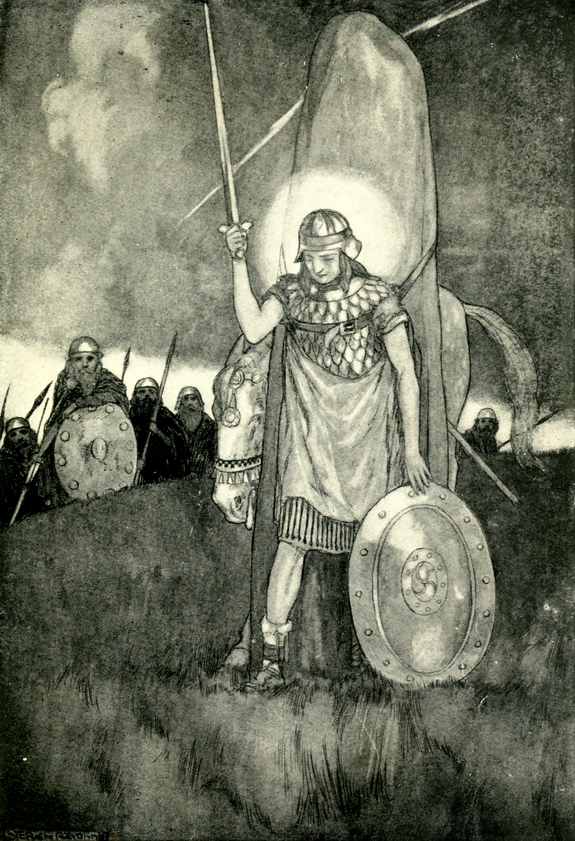
In spite of that the sons of Usna and their two friends
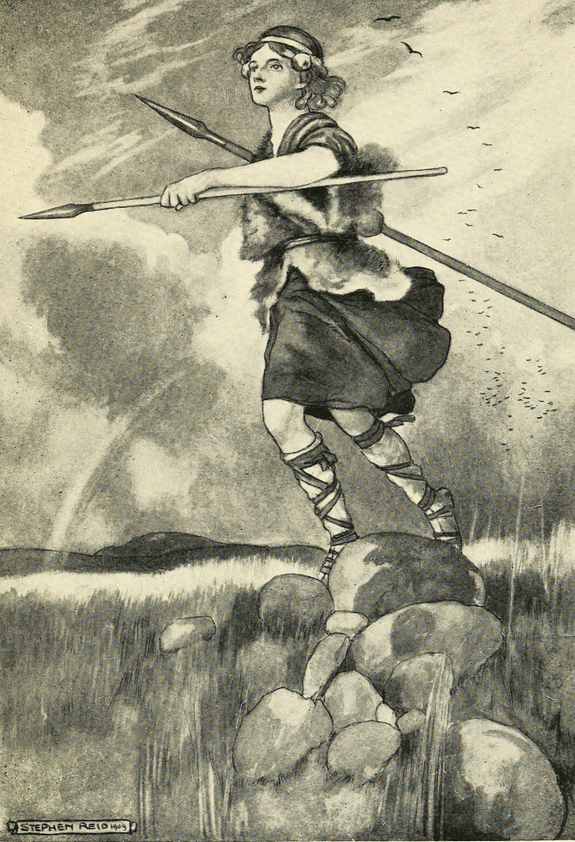
went onward towards the White Cairn of Watching on
Sliab Fuad; but Deirdre was very weary and she
lingered behind in the glen, and sat down to rest and fell
asleep. They did not notice at first that she was not
with them, but Naisi found it out and he turned back
to seek Deirdre. He found her sitting in the wood on
the trunk of a fallen tree, just waking from her sleep.
When she saw Naisi she arose and clung to him. “What
happened to thee, O fair one?” said Naisi, “and wherefore
is thy face so wild and fearful, and tears within
thine eyes?”
“I fell into a sleep, for I was weary,” she replied; “and
O Naisi, I fear because of the vision and the dream I
saw.” “Thou art too apt to dream, beloved,” said
Naisi tenderly, “what was thy dream?” “Terrible
was my dream,” said Deirdre; “I saw thee, Naisi, and
Ainle and Arden, each of ye three beloved ones, without a
head, thy headless bodies lying side by side near Emain’s
fort; and Illan lay there too drenched all with blood, and
headless like ye three. But on the other side among our
enemies, fighting against us, was the treacherous Buinne
the Ruthless Red, who now is our protector and our
guide; for he had saved his head by treachery to thee.”
“Sad were thy dream indeed,” said Naisi, “were it true;
but fear it not, it was an empty vision grown out of weariness
and pain.” But Deirdre clung yet to him, and she
cried, “O Naisi, see, above thy head, and o’er the heads
of Ainle and of Arden, that sombre cloud of blood! dost
thou not mark it hanging in the air? All over Emain
lies the heavy pall; but on thy head and theirs red
blood-drops fall, big, dusky, drenching drops. Let us
not go to Emain.” But Naisi thought that from her
weariness the mind of Deirdre had become distraught,
and all the more he pressed them onward, that she might
have rest and shelter for the night. As they drew near
to Emain, Deirdre said, “One test I give you whether
Conor means you good or harm. If into his own house
he welcomes you, all will be well, for in his own home
would no monarch dare to harm a guest; but if he send
you to some other house, while he himself stays on in
Emain’s court, then treachery and guile is meant towards
you.”
Now as they reached the Court of Emain, messengers
came out to meet them from the King. “King Conor
bids you welcome,” said the men; “right glad is he that
you are come again to Erin, to your fatherland. But
for this one night only is he not prepared to call you as
his guests to his own court. To-morrow he will give
you audience and bid you to his house. For this one
night, then, he bids you turn aside into the Red Branch
House, where all is ready for your entertainment.” “It
is as I thought,” said Deirdre, “King Conor means no
good to you, I ween.” But Naisi replied, “Where could
the Red Branch champions so fitly rest as in the Red
Branch House? Most gladly do we seek our hall, to
rest and find refreshment for the morrow. We all are
travel-stained, but we will bathe and take repose, and on
the morrow we will meet the King.”
But when they came to the House of the Red Branch,
so weary were they all, that though all kinds of viands
were supplied, they ate but little, but lay down to rest.
And Naisi said, “Dost thou remember, Deirdre, how in
that last game of draughts we played together, thou didst
win, because we were in Alba, and my heart was here at
home? Now are we back at last, and let us play again;
this time I promise I will win from thee.”
So with the lightsome spirit of a boy, Naisi sat down
to play; for now that once again he was at home among
his people and in his native land, all thought or dread of
evil passed from him. But with Deirdre it was not so,
for heavy dread and terror of the morrow lay on her heart,
and in her mind she felt that this was their last day of
peace and love together.
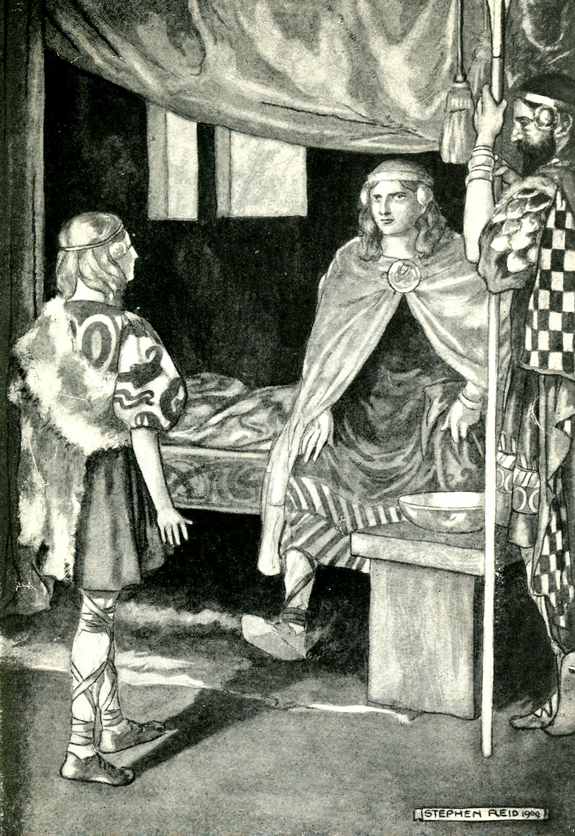
But in his royal court, King Conor grew impatient
as he thought that Deirdre was so near at hand, and he
not seeing her. “Go now, O foster-mother, to the Red
Branch Hall and see if on the child that thou didst rear
remains her early bloom and beauty, and if she still is
lovely as when she went from me. If she is still the
same, then, in spite of Naisi, I’ll have her for my own;
but if her bloom is past, then let her be, Naisi may keep
her for himself.”
Right glad was Levarcam to get leave to go to Deirdre
and to Usna’s sons. Down to the Red Branch House
straightway she went, and there were Naisi and her
foster-child playing together with the board between
them. Now, save Deirdre herself, Naisi was dearer to
Levarcam than any other in the world, and well she knew
that her own face and form were upon Deirdre still, only
grown riper and more womanly. For, without Conor’s
knowledge, she oft had gone to seek them when they
stayed in Alba.
Lovingly she kissed them and strong showers of tears
sprang from her eyes. “No good will come to you, ye
children of my love,” she said with weeping, “that ye
are come again with Deirdre here. To-night they
practise treachery and ill intent against you all in Emain.
The King would know if Deirdre is lovely still, and
though I tell a lie to shelter her, he will find out, and
wreak his vengeance on you for the loss of her. Great
evils wait for Emain and for you, O darling friends.
Shut close the doors and guard them well; let no one pass
within. Defend yourselves and this sweet damsel here,
my foster-child. Trust no man; but repel the attack
that surely comes, and victory and blessing be with
you.”
Then she returned to Emain; but all along the way
she wept quick-gushing showers of tears, and heaved
great sighs, for well she knew that from this night the
sons of Usna would be alive no more.
“What are the tidings that you have for me?” King
Conor asked. “Good tidings have I, and tidings that
are not good.” “Tell me them,” said the King. “The
good tidings that I have are these; that the sons of
Usna, the three whose form and figure are best, the three
bravest in fight and all deeds of prowess, are come again
to Erin; and, with the Lights of Valour at thy side, thine
enemies will flee before thee, as a flock of frightened
birds is driven before the gale. The ill-tidings that I
have, are that through suffering and sorrow the love of
my heart and treasure of my soul is changed since she
went away, and little of her own bloom and beauty
remains upon Deirdre.” “That will do for awhile,”
said the King; and he felt his anger abating. But when
they had drunk a round or two, he began to doubt the
word of Levarcam. “O Trendorn,” said he to one who
sat beside him, “dost thou recollect who it was who slew
thy father?”
“I know well; it was Naisi, son of Usna,” he replied.
“Go thou therefore where Naisi is, and see if her own face
and form remain upon Deirdre.”
So Trendorn went down to the House of the Red
Branch, but they had made fast the doors and he could
find no way of entrance, for all the gates and windows
were stoutly barred. He began to be afraid lest the sons
of Usna might be ready to leap out upon him from within,
but at last he found a small window which they had
forgotten to close, and he put his eye to the window, and
saw Naisi and Deirdre still playing at their game peacefully
together. Deirdre saw the man looking in at the
window, and Naisi, following her eye, caught sight of him
also. And he picked up one of the pieces that was
lying beside the board, and threw it at Trendorn, so that
it struck his eye and tore it out, and in pain and misery
the man returned to Emain.
“You seem not so gay as when you set out, O Trendorn,”
said the King; “what has happened to thee, and hast
thou seen Deirdre?” “I have seen her, indeed; I have
seen Deirdre, and but that Naisi drove out mine eye I
should have been looking at her still, for of all the women
of the world, Deirdre is the fairest and the best.” When
Conor heard that, he rose up and called his followers
together and without a moment’s delay they set
forward for the house of the Red Branch. For he
was filled with jealousy and envy, and he thought
the time long until he should get back Deirdre for
himself.
“The pursuit is coming,” said Deirdre; “I hear sounds
without.” “I will go out and meet them,” said Naisi.
“Nay,” said Buinne the Ruthless Red, “it was in my
hands that my father Fergus placed the sons of Usna
to guard them, and it is I who will go forth and fight for
them.” “It seems to me,” said Deirdre, “that thy
father hath betrayed the sons of Usna, and it is likely that
thou wilt do as thy father hath done, O Buinne.” “If
my father has been treacherous to you,” said Buinne,
“it is not I who will do as he has done.” Then he went
out and met the warriors of Conor, and put a host of
them to the sword. “Who is this man who is destroying
my hosts?” said Conor. “Buinne the Ruthless
Red, the son of Fergus,” say they. “We bought his
father to our side and we must buy the son,” said Conor.
He called Buinne and said to him, “I gave a free gift
of land to thy father Fergus, and I will give a free gift
of land to thee; come over to my side to-night.” “I
will do that,” said Buinne, and he went over to the side
of the King. “Buinne hath deserted you, O sons of
Usna, and the son is like the father,” Deirdre said. “He
has gone,” said Naisi, “but he performed warrior-like
deeds before he went.”
Then Conor sent fresh warriors down to attack the
house. “The pursuit is coming,” said Deirdre. “I
will go out and meet them,” said Naisi. “It is not thou
who must go, it is I,” said Illan the Fair, son of Fergus,
“for to me my father left the charge of you.” “I think
the son will be like the father,” said Deirdre. “I am
not like to forsake the sons of Usna so long as this hard
sword is in my hand,” said Illan the Fair. And the
fresh, noble, young hero went out in his battle-array, and
valiantly he attacked the host of Conor and made a
red rout of them round the house. “Who is that young
warrior who is smiting down my hosts?” said Conor.
“Illan the Fair, son of Fergus,” they reply. “We will
buy him to our side, as his brother was bought,” said
wily Conor. So he called Illan and said, “We gave a
possession of land to thy father, and another to thy
brother, and we will give an equal share to thee; come
over to our side.” But the princely young hero
answered: “Thy offer, O Conor, will I not accept; for
better to me is it to return to my father and tell him that
I have kept the charge he laid upon me, than to accept
any offer from thee, O King.” Then Conor was wroth,
and he commanded his own son to attack Illan, and
furiously the two fought together, until Illan was sore
wounded, and he flung his arms into the house, and called
on Naisi to do valiantly, for he himself was slain by a
son of Conor. “Illan has fallen, and you are left alone,”
said Deirdre, “O sons of Usna.” “He is fallen indeed,”
said Naisi, “but gallant were the deeds that he performed
before he died.”
Then the warriors and mercenaries of Conor drew
closer round the house, and they took lighted torches
and flung them into the house, and set it on fire. And
Naisi lifted Deirdre on his shoulders and raised her
on high, and with his brothers on either side, their
swords drawn in their hands, they issued forth to fight
their way through the press of their enemies. And so
terrible were the deeds wrought by those heroes, that
Conor feared they would destroy his host. He called
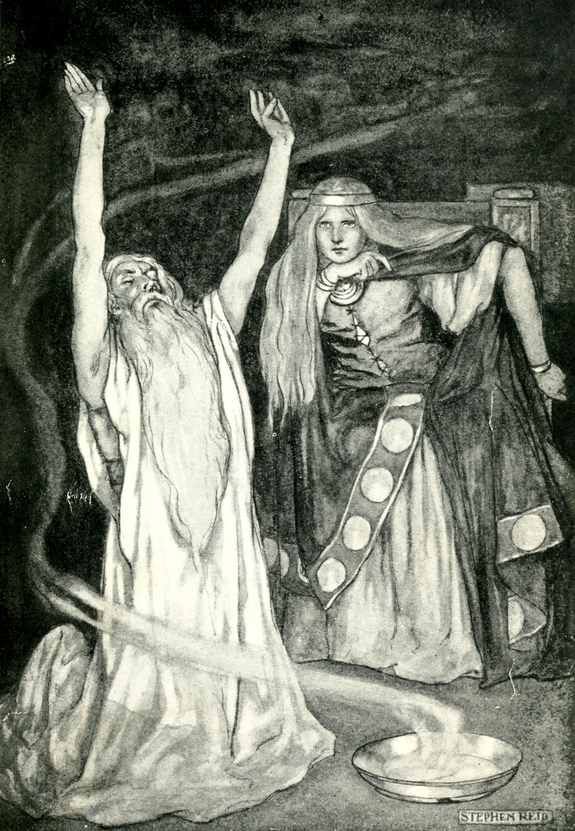
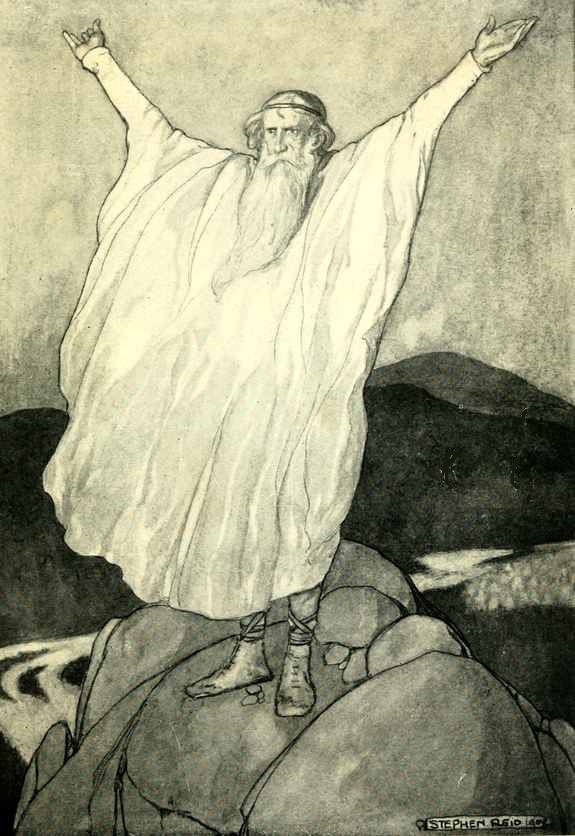
his Druids, and said to them, “Work enchantment upon
the sons of Usna and turn them back, for no longer do I
intend evil against them, but I would bring them home
in peace. Noble are the deeds that they have wrought,
and I would have them as my servants for ever.” The
Druids believed the wily King and they set to work to
weave spells to turn the sons of Usna back to Emain
Macha.
They made a great thick wood before them, through
which they thought no man could pass. But without
ever stopping to consider their way, the sons of Usna
went straight through the wood turning neither to the
right hand or the left. “Good is your enchantment,
but it will not avail,” said Conor; “the sons of Usna are
passing through without the turning of a step, or the
bending of a foot. Try some other spell.” Then the
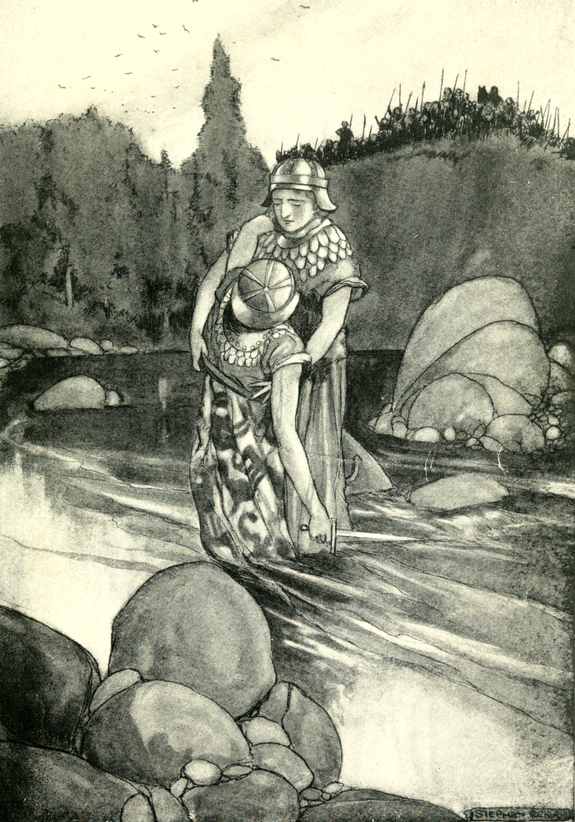
Druids made a grey stormy sea before the sons of Usna
on the green plain. The three heroes tied their clothing
behind their heads, and Naisi set Deirdre again upon
his shoulder and went straight on without flinching,
without turning back, through the grey shaggy sea,
lifting Deirdre on high lest she should wet her feet.
“Thy spell is good,” said Conor, “yet it sufficeth not.
The sons of Usna escape my hands. Try another spell.”
Then the Druids froze the grey uneven sea into
jagged hard lumps of rugged ice, like the sharpness of
swords on one side of them and like the stinging of
serpents on the other side. Then Arden cried out that
he was becoming exhausted and must fain give up.
“Come thou, Arden, and rest against my shoulder,”
said Naisi, “and I will support you.” Arden did so,
but it was not long before he died; but though he was
dead, Naisi held him up still. Then Ainle cried out
that he could go no longer, for his strength had left him.
When Naisi heard that, he heaved a heavy sigh as of one
dying of fatigue, but he told Ainle to hold on to him, and
he would bring him soon to land. But not long after,
the weakness of death came upon Ainle, and his hold
relaxed. Naisi looked on either hand and when he saw
that his two brothers were dead, he cared not whether
he himself should live or die. He heaved a sigh, sore as
the sigh of the dying, and his heart broke and he fell dead.
“The sons of Usna are dead now,” said the Druids;
“but they turned not back.”
“Lift up thy enchantment,” said Conor, “that I now
may see the sons of Usna.” Then the Druids lifted the
enchantment, and there were the three sons of Usna
lying dead, and Deirdre fluttering hither and thither from
one to another, weeping bitter heartrending tears.
And Conor would have taken her away, but she would
not be parted from the sons of Usna, and when their
tomb was being dug, Deirdre sat on the edge of the
grave, calling on the diggers to dig the pit very broad
and smooth. They had dug the pit for three only,
and they lowered the bodies of the three heroes into the
grave, side by side. But when Deirdre saw that, she
called aloud to the sons of Usna, to make space for her between
them, for she was following them. Then the body
of Ainle, that was at Naisi’s right hand, moved a little
apart, and a space was made for Deirdre close at Naisi’s
side, where she was wont to be, and Deirdre leapt into
the tomb, and placed her arm round the neck of Naisi,
her own love, and she kissed him, and her heart broke
within her and she died; and together in the one tomb
the three sons of Usna and Deirdre were buried. And all
the men of Ulster who stood by wept aloud.
But Conor was angry, and he ordered the bodies to be
uncovered again and the body of Deirdre to be removed,
so that even in death she might not be with Naisi. And
he caused Deirdre to be buried on one side of the loch,
and Naisi on the other side of the loch, and the graves
were closed. Then a young pine-tree grew from the grave
of Deirdre, and a young pine from the grave of Naisi, and
their branches grew towards each other, until they
entwined one with the other across the loch. And Conor
would have cut them down, but the men of Ulster would
not allow this, and they set a watch and protected the
trees until King Conor died.