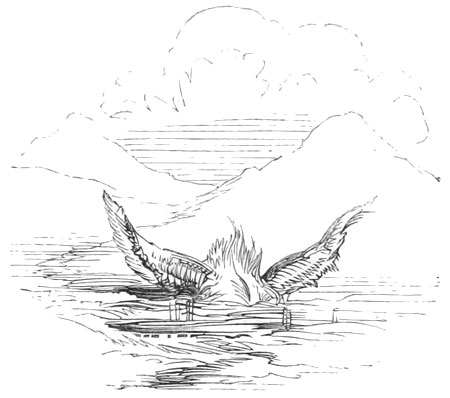
THE BOAT ADVENTURE.
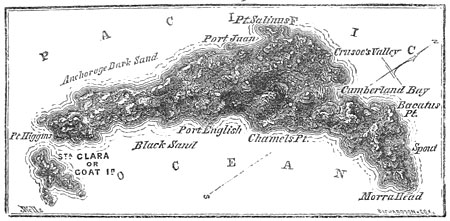
MAP OF JUAN FERNANDEZ.
My narrative dates as far back as the early part of
the year 1849. Then the ship Anteus was a noted vessel.
Many were the strange stories told of strife and discord
between the captain and the passengers; pamphlets were
published giving different versions of the facts, and some
very curious questions of law were involved in the charges
made by both parties. It appeared from the statement
of the passengers, who were for the most part intelligent
and respectable Americans, that, on the voyage of the
Anteus to California, their treatment by the captain was
cruel and oppressive in the extreme; that, before they
were three weeks from port, he had reduced them almost
to a state of absolute starvation; and, in consequence of
the violence of his conduct, which, as they alleged, was
without cause or provocation on their part, they considered
their lives endangered, and resolved upon making
an appeal for his removal at the port of Rio. On the arrival
of the vessel at Rio the captain was arraigned before
the American consul, and pronounced to be insane
by the evidence of six physicians and by the testimony
of a large majority of the passengers. It was charged,
on the other hand, that the passengers were disorderly,
mutinous, and ungovernable; that they had entered into
a conspiracy against the captain, and in testifying to his
insanity were guilty of perjury. The examination of the
case occupied several weeks before the American consul;
voluminous testimony was taken on both sides; the question
was submitted to the American minister, to the British
consul, and to the principal merchants of Rio, all of
whom concurred in the opinion that, under the circumstances,
there was but one proper course to pursue, which
was, to remove the captain from the command of the vessel.
He was accordingly deposed by the American consul,
and a new captain placed in the command. This was
regarded by the principal merchants of New York as an
arbitrary exercise of authority, unwarranted by law or
precedent, and a memorial was addressed by them to the
President of the United States for the removal of the consul.
A new administration had just come into power;
and the consul was removed, ostensibly on the ground
of the complaints made against him; but, inasmuch as
some few other officers of the government were removed
at the same time without such ground, it may be inferred
that a difference in political opinion had some weight
with the administration.
It is not my intention now to go into any argument in
regard to the merits of this case; the time may come
when justice will be done to the injured, and it remains
for higher authority than myself to mete it out. I have
simply to acknowledge, with a share of the odium resting
upon me, that I was one of the rebellious passengers
in the Anteus. My companions in trouble so far honored
me with their confidence as to give me charge of
the case. I was unlearned in law, yet possessed some
experience in sea-life; and believing that the lives of all
on board depended upon getting rid of a desperate and
insane captain, aided to the best of my ability in having
a new officer placed in the command. To the change
thus made, unforeseen in its results, I owe my eventful
visit to the island of Juan Fernandez.
It was the intention of our first captain to touch at
Valparaiso for a supply of fresh provisions. In the ship's
papers this was the only port designated on the Pacific
side except San Francisco. Our new commander, Captain
Brooks, assumed the responsibility of leaving the
choice between Valparaiso and another port to the passengers.
It was put to the vote, and decided that we
should proceed to Callao, so that we might pass in sight
of Juan Fernandez, and have an opportunity of visiting
Lima, "the City of the Kings."
Early on the morning of the 19th of May, 1849, we
made the highest peak of Massa Tierra, bearing N.N.W.,
distant seventy miles. The weather was mild and clear.
As the sun rose, it fell calm, and the ship lay nearly motionless.
A light blue spot, scarce bigger than a hand-spike,
was all that appeared in the horizon. It might
have passed for a cloud but for the distinctness of its
outline. Weary of the gales we had encountered off
Cape Horn, it was a pleasant thing to see a spot of earth
once more, and there was not a soul on board but felt a
desire to go ashore. For some days past, myself and a
few others had talked secretly among ourselves about
making the attempt in case we went close enough; but
now there seemed to be every prospect of a long calm,
and we took it for granted the captain would clap on all
sail if we took the trades. There was no other chance
but to lower one of the boats and row seventy miles. A
party of us agreed to do this, provided we could get a
boat. The ship's boats we knew it would be impossible
to get without permission of the captain, and that we
were not willing to ask. Mr. Brigham, a fellow-passenger,
was owner of one of the quarter-boats. We
broached the matter to him, and he gladly joined in the
adventure, together with his partner and some friends,
so that we made in all a very pleasant party of eleven.
The proper number of men for the boat was six, but in
consideration of the great distance and the necessity of
a change at the oars, five more were crowded in. We
had been in the habit of rowing about the vessel whenever
it was calm, and this we thought would be a good
excuse for lowering the boat. Being in great haste, lest
the captain should object to letting us go, we only
thought of a few necessary articles in case we should be
cast away or driven off from the island. Two small
demijohns of water, a few biscuits, a piece of dried beef,
and some cheese and crackers comprised our entire stock
of provisions; and for nautical instruments we had only
a lantern and a small pocket compass. Not knowing but
there might be outlaws or savages ashore who might
undertake to murder us, we armed ourselves with a
double-barreled gun, a fusee, and an old harpoon, which
was all we could smuggle into the boat in the excitement
of starting. Captain Brooks happening to come on deck,
perceived that there was something unusual going on,
and, suspecting our design, took occasion to warn us of
the folly of such an expedition. At the same time, thinking
there was more bravado than reality about it, he
laughed good-humoredly when we acknowledged that
we were going ashore. "Be sure," said he, as we went
over the side, "not to forget the peaches. You will find
plenty of them up in the valleys. Only don't lose sight
of the vessel. You may exercise yourselves as much as
you please, but keep the royals above water, whatever
you do. Bear in mind that you are more than seventy
miles from that peak!" We promised him that we would
take care of ourselves, and come back safe in case we
were not foundered.
At 9 A.M. we bade our friends good-by, and with
three cheers pushed off from the ship. The boat was
only twenty-two feet long and an eighth of an inch thick:
it was made of sheet-iron, and was very narrow and crank.
Most of us, except myself and a whaleman named Paxton,
were unused to rowing, so that the prospect of reaching
land depended a good deal upon the day remaining
calm, and upon keeping the boat trimmed, the gunwales
being only ten inches out of the water.
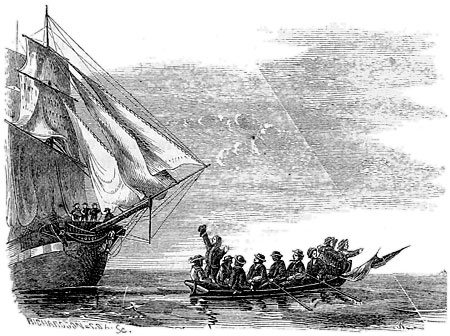
LEAVING THE SHIP.
There was no excuse for this risk of life, save that insatiable
thirst for novelty which all experience to some
extent after the monotony of a long voyage. I will only
say, in regard to myself, that I was too full of joy at the
idea of a ramble in the footsteps of Robinson Crusoe to
think of risk at all. If there was danger, it merely served
to give zest to the adventure.
By a calculation of the distance and our rate of going,
we expected to reach the land by sundown or soon after;
and then our plan was to make a tent of the boat-sail,
and sleep under it till morning, when by rising early we
thought we could take a run over the island, and perhaps
get some fruit and vegetables. By that time, should a
light breeze spring up during the night, we thought it
likely the ship would be well up by the land, and we
could pull out and get on board without difficulty. Before
long we found that distances are very deceptive in
these latitudes where the atmosphere is so clear; for notwithstanding
the statement of the captain that by the
reckoning we were seventy miles from land, we believed
that he only told us so to deter us from going, and that
we were not much more than half that distance. In rowing
we made a division of our number, taking turns or
watches of an hour each at the oars, so as to share the
labor. Once fairly under way, with a smooth sea and a
pleasant day before us, we became exceedingly merry at
the expense of our fellow-passengers whom we had left
in the ship to drift about in the calm, and it afforded us
much diversion to think how they would be disappointed
upon finding that we were in earnest about going ashore.
Before long we had cause to wish ourselves back again
in the ship, which goes to prove that apparently the most
unfortunate are often less so than those who seem to be
favored by circumstances.
At noon we took a lunch, and refreshed ourselves with
a drink of water all round. We had also a good supply
of cigars, which we smoked with great relish after our
pull; and I think there never was a happier set than we
were for the time. Still there was but a single peak on
the horizon. It was blue and dim in the distance, and
apparently not much higher than when we saw it from
the mast-head, from which we inferred that there must
be a current setting against us. The Anteus was hull
down, yet we seemed as far from the land as when we
started.
A ripple beginning to show upon the water, we hoisted
our sail to catch the breeze, and found that it helped
us one or two knots an hour. With songs and anecdotes
we passed the time pleasantly till 3 P.M., when we entirely
lost sight of the vessel. Paxton, the whaleman,
now stood up in the boat to take an observation of the
land. There were a few more peaks in sight; the middle
peak, which was the first we made, began to loom up
very plainly, showing a flat top. It was the mountain
called Yonka, which is said to be three thousand feet
high. We were apparently forty miles yet from the
nearest point; and the sun setting here in May at a little
after five, we began to feel uneasy concerning the weather,
which showed signs of a change. All of us, having
gone so far, were in favor of keeping on, though in secret
we thought there was a good deal of danger. At sunset
we took another observation. The land had risen quite
over the water from end to end, and we hoped to reach
it in about three hours. It is true none of us knew any
thing about the shores, whether they abounded in bays
or not, and if so where any safe place of landing could
be found, which made us doubtful how to steer. Clouds
were gathering all over the horizon; a few stars shone
out dimly overhead, and the shades of night began to
cover the island as with a shroud. Swiftly, yet with resistless
power, the clouds swept over the whole sky, and
the horizon, in all the grandeur of its vast circle, was lost
in the shades of night. No sail was near; no light shone
upon us now but the dim rays of a few solitary stars
through the rugged masses of clouds; no sound broke
upon the listening ear save the weary stroke of our oars:
a gloom had settled upon the mighty wilderness of waters,
and we were awed and silent, for we knew that the
spirit of God was there, and darkness was his secret
place; that "his pavilion round about him were dark
waters and thick clouds of the skies."
One large black mass of clouds rose up on the weather
quarter; a low moaning came over the sea, and the air
became suddenly chill, and the waters rippled around us,
and were tossed about by the unseen Power, and we
trembled, for we beheld the coming of the storm that
was soon to burst upon us in all the majesty of its wrath.
For a while there was the stillness of death; then "the
Lord thundered in the heavens, and the Highest gave his
voice," and out of the darkness came the storm. In fierce
and sudden gusts it came, terrible in its resistless might;
lashing the sea into a white foam, tossing and whirling
overhead, with its thousand arms outstretched; grasping
up the waters as it raged over the deep, and scourging
them madly through the air, while it moaned and shrieked
like the dread spirit of desolation.
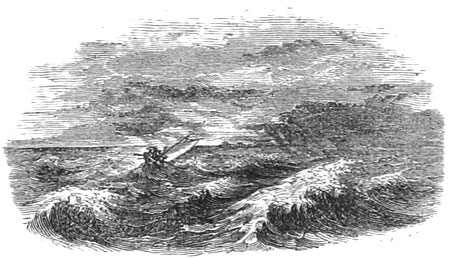
BOAT IN A STORM.
Every one of us cowered down in the boat to keep her
balanced. The spray washed over us fearfully, and the
sail shook so in the wind, having let go all, that we
thought it would tear the mast out. At this time we
were about three leagues from the S.E. end of the island,
which was the nearest point then in sight. As the cloud
spread by the attraction of the land, the whole island became
wrapped in a dark shroud of mist, and in half an
hour we could discern nothing but the gloom of the
storm around us, as we bore down toward the darkest
part on the lea. Our lamp was now quenched by a heavy
sea, and being unable to distinguish the points of the
compass, we were fearful we should miss the island and
be carried off so far that we could never reach it again.
Whenever there was a lull we tried to haul in our sheet,
but a sudden flaw striking us once, the boat lay over
till she buried her gunwales, and the sea broke heavily
over her lee side, and the crew at the same time springing
in a body to the weather side, to balance her, brought
her over suddenly, so that it was a miracle we were not
capsized, which, had it happened so far out at sea in the
darkness, would have made an end of us. Indeed, it was
as much as we could do, by baling continually, to keep
her afloat, and every moment we expected to be buried
in a watery grave. For the reason that we feared the
tide or current which set against us might carry us off
beyond reach of the land, we kept up our sail as long as
we could, thinking that while we made headway toward
the lee of the island we increased our chance of safety.
Moreover, we knew it was four hundred miles to the
coast of Chili, and we had neither water nor provisions
left. At best our position was perilous. Ignorant of
the bearings of the harbor, we were at a loss what to do
even if we should be able to reach the lee of the island,
for we had seen that it was chiefly rock-bound and inaccessible
to boats.
About 2 A.M., as well as we could judge, we found ourselves
close in under the lee of a high cliff, upon the base
of which the surf broke with a tremendous roar. Some
three or four of the party, reckless of the consequences,
were in favor of running straight in, and attempting to
gain the shore at all hazards. The more prudent of us
protested against the folly of this course, well knowing
that we would be capsized in the surf and dashed to
pieces on the rocks. Here we found the evils of having
too many masters in an adventure of this kind, where
every man who had a will of his own seemed disposed
to use it. However, by mild persuasion, we adjusted the
difficulty, and agreed to continue on under the lee, where
we were sheltered in some degree from the gale, till we
should hit upon some safe harbor, if such there was upon
the island. The boat was our only resource in case of
being left ashore, and all admitted the necessity of preserving
it as long as possible. If we found no harbor,
we could lie off a short distance and wait till daylight.
This plan was so reasonable that none could object to it.
As soon as we were well in by the shore, where the gale
was cut off by the mountains, we had a light eddy of air
in our favor, which induced us to keep up our sail. We
soon found the danger of this. A strong flaw from a gap
in the land struck us suddenly, and would have capsized
us had we not let go every thing, and clung to the weather
gunwale till it was over, when we quickly pulled down
the sail and took to the oars.
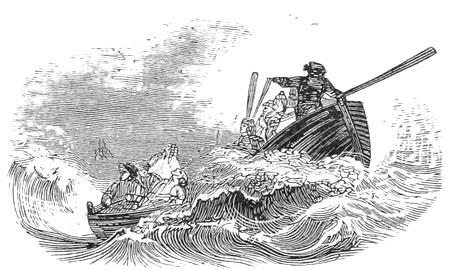
STRUCK BY A FLAW.
We could see nothing on our starboard but the wild
seas as they rolled off into the darkness; on our larboard,
a black perpendicular wall of rocks loomed up hundreds
of feet high, reaching apparently into the clouds. Sometimes
a part of the outline came out clear, with its rugged
pinnacles against the sky, and now and then a fearful
gorge opened up as we coasted along, through which the
wind moaned dismally. It was a very wild and awful
place in the dead of night, being so covered with darkness
that we scarce knew where we steered, or how soon
we might be dashed to pieces in the surf. Once in a
while we stopped to listen, thinking we heard voices on
the shore, but it was only the moaning of the tempest
upon the cliffs, and the frightful beating of the surf below.
We seemed almost to be able to touch the black and rugged
wall of rocks that stood up out of the sea, and the
shock of the returning waves so jarred the boat at times
that we clung to the thwarts, and believed we were surely
within the jaws of death. As the voices died away
which we thought came out from the cliffs there was a
lull in the storm, and nothing but the wail of the surf
could be heard, sounding very sad and lonesome in gloom
of night. It was a dreary and perpetual dirge for the
ill-fated mariners who were buried upon that inhospitable
shore; a death-moan that forever rises out of the deep
for the souls that are lost, and the hearts that can never
be united with those that love them upon earth again. I
thought how well it was writ by the poet—
"Oh, Solitude! where are the charms
That sages have seen in thy face?
Better dwell in the midst of alarms.
Than reign in this horrible place."
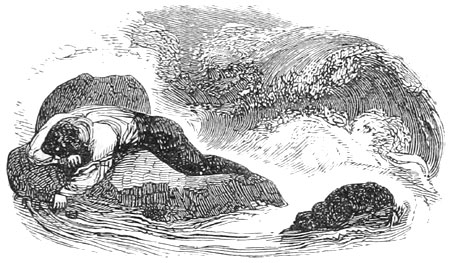
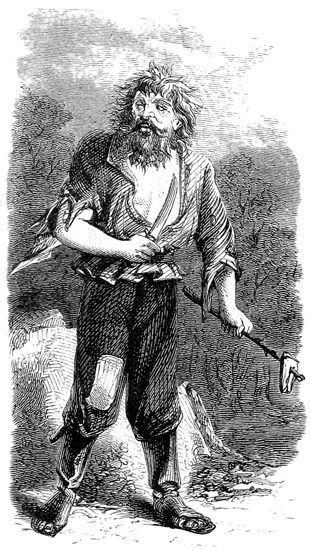
SHIPWRECKED SAILOR.
Having pulled about twelve miles along the shore from
Goat Island, where we first got under the lee, and seeing
no sign of a cove or harbor, we began to despair of getting
ashore before daylight. In this extremity, Abraham,
a ship-neighbor of mine, succeeded in lighting the lantern
again, which he held out in his hand from the bow, hoping
thereby to cast a light upon the rocks, that we might
grope out our way and reach some place of safety; but
it only seemed to make the darkness thicker than it was
before. We therefore concluded it was best to pull on
till we rounded a point some few miles ahead, where we
thought there might be a cove. So we put out the light
and got Paxton to go in the bow as a look-out, he being
the most keen-sighted, from the habit of looking from
the mast-head for whales. On turning the point we
were startled by a loud cry of "Light, ho!" Every
body turned to see where it appeared. It was close
down by the water, about three miles distant, within a
spacious cove that opened upon us as we turned the point.
Paxton's quick eye had descried it the moment we hove
round the rock. Greatly rejoiced by this discovery, we
pulled ahead with a good will and rapidly bore down
toward the light.
Chilled through with the sharp gusts from the mountains,
wet with spray, and very hungry, we congratulated
ourselves that there were still inhabitants on the island,
and we could not but think they would give us something
to eat, and furnish us with some place of shelter. Captain
Brooks had told us that he had been here several
times in a whaler; that sometimes people lived upon the
island from the coast of Chili, and sometimes it was entirely
deserted. The Chilians who frequented this lonely
island we knew to be a very bad set of people, chiefly
convicts and outcasts, who would not hesitate to rob and
murder any stranger whom misfortune or the love of adventure
might cast in their power. Pirates, also, had frequented
its bays from the time of the buccaneers; and it
was a question with us whether the light was made by
these outlaws, or by some unfortunate shipwrecked sailors
or deserters from some English or American whale-ship.
The better to provide against danger, we loaded
our two guns, and placed them in the bow, as also the
harpoon; upon which we steered for the light. All of a
sudden it disappeared, as if quenched by water. This
was a new source of trouble. What could it mean?
There was no doubt we had all seen it. The early voyagers
had often seen strange lights at night on the tops
of the mountains, which they attributed to supernatural
causes; but this was close down by the water, and was
too well defined and too distinctly visible to us all either
to be a supernatural visitation or the result of some volcanic
eruption. While we lay upon our oars wondering
what it meant, it again appeared, brighter than before.
Now, if the inhabitants were not pirates or freebooters,
why did they pursue this mysterious conduct? We suspected
that they heard our oars, and had lit a fire on the
beach to guide us ashore; but if they wanted us to land
in the right place, why did they put out the light and
start it up again so strangely? For half an hour it continued
thus to disappear and reappear at short intervals
in the same mysterious way, for which none of us could
account.
It being now about four o'clock in the morning, we
felt so cast down by fatigue and dread of death, that we
decided to run in at all hazards, and, if necessary, make
our way through the breakers. All hands fell to upon
the oars, and soon the light bore up again close on by the
head. Paxton, who was in the bow, quickly started up,
and began peering sharply through the gloom. "What's
that?" said he: "look there, my lads. I see something
black; don't you see it—there, on the larboard—it looks
to me like the hull of a ship! Pull, my lads, pull!" and
so all gave way with a will, and in a few minutes the tall
masts of a vessel loomed up against the sky within a
hundred yards! I shall never forget the joy of the whole
party at that sight. The light which we had seen came
from a lamp that swung in the lower rigging, and though
the ship might be a Chilian convict vessel, or some other
craft as little likely to give us a pleasant reception, yet
we were too glad to think of that, and straightway
pulled up under her stern and hailed her. For a moment
there was a pause as our voices broke upon the
stillness; then there was a stir on deck, and a voice answered
us in clear sailor-like English, "Boat ahoy! where
are you from?" "The ship Anteus," said we, "bound
for California; what ship is this?" "The Brooklyn, of
New York, bound for California. Come on board!"
No longer able to suppress our joy, we gave vent to
three hearty cheers—cheers so loud and genuine that they
swept over the waters of Juan Fernandez, and went rolling
up the valleys in a thousand echoes. In less than
five minutes we were all on deck, thankful for our providential
deliverance from the horrors of that eventful night.
FIRST IMPRESSIONS OF THE ISLAND.
The decks of the Brooklyn presented a strange and
half-savage scene. Most of the passengers, aroused from
their sleep by the shouts of the officers and crew, had
rushed upon deck nearly naked, and quite at a loss to
know what had happened. While we were answering
some of their questions, Captain Richardson, the master,
pushed his way through the crowd and asked what all
the noise was about. We speedily explained how we
had left the Anteus seventy miles out at sea, and how,
through the aid of Providence, we had made our way
into the harbor and descried the ship's lamp; declaring
at the same time our belief that, had we missed the ship,
in all probability we would have been dashed to pieces
upon the rocks. We then made ourselves known personally
to the captain, who was well acquainted with
some of the party. He cordially welcomed us on board,
and invited us into his cabin, where we gave him a more
detailed account of our adventure. Meantime the cook
was ordered to get us some breakfast as soon as possible,
and Captain Richardson offered us dry clothes, and
administered to our wants in the kindest manner. Nor
was it long till we felt exceedingly comfortable considering
the previous circumstances. We soon had breakfast,
which, after our toils and troubles, was truly a Godsend.
Some of the finest fish I ever ate was on the table;
excellent ham and potatoes also, fresh bread, and coffee
boiling hot. It was devoured with a most uncommon
relish, as you may suppose; and it was none the less
agreeable for being seasoned with pleasant conversation.
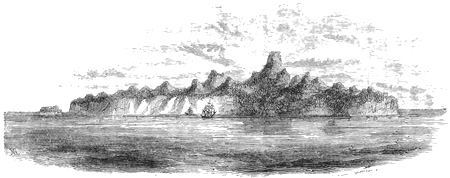
JUAN FERNANDEZ.
The captain admitted
that in all his seafaring
career he had never
known of any thing
more absurd than our
adventure, and that it
was a miracle we were
not every one lost. All
the passengers crowded
around us as if we
had risen from the
depths of the sea, and
I fancied they examined
us as if they had
an idea that we were
some kind of sea-monsters.
The Brooklyn lay
at anchor about half
a mile from the boat-landing.
At the dawn
of day I was on the
deck, looking eagerly
toward the island. I
may as well confess
at once that no child
could have felt more
delighted than I did
in the anticipation of
something illusive and
enchanting. My heart
throbbed with impatience to see what it was that cast
so strange a fascination about that lonely spot. All was
wrapped in mist; but the air was filled with fresh odors
of land, and wafts of sweetness more delicious than the
scent of new-mown hay. The storm had ceased, and the
soft-echoed bleating of goats, and the distant baying of
wild dogs were all the sounds of life that broke upon the
stillness. It seemed as if the sun, loth to disturb the
ocean in its rest, or reveal the scene of beauty that lay
slumbering upon its bosom, would never rise again, so
gently the light stole upon the eastern sky, so softly it
absorbed the shadows of night. I watched the golden
glow as it spread over the heavens, and beheld at last the
sun in all his majesty scatter away the thick vapors that
lay around his resting-place, and each vale was opened out
in the glowing light of the morning, and the mountains
that towered out of the sea were bathed in the glory of
his rays.
Never shall I forget the strange delight with which I
gazed upon that isle of romance; the unfeigned rapture
I felt in the anticipation of exploring that miniature
world in the desert of waters, so fraught with the happiest
associations of youth; so remote from all the ordinary
realities of life; the actual embodiment of the most
absorbing, most fascinating of all the dreams of fancy.
Many foreign lands I had seen; many islands scattered
over the broad ocean, rich and wondrous in their romantic
beauty; many glens of Utopian loveliness; mountain
heights weird and impressive in their sublimity; but
nothing to equal this in variety of outline and undefinable
richness of coloring; nothing so dreamlike, so wrapped
in illusion, so strange and absorbing in its novelty.
Great peaks of reddish rock seemed to pierce the sky
wherever I looked; a thousand rugged ridges swept upward
toward the centre in a perfect maze of enchantment.
It was all wild, fascinating, and unreal. The
sides of the mountains were covered with patches of rich
grass, natural fields of oats, and groves of myrtle and pimento.
Abrupt walls of rock rose from the water to
the height of a thousand feet. The surf broke in a white
line of foam along the shores of the bay, and its measured
swell floated upon the air like the voice of a distant cataract.
Fields of verdure covered the ravines; ruined
and moss-covered walls were scattered over each eminence;
and the straw huts of the inhabitants were almost
imbosomed in trees, in the midst of the valley, and
jets of smoke arose out of the groves and floated off
gently in the calm air of the morning. In all the shore,
but one spot, a single opening among the rocks, seemed
accessible to man. The rest of the coast within view
consisted of fearful cliffs overhanging the water, the
ridges from which sloped upward as they receded inland,
forming a variety of smaller valleys above, which
were strangely diversified with woods and grass, and
golden fields of wild oats. Close to the water's edge
was the dark moss-covered rock, forever moist with the
bright spray of the ocean, and above it, cleft in countless
fissures by earthquakes in times past, the red burnt
earth; and there were gorges through which silvery
springs coursed, and cascades fringed with banks of
shrubbery; and still higher the slopes were of a bright
yellow, which, lying outspread in the glow of the early
sunlight, almost dazzled the eye; and round about
through the valleys and on the hill-sides, the groves of
myrtle, pimento, and corkwood were draped in green,
glittering with rain-drops after the storm, and the whole
air was tinged with ambrosial tints, and filled with sweet
odors; nothing in all the island and its shores, as the
sun rose and cast off the mist, but seemed to
"suffer a sea-change
Into something rich and strange."
GOING ASHORE.
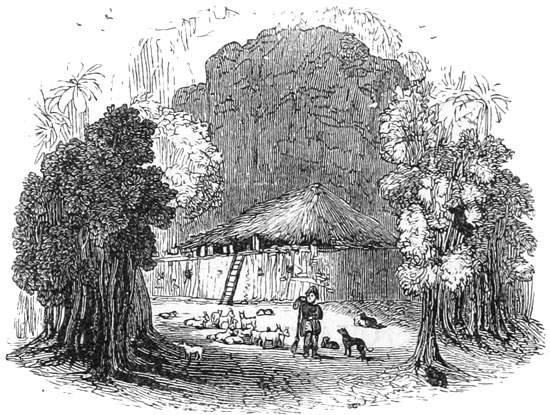
CRUSOE'S CASTLE.
No longer able to control our enthusiasm, we sprang
into the boat and pushed off for the landing. Captain
Richardson, who was well acquainted with the ruins of
the Chilian settlement, joined us in our intended excursion,
and we were accompanied also by a few sporting
passengers from the Brooklyn in another boat. The waters
of the bay are of crystal clearness; we saw the bottom
as we dashed over the swell, at a depth of several
fathoms. It was alive with fish and various kinds of
marine animals, of which there are great quantities about
these shores. Can you conceive, ye landsmen who dwell
in cities, and have never buffeted for weary months the
gales of old ocean, the joy of once more touching the
genial earth when it has become almost a dreamy fancy
in the memories of the past! Then think, without a
smile of disdain, what a thrill of delight ran through my
blood as I pressed my feet for the first time upon the
fresh sod of Juan Fernandez! Think of it, too, as the
realization of hopes which I had never ceased to cherish
from early boyhood; for this was the abiding place,
which I now at last beheld, of a wondrous adventurer
whose history had filled my soul years ago with indefinite
longings for sea-life, shipwreck, and solitude! Yes,
here was verily the land of Robinson Crusoe; here, in
one of these secluded glens, stood his rustic castle; here
he fed his goats and held converse with his faithful pets;
here he found consolation in the devotion of a new friend,
his true and honest man Friday; beneath the shade of
these trees he unfolded the mysteries of Divine Providence
to the simple savage, and proved to the world
that there is no position in life which may not be endured
by a patient spirit and an abiding confidence in
the goodness and mercy of God.
Pardon the fondness with which I linger upon these
recollections, reader, for I was one who had fought for
poor Robinson in my boyish days as the greatest hero
that ever breathed the breath of life; who had always,
even to man's estate, secretly cherished in my heart the
belief that Alexander the Great, Julius Cæsar, and all the
warriors of antiquity were commonplace persons compared
with him; that Napoleon Bonaparte, the Duke
of Wellington, Colonel Johnson, Tecumseh, and all the
noted statesmen and warriors of modern times, were not
to be mentioned in the same day with so extraordinary
a man; I, who had always regarded him as the most
truthful and the very sublimest of adventurers, was now
the entranced beholder of his abiding place—walking,
breathing, thinking, and seeing on the very spot! There
was no fancy about it—not the least; it was a palpable
reality! Talk of gold! Why, I tell you, my dear friends,
all the gold of California was not worth the ecstatic bliss
of that moment!
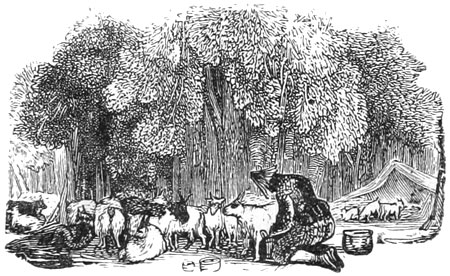
CRUSOE AT HOME.
CONDITION OF THE ISLAND IN 1849.
We first went up to a bluff, about half a mile from the
boat-landing, where we spent an hour in exploring the
ruins of the fortifications built by the Chilians in 1767.
There was nothing left but the foundation and a portion
of the ramparts of the principal fort, partly imbedded in
banks of clay, and neatly covered with moss and weeds.
It was originally strongly built of large stones, which
were cast down in every direction by the terrible earthquake
of 1835; and now all that remained perfect was
the front wall of the main rampart and the groundwork
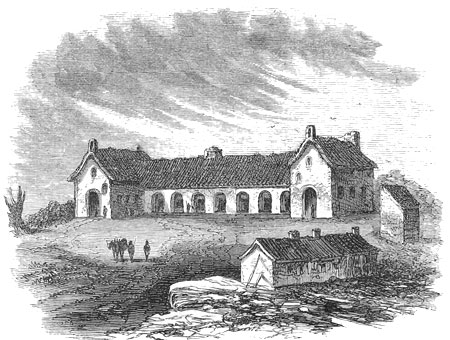
of the fort. Not far from these ruins we found the convict
cells, which we explored to some extent.
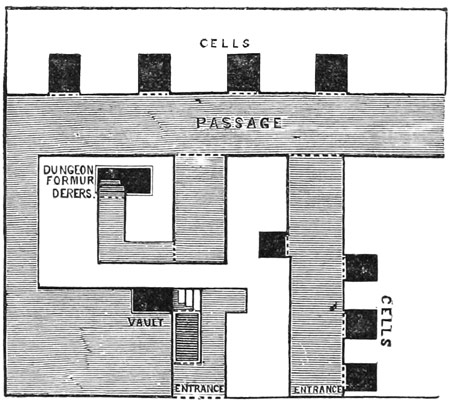
PLAN OF THE CONVICT CELLS.
These cells are dug into the brow of a hill, facing the
harbor, and extend underground to the distance of several
hundred feet, in the form of passages and vaults, resembling
somewhat the Catacombs of Rome. During
the penal settlement established here by the Chilian government,
the convicts, numbering sometimes many hundreds,
were confined in these gloomy dungeons, where
they were subjected to the most barbarous treatment.
The gates or doors by which the entrances were secured
had all been torn down and destroyed, and the excavations
were now occupied by wild goats, bats, toads, and
different sorts of vermin. Rank fern hung upon the
sides; overhead was dripping with a cold and deathlike
sweat, and slimy drops coursed down the weeds, and the
air was damp and chilly; thick darkness was within in
the depths beyond—darkness that no wandering gleam
from the light of day ever reached, for heaven never
smiled upon those dreary abodes of sin and sorrow. A
few of the inner dungeons, for the worst criminals, were
dug still deeper underground, and rough stairways of
earth led down into them, which were shut out from the
upper vaults by strong doors. The size of these lower
dungeons was not more than five or six feet in length
by four or five in height, from which some idea may be
formed of the sufferings endured by the poor wretches
confined in them, shut out from the light of heaven, loaded
with heavy irons, crushed down by dank and impenetrable
walls of earth, starved and beaten by their cruel
guards, with no living soul to pity them in their woe,
no hope of release save in death. We saw, by the aid
of a torch, deep holes scratched in one of the walls, bearing
the impression of human fingers. It might have been
that some unhappy murderer, goaded to madness by such
cruel tortures of body and terrible anguish of mind as
drive men to tear even their own flesh when buried before
the vital spark is extinct, had grasped out the earth
in his desperation, and left the marks in his death agonies
upon the clay that entombed him, to tell what no
human heart but his had suffered there, no human ear
had heard, no human eye had witnessed. The deep,
startling echo breaking upon the heavy air, as we sounded
the walls, seemed yet to mingle with his curses, and
its last sepulchral throb was like the dying moan of the
maniac.
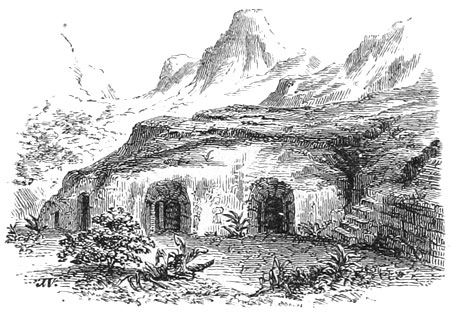
CONVICT CELLS.
Some time before the great earthquake, which destroyed
the fortifications and broke up the penal colony,
a gang of convicts, amounting to three hundred, succeeded
in liberating themselves from their cells. Unable to
endure the cruelties inflicted upon them, they broke loose
from their chains, and, rushing upon the guards, murdered
the greater part of them, and finally seized the garrison.
For several days they held complete possession of the
island. A whale-ship, belonging to Nantucket, happening
to come in at the time for wood and water, they
seized the captain, and compelled him to take on board
as many of them as the vessel could contain. About two
hundred were put on board. They then threatened the
captain and officers with instant death in case of any failure
to land them on the coast of Peru, whither they determined
to go in order to escape the vengeance of the
Chilian government. Desirous of getting rid of them as
soon as possible, the captain of the whaler ran over for
the first land on the coast of Chili, where he put them
ashore, leaving them ignorant of their position until they
were unable to regain the vessel. They soon discovered
that they were only thirty miles from Valparaiso; but,
short as the distance was from the Chilian authorities,
they evaded all attempts to capture them, and eventually
joined the Peruvian army, which was then advancing
upon Santiago. The remainder of the prisoners left upon
the island escaped in different vessels, and were scattered
over various parts of the world. Only a few of the entire
number engaged in the massacre were ever captured;
sentence of death was passed upon them, and they were
shot in the public plaza of Santiago.
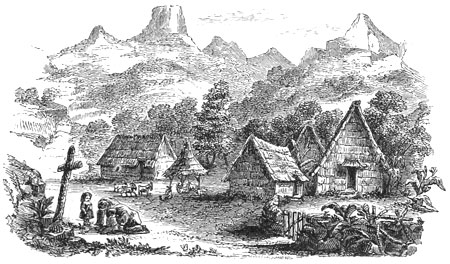
CHILIAN HUTS.
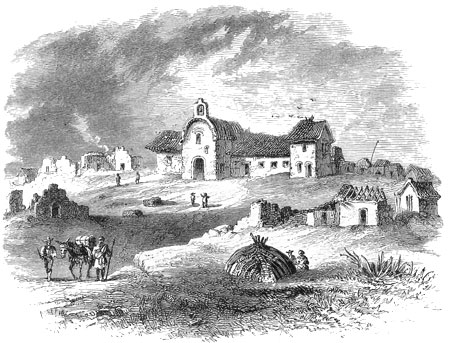
Turning our steps toward the settlement of the present
residents, we passed a few hours very agreeably in
rambling about among their rustic abodes. The total
number of inhabitants at this period (1849) is sixteen,
consisting of William Pearce, an American, and four or
five Chilian men, with their wives and children. No others
have lived permanently upon the island for several
years. There are in all some six or seven huts, pleasantly
surrounded by shrubbery, and well supplied with water
from a spring. These habitations are built of the straw
of wild oats, interwoven through wattles or long sticks,
and thatched with the same, and, whether from design
or accident, are extremely picturesque. The roofs project
so as to form an agreeable shade all round; the
doorways are covered in by a sort of projecting porch,
in the style of the French cottages along the valley of
the Seine; small out-houses, erected upon posts, are scattered
about each inclosure; and an air of repose and freedom
from worldly care pervades the whole place, though
the construction of the houses and mode of living are
evidently of the most primitive kind. Seen through the
green shrubberies that abound in every direction, the
bright yellow of the cottages, and the smoke curling up
in the still air, have a very cheerful effect; and the prattling
voices of the children, mingled with the lively bleating
of the kids, and the various pleasant sounds of domestic
life, might well lead one to think that the seclusion
of these islanders from the busy world is not without its
charms. Small patches of ground, fenced with rude stone
walls and brushwood, are attached to each of these primitive
abodes; and rustic gateways, overrun with wild and
luxuriant vines, open in front. Very little attention, however,
appears to be bestowed upon the cultivation of the
soil; but it looks rich and productive, and might be made
to yield abundant crops by a trifling expenditure of labor.
The Chilians have never been distinguished for industry;
nor is there any evidence here that they depart
from their usual philosophy in taking the world easy.
Even the American seemed to have caught the prevailing
lethargy, and to be content with as little as possible.
Vegetables of various kinds grow abundantly wherever
the seeds are thrown, among which I noticed excellent
radishes, turnips, beets, cabbages, and onions. Potatoes
of a very good quality, though not large, are grown in
small quantities; and, regarding the natural productiveness
of the earth, there seemed to be no reason why they
should not be cultivated in sufficient quantities to supply
the demands of vessels touching for supplies, and thereby
made a profitable source of revenue to the settlers. The
grass and wild oats grow in wonderful luxuriance in all
the open spaces, and require little attention; and such is
the genial character of the climate, that the cattle, of
which there seems to be no lack, find ample food to keep
them in good condition both in winter and summer. Fig-trees,
bearing excellent figs, and vines of various sorts,
flourish luxuriantly on the hill-sides. Of fruits there is
quite an abundance in the early part of autumn. The
peaches were just out of season when we arrived, but we
obtained a few which had been peeled and dried in the
sun, and we found them large and of excellent flavor.
Many of the valleys abound in natural orchards, which
have sprung from the seeds planted there by the early
voyagers, especially by Lord Anson, who appeared to
have taken more interest in the cultivation and settlement
of the island than any previous navigator. The
disasters experienced by the vessels of this distinguished
adventurer in doubling Cape Horn caused him to make
Juan Fernandez a rendezvous for the recruiting of his
disabled seamen, and for many months he devoted his
attention to the production of such vegetables and fruits
as he found useful in promoting their recovery; and having
likewise in view the misfortunes and necessities of
those who might come after him, he caused to be scattered
over the island large quantities of seeds, so that,
by their increase, abundance and variety of refreshments
might be had by all future voyagers. He also left ashore
many different sorts of domestic animals, in order that
they might propagate and become general throughout
the island, for the benefit of shipwrecked mariners, vessels
in distress for provisions, and colonists who might
hereafter form a settlement there. The philanthropy and
moral greatness of these benevolent acts, from which the
author could expect to derive little or no advantage during
life, can not be too highly commended. If posthumous
gratitude can be regarded as a reward, Lord Anson
has a just claim to it. How many lives have been saved;
how many weather-worn mariners, bowed down with
disease, have been renewed in health and strength; how
many unhappy castaways have found food abundantly
where all they could expect was a lingering death, and
have been sustained in their exile, and restored at last to
their friends and kindred, through the unselfish benevolence
of this brave and kind-hearted navigator, no written
record exists to tell; but there are records graven
upon the hearts of men that are read by an omniscient
eye—a history of good deeds and their reward, more eloquent
than human hand hath written.
Besides peaches, quinces, and other fruits common in
temperate climates, there is a species of palm called Chuta,
which produces a fruit of a very rich flavor. Among
the different varieties of trees are corkwood, sandal, myrtle,
and pimento. The soil in some of the valleys on the
north side is wonderfully rich, owing to deposits of burnt
earth and decayed vegetable matter washed down from
the mountains. There is but little level ground on the
island; and although the area of tillable soil is small, yet
by the culture of vineyards on the hill-sides, the grazing
of sheep and goats on the mountain steeps, and the proper
cultivation of the arable valleys, a population of several
thousand might subsist comfortably. Pearce, the American,
who had thoroughly explored every part of the
island, told me he had no doubt three or four thousand
people could subsist here without any supply of provisions
from other countries. A ready traffic could be established
with vessels passing that way, by means of
which potatoes, fruits, and other refreshments could be
bartered for groceries and clothing. Herds of wild cattle
now roam over these beautiful valleys; fine horses
may be seen prancing about in gangs, with all the freedom
of the mustang; goats in numerous flocks abound
among the cliffs; pigeons and other game are abundant;
and wild dogs are continually prowling around the settlement.
The few inhabitants at present on the island subsist
chiefly upon fish, vegetables, and goat-flesh, of which
they have an ample supply. Boat-loads of the finest cod,
rockfish, cullet, lobsters, and lamprey eels can be caught
in a few hours all around the shores of Cumberland Bay,
and doubtless as plentifully in the other bays. Nothing
more is necessary than merely the trouble of hauling
them out of the water. We fished only for a short time,
and nearly filled our boat with the fattest fish I ever saw.
Had I not tested myself a fact told me by some of the
passengers of the Brooklyn regarding the abundance of
the smaller sorts of fish, I could never have believed it—that
they will nibble at one's hand if it be put in the water
alongside the boat, and a slight ripple made to attract
their attention. This is a remarkable truth, which
can be attested by any person who has visited these
shores and made the experiment. There is no place
among the cliffs where goats may not be seen at all
times during the day. They live and propagate in the
caves, and find sufficient browsing throughout the year
in the clefts of the rocks. Lord Anson mentions that
some of his hunting parties killed goats which had their
ears slit, and they thought it more than probable that
these were the very same goats marked by Alexander
Selkirk thirty years before; so that it is not unlikely
there still exist some of the direct descendants of the
herds domesticated by the original Crusoe. The residents
of Cumberland Bay have about their huts a considerable
number of these animals, tamed, for their milk.
When they wish for a supply of goat-flesh or skins (for
they often kill them merely for their skins), they go in a
body to Goat Island, where they surround the goats and
drive them over a cliff into the sea. As soon as they
have driven over a sufficient number they take to their
boat again, and catch them in the water. Some of them
they bring home alive, and keep them till they require
fresh meat. Nor are these people destitute of the rarer
luxuries of life. By furnishing whale-ships that touch
for supplies of water and vegetables with such productions
as they can gather up, they obtain in exchange coffee,
ship-bread, flour, and clothing; and lately they have
been doing a good business in rowing the passengers
ashore from the California vessels, and selling them goatskins
and various sorts of curiosities. They also charge
a small duty for keeping the spring of water clear and
the boat-landing free from obstructions, and sometimes
obtain a trifle in the way of port charges, in virtue of
some pretended authority from the government of Chili.
The shores of Juan Fernandez abound in many different
kinds of marine animals, among which the chief are
seals and walruses. Formerly sealing vessels made it an
object to touch for the purpose of capturing them, but
of late years they have become rather scarce, and at
present few, if any, vessels visit the island for that purpose.
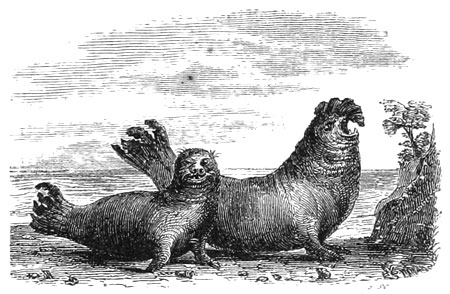
WALRUS, OR SEA LION.
Situated in the latitude of 33° 40´ S., and longitude 79°
W., the climate is temperate and salubrious—never subject
to extremes either of heat or cold. In the valleys
fronting north, the temperature seldom falls below 50°
Fahr. in the coldest season. Open at all times to the
pleasant breezes from the ocean, without malaria or any
thing to produce disease, beautifully diversified in scenery,
and susceptible of being made a convenient stopping-place
for vessels bound to the great northwestern
continent, it would be difficult to find a more desirable
place for a colony of intelligent and industrious people,
who would cultivate the land, build good houses, and
turn to advantage all the gifts of Providence which have
been bestowed upon the island.
The only material drawback is the want of a large and
commodious harbor, in which vessels could be hauled up
for repairs. This island could never answer any other
purpose than that of a casual stopping-place for vessels
in want of refreshments, and for this it seems peculiarly
adapted. The principal harbors are Port English, on the
south side, visited by Lord Anson in 1741; Port Juan,
on the west; and Cumberland Bay, on the north side.
The latter is the best, and is most generally visited, in
consequence of being on the fertile side of the island,
where water also is most easily obtained. None of them
afford a very secure anchorage, the bottom being deep
and rocky; and vessels close to the shore are exposed to
sudden and violent flaws from the mountains, and the
danger of being driven on the rocks by gales from the
ocean. In Cumberland Bay, however, there are places
where vessels can ride in safety, by choosing a position
suitable to the prevailing winds of the season. The
chart and soundings made by Lord Anson will be found
useful to navigators who design stopping at Juan Fernandez.
ROBINSON CRUSOE'S CAVE.
Our next expedition was to Robinson Crusoe's Cave.
How it obtained that name I am unable to say. The
people ashore spoke of it confidently as the place where
a seafaring man had lived for many years alone; and I
believe most mariners who have visited the island have
fixed upon that spot as the actual abode of Alexander
Selkirk. There are two ways of getting to the cave
from the regular boat-landing; one over a high chain of
cliffs, intervening between Crusoe's Valley, or the valley
of the cave, and the Chilian huts near the landing; the
other by water. The route by land is somewhat difficult;
it requires half a day to perform it, and there is
danger of being dashed to pieces by the loose earth giving
way. In many parts of the island the surface of the
cliffs is composed entirely of masses of burnt clay, which
upon the slightest touch are apt to roll down, carrying
every thing with them. Numerous cases are related by
the early voyagers of accidents to seamen and others, in
climbing over these treacherous heights. The distance
by water is only two miles, and by passing along under
the brow of the cliffs a very vivid idea may be had of
their strange and romantic formation. We had our guns
with us, which we did not fail to use whenever there was
an opportunity; but the game, consisting principally of
wild goats, kept so far out of reach on the dizzy heights,
that they passed through the ordeal in perfect safety.
Some of us wanted to go by land and shoot them from
above, thinking the bullets would carry farther when
fired downward than they seemed to carry when fired
from below. The rest of the party had so little confidence
in our skill that they dissuaded us from the attempt,
on the pretense that the ship might heave in sight
while we were absent.
A pleasant row of half an hour brought us to the little
cove in Crusoe's Valley. The only landing-place is upon
an abrupt bank of rocks, and the surf breaking in at this
part of the shore rather heavily, we had to run the boat
up in regular beach-comber style. Riding in on the back
of a heavy sea, we sprang out as soon as the boat struck,
and held our ground, when, by watching our chance for
another good sea, we ran her clear out of the water, and
made her fast to a big rock for fear she might be carried
away. About two hundred yards from where we landed
we found the cave.
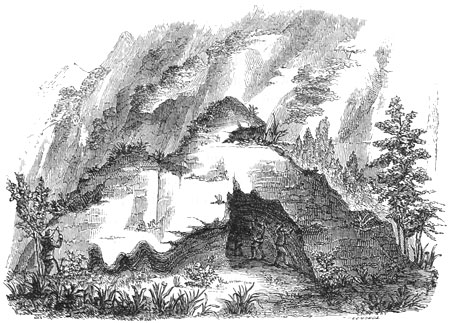
CRUSOE'S CAVE.
It lies in a volcanic mass of rock, forming the bluff or
termination of a rugged ridge, and looks as if it might
be the doorway into the ruins of some grand old castle.
The height of the entrance is about fifteen feet, and the
distance back into the extremity twenty-five or thirty.
It varies in width from ten or twelve to eighteen feet.
Within the mouth the surface is of reddish rock, with
holes or pockets dug into the sides, which it is probable
were used for cupboards by the original occupant. There
were likewise large spike-nails driven into the rock, upon
which we thought it likely clothing, guns, and household
utensils might have been hung even at as remote a date
as the time of Selkirk, for they were very rusty, and bore
evidence of having been driven into the rock a long time
ago. A sort of stone oven, with a sunken place for fire
underneath, was partly visible in the back part of the
cave, so that by digging away the earth we uncovered
it, and made out the purpose for which it was built.
There was a darkish line, about a foot wide, reaching up
to the roof of the cave, which, by removing the surface a
little, we discovered to be produced originally by smoke,
cemented in some sort by a drip that still moistened the
wall, and this we found came through a hole in the top,
which we concluded was the original chimney, now covered
over with deposits of earth and leaves from the
mountain above. In rooting about the fireplace, so as to
get away the loose rubbish that lay over it, one of our
party brought to light an earthen vessel, broken a little
on one side, but otherwise perfect. It was about eight
inches in diameter at the rim, and an inch or two smaller
at the bottom, and had some rough marks upon the
outside, which we were unable to decipher, on account
of the clay which covered it. Afterward we took it out
and washed it in a spring near by, when we contrived to
decipher one letter and a part of another, with a portion
of the date. The rest unfortunately was on the piece
which had been broken off, and which we were unable
to find, although we searched a long time; for, as may be
supposed, we felt curious to know if it was the handiwork
of Alexander Selkirk. For my own part, I had
but little doubt that this was really one of the earthen
pots made by his own hands, and the reason I thought
so was that the parts of the letters and date which we
deciphered corresponded with his name and the date of
his residence, and likewise because it was evident that it
must have been imbedded in the ground out of which
we dug it long beyond the memory of any living man.
I was so convinced of this, and so interested in the discovery,
that I made a rough drawing of it on the spot,
of which I have since been very glad, inasmuch as it was
accidentally dropped out of the boat afterward and lost
in the sea.
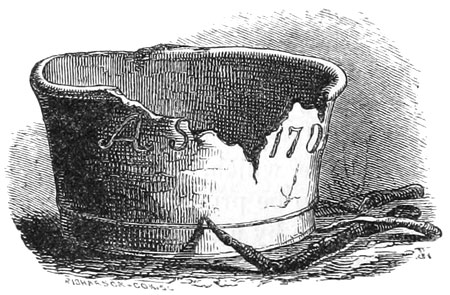
A RELIC OF CRUSOE.
We searched in vain for other relics of the kind, but
all we could find were a few rusty pieces of iron and
some old nails. The sides of the cave, as also the top,
had marks scattered over them of different kinds, doubtless
made there in some idle moment by human hands;
but we were unable to make out that any of them had
a meaning beyond the unconscious expression of those
vague and wandering thoughts which must have passed
occasionally through the mind of the solitary mariner
who dwelt in this lonely place. They may have been
symbolical of the troubled and fluctuating character of
his religious feelings before he became a confirmed believer
in the wisdom and mercy of Divine Providence,
which unhappy state of mind he often refers to in the
course of his narrative.
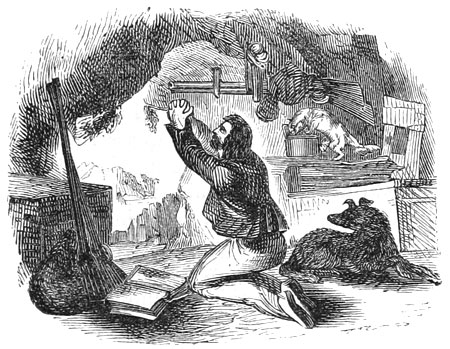
CRUSOE'S DEVOTIONS.
This cave is now occupied only by wild goats and
bats, and had not been visited, perhaps, by any human
being, until recently, more than once or twice in half a
century, and then probably only by some deserter from
a whale-ship, who preferred solitude and the risk of starvation
to the cruelty of a brutish captain.
In front of the cave, sloping down to the sea-side, is a
plain covered with long rank grass, wild oats, radishes,
weeds of various kinds, and a few small peach-trees. The
latter we supposed were of the stock planted in the island
by Lord Anson. From the interior of the cave we looked
out over the tangled mass of shrubs, wild flowers, and
waving grass in front, and saw that the sea was covered
with foam, and the surf beat against the point beyond
the cove, and flew up in the air to a prodigious height in
white clouds of spray. Large birds wheeled about over
the rocky heights, sometimes diving suddenly into the
water, from which they rose again flecked with foam,
and, soaring upward in the sunlight, their wings seemed
to sparkle with jewels out of the ocean. Following the
curve of the horizon, the view is suddenly cut off by a
huge cliff of lava that rises directly out of the water to
the height of twelve or fifteen hundred feet. It forms
an abrupt precipice in front, and joins a range of rugged
cliffs behind, which all abound in wonderful ledges overlooking
the depths below, dark and lonesome caverns,
and sharp pinnacles piercing the clouds in every direction.
Goat-paths wind around them in places apparently
inaccessible, and we saw herds of goats running swiftly
along the dizzy heights overhanging the sea, where we
almost fancied the birds of the air would fear to fly; they
bounded over the frightful fissures in the rocks, and clung
to the walls of cliffs with wonderful agility and tenacity
of foot, and sometimes they were so high up that they
looked hardly bigger than rabbits, and we thought it impossible
that they could be goats.
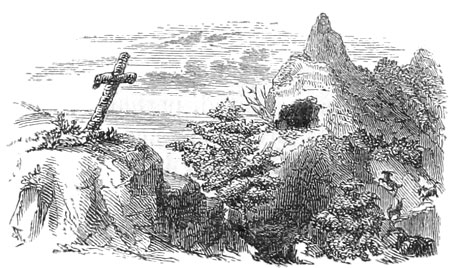
THE VALLEY WITH THE CAVE AND CLIFF.
Looking back into the valley, we beheld mountains
stretching up to a hundred different peaks, the sides
covered with woods and fields of golden-colored oats,
and the ravines fringed with green banks of grass and
wild flowers of every hue. A stream of pure spring water
rippled down over the rocks, and wound through the
centre of the valley, breaking out at intervals into bright
cascades, which glimmered freshly in the warm rays of
the sun; its margins were fringed with rich grass and
fragrant flowers, and groves of myrtle overhung the little
lakelets that were made in its course, and seemed to linger
there like mirrored beauties spell-bound. Ridges of
amber-colored earth, mingled with rugged and moss-covered
lava, sloped down from the mountains on every side
and converged into the valley, as if attracted by its romantic
beauties. Immense masses of rock, cast off from
the towering cliffs by some dread convulsion of the elements,
had fallen from the heights, and now lay nestling
in the very bosom of the valley, enamored with its charms.
Even the birds of the air seemed spell-bound within this
enchanted circle; their songs were low and soft, and I
fancied they hung in the air with a kind of rapture when
they rose out of their sylvan homes, and looked down at
all the wondrous beauties that lay outspread beneath
them.
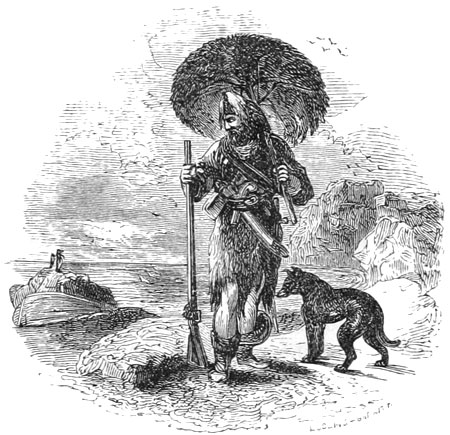
DREAM-LAND CRUSOE.
Some of us scattered off into the woods of myrtle, or
lay down by the spring in the pleasant shade of the trees,
and bathed our faces and drank of the cool water; others
went up the hill-sides in search of peaches, or gathered
seeds and specimens of wild flowers to carry home.
Too happy in the change, after our gloomy passage round
Cape Horn, I rambled up the valley alone, and dreamed
glowing day-dreams of Robinson Crusoe. Of all the
islands of the sea, this had ever been the paradise of my
boyish fancy. Even later in life, when some hard experience
before the mast had worn off a good deal of the
romance of sea-life, I could never think of Juan Fernandez
without a strong desire to be shipwrecked there, and
spend the remainder of my days dressed in goatskins,
rambling about the cliffs, and hunting wild goats. It
was a very imprudent desire, to be sure, not at all sensible;
but I am now making a confession of facts rather
out of the common order, and for which it would be useless
to offer any excuse. Pleasant scenes of my early
life rose up before me now with all their original freshness.
How well I remembered the first time I read the
surprising adventures of Robinson Crusoe! It was in
the country, where I had never learned the worldly wisdom
of the rising generation in cities. Indeed, I had
never seen a city, and only knew by hearsay that such
wonderful places existed. My father, after an absence
of some weeks, returned with an illustrated volume of
Crusoe, bound in cream-colored muslin (how plainly I
could see that book now!), which he gave me, with a
smiling admonition not to commence reading it for two
or three years, by which time he hoped I would be old
enough to understand it. That very night I was in a
new world—a world all strange and fascinating, yet to
me as real as the world around me. How I devoured
each enchanting page, and sighed to think of ever getting
through such a delightful history. It was the first
book beyond mere fairy tales (which I had almost begun
to doubt), the first narrative descriptive of real life that
I had ever read. Such a thing as a doubt as to its entire
truthfulness never entered my head. I lingered over it
with the most intense and credulous interest, and long
after parental authority had compelled me to give it up
for the night, my whole soul was filled with a confusion
of novel and delightful sensations. Before daylight I
was up again; I could not read in the dark, but I could
open the magic book and smell the leaves fresh from the
press; and before the type was visible I could trace out
the figures in the prints, and gaze in breathless wonder
upon the wild man in the goatskins.
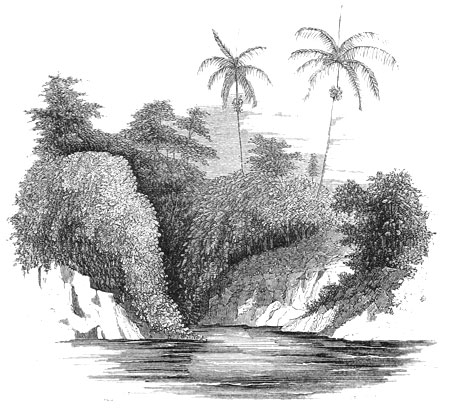
FAIRY COVE.
The big tears stood in my eyes when I was through;
but I found consolation in reading it again and again; in
picturing out a thousand things that perhaps De Foe
never dreamt of; and each night when I went to bed I
earnestly prayed to God that I might some day or other
be cast upon a desolate island, and live to become as wonderful
a man as Robinson Crusoe. Yet, not content with
that, I devoted all my leisure hours to making knife-cases,
caps, and shot-pouches out of rabbit-skins, in the faint
hope that it would hasten the blissful disaster. Years
passed away; I lived on the banks of the Ohio; I had
been upon the ocean. Still a boy in years, and more so
perhaps in feeling, the dream was not ended. I gathered
up drift-wood, and built a hut among the rocks; whole
days I lay there thinking of that island in the far-off seas.
A piece of tarred plank from some steam-boat had a
sweeter scent to me than the most odorous flower; for,
as I lay smelling it by the hour, it brought up such exquisite
visions of shipwreck as never before, perhaps, so
charmed the fancy of a dreaming youth. Well I remembered,
too, the favored few that I let into the secret; how
we went every afternoon to a sand-bar, and called it Crusoe's
Island; how I was Robinson Crusoe, and the friend
of my heart Friday, whom I caused to be painted from
head to foot with black mud, as also the rest of my
friends; and then the battles we had; the devouring of
the dead men; the horrible dances, and chasing into the
water; and, above all, the rescue of my beloved Friday—how
vividly I saw those scenes again!
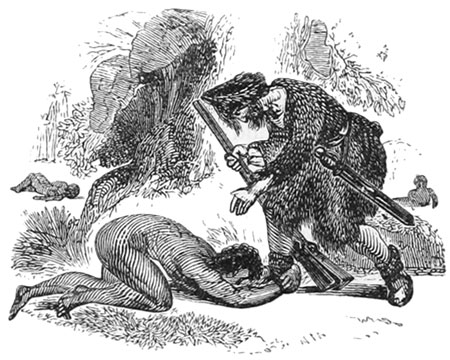
RESCUE OF FRIDAY.
Years passed on; I was a sailor before the mast. Alas!
what a sad reality! I saw men flogged like beasts; I saw
cruelty, hardship, disease, death in their worst forms; so
much I saw that I was glad to take the place of a wandering
outcast upon the shores of a sickly island ten
thousand miles from home, to escape the horrors of that
life. Yet the dream was not ended. Bright and beautiful
as ever seemed to me that little world upon the seas,
where dwelt in solitude the shipwrecked mariner. In
the vicissitudes of fortune, I was again a wanderer; impelled
by that vision of island-life which for seventeen
years had never ceased to haunt me, I cast all upon the
hazard of a die—escaped in an open boat through the
perils of a storm, and now—where was I? What pleasant
sadness was it that weighed upon my heart? Was
all this a dream of youth; was it here to end, never more
to give one gleam of joy; was the happy credulity, the
freshness, the enthusiasm of boyhood gone forever?
Could it be that this was not Crusoe's Valley at last—this
spot, which I had often seen in fancy from the banks
of the Ohio, dim in the mist of seas that lay between?
Did I really wander through it, or was it still a dream?
And where was the king of the island; the hero of
my boyish fancy; he who had delighted me with the
narrative of his romantic career, as man had never done
before, as all the pleasures of life have never done since;
where was the genial, the earnest, the adventurous Robinson
Crusoe? Could it be that there was no "mortal
mixture of earth's mould in him;" that he was barely
the simple mariner Alexander Selkirk? No! no! Robinson
Crusoe himself had wandered through these very
groves of myrtle; he had quenched his thirst in the spring
that bubbled through the moss at my feet; had slept
during the glare of noon in the shade of those overhanging
grottoes; had dreamed his day-dreams in these secluded
glens.
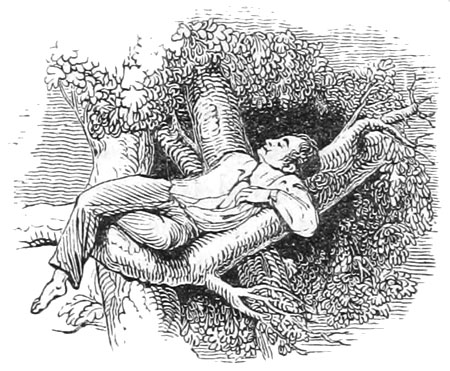
CRUSOE ASLEEP.
Here, too, Friday had followed his master; the simple,
childlike Friday, the most devoted of servants, the gentlest
of savages, the faithfullest of men! Blessing on thee,
Robinson, how I have admired thy prolific genius; how
I have loved thee for thine honest truthfulness! And
blessings on thee, Friday, how my young heart hath
warmed toward thee! how I have laughed at thy scalded
fingers, and wept lest the savages should take thee
away from me! * * *
THE VALLEY ON FIRE.
There was a sudden rustling in the bushes.
"Hallo, there!" shouted a voice. I looked round and
beheld a fellow-passenger, a strange, eccentric man, who
was seldom known to laugh, and whose chief pleasure
consisted in reducing every thing to the practical standard
of common sense. He was deeper than would appear
at first sight, and not a bad sort of person at heart,
but a little wayward and desponding in his views of life.
"You'll catch cold," said he; "nothing gives a cold
so quick as sitting on the damp ground."
"True," said I, smiling; "but recollect the romance of
the thing."
"Romance," rejoined the sad man, "won't cure a cold.
I never knew it to cure one in my life."
"Well, I suppose you're right. Every body is right
who believes in nothing but reality. The hewer of wood
and the drawer of water gets more credit in the world
for good sense than the unhappy genius who affords
pleasure to thousands."
"So he ought—he's a much more useful man."
"Granted; we won't dispute so well-established a truism.
Now let us cut a few walking-sticks to carry home.
It will please our friends to find that we thought of them
in this outlandish part of the world."
"To be sure; if you like. But you'll never carry them
home. No, sir, you can't do it. You'll lose them before
you get half way to America."
"No matter—they cost nothing. Lend me your knife,
and we'll try the experiment, at all events."
I then cut a number of walking-sticks and tied them
up in a bundle. And here, while the warning of the
doubter is fresh in my mind, let me mention the fate of
these much-valued relics. I cut four beautiful sticks of
myrtle, every one of which I lost before I reached California,
though I was very careful where I kept them—so
careful, indeed, that I hid them away on board the ship
and never could find them again.
On our way back to the cave, as we emerged from the
grove, I was astonished to see the entire valley in a blaze
of fire. It raged and crackled up the sides of the mountains,
blazing wildly and filling the whole sky with smoke.
The beautiful valley upon which I had gazed with such
delight a few hours before, seemed destined to be laid
waste by some fierce and unconquerable destroyer, that
devoured trees, shrubs, and flowers in its desolating career.
The roar of the mad rushing flames, the seething
tongues of fire shooting out from the bowers of shrubbery,
the whirling smoke sweeping upward around the
pinnacles of rock, the angry sea dimly seen through the
chaos, and the sharp screaming of the sea-birds and dismal
howling of the wild dogs, impressed me with a terrible
picture of desolation. It seemed as if some dreadful
convulsion of nature had burst forth soon to cover
the island with seething lava or ingulf it in the ocean.
"What can it be?" said I. "Isn't it a grand sight?
Perhaps a volcano has broken out. Surely it must be
some awful visitation of Providence. It wouldn't be
comfortable, however, to be broiled in lava, so I think
the sooner we get down to the boats the better."
"There's no hurry," said my friend; "it's nothing but
the Californians down at the cave. I told them before
I left that they'd set fire to the grass if they kept piling
the brush up in that way. Now you see they've done
it."
"Yes, I see they have; and a tolerably big fire they've
made of it too."
I almost forgave them the wanton act of Vandalism,
so sublime was the scene. It was worth a voyage round
Cape Horn to see it.
"Plenty of it," muttered the sad man, "to cook all the
food that can be raised in these diggings. I wouldn't
give an acre of ground in Illinois for the whole island.
I only wish they'd burn it up while they're at it—if it be
an island at all, which I ain't quite sure of yet."
THE CALIFORNIANS IN JUAN FERNANDEZ.
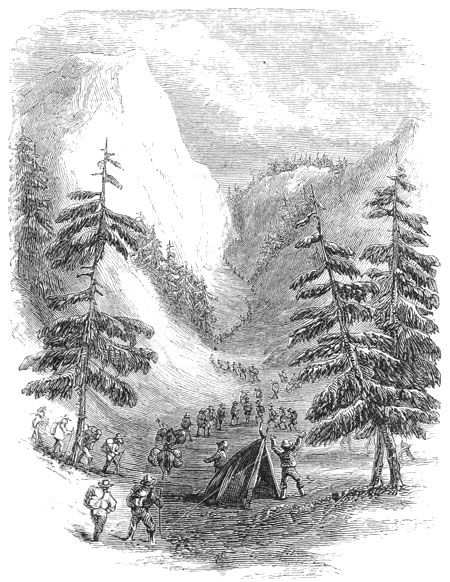
We reached the cave by rushing through the flames.
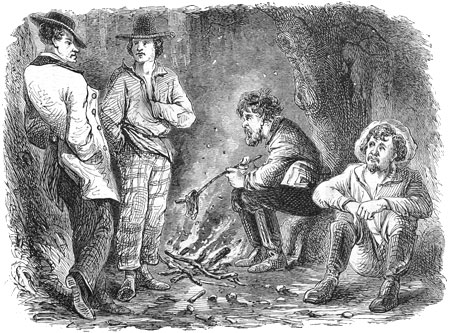
When we arrived near the mouth, I was amused to find
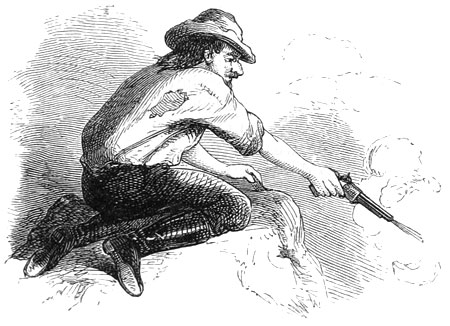
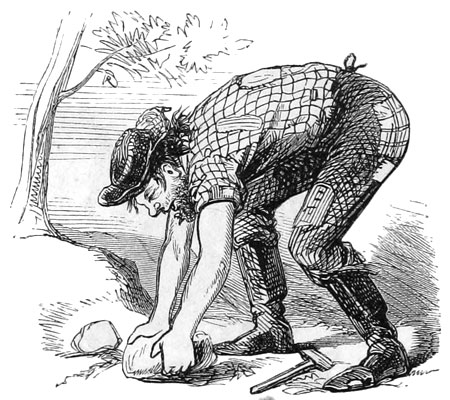
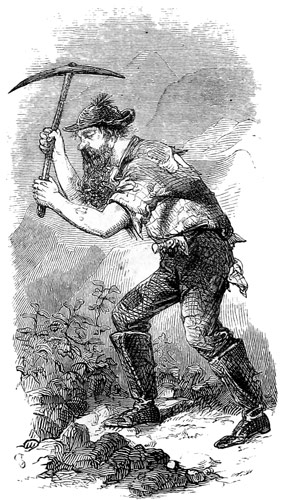
about twenty long-bearded Californians, dressed in red
shirts, with leather belts round their bodies, garnished
with knives and pistols, and picks in their hands, with
which they were digging into the walls of Selkirk's castle
in search of curiosities. Their guns were stacked up
outside, and several of the party were engaged in cooking
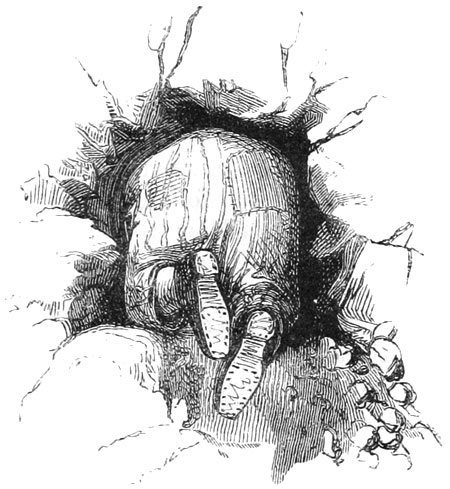
fish and boiling coffee. They had battered away at
the sides, top, and bottom of the cave in their eager
search for relics, till they had left scarcely a dozen square
feet of the original surface. Every man had literally his
pocket full of rocks. It was a curious sight, here in this
solitary island, scarcely known to mariners save as the
resort of pirates, deserters, and buccaneers, and chiefly
to the reading world at home as the land of Robinson
Crusoe, to see these adventurous Americans in their red
shirts, lounging about the veritable castle of the "wild
man in the goatskins," digging out the walls, smoking
cigars, whittling sticks, and talking in plain English about
California and the election of General Taylor. Some of
them even went so far as to propose a "prospecting"
expedition through Crusoe's Valley in search of gold,
while others got up a warm debate on the subject of annexation—the
annexation of Juan Fernandez. One long,
lank, slab-sided fellow, with a leathern sort of face, and
two copious streams of tobacco-juice running down from
the corners of his mouth, was leaning on his pick outside
the cave, spreading forth his sentiments for the benefit
of the group of gentlemen who were cooking the fish.
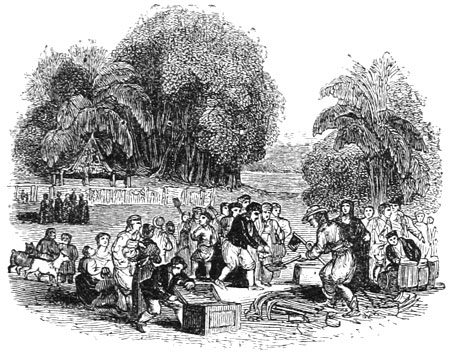
THE CALIFORNIANS IN JUAN FERNANDEZ.
"I tell you, feller-citizens," said he, aroused into something
like prophetic enthusiasm as the subject warmed
upon his mind, "I tell you it's manifest destiny. Joo-an
Fernandays is bound by all the rights of con-san-guity to
be a part of the great Ree-public of Free States. Gentlemen,
I'm a destiny-man myself; I go the whole figure,
sir; yes, sir, I'm none of your old Hunkers. I go for
Joo-an Fernandays and California, and any other small
patches of airth that may be laying around the vicinity.
We want 'em all, gentlemen; we want 'em for our whale-ships
and the yeomanry of our country! (cheers.) We'll
buy 'em from the Spaniards, sir, with our gold; if we
can't buy 'em sir, by hokey! we'll take 'em, sir! (Renewed
cheers.) I ask you, gentlemen—I appeal to your
feelins as feller-citizens of thee greatest concatenation of
states on thee face of God's airth, are you the men that'll
refuse to fight for your country? (Cheers, and cries of
No, no, we ain't the men; hurra for Joo-an Fernandays!)
Then, by Jupiter, sir, we'll have it! We'll have it as
sure as the Star of Empire shines like the bright Loo-min-ary
of Destiny in the broad Panoply of Heaven (and
more especially in the western section of it). We'll have
it, sir, as sure as that redolent and inspiring Loominary
beckons us on, sir, like a dazzling joo-el on the pre-moni-tary
finger of Hope; and the glorious Stars and Stripes,
feller-citizens, shall wave proudly in the zephyrs of futurity
over the exalted peaks of Joo-an Fernandays!"
(Tremendous sensation, during which the orator takes a
fresh chew of tobacco, and sits down.)
As soon as the party of annexationists perceived us,
they called out to us to heave to, and make ourselves at
home. "Come on, gentlemen, come on! No ceremony.
We're all Americans! this is a free country. Here's
fish! here's bread! here's coffee! Help yourselves, gentlemen!
This is a great country, gentlemen—a great
country!" Of course we fell to work upon the fish,
which was a splendid cod, and the bread and the coffee
too, and very palatable we found them all, and exceedingly
jolly and entertaining the "gentlemen from the
Brooklyn." These lively individuals had made the most
of their time in the way of enjoying themselves ashore.
About a week before our arrival they gave a grand party
in honor of the American nation in general. It was
in rather a novel sort of place, to be sure, but none the
worse for that—one of the large caves near the boat-landing.
On this eventful occasion they "scared up,"
as they alleged, sundry delicacies from home, such as preserved
meats, pound-cake, Champagne, and wines of various
sorts, and out of their number they produced a full
band of music. They also, by clearing the earth and
beating it down, made a very good place for dancing,
and they had waltzes, polkas, and cotillons, in perfect
ballroom style. It was rather a novel entertainment,
take it altogether, in the solitudes of Juan Fernandez. I
have forgotten whether the four Chilian ladies of the
island attended; if they did not, it was certainly not for
want of an invitation. The American Crusoe was there,
no longer monarch of all he surveyed. Poor fellow, his
reign was over. The Californians were the sovereigns
now.
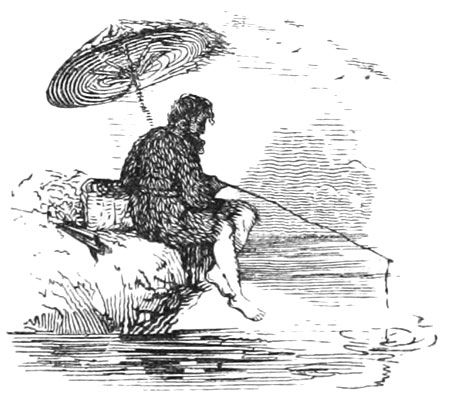
FISHING.
After our snack with the Brooklynites, we joined our
comrades down on the beach. They had shot at a great
many wild goats, without hitting any, of course. The
rest of the afternoon we spent in catching fish for supper.
THE CAVE OF THE BUCCANEERS.
It now began to grow late, and we thought it best to
look about us for some place where we could sleep. Captain
Richardson very kindly offered us the use of his cabin,
but he was crowded with passengers, and we preferred
staying ashore. There was something novel in sleeping
ashore, but neither novelty nor comfort in a vessel with a
hundred and eighty Californians on board. Brigham and
a few others took our boat, and went over near the old
fort to search out a camping-ground, while the rest of the
party and myself started off with the captain to explore
a grotto. We had a couple of sailors to row us, which
helped to make the trip rather pleasant.
Turning a point of rocks, we steered directly into the
mouth of the grotto, and ran in some forty or fifty feet,
till nearly lost in darkness. It was a very wild and rugged
place—a fit abode for the buccaneers.
The cliff into which the cave runs is composed of great
rocks, covered on top with a soil of red, burned earth.
The swell of the sea broke upon the base with a loud
roar, and the surf, rolling inward into the depths of the
grotto, made a deep reverberation, like the dashing of
water under a bridge. There was some difficulty in effecting
a landing among these subterranean rocks, which
were round and slippery. The water was very deep, and
abounded in seaweed. On gaining a dry place, we found
the interior quite lofty and spacious, and tending upward
into the very bowels of the mountain. Some said there
was a way out clear up in the middle of the island.
Overhead it was hung with stalactites, some of which
were of great size and wonderful formation. Abraham
and myself climbed up in the dark about a hundred feet,
where we entirely lost sight of the mouth, and could
hardly see an inch before us. As we turned back and
began to descend, our friends down below looked like
gigantic monsters standing in the rays of light near the
entrance. I broke off some pieces of rock and put them
in my pocket, as tokens of my visit to this strange place.
On reaching the boat again, we found a group of our
comrades seated around a natural basin in the rocks, regaling
themselves on bread and water. The water, I
think, was the clearest and best I ever tasted. It trickled
down from the top of the cave, and fell into the basin
with a most refreshing sound. I drank a pint gobletful,
and found it uncommonly cool and pure. Nothing more
remaining to be seen, we started off for the boat-landing,
near the huts, where we parted with our friend the captain,
and then, it being somewhat late, we went in search
of our party.
LODGINGS UNDER GROUND.
When we arrived on the ground selected by Brigham
and the others, we found that they had made but little
progress in cutting wood for the posts, and much remained
to be done before we could get up the tent.
Heavy clouds hung over the tops of the mountains;
the surf moaned dismally upon the rocks; big drops of
rain began to strike us through the gusts of wind that
swept down over the cliffs, and there was every prospect
of a wet and stormy night. It was now quite dark.
After some talk, we thought it best to abandon our plan
of sleeping under the sail. Finally, we agreed to go in
search of a cave under the brow of a neighboring cliff.
We had seen it during the day, and although a very unpromising
place, we thought it would serve to protect us
against the rain. We therefore took our oars and sail
upon our shoulders, together with what few weapons of
defense we had, and stumbled about in the dark for some
time, till we had the good fortune to find the mouth of
the cave. In the course of a few minutes we struck
a light by a lucky chance, and then looked in. There
seemed to be no bottom to it, and, so far as we could
perceive, neither sides nor top. Certainly there was not
a living soul about the premises to deny us admission;
so we crept down, as we thought, into the bowels of the
earth, and, seeing nobody there, took possession of our
lodgings, such as they were.
It was a damp and gloomy place enough, reeking with
mould, and smelling very strong of strange animals. The
rocks hung gaping over our heads, as if ready to fall
down upon us at the mere sound of our voices; the
ground was covered with dirty straw, left there probably
by some deserters from a whale-ship, and all around
the sides were full of holes, which we supposed from
the smell must be inhabited by foxes, rats, and perhaps
snakes, though we were afterward told there were no
reptiles on the island. We soon found that there were
plenty of spiders and fleas in the straw. The ground
being damp, we spread our sail over it, in order to make
a sort of bed; and, being in a measure protected by a
clump of bushes placed in the entrance by the previous
occupants to keep out the wind and rain, we did not altogether
despair of passing a tolerably comfortable night.
For a while there was not much said by any body;
we were all busy looking about us. Some were looking
at the rocks overhead; some into the holes, where they
thought there might be wild animals; and myself and a
few others were trying to light a fire in the back part of
the cave. It smoked so that we had to give it up at last,
for it well-nigh stifled the whole party.
By this time, being all tired, we lay down, and had
some talk about Robinson Crusoe.
"If he lived in such holes as this," said one, "I don't
think he had much sleep."
"No," muttered another, "that sort of thing reads a
good deal better than it feels; but there's no telling how
a man may get used to it. Eels get used to being skinned,
and I've heard of a horse that lived on five straws
a day."
"For my part," adds a third, "I like it: there's romance
about it—and convenience too, in some respects.
For the matter of clothing, a man could wear goatskins.
Tailors never dunned Robinson Crusoe. It goes a great
way toward making a man happy to be independent of
fashion. Being dunned makes a man miserable."
"Yes, it makes him travel a long way sometimes,"
sighs another, thoughtfully. "I'd be willing to live here
a few years to get rid of society. What a glorious thing
it must be to have nothing to do but hunt wild goats!
Robinson had a jolly time of it; no accounts to make
out, no office-hours to keep, nobody to call him to account
every morning for being ten minutes too late, in consequence
of a frolic. Talking about frolics, he wasn't
tempted with liquor, or bad company either; he chose
his own company: he had his parrot, his goats, his man
Friday—all steady sort of fellows, with no nonsense
about them. I'll venture to say they never drank any
thing stronger than water."
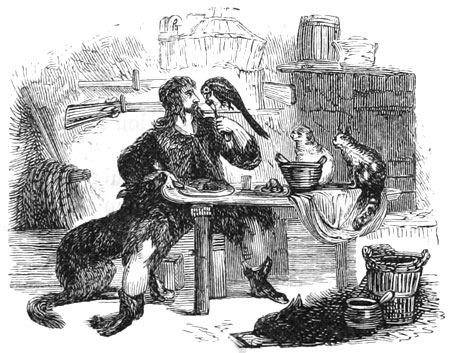
CRUSOE AND HIS COMRADES.
"No," adds another, gloomily, "it isn't likely they applied
'hot and rebellious liquors to their blood.' But a
man who lives alone has no occasion to drink. He has
no love affairs on hand to drive him to it."
"Nor a scolding wife. I've known men to go all the
way to California to get rid of a woman's tongue."
There was a pause here, as most of the talkers began
to drop off to sleep.
"Gentlemen," said somebody in the party, who had
been listening attentively to the conversation, "I don't
believe a single word of it. I don't believe there ever
was such a man as Robinson Crusoe in the world. I
don't believe there ever was such a man as Friday. In
my opinion, the whole thing is a lie, from beginning to
end. I consider Robinson Crusoe a humbug!"
"Who says it's all a lie?" cried several voices, fiercely;
"who calls Robinson Crusoe a humbug?"
"That is to say," replied the culprit, modifying the remark,
"I don't think the history is altogether true. Such
a person might have lived here, but he added something
on when he told his story. He knew very well his man
Friday, or his dogs and parrots were not going to expose
his falsehoods."
"Pooh! you don't believe in any thing; you never did
believe in any thing since you were born. Perhaps you
don't believe in that. Are you quite sure you are here
yourself?"
"Well, to be candid, when I look about me and see
what a queer sort of a place it is, I don't feel quite sure;
there's room for doubt."
"Doubt, sir! doubt? Do you doubt Friday? Do
you think there's room for doubt in him?"
"Possibly there may have been such a man. I say
there may have been; I wouldn't swear to it."
"Fudge, sir! fudge! The fact is, you make yourself
ridiculous. You are troubled with dyspepsia."
"I am rayther dyspeptic, gentlemen, rayther so. I
hope you'll excuse me, but I can't exactly say I believe
in Crusoe. It ain't my fault—the belief ain't naturally
in me."
Upon which, having made this acknowledgment, we
let him alone, and he turned over and went to sleep.
We now pricked up our lamp, and prepared to follow
his example, when a question arose as to the propriety
of standing watches during the night—a precaution
thought necessary by some in consequence of the treacherous
character of the Spaniards. There were eleven of
us, which would allow one hour to each person. For my
part, I thought there was not much danger, and proposed
letting every man who felt uneasy stand watches for himself.
We had labored without rest for thirty-six hours,
and I was willing to trust to Providence for safety, and
make the most of our time for sleeping. A majority being
of the same opinion, the plan of standing watches was
abandoned; and having loaded our two guns, we placed
them in a convenient position commanding the mouth of
the cave. I got the harpoon and stood it up near me,
for I had made up my mind to fasten on to the first
Spaniard that came within reach.
ATTACK OF THE ROBBERS.
Scarcely had we closed our eyes and fallen into a restless
doze, when a nervous gentleman in the party rose
up on his hands and knees, and cautiously uttered these
words:
"Friends, don't you think we'd better put out the
light. The Spaniards may be armed, and if they come
here, the lamp will show them where we are, and they'll
be sure to take aim at our heads."
"Sure enough," whispered two or three at once,
"we didn't think of that; they can't see us in the dark,
however, unless they have eyes like cats. Let us put
out the light, by all means."
So with that we were about to put out the light, when
the man who had doubts in regard to Robinson Crusoe
rose up on his hands and knees likewise, and said,
"Hold on! I think you'd better not do that. It
ain't policy. I don't believe in it myself."
"Confound it, sir," cried half a dozen voices, angrily,
"you don't believe in any thing. What's the reason
you don't believe in it, eh? What's the reason, sir?"
"Well, I'll tell you why. Because, if you put out the
light, we can't see where to shoot. Likely as not we'd
shoot one another. If I feel certain of any thing, it is,
that I'd be the first man shot; it's my luck. I know I'd
be a dead man before morning."
There was something in this suggestion not to be
laughed at. The most indignant of us felt the full force
of it. To shoot our enemies in self-defense seemed reasonable
enough, but to shoot any of our own party, even
the man who doubted Robinson Crusoe, would be a very
serious calamity. At last, after a good deal of talk, we
compromised the matter by putting the lamp under an
old hat with a hole in the top. This done, we tried to
go to sleep.
Brigham went to the mouth of the cave about midnight
to take an observation. He was armed with one
of the guns.
"What's that?" said he, sharply; "I hear something!
Gentlemen, I hear something! Hallo! who goes there?"
There was no answer. Nothing could be heard but
the moaning of the surf down on the beach.
"A Spaniard! by heavens, a Spaniard! I'll shoot him—I'll
shoot him through the head!"
"Don't fire, Brigham," said I, for I wanted a chance
to fasten on with the harpoon; "wait till he comes up,
and ask him what he wants."
"Ahoy there! What do you want? Answer quick,
or I'll shoot you! Speak, or you're a dead man!"
All hands were now in commotion. We rushed to
the mouth of the cave in a body, determined to defend
ourselves to the last extremity.
"Gentlemen," cried Brigham, a little confused, "it's a
goat! I see him now, in the rays of the moon; a live
goat, coming down the cliff. Shall I kill him for breakfast?"
"Wait," said I, "till he comes a little closer; I'll bend
on to him with the harpoon."
"You'd better let him alone," said the Doubter, in a
sepulchral voice. "Likely as not it's a tame goat or a
chicken belonging to the American down there."
"A tame devil, sir! How do you suppose they could
keep tame goats in such a place as this. Your remark
concerning the chicken is beneath contempt!"
"Well, I don't know why. Tain't my nature to take
an entire goat without proof. I thought it might be a
chicken."
"Then you'd better go and satisfy yourself, if you're
not afraid."
The Doubter did so. He walked a few steps toward
the object, so as to get sight of its outline, and then returned,
saying,
"That thing there isn't a goat at all—neyther is it a
chicken."
"What is it, then?"
"Nothing but a bush."
"What makes it move?"
"The wind, I suppose. I don't know what else could
make it move, for it ain't got the first principle of animal
life in it. Bushes don't walk about of nights any more
than they do in the daytime. I never did believe in it
from the beginning, and I told you so, but you wouldn't
listen to me."
We said nothing in reply to this, but returned into
the cave and lay down again upon the sail.
COOKING FISH.
Most of the party were snoring in about ten minutes.
For myself, I found it impossible to sleep soundly. The
gloomy walls of rock, the strange and romantic situation
into which chance had thrown me, the remembrance of
what I had read of this island in early youth, the dismal
moaning of the surf down on the beach, all contributed
to confuse my mind. An hour or two before daylight,
I was completely chilled through by the dampness of
the ground, and entirely beyond sleep.
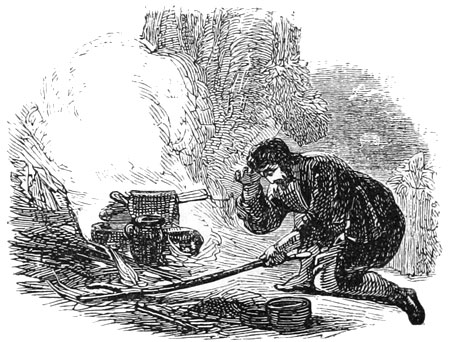
COOKING IN JUAN FERNANDEZ.
I heard some voices outside, and got up to see who
was talking. Lest it might be the Spaniards, I took the
harpoon with me. At the mouth of one of the convict-cells
near by I found four of my comrades, who, unable
to pass the time any other way, had lit a fire and were
baking some fish. They had dug a hole in the ground,
which they lined with flat stones, so as to form a kind
of oven; this they heated with coals. Then they wrapped
up a large fish in some leaves, and put it in; and by
covering the top over with fire, the fish was very nicely
baked. I think I never tasted any thing more delicate
or better flavored. We had an abundant meal, which
we relished exceedingly. The smoke troubled us a good
deal; but, by telling stories of shipwreck, and wondering
what our friends at home would think if they could
see us here cooking fish, we contrived to pass an hour or
so very pleasantly. I then went back into the cave, and
turned in once more upon the sail.
Of course, after eating fish at so unusual an hour, I
had a confusion of bad dreams. Perhaps they were visions.
In this age of spiritual visitations, it is not altogether
unlikely the spirits of the island got possession
of me. At all events, I saw Robinson Crusoe dressed in
goatskins, and felt him breathe, as plainly as I see this
paper and feel this pen. How could I help it? for I actually
thought it was myself that had been shipwrecked;
that I was the very original Crusoe, and no other but the
original; and I fancied that Abraham had turned black,
and was running about with a rag tied round his waist,
and I called him my man Friday, and fully believed him
to be Friday. Sometimes I opened my eyes and looked
round the dismal cavern, and clenched my fists, and
hummed an old air of former times to try if Robinson
had become totally savage in his nature; but it was all
the same, there was no getting rid of the illusion.
The dawn of day came. No ship was in sight. The
sea was white with foam, and gulls were soaring about
over the rock-bound shores. I walked down to a spring
and bathed my head, which was hot and feverish for
want of rest.
Bright and early we started off on a goat-hunt among
the mountains. Several passengers from the Brooklyn,
well provided with guns, joined the party, and the enthusiasm
was general. It had been my greatest desire,
from the first sight of the island, to ascend a high peak
between the harbor and Crusoe's Valley, and by following
the ridge from that point, to explore as far as practicable
the interior. For this purpose, I selected as a
companion my friend Abraham, in whose enthusiastic
spirit and powers of endurance I had great confidence.
He was heartily pleased to join me; so, buckling up our
belts, we branched off from the party, who by this time
were peppering away at the wild goats. We were soon
well up on the mountain. Another adventurer joined us
before we reached the first elevation; but he was so exhausted
by the effort, and so unfavorably impressed by
the frightful appearance of the precipices all round, that
he was forced to abandon the expedition and return into
the valley. We speedily lost sight of him, as he crept
down among the declivities.
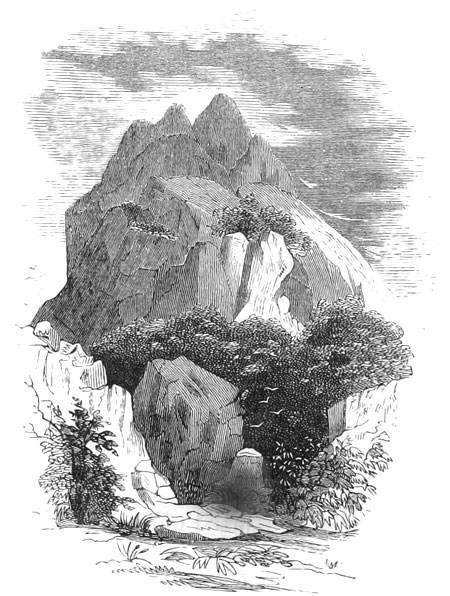
THE CLIFF.
The side of the mountain which we were ascending
was steep and smooth, and was covered with a growth
of long grass and wild oats, which made it very hard to
keep the goat-paths; and all about us, except where these
snake-like traces lay, was as smooth and sloping as the
roof of a house. There was one part of the mountain
that sloped down in an almost perpendicular line to the
verge of the cliff overhanging the sea, where the abrupt
fall was more than a thousand feet, lined with sharp crags.
This fearful precipice rose like a wall of solid rock out
of the sea, and there was a continual roar of surf at its
base. There was no way of getting up any higher
without scaling the slope above, which, as I said before,
was covered with long grass and oats, that lay upon it
like the thatch of a house; and the rain which had fallen
during the previous night now made it very smooth.
I looked at it, I must confess, with something like dismay,
thinking how we were to climb over such a steep place
without slipping down over the cliff; when I beheld
Abraham, of whom I had lost sight for a time, toiling
upward upon it like a huge bear. His outline against
the sky reminded me especially of a bear of the grizzly
species. I saw that he clung to the roots of the grass
with his hands, and dug his toes into the soft earth to
keep from sliding back, in case his hold should give way.
Committing myself to Providence, I started after him by
a shorter cut, grasping hold of the grass by the roots as
I went. Every few perches, I stopped to search for a
strong bunch of grass, for there was nothing else to hold
on by. Some of it was so loose that it gave way as soon
as I laid hold of it, and I came near going for want of
something to balance me. Six inches of a slide would
have sent me twirling over the cliff into the raging surf
a thousand feet below. Once, impressed with the terrible
idea that I was slipping, I stopped short, and my
heart beat till it shook me all over. It was only by lying
flat down and seizing the roots of the grass with both
hands, while I dug my toes into the sod, that I retained
my presence of mind. Indeed, at this place, having
turned to look back, I was so struck with horror at the
frail tenure upon which my life depended, that I turned
partly blind, and a rushing noise whirled through my
brain at the thought that I should be no longer able to
retain my grasp. If for one moment I lost my consciousness
and let go my hold of the grass, I would surely
be lost; there was no hope; I must be dashed over
the precipice, and go spinning through a thousand feet
of space till I struck the rocks below, or was buried in
the surf. I lay panting for breath, while every muscle
quivered as if it would shake loose my grasp. In the
space of five minutes I thought more of death than I had
ever thought before. Was this to be my end after all?
What would they say on board the ship when I was
dead? What would be the distress of my friends and
kindred at home when they heard how my mangled body
was picked up in the surf, and buried upon this lonely
rock-bound island? A thousand thoughts flashed
through my brain in succession. Even the happy days
of my youth rose up before me now, but the vision was
sadly mingled with errors and follies that could never be
retrieved. Believing my time had come, I looked upward
in my agony, and beheld Abraham, scarcely twenty
yards in advance, lying down in the same position,
with hands stretched out and dug into the roots of the
grass.
"Abraham," said I, "this is terrible!"
"Yes," said he, "a foretaste of death, if nothing
worse."
"But how in the world are we to get out of it?"
"I don't know—there seems to be no hope; we can't
go back again, that's an absolute certainty. In my opinion,
we'll have to stay here till somebody comes for us,
which doesn't seem a likely chance just now."
A good rest, however, having inspired us with fresh
courage, we resolved upon pushing on. There was a
narrow ledge about a hundred yards above us; if we
could reach that, we would be safe for the present. By
great exertion we got a little above the place where we
had lain down; and, the sod beginning to give way as
before, we threw ourselves on our faces again, and rested
a while. In this way, hanging, as it were, between life
and death, we at last reached the ledge. Here we flung
ourselves on the solid rock, quite exhausted. Abraham
was a brave man, but he now lay gasping for breath, as
pale as a ghost. I suppose I looked about the same, for,
to tell the honest truth, I was well-nigh scared out of
my senses. Certainly all the gold of Ophir could not
have induced me to go through the same ordeal again.
There was still above us, about five hundred feet higher,
a point or pyramid of volcanic rock, that stood out
over the sea in a slanting direction. It was the highest
peak in the neighborhood of the coast, and was called
the Nipple. We had done nothing yet compared with
the ascent of that peak. Both of us looked toward it,
and smiled.
"Shall we try it?" said Abraham.
"No," said I, "we never could get up there; it would
be perfect folly to try."
"I think not, Luff; it isn't so smooth as the place we
have just climbed over. Don't you see there are rocks
to hold on to?"
"Yes, but they look as if they'd give way. However,
if you say so, we'll make the attempt."
With this, we each drew a long breath, and commenced
climbing up the rocks. Sometimes we dug our
fingers into the crevices and lifted ourselves up, and
sometimes we wound around ledges less than a foot
wide, overhanging deep chasms, and were forced to
cling to the rough points that jutted out in order to keep
our balance. Flocks of pigeons flew startled from their
nests, and whirled past us, as if affrighted at the intrusion
of man. Herds of wild goats dashed by us also, and ran
bleating down into the rugged defiles, where they looked
like so many insects. The wind whistled mournfully
against the sharp crags, and swept against us in such
fierce and sudden gusts that we were sometimes obliged
to stop and cling to the rocks with all our might to keep
from being blown off. At last we reached the base of
the Nipple. This was the wildest place of all. Above
us stood the dizzy peak, like the turret of a ruined castle,
overlooking the surf at a height of nearly two thousand
feet. We now lay down again, breathing hard, and a
good deal exhausted. When partly recovered, I looked
over the edge toward Crusoe's Valley. It was the
grandest sight I ever beheld; rugged cliffs and winding
ridges hundreds of feet below; a green valley embowered
in shrubbery nestling beneath the heights, all calm
and smiling in the warm sunshine; slopes of woodland
stretching up in the ravines; a line of white spray from
the surf all along the shores, and the boundless ocean
outspread in one vast sweep beyond.
"I'll tell you what it is, Luff," said Abraham, "this
may be all very fine, but I don't want to try it again."
"Nor I either, Abraham. Isn't it awful climbing?"
"Yes, awful enough; but we must get on the top of
that old castle there."
"To be sure," said I, rather doubtfully. "Of course,
Abraham; we ought to climb that as a sort of climax.
It will make an excellent climax either to ourselves or
the adventure."
Saying this, I walked a few steps from the place where
we were lying down, to see if there was any way of scaling
the Nipple. It appeared to be a huge pile of loose
rocks ready to fall to pieces upon being touched. It
was about a hundred feet high, and nearly perpendicular
all round. There was no part that seemed to me at all
accessible. Even the first part or foundation could not
be reached without passing over a sharp ridge, steep at
both sides, and entirely destitute of vegetation. I was
not quite mad enough to undertake such a thing as this
without the least hope of success.
"No, Abraham," said I, "we can't do it. I see no
way of getting up there."
"Let me take a look," said Abraham, who was always
fertile in discoveries. "I think I see a place that we
can climb over, so as to get on that horseback sort of a
ridge, and the rest of the way may be easier than we
suppose."
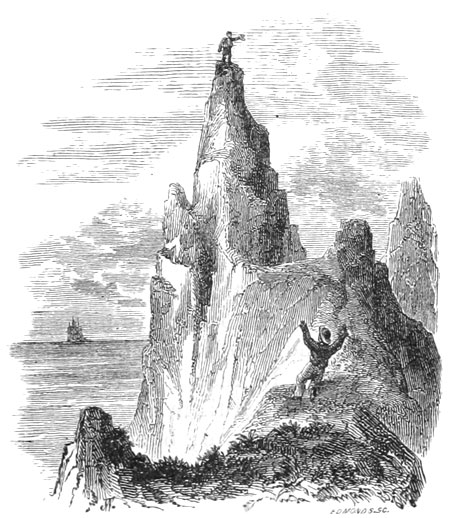
ABRAHAM ON THE PEAK.
He then walked a few steps round a ledge of crumbling
rock, and I soon saw him climbing up where it seemed
as if there was no possible way of holding on. I actually
began to think there was something supernatural in his
hands and feet; yet I felt an indescribable dread that he
would fall at last. For a while I was in perfect agony;
each moment I expected to see him roll headlong over
the cliff. Presently I lost sight of him altogether. I
thought he had lost his balance, and was dashed to atoms
below! Seized with horror, I sat down and groaned
aloud. Again I rose and ran to the edge of the cliff,
shouting wildly in the faint hope that he was not yet
lost. There was no answer but the wail of the winds
and the moaning of the surf. While I looked from the
depths to the fearful height above, I saw his head rise
slowly and cautiously over the top of the Nipple; then
his body, and then, with a wild shout of triumph, he
stood waving his hat on the summit!
There he stood, a man of stalwart frame, now no bigger
than a dwarf against the sky!
I saw him point toward the horizon, and, looking in
the direction of his finger, perceived the Anteus about
twenty miles off under short sail.
He remained but a few minutes in this perilous position,
as I supposed on account of the wind, which was
now very strong.
On his return, being unable to get down on the same
side, he was forced to creep backward over the ridge,
and lower himself by fixing his hands in the crevices to
the ledge over the sea, from which he made his way
round to the starting-point. When he reached the spot
where I stood, he sat down, breathing hard, and looking
very pale.
"Luff," said he, "don't go up there. It shook under
me like a tree. Every flaw of wind made it sway as if
it would topple over."
"Why," said I, "after scaring me out of my wits, it
isn't exactly fair to deprive me of some satisfaction."
"Don't do it, Luff; I warn you as a friend! It ought
to be satisfaction enough to find me here safe and sound,
after such a climb as that."
"No, Abraham, I must do it; because when we return
to the ship, don't you see what an advantage you'll
have over me?"
"Only in being the greater fool."
"Then there must be two fools, to make us even. It
would hardly be friendly to let you be the only one; so
here goes, Abraham. In case I tumble over, give my
love to all at home, and tell them I died like a Trojan."
All this was folly, to be sure; but how could I help it?
how could I bear the thought of hearing Abraham talk
about having scaled the Nipple, while I was ingloriouly
groaning for him down below? It would mortify me to
the very soul.
Following now the same path that Abraham had
taken, I was soon on top of the first elevation; for, being
lighter and more active, though not so strong, I
had rather the advantage in climbing. Here I wound
round by a different way, so as to reach the ridge that
led over the chasm. It was about the width of a horse's
back, sloping down abruptly on each side. The distance
was not over twenty feet, which I gained by straddling
the ridge and working along by my hands. The descent
on each side was, as before stated, nearly two thousand
feet. I need not say it was the most terrible ride I ever
had. Indeed, when I think of it now, it brings up strange
and thrilling sensations. How I got over the final peak,
I can hardly tell; it seems as if I must have been drunk
with excitement, and reached the summit by one of those
mysterious chances of fortune which not unfrequently
favor men whose minds are in a morbid state.
When I looked down on the waters of the bay, I saw
the Brooklyn still at anchor. She looked like some big
insect floating on its back, with its legs in the air and
little insects running about all over it. I staid up on
the top of the Nipple only a few minutes. The view on
every side was sublime beyond all the powers of language;
but a gust of wind coming, the frail pinnacle of
lava upon which I stood swayed, as Abraham had told
me; and, fearing it would tumble over, I hurried down
the best way I could.
RAMBLE INTO THE INTERIOR.
Finding by the sun that it was yet early in the day,
we resolved, after resting awhile, to push on as far as we
could go into the interior. The prospect was perfectly
enchanting. Winding ridges and deep gorges lay before
us as we looked back from the ocean; and cool
glens, shaded with myrtle, and open fields of grass in the
soft haze below, and springs bubbling over the rocks
with a pleasant music; all varied, all rich and tempting.
Away we darted over the rocks, shouting with glee, so
irresistible was the feeling of freedom after our dreary
ship-life, and so inspiring the freshness of the air and the
wondrous beauty of the scenery. The ridge upon which
our path lay was barely wide enough for a foothold. It
was composed of loose stones and crumbling pieces of
clay. The precipice on the right was nearly perpendicular;
on the left craggy peaks reared their grizzled
heads from masses of dark green shrubbery, like the turrets
of ancient castles shaken to ruin by the tempests of
ages. Sometimes we had to get down on our hands and
knees, and creep over the narrow goat-paths for twenty
or thirty feet, holding on by the roots and shrubs that
grew in the crevices of the rocks, and at intervals force
ourselves through jungles of bushes so closely interwoven
that for half an hour we could scarcely gain a
hundred yards. About three miles back from the sea-coast,
having labored hard to reach a high point overlooking
one of the interior valleys, we were stopped by
an abrupt rampart of rocks. Here we had to look about
us, and consider a long time how we were to get over it.
We now began to suffer all the tortures of thirst
after our perilous adventure on the Nipple, and our subsequent
struggle through the bushes and along the ridge.
There was no sign of a spring any where near; the cliffs
were bleached with the wind, and not so much as a drop
of water could be found in any of the hollows that had
been washed in the rocks by the rain. In this extremity
we sat down on a bank of moss, ready to die of thirst,
and began to think we would have to return without
getting a sight of the valley on the other side of the cliff,
when I observed a curious plant close by, nearly covered
with great bowl-shaped leaves.
"Abraham," said I, "may be there's water there!"
"May be there is," said Abraham; "let us look."
We jumped up and ran over to where the strange
plant was, and there we beheld the leaves half full of fine
clear water!
"There! what do you think of that, Abraham? Isn't
it refreshing? You see it requires a person like me to
find fresh water on the top of a mountain where there
are no springs."
"Yes, yes," quoth Abraham, slowly, "but may be it's
poison."
"Sure enough—may be it is! I didn't think of that,"
said I, very much startled at the idea of drinking poison.
"Suppose you drink some and try. If it doesn't do you
any harm, I'll drink some myself in about half an hour."
"Well, I would like a good drink," said Abraham,
thoughtfully; "there's no denying that. But it always
goes better when I have a friend to join me. I'll tell
you what I'll do, Luff. You take one bowl and I'll take
another, and we'll sit down here and call it whisky
punch, and both drink at the same time."
"Very good," said I, "that's a fair bargain. Come
on, Abraham."
So we cut the stems of two large leaves, containing
each about a pint of water, and sat down on a rock.
"Your health," said I, raising my bowl; "long life
and happiness to you, Abraham!"
"Thank you," said Abraham; "the same to you!"
"Why don't you drink?" I asked, seeing that my
friend kept looking at me without touching the contents
of the bowl.
"I'm going to drink presently."
"Drink away, then!"
"Here goes!"
But it was not "here goes," for he still kept looking
at me without drinking.
"Well," said I, impatiently, "what are you afraid of?"
"I'm not afraid," cried Abraham, "but I don't see you
drinking."
"Nonsense, man! I'm waiting for you!"
"Go ahead, then."
"Go ahead."
Here there was a long pause, and we watched each
other with great attention. At last, entirely out of patience,
I lowered my bowl and said,
"Abraham, do you want me to poison myself?"
"No, I don't," said Abraham; "I'd be very sorry for it."
"Then why did you propose that we should drink this
poison together? for I verily believe it must be poison,
or it wouldn't look so tempting."
"Because you wanted me to drink it first."
"Did I? Give me your hand, Abraham; I forgot
that." Whereupon we shook hands, and agreed to consider
it not whisky punch, but poison, and drink none
at all.
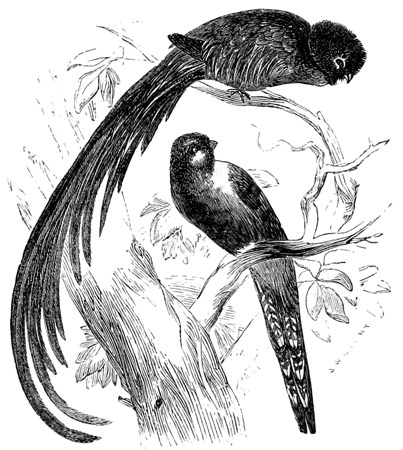
THE TROGON.
Our thirst increasing to a painful degree, we were
about to retrace our steps, when I observed a little bird
perch himself upon the edge of a leaf not far off, and
commence drinking from the hollow. I told Abraham
to look.
"Sure enough," said he, "birds don't drink whisky
punch."
"No," said I, "God Almighty never made a bird or a
four-legged beast yet that would naturally drink punch
or any other kind of poison. It must be water, and
good water too, for birds have more sense than men
about what they drink. So here goes, whether you join
or not."
"And here goes too!" cried Abraham; and we both,
without hesitating any longer, emptied our bowls to the
bottom; and so pure and delicious was the water that
we emptied half a dozen leavesful more, and never felt
a bit afraid that it would hurt us; for we knew then
that God had made these cups of living green, and filled
them with water fresh from the heavens for the good of
His creatures.
THE VALLEY OF ENCHANTMENT.
Thus refreshed, we set to work boldly, and, by dint
of hard climbing, reached the top of the cliff. It was the
highest point on the island next to the Peak of Yonka.
We looked over the edge and down into a lovely valley
covered with grass. Wooded ravines sloped into it on
every side, and streams wound through it hedged with
bushes, and all around us the air was filled with a sweet
scent of wild flowers. In that secluded valley, so seldom
trodden by the foot of man, we saw how much of
beauty lay yet unrevealed upon earth; and our souls
were filled with an abiding happiness: for time might
dim the mortal eye; the freshness of youth might pass
away; all the bright promises of life might leave us in
the future; but there was a resting-place there for the
memory; an impression, made by the Divine hand within,
that could never fade; a glimpse in our earthly pilgrimage
of that promised land where there is harmony
without end—beauty without blemish—joy beyond all
that man hath conceived.
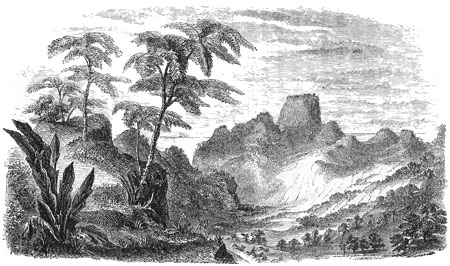
THE VALLEY.
Nothing was here of that stern and inhospitable character
that marked the rock-bound shores of the island.
A soft haze hung over the valley; a happy quiet reigned
in the perfumed air; the breath of heaven touched gently
the flowers that bloomed upon the sod; all was fresh
and fair, and full of romantic beauty. Yet there was life
in the repose; abundance within the maze of heights
that encircled the dreamy solitude. Fields of wild oats
waved with changing colors on the hill-sides; green
meadows swept around the bases of the mountains; rich
and fragrant shrubs bloomed wherever we looked; fair
flowers and running vines hung over the brows of the
rocks, crowning them as with a garland; and springs
burst out from the cool earth and fell in white mist down
into the groves of myrtle below, and were lost in the
shade. Nowhere was there a trace of man's intrusion.
Wild horses, snuffing the air, dashed out into the valley
in all the joyousness of their freedom, flinging back their
manes and tossing their heads proudly; and when they
beheld us, they started suddenly, and fled up the mountains
beyond. Herds of goats ran along the rugged declivities
below us, looking scarcely bigger than rabbits;
and birds of bright and beautiful plumage flew close
around our heads, and lit upon the trees. It was a fair
scene, untouched by profaning hands; fair and solitary,
and lovely in its solitude as the happy valley of Rasselas.
A STRANGE DISCOVERY.
While I was trying to make a sketch of this Valley
of Enchantment, as we called it, Abraham was peering
over the cliff, and looking about in every direction in
search of some ruin or relic of habitation. He was not
naturally of a romantic turn, but he had a keen eye for
every thing strange and out of the way, and an insatiable
thirst for the discovery of natural curiosities. Already
his pockets were full of roots and pieces of rock; and it
was only by the utmost persuasion that I could prevent
him from carrying a lump of lava that must have weighed
twenty pounds. Without any cause, so far as I could
see, he began stamping upon the ground, and then, picking
up a big stone, he rolled it over the edge of the cliff,
and eagerly peeped after it, holding both hands to his
ears as if to listen.
"What's that, Abraham?" said I; "you are certainly
losing your wits."
"I knew it! I knew it!" he cried, greatly excited;
"it's perfectly hollow. There's a natural castle in it!"
"Where? in your head?"
"No, in the cliff here; it's all hollow—a regular old
castle! Come on! come on, Luff! We're bound to explore
it. May be we'll rake up something worth seeing
yet!" Saying which, he bounded down a narrow ledge
on the left, and I, as a matter of course, followed. Our
path was not the most secure, winding as it did over an
abyss some hundreds of feet in a direct fall; but our
previous experience enabled us to spring over the rocks
with wonderful agility, and work our way down the
more difficult passes in a manner that would have done
credit to animals with four legs. Portions of the earth
formed a kind of narrow stairway, so distinct and regular
that we almost thought it must be of artificial construction.
In about ten minutes we reached a broad
ledge underneath the brow of the cliff. Turning our
backs to the precipice, we saw a spacious cavity in the
rocks, shaped a good deal like an immense Gothic doorway,
all overhung with vines and wild fern.
"I knew it!" cried Abraham, enthusiastically. "A
regular old castle, by all that's wonderful! Crusoe's
cave is nothing to it! Just see what a splendid entrance;
what ancient turrets; what glorious old walls
of solid rock!"
"Verily, it does look like a castle," said I. "We must
call it the Castle of Abraham, in honor of the discoverer."
"Yes, but it strikes me there may be another discoverer
already. Look at these marks on the rock!"
"True enough; goats never make marks like these!"
Near the mouth or entrance of the grotto, traced in
black lines, evidently with a burnt stick, we saw a number
of curious designs, so defaced by the dripping of water
from above that we were unable for some time to
make out that they had any meaning. At length, by
carefully following the darkest parts, we got some clew
to the principal objects intended to be represented, which
were very clumsily drawn, as if by an unskillful hand.
There was a figure of a man, lying upon a horizontal line,
with his face turned upward; the limbs were twisted
and broken, and the expression of the features was that
of extreme agony; the eyes were closed, the back of the
head crushed in, the mouth partly open, and the tongue
hanging out. One hand grasped a jagged rock, the
other a knife with a part of the blade broken off. Close
by, with its head upon his feet, was the skeleton of a
strange animal, so rudely sketched that we could hardly
tell whether it was intended for a goat or not. It had
the horns of a goat, but the eyes, turning upward in their
sockets, looked like those of a child that had died some
horrible death. Waving lines were drawn some distance
off, as representing the sea in a storm; a large ship
under sail was standing off in the foam from a pile of
rocks that rose out of the sea like a desolate island.
The body of a man could be seen under the waves,
struggling toward the ship; a shark was tearing the
flesh from his legs, and the hands were thrown up wildly
over the water. Underneath the whole were several
rude sketches of human hearts, pierced through with
knives. A hand pointed upward at the figure first described.
It had a ring on the forefinger; the tendons
of the wrist hung down, as if wrenched from the arm by
some instrument of torture. Around these strange designs
were numerous others, representing the heads of
eagles; a famished wolf, gnawing its own flesh; and the
corpses of two children, strangled with a rope; besides
other rude sketches of which we could make nothing;
and, indeed, some of these already mentioned were so indistinct,
that we were forced to depend a good deal on
conjecture in order to come to any conclusion in regard
to what they were intended to represent; so that I have
given but a vague idea, at best, of the whole thing.
"There's something strange about this," said Abraham,
trembling all over; "something more than we may
like to see. Let us go into the cave, and try if we can
solve the mystery."
"I don't think there's much mystery about it," said I;
"evidently some sailor who ran away from a ship has
occupied this as a hiding-place; these strange designs
he has doubtless made in some idle hour, to represent
scenes in his own life. The fellow had a bad conscience—he
has left the mark of it here."
"He may have left more than that," said Abraham,
seriously; "he may have fallen from one of these rocks,
and lain here for days, helpless and dying: in the agonies
of thirst, driven delirious by fever, he tried, perhaps, to
tell by these signs how he died. If I'm not mistaken,
we'll find some farther clew to this affair within there.
Let us see, at all events."
We then went into the cave, and looked around us as
far as the light reached. It was very lofty and spacious,
and made a short turn at the back part, so that all beyond
was quite wrapt in darkness. Weeds hung in
crevices of the dank walls of rock; a few footprints of
animals were marked in the ground, some slimy tracks
were made over the rocks by snails, and these, together
with a dull sound of the flapping of wings made by a
number of bats that hung overhead, had a very gloomy
effect. However, seeing nothing else in the front part
of the cave, we groped our way back into the dark passage
at the end, and followed it up till we reached a sort
of natural stairway leading into an upper chamber. For
some time we hesitated about going up here, thinking
there might be a hole or break in the rocks through
which by mischance we might fall, and be cast down
into some vault or fissure underneath. After a while our
eyes got a little used to the darkness, and we thought
we could discern the chamber a few steps above into
which this stairway led; so we crept up cautiously, feeling
our way as we went, and as soon as we found that
the ground was level we stood upon our feet, and perceived,
from the height above us, and the vacancy all
around, that we were in a spacious apartment of the cavern.
There still being some danger of falling through,
as we discerned by the hollow sound made by our feet,
we only went a short distance beyond the entrance,
when we stopped still on account of the darkness, which
was now quite impenetrable.
"A queer place!" said Abraham; "very like one of
the piratical retreats you read about in novels."
"Very, indeed, and quite as unlike reality," said I;
"it doesn't seem to be inhabited by pirates now, though,
or any thing else except bats. I wish we had a torch,
Abraham, for I vow I can't see an inch before me."
"That's not a bad idea," said Abraham; "I think I
have a match in my pocket, but it won't do to run the
risk of missing fire here. Wait a bit, Luff; I'll go back
to the mouth of the cave, and rake up some brush-wood.
We'll have some light on the subject presently—if the
match don't miss fire."
Abraham then crept back the way we came, as I supposed,
for I could see nothing in any direction, and only
heard a dull echo around the walls of rock, growing
fainter and fainter, till all I was sensible of was the flitting
of some bats by my head, and the breath passing
through my nostrils. To tell the honest truth, I felt
some very queer sensations steal over me upon finding
myself all alone in this dark hole, unable to see so much
as my hand within an inch of my eyes, and not knowing
but the first thing I felt might be a snake or tarentula
creeping up my legs, or the bite of some monstrous bat.
I waited with great impatience, without daring to move,
lest I should miss the way back and fall through the
earth; for in the confusion of my thoughts I had lost
all knowledge of the direction of the entrance, and this
very thing, perhaps, caused me to magnify the time as it
elapsed. It seemed to me that Abraham would never
return, he staid away so long, and this brought up some
strange and startling thoughts. Suppose, in his search
for the brush-wood, he had slipped off the ledge in front
of the cave? Suppose he had lost his footing in the
dark passage on the way out, and fallen into some unfathomable
depth below? Suppose a gang of wild dogs,
driven to desperation by hunger, had seized him, and
were now, with all their wolfish instincts, tearing him to
pieces? The more I thought, the more vague and terrible
became my conjectures; till, no longer able to endure
the torture of suspense, I shouted his name with
all my might. There was no answer but the startling
echoes of my own voice, which seemed to mock me in a
thousand different directions. I shouted again, and again
there was the same fearful reverberation of voices, growing
fainter and fainter till they seemed to die upon the
air, like the passing away of hope. I now began to peer
through the darkness in all directions, with the intention
of retracing my steps should I discover any indication
of the entrance by which to direct my course.
At first it appeared as if the darkness was of the same
density all round, but gradually, as I strained my eyes, I
thought I perceived a faint glimmer of light, and thither
I cautiously made my way, groping about with my hands
as I advanced.
In a few moments I felt, by a rush of air, that I was near
an opening, and the light growing stronger at the same
time, I soon perceived that it led downward in a slanting
direction, in the same way as the passage through
which we had come up. I was now satisfied that there
would be no farther difficulty in getting out, and having
no cause to imagine that the place had changed, began
to descend as rapidly as possible. All of a sudden my
feet slipped from under me, and I went flying down a
sort of chute, without any power to stop myself, and so
terrible was the sensation that I was perfectly speechless,
though conscious all the time. It was not long,
however, this suspense, for I struck bottom almost at
the next moment, and went rolling over headlong into
an open space. As soon as I looked around me, I perceived
a cleft in the rocks, some fifteen feet above,
through which there was a dim ray of light, and this, as
I took it, was what had misled me. My sight being
rather confused, I now began to grope around me, in
order to ascertain if there were any more holes near by,
when I discovered that there was straw scattered about
over the ground. Instinctively I thought about the
strange marks on the rocks near the mouth of the cave.
Now if there should be a dead body here, or a skeleton!
What a companion in this lonely dungeon! A cold
tremor ran through me, and I actually thought that,
should I accidentally touch the clammy flesh of a corpse
in such a place, it would drive me mad. For a while I
scarcely dared to look around, but the absolute necessity
of finding some place of exit at last overcame my apprehensions.
The light from above was quite faint, as before
stated, but yet sufficient, upon getting used to it, to
enable me to perceive that I was in a sort of chamber
about fifteen feet in diameter, closed on every side except
where I had so unexpectedly entered; and I was
greatly relieved to find that there was nothing on the
ground but a thin layer of straw scattered about here
and there, and a few pieces of wood partly burned. I lost
no time in making my way into the chute again, which
I found but little difficulty in ascending, for it was not
so steep as I had supposed. Upon regaining the large
apartment from which I had wandered, I heard the muffled
echoes of a voice coming, as I thought, from the
depths below. They soon grew louder, and I noticed a
reddish light faintly shining upon the dark masses of
rock. Could it be Abraham? Surely it must be, for I
now heard my name distinctly called.
"Halloo there, Luff! Where are you. Luff? Why
don't you come on?"
"I'm coming," said I, making a rapid rush toward the
light, "as fast as I can."
"All right!" said Abraham; "come on quick!"
It was not long, as may be supposed, before I was
scrambling down the rough stairway of rocks by which
we had originally entered the mysterious chamber; and
the next moment I was standing before Abraham in the
passage, which was now no longer dark, for it was lit up
with a tremendous torch of brush-wood, which he held
in both hands.
"Why, where in the name of sense have you been?"
cried he, rather excited, as I thought; "what have you
been doing all this time?"
"Doing?" said I; "only exploring the cave, Abraham—hunting
up curiosities for pastime."
"Nonsense! I've been calling at you for ten minutes.
I didn't want to leave the torch, or I'd have gone up
after you; for I couldn't hold it and use my hands at the
same time, and I thought if it went out we couldn't light
it up again. Besides, I've found a treasure—a treasure,
Luff, beyond all price."
"What is it, Abraham—a lump of gold?"
"Pooh! gold couldn't buy it! A skull, sir—a human
skull! That's what I've found!"
"Only a skull? I came near finding the whole body,"
said I, involuntarily shuddering as I thought of the
gloomy chamber with the straw in it; "I'm quite certain
I'd have found the entire corpse if it had been
there."
"But this is a real skull, Luff. It's no subject for trifling.
Some poor fellow has left his bones here, as I
suspected."
We then went out to the front of the cave. Not far
from the entrance was a hole somewhat larger than a
man's body, which I had not noticed before, and into
which Abraham now crept with the torch, telling me to
follow. It was not long before we entered a cell or
chamber large enough to stand up in, the floor of which
was littered with straw.
"I found it here, Luff; here in this straw—the upper
part of a man's skull. Look at it."
Here Abraham removed some of the straw, and there,
indeed, lay the frontal part of a skull.
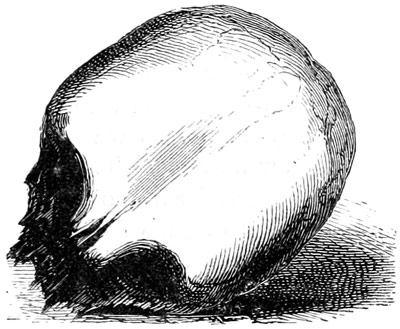
THE SKULL.
"I found it just as it lies. I put it back exactly in
the same position. I wanted you to see how the man
died—poor fellow! a sad death he had of it all alone
here."
Upon this I took up the skull and examined it. The
forehead was small and low, and the whole formation of
the upper part of the face somewhat singular. There
was not sufficient of the lower part left to tell precisely
whether it was the skull of a white man or of a negro.
I thought it must be that of a negro, from the size of
the animal organs. Abraham, however, considered it
the skull of a white man, on account of the whiteness of
the bone.
The torch being now burned out, we bethought ourselves
of starting toward the valley of the huts, for we
had no time to indulge in melancholy reflection on what
remained of the poor sailor, or follow up the train of
thought suggested by his unhappy fate. Abraham carefully
wrapped the skull in his handkerchief, and put it in
a large pocket that he had in his coat, declaring, as we
set out on our return to the top of the cliff, that a thousand
dollars would not induce him to part with so rare
and valuable a curiosity.
THE STORM AND ESCAPE.
When we reached the summit of the cliff, and looked
over once more into the enchanted valley, we could hardly
believe that such a change as we beheld could have
taken place during our absence. That scene of beauty
upon which we had lingered with so much pleasure now
seemed to be a moving ocean of clouds, ingulfing every
visible point in its billows of mist, raging and foaming
as it swelled up over the heights; the wild roar of
the tempest vibrating fiercely through the air—the very
rocks upon which we stood trembling in the dread coming
of its wrath. While we gazed in silence upon
the wilderness of surging billows, the whole island became
hidden in mist; and that happy valley, so lovely
in its solitude but a brief hour before, so calm in its slumbering
beauty, so softly steeped in sunshine, was now
buried in the fierce conflict of the elements. Nothing
was to be seen but an ocean of misty surf below, and a
wilderness of dark clouds flying madly overhead. It
seemed as if we had been suddenly cut off from the
world, and left floating on a huge mass of burned rock,
in a chaos of convulsed elements. On every side the
impenetrable mists covered the depths, and it needed
but a single step to open to us the mysteries of eternity.
The storm set in upon us in fierce and sudden gusts,
driving us down for safety upon the lee of the rock. No
longer able to stand upright, we cowered beneath the
shelter which we found there, and so bided our time.
From all we could judge, there was no appearance of a
change for the better. As soon as there was a lull, we
hurried on along the ridge, in the hope of reaching the
valley of the huts before dark, for we had eaten nothing
since morning, and were not prepared to spend the night
in these wild mountains. After infinite climbing and
toil, we came to a part of the path where there were
neither trees nor bushes. It was about half a mile in
length, and was exposed to the full fury of the gale.
About midway we were attacked by a terrific gust of
wind and deluge of rain, and it was with great difficulty
we could retain our foothold. The rain swashed against
us with resistless power, driving us down upon our
hands and knees in its fury, while it surged and foamed
over us like a white sea in a typhoon. Blinded and
dizzy, we rose again and rushed on, staggering in the
fierce bursts of the tempest, and gasping for breath in
the deluge of spray. How we lived through it I know
not; how it was that we were not cast over into the
abyss that threatened to devour us, there is but One who
knows, for no eye but His was upon us. Breathless, and
blinded with the scourging waters, we staggered against
a large rock. Here we fell upon our knees, no longer
able to contend against the tempest, and clung to the
bushes that grew in its clefts, while we silently appealed
to Him who holds the winds in the hollow of His hands
to take pity upon us, and cast us not away in His wrath.
The worst part of the path being yet before us, where
we had previously found it difficult to get over in good
weather, we determined upon trying the steep descent
on the right, leading directly into the valley of the huts.
It was almost a perfect precipice, and was bare and
smooth for three hundred yards, where it ran out into a
kind of ledge, covered with a stunted growth of trees.
If we could reach the grove we would be safe; but between
us lay a steep and precipitous field of loose earth,
smoothed into a bank of mud by the rains. As we had
no alternative, we began the descent as cautiously as
possible, thrusting our toes and fingers into the clay, and
letting ourselves down by degrees for fifty or a hundred
feet at a time, when we stopped a while to look below
us. Such was the roar of the storm that I hardly knew
whether Abraham was by me or not, when, hearing a
loud shout, I looked round and beheld him flying down
the precipice with the velocity of lightning. "Oh! he'll
be killed!" I exclaimed; "he'll be killed! Oh! what a
dreadful death!" At the same moment I felt my hold
give way, and I dashed after him in spite of myself,
grasping madly at the loose earth, and shouting wildly
for somebody to stop me. It was a fearful chase—a
chase of life or death! On we sped, upheaving the loose
masses of sod, and whizzing through the tempest as we
flew; grasping desperately at every rock, tearing up the
shrubs that grew in the clefts, and dashing blindly over
gaping fissures that lay hidden with the grass. Great
masses of burned rock went smoking down into the
chaos of mist below, crashing and thundering as they
fell. On, and still on, in our wild career we sped, with
the vision of death flitting grimly before us! Atoms
we were in the strife of elements, whirled powerless into
the dark abyss. There was a confused crash of bushes;
a stunning sensation—a sudden check—a jarring of the
brain—and all was still! I looked, and saw that I was
safe. The grove was around me. Consciousness returned
as I clung panting to the trees; life was given yet;
the vision of death fled in the mists of the tempest.[1]
For a moment, dizzy and confused, I clung to a tree,
and offered up my inward thanks to that Providence
which had spared me through the fearful ordeal. Then,
hearing the voice of Abraham near by to where I stood,
I looked, and saw him seated upon the ground, wailing
aloud as if in extreme bodily pain. Selfish wretch that
I was, had I, in my thankfulness for my own safety, forgotten
the friend of my heart! Letting go my grasp of
the tree, I ran to his side, and asked in choking accents,
"Abraham! oh, Abraham, are you hurt? Tell me
quick—tell me, are you hurt?"
"My skull! my skull!" groaned Abraham, in rending
tones; "oh! Luff, my skull is broken!"
"Good heavens!" I exclaimed, "what are we to do?
This is terrible! Wretch that I am, I thought only of
myself!"
Abraham groaned again. His face was livid, and a
small streak of blood that coursed down his right cheek
told how truly he had spoken.
"Abraham, my friend Abraham!" I exclaimed, in a
perfect agony of distress, "perhaps it's not so bad. It
may not be broken."
"Yes it is," said Abraham; "I heard it crack when I
fell. My feet flew up, and I fell on my back. It must
have struck a rock."
"Oh, Abraham, what are we to do? I wouldn't have
had this to happen for the whole island. Here, I'll tear
my shirt off and tie it up."
"No, no, Luff, it can't be mended; it's broken all to
smash. I wouldn't have had it happen for a thousand
dollars. It can never, never be mended!"
"Let me see," said I, carefully laying back his hair;
"something must be done, Abraham."
"No, no—nothing can be done; the trouble's not
there, Luff; it's here—here, in my pocket!" At the
same time, while I started back in a perfect maze of confusion,
Abraham thrust his hand into his coat pocket,
and brought forth a whole handful of thin flat bones,
broken into small pieces, which he held out with a rueful
face, groaning again as he looked at them.
"No, no, it can't be mended, Luff."
"The devil!" said I, angrily, "you may thank your
stars it isn't any worse than that!"
"Worse! worse!" cried Abraham, highly excited;
"what do you mean? In the name of common sense,
isn't that bad enough? How could it be any worse?"
"Pshaw! Abraham; I thought, when I heard your
lamentations, and saw that scratch of a bush on your
face, that your own natural cranium was fractured."
"Well, what if you did?" cried Abraham, still irritated.
"Would you call that worse? A live skull will
grow together, but a dead one won't. And this—this,
with such a history to it—to lose this, after all my
trouble in finding it—oh, Luff, Luff, it's too bad!"
However, having no farther time to spare over his
ruined skull, he put back the bones in his pocket, and,
with a heavy sigh, joined me as I sprang down through
the grove.
The rest of our descent was comparatively easy.
When we got down to the head of the valley, a muddy
stream broke wildly over the rocks, carrying down with
it the branches and leaves of trees, and roaring fearfully
as it rushed on toward the ocean. We followed this in
its rapid descent, and were soon with our friends at the
boat-landing.
THE AMERICAN CRUSOE.
The third night closed, leaving us still upon the island.
Who could tell if the vessel would be in sight by morning?
Should the gale continue, it was not improbable
that she would be driven far to the leeward, and perhaps
compelled to give up the search for us entirely.
Ships had not unfrequently been in sight of the island
for weeks, as we afterward learned, and yet unable to
make an anchorage, in consequence of baffling winds and
heavy gales. It might turn out to be no joke, after all,
this wild exhibition. To be Crusoes by inclination was
one thing, by compulsion another.
We were determined not to spend another night in
the cave; that was out of the question. There was not
one of us who wanted to enjoy the romance of that place
again. No better alternative remained for us than to
make a bargain with Pearce, the American, for quarters
in his straw cabin. This we were the more content to
do upon seeing him emerge from the bushes with a dead
kid hanging over his shoulders, which we naturally supposed
he intended for supper.
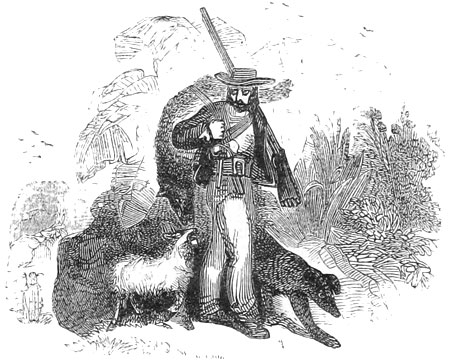
THE AMERICAN CRUSOE.
At first he spoke rather gruffly for a fellow-countryman;
but this we attributed to his wild manner of life,
separated from all society; nor were we at all disposed
to quarrel with him on account of his uncouth address,
when we came to consider that a man might understand
but little of politeness, and yet be a very good sort of
fellow, and understand very well how to cook a kid.
We had no money, which we honestly told him in the
beginning; but we promised him, in lieu thereof, a large
supply of ham and bread from the ship. This did not
seem to improve the matter at all; indeed, we began to
think he was loth to credit us, which, however, was not
the case. He said the Californians who had been there
had eaten up nearly all his stores, and had paid him little
or nothing. They had promised him a good deal, but
promises were the principal amount of what he got. If
this was all, he wouldn't mind it; they were welcome to
what he had; but he didn't like folks to come and take
possession of his house as a matter of right, and get
drunk in it, and raise Old Scratch with his furniture,
and then swear at him next morning for not keepin' a
better tavern. He didn't pretend to keep a tavern; it
was his own private house, and he wanted it to be private—that's
what he came here for. He had society
enough at home, and a darn'd sight too much of it. He
liked to choose his own company. He was an independent
character himself, and meant to be independent in
spite of all the Californians on this side of creation. All
he wished was that old Nick had a hold of California
and all the gold in it—if there was any in it, which he
didn't much believe himself. He hoped it would be sunk
tolerably deep under the sea before some of 'em got
there. It was a tolerable hard case, that a man couldn't
live alone without a parcel of fellers, that hadn't any
thing to do at home, comin' all the way to Juan Fernandez
to play Scratch with his house and furniture, and
turn every thing upside down, as if it belonged to 'em,
and cuss the hair off'n his head for not makin' a bigger
house, and keepin' a bar full of good liquor, and a billiard
saloon, and bowlin'-alley for the accommodation of
travelers—a tolerable hard case. He'd be squarmed ef
he was a goin' to stand it any longer.
We agreed with Crusoe that this was indeed rather a
hard case, but promised him that he would find us altogether
different sort of persons. We were first-class
passengers—none of your rowdy third-class; he understood
all that; they were all first-class passengers ashore;
he wouldn't believe one of 'em on oath. Again we endeavored
to compromise the matter, so far as regarded
the ham at least, of which he was entirely incredulous,
by telling him that he might come on board with us, and
then when we'd be sure not to run away without paying
him.
"But what if you should carry me away?" said he,
evidently startled by this proposition.
"Nothing—only we'd take you to California. That
would be a lucky chance for you."
"No, it wouldn't. I don't want to go there. I'm
very well here."
"But there's plenty of gold in California," said we;
"no doubt about it at all. You may live here all your
life, and be no better off."
"I'm well enough off," retorted Crusoe; "I only
want people to let me alone. Ever since this California
business they've been troublin' me."
"You surely can't be happy here without a soul near
you! Why, it's enough to drive a man mad. It must
be dreadfully dull. You can't be happy!"
"Yes I am!" said Crusoe, peevishly; "I'm always
happy when I ain't troubled. When I'm troubled I'm
mis'rable. Nothin' makes me so mis'rable as bein'
troubled."
"It makes a good many people miserable," was our
reply. "We must trouble you for a night's lodging, at
all events, for we have no place else to stay."
"I don't want you to stay nowhere else!" cried Crusoe;
"that wasn't what I meant: you mustn't get drunk—that's
what I meant."
"No, we won't get drunk; we haven't any thing to
get drunk on, unless you insist upon giving us something."
"Very well, then; you can sleep in my cabin, ef you
don't tear it down. Some fellers have tried to tear it
down."
We promised him that we would use every exertion
to overcome any propensity we might have in regard to
tearing his house down; and, although he still shook his
head mournfully, as if he had no farther confidence in
man, he led the way toward his hut, hinting in a sort of
undergrowl that it would be greatly to our advantage
not to get drunk, or attempt to destroy his house and
furniture, inasmuch as he had a number of goatskins,
which he wouldn't mind letting sober people have to
sleep on, but he'd be squarmed ef he'd lend 'em to people
that cuss'd him for not keepin' feather beds. We declared
upon our words, as gentlemen, that we had no
idea whatever of sleeping on feather beds in such a remote
part of the world as this, and would be most happy
to prove to him that we were worthy of sleeping on
goatskins; that we would regard goatskins in the light
of a favor, whereas if he put us upon feather beds, we
should feel disposed to look upon it rather as a reflection
upon our character as disciples of the immortal Crusoe.
Abraham and myself were wet to the skin after our
adventure in the mountains, and, having been five or six
hours in that condition, we were hungry enough to eat
any thing. We therefore left the party down on the
beach, where they were trying to set fire to an old pitch-barrel
as a signal for the ship, and, under the guidance
of Pearce, hurried up to the cabin. Upon entering the
low doorway, we found that there was some promise of
good cheer. There was a basket of fish in one corner,
and sundry pieces of dried meat hanging upon the walls.
Our friend set to work to skin the kid; and we, finding
a sort of stone fireplace in the middle of the floor, with
a few live embers in it, sat down, and began putting on
some wood out of a neighboring pile, by which means
we soon had a comfortable fire. As soon as the steam
was pretty well out of our clothes, and the warmth
struck through to our skins, we felt an uncommonly
pleasant glow all over us; and the blaze was exceedingly
cheerful. In fact, we were quite happy, in spite of
the gloomy forebodings of Pearce, who kept saying to
himself all the time he was skinning the kid, "I expect
nothin' else but what they'll burn my house down. Ef
they'd only let a feller alone, and not come troublin' him,
I'd like it a good deal better than bread or ham either—'specially
when it's aboard a ship that ain't here, and
never will be, I reckon. Fun's fun; but I'll be squarmed
ef I want to see my house burned down over my head.
Tain't nothin' to larf at. When I want somethin' to
larf at, I kin raise it myself without troublin' other folks.
Ef a man can't live to himself here, I'd like to know
where in creation he kin live. I expect they'll be explorin'
the bottom of the sea by'm-by in search of gold;
I'd go there to be to myself, ef I thought I could be to
myself; but I know they'd be arter me in less than a
month. Ef I was a bettin' character, I'd be willin' to
bet five dollars they'll set fire to the house, and burn it
down afore they stop!"
Meantime Brigham and the rest of the party succeeded
at length in making a large fire on the beach as a signal
for the ship, and they remained down there some
time in hopes she would send a boat ashore. But the
gale increasing, accompanied by heavy rain, they had to
leave the fire, and make a hasty retreat to the hut.
CASTLE OF THE AMERICAN CRUSOE.
Pearce's gloomy views of society began to brighten
a good deal when he found that we were not disposed
to tear down his house or burn it, or wantonly ruin his
furniture. He was not a bad-hearted man by any means,
though rather crusty from having lived too long alone,
and somewhat prejudiced against the Californians on account
of the rough treatment he had received from them.
A little flattery regarding his skill in architecture, and a
word of praise on the subject of his furniture, seemed to
mollify him a good deal; and he smiled grimly once or
twice at our folly in coming ashore, when we could have
done so much better, as he alleged, by staying aboard
the ship, and going ahead about our business.
Regarding the house, which afforded him so much
anxiety, there did not appear to us to be any thing quite
so original and Crusoe-like in any other part of the world.
It was a little straw hut, just big enough to creep into
and turn round in; with a steep peaked roof, projecting
all round, very rustic and rugged-looking, and, withal,
very well adapted to the climate. The straw was woven
through upright stakes, and made a tolerably secure
wall; outside, growing up around the house in every direction,
were running vines and wild flowers; and at a
little distance were various smaller sheds and out-houses,
in which our worthy host kept his domestic animals, and
what wood he required during the bad weather. The
furniture of his main abode, which was such a source of
honest pride to him, consisted chiefly of a few three-legged
stools, made of the rough wood with the bark still
on; a kind of bench for a lounge; a rough bedstead in
one corner, partly shut off by a straw partition; a broken
looking-glass, and an iron kettle and frying-pan, besides
sundry strange articles of domestic economy of
which we could form no correct idea, inasmuch as they
were made upon novel principles of his own, and were
entirely beyond our comprehension. Over head, the
rafters were covered with goatskins; a sailor's pea-jacket,
a sou'wester, and some colored shirts hung at
the head of the bed. In one corner there was a rude
wooden cupboard, containing a few broken cups and
plates, and a Chinese tea-box; in another a sea-chest,
which, when pulled out, served for a table. The floor
was of mud, and not very dry after the rain; for the
roof had sprung a leak, and, moreover, what water was
cast off from above eventually found its way in under
the walls below. Doubtless, like the man with the fiddle,
our host thought it useless to mend it when the
weather was fine, and too wet to work at it when the
weather was rainy. It was a very queer and original
place altogether; and with a good fire, and a little precaution
in keeping from under the leaks in the roof, not
at all uncomfortable. Our Crusoe friend, overhearing
us say that it was a glorious place to live in, a regular
castle, where a man might spend his days like a king,
smiled again a crusty smile, and growled,
"There's tea in that 'ere box. Ef you want some you
kin have it. I got it out'n a ship that came from China.
There ain't better tea nowhere."
We thanked him heartily for his kindness, and declared
at the same time that we regarded good tea as
the very rarest luxury of life. Again his face cracked
into something like a smile, and he said,
"Better tea never was drunk in China. Ef you like,
I'll put sugar in it."
We declared that sugar was the very thing of all the
luxuries in the world that we were most attached to, but
we could not drink it with any sort of relish if we
thought it would be robbing him of his stores. If he
had these things to spare we would cheerfully use them,
and pay him three or four times their value in provisions
from the ship.
"Darn the ship!" cried Crusoe; "I don't care a cuss
about the ship, so long as you don't get drunk and tear
my house down!"
Upon this we protested that we would sooner tear the
hair out of our heads by the roots than tear down so
unique and extraordinary a structure as his house; and
as to his furniture, it was worth its weight in gold;
every stick of it would bring five hundred dollars in the
city of New York.
Whereupon Pearce stirred about in the obscure corners
with wonderful alacrity, rooting up all sorts of
queer things out of dark places, and muttering to himself
meantime,
"I'm as fond of company as any body, ef they're the
right sort; and I'll be squarmed ef I ain't an independent
character too. I don't owe nobody for a buildin'
of my house, or a makin' of my furniture. I did it all
myself, long before California was skeer'd up."
He then put down the old kettle on the fire, and, as
soon as the water was boiled, emptied a large cupful of
tea into it, and set it near the fire to draw. While the
tea was drawing, he fried a panful of kid, and broiled
some fish on the coals; and when it was all done, he
gave us each a tin plate, and told us to eat as much as
we wanted, and be darn'd to the ship, so long as we behaved
like Christians. Then he furnished us with cups
for the tea, and some sea-biscuit, which he dug out of
the cupboard; and I must declare, in all sincerity, that
we made a most excellent supper.
DIFFICULTY BETWEEN ABRAHAM AND THE DOUBTER.
Every one of us, except the man that had no faith in
Robinson Crusoe, admitted that the tea was the best
ever produced in China or any where else; that the fried
kid was perfectly delicious; that the fish were the fattest
and tenderest ever fished out of the sea; that the
biscuit tasted a thousand times better than the biscuit
we had on board ship; that the whole house and all
about it were wonderfully well arranged for comfort;
and that Pearce, after all, was the jolliest old brick of a
Crusoe ever found upon a desolate island.
In fine, we came to the conclusion that it was a glorious
life, calculated to enlarge a man's soul; an independent
life; a perfect Utopia in its way. "Let us,"
said we, "spend the remainder of our days here! Who
cares about the gold of Ophir, when he can live like a
king on this island, and be richer and happier than Solomon
in his temple!"
"You'd soon be tired of it," muttered a voice from a
dark corner: it was the voice of the Doubter. "You
wouldn't be here a month till you'd give the eyes out of
your heads to get away."
"Where's that man?" cried several of us, fiercely.
"I'm here—here in the corner, gentlemen, rayther
troubled with fleas."
"You'd better turn in and go to sleep."
"I can't sleep. Nobody can sleep here. I've tried
it long enough. I reckon the fleas will eat us all up by
morning, and leave nothing but the hair of our heads.
I doubt if they'll leave that."
"Was there ever such a man? Why, you do nothing
but throw cold water on every body."
"No I don't; it comes through the roof. It's as much
as I can do to keep clear of it myself, without throwin'
it on other people." With this we let him alone.
The fire now blazed cheerfully, sending its ruddy glow
through the cabin. A rude earthen lamp, that hung
from one of the rafters, also shed its cheerful light upon us
as we sat in a circle round the crackling fagots; and altogether
our rustic quarters looked very lively and pleasant.
Every face beamed with good-humor. Even the
face of the Doubter belied his croaking remarks, and
glowed with unwonted enthusiasm. Little Jim Paxton,
the whaler, under the inspiration of the tea, which was
uncommonly strong, volunteered a song; and the cries
of bravo being general, he gave us, in true sailor style,
"I'm monarch of all I survey,
My right there is none to dispute;
From the centre all round to the sea,
I'm lord of the fowl and the brute!
Oh Solitude where are the charms," &c.
This was so enthusiastically applauded, that my friend
Abraham, whose passion for all sorts of curiosities had
led him to explore musty old books as well as musty old
caves for odds and ends, now rose on his goatskin, and
said that, with permission of the company, he would attempt
something which he considered peculiarly appropriate
to the occasion. He was not much of a singer,
but he hoped the interest attached to the words would
be a sufficient compensation for all the deficiencies of
voice and style.
"Go ahead, Abraham!" cried every body, greatly interested
by these remarks. "Let us have the song!
Out with it!"
"First," said Abraham, clearing his voice, "I beg
leave to state, for the benefit of all who may not be
familiar with the fact, that this is no vulgar or commonplace
song, as many people suppose who sing it. On the
contrary, it may be regarded as a classical production.
Among the many effusions to which the popularity of
Robinson Crusoe gave rise, none was a greater favorite
in its day than the song which I am about to attempt.
It has been customary to introduce it in the character
of Jerry Sneak, in Foote's celebrated farce, the Mayor
of Garratt. As the words are now nearly forgotten, I
hope you'll not consider it tiresome if I go through to
the end. Join in the chorus, gentlemen!"
POOR ROBINSON CRUSOE.
"When I was a lad, my fortune was bad,
My grandfather I did lose O;
I'll bet you a can, you've heard of the man,
His name it was Robinson Crusoe.
Oh! poor Robinson Crusoe,
Tinky ting tang, tinky ting tang,
Oh! poor Robinson Crusoe.
"You've read in a book of a voyage he took,
While the raging whirlwinds blew, so
That the ship with a shock fell plump on a rock,
Near drowning poor Robinson Crusoe.
Oh! poor, &c.
"Poor soul! none but he escaped on the sea.
Ah, Fate! Fate! how could you do so?
'Till at length he was thrown on an island unknown,
Which received poor Robinson Crusoe."
"Here, gentlemen, I beg you to take notice that we
are now, in all probability, on the very spot. I have the
strongest reasons for supposing that the castle of our excellent
host, in which we are at this moment enjoying
the flow of soul and the feast of reason, is built upon the
identical site occupied in former times by the castle of
the remarkable adventurer in whose honor this song was
composed. But to proceed—
"Tinky ting tang, tinky ting tang,
Oh! poor Robinson Crusoe.
"But he saved from on board a gun and a sword,
And another old matter or two, so
That by dint of his thrift, he managed to shift
Pretty well, for poor Robinson Crusoe.
Oh! poor, &c.
"He wanted something to eat, and couldn't get meat,
The cattle away from him flew, so
That but for his gun he'd been sorely undone,
And starved would poor Robinson Crusoe.
Oh! poor, &c.
"And he happened to save from the merciless wave
A poor parrot, I assure you 'tis true, so
That when he came home, from a wearisome roam,
Used to cry out, Poor Robinson Crusoe.
Oh! poor, &c.
"Then he got all the wood that ever he could,
And stuck it together with glue, so
That he made him a hut, in which he might put
The carcass of Robinson Crusoe."
"Hold on there! hold on!" cried a voice, in a high
state of excitement. Every body turned to see who it
was that dared to interrupt so inspiring a song. Immediately
the indignant gaze was fixed upon the face of the
Doubter, who, with outstretched neck, was peering at
Abraham from his dark corner. "Excuse me, gentlemen,"
said he, "but I want some information on that
point. Did you mean to say, sir, that he, Robinson Crusoe,
stuck the wood together with glue when he built
his house? with glue, did you say?"
"So the song goes," said Abraham, a little confused,
not to say irritated. "Doubtless the words are used in
a metaphorical sense. There is every reason to believe
that this is a mere poetical license; but it doesn't alter
the general accuracy of the history. For my own part,
I am disposed to think that the house was built very
much upon the same principles as that of our friend
Pearce; in fact, that it was precisely such an establishment
as we at present occupy."
"Go on, sir—go on; I'm perfectly satisfied," muttered
the Doubter; "the whole thing hangs together by
means of glue; every part of it is connected with the
same material!"
Abraham reddened to the eyebrows at this uncalled-for
remark; his fine features, usually so placid and full
of good nature, were distorted with indignation; he
turned fiercely toward the Doubter; he instinctively
doubled up both fists; he breathed hard between his
clenched teeth; then, hearing a low murmur of dissuasion
from the whole party, he turned away with a smile of
contempt, breaking abruptly into the burden of his song,
"Tinky ting tang, tinky ting tang,
Oh! poor Robinson Crusoe!
"While his man Friday kept the house snug and tidy,
For be sure 'twas his business to do so,
They lived friendly together, less like servant than neighbor,
Lived Friday and Robinson Crusoe.
Oh! poor, &c.
"Then he wore a large cap, and a coat without nap,
And a beard as long as a Jew, so
That, by all that's civil, he looked like a devil
More than poor Robinson Crusoe."
"Which shows," continued Abraham, with his accustomed
smile of good humor, "the extraordinary shifts to
which a man may be reduced by necessity, and the uncouth
appearance he must present in a perfectly unshaved
state, when even the poet admits that he looked like a
devil. These articles of clothing, which contributed to
give him such a wild aspect, were made of goatskins, as
he himself informs us in his wonderful narrative; and I
beg you to remember, gentlemen, that the very skins
upon which we are this moment sitting are related, by
direct descent, to those which were worn by Robinson
Crusoe."
Here the Doubter groaned.
"Well, sir, is there any thing improbable in that?"
said Abraham, fiercely. "Have you any objection to
that remark, sir?"
"No; I have nothing to say against it in particular,
except that I'd believe it sooner if there were goats in
the skins. I never heard of modern goatskins descending
from ancient goatskins before."
"Of course, sir," said Abraham, coloring, "the goats
were in the skins before they were taken out."
"Likely they were," growled the Doubter; "I won't
dispute that. But I'd like to know, as a matter of information,
if he, Robinson Crusoe, made his clothes in the
same way as he made his house?"
"To be sure, sir; to be sure: he made both with his
own hands."
"I thought so," said the Doubter, sinking back into
his dark corner; "he sew'd 'em with glue. All glue—glue
from beginning to end."
"I'll see you to-morrow, sir!" said Abraham, swelling
with indignation; "we'll settle this matter to-morrow,
sir. At present I shall pay no further attention to your
remarks!" Here he drew several rapid breaths, as if
swallowing down his passion; and, looking round with
a darkened brow upon the mute and astonished company,
resumed, in a loud and steady voice,
"Tinky ting tang, tinky ting tang,
Oh! poor Robinson Crusoe!
"At length, within hail, he saw a stout sail,
And he took to his little canoe; so,
When he reach'd the ship, they gave him a trip,
Back to England brought Robinson Crusoe.
Oh! poor Robinson Crusoe!"
We all joined in the chorus—all, except the incredulous
man; and, notwithstanding the unfortunate difference
between Abraham and that individual, which tended
so much to mar the harmony of the occasion, we thought,
from the way our voices sounded, that it must have been
the very first time this inspiring song was sung in the
solitudes of Juan Fernandez. I even fancied I detected
the crusty voice of Pearce in the chorus: but I wouldn't
like to make a positive assertion to that effect, on account
of the danger of giving him offense, should he ever cast
his eyes upon this narrative. As there was still evidently
a cloud upon Abraham's brow, which might burst to-morrow
upon the Doubter, and thereby bring the whole
adventure to a tragic termination, several of us now, by
a concerted movement, endeavored to effect a reconciliation.
We seized upon the Doubter, who by this time
was dozing away in the corner, and brought him forth to
the light, where he looked about him in mute astonishment,
muttering, as if awakened out of a dream, "No,
sir, it can't be done, sir; a house never was built with
glue yet; goatskins never were sewed together with
glue—never, sir, never!"
"You shall swallow those words, sir!" cried Abraham,
quivering with passion; "I'll make you swallow them,
sir, to-morrow morning!"
"I'll swallow 'em now if you like," drawled the Doubter,
with provoking coolness, "but I can't swallow a house
built of glue. Possibly I might swallow the goatskins,
but the house won't go down—it ain't the kind of thing
to go down!"
Here it required our full force to restrain Abraham;
he fairly chafed with indignation; his face was flushed;
his nostrils distended; his stalwart limbs writhing convulsively;
in truth, our well-meant plan of reconciliation
only seemed to hasten the tragedy which we were striving
to prevent. Pearce himself now interposed.
"I know'd it," said he; "I know'd they'd tear my
house down yet, and ruin my furniture! Next thing,
all hands'll be breakin' my chairs to pieces on one another's
heads; I know'd it; I wouldn't believe 'em on
oath!"
This rebuke touched Abraham in a tender point. Quick
to take offense, he was also ready in forgiving an injury,
especially when a due regard for the feelings of others
required it.
"Gentlemen," said he, "it shall never be said that I
have violated the rites of hospitality. There shall be
no further difficulty about this matter; I forgive all.
Your hand, sir!"
The Doubter awkwardly held out his hand and suffered
it to be shaken, upon which he crept back into his
dark corner, still, however, muttering incoherently from
time to time; but as nothing could be distinguished but
the word "glue," it was not deemed of sufficient importance
for the renewal of hostilities, or the interruption of
the general harmony. Good humor being restored, it
was all the more hearty after these unpleasant little
episodes; and so genial an effect had it upon Pearce,
that he quite forgot his resentment, and unbended himself
again. Gradually he began to tell us wild stories
of his Crusoe life; how he had lived all alone for nearly
a year on the island of Massafuero without seeing the
face of man; how, during that time, he sustained himself
upon roots and herbs, and likewise by catching wild
goats in traps; how he never was so happy in his life,
and never had any trouble till he left that island in a
whaler, and came here to Juan Fernandez; how for two
years he had lived on this island, sometimes alone, and
sometimes surrounded by outlawed Chilians; how on
one occasion, while up in the mountains hunting goats,
he fell down a precipice, and broke his arm and two of
his ribs, and was near dying all alone, without a soul to
care for him. A great many strange stories and legends
he told us, too, in his rude way, about Juan Fernandez;
and so strong was his homely language, and so fresh and
novel his reminiscences, that we often looked round in
the waning light of the lamp for fear some ghost or
murderer would steal in upon us.
As well as I can remember, one of his strange narratives
was substantially as follows. There was all the
force of reality to give it interest; for it was evidently,
as he told us, a simple recital of facts.
THE MURDER.
About five years ago (I think he said it was in 1844),
a murder was committed on the island by the father of
one of the present Chilian residents. Pearce was then
in Valparaiso, and had a statement of the circumstances
from some of the parties concerned in it.
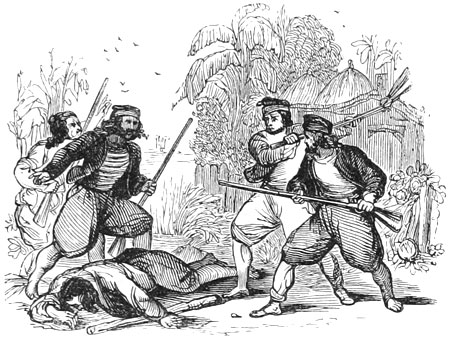
TRAGIC FATE OF THE SCOTCHMAN.
A Scotch sailor, it appeared, deserted from a vessel
that touched at the island for wood and water. For a
time he concealed himself in a cave among the cliffs near
the bay. When the vessel sailed, he came down into
the valley and built himself a hut out of straw, in which
he resided several months alone. By fishing, and catching
wild goats in traps, he supported himself comfortably,
and was becoming reconciled to his isolated life,
when a family of Chilians, consisting of five or six men
and women, under the control of an old Spaniard, father-in-law
of one of the younger men, came over about this
period in a small trading vessel from Massafuero. They
had been living there for some time, but thought they
could do better in Juan Fernandez. There were no
huts standing there then except that belonging to the
sailor. The Chilians prevailed upon him to let them occupy
a part of his house, promising to build themselves
one as soon as they could cut straw and wood enough.
Every day they went out on the hill-sides to cut the
straw, and they seemed to be making good progress
with their hut. One night the sailor, as he lay in bed,
overheard one of the Chilians say to the others, "We
are working hard every day, but it will be a long time
before we can get a house built. Neither will it be big
enough for us all when we finish it. This man is nothing
but a heretic, therefore it would be no sin to take
his life. Let us kill him, and then we can have his house,
which has other buildings to it, without the trouble of
doing any more work." The others agreed to this, all
except one woman, who said God would never suffer
them to prosper if they committed such a deed. However,
they silenced her by threats, and then talked further
upon the best means of murdering the Scotchman.
Having been a beach-comber for many years in Spanish
countries, he understood the language, and it so happened
that he overheard nearly every word. Being a
powerful man, of great courage and fierce temper, he
sprang from his bed, and swore they must leave the house
at that very instant, or he would cut their throats. The
woman he would have spared this treatment, but he
knew she would only fare the worse for his protection.
Finding him resolute, they took their things and left the
house; but after they were out in the dark, it being a
stormy night, they begged so hard for shelter that he
told them they might go into a shed, which he had built
some distance off to keep goats in. Here they remained,
without daring to molest him, until their own house was
completed. In the mean time, the suspicions of the sailor
were lulled by their friendly behavior, and he often spent
a part of his time in social talk with them, which was
the more agreeable inasmuch as the old man's daughter,
who had taken his part at first, fell in love with him, and,
although jealously watched by her husband, found frequent
chances of meeting him alone. He became much
attached to her, as well on account of her attempt to
save his life as the charms of her person, which were
well calculated to excite admiration and kindle the amorous
flame. She was a very beautiful woman, a Chilian
by birth, and was married against her inclination; and
coming from a country where the marriage tie is not
considered so sacred as it is in more northern climes, she
had but little scruple in yielding to her guilty love.
His manly person and bold bearing had attracted her in
the first place, and these stolen interviews only served
to strengthen the passion that grew up between them.
At this period they were joined by an English sailor,
another deserter, who took up his quarters with the
Chilians in their new abode, and became a member of
their gang. The Scotchman had refused, from some dislike
that he formed to this man on first sight, to take
him into his cabin. This led to a mutual hatred, which
was soon increased by other causes. The Englishman,
struck by the beauty of the young woman, whose affections
the other had won, now made love to her on all
occasions, but she gave him no encouragement. He attributed
his failure to the Scotchman, whom he secretly
watched. Fired with jealousy and deadly hatred toward
his rival, he resolved upon putting him to death
by stratagem, for he was too cowardly to undertake it
openly. Having learned the difficulty that had previously
occurred, he took occasion to tell the Chilians that
the Scotchman was their mortal enemy, and only awaited
an opportunity to murder them all, so as to get entire
possession of the young woman, with whom he had already
formed a guilty connection. At this period three
Americans deserted from a whale-ship and joined the
Scotchman. Through some accident, or most likely by
foul means, his hut took fire soon after, and was burnt
to the ground. He and his companions were obliged to
move to a cave near by, where they designed living till
they could build another. Knowing nothing of the
schemes of the English sailor, who took care that it
should not be found out through the woman, they were
ignorant of the hostile intention of the Chilians, till one
day, as they were scattered over the valley, cutting wild
oats for their cabin, the Englishman told the old man,
who was the leader of the Chilians, that he had overheard
the other party say they were going to murder them all
that night; and prevailed upon him to muster his men
together secretly, and settle the matter at once. They
all went first to the cave, and took possession of the
arms left there by the Americans and their leader. The
old man, followed at a distance by his comrades, thereupon
proceeded to the valley with a loaded gun; and
seeing the Scotchman at a distance from the others, he
stole upon him and shot him through the body with
slugs. Badly wounded, but not mortally, the Scotchman
shouted to his friends that he was shot; that they
must follow him and fight for their lives, upon which he
ran, covered with blood, toward the cave, followed by
the Americans. On arriving there they found all their
fire-arms gone: they fought for some time with their
knives, but were finally overpowered by the Chilian party
and bound hand and foot.
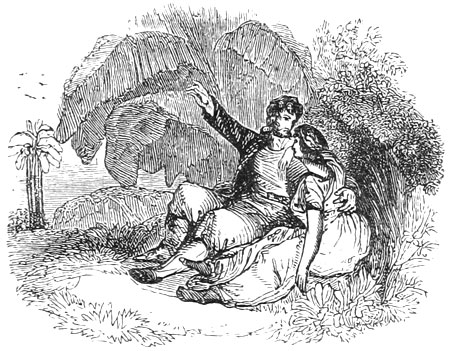
THE LOVERS.
Next day it so happened that a whale-ship came into
the harbor for wood and water. The Americans were
carried back some distance and hid among the cliffs, with
an armed guard over them, so that they might be out of
the way when the people from the ship came ashore;
and the wounded man was concealed in a cave. The
Englishman then went on board with the old Chilian,
and told the captain that a deserter from a whale-ship,
who had been on the island some time, had undertaken
to murder them, and they had shot him in self-defense.
Their story was plausibly told, and was believed. They
said the man was not dead, and they asked the captain
to take him away, as they wanted to get rid of him.
The captain refused to do this, saying he would have
nothing to do with a deserter; if the man got into
trouble by his misconduct, he might get out of it the
best way he could. When the vessel sailed, which was
the next day, the Chilians, in compliance with the advice
of the Englishman, took their wounded prisoner out into
an open space, and shot him through the heart. He fell
dead upon the spot. They then dug a hole in the ground
and buried him; and, in order to keep his spirit from
rising upon them at night, they erected a cross over the
grave. The woman, upon hearing that her lover was
murdered, fell into a state of melancholy, and refused to
taste any food for many days. Such was her distress,
that she wandered about the cliffs like one bereft of her
senses, and was often found at night weeping upon his
grave. Indeed, she never fully recovered, but was always
from that time weakly and unsettled in her mind.
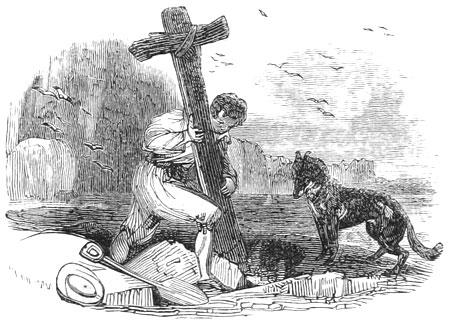
GRAVE OF THE MURDERED MAN.
Another vessel came into port in the course of a few
months, and the affair became known through the three
Americans, who made their escape and got on board.
News of the murder was carried to Talcahuana by this
vessel; and as soon as it reached Valparaiso, a small
Chilian cutter, then lying in the harbor, was dispatched
to the island of Juan Fernandez to capture and bring
home the murderers. On their arrival in Valparaiso
they were taken in irons to Santiago, the seat of government,
where they were tried and sentenced to be shot
in the public plaza. Some of the circumstances, considered
palliating, became known before the execution
was carried into effect, and their punishment was commuted
to five years' banishment on the island of St.
Felix.
The Chilian government still holds a penal settlement
on that island. All criminals of a desperate character
are sent there and subjected to hard labor. The term
for which these murderers had been banished had just
expired (in 1849), and it was supposed by the present
Chilian residents that they would return by the first
opportunity to Juan Fernandez.
THE SKULL.
During the recital of this tragical narrative, Abraham,
who had listened to every word with intense interest,
became strangely agitated. Several times it was apparently
with the utmost difficulty he could refrain from relieving
himself of something that produced an unusual
effect upon his mind. Especially when it came to the
death of the unfortunate Scotchman, I thought I noticed
that he was intensely excited. At first, knowing the
tenderness of his feelings, I attributed this extraordinary
manifestation of interest to grief and pity for the unhappy
fate of the beautiful Chilian; but I soon found
that it proceeded from another and very different cause.
No sooner had Pearce concluded than he exclaimed,
"I'll wager a thousand dollars, gentlemen, that the
Scotchman never was buried!"
"He was buried, certain," said Pearce; "I can show
you the place."
"Then there is some strange mystery about it," said
Abraham, somewhat disappointed. "This very day I
found a man's skull, which I am now quite certain has
some connection with this tragedy."
The intense excitement produced by this disclosure is
quite indescribable. Every body in the party leaned
forward, with starting eyes, and gazed with breathless
interest at Abraham. He had purposely withheld making
any reference to the affair of the skull till a fitting
opportunity should occur to disclose all the particulars,
when the mind of every individual present was in a
proper tone of solemnity to receive so important a communication.
That opportunity had how occurred, under
the most favorable and unlooked-for circumstances. I
never saw Abraham so excited in my life before—not
even on the occasion of his late unpleasant difficulty.
"Gentlemen," said he, "I had a presentiment before
we left the ship that this expedition would result in
some extraordinary discovery. You may judge from
the facts which I am about to disclose to you how far
this presentiment has been verified."
He then, in a voice of becoming solemnity, went into
a detailed narrative of our adventures in the mountains.
He commenced at the very starting-point, where we
separated from the hunting party; he dwelt vividly on
our perilous adventure on the cliff, stating all the particulars
of our escape; how we climbed up a perpendicular
wall of rocks four thousand feet high; how we
stood upon the very highest pinnacle, which was only
ten inches in diameter; how, when we came down again
to the base, we lay perfectly insensible for an entire hour;
and the wonderful adventures we had in the interior—the
walk of six miles directly back from the ocean; our
preservation from a horrible and lingering death by
thirst, through the agency of a little bird; the Enchanted
Valley that we explored, and the two wild horses we
caught entangled in the bushes, and afterward rode;
our discovery of an old castle built in the sixteenth century
by Juan Fernando; the mysterious marks upon the
outer wall; our strange and startling explorations of the
interior vaults and marble halls; and finally the discovery
of the skull—the skull of some unfortunate man who
had crept into one of those dreary vaults, where he died
on a miserable bed of straw, all alone, without a soul
near him! Afterward how he (Abraham) and myself
were overtaken by a frightful tornado, and cast down
over the rocks a distance of three miles in a direct line;
how, during this terrible fall, he had the misfortune to
strike a rock, and ruin the invaluable relic of mortality
which he had put in his pocket, by breaking it all to
pieces; but—
"Did you save the pieces?" asked a voice from the
corner. Of course it was the voice of the Doubter. A
look from Abraham silenced him, and the narrative was
resumed:
But it fortunately happened that a portion of the
socket of one eye and a piece of the forehead remained
entire, which, together with all the smaller fragments,
he would be most happy to exhibit to the company;
premising, however, that there was but little question in
his mind, from all the particulars of Pearce's tragical
narrative, that this skull was in some way or other connected
with it. Possibly it might be that the unhappy
young woman, who it appears was the victim of an inordinate
passion for the murdered man, bereft of her
senses by his tragical death, went to his grave at night
and dug up his body, and being unable to carry it away
at once, perhaps she cut it to pieces, and carried it by
degrees up to her secret place of wailing in the mountains,
where she could mourn over his remains without
fear of discovery. It was not an unreasonable conjecture,
he thought, considering the woman was insane. In
some hour of despondency she had probably made those
mysterious designs which had led to the discovery—the
sketch of the dead body of her lover; the ship that left
the island without saving him; some pet goat that
doubtless accompanied her in her wanderings; the children
that were strangled, and all those vague marks,
which indicated the character of her thoughts.
During the narration of these adventures, which I
must confess astonished me not a little, well as I knew
the enthusiastic character of my friend (and he never
was more in earnest in his life), I observed that Pearce
had doubled himself up almost into a knot, covering his
face with his hands, and heaving convulsively, as if
moved by some internal earthquake. There was no
sound escaped him, but it was quite evident that he was
strangely affected by Abraham's narrative. The rest of
the party were so deeply interested in the whole disclosure
that they took no notice of him. Could it be that
Pearce himself was implicated in the murder? That it
was all a fiction his being in Valparaiso at the time?
That he was in any way attached to this unfortunate female,
whose sad fate had aroused all our sympathies?
"I'd like to see that skull," said the Doubter.
"Here it is—or what remains of it," said Abraham,
drawing forth the pieces from his pocket; "you can all
see it if you wish."
The pieces were handed round and examined with intense
interest and curiosity.
"You call this a man's skull?" said the Doubter, looking
incredulously at a piece which he held in his hand.
"I do, sir," said Abraham, sharply; "have you any objection
to my calling it a man's skull, sir?"
"No, none at all; you may call it a dog's skull if you
like. I'd call it Robinson Crusoe's skull if I owned it.
For all I know to the contrary, it is his; but I'd like to
have a certificate from himself to that effect before I'd
place much confidence in my own opinion, if I thought
so."
The biting satire of these remarks touched Abraham
to the quick. Nothing in the world would have prevented
him from springing upon the Doubter at that
moment, and taking summary vengeance upon his person,
but the sudden exit of Pearce, who, rising from his
goatskin, hurriedly left the cabin. This produced a general
murmur of disapprobation. It was the unanimous
opinion that a course of conduct, resulting as this did—compelling
a man, as it were, to leave his own castle for
personal security, was very unbecoming; and that Abraham,
being the chief, although perhaps unintentional
cause of it, was in honor bound to go after him and bring
him back.
I take pride in saying that my friend was not the kind
of man to resist such an appeal as this. He immediately
left the hut and went in search of Pearce. Meanwhile
we took occasion to administer a well-merited rebuke
to the Doubter; and to declare that if he again interrupted
the harmony of the evening, we would leave
him ashore when we started for the ship. His only reply
to this was, that he hoped, if he should unfortunately
die in a cave in consequence of our cruelty, that his head
would make a better-looking skull than the one Abraham
had found.
In about ten minutes Abraham and Pearce returned,
both having a very strange expression upon their features.
Pearce looked unnaturally serious about the
mouth, but I fancied more knowing than usual about the
eyes. In sitting down he dropped a dollar, which he
hastily picked up and put in his pocket. As to my
friend, I thought there was something confused and dejected
in his look; but he immediately said with assumed
spirits when he came in, "All right, gentlemen;
all right. The whole thing is settled; let there be nothing
more about it."
Some few questions, however, were asked concerning
the skull, but all the satisfaction Abraham could give
was, "You have the particulars, gentlemen; you must
judge for yourselves." Pearce professed to know nothing
about it.
Harmony and good-humor being again restored, there
were numerous calls for some farther reminiscences of
the island.
Pearce said he didn't know whether any of us had
ever heard of the governor's vision; if we hadn't, maybe
we'd like to hear something about it. He couldn't
promise that it was all true, but the Chilians here believed
every word of it; "and, likely enough," he added,
looking quietly at Abraham, "there may be some of you
that can account for it."
"Let us have it!" exclaimed every body in a breath;
"the governor's vision, by all means."
Pearce then fixed himself comfortably on his goatskin,
and, putting some fagots on the fire, gave us in substance
the following history of
the governor's vision.
THE GOVERNOR'S VISION.
The highest peak on the island of Juan Fernandez is
called the Peak of Yonka. It forms an abrupt precipice
all round, of several hundred feet. Various attempts
have been made from time to time, by sailors and others,
to ascend to the summit, but this feat has never been accomplished
except in a single instance. A cross still
stands upon it, which was erected by two Chilians many
years ago, under very strange circumstances. It appears
that the Chilian governor at the time of the penal settlement
in Cumberland Bay went out riding one day near
this mountain. On his return he related to his people a
strange vision which he had seen in the course of his
ramble. He said that, while looking at the peak, he saw
down in the valley that lay between a tall man dressed
in black, with a black hat on, mounted on a horse of the
purest white. The strange rider turned toward him,
showing a face of ghastly paleness. He looked at him
steadfastly, with "eyes of fire," as the governor declared,
the glare of which made the air hot all around. The
governor, trembling with awe, made the sign of the
cross, upon which the strange horseman put spurs to his
horse, and rode straight up the precipice to the summit
of the peak, where he stopped a moment to look back.
He then, upon seeing the sign of the cross made again,
waved his hands wildly, as if in despair, and plunged out
of sight on the other side. Being a devout man, and
withal a believer in spirits, the governor considered this
to be an omen of some impending calamity, which could
only be averted by planting a cross on the peak. For
this purpose he selected two criminals, under sentence
of death for the murder of a soldier, and offered them
their liberty if they would make the ascent and erect the
cross. In the one case there was the certainty of death,
in the other a chance of life. The criminals therefore
resolved to make the attempt. Ropes, ladders, and tools
were furnished them by the governor, and they were allowed
such provisions as they required, with injunctions
that at the expiration of ten days, in case of failure, they
would be executed. For eight days they toiled incessantly.
They drove spikes into the walls of rock, and
day by day went up a little higher, letting themselves
down again at night by ropes to the base of the precipice.
On the eighth day they reached the summit, ready
to die of fright, and worn to skeletons at the terrible ordeal
through which they had passed. It took them all
the next day to recover sufficiently to be able to resume
their labors. The table on the top was of solid rock, not
more than fifty feet in diameter. In the centre was a
spring of clear water bubbling up and running over the
rocks. One of them bathed in this water, and was so
refreshed that he thought it must have some magical
properties. He went over to the edge on the western
side, and looked down to see where it fell. Directly beneath
him, he saw a line stretched from two points of
rock over the precipice, nearly covered with linen shirts,
as white as the driven snow, and apparently of the finest
texture. He called to his comrade to come and witness
this wonderful sight. While the two men were looking
over, there came a tremendous hurricane, that compelled
them to throw themselves flat on their backs to avoid
being blown over into the abyss. After the hurricane
had passed they again looked over, but the line and
shirts had disappeared, and they saw nothing but the
bare rocks. They then fell upon their knees and prayed,
and the vision of an angel appeared to them, telling them
to put up the cross near the spring. As soon as they
had planted the cross, they let themselves down by the
ropes, and hastened to tell the governor of the strange
adventures that had befallen them. So impressed was
he by their wonderful narrative, that he immediately
gave them their freedom, as he had promised, and sent
them home laden with presents; and he had crosses
erected on various parts of the island, and masses performed
by the soldiers for a long time after.
"I wouldn't swear to it all," added Pearce, looking
again toward Abraham. "But likely some of you gentlemen,
who have more schoolin' than I have, may be
able to account for it."
Abraham reddened a little and looked confused, but
said nothing. A voice from the corner broke in,
"I know exactly how it happened; nothing is easier
than to account for it. In the first place, it didn't happen
at all. The governor was dyspeptic. I'm rayther
dyspeptic myself, gentlemen, and I know what sights a
man sees when he gets the horrors from dyspepsia. I've
seen stranger sights than that when it was bad on me—once,
in particular, I was troubled a good deal worse than
the governor."
"Impossible," said Abraham, scornfully, "utterly impossible,
sir, that you could ever have seen any thing
half so strange as the governor's vision."
"I didn't see a house made of glue," retorted the
Doubter. "I didn't ride on wild horses; neither did I
find a castle with a skull in it. I didn't carry the skull
six miles, and then find out that it came off the head of
a four-legged man; and that the four-legged man was
cut to pieces by his lady-love; but I'll tell you what I
did see."
"Hold, sir, hold!" cried Abraham, now perfectly furious.
"By heavens, gentlemen, I can't stand such insults
as these! You must suffer me to chastise this wretch.
Miserable poltroon! do you dare to taunt me in that
manner? I'll see you, sir—I'll see you to-morrow morning!"
"Likely you will," said the Doubter, coolly, at the
same time shrinking back a little. "Likely you will, if
you look in the right direction. Keep your dander down
till then, and you'll see a good deal better. In the mean
time, gentlemen, if you like to listen, I'll tell you what
happened when the dyspepsia was bad on me."
Of course, any proposition calculated to restore harmony
was heartily approved, and thereupon we were
forced to listen to—
THE DOUBTER'S DYSPEPTIC STORY.
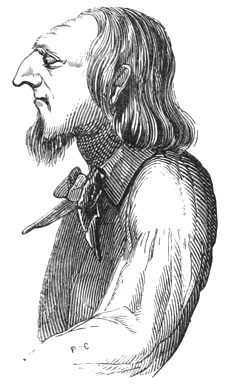
THE DOUBTER.
Once, when the dyspepsia was bad on me, I went to
bed rayther low-spirited, and began to think I was going
to die. I thought I couldn't live till morning. My
stomach was as hard as a brick-bat, and I was cold all
over. The more cover I piled on, the colder I got. The
minute I shut my eyes, I was scared to death at the
darkness. I felt as if something dreadful was going to
happen, and didn't know exactly
what it was. Sometimes I
thought robbers were under the
bed, and sometimes I heard
strange noises about the house.
My heart stopped beating altogether;
I felt for my pulse, but
couldn't find it in my wrists or
any where else. Every bit of
blood seemed to have oozed out
of me in some mysterious way,
and to all intents and purposes
my body was dead. There was
no dream about it. I could move
my limbs the same as ever, and
was as wide awake as I am this
minute; but there was no sign of life about me except
that my mind had power to move the dead flesh; for it
was cold and clammy as that of a corpse. Any body
else would have given up, and concluded he was a genuine
corpse; but you see I was not the sort of man to believe
such a thing as that without farther proof. I therefore
lay still a while, in hopes I'd get warm by-and-by,
and feel better; but I kept growing colder and colder,
and at last was so cold that I felt like ice all over. I
had the most dreadful and gloomy reflections. Every
thing I thought about seemed blue, and dreary, and hopeless;
every body unhappy; and the whole future a desert
waste, without one ray of light. Despair was upon me;
I cared for nothing; it was all the same to me whether
I lived or died. I wanted neither help, nor pity, nor
love, nor life—all, all was wrapped in despair. The
gloom of this state brought on a kind of lethargy; a total
unconsciousness of every thing external. My mind
only existed and operated, as it were, in perfect darkness.
The body was nothing but a type of intense darkness
and coldness wrapped around the spirit. In this state I
at length heard whisperings in the air, outside of me as
I thought. They drew nearer; the voices were strange
and unnatural; I was conscious of a singular sensation,
for a time, as if whirled rapidly through space; then I
heard the voices say, in low tones, "How cold he is!
how miserably cold he is! but we'll soon warm him!"
I now became sensible of strong gases in the air, but they
produced no farther impression than the mere consciousness
of their existence. Wild shrieks and moans, and
dreadful hissing sounds arose around me. "Here we
are," said the voices; "glad of it, for he's terribly cold."
"Put him there in that big furnace; it'll soon warm
him," said another voice, in a tone of authority. I was
then tossed, as I thought, some distance, and became
suddenly still; but the same cold and impenetrable darkness
was around my spirit. "There, that fire's out!"
said the voice, angrily; "put him in another, and keep
him well stirred up." Again there was a movement,
and again I was still, but not so still as before, for I was
conscious of a jarring sensation. "Out again!" roared
the same voice, fiercely. "Out again! you don't keep
him well stirred up!" "He's as cold as ice," said the
other voices; "we can't do any thing with him." "Try
him in the middle furnace!" said the chief voice, sternly;
"that'll melt the ice out of him!" Again I was
whirled through the gases and deposited in some imperceptible
place; but all this time I was growing colder
and colder. There was a pause, and then the voices
said, "He won't burn, sir; don't you see he's putting the
fire out." "Out again, by all the demons!" roared the
chief voice, furiously. "Take him away! Carry him
back to where you got him. The man's dyspeptic. We
can't have such a miserable wretch here! By Pluto!
he'd put out every fire we've got in a week. Bear a
hand, you rascals! for may I be blessed if I ain't freezing
myself!" Here the Doubter paused.
"Well, sir, well," said Abraham, ironically, "have
you any thing further to say on the same subject? any
thing equally reliable? Perhaps you can inform us how
you got warm again?"
"Well, that doesn't properly belong to the story,"
said the Doubter, looking around meaningly upon the
company. "I meant that it should end there; but, if
you insist upon it, I'll answer your question."
"Of course, sir; the matter requires explanation. It
comes to rather an abrupt conclusion."
"The way I got warm, then, was this: I picked up a
skull when I was leaving the premises. It was full of
hot glue. The fellows that were carrying me got their
hands frostbitten and had to let go at last. I fell on an
island. The first thing I struck was the top of a mountain.
I slid down for three miles without stopping. On
the way I broke the skull, and spilled the glue all over
me, which made me slip so fast that I was quite warm
by the time I got to the bottom."
To this Abraham made no reply. Turning away from
the Doubter with ferocity and indignation depicted in
every feature, he looked silently around upon the company;
his breast heaved convulsively; his hands grasped
nervously at the hair upon his goatskin; he deliberately
tore it out by the roots; he suppressed a rising smile
upon the face of every individual in the party by one
more look at the Doubter—one terrible, scathing, foreboding
look of vengeance on the morrow; and then
said, in a suppressed voice, "Gentlemen, suppose we turn
in; it must be twelve o'clock."
BAD DREAM CONCERNING THE DOUBTER.
As well as we could judge, Abraham was right in regard
to the time; and being all tired, after the story of
the dyspeptic man we set about arranging our quarters
for the night. I must admit, however, take it all in all,
not omitting even the drawbacks to our enjoyment occasioned
by the unfortunate state of things between my
friend and the Doubter, and the probability of a hostile
meeting in the morning, that from the time of leaving
home, four months before, I had not spent so pleasant an
evening. It was something to look back to with gratification
and enjoyment all the rest of the voyage, should
we indeed ever be able to resume our voyage.
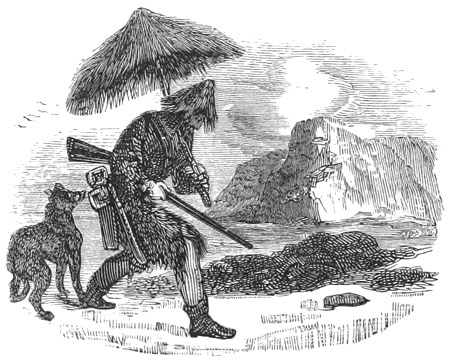
THE FOOTPRINT IN THE SAND.
Pearce now pulled down an additional lot of goatskins
from the rafters, which we spread on the ground so as
to make a general bed; and having piled some wood on
the fire and bolted the door, we stretched ourselves in a
circle, with our feet toward the blaze, and made a fair
beginning for the night. It was only a beginning, however,
so far as I was concerned, for not long after I had
closed my eyes and begun to doze, some restless gentleman
got up to see if there was any Spaniards trying to
unbolt the door; and in stepping over me he contrived
to put one foot upon my head, just as I was trying to
get from under a big rock that I saw rolling down from
the top of a cliff. I was a good deal astonished, upon
nervously grasping at it, to find that it was made of
leather, and had a human foot in it, and likewise that it
had a voice, and asked me, as if very much frightened,
"What the deuce was the matter?" This again, upon
falling into another doze, brought to mind the footprint
in the sand, which occasioned me the greatest distress
and anxiety. I tried to get away from it, but wherever
I went I saw that fatal mark; in the mountains, in the
valleys, in the caves, on the rocks, on the trees, in the
air, in the surf, in the darkness of the storm, I saw that
dreadful footprint; I saw it, through the dim vista of
the past, upon the banks of the Ohio, where I had played
in boyhood; I saw it again in my first bright glowing
dream of the island world, when, with the simplicity of
childhood, I prayed that I might be cast upon a desolate
island; I saw it in the cream-colored volume—every
where—back in childhood, in youth, now again in manhood—from
the first to the last, at home, abroad—wherever
thought could wander, I saw that strange and wondrous
footprint.
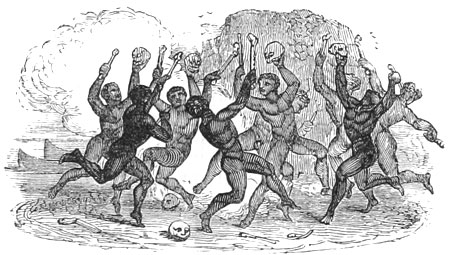
THE SAVAGE ORGIES.
In trying to get up the cliff where I could look out
for the savages, I fancied the tuft of grass that I had
hold of gave way, and I rolled over the precipice into
the sea; and this was not altogether an unfounded idea,
for I actually had worked myself off the goatskin, and
was at that moment paddling about in a sea of mud.
Again I fell asleep, and a great many confused visions
were impressed upon my mind. I saw the savages down
on the beach, going through all their infernal orgies.
They had seized upon my comrades, and were roasting
them in flaming fires, and eating the fattest of them with
great relish. The flesh of the Doubter, I thought, was
so lean and tough that they were unable to eat it; but
they stripped it off in long flakes, and hung it round
their necks, and danced with it swinging about their
bodies, as if they regarded it as the finest ornament in
the world. His head was cut off and scalped, and his
skull lay upon the ground. I thought Abraham had
changed again into Friday, and I called upon him to
look at this dreadful scene, and help me to kill these
wretched cannibals; but no sooner did he catch sight of
the Doubter's skull, than he ran from me toward the
spot, and picked it up with a horrible shout of triumph,
and sticking his gun into it he held it in the air, and
danced all round in a circle laughing like a devil. The
Doubter, perceiving this in some strange way (for he
was without a head), jumped to his feet, with his fleshless
bones, and ran after Abraham, making signs for his
skull; but Abraham only laughed the louder and danced
the more, thrusting the skull at him as he jumped about,
and asking him, in a sneering voice, what he thought of
it now? was it a dog's skull yet? would he like to have
it fastened on again with glue? how had he contrived
to keep out of the fire? were the savages afraid he
would put it out? did his present exercise warm him?
each of which taunting questions he ended with a wild
laugh of derision, and a snatch of his favorite song—
"Tinky ting tang, tinky ting tang,
Oh, poor Robinson Crusoe!"
This, I thought, so incensed the Doubter that he turned
away in disgust, and walked off shaking his neck as if it
had the head still on; and when he was some distance
from Abraham he sat down on the ground and slowly
raised his right hand, placing the thumb where his nose
would have been had the head still remained in its place,
and then his left hand in the same way, fixing the thumb
upon the little finger of the other, and thus he waved
them to and fro, as if he had no confidence even in his
own skull or in any of the circumstances connected with
it. While this was going on, the savages continued
their infernal dance on the beach. I now raised my gun
and began shooting at them, killing them by scores. I
could see their dark bodies roll over into the surf, and
hear their yells of terror at the report of the gun; and
when I rushed down to save my shipmates, all I could
see was Abraham sitting upon a rock, pounding the
skull into small fragments with a big stone which he
held in both hands, and the fleshless body of the Doubter
sitting opposite to him, slowly waving the little finger
of his left hand at him in the same incredulous and
taunting manner as before. And thus ended the dream.
THE UNPLEASANT AFFAIR OF HONOR.
When I awoke it was daylight. My mind was still
harassed with the bad dream concerning the Doubter.
I had the most gloomy forebodings of some impending
misfortune either to him or my friend Abraham. Every
effort to shake off this unpleasant feeling proved entirely
vain; it still clung to me heavily; and, although I was
now wide awake, yet it seemed to me there was something
prophetic in the dream. Unable to get rid of the
impression, I got up, and looked around upon my comrades,
who were all sleeping soundly after their rambles
of the previous day. Instinctively, as it were, for I was
unconscious of any fixed motive, I counted them. There
were only nine! A sudden pang shot through me, as
if my worst fears were now realized. But how? I
thought. Where was the tenth man? What had become
of him? Was it Abraham? Was it the Doubter?
Who was it? for the light was not strong enough to
enable me to distinguish all the faces, partly hidden, as
they were, in the goatskins. I looked toward the door;
it was unbolted, and slightly ajar. I opened it wide and
looked out; there was nothing to be seen in the gray
light of the morning but the bushes near the hut, and
the dark mountains in the distance. It was time, at all
events, to be on the look-out for the ship, so I roused up
my comrades, and eagerly noticed each one as he waked.
The Doubter was missing! Could it be possible that
Abraham's threats had driven him to run away during
the night, when all were asleep, and hide himself in the
mountains? There seemed to be no other way of accounting
for his absence. "Where is he? what's become
of him? maybe he's drowned himself!" were the
general remarks upon discovering his absence. "Come
on! we must look for him! it won't do to leave him
ashore!" We hurried down to the boat-landing as fast
as we could, thinking he might be there; and on our
way saw that the ship was still in the offing. The boat
was just as we had left it, but not a soul any where near.
We then roused up every body in the Chilian quarter,
shouting the name of the missing man in all directions.
He was not there! All this time Abraham was in the
greatest distress, running about every where, without
saying a word, looking under the bushes, peeping into
every crevice in the rocks, darting in and out of the
Chilian huts, greatly to the astonishment of the occupants,
and quite breathless and dispirited when he discovered
no trace of our comrade. At last, when we
were forced to give up the search and turn toward
Pearce's hut, where we had left our host in the act of
lighting the fire to cook breakfast, he took me aside, and
said, "Look here, Luff, I'm very sorry I had any difficulty
with that poor fellow. The fact is, he provoked
me to it. However, I have nothing against him now;
and I just wanted to tell you that I sha'n't go aboard the
ship till I find him. If you like, you can help me to hunt
him up, while the others are seeing about breakfast."
"To be sure, Abraham," said I, "we must find him,
dead or alive. I'll go with you, of course. But tell me,
as we walk along, what it was Pearce said to you last
night. How did you get him back when he went
out?"
"Oh, never mind that now," replied Abraham, looking,
as I thought, rather confused.
"You gave him a dollar, didn't you?" said I; "what
was that for?"
"Why, the fact is, Luff, he made those marks himself
in some idle hour as he lay basking in the sun up there.
He told me that he often spends whole days among the
cliffs or sleeping in the caves, while his sheep are grazing
in the valleys. You may have noticed that he was
rather inclined to burst when he left the hut. The fellow
had sense enough not to say any thing before the
company. I thought it was worth a dollar to keep the
thing quiet."
"It was well worth a dollar, Abraham; but the skull—what
about the skull?"
"Oh, the skull? He said he picked it up one day outside
the cave, and hove it up there, thinking it would do
for a lamp some time or other. What excited me so
when our shipmate spoke about it was that he should
call it a dog's skull."
"And wasn't it?"
"Why, yes; to tell the truth, Luff, it was the skull of
a wild dog; but you know one doesn't like to be told
of such a thing. However, we must look about for the
poor fellow, and not leave him ashore."
By this time we had reached an elevation some distance
back of the huts. We stopped a while to listen,
and then began shouting his name. At first we could
hear nothing; but at length there was a sound reached
our ears like a distant echo, only rather muffled.
"Halloo!" cried Abraham, as loud as he could.
"Halloo!" was faintly echoed back, after a pause.
"Nothing but an echo," said I.
"It doesn't sound like my voice," observed Abraham.
"Halloo! where are you?" he shouted again, at the
highest pitch of his voice. There was another pause.
"I'm here!" was the smothered reply.
"That's a queer echo," said Abraham; "I'll bet a
dollar he's underground somewhere. Halloo! halloo!
Where are you?" This time Abraham put his ear to
the ground to listen.
"Here, I tell you!" answered the voice, in the same
smothered tones. "Down here."
"He's not far off," said Abraham. "Come, let us
look about."
We immediately set out in the direction of the voice.
The path made a turn round a point of rocks some few
hundred yards distant, on the right of which was a steep
precipice. On reaching this, we walked on some distance,
till we came to a narrow pass, with a high bluff
on one side, and a large rock on the edge of the precipice.
The path apparently came to an end here; but
upon going a little farther, we saw that it formed a kind
of step about three feet down, just at the beginning of
the narrow pass, between the rock and the bluff, so that
in making any farther progress it would be necessary to
jump from the top of the step, or, in coming the other
way, to jump up. It was necessary for us, at least, to
jump some way before long, for upon arriving at the
edge we discovered a pit about four feet wide at the
mouth, and how deep it was impossible for us to tell at
the moment. We thought it must be rather deep, however,
from the sepulchral sounds that came out of it.
"Here I am," said the voice, "down in the hole, here,
if I ain't mistaken, but I wouldn't swear to it; I may be
somewhere else: it feels like a hole—that's all I can say
about it, except that it's tolerably deep, and smells of
goats."
"A goat-trap!" exclaimed Abraham, in undisguised
astonishment. "By heavens, Luff, he's caught in a goat-trap!"
"It may be a goat-trap, or it may not. I want you to
observe that I neither deny nor affirm the proposition.
There's not much room in it, however, except for doubt."
"How in the world are we to get him out?" cried
Abraham, whose sympathies were now thoroughly
aroused by the misfortune of his opponent. "We must
contrive some plan to pull him out. Hold on here, Luff;
I'll go and cut a pole."
While Abraham was hunting about among the bushes
for a pole of suitable length, I sprang over to the other
side of the pit, and, getting down on my hands and knees,
looked into it, and perceived that it spread out toward
the bottom, so that it was impossible to climb up without
assistance.
"This is rather a bad business," said I; "what induced
you to go down there?"
"I didn't come down here altogether of my own will,"
replied the Doubter; "credulity brought me here—too
much credulity; taking things without sufficient proof;
assuming a ground where no ground existed."
"How was that? I don't quite understand."
"Why, you see, I happened to come along this way
about an hour ago, to see if the sun rose in the north,
and not dreaming of goat-traps, I took it for granted
that I could jump down a step in the path apparently
not more than three feet deep. There's where the mistake
was. A man has no business placing any dependence
upon his eyes without strong collateral evidence
from all the rest of his senses. I assumed the ground
that there was ground at the bottom of the step. Accordingly,
I jumped. There was no ground for the assumption.
To be sure I descended three feet, according
to my original design; but I descended at least twelve
feet more, of which I had no intention whatever. The
fact is, there was some rotten brushwood, covered with
straw and clay, over the mouth of the pit, which I went
through without the least difficulty."
"Are you hurt?" said I, anxiously.
"Well, I was considerably stunned. Likely enough
some of my ribs are broken, and several blood-vessels
ruptured; but I won't believe any thing more for some
time. I've made up my mind to that. I may or may
not be hurt, according to future proof."
By this time Abraham came running toward the pit
as fast as he could, with a long pole in his hand, which
he had cut among the bushes.
"This is the best I could get," said he, nearly breathless
with haste, and very much excited; "there were
some others, but I didn't think they were strong enough."
Without farther delay, he sprang across the pit to the
lower side, and thrust the pole down as far as he could
reach. It must have struck something, for he immediately
drew it back a little, and the voice of the Doubter
was heard to exclaim, in a high state of irritation,
"Halloo, there! What are you about? Confound
it, sir, I'm not a wild beast, to be stirred up in that
way."
"Never mind," said Abraham, "I didn't intend to
hurt you. Take hold of the pole. I'll pull you out.
Take hold of it quick, and hang on as hard as you can."
"No, sir; it can't be done, sir. I'll not take hold of
any thing upon an uncertainty."
"But there's no uncertainty about this," cried Abraham,
in a high state of excitement; "it's perfectly safe.
Take hold, I tell you."
"Can't be done, sir, can't be done," said the Doubter;
"there's not sufficient proof that you'll pull me out if I
do take hold. No, sir; I've been deceived once, and I
don't mean to be deceived again."
"Now, by heavens, Luff, this is too bad. He doubts
my honor. What are we to do?" And Abraham
wrung his hands in despair. "Halloo, there, I say—halloo!"
"Well, what do you want?" answered the voice of the
Doubter.
"I want to pull you out. Surely you don't think I'll
be guilty of any thing so dishonorable as to take advantage
of your misfortune?"
"I don't think at all," said the Doubter, gloomily;
"I've given up thinking. You may or may not be an
honorable man. At present I have nobody's word for
it but your own."
Here I thought it proper to protest that I knew Abraham
well; that there was not a more honorable man living.
"Besides," I added, "there's no other way for you
to get out of the pit."
"Very well, then," said the Doubter; "I'll take hold,
but you must take hold too, and see that he doesn't let
go. Pull away, gentlemen!"
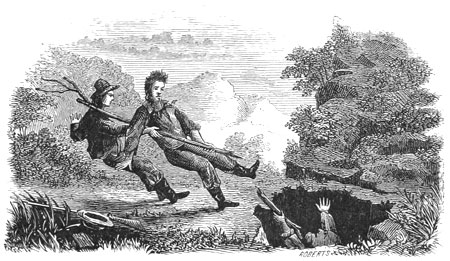
THE DOUBTER BACK AGAIN.
Abraham and myself accordingly pulled away as hard
as we could, and in a few moments the head of our comrade
appeared in the light, a short distance below the
rim of the pit. I had barely time to notice that his hair
was filled with straw and clay, when Abraham, in his
eagerness to get him entirely clear of danger, made a
sudden pull, which would certainly have accomplished
the object had the Doubter come with the upper part
of the pole. But such was not the case. On the contrary,
both my friend and myself fell flat upon our backs;
and upon jumping up, we discovered that the Doubter
had fallen into the pit again, carrying with him the lower
end of the pole, which had unfortunately broken off at
that critical moment. There he lay in the bottom of the
pit, writhing and groaning in the most frightful manner.
"He's killed! he's killed!" cried Abraham, in perfect
agony of mind. "Oh, Luff, to think that I killed him at
last! It was all my fault. Here, quick! Lower me
down! I must help him!"
Before I had time to say a word, Abraham seized hold
of my right hand, and, directing me to hold on with all
my might, he began to let himself down into the pit. It
required the utmost tension of every muscle to bear his
weight, but the excitement nerved me. "Let go, now!"
said he, as soon as he got as far down as I could lower
him without lowering myself, which I narrowly escaped;
"let go, Luff!" I did so, and heard a dull, heavy fall,
and a groan louder than before.
"What's the matter, Abraham—did you hurt yourself?"
"Not myself," said Abraham, "but I'm afraid I hurt
him. I fell on him."
"You did," groaned a voice, faintly, "you fell on me.
I'm tolerably certain of that. It was a shabby trick,
sir; it wasn't bad enough to throw me down here, without
jumping on top of me when I couldn't defend myself!"
"I hope you're not much hurt," said Abraham; "it
was all accident—I swear it, on my sacred honor!"
"Honor!" groaned the Doubter, contemptuously; "is
it honorable to drop a man into a pit, and knock all the
breath out of his body, and then jump on top of him!
Honor, indeed! But it was my own fault: I was too
ready to take things without proof."
"Now, by all that's human!" cried Abraham, stung to
the quick at these unmerited reproaches, "I'll prove to
you that I didn't mean it. Get up on my shoulders—here,
I'll help you—and climb out. Would any but an
honorable man do that?"
"It depends upon his motives," replied the Doubter;
"I won't take motives on credit any more. I'm not going
to get up on your shoulders, and have you jump
from under me about the time I get hold of something
above, and leave me to fall down and break my back, or
hang there. No, sir, I want no farther assistance. I've
made up my mind to spend the remainder of my days
here."
"You sha'n't stay here!" cried Abraham, exasperated
to the last degree by these taunts. "By heavens, sir,
you shall be assisted!"
Here there was a struggle in the bottom of the pit;
the Doubter writhing like an eel all over the ground in
his attempts to elude the grasp of Abraham; but soon
he was in the powerful arms of my friend, who, holding
him up, shouted lustily, "Catch hold of him, Luff!
Catch him by the hair or the coat-collar! Hold on to
him, while I shove him up!"
The writhing form of the Doubter at the same moment
loomed up in the light, and I called upon him to
give me his hands; but he resolutely held them down,
protesting that he would trust no man for the future;
that he'd die before any body should deceive him again.
In this extremity, driven almost frantic in my zeal for
his safety, I grasped at the collar of his coat, and succeeded,
after some difficulty, in getting a firm hold of it.
"All right!" I shouted; "push away now, Abraham!"
In spite of every exertion on Abraham's part, however,
our unfortunate comrade rose no higher, which I can
only account for by the depth of the pit. "A little
higher, Abraham—just two inches—that's it—all right!"
It certainly was all right so far; I had drawn him partly
over the edge, and would eventually have drawn him
entirely over, had it not caved in, by reason of the united
weight of both on it at the same time, and thus the matter
was prevented from being all right to any greater
extent. The consequence of this disaster was, that we
both fell heavily upon Abraham, who, unable to bear our
united weight, fell himself under the Doubter, while I,
being uppermost, formed a kind of apex to the pyramid.
Our fall was thus broken in some measure; and, although
Abraham groaned heavily under our weight,
yet, as fortune would have it, nobody was hurt. The
Doubter was the first who spoke.
"I told you so!" said he, faintly; "but you would try.
You would try, in spite of all I could say, and now you
see the consequence. It appears to me that there are
three men caught in a goat-trap now instead of one; but
I'll not insist upon it; there may be only one. My eyes
have deceived me already, and likely as not they deceive
me now."
"No, they don't," said Abraham, in smothered tones;
"I'm quite certain there are two of you on top of me.
Get off, if you can, for I can't breathe much longer in
this position. You may depend upon it, there are three
of us here."
"I shall depend upon nothing for the future," replied
the Doubter, gloomily; "I depended upon a pole just
now, and was dropped; I put faith in that pole, and both
the faith and the pole were broken at the same time, and
my back too nearly, if not quite broken."
"But I'm not a pole," groaned Abraham, "you may
depend upon that. Get off now, do, for heaven's sake."
"You don't feel like a pole," said the Doubter, "but
you may be one, for all I know; there's no telling what
you are. However, I'll get off, lest you should break
likewise."
I had already relieved Abraham of my weight; and
being now entirely free, he got up, and we began to consider
how we were to get out of the pit.
As good luck would have it, we heard some voices approaching,
which we soon discovered to be a couple of
Chilians, to whom the trap belonged, coming thus early
in the morning to see if it had caught any goats. When
they looked over and saw the earth broken in, they were
greatly rejoiced; but no sooner did they perceive that
the game consisted of three full-grown men, than they
ran away as fast as they could, shouting "Diabolo!
Diabolo!" Abraham, who had been studying Spanish
during the voyage, understood sufficient of the language
to call out "Americanos! Americanos! no Diabolo!
Per amore Deos, viene' qui! Amigos! amigos! no
Diabolo!" This caused them to halt; and upon its being
repeated a great many times, they ventured to the
edge of the pit, where Abraham gave them every assurance
that we were three unfortunate Americans, who had
fallen into the trap by accident, and that we were in no
way related to the devil. Upon this, they took a coil of
rope, which they had for pulling up goats, and making a
noose on one end, they let it down. The first man that
was fastened on was the Doubter. It required the united
efforts of Abraham and myself to get him into the
noose; but we eventually had the pleasure of seeing him
go up through the hole without farther accident. I then
yielded reluctantly to Abraham, who insisted, as a point
of honor, that he should be the last man. Being light, I
was whirled out in a twinkling; and, finally, through
this providential turn of affairs, we were all safely landed
outside of the pit. The two Chilians, unable to divine
the causes which had led to this singular state of things,
looked on as if still half afraid that they had pulled some
very bad characters out of the ground, muttering, as we
shook the dirt off our clothes, "Madre de Deos! Santa
Maria! Padre bonita!" I considered this a fitting
opportunity, in view of the happy issue of the disaster,
to effect a full and complete reconciliation between Abraham
and the Doubter, and therefore proposed that they
should shake hands on the spot, and forego all future
hostilities. My friend immediately held out his hand in
the frankest manner; the Doubter hesitated a moment,
as if afraid that it might result in his being pulled back
again into the pit; but, unable any longer to resist the
hearty sincerity of his opponent, he gave his hand, and
suffered it to be shaken; and so rejoiced was Abraham
in finding every thing was thus happily settled, that he
shook on with all his force for at least five minutes, during
which the two Chilians, knowing no good reason
why a pair of strange gentlemen, just pulled out of a
goat-trap, should stand shaking hands with one another,
exhibited the utmost surprise and consternation, exclaiming,
as before, "Madre de Deos! Santa Maria! Padre
bonita!"
We contrived to make up the sum of a dollar between
us, which we gave to the men, telling them, at the same
time, that they need not mention this matter, should they
see any of our companions before we left the island. We
then started for Pearce's hut, which we soon reached.
The rest of the party had finished breakfast, and were
waiting for us at the boat-landing. They had left directions
with Pearce that we were to follow without delay,
with or without the missing man, as the ship had made
a signal for us to come aboard. While the Doubter and
myself were making a hasty snack, Abraham took a piece
of bread and meat, and started off to let our friends know
that we had found the missing man, and would soon be
down. In a few minutes we concluded our snack, and
were about leaving the cabin, when Pearce said he reckoned
some of us had left a bundle, which he had found
in the corner. The bundle consisted of a handkerchief
tied up, with something in it, which I quickly discovered
to be the relic we had found in Crusoe's Cave.
"Where did you get that?" said Pearce.
"We dug it up in Crusoe's Cave; it was made by
Alexander Selkirk."
"No it wasn't; it was made by me. I lived there a
while when I first came on the island, and made it myself.
I know the mark. I made it about a year and a
half ago."
"But how is that?" said I, greatly astonished; "it
looks to be over a century and a half old."
"It wasn't baked enough," said Pearce; "that's the
reason it didn't keep well. The name's broke off, but
there's part of what I writ on it."
"Impossible!" said I. "Don't you see "A S....
170—?' What can that be but Alexander Selkirk, 1704,
which was just the time he lived here!"
"No, 'taint; Alexander Selkirk never made that 'ere.
I made it myself. I put my name on it; but the name's
broke off. I writ, 'A Saucepan maid by W. Pearce, 17
Oct.' That's all. 'Taint no use to me now; you may
take it, ef you want to."
I took it without saying another word; tied it up
again in the handkerchief, and asked Pearce if he was
going down with us to the boat-landing. He said he
would be down there presently. So, without farther delay,
we set out to join our companions. As we walked
rapidly along the path, my shipmate suffered strange
sounds to escape from his throat, indicative of his feelings.
Suddenly he stopped, as if unable to restrain himself
any longer.
"Where are you going?" said he.
"Going aboard, to be sure; come on, they're waiting
for us."
"You are, eh? going aboard, eh? Well, any thing to
humor the idea. It sounds very like reality, indeed—very."
"And why shouldn't it?" said I.
"Of course, why shouldn't it? Look here, Luff, you're
rather a clever sort of fellow."
"Do you think so?" said I, a little embarrassed at so
abrupt an opinion in my favor.
"Yes, I do," said the Doubter; "I always did. Will
you just have the goodness to look into my mouth (opening
it at the same time as wide as he could). Now, just
cast your eyes into this cavity."
I did as he desired me, thinking perhaps the poor fellow
was suffering from his fall into the goat-pit.
"Well," said I, "there's nothing there, so far as I can
see, except a piece of tobacco. Your tongue looks badly."
"It does, eh? No matter about that. This is what
I want you to notice: that I have a tolerably big swallowing
apparatus, but I'm not the style of man that's calculated
to swallow an entire island. Possibly I might
get down a piece of a skull, or an old saucepan, with a
grain of salt; but I can't swallow Juan Fernandez, with
Robinson Crusoe and Alexander Selkirk—two of the biggest
liars that ever existed, on top of it. No, sir, it can't
be done."
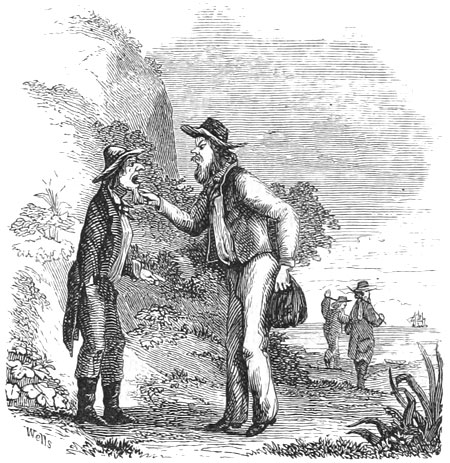
SWALLOWING AN ISLAND.
I thought myself that he was not a person likely to
accomplish a feat of that kind, for his throat was not uncommonly
large, and his digestive organs appeared to be
weakly.
"No, I shouldn't think so," said I. "You don't look
like a man that could swallow so much."
"Very well, then; I'm willing to humor the idea. I'll
imagine we're going aboard from Juan Fernandez, if
you like. But the island doesn't exist! No, sir; it reads
very well on paper; it's a very romantic place, no doubt—if
any body could find it; a very pleasant spot for a
small tea-party between a pair of wandering vagabonds;
but it doesn't exist any where else but on the maps.
Don't you ever try, Luff, to make me believe that any
of these things which we imagine to have occurred within
the past three days have the slightest foundation in
fact."
I was not prepared to go to the full extent of denying
the entire existence of the island; but, I must confess,
there was a good deal in our experiences of the past
three days calculated to inspire doubt; so much, indeed,
that I hardly knew what to believe myself. Even now,
after the lapse of four years, and the frequent repetition
of all these adventures to my friends, which has given
something more of reality to the doubtful points, I would
hardly be willing to swear to more than the general outline;
nor am I quite certain that even the main incidents
would stand cross-examination in a Court of Doubters.
Such, reader, is the deceptive nature of appearances!
While we were talking, Pearce overtook us with a bundle
of goatskins which we had bargained for the night
before, and we all went down to the boat-landing together.
There we found our shipmates all ready to start.
The Anteus was lying-to about eight or ten miles off,
outside the harbor; and the sea being rather rough, we
thought it best to agree with Pearce for some seats in
his boat, and hire a couple of the Chilians to help us at
the oars. In this way, having stored all our relics in the
bow of the boat except the earthen pot, which we had
the misfortune to drop overboard, we set out for the
ship, bidding a general good-by to Juan Fernandez and
all its romantic vales with three hearty cheers. A few
heavy seas broke over us when we got outside the harbor;
and we saw the Brooklyn weighing anchor and preparing
to stand out to sea, and a small brig that we had
met in Rio beating in; but, with the exception of these
little incidents, nothing occurred worth mentioning till
we arrived alongside the Anteus. The captain and all
the passengers received us in silence; not a word was
spoken by any body; no sign of rejoicing or recognition
whatever took place as we stepped on board. We
thought it rather a cool termination to our adventures,
and could only account for it by supposing that this was
the way people thought to be dead and buried are usually
treated when they come unexpectedly to life again
after a great deal of grief has been wasted upon them.
Nor were we wrong in our conjectures; for in about five
minutes our friends on board, including the kind-hearted
captain, finding themselves entirely unable to keep up
such a state of displeasure, crowded around us in different
parts of the ship, and began shaking hands with us
privately, and asking us a thousand questions about Juan
Fernandez and Robinson Crusoe. We introduced our
worthy host as the real Crusoe of the island, and brought
both him and the Chilians down into the cabin, where we
gave them as much as they could eat, besides honorably
acquitting ourselves of our indebtedness by paying our
friend Pearce all the ham and bread we had promised
him, and loading him with sundry presents of clothing
and groceries. The captain then ordered the yards to
be braced; the boat swung off as we began to plow our
way once more toward the Golden Land, and before
noon the island was blue in the distance.
DOCTOR STILLMAN'S JOURNAL.
I have been kindly permitted to select the following
from the private journal of Dr. J. D. B. Stillman, of New
York, an intelligent fellow-passenger on the Anteus. It
will give some idea of the state of feeling on board during
our absence.
"Sunday, May 20th. Eleven passengers left the vessel
yesterday in a small boat, with the intention of going
ashore on the island of Juan Fernandez for fruit and fresh
provisions. At first they made but little progress ahead
of the ship, but the wind soon fell away entirely, and
about noon the boat could not be seen from the mast-head.
Another party of eight passengers prepared to
start about two o'clock this morning. The captain, however,
was so uneasy at the absence of the other boat, that
he refused liberty. Lights were kept burning in the rigging
during the night. Toward morning a breeze sprung
up. Short sail was carried for fear the boat should attempt
to reach us and miss her way. At sunrise it was
again calm. The islands loomed higher, but nothing
could be distinguished. At 11 A.M. a stiff breeze sprang
up from the direction of Masatierra, and the day was
spent in beating to windward, and straining our eyes in
the hope of discerning some traces of our lost comrades.
The wind continued to freshen all day. At 8 P.M. the
sea was quite rough. No light could be seen on the
shore. The captain, who is well acquainted with the island,
says if they attempted to land on the south side
they would be inevitably swamped, and some or all lost,
as the shore is rock-bound, and the only safe landing is
on the north side, fifteen miles farther on. The probability
is that they were too much exhausted to attempt
landing, and night would have fallen before they could
have reached the land at any rate. I am confident in the
opinion that they are on the north side of the island, and
that they lay all last night on their oars, and landed this
morning, too much exhausted to attempt returning the
same day. I have great confidence in some of the company;
but to-night gloom is general, and a fearful presentiment
seems to rest upon the minds of all that we
shall soon have to record a melancholy casualty.
"Monday, 21st. The wind this morning is blowing
very fresh. We have been all day beating nearer the
island. Objects are quite distinct on the south shore.
It is very high and nearly barren. Indeed, so steep are
the lofty mountain sides that there does not appear to
be soil enough adhering to the rocks to support a spire
of grass, except near the summits, which are over a thousand
feet in height where they rise near the water; and
every where, so far as we can see, the shore is rock-bound,
upon which the surf beats fearfully. They could not be
so wild as to attempt landing on this side. To-night the
wind blows a gale, and we shall be compelled to await a
change before we attempt the windward side. Hopes
are getting faint. The distress of those who are most
interested in the parties is great. Some of our best men
were of the company. In fact, it is a question which has
absorbed all others, What has become of the boat? To-night
I have rather congratulated myself that I did not
go. To add to our perplexity, the air is becoming thick,
and rain is coming on. The clouds hang heavy and dark
over the mountains. At nightfall the wind suddenly
changes to S.W. The ship is put about, and run for the
north side of the island.
"May 22d. While I was writing last night, a loud
shout called us all in great haste on deck. A light had
been discovered on the shore, and hearty cheers expressed
the deep anxiety of all, now in a great measure
relieved. There was no doubt that they had reached
the shore, and that some of the number were surviving.
I felt assured that all was right. Signals were set from
the rigging, and the vessel lay to during the night. At
dawn of day we were twenty miles distant from the island.
Made all sail and stood in for the harbor. As we
neared the shore, discovered a large ship at anchor, and
a brig rounding the western point. Soon after, we distinguished
the tiny sail of our lost boat making for the
ship. The captain, in order to show a proper resentment
for the disobedience of orders, directed that no demonstrations
of joy should be made; and, as they came
alongside, they were received in silence."
The shades of evening were gathering upon the horizon.
A murmur of life arose from the decks, but it fell
unheeded upon my ear. For now, and for many days
and nights in our dreary voyage, there was no life for
me but in the past. I felt that my happiest hours were
there.
Once more I turned to look upon the dim island that
was fading away in the south. A steady breeze wafted
us onward; the sun's last rays yet lingered in the sky;
twilight hung upon the ocean, and its gentle spirit
"Rendered birth
To dim enchantments—melting heaven to earth—
Leaving on craggy hills and running streams
A softness like the atmosphere of dreams."
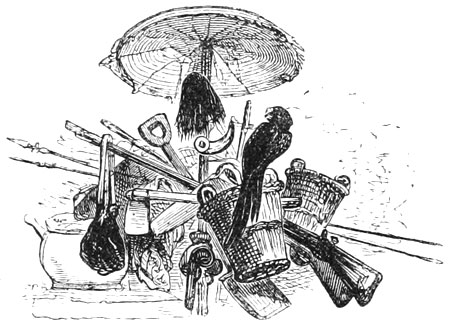
DREAMS AND REALITIES
And was this the last of the island-world? was it to
be in future years a mere dream of the past? was I never
more to behold its wild grottoes and green valleys? was
all the romance of life to fade away with it in the twilight?
was it, like the cream-colored volume, to reveal
enchantments that henceforth could dwell only in the
memory?
Fresh, and fair, and wondrous it was in its romantic
beauty when the mists were scattered away, and I beheld
it for the first time in the glowing light of morning, with
the white sea-foam sparkling on its shores, and the birds
singing in its groves. How rich the air was with sweet
odors; how varied and changing the colors upon the hill-sides;
how softly steeped in shadows were its glens and
woodland slopes—what a world of romance was there!
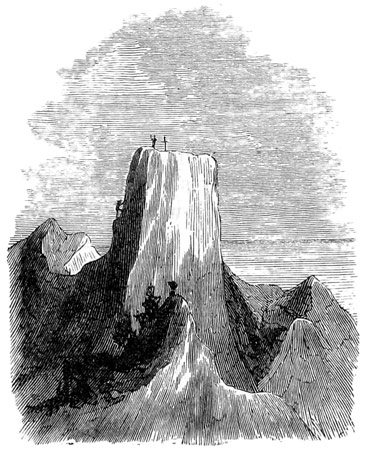
PEAK OF YONKA
I had pressed its sod with my feet; reveled in its
streams; lived again my early life in its pleasant valleys;
passed some happy hours there with friends from whom
I soon must part; and now, what was it? A dim cloud
on the horizon, sinking in the sea, fading away in the
shadows of night.
I looked again; faintly and more faintly still its
mountains loomed above the deep. Weary with gazing,
I closed my eyes, and for a moment I saw it again; but
it was only in fancy. I looked—and it had passed away!
Was it forever?
"And now the light of many stars
Quivered in tremulous softness on the air."
Yet not forever is it lost to me; for often in the busy
world I pause and think of that dream-land in the far-off
seas, and it rises before me as I saw it in the morning
sun, all rich and strange in its beauty; and again I wander
through its romantic vales, and again it brings back
pleasant memories of the cream-colored volume; and as
I look once more, startled from my reverie by the hum
of life, it fades away as it faded then in the shadows of
night, but not forever. Though I never more may behold
it with mortal eyes, yet I see it where distance can
not dim the sight: it hath not passed away forever.
CONFIDENTIAL CHAT WITH THE READER.
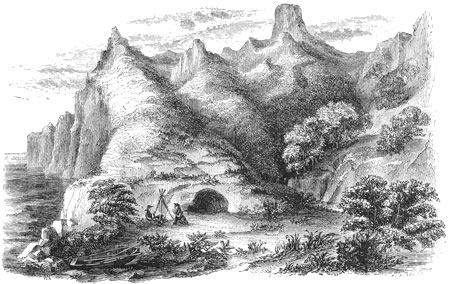
SCENERY OF JUAN FERNANDEZ
Now that we have finished our ramble together, and
formed something of a speaking acquaintance, I hope,
my dear reader, that you will not take it amiss if I hold
you a moment by the button, and say a word in confidence.
It has been so long the custom of adventurers
to speak now and then about themselves, that I assume
the privilege without farther apology. If I have been
so fortunate as to inspire you with a friendly interest in
my behalf during our pleasant wanderings in the footsteps
of Robinson Crusoe, I am sure you will be glad to
learn that it has always been my greatest ambition to
prove myself a worthy disciple of that distinguished adventurer.
In this view I have, as you may have noticed,
adhered to simple facts, and carefully avoided every thing
that might be regarded in the light of fiction, though the
temptation to indulge in occasional touches of romance
was very difficult to resist. Indeed, so thoroughly have
I striven to become imbued with the true spirit of Crusoeism,
that much which I thought at first a little doubtful
myself, now seems quite authentic; and I think, upon
the whole, you may rely upon the truthfulness of my
narrative. That I was near being lost in an open boat,
with ten others, in trying to get ashore on the island of
Juan Fernandez, I conscientiously believe; that we did
get ashore, and sleep in caves and straw huts, and climb
wonderful mountains, and explore enchanting valleys, I
will insist upon to the latest hour of my life; that I have
endeavored faithfully to describe the island as it appeared
to me, and to give a true and reliable account of its
present condition, climate, topography, and scenery, I affirm
on the honor and veracity of a traveler; that in
every essential particular it has been my aim to present
a faithful picture of life in that remote little world, I will
swear to on the best edition of Robinson Crusoe: more
than that it would be unreasonable to expect. If, however,
after this candid avowal, you still insist upon having
a distinct and emphatic declaration in regard to any
doubtful point, all I can say is, that, like the man who
made a statement concerning the height of a certain
horse, I am ready at all hazards to stick to whatever I
said. If I spoke of a mountain as three thousand miles
high instead of three thousand feet, why, in the name of
peace, let it be three thousand miles; if I killed any savages,
I am sorry for it, but they must remain dead—it is
impossible to bring them to life now; if I put some of
my own ideas into the heads of others, it must have been
because I thought them better adapted to the subject
than what those heads contained already, and I hold
myself responsible for them; if at any time I imagined
myself to be the original and genuine Crusoe, with a
man in my service called Friday, I still adhere to it that
no Crusoe more certain than he was himself ever existed
upon that island; if, in short, there is any one point upon
which I have hazarded the reputation of a veracious
chronicler of actual events, or a faithful delineator of
strange scenes in nature, I hereby declare that I shall
most cheerfully return to Juan Fernandez in an open boat
with any ten readers who desire to test the matter by ocular
demonstration, and thus convince the most skeptical
that I have not made a single unfounded assertion.
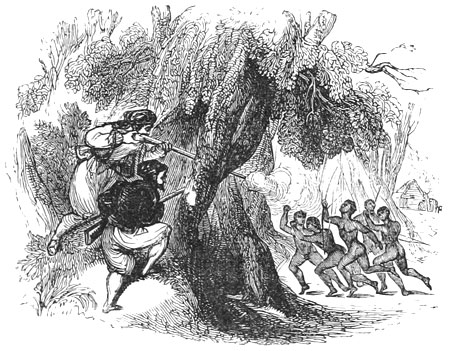
And now, in the hope that we may meet again, I wish
to leave you a trifling souvenir by which to bear me in
mind.
One of the sailors on board the Anteus was kind
enough to make me a suit of clothes out of the goatskins
that I bought of Pearce. He made them according to
a pattern of my own, which I intend some day or other
to introduce in the fashionable circles. I stowed them
carefully away in my berth, but the rats took such a fancy
to them that, by the time I reached California, there
was nothing left but the tail of one goat upon which to
hang a portrait; and I regret to say the accompanying
sketch, taken from memory, affords but an imperfect
conception of the suit as I originally appeared in it. I
trust the apparent egotism of smuggling my likeness into
print in a suit of goatskins, on the pretext of exhibiting
the suit itself, will be excused by the absolute necessity
of filling it up with something. At the same time, I
must be permitted to observe that the stiffness is in the
material and not in the person of the author.
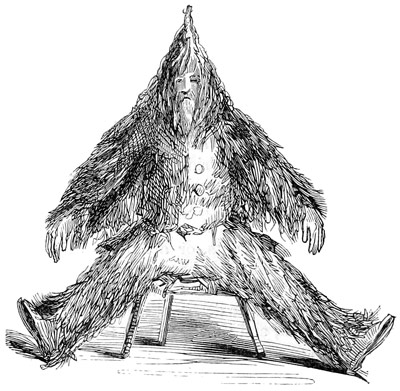
THE AUTHOR À LA ROBINSON CRUSOE.
EARLY VOYAGES TO JUAN FERNANDEZ.
The group known as Juan Fernandez consists of two
chief and several smaller islands, situated in the Pacific
Ocean, about four hundred miles from the coast of Chili,
in latitude 33° 40´ south, longitude 70° west. These islands
were discovered in 1563 by Juan Fernando, a Spanish
navigator, whose name they bear. The largest—lying
nearest to the main land—is that which is commonly
known by the name of the discoverer; it is also called
Masatierra. The length of this island is about twelve
miles, the breadth six or seven. Ninety miles west is
the island of Masafuero, so named to distinguish it from
Masatierra. Both are composed of lofty mountains; the
harbors are small and unsafe, and the shores, for the
most part, are rock-bound. The northern aspect, facing
toward the equator, is slightly wooded, and the valleys
are fertile; but the southern side, toward Cape Horn, is
entirely barren. There are two or three large rocks
included in the group, the chief of which, lying at the
southern extremity of Masatierra, is called Goat Island,
from the great number of goats found there.
According to the early navigators, it would appear
that these islands must have been visited by the Indians
of South America long before their discovery by Juan
Fernando, but it was probably only for the purpose of
fishing and catching seals.
The first attempt to form a regular settlement was
made by Fernando himself, who, elated by his discovery,
and the prospect of colonizing the island, endeavored to
obtain a patent from the government at Lima. Failing
to receive encouragement from the government, he resolved
upon forming a settlement himself; and he visited
the island soon after, taking with him some families, with
whom he resided there a short time. A few goats, which
they carried with them from Lima, speedily stocked the
island; and this is probably the origin of these animals
in Juan Fernandez, as no mention is made of their having
existed there before. Eventually the colony was broken
up by the superior inducements held out to settlers in
Chili, which at this time fell under the dominion of the
Spaniards; and the Spanish authorities of Lima still refusing
to grant a patent to Fernando, he was forced to
abandon all hope of forming another and more permanent
settlement.
For many years subsequently this group was the resort
of pirates and buccaneers, who found it convenient, in
their cruising in the South Pacific, to touch there for
wood and water.
Captain Tasman, a Dutch navigator, sailed from Batavia
in 1642, and visited Juan Fernandez in 1643. A
translation of his narrative, in Pinkerton's Collection,
contains an entertaining account of the island at that
period. He dwells enthusiastically upon the advantages
of its position, the salubrity of the climate, the fertility
of the soil, and strongly urges upon the Dutch East India
Company the policy of forming a settlement there, as a
dépôt for their commerce in the Pacific.
Alonzo de Ovalle, a native of Chili, gives, in his Historical
Relation of the Kingdom of Chili, printed at Rome
in 1649, a very entertaining account of what he says he
"found writ about these islands, in Theodore and John
de Bry, in their relation of the voyage of John Scutten."
Ringrose, in his account of the voyages of Captain
Sharpe and other buccaneers, mentions that a vessel was
cast away here, from which only one man out of the
whole ship's company escaped; and that this man lived
five years alone upon this island, before he had any opportunity
of getting away in another vessel.
Captain Watlin was chased from Juan Fernandez in
1681 by three Spanish ships. He left on the island a
Musquito Indian, who was out hunting for goats when
the alarm was given, and was unable to reach the shore
before the ship got under way and put to sea. This Indian,
according to Dampier, whose narrative I quote,
"had with him his gun and a knife, with a small horn
of powder, and a few shot, which being spent, he contrived
a way, by notching his knife, to saw the barrel of
his gun into small pieces, wherewith he made harpoons,
lances, hooks, and a long knife, heating the pieces first in
the fire, which he struck with his gun-flint, and a piece
of the barrel of his gun, which he hardened, having
learned to do that among the English." With such rude
instruments as he made in that manner, he procured an
abundant supply of provisions, chiefly goats and fish. In
1684, three years after, when Dampier again visited the
island, they put out a canoe from the vessel, and went
ashore to look for the Musquito man. When they saw
him, "he had no clothes left, having worn out those he
brought from Watlin's ship, but only a skin about his
waist." The scene that ensued is quaintly and touchingly
described in the simple language of the narrative.
"He saw our ship the day before we came to an anchor,"
says Dampier, "and did believe we were English, and
therefore killed two goats in the morning before we came
to an anchor, and dressed them with cabbage, to treat
us when we came ashore. He came then to the sea-side
to congratulate our safe arrival. And when we landed,
a Musquito Indian, named Robin, first leaped ashore,
and, running to his brother Musquito man, threw himself
flat on his face at his feet, who, helping him up and
embracing him, fell flat on his face on the ground at
Robin's feet, and was by him taken up also. We stood
with pleasure," continues the famous buccaneer, "to behold
the surprise, and tenderness, and solemnity of this
interview, which was exceedingly affectionate on both
sides; and when their ceremonies of civility were over,
we also that stood gazing at them drew near, each of us
embracing him we had found here, who was overjoyed
to see so many of his old friends, come hither, as he
thought, purposely to fetch him."
Five Englishmen were left on the island at another
time by Captain Davis. After the vessel had sailed,
they were attacked by a large body of Spaniards, who
landed in one of the bays; but, in consequence of the facilities
for defense afforded by the cliffs, they were enabled
successfully to maintain their position, although one
of the party deserted and joined the Spaniards. They
were afterward taken away by Captain Strong, of London.
Captain Woodes Rodgers, commander of the Duke
and Duchess, privateers belonging to Bristol, visited
Juan Fernandez in February, 1709. The original, and
perhaps the most authentic account of the adventures
of Alexander Selkirk is contained in a very curious and
entertaining narrative of the voyage, written by Captain
Rodgers himself, from which it appears that when the
ships came near the land, a light was discovered, which
it was thought must be on board of a ship at anchor.
Two French vessels had been cruising in search of Captain
Rodgers's vessel, and these vessels they supposed to
be lying in wait for them close to the shore. The boats
which had started for the shore returned, and preparations
were made for action. On the following day, seeing
no vessel there, they went ashore, where they found
a man clothed in goatskins, looking, as the narrative
says, "wilder than the first owners of them." He had
been on the island four years and four months. His
name was Alexander Selkirk, a Scotchman, who had been
master of the Cinque Ports. Having quarreled with
Captain Stradling, under whose command he sailed, he
was left ashore at his own request, preferring solitude
on an unknown island to the life he led on board this
vessel. Before the boat that put him ashore left the
beach, he repented of his resolution, and begged to be
taken back again; but his companions cruelly mocked
him, and left him to his fate. It was he that made the
fire which had attracted the attention of the two privateers.
They took him on board, and, being a good officer,
well recommended by Captain Dampier, he was appointed
mate on board Captain Rodgers's vessel, and
taken to England. The account of his adventures during
his long residence on the island is supposed to have
formed the foundation of Robinson Crusoe, the most
popular romance ever published in any language. A
brief but very curious and graphic narrative of his adventures
was published in London, soon after his arrival in
England, under the quaint title of "Providence displayed;
or a very surprising Account of one Mr. Alexander
Selkirk, Master of a Merchant Man called The Cinque
Ports; who, dreaming that the Ship would soon after be
lost, he desired to be left on a desolate Island in the
South Seas, where he lived Four Years and Four Months
without seeing the Face of Man, the ship being afterward
cast away as he dreamed. As also, How he came
afterward to be miraculously preserved and redeemed
from that fatal Place by two Bristol Privateers, called
the Duke and Duchess, that took the rich Acapulco Ship,
worth one hundred Ton of Gold, and brought it to England.
To which is added, An Account of his Birth and
Education. His description of the Island where he was
cast; how he subsisted; the several strange things he
saw; and how he used to spend his Time. With some
pious Ejaculations that he used during his melancholy
Residence there. Written by his own Hand, and attested
by most of the eminent Merchants upon the Royal
Exchange." Quarto, containing twelve pages.
Lord Anson visited this island in 1741 for the purpose
of recruiting his ships, after a succession of melancholy
disasters in their passage round Cape Horn. An accurate
topographical survey, and a full and most reliable
description of Juan Fernandez, may be found in the narrative
of that expedition, compiled from Lord Anson's
papers, and other materials, by Richard Walter, chaplain
of the Centurion. The style of this delightful narrative
is admirable for its simplicity; and the information
with which it abounds in regard to the topography,
climate, and productions of the island, is perhaps the
most authentic of the time.
In 1743 Ulloa visited this group. He gives, among
many interesting facts, a curious relation of the origin
of the dogs which abound there. "We saw many dogs,"
he says, "of different species, particularly of the greyhound
kind; and also a great number of goats, which it
is very difficult to come at, artfully keeping themselves
among those crags and precipices, where no other animal
but themselves can live. The dogs owe their origin to
a colony sent thither, not many years ago, by the President
of Chili and the Viceroy of Peru, in order totally to
exterminate the goats, that any pirates or ships of the
enemy might not here be furnished with provisions.
But this scheme has proved ineffectual, the dogs being
incapable of pursuing them among the fastnesses where
they live, these animals leaping from one rock to another
with surprising agility."
Don George Juan touched at Juan Fernandez in 1744,
and made several observations of its latitude.
Don Joseph Pizarro gives, in his narrative of his voyages,
an account of a visit a few years later.
In 1750 the Spanish government founded a settlement
on the principal island, and built a fort for the protection
of the harbor. In the following year both the fort and
the town were destroyed by a violent earthquake. They
were afterward rebuilt farther from the shore, and were
in good order and inhabited in 1767, when Carteret visited
the island. Soon after the settlement was broken
up, and the town and the fortifications were abandoned.
The Chilian government established a penal colony on
the same spot in 1819, which, according to some authorities,
was discontinued, after repeated efforts to maintain
it, on account of its expense; according to others, in
consequence of a terrible earthquake, by which the
houses and fortifications were destroyed.
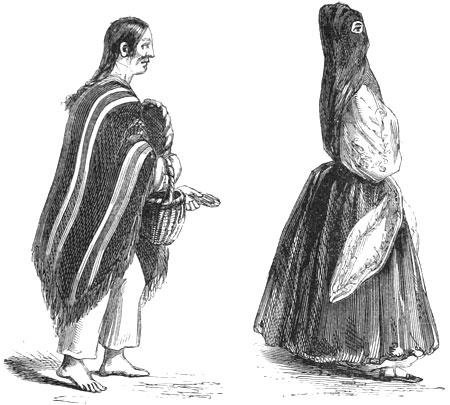
CHILIAN. CHILIENNE.
When Lord Cochrane visited the island in 1823, as it
appears from a synopsis of Howel's Life of Selkirk, there
were but four men stationed on it, apparently in charge
of some cattle. A lady who accompanied Lord Cochrane
gives the following description of its condition and
appearance at that time: "The island is the most picturesque
I ever saw, being composed of high perpendicular
rocks, wooded nearly to the top, with beautiful valleys,
exceedingly fertile, and watered by copious streams,
which occasionally form small marshes. The little valley
where the town is, or rather was, is exceedingly
beautiful. It is full of fruit-trees and flowers, and sweet
herbs, now grown wild; near the shore it is covered
with radish and sea-side oats. A small fort was situated
on the sea-shore, of which there is nothing now visible
but the ditches and part of one wall. Another, of considerable
size for the place, is on a high and commanding
spot. It contained barracks for soldiers, which, as
well as the greater part of the fort, are ruined; but the
flag-staff, front wall, and a turret are still standing; and
at the foot of the flag-staff lies a very handsome brass
gun, cast in Spain A.D. 1614. A few houses and cottages
are still in a tolerable condition, though most of
the doors, windows, and roofs have been taken away, or
used as fuel by whalers and other ships touching here.
In the valleys we found numbers of European shrubs
and herbs—'where once the garden smiled.' And in
the half-ruined hedges, which denote the boundaries of
former fields, we found apple, pear, and quince trees, with
cherries almost ripe. The ascent is steep and rapid from
the beach, even in the valleys, and the long grass was
dry and slippery, so that it rendered the walk rather fatiguing;
and we were glad to sit down under a large
quince-tree, on a carpet of balm bordered with roses,
now neglected, and feast our eyes on the lovely view before
us. Lord Anson has not exaggerated the beauty
of the place or the delights of the climate. We were
rather early for its fruits, but even at this time we have
gathered delicious figs, cherries, and pears, that a few
days of sun would have perfected. The landing-place is
also the watering-place. There a little jetty is thrown
out, formed of the beach-pebbles, making a little harbor
for boats, which lie there close to the fresh water, which
comes conducted by a pipe, so that, with a hose, the
casks may be filled without landing with the most delicious
water. Along the beach some old guns are sunk,
to serve as moorings for vessels, which are the safer the
nearer in shore they lie, as violent gusts of wind often
blow from the mountain for a few minutes. The height
of the island is about three thousand feet."
"With all its beauties and resources," adds the biographer
of Selkirk, "the island seemed destined never to
retain those who settled on it; whether from its isolated
position, at so great a distance from the continent, or
from some other cause, is uncertain. Not long after
Lord Cochrane's visit, however, it received an accession
of inhabitants, some of them English, who settled in it
under the protection of the Chilian government."
These islands (Masafuero and Masatierra) have been
convulsed by several of those destructive earthquakes
which prevail to such an alarming extent on the western
coast of South America. In 1751 and 1835 the destruction
was unusually great. The earthquake of 1835 was
attended by some remarkable phenomena. An eruption
burst from the sea, about a mile from the land, where
the water was from fifty to eighty fathoms deep. Smoke
and water were ejected during the day, and flames were
seen at night.
Mr. Richard H. Dana, Jun., who visited Juan Fernandez
in November, 1835, on his voyage to California,
gives, in his admirable narrative (Two Years before the
Mast), the following graphic account of its condition at
that period: "I was called on deck to stand my watch
at about three in the morning, and I shall never forget
the peculiar sensation which I experienced on finding
myself once more surrounded by land, feeling the night-breeze
coming from off shore, and hearing the frogs and
crickets. The mountains seemed almost to hang over
us, and, apparently from the very heart of them, there
came out, at regular intervals, a loud echoing sound,
which affected me as hardly human. We saw no lights,
and could hardly account for the sound, until the mate,
who had been there before, told us that it was the
'Alerta' of the Spanish soldiers, who were stationed
over some convicts, confined in caves nearly half way up
the mountain. At the expiration of my watch I went
below, feeling not a little anxious for the day, that I
might see more nearly, and perhaps tread upon, this romantic,
I may almost say classic island. When all hands
were called it was nearly sunrise, and between that time
and breakfast, although quite busy on board in getting
up water-casks, etc., I had a good view of the objects
about me. The harbor was nearly land-locked, and at
the head of it was a landing-place protected by a small
breakwater of stones, upon which two large boats were
hauled up, with a sentry standing over them. Near this
was a variety of huts or cottages, nearly a hundred in
number, the best of them built of mud and whitewashed,
but the greater part only Robinson Crusoe-like—of posts
and branches of trees. The governor's house, as it is
called, was the most conspicuous, being large, with
grated windows, plastered walls, and roof of red tiles, yet,
like all the rest, of only one story. Near it was a small
chapel, distinguished by a cross; and a long, low, brown-looking
building, surrounded by something like a palisade,
from which an old and dingy-looking Chilian flag
was flying. This, of course, was distinguished by the
title of Presidio. A sentinel was stationed at the chapel,
another at the governor's house, and a few soldiers,
armed with bayonets, looking rather ragged, with shoes
out at the toes, were strolling about among the houses,
or waiting at the landing-place for our boat to come
ashore."
Not long after Mr. Dana's visit this settlement was
entirely broken up. The houses and fortifications were
destroyed by an earthquake, and the penal establishment
was discontinued.
From time to time, up to the present date, there have
been straggling settlers on this island, but there has been
no attempt since 1835 to colonize it permanently until
recently. It has been occasionally visited by vessels of
different nations for supplies of wood and water, and
such vegetable productions as the valleys afford. American
whalers have found it a very convenient stopping-place
in their cruisings on the coast of Chili and Peru;
but of late years, the whales becoming scarce in these
seas, they are forced to push their voyages into more remote
regions. Many still touch there, however, on their
way to and from the northern coast.
At the time of the writer's visit to Juan Fernandez
(May, 1849), the gold excitement had but recently broken
out, and vessels bound to California had just commenced
making it a place of resort for refreshments in
their outward voyages. Since that period, it is stated in
the newspapers that an enterprising American has taken
the island on lease from the Chilian government, and established
a settlement upon it of a hundred and fifty
Tahitians, with the design of cultivating the earth, and
furnishing vessels touching there with supplies of fruit
and vegetables.
ALEXANDER SELKIRK AND ROBINSON CRUSOE.
It is stated in Howel's life of Selkirk that the singular
history of this man (Alexander Selkirk) was soon made
known to the public, and immediately after his arrival in
London he became an object of curiosity, not only to the
people at large, but to those elevated by rank and learning.
Sir Richard Steele, some time after, devoted to
him an article in the paper entitled "The Englishman,"
in which he tells the reader that, as Selkirk is a man of
good sense, it is a matter of great curiosity to hear him
give an account of the different revolutions of his mind
during the term of his solitude. "When I first saw
him," continues this writer, "I thought, if I had not been
let into his character and story, I could have discovered
that he had been much separated from company, from
his aspect and gesture; there was a strong but cheerful
seriousness in his look, and a certain disregard of the ordinary
things around him, as if he had been sunk in
thought. In the course of a few months," as it appears
by the same writer, "familiar converse with the town
had taken off the loneliness of his aspect, and quite altered
the expression of his face."
"De Foe's romance of Robinson Crusoe was not published
till the year 1719, when the original facts on which
it was founded must have been nearly forgotten. There
is no record of any interview having taken place between
Selkirk and De Foe, so that it can not be decided whether
De Foe learned our hero's story from his own mouth,
or from such narratives as those published by Steele and
others."
On this point a biographer of De Foe remarks: "Astonishing
as was the success of De Foe's romance, it did
not deter the curious from attempting to disparage it.
The materials, it was said, were either furnished by or
surreptitiously obtained from Alexander Selkirk, a mariner
who had resided for four years on the desert island
of Juan Fernandez, and returned to England in 1711.
Very probably his story, which then excited considerable
interest and attention, did suggest to De Foe the idea
of writing his romance; but all the details and incidents
are entirely his own. Most certainly De Foe had obtained
no papers or written documents from Selkirk, as
the latter had none to communicate."
Robinson Crusoe, however, can not be considered altogether
a work of fiction. Without adhering strictly
to the actual adventures of Selkirk, or of the Musquito
Indian who preceded him, it gives, in the descriptions
of scenery, the mode of providing food, the rude expedients
resorted to for shelter against the weather, and all
the trials and consolations of solitude, a faithfully-drawn
picture from these narratives, and a most truthful and
charming delineation of solitary life, with such reflections
as the subject naturally suggested. De Foe was
the great medium through which the spirit of the whole
was fused; it required the splendor of his genius to preserve
from oblivion the lessons therein taught—of the
advantages of temperance, fortitude, and, above all, an
implicit reliance in the wisdom and mercy of the Creator.
He presents them in a most fascinating garb, with
all the originality of a master-mind; and it detracts
nothing from his credit to say that the pictures are
drawn strictly from nature.
As Captain Rodgers well observes in his simple narrative
of the adventures of Selkirk, "One may see by
this that solitude and retirement from the world is not
such an insufferable state of life as most men imagine,
especially when people are fairly called or thrown into it
unavoidably, as this man was; who, in all probability,
must otherwise have perished in the seas, the ship which
left him being cast away not long after, and few of the
company escaped. We may perceive by this story that
necessity is the mother of invention, since he found
means to supply his wants in a very natural manner, so
as to maintain his life, though not so conveniently, yet as
effectually as we are able to do with all our arts and society.
It may likewise instruct us how much a plain and
temperate way of living conduces to the health of the
body and the vigor of the mind, both of which we are
apt to destroy by excess and plenty, especially of strong
liquor, and the variety as well as the nature of our meat
and drink; for this man, when he came to our ordinary
method of diet and life, though he was sober enough,
lost much of his strength and agility."
De Foe does not, as may be seen by reference to the
fourth section of "Robinson Crusoe," lay the scene of his
narrative in Juan Fernandez. Robinson starts from the
Brazils, where he has been living as a planter, on a voyage
to the coast of Guinea. Driven to the northward
along the coast of South America by heavy gales, the
captain of the vessel found himself "upon the coast of
Guinea, or the north part of Brazil, beyond the River
Amazon, toward that of the River Oronoco, commonly
called the Great River; and began to consult with me,"
says Robinson, "what course he should take, for the
ship was leaky and very much disabled, and he was for
going directly back to the coast of Brazil. I was positively
against that; and looking over the charts of the
sea-coast of America with him, we concluded there was
no inhabited country for us to have recourse to till we
came within the circle of the Caribbee Islands, and therefore
resolved to stand away for Barbadoes; which, by
keeping off to sea, to avoid the indraught of the Bay or
Gulf of Mexico, we might easily perform, as we hoped,
in about fifteen days' sail; whereas we could not possibly
make our voyage to the coast of Africa without
some assistance both to our ship and ourselves.
"With this design we changed our course, and steered
away N.W. by W. in order to reach some of our English
islands, where I hoped for relief; but our voyage
was otherwise determined; for, being in the latitude of
12° 18´, a second storm came upon us, which carried us
away with the same impetuosity westward, and drove
us so out of the very way of all human commerce, that,
had our lives been saved as to the sea, we were rather in
danger of being devoured by savages than ever returning
to our own country.
"In this distress, the wind still blowing very hard,
one of our men early in the morning cried out Land!
and we had no sooner run out of the cabin to look out,
in hopes of seeing whereabouts in the world we were,
but the ship struck upon a sand, and in a moment her
motion being so stopped, the sea broke over her in such
a manner that we expected we should all have perished
immediately; and we were immediately driven into our
close quarters to shelter us from the very foam and spray
of the sea."
It will be seen from the above that Robinson Crusoe
was not wrecked on the island of Juan Fernandez. In
all probability he never saw that island. I regret the
fact as much as any body can regret it, because I always
thought so till I referred more particularly to his history;
but a due regard for truth compels me to give the
facts as I find them.
"The History of Robinson Crusoe," says the biographer
of De Foe, already quoted, "was first published in
the year 1719, and its popularity may be said to have
been established immediately, since four editions were
called for in about as many months, a circumstance at
that time almost unprecedented in the annals of literature.
It rarely happens that an author's expectations
are surpassed by the success of his work, however astonishing
it may seem to others; yet perhaps even De Foe
himself did not venture to look forward to such a welcome
on the part of the public, after the repulses he had
experienced on the part of the booksellers; for, incredible
as it now appears, the manuscript of the work had
been offered to, and rejected by, every one in the trade.
"The author of Robinson Crusoe would be entitled to
a prominent place in the history of our literature even
had he never given to the world that truly admirable
production; and yet we may reasonably question whether
the name of De Foe would not long ago have sunk
into oblivion, or at least have been known, like those of
most of his contemporaries, only to the curious student,
were it not attached to a work whose popularity has
been rarely equaled—never, perhaps, excelled. Even as
it is, the reputation due to the writer has been nearly altogether
absorbed in that of his hero, and in the all-engrossing
interest of his adventures: thousands who have
read Robinson Crusoe with delight, and derived from it
a satisfaction in no wise diminished by repeated perusal,
have never bestowed a thought on its author, or, indeed,
regarded it in the light of a literary performance. While
its fascination has been universally felt, the genius that
conceived it, the talent that perfected it, have been generally
overlooked, merely because it is so full of nature
and reality as to exhibit no invention or exertion on the
part of the author, inasmuch as he appears simply to
have recorded what actually happened, and consequently
only to have committed to paper plain matter of fact,
without study or embellishment. We wonder at and
are struck with admiration by the powers of Shakspeare
or Cervantes; with regard to De Foe we experience no
similar feeling: it is not the skill of the artist that enchants
us, but the perfect naturalness of the picture,
which is such that we mistake it for a mirror; so that
every reader persuades himself that he could write as
well, perhaps better, were he but furnished with the materials
for an equally interesting narrative."