The appellation "Piker," much used in the West in early days,
synonymous of "Missourian," had its origin on these plains. At first
it was applied to a particular type of Missourian, but later came to
be used generally.
There was among the emigrants a considerable number of persons from
Pike County, Missouri. Some of these had the sign, "From Pike Co.,
Mo.," painted on their wagon covers. Others, when asked whence they
came, promptly answered, "From Pike County, Missouri, by gosh, sir;"
often said with a shrug implying that the speaker arrogated to himself
much superiority by reason of the fact stated. The display of such
signs, and announcements like that just mentioned, were of such
frequent occurrence that the substance was soon abbreviated to
"Piker," and became a by-word. It was often, perhaps always, spoken
with a tinge of odium. Possibly this was due to the fact that many of
the people referred to were of a "backwoods" class, rather short in
culture, and in personal makeup, manner and language, bearing a
general air of the extremely rural.
Though only persons of that description hailing from Pike County were
those who at first had to bear the opprobrium generally implied by
"Piker," later it was applied to all persons of that type in the Far
West, regardless of their origin. Many years' of mingling of
California's cosmopolitan population has changed all that; producing
her present homogeneous, sterling, virile, and somewhat distinct type
of "Californian"; so the "Piker," as such, is no longer in the land. A
later application of the same word, descriptive of a person who does
business in a small way, has nothing in common with the "Piker" of
early days.
Fifty-eight years ago, the time of the events here narrated, was
before the era of canned goods. Nearly all of the foodstuffs carried
by the emigrants were in crude form, and bulky; but substantial, pure,
and such as would keep in any climate.
During the first few weeks of the trip we milked some of the cows, and
also made butter, the churning operation being effected mainly by the
motion of the wagons, in the regular course. That this did not last
long was due to reduction of milk supply. After a time there was not
sufficient even for use in the coffee, or for making gravy, that
convenient substitute for butter.
Such delicacies as may now be found in first-class canned meats,
vegetables and milk would have filled an often-felt want. The
occasional supply that we had en route of fresh meat and fish were
obtained largely by chance; we having no knowledge of localities where
hunting and fishing were likely to be successful, and it being deemed
unsafe for members of the party to wander far or remain long away from
the train. It seems regrettable that the invention of
hermetically-sealed and easily portable foods, and the inducement to
cross the plains to California, did not occur in reversed sequence.
Neither had the kodak arrived. Had it been with us then, this
narrative might be illustrated with snap-shots of camp scenes,
characteristic roadside views, and incidents of travel generally,
which would do more for realism than can any word-picture. We often
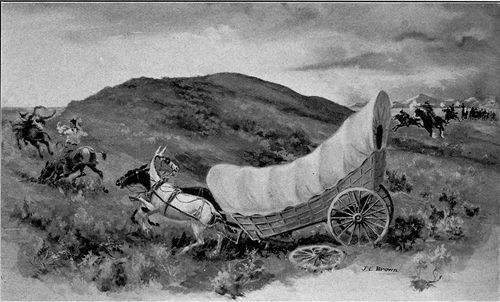
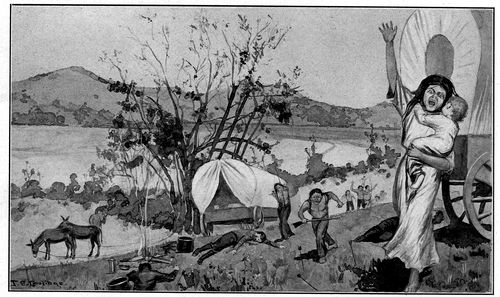
see specimens of artists' work purporting to represent a "'49er"
emigrant train on the overland journey—some of them very clever; but
seldom are they at all realistic to the man who was there.
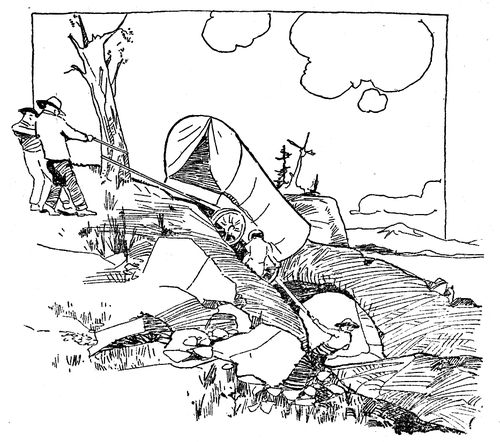
The man with a camera could have perpetuated, for example, the
striking scene presented to us one day of a party, consisting of two
men and their wives, with two or three children, sitting on a rocky
hillside, woefully scanning their team of done-out oxen and one wagon
with a broken axle; no means at hand for recuperation and repair. In
the scorching sun of a July day they waited, utterly helpless,
hopeless, forlorn, confused; and a thousand miles from "anywhere."
Such a grouping would not have made a cheerful picture, but would have
assisted immensely in recording a historical fact.
But no emigrant ever found another in distress and "passed by on the
other side."
We were early risers, and the camp was each morning a scene of life
with the rising of the sun. By sunset all were sufficiently fatigued
to wish for making camp again. Therefore, from the morning start till
the evening stop was usually about twelve hours, with variations from
time to time, according to necessity or exceptional conditions.
Breaking camp in the morning became routine, and proceeded like
clockwork. Each patient ox voluntarily drew near, and stood, waiting
to be yoked with his fellow and chained to his daily task. So well did
each know his place by the side of his mate that the driver had only
to place one end of the yoke on the neck of the "off" ox, known, for
example, as "Bright," and hold the other end toward the "nigh" ox,
saying, "Come under here, Buck," and the obedient fellow placed
himself in position. Then the bows were placed and keyed, and
"Bright" and "Buck" were hitched for duty. It required but a few
minutes to put three or four yoke of oxen in working order.
As the result of much repetition, the packing of the camp articles
onto the wagons was done dexterously and quickly. Each box, roll and
bundle had a designated place; all being arranged usually to
facilitate sitting or reclining positions for those who rode in the
"schooners," that they might be as comfortable as possible, and read,
sleep, or, as the women often did, sew and knit, or play games. During
some parts of the trip such means of whiling away the hours was very
desirable, if not a necessity. If there ever was a time or condition
in which it could be pardonable to "kill time," these circumstances
were there, during many long days.
The bivouac was always a scene of bustle and orderly disorder,
especially if the camp-site was a good one: wood, water and grass
being the desiderata. Obedient to habit, every person and animal
dropped into place and action. With the wagons drawn to position for
the night's sojourn, teams were quickly unhitched, the yokes, chains,
harness and saddles falling to the ground where the animals stood.
Relieved of their trappings, the oxen, horses and mules were turned to
pasture, plentiful or scant. Cooking utensils came rattling from
boxes; rolls of bedding tumbled out and were spread on the smoothest
spots of sand or grass. Eager hands gathered such fuel as was
available, and the camp-fire blazed. Buckets of water were brought
from the spring or stream; and in an incredibly short time the scene
of animation had wrought full preparation for the night, while the
odor of steaming coffee and frying bacon rendered the astonished air
redolent of appetizing cookery.
Some families used a folding table, on which to serve meals; but more
spread an oilcloth on the ground and gathered around that; or
individuals, taking a plate and a portion, sat on a wagon-tongue or a
convenient stone. Camp-stools and "split-bottomed" chairs were among
the luxuries that some carried, in limited numbers; but these were not
useful especially as seats while partaking of a meal spread on the
ground.
Appetites were seldom at fault; and the meals, though plain and of
little variety, were never slighted. It is hardly necessary to add
that bacon and coffee were easy staples. Bread was mainly in the form
of quick-fire biscuits, baked in a skillet or similar utensil, or the
ever-ready and always-welcome "flap-jack," sometimes supplemented with
soda-crackers, as a delicacy.
Nearly all the nights were pleasant—mild temperature, and very little
dew. This gave much relief, the daytime heat being generally irksome
and often distressingly hot. Many of the men came to prefer sleeping
wholly in the open, with the heavens unobscured; often requiring no
more than a pair of blankets and a small pillow.
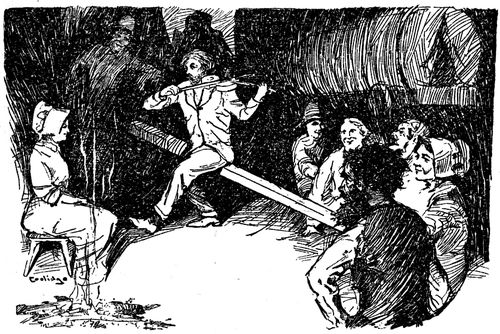
Early evening was devoted to social gatherings. If the night was
pleasant groups would assemble, for conversation, singing and
story-telling; varied with dancing by the young people of some
companies. The more religious sang hymns and read the Bible sometimes,
in lieu of attendance at any church service. When wood was plentiful,
a bonfire added to the cheerfulness and comfort of the occasion. Often
neighboring trains camped quite near, when much enjoyment was found in
visits by the members of one company among those of another. In such
ways many agreeable acquaintances were met and even lasting
friendships formed, some of which have endured throughout the nearly
three-score years since passed.
But we were not always favored with clear and pleasant weather. No one
who was there can have forgotten one night at the Platte River, when
we had a most dismal experience. Rain began falling in the afternoon,
and for that reason we made camp early.
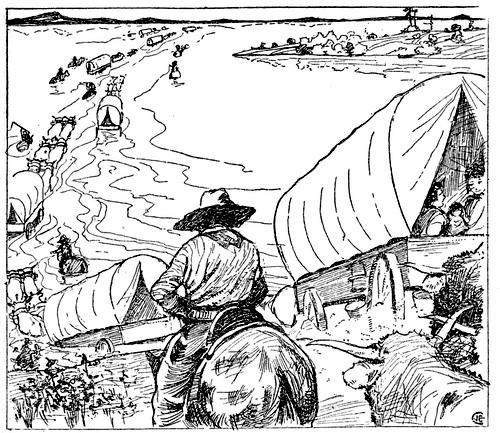
The tents were set up on a bit of flat ground near the river bank.
There were some large trees, but little dry wood available for fuel
for the camp fire except on an island, which was separated from us by
a branch of the river, about twenty yards wide and a foot deep. Some
of us waded over, getting our clothes soaked; others crossed on
horseback, and carried back from the island enough wood to make a
fire. But, time after time, the fire was quenched by the rain, which
now was falling in torrents; so we had much difficulty in preparing
our supper.
The people huddled into the tents and wagons, half hungry, more than
half wet, and uncomfortable altogether. With the exception of one or
two cots, the bedding was spread on the ground in the tents, and all
turned in—but not for long. Some one said, "water is running under my
bed." Then another and another made the same complaint. Soon we
learned the deplorable fact that the large tent had been pitched in a
basin-like place, and that the water, as the rain increased, was
coming in from all sides, the volume growing rapidly greater.
We succeeded then in lighting one lantern, when the water was found to
be something like two inches deep over nearly all parts of the large
tent's floor. The beds were taken up and placed in soaked heaps, on
camp stools and boxes; and the rain continued pouring in steady,
relentless disregard of our misery. Except where lighted by the single
lantern the darkness was, of course, absolute. Relief was impossible.
There appearing to be nothing else to do, everybody abandoned the
tents and huddled in the wagons; the lantern was blown out, and there
was little sleep, while we waited and wished for daylight.
Some of the days were warm and some hot. Some were very hot.
Discomforts were common; and yet not much was said, and apparently
little thought, of them. Having become inured to the conditions as we
found them from time to time, discomforts, such as under other
circumstances would have been considered intolerable, were passed
without comment. There were times and situations in which hardships
were unavoidable, some of them almost unendurable; but these, having
been anticipated, were perhaps less poignant in the enduring than in
the expectation.
Let us for a moment raise the curtain of more than half a century,
while we look back on one of those ox-drawn trains of
"prairie-schooners," as it appeared to an observer on the ground at
the time; about the middle of August, and beyond the middle of the
journey. Permit the imagination to place the scene alongside that of
the present-day modes of traversing the same territory, when the
distance is covered in a less number of days than it required of
months then. Perhaps such a comparison may help to form some faint
conception of what the overland pioneers did, and what they felt, and
saw, and were.
There they are as we see them, on a long stretch of sage-brush
plateau. The surface of the plain is only sand and gravel, as far as
the eye can reach. The atmosphere is hazy, with dust and vibrating
waves of heat arising from the ground. Far away to the northwest is
the outline of some mountains, just visible in the dim distance. In
the opposite direction, whence we have come, there is nothing above
the ground but hot space, and dust. Not a living thing in sight but
ourselves and ours.
The animals appear fatigued, jaded. The people appear—well, as to
physical condition, like the animals: generally all look alike. Yet
the people seem hopeful. And why hopeful? The inherent and indomitable
trait of the race which makes it possible for humanity to look over
and past present difficulties, however great, and see some good
beyond. That is why the world "do move." Often, as it was with us,
progress may be slow, but every day counts for a little.
Just here twelve or fifteen miles a day is doing well—very well. From
a slight eminence at one side of the way we may stand and see the
slowly creeping line of wagons and stock, for many miles fore and aft,
as they bend their way in and out, around and over the surface of
knolls and flats, hillocks and gullies. From a distant view they seem
not to be moving at all.
The hour of mid-day arrives, and they stop for the "nooning." There is
nothing growing in the vicinity that the horses and cattle can eat,
and no water except the little in the keg and canteens; so the
carrying animals stand in their yokes and harness, or under saddles,
and the loose stock wait in groups, their thirst unslaked.
As the people come out of the wagons and go about the business of the
hour we see the marks of the elements upon them. The women wear "poke"
bonnets and gingham dresses. The men are unshaven. All are sunburnt to
a rich, leathern brown. Some are thin, and at this particular time,
wearing a serious expression. They are not as unhappy as they look,
their principal trouble of the moment being merely anxiety to satisfy
prodigious and healthy appetites.
There, under the stress of the midsummer sun, now in the zenith, no
shade, no protection from the flying dust, they proceed cheerfully to
build a fire, of sticks and dry weeds; they fry bacon and bake
biscuits, prepare large pots of coffee, and they eat, from tin plates,
and drink from tin cups.
No one says, "This is awful!" They laugh as they eat, saying, "Good;
ain't it?"
This is not a cheerful view altogether of the retrospective; but a
sketch true to life, as life was there. It was not all like that. A
good deal of it was.
Some will say that these overland travelers were over-zealous, even
foolhardy. One of the earliest pioneers, Mr. Daniel B. Miller, who
reached Oregon by the plains route in 1852, wrote later to relatives
in Illinois, "I would not bring a family across for all that is
contained in Oregon and California." Himself single, he had come with
a train composed almost wholly of men, but learned incidentally what
risks there were in escorting women and children through the wilds.
But the enduring of all this toil, exposure and hardship had for its
inspiration the buoyant hope of something good just beyond, something
that was believed to be worthy of the privation and effort it was
costing. The ardor of that hope was too intense to be discouraged by
anything that human strength could overcome. The memories of those
strenuous experiences are held as all but sacred, and you never meet
one of these early overland emigrants who does not like to sit by your
fireside and tell you about it. He forgets, for the moment, how hard
it was, and dwells upon it, telling it over and over again, with the
same pride and sense of noble achievement that the old soldier feels
when recounting the battles and the camp life and the hard marches of
the war, when he was young, away back in the sixties. One crossing
this country by present-day conveyances, in richly appointed railroad
trains, with all the comforts obtainable in modern sleeping, dining
and parlor cars, can hardly be expected to conceive what it was to
cover the same course under the conditions described; when there was
not even a poor wagon road, and the utmost speed did not equal in a
day the distance traveled in half an hour by the present mode. Any
person who rides in a cumbrous and heavily laden wagon, behind a team
whose pace never exceeds a slow walk; over dusty ground, in hot
weather, will, before one day is passed, feel that endurance requires
utmost fortitude. Consider what patience must be his if the journey
continues for four, five or six long months!
It is worthy of mention that there was no dissension among our people,
nor even unpleasantness, during the entire trip, nor did we observe
any among others. We were fortunate in having no "grouches" among us.
Harmony, cheerfulness, a disposition to be jolly, even to the degree
of hilarity, was the prevailing spirit. That, too, under circumstances
often so trying that they might have thrown a sensitive disposition
out of balance. All this in the wilds of an unorganized territory,
where there was no law to govern, other than the character and natural
bent of individuals. Such lack of established authority we had thought
might lead to recklessness or aggressive conduct, but it did not.
Present residents in the fields and valleys, and the prosperous towns
along much of the line of travel described, will find it difficult to
reconcile the accounts here given with conditions as they see them
now. Leagues of territory now bearing a network of railroads and
splendid highways, which carry rich harvests from the well-tilled
farms, and connect numerous cities, was thought of ordinarily by the
emigrants in early days only as it appeared to them, and then was,
the stamping ground of savage tribes and the home of wild beasts,
untouched by the transforming hand of civilization. To the keen
observer, however, it was evident that we were passing through a great
deal of fine country. On the other hand, it cannot be denied that part
of that journey was through lands naturally barren, some desert
wastes, much of which is still unreclaimed, some unreclaimable.