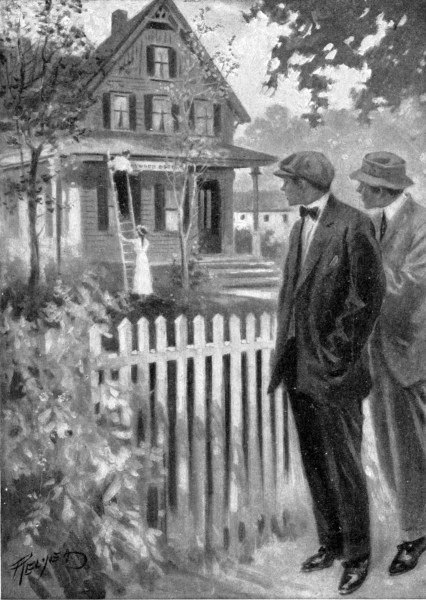
“It’s a perfectly jimmy sign!” declared the
girl delightedly.
The boy turned with an amused smile.
“What’s a ‘jimmy’ sign, Hope? One made
by Jim?”
“N-no, not exactly. Jimmy means awfully
nice—something very—very pleasing—quite
darling! See?”
“Of course,” answered her brother. “It’s
as plain as the nose on your face.”
“My nose isn’t plain,” was the retort.
“It’s a real Hazard nose, just like yours and
Lady’s.”
“Sort of a jimmy nose,” laughed the boy.
“Sis, if you keep on coining words, you’ll have
to publish a vocabulary or no one will be able
to understand you. What was it you called the
back room upstairs yesterday?”
“Snudgy,” replied Hope Hazard gravely.
“And that’s just what it is; small and hot and—and
snudgy! It’s the snudgiest room I ever
saw, Jim.”
“Well, don’t let Jane hear you call it snudgy.
She might leave. But, say, that’s a pretty
good-looking sign, isn’t it? I don’t believe any
one could tell it was home-made, eh?”
“N-no, not unless they looked real close. I
guess that Y is a little bit wipsy, though,
Jim.”
Jim Hazard frowned intently for a moment
at the letter in question. “Well, maybe it is
kind of out of plumb with the others,” he acknowledged.
“Just the same, I think I’m a
pretty good sign painter, sis. Now what’s to
do?”
“Curtains in the front room upstairs; the
rented one,” replied Hope promptly.
“Oh, hang the curtains!” grumbled Jim.
“That’s what I meant,” laughed Hope.
“Never mind, they’re the last ones. And we
really must get them up because our star
boarder may come any moment.”
“All right,” he answered resignedly, “but
I’ve got to cool off first.” He seated himself
on the top step and Hope perched herself beside
him. Jim fanned himself with the screw-driver,
and they both laughed. Then the boy’s
smile died away, and his forehead puckered itself
into lines of worry.
“Hope, we’ve got to do better than this or
Sunnywood will be vacant again. Four rooms
to rent and only one taken! Didn’t you think
from what Mr. Gordon said that we’d get all
the fellows we wanted?”
“Yes, but maybe they don’t look for rooms
until they get here,” she answered cheerfully.
“And you know they don’t begin to come until
this afternoon.”
“I don’t believe that,” he answered. “Fellows
wouldn’t come and not know where they
were going to live. I don’t think Mr. Gordon
has treated us fairly, Hope. That lady over
there—”
“Mrs. Sanger.”
“Took the sign out of her window this morning.
I guess that means that her rooms are
all taken. I’ll bet Mr. Gordon has been sending
the fellows to the other houses and leaving us
out of it.”
“Oh, he wouldn’t do that,” Hope protested,
“after all the nice things he said to mama.”
“You can’t tell. Besides, we don’t know just
what nice things he did say. You know very
well that if a person doesn’t actually call Lady
names she thinks they’ve been as nice as pie to
her. Wish I had her gift of thinking the very
best of everything and everybody. Well, if
something doesn’t happen pretty soon, I’m
going to see Mr. Gordon and tell him what I
think about it. One thing we do know is
that he wrote Lady that if she took the house
she wouldn’t have any trouble in renting the
rooms.”
“Well, let’s hope for the best, Jim,” said his
sister, laying a small brown hand on his shoulder
and giving him a reassuring pinch.
“That’s you all over,” he muttered.
“Guess they knew what they were about when
they named you Hope.”
“Well, they didn’t name you Despair,” she
laughed, “so don’t try and play they did. It’s
most time Lady was back, isn’t it?”
Jim nodded and looked down the street toward
the village a half-mile away. “That’s
her now, I guess; away down by the big elm;
see?”
“Yes, it is. Let’s go and meet her, Jim.
She’s probably got a lot of things to carry.”
“All right!” Jim laid down the screw-driver
and pushed the ladder aside. “You’d
better put a hat on, though.”
“Nonsense! The sun won’t hurt me. Come
on.”
They went out of the gate together, and
walked briskly down the sidewalk. Jim was
half a head taller than his sister, rather thin,
a bit raw-boned, in fact, but strong looking, and
good looking, too, in spite of a smudge of dirt
across his forehead and a generally begrimed
appearance due to the fact that he had been
sign-painting, carpentering, and house-cleaning
all the forenoon. Besides this, he wore the very
oldest clothes he owned, and that he managed to
look prepossessing in spite of these handicaps
speaks rather well for him. He had brown hair
and brown eyes, but the hair was light, extremely
light in places, as though it had been
faded by sun and weather, and the eyes were
very dark. Hope had told him once that he had
perfectly lovely eyes, they looked so much like
sweet chocolate! For the rest, Jim was tanned
and hardy-looking, with more often than not a
little puckery frown on his forehead, for at sixteen
years of age he had already been head of
the family for three years.
Hope Hazard isn’t quite so easily described,
and I’d flunk the task if I might. She was fourteen,
slender, golden-haired, gray-eyed, light-hearted.
As Jim had said, she had been well
named, for hopefulness was the key-note of her
nature, and Jim, who was somewhat prone to
borrow trouble if he had none of his own, called
her frivolous in moments of exasperation.
But Hope came honestly by her sunny optimism,
for her mother had always been the most
hopeful, cheerful soul in the world, and even
Mr. Hazard’s death and the immediate collapse
of the family fortunes had failed to change
her.
Mother and daughter looked much alike.
Mrs. Hazard was quite tall, still young looking,
and still pretty. She had gray eyes, like
Hope’s, and if they were a trifle more faded,
they still twinkled brightly at the slightest provocation.
Jim was more like his father, a little
more serious, with something of New England
granite showing in his face, a heritage from a
race of coast-dwelling Hazards. The Hazard
nose, which Hope fondly believed she had inherited,
and which was a straight and stern appendage,
well shaped but uncompromising, was
his, while Mrs. Hazard’s nose was an undignified,
even flippant affair that looked for all the
world as though, had it had proper encouragement
at an early stage, it would have become
tip-tilted. Truth compels the admission that in
Hope’s case the Hazard nose was more a matter
of anticipation than realization, in spite of the
fact that she religiously pulled it and pinched it
in the attempt to make it conform to Hazard
requirements. Perhaps it is a mean thing to
say, but Hope’s nose was more remarkable for
the cluster of three big freckles on the end of it
than for beauty of contour.
Mrs. Hazard yielded her packages to the children
and gave an account of her shopping expedition.
“It’s lots of fun buying things in Crofton,
my dears; quite exciting. You never know
when you ask for a thing what you are going to
get. I tried to buy some scrim to make curtains
for Jane’s room, and what do you suppose I got?
Why, some muslin for a next summer dress for
Hope! It was really very sweet and pretty.”
“And I suppose,” said Jim, with a smile,
“that when Hope isn’t wearing it, Jane can
hang it up at her window.”
“I think you’ll have to do the shopping,
Jim,” continued Mrs. Hazard. “They don’t
take me seriously, I’m afraid. If I want a
wash-board, they smile at me humoringly and
sell me a nutmeg grater! And two or three
things I meant to get, I forgot all about!”
“Did you get the blankets, Lady?” asked
Jim anxiously.
“Oh, yes; and the toweling, and the mat for
the front door. But I forgot bluing and soap
and meat for supper.”
“Well, if we don’t rent some rooms we won’t
be able to afford supper,” replied Jim grimly.
“I don’t think Mr. Gordon has been treating
us decently, Lady.”
“Oh, I’m sure he has done all he could, dear.
I can’t doubt that after the nice way he talked.”
“Talk’s cheap,” growled Jim. “Why
doesn’t he send some boys here to rent our
rooms?”
“He will, I’m sure. You wait and see.”
“That woman over there has taken her sign
down already.”
“But she’s been here for years, Jim dear,
while we are only starting. It’s going to take
time, of course. Meanwhile we have that
Latham boy—”
“And he’s a cripple,” interrupted Jim,
“and I dare say no one else would take him!”
“I don’t think that at all,” protested his
mother as they entered the gate, “for Mr.
Gordon said that he was sending him to me because
he wanted a place where the poor boy
could be well looked after. Oh, how nice your
sign looks! I suppose it is perfectly all right
to have a sign, Jim, but I see none of the other
houses have any.”
“That’s the point,” replied Jim. “This is
going to be different. Fellows who come here
are going to be at home; this isn’t going to be
just a plain boarding-house, Lady. Isn’t it
most dinner time? I’m pretty hungry.”
“You shall have it right away. I’ll tell
Jane I’m back.” She hurried through to the
kitchen, and Jim, with a sigh, picked up his
step-ladder and, followed by Hope, trudged upstairs
to hang the curtains in the corner room.
“I wonder what sort of a cripple he is,”
mused Hope, as she paired the strips of flounced
muslin. “I do hope he will be nice.”
“I wish Mr. Gordon had sent his cripple
somewhere else,” muttered her brother as he
worked the brass pole through the heading.
“Anybody can impose on Lady.”
“Jim, you’re perfectly awful to-day! You’re
just one long wail of despair. I guess you want
your dinner. Boys are always grumpy when
they’re hungry. Here’s a hole in this curtain.
I’ll draw it together after dinner.”
“It’s good enough for him,” growled Jim,
who was working himself rapidly into a fit of
ill-temper. “I dare say we’ll have to lug him
up and down stairs, too.”
“Oh, I don’t believe he’s that kind of a cripple,”
responded Hope. “And he has a perfectly
jimmy name, hasn’t he? Jeffrey
Latham; it’s quite a—a romantic sort of name,
Jim.”
“He’s probably a pasty-faced little milksop.
There, that’s the last, thank goodness! My,
it’s no wonder I’m hungry!” he added, as he
looked at his nickel watch. “It’s half-past
two and after!”
“It can’t be!”
“It is, though. Hello, what’s that?” He
pushed the new curtains aside at a front window
and looked out. “It’s a carriage—with a
trunk—and bags! I’ll bet it’s the cripple,
Hope! Run and tell Lady!”
His sister hurried downstairs, and Jim, lugging
his step-ladder with him, followed more
slowly, grumbling as he went. “It’s a wonder
he couldn’t stay away until the room was ready
for him.” He put the ladder out of the way
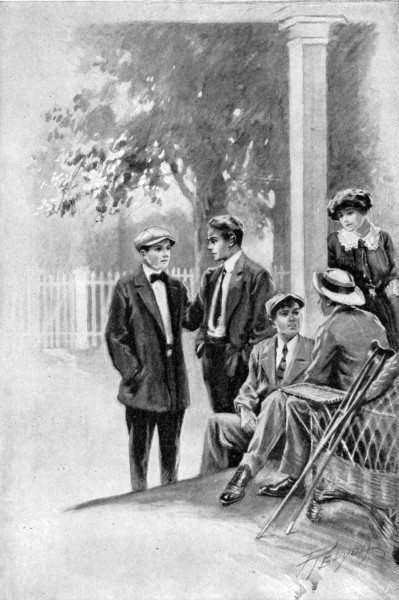
and went out onto the porch in time to see the
driver of the carriage open the door and the
rubber-tipped ends of a pair of crutches appear.
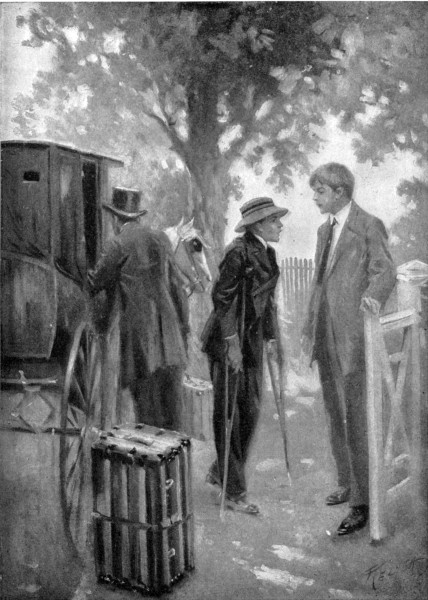
Still resentful, Jim went down the path and
reached the gate just as the occupant of
the vehicle swung himself nimbly to the sidewalk.
“This is Mrs. Hazard’s, isn’t it?” he asked
of Jim.
“Yes. I suppose you’re Latham.”
Jim’s tone was not very gracious and the
newcomer looked a little surprised. He was a
slight, nice looking boy of fifteen, with big wistful
brown eyes set in a somewhat pale but cheerful
face. He was dressed extremely well, even
expensively, and was quite immaculate from the
crown of his Panama hat to the tips of his
smart tan shoes. As he turned to speak to the
driver he looked like any healthy, normal boy,
for he appeared well built, straight of back and
limb, and it was only when he crossed the sidewalk
to the gate that any imperfection showed.
Then Jim saw that one foot, the left one, swung
clear of the ground by several inches.
“If you’ll tell the man where my room is he
will take my baggage up,” said Jeffrey.
Mrs. Hazard met him on the porch, while
Hope, frankly curious, hovered in the background.
“I’m so glad to see you,” said Jim’s mother
as she shook hands with Jeffrey. “I’ll show
you your room, and then you must come down
and have some dinner with us. This is my
daughter Hope, and my son you’ve already met.
And I am Mrs. Hazard. I almost forgot to introduce
myself, didn’t I?”
Jeffrey bowed to Hope. “Thank you,
ma’am,” he answered, “I’d like to go to my
room, but I’ve had my dinner. I stopped at the
lunch room.”
“Lunch room! Good gracious!” exclaimed
Mrs. Hazard, “that’s no dinner for a grown
boy! Of course you’ll have something with us;
although we’re hardly settled yet, and our meals
are still rather skimpy.”
Jeffrey murmured thanks as he followed her
upstairs, abandoning one of his crutches and
helping himself along by the banister. The
driver followed with his trunk, and Jim and
Hope were left alone in the hall.
“Isn’t it a perfect shame?” cried Hope indignantly,
when the star boarder was out of
hearing. “He’s such a nice boy!”
“Isn’t what a shame?” growled Jim.
“Why, his being like that! Having to go
about on crutches! We must be awfully kind to
him, Jim.”
“Huh!” Jim picked up the boy’s bags and
started upstairs. “Guess I’d be willing to use
crutches if I could wear clothes like his and buy
bags like these!”
“Oh, Jim!” protested Hope. “That’s an
awful thing to say! You shouldn’t talk like
that even—even in fun.”
Jim grunted and went on. “Bet you,” he
said to himself, “he will kick about his room.
The carpet’s worn out and there ought to be
new paper on the walls.” But if Jeffrey
Latham observed these things, no one would
have suspected it.
“What a bully room!” he was saying as Jim
entered. “Isn’t it nice and sunny? May I
keep my trunk in here, Mrs. Hazard?”
“Why, certainly. Between the window and
the bureau would be a good place, wouldn’t it?
I’m so glad you like the room. It’s the pleasantest
in the house.”
Jeffrey took out a pigskin purse and opened
it, exhibiting what looked to Jim like a good
deal of money. “How much do I owe you?”
he asked the driver.
“One dollar, sir. Fifty cents for you, sir,
and the trunk and bags extry.”
“Nonsense!” said Jim sharply. “He’s
trying to do you, Latham. Seventy-five’s all it
ought to be.”
“With a heavy trunk and two bags like
them!” demanded the driver incredulously.
Jeffrey laughed.
“I dare say the trunk was heavy,” he said
as he paid the amount asked. “Thank you
very much.”
The driver, mollified, touched his hat and
took his departure. Jim looked his disgust at
such a reckless waste of money.
“The bathroom is just down the hall on the
left,” explained Mrs. Hazard. “Dinner is
ready, but you needn’t hurry. Your name is
Jeffrey, isn’t it? You see, I must know what
to call you.”
“Yes’m, it’s Jeffrey, but I’m generally
called Jeff. I’ll just wash a bit and come right
down, although I’m really not hungry.”
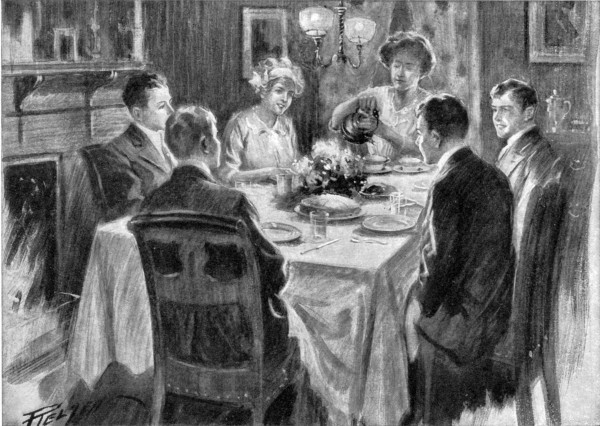
Perhaps Hope was right in her theory that
what Jim needed was food, for after he had had
his soup he forgot his peevishness. Mrs. Hazard
did most of the talking, although Hope
showed unmistakable symptoms of being quite
willing to help out. Jeffrey answered questions
unreservedly. They learned that his
home was in Poughkeepsie, New York; that he
was entered in the Lower Middle Class; that
he had never been away from his folks before,
although he had evidently traveled about a good
deal; and that while others might pity him for
his infirmity, he wasted no pity on himself, but
was quite cheerful and contented.
“Yes’m, I like reading pretty well,” he said
in answer to one of Mrs. Hazard’s questions,
“but I like to be out of doors better. There
isn’t much I can do myself, but I like to see
other fellows have fun. I’m crazy about
football and baseball and things like that.
At home I’m always running around to the
games.”
“It must be very hard,” murmured Mrs.
Hazard sympathetically, “not to be able to—to
take part in them. But I do think you get
about wonderfully on your crutches.”
“I ought to,” laughed Jeffrey. “I’ve been
practising all my life. I’ve had this bum leg
ever since I was born. Oh, you get used to
it; used to not being able to do things like other
fellows, I mean. Besides, I’ve seen chaps
worse off than me. I can row a little.”
“Wish I could,” said Jim, making his second
remark of the meal.
“I guess you could if you tried,” answered
Jeffrey. “It isn’t hard. I suppose there are
boats here?”
“Lots,” said Jim. “They have crews, too,
you know.”
Jeffrey nodded. “Yes, that’s partly why I
came here. I’ve always been fond of boat
racing. At Poughkeepsie, you know, we have a
lot of it every year. Are you—do you go to
Crofton?”
“Yes,” answered Jim, passing his plate for
a second helping, “I begin to-morrow. We’re
in the same class, too.”
“Really? And are there other fellows
here?”
“In the house? No, not yet. We’ve got
three other rooms, but yours is the only one
taken.”
“We hope to rent the others,” explained
Mrs. Hazard. “This is our first year here.
We have always lived in Essexport; that’s on
the coast, you know; but when Jim decided that
he’d rather go to Crofton than anywhere else,
we decided that we couldn’t do without him.
So we rented our house at home and took this.
My husband died three years ago and since then
Jim has looked after us. Hope and I are awful
babies, aren’t we, Hope?”
“Speak for yourself, Lady! Jim and I—
Listen! There’s somebody going upstairs!”
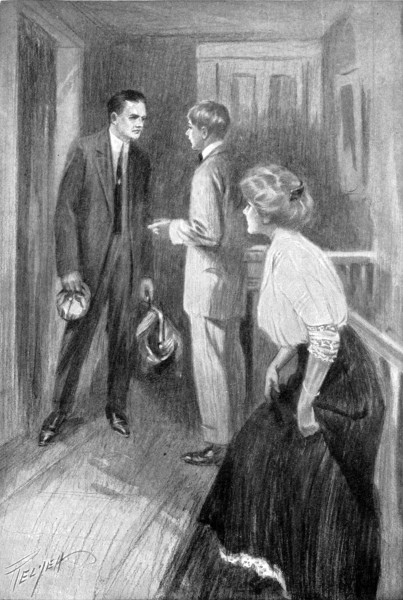
“I’ll see who it is.” Jim laid aside his napkin,
pushed back his chair and hurried out. In
the hall he was just in time to see the end of a
bag disappear about the turn of the landing.
He ran up the stairs, wondering. At the open
door of Jeffrey’s room stood, bag in hand, a big
thick-set boy of apparently seventeen years of
age. He had a good deal of color in his cheeks,
very dark eyes and a mass of unruly black hair
under the funny little crimson cap perched on
the back of his head. He turned at the sound
of Jim’s approach and scowled at him across
the banisters.
“Hello,” he growled.
“Hello,” replied Jim, taking at the instant a
strong dislike to him. “Do you want a
room?”
“No, I’m looking for four-leaved clovers,”
he replied with a grin. “Who are you?”
“My name is Hazard,” answered Jim, beginning
to lose his temper, “and I happen to
live here, if you don’t mind.”
“Oh, I don’t mind,” laughed the other unpleasantly.
“What I want to know is why
isn’t my room ready?”
“Your room?”
“Sure! Those your things in there? If
they are, dump ’em out, Bunker—or whatever
your name is.”
“If you want a room I’ll show you one,”
said Jim, “but that room’s taken.”
“Taken? You bet it’s taken! I took it last
year, and if you don’t dump that trunk and
those bags out I will.”
“That room is rented to a fellow named
Latham,” answered Jim warmly. “Who the
dickens are you, anyway?”
“Who am I? I’m Brandon Gary, that’s
who I am. And I engaged this room from
Mother Timberlake last June. And what’s
more, I mean to have it!”