"I hope you are satisfied now, Mr. York," I remarked, as we went aft.
"I am; the work is done, and well done. If you had told me what you
were doing, I would have taken part with you. I gave Sanderson to
understand that I was against slaving."
"I know you did, sir; but, as you were an officer, we thought it was
best that you should not commit yourself," I answered. "You were no
such fellow as Franklin, who did not know whether he would be a pirate
or not."
"I said all I could against the voyage, and I had some hard words with
Mr. Waterford."
"We have understood that you were with us from the beginning. The men
have all agreed that you shall be captain."
"I don't know about that. I'm not a navigator," replied York.
"No matter for that; you are a sailor."
"That's so, Captain York," added Baxter; "and the men all respect you,
too."
"I don't say I will take the command. We will let that subject rest
till to-morrow."
"Very well, sir; but I think we need not go any farther south."
"We are getting into the doldrums now," replied the new master.
"I think we had better come about, and stand up to the northward," I
suggested.
"Ay, ay!" responded half a dozen of the crew, including Baxter.
"Very well," replied the captain. "Ready about!"
We all sprang to our stations.
"Helm a lee," he continued. "Raise tacks and sheets."
The bark threw her head round towards the wind, which, however, was
very light, hardly more than enough to give her steerage way.
"Mainsail, haul!" shouted Captain York, when the bark's head was
within one point of the wind. "Let go and haul."
All hands worked with a will, and never did a more cheerful set of
sailors handle the braces than our party. Coming about seemed like
retracing the wayward steps taken by the pirates in charge of the
vessel; and, when the Michigan was headed towards the north, we
experienced a great relief from the burden which had rested upon us.
Walker was sent to the wheel, and the course "due north" had been given
out. We had not yet determined what to do with the vessel; but we all
agreed that it was better to go north than south, for the vessel was
just passing out of the region of the north-east trades, and we were
liable to be becalmed if we continued on our former course.
Our work could hardly be said to be accomplished, for we had not yet
disposed of our prisoners, ten of whom might cause us a great deal of
trouble if by accident one of them should break his bonds. I spoke
to Captain York about this matter, and he left it entirely to Baxter
and me. We went below, and found everything in the cabin just as we
had left it. Waterford still lay in his berth, and Sanderson, like a
vigilant sentinel as he was, stood by him.
"How goes it on deck, Phil?" asked the old salt, when he saw me.
"All right; we have bound all the pirates, and put the bark about."
"How does she head?"
"North."
"That's right. We ought to keep away from the slave region," replied
the veteran, with a cheerful smile.
"Now, what shall we do with these pirates?"
"Pirates!" exclaimed Waterford, lifting up his head.
"That's what the law calls them; and, if you are not hung as pirates,
you won't get what you deserve."
"The day of reckoning will come yet, Phil," added the mate, grating his
teeth with rage.
"It has come now, so far as you are concerned," I replied. "But what
shall we do with the pirates, Sanderson?"
"Keep them fast; that's all we can do with them. Have you any plan,
Phil?"
"I have; I think we had better give them the steerage."
"Just as you say, Phil."
"Bring out the mate. He is the worst one of the lot, and we will take
care of him first."
"Get up, Waterford," said Sanderson, casting off the cords attached to
the prisoner's ankles.
"If, by any chance, you should get loose, Mr. Waterford, I shall deem
it my duty to shoot you as a pirate," I added, exhibiting the revolver
I carried with me.
"The day of reckoning will come, Phil," growled he, as Sanderson pulled
him out of his berth.
"Let it come. I shall be there when it comes," I replied.
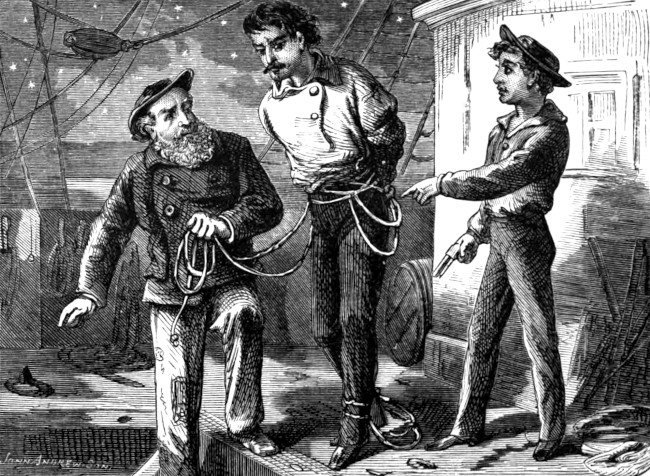
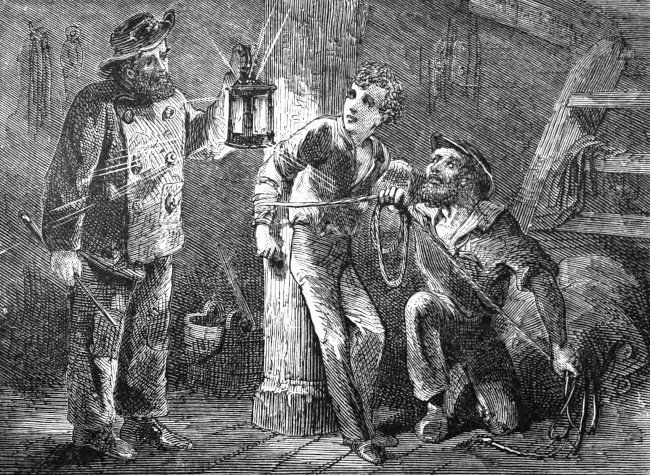
Waterford taken to the Steerage.
The ropes tied to his ankles were loose enough to enable him to walk,
and Sanderson led him to the steerage. His hands were bound so tightly
behind him that he could offer no resistance, and perhaps the fear
of my pistol had some influence over him. We conducted him to the
stanchion where I had been made fast in the first dog watch, and tied
him up in precisely the situation he had left me.
"The tables seem to be turned, Mr. Waterford," I suggested, when we
had finished the operation. "I hope you will appreciate the position as
well as I did."
"The tables will be turned the other way very soon, Phil," growled he.
"Perhaps they will be; if they are, I hope we shall have the patience
to submit like men."
"What are you going to do, Phil?" he demanded.
"I didn't ask you any such impertinent questions, and you will excuse
me from answering, at least till we get our minds made up in regard to
our intentions. Bring in the other pirates, Sanderson," I continued.
The old sailor followed the steward, who carried the lantern, and I was
left alone with my great enemy.
"You have got the better of me again, Phil," said he, in a milder tone.
"I know it."
"I should like to make a trade with you."
"You can't do it."
"Why not?"
"Because I will make no bargains with a man like you—with a pirate."
"Don't use hard words. There is a great deal of money on board, and you
don't know the men who are doing this thing with you."
"Yes, I do. I know them better than you do, or you never would have
shipped them on a piratical voyage."
"You have put the bark about—haven't you?"
"We have."
"The men who are working with you are a set of miserable, drunken
vagabonds. You can't take the bark into port with them. They will find
where the liquor is, and then the vessel will be wrecked, and all hands
lost."
"I would rather take my chances with them than with you. Anything but
being a pirate."
"There is no pirate about it; we haven't taken any negroes on board
yet, and the worst that can be made of it is fitting out a slaver. I
don't want to take any men down to the coast of Africa who don't want
to go there."
"Yes, you do."
"No; if you will hear me, you shall make a good thing out of this
cruise, and not see a single negro."
"I won't trust you, and you are wasting your breath."
"You know very well that the crew will keep drunk all the time as soon
as they find the liquor. Old Sanderson is the best man on board, but he
will drink all day long."
"I will trust him, drunk or sober, farther than I would you."
"The vessel will be wrecked, and you will lose your life."
"You will not volunteer to be the chief mourner if I do, Ben Waterford.
For the present I intend to take care of myself."
"Thank you, Phil, for what you said about me," said Sanderson, leading
Señor Bartolomé into the steerage.
"What's that?"
"You said you would trust me, drunk or sober, farther than you would
that pirate. I give you the word and honor of an old sailor that I
won't drink a drop of liquor till the cruise is up."
"I believe you, Jack. Rum is your only enemy."
"Thank you, Phil. What shall we do with this pirate?" he added, shaking
the Spanish don very unceremoniously into the steerage, at the door of
which he had paused.
"Pitch him into one of those berths. Tie his hands and feet so that he
can use neither of them. If he wants to roll out of his berth, he may;
but that's all he can do."
Sanderson followed my directions, and, after tumbling the don into the
bunk, as though he rather relished the job, he tied his feet together.
"Now bring in the other," I added.
"Just listen to reason, Phil," said Waterford, when Sanderson and the
steward had gone.
"That's what I have been listening to all the time; but when you ask me
to listen to you, that's quite another thing."
"You can keep that money."
"I have intended to do that all along, though I am much obliged to you
for your kind permission to do so."
"You shall have more," pleaded he, beginning to be quite earnest.
"More of your stolen money?"
"It is my own—all I have."
"It is the proceeds of your St. Louis forgery."
"But there is money enough on board to satisfy you."
"No, there isn't. You may call it cant, if you please; but I would not
do what I know to be wrong for all the money in the world. You had
better be contented where you are, Mr. Waterford, for I know you too
well to trust you."
Sanderson brought in the other Spaniard, and he was bound and thrown
into a bunk, as his countryman had been.
"Now bring Captain Farraday. We will have them all where we can find
them," I said.
"Ay, ay, Phil," replied Sanderson, cheerfully.
The captain was still too drunk to stand, or to comprehend what had
transpired on board. We tied him, as we had the other pirates, and
rolled him into another berth. In a few moments we heard him snoring
in his drunken stupor, unconscious that he was no longer master of the
Michigan.
"We have six more on deck," said Sanderson. "What shall we do with
them?"
"There are five more berths in the steerage; I don't know but that we
might as well put them all in here—at least all but Franklin. By the
way, we will carry the guns, pistols, and cutlasses into the cabin, and
the ammunition too."
"Ay, ay, Phil; we can make a better use of these playthings than the
pirates. I suppose they were brought on board to keep us in order."
"We will change their use, and let the biters be bitten."
The arms and ammunition were removed to the cabin, and the five Spanish
and Portuguese sailors, tied hand and foot, were put into the other
berths. There was no aristocracy in the steerage then. The captain,
the passengers, and the common sailors berthed together under the same
regulation.
"Now, Jack, I believe in having one pair of eyes on these pirates all
the time; and I will take my first turn, if you like."
"All right."
"Palmer, load those pistols and muskets with ball, for if we lose the
bark, there will be some dead men on board," I continued.
With my revolver in my hand, I took position where I could see all the
prisoners.