Section 35.
Our conclusions depend upon perceptions made by ourselves and others.
And if the perceptions are good our judgments may be good, if they are
bad our judgments must be bad. Hence, to study the forms of
sense-perception is to study the fundamental conditions of the
administration of law, and the greater the attention thereto, the more
certain is the administration.
It is not our intention to develop a theory of perception. We have only
to extract those conditions which concern important circumstances,
criminologically considered, and from which we may see how we and those
we examine, perceive matters. A thorough and comprehensive study of this
question can not be too much recommended. Recent science has made much
progress in this direction, and has discovered much of great importance
for us. To ignore this is to confine oneself merely to the superficial
and external, and hence to the inconceivable and incomprehensible, to
ignoring valuable material for superficial reasons, and what is worse,
to identifying material as important which properly understood has no
value whatever.
Section 36. (a) General Considerations.
The criminalist studies the physiological psychology[172] of the senses
and their functions, in order to ascertain their nature, their influence
upon images and concepts, their trustworthiness, their reliability and
its conditions, and the relation of perception to the object. The
question applies equally to the judge, the jury, the witness, and the
accused. Once the essence of the function and relation of
sense-perception is understood, its application in individual cases
becomes easy.
The importance of sense-perception need not be demonstrated. “If we
ask,” says Mittermaier, “for the reason of our conviction of the truth
of facts even in very important matters, and the basis of every judgment
concerning existence of facts, we find that the evidence of the senses
is final and seems, therefore, the only true source of certainty.”
There has always, of course, been a quarrel as to the objectivity and
reliability of sense-perception. That the senses do not lie, “not
because they are always correct, but because they do not judge,” is a
frequently quoted sentence of Kant’s; the Cyrenaics have already
suggested this in asserting that pleasure and pain alone are
indubitable. Aristotle narrows the veracity of sensation to its
essential content, as does Epicurus. Descartes, Locke and Leibnitz have
suggested that no image may be called, as mere change of feeling, true
or false. Sensationalism in the work of Gassendi, Condillac, and
Helvetius undertook for this reason the defense of the senses against
the reproach of deceit, and as a rule did it by invoking the
infallibility of the sense of touch against the reproach of the
contradictions in the other senses. Reid went back to Aristotle in
distinguishing specific objects for each sense and in assuming the truth
of each sense within its own field.
That these various theories can be adjusted is doubtful, even if, from a
more conservative point of view, the subject may be treated
quantitatively. The modern quantification of psychology was begun by
Herbart, who developed a mathematical system of psychology by
introducing certain completely unempirical postulates concerning the
nature of representation and by applying certain simple premises in all
deductions concerning numerical extent. Then came Fechner, who assumed
the summation of stimuli. And finally these views were determined and
fixed by the much-discussed Weber’s Law, according to which the
intensity of the stimulus must increase in the proportion that the
intensity of the sensation is to increase; i.e., if a stimulus of 20
units requires the addition of 3 before it can be perceived, a stimulus
of 60 units would require the addition of 9. This law, which is of
immense importance to criminalists who are discussing the
sense-perceptions of witnesses, has been thoroughly and conclusively
dealt with by A. Meinong.[173]
“Modern psychology takes qualities perceived externally to be in
themselves subjective but capable of receiving objectivity through our
relation to the outer world.... The qualitative character of our sensory
content produced by external stimuli depends primarily on the
organization of our senses. This is the fundamental law of perception,
of modern psychology, variously expressed, but axiomatic in all
physiological psychology.”[174] In this direction Helmholtz[175] has
done pioneer work. He treats particularly the problem of optics, and
physiological optics is the study of perception by means of the sense of
sight. We see things in the external world through the medium of light
which they direct upon our eyes. The light strikes the retina, and
causes a sensation. The sensation brought to the brain by means of the
optic nerve becomes the condition of the representation in consciousness
of certain objects distributed in space.... We make use of the sensation
which the light stimulates in the mechanism of the optic nerve to
construct representations concerning the existence, form, and condition
of external objects. Hence we call images perceptions of sight. (Our
sense-perception, according to this theory, consists, therefore,
entirely of sensations; the latter constitute the stuff or the content
from which the other is constructed). Our sensations are effects caused
in our organs, externally, and the manifestation of such an effect
depends essentially upon the nature of the apparatus which has been
stimulated.
There are certain really known inferences, e.g., those made by the
astronomer from the perspective pictures of the stars to their positions
in space. These inferences are founded upon well-studied knowledge of
the principles of optics. Such knowledge of optics is lacking in the
ordinary function of seeing; nevertheless it is permissible to conceive
the psychical function of ordinary perception as unconscious inferences,
inasmuch as this name will completely distinguish them from the commonly
so-called conscious inferences.
The last-named condition is of especial importance to us. We need
investigation to determine the laws of the influence of optical and
acoustical knowledge upon perception. That these laws are influential
may be verified easily. Whoever is ignorant, e.g., that a noise is
reflected back considerably, will say that a wagon is turning from the
side from which the noise comes, though if he knows the law, if he knows
that fact, his answer would be reversed. So, as every child knows that
the reflection of sound is frequently deceptive, everybody who is asked
in court will say that he believes the wagon to be on the right side
though it might as well have been on the left. Again, if we were unaware
that light is otherwise refracted in water than in air we could say that
a stick in the water has been bent obtusely, but inasmuch as everybody
knows this fact of the relation of light to water, he will declare that
the stick appears bent but really is straight.
From these simplest of sense-perceptions to the most complicated, known
only to half a dozen foremost physicists, there is an infinite series of
laws controlling each stage of perception, and for each stage there is a
group of men who know just so much and no more. We have, therefore, to
assume that their perceptions will vary with the number and manner of
their accomplishments, and we may almost convince ourselves that each
examinee who has to give evidence concerning his sense-perception should
literally undergo examination to make clear his scholarly status and
thereby the value of his testimony. Of course, in practice this is not
required. First of all we judge approximately a man’s nature and nurture
and according to the impression he makes upon us, thence, his
intellectual status. This causes great mistakes. But, on the other hand,
the testimony is concerned almost always with one or several physical
events, so that a simple relational interrogation will establish
certainly whether the witness knows and attends to the physical law in
question or not. But anyway, too little is done to determine the means a
man uses to reach a certain perception. If instantaneous contradictions
appear, there is little damage, for in the absence of anything certain,
further inferences are fortunately made in rare cases only. But when the
observation is that of one person alone, or even when more testify but
have accidentally the same amount of knowledge and hence have made the
same mistake, and no contradiction appears, we suppose ourselves to
possess the precise truth, confirmed by several witnesses, and we argue
merrily on the basis of it. In the meantime we quite forget that
contradictions are our salvation from the trusting acceptance of
untruth—and that the absence of contradiction means, as a rule, the
absence of a starting point for further examination.
For this reason and others modern psychology requires us to be cautious.
Among the others is the circumstance that perceptions are rarely pure.
Their purity consists in containing nothing else than perception; they
are mixed when they are connected with imaginations, judgments, efforts,
and volitions. How rarely a perception is pure I have already tried to
show; judgments almost always accompany it. I repeat too, that owing to
this circumstance and our ignorance of it, countless testimonies are
interpreted altogether falsely. This is true in many other fields. When,
for example, A. Fick says: “The condition we call sensation occurs in
the consciousness of the subject when his sensory nerves are
stimulated,” he does not mean that the nervous stimulus in itself is
capable of causing the condition in question. This one stimulus is only
a single tone in the murmur of countless stimuli, which earlier and at
the same time have influenced us and are different in their effect on
each man. Therefore, that single additional tone will also be different
in each man. Or, when Bernstein says that “Sensation, i.e., the
stimulation of the sensorium and the passage of this stimulation to the
brain, does not in itself imply the perception of an object or an event
in the external world,” we gather that the objectivity of the perception
works correctively not more than one time out of many. So here again
everything depends upon the nature and nurture of the subject.
Sensations are, according to Aubert, still more subjective. “They are
the specific activity of the sense organs, (not, therefore, passive as
according to Helmholtz, but active functions of the sense organs).
Perception arises when we combine our particular sensations with the
pure images of the spirit or the schemata of the understanding,
especially with the pure image of space. The so-called ejection or
externalization of sensations occurs only as their scheme and relation
to the unity of their object.”
So long as anything is conceived as passive it may always recur more
identically than when it is conceived as active. In the latter case the
individuality of the particular person makes the perception in a still
greater degree individual, and makes it almost the creature of him who
perceives. Whether Aubert is right or not is not our task to discover,
but if he is right then sense-perception is as various as is humanity.
The variety is still further increased by means of the comprehensive
activity which Fischer[176] presupposes. “Visual perception has a
comprehensive or compounding activity. We never see any absolute simple
and hence do not perceive the elements of things. We see merely a
spatial continuum, and that is possible only through comprehensive
activity—especially in the case of movement in which the object of
movement and the environment must both be perceived.” But each
individual method of “comprehension” is different. And it is uncertain
whether this is purely physical, whether only the memory assists (so
that the attention is biased by what has been last perceived), whether
imagination is at work or an especial psychical activity must be
presupposed in compounding the larger elements. The fact is that men may
perceive an enormous variety of things with a single glance. And
generally the perceptive power will vary with the skill of the
individual. The narrowest, smallest, most particularizing glance is that
of the most foolish; and the broadest, most comprehensive, and comparing
glance, that of the most wise. This is particularly noticeable when the
time of observation is short. The one has perceived little and generally
the least important; the other has in the same time seen everything from
top to bottom and has distinguished between the important and the
unimportant, has observed the former rather longer than the latter, and
is able to give a better description of what he has seen. And then, when
two so different descriptions come before us, we wonder at them and say
that one of them is untrue.[177]
The speed of apperception has been subjected to measurement by Auerbach,
Kries, Baxt, von Tigerstedt and Bergqvist, Stern, Vaschide, Vurpass,
etc. The results show 0.015 to 0.035 seconds for compounded images.
Unfortunately, most of these experiments have brought little unanimity
in the results and have not compared, e.g., the apperception-times of
very clever people with those of very slow and stupid ones. In the
variety of perception lies the power of presentation (in our sense of
the term). In the main other forces assist in this, but when we consider
how the senses work in combination we must conclude that they determine
their own forms. “If we are to say that sense experience instructs us
concerning the manifoldness of objects we may do so correctly if we add
the scholium that many things could not be mentioned without synthesis.”
So Dörner writes. But if we approach the matter from another side, we
see how remarkable it is that human perceptions can be compared at all.
Hermann Schwarz says “According to the opinion of the physicists we know
external events directly by means of the organs, the nerves of which
serve passively to support consciousness in the perception of such
events. On the contrary, according to the opinion of most physiologists,
the nerve fibers are active in the apprehension of external events, they
modify it, alter it until it is well nigh unrecognizable, and turn it
over to consciousness only after the original process has undergone
still another transformation into new forms of mechanical energy in the
ganglion cells of the outer brain. This is the difference between the
physical theory of perception and the physiological.”
In this connection there are several more conditions pertaining to
general sense-perception. First of all there is that so-called
vicariousness of the senses which substitutes one sense for another, in
representation. The actual substitution of one sense by another as
that of touch and sight, does not belong to the present discussion. The
substitution of sound and sight is only apparent. E. g., when I have
several times heard the half-noticed voice of some person without seeing
him, I will imagine a definite face and appearance which are pure
imagination. So again, if I hear cries for help near some stream, I see
more or less clearly the form of a drowning person, etc. It is quite
different in touching and seeing; if I touch a ball, a die, a cat, a
cloth, etc., with my eyes closed, then I may so clearly see the color of
the object before me that I might be really seeing it. But in this case
there is a real substitution of greater or lesser degree.
The same vicariousness occurs when perception is attributed to one sense
while it properly belongs to another. This happens particularly at such
times when one has not been present during the event or when the
perception was made while only half awake, or a long time ago, and
finally, when a group of other impressions have accompanied the event,
so that there was not time enough, if I may say so, properly to register
the sense impression. So, e.g., some person, especially a close friend,
may have been merely heard and later quite convincingly supposed to have
been seen. Sensitive people, who generally have an acuter olfactory
sense than others, attach to any perceived odor all the other
appropriate phenomena. The vicariousnesses of visual sensations are the
most numerous and the most important. Anybody who has been pushed or
beaten, and has felt the blows, will, if other circumstances permit and
the impulse is strong enough, be convinced that he has seen his
assaulter and the manner of the assault. Sometimes people who are shot
at will claim to have seen the flight of the ball. And so again they
will have seen in a dark night a comparatively distant wagon, although
they have only heard the noise it made and felt the vibration. It is
fortunate that, as a rule, such people try to be just in answering to
questions which concern this substitution of one sense-perception for
another. And such questions ought to be urgently put. That a false
testimony can cause significant errors is as obvious as the fact that
such substitutions are most frequent with nervous and imaginative
persons.
Still more significant is that characteristic phenomenon, to us of
considerable importance, which might be called retrospective
illumination of perception. It consists in the appearance of a
sense-perception under conditions of some noticeable interruption, when
the stimulus does not, as a rule, give rise to that perception. I cite a
simple example in which I first observed this fact. Since I was a child
there had been in my bed-room a clock, the loud ticking of which habit
of many years prevented my hearing. Once, as I lay awake in bed, I heard
it tick suddenly three times, then fall silent and stop. The occurrence
interested me, I quickly got a light and examined the clock closely. The
pendulum still swung, but without a sound; the time was right. I
inferred that the clock must have stopped going just a few minutes
before. And I soon found out why: the clock is not encased and the
weight of the pendulum hangs free. Now under the clock there always
stood a chair which this time had been so placed as to be inclined
further backward. The weight followed that inclination and so the
silence came about.
I immediately made an experiment. I set the clock going again, and again
held the weight back. The last beats of the pendulum were neither
quicker nor slower, nor louder or softer than any others, before the
sudden stoppage of the clock. I believe the explanation to be as
follows: As customary noises especially are unheard, I did not hear the
pendulum of the clock. But its sudden stopping disturbed the balance of
sound which had been dominating the room. This called attention to the
cause of the disturbance, i.e., the ticking which had ceased, and hence
perception was intensified backwards and I heard the last ticks, which
I had not perceived before, one after another. The latent stimulus
caused by the ticking worked backward. My attention was naturally
awakened only after the last tick, but my perception was consecutive.
I soon heard of another case, this time, in court. There was a shooting
in some house and an old peasant woman, who was busy sewing in the room,
asserted that she had just before the shooting heard a few steps in
the direction from which the shot must have come. Nobody would agree
that there was any reason for supposing that the person in question
should have made his final steps more noisily than his preceding ones.
But I am convinced that the witness told the truth. The steps of the new
arrival were perceived subconsciously; the further disturbance of the
perception hindered her occupation and finally, when she was frightened
by the shot, the upper levels of consciousness were illuminated and the
noises which had already reached the subconsciousness passed over the
threshold and were consciously perceived.
I learned from an especially significant case, how the same thing could
happen with regard to vision. A child was run over and killed by a
careless coachman. A pensioned officer saw this through the window. His
description was quite characteristic. It was the anniversary of a
certain battle. The old gentleman, who stood by the window thinking
about it and about his long dead comrades, was looking blankly out into
the street. The horrible cry of the unhappy child woke him up and he
really began to see. Then he observed that he had in truth seen
everything that had happened before the child was knocked over—i.e.,
for some reason the coachman had turned around, turning the horses in
such a way at the same time that the latter jumped sidewise upon the
frightened child, and hence the accident. The general expressed himself
correctly in this fashion: “I saw it all, but I did not perceive and
know that I saw it until after the scream of the child.” He offered
also in proof of the correctness of his testimony, that he, an old
cavalry officer, would have had to see the approaching misfortune if he
had consciously seen the moving of the coachman, and then he would have
had to be frightened. But he knew definitely that he was frightened only
when the child cried out—he could not, therefore, have consciously
perceived the preceding event. His story was confirmed by other
witnesses.
This psychological process is of significance in criminal trials,
inasmuch as many actionable cases depend upon sudden and unexpected
events, where retrospective illumination may frequently come in. In such
cases it is most important to determine what actually has been
perceived, and it is never indifferent whether we take the testimony in
question as true or not.
With regard to the senses of criminals, Lombroso and Ottolenghi have
asserted that they are duller than those of ordinary people. The
assertion is based on a collection made by Lombroso of instances of the
great indifference of criminals to pain. But he has overlooked the fact
that the reason is quite another thing. Barbarous living and barbarous
morals are especially dulling, so that indifference to pain is a
characteristic of all barbarous nations and characters. Inasmuch as
there are many criminals among barbarous people, barbarity, criminality
and indifference to pain come together in a large number of cases. But
there is nothing remarkable in this, and a direct relation between crime
and dullness of the senses can not be demonstrated.
(b) The Sense of Sight.
Section 37. (1) General Considerations.
Just as the sense of sight is the most dignified of all our senses, it
is also the most important in the criminal court, for most witnesses
testify as to what they have seen. If we compare sight with the hearing,
which is next in the order of importance, we discover the well-known
fact that what is seen is much more certain and trustworthy than what is
heard. “It is better to see once than to hear ten times,” says the
universally-valid old maxim. No exposition, no description, no
complication which the data of other senses offer, can present half as
much as even a fleeting glance. Hence too, no sense can offer us such
surprises as the sense of sight. If I imagine the thunder of Niagara,
the voice of Lucca, the explosion of a thousand cartridges, etc., or
anything else that I have not heard, my imagination is certainly
incorrect, but it will differ from reality only in degree. It is quite
different with visual imagination. We need not adduce examples of
magnificence like the appearance of the pyramids, a tropical light; of a
famous work of art, a storm at sea, etc. The most insignificant thing
ever seen but variously pictured in imagination will be greeted at first
sight with the words: “But I imagined it quite different!” Hence the
tremendous importance of every local and material characteristic which
the criminal court deals with. Every one of us knows how differently he
has, as a rule, imagined the place of the crime to be; how difficult it
is to arrive at an understanding with the witness concerning some
unseen, local characteristic, and how many mistakes false images of the
unseen have caused. Whenever I ciceroned anybody through the Graz
Criminal Museum, I was continually assailed with “Does this or that look
so? But I thought it looked quite different!” And the things which evoke
these exclamations are such as the astonished visitors have spoken and
written about hundreds of times and often passed judgments upon. The
same situation occurs when witnesses narrate some observation. When the
question involves the sense of hearing some misunderstanding may be
popularly assumed. But the people know little of optical illusions and
false visual perceptions, though they are aware that incorrect auditions
are frequent matters of fact. Moreover, to the heard object a large
number of more or less certain precautionary judgments are attached. If
anybody, e.g., has heard a shot, stealthy footsteps, crackling flames,
we take his experience always to be approximate. We do not do so when
he assures us he has seen these things or their causes. Then we take
them—barring certain mistakes in observation,—to be indubitable
perceptions in which misunderstanding is impossible.
In this, again, is the basis for the distrust with which we meet
testimony concerning hearsay. For we feel uncertain in the mere absence
of the person whose conversation is reported, since his value can not be
determined. But a part of the mistrust lies in the fact that it is not
vision but the perennially half-doubted hearing that is in issue. Lies
are assigned mainly to words; but there are lies which are visual
(deceptions, maskings, illusions, etc.). Visual lies are, however, a
diminishing minority in comparison with the lies that are heard.
The certainty of the correctness of vision lies in its being tested with
the sense of touch,—i.e. in the adaptation of our bodily sense to
otherwise existing things. As Helmholtz says, “The agreement between our
visual perceptions and the external world, rests, at least in the most
important matters, on the same ground that all our knowledge of the
actual world rests on, upon the experience and the lasting test of their
correctness by means of experiments, i.e., of the movements of our
bodies.” This would almost make it seem that the supreme judge among the
senses is the touch. But that is not intended; we know well enough to
what illusions we are subject if we trust the sense of touch alone. At
the same time we must suppose that the question here is one of the
nature of the body, and this can be measured only by something similar,
i.e., by our own physical characteristics, but always under the control
of some other sense, especially the sense of sight.
The visual process itself consists, according to Fischer, “of a
compounded series of results which succeed each other with extraordinary
rapidity and are causally related. In this series the following elements
may principally be distinguished.
(1) The physico-chemical process.
(2) The physiologico-sensory.
(3) The psychological.
(4) The physiologico-motor.
(5) The process of perception.”
It is not our task to examine the first four elements. In order clearly
to understand the variety of perception, we have to deal with the last
only. I once tried to explain this by means of the phenomenon of
instantaneous photographs (cinematographs). If we examine one such
representing an instant in some quick movement, we will assert that we
never could have perceived it in the movement itself. This indicates
that our vision is slower than that of the photographic apparatus, and
hence, that we do not apprehend the smallest particular conditions, but
that we each time unconsciously compound a group of the smallest
conditions and construct in that way the so-called instantaneous
impressions. If we are to compound a great series of instantaneous
impressions in one galloping step, we must have condensed and compounded
a number of them in order to get the image that we see with our eyes as
instantaneous. We may therefore say that the least instantaneous image
we ever see with our eyes contains many parts which only the
photographic apparatus can grasp. Suppose we call these particular
instances a, b, c, d, e, f, g, h, i, j, k, l, m; it is self-evident that
the manner of their composition must vary with each individual. One man
may compound his elements in groups of three: a, b, c,—d, e, f,—g, h,
i, etc.; another may proceed in dyads: a, b,—c, d,—e, f,—g, h,—etc.;
a third may have seen an unobservable instant later, but constructs his
image like the first man: b, c, d,—l, m, n, etc.; a fourth works slowly
and rather inaccurately, getting: a, c, d,—f, h, i,—etc. Such
variations multiply, and when various observers of the same event
describe it they do it according to their different characteristics. And
the differences may be tremendous. Substitute numerals for letters and
the thing becomes clear. The relative slowness of our apprehension of
visual elements has the other consequence that we interpolate objects in
the lacunæ of vision according to our expectations. The best example
of this sort of thing would be the perception of assault and battery.
When ten people in an inn see how A raises a beer glass against B’s
head, five expect: “Now he’ll pound him,” and five others: “Now he’ll
throw it.” If the glass has reached B’s head none of the ten observers
have seen how it reached there, but the first five take their oath that
A pounded B with the glass, and the other five that he threw it at B’s
head. And all ten have really seen it, so firmly are they convinced of
the correctness of their swift judgment of expectation. Now, before we
treat the witness to some reproach like untruth, inattention, silliness,
or something equally nice, we had better consider whether his story is
not true, and whether the difficulty might not really lie in the
imperfection of our own sensory processes. This involves partly what
Liebmann has called “anthropocentric vision,” i.e., seeing with man as
the center of things. Liebmann further asserts, “that we see things only
in perspective sizes, i.e., only from an angle of vision varying with
their approach, withdrawal and change of position, but in no sense as
definite cubical, linear, or surface sizes. The apparent size of an
object we call an angle of vision at a certain distance. But, what
indeed is the different, true size? We know only relations of
magnitude.” This description is important when we are dealing with
testimony concerning size. It seems obvious that each witness who speaks
of size is to be asked whence he had observed it, but at the same time a
great many unexpected errors occur, especially when what is involved is
the determination of the size of an object in the same plane. One need
only to recall the meeting of railway tracks, streets, alleys, etc., and
to remember how different in size, according to the point of view of the
witness, various objects in such places must appear. Everybody knows
that distant things seem smaller than near ones, but almost nobody knows
what the difference amounts to. For examples see Lotze, “Medical
Psychology,” Leipzig, 1852.
In addition we often think that the clearness of an object represents
its distance and suppose that the first alone determines the latter. But
the distinctness of objects, i.e., the perceptibility of a
light-impression, depends also upon the absolute brightness and the
differences in brightness. The latter is more important than is
supposed. Try to determine how far away you can see a key-hole when the
wall containing the door is in the shadow, and when there is a window
opposite the key-hole. A dark object of the size of a key-hole will not
be visible at one hundredth of the distance at which the key-hole is
perceived. Moreover, the difference in intensity is not alone in
consideration; the intensity of the object with regard to its
background has yet to be considered. Aubert has shown that the accuracy
of the distinction is the same when a square of white paper is looked at
from an angle of 18´´, and when conversely a square of black paper on
white background is looked at from an angle of 35´´. “When we put a gray
paper in the sunshine, it may become objectively brighter than white
paper in shadow. But this does not prevent us from knowing one as gray
and the other as pure white. We separate the color of the object from
the intensity of the incident light.” But this is not always so simple,
inasmuch as we know in the case in hand which paper is gray and which
white, which is in the sunlight and which in the shadow. But if these
facts are not known mistakes often occur so that a man dressed in dark
clothes but in full light will be described as wearing lighter clothes
than one who wears light clothes in the shadow.
Differences of illumination reveal a number of phenomena difficult to
explain. Fechner calls attention to the appearance of stars: “At night
everybody sees the stars, in daylight not even Sirius or Jupiter is
seen. Yet the absolute difference between those places in the heavens
where the stars are and the environing places is just as great as in the
night—there is only an increase in illumination.” Of still greater
importance to us is the circumstance noted but not explained by
Bernstein. If, in daylight, we look into a basement room from outside,
we can perceive nothing, almost; everything is dark, even the windows
appear black. But in the evening, if the room is ever so slightly
illuminated, and we look into it from outside, we can see even small
articles distinctly. Yet there was much intenser light in the room in
question during the day than the single illumination of the night could
have provided. Hence, it is asserted, the difference in this case is a
standard one. In open day the eye is accustomed to the dominating
brightness of daylight, beside which the subdued illumination of the
room seems relatively dark. But in the evening one is in the dark, and
hence even the little light of a single candle is enough to enable one
to see. That this explanation is untrue is shown by the fact that the
phenomenon is not regulated even when the circumstances in question are
made identical. If, for example, you approach the window in daylight
with your eyes shut, lean your forehead against the pane and shut out
the light on the sides with your hands, and then open your eyes, you see
as little in the room as when you looked into it without performing this
ceremony. So again, if during the night you gazed at some near-by gas
lamp and then glanced into the room, there is only a few moments’
indistinctness at most, after that the single candle is enough. The
reason, then, must be different from the assigned one—but whatever it
is, we need only to maintain that immediate judgment concerning numerous
cases involving situations of this kind would be overhasty. It is often
said that a witness was able to see this or that under such and such
illumination, or that he was unable to see it, although he denies his
ability or inability. The only solution of such contradictions is an
experiment. The attempt must be made either by the judge or some
reliable third person, to discover whether, under the same conditions
of illumination, anything could be seen at the place in question or not.
As to what may be seen in the distance, experiment again, is the best
judge. The human eye is so very different in each man that even the
acute examination into what is known of the visual image of the Pleiades
shows that the average visual capacity of classic periods is no
different from our own, but still that there was great variety in visual
capacity. What enormous visual power is attributed to half-civilized and
barbarous peoples, especially Indians, Esquimos, etc.! Likewise among
our own people there are hunters, mountain guides, etc., who can see so
clearly in the distance that mere stories about it might be fables. In
the Bosnian campaign of 1878 we had a soldier who in numerous cases of
our great need to know the enemy’s position in the distance could
distinguish it with greater accuracy than we with our good
field-glasses. He was the son of a coal-miner in the Styrian mountains,
and rather a fool. Incidentally it may be added that he had an
incredible, almost animal power of orientation.
As we know little concerning far-sightedness, so also we are unable to
define what near-sighted people can see. Inasmuch as their vision does
not carry, they are compelled to make intellectual supplementations.
They observe the form, action, and clothes of people more accurately
than sharp-eyed persons, and hence recognize acquaintances at a greater
distance than the latter. Therefore, before an assertion of a
short-sighted man is doubted an experiment should be made, or at least
another trustworthy short-sighted person should be asked for his
opinion.
The background of objects, their movement and form have decided effects
on the difference in visual perception. It is an ancient observation
that lengthy objects like poles, wires, etc., are visible at
incomparably greater distances than, e.g., squares of the same length.
In examination it has been shown that the boundary of accurate
perception can hardly be determined. I know a place where under
favorable illumination taut, white and very thin telephone wires may be
seen at a distance of more than a kilometer. And this demands a very
small angle of vision.
Humboldt calls attention to the large number of “optical fables.” He
assures us that it is certainly untrue that the stars may be seen in
daylight from a deep well, from mines, or high mountains, although this
has been repeatedly affirmed since Aristotle.
The explanation of our power to see very thin, long objects at a very
great distance, is not our affair, but is of importance because it
serves to explain a number of similar phenomena spoken of by witnesses.
We have either incorrectly to deny things we do not understand, or we
have to accept a good deal that is deniable. We will start, therefore,
with the well-known fact that a point seen for a considerable time may
easily disappear from perception. This has been studied by Helmholtz and
others, and he has shown how difficult it is to keep a point within the
field of vision for only ten or twenty minutes. Aubert examines older
studies of the matter and concludes that this disappearance or confusion
of an object is peripheral, but that fixation of a small object is
always difficult. If we fix a distant point it is disappearing at every
instant so that an accurate perception is not possible; if however we
fix upon a long, thin body, e.g., a wire, it is unnecessary to fix a
single point and we may see the object with a wandering eye, hence more
clearly.
Helmholtz adds that weakly objective images disappear like a wet spot on
warm tin, at the moment a single point is fixed, as does e.g., a
landscape seen at night. This last acute observation is the basis of
many a testimony concerning the sudden disappearance of an object at
night. It has helped me in many an examination, and always to advantage.
In this connection the over-estimation of the moon’s illuminating power
is not to be forgotten. According to Helmholtz the power of the full
moon is not more than that of a candle twelve feet away. And how much
people claim to have seen by moonlight! Dr. Vincent[178] says that a man
may be recognized during the first quarter at from two to six meters, at
full moon at from seven to ten meters, and at the brightest full moon,
an intimate may be recognized at from fifteen to sixteen meters. This is
approximately correct and indicates how much moonlight is
over-estimated.
In addition to the natural differences of sight there are also those
artificially created. How much we may help ourselves by skilful
distinctions, we can recognize in the well-known and
frequently-mentioned business of reading a confused handwriting. We aim
to weaken our sense-perception in favor of our imagination, i.e. so to
reduce the clearness of the former as to be able to test upon it in some
degree a larger number of images. We hold the MS. away from us, look at
it askant, with contracted eyebrows, in different lights, and finally we
read it. Again, the converse occurs. If we have seen something with a
magnifying glass we later recognize details without its help. Definite
conditions may bring to light very great distinctions. A body close to
the face or in the middle distance looks different according as one eye
or both be used in examining it. This is an old story and explains the
queer descriptions we receive of such objects as weapons and the like,
which were suddenly held before the face of the deponent. In cases of
murderous assault it is certain that most uncanny stories are told,
later explained by fear or total confusion or intentional dishonesty,
but really to be explained by nothing more than actual optical
processes.
I do not believe that binocular vision is of much importance in the law;
I know of no case in ordinary vision where it matters whether one or
both eyes have been used. It is correct to assert that one side or the
other of a vertically held hand will be clearer if, before looking at it
with both eyes, you look at it with one or the other, but this makes
little difference to our purpose. It must be maintained that a part of
what we see is seen with one eye only,—if, e.g., I look at the sky and
cover one eye with my hand, a certain portion of the heaven disappears,
but I observe no alteration in the remaining portion. When I cover the
other eye, other stars disappear. Therefore, in binocular vision certain
things are seen with one eye only. This may be of importance when an
effect has been observed first with both eyes, then with one; raising
the question of the difference in observation—but such a question is
rare.
There are two additional things to consider. The first is the problem of
the influence of custom on increasing visual power in darkness. This
power is as a rule undervalued. No animal, naturally, can see anything
in complete darkness. But it is almost unbelievable how much can be seen
with a very little light. Here again, prisoners tell numerous stories
concerning their vision in subterranean prisons. One saw so well as to
be able to throw seven needles about the cell and then to find them
again. Another, the naturalist Quatremére-Disjonval, was able so
accurately to observe the spiders in his cell as to make the observation
the basis for his famous “Aranéologie.” Aubert tells of his having had
to stay in a room so dark as to make it necessary for others to feel
their way, but nevertheless being able to read books without detection
because the others could not see the books.
How quickly we get used to darkness and how much more we see after a
while, is well known. It is also certain that the longer you are in
darkness the more you see. You see more at the end of a day than after a
few hours, and at the end of a year, still more. The eye, perhaps,
changes in some degree for just this purpose. But a prolonged use of the
visual mechanism tends to hypertrophy—or atrophy, as the eyes of
deep-sea fishes show. It is well, in any event, to be careful about
contradicting the testimonies of patients who have long lived in the
dark, concerning what they have seen. The power to see in the dark is so
various that without examination, much injustice may be done. Some
people see almost nothing at twilight, others see at night as well as
cats. And in court these differences must be established and
experimentally verified.
The second important element is the innervation of the muscles in
consequence of movement merely seen. So Stricker points out, that the
sight of a man carrying a heavy load made him feel tension in the
muscles involved, and again, when he saw soldiers exercising, he almost
was compelled openly to act as they. In every case the muscular
innervation followed the visual stimulus.
This may sound improbable but, nevertheless, everybody to some degree
does the identical things. And at law the fact may be of importance in
cases of assault and battery. Since I learned it, I have repeatedly
observed in such cases, from harmless assault to murder, that people,
although they had not been seen to deal any blows, were often accused of
complicity simply because they were making suspicious movements that led
to the following inference: “They stuck their hands into their trousers
pocket looking for a knife, clenched their fists, looked as if they were
about to jump, swung their hands.” In many such cases it appeared that
the suspects were harmless spectators who were simply more obvious in
their innervation of the muscles involved in the assault they were
eagerly witnessing. This fact should be well kept in mind; it may
relieve many an innocent.
Section 38. (2) Color Vision.
Concerning color vision only a few facts will be mentioned: 1. It will
be worth while, first of all, to consider whether color exists. Liebmann
holds that if all the people were blind to red, red would not exist;
red, i.e., is some cervical phantasy. So are light, sound, warmth,
taste, etc. With other senses we have another world. According to
Helmholtz, it is senseless to ask whether cinnabar is red as we see it
or is only so as an optical illusion. “The sensation of red is the
normal reaction of normally constructed eyes to light reflected from
cinnabar. A person blind to red, will see cinnabar as black, or a dark
grayish yellow, and this is the correct reaction for these abnormal
eyes. But he needs to know that his eyes are different from those of
other people. In itself the sensation is neither more correct nor less
correct than any other even though those who can see red are in the
great majority. The red color of cinnabar exists as such only in so far
as there are eyes which are similar to those of the majority of mankind.
As such light reflected from cinnabar may not properly be called red; it
is red only for especial kinds of eyes.” This is so unconditionally
incorrect that an impartial judge of photography says[179] that
everything that normal eyes call violet and blue, is very bright, and
everything they call green and red is very dark. The red-blind person
will see as equal certain natural reds, greens and gray-yellows, both in
intensity and shadow. But on the photograph he will be able to
distinguish the differences in brightness caused by these three
otherwise identical colors. We may, therefore, assume that colors
possess objective differences, and that these objective differences
are perceived even by persons of normal vision. But whether I am able to
sense the same effect in red that another senses, and whether I should
not call red blue, if I had the color-vision of another, is as
impossible to discover as it is useless. When the question of color is
raised, therefore, we will try to discover only whether the person in
question has normal color-vision, or what the nature and degree of his
abnormality may be.
2. It is not unimportant to know whether single tints are recognizable
in the distance. There have been several examinations of this fact.
Aubert[180] constructed double squares of ten millimeters and determined
the angle of vision at which the color as such could be seen. His
results were:
COLOR OF THE
SQUARE |
WHITE
BACKGROUND |
BLACK |
| White | | 39´´ |
| Red | 1´ 43´´ | 59´´ |
| Light Green | 1´ 54´´ | 1´ 49´´ |
| Dirty Red | 3´ 27´´ | 1´ 23´´ |
| Blue | 5´ 43´´ | 4´ 17´´ |
| Brown | 4´ 55´´ | 1´ 23´´ |
| Light Blue | 2´ 17´´ | 1´ 23´´ |
| Orange | 1´ 8´´ | 0´ 39´´ |
| Gray | 4´ 17´´ | 1´ 23´´ |
| Rose | 2´ 18´´ | 3´ 49´´ |
| Yellow | 3´ 27´´ | 0´ 39´´ |
It is interesting to notice that the angle for blue on a white
background is almost nine times that for white, orange, or yellow on a
black background. In cases where colors are of importance, therefore, it
will be necessary to discover the color and the nature of its background
before the accuracy of the witness can be established.
3. It is well known that in the diminution of brightnesses red
disappears before blue, and that at night, when all colors have
disappeared, the blue of heaven is still visible. So if anybody asserts
that he has been able to see the blue of a man’s coat but not his
red-brown trousers, his statement is possibly true, while the converse
would be untrue. But there are no reliable or consonant accounts of the
order in which colors disappear in increasing darkness. The knowledge of
this order would help a great deal in the administration of criminal
justice.
4. The retina will not see red at the periphery, because there are no
red rods there. A stick of red sealing wax drawn across the eye from
right to left, appears at the periphery of the visual field to be black.
If, then, a witness has not looked right at a definitely red object, and
has seen it askance, he has certainly not observed its color. The
experiment may be made by anybody.
5. According to Quantz[181] objects in less refractable colors (red,
orange, yellow, and purple) look 0.2 to 3.6% bigger against white, while
blue, blue-green, and violet objects appear from 0.2 to 2.2% smaller.
Dark and long-lined objects seem longer; bright and horizontal seem
wider. And these facts are significant when witnesses judge of size.
6. If colors are observed through small openings, especially through
very small holes, the nuances become essentially different and green may
even seem colorless.
7. According to Aubert, sparkle consists of the fact that one point in a
body is very bright while the brightness diminishes almost absolutely
from that point; e.g., a glancing wire has a very narrow bright line
with deep shadows on each side; a ball of mercury in a thermometer, a
shining point and then deep shadow. When we see this we say it sparkles
because we unite it with a number of similar observations. It is
therefore conceivable that at a great distance, under conditions of
sharp or accidental illuminations, etc., we are likely to see things as
sparkling which do not do so in the least. With the concept “sparkling,”
moreover, we tend to unite, at least under certain circumstances,
definite images, and hence “glancing weapons” are often seen in places
where there were only quite harmless dull objects. So also coins are
seen to sparkle where really there are none.
Section 39. (3) The Blind Spot.
Everybody knows what the blind spot is, and every psychology and
physiology text-book talks about it. But as a rule it is identified only
with the little point and the tiny cross pictured in the text-books, and
it is supposed that it does not much matter if the little cross, under
certain circumstances, can not be seen. But it must not be forgotten
that the size of the blind spot increases with the distance so that at a
fairly great distance, possibly half the length of a room, the blind
spot becomes so great that a man’s head may disappear from the field of
vision. According to Helmholtz: “The effect of the blind spot is very
significant. If we make a little cross on a piece of paper and then a
spot the size of a pea two inches to the right, and if we look at the
cross with the left eye closed, the spot disappears. The size of the
blind spot is large enough to cover in the heavens a plate which has
twelve times the diameter of the moon. It may cover a human face at a
distance of 6´, but we do not observe this because we generally fill out
the void. If we see a line in the place in question, we see it unbroken,
because we know it to be so, and therefore supply the missing part.”
A number of experiments have been made with more or less success to
explain the blind spot. It is enough for us to agree that we see
habitually with both eyes and that the “spot as big as a pea” disappears
only when we look at the cross. But when we fix our eyes on anything we
pay attention to that only and to nothing else. And it is indifferent to
us if an uninteresting object disappears, so that the moment we begin to
care about the “spot as large as a pea,” it is immediately to hand and
needs no imaginative completion. If it be objected that fixing with the
eyes and being interested are not identical, we reply that a distinction
is made only in experiment. You fix one point and are interested in the
other because you expect it to disappear. And this experiment, as
anybody will immediately recognize, has its peculiar difficulty, because
it requires much concentration not to look at the point which interests
us. This never happens in the daily life, and it will not be easy to fix
a point which is not interesting.
At the same time there are conceivable cases in which objects seen
askance may be of importance, and where the visual fixation of a single
point will not reveal every reflection that fell on the blind spot. I
have not met with a practical case in which some fact or testimony could
be explained only by the blind spot, but such cases are conceivable.
Section 40. (c) The Sense of Hearing.
We have two problems with regard to sound—whether the witnesses have
heard correctly, and whether we hear them correctly. Between both
witnesses and ourselves there are again other factors. Correct
comprehension, faithful memory, the activity of the imagination, the
variety of influences, the degree of personal integrity; but most
important is the consideration, whether the witness has heard correctly.
As a general thing we must deny in most cases completely accurate
reproduction of what witnesses have heard. In this connection dealing
with questions of honor is instructive. If the question is the recall of
slander the terms of it will be as various as the number of witnesses.
We discover that the sense, the tendency of slander is not easily
mistaken. At least if it is, I have not observed it. The witness, e.g.,
will confuse the words “scamp,” “cheat,” “swindler,” etc., and again the
words: “ox,” “donkey,” “numbskull,” etc. But he will not say that he has
heard “scamp” where what was said was “donkey.” He simply has observed
that A has insulted B with an epithet of moral turpitude or of stupidity
and under examination he inserts an appropriate term. Often people hear
only according to meanings and hence the difficulty of getting them to
reproduce verbally and directly something said by a third person. They
always engage upon indirect narration because they have heard only the
meaning, not the words. Memory has nothing to do with this matter, for
when in examination, a witness is requested to reproduce directly what
he has just heard, he will reproduce no more than the sense, not the
words. Not to do so requires an unusual degree of intelligence and
training.
Now if the witnesses only reproduced the actual meaning of what they
heard, no harm would be done, but they tell us only what they suppose
to be the meaning, and hence we get a good many mistakes. It does seem
as if uneducated and half-educated people are able to shut their ears to
all things they do not understand. Even purely sensory perception is
organized according to intelligent capacity.
If this is kept in mind it will be possible correctly to interpret
testimonies in those difficult instances in which one man narrates what
he has heard from another concerning his own statement, and where it
might be quite impossible to judge the nature and culture of this third
person. There are a few other conditions to consider besides.
If we have to discover a person’s hearing power or his hearing power
under definite conditions, it is best never to depend, in even slightly
important cases, on vocal tests merely. The examination must be made by
experts, and if the case is really subtle it must be made under the same
circumstances of place and condition, and with the same people as in the
original situation. Otherwise nothing certain can be learned.
The determination of auditory power is, however, insufficient, for this
power varies with the degree any individual can distinguish a single
definite tone among many, hear it alone, and retain it. And this varies
not only with the individual but also with the time, the place, the
voice, etc. In my bed-room, e.g., and in three neighboring rooms I have
wall-clocks each of which is running. The doors of the room are open
right and left. At night when everything is quiet, I can sometimes hear
the ticking of each one of these clocks; immediately isolate one
completely and listen to that so that the ticking of the other three
completely disappears. Then again I may kindly command myself not to
hear this ticking, but to hear one of the other three, and I do so,
though I fail to hear two clocks together at just the same instant. On
another day under similar circumstances I completely fail in this
attempt. Either I hear none of the clocks in particular, or only for a
short time, which results in the ticking’s being again lost in the
general noise; or I do hear the ticking of one clock, but never of that
which I have chosen to hear.
This incident is variously explicable and the experiment may be repeated
with various persons. It indicates that auditory capacity is exceedingly
differentiated and that there is no justification for aprioristic doubt
of especial powers. It is, however, admittedly difficult to say how
experiments can be made under control.
There are still a few more marvels. It is repeatedly asserted, e.g., by
Tyndall, that a comparatively large number of people do not hear high
tones like the chirping of crickets, although the normal hearing of such
people is acute. Others again easily sense deep tones but distinguish
them with difficulty because they retain only a roll or roar, but do not
hear the individual tones.[182] And generally, almost all people have
difficulty in making a correct valuation of the direction of sound.
Wundt says that we locate powerful sounds in front of us and are
generally better able to judge right and left than before and
behind.[183] These data, which are for us quite important, have been
subjected to many tests. Wundt’s statement has been confirmed by various
experiments which have shown that sound to the right and the left are
best distinguished, and sounds in front and below, in front to the right
and to the left, and below, to the right and to the left, are least
easily distinguished. Among the experimenters were Preyer, Arnheim,
Kries, Münsterberg.
All these experiments indicate certain constant tendencies to definite
mistakes. Sounds in front are often mistaken for sounds behind and felt
to be higher than their natural head-level. Again, it is generally
asserted that binaural hearing is of great importance for the
recognition of the direction of sound. With one ear this recognition is
much more difficult. This may be verified by the fact that we turn our
heads here and there as though to compare directions whenever we want to
make sure of the direction of sound. In this regard, too, a number of
effective experiments have been made.
When it is necessary to determine whether the witness deposes correctly
concerning the direction of sound, it is best to get the official
physician to find out whether he hears with both ears, and whether he
hears equally well with both. It is observed that persons who hear
excellently with both ears are unfortunate in judging the direction of
sound. Others again are very skilful in this matter, and may possibly
get their skill from practice, sense of locality, etc. But in any case,
certainty can be obtained only by experimentation.
With regard to the conduction of sound—it is to be noted that sound is
carried astonishingly far by means of compact bodies. The distance at
which the trotting of horses, the thunder of cannons, etc., may be heard
by laying the ear close to the ground is a common-place in fiction.
Therefore, if a witness testifies to have heard something at a great
distance in this way, or by having laid his ear to the wall, it is well
not to set the evidence aside. Although it will be difficult in such
cases to make determinative experiments, it is useful to do so because
the limits of his capacity are then approximated.
Under certain circumstances it may be of importance to know what can be
heard when the head, or at least the ear, is under water. The experiment
may be made in the bath-room, by setting the back of the head under
water so that the ears are completely covered but the mouth and the
eyes are free. The mouth must be kept closed so that there shall be no
intrusion of sound through the Eustachian tube. In this condition
practically no sound can be heard which must first pass through the
air. If, therefore, anybody even immediately next to you, speaks ever
so loud, you can hear only a minimum of what he says. On the other hand,
noises that are conducted by compact bodies, i.e. the walls, the bath,
and the water, can be heard with astonishing distinctness, especially if
the bath is not detachable but is built into the wall. Then if some
remote part of the building, e.g. some wall, is knocked, the noise is
heard perfectly well, although somebody standing near the bath hears
nothing whatever. This may be of importance in cases of accident, in
certain attempts at drowning people, and in accidental eaves-dropping.
There are several things to note with regard to deaf persons, or such as
have difficulty with their hearing. According to Fechner, deafness
begins with the inability to hear high tones and ends with the inability
to hear deep ones, so that it often happens that complainants are not
believed because they still hear deep tones. Again, there are mistakes
which rise from the fact that the deaf often learn a great deal from the
movements of the lips, and the reading of these movements has become the
basis of the so-called “audition” of deaf mutes. There are stories of
deaf mutes who have perceived more in this way, and by means of their
necessary and well-practised synthesis of impressions, than persons with
good hearing power.
The differences that age makes in hearing are of importance. Bezold has
examined a large number of human ears of different ages and indicates
that after the fiftieth year there is not only a successive decrease in
the number of the approximately normal-hearing, but there is a
successively growing increase in the degree of auditory limitation which
the ear experiences with increasing age. The results are more surprising
than is supposed.
Not one of 100 people over fifty years of age could understand
conversational speech at a distance of sixteen meters; 10.5% understood
it at a distance of eight to sixteen meters. Of school children 46.5%
(1918 of them) from seven to eighteen understood it at a distance of 20
meters plus, and 32.7% at a distance of from 16 to 8 meters. The
percentage then is 10.5 for people over fifty as against 79.2 of people
over seven and under 18. Old women can hear better than old men. At a
distance of 4 to 16 meters the proportion of women to men who could hear
was 34 to 17. The converse is true of children, for at a distance of 20
meters and more the percentage of boys was 49.9 and girls 48.2. The
reason for this inversion of the relation lies in the harmful influences
of manual labor and other noisy occupations of men. These comparisons
may be of importance when the question is raised as to how much more a
witness may have heard than one of a different age.
Section 41. (d) The Sense of Taste.
The sense of taste is rarely of legal importance, but when it does come
into importance it is regularly very significant because it involves, in
the main, problems of poisoning. The explanation of such cases is rarely
easy and certain—first of all, because we can not, without difficulty,
get into a position of testing the delicacy and acuteness of any
individual sense of taste, where such testing is quite simple with
regard to seeing and hearing. At the same time, it is necessary when
tests are made, to depend upon general, and rarely constant impressions,
since very few people mean the same thing by, stinging, prickly,
metallic, and burning tastes, even though the ordinary terms sweet,
sour, bitter, and salty, may be accepted as approximately constant. The
least that can be done when a taste is defined as good, bad, excellent,
or disgusting, is to test it in every possible direction with regard to
the age, habits, health, and intelligence of the taster, for all of
these exercise great influence on his values. Similarly necessary are
valuations like flat, sweetish, contractile, limey, pappy, sandy, which
are all dictated by almost momentary variations in well-being.
But if any denotation is to be depended upon, and in the end some one
has to be, it is necessary to determine whether the perception has been
made with the end or the root of the tongue.[184] Longet, following the
experiments of certain others, has brought together definite results in
the following table:
| TASTE |
TONGUE-TIP |
TONGUE ROOT |
| Glauber’s salts | salty | bitter |
| Iodkalium | “ | “ |
| Alum | sour | sweet |
| Glycerine | none | “ |
| Rock candy | “ | “ |
| Chlorate of strychnine | “ | “ |
| Natrium carbonate | “ | alkaloid |
In such cases too, particularly as diseased conditions and personal
idiosyncrasies exercise considerable influences, it will be important to
call in the physician. Dehn is led by his experiments to the conclusion
that woman’s sense of taste is finer than man’s, and again that that of
the educated man finer than that of the uneducated. In women education
makes no difference in this regard.
Section 42. (e) The Sense of Smell.
The sense of smell would be of great importance for legal consideration
if it could get the study it deserves. It may be said that many men have
more acute olfactory powers than they know, and that they may learn more
by means of them than by means of the other senses. The sense of smell
has little especial practical importance. It only serves to supply a
great many people with occasional disagreeable impressions, and what men
fail to find especially necessary they do not easily make use of. The
utility of smell would be great because it is accurate, and hence
powerful in its associative quality. But it is rarely attended to; even
when the associations are awakened they are not ascribed to the sense of
smell but are said to be accidental. I offer one example only, of this
common fact. When I was a child of less than eight years, I once visited
with my parents a priest who was a school-mate of my father’s. The day
spent in the parsonage contained nothing remarkable, so that all these
years I have not even thought of it. A short time ago all the details I
encountered on that day occurred to me very vividly, and inasmuch as
this sudden memory seemed baseless, I studied carefully the cause of its
occurrence, without success. A short time later I had the same
experience and at the same place. This was a clew, and I then recalled
that I had undertaken a voyage of discovery with the small niece of the
parson and had been led into a fruit cellar. There I found great heaps
of apples laid on straw, and on the wall a considerable number of the
hunting boots of the parson. The mixed odors of apple, straw and boots
constituted a unique and long unsmelled perfume which had sunk deep into
my memory. And as I passed a room which contained the same elements of
odor, all those things that were associated with that odor at the time I
first smelt it, immediately recurred.
Everybody experiences such associations in great number, and in
examinations a little trouble will bring them up, especially when the
question deals with remote events, and a witness tells about some
“accidental” idea of his. If the accident is considered to be an
association and studied in the light of a memory of odor, one may often
succeed in finding the right clew and making progress.
But accurate as the sense of smell is, it receives as a rule little
consideration, and when some question concerning smell is put the answer
is generally negative. Yet in no case may a matter be so easily
determined as in this one; one may without making even the slightest
suggestion, succeed in getting the witness to confess that he had
smelled something. Incidentally, one may succeed in awakening such
impressions as have not quite crossed the threshold of consciousness, or
have been subdued and diverted. Suppose, e.g., that a witness has
smelled fire, but inasmuch as he was otherwise engaged was not fully
conscious of it or did not quite notice it, or explained it to himself
as some kitchen odor or the odor of a bad cigar. Such perceptions are
later forgotten, but with proper questioning are faithfully and
completely brought to memory.
Obviously much depends on whether anybody likes certain delicate odors
or not. As a rule it may be held that a delicate sense of smell is
frequently associated with nervousness. Again, people with broad
nostrils and well developed foreheads, who keep their mouths closed most
of the time, have certainly a delicate sense of smell. People of
lymphatic nature, with veiled unclear voices, do not have a keen sense
of smell, and still duller is that of snufflers and habitual smokers. Up
to a certain degree, practice may do much, but too much of it dulls the
sense of smell. Butchers, tobacconists, perfumers, not only fail to
perceive the odors which dominate their shops; their sense of smell has
been dulled, anyway. On the other hand, those who have to make delicate
distinctions by means of their sense, like apothecaries, tea dealers,
brewers, wine tasters, etc. achieve great skill. I remember that one
time when I had in court to deal almost exclusively with gypsies, I
could immediately smell whether any gypsies had been brought there
during the night.
Very nervous persons develop a delicateness and acuteness of smell which
other persons do not even imagine. Now we have no real knowledge of how
odors arise. That they are not the results of the radiation of very tiny
parts is shown by the fact that certain bodies smell though they are
known not to give off particles. Zinc, for example, and such things as
copper, sulphur, and iron, have individual odors; the latter,
particularly when it is kept polished by a great deal of
friction,—e.g., in the cases of chains, key-rings kept in the pocket.
In defining the impressions of smell great difficulties occur. Even
normal individuals often have a passionate love for odors that are
either indifferent or disgusting to others (rotten apples, wet sponges,
cow-dung, and the odor of a horse-stable, garlic, assafoetida, very ripe
game, etc.). The same individual finds the odor of food beautiful when
hungry, pleasant when full-fed, and unendurable when he has migraine. It
would be necessary to make an accurate description of these differences
and all their accompanying circumstances. With regard to sex, the sense
of smell, according to Lombroso,[185] is twice as fine in men as in
women. This is verified by Lombroso’s pupils Ottolenghi and Sicard,
Roncoroni and Francis Galton. Experience of daily life does not confirm
this, though many smokers among men rarely possess acute sense of smell,
and this raises the percentage considerably in favor of women.
Section 43. (f) The Sense of Touch.
I combine, for the sake of simplicity, the senses of location, pressure,
temperature, etc., under the general expression: sense of touch. The
problem this sense raises is no light one because many witnesses tell of
perceptions made in the dark or when they were otherwise unable to see,
and because much is perceived by means of this sense in assaults,
wounds, and other contacts. In most cases such witnesses have been
unable to regard the touched parts of their bodies, so that we have to
depend upon this touch-sense alone. Full certainty is possible only when
sight and touch have worked together and rectified one another. It has
been shown that the conception of the third dimension can not be
obtained through the sense of sight. At the beginning we owe the
perception of this dimension only to touch and later on to experience
and habit. The truth of this statement is confirmed by the reports of
persons who, born blind, have gained sight. Some were unable to
distinguish by means of mere sight a silver pencil-holder from a large
key. They could only tell them to be different things, and recognized
their nature only after they had felt them. On the other hand, the
deceptive possibilities in touch are seen in the well-known mistakes to
which one is subjected in blind touching. At the same time practice
leads to considerable accuracy in touch and on many occasions the sense
is trusted more than sight—e.g., whenever we test the delicacy of an
object with our finger-tips. The fineness of paper, leather, the
smoothness of a surface, the presence of points, are always tested with
the fingers. So that if a witness assures us that this or that was very
smooth, or that this surface was very raw, we must regularly ask him
whether he had tested the quality by touching it with his fingers, and
we are certain only if he says yes. Whoever has to depend much on the
sense of touch increases its field of perception, as we know from the
delicacy of the sense in blind people. The statements of the blind
concerning their contact sensations may be believed even when they seem
improbable; there are blind persons who may feel the very color of
fabrics, because the various pigments and their medium give a different
surface-quality to the cloth they color.
In another direction, again, it is the deaf who have especial power. So,
we are assured by Abercrombie that in his medical practice he had
frequently observed how deaf people will perceive the roll of an
approaching wagon, or the approach of a person, long before people with
good hearing do so. For a long time I owned an Angora which, like all
Angoras, was completely deaf, and her deafness had been tested by
physicians. Nevertheless, if the animal was dozing somewhere and anybody
came near it, she would immediately notice his steps, and would
distinguish them, for she would jump up frightened, if the newcomer was
unknown, and would stretch herself with pleasure in the expectation of
petting if she felt a friend coming. She would sense the lightest touch
on the object she occupied, bench, window-seat, sofa, etc., and she was
especially sensitive to very light scratching of the object. Such
sensitivity is duplicated frequently in persons who are hard of hearing,
and whom, therefore, we are likely to doubt.
The sense of touch is, moreover, improved not only by practice, but also
by the training of the muscles. Stricker asserts that he has frequently
noticed that the observational capacity of individuals who make much use
of their muscles is greater than among persons whose habits are
sedentary. This does not contradict the truth established by many
experiments that the educated man is more sensitive in all directions
than the uneducated. Again, women have a better developed sense of touch
than men, the space-sense and the pressure-sense being equivalent in
both sexes. On these special forms of the touch-sense injections of
various kinds have decided influence. The injection of morphine, e.g.,
reduces the space-sense in the skin. Cannabinum tannicum reduces
sensibility and alcohol is swift and considerable in its effects.
According to Reichenbach some sensitives are extreme in their feeling.
The best of them notice immediately the approach and relative position
of people, or the presence of another in a dark room. That very nervous
people frequently feel air pressure, fine vibrations, etc., is perfectly
true. And this and other facts show the great variety of touch
impressions that may be distinguished. The sense of temperature has a
comparatively high development, and more so in women than in men. At the
lips and with the tips of the fingers, differences of two-tenths of a
degree are perceived. But where an absolute valuation and not a
difference is to be perceived, the mean variation, generally, is not
much less than 4 degrees. E.g., a temperature of 19 degrees R. will be
estimated at from 17 to 21 degrees. I believe, however, that the
estimation of very common temperatures must be accepted as correct.
E.g., anybody accustomed to have his room in winter 14 degrees R. will
immediately notice, and correctly estimate, the rise or fall of one
degree. Again, anybody who takes cold baths in summer will observe a
change of one degree in temperature. It will, therefore, be possible to
believe the pronouncements of witnesses concerning a narrow range of
temperatures, but all the conditions of perception must be noted for the
differences are extreme. It has been shown, e.g., that the whole hand
finds water of 29 degrees R. warmer than water of 32 degrees R. which is
merely tested with the finger. Further, Weber points out,[186] “If we
put two adjacent fingers into two different warm fluids the sensations
flow together in such a way that it is difficult to distinguish
differences. But if we use two hands in this test, it is especially
successful when we change the hands from one fluid to another. The
closer the points on the skin which receive contemporary impressions,
and perhaps, the closer the portions of the brain to which these
impressions are sent, the more easily these sensations flow together;
while again, the further they are from one another the less frequently
does this occur.” In the practice of criminal law such matters will
rarely arise, but estimations of temperature are frequently required and
their reliability must be established.
It is important to know what a wounded man and his enemy feel in the
first instant of the crime and in what degree their testimonies are
reliable. First of all, we have to thank the excellent observations of
Weber, for the knowledge that we find it very difficult to discover with
closed eyes the angle made by a dagger thrust against the body. It is
equally difficult to determine the direction from which a push or blow
has come. On the other hand we can tell very accurately in what
direction a handful of hair is pulled.
With regard to the time it takes to feel contact and pain, it is
asserted that a short powerful blow on a corn is felt immediately, but
the pain of it one to two seconds later. It may be that corns have an
especial constitution, but otherwise the time assigned before feeling
pain is far too long. Helmholtz made 1850 measurements which proved that
the nervous current moves 90 feet a second. If, then, you prick your
finger, you feel it a thirtieth of a second later. The easiest
experiments which may be made in that regard are insufficient to
establish anything definite. We can only say that the perception of a
peripheral pain occurs an observable period after the shock, i.e., about
a third of a second later than its cause.
The sensation of a stab is often identified as contact with a hot
object, and it is further asserted that the wounded person feels close
to the pain which accompanies the push or the cut, the cold of the blade
and its presence in the depths of his body. So far as I have been able
to learn from wounded people, these assertions are not confirmed.
Setting aside individuals who exaggerate intentionally and want to make
themselves interesting or to indicate considerable damage, all answers
point to the fact that stabs, shots, and blows are sensed as pushes. In
addition, the rising of the blood is felt almost immediately, but
nothing else; pain comes much later. It is asserted by
couleur-students[187] who have occasion to have a considerable number of
duels behind them, that “sitting thrusts,” even when they are made with
the sharpest swords, are sensed only as painless, or almost painless,
blows or pushes. Curiously enough all say that the sensation is felt as
if caused by some very broad dull tool: a falling shingle, perhaps. But
not one has felt the cold of the entering blade.
Soldiers whose shot wounds were inquired into, often just a few minutes
after their being wounded, have said unanimously that they had felt only
a hard push.
It is quite different with the man who causes the wound. Lotze has
rightly called attention to the fact that in mounting a ladder with
elastic rungs one perceives clearly the points at which the rungs are
fastened to the sides. The points at which an elastic trellis is
fastened is felt when it is shaken, and the resistance of the wood when
an axe is used on it. In the same way the soldier senses clearly the
entrance of his sword-point or blade into the body of his enemy. The
last fact is confirmed by the students. One can clearly distinguish
whether the sword has merely beaten through the skin or has sunk deeply
and reached the bone. And this sensation of touch is concentrated in the
right thumb, which is barely under the hilt of the sword at the point
where the grip rests.
The importance of the fact that the wounder feels his success lies in
the possibility it gives him, when he wants to tell the truth, to
indicate reliably whether and how far he has wounded his opponent. The
importance of the testimony of the wounded man lies in its influence on
determining, in cases where there were more than one concerned in the
assault, which wound is to be assigned to which man. We often hear from
the victim who really desires to tell the truth, “I was quite convinced
that X dealt me the deep stab in the shoulder, but he has only pushed
and not stabbed me—I did not perceive a stab.” Just the same, it was X
who stabbed him, and if the examining judge explains the matter to the
victim, his testimony will be yet more honest.
There are still a few other significant facts.
1. It is well known that the portion of the skin which covers a bone and
which is then so pulled away that it covers a fleshy part, can not
easily identify the point of stimulation. Such transpositions may be
made intentionally in this experiment, but they occur frequently through
vigorous twists of the body. When the upper part of the body is drawn
backwards, while one is sitting down, a collection of such
transpositions occur and it is very hard then to localize a blow or
stab. So, too, when an arm is held backward in such a way as to turn the
flat of the hand uppermost. It is still more difficult to locate a wound
when one part of the body is held by another person and the skin pulled
aside.
2. The sensation of wetness is composed of that of cold and easy
movement over surface. Hence, when we touch without warning a cold
smooth piece of metal, we think that we are touching something wet. But
the converse is true for we believe that we are touching something cold
and smooth when it is only wet. Hence the numerous mistakes about
bleeding after wounds. The wounded man or his companions believe that
they have felt blood when they have only felt some smooth metal, or they
have really felt blood and have taken it for something smooth and cold.
Mistakes about whether there was blood or not have led to frequent
confusion.
3. Repetition, and hence summation, intensifies and clarifies the
sensation of touch. As a consequence, whenever we want to test anything
by touching it we do so repeatedly, drawing the finger up and down and
holding the object between the fingers; for the same reason we
repeatedly feel objects with pleasant exteriors. We like to move our
hands up and down smooth or soft furry surfaces, in order to sense them
more clearly, or to make the sensation different because of its duration
and continuance. Hence it is important, every time something has to be
determined through touch, to ask whether the touch occurred once only or
was repeated. The relation is not the same in this case as between a
hasty glance and accurate survey, for in touching, essential differences
may appear.
4. It is very difficult to determine merely by touch whether a thing is
straight or crooked, flat, convex or concave. Weber has shown that a
glass plate drawn before the finger in such wise as to be held weakly at
first, then more powerfully, then again more powerfully seems to be
convex and when the reverse is done, concave. Flatness is given when the
distance is kept constant.
5. According to Vierordt,[188] the motion of a point at a constant rate
over a sizable piece of skin, e.g., the back of the hand from the wrist
to the finger tips, gives, if not looked at, the definite impression of
increasing rapidity. In the opposite direction, the definiteness is less
but increases with the extent of skin covered. This indicates that
mistakes may be made in such wounds as cuts, scratches, etc.
6. The problem may arise of the reliability of impressions of habitual
pressure. Weber made the earliest experiments, later verified by
Fechner, showing that the sensation of weight differs a great deal on
different portions of the skin. The most sensitive are the forehead, the
temples, the eyelids, the inside of the forearm. The most insensitive
are the lips, the trunk and the finger-nails. If piles of six silver
dollars are laid on various parts of the body, and then removed, one at
a time, the differences are variously felt. In order to notice a removal
the following number must be taken away:
One dollar from the top of the finger,
One dollar from the sole of the foot,
Two dollars from the flat of the hand,
Two dollars from the shoulder blade,
Three dollars from the heel,
Four dollars from the back of the head,
Four dollars from the breast,
Five dollars from the middle of the back,
Five dollars from the abdomen.
Further examinations have revealed nothing new. Successful experiments
to determine differences between men and women, educated and uneducated,
in the acuteness of the sense of pressure, have not been made. The facts
they involve may be of use in cases of assault, choking, etc.
Section 44.
What lawyers have to consider in the transition from purely sensory
impressions to intellectual conceptions of these impressions, is the
possibility of later reproducing any observed object or event. Many
so-called scientific distinctions have, under the impulse of scientific
psychology, lost their status. Modern psychology does not see
sharply-drawn boundaries between perception and memory, and suggests
that the proper solution of the problem of perception is the solution of
the problem of knowledge.[189]
With regard to the relation of consciousness to perception we will make
the distinctions made by Fischer.[190] There are two spheres or regions
of consciousness: the region of sensation, and of external perception.
The former involves the inner structure of the organism, the latter
passes from the organism into the objective world. Consciousness has a
sphere of action in which it deals with the external world by means of
the motor nerves and muscles, and a sphere of perception which is the
business of the senses.
External perception involves three principal functions: apprehension,
differentiation, and combination. Perception in the narrower sense of
the term is the simple sensory conscious apprehension of some present
object stimulating our eyes. We discover by means of it what the object
is, its relation to ourselves and other things, its distance from us,
its name, etc.
What succeeds this apprehension is the most important thing for us
lawyers, i.e. recognition. Recognition indicates only that an object
has sufficiently impressed a mind to keep it known and identifiable. It
is indifferent what the nature of the recognized object is. According to
Hume the object may be an enduring thing (“non-interrupted and
non-dependent on mind”), or it may be identical with perception itself.
In the latter case the perception is considered as a logical judgment
like the judgment: “It is raining,” or the feeling that “it is raining,”
and there recognition is only the recognition of a perception. Now
judgments of this sort are what we get from witnesses, and what we have
to examine and evaluate. This must be done from two points of view.
First, from the point of view of the observer and collector of instances
who is seeking to discover the principle which governs them. If this is
not done the deductions that we make are at least unreliable, and in
most cases, false. As Mach says, “If once observation has determined all
the facts of any natural science, a new period begins for that science,
the period of deduction.” But how often do we lawyers distinguish these
two periods in our own work.[191]
The second point of importance is the presence of mistakes in the
observations. The essential mistakes are classified by Schiel under two
headings. Mistakes in observation are positive or negative, wrong
observation or oversight. The latter occurs largely through preconceived
opinions. The opponents of Copernicus concluded that the earth did not
move because otherwise a stone dropped from the top of a tower would
reach the ground a little to the west. If the adherents of Copernicus
had made the experiment they would have discovered that the stone does
fall as the theory requires. Similar oversights occur in the lawyer’s
work hundreds of times. We are impressed with exceptions that are made
by others or by ourselves, and give up some already tried approach
without actually testing the truth of the exception which challenges it.
I have frequently, while at work, thought of the story of some one of
the Georges, who did not like scholars and set the following problem to
a number of philosophers and physicists: “When I put a ten pound stone
into a hundred pound barrel of water the whole weighs a hundred and ten
pounds, but when I put a live fish of ten pounds into the barrel the
whole still weighs only a hundred pounds?” Each one of the scholars had
his own convincing explanation, until finally the king asked one of the
foot-men, who said that he would like to see the experiment tried before
he made up his mind. I remember a case in which a peasant was accused of
having committed arson for the sake of the insurance. He asserted that
he had gone into a room with a candle and that a long spider’s web which
was hanging down had caught fire from it accidentally and had inflamed
the straw which hung from the roof. So the catastrophe had occurred.
Only in the second examination did it occur to anybody to ask whether
spider’s web can burn at all, and the first experiment showed that that
was impossible.
Most experiences of this kind indicate that in recognizing events we
must proceed slowly, without leaping, and that we may construct our
notions only on the basis of knowledge we already possess. Saint Thomas
says, “Omnes cognitio fit secundum similitudinem cogniti in
cognoscente.” If this bit of wisdom were kept in mind in the examination
of witnesses it would be an easier and simpler task than usual. Only
when the unknown is connected with the known is it possible to
understand the former. If it is not done the witness will hardly be able
to answer. He nowhere finds support, or he seeks one of his own, and
naturally finds the wrong one. So the information that an ordinary
traveler brings home is mainly identical with what he carries away, for
he has ears and eyes only for what he expects to see. For how long a
time did the negro believe that disease pales the coral that he wears?
Yet if he had only watched it he would have seen how foolish the notion
was. How long, since Adam Smith, did people believe that extravagance
helps industry, and how much longer have people called Copernicus a fool
because they actually saw the sun rise and set. So J. S. Mill puts his
opinions on this matter. Benneke[192] adds, “If anybody describes to me
an animal, a region, a work of art, or narrates an event, etc., I get no
notion through the words I hear of the appearance of the subject. I
merely have a problem set me by means of the words and signs, in the
conception of the subject, and hence it depends for truth mainly upon
the completeness of earlier conceptions of similar things or events, and
upon the material I have imaginatively at hand. These are my perceptual
capital and my power of representation.”
It naturally is not necessary to ask whether a narrator has ever seen
the things he speaks of, nor to convince oneself in examination that the
person in question knows accurately what he is talking about. At the
same time, the examiner ought to be clear on the matter and know what
attitude to take if he is going to deal intelligibly with the other. I
might say that all of us, educated and uneducated, have apprehended and
remember definite and distinct images of all things we have seen, heard,
or learned from descriptions. When we get new information we simply
attach the new image to the old, or extinguish a part of the old and put
the new in its place, or we retain only a more or less vigorous breath
of the old with the new. Such images go far back; even animals possess
them. One day my small son came with his exciting information that his
guinea pig, well known as a stupid beast, could count. He tried to prove
this by removing the six young from their mother and hiding them so that
she could not see what happened to them. Then he took one of the six,
hid it, and brought the remaining five back to the old lady. She smelled
them one after the other and then showed a good deal of excitement, as
if she missed something. Then she was again removed and the sixth pig
brought back; when she was restored to her brood, she sniffed all six
and showed a great deal of satisfaction. “She could count at least six.”
Naturally the beast had only a fixed collective image of her brood, and
as one was missing the image was disturbed and incorrect. At the same
time, the image was such as is created by the combination of events or
circumstances. It is not far from the images of low-browed humanity and
differs only in degree from those of civilized people.
The fact that a good deal of what is said is incorrect and yet not
consciously untrue, depends upon the existence of these images and their
association with the new material. The speaker and the auditor have
different sets of images; the first relates the new material differently
from a second, and so of course they can not agree.[193] It is the
difficult task of the examiner so to adapt what is said as to make it
appropriate to the right images without making it possible for incorrect
interpretations to enter. When we have a well-known money-lender as
witness concerning some unspeakable deal, a street-walker concerning
some brawling in a peasant saloon, a clubman concerning a duel, a
game-warden concerning poaching, the set of images of each one of these
persons will be a bad foundation for new perceptions. On the other hand,
it will not be difficult to abstract from them correctly. But cases of
this sort are not of constant occurrence and the great trouble consists
in once for all discovering what memory-images were present before the
witness perceived the event in question. The former have a great
influence upon the perception of the latter.
In this connection it should not be forgotten that the retention of
these images is somewhat pedantic and depends upon unimportant things.
In the city hall of Graz there is a secretary with thirty-six sections
for the thirty-six different papers. The name of the appropriate journal
was written clearly over each section and in spite of the clearness of
the script the depositing and removing of the papers required certain
effort, inasmuch as the script had to be read and could not be
apprehended. Later the name of the paper was cut out of each and pasted
on the secretary instead of the script, and then, in spite of the
various curly and twisted letters, the habitual images of the titles
were easily apprehended and their removal and return became mechanical.
The customary and identical things are so habitual that they are
apprehended with greater ease than more distinct objects.
Inasmuch as we can conceive only on the basis of the constancy and
similarity of forms, we make these forms the essence of experience. On
the other hand, what is constant and similar for one individual is not
so for another, and essences of experience vary with the experiencer.
“When we behold a die of which we can see three sides at a time, seven
corners, and nine edges, we immediately induce the image or schema of a
die, and we make our further sense-perception accord with this schema.
In this way we get a series of schemas which we may substitute for one
another” (Aubert). For the same reason we associate in description
things unknown to the auditor, which we presuppose in him, and hence we
can make him rightly understand only if we have named some appropriate
object in comparison. Conversely, we have to remember that everybody
takes his comparison from his own experience, so that we must have had a
like experience if we are to know what is compared. It is disastrous to
neglect the private nature of this experience. Whoever has much to do
with peasants, who like to make use of powerful comparisons, must first
comprehend their essential life, if he is to understand how to reduce
their comparisons to correct meanings. And if he has done so he will
find such comparisons and images the most distinct and the most
intelligible.
Sense-perception has a great deal to do in apprehension and no one can
determine the boundary where the sense activity ends and the
intellectual begins. I do not recall who has made note of the
interesting fact that not one of twenty students in an Egyptian museum
knew why the hands of the figures of Egyptian wall pictures gave the
impression of being incorrect—nobody had observed the fact that all the
figures had two right hands.
I once paid a great deal of attention to card-sharping tricks and as I
acquired them, either of myself or from practised gamblers, I
demonstrated them to the young criminalists. For a long time I refused
to believe what an old Greek told me: “The more foolish and obvious a
trick is, the more certain it is; people never see anything.” The man
was right. When I told my pupils expressly, “Now I am cheating,” I was
able to make with safety a false coup, a false deal, etc. Nobody saw it.
If only one has half a notion of directing the eyes to some other thing,
a card may be laid on the lap, thrust into the sleeve, taken from the
pocket, and God knows what else. Now who can say in such a case whether
the sensory glance or the intellectual apprehension was unskilful or
unpractised? According to some authorities the chief source of error is
the senses, but whether something must not be attributed to that
mysterious, inexplicable moment in which sensory perception becomes
intellectual perception, nobody can say.
My favorite demonstration of how surprisingly little people perceive is
quite simple. I set a tray with a bottle of water and several glasses on
the table, call express attention to what is about to occur, and pour a
little water from the bottle into the glass. Then the stuff is taken
away and the astonishing question asked what have I done? All the
spectators reply immediately: you have poured water into a glass. Then I
ask further with what hand did I do it? How many glasses were there?
Where was the glass into which I poured the water? How much did I pour?
How much water was there in the glass? Did I really pour or just pretend
to? How full was the bottle? Was it certainly water and not, perhaps,
wine? Was it not red wine? What did I do with my hand after pouring the
water? How did I look when I did it? Did you not really see that I shut
my eyes? Did you not really see that I stuck my tongue out? Was I
pouring the water while I did it? Or before, or after? Did I wear a ring
on my hand? Was my cuff visible? What was the position of my fingers
while I held the glass? These questions may be multiplied. And it is as
astonishing as amusing to see how little correctness there is in the
answers, and how people quarrel about the answers, and what
extraordinary things they say. Yet what do we require of witnesses who
have to describe much more complicated matters to which their attention
had not been previously called, and who have to make their answers, not
immediately, but much later; and who, moreover, may, in the presence of
the fact, have been overcome by fear, astonishment, terror, etc.! I find
that probing even comparatively trained witnesses is rather too funny,
and the conclusions drawn from what is so learned are rather too
conscienceless.[194] Such introductions as: “But you will know,”—“Just
recall this one,”—“You wouldn’t be so stupid as not to have observed
whether,”—“But my dear woman, you have eyes,”—and whatever else may be
offered in this kindly fashion, may bring out an answer, but what real
worth can such an answer have?
One bright day I came home from court and saw a man step out of a
cornfield, remain a few instants in my field of vision, and then
disappear. I felt at once that the man had done something suspicious,
and immediately asked myself how he looked. I found I knew nothing of
his clothes, his dress, his beard, his size, in a word, nothing at all
about him. But how I would have punished a witness who should have known
just as little. We shall have, in the course of this examination,
frequently to mention the fact that we do not see an event in spite of
its being in the field of perception. I want at this point merely to
call attention to a single well-known case, recorded by Hofmann.[195] At
a trial a circumstantial and accurate attempt was made to discover
whether it was a significant alteration to bite a man’s ear off. The
court, the physician, the witnesses, etc., dealt with the question of
altering, until finally the wounded man himself showed what was meant,
because his other ear had been bitten off many years before,—but then
nobody had noticed that mutilated ear.
In order to know what another person has seen and apprehended we must
first of all know how he thinks, and that is impossible. We frequently
say of another that he must have thought this or that, or have hit upon
such and such ideas, but what the events in another brain may be we can
never observe. As Bois-Reymond says somewhere: “If Laplace’s ghost could
build a homunculus according to the Leibnitzian theory, atom by atom and
molecule by molecule, he might succeed in making it think, but not in
knowing how it thinks.” But if we know, at least approximately, the kind
of mental process of a person who is as close as possible to us in sex,
age, culture, position, experience, etc., we lose this knowledge with
every step that leads to differences. We know well what great influence
is exercised by the multiplicity of talents, superpositions, knowledge,
and apprehensions. When we consider the qualities of things, we
discover that we never apprehend them abstractly, but always concretely.
We do not see color but the colored object; we do not see warmth, but
something warm; not hardness, but something hard. The concept warm, as
such, can not be thought of by anybody, and at the mention of the word
each will think of some particular warm object; one, of his oven at
home; another, of a warm day in Italy; another of a piece of hot iron
which burnt him once. Then the individual does not pay constant court to
the same object. To-day he has in mind this concrete thing, to-morrow,
he uses different names and makes different associations. But every
concrete object I think of has considerable effect on the new
apprehension; and my auditor does not know, perhaps even I myself do
not, what concrete object I have already in mind. And although Berkeley
has already shown that color can not be thought of without space or
space without color, the task of determining the concrete object to
which the witness attaches the qualities he speaks of, will still be
overlooked hundreds of times.
It is further of importance that everybody has learned to know the
object he speaks about through repetition, that different relations have
shown him the matter in different ways. If an object has impressed
itself upon us, once pleasurably and once unpleasantly, we can not
derive the history and character of the present impression from the
object alone, nor can we find it merely in the synthetic memory
sensations which are due to the traces of the former coalescing
impressions. We are frequently unable, because of this coalescing of
earlier impressions, to keep them apart and to study their effect on
present impressions. Frequently we do not even at all know why this or
that impression is so vivid. But if we are ignorant with regard to what
occurs in ourselves, how much can we know about others?
Exner calls attention to the fact that it is in this direction
especially, that the “dark perceptions” play a great rôle. “A great part
of our intelligence depends on the ability of these ‘dark perceptions’
to rise without requiring further attention, into the field of
consciousness. There are people, e.g., who recognize birds in their
flight without knowing clearly what the characteristic flight for any
definite bird may be. Others, still more intelligent, know at what
intervals the flyers beat their wings, for they can imitate them with
their hands. And when the intelligence is still greater, it makes
possible a correct description in words.”
Suppose that in some important criminal case several people, of
different degrees of education and intelligence, have made observations.
We suppose that they all want to tell the truth, and we also suppose
that they have observed and apprehended their objects correctly. Their
testimonies, nevertheless, will be very different. With the degree of
intelligence rises the degree of effect of the “dark subconscious
perceptions.” They give more definite presentation and explanation of
the testimony; they turn bare assertions into well-ordered perceptions
and real representations. But we generally make the mistake of ascribing
the variety of evidence to varying views, or to dishonesty.
To establish the unanimity of such various data, or to find out whether
they have such unanimity, is not easy. The most comfortable procedure is
to compare the lesser testimonies with those of the most intelligent of
the witnesses. As a rule, anybody who has a subconscious perception of
the object will be glad to bring it out if he is helped by some form of
expression, but the danger of suggestion is here so great that this
assistance must be given only in the rarest of cases. The best thing is
to help the witness to his full evidence gradually, at the same time
taking care not to suggest oneself and thus to cause agreement of
several testimonies which were really different but only appeared to
look contradictory on account of the effect of subconscious perceptions.
The very best thing is to take the testimony as it comes, without
alteration, and later on, when there is a great deal of material and the
matter has grown clearer, to test the stuff carefully and to see whether
the less intelligent persons gave different testimonies through lack of
capacity in expression, or because they really had perceived different
things and had different things to say.
This is important when the witnesses examined are experts in the matter
in which they are examined. I am convinced that the belief that such
people must be the best witnesses, is false, at least as a
generalization. Benneke (loco cit.), has also made similar observations.
“The chemist who perceives a chemical process, the connoisseur a
picture, the musician a symphony, perceive them with more vigorous
attention than the layman, but the actual attention may be greater with
the latter.” For our own affair, it is enough to know that the judgment
of the expert will naturally be better than that of the layman; his
apprehension, however, is as a rule one-sided, not so far-reaching and
less uncolored. It is natural that every expert, especially when he
takes his work seriously, should find most interest in that side of an
event with which his profession deals. Oversight of legally important
matters is, therefore, almost inevitable. I remember how an eager young
doctor was once witness of an assault with intent to kill. He had seen
how in an inn the criminal had for some time threatened his victim with
a heavy porcelain match-tray. “The os parietale may here be broken,” the
doctor thought, and while he was thinking of the surgical consequences
of such a blow, the thing was done and the doctor had not seen how the
blow was delivered, whether a knife had been drawn by the victim, etc.
Similarly, during an examination concerning breaking open the drawer of
a table, the worst witness was the cabinet-maker. The latter was so much
interested in the foreign manner in which the portions of the drawer had
been cemented and in the curious wood, that he had nothing to say about
the legally important question of how the break was made, what the
impression of the damaging tool was, etc. Most of us have had such
experiences with expert witnesses, and most of us have also observed
that they often give false evidence because they treat the event in
terms of their own interest and are convinced that things must happen
according to the principles of their trades. However the event shapes
itself, they model it and alter it so much that it finally implies their
own apprehension.
“Subconscious perceptions,” somewhat altered, play another rôle,
according to Exner, in so-called orientation. If anybody is able to
orient himself, i.e., know where he is at any time and keep in mind the
general direction, it is important to be aware of the fact when he
serves as witness, for his information will, in consequence, take a
different form and assume a different value. Exner says of himself, that
he knows at each moment of his climb of the Marcus’ tower in what
direction he goes. As for me, once I have turned around, I am lost. Our
perceptions of location and their value would be very different if we
had to testify concerning relations of places, in court. But hardly
anybody will assure the court that in general he orients himself well or
ill.
As Exner says, “If, when walking, I suddenly stop in front of a house to
look at it, I am definitely in possession, also, of the feeling of its
distance from where I left the road—the unconscious perception of the
road beyond is here at work.” It might, indeed, be compared with pure
subconsciousness in which series of processes occur without our knowing
it.
But local orientation does not end with the feeling for place. It is at
work even in the cases of small memories of location, e.g., in learning
things by heart, in knowing on what page and on what line anything is
printed, in finding unobserved things, etc. These questions of
perception-orientation are important, for there are people all of whose
perceptions are closely related to their sense of location. Much may be
learned from such people by use of this specialty of theirs, while
oversight thereof may render them hopeless as witnesses. How far this
goes with some people—as a rule people with a sense of location are the
more intelligent—I saw some time ago when the Germanist Bernhardt
Seuffert told me that when he did not know how anything is spelled he
imagined its appearance, and when that did not help he wrote both the
forms between which he was vacillating and then knew which one was the
correct one. When I asked him whether the chirographic image appeared
printed or written and in what type, he replied significantly enough,
“As my writing-teacher wrote it.” He definitely localized the image on
his writing book of many years ago and read it off in his mind. Such
specialties must be remembered in examining witnesses.
In conclusion, there is a word to say concerning Cattell’s[196]
investigations of the time required for apprehension. The better a man
knows the language the more rapidly can he repeat and read its words. It
is for this reason that we believe that foreigners speak more rapidly
than we. Cattell finds this so indubitable, that he wants to use speed
as a test in the examinations in foreign languages.
The time used in order to identify a single letter is a quarter of a
second, the time to pronounce it one-tenth of a second. Colors and
pictures require noticeably more, not because they are not recognized,
but because it is necessary to think what the right name is. We are much
more accustomed to reading words.
These observations might be carried a step further. The more definitely
an event to be described is conceived, the clearer the deduction and the
more certain the memory of it, the more rapidly may it be reproduced. It
follows that, setting aside individual idiosyncrasies, the rapidity of
speech of a witness will be of importance when we want to know how much
he has thought on a question and is certain what he is going to say. It
is conceivable that a person who is trying to remember the event
accurately will speak slowly and stutteringly, or at least with
hesitation at the moment. The same will occur if he tries to conceive of
various possibilities, to eliminate some, and to avoid contradiction
and improbability. If, however, the witness is convinced and believes
truly what he is telling, so that he may go over it in his mind easily
and without interruption, he will tell his story as quickly as he can.
This may indeed be observed in public speakers, even judges,
prosecutors, and defense; if anyone of them is not clear with regard to
the case he represents, or not convinced of its correctness, he will
speak slowly; if the situation is reversed he will speak rapidly. Court
and other public stenographers confirm this observation.
Section 45.
The things witnesses tell us have formerly existed in their
imaginations, and the how of this existence determines in a large
degree the quale of what they offer us. Hence, the nature of
imagination must be of interest to us, and the more so, as we need not
concern ourselves with the relation between being and imagination. It
may be that things may exist in forms quite different from those in
which we know them, perhaps even in unknowable forms. The idealist,
according to some authorities, has set this possibility aside and given
a scientific reply to those who raised it.
So far as we lawyers are concerned, the “scientific reply” does not
matter. We are interested in the reliability of the imagination and in
its identification with what we assume to exist and to occur. Some
writers hold that sensory objects are in sense-perception both external
and internal, external with regard to each other, and internal with
regard to consciousness. Attention is called to the fact that the
distinction between image and object constitutes no part of the act of
perception. But those who remark this fact assume that the act does
contain an image. According to St. Augustine the image serves as the
knowledge of the object; according to Erdmann the object is the image
objectified.
Of great importance is the substitutional adequacy of images. E. g., I
imagine my absent dog, Bismarck’s dog, whom I know only pictorially, and
finally, the dog of Alcibiades, whose appearance is known only by the
fact that he was pretty and that his master had cut off his tail. In
this case, the representative value of these images will be definite,
for everybody knows that I can imagine my own dog very correctly, that
the image of Bismarck’s beast will also be comparatively good inasmuch
as this animal has been frequently pictured and described, while the
image of Alcibiades’ dog will want much in the way of
reliability—although I have imagined this historic animal quite vividly
since boyhood. When, therefore, I speak of any one of these three
animals everybody will be able properly to value the correctness of my
images because he knows their conditions. When we speak with a witness,
however, we rarely know the conditions under which he has obtained his
images, and we learn them only from him. Now it happens that the
description offered by the witness adds another image, i.e., our own
image of the matter, and this, and that of the witness, have to be
placed in specific relation to each other. Out of the individual images
of all concerned an image should be provided which implies the image of
the represented event. Images can be compared only with images, or
images are only pictures of images.[197]
The difficulty of this transmutation lies fundamentally in the nature of
representation. Representation can never be identical with its object.
Helmholtz has made this most clear: “Our visions and representations are
effects; objects seen and represented have worked on our nervous system
and on our consciousness. The nature of each effect depends necessarily
upon the nature of its cause, and the nature of the individual upon whom
the cause was at work. To demand an image which should absolutely
reproduce its object and therefore be absolutely true, would be to
demand an effect which should be absolutely independent of the nature of
that object on which the effect is caused. And this is an obvious
contradiction.”
What the difference between image and object consists of, whether it is
merely formal or material, how much it matters, has not yet been
scientifically proved and may never be so. We have to assume only that
the validity of this distinction is universally known, and that
everybody possesses an innate corrective with which he assigns proper
place to image and object, i.e., he knows approximately the distinction
between them. The difficulty lies in the fact that not all people
possess an identical standard, and that upon the creation of the latter
practically all human qualities exert an influence. This variety in
standards, again, is double-edged. On the one side it depends on the
essence of image and of object, on the other it depends on the
alteration which the image undergoes even during perception as well as
during all the ensuing time. Everybody knows this distinction. Whoever
has seen anything under certain circumstances, or during a certain
period of his life, may frequently produce an image of it varying in
individual characteristics, but in its general character constant. If he
sees it later under different conditions, at a different age, when
memory and imaginative disposition have exercised their alterative
influence, image and object fail to correspond in various directions.
The matter is still worse with regard to images of things and events
that have never been seen. I can imagine the siege of Troy, a dragon,
the polar night and Alexander the Great, but how different will the
image be from the object!
This is especially obvious when we have perceived something which did
not appear to us altogether correct. We improve the thing, i.e., we
study how it might have been better, and we remember it as improved;
then the more frequently this object as imagined recurs, the more fixed
its form becomes, but not its actual form, only its altered form. We see
this with especial clearness in the case of drawings that in some way
displease us. Suppose I do not like the red dress of a woman in some
picture and I prefer brown. If later I recall the picture the image will
become progressively browner and browner, and finally I see the picture
as brown, and when I meet the real object I wonder about the red
dress.[198]
We get this situation in miniature each time we hear of a crime, however
barren the news may be,—no more than a telegraphic word. The event must
naturally have some degree of importance, because, if I hear merely that
a silver watch has been stolen, I do not try to imagine that situation.
If, however, I hear that near a hostelry in X, a peasant was robbed by
two traveling apprentices I immediately get an image which contains not
only the unknown region, but also the event of the robbery, and even
perhaps the faces of those concerned. It does not much matter that this
image is completely false in practically every detail, because in the
greater number of cases it is corrected. The real danger lies in the
fact that this correction is frequently so bad and often fails
altogether and that, in consequence, the first image again breaks
through and remains the most vigorous.[199] The vigor is the greater
because we always attach such imagination to something actual or
approximately real, and inasmuch as the latter thing is either really
seen, or at least energetically imagined, the first image acquires
renewed power of coming up. According to Lipps, “Reproductive images
presuppose dispositions. Dispositions ensue upon perceptions that they
imply; still there are reproductive images and imagined wholes which
imply no preceding perceptions. This contradiction is solved when
dispositions are contained in other things at the same time. A finite
number of dispositions may in this way be also infinite.... Dispositions
are transformed power itself, power transformed in such a way as to be
able to respond actively to inner stimulations.”
The process is similar in the reproduction of images during speech. The
fact that this reproduction is not direct but depends on the sequence of
images, leads to the garrulity of children, old men, and uneducated
people, who try to present the whole complex of relations belonging to
any given image. But such total recall drives the judge to despair, not
only because he loses time, but because of the danger of having the
attention turned from important to unimportant things. The same thing is
perceived in judicial documents which often reveal the fact that the
dictator permitted himself to be led astray by unskilful witnesses, or
that he had himself been responsible for abstruse, indirect memories.
The real thinker will almost always be chary of words, because he
retains, from among the numberless images which are attached to his
idea, only those most closely related to his immediate purpose. Hence
good protocols are almost always comparatively short. It is even as
instructive as amusing to examine certain protocols, with regard to what
ought to be omitted, and then with regard to the direct representations,
i.e., to everything that appertains to the real illumination of the
question. It is astounding how little of the latter thing is indicated,
and how often it enters blindly because what was important has been
forgotten and lost.
Of course, we must grant that the essence of representation involves
very great difficulties. By way of example consider so ordinary a case
as the third dimension. We are convinced that according to its nature it
is much more complex than it seems to be. We are compelled to believe
that distance is not a matter of sensation and that it requires to be
explained.[200]
Psychologists indicate that the representation of the third dimension
would be tremendously difficult without the help of experience. But
experience is something relative, we do not know how much experience any
man possesses, or its nature. Hence, we never can know clearly to what
degree a man’s physical vision is correct if we do not see other means
of verification. Consider now what is required in the assumption of the
idea of the fourth dimension. Since its introduction by Henry More, this
idea should quite have altered our conception of space. But we do not
know how many cling to it unconsciously, and we should make no mistake
if we said that nobody has any knowledge of how his neighbor perceives
space.[201]
Movement is another thing difficult to represent or imagine. You can
determine for yourself immediately whether you can imagine even a
slightly complicated movement. I can imagine one individual condition of
a movement after another, sequentially, but I can not imagine the
sequence. As Herbart says somewhere, a successive series of images is
not a represented succession. But if we can not imagine this latter,
what do we imagine is not what it ought to be. According to
Stricker,[202] the representation of movement is a quale which can not
be given in terms of any other sensory quality, and no movement can be
remembered without the brain’s awakening a muscle-movement. Experience
verifies this theory. The awakening of the muscular sense is frequently
obvious whenever movement is thought of, and we may then perceive how,
in the explanation or description of a movement, the innervation which
follows the image in question, occurs. This innervation is always true.
It agrees at least with what the witness has himself perceived and now
tries to renew in his story. When we have him explain, for example, how
some man had been choked, we may see movements of his hands which,
however slight and obscure, still definitely indicate that he is trying
to remember what he has seen, and this irrelevantly of what he is
saying. This makes it possible to observe the alterations of images in
the individual in question, an alteration which always occurs when the
images are related to movements.
It follows further from the fact that movements are difficult to
represent that the witness ought not to be expected accurately to recall
them. Stricker says that for a long time he could not image a snow-fall,
and succeeded only in representing one single instant of it. Now what is
not capable of representation, can not well be recalled, and so we
discover that it merely causes trouble to ask the witness to describe
point by point even a simple sequence. The witness has only successive
images, and even if the particular images are correct, he has nothing
objective for the succession itself, nothing rooted in the sequence. He
is helped, merely, by the logic of events and his memory—if these are
scanty, the succession of images is scanty, and therefore the
reproduction of the event is inadequate. Hence this scantiness is as
little remarkable as the variety of description in various witnesses, a
variety due to the fact that the sequentialization is subjective.
Drawing is a confirmation of the fact that we represent only a single
instant of motion, for a picture can never give us a movement, but only
a single state within that movement. At the same time we are content
with what the picture renders, even when our image contains only this
simple moment of movement. “What is seen or heard, is immediately, in
all its definiteness, content of consciousness” (Schuppe)—but its
movement is not.
The influence of time upon images is hardly indifferent. We have to
distinguish the time necessary for the construction of an image, and the
time during which an image lasts with uniform vividness. Maudsley
believes the first question difficult to answer. He leans on Darwin, who
points out that musicians play as quickly as they can apprehend the
notes. The question will affect the lawyer in so far as it is necessary
to determine whether, after some time, an image of an event may ensue
from which it is possible to infer back to the individuality of the
witness. No other example can be used here, because on the rocky problem
of the occurrence of images are shattered even the regulative arts of
most modern psychophysics.
The second problem is of greater significance. Whether any practical use
of its solution can be made, I can not say, but it urges consideration.
Exner has observed that the uniform vividness of an image lasts hardly a
second. The image as a whole does not disappear in this time, but its
content endures unchanged for so long at most. Then it fades in waves.
The correctness of this description may be tested by anybody. But I
should like to add that my observations of my own images indicate that
in the course of a progressive repetition of the recall of an image its
content is not equally capable of reproduction. I believe, further, that
no essential leaps occur in this alteration of the content of an idea,
but that the alteration moves in some definite direction. If, then, I
recall the idea of some object successively, I will imagine it not at
one time bigger, then smaller, then again bigger, etc.; on the contrary,
the series of images will be such that each new image will be either
progressively bigger or progressively smaller.
If this observation of mine is correct and the phenomenon is not purely
personal, Exner’s description becomes of great value in examination,
which because of its length, requires the repeated recall of
standardizing images, and this in its turn causes an alteration in the
ideational content. We frequently observe that a witness persuades
himself into the belief of some definite idea in the course of his
examination, inasmuch as with regard to some matter he says more and
more definite things at the end than at the beginning. This may possibly
be contingent on the alteration of frequently recalled ideas. One could
make use of the process which is involved in the reproduction of the
idea, by implying it, and so not being compelled to return endlessly to
something already explained.
How other people construct their ideas, we do not, as we have seen,
know, and the difficulty of apprehending the ideas or images of other
people, many authorities clearly indicate.[203]
Section 46. (a) General Considerations.
Lichtenberg said somewhere, “I used to know people of great scholarship,
in whose head the most important propositions were folded up in
excellent order. But I don’t know what occurred there, whether the ideas
were all mannikins or all little women—there were no results. In one
corner of the head, these gentlemen put away saltpeter, in another
sulphur, in a third charcoal, but these did not combine into gunpowder.
Then again, there are people in whose heads everything seeks out and
finds everything else, everything pairs off with everything else, and
arranges itself variously.” What Lichtenberg is trying to do is to
indicate that the cause of the happy condition of the last-named friends
is imagination. That imagination is influential, is certain, but it is
equally certain that the human understanding is so different with
different people as to permit such phenomena as Lichtenberg describes. I
do not want to discuss the quantity of understanding. I shall deal, this
time, with its quality, by means of which the variety of its uses may be
explained. It would be a mistake to think of the understanding as
capable of assuming different forms. If it were it would be possible to
construct from the concept understanding a group of different powers
whose common quality would come to us off-hand. But with regard to
understanding we may speak only of more or less and we must think of the
difference in effect in terms only of the difference of the forms of its
application. We see the effects of the understanding alone, not the
understanding itself, and however various a burning city, cast iron, a
burn, and steaming water may be, we recognize that in spite of the
difference of effect, the same fire has brought about all these results.
The difference in the uses of the understanding, therefore, lies in the
manner of its application. Hence these applications will help us, when
we know them, to judge the value of what they offer us. The first
question that arises when we are dealing with an important witness who
has made observations and inferences, is this: “How intelligent is he?
and what use does he make of his intelligence? That is, What are his
processes of reasoning?”
I heard, from an old diplomat, whose historic name is as significant as
his experience, that he made use of a specific means to discover what
kind of mind a person had. He used to tell his subjects the following
story: “A gentleman, carrying a small peculiarly-formed casket, entered
a steam car, where an obtrusive commercial traveler asked him at once
what was contained in the casket. ‘My Mungo is inside!’ ‘Mungo? What is
that?’ ‘Well, you know that I suffer from delirium tremens, and when I
see the frightful images and figures, I let my Mungo out and he eats
them up.’ ‘But, sir, these images and figures do not really exist.’ ‘Of
course they don’t really exist, but my Mungo doesn’t really exist,
either, so it’s all right!’ ”
The old gentleman asserted that he could judge of the intelligence of
his interlocutor by the manner in which the latter received this story.
Of course it is impossible to tell every important witness the story of
Mungo, but something similar may be made use of which could be sought
out of the material in the case. Whoever has anything worthy the name of
practice will then be able to judge the manner of the witness’s
approach, and especially the degree of intelligence he possesses. The
mistake must not be made, however, that this requires splendid
deductions; it is best to stick to simple facts. Goethe’s golden word is
still true: “The greatest thing is to understand that all fact is theory
... do not look behind phenomena; they are themselves the doctrine.” We
start, therefore, with some simple fact which has arisen in the case and
try to discover what the witness will do with it. It is not difficult;
you may know a thing badly in a hundred ways, but you know it well in
only one way. If the witness handles the fact properly, we may trust
him. We learn, moreover, from this handling how far the man may be
objective. His perception as witness means to him only an experience,
and the human mind may not collect experiences without, at the same
time, weaving its speculations into them. But though everyone does this,
he does it according to his nature and nurture. There is little that is
as significant as the manner, the intensity, and the direction in and
with which a witness introduces his speculation into the story of his
experience. Whole sweeps of human character may show themselves up with
one such little explanation. It is for this reason that Kant called the
human understanding architectonic; it aims to bring together all its
knowledge under one single system, and this according to fixed rules and
systems defined by the needs of ordinary mortals. Only the genius has,
like nature, his own unknown system. And we do not need to count on this
rarest of exceptions.
The people who constitute our most complicated problems are the average,
and insignificant members of the human race. Hume cited the prophet
Alexander quite justly. Alexander was a wise prophet, who selected
Paphlagonis as the first scene of his deception because the people there
were extraordinarily foolish and swallowed with pleasure the coarsest of
swindles. They had heard earlier of the genuineness and power of the
prophet, and the smart ones laughed at him, the fools believed and
spread his faith, his cause got adherents even among educated people,
and finally Marcus Aurelius himself paid the matter so much attention as
to rest the success of a military enterprise on a prophecy of
Alexander’s. Tacitus narrates how Vespasian cured a blind man by
spitting on him, and the story is repeated by Suetonius.
We must never forget that, however great a foolishness may be, there is
always somebody to commit it. It is Hume, again, I think, who so
excellently describes what happens when some inconceivable story is told
to uncritical auditors. Their credulity increases the narrator’s
shamelessness; his shamelessness convinces their credulity. Thinking for
yourself is a rare thing, and the more one is involved with other people
in matters of importance, the more one is convinced of the rarity. And
yet, so little is demanded in thinking. “To abstract the red of blood
from the collective impression, to discover the same concept in
different things, to bring together under the same notion blood and
beer, milk and snow,—animals do not do this; it is thinking.”[204] I
might suggest that in the first place, various animals are capable of
something of the sort, and in the second place, that many men are
incapable of the same thing. The lawyer’s greatest of all mistakes is
always the presupposition that whoever has done anything has also
thought about doing it and while he was doing it. This is especially the
case when we observe that many people repeatedly speak of the same event
and drive us to the opinion that there must be some intelligent idea
behind it,—but however narrow a road may be, behind it there may be any
number of others in series.
We also are bound to be mistaken if we presuppose the lack of reason as
a peculiarity of the uneducated only, and accept as well thought-out the
statements of people who possess academic training. But not everybody
who damns God is a philosopher, and neither do academic persons concern
themselves unexceptionally with thinking. Concerning the failure of our
studies in the high-schools and in the gymnasia, more than enough has
been written, but Helmholtz, in his famous dissertation, “Concerning the
Relation of the Natural Sciences to the Whole of Knowledge,” has
revealed the reason for the inadequacy of the material served up by
gymnasia and high-schools. Helmholtz has not said that the university
improves the situation only in a very small degree, but it may be
understood from his words. “The pupils who pass from our grammar-schools
to exact studies have two defects: 1. A certain laxity in the
application of universally valid laws. The grammatical rules with which
they have been trained, are as a matter of fact, buried under series of
exceptions; the pupils hence are unaccustomed to trust unconditionally
to the certainty of a legitimate consequence of some fixed universal
law. 2. They are altogether too much inclined to depend upon authority
even where they can judge for themselves.”
Even if Helmholtz is right, it is important for the lawyer to recognize
the distinction between the witness who has the gymnasium behind him and
the educated man who has helped himself without that institution. Our
time, which has invented the Ph. D., which wants to do everything for
the public school and is eager to cripple the classical training in the
gymnasium, has wholly forgotten that the incomparable value of the
latter does not lie in the minimum of Latin and Greek which the student
has acquired, but in the disciplinary intellectual drill contained in
the grammar of the ancient tongues. It is superfluous to make fun of the
fact that the technician writes on his visiting cards: Stud. Eng. or
Stud. Mech. and can not pronounce the words the abbreviations stand
for, that he becomes Ph. D. and can not translate his title,—these are
side issues. But it is forgotten that the total examination in which the
public school pupil presents his hastily crammed Latin and Greek, never
implies a careful training in his most impressionable period of life.
Hence the criminalist repeatedly discovers that the capacity for trained
thinking belongs mainly to the person who has been drilled for eight
years in Greek and Latin grammar. We criminalists have much experience
in this matter.
Helmholtz’s first point would, for legal purposes, require very broad
interpretation of the term, “universally valid laws,” extending it also
to laws in the judicial sense of the word. The assertion is frequently
made that laws are passed in the United States in order that they might
not be obeyed, and political regulations are obeyed by the public for,
at most, seven weeks. Of course, the United States is no exception; it
seems as if the respect for law is declining everywhere, and if this
decline occurs in one field no other is likely to be free from it. A
certain subjective or egoistic attitude is potent in this regard, for
people in the main conceive the law to be made only for others; they
themselves are exceptions. Narrow, unconditional adherence to general
norms is not modern, and this fact is to be seen not only in the excuses
offered, but also in the statements of witnesses, who expect others to
follow prescriptions approximately, and themselves hardly at all. This
fact has tremendous influence on the conceptions and constructions of
people, and a failure to take it into consideration means considerable
error.
Not less unimportant is the second point raised in the notion of
“authority.” To judge for himself is everybody’s business, and should be
required of everybody. Even if nobody should have the happy thought of
making use of the better insight, the dependent person who always wants
to go further will lead himself into doubtful situations. The three
important factors, school, newspaper, and theater, have reached an
extraordinary degree of power. People apperceive, think, and feel as
these three teach them, and finally it becomes second nature to follow
this line of least resistance, and to seek intellectual conformity. We
know well enough what consequences this has in law, and each one of us
can tell how witnesses present us stories which we believe to rest on
their own insight but which show themselves finally to depend upon the
opinion of some other element. We frequently base our constructions upon
the remarkable and convincing unanimity of such witnesses when upon
closer examination we might discover that this unanimity has a single
source. If we make this discovery it is fortunate, for only time and
labor have then been lost and no mistake has been committed. But if the
discovery is not made, the unanimity remains an important, but really an
unreliable means of proof.
Section 47. (b) The Mechanism of Thinking.
Since the remarkable dissertation of W. Ostwald,[205] on Sept. 20, 1905,
we have been standing at a turning point which looks toward a new view
of the world. We do not know whether the “ignorabimus” of some of the
scientists will hold, or whether we shall be able to think everything in
terms of energy. We merely observe that the supposedly invincible
principles of scientific materialism are shaken.
Frederick the Great, in a letter to Voltaire, says something which
suggests he was the first to have thought of the purely mechanical
nature of thought. Cabanis had said briefly, that the brain secretes
thought as the liver bile. Tyndall expressed this conception more
cautiously, and demanded merely the confession that every act of
consciousness implies a definite molecular condition of the brain, while
Bois-Reymond declared that we could not explain certain psychical
processes and events by knowledge of the material processes in the
brain. “You shall make no picture or comparison, but see as directly as
the nature of our spirit will permit,” Ostwald tells us, and it is well
to stick to this advice. We need neither to cast aside the mechanical
view of the world nor to accept energism; neither of them is required.
But according to the teachings of the latter, we shall be enabled to
recognize the meaning of natural law in the determination of how actual
events are conditioned by possible ones. And thus we shall see that the
form that all natural laws turn to expresses the mediation of an
invariable, a quantity that remains unchangeable even when all the other
elements in the formula of a possible event alter within the limits
defined by the law.[206]
Every science must provide its own philosophy, and it is our duty to
know properly and to understand clearly how far we may perceive
connections between the physical qualities of any one of our witnesses
and his psychic nature. We will draw no inferences ourselves, but we
will take note of what does not explain itself and apply to experts to
explain what we can not. This is especially necessary where the relation
of the normal to the abnormal becomes a question. The normal effects to
be spoken of are very numerous, but we shall consider only a few. The
first is the connection of symbol and symbolized. “The circumstance that
the symbol, on its side of the union of the two, becomes perfectly clear
while the symbolized object is rather confused, is explained by the fact
that the symbol recalls its object more quickly than the object the
symbol; e.g., the tool recalls its use more quickly than the purpose its
instrument. Name and word recall more quickly, reliably, and
energetically the objects they stand for than do the objects their
symbols.”[207] This matter is more important than it looks at first
glance, inasmuch as the particles of time with which we are dealing are
greater than those with which modern psychologists have to deal,—so
large indeed, that they may be perceived in practice. We lay stress
during the examination, when we are in doubt about the correctness of
the expected answer, upon the promptness and rapidity with which it is
given. Drawn out, tentative, and uncertain answers, we take for a sign
that the witness either is unable or unwilling to give his replies
honestly. If, however, psychologically there are real reasons for
variation in the time in which an answer is given, reasons which do not
depend on its correctness, we must seek out this correctness. Suppose
that we have before us a case in which the name awakens more quickly and
reliably the idea of the person to whom it belongs than conversely. This
occurs to any one of us, and often we can not remember the name of even
a close friend for a greater or shorter period. But we very rarely find
that we do not think of the appearance of the individual whose name we
hear mentioned. But it would be wrong to relate this phenomenon to
certain qualities which contradict it only apparently. E. g., when I
examine old statutes which I myself have worked with and review the
names of the series, I recall that I had something to do with this
Jones, Smith, Black, or White, and I recall what the business was, but I
do not recall their appearance. The reason is, first of all, the fact
that during the trial I did not care about the names which served as a
means of distinguishing one from the other, and they might, for that
purpose, have been a, b, c, etc. Hence, the faces and names were
not as definitely associated as they ordinarily are. Moreover, this
failure to recall is a substitution for each other of the many tanti
quanti that we take up in our daily routine. When we have had especial
business with any particular individual we do remember his face when his
name is mentioned.
If, then, a witness does not quickly recall the name of something he is
thinking of, but identifies it immediately when the name is given him,
you have a natural psychological event which itself has no bearing on
the truth or falsity of his testimony.
The same relation is naturally to be found in all cases of parallel
phenomena, i.e., names, symbols, definitions, etc. It applies, also, to
the problem of the alteration in the rapidity of psychical processes
with the time of the day. According to Bechterew and Higier there is an
increase in psychical capacity from morning to noon, then a dropping
until five o’clock in the afternoon, then an increase until nine o’clock
in the evening, and finally a sinking until twelve o’clock midnight.
There is, of course, no doubt that these investigators have correctly
collected their material; that their results shall possess general
validity is, however, not so certain. The facts are such that much
depends, not only on the individual character, but also on the instant
of examination. One hears various assertions of individuals at times
when they are most quick to apprehend and at their best, and hence it is
hardly possible to draw a general rule from such phenomena. One may be
wide awake in the morning, another in the forenoon, a third at night,
and at each time other people may be at their worst. In a similar
fashion, the psychic disposition varies not only during the day, but
from day to day. So far as my observations go the only thing
uncontradicted is the fact that the period between noon and five o’clock
in the afternoon is not a favorable one. I do not believe, however, that
it would be correct to say that the few hours after the noon dinner are
the worst in the day, for people who eat their dinners at about four or
five o’clock assure me that from one to five in the afternoon, they
cannot work so well. These facts may have a value for us in so far as we
can succeed in avoiding the trial of important cases which require
especial consideration during the time mentioned.
Section 48. (c) The Subconscious.
It is my opinion that the importance of unconscious operations[208] in
legal procedure is undervalued. We could establish much that is
significant concerning an individual whose unconscious doings we knew.
For, as a rule, we perform unconsciously things that are deeply
habitual, therefore, first of all what everybody does—walk, greet your
neighbor, dodge, eat, etc.; secondly, we perform unconsciously things to
which we have become accustomed in accordance with our especial
characters.[209] When, during my work, I rise, get a glass of water,
drink it, and set the glass aside again, without having the slightest
suspicion of having done so, I must agree that this was possible only in
my well-known residence and environment, and that it was possible to
nobody else, not so familiar. The coachman, perhaps, puts the horses
into the stable, rubs them down, etc., and thinks of something else
while doing so. He has performed unconsciously what another could not.
It might happen that I roll a cigarette while I am working, and put it
aside; after awhile I roll a second and a third, and sometimes I have
four cigarettes side by side. I needed to smoke, had prepared a
cigarette, and simply because I had to use my hands in writing, etc., I
laid the cigarette aside. In consequence, the need to smoke was not
satisfied and the process was repeated. This indicates what complicated
things may be unconsciously performed if only the conditions are
well-known; but it also indicates what the limits of unconscious action
are: e.g., I had not forgotten what would satisfy my need to smoke, nor
where my cigarette paper was, nor how to make a cigarette, but I had
forgotten that I had made a cigarette without having smoked it. The
activities first named have been repeated thousands of times, while the
last had only just been performed and therefore had not become
mechanical.[210]
Lipps calls attention to another instance: “It may be that I am capable
of retaining every word of a speech and of observing at the same time
the expression which accompanies the speech. I might be equally able to
trace a noise which occurs on the street and still to pay sufficient
attention to the speech. On the other hand, I should lose the thread of
the speech if I were required at the same time to think of the play of
feature and the noise. Expressed in general terms, idea A may possibly
get on with idea B and even idea C; but B and C together make A
impossible. This clearly indicates that B and C in themselves have
opposed A and inhibited it in some degree, but that only the summation
of their inhibition could serve really to exclude A.” This is certainly
correct and may perhaps be more frequently made use of when it is
necessary to judge how much an individual would have done at one and
the same time, and how much he would have done unconsciously. An
approximation of the possibilities can always be made.
Such complicated processes go down to the simplest operations. Aubert
indicates, for example, that in riding a horse at gallop you jump and
only later observe whether you have jumped to the right or the left. And
the physician Förster told Aubert that his patients often did not know
how to look toward right or left. At the same time, everybody remembers
how when he is doing it unconsciously, and it may often be observed that
people have to make the sign of the cross, or the gesture of eating in
order to discover what is right and what left, although they are
unconsciously quite certain of these directions. Still broader
activities are bound up with this unconscious psychosis, activities for
us of importance when the accused later give us different and better
explanations than at the beginning, and when they have not had the
opportunity to study the case out and make additional discoveries, or to
think it over in the mean time. They then say honestly that the new,
really probable exposition has suddenly occurred to them. As a rule we
do not believe such statements, and we are wrong, for even when this
sudden vision appears improbable and not easily realizable, the
witnesses have explained it in this way only because they do not know
the psychological process, which, as a matter of fact, consisted of
subconscious thinking.
The brain does not merely receive impressions unconsciously, it
registers them without the co-operation of consciousness, works them
over unconsciously, awakens the latent residua without the help of
consciousness, and reacts like an organ endowed with organic life toward
the inner stimuli which it receives from other parts of the body. That
this also influences the activity of the imagination, Goethe has
indicated in his statement to Schiller: “Impressions must work silently
in me for a very long time before they show themselves willing to be
used poetically.”
In other respects everybody knows something about this unconscious
intellectual activity. Frequently we plague ourselves with the attempt
to bring order into the flow of ideas—and we fail. Then the next time,
without our having thought of the matter in the interval, we find
everything smooth and clear. It is on this fact that the various popular
maxims rest, e.g., to think a thing over, or to sleep on it, etc. The
unconscious activity of thought has a great share in what has been
thought out.
A very distinctive rôle belongs to the coincidence of conscious
attention with unconscious. An explanation of this process will help us,
perhaps, to explain many incomprehensible and improbable things. “Even
the unconscious psychic activities,—going up and down, smoking, playing
with the hands, etc., conversation,—compete with the conscious or with
other unconscious activities for psychic energy. Hence, a
suddenly-appearing important idea may lead us to stop walking, to remain
without a rule of action, may make the smoker drop his smoking, etc.”
The explanation is as follows: I possess, let us say, 100 units of
psychic energy which I might use in attention. Now we find it difficult
to attend for twenty seconds to one point, and more so to direct our
thought-energy to one thing. Hence I apply only, let us say, 90 units to
the object in question, and apply 10 units to the unconscious play of
ideas, etc. Now, if the first object suddenly demands even more
attention, it draws off the other ten units, and I must stop playing,
for absolutely without attention, even unconscious attention, nothing
can be done.
This very frequent and well-known phenomenon, shows us, first of all,
the unconscious activities in their agreement with the conscious,
inasmuch as we behave in the same way when both are interrupted by the
demand of another thing on our attention. If a row suddenly breaks out
before my window I will interrupt an unconscious drumming with the
fingers as well as a conscious reading, so that it would be impossible
to draw any conclusion concerning the nature of these activities from
the mere interruption or the manner of that interruption. This
similarity is an additional ground for the fact that what is done
unconsciously may be very complex. No absolute boundary may be drawn,
and hence we can derive no proof of the incorrectness of an assertion
from the performance itself, i.e., from what has been done
unconsciously. Only human nature, its habits, idiosyncrasies, and its
contemporary environment can give us any norm.
Section 49. (d) Subjective Conditions.
We have already seen that our ideation has the self for center and point
of reference. And we shall later see that the kind of thinking which
exclusively relates all events to itself, or the closest relations of
the self, is, according to Erdmann, the essence of stupidity. There is,
however, a series of intellectual processes in which the thinker pushes
his self into the foreground with more or less justification, judging
everything else and studying everything else in the light of it,
presupposing in others what he finds in himself, and exhibiting a
greater interest in himself than may be his proper share. Such ideations
are frequently to be found in high-minded natures. I know a genial
high-school teacher, the first in his profession, who is so deeply
absorbed in his thinking, that he never carries money, watch, or keys
because he forgets and loses them. When in the examination of some
critical case he needs a coin he turns to his auditors with the
question: “Perhaps one of you gentlemen may by some chance have a
quarter with you?” He judges from his habit of not carrying money with
him, that to carry it is to be presupposed as a “perhaps,” and the
appearance of a quarter in this crowded auditorium must be “by chance.”
The same thing is true with some of the most habitual processes of some
of the most ordinary people. If a man sees a directory in which his name
must be mentioned, he looks it up and studies it. If he sees a group
photograph in which he also occurs he looks up his own picture, and when
the most miserable cheater who is traveling under a false name picks
that out, he will seek it out of his own relationships, will either
alter his real name or slightly vary the maiden name of his mother, or
deduce it from his place of birth, or simply make use of his christian
name. But he will not be likely to move far from his precious self.
That similar things are true for readers, Goethe told us when he showed
us that everything that anybody reads interests him only when he finds
himself or his activities therein. So Goethe explains that business men
and men of the world apprehend a scientific dissertation better than the
really learned, “who habitually hear no more of it than what they have
learned or taught and with which they meet their equals.”
It is properly indicated that every language has the largest number of
terms for those things which are most important to those who speak it.
Thus we are told that the Arabians have as many as 6000 words for camel,
2000 for horse, and 50 for lion. Richness of form and use always belong
together, as is shown in the fact that the auxiliaries and those verbs
most often used are everywhere the most irregular. This fact may be very
important in examinations, for definite inferences concerning the nature
and affairs of the witness may be drawn from the manner and frequency
with which he uses words, and whether he possesses an especially large
number of forms in any particular direction.
The fact is that we make our conceptions in accordance with the things
as we have seen them, and so completely persuade ourselves of the truth
of one definite, partial definition, that sometimes we wonder at a
phenomenon without judging that it might have been expected to be
otherwise. When I first became a student at Strassbourg, I wondered,
subconsciously, when I heard the ragged gamins talk French fluently. I
knew, indeed, that it was their mother-tongue, but I was so accustomed
to viewing all French as a sign of higher education that this knowledge
in the gamins made me marvel. When I was a child I once had to bid my
grandfather adieu very early, while he was still in bed. I still recall
the vivid astonishment of my perception that grandfather awoke without
his habitual spectacles upon his nose. I must have known that spectacles
are as superfluous as uncomfortable and dangerous when one is sleeping,
and I should not even with most cursory thinking have supposed that he
would have worn his spectacles during the night. But as I was accustomed
always to see my grandfather with spectacles, when he did not have them
I wondered at it.
Such instances are of especial importance when the judge is himself
making observations, i.e., examining the premises of the crime, studying
corpora delicti, etc., because we often suppose ourselves to see
extraordinary and illegal things simply because we have been habituated
to seeing things otherwise. We even construct and name according to this
habit. Taine narrates the instructive story of a little girl who wore a
medal around her throat, of which she was told, “C’est le bon Dieu.”
When the child once saw her uncle with a lorgnon around his neck she
said, “C’est le bon Dieu de mon oncle.” And since I heard the story, I
have repeatedly had the opportunity to think, “C’est aussi le bon Dieu
de cet homme.” A single word which indicates how a man denotes a thing
defines for us his nature, his character, and his circumstances.
For the same reason that everything interests us more according to the
degree it involves us personally, we do not examine facts and completely
overlook them though they are later shown to be unshakable, without our
being able to explain their causal nexus. If, however, we know causes
and relationships, these facts become portions of our habitual mental
equipment. Any practitioner knows how true this is, and how especially
visible during the examination of witnesses, who ignore facts which to
us seem, in the nature of the case, important and definitive. In such
cases we must first of all not assume that these facts have not
occurred because the witness has not explained them or has overlooked
them; we must proceed as suggested in order to validate the relevant
circumstances by means of the witness—i.e., we must teach him the
conditions and relationships until they become portions of his habitual
mental machinery. I do not assert that this is easy—on the contrary, I
say that whoever is able to do this is the most effective of examiners,
and shows again that the witness is no more than an instrument which is
valueless in the hands of the bounder, but which can accomplish all
sorts of things in the hands of the master.
One must beware, however, of too free use of the most comfortable
means,—that of examples. When Newton said, “In addiscendis scientiis
exempla plus prosunt, quam praecepta,” he was not addressing
criminalists, but he might have been. As might, also, Kant, when he
proved that thinking in examples is dangerous because it allows the use
of real thinking, for which it is not a substitute, to lapse. That this
fact is one reason for the danger of examples is certain, but the chief
reason, at least for the lawyer, is the fact that an example requires
not equality, but mere similarity. The degree of similarity is not
expressed and the auditor has no standard for the degree of similarity
in the mind of the speaker. “Omnis analogia claudicat” is correct, and
it may happen that the example might be falsely conceived, that
similarity may be mistaken for equality, or at least, that there should
be ignorance of the inequality. Examples, therefore, are to be used only
in the most extreme cases, and only in such wise, that the nature of the
example is made very clearly obvious and its incorrectness warned
against.
There are several special conditions, not to be overlooked. One of these
is the influence of expectation. Whoever expects anything, sees, hears,
and constructs, only in the suspense of this expectation, and neglects
all competing events most astoundingly. Whoever keenly expects any
person is sensible only of the creaking of the garden door, he is
interested in all sounds which resemble it, and which he can immediately
distinguish with quite abnormal acuteness; everything else so disappears
that even powerful sounds, at any event more powerful than that of the
creaking gate, are overlooked. This may afford some explanation for the
very different statements we often receive from numerous observers of
the same event; each one had expected a different thing, and hence, had
perceived and had ignored different things.
Again, the opposition of the I and You in the person himself is a
noteworthy thing. According to Noel, this is done particularly when one
perceives one’s own foolish management: “How could you have behaved so
foolishly!” Generalized it might be restated as the fact that people say
You to themselves whenever the dual nature of the ego becomes visible,
i.e., whenever one no longer entertains a former opinion, or when one is
undecided and carries about contradictory intentions, or whenever one
wants to compel himself to some achievement. Hence “How could you have
done this?”—“Should you do this or should you not?”—“You simply shall
tell the truth.”—More naïve people often report such inner dialogues
faithfully and without considering that they give themselves away
thereby, inasmuch as the judge learns at least that when this occurred
the practical ego was a stranger to the considering ego, through whom
the subjective conditions of the circumstances involved may be
explained.
What people call excellent characterizes them. Excellences are for each
man those qualities from which others get the most advantage. Charity,
self-sacrifice, mercy, honesty, integrity, courage, prudence, assiduity,
and however else anything that is good and brave may be called, are
always of use to the other fellow but barely and only indirectly the
possessor of the virtues. Hence we praise the latter and spur others on
to identical qualities (to our advantage). This is very barren and
prosaic, but true. Naturally, not everybody has advantage in the
identical virtues of other people, only in those which are of use to
their individual situation—charity is of no use to the rich, and
courage of no use to the protected. Hence, people give themselves away
more frequently than they seem to, and even when no revelation of their
inner lives can be attained from witnesses and accused, they always
express enough to show what they consider to be virtue and what not.
Hartenstein characterizes Hegel as a person who made his opponents out
of straw and rags in order to be able to beat them down the more easily.
This characterizes not only Hegel but a large group of individuals whose
daily life consists of it. Just as there is nowhere any particularly
definite boundary between sanity and foolishness, and everything flows
into everything else, so it is with men and their testimonies, normal
and abnormal. From the sober, clear, and true testimony of the former,
to the fanciful and impossible assertions of the latter, there is a
straight, slowly rising road on which testimony appears progressively
less true, and more impossible. No man can say where the quality of
foolishness begins—nervousness, excitement, hysteria, over-strain,
illusion, fantasy, and pathoformic lies, are the shadings which may be
distinguished, and the quantity of untruth in such testimonies may be
demonstrated, from one to one hundred per cent., without needing to skip
a single degree. We must not, however, ignore and simply set aside even
the testimony of the outlaws and doubtful persons, because also they may
contain some truth, and we must pay still more attention to such as
contain a larger percentage of truth. But with this regard we have our
so-called smart lawyers who are over-strained, and it is they who build
the real men of straw which cost us so much effort and labor. The form
is indeed correct, but the content is straw, and the figure appears
subjectively dangerous only to its creator. And he has created it
because he likes to fight but desires also to conquer easily. The desire
to construct such figures and to present them to the authorities is
widespread and dangerous through our habit of seeking some particular
motive, hatred, jealousy, a long-drawn quarrel, revenge, etc. If we do
not find it we assume that such a motive is absent and take the
accusation, at least for the time, to be true. We must not forget that
frequently there can be no other defining motive than the desire to
construct a man of straw and to conquer him. If this explanation does
not serve we may make use finally of a curious phenomenon, called by
Lazarus heroification, which repeats itself at various levels of life
in rather younger people. If we take this concept in its widest
application we will classify under it all forms that contain the almost
invincible demand for attention, for talking about oneself, for growing
famous, on the part of people who have neither the capacity nor the
perseverance to accomplish any extraordinary thing, and who, hence, make
use of forbidden and even criminal means to shove their personalities
into the foreground and so to attain their end. To this class belong all
those half-grown girls who accuse men of seduction and rape. They aim by
this means to make themselves interesting. So do the women who announce
all kinds of persecutions which make them talked about and condoled
with; and the numerous people who want to do something remarkable and
commit arson; then again certain political criminals of all times who
became “immortal” with one single stab, and hence devoted their
otherwise worthless lives thereto; and finally, even all those who, when
having suffered from some theft, arson, or bodily harm, defined their
damage as considerably greater than it actually was, not for the
purpose of recovering their losses, but for the purpose of being
discussed and condoled with.
As a rule it is not difficult to recognize this “heroification,”
inasmuch as it betrays itself through the lack of other motives, and
appears definitely when the intent is examined and exaggerations are
discovered which otherwise would not appear.
Section 50.
The question of association is essentially significant for lawyers
because, in many cases, it is only by use of it that we can discover the
conditions of the existence of certain conceptions, by means of which
witnesses may be brought to remember and tell the truth, etc., without
hypnotizing them, or overtesting the correctness of their statements. We
will cursorily make a few general observations only:
Concerning the law of association, very little has been learned since
the time of Aristotle. It is determined by:
1. Similarity (the common quality of the symbol).
2. Contrast (because every image involves opposition between its
extremes).
3. Co-existence, simultaneity (the being together of outer or inner
objects in space).
4. Succession (images call each other out in the same order in which
they occur).
Hume recognized only three grounds of association of
objects—similarity, contact in time and space, and causality. Theo.
Lipps recognizes as the really different grounds of association only
similarity and simultaneity (the simultaneity of their presence in the
mind, especially).
If, however, simultaneity is to be taken in this sense it may be
considered the sole ground of association, for if the images are not
simultaneous there can be no question of association. Simultaneity in
the mind is only the second process, for images are simultaneous in the
mind only because they have occurred simultaneously, existed in the same
space, were similar, etc. Münsterberg,[211] who dealt with the matter
and got important results, points out that all so-called inner
associations, like similarity, contrast, etc., may be reduced to
external association, and all the external associations, even that of
temporal sequence, may be reduced to co-existence, and all
co-existence-associations are psychophysically intelligible. Further:
“The fundamental error of all association processes leading to incorrect
connection of ideas, must be contained in their incompleteness. One idea
was associated with another, the latter with a third, and then we
connect the first with the third ... a thing we should not have done,
since the first, while it co-existed with the second, was also connected
with many others.”
But even this account does not account for certain difficulties, because
some associations are simply set aside, although they should have
occurred. Man is inclined, according to Stricker, to inhibit
associations which are not implied in his “funded” complexes.
If we find direct contradiction with regard to associations, the way out
is not easy. We have then, first, to consider how, by comparatively
remote indirection, to introduce those conditions into the “funded”
complex, which will give rise to the association. But such a
consideration is often a big problem in pedagogy, and we are rarely in
the position of teaching the witness.
There is still the additional difficulty that we frequently do not know
the circumstance with the help of which the witness has made his
association. Thomas Hobbes tells the story of an association which
involved a leap from the British Civil War to the value of a denarius
under the Emperor Tiberius. The process was as follows: King Charles I
was given up by the Scotch for $200,000, Christ was sold for 30 denarii,
what then was a denarius worth? In order to pursue the thread of such an
association, one needs, anyway, only a definite quantity of historical
knowledge, but this quantity must be possessed. But such knowledge is a
knowledge of universal things that anybody may have, while the personal
relations and purely subjective experiences which are at the command of
an individual are quite unknown to any other person, and it is often
exceedingly difficult to discover them.[212] The case is simplest when
one tries to aid the memory of a witness in order to make him place
single dates, e.g., when the attempt is made to determine some time and
the witness is reminded of certain events that occurred during the time
in question in order to assist him in fixing the calendar time. Or
again, when the witness is brought to the place of the crime and the
individual conditions are associated with the local situation. But when
not merely single dates are to be associated, when complete events are
to be associated, a profound knowledge of the situation must precede,
otherwise no association is successful, or merely topsy-turvy results
are attained. The difficulties which here ensue depend actually upon the
really enormous quantity of knowledge every human being must possess in
making use of his senses. Anything that a man has learned at school, in
the newspapers, etc., we know approximately, but we have no knowledge of
what a man has thought out for himself and what he has felt in his
localized conditions, e.g., his home, his town, his travels, his
relations and their experiences, etc.—However important this may be, we
have no means of getting hold of it.
Those associations which have physical expression are of importance only
in particular cases. For example, the feeling of ants all over the body
when you think that you have been near an anthill, or the feeling of
physical pain on hearing the description of wounds. It is exceedingly
funny to see how, during the lectures of dermatologists, the whole
audience scratches that part of the body which is troubling the patient
who is being described.
Such associations may be legally valuable in so far as the accused who
plead innocence make unconscious movements which imply the denied
wounds. In any event, it is necessary to be cautious because frequently
the merely accurate description of a wound may bring about the same
effect in nervous persons as the sight of that wound. If, however, the
wound is not described and even its place not mentioned, and only the
general harm is spoken of, then if the accused reaches for that part of
his body in which the wound of his victim is located, you have a clew,
and your attention should be directed upon it. Such an index is worth no
more, but even as a clew it has some value.
All in all, we may say that the legally significant direction of
association falls in the same class with “getting an idea.” We need
association for the purpose of constructing an image and an explanation
of the event in question; something must “occur to us.” We must “get an
idea,” if we are to know how something happened. We need association,
moreover, in order to discover that something has occurred to the
witness.
“Getting an idea” or “occurrence” is essentially one and the same in all
its forms. We have only to study its several manifestations:
1. “Constructive occurrence,” by means of which the correct thing may
possibly be discovered in the way of combining, inferring, comparing
and testing. Here the association must be intentional and such ideas
must be brought to a fixed image, which may be in such wise associated
with them as to make a result possible. Suppose, e.g., that the case is
one of arson, and the criminal is unknown. Then we will require the
plaintiff to make local, temporal, identifying, and contrasting
associations with the idea of all and each of his enemies, or of
discharged servants, beggars, etc. In this wise we can attain to other
ideas, which may help us to approach some definite theory.
2. “Spontaneous occurrence” in which a thought appears with apparent
suddenness for no particular reason. As a matter of fact, such
suddenness is always caused by some conscious, and in most cases, some
unconscious association, the thread of which can not be later sought out
and exhibited because of its being subconscious, or of its being
overleaped so quickly and readily that it can not be traced. Very often
some particular sense-perception exercises an influence which unites
simultaneous ideas, now here again united. Suppose once during some
extraordinary sound, e.g., the ringing of a bell, which I do not often
hear, I had seen somebody. Now when I hear that bell ringing I will
think of the person without perhaps knowing the definite
association—i.e., the connection of the man with the tone of the bell
occurs unconsciously. This may go still further. That man, when I first
saw him, might have worn, perhaps, a red necktie, let us say
poppy-red—it may now happen that every time I hear that bell-note I
think of a field of poppy-flowers. Now who can pursue this road of
association?
3. “Accluding occurrence,” in which, in the process of the longest
possible calm retention of an idea, another appears of itself and
associates with the first. E. g., I meet a man who greets me although I
do not recognize him. I may perhaps know who he is, but I do not
spontaneously think of it and can not get at his identity
constructively, because of lack of material. I therefore expect
something from this “accluding occurrence” and with my eyes shut I try
as long as possible to keep in mind the idea of this man. Suddenly, I
see him before me with serious face and folded hands, on his right a
similar individual and a similar one on his left, above them a high
window with a curtain—the man was a juryman who sat opposite me. But
the memory is not exhausted with this. I aim to banish his image as
seated and keep him again before my eyes. I see an apparent gate beyond
him with shelves behind; it is the image of a shop-keeper in a small
town who is standing before the door of his shop. I hold this image
straining before my eyes—suddenly a wagon appears with just that kind
of trapping which I have only once seen to deck the equipage of a
land-owner. I know well who this is, what the little town near his
estate is called, and now I suddenly know that the man whose name I want
to remember is the merchant X of Y who once was a juryman in my court.
This means of the longest possible retention of an idea, I have made
frequent use of with the more intelligent witnesses (it rarely succeeds
with women because they are restless), and all in all, with surprising
effects.
4. “Retrospective occurrence,” which consists of the development of
associations backward. E. g.—do what I will, I can not remember the
name of a certain man, but I know that he has a title to nobility, which
is identical with the name of a small town in Obertfalz. Finally, the
name of the town Hirschau occurs to me, and now I easily associate
backwards, “Schaller von Hirschau.” It is, of course, natural that words
should unroll themselves forwards with habitual ease, but backwards only
when we think of the word we are trying to remember, as written, and
then associate the whole as a MS. image. This is unhappily difficult to
use in helping another.
Section 51.
In direct connection with the association of ideas is our recollection
and memory, which are only next to perception in legal importance in the
knowledge of the witness. Whether the witness wants to tell the truth
is, of course, a question which depends upon other matters; but whether
he can tell the truth depends upon perception and memory. Now the latter
is a highly complicated and variously organized function which is
difficult to understand, even in the daily life, and much more so when
everything depends upon whether the witness has noticed anything, how,
how long, what part of the impression has sunk more deeply into his
mind, and in what direction his defects of memory are to be sought. It
would be inexcusable in the lawyer not to think about this and to make
equivalent use of all the phenomena that are presented to him. To
overlook the rich literature and enormous work that has been devoted to
this subject is to raise involuntarily the question, for whom was it all
done? Nobody needs a thorough-going knowledge of the essence of memory
more than the lawyer.
I advise every criminalist to study the literature of memory and
recommend the works of Münsterberg, Ribot, Ebbinghaus, Cattell,
Kräpelin, Lasson, Nicolai Lange, Arreat, Richet, Forel, Galton,
Biervliet, Paneth, Fauth, Sander, Koch, Lehmann, Féré, Jodl,[213] etc.
Section 52.(a) The Essence of Memory.
Our ignorance concerning memory is as great as its universal importance,
and as our indebtedness to it for what we are and possess. At best we
have, when explaining it, to make use of images.
Plato accounts for memory in the “Theaetetus” by the image of the seal
ring which impresses wax; the character and duration of the impression
depends upon the size, purity, and hardness of the wax. Fichte says,
“The spirit does not conserve its products,—the single ideas,
volitions, and feelings are conserved by the mind and constitute the
ground of its inexhaustibly retentive memory.... The possibility of
recalling what has once been independently done, this remains in the
spirit.” James Sully compares the receptivity of memory with the
infusion of dampness into an old MS. Draper also brings a physical
example: If you put a flat object upon the surface of a cold, smooth
metal and then breathe on the metal and, after the moisture has
disappeared, remove the object, you may recall its image months after,
whenever you breathe on the place in question. Another has called memory
the safe of the mind. It is the opinion of E. Hering[214] that what we
once were conscious of and are conscious of again, does not endure as
image but as echo such as may be heard in a tuning fork when it is
properly struck. Reid asserts that memory does not have present ideas,
but past things for its object. Natorp explains recollection as an
identification of the unidentical, of not-now with now. According to
Herbart and his school,[215] memory consists in the possibility of
recognizing the molecular arrangements which had been left by past
impressions in the ganglion cells, and in reading them in identical
fashion. According to Wundt and his pupils, the problem is one of the
disposition of the central organs. And it is the opinion of James Mill
that the content of recollection is not only the idea of the remembered
object, but also the idea that the object had been experienced before.
Both ideas together constitute the whole of that state of mind which we
denote as memory. Spinoza[216] deals freely with memory, and asserts
that mankind does not control it inasmuch as all thoughts, ideas,
resolutions of spirits, are bare results of memories, so that human
freedom is excluded. Uphues[217] distinguishes between memory and the
conception which is presupposed in the recognition of an object
different from that conception. This is the theory developed by
Aristotle.
According to Berkeley and Hume recognition is not directed upon a
different object, nor does it presuppose one; the activity of
recognition consists either in the exhibition or the creation of the
object. Recognition lends the idea an independence which does not belong
to it and in that way turns it into a thing, objectifies it, and posits
it as substantial. Maudsley makes use of the notion that it is possible
to represent any former content of consciousness as attended to so that
it may again come into the center of the field of consciousness.
Dorner[218] explains recognition as follows: “The possible is not only
the merely possible in opposition to the actual; it is much more proper
to conceive being as possible, i.e., as amenable to logical thinking;
without this there could be no recognition.” Külpe[219] concerns himself
with the problem of the difference between perceptive images and memory
images and whether the latter are only weaker than the former as English
philosophers and psychologists assert. He concludes that they are not
so.
When we take all these opinions concerning memory together we conclude
that neither any unity nor any clear description of the matter has been
attained. Ebbinghaus’s sober statement may certainly be correct: “Our
knowledge of memory rises almost exclusively from the observation of
extreme, especially striking cases. Whenever we ask about more special
solutions concerning the detail of what has been counted up, and their
other relations of dependence, their structure, etc., there are no
answers.”
Nobody has as yet paid attention to the simple daily events which
constitute the routine of the criminalists. We find little instruction
concerning them, and our difficulties as well as our mistakes are
thereby increased. Even the modern repeatedly cited experimental
investigations have no direct bearing upon our work.
We will content ourselves with viewing the individual conceptions of
memory and recollection as occurring in particular cases and with
considering them, now one, now the other, according to the requirements
of the case. We shall consider the general relation of “reproduction” to
memory. “Reproduction” we shall consider in a general sense and shall
subsume under it also the so-called involuntary reproductions which rise
in the forms and qualities of past events without being evoked, i.e.,
which rise with the help of unconscious activity through the more or
less independent association of ideas. Exactly this unconscious
reproduction, this apparently involuntary activity, is perhaps the most
fruitful, and we therefore unjustly meet with unexceptionable distrust
the later sudden “occurrence,” especially when these occurrences happen
to defendant and his witnesses. It is true that they frequently deceive
us because behind the sudden occurrence there often may be nothing more
than a better training and instruction from experienced cell-mates;
though very often the circumstances are such that the suspect has
succeeded through some released prisoner, or by a blackened letter, in
sending a message from his prison, by means of which false witnesses of
alibi, etc., are provided. Distrust is in any event justified, when his
most important witnesses suddenly “occur” to the accused. But this does
not always happen, and we find in our own experience evidence of the
fact that memory and the capacity to recall something often depend upon
health, feeling, location, and chance associations which can not be
commanded, and happen as accidentally as anything in life can. That we
should remember anything at all depends upon the point of time.
Everybody knows how important twilight may be for memory. Indeed,
twilight has been called the visiting-hour of recollection, and it is
always worth while to observe the situation when anybody asserts that
some matter of importance occurred to him in the twilight. Such an
assertion merits, at least, further examination. Now, if we only know
how these occurrences constitute themselves, it would not be difficult
to study them out and to estimate their probability. But we do not know,
and we have to depend, primarily, on observation and test. Not one of
the theories applied is supported by experience altogether.
They may be divided into three essential groups.
1. What is received, fades away, becomes a “trace,” and is more or less
overlaid by new perceptions. When these latter are ever set aside, the
old trace comes into the foreground.
2. The ideas sink, darken, and disintegrate. If they receive support and
intensification they regain complete clearness.
3. The ideas crumble up, lose their parts. When anything occurs that
reunites them and restores what is lost, they become whole again.
Ebbinghaus maintains, correctly enough, that not one of these
explanations is universally satisfactory, but it must be granted that
now one, now another is useful in controlling this or that particular
case. The processes of the destruction of an idea, may be as various as
those of the destruction and restoration of a building. If a building is
destroyed by fire, I certainly can not explain the image given by merely
assuming that it was the victim of the hunger of time. A building which
has suffered because of the sinking of the earth I shall have to image
by quite other means than those I would use if it had been destroyed by
water.
For the same reason when, in court, somebody asserts a sudden
“occurrence,” or when we want to help him and something occurs to him,
we shall have to proceed in different fashion and determine our action
empirically by the conditions of the moment. We shall have to go back,
with the help of the witness, to the beginning of the appearance of the
idea in question and study its development as far as the material
permits us. In a similar manner we must make use of every possibility of
explanation when we are studying the disappearance of ideas. At one
point or another we shall find certain connections. One chief mistake in
such reconstructive work lies in overlooking the fact that no individual
is merely passive when he receives sensations; he is bound to make use
of a certain degree of activity. Locke and Bonnet have already mentioned
this fact, and anybody may verify it by comparing his experiments of
trying to avoid seeing or hearing, and trying actively to see or to
hear. For this reason it is foolish to ask anybody how it happened that
he perceived less than another, because both have equally good senses
and were able to perceive as much. On the other hand, the grade of
activity each has made use of in perception is rarely inquired into, and
this is the more unfortunate because memory is often proportionate to
activity. If, then, we are to explain how various statements concerning
contemporaneous matters, observed a long time ago, are to be combined,
it will not be enough to compare the memory, sensory acuteness, and
intelligence of the witnesses. The chief point of attention should be
the activity which has been put in motion during the sense-perception in
question.
Section 53. (b) The Forms of Reproduction.
Kant analyzes memory:
1. As apprehending something in memory.
2. As retaining it for a long time.
3. As immediately recalling it.
One might, perhaps add, as 4: that the memory-image is most conformable
to the actual one. This is not identical with the fact that we recollect
at all. It is to be assumed that the forms of memory-images vary very
much with different persons, because each individual verifies his images
of various objects variously. I know two men equally well for an equal
time, and yet have two memory-images of them. When I recall one, a
life-sized, moving, and moved figure appears before me, even the very
man himself; when I think of the other, I see only a small, bare
silhouette, foggy and colorless, and the difference does not require
that the first shall be an interesting and the second a boresome
individual. This is still clearer in memory of travels. One city appears
in recollection with size, color and movement, real; the other, in which
I sojourned for the same length of time and only a few days later, under
similar conditions of weather, etc., appears like a small, flat
photograph. Inquiry reveals that this is as true of other people as of
me, and that the problem of memory is much differentiated by the method
of recollection. In fact, this is so little in doubt that at some
periods of time there are more images of one sort than of another and
what is a rule for one kind of individual is an exception for another.
Now there is a series of phenomena for which we possess particular types
of images which often have little to do with the things themselves. So
Exner says: “We might know the physiognomy of an individual very
accurately, be able to pick him out among a thousand, without being
clear about the differences between him and another; indeed, we often do
not know the color of his eyes and hair, yet marvel when it suddenly
becomes different.”
Kries[220] calls attention to another fact: “When we try to mark in
memory the contour of a very well-known coin, we deceive ourselves,
unbelievably—when we see the coin the size we imagine it to be, we
wonder still more.”
Lotze shows correctly that memory never brings back a blinding flash of
light, or the over-powering blow of an explosion with the intensity of
the image in proper relation to the impression. I believe that it is not
necessary to go so far, for example, and hold that not even the
sparkling of a star, the crack of a pistol, etc., are kept in memory
with more than partial implication of the event. Maudsley points out
correctly that we can have no memory of pain—“because the disturbance
of nervous elements disappears just as soon as their integrity is again
established.” Perhaps, also, because when the pain has disappeared, the
tertium comparationis is lacking. But one need not limit oneself to
pain, but may assert that we lack memory of all unpleasant sensations.
The first time one jumps into the water from a very high spring-board,
the first time one’s horse rises over a hurdle, or the first time the
bullets whistle past one’s ear in battle, are all most unpleasant
experiences, and whoever denies it is deceiving himself or his friends.
But when we think of them we feel that they were not so bad, that one
merely was very much afraid, etc. But this is not the case; there is
simply no memory for these sensations.
This fact is of immense importance in examination and I believe that no
witness has been able effectively to describe the pain caused by a body
wound, the fear roused by arson, the fright at a threat, not, indeed,
because he lacked the words to do so, but because he had not sufficient
memory for these impressions, and because he has nothing to-day with
which to compare them. Time, naturally, in such cases makes a great
difference, and if a man were to describe his experiences shortly after
their uncomfortable occurrence he would possibly remember them better
than he would later on. Here, if the examiner has experienced something
similar, years ago, he is likely to accuse the witness of exaggeration
under the belief that his own experience has shown the thing to be not
so bad. Such an accusation will be unjust in most instances. The
differences in conception depend to a large degree on differences in
time, and consequent fading in memory. Several other particular
conditions may be added.
Kant, e.g., calls attention to the power we have over our fancy: “In
memory, our will must control our imagination and our imagination must
be able to determine voluntarily the reproduction of ideas of past
time.”
But these ideas may be brought up not only voluntarily; we have also a
certain degree of power in making these images clearer and more
accurate. It is rather foolish to have the examiner invite the witness
to “exert his memory, to give himself the trouble, etc.” This effects
nothing, or something wrong. But if the examiner is willing to take the
trouble, he may excite the imagination of the witness and give him the
opportunity to exercise his power over the imagination. How this is done
depends naturally upon the nature and education of the witness, but the
judge may aid him just as the skilful teacher may aid the puzzled pupil
to remember. When the pianist has completely forgotten a piece of music
that he knew very well, two or three chords may lead him to explicate
these chords forward or backward, and then—one step after another—he
reproduces the whole piece. Of course the chords which are brought to
the mind of the player must be properly chosen or the procedure is
useless.
There are rules for the selection of these clews. According to
Ebbinghaus: “The difference in the content of the recollected is due to
discoverable causes. Melodies may become painful because of their
undesirable obstinacy in return. Forms and colors do not usually recur,
and if they do, they do so with noticeable claims on distinctness and
certainty. Past emotional conditions are reproduced only with effort, in
comparatively pallid schemes, and often only by means of the
accompanying movements.” We may follow these clews, in some directions
at least, to our advantage. Of course, nobody will say that one should
play tunes to witnesses in order to make them remember, because the
tunes have sunk into the memory with such undesirable obstinacy as to be
spurs to recollection. It is just as futile to operate with forms and
colors, or to excite emotional conditions. But what has been said leads
us back to the ancient rule of working so far as is possible with the
constantly well-developed sense of location. Cicero already was aware of
this: “Tanta vis admonitionis inest in locis, id quidem infinitum in hac
urbe, quocumque enim ingredimur, in aliquam historiam vestigium
possumus.” Indeed he deduces his whole doctrine of memory from the sense
of location, or he at least justifies those who do so.
If, then, we bring a witness, who in our court house recollects nothing,
in locum rei sitae, all the mentioned conditions act favorably.[221]
The most influential is the sense of location itself, inasmuch as every
point at which something significant occurred not only is the content of
an association, but is also the occasion of one. It is, moreover, to be
remembered that reproduction is a difficult task, and that all
unnecessary additional difficulties which are permitted to accrue,
definitely hinder it. Here, too, there is only a definite number of
units of psychical energy for use, and the number which must be used for
other matters is lost to the principal task. If, e.g., I recall an event
which had occurred near the window of a definite house, I should have
considerable difficulty to recall the form of the house, the location of
the window, its appearance, etc., and by the time this attempt has
barely begun to succeed, I have made so much effort that there is not
sufficient power left for the recollection of the event we are really
concerned with. Moreover, a mistake in the recollection of extraneous
objects and the false associations thereby caused, may be very
disturbing to the correctness of the memory of the chief thing. If,
however, I am on the spot, if I can see everything that I had seen at
the time in question, all these difficulties are disposed of.
We have still to count in the other conditions mentioned above. If
acoustic effects can appear anywhere, they can appear in the locality
where they first occurred. The same bell ringing, or a similar noise,
may occur accidentally, the murmur of the brook is the same, the rustle
of the wind, determined by local topography, vegetation, especially by
trees, again by buildings, varies with the place. And even if only a
fine ear can indicate what the difference consists of, every normal
individual senses that difference unconsciously. Even the “universal
noise,” which is to be found everywhere, will be differentiated and
characteristic according to locality, and that, together with all these
other things, is extraordinarily favorable to the association of ideas
and the reproduction of the past. Colors and forms are the same, similar
orders may occur, and possibly the same attitudes are awakened, since
these depend in so great degree upon external conditions. Now, once
these with their retrospective tendencies are given, the recollection of
any contemporary event increases, as one might say, spontaneously.
Whatever may especially occur to aid the memory of an event, occurs best
at the place where the event itself happened, and hence, one can not too
insistently advise the examination of witnesses, in important cases,
only in loco rei sitae. Incidentally, the judge himself learns the real
situation and saves himself, thereby, much time and effort, for he is
enabled in a few words to render the circumstantial descriptions which
have to be composed with so much difficulty when the things are not seen
and must be derived from the testimonies of the witnesses themselves.
Whoever does not believe in the importance of conducting the examination
at the place of an event, needs only to repeat his examination twice,
once at the court, and again at the place—then he certainly will doubt
no more. Of course the thing should not be so done that the event should
be discussed with the witness at the place of its occurrence and then
the protocol written in the house of the mayor, or in an inn half an
hour away—the protocol must to the very last stroke of the pen be
written then and there, in order that every impression may be renewed
and every smallest doubt studied and corrected. Then the differences
between what has passed, what has been later added, and what is found
to-day can be easily determined by sticking to the rule of Uphues, that
the recognition of the present as present is always necessary for the
eventual recognition of the past. Kant has already suggested what
surprising results such an examination will give: “There are many ideas
which we shall never again in our lives be conscious of, unless some
occasion cause them to spring up in the memory.” But such a particularly
powerful occasion is locality, inasmuch as it brings into play all the
influences which our senses are capable of responding to.[222]
Of course the possibility of artificially-stimulated memory disappears
like all memory, with the lapse of time. As a matter of fact, we know
that those of our experiences which concern particular persons and
things, and which are recalled at the sight of those persons and things,
become, later on, when the connections of images have been broken,
capable only of awakening general notions, even though the persons or
things are as absolutely present as before. But very unfavorable
circumstances must have been at work before such a situation can
develop.
It is characteristic, as is popularly known, that memory can be
intensified by means of special occasions. It is Höfler’s opinion that
the Spartan boys were whipped at the boundary stones of their country in
order that they might recall their position, and even now-a-days our
peasants have the custom, when setting up new boundary stones, of
grasping small boys by the ears and hair in order that they shall the
better remember the position of the new boundary mark when, as grown
men, they will be questioned about it. This being the case, it is safer
to believe a witness when he can demonstrate some intensely influential
event which was contemporaneous with the situation under discussion, and
which reminds him of that situation.
Section 54. (c) The Peculiarities of Reproduction.
The differences in memory which men exhibit are not, among their other
human qualities, the least. As is well known, this difference is
expressed not only in the vigor, reliability, and promptness of their
memory, but also in the field of memory, in the accompaniment of rapid
prehensivity by rapid forgetfulness, or slow prehensivity and slow
forgetfulness, or in the contrast between narrow, but intense memory,
and broad but approximate memory.
Certain special considerations arise with regard to the field of
greatest memory. As a rule, it may be presupposed that a memory which
has developed with especial vigor in one direction has generally done
this at the cost of memory in another direction. Thus, as a rule, memory
for numbers and memory for names exclude each other. My father had so
bad a memory for names that very frequently he could not quickly recall
my Christian name, and I was his own son. Frequently he had to repeat
the names of his four brothers until he hit upon mine, and that was not
always a successful way.[223] When he undertook an introduction it was
always: “My honored m—m—m,”—“The dear friend of my youth m—m—m.” On
the other hand, his memory for figures was astounding. He noted and
remembered not only figures that interested him for one reason or
another, but also those that had not the slightest connection with him,
and that he had read merely by accident. He could recall instantaneously
the population of countries and cities, and I remember that once, in the
course of an accidental conversation, he mentioned the production of
beetroot in a certain country for the last ten years, or the factory
number of my watch that he had given me fifteen years before and had
never since held in his hand. He often said that the figures he carried
in his head troubled him. In this regard the symptom may be mentioned
that he was not a good mathematician, but so exceptional a card player
that nobody wanted to play with him. He noticed every single card dealt
and could immediately calculate what cards each player had, and was able
to say at the beginning of the game how many points each must have.
Such various developments are numerous and of importance for us because
we frequently are unwilling to believe the witness testifying in a
certain field for the reason that his memory in another field had shown
itself to be unreliable. Schubert and Drobisch cite examples of this
sort of thing, but the observations of moderns, like Charcot and Binet,
concerning certain lightning calculators (Inaudi, Diamandi, etc.),
confirm the fact that the memory for figures is developed at the expense
of other matters. Linné tells that Lapps, who otherwise note nothing
whatever, are able to recognize individually each one of their
numberless reindeer. Again, the Dutch friend of flowers, Voorhelm, had a
memory only for tulips, but this was so great that he could recognize
twelve hundred species of tulips merely from the dry bulbs.
These fields seem to be of a remarkably narrow extent. Besides
specialists (numismatists, zoologists, botanists, heralds, etc.) who,
apart from their stupendous memory for their particular matters, appear
to have no memory for other things, there are people who can remember
only rhymes, melodies, shapes, forms, titles, modes, service,
relationships, etc. V. Volkmar has devoted some space to showing this.
He has also called attention to the fact that the semi-idiotic have an
astounding memory for certain things. This has been confirmed by other
students. One of them, Du Potet,[224] who is perhaps the expert in the
popular mind of the Austrian Alps, has made it especially clear. As in
all mountainous regions there are a great number of those unfortunate
idiots who, when fully developed, are called cretins, and in their
milder form are semi-human, but do not possess intelligence enough to
earn their own living. Nevertheless, many of them possess astounding
memories for certain things. One of them is thoroughly conversant with
the weather prophecy in the calendar for the past and the present year,
and can cite it for each day. Another knows the day and the history of
every saint of the Catholic church. Another knows the boundaries of
every estate, and the name, etc., of its owner. Another knows each
particular animal in a collective herd of cattle, knows to whom it
belongs, etc. Of course not one of these unfortunates can read. Drobisch
mentions an idiotic boy, not altogether able to speak, who, through the
untiring efforts of a lady, succeeded finally in learning to read. Then
after hasty reading of any piece of printed matter, he could reproduce
what he had read word for word, even when the book had been one in a
foreign and unknown tongue. Another author mentions a cretin who could
tell exactly the birthdays and death-days of the inhabitants of his town
for a decade.
It is a matter of experience that the semi-idiotic have an excellent
memory and can accurately reproduce events which are really impressive
or alarming, and which have left effects upon them. Many a thing which
normal people have barely noticed, or which they have set aside in their
memory and have forgotten, is remembered by the semi-idiotic and
reproduced. On the contrary, the latter do not remember things which
normal people do, and which in the latter frequently have a disturbing
influence on the important point they may be considering. Thus the
semi-idiotic may be able to describe important things better than normal
people. As a rule, however, they disintegrate what is to be remembered
too much, and offer too little to make any effective interpretation
possible. If such a person, e.g., is witness of a shooting, he notices
the shot only, and gives very brief attention to what precedes, what
follows, or what is otherwise contemporary. Until his examination he not
only knows nothing about it, but even doubts its occurrence. This is the
dangerous element in his testimony. Generally it is right to believe his
kind willingly. “Children and fools tell the truth,” what they say bears
the test, and so when they deny an event there is a tendency to overlook
the fact that they have forgotten a great deal and hence to believe that
the event had really not occurred.
Similar experiences are yielded in the case of the memory of children.
Children and animals live only in the present, because they have no
historically organic ideas in mind. They react directly upon stimuli,
without any disturbance of their idea of the past. This is valid,
however, only for very small children. At a later age children make good
witnesses, and a well-brought-up boy is the best witness in the world.
We have only to keep in mind that later events tend in the child’s mind
to wipe out earlier ones of the same kind.[225] It used to be said that
children and nations think only of the latest events. And that is
universally true. Just as children abandon even their most precious toys
for the sake of a new one, so they tell only the latest events in their
experience. And this is especially the case when there are a great many
facts—e.g., repeated mal-treatment or thefts, etc. Children will tell
only of the very last, the earlier one may absolutely have disappeared
from the memory.
Bolton,[226] who has made a systematic study of the memory of children,
comes to the familiar conclusion that the scope of memory is measured by
the child’s capacity of concentrating its attention. Memory and acute
intelligence are not always cognate (the latter proposition, true not
for children alone, was known to Aristotle). As a rule girls have better
memory than boys (it might also be said that their intelligence is
generally greater, so long as no continuous intellectual work, and
especially the creation of one’s own ideas, is required). Of figures
read only once, children will retain a maximum of six. (Adults, as a
rule, also retain no more.) The time of forgetting in general has been
excellently schematized by Ebbinghaus. He studied the forgetting of a
series of thirteen nonsense syllables, previously learned, in such a way
as to be able to measure the time necessary to re-learn what was
forgotten. At the end of an hour he needed half the original time, at
the end of eight hours two-thirds of that time. Then the process of loss
became slower. At the end of twenty-four hours he required a third, at
the end of six days a fourth, at the end of a month a clear fifth, of
the time required at first.
I have tested this in a rough way on various and numerous persons, and
invariably found the results to tally. Of course, the measure of time
alters with the memory in question, but the relations remain identical,
so that one may say approximately how much may be known of any subject
at the end of a fixed time, if only one ratio is tested. To criminalists
this investigation of Ebbinghaus’ is especially recommended.
The conditions of prehensivity of particular instances are too uncertain
and individual to permit any general identifications or
differentiations. There are certain approximating propositions—e.g.,
that it is easier to keep in mind rhymed verse than prose, and definite
rows and forms than block masses. But, on the one hand, what is here
involved is only the ease of memory, not the content of memory, and on
the other hand there are too many exceptions—e.g., there are many
people who retain prose better than verse. Hence, it is not worth while
to go further in the creation of such rules. Forty or fifty years ago,
investigations looking toward them had been pursued with pleasure, and
they are recorded in the journals of the time.
That aged persons have, as is well known, a good memory for what is long
past, and a poor one for recent occurrences is not remarkable. It is to
be explained by the fact that age seems to be accompanied with a
decrease of energy in the brain, so that it no longer assimilates
influences, and the imagination becomes dark and the judgment of facts
incorrect. Hence, the mistakes are those of apperception of new
things,—what has already been perceived is not influenced by this loss
of energy.
Again, it should not rouse astonishment that so remarkable and
delicately organized a function as memory should be subject to anomalies
and abnormalities of all kinds. We must take it as a rule not to assume
the impossibility of the extraordinary phenomena that appear and to
consult the expert about them.[227] The physician will explain the
pathological and pathoformic, but there is a series of memory-forms
which do not appear to be diseased, yet which are significantly rare and
hence appear improbable. Such forms will require the examination of an
experienced expert psychologist who, even when unable to explain the
particular case, will still be able to throw some light on it from the
literature of the subject. This literature is rich in examples of the
same thing; they have been eagerly collected and scientifically studied
in the earlier psychological investigations. Modern psychology,
unfortunately, does not study these problems, and in any event, its task
is so enormous that the practical problems of memory in the daily life
must be set aside for a later time. We have to cite only a few cases
handled in literature.
The best known is the story of an Irish servant girl, who, during fever,
recited Hebrew sentences which she had heard from a preacher when a
child. Another case tells of a very great fool who, during fever,
repeated prolonged conversations with his master, so that the latter
decided to make him his secretary. But when the servant got well he
became as foolish as ever. The criminalist who has the opportunity of
examining deeply wounded, feverish persons, makes similar, though not
such remarkable observations. These people give him the impression of
being quite intelligent persons who tell their stories accurately and
correctly. Later on, after they are cured, one gets a different opinion
of their intelligence. Still more frequently one observes that these
feverish, wounded victims know more, and know more correctly about the
crime than they are able to tell after they have recovered. What they
tell, moreover, is quite reliable, provided, of course, they are not
delirious or crazy.
The cases are innumerable in which people have lost their memory for a
short time, or for ever. I have already elsewhere mentioned an event
which happened to a friend of mine who received a sudden blow on the
head while in the mountains and completely lost all memory of what had
occurred a few minutes before the blow. After this citation I got a
number of letters from my colleagues who had dealt with similar cases. I
infer, therefore, that the instances in which people lose their memory
of what has occurred before the event by way of a blow on the head, are
numerous.[228]
Legally such cases are important because we would not believe statements
in that regard made by accused, inasmuch as there seems to be no reason
why the events before the wound should disappear, just as if each
impression needed a fixative, like a charcoal drawing. But as this
phenomenon is described by the most reliable persons, who have no axe to
grind in the matter, we must believe it, other things being equal, even
when the defendant asserts it. That such cases are not isolated is shown
in the fact that people who have been stunned by lightning have later
forgotten everything that occurred shortly before the flash. The case is
similar in poisoning with carbonic-acid gas, with mushrooms, and in
strangulation. The latter cases are especially important, inasmuch as
the wounded person, frequently the only witness, has nothing to say
about the event.
I cannot omit recalling in this place a case I have already mentioned
elsewhere, that of Brunner. In 1893 in the town of Dietkirchen, in
Bavaria, the teacher Brunner’s two children were murdered, and his wife
and servant girl badly wounded. After some time the woman regained
consciousness, seemed to know what she was about, but could not tell the
investigating justice who had been sent on to take charge of the case,
anything whatever concerning the event, the criminal, etc. When he had
concluded his negative protocol she signed it, Martha Guttenberger,
instead of Martha Brunner. Fortunately the official noted this and
wanted to know what relation she had to the name Guttenberger. He was
told that a former lover of the servant girl, an evil-mouthed fellow,
was called by that name. He was traced to Munich and there arrested. He
immediately confessed to the crime. And when Mrs. Brunner became quite
well she recalled accurately that she had definitely recognized
Guttenberger as the murderer.[229]
The psychological process was clearly one in which the idea,
“Guttenberger is the criminal,” had sunk into the secondary sphere of
consciousness, the subconsciousness,—so that it was only clear to the
real consciousness that the name Guttenberger had something to do with
the crime. The woman in her weakened mental condition thought she had
already sufficiently indicated this fact, so that she overlooked the
name, and hence wrote it unconsciously. Only when the pressure on her
brain was reduced did the idea that Guttenberger was the murderer pass
from the subconscious to the conscious. Psychiatrists explain the case
as follows:
The thing here involved is retrograde amnesia. It is nowadays believed
that this phenomenon in the great majority of cases occurs according to
the rule which defines traumatic hysteria, i.e., as ideogen. The
ideational complexes in question are forced into the subconsciousness,
whence, on occasion, by aid of associative processes, hypnotic
concentration, and such other similar elements, they can be raised into
consciousness. In this case, the suppressed ideational complex
manifested itself in signing the name.
All legal medicine discusses the fact that wounds in the head make
people forget single words. Taine, Guerin, Abercrombie, etc., cite many
examples, and Winslow tells of a woman who, after considerable bleeding,
forgot all her French. The story is also told that Henry Holland had so
tired himself that he forgot German. When he grew stronger and recovered
he regained all he had forgotten.
Now would we believe a prisoner who told us any one of these things?
The phenomena of memories which occur in dying persons who have long
forgotten and never even thought of these memories, are very
significant. English psychologists cite the case of Dr. Rush, who had in
his Lutheran congregation Germans and Swedes, who prayed in their own
language shortly before death, although they had not used it for fifty
or sixty years. I can not prevent myself from thinking that many a
death-bed confession has something to do with this phenomenon.[230]
At the boundary between incorrect perception and forgetting are those
cases in which, under great excitement, important events do not reach
consciousness. I believe that the responsibility is here to be borne by
the memory rather than by sense-perception. There seems to be no reason
for failing to perceive with the senses under the greatest excitement,
but there is some clearness in the notion that great excitement causes
what has just been perceived to be almost immediately forgotten. In my
“Manual” I have discussed a series of cases of this sort, and show how
the memory might come into play. None of the witnesses, e.g., had seen
that Mary Stuart received, when being executed, two blows. In the case
of an execution of many years ago, not one of those present could tell
me the color of the gloves of the executioner, although everyone had
noticed the gloves. In a train wreck, a soldier asserted that he had
seen dozens of smashed corpses, although only one person was harmed. A
prison warden who was attacked by an escaping murderer, saw in the
latter’s hand a long knife, which turned out to be a herring. When
Carnot was murdered, neither one of the three who were in the carriage
with him, nor the two foot-men, saw the murderer’s knife or the delivery
of the blow, etc.
How often may we make mistakes because the witnesses—in their
excitement—have forgotten the most important things!
Section 55. (d) Illusions of Memory.
Memory illusion, or paramnesia, consists in the illusory opinion of
having experienced, seen, or heard something, although there has been no
such experience, vision, or sound. It is the more important in criminal
law because it enters unobtrusively and unnoticed into the circle of
observation, and not directly by means of a demonstrated mistake. Hence,
it is the more difficult to discover and has a disturbing influence
which makes it very hard to perceive the mistakes that have occurred in
consequence of it.
It may be that Leibnitz meant paramnesia with his “perceptiones
insensibiles.” Later, Lichtenberg must have had it in mind when he
repeatedly asserted that he must have been in the world once before,
inasmuch as many things seemed to him so familiar, although, at the
time, he had not yet experienced them. Later on, Jessen concerned
himself with the question, and Sander[231] asserts him to have been the
first. According to Jessen, everybody is familiar with the phenomenon in
which the sudden impression occurs, that what is experienced has
already been met with before so that the future might be predicted.
Langwieser asserts that one always has the sensation that the event
occurred a long time ago, and Dr. Karl Neuhoff finds that his sensation
is accompanied with unrest and contraction. The same thing is discussed
by many other authors.[232]
Various explanations have been offered. Wigand and Maudsley think they
see in paramnesia a simultaneous functioning of both relations. Anje
believes that illusory memory depends on the differentiation which
sometimes occurs between perception and coming-into-consciousness.
According to Külpe, these are the things that Plato interpreted in his
doctrine of pre-existence.
Sully,[233] in his book on illusions, has examined the problem most
thoroughly and he draws simple conclusions. He finds that vivacious
children often think they have experienced what is told them. This,
however, is retained in the memory of the adult, who continues to think
that he has actually experienced it. The same thing is true when
children have intensely desired anything. Thus the child-stories given
us by Rousseau, Goethe, and De Quincey, must come from the airy regions
of the dream life or from waking revery, and Dickens has dealt with this
dream life in “David Copperfield.” Sully adds, that we also generate
illusions of memory when we assign to experiences false dates, and
believe ourselves to have felt, as children, something we experienced
later and merely set back into our childhood.
So again, he reduces much supposed to have been heard, to things that
have been read. Novels may make such an impression that what has been
read or described there appears to have been really experienced. A name
or region then seems to be familiar because we have read of something
similar.
It will perhaps be proper not to reduce all the phenomena of paramnesia
to the same conditions. Only a limited number of them seem to be so
reducible. Impressions often occur which one is inclined to attribute to
illusory memory, merely to discover later that they were real but
unconscious memory; the things had been actually experienced and the
events had been forgotten. So, for example, I visit some region for the
first time and get the impression that I have seen it before, and since
this, as a matter of fact, is not the case, I believe myself to have
suffered from an illusion of memory. Later, I perceive that perhaps in
early childhood I had really been in a country that resembled this one.
Thus my memory was really correct; I had merely forgotten the experience
to which it referred.
Aside from these unreal illusions of memory, many, if not all others,
are explicable, as Sully indicates, by the fact that something similar
to what has been experienced, has been read or heard, while the fact
that it has been read or heard is half forgotten or has sunk into the
subconsciousness. Only the sensation has remained, not the recollection
that it was read, etc. Another part of this phenomenon may possibly be
explained by vivid dreams, which also leave strong impressions without
leaving the memory of their having been dreams. Whoever is in the habit
of dreaming vividly will know how it is possible to have for days a
clear or cloudy feeling of the discovery of something excellent or
disturbing, only to find out later that there has been no real
experience, only a dream. Such a feeling, especially the memory of
things seen or heard in dreams, may remain in consciousness. If, later,
some similar matter is really met with, the sensation may appear as a
past event.[234] This is all the easier since dreams are never
completely rigid, but easily modeled and adaptable, so that if there is
the slightest approximation to similarity, memory of a dream lightly
attaches itself to real experience.
All this may happen to anybody, well or ill, nervous or stolid. Indeed,
Kräpelin asserts that paramnesia occurs only under normal circumstances.
It may also be generally assumed that a certain fatigued condition of
the mind or of the body renders this occurrence more likely, if it does
not altogether determine it. So far as self-observation throws any light
on the matter, this statement appears to be correct. I had such
illusions of memory most numerously during the Bosnian war of occupation
of 1878, when we made our terrible forced marches from Esseg to
Sarajevo. The illusions appeared regularly after dinner, when we were
quite tired. Then the region which all my preceding life I had not seen,
appeared to be pleasantly familiar, and when once, at the very
beginning, I received the order to storm a village occupied by Turks, I
thought it would not be much trouble, I had done it so frequently and
nothing had ever happened. At that time we were quite exhausted. Even
when we had entered the otherwise empty village this extraordinary
circumstance did not impress me, and I thought that the inside of a
village always looked like that—although I had never before seen such a
Turkish street-hotel “in natura” or pictured.
Another mode of explanation may be mentioned, i.e., explanation by
heredity. Hering[235] and Sully have dealt with it. According to the
latter, especially, we may think that we have undergone some experience
that really belongs to some ancestor. Sully believes that this
contention can not be genetically contradicted because a group of
skilled activities (nest-building, food-seeking, hiding from the enemy,
migration, etc.) have been indubitably inherited from the animals, but
on the other hand, that paramnesia is inherited memory can be proved
only with, e.g., a child which had been brought up far from the sea but
whose parents and grandparents had been coast-dwellers. If that child
should at first sight have the feeling that he is familiar with the sea,
the inheritance of memory would be proved. So long as we have not a
larger number of such instances the assumption of hereditary influence
is very suggestive but only probable.
With regard to the bearing of memory-illusions on criminal cases I shall
cite only one possible instance. Somebody just waking from sleep has
perceived that his servant is handling his purse which is lying on the
night-table, and in consequence of the memory-illusion he believes that
he has already observed this many times before. The action of the
servant was perhaps harmless and in no way directed toward theft. Now
the evidence of the master is supposed to demonstrate that this has
repeatedly occurred, then perhaps no doubt arises that the servant has
committed theft frequently and has had the intention of doing so this
time.
To generalize this situation would be to indicate that illusions of
memory are always likely to have doubtful results when they have
occurred only once and when the witness in consequence of paramnesia
believes the event to have been repeatedly observed. It is not difficult
to think of numbers of such cases but it will hardly be possible to say
how the presence of illusions of memory is to be discovered without the
knowledge that they exist.
When we consider all the qualities and idiosyncrasies of memory, this so
varied function of the mind, we must wonder that its estimation in
special cases is frequently different, although proceeding from a second
person or from the very owner of the questionable memory. Sully finds
rightly, that one of the keenest tricks in fighting deep-rooted
convictions is to attack the memory of another with regard to its
reliability. Memory is the private domain of the individual. From the
secret council-chamber of his own consciousness, into which no other may
enter, it draws all its values.
The case is altered, however, when a man speaks of his personal memory.
It must then assume all the deficiencies which belong to other mental
powers. We lawyers, especially, hear frequently from witnesses: “My
memory is too weak to answer this question,” “Since receiving the wound
in question my memory has failed,” “I am already too old, my memory is
leaving me,” etc. In each of these cases, however, it is not the memory
that is at fault. As a matter of fact the witness ought to have said “I
am too stupid to answer this question,” “Since the wound in question, my
intellectual powers have failed,” “I am already old, I am growing
silly,” etc. But of course no one will, save very rarely, underestimate
his good sense, and it is more comfortable to assign its deficiencies to
the memory. This occurs not only in words but also in construction. If a
man has incorrectly reproduced any matter, whether a false observation,
or a deficient combination, or an unskilled interpretation of facts, he
will not blame these things but will assign the fault to memory. If he
is believed, absolutely incorrect conclusions may result.
Section 56. (e) Mnemotechnique.
Just a few words concerning mnemotechnique, mnemonic, and anamnestic.
The discovery of some means of helping the memory has long been a human
purpose. From Simonides of Chios, to the Sophist Hippias of Elis,
experiments have been made in artificial development of the memory, and
some have been remarkably successful. Since the middle ages a large
group of people have done this. We still have the figures of the valid
syllogisms in logic, like Barbara, etc. The rules for remembering in the
Latin grammar, etc., may still be learned with advantage. The books of
Kothe and others, have, in their day, created not a little discussion.
As a rule, modern psychology pays a little attention to memory devices.
In a certain sense, nobody can avoid mnemonic, for whenever you tie a
knot in your handkerchief, or stick your watch into your pocket upside
down, you use a memory device. Again, whenever you want to bear anything
in mind you reduce difficulties and bring some kind of order into what
you are trying to retain.
Thus, some artificial grip on the object is applied by everybody, and
the utility and reliability of this grip determines the trustworthiness
of a man’s memory. This fact may be important for the criminal lawyer in
two ways. On the one hand, it may help to clear up misunderstandings
when false mnemonic has been applied. Thus, once somebody called an
aniline dye, which is soluble in water and is called “nigrosin,” by the
name “moorosin,” and asked for it under that name in the store. In order
to aid his memory he had associated it with the word for black man =
niger = negro = moor, and thus had substituted moor for nigro in the
construction of the word he wanted. Again, somebody asked for the “Duke
Salm” or the “Duke Schmier.” The request was due to the fact that in the
Austrian dialect salve is pronounced like salm and the colloquial for
“salm” is “schmier” (to wipe). Dr. Ernst Lohsing tells me that he was
once informed that a Mr. Schnepfe had called on him, while, as a matter
of fact the gentleman’s name was Wachtel. Such misunderstandings,
produced by false mnemonic, may easily occur during the examination of
witnesses. They are of profound significance. If once you suspect that
false memory has been in play, you may arrive at the correct idea by
using the proper synonyms and by considering similarly-pronounced words.
If attention is paid to the determining conditions of the special case,
success is almost inevitable.
The second way in which false mnemotechnique is important is that in
which the technique was correct, but in which the key to the system has
been lost, i.e., the witness has forgotten how he proceeded. Suppose,
for example, that I need to recall the relation of the ages of three
people to each other. Now, if I observe that M is the oldest, N the
middle one, and O the youngest, I may suppose, in order to help my
memory, that their births followed in the same order as their initials,
M, N, O. Now suppose that at another time, in another case I observe the
same relation but find the order of the initials reversed O, N, M. If
now, in the face of the facts, I stop simply with this technique, I may
later on substitute the two cases for each other. Hence, when a witness
says anything which appears to have been difficult to remember, it is
necessary to ask him how he was able to remember it. If he assigns
some aid to memory as the reason, he must be required to explain it, and
he must not be believed unless it is found reliable. If the witness in
the instance above, for example, says, “I never make use of converse
relations,” then his testimony will seem comparatively trustworthy. And
it is not difficult to judge the degree of reliability of any aid to
memory whatever.
Great liars are frequently characterized by their easy use of the most
complicated mnemotechnique. They know how much they need it.
Section 57.
Of course, we do not intend to discuss here either the “will” of the
philosopher, or the “malice” or “ill-will” of criminal law, nor yet the
“freedom of the will” of the moralist. We aim only to consider a few
facts that may be of significance to the criminal lawyer. Hence, we
intend by “will” only what is currently and popularly meant. I take will
to be the inner effect of the more powerful impulses, while action is
the external effect of those impulses. When Hartmann says that will is
the transposition of the ideal into the real, he sounds foolish, but in
one sense the definition is excellent. You need only understand by ideal
that which does not yet exist, and by real that which is a fact and
actual. For when I voluntarily compel myself to think about some
subject, something has actually happened, but this event is not “real”
in the ordinary sense of that word. We are to bear in mind, however,
that Locke warned us against the contrast between intelligence and will,
as real, spiritual essences, one of which gives orders and the other of
which obeys. From this conception many fruitless controversies and
confusions have arisen. In this regard, we criminalists must always
remember how often the common work of will and intelligence opposes us
in witnesses and still more so in defendants, causing us great
difficulties. When the latter deny their crime with iron fortitude and
conceal their guilt by rage, or when for months they act out most
difficult parts with wonderful energy, we must grant that they exhibit
aspects of the will which have not yet been studied. Indeed, we can make
surprising observations of how effectively prisoners control the muscles
of their faces, which are least controllable by the will. The influence
the will may have on a witness’s power even to flush and grow pale is
also more extensive than may be established scientifically. This can be
learned from quite remote events. My son happens to have told me that at
one time he found himself growing pale with cold, and as under the
circumstance he was afraid of being accused of lacking courage to pursue
his task, he tried with all his power to suppress his pallor, and
succeeded perfectly. Since then, at court, I have seen a rising blush or
beginning pallor suppressed completely; yet this is theoretically
impossible.
But the will is also significant in judging the man as a whole.
According to Drobisch,[236] the abiding qualities and ruling “set” of a
man’s volition constitute his character. Not only inclination, and
habits, and guiding principles determine the character, but also
meanings, prejudices, convictions, etc. of all kinds. Since, then, we
can not avoid studying the character of the individual, we must trace
his volitions and desires. This in itself is not difficult; the idea of
his character develops spontaneously when so traced. But the will
contains also the characteristic signs of difference which are important
for our purposes. We are enabled to work intelligently and clearly only
by our capacity for distinguishing indifferent, from criminal and
logically interpretable deeds. Nothing makes our work so difficult as
the inconceivably superfluous mass of details. Not every deed or
activity is an action; only those are such which are determined by will
and knowledge. So Abegg[237] teaches us, what is determined by means of
the will may be discovered by analysis.
Of course, we must find the proper approach to this subject and not get
lost in the libertarian-deterministic quarrel, which is the
turning-point in contemporary criminal law. Forty years ago Renan said
that the error of the eighteenth century lay generally in assigning to
the free and self-conscious will what could be explained by means of the
natural effects of human powers and capacities. That century understood
too little the theory of instinctive activity. Nobody will claim that in
the transposition of willing into the expression of human capacity, the
question of determinism is solved. The solution of this question is not
our task. We do get an opening however through which we can approach the
criminal,—not by having to examine the elusive character of his will,
but by apprehending the intelligible expression of his capacity. The
weight of our work is set on the application of the concept of
causality, and the problem of free-will stands or falls with that.
Bois-Reymond in his “Limits of the Knowledge of Nature” has brought some
clearness into this problem: “Freedom may be denied, pain and desire may
not; the appetite which is the stimulus to action necessarily precedes
sense-perception. The problem, therefore, is that of sense-perception,
and not as I had said a minute ago, that of the freedom of the will. It
is to the former that analytic mechanics may be applied.” And the study
of sense-perception is just what we lawyers may be required to
undertake.
Of course, it is insufficient merely to study the individual
manifestations of human capacities, for these may be accidental results
or phenomena, determined by unknown factors. Our task consists in
attaining abstractions in accord with careful and conscientious
perceptions, and in finding each determining occasion in its particular
activities.
According to Drobisch, “maxims and the subjective principles of
evolution are, as Kant calls them, laws of general content required to
determine our own volitions and actions. Then again, they are rules of
our own volition and action which we ourselves construct, and which
hence are subjectively valid. When these maxims determine our future
volitions and actions they are postulates.” We may, therefore, say that
we know a man when we know his will, and that we know his will when we
know his maxims. By means of his maxims we are able to judge his
actions.
But we must not reconstruct his maxims theoretically. We must study
everything that surrounds, alters, and determines him, for it is at this
point that a man’s environments and relationships most influence him. As
Grohmann said, half a century ago, “If you could find an elixir, which
could cause the vital organs to work otherwise, if you could alter the
somatic functions of the body, you would be the master of the will.”
Therefore it is never superfluous to study the individual’s
environmental conditions, surroundings, all his outer influences. That
the effort required in such a study is great, is of course obvious, but
the criminal lawyer must make it if he is to perform his task
properly.[238]
Section 58.
Little as emotion, as generally understood, may have to do with the
criminalist, it is, in its intention, most important for him. The motive
of a series of phenomena and events, both in prisoners and witnesses, is
emotion. In what follows, therefore, we shall attempt to show that
feeling, in so far as we need to consider it, need not be taken as an
especial function. This is only so far significant as to make our work
easier by limiting it to fewer subjects. If we can reduce some one
psychic function to another category we can explain many a thing even
when we know only the latter. In any event, the study of a single
category is simpler than that of many.[239]
Abstractly, the word emotion is the property or capacity of the mind to
be influenced pleasantly or unpleasantly by sensations, perceptions, and
ideas. Concretely, it means the conditions of desire or disgust which
are developed by the complex of conditions thereby aroused. We have
first to distinguish between the so-called animal and the higher
emotions. We will assume that this distinction is incorrect, inasmuch as
between these classes there is a series of feelings which may be counted
as well with one as with the other, so that the transition is incidental
and no strict differentiation is possible. We will, however, retain the
distinction, as it is easier by means of it to pass from the simpler to
the more difficult emotions. The indubitably animal passions we shall
take to be hunger, thirst, cold, etc. These are first of all purely
physiological stimuli which act on our body. But it is impossible to
imagine one of them, without, at the same time, inevitably bringing in
the idea of the defense against this physiological stimulus. It is
impossible to think of the feeling of hunger without sensing also the
strain to find relief from this feeling, for without this sensation
hunger would not appear as such. If I am hungry I go for food; if I am
cold I seek for warmth; if I feel pain I try to wipe it out. How to
satisfy these desiderative actions is a problem for the understanding,
whence it follows that successful satisfaction, intelligent or
unintelligent, may vary in every possible degree. We see that the least
intelligent—real cretins—sometimes are unable to satisfy their hunger,
for when food is given the worst of them, they stuff it, in spite of
acute sensations of hunger, into their ears and noses, but not into
their mouths. We must therefore say that there is always a demand for a
minimum quantity of intelligence in order to know that the feeling of
hunger may be vanquished by putting food into the mouth.
One step further: In the description of the conduct of anthropoid apes
which are kept in menageries, etc., especial intelligence is assigned to
those who know how to draw a blanket over themselves as protection
against cold. The same action is held to be a sign of intelligence in
very young children.
Still more thoroughly graded is the attitude toward pain, inasmuch as
barely a trace of intelligence is required, in order to know that it is
necessary to wipe away a hot liquid drop that has fallen on the body.
Every physiological text-book mentions the fact that a decapitated frog
makes such wiping movements when it is wet with acid. From this
unconscious activity of the understanding to the technically
highest-developed treatment of a burn, a whole series of progressively
higher expressions of intelligence may be interpolated, a series so
great as to defy counting.
Now take another, still animal, but more highly-developed feeling, for
example, the feeling of comfort. We lay a cat on a soft bolster—she
stretches herself, spreads and thins herself out, in order to bring as
many nerve termini as possible into contact with the pleasant stimuli of
the bolster. This behavior of the cat may be construed as instinctive,
also as the aboriginal source of the sense of comfort and as leading to
luxury in comfort, the stage of comfort which Roscher calls highest. (I.
Luxury in eating and drinking. II. Luxury in dress. III. Luxury in
comfort.)
Therefore we may say that the reaction of the understanding to the
physiological stimulus aims to set it aside when it is unpleasant, and
to increase and exhaust it when it is pleasant, and that in a certain
sense both coincide (the ousting of unpleasant darkness is equivalent to
the introduction of pleasant light). We may therefore say generally,
that feeling is a physiological stimulus indivisibly connected with the
understanding’s sensitive attitude thereto. Of course there is a far cry
from instinctive exclusion and inclusion to the most refined defensive
preparation or interpretation, but the differences which lie next to
each, on either side, are only differences in degree.
Now let us think of some so-called higher feeling and consider a special
case of it. I meet for the first time a man who is unpleasantly marked,
e.g., with badly colored hair. This stimulates my eyes disagreeably, and
I seek either by looking away or by wishing the man away to protect
myself from this physiologically-inimical influence, which already
eliminates all feeling of friendship for this harmless individual. Now I
see that the man is torturing an animal,—I do not like to see this, it
affects me painfully; hence I wish him out of the way still more
energetically. If he goes on so, adding one disagreeable characteristic
to another, I might break his bones to stop him, bind him in chains to
hinder him; I even might kill him, to save myself the unpleasant
excitation he causes me. I strain my intelligence to think of some means
of opposing him, and clearly, in this case, also, physiological
stimulus and activity of the understanding are invincibly united.
The emotion of anger is rather more difficult to explain. But it is not
like suddenly-exploding hatred, for it is acute, while hatred is
chronic. I might be angry with my beloved child. But though at the
moment of anger, the expression is identical with that of hatred, it is
also transitive. In the extremest cases the negating action aims to
destroy the stimulus. This is the most radical means of avoiding
physiological excitation, and hence I tear in pieces a disagreeable
letter, or stamp to powder the object on which I have hurt myself. Where
persons are involved, I proceed either directly or symbolically when I
can not, or may not, get my hands on the responsible one.
The case is the same with feeling of attraction. I own a dog, he has
beautiful lines which are pleasant to my eye, he has a bell-like bark
that stimulates my ear pleasantly, he has a soft coat which is pleasant
to my stroking hand, I know that in case of need the dog will protect me
(and that is a calming consideration), I know that he may be otherwise
of use to me—in short my understanding tells me all kinds of pleasant
things about the beast. Hence I like to have him near me; i.e., I like
him. The same explanation may be applied to all emotions of inclination
or repulsion. Everywhere we find the emotion as physiological stimulus
in indivisible union with a number of partly known, partly unknown
functions of the understanding. The unknown play an important rôle. They
are serial understandings, i.e., inherited from remote ancestors, and
are characterized by the fact that they lead us to do the things we do
when we recognize intelligently any event and its requirements.
When one gets thirsty, he drinks. Cattle do the same. And they drink
even when nobody has told them to, because this is an inherited action
of countless years. If a man is, however, to proceed intelligently about
his drinking, he will say, “By drying, or other forms of segregation,
the water will be drawn from the cells of my body, they will become
arid, and will no longer be sufficiently elastic to do their work. If,
now, by way of my stomach, through endosmosis and exosmosis, I get them
more water, the proper conditions will return.” The consequences of this
form of consideration will not be different from the instinctive action
of the most elementary of animals—the wise man and the animal drink. So
the whole content of every emotion is physiological stimulation and
function of the understanding.
And what good is all this to the criminal lawyer? Nobody doubts that
both prisoners and witnesses are subject to the powerful influence of
emotional expression. Nobody doubts that the determination,
interpretation, and judgment of these expressions are as difficult as
they are important to the judge. And when we consider these emotions as
especial conditions of the mind it is indubitable that they are able to
cause still greater difficulty because of their elusiveness, their very
various intensity, and their confused effect. Once, however, we think of
them as functions of the understanding, we have, in its activities,
something better known, something rather more disciplined, which offers
very many fewer difficulties in the judgment concerning the fixed form
in which it acts. Hence, every judgment of an emotional state must be
preceded by a reconstruction in terms of the implied functions of the
understanding. Once this is done, further treatment is no longer
difficult.
Section 59.
Wherever we turn we face the absolute importance of language for our
work. Whatever we hear or read concerning a crime is expressed in words,
and everything perceived with the eye, or any other sense, must be
clothed in words before it can be put to use. That the criminalist must
know this first and most important means of understanding, completely
and in all its refinements, is self-evident. But still more is required
of him. He must first of all undertake a careful investigation of the
essence of language itself. A glance over literature shows how the
earliest scholars have aimed to study language with regard to its
origins and character. Yet, who needs this knowledge? The lawyer. Other
disciplines can find in it only a scientific interest, but it is
practically and absolutely valuable only for us lawyers, who must, by
means of language, take evidence, remember it, and variously interpret
it. A failure in a proper understanding of language may give rise to
false conceptions and the most serious of mistakes. Hence, nobody is so
bound as the criminal lawyer to study the general character of language,
and to familiarize himself with its force, nature, and development.
Without this knowledge the lawyer may be able to make use of language,
but failing to understand it, will slip up before the slightest
difficulty. There is an exceedingly rich literature open to
everybody.[240]
Section 60. (a) General Study of Variety in Forms of Expression.
Men being different in nature and bringing-up on the one hand, and
language, being on the other, a living organism which varies with its
soil, i.e., with the human individual who makes use of it, it is
inevitable that each man should have especial and private forms of
expression. These forms, if the man comes before us as witness or
prisoner, we must study, each by itself. Fortunately, this study must be
combined with another that it implies, i.e., the character and nature of
the individual. The one without the other is unthinkable. Whoever aims
to study a man’s character must first of all attend to his ways of
expression, inasmuch as these are most significant of a man’s qualities,
and most illuminating. A man is as he speaks. It is not possible, on the
other hand, to study modes of expression in themselves. Their
observation requires the study of a group of other conditions, if the
form of speech is to be explained, or its analysis made even possible.
Thus, one is involved in the other, and once you know clearly the tricks
of speech belonging to an individual, you also have a clear conception
of his character and conversely. This study requires, no doubt,
considerable skill. But that is at the command of anybody who is devoted
to the lawyer’s task.
Tylor is correct in his assertion, that a man’s speech indicates his
origin much less than his bringing-up, his education, and his power.
Much of this fact is due to the nature of language as a living growth
and moving organism which acquires new and especial forms to express new
and especial events in human life. Geiger[241] cites the following
example of such changes in the meaning of words. “Mriga” means in
Sanscrit, “wild beast;” in Zend it means merely “bird,” and the
equivalent Persian term “mrug” continues to mean only “bird,” so that
the barnyard fowls, song-birds, etc., are now called “mrug.” Thus the
first meaning, “wild animal” has been transmuted into its opposite,
“tame animal.” In other cases we may incorrectly suppose certain
expressions to stand for certain things. We say, “to bake bread, to bake
cake, to bake certain meats,” and then again, “to roast apples, to roast
potatoes, to roast certain meats.” We should laugh if some foreigner
told us that he had “roasted” bread.
These forms of expression have, as yet, no relation to character, but
they are the starting-point of quite characteristic modes which
establish themselves in all corporations, groups, classes, such as
students, soldiers, hunters, etc., as well as among the middle classes
in large cities. Forms of this kind may become so significant that the
use of a single one of them might put the user in question into
jeopardy. I once saw two old gentlemen on a train who did not know each
other. They fell into conversation and one told the other that he had
seen an officer, while jumping from his horse, trip over his sword and
fall. But instead of the word sword he made use of the old
couleur-student slang word “speer,” and the other old boy looked at him
with shining eyes and cried out “Well, brother, what color?”
Still more remarkable is the mutation and addition of new words of
especially definite meaning among certain classes. The words become more
modern, like so much slang.
The especial use of certain forms is individual as well as social. Every
person has his private usage. One makes use of “certainly,” another of
“yes, indeed,” one prefers “dark,” another “darkish.” This fact has a
double significance. Sometimes a man’s giving a word a definite meaning
may explain his whole nature. How heartless and raw is the statement of
a doctor who is telling about a painful operation, “The patient sang!”
In addition, it is frequently necessary to investigate the connotation
people like to give certain words, otherwise misunderstandings are
inevitable. This investigation is, as a rule, not easy, for even when it
is simple to bring out what is intended by an expression, it is still
quite as simple to overlook the fact that people use peculiar
expressions for ordinary things. This occurs particularly when people
are led astray by the substitution of similars and by the repetition of
such a substitution. Very few persons are able to distinguish between
identity and similarity; most of them take these two characters to be
equivalent. If A and B are otherwise identical, save that B is a little
bigger, so that they appear similar, there is no great mistake if I hold
them to be equivalent and substitute B for A. Now I compare B with C, C
with D, D with E, etc., and each member of the series is progressively
bigger than its predecessor. If now I continue to repeat my first
mistake, I have in the end substituted for A the enormously bigger E and
the mistake has become a very notable one. I certainly would not have
substituted E for A at the beginning, but the repeated substitution of
similars has led me to this complete incommensurability.
Such substitutions occur frequently during the alterations of meanings,
and if you wish to see how some remarkable signification of a term has
arisen you will generally find it as a progression through gradually
remoter similarities to complete dissimilarity. All such extraordinary
alterations which a word has undergone in the course of long usage, and
for which each linguistic text-book contains numerous examples, may,
however, develop with comparative speed in each individual speaker, and
if the development is not traced may lead, in the law-court, to very
serious misunderstandings.
Substitutions, and hence, sudden alterations, occur when the material of
language, especially in primitive tongues, contains only simple
differentiations. So Tylor mentions the fact, that the language of the
West African Wolofs contains the word “dagoú,” to go, “dágou,” to
stride proudly; “dágana,” to beg dejectedly; “dagána,” to demand. The
Mpongwes say, “mì tonda,” I love, and “mi tônda,” I do not love. Such
differentiations in tone our own people make also, and the mutation of
meaning is very close. But who observes it at all?
Important as are the changes in the meanings of words, they fall short
beside the changes of meaning of the conception given in the mode of
exposition. Hence, there are still greater mistakes, because a single
error is neither easily noticeable nor traceable. J. S. Mill says,
justly, that the ancient scientists missed a great deal because they
were guided by linguistic classification. It scarcely occurred to them
that what they assigned abstract names to really consisted of several
phenomena. Nevertheless, the mistake has been inherited, and people who
nowadays name abstract things, conceive, according to their
intelligence, now this and now that phenomenon by means of it. Then they
wonder at the other fellow’s not understanding them. The situation being
so, the criminalist is coercively required, whenever anything abstract
is named, first of all to determine accurately what the interlocutor
means by his word. In these cases we make the curious discovery that
such determination is most necessary among people who have studied the
object profoundly, for a technical language arises with just the persons
who have dealt especially with any one subject.
As a rule it must be maintained that time, even a little time, makes an
essential difference in the conception of any object. Mittermaier, and
indeed Bentham, have shown what an influence the interval between
observation and announcement exercises on the form of exposition. The
witness who is immediately examined may, perhaps, say the same thing
that he would say several weeks after—but his presentation is
different, he uses different words, he understands by the different
words different concepts, and so his testimony becomes altered.
A similar effect may be brought about by the conditions under which the
evidence is given. Every one of us knows what surprising differences
occur between the statements of the witness made in the silent office of
the examining justice and his secretary, and what he says in the open
trial before the jury. There is frequently an inclination to attack
angrily the witnesses who make such divergent statements. Yet more
accurate observation would show that the testimony is essentially the
same as the former but that the manner of giving it is different, and
hence the apparently different story. The difference between the members
of the audience has a powerful influence. It is generally true that
reproductive construction is intensified by the sight of a larger number
of attentive hearers, but this is not without exception. In the words
“attentive hearers” there is the notion that the speaker is speaking
interestingly and well, for otherwise his hearers would not be
attentive, and if anything is well done and is known to be well done,
the number of the listeners is exciting, inasmuch as each listener is
reckoned as a stimulating admirer. This is invariably the case. If
anybody is doing a piece of work under observation he will feel pleasant
when he knows that he is doing it well, but he will feel disturbed and
troubled if he is certain of his lack of skill. So we may grant that a
large number of listeners increases reproductive constructivity, but
only when the speaker is certain of his subject and of the favor of his
auditors. Of the latter, strained attention is not always evidence. When
a scholar is speaking of some subject chosen by himself, and his
audience listens to him attentively, he has chosen his subject
fortunately, and speaks well; the attention acts as a spur, he speaks
still better, etc. But this changes when, in the course of a great trial
which excites general interest, the witness for the government appears.
Strained attention will also be the rule, but it does not apply to him,
it applies to the subject. He has not chosen his topic, and no
recognition for it is due him—it is indifferent to him whether he
speaks ill or well. The interest belongs only to the subject, and the
speaker himself receives, perhaps, the undivided antipathy, hatred,
disgust, or scorn, of all the listeners. Nevertheless, attention is
intense and strained, and inasmuch as the speaker knows that this does
not pertain to him or his merits, it confuses and depresses him. It is
for this reason that so many criminal trials turn out quite contrary to
expectation. Those who have seen the trial only, and were not at the
prior examination, understand the result still less when they are told
that “nothing” has altered since the prior examination—and yet much has
altered; the witnesses, excited or frightened by the crowd of listeners,
have spoken and expressed themselves otherwise than before until, in
this manner, the whole case has become different.
In a similar fashion, some fact may be shown in another light by the
manner of narration used by a particular witness. Take, as example, some
energetically influential quality like humor. It is self-evident that
joke, witticism, comedy, are excluded from the court-room, but if
somebody has actually introduced real, genuine humor by way of the dry
form of his testimony, without having crossed in a single word the
permissible limit, he may, not rarely, narrate a very serious story so
as to reduce its dangerous aspect to a minimum. Frequently the testimony
of some funny witness makes the rounds of all the newspapers for the
pleasure of their readers. Everybody knows how a really humorous person
may so narrate experiences, doubtful situations of his student days,
unpleasant traveling experiences, difficult positions in quarrels, etc.,
that every listener must laugh. At the same time, the events told of
were troublesome, difficult, even quite dangerous. The narrator does not
in the least lie, but he manages to give his story the twist that even
the victim of the situation is glad to laugh at.[242] As Kräpelin says,
“The task of humor is to rob a large portion of human misfortune of its
wounding power. It does so by presenting to us, with our fellows as
samples, the comedy of the innumerable stupidities of human life.”
Now suppose that a really humorous witness tells a story which involves
very considerable consequences, but which he does not really end with
tragic conclusions. Suppose the subject to be a great brawl, some really
crass deception, some story of an attack on honor, etc. The attitude
toward the event is altered with one turn, even though it would seem to
have been generated progressively by ten preceding witnesses and the new
view of the matter makes itself valid at least mildly in the delivery of
the sentence. Then whoever has not heard the whole story understands the
results least of all.
In the same way we see really harmless events turned into tragedies by
the testimony of a black-visioned, melancholy witness, without his
having used, in this case or any other, a single untrue word. In like
manner the bitterness of a witness who considers his personal
experiences to be generally true, may color and determine the attitude
of some, not at all serious, event. Nor is this exaggeration. Every man
of experience will, if he is only honest enough, confirm the fact, and
grant that he himself was among those whose attitude has been so
altered; I avoid the expression—“duped.”
It is necessary here, also, to repeat that the movements of the hands
and other gestures of the witnesses while making their statements will
help much to keep the correct balance. Movements lie much less
frequently than words.[243]
Another means of discovering whether a witness is not seduced by his
attitude and his own qualities is the careful observation of the
impression his narrative makes on himself. Stricker has controlled the
conditions of speech and has observed that so long as he continued to
bring clearly described complexes into a causal relation, satisfactory
to him, he could excite his auditors; as soon as he spoke of a relation
which did not satisfy him the attitude of the audience altered. We
must invert this observation; we are the auditors of the witness and
must observe whether his own causal connections satisfy him. So long as
this is the case, we believe him. When it fails to be so he is either
lying, or he himself knows that he is not expressing himself as he ought
to make us correctly understand what he is talking about.
Section 61. (b) Dialect Forms.
What every criminal lawyer must unconditionally know is the dialect of
those people he has most to deal with. This is so important that I
should hold it conscienceless to engage in the profession of criminology
without knowing the dialects. Nobody with experience would dispute my
assertion that nothing is the cause of so great and so serious
misunderstandings, of even inversions of justice, as ignorance of
dialects, ignorance of the manner of expression of human groups. Wrongs
so caused can never be rectified because their primary falsehood starts
in the protocol, where no denial, no dispute and redefinition can change
them.
It is no great difficulty to learn dialects, if only one is not seduced
by comic pride and foolish ignorance of his own advantage into believing
that popular speech is something low or common. Dialect has as many
rights as literary language, is as living and interesting an organism as
the most developed form of expression. Once the interest in dialect is
awakened, all that is required is the learning of a number of meanings.
Otherwise, there are no difficulties, for the form of speech of the real
peasant (and this is true all over the world), is always the simplest,
the most natural, and the briefest. Tricks, difficult construction,
circumlocutions are unknown to the peasant, and if he is only left to
himself he makes everything definite, clear, and easily intelligible.
There are many more difficulties in the forms of expression of the
uncultivated city man, who has snapped up a number of uncomprehended
phrases and tries to make use of them because of their suppositious
beauty, regardless of their fitness. Unpleasant as it is to hear such a
screwed and twisted series of phrases, without beginning and without
end, it is equally difficult to get a clear notion of what the man
wanted to say, and especially whether the phrases used were really
brought out with some purpose or simply for the sake of showing off,
because they sound “educated.”
In this direction nothing is more significant than the use of the
imperfect in countries where its use is not customary and where as a
rule only the perfect is used; not “I was going,” but “I have gone”
(went). In part the reading of newspapers, but partly also the
unfortunate habit of our school teachers, compel children to the use of
the imperfect, which has not an iota more justification than the
perfect, and which people make use of under certain circumstances, i.e.,
when they are talking to educated people, and then only before they have
reached a certain age.
I confess that I regularly mistrust a witness who makes use of an
imperfect or some other form not habitual to him. I presuppose that he
is a weak-minded person who has allowed himself to be persuaded; I
believe that he is not altogether reliable because he permits untrue
forms to express his meaning, and I fear that he neglects the content
for the sake of the form. The simple person who quietly and without
shame makes use of his natural dialect, supplies no ground for mistrust.
There are a few traits of usage which must always be watched. First of
all, all dialects are in certain directions poorer than the literary
language. E. g., they make use of fewer colors. The blue grape, the red
wine, may be indicated by the word black, the light wine by the word
white. Literary language has adopted the last term from dialect. Nobody
says water-colored or yellow wine, although nobody has ever yet seen
white wine. Similarly, no peasant says a “brown dog,” a “brown-yellow
cow”—these colors are always denoted by the word red. This is important
in the description of clothes. There is, however, no contradiction
between this trait and the fact that the dialect may be rich in terms
denoting objects that may be very useful, e.g. the handle of a tool may
be called handle, grasp, haft, stick, clasp, etc.
When foreign words are used it is necessary to observe in what tendency,
and what meaning their adoption embodies.[244]
The great difficulty of getting uneducated people to give their
testimony in direct discourse is remarkable. You might ask for the words
of the speaker ten times and you always hear, “He told me, I should
enter,” you never hear “He told me, ‘Go in.’ ” This is to be explained by
the fact, already mentioned, that people bear in mind only the meaning
of what they have heard. When the question of the actual words is
raised, the sole way to conquer this disagreeable tendency is to develop
dialogue and to say to the witness, “Now you are A and I am B; how did
it happen?” But even this device may fail, and when you finally do
compel direct quotation, you can not be certain of its reliability, for
it was too extraordinary for the witness to quote directly, and the
extraordinary and unhabitual is always unsafe.
What especially wants consideration in the real peasant is his silence.
I do not know whether the reasons for the silence of the countrymen all
the world over have ever been sought, but a gossiping peasant is rare to
find. This trait is unfortunately exhibited in the latter’s failure to
defend himself when we make use of energetic investigation. It is said
that not to defend yourself is to show courage, and this may, indeed, be
a kind of nobility, a disgust at the accusation, or certainty of
innocence, but frequently it is mere incapacity to speak, and
inexperienced judges may regard it as an expression of cunning or
conviction. It is wise therefore, in this connection, not to be in too
great a hurry, and to seek to understand clearly the nature of the
silent person. If we become convinced that the latter is by nature
uncommunicative, we must not wonder that he does not speak, even when
words appear to be quite necessary.
In certain cases uneducated people must be studied from the same point
of view as children. Geiger[245] speaks of a child who knew only one
boy, and all the other boys were Otho to him because this first boy was
called Otho. So the recruit at the Rhine believed that in his country
the Rhine was called Donau. The child and the uneducated person can not
subordinate things under higher concepts. Every painted square might be
a bon-bon, and every painted circle a plate. New things receive the
names of old ones. And frequently the skill of the criminalists consists
in deriving important material from apparently worthless statements, by
way of discovering the proper significance of simple, inartistic, but in
most cases excellently definitive images. It is of course self-evident
that one must absolutely refrain from trickery.
Section 62. (c) Incorrect Forms of Expression.
If it is true that by the earnest and repeated study of the meanings of
words we are likely to find them in the end containing much deeper sense
and content than at the beginning, we are compelled to wonder that
people are able to understand each other at all. For if words do not
have that meaning which is obvious in their essential denotation, every
one who uses them supplies according to his inclination, and status the
“deeper and richer sense.” As a matter of fact many more words are used
pictorially than we are inclined to think. Choose at random, and you
find surprisingly numerous words with exaggerated denotations. If I say,
“I posit the case, I press through, I jump over, the proposition, etc.,”
these phrases are all pictures, for I have posited nothing, I have
pressed through no obstacle, and have jumped over no object. My words,
therefore, have not stood for anything real, but for an image, and it is
impossible to determine the remoteness of the latter from the former, or
the variety of direction and extent this remoteness may receive from
each individual. Wherever images are made use of, therefore, we must, if
we are to know what is meant, first establish how and where the use
occurred. How frequently we hear, e.g., of a “four-cornered” table
instead of a square table; a “very average” man, instead of a man who is
far below the average. In many cases this false expression is
half-consciously made for the purpose of beautifying a request or making
it appear more modest. The smoker says: “May I have some light,”
although you know that it is perfectly indifferent whether much or
little light is taken from the cigar. “May I have just a little piece of
roast,” is said in order to make the request that the other fellow
should pass the heavy platter seem more modest. And again: “Please give
me a little water,” does not modify the fact that the other fellow must
pass the whole water flask, and that it is indifferent to him whether
afterwards you take much or little water. So, frequently, we speak of
borrowing or lending, without in the remotest thinking of returning. The
student says to his comrade, “Lend me a pen, some paper, or some ink,”
but he has not at all any intention of giving them back. Similar things
are to be discovered in accused or witnesses who think they have not
behaved properly, and who then want to exhibit their misconduct in the
most favorable light. These beautifications frequently go so far and may
be made so skilfully that the correct situation may not be observed for
a long time. Habitual usage offers, in this case also, the best
examples. For years uncountable it has been called a cruel job to earn
your living honestly and to satisfy the absolute needs of many people by
quickly and painlessly slaughtering cattle. But, when somebody, just for
the sake of killing time, because of ennui, shoots and martyrs harmless
animals, or merely so wounds them that if they are not retrieved they
must die terrible deaths, we call it noble sport. I should like to see a
demonstration of the difference between killing an ox and shooting a
stag. The latter does not require even superior skill, for it is much
more difficult to kill an ox swiftly and painlessly than to shoot a stag
badly, and even the most accurate shot requires less training than the
correct slaughter of an ox. Moreover, it requires much more courage to
finish a wild ox than to destroy a tame and kindly pheasant. But usage,
once and for all, has assumed this essential distinction between men,
and frequently this distinction is effective in criminal law, without
our really seeing how or why. The situation is similar in the difference
between cheating in a horse trade and cheating about other commodities.
It occurs in the distinction between two duellists fighting according to
rule and two peasant lads brawling with the handles of their picks
according to agreement. It recurs again in the violation of the law by
somebody “nobly inspired with champagne,” as against its violation by
some “mere” drunkard. But usage has a favoring, excusing intent for the
first series, and an accusing, rejecting intent for the latter series.
The different points of view from which various events are seen are the
consequence of the varieties of the usage which first distinguished the
view-points from one another.
There is, moreover, a certain dishonesty in speaking and in listening
where the speaker knows that the hearer is hearing a different matter,
and the hearer knows that the speaker is speaking a different matter. As
Steinthal[246] has said, “While the speaker speaks about things that he
does not believe, and the reality of which he takes no stock in, his
auditor, at the same time, knows right well what the former has said; he
understands correctly and does not blame the speaker for having
expressed himself altogether unintelligibly.” This occurs very
frequently in daily routine, without causing much difficulty in human
intercourse, but it ought, for this reason, to occur inversely in our
conversation with witnesses and accused. I know that the manner of
speaking just described is frequently used when a witness wants to
clothe some definite suspicion without expressing it explicitly. In such
cases, e.g., the examiner as well as the witness believes that X is the
criminal. For some reason, perhaps because X is a close relation of the
witness or of “the man higher up,” neither of them, judge nor witness,
wishes to utter the truth openly, and so they feel round the subject for
an interminable time. If now, both think the same thing, there results
at most only a loss of time, but no other misfortune. When, however,
each thinks of a different object, e.g., each thinks of another
criminal, but each believes mistakenly that he agrees with the other,
their separating without having made explicit what they think, may lead
to harmful misunderstandings. If the examiner then believes that the
witness agrees with him and proceeds upon this only apparently certain
basis, the case may become very bad. The results are the same when a
confession is discussed with a suspect, i.e., when the judge thinks that
the suspect would like to confess, but only suggests confession, while
the latter has never even thought of it. The one thing alone our work
permits of is open and clear speaking; any confused form of expression
is evil.
Nevertheless, confusions often occur involuntarily, and as they can not
be avoided they must be understood. Thus, it is characteristic to
understand something unknown in terms of some known example, i.e., the
Romans who first saw an elephant, called it “bos lucani.” Similarly
“wood-dog” = wolf; “sea-cat” = monkey, etc. These are forms of common
usage, but every individual is accustomed to make such identifications
whenever he meets with any strange object. He speaks, therefore, to some
degree in images, and if his auditor is not aware of the fact he can
not understand him. His speaking so may be discovered by seeking out
clearly whether and what things were new and foreign to the speaker.
When this is learned it may be assumed that he will express himself in
images when considering the unfamiliar object. Then it will not be
difficult to discover the nature and source of the images.
Similar difficulties arise with the usage of foreign terms. It is of
course familiar that their incorrect use is not confined to the
uneducated. I have in mind particularly the weakening of the meaning in
our own language. The foreign word, according to Volkmar, gets its
significance by robbing the homonymous native word of its definiteness
and freshness, and is therefore sought out by all persons who are
unwilling to call things by their right names. The “triste position”
is far from being so sad as the “sad” position. I should like to know
how a great many people could speak, if they were not permitted to say
malheur, méchant, perfide, etc.—words by means of which they
reduce the values of the terms at least a degree in intensity of
meaning. The reason for the use of these words is not always the
unwillingness of the speaker to make use of the right term, but really
because it is necessary to indicate various degrees of intensity for the
same thing without making use of attributes or other extensions of the
term. Thus the foreign word is in some degree introduced as a technical
expression. The direction in which the native word weakens, however,
taken as that is intended by the individual who uses its substitute, is
in no sense universally fixated. The matter is entirely one of
individual usage and must be examined afresh in each particular case.
The striving for abbreviated forms of expression,—extraordinary enough
in our gossipy times,—manifests itself in still another direction. On
my table, e.g., there is an old family journal, “From Cliff to Sea.”
What should the title mean? Obviously the spatial distribution of the
subject of its contents and its subscribers—i.e., “round about the
whole earth,” or “Concerning all lands and all peoples.” But such titles
would be too long; hence, they are synthesized into, “From Cliff to
Sea,” without the consideration that cliffs often stand right at the
edge of the sea, so that the distance between them may be only the
thickness of a hair:—cliff and sea are not local opposites.
Or: my son enters and tells me a story about an “old semester.” By “old
semester” he means an old student who has spent many terms, at least
more than are required or necessary, at the university. As this
explanation is too long, the whole complex is contracted into “old
semester,” which is comfortable, but unintelligible to all people not
associated with the university. These abbreviations are much more
numerous than, as a rule, they are supposed to be, and must always be
explained if errors are to be avoided. Nor are silent and monosyllabic
persons responsible for them; gossipy individuals seek, by the use of
them, to exhibit a certain power of speech. Nor is it indifferent to
expression when people in an apparently nowise comfortable fashion give
approximate circumlocutive figures, e.g., half-a-dozen, four
syllables, instead of the monosyllable six; or “the bell in the dome
at St. Stephen’s has as many nicks as the year has days,” etc. It must
be assumed that these circumlocutive expressions are chosen, either
because of the desire to make an assertion general, or because of the
desire for some mnemonic aid. It is necessary to be cautious with such
statements, either because, as made, they only “round out” the figures
or because the reliability of the aid to memory must first be tested.
Finally, it is well-known that foreign words are often changed into
senseless words of a similar sound. When such unintelligible words are
heard, very loud repeated restatement of the word will help in finding
the original.
(a) Woman.
Section 63. (1) General Considerations.[247]
One of the most difficult tasks of the criminalist who is engaged in
psychological investigation is the judgment of woman. Woman is not only
somatically and psychically rather different from man; man never is able
wholly and completely to put himself in her place. In judging a male the
criminalist is dealing with his like, made of the same elements as he,
even though age, conditions of life, education, and morality are as
different as possible. When the criminalist is to judge a gray-beard
whose years far outnumber his own, he still sees before him something
that he may himself become, built as he, but only in a more advanced
stage. When he is studying a boy, he knows what he himself felt and
thought as boy. For we never completely forget attitudes and judgments,
no matter how much time has elapsed—we no longer grasp them en masse,
but we do not easily fail to recall how they were constructed. Even when
the criminalist is dealing with a girl before puberty he is not without
some point of approach for his judgment, since boys and girls are at
that period not so essentially different as to prevent the drawing of
analogous inferences by the comparison of his own childhood with that of
the girl.
But to the nature of woman, we men totally lack avenues of approach. We
can find no parallel between women and ourselves, and the greatest
mistakes in criminal law were made where the conclusions would have been
correct if the woman had been a man.[248] We have always estimated the
deeds and statements of women by the same standards as those of men, and
we have always been wrong. That woman is different from man is testified
to by the anatomist, the physician, the historian, the theologian, the
philosopher; every layman sees it for himself. Woman is different in
appearance, in manner of observation, of judgment, of sensation, of
desire, of efficacy,—but we lawyers punish the crimes of woman as we do
those of man, and we count her testimony as we do that of man. The
present age is trying to set aside the differences in sex and to level
them, but it forgets that the law of causation is valid here also. Woman
and man have different bodies, hence they must have different minds. But
even when we understand this, we proceed wrongly in the valuation of
woman. We can not attain proper knowledge of her because we men were
never women, and women can never tell us the truth because they were
never men.
Just as a man is unable to discover whether he and his neighbor call the
same color red, so, eternally, will the source of the indubitably
existent differences in the psychic life of male and female be
undiscovered. But if we can not learn to understand the essence of the
problem of the eternal feminine, we may at least study its
manifestations and hope to find as much clearness as the difficulty of
the subject will permit. An essential, I might say, unscientific
experience seems to come to our aid here. In this matter, we trust the
real researches, the determinations of scholars, much less than the
conviction of the people, which is expressed in maxims, legal
differences, usage, and proverbs. We instinctively feel that the popular
conception presents the experience of many hundreds of years,
experiences of both men and women. So that we may assume that the
mistakes of the observations of individuals have corrected each other
as far as has been possible, and yield a kind of average result. Now,
even if averages are almost always wrong, either because they appear too
high or too low, the mistake is not more than half a mistake. If in a
series of numbers the lowest was 4, the highest 12, and the average 8,
and if I take the latter for the individual problem, I can at most have
been mistaken about four, never about eight, as would have been the case
if I had taken 4 or 12 for each other. The attitude of the people gives
us an average and we may at least assume that it would not have
maintained itself, either as common law or as proverb, if centuries had
not shown that the mistake involved was not a very great one.
In any event, the popular method was comparatively simple. No delicate
distinctions were developed. A general norm of valuation was applied to
woman and the result showed that woman is simply a less worthy creature.
This conception we find very early in the history of the most civilized
peoples, as well as among contemporary backward nations and tribes. If,
now, we generally assume that the culture of a people and the position
of its women have the same measure, it follows only that increasing
education revealed that the simple assumption of the inferiority of
woman was not correct, that the essential difference in psyche between
man and woman could not be determined, and that even today, the old
conception half unconsciously exercises an influence on our valuation of
woman, when in any respect we are required to judge her. Hence, we are
in no wise interested in the degree of subordination of woman among
savage and half-savage peoples, but, on the other hand, it is not
indifferent for us to know what the situation was among peoples and
times who have influenced our own culture. Let us review the situation
hastily.
A number of classical instances which are brought together by Fink[249]
and Smith,[250] show how little the classic Greek thought of woman, and
W. Becker[251] estimates as most important the fact that the Greek
always gave precedence to children and said, “τἑχνα χαἱ γυναἱχας.” The
Greek naturalists, Hippocrates and Aristotle, modestly held woman to be
half human, and even the poet Homer is not free from this point of view
(cf. the advice of Agamemnon to Odysseus). Moreover, he speaks mostly
concerning the scandalmongering and lying of women, while later,
Euripides directly reduces the status of women to the minimum (cf.
Iphigenia).
The attention of ancient Rome is always directed upon the puzzling,
sphinx-like, unharmonious qualities in woman. Horace gives it the
clearest expression, e.g., “Desinite in piscem mulier formosa superne.”
The Orientals have not done any better for us. The Chinese assert that
women have no souls. The Mohammedan believes that women are denied
entrance to paradise, and the Koran (xliii, 17) defines the woman as a
creature which grows up on a soil of finery and baubles, and is always
ready to nag. How well such an opinion has sustained itself, is shown by
the Ottomanic Codex 355, according to which the testimony of two women
is worth as much as the testimony of one man. But even so, the Koran has
a higher opinion of women than the early church fathers. The problem,
“An mulier habeat animam,” was often debated at the councils. One of
them, that of Macon, dealt earnestly with the MS. of Acidalius,
“Mulieres homines non esse.” At another, women were forbidden to touch
the Eucharist with bare hands. This attitude is implied by the content
of countless numbers of evil proverbs which deal with the inferior
character of woman, and certainly by the circumstance that so great a
number of women were held to be witches, of whom about 100,000 were
burned in Germany alone. The statutes dealt with women only in so far as
their trustworthiness as witnesses could be depreciated. The
Bambergensis (Art. 76), for example, permits the admission of young
persons and women only in special cases, and the quarrels of the older
lawyers concerning the value of feminine testimony is shown by
Mittermaier.[252]
If we discount Tacitus’ testimony concerning the high status of women
among the Germanic tribes on the basis that he aimed at shaming and
reforming his countrymen, we have a long series of assertions, beginning
with that of the Norseman Havamál,—which progressively speaks of women
in depreciatory fashion, and calls them inconstant, deceitful, and
stupefying,—to the very modern maxim which brings together the extreme
elevation and extreme degradation of woman: “Give the woman wings and
she is either an angel or a beast.” Terse as this expression is, it
ought to imply the proper point of view—women are either superior or
inferior to us, and may be both at the same time. There are women who
are superior and there are women who are inferior, and further, a
single woman may be superior to us in some qualities and inferior in
others, but she is not like us in any. The statement that woman is as
complete in her own right as man is in his, agrees with the attitude
above-mentioned if we correlate the superiority and inferiority of women
with “purposefulness.” We judge a higher or lower organism from our
standpoint of power to know, feel, and do, but we judge without
considering whether these organisms imply or not the purposes we assume
for them. Thus a uniform, monotonous task which is easy but requires
uninterrupted attention can be better performed by an average, patient,
unthinking individual, than by a genial fiery intellect. The former is
much more to the purpose of this work than the latter, but he does not
stand higher. The case is so with woman. For many of the purposes
assigned to her, she is better constructed. But whether this
construction, from our standpoint of knowing and feeling, is to be
regarded as higher or lower is another question.
Hence, we are only in a sense correct, when calling some feminine trait
which does not coincide with our own a poorer, inferior quality. We are
likely to overlook the fact that this quality taken in itself, is the
right one for the nature and the tasks of woman, whereas we ought with
the modern naturalist assume that every animal has developed correctly
for its own purposes. If this were not the case with woman she would be
the first exception to the laws of natural evolution. Hence, our task is
not to seek out peculiarities and rarities in woman, but to study her
status and function as given her by nature. Then we shall see that what
we would otherwise have called extraordinary appears as natural
necessity. Of course many of the feminine qualities will not bring us
back to the position which has required them. Then we may or may not be
able to infer it according to the laws of general co-existence, but
whether we establish anything directly or indirectly must be for the
time, indifferent; we do know the fact before us. If we find only the
pelvis of a human skeleton we should be able to infer from its broad
form that it belonged to a woman and should be able to ground this
inference on the business of reproduction which is woman’s. But we shall
also be able, although we have only the pelvis before us, to make
reliable statements concerning the position of the bones of the lower
extremities of this individual. And we shall be able to say just what
the form of the thorax and the curve of the vertebral column were. This,
also, we shall have in our power, more or less, to ground on the
child-bearing function of woman. But we might go still further and say
that this individual, who, according to its pelvic cavity, was a woman,
must have had a comparatively smaller skull, and although we can not
correlate the present mark with the child-bearing function or any other
special characteristic of woman, we may yet infer it safely, because we
know that this smaller skull capacity stands in regular relation to the
broad pelvis, etc. In a like manner it will be possible to bring
together collectively various psychical differences of woman, to define
a number of them as directly necessary, and to deduce another number
from their regular co-existence. The certainty here will be the same as
in the former case, and once it is attained we shall be able
satisfactorily to interpret the conduct, etc., of woman.
Before turning to feminine psychology I should like briefly to touch
upon the use of the literature in our question and indicate that the
poets’ results are not good for us so long as we are trying to satisfy
our particular legal needs. We might, of course, refer to the poet for
information concerning the feminine heart,—woman’s most important
property,—but the historically famous knowers of the woman’s heart
leave us in the lurch and even lead us into decided errors. We are not
here concerned with the history of literature, nor with the solution of
the “dear riddle of woman;” we are dry-souled lawyers who seek to avoid
mistakes at the expense of the honor and liberty of others, and if we do
not want to believe the poets it is only because of many costly
mistakes. Once we were all young and had ideals. What the poets told us
we supposed to be the wisdom of life—nobody else ever offers any—and
we wanted compulsorily to solve the most urgent of human problems with
our poetical views. Illusions, mistakes, and guiltless remorse, were the
consequence of this topsy-turvy work.
Of course I do not mean to drag our poets to court and accuse them of
seducing our youth with false gods—I am convinced that if the poets
were asked they would tell us that their poetry was intended for all
save for physicians and criminalists. But it is conceivable that they
have introduced points of view that do not imply real life. Poetical
forms do not grow up naturally, and then suddenly come together in a
self-originated idea. The poet creates the idea first, and in order that
this may be so the individual form must evolve according to sense. The
more natural and inevitable this process becomes the better the poem,
but it does not follow that since we do not doubt it because it seems so
natural, it mirrors the process of life. Not one of us criminalists has
ever seen a form as described in a poem—least of all a woman.
Obviously, in our serious and dry work, we may be able to interpret many
an observation and assertion of the poet as a golden truth, but only
when we have tested its correctness for the daily life. But it must be
understood that I am not saying here, that we ourselves might have been
able to make the observation, or to abstract a truth from the flux of
appearances, or at least to set it in beautiful, terse, and I might say
convincing, form. I merely assert, that we must be permitted to examine
whether what has been beautifully said may be generalized, and whether
we then have found the same, or a similar thing, in the daily life.
Paradoxical as it sounds, we must never forget that there is a kind of
evidentiality in the form of beauty itself. One of Klopstock’s
remarkable psalms begins: “Moons wander round the earth, earths round
suns, the whole host of suns wander round a greater sun, Our Father,
that art thou.” In this inexpressibly lofty verse there is essentially,
and only in an extremely intensified fashion, evidence of the existence
of God, and if the convinced atheist should read this verse he would, at
least for the moment, believe in his existence. At the same time, a real
development of evidence is neither presented nor intended. There are
magnificent images, unassailable true propositions: the moon goes round
about the earth, the earth about the sun, the whole system around a
central sun—and now without anything else, the fourth proposition
concerning the identity of the central sun with our heavenly Father is
added as true. And the reader is captivated for at least a minute! What
I have tried here to show by means of a drastic example occurs many
times in poems, and is especially evident where woman is the subject, so
that we may unite in believing that the poet can not teach us that
subject, that he may only lead us into errors.
To learn about the nature of woman and its difference from that of man
we must drop everything poetical. Most conscientiously we must drop all
cynicism and seek to find illumination only in serious disciplines.
These disciplines may be universal history and the history of culture,
but certainly not memoirs, which always represent subjective experience
and one-sided views. Anatomy, physiology, anthropology, and serious
special literature, presupposed, may give us an unprejudiced outlook,
and then with much effort we may observe, compare, and renew our tests
of what has been established, sine ira et studio, sine odio et gratia.
I subjoin a list of sources and of especial literature which also
contains additional references.[253]
Section 64. 2. Difference between Man and Women.
There are many attempts to determine the difference between the feminine
and masculine psyche. Volkmar in his “Textbook of Psychology” has
attempted to review these experiments. But the individual instances show
how impossible is clear and definite statement concerning the matter.
Much is too broad, much too narrow; much is unintelligible, much at
least remotely correct only if one knows the outlook of the discoverer
in question, and is inclined to agree with him. Consider the following
series of contrasts.
| Male | Female |
| Individuality | Receptivity (Burdach, Berthold) |
| Activity | Passivity (Daub, Ulrici, Hagemann) |
| Leadership | Imitativeness (Schleiermacher) |
| Vigor | Sensitivity to stimulation (Beneke) |
| Conscious activity | Unconscious activity (Hartmann) |
| Conscious deduction | Unconscious induction (Wundt) |
| Will | Consciousness (Fischer) |
| Independence | Completeness (Krause, Lindemann) |
| Particularity | Generally generic (Volkmann) |
| Negation | Affirmation (Hegel and his school) |
None of these contrasts are satisfactory, many are unintelligible.
Burdach’s is correct only within limits and Hartmann’s is approximately
true if you accept his point of view. I do not believe that these
explanations would help anybody or make it easier for him to understand
woman. Indeed, to many a man they will appear to be saying merely that
the psyche of the male is masculine, that of the female feminine. The
thing is not to be done with epigrams however spirited. Epigrams merely
tend to increase the already great confusion.
Hardly more help toward understanding the subject is to be derived from
certain expressions which deal with a determinate and also with a
determining trait of woman. For example, the saying, “On forbidden
ground woman is cautious and man keen,” may, under some circumstances,
be of great importance in a criminal case, particularly when it is
necessary to fix the sex of the criminal. If the crime was cautiously
committed a woman may be inferred, and if swiftly, a man. But that maxim
is deficient in two respects. Man and woman deal in the way described,
not only in forbidden fields, but generally. Again, such characteristics
may be said to be ordinary but in no wise regulative: there are enough
cases in which the woman was much keener than the man and the man much
more cautious than the woman.
The greatest danger of false conceptions lies in the attribution of an
unproved peculiarity to woman, by means of some beautifully expressed,
and hence, apparently true, proverb. Consider the well known maxim: Man
forgives a beautiful woman everything, woman nothing. Taken in itself
the thing is true; we find it in the gossip of the ball-room, and in the
most dreadful of criminal cases. Men are inclined to reduce the conduct
of a beautiful sinner to the mildest and least offensive terms, while
her own sex judge her the more harshly in the degree of her beauty and
the number of its partisans. Now it might be easy in an attempt to draw
the following consequences from the correctness of this proposition: Men
are generally inclined to forgive in kindness, women are the unforgiving
creatures. This inference would be altogether unjustified, for the maxim
only incidentally has woman for its subject; it might as well read:
Woman forgives a handsome man everything, man nothing. What we have at
work here is the not particularly remarkable fact that envy plays a
great rôle in life.
Another difficulty in making use of popular truths in our own
observations, lies in their being expressed in more or less definite
images. If you say, for example, “Man begs with words, woman with
glances,” you have a proposition that might be of use in many criminal
cases, inasmuch as things frequently depend on the demonstration that
there was or was not an amour between two people (murder of a husband,
relation of the widow with a suspect).
Now, of course, the judge could not see how they conversed together, how
he spoke stormily and she turned her eyes away. But suppose that the
judge has gotten hold of some letters—then if he makes use of the
maxim, he will observe that the man becomes more explicit than the
woman, who, up to a certain limit, remains ashamed. So if the man speaks
very definitely in his letters, there is no evidence contradictory to
the inference of their relationship, even though nothing similar is to
be found in her letters. The thing may be expressed in another maxim:
What he wants is in the lines; what she wants between the lines.
The great difficulty of distinguishing between man and woman is
mentioned in “Levana oder Erziehungslehre,” by Jean Paul, who says, “A
woman can not love her child and the four continents of the world at the
same time. A man can.” But who has ever seen a man love four continents?
“He loves the concept, she the appearance, the particular.” What lawyer
understands this? And this? “So long as woman loves, she loves
continuously, but man has lucid intervals.” This fact has been otherwise
expressed by Grabbe, who says: “For man the world is his heart, for
woman her heart is the world.” And what are we to learn from this? That
the love of woman is greater and fills her life more? Certainly not. We
only see that man has more to do than woman, and this prevents him from
depending on his impressions, so that he can not allow himself to be
completely captured by even his intense inclinations. Hence the old
proverb: Every new affection makes man more foolish and woman wiser,
meaning that man is held back from his work and effectiveness by every
inclination, while woman, each time, gathers new experiences in life. Of
course, man also gets a few of these, but he has other and more valuable
opportunities of getting them, while woman, who has not his position in
the midst of life, must gather her experiences where she may.
Hence, it remains best to stick to simple, sober discoveries which may
be described without literary glamour, and which admit of no exception.
Such is the statement by Friedreich[254]: “Woman is more excitable, more
volatile and movable spiritually, than man; the mind dominates the
latter, the emotions the former. Man thinks more, woman senses more.”
These ungarnished, clear words, which offer nothing new, still contain
as much as may be said and explained. We may perhaps supplement them
with an expression of Heusinger’s, “Women have much reproductive but
little productive imaginative power. Hence, there are good landscape and
portrait painters among women, but as long as women have painted there
has not been any great woman-painter of history. They make poems,
romances, and sonnets, but not one of them has written a good tragedy.”
This expression shows that the imaginative power of woman is really more
reproductive than productive, and it may be so observed in crimes and
in the testimony of witnesses.
In crimes, this fact will not be easy to observe in the deed itself, or
in the manner of its execution; it will be observable in the nature of
the plan used. To say that the plan indicates productive creation would
not be to call it original. Originality can not be indicated, without
danger of misunderstanding, by means of even a single example; we have
simply to cling to the paradigm of Heusinger, and to say, that when the
plan of a criminal act appears more independent and more completely
worked out, it may be assumed to be of masculine origin; if it seeks
support, however, if it is an imitation of what has already happened, if
it aims to find outside assistance during its execution, its originator
was a woman. This truth goes so far that in the latter case the woman
must be fixed upon as the intellectual source of the plan, even though
the criminal actually was a man. The converse inference could hardly be
held with justice. If a man has thought out a plan which a woman is to
execute, its fundamental lines are wiped out and the woman permits the
productive aspect of the matter to disappear, or to become so indefinite
that any sure conclusion on the subject is impossible.
Our phenomenon is equally important in statements by witnesses. In many
a case in which we suppose the whole or a portion of a witness’s
testimony to be incorrect, intentionally invented, or involuntarily
imagined, we may succeed in extracting a part of the testimony as
independent construction, and thus determining what might be incorrect
in it. If, when this happens, the witness is a man and his lies show
themselves in productive form, and if the witness is a woman and her
lies appear to be reproduced, it is possible, at least, that we are
being told untruths. The procedure obviously does not in itself contain
anything evidential, but it may at least excite suspicion and thus
caution, and that, in many cases, is enough. I may say of my own work
that I have often gained much advantage from this method. If there were
any suspicion that the testimony of a witness, especially the conception
of some committed crime, was untrue, I recalled Heusinger, and asked
myself “If the thing is untrue, is it a sonnet or a tragedy?” If the
answer was “tragedy” and the witness a man, or, if the answer was
“sonnet” and the witness a woman, I concluded that everything was
possibly invented, and grew quite cautious. If I could come to no
conclusion, I was considerably helped by Heusinger’s other proposition,
asking myself, “Flower-pictures or historical subjects?” And here again
I found something to go by, and the need to be suspicious. I repeat, no
evidence is to be attained in this way, but we frequently win when we
are warned beforehand.
(3) Sexual Peculiarities.
Section 65. (a) General Considerations.
Even if we know that hunger and love are not the only things that
sustain impulse, we also know the profound influence that love and all
that depends upon it exercise from time immemorial on the course of
events. This being generally true, the question of the influence of sex
on woman is more important than that of its influence on man, for a
large number of profound conditions are at work in the former which are
absent in the latter. Hence, it is in no way sufficient to consider only
the physiological traits of the somatic life of woman, i.e.,
menstruation, pregnancy, child-birth, the suckling period, and finally
the climacterium. We must study also the possibly still more important
psychical conditions which spring from the feminine nature and are
developed by the demands of civilization and custom. We must ask what it
means to character when an individual is required from the moment
puberty begins, to conceal something for a few days every month; what it
means when this secrecy is maintained for a long time during pregnancy,
at least toward children and the younger people. Nor can it be denied
that the custom which demands more self-control in women must exercise a
formative influence on their natures. Our views do not permit the woman
to show without great indirection whom she hates or whom she likes; nor
may she indicate clearly whom she loves, nor must she appear solicitous.
Everything must happen indirectly, secretly, and approximately, and if
this need is inherited for centuries, it must, as a characteristic,
impart a definite expression to the sex. This expression is of great
importance to the criminalist; it is often enough to recall these
circumstances in order to find explanation for a whole series of
phenomena. What differences the modern point of view and modern
tendencies will make remains to be seen.
Let us now consider particular characteristics.
Section 66. (b) Menstruation.
We men, in our own life, have no analogy, not even a remote one, to this
essentially feminine process. In the mental life of woman it is of
greater importance than we are accustomed to suppose. In most cases in
which it may be felt that the fact of menstruation influences a crime or
a statement of facts, it will be necessary to make use of the court
physician, who must report to the judge. The latter absolutely must
understand the fact and influence of menstruation. Of course he must
also have general knowledge of the whole matter, but he must require the
court physician definitely to tell him when the event began and whether
any diseased conditions were apparent. Then it is the business of the
judge to interpret the physician’s report psychologically—and the judge
knows neither more nor less psychology, according to his training, than
the physician. Any text-book on physiology will give the important facts
about menstruation. It is important for us to know that menses begin, in
our climate, from the thirteenth to the fifteenth year, and end between
the forty-fifth and the fiftieth year. The periods are normally a solar
month—from twenty-seven to twenty-eight days, and the menstruation
lasts from three to five days. After its conclusion the sexual impulse,
even in otherwise frigid women, is in most cases intensified. It is
important, moreover, to note the fact that most women, during their
periods, show a not insignificant alteration of their mental lives,
often exhibiting states of mind that are otherwise foreign to them.
As in many cases it is impossible without other justification to ask
whether menses have begun, it is worth while knowing that most women
menstruate, according to some authorities, during the first quarter of
the moon, and that only a few menstruate during the new or full moon.
The facts are very questionable, but we have no other cues for
determining that menstruation is taking place. Either the popularly
credited signs of it (e.g., a particular appearance, a significant
shining of the eyes, bad odor from the mouth, or susceptibility to
perspiration) are unreliable, or there are such signs as feeling unwell,
tension in the back, fatigue in the bones, etc., which are much more
simply and better discovered by direct interrogation, or examination by
a physician.
If there is any suspicion that menstruation has influenced testimony or
a crime, and if the other, especially the above-mentioned facts, are not
against it, we are called upon to decide whether we are considering a
mental event, due to the influence of menstruation. Icard[255] has
written the best monograph on this subject.
Considering the matter in detail, our attention is first called to the
importance of the beginning of menstruation. Never is a girl more
tender or quiet, never more spiritual and attractive, nor more inclined
to good sense, than in the beginning of puberty, generally a little
before the menstrual periods have begun, or have become properly
ordered. At this time, then, the danger that the young girl may commit a
crime is very small, perhaps smaller than at any other time. And hence,
it is the more to be feared that such a creature may become the victim
of the passions of a roué, or may cause herself the greatest harm by
mistaken conduct. This is the more possible when the circumstances are
such that the child has little to do, though naturally gifted. Unused
spiritual qualities, ennui, waking sensitivity and charm, make a
dangerous mixture, which is expressed as a form of interest in exciting
experiences, in the romantic, or at least the unusual. Sexual things are
perhaps wholly, or partly not understood, but their excitation is
present and the results are the harmless dreams of extraordinary
experiences. The danger is in these, for from them may arise fantasies,
insufficiently justified principles, and inclination to deceit. Then all
the prerequirements are present which give rise to those well-known
cases of unjust complaints, false testimony about seduction, rape,
attempts at rape and even arson, accusing letters, and slander.[256]
Every one of us is sufficiently familiar with such accusations, every
one of us knows how frequently we can not sufficiently marvel how such
and such an otherwise quiet, honest, and peaceful girl could perform
things so incomprehensible. If an investigation had been made to see
whether the feat did not occur at the time of her first mensis; if the
girl had been watched during her next mensis to determine whether some
fresh significant alteration occurred, the police physician might
possibly have been able to explain the event. I know many cases of
crimes committed by half-grown girls who would under no circumstances
have been accused of them; among them arson, lese majeste, the writing
of numerous anonymous letters, and a slander by way of complaining of a
completely fanciful seduction. In one of these cases we succeeded in
showing that the girl in question had committed her crime at the time of
her first mensis; that she was otherwise quiet and well conducted, and
that she showed at her next mensis some degree of significant unrest and
excitement. As soon as the menses got their proper adjustment not one of
the earlier phenomena could be observed, and the child exhibited no
further inclination to commit crimes.[257]
Creatures like her undergo similar danger when they have to make
statements about perceptions which are either interesting in themselves,
or have occurred in an interesting way. Here caution must be exercised
in two directions. First: Discover whether the child in question was
passing through her monthly period at the time when she saw the event
under discussion, or when she was telling about it. In the former case,
she has told of more than could have been perceived; in the second case
she develops the delusion that she had seen more than she really had.
How unreliable the testimony of youthful girls is, and what mistakes it
has caused, are familiar facts, but too little attention is paid to the
fact that this unreliability is not permanent with the individuals, and
in most cases changes into complete trustworthiness. As a rule, the
criminal judge is almost never in a position to determine the
inconsistencies in the testimony of a menstruating girl, inasmuch as he
sees her, at most, just a few times, and can not at those times observe
differences in her love for truth. Fortunately the statements of newly
menstruating girls, when untrue, are very characteristic, and present
themselves in the form of something essentially romantic, extraordinary,
and interesting. If we find this tendency of transforming simple daily
events into extraordinary experiences, then, if the testimony of the
girl does not agree with that of other witnesses, etc., we are warned.
Still greater assurance is easy to gain, by examining persons who know
the girl well on her trustworthiness and love of truth before this time.
If their statements intensify the suspicion that menses have been an
influence, it is not too much to ask directly, to re-examine, and, if
necessary, to call in medical aid in order to ascertain the truth. The
direct question is in a characteristically great number of cases
answered falsely. If in such cases we learn that the observation was
made or the testimony given at the menstrual period, we may assume it
probably justifiable to suspect great exaggeration, if not pure
invention.
The menstrual period tends, at all ages from the youngest child to the
full-grown woman, to modify the quality of perception and the truth of
description. Von Reichenbach[258] writes that sensitivity is intensified
during the menstrual period, and even if this famous discoverer has said
a number of crazy things on the subject, his record is such that he must
be regarded as a clever man and an excellent observer. There is no doubt
that his sensitive people were simply very nervous individuals who
reacted vigorously to all external stimulations, and inasmuch as his
views agree with others, we may assume that his observation shows at
least how emotional, excitable, and inclined to fine perceptions
menstruating women are. It is well-known how sharpened sense-perception
becomes under certain conditions of ill-health. Before you get a cold in
the head, the sense of smell is regularly intensified; certain headaches
are accompanied with an intensification of hearing so that we are
disturbed by sounds that otherwise we should not hear at all; every
bruised place on the body is very sensitive to touch. All in all, we
must believe that the senses of woman, especially her skin sensations,
the sensations of touch, are intensified during the menstrual period,
for at that time her body is in a “state of alarm.” This fact is
important in many ways. It is not improbable that one menstruating woman
shall have heard, seen, felt, and smelt, things which others, and she
herself, would not have perceived at another time. Again, if we trace
back many a conception of menstruating women we learn that the boundary
between more delicate sensating and sensibility can not be easily drawn.
Here we may see the universal transition from sensibility to acute
excitability which is a source of many quarrels. The witness, the
wounded, or accused are all, to a considerable degree, under its
influence. It is a generally familiar fact that the incomparably larger
number of complaints of attacks on women’s honor, fall through. It would
be interesting to know just how such complaints of menstruating women
occur. Of course, nobody can determine this statistically, but it is a
fact that such trials are best conducted, never exactly four weeks after
the crime, nor four weeks after the accusation. For if most of the
complaints of menstruating women are made at the period of their menses,
they are just as excited four weeks later, and opposed to every attempt
at adjustment. This is the much-verified fundamental principle! I once
succeeded by its use in helping a respectable, peace-loving citizen of a
small town, whose wife made uninterrupted complaints of inuriam causa,
and got the answer that his wife was an excellent soul, but, “gets the
devil in her during her monthlies, and tries to find occasions for
quarrels with everybody and finds herself immediately much insulted.”
A still more suspicious quality than the empty capacity for anger is
pointed out by Lombroso,[259] who says that woman during menstruation is
inclined to anger and to falsification. In this regard Lombroso may be
correct, inasmuch as the lie may be combined with the other qualities
here observed. We often note that most honorable women lie in the most
shameless fashion. If we find no other motive and we know that the woman
periodically gets into an abnormal condition, we are at least justified
in the presupposition that the two are coordinate, and that the periodic
condition is cause of the otherwise rare feminine lie. Here also, we are
required to be cautious, and if we hear significant and not otherwise
confirmed assertions from women, we must bear in mind that they may be
due to menstruation.
But we may go still further. Du Saulle[260] asserts on the basis of
far-reaching investigations, that a significant number of thefts in
Parisian shops are committed frequently by the most elegant ladies
during their menstrual period, and this in no fewer than 35 cases out of
36, while 10 more cases occurred at the beginning of the period.
Other authorities[261] who have studied this matter have shown how the
presentation of objects women much desire leads to theft. Grant that
during her mensis the woman is in a more excitable and less actively
resisting condition, and it may follow she might be easily overpowered
by the seductive quality of pretty jewelry and other knickknacks. This
possibility leads us, however, to remoter conclusions. Women desire more
than merely pretty things, and are less able to resist their desires
during their periods. If they are less able to resist in such things,
they are equally less able to resist in other things. In handling those
thefts which were formerly called kleptomaniac, and which, in spite of
the refusal to use this term, are undeniable, it is customary, if they
recur repeatedly, to see whether pregnancy is not the cause. It is well
to consider also the influence of menstruation.
Menstruation may bring women even to the most terrible crimes. Various
authors cite numerous examples in which otherwise sensible women have
been driven to the most inconceivable things—in many cases to murder.
Certainly such crimes will be much more numerous if the abnormal
tendency is unknown to the friends of the woman, who should watch her
carefully during this short, dangerous period.
The fact is familiar that the disturbances of menstruation lead to
abnormal psychoses. This type of mental disease develops so quietly
that in numerous cases the maladies are overlooked, and hence it is more
easily possible, since they are transitive, to interpret them commonly
as “nervous excitement,” or to pay no attention to them, although they
need it.[262]
Section 67. (c) Pregnancy.
We may speak of the conditions and effects of pregnancy very briefly.
The doubt of pregnancy will be much less frequent than that of
menstruation, for the powerful influence of pregnancy on the psychic
life of woman is well-known, and it is hence the more important to call
in the physician in cases of crimes committed by pregnant women, or in
cases of important testimony to be given by such women. But, indeed, the
frequently obvious remarkable desires, the significant conduct, and the
extraordinary, often cruel, impulses, which influence pregnant women,
and for the appearance of which the physician is to be called in, are
not the only thing. The most difficult and most far-reaching conditions
of pregnancy are the purely psychical ones which manifest themselves in
the sometimes slight, sometimes more obvious alterations in the woman’s
point of view and capacity for producing an event. In themselves they
seem of little importance, but they occasion such a change in the
attitude of an individual toward a happening which she must describe to
the judge, that the change may cause a change in the judgment. I repeat
here also, that it may be theoretically said, “The witness must tell us
facts, and only facts,” but this is not really so. Quite apart from the
fact that the statement of any perception contains a judgment, it
depends also and always on the point of view, and this varies with the
emotional state. If, then, we have never experienced any of the
emotional alteration to which a pregnant woman is subject, we must be
able to interpret it logically in order to hit on the correct thing. We
set aside the altered somatic conditions of the mother, the disturbance
of the conditions of nutrition and circulation; we need clearly to
understand what it means to have assumed care about a developing
creature, to know that a future life is growing up fortunately or
unfortunately, and is capable of bringing joy or sorrow, weal or woe to
its parents. The woman knows that her condition is an endangerment of
her own life, that it brings at least pains, sufferings, and
difficulties (as a rule, over-estimated by the pregnant woman).
Involuntarily she feels, whether she be educated or uneducated, the
secrecy, the elusiveness of the growing life she bears, the life which
is to come out into the world, and to bring its mother’s into jeopardy
thereby. She feels nearer death, and the various tendencies which are
attached to this feeling are determined by the nature and the conditions
of each particular future mother’s sensations. How different may be the
feeling of a poor abandoned bride who is expecting a child, from that of
a young woman who knows that she is to bring into the world the
eagerly-desired heir of name and fortune. Consider the difference
between the feeling of a sickly proletarian, richly blessed with
children, who knows that the new child is an unwelcome superfluity whose
birth may perhaps rob the other helpless children of their mother, with
the feeling of a comfortable, thoroughly healthy woman, who finds no
difference between having three or having four children.
And if these feelings are various, must they not be so intense and so
far-reaching as to influence the attitude of the woman toward some event
she has observed? It may be objected that the subjective attitude of a
witness will never influence a judge, who can easily discover the
objective truth in the one-sided observation of an event. But let us not
deceive ourselves, let us take things as they are. Subjective attitude
may become objective falsehood in spite of the best endeavor of the
witness, and the examiner may fail altogether to distinguish between
what is truth and what poetry. Further, in many instances the witness
must be questioned with regard to the impression the event made on her.
Particularly, if the event can not be described in words.
We must ask whether the witness’s impression was that an attack was
dangerous, a threat serious, a blackmail conceivable, a brawl
intentional, a gesture insulting, an assault premeditated. In these, and
thousands of other cases, we must know the point of view, and are
compelled to draw our deductions from it. And finally, who of us
believes himself to be altogether immune to emotional induction? The
witness describes us the event in definite tones which are echoed to us.
If there are other witnesses the incomplete view may be corrected, but
if there is only one witness, or one whom for some reason we believe
more than others, or if there are several, but equally-trusted
witnesses, the condition, view-point, and “fact,” remain inadequate in
us. Whoever has before him a pregnant woman with her impressions
altered in a thousand ways, may therefore well be “up in the air!”[263]
The older literature which develops an elaborate casuistic concerning
cases in which pregnant women exhibited especial desires, or abnormal
changes in their perceptions and expressions, is in many directions of
considerable importance. We must, however, remember that the old
observations are rarely exact and were always made with less knowledge
than we nowadays possess.
Section 68. (d) Erotic.
A question which is as frequent as it is idle, concerns the degree of
sexual impulse in woman. It is important for the lawyer to know
something about this, of course, for many a sexual crime may be more
properly judged if it is known how far the woman encouraged the man, and
in similar cases the knowledge might help us to presume what attitude
feminine witnesses might take toward the matter. First of all, the needs
of individual women are as different as those of individual men, and as
varied as the need for food, drink, warmth, rest, and a hundred other
animal requirements. We shall be unable to find any standard by
determining even an average. It is useless to say that sexual
sensibility is less in woman than in man; because specialists contradict
each other on this matter. We are not aided either by Sergi’s[264]
assertion, that the sensibility is less than the irritability in woman,
or by Mantegazza’s statement, that women rarely have such powerful
sexual desire that it causes them pain. We can learn here, also, only by
means of the interpretation of good particular observations. When, for
example, the Italian positivists repeatedly assert that woman is less
erotic and more sexual, they mean that man cares more about the
satisfaction of the sexual impulse, woman about the maternal instinct.
This piece of information may help us to explain some cases; at least we
shall understand many a girl’s mistake without needing immediately to
presuppose rape, seduction by means of promises of marriage, etc. Once
we have in mind soberly what fruits dishonor brings to a girl,—scorn
and shame, the difficulties of pregnancy, alienation from relatives,
perhaps even banishment from the paternal home, perhaps the loss of a
good position, then the pains and sorrows of child-birth, care of the
child, reduction of earnings, difficulties and troubles with the child,
difficulties in going about, less prospect of care through
wedlock,—these are of such extraordinary weight, that it is impossible
to adduce so elementary a force to the sexual impulse as to enable it to
veil the outlook upon this outcome of its satisfaction.
The well-known Viennese gynaecologist, Braun, said, “If it were
naturally so arranged that in every wedlock man must bear the second
child, there would be no more than three children in any family.” His
intention is, that even if the woman agrees to have the third child, the
man would be so frightened at the pains of the first child-birth that he
never again would permit himself to bear another. As we can hardly say
that we have any reason for asserting that the sexual needs of woman are
essentially greater, or that woman is better able to bear more pain than
man, we are compelled to believe that there must be in woman an impulse
lacking in man. This impulse must be supposed to be so powerful that it
subdues, let us say briefly, all the fear of an illegitimate or
otherwise undesirable child-birth, and this is the impulse we mean by
sexuality, by the maternal instinct.
It would seem as if nature, at least in isolated cases, desires to
confirm this view. According to Icard there are women who have children
simply for the pleasure of suckling them, the suckling being a pleasant
sensation. If, now, nature has produced a sexual impulse purely for the
sake of preserving the species, she has given fuller expression to
sexuality and the maternal instinct when she has endowed it with an
especial impulse in at least a few definite cases. This impulse will
explain to the criminalist a large number of phenomena, especially the
accommodation of woman to man’s desires; and from this alone he may
deduce a number of otherwise difficultly explainable psychical
phenomena.
There is, of course, a series of facts which deny the existence of this
impulse—but they only seem to. Child-murder, the very frequent cruelty
of mothers to their children, the opposition of very young women to
bearing and bringing up children (cf. the educated among French and
American women), and similar phenomena seem to speak against the
maternal instinct. We must not forget, however, that all impulses come
to an end where the opposed impulse becomes stronger, and that under
given circumstances even the most powerful impulse, that of
self-preservation, may be opposed. All actions of despair, tearing the
beard, beating hands and feet together, rage at one’s own health, and
finally suicide may ensue. If the mother kills her own child, this
action belongs to the same series as self-damage through despair. The
more orderly and numerous actions and feelings in this direction, e.g.,
the disinclination of women toward bearing children, may be explained
also by the fact that it is the consequence of definite conditions of
civilization. If we recall what unnatural, senseless, and half crazy
habits with regard to nutrition, dressing, social adjustments, etc.,
civilization and fashion have forced upon us, we do not need to adduce
real perversity in order to understand how desire for comfort, how
laziness and the scramble for wealth lead to suppression of the maternal
instinct. This may also be called degeneration. There are still other
less important circumstances that seem to speak against the maternal
instinct. These consist primarily in the fact that the sexual impulse
endures to a time when the mother is no longer young enough to bear a
child. We know that the first gray hair in no sense indicates the last
lover, and according to Tait, a period of powerful sex-impulsion ensues
directly after the climacterium. Now of what use, so far as child-birth
is concerned, can such an impulse be?
But because natural instincts endure beyond their period of purposive
efficiency, it does not follow that they are unconnected with that
efficiency; we eat and drink also when the food is superfluous as
nourishment. Wonderfully as nature has adjusted the instincts and
functions to definite purposes, she still has at no point drawn fixed
boundaries and actually destroyed her instrument where the need for it
ceased. Just because nature is elsewhere parsimonious, she seems
frequently extravagant; yet that extravagance is the cheapest means of
attaining the necessary end. Thus, when woman’s passion is no longer
required for the function of motherhood, its impulsion may yet be
counted on for the psychological explanation of more than one criminal
event.
What is important, is to count the maternal instinct as a factor in
criminal situations. If we have done so, we find explanations not only
of sexual impropriety, but of the more subtle questions of the more or
less pure relation between husband and wife. What attitude the woman
takes toward her husband and children, what she demands of them, what
she sacrifices for them, what makes it possible for her to endure an
apparently unendurable situation; what, again, undermines directly and
suddenly, in spite of seemingly small value, her courage in life;—these
are all conditions which appear in countless processes as the
distinguishing and explaining elements, and they are to be understood in
the single term, “maternal instinct.” For a long time the
inexplicability of love and sexual impulse were offered as excuses, but
these otherwise mighty factors had to be assigned such remarkable and
self-contradictory aspects that only one confusion was added to another
and called explanation. Now suppose we try to explain them by means of
the maternal instinct.
Section 69. (e) Submerged Sexual Factors.
The criminal psychologist finds difficulties where hidden impulses are
at work without seeming to have any relation to their results. In such
cases the starting-point for explanation is sought in the wrong
direction. I say starting-point, because “motive” must be conscious, and
“ground” might be misunderstood. We know of countless criminal cases
which we face powerless because we do indeed know the criminal but are
unable to explain the causal connection between him and the crime, or
because, again, we do not know the criminal, and judge from the facts
that we might have gotten a clew if we had understood the psychological
development of the crime. If we seek for “grounds,” we may possibly
think of so many of them as never to approach the right one; if we seek
motives, we may be far misled because we are able only to bring the
criminal into connection with his success, a matter which he must have
had in mind from the beginning. It is ever easy for us when motive and
crime are in open connection: greed, theft; revenge, arson; jealousy,
murder; etc. In these cases the whole business of examination is an
example in arithmetic, possibly difficult, but fundamental. When,
however, from the deed to its last traceable grounds, even to the
attitude of the criminal, a connected series may be discovered and yet
no explanation is forthcoming, then the business of interpretation has
reached its end; we begin to feel about in the dark. If we find nothing,
the situation is comparatively good, but it is exceedingly bad in the
numerous cases in which we believe ourselves to have sighted and pursued
the proper solution.
Such a hidden source or starting-point of very numerous crimes is sex.
That it often works invisibly is due to the sense of shame. Therefore it
is more frequent in women. The hidden sexual starting-point plays its
part in the little insignificant lie of an unimportant woman witness, as
well as in the poisoning of a husband for the sake of a paramour still
to be won. It sails everywhere under a false flag; nobody permits the
passion to show in itself; it must receive another name, even in the
mind of the woman whom it dominates.
The first of the forms which the sexual impulse takes is false piety,
religiosity. This is something ancient. Friedreich points to the
connection between religious activity and the sexual organization, and
cites many stories about saints, like that of the nun Blanbekin, of whom
it was said, “eam scire desiderasse cum lacrimis, et moerore maximo,
ubinam esset praeputium Christi.” The holy Veronica Juliani, in memory
of the lamb of God, took a lamb to bed with her and nursed it at her
breast. Similarly suggestive things are told of St. Catherine of Genoa,
of St. Armela, of St. Elizabeth, of the Child Jesus, etc. Reinhard says
correctly that sweet memories are frequently nothing more or less than
outbursts of hidden passion and attacks of sensual love. Seume is
mistaken in his assertion that mysticism lies mainly in weakness of the
nerves and colic—it lies a span deeper.
The use of this fact is simple. We must discover whether a woman is
morally pure or sensual, etc. This is important, not only in violations
of morality, but in every violation of law. The answers we receive to
questions on this matter are almost without exception worthless or
untrue, because the object of the question is not open to view, is
difficult to observe, and is kept hidden from even the nearest. Our
purpose is, therefore, best attained by directing the question to
religious activity, religiosity, and similar traits. These are not only
easy to perceive, but are openly exhibited because of their nature.
Whoever assumes piety, does so for the sake of other people, therefore
does not hide it. If religious extravagance can be reliably confirmed by
witnesses, it will rarely be a mistake to assume inclination to more or
less stifled sexual pleasure.
Examples of the relationship are known to every one of us, but I want to
cite two out of my own experience as types. In one of them the question
turned on the fact that a somewhat old, unmarried woman had appropriated
certain rather large trust sums and had presented them to her servant.
At first every suspicion of the influence of sex was set aside. Only the
discovery of the fact that in her ostentatious piety she had set up an
altar in her house, and compelled her servant to pray at it in her
company, called attention to the deep interest of this very moral maiden
in her servant.
The second case dealt with the poisoning of an old, impotent husband by
his young wife. The latter was not suspected by anybody, but at her
examination drew suspicion to herself by her unctuous, pious appearance.
She was permitted to express herself at length on religious themes and
showed so very great a love of saints and religious secrets that it was
impossible to doubt that a glowing sensuality must be concealed
underneath this religious ash. Adultery could not be proved, she must
have for one reason or another avoided it, and that her impotent husband
was unsatisfactory was now indubitable. The supposition that she wanted
to get rid of him in order to marry somebody else was now inevitable;
and as this somebody else was looked for and discovered, the adduction
of evidence of her guilt was no longer difficult.
How captious it is to prove direct passion and to attach reasonable
suspicion thereto, and how necessary it is, first of all, to establish
what the concealing material is, is shown in a remark of Kraus,[265] who
asserts that the wife never affects to be passionate with her husband;
her desire is to seduce him and she could not desire that if she were
not passionate. This assertion is only correct in general. It is not,
however, true that woman has no reason for affectation, for there are
enough cases in which some woman, rendered with child by a poor man,
desires to seduce a man of wealth in order to get a wealthy father for
her child. In such and similar cases, the woman could make use of every
trick of seduction without needing to be in the least passionately
disposed.
Another important form of submerged sexuality is ennui. Nobody can say
what ennui is, and everybody knows it most accurately. Nobody would say
that it is burdensome, and yet everybody knows, again, that a large
group of evil deeds spring from ennui. It is not the same as idleness; I
may be idle without being bored, and I may be bored although I am busy.
At best, boredom may be called an attitude which the mind is thrown into
because of an unsatisfied desire for different things. We speak of a
tedious region, a tedious lecture, and tedious company only by way of
metonymy—we always mean the emotional state they put us into. The
internal condition is determinative, for things that are boresome to one
may be very interesting to another. A collection, a library, a lecture,
are all tedious and boresome by transposition of the emotional state to
the objective content, and in this way the idea of boredom gets a wide
scope. We, however, shall speak of boredom as an emotional state. We
find it most frequently among girls, young women, and among undeveloped
or feminine men as a very significant phenomenon. So found, it is that
particular dreamful, happy, or unhappy attitude expressed in desire for
something absent, in quiet reproaches concerning the lack of the
satisfaction of that desire, with the continually recurring wish for
filling out an inner void. The basis of all this is mainly sex. It can
not be proved as such mathematically, but experience shows that the
emotional attitude occurs only in the presence of sexual energy, that it
is lacking when the desires are satisfied, but that otherwise, even the
richest and best substitution can offer no satisfaction. It is not
daring, therefore, to infer the erotic starting-point. Again we see how
the moralizing and training influence of rigidly-required work
suppresses all superfluous states which themselves make express demands
and might want complete satisfaction.
But everything has its limits, and frequently the gentle, still power of
sweet ennui is stronger than the pressure and compulsion of work. When
this power is present, it never results in good, rarely in anything
indifferent, and frequently forbidden fruit ripens slowly in its shadow.
Nobody will assert that ennui is the cause of illicit relations, of
seduction, of adultery and all the many sins that depend on it—from
petty misappropriations for the sake of the beloved, to the murder of
the unloved husband. But ennui is for the criminal psychologist a sign
that the woman was unsatisfied with what she had and wanted something
else. From wishing to willing, from willing to asking, is not such a
great distance. But if we ask the repentant sinner when she began to
think of her criminal action we always learn that she suffered from
incurable ennui, in which wicked thoughts came and still more wicked
plans were hatched. Any experienced criminal psychologist will tell you,
when you ask him, whether he has been much subject to mistakes in trying
to explain women’s crimes from the starting-point of their ennui. The
neighborhood knows of the periods of this ennui, and the sinner thinks
that they are almost discovered if she is asked about them. Cherchez la
femme, cherchez l’amour; cherchez l’ennui; and hundreds of times you
find the solution.
Conceit, too, may be caused by hidden sexuality. We need only to use the
word denotatively, for when we speak of the conceit of a scholar, an
official, or a soldier, we mean properly the desire for fame, the
activity of getting oneself praised and recognized. Conceit proper is
only womanish or a property of feminine men, and just as, according to
Darwin, the coloration of birds, insects, and even plants serves only
the purposes of sexual selection and has, therefore, sexual grounds, so
also the conceit of woman has only sexual purpose. She is conceited for
men alone even though through the medium of other women. As Lotze wrote
in his “Mikrokosmus,” “Everything that calls attention to her person
without doing her any harm is instinctively used by woman as a means in
sexual conflict.” There is much truth in the terms “means” and “sexual
conflict.” The man takes the battle up directly, and if we deal with
this subject without frills we may not deny that animals behave just as
men do. The males battle directly with each other for the sake of the
females, who are compelled to study how to arouse this struggle for
their person, and thus hit upon the use of conceit in sexual conflict.
That women are conceited does not much matter to us criminal
psychologists; we know it and do not need to be told. But the forms in
which their conceit expresses itself are important; its consequences and
its relation to other conditions are important.
To make use of feminine conceit in the court-room is not an art but an
unpermissible trick which might lead too far. Whoever wants to succeed
with women, as Madame de Rieux says, “must bring their self-love into
play.” And St. Prospère: “Women are to be sought not through their
senses—their weakness is in their heart and conceit.” These properties
are, however, so powerful that they may easily lead to deception. If the
judge does not understand how to follow this prescription it does no
good, but if he does understand it he has a weapon with which woman may
be driven too far, and then wounded pride, anger, and even suggestion
work in far too vigorous a manner. For example, a woman wants to defend
her lover before the judge. Now, if the latter succeeds by the
demonstration of natural true facts in wounding her conceit, in
convincing her that she is betrayed, harmed, or forgotten by her
protected lover, or if she is merely made to believe this, she goes, in
most cases, farther than she can excuse, and accuses and harms him as
much as possible; tries, if she is able, to destroy him—whether rightly
or wrongly she does not care. She has lost her lover and nobody else
shall have him. “Feminine conceit,” says Lombroso, “explains itself
especially in the fact that the most important thing in the life of
woman is the struggle for men.” This assertion is strengthened by a long
series of examples and historical considerations and can serve as a
guiding thread in many labyrinthine cases. First of all, it is important
to know in many trials whether a woman has already taken up this
struggle for men, i.e., whether she has a lover, or wishes to have a
lover. If it can be shown that she has suddenly become conceited, or her
conceit has been really intensified, the question has an unconditionally
affirmative answer. Frequently enough one may succeed even in
determining the particular man, by ascertaining with certainty the time
at which this conceit first began, and whether it had closer or more
distant reference to some man. If these conditions, once discovered, are
otherwise at all confirmed, and there are no mistakes in observation,
the inference is inevitably certain.
We learn much concerning feminine conceit when we ask how a man could
have altered the inclination of a woman whose equal he in no sense was.
It is not necessary in such cases to fuss about the insoluble riddle of
the female heart and about the ever-dark secrets of the feminine soul.
Vulpes vult fraudem, lupus agnum, femina laudem—this illuminates every
profundity. The man in question knew how to make use of laudem—he knew
how to excite feminine conceit, and so vanquished others who were worth
much more than he.
This goes so far that by knowing the degree of feminine conceit we know
also the vivacity of feminine sexuality, and the latter is
criminologically important. Heinroth[266] says, “The feminine
individual, so long as it has demands to make, or believes itself to
have them, has utmost self-confidence. Conceit is the sexual
characteristic.” And we may add, “and the standard of sexuality.” As
soon as the child has the first ribbon woven into its hair, sexuality
has been excited. It increases with the love of tinsel and glitter and
dies when the aging female begins to neglect herself and to go about
unwashed. Woman lies when she asserts that everything is dead in her
heart, and sits before you neatly and decoratively dressed; she lies
when she says that she still loves her husband, and at the same time
shows considerable carelessness about her body and clothes; she lies
when she assures you that she has always been the same and her conceit
has come or gone. These statements constitute unexceptionable rules. The
use of them involves no possible error.
We have now the opportunity to understand what feminine knowledge is
worth and in what degree it is reliable. This is no place to discuss the
capacity of the feminine brain, and to venture into the dangerous field
which Schopenhauer and his disciples and modern anthropologists have
entered merely to quarrel in. The judge’s business is the concrete case
in which he must test the expressions of a woman when they depend upon
real or apparent knowledge, either just as he must test the testimony of
any other witness, or by means of experts. We shall therefore indicate
only the symptomatic value of feminine knowledge with regard to feminine
conceit. According to Lotze, women go to theater and to church only to
show their clothes and to appear artistic and pious; while M.
d’Arconville says, that women learn only that it may be said of them,
“They are scholars,” but for knowledge they care not at all.
This is important because we are likely, with regard to knowledge in the
deepest sense of the word, to be frequently unjust to women. We are
accustomed to suppose that the accumulation of some form of knowledge
must have some definite, hence causally related, connection with
purpose. We ask why the scholar is interested in his subject, why he has
sought this knowledge? And in most cases we find the right reason when
we have found the logical connection and have sought it logically. This
might have explained difficult cases, but not where the knowledge of
women is concerned. Women are interested in art, literature, and
science, mainly out of conceit, but they care also for hundreds of other
little things in order, by the knowledge of them, to show off as
scholars. Conceit and curiosity are closely related. Women therefore
often attain information that might cause them to be listed as suspects
if it could not be harmlessly explained by conceit. Conceit, however,
has itself to be explained by the struggle for men, because woman knows
instinctively that she can use knowledge in this struggle. And this
struggle for the other sex frequently betrays woman’s own crime, or the
crime of others. Somebody said that Eve’s first thought after eating the
apple was: “How does my fig-leaf fit?” It is a tasteful notion, that
Eve, who needed only to please her Adam, thought only of this after all
the sorrow of the first sin! But it is true, and we may imagine Eve’s
state of mind to be as follows: “Shall I now please him more or less?”
It is characteristic that the question about dress is said to have been
the first question. It shows the power of conceit, the swiftness with
which it presses to the front. Indeed, of all crimes against property
half would have remained undiscovered if the criminals had been
self-controlled enough to keep their unjustly acquired gains dark for a
while. That they have not, constitutes the hope of every judge for the
discovery of the criminal, and the hope is greater with the extent of
the theft. It may be assumed that the criminal exhibits the fruits of
his crime, but that it is difficult to discover when there is not much
of it. This general rule is much more efficacious among women than
among men, for which reason a criminalist who suspects some person
thinks rather of arresting this person’s wife or mistress than himself.
When the apprentice steals something from his master, his girl gets a
new shawl, and that is not kept in the chest but immediately decorates
the shoulders of the girl. Indeed, women of the profoundest culture can
not wait a moment to decorate themselves with their new gauds, and we
hear that gypsies, who have been caught in some fresh crime, are
betrayed mainly by the fact that the women who had watched the house to
be robbed had been trying on bits of clothing while the men were still
inside cleaning the place up. What was most important for the women was
to meet the men already decorated anew when the men would finally come
back.
The old maid is, from the sexual standpoint, legally important because
she is in herself rather different from other women, and hence must be
differently understood. The properties assigned to these very pitiful
creatures are well-known. Many of the almost exclusively unpleasant
peculiarities assigned to them they may be said really to possess. The
old maid has failed in her natural function and thus exhibits all that
is implied in this accident; bitterness, envy, unpleasantness, hard
judgment of others’ qualities and deeds, difficulty in forming new
relationships, exaggerated fear and prudery, the latter mainly as
simulation of innocence. It is a well-known fact that every experienced
judge may confirm that old maids (we mean here, always, childless,
unmarried women of considerable age—not maids in the anatomical sense)
as witnesses, always bring something new. If you have heard ten
mutually-corroborating statements and the eleventh is made by an old
maid, it will be different. The latter, according to her nature, has
observed differently, introduces a collection of doubts and suggestions,
introduces nasty implications into harmless things, and if possible,
connects her own self with the matter. This is as significant as
explicable. The poor creature has not gotten much good out of life, has
never had a male protector, was frequently enough defenseless against
scorn and teasing, the amenities of social life and friendship were
rarely her portion. It is, therefore, almost inevitable that she should
see evil everywhere. If she has observed some quarrel from her window
she will testify that the thing was provoked in order to disturb her; if
a coachman has run over a child, she suggests that he had been driving
at her in order to frighten her; the thief who broke into her neighbor’s
house really wanted to break into hers because she is without
protection and therefore open to all attacks, so that it is conceivable
that he should want to hurt her. As a rule there will be other
witnesses, or the old maid will be so energetic in her testimonies that
her “perceptions” will not do much damage, but it is always wise to be
cautious.
Of course, there are exceptions, and it is well-known that exceptions
occur by way of extreme contrast. If an old maid does not possess the
unpleasant characteristics of her breed, she is extraordinarily kind and
lovable, in such a way generally, that her all too mild and rather blind
conceptions of an event make her a dangerous witness. It is also true
that old maids frequently are better educated and more civilized than
other women, as De Quincey shows. They are so because, without the care
of husband and children, they have time for all kinds of excellences,
especially when they are inclined thereto. It is notable that the
founders of women’s charitable societies are generally old maids or
childless widows, who have not had the joys and tasks of motherhood. We
must take care, therefore, in judging the kindness of a woman, against
being blinded by her philanthropic activity. That may be kindness, but
as a rule it may have its source in the lack of occupation, and in
striving for some form of motherhood. In judging old maids we deceive
ourselves still more easily because, as Darwin keenly noted, they always
have some masculine quality in their external appearance as well as in
their activity and feeling. Now that kind of woman is generally strange
to us. We start wrong when we judge her by customary standards and miss
the point when, in the cases of such old maids, we presuppose only
feminine qualities and overlook the very virile additions. We may add to
these qualities the intrinsic productivity of old maids. Benneke, in his
“Pragmatische Psychologie,” compares the activity of a very busy
housewife with that of an unmarried virgin, and thinks the worth of the
former to be higher, while the latter accomplishes more by way of
“erotic fancies, intrigues, inheritances, winnings in the lottery, and
hypochondriac complaints.” This is very instructive from the
criminological point of view. For the criminalist can not be too
cautious when he has an old maid to examine. Therefore, when a case
occurs containing characteristic intrigues, fanciful inheritances, and
winnings in the lottery, it will be well to seek out the old maid behind
these things. She may considerably help the explanation.
Both professional and popular judgment agree that the largest majority
of women have great fear of becoming old maids. We are told how this
fear expresses itself in foreign countries. In Spain, e.g., it is said
that a Spanish woman who has passed her first bloom takes the first
available candidate for her hand in order to avoid old-maidenhood; and
in Russia every mature girl who is able to do so, goes abroad for a
couple of years in order to return as “widow.” Everybody knows the
event, nobody asks for particulars about it. Some such process is
universal, and many an unfortunate marriage and allied crime may be
explained by it. Girls who at seventeen or eighteen were very particular
and had a right to be, are modest at twenty, and at twenty-six marry at
any price, in order not to remain old maids. That this is not
love-marriage and is often contrary to intelligence, is clear, and when
neither heart nor head rule, the devil laughs, and it is out of such
marriages that adultery, the flight of the wife, cruelty, robbery from
the spouse, and worse things, arise. Therefore it will be worth while to
study the history of the marriage in question. Was it a marriage in the
name of God, i.e., the marriage of an old maid? Then double caution must
be used in the study of the case.
There is some advantage in knowing the popular conception of when a girl
becomes an old maid, for old-maidenhood is a matter of a point of view;
it depends on the opinion of other people. Belles-lettres deals
considerably with this question, for it can itself determine the popular
attitude to the unmarried state. So Brandes discovers that the heroines
of classical novelists, of Racine, Shakespeare, Moliere, Voltaire,
Ariosto, Byron, Lesage, Scott, are almost always sixteen years of age.
In modern times, women in novels have their great love-adventure in the
thirties. How this advance in years took place we need not bother to
find out, but that it has occurred, we must keep in mind.
Before concluding the chapter on sexual conditions, we must say a word
about hysteria, which so very frequently has deceived the judge.
Hysteria was named by the ancients, as is known, from ἡ ὑστἑρα, the
womb,—and properly—for most of the causes of evil are there hidden.
The hysterics are legally significant in various ways. Their fixed ideas
often cause elaborate unreasonable explanations; they want to attract
attention, they are always concerned with themselves, are always wildly
enthusiastic about somebody else; often they persecute others with
unwarranted hatred, and they are the source of the coarsest
denunciations, particularly with regard to sexual crimes. Incidentally,
most of them are smart and have a diseased acuity of the senses. Hearing
and smell in particular, are sometimes remarkably alert, although not
always reliable, for hysterics frequently discover more than is there.
On the other hand, they often are useful because of their delicate
senses, and it is never necessary to show the correctness of their
perception out of hand. Bianchi rightly calls attention to the fact,
that hysterics like to write anonymous letters. Writers of these are
generally women, and mainly hysterical women; if a man writes them, he
is indubitably feminine in nature.
Most difficulties with hysterics occur when they suffer some
damage,[267] for they not only add a number of dishonest phenomena, but
also actually feel them. I might recall by way of example Domrich’s
story, that hysterics regularly get cramps laughing, when their feet get
cold. If this is true it is easy to conceive what else may happen.
All this, clearly, is a matter for the court physician, who alone should
be the proper authority when a hysteric is before the court. We lawyers
have only to know what significant dangers hysterics threaten, and
further, that the physician is to be called whenever one of them is
before us. Unfortunately there are no specific symptoms of hysteria
which the layman can make use of. We must be satisfied with the little
that has just been mentioned. Hysteria, I had almost said fortunately,
is nowadays so widespread that everybody has some approximate knowledge
of how it affects its victims.
(4) Particular Feminine Qualities.
Section 70. (a) Intelligence.
Feminine intelligence properly deserves a separate section. Intelligence
is a function that has in both sexes some basis and purpose and proceeds
according to the same rules, but the meaning of intelligence must be
abandoned if we are to suppose it so rigid and so difficult to hold,
that the age-long differences between man and woman could have had no
influence on it. The fundamentally distinct bodies, the very different
occupations of both sexes, their different destinies, must have had
profound mutative influence on their intelligence. Moreover, we must
always start with a difference of attitude in the two sexes, in which
the purely positive belongs to one only, and we must see whether it is
not intensified by the negative of the other. When one body presses on
another the resulting impression is due, not only to the hardness of the
first, but also to the softness of the second, and when we hear about
the extraordinary wit of a woman we must blame the considerable idiocy
of the men she associates with. How many women are to be trusted for
intelligence, is a question of great importance for the criminalist,
inasmuch as right judgment depends on the attitude and good sense of the
witnesses, and must determine the value of the material presented us.
We wish to make no detailed sub-divisions in what follows. We shall
merely consider in their general aspects those functions which we are
accustomed to find in our own work.
Section 71. 1. Conception.
Concerning feminine sense-perception we have already spoken. There is no
significant difference between the two sexes, although in conceptual
power we find differences very distinct.
It may be generally said, as the daily life shows, that women conceive
differently from men. Whatever a dozen men may agree on conceptually,
will be differently thought of by any one woman. Now what is significant
in this fact is, that generally the woman is correct, that she has a
better conception,—and still under the same circumstances we continue
to conceive in the same way, even for the tenth time. This fact
demonstrates that a different form of organization, i.e., an essential
difference in nature, determines the character of conception in the two
sexes. If we compare values, the result will be different according to
sex, even with regard to the very material compared, or to the manner in
which it has been discovered. In the apprehension of situations, the
perception of attitudes, the judgment of people in certain relations, in
all that is called tact, i.e., in all that involves some abstraction or
clarification of confused and twisted material, and finally, in all that
involves human volitions, women are superior, and more reliable
individually, then ten men together. But the manner in which the woman
obtains her conception is less valuable, being the manner of pure
instinct. Or suppose that we call it more delicate feeling—the name
does not matter—the process is mainly unconscious, and is hence of less
value only, if I may say so, as requiring less thought. In consequence,
there is not only not a decrease in the utility of feminine testimony;
also its reliability is very great. There may be hundreds of errors in
the dialectical procedure of a man, while there is much more certainty
in the instinctive conception and the direct reproduction of a woman.
Hence, her statements are more reliable.
We need not call the source of this instinct God’s restitution for
feminine deficiency in other matters; we can show that it is due to
natural selection, and that the position and task of woman requires her
to observe her environment very closely. This need sharpened the inner
sense until it became unconscious conception. Feminine interest in the
environment is what gives female intuition a swiftness and certainty
unattainable in the meditations of the profoundest philosophers. The
swiftness of the intuition, which excludes all reflection, and which
merely solves problems, is the important thing. Woman perceives clearly,
as Spencer says somewhere, the mental status of her personal
environment; while Schopenhauer has incorrectly suggested that women
differ from men intellectually because they are lazy and want short-cuts
to attain their purpose. In point of fact, they do not want
short-cuts—they simply avoid complicated inference and depend upon
intuition, as they very safely may. Vision is possible only where
perception is possible, i.e., when things are near. The distant and the
veiled can not be seen, but must be inferred; hence, women let inference
alone and do what they can do better. This suggests the value of these
different interpretations of the feminine mode of conception. As lawyers
we may believe women where intuition is involved; where inference is a
factor we must be very careful. Sensory conception is to be understood
in the same way as intellectual conception. According to
Mantegazza,[268] woman has a particularly good eye for the delicate
aspects of things but has no capacity for seeing things on the horizon.
A remote, big object does not much excite her interest. This is
explained by the supposed fact that women as a rule can not see so far
as men, and are unable to distinguish the distant object so well. This
is no explanation because it would be as valid of all short-sighted
people. The truth is, that the definition of distant objects requires
more or less reason and inference. Woman does not reason and infer, and
if things miss her intuition, they do not exist for her.
Objectivity is another property that women lack. They tend always to
think in personalities, and they conceive objects in terms of personal
sympathies. Tell a woman about a case so that her interest will be
excited without your naming the individuals save as A and B, and it will
be impossible to get her to take a stand or to make a judgment. Who are
the people, what are they, how old are they, etc.? These questions must
be answered first. Hence the divergent feminine conceptions of a case
before and after the names are discovered. The personalizing tendency
results in some extraordinary things. Suppose a woman is describing a
brawl between two persons, or two groups. If the sides were equally
matched in strength and weapons, and if the witness in question did not
know any of the fighters before, she will nevertheless redistribute sun
and wind in her description if one of the brawlers happens accidentally
to have interested her, or has behaved in a “knightly” fashion, though
under other circumstances he might have earned only her dislike. In such
cases the fairy tale about telling mere facts recurs, and I have to
repeat that nobody tells mere facts—that judgment and inference always
enter into statements and that women use them more than men. Of course
real facts and inferred ones can be distinguished,—infrequently
however, and never with certainty. It is best, therefore, to determine
whether the witness bears any relation to one of the parties, and what
it is. And this relation will be an element in most cases inasmuch as
one rarely is present at a quarrel without some share in it. But even if
the latter case should occur, it is necessary, first of all, to hear
every detail so as to get the woman’s attitude clearly in mind. The
evidence of the woman’s mode of conception is of more importance than
the evidence concerning the fact itself. And finding the former is easy
enough if the woman is for a short time allowed to speak generally. When
her attitude is known, the standard for adjusting her excuses of one and
accusations of another, is easily discovered.
The same is true in purely individual cases. In the eyes of woman the
same crime committed by one man is black as hell; committed by another,
it is in all respects excusable. All that is necessary for this attitude
is the play of sympathies and antipathies generated from whatever
source. Just as the woman reader of romances favors one hero and hates
another, so the woman witness behaves toward her figures. And it may
happen that she finds one of them to have murdered with such “exciting
excellence,” and the victim to have been “such a boresome Philistine,”
that she excuses the crime. Caution is here the most necessary thing. Of
course women are not alone in taking such attitudes, but they are never
so clear, so typical, nor so determined as when taken by women.
Section 72. 2. Judgment.
Avenarius tells of an English couple who were speaking about angels’
wings. It was the man’s opinion that this angelic possession was
doubtful, the woman’s that it could not be. Many a woman witness has
reminded me of this story, and I have been able to explain by use of it
many an event. Woman says, “that must be” when she knows of no reason;
“that must be” when her own arguments bore her; “that must be” when she
is confused; when she does not understand the evidence of her opponent,
and particularly when she desires something. Unfortunately, she hides
this attitude under many words, and one often wishes for the simple
assertion of the English woman, “that must be.” In consequence, when we
want to learn their ratio sciendi from women, we get into difficulties.
They offer us a collection of frequently astonishing and important
things, but when we ask for the source of this collection we get “that
must be,” in variations, from a shrug of the shoulders to a flood of
words. The inexperienced judge may be deceived by the positiveness of
such expressions and believe that such certainty must be based on
something which the witness can not utter through lack of skill. If,
now, the judge is going to help the “unaided” witness with “of course
you mean because,” or “perhaps because,” etc., the witness, if she is
not a fool, will say “yes.” Thus we get apparently well-founded
assertions which are really founded on nothing more than “that must be.”
Cases dealing with divisions, distinctions and analysis rarely contain
ungrounded assertions by women. Women are well able to analyse and
explain data, and what one is capable of and understands, one succeeds
in justifying. Their difficulty is in synthetic work, in progressive
movement, and there they simply assert. The few observations of this
characteristic confirm this statement. For example, Lafitte says that at
medical examinations women are unable to do anything which requires
synthetic power. Women’s judgments of men further confirm this position,
for they are said to be more impressed with a minimal success, than with
a most magnificent effort. Now there is no injustice, no superficiality
in this observation; its object is simply parallel to their incapacity
for synthesis. Inasmuch as they are able to follow particular things
they will understand a single success, but the growth of efficiency
toward the future requires composition and wide horizon, hence they can
not understand it. Hence, also, the curious contradictions in women’s
statements as suspicion rises and falls. A woman, who to-day knows of a
hundred reasons for the guilt of some much-compromised prisoner, tries
to turn everything the other way when she later learns that the prisoner
has succeeded in producing some apparent alibi. So again, if the
prosecution seems to be successful, the women witnesses for the defence
often become the most dangerous for the defenders.
But here, also, women find a limit, perhaps because like all weaklings
they are afraid to draw the ultimate conclusions. As Leroux says in “De
l’Humanité,” “If criminals were left to women they would kill them all
in the first burst of anger, and if one waited until this burst had
subsided they would release them all.” The killing points to the easy
excitability, the passionateness, and the instinctive sense of justice
in women which demands immediate revenge for evil deeds. The liberation
points to the fact that women are afraid of every energetic deduction of
ultimate consequences, i.e., they have no knowledge of real justice.
“Men look for reasons, women judge by love; women can love and hate, but
they can not be just without loving, nor can they ever learn to value
justice.” So says Schiller, and how frequently do we not hear the
woman’s question whether the accused’s fate is going to depend on her
evidence. If we say yes, there is as a rule a restriction of testimony,
a titillation and twisting of consequences, and this circumstance must
always be remembered. If you want to get truth from a woman you must
know the proper time to begin, and what is more important, when to stop.
As the old proverb says, and it is one to take to heart: “Women are wise
when they act unconsciously; fools when they reflect.”
It is a familiar fact that women, committing crimes, go to extremes. It
may be correct to adduce, as modern writers do, the weakness of feminine
intelligence to social conditions, and it may, perhaps, be for this
reason that the future of woman lies in changing the feminine milieu.
But also with regard to environment she is an extremist. The most pious
woman, as Richelieu says, will not hesitate to kill a troublesome
witness. The most complicated crimes are characteristically planned by
women, and are frequently swelled with a number of absolutely
purposeless criminal deeds.
In this circumstance we sometimes find the explanation for an otherwise
unintelligible crime which, perhaps, indicates also, that the first
crime was committed by woman. It is as if she has in turpitude a certain
pleasure to which she abandons herself as soon as she has passed the
limit in her first crime.
Section 73. 3. Quarrels with Women.
This little matter is intended only for very young and inexperienced
criminal justices. There is nothing more exciting or instructive than a
quarrel with clever and trained women concerning worthy subjects; but
this does not happen in court, and ninety per cent. of our woman
witnesses are not to be quarrelled with. There are two occasions on
which a quarrel may arise. The first, when we are trying to show a
denying prisoner that her crime has already been proved and that her
denials are silly, and the second, when we are trying to show a witness
that she must know something although she refuses to know it, or when we
want to show her the incorrectness of her conclusion, or when we want to
lead her to a point where her testimony can have further value. Now a
verbal quarrel will hurt the case. This is a matter of ancient
experience, for whoever quarrels with women is, as Börne says, in the
condition of a man who must unceasingly polish lights.[269]
Women have an obstinacy, and it is no easy matter to be passive against
it. But in the interest of justice, the part of the wise is not to lose
any time by making an exhibition of himself through verbal quarrels with
women witnesses. The judge may be thoroughly convinced that his success
with the woman may help the case, but such success is very rare, and
when he thinks he has it, it is only apparent and momentary, or is
merely naïve self-deception. For women do like, for the sake of a
momentary advantage, to please men and to appear convinced, but the
judge for whom a woman does this is in a state that requires
consideration.
A few more particulars concerning feminine intelligence. They are,
however, only indirectly connected with it, and are as unintelligible as
the fact that left-handedness is more frequent and color-blindness less
frequent among women than among men. If, however, we are to explain
feminine intelligence at all we must do so by conceiving that women’s
intellectual functioning stops at a definite point and can not pass
beyond it.
Consider their attitude toward money. However distasteful Mammon may be
in himself, money is so important a factor in life itself that it is not
unintelligibly spoken of as the “majesty of cold cash.” But to make
incorrect use of an important thing is to be unintelligent. Whoever
wastes money is not intelligent enough to understand what important
pleasures he may provide for himself, and whoever hoards it does not
know its proper use. Now single women are either hoarders or wasters;
they rarely take the middle way and assume the prudence of the
housewife, which generally develops into miserliness. This is best
observable in the foolish bargaining of women at markets, in their
supposing that they have done great things by having reduced the price
of their purchase a few cents. Every dealer confirms the fact that the
first price he quotes a woman is increased in order to give her a chance
to bargain. But she does not bargain down to the proper price, she
bargains down to a sum above the proper price, and she frequently buys
unnecessary, or inferior things, simply because the dealer was smart
enough to captivate her by allowing reductions. This is indicated in a
certain criminal case,[270] in which the huckster-woman asserted that
she immediately suspected a customer of passing counterfeit coins
because she did not bargain.
Now this tendency to hoard is not essentially miserliness, for the chief
purpose of miserliness is to bring together and to own money; to enjoy
merely the look of it. This tendency is an unintelligent attitude toward
money, a failure to judge its value and properties. Now this failure is
one of the principal reasons for numerous crimes. A woman needing money
for her thousand several objects, demands it from her husband, and the
latter has to provide it without her asking whether he honestly can or
not. A wife is said to be uncurious only with regard to the source of
her husband’s money. She knows his income, she knows the necessary
annual expenses; she can immediately count up the fact that the two are
equal—but she calmly asks for more.
Of course, I am not referring to the courageous helpmeet who stands by
her husband in bearing the burdens of life. With her the criminalist has
nothing to do. I mean only those light-headed, pleasure-loving women,
who nowadays make the great majority, and that army of “lovers,” who
have cost the country a countless number of not unworthy men. The love
of women is the key to many a crime, even murder, theft, swindling, and
treachery. First, there is the woman’s unintelligible arithmetic, then
her ceaseless requirements, finally the man’s surrender to the limit of
his powers; then fresh demands, a long period of opposition, then
surrender, and finally one unlawful action. From that it is only a step
to a great crime. This is the simple theme of the countless variations
that are played in the criminal court. There are proverbs enough to show
how thoroughly the public understands this connection between love and
money.[271]
An apparently insignificant feminine quality which is connected with her
intelligence is her notorious, “never quite ready.” The criminalist
meets this when he is looking for an explanation of the failure of some
probably extraordinarily intelligent plan of crime. Or when a crime
occurs which might have been prevented by a step at the right minute,
women are always ten minutes behind the time. But these minutes would
not be gained if things were begun ten minutes earlier, and once a woman
suffers real damage through tardiness, she resolves to be ten minutes
ahead of time. But when she does so she fails in her resolution and this
failure is to be explained by lack of intelligence. The little fact that
women are never quite on time explains many a difficulty.
Feminine conservatism is as insignificant as feminine punctuality.
Lombroso shows how attached women are to old things. Ideas, jewelry,
verses, superstitions, and proverbs are better retained by women than by
men. Nobody would venture to assert that a conservative man must be less
intelligent than a liberal. Yet feminine conservatism indicates a
certain stupidity, less excitability and smaller capacity for accepting
new impressions. Women have a certain difficulty in assimilating and
reconstructing things, and because of this difficulty they do not like
to surrender an object after having received it. Hence, it is well not
to be too free with the more honorable attributes such as piety, love,
loyalty, respect to what they have already learned; closer investigation
discovers altogether too many instances of intellectual rigidity.
In our profession we meet the fact frequently that men pass much more
easily from honesty to dishonesty, and vice versa, that they more easily
change their habits, begin new plans, etc. Generalizations, of course,
can not be made; each case has to be studied on its merits. Yet, even
when questions of fact arise, e.g., in searching houses, it is well to
remember the distinction. Old letters, real corpora delicti, are much
more likely to be found in the woman’s box than in the man’s. The latter
has destroyed the thing long ago, but the former may “out of piety” have
preserved for years even the poison she once used to commit murder with.
Section 74. (b) Honesty.
We shall speak here only of the honesty of the sort of women the courts
have most to do with, and in this regard there is little to give us joy.
Not to be honest, and to lie, are two different things; the latter is
positive, the former negative, the dishonest person does not tell the
truth, the liar tells the untruth. It is dishonest to suppress a portion
of the truth, to lead others into mistakes, to fail to justify
appearances, and to make use of appearances. The dishonest person may
not have said a single untrue word and still have introduced many more
difficulties, confusions and deceptions than the liar. He is for this
reason more dangerous than the latter. Also, because his conduct is more
difficult to uncover and because he is more difficult to conquer than
the liar. Dishonesty is, however, a specially feminine characteristic,
and in men occurs only when they are effeminate. Real manliness and
dishonesty are concepts which can not be united. Hence, the popular
proverb says, “Women always tell the truth, but not the whole truth.”
And this is more accurate than the accusation of many writers, that
women lie. I do not believe that the criminal courts can verify the
latter accusation. I do not mean that women never lie—they lie
enough—but they do not lie more than men do, and none of us would
attribute lying to women as a sexual trait. To do so, would be to
confuse dishonesty with lying.
It would be a mistake to deal too sternly in court with the dishonesty
of women, for we ourselves and social conditions are responsible for
much of it. We dislike to use the right names of things and choose
rather to suggest, to remain in embarrassed silence, or to blush. Hence,
it is too much to ask that this round-aboutness should be set aside in
the courtroom, where circumstances make straight talking even more
difficult. According to Lombroso,[272] women lie because of their
weaknesses, and because of menstruation and pregnancy, for which they
have in conversation to substitute other illnesses; because of the
feeling of shame, because of the sexual selection which compels them to
conceal age, defects, diseases; because finally of their desire to be
interesting, their suggestibility, and their small powers of judgment.
All these things tend to make them lie, and then as mothers they have to
deceive their children about many things. Indeed, they are themselves no
more than children, Lombroso concludes. But it is a mistake to suppose
that these conditions lead to lying, for women generally acquire
silence, some other form of action, or the negative propagation of
error. But this is essentially dishonesty. To assert that deception,
lying, have become physiological properties of women is, therefore,
wrong. According to Lotze, women hate analysis and hence can not
distinguish between the true and the false, but then women hate
analysis only when it is applied to themselves. A woman does not want
to be analyzed herself simply because analysis would reveal a great deal
of dishonesty; she is therefore a stranger to thorough-going honest
activity. But for this men are to blame. Nobody, as Flaubert says, tells
women the truth. And when once they hear it they fight it as something
extraordinary. They are not even honest with themselves. But this is not
only true in general; it is true also in particular cases which the
court room sees. We ourselves make honesty difficult to women before the
court. Of course, I do not mean that to avoid this we are to be rude and
shameless in our conversation with women, but it is certain that we
compel them to be dishonest by our round-about handling of every
ticklish subject. Any half-experienced criminal justice knows that much
more progress can be made by simple and absolutely open discussion. A
highly educated woman with whom I had a frank talk about such a matter,
said at the end of this very painful sitting, “Thank God, that you spoke
frankly and without prudery—I was very much afraid that by foolish
questions you might compel me to prudish answers and hence, to complete
dishonesty.”
We have led women so far by our indirection that according to Stendhal,
to be honest, is to them identical with appearing naked in public.
Balzac asks, “Have you ever observed a lie in the attitude and manner of
woman? Deceit is as easy to them as falling snow in heaven.” But this is
true only if he means dishonesty. It is not true that it is easy for
women really to lie. I do not know whether this fact can be proven, but
I am sure the feminine malease in lying can be observed. The play of
features, the eyes, the breast, the attitude, betrays almost always even
the experienced female offender. Now, nothing can reveal the play of her
essential dishonesty. If a man once confesses, he confesses with less
constraint than a woman, and he is less likely, even if he is very bad,
to take advantage of false favorable appearances, while woman accepts
them with the semblance of innocence. If a man has not altogether given
a complete version, his failure is easy to recognize by his hesitation,
but the opinions of woman always have a definite goal, even though she
should tell us only a tenth of what she might know and say.
Even her simplest affirmation or denial is not honest. Her “no” is not
definite; e.g., her “no” to a man’s demands. Still further, when a man
affirms or denies and there is some limitation to his assertion. He
either announces it expressly or the more trained ear recognizes its
presence in the failure to conclude, in a hesitation of the tone. But
the woman says “yes” and “no,” even when only a small portion of one or
the other asserts a truth behind which she can hide herself, and this is
a matter to keep in mind in the courtroom.
Also the art of deception or concealment depends on dishonesty rather
than on pure deceit, because it consists much more in the use of
whatever is at hand, and in suppression of material, than on direct
lies. So, when the proverb says that a woman was ill only three times
during the course of the year, but each time for four months, it will be
unjust to say that she intentionally denies a year-long illness. She
does not, but as a matter of fact, she is ill at least thirteen times a
year, and besides, her weak physique causes her to feel frequently
unwell. So she does not lie about her illness. But then she does not
immediately announce her recovery and permits people to nurse and
protect her even when she has no need of it. Perhaps she does so
because, in the course of the centuries, she found it necessary to
magnify her little troubles in order to protect herself against brutal
men, and had, therefore, to forge the weapon of dishonesty. So
Schopenhauer agrees: “Nature has given women only one means of
protection and defence—hypocrisy; this is congenital with them, and the
use of it is as natural as the animal’s use of its claws. Women feel
they have a certain degree of justification for their hypocrisy.”
With this hypocrisy we have, as lawyers, to wage a constant battle.
Quite apart from the various ills and diseases which women assume before
the judge, everything else is pretended; innocence, love of children,
spouses, and parents; pain at loss and despair at reproaches; a breaking
heart at separation; and piety,—in short, whatever may be useful. This
subjects the examining justice to the dangers and difficulties of being
either too harsh, or being fooled. He can save himself much trouble by
remembering that in this simulation there is much dishonesty and few
lies. The simulation is rarely thorough-going, it is an intensification
of something actually there.
And now think of the tears which are wept before every man, and not
least, before the criminal judge. Popular proverbs tend to undervalue,
often to distrust tearful women. Mantegazza[273] points out that every
man over thirty can recall scenes in which it was difficult to determine
how much of a woman’s tears meant real pain, and how much was
voluntarily shed. In the notion that tears represent a mixture of poetry
and truth, we shall find the correct solution. It would be interesting
to question female virtuosos in tears (when women see that they can
really teach they are quite often honest) about the matter. The
questioner would inevitably learn that it is impossible to weep at will
and without reason. Only a child can do that. Tears require a definite
reason and a certain amount of time which may be reduced by great
practice to a minimum, but even that minimum requires some duration.
Stories in novels and comic papers in which women weep bitterly about a
denied new coat, are fairy tales; in point of fact the lady begins by
feeling hurt because her husband refused to buy her the thing, then she
thinks that he has recently refused to buy her a dress, and to take her
to the theatre; that at the same time he looks unfriendly and walks away
to the window; that indeed, she is really a pitiful, misunderstood,
immeasurably unhappy woman, and after this crescendo, which often occurs
presto prestissimo, the stream of tears breaks through. Some tiny
reason, a little time, a little auto-suggestion, and a little
imagination,—these can keep every woman weeping eternally, and these
tears can always leave us cold. Beware, however, of the silent tears of
real pain, especially of hurt innocence. These must not be mistaken for
the first. If they are, much harm may be done, for these tears, if they
do not represent penitence for guilt, are real evidences of innocence. I
once believed that the surest mark of such tears was the deceiving
attempt to beat down and suppress them; an attempt which is made with
elementary vigor. But even this attempt to fight them off is frequently
not quite real.
As with tears, so with fainting. The greater number of fainting fits are
either altogether false, or something between fainting and wakefulness.
Women certainly, whether as prisoners or witnesses, are often very
uncomfortable in court, and if the discomfort is followed immediately by
illness, dizziness, and great fear, fainting is natural. If only a
little exaggeration, auto-suggestion, relaxation, and the attempt to
dodge the unpleasant circumstance are added, then the fainting fit is
ready to order, and the effect is generally in favor of the fainter.
Although it is wrong to assume beforehand that fainting is a comedy, it
is necessary to beware of deception.
An interesting question, which, thank heaven, does not concern the
criminal justice, is whether women can keep their word. When a
criminalist permits a woman to promise not to tell anybody else of her
testimony, or some similar naïveté, he may settle his account with his
conscience. The criminalist must not accept promises at all, and he is
only getting his reward when women fool him. The fact is, that woman
does not know the definite line between right and wrong. Or better, she
draws the line in a different way; sometimes more sharply, but in the
main more broadly than man, and in many cases she does not at all
understand that certain distinctions are not permitted. This occurs
chiefly where the boundaries are really unstable, or where it is not
easy to understand the personality of the sufferer. Hence, it is always
difficult to make woman understand that state, community, or other
public weal, must in and for themselves be sacred against all harm. The
most honest and pious woman is not only without conscience with regard
to dodging her taxes, she also finds great pleasure in having done so
successfully. It does not matter what it is she smuggles, she is glad to
smuggle successfully, but smuggling is not, as might be supposed, a
sport for women, though women need more nervous excitement and sport
than men. Their attitude shows that they are really unable to see that
they are running into danger because they are violating the law. When
you tell them that the state is justified in forbidding smuggling, they
always answer that they have smuggled such a very little, that nobody
would miss the duties. Then the interest in smugglers and
smuggling-stories is exceedingly great. We once had a girl who was born
on the boundary between Italy and Austria. Her father was a notorious
smuggler, the chief of a band that brought coffee and silk across the
border. He grew rich in the trade, but he lost everything in an
especially great venture, and was finally shot by the customs-officers
at the boundary. If you could see with what interest, spirit, and
keenness the girl described her father’s dubious courses you would
recognize that she had not the slightest idea that there was anything
wrong in what he was doing.
Women, moreover, do not understand the least regulation. I frequently
have had cases in which even intelligent women could not see why it was
wrong to make a “small” change in a public register; why it was wrong to
give, in a foreign city, a false name at the hotel; or why the police
might forbid the shaking of dust-cloths over the heads of pedestrians,
even from her “own” house; why the dog must be kept chained; and what
good such “vexations” could do, anyway.
Again, tiny bits of private property are not safe from women. Note how
impossible it is to make women understand that private property is
despoiled when flowers or fruit are plucked from a private garden. The
point is so small, and as a rule, the property owner makes no
objections, but it must be granted that he has the right to do so. Then
their tendency to steal, in the country, bits of ground and boundaries
is well known. Most of the boundary cases we have, involved the activity
of some woman.
Even in their own homes women do not conceive property too rigidly. They
appropriate pen, paper, pencils, clothes, etc., without having any idea
of replacing what they have taken away. This may be confirmed by anybody
whose desk is not habitually sacrosanct, and he will agree that it is
not slovenliness, but defective sense of property that causes women to
do this, for even the most consummate housekeepers do so. This defective
property-sense is most clearly shown in the notorious fact that women
cheat at cards. According to Lombroso, an educated, much experienced
woman told him in confidence that it is difficult for her sex not to
cheat at cards. Croupiers in gambling halls know things much worse. They
say that they must watch women much more than men because they are not
only more frequent cheaters, but more expert. Even at croquet and
lawn-tennis girls are unspeakably smart about cheating if they can
thereby put their masculine opponents impudently at a disadvantage.
We find many women among swindlers, gamblers, and counterfeiters; and
moreover, we have the evidence of experienced housewives, that the
cleverest and most useful servants are frequently thievish. What is
instructive in all these facts is the indefiniteness of the boundary
between honesty and dishonesty, even in the most petty cases. The defect
in the sense of property with regard to little things explains how many
a woman became a criminal—the road she wandered on grew, step by step,
more extended. There being no definite boundary, it was inevitable that
women should go very far, and when the educated woman does nothing more
than to steal a pencil from her husband and to cheat at whist, her sole
fortune is that she does not get opportunities or needs for more serious
mistakes. The uneducated, poverty-stricken woman has, however, both
opportunity and need, and crime becomes very easy to her. Our life is
rich in experiment and our will too weak not to fail under the
exigencies of existence, if, at the outset, a slightest deviation from
the straight and narrow road is not avoided. If the justice is in doubt
whether a woman has committed a great crime against property, his study
will concern, not the deed, but the time when the woman was in
different circumstances and had no other opportunity to do wrong than
mere nibbling at and otherwise foolish abstractions from other people’s
property. If this inclination can be proved, then there is justification
for at least suspecting her of the greater crime.
The relation of women to such devilment becomes more instructive when it
has to be discovered through woman witnesses. As a rule, there is no
justification for the assumption that people are inclined to excuse
whatever they find themselves guilty of. On the contrary, we are
inclined to punish others most harshly where we ourselves are most
guilty. And there is still another side to the matter. When an honest,
well-conducted woman commits petty crimes, she does not consider them as
crimes, she is unaware of their immorality, and it would be illogical
for her to see as a crime in others that which she does not recognize as
a crime in herself. It is for this reason that she tends to excuse her
neighbor’s derelictions. Now, when we try to find out from feminine
witnesses facts concerning the objects on which we properly lay stress,
they do not answer and cause us to make mistakes. What woman thinks is
mere “sweet-tooth” in her servant girl, is larceny in criminal law; what
she calls “pin-money,” we call deceit, or violation of trust; for the
man whom the woman calls “the dragon,” we find in many cases quite
different terms. And this feminine attitude is not Christian charity,
but ignorance of the law, and with this ignorance we have to count when
we examine witnesses. Of course, not only concerning some theft by a
servant girl, but always when we are trying to understand some human
weakness.
From honesty to loyalty is but a step. Often these traits lie side by
side or overlap each other. Now, the criminal justice has, more
frequently than appears, to deal with feminine loyalty. Problems of
adultery are generally of subordinate significance only, but this
loyalty or disloyalty often plays the most important rôle in trials of
all conceivable crimes, and the whole problem of evidence takes a
different form according to the assumption that this loyalty does, or
does not, exist. Whether it is the murder of a husband, doubtful
suicide, physical mutilation, theft, perversion of trust, arson, the
case takes a different form if feminine disloyalty can be proved. The
rare reference to this important premise in the presentation of evidence
is due to the fact that we are ignorant of its significance, that its
determinative factors are hidden, and finally that its presentation is
as a rule difficult.
Public opinion on feminine loyalty is not flattering. Diderot asserts
that there is no loyal woman who has not ceased being so, at least, in
her imagination. Of course this does not mean much, for all of us have
ideally committed many sins, but if Diderot is right, one may assume a
feminine inclination to disloyalty. Most responsible for this is, of
course, the purely sexual character of woman, but we must not do her the
injustice, and ourselves the harm, of supposing that this character is
the sole regulative principle; the illimitable feminine need for change
is also responsible to a great degree. I doubt whether it could be
proved in any collection of cases worth naming that a woman grew
disloyal although her sexual needs were small; but that her sex does so
is certain, and thence we must seek other reasons for their disloyalty.
The love of change is fundamental and may be observed in recorded
criminal cases. “Even educated women,” says Goltz,[274] “can not bear
continuous and uniform good fortune, and feel an inconceivable impulse
to devilment and foolishness in order to get some variety in life.” Now
it will be much easier for the judge to determine whether the woman in
the case had at the critical time an especial inclination to this
“devilment,” than to discover whether her own husband was sexually
insufficient, or whatever similar secrets might be involved.
If woman, however, once has the impulse to seek variety, and the
harmless and permissible changes she may provide herself are no longer
sufficient or are lacking, the movement of her daily life takes a
questionable direction. Then there is a certain tendency to deceit which
is able to bring its particular consequences to bear. A woman has
married, let us say, for love, or for money, for spite, to please her
parents, etc., etc. Now come moments in her life in which she reflects
concerning “her” reason for marriage, and the cause of these moments
will almost always be her husband, i.e., he may have been ill-mannered,
have demanded too much, have refused something, have neglected her,
etc., and thus have wounded her so that her mood, when thinking of the
reason of her marriage, is decidedly bad, and she begins to doubt
whether her love was really so strong, whether the money was worth the
trouble, whether she ought not to have opposed her parents, etc. And
suppose she had waited, might she not have done better? Had she not
deserved better? Every step in her musing takes her farther from her
husband. A man is nothing to a woman to whom he is not everything, and
if he is nothing he deserves no especial consideration, and if he is
undeserving, a little disloyalty is not so terrible, and finally, the
little disloyalty gradually and naturally and smoothly leads to
adultery, and adultery to a chain of crimes. That this process is not a
thousand times more frequent, is merely due to the accident that the
right man is not at hand during these so-called weak moments. Millions
of women who boast of their virtue, and scorn others most nobly, have to
thank their boasted virtue only to this accident. If the right man had
been present at the right time they would have had no more ground for
pride. There is only a simple and safe method for discovering whether a
woman is loyal to her husband—lead her to say whether her husband
neglects her. Every woman who complains that her husband neglects her is
an adulteress or in the way of becoming one, for she seeks the most
thrifty, the really sound reason which would justify adultery. How close
she has come to this sin is easily discoverable from the degree of
intensity with which she accuses her husband.
Besides adultery, the disloyalty of widow and of bride, there is also
another sense in which disloyalty may be important. The first is
important only when we have to infer some earlier condition, and we are
likely to commit injustice if we judge the conduct of the wife by the
conduct of the widow. As a rule there are no means of comparison. In
numerous cases the wife loves her husband and is loyal to him even
beyond the grave, but these cases always involve older women whom lust
no longer affects. If the widow is at all young, pretty, and
comparatively rich, she forgets her husband. If she has forgotten him,
if after a very short time she has again found a lover and a husband,
whether for “the sake of the poor children,” or because “my first one,
of blessed memory, desired it,” or because “the second and the first
look so much alike,” or whatever other reason she might give, there is
still no ground for supposing that she did not love her first husband,
was disloyal to him, robbed and murdered him. She might have borne the
happiest relations with him; but he is dead, and a dead man is no man.
There are, again, cases in which the almost immediate marriage of a
new-made widow implies all kinds of things, and often reveals in the
person of the second husband the murderer of the first. When suspicions
of such a situation occur, it is obviously necessary to go very slowly,
but the first thing of importance is to keep tabs carefully on the
second husband. It is exceedingly self-contradictory in a man to marry a
woman he knows to have murdered her first husband—but if he had cared
only about being her lover there would not have been the necessity of
murdering the first.
The opposite of this type is anticipatory disloyalty of a woman who
marries a man in order to carry on undisturbed her love-affair with
another. That there are evil consequences in most cases is easy to see.
Such marriages occur very frequently among peasants. The woman, e.g., is
in love with the son of a wealthy widower. The son owns nothing, or the
father refuses his permission, so the woman makes a fool of the father
by marrying him and carries on her amour with the son, doubly sinful.
Instead of a son, the lover may be only a servant, and then the couple
rob the husband thoroughly—especially if the second wife has no
expectations of inheritance, there being children of a former marriage.
Variations on this central theme occur as the person of the lover
changes to neighbor, cousin, friend, etc., but the type is obvious, and
it is necessary to consider its possibilities whenever suspicion arises.
The disloyalty of a bride—well, we will not bother with this poetical
subject. Everybody knows how merciless a girl can be, how she leaves her
lover for practical, or otherwise ignoble reasons, and everybody knows
the consequences of such things.[275]
Section 75. (c) Love, Hate and Friendship.
If Emerson is right and love is no more than the deification of persons,
the criminalist does not need to bother about this very rare paroxysm of
the human soul. We might translate, at most, a girl’s description of her
lover who is possibly accused of some crime, from deified into human,
but that is all. However, we do not find that sort of love in the law
courts. The love we do find has to be translated into a simpler and more
common form than that of the poet. The sense of self-sacrifice, with
which Wagner endows his heroines, is not altogether foreign in our work;
we find it among the lowest proletarian women, who immolate themselves
for their husbands, follow them through the most tremendous distress,
nurse and sustain them with hungry heroism. This is more remarkable than
poetical self-sacrifice, but it is also different and is to be
differently explained. The conditions which cause love can be understood
in terms of the effects and forces of the daily life. And where we can
not see it differently we shall be compelled to speak of it as if it
were a disease. If disease is not sufficient explanation, we shall have
to say with the Italians, “l’amore é une castigo di Dio.”
Love is of greater importance in the criminal court than the statutes
allow, and we frequently make great mistakes because we do not count it
in. We have first of all to do our duty properly, to distinguish the
biological difference between the human criminal and the normal human
being, rather than to subsume every criminal case under its proper
statute. When a woman commits a crime because of jealousy, when in spite
of herself she throws herself away on a good-for-nothing; when she
fights her rival with unconquerable hatred; when she bears unbelievable
maltreatment; when she has done hundreds of other things—who counts her
love? She is guilty of crime; she is granted to have had a motive; and
she is punished. Has enough been done when the jury acquits a jealous
murderess, or a thrower of vitriol? Such cases are spectacular, but no
attention is paid to the love of the woman in the millions of little
cases where love, and love only, was the impulse, and the statute
sentencing her to so and so much punishment was the outcome.
Now, study the maniacally-clever force of jealousy and then ask who is
guilty of the crime. Augustine says, that whoever is not jealous is not
in love, and if love and jealousy are correlate, one may be inferred
from the other. What is at work is jealousy, what is to to be shown is
love. That is, the evil in the world is due to jealousy, but this cause
would be more difficult to prove than its correlate, love. And we know
how difficult it is to conceal love,—so difficult that it has become a
popular proverb that when a woman has a paramour, everybody knows it but
her husband. Now, if a crime has been committed through jealousy it
would be simply naïve to ask whether the woman was jealous. Jealousy is
rare to discover and unreliable, while her love-affair is known to
everybody. Once this becomes an established fact, we can determine also
the degree of her jealousy.
Woman gives the expression of her jealousy characteristic direction. Man
attempts to possess his wife solely and without trouble, and hence is
naturally jealous. The deceived woman turns all her hatred on her rival
and she excuses the husband if only she believes that she still
possesses, or has regained his love. It will therefore be a mistake to
suppose that because a woman has again begun to love her husband,
perhaps after a long-enduring jealousy, that no such jealousy preceded
or that she had forgiven her rival. It may be that she has come to an
understanding with her husband and no longer cares about the rival, but
this is only either mere semblance or temporary, for the first suspicion
of danger turns loose the old jealousy with all its consequences. Here
again her husband is safe and all her rage is directed upon her rival.
The typical cases are those of the attacks by abandoned mistresses at
the weddings of their lovers. They always tear the wreath and veil from
the bride’s head, but it never is said that they knock the groom’s
top-hat off.
Another characteristic of feminine love which often causes difficulties
is the passion with which the wife often gives herself to her husband.
Two such different authors as Kuno Fischer and George Sand agree to this
almost verbatim. The first says: “What nature demands of woman is
complete surrender to man,” and the second: “Love is a voluntary slavery
for which woman craves by nature.” Here we find the explanation of all
those phenomena in which the will of the wife seems dead beside that of
the husband. If a woman once depends on a man she follows him
everywhere, and even if he commits the most disgusting crimes she helps
him and is his loyalest comrade. We simply catalogue the situation as
complicity, but we have no statutes for the fact that the woman
naturally could do nothing else. We do not find it easy to discover the
accomplices of a man guilty of a crime, but if there is a woman who
really loves him we may be sure that she is one of them.
For the same reason women often bear interminably long maltreatment at
the hands of their husbands or lovers. We think of extraordinary
motives, but the whole thing is explained if the motive was really
feminine love. It will be more difficult for us to believe in this love
when the man is physically and mentally not an object of love. But the
motives of causes of love of woman for man, though much discussed, have
never been satisfactorily determined. Some authorities make strength and
courage the motives, but there are innumerable objections, for historic
lovers have been weak and cowardly, intellectual rather than foolish,
though Schopenhauer says, that intelligence and genius are distasteful
to women. No fixed reasons can be assigned. We have to accept the fact
that a most disgusting man is often loved by a most lovely woman. We
have to believe that love of man turns women from their romantic ideals.
There has been the mistaken notion that only a common crime compels a
woman to remain loyally with a thoroughly worthless man, and again, it
has been erroneously supposed that a certain woman who refused a most
desirable heirloom left her by a man, must have known of some great
crime committed by him. But we need no other motive for this action than
her infinite love, and the reason of that infinity we find in the nature
of that love. It is, in fact, woman’s life, whereas it is an episode in
the life of man. Of course, we are not here speaking of transitory
inclinations, or flirtations, but of that great and profound love which
all women of all classes know, and this love is overmastering; it
conquers everything, it forgives everything, it endures everything.
There is still another inexplicable thing. Eager as man is to find his
woman virgin, woman cares little about the similar thing in man. Only
the very young, pure, inexperienced girl feels an instinctive revulsion
from the real roué, but other women, according to Rochebrune, love a man
in proportion to the number of other women who love or have loved him.
This is difficult to understand, but it is a fact that a man has an easy
task with women if he has a reputation of being a great hand with them.
Perhaps this ease is only an expression of the conceit and envy of
women, who can not bear the idea that a man is interested in so many
others and not in themselves. As Balzac says, “women prefer most to win
a man who already belongs to another.” The inconceivable ease with which
certain types of men seduce women, and at whose heads women throw
themselves in spite of the fact that these men have no praiseworthy
qualities whatever, can only be so explained. Perhaps it is true, as is
sometimes said, that here is a case of sexuality expressing itself in an
inexplicable manner.
Of course there are friendships between men and women, although such
friendships are very rare. There is no doubt that sexual interests tend
easily to dominate such relations. We suppose them to be rare just
because their existence requires that sexual motives be spontaneously
excluded. There are three types of such friendships. 1. When the age of
the friends is such as to make the suspicion of passion impossible. 2.
When from earliest childhood, for one reason or another, a purely
fraternal relationship has developed. 3. When both are of such nature
that the famous divine spark can not set them afire. Whether there is an
electrical influence between couples, as some scientists say, or not, we
frequently see two people irrationally select each other, as if
compelled by some evil force. Now this selection may result in nothing
more than a friendship. Such friendships are frequently claimed in
trials, and of course, they are never altogether believed in. The
necessary thing in treating these cases is caution, for it will be
impossible to prove these friendships unlikely, and hence unjust to deny
them without further evidence. It will be necessary to discover whether
the sexual interest is or can be excluded. If not, the friendship is
purely a nominal one.
Friendship between women is popularly little valued. Comedies, comic
papers, and criticisms make fun of it, and we have heard all too often
that the news of the first gray hair, or the disloyalty of a husband,
has its starting-point in a woman friend, and that women decorate
themselves and improve themselves in order to worry their friends. One
author wanted to show that friendships between two women were only
conspiracies against a third, and Diderot said that there is a secret
union among women as among priests of one and the same religion—they
hate each other, but they protect each other. The latter fact we see
frequently enough in the examination of women witnesses. Envy, dislike,
jealousy, and egoism play up vividly, and he is a successful judge who
can discover how much of the evidence is born of these motives. But
beyond a certain point, women co-operate. This point is easy to find,
for it is placed where-ever feminine qualities are to be generalized. So
long as we stick, during an examination, to a concrete instance, and so
long as the witness observes no combination of her conduct and opinions
with that of the object of her testimony, she will allow herself to be
guided partly by the truth, partly by her opinions of the woman in
question. But just as soon as we expressly or tacitly suggest common
feminine qualities, or start to speak of some matter in which the
witness herself feels guilty, she turns about and defends where before
she had been attacking. In these cases we must try to find out whether
we have become “general.” If we have, we know why the witness is
defending the accused.
We may say the same things of feminine hate that we have said of
feminine love. Love and hate are only the positive and negative aspects
of the same relation. When a woman hates you she has loved you, does
love you, or will love you,—this is a reliable rule for the many cases
in which feminine hatred gives the criminalist work. Feminine hatred is
much intenser than masculine hatred. St. Gregory says that it is worse
than the devil’s, for the devil acts alone while woman gets the devil to
help her, and Stolle believes that a woman seeking revenge is capable of
anything. We have here to remember that among women of the lower
classes, hate, anger, and revenge are only different stages of the same
emotion. Moreover, nobody finds greater joy in revenge than a woman.
Indeed I might say that revenge and the pursuit of revenge are
specifically feminine. The real, vigorous man is not easily turned
thereto. In woman, it is connected with her greater sensibility which
causes anger, rage, and revenge to go further than in men. Lombroso has
done most to show this, and Mantegazza cites numberless examples of the
superior ease with which woman falls into paroxysms of rage. Hence, when
some crime with revenge as motive is before us, and we have no way of
getting at the criminal, our first suspicion should be directed toward a
woman or an effeminate man. Further, when we have to make an orderly
series of inferences, we will start from this proposition into the past,
present, and future, and shall not have much to wonder at if the
successful vengeance far exceeds its actual or fanciful occasion, and
if, perhaps, a very long time has elapsed before its accomplishment.
Nulla irae super iram mulieris.
Feminine cruelty is directly connected with feminine anger and hatred.
Lombroso has already indicated how fundamental woman’s inclination to
cruelty is. The cases are well known, together with the frequent and
remarkable combination of real kindness of heart with real bestiality.
Perhaps it would be proper to conceive this cruelty as a form of
defence, or the expression of defence, for we often find cruelty and
weakness paired elsewhere, as among children, idiots, etc. It is
particularly noticeable among cretins in the Alps. The great danger of
the cretin’s anger is well known there. Once, one of these unfortunates
was tortured to death by another because he thought that his victim had
received from the charitable monks a larger piece of bread than he.
Another was killed because he had received a gift of two trousers
buttons. These instances, I should think, indicate the real connection
between cruelty and weakness. Cruelty is a means of defence, and hence
is characteristic of the weaker sex. Moreover, many a curious bit of
feminine cruelty is due to feminine traits misunderstood, suppressed,
but in themselves good. Just as we know that frugality and a tendency to
save in housekeeping may often lead to dishonesty, so we perceive that
these qualities cause cruelty to servants, and even the desire to put
out of the way old and troublesome relatives who are eating the bread
that belongs to husband and children.
These facts serve not only to explain the crime, but to reveal the
criminal. If we succeed, other things being equal, in adducing a number
of feminine characteristics with one of which the cruelty of the crime
may be connected and explained, we have a clew to the criminal. The
instances mentioned,—the motherly care of house and family, frugality,
miserliness, hardness to servants, cruelty to aged parents,—seem rare
and not altogether rational, yet they occur frequently and give the
right clew to the criminal. There are still other similar combinations.
Everybody knows feminine love for trials at court, for the daily paper’s
reports of them, and for public executions. While the last were still
common in Austria, newspapers concluded regularly with the statement
that the “tender” sex was the great majority of the crowd that witnessed
them. At public executions women of the lower class; at great trials,
women of the higher classes, make up the auditors and spectators. Here
the movement from eagerness, curiosity, through the desire for vigorous
nervous stimulation, to hard-heartedness and undeniable cruelty, is
clear enough.
There would be nothing for us to do with this fact if we had not to deal
with the final expression of cruelty, i.e., murder; especially the
specifically feminine forms of murder,—child-murder and poisoning.
These, of course, in particular the former, involve abnormal conditions
which are subjects for the physician. At the same time it is the judge
who examines and sentences, and he is required to understand these
conditions and to consider every detail that may help him in drawing his
conclusion.
That poisoning is mainly a feminine crime is a familiar fact of which
modern medico-legal writers have spoken much; even the ancient authors,
not medical, like Livy, Tacitus, etc., have mentioned it. It is
necessary, therefore, carefully to study the feminine character in order
to understand how and why women are given to this form of murder. To do
so we need consider, however, only the ordinary factors of the daily
life; the extraordinary conditions, etc., are generally superfluous.
Every crime that is committed is committed when the reasons for doing it
outweigh the reasons for not doing it. This is true even of passional
crimes, for a pro and contra must have presented themselves in spite
of the lightninglike swiftness of the act. One appeared and then the
other, the pro won and the deed was done. In other crimes this
conflict lasts at least so long as to be definitely observable, and in
the greater crimes it will, as a rule, take more time and more motive.
The principles of good and of evil will really battle with each other,
and when the individual is so depraved as no longer to have good
principles, their place is taken by fear of discovery and punishment,
and by the question whether the advantage to be gained is worth the
effort, etc. The commission of the crime is itself evidence that the
reasons for it were all-powerful. Now suppose that a woman gets the idea
of killing somebody. Here for a time pro and contra will balance
each other, and when the latter are outweighed she will think that she
must commit murder. If she does not think so she will not do so. Now,
every murder, save that by poison, requires courage, the power to do,
and physical strength. As woman does not possess these qualities, she
spontaneously makes use of poison. Hence, there is nothing extraordinary
or significant in this fact, it is due to the familiar traits of woman.
For this reason, when there is any doubt as to the murderer in a case of
poisoning, it is well to think first of a woman or of a weak, effeminate
man.
The weakness of woman will help us in still another direction. It is
easily conceivable that all forms of weakness will seek support and
assistance, whether physical or moral. The latter is inclined in cases
of need to make use, also, of such assistance as may be rendered by
personal inward reflection. Now this reflection may be on the one hand,
dissuasion, on the other hand persuasion, self-persuasion; the first
subduing self-reproach, the latter, fear of discovery. Hence, a woman
will try to persuade not only herself, but others also that she was
justified in her course and will assign as reason, bad treatment. Now
there might have been some bad treatment, but it will have been altered
and twisted so utterly as to lose its original form and to become
imaginatively unbearable. Thus, a series of conclusions from the
reactions of the suspect to her environment may be easily found, and
these are the more convincing if they have occurred within a rather long
period of time, in which they may be chronologically arranged, and from
which a slow and definite intensification, usque ad ultimum, can be
proved. Such an analysis is, of course, troublesome, but if done
systematically, almost always rich in results.
The tricks of persuasion which are to suppress the fears of discovery
are always helps of another sort. As a rule they are general, and point
to the fact that the crime contemplated had occurred before without
danger, that everything was intelligently provided for, etc. Now these
circumstances are less dangerous, but they require consideration when
they count on certain popular views, especially superstitions and
certain customs and assumptions. Suppose, for example, that a young wife
wants to get rid of her old husband whom she had married for the sake
of his money. Now certain proverbs point to the fact that old men who
marry young women die soon after marriage. This popular view may be
entirely justified in the fact that the complete alteration in the mode
of life, the experience of uncustomary things, the excitement, the
extreme tension, then the effort in venere, finally, perhaps also the
use of popularly well-known stimulants, etc., may easily cause
weakening, sickening, and as conclusion the death of the old man. But
the public does not draw this kind of inference, it simply assumes,
without asking the reason, that when an old man marries a young woman,
he dies. Therefore a young wife may easily think, “If I make use of
poison nobody will wonder, nobody will see anything suspicious about the
death. It is only an event which is universally supposed to happen. The
old man died because he married me.” Such ideas may easily seduce an
uneducated woman and determine her conduct. Of course, they are not
subject to observation, but they are not beyond control, if the popular
views concerning certain matters are known as the views which determine
standards. Therefore their introduction into the plot of the suspect may
help us in drawing some useful inference.[276]
With regard to child-murder the consideration of psychopathic conditions
need not absolutely be undertaken. Whether they are present must, of
course, be determined, and therefore it is first of all necessary to
learn the character of the suspect’s conduct. The opportunity for this
is given in any text-book on legal medicine, forensic psychopathology,
and criminal psychology. There are a good many older authors.[277] Most
of the cases cited by authorities show that women in the best of
circumstances have behaved innumerable times in such a way that if they
had been poor girls child-murder would immediately have been assumed.
Again, they have shown that the sweetest and most harmless creatures
become real beasts at the time of accouchement, or shortly after it
develop an unbelievable hatred toward child and husband. Many a
child-murder may possibly be explained by the habit of some animals of
consuming their young immediately after giving birth to them. Such cases
bind us in every trial for child-murder to have the mental state of the
mother thoroughly examined by a psychiatrist, and to interpret
everything connected with the matter as psychologist and humanitarian.
At the same time it must not be forgotten that one of the most dangerous
results is due to this attitude. Law-makers have without further
consideration kept in mind the mental condition of the mother and have
made child-murder much less punishable than ordinary murder. It is
inferred, therefore, that it is unnecessary to study the conditions
which cause it. This is dangerous, because it implies the belief that
the case is settled by giving a minimum sentence, where really an
infinity of grades and differences may enter. The situation that the
law-maker has studied is one among many, the majority of which we have
yet to apprehend and to examine.
Section 76. (d) Emotional Disposition and Related Subjects.
Madame de Krüdener writes in a letter to Bernardin de St. Pierre: “Je
voulais être sentie.” These laconic words of this wise pietist give us
an insight into the significance of emotional life of woman. Man wants
to be understood, woman felt. With this emotion she spoils much that man
might do because of his sense of justice. Indeed, a number of qualities
which the woman uses to make herself noted are bound up with her
emotional life, more or less. Compassion, self-sacrifice, religion,
superstition,—all these depend on the highly developed, almost diseased
formation of her emotional life. Feminine charity, feminine activity as
a nurse, feminine petitions for the pardon of criminals, infinite other
samples of women’s kindly dispositions must convince us that these
activities are an integral part of their emotional life, and that women
perform them only, perhaps, in a kind of dark perception of their own
helplessness. On the one side an unconscious egoism impels them to the
defence of those who find themselves in a similar condition; on the
other side, it is a feminine characteristic to apply anything she is to
judge to herself first, and then to make her choice. That she does this,
rests on the eminent overweight of emotion. So Schopenhauer says: “Women
are very sympathetic, but they are behind man in all matters of justice,
probity, and scrupulous conscientiousness. Injustice is the fundamental
feminine defect.”[278] Schopenhauer should have added, “because they are
too sympathetic, because emotion takes up so much place in their minds
that they have not enough left for justice.” According to Proudhon, “The
conscience of woman is as much weaker than man’s as her intelligence is
smaller. Her morality is of a different sort, her ideas of right and
wrong are different, being always on this or that side of justice, and
never requiring any equivalence between rights and duties which are such
a painful necessity to man.” Spencer says,[279] briefly, that the
feminine mind shows a definite lack with regard to the sense of justice.
These assertions show that women are deficient in justice, but do not
show why. The deficiency is to be explained only in the superabundance
of emotional life. This superabundance clarifies a number of facts of
their daily routine. We have, of course, to make a distinction between
the feeling of a gentlewoman, of a peasant woman, and of the innumerable
grades between the two, but this distinction is not essential. Both
noble and proletarian are equally unjust, but the rich emotion restores
a thousand times what may be missing in justice, and perhaps in many
cases hits better upon what is absolutely right than the bare masculine
sense of justice. We are, of course, frequently mistaken by relying on
the testimony of women, but only when we assume that our rigorously
judicial sentence is the only correct one, and when we do not know how
women judge. Hence, we interpret women’s testimonies with difficulty and
rarely with correctness; we forget that almost every feminine statement
contains in itself much more judgment than the testimony of men; we fail
to examine how much real judgment it contains; and finally, we weigh
this judgment in other scales than those used by the woman. We do best,
therefore, when we take the testimony of man and woman together in order
to find the right average. This is not easy, for we are unable to enter
properly into the emotional life of woman, and can not therefore
discount that tendency of hers to drag the objective truth in some
biased direction. It might be theoretically supposed that a noble,
kindly, feminine feeling would tend to reflect everything as better and
gentler, and would tend to excuse and conceal. If that were so we might
have a definite standard of valuation, and might be able to discount the
feminine bias. But that is so in perhaps no more than half the cases
that come before us. In all others woman has allowed herself to be moved
to displeasure, and appears as the punishing avenger. Hence, she fights
with all her strength on the side that seems to her to be oppressed and
innocently persecuted, irrespective of whether it is the side of the
accused or of his enemy. In consequence, we must first of all, when
judging her statements, determine the direction in which her emotion
impels her, and this can not be done with a mere knowledge of human
nature. Nothing will do except a careful study of the specific feminine
witness at the time she gives her evidence. And this requires the
expenditure of much time, for, to plunge directly into the middle of
things without having any means of comparison or relation, is to make
judgment impossible or very unsafe. If you are to do it at all you must
discuss other things first and even permit yourself the dishonesty of
asking about matters which you already know in order to find some
measure of the degree of feminine obliqueness. Of course, one discovers
here only the degree of obliqueness, not its direction—in the case
selected for comparison the woman might have judged too kindly, in the
case in hand she may just as well be too rigorous. But all things have a
definite limit, and hence, much practice and much goodwill will help us
to discover the direction of obliqueness.
When we inquire into the emotional life of the simple, uneducated women,
we find it to be fundamentally the same as that of women of other
classes, but different in expression, and it is the expression we have
to observe. Its form is often raw, therefore difficult to discover. It
may express itself in cursing and swearing, but it is still an
expression of emotion, just as are the mother’s curses or beatings of
her child because it has fallen and hurt itself. But observe that the
prevalence of emotion is so thoroughly a feminine condition that it is
clearly noticeable only where femininity itself is explicit—therefore,
always weaker among masculine women, and in the single individual most
powerful when femininity is most fully developed. It grows in the child,
remains at a constant level when woman becomes completely woman, and
decreases when, in advanced age, the differences in sex begin to
disappear. Very old men and very old women are also in this matter very
close together.
Section 77. (e) Weakness.
“Frailty, thy name is woman,” says Shakespeare, and Corvin explains this
in teasing fashion: “Women pray every day, ‘Lead us not into temptation,
for see, dear God, if you do so I can’t resist it.’ ” Even Kant[280]
takes feminine weakness as a distinguishing criterion: “In order to
understand the whole of mankind we need only to turn our attention to
the feminine sex, for where the force is weaker the tool is so much the
more artistic.” Experienced criminalists explain the well-known fact
that women are the chief sources of anonymous letters by their weakness.
From the physical inferiority of woman her mental inferiority may be
deduced, and though we learn a hundred times that small, weak men can be
mentally stronger than great and strong ones, it is, of course, natural,
that as a rule the outcome of a powerful body is also a powerful mind.
The difficulty is to discover in what feminine weakness expresses
itself. The frequently joked-about hen-pecking of men has been explained
by Voltaire as the fulfilment of the divine purpose of taming men
through the medium of the specially created instrument—woman. Victor
Hugo calls men only woman’s toys. “Oh, this lofty providence which gives
each one its toy, the doll to the child, the child to the man, the man
to the woman, the woman to the devil.” The popular proverb also seems to
assign them considerable strength, at least to aged women. For we hear
in all kinds of variations the expression, “An old woman will venture
where the devil does not dare to tread.” Nor must we underestimate the
daily experience of feminine capacity to bear pain. Midwives of
experience unanimously assure us that no man would bear what a woman
regularly has to, every time she gives birth to a child; and surgeons
and dentists assure us similarly. Indeed the great surgeon, Billroth, is
said to have asserted that he attempted new methods of operation on
women first because they are less subject to pain, for like savages they
are beings of a lower status and hence better able to resist than men.
In the light of such expressions we have to doubt the assertion that
women are distinguished by weakness, and yet that assertion is correct.
The weakness must, however, not be sought where we expect to find it,
but in the quite different feminine intelligence. Wherever intelligence
is not taken into consideration, woman is likely to show herself
stronger than man. She is better able to stand misfortune, to nurse
patients, to bear pain, to bring up children, to carry out a plan, to
persevere in a plan. It would be wrong to say that feminine weakness is
a weakness of will, for most examples show that women’s wills are
strong. It is in matters of intelligence that they fail. When somebody
has to be persuaded, we find that a normally-organized man may agree
when he is shown a logically-combined series of reasons. But the
feminine intelligence is incapable of logic; indeed, we should make a
mistake in paying honor to the actual feminine in woman if she were
capable of logic. She is rather to be persuaded with apparent reasons,
with transitory and sparkling matters that have only the semblance of
truth. We find her too ready to agree, and blame her will when it is
only her different form of intelligence. She persuades herself in the
same way. An epithet, a sparkling epigram, a pacifying reflection is
enough for her; she does not need a whole construction of reason, and
thus she proceeds to do things that we again call “weak.” Take so
thoroughly a feminine reflection as this: “The heart seems to beat—why
shouldn’t it beat for somebody?” and the woman throws herself on the
breast of some adventurer. The world that hears of this fact weeps over
feminine “weakness,” while it ought really to weep over defective
intelligence and bad logic. That the physiological throb of the heart
need not become significant of love, that the owner of a beating heart
need not be interested in some man, and certainly not in that particular
adventurer, she does not even consider possible. She is satisfied with
this clean-cut, sparkling syllogism, and her understanding is calm. The
judge in the criminal court must always first consider the weakness of
the feminine intelligence, not of the feminine will.
It is supposed to be weakness of will which makes woman gossipy, unable
to keep a secret. But here again it is her understanding that is at
fault. This is shown by the fact, already thoroughly discussed by Kant,
that women are good keepers of their own secrets, but never of the
secrets of others. If this were not a defect of intelligence they would
have been able to estimate the damage they do. Now, every one of us
criminalists knows that the crime committed, and even the plan for it,
has in most cases been betrayed by women. We can learn most about this
matter from detectives, who always go to women for the discovery of
facts, and rarely without success. Of course, the judge must not act
like a detective, but he must know, when something is already a matter
of discussion and its source is sought, where to look. He is to look for
the woman in the case.
Another consideration of importance is the fact that women who have told
secrets have also altered them. This is due to the fact that because
they are secrets the whole is not told them and they have had to infer
much, or they have not properly understood what was told. Now, if we
perceive that only a part of the revealed secret can be correct, the
situation may be inferred with complete safety, but only by remembering
this curious trait of feminine intelligence. We have only to ask what
illogical elements does the matter contain? When these are discovered we
have to ask, what is their logical form? If the process is followed
properly we get at the truth that what happens happens logically, but
what is thought, is thought illogically even by women.
When we summarise all we know about woman we may say briefly: Woman is
neither better nor worse, neither more nor less valuable than man, but
she is different from him and inasmuch as nature has created every
object correctly for its purpose, woman has also been so created. The
reason of her existence is different from that of man’s and hence, her
nature is different.
Section 78. (b) Children.
The special character of the child has to be kept in mind both when it
appears as witness and as accused. To treat it like an adult is always
wrong. It would be wrong, moreover, to seek the differences in its
immaturity and inexperience, in its small knowledge and narrower
outlook. This is only a part of the difference. The fact is, that
because the child is in the process of growth and development of its
organs, because the relations of these to each other are different and
their functions are different, it is actually a different kind of being
from the adult. When we think how different the body and actions of the
child are, how different its nourishment, how differently foreign
influences affect it, and how different its physical qualities are, we
must see that its mental character is also completely different. Hence,
a difference in degree tells us nothing, we must look for a difference
in kind. Observations made by individuals are not enough. We must
undertake especial studies in the very rich literature.[281]
Section 79. (1) General Consideration.
One does not need to have much knowledge of children to know that as a
rule, children are more honest and straightforward than adults. They are
good observers, more disinterested and hence unbiased in giving
evidence, but because of their weakness, more subject to the influence
of other people. Apart from intentional influences there is the
tremendous influence of selected preconceptions. If a child is an
important witness we can never get the truth from him until we discover
what his ideals are. It is, of course, true that everybody who has
ideals is influenced by them, but it is also true that children who have
adventurous, imaginative tendencies are so steeped in them that
everything they think or do gets color, tone, and significance from
them. What the object of adventure does is good, what it does not do is
bad, what it possesses is beautiful, and what it asserts is correct.
Numerous unexplainable assertions and actions of children are cleared up
by reference to their particular ideals, if they may be called ideals.
As a rule, we may hold that children have a certain sense of justice,
and that they find it decidedly unpleasant to see anybody treated
otherwise than he deserves. But in this connection it must be considered
that the child has its own views as to what a person’s deserts are, and
that these views can rarely be judged by our own. In the same way it is
certain that, lacking things to think or to trouble about, children are
much interested in and remember well what occurs about them. But, again,
we have to bear in mind that the interest itself develops from the
child’s standpoint and that his memory constructs new events in terms of
his earlier experiences. As a rule, we may presuppose in his memory only
what is found already in his occupations. What is new, altogether new,
must first find a function, and that is difficult. If, now, a child
remembers something, he will first try to fit it to some function of
memory already present and this will then absorb the new fact, well or
ill, as the case may be. The frequent oversight of this fact is the
reason for many a false interpretation of what the child said; he is
believed to have perceived falsely and to have made false restatements,
when he has only perceived and restated in his own way.
As children have rarely a proper sense of the value of life, they
observe an undubitable death closely without much fear. This explains
many an unbelievable act of courage or clear observation in a child in
cases where an adult, frightened, can see nothing. It is, hence, unjust
to doubt many a statement of children, because you doubt their
“courage.” “Courage” was not in question at all.
Concerning the difference between boys and girls, Löbisch[282] says
rightly, that girls remember persons better, and boys, things. He adds,
moreover: “The more silent girl, who is given to observe what is before
her, shows herself more teachable than the spiteful and also more
imaginative boy who understands with difficulty because he is intended
to be better grounded and to go further in the business of knowing. The
girl, all in all, is more curious; the boy, more eager to know. What he
fails in, what he is not spurred to by love or talent, he throws
obstinately aside. While the girl loyally and trustfully absorbs her
teachings, the boy remains unsatisfied without some insight into the
why or how, without some proof. The boy enters daily more and more
into the world of concepts, while the girl thinks of objects not as
members of a class, but as definite particular things.”
Section 80. (2) Children as Witnesses.
Once, in an examination of the value of the testimony of children, I
found it to be excellent in certain directions because not so much
influenced by passion and special interest as that of adults, and
because we may assume that children have classified too little rather
than too much; that they frequently do not understand an event but
perceive instinctively that it means disorder, and hence, become
interested in it. Later the child gets a broader horizon and understands
what he has not formerly understood, although, possibly, not altogether
with correctness.
I have further found that the boy just growing out of childhood, in so
far as he has been well brought up, is especially the best observer and
witness there is. He observes everything that occurs with interest,
synthesizes events without prejudice, and reproduces them accurately,
while the girl of the same age is often an unreliable, even dangerous
witness. This is almost always the case when the girl is in some degree
talented, impulsive, dreamy, romantic, and adventurous,—she expresses a
sort of weltschmerz connected with ennui. This comes early, and if a
girl of that age is herself drawn into the circle of the events in
question, we are never safe from extreme exaggeration. The merest
larceny becomes a small robbery; a bare insult, a remarkable attack; a
foolish quip, an interesting seduction; and a stupid, boyish
conversation, an important conspiracy. Such causes of mistakes are
well-known to all judges; at the same time they are again and again
permitted to recur.
The sole means of safety from them is the clearest comprehension
possible of the mental horizon of the child in question. We have very
little general knowledge about it, and hence, are much indebted to the
contemporary attempts of public-school teachers to supply the
information. We all know that we must make distinctions between city and
country children, and must not be surprised at the country child who has
not seen a gas-lamp, a railroad, or something similar. Stanley Hall
tried to discover from six year old children whether they really knew
the things, the names of which they used freely. It seemed, as a result,
that 14% of them had never seen a star; 45% had never been in the
country; 20% did not know that milk came from a cow; 50% that fire-wood
comes from trees; 13% to 15% the difference between green, blue and
yellow; and 4% had never made the acquaintance of a pig.
Karl Lange made experiments (reported in “Über Apperzeption,” Plauen,
1889) on 500 pupils in 33 schools in small towns. The experiment showed
that 82% had never seen sun-rise; 77% a sunset; 36% a corn field; 49% a
river; 82% a pond; 80% a lock; 37% had never been in the woods, 62%
never on the mountains, and 73% did not know how bread was made from
grain. Involuntarily the question arises, what must be the position of
the unfortunate children of large cities, and moreover, what may we
expect to hear from children who do not know things like that, and at
the same time speak of them easily? Adults are not free from this
difficulty either. We have never yet seen a living whale, or a sandstorm
in the Sahara, or an ancient Teuton, yet we speak of them confidently
and profoundly, and never secure ourselves against the fact that we have
never seen them. Now, as we of the ancient Teuton, so children of the
woods; neither have seen them, but one description has as much or as
little value as the other.
Concerning the integration of senses, Binet and Henri[283] have examined
7200 children, whom they had imitate the length of a model line, or pick
out from a collection of lines those of similar length. The latter
experiment was extraordinarily successful.
The senses of children are especially keen and properly developed. It is
anatomically true that very young children do not hear well; but that is
so at an age which can not be of interest to us. Their sense of smell
is, according to Heusinger, very dull, and develops at the time of
puberty, but later observers, in particular those who, like Hack,
Cloquet and others, have studied the sense of smell, say nothing about
this.
Concerning the accuracy of representation in children authorities are
contradictory. Montaigne says that all children lie and are obstinate.
Bourdin corroborates him. Maudsley says that children often have
illusions which seem to them indubitably real images, and Mittermaier
says that they are superficial and have youthful fancies. Experience in
practice does not confirm this judgment. The much experienced Herder
repeatedly prizes children as born physiognomists, and Soden values the
disinterestedness of children very highly. According to Löbisch,
children tell untruths without lying. They say only what they have in
mind, but they do not know and care very little whether their mental
content is objective and exists outside of them, or whether only half
real and the rest fanciful. This is confirmed by legal experience which
shows us, also, that the subjective half of a child’s story may be
easily identified. It is characteristically different from the real
event and a confusion of the two is impossible.
We must also not forget that there are lacunae in the child’s
comprehension of what it perceives. When it observes an event, it may,
e.g., completely understand the first part, find the second part
altogether new and unintelligible, the third part again comprehensible,
etc. If the child is only half-interested, it will try to fill out these
lacunae by reflection and synthesis, and may conceivably make serious
blunders. The blunders and inaccuracies increase the further back the
event goes into the child’s youth. The real capacity for memory goes far
back. Preyer[284] tells of cases in which children told of events that
they had experienced at thirty-two, twenty-four, and even eighteen
months, and told them correctly. Of course, adults do not recall
experiences of such an early age, for they have long since forgotten
them. But very small children can recall such experiences, though in
most cases their recollection is worthless, their circle of ideas being
so small that the commonest experiences are excluded from adequate
description. But they are worth while considering when a mere fact is in
question, or is to be doubted (Were you beaten? Was anybody there? Where
did the man stand?).
Children’s determinations of time are unreliable. Yesterday and to-day
are easily confused by small children, and a considerably advanced
intelligence is necessary to distinguish between yesterday and a week
ago, or even a week and a month. That we need, in such cases, correct
individualization of the witness is self-evident. The conditions of the
child’s bringing-up, the things he learned to know, are what we must
first of all learn. If the question in hand can fit into the notion the
child possesses, he will answer better and more if quite unendowed, than
if a very clever child who is foreign to the notions of the defined
situation. I should take intelligence only to be of next importance in
such cases, and advise giving up separating clever from stupid children
in favor of separating practical and unpractical children. The latter
makes an essential difference. Both the children of talent and stupid
children may be practical or unpractical. If a child is talented and
practical he will become a useful member of society who will be at home
everywhere and will be able to help himself under any circumstances. If
a child is talented and unpractical, it may grow up into a professor, as
is customarily expected of it. If a child is untalented and practical,
it will properly fill a definite place, and if it has luck and “pull”
may even attain high station in life. If it is untalented and
unpractical it becomes one of those poor creatures who never get
anywhere. For the rôle of witness the child’s practicality is the
important thing. The practical child will see, observe, properly
understand, and reproduce a group of things that the unpractical child
has not even observed. Of course, it is well, also, to have the child
talented, but I repeat: the least clever practical child is worth more
as witness than the most clever unpractical child.
What the term “practical” stands for is difficult to say, but everybody
knows it, and everybody has seen, who has cared about children at all,
that there are practical children.
Section 81. (3) Juvenile Delinquency.
There have never lacked authors who have assigned to children a great
group of defects. Ever since Lombroso it has been the custom in a
certain circle to find the worst crimes already foreshadowed in
children. If there are congenital criminals it must follow that there
are criminals among children. It is shown that the most cruel and most
unhuman men, like Nero, Caracalla, Caligula, Louis XI, Charles IX, Louis
XIII, etc., showed signs of great cruelty, even in earliest childhood.
Perez cites attacks of anger and rage in children; Moreau, early
development of the sense of vengeance, Lafontaine, their lack of pity.
Nasse also calls attention to the cruelty and savagery of large numbers
of children, traits shown in their liking for horror-stories, in the
topsy-turvy conclusion of the stories they tell themselves, in their
cruelty to animals. Broussais[285] says, “There is hardly a lad who
will not intentionally abuse weaker boys. This is his first impulse. His
victim’s cries of pain restrain him for a moment from further
maltreatment, if the love of bullying is not native with him. But at the
first offered opportunity he again follows his instinctive impulse.”
Even the power of training is reduced and is expressed in the proverb,
that children and nations take note only of their last beating. The time
about, and especially just before, the development of puberty seems to
be an especially bad one, and according to Voisin[286] and
Friedreich,[287] modern man sees in this beginning of masculinity the
cause of the most extraordinary and doubtful impulses. Since Esquirol
invented the doctrine of monomanias there has grown up a whole
literature, especially concerning pyromania among girls who are just
becoming marriageable, and Friedreich even asserts that all pubescent
children suffer from pyromania, while Grohmann holds that scrofulous
children are in the habit of stealing.
When this literature is tested the conclusion is inevitable that there
has been overbold generalization. One may easily see how. Of course
there are badly behaved children, and it is no agreement with the
Italian positivists to add, also, that a large number of criminals were
good for nothing even in their earliest youth. But we are here concerned
with the specific endowment of childhood, and it is certainly an
exaggeration to set this lower than that of maturity. If it be asked,
what influence nurture and training have if children are good without
it, we may answer at once, that these have done enough in having
supplied a counterbalance to the depraving influences of life,—the
awakening passions and the environment.
Children who are bad at an early age are easily noticeable. They make
noise and trouble as thousands of well-behaved children do not, and a
poor few of such bad ones are taken to be representative of all. What is
silent and not significant, goes of itself, makes no impression, even
though it is incomparably of greater magnitude. Individual and noisy
cases require so much attention that their character is assigned to the
whole class. Fortune-telling, dreams, forewarnings, and prophecies are
similarly treated. If they do not succeed, they are forgotten, but if in
one case they succeed, they make a great noise. They appear, therefore,
to seduce the mind into incorrectly interpreting them as typical. And
generally, there is a tendency to make sweeping statements about
children. “If you have understood this, you understand that also,”
children are often told, and most of the time unjustly. The child is
treated like a grown man to whom this has occurred as often as that,
and who has intelligence enough and experience enough to apply this to
that by way of identification. Consider an exaggerated example. The
child, let us say, knows very well that stealing is dishonorable,
sinful, criminal. But it does not know that counterfeiting, treachery,
and arson are forbidden. These differences, however, may be reduced to a
hair. It knows that stealing is forbidden, but considers it permissible
to “rag” the neighbors’ fruit. It knows that lying is a sin, but it does
not know that certain lies become suddenly punishable, according to law,
and are called frauds. When, therefore, a boy tells his uncle that
father sent him for money because he does not happen to have any at
home, and when the little rascal spends the money for sweets, he may
perhaps believe that the lie is quite ugly, but that he had done
anything objectively punishable, he may be totally unaware. It is just
as difficult for the child to become subjective. The child is more of an
egoist than the adult; on the one hand, because it is protected and
watched in many directions by the adult; on the other, because, from the
nature of things, it does not have to care for anybody, and would go
ship-wreck if it were not itself cared for. The natural consequences are
that it does not discover the limits between what is permissible, and
what is not permissible. As Kraus says,[288] “Unripe youth shows a
distinct quality in distinguishing good and evil. A child of this age,
that is required to judge the action or relations of persons, will not
keep one waiting for the proper solution, but if the action is brought
into relation to its selfhood, to its own personality, there is a sudden
disingenuity, a twisting of the judgment, an incapacity in the child to
set itself at the objective point of view.” Hence, it is wrong to ask a
child: “Didn’t you know that you should not have done this thing?” The
child will answer, “Yes, I knew,” but it does not dare to add, “I knew
that other people ought not do it, but I might.” It is not necessary
that the spoiled, pampered pet should say this; any child has this
prejudiced attitude. And how shall it know the limit between what is
permitted it, and what is not? Adults must work, the child plays; the
mother must cook, the child comes to the laden table; the mother must
wash, the child wears the clean clothes; it gets the titbits; it is
protected against cold; it is forgiven many a deed and many a word not
permitted the adult. Now all of a sudden it is blamed because it has
gone on making use of its recognized privileges. Whoever remembers this
artificial, but nevertheless necessary, egoism in children will have to
think more kindly of many a childish crime. Moreover, we must not
overlook the fact that the child does many things simply as blind
imitation. More accurate observation of this well known psychological
fact will show how extensive childish imitation is. At a certain limit,
of course, liability is here also present, but if a child is imitating
an imitable person, a parent, a teacher, etc., its responsibility is at
an end.
All in all, we may say that nobody has brought any evidence to show that
children are any worse-behaved than adults. Experience teaches that
hypocrisy, calculating evil, intentional selfishness, and purposeful
lying are incomparably rarer among children than among adults, and that
on the whole, they observe well and willingly. We may take children,
with the exception of pubescent girls, to be good, reliable witnesses.
Section 82. (c) Senility.
It would seem that we lawyers have taken insufficient account of the
characteristics of senility. These characteristics are as definitive as
those of childhood or of sex, and to overlook them may lead to serious
consequences. We shall not consider that degree of old age which is
called second childhood. At that stage the question seriously arises
whether we are not dealing with the idiocy of age, or at least with a
weakness of perception and of memory so obvious that they can not be
mistaken.
The important stage is the one which precedes this, and in which a
definite decline in mental power is not yet perceivable. Just as we see
the first stage of early youth come to an end when the distinction
between boy and girl becomes altogether definite, so we may observe that
the important activity of the process of life has run its course when
this distinction begins to degenerate. It is essentially defined by the
approximation to each other of the external appearance of the two
sexes,—their voices, their inner character, and their attitude. What is
typically masculine or feminine disappears. It is at this point that
extreme old age begins. The number of years, the degree of intelligence,
education, and other differences are of small importance, and the
ensuing particularities may be easily deduced by a consideration of the
nature of extreme old age. The task of life is ended, because the
physical powers have no longer any scope. For the same reason resistance
to enemies has become lessened, courage has decreased, care about
physical welfare increased, everything occurs more slowly and with
greater difficulty, and all because of the newly-arrived weakness which,
from now on, becomes the denotative trait of that whole bit of human
nature. Hence, Lombroso[289] is not wrong in saying that the
characteristic diseases of extreme old age are rarer among women than
among men. This is so because the change in women is not so sudden, nor
so powerful, since they are weak to begin with, while man becomes a weak
graybeard suddenly and out of the fullness of his manly strength. The
change is so great, the difference so significant and painful, that the
consequence must be a series of unpleasant properties,—egoism,
excitability, moroseness, cruelty, etc. It is significant that the very
old man assumes all those unpleasant characteristics we note in
eunuchs—they result from the consciousness of having lost power.
It is from this fact that Kraus (loc. cit.) deduces the crimes of
extreme old age. “The excitable weakness of the old man brings him into
great danger of becoming a criminal. The excitability is opposed to
slowness and one-sidedness in thought; he is easily surprised by
irrelevancies; he is torn from his drowse, and behaves like a somnolent
drunkard.... The very old individual is a fanatic about rest—every
disturbance of his rest troubles him. Hence, all his anger, all his
teasing and quarreling, all his obstinacy and stiffness, have a single
device: ‘Let me alone.’ ”
This somnolent drunkenness is variously valued. Henry Holland, in one of
his “Fragmentary Papers,” said that age approximates a condition of
dreams in which illusion and reality are easily confused. But this can
be true only of the last stages of extreme old age, when life has become
a very weak, vegetative function, but hardly any crimes are committed by
people in this stage.
It would be simpler to say that the old man’s weakness gives the earlier
tendencies of his youth a definite direction which may lead to crime.
All diseases develop in the direction of the newly developing weakness.
But selfishness or greed are not young. Hence we must assume that an
aging man who has turned miser began by being prudent, but that he did
not deny himself and his friends because he knew that he was able to
restore, later, what they consumed. Now he is old and weak, he knows
that he can no longer do this easily, i.e., that his money and property
are all that he has to depend on in his old age, and hence, he is very
much afraid of losing or decreasing them, so that his prudence becomes
miserliness, later mania for possession, and even worse; finally it may
turn him into a criminal.
The situation is the same sexually. Too weak to satisfy natural
instincts in adults, he attacks immature girls, and his fear of people
he can no longer otherwise oppose turns him into a poisoner. Drobisch
finds that by reason of the alteration of characteristics, definite
elements of the self are distinguishable at every stage. The
distinguishing element in extreme old age, in senility, is the loss of
power, and if we keep this in mind we shall be able to explain every
phenomenon characteristic of this period.
Senile individuals require especial treatment as witnesses. An accurate
study of such people and of the not over-rich literature concerning them
will, however, yield a sufficient basis to go on. What is most important
can be found in any text-book on psychology. The individual cases are
considerably helped by the assumption that the mental organization of
senility is essentially simplified and narrowed to a few types. Its
activities are lessened, its influences and aims are compressed, the
present brings little and is little remembered, so that its collective
character is determined by a resultant, composed of those forces that
have influenced the man’s past life. Accurate observation will reveal
only two types of senility.[290] There is the embittered type, and there
is the character expressed in the phrase, “to understand all is to
forgive all.” Senility rarely succeeds in presenting facts objectively.
Everything it tells is bound up with its judgment, and its judgment is
either negative or positive. The judgment’s nature depends less on the
old man’s emotional character than on his experience in life. If he is
one of the embittered, he will probably so describe a possibly harmful,
but not bad event, as to be able to complain of the wickedness of the
world, which brought it about, that at one time such and such an evil
happened to him. The excusing senile will begin with “Good God, it
wasn’t so bad. The people were young and merry, and so one of them—.”
That the same event is presented in a fundamentally different light by
each is obvious. Fortunately, the senile is easily seen through and his
first words show how he looks at things. He makes difficulties mainly by
introducing memories which always color and modify the evidence. The
familiar fact that very old men remember things long past better than
immediate occurrences, is to be explained by the situation that the
ancient brain retains only that which it has frequently experienced. Old
experiences are recalled in memory hundreds and hundreds of times, and
hence, may take deep root there, while the new could be repeated, only a
few times, and hence had not time to find a place before being
forgotten. If the old man tells of some recent event, some similar
remote event is also alive in his mind. The latter has, however, if not
more vivid at least equally vigorous color, so that the old man’s story
is frequently composed of things long past. I do not know how to
eliminate these old memories from this story. There are always
difficulties, particularly as personal experiences of evil generally
dominate these memories. It is not unjust, that proverb which says “If
youth is at all silly, old age remembers it well.”
Section 83. (d) Differences in Conception.
I should like to add to what precedes, that senility presents fact and
judgment together. In a certain sense every age and person does so and,
as I have repeatedly said, it would be foolish to assert that we have
the right to demand only facts from witnesses. Setting aside the
presence of inferences in most sense-perceptions, every exposition
contains, without exception, the judgment of its subject-matter, though
only, perhaps, in a few dry words. It may lie in some choice expression,
in the tone, in the gesture but it is there, open to careful
observation. Consider any simple event, e.g., two drunkards quarreling
in the street. And suppose we instruct any one of many witnesses to tell
us only the facts. He will do so, but with the introductory words, “It
was a very ordinary event,” “altogether a joke,” “completely harmless,”
“quite disgusting,” “very funny,” “a disgusting piece of the history of
morals,” “too sad,” “unworthy of humanity,” “frightfully dangerous,”
“very interesting,” “a real study for hell,” “just a picture of the
future,” etc. Now, is it possible to think that people who have so
variously characterized the same event will give an identical
description of the mere fact? They have seen the event in accordance
with their attitude toward life. One has seen nothing; another this;
another that; and, although the thing might have lasted only a very
short time, it made such an impression that each has in mind a
completely different picture which he now reproduces.[291] As Volkmar
said, “One nation hears in thunder the clangor of trumpets, the
hoof-beats of divine steeds, the quarrels of the dragons of heaven;
another hears the mooing of the cow, the chirp of the cricket, the
complaint of the ancestors; still another hears the saints turn the
vault of heaven, and the Greenlander, even the quarrel of bewitched
women concerning a dried skin.” And Voltaire says, “If you ask the devil
what beauty is, he will tell you that beauty is a pair of horns, four
hoofs, and a tail.” Yet, when we ask a witness what is beautiful, we
think that we are asking for a brute fact, and expect as reliable an
answer as from a mathematician. We might as well ask for cleanliness
from a person who thinks he has set his house in order by having swept
the dirt from one corner to another.
To compare the varieties of intellectual attitude among men generally,
we must start with sense-perception, which, combined with mental
perception, makes a not insignificant difference in each individual.
Astronomers first discovered the existence of this difference, in that
they showed that various observers of contemporaneous events do not
observe at the same time. This fact is called “the personal equation.”
Whether the difference in rate of sense-perception, or the difference of
intellectual apprehension, or of both together, are here responsible, is
not known, but the proved distinction (even to a second) is so much the
more important, since events which succeed each other very rapidly may
cause individual observers to have quite different images. And we know
as little whether the slower or the quicker observer sees more
correctly, as we little know what people perceive more quickly or more
slowly. Now, inasmuch as we are unable to test individual differences
with special instruments, we must satisfy ourselves with the fact that
there are different varieties of conception, and that these may be of
especial importance in doubtful cases, such as brawls, sudden attacks,
cheating at cards, pocket-picking, etc.
The next degree of difference is in the difference of observation.
Schiel says that the observer is not he who sees the thing, but who sees
of what parts it is made. The talent for such vision is rare. One man
overlooks half because he is inattentive or is looking at the wrong
place; another substitutes his own inferences for objects, while another
tends to observe the quality of objects, and neglects their quantity;
and still another divides what is to be united, and unites what is to be
separated. If we keep in mind what profound differences may result in
this way, we must recognize the source of the conflicting assertions by
witnesses. And we shall have to grant that these differences would
become incomparably greater and more important if the witnesses were not
required to talk of the event immediately, or later on, thus
approximating their different conceptions to some average. Hence we
often discover that when the witnesses really have had no chance to
discuss the matter and have heard no account of it from a third person,
or have not seen the consequences of the deed, their discussions of it
showed distinct and essential differences merely through the lack of an
opportunity or a standard of correction. And we then suppose that a part
of what the witnesses have said is untrue, or assume that they were
inattentive, or blind.
Views are of similar importance.[292] Fiesto exclaims, “It is scandalous
to empty a full purse, it is impertinent to misappropriate a million,
but it is unnamably great to steal a crown. The shame decreases with the
increase of the sin.” Exner holds that the ancients conceived Oedipus
not as we do; they found his misfortune horrible; we find it unpleasant.
These are poetical criminal cases presented to us from different points
of view; and we nowadays understand the same action still more
differently, and not only in poetry, but in the daily life. Try, for
example, to get various individuals to judge the same formation of
clouds. You may hear the clouds called flower-stalks with spiritual
blossoms, impoverished students, stormy sea, camel, monkey, battling
giants, swarm of flies, prophet with a flowing beard, dunderhead, etc.
We have coming to light, in this accidental interpretation of fact, the
speaker’s view of life, his intimacies, etc. This emergence is as
observable in the interpretation also of the ordinary events of the
daily life. There, even if the judgments do not vary very much, they are
still different enough to indicate quite distinct points of view. The
memory of the curious judgment of one cloud-formation has helped me many
a time to explain testimonies that seemed to have no possible
connection.
Attitude or feeling—this indefinable factor exercises a great
influence on conception and interpretation. It is much more wonderful
than even the march of events, or of fate itself. Everybody knows what
attitude (stimmung) is. Everybody has suffered from it, everybody has
made some use of it, but nobody can altogether define it. According to
Fischer, attitude consists in the compounded feelings of all the inner
conditions and changes of the organism, expressed in consciousness.
This would make attitude a sort of vital feeling, the resultant of the
now favorable, now unfavorable functioning of our organs. The
description is, however, not unexceptionable, inasmuch as single,
apparently insignificant influences upon our senses may create or alter
our attitudes for a long time without revealing its effect on any organ
or its integration with the other mental states. I know how merely good
or bad weather determines attitude, how it may be helped immediately by
a good cigar, and how often we may pass a day, joyous or dejected, only
to discover that the cause is a good or a bad dream of the foregoing
night. Especially instructive in this regard was a little experience of
mine during an official journey. The trouble which brought me out was an
ordinary brawl between young peasants, one of whom was badly cut up and
was to be examined. Half-way over, we had to wait at a wayside inn where
I expected a relieving gendarme. A quarter of an hour after the stop,
when we renewed the journey, I found myself overcome by unspeakable
sadness, and this very customary brawl seemed to me especially
unpleasant. I sympathized with the wounded boy, his parents, his
opponents, all strangers to me, and I bewrayed the rawness of mankind,
its love for liquor, etc. This attitude was so striking that I began to
seek its cause. I found it, first of all, in the dreary region,—then in
the cup of hot coffee that I had drunk in the restaurant, which might
possibly have been poisonous;—finally, it occurred to me that the
hoof-beats of the horses were tuned to a very saddening minor chord. The
coachman in his hurry had forgotten to take bells with him, and in order
to avoid violating police regulations he had borrowed at the inn another
peal, and my sad state dated from the moment I heard it. I banished the
sound and immediately I found myself enjoying the pretty scenery.
I am convinced that if I had been called to testify in my sad state, I
would have told the story otherwise than normally. The influence of
music upon attitude is very well known. The unknown influence of
external conditions also makes a difference on attitude. “If you are
absorbed in thought,” says Fechner, “you notice neither sunshine nor the
green of the meadows, etc., and still you are in a quite different
emotional condition from that which would possess you in a dark room.”
The attitude we call indifference is of particular import. It appears,
especially, when the ego, because of powerful impressions, is concerned
with itself; pain, sadness, important work, reflection, disease, etc.
In this condition we depreciate or undervalue the significance of
everything that occurs about us. Everything is brought into relation to
our personal, immediate condition, and is from the point of view of our
egoism, more or less indifferent. It does not matter whether this
attitude of indifference occurs at the time of perception or at the time
of restatement during the examination. In either case, the fact is
robbed of its hardness, its significance, and its importance; what was
white or black, is described as gray.
There is another and similar attitude which is distinguished by the fact
that we are never quite aware of it but are much subject to it.
According to Lipps[293] and Lotze,[294] there is to be observed in
neurotic attitudes a not rare and complete indifference to feeling, and
in consciousness an essential lack of feeling-tone in perception. Our
existence, our own being, seems to us, then, to be a foreign thing,
having little concern with us—a story we need not earnestly consider.
That in such condition little attention is paid to what is going on
around us seems clear enough. The experiences are shadowy and
superficial; they are indifferent and are represented as such only. This
condition is very dangerous in the law court, because, where a
conscientious witness will tell us that, e.g., at the time of the
observation or the examination he was sick or troubled, and therefore
was incorrect, a person utterly detached in the way described does not
tell the judge of his condition, probably because he does not know
anything about it.
There are certain closely-related mental and physical situations which
lead to quite a different view. Those who are suffering physically,
those who have deeply wounded feelings, and those who have been reduced
by worry, are examined in the same way as normal people, yet they need
to be measured by quite a different standard. Again, we are sometimes
likely to suppose great passions that have long since passed their
period, to be as influential as they were in their prime. We know that
love and hate disappear in the distance, and that love long dead and a
long-deferred hatred tend to express themselves as a feeling of mildness
and forgiveness which is pretty much the same in spite of its diverse
sources. If the examiner knows that a great passion, whether of hate or
of love, exists, he thinks he is fooled when he finds a full, calm and
objective judgment instead of it. It seems impossible to him, and he
either does not believe the probably accurate witness, or colors his
testimony with that knowledge.
Bodily conditions are still more remarkable in effecting differences in
point of view. Here no sense-illusion is presented since no change
occurs in sense-perception; the changes are such that arise after the
perception, during the process of judgment and interpretation. We might
like an idea when lying down that displeases us when we stand up.
Examination shows that this attitude varies with the difference in the
quantity of blood in the brain in these two positions, and this fact may
explain a whole series of phenomena. First of all, it is related to
plan-making and the execution of plans. Everybody knows how, while lying
in bed, a great many plans occur that seem good. The moment you get up,
new considerations arise, and the half-adopted plan is progressively
abandoned. Now this does not mean anything so long as nothing was
undertaken in the first situation which might be binding for the
resolution then made. For example, when two, lying in bed, have made a
definite plan, each is later ashamed before the other to withdraw from
it. So we often hear from criminals that they were sorry about certain
plans, but since they were once resolved upon, they were carried out.
Numbers of such phenomena, many of them quite unbelievable in
appearance, may be retroduced to similar sources.
A like thing occurs when a witness, e.g., reflects about some event
while he is in bed. When he thinks of it again he is convinced, perhaps,
that the matter really occurred in quite another way than he had newly
supposed it to. Now he may convince himself that the time at which he
made the reflections was nearer the event, and hence, those reflections
must have been the more correct ones—in that case he sticks to his
first story, although that might have been incorrect. Helmholtz[295] has
pointed to something similar: “The colors of a landscape appear to be
much more living and definite when they are looked at obliquely, or when
they are looked at with the head upside down, than when they are looked
at with the head in its ordinary position. With the head upside down we
try correctly to judge objects and know that, e.g., green meadows, at a
certain distance, have a rather altered coloration. We become used to
that fact, discount the change and identify the green of distant objects
with the shade of green belonging to near objects. Besides, we see the
landscape from the new position as a flat image, and incidentally we see
clouds in right perspective and the landscape flat, like clouds when we
see them in the ordinary way.” Of course, everybody knows this. And of
course, in a criminal case such considerations will hardly ever play
any rôle. But, on the other hand, it is also a matter of course that the
reason for these differences might likewise be the reason for a great
many others not yet discovered, and yet of great significance to
criminalists.
Such is the situation with regard to comparison. Schiel laid much
emphasis on the fact that two lines of unequal length seem equal when
they diverge, although their difference is recognized immediately if
they are parallel, close together, and start from the same level. He
says that the situation is similar in all comparison. If things may be
juxtaposed they can be compared; if not, the comparison is bound to be
bad. There is no question of illusion here, merely of convenience of
manipulation. Juxtaposition is frequently important, not for the
practical convenience of comparison, but because we must know whether
the witness has discovered the right juxtaposition. Only if he has, can
his comparison have been good. To discover whether he has, requires
careful examination.
Conception and interpretation are considerably dependent on the interest
which is brought to the object examined. There is a story of a child’s
memory of an old man, which was not a memory of the whole man, but
only of a green sleeve and a wrinkled hand presenting a cake of
chocolate. The child was interested only in the chocolate, and hence,
understood it and its nearest environment—the hand and the sleeve. We
may easily observe similar cases. In some great brawl the witness may
have seen only what was happening to his brother. The numismatist may
have observed only a bracelet with a rare coin in a heap of stolen
valuables. In a long anarchistic speech the witness may have heard only
what threatened his own welfare. And so on. The very thing looks
different if, for whatever reason, it is uninteresting or intensely
interesting. A color is quite different when it is in fashion, a flower
different when we know it to be artificial, the sun is brighter at home,
and home-grown fruit tastes better. But there is still another group of
specific influences on our conceptions and interpretations, the examples
of which have been increasing unbrokenly. One of these is the variety in
the significance of words. Words have become symbols of concepts, and
simple words have come to mean involved mathematical and philosophical
ideas. It is conceivable that two men may connote quite different things
by the word “symbol.” And even in thinking and construing, in making use
of perceived facts, different conceptions may arise through presenting
the fact to another with symbols, that to him, signify different things.
The difference may perhaps not be great, but when it is taken in
connection with the associations and suggestions of the word used, small
mistakes multiply and the result is quite different from what it might
have been if another meaning had been the starting-point. The use of
foreign words, in a sense different from that used by us, may lead us
far astray. It must be borne in mind that the meaning of the foreign
word frequently does not coincide with the sense it has in the
dictionary. Hence, it is dangerous in adducing evidence to use foreign
expressions when it is important to adhere strictly to a single meaning.
Taine says, correctly: “Love and amour, girl and jeune fille, song and
chanson, are not identical although they are substituted for one
another.” It is, moreover, pointed out that children, especially, are
glad to substitute and alter ideas for which one word stands, so that
they expand or contract its meaning haphazard. Bow-wow may first mean a
dog, then a horse, then all animals, and a child who was once shown a
fir tree in the forest said it wasn’t a fir tree, for fir trees come
only at Christmas.
This process is not confined to children. At one time or another we hear
a word. As soon as we hear it we connect it with an idea. This
connection will rarely be correct, largely because we have heard the
word for the first time. Later, we get our idea from events in which
this word occurs, of course, in connection with the object we
instantaneously understand the word to mean. In time we learn another
word, and word and meaning have changed, correctly or incorrectly. A
comparison of these changes in individuals would show how easy both
approximations and diversifications in meaning are. It must follow that
any number of misunderstandings can develop, and many an alteration in
the conception of justice and decency, considered through a long period,
may become very significant in indicating the changes in the meaning of
words. Many a time, if we bear thoroughly in mind the mere changes in
the meaning of the word standing for a doubtful fact, we put ourselves
in possession of the history of morals. Even the most important quarrels
would lapse if the quarreling persons could get emotionally at the
intent of their opponent’s words.
In this connection questions of honor offer a broad field of examples.
It is well known that German is rich in words that show personal
dislikes, and also, that the greater portion of these words are harmless
in themselves. But one man understands this, the other that, when he
hears the words, and finally, German is in the curious position of being
the cause of the largest number of attacks on honor and of cases of
slander in the world. Where the Frenchman laughs and becomes witty, the
German grows sullen, insulting, and looks for trouble. The French call
sensitiveness to insignificant and worthless things, the German way of
quarreling (faire querelle d’allemand). Many a slander case in court is
easily settled by showing people the value of the word. Many who
complained that they were called a creature, a person, etc., went away
satisfied as soon as the whole meaning of the words had been explained
to them.
In conclusion, just a word concerning the influence of time on
conception. Not the length of past time, but the value of the time-span
is what is important in determining an event. According to Herbart,
there is a form of temporal repetition, and time is the form of
repetition. If he is right it is inevitable that time, fast-moving or
slow-moving, must influence the conception of events. It is well-known
that monotony in the run of time makes it seem slow, while time full of
events goes swiftly, but appears long in memory, because a large number
of points have to be thought through. Münsterberg shows that we have to
stop at every separate point, and so time seems, in memory, longer. But
this is not universally valid. Aristotle had already pointed out that a
familiar road appears to be shorter than an unfamiliar one, and this is
contradictory to the first proposition. So, a series of days flies away
if we spend them quietly and calmly in vacation in the country. Their
swiftness is surprising. Then when something of importance occurs in our
life and it is directly succeeded by a calm, eventless period, this
seems very long in memory, although it should have seemed long when it
occurred, and short in the past. These and similar phenomena are quite
unexplained, and all that can be said after numerous experiments is,
that we conceive short times as long, and long times as short. Now, we
may add the remarkable fact that most people have no idea of the
duration of very small times, especially of the minute. Ask any
individual to sit absolutely quiet, without counting or doing anything
else, and to indicate the passing of each minute up to five. He will say
that the five minutes have passed at the end of never more than a minute
and a half. So witnesses in estimating time will make mistakes also, and
these mistakes, and other nonsense, are written into the protocols.
There are two means of correction. Either have the witness determine the
time in terms of some familiar form, i.e., a paternoster, etc., or give
him the watch and let him observe the second hand. In the latter case he
will assert that his ten, or his five, or his twenty minutes were, at
most, no more than a half or a whole minute.
The problem of time is still more difficult when the examination has to
be made with regard to the estimation of still longer periods—weeks,
months, or years. There is no means of making any test. The only thing
that experience definitely shows is, that the certainty of such
estimates depends on their being fixed by distinct events. If anybody
says that event A occurred four or five days before event B, we may
believe him if, e.g., he adds, “For when A occurred we began to cut
corn, and when B occurred we harvested it. And between these two events
there were four or five days.” If he can not adduce similar judgments,
we must never depend upon him, for things may have occurred which have
so influenced his conception of time that he judges altogether falsely.
It often happens in such cases that defective estimates, made in the
course of lengthy explanations, suddenly become points of reference, and
then, if wrong, are the cause of mistakes. Suppose that a witness once
said that an event occurred four years ago. Much later an estimation of
the time is undertaken which shows that the hasty statement sets the
event in 1893. And then all the most important conclusions are merely
argued from that. It is best, as is customary in such cases, to test the
uncertainty and incorrectness of these estimates of time on oneself. It
may be assumed that the witness, in the case in question, is likely to
have made a better estimate, but it may equally be assumed that he has
not done so. In short, the conception of periods of time can not be
dealt with too cautiously.
Section 84. (e) Nature and Nurture.
Schopenhauer was the first to classify people according to nature and
nurture. Just where he first used the categories I do not know, but I
know that he is responsible for them. “Nature” is physical and mental
character and disposition, taken most broadly; “nurture” is bringing up,
environment, studies, scholarship, and experience, also in the broadest
sense of those words. Both together present what a man is, what he is
able to do, what he wants to do. A classification, then, according to
nature and nurture is a classification according to essence and
character. The influence of a man’s nature on his face, we know, or try
to know, but what criminal relationships his nurture may develop for us,
we are altogether ignorant of. There are all sorts of intermediaries,
connections and differences between what the goddess of civilization
finds to prize, and what can be justified only by a return to simplicity
and nature.
Section 85. I. The Influence of Nurture.
Criminologically the influence of nurture on mankind is important if it
can explain the development of morality, honorableness, and love of
truth. The criminalist has to study relations, actions, and assertions,
to value and to compare them when they are differentiable only in terms
of the nurture of those who are responsible for them. The most
instructive works on this problem are those of Tarde,[296] and
Oelzelt-Newin.[297] Among the older writers Leibnitz had already said,
“If you leave education to me I’ll change Europe in a century.”
Descartes, Locke, Helvetius assign to nurture the highest possible value
while Carlyle, e.g., insists that civilization is a cloak in which wild
human nature may eternally burn with hellish fire. For moderns it is a
half-way house. Ribot says that training has least effect at the two
extremes of humanity—little and transitively on the idiot, much on the
average man, not at all on the genius. I might add that the circle of
idiots and geniuses must be made extremely large, for average people are
very few in number, and the increase in intellectual training has made
no statistical difference on the curve of crime. This is one of the
conclusions arrived at by Adolf Wagner[298] which corroborates the
experience of practising lawyers and we who have had, during the growth
of popular education, the opportunity to make observations from the
criminalistic standpoint, know nothing favorable to its influence. If
the general assertion is true that increased national education has
reduced brawling, damages to property, etc., and has increased
swindling, misappropriations, etc., we have made a great mistake. For
the psychological estimation of a criminal, the crime itself is not
definitive; there is always the question as to the damage this
individual has done his own nature with his deed. If, then, a peasant
lad hits his neighbor with the leg of a chair or destroys fences, or
perhaps a whole village, he may still be the most honorable of youths,
and later grow up into a universally respected man. Many of the best and
most useful village mayors have been guilty in their youth of brawls,
damages to property, resistance to authority, and similar things. But
if a man has once swindled or killed anybody, he has lost his honor,
and, as a rule, remains a scoundrel for the rest of his life. If for
criminals of the first kind we substitute the latter type we get a very
bad outlook.
Individuals yield similar experiences. The most important characteristic
of a somewhat cultivated man who not only is able to read and to write,
but makes some use of his knowledge, is a loudly-expressed discontent
with his existence. If he once has acquired the desire to read, the
little time he has is not sufficient to satisfy it, and when he has more
time he is always compelled to lay aside his volume of poetry to feed
the pigs or to clean the stables. He learns, moreover, of a number of
needs which he can not satisfy but which books have instilled in him,
and finally, he seeks illegal means, as we criminalists know, for their
satisfaction.
In many countries the law of such cases considers extenuating
circumstances and defective bringing-up, but it has never yet occurred
to a single criminalist that people might be likely to commit crime
because they could not read or write. Nevertheless, we are frequently in
touch with an old peasant as witness who gives the impression of
absolute integrity, reliability, and wisdom, so much so that it is gain
for anybody to talk to him. But though the black art of reading and
writing has been foreign to him through the whole of his life, nobody
will have any accusation to make against him about defective
bringing-up.
The exhibition of unattainable goods to the mass of mankind is a
question of conscience. We must, of course, assume that deficiency in
education is not in itself a reason for doubting the witness, or for
holding an individual inclined to crime. The mistakes in bringing-up
like spoiling, rigor, neglect, and their consequences, laziness, deceit,
and larceny, have a sufficiently evil outcome. And how far these are at
fault, and how far the nature of the individual himself, can be
determined only in each concrete case by itself. It will not occur to
anybody to wish for a return to savagery and anarchy because of the low
value we set on the training of the mind. There is still the business of
moral training, and its importance can not be overestimated. Considering
the subject generally, we may say that the aim of education is the
capacity of sympathizing with the feeling, understanding, and willing of
other minds. This might be supplemented, perhaps, also with the
limitation that the sympathy must be correct, profound, and implicative,
for external, approximate, or inverted sympathy will obviously not do.
The servant girl knows concerning her master only his manner of
quarreling and his manner of spitting but is absolutely unaffected by,
and strange to his inner life. The darker aspects of culture and
civilization are most obvious in the external contacts of mankind.
When we begin to count an intelligent sympathy, it must follow that the
sympathy is possible only with regard to commonly conceivable matters;
that we must fundamentally exclude the essential inward construction of
the mind and the field of scientific morality. Hence we have left only
religion, which is the working morality of the populace.
According to Goethe, the great fundamental conflict of history is the
conflict of belief with doubt. A discussion of this conflict is
unnecessary here. It is mentioned only by way of indicating that the
sole training on which the criminalist may rely is that of real
religion. A really religious person is a reliable witness, and when he
is behind the bar he permits at least the assumption that he is
innocent. Of course it is difficult to determine whether he is genuinely
religious or not, but if genuine religion can be established we have a
safe starting point. Various authors have discussed the influence of
education, pro and con. Statistically, it is shown that in Russia,
only 10% of the population can read and write, and still of 36,868
condemned persons, no fewer than 26,944 were literate. In the seventies
the percentage of criminals in Scotland was divided as follows, 21%
absolutely illiterate, 52.7 half educated; 26.3% well educated.
The religious statistics are altogether worthless. A part of them have
nothing to do with religion, e.g., the criminality of Jews. One part is
worthless because it deals only with the criminality of baptized
Protestants or Catholics, and the final section, which might be of great
interest, i.e., the criminality of believers and unbelievers, is
indeterminable. Statistics say that in the country A in the year n
there were punished x% Protestants, y% Catholics, etc. Of what use is
the statement? Both among the x and the y percentages there were many
absolute unbelievers, and it is indifferent whether they were Protestant
or Catholic unbelievers. It would be interesting to know what percentage
of the Catholics and of the Protestants are really faithful, for if we
rightly assume that a true believer rarely commits a crime, we should be
able to say which religion from the view point of the criminalist should
be encouraged. The one which counts the greater percentage of believers,
of course, but we shall never know which one that is. The numbers of
the “Protestant” criminals, and those of the “Catholics,” can not help
us in the least in this matter.
Section 86. (2) The Views of the Uneducated.
“To discourse is nature, to assimilate discourse as it is given, is
culture.” With this statement, Goethe has shown where the deficiencies
in culture begin, and observation verifies the fact that the uncultured
person is unable to accept what is told him as it is told him. This does
not mean that uncultured people are unable to remember statements as
they are made, but that they are unable to assimilate any perception in
its integrity and to reproduce it in its natural simplicity. This is the
alpha and the omega of every thing observable in the examination of
simple people. Various thinkers in different fields have noted this
fact. Mill, e.g., observes that the inability to distinguish between
perception and inference is most obvious in the attempt of some ignorant
person to describe a natural phenomenon. Douglas Stewart notices that
the village apothecary will rarely describe the simplest case without
immediately making use of a terminology in which every word is a theory.
The simple and true presentation of the phenomenon will reveal at once
whether the mind is able to give an accurate interpretation of nature.
This suggests why we are frequently engaged in some much-involved
process of description of a fact, in itself simple. It has been
presented to us in this complicated fashion because our informants did
not know how to speak simply. So Kant: “The testimony of common people
may frequently be intended honestly, but it is not often reliable
because the witnesses have not the habit of prolonged attention, and so
they mistake what they think themselves for what they hear from others.
Hence, even though they take oaths, they can hardly be believed.” Hume,
again, says somewhere in the Essay, that most men are naturally inclined
to differentiate their discourse, inasmuch as they see their object from
one side only, do not think of the objections, and conceive its
corroborative principles with such liveliness that they pay no attention
to those which look another way. Now, whoever sees an object from one
side only does not see it as it comes to him, and whoever refuses to
think of objections, has already subjectively colored his objects and no
longer sees them as they are.
In this regard it is interesting to note the tendency of uneducated
people to define things. They are not interested in the immediate
perception, but in its abstract form. The best example of this is the
famous barrack-room definition of honor: Honor is that thing belonging
to the man who has it. The same fault is committed by anybody who fails
to apprehend the whole as it comes, but perceives only what is most
obvious and nearest. Mittermaier has pointed out that the light-minded,
accidental witness sees only the nearest characteristics. Again, he
says, “It is a well-known fact that uneducated people attend only to the
question that was asked them last.”[299] This fact is important. If a
witness is unskilfully asked in one breath whether he murdered A, robbed
B, and stole a pear from C, he will probably answer with calmness, “No,
I have not stolen a pear,” but he pays no attention to the other two
portions of the question. This characteristic is frequently made use of
by the defense. The lawyers ask some important witness for the
prosecution: “Can you say that you have seen how the accused entered the
room, looked around, approached the closet, and then drew the watch
toward himself?” The uneducated witness then says dryly, “No, I can not
say that,” although he has seen everything except the concealment of the
watch. He denies the whole thing solely because he has been able to
attend to the last portion of the question only. It is very easy to look
out for these characteristics, by simply not permitting a number of
questions in one, by having questions put in the simplest and clearest
possible form. Simple questions are thankfully received, and get better
answers than long, or tricky ones.
For the same reason that prevents uneducated people from ever seeing a
thing as it comes to them, their love of justice depends on their
eagerness to avoid becoming themselves subjects of injustice. Hence,
weak people can never be honest, and most uneducated people understand
by duty that which others are to do. Duty is presented as required of
all men, but it is more comfortable to require it of others, so that it
is understood as only so required. It may be due to the fact that
education develops quiet imperturbability, and that this is conducive to
correcter vision and more adequate objectivity in both events and
obligations.
There is another series of processes which are characteristic of the
point of view of the uneducated. There is, e.g., a peculiar recurring
mental process with regard to the careful use of life preservers, fire
extinguishers, and other means of escape, which are to be used hastily
in case of need. They are found always carefully chained up, or hidden
in closets by the ignorant. This is possible only if the idea of
protecting oneself against sudden need does not make itself effective as
such, but is forced out of the mind by the desire to protect oneself
against theft.
Why must the uneducated carefully feel everything that is shown them, or
that they otherwise find to be new? Children even smell such things,
while educated people are satisfied with looking at them. The request in
public places, “Do not touch,” has very good reason. I believe that the
level of culture of an individual may be determined without much
mistake, by his inclination to touch or not to touch some new object
presented him. The reason for this desire can hardly be established but
it is certainly the wish of the uneducated to study the object more
fundamentally and hence, to bring into play other senses than that of
sight. It may be that the educated man sees more because he is better
trained in careful observation, so that the uneducated man is really
compelled to do more than merely to look. On the other hand, it may be
that the uneducated man here again fails to perceive the object as it
is, and when it appears to him as object A, or is indicated as that
object, he is inclined to disbelieve, and must convince himself by
careful feeling that it is really an A.[300] It may be, again, that
“trains of association” can help to explain the matter.
That an understanding of the character of an object is dependent on
training and educated observation has been verified many times,
incidentally, also by the fact that the uneducated find it difficult to
get on with representations. Now this can not be accounted for by only
their defective practice. The old, but instructive story of the
peasant-woman who asked her son what he was reading, the black or the
white, repeats itself whenever uneducated people are shown images,
photographs, etc. For a long time I had not noticed that they see the
background as the thing to be attended to. When, for example, you show
an uneducated man a bust photograph, it may happen that he perceives the
upper surroundings of shoulder and head as the lower contours of the
background which is to indicate some fact, and if these contours happen
to be, e.g., those of a dog, the man sees “a white dog.” This is more
frequent than we think, and hence, we must pay little attention to
failures to recognize people in photographs.[301] One more story by way
of example—that of a photographer who snapped a dozen parading young
dragoons, and had gotten the addresses, but not the street numbers of
their parents. He sent for that reason to the twelve parents, for
inspection, a photograph each with the notice that if some mistake had
occurred he would rectify it. But not a parent complained of the
photographer’s failure to have sent them the pictures of their own
children. Each had received a soldier, and appeared to be quite
satisfied with the correctness of his image. Hence it follows again,
that denials of photographic identity by the uneducated are altogether
without value.
In another direction images have a peculiar significance for children
and ignorant people, because they show ineradicable ideas, particularly
with regard to size. Nobody recalls any book so vividly as his first
picture book and its contents. We remember it even though we are
convinced that the people who made our picture book were quite mistaken.
Now, as it frequently happens that the sizes are incorrectly reproduced,
as when, e.g., a horse and a reindeer occur in the same picture, and the
latter seems bigger than the former, the reindeer appears in imagination
always bigger. It does not matter if we learn later how big a reindeer
is, or how many times we have seen one, we still find the animal
“altogether too small, it must be bigger than a horse.” Educated adults
do not make this mistake, but the uneducated do, and many false
statements depend on ideas derived from pictures. If their derivation is
known we may discover the source of the mistake, but if the mistake
occurred unconsciously, then we have to combine the circumstances and
study further to find the reason.
Finally, the general influence of the failure of ignorant people to see
things as they are, upon their feeling-tone is shown in two
characteristic stories. Bulwer tells of a servant whose master beat him
and who was instigated to seek protection in court. He refused
indignantly inasmuch as his master was too noble a person to be subject
to law. And Gutberlet tells the story of the director of police,
Serafini, in Ravenna, who had heard that a notorious murderer had
threatened to shoot him. Serafini had the assassin brought to him, gave
him a loaded pistol and invited him to shoot. The murderer grew pale and
Serafini boxed his ears and kicked him out.
Section 87. (3) One-Sided Education.
Just a few words about the considerable danger in the testimony
presented by persons of one-sided education. Altogether uneducated
people warn us in their own way, but people who have a certain amount of
training, in at least one direction, impress us to such a degree that we
assume them to be otherwise also educated and thus get involved in
mistakes.
It is hard to say correctly what constitutes an educated man. We demand,
of course, a certain amount of knowledge, but we do not know the
magnitude of that amount of knowledge, and still less its subject
matter. It is remarkable that our time, which has devoted itself more
than all others to natural science, does not include knowledge of such
science in its concept of the educated man. Some ignorance of history,
or of the classics, or even of some modern novels, failure to visit the
theaters and the picture exhibitions, neglect of French and English,
etc., classifies a man at once as lacking essential “culture.” But if he
knows these things, and at the same time exhibits in the most naïve way
an incredible ignorance of zoölogy, botany, physics, chemistry,
astronomy, etc., he still remains “an educated man.” The contradiction
is inexplicable, but it exists, and because of it, nobody can definitely
say what is meant by a one-sided education. The extent of one-sidedness
is, however, illustrated by many examples. We mention only two.
Linnaeus’ own drawings with remarks by Afzelius show that in spite of
his extraordinary knowledge of botany and his wonderful memory, he did
not know a foreign language. He was in Holland for three years, and
failed to understand even the Dutch language, so very similar to his
own. It is told of Sir Humphrey Davy, that during the visit to the
Louvre, in Paris, he admired the extraordinary carving of the frames of
the pictures, and the splendid material of which the most famous of the
Greek sculptures were made.
Now, how are we to meet people of this kind when they are on the witness
stand? They offer no difficulty when they tell us that they know nothing
about the subject in question. Suppose we have to interrogate a
philologist on a subject which requires only that amount of knowledge of
natural science which may be presupposed in any generally educated
individual. If he declares honestly that he has forgotten everything he
had learned about the matter in college, he is easily dealt with in the
same way as “uneducated people.” If, however, he is not honest enough
immediately to confess his ignorance, nothing else will do except to
make him see his position by means of questions, and even then to
proceed carefully. It would be conscienceless to try to spare this man
while another is shown up.
The same attitude must be taken toward autodidacts and dilettantes who
always measure the value of their knowledge by the amount of effort they
had to use in getting it, and hence, always overestimate their
acquirements. It is to be observed that they assert no more than their
information permits them to, and their personality is easily
discoverable by the manner in which they present their knowledge. The
self-taught man is in the end only the parvenu of knowledge, and just as
the parvenu, as such, rarely conceals his character, so the autodidact
rarely conceals his character.
There is an additional quality of which we must beware—that is the
tendency of experts to take pride in some different, incidental, and
less important little thing than their own subject. Frederick the Great
with his miserable flute-playing is an example. Such people may easily
cause mistakes. The knowledge of their attainment in one field causes us
involuntarily to respect their assertions. Now, if their assertions deal
with their hobbies many a silly thing is taken at its face value, and
that value is counterfeit.
Section 88. (4) Inclination.
Whether a scientific characterization of inclination is possible,
whether the limits of this concept can be determined, and whether it is
the result of nature, culture, or both together, are questions which can
receive no certain answer. We shall not here speak of individual forms
of inclination, i.e., to drink, to gamble, to steal, etc., for these are
comparatively the most difficult of our modern problems. We shall
consider them generally and briefly. Trees and men, says the old
proverb, fall as they are inclined. Now, if we examine the inclination
of the countless fallen ones we meet in our calling we shall have fewer
difficulties in qualifying and judging their crimes. As a rule, it is
difficult to separate inclination, on the one hand, from opportunity,
need, desire, on the other. The capacity for evil is a seduction to its
performance, as Alfieri says somewhere, and this idea clarifies the
status of inclination. The ability may often be the opportune cause of
the development of an evil tendency, and frequent success may lead to
the assumption of the presence of an inclination.
Maudsley points out that feelings that have once been present leave
their unconscious residua which modify the total character and even
reconstruct the moral sense as a resultant of particular experiences.
That an inclination or something similar thereto might develop in this
way is certain, for we may even inherit an inclination,—but only under
certain conditions. This fact is substantiated by the characteristics of
vagabonds. It may, perhaps, be said that the enforcement of the laws of
vagabondage belongs to the most interesting of the psychological
researches of the criminal judge. Even the difference between the real
bona fide tramp, and the poor devil who, in spite of all his effort can
get no work, requires the consideration of a good deal of psychological
fact. There is no need of description in such cases; the difference must
be determined by the study of thousands of details. Just as interesting
are the results of procedure, especially certain statistical results.
The course of long practice will show that among real tramps there is
hardly ever an individual whose calling requires very hard or difficult
work. Peasants, smiths, well-diggers, mountaineers, are rarely tramps.
The largest numbers have trades which demand no real hard work and whose
business is not uniform. Bakers, millers, waiters are hence more
numerous. The first have comparatively even distribution of work and
rest; the latter sometimes have much, sometimes little to do, without
any possible evenness of distribution. Now, we should make a mistake if
we inferred that because the former had hard work, and an equivalent
distribution of work and rest, they do not become tramps, while the
latter, lacking these, do become tramps. In truth, the former have
naturally a need and inclination for hard work and uniform living, have,
therefore, no inclination to tramping, and have for that reason chosen
their difficult calling. The latter, on the other hand, felt an
inclination for lighter, more irregular work, i.e., were already
possessed of an inclination for vagabondage, and had, hence, chosen the
business of baking, grinding, or waiting. The real tramp, therefore, is
not a criminal. Vagabondage is no doubt the kindergarten of criminals,
because there are many criminals among tramps, but the true vagabond is
one only because of his inclination for tramping. He is a degenerate.
Possibly a similar account of other types may be rendered. If it is
attained by means of a statistic developed on fundamental psychological
principles, it would give us ground for a number of important
assumptions. It would help us to make parallel inferences, inasmuch as
it would permit us to determine the fundamental inclination of the
person by considering his calling, his way of approaching his work, his
environment, his choice of a wife, his preferred pleasures, etc. And
then we should be able to connect this inclination with the deed in
question. It is difficult to fix upon the relation between inclination
and character, and the agreement will be only general when a man’s
character is called all those things to which he is naturally, or by
education, inclined. But it is certain that a good or bad character
exists only then when its maxims of desire and action express themselves
in fact. The emphasis must be on the fact; what is factual may be
discovered, and these discoveries may be of use.
Section 89. (5) Other Differences.
The ancient classification of individuals according to temperaments is
of little use. There were four of them, called humors, and a series of
characteristics was assigned to each, but not one of them had all of its
characteristics at once. Hence temperaments determined according to
these four categories do not really exist, and the categorical
distinction can have no practical value. If, however, we make use of the
significant general meaning of temperament, the apparatus of
circumstance which is connected with this distinction becomes
superfluous. If you call every active person choleric, every truculent
one sanguine, every thoughtful one phlegmatic, and every sad one
melancholy, you simply add a technical expression to a few of the
thousands of adjectives that describe these things. These four forms are
not the only ones there are. Apart from countless medial and
transitional forms, there are still large numbers that do not fit in any
one of these categories. Moreover, temperament alters with age, health,
experience, and other accidents, so that the differentiation is not even
justified by the constancy of the phenomenon. Nevertheless, it is to
some degree significant because any form of it indicates a certain
authority, and because each one of these four categories serves to
connect a series of phenomena and assumes this connection to be
indubitable, although there is absolutely no necessity for it. When
Machiavelli says that the world belongs to the phlegmatic, he certainly
did not have in mind that complex of phenomena which are habitually
understood as the characteristics of the phlegmatic humor. He wanted
simply to say that extremes of conduct lead to as little in the daily
life as in politics; that everything must be reflected upon and
repeatedly tested before its realization is attempted; that only then
can progress, even if slow, be made. If he had said, the world belongs
to the cautious or reflective person, we should not have found his
meaning to be different.
When we seek clearly to understand the nature and culture of an
individual, an investigation into his temperament does not help us in
the least. Let us consider then, some other characteristic on which is
based the judgment of individuals. The proverb says that laughter
betrays a man. If in the theater, you know the subject of laughter, the
manner of laughter, and the point at which laughter first occurred, you
know where the most educated and the least educated people are.
Schopenhauer says that the intelligent man finds everything funny, the
logical man nothing; and according to Erdmann (in Über die Dummheit),
the distressing or laughable characteristics of an object, shows not its
nature, but the nature of the observer. It would seem that the
criminalist might save himself much work by observing the laughter of
his subjects. The embarrassed, foolish snickering of the badly observing
witness; the painful smile of the innocent prisoner, or the convicted
penitent; the cruel laughter of the witness glad of the damage he has
done; the evil laughter of the condemning accomplice; the happy, weak
laughter of the innocent who has adduced evidence of his innocence, and
the countless other forms of laughter, all these vary so much with the
character of the laugher, and are so significant, that hardly anything
compares with them in value. When you remember, moreover, that
concealment during laughter is not easy, at least at the moment when the
laughter ceases, you see how very important laughter may be in
determining a case.
Of equal importance with laughter are certain changes which may occur in
people during a very short time. If we observe in the course of the
daily life, that people, without any apparent reason, so change that we
can hardly recognize them, the change becomes ten times more intense
under the influence of guilt or even of imprisonment. Somebody said that
isolation has revealed the greatest men, the greatest fools, and the
greatest criminals. What, then, might be the influence of compulsory
isolation, i.e., of imprisonment! We fortunately do not live in a time
which permits imprisonment for months and years in even the simplest
cases, but under certain circumstances even a few days’ imprisonment may
completely alter a person. Embitterment or wildness may exhibit itself,
just as sorrow and softness, during the stay under arrest. And hence,
the criminalist who does not frequently see and deal with his subjects
does not perform his duty. I do not mean, of course, that he should see
them for the purpose of getting a confession out of an attack of
morbidity; I mean only, that this is the one way of getting a just and
correct notion of the case. Every criminalist of experience will grant
that he sees the event, particularly the motives of the criminal,
otherwise after the first examination than after the later ones, and
that his later notions are mainly the more correct ones. If we set aside
the unfortunate cases in which the individual held for examination is
instructed by his prison-mates and becomes still more spoiled, I might
permit myself the assertion that imprisonment tends to show the
individual more correctly as he is; that the strange surroundings, the
change from his former position, the opportunity to think over his
situation may, if there are no opposing influences, help the criminalist
a great deal, and this fact is confirmed in the superior results of
later to earlier examinations.
In addition, the bodily condition and the health of the prisoner change
almost always. The new mode of life, the different food and
surroundings, the lack of movement, the moral effect, work directly on
the body, and we must confess, unfortunately, on health. There are,
however, cases in which health has been improved by imprisonment,
especially the health of people who have led a wild, irregular, drunken
life, or such who have had to worry and care too much. But these are
exceptions, and as a rule the prisoner’s physique suffers a great deal,
but fortunately for a short time only. The influence of such effects on
the mind is familiar. The bodily misfortune gives a wide opening for
complete change in moral nature; health sustains the atheist in
darkness. This fact, as mentioned by Bain, may serve to explain the
origin of many a confession which has saved an innocent person at the
last moment.
Nor must we forget that time—and for the prisoner, imprisonment is time
endowed with power—effects many an adjustment of extremes. We know that
utter evil is as rare as perfect virtue. We have nothing to do with the
latter, but we almost as infrequently meet the former. The longer we
deal with “bad men,” the more inclined are we to see the very summit of
devilment as the result of need and friendlessness, weakness,
foolishness, flightiness, and just simple, real, human poorness of
spirit. Now, what we find so redistributed in the course of years, we
often find crushed together and fallen apart in a short time. Today the
prisoner seems to us the most dreadful criminal; in a few days, we have
calmed down, have learned to know the case from another side, the
criminal has shown his real nature more clearly, and our whole notion of
him has changed.
I frequently think of the simple story of Charles XII’s sudden entry
into Dresden. The city fathers immediately called an extraordinary
session for the next day in order to discuss, as the Swedish king
supposed, what they should have done the day before. Every examined
prisoner does the same thing. When he leaves the court he is already
thinking of what he should have said differently, and he repeats his
reflections until the next examination. Hence, his frequently almost
inexplicable variety of statements, and hence, also, the need of
frequent examination.
Finally, there is the fact Mittermaier has pointed to—the importance of
the criminalist’s own culture and character. “If a girl testifies for
her lover and against her brother, the question in judgment arises,
which voice is the more powerful? The judge will not easily be able to
divorce this standard of judgment from himself and his own view of
life.” This is a frequent occurrence. You consider a difficult
psychological case in all its aspects, and suddenly, without knowing how
or why, you have found its solution: “It must have been so and not
otherwise; he has acted so and so for this reason, etc.” A close
examination of such a definite inference will convince you that it is
due to the pathetic fallacy, i.e., you have so inferred because you
would have done so, thought and desired so, under similar circumstances.
The commission of the pathetic fallacy is the judge’s greatest danger.
Section 90. (6) Intelligence and Stupidity.
The three enemies of the criminalist are evil nature, untruth, and
stupidity or foolishness. The last is not the least difficult. Nobody is
safe from its attacks; it appears as the characteristic of mankind in
general, in their prejudices, their preconceptions, their selfishness,
and their high-riding nature. The criminalist has to fight it in
witnesses, in jurymen, and frequently in the obstinacy,
dunder-headedness, and amusing self-conceit of his superiors. It hinders
him in the heads of his colleagues and of the defendant, and it is his
enemy not least frequently in his own head. The greatest foolishness is
to believe that you are not yourself guilty of foolishness. The
cleverest people do the most idiotic things. He makes the most progress
who keeps in mind the great series of his own stupidities, and tries to
learn from them. One can only console oneself with the belief that
nobody else is better off, and that every stupidity is a basis for
knowledge. The world is such that every foolishness gets somebody to
commit it.
Foolishness is an isolated property. It is not related to intelligence
as cold to warmth. Cold is the absence of heat, but foolishness is not
the absence of intelligence. Both are properties that look in the same
direction. Hence, it is never possible to speak of intelligence or
stupidity by itself. Whoever deals with one deals with the other, but it
would be a mistake to conceive them as a developing series at one end of
which is intelligence, and at the other, stupidity. The transition is
not only frequent, but there are many remarkable cases in which one
passes into the other, gets mixed up with it, and covers it. Hence, a
thing may often be at one and the same time intelligent and stupid,
intelligent in one direction and stupid in another; and it is not
incorrect, therefore, to speak of clever stupidities, and of clever
deeds that are heartily foolish.
The importance of stupidity is due not only to the fact that it may lead
to important consequences, but also to the difficulty of discovering it
in certain cases. It is before all things correct, that foolish people
often seem to be very wise, and that as a rule, much intercourse alone
is able to reveal the complete profundity of a man’s foolishness. But in
our work we can have little intercourse with the people whom we are to
know, and there are, indeed, persons whom we take to be foolish at the
first encounter, and who really are so when we know them better. And
even when we have learned the kind and degree of a man’s foolishness, we
have not learned his way of expressing it, and that discovery requires
much wisdom. Moreover, an incredible amount of effort, persistence, and
slyness is often made use of for the purpose of committing an immense
act of foolishness. Every one of us knows of a number of criminal cases
that remained unexplained for a long time simply because some one
related event could be explained by a stupidity so great as to be
unbelievable. Yet the knowledge that such stupidity actually exists
could explain many a similar matter, simply and easily. This is
especially true with regard to the much discussed “one great stupidity,”
which the criminal commits in almost every crime. Assume that such a
stupidity is impossible, and the explanation of the case is also
impossible. We must never forget that it is exactly the wise who refuse
to think of the possibility of foolishness. Just as everything is clean
to the cleanly, and everything is philosophic to the philosopher,
everything is wise to the wise. Hence, he finds it unintelligible that a
thing may be explained from the point of view of pure unreason. His duty
therefore, is, to learn as much and as accurately as possible about the
nature of foolishness.
There are, perhaps, few books on earth that contain so many clever
things as Erdmann’s little text “Concerning Foolishness” (Über die
Dummheit). Erdmann starts with small experiences. For example, he once
came early to the Hamburg Railway Station and found in the waiting-room
one family with many children, from whose conversation he learned that
they were going to visit a grandfather in Kyritz. The station filled up,
to the increasing fear of the smallest member of the family, a boy. When
the station grew quite full he suddenly broke out: “Look here, what do
all these people want of grandfather in Kyritz.” The child supposed that
because he himself was travelling to Kyritz all other people in the same
place could have had no different intention. This narrowness of the
point of view, the generalization of one’s own petty standpoint into a
rule of conduct for mankind is, according to Erdmann, the essence of
foolishness. How far one may go in this process without appearing
foolish may be seen from another example. When, in the sixties, a
stranger in Paris spoke admiringly of the old trees on a certain avenue,
it was the habit of the Parisians to answer, “Then you also do not agree
with Haussmann?” because everybody knew about the attempt by the
Parisian prefect, Baron Haussmann, to beautify Paris by killing trees.
If, however, the trees in the churchyard of the little village are
praised, and the native peasant replies, “So you know also that our
Smith wants to have the trees chopped down,” the remark is foolish,
because the peasant had no right to assume that the world knows of the
intentions of the village mayor.
Now, if you decrease the number of view-points, and narrow the horizon,
you reach a point where the circumference of ideas is identical with
their center, and this point is the kernel of stupidity, the idiot.
Stupidity is the state of mind in which a man judges everything by
himself. This again may be best illustrated by a figure of speech. If
you go about a room and observe its contents you soon notice how the
objects change place and appearance with the change in your point of
view. If you look only through the key-hole, you do not, however,
recognize that fact; everything seems equal. The idiot is he whose
egoistic eye is the only key-hole through which he looks into the
decorated parlor we call the world. Hence, the defective individual,
l’homme borné, who has real narrowness of mind, possesses only a small
number of ideas and points of view, and hence, his outlook is restricted
and narrow. The narrower his outlook, the more foolish the man.
Foolishness and egoism are privileges of the child; we are all born
foolish and raw. Only light sharpens our wits, but as the process is
very slow, there is not one of us who has not some blunt edges. To
distinguish objects is to be clever; to confound them, to be foolish.
What one first notices in defective minds is the unconditional
universality of their remarks. The generalizations of stupid people are
then unjustly called exaggerations. Where they say “always,” the clever
will say, “two or three times.” The foolish man interrupts his fellow
because he presses to the front as the only justified speaker. What is
most characteristic of him is his attempt to set his ego in the
foreground, “I do this always,” “This is one of my traits,” “I do
this thing in quite another way.” Indeed, every high grade of
foolishness exhibits a certain amount of force which the fool in
question uses to bring his personality forward. If he speaks about
reaching the North Pole, he says, “Of course, I have never been at the
North Pole, but I have been at Annotook,” and when the subject of
conversation is some great invention, he assures us that he has not
invented anything, but that he is able to make brooms, and incidentally,
he finds fault with the invention, and the more foolish he is, the more
fault he finds.
These characteristics must, of course, be kept apart, and foolishness
must not be confused with related qualities, although its extent or
boundaries must not be fixed too absolutely. Kraus, e.g., distinguishes
between the idiot, the fool, the weak-minded, the idea-less, etc., and
assigns to each distinguishing character-marks. But as the notions for
which these expressions stand vary very much, this classification is
hardly justified. A fool in one country is different from a fool in
another, an idiot in the South from an idiot in the North, and even when
various individuals have to be classified at the same place and at the
same time, each appears to be somewhat unique. If, for example, we take
Kraus’s definitions of the idiot as one who is least concerned with
causal relations, who understands them least, and who can not even grasp
the concept of causation, we may say the same thing about the
weak-minded, the untalented, etc. Kant says, rightly, that inasmuch as
fools are commonly puffed-up and deserve to be degraded, the word
foolishness must be applied to a “swell-headed” simpleton, and not to a
good and honest simpleton. But Kant is not here distinguishing between
foolishness and simplicity, but between pretentiousness and kindly
honesty, thus indicating the former as the necessary attribute of
foolishness. Another mode of distinction is to observe that
forgetfulness is a quality of the simpleton who is defective in
attention, but not of the fool who has only a narrow outlook. Whether or
not this is true, is hard to say. There is still another differentiation
in which foolishness and simplicity are distinguished by the lack of
extent, or the intensity of attention.
It is just as difficult to determine what we mean by naïveté, and how to
distinguish that from foolishness. That the concepts nowhere coincide is
indubitable. The contact appears only where one is uncertain whether a
thing is foolish or naïve. The real fool is never naïve, for foolishness
has a certain laziness of thought which is never a characteristic of
naïveté. The great difficulty of getting at the difference is most
evident in the cases of real and artificial naïveté. Many people make
use of the latter with great success. To do so requires the appearance
of sufficient foolishness to make the real simpleton believe that he is
the cleverer of the pair. If the simpleton believes, the mummer has won
the game, but he has not simulated real foolishness; he has simulated
naïveté. Kant defines naïveté as conduct which pays no attention to the
possible judgment of other people. This is not the modern notion of
naïveté, for nowadays we call naïveté an uncritical attitude toward
one’s environment, and its importance in our profession is, perhaps, due
to the fact that—pardon me—many of us practise it. Naturalness,
openness of heart, lovable simplicity, openness of mind, and whatever
else the efflorescence of naïveté may be called, are fascinating
qualities in children and girls, but they do not become the criminal
judge. It is naïve honestly to accept the most obvious denials of
defendant and witness; it is naïve not to know how the examinees
correspond with each other; it is naïve to permit a criminal to talk
thieves’ patter with another in your own hearing; it is still more naïve
to speak cordially with a criminal in this patter; it is naïve not to
know the simplest expressions of this patter; and it is most naïve to
believe that the criminal can discover his duty by means of the
statutes, their exposition, and explanation; it is naïve to attempt to
impose on a criminal by a bald exhibition of slyness; and it is most
naïve of all not to recognize the naïveté of the criminal. A criminalist
who studies himself will recognize how frequently he was naïve through
ignorance of the importance of apparently insignificant circumstances.
“The greatest wisdom,” says La Rochefoucauld, “consists in knowing the
values of things.” But it would be a mistake to attempt always to bring
out directly that alone which appears to be hidden behind the naïve
moment. The will does not think, but it must turn the attention of the
mind to knowledge. It can not will any particular result of knowledge.
It can only will that the mind shall investigate without prejudice.
The proper use of this good will will consist in trying to find out the
quantity of intelligence and stupidity which may be taken for granted in
the interlocutor. I have once shown that it is a great mistake to
suppose the criminal more foolish than oneself, but that one is not
compelled to suppose him to be more intelligent than oneself. Until one
can gain more definite knowledge of his nature, it is best to believe
him to be just as intelligent as oneself. This will involve a mistake,
but rarely a damaging one. Otherwise, one may hit on the correct
solution by accident in some cases, and make great mistakes in all
others.
Intelligence in the sense of wisdom is the important quality in our
interlocutor. The witness helps us with it, and the defendant deceives
and eludes us by its means. According to Kant, a man is wise when he has
the power of practical judgment. According to Dörner, certain
individuals have especial intuitive talents, others have capacity for
empirical investigations, and still others for speculative synthesis. In
the former, their capacity serves to render the object clearly, to
observe it sharply, to analyze it into its elements. In the latter,
there is the capacity for the synthesis, for the discovery of
far-reaching relationships. Again, we hear that the wise head invents,
the acute mind discovers, the deep mind seeks out. The first combines,
the second analyzes, the third founds. Wit blends, sharpness clarifies,
deepness illuminates. Wit persuades, sharpness instructs, deepness
convinces.
In individual cases, a man is completely and suddenly understood,
perhaps, in terms of the following proverb: “There are two kinds of
silence, the silence of the fool and the silence of the wise man—both
are clever.” Kant says, somewhere, that the witty person is free and
pert, the judicious person reflective, and unwilling to draw
conclusions. In a certain direction we may be helped, also, by
particular evidences. So, when, e.g., Hering[302] says, “One-sidedness
is the mother of virtuosity. The work of the spider is wonderful, but
the spider can do nothing else. Man makes a bow and arrow when he can
get no prey in his net, the spider goes hungry.” This distinguishes
mechanical cleverness from conscious wisdom completely. Of the same
illuminating, character are such salse dicta as: “The fool never does
what he says, the wise man never says what he does.” “You can fool one
man, but you can not fool all men.” “Stupidity is natural, wisdom is a
product of art.” “To depend on accident is foolishness, to use accident
is wisdom.” “There are stupidities which can be committed only by the
wise.” “Wisdom is as different from foolishness, as man from monkey.”
“Fools speak what wise men think.” “Understanding is deficient, but
stupidity never is.” etc. These and countless other help us considerably
in individual cases, but give us no general characterization of the
function of wisdom. We may, therefore, get some sort of pragmatic
insight into the wisdom or unwisdom, of an action in the assertion: “To
be wise is to be able to sacrifice an immediate petty advantage to a
later and greater advantage.” This proposition seems not to have
sufficient scope, but on closer examination seems to fit all cases. The
wise man lives according to law, and sacrifices the petty advantage of
immediate sensual pleasure for the greater advantage of sustained
health. He is prudent and sacrifices the immediate petty delights to the
advantage of a carefree age. He is cautious in his speculation, and
sacrifices momentary doubtful, and hence, petty successes, to the
greater later success of certain earning. He is silent, and sacrifices
the petty advantage of appearing for the moment well-informed about all
possible matters, to the greater advantage of not getting into trouble
on account of this. He commits no punishable deeds, and sacrifices
advantages that might be gained for the moment to the later greater
advantage of not being punished. So the analysis might be continued, and
in each case we should find that there was no wisdom which could not be
explained in this way.
The use of our explanatory proposition is possible in all cases which
require determining the real or apparent participation of some
individual in a crime. If the degree of wisdom a man may be credited
with can be determined by means of this analysis, it is not difficult
afterwards to test by its use the probability of his having a share in
the crime in question.
Finally, cases are again and again observed in which very foolish
people—idiots and lunatics—either because of anxiety, terror, wounds
in the head, or shortly before death, become intelligent for a brief
period. It is conceivable that the improvement of mental activity in
these cases arises when the defect has depended on the pathological
dominance of an inhibitory center, the abnormally intensified activity
of which has as its result an inhibition of other important centers
(acute, curable dementia, paranoia). A light, transitory, actual
increase of mental activity, might, possibly, be explained by the
familiar fact that cerebral anemia, in its early stages, is exciting
rather than dulling. Theoretically this might be connected, perhaps,
with the molecular cell-changes which are involved in the disintegration
of the brain. The difference between the effects of these two causes
will hardly be great, but testimony dependent on this altered character
of mental activity will have little reliability. Hallucinations, false
memories, melancholic accusations of self, particularly, may also be
explained in terms of such excitement. We criminalists have frequently
to deal with people in above-named conditions, and when we receive
intelligent answers from them we must never set them aside, but must
carefully make note of them and estimate them in the light of expert
advice.
To this class belongs the interesting phenomenon that we very frequently
meet fools who never do anything foolish. It is not true that these are
simply misjudged and only appear to be foolish. They are really foolish
but they are helped by certain conditions in every instance of their
conduct. To begin with, they are not so foolish as to deceive
themselves; they are, therefore, in possession of a certain notion of
their own weakness, and do not attempt things which are too much for
them. Then, they must have a certain degree of luck in their
undertakings. The proverb says that conceit is the force behind the
fool, and if these fools apply their conceit to appropriate situations,
they succeed. Then again, they sometimes fail to see dangers, and are
therefore free from swindles which are dangerous, even to the cleverest
persons. “The fool stumbles across the abyss into which the wise man
regularly tumbles,” says the proverb again. And if routine may properly
be called the surrogate of talent, we must suppose that custom and
practice may carry the biggest fool so far as to help him in many cases
to success.
According to Esser, the fool thinks in terms of the following
proposition: “Things that are alike in a few points are identical, and
things that are unlike in a few points are altogether diverse.” If this
is true, the fool can fail only when he is drawing inferences of this
kind; if, however, none of the important events in his life involve such
inferences, he has no opportunity to exhibit his essential foolishness.
The same thing is true of his interests. No fool has a real eagerness
for knowledge. He has, instead, curiosity, and this can never be
distinguished with certainty from knowledge. Now, if the fool is lucky,
he seems to be moving forward, shows himself possessed of interests, and
nobody proves that this possession is only idiotic curiosity. The fool
must protect himself against one thing—action. Foolishness in action is
rawness—true rawness is always foolish and can not be mistaken.
Here, again, we draw the extraordinary conclusion that we criminalists,
as in all other cases, must not take man to be what he seems most of the
time, but what he shows himself as, in exceptional cases. The worst man
may have done something absolutely good, the greatest liar may today
tell the truth, and the simpleton may today act wisely. We are not
concerned with man as such; what is important for us is his immediate
self-expression. The rest of his nature is a matter of judgment.
Section 91. (a) Habit.
Habit may be of considerable importance in criminal law. We have, first
of all, to know how far we ourselves are influenced in our thinking and
acting by habit; then it is important, in judging the testimony of
witnesses, to know whether and how far the witness behaved according to
his habits. For by means of this knowledge we may be able to see the
likelihood of many a thing that might have otherwise seemed improbable.
Finally, we may be able properly to estimate many an excuse offered by a
defendant through considering his habits, especially when we are dealing
with events that are supposed to have occurred under stupefaction,
absolute intoxication, distraction, etc.[303] Hume, indeed, has assigned
to habit the maximum of significance; his whole system depends upon the
use of habit as a principle of explanation. He shows that the essence of
all our inferences with regard to facts relates to the principle of
causation, and the foundation of all our beliefs in causation is
experience, while the foundation of inference from experience is habit.
As a matter of fact, it is strange how often an obscure event becomes
suddenly clear by an inquiry into the possibility of habit as its cause.
Even everything we call fashion, custom, presumption, is at bottom
nothing more than habit, or explicable by habit. All new fashions in
clothes, in usages, etc., are disliked until one becomes habituated to
them, and custom and morality must attach themselves to the iron law of
habit. What would my grandmother have said of a woman whom she might
have seen happily bicycling through the streets! How every German
citizen crosses himself when he sees French sea-bathing! And if we had
no idea of a ball among the four hundred what should we say if we heard
that in the evening men meet half-naked women, embrace them vigorously,
pull them round, and bob and stamp through the hall with disgusting
noise until they must stop, pouring perspiration, gasping for breath?
But because we are accustomed to it, we are satisfied with it. To see
what influence habit has on our views of this subject, just close your
ears tightly at some ball and watch the dancers. As soon as you stop
hearing the music you think you are in a lunatic asylum. Indeed, you do
not need to select such a really foolish case. Helmholtz suggests
looking at a man walking in the distance, through the large end of a
telescope. What extraordinary humping and rocking of the body the
passer-by exhibits! There are any number of such examples, and if we
inquire concerning the permissibility of certain events we simply carry
the question of habit into the field of conduct. Hunting harmless
animals, vivisection, the execution of back-breaking tricks, ballets,
and numerous other things, will seem to us shocking, inconceivable,
disgusting, if we are not habituated to them. What here requires thought
is the fact that we criminalists often judge situations we do not know.
When the peasant, the unskilled laborer, or the craftsman, does
anything, we know only superficially the deed’s nature and real status.
We have, as a rule, no knowledge of the perpetrator’s habits, and when
we regard some one of his actions as most reprehensible,—quarrel or
insult or maltreatment of his wife or children—he responds to us with a
most astounded expression. He is not habituated to anything else, and we
do not teach him a better way by punishing him.
Questions of this sort, however, deal with the generality of human
nature, and do not directly concern us. But directly we are required to
make a correct judgment of testimony concerning habit, they will help us
to more just interpretations and will reduce the number of crass
contradictions. This is so because many an assertion will seem probable
when the witness shows that the thing described was habitual. No
definite boundary can be drawn between skill and habit, and we may,
perhaps, say rightly, that skill is possible only where habit exists,
and habit is present where a certain amount of skill has been attained.
Skill, generally, is the capacity of speedy habituation. But a
distinction must be drawn. Habit makes actions easy. Habituation makes
them necessary. This is most obvious in cases of bodily skill,—riding,
swimming, skating, cycling,—everything in which habit and skill can not
be separated, and with regard to which we can not see why we and other
untrained people can not immediately do the same thing. And when we can
do it, we do it without thinking, as if half asleep. Such action is not
skilled, but habitual, i.e., a part of it is determined by the body
itself without the especial guidance of the mind.
We find the hunter’s power to see so many animals, tracks, etc.,
inconceivable. When, e.g., we have once properly mastered the principle
of a quite complicated crystal, we cannot understand why we had not done
so before. We feel in the same way with regard to an unclear drawing, a
new road, some bodily activity, etc. Anybody who has not acquired the
habit might have to take all day to learn the business of dressing and
undressing himself. And how difficult it is just to walk, a thing we do
unconsciously, is confirmed by the mechanic who wants to construct a
walking figure.
That all people are equally subject to habit, is not asserted. The thing
is a matter of disposition, in the sense of the recurrence of past ideas
or tendencies. We must assume that an inclination evinced by idea A
makes possible ideas a´, a´´, a´´´. Habits may develop according to
these dispositions, but the knowledge of the conditions of this
development we do not yet possess. Nevertheless, we tend to assume that
the famous historian X and the famous Countess Y will not get the habit
of drinking or opium-smoking—but in this case our assumption is deduced
from their circumstances, and not from their personality. Hence, it is
difficult to say with certainty that a person is incapable of acquiring
this or that habit. So that it is of importance, when the question
arises, to discover the existence of implied habits whenever these are
asserted in the face of apparently contradictory conditions. There is a
certain presumption for the correctness of the implication, when, e.g.,
the practised physician asserts that he counted the pulse for a minute
without a watch, or when the merchant accurately estimates the weight of
goods within a few grams, etc. But it will be just as well to test the
assertion, since, without this test, the possibility of error is still
great.
Somebody asserts, e.g., that he had been distracted and had paid no
attention to what two persons close to him had said. Suddenly he began
to take notice and found himself able to recapitulate all their remarks.
Or again, a musician, who is almost altogether deaf, says that he is so
accustomed to music that in spite of his deafness he is able to hear the
smallest discord in the orchestra. Yet again, we hear of insignificant,
hardly controllable habits that become accidentally significant in a
criminal case. Thus the crime of arson was observed by the firebrand’s
neighbor, who could have seen the action through the window, only if he
had leaned far out of it. When he was asked what he wanted to see in
the cold winter night, he replied, that he had the habit daily of
spitting out of the window just before going to bed. Another, who was
surprised in his sleep by an entering thief, had heavily wounded the
latter with a great brush, “because he happened to have had it in his
hand.” The happening was due to his habit of being unable to fall asleep
without a brush in his hand. If such habits are demonstrable facts they
serve to explain otherwise unexplainable events.
They are, however, the more difficult to establish, because they occur
mainly in isolated people—old bachelors and old maids—so that their
confirmation by others is rare. On the other hand, every one of us knows
habits of his own or of his friends which would not be believed when
cited, and which would be very difficult to prove when the need arose.
The influence of habit on indifferent matters can be shown by numerous
examples. There is Kant’s citation, that if anybody happened to send his
doctor nine ducats the latter would have to believe that the messenger
had stolen the tenth. If you give a bride most beautiful linen, but only
eleven pieces, she will weep. Give her thirteen pieces, and she will
certainly throw one of them away. If you keep these deep-rooted habits
in mind, you may possibly say that they must have had a definite,
determinative, and alternative influence on body and mind. For example,
from time immemorial mankind has taken medications at definite
intervals, e.g., every hour, every two hours, etc.; hence, a powder
ordered every seventy-seven minutes will cause us complete surprise. But
by what authority does the body require exactly these quantities of time
or weight? Or again, our lectures, private or public, so and so much
time? Of course it would be inconvenient if professors lectured only 52
minutes, yet how much difficulty must not the mind have met in becoming
habituated to exactly 60 minutes of instruction! This habituation has
been going on for a long time, and now children, like nations, regard
the new in the light of the old, so that the old, especially when it is
fixed by language, becomes the mind’s instrument for the control of the
new. Indeed, we often stick linguistically to old things, although they
have been long superannuated.
There is the characteristic state of mind which might be called the
refraction of an idea by the presence of another idea. An example is the
habit of saying, “Unprepared, as I have—” before beginning a speech.
The speaker means to say that he has not prepared himself, but, as he
really has prepared himself, both expressions come out together. This
habitual concurrence of the real thought is of importance, and offers,
frequently, the opportunity of correcting what is said by what is
thought. This process is similar to that in which a gesture contradicts
a statement. We often hear: “I had to take it because it was right
there.” This assertion indicates theft through need, and at the same
time, theft through opportunity. Or again, we hear: “We had not agreed,
before”—this assertion denies agreement and can indicate merely,
because of the added “before,” that the agreement was not of already
long standing. Still again, we hear, “When we fell to the floor, I
defended myself, and struck down at him.” Here what is asserted is
self-defense, and what is admitted is that the enemy was underneath the
speaker. Such refractions of thought occur frequently and are very
important, particularly in witnesses who exaggerate or do not tell the
whole truth. They are, however, rarely noticed because they require
accurate observation of each word and that requires time, and our time
has no time.
Section 92. (b) Heredity.[304]
However important the question of heredity may be to lawyers
psychologically, its application to legal needs is impossible. It would
require, on the one hand, the study of all the literature concerning it,
together with the particular teachings of Darwin and his disciples, and
of Lombroso and his. The criminal-psychological study of it has not yet
been established. The unfounded, adventurous, and arbitrary assertions
of the Lombrosists have been contradicted, especially through the
efforts of German investigators. But others, like Debierre in Lille,
Sernoff in Moscow, Taine, Drill, Marchand have also had occasion to
controvert the Italian positivists. At the same time, the problem of
heredity is not dead, and will not die. This is being shown particularly
in the retort of Marchand concerning the examinations he made with M. E.
Koslow, in the asylum for juvenile offenders founded by the St.
Petersburg Anthropological Society. Between Buckle, who absolutely
denies heredity, and the latest of the modern doctrines, there are a
number of intermediate views, one of which may possibly be true. There
is an enormous literature which every criminalist should study.[305]
Nevertheless, this literature can tell us nothing about the legitimacy
of the premise of heredity. Every educated man still believes Darwin’s
doctrines, and the new theories that seek to emancipate themselves from
it do so only by pushing them out of the big front door, and insinuating
them through the little back door. But according to Bois-Reymond
Darwinism is only the principle of the hereditary maintenance of the
child’s variation from its parents. Everybody knows of real inherited
characters, and many examples of it are cited. According to Ribot,
suicide is hereditary; according to Despine, kleptomania; according to
Lucas, vigorous sexuality; according to Darwin, hand-writing, etc. Our
personal acquaintances show the inheritance of features, figure, habits,
intellectual properties, particularly cleverness, such as, sense of
space and time, capacity for orientation, interests, diseases, etc. Even
ideas have their ancestors like men, and we learn from the study of
animals how instincts, capacities, even acquired ones, are progressively
inherited. And yet we refuse to believe in the congenital criminal! But
the contradiction is only apparent.
A study of the works of Darwin, Weismann, DeVries, etc., shows us
indubitably that no authority asserts the inheritance of great
alterations appearing for the first time in an individual. And as to the
inheritance of acquired characteristics, some authorities assert this to
be impossible.
Until Darwin the old law of species demanded that definite traits of a
species should not change through however long a period. The Darwinian
principle indicates the inheritance of minute variations, intensified by
sexual selection, and, in the course of time, developed into great
variations. Now nobody will deny that the real criminal is different
from the majority of other people. That this difference is great and
essential, is inferred from the circumstance that a habit, a single
characteristic, an unhappy inclination, etc., does not constitute a
criminal. If a man is a thief it will not be asserted that he is
otherwise like decent people, varying only in the accidental inclination
to theft. We know that, besides the inclination to theft, we may assign
him a dislike for honest work, lack of moral power, indifference to the
laws of honor when caught, the lack of real religion,—in short, the
inclination to theft must be combined with a large number of very
characteristic qualities in order to make a thief of a man. There must,
in a word, be a complete and profound change in his whole nature. Such
great changes in the individual are never directly inherited; only
particular properties can be inherited, but these do not constitute a
criminal. Hence, the son of a criminal need not in his turn be a
criminal.
This does not imply that in the course of generations characters might
not compound themselves until a criminal type is developed, but this is
as rare as the development of new species among the animals. Races are
frequently selected; species develop rarely.
Section 93. (c) Prepossession.
Prepossession, prejudice, and anticipatory opinion are, perhaps, the
most dangerous foes of the criminalist. It is believed that the danger
from them is not great, since, in most cases, prepossession controls
only one individual, and a criminal case is dealt with by several, but
this proves nothing. When the elegant teacher of horseback riding has
performed his subtlest tricks, he gracefully removes his hat and bows to
the public, and only at that moment does the public observe that it has
been seeing something remarkable and applauds heartily, not because it
has understood the difficulty of the performance, but because the rider
has bowed. This happens to us however good our will. One man has a case
in hand; he develops it, and if, at the proper time, he says “Voilà,”
the others say, “Oh, yes,” and “Amen.” He may have been led by a
prepossession, but its presence is now no longer to be perceived. Thus,
though our assumptions may be most excellently meant, we still must
grant that a conviction on false grounds, even when unconsciously
arrived at, so suffuses a mind that the event in itself can no longer be
honestly observed. To have no prejudices indicates a healthy, vigorous
mind in no sense. That is indicated by the power to set aside prejudices
as soon as their invalidity is demonstrated. Now this demonstration is
difficult, for when a thing is recognized as a prejudice, it is one no
longer. I have elsewhere,[306] under the heading “anticipatory opinion,”
indicated the danger to which the examining justice is subject thereby,
and have sought to show how even a false idea of location may lead to a
prepossession in favor of a certain view; how vigorous the influence of
the first witness is, inasmuch as we easily permit ourselves to be taken
in by the earliest information, and later on lack time to convince
ourselves that the matter may not be as our earliest advice paints it.
Hence, false information necessarily conceals a danger, and it always is
a matter of effort to see that the crime is a fictitious one, or that
something which has been called accident may conceal a crime. The
average man knows this well, and after a brawl, after contradictory
testimony, etc., both parties hurry to be beforehand in laying the
information. Whoever lays the information first has the advantage. His
story effects a prepossession in favor of his view, and it requires
effort to accustom oneself to the opposite view. And later it is
difficult to reverse the rôles of witness and defendant.
But we have to deal with prepossession in others besides ourself, in
witnesses, accused, experts, jury, colleagues, subordinates, etc. The
more we know, the newer new things seem. Where, however, the
apperceptive mass is hard and compact, the inner reconstruction ceases,
and therewith the capacity for new experiences, and hence, we get those
judges who can learn nothing and forget nothing. Indefiniteness in the
apperceptive masses results in the even movement of apperception. Minds
with confused ideational complexes hit little upon the particular
characteristic of presented fact, and find everywhere only what they
have in mind.
The one-sidedness of apperception frequently contains an error in
conception. In most cases, the effective influence is egoism, which
inclines men to presuppose their own experiences, views, and principles
in others, and to build according to them a system of prepossessions and
prejudices to apply to the new case. Especially dangerous are the
similar experiences, for these tend to lead to the firm conviction
that the present case can in no sense be different from former ones. If
anybody has been at work on such earlier, similar cases, he tends to
behave now as then. His behavior at that time sets the standard for the
present, and whatever differs from it he calls false, even though the
similarity between the two cases is only external and apparent.
It is characteristic of egoism that it causes people to permit
themselves to be bribed by being met half-way. The inclination and favor
of most men is won by nothing so easily and completely as by real or
apparent devotion and interest. If this is done at all cleverly, few can
resist it, and the prepossession in their favor is complete. How many
are free of prejudice against ugly, deformed, red-haired, stuttering,
individuals, and who has no prejudice in favor of handsome, lovable
people? Even the most just must make an effort so to meet his neighbor
as to be without prejudice for or against him, because of his natural
endowment.
Behavior and little pleasantnesses are almost as important. Suppose that
a criminalist has worked hard all morning. It is long past the time at
which he had, for one reason or another, hoped to get home, and just as
he is putting his hat on his head, along comes a man who wants to lay
information concerning some ancient apparent perjury. The man had let it
go for years, here he is with it again at just this inconvenient moment.
He has come a long distance—he can not be sent away. His case,
moreover, seems improbable and the man expresses himself with
difficulty. Finally, when the protocol is made, it appears that he has
not been properly understood, and moreover, that he has added many
irrelevant things—in short, he strains one’s patience to the limit.
Now, I should like to know the criminalist who would not acquire a
vigorous prejudice against this complainant? It would be so natural that
nobody would blame one for such a prejudice. At the same time it is
proper to require that it shall be only transitive, and that later, when
the feeling has calmed, everything shall be handled with scrupulous
conscientiousness so as to repair whatever in the first instance might
have been harmed.
It is neither necessary nor possible to discuss all the particular forms
of prepossession. There is the unconditional necessity of merely making
a thoroughly careful search for their presence if any indication
whatever, even the remotest, shows its likelihood. Of the extremest
limit of possible prejudice, names may serve as examples. It sounds
funny to say that a man may be prejudiced for or against an individual
by the sound of his name, but it is true. Who will deny that he has been
inclined to favor people because they bore a beloved name, and who has
not heard remarks like, “The very name of that fellow makes me sick.” I
remember clearly two cases. In one, Patriz Sevenpounder and Emmerenzia
Hinterkofler were accused of swindling, and my first notion was that
such honorable names could not possibly belong to people guilty of
swindling. The opposite case was one in which a deposition concerning
some attack upon him was signed by Arthur Filgré. I thought at first
that the whole complaint was as windy as the complainant’s name. Again,
I know that one man did not get the job of private secretary he was
looking for because his name, as written, was Kilian Krautl. “How can a
man be decent, who has such a foolish name?” said his would-be employer.
Then again, a certain Augustinian monk, who was a favorite in a large
city, owed his popularity partly to his rhythmical cognomen Pater Peter
Pumm.
Our poets know right well the importance for us short-sighted
earth-worms of so indifferent a thing as a name, and the best among them
are very cautious about the selection and composition of names. Net the
smallest part of their effects lies in the successful tone of the names
they use. And it was not unjust to say that Bismark could not possibly
have attained his position if he had been called Maier.
Section 94. (d) Imitation and the Crowd.
The character of the instinct of imitation and its influence on the
crowd has long been studied in animals, children, and even men, and has
been recognized as a fundamental trait of intellect and the prime
condition of all education. Later on its influence on crowds was
observed, and Napoleon said, “Les crimes collectifs n’engagent
personnes.” Weber spoke of moral contagion, and it has long been known
that suicide is contagious. Baer, in his book on “Die Gefängnisse,” has
assigned the prison-suicides “imitative tendency.” There is the
remarkable fact that suicides often hang themselves on trees which have
already been used for that purpose. And in jails it is frequently
observed that after a long interval a series of suicides suddenly
appear.
The repetition of crimes, once one has been committed in a particular
way, is also frequent; among them, the crime of child-murder. If a girl
has stifled her child, ten others do so; if a girl has sat down upon it,
or has choked it by pressing it close to her breast, etc., there are
others to do likewise. Tarde believes that crime is altogether to be
explained by the laws of imitation. It is still unknown where imitation
and the principles of statistics come into contact, and it is with
regard to this contact we find our greatest difficulties. When several
persons commit murder in the same way we call it imitation, but when
definite forms of disease or wounds have for years not been noticed in
hospitals and then suddenly appear in numbers, we call it duplication.
Hospital physicians are familiar with this phenomenon and count on the
appearance of a second case of any disease if only a first occurs.
Frequently such diseases come from the same region and involve the same
extraordinary abnormalities, so that nothing can be said about
imitation. Now, how can imitation and duplication be distinguished in
individual cases? Where are their limits? Where do they touch, where
cover each other? Where do the groups form?
There is as yet no solution for the crimino-political interpretation of
the problems of imitation, and for its power to excuse conduct as being
conduct’s major basis. But the problems have considerable symptomatic
and diagnostic value. At the very least, we shall be able to find the
sole possibility of the explanation of the nature or manner of a crime
in the origin of the stimulus to some particular imitation. Among
youthful persons, women especially, there will be some anticipatory
image which serves as a plan, and this will explain at least the
otherwise inexplicable and superfluous concomitants like unnecessary
cruelty and destruction. The knowledge of this anticipatory image may
give even a clew to the criminal, for it may indicate the nature of the
person who could act it out and realize it. Also in our field there
exists “duplication of cases.”
The condition of action in great crowds offers remarkable
characteristics. The most instructive are the great misfortunes in which
almost every unhappy individual conducts himself, not only irrationally
but, objectively taken, criminally towards his fellows, inasmuch as he
sacrifices them to his own safety without being in real need. To this
class belong the crossing of bridges by retreating troops in which the
cavalry stupidly ride down their own comrades in order to get through.
Again, there are the well-known accidents, e.g., at the betrothal of
Louis XVI., in which 1200 people were killed in the crush, the fires at
the betrothal of Napoleon, in the Viennese Ringtheater in 1881, and the
fire on the picnic-boat “General Slocum,” in 1904. In each of these
cases horrible scenes occurred, because of the senseless conduct of
terrified people. It is said simply and rightly, by the Styrian poet,
“One individual is a man, a few are people, many are cattle.” In his
book on imitation, Tarde says, “In crowds, the calmest people do the
silliest things,” and in 1892, at the congress for criminal
anthropology, “The crowd is never frontal and rarely occipital; it is
mainly spinal. It always contains something childish, puerile, quite
feminine.” He, Garnier, and Dekterew, showed at the same congress how
frequently the mob is excited to all possible excesses by lunatics and
drunkards. Lombroso, Laschi, etc., tell of many cruelties which
rebelling crowds committed without rhyme or reason.[307] The “soul of
the crowd,” just recently invented, is hardly different from
Schopenhauer’s Macroanthropos, and it is our important task to determine
how much the anthropos and how much the macroanthropos is to be blamed
for any crime.
Section 95. (e) Passion and Affection.
Passion and affection occasion in our own minds and in those of
witnesses considerable confusion of observations, influence, or even
effect the guilt of the defendant and serve to explain many things at
the moment of examination. The essence of passion or affection, its
definition and influence, its physical and physiological explanation, is
discussed in any psychology. The use of this discussion for the lawyer’s
purposes has been little spoken of, and possibly can not have more said
about it. Things that are done with passion show themselves as such, and
require no particular examination in that respect. What we have to do is
to discover what might have happened without passion, and especially to
protect ourselves from being in person overcome by passion or affection.
It is indubitable that the most “temperamental” of the criminalists are
the best, for phlegm and melancholy do not carry one through an
examination. The lively and the passionate judges are the most
effective, but they also have the defects of their virtues. No one will
deny that it is difficult to maintain a calm demeanor with an impudent
denying criminal, or in the face of some very cruel, unhuman, or
terrible crime. But it is essential to surmount this difficulty.
Everyone of us must recall shameful memories of having, perhaps justly,
given way to passion. Of course the very temperamental Count Gideon
Raday freed his county in a short time from numberless robberies by
immediately hanging the mayor of the town in which the robberies
occurred, but nowadays so much temperament is not permissible. It is
well to recall the painful position of an excellent presiding justice at
a murder trial, who attacked the defendant passionately, and had to
submit to the latter’s really justified reprimand.
The only means of avoiding such difficulties is not to begin
quarrelling. Just as soon as a single word is uttered which is in any
way improper in polite society, everything is lost. The word is the
rolling snow-ball, and how much momentum it may gather depends upon the
nature and the training of the judge. Lonely insults are not frequent,
and a single improper word breaks down the boundaries. The criminal
knows this and often makes use of his knowledge. A man who has “cussed
out” the other fellow is no longer dangerous, he becomes calm and kind,
and feels instinctively the need of repairing the damage he has
committed by “going too far.” He then exhibits an exaggerated geniality
and care upon which many criminals count, and hence intentionally
provoke the examiner until he does things and says things he is sorry
for.
The emotions of witnesses, especially of those who have been harmed by
the crime and of those who have seen something terrible and disgusting,
and who still tend to get excited over it, constitute a great many
difficulties. Against the unconditional reliability of such persons’
testimony experienced judges take measures of defence. The participant
of this class is never calm; passion, anxiety, anger, personal interest,
etc., either anticipate or exaggerate trouble. Of course, we are not
speaking of cases in which a wound is considerably exaggerated, or even
invented for the sake of money, but of those in which people under
emotional stress often say unthinkable things about their enemy, just to
get him punished. This, however, is comparatively rare where the damage
has been very great. A man who has lost his eye, the father of a raped
daughter, the victim impoverished by arson, often behaves very calmly
toward the criminal. He makes no especial accusation, does not
exaggerate, and does not insult. A person, however, whose orchard has
suffered damage, may behave much worse.
It frequently happens that the sufferer and the defendant really hate
each other. Not necessarily because one had broken the other’s head, or
robbed him; frequently the ostensible reason for coming to trial is the
result of a long and far-reaching hatred. That this emotion can go to
any length is well known and it is therefore necessary, though not
always easy, to seek it out. Hatred is possible among peers, or people
who are peers in one connection or another. As a rule, the king will not
be able to hate his musketeer, but he will when they are both
passionately in love with the same girl, for they are peers in love.
Similarly, the high-bred lady will hardly hate her maid, but if she
observes the maid’s magnificent hair and believes that it is better than
her own, she will hate the maid, for there is no difference in rank with
regard to the love of hair.
Real hate has only three sources: pain, jealousy, or love. Either the
object of hatred has caused his enemy a great irremediable pain or
jealousy, or hatred is, was, or will become love. Some authorities
believe that there is another source of hatred which becomes apparent
when we have done harm to somebody. That this might show itself as
hatred or passion similar to hatred is possible, but in most cases it
will probably be a feeling of deep shame and regret, which has certain
particular characteristics in common with hatred. If it is really
hatred, it is hatred through pain. Hatred is difficult to hide, and even
criminalists of small experience will overlook it only in exceptional
cases. The discovery of envy, which is less forgiving than hatred, less
explosive, much profounder and much more extensive, is incomparably more
difficult. Real hatred, like exquisite passion, requires temperament,
and under circumstances may evoke sympathy, but friendless envy, any
scamp is capable of. Possibly no other passion endangers and destroys so
many lives, chokes off so much service, makes impossible so many
significant things, and finally, judges so falsely an endless number of
persons. When you remember, moreover, its exaggerated extent, and the
poor-spirited, easy trick of hiding it, its dangerous nature can not be
overestimated. We lawyers are even more imperilled by it because we do
not easily allow people to be praised before us; we require witnesses,
etc., to speak incriminatingly most of the time, and we cannot easily
see whether they are envious.
However freely one man may speak against another, we may assume that he
is telling the truth, or at worst, that he has a false notion of the
matter, or was badly instructed, but we rarely think that his envy
dictates it all. This idea occurs to us when he is to praise the other
man. Then he exhibits a cautious, tentative, narrowing attitude, so that
even a person of little experience infers envy. And here the
much-discussed fact manifests itself, that real envy requires a certain
equality. By way of example the petty shop-keeper is cited as envying
his more fortunate competitor, but not the great merchant whose ships go
round the world. The feeling of the private toward his general, the
peasant toward his landlord, is not really envy, it is desire to be like
him. It is anger that the other is better off, but inasmuch as the
emotion lacks that effective capacity which we require for envy, we can
not call it envy. It becomes envy when something by way of intrigue or
evil communication, etc., has been undertaken against the envied person.
Thus the mere feeling is confessed at once. People say, “How I envy
him this trip, his magnificent health, his gorgeous automobile, etc.”
They do not say: “I have enviously spoken evil of him, or done this or
that against him.” Yet it is in the latter form that the actual passion
of envy expresses itself.
The capacity of the envious for false representation makes them
particularly dangerous in the court-room. If we want to discover
anything about an individual we naturally inquire of his colleagues, his
relatives, etc. But it is just among these that envy rules. If you
inquire of people without influence you learn nothing from them, since
they do not understand the matter; if you ask professional people they
speak enviously or selfishly, and that constitutes our dilemma. Our
attention may be called to envy by the speaker’s hesitation, his
reserved manner of answering. This is the same in all classes, and is
valuable because it may warn us against very bad misunderstandings.
As a rule, nothing can be said about passion as a source of crime. We
may assume that passion passes through three periods. The first is
characterized by the general or partial recurrence of older images; in
the second, the new idea employs its dominating place negatively or
positively with respect to the older one,—the passion culminates; and
in the third, the forcibly-disturbed emotional equilibrium is restored.
Most emotions are accompanied by well-known physical phenomena. Some
have been thoroughly studied, e.g., the juristically important emotion
of fear. In fear, breathing is irregular, inspiration is frequently
broken, a series of short breaths is followed by one or more deep ones,
inspiration is short, expiration is prolonged, one or the other is
sobbing. All these phenomena are only a single consequence of the
increase of respiratory changes. The irregularity of the latter causes
coughing, then a disturbance of speech, which is induced by the
irregular action of the muscles of the jaw, and in part by the
acceleration of the breathing. In the stages of echoing fear, yawning
occurs, and the distention of the pupils may be noticed as the emotion
develops. This is what we often see when a denying defendant finds
himself confounded by evidence, etc.
The most remarkable and in no way explicable fact is, that these
phenomena do not occur in innocent people. One might think that the fear
of being innocently convicted would cause an expression of dread, anger,
etc., but it does not cause an expression of real terror. I have no
other than empirical evidence of the fact, so that many more
observations are required before any fresh inferences are deduced
therefrom anent a man’s guilt or innocence. We must never forget that
under such circumstances passions and emotions often change into their
opposites according to rule. Parsimony becomes extravagance, and
conversely; love becomes hate. Many a man becomes altogether too
foolhardy because of despairing fear. So it may happen that terror may
become petrifying coldness, and then not one of the typical marks of
terror appears. But it betrays itself just as certainly by its icy
indifference as by its own proper traits. Just as passions transmute
into their opposites, so they carry a significant company of subordinate
characteristics. Thus, dread or fear is accompanied by disorderly
impertinence, sensuality by cruelty. The latter connection is of great
importance to us, for it frequently eliminates difficulties in the
explanation of crime. That cruelty and lasciviousness have the same
root has long been known. The very ecstasy of adventurous and passionate
love is frequently connected with a certain cruel tendency. Women are,
as a rule, more ferocious than men.[308] It is asserted that a woman in
love is constantly desiring her man. If this be true, the foregoing
statement is sufficiently explained. In one sense the connection between
sexual passion and cruelty is bound up with that unsatiability which is
characteristic of several passions. It is best to be observed in
passions for property, especially such as involve the sense-perception
of money. It is quite correct to speak of the overwhelming, devilish
power of gold, of the sensual desire to roll in gold, of the
irresistible ring of coins, etc. And it is also correctly held that
money has the same definite influence on man as blood on preying
animals. We all know innumerable examples of quite decent people who
were led to serious crimes by the mere sight of a large sum of money.
Knowledge of this tendency may, on occasion, lead to clues, and even to
the personality of the criminal.
Section 96. (f) Honor.
Kant says that a man’s honor consists in what people think about him, a
woman’s in what people say about her. Another authority believes that
honor and a sense of honor are an extension of the sense of self in and
through others. The essence of my honor is my belief that I exist for
others, that my conduct will be judged and valued not only by myself but
by others. Falstaff calls honor the painted picture at a funeral. Our
authors are both right and wrong, for honor is simply the position a man
takes with regard to the world, so that even gamins may be said to have
honor. Unwillingness to see this may cause us criminalists considerable
trouble. One of the worst men I ever met in my profession, a person
guilty of the nastiest crimes, so nasty that he had driven his honorable
parents to suicide, had at the expiration of his last sentence of many
years in prison, said literally, “I offer no legal objection against the
sentence. I beg, however, for three days’ suspension so that I may write
a series of farewell letters which I could not write as a prisoner.”
Even in the heart of this man there was still the light of what other
people call honor. We often find similar things which may be used to our
advantage in examination. Not, of course, for the purpose of getting
confession, accusation of accomplices, etc. This might, indeed, serve
the interests of the case, but it is easy to identify a pliable attitude
with an honorable inclination, and the former must certainly not be
exploited, even with the best intention. Moreover, among persons of low
degree, an inclination toward decency will hardly last long and will
briefly give way to those inclinations which are habitual to bad men.
Then they are sorry for what they had permitted to occur in their better
moment and curse those who had made use of that moment.
It is often funny to see the points at which the criminal seeks his
“honor.” What is proper for a thief, may be held improper for a robber.
The burglar hates to be identified with the pick-pocket. Many a one
finds his honor in this wise deeply attacked, particularly when it is
shown him that he is betraying an accomplice, or that he has swindled
his comrades in the division of booty, etc. I remember one thief who was
inconsolable because the papers mentioned that he had foolishly
overlooked a large sum of money in a burglary. This would indicate that
criminals have professional ambitions and seek professional fame.
Section 97. (g) Superstition.
For a discussion of Superstition see my Handbuch für
Untersuchungsrichter, etc. (English translation by J. Adam, New York,
1907), and H. Gross’s Archiv I, 306; III, 88; IV, 340; V, 290, 207; IX,
253; IV, 168; VI, 312; VII, 162; XII, 334.
(a) Mistakes of the Senses.
Section 98. (1) General Considerations.
As sensation is the basis of knowledge, the sensory process must be the
basis of the correctness of legal procedure. The information we get from
our senses and on which we construct our conclusion, may be said, all in
all, to be reliable, so that we are not justified in approaching things
we assume to depend on sense-perception with exaggerated caution.
Nevertheless, this perception is not always completely correct, and the
knowledge of its mistakes must help us and even cause us to wonder that
we make no greater ones.
Psychological examination of sense-perception has been going on since
Heraclitus. Most of the mistakes discovered have been used for various
purposes, from sport to science. They are surprising and attract and
sustain public attention; they have, hence, become familiar, but their
influence upon other phenomena and their consequences in the daily life
have rarely been studied. For two reasons. First, because such illusions
seem to be small and their far-reaching effects are rarely thought of,
as when, e.g., a line drawn on paper seems longer or more inclined than
it really is. Secondly, it is supposed that the influence of sensory
illusions can not easily make a difference in practical life. If the
illusion is observed it is thereby rendered harmless and can have no
effect. If it is not observed and later on leads to serious
consequences, their cause can not possibly be sought out, because it can
not be recognized as such, and because there have been so many
intermediate steps that a correct retroduction is impossible.
This demonstrates the rarity of a practical consideration of
sense-perception, but does not justify that rarity. Of course, there are
great difficulties in applying results of limited experiments to
extensive conditions. They arise from the assumption that the conditions
will be similar to those which the scientist studies, and that a
situation which exhibits certain phenomena under narrow experimental
conditions will show them, also, in the large. But this is not the case,
and it is for this reason that the results of modern psychology have
remained practically unproductive. This, of course, is not a reproach to
the discipline of experimental psychology, or an assault upon the value
of its researches. Its narrow limitations were necessary if anything
definite was to be discovered. But once this has been discovered the
conditions may be extended and something practical may be attained to,
particularly in the matter of illusion of sense. And this possibility
disposes of the second reason for not paying attention to these
illusions.
Witnesses do not of course know that they have suffered from illusions
of sense; we rarely hear them complain of it, anyway. And it is for this
very reason that the criminalist must seek it out. The requirement
involves great difficulties for we get very little help from the immense
literature on the subject. There are two roads to its fulfilment. In the
first place, we must understand the phenomenon as it occurs in our work,
and by tracing it back determine whether and which illusion of the sense
may have caused an abnormal or otherwise unclear fact. The other road is
the theoretical one, which must be called, in this respect, the
preparatory road. It requires our mastery of all that is known of
sense-illusion and particularly of such examples of its hidden nature as
exist. Much of the material of this kind is, however, irrelevant to our
purpose, particularly all that deals with disease and lies in the field
of medicine. Of course, where the nature of the disease is uncertain or
its very presence is unknown, it is as well for us to consider the case
as for the physician. But above all, it is our duty to consult the
physician.
Apart from what belongs to the physician there is the material which
concerns other professions than ours. That must be set aside, though
increasing knowledge may require us to make use even of that. It is
indubitable that we make many observations in which we get the absolute
impression that matters of sensory illusion which do not seem to concern
us lie behind some witnesses’ observations, etc., although we can not
accurately indicate what they are. The only thing to do when this occurs
is either to demonstrate the possibility of their presence or to wait
for some later opportunity to test the witness for them.
Classification will ease our task a great deal. The apparently most
important divisions are those of “normal” and “abnormal.” But as the
boundary between them is indefinite, it would be well to consider that
there is a third class which can not fall under either heading. This is
a class where especially a group of somatic conditions either favor or
cause illusory sense-perceptions, e.g., a rather over-loaded stomach, a
rush of blood to the head, a wakeful night, physical or mental
over-exertion. These conditions are not abnormal or diseased, but as
they are not habitual, they are not normal either. If the overloaded
stomach has turned into a mild indigestion, the increase of blood into
congestion, etc., then we are very near disease, but the boundary
between that and the other condition can not be determined.
Another question is the limit at which illusions of sense begin, how,
indeed, they can be distinguished from correct perceptions. The
possibility of doing so depends upon the typical construction of the
sense-organs in man. By oneself it would be impossible to determine
which sensation is intrinsically correct and which is an illusion. There
are a great many illusions of sense which all men suffer from under
similar conditions, so that the judgment of the majority can not be
normative. Nor can the control of one sense by another serve to
distinguish illusory from correct perception. In many cases it is quite
possible to test the sense of sight by touch, or the sense of hearing by
sight, but that is not always so. The simplest thing is to say that a
sense-impression is correct and implies reality when it remains
identical under various circumstances, in various conditions, when
connected with other senses, and observed by different men, with
different instruments. It is illusory when it is not so constant. But
here again the limit of the application of the term “illusion” is
difficult to indicate. That distant things seem to be smaller than they
are; that railway tracks and two sides of a street seem to run together
are intrinsically real illusions of sense, but they are not so
called—they are called the laws of perspective, so that it would seem
that we must add to the notion of sense-perception that of rarity, or
extraordinary appearance.
I have found still another distinction which I consider important. It
consists in the difference between real illusions and those false
conceptions in which the mistake originates as false inference. In the
former the sense organ has been really registering wrongly, as when, for
example, the pupil of the eye is pressed laterally and everything is
seen double. But when I see a landscape through a piece of red glass,
and believe the landscape to be really red, the mistake is one of
inference only, since I have not included the effect of the glass in my
concluding conception. So again, when in a rain I believe mountains to
be nearer than they really are, or when I believe the stick in the water
to be really bent, my sensations are perfectly correct, but my
inferences are wrong. In the last instance, even a photograph will show
the stick in water as bent.
This difference in the nature of illusion is particularly evident in
those phenomena of expectation that people tend to miscall “illusions of
sense.” If, in church, anybody hears a dull, weak tone, he will believe
that the organ is beginning to sound, because it is appropriate to
assume that. In the presence of a train of steam cars which shows every
sign of being ready to start you may easily get the illusion that it is
already going. Now, how is the sense to have been mistaken in such
cases? The ear has really heard a noise, the eye has really seen a
train, and both have registered correctly, but it is not their function
to qualify the impression they register, and if the imagination then
effects a false inference, that can not be called an illusion of
sensation.
The incorrectness of such classification becomes still more obvious when
some numerical, arithmetical demonstration can be given of the presence
of faulty inference. For example, if I see through the window a man very
far away clearing a lot with an ax, I naturally see the ax fall before I
hear the noise of the blow. Now, it may happen that the distance may be
just great enough to make me hear the sound of the second blow at the
moment in which I see the delivery of the third blow. Thus I perceive at
the same moment, in spite of the great distance, both the phenomena of
light and of sound, just as if I were directly on the spot. Perhaps I
will wonder at first about these physical anomalies, and then, if I have
made my simple mistake in inference, I shall tell somebody about the
remarkable “sensory illusion” I had today, although no one had ever
supposed me capable of being deceived in this way. Schopenhauer calls
attention to the familiar fact that on waking after a short nap all
localizations are apparently perverted, and the mind does not know what
is in front, what behind, what to the right, and what to the left. To
call also this sensory illusion, would again be wrong, since the mind is
not fully awake, and sufficiently orientated to know clearly its
condition. The matter is different when we do not properly estimate an
uncustomary sense-impression. A light touch in an unaccustomed part of
the body is felt as a heavy weight. After the loss of a tooth we feel an
enormous cave in the mouth, and what a nonsensical idea we have of what
is happening when the dentist is drilling a hole in a tooth! In all
these cases the senses have received a new impression which they have
not yet succeeded in judging properly, and hence, make a false
announcement of the object. It is to this fact that all fundamentally
incorrect judgments of new impressions must be attributed,—for example,
when we pass from darkness into bright light and find it very sharp;
when we find a cellar warm in winter that we believe to be ice-cold in
summer; when we suppose ourselves to be high up in the air the first
time we are on horseback, etc. Now, the actual presence of sensory
illusions is especially important to us because we must make certain
tests to determine whether testimony depends on them or not, and it is
of great moment to know whether the illusions depend on the individual’s
mind or on his senses. We may trust a man’s intellect and not his
senses, and conversely, from the very beginning.
It would be superfluous to talk of the importance of sensory illusion in
the determination of a sentence. The correctness of the judgment depends
on the correctness of the transmitted observations, and to understand
the nature of sense-illusion and its frequency is to know its
significance for punishment. There are many mistakes of judges based
entirely on ignorance of this matter. Once a man who claimed, in spite
of absolute darkness, to have recognized an opponent who punched him in
the eye, was altogether believed, simply because it was assumed that the
punch was so vigorous that the wounded man saw sparks by the light of
which he could recognize the other. And yet already Aristotle knew that
such sparks are only subjective. But that such things were believed is a
notable warning.[309]
Section 99. (2) Optical Illusions.
It will be best to begin the study of optical illusions with the
consideration of those conditions which cause extraordinary, lunatic
images. They are important because the illusion is recognizable with
respect to the possibility of varied interpretations by any observer,
and because anybody may experiment for himself with a bit of paper on
the nature of false optical apprehension. If we should demonstrate no
more than that the simplest conditions often involve coarse mistakes,
much will have been accomplished for the law, since the “irrefutable
evidence” of our senses would then show itself to need corroboration.
Nothing is proved with “I have seen it myself,” for a mistake in one
point shows the equal possibility of mistakes in all other points.
Generally, it may be said that the position of lines is not without
influence on the estimation of their size.[310] Perpendicular dimensions
are taken to be somewhat greater than they are. Of two crossed lines,
the vertical one seems longer, although it is really equal to the
horizontal one. An oblong, lying on its somewhat longer side, is taken
to be a square; if we set it on the shorter side it seems to be still
more oblong than it really is. If we divide a square into equal angles
we take the nearer horizontal ones to be larger, so that we often take
an angle of thirty degrees to be forty-five. Habit has much influence
here. It will hardly be believed, and certainly is not consciously
known, that in the letter S the upper curve has a definitely smaller
radius than the lower one; but the inverted S shows this at once. To
such types other false estimations belong: inclinations, roofs, etc.,
appear so steep in the distance that it is said to be impossible to move
on them without especial help. But whoever does move on them finds the
inclination not at all so great. Hence, it is necessary, whenever the
ascension of some inclined plane is declared impossible, to inquire
whether the author of the declaration was himself there, or whether he
had judged the thing at a distance.
Slight crooks are underestimated. Exner[311] rightly calls attention to
the fact that in going round the rotunda of the Viennese Prater, he
always reached the exit much sooner than he expected. This is due to the
presence of slight deviations and on them are based the numerous false
estimates of distance and the curious fact that people, on being lost at
night in the woods, go round in a significantly small circle. It is
frequently observed that persons, who for one reason or another, i.e.,
robbery, maltreatment, a burglarious assault, etc., had fled into the
woods to escape, found themselves at daybreak, in spite of their flight,
very near the place of the crime, so that their honesty in fleeing seems
hardly believable. Nevertheless it may be perfectly trustworthy, even
though in the daytime the fugitive might be altogether at home in the
woods. He has simply underestimated the deviations he has made, and
hence believes that he has moved at most in a very flat arc. Supposing
himself to be going forward and leaving the wood, he has really been
making a sharp arc, and always in the same direction, so that his path
has really been circular.
Some corroboration for this illusion is supplied by the fact that the
left eye sees objects on the left too small, while the right eye
underestimates the right side of objects. This underestimation varies
from 0.3 to 0.7%. These are magnitudes which may naturally be of
importance, and which in the dark most affect deviations that are
closely regarded on the inner side of the eye—i.e., deviations to the
left of the left eye or the right of the right eye.
Such confusions become most troublesome when other estimations are added
to them. So long as the informant knows that he has only been
estimating, the danger is not too great. But as a rule the informant
does not regard his conception as an estimate, but as certain knowledge.
He does not say, “I estimate,” he says, “It is so.” Aubert tells how the
astronomer Förster had a number of educated men, physicians, etc.,
estimate the diameter of the moon. The estimation varied from 1´´ to 8´´
and more. The proper diameter is 1.5´´ at a distance of 12´´.
It is well known that an unfurnished room seems much smaller than a
furnished one, and a lawn covered with snow, smaller than a
thickly-grown one. We are regularly surprised when we find an enormous
new structure on an apparently small lot, or when a lot is parcelled out
into smaller building lots. When they are planked off we marvel at the
number of planks which can be laid on the surface. The illusions are
still greater when we look upward. We are less accustomed to estimation
of verticals than of horizontals. An object on the gutter of a roof
seems much smaller than at a similar distance on the ground. This can be
easily observed if any figure which has been on the roof of a house for
years is once brought down. Even if it is horizontally twice as far as
the height of the house, the figure still seems larger than before. That
this illusion is due to defective practice is shown by the fact that
children make mistakes which adults find inconceivable. Helmholtz tells
how, as child, he asked his mother to get him the little dolls from the
gallery of a very high tower. I remember myself that at five years I
proposed to my comrades to hold my ankles so that I could reach for a
ball from the second story of a house down to the court-yard. I had
estimated the height as one-twelfth of its actual magnitude. Certain
standards of under and overestimations are given us when there is near
the object to be judged an object the size of which we know. The reason
for the fact that trees and buildings get such ideal sizes on so-called
heroic landscape is the artistically reduced scale. I know that few
pictures have made such a devilish impression on me as an enormous
landscape, something in the style of Claude Lorraine, covering half a
wall. In its foreground there is to be seen a clerk riding a horse in a
glen. Rider and horse are a few inches high, and because of this the
already enormous landscape becomes frightfully big. I saw the picture as
a student, and even now I can describe all its details. Without the
diminutive clerk it would have had no particular effect.
In this connection we must not forget that the relations of magnitude of
things about us are, because of perspective, so uncertain that we no
longer pay any attention to them. “I find it difficult,” says
Lipps,[312] “to believe that the oven which stands in the corner of the
room does not look larger than my hand when I hold it a foot away from
my eyes, or that the moon is not larger than the head of a pin, which I
look at a little more closely.... We must not forget how we are in the
custom of comparing. I compare hand and oven, and I think of the hand in
terms of the oven.” That is because we know how large the hand and the
oven are, but very often we compare things the sizes of which we do not
know, or which we can not so easily get at, and then there are many
extraordinary illusions.
In connection with the cited incident of the estimation of the moon’s
diameter, there is the illusion of Thomas Reid who saw that the moon
seemed as large as a plate when looked at with the unhampered eye, but
as large as a dollar when looked at through a tube. This mistake
establishes the important fact that the size of the orifice influences
considerably the estimation of the size of objects seen through it.
Observations through key-holes are not rarely of importance in criminal
cases. The underestimations of sizes are astonishing.
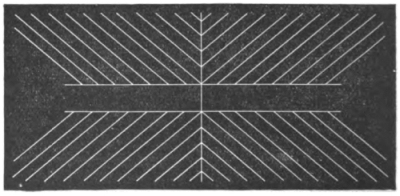 Fig. 1.
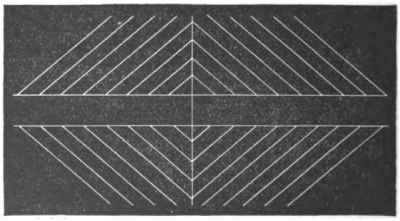 Fig. 2.
Aërial perspective has a great influence on the determination of these
phenomena, particularly such as occur in the open and at great
distances. The influence is to be recognized through the various
appearances of distant objects, the various colors of distant mountains,
the size of the moon on the horizon, and the difficulties which aërial
perspective offers painters. Many a picture owes its success or failure
to the use of aërial perspective. If its influence is significant in the
small space of a painting, the illusions in nature can easily become of
enormous significance, particularly when extremes are brought together
in the observations of objects in unknown regions. The condition of the
air, sometimes foggy and not pellucid, at another time particularly
clear, makes an enormous difference, and statements whether about
distance, size, colors, etc., are completely unreliable. A witness who
has several times observed an unknown region in murky weather and has
made his important observation under very clear skies, is not to be
trusted.
An explanation of many sensory illusions may be found in the so-called
illusory lines. They have been much studied, but Zöllner[313] has been
the first to show their character. Thus, really quite parallel lines are
made to appear unparallel by the juxtaposition of inclined or crossing
lines. In figures 1 and 2 both the horizontal lines are actually
parallel, as may be determined in various ways.
The same lines looked at directly or backwards seem, in Fig. 1, convex,
in Fig. 2 concave.
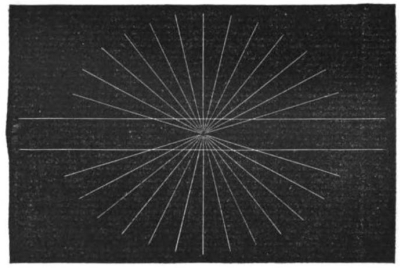 Fig. 3.
Still more significant is the illusion in Fig. 3, in which the convexity
is very clear. The length, etc., of the lines makes no difference in the
illusion.
On the other hand, in Fig. 4 the diagonals must be definitely thicker
than the parallel horizontal lines, if those are to appear not parallel.
That the inclination is what destroys the appearance of parallels is
shown by the simple case given in Fig. 5, where the distance from A to B
is as great as from B to C, and yet where the first seems definitely
smaller than the second.
Still more deceptive is Fig. 6, where the first line with the angle
inclined inwards seems incomparably smaller than the second with the
angle inclined outwards.
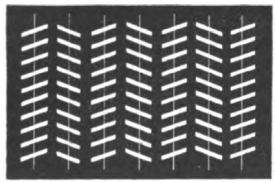 Fig. 4.
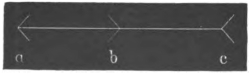 Fig. 5.
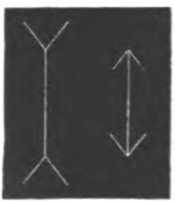 Fig. 6.
All who have described this remarkable subject have attempted to explain
it. The possession of such an explanation might put us in a position to
account for a large number of practical difficulties. But certain as the
facts are, we are still far from their why and how. We may believe
that the phenomenon shown in Figs. 1 and 2 appears when the boundaries
of a field come straight up to a street with parallel sides, with the
result that at the point of meeting the street seems to be bent in.
Probably we have observed this frequently without being aware of it, and
have laid no particular stress on it, first of all, because it was
really unimportant, and secondly, because we thought that the street was
really not straight at that point.
In a like manner we may have seen the effect of angles as shown in Figs.
5 and 6 on streets where houses or house-fronts were built cornerwise.
Then the line between the corners seemed longer or shorter, and as we
had no reason for seeking an accurate judgment we paid no attention to
its status. We simply should have made a false estimate of length if we
had been required to judge it. It is also likely that we may have
supposed an actual or suppository line on the side of the gables of a
house enclosed by angles of the gables, to be short,—but until now the
knowledge of this supposition has had no practical value. Nevertheless,
the significance of these illusions should not be underestimated. They
mean most of all the fact that we really can be much deceived, even to
the degree of swearing to the size of a simple thing and yet being quite
innocently mistaken. This possibility shows, moreover, that the
certainty of our judgment according to sensible standards is inadequate
and we have no way of determining how great this inadequacy is. We have
already indicated that we know only the examples cited by Zöllner,
Delboeuf and others. It is probable that they were hit upon by accident
and that similar ones can not be discovered empirically or
intentionally. Hence, it may be assumed that such illusions occur in
great number and even in large dimensions. For example, it is known that
Thompson discovered his familiar “optical circle illusion” (six circles
arranged in a circle, another in the middle. Each possesses bent radii
which turn individually if the whole drawing is itself turned in a
circle) by the accident of having seen the geometrical ornament drawn by
a pupil. Whoever deals with such optical illusions may see very
remarkable ones in almost every sample of ladies’ clothes, particularly
percale, and also in types of carpets and furniture. And these are too
complicated to be described. In the course of time another collection of
such illusions will be discovered and an explanation of them will be
forthcoming, and then it may be possible to determine how our knowledge
of their existence can be turned to practical use.
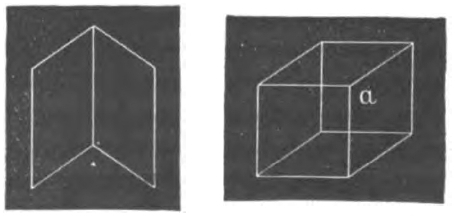 Fig. 7.
Fig. 8.
Fig. 7.
Fig. 8.
Practical application is easier in the so-called inversion of the visual
object. Fig. 7 shows the simplest case of it—the possibility of seeing
the middle vertical line as either deeper or higher than the others. In
the first instance you have before you a gutter, in the second a room.
Similar relations are to be observed in the case of a cube in which the
corner a may be seen as either convex or concave according as you
think it behind or before the background of the angles from which a
proceeds. It is still clearer when, in a rhomboid, the line XY is
drawn. Then x or y may be seen alternately as nearer or further and
the figure can thereby be brought into a different position. (Fig. 9.)
Done once it may be repeated voluntarily.
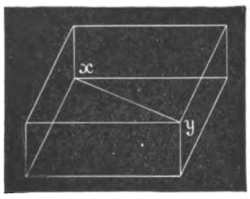 Fig. 9.
 Fig. 10.
There are many practical examples of these illusions. Sinsteden saw one
evening the silhouette of a windmill against a luminous background. The
arms seemed now to go to the right, now to the left—clearly because he
did not make out the body of the mill and might equally assume that he
saw it from the front or from the rear, the wheels going toward the
right in the first, and toward the left in the other case. An analogous
case is cited by Bernstein. If (Fig. 10) the cross made of the thin
lines stand for the bars of a weather vane and the heavy lines represent
the weather vane itself, it may be impossible under the conditions of
illumination for an eye looking from N to distinguish whether the
weather vane points NE or SW; there is no way of determining the
starting point of motion. All that can certainly be said is that the
weather vane lies between NE and SW and that its angle is at the
crossing of the two lines, but the direction in which its heads point
can not be determined at even a slight distance. Both forms of this
illusion may occur in a criminal trial. If once a definite idea of some
form of order has been gained, it is not abandoned or doubted, and is
even sworn to. If asked, for example, whether the mill-wheel moved right
or left, the observer will consider hardly one time in a hundred whether
there might not have been an optical illusion. He will simply assure us
that the thing was as he thinks he saw it, and whether he saw it
correctly is purely a matter of luck.
To all these illusions may be added those which are connected with
movement or are exposed by movement. During the movement of certain
bodies we can distinguish their form only under definite conditions. As
their movement increases they seem shorter in the direction of movement
and as it decreases they seem broader than normally. An express train
with many cars seems shorter when moving directly near us, and rows of
marching men seem longer. The illusion is most powerful when we look
through a stationary small opening. The same thing occurs when we move
quickly past bodies, for this makes them seem very short as we go by.
Of such cases sense-illusion does not constitute an adequate
explanation; it must be supplemented by a consideration of certain
inferences which are, in most instances, comparatively complex.[314] We
know, e.g. that objects which appear to us unexpectedly at night,
particularly on dark, cloudy nights, seem inordinately magnified. The
process is here an exceedingly complex one. Suppose I see, some cloudy
night, unexpectedly close to me a horse whose environment, because of
the fog, appears indistinct. Now I know from experience that objects
which appear from indistinct environments are as a rule considerably
distant. I know, further, that considerably distant objects seem much
smaller, and hence I must assume that the horse, which in spite of its
imaginary distance appears to retain its natural size, is really larger
than it is. The train of thought is as follows: “I see the horse
indistinctly. It seems to be far away. It is, in spite of its distance,
of great size. How enormous it must be when it is close to me!” Of
course these inferences are neither slow nor conscious. They occur in
reflection with lightning-like swiftness and make no difference to the
certainty of the instantaneous judgment. Hence it is frequently very
difficult to discover the process and the mistake it contains.
If, however, the observer finds an inexplicable hiatus in an event he
happens to notice, he finds it strange because unintelligible. In this
way is created that notion of strangeness which often plays so great a
rôle in the examination of witnesses. Hence when under otherwise
uncomfortable conditions, I see a horse run without hearing the beat of
his hoofs, when I see trees sway without feeling any storm; when I meet
a man who, in spite of the moonlight, has no shadow, I feel them to be
very strange because something is lacking in their logical development
as events. Now, from the moment a thing becomes strange to an individual
his perceptions are no longer reliable, it is doubtful whether he knows
what he has really experienced before his world became strange to him.
Add to this that few people are unwilling to confess that they felt ill
at ease, that perhaps they do not even know it,[315] and you get the
complicated substitution of sensory illusions and uncanny sensation, the
one causing the other, the other magnifying the one, and so on until the
whole affair is turned into something quite unrecognizable. So we find
ourselves in the presence of one of the inexplicable situations of the
reality of which we are assured by the most trustworthy individuals.
To magnify this phenomenon, we need only think of a few slightly
abnormal cases. It has already been indicated that there are many such
which are not diseased, and further, that many diseased cases occur
which are not known as such, at least, as being so much so as to make
the judge call in the doctor. This is the more likely because there are
frequently, if I may say so, localized diseases which do not exhibit any
extraordinary symptoms, at least to laymen, and hence offer no reason
for calling in experts. If we set aside all real diseases which are
connected with optical illusions as not concerning us, there are still
left instances enough. For example, any medical text-book will tell you
that morphine fiends and victims of the cocaine habit have very strong
tendencies to optical illusions and are often tortured by them. If the
disease is sufficiently advanced, such subjects will be recognized by
the physician at a single glance. But the layman can not make this
immediate diagnosis. He will get the impression that he is dealing with
a very nervous invalid, but not with one who is subject to optical
illusions. So, we rarely hear from a witness that he knows such people,
and certainly not that he is one himself. A very notable oculist, Himly,
was the first to have made the observation that in the diseased
excitability of the retina every color is a tone higher. Luminous black
looks blue, blue looks violet, violet looks red, red looks yellow.
Torpor of the retina inverts the substitution.
Dietz[316] tells of color-illusions following upon insignificant
indigestion; Foderè of hysterics who see everything reversed, and
Hoppe[317] says, “If the order of the rods and cones of the retina is
somewhat disturbed by an inflammatory touch, the equilibrium of vision
is altered and changes in size, in form, or appearance occur.”
Naturally the criminalist can not perceive slight indigestion, weak
hysteria, or an inflamed area in the retina when he is examining
witnesses, yet false observations like those described may have a
definite influence upon the decision in a case.
If such abnormal occasions are lacking the reasons for optical illusions
are of another nature. As a rule optical illusions occur when there is
an interruption in the communication between the retina, the sense of
movement, and the sense of touch, or when we are prevented from reducing
the changes of the retinal image to the movement of our body or of our
eyes. This reduction goes on so unconsciously that we see the idea of
the object and its condition as a unit. Again, it is indubitable that
the movement of the body seems quicker when we observe it with a fixed
glance than when we follow it with our eyes. The difference may be so
significant that it is often worth while, when much depends on
determining the speed of some act in a criminal case, to ask how the
thing was looked at.
Fechner has made a far-reaching examination of the old familiar fact
that things on the ground appear to run when we ride by them
rapidly.[318] This fact may be compared with the other, that when you
look directly into swift-moving water from a low bridge, the latter
seems all of a sudden to be swimming rapidly up stream, though the water
does not appear to stand still. Here some unknown factor is at work and
may exercise considerable influence on many other phenomena without our
being able to observe the results. To this class may be added the
extraordinary phenomenon that from the train objects easily seem too
near and hence appear smaller than they are. It may be, however, that
the converse is true and objects appear smaller, or at least shorter,
and that inasmuch as we are in the habit of attributing the diminution
of size in objects to their distance, we tax the latter as false. So
much is certain—that whenever we ourselves move quickly we make false
judgments of size, distance, and even color. The last may be due to the
fact that during a quick passage, colors may so compose themselves, that
green and red become white, and blue and yellow, green, etc. I believe
that all these illusions are increasing in connection with the spread of
bicycling, inasmuch as many observations are made from the fleeting
wheel and its motion tends to increase the illusions considerably.
Concerning the differences in movement Stricker[319] says: “If I lie on
my back and see a bird fly in the uniformly blue heaven, I recognize the
movement although I have no object with which to compare it. This can
not be explained by the variety of points on the retina which are
affected, for when the bird pauses and I turn my eye, I know that it is
not moving.” The last argument is not correct. If the bird is sitting on
a branch I know, in spite of all my occipital movement, that it is
quiet, but only because I perceive and observe the bird’s immobility.
If, however, I lie on my back like Stricker and see above me a bird of
the class that, so to speak, swim motionless in the air for minutes at a
time, and if then I turn my head, I can not tell when the bird begins to
move. Here then we have no exception to the general rule and can always
say that we are speaking of movement optically perceived when the rays
issuing from any body progressively touch various points on the retina.
And since this occurs when we are in motion as well as when the object
is in motion it happens that we can not locate the movement, we cannot
say whether it be in us or in the object.
Of course, the possibility that fanciful images may appear during
movement is familiar. If I sit quietly in the forest and at some
distance see a stone or a piece of wood or a little heap of dried
leaves, etc., it may be that, because of some illusion, I take it to be
a rolled up hedgehog, and it may happen that I am so convinced of the
nature of the object while I am looking at it that I see how the
hedgehog stretches itself, sticks out its paws and makes other
movements. I remember one winter when, because of some delay, a
commission on which I was serving had failed to reach a village not far
from the capital. We had gone to investigate a murder case and had found
the body frozen stiff. The oven in the room was heated and the
grave-digger placed the stiff body near the oven in order to thaw it
out. We at this time were examining the place. After a while I was
instructed by the examining justice to see about the condition of the
corpse, and much to my disgust, I found it sitting near the oven, bent
over. It had thawed out and collapsed. During the subsequent obduction I
saw most clearly how the corpse made all kinds of movements, and even
after the section, during the dictation, of the protocol, my imagination
still seemed to see the corpse moving a hand or a foot.
The imagination may also cause changes in color. Once, I saw on my desk,
which stood next to a window, a great round drop of water on the left
side of which the panes of the window were reflected. (Fig. 11). The
whole business was about a meter from my eye. I saw it repeatedly while
working and it finally occurred to me to inquire how such a great drop
of water could get there. I had sat at my desk for hours without moving.
I must have observed it if it had dropped there. Refraining
intentionally from going closer, I started, without avail, to consider
how it could have come. Some time after I examined the drop of water and
found it to be an ink-blot, long ago completely dried, and bearing on
its left side a few grains of white cigar ash. I had taken these to be
the image of the window, and hence, had immediately attached to it the
idea of the shining, raised drop of water. I had altogether overlooked
the deep black color of the drop. On the witness stand I would have
sworn that I had seen a drop of water, even if I had known the evidence
on the matter to be important.
 Fig. 11.
In many cases it is possible to control the imagination, but only when
it is known that the images can not be as they are seen. Everybody is
aware how a half-covered object at a distance, or objects accidentally
grouped in one way or another, are taken for God knows what. Thus once,
looking from my desk to my smoking table, I saw an enormous pair of
tailor’s scissors half-covered by a letter. It remained identical under
a number of repeated glances. Only when I thought vigorously that such a
thing could not possibly be in my room did it disappear. A few scales of
ashes, the lower round of the match safe, the metal trimmings of two
cigar boxes half-covered by a letter and reflected by the uncertain
light breaking through the branches of a tree, were all that the
tailor’s scissors was composed of. If there had been such a thing in the
house, or if I had believed something like it to exist in the house, I
should have sought no further and should have taken my oath that I had
seen the thing. It is significant that from the moment I understood the
phenomenon I could not restore the image of the scissors. How often may
similar things be of importance in criminal trials!
The so-called captivation of our visual capacity plays a not unimportant
part in distinguishing correct from illusory seeing. In order to see
correctly we must look straight and fully at the object. Looking askance
gives only an approximate image, and permits the imagination free play.
Anybody lost in a brown study who pictures some point in the room across
the way with his eyes can easily mistake a fly, which he sees confusedly
askance, for a great big bird. Again, the type of a book seems
definitely smaller if the eyes are fixed on the point of a lead pencil
with a certain distance before or above the book. And yet again, if you
stand so that at an angle of about 90 degrees from the fixation point,
you look at a white door in a dark wall, observing its extent in
indirect vision, you will find it much higher than in direct vision.
These examples indicate how indirect vision may be corrected by later
correct vision, but such correction occurs rarely. We see something
indirectly; we find it uninteresting, and do not look at it directly.
When it becomes of importance later on, perhaps enters into a criminal
case, we think that we have seen the thing as it is, and often swear
that “a fly is a big bird.”
There are a number of accidents which tend to complete illusion. Suppose
that the vision of a fly, which has been seen indirectly and taken for a
big bird happens to be synchronous with the shriek of some bird of prey.
I combine the two and am convinced that I have seen that bird of prey.
This may increase, so much so that we may have series of
sense-illusions. I cite the example of the decorative theatrical artist,
who can make the most beautiful images with a few, but very
characteristic blots. He does it by emphasising what seems to us
characteristic, e.g., of a rose arbor, in such a way that at the
distance and under the conditions of illumination of the theatre we
imagine we really see a pretty rose arbor. If the scene painter could
give definite rules he would help us lawyers a great deal. But he has
none, he proceeds according to experience, and is unable to correct
whatever mistakes he has committed. If the rose arbor fails to make the
right impression, he does not try to improve it—he makes a new one.
This may lead to the conclusion that not all people require the same
characteristics in order to identify a thing as such, so that if we
could set the rose arbor on the stage by itself, only a part of the
public would recognize it as properly drawn, the other part would
probably not recognize it at all. But if, of an evening, there is a
large number of decorations on the stage, the collective public will
find the arbor to be very pretty. That will be because the human senses,
under certain circumstances, are susceptible to sympathetic induction.
In the case of the rose arbor we may assume that the artist has
typically represented the necessary characteristics of the arbor for one
part of the audience, for another part those of a castle, for another
part those of a forest, and for a fourth those of a background. But once
an individual finds a single object to be correct, his senses are
already sympathetically inductive, i.e., captivated for the correctness
of the whole collection, so that the correctness passes from one object
to the total number. Now, this psychic process is most clear in those
optical illusions which recently have been much on public exhibition
(the Battle of Gravelotte, the Journey of the Austrian Crown Prince in
Egypt, etc.). The chief trick of these representations is the presenting
of real objects, like stones, wheels, etc., in the foreground in such a
way that they fuse unnoticeably with the painted picture. The sense of
the spectator rests on the plastic objects, is convinced of their
materiality and transfers the idea of this plasticity to the merely
pictured. Thus the whole image appears as tri-dimensional.
The decorations of great parks at the beginning of the last century
indicate that illumination and excited imagination are not alone in
causing such illusions. Weber tells ecstatically of an alley in
Schwetzing at the end of which there was a highly illuminated concave
wall, painted with a landscape of mountains and water-falls. Everybody
took the deception for a reality because the eye was captivated and
properly inducted. The artist’s procedure must have been psychologically
correct and must have counted upon the weakness of our observation and
intellection. Exner points to the simple circumstance that we do not
want to see that things under certain conditions must terminate. If we
draw a straight line and cover an end with a piece of paper, every one
wonders that the line is not longer when the paper is removed.
I know of no case in criminal procedure where illusions of this kind
might be of importance, but it is conceivable that such illusions enter
in numberless instances. This is especially susceptible of observation
when we first see some region or object hastily and then observe it more
accurately. We are astonished how fundamentally false our first
conception was. Part of this falseness may be adduced to faults of
memory, but these play little or no part if the time is short and if we
are able to recall that the false conception appeared just as soon as we
observed the situation in question. The essential reason for false
conception is to be found only in the fact that our first hasty view was
incorrectly inducted, and hence, led to illusions like those of the
theatre. Thus, it is possible to take a board fence covered at points
with green moss, for a moss-covered rock, and then to be led by this to
see a steep cliff. Certain shadows may so magnify the size of the small
window of an inn that we may take it to be as large as that of a sitting
room. And if we have seen just one window we think all are of the same
form and are convinced that the inn is a mansion. Or again, we see,
half-covered, through the woods, a distant pool, and in memory we then
see the possibly, but not necessarily, present river. Or perhaps we see
a church spire, and possibly near it the roof of a house rises above the
trees; then we are inducted into having seen a village, although there
really are visible only the church and the house.
These illusions again, I must repeat, are of no importance if they are
at all doubted, for then the truth is ascertained. When, however, they
are not doubted and are sworn to, they cause the greatest confusion in
trials. A bar-room quarrel, a swung cane, and a red handkerchief on the
head, are enough to make people testify to having seen a great brawl
with bloody heads. A gnawing rat, a window accidentally left open
through the night, and some misplaced, not instantaneously discovered
object, are the ingredients of a burglary. A man who sees a rather quick
train, hears a shrill blowing of the whistle, and sees a great cloud,
may think himself the witness of a wreck. All these phenomena, moreover,
reveal us things as we have been in the habit of seeing them. I repeat,
here also, that the photographic apparatus, in so far as it does not
possess a refracting lens, shows things much more truly than our eye,
which is always corrected by our memory. If I permit a man sitting on a
chair to be photographed, front view, with his legs crossed and
stretched far out, the result is a ludicrous picture because the boots
seem immensely larger than the head of the subject. But the photograph
is not at fault, for if the subject is kept in the same position and
then the apparent size of head and boot are measured, we get accurately
the same relation as on the photograph. We know by experience how big a
head is. And hence, we ordinarily see all relations of size in proper
proportion. But on the photograph we can not apply this “natural”
standard because it is not given in nature, and we blame the camera.
If, in a criminal case, we are dealing with a description of size, and
it is given as it is known from experience, not as it really appears,
then if experience has deceived us, our testimony is also wrong,
although we pretend to have testified on the basis of direct
sense-perception.
The matter of after-images, probably because of their short duration, is
of no criminalistic importance. I did once believe that they might be of
considerable influence on the perception of witnesses, but I have not
succeeded in discovering a single example in which this influence is
perceptible.
On the other hand, the phenomenon of irradiation, the appearance of dark
bodies as covered with rays of light by adjacent luminosities, is of
importance. This phenomenon is well-known, as are Helmholtz’s and
Plateau’s explanations of it. But it is not sufficiently applied. One
needs only to set a white square upon the blackest possible ground and
at the same time a similar black square of equal size on a white ground,
and then to place them under a high light, to perceive how much larger
the white square appears to be. That such phenomena often occur in
nature need not be expounded. Whenever we are dealing with questions of
size it is indubitably necessary to consider the color of the object and
its environment with respect to its background and to the resulting
irradiation.
Section 100. (3) Auditory Illusions.
From the point of view of the criminalist, auditory illusions are hardly
less significant than visual illusions, the more so, as incorrect
hearing is much more frequent than incorrect seeing. This is due to the
greater similarity of tones to each other, and this similarity is due to
the fact that sound has only one dimension, while vision involves not
only three but also color. Of course, between the booming of cannons and
the rustling of wings there are more differences than one, but the most
various phenomena of tones may be said to vary only in degree. For
purposes of comparison moreover, we can make use only of a class of
auditory images on the same plane, e.g., human voices, etc. Real
acoustic illusions are closely connected with auditory misapprehension
and a distinction between these two can not be rigorously drawn. A
misapprehension may, as a rule, be indicated by almost any external
condition, like the relations of pitch, echo, repetition, false
coincidence of waves of sound, etc. Under such circumstances there may
arise real illusions.
The study of auditory illusions is rendered especially difficult by the
rarity of their repetition, which makes it impossible reliably to
exclude accidents and mistakes in observation. Only two phenomena are
susceptible of accurate and sufficient study. For three summers a man
used to ride through the long street in which I live. The man used to
sell ice and would announce himself by crying out, “Frozen,” with the
accent on the Fro. This word was distinctly audible, but if the man came
to a definite place in the street, there were also audible the words
“Oh, my.” If he rode on further the expression became confused and
gradually turned into the correct, “Frozen.” I observed this daily, got
a number of others to do so, without telling them of the illusion, but
each heard the same thing in spite of the distinct difference between
“frozen,” and “oh, my.”
I made a similar observation at a bicycle school. As is known, beginners
are able frequently to ride by themselves but need help in mounting and
dismounting their machines. To do so they call a teacher by crying out:
“Herr Maier.” At a certain place this sound would seem distinctly to be
“mamma.” I was at first much surprised to hear people of advanced age
cry cheerfully, “mamma.” Later I discovered what the word really was and
acquaintances whose attention I called to the matter confirmed my
observation. Such things are not indifferent, they show that really very
different sounds may be mistaken for one another, that the test of
misunderstandings may often lead to false results, since only during the
test of an illusion are both auditor and speaker accurately in the same
position as before. Finally, these things show that the whole business
of correcting some false auditions is very difficult. Yet this work of
correction may be assumed to be much more easy with respect to hearing
than with respect to seeing. If, e.g., it is asserted that the revolver
has been seen somewhere, and if it has been known that the sight was
impossible, it becomes just as impossible, almost, to determine what the
object seen really was. In the rarest cases only will it be something
altogether similar, e.g., a pistol; most of the time it will be an
object which could not be inferred from no matter what combinations. In
hearing, on the contrary, if once it is determined that there has been a
false audition, the work of placing it, though difficult, need not be
unprofitable. This work is often compulsory upon the criminalist who
receives protocols which have not been read aloud, and in which mistakes
of hearing and dictation have been made. Such mistakes are considerably
disturbing, and if the case is important their source and status must be
inferred. This may almost always be done. Of course, strange, badly
heard proper names can not be corrected, but other things can.
As regards the general treatment of auditory illusions, it is necessary,
first of all, to consider their many and significant differences. In the
first place, there are the varieties of good hearing. That normal and
abnormal hearers vary in degree of power is well known. There are also
several special conditions, causing, e.g., the so called hyper-auditive
who hear more acutely than normal people. Of course, such assertions as
those which cite people who can hear the noise of sulphur rubbed on the
poles of quartz crystals and so on, are incorrect, but it is certain
that a little attention will reveal a surprising number of people whose
hearing is far acuter than that of normal individuals. Apart from
children, the class is made up of musicians, of young girls, and of very
nervous, excitable, and sickly persons. The musicians in fact have
become so because of their ears; the young girls hear well largely
because of their delicate organization and the very fine construction of
their ears; and the nervous people because of their sensibility to the
pain involved in loud noises. Many differences of perception among
witnesses are to be explained by differences of audition, and the
reality of apparent impossibilities in hearing must not be denied but
must be tested under proper conditions. One of these conditions is
location. The difference between hearing things in the noisy day and in
the quiet night, in the roar of the city, or in the quiet of the
mountains, is familiar. The influence of resonance and pitch, echo and
absorption of tones, i.e., the location of the sound, is of great
importance. Finally, it must not be forgotten that people’s ability to
hear varies with the weather. Colds reduce the power, and not a few
people are influenced by temperature, atmospheric pressure, etc. These
considerations show the degree in which auditory illusions can be of
importance even in tests of their nature and existence. They show above
all that the same object of comparison under the same circumstances must
be used in every test. Otherwise much confusion inevitably results.
The presence of auditory illusions in diseases, fever, hysteria,
nervousness, alcoholism and its associates, mental disturbances,
hyperæmia, diseases of the ear, etc., is well known, but concerns us
only as pointing to the necessity of calling in the physician
immediately. They have their definite characteristics and rarely leave
the layman in doubt of his duty in that direction. The great difficulty
comes in dealing with diseases or apparent diseases while it is still
impossible to know of their existence, or where the pain is of such
character that the layman does not know of its presence and thus has no
ground for consulting the doctor. For example, it is well known that a
large amount of ear wax in the aural passage may cause all sorts of
ringing and sighing in the ear, and may even produce real
hallucinations. Yet a person having an abnormal amount of ear wax may be
otherwise absolutely sound. How is the need of a physician to be guessed
in such a case? Again, the perforation of the drum, especially when it
follows a catarrh, may cause a definite auditory illusion with regard to
the sound of voices, or the illusion may be effected by the irritation
of the skin in the ear passage, or by anemia, or by a strong carotid
pulse and a distention of the bloodvessels, as happens in alcoholism.
Many people become abnormally sensitive to sound at the beginning of
fevers. Women at the time of their climacterium hear all kinds of
voices. Inasmuch as this soon stops, the abnormality and incorrectness
of their audition is hard to establish. Childbirth, too, makes a
difference. Old, otherwise conscientious midwives claim to have heard
unborn children breathe and cry.
Examples of this sort of thing are innumerable and they teach that
whenever any questionable assertion is made about a thing heard the
doctor must be called in to determine whether the witness heard it under
abnormal, though not diseased conditions. Again, merely accidental or
habitual general excitability tends to intensify all sounds, and whether
the witness under consideration was in such condition can be determined
only by the expert physician.
The illusions of hearing which completely normal people are subject to
are the most difficult of all. Their number and frequency is variously
estimated. The physician has nothing to do with them. The physicist, the
acoustician and physiologist do not care about the criminalist’s needs
in this matter, and we ourselves rarely have time and opportunity to
deal with it. As a result our information is very small, and no one can
say how much is still undiscovered. One of my friends has called my
attention to the fact that when the beats of the clock are counted
during sleepiness, one too many is regularly counted. I tested this
observation and my experience confirmed it. If, now, we consider how
frequently the determination of time makes the whole difference in a
criminal case and how easily it is possible to mistake a whole hour, we
can get some notion of the importance of this illusion. Its explanation
is difficult and it may be merely a single instance of a whole series of
unknown auditory illusions resting on the same basis. Another and
similar phenomenon is the “double beat of the hammer.” If you have an
assistant strike the table with a hammer while you hold both ears with
your fingers and then open them half a second or a second after the
blow, you hear the blow again. And if you open and shut your ears
quickly you can hear the blow several times. This is explained through
the fact that a number of reflections of the sound occur in the room,
and that these are perceivable only by the unfatigued ear. The
explanation is unsatisfactory because the experiment is sometimes
successful in the open. Taken in itself, this matter seems very
theoretical and without practical value. But this kind of action may
occur automatically. It is well known that swallowing closes the
Eustachian tubes for a moment, especially if done when lying down. Now,
if this occurs during a blow, a shot, etc., the sound must be heard
twice. Again, it may easily happen that because of the noise a man wakes
up half asleep and, frightened, swallows the collected saliva; then this
accident, which in itself seems unimportant, may lead to very
significant testimony. Such occurrences are not infrequent.
The intensity of a sound already heard may be of considerable influence.
Certain experimenters have indicated the remarkable character of
slightly intensive effects of sound. If you hold a watch so far from the
ear as to hear it clearly but weakly, the sound decreases until finally
it is not heard at all, and after awhile it is again heard, etc. This
may lead to hearing distinct sounds made up of many tones, and need not
evince any great illusion with regard to the ticking of a watch. But the
thing may occur also in connection with more powerful and more distant
sounds, e.g., the murmur of a brook, the rush of a train, the pounding
in a distant factory. Noises far removed are influenced by reflections
of sound, waves of air, etc., and it is possible that all kinds of
things may be heard in a completely monotonous noise. This can be easily
learned by listening to the soft murmur of a distant brook at night.
Given the disposition and supposing the existence of the brook unknown,
it is easy to hear in its monotonous murmur, human voices, sighs,
shrieks, etc.
Another remarkable observation shows that in the dark very distinct
things are heard during the playing of delicate instruments, such as
mouth-organs. The humming approaches and withdraws, then it comes on
various sides, and finally one has the feeling that the whole room is
full of humming and winging insects. And this may go on indefinitely.
There is a large collection of reasons for this reduplication of
monotonous sounds. Everybody knows the accord of the æolian harp which
consists of identical notes, and the melodies which seem to lie in the
pounding of the train on the rails. This can become especially clear
when one is half asleep. If ever thinking begins to be ousted by
slumber, the rhythmic pound begins to dominate consciousness. Then the
rhythm gets its appropriate melody which becomes progressively more
intense, and if one grows suddenly wide awake one wonders why the
clearly-heard music is missing. Similarly, it is often asserted that a
row of travelling wild swans make pleasant chords, although each swan is
able to utter only one cry. Difference in distance and alterations in
the air cause the chords.
The difficulties in distinguishing the intensity or weakness of a sound
are of importance. Fechner learned from the violinist Wasilewski that he
observed that a male choir of four hundred voices did not sound
essentially louder than one of two hundred. At the same time one clock
is not heard at a great distance, a hundred clocks are heard. One locust
can not be heard eating; when 1000 eat they are heard; hence each one
must make a definite noise.[320] Early authorities have already
indicated how difficult it is to distinguish the number of bells ringing
together. Even musicians will often take two or three to be five or six.
Certain dispositions make some difference in this respect. The operating
physician hears the low groaning of the patient after the operation
without having heard his loud cries during the operation. During the
operation the physician must not hear anything that is likely to disturb
his work, but the low groan has simply borne in upon him. The sleeping
mother often is deaf to considerable noise, but wakes up immediately
when her child draws a deeper breath than usual. Millers and factory
hands, travellers, etc., do not hear the pounding of their various
habitual environmental noises, but they perceive the slightest call, and
everybody observes the considerable murmur of the world, the sum of all
distant noises, only in the silence of the night that misses it.
Illusions of direction of sound are very common. It is said that even
animals are subject to them; and everybody knows how few human beings
can distinguish the source and direction of street music, a rolling
wagon, or a ringing bell. Even when long practice enables one to
determine direction with correctness, an accidental event, perhaps the
weather, especial sounds, a different grouping of individuals on the
street, may result in serious mistakes. I tried to learn to judge from
my office-desk whether the ring of the horse-car came from above or
below. I succeeded so well that I could not understand how it was
difficult not to learn the difference, and yet I failed many a time
altogether in judgment. The reason for it I do not know.
All these enumerated circumstances must show how very uncertain all
acoustic perceptions are, and how little they may be trusted if they are
not carefully tested under similar conditions, and if—what is most
important—they are not isolated. We are here led back to the old
principle that every observation is not proof but means of proof, and
that it may be trusted only when it is confirmed by many parallel
actions which are really consistent. That even after that mistakes are
possible, is true, but “after that” is when we have done all that lies
within human power.
Section 101. (4) Illusions of Touch.
The high standing of the sense of touch which make it in certain
directions even the organ of control of the sense of sight, is well
known, and Condillac’s historic attempt to derive all the senses from
this one is still plausible. If what is seen is to be seen accurately
there is automatic resort to the confirmatory aid of the sense of touch,
which apprehends what the eye has missed. Hence we find many people
touching things, whose vision is not altogether reliable—i.e., people
of considerable age, children unpracticed in seeing, an uneducated
people who have never learned to see quickly and comprehensively.
Moreover, certain things can be determined only by touching, i.e., the
fineness of papers, cloth, etc., the sharpness or pointedness of
instruments, or the rawness of objects. Even when we pat a dog kindly we
do so partly because we want to see whether his skin is as smooth and
fine as the eye sees it; moreover, we want to test the visual impression
by that of touch.
But important and reliable as the sense of touch is, it is nevertheless
not to be trusted when it is the sole instrument of perception. We must
never depend on the testimony of a witness based entirely on perceptions
by touch, and the statements of a wounded person concerning the time,
manner, etc., of his wound are unreliable unless he has also seen what
he has felt. We know that most knife and bullet wounds, i.e., the most
dangerous ones, are felt, in the first instance, as not very powerful
blows. Blows on the extremities are not felt as such, but rather as
pain, and blows on the head are regularly estimated in terms of pain,
and falsely with regard to their strength. If they were powerful enough
to cause unconsciousness they are said to have been very massive, but if
they have not had that effect, they will be described by the most honest
of witnesses as much more powerful than they actually were. Concerning
the location of a wound in the back, in the side, even in the upper arm,
the wounded person can give only general indications, and if he
correctly indicates the seat of the wound, he has learned it later but
did not know it when it occurred. According to Helmholtz, practically
all abdominal sensations are attributed to the anterior abdominal wall.
Now such matters become of importance when an individual has suffered
several wounds in a brawl or an assault and wants to say certainly that
he got wound A when X appeared, wound B when Y struck at him, etc. These
assertions are almost all false because the victim is likely to identify
the pain of the moment of receiving the wound with its later
painfulness. If, for example, an individual has received a rather long
but shallow knife wound and a deep stab in the back, the first will
cause him very considerable burning sensation, the latter only the
feeling of a heavy blow. Later on, at the examination, the cut has
healed and is no longer painful; the dangerous stab which may have
reached the lung, causes pain and great difficulty in breathing, so that
the wounded man assigns the incidence of the stab to the painful
sensation of the cut, and conversely.
Various perceptions of victims on receiving a wound are remarkable, and
I have persuaded a police surgeon of considerable learning and
originality to collect and interpret his great mass of material. It is
best done by means of tabulation, accurate description of wounds
according to their place, size, form, and significance, the statement of
the victim concerning his feeling at the moment of receiving the wound,
the consequences of healing, and at the end explanatory observations
concerning the reasons for true or incorrect sensations of the victim.
As this work is to have only psychological value it is indifferent
whether the victim is veracious or not. What we want to know is what
people say about their perception. The true and the false will
distinguish themselves automatically, the material being so rich, and
the object will be to compare true subjective feelings with true
subjective deeds. Perhaps it may even be possible to draw
generalizations and to abstract certain rules.
There are many examples of the fact that uncontrolled touch leads to
false perceptions. Modern psychophysics has pointed to a large group of
false perceptions due to illusions of pressure, stabs, or other contact
with the skin. The best known, and criminalistically most important
experiments, are those with open compasses. Pressed on the less
sensitive parts of the body, the back, the thigh, etc., they are always
felt as one, although they are quite far apart. The experiments of
Flournoy, again, show how difficult it is to judge weights which are not
helped by the eye’s appreciation of their form and appearance. Ten
objects of various forms were judged by fifty people for their weight;
only one discovered that they all had the same weight.
Similarly, mere touch can not give us proper control over the organs of
the body. Sully says that in bed we may voluntarily imagine that a leg
has a position quite different from that it really has. Let me cite some
similar examples from my “Manual for Investigating Judges.” If we take a
pea between the thumb and the index finger, we feel the pea simply,
although its tactile image comes to us through two fingers, i.e.,
double. If now we cross the third finger over the fourth and hold the
pea between the ends of these two fingers, we feel it to be double
because the fingers are not in their customary positions and hence give
double results. From one point of view this double feeling is correct,
but when we touch the pea naturally, experience helps us to feel only
one pea. Another example consists in crossing the hands and turning them
inward and upward, so that the left fingers turn to the left and the
right fingers to the right. Here the localization of the fingers is
totally lost, and if a second person points to one of the fingers
without touching it, asking you to lift it, you regularly lift the
analogous finger of the other hand. This shows that the tactile sense is
not in a very high stage of development, since it needs, when unhelped
by long experience, the assistance of the sense of sight. Perceptions
through touch alone, therefore, are of small importance; inferences are
made on the basis of few and more coarse characteristic impressions.
This is shown by a youthful game we used to play. It consisted of
stretching certain harmless things under the table—a soft piece of
dough, a peeled, damp potato stuck on a bit of wood, a wet glove filled
with sand, the spirally cut rind of a beet, etc. Whoever got one of
these objects without seeing it thought he was holding some disgusting
thing and threw it away. His sense of touch could present only the
dampness, the coldness, and the motion, i.e., the coarsest traits of
reptilian life, and the imagination built these up into a reptile and
caused the consequent action. Foolish as this game seems, it is
criminalistically instructive. It indicates what unbelievable illusions
the sense of touch is capable of causing. To this inadequacy of the
tactile imagination may be added a sort of transferability of certain
touch sensations. For example, if ants are busy near my seat I
immediately feel that ants are running about under my clothes, and if I
see a wound or hear it described, I often feel pain in the analogous
place on my own body. That this may lead to considerable illusion in
excitable witnesses is obvious.
Finally, this dependence of the sense of touch may be supplemented by
the fact that it is counted only relatively, and its value varies with
the individual. We find the cellar warm in winter and cold in summer,
because we only feel the difference with the outer air, and when we put
one hand in hot, and the other in cold water, and then put both in tepid
water one finds the tepid water cold, the other warm. The record of
tactile sensations is frequent in our protocols and requires constant
consideration of the sense’s unreliability.
Diseased conditions are of course to be referred to the physician. I
need only mention that slight poisonings by means of chloroform,
morphine, atropine, daturine, decrease, and that strychnine increases
the sensitivity of the touch organ.
Section 102. (5) Illusions of the Sense of Taste.
Illusions of taste are of importance for us only in cases of poisoning
in which we want the assistance of the victim, or desire to taste the
poison in question in order to determine its nature. That taste and odor
are particularly difficult to get any unanimity about is an old story,
and it follows that it is still more difficult clearly to understand
possible illusions of these senses. That disease can cause mistaken
gustatory impressions is well known. But precedent poisoning may also
create illusions. Thus, observation shows that poisoning by
rose-santonin (that well-known worm remedy to which children are so
abnormally sensitive) causes a long-enduring, bitter taste;
sub-cutaneous morphine poisoning causes illusory bitter and sour tastes.
Intermittent fevers tend to cause, when there is no attack and the
patient feels comparatively well, a large number of metallic,
particularly coppery tastes. If this is true it may lead to unjustified
suspicions of poisoning, inasmuch as the phenomena of intermittent fever
are so various that they can not all be identified.
Imagination makes considerable difference here. Taine tells somewhere of
a novelist, who so graphically described the poisoning of his heroine
that he felt the taste of arsenic and got indigestion. This may be
possible, for perhaps everybody has already learned the great influence
of the false idea of the nature of a food. If some salt meat is taken to
be a sweet pastry, the taste becomes disgusting because the imaginary
and the actual tastes seem to be mixed. The eye has especial influence,
and the story cited and denied a hundred times, that in the dark, red
wine and white wine, chicken and goose, can not be distinguished, that
the going out of a cigar is not noted, etc., is true. With your eyes
closed it may be possible to eat an onion instead of an apple.
Prior tastes may cause significant gustatory illusions. Hence, when
assertions are made about tastes, it is always necessary to inquire at
the outset what had been eaten or drunk before. Experienced housewives
take this fact into consideration in setting their tables and arranging
their wines. The values of the wines are considerably raised by complete
illusions of taste. All in all, it must not be forgotten that the
reliability of the sense of taste can not be estimated too low. The
illusions are greatest especially when a thing has been tasted with a
preconceived notion of its taste.
Section 103. (6) The Illusions of the Olfactory Sense.
Olfactory illusions are very rare in healthy people and are hence of
small importance. They are frequent among the mentally diseased, are
connected in most cases with sexual conditions and then are so vivid
that the judge can hardly doubt the need of calling in the physician.
Certain poisons tend to debauch the olfactory sense. Strychnine, e.g.,
tends to make it finer, morphine duller. People with weak lungs try, in
most cases, to set their difficulty of breathing outside themselves and
believe that they are inhaling poisoned air, coal-gas, etc. If one
considers in this connection the suspiciousness which many people
suffering from lung trouble often exhibit, we may explain many
groundless accusations of attempted murder by stifling with poisonous or
unbreathable gas. If this typical illusion is unknown to the judge he
may find no reason for calling in the physician and then—injustice.
The largest number of olfactory illusions are due to imagination.
Carpenter’s frequently cited case of the officials who smelled a corpse
while a coffin was being dug up, until finally the coffin was found to
be empty, has many fellows. I once was making an examination of a case
of arson, and on approaching the village noted a characteristic odor
which is spread by burned animals or men. When we learned that the
consumed farm lay still an hour’s ride from the village, the odor
immediately disappeared. Again, on returning home, I thought I heard the
voice of a visitor and immediately smelled her characteristic perfume,
but she had not been there that day.
Such illusions are to be explained by the fact that many odors are in
the air, that they are not very powerfully differentiated and may hence
be turned by means of the imagination into that one which is likely to
be most obvious.
The stories told of hyper-sensitives who think they are able to smell
the pole of a magnet or the chemicals melted into a glass, belong to
this class. That they do so in good faith may be assumed, but to smell
through melted glass is impossible. Hence it must be believed that such
people have really smelled something somewhere and have given this odor
this or that particular location. Something like this occurs when an
odor, otherwise found pleasant, suddenly becomes disgusting and
unbearable when its source is unknown. However gladly a man may eat
sardines in oil he is likely to turn aside when his eyes are closed and
an open can of sardines is held under his nose. Many delicate forms of
cheese emit disgusting odors so long as it is not known that cheese is
the source. The odor that issues from the hands after crabs have been
eaten is unbearable; if, however, one bears in mind that the odor is the
odor of crabs, it becomes not at all so unpleasant.
Association has much influence. For a long time I disliked to go to a
market where flowers, bouquets, wreaths, etc., were kept because I
smelled dead human bodies. Finally, I discovered that the odor was due
to the fact that I knew most of these flowers to be such as are laid on
coffins—are smelled during interment. Again, many people find perfumes
good or bad as they like or dislike the person who makes use of them,
and the judgment concerning the pleasantness or unpleasantness of an
odor is mainly dependent upon the pleasantness or unpleasantness of
associative memories. When my son, who is naturally a vegetarian and who
could never be moved to eat meat, became a doctor, I thought that he
could never be brought to endure the odor of the dissecting room. It did
not disturb him in the least, however, and he explained it by saying: “I
do not eat what smells like that, and I can not conceive how you can eat
anything from the butcher shops where the odor is exactly like that of
the dissecting room.” What odor is called good or bad, ecstatic or
disgusting, is purely a subjective matter and never to be the basis of a
universal judgment. Statements by witnesses concerning perceptions of
odor are valueless unless otherwise confirmed.
Section 104. (b) Hallucinations and Illusions.
The limits between illusions of sense and hallucinations and illusions
proper can in no sense be definitely determined inasmuch as any
phenomena of the one may be applied to the other, and vice versa.[321]
Most safely it may be held that the cause of illusions of sense lies in
the nature of sense-organs, while the hallucinations and illusions are
due to the activity of the brain. The latter are much more likely to
fall within the scope of the physician than sense-illusions, but at the
same time many of them have to be determined upon by the lawyer,
inasmuch as they really occur to normal people or to such whose disease
is just beginning so that the physician can not yet reach it.
Nevertheless, whenever the lawyer finds himself face to face with a
supposed illusion or hallucination he must absolutely call in the
physician. For, as rarely as an ordinary illusion of sense is explicable
by the rules of logic or psychology, or even by means of other knowledge
or experience at the command of any educated man, so, frequently, do
processes occur in cases of hallucination and illusion which require, at
the very least, the physiological knowledge of the physician. Our
activity must hence be limited to the perception of the presence of
hallucination or illusion; the rest is matter for the psychiatrist.
Small as our concern is, it is important and difficult, for on the one
hand we must not appeal to the physician about every stupid fancy or
every lie a prisoner utters, and on the other hand we assume a heavy
responsibility if we interpret a real hallucination or illusion as a
true and real observation. To acquire knowledge of the nature of these
things, therefore, can not be rigorously enough recommended.
Hallucination and illusion have been distinguished by the fact that
hallucination implies no external object whatever, while in illusion
objects are mistaken and misinterpreted. When one thing is taken for
another, e.g., an oven for a man, the rustle of the wind for a human
song, we have illusion. When no objective existence is perceived, e.g.,
when a man is seen to enter, a voice is heard, a touch is felt, although
nothing whatever has happened, we have hallucination. Illusion is
partial, hallucination complete, supplementation of an external object.
There is not a correct and definite difference between illusion and
hallucination inasmuch as what is present may be so remotely connected
with what is perceived that it is no more than a stimulus, and thus
illusion may be turned into real hallucination. One authority calls
illusion the conception of an actually present external event which is
perceived by the peripheral organs in the form of an idea that does not
coincide with the event. The mistake does not lie in the defective
activity of the senses so much as in the fact that an apperceptive idea
is substituted for the perceptive view. In hallucination every external
event is absent, and hence, what is seen is due to a stimulation of the
periphery. Some authorities believe hallucination to be caused by cramp
of the sensory nerve. Others find illusions to be an externally
stimulated sense-perception not corresponding to the stimulus, and still
others believe it to be essentially normal. Most human beings are from
time to time subject to illusions; indeed, nobody is always sober and
intelligent in all his perceptions and convictions. The luminous center
of our intelligent perceptions is wrapped in a cloudy half-shadow of
illusion.
Sully[322] aims to distinguish the essential nature of illusion from
that characterized by ordinary language. Illusion, according to him, is
often used to denote mistakes which do not imply untrue perceptions. We
say a man has an illusion who thinks too much of himself, or when he
tells stories otherwise than as they happen because of a weakness of
memory. Illusion is every form of mistake which substitutes any direct
self-evident or intuitive knowledge, whether as sense-perception or as
any other form.
Nowadays the cause of hallucination and illusion is sought in the
over-excitement of the cerebro-spinal system. As this stimulation may be
very various in its intensity and significance, from the momentary rush
of blood to complete lunacy, so hallucinations and illusions may be
insignificant or signs of very serious mental disturbances. When we seek
the form of these phenomena, we find that all those psychical events
belong to it which have not been purposely performed or lied about.
When Brutus sees Cæsar’s ghost; Macbeth, Banquo’s ghost; Nicholas, his
son; these are distinctly hallucinations or illusions of the same kind
as those “really and truly” seen by our nurses. The stories of such
people have no significance for the criminalist, but if a person has
seen an entering thief, an escaping murderer, a bloody corpse, or some
similar object of criminal law, and these are hallucinations like
classical ghosts, then are we likely to be much deceived. Hoppe[323]
enumerates hallucinations of apparently sound (?) people. 1. A priest
tired by mental exertion, saw, while he was writing, a boy’s head look
over his shoulder. If he turned toward it it disappeared, if he resumed
writing it reappeared. 2. “A thoroughly intelligent” man always was
seeing a skeleton. 3. Pascal, after a heavy blow, saw a fiery abyss into
which he was afraid he would fall. 4. A man who had seen an enormous
fire, for a long time afterward saw flames continually. 5. Numerous
cases in which criminals, especially murderers, always had their victims
before their eyes. 6. Justus Möser saw well-known flowers and
geometrical figures very distinctly. 7. Bonnet knows a “healthy” man who
saw people, birds, etc., with open eyes. 8. A man got a wound in his
left ear and for weeks afterward saw a cat. 9. A woman eighty-eight
years old often saw everything covered with flowers,—otherwise she was
quite “well.”
A part of these stories seems considerably fictitious, a part applies to
indubitable pathological cases, and certain of them are confirmed
elsewhere. That murderers, particularly women-murderers of children,
often see their victims is well known to us criminalists. And for this
reason the habit of confining prisoners in a dark cell for twenty-four
hours on the anniversary of a crime must be pointed to as refined and
thoroughly mediæval cruelty. I have repeatedly heard from people so
tortured of the terror of their visions on such days of martyrdom. Cases
are told of in which prisoners who were constipated had all kinds of
visual and auditory hallucinations and appeared, e.g., to hear in the
rustling of their straw, all sorts of words. That isolation predisposes
people to such things is as well known as the fact that constipation
causes a rush of blood to the head, and hence, nervous excitement. The
well-known stories of robbers which are often told us by prisoners are
not always the fruit of malicious invention. Probably a not
insignificant portion are the result of hallucination.
Hoppe tells of a great group of hallucinations in conditions of waking
and half-waking, and asserts that everybody has them and can note them
if he gives his attention thereto. This may be an exaggeration, but it
is true that a healthy person in any way excited or afraid may hear all
kinds of things in the crackling of a fire, etc., and may see all kinds
of things, in smoke, in clouds, etc. The movement of portraits and
statues is particularly characteristic, especially in dim light, and
under unstable emotional conditions. I own a relief by Ghiberti called
the “Rise of the Flesh,” in which seven lemurs dance around a corpse and
sing. If, at night, I put out the lamp in my study and the moon falls on
the work, the seven lemurs dance as lively as may be during the time it
takes my eyes to adapt themselves from the lamplight to the moonlight.
Something similar I see on an old carved dresser. The carving is so
delicate that in dim light it shows tiny heads and flames after the
fashion of the Catholic church pictures of “poor souls,” in purgatory.
Under certain conditions of illumination the flames flicker, the heads
move, and out of the fire the arms raise themselves to the clouds
floating above. Now this requires no unusual excitement, simply the
weary sensing of evening, when the eyes turn from prolonged uniform
reading or writing to something else.[324] It has happened to me from my
earliest childhood. High bodily temperature may easily cause
hallucinations. Thus, marching soldiers are led to shoot at nonexisting
animals and apparently-approaching enemies. Uniform and fatiguing mental
activity is also a source of hallucination. Fechner says that one day
having performed a long experiment with the help of a stop-watch, he
heard its beats through the whole evening after. So again when he was
studying long series of figures he used to see them at night in the dark
so distinctly that he could read them off.
Then there are illusions of touch which may be criminalistically
important. A movement of air may be taken for an approaching man. A
tight collar or cravat may excite the image of being stifled! Old people
frequently have a sandy taste while eating,—when this is told the
thought occurs that it may be due to coarsely powdered arsenic, yet it
may be merely illusion.
The slightest abnormality makes hallucinations and illusions very easy.
Persons who are in great danger have all kinds of hallucinations,
particularly of people. In the court of law, when witnesses who have
been assaulted testify to having seen people, hallucination may often be
the basis of their evidence. Hunger again, or loss of blood, gives rise
to the most various hallucinations. Menstruation and hæmorrhoids may be
the occasions of definite periodic visions, and great pain may be
accompanied by hallucinations which begin with the pain, become more
distinct as it increases, and disappear when it ceases.
It might seem that in this matter, also, the results are destructive and
that the statements of witnesses are untrue and unreliable. I do not
assert that our valuation of these statements shall be checked from all
possible directions, but I do say that much of what we have considered
as true depends only on illusions in the broad sense of the word and
that it is our duty before all things rigorously to test everything that
underlies our researches.
Section 105. (c) Imaginative Ideas.
Illusions of sense, hallucinations, and illusions proper taken as a
group, differ from imaginative representations because the individual
who has them is more or less passive and subject to the thing from which
they arise, while with the latter the individual is more active and
creates new images by the combination of existing or only imagined
conditions. It does not matter whether these consist of the idea only,
or whether they are the product of word, manuscript, picture, sculpture,
music, etc. We have to deal only with their occurrence and their
results. Of course there is no sharp boundary between imaginative ideas
and sense-perception, etc. Many phenomena are difficult to classify and
even language is uncertain in its usage. The notion “illusion” has
indicated many a false ideal, many a product of incoherent fancy.
The activity of the imagination, taken in the ordinary sense, requires
analysis first of all. According to Meinong[325] there are two kinds of
imaginative images—a generative, and a constructive kind. The first
exhibits elements, the second unites them. Thus: I imagine some familiar
house, then I reproduce the idea of fire (generative), now I unite these
two elements, and imagine the house in question in flames
(constructive). This involves several conditions.
The conditions of generation offer no difficulties. The difficulty lies
in the constructive aspect of the activity, for we can imagine
astonishingly little. We can not imagine ourselves in the fourth
dimension, and although we have always had to make use of such
quantities, we all have the idea that the quantity A represents, e.g., a
line, A2, a square, A3, a cube, but as soon as we have to say what
image A5, A6, etc., represents, our mathematical language is at an
end. Even twelve men or a green flame seen through red glass or two
people speaking different things can barely be imagined with any
clearness. We have the elements but we can not construct their
compounds. This difficulty occurs also in the consideration of certain
objects. Suppose we are looking at an artistically complete angel; we
are always bothered by the idea that his wings are much too small to
enable him to fly. If an angel constructed like a man is to be borne by
his wings, they must be so gigantic as to be unreproducible by an
artist. Indeed a person slightly more grubby, and interested in
anatomy, will bother, at the sight of the most beautiful statue of an
angel, concerning the construction of the limbs, the wings, and their
relation to the skeleton. In certain directions, therefore, the
imagination is too weak to conceive an ethereal being in human form
floating in the air. Further, one authority points out that we think
more frequently of centaurs than of human beings with serpentine bodies,
not because centaurs are more æsthetic but because horses are more
massive than serpents. I do not believe this to be the true explanation,
for otherwise we should have had to imagine people with canine bodies,
inasmuch as we see as many dogs as horses, if not more. But the fact is
correct and the explanation may be that we imagine a centaur because of
the appropriate size, the implied power, and because it is not a wide
leap from a horseman to a centaur. In short, here also we see that the
imagination prefers to work where difficulties are fewer. Thus, with the
ease of imagining an object there goes its definite possibility. I know
an old gentleman in A and another one in B who have never seen each
other, but I can easily imagine them together, speaking, playing cards,
etc., and only with difficulty can I think of them as quarreling or
betting. In the possibility there is always a certain ease, and this
is appropriated by the imagination.
It is significant that when others help us and we happen to find
pleasure therein, we answer to very difficult demands upon the
imagination. In the opera the deviation from reality is so powerful that
it seems silly to one unaccustomed to it. But we do not need the
unaccustomed person. We need only to imagine the most ordinary scene in
an opera, i.e., a declaration of love, sung; an aria declining it; an
aria before committing suicide; a singing choir with a moral about this
misfortune. Has anything even remotely like it ever been seen in real
life? But we accept it quietly and find it beautiful and affecting
simply because others perform it without difficulty before our eyes and
we are willing to believe it possible.
The rule to be derived from all the foregoing is this. Whenever we
believe a statement to be based on imagination, or to have been learned
from some imaginative source, we must always connect it with its most
proximate neighbors, and step by step seek out its elements and then
compound them in the simplest possible form. We may, in this fashion,
get perhaps at the proper content of the matter. Of course it need not
yield another imaginary image. And its failure to do so would be an
objection if the compound were the end of the work and were to be used
in itself. But that is not the case. All that is required is to derive
a certain starting-point from the hodge-podge of uncertainties and
unintelligibility. When the construction is made it must be compared
with all the material at hand and tested by that material. If the two
agree, and only when they agree, may it be assumed that the
starting-point has been properly chosen. But not to make this
construction means to feel around aimlessly, and to give up the job
before it has been really begun.
Let us take the simplest possible instance of such a situation. In a
bowling alley, two youths, A and B, had a lively quarrel, in which A
held the ball in his hand and threatened to throw it at B’s head. B,
frightened, ran away, A pursued him, after a few steps threw the ball
into the grass, caught B, and then gave him an easy blow with the flat
of his hand on the back of his head. B began to wabble, sank to the
ground, became unconscious, and showed all the signs of a broken head
(unconsciousness, vomiting, distention of the pupils, etc.). All the
particular details of the event are unanimously testified to by many
witnesses, non-partisan friends of A and B, and among them the parish
priest. Simulation is completely excluded inasmuch as B, a simple
peasant lad, certainly did not know the symptoms of brain-fever, and
could not hope for any damages from the absolutely poor A. Let us now
consider what the nearest facts are. The elements of the case are: B
sees a heavy ball in A’s hand; A threatens B with it and pursues him; B
feels a blow on the head. The compounding of these elements results in
the invincible assumption on B’s part that A had struck him on the head
with the ball. The consequence of this imaginative feeling was the
development of all the phenomena that would naturally have followed if B
had actually been struck on the head.
It would be wrong to say that these cases are so rare as to be useless
in practice. We simply do not observe them for the reason that we take
much to be real because it is confirmed reliably. More accurate
examination would show that many things are merely imaginative. A large
portion of the contradictions we meet in our cases is explicable by the
fact that one man is the victim of his fancies and the other is not. The
great number of such fancies is evinced by the circumstance that there
can nowhere be found a chasm or boundary between the simplest fancies of
the normal individual and the impossible imaginings of the lunatic.
Every man imagines frequently the appearance of an absent friend, of a
landscape he has once seen. The painter draws even the features of an
absent model; the practised chess-master plays games without having the
board before him; persons half asleep see the arrival of absentees;
persons lost in the wood at night see spirits and ghosts; very nervous
people see them at home, and the lunatic sees the most extraordinary and
disgusting things—all these are imaginations beginning with the events
of the daily life, ending with the visions of diseased humanity. Where
is the boundary, where a lacuna?
Here, as in all events of the daily life, the natural development of the
extremely abnormal from the ordinary is the incontrovertible evidence
for the frequency of these events.
Of course one must not judge by one’s self. Whoever does not believe in
the devil, and never as a child had an idea of him in mind, will never
see him as an illusion. And whoever from the beginning possesses a
restricted, inaccessible imagination, can never understand the other
fellow who is accompanied by the creatures of his imagination. We
observe this hundreds of times. We know that everybody sees a different
thing in clouds, smoke, mountain tops, ink blots, coffee stains, etc.;
that everybody sees it according to the character and intensity of his
imagination, and that whatever seems to be confused and unintelligible
is to be explained as determined by the nature of the person who
expresses or possesses it.
So in the study of any work of art. Each is the portrayal of some
generality in concrete form. The concrete is understood by anybody who
knows enough to recognize it. The generality can be discovered only by
him who has a similar imagination, and hence each one draws a different
generalization from the same work of art. This variety holds also in
scientific questions. I remember how three scholars were trying to
decipher hieroglyphs, when that branch of archæology was still very
young. One read the inscription as a declaration of war by a nomadic
tribe, another as the acquisition of a royal bride from a foreign king;
and the third as an account of the onions consumed by Jews contributing
forced labor. “Scientific” views could hardly of themselves have made
such extraordinary differences; only imagination could have driven
scholars in such diverse directions.
And how little we can apprehend the imaginations of others or judge
them! This is shown by the fact that we can no longer tell whether
children who vivify everything in their imagination see their fancies as
really alive. It is indubitable that the savage who takes his fetish to
be alive, the child that endows its doll with life, would wonder if
fetish and doll of themselves showed signs of vitality—but whether
they really take them to be alive is unknown to the adult. And if we can
not sympathetically apprehend the views and imaginings of our own youth,
how much less possible is it so to apprehend those of other people. We
have to add to this fact, moreover, the characteristic circumstance that
less powerful effects must be taken into consideration. The power of
imagination is much more stimulated by mild, peaceful impressions than
by vigorous ones. The latter stun and disquiet the soul, while the
former lead it to self-possession. The play of ideas is much more
excited by mild tobacco smoke, than by the fiery column of smoking
Vesuvius; the murmur of the brook is much more stimulating than the roar
of the stormy sea. If the converse were true it would be far easier to
observe the effects in others. We see that a great impression is at
work, our attention is called to its presence, and we are then easily in
the position of observing its effect in others. But the small,
insignificant phenomena we observe the less, the less obvious their
influence upon the imagination of others appears to be. Such small
impressions pass hundreds of times without effect. For once, however,
they find a congenial soul, their proper soil, and they begin to
ferment. But how and when are we to observe this in others?
We rarely can tell whether a man’s imagination is at work or not.
Nevertheless, there are innumerable stories of what famous men did when
their imagination was at work. Napoleon had to cut things to pieces.
Lenau used to scrape holes in the ground. Mozart used to knot and tear
table-cloth and napkins. Others used to run around; still others used to
smoke, drink, whistle, etc. But not all people have these
characteristics, and then we who are to judge the influence of the
imagination on a witness or a criminal are certainly not present when
the imagination is at work. To get some notion of the matter through
witnesses is altogether too unsafe a task. Bain once justly proposed
keeping the extremities quiet as a means of conquering anger. Thus it
may be definitely discovered whether a man was quite angry at a given
instant by finding out whether his hands and feet were quiet at the
time, but such indices are not given for the activity of imagination.
Moreover, most people in whom the imagination is quite vigorously at
work know nothing about it. Du Bois-Reymond says somewhere, “I’ve had a
few good ideas in my life, and have observed myself when I had them.
They came altogether involuntarily, without my ever having thought of
them.” This I do not believe. His imagination, which was so creative,
worked so easily and without effort that he was not aware of its
activity, and moreover, his fundamental ideas were so clear that
everything fell into lines spontaneously without his being conscious of
it later. This “working” of the imagination is so effortless to
fortunate natures that it becomes an ordinary movement. Thus Goethe
tells of an imaginary flower which broke into its elements, united
again, broke again, and united in another form, etc. His story reveals
one of the reasons for the false descriptions of perception. The
perception is correct when made, then the imagination causes movements
of ideas and the question follows which of the two was more vigorous,
the perceptive or the imaginal activity? If the one was intenser, memory
was correct; if the other, the recollection was erroneous. It is hence
important, from the point of view of the lawyer, to study the nature and
intensity of witnesses’ imagination.[326] We need only to observe the
influence of imaginal movements on powerful minds in order to see
clearly what influence even their weak reflection may have on ordinary
people. Schopenhauer finds the chief pleasure of every work of art in
imagination; and Goethe finds that no man experiences or enjoys anything
without becoming productive.
Most instructive is the compilation of imaginative ideas given by
Höfler[327] and put together from the experiences of scholars,
investigators, artists, and other important persons. For our purposes it
would be better to have a number of reliable statements from other
people which would show how normal individuals were led astray by their
imaginations. We might then learn approximately what imaginative notions
might do, and how far their limits extend. Sully calls attention to the
fact that Dickens’s characters were real to him and that when the novel
was completed, its dramatis personæ became personal memories. Perhaps
all imaginative people are likely to take their imaginings as actual
remembered events and persons. If this happens to a witness, what
trouble he may cause us!
A physician, Dr. Hadekamp, said that he used to see the flow of blood
before he cut the vein open. Another physician, Dr. Schmeisser, confirms
this experience. Such cases are controlled physically, the flow of blood
can not be seen before the knife is removed. Yet how often, at least
chronologically, do similar mistakes occur when no such control is
present? There is the story of a woman who could describe so accurately
symptoms which resulted from a swallowed needle, that the physicians
were deceived and undertook operations which only served to show that
the woman had merely imagined it all. A similar case is that of a man
who believed himself to have swallowed his false teeth. He even had
serious feelings of choking which immediately disappeared on the
discovery of the teeth under his night-table. A prominent oculist told
me that he had once treated for some time a famous scholar because the
latter so accurately described a weakening of the retina that the
physician, in spite of his objective discoveries, was deceived and
learned his mistake only when it appeared that the great scholar
fortunately had been made game of by his own imagination. Maudsley tells
how Baron von Swieten once saw burst a rotten corpse of a dog, and, for
years after, saw the same thing whenever he came to the same place. Many
people, Goethe, Newton, Shelley, William Black, and others, were able
completely to visualize past images. Fechner tells of a man who claimed
voluntarily to excite anywhere on his skin the feeling of pressure,
heat, and cold, but not of cut, prick or bruise, because such
imaginations tended to endure a long time. There is the story of another
man who had a three days’ pain in his finger because he had seen his
child crush an analogous finger.
Abercrombie tells of an otherwise very excitable person who believed in
the reality of the luck that a fortune-teller had predicted for him, and
some authorities hold that practically everybody who eagerly awaits a
friend hears his step in every sound. Hoppe’s observation that pruritus
vulvæ excites in imaginative women the illusion of being raped is of
considerable importance, and we criminalists must watch for it in
certain cases. Lieber tells of a colored preacher who so vividly painted
the tortures in hell that he himself could merely cry and grunt for
minutes at a time. Müller cites a lady who was permitted to smell from
an empty bottle and who regularly lost consciousness when she was told
that the bottle contained laughing gas. Women often assert that when
about to change their homes they often see the new residence in dreams
just as it really appears later on. Then there is a story of a man blind
for fourteen years who nevertheless saw the faces of acquaintances and
was so troubled thereby that the famous Graefe severed his optic nerve
and so released him from his imagination.
Taine describes the splendid scene in which Balzac once told Mad. de
Girardin that he intended to give Sandeau a horse. He did not do so, but
talked so much about it that he used to ask Sandeau how the horse was.
Taine comments that it is clear that the starting point of such an
illusion is a voluntary fiction. The person in question knows it as
such in the beginning but forgets it at the end. Such false memories are
numerous among barbarous peoples and among raw, untrained, and childish
minds. They see a simple fact; the more they think of it the more they
see in it; they magnify and decorate it with environing circumstances,
and finally, unite all the details into a whole in memory. Then they are
unable to distinguish what is true from what is not. Most legends
develop in this way. A peasant assured Taine that he saw his sister’s
soul on the day she died,—though it was really the light of a brandy
bottle in the sunset.
In conclusion, I want to cite a case I have already mentioned, which
seems to me significant. As student I visited during vacation a village,
one of whose young peasant inhabitants had gone to town for the first
time in his life. He was my vacation play-mate from earliest childhood,
and known to me as absolutely devoted to the truth. When he returned
from his visit, he told me of the wonders of the city, the climax of
which was the menagerie he had visited. He described what he saw very
well, but also said that he had seen a battle between an anaconda and a
lion. The serpent swallowed the lion and then many Moors came and killed
the serpent. As was immediately to be inferred and as I verified on my
return, this battle was to be seen only on the advertising posters which
are hung in front of every menagerie. The lad’s imagination had been so
excited by what he had seen that day that the real and the imagined were
thoroughly interfused. How often may this happen to our witnesses!
If the notion of imagination is to be limited to the activity of
representation, we must class under it the premonitions and forewarnings
which are of influence not only among the uneducated. Inasmuch as
reliable observations, not put together a posteriori, are lacking,
nothing exact can be said about them. That innumerable assertions and a
semi-scientific literature about the matter exists, is generally
familiar. And it is undeniable that predictions, premonitions, etc., may
be very vivid, and have considerable somatic influence. Thus, prophecy
of approaching death, certain threats or knowledge of the fact that an
individual’s death is being prayed for, etc., may have deadly effect on
excited people. The latter superstition especially, has considerable
influence. Praying for death, etc., is aboriginal. It has been traced
historically into the twelfth century and is made use of today. Twelve
years ago I was told of a case in which an old lady was killed because
an enemy of hers had the death-mass read for her. The old lady simply
died of fright. In some degree we must pay attention to even such
apparently remote questions.
(d) Misunderstandings.
Section 106. (1) Verbal Misunderstandings.[328]
Here too it is not possible to draw an absolutely definite boundary
between acoustic illusions and misunderstandings. Verbally we may say
that the former occur when the mistake, at least in its main
characteristic, is due to the aural mechanism. The latter is intended
when there is a mistake in the comprehension of a word or of a sentence.
In this case the ear has acted efficiently, but the mind did not know
how to handle what had been heard and so supplements it by something
else in connection with matter more or less senseless. Hence,
misunderstandings are so frequent with foreign words. Compare the
singing of immigrant school children, “My can’t three teas of tea” for
“My country ’tis of thee,” or “Pas de lieu Rhone que nous” with “Paddle
your own canoe.”[329]
The question of misunderstandings, their development and solution, is of
great importance legally, since not only witnesses but clerks and
secretaries are subject to them. If they are undiscovered they lead to
dangerous mistakes, and their discovery causes great trouble in getting
at the correct solution.[330] The determination of texts requires not
only effort but also psychological knowledge and the capacity of putting
one’s self in the place of him who has committed the error. To question
him may often be impossible because of the distance, and may be useless
because he no longer knows what he said or wanted to say. When we
consider what a tremendous amount of work classical philologists, etc.,
have to put into the determination of the proper form of some misspelled
word, we can guess how needful it is to have the textual form of a
protocol absolutely correct. The innocence or guilt of a human being may
depend upon a misspelled syllable. Now, to determine the proper and
correct character of the text is as a rule difficult, and in most cases
impossible. Whether a witness or the secretary has misunderstood, makes
no difference in the nature of the work. Its importance remains
unaffected, but in the latter case the examining justice, in so far as
he correctly remembers what he has heard, may avoid error. The mistakes
of the secretaries may in any event be reduced to a minimum if all
protocols are read immediately, and not by the secretary but by the
examining judge himself. If the writer reads them he makes the same
mistakes, and only a very intelligent witness will perceive them and
call attention to them. Unless it so happens the mistake remains.
I cite a few of the errors that I have observed. From a protocol with
the suspect: “On the twelfth of the month I left Marie Tomizil” (instead
of, “my domicile”). Instead of “irrelevant,”—“her elephant.” Very often
words are written in, which the dictator only says by the way; e.g.,
“come in,” “go on,” “hurry up,” “look out,” etc. If such words get into
the text at all it is difficult to puzzle out how they got in. How
easily and frequently people misunderstand is shown by the oath they
take. Hardly a day passes on which at least one witness does not say
some absolute nonsense while repeating it.
The discovery of such errors and the substitution of what is correct
brings us back to the old rule that the mere study of our own cases can
not teach us anything, since the field of view is too narrow, the
material too uniform, and the stimulation too light. Other disciplines
must be studied and examples from the daily life must be sought. Goethe,
in particular, can teach us here. In his little monograph, “Hör-,
Schreib-and Druckfehler,” he first tells that he had discovered the most
curious mistakes in hearing when he reread dictated letters, mistakes
which would have caused great difficulty if not immediately looked
after. The only means for the solution of these errors is, he says, “to
read the matter aloud, get thoroughly into its meaning and repeat the
unintelligible word so long that the right one occurs in the flow of
speech. Nobody hears all that he knows, nobody is conscious of all that
he senses, is able to imagine, or to think. Persons who have never been
to school tend to turn into German all Latin and Greek expressions. The
same thing happens just as much with words from foreign languages whose
pronunciation is unknown to the writer ... and in dictation it occurs
that a hearer sets his inner inclination, passion, and need in the place
of the word he has heard, and substitutes for it the name of some loved
person, or some much desired good morsel.” A better device for the
detection of errors than that suggested by Goethe cannot be found, but
the protocol or whatever else it may be must be read; otherwise
nothing helps. Many mistakes are due, as Münsterberg points out, to the
fact that the word is seen for just an instant, and it is easy to
misread a word so seen if some similar word had been heard or seen just
before. The most senseless corruptions of text occur often, and it seems
extraordinary how they may be overlooked. Andresen points out that the
reason for all popular explanations is the consciousness of language
which struggles against allowing any name to be an empty sound, and
still more, strives to give each term a separate meaning and an
indubitable intelligibility. The human mind acts here instinctively and
naïvely without any reflection, and is determined by feeling or
accident. Then it makes all kinds of transformations of foreign words.
This fits with the analogous observation that a group of Catholic patron
saints depend for their character on their names. Santa Clara makes
clear vision; St. Lucy sounds like lucida, and is the saint of the
blind; St. Mamertus is analogous to mamma, the feminine breast, and is
the patron saint of nurses and nursing women. Instructive substitutions
are Jack Spear, for Shakespeare, Apolda for Apollo; Great victory at le
Mans, for Great victory at Lehmanns; “plaster depot,” for “place de
Repos.”
Andresen warns us against going too far in analysis. Exaggerations are
easy, particularly when we want to get at the source of a
misunderstanding because of the illegibility of the style. Our task
consists, first of all, in getting at the correctness of what has been
said or written, otherwise we have nothing whatever to go by. Only when
that is quite impossible may we assume misunderstandings and seek them
out. The procedure then must be necessarily linguistic and psychological
and requires the consultation of experts in both fields. Certain
instructive misunderstandings of the most obvious sort occur when the
half-educated drop their dialect, or thoroughly educated people alter
the dialectical expressions and try to translate them into high German.
It is frequently important to understand the curious transposition in
meaning which foreign words get, e.g., commode, fidel, and famos. A
commode gentleman means in German, a pliable person; and a fidel lad is
not a loyal soul, but a merry, pleasure-seeking one; famos—originally
“famous,”—means expensive or pleasant.
It may be not unimportant to understand how names are altered. Thus, I
know a man who curiously enough was called Kammerdiener, whose father
was an immigrant Italian called Comadina, and I know two old men,
brothers, who lived in different parts of the country, one of whom was
called Joseph Waldhauser, the other Leopold Balthasar. In the course of
the generation the name had so completely changed that it is impossible
to say which is correct. Again, a family bearing the name Theobald is of
French origin and used really to be called Du Val. In Steiermark, which
had been over-run with Turks two hundred years ago, there are many
family names of Turkish origin. Thus Hasenöhrl may come from Hassan Öri;
Salata from Saladin; Mullenbock, from Mullei Beg; Sullman from Soliman.
Section 107. (2) Other Misunderstandings.
The quantitative method of modern psychophysics may lead to an exact
experimental determination of such false conceptions and
misunderstandings as those indicated above, but it is still too young to
have any practical value. It is vitiated by the fact that it requires
artificial conditions and that the results have reference to artificial
conditions. Wundt has tried to simplify apparatus, and to bring
experiment into connection with real life. But there is still a far cry
from the psychological laboratory to the business of life. With regard
to misunderstandings the case is certainly so. Most occur when we do not
hear distinctly what another person is saying and supplement it with our
own notions. Here the misunderstanding is in no sense linguistic, for
words do not receive a false meaning. The misunderstanding lies in the
failure to comprehend the sense of what we have heard, and the
substitution of incorrect interpretations. Sometimes we may quite
understand an orator without having heard every word by simply adding
these interpretations, but the correctness of the additions is always
questionable, and not only nature and training, but momentary conditions
and personal attitude, make a considerable difference. The worst thing
about the matter is the fact that nobody is likely to be aware that he
has made any interpretations. Yet we do so not only in listening, but in
looking. I see on a roof in the distance four white balls about the
nature of which I am uncertain. While looking, I observe that one of the
balls stretches out head and tail, flaps its wings, etc., and I
immediately think, “Oh, those are four pigeons.” Now it may be true that
they are four pigeons, but what justification had I for such an
interpretation and generalization from the action of one pigeon? In this
instance, no doubt, it would have been difficult for me to make a
mistake, but there are many cases which are not so obvious and where the
interpretation is nevertheless made, and then the misunderstanding is
ready to hand. Once my wife and I saw from our seats in the car a
chimney-sweep who stood in a railroad station. As he bent over, looking
for a lost coin, my very myopic wife cried out, “Look at the beautiful
Newfoundland dog.” Now this is a conceivable illusion for a
short-sighted individual, but on what basis could my good lady interpret
what she saw into the judgment that it was a Newfoundland dog, and a
beautiful one at that? Taine illustrates a similar process with the
story of a child who asked why his mother had put on a white dress. He
was told that his mother was going to a party and had to put on her
holiday clothes for that purpose. After that, whenever the child saw
anybody in holiday attire, green or red or any other color, it cried
out,—“Oh, you have a white dress on!” We adults do exactly the same
thing. As Meinong says so well, we confuse identity with agreement. This
proposition would save us from a great many mistakes and
misunderstandings if kept in mind.
How frequently and hastily we build things out is shown by a simple but
psychologically important game. Ask anybody at hand how the four and the
six look on his watch, and let him draw it. Everybody calmly draws, IV
and VI, but if you look at your watch you will find that the four looks
so, IIII, and that there is no six. This raises the involuntary
question, “Now what do we see when we look at the watch if we do not see
the figures?” and the further question, “Do we make such beautiful
mistakes with all things?”
I assert that only that has been reliably seen which has been drawn. My
father asked my drawing teacher to teach me not to draw but to observe.
And my teacher, instead of giving me copies, followed the instruction by
giving me first one domino, then two, then three, one upon the other,
then a match box, a book, a candlestick, etc. And even today, I know
accurately only those objects in the household which I had drawn. Yet
frequently we demand of our witnesses minutely accurate descriptions of
things they had seen only once, and hastily at that.
And even if the thing has been seen frequently, local and temporal
problems may make great difficulties. With regard to the first class of
problems, Exner[331] cites the example of his journey from Gmunden to
Vienna in which, because of a sharp curve in the road, he saw everything
at Lambach reversed, although the whole stretch of road was familiar to
him. The railroad trains, the public buildings, the rivers, all the
notable places seemed to lie on the wrong side. This is particularly
characteristic if a city is entered, especially at night, through a
railroad terminal, and the locomotive is attached to the rear of the
train. In the daily life the alteration of objects by locations is
familiar. How different a landscape seems at night or in winter,
although it has been observed hundreds of times during the day or in
summer. It is good to look around frequently on the road, particularly
at cross-roads, if the way back is to be kept in mind. Even the starting
point may have a disturbing effect on the sense of place. For example,
if you have traveled numerous times on the train from A to B, and for
once you start your journey from C, which is beyond A, the familiar
stretch from A to B looks quite different and may even become
unrecognizable. The estimation of time may exercise considerable
influence on such and similar local effects. Under most circumstances we
tend, as is known, to reduce subjectively great time-spans, and hence,
when more time than customary is required by an event, this becomes
subjectively smaller, not only for the whole event but also for each of
its parts. In this way what formerly seemed to extend through an
apparently long period seems now to be compressed into a shorter one.
Then everything appears too soon and adds to the foreign aspect of the
matter.
The case is similar for time-differences. Uphues[332] cites an example:
“If a person has not heard a bell or anything else for some time and
then hears it again, the question whether the object existed in the
interval does not arise. It is recognized again and that is enough.”
Certainly it is enough for us, but whether the thing is true, whether
really the same phenomena or only similar ones have been noted, is
another question rarely asked. If the man or the bell is the same that
we now perceive anew, the inference is involuntarily drawn that they
must have persisted, but we eliminate altogether the lapse of time and
suppose unconsciously that the entity in question must have been on the
spot through the whole period. One needs only to observe how quickly
witnesses tend to identify objects presented for identification: e.g.
knives, letters, purses, etc. To receive for identification and to say
yes, is often the work of an instant. The witness argues, quite
unconsciously, in this fashion: “I have given the judge only one clew
(perhaps different from the one in question), now here again is a clew,
hence, it must be the one I gave him.” That the matter may have changed,
that there has been some confusion, that perhaps other witnesses have
given similar things, is not at all considered. Here again we have to
beware of confusing of identities with agreements.
Finally, we must consider fatigue and other conditions of excitation.
Everybody knows how things read late at night seem absolute nonsense,
and become simple and obvious the next morning. In the same way, we may
take a thing to be thus and so while tired in the evening, and in the
morning see our notion to be a coarse misunderstanding. Hoppe tells of a
hospital interne who became so excited and tired through frequent calls
that he heard the tick-tack of his watch as “Oh-doc-tor.” A witness who
has been subjected to a prolonged and fatiguing examination falls into a
similar condition and knows at the end much less than at the beginning.
Finally, he altogether misunderstands the questions put to him. The
situation becomes still worse when the defendant has been so subjected
to examination, and becomes involved, because of fatigue, etc., in the
famous “contradictions.” If “convincing contradictions” occur at the end
of a long examination of a witness or a defendant, it is well to find
out how long the examination took. If it took much time the
contradictions mean little.
The same phenomena of fatigue may even lead to suspicion of negligence.
Doctors, trained nurses, nursery maids, young mothers, etc., who became
guilty of “negligence” of invalids and children have, in many instances,
merely “misunderstood” because of great fatigue. It is for this reason
that the numerous sad cases occur in which machine-tenders,
switch-tenders, etc., are punished for negligence. If a man of this
class, year after year, serves twenty-three hours, then rests seven
hours, then serves twenty-three hours again, etc., he is inevitably
overtaken by fatigue and nervous relaxation in which signals, warnings,
calls, etc., are simply misunderstood. Statistics tend to show that the
largest number of accidents occur at the end of a period of service,
i.e., at the time of greatest fatigue. But even if this were not the
case some reference must be made to chronic fatigue. If a man gets only
seven hours’ rest after intense labor, part of the fatigue-elements must
have remained. They accumulate in time, finally they summate, and
exercise their influence even at the beginning of the service.
Socialists complain justly about this matter. The most responsible
positions are occupied by chronically fatigued individuals, and when
nature extorts her rights we punish the helpless men.
The case is the same with people who have much to do with money—tax,
post, bank, and treasury officials, who are obliged to attend rigorously
to monotonous work—the reception and distribution of money, easily grow
tired. Men of experience in this profession have assured me that they
often, when fatigued, take money, count it, sign a receipt and
then—return the money to the person who brought it. Fortunately they
recognize their mistake in the astonishment of the receiver. If,
however, they do not recognize it, or the receiver is sly enough calmly
to walk off with the money, if the sum is great and restitution not
easily possible, and if, moreover, the official happens to be in the bad
graces of his superiors, he does not have much chance in the prosecution
for embezzlement, which is more likely than not to be begun against
him.[333] Any affection, any stimulus, any fatigue may tend to make
people passive, and hence, less able to defend themselves.
A well known Berlin psychiatrist tells the following story: “When I was
still an apprentice in an asylum, I always carried the keys of the cells
with me. One day I went to the opera, and had a seat in the parquette.
Between the acts I went into the corridor. On returning I made a
mistake, and saw before me a door which had the same kind of lock as the
cell-doors in the asylum, stuck my hand into my pocket, took out my
key—which fitted, and found myself suddenly in a loge. Now would it not
be possible in this way, purely by reflex action, to turn into a
burglar?” Of course we should hardly believe a known burglar if he were
to tell us such a story.
(e) The Lie.
Section 108. (1) 1. General Considerations.
In a certain sense a large part of the criminalist’s work is nothing
more than a battle against lies. He has to discover the truth and must
fight the opposite. He meets this opposite at every step. The accused,
often one who has confessed completely, many of the witnesses, try to
get advantage of him, and frequently he has to struggle with himself
when he perceives that he is working in a direction which he can not
completely justify. Utterly to vanquish the lie, particularly in our
work, is of course, impossible, and to describe its nature exhaustively
is to write a natural history of mankind. We must limit ourselves to the
consideration of a definite number of means, great and small, which will
make our work easier, will warn us of the presence of deception, and
will prevent its playing a part. I have attempted to compile forms of it
according to intent, and will here add a few words.[334]
That by the lie is meant the intentional deliverance of a conscious
untruth for the purpose of deception is as familiar as the variety of
opinion concerning the permissibility of so-called necessary lies, of
the pious, of the pedagogic, and the conventional. We have to assume
here the standpoint of absolute rigorism, and to say with Kant,[335]
“The lie in its mere form is man’s crime against his own nature, and is
a vice which must make a man disreputable in his own eyes.” We can not
actually think of a single case in which we find any ground for lying.
For we lawyers need have no pedagogical duties, nor are we compelled to
teach people manners, and a situation in which we may save ourselves by
lying is unthinkable. Of course, we will not speak all we know; indeed,
a proper silence is a sign of a good criminalist, but we need never lie.
The beginner must especially learn that the “good intention” to serve
the case and the so-called excusing “eagerness to do one’s duty,” by
which little lies are sometimes justified, have absolutely no worth. An
incidental word as if the accomplice had confessed; an expression
intending to convey that you know more than you do; a perversion of some
earlier statement of the witness, and similar “permissible tricks,” can
not be cheaper than the cheapest things. Their use results only in one’s
own shame, and if they fail, the defense has the advantage. The lost
ground can never be regained.[336]
Nor is it permissible to lie by gestures and actions any more than by
words. These, indeed, are dangerous, because a movement of the hand, a
reaching for the bell, a sudden rising, may be very effective under
circumstances. They easily indicate that the judge knows more about the
matter than he really does, or suggest that his information is greater,
etc. They make the witness or defendant think that the judge is already
certain about the nature of the case; that he has resolved upon
important measures, and other such things. Now movements of this kind
are not recorded, and in case the denial of blame is not serious, a
young criminalist allows himself easily to be misled by his desire for
efficiency. Even accident may help. When I was examining justice I had
to hear the testimony of a rather weak-minded lad, who was suspected of
having stolen and hidden a large sum of money. The lad firmly and
cleverly denied his guilt. During the examination a comrade entered who
had something official to tell me, and inasmuch as I was in the midst of
dictation he wanted to wait until the end of the sentence. Happening to
see two swords that had just been brought from a student duel, he took
one in his hand and examined the hilt, the point and the blade. The
defendant hardly saw this action before he got frightened, raised his
hands, ran to the sword-examiner, crying “I confess, I confess! I took
the money and hid it in the hollow hickory tree.”
This event was rather funny. Another, however, led, I will not say to
self-reproach, but to considerable disquiet on my part. A man was
suspected of having killed his two small children. As the bodies were
not found I undertook a careful search of his home, of the oven, of the
cellar, the drains, etc. In the latter we found a great deal of animal
entrails, apparently rabbits. As at the time of this discovery I had no
notion of where they belonged, I took them, and in the meantime had them
preserved in alcohol. The great glass receptacle which contained them
stood on my writing table when I had the accused brought in to answer
certain questions about one or two suspicious matters we had discovered.
He looked anxiously at the glass, and said suddenly, “Since you have got
it all, I must confess.” Almost reflexly I asked, “Where are the
corpses?” and he immediately answered that he had hidden them in the
environs of the city, where they were found. Clearly, the glass
containing the intestines had led him to the notion that the bodies were
found and in part preserved here, and when I asked him where they were
he did not observe how illogical the question would be if the bodies had
really been found. The whole thing was a matter of accident, but I still
have the feeling that the confession was not properly obtained; that I
should have thought of the effect of the glass and should have provided
against it before the accused was brought before me.
In the daily life such an open procedure is, of course, impossible, and
if the circumstances were to be taken for what they seem we should
frequently make mistakes. Everybody knows, e.g., how very few happy
marriages there are. But how do we know it? Only because the fortune of
close observation always indicates that the relation is in no way so
happy as one would like it to be. And externally? Has anybody ever seen
in even half-educated circles a street quarrel between husband and wife?
How well-mannered they are in society, and how little they show their
disinclination for each other. And all this is a lie in word and deed,
and when we have to deal with it in a criminal case we judge according
to the purely external things that we and others have observed. Social
reasons, deference for public opinion which must often be deceived, the
feeling of duty toward children, not infrequently compel deception of
the world. The number of fortunate marriages is mainly
overestimated.[337]
We see the same thing with regard to property, the attitude of parents
and children, the relation between superiors and inferiors, even in the
condition of health,—conduct in all these cases does not reveal the
true state of affairs. One after another, people are fooled, until
finally the world believes what it is told and the court hears the
belief sworn to as absolute truth. It is, perhaps, not too much to say
that we are far more deceived by appearances than by words. Public
opinion should least of all impose on us. And yet it is through public
opinion that we learn the external relations of the people who come
before us. It is called vox populi and is really rot. The phrases, “they
say,” “everybody knows,” “nobody doubts,” “as most neighbors agree,” and
however else these seeds of dishonesty and slander may be
designated—all these phrases must disappear from our papers and
procedure. They indicate only appearances—only what people wanted to
have seen. They do not reveal the real and the hidden. Law too
frequently makes normative use of the maxim that the bad world says it
and the good one believes it. It even constructs its judgments thereby.
Not infrequently the uttered lies must be supported by actions. It is
well-known that we seem merry, angry, or friendly only when we excite
these feelings by certain gestures, imitations and physical attitudes.
Anger is not easily simulated with an unclenched fist, immovable feet,
and uncontracted brow. These gestures are required for the appearance of
real anger. And how very real it becomes, and how very real all other
emotions become because of the appropriate gestures and actions, is
familiar. We learn, hence, that the earnest assertor of his innocence
finally begins to believe in it a little, or altogether. And lying
witnesses still more frequently begin to hold their assertions to be
true. As these people do not show the common marks of the lie their
treatment is extraordinarily difficult.
It is, perhaps, right to accuse our age of especial inclination for that
far-reaching lie which makes its perpetrator believe in his own
creation. Kiefer[338] cites examples of such “self-deceiving liars.”
What drives one to despair is the fact that these people are such clever
liars that they make a game of the business. It is a piece of luck that
these lies, like every lie, betray themselves by the characteristic
intensity with which they seek to assume the appearance of truth. This
important mark of the lie can not be too clearly indicated. The number
and vigor of lies must show that we more frequently fail to think of
their possibility than if they did not exist at all. A long time ago I
read an apparently simple story which has helped me frequently in my
criminalistic work. Karl was dining with his parents and two cousins,
and after dinner said at school, “There were fourteen of us at table
to-day.” “How is it possible?” “Karl has lied again.” How frequently
does an event seem inexplicable, mysterious, puzzling. But if you think
that here perhaps, “Karl has lied again,” you may be led to more
accurate observation and hence, to the discovery of some hiatus by means
of which the whole affair may be cleared up.
But frequently contradictions are still more simply explained by the
fact that they are not contradictions, and by the fact that we see them
as such through inadequate comprehension of what has been said, and
ignorance of the conditions. We often pay too much attention to lies and
contradictions. There is the prejudice that the accused is really the
criminal, and that moves us to give unjustified reasons for little
accidental facts, which lead afterwards to apparent contradictions. This
habit is very old.
If we inquire when the lie has least influence on mankind we find it to
be under emotional stress, especially during anger, joy, fear, and on
the death-bed.[339] We all know of various cases in which a man, angry
at the betrayal of an accomplice, happy over approaching release, or
terrified by the likelihood of arrest, etc., suddenly declares, “Now I
am going to tell the truth.” And this is a typical form which introduces
the subsequent confession. As a rule the resolution to tell the truth
does not last long. If the emotion passes, the confession is regretted,
and much thought is given to the withdrawal of a part of the confession.
If the protocols concerning the matter are very long this regret is
easily observable toward the end.
That it is not easy to lie during intoxication is well known.[340] What
is said on the death-bed may always, especially if the confessor is
positively religious, be taken to be true. It is known that under such
circumstances the consciousness of even mentally disturbed people and
idiots becomes remarkably clear, and very often astonishing
illuminations result. If the mind of the dying be already clouded it is
never difficult to determine the fact, inasmuch as particularly such
confessions are distinguished by the great simplicity and clearness of
the very few words used.
Section 109. (2) The Pathoformic Lie.
As in many other forms of human expression, there is a stage in the
telling of lies where the normal condition has passed and the diseased
one has not yet begun. The extreme limit on the one side is the harmless
story-teller, the hunter, the tourist, the student, the lieutenant,—all
of whom boast a little; on the other side there is the completely insane
paralytic who tells about his millions and his monstrous achievements.
The characteristic pseudologia phantastica, the lie of advanced
hysteria, in which people write anonymous letters and send messages to
themselves, to their servants, to high officials and to clergy, in order
to cast suspicion on them, are all diseased. The characteristic lie of
the epileptics, and perhaps also, the lies of people who are close to
the idiocy of old age, mixes up what has been experienced, read and
told, and represents it as the experience of the speaker.[341]
Still there is a class of people who can not be shown to be in any sense
diseased, and who still lie in such a fashion that they can not be well.
The development of such lies may probably be best assigned to
progressive habituation. People who commit these falsehoods may be
people of talent, and, as Goethe says of himself, may have “desire to
fabulate.” Most of them are people, I will not say who are desirous of
honor, but who are still so endowed that they would be glad to play some
grand part and are eager to push their own personality into the
foreground. If they do not succeed in the daily life, they try to
convince themselves and others by progressively broader stories that
they really hold a prominent position. I had and still have opportunity
to study accurately several well-developed types of these people. They
not only have in common the fact that they lie, they also have common
themes. They tell how important personages asked their advice, sought
their company and honored them. They suggest their great influence, are
eager to grant their patronage and protection, suggest their great
intimacy with persons of high position, exaggerate when they speak of
their property, their achievements, and their work, and broadly deny all
events in which they are set at a disadvantage. The thing by which they
are to be distinguished from ordinary “story-tellers,” and which defines
what is essentially pathoformic in them, is the fact that they lie
without considering that the untrue is discovered immediately, or very
soon. Thus they will tell somebody that he has to thank their patronage
for this or that, although the person in question knows the case to be
absolutely different. Or again, they tell somebody of an achievement of
theirs and the man happens to have been closely concerned with that
particular work and is able to estimate properly their relation to it.
Again they promise things which the auditor knows they can not perform,
and they boast of their wealth although at least one auditor knows its
amount accurately. If their stories are objected to they have some
extraordinarily unskilful explanation, which again indicates the
pathoformic character of their minds. Their lies most resemble those of
pregnant women, or women lying-in, also that particular form of lie
which prostitutes seem typically addicted to, and which are cited by
Carlier, Lombroso, Ferrero, as representative of them, and as a
professional mark of identification. I also suspect that the essentially
pathoformic lie has some relation to sex, perhaps to perversity or
impotence, or exaggerated sexual impulse. And I believe that it occurs
more frequently than is supposed, although it is easily known in even
its slightly developed stages. I once believed that the pathoformic lie
was not of great importance in our work, because on the one hand, it is
most complete and distinct when it deals with the person of the speaker,
and on the other it is so characteristic that it must be recognized
without fail by anybody who has had the slightest experience with it.
But since, I have noticed that the pathoformic lie plays an enormous
part in the work of the criminalist and deserves full consideration.
TOPIC IV. ISOLATED SPECIAL CONDITIONS.
Section 110. (a) Sleep and Dream.
If a phenomenon occurs frequently, its frequency must have a certain
relation to its importance to the criminalist. Hence, sleep and dream
must in any event be of great influence upon our task. As we rarely hear
them mentioned, we have underestimated their significance. The
literature dealing with them is comparatively rich.[342]
The physician is to be called in not only when we are dealing with
conditions of sleep and dream which are in the least diseased, i.e.,
abnormally intense sleepiness, sleep-walking, hallucinatory dreams,
etc., but also when the physiological side of sleep and dream are in
question, e.g., the need of sleep, the effect of insomnia, of normal
sleepiness, etc. The criminalist must study also these things in order
to know the kind of situation he is facing and when he is to call in the
physician for assistance. Ignorance of the matter means spoiling a case
by unskilful interrogation and neglect of the most important things. At
the very least, it makes the work essentially more difficult.
But in many cases the criminalist must act alone since in those cases
there is neither disease nor a physiological condition by way of
explanation but merely a simple fact of the daily life which any
educated layman must deal with for himself. Suppose, e.g., we are
studying the influence of a dream upon our emotions. It has been shown
that frequently one may spend a whole day under the influence of a
dream, that one’s attitude is happy and merry as if something pleasant
had been learned, or one is cross, afraid, excited, as if something
unhappy had happened. The reason and source of these attitudes is
frequently a pleasant or unpleasant dream, and sometimes this may be at
work subconsciously and unremembered. We have already shown that
so-called errors of memory are to a large extent attributable to
dreams.[343]
This effect of the dream may be of significance in women, excitable men,
and especially in children. There are children who consider their dreams
as real experiences, and women who are unable to distinguish between
dreams and real experience, while the senile and aged can not
distinguish dreams and memories because their memories and the power to
distinguish have become weakened.[344]
I know of an eight-year-old child who after dinner had gone looking for
chestnuts with a man. In the evening it came home happy but woke up in
tears and confessed that the man in question had raped it. Another case
concerns a great burglary which had caused its victims considerable
excitement. The second day after the event the ten or twelve-year-old
daughter of the victim asserted with certainty that she had recognized
the son of a neighbor among the thieves. In both cases there were
serious legal steps taken against the suspects, and in both cases the
children finally admitted, after much thinking, that they had possibly
dreamed the whole matter of their complaints.
The character-mark of such cases is the fact that the children do not
make their assertions immediately, but after one or two nights have
passed. Hence, whenever this occurs one must entertain at least the
suspicion that reality and dreams have been confused.
Similarly, Taine narrates that Baillarger once dreamed that he had been
made director of a certain journal, and believed it so definitely that
he told it to a number of people. Then there is the familiar dream of
Julius Scaliger. Leibnitz writes that Scaliger had praised in verse the
famous men of Verona. In dream he saw a certain Brugnolus who complained
that he had been forgotten. Later Scaliger’s son Joseph discovered that
there really had been a Brugnolus who had distinguished himself as
grammarian and critic. Obviously Scaliger senior had once known, and had
completely forgotten about him. In this case the dream had been just a
refreshing of the memory. Such a dream may be of importance, but is
unreliable and must be dealt with carefully.
To get at a point of departure concerning the nature of the sleep and
the dreams of any given person, we may classify them with reference to
the following propositions:[345] 1. The vividness of dreams increases
with their frequency. 2. The lighter the sleep the more frequent the
dreams. 3. Women sleep less profoundly than men and hence dream more. 4.
With increasing age dreams become rarer and sleep less profound. 5. Who
sleeps lightly needs less sleep. 6. The feminine need of sleep is
greater. I might add with regard to the last point that the fact that
women are better able to endure nursing children or invalids constitutes
only an apparent contradiction of this point. The need of sleep is not
decreased, but the goodwill and the joy of sacrifice is greater in woman
than in man.
The extraordinary things people do in half-dream and in sleep are
numerously exemplified by Jessen. Most of them are taken from the older
literature, but are quite reliable. A comparison indicates that such
somnambulistic conduct occurs most frequently among the younger, more
powerful, over-strained people, who, e.g., have not slept for two
successive nights, and then have been awakened from deep sleep. It is
remarkable that they often act intelligently under such
circumstances—that the physician writes the proper prescription or the
factory superintendent gives the proper orders, but neither knows
anything about it later on. Criminalistically their significance lies on
the one hand in the fact that they can be investigated with regard to
their correctness; and on the other that they occur to people who had no
reason to falsify. If a defendant tells about some such experience, we
lack the means and the power to make an accurate examination of the
matter, and tend for this reason to disbelieve him. Moreover, his very
position throws doubt upon his statements. But this is just the ground
for a careful study of similar occurrences in trustworthy people.[346]
All authorities agree that actions during sleepiness[347] occur almost
always in the first deep sleep, disturbed by dreams, of over-fatigued,
strong individuals.
An important circumstance is the phenomenon cited by Jessen and
others—the capacity of some people to fall calmly asleep in spite of
tremendous excitement. Thus, Napoleon fell into deep sleep during the
most critical moment at Leipzig. This capacity is sometimes cited as
evidence of innocence. But it is not convincing.
We have yet to mention the peculiar illusions of the phenomena of
movement which occur just before falling asleep. Panum tells how he once
inhaled ether, and then observed, lying in bed, how the pictures on the
wall went further and further back, came forward and withdrew, again and
again. Similar things happen to sleepy people. Thus, the preacher in
church seems progressively to withdraw and return. The criminalistic
significance of such illusions may be in the observation of movements by
people who are falling asleep, e.g., of thieves who seemed to be
approaching the witnesses’ beds, though standing still.
That sleeping people may be influenced in definite ways is indubitable.
Cases are mentioned in which sleepers could be made to believe any
story; they would dream of it, and later on believe it. There is in this
connection the story of the officer who acquired the love of a young
girl in this fashion; the girl had shown definite distaste for him at
first, but after he had told her during her sleep, in her mother’s
presence, of his love and loyalty, she began in the course of time to
return it. It is a fact that certain of our burglars believe similar
things, and carry them out in most cases with the assistance of red
light, to which they assign hypnotic power. They claim that with a
lantern with red glass they are able to do anything in the room
containing a sleeping individual, and can intensify his sleep by letting
the red light fall on his face, and speaking to him softly. Curiously
enough this is corroborated by a custom of our mountain lads. They cover
a lantern with a red cloth and go with it to the window of a sleeping
girl. It is asserted that when the red light falls on the latter’s face
and it is suggested to her softly to go along, she does so. Then a
pointed stone is placed in the girl’s way, she steps on it, it wakes her
up, and the crude practical joke is finished. It would be interesting,
at least, to get some scientific information concerning these cited
effects of red light upon sleeping people.
O. Mönnigshoff and F. Piesbergen[348] have thrown some light on the
profoundness of sleep—why, e.g., a person hears a thing today and not
at another time; why one is awakened and another not; why one is
apparently deaf to very loud noise, etc. These authorities found that
the profundity of sleep culminates in the third quarter of the second
hour. Sleep intensifies and grows deeper until the second quarter of the
second hour. In the second and third quarters of that hour, the
intensification is rapid and significant, and then it decreases just as
rapidly, until the second quarter of the third hour. At that point sleep
becomes less and less profound until morning, in the second half of the
fifth hour. At this moment the intensity of sleep begins again to
increase, but in contrast with the first increase is very light and
takes a long time. Sleep, then, reaches its culmination in one hour out
of five and a half; from that culmination-point it decreases until it
reaches the general level of sleep.
Section 111. (b) Intoxication.
Apart from the pathological conditions of intoxication, especially the
great intolerance toward alcohol,[349] which are the proper subjects for
the physician, there is a large group of the stigmata of intoxication
which are so various that they require a more accurate study than usual
of their causes and effects. As a rule, people are satisfied to
determine the degree of intoxication by the answers to a few stereotyped
questions: Did the man wabble while walking? Was he able to run? Could
he talk coherently? Did he know his name? Did he recognize you? Did he
show great strength? An affirmative answer to these questions from two
witnesses has been enough to convict a man.[350]
As a rule, this conviction is justified, and it is proper to say that if
a person is still sufficiently in control of himself to do all these
things he must be considered capable of understanding the difference
between right and wrong. But this is not always the case. I do not say
that irrationality through drink must always obtain when the drunkard is
unable to remember what happened while he was drunk. His inability is
not determinative, because the circumstances following a deed have no
reflex effect. Even if after the deed a person is ignorant of what he
has done it is still possible that he was aware of its nature while
committing it, and this possibility is the determinative factor. But the
knowledge of what is being done does not in itself make the doer
responsible, for if the drunkard beats the policeman he knows that he is
fighting somebody; he could not do so without knowing it, and what
excuses him is the fact that while he was drunk, he was not aware that
he was fighting a policeman, that so far as he is capable of judgment at
all, he judges himself to be opposed to some illegal enemy, against whom
he must defend himself.
If it be said in opposition that a drunkard is not responsible if he
does, when drunk, what he would not do when sober, this again would be
an exaggeration. Why, is shown by the many insults, the many revelations
of secrets, the many new friendships of slight intoxication. These would
not have occurred if the drunkard had been sober, and yet nobody would
say that they had occurred during a state of irresponsibility.
Hence, we can say only that intoxication excuses when an action either
follows directly and solely as the reflex expression of an impulse, or
when the drunkard is so confused about the nature of his object that he
thinks himself justified in his conduct. Hence, the legal expressions
(e.g., “complete drunkenness” of Austrian criminal law, and
“unconsciousness” of the German imperial criminal statute book) will in
practice be pushed one degree higher up than ordinary usage intends. For
complete intoxication or drunkenness into loss of consciousness usually
means that condition in which the individual lies stiff on the ground.
But in this condition he can not do anything, and is incapable of
committing a crime. It must follow that the statutes could not have been
thinking of this, but of the condition in which the individual is still
active and able to commit crimes by the use of his limbs, but absolutely
without the control of those limbs.
If we compare innumerable stories that are told, with verbal
reliability, about drunkards, or those that are readable in daily
papers, police news, and in legal texts, we find groups in which a
drunkard makes his bed on a wintry night on a snow bank, undresses
himself, carefully folds his clothes beside him, and runs away at the
approach of a policeman, climbs over a fence and runs so fast that he
can not be caught. Such a man certainly has not only the use of his
organs, but also uses them with comparative correctness in undressing,
folding his clothes, and in running away. If now somebody should pass
the drunkard’s lair and if he should think that a burglar is in his
house and should wound the passer-by, who would believe the drunkard
when he tells this story?
In the street there is frequent opportunity of observing some of the
arrests of drunkards who fight with fists and feet and teeth, and often
have to be taken to the police station in a wheel-barrow. Now if the man
has had the misfortune of recognizing the policeman in his first
opposition, and of giving his own name properly, we say that he has
“shown definite signs of responsibility,” and we sentence him. But in
most cases it was merely the instantaneous illumination of his cindery
mind (which was, perhaps, stimulated to the recognition of the policeman
and the pronunciation of his name by the latter’s rather bearish
remarks) which then dies away as swiftly as it rose, and is followed by
instinctive self-defense. Anybody who has frequently observed how
utterly senseless is the battle of a drunkard with the overwhelming
power of three or four or more people, and how he continues to struggle,
even when wholly or completely conquered, must feel convinced that such
a man is no longer responsible.
In the same way we must never forget that the prosecution of some very
habitual activity is in no sense evidence of responsibility. Especially
when some action has very fine-drawn limits, and the actor knows that a
false grip will result in questionable consequences, the habitual
movement will be made instinctively. The soldier will properly carry out
his obligations of service, the coachman drive home, unharness, and look
after the horses, even the locomotive engineer will complete his
difficult task without a break—then, however, they fall and sleep their
drunkenness off. Now, if something intervenes unexpectedly during the
performance of this habitual activity, especially some opposition, some
superfluous cajolement, correction, or similar thing, the intoxicated
actor is thrown completely out of gear, and can not be restored to it,
nor is he able properly to oppose this obstacle. Hence he acts against
it reflexly, and in most cases explosively.
It may be perceived that such a drunkard works unconsciously; having
been thrown out of gear by some sudden remark, he is unable to complete
what he is trying to do, and this develops a despairing expression of
emotion for which he is decidedly not responsible. A countless number of
popular maxims indicate the popular opinion that it is best to get out
of the way of a drunkard, never to help him, because he can best look
after himself. The public seems to know this very well, theoretically,
but in practice no wife applies this theory when her drunken husband
comes home; in practice the policeman looks after the drunkard, in
practice the peasant and the master quarrel with the drunken servant and
the apprentice,—and then everybody wonders when suddenly superiors are
hurt, maimed, and otherwise opposed.
The best evidence for the certain but very definite routine in which the
drunkard moves, is the example cited by Combe[351] concerning the porter
who, while drunk, had wrongly delivered a packet. Later on he could not
think where he had brought it, but as by chance he got drunk again, he
fetched the packet, and brought it to its proper destination. This
process indicates that the “in vino veritas” depends not merely on
speech, but on action, and that this coming to the surface of what is
really thought is the reason for so many insults offered during
intoxication. Such phenomena are best studied at the beginning of
narcosis, in which all the conditions of intoxication come together in a
much briefer period of time, and hence appear much more clearly. How
involuntarily the inmost thought breaks through under such
circumstances, is shown by an occurrence in a surgical clinic. An old
peasant was to have been subjected to a not dangerous but rare
operation. The famous surgeon of the University had one student after
another make a diagnosis, and asked one student after another what kind
of an operation he would perform. The peasant misunderstood it
altogether, and as he was half stupefied he cried out involuntarily:
“The old donkey is asking one loafer after another what to do. Nobody
knows anything, and yet they are going to operate on me.” Things that
are thought are expressed just as involuntarily during intoxication, and
thus the insults, etc., are accomplished.
What is never believed, but yet may be true, is the defence of a
prisoner that intoxication led him to steal. I know of a talented,
kindly, and thoroughly honorable young man, who during slight
intoxication steals everything he can lay his hands on. His drunkenness
is so light that he can remove with complete skill his comrades’
cigarette cases, pocket handkerchiefs, and worst of all, their
latchkeys. At the same time, he is still drunk enough to have great
difficulty in remembering, the next day, who the owners of these things
are. Now suppose a thief told such a story in court!
I cite from the excellent account of Hoffbauer,[352] the development of
intoxication: “At first the consumption of liquor intensifies the
feeling of physical health, or increases that health. It appears to have
a proportionately similar effect upon the powers of the mind. Ideas move
easily, expression is smoother and more adequate. The condition and
emotional attitude are such that one might very well always wish for
one’s self and one’s friends. Until this point no intoxication is
visible. The flow of ideas only increases and becomes more intense.
Excellent, appropriate notions occur to one, but there is effort to
restrain the irregular flow of thought. This state is visible in the
effort which must be used to carry on any rather involved story. The
ideas flow too rapidly to be easily ordered according to the
requirements of the story. At this point the beginning of intoxication
is already perceptible. In its development the flow of ideas becomes
continually stronger, the senses lose their ordinary sharpness, and as
these fail the imagination grows stronger. The drinker’s language is
now, at least in particular expressions and turns of speech, more
voluminous and poetical, and rather louder than is natural. The former
indicates an intensification of imaginative power, and the latter a
dulling of the senses which becomes more and more obvious in the
development of the intoxication. For the drinker speaks louder because
he hears his words less clearly than before, and judges the hearing of
his auditors by his own, although the vividness and the more rapid flow
of ideas induced by intoxication have a share in this. Soon the dulling
of the senses becomes still more obvious. For example, it is seen that a
person who is so drunk that he confuses otherwise well-known companions,
even if only for a minute, thinks he puts his glass softly on the
table, although it falls to the ground. And then there are still other
forms of physical helplessness to be perceived. From his speech it may
be judged that the connection between his ideas has significantly
decreased: although still very vivid, they are now like luminous sparks
that appear and disappear. This vividness of ideas, or their rapid flow,
gives the inebriate’s desires an unmanageable intensity which reason can
no longer control. He follows them instantaneously if some accident does
not turn him aside. His physical helplessness becomes now obvious in
stammering, in a wabbly gait, etc., until finally he falls into a deep
sleep in which physical and intellectual repair begin.
“If the conditions of intoxication were to be divided into periods, we
should have the following: In the first period of intoxication ideas
have only an extraordinary degree of vividness. The rule of the
understanding over actions is not altogether suppressed, so that the
drunken fellow is fully conscious of his external relations and is aware
of what is going on within and about him. But the rapid flow of ideas
hinders careful reflection and leads to an intensified excitability,
particularly to those emotional expressions which are characterized by
the more rapid flow. This is due to the familiar psychological law
according to which one emotional condition leads into another as it is
more like that other in tone. Anger and merriment, hence, show
themselves more and more among uneducated people who are not habituated
to the limitation of their emotional expression by reference to the
forms of the world of fashion. Without this control, every stimulation
intensifies the emotion, since every natural expression adds to its
vividness. The irritability taken in itself is at this stage less
dominant, inasmuch as the drinker is at the same time satisfied with
himself, and the self-satisfaction makes the irritability endurable.
Only some accidental circumstance can intensify and spread this
irritability. Such circumstances intensify the drunkard’s liveliness and
lead to the outbreak of merriment approximating upon hilarity, then to a
verbal quarrel, which need not yet be a real quarrel and may be
conducted in all friendship. It seems that in most cases the
irritability is excited through the fact that the drunkard’s
self-satisfaction speedily lapses, or that he is disturbed in doing
things about which he is conceited. Now so long as the intoxication does
not exceed this stage, its effects and the outbreaks of its passions may
be suppressed. The drinker is here still self-possessed and is not
likely to lose control of himself unless he is progressively excited
thereto.
“In the next period of intoxication, the drunkard still has his senses,
although, all in all, they are considerably weaker than usual, and he is
somewhat beside himself. Memory and understanding have quite left him.
Hence, he acts as if the present moment were the only one, the idea of
the consequences of his actions having no effect upon him because he no
longer sees the connection between the two. And since his whole past has
disappeared from his mind he can not consider his more remote
circumstances. He acts, therefore, as he might if the memories of his
circumstances and ideas of the consequences of his actions did not
control his conduct, and lead him to rule himself. The slightest
excitation may awaken all his strongest passion which then carry him
away. Again, the slightest excuse may turn him from what he has in mind.
In this condition he is much more dangerous to himself and others
because he is impelled not only by the irresistible force of his
passions, but because, also, he rarely knows what he is doing and must
be considered a pure fool.
“In the last period, the drunkard has so lost his senses that he has no
more idea of his external environment.”
With regard to particular conditions, it may be held that the quantity
of drink is indifferent. Apart from the fact that we know nothing about
the quantity of alcohol a man has taken when we hear merely about so and
so many liters of wine or so and so much brandy, the influence of
quantities is individual, and no general rule whatever can be laid down.
As a matter of fact, there are young and powerful men who may become
quite foolish on half a glass of wine, especially when they are angry,
frightened, or otherwise excited, and there are weak old people who can
carry unbelievable quantities. In short, the question of quantity is
altogether foolish. The appearance and constitution of an individual
offers as little ground for inference as quantity. The knowledge of a
man’s regular attitude toward the consumption of alcohol is a safer
guide. Hellenbach asserts that wine has always the same influence on the
same individual; one always becomes more loquacious, another more
silent, a third more sad, a fourth merrier. And up to a certain limit
this is true, but there is always the question of what the limit is,
inasmuch as many individuals pass through different emotional conditions
at different stages. It often happens that a person in the first stage
who wants to “embrace the world and kiss everybody,” may change his mood
and become dangerous. Thus, anybody who has seen him several times in
the first stage may make the mistake of believing that he can not pass
it. In this direction explanations must be made very carefully if they
are not to be false and deceptive.
It is important, also, to know how a man drinks. It is known that a
small quantity of wine can intoxicate if it is soaked up with bread
which is repeatedly dipped into the wine. Wine drunk in the cellar works
with similar vigor if one laughs, is merry, is vexed, while drinking, or
if a large variety of drinks is taken, or if they are taken on an empty
stomach. For the various effects of alcohol, and for its effects on the
same person under different conditions, see Münsterberg’s “Beitrage zur
Experimentellen Psychologie,” Heft IV.
The effect of alcohol on memory is remarkable in so far as it often
happens that many people lose their memory only with respect to a single
very narrow sphere. Many are able to remember everything except their
names, others everything except their residence, still others everything
except the fact that they are married, and yet others every person
except their friends (though they know all the policemen), and the last
class are mistaken about their own identity. These things are believed
like many another thing, when told by a friend, but never under any
circumstances when the defendant tells them in the court room.
Section 112. (c) Suggestion.
The problems of hypnotism and suggestion are too old to permit the mere
mention of a few books, and are too new to permit the interpretation of
the enormous literature. In my “Manual for Examining Judges,” I have
already indicated the relation of the subject to criminal law, and the
proper attitude of criminalists to it. Here we have only to bear in mind
the problem of characteristic suggestion; the influence of the judge on
the witnesses, the witnesses upon each other, the conditions upon the
witnesses. And this influence, not through persuasion, imagination,
citation, but through those still unexplained remote effects which may
be best compared with “determining.” Suggestion is as widespread as
language. We receive suggestions through the stories of friends, through
the examples of strangers, through our physical condition, through our
food, through our small and large experiences. Our simplest actions may
be due to suggestion and the whole world may appear subject to the
suggestion of a single individual. As Emerson says somewhere, nature
carries out a task by creating a genius for its accomplishment; if you
follow the genius you will see what the world cares about.
This multiple use of the word “suggestion” has destroyed its early
intent. That made it equivalent to the term “suggestive question.” The
older criminalists had a notion of the truth, and have rigorously
limited the putting of suggestive questions. At the same time,
Mittermaier knew that the questioner was frequently unable to avoid them
and that many questions had to suggest their answers. If, for example, a
man wants to know whether A had made a certain statement in the course
of a long conversation, he must ask, for good or evil, “Has A said that
...?”
Mittermaier’s attitude toward the problem shows that he had already seen
twenty-five years ago that suggestive questions of this sort are the
most harmless, and that the difficulty really lies in the fact that
witnesses, experts, and judges are subject, especially in great and
important cases, to the influence of public opinion, of newspapers, of
their own experiences, and finally, of their own fancies, and hence give
testimony and give judgments in a way less guided by the truth than by
these influences.
This difficulty has been made clear by the Berchthold murder-trial in
München, in which the excellent psychiatrists Schrenck-Notzing and
Grashey had their hands full in answering and avoiding questions about
witnesses under the influence of suggestion.[353] The development of
this trial showed us the enormous influence of suggestion on witnesses,
and again, how contradictory are the opinions concerning the
determination of its value—whether it is to be determined by the
physician or by the judge; and finally, how little we know about
suggestion anyway. Everything is assigned to suggestion. In spite of the
great literature we still have too little material, too few
observations, and no scientifically certain inferences. Tempting as it
is to study the influence of suggestion upon our criminalistic work, it
is best to wait and to give our attention mainly to observation, study,
and the collection of material.[354]