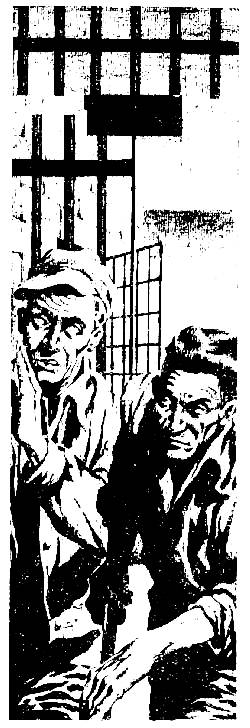
Warden Halloran smiled slightly.
"You expect to have criminals on
Mars, then?" he asked. "Is that why
you want me?"
"Of course we don't, sir!" snapped
the lieutenant general. His name was
Knox. "We need men of your administrative
ability—"
"Pardon me, general," Lansing
interposed smoothly, "I rather think
we'd better give the warden a ...
a more detailed picture, shall we say?
We have been rather abrupt, you
know."
"I'd be grateful if you would,"
Halloran said.
He watched the lanky civilian as
Lansing puffed jerkily on his cigar.
A long man, with a shock of black
hair tumbling over a high, narrow
forehead, Lansing had introduced
himself as chairman of the project's
coördinating committee ... whatever
that was.
"Go ahead," grunted Knox. "But
make it fast, doctor."
Lansing smiled at the warden,
carefully placed his cigar in the ash
tray before him and said, "We've
been working on the ships night
and day. Both the dust itself and its
secondary effects are getter closer to
us all the time. We've been so intent
on the job—it's really been a race
against time!—that only yesterday
one of my young men remembered
the Mountain State Penitentiary was
well within our sphere of control."
"The country—what's left of it—has
been split up into regions," the
general said. "So many ships to each
region."
"So," Lansing went on, "learning
about you meant there was another
batch of passengers to round up.
And when I was told the warden
was yourself—I know something of
your career, Mr. Halloran—I was
delighted. Frankly," he grinned at
Knox, "we're long on military and
scientific brass and short on people
who can manage other people."
"I see." Halloran pressed a buzzer
on his desk. "I think some of my
associates ought to be in on this discussion."
"Discussion?" barked Knox. "Is
there anything to discuss? We simply
want you out of here in an
hour—"
"Please, general!" the warden
said quietly.
If the gray-clad man who entered
the office at that moment heard the
general's outburst, he gave no sign.
He stood stiffly in front of the warden's
big desk, a little to one side of
the two visitors, and said, "Yes sir,
Mr. Halloran?"
"Hello, Joe. Know where the captain
is?"
"First afternoon inspection, sir."
He cocked an eye at the clock on the
wall behind Halloran. "Ought to be
in the laundry about now."
The warden scribbled a few words
on a small square of paper. "Ask
him to come here at once, please.
On your way, please stop in at
the hospital and ask Dr. Slade to
come along, too." He pushed the
paper across the desk to the inmate.
"There's your pass."
"Yes sir. Anything else, warden?"
He stood, a small, square figure in
neat gray shirt and pants, seemingly
oblivious to the ill-concealed stares
of the two visitors.
Halloran thought a moment, then
said, "Yes ... I'd like to see Father
Nelson and Rabbi Goldsmid, too."
"Uh, Father Nelson's up on the
Row, sir. With Bert Doyle."
"Then we'll not bother him, of
course. Just the others."
"Yes, sir. On the double."
Lansing slouched around in his
chair and openly watched Joe Mario
walk out. Then he turned back to
Halloran and said, "That chap a ...
a trusty, warden?"
"To a degree. Although we no
longer use the term. We classify the
inmates according to the amount of
responsibility they can handle."
"I see. Ah—" he laughed embarrassedly,
"this is the first time I've
been in a prison. Mind telling me
what his crime was?"
Halloran smiled gently. "We try
to remember the man, Dr. Lansing,
and not his crime." Then he relented.
"Joe Mario was just a small-time
crook who got mixed up in a bad
murder."
Lansing whistled.
"Aren't we wasting time?" growled
the general. "Seems to me, warden,
you could be ordering your people
to pack up without any conference.
You're in charge here, aren't
you?"
Halloran raised his eyebrows. "In
charge? Why, yes ... in the sense
that I shape the final decisions. But
all of my assistants contribute to
such decisions. Further, we have an
inmate's council that voices its opinion
on certain of our problems here.
And we—my associates and I—listen
to them. Always."
Knox scowled and angrily shifted
his big body. Lansing picked up his
cigar, relit it, using the action to
unobtrusively study the warden.
Hardly a presence to cow hardened
criminals, Lansing thought. Halloran
was just below middle height, with
gray hair getting a bit thin, eyes that
twinkled warmly behind rimless
glasses. Yet Lansing had read somewhere
that a critic of Halloran's
policies had said the penologist's
thinking was far ahead of his time—too
far, the critic had added.
As Joe Mario closed the warden's
door behind him, two inmates slowed
their typing but did not look up as
he neared their desks. A guard left
his post at the outer door and walked
toward Mario. The two of them
stopped beside the desks.
"What's the word, Joe?" the
guard asked.
Mario held out his pass.
"Gotta round up the captain, Doc
Slade and the Jew preacher," he said.
"All right. Get going."
"What do those guys want?" asked
a typist as he pulled the paper
from his machine.
Mario looked quickly at the guard
and as quickly away from him.
"Dunno," he shrugged.
"Somethin' about the war, I bet,"
grunted the typist.
"War's over, dope," said the other.
"Nothin' behind the curtain now but
a nice assortment of bomb craters.
All sizes."
"Go on, Joe," ordered the guard.
"You heard something. Give."
"Well ... I heard that fat general
say something about wanting the
warden outa here in a hour."
The typewriters stopped their
clacking for a bare instant, then
started up again, more slowly. The
guard frowned, then said, "On your
way, Joe." He hesitated, then, "No
use to tell you to button your lip,
I guess."
"I'm not causing any trouble,"
Mario said, as the guard opened the
door and stood aside for him to pass
into the corridor.
O.K.'d for entrance into the hospital
wing, Joe Mario stood outside
the railing that cut Dr. Slade's reception
area off from the corridor that
led to the wards. An inmate orderly
sat behind the railing, writing a prescription
for a slight, intelligent-looking man.
Mario heard the orderly say, "All
right, Vukich, get that filled at the
dispensary. Take one after each meal
and come back to see us when the
bottle's empty. Unless the pain gets
worse, of course. But I don't think
it will."
"Thanks, doc," the patient drawled.
Both men looked up then and saw
Mario.
"Hi, Joe," the orderly smiled.
"What's wrong with you? You don't
look sick!"
"Nothin' wrong with me that a
day outside couldn't cure."
"Or a night," laughed Vukich.
Mario ran a hand over his sleek,
black hair. "Better a night, sure,"
he grinned back. Then he sobered
and said to the orderly, "Warden
wants to see the doc. Right away."
"Mr. Halloran sick?"
"Naw ... it's business. Urgent
business."
"Real urgent, Joe? The doc's
doing a pretty serious exam right
now."
Mario paused, then said, "You
guys might as well know about it.
There's a general and a civilian in
the warden's office. They're talkin'
about something outside. Warden
wants the doc in on it."
Sudden tension flowed out between
the three men. Down the hall, a
patient screamed suddenly in the
psycho ward. The three of them jerked,
then grinned feebly at each other.
Vukich said slowly, "Well, you
don't start playing catch with atom
bombs without dropping a few.
Wonder what it's like ... out
there?"
"We haven't heard that it's any
different," the orderly's voice lacked
conviction.
"Don't be silly," Vukich said
flatly. "Ever since they moved the
dames from Tehama into C block
we've known something happened."
"Get the doc," Mario said. "I've
got to be on my way."
"Me, too." Vukich's thin, clever
face looked thoughtful.
The others stared blankly at him
and said nothing.
As Alfred Court, captain of the
prison, strode down the flower-bordered
path that led from the shops
unit past A block to the administration
building, a side door in A block
clanged open and a sergeant came
out. The sergeant turned without
seeing his superior and walked hurriedly
toward the administration
wing.
"Hey, sarge!" Court called.
"What's the hurry?"
The sergeant whirled, recognized
the captain and quickly saluted.
"Glad to see you, sir," he said.
"Just the man I was looking for!"
"Good enough. What's on your
mind? Better tell me as we go for
the warden's in a hurry to see me."
The two men walked abreast, both
big, although Court lacked any trace
of the sergeant's paunch. As they
walked and talked, their eyes darted
continually about, unconsciously
checking the appearance of the buildings,
the position of the guard in
the gun tower, the attitude of a very
old inmate who was meticulously
weeding a flower bed.
"Captain, you going to let the men
out for their yard time?"
Court's pace slowed. "Why not?"
"No real reason ... now. But
there's trouble in the air, sir. I can
smell it. The whole place is buzzing ... with
something."
"With what?"
"I can't put my finger on it. But
all the men know there's some pretty
big shots—at least one general, they
say—in the warden's office, right
now. There's a hot rumor that there's
trouble outside—some sort of disaster."
Court laughed shortly. "That
Mario! He's going to lose a nice
job if he doesn't keep his mouth
shut!"
"None of them keep their mouths
shut, captain."
"Yes ... well, I don't know what's
up, myself. I'm heading for that
conference right now. I'll ask the
warden about letting the men out
of their cells. What's their attitude?"
The sergeant's broad, red face
grew more troubled.
"Uh ... the men aren't hostile,
captain. They seem worried, nervous ... kind
of scared. If somebody at
the top—the warden or yourself—could
convince them things were as
usual outside ... they'd quiet down,
I'm sure."
They were now thirty feet from
the door to the administration building
a door that opened for but one
man at a time. The officers stopped.
"Things are not normal outside,"
Court growled, "and you know it.
I've been wondering how long this
prison could go on—as if there were
still a state's capital, with its Adult
Authority, its governor, its Supreme
Court. D'you think every man jack
here doesn't know a visit from the
Authority's long overdue!"
"Yeah—"
"Well, I'll go in, sarge, and see
what's what. If you don't hear from
me, stick to routine."
"Right, captain."
He remained where he was while
Captain Court walked slowly toward
the door, both hands well in sight.
A pace from the door he stopped
and exchanged a few words with
someone watching him through a
barred peephole. After a moment,
the door slid open and he walked
into the building.
He was the last to arrive at the
warden's office. Lansing gazed at
him in fascination. Goldsmid had
been a Golden Gloves champion
middleweight before he had heeded
the call of the Law, and he looked
it. Dr. Slade was the prototype of
all overworked doctors. But Court
was a type by himself. Lansing
thought he'd never seen a colder eye.
Yet, the captain's lean face—so unlike
the warden's mild, scholarly one—was
quiet, composed, unmarked
by any weakness of feature or line
of self-indulgence. A big, tough man,
Lansing mused, a very tough man.
But a just one.
"I've a problem, warden," Court
said when the introductions were
over. "Something we should decide
right away."
"Can't it wait?" Knox said irritably.
Lansing almost choked with stifled
laughter when Court just glanced
briefly at Knox, then said quietly to
the warden, "Sergeant Haines has
just advised me that the inmates
know about these gentlemen and
they're—restless. I wonder if we
shouldn't keep the men in their cells
this afternoon."'
"Blast it!" roared Knox. "Can't
you people keep a secret?"
"There are no secrets in prison,
general," Halloran said mildly. "I
learned that my first week as a guard,
twenty years ago." To Court he said,
"Sit down, Alfred. Unless you disagree
strongly, I think we'll let the
men out as usual. It's a risk, yes, but
right now, the closer we stick to
normal routine, the better."
"You're probably right, sir."
Court sat down and Halloran
turned to his two visitors.
"Now, gentlemen," he smiled,
"we're at your disposal. As I told
you, my two associate wardens aren't
here. Mr. Briggs is in town and Mr.
Tate is home ill. Dr. McCall, our
Protestant clergyman, is also home,
recovering from a siege with one of
those pesky viruses. But we here
represent various phases of our administration
and can certainly answer
all of your questions."
"Questions!" Knox snorted.
"We're here to tell you the facts—not
ask."
"General," soothed Lansing. He
looked across the desk at Halloran
and shrugged slightly. The warden
twinkled. "General Knox is a trifle ... ah,
overblunt, but he's telling
you the essential truth of the situation.
We've come to take you away
from here. Just as soon as you can
leave."
"Hey?" cried Slade. "Leave here?
The devil, man, I've got to take out
a gall bladder this afternoon!"
"I'm afraid I don't understand,"
murmured Goldsmid. "I thought the
war was over—"
"This is all nonsense!" There was
an ominous note in Knox's hoarse
voice. "Do you people realize you're
now under the authority of the Fifth
Defense Command?"
Lansing cried: "Let's be sensible
about all this!" He pointed his cigar
at the fuming soldier. "General,
these gentlemen have every right to
know the situation and we'll save
time if you'll permit me to give them
a quick briefing."
"All right! All right!"
"Well, then." Lansing crossed his
long legs, glanced nervously about
the room, and said, "The world as
we know it is done with. Finished.
In another week it will be completely
uninhabitable."
"Hey," grunted Slade. "You Lansing,
the physicist?"
"That's right, doctor."
"Didn't place you at first. Well,
what's going to end this lousy old
world of ours?"
"Well," Lansing answered, "we
wiped out our late antagonists with
skill and dispatch. But, in the end,
they outsmarted us. Left behind
some sort of radioactive dust which ... spreads.
It's rolling down on us
from Chicago and up from Texas.
God knows what other parts of the
country are like—we haven't had
time to discuss it with them on the
radio."
Goldsmid muttered something in
Hebrew.
"Isn't that lack of communication
rather odd?" asked the warden.
"Not so very. We've been too
busy building rocket ships."
"Rocket ships!" Court was jarred
out of his icy calm.
"You mean spaceships?" cried the
doctor.
"Yes, Slade, they do," murmured
the warden.
"Precisely," Lansing said. "When
it looked as if the cold war would
get rather warm, the allied governments
faced up to the fact that our
venerable planet might become a ...
ah, a battle casualty. So, in carefully
selected regions, rather extensive
preparations were made for a hurried
departure from this sector of the
universe."
"Oh, come to the point!" Knox
exploded. "All you people need to
know is that one of those regions is
this area of the Rocky Mountains,
that the ships are built and ready to
go, and that you're to get aboard.
Fast!"
"That," nodded Lansing, "is it."
The four prison officials looked at
each other. Halloran and Court sat
quiet; Goldsmid slowly dropped his
eyes to the ground and his lips
moved. Slade scratched his chin.
"Going to Mars, hey?" he asked
abruptly.
"That's our destination."
The doctor chuckled. "Comic-book
stuff," he chortled.
"No, it isn't," Halloran said.
"We've been expecting something
like this for a long time. Haven't
we?"
"Indeed we have," Goldsmid said.
"Expecting, but not quite believing."
Halloran looked thoughtfully at
the physicist. "Dr. Lansing, these
ships of yours ... they're pretty big,
I take it?"
"Not as big as we like. They never
are. But they'll do. Why?"
"I should remind you that we
have well over two thousand inmates
here."
"Inmates!" barked the general.
"Who the devil said anything about
your inmates? Think we'll take a
lot of convicts to Mars! Populate it
with killers, thieves—"
"Who does go, then?" Halloran
did not raise his voice but Knox
looked suddenly uneasy.
"Why ... uh, your operating
personnel," he replied gruffly. "Your
guards, clerks ... hell, man, it's
obvious, isn't it?"
"I'm afraid that is out," Goldsmid
said. "For me, that is." He stood up,
a heavy-shouldered middleweight
running a little to fat. "Excuse me,
warden, my counseling period's coming
up."
"Sit down, Pete," Halloran said
quietly. "We haven't finished this
conference."
"I admire your sentiments, Rabbi,"
Lansing said hurriedly, "but surely
you realize that we can't take any
criminal elements to ... ah, what
will be our new world. And we do
have a special need for you. We've
plenty of your co-religionists among
our various personnel, but we don't
have an ordained minister for them.
They're your responsibility."
"Afraid my first responsibility is
here." Goldsmid's voice was quite
matter-of-fact.
"So's mine," grunted Slade.
"Warden, even if the world ends tomorrow,
I've got to get Squeaker
Hanley's gall bladder out today. No
point in my hanging around any
longer is there?"
"Of course there is," Halloran
answered. He took a package of cigarettes
from his pocket, selected
one, and lit it. He exhaled smoke
and looked speculatively at Lansing.
The scientist felt himself blushing
and looked away.
Halloran turned to Court.
"Quite a problem, isn't it, Alfred,"
he said. "I suppose these gentlemen
are right in keeping the inmates off
their ships. At any rate, we can't
argue the matter—so let's do what
we're asked. I think you'd better plan
to get the guards out of here tonight,
at shift change. Might pass the word
to their wives now, so they can start
packing a few essentials. Doc," he
turned to Slade, "before you get
your greedy hands on Squeaker's
gall bladder, you'd better round up
your staff and have them make the
proper arrangements."
"O.K., I'll put it up to them."
"You'll not put it up to them,"
the warden said sharply. "You'll
order them to be ready when the
general, here, wants them."
"I'll give no orders," Slade said
grimly.
"Just a minute," interposed Court.
"Sir, aren't you going?"
"Of course not. But that's neither
here nor there—"
The loud clangor of a bell pealed
through the room. The two visitors
jumped.
"What's that?" cried Knox.
"Yard time," Halloran smiled.
"The men are allowed two hours
out in the yard, now. They exercise,
play games, or just sit around and
talk."
"Oh."
"Did I understand you correctly,
Warden Halloran?" Lansing's bony
face was pale now. "Do you refuse
to come with us?"
When the bell rang, Joe Mario
had been standing near the door to
the warden's office, ostensibly filing
reports. Now, he closed the drawer
with a bang, stretched, and started
toward the outside door.
"Where are you going?" the
guard asked suspiciously.
"The yard. Where else?"
"Not a word," Mario added virtuously.
"I was too busy doin' my
work. Anyway, you gotta let me out.
My team's got a ball game set for
this afternoon."
"Oh ... all right." He looked at
the typists. "How about you two?
Want out?"
The two men glanced quickly at
each other, then shoved back their
chairs and got up from their desks.
"Sure," one of them grinned, "I
guess we'll take a little air."
Lansing had the feeling he used
to have occasionally, back in his university
days when he lectured on
freshman physics—as if he were
talking to a class of deaf students.
For, like the hapless freshmen,
Warden Halloran was quite obviously
not listening to him. But the scientist
plunged on. "Sir," he said
hoarsely, "we need you. We will
need you! I'm a scientist—I know
nothing of the problems of ... ah,
community living. Neither does
Knox. He's accustomed to major
crises—and solving them by giving
orders. But both of us know there'll
come a time when people won't take
orders—"
"Absolutely correct," Knox said
unexpectedly. "Once we get settled
on Mars, the military takes a back
seat. And—I mean this, Lansing—I'll
be damn' glad of it. When the
people get their towns built they'll
need some gents with the right kind
know-how to help them, show
them—"
"That's all very interesting, general,
but it's not for me."
"Why not?"
Halloran snubbed out his cigarette,
looked up at the general and at the
scientist. He smiled briefly. "It's just
my job, gentlemen—let's not discuss
the matter any further. You can't
make me go."
"We will!" barked Knox. "I told
you you were under the jurisdiction
of the Fifth Defense Command and
you are. If I want to, I can send a
tank company over here and drag
you to those ships!"
"He's right, you know," Lansing
said.
Court stood up and took one step
toward the general.
"Alfred!" the warden did not lift
his voice, but Court stopped. "General
Knox," Halloran went on in a
conversational tone, "you're being a
bit of bully, you know, and in this
prison we've all been ... ah, conditioned
against bullies." He looked
down at his desk and frowned.
"However, I'll admit that your position
requires that I elaborate my reasons
for staying here. Well, then. As
I see it, your people, your ... ah,
colonists, can help themselves. Most
of my people, the inmates here, can't.
A long time ago, gentlemen, I decided
I'd spend my life helping the
one man in our society who seemingly
can't help himself, the so-called
criminal. I've always felt that society
owes a debt to the criminal ...
instead of the other way around."
He hesitated, grinned apologetically
at Captain Court. "I'm sermonizing
again, eh, Alfred? But," he
shrugged, "if I must get dramatic
about it I can only say that my life's
work ends only with my—death."
"It's quite a rough job, you
know," Goldsmid remarked. "This
is a maximum security institution.
Too many of the inmates have disappointed
the warden. But he keeps
trying and we've learned to follow
his example."
"Our psychiatric bunch have done
some mighty interesting things,"
beamed Slade, "even with cases that
looked absolutely hopeless."
"None of them can be saved now,"
muttered Lansing.
"That is in the hands of God,"
Goldsmid replied.
"Well," Halloran said gently,
"still going to send those tanks after
me, general?"
"Uh ... no ... I won't interfere
with a man doing his duty."
Lansing cleared his throat, looked
slowly from the somber-faced clergyman,
to the fidgeting medico, to the
burly captain, still staring impassively
at the general, to, finally, the quiet,
smiling warden. "Gentlemen," he
said slowly, "it occurs to me that the
situation hasn't actually registered on
you. The earth is really doomed, you
know. This dust simply won't tolerate
organic life. In some way—we have
not had time to discover how—it's
self-multiplying, so, as I said, it
spreads. Right now, not a tenth of
this entire continent—from the pole
down to the Panama Canal—is capable
of supporting any kind of life
as we know it. And that area is
diminishing hourly."
"No way of checking it?" Slade
asked. His tone was one of idle
curiosity, nothing else.
"No. It's death, gentlemen. As
deadly as your ... ah, gallows."
"We use the gas chamber," Halloran
corrected him. His mouth
twisted. "More humane, you know."
There was brief quiet, then the
warden said, "Well ... now that
we've finished philosophizing, let's
get back to the matter at hand. We
can have everyone that's going ready
to leave by seven tonight. Will that
be satisfactory?"
"It'll have to be," Knox grunted.
"Thank you." Halloran reached
for his phone, then dropped his
hands on his desk. "I'd like to ask
you a question," he said. "Perhaps
it's presumptuous, but I'm rather
curious about the ... er, last workings
of our government. Tell me,
don't you really have room for our
inmates? You haven't told us how
many ships you've built. Or how big
they are."
Lansing looked at Knox. The general
flushed, then stared at the floor.
Lansing shrugged tiredly.
"Oh, we've plenty of room," he
sighed. "But ... our orders are to
take only those completely fit to
build a new world. We've ... well,
we have practiced a lot of euthanasia
lately."
"Judges," murmured Goldsmid.
"If you had come sooner," there
was no anger in Halloran's voice,
"couldn't you have selected some of
our people, those that I ... all of
us know are ready for rehabilitation—even
on another planet?"
"Perhaps. But no one remembered
there was a prison nearby."
The warden looked at the rabbi.
Goldsmid raised his heavy shoulders
in an ancient Hebraic gesture.
"That was always the trouble,
wasn't it, Pete?" Halloran murmured.
"People never remembered the
prisons!"
The telephone beside him shrilled
loudly, urgently.
The inmate mopping the floor of
Condemned Row's single corridor
slowed in front of Bert Doyle's cell.
Doyle was slated for a ride down
the elevator that night to the death
cell behind the gas chamber. At the
moment, he was stretched out on
his bunk, listening to the soft voice
of Father Nelson.
"Sorry to interrupt," the inmate
said, "but I thought you'd like to
know that all hell's busting loose
down in the yard."
Father Nelson looked up.
Doyle, too, looked interested. "A
riot?" he asked.
"Yessiree, bob!"
"Nonsense!" snapped the priest.
"This prison doesn't have riots!"
"Well, it's sure got one, now.
'Scuse me, Father, but it's the truth.
The men grabbed four or five yard
guards and the screws in the towers
don't dare shoot!"
He gave up all pretense of work
and stood, leaning on his mop-handle,
his rheumy old eyes glowing
with a feverish excitement.
Nelson stood up.
"Will you excuse me, Bert?" he
asked. "I'd better see if I can help
the warden."
Doyle, too, sat up, swung his
feet to the steel floor, stood up and
stretched. "Sure," he said. His hard
face was pale but otherwise he
seemed quite calm. "You've been
a great help, Father." He looked
quizzically at the old inmate. "You
lying, Danny? Seems to me the boys
have got nothing to beef about here."
"Heh, they sure have now."
"What?"
"Well, I got this from a guy who
got it from Vukich who heard it
from Joe Mario. Seems there's a big-shot
general and some kinda scientist
in Mr. Halloran's office." He
shifted his grip on the mop-handle.
"You gents maybe won't believe this,
but it's what Joe heard 'em say to
the warden. Outside is all covered
with radium and this general and
this here scientist are goin' to Mars
an' they want the warden to go
along. Leavin' us behind, of course.
That's what the boys are riotin'
about."
Bert Doyle burst into harsh laughter.
"Danny! Danny!" he cried. "I've
been predicting this! You've gone
stir-bugs!"
"Ain't neither!"
"Just a moment, Bert," Nelson
whispered. Aloud he said, "Dan, go
call the guard for me, please." When
the old man had shuffled out of
earshot the priest said to the condemned
man, "It could be true, Bert.
By radium, he means radioactive
material. And there's no reason
spaceships can't get to Mars. We'd
reached the Moon before the war
started, you know."
Doyle sank back on his bunk.
"Well, I'll be damned!" he
breathed.
"Bert!"
Doyle grinned sheepishly. "Force
of habit." Then, more soberly, "So
they're off to Mars, eh? Father, you
better get down there and pick up
your reservations!"
"Don't be ridiculous!" The priest's
voice softened and he patted the
killer's shoulder. "I will go down
and see what's what, Bert. And I'll
be back just as soon as the men have
quieted down. That is, if they are
creating a disturbance."
The footsteps of the approaching
guard sounded loud in the corridor.
Doyle frowned a little.
"When you come back, Father,
you'll tell me the truth? No kidding,
now!"
The guard stood in front of the
door of heavy steel bars. Father Nelson
looked down at the man on the
bunk.
"I'll tell you everything, Bert. I
swear it."
"Uh, Father?" the guard's voice
was nervous—and embarrassed.
"Yes, Perkins?"
"I ... I can't let you out right
now. Orders from the warden. Not
a cell door opens till I hear from
him direct."
Doyle chuckled.
"Might as well sit down, Father,"
he said, "and make yourself comfortable—"
"What will you do?" cried Lansing.
"Go out and talk to them, of
course," replied Halloran. He arose
from his desk, a calm, unhurried
man.
"Look," growled Knox, "you get
me through to the town. Some of
our people are still there. I'll order
out as many soldiers as you want.
I'll see to it that they get here—on
the double!"
Halloran flushed. "Would it ease
your conscience, general," he grated,
"if you killed off my men instead of
leaving them—behind! Now, you
will please keep quiet. You'll be
perfectly safe!"
"What will we do with them,
sir?" Court gestured at Lansing and
Knox.
Halloran strode from behind his
desk to the opposite end of the room.
As he twirled the dials of a wall
safe he said, "They'll have to remain
here, for now. The men have
got between this building and the
gate office." The safe swung open
and he reached far inside and took
out a submachine gun. "Here," he
held the weapon out to Court. "If
I don't come back, use this to get
them to the gate office."
"Didn't know you had an arsenal
in here!" cried Slade.
"No one else did, either, except
Alfred. Now Doc, think you and
Pete had better stay here."
Slade and Goldsmid pulled themselves
out of their chairs as one
man. Their timing was perfect.
"No, you don't, hero!" growled
Slade.
"Warden," Goldsmid said, "perhaps
I could talk to the men—"
The warden smiled and walked
toward the door. There he stopped
and said to Court, "Switch on the
speaker system, Alfred. I'll take the
portable mike from the next office.
While I'm out there, get word to
all custodial and operating personnel
that they will be permitted to leave
tonight. Meantime, I hope they will
stay on their jobs. Better phone Mr.
Tate, have someone try to locate Mr.
Briggs, be sure and call Dr. Slade's
staff."
"Right, sir."
The three men left the office.
Court, the gun cradled under one
arm, picked up the phone and spoke
into it. His voice was a low, crisp
monotone. After a while, he replaced
the receiver and stood quiet, staring
impassively at the others.
"You might say the warden's
career has been twenty years of futility,"
he muttered. Lansing and Knox
felt he wasn't actually speaking to
them. "Now me, I'm a screw of the
old school. Hardboiled, they say. I
never expected a thing from a con ... and
cons have lied to him, politicians
have broken their promises ... but
the liars have loved him and
the dumbest dope in the legislature
has respected him."
"Will he ... be all right?" Lansing
asked.
Court shrugged. "Who knows?
You handled this very badly," he
said dispassionately. "Five minutes
after you stepped through the main
gate every inmate in the place knew
you were here and started wondering.
Why didn't you write—make
arrangements to see the warden outside?"
"I'm sorry," Lansing said. "We
know very little about prisons."
Court laughed shortly. "You'd
better learn," he said grimly.
"Anyway we can see what's going
on?" rumbled Knox. "And how
about that speaker business?"
"There's a window in the next
office. Come along."
They crouched at the window, the
fat Knox whizzing a little, because
Court had ordered them to keep out
of sight of the rioters. They saw
Halloran, Slade and Goldsmid at his
heels, walking out into the small
courtyard that lay between them and
safety. Over the wall speaker came
a sullen roar, something very like
the ragged blast of a rocket whose
timing is off. A few gray-clad men
in the courtyard saw the approaching
warden, surged toward him, screaming
at their fellows in the big yard
behind them.
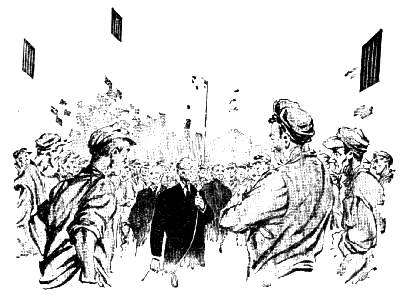
Halloran ignored the clutching
hands. He held the mike up and
they heard him say, "There's no
point in my talking with you unless
you will be quiet and listen." He
paused. The roar slowly subsided into
an angry mutter. "Thanks. That's
better."
Now, they could see Slade's
head but both Halloran and the rabbi
were hidden by the swirl of gray
figures that swept around the three
prison officials.
"Now," the warden went on, "it
seems that you have something to
say to me. Good enough. But why
didn't you send word through your
council, instead of roughing up
guards, damaging property, yelling
your heads off and generally behaving
like a bunch of spoiled brats. Go
on, tell me! Why?"
Someone's scream came clearly
over the mike. "The world's coming
to an end! They're leaving us here
to die!"
"Yeah!" the mike picked up another
voice. "How about that?"
Before the wordless, mindless roar
could rise again, the warden barked,
"Oh, hush up!" And they were
quiet.
"My God," breathed Lansing.
"Now," Halloran's voice was easy,
assured, "I want to make sure that
all of you hear me. So, I'm coming
out in the center of the yard. Rabbi
Pete Goldsmid and Doc Slade insist
on coming with me although," he
chuckled, "I understand Squeaker
Hanley's screaming for the doc to
cut out his gall bladder." A few of
the men laughed. "All right, here
I come. And you fellows behind me,
keep off the wire. I don't want this
mike to go dead and have to yell my
lungs out."
They saw the eddy of men around
him move slowly through the broken
gate and out of their sight.
"What will he tell them," muttered
Knox.
"Whatever—they'll believe it,"
Court said. The courtyard before
them was now empty. He stared
thoughtfully out the barred window,
then said, "Think you could get
to the gate office pretty soon,
now—"
"No!" snarled Knox. "I want to
see what happens to that gutty so-and-so!"
Lansing grinned nervously. "Somehow,
captain, I feel it won't be
necessary for us to sneak out of
here."
They listened again while assorted
thieves, murderers, rapists, men—save
for an innocent few—whose
hands were consistently raised against
their fellows' peace and property,
heard their jailor tell them that the
end of their world, a world that
many of them remembered but dimly,
was coming to an end. The
screaming broke out again when Halloran
spoke of the Mars-bound ships,
and, for a moment, the three in the
office thought he had lost control.
But the amplifiers prevailed and Halloran
laughed and said, "Anyway,
we're not going to Mars—"
"You can go!"
The man who yelled that was apparently
very close to the warden
within his view, for they heard him
say: "Chrisman, you're a fool—as
usual! Would I bother to come out
here and talk to you if I could go?"
That got them. That, they understood.
If a guy didn't scram from a
hot spot when he could ... well,
then, he couldn't scram in the first
place. So, the warden was stuck, just
like they were.
Later, perhaps, a few of them
might figure out why.
"Now, let's have no more interruptions,"
Halloran said. "I don't
think there's any need to go. Neither
does the doc, here, or the rabbi.
We're all staying—because the desert
to the south of us has stopped the
spread of this dust and it seems it
can't cross the rivers, either. So, we're
safe enough."
"But that's not true," groaned
Lansing.
Court glanced at him. "Would
you tell them different?" he said
coldly.
"No—"
Halloran said, "Well, that's that.
Life is a little difficult outside and
so the people out there want to try
to get to Mars. Believe me, that's a
trip I want someone else to make
first. But if they think life will be
easier on those deserts—why, let
them go. But God help them—they'll
need it."
He paused. Knox tried to catch
Lansing's eye, but the scientist's face
was blank, unseeing.
"What do we do?" This voice was
not hysterical, just seriously questioning.
"You should do darned well. Life
should be easy enough for you.
You've got your own farms, your
livestock, laundry, hospital, shops—everything
a man can need. So, take
over and run things to suit yourselves."
A unanimous gasp whistled over
the speaker. Then, they all cried just
one word.
"Us?"
"Why not? Don't you think you
can?"
Silence, broken by strange, wistful
mutterings.
"I'd suggest this," Halloran said.
"Let's follow our normal routine tonight—no
lock-ups, of course—and
tomorrow, you fellows take over. I'll
help you in any way I can. But it
will be your job. Perhaps after breakfast
tomorrow, you ought to have a
mass meeting. Under the supervision
of your council, I'd say. You can't
keep going without some kind of
order, you know."
Again silence.
"My God," whispered Lansing,
"he makes it all sound so real."
"Any questions?" Halloran asked.
"Hey, warden! How about the
dames?"
"The ladies will join you tomorrow
morning." He chuckled. "I
imagine they'll be able to handle
you all right!"
A joyous roar.
"However," Halloran raised his
voice, "I'd like to remind you fellows
that a successful community
needs ... families!"
There was a long quiet, then,
broken finally by an inmate who
asked, "Warden, how about the guys
up on the Row?"
"Well," Halloran's voice lost all
humor, "you can start ripping out
the gas chamber whenever you're
ready to. I'll see that you get the
tools."
The swell of applause was so loud
in the office that Court hastily turned
down the speaker's volume.
"All right," Halloran said when
they had quieted down, "that's about
it. You're free now, till supper-time.
I'd suggest all of you start right
now, thinking about your future—"
Outside the main gate, first Knox,
then Lansing shook hands with the
gray-faced warden.
"Trucks'll be in town at seven for
your people," Knox muttered. He
gave a windy sigh. "It's all fouled
up. As usual. Damn it, we need
people like you, sir!"
Lansing looked at Halloran for a
long time, trying to see behind the
mask of exhaustion. "I'm a mannerless
fool," he said at last. "But Mr.
Halloran, would you tell me what
you're thinking? I mean, really thinking?
Even if it's rough on us!"
Halloran laughed softly. "I wasn't
thinking about you at all, Dr. Lansing.
I was—and am—regretting
that what I told the men couldn't
be the truth. It's too bad they'll have
so short a time. It would be very
interesting to see what they would
do with—life."
Knox scowled. "Seems like they
haven't done much with it so far."
"Come along, general," Lansing
said quietly. "You don't understand.
None of us do. We never did."