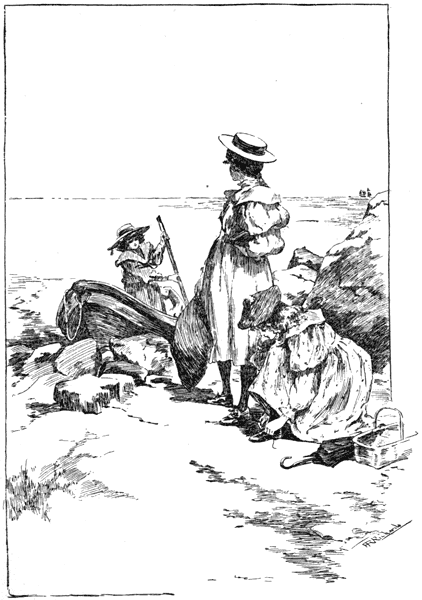
"What shall it be first, then?" went on Auntie Jean, adjusting the
cushions behind her back and resting her umbrella against the rail.
"Teakettle," suggested Edna.
"What is teakettle?" asked Hilda.
"Don't you know? We play it lots. Somebody goes out—"
"Into the water?" put in Archie. "Then Cricket is 'it,' I say."
"Well, of course, Archie, I was thinking of dry land. Somebody shuts up
her ears, then, and we choose a word. It must be one with two or three
meanings. Then, whoever is 'it,' begins to ask questions, and we answer,
only we put the word 'teakettle' in place of the real word. We can say
'teakettling,' you know, or 'teakettled,' if we want to. Who'll be 'it'
first?"
"I'd just as lief," said Eunice, going to the bow, and putting her
fingers in her ears, and burying her head in a cushion.
"What shall we choose for a word? It must have two or three meanings,
you know."
"Sail would be very appropriate," suggested Will, who was still
laboriously sculling.
"Oh, yes. See, Hilda? There's to sail, and taking a sail, and a sale of
things."
"And the sail of the boat," said Archie.
"All ready, Eunice. Touch her, Archie. Begin, Eunice."
"The hardest part is to think of questions," said Eunice, turning around
and meditating. "Let me see. Auntie, when do you think we will get
home?"
"When we are on a teakettle, it is never safe to say," answered auntie.
"On a teakettle—on a boat—that doesn't fit," meditated Eunice. "Will,
why don't you make Archie scull now?"
"Because he's such a lazy beggar. When he goes teakettling, he won't do
anything else."
"Edna, is the moon made of green cheese?"
"What a hard question," groaned Edna. "What shall I say? If we
teakettled up there, perhaps we could find out."
"I can't guess it yet," said Eunice, thinking over this answer.
"Cricket, if you weren't a girl, what would you rather be?"
"I know—a boy," said Archie, quickly. "Wouldn't you, Miss Scricket?"
"No, I wouldn't, Mr. Archie. I would rather be a pig than a boy. A nice
fat pig, and then nobody would laugh at my 'knitting-needles.' That's
what papa calls my legs, always, auntie, you know, because they're not
fat, I know. He always wants mamma to knit with them, and all that
nonsense. It seems to amuse them very much," added Cricket, with a bored
air.
"You haven't teakettled once, child," said Eunice. "Oh, auntie, I must
just stop to tell you a funny story about Cricket. It was such a joke on
her. Once we were playing 'She comes, she comes.' You know that, don't
you? Somebody says, 'What does she come with?' and then you give the
first letter of the thing you've thought of. It was Cricket's turn, and
she—well, she was rather a little girl—gave 'N. N.' for the
initials. We guessed and guessed, and had to give up, finally, and then
she piped up, 'It's what papa calls my legs,' and she meant
'knitting-needles.'"
"I was very little," said Cricket, blushing and apologising. "It was
as much as three years ago. I haven't answered your question yet,
Eunice. I b'lieve I don't want to be a pig, after all, for in the fall
the farmer has a teakettle, and sells his pigs, and I'd have to go to
the butcher and be killed, and be cut up for sausage."
"I don't seem to get hold of it, yet," said Eunice, wrinkling her
forehead. "Hilda, how do you like Marbury?"
"I think it's perfectly lovely," declared Hilda, enthusiastically. "Oh,
I forgot to teakettle. I think teakettling is lovely, even if you do get
becalmed."
"Teakettling—sailing! Sail is the word," exclaimed Eunice, instantly.
"You gave it away, Hilda. I guessed it on you, so you'll have to go
out."
"I'll never be able to guess it in the world," said Hilda, looking
disappointed.
"I'll take your place," said Will, instantly. "It's about time that
Archie sculled. Take hold, old boy, and keep at it."
"Choose a hard one," said Eunice, when Will had duly stopped up his
ears. "How would steal do?"
"Yes, or we might have oar and ore," said Hilda.
"Scull and skull," said Archie, pensively.
"That's good," said auntie. "Or else bough, and bow of the boat, and
bow, to make a bow."
"Let's take that, for there are so many meanings," said Cricket.
"All right. Ready, Will," said Archie, kicking him.
Will uncovered his ears and began.
"Edna, how many sandwiches did you eat for luncheon?"
"I ought to make you a teakettle for asking me such an easy question,"
laughed Edna, "I ate two—I think."
"Whopper!" said Will. "Eunice, why is a crocodile like the North Pole?"
"Because there's a B in both," answered Eunice, promptly. "Will, ask
sensible questions, or I'll get a teakettle when I get home, and hit you
with it."
"That might be a stone, but stone won't do. Cricket, now think carefully
over your answer. If three men work all day on a fertile farm—"
"I'll get Archie to throw you over the teakettle this minute, if you
don't stop," threatened Cricket.
"Throw me over the teakettle—over the side—stern—bow. Bow. That's it,
young lady. Caught you on that."
And so the game progressed, till they had sufficiently teakettled.
"What next?" asked some one.
"Suppose we have tableaux, and begin with Cricket for Venus," said
Archie, looking at her with his head on one side.
"You needn't make fun of my looks, Mr. Archie. I know this mackintosh
isn't very becoming, but I don't care for looks, anyway."
"You might as well intermingle a few looks if you can," said Eunice.
"And you do look too funny. Your clothes are dry, now, anyway. Hadn't
she better put them on, auntie?"
So the shawl screen was again put up, and the display of dress and
petticoats disappeared from the sail of the Gentle Jane.
"I feel more respectable," teased Archie, "now the weekly wash is taken
in. Hated to be taken for a canal-boat."
"No, we'd rather be taken for a tow," said Cricket, smartly, and Archie
fell back, rigid with mock admiration.
"Now, if we only had pencils and paper," said auntie, "there are many
games we might play."
"Oh, wait! wait!" exclaimed Cricket, jumping up suddenly and tumbling
over auntie in her excitement. She dived into the tiny hold, and
triumphantly brought out her mysterious newspaper package.
"I thought perhaps the girls would like to write on their stories for
the 'Echo,'" she explained eagerly, "so I brought all the blank books
and pencils. You can tear some leaves out of the back of mine and use
them."
There was much applause at Cricket's forethought.
"Wise child," said auntie, approvingly, "I am glad to see that 'though
on pleasure you are bent you have a'—literary mind. We might illustrate
proverbs."
"Oh, I can't draw," said Eunice, quickly.
"So much the better. You need not draw well, for it's much more fun if
you don't. I'll tear these leaves in two, Cricket, to make them long and
narrow. Now, we must each illustrate some proverb at the bottom of the
slip, or some line of poetry, if you prefer. Only label it, which it
is. When we are all done, we each pass our slips to the next one, who
writes what she thinks it is, and folds back the writing, and passes it
on. When we have each written our comments, they are opened and read.
Most of the fun comes from the different guesses, so you see you mustn't
draw too well, and make your ideas too plain. Now, to work, all of
you. Here are your slips."
They all fell industriously to work, interrupting themselves with many a
groan and protest. When all were finished they passed on their slips to
the next one. There was much giggling at the first sight of some of the
very remarkable drawings.
"Now," said Auntie Jean, when the slips had all passed around, and had
returned to the hands of their respective artists, "each of you unfold
your papers, and read the comments aloud for the benefit of the company.
Cricket, you're the youngest. Suppose you begin."
Cricket giggled. Her picture consisted of a scraggy tree, with several
long wavy lines near its foot. In the branches of the tree were two
good-sized attempts at fowls of some description, while a third huge
creature was flying near. She read the comments in order.
"There were three crows sat on a tree,
And they were black as crows could be." Auntie.
"The breaking waves dashed high,
Caught the pilgrims on the fly."
("Couldn't think how that last line goes," murmured Archie, "but I'm
sure those are pilgrims on the fly.")
"Two's a company, three is none." Edna.
"Good-morning! do you use Pears' Soap?" Will.
"Early bird catches the first worm." (Guess those
things down there are worms.) Hilda.
"Two birds in the bush are worth one in the hand."
(I had to make the proverb fit the drawing.) Eunice.
"And it's just as plain," announced Cricket, contemptuously. "Birds of a
feather flock together."
"Ho! what are those water streaks doing down there, then?" asked Archie.
"The things I thought were breaking waves."
"I thought they were curly worms," added Hilda.
"They're not worms or water either. I just put some lines there to fill
up. I think I meant them for grass. How silly you all are. Now, auntie."
Auntie's picture was beautifully simple. It was nothing but an inclined
plane, with a round thing rolling down it. Of course everybody had
written, "A rolling stone gathers no moss."
"Not at all," answered auntie, coolly. "I thought you would all think
that, but it really is, 'Things are not what they seem.' It looks like a
stone, but it isn't. Now, Eunice."
Eunice had a remarkable sketch of a darkly-shaded spot, with a house
showing dimly through, and at one side a spiky sun was rising above a
quavering line, evidently meant for the horizon. There were various
guesses. "Any port in a storm." ("Which is the same as saying, any
guess, if you can't make the right one," murmured Will.)
"Rising Sun Stove Polish." "Let not the sun go down upon your wrath."
"Every cloud has a silver lining." ("That house is behind a cloud, isn't
it?" asked Cricket.)
"It's a very easy one, too," said Eunice. "'It's always darkest just
before dawn.' Don't you see the sun just coming up?"
Archie, who drew beautifully, had made a really very clever little
sketch of a Spencerian pen, mounted on two thin legs, furnished with an
equally thin pair of arms, and a face as well, engaged in a boxing match
with a very plump and well-developed sword. In a second picture, the
sword was flat on the ground, while the pen was dancing away, grinning.
Of course this could be only, "The Pen is mightier than the Sword."
Hilda had drawn simply two long lines in perspective. As nobody could
make anything of them, the guesses were wild.
"Why, don't you see? Those two lines are a lane. 'It's a long lane that
has no turning.' That's the long lane. It has no turning," explained
Hilda. "I thought you would guess it the very first thing."
When the last of the guesses were read, auntie rose to rest herself from
a sitting position.
"Isn't there a bit of a breeze coming up?" she asked, shading her eyes
with her hand, to look across the glassy sea, in search of the faintest
sign of a ripple.
"Sorra a bit," said Archie. "Here, Will, you scull a while, and rest a
fellow. Hello! we're really getting along. See how far the Gurnet Lights
are behind us."
"Yes, but look at the distance ahead of us, to be sculled over yet,"
said Auntie Jean, "and here it is four o'clock," consulting her watch.
"Come, Archie, it's time to whistle up the wind."
"I will!" said Edna, breaking out again into her blackbird whistle.
Cricket listened in rapt admiration.
"Why can't I do it?" she sighed.
"But, Mrs. Somers?" broke out Hilda, in amazement, "can they really
whistle up a breeze?"
"No, indeed, dear. It's only an old saying about sailors. The children
do it for fun when we're becalmed sometimes. Well, there's no signs of
it yet. I'll tell you what I'll do, children. While you're whistling up
the wind, I'll write an adjective story for you."
"Oh, that will be fun!" exclaimed one and all. All, that is, but Hilda,
who asked again:
"Now, what is an adjective story?"
"I write a little story about anything," explained Mrs. Somers, giving
her pencils to Will to be sharpened, "and I leave a space before every
noun. When I have written it, you each give me adjectives in turn to
fill in the spaces, and I write them just as you supply them. Of course
they never fit, and a very funny hodge-podge is the result. Now, while
I'm writing you must all be thinking up a good supply of adjectives, for
I shall want a quantity."
So Auntie Jean took Cricket's blank-book and began to scribble; she
wrote busily for ten or fifteen minutes, and then announced she was
ready for the adjectives.
"I call it the 'Tale of the Shipwrecked Mariners,'" she said, when all
the adjectives were duly written in. "And now for the tale."
"Once upon a time, in the pathetic town of Marbury, there lived a green
and scrumptious lady with a wriggling troop of fantastic grandchildren,
who made her life miserable. First of all was the eldest, the awful and
weird William, who was quite intolerable. Next to him was the cute and
sublime Archie, who was always jolly and superstitious. They had a
sullen and sarcastic sister, the entrancing Edna, whom they delighted to
tease. One summer their delightful and sarcastic cousins, the mournful
and flowery Eunice, and the melodious Cricket ["Auntie! you put that
there on purpose," came reproachfully from the last-mentioned young
woman.
"No, I didn't, my dear. It really happened so."]
"The melodious Cricket, arrived to spend a long time with the dingy
Somers family, much to their enjoyment. After various adventures, their
ecstatic friend, the lively Hilda Mason, came to spend a few days. To
entertain her, one day, they took her out in a wizened boat to sail over
the garrulous bay. They dragged their silent auntie" [a howl] "with
them, promising her a talkative day. All went well at first, but
suddenly a gruesome storm arose, and beat upon their inky boat, which
began to leak. The musical crew were all much frightened, and tried to
bail out the ugly water, but it rose too fast, and soon the monkeyish
boat began to sink. After it had sunk through the water about a mile, it
struck plump on a rock, and then it glided into a dwarfish cave at the
bottom of the sea. The grumpy and genial Cricket immediately fell out of
the boat, in her surprise. Cunning Will jumped after her. The sugary
party had come to a mountainous spot down below the sea, and they found
a minute garden there, full of curly fruits. The aggravating Hilda, the
indefinite Eunice, and the smooth Edna, seeing the proper Cricket"
[another howl] "struggling in the water with the contrary Will,
immediately jumped out after them, leaving the rough Archie and forlorn
auntie in command of the boat. Suddenly a bold gnome popped up his
dainty head from behind a rock, saying, 'Welcome, Englishmen! You are in
the cave of accident. Look out for yourselves.' As he spoke, his watery
head fell off. He felt around but could not find it, since his eyes had
gone with his head, so he said, politely, 'Will some of you immense, raw
people pick up my jealous head for me, and kindly put it on?' Snub-nosed
Hilda" ["Ah, you've caught it now, young lady," from Archie] "being
nearest, handed him his head, which had rolled to her idolatrous feet.
The hysterical gnome immediately clapped it on—wrong side before.
'Never mind,' he said. 'Now I can go to school, or from school, just
as I like, and nobody will ever know what I'm doing.' The dumpy party
then went on their way exploring, leaving the squealing Archie and
uncanny auntie calling after them, and weeping unmixed tears of terror,
lest by some accident they should never come back. The noble gnome went
along in front of them, when suddenly he began walking right up, in the
water. When the others came up to the same place, to their surprise,
they found themselves doing the same thing. They couldn't possibly stay
on the ground. 'I don't want to go up,' said erratic Cricket, kicking,
and shamefaced Will called to the sparkling gnome, to know what was the
matter. 'Nothing at all,' he called back, cheerfully, 'only gravity
doesn't happen to act just there. Sometimes it doesn't and then you're
just as likely to go somewhere else.'
"'Let's go back!' said prim Eunice.
"'Very well. There's nowhere to go but back,' called back the rickety
gnome. 'Stand on your heads, and go the other way.'
"The humble party upset themselves, and got along very nicely, and soon
found themselves on the ground again.
"'I don't like to walk all sorts of ways,' said flighty Hilda. 'I like
to go on my grateful feet best.' So they decided to go back to the boat
as best they could. But when they came to the suave boat it wasn't
there, for the ground had opened accidentally, and cowardly Archie and
generous auntie had fallen right through the earth, to China, probably,
if nothing happened to stop them. This was quite a disappointment to the
naughty party, who didn't know what to do next. So they decided to do
nothing at all, and, as far as the present dramatic and inconvenient
historian knows, that is just what they are doing at the present time.
Here ends the swaggering story of the mellow and gruff shipwrecked
mariners."
"Is that all?" "What fun!" "Didn't the adjectives come in funny!" "Write
another one!" came the various comments.
"Hurrah for Mumsey!" shouted Archie. "You're a regular Alice in
Wonderland."
"I wish I were, and I would raise the wind," said Auntie Jean.
"Slang, madam!" both her sons instantly announced.
"Is it? Then I beg its pardon, and yours, and everybody's," answered
Auntie Jean, promptly. "No, Edna, I will not write another one, till
the next time we are becalmed. Isn't there a sign of a breeze, Will?"
"None yet, but we are making way slowly, with the sculling and the
tide. We're half across the bay now."
"Guess this rebus," said Cricket, presenting a paper on which she had
been drawing for a moment. There was a capital letter B,—a very wild
and inebriated looking letter it was, too,—and beside it was another B,
with beautiful, regular curves, lying flat on its back.
"It's one word," hinted Cricket.
"'How doth the little busy B
Improve each shining hour,'"
suggested Auntie Jean, instantly.
"No, that's good, but it isn't right; it's what we are now."
"B-calmed," said Archie. "And you're right. That B needed calming badly,
you little Gloriana McQuirk." For every separate hair of Cricket's curly
crop, having been wet in her involuntary bath, and afterward rubbed dry,
stood out in a separate and distinct curl from all the others, making a
veritable halo around her head.
"This is the way you look, Cricket," said Archie, seizing a pencil, and
in a moment his clever fingers had drawn a head in which nothing was to
be seen save a very wide smile, and a cloud of hair.
"I look very well, then," said Cricket, calmly. "It's like all those
pictures in papa's 'Paradise Lost,' where the angels all have halos, you
know. It would be very convenient to have a halo, really, wouldn't it,
auntie? A saint could fry his own eggs right on his halo, for instance,
if he wanted to, couldn't he?"
"That would be a practical use for a halo," laughed auntie. "And that
brings up a suggestion of more lunch. Let us eat up the fragments. It's
five o'clock."
"And here's a bit of a breeze coming," said Will, suddenly, wetting his
finger, and holding it up. "Whoop-la! She's coming! Let's give her the
call!" And all the vigorous young lungs joined in a wild salute of
"Wah-who-wah! wah-who-wah! Come, little breezes! wah-who-wah!"
"I'll stop sculling, and eat in comfort now," said Will, shipping his
oar, and taking a sandwich. "She's safe to come, now."
And the breeze did not belie his confidence, for in ten minutes more the
sail began to flap, and then to fill. The boat instantly responded, and
Archie took the helm. The breeze steadily freshened, and in two minutes
more the Gentle Jane was skimming along like a bird. And so, not long
after six, they landed at the dock.