Kayuna was the loveliest home in the world.
At least, the Ward children said so. The
family usually went out of the city as soon as
the children’s schools closed, in June, and stayed
in the country till quite the first of October.
Kayuna was also the name of a brook that
danced gayly through the lower part of the
grounds of the summer home, and that was a
never-failing delight to the children. The
house itself was wide, old-fashioned and roomy,
with such a splendid great garret as you never
saw before, for rainy days.
Do you want to know how many Wards there
were? Well, let me count. Of course, first
to be mentioned came Doctor papa, and dear,
beautiful mamma, who was never very strong.
Then there was Donald, who was seventeen, and
12a big fellow, as well, and Marjorie, who was two
years younger, but who already began to give
herself grown-up airs. Eunice was next, nearly
twelve. Then came Cricket, the “middleman.”
They never knew whether to take her
with the older ones, or leave her at home with
the small fry. Donald would call her “trundlebed
trash,” to her great indignation. Her name
was really Jean, but she was such a chirpy,
cheery little soul, that Cricket seemed just to
suit her. Below her were the six-year-old twins;
and, lastly, baby Kenneth, everybody’s pet, who
was nearly three.
Wasn’t that a house full? And such a
noise as they were equal to when they set about
it! Mamma often said that it was fortunate
that the roof was high and the walls were
strong, else surely the house would have come
down about their ears.
This year, to the wild delight of the entire family,
papa had decided to go out into the country
very early, on mamma’s account, for she needed
the country air. So the middle of April found
them comfortably settled for a long, lovely
summer.
It was so early that papa thought it quite
13worth while for Eunice and Cricket, at least, to
go to the country school for the rest of the
term, while the older ones had lessons at home
with him.
Cricket, especially, was greatly delighted with
this arrangement. Her little friend, Hilda
Mason, of whom she was very fond, of course
went to school, and it was such fun going
together. The little girls were delighted to
be with each other, and Hilda always looked
forward to the summer, when Cricket would
come out into the country.
Hilda was a year older than Cricket, for she
was eleven in June, and Cricket was ten in
August. By reason of this extra year, she
always thought Cricket should do just as she,
Hilda, wanted.
Hilda was an only child, and lived with her
mother and grandmother, who thought her
perfect. Cricket, on the other hand, was very
used to giving up her own way, as children in a
large family generally are. Hilda was a quiet,
demure little girl, with polite, grown-up manners.
She always remembered to say “How-do-you
do!” and that mamma sent her love, and
she never forgot any errand she was sent on.
14Cricket was a heedless little witch, and
rarely, by any chance, remembered anything she
was told to do. Her father always said that
any errand she was given meant two, for she
was never known to bring home both her package
and her change at the same time.
Hilda was pretty, with big brown eyes and
long, orderly, golden curls. She was plump
and straight, and rather proper.
Cricket had short, brown curls, every one of
which took a different kink, and gray-blue eyes
that twinkled like merry little stars. She was
thin and tall for her age, and her papa used to
tease her by calling her long legs “knitting-needles,”
and offering them to mamma for her
fancy knitting.
Every morning Hilda called for Cricket on
her way to school. If Cricket had gone off
earlier, having been sent on some errand, as
often happened, she left a little red stone on the
gate-post, as a sign to her little friend that she
had gone. If Hilda came by early and couldn’t
stop, as seldom happened, she picked up the
little red stone from its hiding-place, and left it
for Cricket to see.
But, usually, Hilda turned in at the gates
15promptly at twenty minutes of nine, and walked
up the long avenue, around to the side piazza.
Then she would open the door, and call gently
up the side staircase, “Ready, Cricket?”
A voice from above would answer, promptly,
“I’m coming. Have you got your sums?”
and Cricket would come out of her room at the
head of the stairs, giving a last, smoothing
touch to her kinky hair.
Then she would plunge down stairs, usually
arriving at the bottom by way of the bannisters,
provided she did not trip at the top and come
down head-foremost. Next would follow a wild
search for her hat, until she remembered she
had left it last night in the grape arbour;
then her sacque must be found, and that was
probably hanging on some tree,—where she
had taken it off to climb better. Strange to
say, her books were generally at hand, for heedless
Cricket loved to study.
Hilda always carried her school-books in a
neat little bag, for she said that a strap bent the
edges of the books. Cricket strapped hers as
tightly as possible, for she liked to swing them
by the long end as she walked along. Besides,
they made a splendid thing to throw at a stray
cat,—which she never hit.
16By the time she was fairly ready, Eunice
would appear, fresh and sweet and unhurried.
Then Hilda and Eunice would walk quietly
down the piazza steps, while Cricket would say,
“Want to see me jump off the piazza as far as
that stone?” Off she would shoot through the
air, and, alighting, would race down the avenue,
to wait panting at the gate till Hilda and Eunice
should come up. Then for two minutes, perhaps,
they would keep side by side, while they
talked over those dreadful decimals, which they
hated so.
Hilda and Eunice kept straight along the
shady path, but Cricket was seldom known to
walk. She ran, she skipped, she danced, she
went backward, and varied the way still further
by betaking herself to the stone fences, wherever
they were smooth enough on top.
When they arrived at school Hilda was
orderly, cool and sweet, and as trim as if she
had just left her mother’s hands; Cricket had
riotous looking clothes, hot, tumbled curls, hat
hanging off her head, but was always dimpling
and smiling, and serenely sure that every one
would greet her with a shout.
Eunice sat with her particular friend, Edith
17Craig, but Cricket and Hilda shared the same
desk, to the distraction of the long-suffering
teacher. She was always threatening to separate
them, but her heart would melt, at the last
minute, at their beseeching looks and penitent
vows to be good and study hard, and never
whisper any more. They usually did have their
lessons, as it happened, for they were both
bright, and both fond of study.
Hilda was not altogether a favourite, for she
was apt to be both selfish and exacting, often a
little jealous, and always determined to be first
in everything. She was quick in all her studies
but her arithmetic, and here Cricket excelled,
greatly to Hilda’s disgust. Many a time she
slyly rubbed out Cricket’s just completed work,
and the surprised child would presently whisper,
“Did you ever! I’ve gone and rubbed out my
to-morrow’s examples by mistake. Did you
ever see such a goose?” and by the time she
had done them again, Hilda would have been
able to make up her work.
Altogether their friendship was just on this
basis: Hilda always wanted her own way, and
Cricket was willing she should have it; so they
got on swimmingly.
18Nevertheless, one day they quarrelled. It
happened in this wise:
Playing charades was one of the children’s
favourite amusements. At Kayuna there was a
fine, large nursery, opening off the wide hall,
which gave a splendid field for action, and the
good-natured nurse was always ready to help
them out with their plans.
One rainy Saturday the whole troop were indoors,
and after luncheon charades were voted for.
There were Eunice and her little friend,
Edith Craig, Hilda, Cricket, the twins, Helen
and Zaidee, and Kenneth.
Kenneth was a star, by the way. He was
always willing to be pulled about like a rag-doll,
and really seemed to enjoy it. They would roll
him up for a caterpillar, and stand him up
straight for a post, and sprawl him out for a
spider. He would take any position they put
him in, as if he were wax, and would inquire
anxiously, after the scene was over, “Did I do
zat all right?”
On this particular day, for some reason, none
of them were quite as good-natured as usual.
Perhaps they had been together rather too long,
for Edith and Hilda had both arrived quite
19early, and had stayed to luncheon. Perhaps,
also, the unusual confinement in the house made
them all a little irritable.
The children usually divided themselves into
actors and audience, by turns. Cricket and
Hilda had the stage now, with Kenneth as support.
Eunice and Edith, with the twins, therefore,
were audience.
The little actors were searching their brains
for a new word to act. “Penobscot,” and “connundrum,”
and “goldsmith,” and “antidote”
had already been used, with dozens of others.
“I know,” cried Cricket, brightening up.
“Let’s take secure.”
“Secure? Well, how shall we do it?” questioned
Hilda.
“Why, sick-cure, of course,” answered Cricket,
promptly. “Won’t that do? In the first scene,
Kenneth would be sick—”
“And I’d be the doctor,” put in Hilda.
“And I’d be his mother,” went on Cricket.
“And I’d come and see him and give him
some pills—”
“And in the next scene we’d cure him.”
“I ’on’t tate any pills,” announced the baby
behind them, unexpectedly, and very decidedly.
20“Oh, yes, you will,” said Hilda, impatiently,
“they won’t taste bad—just little make-believe
pills.”
“I don’t lite ’em,” wailed the baby, rebelling,
for the first time, against his elders. He was
tired, poor little fellow, for he had gone through
many experiences that afternoon. He had been
wound on to a lap-board with shawls, to represent
an Esquimau baby. He had been placed
on a very insecure table, with newspaper wings
tied on his bare shoulders, to pose as a Cupid.
Besides this, he had been Daniel in the lion’s
den, with Zaidee and Helen as lions, growling
and spitting so frightfully around him, and making
such an alarming pretence of eating him up,
that he had fled, in sudden dismay, to the audience,
to take refuge behind Cricket, who was
always his protection in times of trouble.
Now, the suggestion of pills was more than
the little fellow could stand.
“Just pretend, baby dear,” coaxed Cricket.
“See, I’ll sit down here with this funny old cap
on, and this shawl over my shoulders, and I’ll
play I’m your mamma,” dressing herself as she
spoke. “And then,” she went on, “you can lie
on my lap, this way, and Hilda will put on
21Donald’s overcoat and those big spectacles.
Just see how funny she looks! and she’ll put
that fur cap on her head, and she’ll come in
and feel your pulse, and say, ‘Very sick child,
marm.’ And then, she will only just pretend to
give you some pills.”
Kenneth still looked doubtful, but Cricket
caught up a shawl and wrapped it around him,
and drew his head down.
“That’s a good boy. Put your head down on
mamma’s arm,” she said, still coaxingly.
“I doesn’t ’ant to,” fretted Kenneth, but,
nevertheless, he stretched himself obediently on
Cricket’s lap. As his head dropped back, he
shut his eyes very tightly, as he was told, and
opened his mouth very wide, as he always did,
in the funniest way, whenever he shut his eyes
to order.
CHAPTER II. THE QUARREL.
22
Now, Hilda was a good deal of a tease, in a
quiet way. The little fellow looked so funny as
he lay there with closely shut eyes, and wide-open
mouth, that, quick as a flash, came the impulse
to throw something in it. She turned to
the washstand close by, where was still standing
some water in which they had just washed their
hands. Nurse’s big thimble was on the washstand
also, and Hilda snatched it up, and
emptied a thimbleful of the water right down
the poor baby’s throat.
There was a gurgle, a howl, a choke, and Kenneth
lay gasping and struggling for breath, for
the water had gone down his little windpipe.
The audience from the hall, and nurse from an
adjoining room, came rushing in. Poor little
Kenneth was purple in the face. Nurse snatched
him up and patted his back, and blew in his
mouth, to make him catch his breath.
Hilda stood frightened at the mischief she
23had unthinkingly done. Cricket turned upon
her, in a sudden blind fury of rage, for almost
the first time in her life.
“You mean, mean, horrid girl! To treat my
baby so! I hate you, there! You’re always doing
mean things, and you always take the biggest
of everything, and you’ve made baby cry
before.”
“You are mean,” chimed in Eunice; “I’ve
seen you rub out Cricket’s sums, and I always
meant to tell everybody, when I got a good
chance.”
“And I know who ate up all my candy,”
added Edith.
“You tooked my dolly and hided her, and I
cried!” put in Zaidee, joining the attacking
force.
“And I know who’s a sneak, and told on
Mabel Wilson, when none of the other girls
would!” cried Eunice.
“You’re the selfishest, meanest old thing!”
it was Cricket’s turn again. She had gotten
hold of Kenneth now, and he was clinging with
both arms around the neck of his favourite sister.
“To pour that horrid, dirty water down his
throat, just to tease him,” went on Cricket,
24furiously. “I’ll never forgive you, and I won’t
play with you any more, forever ’n’ ever, ’n’ I
wish you’d go home this moment, Hilda Mason,
there!”
Hilda stared helplessly, as the unexpected
words rained around her. Could they be really
talking to her? Was it her little Cricket who
was blazing like a little fury, and actually telling
her to go home? She was quite too
frightened to speak, at first, as the angry group
around her all talked at once.
“I didn’t mean,” she faltered, at last; then
she, too, burst into angry tears. “You’re
horrid, rude girls to say such things to company,”
she sobbed. “I’m going straight home
to tell mamma how you treated me, and she’ll
never let me come here again.”
“You’d better go right away, Miss Hilda,”
said nurse, dryly, and she brought the little
girl’s hat and put on her sacque. Hilda had
never been at all a favourite with her, for she
had often seen her slyly tease the little ones.
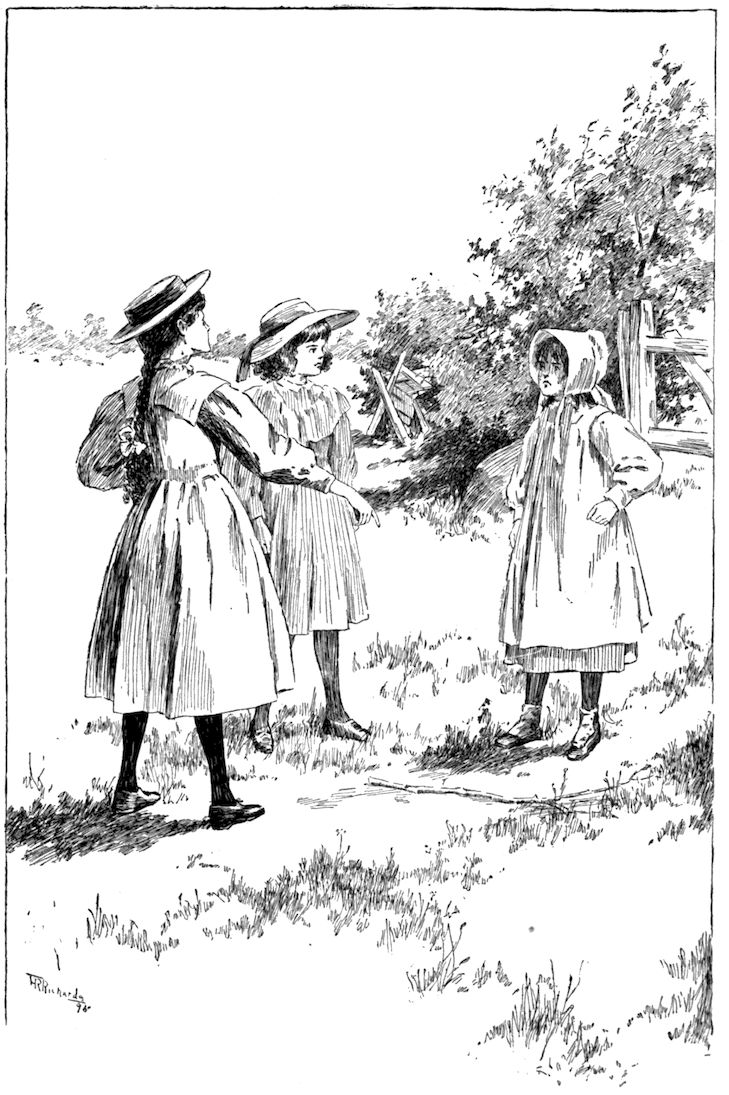
Hilda marched off abused, excited and angry.
The idea—the very idea of such language to
her, to Hilda Mason, whom everybody called so
good, and who was used to being held up as the
model child of the neighbourhood.
25
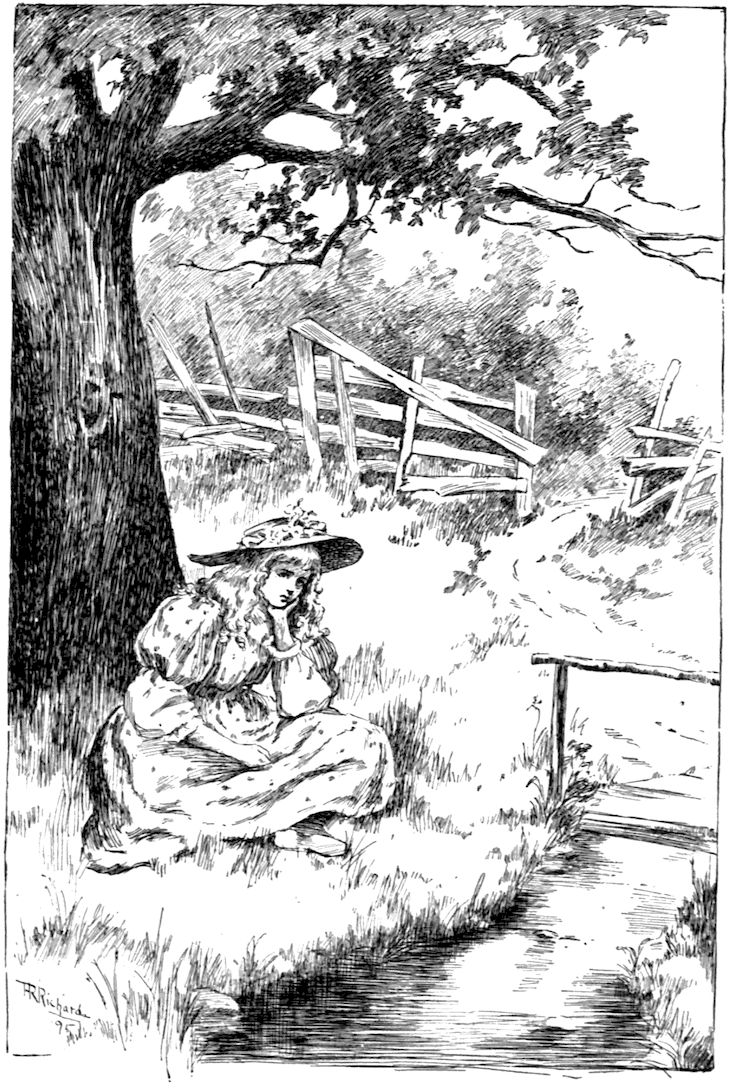
HILDA BY THE BROOK.
27And Cricket, her dear Cricket, whom she
really loved heartily, had told her she hated
her, and would never forgive her, and wouldn’t
ever play with her any more.
What had she done to deserve all this?
Why, nothing at all; only poured a little water
down the baby’s throat, when he looked so
funny, lying there with his eyes squeezed shut,
and his mouth wide open. She didn’t know it
would choke him so; of course she didn’t
mean to hurt him. Such a fuss about nothing.
Then, suddenly, they all flew at her, and said
dreadful things, right before nurse. Hilda did
not realize that such an outbreak is seldom as
sudden as it seems, and that many grievances
will often smoulder for a long time, till some
trifle fires the flame.
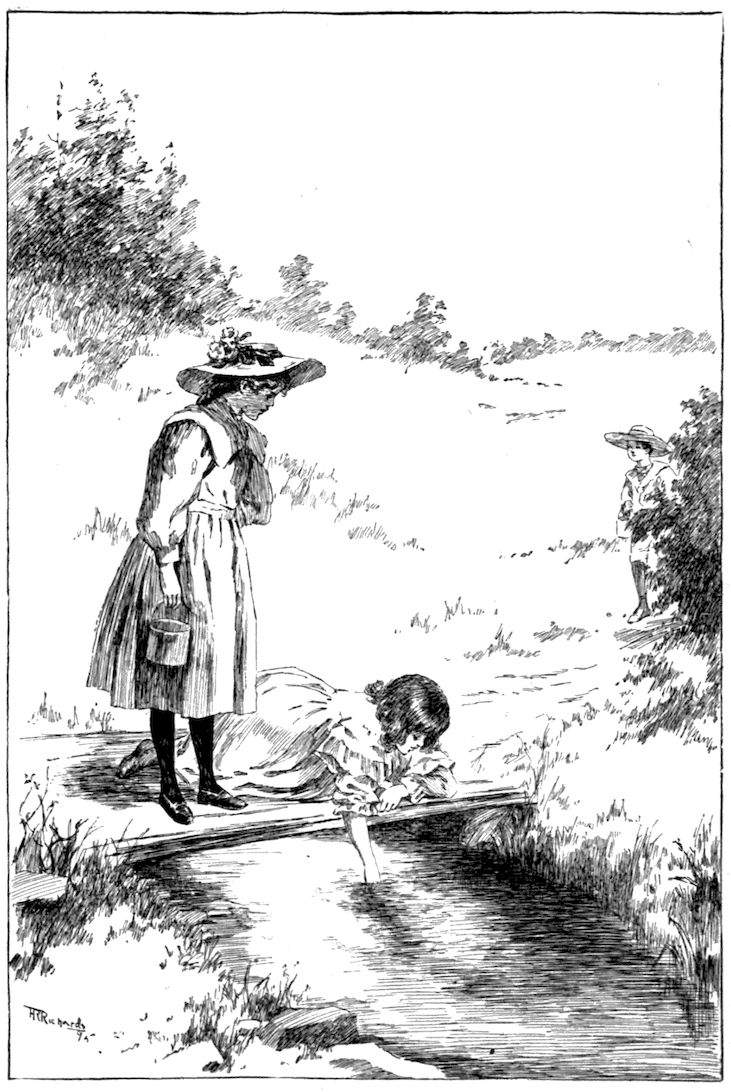
She walked along, miserable enough, half-crying,
half-indignant. The rain had ceased, and
the sky had cleared, so she stopped by the brook
in the grassy lane, which the children used as a
short cut, and sat down by the little bridge.
She was ashamed to go on into the village
street while she was crying.
Here she and Cricket had spent many happy
hours, and had never, never quarrelled before.
28She did not stop to think, then, to whom the
credit of this belonged. Cricket certainly
always did as Hilda wished, but she was sure
she was equally ready to do as Cricket wished,
wasn’t she? She began to think. Cricket
always liked to keep on through the woods to
Hilda’s house, while she liked to strike off into
the village street. How seldom they went
through the woods, although it was nearer, and
Cricket liked it so well! Cricket loved marsh-mallows,
while Hilda was devoted to chocolate-creams;
but when they spent their weekly pennies
together for candy, as they always did, how
was it they so rarely bought marsh-mallows?
Hilda’s conscience pricked her faintly.
“Well, I am always willing she should buy
them, if she’d just say she would, any way,” she
reflected, uneasily.
But then, Cricket never did say she “would,
anyway.”
What a delight it was to her little friend to
be out in the fields and woods, searching out the
earliest wild-flowers, exploring for the first chestnuts,
perfectly happy if she were simply out-of-doors.
She, herself, preferred quiet, indoor
sports and dolls, excepting when the weather
29just suited her, and was neither too warm nor
too cold. Did they ever stay out when she did
not wish to?
And she did rub out Cricket’s examples, often
and often.
“Cricket was so quick,” she argued, with her
conscience, “and she could do them right over,
and she didn’t like to get behind herself.
Cricket was such a silly, not to guess it.”
And why shouldn’t she take the biggest of
anything? One of them had to have it, and
she was the oldest. Still, she remembered,
with another faint sting of conscience, she
didn’t like it when Eunice took things for the
same reason, and Cricket had to yield to them
both.
Had Cricket ever been heard telling the twins
they must do certain things because they were
younger?
Hilda began to feel very queerly. She was
so used to praise and petting, that the plain
speeches she had heard had almost taken her
breath away, true though they were. Cricket
was always being lectured, because she was
careless and disorderly, and heedless and forgetful,
and Hilda had always felt superior.
30But was she really horrid? was she hateful?
was she selfish? was she a sneak?
“Mamma doesn’t think so, anyway,” she
said, with a little sob. But it was that very
morning, when she asked permission to go and
see Cricket, that her mother had hesitated, and
said,—
“I thought perhaps you would be willing to
stay at home this morning, darling. My head
aches badly, and poor, sick grandmamma says
she has scarcely seen her little girl this week.”
But Hilda looked so abused that her mother
hastened to add,—
“Never mind, dear, go on and have a good
time, but I would like you to come home to
lunch;” and the little girl had neglected her
mother’s words, as of no importance.
It was a very sober, subdued Hilda, who,
much later, slipped quietly into the house.
Her mother had been in bed all day, with one
of her worst headaches, the maid said, and she
herself had been sitting with grandmamma, and
reading to her, for the old lady felt very lonely.
Hilda winced as she thought of that hard, rasping
voice reading to an invalid.
Mrs. Mason heard her little girl’s voice and
31spoke to her, and Hilda crept quietly into her
mother’s room. She knew, well enough, that
her little soft fingers had magic power to drive
away mamma’s nervous headaches, but usually
it was “such a bother” to sit in the darkened
room, that often, as she now guiltily remembered,
she had slipped away, when she knew
mamma had a headache, lest she should be
asked to do it. Oh, she was a selfish, selfish
Hilda!
That night, when her head was better,
mamma and Hilda had a long talk. The whole
story came out, and Hilda confessed that she
believed that she was the horridest, selfishest
girl in the whole town. And her mother’s
tears fell quietly and fast, as she realized, for
the first time, how she had been spoiling her
darling. Because her little daughter was dainty
and orderly, and sweet and polite, she had been
ruining her with too much praise, and letting
her grow up selfish and inconsiderate.
“We will both begin again, my little girl,”
she said, holding Hilda close. “And to begin
with, do you know you ought to tell Cricket you
are sorry?”
“Oh, mamma, I can’t—oh, I can’t! I
shouldn’t know anything what to say.”
32“It is the only honourable thing to do,
darling. You have been much to blame. I
will tell Cricket for you, if you like. She is a
dear little girl, and I’m sure she will forgive
you and love you just the same.” Nevertheless,
Hilda could not quite make up her mind, that
night, to take this step.
The next Monday she started off, very soberly
and unhappily, for school. As she turned into
the lane, however, she saw a familiar little red
dress fluttering by the hedge, and in a moment
Cricket came in view. Both little girls stopped
and looked at each other shyly for a moment.
Cricket spoke first.
“Mamma says I was very rude to you,” she
began, very soberly, but Hilda ran up to her,
impulsively, and threw both her arms around
her neck.
“I was rude and horrid, Cricket, and I did
rub out your sums, and I’ve teased the children,
and I’ve torn up your jography questions often
and often; and I should think you’d hate me.”
Hilda said all this in a breath.
Cricket looked too astonished to speak.
“Oh, please, Cricket, forgive me, and love me
just the same, and we’ll always buy marsh-mallows,
33for I like them pretty well, and it
doesn’t make any difference if I don’t!” finished
Hilda, very much mixed up, but very much
in earnest.
But Cricket, while she did not quite understand
all Hilda meant, was, nevertheless, only
too glad to kiss and make friends, and so their
quarrel was made up.
CHAPTER III. DAMMING THE BROOK.
34
One bright May morning three little maids
sat perched on the topmost rail of an old fence
down by the brook. It was very pleasant just
at that particular spot, where the tiny stream
babbled along gayly in its wide, deep bed.
There was only a ribbon of water there now,
though early in the spring the current ran full
and strong. The trees in the neighbouring
woods waved and nodded their heads in cordial
welcome to their constant little visitors.
This was a favourite spot with these little
people, for they were well out of sight of the
rest of the world. The lane curved around the
hill which was behind them, wound over the
rustic bridge, and lost itself in the green woods
on the other side. Below them were the
meadows, where loads of “roosters”—as
country children call the sweet little white
violets—grew in abundance.
There sat the three little maids, I say, swinging
35their black-stockinged legs, and nodding
their three heads, black, brown and golden,
keeping time to the clatter of their busy
tongues.
There was so much to talk about, you see,
for Hilda’s mamma had promised her that she
might have all her little friends come to supper
next week, to celebrate her eleventh birthday.
Of course they had to arrange about the invitations
and the amusements.
At last Cricket’s active body tired of being
still so long, and she began to look around for
exercise, for she had been sitting there for quite
fifteen minutes. She edged along on her somewhat
unsteady seat, when suddenly the treacherous
rail turned completely over, and laid her on
her back in the soft meadow grass. Hilda and
Eunice shouted with laughter, for such an accident
was so like Cricket; but the little girl, not
in the least troubled, picked herself up. To be
sure, there was a jagged tear in her fresh, blue
gingham, and a great grass-stain on it, as well,
but these were every-day affairs.
She jumped over the fence and sat down on
the end of the wooden bridge, which crossed the
road, with her feet hanging over the water, idly
36dropping pebbles down. Presently this inspired
her with a new idea.
“Oh, girls!” she exclaimed, “let’s dam up
the brook!”
This proposal immediately met with the
greatest favor. Hilda and Eunice jumped
briskly down, and Cricket jumped briskly up.
The stone wall along the road supplied them
with material, and they fell energetically to work.
Back and forth they went like little beavers,
carrying stones instead of wood. They stood at
the end of the bridge, and dropped the stones
down, splash, just in the right place. It was
great fun, tugging at the stones from the wall,
finding the loose ones they could take, without
leaving too large a space; or pulling out the
wrong one, and bringing half a dozen more
rattling about their feet, so that they had to
jump, screaming, out of the way. Then they
must tug and strain to roll them up the bank to
the lane, and then on to the bridge, and over
into the stream.
Being, as I said, a lonely, out-of-the-way place,
it happened that no one passed to notice the
mischief the children were doing. So they
worked away undisturbed.
37They lifted stones that were twice the size of
their own heads, quite scorning the little ones,
excepting to fill in with. When they presently
paused to take breath and to survey their work,
the stones lay closely packed together from side
to side, and the water was deepening fast.
Panting and quite tired out, they threw themselves
on the grassy bank to rest.
“I’m glad,” sighed Cricket, “that I’m not a
dammer by trade.”
“If you were,” said Eunice, wisely, “you
would be a strong man, and then it would not
be hard work.”
“What are you going to do, girls, when you’re
grown-up?” asked Hilda.
“I know,” answered Cricket, promptly; “I
thought of it last night. I’m going to write
hymns for the missionaries, and p’raps I’ll be
a missionary myself. Anyway, I’d like to go
to Africa and have all the bananas I could eat,
for once.”
“I won’t be a missionary,” returned Hilda,
with decision. “I don’t want to go to Africa.
Horrid old skeeters and things, and cannibals to
eat you up.”
“I’d convert them. That’s what missionaries
are for,” answered Cricket, serenely.
38“But you wouldn’t get a chance,” persisted
Hilda. “They’d catch you and kill you and
eat you up just as quick. You’d be in somebody’s
stomach before you could say Jack Robinson.”
“But hymns, Cricket,” said Eunice, who had
been meditating over the word, rather overcome
by the ambition of her younger sister. “Would
you write hymns like those in the hymnbook?”
“Yes. Of course they might not be quite so
good just at first, but I could practise. I made
up one last night. Do you want to hear it?
It’s rather long.”
“Yes, indeed,” cried both the others, much
impressed.
And Cricket cleared her throat, and began:——
“A big, black cannibal lived by the sea,
And he was black as he could be,
And he ate up children, one, two, three.
“One day he found a little child,
A little white one, meek and mild,
And the little boy looked up and smiled.
“‘Oh, don’t you know it’s wrong,’ said he,
‘To eat a little child like me?
And God won’t love you then, you see.
39“‘And don’t you know if you’re not good,
And don’t do everything you should,
And eat up children in the wood,
“‘You will not then to Heaven go,
But you will suffer down below,
And wonder why you did do so?’
“The cannibal was softened through,
And said to him, ‘Forgive me, do,
And I will go to Heaven with you.’
“If little children only knew
All the good that they could do,
They’d be missionaries, too.”
“Oh, it’s lovely!” exclaimed both little girls,
as Cricket finished her very rapid recitation.
“Cricket! how could you make that all up?”
“Some parts of it were hard,” answered
Cricket, modestly. “I couldn’t get the rhymes
right at first, and I had to change it some. I
wanted to say——
“The cannibal fell on his knees,
And said to him, ‘Forgive me, please,’
but I couldn’t think of another rhyme to match
it.”
“Well, it’s beautiful,” said Eunice, drawing
a long breath of admiration.
40“Aren’t you rested now?” asked Cricket,
jumping up. “Let’s dump some more stones
over. Oh—oh! look at the brook!”
They had been resting for half an hour,
under a tree, with their backs to the brook.
Now, as they approached it, they were amazed
to see how much their work had deepened the
water. Instead of a narrow trickle that they
could easily jump over, it had widened to a deep
pool just above the stones.
“Oh-h!” squealed the children, in delight.
Cricket plunged forward to plug up a tiny little
hole in their dam. Of course she stopped on an
insecure stone, and of course, in attempting to
get her balance, she stumbled forward, and
stepped into the water up to her knees.
“There; I knew Cricket would do that,” said
Hilda, calmly.
Cricket scrambled out.
“My feet are wet,” she remarked, with much
surprise. Both the other girls shouted with
laughter.
“Did you think the water wasn’t wet?”
asked Hilda.
Going home for dry stockings and shoes
never occurred to Cricket. It would have been
41altogether too much trouble. She pulled off
her soaked shoes and stockings, and spread them
on a sunny stone to dry, and danced around in
her little bare feet.
But the stones hurt her tender skin, and the
hot sand blistered it. So she sat down on the
bank, further up, and dabbled her feet in the clear,
running water. The others immediately desired
to follow suit, when Cricket “set the Psalm,” as
their old nurse used to say, and in a few minutes
six little bare feet were paddling about.
“It’s very strange,” said Cricket, at last, after
a brief fit of silence, “that Eunice never falls in
the water, nor tears her clothes, nor anything.
I b’lieve my mother’d just think herself in luck
if she had two like you, ’stead of me. I’m the
most misfortunate girl always.”
Eunice was a careful little girl, and not nearly
so much of a romp as Cricket was. She seldom
did have the accidents that so constantly befel
her heedless little sister.
“You do so many more things than I do,”
Eunice hastened to explain. “You do things
that I’m afraid to do.”
“I’m afraid this minute,” remarked Hilda.
“Afraid! why, what of?” exclaimed both the
others, in chorus.
42“’Fraid we’ve got to go home. It’s twelve
o’clock, for there’s the whistle.”
“Oh, is that all! I thought you must have
seen a snake, at least,” laughed Cricket, drawing
on her damp stockings and stiff shoes.
“Ugh! these stockings feel just like frogs.”
“We must come back to-morrow,” said Hilda,
as they trudged off, “and see how deep this
water is, and we will get some boards and make
a raft, and have piles of fun.”
CHAPTER IV. THE CONSEQUENCES.
43
But both Monday and Tuesday were unfavourable
for nautical adventures, for they brought a
driving, pouring rain. Wednesday was too damp
for them to go to the meadows at all, and on
Thursday came the famous birthday party. So
it happened that their dam was forgotten till
Saturday, when they turned their steps brookward.
“Oh, look at the water!” they cried, in one
breath, as they came around the curve. They
could hardly believe their eyes, for a wide, deep
stream filled the bed from side to side. The
combination of the heavy rains with their dam
had worked wonders.
“See the water roll over the dam, girls! it’s
just like the mill-dam,” exclaimed Cricket.
“Let’s roll more stones down and make a
bigger one still.”
So, with eager hands, they got great stones
again, lugging them from their places in the
44stone wall with infinite toil. They balanced
them on the edge of the bridge, and counting,
“One,—two,—three,—go!” They each pushed
over one, jumping and screaming with delight,
at the tremendous splashes, as the water flew up,
spattering them well.
“Ow—ow! there goes my hat!” It was
Cricket’s wail of anguish, of course. Her next-to-her-best
white Leghorn, it was too, for her
every-day hat had come to grief through Dixie’s
chewing off her ribbons, and was laid up for
repairs. There lay the pretty broad-brim,
caught right on one of those big stones, with
the water lapping all around it. Vainly they
ran down to the side of the bridge and tried to
reach it. It was too near the middle. The
water was already so deep and black that they
hesitated to wade in for it.
“Perhaps we can get a stick and reach it,”
suggested Hilda. They accordingly broke long
sticks from the bushes near by, and then
Cricket lay flat down on the bridge, with her
head and arms hanging over, and tried to reach
the unfortunate hat.
“I can’t quite do it,” she panted. “You hold
on to my legs, Eunice, while I lean over a little
45further, and, Hilda, you catch it with your stick
at the side, when I poke it over there.”
So Eunice clung to Cricket’s legs with all her
might, while Cricket, fully half over the bridge,
made desperate lunges; at last she was successful.
“There it goes! now, catch it, Hilda!” triumphant
and breathless.
Just at this critical moment there rose suddenly
a tremendous shout from the woods.
“Hi! hi! I’ve caught ye, ye young rogues!
I’ll teach ye a lesson, a-dammin’ up my brooks
and a-swampin’ my medders, and a-drownin’
my caows! I’ll hev the law on ye!”
Fright and terror! What awful words were
these? Cricket hung, paralyzed, over the
bridge, and Eunice clung to her black-stockinged
legs, with fingers that made black and
blue spots in the tender flesh. Hilda, poised on
two uncertain stones, stood like a small Colossus,
and all of them were white with terror, for
an awful, great, big, blue-bloused man was
getting over the fence, with, oh, horror, a gun
on his shoulder, and a slovenly bull-dog tagging
at his heels!
“I’ve been a-watchin’ for ye, since a long
46time back,” the man said, leisurely coming
nearer, seeing that the children were too frightened
to run away. “I’m not a-goin’ to eat yer,
but I want to know what in thunder you’re allers
up to mischief for. Yer’s the doctor’s gal,” he
went on, addressing Cricket, “and yer a limb.”
Cricket drew herself up on to the bridge.
They recognized the man now as a farmer in the
neighbourhood, a gruff old fellow, whom all the
children feared. They quaked still more with
fright.
“Now I’ll tell yer, young uns, I could hev the
law on ye all for this flew-doodle-um of yourn,
and I ain’t sure,—I—ain’t—sure, I ain’t
a-goin’ ter. Now, what hev ye got to say fer
yourselves why I shouldn’t?”
“We didn’t know we were doing any mischief,”
faltered Cricket, really conscience-smitten,
as well as frightened.
“Mischief!” growled the farmer, “when
ain’t ye young ’uns in mischief? I’m goin’ to
hev ye all in the lock-up.”
“Oh, please, please, Mr. Trante,” cried
Cricket, in mortal terror. “If we’ve done any
mischief, please ask my father to pay you for it,
but oh, don’t put us in the lock-up!”
47“Wal, I dunno but I re’lly orter,” said Mr.
Trante, enjoying their terror.
“See all the damage ye’ve done. Las’ Sunday
I was a-strollin’ round my medder, up
yander”—pointing up beyond where the white
violets grew—“an’ I see it was all soft an
sorter soggy, by the bank, and the brook was a
considderbal wider. I kinder wondered at that,
seein’ as we hadn’t hed no rain for quite a
spell then. Ev’ry night this week the caows
kep’ a-comin’ home all wet to their knees, an’
las’ night the boy brung ’em in, and says he,
‘the medder’s all a-swimming, and the caows
has stayed up into the woods all day.’ It didn’t
seem nateral that the rain could ha’ did all thet,
so this mornin’ I sot out to explore, an’ I found
this big dam o’ yourn. I hed a big mornin’s
work, so I hed to leave it till this afternoon.
I re’lly orter make ye take ’em out yerselves.”
“I don’t believe we could,” answered Cricket,
doubtfully. Then she brightened up.
“But I’ll ask papa to send Thomas to-morrow
morning to help you. I’m so sorry about the
cows, Mr. Trante, and getting the meadow so
wet. We never thought. Will it ever dry up
again?” she asked, anxiously.
48“Wall, I guess the medder’ll dry up, if you
give it a chance,” the farmer answered, grimly.
“How did you young rogues roll up all them
big stones, tearin’ down my stone walls? Look
at them big holes!”
Three shamefaced children looked more
downcast than ever at this new view of their
mischief.
“I’ll ask papa to pay you for all the trouble
we’ve made,” repeated Cricket.
“Wal, I dunno how I could put a money vally
on it, skursely,” growled the man, “but I’ll see
your pa. An’ about the lock-up. Ef you’ll
promise me not to go a-dammin’ up no more
streams, not even little dribblin’ things like that
’un there was, mebbe I’ll let ye off this time.”
“Oh, we promise!” cried the three, fervently,
while their hearts danced jigs of joy at their
escape.
“An’ tell yer pa to send Thomas over in the
morning at seven o’clock sharp, an’ I an’ he’ll
work at them stuns a spell. Looks like it would
be considerable of a chore to hist ’em out,” said
Mr. Trante, looking at the stones, through one
eye.
“Come, Bruiser,” he went on, “you an’ me’s
49a-goin fur the caows now. Ye kin go home,
young ’uns, and don’t do no more damage than
ye kin help a-doin’, while ye’re going thar;” and
three very subdued-looking children immediately
took advantage of his permission to disappear
around the curve.
The next day Thomas told Dr. Ward that he
had had the hardest half-day’s work he had done
in one while.
“Them crazy young ’uns will be the death o’
me,” he grumbled. “Me an’ Dan’el Trante
worked up’ards of half a day to ease them stuns
up. An’ the next time they go to dammin’ up
creeks, I ’low they better do suthin’ else with the
time.”
And the children concluded they would.
CHAPTER V. FOURTH OF JULY.
50
Of course, with such a troop of children as
there was at Kayuna, Fourth of July was a
wildly exciting time. They were always up at
unearthly hours in the morning, and used up, before
breakfast, an immense supply of giant torpedoes
and fire-crackers, by way of opening the
day. Later, they were allowed free range of the
back-kitchen, in order that they might carry out,
all by themselves, the grand performance of the
day. This was making and freezing a great can
of ice-cream, with no interference, even to the
extent of a suggestion, from the cook. This
was always eaten by the assembled family, on the
piazza, at five in the afternoon.
In the evening all the people in the neighbourhood
gathered on the piazza and lawn, to
see the display of a great quantity of fireworks,
which Dr. Ward always had sent out from town.
So they wound up the Glorious Fourth in a very
patriotic manner.
51It was really very good-natured of Dr. Ward
to allow the display on his grounds, for it always
took Thomas and one of the other men all the
next day to take away the débris, clear up the
lawn, and restore things to their usual trim
order.
This particular Fourth really began the night
before.
Hilda Mason had been invited to come and
spend the night with Cricket and Eunice, in order
to be on hand in the morning. It was barely
dark when the three children decided it was
quite time to go to bed, in order to shorten the
long hours that stretched before to-morrow morning.
Nurse had put up a cot in Cricket’s room
for Hilda, close beside the larger bed, so it was
quite like sleeping all together.
They were far too much excited to settle
down very soon, especially as it was earlier than
their usual bedtime, so they frolicked and built
tents of the sheets, and ended up with a game of
tag around the foot-board. But this speedily
brought Eliza to the scene, with a very peremptory
order “to go to sleep, and not disturb
everybody in the house with their jim-jams.”
Thus commanded, and being tired by this
52time, they were quite ready to subside, and very
soon, after numberless “good-nights” and
“don’t you wish it was to-morrows,” they settled
down.
Cricket woke first. The room was already
beginning to grow light.
“Oh, girls, girls!” she cried, scrambling out
of bed. “We’ve overslept, I know. There’s
the sun rising now.” There certainly was light
behind the trees, as she looked from the east
windows.
“Funny we don’t hear the boys,” said Eunice,
sitting up and trying to rub the sleep out of her
eyes. “I’m awful sleepy—seems as if we’d
just gone to bed.”
“I should say it did. How quiet everything
seems. Hilda, wake up! it’s morning.”
“I don’t care,” returned Hilda, sleepily,
turning over.
“But it’s Fourth of July! Do get up! We
want to get ahead of the boys.” For two boy
cousins, Will and Archie Somers, were visiting
them.
“Oh, dear!” yawned Hilda, who was always a
sleepy head. “I think I’d rather not have any
Fourth of July.”
53“But the Fourth’s here, and we’ve got to
have it!” said Cricket, pulling the sheet from
under Hilda. “Get up, you lazy girl. I’m
all dressed.” For Cricket dressed as she did
everything else, “like a streak of greased lightning,”
as Donald said.
“Oh, I’m getting up!” and Hilda turned out
reluctantly.
“I’m going to the boys’ door, while you’re
finishing,” said Cricket. “I’ll be back in a
minute.” She slipped out into the hall, as still
as a mouse. It was very dark out there, and
she had to feel her way along.
Suddenly, ahead of her, came a glimmer of
light, and a tall, white figure appeared, that
startled Cricket so that she turned, with a
scream, to run back. It was only Eliza, who,
aroused by the children’s voices, was coming
from the nursery to see what was the matter,
but Cricket was blinded by the sudden light, so
that she did not recognize her. She lost her
bearings, turned to the left instead of the right,
and the next moment she was plunging head-foremost
down the stairs, with a crash that in
two minutes assembled a white-clad household.
54“What is the matter?” asked everybody,
hurriedly, of everybody else.
Doctor Ward sprang down the staircase to
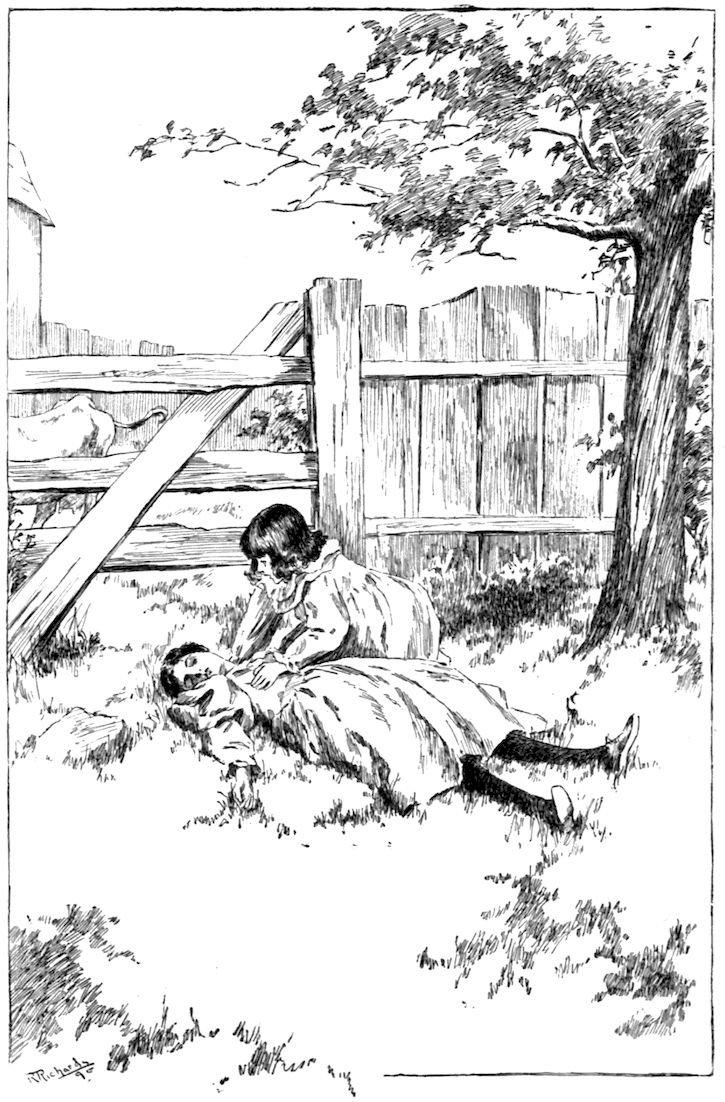
investigate. At the bottom lay a little heap.
“Cricket!” he exclaimed, with his heart in
his mouth.
“I guess I’m all right, papa,” came a scared
little voice from the heap, “but I don’t know,
’xactly, where I am.”
Her father lifted her up, and felt of her arms
and legs.
“No bones broken. Is your back all right?
and your head? In the name of common-sense,
child, what are you doing around the house, all
dressed, at midnight?”
“Why, it’s morning,” said Eunice and Hilda
together, who, with the others, had gathered at
the foot of the stairs, everybody asking questions
and talking at once.
“It’s morning, and it’s the Fourth of July,”
explained Eunice, “and we got up, and Cricket
was going to wake the boys, and get a rise out
of them. Is Cricket hurt?”
The doctor was still feeling Cricket’s back,
and her mamma was rubbing her hands anxiously,
but they all laughed at Eunice’s explanation.
55“Morning, dear child? It’s just ten minutes
of twelve,” she answered, looking at the tall hall
clock. “Just midnight.”
“Midnight!” cried all the three girls, incredulously.
“We saw the sun rising, anyway,”
said Hilda, bewildered.
“The moon, you mean,” said the doctor,
laughing.
“You’re sure you’re not hurt, darling?” he
added. “Well, since Cricket is not killed, it
proves to be a good joke.”
“She must be hurt somewhere,” persisted
mamma, still anxiously. “How could a child
go head-foremost down stairs and not be hurt?”
“Nobody could but Cricket,” said her father,
kissing her; “but I am coming to the conclusion
that this young woman is not built of ordinary
human material, but on the principle of indestructible
dolls. She always comes right side
up with care.”
“I thought I was killed just at first,” said
Cricket, sitting up straight on her father’s knee,
and still looking bewildered, “for the house
seemed just to open and let me down, and the
first thing I knew, papa was calling ‘Cricket.’”
“But now,” said mamma, “since nobody is
56seriously injured, you children may go back to
bed and sleep quietly—if you can—the rest of
the night. And remember that you must not
one of you get up in the morning till you are
called. That’s the only safe way. Eliza will
call you at five o’clock, and you must not stir
till then.”
In view of the circumstances, the children
were quite willing to promise this, and soon
quiet reigned again.
It was broad daylight in good earnest when
the children opened their eyes next, in response
to Eliza’s call. Their night’s experience
seemed very far away in the light of day. The
boys were already up and out, and were firing
torpedoes at the girls’ windows. Cricket felt
a little stiff and lame at first, but that soon
wore off. She really did seem to be of some
material unlike other children, for her constant
accidents rarely disabled her, and she seldom
had even a bad scar. When she nearly cut her
finger off in the hay-cutter once, so that it hung
by a thread of skin, she clapped it on and ran to
her father, and it grew together like two pieces
of melted wax. Deep cuts healed as if made in
soft pitch. She had fallen from innumerable
trees, and would come crashing through the
branches, and land on the ground, stunned for a
moment, perhaps, but with no further injuries.
She was very slightly built, without an ounce of
superfluous flesh on her slender bones, and she
was very agile and flexible. She used to amuse
her sisters by sitting on the ground and twisting
both legs around her neck, like a clown in
the circus. When she fell, she fell as a baby
does, without making the slightest effort to save
herself, and probably this was the reason why
she escaped serious injury.
57
CELEBRATING THE FOURTH OF JULY.
59When the girls appeared, the boys were
ready with a fire of jokes concerning the midnight
adventures. Archie suggested that it
would be a good plan to pin a big label to the
moon, so they need not mistake it again for
the sun. Will chanted,—
“The Man in the Moon
Came up too soon,
And waked the girls too early.
Cricket ran into the hall
And got a great fall,
And made a great hurly-burly.”
Fortunately, Cricket did not mind teasing,
else her life would have been a burden.
60By breakfast they had fired off dozens of
packages of giant torpedoes and an unlimited
number of fire-crackers, and went trooping into
the house, feeling, they said, as if they had been
up for at least six weeks.
CHAPTER VI. MAKING ICE-CREAM.
61
After breakfast there came a little lull in
the excitement. The edge had been taken off
of the enjoyment of torpedoes, by this time, and
the delights of fire-crackers palled.
To be sure, little Kenneth was still all agog.
In his small brain this day was hopelessly confused
with April-Fool’s-Day, which was the
latest special occasion in his narrow experience.
He ran around from one to another, crying excitedly,
“Look a-hind you!” and then shrieked
in great glee, “Apple-fool!” enjoying to the full
the unfailing surprise of each person, however
often he tried it.
By ten o’clock, however, came the great
excitement of the day, making ice-cream in
the back-kitchen. Will and Archie, and even
seventeen-year-old Donald, pounded the ice
which Thomas had already put there, in a big
tub, while Marjorie measured the cream and
milk and put in the sugar.
62It seemed to be part of the programme regularly
to forget the flavouring till the cream
was in the can and the dasher adjusted. Then,
at the last moment, it would suddenly be remembered,
and off must come the cover, to
the boys’ disgust, with imminent danger of a
deposit of salt within, while the flavouring was
added. Then they would find that they could
not put back the dasher in its place without
taking out the can. So out would come the can,
and the cream must be poured out, the dasher
slipped in place, all the ice and salt taken out of
the freezer, in order to put the can back, and
the whole thing repacked. All this served to
“vary the monotony,” Donald remarked.
To-day, however, Marjorie, who was chief-cook,
had the flavouring in her mind from the
beginning, and she gave the cream a liberal
supply of lemon extract.
“Will you stir this for a moment, please,
Eunice,” she said, as Eunice came into the
pantry just then, where Marjorie stood. “I want
to speak to cook.”
Eunice gave it a stir, as Marjorie went out,
and then bethought herself of the flavouring.
“We won’t forget it this time,” she thought.
63“I know Marjorie has not remembered it. She
never does.” She surveyed the extract-bottles
for a moment.
“I believe bitter-almond ice-cream would be
nice,” she thought. “I’ve never tasted any,
but it makes a nice flavour for frosting and
cake. I wonder how much it takes? I guess
half a bottle, certainly, for all this cream,” and
in went the bitter-almond, for Eunice had not
the vaguest idea of the necessary quantity.
“Oh, Marjorie,” she called, “I’ve just put
in—”
“Do come here, Eunice, I don’t think the
boys have chopped this ice fine enough, and
they say it will do,” interrupted Marjorie.
“Cricket, you go and stir the cream.”
Eunice ran out, thinking to herself,—
“I won’t tell her, after all, and she’ll think
she’s forgotten it, as usual.”
Cricket took her turn at the spoon.
“There,” she thought, “the girls never said
a word about the flavouring, and I just s’pose
they’ve gone and forgotten it, as usual. I’ll
put it in myself, and just as they think they’ve
got to take the can out, I’ll tell them. Let me
see. We always have lemon or vanilla. Essence
64of wintergreen. Wintergreen candy is
lovely. I’ll just put in some wintergreen,” and
she took the bottle hastily, after turning for a
spoon.
“Oh! oh! it’s peppermint I’ve got,” she
exclaimed, in dismay, as the first spoonful
went into the mixture. “Bah! I don’t like
peppermint, I’ll just put in an extra amount of
wintergreen to cover it up. Cook says she often
mixes flavours.” And in went plenty of wintergreen.
By this time the whole pantry had a
strong odour of essences, principally peppermint.
“What a strong smell!” said Marjorie,
coming back. “What’s the peppermint bottle
doing down here with the cork out?” But
Cricket vanished, and Marjorie, concluding that
the cook had come in and used it, corked it up,
and put it back.
“How horribly strong that peppermint is,”
she said, as she stirred her cream. “That bottle,
just open for a moment, has scented everything,
or perhaps some of it was spilled.”
Archie appeared now to carry out the cream
to pour in the can.
“Whew! peppermint!” he whistled.
65“Yes; cook has been using some here, and
left the bottle uncorked. Awful, isn’t it?”
“Thing flavoured this time?”
“Yes, Master Archie, it is. I flavoured it
myself, and it’s all right.”
“Good girl. I shall be glad to have some
properly flavoured cream of our manufacture for
once. Last year, seems to me, we didn’t get
any in.”
The freezing of the cream went rapidly
forward now. The three girls made no remarks
about the flavouring, each thinking to
surprise the others by the fact the flavouring
had not been forgotten, after all.
Taking the can out, when the cream was
frozen, removing the dasher, and the accompanying
tastings, were all important features
of the operation. To-day, however, as the
critical moment drew near, mamma came out,
and said there were two wandering minstrels in
Highland dress and with Scottish bag-pipes, in
front of the house. Of course they all wanted
to go and see them, so they gave the cream
into cook’s charge and all rushed off. When
they returned half an hour later, they found,
much to their disappointment, that the ice-cream
66was all frozen and packed in the moulds, to
stand till the afternoon.
Making ice-cream had been such a long
process that, by the time everything was put
away, a point mamma always insisted on, it
was time to dress for dinner.
The afternoon was rather uninteresting.
Some one says that very early risers are apt
to be conceited all the morning and stupid
all the afternoon, and so the children found
it. Year after year they had the same experience,
but the twelve months between destroyed
the recollection of everything but the
excitement of early morning.
By half-past four, however, they began to
brighten up again, for ice-cream time approached.
This was the children’s day, and the rule
was for them to wait on themselves, so for
some time they were busy bringing out plates
and spoons and doylies, and arranging cakes
and crackers on the table on the piazza, where
the feast was always served. Cook took the
ice-cream out of the moulds for them, and
put it on the ice-cream platter, and when the
grown-up people were all assembled and the
party was ready, Maggie, smiling broadly, appeared
67with it. The children all sat around
with eyes expectant and mouths watering, for
this was their especial and particular feast, and
entirely unlike the ice-cream that was served
every Sunday for dessert.
The cream had certainly been beautifully
frozen, and looked very tempting on this hot
afternoon. Marjorie officiated at the platter, and
distributed the dainty with a liberal hand.
Mamma tasted her dish, and set it down
suddenly. Auntie, after one trial, laid down
her spoon, and coughed behind her hand as
she caught mamma’s eye. Two or three other
guests present toyed with their spoons.
“This is for you, papa,” Marjorie said then,
“and it’s a particularly big dish, because you
are so fond of it. There! isn’t that nice?”
“What under the canopy!” hastily exclaimed
the doctor, eyeing his dish in great surprise,
after his first mouthful.
“What is it? isn’t it good?” inquired
Cricket, anxiously, with a sudden pang, as she
remembered the peppermint.
“Good? it’s—it’s delicious. Only, why
didn’t you flavour it?”
“Flavour it?” cried Marjorie and Eunice
68and Cricket, in a breath, “I did!” Then each
looked at the other.
“I put plenty of lemon in,” said Marjorie.
“I thought bitter-almond might be good,”
began Eunice, looking bewildered.
“I thought Marjorie had forgotten,” broke in
Cricket, rapidly, “so I thought I’d s’prise her,
and I meant to put in some wintergreen, ’cause
wintergreen candy is very good, ’n’ I got in the
peppermint, by mistake, so I put in plenty of
wintergreen afterwards, to cover it up.” She
confessed this all in a breath, looking very
unhappy.
There was a shout.
“There’s no doubt, then, it is thoroughly
flavoured; it must have been my taste,” said
the doctor, dryly. “I’m almost sorry I have
been told, for there is such a charm about the
unknown. Do you remember what cook said
about her pumpkin pie, when your mother
asked her receipt? ‘Shure, there’s milk, an’
there’s eggs an’ there’s some punkin, but
after all, it’s principally ingrejiencies.’ Your
ice-cream is really delicious, but if I were asked
my candid opinion I should say it was principally
ingrejiences.”
69“May Zaidee and I have it all, then,
mamma,” asked Helen, eagerly, “if no one else
wants it?” The twins had been eating up
mamma’s and auntie’s cream with great relish.
“We think it’s good.”
“Let them have all they want,” the doctor
answered, laughing. “I’m sure the amount
of peppermint and wintergreen will counteract
any possible ill effect of so much cold.”
The older children were much disappointed,
but bore it very well. The combination of
lemon extract and bitter-almond might have
been endured, but Cricket’s generous addition
was altogether too much.
Archie and Will put their heads together for
a few minutes, and then Archie mounted a
hassock and asked for attention.
“Now, mamma,” interrupted Eunice, “I
know he is going to say something horrid.
Make him stop.”
70“There! I knew he would,” said Eunice,
resignedly.
Will took up the strain:
“And who next bitter almonds sought,
And poured in extract by the quart?
Eunice.”
“Be still, you wretch!” cried Eunice, attacking
him in the rear with a cushion.
“Come on, if you want to fight,” said Will.
“It’s Archie’s turn, now.”
“Who added essence without stint,
The wintergreen and peppermint?
Our Cricket, oh!”
And both boys gave vent to a prolonged howl
of anguish.
“Oh, do go on!” cried Cricket, clapping her
hands. “It’s splendid.”
Both boys continued in concert:
“Who feasted on this luscious mess,
And groans each struggled to suppress?
All of us!”
Fortunately just here the supper-bell rang, and
they all trooped in.
CHAPTER VII. MOPSIE.
71
It was on the very next day that Mopsie saved
Eunice’s life. Why, I haven’t said a word yet
about Mopsie, have I? and the dear little fellow
ought to have a whole chapter all to himself.
The pets at Kayuna were quite as important,
in the children’s eyes, at least, as they were
themselves, and equalled them in number.
There was Donald’s great St. Bernard, stately
and dignified, Kaiser William by name. He
was a splendid fellow, but would follow no one
but his master. The pigeons, lovely, soft, fluttering
things, belonged to Marjorie, who fed
them faithfully. They would come at her call
in troops and light on her shoulders, and peck
at bits of bread which she held between her
teeth.
Eunice’s pet was a beauty, for it was a snow-white
pony, which her godmother had given her
the summer before. It carried her in the saddle
beautifully, or was harnessed to the little light
72cart which held two. Fine times the children
had with Charcoal, named so, on Donald’s advice,
because it wasn’t black.
The twins owned between them the cunningest
and brightest little Scotch terrier, named
Duster, from his feathery tail, which, of course,
he always carried straight up in the air. Another
dog, named Dixie, of no particular breed,
but of very social nature, belonged to the family
in general, though Cricket laid claim to him,
until she had Mopsie.
And who was Mopsie? It is rather a humiliating
fact, but I may as well confess it at once—Mopsie
was, or had been, nothing but a poor
little circus pony.
Cricket, at first, was rather ashamed of Mopsie’s
past history, considering that Eunice had
her beautiful Charcoal, who had been born and
brought up in a gentleman’s stable. The boys
teased her about her “aristocratic pony,” till
she would say, rather indignantly, “I don’t care.
It doesn’t matter a bit what a person does, if he
does it just the best he can, mamma says so.
And it’s just the same with a pony. I know my
Mopsie was the nicest horse in the circus, for
the men said so. There!”
73But after this particular day no one ever
teased her again.
If Mopsie could have spoken, he could have
told them many stories of his circus life. He
was, certainly, a very bright, sweet-tempered
little creature, and knew no end of tricks, more
indeed, than the children ever suspected, for
there was no one to tell him to do them, or who
knew what he could do. He could sit up like a
dog, and hop around on his hind legs, keeping
time to music,—this had been called dancing
on the programme,—and jump through hoops,
and many other things.
For a long time the children wondered why,
as soon as the cart, to which he was harnessed,
stopped, he would try to turn himself around
beside the wheels. But this was a trick he had
been taught. The clown in the circus would
drive him round and round the ring, and as soon
as he stopped, it was pony’s business to turn
himself directly around, for the front wheels
were low enough to slip under the cart. Then
the clown would pretend he couldn’t find him,
because the pony was no longer in front, and he
would pretend to look down in the sawdust for
him, and in his pocket, saying, “Now, where is74Alexander the Great gone?” for that was pony’s
name before he was Mopsie.
Another thing he had been trained to do was
to pick up and carry really heavy things in his
teeth, and run away with them, while the clown
ran after him, shouting “Stop!” but the little
fellow knew he must not stop till he heard his
name as well.
All these, and many more tricks Mopsie had
been in the habit of doing before great crowds
every afternoon and evening.
At last came one afternoon that Mopsie little
thought was to be his last in the circus. The
circus had come to Wellsboro’, and Mike, Doctor
Ward’s groom, had gone to see it. He was so
fond of horses that he was always hanging
around the tents where they were kept, and making
friends with the hostlers.
Suddenly a great commotion arose. One of
the big horses, which was always ugly, got perfectly
wild, from the bites of horse-flies, it was
afterward thought, and began kicking furiously
right and left, plunging and rearing till the
frightened men could not hold him. Poor little
Alexander the Great was being groomed and
harnessed for the ring; as the maddened horse
75broke loose, pony and groom were kicked by
those great, heavy hoofs, till the life was almost
crushed out of both of them.
In the confusion, after the horse was secured,
nobody noticed poor little Alexander, who lay
moaning and quivering in agony. The man beside
him was lifted and taken away, and then
somebody bent over the pony.
“He’s done for, poor little fellow,” the man
said, pityingly. “I’ll put him out of his misery,”
and he drew a pistol.
Then Mike came forward. “Don’t shoot him
yit. Lemme look at the loikes of ’im.”
Mike was a born horse-doctor, and to his
practised eye the pony was not so seriously hurt
but that there was hope of saving him.
“Will you let me have him?” he asked, after
feeling the pony all over very carefully. “He’ll
take a sight o’ doctorin’, ’n’ he won’t be no good
in a cirkis agin.”
“Take him, and welcome,” the manager said,
hastily. “We’ve no time for sick horses,” and
he swore again at the horse who had done all
the mischief.
So Mike got an old door, and one of the men
helped him lift poor little suffering Alexander
76on it. Then he hired a cart somewhere, and
so the pony came to Kayuna.
This had been about the first of May. The
children were not allowed to see the new arrival
for a week or two, for he was not a very pleasant
object. His legs were bound up, and his poor
sides were all covered with “splarsters,” as
Zaidee announced once, in great excitement,
when she had taken a stolen peep.
At last the little visitor was in a condition to
be seen, for, thanks to Mike’s good care, he
mended fast. The “splarsters” were taken off,
though his legs were still in splints, and Mike
groomed his shaggy, uneven coat as best he could.
Cricket and Eunice saw him first, and were
perfectly delighted with him. He was even
smaller than their dear Charcoal. After that
they were his constant visitors, feeding him
with apples and sugar, and petting him till poor
little Alexander must have wondered if he had
died and gone to the horse-heaven.
Then came the exciting day when the last
splinter and bandage were removed, and pony, a
little weak and uncertain as to his hoofs, but
very frisky as to his head, was brought out into
the yard.
77Mike, meantime, had had a private interview
with papa, and following that, one with Cricket.
The result was, that a very happy little girl
raced down to the barn, with Eunice and Dixie
close behind.
“Oh, you dear, darling old Mopsie,” Cricket
cried out, flinging her arms about his rough little
head. “You’re my ownty-donty pony. Eunice
has Charcoal, and now I have you,” and she
hugged him again and again.
When she released him, what did that cunning pony
do but offer her his front hoof to
shake!
“Oh, you dear, dear, thing!” she shrieked.
“Mike! Mike! see that! he wants to shake
hands,” for the pony sociably offered his other
hoof.
“Yis, miss,” said proud Mike, grinning from
ear to ear. “He’s been a cirkis-pony, and
knows a deal o’ tricks, I dessay.”
Eunice dived into the stables, and in a moment
reappeared, leading her little snowy Charcoal.
The two ponies were a decided contrast—the
one so clean, and well-groomed and white, and
the other, rough and black, with shaggy, uneven
coat.
78“Yours is awfully cute,” said Eunice, with
an arm over her pony’s neck, “but he can’t
compare with my Charcoal. He’s nothing but
a circus-pony, after all.”
That was not like Eunice, and she did not
mean to hurt Cricket’s feelings. It was only
that her own pony looked so fresh and dear to
her. But Cricket fired up at once.
“You’re my own Mopsie,” she cried, hugging
her black pony again, “and no other pony
could be half so cunning and smart. Charcoal
isn’t a bit smart, Eunice, you know he isn’t.”
A quarrel seemed close at hand, right over
those dear ponies, which stood rubbing noses in
the friendliest way. But Eunice was too generous
to hurt Cricket’s feelings knowingly, and she
said, quickly,
“Mopsie does look awfully bright, Cricket,
and I think that’s a good name for him. I
wonder what his name really was?”
But Mike did not know, so Mopsie was
christened thus on the spot, and Mopsie he
remained to the end of the chapter.
“When can I ride him, do you think, Mike?”
asked Cricket, eagerly, as she fed him sugar.
“Shure, Miss Scricket, an’ I’m thinkin’ it’ll
79be next week ye’ll be afther ridin’ him, if he
kapes on a’mendin’.”
After this, Cricket hated any mention of the
fact that Mopsie was, or had been, a circus-pony,
though she stoutly insisted that it “didn’t make
a bit of difference, so long as he circused as
well as he could.”
Mike took the best of care of him, and a
month made a wonderful difference with the
little fellow. Constant and careful grooming
made his rough hair smoother, and with the
vaseline and other things that Mike knew of,
his uneven coat began to lose the marks of scars
and “splarsters.”
CHAPTER VIII. WHAT MOPSIE DID.
80
It was a proud day for Cricket when the
saddle was first put on the back of her very
own pony, and Mike mounted her. Not that
she needed to be mounted, as a rule, for she was
quite equal to grasping the shaggy mane, and
scrambling up into the saddle herself, but this
was such an important occasion that ordinary
methods would not do.
Mike was quite as proud as Cricket was, of
the black pony. To think that but for his kindness
and devoted care poor little Mopsie’s
bones would now be whitening in some field!
And not only that, but to think his favourite
Miss “Scricket” now had a pony of her
own, all owing to him. He had polished up
Mopsie to the last degree, and now that the
pony had its pretty little saddle on, just like
Charcoal’s, the two did not make a bad pair.
All the younger fry gathered to watch this
first mounting. Dr. Ward was there, also, for
81he did not know whether Mopsie had ever carried
a little girl before, and he wanted to make sure
that everything was right. The children cantered
up and down the avenue to the gates and
back, and even Charcoal seemed to think that
two ponies were much more fun than one.
Mopsie was a bit stiff at first, but he soon grew
more limber, and at last papa said that they
might ride down the road, outside the gates.
“Hurrah! get up, Mopsie!” cried Cricket,
bringing the whip lightly down on Mopsie’s
black flank, and tightening the rein a little.
To her great surprise Mopsie began to rise on
his hind legs, till his front feet waved in the air,
and then he gravely stalked away on the two
legs, with Cricket wildly clutching his mane.
“Get down, Mopsie,” she shrieked. “Why,
I’m falling off. Get down this minute.”
Papa and Mike both ran to the rescue, but
knowing little Mopsie seemed to feel that, after
all, this was not what was expected of him, so
he slowly lowered his front feet, and stood
quietly waiting for further orders.
Mike was full of apologies for his pet.
“It’s the way ye drew the line, Miss
Scricket,” he said, anxiously. “It’s only wan
82of thim cirkis-tricks. See! he don’t mane no
harm, at all, at all.”
“Oh, it’s lots of fun,” cried Cricket, excitedly,
when she discovered that Mopsie evidently
thought he was only doing his duty. “I
wish I could make him do it again.” But just
what pull of the rein was necessary to tell him
to rear she could not find out, though she jerked
the patient pony’s head this way and that.
“But I’m afraid to have you go out of the
yard, my little girl,” said papa, “for Mopsie
might rear like that any time and throw
you.”
“Oh, no, papa, really,” pleaded Cricket, “for
he goes up so slowly, that now that I know
what’s coming, I’m not a bit afraid, and he
comes right straight down.”
However, papa would not consent to Cricket’s
making a circus-rider of herself till she understood
Mopsie a little better, so there were two or
three weeks of riding within the grounds. At
last there came a day when papa said that he
thought Mopsie was now enough accustomed to
a little girl’s riding him to go straight along the
road.
It was the day after Fourth of July when the
83children took their first ride out into the country.
Dr. Ward, mounted on his big gray horse,
went with them for some distance, and then
gave them permission to ride along the lake-road
and so home, while he rode further on, on
some business.
It was lovely riding along by the lake-road,
where it was all cool and shady, on that hot
morning. The edge of the road sloped rather
steeply to the lake, but most of the way there
was an old fence along there. In some places it
was broken down. Now and then a fire-cracker
in the distance made both ponies jump a little.
Charcoal, especially, was very nervous about
fire-crackers, for once some one had fired off a
whole package right under his nose, and he had
been dreadfully frightened.
Presently the little girls came to a place where
some lovely, rare flowers were growing by the
lake side, and Cricket jumped off her pony to get
them. It was one of the places where the fence
was broken down, so she slipped down the bank
to pick the flowers, leaving Mopsie cropping a tuft
of grass above.
As she did so, three small boys, who were in
hiding in the bushes, suddenly jumped up and
84fired off a whole pack of crackers, flash! bang!
right under Charcoal’s sensitive nose.
There was a scream from Eunice, Charcoal
jumped sideways, and in a moment Charcoal,
Mopsie and Eunice rolled down the steep bank,
and were struggling in the water, while Cricket
stood horrified on the bank. The water was
very deep there, even close to the shore, and the
force of the fall carried all three some distance
out. Cricket and the very frightened small
boys set up shriek after shriek, but the road
was very lonely, and no houses were near. No
one was in sight to render aid.
Charcoal was nearest the shore, and swam to
the bank; he scrambled up like a dog, and stood
shivering on the brink, much too frightened to
do anything but stand still.
Here, in this strait, Mopsie’s circus-training
came to the front. As he and Eunice both
rose to the surface, she struggling and screaming,
the knowing little pony caught her dress
in his teeth, and began to swim slowly towards
the shore with his burden. Fortunate, now,
that he had learned to carry heavy things
in his teeth like a dog. It was only a short
distance he had to swim, and in a few minutes
85he was near enough for Cricket, steadying
herself by an overhanging branch, to reach
forward and help draw Eunice in. Mopsie
scrambled up as Charcoal had done, and stood
quietly shaking himself, like a big Newfoundland
dog.
For a few minutes the children could do
nothing but hug each other and cry. Then
Cricket exclaimed, “Oh, you dear, darling old
Mopsie! you saved my Eunice’s life,” and
hugged her brave little pony tightly around
its wet neck. Then Eunice put her dripping
arms around it, too.
“You dearest Mopsie,” she half-sobbed, “I’m
so glad you were a circus-pony, for just a plain
horse mightn’t have been able to hold my
dress so, and I’m going to love you just as
much as I do Charcoal.”
Two very funny-looking children rode into
the yard a little later. Great was the excitement
when the story was told, and Mopsie had
enough petting and praise and sugar to turn
an ordinary horse’s head. Doctor Ward said
that, without doubt, Eunice would have drowned
but for Mopsie’s training to catch and hold
things in his teeth, and besides that, he said
86that the little fellow’s circus life had probably
done for him what education does for people
generally—made him readier and quicker.
After that Cricket had the best of it when
anybody teased her about riding a circus-pony,
for she would exclaim, “I don’t care if he was.
He saved Eunice’s life, for papa said so. And
a plain horse wouldn’t have known how.”
And Eunice would add: “We love him all
the better for it, because he had to learn how
to be an every-day pony, and he’s learned it so
well.”
CHAPTER IX. THE KITTENS.
87
“Now, what do you s’pose those children
are up to?” asked Cricket, with much interest.
“Those children,” referred to in that particular
tone, always meant the twins, Zaidee
and Helen.
Cricket and Eunice sat in an apple-tree, on
a low, gnarled limb, munching harvest apples.
It was after dinner, and they had not yet
decided what to do with their afternoon. It
was too hot to ride, and besides, they had been
out on their ponies all the morning.
Trooping along the lane beneath them went
the nursery party, Zaidee and Helen, with their
nurse, Eliza, who held little Kenneth by the
hand. With them was their little playmate,
Sylvie Craig, with her nurse, who was wheeling
Baby Craig in his carriage.
Zaidee and Sylvie swung between them a
good-sized covered basket, which did not seem
to be heavy, although they carried it with
88great care. All were chattering and laughing
in high glee.
“Did you ever do it?” the girls heard Sylvie
ask. “It’s the dratest fun. Zey all swim
round, and you pote ’em wiv a stit.”
“Does they squeal?” queried Zaidee, earnestly.
“No-o, I don’t zink so,” returned Sylvie,
doubtfully.
“I sawed Thomas cut off a chicken’s head
once,” piped up Helen.
“I’ve seen lots of chiten’s heads tut off,”
said Sylvie, in a superior way.
“What are they going to do?” wondered the
girls in the apple-tree, as the group passed down
the lane.
“They’re going to the brook,” said Cricket,
peering after them. “Let’s go and see.”
“Don’t let them see us,” cautioned Eunice.
“I b’lieve they’re up to some mischief. Keep
behind the hedge.”
Eunice and Cricket followed the group at a
little distance.
89
EUNICE AND CRICKET WATCHING THE OTHER CHILDREN.
91The children stopped by the brook and the
older girls watched their proceedings with much
interest from behind the hedge. The two
nurses, both young girls, sat down on the
grassy slope and began to talk, without noticing
the little ones much. The brook was
wide just there, and quite deep with recent
rains. Overhanging willows lined its banks,
and made it cool and shady.
The children opened their basket.
“What have they got there?” whispered
Eunice, craning her neck, as Sylvie suddenly
said,—
“Don’t open it yet. We must det some stits.”
Sticks abounded, and each child armed herself
with a stout one. Then Sylvie lifted the
cover, and took out four little squirming, week-old
kittens, with their eyes still shut.
“Now,” directed Sylvie, eagerly, “you frow
one in so. Oh, see it bob! frow in anovver one,
Zaidee, and pote ’em down when zey turn up,”—and
suiting the action to the word, she poked
down the helpless little bobbing head of the
unfortunate kitten.
“I’m afraid it hurts them,” said tender-hearted
Helen.
“Oh, no, it doesn’t,” insisted Sylvie. “’Tause
I heard mamma tell Dennis to drown zem her
own self. Doesn’t hurt, really.”
92And Helen, thus reassured, threw in the
wretched little black kitten she held, and stood
ready with her stick.
“Let me frow one in,” cried three-year-old
Kenneth, much excited, picking up one helpless
little straggler, and pitching it eagerly into the
water. “Pote it down, Zaidee!”
Eunice and Cricket were so much amazed at
this blood-thirsty sight, that at first they simply
stared. But when little Kenneth pushed down
the heads of the helpless victims, Eunice recovered
herself and rushed to the rescue.
“Why, you naughty, naughty children,” she
said, in her severest tones, “to drown the poor
little kittens! How would you like me to poke
you down under the water like that, Kenneth?”
“Sylvie says it doesn’t hurt ’em,” said Kenneth,
opening his big blue eyes.
“Of course it hurts to be thumped on the
head,” said Eunice. “Eliza, you ought not let
them do so.”
“Oh, law! them kittens don’t mind,” said
the nurse, carelessly. “They’ll never know
what killed ’em.”
“Mamma told Dennis to drown zem, her own
self, she did,” objected Sylvie, clinging to her
stick.
93“Dennis doesn’t drown them that way,
goosie,” explained Eunice. “He ties them up
in a bag, and puts a stone in it, and they all
drown so fast that they never know it. It’s
cruel to hit them that way, you naughty little
things, and you must promise never to do it
again.”
The children, subdued by Eunice’s sharp
words and older-sister authority, duly promised,
very gravely, though Sylvie could not resist a
last sly rap. The little, helpless, bobbing things
by this time floated quietly on the surface, and
one by one the little bodies drifted beyond reach
of the children’s sticks.
Then Kenneth, who was only a baby, began
to whimper.
“I didn’t mean to hurt ze tittens,” he sobbed.
“Would it have hurted ’em wivvout we poted
’em, Tritet?”
“I guess not,” said Cricket, comforting her
pet. “P’rhaps it didn’t hurt them so very
much this time, only remember, you must never
do it again.”
“No, me won’t ever pote ’em aden,” promised
Kenneth.
Then, this part of the afternoon’s programme
94being over, the children ran away further along
the stream to play, while Cricket and Eunice sat
down on the bank, skipping stones. Baby Craig
slept peacefully in his carriage, and the nurses
gossiped and crocheted together.
Presently the girls went a little distance
down the bank, and crossed on the stepping-stones.
Lovely cardinal flowers grew in
abundance further up, and they picked big
bunches of them. Faintly, from some distance
up the stream, came the children’s voices, but
they were out of sight of the older ones, on
account of the overhanging bushes that bordered
the stream above them, on both sides. An hour
of the sultry afternoon slipped by. The girls
still sat idly by the brookside, for it was far too
hot for the least exertion. At last, Eliza, who
was not usually so careless, suddenly bethought
herself of her neglected charges.
“Miss Eunice,” she called across the stream,
coming up opposite to where the girls sat, “have
you seen the children?”
“They went up the brook, I think, ’Liza, and
I have not thought of them since. I hope
nothing has happened to them,” said Eunice,
anxiously.
95“Oh, I guess not,” returned Eliza, but she set
off rapidly up the stream. Some distance
beyond there was a tiny cottage, where there
lived a poor widow, a young Scotchwoman,
with several little children. Eliza had sometimes
taken the twins there, and it occurred to
her that they might have wandered there now
by themselves.
But in another minute the little ones came in
sight, running in great excitement.
“Elspeth falled in the water,” shrieked
Helen, while still far off. Elspeth was the
Scotchwoman’s two-year-old baby. “We sawed
her fall in.”
Cricket and Eunice were across the stepping-stones
in a moment, and flew to meet the
children.
“What do you mean?” they cried, while
Mary Ann left Baby Craig in his carriage to
join them.
“She falled in,” repeated Zaidee, breathlessly.
“And we didn’t pote her wiv a stit,” struck
in Sylvie, virtuously.
“But who pulled her out?” asked Eliza.
“Nobody pulled her out, ’Liza. She’s all in
the water.”
96“Now! In the water now? Is she drowned?”
cried the others, horrified.
“I dess her’s drownded dead,” said Sylvie,
cheerfully. “But me didn’t pote her, truly.
Her dust fell in.”
“I sawed her fall in,” put in Kenneth. “It
was all deep.”
“And she kicked in the water,” added Helen,
“and by ’n’ by she sailed up to the top, just like
the kitties.”
CHAPTER X. ELSPETH.
97
Eunice and Cricket exchanged frightened
glances.
“Where is she now?” repeated Mary Ann,
also looking scared.
“In ze water, ’tourse,” returned little Sylvie,
impatiently. “Her sailed down ze water all zis
way, an’ zen ze bushes taught her, an’ her
touldn’t sail any more.”
“Listen! what’s that?” cried Eunice, with
white lips.
A distant cry was becoming nearer and louder.
“My bairn! my bairn!” rang a wailing voice.
Around the curve of the brook ran a wild-eyed
woman, wringing her hands.
Across the fields, attracted by her cries, two
men came hurrying.
“She drowned! my bairn is drowned!” the
hapless mother cried, pushing back her falling
hair.
“I sawed her fall in!” cried Zaidee.
98The questioning men and the half-crazed
mother stopped at the child’s words, and
gathered around the little ones. They grew
frightened and incoherent at the storm of questions
that assailed them.
Evidently a tragedy had taken place under the
children’s very eyes. They had seen little Elspeth,
when they were way up the bank, they
said, chasing yellow butterflies. She had run
towards the brook, through the tall grass, and
she must have plunged straight into the water.
This was the main stream of the Kayuna, and
the current ran swift and deep there.
The children saw her, and ran to the spot,
but they never thought of giving the alarm, for
they had no idea what drowning really is. As
they said, “the baby kicked in the water, and
then it sailed up to the top.” Their chief idea
was that they must not poke it with a stick.
They had watched the little creature “sailing”
down the brook, and had run along the bank beside
it.
“Zere it is,” Sylvie suddenly broke off, pointing
to the curve above.
“It’s under the bushes,” Zaidee said, beginning
to cry with nervousness and fright. The
99excited group around, all talking and asking
questions at once, the frantic mother catching
first at one child and then at another, Mary
Ann crying and groaning in true Irish fashion,
completely bewildered the little ones, who had
not the faintest idea of the importance of what
they had seen.
As Zaidee pointed, one of the men sprang into
the water, knee deep.
“I see it!” he cried, and pressed forward
through the water.
The poor mother was plunging after him when
the other man forcibly held her back.
“Let me go to my bairn,” she cried, struggling.
“We’ll bring your bairn,” he said, motioning
to the two nurses to hold her back, while he tore
up the bank.
The brushes grew thick there, and the baby
had been caught underneath in such a way that
it could not be seen from the steep bank. Excepting
that the children had known where it
had stopped, it would have been much longer
before it was found.
The man on the bank plunged down through
the bushes and both men were lost to view.
100Five minutes of breathless waiting passed,
while even the poor mother only moaned
brokenly, and then they reappeared, one of
them bearing the little drowned baby.
“Run for your pa, children,” cried Eliza, but
Cricket’s swift feet were already flying along to
the house.
The group stood in awed silence as the bearer
tenderly deposited the dripping little burden on
the grass. It looked as if it were asleep. The
golden curls clung to its white forehead, and the
little face was still rosy.
The poor mother cast herself down beside it
in a perfect abandonment of grief, kissing its
lips, and clasping the lifeless little form to her
breast, as she cried, ceaselessly,—
“Oh, my bairn! my bairn!”
Running at full speed down the lane came
Dr. Ward, with blankets, and close behind him
followed his wife, with a whiskey-flask. In a
moment he was among them, and had caught
the child from the mother. He tore off its
clothes and put his ear to its heart.
“There is hope, I think,” he said, quickly,
and with that, although the baby had been
so long under water, there began a desperate
101fight for the little life. The doctor worked
with an intensity that would not yield to
despair, rubbing and working the little round,
white limbs.
The minutes wore on, and the helpless onlookers
could only stand by in breathless
silence. The doctor gave brief, quick orders
which willing hands executed. He carried the
baby into the direct glare of the scorching
August sun, which beat down with fierce
intensity on his unprotected head. But no
one heeded the sickening heat. The poor
mother sat by, passively now, like a stone,
her hands clasped round her knees, in dull
despair. Her long hair, yellow as the baby’s
own, rolled in a rough mass down her back,
torn and tangled by the bushes, and her wild
eyes watched the doctor’s every movement.
The work of rubbing the tiny, white body,
and working the little arms up and down, went
steadily on, one relieving another, but thus far
with no avail.
Half an hour passed. The doctor worked on
with set lips.
“Better give it up, sir,” one of the men
ventured at last, stopping to wipe his streaming
102forehead. The doctor’s face was dark purple,
and every vein was swelling. At the suggestion
of stopping their efforts, the mother uttered
a low moan, and stretched out her hands imploringly.
“Work on,” the doctor made answer, briefly.
“Work its arms steadily, Johnson. Rub
evenly, Emily,” he said, bending again to
breathe into the baby’s parted lips. He raised
his head suddenly, then bent his ear again to
its heart.
“Thank God!” he breathed. A thrill of
life ran through the baby’s frame. There was
a faint quiver of its eyelashes, a gasp for breath,—another—and
the baby stirred. Elspeth
was saved.
There was a moment of intense silence, and
then the mother threw herself forward and
clasped her baby to her bosom with a hungry
cry of joy that no one present ever forgot.
Papa’s feelings when he learned that his own
little ones had seen the accident may be imagined,
and then and there he gave the children
a few instructions that even the youngest ones
never forgot.
The mother had missed her baby, but she
103thought nothing of it at first, for the little
thing often strayed some distance from the
house. At last, growing anxious, she went
out again and looked around. Down the bank
she saw a little child in a pink dress, which
she thought was her little one. It was really a
glimpse of Helen in her little pink frock. The
mother went back, thinking the child was safe.
After a time she went out to call it home,
when, to her horror, she saw her baby’s sunbonnet
caught on a low, overhanging branch,
with nothing else to be seen; and then knowing
the baby must have fallen in, she had rushed,
screaming for help, down the bank in search
of it.
Little Elspeth, wrapped in blankets, was
carried to the doctor’s house to be cared for
further, and the next day she was playing
about, as round and rosy as ever.
CHAPTER XI. IN THE GARRET.
104
The garret of the old stone house was a mine
of wealth to the children. It was a huge place,
extending over the whole house. It had many
unexpected angles and sudden little descents of
two or three steps in different places, over the
rambling additions.
Four generations of Wards had lived at
Kayuna, and so there was a most delightful
accumulation in the garret. Of course there
were lines of old trunks, piled with ancient
dresses and quaint bonnets dating from the
beginning of the century. There were stacks
of old furniture in various stages of going to
pieces. There were piles of musty books, in
strange-smelling leather bindings. There were
big bundles of closely-tied up feather-beds, like
huge, soft cannon-balls. These made magnificent
barricades when the children played that
they were bombarding forts.
It was as hot as mustard up there in the
105summer-time, of course, but the children never
minded the heat. Then there were the long,
rainy days that came occasionally, when it was
a simple delight to scamper up there directly
after breakfast, to hear the rain pelting cheerfully
on the roof, and the wind whistling
through the window-casings, “like a boy with
his hands in his pockets,” Cricket said.
The whole troop had been there one day.
It had rained early in the morning, and though
it cleared up before eleven, the children played
on until they had quite exhausted their resources.
They had sailed across the ocean in search
of America, in a huge old sofa turned upside
down. They had been shipwrecked, owing to a
sudden parting of the back and sides of their
bark, and then they were chased by cannibals,
represented by Hilda and Edith Craig and an
imaginary host.
Little Kenneth, the usual victim on these
occasions, had been caught and prepared for a
feast, till rescued by Cricket and Hilda in a
valiant charge.
They had played the Chariot Race in Ben-Hur,
with Zaidee and Helen as horses, harnessed
106to an old wheel-chair, with Edith as
charioteer, while Cricket drove a dashing pair,
consisting of Eunice and Sylvie Craig. Hilda
and Kenneth were occupants of the amphitheatre,
and cheered on the contestants, as they
raced around the great chimney in the centre of
the house.
That naturally suggested the burning of
Rome, with Nero, personated by Eunice, fiddling,
as she sat on a very high and very insecure
tower, built of trunks and chairs and three-legged
tables, while the inhabitants of the city
tore around to save their property.
Then they tied themselves up in bags, drawn
over their feet and around their waists, for tails,
and played they were mermaids, disporting
themselves among the rocks and seaweeds,
represented by boxes and old drapery, properly
arranged on one of the lower levels of the floor.
This lasted until Kenneth, trying to imitate
the older girls in diving off a bowlder on to a
feather bed beneath, missed his balance and
fell entangled in the bag that served him for a
tail. He bumped his poor little head and made
his nose bleed, and was borne off shrieking, by
Eliza, who just then appeared on the scene.
107Then the Craigs and Hilda had to go home to
dinner, and the twins went out to play.
After dinner, Cricket and Eunice wandered
up stairs to the garret again.
“What let’s do now?” asked Eunice, as they
sat among the ruins of Rome.
“Why, let’s—” Cricket looked vaguely
around. “Let’s dress up in those clothes up
there.”
Some old clothes of Dr. Ward’s, and of
Donald’s, hung up on the wall.
“Oh, that will be fun,” cried Eunice, jumping
down. “We haven’t dressed up this summer,
once.”
They slipped out of their gingham dresses
and petticoats, and with much giggling and
merriment got themselves into the boys’ clothes.
The trousers were so long that they had to
cut off the legs, to allow their feet to come out
at all, and the vests and coats were anything
but a tight fit.
“This coat is too fat for me,” Cricket said,
dubiously, studying the effect.
Eunice caught up a small pillow and stuffed it
up behind Cricket’s back under the coat.
“But now I look hump-backed,” objected
108Cricket, twisting herself double to get a rear
view.
“Never mind, we’ll play you are hump-backed,”
returned Eunice, always ready of
resource, as she patted the pillow into a nice,
round hump. “We’ll play that we’re Italians,
and you can be that poor little Pickaninny, or
whatever his name was, that mamma read us
about last night.”
“Then we’ll be tramps. Oh, let’s go out
doors, and go round to the kitchen and scare
cook!”
This proposal was received with applause by
Eunice.
“Wait till I slip down stairs into papa’s
office, Eunice,” Cricket suggested next, “and
I’ll get some court-plaster to patch up our
faces, and no one will ever know us. We’ll
have piles of fun!”
Cricket was gone a long time, and came back
giggling and breathless.
“I heard some one in the hall,” she said, “so
I didn’t dare go down stairs, and I just got out
of the bath-room window on to the office roof,
and I climbed down the trellis and went in the
office window, and just as I found the court-plaster
109case, I heard some one coming, so I had
to run like fury, and I just flew out the window,
and didn’t I skip up the trellis lively!” gasped
Cricket, taking breath.
“Then I heard some one in the hall, so I had
to stay in the bath-room ever so long, and I
thought they’d never go. And here’s the whole
case,” she said, producing it.
“But suppose that papa wants the case before
we can get it back?” asked Eunice, selecting
a big piece.
“Hope to goodness he won’t, or I’ll get a
wiggin,” said Cricket, calmly, applying, as she
spoke, a good-sized strip over one eye, while the
corner of Eunice’s mouth disappeared under a
black patch.
“Oh, Cricket, how funny you look!” Eunice
exclaimed, when she had completed her own
face. Cricket’s left eye had vanished, and two
long strips on the other side, right over her
dimples, completely disguised her. She had
stuck a broad-brimmed, ragged hat on the back
of her curly head, and streaked what was visible
of her face and her hands with soot from the
chimney.
“You are the funniest girl!” Eunice cried,
110fairly doubling up with laughter, as Cricket
extricated a little black paw from her voluminous
coat sleeve, and said, in a whining
voice,—
“Please, ma’am, I’m a poor widdy, and I have
seven small children, and my wife is dead, and
I’m blind and deaf and dumb, and I can’t talk
on account of my bad rheumatics, and will you
give me some ice-cream and a cup of coffee?”
After they had laughed themselves sore, they
concluded that they were ready to set out, so
they stole cautiously down. Eunice had bundled
her long braid on top of her head under a battered
old felt hat, jammed well over her ears,
and nobody would have known the two dirty
little wretches that crept quietly over the stairs.
It was the middle of the afternoon, and as everybody
was napping, the coast was clear. They
slipped out the side door into the shrubbery,
and through that to the road, climbing the low
stone fence. Then they came up the lane to
the back door.
Cook was nodding on the shady back piazza,
as the grotesque little figures stole up the steps.
Cricket crept softly up and laid a grimy little
finger on the end of cook’s unconscious nose.
111Cook opened her eyes with a start.
“Howly Moses!” she howled, thinking she
had the nightmare. “Get away wid yer.”
“I’m a poor widdy,” whined Cricket, holding
out her hand. “I’ve got seven small children,
and my back is so lame that I can’t talk.”
“He means he can’t work,” struck in Eunice.
“He doesn’t understand English very well, and
he’s so deaf anyway, he can’t hear what
he’s saying,” she explained to cook, who sat
staring.
“Please, mum, if you’ve any very nice
chocolate pudding, I feel as if I could eat a
little,” said Cricket, with a remembrance of
dessert. “I had a very light breakfast,” folding
her hands over the pit of her stomach.
“I’ll light-breakfast yer, yer young imperence,”
growled cook, quite awake now. “Git
off these premises in the shake o’ a dyin’ lamb’s
tail, or I’ll know the raison whoy.” Cook was a
large woman, and as she slowly rose out of her
chair, she towered like a mountain above the
children, who instinctively dodged her threatening
hand.
“Git out of this, immijit! Shure I’ll have no
tramps here.”
112“We’re not tramps,” said Eunice, changing
base. “We’re selling things.”
“It’s selling things ye are, are ye? and
shure, where’s the things ye’re afther sellin’?”
“We’re selling post-holes,” said Cricket,
promptly, as her eye fell on a particularly large
hole near by, that had been freshly dug for a
clothes-post. “We’ve brought some with us.”
“Post-holes, is it?” cried cook, enraged, and
suspecting a joke; “we’ll see how yer like post-holes,
drat yer imperence,” and before Cricket
could dodge, she had swung her by the shoulders
off the steps, and jammed her very forcibly
into the hole.
“Sell post-holes again, will yer? I’ll sell yer
post-holes for yer!” cried cook, angrily.
“Stop, cook!” screamed Eunice, hanging on
her arm; “it’s Cricket, cook, and it’s me.”
Cook paused with uplifted arm, and Cricket,
decidedly the worse for wear, took the opportunity
to scramble out of the hole, exclaiming,
“We’re only pretending, cook, and we truly
didn’t mean to scare you so badly.”
Cook looked down on the little figures, about
a third as large as herself, and laughed grimly.
“Scare me, is it? Shure, I think the shoe’s
113on the other fut. But you’re always up to your
tricks.”
“Oh, you didn’t really scare me,” said
Cricket, “only you did hurt me a little when
you grabbed me by the nape of the arm. But I
wouldn’t have told if Eunice hadn’t.”
“But I didn’t want you to get hurt, Cricket.
Come on, let’s go into the orchard and get
some harvest apples. Good-by, cook,” and the
little tramps ran off, hand in hand.
CHAPTER XII. THE TRAMPS.
114
Once in the orchard, they felt as if their feet
were on their native heath, and they were up,
in a twinkling, among the branches of their
favourite tree.
In the munching of apples they quite forgot
that they were tramps, until Cricket remarked
that her hump made a most convenient pillow
for her to lean back against.
“These clothes are getting awfully hot,
Cricket,” said Eunice. “I wouldn’t be a boy
for anything I can think of, to wear such things
all the time.”
“I think girls are nicer than boys, anyway,”
remarked Cricket, thoughtfully. “Girls are
always smarter, and I think it makes boys mad.”
“Will always says if anything isn’t just right
that we do, that it’s just like a girl,” returned
Eunice, in an aggrieved tone.
“Yes, boys are just so funny, but I don’t
mind,” said Cricket, philosophically.
115“I’ve about made up my mind,” pursued
Eunice, “that I sha’n’t get married when I grow
up. Husbands are such a ’sponsibility. Mamma,
you know, always fixes papa’s cravats for
him, and he never, never goes to the right
drawer for his clean shirts. It’s so funny!
Shall you get married, Cricket?”
Cricket considered the question.
“I think,” she said, after some reflection,
“that if I don’t go to Africa as a missionary,
that I’d rather be a widow with an only son.”
“But Cricket,” exclaimed Eunice, “you’d
have to be married first if you were a widow.”
“Why, so I should!” returned Cricket, much
surprised. “I didn’t think of that. You see,
Aunt Kate and Harry have such nice times
travelling round together, and there’s Aunt
Helen and Max, too. I was thinking of them,
and I forgot they were ever married.”
“I think I’ll be a doctor, like papa,” went on
Eunice, “or else I’d like to be a stage-driver.
Whoa! get up there! So, boy!” she said,
slapping imaginary reins, for Eunice was a born
horsewoman.
“These clothes are awfully hot, Eunice,” said
Cricket, returning to the original topic.
116“Let’s go and take them off now.”
Eunice was quite willing, so they clambered
down, chattering and laughing still.
At a little distance stood old Thomas, attracted
by their voices. He had been coming
through the orchard, and he saw up in the tree
what he thought were two ragamuffins, stealing
apples, and he was lying in wait for their
descent. As they slipped down, and swung off
from a low branch, he darted forward, and
caught one of them in his arms. Of course, it
chanced to be Cricket.
“I’ve caught ye now, ye young rascal! I’ll
teach yer to steal our apples!”
“Why, Thomas!” cried Cricket, “don’t you
know me?”
“Yer bet I know yer. I’ve been watchin’
for yer this long time back. I ’low I’ll give yer
a trouncin’ that yer’ll remember for one while,
yer young scallawags!” Thomas cried, holding
the struggling child by the shoulder, and bringing
his stick whack across her back. The big
pillow saved her from the blow, and Eunice
again flew to the rescue. She managed to get
hold of the stick, and clung to it with both her
strong little hands.
117“Don’t you know us, Thomas?” both children
cried. “We’re not stealing apples; they’re
ours.”
“Yourn, be they? I’ll teach yer if they’re
yourn, yer young impidence!” Thomas cried,
angrily, drowning the children’s protests in his
loud tones. “I’ve been on the lookout fer ye,
stealin’ my apples and melins, and garden truck.
I’ll hev ye up before the doctor. He said he
saw two strange boys scootin’ round the orchard
’sarternoon; and now I’ve caught yer, I’ll
teach yer to steal apples and sich,” shaking her
till her teeth knocked together, and her arms
flew about like a wind-mill.
Then he tightened his clutch upon the unfortunate
Cricket, who was quite overcome by this
second attack, and grasping Eunice by the arm,
he started off, dragging the protesting children.
“Let us alone, Thomas,” screamed Cricket, at
the top of her lungs. “We—’re—not—boys—at—all.”
“Yer don’t come none o’ yer stuff over me,”
was all the answer Thomas vouchsafed, still
dragging them on with relentless hands.
“But it’s Cricket,” cried that victim, despairingly.
118Thomas dropped his hold so suddenly that
Cricket sat down very unexpectedly. Eunice
pulled off her battered felt hat, and her long
braid fell down her back.
Thomas, who had been completely taken in,
stared at them.
“Why didn’t ye say so before?” he said, at
length. “Gittin’ yerselves up in such rigs that
yer own mar wouldn’t ha’ knowed ye. Kep’ a
sayin’ ‘We’re not boys, we’re not boys,’ when
anyone with half an eye could see ye was.
Henderin’ me outer half an arternoon’s work,”
and Thomas went off, disgusted.
The children looked at each other and burst out
laughing. Their disguise had been altogether
too successful. Cricket rubbed her shoulder
comically.
“I guess Thomas’s fingers are tipped with
steel,” she said. “I know I’m all black and
blue.”
“Poor Cricket,” said Eunice, sympathetically.
“First you were jammed into a hole and then
you were shaken to jelly. I don’t see why he
didn’t grab me.”
“It’s a peculiar concidence,” said Cricket,
meaning coincidence. “No matter who’s
119around, I always am grabbed. Let’s go and
get some plums.”
There were some choice early plums near the
front of the house, and the children gathered
a good supply and retired into a little rustic
arbour to eat them. Presently a carriage full
of callers rolled up the avenue.
“Dear me; it’s the Saunders,” said Cricket,
peeping out, “and there’s Irene Saunders.
Gracious, Eunice, mamma’ll be looking for
us in a minute! Let’s skip round to the
side-door as soon as they’re in the house.”
But to their dismay, they heard the ladies
say to the maid,—
“It’s so charming on this lovely piazza,
that we will wait here for Mrs. Ward.”
The piazza was a delightful place, twelve feet
broad, and supplied with lounging chairs of
every description, a table, magazines, hammocks,
cushions and rugs, and sufficiently shaded by
vines to soften the sunlight. But the arbour
where the children were was in full view.
“Shall we go, anyway?” asked Eunice, but
before they could get out, Dr. Ward came
round the house, and greeted the guests on the
piazza.
120“Now, what shall we do?” said Cricket, in
despair. “If papa sees us he’ll certainly think
we are tramps, too. I heard him tell Thomas,
the other day, that tramps were getting so
thick, he might have to set the dog on some
of them. I don’t think I could stand any more
knocking round.”
“Well, let’s wait,” said Eunice, for there
seemed to be nothing else to do.
Just then Mrs. Ward appeared, and after a
moment there were inquiries for Cricket and
Eunice. The children were near enough to
hear every word.
“I want my sister to see your little flock,
Mrs. Ward,” said Mrs. Saunders, graciously,
“for you know we all think they are the
show-children of the neighbourhood.” Mrs.
Saunders was a woman of much means and
little cultivation, who had lately taken a
summer home in Wellsboro.
Accordingly the twins and Kenneth were
soon produced, for they were fresh from the
nurse’s hands.
“And Cricket?” said Mrs. Saunders, again,
presently. “She is such a charming child—so
original and interesting.”
121“Oh!” groaned Cricket, in the arbour.
“Children,” said Mrs. Ward to the twins,
“you may go, please, and see if you and Eliza
can’t find Cricket and Eunice. Kenneth, you
take Irene down to the flower-beds, and you
may pick a big bunch of nasturtiums.”
The nasturtium bed was dangerously near the
arbour. Cricket and Eunice scarcely breathed.
The little ones picked the flowers and chatted
together.
“What a pretty little house,” said Irene,
presently, noticing the arbour. “Is it your
house, Kenneth? What’s in it?” She pushed
apart the vines and peeped through the lattice.
The next moment the grown people were
startled by the little ones’ cries of terror.
Frightened by the unexpected sight of the
queer-looking creatures in the arbour, they ran
screaming toward the house.
“There!” said Cricket, desperately. “We
might as well go out. Children are the curiousest
things.”
“There’s dretful things there!” screamed
Irene, flying to her mother.
Dr. Ward came quickly down the steps to investigate.
122Then he stopped and stared in astonishment;
and so did everybody else, as the grotesque little
figures came slowly out of the arbour.
“It’s only me, papa,” Cricket said, dejectedly;
“we have been dressing-up.”
By this time they were veritable scare-crows.
Cricket’s hump was well wedged up under one
shoulder, and soot, dirt and court-plaster, combined
with the effects of the heat, made a
little black-a-moor of her. Her hat hung
over one ear, and her curly crop was all on
end. Eunice’s long hair was loosened from its
braid, and hung over her back in a rough, black
mass.
Cutting off the trousers to make them short
enough had left the upper part of them so very
long that walking was difficult, except by a constant
hitching up of the band, and their slender
little legs looked like very small clappers in
very big bells.
The doctor kept his gravity with difficulty, and
the guests looked on in polite astonishment at
the remarkable apparitions, for a moment, and
then everybody laughed.
Mrs. Ward recovered herself immediately.
“Mrs. Saunders,” she said, resignedly, “this is
123Cricket, my charming and original child, if
you will pardon my repeating your words. But
I am sure this is a case when distance will lend
enchantment to your opinion of her. You may
go, Cricket.”
And the shamefaced children gladly fled.
CHAPTER XIII. MAMIE HECKER.
124
According to the children’s ideas, one of the
funniest things about living in the country was
that eggs could be used as money.
It was such a delightfully simple way of getting
candy. One could go to the barns, find two
eggs, and, with one in each hand, march off to
the corner grocery-store and get their value in
chocolate-sticks, if you liked chocolate. If not,
why, four marsh-mallows, rather stale and
floury, to be sure, but just as nice for toasting,
could be had for one egg.
It always seemed remarkably like getting
candy for nothing, and “egg-candy,” as they
called it, was certainly much more delicious than
that for which one paid just ordinary, every-day
pennies.
There were many errands to be done in so
large a family, and as mamma believed that
every child should be brought up to be useful,
Cricket and Eunice were very apt to be the
125“leggers,” as they called it. They usually sold
their services for an egg or two apiece.
“Well, young women,” said Dr. Ward, one
morning, “I am in search of a pair of messengers
of just about your size.”
“All right, papa. You can have them on the
usual terms,” answered Cricket, importantly.
“You’re a regular pair of Jews, you two,”
laughed papa, teasingly. “You do nothing for
nothing. Don’t you think you ought to run on
errands for love? I work for your board and
clothes, and certainly you should do errands for
me.”
“No, I shouldn’t,” returned Cricket, hugging
him. “I love you in return for that, and I cut
your magazines for you, too. That’s plenty
of pay. The errands are my persquisites.
Cook says everybody ought to have persquisites.”
“Oh, that’s it. On the ground of persquisites,
then, I’m perfectly willing to pay.”
“And then, of course,” went on Cricket, “I
would be willing to do an errand for nothing,
very socionally”—she meant occasionally—“just
to be obliging, you know.”
“That’s very kind of you, I’m sure,” laughed
papa. “Now, then, I want you to go to Mr.
126Henry Barnes, and give him this note, and wait
for an answer. It’s important. Then, when
you come back, you can go to the barns and get
two eggs apiece, and go to the store if you want
to. When you come back, mind. I want the
note carried directly.”
“All right, sir,” answered Cricket, taking the
note, and away scampered the little “leggers”
for their broad-brimmed hats.
It goes without saying that Cricket’s could
not be found, and at last she recollected she had
dropped it yesterday, down into the dry well in
the lower pasture, and had forgotten to get it
again.
“Can’t I wear my best one, mamma?” she
begged.
“No, my dear, certainly not,” answered
mamma, not knowing it was necessary that
the note should be taken immediately. “You
know that is the rule always. If you will be
careless and leave your things about, you must
find them.”
So the children ran down to the lower pasture
after the hat. It took some time to recover it,
and then they had forgotten that there was any
necessity for haste.
127“Let’s take the ponies,” said Eunice, as they
came back from the pasture, “and ride around
the lake-road home. I haven’t been there since
I fell in.”
“We can’t,” said Cricket. “Mike said yesterday
that Charcoal’s shoe was loose, and he
must take him to the blacksmith’s this morning.
I saw him going right after breakfast, and he
isn’t home yet.”
“Oh, bother! then we’ll have to walk,” said
Eunice. But the walk looked very inviting, as
they turned out of the avenue into the shady
road. It wound down the hill, over the Kayuna,
and swept around the curve out of sight.
Just over the bridge was the farmer’s house,
a low, white building, half hidden in the trees.
As the two little girls passed, they saw a frowzyheaded
child of seven swinging on the gate.
“H’lo!” she called. “Where you goin’?”
“Somewhere to make little girls ask questions,”
replied Eunice, teasingly.
“I’m goin’, too,” cried the child, scrambling
down off the gate.
Now Mamie Hecker, the farmer’s little daughter,
always wanted to “go too,” whenever she
saw the children pass. She was a whining, dirty,
128disagreeable little thing, and always made herself
very unpleasant. She stuck to the children
like a burr, and oftentimes they would go far out
of their way, if they saw her in the distance, to
avoid her tagging after them. So when she now
got off the gate and came up, chewing her sunbonnet
string, as usual, the two little girls exchanged
vexed glances.
“You can’t come, too,” said Cricket, decidedly.
“Yes, I can, too, you’re goin’ to the store
to get some candy an’ I want some, too,” cried
Mamie, dancing around them.
“No, we’re not, either. We’re going for a
long walk, and you can’t come one step,” said
Eunice, looking very determined, as they walked
on.
“I will come, too! I will!” cried Mamie,
catching hold of her dress, and trotting along.
“Don’t you dare touch my dress with your
dirty little fingers,” cried Eunice, pulling her
fresh gingham frock indignantly out of Mamie’s
hands.
Mamie Hecker was one of those disagreeable
children that give everyone a desire to box their
ears, no matter what they do. Truth to tell, she
129generally deserved it, for her mother spoiled
her. She was almost the only person that upset
Cricket’s sweet temper, and Cricket now looked
as if she could bite her.
“Oh, Cricket!” exclaimed Eunice, stopping
short. “Have you papa’s note?”
“No, I thought you had,” said Cricket, in
dismay.
“We must have left it by the dry well, then,”
said Eunice, turning. “We must go and find it.
Now, we’re going home again,” she added to
Mamie, “so you needn’t tag any more. Horrid
little tag-tail, anyway.”
Cricket and Eunice ran back up the road,
jumped over the fence, and raced across to the
pasture. Much to their relief, the white envelope
still lay where they had left it.
Cricket picked it up, and put it safely in her
pocket this time, and then the children walked
more deliberately back.
“Let’s get our eggs now,” Eunice said, as
they passed near the barn, “and skip around
to the store the back way and get some candy,
so we’ll have it to eat on the way. I’m awfully
hungry.”
“All right, and Mamie Hecker won’t see us,
130either,” assented Cricket, entirely forgetting her
father’s order to do the errand first. So they
turned towards the barns. They had to search
some little time for eggs, for the hens were late
about their usual duties.
“Plaguey things,” said Cricket, “and there’s
lots of hens standing ’round doing nothing.”
“Oh, here’s a nest,” called Eunice, “with two
eggs in it, and here’s a hen on—”
Cricket unceremoniously slipped her hand
under the hen and whisked her off. A warm
white egg lay in the nest.
“She was just going to cluck, anyway,”
said Cricket, as the hen clucked indignantly.
“Say, cut-a-cut-ca-da-cut, if you want to, and
don’t scold so. Your egg is all right. Here’s
another in this nest. That’s four. Come on.”
They went out the side-door of the barn, intending
to run across the orchard and into the
back door of the store, and then to take a cut
over the fields to the main road again. This
would bring them out below the Heckers’
house.
To their great disgust, however, just outside
the barnyard, they found Mamie Hecker lurking.
131“I seen yer,” she said, triumphantly. “You’ve
got some eggs, and you’re a-goin’ to the store
to swap them for some candy. I’m a-goin’,
too.”
“Now, Mamie Hecker,” said Eunice, stopping
angrily, “you can go straight home. You
shan’t go one step with us.”
Mamie squinted up her impish little black
eyes, provokingly.
“Road’s mine as much as yours,” she said,
dancing around, in a way peculiar to herself.
“You can’t help my walkin’ in it.”
“You shan’t come with us,” said Eunice,
stubbornly, ignoring that point.
“I’ll come as far as my father’s fence, any
way,” said Mamie, walking backwards in front
of them.
“You’re a horrid, mean, little copy-cat,”
said Cricket, wrathfully. “I shouldn’t think
you’d like to come where you’re not wanted.”
“I don’t keer,” returned Mamie, carelessly.
“I want some candy.”
“We’ve given you candy, and we’ve given you
candy,” said Cricket, “and the more we give
you, the more you want. You shall not go one
step with us to-day.”
132“I’ll go as far as my pa’s fence goes, anyway,”
repeated Mamie, skipping along, “’n’ I’ll
go further if I wanter.”
“Mamie Hecker,” said Eunice, stopping suddenly,
“if you go one step further than your
father’s fence,—I’ll spank you.”
CHAPTER XIV. LYNCH-LAW.
133
Mamie looked considerably startled. Provoking
little imp as she was, the girls had never
actually touched her.
“You dassent,” she said, unbelievingly, after
a moment. “You dassent tetch me.”
“Yes, I do dare, and I will,” said Eunice,
firmly.
The children had been walking on through
the orchard, during the dispute, Mamie keeping
along by the fence. They were close to the
corner now, where a gate opened.
“Don’t you follow us one step beyond that
gate.” Eunice looked so determined that
Mamie thought she had better try to make
terms.
“If I don’t go no further,” she said, hanging
on to the gate, “will you give me candy when
you come back?”
“No, I won’t. We’re not coming back this
way.”
134“Then I’ll come, too,” said Mamie, suddenly
deciding to risk it.
Cricket and Eunice went slowly through
the gate. Eunice looked like a high executioner.
Mamie hesitated a moment, then slowly followed
after.
“I’m a-comin’,” she called, rashly, bringing
her fate on her own head.
Eunice turned around very promptly.
“Cricket, please hold my eggs for me. Now,
Mamie Hecker, if you step over that stick,—you’ll
see.”
Mamie immediately took a step forward, keeping
her eye on Eunice, intending to dodge at
the last moment. Eunice stood perfectly still.
She was a tall, strongly-built girl, for her age,
and quite capable of carrying out her threat.
Mamie Hecker had always been a thorn in her
flesh, and there were a thousand provoking
things in the past to punish her for.
Mamie took another step. Eunice looked
indifferent. Another stop, and she stood by the
stick that was her Rubicon. Eunice looked up
at the sky. Mamie put her foot cautiously over
the stick, ready to fly at Eunice’s first movement. Eunice seemed not to see her. Mamie
took another step and was fairly over.
135
CRICKET AND EUNICE THREATEN TO PUNISH MAMIE.
137Eunice swooped down upon her like a hawk,
and grabbed her skirt, as the child dodged,
shrieking. She caught her, struggling, and,
with a deft sweep of her arm, a trick learned
in playing foot-ball with the boys, she brought
Mamie into approved spanking position, and
then and there gave her a punishment which she
always richly deserved, but which it was her
mother’s place, not Eunice’s, to give her.
Mamie shrieked at the top of her lungs,
“Eunice is killin’ me! Eunice is killin’ me!”
“Do hold her mouth, Cricket,” said Eunice,
spanking on. “Horrid little thing! I’ll give
her something to cry for, for once.”
Cricket came nearer, with her eggs still in
her hand. Mamie’s wildly kicking feet gave
her a vigorous thump in the stomach, that unexpectedly
doubled her up like a jack-knife,
crushing her eggs which she still held in her
hand.
“Children!” suddenly came a well-known
voice behind them. “What does this disgraceful
scene mean?”
There stood Doctor Ward and Archie. Eunice’s
138hand dropped instantly, and she released
her kicking victim. Mamie righted herself, and
flew at her, screaming. Cricket rose slowly out
of the dust, pushing back her hair, with egg-stained
hands, that left a yellow plaster on her
curly pate. Her blue cambric was smeared
from neck to hem with rivers of egg. Eunice’s
hat was off, her hair streaming wildly over her
shoulders, her cheeks scarlet, and her eyes
flashing. Mamie had torn her dress badly, and
both girls were a spectacle.
Doctor Ward caught Mamie by the shoulder,
with a strong hand.
“Be quiet, child,” he said, sternly. “Girls,
what does all this mean? Have you been to
Mr. Barnes?”
“No, papa,” faltered Cricket, suddenly conscience-smitten.
In her excitement, she had
entirely forgotten that they had been sent on an
important errand.
“Not yet? And I sent you two hours ago.
Where is the note?”
“Here it is,” and Cricket produced from her
pocket a very crumpled envelope, which looked
as if it had seen hard service.
“This? Do you mean to tell me that this is
139the note I gave you? I certainly can’t send
this. Archie, will you go to Mr. Barnes for me,
and tell him—no, I must write him again.
He should have had this an hour ago, for he
will be gone to town, and he should have had it
before he left. Cricket, you have put me in a
very unpleasant position.”
“Oh, papa, I am so sorry!” said Cricket,
miserably. “First we forgot this note, and had
to go back.”
“That’s a baby trick. I thought you were
getting over that. Go on.”
“Then we thought we’d get the eggs and go
to the store first, so as to have the candy to eat
on the way; and Mamie said she’d go, and I
said she shouldn’t, and Eunice said she’d spank
her if she did,—horrid little thing; and she did,
and Eunice spanked her, and she kicked me and
broke my eggs,” finished Cricket, rapidly.
Doctor Ward’s mouth twitched a little under
his moustache, although he was seriously annoyed
that the note had not reached its destination
in time. He knew very well what a
torment Mamie was to everyone, and he did
not in his heart blame the girls for taking the
law into their own hands. However, he said:
140“You have disobeyed me, children. I told
you to go directly with the note, and get your
candy afterwards. Your disobedience is the
cause of your very unladylike display of temper.
You can both go to the house. Mamie, you may
go home also. See that hereafter you do not
follow or tease the girls, and I will see that they
never touch you again.”
Cricket and Eunice walked soberly up to the
house, meek enough in appearance, but really
deeply indignant. To be sent away in disgrace
before that horrid little Mamie Hecker! She
was dancing around at a safe distance, calling
after them, jeeringly,—
“Oh, ho! Who’s caught it now! Spank me
again, will yer?”
Dr. Ward marched the two little girls into the
house, and ordered them both off to be made
presentable again, and then to come to the
library.
Fifteen minutes later, two clean, but very
solemn-looking children presented themselves
at the library door.
“Children,” began Dr. Ward, sternly, as they
stood before him, “you have disobeyed me. I
told you to go immediately on an errand, and you
141loitered. The fact that the note happened to be
important, does not render your disobedience
any more serious, remember, although it makes
the consequences more serious for me. You
also gave way, both of you, to a very unladylike
display of temper. As a punishment, I
shall keep you apart all day. You must not
even speak to each other. Eunice, you may go
to your mother, and she will give you something
to do, and Cricket may stay here in the library
till dinner-time. You may learn something to
occupy your time. Let me see. You may sit
down and learn your Sunday-school lesson for
to-morrow.”
“Oh, papa!” groaned Cricket, at the thought
of really losing that beautiful day out-of-doors.
“Please, please do something to us and let us
go! I’d truly rather you’d give me three hard
slaps with your ruler.”
“My dear little girl,” said the doctor, “you
know I could not possibly give you three hard
slaps, or even one hard slap, with the ruler; for
that would hurt me rather more than it would
you, and I think it is you two that deserve punishment.”
“I’ll go to bed earlier to-night, then, a whole
142hour,” pleaded Cricket, “if you will only let us
speak to each other. I know we were dreadfully
careless about the note, but I won’t forget
again, truly, at least not for a long time.”
“No, it must stand as I said, my dear. Besides,
you know you lost your tempers disgracefully
with that little Mamie.”
“You needn’t take the trouble to punish us
for spanking that Mamie,” Cricket burst out, on
this, fairly swelling with wrath at the remembrance.
“She just needed it, papa, for she’s
such a horrid little thing, and such a tag-tail,
and her mother never spanks her.”
“And anyway, papa,” struck in Eunice, her
eyes flashing still, “I don’t mind if you do punish
me for that, for it was such a satisfaction.”
“Well, well,” said papa, coughing behind his
hand. “I really think you won’t do that again.
And the next time you think that Mamie needs
punishment, don’t try lynch-law, but refer to the
higher powers.”
“I will, papa. What is lynch-law?”
“Lynch-law, my dear, is the process of inflicting
punishment, by private persons, for crimes
or offences, without reference to law. That is,
you know, that however disagreeable Mamie
143may be, and however much she annoys you, you
really had no right to touch her. You should
have consulted your mother or me long ago, before
things came to this pass. We are the law,
in this case. Instead of this, you took the law
into your own hands, and the consequence is
that the law now takes you in hand. However,
I am willing to consider the mitigating circumstances—that
means what excuse you had—and
we will say that you two must remain apart
till dinner-time, and meditate on the beauty of
the virtue of instant obedience.”
“Oh, papa,” cried Cricket, hugging him well,
willing to take her punishment now that the
merited lecture was over, “next time that you
send me with a note I’ll go like a little spider,
you’ll see!”
But I regret to say that Cricket even after
this had a very hard lesson before she learned to
be perfectly trustworthy where her memory was
concerned. But this story comes later.
CHAPTER XV. GOING TO THE CIDER MILL.
144
It was a hot, scorching afternoon in late
August. All the grown people had retired to
darkened rooms in the coolest depths of the
great stone house, in search of what comfort
could be found. Even nurse had gone to bed
with a headache.
Mamma and auntie had tried to sit on the
piazza, for a time, to watch the little ones, but
at last they, too, had to give it up.
“What are children made of?” sighed auntie.
“How can they want to stay out doors, and
broil in the sun, instead of playing in that
great, cool nursery? Shall we make them come
in?”
But the children rebelled at the very idea.
“Why, it isn’t very hot,” said Cricket, in
amazement. “Go in the house? in the daytime?
when it doesn’t rain?”
So mamma charged the older ones to take
good care of the twins, and impressed upon
145Cricket that she must not let Kenneth out of
her sight, “and don’t go away,” she finished.
“I doesn’t want anyone to take care of me,”
objected Kenneth. “I sink I’m a big man,
mamma.”
But his mamma kissed him, and told him
that even big men minded their sisters; and
then she and auntie betook themselves to the
darkened depths of their own rooms, and the
coolness of cambric wrappers.
The hot hours went by. The children played
contentedly for a time, then they grew tired of
everything, and a little cross, too, for they were
really worn out by the heat.
At last, the whole flock of six sat in a disconsolate
row along the broad stone fence that
surrounded the grounds. Kenneth fretted for
something to do, and the twins teased each
other.
“If only these children weren’t here,” said
Eunice, somewhat crossly, “we might do something.”
“There’s never any fun with children round,”
answered Hilda, severely.
“I don’t like to be here anyway,” whined
Zaidee. “I wish nurse would come.”
146“Hark!” exclaimed Cricket. “I hear something,”
as the heavy rumble of wheels was
heard. The children watched the bend of the
road with interest. Anything that passed was
of the greatest importance in the present want
of amusement.
“It’s Thomas, with the oxen,” cried Eunice.
“Let’s make him take us, too—oh, bother!
these children.”
The heavy team lumbered in sight, drawn by
big, black oxen. Old Thomas was plodding
along by their side, occasionally cracking the
long lash of his goad around their patient heads.
Will and Archie stood in the cart.
Thomas stopped his team in the shade and
wiped his forehead with his big red bandanna.
“Ruther a warmish day,” he remarked, as if
it were a new discovery.
“Where are you going?” chorused the
children.
“Down to the cider mill,” answered Will,
briskly. “Come, get up, Tummas.”
“Oh, dear!” grumbled Eunice, “you boys can
go everywhere, and have piles of fun, and we’ve
got to stay here and take care of children,”—with
withering scorn.
147“Come along, all of you, if you want,” said
Archie. “’Tisn’t far.”
“But Kenneth and the twins,” objected
Cricket.
“Oh, let the kids come, too,” replied Archie,
jumping down. The “kids” hopped around in
great glee at the idea.
“Mamma told us not to go away,” began
Eunice, doubtfully; but Hilda, who was less
used to obedience, said quickly,—
“She only meant we were not to go away
from the children, and we’re not. We’re going
to take them. Put them in, Arch,” and in she
scrambled, while Archie swung the little ones
over the side of the cart.
“Come, Tummas, Tummas, get up the old
gee-haws,” Will said, and off they started. The
three little ones sat in a jubilant row on the
bottom of the cart, and the girls balanced themselves
on the empty cider barrels, for there was
no seat. Stolen fruits are always sweet, and
their rather uneasy consciences gave an additional
zest to the fun.
“Gee, haw!” cried Thomas, cracking his
lash around the yoke of the plodding team.
Down the road they pitched and lumbered,
148screaming with merriment, across the bridge,
under which the little winding Kayuna babbled,
and up the rather steep hill on the other side.
At last they reached the cider mill. What
fun it was to run around the apple-smelling
place, and to suck, through a straw, the sickishly-sweet
juice dropping from the press.
Kenneth was lost once, to be discovered
leaning over one of the low vats, splashing
his hands in the pale, yellow liquid with great
enjoyment. Of course he was soaked to his
shoulders.
“You bad boy,” scolded Eunice, fishing him
out. “Look at your dress!” for it was
drenched with cider and black with dirt.
His face was grimy and his curls sticky and
odourous.
“My! won’t ’Liza scold!” commented Zaidee,
very comfortingly.
Kenneth looked aggrieved, and put up his lip.
“You bringed me, Tritet; I’m hundery, and
I want my supper.”
“Come, young uns,” shouted Thomas, outside,
when he had filled his barrels and loaded
them up. “Git in with you now, or we won’t
git to go to-night.”
149He hoisted Zaidee and Helen over the side,
and gave Kenneth a tremendous swing right
over into the corner. The girls scrambled over
the tail-board.
“Now, where’s them rambunktious boys?”
said Thomas, looking in the sheds. “Hullo!
there, you fellers—I’m a-goin’.”
The boys had gone to explore the gable of
the mill, and were now seen walking along the
ridge-pole.
“You scallawags!” screamed Thomas, “come
down here. I’m a-goin’ immijit!”
Archie sat down astride the gable.
“All right, old Thomas, we’ll be there.”
His pockets were stuffed with small green
apples, as convenient missiles for any chance
mark. He took one out.
“Bet you, Will, that I can hit old Judge
square between the horns,” he said, taking aim.
Straight away sped the bullet-like missile. It
missed its mark, however, and struck old Judge
a stinging blow full on his sensitive nose.
Old Judge’s temper was none of the best
under any circumstances. He threw up his
head with a sudden bellow of pain and rage,
and then, jerking forward, to the surprise of
150everyone, he started off at a heavy lumbering
run, dragging with him his astonished yokefellow.
“Whoa, thar,” cried Thomas. “Whoa, ye
fool-critters! whoa, thar!”
He might as well have called to the wind.
The clumsy creatures had found that they could
run, and frightened by the noise of the heavy
cart, lumbering at their heels, by the shrieking
children, and by the shouts of the men, bewildered
by their own revolt, and the unusual
feeling of liberty, they covered the ground at
a swinging pace.
The cart rolled and pitched and the barrels
lurched unsteadily. Then a spigot, insecurely
fastened, and loosened by the jolting, came out
of the bung-hole, followed by a spurting deluge
of cider.
CHAPTER XVI. THE RUNAWAY.
151
Poor little Kenneth, well-wedged into the
corner, was really in danger of being seriously
hurt by a reeling barrel, and gave vent to
steady howls of terror. Zaidee and Helen
clung to each other, and screamed in concert,
as they pitched this way and that. The cart
bumped and rattled along over the rough lane
that led down to the mill.
Eunice and Hilda and Cricket were still
sitting, with their feet swinging over the tail-board,
holding on for dear life.
“Whoa! gee! haw!” shouted Eunice, steadily;
but none of them realized that they were
actually in any danger.
Suddenly the cart gave a tremendous lurch
over a big stone, and then up a high “thank-you-ma’am.”
The tail-board gave way, and the
astonished girls were jerked violently forward,
and then suddenly found themselves sitting in
the dusty road. And on went the oxen.
152The little ones, still more frightened when
they found themselves alone in the cart, redoubled
their howls. They were badly bruised
with the jolting, drenched with cider, and scared
out of their little wits.
“Let’s jump out, too,” screamed Zaidee, wild
with terror.
“I’m ’fraid to,” sobbed Helen.
“I’m ’fraid to stay here—we—could—roll—out—just—as—easy,”
the words coming
in jerks, as the runaway team turned a
dangerously sharp corner, nearly upsetting the
reeling cart.
“I’m going to say my prayers!” said Zaidee,
with sudden inspiration. “Then le’s jump.”
So Zaidee steadied herself on her poor little
battered knees, by the side of the cart, but she
could think of nothing but her little evening
prayer. At the top of her lungs, so “God
could hear,” she prayed:
“Now I lay me down to sleep,
I pray thee, Lord, my soul to keep.
If I should die before I wake,
I pray thee, Lord, my soul to take.
And this I ask for Jesus’ sake, Amen!”
“Come on, Helen!”
153And before they could have said “Jack Robinson,”
out they rolled, a wretched little mixed-up
bundle of bewildered arms and legs and bumped
heads, in the dust. And on went the oxen.
Back in the distance came Thomas’s voice.
“Whoa, thar! ye fool-critters!” his nearest
approach to a “swear-word.”
Thomas, himself, came lumbering along as
heavily, but much less swiftly, than the runaway
pair.
Cricket and Eunice and Hilda were making
the dust fly with their brisk little heels, as
they, too, shouted in steady chorus, “Whoa,
Judge! Whoa, Cap’n! gee! haw!”
Will and Archie came on at a steady run,
adding their yells to the uproar, and making
the terrified oxen sure that they were pursued
by demons.
Kenneth’s steady shrieks had not lessened in
volume, but he was getting hoarse, and his
sobbing breaths came shorter.
The cart was firm and strong, with closely
fitted boards, so the poor child was now sitting
in quite a tossing sea of cider. The fast-emptying
barrel reeled more and more, and the
frightened baby beat it with both hands.
154Now the oxen were well on the home stretch.
They had reached the short steep hill by the
farmer’s house. The farmer’s wife, hearing the
shrieks, had run out on the little bridge, and
now saw the cart come in sight at the top of
the hill.
She caught off her blue checked apron, and
ran forward flourishing it, and screaming to her
husband,—
“’Gustus John! ’Gustus John! Jedge and
Cap’n are runnin’ away!”
’Gustus John appeared at the bars.
“Wal, ye don’t say! Here! run ’em into the
brook, ’Mandy, ’n I’ll stop ’em thar.”
’Mandy—otherwise Mrs. Hecker—waved
her blue banner and cried “Whoa!” “Whoa!”
in shrill soprano, heading the oxen off, as they
came plunging down the hill. At the sight of
’Mandy and her apron, they sheered off into
the side-track through the brook; but there
stood ’Gustus John, with a big stick and outstretched
arms, barring their way, and shouting
tremendous “Whoas!” in familiar tones.
Whether the oxen were tired with their
unusual exercise, or whether they simply concluded
it was time to stop, I do not know,
155but Judge and Captain brought up as suddenly
as they had started, and, with quivering sides
and tossing heads, they stood stock-still in the
brook.
In a moment poor little dirty Kenneth was in
’Mandy’s motherly arms, and shortly after the
whole excited group were gathered on the
bridge.
“Nice-lookin’ passel of young uns you air,”
commented ’Mandy. “I do vum! ef you
children don’t beat the Dutch. Like as not
them oxen would have run into the brook
anyway and upsot the cart, ef I hadn’t hev
ben here, and this little chap would hev ben
drownded, sure.”
“Them children’s regular Jonahses,” grumbled
Thomas, in short gasps for breath.
“Never takes ’em nowhere thet suthin doesn’t
happen onto some on ’em. I never see oxen
run away but once before, and there ain’t no
stoppin’ ’em.”
“Wonder is that they hain’t all killed,” said
’Gustus John. “It’s a real meracle that this
’ere little chap didn’t git his head broke with
thet ’ere bar’l, a-rollin’ round like a pea in a
pod.”
156“Yer ma ’n’ yer pa ’n’ ’Liza hes all ben down
here, a-lookin’ fur yer everywhere,” said Mrs.
Hecker. “It’s past seven, an’ they thought you
was lost, sure. Here they be, now;” and down
the road came an excited group of house-people.
“Oh, where have you been, you naughty,
naughty children!” cried mamma, hurrying on
ahead. “We have been so frightened about
you.”
Papa took Kenneth from ’Mandy’s arms and
held him up.
“Well, of all tough specimens! Mamma, this
can’t be your young man.”
Poor Kenneth! his broad-brimmed hat hung
down his back, held around his chin by a soaking
wet elastic cord, which left inky stains on his
throat. His sticky curls stood up stiffly in
plastered masses, all over his head. His face
was begrimed with dirt and cider and tears.
His kilts hung in festoons from his belt. His
stockings were down, dropping over his shoes.
His whole attire was soaking wet, and smelling
like a lager-beer saloon, his father said.
“This is not your young man,” repeated papa,
holding him at arm’s length, in spite of his
struggles.
157“I want my mamma!” wailed Kenneth. “I
sought I was a big man, an’ I’se nossing but a
little boy!”
And mamma hugged her bruised and dirty
baby close to her dainty cambric dress, with a
heart so filled with thankfulness as she learned
of the real danger that the little fellow had been
in, that she could not give the girls, then, the
lecture that they certainly deserved for their
disobedience, and which their father saw that
they had, later.
CHAPTER XVII. GOING BLACKBERRYING.
158
Unusual peace and quiet reigned at Kayuna
for a time after the excitement of the runaway.
It was an unusually warm summer, and so even
Cricket, the tireless, was somewhat subdued.
Hilda Mason went away for a visit, and her little
friend missed her very much, for, as she said
privately to Eunice, “Hilda was so much willinger
to do things than she used to be.”
Eunice and Cricket had long planned a blackberrying
party when the blackberries should be
in their prime, and mamma said that now would
be just the time to go. The girls had been expecting
their little cousin, Edna Somers, the
sister of Will and Archie, to visit them for a
week, and as she arrived on Monday, they decided
that the next Wednesday should be the important
day.
The rest of the party was to consist of Edith
Craig, from the Rectory, Ray Emmons, Phil
Howard, and his sister Rose, and Daisy and Harry
159Pelham. They planned to get up very early on
Wednesday,—oh, by five o’clock, say,—get an
early breakfast of bread and milk from the
cook, have luncheon enough packed for both
dinner and supper, and then start for the
blackberry pasture, which was nearly three miles
away.
No one of the children but the Howards and
Ray Emmons had ever been there, but they were
sure that they could easily find the way again.
They would go through the woods to the West
Road, and then they were almost there. They
would arrive on the spot long before the sun
grew hot, and would pick blackberries for
awhile. Then, when they chose, they would
find a nice place and take their luncheon. Then
they would rest awhile, and after that, pick
more berries till their pails were full, and then,
finally, start for home, and get there just in time
for another supper, after a lovely, long day.
The children were all delighted with the idea.
They often had small picnics, but never any so
extensive and grown-up as this.
And then the blackberries! Think of the
quarts and bushels they would bring home!
What visions of unlimited jam, and spiced
160blackberries without stint, floated before their
eyes.
Papa teased the girls a little.
“Perhaps I had better send Thomas and the
oxen to meet you at the bars? If they should
happen to come home rather fast, you could
have blackberry jam without any trouble,” he
said, laughing. Then he suggested that they
should make arrangements with some farmer to
take their extra berries into Boston to sell.
“We don’t want to be swamped under blackberries,
you know,” he added. Then, of course,
the boys had their remarks to make.
“You’ll have to take Mopsie and Charcoal,
and drive around from house to house to sell
your berries,” said Will.
“Bet you they won’t bring home half a pint
between them all,” said Archie.
“Better keep off Mr. Trante’s land, anyway.
All the best berries grow in his pasture, and
wouldn’t he like to catch you picking them!”
said Donald. “He’s been lying in wait for you
children, ever since you flooded his meadows.
Most probably he’d put you all in the lock-up, if
he caught you.”
This was a sore subject with Eunice and
161Cricket, and they turned the conversation by
asking mamma what cook should put up for
their luncheon.
“We want a lot,” said Cricket, decidedly.
“’Cause we’ll have to have our dinner, you
know, and then we must have enough left for a
nice lunch before we start for home. And have
a lot of supper ready, mamma, dear, ’cause we’ll
be ’most starved.”
“That’s on the principle that the more you
eat, the hungrier you get,” said Archie.
“For goodness’ sake, make them stop with
their supper, mother,” said Donald, “else they
will get so hungry they can’t stand it.”
The children were deaf to all jokes, and
preparations for the important day went merrily
on. An excited group of small people
met after supper, on the Wards’ piazza, on the
night before, to “make ’rangements.” One
would have thought that they were planning at
least a trip to Europe.
“We girls think we won’t go to sleep at all,
to-night,” said Eunice, with much importance.
“We always sit up till nine o’clock, anyway,
and five o’clock will come so soon that it won’t
be worth while to get undressed.”
162“Whatever you do,” called Donald from his
hammock, “please see that Cricket is chained in
bed till the proper time. She prefers to get up at
midnight and go downstairs on her head, you
know, when early rising is in question, and
that wakes the rest of us up.”
“Phil’s going to wake me up,” announced
Ray. “I’m going to tie a string to my big toe,
and hang the end of the string out of the window,
and Phil will come along and yank it.”
“Be sure you don’t go without us,” pleaded
Daisy. “I’ll have to wake myself up, and
Harry, too, for no one in our house ever gets up
so early.”
“I’ll run over and wake you up, too,” said
Phil, obligingly. “I’ll throw stones up at your
window.”
They were all to meet at the bars at the
entrance of the woods, for the cart-path
through them was much shorter than the
distance around by the road.
“And we’re not going to have any children,”
finished Eunice, in the tone of unutterable
scorn that always crushed the twins, who were
eagerly listening to the “’rangements.”
When nine o’clock came, and Eunice and
163Cricket and Edna had gone upstairs, they
decided, in spite of previous resolutions, that it
might be better just to lie down for awhile,
“though it was not at all worth while to go to
sleep.” So they stretched themselves on the
beds, all dressed, to talk over the coming day.
“Edna,” said Cricket, presently, after a suspiciously
long silence, “my clothes are all
wriggled up, somehow, and I b’lieve I’ll take
my dress off. It won’t take long to put it on in
the morning, and I’ll be more comfortable.”
“I was just thinking,” agreed Edna, sleepily,
“that we’d better take off our dresses.”
“I think,” said Eunice, when their dresses
were off, “I’ll take off my skirts, too. They
get so twisty.”
With their skirts removed they lay down
again, and began to talk with renewed zest.
Presently conversation flagged again.
“Cricket,” said Edna, rousing suddenly, “I
can’t stand it, and I’m going to bed, just the
same as usual. I don’t think it’s a bit of fun
to sit up all night. Listen! What is that
striking? Only ten o’clock!”
The others, by this time, were more than
willing to go to bed in ordinary fashion, and in
164ten minutes more, all three little girls were in
the Land of Nod.
It proved to be a wonderfully prompt little
party, for it was only half-past five o’clock when
they all assembled, with well-filled luncheon-baskets,
and empty pails to bring home their
blackberries in.
They were all rather heavy-eyed and quiet at
first, to be sure, but they soon grew wide-awake.
It seemed a very new world to the little girls,
who had scarcely ever been up at this hour
before, though the boys, from many a fishing
and nutting excursion, were more used to it.
“Doesn’t it look as if everything had been
washed?” said Cricket, skipping along delightedly.
“How the leaves rustle, and how
the birds sing! I’m going to get up every day,
after this, at five o’clock.”
“Bet you, you won’t,” said Ray, sceptically.
“You’d do it for about two days, and then
you’d give it up. Girls never stick to anything.”
“Oh, Ray Emmons!” came in an indignant
chorus. “Girls stick as well as boys.”
“Seems to me that Edith Craig stuck to the
head of her jography class all last winter, and
you boys couldn’t help it,” said Daisy Pelham,
triumphantly.
165
CRICKET TRYING TO CATCH THE MINNOWS.
167“Oh, jography! I wasn’t talking about jography.
Bet you I can hit that squirrel, plump,”
thinking it better to change the subject.
When they came to the little brook, a deep
pool below a rough bridge looked so cool and
clean that they loitered to throw stones in it,
and scare the minnows gliding around in its
transparent depths. Further down, among the
bulrushes, the frogs croaked and jumped.
“Oh, I say,” cried Harry Pelham, “let’s catch
some frogs, and have frogs’ legs for lunch!”
“Oh, don’t touch the slimy things,” pleaded
Daisy. “They squirm and squeak so. Do let’s
go on.”
“Are minnows good to eat?” asked Cricket,
who was kneeling on the bank, and looking
down into the water. “I b’lieve I could catch
them with my hand.”
She rolled up her cambric sleeves, and dipped
her arm in the water. The minnows slipped
tantalizingly near. A particularly big fellow
flashed by.
“Oh, what a bouncer!” Cricket cried. She
plunged forward, and of course she lost her balance
168and went head and shoulders into the
water, in the endeavour to save herself. Phil,
who stood nearest, pulled her up, dripping.
“Cricket Ward!” exclaimed Eunice, completely
disgusted. “I never saw anything like
you. I believe you’d fall into the water if
there wasn’t a saucerful.”
“I b’lieve I would,” acknowledged Cricket,
meekly, rubbing her short, dripping curls with
the boys’ handkerchiefs.
“You’re pretty wet,” said Edith. “I’m
afraid you’ve got to go home.”
“Oh, no, I won’t,” said Cricket, much surprised
at this suggestion. “I’ll just go round
those bushes and wring my waist out, and I’ll
get dry pretty soon, I reckon. My skirt isn’t
very wet.”
“You can put on my sacque, Cricket,” suggested
Daisy. “Mamma made me wear it,
and it’s awfully hot. Then you can hang
your waist over your arm to dry, so we can
go on.”
So Cricket and Daisy retired from view for a
while. When they returned the rest of the
party set up a shout. Daisy was much shorter
than Cricket, so that the sleeves scarcely came
169below her elbow, and the bottom of the sacque
hung only an inch or so below her waist.
“I don’t care,” said Cricket, comfortably.
“It covers me up, and my waist will be dry
soon. Do let’s go on. We won’t get to the
blackberry pasture till noon. It must be pretty
nearly eleven o’clock now.”
“Thanks to you, young woman,” answered
Harry Pelham, who was older than the rest.
“If you will waste our time falling into
brooks—”
“Well,” said Cricket, “I always did fall into
the water, and I ’xpect I always will. I remember
sitting down in a pail of hot water once,
when I was just a teenty little bit of a thing.
My! how it hurt! I just cried and cried. At
least the water wasn’t so very hot, for the cook
was only scrubbing the floor. I had run away
down to the kitchen. But the pail was deep,
and I was so little, that I doubled together just
like a jack-knife, and the cook laughed so that
she could hardly pull me out.”
The children laughed, too. Harum-scarum
Cricket always had accidents that never would
happen to any one else.
“And you were nearly drowned last summer,”
170said Edna. “Don’t you remember up at Lake
Clear?”
“I never heard about that. What was it?”
asked Edith.
“Oh, nothing,” returned Cricket, who never
looked upon her adventures as interesting.
“Edna and I went out paddling in a boat. We
couldn’t find but one oar. Edna could paddle,
but I didn’t know how, but it looked so easy
that I thought I could do it. So I stood up and
took hold of the oar, and I took one paddle all
right and then I put the oar over the other side,
and somehow, I went right over myself. There
wasn’t anybody in sight, but we hollered, at
least Edna did, and I did when I came up;
then I went down again and when I came up I
struck the boat. It was pretty hard getting in,
and I had to climb up over the end. We had
lost the oar, so Edna pulled up the board in the
bottom of the boat and she paddled us ashore.
And that’s all, and I wasn’t drowned,” concluded
Cricket, in the most matter-of-fact way.
“Whew!” whistled Harry. “That was a
close call.”
“It was fortunate I hit the boat when I came
up,” assented Cricket, placidly, “for Edna didn’t
171have any oar, and it was hard pulling up the
board to paddle with. I ’xpect I might have
been drowned, if I’d floated off, and had had to
wait for her.”
They had been trudging on through the woods
while they were talking, and now they came to
where the cart-path forked.
“Which way do we go?” asked Eunice.
“This way,” said Rose.
“No, this way,” contradicted Phil, positively.
“I remember that blasted oak.”
“Seems to me,” began Rose, doubtfully, “that
the blasted oak that I remember was not at the
fork, but close to the edge of the woods. I
don’t think that this is the same tree. I do
remember that old beech, though,” she added,
pointing down the right-hand path, “and I think
that that is the way.”
“No, I’m sure about that blasted oak down
this path,” said Phil, “and I think this is the one
to take.”
“Bet you it is!” put in Ray, supporting Phil,
on principle; “I remember it, too. Come on,
boys.” And the children trooped down the left-hand
path, while Rose, though she still looked
doubtful, followed the rest.
CHAPTER XVIII. COMING HOME.
172
“I don’t know how the rest of you feel, but
I’m getting about starved,” announced Phil,
after they had gone some little distance further.
“I vote we have our grub just as soon as we get
to the berry-pasture, before we pick any berries.”
This proposal was heartily approved of by the
entire party.
“It must be nearly noon, I think,” said Eunice.
“We wasted a lot of time by the brook,
you know, and we’ve been walking for hours
since.”
“Hark! there’s the twelve o’clock whistle
now,” exclaimed Phil. The children listened
eagerly. It certainly was the distant mill-whistle,
but it was not the noon signal, but, instead,
the one for seven o’clock in the morning.
“No wonder we are hungry, then,” said Harry.
“We all had our breakfasts at five, and that’s
six hours ago.”
“And we’re nowhere near the berry-pasture
173yet,” said Rose, hesitating and looking around.
“We ought to have been out of the woods
long ago. Phil Howard, I know we took the
wrong turn there by that old oak.”
The other children looked at one another in
despair.
“Bet you we did!” cried Ray. “I kinder
thought this didn’t look right. Now we’ve got
to go back.”
“Don’t let’s,” said Harry. “If we take this
path off this way, it will bring us back on to the
road, I know.”
“And I say, don’t let’s go another step till
we’ve had our grub.”
Phil gave his advice decidedly, “We can’t get
to the pasture, anyway, till afternoon, and we
might as well have our lunch first.”
“There’s the brook again,” exclaimed Cricket,
catching sight of her old friend, the winding
Kayuna, which meandered in every known direction.
“We can get some water there. I guess
I’ll put on my waist now. It’s ’bout dry,” she
added, as the mention of the brook brought her
mishap to her mind.
A pretty little grassy opening just there
174afforded them a fine place to sit down for their
lunch. Cricket took her pail and went up the
brook after water, and presently returned, arrayed
again in her pink cambric waist, which
was very wrinkled and streaky as to the sleeves,
and very damp and sticky as to the collar.
They spread their luncheon, a very generous
one, since it had been provided, as they had
begged, with a view to its serving two meals.
But the boys seemed to be entirely hollow.
“See here, boys,” exclaimed Edith, in dismay.
“You must stop. There won’t be bread and
butter enough for supper, if you keep on, and we
must make it last. Now, Phil, you’ve had five
pieces of cake already. You shan’t have another
bit. We’ll pack the rest up now.” Edith
being the eldest of the party, and unusually
quiet and dignified for her age, her words always
carried weight. The boys reluctantly suspended
operations, and very unwillingly watched the
remainder of the lunch repacked in the baskets.
They finally decided not to go back the way
they had come, but to take a cart-path which
crossed the one they were on, and which Harry
was quite sure would bring them out on the
main road that they wished to strike.
175Their lunch had refreshed them, and they
went on, gayly chattering and laughing. A
squirrel-hunt detained them awhile, and then a
great patch of squaw-berries, as the children
called the pretty partridge-vine, attracted them.
Then they stumbled on some wintergreen,
and stopped to gather great bunches.
“Goodness gracious!” exclaimed Cricket, at
last. “Boys, I believe it’s most supper-time,
and I’d like to know where that West Road’s
gone to.”
“It’s gone to Melville. That’s where it
always goes,” said Harry, smartly.
“Since your wits are so sharp,” laughed
Edith, “perhaps they’ll help you to decide which
of these two paths we ought to take now.”
Harry considered.
“We want to go west,” he said, “and there’s
the sun over there, so we’ll take that path.
Jove, boys! Look at that sun! it must be four
o’clock. No berries yet.”
The little band began to look rather discouraged.
“We’re like Columbus discovering America,”
observed Cricket, cheerfully. “The farther we
go, the more it isn’t there. Let’s keep straight
176on. Papa says that the woods aren’t but two
miles across, so we will certainly get out that
way.”
“If once we strike that West Road,” said
Harry, “I know where to go then.”
“Here are some blackberries!” cried Ray, who
was in advance.
They had come to another open spot, and
sure enough, there were some straggling blackberry
vines.
“Let’s pick these, anyway,” said Edna, “in
case we don’t find any more.”
The children hooted at this idea, but nevertheless,
they fell to work. The berries were
hard and dry and half-ripe, but they were—or
ought to have been—blackberries. Their fingers
flew, and the hard little berries rolled into
their tin pails with a lively clatter.
“Ow! ow! ow!” suddenly came in squeals
of terror from one of the girls. “Here’s a
snake! a big black snake, and he is eating a
little bird!”
The children rushed to the spot. There,
among some tall weeds, lay a long, slender,
whip-like object, black and shining, with raised
head. In its open mouth was a poor little,
177struggling, half-fledged bird, already partially
swallowed. Above it, the parent birds fluttered
and screamed in agony, sweeping around in
short, swift circles.
The children stood, at first, in fascinated
horror. The poor little birdie slowly disappeared
in the yawning mouth, and the children
could see the muscles of the black body work, as
the whole undigested mass slipped slowly down.
Then the snake made queer, darting movements
with its head, and this broke the spell for the
frightened children. A wild stampede instantly
followed, as they fled, screaming and
shrieking. The few berries, the rest of the
lunch, the napkins and the pail-covers flew in
every direction, as the children sped wildly on,
thinking that the snake was in full pursuit.
Nor did they stop until Cricket, who, on her
swift feet, led the band, went, head over heels,
over a projecting root, and found herself sitting
on the bank of the ever-present Kayuna.
Then they all brought up, panting and breathless,
and rather shamefaced.
“Ho! what made you girls run so?” asked
Phil, recovering himself first.
“Well, I like that! what made you run so
178yourself, Mr. Phil? I guess you were as frightened
as anybody,” said Daisy, indignantly.
“’Fraid? I wasn’t a bit afraid. I just ran
after you girls to tell you there wasn’t any
danger, but you ran so fast, and I was tired—”
“Oh, tired!” chorused the girls, scornfully.
“Seems to us you managed to keep pretty well
ahead.”
“Jove, boys, where do you think we are?”
exclaimed Phil, abruptly changing the subject.
“We’re just exactly where Cricket fell in the
brook this morning.”
And so they were. Thinking it was afternoon
they had turned in the direction of the
sun, meaning to go west. Of course they had
really gone east, since it was still morning, and
here they were, not ten minutes’ walk from home.
They stood looking at one another in perfect
silence.
“Our whole day wasted,” said Eunice, at
length, very soberly.
“It must be most supper-time, and we
haven’t any lunch left,” commented Harry,
surveying the melancholy collection of empty
pails and baskets.
“I’m awful hungry,” sighed Phil.
179No one exactly liked to propose going home,
yet what else was there to do? It was too late,
they thought, to start out again in search of
pastures new, and yet, how could they go home
and encounter the teasing that would surely
follow the tale of the day’s experience.
“If only we had some berries!” groaned
Rose.
“That horrid old snake,” said Daisy, looking
fearfully around. “We would have had some,
anyway, excepting for his chasing us away.”
Cricket had been sitting still, where she had
tumbled. Now she got up slowly and picked up
her pail and basket.
“I’m going home,” she said, decidedly. “I
think we’ve had a very nice day, if we didn’t
get any blackberries. Papa always buys them,
anyway, of that poor little girl that brings them
down from the hills, and she needs the money.”
“If Cricket goes,” said Edna, jumping up with
great alacrity, “of course we must all go with
her. It must be most supper-time, anyway.”
The depressed looking group presently found
themselves at the edge of the woods.
“Well, I do declare!” exclaimed Cricket,
stopping short, “if there aren’t Thomas and the
180oxen at the bars! Papa has sent him, after all.
Hollo, Thomas, did you come to meet us?”
Thomas stared as they approached.
“Wal, now, young uns, I railly thought you
were off for all day. What’s drove you home
at this time o’ the mornin’? Gin out arly,
seems to me.”
“Why, no,” answered Cricket, surprised.
“It’s the time we meant to come. Did papa
send you for us?”
“Wal, no, not ’xactly. What should yer pa
send for you now, fur? He kinder thought you
wuz a-goin’ to stay all day.”
“I should think we had stayed all day,” said
Harry. “Seems a week since this morning.”
“Wal, I rather ’low it’s mornin’ yet,” returned
Thomas, equally surprised.
“Morning now?” came a chorus of voices.
“Why, we’ve had our dinner, and we would
have had our supper, only we lost it.”
Thomas went off in a loud guffaw.
“Ef you blessed young uns hain’t ben and
come home at ten o’clock in the mornin’!”
“Ten!” faltered a voice or two. The rest
were speechless.
“To be sure. Thar comes Mr. Archie now.
181He’s ben a drivin’ the doctor over to the nine-thirty
train.”
Archie reined up at the sight of the group
around the bars.
“Hello, you fellows!” he called. “Thought
you were off for all day. Get your pails filled
so soon? What! no berries!”
The children glanced shamefacedly at each
other.
“Cricket fell in the brook,” began one.
“And we lost our way,” said another.
“And we ate our dinner, and lost our supper,”
said a third.
“And we saw a big, black snake chewing up
a little bird—”
“And we were all afraid and ran,” confessed
Cricket.
“Not afraid!” cried Phil, valiantly. “The
girls ran, Arch, and we fellows had to run after
them to tell them there wasn’t any danger. But
we lost all our supper, running,” he added hastily,
to prevent contradiction to his first statement.
“And then—well,” finished Eunice, in a
burst of honesty, “we thought it was supper-time,
Archie; we really did, and Thomas says it’s
only ten o’clock in the morning!”
Archie shouted at this.
182“So you never found the berry-pasture at all?
Haven’t you got a single berry among you all?
Well, by Jove, you are a fine set! Thought it
was supper-time at ten in the morning!”
The children never heard the end of this
joke.
CHAPTER XIX. WHAT ZAIDEE AND HELEN FOUND.
183
Mamma had gone away for a two weeks’ visit
to grandmamma, and had taken little Kenneth
with her. Zaidee and Helen felt very lonely
without their small playfellow, for it was the
first time they had ever been separated. The
first week seemed very long. Then when nurse
began to comfort them by saying that next week
mamma and Kenneth would be at home again,
there came a letter from mamma saying that
grandmamma was not very well, and she would
stay another week besides.
The twins were quite ready to cry. “Next
week” seemed like saying “next year.” But
auntie was staying with them still, and as she
was mamma’s own sister herself, and she looked
very much like her, this was a great comfort to
the children, for they would try and “play” it
was mamma who spoke to them. But there
was no one to take little Kenneth’s place.
The twins had a favourite playground down
184by the brook. It was just below the pool where
they had tried to drown the poor little kittens.
A great oak tree grew there, and the grass
underneath was smooth and green. The brook
was very shallow there, and there were plenty
of smooth, round stones which they could easily
get out of the water, without getting themselves
at all wet. On the green grass they played
house, marking off the rooms by these round
stones. The acorns from the oak served the
purpose of cups for their dolls, and bits of
broken china made fine dishes. They had, at
home, a beautiful, real doll’s house, with the
cunningest furniture, and plenty of “really,
truly” doll’s dishes, but they got much more
pleasure out of this make-believe house, marked
off with stones.
Since Kenneth was not at home to be looked
after, Eliza often let the twins go down to the
brook to play all by themselves. One morning,
after breakfast, they ran down there as usual.
To their great surprise they found that some one
was there before them.
It was a little boy, about Kenneth’s age. He
had on a linen dress and a broad-brimmed
hat. He sat on the edge of the bank, poking a
185stick into the water. Where could he have
come from? The children were sure they had
never seen him before.
As the twins approached, he looked up at
them with a pair of sober, wide brown eyes.
“Oh, Helen! what’s that!” cried Zaidee, in
great amazement, stopping short.
“It’s a little boy!” exclaimed Helen, as much
excited as if she had found a crocodile. “We’ve
finded a little boy!”
Zaidee ran up to Brown-Eyes.
“What is your name?” she demanded,
eagerly.
Brown-Eyes answered nothing. He looked
at the little girls, gravely, and the little girls
looked at him.
“Haven’t you any name?” persisted Zaidee.
“No,” answered Brown-Eyes, briefly.
“Where do you live?” asked Helen, running
round on the other side of him.
Brown-Eyes looked all around him, into the
sky, into the water, and into the woods on the
other side of the brook. Then he said, “I’m
here.”
“Oh, Helen!” shrieked Zaidee, in great excitement.
“He hasn’t any name, and he
186doesn’t live anywhere but here, so he’s ours,
cause we finded him, just like the kitty we
finded, and auntie let us keep it.”
Zaidee was very much mixed up in her
speech, but Helen understood. She clapped her
hands with joy.
“Now we’ve got a little boy to play with,
’stead of Kenneth. Let’s keep him to play with
till Kenneth comes home, and then there’ll be
two of him, just the same as there’s two of us.”
“Can it talk, do you s’pose?” asked Zaidee,
walking around Brown-Eyes, with much interest.
For, excepting his two short answers, he
had not spoken at all.
“I ’xpect he can talk,” returned Helen,
“cause he’s got teeth, hasn’t he?” In her mind
the only reason that a baby can’t talk is because
it hasn’t any teeth. Brown-Eyes immediately
showed a full set.
“Yes, he has,” said Helen, triumphantly.
“He’s got some up teeth and some down
teeth. Talk, boy.”
Brown-Eyes only looked at them as silently
as before.
“Poke him,” said Zaidee. “Let’s see if he
squeals.”
187She did not mean to hurt him, but she poked
him in the stomach rather harder than she
meant. Straightway Brown-Eyes’s little feet
flew out like a wind-mill, and kicked Zaidee so
vigorously that she lost her balance, and nearly
rolled into the brook.
Brown-Eyes still said nothing.
Zaidee picked herself up with added respect
for her little guest.
“I did not mean to hurt you,” she said, standing
at a little distance. “Do you want to play
house with us? Let’s build him a new house,
Helen. Come, boy, you get some stones.”
The excitement of building the new house
soon made the children friends, and they played
together happily, though Brown-Eyes did not
grow talkative.
At last the little ones grew hungry, and they
started for the house, taking their new playmate
with them.
“Where shall we keep him?” asked Helen,
as they trudged up the lane and across the green
lawn.
“We’d better shut him up for awhile, till he
gets used to us,” was Zaidee’s advice. “That’s
the way we did with kitty.”
188“We can put him in the laundry,” suggested
Helen. “We put kitty there.”
As the house stood on the hillside which sloped
gently back to the brook, the kitchen and laundry
were down stairs. No one noticed the children
as they went in at the lower door. Cricket and
Eunice were off for a long scamper on their
ponies, and Donald and his cousins were away
fishing, while Marjorie had gone into town for
the day.
The laundry, a large, light room, which was
on one side of the lower hall, chanced to be
deserted when they went in.
“Stay here, boy,” said Helen, “and we’ll bring
you something to eat, if you’re good.”
Brown-Eyes nodded gravely. He immediately
sat himself down on the floor, with his sturdy
little feet straight out in front of him, and with
his hands folded in his lap. “I be good,” he
said, briefly. He never wasted his words.
The twins locked the laundry door and ran
across to the kitchen. They intended to ask if
Eliza had their luncheon ready for them upstairs,
and to tell her to get something for the Boy;
but cook had just taken from the oven the most
distracting cookies, all in shapes of little pigs.
189“Oh-h!” squealed the children in concert.
“An’ here’s a plateful fur yer auntie,” said
cook. “Be off wid yerself, an’ don’t come nigh
me agin till me floor’s mopped entirely.”
Off scampered Zaidee and Helen with the
cookies, in great delight, and quite forgot their
little prisoner in the laundry. They found
auntie on the cool, vine-covered piazza.
“What hot little girlies!” she exclaimed, putting
back the curly hair from the warm, shiny
little faces. “Eliza,” she called to the nurse,
who passed through the hall at that moment,
“take the children upstairs and wash their hands
and faces. Then come back here, little ones, and
auntie will read you a story while you cool off.”
The twins went very willingly, and soon came
back, fresh and sweet. They perched themselves
on the broad arms of auntie’s chair,
munching cookies and rocking comfortably,
while auntie read to them.
Suddenly a nursemaid came running up the
avenue.
“I beg your pardon, ma’am,” she said, breathlessly.
“I’m Mrs. Bennett’s nurse, and she’s
lost Phelps. We can’t find him anywhere, and
Mrs. Bennett’s most distracted.”
190The Bennetts were new people, who had lately
come for the summer, having taken a house near
by.
“Is the little boy lost?” asked Mrs. Somers,
rising. “No, he has not been here. When did
you miss him?”
“It’s over two hours since anyone’s seen him,
ma’am. I was busy and thought he was with
his ma, and she thought I had him. We didn’t
miss him till about half an hour ago, and we’ve
looked everywhere about the house and grounds.
I just thought he might have run in here,
ma’am,” said the frightened maid.
“He certainly has not been here!” said auntie,
“Have you seen Phelps, children?”
“No,” they both said, positively.
They hadn’t seen Phelps. They hadn’t ever
seen him.
“I’m so sorry,” said auntie. “Still he can’t
have gone very far. Eliza, ask Mike or Thomas
if they’ve seen the child anywhere around this
morning. Have you been to the village?”
“Mrs. Bennett’s just gone up there, herself,
ma’am,” returned the nurse. “And the gardener
has gone the other way to look for him.”
Eliza came back and said that Mike had seen
191such a little fellow further down the road, near
the farm-house, earlier in the morning.
“P’raps our man has found him, then,” said the
nurse, hurrying off, while auntie sent Eliza again
to tell Mike and Thomas to join in the search.
“Auntie,” broke out Zaidee, a little while
later, “I forgot to tell you that we’ve got a
little boy of our own, down stairs.”
“A little boy, Zaidee?” said auntie, laying
down her book. “What do you mean?”
“We finded him, auntie, he’s ours,” said Zaidee,
earnestly. “Come and see him.”
“We finded him down by the brook, in our
play-house,” chimed in Helen. “He’s ours,
auntie. He’s awful cunning. We’re going to
keep him and feed him as we did the kitty that
we finded once, and when Kenneth comes home
they can be twins, just like us.”
“But, children,” exclaimed auntie, “it must
be Phelps. Where is he? Why didn’t you
speak before? You said you hadn’t seen him.”
“It isn’t Phelps,” insisted Zaidee. “He’s
ours. We finded him. He hasn’t any name,
only just Boy. He doesn’t live anywhere. He
said so. Please let us keep him,” she pleaded.
“Mamma let us keep the kitty.”
192“You ridiculous children,” said auntie. “A
little boy isn’t like a cat. Tell me where he is,
now.”
“He’s in the laundry, where we put the kitty.
He’s getting used to us. He’s real good, and
he doesn’t cry at all; he won’t be a bit of
trouble!” begged Helen.
Auntie flew down stairs, the children following,
and protesting all the way against his being
sent off. Auntie unlocked the laundry door
hastily and looked in. There sat Master Brown-Eyes,
exactly as they had left him an hour before.
“Phelps are hungry,” he announced at once,
looking reproachfully at the twins.
Auntie picked up the patient baby in her arms.
“You poor little soul!” she exclaimed. But
Brown-Eyes resisted strongly.
“Put me down,” he said, for his dignity was
much hurt.
“Oh, are you going to send him away?” asked
Helen, ready to cry. “Please let us keep him
just till Kenneth comes home, then. He’s lots
better than the kitty was.”
“He certainly is,” said auntie, laughing, “for
kitty would not have stayed there quietly for
so long.”
193She was carrying struggling Phelps upstairs,
while the twins tagged on behind.
“There’s Eliza and the men, now,” auntie
said, when, breathless, she reached the piazza.
“Run, Zaidee, and tell them that Phelps is
found. Tell Mike to go to Mrs. Bennett’s and
tell her.—There, my little man, eat some of
these cookies and stop kicking.”
Phelps wriggled out of auntie’s lap, and preferred
to eat his cookies, standing on his own
two stout legs, while the twins eyed him, in deep
disappointment.
Their visitor ate all the cookies there were
left, and then he suddenly said, “I are doin’
home now,” and began to back down the steps
in his own solemn fashion.
“Oh, Boy!” cried Helen, reproachfully; “you
said you didn’t have any home.”
Brown-Eyes would not make any reply. He
trudged down the avenue soberly.
“Come, twinnies,” laughed auntie, “we’ll go
and look after him and see that he doesn’t lose
himself again.”
“Boy,” called Zaidee, “will you come and let
us find you again?”
Brown-Eyes nodded, but kept on his way. At
194the gate they saw a lady running towards them,
from the direction of the village.
“I are dust comin’ home, mamma,” called
Phelps, his fat legs quickening their rate to a
run.
His mamma caught him in her arms, and this
time he was quite content to nestle in her neck.
Auntie told her how it had all happened, and,
now that the fright was over, Mrs. Bennett could
laugh at the story, and she promised that her
little boy should come and see the twins, even if
they could not keep him as their own.
CHAPTER XX. MAMIE’S MESSAGE.
195
The doctor’s farmer, ’Gustus John, as everyone
called him, stood at his little white gate,
looking down the road. Dr. Ward was coming
up from the village, with his hands full of letters,
and ’Gustus wanted to speak to him.
“I say,” he drawled, as the doctor came
within speaking distance, “I seen yer comin’,
an’ I wanted to tell you about thet new caow o’
yourn, thet we bought over to the Fair last week.
’T ain’t no bargain, I’m thinkin’, ’n’ the critter’s
all-fired cross. Nigh on to horned me out of
the stable this mornin’. What do you say to
fattening her up for beef straight off?”
“Just as you like,” returned the doctor, absently,
for he had some important letters in his
hand, which he had been glancing at as he
walked. “I never like to have cross animals
on the place, lest some accident might happen
with so many children about.”
“Yes, thet’s another p’int. I’ve kinder been
196layin’ round for them little girls o’ yourn, to
warn ’em off. They’re proper fond of junketin,
round the barns, but I think p’raps they’d better
make themselves skurse while this critter is in
the barnyard. I hevn’t put her out with the
other caows to-day. I’ve got to go to the lower
medder this mornin’, and I hain’t got no more
time to waste now. P’raps you’ll see them?”
’Gustus had a very soft spot in his heart for the
doctor’s family, and always kept a careful lookout
for the little girls.
“I’ll tell them, though it isn’t likely that
they will turn up at the house before dinner,”
said the doctor, laughing. “They are very busy
young women, and I haven’t an idea where they
are this morning. I’ll send one of the boys in
search of them.”
“I know where they are,” piped up Mamie,
who, as usual, was hopping around, listening
with her sharp little ears. “They’re up the
brook, by the stepping-stones. I seen ’em there
this morning.”
“You kin tell ’em about it, then,” said her
father, turning to her. “Jog along over there,
an’ tell ’em that I say there’s an awful fierce
cow in the barnyard, and they better keep out
197of there till I tell ’em it’s safe. Come, skedaddle.”
And Mamie “skedaddled.”
The doctor watched her doubtfully as she disappeared
around the house. “Will she tell
them?” he asked.
“I’ll send one of the boys, anyway,” the doctor
said. “I don’t want to run any risks. Yes,
do as you like with the cow, if she is really so
cross. She’ll spoil the others. Fatten her for
killing, certainly. I’m sorry, for she is of good
stock.” Then the doctor went on up the hill,
reading his letters as he went. Among them he
found a note, begging him to come at once to a
house at the other side of the village, on a little
matter of business. So Mike being bidden to
harness at once, the doctor drove off, quite forgetting
the cross cow, and that he meant to
send one of the boys with a special message to
his little daughters.
Mamie, meantime, ran across the pasture in
high spirits. How delightful to be able to tell
those big girls of something which they must
not do! She began screaming out their names
at the top of her lungs, as soon as she came in
198sight of them. The girls sat by the brook,
busily plaiting little baskets out of pliant willow
twigs.
“Eunice! Cricket! my pa says you shan’t
go in our barnyard to-day, so there!”
“Oh, dear me!” sighed Cricket, in deep disgust.
“If there isn’t that horrid little tag-tail
again.”
It was not very often that Mamie ventured on
the Kayuna grounds. She had been warned off
too many times, with too many threats of terrible
things happening if she went beyond the
farm-yard bounds. This morning her errand
made her bold.
“Do you hear?” she repeated, in her shrill
little voice. “Pa sez he won’t have you in the
barnyard any more. I don’t b’lieve he’ll let
you in the barn either, ’n’ then you can’t jump
on the hay ever again.”
“Well, I like that!” exclaimed Eunice, not
very elegantly it must be confessed. “As if it
wasn’t, really, our father’s barn.”
“Don’t care. My pa kin boss it, ’n’ he’s goin’
to,” returned Mamie, enjoying her sense of importance,
and teasingly keeping back the true reason
of the message.
199“I’ll make ’em good and angry, first,” she
thought, in her usual mischievous spirit. “Pa
said you was allers a-junketin’ round. I heerd
him,” she said, aloud.
“Well, I’d like to know,” said Cricket,
angrily, “what right ’Gustus John has to say
what we shall do in those barns. They are my
papa’s, and he just hires your father to look
after the farm, Mamie Hecker. And papa says
we may play in the barns as much as we like, if
we don’t ’sturb things, and ’Gustus John says we
never ’sturb anything at all. I don’t b’lieve one
word of it. Do you, Eunice?”
“No, I don’t. But I think,” said Eunice,
very slowly and decidedly, “if you know what’s
good for yourself, Mamie, you’ll get off our
grounds, just as fast as you can travel, or else—you’ll
see!”
“You don’t dast spank me again,” cried Mamie,
holding up one knee, while she balanced herself
on one foot, “cause your pa told you never to
dast do that again. I ’xpect he’d whip you, if
you did.”
“Whip me!” replied Eunice, scornfully.
“Whippings are for bad little things like you,
Mamie; you’d be better if you got a lot more of
them.”
200The children never stopped to choose their
words when they talked to Mamie.
“Anyway,” said Mamie, changing the subject,
but with a sudden purpose of revenge for
that spanking coming into her mind, “your own
pa said just so. He and pa was a talkin’ by the
gate, an’ pa, he said, ‘wish you’d hev them
girls keep out of the barnyard, for they’re allers
a-junketin’ round.’ Them’s his very words.
An’ yer pa, he said, ‘I’ll tell ’em if I see ’em,
but like as not I won’t’; ’n’ my pa, he said,
‘Mamie, go and tell ’em straight off this minute,
that I say keep out of the barnyard;’ so I come,
’cause my pa an’ your pa, they said to, both on
’em.”
“For goodness sake, Mamie, go away with
your ‘pa’s,’” said Cricket, impatiently. “You
do make me so cross. I don’t believe a word of
it. ’Gustus never in his life told us to keep out
of the barn.” Long experience with Mamie
made the girls slow to believe anything she
stated for a fact.
“He said so this time, anyway,” repeated
Mamie, much enjoying the girls’ anger, as she
fired stones into the brook to make a splash.
“He said he was a-waitin’ round to warn yer
201off.” Then she thought, “I won’t tell ’em the
reason why, at all, hateful old things, ’n’ then
they’ll be sorry.”
It must be remembered that rude as Cricket
and Eunice now certainly were to the child, it was
only that a long time of bearing Mamie’s teasing,
provoking ways had brought them to speaking to
her as they did. They scorned to tell tales, and
the elders had no idea how tormenting Mamie
always was. “Worse than skeeters,” Cricket
said.
Mamie knew precisely the effect that her
words would probably have. Without doubt,
the girls would go to the barns sometime that
day, and if they should get hooked—just a
little—by that cross old cow, wouldn’t they be
well paid up for spanking her that day. Of
course it wouldn’t be her fault, for she had told
them to keep away.
“You’ve got to keep out of our ba-arn!
You’ve got to keep out of our ba-arn!” she repeated,
in a sing-song voice, firing a particularly
big stone into the water, having aimed it with
great care close to where Eunice was sitting.
The water splashed up, spattering her well.
“You mean little thing!” Eunice cried, springing
202up in a fury. Mamie had already darted
away, and was flying across the meadows like a
little brown spider. She rolled under the fence
just as Eunice was upon her.
“You dassent tetch me now!” she gasped,
panting for breath. “I’m on my pa’s land.”
“Lucky for you,” said Eunice, wrathfully.
“If you come over here again I’ll take you up
to my father, if Cricket and I have to drag you
every step of the way. Now mind!”
“Oh, dear, very smart you are!” jeered Mamie,
safe on her side of the fence. “I expect you’d
like to tear me into limbs. But you’ll be sorry
if you don’t keep out of my pa’s barns,” she
added, edging off.
“They’re my father’s barns, and I’ll go in
them just as much as I please,” answered Eunice,
turning away with much dignity, now that
she had driven Mamie well off the grounds.
“What can she have meant by all that nonsense,
Cricket, do you think?” she said, seating
herself again. “The idea of ’Gustus John telling
us to keep out of the barns! He would as
soon think of telling us to keep out of our own
stables,” she added.
“Why, I think she just wanted to plague us,
203and couldn’t think of anything else to say,” answered
Cricket. “Eunice, I do b’lieve we haven’t
been down to the barns this week. Let’s go by-and-by,
and jump on the hay.”
“All right. Let’s go now,” said Eunice,
jumping up. “I feel just like it. I’m stiff sitting
still so long.” And accordingly, down
went the willow baskets, and off ran the two
little maids.
CHAPTER XXI. THE NEW COW.
204
The warm sunshine lay full on the great barnyard,
and the silence of a summer morning in
the country lay over everything. The farmhands
were off at work, and the wide barn-doors
stood open. The air was full of the sweet, warm
odour of drying hay.
The children loved the big, rambling barn,
with its dark, dusky corners, and they would
play there by the hour. They would climb up
the steep ladders, walk fearlessly across the big
beams, and, with a wild whoop, would plunge
downward on the mass of soft, sweet-smelling
hay beneath.
Cricket had learned to achieve a somersault
while in mid-air, and was very proud of this accomplishment.
Then such places for hide-and-seek,
when they could coax the boys to join them,
did the dim corners afford! Such a famous
place it was in which to play “Indians,” for they
could barricade themselves behind mounds of
205hay, and fire a scattering shot of grain at the
enemy who besieged them. The front doors of
the barn were level with the lane, but behind it,
where the barnyard was, the ground fell sharply,
so that the same floor was a second story, beneath
which the cow-stables lay. At the back
of the barn, opposite the front door, was another
wide door, opening on the cowyard, ten feet below,
so that a wagon backed up there could
easily be loaded from above.
Fortunately, ’Gustus John was good-nature
itself, and “admired to hev the children enjoy
themselves,” as he often said. In all their
capers, he had never been known to say anything
stronger than, “Wal, I do vum! I never
see sech goin’s-on.” It was for this reason that
Eunice and Cricket did not in the least believe
Mamie when she said that her father had sent
her to tell them not to go into the barnyard
that day. If the child had told them the reason
why, they would not have thought of going,
for, with all their faults, they were rarely directly
disobedient. They were too well-trained for
that. Dr. Ward believed in letting the children
run wild all summer, while they were in the
country, and there were but two things he was
206severe with: disobedience and the want of
truth.
As the girls came up, the barnyard was quite
deserted except for one peaceful-looking cow
who stood quietly chewing her cud in a shady
corner. A few stray hens and chickens clucked
and scratched in the straw. Not another sound
was to be heard. Even Mamie was not in
sight.
“I wonder where that bad little thing is?”
said Cricket, looking around, and half expecting
a shower of pebbles, by way of greeting.
“Expect she’s gone to mourn for her sins,”
said Eunice.
“That will take her some time,” laughed
Cricket, “and so we’ll have a little peace.
Isn’t that the new cow ’Gustus John bought
last week at the Fair? I wonder why it isn’t
in the pasture with the rest.”
“I don’t know. Oh, Cricket, what lovely
boards!” exclaimed Eunice. “I suppose ’Gustus
has them for his new hen-house. Let’s take
one of them and see-saw.”
“Oh, goody, let’s!” and the little girls soon
had one of the long new boards down from the
pile. See-saw was an old amusement, and their
207favourite place to balance the board was across
one of the open spaces in the barnyard fence.
One little girl would go inside the yard and the
other would stay outside.
“See how funny that cow stands?” said
Cricket, as she unfastened the gate and went
into the barnyard, in order to pull the board
through as Eunice pushed it from the other side.
The cow stood with her head lowered and her
tail moving restlessly, watching the children’s
movements. Cricket, however, too used to cows
to fear them, did not notice her further, and drew
the board to the right position to balance. Then
with much squealing and laughing—little-girl
fashion—the two seated themselves, and the
fun began.
“See-saw! see-saw! here we go up and down,”
sang the children gayly, as Cricket’s head rose
above the fence and Eunice went down. They
did not see Mamie peeping at them from the
barn-door that opened above the cowyard, and
they rather wondered at her unusual absence.
“It’s just lovely to have that Mamie out of
the way,” remarked Cricket, as she went up
again.
“Too good to last,” returned Eunice.
208At this moment a scream came from the barn-door
above them.
“Oh, Cricket, look out for the new cow!”
but too late came Mamie’s warning. The new
cow, frantic at the strange sight of a bright-coloured
spot moving up and down before her
very eyes, with a rush bolted across the yard
and caught the descending board right on her
horns. The next second Cricket was spinning
through the air and came down against Eunice
with a force that stunned them both.
A sudden peal of impish laughter rang out
from the barn, changing almost instantly to a
shrill cry of terror. Mamie, hopping about, as
usual, on one foot, had lost her balance, and
plunged downward, head-foremost.
The shrill cries still continued when Cricket,
a few moments after, sat up slowly and looked
around her.
“Why, what in the world—” she began,
pushing back her curly mop with both hands, in
the greatest bewilderment,—then she looked
down at Eunice, who lay white and unconscious
on the ground. The back of her head had
struck sharply against a stone, for she had
caught the full force of Cricket’s fall. The
latter, consequently, had escaped being seriously
hurt.
209
CRICKET FINDS EUNICE UNCONSCIOUS.
211“Eunice!” cried Cricket, wild with terror,
“speak to me! What’s the matter, Eunice?”
and she tried to lift her sister in her arms. She
had never seen unconsciousness before, and for
one terrible moment she thought that she was
dead. Eunice, at the movement, opened her
eyes and tried to speak.
Meanwhile Mamie’s cries were ringing out,—
“Ow! ow! Cricket, come take me off! she’s
a-hooking my feet!”
As Eunice stirred, Cricket turned, and even
in her terror and excitement she laughed at the
sight she saw. Mamie had lost her balance and
plunged forward, but as she went over the sill,
her stout gingham frock caught on a projecting
nail a few inches down, and there she still hung,
arms waving and legs wildly kicking, and sending
out shriek after shriek. Below, the ugly
cow was lowering her head and striking at the
dangling feet, every now and then hitting them.
“Pull me up, Cricket!” Mamie screamed, nearly
in convulsions of terror, her struggling making
the matter still worse.
As Cricket rose unsteadily to her feet, and
212saw the situation, the whole thing flashed into
her quick brain. Mamie had been sent to tell
them to keep out of the barnyard, because the
new cow was ugly, and she had purposely given
only half the message. And here was Eunice
half-killed as a result. Of her own bruises she
never thought.
“I don’t care!” she screamed, passionately,
in answer to Mamie’s shrieks. “I don’t care if
you’re all hooked up! You’ve killed my
Eunice, and I hope you are satisfied,” and she
knelt by her sister again.
“I’ll never be bad any more,” shrieked
Mamie, at the top of her lungs. “Help—me—up,—Cricket.”
“I don’t care,” repeated Cricket, angrily, but
really scarcely knowing whether to run for help,
or stay with Eunice, or help Mamie. “That
hateful, hateful little thing! Serves her right.”
But in a moment Cricket’s better self came
to the front, at Mamie’s last piercing cry,—
“Ow! ow! she’s hurt my foot awful!”
Cricket sprang up and ran around to the
barn-door. Her knee was cut and bleeding,
but she did not heed it. She darted across the
barn floor to the door at the back. It was not
213an easy matter to decide what she was to do,
for Mamie, though she was slight and small,
would be a dead weight on her as she pulled her
up, and then also, she suddenly discovered that
her left shoulder was strained and sore. But
there was no time to hesitate, for Mamie’s
position was dangerous as well as absurd.
Her struggles might release her dress at any
moment, and those angry horns and hoofs were
waiting below.
Cricket grasped a stout, wooden staple at the
side of the door-frame with her right hand,
and, bending far over, she slipped her left arm
around Mamie’s waist. Mamie clutched her
instantly.
“Stop wiggling,” said Cricket, sharply. It
was no small task for her, with her strained
arm, to bring Mamie up even those ten inches,
but with a desperate effort she drew her up to a
sitting position on the door-sill, so the child
could scramble in herself. For one second she
felt as if her arm was being dragged out of her
body, and only long practice in swinging off
limbs of trees, and drawing herself up again,
had made her muscles equal to the strain.
Mamie climbed in, and then stood perfectly
214still, for once, with nothing to say, looking at
Cricket out of the tail of her eye. If Cricket
had fallen on her and thrashed her soundly, she
would have taken it without a murmur. But
Cricket, of course, had no such idea. She
stood for a moment, looking at her small enemy
in silence, and then raced out of the barn, back
to her beloved Eunice. She found her sitting
up and looking very dazed and white. She had
not the least idea what had happened to them,
and was too confused to ask.
“Do you feel as if you could walk home?”
asked Cricket, putting her arm very tenderly
around her; “or will you stay here while I go
for Mike to bring you home in the carriage? Or
do you want to go into the farm-house, and get
’Manda to give you something?”
“I think—I’ll—go home,” said Eunice, her
nerves decidedly shaken, and her head still
dizzy from the effects of the blow. “I’ll—try—to walk.”
Cricket helped her up, and put her arm about
her to steady her.
CHAPTER XXII. MAMIE’S REPENTANCE.
215
Mamie went sneaking past them to the house
and went into the kitchen where her mother was
at work.
“Oh, ma!” she cried. “The girls has been
in the barnyard where that cross cow is, ’n’
Cricket got knocked over the fence, and Eunice
is most killed I guess, ’n’ I don’t b’lieve she kin
walk home.”
“Got hooked! Law ful suz! You don’t say
so!” and ’Manda hurriedly wiped her hands
and ran out to the lane. The barn was not far
from the house, but the kitchen was on the
further side, so she had not noticed the children’s
screams.
She ran to meet the girls and caught Eunice
up in her strong arms. “You poor little dear,”
she exclaimed. “I’ll carry you right along
myself. Here, Cricket, you hang on to me too;”
for Cricket was limping by this time, with her
knee aching more every minute.
216’Manda was very comforting, for she was too
used to the children’s mishaps even to ask how
things had happened. “Come in and rest a
spell,” she coaxed, “and let me put some hot
water on your head, poor dear.”
“I want to go home,” repeated Eunice, still
half-crying.
“Well, so you shall, an’ I’ll carry you right
up there, myself. ’Course yer ma’s yer best
friend when you’re hurt. Hi! there goes the
doctor now! Hi! Hi!”
Dr. Ward, returning from his call, drew up
his horse as he crossed the little bridge at the
sound of the cry.
“Suthin’ happened, just the same as usual,
doctor,” ’Manda said, as the party came up,
with Mamie well in the rear.
The doctor sprang out of his buggy, looking
rather anxious. There were certainly drawbacks
to having a pair of romps for daughters.
He hastily took Eunice in his arms.
“What is the matter, dear. Did you fall?”
“Not—not exactly,” said Eunice. “I don’t
know exactly what happened, but somehow
Cricket flew over the fence, and fell on top of
me, and—and I think my head knocked into a
stone, and my back hurts too.”
217“Flew over the fence? What do you mean?”
“That old cow hooked me over,” flashed out
Cricket. “We were see-sawing, just peaceably,
and the old thing came up behind me and boosted
me right over the fence, and ’course I fell on
Eunice pretty hard, and we got all mixed up
with the end of the boards and some stones.
Eunice is more hurt than I am, though.”
“The cow,” said the doctor, looking suddenly
stern. “Did you go into the barnyard?”
“Yes, sir, we always do, you know.”
“Didn’t you get my message?”
“Yes—but—well, I didn’t really believe
Mamie, ’cause she didn’t say why,” burst out
Cricket, after a moment’s hesitation. “And we
always go in the barns whenever we wish, and
’Gustus John never says a word. And oh, dear!
I do feel as if the socket was pulled out of my
arm.” And Cricket, between excitement and
pain, burst out crying.
Her father had gathered enough from her
story to feel sure that there had been no real
disobedience, and seeing the children’s nervousness
and pain, he put them both into the buggy,
and as speedily as possible gave them over into
the care of mamma and nurse.
218It was several days before Eunice was herself
again, for she had really had a hard blow both
on the back and head, and for two days she was
actually willing to remain in bed. She really
very seldom met with accidents, for she was not
by nature nearly so much of a romp as her
younger sister, and was far less rash and heedless.
Cricket was as chirpy as ever the next day.
Her knee was bound up and she hobbled about,
rather enjoying the attention she received. Her
left arm was somewhat stiff and lame, for she
had hit her left side with considerable force as
she landed, although her striking Eunice had
somewhat broken her fall.
The whole story had come out, and, as usual,
Cricket had to undergo a fire of teasing.
“A girl with the sockets pulled out of her
arms ought to go to the Dime Museum,” laughed
papa, as they all sat on the piazza that evening
after supper. “She’s a natural curiosity.”
“If I’m a natural curiosity, then I wish I
were an unnatural one. I don’t think I’m nice
a bit,” said Cricket, candidly. “Things never
happen to Eunice and Hilda, if I’m not along.
Just think, if I hadn’t hit Eunice she wouldn’t
219have been hurt a bit,” for Cricket took her sister’s
injuries very much to heart.
“You always have such romantic accidents,”
teased Donald. “Think how thrilling it is to be
run away with by a raging span of oxen, and
fancy the excitement of being tossed by the cow
with a crumpled horn!”
“I really should think you wouldn’t care to
look a piece of beef in the face,” laughed Will.
“Plant Cricket and what would she come up,”
asked Archie, and Cricket herself answered,
quickly,—
“Cow-slip. That’s good. Ask another one.”
“Can’t; you’re too bright.”
“I’d have given a sixpence to see Mamie
Hecker dangling on that hook,” said Will.
“Little imp!”
“It wasn’t very funny to fish her up,” said
Cricket, seriously, “for it did pull the sockets out
of my arm. Why isn’t that right to say, papa!”
“Because your arms are put in the sockets, my
dear, not the sockets in your arms.”
“Oh! well, I hope it will teach Mamie a lesson;
and the next time she has a message to give, I
hope she’ll give it.”
“What do you think!” exclaimed Marjorie.
220“Here’s Mamie Hecker coming up the avenue
now.”
Sure enough, there was Mamie in her stiffly-starched
best white dress, and her Sunday hat
on her head, coming very slowly up towards the
house. This was very unusual, for Mamie knew
her bounds. The family watched her with interest
to see what she meant to do.
Cricket slipped hastily behind mamma. “I
don’t want to see her,” she said, impatiently.
Mamie came awkwardly to the foot of the
steps.
“Is Cricket here?” she asked, with a very
unusual shyness in her manner, which was
partly due to the fact that she had on her best
clothes on a week-day.
Cricket came unwillingly forward in obedience
to mamma’s touch.
“I want to speak to you,” Mamie said, still
shyly.
Cricket came slowly down the steps, half expecting
some trick, since she knew Mamie’s ways
so well. But the child was in earnest this
time. She stood uneasily, first on one foot and
then on the other, not quite knowing how to say
what she wanted to.
221“See here,” she burst out, at length. “I’ve
brought you those,” holding out a brown paper
bag. “Ma said I might. I bought ’em with
the five cents that the minister give me. An’—an’—I’m
awful sorry I didn’t tell you ’bout the
cow right straight off,—an’—I’m not goin’ to
tag you any more.”
Cricket took the bag that the child held
toward her.
“Why, Mamie, you shouldn’t have spent your
five cents for me,” began Cricket, shy in her
turn, and hardly knowing what to say. “But
it’s very good of you.”
“I told my ma ’n’ pa ’bout my not telling
you, and they was awful took back. Pa said
you might have been killed. An’ then you
went and pulled me up with that lame arm
of yourn,” Mamie went on, in a lower tone,
putting out one finger to touch Cricket’s left
arm, of which the fingers were still a little stiff
and swollen. “I ain’t forgot that. I’m a-goin’
to be gooder all the time, now,” and here Mamie,
quite overcome by her feelings, gave the brown
paper bag in Cricket’s hand, a final pat, and,
turning around, scampered away to the gates as
fast as her feet could carry her.
222“Well, I say!” Donald exclaimed, as Cricket,
still looking very much amazed, came up the
steps. “I should call that a case of clear repentance.
Real article.”
“I’ve hopes of Mamie, now,” said Marjorie.
“That certainly is very touching,” said
mamma, gently.
“Cricket, you fished to some purpose when
you brought up Mamie from the depths,” added
Will.
“Whatever has she brought as a peace-offering?”
asked Archie, curiously.
Cricket opened the bag and displayed five
chocolate mice.
“If they were only cows, now,” shouted Will.
CHAPTER XXIII. WHEN MAMMA WAS A LITTLE GIRL.
223
The next morning rather dragged. Eunice
was up and about again, though she looked a
trifle pale, and did not feel in the mood even
for a drive. Cricket went out for a short time
with Mopsie, and took the twins with her, but
she soon came back, finding that the motion
of the pony-cart made her arm ache.
Mamma and auntie were sitting on the piazza
under the vines, with their embroidery, and
Cricket found Eunice there, also, comfortably
settled in the broad Mexican hammock.
“Come here, Cricket,” Eunice called, “for
mamma is going to tell us stories.”
“Goody!” cried Cricket, skipping up joyfully,
in spite of her stiff knee.
Was there ever a child to whom mamma’s
stories were not a mine of delight?
“Curl up in the other hammock, pet,” said
mamma, “and rest while we talk. You don’t
look like my Cricket, yet.”
224Cricket stopped to give mamma one of her
bear-squeezes,—for she looked so cool and
sweet and pretty to her little girl, as she sat in
her low chair,—and then she climbed into another
hammock, and settled herself comfortably
to listen.
“What shall I tell you about?” asked
mamma, ready to begin. “I think I’ve told
you every single thing I ever did, when I was a
little girl.”
“Tell us anything,” said the children, in
chorus. “Never mind if you have told it
before.”
“Let me see. Did I ever tell you about my
first lie? Indeed, my only one, for that matter.”
“Why, mamma!” cried Cricket, in great
surprise. “Did you ever tell a story? I didn’t
know that little girls ever used to do that. I
thought they were all so good.”
“This happened when I was a very little girl,
dear. Do you remember,” mamma asked auntie,
“that little lilac print dress I had when I was
about five years old? It was such a pretty little
dress.”
“I remember the dress very well, and what
happened the first time you wore it,” laughed
auntie.
225“Yes, that’s the time I mean. Well, children,
I had on this little new dress, of which I
was very proud. It was an afternoon in early
spring, and it was the first cambric dress that I
had had on that season, so I felt particularly
fine in it. Auntie Jean and I ran out to play.
You remember, don’t you, children, how the
house and barns at your grandfather’s are, and
how steep the little hill back of the barn is? It
was all green and grassy, and we loved to play
there. Jean’s new dress was not quite finished,
so she had on her regular little afternoon frock,
and I felt prouder than ever of mine. I plumed
myself so much, that finally Jean wouldn’t play
with me. I know I made myself very disagreeable,”
added mamma, smiling.
“There were barrels and boxes back of the
barn, where we used to play house. I got up on
one of the boxes, after a time, when Jean left
me to myself, and I began jumping off it. Jean
was arranging the play-house near by. The
hill, with its short, green grass, looked very inviting
to me, and presently I called to Jean, ‘I
dare jump off this box, and roll right down the
hill over and over.’
“‘I wouldn’t,’ Jean said, very pleasantly,
226‘you might spoil your new dress.’ She really
meant to advise me not to do it, but I thought
that she meant that I was afraid of my new
frock.
“‘Yes, I dare, too, and I will,’ I said, and off
I jumped and rolled sideways down the hill,
over and over. It had rained in the night, and,
though the hill was dry, the water had collected
in a little hollow at the foot, which I did not
notice on account of the grass. Through this I
rolled, splash.”
“Just like me,” remarked Cricket, with much
interest. “Eunice says I’d tumble into the
water, if there wasn’t a saucerful around.”
“Yes, very much like you,” returned mamma,
smiling. “When I got up, my pretty little lilac
frock, of course, was all draggled and stained.”
“What an object you looked!” laughed
auntie, “and how angry you were!”
“Yes,” said mamma, laughing, also. “That
was the funny part of it. I was so angry, but
I’m sure I don’t know who with. I felt that
somebody was very much to blame, but I wasn’t
at all willing to say that that somebody was my
naughty little self. I got up, and looked down
at my dress. Then I called out angrily, ‘See
227what you’ve done, Jean Maxwell,’ as I stood at
the foot of the hill. Jean looked at me as I
came climbing up, scolding all the way, and
then she burst out laughing. I suppose I was a
very funny object, but I didn’t feel funny at
all.”
“It was funny enough to hear you scold, and
that was principally what I was laughing at,”
said auntie.
“I dare say,” answered mamma. “By the
time I reached the top of the hill I was in a
great rage. I used to get into rages very easily,
then.”
“You, mamma?” Eunice looked as if she
could scarcely believe it.
“Yes, my dear, I wasn’t always a good little
girl in those days. ‘I’m going to tell mother
what a naughty girl you are, Jean,’ I half-sobbed.
“‘What a naughty girl I am? You’d better
tell her what a naughty girl you are yourself,
rolling down hill, and getting your dress all
dirty,’ Jean said, getting angry in her turn.
Then she went on with her play-house and
wouldn’t speak to me any more. I ran crying
towards the house. Before I got there, I had
quite made up my mind that it was certainly all
228Jean’s fault, somehow, and that if it hadn’t
been for what she said, I shouldn’t have rolled
down the hill in the first place, and so I
shouldn’t have spoiled my new dress.
“I burst into the sitting-room, where your
grandmother sat sewing. You know what a
lovely old lady grandma is now, children, with
her white puffs and dark eyes, and she was just
as lovely then, when her hair was black. She
looked up, as I rushed in panting.
“‘Gently, gently, little daughter,’ she said.
‘What has happened to your new frock, my
dear? oh, what a sight you are!’
“Now I knew very well that grandma
wouldn’t have punished me for spoiling the
dress, for after all, it was an accident. I had
often rolled down that hill before, and no harm
had come of it. So I don’t, in the least, know
what made me say it, excepting that I was so
angry, but almost before I realized it, I was
saying very fast, ‘mother, Jean was angry
because I had on my new frock and she hadn’t,
and so, when I was just standing on a box, suddenly
she came behind me, and pushed me
over as hard as she could, and I rolled down
the hill, and rolled right through some water,
229and so I’ve spoiled my new dress.’ I was so
excited that it never occurred to mother that I
was not speaking the truth. I was so little—only
five years old,—and I had never told her
a lie before.
“‘Why! why!’ she exclaimed, laying down
her work, and getting up. ‘I am surprised
that Jean should do that. Come upstairs with
me, and I will change your dress.’ That was
all she said to me then, for mother never
scolded at one child for what another one did,
as I have heard some mothers do, and of course
she thought this was Jean’s fault. So she took
me upstairs to the big nursery and took off
my dress.
“‘I’m so sorry,’ she said, ‘that your pretty
little dress is spoiled. Now, it will have to go
straight to the wash, and it won’t look so pretty
again.’
“‘That naughty Jean!’ I ventured to say,
growing bolder.
“‘Hush, my dear,’ said grandma, ‘I will talk
to Jean. I dare say she did not mean to push
you so hard.’”
“But I should think, mamma,” broke in
Eunice, “that you would have thought that Jean
230would come in any minute, and say she hadn’t
done it at all.”
“Of course, I was a very silly little girl not
to think of that,” answered mamma, “but it
shows that I wasn’t used to deceiving. I never
thought of the consequences. Somehow, too, by
that time, I felt quite certain that I was telling
the exact truth, and I entirely forgot that Jean
would soon be in to say she hadn’t touched me.
“Well, only a few minutes after that, Jean
came into the house, and ran quickly upstairs
to the nursery. I was still running around in
my little white petticoat and under-waist, while
mother went to the clothes-press, to get a dress
for me. You know that big carved wardrobe
that still stands by grandma’s door in the hall?
The one your grandpa brought home in one of
his voyages? Well, it was that very one.
Grandma came back, as Jean came in singing.
She looked so entirely unconcerned that I think
mother was surprised.
“‘Jean,’ she said, coming in and holding out
her hand to her, ‘how could you do such a
naughty thing as to push your little sister so
hard that she fell off the box, and rolled down
the hill?’
231“I can see your look of surprise now, Jean,”
said mamma, turning to auntie, “as you stopped
short and said, ‘Pushed her off the box? why,
I didn’t! she jumped off herself.’
“Grandma looked from one to the other of us.
“‘What is this?’ she said. ‘One or the
other of you is telling me what isn’t true.’ I
shall never forget her look of grieved surprise.
It must have been difficult for her to decide
which was the guilty one, at first, for I felt that
I must stick to what I had said. All my anger
came back, and I jumped up and down, screaming,
‘you pushed me off, Jean Maxwell! you
pushed me off.’
“‘Mother, I didn’t!’ Jean said. ‘Please
believe me, for you know I wouldn’t do such a
thing.’ Really, it would have been much more
like me, for I had a quick temper, and I was
always losing it.
“‘Margaret,’ said mother, taking hold of my
hands, ‘stand still and tell me the exact truth.
Did Jean push you off the box, or did you
jump?’
“‘Jean pushed,’ I began, but I could not look
into mother’s eyes, and tell her a lie again.
‘Anyhow,’ I said, half-crying, ‘she wanted to
push me!’
232“‘Tell me the truth, Margaret,’ mother said.
‘Did Jean touch you at all?’
“‘No,’ I said, unwillingly.
“‘Did she even say she was going to?’
“‘No!’ I cried, ‘for she would not speak to
me.’
“‘Then why did you say that she wanted to
push you off? Did she ever do such a thing?’
“‘No, never!’ I admitted, and then I began to
feel very much ashamed of myself, for my anger
never lasted long.
“Then mother said, ‘Very well, Jean, I quite
understand the matter now.’ Then she sent her
away, and talked to me for a long time. She
questioned me closely, and learned that I was
the only one to blame. She made me understand
what a dreadful thing it was to tell even a
little lie, and how telling little ones would lead
to a habit, so that one might say what was not
true in very important matters. Altogether, I
was very repentant, and promised never to tell
another lie about anything, and I believe I never
did. The soap and water helped me remember
it.”
“What was the soap and water?” asked
Cricket.
233“Why, my mother said, when she had finished
talking to me, that she couldn’t kiss the little
mouth that had let such a dreadful thing as a
lie come through it, till it was all clean again,—and
the only way to clean it was to wash it out.
So she really did wash my mouth out thoroughly
with Castile soap and water, and all the time
she made me feel that it was not so much for a
punishment, as really to make my mouth clean
after the lie.
“Grandma seldom punished us, but somehow
we always felt the consequences of our naughty
deeds. And as I said, I think I never told
another story.”
CHAPTER XXIV. MAMMA’S BANK.
234
“How funny it is to think of your telling a
lie!” exclaimed Cricket. “I never heard about
that before. Tell us another one.”
“Do you remember, Margaret,” asked auntie
of mamma, “how we put our money in the
bank?”
“Indeed, I do,” laughed mamma. “What
disappointed children we were!”
“What was that?” the children asked,
eagerly.
“It isn’t much of a story, I think, only it was
funny. I was about six and Jean was eight,
weren’t we? Some friend of my mother’s came
to visit her for a few days, and brought her little
daughter with her. Do you remember that little
Cecilia, Jean?”
“I should think I did! I remember her distinctly,
although we never saw her again. She
was such a prim little thing, with long, light
curls—such cork-screw curls! She wore a silk
235dress, and didn’t like to do anything but sit in
the parlour and keep herself trim.”
“But we children admired her immensely,”
said mamma. “We thought that her name was
beautiful—Cecilia. She said her mother found
it in a book. We loved to race about and romp
as much as you children do, but she didn’t know
how to play anything. She was a little older
than we were, and would tell us long stories
about her home. One thing impressed us especially.
She asked us if we had any money in
the bank, and we said, ‘None at all,’ in much
surprise at the question.
“‘I have three hundred dollars in the bank,’
she said, proudly, ‘and my father’s going to
leave it there till I’m twenty-one, and put in
one hundred more every year. It will grow to
be a lot of money when I’m a young lady. Then
I’m going to buy wedding clothes with it.’
“This was entirely new talk to Jean and me.
We had heard of banks, of course, but we had
never really thought what they were. Cecilia’s
words puzzled us, for awhile, although we did
not ask her any questions further about it.
“The word ‘bank’ only meant to us a literal
bank,—a sand-bank. Do you remember, children,
236those long sand-banks back of the shore,
on the other side of grandpa’s orchard? They
are just within his fence, you know. Well, we
thought that Cecilia surely meant just such a
place as that. After she was gone we talked
the matter over very seriously. Cecilia’s money
seemed like untold wealth to us, and of course
we would have nothing like that to start with,
but we decided that we would take what we had
and put it in the bank.
“We opened our chamois bags to count our
money. We used to put in them any pennies
that remained of our weekly five cents, and extra
bits that would come in our way. Putting this
in the bank meant, to us, digging a hole in the
sand-bank, and burying the money in it. Then
in some strange way, which we didn’t at all understand,
the money would ‘grow,’ as Cecilia
said, and by-and-by we would have a great deal
more. I think we thought of its growing as
the roots of a tree grow. Do you remember,
Jean, how grand we felt, emptying our chamois-skin
bags, and counting our pennies?”
“Indeed, yes,” said auntie. “It was getting
near the County Fair time, to which we were
always taken, and for which we had been saving
237our pennies eagerly. There seemed such a lot
of them.”
“How many and shining they looked!” went
on mamma. “We took our bags, one day, and
a little shovel, and started out. We did not
tell grandma, because we thought that we would
like to surprise her some day with a big pile of
gold dollars, which, for some reason, we had
made up our minds would be our crop. How
earnest and sincere we were!”
“We certainly were,” said auntie, smiling.
“I wish I could remember just how I thought
that the money would ‘grow’ in the bank, but I
am not sure whether I thought it would spring
up like a plant, and we would pick the dollars,
or whether we thought it would just spread in
the ground. Mother often used to say to us,
when we wanted something that was very absurd,
‘I’ll buy it for you when I can pick gold
dollars off the rosebush.’ Perhaps that gave us
the idea.”
Then mamma took up the story again.
“We travelled off with our money-bags, and
when we got to the sand-banks, we selected a
nice, smooth place, and dug a deep hole. Then
we laid our chamois-skin bags carefully in. Oh,
238I believe we wrapped them in newspaper first,
didn’t we? We covered them all up evenly,
and stuck two sticks down to mark the place,
and then, feeling very rich, we trotted home.
“For a week after this we made a trip down
there every day, in great excitement, and every
day we came slowly back, much disappointed
that there were no signs of growth. Once we
dug down and uncovered our bags, to see if they
had struck roots yet, but we were much discouraged
to find them only mouldy and damp,
but still whole. Not a root had struck out.
“Then Jean suddenly remembered that Cecilia
had said that when she grew to be a lady that
there would be a lot of money, so perhaps we
would have to wait just as long, and let our bags
lie there till then. This thought was a greater
disappointment, for we had expected to surprise
the family with our crop of gold dollars when
your grandfather came home from his next
voyage.
“By-and-by, of course, other things came up,
and the bank was rather forgotten, till one day
grandma said that the County Fair was to be
held in a few days, and we would go, as usual.
Then we looked at each other in dismay, for we
239had buried all our money. We had expected at
first, you know, to reap our crop long before this
important day, and here we were with a very
small number of pennies, and no sign of any
money sprouting yet.
“Grandma noticed our dismayed faces and at
once asked us what was the matter; so we told
her the whole story. How she laughed! but
she explained to us very carefully what a bank
really is, and how money does ‘grow’ or increase
in a savings bank. Then she told us to
run down and dig up our bags before they were
entirely spoiled.”
“Did you get them?” asked Cricket, eagerly.
“That is the sad part of my story, dear. Two
very downcast children, we went down to the
sand-bank, and what do you think?”
“Had it all been taken away?” asked the
children, breathlessly.
“No, but it might as well have been, for do
you know, we couldn’t find it. Heavy rains had
come, and had washed away our sticks. We
ran up and down the sand-bank, which extends
a long distance, you know, but we could not find
the spot anywhere. We dug here and there,
for we could not believe that we would not find
240our money, but all in vain. At last we came,
crying, back to grandma, and she comforted us, as
usual. She told us that little girls usually got
into trouble when they did things without asking
their mammas, but that next time we would
both be wiser, and ask her advice first. Then
she asked us how much money we had buried,
and two days after, on the very morning when
we were to start for the Fair, we found by our
pillows, when we woke up, two pretty, new
chamois-skin bags, with the same amount of
money, all in bright new nickels, which grandma
had taken the trouble to get for us.
“For months afterwards, we used to go down
at intervals, and dig for those bags, till I think
we must have pretty nearly spaded up the entire
bank. But, at any rate, we did not strike just
the right spot, and we never saw those bags
again.”
“Are they there now,” demanded Cricket, sitting
up suddenly.
“For all I know. Much of the sand-bank on
the other side has been carted away for building
purposes, but this side, I believe, has never been
disturbed.”
“Won’t I dig for it, next time I go to grandma’s!”
241cried Cricket. “How much was there
in them?”
“I think about three dollars altogether,
wasn’t there, Jean? What heart-broken children
we were, weren’t we, when we first realized
that we couldn’t find the place!”
“Indeed we were. That was my first and last
speculation,” laughed auntie.
“Isn’t it funny,” said Cricket to Eunice, “to
think that mamma and auntie were ever such
little geese!”
CHAPTER XXV. GOING BACK TO TOWN.
242
Leaving dear old Kayuna and going back to
town was always a time of mourning with the
Ward family. They had occasionally lived out
there through the whole year, but it was not
very convenient for the grown-up members of
the family, and there were no good schools for
the older ones.
The first of October was the usual time for
the flitting. For a week before there was a
great flying around among the small fry, who
had to put away any of their own possessions
which were not taken with them into town, for
mamma insisted on their being left in perfect
order. All other things must be collected in
the nursery to be packed.
These things were always getting hopelessly
mixed up, and some treasured article was always
being rescued from the packed-away things.
Cricket and Eunice had a small trunk which
they were allowed to pack all by themselves,
243with their own books and treasures, and I
should be afraid to mention the number of times
that this trunk was packed and unpacked.
Then there were all the animals on the place
to see for a final good-by. Dear little Mopsie
and Charcoal had to have extra feeds of apples
and sugar, to make up for the long time
before they would see their little mistresses
again. Mike had to be charged, over and over,
not to neglect to give them enough exercise,
and always to let the dogs go, too. Grinning
Mike finally said that he believed “Miss Scriket
thought he didn’t know a horse whin he met
wan in the road,” since she gave him so many
instructions.
Then the children must race down to the
barns, at the farm-house, and take a last jump on
the heaps of soft, dry hay. They must find
some eggs to take to the store for a final exchange
for candy. They must visit all their
favourite haunts by the dear little brook, and say
good-by to the dear old woods, now gay in their
fall dress of scarlet and gold.
Hilda had already begun school, and could be
with them very little now, but she was broken-hearted,
as usual, at the thought of losing her
244little playfellow. She and Edith Craig spent
all their spare minutes with the girls, and
planned eagerly for the coming year. Mamma
had last year invited both Hilda and Edith to
spend the Christmas holidays in town with her
little daughters, and you can imagine what fine
times they had there, although it proved very
different from being together in the country.
Sometime I may tell you about one of these
visits to town.
At last everything was ready for the departure.
The furniture was all done up in linen
covers, and mattings and rugs were taken up
and put away. The children would race up and
down the great echoing halls and rooms in high
glee, enjoying the commotion of the last day.
Mamma was not strong enough to bear all this
confusion, and she went back in town a few
days earlier, to see that everything was ready
and comfortable in their town house. The servant
whom they left there through the summer
had the house open and in order, so mamma and
Kenneth, whom she took with her, had a few
days of rest and quiet all by themselves.
The house at Kayuna was shut up through
the winter, though the farmer’s wife came up
245once a week to go over it and see that everything
was all right.
At last came the day of departure. Since
the village was within easy driving distance of
the city—twelve miles—Mike always loaded
up the trunks on a big cart, and drove them all
in town, himself, while the family went in by
train. This year there was a little change in
their going.
’Gustus John, who often drove to town, found
that it was necessary for him to go that very
day, and ’Manda wanted to go also, for her fall
shopping. In view of this,—though he had
much difficulty in getting his courage up to ask
such a favour,—he begged Dr. Ward that he
might have the “pleasure and honour” of driving
Miss Eunice and Miss Cricket in town with
them.
The doctor hesitated, but Cricket and Eunice,
hearing of the plan, begged so hard for permission
that their father finally consented.
The start had to be an early one, in order
that the farmer and his wife should get in town
to do their errands, for they had to be at home
by five o’clock. So eight o’clock on Wednesday
morning saw the wagon drive in at the gates of
246Kayuna. ’Gustus John in his big overcoat,—for
the morning was chilly,—and in his new
stiff Derby hat, looked a very different figure
from the ’Gustus John of every day, in his blue
overalls and blouse. ’Manda rejoiced in a new
fall bonnet, trimmed with red and blue feathers,
and was wrapped up in a gay plaid shawl. She
sat in front with her husband, and left the
roomy back seat to the children.
They were all ready, and came out smiling
and in good spirits. It was really much easier
parting from dear old Kayuna, since the pleasure
of this long drive was in prospect. Mike
brought Mopsie and Charcoal around to see the
start, he said,—though I think it was really an
excuse to be there himself,—and the girls
must stop for another hug for them, and
kisses on their cold little noses.
The big farm-horses, carefully groomed and
shining, held up their heads, and said, as plainly
as could be, that they were delighted to get off
from the farm-work for one day, as they stood,
stamping the ground, impatient to be off.
’Manda had some extra shawls with which she
insisted on wrapping up Cricket and Eunice,
for this October morning was crisp and cool.
247The children felt like little mummies, but they
were glad of the extra warmth. Eliza charged
’Manda to take off the shawls before they
reached town, so “they might look like something,
when they got there.”
Then ’Gustus John gathered up the reins,
and the horses, tossing their fine heads,
wheeled around, and went down the avenue at a
brisk trot, while Eunice and Cricket waved
good-by to dear old Kayuna, and threw kisses
to Mopsie and Charcoal.
Gayly the horses trotted along the hard country
roads, glad of a chance to show their spirits
and their speed. Merrily the girls’ tongues
wagged, and ’Gustus John and ’Manda on the
front seat exchanged delighted glances. They
were such a good-natured couple that the children
always wondered how they happened to
have such a spoiled child as Mamie. Really
’Manda was too good-natured and easy with her.
She never could bear to correct or punish her in
any way, and since Mamie was not very good to
begin with, the result was a bad one, as we
know. Too much of our own way is not good
for any of us.
An hour of this brisk pace brought them to
248a roadside hotel, where the horses were watered
at a great trough by the side of the road. It
was pretty to watch the thirsty creatures, as
they plunged their noses deep in the clear, running
water, and then drank eagerly. Then
’Gustus John checked them up again, climbed
into the light wagon, and then, gathering up the
reins, he cracked his whip and they were off
once more.
Just after that they had an accident that
might easily have been a serious one. The
back seat of the wagon could be taken out, so
that ’Gustus John could use the space behind
for packing jars of butter, and baskets of eggs,
when he went to town with “small truck,” as
he called it. When the seat was put back, two
little iron pieces on the bottom slipped into two
little sockets and held it fast. Even without
this, the seat would rest pretty securely on the
frame-work.
Now, while ’Gustus John had been harnessing
that morning, he had just lifted the seat from
the barn floor, to put it in place,—for the last
time he had used this wagon the seat had been
taken out,—when he was called away. He
rested it in its place on the body of the wagon;
249then, without stopping at the moment, to notice
if it was secure, went to see what was wanted.
When he came back the seat looked all right,
and he entirely forgot that he had not yet
slipped the little irons into the sockets. It
would have been safe enough, in this way, over
smooth, level roads, but a jar, or a steep ascent,
would have been enough to throw it off the
body of the wagon.
After they left the watering-trough, the road
wound up a steep hill, a very steep one.
Eunice leaned forward and took hold of the
back of the front seat.
“Seems to me, Cricket,” she said, “this seat
rather wiggles. Hope it won’t slip off.”
“Nonsense! I don’t feel it,” said Cricket.
“’Gustus John always fastens it in tight.
I’ve seen him lots of times,” and by way of
showing her confidence in ’Gustus John’s care,
she leaned back with a little unnecessary force.
The horses at that moment came to what is
called, in the country, a “thank you marm,”
which is a sort of mound across the road to act
as a water-shed. The wagon gave a jerk as it
passed over. This was too much for the seat,
which had slipped a little as they climbed the
250hill, and off it went behind, bringing the two
little girls with it, down into the middle of the
road. At the same instant the horses sprang
forward at a renewed trot, as they swept around
a curve to a more level piece of road, and they
were out of sight in a moment.
Cricket and Eunice, breathless with their sudden
descent, sat on the seat, staring after their
chariot in great bewilderment. They had gone
over so suddenly, that neither of them had
screamed, and ’Gustus John and ’Manda, talking
busily over their errands in town, did not know
that they had lost their passengers. Suddenly
’Manda, hearing a faint cry in the distance,
turned around to see if the children heard it.
There was nothing but emptiness behind.
“Lawful suz,” she cried, catching at the
reins. “Ef we hain’t ben and gone and lost
them children! Turn round, ’Gustus John!
turn round, I say!”
’Gustus John’s slower brain could only take
in one fact.
“Let go the lines, ’Mandy,” he said, sharply,
as one of the horses reared at the sudden twitch
of the reins. “Hain’t I told yer more’n five
hundred times not to do that on no account?”
251“The children, ’Gustus John!” gasped
’Manda, rising in her place, and looking back.
“We’ve lost the children! where can they
be?”
“Lost ’em out?” ’Gustus John pulled up so
suddenly that the horses fell back on their
haunches. “My Gummy!” He whirled the
horses around, and drove back. As they came
to the curve, they saw Eunice and Cricket in
the road, trying to get out of the heavy shawls,
which wrapped them like mummies.
“Well, I declare for it! Are you hurt,
children?” ’Manda called, eagerly.
Both little girls came up laughing.
“No, not a bit,” they declared. They had
not struck their backs at all, only slipped right
out, seat and all, and the thick shawls had protected
them. ’Gustus John was ready to sink
into the ground with mortification.
“I swan! I never did forget that ’ere seat
fastenin’ before. To think I’ve been and done
it this mornin’ of all mornin’s. I’m ashamed
to look your pa in the face ever agin, when I’ve
pretty nigh killed ye both.”
“Why, we’re not hurt the least bit,” Cricket
assured him, eagerly, as he fixed the seat firmly
252in its place again. “It was lots of fun going
over. It slipped off just as easy!”
’Manda felt the children all over very carefully,
to make sure that no bones were broken,
she said, though, seeing how lively the children
were, there was little fear of that.
“That seat’s ez tight as a drum, now,” said
’Gustus John, finally, preparing to lift the girls
in.
“Wait a minute,” said ’Manda; “I must
tidy them up a bit, now. Look at Cricket’s
hat,” and she straightened the crooked hat,
patted down the flying locks, and pulled their
dresses around. “Ain’t it warm enough to take
off them shawls, now? There you be!” with a
final pat to each.
Then they mounted again and settled in their
places, while the horses, wondering at all this
delay, started off again at a swinging pace, which
took them over the ground so fast that it was
not long before they crossed the long bridge,
and were fairly in town.
It was only a little after ten, when they
turned into the home-street, and drew up before
the familiar house. Mamma, seeing their
arrival from an upper window, came hurrying
253down to meet them, as glad to see her little
daughters as if they had been separated a year,
instead of a few days.
Then after mamma had warmly thanked
’Gustus John and ’Manda for bringing such
rosy-faced little maids home, Eunice and Cricket
said good-by to them also, and ran in to the
house, feeling now that the lovely summer at
Kayuna was fairly over.
CHAPTER XXVI. CRICKET’S SHORT MEMORY.
254
The household settled into their town-life
very quickly, and in three days’ time they almost
felt as if their lovely summer had been a
dream. Only the children’s sunburned faces
and hands, and their overflowing health and
spirits, remained as proof positive that they had
not been in town all summer.
“How strange it is that Marion Blair does
not call for me,” said Marjorie, one day, turning
away from the window, where she had been
standing in hat and coat, for half an hour.
“She said she would be here at three, and it is
nearly four now. I’m afraid we’ll lose the
chrysanthemum show altogether.”
“Oh, Marjorie!” cried Cricket, penitently.
“I’m so sorry. I met Daisy Blair on the street
this morning, and she asked me to give you this
note from Marion.”
Marjorie read the note hastily.
“You provoking child! She writes that she
255has a severe cold and can’t go out to-day, but
wants me to call for Sallie Evarts, and go with
her, and Sallie would wait for me till three.
Sallie was going with us. Now, it’s too late to
go way up there, and you’ve lost us the flower-show—both
of us, for I’m sure Sallie wouldn’t
go off alone—and it’s the last day.”
“Oh, Marjorie dear, I am so sorry,” Cricket
said, looking crushed, as she always did, when
her forgetfulness was in question. “I’m awfully
sorry.”
“You always are awfully sorry,” returned
Marjorie, impatiently, “but that does not excuse
your abominable forgetfulness.” Marjorie used
strong language, but really Cricket’s constant
slips of memory were maddening.
Both her mother and father felt very badly
over this fault of Cricket’s, knowing it might
any day bring serious consequences. They had
tried every possible means to help her overcome
it, but thus far nothing had ever done any special
good. She would remember better for a time,
and then forget more than ever. One reason
for her forgetfulness was an odd one. With all
her high spirits and her love of active, out-door
sports, Cricket was also greatly given to day-dreams.
256She had a strong imagination, and
was devoted to her books, for she liked to read
quite as much as she loved to run and play.
When she was by herself, she was always
dreaming out strange fancies, making jingles
which she called poetry, or telling stories to
herself about all sorts of things. When she
was given an errand to do she would always set
off willingly enough, and in a moment would
be entirely absorbed in her own fancies as she
walked along the street. She would perhaps go
past the house to which she had been sent, for
an entire block, then, suddenly recollecting herself,
would turn quickly and go as far in the
other direction. Marjorie said that one day,
when she was calling at a certain house, she
saw Cricket pass a house opposite four times
before she remembered to go in when she came
to the door.
She had frequently been known to pass her
own home, if she chanced to come alone from
school, and walk on for a couple of blocks. A
letter intrusted to her might reach its destination
any time within six months, if it went
into her pocket. She never by any chance
remembered a message. She even forgot, oftentimes,
257whether she had eaten her lunch or not.
Indeed, the only thing she never mislaid were
her school-books, and the sole things she never
forgot were her lessons. Her memory for history,
even for long strings of dates, was really
unusual. She could commit pages of poetry,
and Latin declensions, and conjugations rolled
easily off her glib little tongue.
Since this was the case, I am sadly afraid
that Cricket’s slips of memory were simply
from lack of attention to what people told her
to do. Her mind was always too full of plans
and fancies of her own to notice carefully what
they said. Consequently, things of that sort
being laid on the top of her mind, constantly
rolled off and were lost.
So long as Cricket was only a little girl, her
fault was annoying but not serious. Now, as
she grew older, and might have important
messages and errands intrusted to her by people
who did not know her failing, you may be sure
mamma was in constant terror.
After Cricket’s forgetfulness in delivering the
note had lost Marjorie and her friend the
flower-show, mamma had a long and very
serious talk with her little daughter. She
258reminded her how often she had talked to her
on the same subject before, and how each time
Cricket had promised to do better; how useless
it was for her to say how sorry she was, and
then forget the next day just the same.
“Well, you see,” Cricket said, candidly, “I
say ‘I’ll never forget again,’ and then prob’ly
the next day I go and do it. And then, naturally,
I get discouraged. Ever is such a long
time.”
“Well, little daughter,” suggested mamma,
“suppose you try this way. Don’t say that
you’ll never forget again, but only ‘I will try
not to forget a thing I’m told to do to-day,’ and
the next day say the same thing. You don’t
know how quickly the habit of remembering
would be formed, for I really think that your
constant forgetfulness is largely a habit.”
“I might try that,” said Cricket, thoughtfully.
“Couldn’t I take a day off, sometimes?” she
added, quickly.
Mamma laughed
“There is no such thing as ‘taking a day off,’
when we are trying to do better, pet. Do you
know, overcoming a bad habit is like rolling up
a ball of string. If you drop it, you have just
259so much to do over. So if you take even one
day off—”
“I see,” interrupted Cricket, with a sigh.
“I’ve just got to keep winding. But, truly, I’ll
try this time not to drop my ball. I really do
suppose,” she added, thoughtfully, after a moment,
“that I could remember better, if I didn’t
tell stories to myself all the time I’m walking,
but it’s such fun. I get so interested that I
don’t know anything.”
“Then the stories should go, little daughter,”
said mamma, “if they hinder you remembering.
Now try it for one day at a time. ‘Take short
views,’ as Sydney Smith says.”
“I’ll truly try,” repeated Cricket, with so
serious a face that mamma felt greatly encouraged.
Really, for a week Cricket’s improvement was
marvellous. She resolutely put her beloved
stories and day-dreams out of her mind, if she
was told to do anything, until she had done
it, and she began to realize that it had been
largely a lack of attention that made her forget
messages so.
“I haven’t dropped my ball once this week,”
Cricket confided in triumph to mamma, at the
260end of that time, as she kissed her good-night.
Eunice had gone to bed early with a bad headache.
“Really, do you know, remembering
isn’t such hard work, if you only make up your
mind that you will.”
Mamma smiled. “I am glad you find it so.
Good-night, love. By-the-by, stop at the library
door, as you go upstairs, and tell papa that Mr.
Evans has just sent word that he will be in about
nine, on some important business.”
“Yes, mamma,” said Cricket, stopping on her
way out to play with Duster. Then she went
out of the room and upstairs. At her room door
she remembered her message.
“Just in time,” she thought. “Most dropped
it that time!” and she ran down again to the
library.
Mamma sat listening to see if she delivered
the message. Hearing her run down stairs
again, she smiled, satisfied.
“Oh, papa,” Cricket began, when her attention
was attracted by a beautifully illustrated,
new volume, which papa was unwrapping.
“Isn’t that beautiful!” she exclaimed, in delight.
She hung over papa’s shoulder, as he
turned the pages and explained some of the
lovely pictures.
261Suddenly he pulled out his watch and stood
up in thought for a moment.
“May I see this more?” begged Cricket.
“Yes, you may take it for a few minutes,”
said papa. “Be sure you put it back on my
table when you are through with it. I must
step over to Brewster’s for a minute;” and papa
took up some papers and left the room.
Cricket did not heed him. She threw herself
on the white goat-skin before the open fire, and,
with her chin in her hand, she turned the leaves
of the lovely volume in absorbed interest. Papa
went out, and she did not even hear the door
close. Mamma did, though, and stepped to the
door of the parlour. The light still streamed
from the library, and she went back, supposing
papa was still there.
An hour passed. About nine the bell rang
violently; Cricket did not hear it. A few
minutes after, mamma’s repeated “Cricket”
brought her to her feet.
“Where is your father?” Mrs. Ward was saying.
“Didn’t you give him my message?”
“Didn’t you tell him that Mr. Evans would
call? Why, Cricket!”
262“Oh, mamma, what shall I do? I forgot all
about it.”
Mr. Evans looked extremely annoyed. He
was an irritable man, with small patience for
any one’s short-comings. Now, he certainly had
good reason to be vexed. His business was important,
and he had to catch a late train for
New York, and had but little time to spare.
“Well, well, then,” he said, shortly, “perhaps
you can tell me where he is gone, if you did forget
the message?”
Cricket grew frightened. “I think—I can’t
just remember,” she faltered.
“Haven’t you any idea?” asked mamma.
“He must have mentioned some place when he
was going;” for it was papa’s rule always to
leave word when he went out.
“It seems to me—yes, I know,” cried Cricket,
brightening up. “He said he was going to the
Bruces,” with a faint echo of the name that
papa had spoken lingering in her ear. Unfortunately,
the Bruces lived at the other end of
town, and the Brewsters in the next square.
“I shall have to risk finding him there, then,”
said Mr. Evans, looking at his watch. “No! I
have not time. Really this is a most unfortunate
263matter,” and Mr. Evans put back his
watch, looking like a thunder-cloud. Having
taken the precaution to notify Dr. Ward that it
was necessary to see him that night on important
business, it was certainly more than vexatious
to find him out. Mrs. Ward was greatly
distressed.
“I will send Donald instantly to the Bruces,”
she said. “Perhaps then my husband can catch
you at the station before you leave, if he has not
time to go to your house.” And with this Mr.
Evans departed.
Mamma dragged Donald from his studies, and
sent him post-haste across the city. Then she
came back to Cricket.
“We won’t talk about this till after I have
seen papa!” she said, gravely, and miserable
Cricket went slowly off to bed.
Forlornly, she mounted the stairs. No thought
of the new volume she had left on the rug came
to her mind. Usually, it would have been safe
enough, but to-night it chanced that Duster was
in an unusually playful mood. All the older
ones but mamma being out, and the younger
ones in bed, Duster felt lonely, and wanted to
play. He strolled into the library in search of
264amusement. The firelight played on the standing
pages of the costly volume, open on the
hearth-rug. Duster darted forward. With
teeth and claws he worried the charming plaything,
pitching it up, and shaking it vigorously,
till the covers banged. He tore the leaves into
fragments and chased them around, then settled
down comfortably to chew up what was
left.
It is but justice to Duster to say that he was
generally a very well-behaved dog, and rarely
did any mischief. He had his own playthings,
and was expected to keep to them. Probably in
the dim light, for mamma had turned down the
gas, he did not realize that the new plaything
was that forbidden delight, a book. However,
in ten minutes the charming volume, with its
beautiful pictures, and choice binding, was a
wreck, and Duster trotted back to mamma, feeling
perfectly virtuous, and much refreshed, as
he lay down on her dress to take a nap.
But the next morning came Cricket’s reckoning
with papa and mamma and the book—or
rather with the remains of it.
Donald had returned the night before, saying
that the Bruces had not seen papa, and mamma,
265of course, became very anxious. Donald had
gone out again to two or three places where he
thought his father might be, and then at the
last minute had met him in the street. Dr.
Ward had rushed to the station; Mr. Evans
was there, hoping he might come, and they
had a hurried talk, for fortunately the train
was late. By this lucky chance, only, was a
great amount of inconvenience saved to several
people.
Then Dr. Ward came home to find mamma
in the greatest anxiety; and then, to crown all,
when they went into the library, there lay papa’s
rare, new book, a wreck, upon the floor.
Cricket came from that interview the most
wretched little girl that ever lived. It was
seldom that her forgetfulness was the cause of
so much mischief, and she had had a very severe
lecture.
“I’m perfectly miserable,” Cricket sobbed,
after papa had gone out. “I thought I was
getting on so beautifully, and somehow, I felt
sure that I was never going to forget again.”
“I’m afraid that was just the trouble, dear.
Whenever you feel that you are most successful
in overcoming a fault, then is just the time
266when you need double caution. ‘It’s always
dangerous to be safe,’ you know.”
“Oh, is that what that saying means?” broke
in Cricket. “I never could see how it was dangerous
to be safe.”
“That’s exactly it. Now I want you never
to feel safe. There is always danger of dropping
your ball.”
CHAPTER XXVII. CRICKET’S BOOMERANG.
267
Cricket was so completely subdued by this
last piece of forgetfulness, and its consequences,
that for weeks afterwards her improvement was
simply wonderful.
But old habits are very strong. After a time
Cricket’s watchfulness over herself grew less,
and the old story began. She borrowed Marjorie’s
new silk umbrella in a hurry, because she
could not find her own, and left it in the horsecar.
The very next week she took Zaidee and
Helen out to walk, and left them on a seat in
the park, while she ran to speak to some little
friends. They, not knowing that she had the
twins with her, urged her to go down to Howlett’s
for hot chocolate with them. She went off,
forgetting the children, whom she had charged
“not to stir till I come back.” An hour after,
when she reached home, she was met by Eliza
with a demand for the twins. Nurse flew off on
learning where they had been left, and fifteen
268minutes later she brought in two little shivering,
crying girls, who had not stirred from the seat,
because Cricket had bidden them stay there.
Several policemen and kind-hearted passers-by
had gathered around them, and were trying to
find out where they belonged.
A fine attack of croup for Helen was the
result, and a slight cold for Zaidee, who was
stronger, and Cricket was in disgrace again.
“I don’t like to forget,” she said, miserably,
when the entire family took her to task that
evening. “I never mean to forget, and then I
go and do it.”
“Go and don’t do it, you mean,” said Donald.
“The trouble is, little daughter,” said papa,
as he had said a hundred times before, “that
you do not pay sufficient attention. You know
how many times I have told you that attention
is putting your mind upon a point, with a view
to remembering it.”
“I expect that’s the trouble,” said Cricket,
quickly. “I do fasten my mind on a point. I
put it on so hard that the point sticks through,
and then of course I can’t remember.”
“I should think you’d remember sometimes,
by mere accident,” remarked Marjorie, looking
269up from her book. “There are exceptions to
all rules.”
“Cricket is the exception to that rule,” struck
in Donald.
“Now, I think I have remembered a good
many things thus far, sir,” said Cricket, rather
indignantly. “It was only yesterday that you
told me to tell Rose Condit something, and I
couldn’t think just exactly what it was, but I
remembered to say that you wanted her to
come and see you.”
There was a shout at this.
“You little monkey,” said Donald, getting
red. “Did you tell her that? I told you to
say that I’d see her to-night.”
“That’s pretty near the same, isn’t it,”
asked Cricket, anxiously.
There was another shout.
“Cricket is like a little chap that I used to
hear of when I was a small boy,” began papa,
standing on the hearth-rug, with his hands
behind his back, and smiling down at his small
daughter, as she sat on the rug, clasping her
knees with both hands, and staring thoughtfully
into the fire. Cricket was such a lovable,
winning thing, with all her trying ways, that
one could not be angry with her long.
270“Who was this boy, papa?” she said, looking
up. “Now, please don’t tell me about any good
little boy, who never forgot.”
“This wasn’t a good little boy, ma’am,”
laughed papa; “he was sent by his mother to
the store for some eggs and sugar and molasses.
Lest he should forget, she told him to repeat
the three things on the way. So he started off,
saying ‘Eggs, sugar, and molasses—eggs,
sugar, and molasses.’ Suddenly he stubbed his
toe, and fell headlong. As he picked himself
up, he said, ‘Wax, tar, and rosin—wax, tar,
and rosin—ain’t forgot yet.’ So when Cricket
does remember, it is likely to be the wrong
thing.”
“The trouble is that Cricket’s forgetfulness
never makes any difference to herself. She
isn’t the one that suffers,” said Marjorie, still
feeling injured over her silk umbrella. “It’s
always something of other people’s that she
forgets.”
“It ought to be a boomerang arrangement,”
said Donald, as he got up to go out.
“What’s a boomer-something?” asked
Cricket, curiously.
“A boomerang, my dear,” returned Donald,
271“is a curved piece of wood about a yard long
which is used by the Australians. They throw
it straight along, and it turns a few somersaults,
and presently comes back to the thrower. If a
person who doesn’t understand it throws it,
it’s more than likely to come back, whack, on
his own head. See? Now that’s the style of
thing to make you remember, Miss Scricket. A
good, sharp rap on your own head, when you’re
throwing your forgettings around, would be an
excellent thing, wouldn’t it, little mother?”
kissing his mother as he passed her chair.
Mamma smiled up at her tall son, and stroked
Cricket’s curly hair.
“I’m beginning to be afraid,” she said,
“that Donald is right, my little girl, and that
only a ‘boomerang arrangement’ will do any
lasting good.”
Cricket sighed. “It’s very hard to be such
a torment to the family, when I love everybody
so,” she said, plaintively. “I wish somebody
would throw stones at me.”
Now, as it proved, the boomerang was not
far away.
The very next week a note was brought to
the school which Cricket attended, for her to
272give to her mother. She put it in her pocket,
and of course it might as well have gone into
a coal-mine, as far as her thinking of it again
was concerned.
That was Wednesday. Cricket did not
chance to wear that particular dress again till
the next Wednesday, for she tore it in some
way, and it was laid aside to be mended. On
going home from school she chanced to put her
hand in her pocket, and brought up the note.
“Where did this come from!” she thought,
in bewilderment. She could not at all remember,
but she concluded that some one had given
it to her on her way to school, though she could
not recall it.
“I’m so glad I thought of it,” she said to
herself, quite proudly, and she held it in her
hand all the way home lest she should forget
to deliver it.
Mamma received the week-old note, and read
it without any suspicion. It was dated, simply,
“Wednesday morning.”
“This is from Mrs. Drayton,” she exclaimed
to papa. “I’m so glad. She says that Mrs.
Lynn will spend a day and night with her.
She’s the famous lecturer, you know. She and
273Mrs. Drayton were school-mates. She comes
very unexpectedly now, and Mrs. Drayton wants
us to dine there to-night, very informally. The
Camerons will be there—no one else. You
can go, can’t you, dear?”
“Yes, it will suit me very well,” said papa.
After Cricket had left the room Mrs. Ward
added,—
“She writes a postscript to say that she is
planning a luncheon party for Emily, for her
birthday on Saturday, as a surprise to her, and
invites Eunice and Cricket. She is going to
take the children, after, to the matinée, to see
the ‘Old Homestead.’ Isn’t that just like Mrs.
Drayton? Poor Eunice won’t be able to go
unless her cold is very much better, but Cricket
will be overjoyed. And she says not to tell the
children till Friday, lest Emily should hear of
it.”
Mamma was delighted at the chance of meeting
Mrs. Lynn, who was a very noted woman,
and she and papa went off in good season.
About half-past eight, to the surprise of the
children, who were gathered in the sitting-room,—the
younger ones always had permission
to sit up a little later when their father
274and mother were out—the click of papa’s latchkey
was heard in the door, and a moment after
he and mamma entered the room.
“What is the matter? Are you ill?” came
in a chorus.
“Nobody is ill,” said papa, looking queer.
“Then what is the matter?”
“Nothing much—only there was no dinner-party.”
“No dinner-party?” every one exclaimed.
Mamma took up the note which had been
left on the table, and said gravely to Cricket,—
“Tell me where you got this note, my dear?”
“From my pocket,” returned Cricket, in
much surprise.
“How did it get there? When did you find
it?”
“Why, this,—” Cricket hesitated. “Yes, it
certainly was this morning.”
“You certainly gave it to me this morning,
but who gave it to you, and when?”
“It was the funniest thing,” said Cricket,
eagerly. “I really don’t know. I honestly
don’t remember putting it there, and yet somebody
must have given it to me on the way to
school.”
275“Could anybody have left it at school, for
you?” asked papa.
“No, I’m sure no one did this morning.
Some one left a note a long time ago, but,—”
Cricket stopped suddenly, in dismay.
“Exactly, my dear,” said papa, dryly. “It
was a long time ago—just one week.”
“Mamma!” cried Cricket, “didn’t I ever
give you that note? Is this the same one?”
“The very same. How did you not happen
to find it before?”
Cricket looked down at her dress.
“Why, Cricket!” exclaimed Eunice. “You
haven’t had that dress on for a long time.
You tore the ruffle last week, and you were
waiting for Eliza to mend it.”
“That is it, then,” said mamma. “Now, do
you know what you have done? The note was
given you last Wednesday. You put it in your
pocket, and did not think of it again. You
found it to-day, and did not even know how
it got in your pocket.”
“I thought it was queer,” murmured Cricket.
“You gave me the note this morning. It
was dated simply ‘Wednesday,’ so of course I
never doubted it had just been given you.”
276“Then there wasn’t any dinner-party to-night?”
faltered Cricket.
“I’ll tell you what your forgetfulness has
done, my dear,” answered mamma. “Mrs.
Lynn was at Mrs. Drayton’s for that night only.
We were anxious to meet each other, for I
know her sister very well. She came very
unexpectedly, and Mrs. Drayton sent the note in
to you, since your school is so near her, as the
quickest way of its reaching me.
“To-night, as papa and I arrived, we saw the
Draytons’ carriage standing in front of their
door, and of course wondered at that. As we
rang the bell, the door opened, and the Draytons
themselves came out, to our great amazement.
They exclaimed at seeing us, and we
immediately found they were invited out to
dinner themselves to-night. Of course we explained,
and so did they, though, as they were
already late, they could only stop a few moments.
“Mrs. Drayton was greatly surprised last
week, when we neither arrived nor sent any
word, but supposed it was one of my sudden
illnesses. Think how rude you made us appear,
Cricket.”
“And then, how ridiculous you made us seem
277to-night,” added papa, “in going to dine, when
there wasn’t any dinner-party.”
Cricket was much too wretched to speak.
She was curled up in a corner of the couch,
with her head buried in the cushions.
“But that is not all,” went on papa.
Cricket raised a tear-stained face, in added
dismay. What more could there be?
“And I am not altogether sorry, my dear,
that it will be a great disappointment to yourself.”
“Oh, ho!” said Donald, quickly. “Boomerang
business, I see.”
“Yes, a boomerang, and no mistake. Tell
her, mamma.”
“Mrs. Drayton had arranged a children’s luncheon-party
for Saturday as a surprise for Emily.
Six were invited, and she intended to take them
to a matinée afterward, to their box, to see
‘The Old Homestead.’ She invited you and
Eunice. I thought I should let you go, Cricket,
even though Eunice may not be well enough.”
Cricket came to her feet with a bound. “Can
I go?” she asked, eagerly. “I am dying to see
‘The Old Homestead?’ Oh, goody, goody!”
“Don’t you understand, dear?” asked mamma.
278“The matinée-party shares the fate of the dinner-party.
They are both over, and we were not
there. You forgot the note, you see, and it was
last Saturday, you know.”
“Last Saturday! Have I lost it!” exclaimed
Cricket, with eyes as large as saucers.
“Whew!” whistled Donald. “That’s a good
hard whack with the boomerang, my lady. You
threw it well, that time.”
“Hush, Donald,” said mamma. “Don’t tease
her.”
Cricket burst into a flood of tears. To have
lost one of Emily Drayton’s parties! Such beautiful
parties her mamma always had for her, too.
And then think of a matinée and a box! Dr.
Ward did not approve of much theatre-going for
little people, and the children rarely went, excepting
for their Christmas treat. All Cricket’s
little friends had seen ‘The Old Homestead,’
and she had been begging for weeks to go. Now
by her own careless forgetfulness she had lost
it. It was too dreadful. Her boomerang had
struck her a “whack,” indeed.
“I’m awfully sorry for you, Cricket,” Marjorie
said, “but I can’t help hoping that you’ll
realize now how pleasant it is for other people
279to lose flower-shows and umbrellas and dinner-parties.”
“Make her stop, mamma!” sobbed wretched
Cricket. “I’m always sorry when I forget
your things, Marjorie.”
“Yes,” assented teasing Donald, though he
really pitied his little sister. “It’s easy to
bear another man’s misfortune like a Christian.
Come, youngster, take your whacking like a
man.”
“By-the-way, have you had any dinner?”
asked Marjorie, of mamma.
“Oh, yes, papa and I went to the Bolingbroke
and dined. Come, Cricket, it’s bedtime. I’ll
go up with you.”
Cricket stumbled upstairs, blind with tears.
Mamma helped her to undress, in her gentle
way, and when the little girl was in bed she sat
down and talked with her for a while.
“Yes, it’s very hard, little daughter,” said
mamma, “but now I want you to think how
often your forgetfulness has caused other people
to lose as much pleasure as this of yours. I
cannot tell you, for instance, how disappointed
I am, not to see Mrs. Lynn. She went to New
York the next day, and sailed on Saturday for
280Europe for a long stay. I may not have another
chance of meeting her.
“All this is serious, but not so much so, as
your forgetting old Mrs. Cummings’s message not
long ago, so that her poor husband nearly died
before papa could get there. It is not worse
than when you forgot to tell Donald that Mr.
Marsh wanted him to call at his office on business;
or when you didn’t tell papa that Mr.
Evans wanted to see him, or when you forgot the
children, and gave poor little Helen such an attack
of the croup that she is scarcely strong yet.”
“Do people always feel as badly as I do?”
sobbed Cricket.
“Just as badly, my dear. Indeed, I think it’s
a trifle easier when you’ve only yourself to
blame. As Marjorie said, it is strange that you so
seldom suffer yourself, and yet it is not strange,
either. You remember the things, you see, that
you are interested in. I do hope, dearie, that
this will be a lesson, and that your boomerang
may never hit you so hard again.”
“If boomerangs hurt other people half as
much as this one has hurt me,” said Cricket,
between her sobs, “they sha’n’t feel any more of
my boomerangs, I am sure of that.”
281“I hope not, darling,” said mamma, kissing
her good-night.
And really, I am glad to say that this was
Cricket’s last serious piece of forgetfulness. She
set herself with all her might and main to conquer
her fault, and tried as she had never tried
before. She regularly remembered to bring
home both her bundle and her change when she
was sent on an errand. She posted letters
promptly. She remembered various messages
that were given to her for her mamma; and on
one occasion she even got up in the middle of
the night, and went to papa with some word
which had been given to her for him during the
day, and which she had forgotten.
So she improved steadily. I do not mean to
say that she never forgot or neglected anything
again, for she certainly did; but she would usually
recall the forgotten thing in time to set it straight.
She understood now that no half-way trying will
conquer any fault, and nothing outside will help
one to do it until a person makes up his mind to
do it himself.
Weeks after, there arrived for Cricket, one
evening after dinner, a mysterious package.
The family were all in the sitting-room, where
282they usually gathered for a time, after dinner,
before they separated to their various duties or
pleasures. Cricket opened it amid much wondering
on the part of the others, as well as on
her own.
It was a long thing, and when Cricket got it
free from all its wrappings, what do you think
she found? An oddly curved piece of hard
wood, nearly a yard long, pointed at both ends,
about four inches wide in the middle, and half
an inch thick.
“What in the world is this queer-looking
thing?” Cricket asked, holding it up in both
hands in great amazement.
“A boomerang, my dear,” answered Donald.
“For memorabil.”
“For what?”
“Memorabil. That means to remember
something by. Tie it up with pretty little blue
ribbons, and hang it in your room, my dear, as
girls always do with their trinkets. When you
look at it, you’ll remember the famous occasion
when you learned not to forget, for you’re getting
to be as reliable as a district messenger
boy. We can give you an errand now with
forty-nine chances out of a hundred that it will
283be done. Next summer I’ll teach you how to
throw this. I’ve taken lessons on purpose.”
And the boomerang hangs on Cricket’s wall
to this day.
CHAPTER XXVIII. KENNETH’S DAY.
284
Like most days, this particular day of Kenneth’s
began in the morning. He slept in a
crib in mamma’s large room, for the twins and
Eliza had the nursery all to themselves.
Every morning, as soon as it was dawn, Kenneth
would begin to stir like a little bird in his
white nest, and then, half asleep as he was, he
would scramble quietly out of his crib, gather
up his long, white nightie, and steal softly over
to the big bed across the room.
Then came the never-failing joke of clapping
his little fat hands over papa’s sleepy eyes, with
a chirping,—
“Dess who’s here, papa!” and papa, of
course, never could guess, and always named
over the whole flock, from seventeen-year-old
Donald down, till the baby called out, gleefully,—
“It’s you’ Tennet, papa!” and scrambled like
a little monkey into his arms. He was such a
285sunny little creature, always beaming on the
world in general, with such radiant good-temper,
that it was no wonder he was everybody’s pet.
This particular morning was the seventh of
November, just before the Presidential election.
Kenneth was astir earlier than usual, for some
reason, and it was still dark when he crept
with unusual caution across the floor, and stuck
his little fists into papa’s eyes.
He lifted him up, without his customary frolic,
saying, sleepily,—
“Be a good baby, Kenneth, and let papa
have another snooze.” So the little fellow cuddled
down in his father’s arms, and lay as still
as a mouse, with his arms tight around papa’s
neck, and his golden curls drifting across his
face and getting dreadfully in his way. At last
papa was aroused by a patient little sigh.
“Now, then, Kenneth,” he said, suddenly
hoisting him up in the air, “do you know that
papa must go and vote to-day?”
“Let Tennet do, too, papa?” he suggested,
coaxingly.
“Not to-day, my little man. You’ll have to
wait for eighteen years.”
“Tan I do res’day?” this was as near as his
286crooked little tongue could come to yesterday,
which was his name for any indefinite period.
“We’ll see, my son. By-the-way, what are
your politics?”
Kenneth sat up on papa’s chest and looked
wise. He knew quite well when papa was
teasing him.
“You are a Republican, I suppose, you
monkey?”
Kenneth shook his head till his sunny curls
fell over his eyes.
“What! not a Republican? You don’t
mean to tell me you’re a Democrat, do you?”
Kenneth considered.
“Es, I is. I is a Democrack,” he said, decidedly,
conquering the c’s, as he sometimes did,
with a mighty effort.
“Very well, then,” said papa, with equal
decision, “then you must go away from me. I
can’t have any little Democracks in my bed.”
To his surprise, the baby slowly slipped from
his arms and slid down to the floor without a
word. Papa watched him with amusement;
never thinking he would hold out.
“Change your mind, baby,” he said, coaxingly.
“You’re not a Democrack now, are you?”
287Kenneth looked back, wistfully. He was
half-way across the floor.
“I is a Demo-crack—” he answered, without
wavering.
“Then you’ll have to get into your own
crib,” said papa, teasingly.
Without a word the baby went on, climbed
up on a chair and tumbled head over heels into
his own nest.
Fifteen minutes later, when papa got up to
dress, he found his little son cuddled down in a
forlorn little ball, with his thumb tucked into
his mouth, and his blue eyes grave and wide.
Kenneth hid his head on papa’s shoulder,
when he lifted him up and petted him; but he
had nothing to say. By-and-by he wriggled
away from him and crept up to mamma, who
was sitting before the dressing-table, brushing
her hair, as bright as baby’s own.
“Mamma,” he whispered, very softly, “I
isn’t a Demo-crack now, but I don’t want papa
to see me chain my mind.”
Kenneth’s mind was destined to give him
more trouble that very day, for, with all his
sweetness, he was very persistent.
That afternoon he was in the library, all alone
288with mamma. The elder girls were all off,
and the twins were out with Eliza, and papa
was making his daily rounds among his patients,
so Kenneth and mamma had the blazing wood
fire—for the early autumn days were chilly—and
the sunny library all to themselves.
Mamma was sewing on some dainty white
material, and Kenneth was amusing himself in
his usual quiet fashion. There was a lower
shelf, close to the floor, where the children’s
books were kept, and there stood a long line of
attractive, red-bound Rollo books, fourteen of
them. These always had a special fascination
for Kenneth. He would pull them all out, and
build houses with them, or turn over the leaves,
looking at pictures, talking busily to himself
all the time.
At last he tired of them, and ran away to
something else.
“Put up the Rollo books, darling,” said
mamma.
“’Es, I put zem up,” said Kenneth, but he
kept on pursuing some belated flies.
“See, mamma!” he cried, “I dust pote ’em,
so, and zey all fall down.”
“Poor flies,” said mamma, pitifully. “Don’t
kill them. That is not kind.”
289“All right, I won’t,” Kenneth answered.
Presently mamma, attracted by the stillness,
turned around. Kenneth was still standing by
the window, with his little forefinger pointed at
a poor, weak fly.
“F’y, f’y,” he said, half-aloud, “does you
want to do to heaven? Do zere, zen!” and
down came his plump finger, crushing the fly.
“Kenneth,” said mamma, to draw off his
attention, “come now and pick up the books
you had.”
Kenneth, for a wonder, looked very unwilling.
Sending flies to heaven was much more interesting.
However, he got up slowly, and went
across the room, looking at mamma from under
his long lashes.
“Pick them all up, baby,” said mamma,
cheerily, “and then come and sit in mamma’s
lap and watch for papa. It’s almost time for
him to come.”
Kenneth stood by the scattered pile of books.
Somehow he felt very unwilling to put them
back in their places.
“Come, little son, pick them up,” repeated
mamma. To her intense surprise, Kenneth suddenly
whipped his hands behind his back.
290“Tennet won’t!” he announced, standing as
straight on his two fat legs as a little drummajor.
If one of the pet doves had flown in her
face, mamma could scarcely have been more
surprised. She had never before had to tell
Kenneth twice to do anything.
For a moment she scarcely knew what to do.
“See if you can’t get all the books in order,
Kenneth, before papa comes,” she said, after a
moment, as if she had not heard.
“Tennet won’t!” in tones more decided, as
he gained courage.
“Then,” said mamma, slowly, “Kenneth
must go in the corner for five minutes.”
Kenneth, looking very serious, but quite
determined, immediately took up his station in
the corner formed by the tall old clock and a
book-case, while mamma waited while the moments
ticked off. An unending time it seemed
to the naughty baby, who stood gravely watching
his mother, as if he were not at all concerned.
Then mamma said,—
“Will Kenneth pick up the books now?”
“Tennet won’t.”
This time there was a gleam of mischief that
at once resolved mamma to sterner measures.
291“Very well, then I must spat baby’s hands
hard,” and she took up one of the soft bits of
velvet that served Kenneth for hands, and
bestowed a decided spat upon it. Kenneth
winked and swallowed. He put his reddened
fingers behind his back, and promptly offered
the other hand, which mamma spatted also.
Straightway he went through the same performance,
producing hand number one. It was
difficult to keep from laughing, for the baby was
so sober and so determined. He never moved
his eyes from mamma’s face.
Fully half a dozen times, mamma slapped the
hands of her rebellious little man. Then, suddenly
remembering baby’s speech in the nursery,
she said,—
“Now, Kenneth, mamma is going into the
hall for a few minutes, and there will be nobody
to see you change your mind, so you can pick
up the books, and—”
“Tennet won’t!” came with such determined
emphasis that mamma almost jumped.
“Then, when I come back,” mamma went on,
looking very grave, “I will bring a little switch
with me, and whip my baby’s hands hard.
Kenneth must not say ‘won’t’ to mamma.”
292Kenneth’s eyes looked very serious indeed, as
his mother left the room. Such a long, long
time she was gone!
Kenneth looked at the books, and then at his
red fingers. Papa might come and find him in
the corner. He began to want to go and put
the books back now, but somehow his legs
would not carry him there. Then mamma
appeared, and, oh, dreadful! she had a little
lilac switch, that to baby’s frightened eyes
looked like a club. Very slowly she came
towards her little son, looking, oh, so sad! and
suddenly Kenneth’s stubbornness melted away.
“Tennet will! Tennet will!” he cried, and
flew past mamma, and with breathless haste
scrambled up the red-bound Rollo books, stowing
them in their places with much eagerness, if not
very carefully.
Mamma sat awaiting him with open arms,
and as Kenneth nestled up to her shoulder, he
put his arms around her neck and whispered,—
“Please don’t tell papa zat I had to chain my
mind aden.”
CHAPTER XXIX. A STRAWBERRY HUNT.
293
The winter in town slipped by quickly. The
children were counting impatiently the weeks
that must pass before they should be at dear old
Kayuna again, when all plans for the summer
were very suddenly changed.
Mamma grew no stronger as the spring came
on, and papa and other doctors thought that she
ought to have a sea-voyage. Papa decided to go
abroad for two or three months and see what the
air in the Swiss mountains would do for her.
At first mamma insisted on taking all the children,
for she could not make up her mind to leave
one of her dear little flock behind, but papa knew
that she ought to have no care at all. Finally,
after much discussion, it was settled in this
way: Marjorie and Donald, who were old enough
to be of some help and comfort to mamma, should
go, and the other children should be sent to Marbury,
a dear old seaport town, where grandmamma
lived, for the summer. Mamma begged
294for Kenneth, her baby, but the doctors all said
no. Eliza was perfectly devoted to him and the
twins, and she promised not to let them out of
her sight all summer, and besides, Auntie Jean
would be at grandma’s also. So mamma had to
be content.
Kayuna was to have an addition built on this
summer, since they were all to be away, for, as
the family grew, they needed more room, and
much repairing was to be done also.
Papa and mamma were to sail the last of June.
One day, about the middle of the month, papa
went out to Kayuna, to give his final directions
about the work to be done there.
“Children,” he said at dinner, that night, “I
saw that the strawberry beds at Kayuna were in
prime condition to-day. The vines are laden
with fruit. Would you like to make a picnic
out there in a day or two, and gather some?
You won’t see Kayuna strawberries this summer,
you know.”
“I don’t think they need that argument,” said
mamma, smiling at the exclamations of delight
that greeted this proposal.
“How shall we go, papa?” asked Marjorie,
who was always practical.
295“Take the street-cars out to Porter’s Inn,”
said papa, “and then walk the rest of the way.
You won’t mind the two miles. Or you can go
by rail, and get out at East Wellsboro’, only you
can’t get there very early that way.”
The children voted for the street-cars and
Porter’s Inn.
“Shall the kidlets go?” asked Eunice. This
was Donald’s name for the twins, for Eunice and
Cricket were the kids.
“No,” said Marjorie, decidedly. “It’s too
far altogether for the twins.”
Zaidee and Helen immediately set up a wail,
at being thus put aside.
“It’s really much too far for you, my pets,”
said mamma. “You and Kenneth shall go to
the park with Eliza and have a fine time. You
can sail around the pond, and feed the swans.”
“And we’ll bring you lots of strawberries,”
added Cricket, comfortingly.
“Yes, do; and be as successful as you were
last summer with the blackberries,” began papa,
with a twinkle, but Cricket pinched him under
the table till he begged for mercy.
“Couldn’t we ask two or three boys and girls
to go with us?” asked Marjorie. “I’d like to
have May Chester and the Gray boys.”
296“Yes, certainly. Ask Jack Fleming, too.
Cook shall put you up some luncheon, and you
can take my keys and go into the house, if you
like.”
“Let’s go to-morrow. Things always happen
if you put things off,” said Eunice, not very
clearly.
“Very well, my dear. I’m of your opinion
myself,” said papa. “Marjorie, I’ll take you
round to see May Chester, after dinner, and
while you’re there, I’ll look up the boys.”
Papa would take any amount of trouble for the
happiness of his flock.
Everybody proved to be delighted with the
idea. The next day was wonderfully fine, even
for June. At nine o’clock the party were all
gathered at the Wards’. Each little person had
a wicker-basket, now containing luncheon, but
which were to come home full of the biggest
berries they could find. If they wished, they
were to get some big pails at the farm-house, and
’Gustus John, who was coming into town with
fresh vegetables, would bring them in for the
children.
Papa took them himself to the street-cars, to
see the merry party safely off.
297“Don’t stay too late,” cautioned papa. “On
the other hand, you need not come home at
noon,” with a sly glance at Cricket.
“Papa!” said that young lady, “if you say
any more about that, I won’t come to-night, and
then you’ll be sorry.”
Then the car came, and they were off.
“Isn’t this larks?” beamed Eunice. Picnics
in the country were every-day affairs, but to
start right out from town, to be gone all day,
was particularly fine and grown-up.
Fortunately, when they were only half-way
there, they were the only occupants of the cars,
and they seemed to fill it full. Each one tried
every corner, and each seat between. They read
the advertisements carefully, and tried the effect
of reading them backwards. Then they read a
line from each one, and each reading seemed
funnier than the last.
“Marjorie,” asked Cricket, who had been
studying one advertisement carefully, “what
does Ware mean?”
“Wear?” repeated Marjorie; “why, to put on
anything—to wear it.”
“No, I don’t mean that kind of wear. Look up
there. What kind of a ham is a Wareham?”
298“Where is it? oh, that!” and Marjorie went
off in a fit of laughter. “That doesn’t mean a
ham at all. It’s just one word—Wareham.
It’s a place,—Wareham Manufactory.”
“Oh,” said Cricket, meekly. “I thought it
was a new kind of ham.”
In spite of their fun, it was a long ride to
Porter’s Inn, which was the end of the line.
They were glad enough to scramble out and
stretch their limbs. It was a warm morning,
and as the white stretch of country road was
unshaded for a long distance, it was a hot, tired
little party that reached Kayuna. As they
pushed back the heavy gates, and went up the
avenue, how delicious seemed the cool, green
shade of the great beech trees, and how soft to
their feet was the fine turf, along which they
scampered!
How strange it seemed to the Wards to look
up at those shuttered windows, and see no signs
of life about the house!
“Seems as if I must see Dixie come racing
down to meet us,” said Cricket, “and hear his
little ‘row! row!’” But Dixie had been sent
to the rectory to spend the summer, and Mopsie
and Charcoal had gone over to Marbury, so that
the children could have them there.
299The workmen had not begun their work yet,
so there were no signs of life about the place.
Marjorie had been intrusted with papa’s keys.
She felt very grand, drawing them from her
pocket with a flourish, and inserting one in the
door. It swung back with a startlingly loud
clang, and a rush of close, shut-up air came out.
The great, echoing hall looked so large and so
lonely that for a moment the children hesitated
to enter it.
Jack found his courage at the sight of the
broad, smooth balustrade.
“Hooray!” he shouted. “My eye! what a
boss place to slide down!”
He dashed off up the stairs, and came bolting
down the balustrade again, sweeping a fine lot
of dust before him. The spell was broken, and
the children entered laughing. Once inside, the
Wards soon lost the sense of strangeness, and
raced all over the house in great delight, showing
their favourite places to their friends.
“Do let’s rest,” begged May Chester, at last.
“I’m nearly dead!”
“Let’s go into the library and sit down. It’s
always cool and lovely there,” began Marjorie,
leading the way. “Oh, I forgot! The chairs
300are all tied up, and it’s so gloomy with the
shutters closed. We might sit down on the
stairs.”
Dusty stairs are not very soft places to rest
on, when one is really tired, however, and they
soon decided to go out and sit on the grass.
In their interest in exploring the house, they
had quite forgotten the strawberries, till Alex
Gray suddenly remembered as they stood on
the piazza.
“Hallo! where are our strawberries? I quite
forgot to look and see in which of the rooms the
strawberry bed is placed.”
“Don’t try to be funny,” said Marjorie, “it’s
too hot.”
“I know where the strawberry bed isn’t,”
said Jack, “it isn’t down cellar,” as he appeared
with smutty streaks across his face, showing
where he had been exploring.
“Let’s rest a few minutes longer under these
lovely trees,” pleaded May. “It will be so hot
out in the garden.”
“Well, I’ll show you,” said Cricket, running
down the steps. “I won’t keep you in suspicion.”
“In suspense,” put in Marjorie.
301“Well, I meant suspense. It’s all the same,”
said Cricket, cheerfully. “Come on, boys! Oh,
you dear old trees!”
“I suppose we might as well all go, then,”
said Marjorie, getting up.
The strawberry beds quite fulfilled Dr. Ward’s
accounts of them. The children fell eagerly to
work, their fatigue all forgotten. Such great,
luscious berries as drooped their rosy faces
under the leaves would make everything forgotten
but themselves. For a while there were
constant shouts of “Oh, what a beauty!” “My!
look at this bunch!” “See these bouncers!”
till beauties and bouncers were an old story.
“I couldn’t eat another berry to save my
life, I do believe!” sighed Eunice, at last, looking
very sad.
“Eat them, then, to save the berries,” answered
Jack, popping a very big one into her
mouth.
“Now for my part,” said Alex, “I was just
going to inquire about luncheon.”
The girls, in chorus, protested that they
couldn’t eat a mouthful.
“Well, I like that!” returned Alex. “As if
we’d be filled up by a few berries.”
302“A few berries? oh!” laughed Marjorie.
“They are soft and not filling,” answered
Alex. “What do you think boys are made of,
ma’am?”
“I know,” answered Cricket, quickly. “They
are made like accordiums—to stretch out.”
“Accordions,” corrected Marjorie, with a
laugh. “Oh, Cricket, you’re the worst child
about long words!”
“I don’t care,” answered Cricket, comfortably.
“People know what I mean.”
“Never mind, Spider,” said Alex, “you’re my
friend, I see. Come and give this accordion
something to stretch on.”
“I ought to remember that boys are hollow,”
said Marjorie, straightening up, “after all my
experience with Donald and Will and Archie
Somers. Let’s go into the orchard near the old
well. It’s always so cool there.”
When lunch was all spread it looked so tempting
that the girls concluded that they could
manage to eat a few mouthfuls, and before long
there wasn’t a morsel of anything left. After
luncheon they sat awhile under the dear old
apple-trees, which were of the high, old-fashioned
kind, so that the grass grew thick and soft
303beneath. The sunlight flecked the grass with
gold, the sky was deeply blue, and a slight breeze
had sprung up. Even the boys felt the quiet,
peaceful beauty of the wide, old orchard, and
were quite willing to rest for an hour, while
Marjorie and her sisters told merry tales of their
many escapades in dear old Kayuna.
“Three o’clock,” yawned Jack Fleming, at
last. “We ought to go and see if those strawberries
are drying up, don’t you think?”
“We ought to be about it, if we’re going to
take any home,” assented Marjorie; and they all
rose slowly and strolled to the garden again.
The berries were so large and so plentiful, that
in a very few minutes every basket was filled to
the brim.
“Eunice, you and Cricket run down to the
farm-house and ask ’Manda for some big pails,”
ordered Marjorie, in true, older-sisterly fashion.
“All right,” answered Eunice, obediently.
“Come on, Cricket. Where is she? Crick-et!”
“Here I am,” answered a forlorn little voice.
“Here,” was in the grape arbour near by.
Cricket was discovered sitting huddled up in a
little bunch, with her head on her knees.
Marjorie hurried across to her.
304“Why, poor little Cricket! What is the
matter?”
“Nothing, I guess, ’cept my head aches so,”
Cricket replied, rather dismally. Her sunny
little face was very pale and her eyes looked
heavy and dark.
“Poor child!” said Marjorie, sympathetically,
sitting down beside her. “It’s the hot sun, I
think. Come down to the farm-house with me,
and ’Manda will let you lie down for a while.”
Cricket looked doubtfully out into the sunlight.
From the garden it was not very far
across the field down to the farm-house, but the
sun looked very hot.
“I’d rather stay here, I think, Marjorie,”
she said, doubtfully, “my legs feel so wobbly.”
“What’s the matter with the kid?” asked
Harold Gray, who was a big boy of fourteen, and
very fond of sunny little Cricket.
“Nothing’s the matter, only my head aches
so,” Cricket tried to smile, but it was a very
watery attempt. She so seldom had a headache
that it seemed a very serious thing to her.
“I want her to go down to the farm-house and
lie down, but she doesn’t feel like walking
there,” explained Marjorie.
305“Is that all? That’s easily fixed. Here,
Jack, make a lady’s chair with me, to carry this
young lady in. Now, Marjorie, help my lady up.”
Cricket stood up and the boys lowered their
hands.
“Now, then, put your arms around our
shoulders,” said Harold, as they raised the little
girl gently. “That’s right. Put your head
down on mine, if it ‘wobbles’” for Cricket’s
throbbing head refused to stay upright, and
bobbed helplessly down on Harold’s. Marjorie
ran ahead.
’Manda saw them coming, and stood at the
door ready to greet them.
“I do declare, I’m proper glad to see you!”
she exclaimed, hospitably, to Marjorie. “’Gustus
John he was up to the stables a spell ago,
and he seen you all there a-pickin’ berries, ’n’
he sez when he come in, ‘’Mandy,’ sez he, ‘I
ruther guess the children will be along down
bime-by.’ You see yer pa stopped here yesterday,
an’ he said that he ’lowed you’d kinder enjoy
comin’ out here to pick them berries, an’
here ye be. La! what’s the matter with
Cricket? I ’lowed she wuz bein’ carried thet
way fur fun.”
306The motherly soul was warmly welcoming the
children, while her kind tongue ran on.
“Cricket has a bad headache, ’Manda,” answered
Marjorie; “will you let her lie down here
for a while?”
“Why, for the land’s sake! Poor little dear!
lie down on my sofy? why, of course she shall,”
and she had Cricket in her arms in a moment.
“You all sit right down here for a spell and
make yourselves perfectly to home, while I fix
up this poor little critter.”
“No, we won’t stay now, thank you,” said
Marjorie. “Could you let us have some large
pails to fill with berries? Papa says that
’Gustus John offered to bring our extra berries
to town for us to-morrow.”
“Certain, sure, he did, my dear. You jest
go right in the but’try and git some of them big
pails a-settin’ right along side o’ the flour-barrel.
You know where ’tis, I guess. An’ Miss Marjorie,
git some o’ them fresh ginger-cakes I
baked this mornin’, they’re on the but’try shelf,
an’ find some milk, an’—”
“Oh, dear, no, thank you,” protested Marjorie,
laughing, “we’ve had plenty of luncheon,
and have filled up all the corners with berries.
We only want some pails.”
307“Now, Madge, Madge, young lady, speak for
yourself. I want to test Mrs. Hecker’s ginger-cakes
and milk, for my accordion’s began to
close,” said Alex.
“Dear me!” cried Marjorie, in despair.
“We’ll have to feed you on dried apples and
water. They’ll fill you up, if nothing else will.”
“Not any, I thank you,” returned Alex,
quickly. “I’ve no desire to be a howling
swell.”
’Manda, meanwhile, had bustled off with
Cricket, into the cool, dark, little best-parlour,
and had laid her on the slippery hair-cloth sofa,
with its round, bolster-like pillow, about as
downy as if it were stuffed tight with sawdust.
But any place, quiet and dark, was grateful to
the poor little aching head, whose temples
throbbed in jerks that brought tears to the blue
eyes.
Marjorie tiptoed in, presently, to see if she
were comfortably fixed, before they went back
for their berries.
Cricket opened her eyes in answer to Marjorie’s
inquiry. ’Manda had gone out of the
room for a moment.
“Where’s Mamie Hecker?” whispered Cricket.
308“Don’t worry about her, dear. She’s gone
to spend a week with her Aunt Jane. You’re
safe.”
“Oh!” Cricket closed her eyes in great
relief, then opened them as she said, miserably,
“I can’t walk a step now, and I don’t believe I
could sit up in the car. I don’t see how I’m
going to get home.”
“That’s all right,” said Marjorie, soothingly,
“for ’Gustus John is going to drive us to Porter’s
Inn, and if you’re well enough you will go
then, but if you don’t feel able, ’Manda wants
you to stay all night. They’ll send you to
town in the morning, with ’Gustus John. You
wouldn’t mind staying, would you?”
“Oh, no,” said Cricket, feeling much too
badly to care about anything but lying still.
CHAPTER XXX. LEFT BEHIND.
309
The children’s voices died away in the distance.
Presently the door opened carefully,
and ’Manda came in, with a big pillow and a
tumbler.
“There, now, dearie,” she said, setting down
her tumbler, and slipping the big, soft pillow
under Cricket’s head. “That’s a sight better.
That sofy pillow, ’taint very soft. I’d hev taken
you right into my room an’ put you to bed, but
it’s awful hot there now, being right off the
kitchen so, ’n’ upstairs is hot, too. You’re a
little mite sick to your stomick, too, ain’t you?
I thought so. Now drink this lemonade, an’ it
will kinder stop that gnawin’ feeling quicker
nor a wink.”
“Lemonade?” repeated Cricket, lifting her
heavy eyes in surprise. “When I’m sick?” for
she associated, naturally, any illness with medicines.
“Won’t it hurt me?”
“Bless your little heart, no. It won’t hurt
310you a mite. It’ll settle your stomick wonderful,
that’s all. ’Taint very sweet.”
’Manda slipped her hand under the pillow and
raised the aching head so gently that Cricket
scarcely felt it move. She drained the tumbler
obediently, though the lemonade was rather
sour. Then she nestled down into the soft
pillow with a sigh of relief. ’Manda sat by her,
waving a big palm-leaf fan, with a slow, even
motion. The silence and the darkness soon
began to soothe the throbbing pain, and Cricket
at last dropped into a fitful doze, that soon
became a sound sleep.
An hour passed, and ’Manda heard the children’s
voices as they came across the field again.
She tiptoed softly from the room,’sh-ing them
all, with uplifted finger.
“She’s jest dropped asleep, poor little mite,”
she said, in answer to their anxious, whispered
inquiries. “Yes, Miss Marjorie, you jest leave
her to-night, an’ ’Gustus John, he’ll fetch her
in town in the mornin’, all right.”
“Sha’n’t I stay with her?” asked Eunice.
“There ain’t no need, Miss Eunice, I’d be
proper glad to hev you, but there ain’t no need,
’less you particular wish it. I’ll jest admire to
311hev Cricket stay, and take care of her myself.
La, suz! there won’t be no need of anybody’s takin’
care, I rather guess, for like’s not, when she
wakes up, her headache’ll be all gone, an’ prob’bly
by six o’clock she’ll be wantin’ to go after
the caows. No, Miss Eunice, you kin jest as
well as not go right along with the others, an’ be
sure an’ tell your ma that I jest admire to hev
Cricket stay.”
“I know you’ll take good care of her,” said
Marjorie, hesitating. “I only hope Cricket
won’t feel lonely or homesick when she wakes
up.”
“Oh, law! no; don’t you worrit now, Miss
Marjorie. She needs her sleep out, thet’s all.
The hot sun an’ the berries was too much for
her. What a sight of berries you’ve got!
Never wuz a better crop than this year. Pity
yer missin’ the season.”
The party looked with much satisfaction at
the result of their labours. Four six-quart
pails overflowing with luscious fruit stood in a
row on the steps, and besides that, their lunch
baskets were filled to the brim.
“I’m real sorry you told ’Gustus John that
you wasn’t goin’ to stop to have a bite of
312victuals with us, for here he comes now with
the team. Must you go?”
“It’s after five,” answered Marjorie, “and it
will be nearly seven before we got home now.
Yes, we must go. Well, we are so much
obliged, ’Manda.”
“Well now, I’m sure you’ve no call to be.
You dunno how I’m goin’ to miss yer all this
summer. Don’t know what we’ll do without
you an’ Cricket an’ all your pranks,” added
’Manda, turning to Eunice.
’Gustus John and his big wagon came round
from the barn just then.
“Pile in, young folks,” he said, cheerily.
“Tain’t a very handsome kerridge, but I guess
you’ll find it considerable better than walkin’
over to Porter’s Inn, when you’re dead beat
out. All in? Oh, ’Mandy, give us some ginger-cakes
or sumthin’ to eat goin’ along, bein’
as they won’t stay to set by.”
“Yes, I’ve a basket full all ready,” said
’Manda, producing one, amid the protests of the
children—even the “accordion” boys—that
they couldn’t eat another mouthful of anything.
“But I can’t go without seeing Cricket,”
exclaimed Marjorie, suddenly stopping.
313“Now, then, Miss Marjorie, I ain’t a-goin to
hev you disturbin’ the child,” said ’Manda,
hastily, who down in her heart was dreadfully
afraid that Cricket might wake up and want to
go home with the others, when she had set her
heart on having her stay. “She’ll sleep a good
spell yet, if she’s let to. You couldn’t do her
no good ef you did see her, an’ it might jest spile
her nap.”
“Perhaps it’s better not,” Marjorie said,
reluctantly. “I suppose that she will be all right
to-night anyway, though she scarcely ever had a
headache before in her life. And you’ll bring
her in to-morrow, ’Gustus John? I do hope
that she won’t mind being left.”
“Now don’t you fuss about that,” said ’Gustus
John. “’Manda, she thinks it’s a real Godsend,
bein’ as Mamie’s away. ’Mandy sets great
store by Cricket, you know. All ready now?
Off we go!”
’Gustus John had promised to bring all the
big pails of berries in town when he went in the
next morning, so the children had only their
little baskets with them. Everybody was in
place now, and with many good-bys and thanks
to ’Manda, the merry party started.
314It was after five when ’Manda went bustling
back into the house to prepare supper. There
was no sound from the parlour yet, and she
concluded that Cricket was still sleeping.
“I’ll jest take a peek at the little dear,” she
said, presently. “Like’s not she’s awake by
this time, and will want some supper.”
’Manda had always been devoted to Cricket.
She had lived with Mrs. Ward as nurse when
Cricket was a baby, and the little girl was more
than a year old when ’Manda married ’Gustus
John, the doctor’s farmer. So Cricket had
always been her especial pet.
She opened the parlour door gently and
looked in. Cricket opened her eyes with a
smile.
“Oh, ’Manda! my head is ever so much better.
It doesn’t ache scarcely at all. Have the
others come in from the strawberry field yet?”
“La, suz! yes, dear heart. They come and
went, mebbe half an hour ago. You wuz a
sleepin’ so nice that we didn’t like to wake you
up.”
“Gone!” exclaimed Cricket, feeling for the
first moment as if she were deserted on a desert
island. “Why, what am I going to do?”
315“You’re goin’ to stay with ’Manda to-night,
my pretty. That won’t be bad, will it?”
“No,” faltered Cricket, but she felt very forlorn
and homesick, nevertheless.
She loved kind ’Manda dearly, and since
Mamie was not there it was not quite so bad,
but she scarcely ever spent a night away from
home without her mother in her little life.
Cricket was such a “mother child.”
She sat up, but she found that her head still
felt a little faint and dizzy when she moved.
Two little tears crept up into her eyes. How
could she go to bed without mamma!
“I want my mother!” real sobs now.
“There, there, my pretty! don’t cry!” soothed
’Manda, much distressed, as she gathered her
nursling into her motherly arms.
“Mommer ain’t here, but ’Mandy will take
such good care of you, an’ it’s jest fur to-night.
To-morrow mornin’, ’Gustus John, he’s got to
be off real early, an’ you’ll hev to be up with
the birds, I guess, an’ you’ll hev a bee-you-tiful
ride in town. An’ then,” ’Mandy went on, forgetting
that Cricket was not a baby, as she settled
her head more comfortably on her broad
bosom, “after tea, to-night, if your’s feelin’ reel
316smart, there ain’t nuthin’ to hender our takin’ a
little walk down to the village to see Hilda
Mason. She’s goin’ to miss you a sight this
summer.”
Cricket began to feel that the situation had
its advantages, after all. ’Manda’s lap was very
comfortable, her shoulder very soft and plump,
and her arms very loving, so that Cricket could
not stay forlorn long, especially when there was
the thought of seeing Hilda Mason so soon. So
she obeyed ’Manda’s advice to “chirk up,” and
soon felt like going out on the little front porch
to sit, while ’Manda finished getting supper.
Then ’Gustus John and the two “hired men”
came in, and with Sarah, the rosy-cheeked
“hired girl,” they all sat down to the cosey,
homely meal.
’Manda would not let Cricket sit with the
others, but she had put her in state at a little
square table near by, all by herself. The little
table was spread with ’Manda’s best china, to do
honour to her little guest, and special dainties in
the way of preserves and cake were set for her.
Cricket enjoyed her supper, with the “warmed-over”
potatoes, great slices of fresh bread and
butter, dried beef, cottage cheese and pickles,
cold meat, two kinds of preserves, berries and
three kinds of cake. Such a mixture, you will
say; but Cricket was hungry enough now to
taste a little of everything, and she enjoyed it all.
317
CRICKET AND ’MANDA.
319By seven o’clock Cricket felt quite as well as
ever, and skipped and pranced, just as usual,
along the road that led to Hilda’s home, while
’Manda followed, one broad smile of content.
Hilda was more than delighted to see Cricket,
of course, and the little girls had a lovely time
together. Hilda had been invited to go over to
Marbury to stay for a week in August, with
Cricket, at grandma’s, and, of course, the children
were delighted to make arrangements for
that important visit.
It was nine o’clock when Cricket and ’Manda
returned to the farm-house, in the moonlight.
It seemed odd enough not to go on up the hill
when they came to the little bridge, but instead
to turn in at the white gate, and Cricket felt a
little spasm of homesickness, which increased
when she was fairly inside the house, and ’Manda
lighted the candle for her to go upstairs. How
she did want mamma and Eunice! Fortunately,
she was really too tired now, to think very
much about anything but getting to bed.
320The funny little spare-room had a huge bedstead
in it, an old-fashioned one, with four
posts and curtains, and an immense feather bed
on it. When ’Manda lifted her up and swung
her over into it, she sank so far down, that the
sides rose on each side of her like billows, and
the sheet, spread across, did not touch her at
all. But she was in the Land of Nod almost
before she could say a sleepy “Good-night” to
kind ’Manda, and she knew nothing more.
It was six o’clock, and broad daylight, of
course, when ’Manda came in to awaken her.
Sleepy Cricket could hardly realize that there
had been any night at all. She rubbed her
drowsy eyes open with much difficulty, and
’Manda helped her through her toilet. ’Gustus
John had to start for town by seven o’clock,
and the wagon already stood in the yard, loaded
up with vegetables and things for the market.
’Gustus John, himself, and one hired man, were
coming to the house with pails of foaming milk,
and another man was harnessing the big, black
horses to the wagon.
Breakfast was over at last. The pails of
strawberries were snugly tucked away under the
front seat, and everything was ready to start.
321’Manda gave her little guest many a parting hug
and kiss, and said she didn’t see how she ever
was going to stand it, not to have the doctor’s
family at Kayuna, and the children junketin’
around, just the same as usual. Cricket hugged
and kissed her in return, and then ’Gustus John
swung her up on the high front seat, where she
sat, holding on to the back, with her feet swinging
above the pails of strawberries.
It always seemed delightfully dangerous on
that front seat where there was no dash-board,
and where there seemed to be nothing to prevent
her lurching down on the horses’ broad backs
if the wagon pitched over “thank-you-marms.”
’Gustus John, in his blue blouse and broad-brimmed
hat, climbed heavily up beside her,
gave a final glance over his load, cracked his
whip, and off they started with a sudden jerk
that brought Cricket’s toes very unexpectedly on
a level with her head, and nearly sent her pitching
back into the spring peas and asparagus.
It was a very different trip from the one they
had taken last fall. ’Manda’s parting word to
’Gustus John was that he must be careful and
not lose Cricket out, at which ’Gustus responded,—
“Sho!”
322He never liked to be reminded of that accident.
The horses settled down to their farm-work
jog, not in the least like the brisk trot
they had when they were harnessed to the light
wagon. They knew quite well that they had a
load behind them and a long pull before them,
and took it easily.
The air was fresh and sweet, the birds twittered
and chirped, the morning dew lay like
diamonds on the grass, and Cricket, who, as we
know, had a special delight in rising early, drew
a long breath of pleasure. She chattered gayly
away, and ’Gustus John, in turn, told her exciting
tales of that wonderful time of long ago—“When
I was a little boy.”
It was not yet nine when the wagon clattered
over the long bridge, and they were fairly in
town. They had to go more slowly then. They
drove to May Chester’s first to leave her strawberries,
Cricket pointing out the way, then to
Jack Fleming’s and the Grays’. Then they
turned into the home-street and drew up before
her own door. Cricket felt, as ’Gustus John
lifted her down from her high perch, that she
must have made a trip to Europe, for it seemed so
long since she had left there, yesterday morning.
323“I’m so much obliged to you for this lovely
ride, ’Gustus John,” she said, as they went up
the steps, ’Gustus carrying her berries. “I’ve
had the elegantest time riding in this morning
and having you tell me stories.”
“Wal, now, I tell you,” said ’Gustus John,
“I’d give considerbul down, ef I had yer to ride
in with me every time I come to the city. We’d
hev purty snug times, wouldn’t we, eh? Good-by.
Remember me to yer pa and ma. Good-by.”
And Cricket, throwing him a kiss from the
tips of her fingers, vanished in the house.
THE END.
TRANSCRIBER’S NOTES
Silently corrected obvious typographical errors and variations in spelling.
Retained archaic, non-standard, and uncertain spellings as printed.