The old house by the river had
often changed hands, but the new possessor, who was reputed to be
a Baron, somewhat puzzled the quiet inhabitants of Chelsea.
Great oaks and elms surrounded the grounds, but through the fine
iron gates, which were left half open, it was not
difficult—as on this summer morning of 1830—to catch
a glimpse of the owner, engaged, apparently, in the survey and
measurement of his estate. He was a man of over sixty,
dressed in a faded military uniform of no known pattern, but
which seemed to have done service in some company of
sharpshooters in the days of Napoleon. In the middle of the
lawn was a table, on which a rifle reposed amid a litter of plans
and papers. But if the Baron had a gun it was not to shoot
you, but one of the targets at the far end of the garden,
and his successive bull’s-eyes certainly proclaimed the
hand of a master. A little intrusion he did not seem to
mind, and as you advanced he only offered you a prospectus:
‘The Stadium, Cremorne House,
Chelsea, established for the tuition and practice of skilful and
manly exercises generally.’ [1]
The estate of Cremorne House (or Farm), which was afterwards
to be developed into the notorious Cremorne Gardens, had once
belonged to the pious Lady Huntingdon, and George Whitfield had
prayed and discoursed within the house. Later on, it passed
to the Earl of Cremorne, then to his widow, a descendant of
William Penn. The last owner was Granville Penn. [2a] The purchaser of 1830, in whom we
are interested, was Charles Random de Berenger, who styled
himself Baron de Beaufain, or, more often, the Baron de
Berenger. His name seemed French, but he boasted of ancient
Prussian lineage, and long before this date had settled in
London. He was a skilful draughtsman, an inventor of
peculiar guns [2b] and explosives, and believed to be the
owner of innumerable patents, which had only brought him to a
debtors’ prison. In the summer of 1815 he had emerged
from a term of imprisonment in the King’s Bench, for it was
he who with consummate skill and audacity had carried through the
great Stock Exchange hoax of 1814, in which Lord Cochrane and his
friends were so painfully involved. [2c] In fifteen
years these things were nearly forgotten, and the Baron, who was
a sportsman and a dead shot, found himself well supported when he
opened his Cremorne Stadium in 1832.
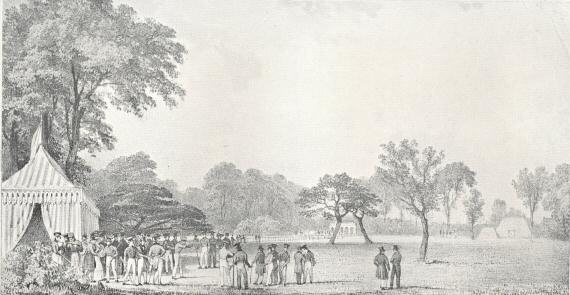
The subscription was two or three guineas, and the members,
under the Baron’s tuition, could shoot, box and fence, and
practise ‘manly exercises generally’ in his beautiful
grounds. He also established, so to speak, a
‘Ladies’ Links,’ with its clubroom,
‘which Gentlemen cannot enter,’ unless (such is his
quaint proviso) ‘by consent of the Ladies occupying
such.’ In 1834 George Cruikshank made a design for a
‘Chelsea Stadium Shield,’ which was quite Homeric in
its form, and showed every conceivable kind of sport and
exercise, including pole-jumping and golf. [2d]
The
Stadium flourished, or, rather, lingered on, till 1843, but only
with the adventitious aid of occasional galas and balloon
displays that already foreshadowed Cremorne. [3]
The transformation of this failing arena of British sport into
the full-blooded pleasure-garden of Cremorne was effected by
another Baron, though he was such only by the courtesy of Bow
Street and Maiden Lane. Renton Nicholson (for that was his
name), like most of the managers of Cremorne, was a man who knew
a thing or two. He was born early in the century, and his
boyhood was spent in the quiet village of Islington, where his
two sisters kept a young ladies’ seminary. His tastes early led
him to the distractions of Sadler’s Wells, and at sixteen,
[4a] when he became a pawnbroker’s
assistant in Shadwell, he began to acquire his remarkable
knowledge of the ‘flash’ life of London in all its
grades. About 1830 he opened a jeweller’s shop in the
West End, which supplied the ‘swells’ of the day and
their female friends, and by this time his London
acquaintanceships were extensive and peculiar, consisting, as we
are told, of shady journalists, players, tavern vocalists, and
rooks of all shades from the welsher to the skittle sharp.
He knew the taste of his public, and in 1837 began to issue the
scurrilous journal called The Town, for which Dr. Maginn
and other lively contributors used to write. After a minor
experience of gambling-houses and doubtful premises of various
kinds, he became (in 1841) proprietor of the Garrick’s Head
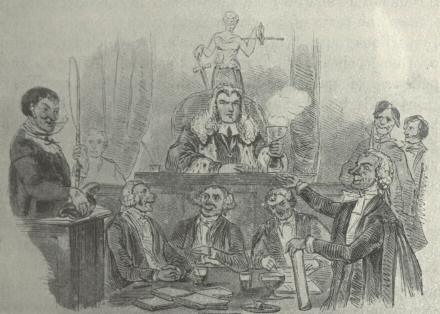
in Bow Street, and here, in a room holding about 300 people, and
fitted up like a law-court, he presided—as Lord Chief Baron
Nicholson—over the judge and jury trials that were so
attractive to the Londoner of the forties and fifties. The
causes that came before this tribunal were chiefly
matrimonial—the crim. con. cases of the
time—and were such that their obscenity and heartlessness
(mitigated, it is true, by flashes of wit) often made the most
hardened sinner shudder. Nicholson presided over similar
trials at those famous haunts, the Coal Hole and the Cyder
Cellars, till his death in 1861. He was impudent in manner,
obese and sensual in appearance, yet a man of real talent and
geniality, gone hopelessly upon the wrong track. His
apologists describe him as a sort of nineteenth-century Robin
Hood, who plucked the aristocratic pigeon, but was ‘the
soul of good nature’ to the poor Bohemian. [4b]
His
connexion with Cremorne was brief, and his capital
inadequate. In 1843 he replaced the timid prospectus of De
Berenger by flaming bills announcing a ‘Thousand Guineas
Fête,’ which during three days (July 31, August 1 and
2), at one shilling admission, provided, among other diversions,
a mock tournament, a pony-race, a performance by Tom Matthews the
clown, and a pas de deux by T. Ireland and Fanny
Matthews.
In 1845 De Berenger died, and this year Littlejohn (the
refreshment caterer to the gardens) and Tom Matthews managed the
place between them. Charles Green, the balloonist, was
called in, and began that long series of Cremorne ascents which a
spice of eccentricity and danger always rendered popular.
For example, in September, Green went up with a lady and a
leopard—the latter a magnificent animal, so perfectly
subdued in the presence of his mistress or her ‘livery
servant,’ as to lay (according to the bill) at her feet or
crouch in her lap at command. In August the balloon party
consisted of Green, Lord George Beresford, and Tom Matthews, who
preluded the ascent by singing his ‘Hot
Codlings.’ The balloon went up at seven, and, after
visiting the General Post Office and passing over Stamford Hill
in perilous proximity to the New River Reservoir, landed its
occupants, after a voyage of two hours, cold and shivering, on a
marsh at Tottenham.
In 1846 (or more probably a few years later) Cremorne was
purchased by Thomas Bartlett Simpson, who guided its destinies
till the beginning of the sixties. [5] Simpson had been
head-waiter at the Albion, a well-known theatrical tavern that
stood opposite Drury Lane Theatre in Russell Street, and was
afterwards its lessee. He was a shrewd man of business,
and, according to George Augustus Sala, ‘a kindly and
generous gentleman.’ Sala, who knew the gardens well
from about 1850, tells us that, unlike the Vauxhall of the time,
Cremorne was a real pleasaunce surrounded by magnificent trees,
with well-kept lawns and lovely flowers, and melodious
singing-birds. Nothing was pleasanter in the summer-time
than to saunter in at midday or in the early afternoon (for the
gardens were not properly open till three or five), and find Mr.
Simpson’s daughters there with their work-baskets—to
say nothing of the pretty barmaids employed by the kindly and
generous gentleman, who were busy, in their cotton frocks,
arranging the bars, and paying, it is implied, no ordinary
attention to Mr. G. A. Sala.
Five thousand pounds was spent in preparing for the opening of
1846, and a banqueting-hall and theatre were constructed, as well
as some ‘delightful lavender bowers’ for the
accommodation of the 1,500 persons who were likely to need a
bowery seclusion. The gardens were rapidly getting into
shape, and we can now survey them almost as they appeared till
their close in 1877.
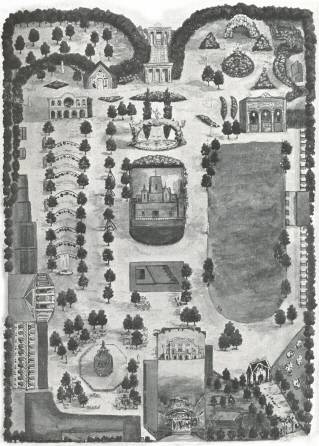
They were about twelve acres, to which must be added, from
1850, the grounds of Ashburnham House on the west, in which
flower-shows and other exhibitions were held. Cremorne lay
between the river and the King’s Road, Chelsea. The
grand entrance was in the King’s Road, where a big star
illuminated the pay-box. On a summer evening, if you did
not mind the slow progress of the threepenny steamer from the
City to Cremorne Pier, you entered by the river gate at the
south-east corner of the gardens. The grounds were well
lit, but on entering there was not that sudden blaze of light
that was the visitor’s great sensation when he came through
the dark pay-entrance into the garden of Vauxhall. The most
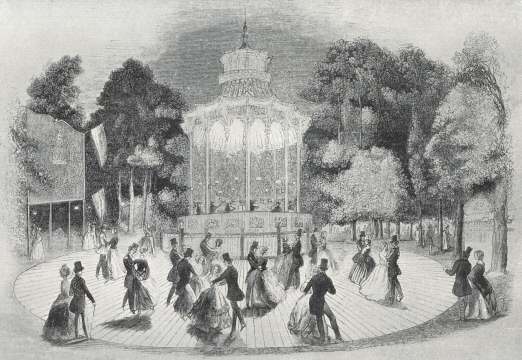
conspicuous feature was the orchestra to the south-west of the
gardens—a ‘monster pagoda,’ brilliantly lighted
with hundreds of coloured lamps, and surrounded by a circular
platform, prepared, it is said, to accommodate 4,000
dancers. Here the dancing took place from 8.30 till 11 or
later. There was always a dignified master of the
ceremonies (in 1846 Flexmore the pantomimist), but little
introduction was required in that easygoing place. There
was a good band of fifty, for some years under Laurent, of the
Adelaide Gallery Casino in the Strand. [7] In the early
part of the evening—at any rate, in the seventies—the
dancing was left to the shop-girls and their friends: the gilded
youth and the ‘smart’ female set of Cremorne began
their waltzing later on, after the fireworks.
The gardens had a tendency to become congested with
side-shows, flaring stalls and shooting-galleries, too much
suggesting a fair; but, unlike Earl’s Court and the later
Vauxhall, Cremorne remained a garden. There was still the
encircling fringe of ancient trees, and an avenue on the west
stretching from north to south; on the east side was the broad
lawn from which the balloon ascents took place.
Cremorne had the usual pleasure-garden equipment of fountains
and statuary; refreshment-bars, boxes, and tables were placed at
every coign of vantage, though the right place to go was the
Cremorne House (or Hotel) dining-room, or the upper and lower
tiers of supper-boxes in the south and south-western
corner. Here there was a half-crown supper, and, if you
aspired no higher, the Cremorne sherry, that fine old wine,
‘free from acidity, and highly recommended to
invalids.’ In the centre of the grounds was an
American bowling-saloon, which made its appearance, together with
American drinks, in ’48 or ’49.
On the west side was the circus; the theatre was in the south
of the garden. A smaller theatre, north of the lawn, was
appropriated to a troupe of marionettes, introduced by Simpson in
1852. They were great favourites of the public and of the
proprietor, who liked ‘the little beggars who never came to
the treasury on Saturday.’ Besides this, there was a
maze and (as Vauxhall had its hermit) a gipsy’s tent and a
‘double-sighted youth.’ The admission to the
gardens was one shilling, and the season tickets cost one guinea
or two guineas.
Simpson’s management (i.e., till 1861) provided
some special diversions, of which the most curious, perhaps, was
an Aquatic Tournament or Naval Fête (1851). About
eleven at night a fortress (either St. Jean d’Acre or
Gibraltar) on the river esplanade was vigorously attacked by a
squadron consisting of fourteen steamers of the Citizen Company
(whose ‘entire fleet’ was embarked in the
enterprise), seconded by the hull of a retired Citizen steamer,
which was laden with combustibles. To this attack the land
battery—its necessary smoke, fire, and noise supplied by
Mortram and Duffell, the Cremorne fireworkers—made a
suitable reply, and eventually the old hull was blown to pieces
amid the cheers of the spectators.
The Italian Salamander, ‘Cristoforo Buono Core,’
was, later on, in 1858, another attraction of a fiery kind.
Like Chabert, the more famous Salamander of 1826, [8a] this man entered a burning furnace with
apparent unconcern, and (as he informed an inquisitive spectator)
‘titt as fell as he cott,’ though the performance
made him very ‘dursty.’
In contrast to these popular shows, the manager on Friday,
July 9, 1858, gave an ‘Aristocratic Fête,’
arranged by a committee of gentlemen assisted by lady
patronesses, who are said to have been very chary of issuing
tickets to other ladies whom the gentlemen proposed to
invite. But the invitations mattered little, for the 9th
turned out to be one of the wettest days of an English July, and
the aristocratic ambitions of Cremorne were damped down for ever.
[8b]
In the
balloon ascents of Cremorne (as already remarked) there was often
a dangerous element, usually a parachute descent. Without
dwelling on the ascents of balloonists like Lieutenant Gale and
the celebrated Charles Green, who made his three hundredth and
sixty-fifth voyage (of course including his ascents at Vauxhall
and many other places) on August 2, 1847, we can notice only the
Bouthellier, Poitevin, and Latour performances.
In August, 1852, [9a] a French aeronaut
named Bouthellier ascended on a trapeze attached to the car of a
balloon, and when the balloon was at a respectable height began
to twist himself round ‘almost in a knot,’ then to
untie himself, and finally to suspend his body as he hung, first
by his neck, then by his heels. The reporter tells us that
this was done ‘to the evident mingled alarm and pleasure of
the spectators,’ and the whole thing was considered to
‘redound greatly to the credit’ of Mr. Simpson.
In September of the same year (1852), Madame Poitevin,
‘in the character of Europa,’ ascended from Cremorne
on the back of a heifer which was attached to her balloon.
This was nothing new to her or to the sight-seers of
Paris, where she and her husband had made hundreds of ascents on
the backs of horses, and even ‘a great many ascents with a
bull.’ A pony ascent had been made by Green at
Vauxhall in 1850, [9b] but the English magistrates drew the
line at a heifer, and Simpson and his Europa were fined at the
Ilford Sessions on September 7, 1852, for cruelty to animals.
This wretched exhibition was not, of course, repeated, but
risky parachute feats were by no means to be abandoned. On
June 27, 1854, at about seven o’clock, Henri Latour, a
balloonist of the age of fifty, went up lashed to a parachute
which was formed like a horse, and suspended from W. H.
Adams’s balloon. As the balloon was rising an attempt
was made (by means of a trigger-iron) to release the parachute,
but it somehow got twisted, and its two guiding ‘wings’ did not expand. The descent of
the balloon continued, and in the Tottenham marshes, which it had
now rapidly reached, struck the earth, and the unhappy Latour was
dragged over the ground and through the trees, and died a few
days after of his injuries. [10a]
The programme of the theatre and the concert-room was less
exciting. The Cremorne theatricals never aimed much higher
than the farce and the vaudeville, but there were some good
ballets, in which (circa 1847–1851) the Deulins took
part. Under Simpson some of the old favourite comic singers
were engaged—Sam Cowell in 1846, Robert Glindon in 1847 and
1850. [10b] Herr Von Joel, who appeared in
1848, was ‘a peculiar old German’ [10c] who had made a sensation—which
became a bore—at Vauxhall Gardens. His business was
to appear at unexpected moments and in unsuspected parts of the
gardens, to yodel. Swiss ditties, and to give imitations,
on his walking-stick, of birds and feathered fowl. In his
later days he was a familiar figure at Evans’s
Supper-Rooms, where he used to retail dubious cigars, and dispose
of tickets for benefits which never came off. J. W. Sharp
(‘Jack Sharp’), who sang at Cremorne in 1850, was at
one time the rage of the town, and his comic songs were in demand
at Vauxhall and at such places as Evans’s and the Mogul in
Drury Lane. But he took to dissipated ways, lost his
engagements, and died in the Dover Workhouse at the age of
thirty-eight. [10d]
Simpson’s varied enterprises resulted in a substantial
profit, even if he did not make (as he told the impecunious Baron
Nicholson) the sum of £100,000 during his first years at
Cremorne. His patrons were people of all ranks, and of
varying degrees of virtue. But Cremorne was never able to parade in
the newspapers that array of fashionable and distinguished
personages who ‘last night’ visited Vauxhall.
It was not, for one thing, a place that ladies (in the strict
sense of the word) were in the habit of visiting, unless, perhaps
(as Mr. Sala puts it) ‘in disguise and on the sly,’
or, at any rate, under the safe conduct of a husband or
brother. Ladies of some sort were, no doubt, considerably
in evidence there, though we are not to think of Cremorne as so
entirely given over to ‘drink, dancing, and devilry’
as its sterner critics declared. If it was a place for the
man about town, it also attracted a number of worthy citizens and
country cousins who went there for an evening’s pleasure
with their wives and daughters, and were ‘not
particular.’ A livelier element was imported by the
medical students—a high-spirited race made responsible in
those days for the sins of many non-medical youngsters—by
Oxonians and Cantabs, by temporarily irresponsible clerks and
shopmen, and ‘flash’ personages of various kinds.
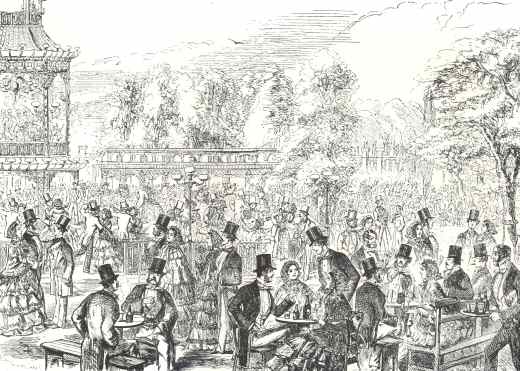
In 1857 the Chelsea Vestry had presented the first of many
annual petitions against the renewal of the licence, setting
forth the inconvenience of the late hours of Cremorne, the
immoral character of its female frequenters, and its detrimental
influence generally on the morals (and house property) of the
neighbourhood. Such petitions, like the annual protests
against old Bartholomew Fair, were a long time in taking effect,
but, as Cremorne grew older, the rowdy and wanton element
certainly increased, and finally, as we shall see, not
undeservedly brought about its downfall. In spite of all
this, we know of more than one respected paterfamilias who has
still somewhere a Cremorne programme or two, the relic of some
pleasant and doubtless romantic evening in the sixties or
seventies, when he imagined himself to be seeing
something—if not too much—of ‘real life’
in London. In the sixties some charming little folding
programmes were issued, printed in colour, and presenting on
every page a view of Cremorne. Portions of the programme
were ingeniously cut out, so that on the front page there was a view up the
long walk, flanked by its trees and lamp-bearing goddesses, right
to the great fountain. Another page depicted the
supper-table spread with its choice viands and ‘rarest
vintages,’ and on another was a view of the circus, the
supper-boxes, and the promenade enlivened by a peripatetic
band—all for a shilling admission, and the patron, Her
Majesty the Queen. [12a]
Time has cast a veil over the orgiastic features of Cremorne,
and though this is just as well, some of its old frequenters may
cherish the feeling that there are no ‘intrepid
aeronauts’ now, no fireworks like Duffell’s, no
gaily-lighted tiers of supper-boxes, and no waltzing on circular
platforms with beauteous, if little known, damsels.
Simpson retired in 1861, [12b] and on July 30
there was a new manager, Edward Tyrrell Smith. [12c] He has been denied, somehow, a
place in the great Dictionary of National Biography, but
one cannot turn over a programme of London amusements in the
fifties or sixties without encountering the name of E. T.
Smith—an interesting man, of boundless energy and resource,
and a lucky, if wayward, speculator, who was everything by turns
and nothing long. He was the son of Admiral E. T. Smith,
but his aspirations were not lofty, for he began life—he
was born in 1804—as a Robin Redbreast, one of the old
red-waistcoated Bow Street runners. When the new police
force was established Smith was too young for superannuation, so
he was made an inspector. But he soon tired of this, and
after trying his hand as a sheriff’s bailiff or auctioneer,
went into the wine trade. In 1850 we find him landlord of a
tavern in Red Lion Street, Holborn, attracting custom by dressing
his barmaids in bloomer costume. From about this date
his speculative genius turned to the management of London
theatres. He took the Marylebone, then Drury Lane, where he
made quite a lengthy stay, and even plunged into opera at Her
Majesty’s. One of his eccentricities was to present
silver snuff-boxes and watches to his master-carpenters and
property-men, each presentation taking place on the stage,
accompanied by an appropriate speech. He was lessee of the
Lyceum, of the Surrey, of Astley’s (when Ada Menken
appeared as Mazeppa), and he took Highbury Barn for one
season. He also founded the Alhambra in Leicester Square,
making short work, for his purpose, of its instructive
predecessor, the Panopticon.
He effected another transformation by turning
Crockford’s gaming-house into the Wellington Restaurant,
and opened a second restaurant—but this was a dismal
failure—in the vaults of the Royal Exchange. He
further made a handsome profit out of a French bonnet-shop which
he established at Brighton, under the alluring name of
Clémentine. He financed Baron Nicholson at the Coal
Hole, became proprietor of the Sunday Times, and finally
settled down in the metal trade. If Smith had little money
of his own, he had a marvellous talent for extracting it from
others, for, with some managerial humbug in his doings, he was a
good-natured man, with plenty of friends who believed in his
speculative flair. One of his early devices was
ingenious. He hired from a money-lender at the rate of
£1 a day a £1,000 banknote, which he always carried
in his pocket—not to spend, but to deposit when he made a
purchase, and to inspire confidence generally. He retired
from Cremorne in 1869, and managed just to outlive the gardens,
for he died in 1877, on November 26.
Smith began his enterprise with a startling novelty—a
‘female Blondin’ who undertook to cross the
Thames. Late on an August afternoon of 1861 thousands of
spectators thronged the river banks and the esplanade of
Cremorne, or waited in small boats to see this new heroine of Niagara. A tight rope was stretched across the
river at a height varying from 50 to 100 feet, and at last the
female Blondin appeared. She was a delicate-looking little
woman, who called herself Madame Genvieve. Her real name
was Selina Young, and she was the granddaughter of James Bishop
the showman. One has seen the male Blondin making a careful
inspection of his guy-lines and supports before starting on his
perilous course. His female imitator began her progress at
once. When she had traversed about two-thirds of the
distance, she paused to rest on the narrow timber ledge of one of
the main supports of the rope. The rest was a long one, and
it was soon felt that something was wrong when the attendants
were seen tightening the remaining 600 or 700 feet of rope.
At last, after this trying pause—she had started
three-quarters of an hour earlier, and it was now growing dusk
and chilly—she moved a few feet forward; then she halted,
and then moved again. But the rope was now swaying like a
garden swing, for the guy-lines had been cut—apparently by
some scoundrel who wanted the leaden weights. Attempts were
being made to throw cords over the rope, when suddenly she let go
her balance-pole. It was a terrible moment, but with
infinite pluck and presence of mind the female Blondin caught the
rope with both hands, then a couple of weights suspended from it,
and next the cords by which that part of the rope was
steadied. Descending by the grasp of a three-quarter-inch
cord, she reached a boat, and was saved. [14a] But the warning was disregarded,
and the very next year the female Blondin was performing at
Highbury Barn. Here she fell from a rope which was damp and
slippery, and was made a cripple for life. [14b]
Another
sensation, though void of peril, of Smith’s management was
the Cremorne tournament, which began on Wednesday, July 8, 1863,
[15] and lasted two or three days. It
was suggested by the famous Eglinton tournament of August, 1839,
which is said to have cost the Earl of Eglinton
£80,000. The Cremorne imitation was held, not in the
park or tilt-yard of a castle, but in the large pavilion of the
Ashburnham grounds, which was gay with flags and garlands and the
escutcheons of medieval heroes. The velvet and the gold
lace may have been less costly, but the effect was equally
impressive. At Eglinton Castle the Queen of Beauty was the
lovely Lady Seymour; the Marquis of Waterford was one of the
knights, and Prince Louis Napoleon one of the squires. The
knights and squires of Cremorne came chiefly from the theatre and
the circus, and the pages were ladies described by a journalist
as ‘no strangers to the choreographic stage.’
The Queen of Beauty was Madame Caroline, a circus-rider well
known at Vauxhall and elsewhere, who is believed to have resided
in the New Cut.
The Scottish tournament was a fiasco, and was carried out
under the cover of umbrellas and great-coats in the intervals of
drenching rain which lasted for three days. The opening day
at Cremorne was bright and sunny, and the procession of 300 made
its entrance in imposing style: heralds in their gaudy tabards,
yeomen in Lincoln green, men-at-arms in glittering armour—a
whole Ivanhoe in motion. The tournament King, the
Queen of Beauty, and their suite, were escorted to a tapestried
tribune, and their gorgeous array contrasted strangely with the
tall-hatted and coal-scuttle-bonneted spectators who occupied the
seats on every side. The heralds made the proclamation, and
the jousting began. First, there were trials of skill
between knights of different countries all in armour, and mounted
on chargers with emblazoned housings. Some sports, like
tilting at the ring and the quintain, followed, and then came the grand
mêlée between the two companies of knights.
Finally, one of the combatants was unhorsed—pro
forma—and his antagonist received the prize of valour
from the Queen of Beauty.
Bands of music and facetious clowns, or rather
‘jesters,’ enlivened the proceedings, which were at
first exciting and a fine spectacle, though they tended to grow
monotonous. [16a]
Among the minor entertainments of Smith’s management was
the exhibition, in 1867, of Natator, the man-frog. This
human frog was a young man of twenty, who was to be seen through
the plate-glass front of a huge tank filled with 6 feet of
water. He imitated the motions of fish, stood on his head,
ate a sponge-cake, or smoked a pipe. A more rational
exhibition was the appearance of the Beckwith family in 1869. [16b]
In his last year (1869) Smith exhibited the French
‘captive balloon’ in the Ashburnham grounds.
This balloon was made of linen and indiarubber, and held thirty
people. It was attached by a strong rope worked by an
engine of 200 horse-power, and could be let out, so as to soar
‘in an aerial voyage over London,’ 2,000 feet.
The charge for an ascent was ten shillings, but a free admission
was granted to a female inmate of the Fulham Workhouse, who chose
to celebrate her hundredth birthday by a trip in the balloon,
attended by the matron. It was fortunately not on this
occasion that the captive balloon, after the manner of its kind,
escaped! [16c]
John
Baum, who became lessee in 1870, had not the character of his
predecessors, nor a hand strong enough to restrain the vagaries
of his more troublesome clients. But he was by no means
incapable as an entertainment manager and when the gardens were
opened they were found to be much improved, and a new theatre was
built. He developed the stage amusements, and produced some
good ballets, such as Giselle, in 1870. In 1875
there was a comic ballet by the Lauri family, and
Offenbach’s Rose of Auvergne, with a ballet of 100,
was given. Auber’s Fra Diavolo was presented
before a Bank Holiday audience in 1877. [17] The orchestra was a capable one
under Jules Riviere. In 1872 the licence for dancing, the
great attraction of Cremorne, was refused, but in 1874 the
waltzing or, the ‘crystal platform’ was again as
lively as ever.
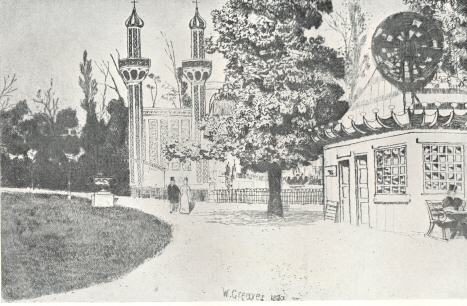
The one great, but melancholy, sensation of Baum’s
management was the episode of ‘Monsieur de Groof, the
flying man.’ Vincent de Groof was a Belgian who had
constructed a flying machine on which he made some ascents with
doubtful success in his native land. He came to England in
1874, and with some difficulty persuaded Baum to let him go
through his dangerous performance at Cremorne. Certainly
the flying man made a good advertisement, and on the evening of
June 29, 1874, there was a great concourse in the gardens.
The machine was suspended by a rope, 30 feet long, from the car
of Simmons’s ‘Czar’ balloon, and while the tedious
process of inflation was going on the spectators had time to
inspect a flying apparatus strange and wonderful. It was
constructed of cane and waterproof silk, and was made ‘in
imitation of the bat’s wing and peacock’s
tail.’ Evidently De Groof, like his inventive
predecessor in Rasselas, had considered the structure of
all volant animals, and found ‘the folding continuity of
the bat’s wing most easily accommodated to the human
form.’ His wings were 37 feet long from tip to tip,
and his tail 18 feet long. In the centre was fixed an
upright wooden stand about 12 feet high, in which De Groof placed
himself, working the wings and tail by means of three
levers. He ascended from Cremorne about eight, and as the
balloon rose seemed like a big bird perched in his net
framework. He was meant to descend in the gardens, but the
wind carried the balloon away to Brandon in Essex, where he made
a perilous descent from the balloon, almost unseen, but
apparently without injury. The Cremorne habitué felt
that he was cheated of a sight, and on July 9 the experiment had
to be repeated. At about half-past seven the machine was
once more taken up by Simmons’s balloon, and this time
there was no changing of the venue. The balloon soared to a
great height, but for fully half an hour continued to hover over
the gardens. Then the wind bore it rapidly away in the
direction of St. Luke’s Church, Chelsea, till the machine
was perilously near the church tower. No one quite knew
what happened at this moment. Simmons seems to have called
out, ‘I must cut you loose,’ and De Groof to have
responded ‘Yes, and I can fall in the
churchyard.’ Suddenly the rope was severed, the
machine, without resistance to the air, was seen to collapse, and
wind round and round in its descent, till it fell with a heavy
thud near the kerbstone in Robert Street. [18] A great crowd had collected, and
De Groof was picked up in a terrible state, and taken into the
Chelsea Infirmary to die. The fate of the balloon was an
anti-climax: it was carried away to Springfield in Essex,
where it came down on the Great Eastern railway-line after a
narrow escape from a passing train. The whole affair caused
great excitement in London, and the details were copied into
papers like the Indian Mirror. A sheet-ballad sold
in the Chelsea streets drew the obvious morals, and appealed to
the tender-hearted passer-by:
‘You feeling hearts, list to my story,
It is a most heartrending tale;
And when the facts are laid before you
To drop a tear you cannot fail.’ [19]
But we are nearing the last days of Cremorne. At no
period could the gardens be described as a place of quiet family
resort, and under Smith in the sixties we begin to hear of rows
and cases in the police courts. In 1863, for instance,
there was a ‘riot’ on the night of the Oaks day, and
a number of men, apparently of decent position, stormed and
wrecked one of the bars. Six of them were caught, and fined
from £20 to £50 apiece. A scene of this kind
was partly the fault of the manager, who had advertised his
gardens as just the pleasure resort for a gentleman returning
from the races. One (undated) story of a Cremorne fracas,
told by G. A. Sala, is rather amusing, and worth repeating nearly
in his words. ‘A gallant Captain and M.P.,’ who
was engaged to a young lady of good position, began to repent of
his promise. To get out of it honourably he could devise no
better plan than to disgrace himself at Cremorne. One
night, accordingly, he repaired to the gardens ‘with a few
chosen boon companions,’ who, like himself, imbibed freely
of the rare vintages in the supper-rooms. The moment came
when he was in a mood ‘to break things,’ and his
first onslaught was on the glasses and decanters of a refreshment
counter. Then he charged the dancing platform, frightened
the dancers, and scattered the musicians ‘like blossoms
before a March blast.’ They tried to stop him, but he
put the waiters hors de combat, and for some time made
short work of the police. The next morning the gallant
Captain and M.P. found himself, at the police court, Westminster,
provided with a sentence of fourteen days. From his
dungeon-cell in Holloway he wrote an abject letter to his
impending father-in-law, deploring the degradation he had brought
on himself and his friends, and relinquishing for ever all claims
on the beloved daughter. Next day the governor of the
prison handed him a letter from the same father-in-law, which ran
as follows: ‘Dear
Jim,—Sorry to hear you have got yourself into such a
scrape. Never mind; boys will be boys! Katie and I
will call for you in an open carriage on Monday week, and the
marriage will take place on the following morning at St.
James’s, Piccadilly.’
These things were relatively trifles, and it was really not
till the seventies—under Baum—that Cremorne became an
impossible place. The Westminster Police Court was now
hardly ever without its drunk or disorderly case from the
gardens. Even the normal evenings at Cremorne were fairly
fertile in incident, but a big crop followed the abnormal
evenings—the night of some great event, the Derby, the
Oaks, the return of the Prince from India, or—a new
institution—the Bank Holiday. At such times extra
late hours were always granted, and they were those occasions
when champagne is said to ‘flow like water.’ It
was half-past ten, half-past eleven, twelve, and still the
theatres and music-halls were sending down fresh visitors, and
the cabs came rattling down the King’s high road. The
bars and boxes were so many hives of drinking mortals—men
who had lost and men who had won, and the drinking quickly led to
an almost indiscriminate pugnacity. The wretched waiters,
even, were assaulted, though the pugilist thought he amply atoned
by a money payment ‘on the spot.’
The efforts of the half-hearted Chelsea Vestry of 1857 were
renewed with more vigour (and with more justification) from 1870
onwards, and they had a valuable ally in Canon Cromwell, the
principal of St. Mark’s Training College, which stood
almost opposite the entrance of Cremorne. One of the many
unedifying illustrated papers of the seventies, the
Day’s Doings, portrays the Canon in cap and gown
ejecting two flashily dressed females from the gardens, and he
and his docile students for the next six years are said to have
given Mr. Baum a very rough time. This opposition was not
popular, and on one 5th of November the worthy Canon was paraded
on a coster’s barrow in front of Cremorne as a guy.
The comic papers sneered at the petitions ‘signed by all
the babies and children under ten,’ and issued a revised
set of Cremorne Regulations. All ladies were henceforward
to have certificates of respectability from the Board of
Guardians, though members of the London School Board were to be
admitted free. No fireworks, dancing, smoking, laughing, or
flirting were allowed, but by an order from the Vestry you could
obtain a coffee cobler or a cocoa cocktail. Ridicule is
sometimes a legitimate weapon against the Puritan, but in this
case Canon Cromwell and the Vestry were hardly in the wrong.
The end came rather suddenly and in a curious way.
Towards the close of 1876 there was distributed in Chelsea a
pamphlet in verse, entitled The Trial of John Fox, or
Fox John, or the Horrors of Cremorne. It was
signed ‘A. B. Chelsea,’ but the author was soon
discovered to be a Mr. Alfred Brandon, a worthy and evidently
courageous man, who had long been known as minister of the
Chelsea Baptist Chapel. By trade Mr. Brandon was a tailor,
and no doubt his coats were better than his poetry, which is,
indeed, sad doggerel. This pamphlet was an indictment of
Cremorne as the ‘nursery of every kind of vice,’ and
of its callous money-grubbing manager John Fox. The jury
decide against John Fox:
‘Our verdict this: the Fox has had his
day.
Destroy his covert—let him run away.’
Mr. Baum is said to have been ‘stung by these cutting
remarks’—‘remarks’ which, whether they
stung or cut, constituted, from the legal point of view, a highly
defamatory libel. He doubtless went unwillingly into court,
but in May, 1877, the libel action of Baum v. Brandon was
heard in the Queen’s Bench before Sir Henry Hawkins.
Brandon pleaded, in the familiar way, first, that he had intended
no allusion to Baum, and, secondly, that he had alluded to
Baum, but that what he said was true, and, moreover, not
malicious. In court it was averred by Baum that Cremorne
was most respectably conducted, and that the houses in the
neighbourhood were most respectable. Brandon, to justify
the libel, called various witnesses, among whom were a Cremorne
waiter and a woman from a reformatory, who both traced their
downfall to the gardens. The jury found for Baum, but
awarded him a farthing damages, and each side had to pay its own
costs.
At this time Baum was greatly in debt, and for the next few
months was too ill to superintend his gardens personally.
None the less preparations were made for the licensing day in
October. Petitions were prepared, and counsel on both sides
were engaged. October 5, 1877, arrived, and the Cremorne
case was called on. To the astonishment of London,
Baum’s counsel quietly announced that the lessee had
withdrawn his application, and the licence of Cremorne Gardens
lapsed for ever.
John Baum here vanishes from the scene, though we seem to
catch a glimpse of him at the end of the eighties as a waiter at
a North London tavern, discoursing freely to sympathetic
customers on the great days when he owned Cremorne.
The owner of the land, Mrs. Simpson, lost no time in letting
it in building plots, and most of the present rows of small
houses made their appearance in the next year or two. As
early as 1880 Cremorne Gardens is described as ‘already the
lawful prey of the Walfords and Cunninghams,’ and brought
within ‘the range of practical antiquaries.’ [22] But the gardens had first to be
cleared, and the Cremorne sale took place on April 8, 1878, and
the following days. The buyers and sightseers who attended
the auction found the place already in a neglected
state—the grass uncut, and the canvas coverings and
panoramic views rent and blown about by the winds of the last six
months. The sale began with the hotel and the effects of
the sitting-rooms on the first floor known as the Gem, the Pearl,
the Rose, and the Star. Then the public supper-room on the
ground-floor was taken in hand. There was a great stock of
wine and spirits—600 dozens—and a unique opportunity
for buying claret cheap. The grand ballroom with theatre
combined, the theatre royal, and the marionette theatre, were
next disposed of, and the circular dancing platform, about 360
feet in circumference, was sold in thirty-two sections, including
the pagoda orchestra.
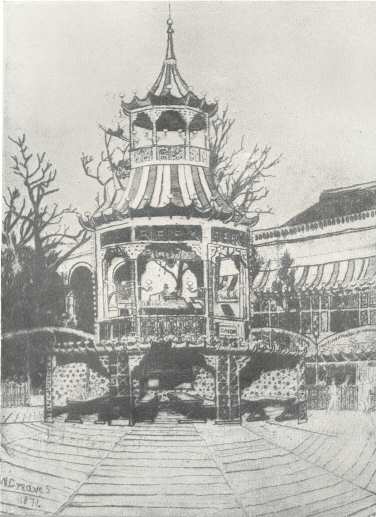
The elms and poplars and all the growing timber were then
offered, besides numerous portable bay-trees in boxes and about
20,000 greenhouse plants. The statuary, over and above the
Cupids and Venuses and the ‘females supporting
gas-burners,’ included some classic masterpieces like the
Laocöon and the Dying Gladiator. With the disposal of
the large reflecting stars, ‘the stalactite rustic,
enclosure of the Gypsey’s Cave,’ and a couple of
balloons, Cremorne was completely stripped.
A walk round Cremorne at the present day is a little
depressing, though less so than a visit to the squalid sites of
Vauxhall and the Surrey Zoo. The western boundary of the
gardens is, approximately, the present Ashburnham Road (or
Uverdale Road, if we include the Ashburnham annexe of
Cremorne). The eastern boundary was Cremorne Lane, now
mainly represented by Dartrey Street. The southern limit is
the present Lots Road, and a public-house, the Cremorne Arms, is
close to the former Cremorne Pier and the river entrance.
The Thames front is now covered with wharves and tall
buildings. The north boundary is still the King’s
Road, the entrance being where the southern continuation of Edith
Grove begins. Stadium Street, Ashburnham Road,
Cremorne Road, and the Cremorne Arms, recall the varying fortunes
of the place.
In spite of the builders, a small portion of the gardens has
always remained. Forming a pleasant fringe to the
King’s Road is the nursery-ground of Messrs. Wimsett and
Son, which stretches from Ashburnham Road to the part of Edith
Grove which represents the old entrance of Cremorne, and a grotto
or bower surmounted by some of the plaster goddesses of Cremorne
is still to be seen there. [24]
[A collection relating to Cremorne formed by the present
writer; a collection in the British Museum (1880. c. 9).
Various details have been derived from two excellent articles,
signed ‘T. E.,’ contributed to the West London
Press for September 18 and October 2, 1896, and based on
material in the Chelsea Public Library; also from an article by
G. A. Sala in the Daily Telegraph for August 7, 1894;
Blanchard in Era Almanack, 1871, etc.
Views: Of Cremorne House, various views in Chelsea Public
Library (cf. Beaver’s Chelsea, pp. 155,
157). Of the Stadium grounds, two fairly common lithographs
published by Day and Haghe in 1831. A Stadium bill (British
Museum) has a lithographic view of the house and part of the
grounds as a heading. The Particulars . . . of
the Stadium (London, 1834), contains views by G.
Cruikshank. Of Cremorne Gardens, many views in the
illustrated papers; also a water-colour by T. H. Shepherd, 1852,
showing orchestra, etc. (Chelsea Public Library), and another by
Shepherd, 1852 (same collection); etchings by W. Greaves of
Chelsea, etc.]


