It is not my intention to describe the funeral rites of
the ancient Greeks and Romans &c.,[176] because the
practices of some Eastern nations at the present day
somewhat resemble them, and it will consequently be
sufficient to refer to some of these. Moreover, descriptions
of cremation in classic times may be met with in
every encyclopædia. Full details of these ancient forms
of sepulture will also be found in numerous antiquarian
works.[177]
For a similar reason I will not describe the burning
of the bodies of Williams and Shelley.[178] The ceremony
was moreover somewhat harrowing owing to the impossibility
of obtaining proper materials for the purpose.
It will be more interesting to the reader to
furnish him with a description of a still later instance of
cremation; I allude to the burning of the body of the
Rajah of Kellapore at Florence in 1873, and I quote
here the description of the affair as given by Dr. Pini
in the Gazetta di Milano.
At the hour of midnight the mortal remains of the
Indian prince were carried to the banks of the river. The
funereal pile consisted of a heap of wood, about five feet
square, firmly fixed and secured to the ground by seven
bars of iron. A second heap of wood was thrown loosely
around. After certain religious ceremonies, the pile was
powdered with camphor and other aromatic substances, and
the dead rajah was laid upon it. The body was anointed
with pure naphtha, the features covered by a mask of some
greasy substance, and all the limbs covered with resinous
matter, betel-leaves, perfumes, and powdered sandal-wood.
The corpse was then covered with more layers of wood, alternated
with inflammable substances, and the next of kin to
the prince set fire to the pile. Although the flame was
fanned by a strong wind, the body was barely consumed at
seven o'clock the next morning. At ten, when the fire had
almost entirely burned out, nothing remained but a heap
of ashes. An Indian priest collected a small quantity from
the centre of the heap; the remainder was thrown to the
wind, in the direction of the current of the Arno.[179]
Let us now see how cremation is performed at the
present day among the poor in India.[180] The Madras
correspondent of the 'Medical Times and Gazette'
thus describes the mode practised in Madras:—
The actual process of burning here is simple and effective,
and well suited for people amongst whom fuel is one
of the dearest of the necessaries of life, besides being subject
to a tax, which has been greatly mitigated by the
present governor. A bed is prepared; it is said in the old
books that it should be as long as a man with his arm
extended above his head, a fathom wide, and a space deep;
it is also said that it ought to be on rising ground, so
that the water poured on the ashes may easily run off.
On this bed is laid a layer of wood and 'bratties'—that
is, cakes of dried cow-dung, which in this country is the
most frequent form of fuel. The body, which is brought
on an open bier, is laid on this, and covered with fresh
layers of wood and bratties. Fire is set to the heap,
which is then covered with a thinnish layer of earth. The
process, which lasts altogether twelve hours or more, is
divisible into two portions:—First, the fire is allowed to
char and smoulder, out of the free access of air, till all
the heap becomes a glowing red-hot mass, just as in charcoal-burning
or ballast-burning at home. But after the
fire has penetrated the whole heap it is poked up, the air
admitted, and there is a thorough blazing fire, which goes
on burning till all the fuel is turned into ashes, amongst
which are discernible some of the hardest bones—as the malar,
temporal, and shafts of the long bones—semi-vitrefied.
The above describes a funeral of the poorer kind,
but in a late number of the 'Bombay Times' appears
an interesting account of the burning of the body of
Mr. Veneyekras Juggonath Sunkersett, an eminent
citizen of that city.
The funeral procession from the house of the deceased
was sufficiently large to demand a special report. Not less
than a thousand persons figured therein, 'every family in
the caste having furnished one or two of its male members
to swell the melancholy cortège.' Bareheaded, and dressed
in white garments, the procession marched slowly on. First
came an array of link-bearers; then, also surrounded by
lighted torches, and borne aloft on the shoulders of six men,
the corpse was carried, preceded by Brahmin priests chanting
a monotonous dirge. Arrived at the burning-ground—a
spot to which admittance is made difficult—the body,
lying on a bier, was deposited on the ground, the torch-bearers
forming a circle around. The bier consisted simply
of split bamboo sides and arms, with a rush bottom, and
was subsequently broken to pieces and burnt. The object
of depositing the bier on the ground was to allow all present
to take a last look at the features of their friend and
leader. Many simply salaamed, others knelt and appeared
to pray, while others indulged in tumultuous ululation.
During the time occupied in these last farewells, the
men attached to the burning-ground had been busily employed
in erecting the funeral-pyre; and the corpse was at
length lifted off the bier, and placed on the pile. Officiating
Brahmins then anointed the body with a mixture of
which the principal constituent was ghee. Hard by was
piled a heap of fragrant sandal-wood, split into thin faggots,
and these the relatives of the deceased laid one by
one upon the body, the priests all the while reciting prayers
for the dead.[181] This ended, the servitors of the dead-ground
built up the pyre to its proper height with common firewood.
All being ready for the final ceremony, the Brahmins
lit a small fire of sandal-wood, and, having consecrated it,
gave a flaming brand to each of the kinsmen present, whose
duty it was to light the pyre. Then the flames shot up into
the air, a canopy of smoke overhung the spot, and all was
over. The mourners dispersed, and by midnight nothing
remained of our well-known citizen but a handful of white
ashes and a few calcined bones.
During the past year the remains of the Hon.
Narayan Wassadeo, a member of the Legislative Council
of Bombay, were solemnly burnt on the burning-ground
at Sonapore, and the ceremony is thus described
in the 'Times of India,' Aug. 6, 1874:—
The body was placed, after it was recovered from under
the ruins, on the floor of a large apartment at the rear of
one of the wings of the house; and the female members of
the family, seating themselves around it, gave themselves
up to uncontrollable grief. The unhappy widow was overwhelmed
by the dreadful calamity which had befallen her.
A great number of the leading members of the European
and various native communities called and took a last look
at the remains as they lay covered with a white robe, the
lower part of the face being alone exposed.
The procession started at about 7 P.M. The bier, composed
of two long pieces of bamboo, with a couple of cross-pieces,
and covered with a rich white shawl, was upheld by
the deceased's eldest brother and three of his most intimate
friends and relatives. The sacred fire, which had been
kindled with due ceremonies at the house, was carried in
front in a brazen vessel by the deceased's son. The funeral was
largely attended, not only by members of his own caste, but
by those of other castes and denominations. When the procession
reached Sonapore the bier was placed on the ground
while the pyre was being constructed. Men with short crowbars
made six holes in the earth, and in each of these was
placed a rough piece of timber about four or five feet high.
The posts, ranged two and two, were about a yard distant
from each other. Three logs about six feet long each were
placed on pieces of wood between each pair of uprights,
so as to allow a free draught under the whole. A number
of smaller logs were placed on these large ones, and were
covered with sandal-wood, which made a sort of bed for
the reception of the body. While this was being done, a
number of torches of sandal-wood were being carefully
ignited by the deceased's son at the sacred fire, which he
had brought with him for the purpose. Prayers were said
while the ignition was in progress. All being ready, the
bier was brought to the side of the pyre, and the body
was divested of all covering, except a cloth around the
loins. It was then lifted on to the pyre, which was by
this time between three and four feet high. The upright
posts confined the body on either side, and prevented the
possibility of its rolling off. Small blocks of sandal-wood,
of various lengths—from six inches to two feet—were placed
lightly on the body. The deceased's son then took a brazen
vessel full of water, and carefully sprinkled a circle on the
earth around the funeral pile. He next seized a brand
from the sacred fire, and applied it to some dried leaves,
or similar combustibles, placed under the pyre. That did
not set fire to the pyre, however, and was not intended
to be more than a compliance with the ceremonial; the
brand was red, but not blazing, and a spark or two only
fell from it. The relatives were then, as is usual in such
cases, led away from the pyre by the friends around, so as
to spare their feelings as much as possible. When they
were taken a few yards off, and their backs turned to the
pyre, large logs, similar to those at the base, were placed
over the body, which now became completely concealed—all
but the feet, which were left exposed either by accident or
design. The friends applied matches to the sandal-wood
brands, and, when they blazed up, set fire to the combustibles.
Owing doubtless to the dampness of the ground,
and occasional drops of rain, it was a matter of some difficulty
to get the mass to burn. Cocoanut oil was thrown on
the wood, and screens were held by men so as to regulate the
draught; and, after a long interval, the pyre blazed up
fiercely. In three hours only a handful of ashes remained
of him who was but that morning the influential leader of
the Hindoo community, full of life and hope.
The above two cremations may be regarded as
sumptuous ones, and far above the means of the
common people. With the latter an incomplete burning
was often performed with revolting results. Descriptions
of these failures have frequently been given
by travellers of more or less veracity. The matter was
lately taken into consideration by the English authorities,
and this has led to the suppression of such imperfect
cremations.
By the order of Sir Cecil Beadon a cinerator was erected
at Calcutta for the burning of human bodies; and various
regulations were issued with the view of abolishing the
ancient system of imperfect cremation. The funeral pyre
was not absolutely prohibited within the limits of the city;
but the disgusting custom of throwing partially-consumed
bodies into the river was at once put down. Sir Cecil
Beadon also forcibly suggested that all bodies should be
taken outside of the city, to be burned in some suitable
place set apart and enclosed for the purpose. Against this
excellent proposition a fearful outcry was raised, and the
municipality was induced to confine the suggested improvement
to building the cinerator on the site of the old
burning-ghât, on the banks of the Hooghly. At first the
Hindoos objected to use the cinerator; but, on finding that
it involved no interference with their religious rites or feelings,
they partially acquiesced in its use. The cinerator
built at Calcutta was not quite a success; but the bodies
were consumed to ashes, and the fumes carried away through
a tall chimney or stack.[182]
I am informed by the Sanitary Commissioner of
Madras, that the Cinerator[183] erected by the authorities
is scarcely ever used, but he is of opinion that if the
Siemens principle of a furnace were exhibited before
the educated Hindoos they would very probably
adopt it.
Here is another extract explanatory of the reform
just alluded to.
From the Health Officer's Report to the Bombay Municipality
we find that the cost of fuel for cremation is exceedingly
heavy; and that a body cannot be consumed
under four hours. 'On more than one occasion bodies have
not been totally consumed, the relations having brought too
scanty a supply of firewood.' In this document we also find
a recommendation 'that a cinerator be erected at the
burning-ghât, which would be at the disposal of the poor on
the payment of a small fee. By this means the Hindoo
community would get accustomed to it, and would see its
advantage. A body would be put in at one end of a closed
vessel, which in its transit through the cinerator would be
exposed to intense heat, and after a certain time drawn out
and opened. The ashes of the deceased would alone remain,
which could be carried away and kept.'
As it may prove interesting to some reader, I will
now give a description of a cremation ceremony of the
very highest class, as performed in Siam, in which
country, as has been stated elsewhere, only those dead
are buried whose survivors cannot pay the fees of the
priests. It is said to be from the pen of a lady[184]
who was a resident for several years in that country,
and is an extract from a paper of hers which appeared
in a late number of 'Lippincott's Magazine.'
Burning is now, and has been for centuries, the universal
custom in Siam—preferred, it is supposed, because of the
facility it affords for removing the precious dust of the loved
and lost. In old, aristocratic houses I have seen arranged in
the family receptacle massive golden urns, containing the
ashes of eight, ten, or twelve generations of ancestors; and
these are cherished as precious heirlooms, to descend through
the eldest male branch.
The time, expense, and character of a burning depend
mainly on the rank and wealth of the parties, though the
ceremony is always performed by the priests, and always
within the precincts of a temple. The only exception is in
seasons of epidemics or when the land is laid waste by
famine. Among the better classes the dead body is laid
unmutilated, save by the removal of the intestines, in a
coffin, and it is more or less carefully embalmed, according
to the time it is to be kept. If the deceased belonged to a
private family of moderate means, the burning takes place
from four to six days after death; if he was wealthy, but not
high-born, the body may be kept a month, but never longer,
while the remains of a noble lie in state from two to six
months, according to his rank; and for members of the
royal family a still longer period intervenes between the
death and the burning. But, whatever the interval, the
body must lie in state, and the relatives make daily prostrations,
prayers, and offerings during the whole time, beseeching
the departed spirit to return to its disconsolate
friends.
When the time for the funeral has arrived, the body is
laid in a receptacle on the summit of a stately pyramid, the
form and material of which indicate the wealth and position
of the deceased. It is thickly gilded, and the receptacle
lined with plates of solid gold when the body has belonged
to one of royal lineage and well-filled coffers. The last is
quite as essential as the first to a gorgeous Oriental funeral,
since for rank without money an East Indian has ever the
most profound contempt.
Both requisites were fortunately united in the person of
the queen-mother of King Pra-Nang-Klau. At the funeral
of this aged queen there was such a display of Oriental
magnificence as rarely falls to the lot of Western eyes to
witness. The embalmed body lay in state under a golden
canopy for eight months; the myrrh, frankincense, and
aromatic oils used in its preparation cost upwards of one
thousand pounds, and the golden pyre above twenty thousand.
The hangings were of the richest silks and velvets, trimmed
with bullion fringe and costly lace, and the wrappings of the
body of pure white silk, embroidered with pearls and precious
stones. Incredible quantities of massive jewellery decked the
shrunken corpse, and a diadem of glittering gems cast its
prismatic radiance over the withered features. Tiny golden
lamps, fed with perfumed oil, burned day and night around
the pyre, while every portion of the vast saloon was decorated
with rare and beautiful flowers, arranged in all the various
forms of crowns, sceptres, temples, angels, birds, lanterns,
wreaths, and arches, till Flora herself might have wondered
at the boundless resources of her domain. Day and night
musical instruments were played, dirges wailed forth, and
prostrations perpetually performed; while twice every day
the king, attended by his whole court, made offerings to the
departed spirit, beat his breast, tore his hair, and declared
life 'utterly unendurable without the beloved one.'
All this was kept up for eight months, and then the
scene changed for one of festivity. For thirty days, during
most of which time I was present, there was a succession of
levées, concerts, and theatricals, with feats of jugglery, operas,
and fireworks; and then the embalmed body, surrounded by
perfumes and tiny faggots of sandal-wood, was consumed by
fire, and the ashes collected by the high-priest or his deputy
in a golden urn, and deposited, with other relics of royalty,
in the king's palace.
How very different from the above is a cremation
amongst the North American Indians (the Cocopa
tribe), on the Colorado river! Here is an account of
one published in a late New York paper by an eyewitness,
Professor Le Conte.
A short distance from the collection of thatched huts
which composed the village, a shallow ditch had been dug in
the desert, in which were laid logs of the mezquite (Prosopis
and Strombocarpus), hard and dense wood, which makes, as
all Western campaigners know, a very hot fire with little
flame or smoke. After a short time the body was brought
from the village, surrounded by the family and other inhabitants,
and laid on the logs in the trench. The relatives, as
is usual with Indians, had their faces disfigured with black
paint, and the females, as is the custom with other savages,
made very loud exclamations of grief, mingled with what
might be supposed to be funeral songs. Some smaller
faggots were then placed on top, a few personal effects of the
dead man added, and fire applied. After a time a dense
mass of dark-coloured smoke arose, and the burning of the
body, which was much emaciated, proceeded rapidly. I
began to be rather tired of the spectacle, and was about to
go away, when one of the Indians, in a few words of Spanish,
told me to remain, as there was something yet to be seen.
An old man then advanced from the assemblage, with a
long pointed stick in his hand. Going near to the burning
body, he removed the eyes, holding them successively in
the direction of the sun, with his face turned towards that
luminary, repeating at the same time some words which
I understood from our guide were a prayer for the happiness
of the soul of the deceased. After this, more faggots
were heaped on the fire, which was kept up for perhaps
three or four hours longer. I did not remain, as there
was nothing more of interest, but I learned on inquiry that
after the fire was burned out it was the custom to collect the
fragments of bone which remained, and put them in a
terra-cotta vase, which was kept under the care of the family.
From these old-world practices—for they are old-world
practices, although performed at the present
day—we will now turn aside to examine into the
modern and improved systems of cremation. The
extracts which I shall make will be mostly from the
work of Dr. De Pietra Santa.[185] First of all come the
experiments made by Dr. Polli at the gas works in Milan.
In a cylindrical retort of refracting clay, used for the
distillation of coal-gas, was placed the body of an unfortunate
poodle dog, drowned for contravention of the muzzle laws
promulgated by the police. The dog weighed twenty-two
and a half pounds. The apparatus was heated by a crown of
flames issuing from a perforated circular tube. In order to
render combustion as active as possible, the coal-gas was
mixed with a certain quantity of pure air. Our readers will
recollect this addition of atmospheric air is the principle of
the Bunsen burner, which ensures perfect combustion of coal-gas,
and produces a maximum of heat with a minimum of
light. The cremation lasted several hours, producing a
thick smoke, &c. After carbonisation, the skilful chemist
succeeded in obtaining complete incineration, that is to say,
the calcination of all the solid parts of the body, which
weighed one pound fourteen-and-a-half ounces.
Satisfied with the result of this experiment, which proved
the possibility of reducing the carcase of an animal to ashes
by ordinary coal-gas, Dr. Polli proceeded with a second and
more complete experiment. One improvement was the
disposition of a vertical retort in such manner as to consume
the gaseous products of combustion. This is easily effected
by placing at the upper orifice of the retort a second ring of
gas jets. On this occasion better arrangements were made
for carrying out the principle of the Bunsen burner, with
the result of producing the complete incineration of a dog
weighing forty-two and three-quarter pounds in the space of
a couple of hours. On this occasion the solid residue weighed
only two pounds and some ounces.
Few have given more time and study to practical cremation
than Professor Brunetti. This gentleman sent a
case of apparatus to the Vienna Exhibition, and records his
conviction—arrived at after five experiments upon human
bodies—that the total incineration of a corpse and the complete
calcination of the bones by fire is, under ordinary
conditions, impossible. He has tried various combustibles,
gas retorts, closed vessels, and the open air, and has arrived
at the conclusion that special apparatus is indispensable to
the success of any attempt at perfect cremation. His apparatus
consists of an oblong furnace built of ordinary, or, still
better, of refracting brick, and furnished with ten side
openings, in order to give the power of regulating at will
the draught, and consequently the intensity of the fire. In
the upper part is a cornice of tiles, destined to support an
iron framework, above which is the dome-shaped roof, furnished
with cast-iron shutters, which may be opened or
closed by means of regulators, to shut in the flame and
concentrate the heat. The body to be incinerated is placed
upon a thin metallic plate, suspended by stout iron wire.
The operation may be divided into three sections. Firstly,
the kindling of the body; secondly, its combustion; thirdly,
the incineration of the soft parts, and the calcination of the
bones. Wood having been piled up in the furnace and
lighted, the body catches fire at the end of half an hour.
A considerable quantity of gas is now evolved, and the
moveable shutters come into operation. The body then
burns freely, and, if the pile of wood have been deftly
arranged, complete carbonisation ensues at the end of a
couple of hours. The shutters are then opened, another
sheet of metal is lowered over the carbonised mass to concentrate
the heat still more, and the wood is renewed. By
means of this apparatus, and at the cost of 160 or 180 lbs.
of wood, complete cremation is achieved in two hours more.
When the furnace is cold, the residue is collected and placed
in a funereal urn. The last experiment of Dr. Brunetti was
made upon the body of a man who died, at the age of fifty,
of chronic bronchitis.
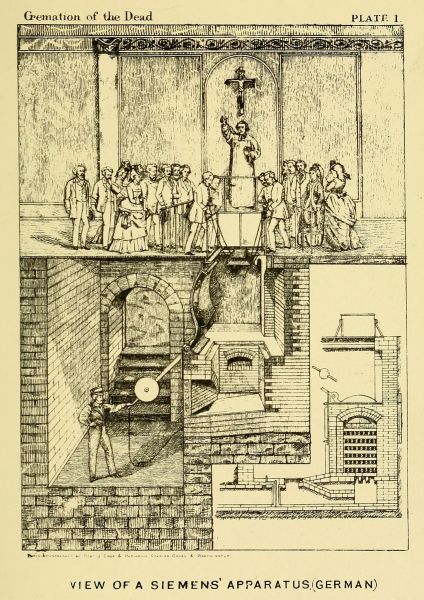
A description of a Siemens apparatus as constructed
for use in Germany is given by Professor Reclam in
an article entitled 'Die Feuerbestattung' in the
'Gartenlaube.' A sketch of it in action, partly copied
from this article, is given in Plate I.
It consists of (1) a gasometer for the manufacture of the
gas necessary to heat the furnace; (2) the furnace itself,
with a regulator and a space for burning; (3) a chimney to
take away the smoke &c. We may conceive a large, beautiful
dead-house built for the purposes of cremation. In the
midst, but invisible to those present, is a furnace. The
funeral procession arrives at the house, and enters it the
same as the churchyard is now entered. When the coffin
has been placed on the tressel, and the usual ceremony
ended, it is let down into the grave and disappears. In a
short time after it is let down the covering of the furnace is
removed, and replaced when it has received the coffin.
The process of cremation is effected by means of heated
air. The gasometer is put in action by the consumption
of coal, charcoal, peat, or wood. The gas thus produced
is conducted through a pipe provided with a regulating-valve,
where, meeting with a stream of air, also under regulation,
it is converted into a flame. This flame extends
through the room which has the regulator, so that the brick
material which is piled up there is heated to white heat,
and kept to this. The flame still continuing, supplies heat
till the furnace or place for the reception of the body is
heated to a weak red heat, when the flame escapes through
a pipe into the chimney.
As soon as the furnace is in the condition thus described,
the process of cremation goes on. The covering of the furnace
is removed by the man who superintends the burning
of the bodies. It is put back again, and the body subjected
to the action of the red heat for a longer or a shorter time,
according to its physical condition. After this is done the
gas-valve is closed, and the air in consequence goes through
the regulator into the place for burning. It is here heated
in the regulator nearly to red heat, in which condition it
comes to the bodies already, in some measure, dried, so
that decomposition soon follows. The bones are decomposed
by the action of the heat, while the carbonate dissolves,
and the lime remains as dust. To collect this dust an instrument
is provided, that it may be placed in a jar, or
any other vessel, and preserved by the relatives of the
deceased.[186]
The most perfect apparatus, however, yet devised
for the reduction of a body to ashes is that adopted by
Sir Henry Thompson. From his work upon cremation
I take the following description, which will be always
studied with interest. This extract will fitly conclude
these quotations.
A powerful reverberating-furnace will reduce a body of
more than average size and weight, leaving only a few
white and fragile portions of earthy material, in less than
one hour. I have myself personally superintended the
burning of two entire bodies, one small and emaciated, of
47 lbs. weight, and one of 144 lbs. weight, not emaciated,
and possess the products—in the former case weighing
1¾ lb.; in the latter, weighing about 4 lbs. The former
was completed in twenty-five minutes, the latter in fifty.
No trace of odour was perceived—indeed, such a thing is
impossible—and not the slightest difficulty presented itself.
The remains already described were not withdrawn till the
process was complete; and nothing can be more pure,
tested by sight or smell, than they are; and nothing less
suggestive of decay or decomposition. It is a refined sublimate,
and not a portion of refuse, which I have before
me. The experiment took place in the presence of several
persons. Among the witnesses of the second experiment
was Dr. George Buchanan, the well-known medical officer
of the Local Government Board, who can testify to the
completeness of the process.
In the proceeding above described, the gases which
leave the furnace-chimney during the first three or four
minutes of combustion are noxious; after that they cease
to be so, and no smoke would be seen. But these noxious
gases are not to be permitted to escape by any chimney,
and will pass through a flue into a second furnace, where
they are entirely consumed; and the chimney of the latter
is smokeless—no organic products whatever can issue by
it. A complete combustion is thus attained. Not even a
tall chimney is necessary, which might be pointed at as that
which marked the site where cremation is performed. A
small jet of steam, quickening the draught of a low chimney,
is all that is requisite. If the process is required on
a large scale, the second furnace could be utilised for cremation
also, and its product passed through another, and
so on without limit.
This plan, however, has been thrown into the shade
by subsequent experiments:—
By means of one of the furnaces invented by Dr. Wm.
Siemens, I have obtained even a more rapid and more complete
combustion than before. The body employed was a
severe test of its powers, for it weighed no less than 227 lbs.,
and was not emaciated. It was placed in a cylindrical
vessel about 7 feet long, by 5 or 6 feet in diameter, the
interior of which was already heated to about 2,000° Fahr.
The inner surface of the cylinder is smooth, almost polished,
and no solid matter but that of the body is introduced into
it. The product, therefore, can be nothing more than the
ashes of the body. No foreign dust can be introduced, no
coal or other solid combustible being near it: nothing
but heated hydrocarbon in a gaseous form, and heated air.
Nothing is visible in the cylinder before using it—a pure,
almost white, interior—the lining having acquired a temperature
of white heat. In this case the gases, given off
from the body so abundantly at first, passed through a
highly-heated chamber, among thousands of interstices made
by intersecting firebricks, laid throughout the entire chamber,
lattice-fashion, in order to minutely divide and delay
the current, and expose it to an immense area of heated
surface. By this means they were rapidly oxidised, and not
a particle of smoke issued by the chimney; no second
furnace, therefore, is necessary by this method to consume
any noxious matters, since none escape. The process was
completed in fifty-five minutes; and the ashes, which
weighed about 5 lbs., were removed with ease.
After such brilliant results—results at once expeditious,
cleanly, and economical—well might Sir Henry
Thompson challenge Mr. Holland[187] 'to produce so
fair a result from all the costly and carefully managed
cemeteries in the kingdom,' and safely might he
even offer him twenty years 'in order to elaborate the
process.'
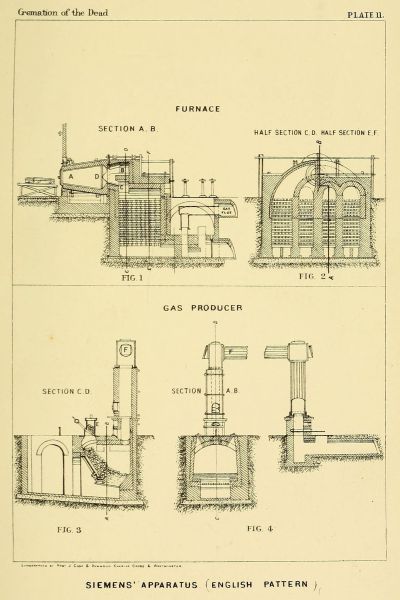
An ordinary Siemens' regenerative furnace for
cremation makes use of only hot blast, it being considered
that the organic substance to be consumed
would supply sufficient hydrogen and carbon, and
that only hot air is required to produce excellent
results. But a perfect apparatus would be constructed
upon the principle exhibited in Plate II., which represents
the cremation apparatus devised by Dr. C. W.
Siemens, F.R.S., of Westminster.
The body to be reduced to its elements is placed
in the chamber A (fig. 1), which is iron-cased and
lined inside with a substance able to resist the highest
temperature. Figs. 1 and 2 represent the consuming
arrangement, which may form a portion of the chapel
itself. Figs. 3 and 4 show the gas-producer, where
the gaseous fuel is produced, and this may be situated
at some distance from the building where the cremation
is performed. These gas-producers are not
only separate from the cinerator, where the heat is
required, but may be multiplied or extended, so as
to supply any number of cinerators, and so separately
reduce a plurality of bodies. At the back of the
heating chamber A are placed four firebrick-celled
regenerative chambers for gas and air, seen in section
at fig. 2, and these work in pairs. The gas carried
from the gas-producer is directed into the gas regenerator,
and the entering air into the air regenerator,
and in these regenerators both gas and air are heated,
attaining a temperature equal to a white heat before
they reach the chamber A in which the body is laid.
The heated air, after passing upwards through the
regenerator, enters the consuming chamber at B, and
the heated gas enters it at C. They thus enter the
chamber separately, and with a sufficient velocity
to impinge against the door of the chamber; but
when they meet at the point D in the chamber, the
gas and air mingle and add to the carried heat that
due to the mutual chemical action. The result is a
devouring flame. One pair of regenerators are always
employed in conducting the heated air and gas into
the chamber A, whilst the other pair are employed
in carrying away the combined gases or expended
fuel to the chimney. This expended fuel is nevertheless
an immensely hot flame, and on its way to
the chimney it proceeds downwards through one pair
of the regenerators, the upper portion of which it
heats intensely. Nearly the whole of the heat of the
expended fuel is left in the regenerators, and the
smokeless gases which enter the chimney to be cast
into the air rarely exceed 300° Fahr. By means of
valves the regenerators and air-ways which were
carrying off the expended fuel, can be instantly used
for carrying air and gas into the reducing chamber,
and the heat left in them consequently utilised. Not
only is a saving of 50 per cent. in fuel thus effected,
but the noxious gases from the body would be entirely
consumed in their passage down through the regenerators.
The gas-producer itself (figs. 3 and 4) works in
the following manner:—The coal is supplied to the
charging-box E every three hours or so, and slides
down an inclined plane, the upper portion of which
is solid and covered with firebricks. Upon this
sloping bed the fuel is heated, and its volatile constituents
are liberated, just as in a gas retort, leaving
about 60 per cent. of carbonaceous matter, the complete
combustion of which is brought about by the
air which enters through the open part of the grate
at the foot of the sloping bed. More carbonic acid
gas is now evolved, and this non-combustible gas
passes through the red-hot fuel, taking up in its
passage another equivalent of carbon, and so becoming
an inflammable gas, or what is called carbonic
oxide. Should it be considered advisable to make
use of steam, each cubic foot of which yields as
much inflammable gas as five cubic feet of air, a pipe
of water is allowed to run at the foot of the grate,
and is there converted into steam by the radiant
heat. The combustible gases now pass into the main
gas flue, and inasmuch as this gas flue must contain
an excess of pressure above the exterior air, so as to
prevent the inroad of atmospheric air into the gas
flue, and consequent partial combustion, the gas is
allowed to rise—which it will do by its initial heat—some
score of feet above the producers, and is carried
horizontally through the wrought iron tube F into
and then down into the furnace. The flat-lying tube
being exposed to the air causes the gas in its passage
through it to lose about 200° Fahr. of temperature,
which increases its density, adds weight to the descending
column of gas, and presses it on to the
furnace. One estimable feature in this system of gas-producing
is that the production can be arrested for
half a day without deranging the producer, the fuel
and brickwork being sufficiently bulky to maintain
a dull red heat for that period. Air cannot enter
the grate unless the gases given off in the producer
are withdrawn to the furnace; and when the gas valve
of the furnace is reopened, the production of the gases
is once more continued.[188]
It has been urged against cremation by sentimentalists,
that if the burning could be observed in even
an improved apparatus, the process would prove
a harrowing one, recall in fact to mind the horrors
described by the Comte de Beauvoir in his Indian
reminiscences.[189] But no such thing would result, for
whilst being consumed the body would remain of itself
perfectly motionless and without visible contraction
or convulsion. Several late human cremations which
have taken place in the Siemens Works in Dresden,
have been purposely witnessed by eminent scientific
men and others, through the glass panel of the door
which is always provided for the use of the manufacturing
operator, and the utter absence of anything
which could prove in the least distressing to the mind,
the eye, or the imagination, is vouched for by all.
The current of combined air and gas simply plays
upon the body with a transparent flame, until the
whole becomes incandescent. There is not even the
least effluvium. In a late experiment, when nearly a
quarter of a ton of animal matter underwent cinerary
treatment at Dresden, the gases between the flue and
the chimney proper were intercepted by an aspirator,
and found perfectly inodorous.[190] Once incandescent,
the body soon assumes a hue of translucent white, and
then speedily crumbles into ashes.
The quantity of ashes left from a body of average
weight has been foretold by Sir Henry Thompson
almost to the fraction of a pound. There is no doubt
whatever also that the time named by him as sufficient
for entire reduction will be borne out in practice. As
regards the cost of cremation, Sir Henry is most assuredly
correct in lauding its economy over interment.
The cost of the fuel expended during the last three
cremations in Germany did not exceed 3s., plus of
course the percentage to be charged for attendance,
and for the use of the apparatus, which latter would
be trifling were it in constant use. When the clerical
fees and all the costs of conveyance, &c., are added
thereto, the whole sum would not necessarily exceed
that of a seventh-class funeral in London.[191]
| Place | | | | Weight | Weight of | Cost | Time |
| of | Date | Sex | Age | of | ashes of | of | of | Authority |
| cremation | | | | body, | body | fuel | cremation |
| | | | | about |
| | | | | lbs. | lbs. | s d | min. |
| Padua | Mar. 10, | F | 35 | 116 | 6·00 | — | — | Brunetti |
| | 1869 |
| " | Jan. 20, | M | 45 | 99 | 3·06 | — | — | " |
| | 1870 |
| "[192] | May 15, | " | 50 | 90 | 4·06 | 2 4 | 85 | " |
| | 1870 |
| Breslau[193] | Sep. 22, | F | aged | 70 | 3·00 | 3 0 | 70 | 'Tageblatt' |
| | 1874 |
| Dresden[194] | Oct. 9, | " | 26 | — | 3·75 | — | 75 | F. Siemens |
| | 1874 |
| Same | Nov. 6, | " | 23 | — | 6 lbs. | — | 78 | " |
| apparatus[195] | 1874 | " | | | (with |
| | | | | | wood coffin) |
The above Table represents the details of six
recent human cremations.[196]
The body to be burnt would, in the first instance,
soon after death[197] be placed, perhaps, in a coffin of
some light material, and taken in due time to the
mortuary,[198] ready for conveyance to the 'cinerator.'
And, as it is very desirable that the ashes of the
body should be kept separate from those of any
coffin, a shroud of some imperishable material will
be carefully sought after by inventors. The ancient
Greeks made use of sheets of asbestos, which is a
fibrous form of hornblende;[199] and those of the
Egyptians who performed cremation enclosed the
body in a receptacle of amianth, which is a similar
incombustible mineral substance.[200] Whether these
materials will resist the intense heat of the Siemens
apparatus remains to be seen; for I have had no
opportunities of making experiments. Wood, at all
events, is likely to be rejected, on account of the
residue of carbon, &c. (charcoal), which might not be
easily separated from the more precious relics. Lead
would be equally objectionable, for, although easily
fusible, it possesses certain disadvantages easily to be
imagined. In all probability the most suitable material
for the inner coffin, which alone is to be submitted
to the impingement of the hot blast, will be zinc.
This metal would entirely disappear in the fierce heat,
the reason being that it is volatile, and would distil
off—its boiling-point being 800° Cent.,[201] or 500° Fahr.
below the minimum temperature which will reign in
the chamber of the apparatus.
The English and the German machinery for the
reduction of the body to ashes vary in a few particulars,
but the general construction is the same, as
will have been perceived. In one Dresden arrangement
the body is lowered into a receiver below,
and the idea of interment is thus in a manner preserved.[202]
In the English arrangement this is otherwise,
and the coffin is made to gradually slide into
the receiver, like a ship launched into water. The
anguish induced by the moment of departure is in
this way somewhat ameliorated, as there is no noise
of lowering-machinery to grate upon the ear. At
certain appointed words in our beautiful funeral service—for
instance, 'ashes to ashes'—a curtain might
be partially withdrawn, and the body, encased in a
suitable shell, would gravitate slowly into the chamber
of the apparatus, which would then immediately
close noiselessly; to be opened only after the due
reduction of the body. The utmost privacy would
be insured, and no strange eyes could gaze upon it[203]
during the period of incineration. The funeral service
could also be made to occupy the whole of the
time necessary for sublimation if it were so desired,
or a eulogy or other reference to the departed
might form the subject of a discourse. The ashes
could afterwards be collected, and reverentially placed
in an urn,[204] or other suitable receptacle, and conveyed
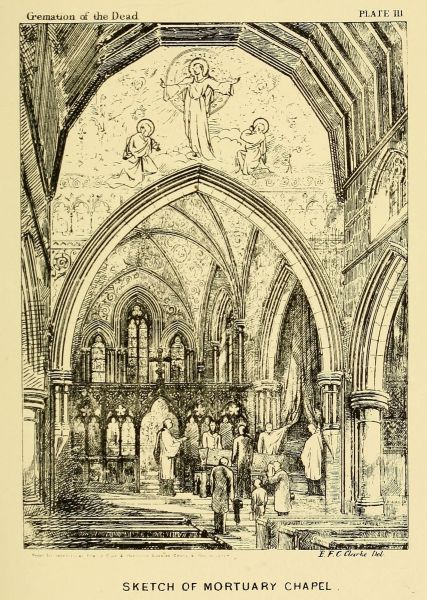
to their last resting-place. Plate III. represents a
view of a mortuary chapel, such as would probably
be required in a Christian cemetery; and the scene
there represented will serve to show how completely
decorous the procedure would be.[205] And one may
here remark that the great advances made by science
can nowhere better be evidenced than by a comparison
between the modern and ancient systems of
cremation. However well disguised in beautiful language—as,
for instance, by Bulwer in the 'Last
Days of Pompeii'—the barbarity of the method
practised in classical times will be sensibly felt in the
background.
It is likely enough that whenever cremation is
again practised, urns will form the chosen receptacles
of the ashes. Vases or urns have always been associated
with sepulture in classical times. The finest
vases which have come down to us from antiquity
were not originally intended for sepultural purposes,
but for the adornment of the mansion. Frequently,
however, these were deposited in the tombs along
with the unburnt body,[206] as being the objects most
valued by the deceased when living. The survivors
doubtless held it as sacrilegious to make use of these
favourite objects, for they are found unmolested even
now.
It is worthy of remark that amongst the Ojibois
Indians of the present day the canoe, gun, and
blanket, which are laid upon the grave of each one
of the tribe, although newly purchased, are never
made use of again, nor ever stolen.[207] Many other
Indian tribes observe the same custom;[208] and the
Moldavians and the Caubees as well.[209]
The custom of depositing the painted vases in
tombs ceased about the time when Italy and Sicily
fell completely under Roman dominion. The Romans,
who burnt their dead, deposited their ashes in urns, as
we have seen. No ashes, it may be said generally,
have been found in the Greek tombs of Italy, but
the Romans made use of the vases found in tombs
made by the Greeks there, as cinerary urns for their
dead; and this appropriation was not uncommon. In
the case of a member of the Roman family of Claudia
an ancient Egyptian vase, now in the Louvre, was
utilised in this manner.
The ancient painted vases are now divided into
six classes, embracing forty-nine various shapes.[210] The
styles are also divided into Early or Egyptian, Archaic
Greek, Severe or Transitional, Beautiful or Greek,
Florid, and into those of the Decadence period.
Should cremation be extensively adopted nowadays,
it is not unlikely that all these forms and styles will
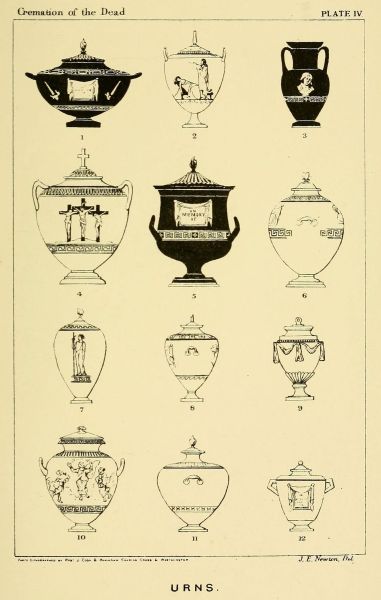
be laid under contribution. A friend[211] has kindly
drawn for the present work a dozen urns, adapted
for the reception of human ashes (see Plate IV.).
Fig. 1 is Archaic in shape; fig. 3 belongs to the
Perfect or Beautiful forms; and fig. 2 represents a
shape often used during the Florid era. The others
are original designs based upon classic lines, but not
referable to any one period. Some very elegant forms
of the ancient vases, copied from gems and other
archæological resources, are to be found embodied in
the monuments of the churchyards and cemeteries of
the present day.[212]
Had the practice of cremation followed uninterruptedly
down to our times, the receptacles for the
ashes would doubtless have been shaped according
to the prevailing taste of each period of architecture.
For instance, the genius of the Semicircular style,
which prevailed from the sixth to the twelfth centuries,
and embraced the Anglo-Saxon and Norman
periods, would have left its own peculiar mark, just
as it has done upon the fonts which were sculptured
during its sway. The Early Pointed, the Geometrical,
and the Decorated and Late or Perpendicular Gothic
periods would, in a similar manner, have influenced the
symmetry of the vases produced between the twelfth
and fifteenth centuries, and contributed their own
quota of beautiful shapes. And, speaking generally,
ecclesiastical taste, which presided over every detail of
church construction down even to the piercing of the
keys, would have been as easily recognisable in the vases
which contained the ashes of the dead.
It is impossible to prophesy in what direction the
taste of the future may wander as regards the shape
of cinerary vessels, but there can be no doubt whatever
that in many instances they will assume a distinctly
ecclesiastical character. The classic patterns of vases
and urns would be in excellent keeping with the
architecture of churches built after Greek and Roman
models; whilst they might appear otherwise if exposed
to view in the niches of the walls of a Gothic fane.
But it may fairly be predicted that the architectural
style of the church will have to bow to the varying
tastes of the worshippers, and just as we see in Westminster
Abbey—that beautiful example of the Early
Pointed style—the utmost diversity of taste in the
monuments which cluster upon its walls, so the walls
and vaults of our churches must necessarily accommodate
every type of fancy whenever cremation
resumes its sway. Cinerary vessels, in accordance
with revived mediæval taste, will probably predominate.
Some, it may be, will even assume the shapes of ancient
reliquaries.[213] There is no reason why these vessels
should not vary, in material and design, with the taste
or means of the relatives. Glass, precious metals, and
even gems, might with propriety be introduced. Urns
of gold and silver were not uncommon in ancient times,
and are even yet used in Siam.
With reference to the material of which cinerary
urns were formerly made, pottery was chiefly chosen
on account of the facility of manufacture, but they
were frequently constructed of marble, alabaster, and
glass. Perhaps the most beautiful cinerary urn in
the world was the Barberini or Portland vase, now in
the British Museum, and which contained the ashes
of the Emperor Alexander Severus. It was made of
blue glass upon which a coating of white glass was
overlaid, and the latter cut cameo fashion into a
number of emblematical figures. Glass was frequently
adopted in Italy for cinerary urns, and will probably
be the favourite material once more.
Besides the placing of the ashes of the dead in
urns, use was frequently made of small stone sarcophagi,
and these latter are found in several of the
ancient Greek burial-grounds in Anatolia. This will
possibly be the form adopted in the future, should an
interment of the ashes be chosen in preference to their
ennichement. But this is not to say that urns are
not equally suitable for laying in the earth if constructed
with that view. Probably both forms of
containing vessels will be patronised, just as was the
case in olden times. In ancient Dardanus stone sarcophagi
are commonly found, whilst at Batak, nearer
the supposed site of Troy, urns only were discoverable;
and yet the ornaments upon the smaller articles of
pottery, found in both sarcophagi and urns, were
identical in pattern, as far as I can recollect.[214]
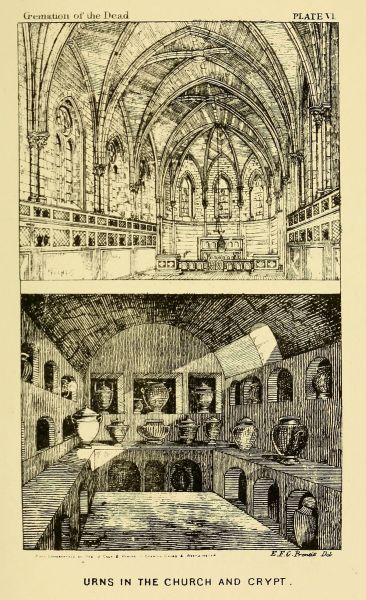
The cinerary urns of the Romans were for the
most part at one time placed in underground vaults,
the walls of which were pierced with arched recesses
for their reception, and, from the resemblance of the
numerous niches to a collection of pigeon-holes, the
place was called a columbarium. Two fine columbaria
can be seen at Rome, one in the Vigna Codini and
another in the Villa Doria. Should this system of
storing away the cinerary urns be adopted in our
churches, the crypts would for the most part resemble
the sketch given in Plate VI., which is an enlargement
and rearrangement of the columbarium given in
Westropp's 'Handbook of Archæology.' There can
be no doubt that this will prove the most popular
method of disposing of the urns in modern cities where
cremation is about to be practised. The catacombs
in our cemeteries, or what pass as such, will also
admirably enshrine the urns. It is not at all unlikely
that in some instances the walls of the churches themselves
will in future be constructed so as to receive the
remains, and bear some sort of resemblance to the
famous church at Cologne where the osteological
relics are placed around the fane.[215] But in the case
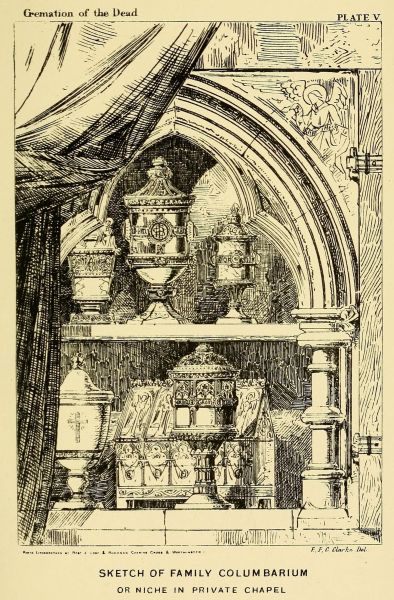
of urn sepulture the appearance would be far more
æsthetical. In all probability the wall spaces would
be apportioned out into family receptacles, and the
orifices closed with suitable metal gratings ornamentally
treated. I have furnished an imaginary
view of this kind of treatment at the upper part of
Plate VI.
My task is now completed; but before I lay down
the pen I would say to those who are desirous of
promoting the cause of cremation, Do so, within due
bounds, fearlessly. Do not believe that the practice
is in any way opposed to religion, for such a
belief has no anchorage in truth. And in order to
practically bring nearer to us the time when our
much-enduring mother earth shall no longer be
systematically poisoned, all those who are favourable
to the institution of cremation should forthwith put
into writing their desire that their remains shall not
be buried, but shall be consumed according to the
method of cremation best attainable.
If every individual promoter, male or female, of
fifteen years old and upwards—without reference to
the possession of property in any way—would, in view
of the uncertainty of life, place such a request in
his or her writing-desk, cremation would speedily
prevail. The change from burial will otherwise be a
protracted one, since few persons have enough strength
of mind to run counter to the general custom, fearing
the indignation of other relatives of the deceased. The
weakest persons, however, have still a greater repugnance
to doing anything contrary to the expressed
wishes of the dead. If, therefore, such a wish can be
exhibited, it will not only, as a rule, be religiously
complied with, but all friends, whatever their own
opinions, will be amply satisfied.[216]