BOSTON: RICHARD G. BADGER
TORONTO: THE COPP CLARK CO., LIMITED
Copyright, 1916, by Mary W. Williams
All Rights Reserved
The Gorham Press, Boston, U. S. A.
Made in the United States of America
TO MY FRIEND
ELLA MAY ADAMS
PREFACE
As every one knows, the mother land of the
American nation is England. But what is the
grandmother land? A short glance at England’s
past will show that it is Scandinavia. Though the
English people are exceedingly composite, there
exists in them a very important Scandinavian strain.
The Northern blood was contributed primarily by
two great immigrations directly from Scandinavia,
and one from Normandy, by people only a century
and a half removed from Scandinavia; but it should
be borne in mind also that the somewhat mysterious
Jutes, Angles, and Saxons, whose continental home
was in the peninsula of Jutland and about its base,
must have borne a very close relationship to their
contemporaries and neighbors to the north.
With the introduction of Scandinavian blood came
Scandinavian manners and customs which made an
impress upon the English population only recently
recognized.
Of the various parts of Europe which contributed
elements to the English people during their formative
period, Scandinavia is the only one whose population
has remained relatively pure and in the original
home, unjostled and unmixed by foreign invasions.
Thus it happens that the English people are
more closely related to those of Scandinavia, in
blood and in manners and customs, than they are
to the inhabitants of any other European country.
Hence, Scandinavia is the grandmother land of the
American people.
We know the English fairly well, but with the
Scandinavians, who have more in common with us
than any other Europeans except the English, our
acquaintance is of the slightest. Books in plenty,
descriptive of present-day Scandinavia, are in existence,
but they somehow fail to present the Scandinavians
as definite personalities. My aim in writing
this narrative has been to introduce to my fellow
Americans in as intimate manner as possible their
Scandinavian kindred, who are still living in the
ancient ancestral homestead—the Grandmother
Land. In my efforts to establish a real acquaintance
between the branch of the family which has wandered
and that which has remained at home, I have
purposely omitted the more conventional and more
obvious part of my experiences in Scandinavia in
order to give place and emphasis to the homely details
which help to bring out the characteristics of
the Scandinavians and their home land, and to show
them as they really are.
In the preparation of this book I have received
aid of various sorts from many people—so many
that to list the names of all to whom I feel indebted
would be a most perplexing undertaking. Consequently,
I make only this general acknowledgment
of obligation.
Mary Wilhelmine Williams.
2207 N. Charles Street,
Baltimore, Maryland,
May 28, 1916.
Here I am at last, all safe and sound, in the land
of the Viking—the land of my ancestors. In fact,
several days have passed since my wandering feet
first touched Danish soil; but I have been so absorbed
with my initial explorations of this snug little
country, which is still “home” to my mother, that
I have been neglecting my own home and friends
in the dear Far Western World.
Last Friday morning I left Kiel for Korsör,
which is upon Seeland, the largest island of Denmark.
A glorious, cloudless sky was overhead;
and the Baltic about us was a vast, shimmering, rippling
liquid plain of changing blues and greens over
which our boat, the Prince Sigismund, smoothly
and rapidly passed. About two hours after leaving
Germany I secured my first glimpse of Danish territory;
Langeland (Long Land), with low, white
cliffs—modest imitations of Shakespeare’s “pale and
white-faced shore”—loomed up on the left. Our
boat kept close enough to the island to give us a
good view of the rolling coast, marked off in patches
of light fields and dark forests, with here and there
glimpses of quaint farm houses and windmills of
the “Dutch” variety. To the right, faint and far
away, was a misty suggestion of the cliffs of Laaland
(Low Land), a larger island of the Danish archipelago;
but so like Langeland did its vague outline
appear as to seem the very ghost or double of it.
While we were still passing between these two
southern outposts of Denmark, luncheon was announced.
Some of the passengers promptly went
below to the dining salon, but many had their refreshments
served on little tables on the open deck.
I was among the latter. Most of the people about
me were evidently Germans going to Denmark or
Danes or other Scandinavians returning home after
visits of business or pleasure in Germany. To them
it was a voyage frequently made, and they preferred
the deck to the dining salon merely because it was
pleasanter. But to me, an American of Scandinavian
parentage, it was such a very important occasion
that I was determined to see as much as possible,
during this first view, of the land in which, for centuries—for
thousands of years—my forefathers and
foremothers had lived and died.
The part of the Baltic which separates the island
of Fünen from the island of Seeland, upon which
Copenhagen is situated, is called by the Danes “Store
Baelt”—the Great Belt. As I have told you, for
my crossing, the waters of the Great Belt rippled
charmingly under the gentle stroke of the summer
breeze; and the islands beckoned invitingly to the
front and the left and the right. This seascape and
landscape was as different as possible from the mental
picture which the name Great Belt had long summoned
to my mind. Since studying Scandinavian
history I had most frequently thought of the strait
as heavily bridged with ice, and of the Danish
islands as paralyzed under the dominion of the Frost
King. For this was the state of affairs one February
day two hundred and fifty odd years ago. And
the bridge of ice was so strong and so thick as to
tempt Charles title="the tenth" of Sweden—who had been recently
moved to make a belligerent call upon his nearest
neighbor to the south—to march several thousand
horse and foot soldiers over the bridge, via the
smaller islands to the right hand, and to threaten
the Danish capital. In consequence of the Swedish
king’s pressing attentions, Frederick III of Denmark,
who had been to a considerable extent to blame for
the quarrel, decided to buy peace by means of the
treaty of Roskilde. This gave to the Swedes a half
dozen Danish provinces, including some in the southern
part of the present Sweden, which had long
been Danish soil.
It soon became evident, however, that Charles intended
to make use of the army which he maintained
in Denmark for the purpose of wringing still further
concessions from his humiliated neighbor.
Naturally, Denmark did not agree to the new demands
with the desired alacrity, and King Frederick
declared that he would die like a bird in its nest
rather than surrender to Charles. Whereupon the
Swedish king vowed that he would wipe the Danish
nest off the map, and soon had laid siege to Copenhagen.
But the Danish people worked as one
man and helped save their capital by hurling upon
the enemy an avalanche of artillery fire, stones, and
hot water. Much aid was also given to the Danes
by the Dutch fleet, which slipped past the Swedish
guns guarding the Sound to the north and arrived
in time. Soon the tables were turned. The Swedes
were defeated and driven out of the land, and in the
end Denmark recovered some of the territory which
she had lost. And little Denmark still stands, somewhat
pared away, to be sure, in the course of the
centuries by one enemy or another, but with the
great heart of her—the most Danish part—still intact
and still beating, an independent nation of busy,
healthy, happy people.
While I was still meditating upon Charles X’s
crossing of the Great Belt and the exciting events
which followed, the Prince Sigismund slipped swiftly
into the harbor of Korsör, a place rimmed with
low-built, cosy-looking houses. As soon as we
landed, a giant in buttons and bars “shooed” us into
the customs house. He was a giant of the harmless,
friendly sort, and as soon as the inspection of
my baggage was over he hunted up a porter for me.
The porter was a blond, guileless-appearing individual,
possessed of astonishingly modest ideas of
his own worth. He weighed my trunk and put it
on the Copenhagen train, carried my two suit cases
to an “ikke-röge” (smoking not allowed) compartment
of the same train, and then announced the
charge for his services to be ten öre—less than
three cents!
The train which I boarded, like most passenger
trains in Europe, was divided into compartments for
accommodating about six people, each compartment
opening into a narrow corridor running the whole
length of the car. The compartment in which I
rode was third class, but it was very clean and was
quite satisfactory for a short journey. The seats
were not upholstered, but they were more comfortable
than the average church pew. On the walls
were several attractive photographic views of Danish
landscapes, and a map of Denmark. There was
also the customary notice prohibiting spitting upon
the floor. My only companions in the compartment
were a rosy-cheeked Danish mother and two chubby,
blue-eyed little boys. Each of the little chaps had a
tiny shovel and a tin bucket, still bearing traces of
sand. They had evidently spent the day at the
beach.
As the train rolled placidly along, I had pleasant
glimpses of Seeland through the car window. The
otherwise monotonous level of the land was broken
by the variety of color and form: there was a constant
alternation of dark forests and light fields, of
thatched-roof farm houses and huge windmills; and
occasionally there appeared men and women cultivating
the crops. Now and then we passed through
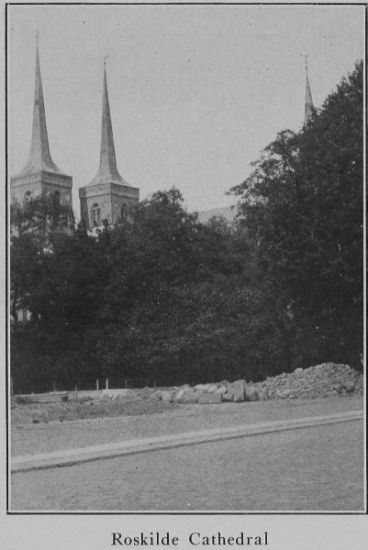
a town, and in one of them, Roskilde, I obtained a
view of the spires of the fine old cathedral towering
above the tops of the trees clustering around it, and
far above the broad red-tiled roofs of the houses in
the foreground. I shall visit Roskilde upon my
return.
Soon we were at our destination. It took just two
hours to pass from Korsör to Copenhagen—to cross
Denmark’s largest island; and the fare which I paid
was the equivalent of eighty-five cents in American
money—about one-third of what it would have been
if I had come first class. To an American used to
the long transcontinental journey in her own land,
Denmark seems so very, very tiny.
As you doubtless know, I have cousins in Copenhagen,
but I did not write to them of my intended
visit because I wished to make my first acquaintance
with Denmark’s capital by independent exploration;
therefore, at the Central Station I took
a drosky for a hotel. And at the hotel I secured a
comfortable room, supplied with a generous portion
of windows and furnished in blues and greens and
browns blended according to Danish ideas of the
artistic. My exploration of Copenhagen began with
my bed-room. I wish that you could see my bed and
my stove, Cynthia; they are marvels to American
eyes. The bed is a veritable mountain of feathers;
whole flocks of geese must have contributed their
substance toward its construction. Not only are
there several strata of feather pillows upon which
to lie, but the coverlet is also of down, puffy and
fluffy, and of smothering thickness. At night I cast
most of the components of the bed in a heap upon
the floor, cap off the pile with the coverlet, and sleep
in peace under the top sheet and the steamer rug
which I purchased in New York. It is not a bad
plan to carry along one’s blankets when one is traveling.
When, as a child, you read the story of the “Princess
and the Pea,” didn’t you feel that Andersen
stretched the truth a little in his solemn assertion
that the old queen put twenty mattresses on top of
the pea, and twenty eider-down beds on top of the
mattresses? I certainly did; but I doubt no longer.
Since, in these modern times, a hotel bed for plain
folks contains the number and variety of mattresses
and feather beds which mine does, I am willing to
believe that in times past on an extraordinary occasion
Denmark’s queen used an unlimited quantity of
downy layers in making up the royal “spare bed.”
Whether or not the true princess felt the pea through
the forty-strata mountain is another question.
The Danes call heating apparatuses like the one
in my room a “kakkelovn,” and they show discrimination
and taste in doing so; no such simple word
as “stove” could adequately indicate the dignity and
majesty of the structure which fills the corner of my
room from floor almost to lofty ceiling. The edifice
bears a striking resemblance to the picture of
the Tower of Babel which appeared in the “Child’s
Bible” of my juvenile days. Though its proportions
are slimmer, its general style is the same; a series
of stories—each one slightly smaller than the one
next below—mount ambitiously skyward. Far above
my head is the summit, crowned with a shining
nickel ornament, and near the base is a door opening
into the fire-box. There is enough cast iron in
the tower to make several fair-sized American heaters.
The days since my arrival have been so balmy
that the giant stove has not been called upon for
service; but I gladly warrant its efficiency, for it
bears a strong family resemblance to a more modest-appearing
structure called a “kachelofen,” which
kept my room in Germany comfortable last winter
in the worst below-zero weather. These “kakkel”
stoves are lined with brick and retain the heat remarkably
well. They are a vast improvement upon
the English open-grate fire which permits one to
freeze on one side while he roasts on the other.
On the very afternoon of my arrival, without
even stopping to unpack my suit-case, I took a walk
about Copenhagen. I just could not wait; all of the
sights and sounds which came to me through my
wide-open windows seemed to blend into one distinct
personality and to call to me to come forth and
become acquainted. Copenhagen has decidedly the
most distinct personality that I have ever sensed in
any city. This interesting capital seems very old
and very wise, but not too old and not too wise to
sympathize with youth and unwisdom. It is like an
ancient lady with silvery hair and strongly-lined
face, who yet has warm red blood pulsing through
her heart and a merry twinkle in her blue eyes; a
very charming dame, Cynthia, and altogether lovable.
Once out upon the streets, moving along with
the pedestrians, I felt quite at home. I was no
longer a stranger in a strange land.
Perhaps the fact that familiar words met my ears
was the chief element in my sense of homelikeness.
My ability to understand Danish and to speak it—after
a fashion—contributed much toward placing
me upon a friendly basis toward Copenhagen. But
the Copenhageners’ knowledge of English was also
a tremendous help. An astonishing proportion of
the population speak English. Most of the younger
half have studied it in the schools; and some have
become acquainted with the language through residence
in England or the United States. I promptly
met one of the latter group. A short distance down
the street I noticed some large red gooseberries of
a variety which is edible raw. I have never seen
them in the United States, but became fond of them
in Germany; so I wanted some. As I could not remember
the Danish name for the fruit, I simply
pointed to it and asked for ten öres’ worth. While
measuring out the berries, the salesman surprised
me by asking, in good English, “What is the English
name for these?” I told him, and he evidently
promptly catalogued me as an American experimenting
with the King’s Danish; for he proceeded to remark
that he had seen berries of somewhat similar
appearance in “the States,” where he had spent a
few years. I replied that it was pleasant to find
people in the shops who could speak English.
“Sure!” said he, whereupon I was quite convinced
that he had been in “the States.”
Until the middle of the twelfth century the place which later became
Denmark’s capital was but a small fishing port. Facing, as it did,
the Baltic, which was at the time infested by the piratical Wends,
whose homes were on the southern shore, this portion of Seeland was
very open to attack; and probably was also frequently a resort for
sea-robbers. But a change came soon after the great warrior-priest,
Axel—or Absalon, as he was later called—was made archbishop of Lund.
This was in the stirring days of King Waldemar the Great, and the
frontier bishop’s office was far from a sinecure; repeatedly, Absalon
interrupted services at the altar in order to seize the sword and
to pursue the enemies of his land and his religion. And eventually
the struggle ended by the conquest of the Wendish heathen and their
conversion to Christianity. But before this, Copenhagen was founded.
During his campaigns against the Wends, Absalon strongly fortified the obscure little fishing
port. At first the stronghold bore the name Axelshuus, or Absalon’s
House, but as time passed the important commercial town which grew up
around it came to be called “Kiöbmaenshavn,” which in Danish means
“Merchants’ Haven.” Copenhagen is merely the English corruption of the
modern Danish name, Kiöbenhavn.
The name of Bishop Absalon, as you see, is one
which is written large in Danish history; and, in the
long centuries which have passed since his day, Copenhagen
has not forgotten his services. Close to
the Island of the Castle, or Slotsholmen, on which
once stood the fortress erected by him, is a conspicuous
equestrian statue of Absalon; and on guard
over the entrance to the new town hall, or Raadhuset,
is another sculptured figure of the great Dane
who went forth with the cross in one hand and the
sword in the other.
But to my thinking, at least, Denmark’s prehistoric
past is of more interest than her early Christian
history. Consequently, I went, the day after my
arrival, to the National Museum. This is in the
heart of the old Copenhagen, just opposite Slotsholmen.
The building which houses the national
collection was first erected in the seventeenth century;
and it was rebuilt in 1744, as a residence for a
Danish prince, for which reason it is still called
“Prinsens Palais.” About sixty years ago it was
converted into a museum; and, though it is a homely
old structure, the Prince’s Palace is spacious and
well lighted, and hence is well suited to its present
use.
On the walls of the courtyard are memorial tablets
to Rasmus Nyerup and to Jens Jacob Asmussen
Worsaae, the founder of Danish archæology. To
see these tablets was like coming across mementoes
of old friends; for Nyerup and Worsaae have done
much toward making rough ways smooth and
crooked paths straight for all who care to learn
what the ancient Scandinavians were like. And
within the vestibule of the building stands a marble
bust of Christian Jürgensen Thomsen, the man to
whom Denmark is most indebted for bringing together
the collections exhibited in the museum.
But it is neither Nyerup, Worsaae, nor Thomsen
to whom belongs the final credit for Denmark’s pre-eminence
in things archæological. That must go to
the Danish people, whose unusual interest has been
indispensable in making the national archæological
exhibit the most complete possessed by any nation,
except Norway and Sweden. But there is no mystery
connected with the Scandinavian zeal for things
prehistoric; it has a sound historical basis, which is
akin to family pride. No other peoples of Europe
have so long held the soil now occupied by them as
have the Scandinavians. In fact, the ancestors of
the modern Scandinavians reached the northwest of
Europe even before they were Scandinavians; it was
only during the long centuries following their arrival
that they acquired the physical and mental
characteristics which distinguish them from other
peoples of Teutonic stock. When my pre-Scandinavian
forefathers and foremothers came into the
present Scandinavian lands, a thousand years or so
before the birth of Christ, they were in the New
Stone Age of culture. And while nations rose and
fell in other parts of Europe—while Celt fell before
Roman, and Roman before Teuton, and Teuton
before Saracen and Slav—the people who were
becoming Scandinavians remained isolated in their
northern land, frequently quarreling among themselves,
it is true, but unjostled and uninvaded by
alien blood. Consequently, to the modern Scandinavians
practically all archæological remains found
in the land seem almost ancestral relics, and, naturally,
they take a tremendous interest in them.
The exhibits are arranged in the museum in chronological
order, beginning with the Old Stone Age,
and visitors are expected to follow Denmark’s cultural
development progressively. I know, because
I unwittingly entered first one of the rooms containing
exhibits from the late Middle Ages, and the
vigilant guard courteously but firmly showed me to
the door on the opposite side of the vestibule. I
was not to be permitted to get an inverted idea of
Denmark’s past, even if I wished to do so.
The earliest part of the Old Stone Age in Denmark
is represented in the museum by a section of
a kitchen midden, or shell mound. The primeval
settlers of Scandinavia did not live in the days of
patent garbage cans and incinerators; hence, after
a feast of raw or baked clams or oysters on the half
shell, they dumped the shells upon the community
refuse heap—and thus were saved dish-washing.
When they feasted on mammals and birds, the
bones were thrown upon the same garbage pile; but
the middens are mostly made up of shells, for shell
fish—especially oysters—were wonderfully abundant
in the Baltic in the Old Stone days, and could be had
for the digging.
I was particularly interested in this bona fide,
primitive Danish garbage heap because a few years
ago I saw a midden of the same general character,
left by the ancestors of the American Indians, when
they were at the same stage of culture as the makers
of the Danish shell mounds. Perhaps I have told
you before of the midden which I saw in California.
It was near Point Richmond, on the shores of San
Francisco Bay; but as the land on which it stood has
long been sinking, it had been partially carried away
by the waves. On the other hand, since the coast of
Denmark is rising, many of the Danish middens are
now far inland. But the two kinds of prehistoric
garbage heaps bore a striking resemblance to each
other; both were made up largely of shells, interspersed
here and there with bones.
Until the middle of the last century, the world
believed that the many heaps of shells, mixed with
bones, found here and there on the coasts of Denmark,
were merely due to the in-wash of the sea
waves. Professor Worsaae it was who discovered
their true origin. In 1850 he proved them to be of
human formation. Though this seems a very simple
discovery, it was a very important one in archæology,
for it explained similar mounds in other parts
of the world, and it led to a most careful investigation
of the Danish middens, resulting in the disclosure
of fragments of weapons and utensils which
threw light upon a people whose one-time existence
the Danish archæologists had hitherto not even suspected.
But though we are introduced familiarly to their
garbage heaps and to a few of their personal belongings,
much uncertainty exists regarding the midden-builders
of Denmark’s Old Stone Age. We
know, to be sure, that they probably lived in huts of
boughs and skins, or in caves; that their food was
fish and game, with perhaps roots and berries; that
they could manufacture a very rough sort of pottery;
that their weapons and implements were of the
most crudely-worked stone. But of how these ancients
themselves appeared, whence they came, and
whither they went, we know nothing. It seems
pretty certain that they were a different people from
the ancestors of the modern Scandinavians. Indeed,
some scientists have suggested that the midden people
were members of the yellow race, probably related
to the Eskimo, or to the Lapp. And in the absence
of proof this theory will do as well as any
other.
The people from whom the Scandinavians evolved
came later, as I said before—in Denmark’s New
Stone Age. It would be more accurate, I presume, to
say that they brought the New Stone Age with them;
for when they reached the Scandinavian cradle-land
they already knew how to chip stone into accurately
shaped implements and weapons, and how to
put on a finishing polish when the proper shape had
been obtained. However, these early immigrants
learned much in their new home about working in
stone, and in Scandinavia the New Stone period attained
unusual perfection. This was because the
isolation of the region delayed the introduction of a
knowledge of work in metals. With all due respect
to the Neolithic Danes, I feel bound to remark that,
given a sufficiently long period of apprenticeship and
a reduction of the number of distracting and discouraging
elements, most people would be able to
reach a high standard.
Nevertheless, when one wanders through the archæological
collection one becomes quickly convinced
that these primitive Scandinavians were master workmen.
On the shelves behind the glass doors are
extensive exhibits of stone hammers and axes and
other objects, in a great variety of graceful and
beautiful patterns—wonderfully symmetrical where
symmetry was aimed for, and with a smoothness of
finish that has resisted the vicissitudes of thousands
of years. In those early handicraft days such work
was an art as well as a science; and surely the craftsmen
loved their labor, else they could not have exercised
the patience necessary to the attainment of
such excellence. When I remember how simple must
have been the tools with which they wrought, I
swell with pride over the skill of my Stone Age ancestors.
As the use of bronze in Denmark supplanted the
use of stone, as a material for the manufacture of
implements and weapons, so the exhibit from the
Bronze Age, in the National Museum, comes next
after that from the New Stone Age. In one of the
rooms in which the early Bronze Age finds are displayed
are the life-sized dummy figures of a man
and woman, dressed in the costumes of the time—in
garments of sheep’s wool, mixed with deer’s hair.
I was tremendously impressed to find that my great-grandparents
of three thousand years ago actually
wore woven garments—of simple pattern, it is true,
but woven garments, nevertheless. Before visiting
the Early Bronze room, I must have had a vague
impression that at this period my forbears clad themselves
in the skins of wild beasts—like Adam and
Eve and Robinson Crusoe.
Lest you skeptically conclude, Cynthia, that the
accouterments of the lady and gentlemen in the
Early Bronze room were merely highly glorified
reproductions of imaginary primitive costumes, I
beg to assure you that the garments are faithful
copies, both as regards style and material, of clothing
found in graves belonging to this ancient time.
Isn’t it astonishing that such things should have been
preserved through the stretch of centuries? But it
was due to no miracle. The coffins were made of
roughly hewn and hollowed-out trunks of oak trees,
and the tannic acid in the bark preserved not only
the coffins but the clothing and other articles buried
with the dead.
Thanks also to the fact that the ancient Scandinavians
were careful to supply their dead with the
necessaries and luxuries of the time, in order that the
departed ones might live in comfort beyond the
Great Divide, I was able to learn something about
their knowledge of the decencies of life. For instance,
I found that “in the flesh” they used horn
combs, and that they expected to use them beyond
the Divide. It is such a comfort not to have to picture
them with matted, tangled locks!
But by the Later Bronze Age the Scandinavians
had become sufficiently advanced to burn their dead;
consequently, the graves of this period throw less
light upon their costumes and habits. The bronze
articles, however, which the fire could not harm,
show the same perfection of workmanship and the
artistic beauty which one would expect to find in the
descendants of the people of the Scandinavian New
Stone Age. And like this age also, the Bronze Age
was prolonged in Scandinavia; iron did not come
into general use until four or five centuries before
Christ; hence, the Scandinavians again had time for
the practice which makes perfect.
In the exciting days of the later time when the
piratical raids of the Vikings caused the nations to
the south to pray “Protect us, O Lord, from the
fury of the Northmen!” simple burial was again
introduced, but cremation was not completely abandoned.
The return to the more primitive method
of disposing of the dead was, I suppose, due to imitation
of Christian practice; for Christian observances
had a strong modifying influence in Scandinavia
long before Christianity itself was adopted
there. It was undoubtedly imitation of their Christian
neighbors which led the Scandinavians of the
late Viking period to engrave runic inscriptions upon
the previously bare stones erected over the graves of
the dead. But in the epitaphs the spirit of the departed
was commended to the protection of the warlike
Thor, who was at that time the favorite god of
the North, and not to the gentle Christ. Such
heathen grave stones are found in abundance in the
museum. Another Christian practice which got the
attention of the Scandinavians was the wearing of
the cross and the crucifix as emblems or charms; in
the pagan North this custom seems to have produced
an enthusiasm for Thor’s hammers, which were
worked into ornamental patterns in jewelry and were
also worn about the neck in the form of little silver
pendants.
Upon my first visit to the National Museum, I
decided that I should like to take photographs of a
few of the objects there. An American gentleman
residing in Copenhagen whom I consulted about the
matter intimated that it was very doubtful whether
I would be permitted to use a camera in the building;
and he advised me to repeat my request through the
American minister to Copenhagen, if the powers at
the museum remained obdurate after I had personally
approached them upon the subject. In consequence
of this hint of coming difficulty, I armed myself
with all of the documents in my possession calculated
to prove me a responsible and respectable
person, and set forth. At the museum I asked to
see the director, and was promptly piloted by a
guard through what seemed an endless series of corridors
and passageways to the office of the Formidable
One. I expected to see a Dane of grim appearance,
curt manners, and an iron jaw. But the Herr
Direcktor was far from that; he was a mild, absent-minded,
somewhat frowsy-looking gentleman who
would scarcely frighten a mouse. In spite of my
surprise and relief, I preserved sufficient presence of
mind to blurt out my request, at the same time placing
my letters of introduction, passport and diplomas
in a jumbled heap upon the table before him.
The Power behind the National Museum gazed
blankly and absent-mindedly at the pile of documents
for a few seconds, and then asked, “What are
those papers?”
“They are my credentials,” said I.
“Credentials? I do not care to see your credentials,”
said he. “Take all the pictures you want.”
And I did. Wasn’t the Herr Direcktor a nice
man?
I have since learned that the Scandinavian people
are surprisingly generous and helpful toward all
serious students who come to their land for the purpose
of working in their libraries and museums.
They are honest themselves and expect honest treatment
from others, and generally receive it, too, I
think, else they would hardly continue their liberal
policy.
But I fear that I may have bored you with my
ramblings in archæological fields, haunted by the
ghosts of ancient heathen Scandinavians. By way
of variety, you might like to hear about my visit to
“Runde Taarn” (the Round Tower), which is above
ground, and modern and of Christian construction.
No pun was intended, but it happens that the tower
was really built by Christian IV of Denmark, who
lived in the early part of the seventeenth century. It
was originally erected for an astronomical observatory
and—together with an important library—was
connected with a church, built at the same time,
which was given the doubly significant name, Church
of the Trinity.
For a short time Tycho Brahe, who, because of
his birth in southern Sweden in the days when it was
controlled by Denmark, is claimed by both Swedes
and Danes, worked in the observatory. Tycho had
received much kindness at the hands of Frederick
II, Christian’s predecessor, but it soon was evident
that the new ruler, great though he was in many
ways, did not appreciate the genius of the astronomer,
and not only cut off the pension which had been
granted to Tycho by the late king, but also forbade
him to continue his investigations. Before this,
Tycho Brahe had gained the hatred and contempt
of the nobility, to which rank he belonged, by daring
to do anything so useful as to study astronomy;
he had been ostracised by his family as a result of
his marriage with a peasant girl; and had roused the
jealous indignation of physicians by free medical attendance
upon the poor. Now, when his king turned
against him, the astronomer shook the dust of unappreciative
Denmark from his feet for good and
all, and went to Germany, where he taught the German
astronomer Kepler, who became greater than
he. Kepler’s teacher, however, will be long remembered
not only because of the fundamental discoveries
which he made, but also because his name is
fixed in the sky. Perhaps you will recall that in the
old normal school days when I gave “astronomy
parties,” one particularly large lunar crater stared
down at us through the telescope like the eye of a
Cyclops. That one is named Tycho, for the Scandinavian
astronomer, Tycho Brahe.
Though Tycho Brahe went, the Round Tower
stayed on; and it was used for astronomical purposes
until about fifty years ago. It might have been
so used still, except for its popularity as a general
landscape-gazing observation tower, in spite of the
opposition of the professors, who finally abandoned
it for purposes of investigation.
The top of the tower is reached not by a spiral
staircase, but by a wide spiral roadway of brick,
deeply grooved by the carriage wheels of celebrities
who drove to the top in days gone by. Peter the
Great, for one, seems to have found the ascent of
Runde Taarn a favorite amusement when he visited
Denmark. It is stated that when he made his last
ascent it was in a coach drawn by six horses, and
that Queen Catherine sat at his side and held the
lines. Until recent years also, in accordance with
time-honored custom, newly confirmed children
climbed to the top of the tower for a view of the
surrounding land; thus they celebrated their formal
entrance into manhood and womanhood, and thus
they were introduced to the world in which they
were thenceforth to play a larger part.
With the coming of the flying machine, however,
and other devices for producing more exquisite
thrills, Runde Taarn was left pretty much to the ordinary
tourist, who pays his ten-öre entrance fee and,
like myself, climbs laboriously along the worn roadway
to the top. But once up there under the fluttering
folds of Dannebrog, the beautiful red and
white flag of the Danes, your tourist—meaning myself—gazes
out over the city feeling fully rewarded
for her exertions. For the view is a splendid one
and reveals practically all of the famous buildings of
the city, with their peculiar towers and domes, spires
and steeples, as well as the parks and boulevards
interspersed between, and the harbor with its many
ships, and the Sound beyond.
Around the edge of the platform at the top of the
tower are double railings. The inner one, I learned,
was put up in the 1890’s, during a suicide epidemic.
Before it was erected several melancholy Danes had
taken arms against a sea of troubles and had ended
them by a flying leap over the solitary railing. Now,
such a spectacular termination of one’s earthly career
is no longer possible.
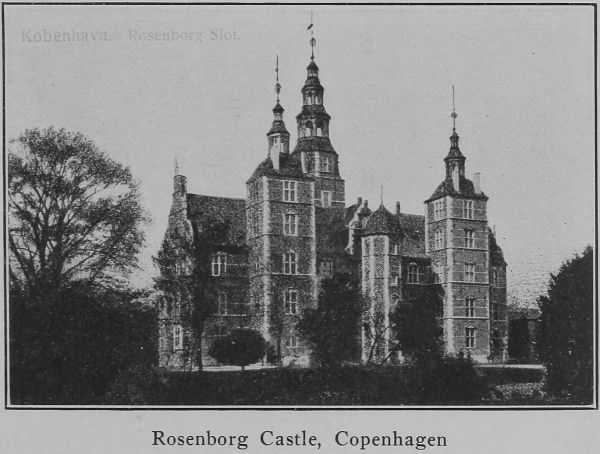
Another monument to Christian IV’s interest in
building is the Castle of Rosenborg. Formerly this
royal residence was well outside of Copenhagen, but
during the centuries the city has grown to such a
degree that now the beautiful royal park and castle
are in its very heart. Perhaps it was the magic of
the day of my visit to it which lent Rosenborg part
of its fascination; for the sky was of the clearest
blue and the sunshine was wonderfully golden. Yet
the castle itself, irrespective of the day, looked just
like the castles in all proper fairy tales. With its
red brick walls outlined in Renaissance softness, it
stood in its setting of grass and trees, looking indescribably
“homey” and inviting. About it clustered
the great rose gardens blooming so triumphantly
and invitingly that as I approached across the park I
felt a stranger to my recent self. It seemed as if
fairy tales might be true, or as if I myself might be
a child in a fairy book.
But to cross the threshold was to be disillusioned;
for Danish kings and queens and gallant knights
and ladies fair no longer dwell within. The castle
is a museum; since 1863 it has been the repository of
the “Danish Kings’ Chronological Collection.” And
royal “old clothes,” though sometimes interesting,
are incapable of working enchantment. The collection
of relics at Rosenborg, however, is one of the
richest in Europe, and is exceedingly varied. In it
one may find royal souvenirs ranging from the lock
of hair of Christian I, who lived four hundred and
fifty years ago, to the couch upon which the late
Christian IX was in the habit of taking his noonday
nap.
Rosenborg Castle, Copenhagen
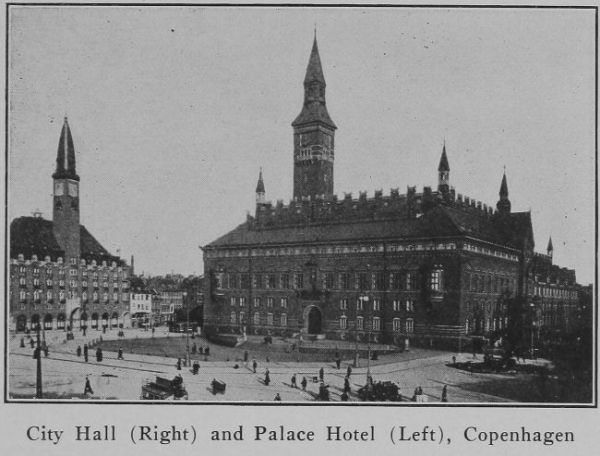
City Hall (Right) and Palace Hotel (Left), Copenhagen
Before telling you about the collection more fully,
however, I wish to explain to you the time-honored
custom of naming the Danish kings, lest you become
utterly bewildered among the Christians and Fredericks.
The system is really a very simple one; for,
since the accession of the Oldenburg house to the
throne four hundred and fifty years ago, all of the
kings—with one single exception—have been Christians
or Fredericks, appearing alternately. The exception
was the son of Christian I who ruled as
King Hans. Ideally, he should have been named
Frederick, for his successor was Christian; but, as
it was, the Christians got the start of the Fredericks
by one reign; so the late Christian IX was succeeded
by the late Frederick VIII. And I suppose
that henceforth even to the end of Danish kings the
alternation of Fredericks and Christians will continue.
Every Christian and every Frederick is, I presume,
represented at Rosenborg by at least one relic,
but I have no intention of boring you with an exhaustive
catalogue of them. However, a few of
the objects which for one reason or another caught
my attention may not be without interest to you.
Christian IV, the builder of the castle, who is generally
considered Denmark’s best-beloved king, is
naturally well represented in the museum. It was
this Christian, you will remember, who led the unsuccessful
Protestant forces during the Danish period
of the Thirty Years’ War. While the struggle
was on, Christian had a vision—or thought he had—with
reference to the war. In one of the show-cases
at Rosenborg is a miniature painting of the
vision, accompanied by a description by the king.
A further proof that Christian IV had a part in the
superstition of his time is a piece of jade which he
wore as a charm against gout.
After taking his turn in the Thirty Years’ War,
Christian valiantly fought the Swedes in the great
battle of the Baltic; but in the engagement one of
his eyes was put out by a splinter. The cap which
he wore, with a green patch attached to protect the
wounded organ, is another souvenir of Christian
IV’s reign to be found at Rosenborg. You remember
well, I am sure, Longfellow’s translation of
Evald’s song, “King Christian,” which is one of the
favorite national songs of the Danes. It begins:
“King Christian stood by the lofty mast
In mist and smoke;
His sword was hammering so fast,
Through Gothic helm and brain it passed;
Then sank each hostile hulk and mast,
In mist and smoke.”
That King Christian was Christian IV, and the
battle was the battle of the Baltic.
In the exhibit belonging to the period of Frederick
III, the successor to this famous Christian,
are pieces of alchemical gold. I was surprised at
this, for I had not supposed that the attempts to
change the baser metals into gold lingered so late
as the seventeenth century. But perhaps the Danish
“artificial gold” was not the result of any serious
attempt to find a short-cut to wealth.
It was during the reign of the next Frederick that
Czar Peter of Russia visited Denmark. Frederick
IV and Peter were pretty good friends, partly because
of their common enmity for Charles XII of
Sweden, “the madman of the North.” In the Corridor
of Frederick IV is the bust of Peter, and also a
goblet and a compass of ivory, both of which were
made by Peter, who knew how to use his hands as
well as his head. In the apartments of Frederick
are also a bottle containing a little of the oil with
which the Danish king was anointed at coronation,
and a table and a chair of chased silver used by him
and his successors at the formal opening of the
Danish parliament.
Frederick VI lived in the troubled period of the
Napoleonic wars; and as a result of his desire to
remain neutral, he saw his capital bombarded by
the British fleet. This provoked the Danes to ally
themselves with France, against England, and they
paid for doing so, in 1814, by the loss of Norway to
Sweden. A curious souvenir of this Napoleonic war
time is a ship of the line made by Danish sailors
from bones found in the soup served to them while
they were prisoners of war of the English.
I particularly wish, Cynthia, that you could have
seen the grand old banqueting hall on the top floor
of Rosenborg. It restored to me the atmosphere of
fairy lore and romance which the museum of relics
of defunct royalty had dispelled. The great room
is finely proportioned, and is well lighted by large
windows which give a fine view of the park. On the
pane of one of these windows was the name “Alexandra”—scratched
with a diamond—to which a
guard near at hand proudly called my attention.
The dowager Queen Alexandra of England is the
daughter of the late Christian IX, you remember.
The present appearance of the room dates from the
time of Christian V, two hundred years ago. The
ceiling is of dark oak set with panels painted by
famous artists. On the walls are twelve Gobelin
tapestries, woven at the order of Christian V in
honor of some rather doubtful victories won by him
in southern Sweden. Tall silver candle-sticks have
been placed at intervals around the sides of the
room; and, here and there, against the walls are
great arm chairs, and stiff, grand-looking, high-backed
ones, upholstered in rich embroidery. Before
the fireplace are two silver firedogs and a silver
firescreen bearing Christian V’s monogram. The
royal thrones stand at one end of the room; that of
the king was constructed from the ivory of whales’
teeth in the 1660’s, while the queen’s, which is of silver,
was made in 1725. But to me, far more impressive
than these antique seats of the mighty were
three couchant silver lions, large as Newfoundland
dogs, which stand in front of thrones.
The lions represent the three divisions of Scandinavia,
which, through the Union of Calmar, were,
in 1397, united by the great Queen Margaret under
Danish rule. In 1523 Sweden revolted against the
tyranny of Christian II, “the Nero of the North,”
and established her independence under Gustav
Vasa; and Norway was finally lost to Denmark a
century ago. Nevertheless, these three particular
lions are still used at royal funerals, at special solemn
audiences granted by the king, and at the opening
of the Danish parliament when the king is present.
And three lion emblems still appear upon the
Danish coat-of-arms. Sweden, however, has long
since ceased objecting to the implied insult, for she
well knows that Denmark has no unholy designs
upon Swedish territory. Indeed, it is a case of tit
for tat; for during the long period of enmity and
warfare between Denmark and Sweden, following
the separation, Sweden retaliated by placing three
Scandinavian crowns upon her shield; and there they
are to-day, even though the two countries are now
the best of friends. Norway, on the other hand, is
more modest; probably made so by her four centuries
of domination by Denmark and her later unequal
union with Sweden. Upon Norway’s coat-of-arms
are seen one solitary rampant lion and one
solitary Scandinavian crown. Rejoicing in her tardy
freedom, Norway is satisfied merely to be free;
“Alt for Norge” (All for Norway), the motto
which appears upon her coins beneath the head of
King Haakon, reflects only this intense patriotic joy;
the “Alt” carries no thought of unfriendly designs
upon the property of Norway’s neighbors.
CHAPTER II
MORE ABOUT COPENHAGEN; THE COPENHAGENERS’
COUNTRY GARDENS
Copenhagen, Denmark,
July 26, 191—.
My dear Cynthia:
You have probably noticed that I have not as yet
mentioned the art museums of Copenhagen. That
fact is due to the modesty of the amateur in the
presence of the professional. However, as I know
that you will want my “reaction,” I confess to having
visited two museums of art. Thorwaldsen’s I
visited yesterday. It is a huge, ugly, tomb-shaped
building, constructed at the expense of the city of
Copenhagen as a permanent home for the works of
the greatest of Danish sculptors. And it is really a
tomb as well as a museum, for Bertel Thorwaldsen,
in whose honor it was erected, lies buried in the
court under a great mass of dark ivy. As in ancient
classical tombs, a frescoed border around the outside
wall depicts scenes from the life of the entombed
one. Among other events connected with Thorwaldsen’s
successes is represented his triumphal return
to Copenhagen in 1838, after the long, hard
years of apprenticeship to his art in Rome. Above
the main entrance is the gift of the late King Christian—a
Victory reigning in her quadriga. This
beautiful piece of bronze was designed by Thorwaldsen
himself, but was executed by another Danish
sculptor, Herman Bissen.
What impressed me most of all about the museum
was the tremendous amount of work which Thorwaldsen
turned off. There are scores and hundreds
of sculptures, drawings and paintings by him. As
you know, most of his subjects are classical—as
would be expected of the founder of the neo-classical
school. But there are really very few of his
works for which I care. Thorwaldsen’s people do
not look as if they had ever accomplished anything;
they bear too few marks of life’s battles; they are
too passive, too gentle, too restful. The “Christ,”
I admit, possesses a benignance and serenity which
is overmastering; and the bas-reliefs of “Night”
and “Morning” are exquisite. But the draperies of
some of his Greeks do look painfully like wash-boards.
Judging from the “Lion of Lucerne,”
Thorwaldsen was more successful with animals. The
“Lion” is my favorite. He has kept his trust, has
fought a good fight, and is dying grandly—but in
anguish of mind because even the sacrifice of life
itself was insufficient to save the lilies of France.
However, I do not consider the “Lion” characteristic
of Thorwaldsen’s work. Do you?
Unlike Thorwaldsen’s Museum, the Ny Carlsberg
Glyptotek, which I also visited, had its origin in
individual generosity. Its founder was Captain
Carl Jacobsen, “Ph. D., Brewer,” who is the Carnegie
and Rockefeller of Denmark. He is a great
lover of art, and his country has profited accordingly.
Jacobsen money has paid for the New and
Old Glyptoteks, two of the finest art museums in
Scandinavia. Probably you are shocked at the idea
of the love of art being fostered by “beery” money.
I was at first, I acknowledge, and I still wish that
the “wherewithal” had been secured in some other
way; but I have been assured that the Carlsberg
brew is of a particularly pure quality—as beers go—and
that the Jacobsens are really patriotic, public-spirited
Danes.
The New Glyptotek is a handsome building occupying
a whole city block. The interior is beautifully
decorated with rare woods, colored marbles,
and frescoes. And it contains collections of paintings
and sculptures representing most of the countries
of Europe. As you well know, I was never
orthodox in my preferences among works of art—especially
paintings. It was probably in consequence
of this peculiarity that I was drawn to a canvas
which most people would, I suppose, pass by. The
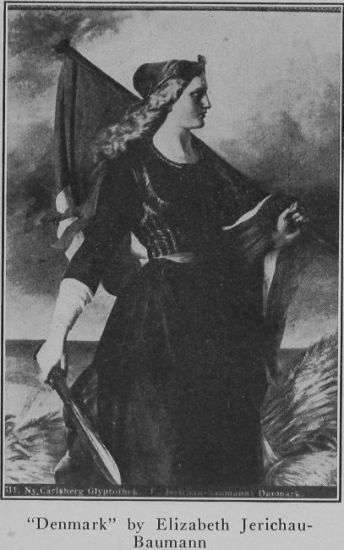
picture is “Denmark,” by Elizabeth Jerichau-Baumann,
and was painted more than sixty years ago.
Denmark is represented by a young woman, strong,
determined, and fearless, standing amidst sheaves
of rye; in her left hand she bears Dannebrog, the
red-and-white crusaders’ flag of the Danes, which
she is prepared to defend with the two-edged sword
grasped in her right.
“Denmark” by Elizabeth Jerichau-Baumann
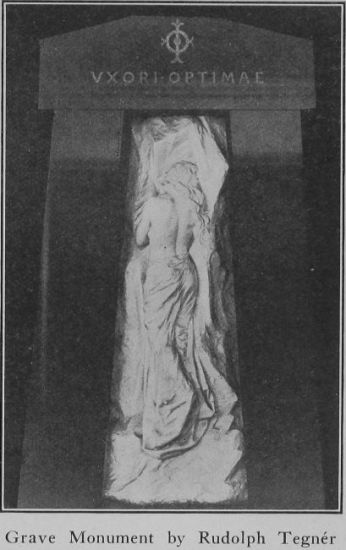
Grave Monument by Rudolph Tegnér
The sculptures in the New Carlsberg are, I think,
finer than the paintings. The French collection is
the most complete to be found outside of France itself.
It is not necessary to tell you that in plastic
art France is far ahead of Denmark. Yet there
were several Danish pieces for which I cared very
much—some by Herman Bissen, and particularly
some by Jens Adolf Jerichau. I was much attracted
by the latter’s “Little Girl with a Dead Bird.” It
is in white marble. The little girl, barefooted and
simply dressed, is sitting upon a rock with the bird
tenderly held between her hands; and upon her face
is an expression of gentle pity which gives a peculiar
charm to the whole figure. But, to me, the most
pleasing of all the Danish sculptures was a grave
monument by an obscure young artist, Rudolf
Tegnér. It represents the mourning figure of a
young woman, whose face is left buried in the original
mass of white marble. There is an exquisite
delicacy about the slender, drooping form to which
no picture that I might send you could do justice.
A similar figure, in bronze, marks the grave of the
artist’s mother at Elsinore.
Perhaps you would be interested in learning how
I spent yesterday, which was Sunday. Like all of
my Danish days, this was crammed with new impressions.
In the morning I attended services at
Vor Frue Kirke—the Church of Our Lady. In this
church are the greyish blue marble originals of Thorwaldsen’s
“Christ and Apostles.” The statues are
of heroic size and are exceedingly impressive. Besides
myself, there were six other tourists viewing
the church—five alert-looking boys and a middle
aged man, evidently their tutor. One glance was
sufficient to tell me that they were Americans. I,
too, must have had a “Made-in-America” appearance,
for before I had uttered a sound one of the
boys who happened to stand near me while I was
studying the “Christ,” began to address me in
“American,” commenting intelligently upon the
beautiful figure. The unassuming friendliness of the
boy quite warmed my heart. When services began
the party seated themselves in the rear of the room
and took notes and read their guide-books for a
time; and then tiptoed quietly out. I felt lonesome
when they had gone, and decided to go cousin-hunting
the very next day.
Like the vast majority of Scandinavian churches,
Our Lady is State Lutheran. But the Scandinavians,
though instinctively religious, are by no means
regular church-goers; and summer Sundays in Copenhagen
are more likely to be devoted to recreation
than to formal worship. Consequently, the congregation
was a mere scattered handful; most of the
worshipers were old people who came early, wearing
solemn expressions, and carrying prayer-books.
The preacher was a little old man in black gown
and white linen ruff, suggestive of pictures of Sir
Walter Raleigh. From a lofty and magnificent pulpit,
reached by a staircase, he preached his sermon.
The solemn faces of the congregation had led me to
expect a self-righteous, theological presentation containing
conspicuous thanks to God that Danish State
Lutherans are not as other men; but I was much
relieved to hear a live human message, not read, but
clearly and feelingly spoken, in which the pastor
urged his hearers to lives of loving service to their
fellow humans. I liked the little old pastor, and
forgot that I was homesick for “my own United
States.”
I think that you would have enjoyed the music,
Cynthia, for it possessed a dignity and reserve conducive
to reverence. You may be interested to learn
that the choir was composed entirely of women, and
that a woman played the pipe organ.
After the services were ended, I had luncheon in a
restaurant close at hand; and then I went for a long,
rambling walk, visiting some places which I had seen
before and others that were new. I passed Runde
Taarn again, bound for Kongens Nytorv, one of the
finest squares of the capital, pleasant with shade
trees, well-kept lawns, and an abundance of flowers,
among which the cosmopolitan scarlet geranium
seemed as much at home as in California. On the
Nytorv is the Royal Theatre, an imposing Renaissance
structure.
Twelve different streets lead out of the square. I
made my exit by the most famous one, Bredgade
(Broad Street), which for part of its length is lined
with handsome shops. Copenhagen shopkeepers
have a shrewd but gratifying way of keeping up the
shades of their windows on Sundays, thus enabling
the worldly-minded to enjoy gratuitously the beauty
of the wares and to select the very articles which
they would purchase were they rich. As I long since
learned to ‘name the birds without a gun, to love the
wood-rose and leave it on its stalk,’ I am particularly
fond of this mental shopping; it is a pleasant
pastime, devoid of the worry and wear of the physical
kind. The display of antiques, pictures, and
porcelains on Bredgade is unusually interesting. Antiques,
in general, but rarely attract me—except as
do curios in a museum—for many of them have little
else than their age to recommend them; and age, in
itself, is no virtue. Some of the old furniture, and
the bronzes which I saw in the windows on Bredgade,
were, however, very handsome.
But the paintings and the porcelains especially
caught my eye. To my mind (and I believe you
would agree with me), many of the works by young
Scandinavian artists would hold their own against
modern paintings in any European country. They
are genuinely Scandinavian. It is such a satisfaction to
know that the Scandinavian lands have really begun
to make a distinct contribution to the art treasures
of the world. And as for porcelain, I am simply
mad over the Royal Copenhagen variety; it is almost
as difficult for me to pass a display of this ware
without stopping, and gazing, and lingering, as it is
for a toper to resist a grog shop. The makers of
the Copenhagen pieces are high-grade artists, and
their work beggars my attempts at description.
Much of the attractiveness seems to lie in the glaze;
it is exquisite, and it gives to the delicate colors an
appearance of remoteness and a subtlety of charm
and refinement which seems almost to belong to the
realm of the spiritual. Compared with the Royal
Copenhagen, most other “China” impresses me as
loud and bizarre. But the prices of the pieces which
I should have wanted to buy, had I been anything
more than a mental shopper, would pay for my whole
Scandinavian tour; hence, I am not likely to carry
home with me very extensive samples of the ware.
In the course of my rambles I reached the Marble
Church. This building was begun more than a century
and a half ago, but lack of funds delayed its
completion until within the last thirty years, when it
was finished at the expense of Herr Tietgen, a philanthropic
Danish banker. In architectural style and
richness of material, this building contrasts strongly
with Our Lady, which is really conspicuous by its
plainness—except for Thorwaldsen’s sculptures.
The Marble Church, as its name implies, is constructed
primarily of marble; and it is crowned with
a great dome—suggestive of Saint Paul’s in London—covered
with copper partially gilded. A large
number of busts and statues of ecclesiastics and
saints also decorate the exterior. Outside, above the
entrance, are the words, “Herrens Ord bliver evendelig”
(The Word of God is everlasting). The
main room beneath the dome is perfectly circular
and is rich with wood-carvings, colored marbles, mosaics,
paintings, and statues. There is a fortune of
gold-leaf in the crucifixes and candle-sticks.
The guard at the door to whom I paid my entrance
fee recommended the view from the dome
and supplied me with a pair of opera glasses; so
after viewing the interior I mounted to the top.
This I accomplished by groping my way up a dark,
narrow, winding stair-case, some parts of which were
as dark as a pocket—and in the darkest part bumping
squarely into a couple of women who were on
their way down. As the Marble Church is quite a
distance from Runde Taarn, I gained a new and different
view of Copenhagen from its dome; and I
also gained considerable information about the most
important buildings from a friendly Danish lady
whom I found at the top.
Amalienborgtorv, or square, which is near the
Marble Church, was my next objective point. It is
a stone-paved place, ungladdened by trees or grass
or flowers, with a large bronze equestrian statue of
Christian V in the center. On each of the four sides
is a royal palace in rococo style, in which the king
and queen and other members of the royal family
reside during most of the year. When I crossed
the Torv, soldiers in high, bearskin caps stood on
guard at the street entrances—a sign that the king
was in residence.
After Rosenborg, Amalienborg seemed so dreary
and uninteresting—especially since common visitors
get no glimpse of the interior—that I did not linger,
but walked on to Grönningens Esplanade, where St.
Alban’s, the first English church to be built in Denmark,
peeps out with a charm peculiarly English
from a clump of trees bordering an arm of the
Baltic.
North of St. Alban’s is Langelinie, the most
beautiful promenade in Copenhagen. To the left
of the promenade is a park, and to the right lies the
harbor, filled with all sorts of water craft bearing
the flags of many nations, including our own “Old
Glory,” which looked wondrous good to me. Great
crowds of people—young and old, parents and children—dressed
in their Sunday clothes, were passing
to and fro upon Langelinie, all looking healthy and
happy.
I returned through the beautiful, shady park.
Upon the benches under the trees I noticed many
women serenely chatting, their fingers busy with
sewing, embroidery, or knitting. Would you call
such a Sabbath occupation scandalous and unseemly?
I must confess that I was more impressed with the
women’s industry than I was shocked by their desecration
of the day.
Farther on, I took a peep into the Citadel. It
dates from the seventeenth century, and is of red
brick, with tree-covered ramparts. Soldiers were
standing on guard at the entrance, and were passing
back and forth between the buildings. Unlike England
and the United States, Denmark, I regret to
say, requires military service of all of her ablebodied
men. She maintains what is, in proportion
to her population, a large standing army.
This morning, true to the resolution made at Frue
Kirke, I called upon Cousin Lars. Cousin Lars is
really my mother’s cousin, but as he has always been
her favorite cousin he has seemed a sort of an uncle
to me. Many years ago, when I was a tiny child,
Cousin Lars spent several years in California, which
he expected to make his permanent home; but his
young wife suddenly died, and it was her dying request
that he take their children back to the home
land and rear them. This caused him to return to
Denmark.
Cousin Lars still loves the United States, however,
and, though “blood is thicker than water,” I
really believe that he welcomed me more heartily as
a Californian, recently “come over,” than as a cousin.
For he quickly convinced me that I was thrice
welcome—and caused me to regret keenly that I had
delayed so long making known to him my presence
in Copenhagen. He wished to send immediately to
the hotel for my baggage; and without consulting me
he asked his housekeeper to have a room prepared
for my reception. But when I informed him that I
was booked to sail from Copenhagen to-night he
abandoned his plan, stipulating, however, that I was
to be his guest upon my return.
I made my call early this morning in order to be
sure to find Cousin Lars at home, for the Danes are
fresh-air people and all who can afford to do so
spend their afternoons in the city parks or in the
country. And in consequence of my early call I enjoyed
the pleasure of a real Danish home luncheon
with my cousin. Yet it was not so genuinely Danish,
after all, except the food, which, like all food I have
tasted in Denmark, was good. The luncheon was
really Danish-American, for Cousin Lars, in my honor,
had the table set with the silverware bought years
ago in the Far West, and at one end of the table he
placed a little silk Dannebrog with the white cross
on the red field, and on the other my own Stars and
Stripes. As a sign that this was a very festive occasion,
both flags were at the very tip-top of their
masts. Our conversation was also Danish-American.
At times we spoke Danish, my contribution being of
a very bad quality; at others, we spoke “American,”
Cousin Lars’ efforts showing rust for want of use;
and, occasionally, when the borrowed languages
seemed inadequate, we would resort to our own respective
mother tongues and exchange remarks in
Danish and American.
After luncheon I learned that Cousin Lars had
planned to spend the afternoon in the country in his
“garden,” and I urged that he execute the plan and
take me along. He did, and I had such a pleasant,
untouristlike time! We started on the street cars,
but a strike of carmen interrupted our progress;
then we walked the remainder of the way—as I preferred
doing so to taking a carriage—and Cousin
Lars called attention to the places of interest which
we passed.
Near the outskirts of the city, a “folke skole,” or
elementary public school, which was being repainted,
caught my eye, and we went in to explore. This was
one of the free schools to which the poor people send
their children. The class rooms were well lighted
and well ventilated and generally comfortable. In
fact, the building pretty closely resembled those of
our own elementary schools. A few good pictures,
including portraits of Hans Christian Andersen and
Bertel Thorwaldsen, were on the walls. Upon the
second floor were completely equipped departments
for the teaching of cooking and sewing; and in another
part of the building was a manual-training
laboratory.
Farther out along the street I noticed a bread-line
of children. A woman was handing out generous-looking
sandwiches to twenty or thirty little people
as they filed past her in an irregular line. These
were children, Cousin Lars said, whose parents were
not able to supply them with proper food. While
school was in session they were supplied with luncheons
at public expense; and now, during vacation,
one of their teachers, a noble-hearted young woman,
had assumed the task of keeping the active young
bodies somewhat adequately nourished. She herself
is poor, but she solicits money from private individuals
with which to purchase food; and this food she
personally distributes daily. I am glad to be able to
say, however, that such cases of want are comparatively
rare. The splendid spirit of cooperation
shown by the Danish people in their industrial life
has produced a degree of prosperity which is truly
remarkable, in view of the resources of the country.
And now for the garden—for we soon reached it.
It is a tiny plat of ground of about four thousand
square feet, which Cousin Lars has planted to the
choicest kind of flowers, selected with the view to
securing an unbroken succession of bloom, beginning
with the earliest varieties and ending with the
latest. There are also a few shade trees, and along
the fence are berry bushes. In the rear of the lot
is an arbor covered with a picturesque tangle of
woodbine and climbing rose; and close beside it is a
one-roomed bungalow, so overgrown with clematis,
now in bloom, that the little building looks like a
giant purple bouquet. The bungalow room is furnished
with a table, a couch, two or three comfortable
chairs, a case containing books and magazines.
Attached like a barnacle to the outside of the building
is a tiny kitchenette, containing an oil stove and a
stock of provisions.
We were hungry, of course, after our walk, so as
soon as we arrived we proceeded to prepare a luncheon.
I made coffee on the oil stove while Cousin
Lars fished all sorts of delectable canned and preserved
foods from the shelves in the barnacle and
arranged them in artistic confusion upon the table in
the arbor—which is the dining room of the establishment.
And while we consumed the coffee and
the delectables Cousin Lars told me about the “garden.”
It is his play place; he goes out to work
among his flowers almost every afternoon; and he
and his sons quite frequently spend their Sundays
there, having a picnic luncheon in the arbor. Until
a few years ago, he had a house in town set in the
midst of a large garden; but when the din of the
growing city became too offensive, he sold the place,
rented his present top flat on a blind and, consequently,
quiet street, and secured this garden—an arrangement
which he likes much better. Copenhagen
is very decidedly a city of flat-dwellers.
But the interesting and really splendid fact connected
with the garden is that Cousin Lars’s is only
one of fifteen hundred little gardens, all of which
have sprung up around Copenhagen within the past
ten years. The land is leased by those who work it
from the commune of Copenhagen or from private
individuals. Plats of as few as sixteen hundred
square feet may be rented from the commune for
one-half to three-fourths of an öre per square foot
annually. Land owned by private individuals rents
a little higher. Water is piped to the lots by the
owners, who also furnish free wheelbarrows for use
in gardening. Several tiny lots form a block, as in
a regular city, and between the blocks run diminutive
streets about ten feet wide. Some of the narrow
passageways have such picturesque names as “Rosen
Allé,” “Odins Allé,” and the like. The Christian
Danes have not completely forgotten the gods of
their fathers, you see. The blocks, in tracts of ten
acres or so, are surrounded by the owners with
strong open-work fences; and each family holding
land within the tract is supplied with a key to the big
gate. Over the gate appears the name of the tract,
which is sometimes “fancy,” like “Flora” and “Iris.”
The renters fence their own little plats to suit
their inclinations and pocket-books; and they build
their houses after the same fashion. Since the “gardens”
are merely daytime and fresh-air institutions,
generally the buildings are one-roomed and tiny. In
fact, they look as if they might be the playhouses
of an army of parent-tired little children who had
run away and set up for themselves. Many of the
structures are very cheaply built. One “playhouse,”
which caught my attention, was an abandoned street
car masquerading under a luxuriant mantle of vines;
but it was every bit as much of a success as an orthodox
bungalow, for in the tiny yard several flaxen-haired,
rosy-cheeked children were shouting and
playing. Instead of house numbers, the owner’s
names, as a rule, appear over the doors—generally
the names of women; but here and there I again
noticed “fancy” names, such as “Johannes Haab”
(Johanne’s Hope) and “Christines Lyst” (Christine’s
Joy), which suggest how much the simple little
recreation places mean to their owners.
Aside from the narrow walks, every square foot
of soil in each plat is just crammed with green things
growing. In many cases where the houses indicated
poverty, the ground was largely planted to vegetables—one
garden was a single large potato field.
Since the rent amounts to only a few dollars per
year, those who wish to do so can more than pay
their expenses by their vegetables; and in addition
they have all of the fun of the wholesome, out-of-door
life. But most of the plats have been converted
into charming flower gardens; and of all of these
Cousin Lars’s is the most worthy of the prize.
Though many sorts and conditions of people are
represented by the fifteen hundred plats, most of
the renters are poor “working people.” As a rule,
the families pass their Sundays in the gardens, and
in many cases the mother and children are there
also during most of the long summer days. After
work hours the father joins them for supper in
the “playhouse,” and later the whole happy family
returns to the city to sleep.
I had heard of such “gardens” before; they have
them in Germany, and call them “Lauben,” or
“Gärtchen”; and I was delighted at the chance to
see them in detail for myself. Now, I only wish
that we might have them around the great, congested
cities in the United States. The population would
be so much healthier, both mentally and physically,
if gardening could be substituted for idle gossip,
cheap society twaddle—or worse. As Cousin Lars
remarked on the way home, such wholesome, out-of-door
recreation would go far towards settling
many problems arising from city life.
After we had explored the place to my heart’s
content, we walked to the end of a car line and
rode back to the city. Now I am again in my room
in the hotel, finishing up this letter to you, preparatory
to my departure to-night. Cousin Lars and
his sons are to be at the pier to wave good-by, so I
shall not feel that I am in a “far country.” Whither
do you suppose that I am bound, Cynthia?
CHAPTER III
BORNHOLM AND THE BORNHOLMERS
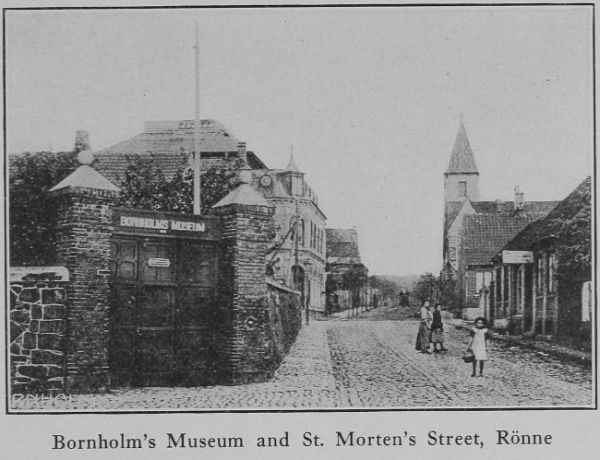
Rönne, Bornholm,
August 6, 191—
My dear Cynthia:
“Bornholm!” I hear you exclaim. “Wherever
in all Europe is Bornholm?” Bornholm, I reply,
is the “backwoods” of Denmark, the “pearl of the
Baltic,” and altogether the loveliest place in the
world—next to the choicest bits of my own fair
land. Look on your map of Denmark, and you will
see in the extreme east, as if it had strayed away
from the other Danish islands and become lost, a
trapezoid-shaped scrap of territory; that is Bornholm—the
birthplace of my mother. When a child,
I was very fond of reading “Robinson Crusoe” and
“Swiss Family Robinson,” in consequence of which
my ideal terrestrial paradise was a desert island
near the Equator. And many were the dreams which
I wove about the tropical spot, well populated with
talking parrots and chattering monkeys. But if I
could now, rich with my present experience, dream
them over again, I should substitute Bornholm, in
the Baltic—at least for summer residence.
I flew over here one evening more than a week
ago, in the cabin of Örnen (The Eagle), the triggest
little steamship you ever could imagine. We
left at about nine o’clock, and Cousin Lars and his
sons were at the pier to wave good-by, as planned.
Contrary to even her summer habits, the Baltic was
again beautifully calm for my sailing, so the crossing
was made on schedule time, and we reached
here at about six o’clock the next morning.
As you may well imagine, I rose early, and was
on deck to see the arrival. When I came out of the
cabin I saw a high, dark bank to the east. That
was Bornholm. It is higher than the other Danish
islands, and more rocky. In fact, geologically, it
belongs to Sweden, for it is a continuation of the
rock-ribbed Scandinavian peninsula. Soon I could
distinguish trees and houses and windmills, and
presently we glided past the light-houses at the ends
of the breakwater and were in Rönne harbor, where
a new cousin was on hand to bid me good-morning.
Rönne, which has a population of about nine thousand,
is the capital of Bornholm. So far as I have
been able to learn, the little town is noted only for
its quaintness; and it is certainly quaint. Practically
all of the houses except the public buildings are long
and low and box-shaped, with red-tiled or slate roofs
and brick or stone walls. Bay windows and other
architectural protuberances are conspicuous by their
absence; windows of the small “German” variety
which swing open like doors are in time-honored
vogue instead; and their broad sills are simply
crowded with potted plants. But there are no
flower-filled “yards” or lawns in front to delight the
passer-by. Gardens, the Danes seem to believe,
are primarily for the pleasure of the owner, and are
to be enjoyed in seclusion and privacy. Consequently,
they are behind the houses and are generally
surrounded by a high, close fence. My great aunt
Karen, to whose home I went upon reaching here,
has such a garden in her “back yard,”—with patches
of velvety grass, draperies of vines clinging to the
fence, hedges of roses, and brilliant beds of blooming
annuals. And in the midst of this “garden of delight”
is the vine-covered arbor in which we had
our meals.
The shops, as well as the dwelling houses, are low
and box-shaped; and their show windows are small
and crowded. There are no bold sign-boards on the
gable ends of the buildings, as in the United States;
instead, modest little “shingles” are generally stuck
out by the tradesmen.
Dwelling houses, as well as shops, extend to the
sidewalks, and many encroach shamelessly upon
them, even monopolizing the whole width, and pushing
the pedestrian out into the street. In fact, it is
very evident that the houses in centuries past were
just placed “any which way,” and that later the
sidewalks were filled in, along as straight a line as
possible. Like the streets, they are of cobble stone,
and are marked off from the former only by being
a few inches higher. After what I have said, you
would hardly expect these streets to be of the avenue
or boulevard variety, would you?
On my second day in Rönne I gained much quiet
pleasure from wandering about the little town, noting
the places of importance, and gazing in the shop
windows at the rows of wooden shoes and other
practical wares intended primarily for the native;
and at the models of Danish castles and churches,
and the exquisite displays of pottery and statuary,
more calculated to catch the eye of the opulent tourist.
Such shops are clustered around Storetorv, the
Large Square, to which the country people come in
regularly to sell their produce. In the midst of the
“torv” is a queer old stone fountain decorated with
gigantic bronze snails.
Forming part of Store Gade, Rönne’s main street,
are two small stones, one of them bearing the date
“1658.” All true Bornholmers are as proud of
these stones as New Englanders are of Plymouth
Rock, with its “1620;” for on this spot fell the
Swedish commander, Printzenskjold—shot, time-honored
tradition says, by a silver button, torn from
the vest of the shooter and used as a bullet—when
the Bornholmers rose in revolt against Swedish
domination. By the treaty of Roskilde which followed
Charles X’s unwelcome visit over the frozen
Great Belt, the Swedish king, you may remember,
secured several Danish provinces. Bornholm was
one of these. But the Bornholmers had not been
consulted regarding the cession; and as they preferred
to be Danes, they did not “stay put.” That
is how it happens that I am half Danish in descent,
rather than wholly Swedish—a distinction largely
without a difference. And the distinction hangs upon
a silver button.
Bornholm still celebrates the anniversary of her
victory over the Swedes; and within the last few
years, at Hasle, where the revolt had its origin, a
large monumental stone was erected, bearing the
Danish coat-of-arms and the names of the men who
headed the revolt. Of these, Jens Pedersen Kofoed,
a Bornholmer who was a member of the Danish
army, and Paul Anker, the pastor of the church of
Hasle, are the most important.
At some distance from the “liberty stones” is
Bornholm’s Museum,—the special pride of all Bornholmers;
and well it might be, for the collection
there, in view of the smallness of the island, is an
unusually large and fine one. The curator, a woman
and a true Bornholmer, proudly informed me that
Copenhagen would be most happy to possess the
African collection. To me the objects of most interest,
however, were those throwing light upon
Bornholm’s own history. These range from rude
stone utensils out of the shadowy past of the island
to an exhibit of graceful royal Copenhagen porcelain;—for
Bornholm it is that supplies the clay
from which the beautiful ware is made. The cost
of manufacture seems to be too great to admit of the
use of the porcelain for distinctly practical purposes;
consequently, its functions are largely ornamental,
and it appears chiefly in the form of vases,
plaques, and statuettes. The last-named class I
gazed at most lingeringly, for the subjects were
varied and especially alluring. There were wonderfully-glazed
robin-red-breasts sunning themselves;
perky foxes with noses pointing skyward; sleepy,
yawning tigers; cats crouching to spring upon unconscious
nibbling mice; kerchiefed Bornholm old
ladies carrying market baskets, and busily knitting
as they walked; and a fond pair of children, one of
whom was hugging the very life out of a tousled
fat puppy. So skilful had been the artist that I
caught myself actually pitying the porcelain pup.
Bornholm’s Museum and St. Morten’s Street, Rönne
Bridge Crossing the Old Moat at Hammershuus Castle
In one room was an unusually large collection
of “grandfather” clocks, with elaborately and
quaintly decorated faces, and with crude, clumsy
weights. Bornholm at one time was famous for the
manufacture of this style of time-piece. And in another
room were glass-cases filled with dummy Bornholm
men and women and helpless-looking dummy
babies, clad in the fashions of various past ages.
The garb of these dummies convinced me that
fashions are not actually growing worse; for surely
clothes cannot be uglier or more uncomfortable in
appearance than the ancient elegance behind the glass
doors within the museum.
One souvenir of unusual historical importance, the
key to old Hammershuus Castle, is also on display
among the exhibits. The castle, Bornholm’s chief
stronghold for centuries, was occupied by the
Swedish garrison for some months previous to the
revolt in 1658. But Hammershuus has now long
been in ruins, and its key is resting from its labors
among the other antique relics in Bornholm’s
Museum.
In the art collection are several paintings by
famous Danes; and a whole room is set aside for the
works of Lars Hansen Tobiasen, the portrait artist
who was Bornholm’s own son. As yet, only a few
of his pictures have been placed in the room—including
portraits of himself and his parents, and of
Oelenschläger, Denmark’s greatest poet. One painting
by Tobiasen seemed to me quite unique; it is the
arm of a young woman. That sounds cadaverous,
doesn’t it?—like an anatomical chart, or an illustration
in a medical journal. But the portrait suggested
anything but that;—for a portrait it was—of
the arm of a Danish damsel instead of her face—expressive
of individual character as well as of
beauty of color and line. Tobiasen spent twenty
years of his life in Sweden, where he painted the
royal family, and some of his pictures are there.
Others are in Rönne, still in the possession of relatives;
but with the passing of this generation, the
curator told me, these last are by the artist’s will to
go to the museum.
In a shed near the main building are the skeletons
of moose and reindeer which roamed through the
forests of prehistoric Bornholm. And outside in
the yard are many runestones, graven by the hands
of pagan Bornholmers. The island seems to have
specialized upon these stones in times past, as well
as upon grandfather clocks; for even to-day they
stand here and there by the wayside and are, in
many cases, still clearly marked with ancient runic
characters.
After a short visit with my great aunt in Rönne,
I spent a few happy days with my Uncle Johannes
and Aunt Ingeborg in the interior of the island. My
uncle and aunt drove to town to fetch me, and while
Uncle let the fat horses jog along on their homeward
way at a pace to suit themselves, I had a good opportunity
to see the objects of interest which Tante
(the Danish for aunt), pointed out on the beautiful
landscape. That place with the black smoke stacks
was the great pottery factory; there, where the white
walls shone between the trees, one of my cousins
used to live; the large, four-armed windmill on the
right did not pump water, as I had ignorantly supposed,
but ground grist; the handsome, cream-colored
villa on the left was the summer home of a
wealthy Copenhagen merchant; and so on, until the
journey ended.
As we drove into the court at Uncle’s, my cousins,
a fair-haired, rosy-cheeked, blue-eyed flock, came
running out to greet us. These children were so
well-trained, and so natural and wholesome that they
were a real pleasure to me. But do not conclude
from this statement that I am implying a comparison
invidious to the American child, or that I hold
up Danish children as models of deportment; for
I have met some enfants terrible during the last
week or two, even among my own kith and kin. I
attribute the superiority of these particular cousins
to their quiet country rearing.
And that reminds me to speak of the great interest
and curiosity with which they regarded me
upon my first arrival. While I talked with Uncle,
my cousins sat silently by, completely absorbed in
watching me; and when he noticed them their
father laughed and said, “Yes, my children; this is
a genuine, native-born American.” Then he explained
that I was the first native American that
the children had ever seen. Few aliens except bona
fide tourists reach the center of the island—and
they merely pass through. It would take an Eskimo
or a Patagonian to rouse a similar degree of interest
in a country child of the cosmopolitan Far
West.
The manner in which I mutilated the king’s
Danish was also a source of much interest to them;
for I suppose that they had never before heard
broken Danish. They were too polite to show
amusement; even at my most grotesque blunders
not a smile crossed their faces; they were simply
alert and fascinated—and silent. But when it occurred
to them to try upon me the English which
they had learned in the grades, we were promptly
upon a very sociable footing; they took turns practicing
their English vocabularies on me, and were
delighted to find that the formulae had worked—that
their school-learned language was comprehensible
to me.
To the children of the neighbors I was also a
whole menagerie of interest. They referred to me
as “de fremmede dame” (the foreign lady), and
whenever I opened my mouth to speak they waited
around with bated breath to see what liberties I
should take with their native tongue.
Old-fashioned Danish farms are quite different
from anything which we have in America; therefore,
you might like to know about Barquist, my
uncle’s place. On the afternoon of my arrival I went
all over it with Uncle as a cicerone, and with Astrid,
the smaller of the twins, clinging to my hand and
practising her English whenever the opportunity
offered. Such a farm as Barquist is called a “gaard”
(or court), because of the fact that all of the buildings
are arranged in rectangular fashion about the
stone-paved interior. The long dwelling house
forms one side of the quadrangle; the sides are made
up of machine shops and wagon sheds and store
houses for hay and grain; and at the other end are
the stables in which the live stock are kept. Roofed-over
driveways separate the house from the other
buildings. When the gates to the court are shut,
the quadrangle forms a complete inclosure, and,
consequently, furnishes much protection from stormy
weather. The back doors of the dwelling house
open into the court, in the middle of which stands
the pump; and the front ones open into a large
flower garden, which, you see, is outside of the quadrangle.
Brick and plaster form the building material for
the walls, and all of the roofs are covered with
thatch of rye straw, which must, of course, be quite
frequently renewed. As you may imagine, the
thatched roofs lend a very picturesque air to the
quadrangle, especially when there is a stork’s nest
in one corner. But straw roofs are going out of
use because of the danger of fire from lightning;
tiles are being substituted, and slate, and plain,
prosaic shingles.
Surrounding the buildings on every side were
fields of barley and rye, golden unto the harvest.
Dotted with silky red poppies and deep blue cornflowers
as they were, these grainfields presented a
charming picture. Uncle admitted the beauty of
nature’s color scheme, but added, “To us farmers,
the poppies and cornflowers are weeds; they choke
out the grain.”
The interior of the house was a comfort, for it
did not have the “cluttered up,” junk-shop appearance
produced in some American homes by over-furnishing.
There was plenty of room to walk
around without stumbling over, or knocking off, anything.
The guest room, in which I slept, was so
large that I felt out of doors in it. And the furniture
was of corresponding proportions; the clothes-press
could tuck away the whole wardrobe of an
ordinary family; and the bed was even nearer kin
to that in which Hans Christian Andersen’s true
princess slept than the one in my hotel room in
Copenhagen. Cross my heart, Cynthia, there were
nearly a dozen feather ticks of various sizes on that
bed. Taught by my Copenhagen experience, I
promptly dumped most of them on the floor, where
they remained until morning, when I replaced them
and gave them a poke or two, to produce a slept-on
appearance, lest my aunt by any chance be led to
suspect that I was not partial to Danish beds.
In the brick-paved kitchen is a built-in oven, also
of brick, such as was used in New England in colonial
days. Most of the baking for the family is
done here, but uncle also exchanges grain with the
baker for immense loaves of rye bread. And the
baker, I suppose, transfers the grain to the miller,
in return for flour, in the placid, old-fashioned way.
In the dining room was a very old grandfather’s
clock which ticked stolidly away, keeping more or
less accurate time—mostly less. As a time-keeper
it was not much, but you, as a fancier of the antique,
would have loved the venerable case and the crotchety
works. I wish, too, that you might have seen
the lovely potted plants on the broad sill of the
sunny dining-room windows. I never before saw
such begonias as Aunt Ingeborg can grow.
One morning shortly after my arrival, Uncle announced
that we were to go for an all-day picnic. I
was quite willing, I assure you. My aunt, who is of
the plump, comfortable, bustling type, soon had two
great baskets packed with luncheon. These were
stowed away under the broad rear seat of the carriage.
By eight o’clock we were off,—but the sun
was well on his way by that hour. There were
objects of interest all along the road, so Carle, my
oldest cousin, and I studied my tourist map, which
names every highway, large farm, church, and
windmill on the island. Uncle laughed and called
us “aegte turists”—genuine tourists—but he was
really as much interested in the harmless gossip supplied
by the map as any of the rest of us.
Bornholm is a great place for cycling; once or
twice we passed veritable flocks of cyclists. But I
did not see a trace of an automobile. When I remarked
upon their absence Uncle said that it was
a mere accident that we had met none, for there
were automobiles on Bornholm. But they had not
been there long. Originally, a few of the Copenhageners
who spent their summers on the island
brought their machines with them,—but only for a
short period, for the automobiles frightened the
unsophisticated Bornholm horses quite out of their
wits. After the machines had paid their first mad,
chugging, snorting, honking visit to the island, and
had left numerous splintered and smashed vehicles
and irate farmers in their wake, a local law was
passed prohibiting the desecration of placid little
Bornholm by the mechanical monsters. Recently,
however, the ban had been removed (Even the
“pearl of the Baltic” follows in the wake of the procession),
and at present, Uncle triumphantly announced—Uncle
is a progressive in spite of his
thatched roof—not only are tourist autos admitted,
but the island even harbors two or three naturalized
immigrant machines.
At about ten o’clock we stopped for luncheon in a
beautiful grove where there were tables and benches
under the trees. While Tante went to a near-by
inn for a pot of hot coffee, and the girls unpacked
a basket and set a table, Uncle cut huge slices of
rye bread and fed them to the horses. But please
do not generalize from this last and conclude that
Danish horses regularly live on rye bread; it was
merely an extra, like an apple or a carrot in
America, because we were picnicking.
And wasn’t it pleasant to picnic out under those
grand old beeches? And wasn’t I ravenously hungry,
notwithstanding a seven-o’clock breakfast? And
didn’t Tante Ingeborg have the most delicious things
to eat?—pickled herring, for instance, and smoked
salmon sandwiches, and “rödgröd”—probably the
most typical Danish dish—made by cooking sago in
fruit juice, in which have been dropped raisins,
currants, spices, and other tasty morsels, until the
whole is of the consistency of custard. But then I
am always hungry in Denmark, and the food is
always delicious. Were I to stay here very long
I should degenerate into an absolute epicure.
As we neared Hammershuus Castle—our first
goal—the road ran along the northeast coast through
Allinge, a pretty little summer resort. Here we
noticed a number of sun-browned women, wearing
gay-colored bandanas on their heads in Topsy
fashion, and carrying alpenstocks in their hands.
They had been climbing over the cliffs. After passing
Allinge, to our left was The Hammer, an imposing
promontory of granite, which is being rapidly
quarried away; and just ahead were the castle ruins.
At the inn near at hand the horses were unhitched
and stabled, the lunch baskets were removed and
carried to a group of trees where there was a table
just the right size, and here we had another meal;
and all were again hungry.
Then we explored the ruins. Hammershuus was
first built in the thirteenth century and for much of
the time since it has played an important part in
Denmark’s history. For a long time it, with the
remainder of Bornholm, was an object of dispute
between the archbishops of Lund and the Danish
kings. During much of the sixteenth century the
German city of Lübeck controlled the castle; in the
seventeenth, as I have told you, Sweden for a short
period held dominion over it and the island. For
some time after Denmark resumed control, Hammershuus
remained the stronghold of Bornholm; but
presently the islet near at hand, Christiansö, was
fortified, and the old castle was permitted to fall
into ruins. Its destruction was hastened by the fact
that stone was taken from it for public buildings
in Rönne; and subsequently it became a sort of public
quarry. Until within a century ago, the domestic
vandalism continued. Nevertheless, the Hammershuus
ruins are the finest in Denmark to-day.
The old pile had quite enough of the characteristics
of the orthodox mediæval castle to satisfy the
most romantic student of feudalism and chivalry.
It stood on a high promontory with sheer cliffs on
three sides. On the fourth was a moat through
which flowed an arm of the sea, spanned by a draw-bridge.
It is very easy to trace the whole ground
plan of the castle, for many of the great walls of
unhewn stone still stand, picturesquely overgrown
with shrubs and trees. I was especially interested
in the dungeon, as I had never seen one before; but
after we had half climbed and half slid down into
it, I found that it differed very little from a deep,
dark, windowless cellar. In this dungeon, says tradition,
the unhappy Eleonore Christine, daughter of
Christian IV, and her husband, Corfitz Ulfeldt, were
confined while prisoners at Hammershuus. Ulfeldt
had committed treason against his country; Eleonore
Christine was merely guilty of loyalty to her
husband. They were imprisoned at the castle just
two years after the Swedish garrison sent over to
hold the island was forced to surrender to the
doughty Bornholmers. Those were stirring times
for little old Denmark.
Having explored the dungeon and identified the
various parts of the castle by means of the map in
my guide book, we wandered around the outer walls.
What was once a moat is now a pretty, deep, little
dell, crossed by a gracefully-arched bridge of red
brick. Below, and seaward, near the base of the
cliffs, are several queer, wave-sculptured rocks. One
of them, the Lions’ Heads, is especially well named.
Beyond these, far to the north, we detected the outlines
of the coast of Sweden. Bornholm, you see, is
much nearer to Sweden than it is to any Danish territory.
After leaving Hammershuus, we drove along the
southeast coast to Rö, to see Helligdommen Klippen
(Holy Cathedral Cliffs). As it was about five
o’clock when we arrived at Rö, we first had supper
under the trees, with coffee, piping hot, obtained
just across the way. Then, by means of a winding
stairway, we reached the base of the cliffs. Here
was a little gasoline launch which took us up and
down the coast to see the fantastic wave-worn rock,
now and then puffing into the deep caves dug out by
the breakers. In some places the cliffs look as if
Mother Nature when in an angry mood had seized
a mighty knife and slashed right and left, working
havoc with the solid granite; here were long slices
of rock; there were slender columns and spires
standing alone in the water; and occasionally there
appeared a distinct variation of pattern, bearing
resemblance to natural objects. Our guide in the
launch made the most of these. “Look at the profile
of the Bornholm damsel, formed by that mass of
rocks,” said he; and “There is St. Peter; can’t you
see his cross and keys?”—and so on.
On every ledge of the cliffs where soil could find
place were velvety mosses, delicate, plumy ferns, and
flowers brightly blooming; gaily colored fish darted
about in the water; and—most beautiful of all—a
glorious sunset crowned and scene and the day with
a blaze of orange and crimson and gold and rose
which covered half of the sky and was reflected on
the surface of the placid Baltic.
Perhaps, as compared with the wild, majestic
sweep of our Western scenery, all of this seems very
miniature and very tame. But it is not fair to
compare it with anything so different. Helligdommen,
when I saw it, had a charm all its own—like
an English landscape. I shall never forget its
beauty.
It would have been very pleasant to spend the
whole summer at Uncle Johannes’, but duty called,
and the time for my other visits was short; so I
soon returned to Rönne, bound for the northeastern
part of the island. The railroad journey from
Rönne to Nexö was one of the drollest experiences
which I have had in Europe. Generally speaking,
there is not anything funny about a ride by train;—but
there are railroads and railroads; and of her
own particular variety little old Bornholm certainly
has a very exclusive monopoly. The cars are very
small, as if they were the half-grown children of
American ones; and the trains are almost incredibly
leisurely. Positively, I believe that my train spent
two-thirds of the time backing and switching and
waiting at stations. During the remaining third it
ambled and sauntered between stopping points; and
upon finally reaching one, the locomotive gave a
ridiculous, hysterical shriek, as if overcome by the
prodigiousness of the feat which it had performed.
But this toy train suits Bornholmers very well, for
they have plenty of time; and it suited me, for it
gave ample opportunity for studying the landscape.
An American express would never do at all on that
twenty-three-mile long island; it would be a giant
in dwarf’s quarters. The Rönne-to-Nexö line, which
is the main railroad line in Bornholm, is not sufficiently
long to enable a train of the American express
variety to assume normal speed with safety.
From Nexö to Svaneke, whither I was bound, I
had to go by post wagon. A post chaise is just a
sort of rudimentary stage coach, and as I am an
old stager—as you know—I immediately bethought
me of a seat on top with the driver, and lost no time
before asking for it. Some one else had got ahead
of me, however, and I had to ride inside with two
women and two children; hence, I had only an occasional
and fragmentary view out of the dusty
window in the rear.
Svaneke, which is picturesquely situated upon the
northeast coast of Bornholm, is a fishing town of
about thirteen hundred inhabitants. It is, if possible,
quainter than Rönne. Its streets are crooked
beyond belief; they dip and turn, zig-zag, and run
in circles;—at least, that is the impression which I
gained from wandering helplessly around in them;
for I never went out alone without becoming lost
and having to undergo the humiliation of inquiring
the way to my destination. Another baffling characteristic
of the place is that the houses are more completely
duplicates of one another than are those at
Rönne.
On a particularly crooked street, near the edge of
the town, are three of the typical Bornholm houses;
all are low and box-shaped, with red-tiled roofs, and
with small German windows, the wide sills of which
are crowded with potted plants, beautifully growing
and blooming. In these three houses live three
aunts of mine, all of them sisters and all of them
widows. To these aunts, my visit was an epoch-making
event; I came as a delegate from my mother
whom they had not seen for forty years. At a
family congress held shortly after my arrival the
time which I had to spare for Svaneke was carefully
divided up, in order that each aunt might have a
fair chance at her American niece; and in consequence
of this treaty, the niece vibrated somewhat
like an erratic pendulum between the three dear,
quaint old homes. Breakfast at Tante Hulda’s,
luncheon at Tante Anna’s, dinner at Tante Laura’s,
with one or more of the appertaining cousins present,—thus
ran the schedule, with an occasional reversal
or combination. Only the place where I was to have
afternoon coffee was left unprovided for; I had that
wherever I happened to be at coffee time.
My nights, however, were spent with my oldest
aunt, Anna, who lives in the middle of the row. All
of her children have homes of their own, except
the youngest, who has followed the call of the Viking
and is away at sea. Her home is a perfect museum
of souvenirs of him and his voyages; there are Japanese
curios, tapa cloth from the South Seas, armadillo
baskets, nautilus shells, South American parakeets,
and I do not know what else. Imagine
squawking parakeets in little old Bornholm! In its
air of “foreignness,” the interior of Tante Anna’s
house contrasted interestingly with the homes of my
other two aunts, which are typical of Bornholm.
But everything was interesting and charming and
everything was wonderfully quiet and restful. I
recommend Svaneke for all victims of nervous prostration.
One day, like Charles Lamb, I went cousin-hunting
out in the country,—but in the company of a
cousin instead of a sister. We cycled, Dagmar and
I; and started early and had a long, lovely day.
The landscape in this part of the island is the most
beautiful that I have seen since my arrival here.
The poppy-and-cornflower-strewn grain was ripe, and
here and there the harvesting had begun. Occasionally
the whirr of a reaping machine was heard,
but very frequently I noticed folk reaping and binding
by hand in primitive fashion. The men led,
cutting the grain with their sickles; behind them
came the women who bound it into sheaves, which
they piled ready for the hauling. The colored
dresses of the women contrasted brightly with the
background of fields and gave the touch of perfection
to the picture.
But the passing landscape was made up of much
more than harvest fields and reapers. There was
a rare variety. Patches of rosy clover and of
alfalfa, with blossoms shading from pale amethyst
to deep, dark purple—patronized by thousands of
golden yellow butterflies—alternated with the fields
of wheat and barley, oats and rye already mentioned.
Some of the fields were unfenced; others were inclosed
by thick, green hedges, or by walls of unhewn
stone, with at times a waste corner given over to
purple heather. Here and there over the patches
of pasture please imagine a few sleek dairy cows,
and a few more plump sheep. Add trees to the
panoramic picture—some casting broad, cool shadows
across the finely-paved road, along which you
cycle in imagination with me, others grouped here
and there between us and the horizon—majestic
oaks and beeches, and white-limbed birches, with
dainty, fern-like leaves.
And now put in the houses. Just coming into view
on one side is a mossy, thatched-roofed gaard, with
dazzling white walls partly concealed by clumps of
trees; on the other side, a little nearer at hand, note
a red brick building peeping forth from the clustering
foliage; and yonder is a white one with red tiles
substituted for thatch. As you cycle past, there will
be a constant shifting and changing of styles and
colors, according to whether the farms are new or
old, small or large. Tuck into the panorama a few
large windmills here and there, with long arms
slowly and lazily grinding out Danish grist; and
finally finish off your picture by adding an occasional
church, at first just peeping its spire or tower over
the rolling surface of the ground, but as you approach
looming large, in Lutheran dignity conscious
of State support.
We rode all day in the midst of this beautiful
landscape, now and then making a cousinly call. And
always, for the sake of the cousinship, these cousins
welcomed their clanswoman from the Land of the
Setting Sun; and everywhere they insisted that we
partake of coffee, regardless of the amount of which
we had already drunk; and always they accompanied
us to the main road when we departed, remembered
the “Hils hjemme” (Greet those at home for us)
when the good-byes were said, and were waving a
final farewell when we took a last look at the turn
of the road. Verily, cousin-hunting in a foreign land
may be a wondrous pleasant pastime—if the foreign
land be an ancestral homeland.
Near the end of our ride we came to Östermarie
Church, of the parish in which my mother lived as
a child. And there in the church-yard were many
old grave-stones with family names; names that were
familiar, but strange—when found there. The
ancient church is in ruins, but twenty years ago a
new one was built, after an old pattern, with a square
tower topped off with a gable. A memorial tablet
to Jens Kofoed, who helped save Bornholm for
Denmark, has been carefully transferred from the
old building to the new.
Harvest Time in Bornholm
Österlars Church, Bornholm
Östermarie represents one of two characteristic
types of Bornholm church architecture. The other
type which I have in mind is the rotunda. These
rotunda churches are among the rare sights of Denmark,
and date from well back into the Middle Ages.
Österlars, the finest sample, is Östermarie’s near
neighbor at the northwest. The main part of the
building is a huge cylinder, capped with a cone-shaped
roof. Attached to the outer walls, like
barnacles, with little regard to symmetry or uniformity,
are a number of buttresses. The whole
structure has a grotesque appearance, and is like
nothing else I have ever seen,—except, perhaps, as
regards form, the grass huts of the South Sea
Islanders. But it is much more substantial than
these; the walls are thick and heavy; for in the old
fighting days the rotundas served as fortresses as
well as houses of worship.
The northeastern part of the island possesses
various reminders of earlier days than those in
which Österlars was built. Among these are the
sites of several burial mounds. During my mother’s
girlhood some of the mounds were leveled by bold
farmers, unfearful of the hauntings of outraged
ghosts; and their contents—weapons, utensils, ornaments,
etc.—which the heathen Danes had buried
with their dead, were brought to light. Some of
the objects reached the museum at Copenhagen in
safety; others, especially the ornaments of gold and
silver, were melted down by the thrifty but short-sighted
country people. The most famous mound
of all was, however, carefully excavated by Danish
archæologists. This was on the large farm called
Store Bakkegaard, not far from my mother’s old
home.
Most of the country people realized that the
mounds were prehistoric graves; and some of the
farmers, for superstitious reasons, refrained from
leveling them. As you may imagine, many ghost
stories grew up around these—stories of mysterious
lights which appeared and disappeared in the trees
on top of one of them; of a monstrous three-legged
cat which yowled from another; of a surpassingly
beautiful maiden with incredibly long golden locks
who haunted a third. They were “spooky” landmarks,
my mother said—places past which the school
children hurried with bated breath in the early twilight
of the short winter days.
In my mother’s childhood also many believed in
witches and wizards, who were able to work destruction
to their enemies, and against whom one must be
on one’s guard; and of “wise men” and “wise
women,” beneficent variations of the witch and
wizard class, to whom one went with one’s troubles,
of whatever nature. Was a Bornholmer afflicted
with boils or ringworm, warts or “fits,” which failed
to yield to home remedies, if he was superstitious—as
he often was—he would ignore medical advice
and consult a “wise” person, frequently with satisfactory
results. A lost sheep or a lost child, a guilty
conscience or suspected disloyalty on the part of
a lass or a lover—all of these were cases which called
for the services of the “wise.” With the spread of
scientific knowledge, however, knowing ones, good
and evil, tended to lose prestige, and now, so far
as I have been able to learn, they are no more numerous
in Bornholm than elsewhere; the “backwoods”
in the Baltic is becoming as hard-headed and skeptical
as the remainder of the world.
On my return from Svaneke to Nexö I rode on the
high seat with the driver; and as the day was fine
and the driver was affable it seemed almost as if my
old staging days had returned. One has such a
top-of-the-world feeling when on the driver’s seat
of a stage coach—even if the coach be only a post
wagon. To the right hand was a Bornholm landscape
such as I have tried to describe; to the left
was the Baltic, edged by rocky cliffs, and dotted here
and there with the white or brown sail of a fishing
boat.
A few miles beyond Nexö I stopped off to visit
my cousin Thorwald, who lives on a large gaard
with quadrangular buildings of brick, arranged on
the same principle as Barquist, only on a larger and
more elaborate scale. While here, for the first
time—I hope it was the first time—I disgraced my
clan. This is how it happened. When I arrived,
Christine, my cousin’s wife, was up to her eyebrows
in preparations for a birthday party for their little
girl; and promptly after my arrival the cook fell ill.
It was evident that a crisis was at hand, which I
determined to relieve. The intricacies of Danish
cookery are quite beyond me, so I knew enough to
leave that to Christine; and I cast about me for
other means of helpfulness. As luck would have
it, I saw a row of milk pails near the kitchen door.
Now, as you know, I was not reared on the Far
Western frontier for nothing; the mysteries of
bridge whist and the tango to me are mysteries indeed,
but I can milk a cow.
As the inspiration seized me, as promptly I seized
a pail and went forth to relieve the birthday party
crisis. The cows were gentle; I milked two, and returned
in triumph with the brimming pail. I acknowledge
that I had had some misgivings with
reference to just how my particular form of aid
would be regarded; but I was not prepared for the
sensation which my performance created. As I approached
the house, I met one of the maids who was
starting out to milk. Upon seeing me, she rushed
into the house exclaiming, “De fremmede dame har
malkede köerene! De fremmede dame har
malkede köerene!” And the awful tidings spread.
Since Thorwald is not only a wealthy farmer but—what
is vastly more important—is also an officer
in the Danish army, Christine has a tremendous
amount of dignity to maintain. When she learned
what I had done, she stood for a moment in petrified
astonishment, and then burst forth, “You have
milked the cows! What will my friends say! What
will my friends say!” And then she left the room,
utterly humiliated by the conduct of her husband’s
low-bred cousin. I am certain that she swore the
maids to secrecy, lest my exploit get abroad and
she lose caste.
A scrap of consolation was offered to me, however,
by Christine’s cousin, who was also a visitor
at the house. She, not being related to me, could
afford to be amused as well as scandalized. After
I had stoutly aired my views, this cousin told of a
Danish high-school teacher—a woman of phenomenal
strength of mind—who had not only shocked the
whole community by milking a cow, but subsequently
had shamelessly announced that were she the queen
she would milk cows if she felt like doing so! Unfortunately,
with all of her charm, little old Bornholm
is in some ways very conservative and very
aristocratic; there is much talk of “fine folk”; and
her aristocracy is still determined to a considerable
degree by the mediæval qualifications of position and
wealth, rather than by intellect and character. She
is not so different from my own land, however; for
there are plenty of Americans who would sympathize
with Cousin Christine’s indignation over my
plebeian performance.
Lest you be left with the impression, however, that
the “pearl of the Baltic” is far more back-woodsy
and conservative than is a fact, I wish to assure
you before leaving it that Bornholm is, in many
ways, exceedingly progressive. It must be, since it
is a part of Denmark, which is in the front rank of
the progressives of Europe. The farmers’ telephone
system, for instance, is well established on the island,
and is well patronized; rural mail delivery also
exists, the postmen generally cycling over the smooth
roads. Bornholm’s educational system is excellent;
you would be astonished at the subjects, besides
English, which are included even in the grammar
school course. And I must acknowledge—though
as an American school teacher I am somewhat
ashamed to—that the teaching is more thorough
than in our land; the Danish children seem to
retain and make practical use of what they learn,
as few American children do. The Bornholmers
are intelligent too, though isolated; they read and
they think; all seem to make at least one trip to
Copenhagen during a lifetime, and many visit the
capital quite frequently. Also, Socialism gives evidence
of being fairly well rooted in the island, where
it bids fair in future to play havoc with time-honored
aristocratic ideals.
Bornholm conservatism is in a sense a modified
local patriotism; for the Bornholmers are intensely
attached to their mid-Baltic home,—a fact, I presume,
largely due to their isolation and to the consequent
necessity, to a considerable degree, for their
fighting their own battles in times past. Their love
for the beautiful island naturally makes them loath
to change the old for the new, unless they see a
good reason for so doing. A cousin who is a
fiercely loyal Bornholmer is a good illustration of
this. One day I asked her the Danish word for
“birch” and she replied, “The Copenhagen Danish
is birk; the Bornholm Danish is burck. I pronounce
it burck, for I am a Bornholmer.” The Danish
spoken in Copenhagen is generally considered the
best, and is charming to the ear; in my opinion, it
has a dignity which French lacks, and a beauty of
sound foreign to German. The Bornholm dialect,
on the other hand, is a broad drawl which is unqualifiedly
ugly.
It must be recognized, too, that Bornholm possesses
virtues which many centrally-located places
lack. Among the population of more than forty
thousand serious crimes are almost unknown. The
people are friendly and honest; they practice the
Golden Rule pretty faithfully. I was impressed with
this fact while in Svaneke. We were going away
to spend the evening, and I, being the last out, proceeded
to lock the door. “Never mind to lock the
door,” said Tante Anna; “just close it. There
are no thieves on Bornholm.” Later, fearful lest
she had exaggerated the honesty of the island, she
discussed the matter with Tante Hulda; and finally
they remembered that some years before a man in
Rönne had been convicted of stealing a few kroners’
worth of something—I have forgotten what.
I am writing these final lines aboard Örnen,
sitting on a stool in the cabin with my writing pad
on my knee; for I am outward bound from Bornholm.
All of my Rönne relatives came to the boat
and saw me off with “Hils hjemmes” and repeatedly
waved good-byes. I was just on deck to take
a last look. Ah, when I forget thee, Bornholm!—My
nearest cabin mate is a girl from the Faroes,
who is taking a great armful of purple heather home
with her. The Faroes, you know, are a part of Denmark.
An old Norse dialect is the vernacular, but
Danish is taught in the schools, and my cabin mate,
like most natives, speaks it. Hence, we do not have
to resort to a deaf-mute show in order to make ourselves
understood. The girl is stirring in her berth.
I fear that the light disturbs her, so I must put it
out. As the Bornholmers say, “Farvel saa laenge”—Good-bye
for the present.
CHAPTER IV
AN INTRODUCTION TO SWEDEN: LUND, HELSINGBORG,
GOTHENBURG
Gothenburg, Sweden,
August 15, 191—
My dear Cynthia:
As you see, I am at last in the land of the Swede,—a
land even less known to Americans than is Denmark,—which
is saying considerable. The sum
total of information which most Americans possess
about Sweden seems to be that Swedish girls make
good cooks. Consequently, they appear to look
upon all Swedish women as potential American
“servant girls.” To be sure, in view of the fact
that my ancestral roots sink deep in Swedish soil, I
deserve no credit for such knowledge of things
Swedish as I have; and I claim none. But since
my arrival here I have been acquiring more knowledge,
and I propose to thrust some of it upon you;
for I have no reason to believe that you possess any
superfluous information upon the subject; and, besides,
it is impossible to write from Sweden without
writing about Sweden.
Though Lund was my first definite goal in the
Swedish land, I went there via Malmö, a commercial
town on the sea coast, which I reached after
about an hour’s sailing from Copenhagen. So far
as I have been able to learn, Malmö’s chief claim
to historic glory is the fact that it was here, in 1533,
that Christian Petersen, the “Father of Danish literature,”
set up the first printing press in Denmark.
For the province in which Malmö and Lund are
situated, as well as other provinces in southern
Sweden, was at that time a possession of Denmark,
which had ruled over it since the days of Canute
the Great. But in the middle of the seventeenth
century, by the treaty of Roskilde, the whole southern
end of the peninsula again came under control of
Sweden, which has possessed it ever since. And this
is well, for, geographically and geologically, the territory
is Swedish. However, its long exile under
Danish dominion has prevented it from fully acquiring
Swedish characteristics—in so far as Sweden has
characteristics different from the other Scandinavian
lands. Hence, in spite of the customs inspection, and
in spite of the fact that a blue flag with a yellow
cross was in evidence instead of Dannebrog, it was
difficult for me to realize that I was in a new land.
To me, Lund is an attractive place; the house of
Tegnér, Sweden’s greatest poet is there; and there
also are one of the two Swedish universities, and a
fine old cathedral. Tegnér, you should remember
as the author of “The Children of the Lord’s Supper,”
so beautifully translated by our own Longfellow.
“Fritjof’s Saga,” Tegnér’s greatest work,
is not so well known in America, though a large
number of English translations exist; but I have
been fond of it for years. From it, Longfellow
got many a valuable hint for his “Evangeline.” Just
read the following description of Fritjof’s banqueting
hall from the saga, and then tell me whether it
does not forcibly remind you of Longfellow’s poem.
“Covered with straw was the floor, and upon a walled hearth in the center,
Constantly burned, warm and cheerful, a fire, while down the wide chimney
Twinkling stars, heavenly friends, glanced upon guest and hall, quite unforbidden.
Studded with nails were the walls, and upon them were hanging
Helmets and coats-of-mail closely together; also between them
Here and there flashed a sword, like a meteor shooting at evening.
“Brighter than helmet or sword were the sparkling shields ranged round the chamber;
Bright as the face of the sun were they, clear as the moon’s disc of silver.
Oft as the horns needed filling there passed round the table a maiden;
Modestly blushing she cast down her eyes, her beautiful image
Mirrored appeared in the shields, and gladdened the heart of each warrior.”
In one of Lund’s narrow streets, squeezed tightly
between other buildings, is the box-shaped house
with German windows and tiled roof in which
Tegnér lived from 1813 to 1826, while he was professor
in the university. Two of the rooms formerly
occupied by him and his family are now preserved
as a museum in his memory. And these rooms presented
a real Tegnér personality to me, for many
of the quaint belongings within are things which
came under the poet’s actual touch and eye, and
which preserve still some fragment of individuality,
though crowded together now in museum fashion.
In the old family dining room are many busts and
portraits of Tegnér; also a screen made by his
children; and two show cases, one of which contains
many letters and manuscripts left by him, and the
other, his spectacles and paper knife, and other
objects which he once owned. A large book-case
displays the many editions in which his writings have
been given to the world. The walls of the other
room are pretty well covered with portraits of
celebrated contemporaries of the poet: men in plain
lay clothes, men in clerical frocks, men with military
stars and bars. In the second room are also the
desk, study lamp and chairs which Tegnér used;
and a queer old “bridal stool” somewhat resembling
a sofa—from the receptacle under the seat of which
the woman in charge pulled a bridal quilt, covered
with embroidered silk.
In Tegnér Place, a square shaded by great, characterful
old trees, is also a pleasing memorial of the
professor-poet. It is a fine bronze statue which represents
him—very appropriately, since in his greatest
writings he sings of Scandinavia’s pagan past—as
leaning against a large rune stone. The square
adjoins the university.
Lund University was founded about two hundred
and fifty years ago; but the present building, in handsome
classical-Renaissance style, is quite new. Inside,
also, everything is spick and span, cosy, and
generally harmonious. The ceiling of the entrance
hall is supported by fine marble pillars, the walls
are pleasingly tinted, and here and there in the class
rooms are paintings by Scandinavian artists. The
student body consists of about a thousand men and
women. As in the other Scandinavian universities,
the women as well as the men wear a black and
white cap, with a button of the national colors in
front. The common emblem worn by the students
may be taken as symbolizing the equality of opportunity
enjoyed at the universities by the women and
men alike. The women of Lund University, unlike the
women in many co-educational institutions in other
parts of Europe, are not merely tolerated; they
belong; they have equal rights there with their
brothers; they attend classes, receive degrees, and
come and go with a quiet air of independence and
dignity which carries with it no apology for existence.
The cathedral of Lund is a grand old romanesque
pile—the finest of the sort in Scandinavia—dating
from the twelfth century. The old gray stone walls
and the great square twin towers give it an appearance
both venerable and majestic, which attracted me
very much. A crowd of tourists had gathered to
view the building; and presently a wide-awake looking
woman, shirt-waisted and straw-sailor-hatted,
came and showed us through it. On the restored
brick and plaster walls are many tablets—some more
than three centuries old—erected to the memory of
past and gone Scandinavians. The pulpit dates
from 1592, and is of black marble and alabaster,
beautifully worked—but suggestive of death and
mourning. Surrounding the pulpit are arranged the
coats-of-arms of the nobles who gave it to the
cathedral. The choir stalls, or monk stools, as our
guide called them, are more ancient than the pulpit.
They are very quaint, with grotesque, grinning faces
carved on the arms. Above the backs of the stools
are scenes from the Bible: in one Jehovah is represented
as a very round-faced young man in the act
of creating the earth; in another, he is bringing the
sun into being; in a third, he is creating the beasts
of the field and the fowls of the air. Surely the
mediæval wood-workers did not pursue their labors
with very deep seriousness or reverence; they must
have given their sense of humor play while they
wrought the funny clumsy figures.
But the cathedral is especially famous for its
crypt. This is more than one hundred and twenty
feet long and is about one-fourth as wide. Twenty
three heavy pillars support the round arches, which
in turn bear up the ceiling. This great space is
dimly lighted by ten small windows. In the right
arm of the crypt is an old well with a circular stone
curbing, upon which, long centuries ago, some humorist
cut quaint, satirical figures and inscriptions. Down
in the crypt, long before the Reformation, Roman
Catholic monks said their prayers and kept their
fasts. Their cells are still in the walls. Down there,
too, under the floor, are buried many ecclesiastical
worthies, including the bishops of Lund who once
held under their dominion all of the churches of
Sweden. Also, and finally, the giant Finn and his
family are prisoners in the ancient room beneath
the cathedral—in bas-relief on the everlasting stone.
And I must confess that I was more interested in
the frivolous story of the ill-fated Finn than in all
of the holy monks and domineering bishops.
Our cicerone told us the story, about in this wise:
In the year 1080 the good Saint Lawrence set the
giant Finn to work to construct the cathedral. Since
it was to be a mighty building, a giant’s labor was
needed to construct it. St. Lawrence, however,
lacked foresight, and failed to have a contract signed
before the work began. Consequently, the giant
had him at his mercy when the task was completed.
Finn demanded an exorbitant price for his services—the
sun and the moon, or the eyes of the impractical
saint. The only chance of escape which St.
Lawrence had was to guess the name of the builder;
failing to do that, out would go his eyes, for, obviously,
the sun and the moon were beyond his
reach. But giants, as you know, are stupid, and the
Finn family was no exception. When the price was
almost within their grasp, Mrs. Finn, while crooning
her baby to sleep, from force of habit mentioned
her husband’s name in the song.—Presumably the
lullaby was the ancestor of the “Father-will-come-to-thee-soon”
one.—That minute the game was up;
all was lost. For St. Lawrence, who was snooping
around, overheard the builder’s name.
In the despair and rage consequent upon their
failure, the Finns tried to pull down the church, evidently—like
Samson at Gaza—welcoming suicide
in the general destruction. However, St. Lawrence,
who now had the upper hand, prevented, and disposed
of them for good by turning them into stone.
There they are even unto this day, a part of the
pillars supporting the great vault of the crypt. But,
in my opinion, a dastardly crime is also recorded
against St. Lawrence by the carvings on the two
pillars; for the innocent was made to suffer with the
guilty; the little Finn baby was petrified with its
parents. There is the poor, helpless infant on the
column with his mother, flattened out in pitiless bas-relief,
to the eternal disgrace of the Church. Here
endeth the story of the bas-reliefs on the pillars of
the crypt. He that hath credulity to believe let him
believe.
Helsingborg was my second stop in the land of the
Swede. You will find Helsingborg on the map where
southwestern Sweden almost touches Denmark.
Indeed, here the Sound is only a little more than
two miles wide, so it is not at all difficult to understand
why in centuries past Swede and Dane fought
so many and such bloody battles over the control
of the commerce which passed through this important
gateway. The town has only about thirty
thousand inhabitants, but it offered me a number of
objects of interest. On the quay was a tablet commemorating
the landing of the Frenchman, Marshal
Bernadotte, on October 22, 1810, when he came
to Sweden as heir of the childless Charles XIII,
and founder of the present royal Swedish house.
Farther on was a statue of Count Stenbock, the
warrior who saved southern Sweden from recapture
by the Danes during the Swedish reverses suffered
under Charles XII.
But of all the attractions offered by Helsingborg
the palm should go either to Swedish hard bread
or to Kärnan—preferably, I suppose, to the latter;
for Sweden has only one Kärnan while hard bread
may be obtained anywhere within her borders. It
happened, however, that I had somehow missed my
chance at hard bread in Lund, so I shall always associate
the gustatory pleasure obtained from it with
this particular Swedish town. As its name implies,
the bread is hard; it is also dry and brittle and
brown, for it is made of rye meal and is baked in
thin, round cakes about as large as a dinner plate.
On the tables in the open-air café where I had
luncheon were great piles of this delectable morsel.
This bread, spread with slightly-salted Swedish butter
and partaken of with coffee such as the Scandinavians
know how to make, supplies a luncheon fit
for the gods of Scandinavia. Nectar and ambrosia,
I am persuaded, would take only second prize in any
international exposition. Frankly, however, Cynthia,
I fear that you would vote for the fare of the Greek
gods, in preference.
Since the café in which I first partook of Swedish
hard bread was very near to Kärnan, where I went
immediately afterward, I also associate the bread
with Kärnan. This latter is not edible, though from
association and sound it may seem so. Yet Kärnan
is a “kernel”—the kernel or core of a Swedish fortress
built something like six hundred years ago. Its
actual date of foundation is lost in the past. Around
it were once heavy battlemented walls and towers,
all of which played a part in the bloody struggles
of the centuries. But to modern times there descended
only the great square central building, dismantled
and falling into ruins—until recently restored.
The restoration has transformed the fragment
of the ancient fortress into a handsome red
brick observation tower, the newest of the new, from
the top of which floats the flag of Sweden. The approach
up the hill to Kärnan is a right royal one,
and is very fitly named for the good King Oscar.
After ascending a series of broad, shallow staircases
and passing under three arches, each more
majestic than the preceding, I reached the door of
the tower. Then there were nearly one hundred
and fifty steps of a spiral staircase to climb before
reaching the platform under the sky blue flag with
its golden cross. But the view from there was well
worth a much harder climb. Do not miss it if ever
the Wanderlust should carry you to the land of the
Swede.
Helsingborg, itself, as I learned as a result of my
climb, is a very pretty town with bright, clean buildings,
magnificently situated upon the shores of the
Sound through which many ships were passing.
Below me, up and down the clean, well-paved streets
moved the busy Swedes, intent upon their daily tasks.
But as it was a clear day I also secured a fine sweep
of the surrounding Swedish landscape, and—most
interesting of all—had a clear view of the nearest
corner of Denmark, Helsingör, as the Danes call
it, but the Elsinore of Hamlet to all English-speaking
peoples. Helsingör looked less than a good
stone’s throw away. Its largest buildings were
plainly visible; and Kronborg Castle, which guards
the Sound in behalf of the Danes, loomed up in the
foreground, grand and majestic. I shall be certain
to see it nearer on my return to Denmark.
After a day and a night in Helsingborg I left
by rail for Gothenburg—or Göteborg, as known
to the Swedes. The landscape through which I
journeyed is more rolling than that around Lund;
and it is exceedingly stony. In one little valley which
we crossed the stones were piled up into walls, evidently
not so much for the purpose of forming fences
as to clear the soil. Indeed, as it was, these fences
covered a large portion of the ground. It was harvest
time in Sweden; and kerchiefed women were
working with the men in the fields, binding and piling
the sheaves. The farm houses here were quite different
from those in Denmark, both as regards material
and style of architecture. The gaard arrangement
was exceptional; instead, the buildings, which are
generally of wood, painted dark red, with white
trimmings, were unconnected, and frequently arranged
parallel to each other.
As we neared Gothenburg the scenery improved;
the rolling territory with its stones and stone walls
gave place to a more hilly landscape with great
rugged rocks and beautiful trees. On entering the
town we passed Göta Lejon Fort, which stands on
the summit of a hill. It is a large, round tower—very
old but recently restored—built with exceedingly
thick stone walls. It is surmounted by a rampant
bronze lion wearing a golden crown and bearing
a sword; hence the name. The mate of this
fortress, Kronan, which is now a military museum,
is topped off with a golden crown. Kronan is on a
hill nearer the heart of the city, and is reached by
a stairway of about two hundred steps.
Ezias Tegnér
Statue of Gustav Adolf, Gothenburg
A large bronze statue of Gustav Adolf—no true
Swede would use the Latin form in these days—has
the place of honor in the main public square. This
Protestant warrior king was the founder of the
town;—or, more strictly speaking, the inviter of the
founders. Under his direction and at his invitation
it was settled by Dutch people who were commercially
inclined and saw great possibilities in a city
built at the mouth of the Gotha River. Gothenburg
has prospered since its foundation and now ranks
second in size to Stockholm; but it still bears traces
of its origin, in the form of the broad streets and
the canals suggestive of Holland. Another peculiarity
of the town is the numerous staircases for ascending
and descending the granite hills. These staired
streets are a great boon to pedestrians, who have
the complete monopoly of them.
Slottsskogen, Gothenburg’s natural park, is on
high ground outside of the city. It is a large woodsy
stretch, with here and there great patches of purple
heather, through which granite boulders peep. In
the pretty, tree-rimmed lakes black and white swans
were sailing, and in an inclosure were soft-eyed deer.
From a cream-colored stone observation tower on
the highest point in the park I secured a fine view.
To the west was the broad mouth of the Gotha
into which were steaming European merchant ships;
for this burg on the Gotha is far-famed for its manufactures
and its commerce. On to the northeast,
like a silver-blue ribbon, the river curved, bearing
other vessels bound for Stockholm, via the Gotha
Canal.
I cannot leave Gothenburg without telling you
about the “automat” and its possibilities. In Copenhagen
I had noticed tempting-looking buildings conspicuously
labeled “Automat,” but, fearing that they
might be a new variety of “gilded halls of sin,” carefully
avoided them. In Gothenburg yesterday, however,
I saw a tremendously respectable-appearing
woman, accompanied by a little girl, come out of an
automat, and, thoroughly convinced that there was
nothing immoral about the place, I went in to explore.
An automat, Cynthia, is an automatic restaurant,
non-alcoholic and immaculately respectable; it is the
cafeteria idea carried to its logical conclusion. I have
never seen automats in our own land; but they are
wonderfully convenient, and do away with that survival
of mediæval highway robbery called “tipping.”
They are operated on the money-in-the-slot and the
touch-the-button principle. Taking a meal in one
of them is an interesting performance, partaking
somewhat of the qualities of an adventure.
In one wall of the dining room are various slots
and electric buttons, slides and faucet-like spouts,
all properly labeled. Perhaps you would like a cup
of cocoa. If so, place a cup and saucer, from the
table near at hand, under the proper spout, drop a
five-öre piece into the neighboring slot, and immediately
cocoa will gush forth into your cup, stopping at
just the right degree of fullness. The cocoa will be
as good as the best and will cost less than two cents
in American money. You will want a sandwich
to eat with your cocoa, I am sure. There are almost
as many kinds of sandwiches in Scandinavia as there
are foods; and all are good. A veritable rainbow
array of them is on exhibition in a round glass case
divided into compartments. Rotate the case until
the dish containing the variety which you would like
most to sample is before the little metal door, drop
your five-öre piece into the slot, and the door will
open and out will slide the desired dish. You can
supply yourself with the most delicious little cakes
and tarts in the same way. Should you want something
hot, roast beef and browned potatoes, for instance,
or lamb stew, you will have to return to the
wall. Put your money in the slot, press the button,
and as soon as ever it can be dished up your order
will come out through the side, piping hot and
mighty good. Carry your spoils to one of the little
tables, which are set as in a cafeteria, but supplied
with hard bread in addition; help yourself to knife,
fork and spoon and paper napkin from the side table;
and—fall to.
You are convinced by this time, I presume, that I
have become a perfect gourmand. Perhaps I have;
but you would be too, under the same circumstances.
I marvel no longer that the Scandinavians eat five
times a day. And I hope that Stockholm for which
I depart this morning is well supplied with automats.
I shall write you from there. Meanwhile, as the
Swedes say, “Adjö! Adjö!”
CHAPTER V
JOURNEYING ACROSS SWEDEN; STOCKHOLM
Stockholm, Sweden,
August 20, 191—
My dear Cynthia:
I do not mind admitting now that I was distinctly
disappointed with my first glimpses of the Swedish
landscape. You probably noticed that in my last
letter I ‘demned it by faint praise.’ But since writing
that letter I have crossed the peninsula from
Gothenburg to Stockholm, and I have found that—at
least so far as the eye will reach on either side
of the railroad track—Sweden is far more beautiful
than I had ever dreamed. It was such a satisfaction
to the Swedish half of me to learn that.
The country was woodsy and rolling and rocky
all the way; and it was more than that. As we
journeyed, conifers, particularly fir and pine, were
added to the dainty white-limbed birches and the
oaks. Between Lakes Vennern and Vettern for
many miles we passed through dense forests, largely
evergreens. The trees pressed closely in on both
sides of the track, so that I could almost touch their
plumy green arms with my hand. There were
plenty of rocks, too, but in the form of sightly crags
or rugged bluffs which were really a contribution to
the picture. Here and there were houses, mostly
the typical dark red with white trimmings, which
added a pleasant bit of color, peeping from between
the openings in the forests, or well exposed
and surrounded by fields. In some of the fields were
men plowing with teams of oxen; in others were
sheaves of rye or oats stuck on long, pointed stakes
to dry. These spitted sheaves in some cases bore
ghostly, grotesque resemblance to human beings.
The railroad stations were mostly of red brick, with
neat grounds frequently planted to flowers.
I have not yet mentioned the water. That deserves
a paragraph by itself. If I had not already
given you to understand that between Gothenburg
and Stockholm there are houses and fields and forests
and crags, I should be tempted to state that there
is water everywhere. While this is not strictly
true, water is astonishingly plentiful and is all mixed
up with everything else. It has been said that when,
in the act of creation, Jehovah parted the water from
the land, he forgot Sweden. It certainly looks as
if someone had forgotten. There are ditches between
the fields to draw off the water; and lakes,
large and small, from which brimming rivers flow,
are scattered about in the most extravagant manner.
Near Stockholm the lakes are closer together than
at the Gothenburg end of the line. With their
framing of gray, rocky bluffs and tall, dark forests
reflected on their silvery surfaces, occasionally dotted
with water lilies in full bloom, these lakes are charming
indeed. Swedes have been fond of water since
Viking times, you know. And last Friday they
seemed to be enjoying their lakes to the full; some
were swimming, and splashing and diving, like genuine
amphibians; others were in boats—proud little
steamers which made the reflected landscape tremble
and quiver as they puffed and snorted about with a
self-important air, and simple rowboats which glided
modestly over the mirrored landscape. The train
grazed the margin of one lake in which was a boat-load
of laughing white-kerchiefed girls, rowed by a
brown-armed young man, laughing, too. They were
gathering pond lilies.
As the train entered the city by way of a bridge
across the Gotha Canal, we noted a little Gothenburg
steamer making its way between the green
banks. It had taken about forty-eight hours longer
than we to make the trip to the capital. But the
trip by canal is a most delightful one, I have been
told.
When I used the pronoun we in the foregoing, I
did not have in mind the sum total of passengers
who traveled in the same train with me from Gothenburg
to Stockholm, but rather a woman who occupied
the same compartment as I, on the train.
My lady, Fröken Nordstern—which, being interpreted,
means Miss North Star—boarded the train
at Gothenburg. Her air told me on the instant that
she was a kindred spirit, so I responded as cordially
as possible to her pleasant “God morgon.” After
that it was easy to find an excuse for conversation.
I soon found that the fröken was wide-awake and
interested in the best things of the present, and zealous
to contribute her share to the onward and upward
progress of humanity. She spoke English very
well; therefore, with my mongrel Scandinavian—which
she was so good as to call Swedish—we had
ample linguistic media for the expression of our
thoughts.
We had exchanged remarks upon the subject of
Gothenburg, where she is at the head of a small
business house, and had branched out slightly in
other directions, when she suddenly turned to me and
announced that she would like to ask some rather
personal questions. As I liked her, I replied that
I was willing, and she proceeded.
Was I a vegetarian?
Theoretically, I stated, I was; the thought of
devouring my fellow animals for food was abhorrent
to me; but actually I was carnivorous in my habits—a
piece of inconsistency made possible by dwarfed
powers of imagination.
Was I interested in the peace movement?
Yes.
Did I belong to some organization working to
banish from the earth the possibility of nation taking
up arms against nation?
No; but I was a teacher of history, and I never
lost an opportunity to point out the superiority of
plowshares to swords and pruning hooks to spears.
Why didn’t I belong to a peace society? Did I
not think that I could be more useful to the cause
of peace if I belonged to an organization?
I had never given the matter serious thought, I
replied.
Would I join a peace organization when I returned
to my own country?
Yes; and I was grateful for the jolt.
My North Star lady now looked more hopeful.
Lastly, did I believe in equal suffrage?
Here was my chance to come out strong. I was
born a suffragist, I declared.
Fröken Nordstern grasped my hand and gave it
a hearty squeeze of comradeship. The last answer
evidently counted at least fifty per cent. I judge
that I passed the examination with about B+.
After that we got on famously. The fröken gave
an interesting account of what the Scandinavian
people—the very great grandchildren of the warlike
old Vikings—were doing to effect permanent peace
and good will among the nations; and they are doing
much, considering their numbers. Later in the summer
she expected to attend the Scandinavian peace
congress to be held in Christiania. It would be
pleasant, she said, if I could spare the time to attend.
It would, indeed, said I. And then I took the opportunity
to express the gratification and relief which I
had felt that no Scandinavian blood had been shed
when Norway separated from Sweden in 1905.
Characteristically, after this was spoken, it occurred
to me that I might be skating on pretty thin ice; but
my pacifist friend showed her breadth of mind by
promptly and warmly expressing not only her sympathy
with my view but also good-will and best
wishes for Norway, adding, however, that she was
a loyal Swede.
But equal suffrage was her dearest interest, for
she believed that it would greatly increase the weight
of the women’s wishes in connection with other reforms;
and we talked long upon the subject. Iceland,
Finland and Norway had full suffrage, she pointed
out; Danish women could vote on many questions;
the women of Sweden had had municipal suffrage
since 1862, and the lower house of the Swedish parliament
had recently passed the bill giving women
full suffrage. King Gustav had shown his sympathy
towards the reform. The delay was due merely to
the conservative upper house. But Scandinavia, she
declared, was easily leading Europe in the emancipation
of women. This I knew to be a fact; I had
swelled with pride over Scandinavia’s progress in
this regard long before touching Scandinavian soil.
But I did not know, until Fröken Nordstern told me,
that Fredrika Bremer, the Swedish novelist whose
books I long have loved, was a pioneer in the movement.
Swedish women owe much to Miss Bremer,
and in token of this, the great national organization
for the enfranchisement and social betterment of
women was named the Fredrika Bremer Association.
If you secure a chance to read Selma Lagerlöf’s
“Ma’mselle Fredrika,” Cynthia, do not let it pass.
The story is in the collection entitled “Invisible
Links.” My fröken had a copy of the volume with
her and took pleasure in reading over again with me
the charming, mystical tribute of Miss Lagerlöf, in
behalf of Sweden’s “bachelor women,” to the services
of Miss Bremer. The story was new to me, but
it is certainly one of the finest that Selma Lagerlöf
has produced.
We talked also of Ellen Key. I suppose that she
is best known in the United States by her book on
“The Century of the Child,” which is an attempt to
educate parents up to a proper sense of their duty
to their children; for Miss Key believes that the
education of parents is of far more importance than
the education of children. But her books, “The
Woman Movement,” “Love and Marriage,” etc.,
have received considerable American attention, as
you probably know. She differs from most feminists
in that she constantly emphasizes the mother quality
of woman as well as her humanity. In this, I
think, she performs a great service. However, there
seems little doubt but that Ellen Key’s radical views
upon love and marriage have contributed much towards
giving the word “feminist” an uncomplimentary
connotation. My North Star lady was gratified
to learn that I was not scandalized over Miss Key’s
views to the point of denunciation; but we agreed
that hers seemed rather a dangerous doctrine to
preach at the present stage of moral evolution. However,
I suppose that prophets are occasionally far
ahead of their times.
Some Swedes accuse Miss Key of spreading impure
and immoral ideas, Fröken Nordstern said; and
they feel that they must apologize to the world for
her. Yet many of her critics, when it comes to the
question of real nobility of character, are not worthy
to tie her shoe strings. For that Ellen Key is a
woman of rare character—as well as rare intellect—no
one can doubt who knows the facts of her life—a
life devoted to the uplift of humanity by teaching,
writing, lecturing, and living.
Upon the shores of Lake Vettern, near which our
train passed, Ellen Key now lives—lives an abundant
life. In fact, the motto over her doorway of
“Strand,” her home, is “Memento vivere”—Remember
to live. And by her will she has provided
in a lovely way to contribute the influence of her
personality for mortal good as long as possible after
she has gone to join the “choir invisible.” Her
beautiful home is to be left just as it is, except for
her physical presence, in control of a body of trustees
who will invite working women, sufficiently intelligent
to appreciate the culture of “Strand,” to
come, four at a time, each to spend a month there
between April and October, as “the guests of Ellen
Key.”
My memory of the long journey across Sweden
will always be pleasanter because Fröken Nordstern
had a part in it. She was on a very hurried—for
Sweden—business trip to the capital and I have not
seen her since we parted at the station here. It
would be a distinct pleasure to meet her again some
time.
Now for Stockholm. It is perfectly charming,
whether seen by night or day; but I saw its night
beauty first. When the train pulled in, though it
was past nine o’clock, darkness had scarcely settled
down. The city lights, however, had been turned
on, and they glimmered in zig-zag lines across the
many canals over which the train rumbled, producing
a weird, fairyland effect which quite excited me
and promised new interests.
At the station, hotel agents were lined up in three
rows, but they were so numerous that I was bewildered
and sought help of a helmeted policeman who
stood near at hand. “Temperance Hotel”! he
called, and a properly labeled agent popped out of
a line. In a twinkling I was seated in a drosky and
on my way. The horse wore an arch of bells which
tinkled festively as we drove through the dark, high-walled
“foreign-looking” streets; the memory of the
long, pleasant day was in the background of my
mind; the charm of the first sight of the glimmering,
zig-zag lights of Stockholm was in the fore; and I
felt exactly as if I were some one else—a character,
perhaps, in a story-book with a good ending.
But when the next morning dawned golden and
glorious I realized to the full that I was something
more enviable than that; I was a happy woman on
a vacation in the land of the Swede.
Stockholm has not such a marked personality, such
charming quaintness, as Copenhagen; but it is more,
much more, beautiful, than Denmark’s capital. If
the site had been selected, and the city all planned
out by a modern landscape architect, it could scarcely
be more charming. The place, however, is nearly
seven centuries old and its founder, the Swedish
warrior, Birger Jarl, was primarily looking for a
good harbor, easily defended, when he selected the
passageway between Lake Mälar and the Baltic, and
proceeded to fortify the rocky, woodsy islands.
It is this alternation of rugged, heavily forested
island and mainland, and lake and river and sea
which has given this “Venice of the North” a
setting much more beautiful than Venice itself.
But the hand and brain of the beauty-loving
Swede has contributed greatly to the natural attractions.
Most of the streets are wide, well-paved,
and clean. Here and there, carefully distributed
over the city, are little parks, bright with
grass and trees and flowers, and further adorned
by handsome fountains and by statues of men who
have contributed toward the up-building of Sweden.
The tasteful bridges which span the broad canals
also add their share to the variety. And the buildings,
especially the public ones, in many cases combine
in an interesting manner an artistic charm with
a dignified reserve characteristic of the Scandinavian
north.
When in Germany I think that I told you about
the “trinkhallen.” The more temperate Swedes
have “vattenbutiker” (water shops, or stores).
These are little booths, generally at street corners,
where one can buy mineral waters, and various other
temperance drinks, and little cakes; and may consume
them out in the open air, perched on the high
seats beside the counter. Vattenbutiker are as
strictly respectable as automats, with which Stockholm
is adequately supplied.
Are you surprised to learn that Sweden has preferred
“water shops” to “drinking halls”? If so,
I must tell you that from being among the most
drunken and intemperate parts of Europe, as they
were fifty years ago, the Scandinavian lands have
become temperate and are the leaders in the European
“dry” movement. Under Gustav III, who
reigned in the last part of the eighteenth century,
the manufacture of alcoholic liquors was made a
government monopoly. This made the Swedes heavy
drinkers, and soon a state of affairs existed which
was heading Sweden rapidly towards destruction.
In the other Scandinavian countries drunkenness and
demoralization were almost as prevalent. But, in
1865, through the efforts of Peter Wieselgren of
Gothenburg, the so-called Gothenburg system was
introduced. This system provided that the monopoly
of liquor distillation be given over to responsible
philanthropic companies which controlled the sale
and were permitted to retain only five per cent. of
the profits from the traffic; the remainder must
go to objects of public service. Norway, shortly
afterwards, introduced a similar method of regulation
and restriction. To me, one very interesting
fact about the system is that part of the profits goes
towards teaching the evils of intemperance. In
Norway, the profits also go towards the building
of better roads, the support of the National Theatre
in Christiania, the upkeep of children’s hospitals,
and other similar useful purposes.
The other Scandinavian lands were promptly influenced
by the reform movement in Sweden and
Norway; and all over Scandinavia increasingly severe
restrictive laws were passed from time to time.
The Scandinavian countries are all now well
on the highroad towards total prohibition. Indeed,
Iceland, Greenland, and the Faroes are teetotalers.
Norway is almost completely under local option;
Sweden is well in line; and sentiment is rapidly
growing in Denmark. What is of special encouragement
to a democrat from the “land of the free”
is the fact that the Scandinavian people themselves
have come to see the evil of the drink habit, and
have cooperated to abolish it. In the Scandinavian
lands, you must know, the government is “of the
people, by the people, and for the people,” about
as completely as in the United States. I am not at
all certain that it is not more so.
Lest I have deluded you into believing that, in
consequence of their freedom from evil practices,
the Scandinavians have fully qualified for the harps
and crowns of the New Jerusalem, I hasten to inform
you that Scandinavia is in the grip of the
tobacco habit; the people smoke like bad chimneys.
And what is worse, the cigarette is the favorite form
of the “weed.” All seem to smoke it except the
babies. Small boys scarcely in their teens puff lustily
at cigarettes; and I have seen several respectable-looking
women smoking in the open-air cafés.
Among women, however, the practice is limited to
the upper middle class and the upper class.
Now, to return to Sweden’s capital. Riddarholmen,
or the Island of the Knights, was one of the
first three islands of the city to be fortified. On a
square on this island is a statue of Birger Jarl
mounted on a lofty pillar, from which he gazes over
the happy city whose foundations he laid. This
chieftain also conquered Finland and, hence, secured
the basis of the later “Greater Sweden.” Though
never crowned King of Sweden himself—largely
because he was absent fighting the Finns when a
vacancy occurred in the kingship—he was, nevertheless,
the “father of the Folkungar Kings” and was
really the power behind the throne during the rule
of his son Waldemar. As a member of the “gentler
sex” you will be interested to know that Birger had
laws passed which gave to daughters half as much
of the property of their parents as sons received,
which, though still leaving room for amendment,
was a decided improvement upon nothing.
For nearly a century and a half after the rise of
Birger Jarl to royal power, Sweden remained an independent
nation; but, in 1397, by the union of Calmar,
she, with Norway and Denmark, became a
member of the Scandinavian federation. This was
in the days of Queen Margaret, daughter of the
Danish King Waldemar IV, and widow of Haakon
VI of Norway. At first Margaret ruled the two
countries as regent for her son Olaf, but in her rule
she showed such wisdom that when Olaf died, though
there was no precedent for a female sovereign in
the Scandinavian lands, the Danish nobles elected
her as their “sovereign lady, princess, and guardian
of all Denmark”; and the Norwegians followed suit.
But the Queen herself adopted the modest title,
“Margaret, by the Grace of God, daughter of Waldemar,
King of Denmark.”
It happened that Sweden was at the time under
the rule of Albert of Mecklenberg, who was far
more German than Swedish in his interests. Albert
was also one of the early “antis”; he poked fun at
Margaret’s sex and gave her to understand that in
exercising sovereign power she was out of her
“sphere.” Meanwhile, through the oppression of
his Swedish subjects and the favor which he showed
to the Germans, Albert made himself so hated in
Sweden that the Swedish nobles appealed to the
Danish queen to be their ruler. Here was a choice
opportunity for revenge which Margaret did not
let slip; she invaded Sweden, overcame Albert and
his German army and took Albert himself prisoner.
Statue of Birger Jarl, Stockholm
Museum of the North, Stockholm
Then came the Union of Calmar, formed in the
name of Eric of Pomerania, Margaret’s grand
nephew, who was chosen her heir; Margaret, however,
was the real ruler of the Scandinavian lands as
long as she lived. The treaty stipulated that the
union should be a merely personal one and that each
kingdom should retain its own nationality and laws.
But Margaret had a vision of a Scandinavian nation;
consequently, she worked towards the amalgamation
of the three peoples by appointing Swedes to local
offices in Denmark and Danes to similar positions
in Sweden, and by other welding devices. It was a
magnificent idea, and worthy of the great stateswoman
that Margaret was. But it was doomed to
failure. Though the Queen apparently tried to be
prudent and tactful, the patriotic Swedes naturally
viewed her as the usurper of their national liberties.
Under the stupid Eric and his successors, dissatisfaction
increased; the fifteenth century was punctuated
with Swedish revolts. None proved successful, however,
before the monster Christian II of Denmark
had massacred in the Stockholm market place nearly
one hundred Swedish nobles, after they had sworn
allegiance to him.
This Stockholm “blood bath,” as the Swedes say,
“drowned the union of Calmar”; and it nerved
Gustav Vasa, son of one of the murdered nobles, to
become the George Washington of Sweden. Supported,
first by the mountain people of Dalecarlia,
and later by the Swedes as a whole, he drove out
the Danish oppressors, gave back to Sweden her
independence, and in 1523 became the first king
of the powerful house of Vasa.
But to return to the square guarded by the statue
of Birger Jarl. Near the high-pedestaled figure is
Riddarholms Kyrkan, the Westminster Abbey of
Sweden. Here rest many of the Swedish celebrities,
royal and otherwise, good and bad together. The
building itself is handsome—in Gothic style with rich
windows. The floor is largely composed of slabs
marking tombs of notable Swedes, in some cases
three centuries dead. In places on the pavement the
carved reliefs have been nearly obliterated by the
tread of feet of intervening generations. Around
the sides are the chapels in which are buried many
Swedish rulers. As I looked at the tombs behind
the gratings, I remembered what happened to the
royal French remains at the time of the Revolution
and made a new and stronger resolution in favor of
cremation.
The famous grandson of Gustav Vasa, Gustav
Adolf, who lost his life on the battlefield of Lützen
in the Thirty Years’ War, after he and his valiant
Swedes had struck the decisive blow for Protestant
freedom, is buried there in an elaborately
carved coffin, surrounded by standards captured
from the enemy, tattered and torn, but still
gay in color. In the chapel opposite to that of Gustav
Adolf are the huge coffins of Charles X and
Charles XII. Charles X, you may remember, was
the king who adventured into Denmark over the
ice-bridged Great Belt two hundred and fifty years
ago. Charles XII, the “last of the Vikings,” while
a mere boy was able for a time to hold at bay and
even to chastise severely the sovereigns of Russia,
Poland and Denmark, who, presuming upon the
youth of her king, were plotting to rob Sweden of
her Baltic lands.
The chapel of the present dynasty, the Bernadotte,
is near the door. Here is the sarcophagus of the
founder of the line, Charles John, of red marble
with claw feet. The plain blue marble tomb of the
great and good Oscar II, the late king, is also here.
Beside it is a wreath tied with white ribbon, bearing
the names of the present king and queen, Gustav
and Victoria.
I went to “Skansen” in company with Fröken
Söderquist, from whose sister in Chicago I had
brought a letter of introduction. Skansen is one of
Stockholm’s most characteristic institutions—a natural
park and a museum combined. It is really a
branch of the Museum of the North, which is near
at hand. The exhibit in the park consists mostly
of runestones, Lapp huts and Lapps themselves, and
houses furnished to show how the Swedes lived in
ages past—even as early as the sixteenth century.
The houses, which have been moved in from the
country and set up in the park, are bona fide old
buildings dating from the periods which they illustrate.
I inspected several of them and found a considerable
degree of similarity existing between them,
though their original occupants had lived in different
centuries and different parts of Sweden.
The building materials were boards or logs and
the architectural style simple and much like the
present. There were also the same small-paned German
windows which characterize the country homes
in Denmark as well as in Sweden; and their sills
were filled with potted plants just as in the Scandinavian
houses of later construction. The walls
and ceilings were covered with quaint paintings or
with embroidered linen hangings. The floors were
bare but well scoured. The furniture was usually
of simple pattern, but in some cases it was elaborately
and grotesquely carved, especially the heavy oaken
chests which stood along the walls. The bed in
one of the houses was topped off with a wooden
canopy, and a shallow wooden clothes closet took
the place of the foot-board. In the poor cottages
the beds were built into a recess in the wall, one
above the other like berths, and concealed by a curtain.
Ancient clocks—tall, severe-appearing timekeepers
of the grandfather variety—held positions
of honor. The fireplaces were large affairs with
high, square hearths and square hoods, one corner
of which projected out into the room. The pewter
plates and tankards on display were genuine old-time
utensils and also the spoons of pewter and of
wood. On a table in one of the cottages were models
of different varieties of seventeenth century cakes
and breads. They looked as if their originals might
have been very edible and appetizing. In each
house was a man or woman dressed in the costume
of the period to which the house belonged, ready to
answer questions or sell post cards, as the case demanded.
A quaint old Swede with a long gray
beard, a long white coat, long red stockings, buff
knee breeches and a funny round white cap was
especially picturesque. He would have made an admirable
Scandinavian Santa Claus.
These exhibition homes from Sweden’s past are
scattered in a natural manner among the trees and
rocks of Skansen as if they had been there through
all the centuries. But it is not for the houses alone
that the park is remarkable. It has other attractions—exclusive
of the conventional zoo and the
swan lake. A great May pole all decorated with
festoons and stars and wreaths of various patterns
stands near the ancient Swedish homes—a pretty
relic of the days when the heathen Scandinavians
worshiped the forest tree; and a handsome observation
tower with many yellow and blue flags occupies
an eminence. The tower is called “Bredablik”
(Broad View). From its top, Fröken Söderquist
pointed out the important buildings of the city, and
the canals and the islands and the “Salt Sea.” This
bird’s-eye view helped me more fully to realize what
a really superb site Stockholm has, and how very
much more beautiful this city is than Copenhagen.
But Copenhagen is so quaint and charming and generally
lovable.
Selma Lagerlöf
Interior of One of the Ancient Swedish Houses at “Skansen,”
Stockholm
Just before sundown twenty or thirty children
from the public schools, dressed in the national costumes
of various Swedish provinces, danced folk
dances and sang folk songs in the park. Their dress
alone was equal in interest to a small-sized museum.
Some of the boys wore embroidered jackets and
short buff trousers fastened at the knee with red
worsted cords ending in pom-poms; one little chap
cut a quaint figure in long red stockings and buckled
shoes and a white coat with tails extending almost to
his heels (he was the Scandinavian Santa Claus in
miniature); several of the girls wore gaily embroidered
bodices, with white blouses fastened with
large brooches, short, very full, pleated skirts, and
brightly colored stockings; some wore little fringed
and embroidered woolen shawls across their shoulders;
others wore the shawls on their heads; while
still others wore stiff white linen caps, or pointed
ones of black velvet trimmed with red. The platform
upon which the children played was decorated
with many flags, multiplying the rainbow array of
color.
Near at hand was an open-air café with bright-eyed,
rosy-cheeked young women, dressed also in
peasant costume, receiving and filling orders. Here
we had refreshments, and sat lazily during the
lingering twilight, listening to the music, provided,
not by a phonograph, or auto-piano, but by a large
band; and the Swedes are no tyros at band-playing.
When darkness had shut down, we watched an
open-air play illustrating country life in Sweden.
The stage scenery for the play included the humble
home of a poor cotter and the mansion of a wealthy
nobleman; the plot turned upon the rich young aristocrat’s
falling madly in love with the peasant’s
pretty daughter.
Verily, the Swedes have learned to enjoy out-of-door
life to the full, both in summer and in winter.
In the winter they have their snow and ice sports,
and in the summer during the long, lovely spring-like
days, they work and play out of doors as much
as possible. This love for fresh air and sunshine,
combined with their excellent in-door gymnastic system,
their cleanly, temperate habits, and their cheerful
dispositions, have made the Swedes the longest-lived
people in Europe.
On Sunday, Fröken Söderquist and I went to services
at the Church of Saint Nicholas, or Storkyrkan
(the Great Church) as it is generally called. This,
the oldest in Stockholm, was founded by Birger Jarl
in 1264. Like almost every other Scandinavian
church, it is State Lutheran. And it is appropriate
that at the rear of the building should stand the
statue of Olavus Petri, the apostle of Lutheranism,
who on this spot stood in defiance of Catholic opposition
and preached his faith.
The present building is nearly two hundred years
old. The exterior is plain and rather ugly—of gray
stone, with a clock tower and chimes. But the
Gothic interior, which has been recently renovated,
is really attractive. The slender clustering pillars
and the interlacing arches which support the ceiling
are of rosy brick, while the walls are of white plaster
bordered with gold. The pews also are white
with gold trimmings. In the walls are empty niches,
which, in the old Roman Catholic days, three hundred
years ago, were occupied by statues of saints.
As in all old churches, there are plenty of tombs
under the floor and in the walls. The two altars at
which the anointing of newly crowned sovereigns
takes place occupy a conspicuous position. They are
upholstered in velvet of the Swedish national blue,
gold embroidered; and above each is a canopy of
gold topped off with a large golden crown supported
by floating cherubs.
The sermon, read by a gowned and banded clergyman
from a high pulpit, also in white and gold, was
of a commonplace, prosaic character. When it was
finally ended, the preacher read announcements
handed to him by the clerk—marriage banns, notices
of coming baptisms, of deaths, and of political
elections.
In the afternoon we went to the National Museum.
Here are fine exhibits from the prehistoric
period and also from the historic, as well as an excellent
collection of foreign and domestic art. Like
the archæological museum in Copenhagen, this one
has a beautiful display of tools and utensils from the
New Stone Age. In fact, the similarity of the prehistoric
collections of the two museums proves that
the Danes and Swedes had an identical culture. And
even yet their culture is almost identical. In the
Stockholm collection from the Later Iron Age, however,
gold ornaments are much more common than
in Copenhagen. In fact, they are astonishingly numerous.
One is led to the conclusion either that in
the Sweden of those days there were a few people
who loaded themselves down with jewelry, or that
the wearing of jewelry was very general. Three of
the gold collars or necklaces which I observed were
positively massive, but were beautifully wrought. In
this museum is the runestone upon which is the pictorial
representation of the saga of Siegfried and the
serpent. Siegfried is there roasting the dragon’s
heart; Grani, Brunhilda’s horse, is tied to a near-by
tree. Among the branches of the tree perches the
bird which has told Siegfried of the attempted villainy
of his foster father.
In the historic exhibits are many relics of interesting
Swedish sovereigns: the spinet and the medicine
chest of Gustav Adolf; a beautifully jeweled
prayer book which belonged to his daughter, the eccentric
Queen Christina; and the crown and sceptre
of Charles X.
But I cared most of all for the picture gallery. It
was such a surprise. Sweden has an astonishing
number of great living artists now—men and women
who are attracting the attention of the world by
contributing something new and truly Scandinavian
to the art of the world. Until the last century, you
will remember, Scandinavia had done practically
nothing in the fine arts; and some concluded that she
never would do anything; that her race was run.
But in the Stockholm gallery are quite sufficient examples
to prove the danger of hasty conclusion.
It was pleasant to talk the pictures over with
Fröken Söderquist. We both greatly enjoyed Bruno
Liljefors’ charming animal sketches; and also the
quaint Dalecarlian scenes by Anders Zorn and Carl
Larsson. Larsson works mostly in water colors;
and his wife and children are very frequently his
subjects; but he does not ignore the children of his
neighbors. Recently he published, with notes, under
the title “Larssons,” a most delightful collection of
family glimpses; and another volume, more beautiful
still, entitled “Andras Barn” (Other People’s
Children). Cederström’s “Bringing Home the Body
of Charles XII” is, I suppose, well known. I had
seen copies of it, but did not care for them. The
original, however, I think fascinating; and what most
attracted me was not the central object, the body of
the king, borne by his officers, but the grief depicted
on the face of the hunter who stands in the snow by
the roadside, bowed in sorrow. To him Charles is
not the “madman of the North,” who, after saving
Sweden from international highway robbery, nearly
lost it through his foolhardiness; he is the great and
brave king of the Swedes.
Portraits in crayon of Selma Lagerlöf and of Ellen
Key also interested me. Both women have fine,
strong faces, but Miss Key’s face is more than merely
strong. It shows the high serenity of a courageous
spirit with a gospel which it feels called upon
to preach, even though to do so means social ostracism.
On the frame above the placid countenance
the artist had regretfully inscribed the words:
“Could I but have represented your purity of soul!”
Some of the apartments of the stately royal palace
are open to visitors. I viewed them yesterday.
The rooms occupied by the late king were of special
interest. The billiard hall is hung with beautiful
tapestries—not orthodoxly made in Paris, but in
Saint Petersburg at the manufactory established by
Peter the Great in 1716. Some of the other rooms,
however, contain tapestries of French workmanship.
In Oscar’s study is his desk, as he left it, with his
writing materials and the portraits of his family still
upon it. The State apartments are tremendously
elegant, with carvings and frescoes, brocades and
paintings, tapestries and sculptures, gold and silver;
but I have lived in many a California bungalow that
I am sure was more pleasingly furnished and more
artistic, as well as decidedly more comfortable. I
tried to see the apartments of the dowager Queen
Sophie, which I understood to be open to the public,
but the guard at the door in the blue and gray uniform
and the cocked hat of the period of Charles
XII stood firmly at his post and emphatically repeated
a word foreign to my Swedish vocabulary:
“Stängt! Stängt!” The soldier’s determination not
to let me pass was obvious, so I soon abandoned all
plans to pry into Queen Sophie’s privacy, and went
to the Museum of the North instead. “Stängt,” as I
learned from my dictionary later, in Swedish means
“closed.”
On the way to the Museum I stopped for a few
minutes at an institute for the development of the
Swedish manual arts. The object is to preserve the
peasant knowledge of old-time weaving, needlework,
and the like, and to create a demand for such work—an
excellent purpose. I wish that you might have
seen some of the woven pieces, Cynthia. They were
beautiful, both in color and in composition. Some of
the heavier ones reminded me of the finest work of
the Navajo Indians. I am almost as charmed with
the Scandinavian art weavings as I am with the Royal
Copenhagen porcelain.
In contrast to the industrial institute, the Museum
of the North deals with things distinctly past and
gone. It is filled with Northern antiquities of all
sorts, including a tremendous amount of royal “old
clothes”—military uniforms, coronation robes, and
the like. Among these relics are a pair of silk stockings
embroidered in silver, which belonged to Gustav
Adolf, and the embroidered collar and cuffs and
the shirt—still blood-stained—worn by him on the
battlefield of Lützen, where he met his death. The
bay horse (I had always supposed that it was white)
which the king rode at Lützen is also there, carefully
stuffed and mounted, with the old saddle—the gift
of Gustav’s queen—on his back. This horse, my
museum guide-book informs me, was led in the king’s
funeral procession, and died in 1639, seven years
after his master. The remains of the faithful old
steed were kept in the palace and were somewhat
damaged by the great fire which destroyed the royal
residence in 1697. That accounts for their present
rather tattered and moth-eaten appearance. The
collection of ancient armor and weapons is very complete,
and includes a sword, shield, and helmet which
belonged to Gustav Vasa, five centuries ago. In the
armory are also long rows of coaches and sleighs
richly decorated, which have borne Swedish royalty
on journeys, ill-fated and otherwise.
And now I, too, must journey on. Mine will be
a mere tourist pilgrimage, and will be in the present-day,
happy Sweden, so I have pleasant anticipations.
Again “Adjö! Adjö!”
CHAPTER VI
THE TWO UPPSALAS; GEFLE AND SÖDERHAMN
Söderhamn, Sweden,
August 25, 191—
Dear Cynthia:
From Stockholm I went to Uppsala, which is a
short distance to the north—only an hour and a
half by train; and Swedish trains are slow affairs.
At Uppsala is a fine Gothic cathedral of red brick.
It is the largest church in Sweden, and its high buttressed
walls as well as its twin spires tower grandly
above all of the other buildings of the town. Red
brick, I know, does not sound beautiful, but it is—at
Uppsala—especially when it comes after a whole
gallery of mental pictures of gray stone churches.
Like many other things in Sweden, the church was
founded in the thirteenth century. But the present
building is quite new; it was completed only about
twenty years ago. Uppsala Cathedral, like Riddarholmen
Church, contains the ashes of many of
the greatest Swedes; but those buried at Uppsala
were more truly great, in the best sense of the word,
than most of the noted ones buried at Stockholm.
Practically all made worthy contributions to the
world.
One of them, Saint Eric, is buried behind the high
altar, in a sixteenth century shrine of silver, shaped
like a church, with gables and turrets. So far as I
have been able to learn, King Eric—for he was a
king as well as a saint—won his canonization by
forcing Finland and the more remote northern part
of Sweden to accept Christianity. But he is also
called Eric Lag-gifvare in an ancient saga which
credits him with giving to his people “King Eric’s
Laws.” If he was really the giver, he gave them an
excellent code, which did not overlook the Swedish
woman. To every wife was granted equal power
with her husband over locks, bolts and bars; and by
this code she also gained the right to a third of her
husband’s property after his death. In view of the
fact that King Eric lived nearly eight hundred years
ago, I think that an excellent beginning. He was one
of the pioneers of the equal rights movement.
Speaking of saints brings me to the Finsta Chapel,
also behind the altar, where are buried Prince Birger
Pedersson and his wife, Ingeborg Bengtsdotter.
These two people—Birger, the son of Peter, and
Ingeborg, the daughter of Bengt—were the parents
of Saint Birgitta, who was obviously named for her
father, Birger. To the Swedes she is always the
great and good Birgitta, but among English-speaking
people she is generally called Bridget, which has
led to her being confused with the Irish Saint Bridget,
or Brigid, who was born more than eight hundred
years before. The Irish saint is responsible
for the popularity of the name Bridget among the
Irish; while the very common Swedish name Britta
is, I suspect, a condensed survival of the old pre-Reformation
Saint’s name Birgitta.
Saint Birgitta was born in 1302 in Vadstena, on
Lake Vettern. On the night of her birth, says legend,
there appeared a bright cloud in the sky on
which stood a maiden who announced: “Of Birger
is born a daughter whose admirable voice shall be
heard over the whole world.” We may question the
authenticity of the legend, but it is a fact that Birgitta
was the most important Swede of the Roman
Catholic era. In 1346, with the aid of King Magnus,
she founded upon her Vadstena estate the first
abbey for men and women existing upon a distinctly
co-operative basis. Her daughter, St. Katherine,
became the first head of this mother abbey of the
Brigittine order, which later had houses scattered
all over Europe.
But Birgitta, if contemporary accounts may be believed,
did not limit her energies to the encouragement
of monastic life. She was a leader in long religious
pilgrimages, going once even to Jerusalem.
And so daring was she and so convinced that she had
been given the right to speak with authority that she
did not hesitate to point out to the pope himself the
error of his ways. By some she was hailed as a
prophet; by others she was denounced as a witch.
Certainly she was a woman of high ideals and great
ability. It was fitting that the emblem on her crest
should be white angel’s wings. Saint Birgitta herself
and her daughter were buried at Vadstena; their
portraits, however, are on the walls of Finsta
Chapel.
The greatest of all Swedish mystics, Emanuel
Swedenborg, is also buried in the Uppsala Cathedral,
to which place his remains were brought in 1908
from England, where for long years they had lain.
Did you know that Swedenborg was a great scientist,
a man who in various lines of science made predictions
and discoveries far in advance of his time?
He was born in 1688. It was not until he had
reached middle age that he abandoned scientific research
and took up the study of religion, which led
him eventually to believe himself divinely commissioned
to preach a new gospel of the New Jerusalem.
There is no doubt that Swedenborg was perfectly
honest with himself and with others. Those who
knew and talked with him felt that he was “truth
itself.” And though his theology may seem unacceptable,
his religion gave much which the world
will always need. “The life of religion,” he taught,
“is to do good”; and “the kingdom of heaven is a
kingdom of uses.” This prophet, however, was one
who received but little honor in his own country.
There are many more adherents of the Swedenborgian
teachings in the United States than in Sweden,
in proportion to population.
The ashes of Carl Linné, the greatest of modern
systematists, rest at Uppsala; and it is appropriate
that they should, for Linné spent the best years of
his life at Uppsala University, teaching and carrying
on the researches which laid the foundation for
all modern biological study. I have always been
much impressed with the daring which this Swede
displayed by classing humankind, together with apes,
with the “quadrumana in the order of primates.”
In view of the fact that Linné lived a century before
Darwin, that was a pretty long stride; and I am so
grateful to him for making it. When I reflect that
we humans are developed animals, I feel that—all
things considered—we are doing pretty well, and
can keep up my courage; but were I dependent upon
the “fallen-angel” theory, I should frequently despair
utterly over the seemingly hopeless depths of
evil into which the angel has descended.
Gustav Vasa, whose memory all lovers of justice
and liberty delight to honor, is buried in the oldest
chapel of the cathedral, which stands directly behind
the altar. The windows of the room are of beautiful
stained glass, and on the walls are seven frescoes
by Sandberg, representing incidents in the life of the
great king. To me, the most interesting of these
were the ones calling to mind the adventures of Gustav
intervening between his imprisonment by King
Christian II of Denmark and his triumphal entrance
into Stockholm as king of free Sweden. One of these
frescoes represents the king while in hiding from
the Danes working as a farm laborer and threshing
out grain for a Dalecarlian peasant.
Lest all of this talk of dead Swedes give you the
impression that Uppsala is a veritable city of the
dead, I must not delay longer in telling about Uppsala
University, the place of youth and fulness of
life. It is the older of the two Swedish universities
and was founded in 1477. It is co-educational and
has a student enrollment of something over two thousand.
The University House, so called, is a stately
new building of brick and stone. Near the main entrance
is a large statue of Geijer, the greatest Swedish
historian. In the vestibule are several more
statues of eminent Swedes. The ceilings of the vestibule
are supported by pillars of black granite, while
in the corridors the columns are of beautiful green
marble, which the guard pointed out with considerable
pride. The stone was “made in Sweden.” The
aula, or assembly room, is large and airy, well
lighted and well equipped, and has a seating capacity
of about two thousand. I noticed good paintings
upon the walls of several of the class rooms; and in
one large lecture room was a mammoth work in oils
by Mas-Olle—of a young Swedish woman standing
on the edge of a dale blowing her lure. The evening
shades of purple and amethyst in the valley were
unusually well done.
In the faculty rooms were several interesting
old portraits. That of Queen Christina especially
held my attention. Christina, the daughter of
Gustav Adolf, was, I suppose, the most freakish
and eccentric of all of the sovereigns of Sweden.
She had, among other peculiarities, a love for
scholarly pursuits, to which she subordinated her
duties as a sovereign. Moreover, she had no sympathy
with the warlike spirit which dominated Sweden
at the time. The uncultured Swedes could
hardly regard such a successor to the great Gustav
Adolf with enthusiasm. Consequently, Christina
was permitted to resign in favor of her cousin,
Charles X, who, you will remember, left little to
be desired in the way of qualities as a warrior. The
ex-queen then shook the dust of Sweden from her
shoes, and later she abjured the faith for which her
father fought and became a Roman Catholic, spending
much of the last part of her life at Rome. The
portrait at Uppsala, which was done by Abraham
Wuchters, seems faithfully to reflect the dominating
will and the brilliant but poorly-balanced mind of
the queen.
“Carolina Rediviva” is the name of the University
library—a name having its origin in an old university
building, which in the time of Gustav Adolf
was called Carolina Academy. Carolina Rediviva is
decidedly the largest library in Sweden, and contains
many treasures of various sorts. Among these
are beautiful examples of illuminated work from the
eleventh century on. One of the manuscripts has
every initial letter in gold. A copy of the first book
printed in Swedish, from about the middle of the sixteenth
century, and a copy of a Bible of Martin
Luther, containing his autograph and that of Melanchthon,
are there also.
But the distinctive gem of the collection is the
“Silver Bible” (Codex Argenteus), of Ulfilas. It is
by far the oldest example of the Gothic language in
existence, and is a thing of great beauty as well as
a priceless treasure from a philological viewpoint.
It was a real joy to me to see it; I have wanted to do
so for years. The guard turned over the book in
order that I might view both the cover and the parchment
pages. Originally the parchment was of a
purple color and the lettering was of silver; but the
purple has long since faded into a beautiful rose, and
the letters have oxidized black. The cover, however—from
which the Bible gets its name—is of bright,
richly worked silver and is only three centuries old.
The cover was made in Sweden. This Gothic Bible
was rediscovered to the world in Germany during
the sixteenth century. Later it was carried away to
Sweden by the soldiers of Gustav Adolf, and subsequently
was given to Queen Christina, shortly after
which it reached its present abode.
I am not a defender of international highway robbery,
nevertheless I feel that there is a decided appropriateness
in Sweden’s being the guardian of this
oldest relic of Gothic culture. For Scandinavia is
commonly recognized as the cradle-land of the Teutonic
peoples, of which the Goths were a branch,
and the Scandinavians are the purest blooded existing
descendants of the ancient Teutons. Of the three
Scandinavian countries, Sweden, too, seems the best
entitled to the honor of possessing the Goths’ Bible,
for one of her provinces is still named Gothland—a
survival of the name applied in historic times to the
whole south of Sweden, whose inhabitants were
called Goths, as their neighbors to the North were
called Swedes. It almost seems as if the bringing of
the Bible of Ulfilas to Sweden were a restoration—a
return to the home of its remotest origin.
The handwriting of a person who has passed from
this life helps me, far more than does his tomb, to
a realization of his personality and of the force of
his one-time existence. Hence, the sight of the collection
of autographic writings of some of the greatest
figures of Sweden’s past which occupy the room
with the Silver Bible, was a real contribution to my
contact with the humanity of the ages. The strong,
bold autographs of Gustav Vasa and Gustav Adolf,
the signatures of Swedenborg, and Tegnér, and
Linné spoke eloquently to me of giant achievement;
as did also the delicate, modest hand of Fredrika
Bremer, a giant too, whose spirit still lives mightily
in the women of Sweden. This closer contact with
Miss Bremer made me want to read again “The
Home” and “Strife and Peace,” and other works of
hers which contributed to the pleasures of my girlhood.
Before taking final leave of Sweden’s oldest university,
I want to remind you that it was this university
which conferred upon Selma Lagerlöf the honorary
degree of doctor of letters in 1907; and she
stood beneath the monument to Carl Linné in the
Uppsala cathedral when the laurel wreath was
placed upon her brow. Two years later she received
the Nobel prize.
My last remark moves me to ask: Did you know
that Alfred Nobel, the founder of the Nobel Prize
Fund, was a Swede? And did you know that he was
the inventor of dynamite, smokeless powder, and
other explosives, by which he made his fortune? His
arrangement for the prize fund reminds me of the
Gothenburg temperance system; the money made
from the invention and manufacture of war materials
contributes not only toward a prize fund for those
who have excelled in science and literature, but also
for those who have done most in the interest of universal
peace.
My pilgrimage from the famous modern Uppsala
to Gamla or Old Uppsala will always be one of the
choicest of my Scandinavian memories. Gamla Uppsala
was the ancient capital of Sweden and the last
stronghold of the pagan cult of Thor and Odin. In
the dark forests of this Uppsala during heathen
times lives of men as well as of beasts were sacrificed
to the mighty gods of the North.
The old town is less than four miles from the new,
and the road stretched so smooth and inviting that I
decided to walk there. And I promptly realized that
my decision was a wise one, for the landscape was
charming—suggestive of dear old Bornholm, and yet
with a Swedish stamp. Patches of woods in varied
greens and of golden fields with bright farmhouses
here and there furnished perfect backgrounds for
the harvesters near at hand; and the pinks and blues
and reds of the dresses worn by the white-aproned
and white-kerchiefed women working among the
sheaves gave just the needed touch of color to the
foreground of the picture.
After I had passed the turn in the road, the famous
mounds of Gamla Uppsala came clearly into
sight, with the steep, gabled roof of the old church
peeping above them. As I wished to take a picture
of the mounds, I turned off the highway and followed
the railroad track, from which approach I could obtain
a more unobscured view.
I did not take to walking the railroad ties, however,
with perfect security of mind, for my observation
of affairs European had convinced me that but
rarely are passengers permitted to stand on car platforms,
even “at their own risk.” Consequently, I
quaked inwardly upon perceiving a brass-buttoned
man on the track ahead; but I walked past him with
my best American air, and proceeded to adjust my
camera. Presently the official approached me, and
suddenly I remembered that “ignorance of the law
excuses no one.” Visions of arrest and disgrace
loomed large. With a waist-deep Swedish bow, the
man of the shining buttons handed me a paper. It
was a black strip from the film-pack of my camera
which I had thrown away, and which had blown in
his vicinity! After I had thanked him and explained
that I had discarded the paper, he politely asked a
question or two about the operation of my camera,
executed another ninety-degree bow, and withdrew.
Obviously the man was not so unsophisticated as
really to think that strip of paper of any value. He
simply used it as an excuse for attempting to satisfy
masculine curiosity roused by the foreign-looking
person upon his railroad track. Swedes do occasionally
stoop to such depths of diplomatic cunning!
The three so-called burial mounds of Frey, Thor,
and Odin, the mightiest gods of Northern paganism,
stand in a row, Odin’s being nearest the church.
They are real burial mounds, as was proved when
they were opened some years since and were found
to contain the remains of human beings, with the
usual pagan equipment of weapons, and utensils, and
other objects intended to contribute to the welfare
of the Asgard-bound traveler. From the top of
Odin’s mound I obtained a good view of the surrounding
country. Near at hand was a lower and
flatter eminence. Upon it in heathen times the Swedish
parliament assembled and under the open sky
enacted the laws; and even as late as the sixteenth
century Gustav Vasa addressed his people from the
mound. This good old custom of holding open-air
parliaments seems to have existed in times past wherever
Scandinavians ruled. The Thingvellir of Iceland
got its name from the fact that the Thing, or
parliament, met there for its deliberations; and the
quaint ceremonies by which the newly-enacted laws
of the Isle of Man are still promulgated by the
House of Keys from the top of Tynwald Hill on the
fifth of each July are a vestige of the same custom,
and are Scandinavian in origin.
Gamla Uppsala church is of such substantial construction
as to suggest that in ancient times its functions,
like those of the rotundas of Bornholm, were
military as well as religious. Its walls are very thick
and are of rough, irregular stone, built up with cement
which gives them the appearance of conglomerate.
The church is very old; in fact, its origin is
lost in the mists of the dawn of Swedish history.
But this history states that Uppsala was made a diocese
early in the twelfth century, and it is believed
that the church was established nearly a hundred
years before that. Some parts of the present building
certainly date well back toward the eleventh century.
A note on the church door informed me that admission
could be gained by applying to the schoolmaster
or organist, so I went around the parliament
mound to the white wooden school building. The
schoolmaster’s family lived on the upper floor, and
the schoolmaster’s wife responded to my knock, and
called her boy—a little chap of nine or ten years,
barefooted and close-cropped—who went forth with
me, carrying two mighty keys. The smaller of these
was about as large as that regularly and conspicuously
carried by Saint Peter, and the larger was
ponderous indeed. My little boy was, of course, accompanied
by another little boy—one about two
sizes larger. The ponderous key belonged to the
outside door of the church, which was of dark oak,
very worm-eaten and old and possessed of decorative
wrought-iron hinges with handsome scrolls spreading
over its venerable oaken surface. But the key was
so large and the boy so small that he had difficulty
in turning it in the lock, even though he caught his
toes in the scrolls of the hinges and climbed up the
side of the door, monkey fashion, to get a purchase
upon the key. Through our united efforts, however,
the door was finally opened. It admitted us into a
tunnel-like, white-plastered vestibule at the end of
which was the door for which the smaller key was
designed. This key being more nearly the boy’s
size, the inner door was opened without difficulty.
The walls of the main room were plastered white,
and the altar and pulpit looked quite new; but the
church contained many ancient relics. The small boy
was evidently the regular exhibitor of these; and he
recited his explanation of them with a perfectly expressionless
face, and in the mechanical tone of an
unimaginative book-agent. “That,” said the infant
(in Swedish), “is a Christus from the twelfth century.
Those”—pointing to a hideous row of carved
and painted wooden saints—“are from the fourteenth
century. There is a bridal stool from the
Middle Ages.” Back against a wall was a chest
which looked many centuries old, made from an unhewn
tree trunk, iron bound. When I asked what it
contained, he opened the little door or lid on top and
fished out a wooden Christus, which consisted only
of a very rudely carved body and head. The limbs
had been broken or worn off. The figure, the boy
announced, dated from the eleventh century. In a
little room off the main one were portraits of ancient
Swedish clergymen, and censers and other ecclesiastical
utensils dating from Roman Catholic
times. There was also a copy of the first Bible
printed in Swedish. Our round of the church being
completed, I paid the boy the fifty-öre fee at the outside
door. He uttered the customary “Tack så
mycke” (Many thanks), grabbed off his cap with a
crisp, business-like “Adjö,” and scampered off, the
larger-sized boy close at his heels.
Gamla Uppsala Church
Choir of Gamla Uppsala Church
Late in the afternoon I returned to the new Uppsala;
and just before sunset I left for Gefle, which is
farther to the north, and is the port and metropolis
of Norrland. In Gefle nearly four score years ago
my father was born; and some Swedish relatives still
live there. These were the attractions which brought
me there. From the ordinary tourist point of view
the place has little of interest. It is a clean, pretty
city, however, with a population of about thirty-five
thousand. Gefle is really the oldest town in Norrland,
as the northern part of Sweden is called, but
it looks very new and modern with its broad tree-planted
boulevards and its handsome stone theatre
and school and municipal buildings. This is because
it has been almost completely rebuilt since 1869,
when it was swept by a fire which destroyed all of
the landmarks of my father’s boyhood days.
Gefle has one possession of which she is very
proud, and justly so. This is her park—one of the
finest of the sort in Sweden. It has all of the features
which characterize the Swedish park—thick
clumps of evergreens and birches, with velvety
stretches of grass between, blazing flower beds,
graceful fountains playing here and there, artistically
bridged mirrorlike streams upon which the
lilies grow—and in addition it has a palm garden.
There they were growing, evidently in perfect contentment—a
large number and variety of palm trees.
Gefle, you should know, is north of the latitude of
the southern extremity of Greenland; therefore, I
marveled greatly and could scarcely believe my eyes.
But it was no miracle, as my cousin who was walking
through the park with me explained. Those enterprising
Swedes set out the palms every spring and
dig them up and return them to the greenhouse every
autumn.
As time pressed, my visit in Gefle was very short.
Early last Wednesday morning I left there to the
accompaniment of Swedish cousinly bows and cordial
“Adjös” and “Hälsa hemms.” My destination
was Söderhamn (South Haven), my present address,
which, like Gefle, is on the Gulf of Bothnia,
but still farther north. For my journey here,
through a mistake, I selected a freight train which
carries lumber, instead of an express. But it was
really a very fortunate blunder, for the trip was much
more interesting than one in the orthodox express
would have been. To the north of Gefle is Sweden’s
great lumbering district, which we soon entered. It
is a rugged region covered with magnificent evergreen
forests, dotted here and there by small clearings
brightened by the typical red-painted houses
with white trimmings. The oat and clover hay
grown on the cleared patches was hung on wire
clothes-line-like racks to dry. Occasionally I noticed
farmers hauling hay in long, very low-wheeled wagons.
These vehicles, as compared with the American
hay racks, have a decidedly Dachshund appearance.
The object of the small wheels is evidently to
lower the centre of gravity, and thus prevent the
wagons from upsetting upon the steep hillsides. The
little barns in which the hay is stored are queer cage-like
structures with walls sloping outward from the
floors. They are apparently so built to guard
against damp weather.
As we journeyed north, the country became more
rugged, and the forests grander. The painted board
houses gave way to a considerable extent to rough-hewn
log ones, and the people took on a more back-woodsy,
mountaineer appearance. Among the forest
homes I saw several women who were both barefooted
and bareheaded. They were at work under
the pale slant rays of the Northern sun and seemed
perfectly healthy and happy.
While I am dwelling near Sweden’s broad northern
frontier, I wish to digress sufficiently to tell you
what I recently learned of the work-cottages of
Norrbotten, the most northern province of Sweden.
These cottages originated in a threatened famine in
the region, due to failure of crops, in 1902. The
people of the isolated district called upon their neighbors
to the south for help; and they did not call in
vain. Even Swedes living in America contributed to
the relief work; and, thanks to the far-extending
railroads, food reached the starving people in time.
In the remotest and most seriously afflicted parishes
temporary homes were established for the feeding
of more than four hundred children. After all danger
of starvation had passed, the leaders in the relief
work came to see that such children’s homes were
a continual need in the region. Dirt and disease,
indifference and ignorance, had long ruled in the far-northern
land. This state of affairs was a result of
the isolation and the depressing effect of the long,
dark, cold winters, as well as of the lack of educational
facilities; for in this bleak, sparsely-populated
territory the regular compulsory education
laws cannot be enforced.
Partly through private benevolence, partly
through State contribution, the work-cottages, now
eight in number, were put upon a permanent basis.
And there they are now, engaged in a splendid work.
They are educational institutions of the first order—doing
for the backward frontiers people what the
settlement houses do for the slum in the American
city—and more. The needy children remain at the
work-cottages for nine months of the year for a period
of four or five years, during which time they
undergo a transforming process. They are taught
personal cleanliness and orderliness, and love and
patience and self-control; they are taught to work
with their hands and to think with their heads. And
when their course is finished, they return to their
homes and bring the salvation of intelligence to dark
places. More than half of the children thus befriended
are Lapps, and speak the Lapp tongue; but
they learn Swedish in the work-cottages. For the
more nomadic Lapps, Norway, as well as Sweden,
has provided ambulatory schools which migrate from
camp to camp with the pupils.
Thus Scandinavia is doing for her remote Northern
population, both Mongolian and white, a work
such as we should be engaged in in the interest of
the mountain whites and the Negroes of our Southern
States.
At Kilafors, where I changed trains for Söderhamn
on the coast to the east, it was necessary to
wait two hours. Kilafors is tiny but interesting.
The great dark trees press in on every side so closely
as to give the little village the appearance of having
been made to order and lowered with derricks into
a deep hole cut in the forest to receive it. When we
reached Kilafors it was well past noon, and, as there
was no dining car on the freight train, I was about
starved upon arriving. There seemed to be but one
eating house in the place, and that was a large wooden
hotel, already closed, as it was past the hour for
the noon meal. Hope sprang again, however, when
I saw a plain little bakery sign up the trail-like street,
and I lost no time in reaching it. Swedish bakeries—at
least country ones—are arranged rear part before,
the work room opening upon the street and
the salesroom being at the back, where the wares are
mostly stored away in boxes, and not displayed in
show-cases, as in the United States.
I bought some nice little cakes and some zwieback,
and when I had paid for my purchases, the bakerman,
his curiosity evidently roused by my bad Swedish
and my foreign appearance, asked whether I was a
Russian.
I promptly replied that I was not.
Was I a German, then, he asked.
I replied more promptly and more emphatically
that I was not a German. Then, as his repertoire of
possible nationalities seemed to be exhausted, I volunteered
the information that I was an American.
His face lit up with vivid interest. “Ja så!” he
exclaimed. (“Ja så,” is an interjection employed
by Scandinavians to express almost the whole range
of emotion.)
“Yes,” said I, “I am a Californian.”
California, the Land of Gold! The bakerman’s
excitement increased many fold.
“Ja så!” he cried again, and stared me over from
top to toe. I started toward the outer door, and had
to cross the workroom on an oblique line in order to
do so. Three men were rolling dough in the corner.
With my first move to go, the bakerman hurried
toward his three colleagues; and as neither side
of a triangle is as long as its hypothenuse, he reached
the men before I gained the door. He whispered
excitedly. The three dropped their rolling pins, and
in the few seconds before I made my escape all four
stared at me, as frankly and naturally as do a group
of youngsters before a cage of monkeys. This was
scarcely a result of bad manners; it was rather due
to the temporary and legitimate waiving of the code
of etiquette in the interest of science, so to speak. An
opportunity to see a “genuine Californian” does not
often present itself in this north country, which is
far from the beaten track of tourists. Probably
nothing short of a Patagonian or an Ainu could produce
equivalent excitement in the country districts of
the United States. I suppose, however, that, had
the bakermen known that I was of Scandinavian
parentage, their interest in me would have been
much less keen.
I took my bakery wares and some additional ones
obtained at a grocer’s into the forest and had a picnic
luncheon under the trees. After that, I walked
around and explored the place. On the outskirts of
the village I found to my astonishment a large merry-go-round,
all fitted up with wooden steeds of many
colors, ready to rear and prance when the power
should be turned on. The merry-go-round was
“made in America”!
On the wall of the waiting room in the railroad
station was a “Prayer of the Horse,” which had
been put up by the Society of Swedish Women for
the Protection of Animals. It is needed up in that
forest region where the labor of the horse is heavy.
As train time approached, a crowd of men gathered
outside of the station. I judged them to be
from the lumber camps, for they were rather a
rough-looking group. While they waited they talked
noisily and indulged in horse-play, punctuated by a
very free use of profanity. One burly, overgrown
youth seemed to possess a particularly rich vocabulary
of “swear words,” and exhibited it with great
gusto. Just when the noisiness had reached its climax,
a neatly dressed, gentle-faced woman, who had
been standing near me, stepped up to the men and
handed several of them pieces of white paper which
looked like handbills. Then she walked quietly
away. The champion at profanity received a paper.
“Svär icke!” (Swear not at all) was printed on it in
staring black type. The voices of the men immediately
dropped considerably, and after a few scattered
remarks to one another, they separated. As the
burly Swede walked away, he caught my eye and
saw that I had been watching them and had noted
what had taken place. Evidently mistaking me for
a native, he came straight up to me.
“Say,” he asked, “did you see what that paper
had on it?—Swear not at all!”
“Yes,” I replied, “I saw.”
He stared blankly at me for a moment or two as
if he expected me to say something further, and then
he moved off. This concrete method of teaching the
second commandment seemed to have knocked the
ground out from under his feet. I am not ready to
conclude, however, that as a result of the lady’s
missionary efforts he now is a candidate for membership
in an anti-profanity society.
Presently the train for Söderhamn arrived, and I
climbed aboard and journeyed toward the coast. The
territory between Kilafors and Söderhamn is the
heart of the lumbering region. Here I found the
forests larger and denser, the streams filled with
logs, and along the railroad tracks large piles of
lumber covering many acres, awaiting transportation.
We passed several saw-mills, near which were great
mounds of bark and sawdust, saved for the sake of
valuable by-products to be secured from them, such
as charcoal, perfumes, and dyes.
Söderhamn has a population of several thousand,
and is an important lumber-shipping harbor on the
Gulf of Bothnia. My cousin Gunnar, whom I came
to visit, is customs officer for the port. He lives half
way up one of the pretty woodsy hills, in an orthodox
Swedish house—dark red with white trimmings.
As my Swedish kindred are mostly town dwellers,
there is not much to say about them which would
interest you, for they live very much as town dwellers
do in all countries where the culture is of European
origin. But there were a few things at Cousin
Gunnar’s which got my special attention. One was
the potted tomato plant growing in a sunny window
of the dining room. It had several ripe tomatoes
upon it, in which my cousin’s wife took such pride
that she hesitated to gather them for the relish for
which they were intended. When I reflected that
the tomato vine was in the latitude of south Greenland,
my respect for the small red fruit was profound.
Another thing which impressed me was the
courtier-like qualities of Swedish manners as illustrated
by my cousins. Cousin Gunnar has six grown
sons, some married, with homes of their own, and
others still under the paternal roof. One or the
other of these seven men seemed constantly to be just
arriving or just departing, and always with bows numerous
and profound. Before these replicas of Sir
Walter Raleigh I felt myself to be a person of at
least the importance of Queen Elizabeth.
Like Gefle and all other Swedish cities which I
have visited, Söderhamn has clean, tree-shaded
streets, handsome public buildings, and a beautiful
city park. Whenever possible, the Swedish park
is a hilly tract, rugged and woodsy. Such is the one
at Söderhamn. And it was beautiful indeed when
I saw it a few days ago. There were the dark
old evergreens, dainty, silver-barked birches, rowan
in abundance dotted with ripe red berries, and
heather in purple bloom trailing over the gray rocks.
On a high point of ground is a stone observation
tower, built in the style of a castle and named
Oskarsborg in honor of the late king. From this
tower I had a fine view of the little city at our feet,
and a panoramic sweep of the tiers of forested
mountains, and of the gulf to the east. Siegfried,
Cousin Gunnar’s son, who was with me, pointed out
the elevation near the coast where, in the time of
the wicked King Christian II, a Danish fort stood
for the purpose of holding the Swedes in subjection.
Christian II dominated even so far north as
Söderhamn. Once, also, Siegfried told me, in Sweden’s
old warring days, the Russians had sailed up
the harbor and burned Söderhamn. May such a
war-cursed time never again come near to the land
of Sweden!
On the Train En Route to Falun.
P. S.—The above letter was supposed to be
closed and ready for posting at my next stop; but I
am adding this to tell about a funny man from whom
I just parted company. He happened to be in the
same compartment with me when the train left Söderhamn
this morning, and when the conductor struggled
to understand my bad Swedish, he kindly came
to the rescue and answered my question in English.
As the gentleman seemed quite mild and entirely
harmless, I was glad of an excuse for conversation.
Nearly twenty years ago, he told me, he spent several
years in the United States as the secretary of a
Swedish legation or consulate—I have forgotten
which. His English pronunciation and grammar
were remarkably good, but whole tracts of his vocabulary
seemed to have dropped out of his memory.
However, I supplied the words as needed, and we
got on swimmingly for a time.
After he had given me much interesting information
about the region through which we journeyed,
I, wishing to say something particularly pleasant
about his country, turned with my usual tact to the
subject which had impressed me most wherever I
had been in Scandinavia—the advanced position of
the women. The gentleman acquiesced courteously
in my view; and I, much encouraged, praised the
Scandinavian men for their broad-minded attitude
toward woman suffrage. Then I suddenly found
that what I had taken for mildness in the Swede’s
face was really conservatism. He promptly made
it clear that he was opposed to the enfranchisement
of women. I asked for his reasons, curious to know
what a Swedish man’s objections would be like. In
preparation for a crushing argument, he mobilized
his English vocabulary.
“What is the word that goes with publicans?” he
asked.
“Sinners,” I replied promptly, remembering my
New Testament and wondering what was coming,
“publicans and sinners.”
“Oh, yes, publicans and sinners,” said he. “Well,
women are natural born sinners” (I gasped), “or
socialists,” he added, “which is the same thing, and
men are natural born publicans.”
“Democrats” was the word he had groped for—“democrats
and republicans!” I explained that I had
misunderstood, and supplied the proper words; and
then the conservative gentleman proceeded to expound
his theory—that woman suffrage would produce
strife in the family, perhaps even divorce! Men
folks are much alike the world over, after all, aren’t
they? As are women folks. Other arguments were
marshalled forth by both sides, but of course both of
us remained of our original opinions; and the discussion
ended by my quoting the retort of Mrs. Poyser
in “Adam Bede”: “I’m not denying women are
fools, God Almighty made ’em to match the men,”
whereupon my opponent laughed and found another
topic of conversation.
He was very gallant, however, and when I had to
change trains at Storvik, where he did not, he insisted,
at the peril of having his train depart without
him, upon carrying all of my bundles into the waiting
room for me, and upon obtaining detailed information
regarding the train which I was to take for
Falun. He was evidently used to the “clinging-vine”
type of woman. I wonder how he supposed I
reached Northern Sweden all alone.
CHAPTER VII
DALECARLIA AND THE DALECARLIANS
Falun, Sweden,
August 28, 191—
Dear Cynthia:
If you will look upon the map of Sweden about
halfway up the western boundary line, you will see
Dalecarlia, or Dalarne. There is where I am. It
is the land of my father’s father, and is the most interesting
part of the country, for here was born the
national liberty which all Swedes hold dear.
Dalecarlia, which gets its name from the Dal
River, is a charming territory, mountainous and forest-covered;
and in the very heart of it is beautiful
Lake Siljan, “the eye of Dalecarlia.” The land
itself is very attractive through its beauty; but the
people are more interesting still; they are positively
unique, and seem always to have been so. If you
have ever read the history of Sweden—I fear you
have not—you will remember that certain of the
Swedes were always revolting against the established
order of things. These were the Dalecarlians. Sometimes
they were in the right, and other times they
were not; but they never lacked the courage of their
convictions. With sufficiently strong convictions always
came revolt.
Even as late as the fourteenth century the Dal-people
were semi-independent of the central government;
for the Swedish kings, in order to guard against
insurrection, permitted them to retain certain ancient
rights and privileges unknown to the other parts of
Sweden. With the establishment of foreign rule
subsequent to the Union of Calmar—an arrangement
quite unsatisfactory to the Dalecarlians, who,
however, had not been consulted—came still greater
sensitiveness to unjust imposition and greater provocation
to rebellion. It was not until 1435, however,
that, goaded by the oppression of the Danish viceroy,
they first made their début as insurrectionists
on a large scale. Their leader was one of themselves
and bore the interesting name of Engelbrekt
Engelbrektsson. This man was undersized and insignificant
in appearance, but he was a little giant,
and is one of the greatest—as he was the first—of
Sweden’s patriot heroes.
Under the stimulation of the Dalecarlians the revolt
quickly spread to other parts of Sweden; the
peasant army closed around Stockholm; a parliament,
which was the first really representative parliament
of Swedish history, was called; and Engelbrekt
Engelbrektsson was elected regent of the land of
Sweden. King Eric was forced to promise to govern
Sweden according to its laws; but as he regarded
promises merely as convenient makeshifts and subterfuges,
to be broken when the crisis was past, the
struggle did not end there. By the time it was over
Eric had lost his throne, and in his stead was placed
the good-natured King Christopher, who permitted
the native nobles to govern Sweden about as they
chose. Nevertheless, these were hard times for Sweden;
crop failures were frequent and the taxes bore
heavily; and Christopher came to be called the “Bark
King” because poverty forced the Swedes to mix pulverized
bark with their flour to save themselves from
starvation.
But this device was not restricted to the reign of
Christopher. In times past famine appears to have
frequently threatened Sweden, and then the Swedes
would become bark-eaters. The old ballads which
my father’s mother used to sing tell of those dreary
days of bark bread.
The Dal-people next appeared in their favorite
rôle under the lead of Gustav Vasa. I have spoken
of him already, but it is really only by constant repetition
of the name of this Gustav that one comes to
realize what an important part he played in Sweden’s
history. In the days of his boyhood at Uppsala
University, when the Danish yoke bore heavily upon
the Swedish people, Gustav Vasa is said to have announced:
“I will betake myself to Dalecarlia, rouse
the Dalecarlians, and batter the nose of the Jute.”
And he did. After the Dal-people had once got the
idea of driving out the Danes, they fought stubbornly
and effectively, bark-eaters though they were.
Indeed, a Danish bishop of the time attributed their
strength to their diet. When urging that Denmark
abandon all further attempt to reconquer Sweden, he
is reported to have argued: “A people that eat bark
and drink nothing but water the devil himself cannot
master.”
But the major part which they had played in putting
Gustav Vasa upon the Swedish throne did not
deter the Dalecarlians from being the first to revolt
when the policy of the new king did not suit their
very decided ideas of governmental administration.
Twice they revolted against the great Gustav, the
second revolt being caused by the oppressive taxation
which the king found it necessary to levy in order
fully to establish the independence of his realm and
to put it on a stable basis. In order to pay a debt
owed to the Hanseatic city of Lübeck, it was decreed
by the king that the church bells should be collected
and melted down. The Dalecarlians violently resisted
the tax, and wrote to the king expressing in
language which could not be misunderstood their
opinion of his methods. Gustav, however, suddenly
appeared in their midst with an army and put an
end to the insurrection.
When the death of Ulrica Eleonora without heirs
raised a dispute with regard to the succession, the
Dalecarlians, in 1742, cooperating with the peasants
of Helsingland, once more revolted and demanded
Crown Prince Frederick of Denmark as king, a succession
which would again establish a personal union
between the three Scandinavian countries, and, they
believed, secure Sweden against the enmity of Russia.
Their opposition was put down; but subsequent
events seem to have proved the wisdom of their demands.
For in 1809 Finland was seized by Russia,
which is to-day considered Sweden’s most dangerous
enemy.
Falun, capital and the largest city of Dalecarlia,
has a population of about ten thousand. It has all
of the elements of solid worth possessed by the other
Swedish cities which I have visited, and because of
its location it has more of charm and beauty. It nestles
in the valley of Lake Runn and has a beautiful
framing of wooded hills. There is the usual natural
forest park, and there is also a fine birch-bordered
promenade. And within the city itself trees are so
numerous as to give the impression that the city was
planted in a forest, as it really was.
Falun is the home of Carl Larsson, the famous
Swedish artist. Through the exercise of Larsson’s
talent, the beautiful scenery and picturesque life of
Dalecarlia is coming more and more to be known to
the world outside of Scandinavia.
To me, however, the special attraction of this
Dalecarlian town is the fact that Selma Lagerlöf,
the queen of modern romanticism, lives here. Miss
Lagerlöf, however, is not a native of the Dal-country,
but of Vermland, lying just to the south. I
have long worshiped Miss Lagerlöf afar off, and
while in Paris became acquainted with a friend of
hers who had seen “Nils Holgersson” in the making.
This led me to become more interested in her,
and, in consequence, I wanted most dreadfully to
call upon her while here, but Dr. Selma was spared
the visit of an additional lion hunter by my reflecting
that doubtless all others who journey to Falun
have similar longings, and that they have as great a
claim upon her as I. Therefore, I contented myself
by purchasing a copy of “Nils Holgerssons Underbara
Resa” in the edition studied in the schools of
Sweden, and walked up the street and took a good
look at the restful hillside home of the lady of my
admiration. The house is of the usual dark red with
white trimmings, only it is larger and handsomer and
“homier” than the average Swedish house; but then
the house in which Selma Lagerlöf lives must always
possess an unusual degree of the home quality.
Surrounding the house is a characterful old garden
with a hedge of lilacs by the fence and spreading
shade trees, through which the red walls peep forth
invitingly.
If you have not already done so, when opportunity
offers it seize upon “The Story of a Country House,”
which is translated into English. It contains a
“Dalarne man” and is one of the best examples of
Miss Lagerlöf’s touch of romantic magic. When
held by the spell of the tale, it seems the height of
naturalness and probability that an insane Dalecarlian
who courtesied to cats—mistaking them for
goats—should rescue a Vermland damsel from the
grave in which she had been buried alive and carry
her off to safety in his pedler’s pack; that under her
tuition he should learn the distinction between cats
and goats, and should finally recover his mind and
marry the damsel and “live happily ever after.” By
the time you are ready to lay down the book, you
know that the whole thing happened exactly as Selma
Lagerlöf has told you, and you wonder how doubters
can doubt.
It is a far cry from modern romanticism to a
Swedish copper mine; but as this is “Grufvan,” a
very special mine, you will want to know about it.
Grufvan is on the slope of a mountain on the outskirts
of Falun—or probably it is more correct to
say that Falun is on the outskirts of the mine, for
the mine is centuries older than the city and really
brought the city into being. Out of this mountain
copper has been dug since time immemorial: I presume
that the copper that went into the composition
of some of the beautifully wrought bronze objects
which I saw in the museum at Stockholm was dug by
pagan Swedes from this same Kopparberg.
The environs of the mine are so covered by hillocks
of the red earth from which the ore had been
extracted that, when I went up to see Grufvan, for
a while I was lost in the maze; but I soon met a
woman, with a little girl, coming from there, and
inquired the direction. The woman promptly offered
to accompany me for a distance and to show
me the road; and though I protested that I did not
wish to trouble her and would have no difficulty if
she would merely direct me, she insisted, and did not
turn back until we were in plain view of the mine.
Grufvan is a great crater-like hole which ages of
mining have dug out of the hillside. The crater is
about a quarter of a mile long and deep, and about
half as wide. The rich mineral colorings of the
steep walls faintly suggest the Grand Cañon of the
Colorado to my Far Western mind. The great mass
of copper ore which has been gradually extracted
from the interior of the mountain had, originally—so
I was informed—the shape of an inverted cone.
Through lack of proper engineering, about three centuries
ago the roof fell in, resulting in excavation
which produced the present crater-like opening.
Now the mineral is extracted by means of tunnels
and shafts. As I leaned over the railing around the
walls of the mine, I could see, far below, many openings
into which car tracks ran.
While at Falun I learned why the great majority
of Swedish houses are painted dark red. The paint
of this color is unusually cheap, for it is a by-product
of the copper mine. The fact that the dark red
homes peeping from a winter mantle of snow or a
summer framing of green foliage add charm to the
Swedish landscape appears to be only a lucky accident.
It is possible to see the Dalecarlia of the past in
the present land, for the Dal-people are very conservative;
but in order to do so it is necessary to go
into the mountain country back of Falun. Here the
peasants retain many of the ancient customs, and to
a considerable extent they still dress in the style of
their very great grandparents—not for the sake of
tourist trade, but simply because they have not yet
seen fit to bow their necks under the dominion of the
tyrant, Dame Fashion. In order to see these conservative
democrats I went into the back country to
Rättvik, on beautiful Lake Siljan. It was but a
short journey through a rugged forest district with
tiny scraps of farms on hillside clearings where hay
hung out to dry. And before I arrived at my destination
I discovered several of these old-type
Swedes; they were on the same car as I. Even if
they had not worn the national costumes, I should
have picked them out. For what do you suppose
they were doing? Taking snuff!—at least, the men
were. While the great progressive majority of the
Christian world is firmly established in the cigarette
habit, those poky Dalecarlians are still lingering in
the snuff stage!
At the Rättvik station I gave my suitcases to a
boy from an inn with a hospitable-sounding name,
and walked up with three women who were teachers
in girls’ schools. They had been in attendance
upon an educational convention which had just closed
at Falun, and had gone up to spend the week-end at
Rättvik. During the walk I received considerable
light upon the educational “problems” which these
women have to face. The little woman who walked
next to me explained all about it in excellent English.
It seems that the Swedish “common people”—whoever
they are—are demanding that the public
schools give their children instruction in the languages
and all sorts of, “for them, useless branches.”
These children want an opportunity to get into the
professions, to teach, to be secretaries—and “everything.”
(Forsooth! thought I.) “And that is what
we are fighting,” concluded the little lady. “Why,
we cannot even get servants because these people
want to do other things!” A servant problem added
to the educational one! I must admit, Cynthia, that
my charming Sweden is in many ways quite aristocratic;
it is, in fact, the most aristocratic of the Scandinavian
lands.
You may be sure that the grievances of the lady
struck no answering chord in my democratic Far
Western soul. However, as I did not come to Sweden
to inculcate my peculiar principles, I refrained
from calling attention to the fact—which is very
patent to all who have any sort of knowledge of
Swedish history—that a large proportion of the
men and women who have made Scandinavia the
truly great land that it is, and whose memory all
Scandinavians delight to honor, were of the so-called
“common people.” They came to their own by
thrusting aside by main strength the “thus-far-shalt-thou-go”
barriers such as the little aristocrat was
stubbornly defending. I might have mildly suggested
also that so soon as the poky old world should
decide to abandon the mediæval attitude toward
“servants” and become modernly humanitarian and
scientific in this regard, just so soon would the “servant
problem” disappear in thin air. But the profile
view which the twilight gave me of the very firm chin
of my companion warned me that any such remarks
from me would fall upon soil barren indeed; so I
merely told her briefly of our system in America;
and by that time we were at the inn.
A pleasant-faced, gray-haired woman in black silk
met us at the door and bade us welcome with Swedish
cordiality. She was Fru Carlson, our hostess—not
even the most presumptuous would call her a
“landlady.” This pleasant reception gave me the
restful feeling of a tired child who has finally reached
home after long wanderings.
As I had dined before leaving Falun, I went to my
room very promptly; and it was just the sort of room
that a returned pilgrim would wish to occupy in old
Dalecarlia. On the floor was a rag carpet; on the
walls were Swedish prints, including one of a boat-load
of quaintly garbed Dalecarlians rowing across
Lake Siljan to church; my bed was narrow and spotlessly
white, and of just the sort that all wanderers
are supposed to have occupied in the days of their
childhood; instead of an electric light there was a
tallow candle. The large French window opened
upon a garden, bordering the lake, which looked soft
and silvery in the lingering twilight. Across the flat
surface of the water I could see the gleaming white
steeple of the Rättvik church. With the gentle murmur
of Lake Siljan in my ears, I went to sleep, and
knew no more until the glory of the summer sunshine
had supplanted the twilight, and Siljan was rippling
and sparkling under a fair blue sky.
This new day was Sunday, and, as I wished to see
the Rättvikers gathering for church, I hurriedly
dressed and went to breakfast—a sort of picnic meal
set forth in a large, sunny room overlooking the garden
and the lake. It was served in an informal cafeteria
style common in all Scandinavian countries;
but whether peculiar to them, I cannot say. On one
end of a long table were great piles of hard bread;
a bewildering variety of unnecessary, but delicious,
appetizers in the form of “smörgåsbord”; several
dishes filled with hot food—though how kept hot I
do not pretend to know—and a capacious urn of coffee,
piping hot too. The breakfaster was expected
to secure a tray, napkin, and dishes from a side table,
pre-empt a small table, and serve himself to the
abundance set forth according to the dictates of his
appetite, utterly unmolested by obsequious waiters.
Breakfast over, I walked down the deep, woodsy
road along the lake toward the church. Many worshipers
were already on the way. Some walked,
while others rode in queer, heavy two-wheeled carts
drawn by chubby Swedish ponies. The people of
Rättvik no longer employ the picturesque church
boats, though they are still used in some of the remoter
parishes. Practically all of the people whom I
noticed wore complete peasant costumes of the old
style, but a few wore daring combinations of the ancient
and modern. Every parish in Dalecarlia has a
distinct fashion in dress, I understand. The Rättvik
costume I recognized as one which had seemed especially
quaint upon the children who took part in the
folk dances in Stockholm. The men wear a dress
somewhat suggestive of the garb of the English Puritans
of the seventeenth century. Their hats are black,
high-crowned, and broad-brimmed; their long coats
of the same color reach about to the knees and are
made with high, standing collars, and with inverted
pleats in the back to increase the fulness of the
skirts; beneath these they wear large, brightly colored
waistcoats, and buff-colored trousers reaching
to the knees; and at the knee the trousers are finished
off with looped cords of bright red worsted ending in
pom-poms which bounce merrily against the surface
of the dark home-knit stockings as the wearer walks;
the shoes are of the low, broad, buckled variety. The
boys, even the tiny ones, wear garments which are
the counterparts of those of their fathers and their
grandfathers—except that in inverse proportion to
the smallness of the boy is the length of his coat-tails.
The characteristic dress of the women seems
to be high, pointed black caps bordered with red, and
with red pom-poms dangling from the back and
playing tag on the shoulders; white blouses and colored
bodices heavily embroidered with wool and
fastened with large silver brooches; full black skirts
reaching to the ankles; woolen stockings and low
shoes. The chief glory of the Rättvik woman’s costume,
however, is her long apron, woven of wool in
bright horizontal stripes. The apron is generally
attached to a wide red woolen belt, from which hangs
a gaily embroidered bag of wool. Some of the
older women wear kerchiefs or white linen caps. The
garments of the little girls closely follow the fashion
of their mothers. These little women looked quaint
indeed in their long, full skirts. But they seemed not
to be lacking in either health or happiness.
As I walked up the hill, I met a young woman, costumed
as I have described, coming down. I asked
whether I might take her picture, explaining that I
would pay for the privilege. She consented, posed as
I requested, and I took a couple of exposures; but
when I attempted to pay her, she emphatically refused
the money, declared with quiet dignity that I
was welcome, courtesied, and went her way. After
the everlasting cry of “money for the peekture” from
the tourist-spoilt Dutch of the Island of Marken this
experience was certainly refreshing. That was the
only time that I risked insulting a Dalecarlian by
offering money for the friendly favor of posing for
a picture; subsequently I merely asked permission,
which some granted and others courteously but firmly
refused.
A Quaint House in Rättvik
Rättvikers on the Way to Church
Around the church is the burying ground filled
with neatly-kept graves most of which are marked
with plain crosses. The morning services had not
yet begun and a few old women, wearing white linen
caps upon their heads and plaid woolen shawls about
their shoulders, were busying themselves with the
flowers growing upon the mounds. Down beside the
gateway which faced the water were two orthodoxly
clad men, talking sociably. Near this gateway Gustav
Vasa stood four hundred years ago and addressed
the people of Rättvik, as they streamed from
the church, calling upon them to help him free the
land from the Danish tyrant. The place is marked
by the Gustav Vasa “runestone,” to which one of the
men called my attention. It is a great rough slab of
granite upon which, in letters graven in imitation of
the ancient runes and filled in with gold, are briefly
recorded the exploits of the George Washington of
Sweden. Encircling the main stone are a number of
low granite slabs. These bear the names of the Dal-people
who particularly befriended and aided Vasa
while he was in hiding from the Danish spies. And
this service was not restricted to men; some of the
stones are marked with the names of women, one of
whom, Barbro Stigsdotter, aided Gustav Vasa in defiance
of her husband’s wrath. While her husband
had gone to betray him to his enemies, the independent-spirited
Barbro lowered Vasa from an upper
story window by means of a long sheet, thus enabling
him to escape and free his people from the Danish
yoke. At Ornäs, near Falun, the home of Barbro
Stigsdotter still stands, now a museum belonging to
the Swedish nation.
The Swedish peasants are an unusually fine class
of people. They have always been free and have
always constituted the backbone of the nation; they
have participated in the government and have owned
the land which they tilled. The same homesteads
have been in the possession of some of the peasant
families for many centuries.
And the qualities which one finds in the Swedish
peasants in general are noticeable to a marked degree
in the Dalecarlians, who are regarded by scientists
as the purest representatives of the old Swedish
type. They are exceedingly independent and democratic.
They seem to feel that they are second to
none. In times past, in recognition of their services
in establishing the freedom of Sweden, they had the
privilege of shaking hands with the king whenever
they met him, and they regard themselves as his
equal. They have a reputation for saying “thou”
(du) instead of “you” (ni) to all men, regardless
of rank; they ignore titles of nobility and call even
the king “Mister” (Herr). Hans Christian Andersen
in his “Pictures of Travel” gives an instance of
the Dalecarlian viewpoint. Once when a grandson
of King Carl Johan was in Dalecarlia an old peasant
came up to him, shook hands, and said: “Please
greet thy grandfather for me at Stockholm.”
So far, I have mostly mentioned the characteristics
which make the Dalecarlians unique. They are far
from being freaks, however, and have many qualities
more generally distributed over the world than
those to which I have called attention. They are
really an excellent people. In their plain, sensible
faces one can read little of which the Dalecarlians
need feel ashamed. There is self-complacency, indeed,
which in them is only self-complacency, but
which in a smaller and meaner people would become
contemptible egotism. But there are also the
strength and firmness which in times past gave the
Dalecarlians the courage of their convictions.
United with this are kindness and good nature, a
strong sense of personal dignity, and a saving self-respect.
And, writ large over all, is that stern and
uncompromising honesty which clearly distinguishes
between mine and thine and prefers the unvarnished
truth to the polite lie.
But time presses, Cynthia, the train on which I
am to leave Falun is almost ready. With me, you
must say good-by not only to the land of the Dal-people,
but also to the whole pleasant land of Sweden,
a land which I leave with regret, and to which
I shall return with pleasure. Now, it is Ho for
Norway!
CHAPTER VIII
TRONDHJEM AND MOLDE; THE NORWEGIAN FIORDS
Aalesund, Norway,
August 31, 191—
Dear Cynthia:
My last letter to you was posted at Falun. Aalesund
is well down the coast of Norway, so you see
that I have zig-zagged quite a distance since last I
greeted you.
My exit from Sweden’s back door was as pleasant
as the entrance at the front. The long journey
toward the northwest furnished the familiar—but
never monotonous—alternation of grand forests,
and tiny hay farms, and lakes and rivers filled with
logs on their way to the saw mills. Bräcke is on one
of these lakes, with the woods pressing close on the
other three sides. Here we waited three hours, during
which I breakfasted; and then we began our real
climb toward the Swedish border where the mountains
were more rugged and were flecked with snow.
During the early part of the journey I shared a
compartment of the car with a charming Swedish
woman who busily knit white linen lace while she
chatted with me. She was pleased to learn that I
had been at Falun, and spoke with deep pride of
Selma Lagerlöf. Strindberg’s best dramas, she
hoped, were also known and appreciated in the
United States. Some of his writings, it was true,
showed traces of insanity; but didn’t I think “Swan-white”
charming? The lady was very obviously a
conservative, however, for she, as a woman, felt
apologetic for Ellen Key, who is, however, I think,
better known and appreciated in America than either
August Strindberg or Selma Lagerlöf. She seemed
inclined to attribute to Miss Key an unhealthy mind
and questionable morals, which led me to recall the
words the artist had put above Ellen Key’s portrait:
“Could I but have represented your purity of soul!”
At Storlien (Great Line), very near the national
boundary, we stopped for luncheon, which I obtained
in the railroad restaurant all set forth in cafeteria
style. The meal was as good as Swedish “home
cooking,” and the cost was ridiculously slight as compared
with the prices which one must pay in similar
places at home.
As I was leaving the restaurant, whom should I
see but my North Star lady! When we parted at
Stockholm, she had remarked that she meant to cross
the mountains to Trondhjem before returning to
Gothenburg, but I had thought little about it, as I
felt that there was no chance of our plans synchronizing.
However, there she was, and I greeted her
as an old friend. Her companionship added much
to the pleasure of the remainder of my journey, and
of my stay in Trondhjem. We secured a comfortable
compartment and in a few minutes we had
made our entrance into Norway, by Norway’s back
door. Fröken Nordstern called my attention to the
Great Line as we crossed it; it is a broad strip of
deforested territory standing out in sharp contrast
with the dark forest line on either side, and extends
as far as the eye can reach over hill and dale to the
north and south. This simple line separates the
land of Sweden from the land of Norway; no blood-thirsty
cannon punctuate its length. Preparations
are being made to erect upon the boundary instead a
fine monument in commemoration of the century of
peace which is nearly complete between the two nations.
Soon the Norwegian customs inspector came into
the car, but upon our assuring him that our suitcases
contained nothing dutiable, he lifted his cap and
passed on without asking to see their contents. I do
not know whether his action was due to conviction of
our honesty or of our poverty. Norwegians, however,
like the other Scandinavians, are anything but
liars; they generally tell the truth themselves and
have a stimulating way of expecting the truth from
others, and of getting it.
Do not let my calling the Storlien route Norway’s
back door mislead you into the impression that the
part of the land which we entered had the appearance
of the average American backyard; on the contrary,
it was grand. The Scandinavian Alps, which
we crossed, remind me of my own Far Western High
Sierras. They are not quite so rugged or majestic,
but their beauty stirred me deeply, especially glorified
as they were by the enchantment of the summer
sun. The mountains not only offered the ever-attractive
Scandinavian forests of evergreens and delicate
birches and rowan with its cheerful bunches of
red berries; there were also tender, golden-green
ferns, strange sweet wild flowers—so near as almost
to be plucked through the car windows—and trickling
streams and waterfalls. That is, the streams
trickled near their sources at the summit, but as our
course descended, they united and widened and became
Gudsaaen, which is, being interpreted, God’s
Rivulet or River. And if the things of God are of
especial beauty, the stream is well named. God’s
River flows through Meraker Dal, or Valley, which,
in the grip of bleak winter, is, I presume, anything
but attractive. That golden afternoon, however, the
place reminded me of Björnson’s “Synnove Solbakken,”
and appealed so strongly that I wanted to stop
off and spend a few weeks in one of the simple,
homelike houses upon its sunny green slopes. Had I
taken a vacation in Meraker Dal, I should have ridden
over the mountain paths upon one of the shaggy
little Norse ponies which frisked and played in the
pastures. Perhaps I might have experimented upon
the democracy of the Norwegian mind by milking
one of the sleek cows!
But the train rolled on at a good speed toward the
west, carrying me along. And soon we were near
Trondhjem, which, five centuries ago, before Norway
went into her four-hundred-years’ bondage to
Denmark, was the Norwegian capital. The old saga
accounts frequently mention the place as the destination
or starting point of Norse chieftains, for Trondhjem
Fiord, around which the city curves in a crescent
shape, forms an excellent harbor.
Fröken Nordstern and I secured rooms at the
same hotel, and were up bright and early the next
morning ready for a busy day. We first went to
the cathedral, a fine granite building in Gothic
style, which was badly damaged by the Swedes in
1814, but is now being gradually restored. The cathedral
is noted for the great number of gargoyles
decorating its exterior and interior—hideous, grinning,
fascinating faces which peer out at one from
roof, and wall, and lofty, vaulted ceiling. Far above
the high altar is a colored image of Christ. It is
very common to see such images in the Scandinavian
Lutheran churches; they are simply one of the relics
carried over from Roman Catholic days.
Both of us were much interested in the Industrial
Museum, to which we went from the cathedral.
Like museums in Sweden and Denmark, this one
contained rooms furnished in the Norwegian styles
of past centuries. There were quaint old utensils,
too, hand-carved cheese tubs and painted antique
smoothing boards—the remote ancestors of modern
electric flatirons. The boards somewhat resemble
carpenter’s planes. Round rollers, which were
placed under them, evidently took some of the wrinkles
out of the clothes. One room which was a real
joy to my heart contained a rare display of the most
exquisite Scandinavian porcelain. But I was especially
attracted to the woven woolen tapestries which
are copies of George Munthe’s paintings of the
scenes from the sagas. The weaving stitch, as I
remarked of the stitch used for hand weaving in
Sweden, very much resembles that used by the Navajos
in their blankets; but the work is much finer in
texture and color.
My look at the artistic contents of the Industrial
Museum was as near as my limited time permitted
me to get to the fine arts of Trondhjem. I only
recently learned that the three famous Sinding brothers,
Christian, Otto, and Stephen—the musical composer,
the painter, and the sculptor—were born in
the ancient capital. I think, however, that most of
the paintings and sculptures produced by Otto and
Stephen are to be found farther south in Norway.
King Haakon and Queen Maud spend a month
or two of every year at Trondhjem, living in the
Residential Palace. This palace, which is said to
be the largest wooden building in Europe, is painted
white, with the coat-of-arms of Norway emblazoned
over the doorway, and has numerous Norwegian
national flags—red, with a cross of white and blue—flying
from the roof. About sixty of the one hundred
rooms are furnished, and we saw a large number
of them. A nice old Norwegian, with a smooth-shaven
face and a fringe of beard under his chin,
which reminded me of the sailor in the “life buoy”
soap advertisements, showed us around. He took
a tremendous pride in every detail of the furnishings,
and seemed to love the king and queen as much
as if they were his own children.
The palace was really very plainly furnished.
Some of the walls, it is true, were covered with
silk brocade, which the guard lifted aside the protective
hanging to display; but many were merely
covered with ordinary paper. The furnishings of
most of the rooms were no more elaborate or expensive
than those of most middle-class houses in
the United States. In the bathrooms, for instance,
were plain white enameled tubs of the conventional
American type. One unusually dainty and charming
apartment was the Queen’s boudoir, which was furnished
in pale blue. Here and there, upon the walls
and about the room, were pictures of Olaf, the little
crown prince, smiling and happy. The old guard
called attention to these pictures of the little boy
with a delightful grandfatherly air which was truly
touching. Some of the pine floors were bare, and
remained so, the guard said, even when the royal
family was in residence. In fact, the guard appeared
to take pride in the simplicity of the palace
as well as in its elegance.
The ballroom was rather richly furnished. Gleaming
crystal chandeliers hung from the ceiling; the
walls were covered with brocade; and against them
were arranged chairs and sofas upholstered in crimson
silk plush. At one end of the room were the
seats of the king and the queen, of the same general
style as the others, but larger, and embroidered with
gold. When we reached the royal seats, the friendly
old guard said, “Now you may be queen for a
while.” So Miss North Star and I took turns at
sitting in the Queen’s chair. Queen Maud would not
have objected, I am sure.
In the evening, over a final cup of coffee, we
discussed the sterling qualities and the widening future
of the Norwegians. Then Fröken Nordstern
went down to see me off on the Haakon Adelstein,
which was to leave for Molde at eight o’clock. As
she waved good-by from the pier, I knew that I
was parting from one of the finest souls in the whole
Scandinavian land. It is through the efforts of my
Lady of the North Star, and others like her, that
these lands of the far north are coming to be the
greatest in Europe. And when true greatness—that
of superiority of character and intellect—shall be
made the test of national worth, instead of political
power gained through commercial control and militarism,
Scandinavia will come to her own. I say
this, Cynthia, not as a descendant of the Scandinavians,
but as an American of the Americans, born
and bred—one who has had opportunity in her own
land as well as in theirs to become acquainted with
the Scandinavians.
The sun sank behind the mountains just as the
Haakon Adelstein left its moorings. There followed
a succession of glory and gray in the sky, and
of wonderful blues and purples in the mountain
shadows. Darkness seemed to advance slowly and
reluctantly; the mystical, silvery twilight lingered
long; I could read ordinary print, as I sat on deck,
until past nine o’clock.
When darkness had finally closed around, I went
down to the women’s salon, where I found four
women and a man—all Norwegians. One of the
women was a Roman Catholic nun, and one of the
others was traveling with her. The two other
women were mother and daughter; the young man
was evidently aspiring to become the husband of
the daughter. All were so frank and friendly that
we were soon acquainted. Though the man was a
true son of the Vikings—tall and straight and fair,
with strong features—I noticed what I must call,
for want of something more descriptive, an “American”
expression on his face; so I was not at all surprised
when he told me that he had spent several
years in Washington State.
“Do you like the United States?” I asked in
English.
“You just bet I do,” he replied, in first-class
American slang.
He expected to go back to the Far West, he said;
and it was quite evident that he had no intention of
returning alone.
After leaving Trondhjem Fiord, we followed the
coast of Norway pretty closely. Norway’s shores,
you will remember, are mountains which stand with
their feet in the sea. And near the shores are detached
mountains which rose as islands on our right
hand. Before retiring I went on deck to take a
good-night look at sea and sky, expecting to find
sea and sky only; and I was surprised and given
“quite a turn” by the effect of the huge, weird,
black, shadowy-looking mountain masses to right
and left, with the lapping, gleaming ocean waves
between. There was something about the scene
which suggested bats and owls in forsaken houses
at night.
The next morning the fiords were still there, but
before the glory of the summer sunshine the
“spooky” aspect had fled, and the mountains
stretched away green and purple and wholesome and
living and real.
We reached Molde, which is on Molde Fiord, in
time for a late breakfast, of which I partook at a
charming “pensionat,” set both picturesquely and
precariously upon the dewy, green hillside. Here
was served a genuine Scandinavian breakfast,
Smörgåsbord and all. But here I met also a new
delicacy—goats’ milk cheese. It looks like brown
laundry soap—only more opaque and inedible—but
it is fit fare for the divinities of Asgard. At least,
so thinks one who likes Scandinavian cookery.
Breakfast over, I explored Molde, which is called
“the City of Roses,” and it is appropriately named,
for roses as well as other flowers were blooming in
great abundance. From the natural park far up
on the hillside—rocky and woodsy, with an abundance
of ferns and flowers—I gained a beautiful panoramic
view. At my feet lay the little town, peeping
forth from its setting of tender green, bright with
blossoms; beyond lay the fiord, dotted with woodsy
islands; and, blending with the wonderful colors
of the fiord, were the rugged, encircling mountains,
shading from greens and purples, flecked with snow,
in the foreground, to misty violet, or dazzling white,
marblelike peaks outlined against the summer sky.
On the way down the slope I crossed the cemetery,
filled with neatly-kept graves covered with smooth,
rank grass and flowers as delicate as maiden hair,
with the morning dew still upon them. Near the
walk down which I passed was a neatly-dressed old
woman with a white kerchief upon her head, working
among the flowers. The country cemeteries of
Scandinavia seem never to fail of gray-haired, white-kerchiefed
old women with characterful, dignified
faces who work among the flowers in loving memory
of their dead.
While in Molde, I learned that the original of
Axel Ender’s “He Is Risen” was an altar piece in
the Lutheran church there; so I went to see it.
But it happened that a wedding ceremony had just
begun in the church when I arrived, and the sexton
did not want to admit me. I was immediately fired
with a desire to see the wedding, however, and after
some coaxing he good-naturedly said that I might
take a seat in the rear of the church. The service
had just begun, I found. The white-ruffed, black-gowned
clergyman was launched upon a sermon rich
with good advice to the contracting parties, and calculated
to impress them with the solemnity of the
step which they were about to take. The sermon
was followed by the conventional questions and replies
and the exchange of rings; the priest offered
prayer; the clerk sang a chantlike song; hand shakes
and congratulations came next; and then the bridal
party made their exit.
For its very usualness the bridal party deserves
special mention. When I asked permission to see
the wedding, I had visions of a bridal pair in native
costume; but what I saw possessed no element of
the picturesque. The couple looked just like the
figures one sees on wedding cakes in third rate baker’s
windows in the United States. The groom was in
the conventional black suit and had very waxed
mustaches and very shiny shoes; the bride wore the
orthodox silk dress and tulle veil, and carried the
usual bride’s bouquet of white blossoms. The only
witnesses to the ceremony, besides the interloper in
the back seat, were four young men and a young
woman who looked as if they might be relatives
of the bride. They wandered out in the wake of
the bride and groom. It was a very tame, uninteresting
wedding.
Speaking of weddings calls to my mind a mystery
which my North Star lady cleared up for me. I
had been constantly surprised since reaching Scandinavia
at the unhesitating way in which people to
whom I was an utter stranger addressed me as
“Fröken” (Miss) rather than as “Fru” (Mrs.) and
had been roused to deep admiration at the perspicacity
which enabled those people to decide after
a mere glance that I was a bachelor woman. But
when I expressed to Fröken Nordstern my appreciation
for this evidence of the superior quality of the
Scandinavian mind, she swept aside the delusion
with: “Why, they look at your hands; all married
women here wear wedding rings.”
In my disappointment over the conventional
quality of the wedding, however, I did not forget
what I went to the church for. The “He Is Risen”
was in a good light, and I enjoyed seeing it. The
facial expressions of the three women are fine I
think; but I do not care for the angel. I am very
particular about angels. You know the picture very
well, I am sure, for copies are common in American
homes. But you will be surprised to learn that
the artist is a Norwegian and that the original
is in little old Molde, high up along the fiord-indented
coast. Ender did a work on the same subject
for one of the churches of Christiania, but the
Molde altar piece is generally considered much the
finer of the two.
Outside the church were three little booths on
wheels in which Norwegian girls with “ratted” hair
sold tinted and plain photographic copies of Ender’s
painting. Farther along, on the main street of the
village, were several curio shops, in the windows of
which were displayed objects calculated to attract the
tourist:—tiny copies of Viking ships in silver; silver
jewelry in imitation of old Norse handiwork; genuine
Norse antiquities; Lapp slippers of reindeer skin;
ancient furniture upholstered in the richly decorated
Jutland leather; carved wooden bridal spoons joined
in pairs with carved wooden chains, in imitation of
the spoons with which in times past bridal couples
ate their “wedding breakfast”; beautiful Scandinavian
porcelain; and hideous mugs and other trinkets,
made to sell to souvenir-collecting fiends—bearing
the legend, “Hilsen fra Molde” (Greetings
from Molde). All were jumbled in the windows
together.
In the afternoon I left Molde by a little boat for
Naes, on Romsdal Fiord. The beauty of the fiords
will dwell with me always, for they are by far the
most impressive scenery which I have viewed in
Europe. Assuredly, the Swiss and Austrian Alps
are grandly beautiful, but to one reared among the
mountains of the Far West they seem little more
than beloved old friends with slightly changed faces.
Fiords, on the other hand, were something new in
my experience, and I was tremendously impressed
and delighted. The Romsdal I consider the most
beautiful fiord that I saw, and, therefore, I will try
to convey to you something of what it was like. You
must bear in mind that, as our old geographies
pointed out, fiords are “drowned valleys”; and the
mountains rimming the valleys are frequently very
sheer and high. Even upon the steepest of them,
though, some vegetation manages to find a foot-hold.
In many places I noticed trees growing out
of what looked like solid rock.
Have you read that most charming first chapter
in Björnson’s “Arne” on “How the Cliff Was
Clad”? Repeatedly, when gazing admiringly up at
some particularly daring tree clinging sturdily to the
steep, rocky walls, I thought of this chapter—of
the conference between the Juniper, the Fir, the
Oak, and the Birch, which ends in the plucky little
Birch’s exclaiming: “In God’s name, let us clothe
it!”
Much of the pleasure of my fiord voyage came
from the shifting of color. As the boat neared one
shore the other receded, and golden green turned
to blue-black in the deep shadows, and royal purple
where there were high lights; and where the sun
shone through the rifts in the mountains the slopes
were transfigured into deep amethyst and rosy gold;
and beyond these, near the high horizon, rose still
loftier crests, of the faintest violet, misty and uncertain
against the gray sky—like haunting ghosts
of pre-glacial ranges. Waterfalls there were in
abundance, tumbling over the dark, shadowy walls
and sparkling where the sun found them out; perhaps
dashed utterly into spray by the sharp ledges,
but reuniting into torrents again before reaching
the bottom. The deep water of the fiord, too, was
beautiful, showing great patches of blues and greens,
purples and blacks, and occasionally silver grays.
Near the shore were brilliantly-colored jelly fishes,
large as breakfast plates, tumbling about. I was
sorely torn between my desire to watch these marine
blossoms and the wonderful colors of the water, and
my wish to absorb the beauty of the mountains. I
will not presume to describe the sunset on the fiord;
such an undertaking is too rash even for one with
my daring.
Gargoyle on Trondhjem Cathedral
Romsdal Fiord, Showing the Horn
I spent the night at Naes, a little village on Romsdal
Fiord, but rose early and resumed my zig-zag
voyage. As we steamed away from Naes, I secured
a fine view of Romsdal Horn, a horn-shaped, snow-crowned
peak with veils of mist festooned about its
purple slopes, rising far above the other mountains
at the head of the fiord. At Vesternaes I left the
boat in order to cross by team the neck of the peninsula
which separates Stor Fiord from Romsdal. This
method of travel is called in Norway, journeying
by “skyds.” The vehicle in which I rode is called a
“cariole.” This is a rather clumsy two-wheeled cart,
with room for one passenger. Sticking out at the
back of the vehicle is a saddle-like seat for the
driver, who is generally a boy. The conventional
cariole seems to be drawn by a fat little Norwegian
pony, cream colored with brown trimmings. My
pony was correct as to color, but it was very thin,
and its harness was so large that it rattled like
castanets when the little animal raced down hill.
As soon as I had taken my seat the skyds boy
tucked the rubber storm robe around me, snapped it
fast, leaped into his saddle, uttered the queer whirring
sound which all over Scandinavia means “Git
up,” and we were off. The road was smooth, but
it ran either up hill or down all of the distance.
Where the way was steep the boy dropped from
his seat and walked until we reached the top of the
hill, when he sprang into the saddle again without
slowing up the pony. If the other side of the hill
was a gradual decline, the pony trotted; if it was
steep, he galloped.
The drive covered about twelve English miles
and was interesting or beautiful all of the way.
Shortly after we started, we passed a Norwegian
country school house, which resembled the plain
district school houses in the United States. It was
the recess period, and the children were outside.
There were several large girls all of whom wore
small, black-fringed shawls around their heads.
About half of the children had little books, which
looked like catechisms, in their hands and were
studying. The Lutheran religion is taught in all
of the common schools of Scandinavia.
Farther on was a hay field which looked like
merely an overgrown lawn. An old man had cut
part of it and was putting handfuls of the short
grass upon a wire “clothes line” to dry. In another
place I noticed grass hay drying upon a rack or tray
arrangement made from the slender branches of
trees. Surely it is but little exaggeration to say that
the Norwegians do not let a single blade of grass
go to waste.
As the pony was slowly climbing a hill, he surprised
a roly-poly little boy and a roly-poly girl,
mere infants, who were playing on the road. As
the children tried to scurry out of the way, the little
sister, who was the smaller and chubbier of the two,
fell down upon the road. The little brother, fearful
for her safety, did not stop to help her to her feet
but rolled her, as if she were a little barrel, out of
danger’s way. He worked like an expert and was
a plucky infant, considering his very evident fear;
but the spectacle was so funny that the skyds boy
and I both laughed heartily. At this the infant
cavalier pulled from his pocket a battered tin horn
and blew a loud blast of triumph and defiance at us;
whereupon we laughed again. I am persuaded that
the little knight of the tin horn is no common child.
For a time we followed an arm of the fiord, but
soon we began to climb more directly towards the
summit. Though the mountains were rugged, we
were seldom out of sight of houses. In fact, houses
and mountains seem inseparable in Norway. Upon
perfectly impossible hillsides clung Norwegian
homes, near which were tiny scraps of hayfields with
hay hung out to dry, or with shaggy ponies grazing
upon the stubble, lifting their heads now and then
to neigh friendly greetings to their fellow doing service
in the cariole. The houses were generally plain
buildings, sometimes painted red or yellow, but
frequently unpainted. Tiles or slate or shingles
formed the roofs of the better houses, but the poorer
were often thatched, or roofed with sod which quite
frequently bore a pretty crop of moss and grass,
ferns and flowers. And, as in Sweden and Denmark,
the windows of even the humblest homes
were as a rule made cheerful by rows of blooming
plants.
Presently we passed the timber line in our upward
climb, and the mountains took on a desolate look;
but soon purple heather relieved the desolation; and
some blue-colored berries caught my eye, growing
in profusion by the roadside. My skyds boy helped
himself to them and gathered some for me.
After a climb of about two and a half miles we
came to a high valley rimmed with mountains. Near
the roadside were a half dozen buildings, all except
one of which were cow barns. The one exception
bore over the doorway in crooked letters the words
“Turist Hytten—1000 Fod over Havet”—tourist cottage,
one thousand feet above sea-level. In Scandinavia
the foot is longer than in the United States
so we were really quite high up. Here we stopped
to rest the pony and I went into the “hyt” to get
some coffee. This was served by a woman with
dangling silver rings in her ears, in a plain little
room, upon the wall of which were large prints of
King Haakon and Queen Maud. In a half hour
we were on the way again, and after skirting a
heath-bordered lake and climbing another hill the
boy announced that we were at the summit.
The other, or southern, side of the hill was sunny
and green; and here were about a dozen cow barns
with sod roofs, surrounded by stone fences within
which were contented little Norwegian cows grazing
upon the sweet grass. Close beside was a house,
hardly distinguishable from the barns except for
the larger size and the curtained glass windows. The
establishment like the turist hyt, was a “saeter,” or
summer pasture. As soon as the grass is high enough
in the summer the cows are taken to the pastures
high up among the mountains where they remain
until the grass is gone and winter approaches. At
the saeter, butter and cheese are made, to be stored
away for winter use or to be marketed.
The summit past, the road ran down hill for almost
all of the remainder of the journey, so the
pony galloped headlong down the smooth road and
we were soon in the fishing port of Söholt. After
having luncheon at the Söholt hotel, I wandered
around until it was time for my boat. On my walk
I smiled at two rosy-cheeked little girls whom I
passed on the road. To my astonishment, they responded
by deep, simultaneous courtesies, and quietly
went their way. An American child, I fear, would
have merely stared, called out “Hello” or responded
in a ruder manner still.
Söholt is a typical fiord village. There are the
tourist hotels, the steepled Lutheran church, the
scattered houses clinging to the hillsides, the wooden
pier, the sod-covered boathouses along the water, the
nets spread on the sand to dry, boats pulled up on
the sand, other boats with fishermen setting nets
out on the fiord, and people working with fish on
the beach.
The proprietor of the hotel at which I had taken
luncheon was at the pier waiting for the fiord steamboat,
and from him I learned much about the fishing
industry. Several men were busy barreling and
boxing up fresh-looking fish. Those were small or
thin herrings, I was told, and were merely to be
shipped to other fishing stations to be used as bait
for cod. Much of the cod which I saw around on
the beach was from Iceland;—the large boat at anchor
in the harbor had recently come from there
with a cod cargo—but great quantities of cod were
also caught in Stor Fiord. The Iceland cod is freed
from its surplus salt by washing in the sea; dried
by spreading on the rocks along the shore; then
packed away in great cylindrical-shaped piles on the
sand—heads in and tails out—to cure. The sides
of the cylinder are covered with canvas and the tops
with cone-shaped wooden roofs, painted red. Near
the pier a man and two little girls, their hands covered
with thick woolen mittens, were building one
of those cod cylinders; and scattered over the beach
were dozens of the covered piles of codfish, looking
like little huts. A boat with a man and a woman in
it, both rowing, was making its way to the Iceland
vessel for a new load of salt cod.
By the time I had acquired the practical information
which I have just retailed to you, the fiord boat
Geiranger, on which I was to embark, arrived. A
number of men and about three times as many
hunting dogs landed from the boat; but when I went
aboard I found a goodly supply of hunters remaining,
and about twenty dogs—barking, whining and
fighting—on the deck. However, to my relief, these
also landed in a short time.
At Merok on Stor Fiord, a pleasant, wide-awake-looking
woman boarded the boat, and I soon fell
into conversation with her. She was a merchant in
Aalesund, she told me. The foundation of my Scandinavian
conversational medium, as you know, is
very bad Danish. In Sweden I stuck in a few Swedish
words for flavoring and the intelligent Swedes
understood my utterances and called my jargon
“bra Svensk”; in Norway I remembered to pronounce
m-e-g-e-t (much) phonetically instead of
“myet” as the Danes do, and the Aalesund merchant
lady declared that what I spoke was not Danish at
all, but Norwegian. I seem to possess a variety of
“three-in-one” Scandinavian linguistic equipment.
Fortunately, it works, and is very convenient when
one is traveling. The Aalesund lady, however,
recognized that there was abundant room for improvement,
and kindly supplied corrections as the
need rose.
The lady, I soon learned, was an enthusiastic
voter. It was due to the fair-mindedness of the
“Venstre,” or Liberal party, she said, that Norwegian
women had been granted the right of suffrage;
now the “Höire,” or Conservative faction, acknowledged
that the women should have been given the
vote long ago, since they have demonstrated that
they are capable of making good use of it. The
Norwegian women, she told me, are at present working
for total prohibition and for just labor laws for
women. Their slogan is “The same pay for the
same work, regardless of sex.” May they win
speedily!
A Norwegian “Maud Muller”
Piling Cod Fish in Söholt
We spoke of the independence of Norway from
Sweden, and the lady said that the Norwegians rejoiced
in their freedom. I asked whether there
was no regret in Norway over the separation from
Sweden, because of the increase of taxation—as some
Swedes had told me that there was. “No; we have
no regrets,” she said; “we are free; we have our
own king, and, besides, our taxes are no higher.”
That was the sort of reply I had received to similar
queries all the way down the Norwegian coast. I
felt that it was representative of the Norwegian
people as a whole; and I rejoiced with them that
they had at last gained the freedom for which they
had so long waited.
I am moved by the remembrance of the lady merchant’s
politeness to a digressive dissertation upon
Scandinavian manners; for the more I have seen of
Scandinavia the more I am convinced that the manners
here are superior to our own. My comparison
is between the rank and file of people in both
lands; I know little about the socially élite in either
country. In Sweden, especially in the cities, because
of the French influence which came with the Bernadotte
line of kings, one finds greater elegance and
polish (I believe that I mentioned to you the grand
bows of my Söderhamn cousins); and in Norway
one notices greater simplicity and directness, for
Norway is the most democratic of the Scandinavian
lands. Nevertheless, the code of manners is very
similar all over Scandinavia; the people are everywhere
courteous, and their courtesy reflects their
national characteristics—reserve, sincerity, and
kindness.
I was particularly struck with the pleasant way
in which the people “speak each other in passing.”
Upon entering a compartment in a railroad train a
passenger quietly greets the occupants already there,
and upon leaving he utters a comprehensive farewell.
The same courtesy is observed in Scandinavia
among strangers wherever the daily round of life
brings them into contact. For instance, a shopper
does not think of making a purchase without first
greeting the salesman; or of departing from a shop
without a courteous word of leave-taking. Scandinavians
are not too busy thus to recognize our common
humanity. I like the custom well.
“Vaer saa god” is a polite expression which one
hears everywhere in Scandinavia. The words as I
have given them are Danish, but they are the same
in Sweden or Norway, except for slight variation
in spelling and, consequently, in pronunciation. We
have no single equivalent in English for the expression,
which literally means “Be so good”; but its
use is very similar to the German “Bitte.” These
versatile words are employed where we would use
“Please,” “I beg your pardon,” “Permit me,” and
the like—and in some cases where we would say
nothing at all.
The handshake is an important institution in
Scandinavia; the American handshake would appear
to be but a very degenerate vestige of it. People
here not only shake hands more commonly than we
do at meeting and parting, and upon offering congratulations,
but they also give the hand upon offering
thanks for a gift; and to seal a business transaction;
and, most interesting of all, at the close of
a meal.
This last usage seems especially quaint and formal,
but it is still very common among country people.
Upon rising from the table at the conclusion of a
meal a guest offers his hand to his host and hostess
and says: “Tak for mad”—Thanks for the meal.
(This is the Danish spelling; the Swedish differs
slightly.) And in old-fashioned Scandinavian households
the little children are trained to offer thanks
to their parents in the same formal manner for the
food of which they have partaken.
In his essay on “Grace before Meat,” Charles
Lamb suggests that the custom of offering a prayer
of thanksgiving before meals originated in the “early
times of the world, and the hunter state of man,
when dinners were precarious things and a full meal
was something more than a common blessing.” The
practice of saying “Tak for mad” after the meal to
those to whom one is most directly indebted for it,
I suggest, may have an equally venerable origin.
The customary reply to an expression of thanks
is “Vaelkommen” or “Sel tak,” which, literally
translated, is “Thanks yourself”; but it is really the
equivalent of our phrase, “The pleasure is all mine.”
I have mentioned merely the most noticeable courteous
usages of the Scandinavians, and now I must
close my dissertation. But in doing so I wish to suggest
the reason why the Scandinavian in the United
States seems frequently so lacking in manners. To
the average American he is a “damned foreigner”;
he even acknowledges himself a “greenhorn”; and
in his eager attempt to bridge the chasm between
himself and the native American, he quickly drops
all polite usages peculiar to his home land—for
they rouse only ill-concealed amusement—and adopts
the more obvious American polite forms such as
get his attention. In consequence, the fine-mannered
Scandinavian becomes the rude Scandinavian-American.
I have repeatedly seen this unfortunate transformation
take place in newly-arrived Scandinavians
in the United States.
Now I am back at Aalesund again, mentally, as
I have been physically, the whole evening. It is to
be my point of departure from the fiords. And I
am glad to depart, for Aalesund is devoted almost
completely to fish industries. Fish or skeletons of
fish everywhere! For instance, this evening as we
slipped into the harbor, I noticed incredibly large
stacks of fish bones outside of some mills, waiting
to be ground up, after which they begin another
career of usefulness as guano, or fertilizer, for
impoverished soil. And think of the mountains of
fish which contribute the bones!
The place is very fishy indeed. And lest you
begin to taste cod-liver oil I will break off now and
bid you good-by until I reach Christiania, whither
I am bound, via Bergen.
CHAPTER IX
BERGEN AND CHRISTIANIA
Christiania, Norway,
September 5, 191—
My dear Cynthia:
Last Tuesday I left Aalesund by steamer for
Bergen, where I arrived early the following morning.
Like practically all of the larger towns of Norway,
Bergen is situated upon a fiord and has a very
attractive approach from the water. It is the place
which is said to have thirteen months of rain per
year; and I believe that it deserves the reputation,
for did the year contain thirteen months, the Bergen
weather clerk would certainly deluge them all. Rain
was pouring down when I arrived; it drizzled or
poured throughout my stay; and was tapping drearily
against the car windows when I departed.
As the Bergen market is particularly famous, I
was anxious to see it, and lost no time after my
arrival in going there. A great variety of things
were being bought and sold:—fruit and flowers—potted
and cut—vegetables, dishes, carved trinkets,
brushes, brooms; but especially fish; Bergen specializes
upon fish. There were dozens and dozens of
different kinds of fish; some alive and swimming
about in tanks, others dead and sliced. Most of
the sellers were from the country and had their
goods in hand carts or baskets. The women were
kerchiefed and in many cases sat upon small camp
stools knitting while waiting for customers. The
purchasers were, obviously, mostly town dwellers.
Many of them went off with a parcel of “smelly”
fish in one hand and a fragrant posy in the other.
One chin-whiskered old Norseman strolled off carrying
a long fish by the jaws without any wrapping.
It was very interesting to watch the bargaining there
in the rain. For these people did not mind ordinary
rain any more than ducks. When it poured down,
the mere onlookers took shelter in neighboring doorways;
but the people who had negotiations under
way stubbornly stood their ground.
From the market place I went to Haakon’s Hall.
This is a restoration and is the lineal descendant
of a building erected for festive purposes by King
Haakon Haakonson in the thirteenth century, in the
days of Norway’s early period of independence. The
original hall was soon destroyed by fire, and various
new buildings subsequently came to an end in a
similar manner; but restorations were always made.
The original purpose of the structure was lost sight
of, however, and at the close of the seventeenth
century Haakon’s banqueting hall had been reduced
to the function of a storehouse for grain. Later
it became a military prison; and then was elevated
to the dignity of a chapel for military prisoners.
Finally it reached the nineteenth century—the century
of restoration—with a fair fraction of the
mediæval architecture still intact; and a little over
forty years ago the latest restoration was made. The
structure is in the English-Gothic style which characterized
it during the Middle Ages. Architecturally
it is the only building of its class in the
North.
I am very fond of the old Norse sagas, many
scenes of which are laid in the ancient banqueting
halls, and, consequently, looked forward with pleasure
to seeing Haakon’s Hall, though even the original
building was constructed after saga days. The
vestibule with its ribbed vaulting, at the base of
which projected, at right angles to the walls, fish
heads in dark carved oak, did much towards exciting
my desire to see the main room. Imagine, then, my
disappointment upon learning when I reached the
hall that it was temporarily closed for repairs. But
I did see it after all—or part of it. As I was going
down the stairs I met two English women who had
been disappointed like myself; and at the bottom
of the stairs was a gentleman who formed the third
in the party. The gentleman, as I soon found, had
explored to great advantage after being turned away
from the front door. And I profited by his explorations.
“If you want to see the interior of the hall,”
said he, “cross that large room on this floor, turn up
the stairway to your right, and peek though the keyhole
which you will find at the top.” I did as directed,
and for the first time in my life realized
the possibilities of keyholes as satisfiers of curiosity,—legitimate
and otherwise. The keyhole was in a
door of the banqueting hall and, like all ancient
keyholes, was good and large. Through it I gained
a view of the finely vaulted ceiling, the high, dim
windows, the guest benches around the walls decorated
with massive hand carvings, the dais upon
which the seat of the king had stood.
When, in ancient times, the place was the scene
of banquets the walls were hung with armor and
weapons and with tapestries illustrating the old
Norse hero tales; the seats of honor around the
walls were occupied by the most distinguished guests;
the king sat upon his high seat upon the dais. When
the meal was to be served, tables were brought, the
white cloth was spread, and upon it were placed in
abundance the delicacies of the North—including
“clotted milk.” Imagine those doughty old warrior
candidates for Valhalla sitting down to partake of
anything so meek and mild as clabber milk! But so
the sagas tell us they did; and clabber milk, slightly
sweetened and spiced, is a favorite dish among Scandinavians
even unto the present day. Such feasts
also included ample supplies of fish, flesh and fowl.
And mead, and wine and ale, dispensed by the hands
of the fair hostess and her ladies, flowed mightily.
In the saga period and before it the Scandinavian
banquet hall was really very similar to the restoration
from the time of Haakon Haakonson. The
chief difference was that instead of the great fireplaces
along the side walls, which appear in
Haakon’s Hall, the fire was simply built on hearths
down the middle of the room and the smoke escaped
as best it could through a hole above in the roof.
Sometimes, when overpowered by the charm of the
old sagas, I foolishly look back with wistfulness to
those “brave days of old”; but I soon remember
the smoky rooms and the flowing drinking horn and
then I thank my Stars and Stripes that I am a modern.
Rosenkrantz Tower (Right) and Haakon’s Hall (Left), Bergen
Norwegian Mountain Homes
The same King Haakon who built the hall also
built the original tower to which at present the name
of Rosenkrantz is given. From the square, battlemented
top, I obtained a fine view of the city and
its environs, and also of the broad wall with soldiers
on guard, which connects the tower with Haakon’s
Hall. In one of the most innocent-looking walls
in the tower the guard showed me a secret door
which opened into a secret staircase. Such a staircase
in the “brave days of old” occasionally came
in handy in enabling one to reach an underground
passage and make good one’s escape from one’s
warrior neighbors. Beneath the tower is a semi-circular
dungeon where these neighbors were at times
locked when they were caught. A light was burning
in the place when I saw it but this seemed only to
burn a small hole in the darkness and to make the
intense quality of that darkness visible. There was
no provision for light or air from the outside.
Again I was grateful to have my turn at living thus
late; for though we are not yet so humanitarian as
to congratulate ourselves, we have surely progressed
a little further toward the recognition of universal
human brotherhood than the folk of the time of
Haakon Haakonson.
Bergen, you perhaps remember, is the city of the
great violinist, Ole Bull. In one of the public
squares is a fine bronze statue of him by Stephen
Sinding. He is represented as playing upon his instrument,
while he stands upon a pile of rough boulders,
about which splashes a real fountain. In the
water at the base of the statue is a grotesque bronze
water sprite which responds to the enchanting call
of the violin by strains from a rustic harp. Bull
spent many of his later years in the United States
but he died in Bergen, where he was buried in the
quaint old cemetery under the hill. The ivy-covered
tomb is near the entrance. On top of the
mound is a bronze urn about four feet high, bearing
the simple inscription “Ole Bull 1810-1880.” When
I saw it, the urn was wreathed with purple heather
tied with the Norwegian national colors like our
own, red, white and blue.
I left Bergen by the overland route via Finse. As
I before said, it was raining—a discouraging persistent
drizzle—when I took my departure. Upon
entering my compartment I found a rather frail-looking
man, a more frail-looking woman, and a big,
fat, rosy-cheeked baby about a year old, whom the
man was holding. From their conversation I soon
gathered that the mother was on her way to Christiania
to visit relatives, that the father was able to
accompany her for but a short distance upon the
way, and that he was worried lest the long journey
and the care of the heavy, active baby would be too
much for her. He glanced inquiringly at me several
times as we neared the place at which he was to
leave the train, and appeared about to speak; but
he evidently weakened before my formidable appearance
and his request remained unuttered. The minute
I had set eyes upon the interesting-looking baby
I had determined to borrow her as soon as opportunity
offered, and thus pass time on the journey;
but as I realized that the father could hardly read
my inner thoughts, I proceeded to play with the
little Augusta, in order to relieve his mind before he
left the train. Greatly encouraged, the man proceeded
to tell me what I already knew. I promptly
said that I was going directly to Christiania and
would take care of the mother and help with the
baby all of the way; and that I would not leave them
without seeing them safely deposited in the bosom
of the Christiania relatives. The relief and gratitude
of the man was tremendous. Shortly after that
his station was called, so he said good-by, handed
little Augusta over to me, and left the train. They
had come from Stavanger, the lady told me—the
part of Norway where the most interesting peasant
costumes of ancient style are still worn. And Herr
Larson, her husband, was a pastor there and a
teacher in a Lutheran missionary training school.
For a time the road lay along an arm of a fiord,
but soon we began a serious climb and presently
were again among the rocky, woodsy mountains, with
tumbling waterfalls. And in this setting here and
there were huts with walls of unhewn stone and
roofs of irregular sheets of flat rock laid on in crazy
patchwork style, overlapping from the top. Farther
on, we passed the timber line, when came the inevitable
snow sheds and tunnels, alternating with snowy
peaks and great, fantastic, jutting rocks, which in
some places overhung the railroad tracks. Near
the summit at Finse a peculiar vegetation caught my
attention. There were great patches of bright
cherry-colored grass, and other plants in bright scarlets
and yellows, producing a very pleasing rainbow
effect, which was especially welcome in the absence
of forests. Beyond the summit, on the descent
towards Christiania up among the sunny slopes of
the highest mountains, we passed first the saeters,
with stone roofs and stone fences, clinging like
barnacles to the sheer mountain sides; next came a
beautiful farming district suggesting Meraker Dal;
and then we stopped at Aal, a small station about
which were gathered a number of people in their
Sunday clothes—for it was Sunday. The costumes
were of the old national style, Fru Larson told me,
and were peculiar to the region. The most characteristic
garment of the women was a white fringed
shawl with borders stamped in bright colors, such
as I had also noticed in Dalecarlia, in Sweden. The
boys’ and men’s costumes were more unique; they
wore short black jackets of the “Eton” cut with
a double row of silver buttons in front; a double-breasted
waistcoat, also with the two rows of silver
buttons; black trousers down to their very heels; and
they were topped off with very large black felt hats.
Soon we followed the course of a river again,
varied by many beautiful rapids and falls. On this
part of the road were also numerous log houses,
some weathered and gray, others spick and span in
dark red paint which looked as if it had come across
the boundary from Sweden. Presently sunset came,
followed by twilight and darkness; but occasional
lights indicated the vicinity of Norwegian country
homes. A little after nine o’clock a great constellation
of flickering lights ahead roused my tired traveling
companion to remark that this was Christiania.
Relatives were at the station to meet her, so after
bidding her and little fat, sleepy Augusta good-by,
I went directly to a hotel, which was just off Carl
Johans Gade.
Carl Johans is decidedly the most important and
beautiful street in Christiania. It is wide and clean,
and is flanked by handsome buildings and shady
parks. At one end, upon a slight eminence, the
royal palace stands, surrounded by a fine park. I
was told that the palace was open to visitors, so I
decided the morning after my arrival to have a look
at it; and I planned to go up to the palace on the
left hand side of the street and to return on the
right. On my way up I passed the building of the
Norwegian Storthing, or Parliament, and the imposing
National Theatre in Studenten Lund (Students’
Grove). In front of the theatre are bronze
statues of Björnson and Ibsen, Norway’s two greatest
dramatic writers, by Stephen Sinding. Upon a
high pedestal on the hill near the palace is a monument
to Niels Henrik Abel, the Norwegian mathematical
prodigy, who, with flying hair and an expression
of determination on his alert countenance, is
represented as treading under foot two figures with
ugly, distorted faces, evidently the personifications
of Ignorance and Error. Abel was scarcely more
than a boy when he died—only twenty-seven—but
he left to his credit several mathematical discoveries
of first importance.
In front of the royal palace stands a great bronze
equestrian statue of Carl Johan, the first Bernadotte
king of Sweden. On one side of the pedestal is
the motto of the king, “The love of the people is
my reward,” and on the other is the statement,
“This monument was raised by the people of Norway.”
The palace is a large, plain building in classical
style. The double doors were open, so I walked in
and started for the stairs. I had not got very far,
however, before a gilt-buttoned and barred individual
ran down another staircase and stopped me
with “Vaer saa god,” the versatile Scandinavian
phrase which I told you about in my last letter. This
time the expression was polite Norwegian for
“Halt!” The palace was not open to visitors, I
was informed. Suppose that the guards had been
napping and that I had innocently got upstairs and
interrupted King Haakon and Queen Maud at their
royal breakfast! Would I have been arrested as
a Russian or German spy? Or as an anarchist? I
think not. Their majesties would have simply believed
my explanation and would have had me escorted
out in the most courteous manner possible.
Later, I learned that certain parts of the palace
were open to visitors in the afternoon, when the
royal family was not in residence.
After wandering for a time about the beautiful
palace gardens, I returned down the right side of
the Gade as I had planned. On this north side is
the University of Christiania, exactly opposite the
Royal Theatre, which, as I said, is in the Students’
Grove. The building is in classical style with a
wing on either side, at right angles to it. The
university is co-educational; women have equal opportunities
with men; and both sexes wear identical
students’ caps, as in the other Scandinavian universities,
with a button in front, of their own national
colors. In the garden back of the university are
set up several large interesting rune stones. In a
building at the rear of this yard I found an exhibit
prepared by the Scandinavian Society for Fighting
Tuberculosis. The exhibit as a whole was of the
usual sort, and showed how progressive the Scandinavian
lands are in their fight against the “white
plague,” as well as in their struggle against unhygienic
conditions in general. But there was one unusual
display—that of lupus, or external tuberculosis,
which generally attacks the face. Wax models
represented the terrible ravages wrought by the disease,
and also the remarkable healing effects of the
Finsen light.
Above the Timber Line in Norway
Statue of Henrik Ibsen by Sinding
Niels Finsen, who discovered the wonderful curative
effects of certain light rays, was a Danish physician
born in the Faroe Islands. Though poverty-stricken
and struggling against an incurable disease,
he had none of his discoveries patented; he gave
them all freely for the good of humanity. And
when he was awarded the Nobel prize for his contribution
to medical science, he donated the prize
money to the Light Institute which he founded in
Copenhagen. Not until his friends had made up an
equivalent sum by gifts, for the benefit of the Institute,
would he take back a half of the well-won prize.
Dr. Finsen was one of the noblest souls of which I
have any knowledge. When in Copenhagen, I noticed
a peculiarly appropriate monument to him;
three beautiful bronze figures were represented as
extending their arms in adoration towards the sunlight.
The Scandinavians do well to remember Dr.
Finsen with pride and gratitude.
I told you about the fascinating handwork which
I had seen in Trondhjem. On Carl Johans Gade
I found an even more varied and beautiful display.
It was in a shop which is subsidized by the government
in order that the manual arts of the peasants
shall not be lost to the world. Here were elaborately
embroidered national costumes of homespun,
and rugs, portières, and tapestries—beautiful in
pattern and color—all woven on hand-looms.
Among the tapestries were some woven after the
designs of Gerhardt Munthe from the saga tales;
and in the patterns were occasionally included lines
from the sagas.
Christiania has a large art collection, and one
which surprised me by the number of works by
native artists which it contains. Munthe is well represented;
his subjects are always interesting, and his
colors are remarkably clear and fresh. Edvard
Munch’s pictures, on the other hand, were too sensational
to suit me; he is too much of an extreme
impressionist, though I must acknowledge that some
of his splashes are very effective. Many paintings
by Christian Krogh are in the museum. They are
mostly of Scandinavian sailors, and are well done,
but I was disappointed in Krogh’s conception of Leif
Ericsson discovering America. Leif and his men do
not look sufficiently adventurous to sail uncharted
seas; their faces are lacking in expression. Among
the sculptures I cared most for were those of Stephen
Sinding who is generally considered the leader in
Norwegian plastic art. His bronzes of “A Slave
Mother” and “Two People” are very fine.
You have heard of the Gokstad ship, I am sure—the
Viking ship which was dug from a burial
mound near Christiania in 1880. This ship is on
exhibition in a shed back of the University buildings
in Christiania. Naturally, I was very much interested
in the thousand-year-old vessel and its contents.
It is the typical sharp and narrow sea-going
craft of the Viking Age, clinker-built, of oak, with
seams caulked with yarn made from cow’s hair. The
length is about seventy-eight feet, and the width,
seventeen. When the wind was favorable, a single,
large square sail was hoisted; at other times the
vessel was propelled by sixteen pairs of oars. In
preparation for its last service as the sepulcher of
a Norse chieftain, the ship was festively adorned
with a row of circular shields on either side.
It happened that the entombing took place in
potter’s clay, which is plentiful near Christiania, and
this acted as a perfect preservative for the whole
of the vessel, except the ends, which projected above
it. In the middle of the ship was the burial chamber
with the bed on which the warrior was placed, clad
in richly embroidered garments of silk and wool.
Beside him were buried various weapons and utensils
which might be of use on the voyage to Valhalla,
or might prove handy after arrival. With the
chieftain were also buried his pet peacock and about
a half dozen dogs and a dozen horses, all of the
animals undoubtedly being killed at the time of the
burial, in order that their spirits might accompany
that of their master to the Land of the Hereafter.
This was the custom of the ancient Scandinavians.
This expensive equipment of the dead was, to be
sure, a great economic waste, but it was not so regarded
by the heathen Scandinavians. According
to their view point, such provision as they made was
merely humanitarian and decent. Only the most
heartless or foolhardy would send forth their dead
unequipped into the unknown; if pity or a sense of
duty did not cause relatives or friends to follow the
usual custom, fear of being haunted by the wronged
ghost was pretty certain to force them into conformity.
In one of the cases along the walls of the exhibition
shed are some of the feathers of the peacock,
still showing an iridescent gleam. And in another
one are the bones of the warrior, which indicate
that he was a man of great size. Physicians who
have studied the remains have even discovered that
the man was afflicted with a disease of the bones,
which may have been the cause of his death.
The Gokstad ship was of special interest to me
because it was the model for the Viking which
attracted attention at the Columbian exposition at
Chicago. The history of the Viking is so interesting
that I cannot resist the temptation to tell you
about it for fear that you may have somehow missed
the story. Before the exposition, when preparations
for it were under way, as was quite proper, the
whole world—except the land of Scandinavia—was
putting tremendous emphasis upon the discovery of
Columbus. Naturally, the Scandinavians were not
so enthusiastic, for, as every Scandinavian school
child will tell you, had not Leif Ericsson discovered
America nearly five centuries before Columbus was
seized with his bright idea of sailing west to reach
the east? Was it the fault of these sea rovers that
the world was not yet ready to appreciate their
discovery? Or that they themselves did not appreciate
it? Had not they discovered it just the same?
Did Columbus or his age appreciate his discovery?
Thus challenged the children of the Vikings; and
a discussion followed.
Some of the members of the Columbian party, interested
in the models of the caravels of Columbus
which were to be sent to Chicago for the exposition,
were so daring as to declare that the Northmen
could not possibly have crossed the Atlantic in their
little Viking boats; hence, they said, the saga story
of Leif Ericsson’s discovery was pure humbug. This
helped fix the determination of the Norwegians to
“show” the anti-Viking party. For there was the
Gokstad ship unearthed but a few years before. And
from this vessel was modeled the Viking, exactly
like this ship of the ninth century in size and pattern,
except that the stern and bow were restored
and finished off with a carved wooden dragon’s head
and tail, splendidly gilded, after the style of the
ancient Scandinavian ships. Manned with a picked
crew of Norwegian sailors, the Viking was sailed
and rowed over the wide Atlantic. Once the vessel
was reported foundering; at times the skeptical captains
of passing steamships offered to tow the Viking
for the rest of the voyage; but the champions of Leif
Ericsson scorned to have their vessel towed across
the ocean, as were the “Columbus washtubs,” as the
Viking’s crew called the models of the Columbus
caravels. Their ancestors had rowed and sailed
across the Atlantic in craft of the Viking build,
and they proposed to sail and row there in the
Viking. And after a long, weary, mediæval sort
of voyage of six weeks, they arrived in triumph at
New York Harbor. The Viking was propelled up
the Hudson, but its captain submitted to be towed
through the Erie Canal, after which it was again
sailed and rowed the remainder of the distance to
the Exposition City. It now stands in a shed behind
the Field Columbian Museum in Jackson Park,
where I saw it a couple of years ago. And its ancient
prototype stands in a similar shed behind the University
of Christiania. Thus ended the Norwegian
lesson.
But, in itself, the Oseberg ship and its contents
interested me much more than did the Gokstad vessel.
The Oseberg ship was unearthed only in 1903.
It, like the one from Gokstad, was discovered in
a stratum of potter’s clay near Christiania. Like
the Gokstad vessel, it also had been used as a
sepulchral ship. The recently-discovered vessel,
however, is of quite a different style; it is flat-bottomed
and richly carved and was evidently intended
not as a swift-sailing vessel of commerce or war, but
as a pleasure barge for use on the fiords.
The Oseberg ship stands in a shed near that from
Gokstad; but though the pamphlet which I bought
at the door of the shed mentioned a rich treasure
of contents as having been discovered in the vessel,
I was disappointed not to find any of them near at
hand, as were the contents of the other sepulchral
vessel.
Later, I went to the Historical Museum, which
has a collection from prehistoric days of the same
general character as those of Denmark and Sweden,
proving conclusively that Danes, Swedes and Norwegians
all are brethren.
In the museum I met Professor G——, of the
University of Christiania, who is the greatest living
authority upon Scandinavian archæology, and had
a most instructive talk with him upon various articles
of special note in the prehistoric collection. When
he found that I was as interested in dead heathen
Scandinavians as I was in live Christian ones, Professor
G—— told me that the contents of the Oseberg
ship would not be ready for exhibition to the
public for some time, but several men were working
on them under his supervision on the top floor.
Would I care to examine them? Would I? I
jumped at the chance; and we climbed to the top
floor.
The Oseberg find had indeed been a rich one. The
wife or daughter of a Norse chieftain had been
buried in the ship. With her were the remains of
another woman, probably a serving maid, put to
death in order that her mistress should not go forth
upon the perilous way unattended. And about
them were a variety of articles such as would be
expected to gladden the heart of the noble lady in
the Land of the Hereafter: spinning and weaving
appliances, and balls of thread and wax; carved
oaken chests; several beds, with down coverlets and
pillows; tubs and pails and copper kettles; and even
a millstone, the ghost of which was evidently intended
to grind ghostly grist under the hands of the
ghostly serving maid. But this distinguished Scandinavian
lady had not been restricted to sea travel;
in the boat had been placed a handsomely carved,
four-wheeled carriage, and four sleds, also carved in
elaborate pattern, two of them with grotesque heads
at the four corners. The carcasses of a number of
cattle as well as of horses and dogs were also buried
with the vessel. The skeletons of two of the horses,
all articulated and painted white and looking very
spruce, were “hitched” to the ancient carved wagon.
All of the horses, Professor G—— told me, were
killed by being struck a blow at the base of the skull
just back of the ears; and he called my attention
to the broken vertebrae of the two renovated skeletons.
Many of the things found in the Oseberg ship
were restored and ready for exhibition, but the
process of preparation is a long one and requires
much care and patience. The objects made of wood
when removed from the burial mound, were in some
cases badly bent, and frequently broken into bits.
The ship itself, for instance, was taken out in about
two thousand pieces, but each tiny piece was properly
numbered; consequently perfect reconstruction
was possible. The bent pieces were steamed back
into shape, and then all of the woodwork had to be
boiled in oil; and I do not know how many more
processes they had to be put through before they
were ready to be fitted together into their original
shape. But upon looking at them in a casual manner
one would never suspect that they were not as sound
and whole as any other wooden objects that one
would be likely to find in a museum.
While we are on the subjects of sepulchers, I must
tell you that I went to Vor Frelser’s Cemetery this
morning to see the graves of Henrik Ibsen and
Björnstjerne Björnson. I am not in the habit of
haunting cemeteries, but I felt moved thus to pay my
respects to these two great Norwegians. There is
an appropriateness in the tombs—if there ever can
be an appropriateness in tombs—and they present
as great a contrast as the temperaments of the two
men. Björnson is buried on a sunny green slope
near a tall, graceful poplar tree. No memorial
stone of any kind marks the grave; it is simply a
great mound completely covered with flowers
brightly blooming. Ibsen rests close at hand, but
in a shady corner. Within a thick hedge is a black
iron fence with polished black stone pillars at the
corners; and within the fence is the grave, covered
by a black stone slab simply marked with the name
“Henrik Ibsen.” A black iron wreath had been
placed on the tomb. At the head of the grave is a
tall pyramidal obelisk of polished black stone, on the
front surface of which had been engraved in outline
a strong, capable-looking hammer. It is a peculiarly
appropriate resting place for the iron-willed poet
who devoted his life to smashing false idols, to
diagnosing the diseases of society.
Christiania is only about three hundred years old.
But for centuries before King Christian IV of Denmark
built this modern capital of Norway, its site
was guarded by the fortress of Akershuus, which
still stands on the southern edge of the city. Akershuus
is no longer a fortress of importance, but its
ancient, conglomerate stone walls, in contrast to the
modern appearance of the buildings of Christiana,
are sure to attract the attention. The stronghold
is still used for military purposes; one part of it is
a military prison, and another is an arsenal; cannon
are mounted on the ramparts, which command a
view of Christiania Fiord; and the soldiers of Norway
are on guard at the gateways.
Visitors are shown through Akershuus every two
hours, but I arrived too late for the twelve o’clock
party, and shall not be able to wait for the next one
as I am booked to sail at two on the King Haakon
for Copenhagen. Consequently, I am sitting on the
above-mentioned ramparts finishing this Christiania
letter, preparatory to accounts of Danish green
fields and pastures new. It is pleasant here, and
the view of the fiord is lovely. I wish that the
King Haakon would wait.
CHAPTER X
COPENHAGEN ONCE MORE; CASTLES IN DENMARK
Copenhagen, Denmark,
September 11, 191—
My dear Cynthia:
I have looped the loop, as you see—up through
Sweden and down through Norway—and am again
in Denmark’s capital. The King Haakon left Christiania
on schedule time and had what I presume was
a representative summer voyage to Copenhagen, a
voyage which leads me to wonder what it would
be like to make the passage in winter. The Cattegat,
the strait separating Sweden from Denmark on the
east, is notoriously rough, though; so my experience
was not a complete surprise.
By a great streak of good fortune I entirely escaped
being sea-sick. The boat sailed at two, and
at first I sat on deck and watched the coast of Norway,
which for a time we followed quite closely;
by three o’clock, however, it seemed that nothing
in the way of a view equal to the fiord coast would
appear, so I decided that here was a good time to
go to bed early and rest up; for I had been constantly
on the go in Christiana. And down to bed
I went.
I must have promptly fallen into a doze, for the
next thing I knew it was late in the afternoon, the
boat was rolling badly, and from fore and aft came
sounds such as mark the last stages of sea-sickness.
As time passed the sea grew rougher, and I felt
more and more as one must feel who is strapped to
the back of a bucking broncho. The sea-sick sounds
increased in volume and number; and they were not
restricted to the “gentler sex,” but very frequently
came from masculine throats. As I awakened at
intervals through the night, I discovered that the
history of the early evening was repeating itself.
The two women and two children who shared a
stateroom with me were desperately sick; but I was
not a bit, for I stubbornly concentrated my thoughts
on something pleasant and clove to my berth with
my spinal column, like an abalone to a rock, fervently
thanking my Stars and Stripes that for once
I had known enough to go to bed when I was tired.
Not till late the next morning, when I knew by
the calm that we were past Helsingborg and Elsinore
and were in the quiet Öresund, did I venture to
rise; and when I did, I dressed as soon as possible
and hurried on deck into the fresh air. By that
time most of my fellow passengers were on deck, too.
They were a dismal-looking assemblage. Scarcely
one looked as if he had escaped. All seemed to have
been at least mildly ill: a few were pale and wan;
more were ghastly white; and others—many others—were
almost pea green in color. I thanked my
Stars and Stripes again, and more fervently, when
I saw them.
It was much pleasanter to look at Copenhagen
which we were approaching than at my fellow humans.
We were entering the harbor with a bright
blue sky above and a twinkling, sparkling blue sea
about us. The spires and towers of the quaint old
Danish capital seemed to beckon invitingly; and
again I felt as if I were returning home. It is thrice
delightful to return to a place. But I am not sure
that I should feel such pleasure in returning to
Christiania or Stockholm; Copenhagen, as I have
said, has an unusual degree of personality and charm.
The Stork Fountain, near which I had my breakfast,
seemed like an old friend. It is in the heart
of the city, and appears to be a favorite landmark.
Children, especially, enjoy playing around it under
the spreading bronze wings of the storks; and it
is appropriate that they should, for Hans Christian
Andersen made the stork the children’s bird, and
particularly the bird of the Danish children. Indeed,
reared as I was on Andersen’s tales, I incline to
think of the stork as the emblem of Danish childhood—a
sort of rival of the three rampant lions
on the royal coat-of-arms, which is merely the emblem
of the Danish grown-ups.
When I was in Copenhagen before, it had been
arranged by Cousin Lars that I was to stay with
him upon my return. He did not know just when
I was due in Copenhagen, however, so, besides
breakfasting, I attended to several errands and did
some shopping before going to his home in the
residential part of the city.
I also explored the University of Copenhagen,
which stands near Frue Kirke. The interior of the
building is more pleasing than the smoke-begrimed
exterior would lead one to suppose; the walls of
the vestibule are tastefully decorated with frescoes,
and good sculptures are placed here and there. Students
in large numbers were in evidence, looking
very much like those whom I had seen in Sweden
and Norway, except that the caps which they wore
were marked by buttons of the red and white of
Dannebrog, instead of blue and yellow, or red, white
and blue.
Cousin Lars was not at home when I reached
his place, but his housekeeper was there to receive
me, and he came in shortly after my arrival. During
my brief visit he made as much fuss over me
as the proverbial hen does over the proverbial one
chicken; the routine of the household was turned
topsy-turvy in my interest, and I had a very pleasant,
homey sort of time. I soon found that he had
planned various excursions and parties for me, but
most of the plans had to be dropped because of the
very limited time I could stay in Copenhagen.
Upon my arrival, I discovered on the table in
my room various newspaper clippings which my
cousin had made, with me in mind, while I was away
in the North. The schools had opened during my
absence and the clippings all had to do with the
Danish educational system, of which democratic
Cousin Lars is very proud. And he may well be,
for I think that it is no exaggeration to say that the
Danish public school system is the finest in Europe.
From one of the clippings I learned that every child
in the schools of Copenhagen is being taught to
swim; from another, that excellent courses in extension
work are given in the evenings at sufficiently
low prices to enable all those who wish to improve
their educations to do so.
These scraps of information roused in me a desire
to visit some of the Danish schools; so Cousin Lars
directed me to two near-by schools, one a boys’
“gymnasium” and one a public grade school
(folke skole). As in most European countries, the
public schools are attended only by the children of
the poor—the so-called “working classes.” All who
can possibly afford it send their children to private
schools, lest they lose caste. The gymnasium is
a private institution corresponding approximately to
our high school.
I went to the gymnasium first, where I visited
a class of boys in modern European history. A
young man who was also teacher of English was in
charge. At the bell signal the two dozen boys
marched in and remained standing beside their desks
while the teacher introduced me. “You have all
heard of a land called the Far West,” said he in
English. “We have with us this morning a lady
from that far land who has come to observe your
cleverness in history.” The boys laughed, and at
a sign from the teacher seated themselves. A boy
in the front row handed me a text book and a copy
of our old friend, Putzger’s Atlas, which they used;
and the lesson began. The subject was Napoleon’s
campaigns, and at times the discussion became even
exciting. But the order in the room was unspeakable;
it was nil. The boys—quite a number of
them—visited with each other, and talked in whispers
and undertones together instead of attending to
their lessons. Frequently the master had difficulty
in making himself heard above the noise, and in
hearing the students who were reciting. At least
a half dozen times while I was there he produced
a slight lull by “Sh-Sh,” but that was all; he seemed
quite used to just that degree of inattention and disorder
and did not appear to mind that a visitor was
there taking it all in. The teaching, however, was
remarkably good, everything considered, and the
boys who were called upon to recite appeared well
prepared. After all, order is only a minor point.
Unfortunately I had to leave before the end of the
period. When I rose to go, the class also rose as
one boy, and remained standing while I took my
leave and made my exit.
Next I went to visit a public school. It was recess
when I arrived, and I found the boys and girls in
the large yards at the back of the building, playing
in the drizzling rain, under the supervision of several
teachers. The bell rang almost immediately,
and the children marched in. I had expressed to
the principal a desire to visit one of the classes—I
did not care which—and presently was introduced
to a teacher who asked me to visit his beginning
class in English. I had for the time forgotten that
English was taught in the grades in Denmark, and
was very glad of a chance to see it done. The class
consisted of twenty-two little boys and girls averaging
about eleven years of age. All were healthy,
happy little children, clean, and neatly dressed,
though children of the poor. To my relief, the
order here was perfect. The children paid strict
attention to business. The lesson was conducted
entirely in English and was admirably taught and
admirably learned; the teacher was a master in
his profession. He seemed fond of the work and
fond of every one of his flock. His evident success
helps me to the conviction that there are men who
would make first class primary teachers, even for
the tiny beginners, the orthodox theory to the contrary
notwithstanding. It was a distinct pleasure
to me to witness those little Danish children reading,
writing, and speaking my native tongue. Teacher
as well as pupils spoke with an accent, but the pronunciation
was remarkably good. Two or three
times, however, the teacher turned to me to inquire,
“Can you understand our English?” And when I
replied that it was perfectly clear to me, the children
looked pleased. I shortly learned that I was
not to be a mere auditor. When the first part of the
lesson had been covered, the teacher asked me
whether I would read it for the children in order
that they might hear a pronunciation free from
accent. I was delighted at the chance, so I rose and
the children held their breaths while I read:
“Work while you work, and play while you play,
That is the way to be happy and gay,”
and other friendly maxims of my childhood days.
When I had finished, a general smile of satisfaction
spread over the class. The children had evidently
measured their pronunciation against mine and had
decided that there was not so great a difference
after all. When they had worked through another
translation, I again read for them; and again the
children smiled their pleasure. And so we alternated
until it was time for me to go. When I rose there
was a little rustle as of a flock of birds rising in
the air; and every little child was on his feet; and
every one smiled a farewell as I left the room. I
should have loved to borrow the class to teach for
a while.
The teacher thanked me heartily for my demonstration
of English pronunciation and gave me a
most cordial invitation to visit his advanced course
in English. Last term, he said, two English ladies
had visited this class and had read for the children,
thus greatly stimulating their interest in the language.
Verily, everything is grist that comes to that man’s
mill.
My dip into the educational system of Denmark
was finished off by a visit to the school museum,
which impressed me as being unique. The museum
contains every sort of device to help the teacher—models,
charts, pictures, natural history specimens.
The prices are plainly marked on the “helps” but
the objects are not for sale; they are merely on
exhibition for the benefit of the teacher who is trying
to keep up to date in her methods. The devices
can be obtained at the school supply shops. An
excellent teachers’ library is housed in the museum
also. And trained educators are on hand to answer
questions and to give advice to all perplexed pedagogues.
The idea of having a museum for the inspiration
of teachers seemed to me an excellent one, but I
supposed it something peculiar to Denmark until
the chief director, who spake excellent English, informed
me that we had one in my own country—at
St. Louis, Missouri. The director also told me several
things about the schools of Denmark. The
caste system which formerly worked such hardships
against the children of the poor, he said, is breaking
down; and now the children can pass from the
public schools to the gymnasium, which prepares for
the University; and promising students who can not
afford to pay tuition are granted scholarships. There
is no opposition to married women’s teaching in the
public schools; and if they have children of their own,
it is rather assumed that they make better teachers
than unmarried ones. The salaries of public school
teachers in Denmark seem to compare favorably
with those in the Far West, in view of the difference
in the cost of living. After a certain number of
years of service all teachers are retired upon a pension;
and teachers in the country have always a
farm which they work, thus having a source of income
besides their salaries.
The school system of the Scandinavian countries,
as I have indicated, is very fine; and it is very effective.
By it the people are educated both mentally
and physically; compulsory education laws exist and
are enforced; the amount of illiteracy has been reduced
to something less than one per cent. Elementary
education is free, and opportunities of various
sorts for higher education are given to all at but
little cost. Much emphasis is placed upon practical
as well as “academic” studies; one finds in the lower
schools careful training in hygiene and gymnastics,
cooking, sewing and sloyd.
The Scandinavian countries are in the forefront in
their adoption of all modern educational devices and
agencies; and they lead the world in their system
of people’s high schools (folkehöjskoler), which
originated in Denmark, but have been introduced
into the other Scandinavian lands. Bishop Grundtvig,
who founded the first school of the kind in 1844,
worked upon the belief that people gain most good
from education acquired after the age of eighteen.
And the people’s high schools as they now exist
are for adults between the ages of eighteen and
thirty. They are particularly for country dwellers.
There are five-month winter terms for men and three-month
summer terms for women. The living expenses
and tuition combined are surprisingly slight—only
about ten dollars per month. No entrance
examinations exist, and no final examinations. Many
subjects of study are offered, and great freedom is
permitted the students in their selection. These
people’s high schools are undoubtedly tremendously
important factors in raising the standard of Scandinavian
civilization.
The evening following my visit to the school museum
Cousin Lars and I went to the Tivoli, the
famous amusement park where high and low in
Denmark play; for he said that not to see the Tivoli
was not to understand Copenhagen. The admission
fee is only fifty öre, or about thirteen cents, for
adults and twenty-five for children, hence there are
very few whose poverty would shut them out from
a chance for relaxation and enjoyment. The place,
which was founded by George Carstensen as early
as 1843, contains all sorts of arrangements and devices
for the amusement, pleasure, and instruction
of the people of Copenhagen. Under the trees are
tables and benches where refreshments are served,
and there are several good restaurants close at hand.
A large aquarium and a zoo contribute equally to
the pleasure of the children and the grown-ups. The
buildings are in oriental style and are fitted with arrangements
for thousands of colored electric lights,
which are turned on only upon special festive occasions.
The night of our visit was just an ordinary occasion,
but the park was thronged with great crowds.
While the young people were occupied at the merry-go-round,
shooting galleries and other more exciting
and adventurous places, the parents stood or sat
around and watched the pantomime play or listened
to the various bands. One of these bands was made
up of several dozen men who played the national
and popular airs, and played them well. The Scandinavians
are a musical people; Scandinavia gave
the world Jenny Lind, Christine Nilsson and Edvard
Grieg, you know.
Yesterday was Sunday, and it was arranged that
I was to go on a tour of Danish country castles in
the part of Seeland which is to the north of Copenhagen.
As Cousin Lars had been over the same
route only a couple of weeks before, he decided not
to go. The boys were to accompany me instead.
The “boys” are Cousin Lars’s two sons; Waldemar
is sufficiently grown up to be grizzled at the temples,
and Jens has a daughter who is old enough to have
the whooping cough and thus keep her mother at
home for the day; nevertheless Cousin Lars calls
them “the boys,” and so do I. Yesterday, at least,
the two threw dull care away and acted in a very
juvenile manner. The boys have homes of their
own, but it was decided that we were all to have
breakfast together in order to have an early start;
however, through a misunderstanding, Jens took
breakfast at home, and Waldemar was late in arriving;
consequently, we came very near missing the
train. As it was, we simply pelted down the three
or four blocks to the station, where the train stood
with snorting engine ready to move out. Jens had
got a late start too, but was already at the station
gate. He waved the tickets when he saw us rush
panting up, called out, “Come on,” and climbed
aboard. We tumbled into the starting car just in
time to be taken along.
Through an ideal country landscape we journeyed—a
landscape which reminded me strongly of
Bornholm—to the little town of Hilleröd. Here
we left the train and walked about a mile to Frederiksborg
Castle, which is the finest sample of early
Danish Renaissance architecture. The castle is situated
in a lake on three islands and has wide encircling
walls and bridges and moats and towers,
just as the castle of one’s dreams should have. The
building was erected by Frederick II, in 1562, but
various parts of it have been burned since, and
the only remains of the original structure are two
round towers bearing the date of erection and the
King’s motto, “My trust is in God alone,” in German.
Those were the days of German influence in
Denmark. Christian IV, the great Renaissance
builder, erected the fine building of which the present
one is largely a restoration; and it was the favorite
residence of this king and of his successors for
many generations. In 1859 a terrible fire destroyed
Christian’s castle but by means of government contributions
and private subscriptions it was promptly
rebuilt. Captain J. C. Jacobsen, “Ph. D., Brewer,”
in particular, whom I have mentioned before in connection
with Copenhagen art museums, contributed
large sums toward the work of restoration. His
money paid for the fine Neptune fountain in the
outer court, erected to replace the one which was
stolen and carried off by the Swedes in the stirring
days of 1658.
In 1877 Captain Jacobsen secured permission
from King Christian IX to found a museum of national
history in the castle. The expenses of the upkeep
and development of the museum are met by
an endowment fund established by the founder and
by a share of the annual income from the Carlsberg
breweries.
After wandering about the courts for a while, the
boys and I entered the castle to explore. Naturally,
the early and obscure ages of Danish history are
chiefly strung together with representations of Danish
royalty, and the events—to a greater or less degree
legendary—associated with their reigns, while
the later periods are more and more given over to
the work of the Danish people. In the vestibule,
which contains the earliest exhibit, are statues of
King Gorm the Old, who reunited under one crown
all of the Danish lands, and Queen Thyra. This
royal couple of the ninth century combined the old
and the new, the dying heathen religion and the
growing Christianity; Thyra was a Christian, and
through her influence Gorm, who still worshiped
the gods of his fathers, was induced to permit the
preaching of the Christian missionaries. In the vestibule
with the statues are casts of the two rune
stones which marked the graves of the king and
queen.
Not far from these relics of Gorm and Thyra is
a very interesting painted frieze depicting the English
chapter of Danish history—or the Danish chapter
of English—including a representation of King
Canute on his throne on the strand, rebuking his
flatterers after he has proved to them that in spite
of his commands the waves advance. Though only
remotely connected with Danish history, there is
also a fine copy of the famous Bayeux tapestry representing
the Norman conquest of England in 1066.
In fact, the museum is somewhat unique in the number
of copies and models of famous things and
places which it contains. There are models of all
of the buildings of any note, I think, in Denmark,
not omitting Hammershus Castle and Österlars
Church in little old Bornholm; and the Dannevirke
with the wall of Thyra Dannebod, built across the
lower part of the peninsula of Jutland to keep out
the southern enemy, is there too.
We passed through a bewildering succession of
rooms containing many reminders of Denmark’s
past, over which we were anxious to linger; but there
was little time, so we moved on. In the hunters’
hall, as the boys insisted on calling it—it was called
the “Knights’ Room” in the guide book—we did
linger a little. Around the wall is a stucco frieze
with bas-relief figures of deer, foxes, hares and other
animals of the chase; and the curious thing about
it was that the antlers of the stags are bona fide
antlers. Since these are darker in color than the
remainder of the deer, the effect is somewhat weird.
The old fenders and grates are still in position in
the black marble fireplace; but the gallery from
which the players of King Christian’s time dispensed
music while the king and his courtiers made merry
below is no more to be seen.
Frederiksborg Castle is a great national gallery,
as well as a museum in the ordinary sense. Naturally,
there are many paintings and “graven
images” of Danish royalty, from the tolerant
heathen, Gorm the Old, whom I have already mentioned,
down to the late King Christian IX. There
are several pictures of this last king. In one of
these he is represented as visiting Iceland in 1874;
in another he is portrayed as receiving in audience
at Amalienborg Palace in Copenhagen the delegation
from the Norwegian parliament announcing the election
of Haakon VII as king of Norway. The Norwegians,
you will remember, when they finally were
able to set up an independent establishment, had to
adopt a king. Haakon of Norway is a son of Christian
IX.
But the great Danes who never wore kingly crowns
or sat upon the ancient throne of Denmark are not
forgotten; and the smaller ones who served their
day and country in time of war or peace also have
a place—even to “J. C. Jacobsen, Ph. D., Captain,
Founder of the Carlsberg Fund.” Saxo Grammaticus,
the first Danish historian, who lived in the credulous
days of the twelfth century, is there in sculpture;
and keeping company with him is a statue of Snorre
Sturlason, the Icelandic historian of the same period,
to whom we are indebted for the “Younger Edda,”
and the “Heimskringla,” the annals of the early kings
of Norway. I have no reason to believe, however,
that either of these sat for their portraits, any more
than did King Gorm and Queen Thyra. In the
gallery are also portraits of Hans Christian Andersen,
the sage with the child’s heart; Niels Steensen,
the great anatomist and geologist; Ludwig Holberg,
the founder of Danish literature; Niels Finsen, the
great physician and humanitarian; Lieutenant-Colonel
Dalgas, founder of the Society for the Cultivation
of the Danish Heaths, through whose efforts
Denmark has recovered from the heather waste
and put under cultivation even more land than was
stolen from her by the Germans in 1864. Adam
Oehlenschläger, the greatest Danish poet, is represented
by both painting and bust. He was to Denmark
what Tegnér was to Sweden. Indeed, to some
extent Tegnér was a disciple of Oehlenschläger. In
the room reserved for this poet is the furniture used
by him; also manuscripts, sketch books, spectacles
and watches which belonged to him; and drawings
in lead pencil of his two children, done by himself.
Upon the wall is the wreath with which he was
crowned by Tegnér in the cathedral of Lund.
The chapel of the castle, in which six Danish
kings have been crowned, is very elaborately and
richly decorated with much of gilding and stucco
and carving and many religious paintings. And in
it is a gem of a pulpit in ebony and silver. The
organ now used is of German manufacture and is
three hundred years old. Its keys are of ivory, very
thick, and are partially covered with engraved silver
plates. The instrument was given to King
Christian IV by his German brother-in-law.
After leaving the chapel we spent some time in
the park again. The grass was wonderfully green
yesterday under the summer sunshine; and there
was something peculiarly homelike and cosy about
the rounded masses of the dark green trees. It
seemed as natural to be on this excursion connected
with the castles of Denmark as it was to go off to
spend the day among the mountains of my Far West
when I was a child. An open-air Sunday appears
also to appeal especially to the Danes, for there
were great numbers of happy, frank-faced people
sitting or walking about the grounds, among the
trees, or loitering upon the picturesque arched
bridges.
After a time we went to the pavilion where we
had luncheon under the trees, in view of the fine old
towers of Frederiksborg. Then we drove in a
drosky through the beautiful National Forest to
Fredensborg Castle, which was built in commemoration
of peace between Denmark and Sweden
(“Fred”—pronounced with a long e—means peace
in Danish). This is situated upon the beautiful lake,
Esrom Sö, and is the autumnal residence of the Danish
royal family. It is by no means as pretentious
as Frederiksborg, but it is pleasant. The buildings
are white and have a large octagonal court in front.
The interior is richly furnished; there are the usual
frescoes and tapestries, rich brocades, gold leaf and
carvings. The housekeeper showed us through the
rooms. She seemed particularly proud of the dining
room, furnished in beautiful blue tints, and possessed
of a ceiling of remarkable height.
One room, called the “Garden Room,” is lighted
with many great windows which overlook a garden
of the French style, containing a number of marble
statues and marble vases thrown into sharp relief
against smooth-cut lawns and trim flower beds. But
I have always felt that there is something painfully
incongruous about a carved marble vase with carved
marble flowers out in a garden filled with Nature’s
own floral triumphs; and white marble statues in
such a setting are suggestive of graveyards and
ghosts. We cared much more for the broad park
of the Castle of Peace; it is the most beautiful park
that I have ever seen. Spreading trees in soft, curving
masses are scattered over the rolling grassy
slopes in a manner charming indeed; but the real
glory of the park is the avenues lined with gigantic
Danish beeches, the branches meeting overhead. To
such trees can the adjective “noble” be well applied.
The only similar avenues that I know of in our own
land are those shaded by great plane trees on the
Capitol grounds at Washington. But at Fredensborg
there are wonderful vistas that Washington
does not possess. Through one leafy arcade we
caught a glimpse of a white-winged yacht sailing on
the blue surface of the lake and outlined against the
bluer summer sky; at the end of another avenue
were the towers of Frederiksborg Castle looming
above the clustering trees. I was quite moved by
the perfection of the varied scenery, and wandered
about the gardens of the Castle of Peace in the
hope of absorbing something lasting from it all.
“In Denmark there lies a castle named Kronborg,”
wrote Hans Christian Andersen in his tale of
“Holger Danske,” which I read and loved as a
child. But as a child I only dreamed of grand old
Kronborg; yesterday I saw the castle of my dreams.
As all lovers of Shakespeare know, it is at the town
of Elsinore—called by the Danes Helsingör—and
is situated at the entrance to Öresund. This guardian
of the Sound was built by Frederick II in the
last part of the sixteenth century. Three broad red
brick walls surround the old fortress, and from between
the ancient bricks sturdy young trees have
sprouted; a fair-sized young oak has also forced its
way through the iron-barred window of the inner
wall.
Kronborg is still a fortress and still guards the
Sound, but not as jealously as of yore; for more
than a century the cannon of the castle have boomed
only in friendly greeting to passing vessels. As Andersen
put it, this is the cannon’s way of saying
“Good-day” and “Thank you.”
First we explored the interior of the inner wall
of the castle, following a droll old guard who carried
a lighted torch. In the seventeenth century
when the Swedes overran Denmark they got control
of the castle and held it for some time. The
Swedish general used one of the large rooms as his
office. In another room still stands the great cooking
tank—heated by means of a fireplace in the wall—in
which could be prepared food enough for three
thousand men at one time. Near at hand are manger-like
bins of stone, in which the invaders stored
their food supply. In the bottom of one of these
receptacles were some patches of white and yellow
plaster which had fallen from the wall above. These
the Danish guard solemnly declared, with a tiny
twinkle in his eye, were Swedish fried eggs left in
the hurry of the final Swedish departure from Kronborg.
Below the floor containing the kitchens and
store rooms are mostly dungeons—terrible, dark,
airless, dripping dungeons—many of them V-shaped
with places for iron gates which were graduated in
size so as to make the inclosures smaller and smaller,
finally becoming mere cages in which the poor imprisoned
wretches had not sufficient space to lie
down.
Stork Fountain, Copenhagen
Statue of Holger Danske at Marienlyst
Within the wall near the entrance is a rough
white statue of Holger Danske, the legendary hero
of Denmark, leaning upon his sword. I expected to
find Holger Danske there, for Hans Christian Andersen
had said that he was to be found, in Kronborg
“in the deep, dark cellar where nobody goes.”
“He sleeps and dreams,” explained Andersen, “but
in his dreams he sees everything that happens up
here in Denmark. Every Christmas Eve comes an
angel, and tells him that what he has dreamed is
right and that he may go to sleep in quiet, for that
Denmark is not yet in any real danger; but when
once such a danger comes, then old Holger Danske
will rouse himself!... Then he will come forth
and strike, so that it shall be heard in all the countries
in the world.”
For a time, in my skeptical growing-up years, I
somewhat lost faith in this assurance of the Danish
writer; for then I learned how Germany took from
little Denmark the duchy of Schleswig-Holstein because
the Danes were helpless to prevent; but now
I know, “being old,” that, as Andersen says, “there
is faith in Holger Danske.” And I recently noticed
in re-reading the story, that Andersen emphasizes
the fact that there is another strength besides the
power that lies in the sword, and that “Holger
Danske may come in many forms”! I missed that
point as a child, or had forgotten it since leaving
childhood behind.
“Holger Danske” is the strong, courageous spirit
of the people of Denmark, which has never been
shown more fully than in the last half century. In
this period the Danes have shown remarkable co-operative
strength; they have conquered the heath
lands, developed their magnificent public-school system,
and put their country in spick and span shape
generally.
I soon had my fill of dungeons and things underground
generally, so we went to the art gallery.
Here, as one would expect, is a statue of Shakespeare.
And here are many paintings. Some of
these are second-rate works of “old masters,”
and are very dark and ancient and venerable in appearance.
I fear, Cynthia, that you would have
thought it horribly improper of me not to “rave”
over them, especially the dingy, swarthy, old ones;
but I could not—they were so ugly! And my cousins
showed less reverence than I; Waldemar passed
them by with great scorn, announcing that he would
not pick them up from the roadside. We liked the
national portraits best, not because we considered
them better artistically—I am sure that you would
have pronounced them inferior to the old masters—but
because of their historical interest.
In a tower room was a portrait of “Caroline
Mathilde,” and a placard announced that in this
room the lady of that name had been imprisoned. I
could not muster up enough Danish historical data
to remember who Caroline Mathilde was; so I
turned to the boys and inquired. Waldemar did not
know, but during the whole day he had shown a
tremendous sense of responsibility whenever I asked
a question, and he now left no stone unturned in his
efforts to find the answer.
He first tried Jens with, “You have been to school
since I. Don’t you know who Caroline Mathilde
was?”
But Jens did not possess the desired information.
The historical characters of a thousand years must
be quite a “chore” to remember. Then, for want of
better material, Waldemar pounced upon a tiny
scrap of a girl—the child of the woman who sold
post cards at the entrance to the gallery—and repeated,
“Who was Caroline Mathilde?”
“I don’t know,” said the child.
Waldemar looked down at the mite with a Pharisaical
air. “What! Don’t you know who was her
husband?”
Now, wasn’t that last just like a man? “John
Brown and wife!” John Brown and poodle dog!
It sounded particularly ridiculous, however, applied
to the mysterious lady of the tower—as Waldemar
meant that it should.
Caroline Mathilde, as I found when I went to
look her up, was a sister of King George III of
England. When a mere child she was married to
the dissipated idiot, King Christian VII of Denmark.
Naturally, she found enduring an idiot husband
a rather monotonous undertaking, and looked
for diversions, with the usual consequences. Count
Struensee, the Danish privy councillor, whose name
the Queen’s enemies had mentioned in connection
with her own, was put to death by order of the
King, but Caroline Mathilde, partly because of her
relation to the British Crown, was merely imprisoned,
part of the time at Kronborg.
In the chapel of the Kronborg castle, the boys
told me, horses were stalled, in the days of Swedish
occupation; but now the chapel is again a chapel,
tiny, but very interesting. The royal pew, carved
and painted in all of the colors of the rainbow, is in
the gallery. In the rear of the room are the old
seats formerly occupied by slaves. The altar is
finely carved. The inscriptions about the room are
in German, for German was the court language at
the time of the restoration of the chapel.
As the sun was setting, we climbed to the top of
one of the tall towers to gaze over land and sea. It
was a long climb up a winding stair, but the view
was lovely. Down in the court at our feet the soldiers
were lining up to march in to supper; around
about us was the landscape which had gladdened my
heart earlier in the day; across the narrow Sound
was Helsingborg on the Swedish coast, looming up,
an old friend, with Kärnan and other large buildings
plainly visible. A few weeks before, I had
viewed Kronborg from Kärnan; now I had a view
of Kärnan from Kronborg. And beyond Kärnan
and Helsingborg was a rare sunset sky brilliantly
colored, the glory of which the calm waters of the
Sound reflected.
As it was dinner time, the boys were fearful that
I might be in a starving condition, for so far that
day I had had only three meals—one less than the
usual number; consequently, from the tower we descended
to a restaurant in Helsingör and had dinner
to the accompaniment of an unusually fine band.
Then we walked down the narrow, crooked streets—sidewalks
were a mere incident—to a park in
which, on a knoll in a lonely corner under a clump
of shade trees, was a great mound of rocks. A
rough slab stuck in the top bore the words “Hamlet’s
Grave.” The whole thing was of glaringly
recent erection. It was put there in self-defense, I
was told, by the owner of the land. People of ignorance
were so insistent that Hamlet’s grave must
be somewhere about and were so constantly asking
to be directed to it that, in order to save time and
annoyance, this “grave” was manufactured and conspicuously
marked. People who love to be fooled
take much satisfaction in it; those who have understanding
know that it is a Joke.
The grave lies on the way to Marienlyst, a fashionable
and famous summer resort, for which we
were bound. Marienlyst is so near to Kronborg
that we walked. In the pleasant park of Marienlyst
are two interesting bronze statues—Hamlet,
Prince of Denmark, a slender, youthful figure; and
Holger Danske, a fine old warrior with a keen,
strong, kindly face. The face met my ideas of how
Holger Danske should be represented. It reflected
the character and intellect of the Danish people, just
as the great muscular arms resting on the broad flat
sword blade represented their healthy physical
strength. The rough representation of Holger the
Dane which I saw in the walls of Kronborg is evidently
a plaster cast of this fine bronze piece. The
cast had been placed at Kronborg to prevent the
disappointment of visitors who, like myself, made
the acquaintance of Holger Danske in the days of
their childhood through dear Hans Christian Andersen’s
solemn assurance that at Kronborg “Holger
Danske sits in the deep dark cellar, where nobody
goes.”
We walked along the beach at Marienlyst and
watched the waves roll in and break on the strand
until the lights began to twinkle upon the Swedish
coast; then we took the train for home. For part
of the way we rode on a steam train of two-story
cars, such as I had never seen before. For the adventure
of it, I wanted to ride upstairs, and after
the train had started we climbed to the second floor
by means of a narrow iron staircase at the end of
the car. The climb was, for me, rather a perilous
undertaking, and was the only adventurous element
connected with the ride on top. “On top” suggests
open air and is, therefore, misleading; there was
really a second story, or, perhaps, it is better to call
it a half story, for the room at the top was decidedly
low-ceiled; we had to duck our heads when we
walked to seats. But as I was mortally afraid that
I should fall from the little iron stairway to my destruction
if I attempted to descend while the car
was in motion, we remained where we were until
we reached Copenhagen, which we did at eleven
o’clock.
Yesterday was a large, beautiful day, crammed
full of pleasant memories. Some time again I shall
return to Denmark and spend just such another summer
day among the Danish castles. But now I must
soon leave quaint old Copenhagen, the “boys,” and
my kind Cousin Lars. A train for Roskilde leaves
Copenhagen at ten o’clock, and I depart on it; for
summer vacations must end.
CHAPTER XI
ROSKILDE AND ODENSE; GOOD-BY TO SCANDINAVIA
Odense, Denmark,
September 14, 191—
My dear Cynthia:
You perhaps remember that in my first letter to
you after reaching Copenhagen I mentioned Roskilde.
I stopped there for a short time on my way
here on Monday. The place, though now only a
small provincial town of but nine thousand inhabitants,
has had an eventful and interesting past. In
the tenth century Harold Bluetooth, son of Gorm
the Old, and grandfather of Canute the Great, who
ruled England, made the place his capital and built
a cathedral there. And it remained the capital for
five hundred years—until it was supplanted by Copenhagen.
I stopped off at Roskilde primarily to see the
cathedral, but I enjoyed poking about the narrow,
crooked streets between the low-built, tile-roofed
houses. As in practically every other European
town, the market-place of Roskilde is centrally
situated. I passed it early in the forenoon on my
way from the station. A sale of livestock was in
progress. Horses were being trotted for the benefit
of prospective buyers, pigs were squealing, cattle
were lowing; and men were sealing bargains for the
transfer of animals by the customary handshake.
The original Roskilde cathedral erected by Harold
Bluetooth was of wood, but in the eleventh century
this was replaced by a larger building of limestone;
and about two centuries later the brick building,
some fragments of which are incorporated in
the present beautiful cathedral, was erected on the
site of the limestone one. The present building is
the pride of Roskilde. It is a great red-brick pile,
quaintly beautiful, with copper roofs discolored a
bluish green, and with sharp, oddly-shaped twin
towers. This cathedral is the Westminster Abbey
of Denmark; more than thirty Danish sovereigns,
including Harold Bluetooth, are buried within its
walls.
When the ancient limestone building was pulled
down, the bones of the founders and benefactors of
the cathedral during its early years were removed
and immured in the new structure; and two centuries
later, in 1521, the bishop Lage Urne had
their effigies, dressed in the style of his period,
placed on the pillars. There they are as the artist
of the time conceived them to have looked: Harold
Bluetooth, who built the wooden cathedral; Bishop
William, who began the erection of the limestone
building; King Svend, who, in order to atone for
having killed some men in the cathedral, gave to the
bishopric a large tract of territory; and his mother,
Estrid, or Margarethe, sister of Canute the Great,
who also gave rich gifts to the church.
The most famous tomb in the cathedral, however,
is that of the great Queen Margaret, whose remains
rest in a black marble coffin behind the high altar.
On the lid of the coffin is an effigy of the queen in
alabaster—a purely imaginary likeness, made by a
foreign artist who had never seen the queen. The
figure is a beautiful one, though, with pure and determined
features. The queen’s hair lies in a thick
braid around her forehead, and a veil and a crown
are upon her head; around the waist of her graceful
robe is a girdle with pendulous bells. Behind the
head of the queen is a splendid canopy bearing the
arms of the Scandinavian Union, with a Latin inscription
around its margin which, being interpreted,
reads: “A. D. 1412, on the day of the Apostles
Simon and Judas died the illustrious Princess,
Lady Margaret, once Queen of Denmark, Sweden
and Norway, but in the following year on the 4th of
July, she was buried here. As posterity is not able
to honor her thus as she has deserved, this work has
been constructed in memory of her at the expense of
Erik, our present King, 1423.” The Eric mentioned
was Margaret’s grand-nephew, Eric of Pomerania,
who succeeded the great queen.
The tombs of some of the Christians and Fredericks
are also pretty elaborate; and they furnish
varied information about the reigns of these rulers.
Christian IV is buried in a chapel named for him,
decorated with frescoes of allegorical figures and
historical scenes illustrating the character and life of
the king. The coffin itself is of oak covered with
black velvet decorated with silver plates. On the
lid lies the King’s sword and a crucifix. This was
the King Christian who “stood by the lofty mast, in
mist and smoke,” you will remember. One of the
paintings on the chapel wall represents him in his
brave stand in the battle of the Baltic.
Frederick IV, who lived in a more ornate age, has
a great marble sarcophagus done in rich rococo style.
On the lid is a figure of Fame bearing a medallion
with the king’s portrait, and publishing his name by
sound of trombone; at the head sits the figure of a
woman, with a burning heart, meant to represent the
people’s love for their king; at the foot is an old
man, Father Time in new guise, with a tablet on
which is written: “King Frederick died 1730.” On
the sides are historical illustrations—victories of war
on land and sea; the freeing of the serfs; the establishment
of the “land militia”; the founding of
the village schools.
Frederick VII is buried in an oak coffin ornamented
with bronze. The surface is covered with
allegorical figures. One of these—that on the right
hand—represents the king’s motto: “The people’s
love is my strength,” and that on the left, Denmark
mourning his death. Upon the lid of the coffin I
noticed two silver wreaths and a gold one—the last
presented by Danish women. And well might the
people of Denmark cherish this Frederick’s memory,
for it was during his reign that the land was given a
constitutional government; and well might they
mourn his death, for his death without an heir led
to bitter war and to the loss of the duchies of
Schleswig-Holstein to Germany.
In striking contrast to the elaborate tombs of
their predecessors are the plain oak coffins of the
late Christian IX and his queen, Louisa. Beside
Christian’s coffin is a silver wreath sent by the Danes
of America. The king was their king during childhood
and youth, until they adopted a new land; so
the Danes of America had a friendly place in their
hearts for him.
Most of the earlier Danish rulers—those of the
twelfth, thirteenth and fourteenth centuries—are
buried in the old convent church of Ringsted. And
in the convent church of Sorö, which is near at hand,
sleeps the great warrior bishop Absalon, founder
of Copenhagen.
My next destination after leaving Roskilde was
Odense, which is a corruption of Odins Ö, the Danish
for Odin’s Island. In the heathen days the place
was a favorite with the Father God, it seems. But
the present-day Odense is a thriving town of about
forty thousand, the third town in size in Denmark.
It is the metropolis of the large island of Fyen, or
Fünen, which is separated by the Little Belt from the
peninsula of Jutland on the west, and by the Great
Belt, from the island of Seeland on the east. Odense
is a very lovable old place, possessing the air of dignity
and wisdom frequently associated with ancient
things; and this in spite of the fact that it contains
many up-to-date manufacturing establishments.
St. Knud’s, the most important church in the town,
is a red brick Gothic structure, with low, broad-spreading
wings and a copper-roofed, blunt-pointed
single spire, which as regards shape reminds me
somewhat of Roskilde. Inside are the usual paintings,
memorial tablets, and tombs; and below in the
shadowy crypt, which possesses arches suggestive of
those in the crypt beneath Lund Cathedral, are more
tombs. Some of these tombs date back to the sixteenth
century, and several have crude, interesting
inscriptions. On the wall of the vestibule, for instance,
I noticed a tablet dated 1670, bearing some
verses beginning:
“Her under denne Steen
Sig hviler deris Been.”
which is, being translated,
“Here under these stones
There rest the bones,”
and then followed an account of the earthly tribulations
of Rasmus Andersen. Rasmus Andersen
lived in dark, weary days when fratricidal wars tore
Denmark and Sweden.
In a quiet square, where the Odense children love
to play, is a bronze figure of Hans Christian Andersen.
It is a good statue; the limp, ungainly figure is
faithfully reproduced. Upon the face is the sweet
expression peculiar to the child-hearted man who
never became sufficiently grown up to lose the children’s
point of view.
Odense is, in fact, primarily important because of
its being the birthplace of Andersen; and that is why
I made a pilgrimage to it. The house in which he
was born has been restored, in consequence of a
movement which started in 1905, during the celebration
of the hundredth anniversary of the poet’s
birth. The building now belongs to the city; its
official title is “Hans Andersen’s House.” The
whole house, however, was not occupied by the little
“ugly duckling” Hans and his parents. The family
was exceedingly poor, both parents appear to have
been shiftless, and the father, though talented, was
erratic. Only one room, the one containing the old-fashioned
alcove in the wall for the bed, constituted
the home of the Andersens. But the fairy-tale
writer left enough mementoes of various kinds to fill
the several rooms with charming reminders of him,
and to impress upon one how broadly he ranged and
how many great souls he met and knew.
The building is of the low-roofed, box-shaped
type, such as my three aunts live in in Svaneke, Bornholm;
and it stands squarely against the sidewalk
where two streets cross. When I knocked at the
door yesterday afternoon, the museum was closed
for the day, as the curator informed me; but when
I told her that I had stopped off at Odense especially
to see Hans Andersen’s House, and must leave
on the morrow before the opening hour, she remarked
that in that case it would be a great pity
for me to be disappointed; and she proceeded to take
down the shutters.
Along the walls of the first room which I entered
were several show cases containing many souvenirs
of Andersen’s life, each accompanied by explanations
in Danish, English, French, and German.
Among the reminders of his early years I noticed
with interest his school records, which showed him
to have been a very ordinary student, for “slet”
(bad), and “maadelig” (mediocre) appeared frequently
upon them. In the early Odense days, Hans
Christian was an “ugly duckling,” indeed. Representative
of the poet’s maturity was a little leather
bag found upon his breast after death. It contained
a letter from his sweetheart, Riborg Voigt, whose
portrait I noticed upon the wall above the case.
Thus was published to the world the unconsummated
romance of the romancer. Andersen’s will, which
spoke of his declining years, reminded me that the
well-plumed swan remembered to the last the days
when he was an “ugly duckling”; for in the first
clause of the document was a bequest of a legacy to
the charity school of Odense, at which, as a blundering,
misunderstood small boy, he received his low
grades.
Gifts from friends, high and low, were very much
in evidence. A tiny mirror framed in deer’s horn
was sent to Andersen in a teasing mood by the
“Swedish nightingale,” Jenny Lind, in order that
he might see “how pretty he was.” One of Andersen’s
many peculiarities was his firm conviction,
which he maintained in the face of his gawky homeliness,
that he was of distinguished appearance.
Above a book-case filled with many editions of his
works, was a wreath of “everlasting” flowers, made
for him by the Countess Holstein-Holsteinberg.
And beside the funny old eighteenth-century stove
was the gift of the Countess Danneskjold-Samsoe, a
fire screen decorated with a queer conglomeration
of pictures cut from illustrated papers, which appears
to have been the fashionable screen of the
time, for Andersen himself made one of the same
style. On the sofa was another present from a
lady of high degree—a cushion embroidered with a
large, handsome, prosperous-appearing swan, evidently
the swan which had evolved from the “ugly
duckling.” The traveling bag in one of the rooms
is believed to have been the one used by King Christian
IX during a journey in southern Europe, and
afterwards given to the poet. But the most pleasing
token of all was offered by little American school
children. Laboring under the impression that the
writer of their beloved fairy tales was living in poverty,
they started a collection with the intention of
sending him money; but when they learned that
prosperity had come with fame, they sent him instead
two large volumes entitled “Picturesque America.”
Roskilde Cathedral
Hans Andersen’s House
In the last room which I explored was the furniture
which Andersen had used in his rooms in Copenhagen.
The rocker was later used by Alexander
Kielland, the Norwegian who has written such
charming short stories; and the penholder lying upon
the poet’s old desk was for a time the property of
Edward Grieg, the Norwegian composer. Near the
table were Andersen’s trunk and hat case, and upon
it were his tall silk hat and his fat, clumsy umbrella,
as if he had just returned from a jaunt about Europe.
It seemed as if the quaint old man himself
must appear, equipped with a new wonder story all
ready for the telling.
The great number and variety of photographs of
himself in evidence about the rooms were, in themselves,
ample proof that the dear old chap was exceedingly
vain. He had a childlike fondness for
dress and decoration, and also for being photographed.
Under one of the photographs he had
written in Danish some words which must be translated,
“Life itself is the best wonder story”; but the
Danish for wonder story is “aventyr,” which comes
from the same root as our work “adventure,” and
consequently means much more of interest than the
translation would lead one to suppose. And I
heartily agree with the verdict; I would not miss
being alive for anything!
Perhaps the most valuable treasure in the museum
is the collection of the original lead-pencil drawings
made by the Danish illustrator, Wilhelm Petersen,
for Andersen’s fairy tales. Many of these pictures
were old friends of mine, friends which I had not
seen for many long years—soft, delicate drawings
of round-faced children in quaint dress; tall, graceful
lovers and their ladies; and old people with strong
and gentle faces. It was a rare pleasure to renew
their acquaintance in such an intimate way. And,
for old times’ sake, before leaving Odense I bought
a volume of Andersen’s wonder stories, illustrated
by Petersen, taking care that “The Ugly Duckling”
was included in the collection.
It is again morning. Since five o’clock when I left
Odense, I have journeyed westward over Fünen,
have been ferried across the Little Belt which separates
Fünen from the peninsula of Jutland, and
have started upon my southward way toward Antwerp
and home. Now we are about to cross the
southern boundary of Denmark and to enter the
lost province of Schleswig. Therefore, it must be
good-by to Denmark and to the whole pleasant
Scandinavian land. It is a fond good-by, and were
not love for my own dear Western country hurrying
me on, it would be a most regretful one. No kind
friends stand at the border to wave farewell, with
“Hils hjemme” and “Komme igen”; but the Jutish
landscape which smiles upon my right hand and my
left does that. And I shall not forget the invitation
and shall remember to deliver the greeting.