AS she was French in all but her birth, the
favourite sister of Charles II. can only be
said to belong to the Court of the Restoration by
courtesy. Nevertheless, on the occasion of her
two short visits to England during her brother's
reign the impression she created was so lasting,
so sympathetic, that posterity, like her own
generation, has agreed that of all the women
who graced Whitehall the most fascinating was
Madame.
She was born in the thick of the Civil War at
Exeter, whither her mother had fled, and from
which soon after her birth the Reine Malheureuse
was also obliged to flee, leaving her child to the
care of the faithful Lady Dalkeith. On the capitulation
of Exeter the royal infant fell into the
hands of the Parliament, to which the charge of
such a prisoner was extremely embarrassing. It
was, however, relieved from its dilemma by Lady
Dalkeith, who was a woman of courage and
resource. For Cromwell, very rightly looking
upon every adherent of the Stuarts as a possible
conspirator, decided to dismiss her and confine
the tiny princess at St. James's, under his own
supervision, whereupon Lady Dalkeith promptly
fled the country with her charge.
The story of their flight to Dover on foot, clad
in the rags of peasants—a disguise to which the
little girl had such an objection that she angrily
announced to all they met, "that she was not
a peasant boy, but the Princess Henrietta of
England"—when related at the French Court
no doubt excited a suitable thrill. But Parliament
was not ridiculous enough to pursue such
fugitives, and they crossed to Calais in the
ordinary French packet. Such was Madame's
début on the theatre of life. She was two years
old at the time. Fifteen years later she again
appeared before the public as a star, so to speak,—a
rôle in which she scored a brilliant popular
success. Like most such intervals, these intervening
years were obscure, hard, discouraging.
For Queen Henrietta Maria, widowed, exiled,
and impoverished to the condition of shabby gentility,
was not a cheerful mother to live with.
She was always weeping, praying, and plotting,
and her enfant de bénédiction had a cheerless
childhood. Rooms had been assigned to the
Queen of England at the Louvre, and the sum
of forty thousand livres had been voted her by
the Parliament of Paris. But it was soon mangé
by her son and his beggared followers, and there
was often real misery in that little Court at the
Louvre.
The famous Cardinal de Retz, who during the
Fronde was a sort of king in Paris, describes with
his mocking pity the state in which he discovered
the English royalties when one day in mid-winter
affairs obliged him to call on Henrietta Maria.
"You see," said the Reine Malheureuse, whom
he found at the bedside of her daughter, who as
a child was thought to be consumptive, "I am
keeping Henrietta company; I dare not let the
poor child rise to-day as we have no fire."
"The truth was," adds de Retz ironically,
"that no tradespeople would trust her for anything.
Posterity will hardly believe that a
princess of England, granddaughter of Henry
the Great, had wanted a faggot in the month of
January to get out of bed in the Louvre, and in
the eyes of the French Court! We read in history
with horror of baseness less monstrous than this,
and the little concern I have met with about
it in most people's minds has obliged me to make
a thousand times this reflection: That examples of
times past move men beyond comparison more than
those of their own times. We accustom ourselves
to what we see, and I doubt whether Caligula's
horse being made a consul would have surprised
us so much as we imagine."
Owing to the cynical de Retz, it no doubt
consoled Henrietta Maria to be assured that
"a princess of England would not keep her bed
the next day for want of a faggot."
But his generosity seems to us to have been
prompted from a far less noble impulse than
that of the chivalrous Duke of Ormond. For
this Bayard of the British peerage sold his order
of the Garter for the benefit of his Queen, and was
"compelled to put himself in prison, with other
gentlemen, at a pistole a week for his diet."
These days of adversity, however, came to an
end, and after the Fronde was subdued Henrietta
Maria enjoyed all the privileges of her royal birth.
Not that she availed herself of them; on the contrary,
grief had taken most of the joy out of life
for her, and though she lived in the closest intimacy
with her sister-in-law, Anne of Austria, the
Regent, and in the midst of a brilliant Court, she
was scarcely ever seen out of her own apartments.
But grief did not kill Henrietta Maria's ambition.
She longed to see a crown on her daughter's head.
So the young princess, who shared her mother's
rigid seclusion, was carefully educated with the
secret object of making a suitable consort for her
cousin, the young King.
In looking back on these dreary years of girlhood
Henrietta could remember but a single joy
they had contained. It was a joy, however, so
great that its memory coloured this entire period.
This was the real affection that her brother
Charles, alone of mortals, during an all too
fleeting visit to Paris, evinced for her. The
emotional child, whose affections were being
choked by the austerity of her mother's life,
paid back her brother's kindness to her with
compound interest. He began by treating her
as a plaything with which he liked to toy in an
idle moment and ended by making her his friend
and confidante. To her he was like a hero of
romance. No one in that graceless, dashing
crowd of exiled Cavaliers, whom necessity had
turned into adventurers, followed his fortunes
with such an eager sympathy. No one in those
long years of baffled hopes and fruitless efforts
was more firmly convinced that he would come
to his own again. When his star had completely
vanished in the dazzling sunlight of Cromwell,
when even the astute Mazarin believed that the
throne of England was for ever lost to the Stuarts,
the insignificant Henrietta in her dreary room at
the Louvre never despaired. It is perhaps only
a girl who could, under such circumstances, have
maintained such an unshaken faith. Charles
never forgot it. Cynical and insincere with all,
he remained to the last ever frank and true to his
sister. She wished no greater reward.
Owing to the simplicity of her life no one in the
brilliant French Court remarked the almost imperceptible
development of those spiritual charms that
were to turn an obscure princess into a fascinating
queen of hearts. As a child she was not at all
pretty, and all her physical defects were heightened
by perpetual colds, and toothaches, and sore eyes.
The complete lack of taste with which her mother
dressed her, and a certain blue-stocking air that
her intellectual cramming gave her were, moreover,
little calculated to excite admiration. It
was, on the face of it, absurd to imagine that
Louis, palpitating with youth and health and
pride and the joy of life, would dream of
choosing such a princess for his queen. Pride
alone would have prevented him from placing
on the throne beside him one whom he considered
as a poor relation living on his charity.
Besides, his boy's head at the time was full of
Mazarin's nieces; he was kissing Hortense,
flirting with Olympe, and plighting undying
troth with Marie.
Henrietta Maria, however, had learnt nothing
from her prolonged lessons in defeat; she was
one of those women who resist, not from obstinacy,
but from habit. Having set her heart
on seeing her daughter Queen of France she
intrigued accordingly. The most important accomplice
in the making of the match was Anne
of Austria, the King's mother. The relations
between the sisters-in-law were of the most
cordial description, and Anne, like an anxious
mother terrified lest her favourite son should
make a mésalliance—an event that in Louis'
case seemed quite likely—decided that the sooner
he was married the better. Of course she had a
list of marriageable princesses to choose from, but
as in her anxiety there was no time to be lost her
choice was confined to one of two on the spot.
These were "La Grande Mademoiselle" and the
Princess Henrietta, both of whom were her nieces;
but as no love was lost between Anne and the
former, the princess of England who had lacked
a faggot to warm herself by suddenly found herself
arrived within measurable distance of the throne
of France.
To facilitate matters Anne gave a dance in
honour of Henrietta, who was then eleven and
very precocious, if equally unattractive, for her
age. The young King, who by all the rules of
etiquette, which he observed so faithfully in after
life, should have offered his hand to his cousin,
accorded this honour, to his mother's dismay, to
the Duchesse de Mercœur, the eldest of the beautiful
nieces of Mazarin. Anne, who though now
no longer Regent, nevertheless deluded herself with
the thought that her influence over her son was
still paramount, was covered with mortification
and lost her head. She went up to her son and
ordered him to dance with his cousin. But the
expression on Louis' face warned the observant
Henrietta Maria that another humiliation was
imminent for her, and she tried to avert it with a
tact that was hardly to be expected of her by at
once intervening between the mother and son,
declaring that her daughter had hurt her foot and
could not dance.
"Well, then," cried the exasperated Anne, "if
Henrietta does not dance neither shall Louis."
The boy, intensely mortified at the scene his
mother was making before the whole Court, was
quick to guess her motive. Having led the
Duchesse de Mercœur back to her seat, he went up
sulkily to his cousin and asked her to dance. But
the next day when Anne, who had had time to
cool, coaxingly explained to him her plans for his
marriage, he replied firmly, with all the pride of
a boy of seventeen, "that he did not like little
girls."
Anne of Austria did not patiently brook attempts
to thwart her, but in this instance by wisely discerning
her master in her son she managed to
marry him—in his own good time—to another
niece, the daughter of her brother, the King of
Spain. As for the Queen of England, her disappointment
was very bitter, and she wept and prayed
and plotted against Cromwell more than ever.
While Henrietta returned to her former obscurity,
and though she did not cherish resentment against
Louis, for whom she cared quite as little as he
cared for her, she did not forget the slight she had
received from him.
At last the day of triumph she had anticipated
for her brother arrived.
When the news reached Paris of the gaudeamus
with which Charles II. was received in England,
Henrietta Maria and her daughter were transported
with joy. The sister of the King of England
became at once a partie eagerly sought after.
Among those who wished to marry her was the
Emperor. She, however, willingly consented to
the proposal for her hand made by France on
behalf of Monsieur, Louis XIV.'s brother, not
because she loved him, but because such an
alliance was to the interest of her own brother.
This marriage was no sooner arranged, to the
great satisfaction of Henrietta Maria, to whom
the thought of her daughter on the steps of the
French throne was almost as pleasing as the
sight of her on the throne itself would have been,
than the Queen and the Princess went to England
to share in the triumph of King Charles.
Without detailing the events of this visit, on
which Henrietta's right to be classed among the
beauties of the Court of Whitehall rests, quite as
much as on the fact of her birth, it will be sufficient
to say that it was a success. With the restoration
of Charles to the throne of his ancestors, Stuarts
of every degree of consanguinity had flocked to
London. They came from all over Europe, rich
and poor, blood relations and collaterals; there
never had been in the history of the family such a
reunion. As most of them wanted something, a
young king in the hour of victory could not but be
generous; offices and honours rained on Stuarts
of Blantyre and Stuarts of Richmond; places and
pensions on aunt-Queens of Bohemia, on princely
cousin Ruperts, and dowager sisters of Orange.
Retrenchment was a word that had not been
invented to frighten nations with in that day.
But of all her family the one who got the lion's
share of this prodigal profusion was the Princess
Henrietta. The others took the wealth of the
people, she won its heart.
In the bacchanal joy of the Restoration sentiment
was conspicuous. The interest in the
dramatic romance of the dynasty was heightened
by the well-known sympathy between the King
and his youngest sister. Though she had grown
up unobserved in the French Court, England had
been following her career. Cavaliers had noisily
drunk her health on the Rhine, in the army of
Condé, in the Highlands, and in whispers all
over Cromwell-ridden England. Even the
Puritans had heard with sentimental contempt—for
there was sentiment in them too—of Charles
Stuart's letters to the little girl in the Louvre,
which bore the simple, pathetic address, "For my
dear, dear sister." To this member of the family
at least the nation was prepared to give no grudging
welcome. The sudden and overwhelming
gladness that had come into her life had transformed
her into a fascinating girl of seventeen.
Beautiful in the vulgar, plastic sense she was not,
yet she created the impression of beauty. Like
Madame de Pompadour, she possessed the beauté
sans traits. The lights in her expressive eyes, the
swift changes of her mobile face, spoke to all of
the sympathy and gaiety of her temperament.
The praises of Whitehall echoed in the coffee-houses,
everybody talked of her, everybody wished
to see her. Her public appearances were ovations.
It was impossible to resist her smile. It was the
smile of one who seems to desire nothing so much
as to please. In a princess this is even more
winning than tact in a king. "On dirait qu'elle
demande le cœur," says M. Anatole France,
"voilà le secret de Madame."
Money was as necessary to her as to any of the
others of her family; she had never had a farthing
of her own. But to none of the Stuarts did the
nation give so gracefully and so quickly. The
House of Commons not only voted her a gift of
ten thousand pounds, but sent her the money on
the same day. But in the midst of all this
popularity and joy a great gloom fell over Whitehall.
Henrietta's youngest brother, the Duke of
Gloucester, had died of small-pox just before she
arrived in England; and now her only sister, the
Princess of Orange, fell ill of the same disease and
succumbed after a short illness. This tragedy
occurring at such a time "wholly altered," says
Evelyn, "the face and gallantry of the whole
Court." Henrietta Maria, terrified lest she should
lose her only surviving daughter, on whose future
she built such high hopes, eagerly hastened to
leave a country which seemed to bring nothing
but disaster to her family. Their departure was
facilitated by the impatience of the French Government
to conclude the projected alliance with
England—an impatience manifested through the
anxiety of Monsieur in regard to the health of his
fiancée. Within less than three months of leaving
Paris for London the Princess was back in the
city of her adoption, and shortly afterwards her
marriage with the French king's only brother took
place, by which she became, as regards rank, the
second woman in the kingdom.
Those who remembered what an insignificant
girl she had been were amazed at the change in
her. It was not, however, she who had changed,
but merely the light in which she had stood.
Heretofore, because it had not considered her, the
world took it for granted that she was not worth
considering. But now as the wife of the first
prince of the blood all eyes were turned upon her,
while she, like an understudy who suddenly finds
herself in the rôle for which she has been trained,
acted her part to the best of her ability. That
she electrified the French Court as she had done
Whitehall did not in the least surprise the few
who had known her intimately; on the contrary,
they confidently expected her success. Madame
de Motteville, a shrewd observer who knew her
well, had predicted that "when she appeared on
the great theatre of the Court of France she would
play one of the leading parts there."
To her the ancien régime owed its two chief
characteristics—its gaiety and its grace. She
possessed "une vivacité d'esprit et une élégance
de manières" that in casting their spell over
women as well as men created a model which
made France down to the Revolution the supreme
arbiter of taste in Europe. Her own natural
ability—a quality that very few of the Stuarts
lacked—sharpened and refined by the careful
education her mother had given her, made her
readily discern true genius from its sham. The
artistic and intellectual appealed to her strongly.
In the searchlight that the people fix upon royalty
she was never seen to better advantage than when
in the company of the elect of the nation. If
Louis XIV. may be compared to Augustus,
Madame was his Mecænas. She more than he
made his fame splendid. It was she who mined
and refined the ore which Louis stamped with his
name. La Rochefoucauld and Bussy-Rabutin,
Bossuet and Boileau, Condé and Turenne, Madame
de Sévigné and Madame de La Fayette, all alike
found in her an eager, sympathetic, and even a
critically discriminating admirer.
In her day the peasants did not count as human
beings; they were considered either as food for
cannon or the mine that produced the gold of the
upper classes. When the "people" were spoken
of it was the bourgeoisie, the Third Estate, that
was meant. The distance between this class and
the throne was so bridgeless that only a revolution,
one hundred and fifty years in the building,
could span it. But across even this vast space
the fascination of Madame penetrated. In the
sublime oraison funèbre that the great Bossuet
pronounced over her dead body, he merely stated
the simple truth when he declared that the people
of Paris shuddered when, like a clap of thunder,
there resounded over the city the appalling news,
"Madame se meurt! Madame est morte!"
That smile, "which seemed to ask for one's
heart," had captured that of Paris as it had that
of London.
Stories of her enthusiastic appreciation of
genius were related everywhere, but none touched
the people like those which showed her in the act
of levelling the barriers between the idols of the
masses and the heroes of the Court. Everybody
knew that she wept over Racine. Everybody had
heard how Boileau had been drawn from his
obscurity by a quotation from his unknown poem
with which she had greeted him, when passing by
chance through an ante-room in which the poor
poet was waiting to solicit the patronage of some
great lord. Everybody remembered that she had
stood sponsor to the child of Molière, and had
"Tartuffe" acted in her own house before the King
while the Church was condemning the play and
demanding that the author should be burnt alive.
In a country like France such things strike the
imagination. With the "people" Madame could
not but be popular.
At the same time she became "toute la joie,
tout le plaisir de la cour." If the long reign of
Louis XIV. had a gorgeous summer in Athenaïs
de Montespan, and a bleak winter in Madame de
Maintenon, brightened for a brief moment by the
sunshine of the lovely Duchess of Burgundy, it
had a joyous spring in Henrietta of England.
This Golden Age of France, as it has been termed,
was never so happy as when Madame infected
Fontainebleau and Versailles with her gaiety.
But the Court was not sincere like the people.
Courts never are. Those who owed their places
and pensions to the Queen Mother and the Queen
naturally studied to please them, and nothing
would have pleased Anne of Austria and Marie
Thérèse, of Spain so much as the ruin of this
radiant, spirituelle Madame who cast them into
the shade. To the people of Paris, who shuddered
when the couriers came from St. Cloud with the
news of her tragic death, the Court of France
appeared as dazzling as did the palace of Armida
to Renaud before he crossed its threshold. It was
only those within who had breathed its poisoned
air, tasted its treacherous pleasures, and languished
in its labyrinth of intrigue who knew how
fatal it was. The roses that strewed the Court
of France concealed death-traps. All who lived
there walked gingerly, the first princess of the
blood—aye, the Queen herself, no less than the
courtiers. To some the sense of danger gives an
added zest to the joy of living. Madame was one
of these. All her ingenuity was requisitioned to
outwit her enemies, of whom the chief were her
mother-in-law, her sister-in-law, and her husband.
The young King, who had been trained by his
mother to play a great rôle on the throne of
France, took his position even now very seriously.
He was, however, naturally fond of amusement,
and it was certainly not his Queen who could
provide it for him. His Spanish cousin, whom
he had married for reasons of high policy, bored
him utterly. Marie Thérèse was very plain, very
stupid, and very virtuous. She fenced herself
round with etiquette, and lived on a sort of unscalable
Olympian height in all the gloomy
splendour of the Spanish Court in which she had
been bred. Her only recreations appeared to be
cards and eating. All the Bourbons were famous
gluttons, but Marie Thérèse in this matter suffered
none to take precedence of her. Louis was not
long in drawing the inevitable comparison between
his wife and his sister-in-law; and when he
wished amusement, conformable to his dignity
and agreeable to his temperament, it was to
Madame he went. The more he saw of her the
more he liked her. A word, a phrase, an opinion,
would suddenly arrest his attention, and from
going to Madame for amusement he began to go
for something else as well.
He seemed to have quite forgotten that he had
ever looked upon her with disdain. But while
she bore him no grudge for the slight he had put
on her when there had been a question of her
marrying him, she took a certain malicious,
coquettish pleasure in encouraging his growing
tenderness. What a sweet, innocent revenge it
would be to make him fall in love with her! In
a private station such a flirtation might have
escaped attention, but in an Argus-eyed Court
the first sigh will be suspected, the first understanding
detected. The Queen, who possessed
among the numerous qualities with which she
bored her husband that of jealousy, complained
to Anne of Austria that Madame was robbing her
of her husband's affections. The Queen Mother,
who liked to exercise over her family the influence
which she no longer possessed in the Government,
lent a ready ear to these confidences, and as she
herself had a grievance against Madame for outshining
her, she soon found the means of venting
it. When Anne of Austria had a score to pay off
she stopped at nothing. In this instance the
means she employed were despicable. She set
her younger son, Monsieur, against his wife.
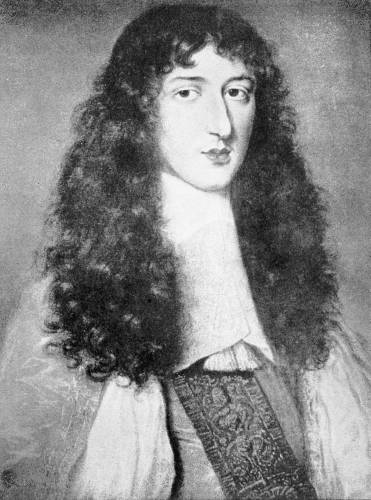 "Monsieur."
(Philippe d'Orléans.)
After Wallerant Vaillant.
The character of Philippe d'Orléans belongs to
a type with which readers of latter-day fiction are
very familiar. This prince of the seventeenth
century was the beau-ideal decadent that many
modern novelists have delighted to depict. His
mother and Mazarin, warned by the troubles the
previous King's brother, Gaston d'Orléans, had
caused the throne, were determined that Philippe
should be trained to play the most paltry part
in affairs. Consequently, while Louis XIV. was
given the education which fitted him to become
an able king, Monsieur was encouraged in every
tendency that could enfeeble him. "The prettiest
child in France" had grown up a young man of
striking beauty with not a redeeming virtue. The
last Valois king was the most degenerate monarch
that ever sat on the throne of France, but he was
at least picturesque. Monsieur did not possess
even this quality. To find his equal one would
have to go back to the decline of the Roman
Empire. In the third century he might have won
the purple and worn it like Heliogabalus, and the
Prætorians would have poisoned or strangled or
slain him. But he had the luck to be born in a
Christian and more indulgent era, and died peacefully
in his bed after a life of incredible uselessness
and scandal. Brought up entirely among
women, he had acquired an effeminacy that, when
clad in women's dress, a costume he frequently
affected, made it difficult to believe he belonged
to the other sex. The study of clothes was his
chief consideration, he spent hours rouging and
perfuming himself. Court functions, to which he
looked forward like a child to a party, provided
him with the opportunity to wear his gorgeous
costumes. A State funeral afforded him as much
pleasure as a State wedding.
La Grande Mademoiselle declares that when
her father, Gaston d'Orléans, died, the King on
paying her his visit of condolence, said—
"To-morrow you will see Monsieur in a trailing
violet mantle. He is enchanted to hear of your
father's death so as to have the pleasure of wearing
it."
And as Louis predicted, Monsieur went to the
funeral wearing a mantle of a "furieuse longueur."
Added to his taste for dress and pageants, he
delighted in collecting precious furniture, pictures,
and jewels. He also wrote neurotic verses and
swore love-till-death friendships—most of which
he betrayed. Of his literary accomplishments the
Bibliothèque Nationale contains the voluminous
and ridiculous correspondence with which he
honoured the witty Madame de Sablé. As to
the scandals into which his pleasures led him,
perhaps the least said about them the better.
Those who are interested in such things may learn
all about them in the memoirs of his period.
Shame was an emotion he never knew. When
his favourite, the Chevalier de Lorraine, the most
profligate man of his century, was banished,
Monsieur sulked. He possessed, however, two
traits that in a decadent of his type are rather
surprising. He liked the society of women quite
as much as that of his own sex. By his two
marriages he had seven children, of whom no one
ever doubted that he was the father. He was,
also, with all his vanity and effeminacy, personally
brave. When he served in the army it was said
"that he was more afraid of spoiling his complexion
than of bullets." Strange to say, the
division he commanded covered itself with glory.
At a certain siege he so distinguished himself that
Louis, who was extremely jealous of the tributes
paid to others, sarcastically shouted—
"Take care, brother; I advise you to lie as flat
on the ground as possible!"
Perhaps his degeneracy was not so much inherent
as due to that remorseless tyranny known
as "politics," which can find a host of plausible
excuses to gain an end. Had Monsieur been given
a fair chance he might have shown as much ability
as Louis himself. After his first campaign, brilliant
though it was, he was never given another
command. He had been trained to fear his
brother, but now and then he resented the dwarfing
to which he was continually subjected. One
cannot help feeling a certain satisfaction on reading
that once in boyhood in a "fit of ungovernable
passion he dashed a bowl of soup into his brother's
face."
When Madame married him the process of
degeneration was complete. "He was a woman,"
says Saint-Simon, "with all her faults and none of
her virtues; childish, feeble, idle, gossiping,
curious, vain, suspicious, incapable of holding his
tongue, taking pleasure in spreading slander and
making mischief." The union of this wretched
creature and the fascinating Madame could not
but be unhappy. It was a foregone conclusion
that the mignons of Monsieur should be jealous of
her influence. They had already roused all the
paltry jealousy of his nature against her when
Anne of Austria reinforced them with her malice.
Not that Monsieur loved his wife and resented
her coquetry with his brother. "I never loved her
after the first fortnight," he confessed in later life.
Monsieur's jealousy was purely personal. He was
jealous of her popularity, of her wit, of her brains—in
a word, of her superiority to himself.
He was also jealous of the attention the King
paid her.
The family bickerings to which his attachment
to his sister-in-law subjected Louis were irritating
to his pride. To silence them Madame, who had
no desire to forego a friendship that amused and
flattered her as much as it pleased the King,
devised a ruse by which everybody was thrown off
the scent. In order to enable Louis to continue
his visits and to divert in another direction the
hostility to which they exposed her, it was agreed
that the King should feign a passion for one of
Madame's maids of honour. The one selected for
this questionable purpose was a sweet, unsophisticated
young girl fresh from Touraine—the celebrated
Mademoiselle de la Vallière.
The ruse succeeded only too well. Madame's
enemies were completely hoodwinked, but Louis
fell head over ears in love with the maid of
honour. Madame, who ought to have foreseen
this dénouement, was at first astonished and mortified.
She was, however, too amiable to cherish
resentment, and, to show Louis how little she
cared, she plunged more gaily than ever into a
life of pleasure, whereby she became involved in
another and more dangerous flirtation, famous in
French history as: L'affaire Guiche-Madame.
*****
This "affaire" may be described as the historical
parent of a numerous family of the purest
French breed, of which some of the more familiar
descendants are the Diamond Necklace, the
Panama, the Dreyfus. Complexity of intrigue
was to each what the "Austrian lip" is to the
Hapsburgs—a family characteristic. Those who
wish a graphic account of the story should read
Dumas' "Vicomte de Bragelonne." We can do
no more here than give a rough sketch of it.
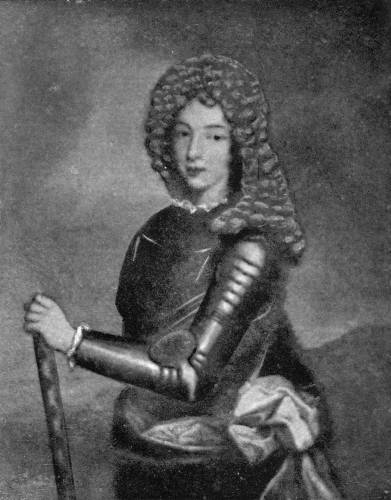 Armand, Comte de Guiche.
From a painting in the possession of the Duc de Gramont.
Like all of the Gramonts, Armand de Guiche
was an original character. His family, with the
exception of the famous Chevalier, who, afterwards
returned to favour, stood high at Court. His
father, the Maréchal—Maréchal Lampon they
called him in Paris, from the number of lampoons
his doings had inspired—was held in great esteem
by Louis, who forgave him his private life for the
sake of his public worth. His sister, the flighty
Princess of Monaco, of whom there are many
curious stories in the memoirs of the period, was
loved by Monsieur as much as he could ever love
any one, and an intimate friend of Madame as
well; as was also his aunt, the Marquise de Saint-Chaumont,
who was afterwards governess to her
children. He himself had passed all his life at
Court, where till the infamous Chevalier de Lorraine
came on the scene he was the bosom-friend
of Monsieur.
Fortune had been particularly kind to him. He
possessed everything necessary to make him a
general favourite: birth, wealth, good looks, winning
manners. The consciousness, however, of
these great advantages, says Madame de La
Fayette, "gave him a certain scornful air that
tarnished his merit not a little, yet one must own
no one at Court had so much of it as he." The
temperament of this hero was no less romantic
than his appearance. His brain teemed with the
most chivalrous and erotic ideas; he longed for a
grande passion, but it must not be one of your
commonplace, vulgar sort. He wanted a Guinevere
to play Launcelot to, a Francesca to whom he
might be the Paolo. And they married him when
little more than a boy, much against his will, to
an honest, prosaic girl. The marriage was, of
course, unhappy—for the Comtesse de Guiche.
She would have given half of her life to have been
loved by him, but marriage had only served to
make him long more than ever for the realisation
of his extravagant, impossible ideal. Now and
then he fancied for a moment he had found what
he sought; one of these brief illusions was a girl
who afterwards became the famous Princesse des
Ursins.
He was still seeking the unattainable when
Madame returned from London and fascinated
the Court. The high-flown imagination of the
Comte de Guiche was at once inflamed. It
pleased him to think that the danger of lifting his
eyes to one so far removed from him added to the
glory of such a passion. But Guiche's head was
not yet so cracked that all sense had left it.
Having learnt from the example of his uncle, the
Chevalier de Gramont, how unwise it was to excite
the jealousy of Louis in an affair of the heart, he
prudently waited till the King had left the field
before he entered it. But when his chance arrived
he behaved in the most singular manner. Although
they were thrown constantly together both at
Fontainebleau and the Tuileries, Madame was as
unaware of his infatuation as Dulcinea del Toboso
of Don Quixote's. The Comte de Guiche, however,
had no intention of concealing his passion
from the rest of the world. The jealousy of Monsieur
was aroused—the jealousy of a slighted
husband and a slighted friend. He and Guiche
quarrelled, and the latter "broke with the prince
of the blood as if he were his equal."
The "bruit," as it was called, that this quarrel
occasioned was the first intimation that Madame
received of the devotion of her quixotic admirer.
As she was not interested in the Comte de Guiche,
who had now withdrawn from Court, the affair
would have ended here but for Mademoiselle de
Montalais, one of her maids of honour.
This girl was an intrigante of a type that
abounded at the French Court throughout the
ancien régime. Her object was to insinuate herself,
so to speak, into fortune, by making herself
useful to some great person. She sought an interview
with the Comte de Guiche, and gained his
confidence by assuring him that she would win
him the favour of Madame. The means she employed
did not at first meet with the slightest
success. Madame refused to read the letters
Guiche sent her through the maid of honour, or to
hold any communication with him. But Montalais
was not disheartened. By dint of continually
harping to her mistress on the subject of the Count
she succeeded in creating a certain impression on
her mind; and one day, just as Madame was
leaving Fontainebleau for Paris, Montalais with a
mischievous air flung into her coach all Guiche's
unopened letters. As the journey was tedious and
Madame had nothing better to do she read the
billets. The originality of their style, which was
so obscure as to suggest that the writer had no
idea what he meant, amused her. The whim
seized her to reply—and the flirtation began.
As her heart was not involved in the flirtation,
her interest in her curious lover would no doubt
speedily have waned. But love of excitement,
the natural gaiety of her disposition, and the
life she led with Monsieur, whose jealousy might
more accurately be described as a malicious
espionage, inclined Madame to coquetry. Moreover,
the unexpected end to her flirtation with
the King had created a sort of blank in her life;
she was easily ennuyée, and when in this mood,
like the Duchesse de Longueville, the pleasures she
sighed for were not innocent. Her jaded gaiety
required a fresh stimulant, and this the flirtation
with Guiche gave her. The sense of the danger
they both ran from detection pleased her as a child
is pleased in playing with fire. Letters passed
between them every day, four of Guiche's to
Madame's one. One day Guiche disguised himself
as an old woman and, aided by Montalais,
visited his mistress. The skill with which he
evaded recognition by Madame's ladies while he
told them their fortunes would have done credit
to a Rochester. But success may sometimes
invite disaster.
Montalais, believing that with persons of such
consequence she was pulling the strings of an
intrigue that would govern the State, wished to
give an air of importance to an affair in which
she was interested. So, under the pledge of the
strictest secrecy, she confided to La Vallière all
that had passed between Guiche and Madame.
Poor La Vallière, who had sworn never to hide
anything from her royal lover, kept the secret
till it endangered her own happiness. For Louis,
talking one day to his mistress about Madame,
noticed that she became confused, whereupon he
instantly suspected that something important was
being hidden from him. As the unfortunate girl,
whom he had seduced and was later to abandon
heartlessly, could not deny that she had a secret
from him and, owing to her promise to Montalais,
would not betray it, the King left her in a passion,
swearing never to see her again. But when
twenty-four hours had elapsed and she neither
saw nor heard from the man she loved as few
kings have been loved, Mademoiselle de la
Vallière lost her head and fled to a convent.
Louis, however, was no sooner informed of her
flight than he went after her; and at the sight
of him the beautiful girl, whom the loss of her
virtue and the loss of her lover had between them
nearly driven mad, rushed to his arms and told
him all she knew.
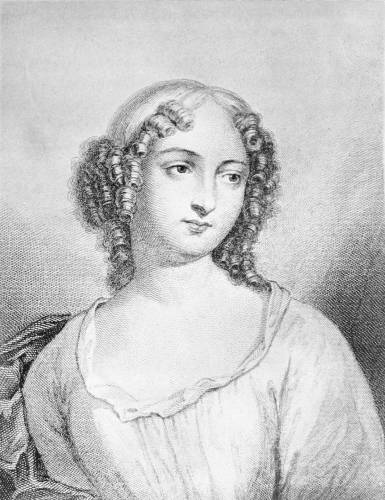 Mademoiselle de la Vallière.
The surprise of Madame—who had no idea that
La Vallière was acquainted with her secrets—may
be imagined when Louis coldly informed her
that he was aware of her indiscretions. For her,
the flirtation with which she had amused herself
might easily have had serious consequences; but
she was quick to discover the loop-hole by which
she, and even Guiche—for she was not base
enough to leave him to his fate—might escape.
It was in Louis' infatuation for La Vallière that
she discovered her opportunity. To him it was
necessary that his mistress's flight should be
hushed up by her return to the Court of Madame
in the position from which she had fled. And
as the cunning Madame would only agree to this
on the condition that Guiche, whom she promised
not to see again, should not be molested, ruin
was thus averted.
At this point the Louis-Vallière intrigue became
disentangled from that of Guiche-Madame, and
wandered off into another and more intricate
labyrinth, where after many adventures it was
finally devoured by the dragon Montespan; while
the Affaire Guiche-Madame, having anointed its
wounds with the oil of intrigue, picked itself up
and went on its perilous way more vigorously than
ever.
It began its new lease of life, however, with an
indiscretion. The Comte de Guiche had a friend
to whom he was in the habit of confiding all his
secrets, and who now appeared on the scene to
play the part of villain as consummately as ever
it was interpreted. This individual was the
famous or infamous Marquis de Vardes, one of
the most polished and attractive men at Court.
He was something of a Chevalier de Gramont on
an inferior scale. His epigrams and bons mots
were proverbial, and the dexterity with which he
could turn an awkward situation to his advantage
was unrivalled. He was quite universally popular,
and even Louis allowed him to take an occasional
liberty with him.
"De Vardes!" wrote Madame de Sévigné to
her daughter; "toujours de Vardes! He is the
gospel according to the day!"
This brilliant and popular Marquis was, however,
as proficient in intrigue as Mademoiselle de
Montalais herself, and utterly devoid of principle.
The confidences of Guiche and perhaps, too, the
fascination of Madame, had inspired him with the
desire to win her heart. To achieve his end it was
necessary that his friend Guiche should be got
out of the way. On learning that the King knew
of Madame's flirtation, he went to Guiche's father,
the Maréchal de Gramont, and so cleverly worked
on the old man's fears that he himself went to
Louis and begged his Majesty to order his son
to join his regiment in Lorraine. This the King
willingly did, but when the news of Guiche's
departure reached Madame, believing that Louis
had not kept his word to her, she broke hers to
him. Guiche persuaded her to grant him a farewell
interview, and Montalais undertook to arrange
matters. But while the Comte de Guiche, skilfully
smuggled into the palace, was saying good-bye
to Madame, who should be unexpectedly announced
but Monsieur! The ever-vigilant Montalais had
only time to whisper a warning, and the high-flown
Guiche was obliged to fling dignity to the
winds and escape like some ridiculous bourgeois
lover in a similar predicament. When Monsieur
entered his wife's apartment the Comte de Guiche
was in the chimney!
This expedient, however, did not prevent the
dénouement to which the foolish flirtation was now
hurrying. Two of Madame's women, who were
jealous of Montalais, having seen her smuggle
Guiche into their mistress's bedroom, promptly
went off to Anne of Austria and told her what
they knew. Such a piece of news was too much
for Anne to keep to herself, so she imparted it,
with the usual exaggeration with which one
embroiders a sensation, to Monsieur. His revenge
was characteristic. Having packed Montalais out
of the palace the next morning before his wife was
awake, he went off to Henrietta Maria and complained
of her daughter's conduct. But, thanks
to Madame, the disagreeable notoriety this affair
might have created was again averted. She frankly
confessed to having acted foolishly, promised to
treat Guiche for the future with the indifference
she felt towards him, and begged her husband's
forgiveness. Monsieur, disarmed by such straightforward
conduct, and satisfied with having humbled
his wife, agreed to a reconciliation, which, however,
was not of long duration. As he had sense
enough to understand that a scandal would
damage him as much as Madame, he suffered
Guiche to depart quietly for Lorraine, and contented
himself with insisting on the dismissal of
Montalais.
The ground was now cleared for Vardes. His
plans to make himself master of Madame by
love if possible, otherwise by blackmail, were most
skilfully laid. As it was, above all, necessary that
he should not excite the jealousy of Monsieur
against himself, he set to work to excite it against
the young Prince de Marsillac, the eldest son of
La Rochefoucauld. He succeeded so well that
Marsillac was banished from the Court, and
Monsieur treated Vardes with almost as much
favour as he did his mignon, the Chevalier de
Lorraine. Having been informed by his friend
Guiche of all that had passed between him and
Madame, Vardes was led to believe that the
passion was mutual, and in his treacherous
determination to supplant Guiche he did not
hesitate to paint the absent lover in the worst
possible light.
But in turning Madame's indifference to Guiche
into prejudice, Vardes made the mistake of
keeping his memory alive. Deceived by Vardes'
amiable and insinuating manners, and believing
him to be her friend, Madame distinguished him
with certain confidences that he interpreted as
signs of a growing affection. Vardes was, however,
rudely disillusioned at the very moment he
fancied victory within grasp. One night, at some
Court function, the conversation in the entourage
of Madame chanced to turn on the Comte de
Guiche, who from Lorraine had gone to Poland,
where he was covering himself with glory and
wounds. Among the stories told of him, it was
related that in a battle, in which some of the
fingers of his right hand had been shot off, a
bullet had struck him on the breast, and that
death was only averted by a "portrait he wore
next his heart." Madame, remembering all that
had passed between herself and Guiche, had no
doubt the charmed portrait was her own, and, in
spite of the prejudice against him that had been
subtly instilled into her mind, she was sufficiently
touched by what she heard to exclaim to Vardes
that "she believed she liked the Comte de Guiche
more than she thought."
Realising that he had failed, Vardes now resolved
to be revenged on both Madame and Guiche.
At the time of her arrest Mademoiselle de
Montalais had managed to save Guiche's letters
to Madame, of which she had the care, from
falling into the hands of Monsieur. These she
carried with her to her convent prison, whence
she had sent them for safer keeping, as she
thought, to her lover, Malicorne. This man
showed them to a certain Manicamp, a supposed
friend of the Comte de Guiche, from whom
Vardes artfully got possession of them. And
from this rape of the letters sprung a numerous
progeny of little intrigues, by means of which,
in the usual French fashion, a crowd of minor
persons set to work to weave the threads of
their own fortunes into the general pattern
of Vardes-Guiche-Madame.
To enumerate all the adventures of this precious
crew would require a book almost as long as the
"Vicomte de Bragelonne." Perhaps only a
Dumas could unravel all the threads of this
curious tangle. And what a tangle it was!
Think of the incriminating correspondence passing
from a Montalais' hand to those of a Malicorne
and a Manicamp, who wrote a libel on Madame
and Guiche, printed in Holland, and bought up,
all save one copy, by Madame's father-confessor,
who travelled secretly to Holland for the purpose
and had adventures not a few. Think of Vardes'
forged letters from the Queen of Spain to ruin
Madame—letters lost by the forgers. Think of
the Comte de Guiche returning from Poland and
discovering his friend's treachery; think of
Guiche's attempts to clear himself in Madame's
eyes—attempts in which the whole Gramont
family lent a hand with daily consultations at
the house of the famous Philibert and his La
Belle Hamilton—attempts in which masked balls
and lackey's liveries play a prominent part. If
one thinks of the possibilities of such incidents,
one will get some idea of the adventures the
Affaire Guiche-Madame had to encounter. To
stop it, once started, not even Vardes himself,
had he wished, had the power. Like a Juggernaut,
it continued to advance, crushing all who
got in its way, the innocent and the evil alike.
So cleverly had Vardes schemed, it seemed
impossible that Madame, still unaware of his
villainy, could escape destruction. She carried
on an intimate correspondence with her brother,
Charles II., in which neither concealed their
thoughts of the people around them. One of these
letters, not very flattering to Louis, Vardes got
possession of and showed the King, to whom as
gentleman of the bedchamber he had easy access.
But this fatal shot missed fire owing to the
treachery of his chief ally—his mistress, Olympe
Mancini, Comtesse de Soissons. This woman,
believing that Vardes' hatred of Madame was but
a mask to conceal a passion as wild as Guiche's
for the Princess, had a quarrel with her lover, on
whom in a fit of jealousy she revenged herself by
having an éclaircissement with Madame. Horrified
at the plot of which she was to be the victim,
Madame went straight to the King and explained
to him what she had learnt. Louis accepted her
interpretation of the letter to her brother, and
Vardes was sent to the Bastille.
But now the Comtesse de Soissons, realising
that her jealousy had not only utterly lost her her
lover but freed her rival, resolved to be revenged
on the Comte de Guiche. She had one of his
letters, in which, in his romantic way, he had
offered to make his regiment swear allegiance to
Madame. But the day was long past when
Olympe Mancini could make Louis XIV. eager to
fulfil her requests. To the mortification and terror
of the Comtesse, he went to consult Madame. By
this time Madame's gaiety was sobered by experience;
she had come to see the incredible folly of
a woman of her position flirting with Guiche and
making friends with a Vardes. Whatever affection
she may have had for the Comte de Guiche was
at an end, and she wished him out of the way.
But she was shrewd enough to detect an enemy in
the Comtesse de Soissons, and she resolved to save
Guiche at her expense as the lesser of two evils.
Louis was induced to pardon him if it could be
proved that his faults were small in comparison to
those of his enemies. As Madame now held all
the court-cards in the game, this was easy to do.
She gave the King a full and frank account of her
flirtation with Guiche from its beginning, as well
as the complications to which it had led, and wrote
to Guiche to do the same, "assuring him that she
had found plain dealing the best security against
Court machinations." The indignation of Louis
was aroused, and he lost no time in venting his
anger. Vardes was taken from the Bastille—the
ancien régime's prison for such persons as we
nowadays call "first-class misdemeanants"—and
immured in a dungeon at Montpelier. It was
nearly thirty years before he saw the Court of
France again.
A much milder punishment was meted out to
the Comtesse de Soissons. She was forced to
retire into the country for a time; but, far from
having a wholesome effect on her lawless spirit,
this temporary exile seemed to have assisted its
degeneration. When she returned to Court she
took to poisoning, or was at least suspected of
being implicated in the "Poison Affair," whereupon
Louis had to banish her altogether from the
country. She died in great misery, after a sensational
vagabond life, just as the star of her son,
Prince Eugene of Savoy, began to rise over
Europe.
As for the Comte de Guiche, he and his Dulcinea
never met again, in spite of all his attempts, in the
last of which, disguised as a footman, he fainted in
the very presence of Madame. Louis once more
obliged him to carry his high-flown, imaginary
passion off to the war then raging, in which, after
a short but brilliant career, he perished. Of all
those who had been entangled in this intrigue
Madame alone succeeded in escaping with colours
flying. But though the King's confidence in his
brilliant sister-in-law was fully restored, and she
was admitted to the secret councils of the Cabinet—a
distinction that no other woman, save Madame
de Maintenon, enjoyed in this reign—she could
not win happiness. Monsieur was a constant
thorn in her flesh. Perhaps it would have been
impossible to overcome the resentment of his
petty, contemptible nature; but Madame's attempt
merely served to whet his dislike into hatred.
Rightly guessing that his favourite, the Chevalier
de Lorraine, fomented the discord between them,
she determined that this man should be banished.
The necessary excuse for effecting an object so
thoroughly justifiable was provided for her by
Louis, who disliked the Chevalier de Lorraine
quite as much as she did herself. Instead of
remonstrating with his brother on his behaviour,
the King gave the Chevalier a lecture on the
subject, who, by declaring that henceforth he
would be answerable for Monsieur's good conduct,
fell into the trap set for him.
"What!" said Louis haughtily, "you answerable
to me for my brother? Do you think that I
choose to have such a guarantee? But, be it so, I
shall hold you to your word."
As opportunities of objecting to Monsieur's
conduct were innumerable, the Chevalier's impertinent
boast was soon put to the test. One day,
accordingly, without any warning, Louis sent to
arrest him. He was seized in a room in which he
was closeted with Monsieur, who fell into such a
paroxysm of grief and rage as to give the widest
publicity to a disagreeable scandal.
But the Chevalier de Lorraine in a dungeon at
the Château d'If, or in exile in Italy, was even
more dangerous to Madame's domestic happiness
than when at the Palais Royal. From the day of
his favourite's disgrace to his wife's strange death
a few months later, Monsieur was an impossible
husband for any woman to live with. He seemed
now to have but two objects in life, to be possessed
of two burning desires which dwelt in him evilly
like demons. One was the return of his Chevalier,
the other the death of Madame.
The vindictive animosity that Monsieur displayed
towards his wife was still further whetted by
a singular mark of favour which Louis bestowed on
his sister-in-law. Wishing to detach Charles II.
from the alliances he had formed, the King of
France thought that he could not find a more
suitable instrument to accomplish his design than
the insinuating Madame, whose relations with her
brother were, as Vardes had proved to him, of the
most cordial description. The Princess, when the
subject was explained to her, willingly undertook to
go to England and negotiate with Charles in
person, having, according to one authority, the
ulterior object of persuading her brother to afford
her his protection in the not unlikely event of her
separating from her husband, whose conduct was
becoming more and more insupportable. Whether
this was so or not, considering the character of
Monsieur, it was extremely undesirable that he
should be acquainted with the secret of her
mission. Hereupon he availed himself of his
conjugal rights with characteristic pettiness and
forbade her to leave France. But Louis was not
to be thwarted in a matter of such importance
to him by his brother's paltry rancour, and he
sternly told Monsieur "that she should go and
that he would have no more obstacles thrown
in his way."
Madame consequently departed, accompanied by
a brilliant suite which included the Comte and
Comtesse de Gramont and Anthony Hamilton.
Charles and his whole Court went to Dover to meet
her, and in his eagerness to see his sister again the
King, like an impatient schoolboy, rowed out into
the Channel to welcome her. The business transacted
during this brief visit need not detain us
here. On the ability she showed in negotiating
the "Traité de Madame" her fame chiefly rests.
When the articles of this treaty were made public
she was censured as a traitress who had sold
her country to France, and English historians
generally have ever since accused her of an
utter lack of principle. But considering that she
was, in spite of her birth, far more French than
English, the obloquy that attaches to her name
seems to us to have been inspired more by a
prejudice against the whole House of Stuart
than by a love of fairness. At the time, however,
her reception in England was not only brilliant
but cordial, and proved that her popularity had
not waned since her last visit. The ten or twelve
days she passed at Dover were, perhaps, the
brightest of her life. Certainly she never knew
a happy day afterwards.
Whether she was as successful in the personal
as she was in the political object of her mission is
not known. All accounts on the subject are at
variance; some declare that she came back from
Dover radiant, others depressed. At any rate, the
reception she met with from her husband was well
calculated to damp the gayest spirits. Monsieur
began at once to reproach her in regard to the
Chevalier de Lorraine; "he told her plainly that
he knew his favourite's banishment was her doing,
that she should have no peace till she had him
recalled, and even threatened her with worse if
she did not comply with his wishes." As the
recall of the Chevalier meant her humiliation, she
refused to yield. The relations between them were
at their worst when one morning, three weeks after
her arrival at St. Cloud, as she finished drinking a
glass of chicory-water she was seized with violent
intestinal pains.
Her first exclamation was that she was poisoned.
Every one in the palace was terrified, except
Monsieur. He did not appear in the least put
out. Word was despatched to Louis at Versailles,
who immediately sent Vallot, his own physician,
to St. Cloud. Shortly after he followed himself,
accompanied by the Queen and La Grande
Mademoiselle. When they arrived they were told,
to their horror, that Madame was dying. They
found her writhing on a couch, pale, dishevelled,
and scarcely recognisable from the convulsive
movements that distorted her features. No one,
with the exception of her maids of honour who
hung over her weeping, appeared the least alarmed.
At the sight of the King she uttered a piercing cry
and said she felt "a fire in her stomach." The
doctors looked on in silence, without attempting
to alleviate her sufferings.
"But," said Louis to them, "is it possible you
will let a woman die like this without doing
something?"
Vallot replied that the illness was not fatal.
"It is," he explained, "a sort of colic which may
last nine, ten, or even twenty-four hours at the
most."
And people continued to go and come in the
room, laugh and talk with an inhuman indifference
that must have been heart-rending to the unhappy
woman.
La Grande Mademoiselle was astonished that no
one had thought of speaking to her of the state of
her soul.
"At this moment," she writes, "Monsieur
entered. I said to him, 'Madame is not in a fit
state to die, and she should be confessed.'
"He answered that I was right, and told me
that her confessor was a Capuchin who was good
for nothing except to do her honour by appearing
in public in her coach that people might see she
had one.
"'A different sort of man,' he added, 'is needed
to speak to her about death. Whom could we get
that would sound well to put in the Gazette?'
"'At such a time,' I said, 'the best qualification
that a confessor could have was to be a
pious man.'
"'Ah, I have it!' he replied; 'the Abbé
Bossuet is the man. He has just been nominated
for the bishopric of Condom.'"
Hereupon Louis, disgusted at such callousness,
and unable to support the sight of Madame's
sufferings, took an affectionate leave of her and
hastened back to Versailles.
Bossuet was sent for, but in the meantime the
rumour "Madame se meurt!" had reached Paris,
and a host of persons flocked to St. Cloud. Among
them were the great Condé and the old Maréchal
de Gramont, father of the Comte de Guiche, who
went to her bathed in tears. "She told him
pathetically that he was losing a good friend, that
she was dying, and at first she thought she had
been poisoned by mistake." Then turning to her
sincerest friend, whose simple narrative of her
death should have made all others superfluous, she
said with something of her old gaiety—
"'Madame de La Fayette, my nose has shrunk
already.'
"I answered by my tears, for what she said was
only too true, and I had noticed it before. The
hiccough seized her. She told Esprit (one of the
doctors) that it was the death-hiccough. She had
asked several times how soon she should die; she
repeated the question, and although she was
answered as a person not near death, we saw well
that she had no hope. Her thoughts never rested
on life; she never uttered a word of reflection on
the destiny which was taking her off in the prime
of life; never questioned the doctors as to whether
it were possible to save her; showed no impatience
for remedies, except in so far as the violence of
her pains made her long for them; exhibited a
calmness in the certainty of death, in the suspicion
of poison; in short, a courage of which no example
can be found, and which it is difficult even to
represent."
When Montague, the English Ambassador,
arrived, she said—
"You see the sad condition I am in. I am
going to die. Ah! how I pity the King, my
brother, for I am sure he loses the person in
the world who loves him best."
"A little while later," says Montague in a letter
he wrote to Charles, "she called me again, bidding
me be sure to say all the kind things in the world
from her to her brother, and thank him for all his
kindness and care of her.
"'Pray tell my brother I never persuaded him
to join France out of my own interest, but because
I thought it for his honour and advantage, for I
always loved him above all things in the world.'
"I asked her in English if she believed herself
poisoned. Some confessor standing near catching
the word poison, which is the same in French as
in English, quickly interposed—
"'Madame, you must accuse nobody, but offer
up your life as a sacrifice to God.'
"So she only shrugged her shoulders."
Perhaps the most touching incident of this
leave-taking was associated with Tréville. This
man was the Captain of Monsieur's Mousquetaires,
and one of the wittiest and best-educated men at
Court. "To talk like Tréville, to be as learned as
Tréville, was the highest compliment you could
pay a man." He was one of the chiefs of the
Port-Royal coterie, which was the centre of
intellectual life in France—and he loved Madame.
It was a love that did them both honour—a
chivalrous devotion that never overstepped the
bounds of respect. To approach Madame at such
a moment and take leave of her for ever before the
envious eyes of that crowded, callous room was
impossible to Tréville. But, notwithstanding her
hectic excitement and intense suffering, Madame
observed him standing in the background.
"Adieu, Tréville, adieu, mon ami!" she waved.
The simple farewell broke his heart. The next
day he left the Court and the world for ever.
In these last terrible moments she forgot no
one. Monsieur having left the room, she sent to
call him back, and in bidding him farewell declared
that "she had never been faithless to him." The
solemnity of the occasion on which these words
were uttered has inclined most of her biographers
to acquit her of the adulteries with Louis and the
Comte de Guiche of which she was suspected.
There are other evidences, however, of Madame's
virtue which might be cited quite as convincing as
this; and in regard to the Comte de Guiche at all
events, the various ladies for whom he sighed
before he met Madame were all agreed in attributing
a physical rather than a spiritual cause to
the "Platonic" character of his amours.
Her strength now began to fail fast, and as a
last resort the doctors decided to bleed her. The
incision was made in her foot, but no blood flowed,
and her exhaustion was so extreme that they
thought she would die while her foot was still in
the warm water. The doctors then declared that
they would try one more remedy, but she begged
them to give her the Extreme Unction before it was
too late. It was given to her by a priest who was
present, and who exhorted and rebuked her like
a Scotch Calvinist. When he had finished she
said meekly—
"At what o'clock did Jesus Christ die? At
three o'clock?"
"Do not mind that, Madame," he replied,
"you must endure life and wait for death with
patience."
At this moment Bossuet arrived. He was so
overcome at the sight of her that he nearly
fainted.
"He spoke to her of God," says Madame de La
Fayette, "in a manner suitable to her condition
and with that eloquence which marks all his
sermons. He made her perform such little acts
as he thought necessary, and she entered into all
that he told her with zeal. While he was speaking
a maid of honour approached to give her
something of which she had need. She said to
her in English, in order that Bossuet might not
hear, and preserving till death the politeness
characteristic of her—
"'Remember to give M. Bossuet, when I am
dead, the emerald ring that I have had made
for him.'
"While he was praying with her he was nearly
exhausted by the strain on his nature. Madame
asked him gently if she might not take a few
moments' rest; he told her that she might, and
he would withdraw and pray for her. M. Feuillet"
(the priest who had given her the Extreme Unction)
"remained at her side, and almost at the same
moment Madame begged him to recall M. Bossuet,
for she felt she was about to die. M. Bossuet
hurried back and gave her the crucifix. She took
it and embraced it with ardour. M. Bossuet continued
to speak to her, and she replied with the
same clearness as if she had never been ill, keeping
the crucifix pressed to her lips to the last. As her
strength failed it fell from her hands, and she lost
speech and life at the same time. Her agony
lasted but a moment; and after two or three little
convulsive movements of the mouth, she expired
at half-past two in the morning, and nine hours
after having been taken ill."
*****
It is only natural that the suddenness and
mystery of such an illness and death should
have been fertile in historical speculation.
For about one hundred and fifty years the
world generally took it for granted that Madame
was poisoned—especially as some of the doctors
privately expressed this opinion, which was contrary
to their official statement at the post-mortem.
But in the early part of the nineteenth century
the world suddenly changed its mind and declared
that Madame died "naturally" of cholera morbus
or peritonitis. As far as we are concerned one
theory is as good as another. Our object is not
to emulate the latest authorities and perform, like
them, a literary autopsy on remains we have never
seen. At this late day it is of not the least
consequence to the world whether Madame was
poisoned or not. By all means let us take it
for granted, with M. Anatole France and many
another of equal distinction, that her untimely
end was natural. But as the other theory is
thoroughly in keeping with seventeenth-century
customs, it is, if no longer worthy of credence—which,
after all, is not proved—at least pregnant
with possibility.
As a good "poison story" it will always be
worth telling; and as no one has ever told it
more graphically than Saint-Simon we will give
his version.
He says that when the news that Madame
had expired reached Versailles—
"The King, who had gone to bed, rose, sent
for Brissac, who was the captain of the guards
and close at hand, and commanded him to choose
six body-guards, trusty and secret, to go and
take up Simon Morel, Madame's maître d'hôtel,
and to bring him to him in his cabinet. This
was done before morning. When the King saw
him he ordered Brissac and his valet de chambre
to withdraw, and assuming a most alarming
aspect and tone—
"'My friend,' said he, surveying him from
head to foot, 'listen well to me. If you confess
all and tell me the truth about what I want to
know from you, whatever you may have done
I pardon you; it shall never be mentioned again.
But beware how you disguise the least thing, for
if you do you are a dead man before you leave
this place. Has not Madame been poisoned?'
"'Yes, Sire,' answered Morel.
"'And who has poisoned her and how?' said
the King.
"He replied that it was the Chevalier de
Lorraine, who had sent the poison from Italy to
Beuvron and Effiat (two of Monsieur's equerries).
Whereupon the King, redoubling his assurances
of favour and threats of death, said—
"'And my brother, did he know of it?'
"'No, Sire. None of us three were fools enough
to tell him. He never keeps a secret, he would
have ruined us.'
"At this reply, the King uttered a long 'Ah!'
like a man oppressed, who all at once breathes
again.
"'Well,' said he, 'that is all I want to know.'
And Brissac restored Morel to liberty."
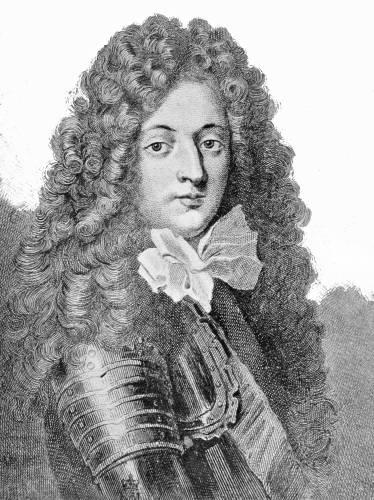 The Chevalier de Lorraine.
Saint-Simon further declares that a few days
before Monsieur married his second wife Louis
took her aside and told her these circumstances,
assuring her that Monsieur was innocent of any
participation in this crime, and that were he
not convinced of it he would not have permitted
his remarriage. This second Madame, or La
Palatine, as she was called, who by this marriage
became the mother of the Regent d'Orléans,
and was not the least original of the many
strikingly original persons of "le grand siècle,"
tells the story in another fashion, in that remarkable
correspondence of hers from which as much
historical ore has been mined as from Saint-Simon's
memoirs:—
"It is only too true," she writes in her blunt,
vigorous way, "that Madame was poisoned, but
without the knowledge of Monsieur. While the
villains were arranging the plan of poisoning the
poor woman, they deliberated whether they should
tell Monsieur or not.
"The Chevalier de Lorraine said, 'No, don't
tell him, for he cannot hold his tongue. If he
does not tell the first year, he may have us all
hanged ten years afterwards.'
"They therefore made Monsieur believe that
Madame had taken poison in Holland (on her
way back from England), which did not act until
she arrived at St. Cloud. Nor was it Madame's
chicory-water that Effiat had poisoned, but
the goblet. A valet de chambre, who was with
Madame and afterwards in my service, told me that
in the morning while Monsieur and Madame were
at Mass, Effiat went to the sideboard, and taking
Madame's glass rubbed the inside of it with a
paper, and that he, the valet, said to him—
"'Monsieur d'Effiat, what are you doing in
this room, and why do you touch Madame's
glass?'
"Effiat answered, 'I am dying with thirst, I
wanted something to drink, and the glass being
dirty I was cleaning it with some paper.'
"After dinner Madame asked for some chicory-water,
and as soon as she had swallowed it she
cried out, 'I am poisoned!'
"All that were present drank of the same chicory-water,
but not from the same glass, so, of course,
it did them no harm."
Such are the most authoritative "poison"
theories which nineteenth-century investigation
has very brilliantly but not altogether exploded.
*****
Madame's death, as may be imagined, created
a profound sensation throughout Europe. In
London, considering how slight had been her
connection with her native country, the indignation
was remarkable. An infuriated mob rushed
to the French Embassy, which but for the precautions
taken by the Government to protect
it they would have destroyed. Whitehall was
utterly prostrated. Charles took to his bed for
several days.
"Never," said Rochester, "was any one so
regretted since dying was the fashion."
But for the good sense of the King, England
would have declared war on France. Louis, whose
grief was genuine, did all that he could to prove
his regret—all but punish the suspected poisoners.
On the contrary, Effiat was promoted and the
Chevalier de Lorraine, whom he detested, to
Monsieur's and his own delight, was recalled.
Perhaps no other course was left open to him, if
the report of foul play which threatened to plunge
him into a war was not to be hushed up at all
costs. But to prove to Charles II. and Europe
that he was free from implication in this strange
death, he at once ordered a post-mortem, at which
English doctors and the English Ambassador were
present. The verdict of the autopsy was "death
from natural causes." It served to allay popular
anger but not popular suspicion.
Louis also gave Madame such a funeral as few
kings have ever had.
"I do not think," wrote Madame de Sévigné,
who was present, "that there will be any better
music in heaven."
Bossuet pronounced over the corpse his masterpiece,
which is familiar to every schoolboy in
France. On his finger, placed there by Louis
himself, there glittered the emerald Madame had
bequeathed him with her dying breath, and which
he wore till his own death. The body was buried
at St. Denis beside that of Henrietta Maria. It
was the first that the mob dug up one hundred and
twenty-three years later when the tombs of the
kings were desecrated. It was flung into a pit
behind the church along with Louis' and the rest
of his dynasty's. By a curious coincidence it—or
what was supposed to be it—was the first
body restored to its original resting-place after
Waterloo.
By a still more curious coincidence, Madame's
daughter, Marie Louise, whom they married to the
last King of Spain, of the House of Austria, died at
the same age and in the same strange way as her
mother. There is something decidedly uncanny
in the fate that decreed that Effiat, as French
Ambassador at Madrid, should be the medium
through whom her husband corresponded with
her; that the Chevalier de Lorraine should be the
man appointed to lead her to the altar; and that
the Comtesse de Soissons should be the one to
poison her!
If happiness be the aim of prince and peasant
alike, it was not, at all events, in the Armida-courts
of the seventeenth century that it was to be found.
It was of Madame, his friend and patron, that
Molière was thinking when his Alceste sang—
"Si le roi me donnait,
Paris sa grande ville,
Et qu'il me fallut quitter
L'amour de ma mie,
Je dirais au roi Henri
Reprenez votre Paris,
J'aime mieux ma mie, ô gué,
J'aime mieux ma mie."
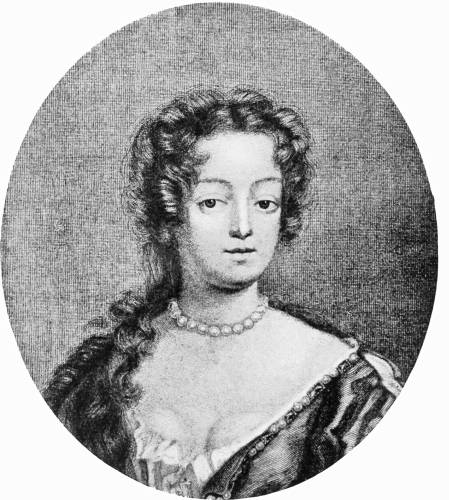 The Duchess of Portsmouth.
After Sir Godfrey Kneller.


