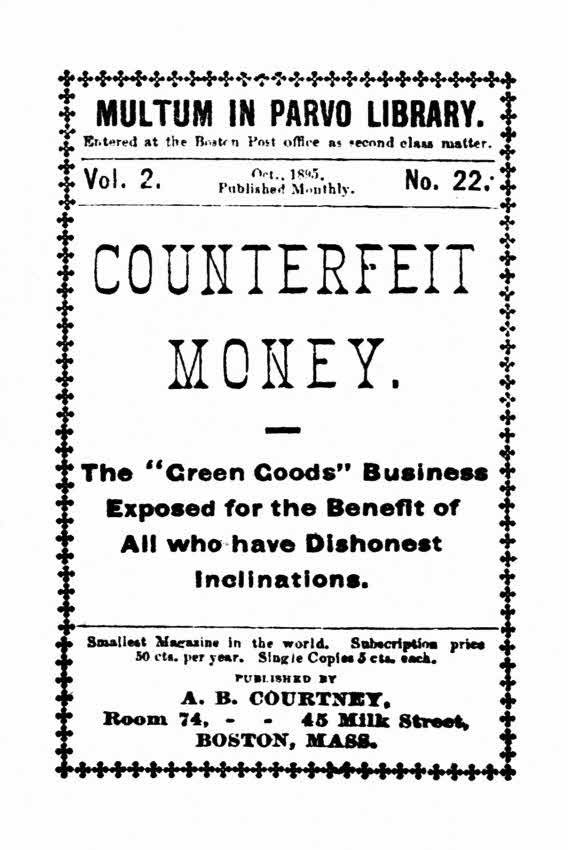
COUNTERFEIT MONEY.
Every good thing has its imitation, and this includes
money. Counterfeiting dates back to the
old Greek and Roman times, and the despicable
business has been kept up ever since, and probably
always will be. In some countries the laws are so
severe that the conviction of a maker or passer of
spurious coin or bills means death. In America
the punishment is usually a long term of imprisonment.
Nevertheless people of dishonest tendencies
seem to have a mania for wanting to
“shove the queer,” and are desirous of going into
the business extensively if they can only find a
manufacturer of bad money who will supply them.
This demand has been the cause of establishing
the trade popularly known as “green goods” business.
The operators are usually in gangs, and
they work scientifically. Perhaps you, respected
reader, have received ere this a very confidential
letter from one Johnson, or Bechtoldt, or Carruthers,
or somebody else, (usually located in
New York, Jersey City or Chicago) telling you
about the “green articles” that they have to sell in
denominations of “tens, twenties,” etc., and assuring
you that they are “perfect in every respect.”
Enclosed with the letter you probably found a
clipping alleged to have been cut out of a newspaper,
telling how a crack counterfeit dealer had
been caught red handed but had passed the ordeal
of a trial and had been acquitted, because the
counterfeits were so good that neither prosecutors,
judge nor jury would dare to say that the
money in evidence was spurious. Yet, the clipping
goes on to say, that it is well known that the
money really was counterfeit, but had been printed
from some plates that had been stolen from the
treasury department, and were, to a certain extent,
genuine.
As a matter of fact, no plates of money were
ever stolen from the U. S. treasury department,
and the so called newspaper clipping is a concoction
of some ingenious rascal intended to convince
you, if dishonestly inclined, that you can handle
the “green articles” with perfect safety.
The letter doesn’t contain the address of the
dealer; oh, no, he doesn’t do business that way.
You can only reach him by telegraph to an address
given by him, which is no address at all in
reality except perhaps the location of a graveyard
or aqueduct. It has been alleged that the Western
Union Telegraph Company simply holds such
telegrams and they are called for by the men who
expect them and whose swindling game is understood
by the telegraph people. The swindler
sends back an answer by letter, telling the countryman
to come on at once, and saying that he will
meet him upon his arrival at the depot, or at
some hotel, and one is to know the other by means
of a colored handkerchief, a peculiar way of carrying
the cane, or some other signal.
Well, the countryman goes to the city, meets
the knave who shows him in some quiet room, a
package of crisp bills. The countryman opens
his eyes wide and visions of sudden wealth flit
through his brain. Mr. Counterfeiter suggests
that they try some of the bills and see whether or
not they will pass without detection. They drop
into a saloon, and courteous Mr. Counterfeiter insists
that the other have a drink. Perhaps Mr.
Wayback may be a prohibitionist, but that doesn’t
matter as he will certainly be willing to drink a
little pop beer or ginger ale, just to be social.
The city rascal doesn’t even need to wink at the
bartender to cause the latter to drug the drink, as
he is well paid by the gang, and before the countryman
and the city rascal have got far Mr. Wayback
begins to feel stupid, and can be easily induced
to go anywhere his leader suggests while they are
“trying the counterfeit money.” However, the
bills are just as good as gold, being absolutely genuine,
and the “dealer in bad money” can safely
lead his confiding friend into any bank, and have
one or two bills changed, just to convince the jay.
Perhaps Mr. Wayback is so thoroughly drugged
that he falls asleep when landed in one of the
out-of-the-way rooms of the gang. In that case it
is an easy matter to drug him more and rob him
of all the good money he possesses, then take him
out after nightfall and leave him to sleep off the
effects of his potion in some alleyway.
On the other hand, if the would be rascal of a
countryman keeps awake he will be introduced to
one or two other jolly good fellows, and a transaction
will be made in the aforementioned room.
The two or three thousand dollars in real money
(which the countryman supposes to be excellent
counterfeits) will be wrapped in a package and
sealed. Then the jay will be asked to produce the
$300 or $500 that he is to pay for the pile. While
he is doing this, one of the confederates adroitly
substitutes another package for the one on the
table, being exactly similar in outward appearance
and weight, but filled with sawdust. Mr. Wayback
doesn’t see all this, and the crooks are very clever
withal. About the time that he has his good
money counted to pay over, one of the gang looks
out the window, whispers that two detectives are
approaching, and they suddenly skip, one of them,
of course, grabbing the countryman’s payment,
and hastily suggesting that he take his package
and get out of the city as soon as possible. This
he will do, and ultimately find out how he has
been swindled.
But what can he do?
He intended to be dishonest, and if he complains
to the police he will be liable to arrest. The
swindlers have got his money, he has obtained the
experience and goes home a sadder but wiser
man.
This game is worked all the year around and it
is astonishing how new “suckers” are obtained so
readily. Police and post office officials use all
sorts of methods to kill the business but their success
is limited. The “green goods” men make
large sums of money and live high.
To all who are looking for counterfeit money let
us say, “Don’t.” You cannot get it anyhow, but
even if you could, the chances are nine in ten that
you would soon occupy a felon’s cell. Seldom a
counterfeiter goes free for long, no matter how
clever he may be. Frequently the styles of “green
goods” invitations are altered, and to one who is
bound to be dishonest, it might appear that, after
all, the special scheme offered him may be all
right—that is, dishonestly all right—and that the
counterfeit money can be obtained after negotiations.
But it can’t. We do not deny but that
spurious money is passed, but only in the inner
circle of crookdom are such things arranged, and
it would be as easy for a camel to walk through a
key-hole as for any but a “cut and dried” old time
crook to get an “inside” on the counterfeit money
business.
Be honest; it pays. The writer sincerely hopes
that this little volume may be the means of saving
the money of many a man, and of diverting his
ideas in a more legitimate direction. Let such as
are tempted by the “green goods” monster, and
who have money that they could invest, put such
money in the savings bank at a small per cent.
The result will be a fair income, but better still, a
clear conscience.