The cotton-planting season in all the Southern States commences in
April. The seed is sown in drills, a negro girl following the light
plough which makes the furrow, and throwing the seed into the shallow
trench as she moves along. A harrow follows to cover up the deposits,
and the work of "planting" is completed. About two and a half bushels of
seed are required for an acre of ground.
In a week or ten days the cotton is "up," when a small plough is run
along the drills, throwing the earth from the tender plants. The next
process is "scraping;" in other words, thinning out and earthing up the
plants, so as to leave each in the centre of a little hill, some two
feet distant from its nearest neighbors. The dexterity and accuracy with
which this feat is accomplished are wonderful; and there are few
spectacles more animated and picturesque than that of a hundred active
field-hands flourishing their bright hoes among the young vegetation,
each striving to outstrip the others in "hoeing out his row." Several
ploughings and hoeings intervene between the first of May and the last
of June.
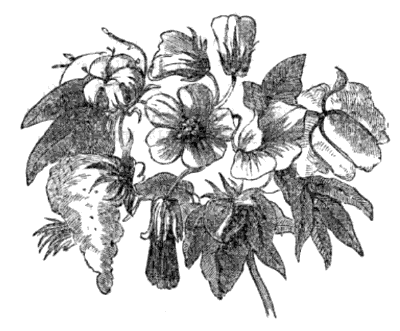
In July the cotton fields burst into bloom, creaming the landscape
with a sea of blossoms, the flower being very nearly of the same tint as
the ultimate product in its unbleached state. The new beauty thus
imparted to the scenery is, however, ephemeral. The blossoms unfold in
the night, are in their full glory in the morning, and by noon have
begun to fade. On the following day their cream-color has changed to a
dull red, and before sunset the petals have fallen, leaving inclosed in
the calyx the germ or "form" of the filamental fruit.
The cotton plant, in its progress towards maturity, is liable to the
assaults of as many enemies as the young crocodile on the banks of the
Nile; but among them all, the "army-worm" is the most destructive. This
worm is produced from the eggs of a chocolate-colored moth of
particularly harmless and demure appearance; but its name is legion, its
ravages terrific. No one who has beheld an invasion of these
caterpillars can ever forget it. Deep trenches are dug to arrest their
progress, but these are soon filled up by the accumulating myriads; and
onward move the living destroyers over the bodies of the buried masses.
Huge logs are drawn through the trenches by yokes of oxen, and the
multitudinous swarms crushed to a paste, of which the effluvium taints
the air for miles; but still the incursion, if checked, is not arrested.
When the planter sees the army-worm in his fields, he is ready to give
up his crop in despair.
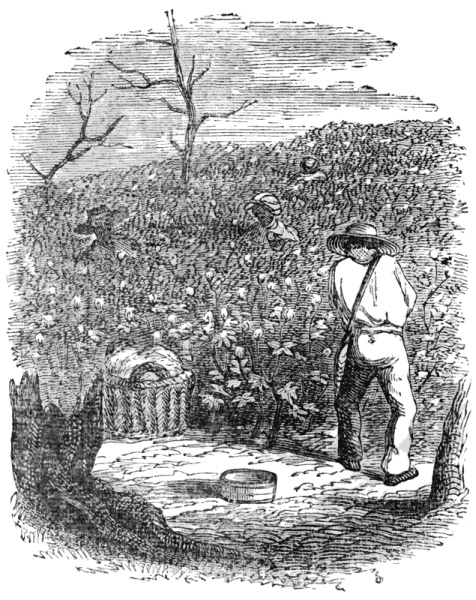
By the middle of July the "bolls" or "forms" begin to open; and the
cotton fields, when viewed from a short distance, present the appearance
of being covered with ridges of white surf. Toward the close of the
month the picking season commences, and is continued without
intermission until the Christmas holidays. Each field-hand is supplied
with a basket and a bag. The basket is placed at the end of the cotton
row, and the bag, as fast as filled, is emptied into it. It is a
pleasant sight, on "the old plantation," to see the pickers returning at
nightfall from their work, with their well-filled baskets picturesquely
poised upon their woolly heads. Falling into line with the stoutest in
the van, they move along through the twilight, too tired to talk or
sing, anxious only to deposit their store in the packing-house, and
retire to their "quarters" to rest. A first-rate hand will pick from
three hundred to three hundred and fifty pounds of cotton per day.
The next process is the "ginning," or separation of the cotton from the
seeds. The invention of the cotton-gin by Eli Whitney, a New England
youth, in 1793, marked a new epoch in the cotton trade, and at once more
than quadrupled the value of the article as a national staple. Arkwright
had already introduced the spinning-frame, and through the genial
influence of these two great inventions, a pound of cotton, formerly
spun tediously by hand into a thread of five hundred feet, was
lengthened into a filament of one hundred and fifty miles; and the
value of our cotton exports was increased in sixty years from fifty
thousand to one hundred and twelve millions of dollars!
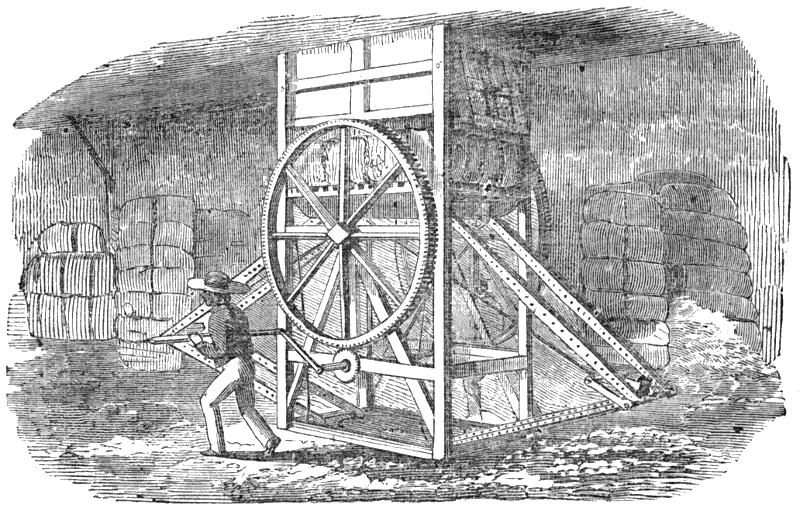
PACKING PRESS.
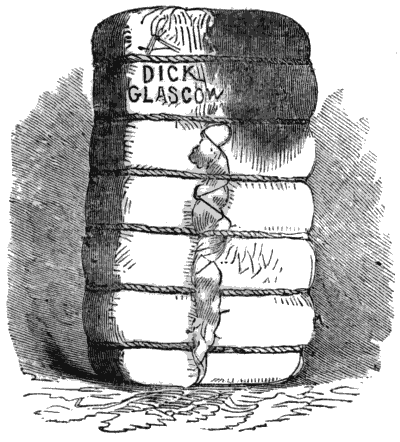
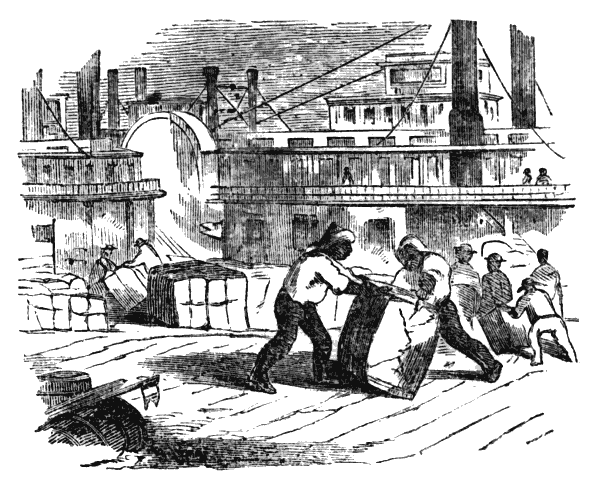
After the "ginning" comes the "baling" of the cotton, which ends the
labor bestowed upon it on the plantation. In this process powerful
screw-presses are employed. The cotton is inclosed in Kentucky bagging,
and the contents of each bale are compressed by the screw almost to the
solidity of stone. The cotton is now ready for market.
Toward the close of the packing season there are jolly times on the
plantation. Fox-hunting and racing are the order of the day. The
Southern planter, like the "fine old English gentleman," opens house to
all, and all goes "merry as a marriage bell." Sambo rubs up his old
musket, and is out after the ducks, while Dinah's shining face wears an
extra gloss in anticipation of the holidays. Throughout the holidays
there is high festival in the negro quarters. "The shovel and the hoe"
are laid down, and the fiddle is continually going. So ends the cotton
season.