Ajaccio as we see it to-day is not an old town. The
fortress that is known to have existed here in earlier
times has disappeared, and the city that was the seat
of a bishopric for hundreds of years has vanished,
without leaving a trace of its former existence behind.
The modern Ajaccio, or rather, the older part of the
modern Ajaccio, was established in the fifteenth century
by the Genoese on a site about a mile to the south of
the old hill-city which tradition asserts to have once
flourished there.
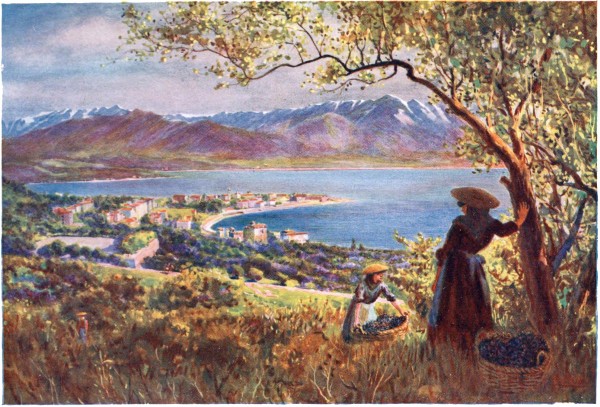
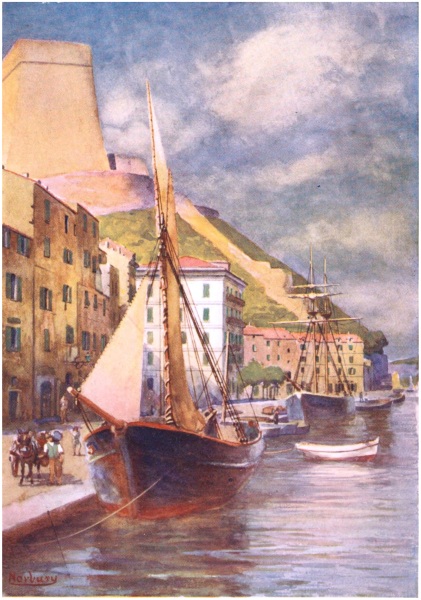
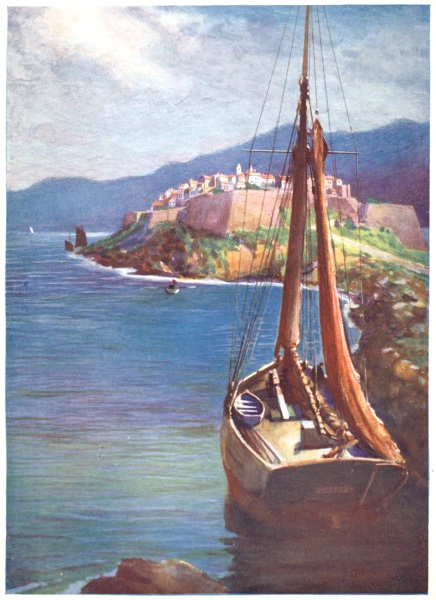
The chief feature of Ajaccio as one sees it on arriving
by steamer from Marseilles is the gaiety of its aspect.
The tall houses are painted pale blue, pink, or light
green, and in the early morning, when the face of the
gulf is without a ripple, the many-coloured town is
reflected as in a Swiss lake. It is set in a framework
of high mountains, which until late spring remain
crowned and adorned with masses of snow. The streets
are lined with palms and orange and lemon trees, which
give the place quite an Oriental appearance. The trees
at Easter are laden with fruit, but the ripe oranges are
left severely alone by the children in the streets, for
they are bitter and unpleasant to the taste.
The men walk about in the squares, sit at the cafés,
lounge on the benches, and stare at the sea, and seem
to know little of the meaning of work. What they
want in the way of food, clothing, and rent is obtained
for them by their hard-working women-folk. The
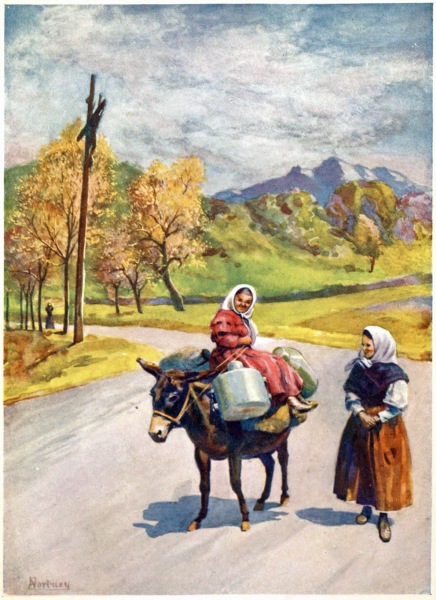
women are seen riding and driving mules, carrying
water, buying and selling in the markets. The general
rule is that the women do all the work, while the men
sit and think. If their thinking is equal to their sitting,
they must be a very thoughtful race. They do nothing
else. Even the only engineer, motor and cycle repairer
in Ajaccio is a wrinkled old woman.
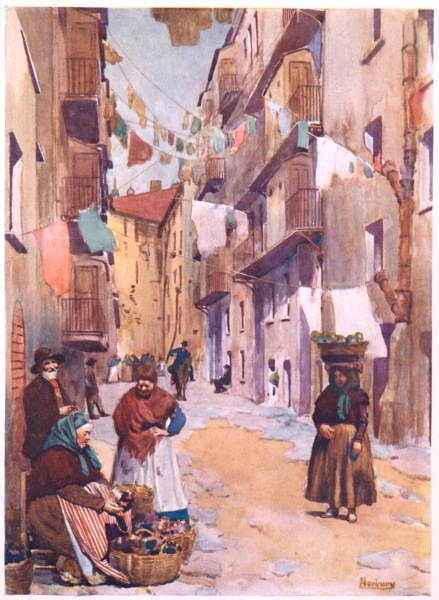
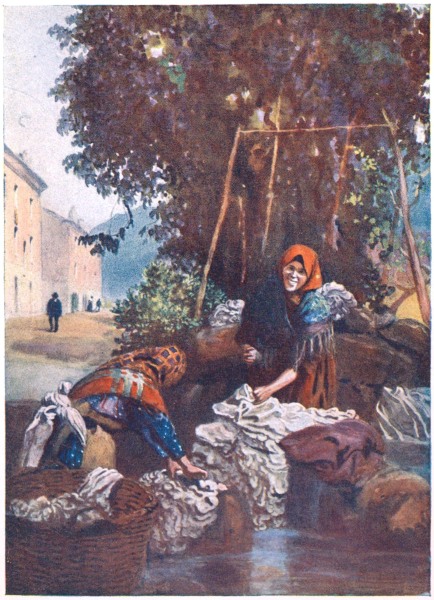
At all hours of the day women assemble at the
public fountain, which also serves as the public washing-place.
These women are mostly dressed in black, for
a reason that will be best understood after reading the
chapter on “The Vendetta.”
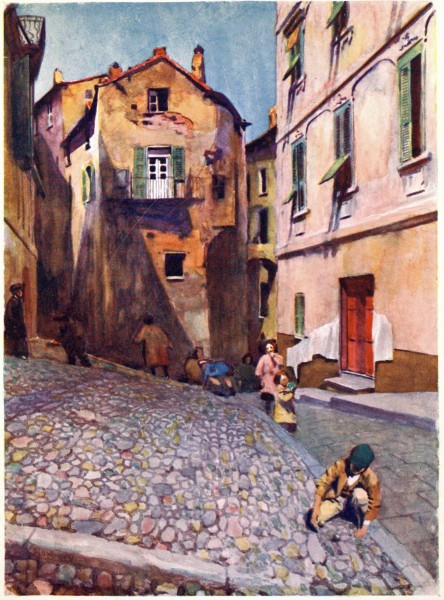
The houses are of the usual pattern, tall, arranged
in flats, and containing an enormous number of tenants.
The open drain-pipes that crawl over the outsides of
the dwellings are as offensive to the nose as they are to
the eye.
As every schoolboy knows, Ajaccio, the present
capital of the island, was the birthplace of Napoleon.
And even if you have forgotten the fact, you have not
long set foot in the town before you are reminded of
it. Everything speaks to you of Napoleon. His
shadow haunts the place. Streets have been named
after him, chapels have been built to his memory, the
local museum is crowded with souvenirs of himself and
his family, his statues adorn the public squares, and the
dull-looking house that was the nest of this imperial
eagle is a place of frequent pilgrimage. Like a good
tourist, I went to see the great usurper’s earliest home.
It is very plain, but it is one of the best in Ajaccio. It
is built in three stories, each containing six windows.
Over the front-door is inscribed on white marble,
“Napoléon was born in this house, August 15th,
1769.”
No sooner does the traveller get within easy reach
of the Place Letitia, where the house stands, than he
is surrounded by children screaming, “La maison
Napoléon! la maison Napoléon!” I chose a little girl
as a guide. A score or two of children, friends and
acquaintances of the guide, followed us, forming a very
noisy escort. They demanded with great patience and
energy, “Un sou, monsieur—un sou.” Our chosen
leader proved herself a true daughter of a fighting
race by turning round from time to time and dealing
vigorous blows at anybody within convenient reach.
The blows, however, were without the least effect, nor
did the crowd diminish or the cries cease because I
steadily refused to reply to the demand for sous.
We were conducted over the house by an elderly,
benevolent-looking woman.
“Are you French?” I asked.
She was highly offended, for the Corsicans are an
extremely patriotic nation, and think most other people,
the French included, far beneath themselves in courage
and other manly virtues. The old lady drew herself up
to her full height, and, looking as vicious as such a
nice old lady possibly could, she snapped out, “No;
Corsican.”
“So much the better,” I replied, and she forgave me
at once. She showed us only the rooms on the first
floor of the house. There was the little parlour with a
few articles of furniture which she said had originally
belonged to the family. I learned afterwards that they
had never done anything of the kind. There was the
little room where the hero was born, a dining-room with
a floor of glazed tiles, and a drawing-room with a floor
of inlaid wood.
The baby Napoleon was an ugly little fellow, with a
very big head. He screamed so loudly that he astonished
most people who had ever had any experience of the
strength of a baby’s lungs. As he grew to boyhood he
was noted for his ugliness. Everyone who saw him
remarked his enormous head and his feeble body. He
had a naughty temper, and gave himself and others a
great deal of trouble in consequence. When he was
taken at the age of two to be baptized at the cathedral,
he resisted the sprinkling of the holy water screaming
violently, “No, no!” and striking everyone within reach,
the priest included. The only person whom he feared,
as a boy, was his mother. She realized what a passionate
temper he possessed, and sent him, when five years
old, to a girls’ school, hoping that the influence of his
new companions would soften him a little. He seems
to have been quite happy amongst his girl school-fellows,
until he chose a sweet-tempered child of his own age as
his first sweetheart. This aroused the jealousy of some
of the girls and the taunting of others. The elder girls
in particular made fun of the loving pair. One day,
Napoleon, furious at the jeers of his school-fellows, seized
a big stick and drove his persecutors away in a manner
at once astonishing and painful. For this act he was
expelled from the school and severely thrashed by his
mother, whom, nevertheless, he dearly loved. He always
said in after-life that all that was best in him was due to
the influence of his mother in his early days. And yet
Madame Letitia was fond of the rod when the boy was
naughty.
“Another day he made fun of his grandmother, who
was in the habit of leaning on a stick as she walked, and
said that she was like a witch. His mother happened
to hear the remark, and looked sternly at the child, who
contrived to keep out of her way until towards evening;
then, when she seized him to administer punishment, the
boy escaped from her grasp. The following morning
he greeted his mother and prepared to embrace her as
usual, but she had not forgotten the punishment that
was his due, and pushed him from her. Later on in the
day she told him that he was invited to dine with one
of their relatives in the town, and he went up to his room
to get ready. Madame Letitia followed him, found him
changing his clothes, and fastened the door behind her,
after which the young man had to submit to a flogging
which was none the less severe that he had managed to
evade it for a whole day.”B
Just outside Ajaccio is the Villa Milelli, in a garden
where pomegranates, myrtles, and roses bloom. This
was the summer residence of the Napoleon family, and
it is said that here the young soldier spent his furloughs,
pursuing his favourite mathematical studies under a big
oak-tree. Thither I bent my steps. I found the house
in a lonely, lovely spot, guarded by two ferocious-looking,
ferocious-barking, mildly-mannered dogs, and by a
big, untidy, unwashed Italian, equally ferocious in appearance,
and equally mild in manner. He could not
speak English; I could not speak Italian. Nevertheless,
we understood each other well enough. I had come
to see the house; he was there to show it. He led us
first into a deserted kitchen, and, waving his hand with
an almost circular sweep, he exclaimed in a low gruff
voice, “Napoléon.” As there was nothing whatever
in the room, it was difficult to understand what he expected
us to admire. He led us up a rickety ladder—the
staircase had disappeared—to an upper story. We
entered a room which, like the kitchen, did not possess
a single stick of furniture. The walls were decayed;
the rafters were worm-eaten. The guide bowed to the
fireplace, the floor, and each of the walls in turn, and
at every bow he exclaimed, “Napoléon!” He threw
open one of the windows, and pointing to the broad bay
beyond, to the long line of white-capped, purple heights,
to the pine-groves and the palms, he finally remarked
in the most solemn of voices, “Napoléon.” After that
he uttered not another word. He closed the window,
showed us down the ladder, accepted our little silver
offering with becoming politeness, pointed with his hand
to the path through the wood, and bowed us a graceful
and respectful farewell.