POPULAR IDEAS OF CORNWALL
To the mind of the ordinary Briton there is a
curious attraction in "getting as far as you can"—a
streak in mentality which has accounted in no
small degree for the world-wide Empire. In
England you cannot in one direction get any
farther than the extreme point of Cornwall. Owing
to the geographical configuration of Cornwall,
the idea is magnified very vigorously into a
really gallant effort to "get there," such as might
be made by an individual stretching out not only to
his full stride, but indulging in a good kick! We
feel in very truth we have "got there," on to the
edge of something or somewhere. As Wilkie
Collins expresses it, the Land's End is "the sort of
place where the last man in England would be
most likely to be found waiting for death at the
end of the world!"
Thus it is that Cornwall holds a special magnet
which steadily draws a never-ending succession of
strangers. Look only at those who do the feat
of cycling or motoring from John o' Groat's to
Land's End. Picture them in an indomitable long-drawn-out
line, wheel to wheel; shadowy forms
flitting over that last—or first—piece of road, full
of hope and exultation at the thought of the
journey's end, or full of anticipation at the journey's
beginning. No road in England has been so
wheel-worn as that strip running out to the most
westerly point of England.
Some there are who are drawn by a similar
magnet to the Lizard, the most southerly point
of our land, but the attraction is not so potent.
From time immemorial John o' Groat's to Land's
End has formed the measure of Britain.
For very many years Cornwall has been known
for its fine coast scenery, but wild and desolate
scenery was not the fashion in Early Victorian
days, and there were comparatively few brave souls
who penetrated so far. It is rather remarkable to
notice how many books about the charm of Cornwall
appeared in the sixties, doubtless due to the opening
of the Cornwall Railway in 1859. There is
Wilkie Collins's Rambles Beyond Railways, 1861;
J. O. Halliwell's Rambles in Western Cornwall and
J. T. Blight's Land's End, the same year, followed
by Richard Edmonds's Land's End District the
next year.
But Cornwall really began to be known by
hundreds of persons in place of tens about 1904,
and since then the number of visitors has increased
to thousands.
This book is not written by a Cornishman, for
the very obvious reason that no Cornishman could
for one instant think impartially of his Duchy, any
more than you could expect a Yorkshireman to
believe that the "rest of England" was in any way
to be compared with Yorkshire. The more individual
and peculiar a person is, the more deeply
is he loved by those who really know him, provided
that he has lovable qualities. No characterless
good soul ever wins the heartfelt devotion that
is the meed of those who have unexpected kinks
and corners in their personality, and in the same
way a flat, featureless country, carefully cultivated
and uninteresting, will never win to itself the true
land-love felt for one that is varied, rough maybe,
rugged a bit, and in a hundred ways surprising.
Of all things human nature hates boredom, and the
man or the country who can win free of any
trace of boredom insures a reward. Cornwall has in
a peculiar measure gained the devotion of its own
people. Not only on account of its unexpectedness,
but because it stands in some measure apart
from the rest of England. The Celtic blood of its
older inhabitants, while making them akin to the
Welsh and Irish, cuts them off from the Saxons,
whom so often and so heartily in the old days they
fought.
The geographical position of Cornwall, with three
sides washed by the sea, and even the "land"
boundary mainly marked by a river, has influenced
its sons, who, never being far from the sound of the
surging waves, have gained something of the robust
aloofness of the sailor. They are friendly to all, but
guarded nevertheless; and standing thus apart,
marked out by their territory, with small chance
to mingle with inhabitants of other counties, the
clan feeling among them has grown to be analogous
to that of the clans in Scotland. All other
Britishers are to the true Cornishman "foreigners."
How then could a man so imbued with his own and
his Duchy's place in regard to the "rest of England"
write a book which should convey in any way the
real characteristics of his land?
It would be a feat impossible.
The rugged outlines of a well-known face lose
meaning with years of familiarity, and are taken
for granted; thus it is with landmarks in Cornwall,
which would never figure in such a chronicle at all.
Therefore, as this book is intended not so much
for those who know Cornwall as for those who will
know it sometime in that future which lies beyond
the reading of it, the impressions of an outsider are
most fitting.
There are people who go to Cornwall once for
a holiday and return to it ever and again, when
they get the chance, unable to find satisfaction
anywhere else; the "atmosphere" of the country has
entered into their blood. They think with an ache
of the coast in all its cruelty and glory, they picture
the bright blue of the rain-washed skies in a burst of
sunshine, and they recall the great "hedges" with a
foundation or core of stone, generations old, overlaid
by an ample covering of turf and grass, a hot-bed
for the stonecrop and hart's-tongue, fern, primrose,
or foxglove.
But what is a catalogue of words? It conveys
nothing, any more than a catalogue of the names
of books. Unless one can conjure up feelings,
the attempt to explain the grip of the Duchy on
recollection is useless. The clammy sea-wind on
the face, the sense of great spaces, the grandeur
of the coast, with its solemn, immovable rampart of
cliff, and the pulsing life of the cold spray, for ever
beating and frilling against the hard, glistening
surface—these enter into consciousness. Of all
things living, the swing of the seagull on motionless
wings over a cavernous hollow brings one nearest
to the realization of a dream.
Others again go to visit the Duchy and come
away disappointed because they have not found
exactly what they wanted or expected. They take
small children to coast places of which they have
only heard by name, and are dismayed to find there
is no sand, no beach, no bathing—only hills steep
as the blue slate-roofs; and a good deal in the
"people's" part of the town, which is narrow,
slatternly and disagreeable. But it is one of the traits
of Cornwall that she embraces such wide variety
and shows such startling contrasts close up against
each other. There are certainly a great many
places where there are no sands at all, nothing but
sheer wild cliffs falling perpendicularly to the sea,
pierced by gigantic caves, to be explored at low tide
only, and a small strip of shingle on which bathers are
warned to enter at their peril, for the huge breakers
from the Atlantic roll in continually, and one
moment you are over head and shoulders in the
smother of their foam, and the next stand naked to
the winds, with a villainous undertow sucking away
the pebbles from beneath your twitching soles.
Carew, Cornwall's best-known historian, speaks of
the Duchy's "long, naked sides." The writer on
geology in the Victoria County History says: "It
has been calculated that a single roller of the
Atlantic ground-swell (20 feet high) falls with a
pressure of about a ton on every square foot."
Places where such forces are felt are the Poles
apart from the usual English seaside resort, sarcastically
described by "Q" as "A line of sea in front,
a row of hotels and lodging-houses behind, all as
flat as a painted cloth, with a brass band to help
the morality." Yet even in Cornwall if you want
sandy beach you can have it. There are sands that
stretch for miles, firm and flat, such as the famous
beaches at St. Ives; and in most places, even the
rocky ones, there is some provision made for bathing
of a sort.
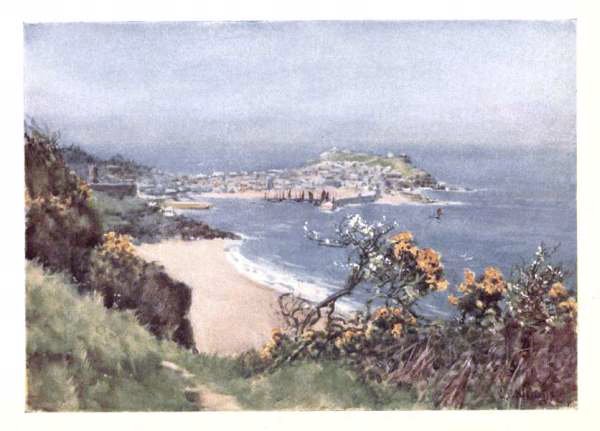
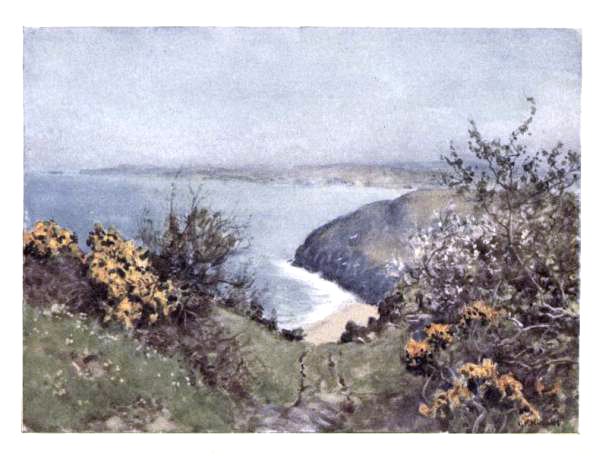 CARBIS BAY
I think the reason why a small proportion of people
are disappointed in Cornwall is that the advertisements
are focussed on one aspect only. In almost
every one of them is the mildness of the climate
insisted on, and this gives rise to semi-invalidish
ideas. It is true that semi-invalids who go there
in winter in search of warmth can find suitable
places if they know where to go. Cornwall as a
whole must have an equable climate, or we should
not see the growth of exotic plants out of doors—myrtle,
tree-geranium, aloes, palms, and camellias,
to name only a few of the most abundant—but the
whole county is by no means a hot-bed of warmth,
and the winds are frequently very cold indeed.
There are everywhere now first-class hotels, with
the ample lounges which have superseded the
shut-up drawing-room and smoking-room compartments
of earlier days, and these hotels mostly have
verandahs so placed that the glorious sun can flood
them while the winds are kept at bay. There those
who come to recuperate can bask in delight, and
draw straight from the Atlantic the pure fresh air,
which has a wonderfully tonic effect.
"The lungs with the living gas grow tight,
And the limbs feel the strength of ten.
God's glorious oxygen."
Two such verandahs come up before me as I write—that
at Fowey, raised high, and overlooking the
most lovely harbour along the whole coast, shut in
by rising banks almost like a Norwegian fiord;
the other, the verandah at Housel Bay Hotel,
where, facing due south, you may sit in an atmosphere
of summer which is indeed like a climate
usually only to be looked for many degrees further
south.
But though this aspect is the keynote of almost
every advertisement, or at any rate every winter
advertisement, it is by no means the most prominent
or characteristic one of Cornwall, which
appeals far more to the hardy than the weak.
When I think of Cornwall the vision that comes
before me is not that of sheltered sun-bathed
balconies, but rather of a high wind making the
breakers frill around the jagged bases of the cliffs,
while above, amid the towans or sandhills covered
with bent grass, the golf-balls fly. The tang of the
air seems once again in my nostrils, carrying with
it an exhilaration that makes the blood race in the
veins and entirely prevents tiredness. Only in one
place elsewhere have I felt that exact stimulus, and
that was far west in the neighbouring land of
Brittany, near the Point du Raz, which stretches
razor-like into the ocean, and in many respects
strikingly resembles a bit of the Cornish coast.
Many people will object that this is exactly what
they understand Cornwall does not offer; on the
contrary they have heard apologies for its stuffiness
and the relaxing qualities of the air. Why yes,
if one visits it in the height of summer, and goes to
one of the many places situated in a hole or funnel
and facing south, it might be very relaxing indeed;
but the "advertisements for invalids," if one may
so call them, usually refer to early spring and it is
in early spring that the invigorating breezes may
be found almost anywhere the whole way round,
while the northern coasts are never stuffy even in
summer.
Besides unusual golf facilities another feature
appealing to the hardy and sound are the cliff
paths, mere coastguard tracks, unfenced and unspoilt,
which circle the whole coast. Those who
keep to roads will never see the real Cornwall and
that is why so many motor-bound souls miss it.
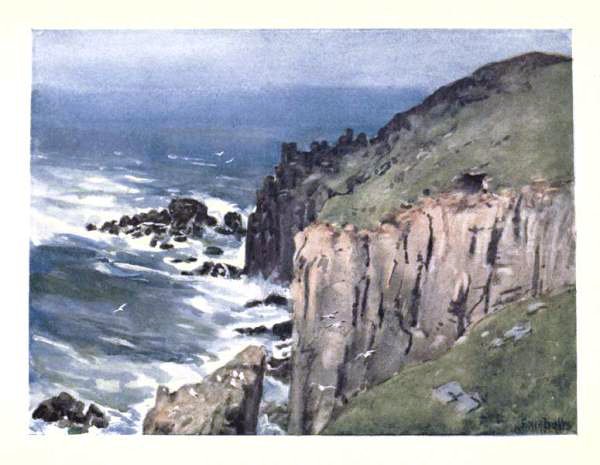
One may wander for days on these cliff paths,
lured on from point to point and bay to bay,
always rejoicing in something new or glorious,
something which beckons onward. At the foot
of the vertical walls of rock are tiny sandy bays
for ever cut off from the foot of man even at low
tide, and inaccessible to all save the sea-birds, who
well know it! My mind brings back visions of
great pieces of rock, torn and ripped from their
hold, and apparently flung pell-mell on the beach.
Except that they are usually three-cornered and
not columnar, they are somewhat like the drongs
of Shetland in their piercing sharpness. Remarkably
fine specimens of these isolated rocks are seen
at Kynance Cove, near the Lizard, and at Bedruthan
Steps, in Watergate Bay; but almost everywhere
some stand up aloof from the neighbouring cliff.
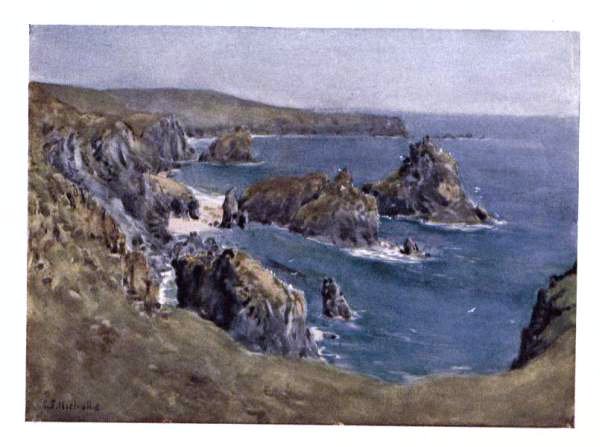 KYNANCE COVE
Whoever loves the wild desolation of the northernmost
Scottish coasts will feel at home in Cornwall.
Of course the cliffs are not nearly so high—most
of the Cornish cliffs could go four times into the
finest specimens of Mull or Shetland—but there is
not much lost by this. The human mind can only
grasp up to a certain amount of size conveyed by
the eye in vertical measure, and after the first
awed glance down a 1,000-foot cliff, when the mind
is almost stunned, the impression rapidly wears off,
and all the grandeur needed is equally well conveyed
by 300 feet of sheer precipice, while the
details of the natural carving and the play of the
wild birds on its crevices are far better observed.
The popular idea of Cornwall in the minds of
those who have not been there is that there runs
a long raised ridge down the middle like a spine,
and that from this on each side the ground slopes
away to the sea; but this is a very misleading idea.
Cornwall is all hills, and yet has none to boast of.
Brown Willy, not far from Launceston, reaching
to 1,375 feet, is the highest, but yet there is very
little flat land anywhere. If you took a silk handkerchief,
crumpled it up in your hand, and threw
it on the table, it might fall somewhat as Cornwall
is constituted. The people who live there are used
to hills and not afraid of them. Why should they
be? In most of the towns—and almost every
small village is a "church-town," while every stream
is a river—the streets are often at about the angle
of an ordinary house-roof, and as a rule there are
miles of hill to be negotiated in rising out of the
towns for they lie in hollows or crevices, corresponding
to the folds of the handkerchief. This
is not wonderful considering the fact that the wind
blows freely from the sea on both sides, and that
it is in the hollows and sheltered nooks that vegetation
flourishes. There are of course exceptions.
Take such a town as Launceston. One main street
has been engineered to go round in curves, so as to
enable horses—horses bred to the work—to get up
it, and at the top there is a bit of level, but most
of the other streets fall sheer down. When babes
who can scarce toddle scramble forth from their
living-room on to a road slanting at an angle of
forty-five degrees or more, which forms their only
playground, naturally their leg muscles get strengthened,
and as they grow up and have to start off to
school, or return from it, up a hill that taxes the
sinews of a "foreigner" till he groans, they make
nothing of it. Roads seem to wander at their own
sweet will with no inclination to the Roman ideal,
but they never wander to avoid inclines; they tilt
up and down again with the most gracious equanimity,
and a man on a cycle who has struggled
up a steep ascent and feels at last he will be able
to reap the reward, as often as not finds the descent
too perilous to ride without the utmost caution.
Cornwall is not a county for cyclists except they
be strong in the leg; but it is good country for
those pedestrians who measure the day's journey
by what they have seen and not by ground got
over as the crow flies, for they can follow the
enchanting little paths winding in and out by the
great headlands of the coast.
Cornwall is no place for being in a hurry.
Many of the most famous sights, such as the
great outlying cliffs at Gurnard's Head, and the
Logan Rock, are not anywhere near a road. The
roads keep inland, and for very good reason. These
places have to be reached over long, sloping fields,
and entail a good deal of scrambling—ideal places
to resort to for a whole day with picnic provision,
so long as one has a clear head and steady foot, but
not to be sought as a "side-show."
Very many of the little coast places too are
down at the end of what may be called long shafts,
and to the ardent cyclist, intent on mileage, to go
down, down, down, for miles till he can see the
cows grazing in the fields high overhead, and to
arrive at last at a little port where a few old salts
sit and smoke and idle, and there is no way of
getting out again but by the funnel, is a matter
for as strong comment as conscience permits. Yet
again for those who love what is beautiful and unhackneyed,
there is charm beyond measure in the
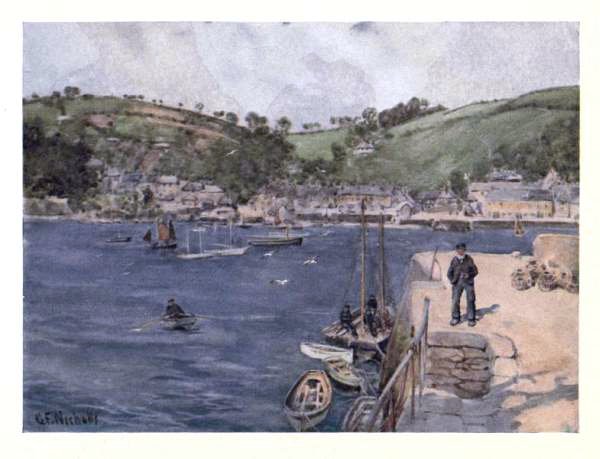
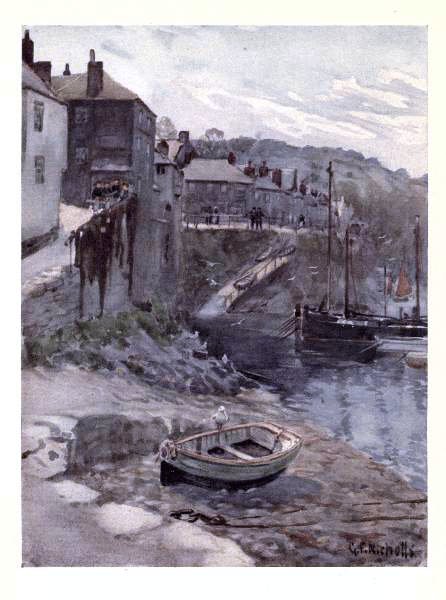
spirit of these places. In Polperro, which might be
a bit of Brittany planted wholesale in our land; or
Fowey, with its unforgettable harbour, where the
blue tide creeps up like a stain of spreading dye;
or in Mullion, with its huge rounded masses of
rock lying off the coast.
Another popular idea of Cornwall, also mistaken,
is that the interior of the Duchy is hideous and
only the coast beautiful. There is much that is
ugly no doubt; raw places where the half-grown
mounds of rubbish and crumbling chimneys mark
disused tin-mines; where the sharp and hard outlines
of slate shriek at you everywhere; where
ragged, scrubby fences break up an endless series
of barren-looking fields, and the whole landscape
gives the impression that it is flying at a terrific
speed westward, heading into the prevailing wind,
because all the trees and shrubs that have managed
to survive it at all are bent nearly double. But
what of the glorious wooded slopes in Bodmin
neighbourhood where smooth roads wind between
the rich growth of woods? What of the famous
valleys such as Luxulyan and others? There is
plenty inland attractive enough if one knows where
to look for it.
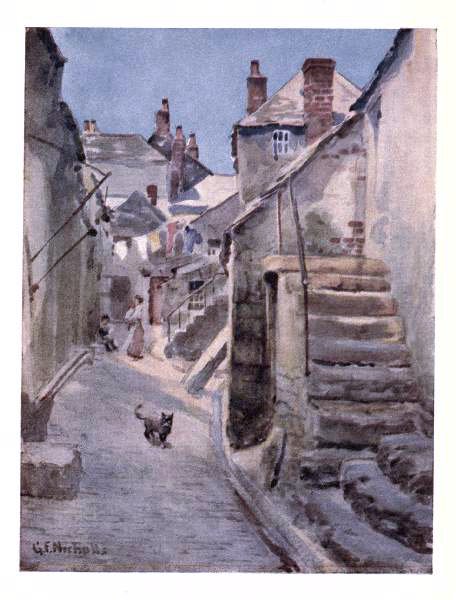
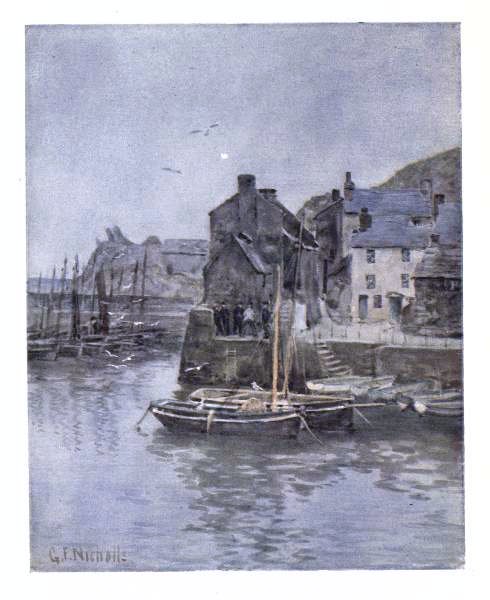 AT POLPERRO
Perhaps this impression as to the interior has
grown because the painting fraternity, now a recognized
part of Cornish society, mostly paint views
on or near the coast, having settled chiefly at and
near Newlyn and St. Ives. Mr. Lewis Hind, in
his book on Cornwall, says: "Probably two hundred
canvases are despatched each year from the Delectable
Duchy to Burlington House and elsewhere;
of this number seven-eighths have been painted in
Newlyn or St. Ives.... The great centres are
Newlyn, St. Ives, and Falmouth, and the votes of
the Cornish contingent, it is said, can turn the
scale in an election at the Royal Academy."
The truth is, Cornwall must be taken in bits,
and often the most hideous lie close up alongside
the most attractive; however they only help to
intensify that which is very good. People who
look too cursorily are the most often disappointed.
Wandering about Cornwall certainly induces one
ache, and that is the ache to be more knowledgeable.
Those lucky creatures who know something
of botany and geology here have delights not unfolded
to others. Cornwall is a paradise for the
botanist and geologist, because for the former there
are rare species and some altogether unknown elsewhere,
such as the Erica vagans so often mentioned,
which grows in the neighbourhood of the Lizard.
In fact Cornwall possesses more specialities in
plant-life than any other county in England.
For the latter because even the amateur can see the
wonder and difference of the rocks: the pink tinged
granite of Land's End, the great granite tors inland
on the moors, and the variegated serpentine at the
Lizard, as well as the cruel, sharp-edged slate of
the northern coast. While as for the archæologist
is there any part of Britain that affords him such
endless material? A mere enumeration of the
ancient stone crosses, the standing stone circles,
the cromlechs, the British huts, the earthworks,
the cliff-castles, the hill-castles or camps, the stone
graves, the chambered cumuli, the barrows, and
other relics of a long-past age, would fill pages.
The moors are covered with them and the bare
heights above Land's End are a rich hunting-ground.
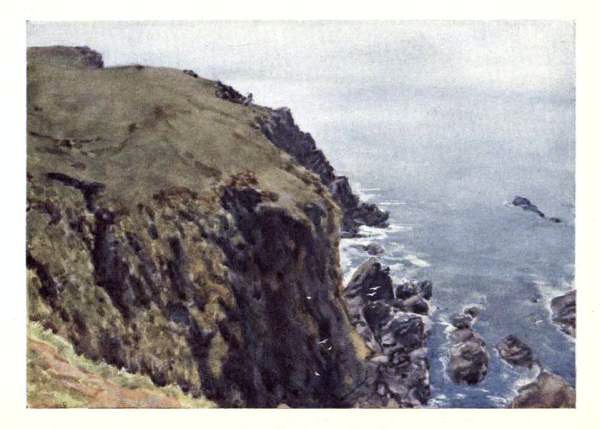
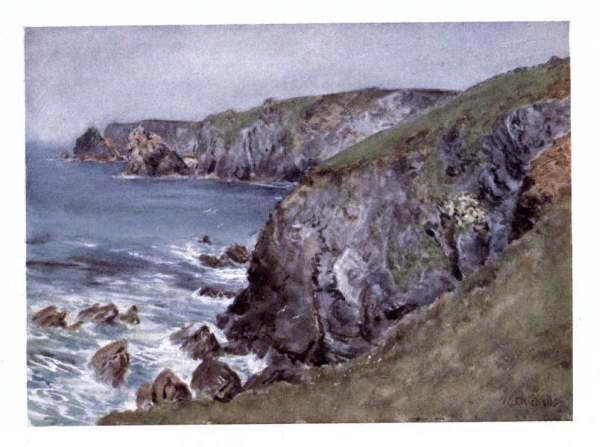 THE COAST NEAR THE LIZARD
This evidence of the lives and habits of the very
ancient inhabitants adds much depth and flavour
to the "atmosphere," and especially when it is
remembered that the original Cornish are the
purest example of that old race—the British. Mr.
W. H. Hudson, in his book The Land's End,
quotes Lord Courtney's saying: "The population
of Cornwall in general has remained much more
homogeneous, much more Celtic in type, than in
other parts; and of all Cornwall there is no part
like this [Penzance and Land's End district] in
which we meet with probably so pure a breed of
human beings."
The nation now calling itself British has Saxon,
Teutonic, French, and Norse blood in its veins, as
well as that of the original stock; but when the
successive waves of invaders swept over the country,
they usually exhausted themselves before reaching
this remote corner, into which the oldest island
stock was swept up.
This probably accounts for the queer impression
one often gets in Cornwall of being abroad. It
comes suddenly, rising like one of the Cornish
mists and enveloping one, until suddenly the conviction
that one is across the sea, far from home,
flows almost overwhelmingly over the mind. There
is much more likeness and kinship between parts of
Cornwall and parts of Brittany than between Cornwall
and most of the rest of England. There is no
doubt that Cornwall differeth not as "one county
from another county," but as one county from all
the rest. Here, where the British race had its last
stronghold, the stamp of the national characteristics
was retained in its effects much longer than elsewhere.
Nowadays of course there is intermarrying
and travelling, and frequent streams of new
blood coming in—half the people you speak to are
not Cornish at all—but still there is something
remaining which stamps them as a whole. It has
often been noticed that there are traces of Spanish
blood to be found in the dwellers in the extreme
west where many of the great Spanish galleons
were wrecked in bygone days; just as there are
found brown faces and black hair in the Fair Isle
of the Shetlands, where half the population intermarried
with some Spaniards of the great Armada
wrecked on their coast. In this part of Cornwall
one constantly sees women with clear-skinned faces,
dark-brown eyes and hair, of a distinctly foreign
type. The people, with their rather remote and
surface friendliness, have often been described.
They will greet you pleasantly and courteously—courteous
manners have lingered here—small boys,
and men too, still salute a stranger in passing with
a greeting, and if one asks the way the answer will
be no abrupt direction, but a careful and minute
description repeated until clearly understood. Even
in Wilkie Collins's time the people were noticeable
for their courtesy. He says: "The manners of the
Cornish of all ranks, down to the lowest, are remarkably
distinguished by courtesy—a courtesy of
that kind which is quite independent of artificial
breeding, and which proceeds solely from natural
motives of kindness and from an innate anxiety to
please. Few of the people pass you without a
salutation."
As it was then so it is now.
Yet everywhere one feels a want; there is a
lack of something. Perhaps it is they are too
matter-of-fact; a passing jest leaves them puzzled.
There is none of the dry humour of the Scot, which
makes every man you meet on the road in Scotland
instinctively approach a remark from what may be
called the humorous angle. As an example of the
Cornish lack of this quality, when I remarked to
a man who was showing me a real fine golf-links
stretching over the sandy towans of bent-grass,
"these sandhills are simply made for golf," he
answered: "Oh no, they were not made for the
links; they were here long before!"
The people simply don't understand analogy or
imagery; their minds are very literal. In this part
of the world they may well be literal, for the hard
necessity of making a livelihood from very poor
material must crush out fun. Yet in spite of
many hardships endured, it is a rare thing to see
a pale or miserable-looking child. The children
are round and rosy, with sturdy legs, as indeed
they may well have for they need them. This
general well-being cannot be altogether attributed
to the pure air, because in the Shetlands and on
the West Coast of Scotland where the air is just
as pure the children are usually brown and thin.
It may be that this is due to the lack of milk, the
heaths of Scotland affording scant pasturage, while
the constant moisture of the air in Cornwall makes
the grass grow richly.
At midday you will see the bairns running along
the street munching great pasties—a Cornish
specialty—made with bits of meat and onion and
potato in a cover of paste, and the pasty seems
to be the school-child's usual dinner. Another
specialty of Cornwall are the yellow saffron cakes,
so unappetizing in appearance to those unused to
them. Of the cream there is hardly need to speak.
As one ardent admirer of the Duchy remarked:
"Of course, Devonshire cream is Cornish cream,
only they've managed to get all the credit for it."
In spite of this testimony it seems to me there is
a difference, the Cornish variety is at once more
fluid and more lumpy, but this may be an erroneous
opinion based on insufficient experience.
Of history Cornwall has little. The brightest
jewel in her coronet is that she stood unfailingly
for the Stuarts in the Civil Wars, and many a
church holds a letter of thanks from King Charles I.
Except for the struggles of that epoch, the Duchy
has little to tell of what may be called historical
times, but before them much. It is in the
misty ages before the Norman Conquest that
history was made in Cornwall, and every now and
then we catch fleeting glimpses of scenes standing
out bright and clear amid a general fog, just as we
can to-day catch the vivid pictures of the landscape
before the grey mists sweep down with
incredible speed and blot them out. We see
Athelstan's terrible fight with the Britons; his
establishment of the collegiate church at St. Buryan
in pursuance of his vow, when he returned victorious
from the Scilly Isles. We get brilliant
peeps in the legends of King Arthur; in the
mysterious beehive huts and stone circles of a
people who have vanished; in the whimsical tales
of the early saints who scattered themselves so
freely over the land on their arrival from Ireland;
and we find hieroglyphic messages we cannot read
in structures we call cromlechs and in the cliff-castles.
Small wonder that Cornwall is a land of legend
and story, and that tales of fabulous men and
wonder-working men abound. In our very earliest
nursery days, long before we could point to
Cornwall on the map, we learned to repeat:
"Fee, Fi, Fo, Fum,
I smell the blood of a Cornishman.
Let him be alive or let him be dead,
I'll grind his bones to make me bread."
And if modern nurseries substitute "Englishman"
for "Cornishman," that is distinctly their loss.
The coast with its mighty fragments and giant
"chairs" and enormous blocks of stone is quite
obviously the home of giants.