We knew the voice. Our American
friend, John B. Bellamy, was in
form, and held a select audience
interested in the smoke-room of
the Royal at Plymouth. This is
what we heard him say—
"Why, gentlemen, the people of this old
country don't know a good thing when they've
got it. What is it, all of it, from the Tamar to
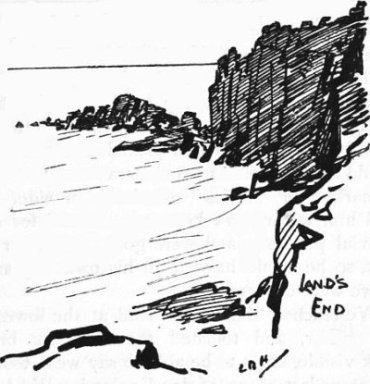
the Land's End? A nice little estate in size for
a cattle ranch out West, with everything on it for
making a pile. Why, gentlemen, every breath of
air is worth dollars, your skies are worth dollars,
your seas are worth dollars, all your old piskies
and saints and giants are worth dollars—just ask
John B. Bellamy to run the show.
"Why, gentlemen, we, in America, make
dollars; we can't help it. Then we get tired,
but must go on because we have nothing else to
do. A man may make dollars in the States faster
than he can give'm away. I know a man who
has charity-cheques signed by an electric machine,
and still his pile grows, and he says it'll pay to
give away all he possibly can now, rather than
let his heirs pay death duties, which will be quite
a sum on his little concern; for he is a small man
compared with some. These are the men who
want a place like this to come to when tired of
pile-raising. You may say, gentlemen, some other
place your side of the pond will do just as well;
but it won't. You can't work in this country;
John B. Bellamy has tried it. Why, gentlemen,
in the States you must work; and when the day
ends, you don't know you've finished, but go to
bed looking for a job; but here, there's something
in the air, and you just don't want to work, and
don't care if the whole durned sub-lunary universe
tumbles into space. That's how I feel.
"Just put up a big board, gentlemen, and
advertise 'Cornwall to Let: leases of life renewed
to men with dollar-piles and tired of trying
to be tired.' You'll have'm tumbling over in
shiploads, for it'll suit their complaint, just like
Lancashire air suits cotton. It'll just suit the
Cornish complaint for them to come, now that
'fish, tin, and copper' aren't all flourishing.
"I don't want to work here. I tell you
honestly, I don't want to work. When I return,
I'll tell my friends that I've located the place in
which I don't want to work; and all the gold
bugs and pile-drivers will come round and want
the receipt. I'll just tell them it's the Cornish
air, and Cornish skies, and Cornish cream, and
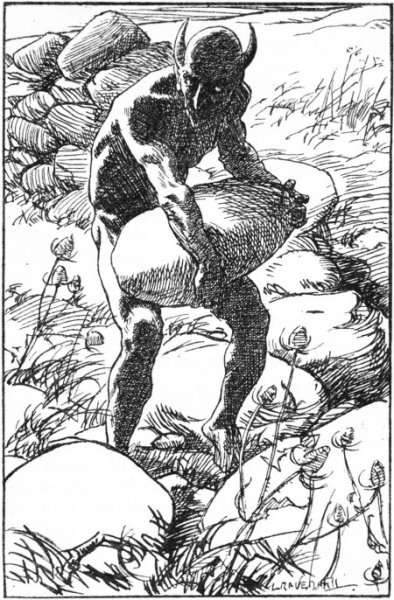
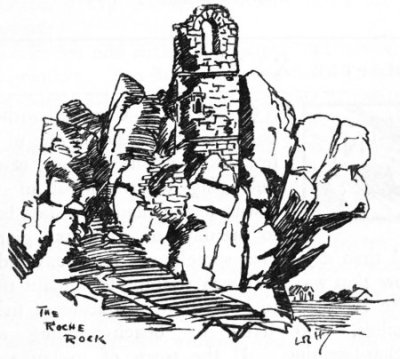
Cornish everything—the place where Old Nick
built churches, just for want of something to do.
That'll be a new sensation in the States for men
with piles wanting an extension of time to look
around before the next-of-kin pay the death
duties.
"No, gentlemen, no thanks, if you please.
These are the honest opinions of John B. Bellamy,
citizen, U.S.A., and if you want a man to run the
show, why, that address will find him."
Paddington once more.
"Evening papers—Extra Specials. Autumn
Sessions. Panic on Stock Exchange. Revolutions.
Anarchies!"
"Great Scott! Where on earth have we been
living?" said Guy, excitedly.
"Hi! Boy! Papers! All of'm?"
BY ARTHUR H. ADAMS.
GALAHAD JONES. A Tragic Farce. Crown 8vo. 6/-
With 16 full-page Illustrations by Norman Lindsay.
⁂ Galahad Jone is a middle-aged bank clerk, with a family. One day, on
his way home, a letter falls to his feet from the balcony of a house he is passing.
It is addressed "To You," and on reading it he discovers that he is requested
to meet the writer in the garden of the house at 10 o'clock that night. In a spirit
of knight-errantry, he decides to do so, and learns that the writer—a young girl—is
kept practically in prison by her father, because of her affection for a man of
whom he does not approve. The chivalry of Galahad Jones plunges him into
many difficulties, and leads to some very awkward and extremely amusing situations.
A TOUCH OF FANTASY. Crown 8vo. 6/-
Romance For Those who are Lucky Enough to Wear Glasses.
Daily Graphic—"A romance full of tenderness and charm, and written with
an artist's love of words for their own sake. Mr. Adams has delicacy of observation
and insight."
Pall Hall Gazette—"Mr. Adams seems likely to enhance his reputation with
the new novel. Mr. Adams writes well, and his characters live, and the result
is a book which is interesting and quite out of the common."
BY CIRO ALVI.
THE SAINT'S PROGRESS; A Novel. Crown 8vo. 6/-
Translated from the Italian of Ciro Alvi by Mary Gibson.
⁂ Signor Ciro Alvi has written a long and most sympathetic novel dealing
with the life of one of the noblest spirits of the Christian Church who was perhaps
the most extraordinary man of his age. The somewhat dissolute early life of the
founder of the Franciscan Order is deftly outlined, the young man's innate goodness
of heart and kindly disposition being clearly apparent even in the midst of his
ostentatious gaiety and sudden impulses.
BY W. M. ARDAGH.
THE MAGADA. Crown 8vo. 6/-
Pall Mall Gazette—"'The Magada' is a store-house of rare and curious learning
... it is a well-written and picturesque story of high adventure and deeds
of derring-do."
Observer—"The book has admirably caught the spirit of romance."
Daily Chronicle—"'The Magada' is a fine and finely told story, and we
congratulate Mr. Ardagh."
THE KNIGHTLY YEARS. Crown 8vo. 6/-
⁂ In "The Knightly Years" the author of "The Magada" takes us back
once more to the Canary Islands in the days of Isabella the Catholic. The tale
deals with the aftermath of conquests, when "the first use the islanders made of
their newly-acquired moral code was to apply it to their rulers." The hero of the
story is the body-servant of the profligate Governor of Gomera, whose love affairs
become painfully involved with those of his master. In the course of his many
adventures we come across Queen Isabella herself, the woman to whom every man
was loyal save her own husband; and countless Spanish worthies, seamen, soldiers,
governors and priests, all real men, the makers of Empire four hundred years ago.
The book abounds in quaint sayings both of Spaniard and native, while the love-making
of the simple young hero and his child-wife weaves a pretty thread of
romance through the stirring tale of adventure.
BY ALLEN ARNOT.
THE DEMPSEY DIAMONDS; A Novel. Crown 8vo. 6/-
⁂ his is the story of the secret transference of a fortune; and the scene is
laid mainly in two old houses in two Scottish Villages, one on the east coast, one
buried in midland woods. The tale is of the old slow days of twenty years ago
before the tyranny of speed began, but it is swayed throughout and borne to its
close by the same swift passions that sway the stories of men and women to-day,
and will sway them till the end of time.
BY H. F. PREYOST BATTERSBY.
THE SILENCE OF MEN. Crown 8vo. 6/-
⁂ Lynne is a girl who shows a strong liking for a change of surname.
Indeed, it is not always certain by what name she has a right to be called. March,
a young civilian of great promise, meets her on the boat going out to India, and
offers her the hospitality of his house, which is kept by an unmarried sister.
March and Lynne become married—and secretly so at Lynne's express wish. After
a brief time she bolts to England with Lord Rupert Dorrington, an A.D.C., and
cables that she has married him. While on leave March comes across her at a
fashionable ball in London. Meanwhile he has fallen in love with another girl,
but Lynne declares that if he marries her she will cry the true facts from the
housetops.
By a cunning arrangement of circumstance the reader is made aware of the
fact that March's marriage has been all along invalid, which of course puts a
different complexion upon Lynne's matrimonial position.
Mr. Battersby handles the story in a very masterful way, and his descriptions
of Indian scenery and social life in London show the quality of personal observation.
THE LAST RESORT. Crown 8vo. 6/-
Observer—"A really stirring novel—a novel of flesh and blood and character,
of quiet everyday life, and of life at its most strenuous and heroic ... admirable
psychology ... a book to remember."
BY GERARD BENDALL.
THE ILLUSIONS OF MR. & MRS. BRESSINGHAM.
A Novel. Crown 8vo. 6/-
"A delightful, farcical comedy of modern life ... natural, spirited dialogue
... lively entertainment."
THE PROGRESS OF MRS. CRIPPS-MIDDLEMORE.
A Novel. Crown 8vo. 6/-
Pall Mall Gazette—"Mr. Gerard Bendall is to be congratulated on having
written an extremely amusing novel in which the leading idea and the final
reflection are sufficiently refreshing in these days of miscellaneous fiction."
Observer—"Mr. Gerard Bendall knows how to poke amiable fun at people.
He writes in a leisurely way, and his book is full of talk—some of it extremely
good talk."
BY PAUL BERTRAM
THE SHADOW OF POWER. Third Thousand. Crown 8vo. 6/-
Times—"Few readers have taken up 'The Shadow of Power' and come face to
face with Don Jaimie de Jorquera, will lay it down or refuse him a hearing until
the book and his adventures come to an end."
Daily Mail—"This is a book that cuts deep into nature and experience. We
commend it most heartily to discerning readers, and hope it may take its place
with the best historical novels."
THE FIFTH TRUMPET. A Novel. Crown 8vo. 6/-
Morning Post—"A remarkably strong book.... This is a book for those
to read who like an historical novel that touches real issues, and even for those
who are on the look out for A NEW SENSATION."
BY HORACE BLEACKLEY.
A GENTLEMAN OF THE ROAD. Crown 8vo. 6/-
Author of "Ladies Fair and Frail," etc.
⁂ As the title implies, this is a very gallant novel: an eighteenth century
story of abductions, lonely inns, highwaymen and hangmen. Two men are in love
with Margaret Crofton: Colonel Thornley, an old villain, and Dick Maynard, who
is as youthful as he is virtuous. Thornley nearly succeeds in compelling Margaret
to marry him, for he has in his possession a document sadly incriminating to her
father. Maynard settles Thornley, but himself in his turn is "up against it." He
is arrested for complicity in the highway thefts of a glad but graceless young
ruffian. Both are sentenced to death, but a great effort is made to get them
reprieved. It would be a pity to divulge the climax cunningly contrived by Mr.
Bleackley, save to say that the book ends in a scene of breathless interest before
the Tyburn gallows.
BY EX-LIEUTENANT BILSE.
LIFE IN A GARRISON TOWN. Crown 8vo. 6/-
Also in Paper Cover 1/-net.
The suppressed German Novel. With a preface written by the
author whilst in London, and an introduction by Arnold White.
Truth—"The disgraceful exposures of the book were expressly admitted to
be true by the Minister of War in the Reichstag. What the book will probably
suggest to you is, that German militarism is cutting its own throat, and will one
day be hoist with its own petard."
BY WALTER BLOEM.
THE IRON YEAR. A Novel Crown 8vo. 6/-
Translated from the German by Stella Bloch.
⁂ This remarkable novel depicts in vivid word-painting the final struggle
between France and Germany, in the year 1870. The advance of the German
troops, the famous battle of Spicheren, the fearful cavalry encounter of Rezonville,
the struggle and capitulation of Strassburg are all incidents in this wonderfully
graphic narrative. A love-story runs through the book, telling of the fateful
attraction of a French officer for a German girl. As may well be imagined, the
path of their lives is beset with many obstacles, but after great tribulations they
are reunited under very pathetic circumstances. Another finely drawn character
is that of a hypersensitive gifted young musician, transformed, during these times
of stress, into a strong man of action.
"The Iron Year" created an extraordinary sensation in Germany. So great
was the demand for the book that twenty editions were exhausted. The German
Emperor read it aloud to the members of the Royal Family circle during the
Spring.
BY PETER BLUNDELL.
THE FINGER OF MR. BLEE. A Novel. Crown 8vo. 6/-
⁂ The amusing adventures of Harold Blee, a youthful Eurasian, form the
main theme of this original novel. Harold is brought into contact with the two
rival factions of the local British society, and perpetrates many works of mischief,
to the discomfiture of the rich and pompous Mrs. Gladstone Mortimer and to the
suppressed amusement of her enemies. He is a most versatile boy, whose quaint
quips and irresistible antics serve a very useful purpose, when he is instrumental in
smoothing out the course of love for Harry McMucker, his employer's son.
BY SHELLAND BRADLEY.
ADVENTURES OF AN A.D.C. Crown 8vo. 6/-
Westminster Gazette—" ... makes better and more entertaining reading than
nine out of every ten novels of the day.... Those who know nothing about
Anglo-Indian social life will be as well entertained by this story as those who
know everything about it."
Times—"Full of delightful humour."
AN AMERICAN GIRL AT THE DURBAR. A Novel.
Crown 8vo. 6/-
⁂ A charming love story, containing a vivid and picturesque account of the
Durbar.
Daily Chronicle—"Here is a truly delightful work which should prove of
interest to a wide class of readers—a book for a dull day."
BY EVELYN BRENTWOOD.
HENRY KEMPTON. A Novel. Crown 8vo. 6/-
⁂ In his second novel, Evelyn Brentwood has again given us a vivid picture
of soldier life, and has again chosen for his hero a very unconventional character.
Cool and calculating, ambitious and heartless, Henry determines to climb the
social ladder by every means in his power. Articled to a solicitor when the story
opens, he is only waiting for an opportunity to follow his inclinations and enter
the army, when an accidental meeting with a duke's daughter precipitates matters,
and he immediately throws up the study of the law. Later, we follow his career
as a soldier; see how he falls under the spell of one of his senior officers in the
24th Hussars; how he wins the V. C. for the mere purpose of bringing his name
into prominence; how he is invalided home and meets Lady Violet for the second
time; and finally how he is taught, through his experience with a worthless woman,
to estimate at its true value the love of one who stands by him in the hour of
his humiliation.
HECTOR GRAEME. Third Thousand Crown 8vo. 6/-
⁂ The outstanding feature of "Hector Graeme" is the convincing picture it
gives of military life in India and South Africa, written by one who is thoroughly
acquainted with it. Hector Graeme is not the great soldier of fiction, usually
depicted by novelists, but a rather unpopular officer in the English army who
is given to strange fits of unconsciousness, during which he shows extraordinary
physic powers. He is a man as ambitious as he is unscrupulous, with the desire
but not the ability to become a Napoleon. The subject matter of the story is
unusual and the atmosphere thoroughly convincing.
Morning Leader—"Provides much excitement and straightforward pleasure.
A remarkable exception to the usual boring novels about military life."
BY JAMES BRYCE.
THE STORY OF A PLOUGHBOY. An Autobiography.
Crown 8vo. 6/-
⁂ As will be seen from the title of its parts—"The Farm," "The Mansion,"
"The Cottage"—the characters whose passions and interests make the plot of this
story are drawn from the households of the Labourer, the Farmer and the Squire;
the book is therefore an attempt to present country life in all its important
aspects. In this, again, it differs from all other novels of the soil in our own or
perhaps in any language: its author writes not from book-knowledge or hearsay or
even observation, but from experience. He has lived what he describes, and under
the power of his realism readers will feel that they are not so much glancing
over printed pages as mixing with living men and women. But the story has
interest for others than the ordinary novel-reader. It appeals as strongly to the
many earnest minds that are now concerned with the questions of Land and
Industrial Reform. To such its very faithfulness to life will suggest answers
startling, perhaps, but certainly arresting.
BY WILLIAM CAINE.
HOFFMANN'S CHANCE. A Novel. Crown 8vo. 6/-
⁂ This is a realistic story of the stage which bears the obvious impress of
truth. Michael Hoffman is a struggling musician of tremendous talent. He is
introduced to Orde, a very rich dillettante. They collaborate in a blend of comic
opera and musical comedy. Their music is clever and tuneful, but the libretto,
alas, brings them to grief. There is plenty of feminine interest in the book and
some clever sketches of "women who do things."
Morning Post—"The most considerable piece of work Mr. Caine has yet given
us. 'Hoffman's Chance' would have been worth writing merely for the presentation
of Orde the Ass and Psyche the Cat—especially the actress, whose portraiture
is one of the most vivid and effective presentations of cattiness that has ever come
our way."
BY DANIEL CHAUCER.
THE SIMPLE LIFE, LIMITED. Crown 8vo. 6/-
⁂ This novel has a very decided quality of satire which is inspired by the
convention of the unconventional. Evidently Mr. Chaucer knows the Simple Life
from the inside, and his reflections will both amuse and amaze those who know it
only from casual allusions. Many well-known figures will be recognized, though not
in all cases under their proper names, and, as in the case of Mr. Mallock's "New
Republic," Society will be busy dotting the "i's" and crossing the "t's."
THE NEW HUMPTY DUMPTY. Crown 8vo. 6/-
Globe—"Brilliant entertainment ... there is an extraordinary feeling for
plot and incident, and an irresistible sense of satiric humour."
Pall Mall Gazette—"The pseudonymous author of 'The Simple Life' gives
us in 'The New Humpty Dumpty' a volume still more brilliant; so brilliant is
it, with such a range of first-class experience, that there will be keen curiosity to
know who has written these works."
BY MAUD CRUTTWELL.
FIRE AND FROST. A Novel. Crown 8vo. 6/-
⁂ Fire is an Egyptian Prince and Frost is an English girl living in Florence.
The impetuous and passionate temperament of the Oriental is matched against
the steadfast rational nature of the heroine. The uncompromising desire of the
former is to make the English girl his wife, and the circumstances under which
she is reluctantly brought to consent are original but entirely convincing. Thenceforth
the struggle is on the woman's part, as she finds herself pitted against the
fierce vacillating will of her husband, and the jealous intrigues of a mercenary
little Florentine marchesa—a character brilliantly drawn—and her satellites. The
outcome of this battle of temperaments is deeply interesting. The natures of
East and West in conflict have been employed as material for fiction already,
but it can safely be said that never have the dramatic possibilities of the subject
been treated with such judgment as in this novel. The author makes full use
of her power of characterization in conveying the action of the story to the reader
with a force only to be found in the work of a really accomplished writer.
BY SIDNEY DARK.
THE MAN WHO WOULD NOT BE KING. A Novel.
Crown 8vo. 6/-
"It is only when a man does things for which he is not intended that his
experiences become really interesting. For example, supposing that Sir Herbert
Tree had gone to the South Polar regions instead of Sir Ernest Shackleton, what
a delightful book would have resulted! So with me. Although I cannot claim
any moral for my story it may not be without amusement. The adventures of a
square peg in a round hole are always delightful, except, perhaps, to the square
peg.
"So I start to relate the life of Fennimore Slavington, who had greatness
thrust upon him much against his will and much to the discomfort of himself and
many others."—Extract from the Prologue.
BY MARION FOX.
THE BOUNTIFUL HOUR. A Novel. Crown 8vo. 6/-
Author of "The Hand of the North."
⁂ This is the story of a girl's life in the final years of the eighteenth century,
the background of the plot lying around Olney in the time of Cowper and Newton,
with the contrasted atmosphere of London in the days of the Prince Regent. With
all of these the heroine, Charlotte Hume, comes in contact.
The shadow which is cast across the plot is the outcome of a promise, given
by Howard Luttrell in his younger days to a woman of easy reputation, of whom
he soon tired, but to whom he had passed his word that whilst she lived he would
never marry. In later life he meets Charlotte Hume, with whom, almost
unconsciously, he falls in love. On awakening fully to the fact, and finding the
other woman still living, he brings the solving of the problem to the girl herself.
Luttrell is the last of a long line of men and women, who, whatever they may or
may not have done, never broke their word. The way in which Charlotte cuts the
knot most be left to the patience of the reader to find out.
The book does not pretend to being an historical novel, but a portrayal of
certain aspects of middle-class life some hundred or more years ago.
THE WORKS OF ANATOLE FRANCE, in English.
Edited by Frederic Chapman. Demy 8vo. 6/-
THE OPINIONS OF JÉRÔME COIGNARD. A Translation by
Mrs. Wilfrid Jackson.
ON LIFE AND LETTERS. A Translation by A. W. Evans.
Vols. 2, 3 & 4.
THE GODS ARE ATHIRST. A Translation by Alfred Allinson.
Already Published.
MY FRIEND'S BOOK. A Translation by J. Lewis May.
JOCASTA AND THE FAMISHED CAT. A Translation by
Mrs. Farley.
THE ASPERATIONS OF JEAN SERVIEN. A Translation by
Alfred Allinson.
AT THE SIGN OF THE REINE PEDAUQUE. A Translation
by Mrs. Wilfrid Jackson.
ON LIFE AND LETTERS. Vol. 1.
THE RED LILY. A Translation by Winifred Stephens.
MOTHER OF PEARL. A Translation by the Editor.
THE CRIME OF SYLVESTRE BONNARD. A Translation by
Lafcadio Hearn.
THE GARDEN OF EPICURUS. A Translation by Alfred
Allinson.
THE WELL OF ST. CLARE. A Translation by Alfred Allinson.
BALTHASAR. A Translation by Mrs. John Lane.
THAÏS. A Translation by Robert B. Douglas.
THE WHITE STONE. A Translation by C. E. Roche.
PENGUIN ISLAND. A Translation by A. W. Evans.
THE MERRIE TALES OF JACQUES TOURNEBROCHE.
A Translation by Alfred Allinson.
THE ELM TREE ON THE MALL. A Translation by M. P.
Willcocks.
THE WICKER-WORK WOMAN. A Translation by M. P.
Willcocks.
BY JOHN GORE.
THE BARMECIDE'S FEAST. Crown 8vo. 3/6 net
With Illustrations by Arthur Penn.
⁂ A book which will delight lovers of humour.
Daily News and Leader—"A book which MR. BALFOUR WOULD ENJOY."
BY A. R. GORING-THOMAS.
MRS. GRAMERCY PARK. Crown 8vo. 6/-
World—"In the language of the heroine herself, this, her story, is delightfully
'bright and cute.'"
Observer—"Fresh and amusing."
THE LASS WITH THE DELICATE AIR. Crown 8vo. 6/-
⁂ In his new novel Mr. Goring-Thomas relates the history of a young girl
whose beautiful face is a mask that allures. Round the history of "The Lass with
the Delicate Air" is woven the story of the Hicks family. Mrs. Hicks keeps a
lodging house in Chelsea, and has theatrical ambitions. The author has keen
powers of observation and a faculty of "getting inside a woman's mind" and the
same witty dialogue that was so commented upon in "Mrs. Gramercy-Park" is
again seen in the new work. The scene of the book is laid partly in London and
partly in Paris.
WAYWARD FEET. Crown 8vo. 6/-
⁂ This book is a departure on the part of Mr. Goring-Thomas, and is a
brilliant piece of work. The scene of the book alternates between St. Wulphyturmer
a mediæval fortified town in the Pas-de-Calais, and Paris. The two
heroines Toinette Moreau and Joan Dombray, both come from St. Wulphy and
both go to Paris. Their histories contrive a sharp contrast: one being by character
sweet, yielding and affectionate, while the other is combative, rebellious and
intellectual. The character drawing, as in Mr. Goring-Thomas' other books, is
notably clear and interesting. His already celebrated wit, his original humour,
and insight into character again illuminate his latest book. The history of Joan
Dombray, especially, is a strong, original, and striking piece of work.
BY HENRY HARLAND.
THE CARDINAL'S SNUFF BOX. Crown 8vo. 6/-
Illustrated by G. C. Wilmhurst. 165th. Thousand.
Academy—"The drawings are all excellent in style and really illustrative of
the tale."
Saturday Review—"Wholly delightful."
Pall Mall Gazette—"Dainty and delicious."
Times—"A book among a thousand."
Spectator—"A charming romance."
MY FRIEND PROSPERO. Crown 8vo. Third Edition. 6/-
Times—"There is no denying the charm of the work, the delicacy and
fragrancy of the style, the sunny play of the dialogue, the vivacity of the wit, and
the graceful flight of the fancy."
World—"The reading of it is a pleasure rare and unalloyed."
THE LADY PARAMOUNT. Crown 8vo. 55th Thousand. 6/-
Times—"A fantastic, delightful love-idyll."
Spectator—"A roseate romance without a crumpled rose leaf."
Daily Mail—"Charming, dainty, delightful."
COMEDIES AND ERRORS. Crown 8vo. Third Edition. 6/-
Mr. Henry James, in Fortnightly Review—"Mr. Harland has clearly thought
out a form.... He has mastered a method and learned how to paint.... His
art is all alive with felicities and delicacies."
GREY ROSES. Crown 8vo. Fourth Edition. 3/6 net
Daily Telegraph—"'Grey Roses' are entitled to rank among the choicest
flowers of the realms of romance."
Spectator—"Really delightful. 'Castles near Spain' is as near perfection as it
could well be."
Daily Chronicle—"Charming stories, simple, full of freshness."
MADEMOISELLE MISS. Crown 8vo. Third Edition. 3/6
Speaker—"All through the book we are pleased and entertained."
Bookman—"An interesting collection of early work. In it may be noted the
undoubted delicacy and strength of Mr. Harland's manner."
BY CROSBY HEATH.
HENRIETTA TAKING NOTES. Crown 8vo. 6/-
⁂ Henrietta is the eleven year old daughter of a dramatic critic, who, with
her delightful younger brother, Cyrus, are worthy of a place beside "Helen's
Babies" or "Elizabeth's Children." They cause the "Olympians" many anxious
and anguished moments, yet their pranks are forgiven because of the endearing
charm of their generous natures. Miss Heath writes of children with the skill that
comes of a thorough understanding of the child mind.
BY BERTAL HEENEY.
PICKANOCK: A Tale of Settlement Days in Olden Canada.
Crown 8vo. 6/-
BY MURIEL HINE.
APRIL PANHASARD. A Novel. Crown 8vo. 6/-
⁂ Lady Essendine is reluctantly compelled to divorce her unfaithful husband,
who has developed into a dipsomaniac. She is naturally distressed by the scandal
her action carries, and flies to Coddle-in-the-Dale, where she hopes to hide her
identity under the name of April Panhasard—a name chosen casually from the
titles of three novels at a railway station bookstall, "Young April," "Peter Pan,"
"The Hazard of the Die." In the quiet village she moves a sweet and gracious
figure, serenely indifferent to the curiosity of those who try to penetrate the
mystery that surrounds her. Only Boris Majendie, who poses as her cousin, is
in her confidence. Her quiet is speedily disturbed. A young American, to whom
she is strangely drawn, makes her a proposal of marriage. Boris runs more than
a little wild, although he leaves her his larger devotion. Finally her divorced
husband turns up, and she is left in an intensely compromising situation, for the
necessary six months have not yet elapsed to make the decree absolute. How she
frees herself from this curious tangle must be left for the reader to find out.
The book is alive with incident, but it has the rare quality of restraint, which
prevents it from ever merging into the melodramatic, and the characters are all
drawn with rare artistic skill.
HALF IN EARNEST. Second Edition. Crown 8vo. 6/-
⁂ Derrick Kilmarney, the secretary of a famous politician, is a young man
with the disposition to take the best that life offers him, and shirk the responsibilities.
He falls in love with a girl, but shudders at the idea of the bondage of
marriage. His love is emancipated, unfettered. He is ambitious, politically,
allows himself to become entangled with his chief's wife, and is too indolent to
break with her even in justice to the girl he loves. Eventually there comes a
time when all the threads have to be gathered together, when love has to be
weighed with ambition, and in Kilmarney's case the denounement is unexpected
and startling.
EARTH. Second Edition. Crown 8vo. 6/-
⁂ Muriel Hine's previous novel "Half in Earnest" achieved a considerable
success, "Earth" seems likely to achieve a greater. The story deals with the
awakening of a pure young girl to the realities of life and what they mean. With
a proper understanding of human nature comes sympathy: to know all is to pardon
all. "Earth" is a society novel with a society atmosphere that is convincing.
BY ADELAIDE HOLT.
OUTSIDE THE ARK. Crown 8vo. 6/-
⁂ This is an attractively told story with many outstanding features. Hugh
Inskip, a prominent man of letters, marries a young wife, whom he does not
understand, because she is continually posing and never her natural self. She
is also jealous of the beautiful but incapacitated actress, Margaret Stair, for whom
Inskip is writing a play, and makes use of an ingenious and shady trick to spy
upon her husband's motives. But Iris, the young wife, is not entirely a malignant
figure, for her frail beauty and helplessness make a tender appeal for sympathy.
The scene of the novel changes at times from the hub of London life to the
peaceful quiet of a country vicarage, whither the father of Iris—a charming
scholar—lets fall honeyed words of wisdom and advice or gently chides his over-zealous
curate. The author has a strong sense of humour, as well as a great power
of dramatic presentment.
THE VALLEY OF REGRET. Crown 8vo. 6/-
⁂ etty Feverell's childhood is full of pathos. For the best reason in the
world she is unable to capture the sympathy of her supposed father, and runs
away to make an imprudent marriage with a very charming but rather weak young
man who is addicted to "drink." Fastidious to a degree, this failing does not
seem to spoil the gentleness and refinement of his disposition, until, enraged by an
insult to his wife, he kills a man in a fit of alcoholic frenzy. With her husband
sentenced to penal servitude for seven years, the problem of Betty's life is full of
difficulty. After five years a second man, John Earle, wins her love, knowing
little or nothing of the obstacles in the way of its fulfilment. Finally, news
arrives that the convict will return in a few weeks, and the story ends suddenly
and unexpectedly. This is a delightful novel. It has incident and freshness; and
the directness of the style gives the book a remarkably artistic impression of life.
BY MRS. JOHN LANE.
KITWYK. Crown 8vo. 6/-
A Story with numerous illustrations by Howard Pyle,
Albert Sterner and George Wharton Edwards.
Times—"Mrs. Lane has succeeded to admiration, and chiefly by reason of
being so much interested in her theme that she makes no conscious effort to
please.... Everyone who seeks to be diverted will read 'Kitwyk' for its
obvious qualities of entertainment."
THE CHAMPAGNE STANDARD. Crown 8vo. 6/-
Morning Post—"The author's champagne overflows with witty sayings too
numerous to recite."
Pall Mall Gazette—"Mrs. Lane's papers on our social manners and foibles are
the most entertaining, the kindest and the truest that have been offered us for a
long time.... The book shows an airy philosophy that will render it of service
to the social student."
ACCORDING TO MARIA. Crown 8vo. 6/-
Daily Chronicle—"This delightful novel, sparkling with humour.... Maria's
world is real.... Mrs. Lane is remarkably true to life in that world.... Maria
is priceless, and Mrs. Lane is a satirist whose life may be indefatigably joyous in
satiric art. For her eyes harvest the little absurdities, and her hand makes
sheaves of them.... Thackeray might have made such sheaves if he had been
a woman."
BALTHASAR AND OTHER STORIES. Crown 8vo. 6/-
Translated by Mrs. John Lane from the French of Anatole France.
Daily Graphic—"The original charm and distinction of the author's style has
survived the difficult ordeal of appearing in another language.... 'The Cure's
Mignonette' is as perfect in itself as some little delicate flower."
TALK O' THE TOWN. Crown 8vo. 6/-
⁂ Mrs. John Lane's new book, "Talk of the Town," is on the same lines
as "The Champagne Standard," that sparkling and brilliantly witty study of
English and American life, and has the delightful and refreshing humour
we have a right to expect of the author of "According to Maria," and that power
of observation and keen insight into everyday life which made "The Champagne
Standard" one of the most successful and one of the most quoted books of the
season, both in England and America.
BY STEPHEN LEACOCK.
LITERARY LAPSES. Third Edition. Crown 8vo. 3/6 net
Spectator—"This book is a happy example of the way in which the double
life can be lived blamelessly and to the great advantage of the community. The
book fairly entitles Mr. Leacock to be considered not only a humourist but a
benefactor. The contents should appeal to English readers with the double virtue
that attaches to work which is at once new and richly humorous."
NONSENSE NOVELS. Third Edition. Crown 8vo. 3/6 net
Pall Mall Gazette—"He certainly bids fair to rival the immortal Lewis Carroll."
Punch—"Delightful spontaneity. There is genuine gold here on every page."
Daily Graphic—"'Guido, the Gimlet of Ghent' set us in a roar. His last tale,
'The Asbestos Man,' is the best."
SUNSHINE SKETCHES OF A LITTLE TOWN. Fourth Edition
Crown 8vo. 3/6 net
Evening Standard—"We have never laughed more often."
Canada—"A whole storehouse of sunshine. Of the same brand as 'Literary
Lapses' and 'Nonsense Novels.' It is the surest recipe for enjoying a happy
holiday."
Daily Telegraph—"Irresistibly comical. Mr. Leacock strikes us as a sort of
Americanised W. W. Jacobs. Like the English humorist, the Canadian one has
a delightfully fresh and amusing way of putting things."
Times—"His real hard work—for which no conceivable emolument would be
a fitting reward—is distilling sunshine. This new book is full of it—the sunshine
of humour, the thin keen sunshine of irony, the mellow evening sunshine of
sentiment."
BY W. J. LOCKE.
STELLA MARIS. A Novel. Crown 8vo. 6/-
With 8 Illustrations by Frank Wiles.
⁂ Mr. Locke's astonishing fertility of invention has never yet been seen to
as great advantage as in this story. It has all the picturesque bravery of the
"Beloved Vagabond," all the tender sentiment of "Marcus Ordeyne," all the
quixotic spirit of "Clementina Wing." And yet it is like none of these. Infinitely
tender, infinitely impressive, is the story of Stella Maris, the wonder child, who
has never moved from her couch, who receives her impressions of the outside
world from her gentle spirit and the gold-clad tales of her loving friends and the
secrets of the seagulls that flit so near her window. And then Stella, grown to
a woman, recovers; to take her place, not in the world of beauty she had pictured
from the stillness of her couch, but the world of men and women.
From the first page the reader falls under a spell. For all its wistful delicacy
of texture Mr. Locke's humanity, broad and strong, vibrates with terror just as
it soothes with its sense of peace. This is Mr. Locke's finest achievement.
THE JOYOUS ADVENTURES OF ARISTIDE PUJOL. A Novel
Crown 8vo. 6/-
With Illustrations by Alec Bull.
Daily Telegraph—"In 'Aristide Pujol' Mr. W. J. Locke has given life to one
of the most fascinating creatures in modern fiction."
Morning Post—"We do not know when Mr. Locke was more happily inspired."
[A]DERELICTS. Crown 8vo. 6/-
Daily Chronicle—" Mr. Locke tells his story in a very true, very moving, and
very noble book. If anyone can read the last chapter with dry eyes we shall be
surprised. 'Derelicts' is an impressive and important book."
Morning Post—"Mr. Locke's clever novel. One of the most effective stories
that have appeared for some time past."
* IDOLS. Crown 8vo. 6/-
Daily Telegraph—"A brilliantly written and eminently readable book."
Daily Mail—"One of the most distinguished novels of the present book season."
Punch—"The Baron strongly recommends Mr. W. J. Locke's 'Idols' to all
novel readers. It is well written. No time is wasted in superfluous descriptions;
there is no fine writing for fine writing's sake, but the story will absorb the
reader.... It is a novel that, once taken up, cannot willingly be put down
until finished."
* A STUDY IN SHADOWS. Crown 8vo. 6/-
Daily Chronicle—"Mr. Locke has achieved a distinct success in this novel.
He has struck many emotional chords and struck them all with a firm sure hand."
Athenæum—"The character-drawing is distinctly good. All the personages
stand well defined with strongly marked individualities."
* THE WHITE DOVE. Crown 8vo. 6/-
Times—"An interesting story, full of dramatic scenes."
Morning Post—"An interesting story. The characters are strongly conceived
and vividly presented, and the dramatic moments are powerfully realised."
* THE USURPER. Crown 8vo. 6/-
World—"This quite uncommon novel."
Spectator—"Character and plot are most ingeniously wrought, and the conclusion,
when it comes, is fully satisfying."
Times—"An impressive romance."
THE DEMAGOGUE AND LADY PHAYRE. Cr. 8vo. 3/6
* AT THE GATE OF SAMARIA. Crown 8vo. 6/-
Daily Chronicle—"The heroine of this clever story attracts our interest....
She is a clever and subtle study.... We congratulate Mr. Locke."
Morning Post—"A cleverly written tale ... the author's pictures of
Bohemian life are bright and graphic."
* WHERE LOVE IS. Crown 8vo. 6/-
Mr. James Douglas, in Star—"I do not often praise a book with this
exultant gusto, but it gave me so much spiritual stimulus and moral pleasure that
I feel bound to snatch the additional delight of commending it to those readers
who long for a novel that is a piece of literature as well as a piece of life."
Standard—"A brilliant piece of work."
Times—"The author has the true gift; his people are alive."
* THE MORALS OF MARCUS ORDEYNE. Cr. 8vo. 6/-
Mr. C. K. Shorter, in Sphere—"A book which has just delighted my heart."
Truth—"Mr. Locke's new novel is one of the best artistic pieces of work I
have met with for many a day."
Daily Chronicle—"Mr. Locke succeeds, indeed, in every crisis of this most
original story."
THE BELOVED VAGABOND. Crown 8vo. 6/-
Truth—"Certainly it is the most brilliant piece of work Mr. Locke has done."
Evening Standard—"Mr. Locke can hardly fail to write beautifully. He has
not failed now."
SIMON THE JESTER. Crown 8vo. 6/-
⁂ The central figure of Mr. Locke's new novel is one Simon de Gex, M.P.,
who having met life with a gay and serene philosophy is suddenly called upon to
face Death. This he does gallantly and jests at Death until he discovers to his
confusion that Destiny is a greater jester than he. Eventually by surrendering
his claims he attains salvation. The heroine is Lola Brandt, an ex-trainer of
animals, and an important figure in the story is a dwarf, Professor Anastasius
Papadopoulas, who has a troupe of performing cats. The scene of the novel is
laid in London and Algiers.
THE GLORY OF CLEMENTINA WING. Crown 8vo. 6/-
Observer—"Mr. Locke's best.... Clementina Wing and Dr. Quixtue are the
two most adorable characters that Mr. Locke has ever brought together in holy
wedlock. The phrases are Locke's most debonairly witty."
* Also bound in Cloth with Illustrated paper wrapper 1/- net.
BY LAURA BOGUE LUFFMAN.
A QUESTION OF LATITUDE. Crown 8vo. 6/-
⁂ The author of "A Question of Latitude" takes an English girl from the
comfortable stateliness of a country house in the Old Country, and places her in a
rough and ready environment in Australia. The girl finds her standard of values
undergoing a change. She learns to distinguish between English snobbery and
Colonial simplicity and manliness, she also learns how to wash up dishes, and that
Australia is not all kangaroos and giant cricketers. The atmosphere of the story is
convincing, and there are many vivid pictures of Melbourne life. The book depicts
Australia as it really is, its strength and its weakness, its refinement and its
vulgarity.
BY A. NEIL LYONS.
ARTHUR'S. Crown 8vo. 6/-
Times—"Not only a very entertaining and amusing work, but a very kindly
and tolerant work also. Incidentally the work is a mirror of a phase of the low
London life of to-day as true as certain of Hogarth's transcripts in the eighteenth
century, and far more tender."
Punch—"Mr. Neil Lyons seems to get right at the heart of things, and I
confess to a real admiration for this philosopher of the coffee-stall."
SIXPENNY PIECES. Crown 8vo. 6/-
Pall Mall Gazette—"It is pure, fast, sheer life, salted with a sense of humour."
Evening Standard—"'Sixpenny Pieces' is as good as 'Arthur's,' and that
is saying a great deal. A book full of laughter and tears and hits innumerable
that one feels impelled to read aloud. 'Sixpenny Pieces' would be very hard
indeed to beat."
COTTAGE PIE. Crown 8vo. 6/-
⁂ Mr. Lyons' former books dealt with East London characters. Now he
draws the varying types of a small country community. The humour of the
whole is enforced, inimitable, and there is the underlying note of tragedy never
wholly absent from the lives of the poorer classes.
W. J. Locke, in Outlook—" ... That book of beauty, truth, and artistry."
Edwin Pugh, in Outlook—"I have never missed an opportunity to express my
admiration for his inimitable talent."
CLARA; SOME CHAPTERS IN THE LIFE OF A HUSSY.
Crown 8vo. 6/-
Manchester Guardian—"Mr. Lyons writes about life in the slums with a
great deal of penetrative sympathy for human nature as it shows itself."
Daily Graphic—"Clara is a type, the real thing, and we know of no-one else
who could have created her."
BY ALLAN McAULAY.
THE EAGLE'S NEST. Crown 8vo. 6/-
Athenæum—"We should describe the book as a brilliant tour de force....
The story is spirited and interesting. The love interest also is excellent and
pathetic."
Spectator—"This is one of those illuminating and stimulating romances which
set people reading history."
BEGGARS AND SORNERS. Crown 8vo. 6/-
⁂ "Beggars and Sorners" is a novel which deals with what may be called the
back-wash of the "Forty Five." It commemorates the débâcle of a great romance,
and in describing the lives, the struggles, the make-shifts, the intrigues and the
crimes of a small circle of Jacobite exiles in Holland between the years 1745 and
1750, it strives to show the pathos of history while revealing its seamy side. The
characters are imaginary (with one important exception); they have imaginary
names and commit imaginary actions, for the story is not confined to, but only
founded on, fact. If some readers of Jacobite history find among their number
some old friends with new faces, this need not detract from the interest of others
to whom all the characters are new—actors in a drama drawn from the novelist's
fancy. To English readers it may have to be explained what the word Sorner
means—but the story makes this sufficiently plain. The novel is of a lighter
character than those previously written by this author, and it is not without
sensational elements. In spite of adverse circumstances, grim characters, and all
the sorrows of a lost cause, it contrives to end happily. The scene is laid in
Amsterdam.
BY KARIN MICHAELIS.
THE DANGEROUS AGE. Crown 8vo. 3/6 net
Translated from the Danish.
This book has been:—
(1) Sold to the extent of 100 editions in 6 months in Germany.
(2) Translated into 11 languages.
(3) Translated into French by the great Marcel Prevost, who says in his
introduction to the English Edition— "It is the feminine soul, and the femininal
soul of all that is revealed in these extraordinary documents. Here indeed is a
strange book."
ELSIE LINDTNER. A Sequel. Crown 8vo. 3/6 net
THE GOVERNOR. Crown 8vo. 3/6 net
BY IRENE MILLER.
SEKHET. Crown 8vo. 6/-
⁂ Sekhet deals with that topic of unwearying interest to readers of romance—the
adventures and struggles of an exquisitely lovely woman upon whom the
hand of Fate is laid heavily. From the days of her beautiful girlhood when her
Guardian himself proves her tempter, Evarne has good reason to believe herself
one of the victims of "Sekhet," the ancient Egyptian Goddess of Love and Cruelty.
Even though the main theme of this story is the tragic outcome of a too passionate
love, portions of Evarne's experiences, such as those with the bogus Theatrical
manager, are full of humour, and throughout there is a relieving lightness of touch
in the writing. The book grows in interest as it proceeds, and the final portion—a
long duel between Evarne and the evil genius of her life—is dramatic in the
extreme. The result remains uncertain till the last page or two, and though
decidedly ghastly is entirely original and unforeseen.
BY HECTOR H. MUNRO (Saki)
THE UNBEARABLE BASSINGTON. A Novel. Crown 8vo. 6/-
⁂ The keynote of this book is struck in an early chapter where one of the
school-masters at the school "Comus Bassington" is sent to, remarks, "There
are just a few, and Bassington is one of them, who are Nature's highly-finished
products. They are in the schoolboy stage, and we who are supposed to be
moulding raw material are quite helpless when we come in contact with them."
"Comus Bassington" has no father, and a mother of a very uncommon type.
After leaving school he runs loose for a time in London, bear-led a little by a
clever young M.P., falls in love with the most wonderful match of the season,
gets deeply in debt, and even when at the absolute end of his tether fascinates
the reader with his store of spontaneous gaiety.
Observer—"ANYONE COULD DINE out for a year and pass for a wit after
reading this book if only the hosts and the guests would promise not to read it
too. This is one of the wittiest books, not only of the year, but of the decade.
It is not even only witty; it has a deepening humanity towards the end that
comes to a climax of really disturbing pathos. It will be a dull public that can
pass over such a book as this."
THE CHRONICLES OF CLOVIS. Crown 8vo. 6/-
English Review—"A collection of short stories printed from various newspapers
and magazines. Every one was worth reprinting, and some, notably 'The
Great Weep' and 'Sredni Vashtar,' are very clever indeed. Mr. Monro conceals
pills of cleverness in a sugar-coating of wit—real wit—and the result is a chuckle
provoking book, except on the occasions when its author was touched to grim
realism and wrote his mood."
BY LOUIS N. PARKER.
POMANDER WALK. Crown 8vo. 6/-
Author of "Rosemary," etc. With numerous Illustrations by
J. Scott Williams.
⁂ Novelised by the author of the delightful play of the same name, which has
met with so much success both in England and the United States. A picture of
one of the quaint out-of-the-way corners of London of the olden times. The volume
contains a tinted frontispiece and title page, and numerous other charming
illustrations.
Daily Telegraph—"Mr. Parker has turned a delightful comedy into a still
more delightful story ... in every way a charming, happy romance, beautifully
told and irresistibly sentimental."
BY JOHN PARKINSON.
OTHER LAWS. Crown 8vo. 6/-
⁂ This book is distinctly the outcome of the latest "intellectual" movement
in novel-writing. The hero, Hawkins, is an African explorer. During a holiday in
England he falls in love with and captivates Caroline Blackwood, a woman of
strong personality. Circumstances prevent him from entering upon a formal
engagement, and he departs again for Africa, without proposing marriage. Caroline
and Hawkins correspond fitfully for some time; but then a startling combination
of events causes Hawkins to penetrate further and further into the interior; a
native village is burned, and a report, based apparently upon fact, is circulated
of his death. Not until seven months have elapsed is he able to return to England.
He finds Caroline married to a man who has found her money useful. Here the
story, strong and moving throughout, moves steadily to the close, describing
delicately and analytically the soul conflict of a man and a woman, sundered and
separate, with a yearning for each other's love.
BY F. INGLIS POWELL.
THE SNAKE. Crown 8vo. 6/-
⁂ For countless generations the soul of Peasant India has been steeped in
weird, fantastic superstitions, some grotesque, some loathsome, all strangely
fascinating. Though the main theme of this story is the unhappy love of a
beautiful, evil woman, and the brutal frankness with which she writes of her
uncontrolled passions in her diary, yet the whole tale hinges on some of the most
gruesome superstitions of the East. This book should appeal to all who take an
interest in the strange beliefs—not of the educated classes—but of the simple-minded
and ignorant peasants of Behar.
BY F. J. RANDALL.
LOVE AND THE IRONMONGER. Crown 8vo. 6/-
Daily Telegraph—"Since the gay days when Mr. F. Anstey was writing his
inimitable series of humourous novels, we can recall no book of purely farcical
imagination so full of excellent entertainment as this first effort of Mr. F. J.
Randall. 'Love and the Ironmonger' is certain to be a success."
Times—"As diverting a comedy of errors as the reader is likely to meet with
for a considerable time."
Mr. Clement Shorter, in The Sphere—"I thank the author for a delightful
hour's amusement."
THE BERMONDSEY TWIN. Crown 8vo. 6/-
⁂ A humourous story of the reappearance of a twin brother, who is supposed
to be dead. Prosperous, respected, and well satisfied with himself, a suburban
tradesman is contemplating matrimony and the realisation of his ambitions, when
the twin brother appears. He is thrown into a state of panic, for not only is
his fortune thus reduced by half and his marriage prospects endangered, but the
twin is to all appearance a disreputable character, whose existence threatens to
mar the tradesman's respectability. The good man's attempts to hide this
undesirable brother make amusing reading, and the pranks of the unwelcome twin
serve to complicate matters, for the brothers are so much alike as to be easily
mistaken one for the other. The new arrival is really a man of integrity, his
depravity being assumed as a joke. Having played the farce out he is about to
"confess," when the tables are turned upon him by accident, and he is forced to
pay heavily for his fun in a series of humiliating adventures.
BY HUGH DE SÉLINCOURT.
A FAIR HOUSE. Crown 8vo. 6/-
Author of "A Boy's Marriage," "The Way Things Happen," "The
Strongest Plume."
⁂ The outstanding idea of Mr. Hugh de Sélincourt's new novel is the
possibility of absolute love and confidence between father and daughter. It is the
main thread of the story and all the incidents are subordinated to it. The book
falls naturally into three sections. The first opens with the birth of the daughter
and the death of the mother, the father's utter despair, until an idea comes to
him, to make the child his masterpiece and to see how much one human being can
mean to another. The second deals with the growth of the child from five to
fifteen. In the third, the girl becomes a woman. Her first experience of love is
unhappy and threatens to destroy the confidence between father and daughter.
But she is enabled to throw herself heart and soul into stage-work, and in the
excitement of work she finds herself again. And the end of the book leaves her
with the knowledge that one love does not necessarily displace another, and that a
second, happier love has only strengthened the bond between her father and
herself.
BY ESSEX SMITH.
WIND ON THE HEATH. Crown 8vo. 6/-
⁂ No paragraph or descriptive note can give an idea of Miss Essex Smith's
story. It depends upon style, psychology, woodland atmosphere, and more than
anything else upon originality of outlook. It will make a direct appeal to that
public that has a taste for the unusual. There is underlying it a tone of passion,
the passion of a fantastic Richard Jefferies.
BY GEORGE STEVENSON.
TOPHAM'S FOLLY. A Novel. Crown 8vo. 6/-
⁂ This novel has the curious charm of a tale that might be told to you by
your own mother or grandmother, a homeliness and simplicity which is never
overweighted by the writer's very considerable skill in presenting his story. The
scene is laid in a small town in the West Riding of Yorkshire—fortunately there
is practically no dialect. What the narrator presents to us is supposed to be the
incidents of the lives of various members of the Topham family and their kinsfolk
seen largely through the eyes of Mary Ann. Mary Ann's mother was a woman
of good family, who in her early teens eloped with her father's groom, and although
in consequence of her act she endured many hardships, she never repented it.
When Mary Ann was just growing into young womanhood she discovered an
advertisement in a newspaper enquiring for the heirs of Thomas Morton Bagster,
and pointed it out to her mother. They consult Mr. Topham, the lawyer, who
undertakes to make enquiries for them. Topham is at this time very short of
cash, and cannot complete a grand new house for himself and his family, over
whom he rules as a petty domestic tyrant. From now on the financial fortunes
of the Tophams prosper, and the house, which has begun to be known as
"Topham's Folly," is completed and occupied. And in this tempestuous household
lives Mary Ann as a humble servant—a kind of angel in a print dress. When the
youngest boy is about twenty he suddenly discovers by the purest chance the
whole fraud upon which the family fortunes have been erected. There are
innumerable side issues, every one of them fascinatingly human and delightfully
told.
BY HERMANN SUDERMANN.
THE SONG OF SONGS (Das Hohe Lied). Crown 8vo. 6/-
A new Translation by Beatrice Marshall.
⁂ The first English translation of this work, published under the title of
"The Song of Songs," proved to be too American for the taste of the British
public, and was eventually dropped. But it was felt that the work was too great
an one not to be represented in the English language, and accordingly this entirely
new translation has been made, which it is hoped will fairly represent the wonderful
original without unduly offending the susceptibilities of the British public. In
this colossal novel, Sudermann has made a searching and masterly study of feminine
frailty. The character and career of Lily Czepanck are depicted with such pitiless
power and unerring psychological insight, that the portrait would be almost
intolerable in its realism, if it were not for its touches of humour and tenderness.
In these pages too may be found some of Sudermann's most characteristic and
charming passages descriptive of country life, while his pictures of Berlin Society
in all its phases, the glimpses he gives us into what goes on beneath the tinsel,
spick and span surface of the great modern capital are drawn with Tolstoyan
vigour and colour.
THE INDIAN LILY and other Stories. Crown 8vo. 6/-
Translated by Ludwig Lewisohn, M.A.
⁂ A series of characteristic stories by the great German Master which exhibit
his art in every phase. Sudermann is chiefly known in this country as a writer
of novels and of plays, but this volume will place him in a new light for English
readers—as a writer of short stories of the first rank. In fact he may with justice
be termed the German Maupassant.
BY SIR FRANK SWETTENHAM.
ALSO AND PERHAPS. Crown 8vo. 6/-
Author of "Unaddressed Letters," "British Malaya," etc.
Punch—"'Dodo Island' contains a long quotation of such genuine humour
that to have rescued it is an achievement in itself. Although in this sketch Sir
Frank apologises almost humbly for mentioning history in 'Tamarin' and 'Ile de
la Passe,' he becomes an historian unashamed, and a most attractive one. 'The
Kris Incarnadine' provided me with a more grizzly sensation than I have been
able to conjure up for many years, and 'Disbelief in the Unseen' ought to be
read aloud daily to those obnoxious people who cannot bring themselves to believe
in anything that does not take place within a stone's throw of their parish pump."
BY MARCELLE TINAYRE.
THE SHADOW OF LOVE. Crown 8vo. 6/-
Translated from the French by A. R. Allinson, M.A.
⁂ Of the newer French novelists Marcelle Tinayre is perhaps the best known.
Her work has been crowned by the French Academy, and she possesses a very large
public in Europe and in America. The story deals with a girl's love and a heroic
sacrifice dictated by love. "The Shadow of Love" is a book of extraordinary
power, uncompromising in its delineation of certain hard, some might say repulsive
facts of life, yet instinct all through with an exquisitely tender and beautiful
passion of human interest and human sympathy.
BY GEORGE VANE.
THE LIFTED LATCH: A Novel. Crown 8vo. 6/-
⁂ "The Lifted Latch" is a story of strong situations. The hero is the son
of an Italian attaché and a girl of whose frailty he takes advantage. The mother
decides to hide her shame by handing the child over to a foster-mother together
with a sum of money for its maintenance. When the boy grows up he becomes by
a curious sequence of events and circumstances reunited to his parents, and a
series of plots and counterplots follow. The scene is set principally in diplomatic
circles in Rome.
THE LOVE DREAM. Crown 8vo. 6/-
⁂ In this book we meet some Sicilians of old lineage and considerable wealth
settled in a gloomy manor in England. The family consists of an aged and partly
demented Princess, obsessed by a monomania for revenge, her grandson, an attaché
of the Italian Embassy to the Court of St. James, and his half sister, a fascinating,
winning, wayward and fickle creature. This girl captures the heart of Lord Drury—whose
father murdered the Principe Baldassare di Monreale—son of the old Princess.
The contrast between these Southerners and their English neighbours is strongly
accentuated. Don Siorza and his half sister Donna Giacinta are no mere puppets
with Italian names; they give the reader the impression of being people the author
has met and drawn from life. The tragedy in which they are involved strikes one
as inevitable. Poor Lord Drury, in his utter inexperience, has taken a beautiful
chimæra for reality and starts in the pursuit of happiness when it was all the
time within his grasp. The love-interest never flags to the last page when the hero's
troubles come to an end. The glimpses of diplomatic circles in London are
obviously not written by an outsider.
Truth—"Well constructed ... thrilling scenes and situations fit naturally
and consequently into the framework of its elaborate plot."
BY CLARA VIEBIG.
THE SON OF HIS MOTHER. Crown 8vo. 6/-
Translated by H. Raahauge.
⁂ When Paul and Kate Schlieben leave their home in Berlin and start on
their wanderings, they have no idea of how momentous an occasion this will be for
them—and another. A devoted couple, there is one thing wanting to complete
their happiness, and Kate at least can never forget that they are childless. Afterwards,
when they have adopted a son, she learns too late that all the care that
has been expended on him is a poor substitute for the ties that bind mother and
child, and is forced to acknowledge that the son of her adoption is and always
must be the son of his mother.
ABSOLUTION. Crown 8vo. 6/-
Times—"There is considerable strength in 'Absolution.' ... As a realistic
study the story has much merit."
Daily Telegraph—"The tale is powerfully told ... the tale will prove
absorbing with its minute characterisation and real passion."
OUR DAILY BREAD. Crown 8vo. 6/-
Athenæum—"The story is not only of great human interest, but also extremely
valuable as a study of the conditions in which a large section of the poorer classes
and small tradespeople of German cities spend their lives. Clara Viebig manipulates
her material with extraordinary vigour.... Her characters are alive."
BY H. B. MARRIOTT WATSON.
THE TOMBOY AND OTHERS. Crown 8vo. 3/6 net
Author of "Galloping Dick."
BY H. G. WELLS.
THE NEW MACHIAVELLI. Crown 8vo. 6/-
Also Bound in Cloth with Illustrated paper wrapper 1/- net.
⁂ The New Machiavelli is the longest, most carefully and elaborately
constructed and most ambitious novel that Mr. Wells has yet written. It combines
much of the breadth and variety of Tono-Bungay with that concentrated unity
of effect which makes Love and Mr. Lewisham, artistically, his most satisfactory
work. It has the autobiographical form which he has already used so effectively
in Tono-Bungay, but this time the hero who surveys and experiences the
vicissitudes of our modern world is not a commercial adventurer but a Trinity man,
who directs very great ambitions and abilities to political ends, who is wrecked
in mid-career and driven into exile by a passionate love adventure. From his
retirement in Italy he reviews and discusses his broken life. The story he tells
opens amidst suburban surroundings, and the first book gives a series of vivid
impressions and criticisms of English public school and university life. Thence,
after an episode in Staffordshire, it passes to the world of Westminster and the
country house. The narrator recounts his relations with the varying groups and the
forces in contemporary parliamentary life and political journalism in London,
and the growth and changes in his own opinion until the emotions of his passionate
entanglement sweep the story away to its sombre and touching conclusion. In
addition to the full-length portraits of Margaret, the neglected wife—perhaps the
finest of Mr. Wells's feminine creations—Isabel Rivers, and Remington, there
are scores of sharply differentiated characters, sketched and vignetted: Remington
the father, Britten, the intriguing Baileys, the members of the Pentagram Circle,
Codger the typical don, and Mr. Evesham the Conservative leader. It is a book
to read and read again, and an enduring picture of contemporary English conditions.
BY MARGARET WESTRUP.
ELIZABETH'S CHILDREN. Crown 8vo. 6/-
Daily Telegraph—"The book is charming ... the author ... has a delicate
fanciful touch, a charming imagination ... skilfully suggests character and
moods ... is bright and witty, and writes about children with exquisite knowledge
and sympathy."
HELEN ALLISTON. Crown 8vo. 6/-
Pall Mall Gazette—"The book has vivacity, fluency, colour, more than a touch
of poetry and passion.... We shall look forward with interest to future work
by the author of 'Helen Alliston.'"
THE YOUNG O'BRIENS. Crown 8vo. 6/-
Saturday Review—"Delightful ... the author treats them (the Young
O'Briens) very skilfully."
PHYLLIS IN MIDDLEWYCH. Crown 8vo. 6/-
⁂ It is some years since "Elizabeth's Children" was published and
immediately ran through edition after edition. In her new book the author shows
that same sympathetic touch and sure knowledge of the real child that stamped
"Elizabeth's Children" as a live book. The doings and misdoings of Phyllis are
told with understanding and with numerous and deft touches the little
idiosyncracies of the Middlewichites are admirably hit off.
ELIZABETH IN RETREAT. Crown 8vo. 6/-
Ladies' Field—"Margaret Westrup has never written a more interesting novel
than 'Elizabeth in Retreat.'"
Punch—"All the superstition having long ago been used up and squandered
among the undeserving, it is difficult to hit upon such an expression of praise as
the reading public will take without a pinch of salt. But the character of Evelyn
Winkfield is a stroke of genius. Believe me or not as you please, but this is the
best novel of the year that has come my way."
BY EDITH WHERRY.
THE RED LANTERN: Being the Story of the Goddess of the
Red Light. Crown 8vo. 6/-
⁂ The most exciting novel of recent years. It deals with the Rebellion in
China and is of extraordinary anticipation. Sun Yat Sen is vividly depicted under
the name of Sam Wang in Miss Edith Wherry's startling novel.
BY IDA WILD.
ZOË THE DANCER. Crown 8vo. 6/-
⁂ The scene of the story is laid in Brussels, where Zoë, little more than a
child, shows her remarkable aptitude for dancing. Her wonderful yellow hair
secures for her a position in a hairdresser's window to the constant delight of the
good citizens. Chance leads to her adoption of dancing as a profession. The book
is full of comedy and tragedy, and yet it is the charm and originality of the telling
which holds the reader throughout.
BY M. P. WILLCOCKS.
WIDDICOMBE. Crown 8vo. 6/-
Evening Standard—"Wonderfully alive and pulsating with a curious fervour
which brings round the reader the very atmosphere which the author describes....
A fine, rather unusual novel.... There are some striking studies of women."
Truth—"A first novel of most unusual promise."
Queen—"An unusually clever book."
THE WINGLESS VICTORY. Crown 8vo. 6/-
Times—"Such books are worth keeping on the shelves even by the classics,
for they are painted in colours that do not fade."
Daily Telegraph—"A novel of such power as should win for its author a
position in the front rank of contemporary writers of fiction."
A MAN OF GENIUS. Crown 8vo. 6/-
Daily Telegraph—"'Widdicombe' was good, and 'The Wingless Victory'
was perhaps better, but in 'A Man of Genius' the author has given us something
that should assure her place in the front rank of our living novelists. In this
latest novel there is so much of character, so much of incident, and to its writing
has gone so much insight and observation that it is not easy to praise it without
seeming exaggeration."
Punch—"There is no excuse for not reading 'A Man of Genius' and making
a short stay in the 'seventh Devon of delight.'"
Globe—"Exquisite."
THE WAY UP. Crown 8vo. 6/-
Daily Mail—"It is admirably done.... Evidently worth reading, full of
extremely clever characterisation, of sharp and picturesque contrasts in personality
... a merciless exhibition of almost all the follies known as modern thought."
WINGS OF DESIRE. Crown 8vo. 6/-
Daily Telegraph—"Excellent as are her earlier novels, Miss Willcocks has
given us nothing else so good, so full at once of character, thought, and observation."
Observer—"All these are haunting people, memorable and uncommon."
BY F. E. MILLS YOUNG.
MYLES CALTHORPE, I.D.B. A Novel. Crown 8vo. 6/-
⁂ Miss Young again takes South Africa as a background for her rigorous
work. Myles Calthorpe is a man of original will power and somewhat perverted
strength of character, which is apt to land him into quixotic difficulties. To him
is applied the title of I.D.B., the South African abbreviation for Illicit Diamond
Buyer. Nevertheless he is not guilty of the crime, but is trapped unconsciously
into acting as go-between. Caught red-handed by the Government authorities, he
is sentenced to three years' imprisonment because he will not purchase his
acquittal by throwing a smirch on the good name of the brother of the lady who
has won his heart. After serving his unjust sentence Myles is face to face with
ruin, and how eventually he emerges from the highways and byeways of disgrace
clean-hearted and with his hands stained by nothing more shameful than hard
work, forms the subject of a picturesque and life-pulsating romance.
GRIT LAWLESS. A Novel. Crown 8vo. 6/-
Sunday Times—"One of the most thrilling stories of adventure we have come
across this season ... four excellent studies of character ... all interesting
persons palpitating alive."
Westminster Gazette—"Vigorous and full of exciting incident."
SAM'S KID. A Novel. Crown 8vo. 6/-
MISTAKEN MARRIAGE. A Novel. Crown 8vo. 6/-
CHIP. A Novel. Crown 8vo. 6/-
ATONEMENT. A Novel. Crown 8vo. 6/-
POPULAR CHEAP EDITIONS.
Bound in Cloth with Illustrated Coloured Wrapper.
Crown 8vo. 1/-net.
THE NEW MACHIAVELLI. By H. G. Wells.
NOVELS BY W. J. LOCKE.
DERELICTS.
THE USURPER.
WHERE LOVE IS.
THE WHITE DOVE.
THE MORALS OF MARCUS ORDEYNE.
AT THE GATE OF SAMARIA.
IDOLS.
A STUDY IN SHADOWS.
Transciber's Notes.
Variations in spelling and punctuation are as in the original
except in obvious cases of typographical error.
Variations in hyphenation within the body of the text have
been rationalised.
Variations within the Catalogue have been retained.
The asterisms within the catalogue have been replaced with the inverse ⁂.
The original did not include a Table of Contents, this has been added.