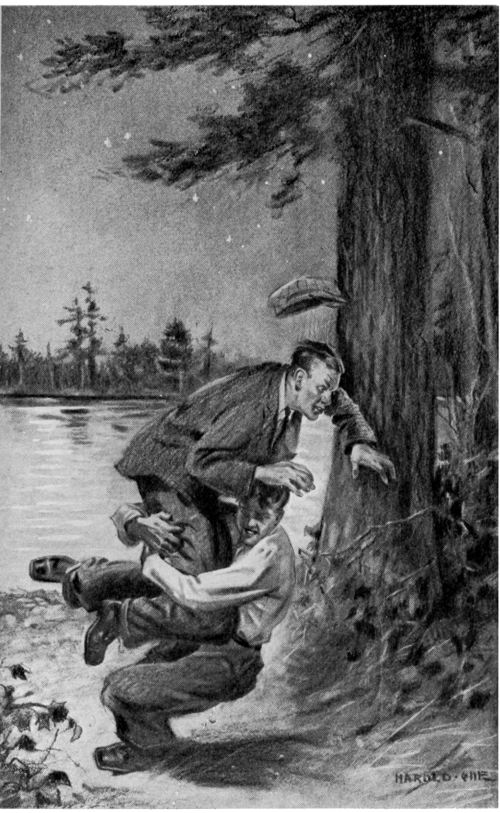
In the rear of a white cottage, known to all
residents of the town of Truesdell as “the
Blake homestead,” stands a great apple tree,
whose leafy boughs have afforded shade in
summer and fruit in autumn to several generations
of Blakes. At present, its hospitable
branches have been converted into an out-of-door
gymnasium by Ned Blake, great-grandson
of old Josiah Blake, from whose half-eaten
apple-core the tree sprang some seventy
years ago. “Six feet, two inches in his
socks and as wide as a door,” is how tradition
describes old Josiah, and although Ned
Blake at seventeen stands less than seventy
inches in his sneakers and tips the scales at a
trifle less than one hundred and fifty pounds,
he has something of the supple strength and
a goodly measure of the courage and grit that
made old Josiah respected among the early
settlers of Truesdell.
2
Clad in a sleeveless jersey, duck trousers
and sneakers, Ned has just climbed a rope
hand over hand to an upper limb from which
he descends in a veritable cascade of cat-skinning,
toe-holding, ape-like swings to drop
on the turf beside his friend, Tommy Beals.
“Bully stuff!” applauded Tommy. “You
sure can do the monkey tricks, Ned, but it
makes me sweat just to watch ’em this
weather,” and Tommy hitched his rotund
form farther into the shade of the friendly
tree.
3
“It would do you good to try some of
them, Fatty,” laughed Ned. “Come on now.
Here’s a simple one for a starter,” and catching
a horizontal limb above his head, Ned
proceeded to chin himself with first one hand,
then with the other, and finished with a two-handed
hoisting swing that left him seated
upon the limb.
Tommy Beals wagged his head in a hopeless
negative. “Nope, it can’t be done,” he
sighed. “Whoever drew my plans must have
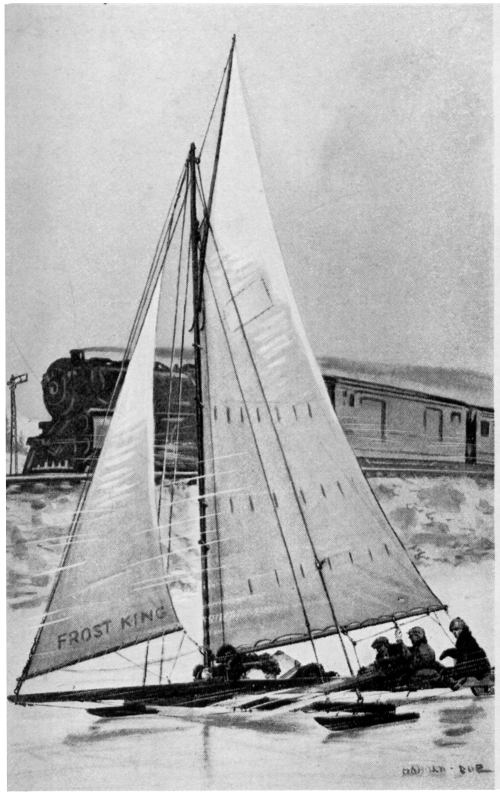
been thinking about ballast instead of aviation,
but if you ever want a good anchor for
a tug-of-war team why just count on me.”
“All right, I’ll keep it in mind,” promised
Ned, “but here’s something you can do for a
little exercise,” he continued, dropping again
to the ground. “I want to grind my camp axe
a bit, if you’ll turn for me.”
“Sure, I’ll do it,” agreed Tommy good-naturedly
and, fetching a soap box for a seat, he
squatted beside a heavy grindstone that stood
in the shade of the tree.
4
For perhaps ten minutes the sharp skurr
of steel on stone sounded on the hot August
air, then ceased abruptly as Ned lifted the axe
from the whirling stone and tested its edge
gingerly with his thumb. Tommy seized the
opportunity to let go his hold of the crank-handle
and wipe the beads of perspiration
from his plump countenance.
“Gosh, it’s hot!” he panted. “Ain’t the
old cleaver sharp yet, Ned?”
“It’s pretty good, except for a couple of
nicks,” replied Ned, “but you needn’t turn
any more, Fatty. Here comes Dave Wilbur
and I’ll get him to spell you.”
“Yeah! I’ll sure admire to watch Weary
Wilbur work,” grinned Beals, as a tall, lanky
youth with hands deep in his pockets turned
in at the gate and strolled leisurely across
the lawn. “I’ll bet you the ice cream sodas,
Ned, that Dave will find an alibi for any job—if
he sees it coming,” continued Tommy, in
a wheezy whisper.
5
“I’ll take that bet,” laughed Ned. “Hello,
Dave,” he exclaimed, “you’re just in time
to save Fatty’s life! Grab hold of that crank
and turn a minute or so. I’ve got to grind
a couple of nicks out of this axe.”
Dave Wilbur, affectionately known to his
friends as “Weary,” glanced suspiciously at
the axe in Ned Blake’s hands, then at the perspiring
face of Tommy Beals whose grin was
but partly concealed by his mopping handkerchief,
and lastly at the heavy grindstone
whose crank-handle projected so invitingly
toward him. “Sure, I’ll turn for you,” he
drawled. “Hop up, Fatty,” and as Beals surrendered
the soap box, Dave seated himself
with cool deliberation.
“Just a few turns will be enough, Dave,”
were Ned’s reassuring words, as he pressed
the axe upon the stone.
6
“Oh, that’ll be all right,” replied Wilbur.
“One good turn deserves another, you know,
but say, before I forget it, who’s your new
neighbor?”
“Neighbor?” repeated Ned. “What neighbor?”
“Moving in next door,” explained Wilbur
as he leaned back comfortably against the tree
trunk and inserted a clean straw in the corner
of his mouth.
Ned laid down the axe and stepped quickly
to the fence which divided his back-yard from
the property beyond. “I guess you’re right,
Dave,” he remarked after a brief scrutiny.
“There’s a big furniture van unloading, and
the stuff is piled all over the sidewalk.
There’s a young chap lugging it into the
yard.”
7
“Yeah, I noticed him as I came along,”
explained Wilbur. “I was just going to stop
and give the young fellow a hand when I happened
to think maybe you would want to be in
on it—you and Fatty.”
“It’s mighty nice of you not to hog the job
all by yourself, Dave,” laughed Ned, “but
let’s see what’s going on,” and slipping his
arms into the sleeves of a thin linen coat, he
led the way toward the front of the house.
The furniture van had deposited its load
and turned away toward the railroad station
for a second installment. A slim, wiry lad
about seventeen years of age was carrying
the lighter articles into the house.
“Now’s your chance, Weary,” chuckled
Tommy Beals. “Hop to it and rustle that
piano up the front steps!”
“Here comes Dan Slade,” announced Ned.
“I wonder just how much help he’ll offer.”
8
“Dan Slade could just about tote that piano
all by himself, if he took the notion,” commented
Beals, as he watched the youth who
came swaggering toward them. “It seems to
me he gets bigger and huskier every time I
see him.”
“Yes. Bigger and huskier and meaner,”
supplemented Wilbur. “It’ll be just like him
to start razzing that chap. Let’s stroll over
and listen in.”
Slade had stopped at the heap of furniture,
and the three friends approaching from the
opposite direction were concealed from view
as they halted to hear his opening salutation.
“Hey, kid,” he began. “What’s the big
idea blockin’ the sidewalk with all this junk?
This is a public street.”
9
The new boy straightened from the box he
was preparing to lift and turned toward the
speaker a freckled countenance. He had a
wide mouth with slightly upturned corners
that gave an expression of good humor to his
face. “Sorry,” he apologized good-naturedly,
“I’ll have this stuff cleared away soon,
but if you’re in a hurry, I’ll”—here he
paused and regarded Slade’s great hulking
figure with a suspicion of amusement in his
blue eyes—“if you’re in a hurry I’ll try to
carry you around it.”
The words, together with the grin that accompanied
them, brought an ugly scowl to
Slade’s face. “Don’t wise-crack me!” he
growled. “I don’t have to be carried around
this junk. I’m goin’ through it!” and lunging
ahead he put his weight against a tall
bureau, causing it to topple toward the glass
doors of a sideboard directly beyond. The
new boy sprang forward in time to prevent
the smash and succeeded in restoring the bureau
to its place. The good-humored expression
of his face had changed to one of surprise,
not unmixed with indignation.
10
“I’ll ask you not to knock over our stuff,”
he began in a voice that seemed to tremble
slightly in spite of his effort to control it.
“Ho! Ho!” jeered Slade, pleased by what
he interpreted as an indication of fear. “Now
who do you think is goin’ to stop me?”
The freckled face paled slightly, but the
wide humorous mouth compressed itself to a
thin line and the blue eyes grew steely. Stepping
forward, the new boy placed himself
squarely in front of his tormentor. “I’ll try
to stop you,” he said quietly.
It is doubtful if Slade had intended to do
more than merely amuse himself by bullying
the weaker boy into a condition of pleading,
but this unexpected show of resistance nettled
him. Evidently the youngster had not been
sufficiently impressed. At Slade’s feet lay a
box containing articles of fireplace furniture.
Stooping, he picked up a poker made from a
square rod of heavy iron. He seized the implement
by its ends and fixed his bold black
eyes upon the freckled face opposite him.
11
“You’ll try to stop me, eh,” he sneered,
“Why, I’d bend you like I bend this here
poker!” and with a wrench of his powerful
arms Slade changed the straight bar into a
letter U. “It takes somebody who can do
that to stop me,” he warned as he flung the
distorted bar back into its box.
“That’s quite a stunt,” exclaimed a voice
at his elbow. “Now can you straighten it
again?”
Slade spun round to face Ned Blake, who
had stepped into view closely followed by
Tommy Beals and Dave Wilbur. A belligerent
expression crossed Slade’s face as he eyed
the group before him. “Who wants to
know?” he sneered, doubling his big fists.
12
For a moment a fight seemed inevitable.
Dave and Tommy felt the sudden tension and
the new boy stiffened perceptibly; but to provoke
a fight was not Ned Blake’s way of settling
an argument and he answered without
a trace of ill humor. “Why, I guess we’re all
interested,” he said smilingly. “It takes
some muscle to bend a bar like that, but they
say it’s even harder to straighten it. Can you
do it?”
Slade hesitated. Into his rather dull mind
there crept a suspicion that perhaps he was
being made the butt of some joke, and the
thought brought an angry flush to his face.
He would have welcomed an opportunity to
try conclusions with this gray-eyed youth,
who appeared so irritatingly cool and unafraid
and yet offered no reasonable grounds
for offense. Slade looked him up and down
for a minute. “Sure I can straighten it—if
I want to,” he growled.
“I’m wondering,” laughed Ned.
13
Stung to action as much by the tone as by
the look of doubt in the smiling gray eyes,
Slade snatched up the poker. “I’ll show
you,” he gritted as he put forth his strength
upon it.
To his surprise the U-shaped poker resisted
stubbornly. It was an awkward shape
to handle, and in addition the attempted
straightening brought into play a very different
set of muscles from those required to
bend it. Pausing for a new hold, Slade
strained upon the bar till the sweat streamed
down his face and his breath came in wheezy
gasps. Slowly the ends of the poker yielded
to his power until the bar had assumed the
general shape of a crude letter W, much
elongated. With a grunt of disgust, Slade
flung it upon the ground.
“It’s crookeder than ever,” grinned
Tommy Beals with an audible chuckle.
14
Slade made no reply, but his hard breathing
was as much the result of rage as of physical
effort. Ned Blake picked up the bar and
balanced it lightly in his hand.
“Bending a bar is much like mischief,” he
remarked. “It’s easier to do than to undo.”
As he spoke, Ned shifted his grip close to one
end of the bar and that portion of the crooked
iron straightened slowly in his grasp. It was
done with seeming ease, but a close observer
would have detected evidence of a tremendous
effort in the whitening of the knuckles
and the quiver of the muscles in chest and
neck. The other crooked end yielded in much
the same manner, and the poker had again assumed
the shape of a letter U or horseshoe.
15
Ned paused and drew his knuckles across
his eyes, into which the sweat of effort had
rolled. Stooping, he dried his hands in the
powdery dust of the gutter and grasped the
bar, not as Slade had done, but close upon
each side of the crook. With elbows pressed
against his sides he inhaled to the full capacity
of his lungs, bringing into play at the
same moment every ounce of power in his
wrists and forearms. Slowly the stubborn
metal yielded until, after another quick shifting
of grip, Ned’s extended thumbs came together
in a straight line where the crook of
the U had been.
“Here you are,” he said as he handed the
bar to its owner, who had watched with no
little surprise and uncertainty the little by-play
enacted before his eyes. “And by the
way,” continued the speaker, “my name is
Blake—Ned Blake—next door, you know.”
16
The new boy’s freckles vanished in the
flood of color that flushed his cheeks, as still
keeping a wary eye upon Slade he reached
forward to grip the friendly hand extended
toward him. “Somers is my name—Dick
Somers.” And as he spoke, the humorous
expression again lighted his face.
“You seem to be obstructing traffic,”
laughed Ned. “We’ll give you a hand with
this stuff. Tommy Beals, here, is a great
worker and as for Dave Wilbur—why, he’s
absolutely pining for a job.”
For a moment Slade listened with ill-concealed
disgust to this conversation, then
realizing how completely the mastery of the
situation had been wrested from him, he
swung round on his heel and slouched away.
“Is he a neighbor?” asked Somers with a
jerk of his thumb in the direction of the departing
Slade.
17
“No, thank heaven, he’s not,” replied
Beals. “His name is Dan Slade—Slugger
Slade they call him where he lives up in the
town of Bedford. He’s got a reputation as a
great bully, but I don’t know just how far
he’d really go.”
“‘A barking dog seldom bites,’” drawled
Wilbur, “but just the same, Somers, you
showed a lot of spunk standing up to him
the way you did. My guess is that you’re the
right sort.”
“I don’t mind admitting I was plumb
scared half to death when I saw him bend
that poker,” grinned Somers, “but that
wasn’t anything compared with straightening
it,” he continued with a look of genuine admiration
at Ned Blake.
“Both stunts are mostly trick stuff,”
declared the latter, “but let’s get busy with
this furniture, before somebody else gets sore
about the sidewalk being blocked.”
18
Four pairs of hands made short work of
the pile, and by the time the van had arrived
from the freight house with its second load,
the walk was cleared and the boys were helping
Mrs. Somers arrange the articles indoors.
“This is awfully kind of you boys!” exclaimed
Dick’s mother gratefully when the
job was finished. “I wish I could offer you
something cold to drink after your hard, hot
work, but I haven’t a bit of ice in the house.”
“Don’t you worry about us, Mrs. Somers,”
laughed Ned. “We’ve just invited Dick to
go down to the corner and join us in an ice
cream soda. It’s Fatty Beals’ treat.”
“Sure,” agreed Beals, “you win all right,
Ned,” and then with a grinning glance at the
perspiring countenance of Dave Wilbur he
continued, “You win—but I’ll say it’s been
worth the price.”
19
CHAPTER II COPPER COLESON
If Tommy Beals found the open-air gymnasium
impracticable, the same was not true
of Dick Somers, whose slim, wiry body took
most kindly to the various hanging rings and
flying trapezes that adorned the limbs of the
old apple tree. Only in such stunts as depended
upon sheer muscular strength could
Ned Blake greatly excel this new friend, who
had accepted with enthusiasm the invitation
to make himself at home in the Blake back-yard.
“Let’s go for a swim,” suggested Tommy
from the soap box, where he sat fanning
himself with his hat and watching the two
young acrobats do their stuff.
“That’s a good idea, Fatty,” agreed Ned.
“Where’ll we go?”
20
“Oh, most anywhere,” wheezed Tommy.
“It’s ninety right here in the shade!” and
he glared reproachfully at a rusty thermometer,
which was nailed to the tree trunk.
“Let’s get Dave Wilbur to run us out to
Coleson’s in his flivver,” suggested Ned.
“I’ll go in and phone him.”
“Where’s Coleson’s—and what is it?”
asked Dick, when Ned had returned with the
information that Wilbur would be over in a
few minutes.
21
“It’s an old copper mine on the shore of
the lake about ten miles out from town,” explained
Ned. “It used to be just a third-rate
farm where Eli Coleson lived and grubbed a
scanty living out of his few acres. The story
is that one day he started to dig a well in his
back-yard and down about ten feet he came
upon a vein of almost pure copper ore. They
say he quit farming that very minute and
went to mining copper. For awhile he made
money hand over fist, but, like lots of people
who strike it rich, Eli Coleson couldn’t stand
prosperity.”
“Here comes Dave,” interrupted Tommy
Beals, as a battered car came into sight
around the corner. “He’s brought Charlie
Rogers with him. Hey there, Red!” he
shouted to a boy on the front seat, who by
reason of his fiery locks had been given that
expressive nickname. “Who asked you to
the party?”
“Nobody asked me, Fatty. I just horned
in,” grinned Rogers. “I figured that if four
of us sat on the front seat there’d be room
for you in back.”
“Tell me some more about this Eli Coleson,”
urged Dick, when the seating arrangements
had been settled and the car was again
in motion.
22
“Well,” resumed Ned, “the old man just
naturally lost his head when he saw the dollars
rolling in so fast. The first thing he did
was to rip down his old farmhouse, which job
he accomplished with a couple of sticks of
dynamite, and right on the old foundation he
began a great house of brick and stone.”
“Yes, and if he’d ever finished it, he’d have
had one of the swell places of the state,” declared
Rogers.
“There’s no doubt of that,” agreed Ned.
“Every dollar old Eli got for his copper he
spent on the house. The vein of ore was only
about ten feet wide and extended toward the
lake. They followed it out under the lake
bottom as far as they dared; then they
started digging in the other direction and
tunneled back under the cellar of the house,
but soon afterward the vein petered out and
so did Eli’s fortune. The workmen had just
got the roof on the new house when they had
to stop. Eli was broke.”
23
“What became of him?” asked Dick.
“Oh, he’s still hanging around out there,
living in one of the partly finished rooms and
pecking away with pick and shovel trying to
get a few more dollars out of the mine,” explained
Ned. “Maybe we’ll see him. He’s
got a long white beard streaked with green
stains from copper ore he’s always handling.
Copper Coleson, they call him.”
“I hear he’s got a fellow named Latrobe
working for him,” remarked Beals. “I never
saw him, but they say he’s an ugly guy.”
“Ugly is right,” declared Rogers. “Since
Latrobe’s been out there, nobody’s allowed
to go down into the mine, but I guess he won’t
object if we take a swim off the beach.”
24
Eight miles from town the car turned
sharply from the main highway to follow a
narrow road which wound through a desolate
stretch of scrubby woodland for some three
miles and emerged upon the shore of Lake
Erie. Here on a slight elevation dotted with
thickets of scrub oak and birch stood the unfinished
mansion known locally as Copper
Coleson’s Folly.
“It surely started out to be a grand place,”
exclaimed Dick, as he gazed up at the tall
brick front with its rows of windows, in none
of which glass had ever been placed.
“We’ll leave the car out here in the road,”
decided Wilbur. “We can walk around the
house and get down to the beach without
bothering anybody.”
Beyond the house the land sloped to the
water’s edge, ending in a sandy shore which
afforded fine bathing, and here the boys disported
themselves for an hour, swimming and
diving in the cool water.
25
“I’d like to get a look at this copper mine,”
remarked Dick. “I never saw a mine or anything
like one—except an old limestone
quarry, and that was only a big hole in the
ground.”
“There isn’t a whole lot to see in this
mine,” replied Ned; “just a vertical shaft
about fifteen feet deep, which is nothing more
than the old well Coleson was digging when
he struck the copper ore. It’s right behind the
house. We can go up there and look down it,
if you want to, but it’s hardly worth the
trouble.”
Getting into their clothes the boys followed
a footpath up the slope and crossed a sandy
stretch to the rear of the house. Nobody
appeared to oppose their progress, and in a
moment they were grouped about the mouth
of the shaft staring down into the blackness
below.
26
“The tunnel runs both ways from the bottom
of this shaft,” explained Ned. “One end
is right under the house but the other is some
distance out under the lake-bottom—I don’t
know just how far it extends, although I’ve
been down through it several times. Probably
Coleson is down there now with his pick
and shovel. He fills a dump car with ore,
hauls it to the bottom of the shaft and hoists
it with this rigging,” and Ned indicated a
rusty windlass which stood at the edge of the
pit.
“Some job turning that crank,” murmured
Dave Wilbur, as he eyed the dilapidated
mechanism.
“Yeah, it would be a lot wors’n turning a
grindstone,” chuckled Tommy Beals. “By
the way, Weary, when are you going to finish
that job on Ned’s axe?”
“D’j’ever hear about the man who ‘always
had an axe to grind’?” drawled Wilbur.
27
“What does Coleson do with the ore after
he gets it to the surface?” asked Dick, who
was still staring down into the mine.
“He loads it onto a truck and runs it up
to the smelter at Cleveland,” explained
Rogers. “There’s only about one load a
week, because it’s mighty slow work knocking
chunks off the walls of the tunnel, and they
don’t dare fire a blast for fear of bringing
down the roof of the mine and the lake with
it. There’s no money in this kind of mining,
and I don’t see how Coleson makes enough
to keep him from starving.”
“You’re right!” exclaimed Tommy Beals,
with an expression of genuine concern on his
plump features. “And speaking of starvation
reminds me that—”
28
“That you’ve been dieting for almost four
hours and are about to pass out of the picture,”
laughed Ned. “All right, boys,” he
continued, “if Dick has seen enough, let’s
save Fatty’s life right now by heading back
for home and supper.”
29
CHAPTER III THE HAUNTED MINE
Dave Wilbur was washing the flivver—or,
to be entirely accurate, Dave was playing the
hose on the car while Tommy Beals and
Charlie Rogers wielded sponge and rag in an
effort to remove mud and road oil. The job
was nearly completed when Ned Blake and
Dick Somers vaulted the back fence and
joined the group.
“Heard the news?” cried Ned and Dick in
a breath. “Coleson’s mine has caved in!”
“When? How?” came the excited chorus.
30
“It must have happened soon after we were
out there,” replied Ned. “This fellow Latrobe,
who worked for Coleson, had been away
for a few days, so he says, and when he got
back yesterday he couldn’t find the old man.
According to the story Latrobe told, when he
reached town about an hour ago, he lowered
himself down the shaft and followed the tunnel
till he came to the water. The roof had
fallen in somewhere out beyond the shoreline
and the lower end of the mine is full of
water.”
“Did he find—” began Tommy Beals in an
awestruck tone.
Ned shook his head. “No, they say he
didn’t find any sign of Coleson. They’re out
at the mine searching for him now. The
theory is that he got discouraged with pick-and-shovel
work and fired a blast to bring
down a big bunch of copper ore. What he
brought down was the roof of the tunnel and
the lake with it. Some think he was blown to
bits and buried in some crevice where he’ll
never be found.”
31
For the next few days, gossip of Copper
Coleson and his mine was the principal topic
of conversation in the town of Truesdell. The
wildest rumors were in circulation. Somebody
stated that Coleson had been seen across
the lake in Canada. Others declared that he
was hiding somewhere about the premises.
Still another story was whispered to the effect
that Latrobe knew more of the matter than he
had told. He was said to have bought a quantity
of blasting powder a short time before,
and it was hinted that he might have fired
the blast for reasons of his own.
A diver made a search of the flooded mine
but found no trace of Coleson. The diver reported
a considerable amount of loose copper
ore at the lower end of the tunnel, and it was
determined to bring this to the surface. A
floating dredge was brought and anchored
above the point where the bottom of the lake
had caved in.
32
“Look at her scoop it up!” yelped Tommy
Beals, who, with most of the younger population
of Truesdell, was watching operations
from the shore. “Why, every bucketful is
more than poor, old Copper Coleson took out
in a week!”
“Yes, and when they clean up in one place,
they’ll pull the dredge in shore a few feet and
start over again,” asserted Ned. “All they
have to do is keep the dredge in line with that
tall stake on the beach and that white mark
on the chimney of Coleson’s house and they
know they’re right plumb over the hole. I
heard the foreman explain it. He says the
hole is about fifty feet long.”
“Look! The diver’s going down again!”
exclaimed Dick Somers.
33
“That’s not the regular diver,” declared
Rogers, “that’s Latrobe. He says that he
and Coleson were partners and he claims a
share of this ore they’re taking out. I guess
that’s why he’s keeping such a close watch on
the job.”
“Well, I’ll say I admire Latrobe’s nerve,”
remarked Beals. “I wouldn’t go down and
explore that tunnel for a million times what
he or anybody else will ever get out of it!”
A murmur of agreement followed this declaration
as the boys watched while the diving
helmet was fitted over the man’s head. In a
moment he had been lowered from the forward
end of the dredge and he sank from view
amid a burst of silvery bubbles that shot upward
from the air valve in the top of the
helmet.
34
For several days the work of dredging went
on, until the diver reported that there was no
more copper ore remaining in the caved-in
part of the tunnel. This was confirmed by
Latrobe, who made a final examination for his
own satisfaction. There was some talk of
firing another blast to bring down more of
the tunnel’s roof, but as fully half the stuff
recovered by the dredge had proved upon
examination to be worthless sand and rock,
the project was abandoned.
“Who’s going to own the Coleson place
now?” asked Dick when it was reported that
the dredge had been taken back to Cleveland.
“The town will take the house and sell it
for taxes—if anybody is foolish enough to
buy it,” announced Dave Wilbur. “They’ve
locked it up and put shutters over every window
to keep folks out.”
“Yes, and they took the windlass away
and sealed up the mouth of the shaft with big
stone slabs set in cement to keep people from
falling down the hole and breaking their
necks,” added Ned. “I guess that’s about
the finish of both Copper Coleson and his
mine.”
35
This seemed to be the general verdict.
During the following weeks a few people
drove out to the deserted house, drawn to the
spot by a morbid curiosity; but as there was
really nothing to be seen, these visits soon
ceased and the place was abandoned to desolation
and decay. Summer passed and autumn’s
falling leaves collected upon the broad
porch and banked themselves at the angles of
the wide cornices. Later came the eddying
snow, sifting through crevices in the rattling
window-shutters to melt and trickle down the
inner walls in little streams of staining moisture.
Storm-driven owls sought temporary
shelter in the gables and sent their ghostly
screams echoing through the night. Dubious
rumors began to circulate regarding the
house. A negro, returning after dark from a
duck-hunting foray along the lake-shore,
made a frightened report of strange, dancing
lights and uncanny sounds in and about the
building. Most people scoffed at these
stories, but such as were more credulous or
more imaginative made them the basis for a
revival of gossip to the effect that old Copper
Coleson still lurked in the neighborhood.
Others of superstitious mind derived a kind
of blood-curdling satisfaction in the belief
that the house and the sealed-up mine were
haunted by the ghost of Copper Coleson.
37
CHAPTER IV THE RACE
The winter, which dealt so severely with
the great melancholy house standing lonely
on the shore of Lake Erie, was proving a very
cheerful season for the lads of Truesdell.
Dick Somers, by reason of his natural aptitude
for making friends, had quickly found a
place in high school activities. A certain proficiency
with the tenor-banjo had won him
membership in a jazzy school orchestra, in
which organization were some of his closest
friends, including Ned Blake, Jim Tapley,
Wat Sanford, Dave Wilbur and, jazziest of
all, Charlie Rogers, who, in the words of
Tommy Beals, “sure did wail a mean saxophone.”
38
Cold weather had set in much earlier than
usual, and before school had closed for the
Christmas holidays, the lake was frozen for
a width of two miles along its southern shore.
Skates were hastily resurrected from dusty
attic nooks and exciting games of hockey were
of daily occurrence. As the strip of ice increased
in width, a few ice-boats made their
appearance, skimming along shore like great
white gulls.
“When are you going to get out the old
Frost King, Ned?” asked Tommy Beals, as
he leaned on his hockey stick to watch the
speeding boats.
“We’ll have her out the minute the ice gets
strong enough,” declared Ned, “but you
know she weighs a lot more than any of those
boats you’re looking at.”
“Have you got an ice-boat, Ned?” asked
Dick, eagerly.
39
“I’ll say he has,” boasted Tommy, “about
the fastest one on the lake, too. We keep it
stored in my barn. Come on, Ned,” he continued
coaxingly, “it’s getting colder every
minute and by tomorrow the ice will be six
inches thick, easy. Let’s get the boat out so’s
to be ready.”
“All right, Fatty,” replied Ned, “get some
of the crowd to help and we’ll start now.”
As most of my readers know, an ice-yacht
is built of two timbers or heavy planks arranged
in the form of a big letter T. A steel-shod
shoe, not unlike a big wooden skate or
sled-runner, is bolted firmly to each end of the
cross-plank; while a similar shoe, equipped
with an iron post and tiller, supports the
stern and acts as a rudder. The Frost King
was a powerful boat, carrying a huge main-sail
and also a big jib which was rigged on a
long bowsprit that projected far forward.
40
All the remainder of the day and until noon
of the next, the boys were hard at work hauling
the boat from her storage in the Beals
barn and getting her ready for the ice.
Charlie Rogers, Jim Tapley and Wat Sanford
had responded to Tommy’s call for assistance,
and Dave Wilbur got around in time
to help in hoisting the heavy mast and setting
up the wire rigging that held it in place.
“Gee, fellows!” chattered Dick Somers, as
he threshed his arms to restore the circulation
in fingers benumbed by his rather clumsy attempts
at handling the frozen rigging. “I
guess a Hottentot knows more about an ice-boat
than I do! I can’t make head nor tail
of this tangle of rope!”
41
In spite of inexperience, however, Dick did
his level best, disentangling the stiffened
ropes and pulling and hauling on hoist or
clew-line with unfailing good nature. Over
all, Ned Blake kept a watchful eye, setting up
and testing each bolt and stay, mindful of his
responsibility for the safety of both boat and
crew. At last all was ready and with a steady
breeze filling her sails, the Frost King shot
out from the shelter of the docks and went
careening along shore at a speed that few of
her competitors could equal.
“Zowie!” gasped Dick as the boat at
length rounded into the wind and stopped.
“This thing must have been going a mile a
minute!”
“Easily that much,” laughed Ned. “She’ll
do better than that in a stiff breeze.”
At almost any time during the week of
Christmas vacation, the Frost King might
have been seen skimming swiftly over the ice
with as many boys on board as she could
carry. To Dick Somers, this novel sport was
a source of never-ending delight, and seldom
did the ice-boat leave port without including
him among her crew.
42
One afternoon as Ned, Tommy, and Dick
stepped from the boat after an exciting spin,
they saw a man emerge from the shelter of a
lumber pile on the dock and come toward
them. He was muffled in a heavy fur coat,
and a cap of the same material, pulled low
upon his forehead, effectively concealed his
features. In one gloved hand he carried a
big valise, which, from the way he handled it,
was evidently of considerable weight.
“I want to get to Cleveland as quick as I
can,” announced the stranger in a voice which
was muffled to a harsh growl by the thickness
of his fur collar.
“There’s a train leaving in half an hour,”
replied Ned, with a glance at his watch. “The
station is only a few steps beyond the dock.”
43
The stranger shook his head. “That’s a
slow local,” he said impatiently. “It’s the
Detroit express I want, but it doesn’t stop
here and they won’t flag it for me. I’ll give
you ten dollars if you’ll run me up to Cleveland,
so I can board it there.”
“It’s all of fifty miles to Cleveland and it’s
four o’clock now,” objected Tommy Beals.
The man shot a quick glance back toward
the station where the engine of the despised
local was blowing off steam in a tempest of
sound. “Yes, it’s fifty miles,” he growled.
“I’ll pay you twenty-five dollars, if you get
me there ahead of the express.”
“Can we do it?” asked Dick, a bit doubtfully.
“How about it, Ned?”
“We might,” replied Ned, and then added
with native caution, “but I’d want to see the
money before we start.”
With an impatient grunt, the stranger
plunged a hand beneath his coat and brought
forth a roll of paper money, from which he
selected two bills.
44
“Here’s fifteen dollars!” he exclaimed.
“I’ll pay you the other ten if you land me at
Cleveland station ahead of the express.”
With a nod of agreement Ned pocketed the
money, and at his command the ice-boat was
swung around till her long bowsprit pointed
westward. The passenger took his place forward,
where he lay flat, grasping the foot of
the mast. The big valise he handled with
care, holding it tightly in the crook of his free
arm.
“There goes the express!” cried Dick as,
with a shriek of its whistle, the big locomotive
tore past Truesdell station with unabated
speed and roared away down the line, dragging
a long line of swaying coaches in its
wake.
45
Rather slowly at first, the Frost King nosed
its way out from the partial shelter of the
docks and headed out upon the frozen lake.
She was half a mile from shore before the full
force of the wind struck her and then, with a
sharp crunch of her keen runners, the big
craft shot forward in pursuit of the already
vanished express.
For the first few miles the ice was almost
perfectly smooth, and to Dick’s excited senses
it seemed as if the boat were actually flying
through space, so steady was her bullet-like
speed. Soon he caught sight of the train far
ahead. It disappeared behind a wooded
point, and when a few minutes later it had
reappeared, they were running almost abreast
of the rear coach. Car by car the flying ice-boat
overhauled the fast express, till it ran
neck and neck with the locomotive and a moment
later had poked its long bowsprit into a
clear lead. A flutter of white from the window
of the cab told that the engine crew also
watched the race with keen interest.
46
“We’ve got ’em licked!” screamed Dick as
he waved back frantically; but at that instant
Ned shoved the tiller hard down. The Frost
King slewed into the wind with her canvas
slatting furiously and came to a quick stop.
“What the blazes!” yelped Dick, bouncing
up from his place and staring about him in
astonishment. “What’s the idea?”
The passenger likewise straightened up and
demanded the reason for the sudden stop.
“There’s a big crack ahead,” explained
Ned briefly, and leaping from the boat, he ran
forward to investigate.
Large bodies of water, such as Lake Erie,
do not freeze with uniform smoothness as do
small ponds. At intervals over their frozen
surfaces great cracks form, which the varying
winds cause to open and close with a force
sufficient to tilt the ice along their borders at
a sharp angle. It was one of these open
cracks dead ahead that had caught Ned’s
watchful eye.
“‘WE’VE GOT ‘EM LICKED!’ SCREAMED DICK”
47
“It’s ten feet wide if it’s an inch,” grumbled
Tommy, as he stood at the edge of the
lane of black water that stretched far to right
and left of their course. “Can you jump it,
Ned?”
“Not with the load we’re carrying,” was
the decided answer. “We’ll have to look for
a better place.”
Hurrying back to the boat, they skirted the
crack for a mile, coming at last to a spot
where a great cake of ice on the near side of
the opening lay tilted at an angle that afforded
a good take-off for the jump.
48
“Here’s the only possible chance I can see
to make it,” observed Ned, after a quick survey
of the situation. Then addressing the
stranger he rapidly stated the case. “This
crack right where we are is almost six feet
wide,” he explained. “There’s a fair chance
that we can jump it, but I’ll admit it’s none
too easy a stunt. Do you want to risk it?”
“Sure,” growled the man in the fur coat.
“Go ahead.”
Without another word, Ned tacked quickly
to starboard, swung in a wide circle and
headed directly for the crack, driving the
Frost King to the very limit of her speed.
“Here we go!” yelled Tommy. “Hold
everything!” And at that instant the big
boat struck the tilted ice-cake, fairly leaped
into the air, and a second later landed with a
splintering crash on the farther side of the
crack.
“Zowie!” yelped Dick. “That loosened
every tooth in my head!”
“We’re lucky it didn’t take the mast out
of her,” answered Ned. “Now keep a sharp
lookout ahead. I’m going to drive her.”
49
For the next twenty miles the Frost King
tore along at a speed that almost forced the
breath from the bodies of her crew. The wind
was increasing in strength, and in some of the
sharper gusts it would lift the windward shoe
clear off the ice, dropping it again with a jolt
that caused the mast to sway and buckle
dangerously.
“It’s up to you to stop that, Fatty,”
shouted Ned and, obedient to orders, Tommy
Beals crept out along the cross-plank till his
ample weight reposed at the extreme outer
end, where he held tightly to the wire shrouds.
With this extra ballast to windward, the
boat held to the ice much better and showed a
considerable increase in speed, such that very
soon Dick pointed to a white plume of steam
which showed against the dark stretch of
woodland far ahead.
50
“She’s blowing for some crossing,”
shouted Ned, above the whistle of the wind.
“We’re picking up on her but she’s got a big
lead.”
The early winter twilight soon closed down,
making it difficult to distinguish objects a
hundred yards ahead. The green and red
lights of a railroad switch-tower swept past,
and a moment later Dick sighted the rear
lights of the train. At the same moment a
second plume of steam appeared and the faint
scream of a distant whistle reached their
ears. Foot by foot the lead was cut down till
once again the Frost King ran neck and neck
with the big locomotive. A bobbing red lantern
saluted them from the window of the cab
and then, as the express slackened in the outlying
suburbs of the city, the ice-boat shot
ahead and in a few minutes was rounding the
breakwater that protects Cleveland’s waterfront.
51
“Here we are!” announced Ned, as he
brought the boat into the wind. “We’ve beat
the express by five minutes.”
The man in the fur coat rose stiffly from his
place beside the mast. “All right,” he replied
gruffly. “Here’s your money,” and
peeling a ten-dollar bill from his roll, he
handed it to Ned and hurried away across the
ice, holding the heavy valise beneath his arm.
52
CHAPTER V A STRANGE CONVERSATION
For a long minute after the stranger had
departed, Ned Blake stood staring after him,
a puzzled frown wrinkling his forehead.
“Humph!” grunted Dick, who also was
gazing after the hurrying figure. “He must
have been in an awful rush, if he’d pay
twenty-five dollars just to get here ahead of
the express. What do you make of it, Ned?”
Dick had to repeat his question before Ned
roused himself to reply; but now the conversation
was interrupted by the plaintive voice
of Tommy Beals, who had dragged himself
from the end of the cross-plank and was
stamping the blood back into his aching feet.
“Gosh, I’m about froze to death!” he
wailed. “Froze and starved! What’s the
program, Ned?”
53
Ned cast a quick look at the fast-gathering
shadows, which already lay in a black smudge
along the shore of the lake. “We’d better not
try to get home tonight,” he decided. “I’ve
no mind to chance jumping that crack after
dark. There’s a hotel close by the station
where we can get a good dinner and a bed.
We’ve got the cash to pay for both.”
“Yeah, that’s the idea!” exclaimed Tommy
fervently. “A steak smothered in onions and
French fried spuds! What?”
“How about the boat?” asked Dick.
“We’ll furl the sails and push her in
against the dock,” replied Ned. “We can unship
the tiller and hide it so that nobody will
be tempted to run off with her.”
54
This was quickly done and the boys turned
their steps toward the Union Station, the
lights of which gleamed a scant hundred
yards ahead. The express had thundered
into the station while they were taking care
of the boat, and now, as they crossed the
tracks, her rear lights were blinking in the
distance as she picked her way through the
switch-yards westward bound.
“There goes our twenty-five-dollar passenger,”
remarked Dick, with a characteristic
jerk of his thumb toward the departing train.
“He had plenty of time to catch her, I guess.”
“I can’t get it out of my mind that I’ve
seen that man somewhere before today,” began
Ned. “I couldn’t see his face clearly, he
was so muffled up, and yet there was something
about him that seemed familiar—the
way he stood—or walked—or something.”
The hotel was just across the street from
the station, and here the boys registered after
bargaining for a room containing three beds.
“And now for that steak and onions,”
gloated Tommy Beals as he headed for the
grill room closely followed by Dick.
55
“I’ll be with you in a jiffy,” Ned called
after them as he paused at a telephone booth.
“I’ll just shoot a word to the folks that we’re
O.K. and will be home in the a.m.”
It took Ned several minutes to complete his
call, and then, as he was about to step from
the booth, he halted suddenly at the sound of a
voice in the telephone compartment next to
his own. There was a familiar note to the
harsh growl. As Ned paused in surprise, the
words came clearly to his ears.
“Sure, I made it on time and Miller was
there, too. Where was you?” Silence a moment;
then the voice continued. “Local nothing!
I told you I’d be in on the express—stop
or no stop. As a matter of fact I got there
ahead of time—never mind how. Now
listen.”
56
For a moment the heavy voice rumbled on
but in a lower tone so that no word reached
Ned’s ears; then the door of the booth was
jerked open and its occupant crossed the hotel
lobby with a rapid stride. He was joined by a
tall, red-faced man and the two disappeared
through the door leading to the street. For
the second time within half an hour, Ned
Blake found himself staring after a short,
thick-set figure in a fur coat. There was no
doubt of it. The growling voice in the telephone
booth had been that of his mysterious
passenger on the Frost King. Hurrying to
the grill room, Ned acquainted his companions
with what he had learned.
“Then that yarn about wanting to catch the
Detroit express was all bunk!” exclaimed
Dick.
57
“Evidently,” agreed Ned. “But also it’s
sure that he had some important date that coincided
with the arrival of the train. That
red-faced man ‘Miller’ showed up on time but
somebody else missed out. I wonder what
the game is.”
“We should worry about him or his business,”
was Tommy’s cheerful comment as he
eyed with huge satisfaction the nicely
browned steak, which at the moment was
being placed before him on the table. “Right
now I’m for enjoying this feed that he’s paying
for. Afterwards, I’ll wonder—if you insist,”
and Tommy helped himself lavishly to
the savory fried onions that accompanied the
steak.
Long exposure to the biting wind had induced
appetites which required a deal of
satisfying, but at length even Tommy’s splendid
yearnings had been appeased and he sank
back in his chair, the picture of well-fed contentment.
Hardly had the boys left the dining-room,
when drowsiness came upon them
as the natural reaction to long hours in the
open air supplemented by a heavy meal.
58
“Can’t keep my eyes open,” mumbled Dick
after a prodigious yawn. “Me for little old
bed-o, even if it is only seven-thirty.”
The idea was accepted unanimously and the
boys lost no time in seeking their room and
making ready for bed. But now the puzzling
question regarding their unknown passenger
recurred to Ned with redoubled force. Before
his mind’s eye there passed countless faces
and figures of men he had known or seen. He
was groping painfully in an effort to place
one thick-set figure in a fur coat.
“What’s the matter, Ned? Do you see a
ghost?” grinned Dick at his friend who sat
on the edge of the bed, shoe in hand, staring
blankly at the opposite wall.
“Not unless ghosts wear fur coats,” muttered
Ned, flinging the shoe under the bed.
“Hang it all! I’m sure I’ve seen that fellow—or
at least somebody a whole lot like him.
I wish I could remember when or where!”
59
“While you’re wishing you might as well
wish for that roll he packed,” chuckled
Tommy. “Gosh! I’ll bet there was half a
thousand dollars in it—and that fur coat!”
Here Tommy rolled up his eyes enviously.
“One thing I am sure of,” continued Ned,
“whoever he is, he probably does at least a
part of his business in Canada. That last bill
he gave me was Canadian money. I noticed
it when I paid the dinner charge. Luckily,
they accept Canadian money here.”
“What do you suppose he had in that suitcase
he was so fussy about?” queried Dick.
“It was darned heavy—from the way he
handled it.”
“That’s another question I’d like answered,”
admitted Ned, “also, what was he
doing in Truesdell, when all the time he was so
anxious to get to Cleveland that he was willing
to risk his neck on the Frost King, just to
save half an hour or so?”
60
“Heigh, ho! I’ll give it up,” yawned
Tommy and, with a sigh of unalloyed satisfaction,
the plump youth rolled over luxuriously
and buried his face in the pillow.
Dick was only seconds behind Tommy in
his plunge into the depths of sleep; but long
after his companions were sunk in blissful
oblivion, Ned lay racking his brain in what
proved to be a futile effort to find some
reasonable solution of the puzzle. Weariness
at last closed his eyes, but through his
troubled dreams there persisted these tantalizing,
half-formed questions, always on the
point of being answered but ever eluding his
grasp.
61
The sharp rattle of icy particles on the
window awakened Dick Somers next morning.
Springing out of bed, he roused his companions
and they stared out at a world rapidly
whitening under a driving storm of snow.
“This will never do!” cried Ned. “We’ve
got to get a move on or we’ll be snowed in
down here!”
After a quick breakfast of bacon, eggs, rolls
and coffee, the boys hastened down to the
lake. The snow was, as yet, only about two
inches deep, but it was whipping out of the
north with a power that warned of much more
to come. Sails were quickly hoisted and the
Frost King shot away, homeward bound.
62
Holding close enough to the shore so that
its dim outline served as a guide, Ned kept
his bearings; and although slowed somewhat
by the fast gathering snow, the ice-boat made
fair speed. Constant wind pressure had
closed the shoreward end of the big crack and
a cautious crossing was made without difficulty.
Through a six-inch depth of snow, the
Frost King plowed to a stop beside the dock
at Truesdell, where the crews of other boats
were busily engaged in removing the canvas
from their craft.
“That’s what we’ve got to do right now,”
declared Ned. “This storm feels like a genuine
blizzard that will probably put an end to
ice-boating for the rest of the winter.”
As rapidly as possible the sails were removed,
the stiffened canvas folded up and
stored in a safe place and the boat itself
hauled as far up on shore as possible, pending
the time when the boys would return her
to her former place of storage.
“Well, we’ve had a bully time and a swell
feed and have fifteen simoleons to divvy up
among the crew of the Frost King,” chortled
Tommy Beals as they trudged homeward.
“I’ll say that’s good enough for anybody.”
63
“Yes, it’s O.K.,” agreed Ned, “but I’m
going to keep my eye out for that fellow in
the fur coat, and the next time I get a look at
him, I’ll try to find out who he is or whom he
reminds me of.”
As it transpired, however, many months
were to pass and many strange happenings
were to take place before Ned Blake again
found himself face to face with the mysterious
stranger.
64
CHAPTER VI IN TRAINING
It had been a great winter for the lads of
Truesdell. Although the big blizzard put an
end to ice-boating, it provided instead snow-shoeing,
ski-running, and many other delightful
winter sports. Plenty of hard study interspersed
with recreation made the winter
months pass rapidly, and when the last
shrunken snow-drift had sunk to a muddy
grave and the balmy south winds were drying
soggy fields and muddy lanes as if by magic,
the boys turned from winter sports to the enthusiastic
consideration of baseball possibilities.
65
“We’ve got a swell chance to cop the
championship pennant in the Lake Shore
League,” declared Charlie Rogers to a group
which had gathered in a sunny nook behind
the school building. “Believe me! We’ll
wipe the earth with Bedford this year!”
“Where do you get that stuff, Red?” demanded
Abner Jones, a sallow youth whose
prominent knee and elbow joints had won for
him the nickname “Bony.” “I hear Slugger
Slade is going to play third for Bedford.
He’s an old-timer and knows every trick in
the bag; and can he hit? Oh, boy!”
“Slade is tricky all right,” agreed Rogers.
“He’s tricky and dirty, too, if he gets a chance,
but when it comes to hitting, why we’ve got a
couple of pitchers who may fool him.”
“Forget it!” scoffed Jones. “Slade will
make a monkey of any pitcher we’ve got—even
Ned Blake.”
“Here comes Ned right now,” interposed
Wat Sanford. “Let’s hear what he has to
say about it.”
66
“What’s all the row?” asked Ned, as he
came down the steps swinging a strapful of
books.
“Bony, the crape-hanger, says we can’t
beat Bedford with Slade playing for ’em, and
I say we’ll wipe ’em off’n the map,” explained
Rogers. “How about it, Ned?”
“Both wrong—as usual,” laughed Ned,
clapping a strong hand on the disputants and
pushing his broad shoulders between them.
“Now here’s how I see it,” he continued.
“Slade is a wicked hitter and a tough man in
the field. He’ll be a big help to Bedford, but
he can’t play the whole game. Keep that in
mind, Bony. On the other hand, Red, remember
that plenty of teams are world-beaters
before the season starts. We’ve got some
good material, but it will take a lot of hard
work to make a winning nine out of it. That’s
what it’s up to us to do. I’ve just posted a
notice for the squad to show up for practice
this afternoon. The field is drying fast and I
want every man on the job.”
67
“All except the pitchers, I suppose,”
yawned Dave Wilbur. “I’ll be around the
first of next week and work on the batting
practice.”
“You’ll be right on the job at two p.m. this
afternoon, Dave,” replied Ned, firmly. “I’m
depending on you to set a good example to the
new men.”
“Do you hear that, Weary?” gibed Tommy
Beals. “You’re expected to set the old alarm
for one forty-five p.m. and be made an example
of.”
“That’s the idea, Fatty,” laughed Ned.
“Anybody going my way?”
“I am, if you don’t walk too darned fast,”
replied Beals.
68
Dick Somers also rose to his feet and joined
the two as they shouldered their way out of
the group and strode down the street.
“Bony Jones is an awful knocker,” remarked
Tommy, when they were out of hearing.
“He’s that all right,” agreed Ned, “and
yet for the good of the team right now, I’d
rather they’d hear Bony’s knocking than
Red’s boasting. Over-confidence at the start
of the season is a mighty bad thing, and as
captain of the team, it’s up to me to kill it if
I can.”
“What’s the real dope on this fellow
Slade?” asked Dick. “I don’t have any very
pleasant recollections of him myself, but how
about his playing?”
“I’ve seen him in a couple of games,” replied
Ned. “He’s a good third baseman and
a small edition of Babe Ruth when it comes
to hitting.”
69
“How about these stories of his spiking
men on bases and other dirty work?” persisted
Dick.
“I don’t know,” answered Ned with a
shrug of his shoulders. “I won’t condemn a
man till I actually see him do something of
the kind myself. I’m more worried right now
about how good our fellows are going to be
than how bad somebody else is. By the way,
Dick,” he continued, “how much ball have
you played?”
“Oh, not a whole lot,” answered Dick,
modestly. “We had a pretty fair team where
I used to live. They let me chase around out
in right field.”
“Well, I want you and Fatty to be on hand
this afternoon,” declared Ned. “We’re going
to need every man who shows any class.”
70
Promptly at two o’clock the Truesdell
squad assembled on the muddy field and began
the season with an easy workout. Dick
Somers quickly demonstrated a remarkable
throwing arm, both for distance and accuracy,
while his quickness of foot promised to make
him a valuable fielder and base-runner. The
development of hitting ability was Captain
Blake’s most difficult problem, and upon this
first day and for many days thereafter he kept
the weak hitters swinging at pitched balls till
their shoulders ached.
“D’j’ever hear about ‘the straw that broke
the camel’s back’?” grumbled Dave Wilbur
as he left the pitcher’s box after a particularly
long session of batting practice. “Ned’s
an awful glutton for work. He’s making me
wear out my wing throwing balls past these
dubs, who couldn’t hit a balloon with a bass
viol!”
71
“Don’t kid yourself, Weary,” gibed
Rogers. “Ned is figuring on giving you some
much-needed practice in hurling. We’re just
standing up there so’s you can learn to locate
the plate.”
“Aw say, use your bean,” grinned Dave.
“I can put ’em over the old pan with my eyes
shut!”
The first regular game of the schedule was
won by Truesdell but the victory proved
costly. Charlie Rogers, sliding home with
the winning run, sprained his ankle and was
pronounced out of the game for the rest of
the season.
“There goes the best fielder in the Lake
Shore League,” wailed Tommy Beals, as he
watched Rogers hobble from the field. “A
few more unlucky breaks like that will make
hard going for us!”
72
This pessimism seemed well founded, for a
few days afterward, Ned Blake dropped into
Somers’ home with another gloomy bit of
news. “Tinker Owen flunked math. yesterday,”
he announced, shortly. “That wipes
him out of the picture, unless old Simmons
will relent—and you know how much chance
there is of that.”
“Not a look-in,” agreed Dick, picking up
his banjo from the couch and plunking a few
chords in a doleful minor key.
“It leaves us only nine real players anyhow
you figure it,” continued Ned, who was checking
off the names from a slip of paper. “You’ll
have to play center field in Red’s place, Dick,
and we’ll try out Fatty Beals in Tinker’s position
behind the bat. Dave and I will have
to alternate pitch and right field.”
“It’s pretty tough on Weary Wilbur, making
him pitch every other game and play right
field between times,” grinned Dick. “He’ll
crab plenty when he hears the news!”
73
“I’m not worrying about Dave,” was
Ned’s reply. “Of course he’ll crab a bit and
probably he’ll spring one of his everlasting
proverbs on us, but he’ll come through in his
own lazy fashion. It’s a shame we haven’t
got a few more good subs, but we’ll manage
somehow.”
Truesdell High struggled through the next
three games with its changed line-up, winning
each by a narrow margin but improving
steadily in the matter of speed and smoothness.
Bedford Academy, although heavily
scored against, likewise kept a clean slate
showing six victories. It was freely predicted
by the followers of baseball that this year’s
annual game between the two great rivals
would be “for blood.”
74
CHAPTER VII THE BIG GAME
A special train brought a wild crowd of
Bedford supporters down to Truesdell for the
big game. Rooters for the local team jammed
the bleachers and watched the preliminary
practice with critical eyes.
“I can’t see Fatty Beals as catcher,”
grumbled Bony Jones. “He might do all
right for a backstop, but he can’t throw down
to second to save his life! I could do better
myself.”
“Why didn’t you think to mention that the
first of the season?” demanded Charlie
Rogers, whose hair was only a shade redder
than his temper when one of his friends was
assailed. “It’s a crime to keep your talents
hidden that way, Bony!”
75
“Fatty’s all right,” declared Wat Sanford,
“and anyhow, Ned Blake’s going to pitch,
and there won’t be a Bedford man get to first—take
it from me!”
The Truesdell players were soon called in
and Bedford took the diamond for ten
minutes fast work, handling infield hits and
throwing around the bases.
“Look at Slugger Slade over on third!”
exclaimed Jim Tapley. “This is his first year
with Bedford, but I hear he’s a semi-pro. He
looks more like a football fullback than a third
sacker!”
“He’ll try football stuff, if he gets a
chance,” asserted Rogers. “I’m hoping the
umpire keeps his eye peeled for crooked work.
Here’s our team,” he continued, hoisting himself
up on his one sound foot with the help of
a cane. “Come on, boys. Let’s give ’em a
cheer!”
76
The long yell rolled forth from half a thousand
throats. “Oh well! Oh well! Oh WELL!
Truesdell! Truesdell! TRUESDELL.” To
which the Bedford rooters responded with
their snappy “B-E-D-F-O-R-D!”
The visiting team was first at bat and
three men went out in quick succession, not
a man reaching first.
“What did I tell you!” chortled Wat Sanford.
“You should worry about the heavy
hitters, Bony!”
Truesdell’s efforts at bat were, however,
little better than Bedford’s. The first man up
drew a base on balls but perished on an attempt
to steal second; the next fouled out and
Ned’s long fly was captured by Bedford’s
left-fielder.
Slugger Slade came to bat in the first half
of the second inning and smashed to right
field a wicked line-drive, which Dave Wilbur
gathered in with his usual lazy grace.
77
“Atta boy, Weary!” screamed Jim Tapley.
“You tell ’em!”
“What do you think now about Slade’s
hitting?” demanded Jones. “That drive of
his would have gone for a homer sure, if it
had got past Dave!”
“Horsefeathers!” snorted Charlie Rogers.
What looked like a break for Truesdell
came in their half of the fourth. Dick Somers
bunted safely and went down to second on the
first pitch, running like a scared rabbit and
scoring the first stolen base of the game.
Tommy Beals hit a grounder to right field,
which was returned to first base before the
plump, short-legged youth was half-way
there. Dick raced round to third on the play
and Truesdell’s chances for a run were excellent.
Ned Blake ran out to the third-base
coaching line.
78
“Great work, Dick,” he chattered. “Only
one gone! Take a big lead. I’ll watch ’em
for you!”
Slugger Slade, the third baseman, threw
him a sour look. “Keep back of that coaching
line, you!” he snarled.
Dave Wilbur was up, and as the bleachers
yelled lustily for a hit, he lifted a high sky-scraper
to center field. Dick clung to the bag
till he saw the ball settle in the fielder’s glove;
then dashed for home. Ordinarily it would
have been an easy steal for a runner of Dick’s
speed, but he had faltered noticeably in his
start and the throw-in to the plate beat him
by a narrow margin for the third out.
“I want to enter a protest on that decision!”
cried Dick to the umpire, as the Bedford
players trooped in from the field.
“What’s the matter?” demanded the
official. “The catcher had the ball on you
half a yard from the plate!”
79
“I know that, but I’m claiming interference
by the third baseman,” yelped Dick, wrathfully.
“He held me by the belt just long
enough to spoil my start!”
“That’s right, I saw him do it!” asserted
Ned, who had run in to add his protest to that
of Dick.
“What’s all the crabbin’ about?” growled
Slade, swaggering up to the group. “You
was out by a mile!”
“I’m not crabbing,” declared Dick. “I’m
just calling the umpire’s attention to some of
your dirty playing!”
“Who says I play dirty ball?” demanded
Slade, doubling up his big fists menacingly.
“I do, for one!” Ned spoke quietly, but
his gray eyes were blazing. “I saw you hook
your fingers under Dick’s belt when you stood
behind him on the bag!”
80
“You mean you think that’s what you
saw,” sneered Slade. “The umpire says
he’s out and that settles it!”
There seemed no chance for further argument,
and Dick walked out to center field in a
savage humor, which was somewhat appeased
when Ned, a moment later, struck the slugger
out with three fast ones. The next Bedford
man was out at first, and a long fly to Dick
ended the inning.
Ned Blake was up in Truesdell’s half and
brought the crowd to its feet with a screaming
three-bagger.
“Wow! That’s cracking ’em out!” yelled
Wat Sanford. “It’s a crime we didn’t have
a couple of men on bases when Ned got hold
of that one!”
“There’s nobody gone, any kind of a hit
will mean a run now!” cried Charlie Rogers.
81
The next Truesdell batter swung at two
bad balls, but lifted the third for a high fly to
right field. Slugger Slade’s heavy breathing
sounded in Ned Blake’s ear as he crouched
on third base, all set for the dash for home.
With quick fingers he loosened his belt-buckle
and as the fielder’s hands closed upon the fly
ball, Ned sprang from the bag; stopped short
in his tracks; and yelled lustily for the umpire.
Every eye turned in his direction and
saw Slade standing stupidly on third base
with Ned Blake’s belt dangling from his hand.
The Slugger had been caught in his own trap.
A chorus of boos and jeers changed to
cheers as the umpire motioned Ned home; a
penalty which Slade had earned for his team
by interfering with a base-runner.
“Oh, boy! What a stunt!” shrieked Jim
Tapley. “Slade met his match that time!”
82
The wild yells and jeers seemed to rattle
the Bedford team for the moment. Slade,
purple with rage, let an easy grounder roll
between his legs, and before the inning was
over, two more Truesdell runs came across,
making the score three to nothing.
In their half of the next inning, two Bedford
batters were easy outs, but the third
drove a savage liner straight for the pitcher’s
box. Ned knocked it down and managed to
get the ball to first for the third out. The
effort proved costly, however, for he came in
with the blood streaming from his pitching
hand, two fingers of which were badly torn.
“You’ll have to finish the game, Dave,”
announced Ned, and the lanky southpaw at
once began warming up.
Ned’s injured fingers were hastily taped
and he took Wilbur’s place in right field.
“Oh, I’d give a million dollars to be out
there now!” groaned Charlie Rogers, as he
shifted his lame ankle to a more comfortable
position.
83
Dave Wilbur had scant time to warm up
before he faced the leaders of Bedford’s batting
order. He was found for four hits and
two runs scored. The score was now Truesdell
three—Bedford two, and thus it stood
when the latter came to bat in the first half
of the ninth.
“Holy cat!” wailed Jim Tapley, as the first
man up whaled out a two-bagger. “A couple
more like that and we’re sunk!”
The second batter hit to shortstop and
reached first on a fumble. Bedford now had
men on first and second, with none out.
“For the luv o’ Mike, hold ’em, Dave!”
screamed Wat Sanford.
84
Tommy Beals threw off his mask and ran
half-way to the pitcher’s box to confer with
Wilbur. Yells and jeers from the Bedford
stand greeted this evidence of worry on the
part of Truesdell’s battery, but it took more
than mere noise to rattle Dave Wilbur.
Strolling lazily back to the box, he fanned the
next two men, and the Bedford yells subsided
for the moment. The next batter, however,
sent a pop-fly just out of the shortstop’s
reach, and Bedford had the bases loaded with
two out. Slugger Slade was up, and as he
swaggered to the plate, the Bedford yells
again rent the air.
“Come on now, Slugger! Knock the cover
off’n it! Put it out of the lot!”
“One strike!”
The umpire’s shrill voice cut through the
babel of yells from the Bedford stand. Slade
glared round at the official and muttered
something in protest. Dave Wilbur took his
time in the wind-up and delivered the ball in
his customary effortless style.
“Strrrike two!”
85
A yell of delight from the Truesdell rooters
greeted this decision. Slade rubbed his hands
in the dirt and gripped his bat till his big
knuckles were white. Dave Wilbur had fooled
him with two slow out-drops and the crowd
fell strangely silent as the lanky youth began
his third wind-up. Dave put everything he
had into the pitch—a high, lightning-fast ball
over the inside corner of the plate.
The sharp crack of the Slugger’s bat
brought the Bedford crowd to its feet with a
roar, while the silent Truesdell bleachers
watched with sinking hearts as the horse-hide
sphere sailed high and far between right and
center fields.
86
Ned Blake and Dick Somers were playing
deep, and at the crack of the bat both started
on the instant. The ball curved away from
Ned and a bit toward Dick who was running
as he had never run before. For a moment it
seemed to the watchers that the two racing
fielders would crash together. Suddenly they
saw Dick make a desperate leap into the air
with upstretched arm. The ball struck the tip
of his glove, and bouncing high to one side,
fell into Ned’s extended hands for the final
out.
Truesdell had won, and with the sort of
finish that comes once in a lifetime. With a
roar, the Truesdell rooters swept across the
diamond, and hoisting Ned Blake and Dick
Somers high above the surging crowd, bore
them in triumph from the field.
Slugger Slade stared after the retreating
crowd and a savage scowl darkened his face.
Into his mind there flamed a great hatred of
these jubilant lads who had beaten him so unaccountably.
Deep within him arose the sullen
wish that he might somehow even matters
with them. It was a wish that would later
bear much fruit.
87
CHAPTER VIII A SUMMER PROPOSITION
The school year had ended in a fashion to
delight the heart of every loyal son of Truesdell,
and the day following graduation found
a group of the boys lounging in Dave Wilbur’s
yard, a convenient meeting-place by
reason of its central location.
“Are you going to play ball this summer,
Ned?” asked Jim Tapley. “I hear they’re
looking for a pitcher on the North Shore
Stars. You could make the team easy, and
there’s seventy-five a month in it plus expenses.”
88
Ned Blake shook his head. “Nothing doing,
Jim,” he said regretfully. “I’ll admit the
money would mean a lot to me, for, as you all
know, I’m trying to scrape together enough
to enter college in the fall. But if I get there,
I want to play ball and this professional stuff
would bar me.”
“What I’d like to do is go to England on a
cattle steamer,” declared Charlie Rogers.
“All you have to do is rustle hay and water
for the steers.”
“Yeah, that’s all, Red,” drawled Dave
Wilbur, “and they only eat about four tons
a day and drink—well, they’d drink a river
dry, and you sleep down somewhere on top
of the keel and eat whatever the cook happens
to throw you—unless you’re too blamed sea-sick
to eat anything.”
“Well, even that would be better than
hanging round this dead dump all summer,”
retorted Rogers, with some spirit.
89
“Dan Slade has got a job over across the
lake in Canada,” announced Wat Sanford.
“I saw him at the station yesterday when the
train came through from Bedford. He was
bragging that he was going to pull down a
hundred a month, but he didn’t say what the
job was.”
“Some crooked work probably,” remarked
Tommy Beals. “Now what I’d like would be
a good job bell-hopping at some swell summer
hotel. A fellow can make all kinds of dough
on tips.”
“Sure, you’d look cute in a coat with no
tail to it and a million little brass buttons
sewed all over the front!” laughed Dick
Somers. “What you really need, Fatty, is a
job as soda-fountain expert, where you can
get enough sugar and cream to keep your
weight up to the notch.”
There was a general laugh at this in which
Tommy joined good-naturedly.
90
“I guess what we’re all looking for is a
chance to make some money this summer,”
suggested Ned. “What Red says about this
being a dead dump is true of every town, until
somebody starts something. It’s up to us to
show signs of life. I don’t believe any of us
would be content to loaf till next September.”
“Speak for yourself, Ned,” yawned Dave
Wilbur, who, stretched at full length on his
back, was lazily trying to balance a straw on
the tip of his long nose. “I’m enjoying myself
fine right here—and besides you want to
remember that ‘a rolling stone gathers no
moss.’”
“Bony Jones got a job down at the Pavilion
dance hall,” remarked Tapley. “His
old man has something to do with the place
and they took Bony on as assistant. Pretty
soft, I’ll say.”
91
“I was hoping to get a chance down there
with the jazz orchestra,” lamented Rogers,
“but I hear they’ve brought two saxophone
players up from Cleveland, which lets me
out.”
“Tough luck, Red,” sympathized Tommy.
“You and Wat ought to find a chance somewhere
to do a turn with sax and traps; the
Pavilion isn’t the only place.”
“What’s the matter with our running some
dances of our own?” asked Ned. “The Pavilion
is usually over-crowded and we ought
to get some of the business.”
“Who do you mean by we?” inquired Wat
Sanford.
“Well, there’s you with the traps and Red
with the sax—as Fatty has just suggested,”
began Ned. “Dick is pretty fair on the banjo
and Jim can play the piano with the best of
’em. Dave can do his stuff on the clarinet—if
he’s not too exhausted—and I would make
a bluff with the trumpet. Fatty could take
tickets and act as a general utility man. That
makes seven, all we need for a start.”
92
“That’s about half of the high school orchestra,”
remarked Dick. “I guess with a
little practice we might get by as far as music
is concerned, but where would we run the
dances?”
Several possibilities were suggested, only
to be turned down as impracticable for one
reason or another.
“What we want is a place just out of town
which auto parties can reach handily,” declared
Jim Tapley, who was taking a lively
interest in the scheme. “We could serve refreshments
and make something that way.”
“There’s one place we might do something
with,” began Ned, a bit doubtfully. “I’m
thinking of the Coleson house,” he continued.
“Of course it’s a good ten miles out and quite
a distance off the main road.”
93
“Yes, and that’s not the whole story
either,” objected Rogers. “The house was
going to wrack and ruin even while Coleson
lived in it, and lying shut up so long can’t have
improved it a whole lot.”
“Guess it’s in bad shape all right,” agreed
Tommy Beals. “Haunted, too—if you can
believe all you hear about it. There’s talk of
some mighty queer things going on out there.”
“What kind of things?” asked Wat Sanford,
quickly.
“Can’t say exactly,” admitted Beals.
“Some folks claim to have seen and heard
things that couldn’t be explained. Last fall
a darky went past the house after dark and
was scared pretty near dippy.”
“That’s the bunk,” drawled Dave Wilbur.
“D’j’ever see a darky that wasn’t nuts on
ghosts?”
94
“What do you say we take a run out there
anyhow?” suggested Rogers. “It’s a swell
day for a ride and we can go swimming; the
water’s elegant; I was in yesterday!”
“Bully idea, Red,” applauded Tapley.
“Come on, Weary! Crank up the old flivver!”
he cried, as he stirred up the recumbent Wilbur
with his toe.
Thus appealed to, Dave arose lazily to back
the little car out of the garage, and piling in,
the boys settled themselves as best they could
upon its lumpy cushions.
“What do you reckon we’ll find out there,
Ned?” asked Wat Sanford a bit anxiously,
when the flivver after sundry protesting
coughs and sputters, had finally gotten under
way.
“Oh, dirt and lonesomeness, mostly,”
laughed Ned. “They’re the usual furniture
of a deserted house—especially if it’s supposed
to be haunted.”
95
Lonesomeness seemed, in truth, to pervade
the very air and to settle like a pall upon the
spirits of the boys, as the flivver coughed
its way up the weed-grown drive and came to
a halt before the tall, gloomy, brick front.
Charlie Rogers sprang out, and mounting
the weatherbeaten steps leading to the broad
porch, rattled the great iron knob of the massive
front door. “It’s locked, all right,” he
reported, “and these window-shutters seem
pretty solid.”
Further investigation proved this to be
true of all the openings of the lower story,
but at the rear of the house one window-shutter
of the story above had broken from
its fastenings and swung creakingly in the
breeze.
“If we only had a ladder—” began Wat
Sanford.
96
“That’s not necessary,” interrupted Ned.
“The question is who’s got the nerve to go
through that window and find his way down
to open one of these lower shutters?”
“I’ll do it,” volunteered Dick. “That is, I
will if I can reach that window-sill; it’s about
fifteen feet up.”
“We’ll put you there,” promised Ned, and
he locked arms with Dave Wilbur. The two
braced themselves close to the wall of the
house. Tapley and Rogers mounted to their
shoulders and Dick, climbing nimbly to the
top of this human pyramid, grasped the window
ledge above and drew himself upon it.
In a moment he was inside, and pausing only
long enough to accustom his eyes to the gloom
of the interior, he picked his way down the
unfinished stairs and unhooked a shutter that
opened upon the front porch. By this means
the other boys entered, but paused in awe
of the deathly stillness of the place.
97
“Gee! It’s like a tomb!” shivered Sanford,
and struggling with a window-fastening,
he threw open another shutter at the westerly
end, admitting a flood of sunlight which revealed
an apartment nearly thirty feet
square, partly paneled with oak and floored
with the same material.
Opposite the entrance, a stairway had been
completed up to its first broad landing, but
the remainder of the flight was still in a rough,
unfinished condition. Through a wide, arched
doorway could be seen another large room,
evidently designed for a dining-hall but
entirely unfinished except for the floor, which,
as in the case of the first apartment, was of
quartered oak.
“What’s down below?” asked Wat, as
he peered through a rectangular opening
into the blackness beneath. “Ugh! It looks
spooky!”
98
“There’s nothing down there except a big
cellar,” replied Ned, reassuringly. “This
hole was left for the cellar stairs to be built
in, but they were never even begun.”
Further investigation of the interior
showed the oaken paneling to be warped and
cracked by dampness and long neglect, but
the floors, beneath their thick covering of
dust, were in fairly good condition.
“It’s the floor that we’re most interested
in for our proposition,” declared Dick. “I
believe that a few days of hard work with
scrapers would make these two rooms fit
for dancing. We could put the music on that
stair-landing and leave this whole lower space
free and clear.”
99
“Do you think we could get a crowd to
come way out here?” asked Tommy Beals
doubtfully. “It’s a lonesome dump even in
the daytime, and at night it is mighty easy
to believe these yarns about its being
haunted.”
“Why not make that the big attraction!”
exclaimed Ned with sudden inspiration.
“Everybody is looking for thrills nowadays.
We might be able to give ’em a brand new
one.”
A chorus of approval greeted this
suggestion.
“Bully stuff, Ned!” cried Charlie Rogers.
“Great idea! And if there don’t happen to
be any honest-to-goodness ghosts on the job,
we can manufacture a few just to keep up
the interest.”
“What do you think it would cost to fix
up the old shebang?” asked Wilbur, who,
despite his rather affected laziness, was beginning
to take an interest in the scheme.
100
“Oh, not a whole lot,” replied Ned, glancing
about with an appraising eye. “As Dick
says, the floor is our chief consideration, and
if we do the work on it ourselves, the only
expense will be for scrapers and sandpaper.
We can string bunting and flags to cover the
breaks in the walls and ceiling. We’ll have to
lay a floor over that stair-opening, or somebody
will manage to tumble through into the
cellar, but I guess we can find enough lumber
around here to do the job.”
“How about lights?” inquired Sanford.
“There isn’t an electric line within five
miles.”
“We’ll use candles,” decided Ned. “A
dim light will be just what we want for ghost
stunts anyhow, and candles won’t cost much
if we buy ’em in wholesale lots.”
“Shall we figure on refreshments?” asked
Rogers.
101
“Sure thing!” asserted Dick. “The
Pavilion sells ice cream and soft drinks; we
can do the same and serve the stuff from the
butler’s pantry. That will be just the job
for Fatty!”
“Nothing doing!” objected Beals in an
injured tone. “I draw the line on handing
out grub for other folks to eat, but I’ll
manage the refreshment business and get our
darky, Sam, to serve the stuff. Sam used
to work in a restaurant and can do the trick
in style.”
“All right, then,” announced Ned, who had,
by common consent, assumed leadership,
“let’s get organized into working shape.
There are seven of us, and if we chip in two
dollars each, it will put fourteen dollars into
the treasury for immediate expenses.”
This was agreed to and Tommy Beals was
elected treasurer.
102
“Now if there’s no objection I’ll assign
the various jobs,” continued Ned. “Dick
and Red are to get brooms, scrapers, and
whatever else they think we need for fixing
the floors. Weary and Wat will attend to
the bunting and such other decorations as
may be required—also the candles. Fatty
and Jim will look after the matter of refreshments.
The first thing to do is to make sure
that we can get the use of this house at a
rental that we can afford. I’ll talk to the
town authorities right away and see if we
can get a lease. Let’s meet at Dave’s house
tomorrow afternoon and hear reports on
costs of the different items, after that, we
can make definite plans.”
103
CHAPTER IX HOUSECLEANING
Dave Wilbur’s back-yard was, as has been
said, a favorite meeting-place for the Truesdell
boys, and when for any reason secret
sessions were desirable, the garage was
especially convenient. Here, on the following
afternoon, the seven prospective business
men assembled to listen to reports of their
various committees and to discuss ways and
means. Ned Blake mounted a rickety step-ladder
and called the meeting to order.
104
“I ran into a snag the moment I applied
for a lease of the Coleson property,” began
Ned. “The town authorities are willing to
get some income from it to cover taxes, but
it seems that to be legal the lease must stand
in the name of somebody over twenty-one
years old. We can get it for three months at
twenty-five dollars a month, but the papers
must be made out to somebody of legal age.”
“That ought to be easy,” suggested Dick
Somers. “I know Dad would let the lease
stand in his name, if I asked him to.”
Ned shook his head. “Of course we can get
around it that way—and maybe we’ll have
to come to it; but this scheme is all our own
and I’d like to see us put it through and make
a big success of it by our own efforts, without
calling on anybody’s father for help in any
way.”
“That’s the stuff!” exclaimed Wat Sanford.
“We want to run this thing on our own.
There ought to be some way to get around
this silly legal difficulty.”
105
“I’ve got an idea,” volunteered Tommy
Beals from the front seat of the flivver, where
he had ensconced himself. “I talked with our
man, Sam, last night and he agreed to handle
the refreshments for us. Why not have the
lease put in his name? That will cover the
law and make Sam all the more anxious to
attend to his part of the business.”
“Bully idea, Patty!” chorused several
voices.
“But will Sam agree to this?” asked Ned.
“Sure he will!” declared Beals. “He’ll
be so swelled up when he sees his name on a
legal document that we’ll be lucky if he
doesn’t bust! Leave it to me.”
106
This the boys were willing to do, and the
discussion proceeded to other matters. Dick
Somers and Charlie Rogers reported an
option on the purchase of two brooms and
half a dozen steel floor-scrapers at four dollars.
Sandpaper and wax would bring the
total to eight-fifty. They had also arranged
for the loan of two polishing brushes when
needed. Dave Wilbur and Wat Sanford had
proved themselves shrewd business men in
the matter of interior decoration.
“Wat and I have contracted to tack up
the usual flags and bunting around the municipal
band-stand on July third and take ’em
down again on the fifth,” explained Dave.
“In return for this hard toil we are to have
the use of the stuff till Labor Day, when the
town will need it again.”
“That’s a clever scheme and it will save
us real money,” approved Ned. “I’m a bit
worried about all the hard work you’ve laid
out for yourself, Weary, but at that, I guess
you’ll find it easier than scraping and polishing
floors.”
“Yeah, I kind of figured it would take the
load off’n me for a couple of days,” admitted
Dave, with a grin.
107
These details being settled to the satisfaction
of all, it was decided to begin operations
without further delay. Ned Blake, Tommy
Beals and Dave Wilbur started off in the
flivver in quest of Sam, who, when found,
proved very willing to leave his labors in
the Beals garden for the purpose of signing
an important document at the town hall.
There was no hitch this time, and very shortly
a lease of the Coleson property to one Samuel
G. Washington, for the period of ninety days
from date, was signed, sealed and delivered,
and with it the key to the house.
“Don’t say a word about this to anybody,
Sam,” was Ned’s parting injunction. “We
want to keep the thing a secret as long as we
can.”
“No sah, no sah, I don’t say nuthin’,”
chuckled the negro and he strutted back to
his work in an ecstasy of self-importance.
108
After leaving Sam, the flivver was headed
for the hardware store, where the other boys
were waiting, and with brooms and scrapers
stowed in the car they were soon on the way
to the scene of their labors.
“Our first job is to sweep out this dust,”
announced Ned, when the great oaken door
of the Coleson house had swing open at the
turn of his newly acquired key. “Open every
shutter and let the wind blow through.”
Coats were discarded and brooms wielded
with such good will that all the floored portion
of the lower story was speedily cleared of
its heavy deposit of dust and dirt. As fast
as this was removed, the steel scrapers were
put to work and, by the time the long shadows
warned of supper time, a creditable showing
had been made. A dip in the cold water of
the lake removed the grime and refreshed the
spirits of the workers, after which they
climbed into the little car and rattled away
for home, well satisfied with their first day’s
progress.
109
“All members of the orchestra meet for
practice at my house tonight at seven-thirty,”
directed Jim Tapley, who, by reason of his
superior ability, was the acknowledged leader
in things musical. “Come on over and listen
in, Fatty,” he continued hospitably.
“No, thanks,” declined the plump youth
with some fervor. “My nerves are none too
strong after such a strenuous day and besides
I’ve got an idea that I want to work up.”
When Tommy Beals got an idea, he pursued
it with vigor, and long after the last
wailing pulsation of the practicing orchestra
had melted into midnight silence, Tommy
was still busily at work in his own room, upon
the walls of which were tacked several
cleverly executed copies of his “idea.”
110
CHAPTER X A NOTE FROM A GHOST
The week that now followed was one of
hard labor, and the long hours of work at
the Coleson house were succeeded by earnest
rehearsals of the orchestra. Such industry
brought gratifying results and hardly had
the young people of Truesdell settled to their
accustomed routine after the usual Fourth
of July celebration, when their interest was
aroused by promise of a new attraction. This
was heralded by flaming posters, adorned
with grinning death heads and bearing the
following announcement:
111
DEMON DANCES
at the
HAUNTED COLESON HOUSE
THRILLS!! MYSTERY!!
PHUN with the PHANTOMS
Grand Opening Sat. July 7
Music by the Syncopating Six
Admission $1.00 a Couple
Refreshments.
Tommy Beals’ “idea” went over big—as
his companions assured him in so hearty a
manner that he grew quite pink with pleasure.
“It really wasn’t my idea at all,” he protested
modestly. “Ned said it first. I only
worked it up a bit and made the posters.”
“Yes, and in a way that none of the rest
of us have got either the wit or the skill to
do!” declared Ned, loyally. “Now the next
thing will be to get up some stunts in the
ghost line. Nothing horrible, but just enough
to keep the crowd guessing.”
112
“That ought to be easy,” said Charlie
Rogers. “All we need is a little phosphorescent
paint—the kind that glows at night—kind
of pale and ghastly, and maybe a couple
of iron chains to clank at the right time.”
As July seventh drew near, the “haunted”
house was the scene of feverish activity. The
well scraped oak floor was given its final coating
of wax and polished to a perilous smoothness.
Flags and bunting, which had recently
decked the town band-stand, now concealed
the rough unfinished timbers and broken
portions of walls and ceilings. A piano was
installed on the stair-landing and one hundred
chairs of the folding type used at public
gatherings were arranged along the walls
of the two dance rooms. A rectangle of solid
flooring covered the opening to the cellar and
removed any danger of injury to the dancers
from a fall into the black pit below. With
the heavy part of the work completed, the
boys had declared a half-holiday and were
gathered in the Wilbur garage for a final
conference.
113
“We’re just fifty-six dollars in the hole,”
announced Chairman Blake after a careful
revision of the figures handed him by Treasurer
Beals. “If this first dance is the success
it ought to be, we can square up on everything
and have something ahead for payment on the
lease.”
“I guess we needn’t worry about that,”
said Wat Sanford. “From the talk that’s
going round we’ll have over a hundred paid
admissions, easy.”
“The crowd down at the Pavilion is beginning
to take notice,” chuckled Dick Somers.
“Bony Jones held me up today and wanted to
know who is backing us. I made him swear to
keep the secret and then told him that Henry
Ford is helping us. And that’s the truth,”
continued Dick, indicating the flivver by a
jerk of his thumb, “Henry is furnishing the
transportation.”
114
“There’s something I ought to tell you
fellows,” began Tommy Beals, when the
laugh at Dick’s joke had subsided. “I don’t
suppose it really amounts to anything, but all
the same it’s a bit strange.” Here Tommy
paused and drew from his pocket a paper
which he unfolded and passed to Ned Blake.
“It’s a letter that came to Sam,” continued
Beals, “and I’ll say it just about scared the
daylights out of that coon. Read it, Ned.”
115
Ned glanced over the typewritten sheet
and read aloud as follows:
“Sam G. Washington,
“I hear that you have hired my house
and intend to run dances there. Now
listen, you black son of Satan! If you
do this, or if you allow it to be done, I’ll
haunt you to your dying day.
“Eli Coleson.”
Ned paused and glanced round the circle of
faces upon which was depicted surprise,
doubt and uncertainty. For a moment nobody
spoke. It was Tommy Beals who broke
the silence.
“Sam got the letter this morning and was
waiting to show it to me when I got home.
I tried to laugh him out of his fright by
telling him it was a joke that somebody is
playing on him.”
“Of course it’s a joke!” exclaimed Charlie
Rogers, impetuously. “Nobody but a superstitious
darky would pay any attention to
such stuff!”
116
“But suppose he should get scared and funk
the whole thing and cancel his lease? What
hold have we got on him to make him stick?”
demanded Dave Wilbur.
“Not much, I’ll admit,” replied Ned,
gloomily. “This letter was mailed on the
train and shows only the railroad post-office
mark. Evidently whoever wrote it intends to
keep under cover. I wonder how many people
know that the lease stands in Sam’s name?”
“Oh, probably a hundred, by this time!”
declared Dick Somers, disgustedly. “I suppose
Sam felt so important that he bragged
of the thing all over town!”
But in this, Dick did the honest negro an
injustice, for in spite of swelling pride which
threatened him with suffocation, Sam had
kept his secret faithfully. To his simple mind
it thus appeared that the ghost of Eli Coleson
must know his inmost thoughts and secret
acts, and this idea had, as Tommy Beals
expressed it, almost scared the daylights out
of him.
117
“If we had the seventy-five dollars to plank
down right now as advance payment in full
for the lease, Sam might find it hard to cancel
it,” suggested Jim Tapley.
“We’ll have the cash after the dance Saturday
night,” declared Dick. “We’ll have to
find some way to keep Sam away from the
town hall till Monday—even if we have to
kidnap him!”
“Suppose some of us have a talk with Sam
and try to convince him that he is being made
the butt of a joke,” suggested Ned.
“Well, it’s worth a try,” agreed Beals.
“I’ll go with you right now,” and the two
emissaries left the garage in a hurry.
118
CHAPTER XI THE LIGHT ON THE WALL
Ned Blake and Tommy Beals found Sam
slumped on a bench in the Beals garden, staring
moodily at a long row of unweeded
carrots.
“Nozzur, I ain’t gwine ter have no doin’s
with dead folks—not any!” muttered the
negro, when Ned and Tommy had broached
the subject of their visit.
“But how do you know that Eli Coleson is
dead?” argued Ned. “This letter was
written on a typewriter and if it is really
from Eli, why it proves that he isn’t dead,
doesn’t it?”
Sam shook his woolly head obstinately.
“Cain’t be sure of nuffin’,” he insisted.
119
“You’ve seen lots of ghosts, haven’t you,
Sam?” asked Tommy Beals coaxingly.
“Suttinly I has! A plenty of ’em!” replied
the negro, with deep conviction.
“Well, have you ever seen or heard of one
that used a typewriter?” demanded Beals.
Sam was forced to admit that he never had,
and Ned took advantage of this opening to
discourse forcefully against such ghostly possibility.
Like most of his race, Sam was
readily susceptible to influence and after an
hour of diplomatic argument, the boys succeeded
in bolstering his resolution sufficiently
to make it safe for them to leave him for the
present.
“Do you think he’ll stick?” asked Ned
anxiously, as he cast a backward glance at the
negro, who had finally bent to his weeding of
the carrot patch.
120
“I think he will—unless he gets another
jolt of some kind,” replied Beals. “I’ll keep
an eye on him till Saturday noon. The town
clerk’s office closes at noon on Saturday, and
after then we’ll be safe over the week-end
anyhow.”
“Yes, and I’ll make it a point to be on hand
with seventy-five dollars when the office opens
Monday morning!” declared Ned. “I’ll feel
a lot easier in my mind after that lease has
been paid for in full. In the meantime we
may discover who wrote this letter to Sam.
If it’s only a joke, why let’s take it that way;
but if it’s an attempt by somebody to interfere
with our scheme, we’ll have to be on our
guard.”
121
Two days passed with no clue to the writer
of the warning letter. No further attempt
had been made to frighten the negro and
Sam had regained much of his usual self-confidence.
Early on Saturday evening, the
boys and Sam, whom they had hardly allowed
out of their sight, wedged themselves into
Dave’s flivver and arrived at the Coleson
house in time to complete a few finishing
touches before the first of a long line of autos
turned in at the gate and parked among the
scrubby oaks in front of the house. Tommy
Beals stood at the open door to collect the
admission fees and soon the rooms were filled
with a gaily chattering crowd of young people
who giggled and squealed their appreciation
of the weird atmosphere of the place.
122
A hundred flickering candles cast an uncertain,
wavering light over the decorations
of flags and bunting which had been supplemented
with dozens of black paper cats, whose
white and yellow eyes made of daisy heads
glared forth in baleful fashion. Numerous
toy balloons, each decorated with phosphorescent
paint to represent a human skull, were
tethered in the dark corners, where they
swayed and bobbed in the varying drafts with
ghostly effect.
In the butler’s pantry stood Sam, attired
in waiter’s dress, with a gleaming expanse
of shirt front, and barricaded behind containers
of ice cream and bottles of soft drinks
for sale at profitable prices.
Promptly at eight o’clock the orchestra
took its place, and the couples stepped out
across the polished floor in time with the blare
of syncopated jazz. For several hours dance
numbers followed in rapid succession, the
orchestra responding valiantly to encore applause,
while black Sam, under the direction
of Tommy Beals, did a thriving business in
ministering to the parched throats of the
perspiring dancers.
123
“Whew! It’s hot!” gasped Charlie
Rogers, after a particularly long number in
which his saxophone had carried the major
part. “Can’t you open those north shutters,
Ned, and let a little breeze blow through
here?”
Laying down his trumpet, Ned crossed the
room and threw open a shutter. Instantly
a violent gust of wind swept in from the lake,
extinguishing every candle and plunging the
room into pitchy blackness.
A babel of voices burst forth at this unexpected
occurrence, but was instantly
hushed at sight of a strange spot of light,
which made its sudden appearance upon the
wall of the room. For a moment it remained
stationary, then with a hesitating, uncertain
movement, as though feeling its way, it
advanced along the wall midway between floor
and ceiling and vanished.
124
The breathless silence that followed was
broken by a groan of abject terror from Sam.
Somewhere a girl screamed hysterically.
Closing the shutter with a bang, Ned fumbled
for matches and relighted a candle. Several
of the other boys followed suit and soon the
room was again as bright as the rather dim
flares could make it. The orchestra broke
into a peppy foxtrot and the recently startled
crowd, laughing gaily at what was seemingly
one of the advertised “stunts,” swung again
into the dance.
“Nice stuff, Ned!” applauded Wat Sanford,
as he finished the number with a long
roll of the snare drum and the customary
crash of the cymbal. “That gave ’em quite
a kick! How did you manage it so cleverly?”
“I’ll tell you about it later,” replied Ned.
“They’re calling for an encore. Let’s give
’em a hot one.”
125
At midnight the dance ended and a line
of automobiles streamed homeward through
the darkness. Pausing only long enough to
assure themselves that the house was securely
locked, the boys and Sam followed after.
“How much did we take in, Fatty?” asked
Dick Somers of the plump treasurer at his
side.
“Eighty-six dollars for admissions and
seventeen-fifty on the refreshments,” replied
Beals. “Not so bad for the first night and I
guess everybody was pleased with the way
things went. By the way, Ned, that was quite
a stunt of yours. Tell us about it.”
“Yes; let’s hear how you worked it,” urged
several voices.
“Well, I’m glad you all approved of it, and
I guess it satisfied such of the crowd as were
expecting some haunted stuff,” replied Ned.
“It’s too long a story to start on tonight.
Sometime I’ll try to show you how it was
done.”
126
At the outskirts of town, Sam was dropped
at the gate of his humble dwelling, and hardly
was the car again in motion when Ned startled
his companions with this announcement.
“Boys, I didn’t want to mention it before
Sam, for fear of scaring him worse than he’s
scared already, but I’ll tell you now that the
stunt you saw was no doing of mine. What
that light was or where it came from I don’t
know any more than any of you do—but I
mean to find out!”
127
CHAPTER XII WARNINGS
“Sam has quit on us!” announced Tommy
Beals, as he joined Ned Blake and Dick
Somers at the latter’s house on Monday
morning.
“You mean he’d like to quit,” laughed Ned.
“I got down to the town hall bright and early
this morning and paid that lease in full, right
up to the end of September. I met Sam as I
was coming out and showed him the receipt.
He gave me one scared look and shambled off
toward home without a word. Has anything
new happened, Fatty?”
128
“Well, it’s darned queer,” began Beals,
taking off his cap and running his fingers
through his stubby hair. “Sam came around
to see me yesterday morning before I was out
of bed. Usually he won’t move on Sunday,
except to go to church, but yesterday was
different. He hung around till I finished
breakfast and then coaxed me out to the barn,
where he told me about the wildest yarn I
ever listened to.”
“Something he’d dreamed the night before,
I suppose,” scoffed Dick.
“Maybe he dreamed some of it, and probably
he drew pretty heavily on his imagination
for the details,” agreed Tommy, “but
something must have happened Saturday
night, and whatever it was, it scared him
foolish!”
“Do you mean after he got home Saturday
night?” inquired Ned. “You remember we
took him right to his gate that night.”
129
Beals nodded. “You know Sam lives alone
in that shack of his and sleeps in a little room
off the kitchen. He says that soon after he
got into bed Saturday night he heard a queer
noise. He sat up in bed to listen and there
at the window he saw something that he insists
was the face of Eli Coleson. Sam knew
Eli well enough, and he swears he saw the
old man with his white beard—copper stains
and all.”
“What happened then?” asked Dick.
“According to Sam’s story, old Eli came
right through the wall and struck at him with
a pickax; but my own idea is, that if Sam
thought he saw something white at the window,
he was down deep under the bed covers
about one second later. Anyhow, he’s so
scared you couldn’t get him to go near the
Coleson house again for a million dollars—and
that’s that!”
“Let’s take a walk down to Sam’s shack.
I’d like to see what the place looks like by
daylight,” suggested Ned.
130
“Good idea. Maybe we can find the place
where old Eli went through the side of the
house,” laughed Dick.
A short walk brought the three boys to
Sam’s house, about which they prowled, peering
in at the closed windows and examining
the little garden where the negro cultivated
a few vegetables and flowers. There was no
evidence of a forced entrance into the house,
but in the soft earth of a flower bed, just
below the bedroom window, was the distinct
imprint of a rubber-soled shoe.
“Does Sam ever wear that kind of shoe?”
asked Ned as he pulled aside the foliage for
a better view of the footprint.
“I don’t believe he owns a pair of rubber-soled
shoes, and anyhow, his foot is two or
three sizes bigger than this print,” replied
Beals.
131
“Somebody else has been here, that’s
sure,” declared Dick. “They’re taking a lot
of trouble to frighten a poor inoffensive
darky half to death!” he continued angrily.
“A pretty cheap joke, I call it!”
“Maybe it’s not altogether a joke,” suggested
Ned. “I mean there may be something
else than a joke behind all this. Nobody ever
bothered Sam before, but about as soon as it
becomes known that he has a lease on the
Coleson house there comes that letter, then
that light out at the house and now this
funny business here. All these happenings
look like the work of the same hand. What’s
the answer?”
“Somebody is trying to scare Sam into
quitting his lease,” growled Dick. “It’s
lucky for us that we blocked that game!”
“But who can it be, and why this sudden
interest in the place just as we get started
there?” complained Tommy Beals.
132
“Perhaps the answer might be found out
at the Coleson house,” suggested Ned. “Are
you two fellows game to go out there with
me and scout around a bit?”
“How can we get out there?” asked Dick.
“Dave’s gone away somewhere with the flivver
and won’t be back till tonight.”
“Let’s take the Cleveland bus and get ’em
to drop us at Cedar Hollow. It’s only a
couple of miles through the woods from
there,” urged Ned.
This plan was agreed upon, and shortly
afterwards the three scouts were threading
the thick undergrowth between Cedar Hollow
and the lake.
“Here’s luck!” cried Dick, as they emerged
from a tangle of underbrush into what had
evidently once been a wood-road. “This old
track seems to be heading about in the right
direction. Let’s follow it.”
133
“Somebody else has been doing the same
thing,” observed Ned, pointing to several
broken twigs and torn leaves on the thick
bushes lining the road. “There’s been a car,
or maybe a light truck through here quite
recently,” he continued, after a closer examination
of the ground.
“Probably somebody has got a camp over
on the lake-shore,” guessed Beals.
For half an hour the boys followed the
grass-grown track, noting frequent evidence
of its use by some vehicle, but as the country
grew more open, these marks became fewer
and finally ceased altogether when they
reached the hard stony ground bordering the
lake. The old road ended in what had once
been a pasture, barely a hundred yards from
the Coleson house, and the boys halted at the
edge of the clearing to reconnoitre.
134
“We can’t be sure whether the car that
came through this old road kept straight
ahead to the house or swung into the traveled
road outside the gate,” commented Dick, who
was searching the hard-baked ground for a
possible wheel mark.
“Unless the ground happened to be wet, a
car or even a loaded truck wouldn’t leave a
mark on this hardpan,” agreed Ned. “Let’s
see if we can find any tracks on that stretch
of sand between the house and the lake.”
Approaching the rear of the building, the
boys scanned every foot of the sandy area
which ended at the water’s edge. Not a single
clue of any kind rewarded their search.
135
“There’s the range pole that helped to
locate the sunken end of the mine when they
were dredging it,” remarked Dick, and picking
up a stone he threw it accurately at a
long stake which stood at the water’s edge.
“You remember, Ned, how the big dredge
used to get itself into line with that stake and
a white mark on the chimney of the house
and then dig up the copper ore in bucketfuls,”
and Dick hit the stake squarely with another
stone.
“It’s funny how solid that stake is in the
ground,” observed Ned as he noted the slight
effect of Dick’s bombardment. “You’d think
after last winter’s storms it would have
loosened up or been knocked out entirely,”
and Ned walked down for a closer look at the
old range mark.
Dick and Tommy followed at a leisurely
pace, which quickened at Ned’s exclamation
of surprise. As they reached his side they
saw the cause of his astonishment. The tall
stake had been reset in the earth and its face,
as seen from the lake side, bore a recently
applied coat of white paint. For a moment
they stared in wonder; then, as if in obedience
to a common impulse, their eyes turned toward
the house. Upon its broad chimney
was a newly painted mark of gleaming white.
136
“Well, I’ll be jiggered!” cried Dick. “Now
what does this mean? Are they going to start
dredging again?”
“Suppose they do? It won’t bother us,
will it?” demanded Beals.
“Maybe not, and yet I can’t help suspecting
that whoever put up these new range
marks may be back of the attempt to scare
Sam away from this place,” said Ned,
thoughtfully. “I can’t imagine what their
reason can be, but that’s up to us to discover—if
we can. Come on; let’s have a look
around at the front of the house.”
Everywhere between the gate and the
building were tire tracks left from the autos
that had parked there Saturday night, but
it was quickly seen that nothing could be
gained by examination of these confused
impressions. As they reached the porch, Ned,
who was in advance, stopped in his tracks
and pointed to the front door. In the oak
panel a nail had been driven and from it
fluttered a scrap of paper.
“FROM THE OAK PANEL FLUTTERED A SCRAP OF PAPER”
137
Mounting the steps, Ned tore the paper
from its fastening and spread it wide. Upon
it was scrawled these words:
“I don’t want company here.
“E. C.”
“Are you going inside, Ned?” asked
Tommy in a tone that was not much above
a whisper.
“Sure! Why not?” replied Ned, squaring
his shoulders. “We’ve got a legal right to
this place!” and drawing the key from his
pocket, he unlocked the ponderous door and
flung it open.
138
Not a sound disturbed the cool darkness
of the interior, and waiting until their eyes
had become accustomed to the gloom, the
boys entered cautiously, peering about with
uneasy glances. Everything appeared to be
exactly as they had left it Saturday night.
The black cats glared unwinkingly with their
white and yellow eyes, and the painted balloon
skulls grinned in their corners. In
spite of the fact that this ghostly atmosphere
was of their own making, the boys were glad
to regain the outer sunlight and lock the door
behind them.
“Whoever is up to these pranks has
apparently confined himself to outside stuff—thus
far,” was Ned’s comment as he stared
again at the crumpled paper still in his hand.
“What do you make of it? Is it a warning
or just an attempt to scare us?” asked
Tommy Beals.
139
“Either—or both, I’d say,” interposed
Dick. “Anyhow, it’s very evident that we’re
being urged to vacate. The question is, are
we going to quit?”
“Let’s get the boys together and talk it
over,” replied Ned. “Right now we’d best
be making tracks to catch the next bus at
Cedar Hollow.”
140
CHAPTER XIII THE NIGHT WATCH
A group of excited boys gathered in Dave
Wilbur’s garage that afternoon and listened
to the astonishing story which Ned Blake
and his fellow sleuths had to tell.
“So there is somebody else besides us who
is interested in the Coleson house!” exclaimed
Charlie Rogers.
“There seems to be no question about
that,” agreed Ned, “and what is more, they
evidently want the whole place to themselves.”
“But I can’t see why anybody should want
to drive us out,” complained Tommy Beals
in an injured tone. “We won’t horn in on
their business—whatever that may be—if
they’ll just lay off us!”
141
Ned shook his head. “I’m afraid we won’t
be able to get that idea across, Fatty.
There’s something going on out there that
we don’t understand; something that somebody
is afraid we’ll get wise to. That letter
to Sam and the ‘ghost’ he saw at his window
were attempts to scare him away from the
place. This paper nailed to the door is the
next step and is meant for us. They succeeded
in frightening Sam away; now the
question is, are we going to quit?”
“Not on your life!” yelped Dick Somers,
whose wrath had been steadily rising during
this discussion. “We’ve put a lot of money
and hard work into this scheme of ours and I
say stick it out!”
142
“If they’ll be satisfied with trying to scare
us with letters and ghost stuff, why we’ll be
able to stay with ’em until we’ve got our
money back anyhow,” said Beals, cautiously.
“The dance crowd is looking for almost anything
in the spook line and they will stand
for quite a bit of it, but what worries me is
the possibility that if ghosts don’t drive us
out, something else may be tried—some rough
stuff, you know.”
“You don’t suppose old Coleson may have
a hand in it after all,” ventured Wat Sanford.
“Coleson? Not a chance!” declared
Rogers, positively. “Coleson’s dead.”
“Well, er—even if he is dead,” persisted
Sanford, uneasily, “what if—”
“Cut it out, Wat! Use your bean,”
drawled Dave Wilbur. “As for me,” he
continued, “I’m voting to keep the dances
going till I get paid for all the hard work I
did out there,” and Dave yawned wearily at
the recollection of his labors.
143
“It would be a shame if we had to quit
now. Everybody is talking about our ghost
dances, and there will be a big crowd out there
next time,” volunteered Jim Tapley.
“We may have a fight on our hands,”
began Ned Blake, “but I’d rather fight than
run, any time! As I see it, we’ve got to find
out who it is that we are up against; what
their game is; and why they think we are
interfering with it.”
“Rather a large order, as a starter,” remarked
Dick. “However, it sounds interesting.
What’s your plan, Ned?”
“We ought to keep guard over that house
night and day for a while,” was the quick
reply. “Quite likely we are being closely
watched, and it would be a good plan for us
to do some watching. Two of us can take
grub and blankets and camp there for twenty-four
hours, or till relieved by the next two.”
“That sounds reasonable. Who’ll volunteer
to be the first sentry?” asked Dick.
144
“We’ll draw lots,” decided Ned.
This was done and the short straws were
found to be held by Charlie Rogers and
Tommy Beals.
“All right, Fatty! We’re it!” exclaimed
Rogers. “The sooner we start the better.
Get plenty of grub and blankets and bring
that big hammock of yours; it will come in
handy!”
The two left for home at once to procure
the necessary supplies, and that afternoon
Dave Wilbur deposited them and their belongings
on the porch of the Coleson house.
“Any last request you want to send back
to the folks at home?” grinned Dave, as he
backed the car around and headed for town.
“Yeah, tell ’em to have a steak and onions
ready for me at six tomorrow night,” sighed
Beals. “It’s going to be hungry work hanging
around out here!”
145
“I wish we hadn’t floored over this opening
into the cellar. I’d like to get a look down
below,” said Rogers, thumping the solid oak
with the heel of his shoe.
“Not for me!” decided Beals emphatically.
“I’m for minding my own business and I
recommend that policy to you, Red, but if
you’re curious, you can hunt for an outside
entrance to the cellar. I should think there
must be one somewhere.”
Acting on this suggestion, Rogers searched
diligently among the debris that lay along
the foundation of the house, but without success.
The heavy granite wall showed no opening
and the masonry which sealed the mouth
of the old mine-shaft was undisturbed.
“Come on in and eat!” summoned Beals.
146
Reluctantly, Rogers gave up his search and
rejoined his companion, who was already
making steady inroads upon the baked beans,
bread and pickles that comprised the evening
meal. Supper over, the two sat before an
open window, watching the colors fade from
the quiet surface of the lake.
“I suppose we’ll have to take turns with
the sentry stuff,” remarked Rogers, as darkness
at last settled down upon the landscape.
“I’ll stand watch till midnight and then you
can take your turn for a couple of hours.”
To this arrangement, Beals readily agreed,
and climbing into the hammock, which had
been strung across a corner of the room, he
was soon asleep.
147
For a while, Charlie Rogers sat, chin in
hand, staring out into the deepening dusk.
Along the northern horizon distant lightning
was flashing and from this quarter heavy
clouds swept up the sky, blotting out the stars
and reducing the moon to a dim disc, which
paled and faded behind the thickening canopy.
Sounds of night life came to the ears of the
watcher. Somewhere off to his left a giant
bullfrog bellowed hollowly for a “jug-o-rum.”
A night-hawk swooped past the window
with a startling whirr of wings. From
the woods on the far side of the house an
owl hooted lonesomely.
Rogers got up, stretched, and glanced hopefully
at the illuminated face of his watch.
“Only ten-thirty!” he muttered. “Gee!
This is a tedious job! I thought it must be
nearly midnight!”
148
Returning to the window, he pillowed his
head upon his folded arms and listened to the
soothing splash of the little waves which a
rising wind was sending upon the pebbly
shore of the lake. His breathing became
longer and more regular; his body sagged
forward upon the sill. Once again came the
hoot of an owl from the woods beyond the
house and this time the cry was answered
from a point closer at hand. It was the dull
ache in his arms that finally brought Charlie
Rogers to his senses. Again he consulted his
watch.
“Quarter past one!” he gasped. “Great
Scott! I must have—”
He paused in mid-thought and listened
with every nerve a-tingle. Was he dreaming
or had he really heard something? His
pounding pulses were ticking off the seconds
in his brain. Yes, there it was again! A
metallic clink or rattle accompanied by a dull
thud—faint but distinct.
Backing away from the window, Rogers
crossed the room with noiseless steps.
“Wake up, Fatty! Wake up!” he gasped.
“There’s something doing outside!”
149
Beals was up in an instant and together
they crept back to the window. The waves
were breaking upon the beach now with a
steady surge, but above their murmur a
strange fluttering sound, not unlike the flapping
of huge wings, came to the four straining
ears.
“It’s outside at the other end of the
house!” breathed Rogers in a scared whisper.
“It’s up to us to find out what it is,”
replied Beals, and crossing the room with
Rogers at his heels, he noiselessly opened
the front door.
A vivid flash of lightning, followed a moment
later by the jarring rumble of thunder,
greeted the boys as they traversed the porch
and crept down the steps. Keeping close to
the wall of the building, they made their way
cautiously toward the end of the house and
peered past the corner.
150
The lightning flash had been succeeded by
a pitchy blackness which their straining eyes
could not penetrate, but the strange flapping
sound had increased with their approach and
the clinking rattle, as of metal upon metal,
came at irregular intervals.
“Lie low and wait for the next flash of
lightning!” whispered Beals close to his
companion’s ear.
Crouched against the wall of the house they
waited breathlessly. One—two—three minutes
passed, and then once more the white
glare of lightning blazed forth.
151
Brief as was the flash, it afforded the boys
an instantaneous glimpse of something that
struck them dumb with amazement. Extending
from the end of the house to the edge
of the woods, a distance of more than one
hundred feet, stretched a grayish something.
It was not unlike a layer of mist or smoke;
and seemingly knee-deep in its billowing,
heaving folds, a bent, misshapen figure, like
a gigantic hunchback, stood outlined against
the grayness beneath. It was but a fleeting
glimpse, for instantly the scene was blotted
out and with the splintering crash of quick
thunder there came a pelting rush of rain.
“Beat it!” gasped Beals, and together the
frightened boys raced for the door, and
plunging into the shelter of the house, they
shut and locked the heavy oak barrier behind
them.
152
CHAPTER XIV THE MYSTERY SHIP
When Ned Blake and Dick Somers arrived
at the Coleson house the next afternoon, they
listened to a tale beside which Sam’s story
was colorless by comparison. Dave Wilbur,
who had brought the relief guard in his convenient
flivver, was inclined to be skeptical.
“Use your bean!” he urged, as Beals and
Rogers set forth the details of their terrifying
experience. “You two are getting as loony
as Sam! You probably heard something that
scared you and then imagined you saw a
whole lot in one flash of lightning!”
“I’ll bet you five dollars that you don’t
dare stay here alone tonight!” rasped Charlie
Rogers, wrathfully.
153
“Can’t do it,” drawled Dave. “I’ve got
half a day’s work to do yet before sundown.
Hop in here now, you bewitched watchmen!
Let’s get going!”
Left to themselves, Ned and Dick carefully
examined the ground where had occurred the
alleged ghostly happenings so vividly described
by Beals and Rogers.
“It’s mighty funny that if there actually
was somebody out here between the house
and the woods, he or she or it didn’t leave
a single track of any kind,” mused Ned as
he surveyed the open space with puzzled eyes.
“Here’s over thirty yards of sand from the
house to the hard ground near the woods and
not a mark on it, except our own tracks!”
“Well, if the same thing happens again
tonight, we’ll try to have a better look at it
than Red and Fatty could get in one flash
of lightning,” declared Dick. “I’m hoping
it stays clear after the moon comes up.”
154
Dick’s wish was granted only in part, however,
for after climbing above the line of
trees, the moon was covered much of the time
by drifting clouds, through which it peeped
at infrequent intervals. The boys had decided
to pass the night outside the house, as
this would allow them to observe a much more
extensive part of the premises than could be
seen from inside. The spot selected for their
sentry post was a thicket of oak, from which
they had an unobstructed view of the stretch
of sand between the end of the house and the
woods. At intervals one or the other crept
from this leafy covert and scouted entirely
around the building, moving with caution and
scanning every possible approach to the
house. Returning from one of these rounds,
Dick reported the lights of a vessel out upon
the lake.
155
“Let’s take a look at her,” suggested Ned,
and together they walked down to the beach.
The vessel seemed to be moving in a southwesterly
direction, and they could see the
ruddy gleam of her port light.
“She’s some freight boat making for Cleveland,”
guessed Dick, but even as he spoke,
the green starboard light flashed into view
and it was evident that the boat had altered
her course and headed in shore.
For a time the boys watched the strange
craft as it drew steadily nearer, when suddenly
her lights winked out, leaving her a
black hulk which loomed dimly in the
darkness.
“Well, what the deuce does that mean!
What is she up to now?” exclaimed Dick.
As if in reply to his question, a long, thin
finger of light reached out from the vessel’s
bow and played along the shore, not twenty
yards from where the boys stood.
156
“Down! Quick! Don’t let ’em see us!”
cried Ned, flinging himself flat upon the sand.
Dick dropped beside him and together they
watched with fascinated gaze the small circle
of light as it crept toward them along the
ground. Nearer and still nearer it came, but
just as it seemed about to settle upon them
the spot lifted suddenly and touched instead
the wall of the house, which it slowly swept
from end to end.
“That’s the light we saw Saturday night,”
whispered Dick. “A searchlight that shot
through the window when you opened the
shutter!”
“Yes, and I think I know what they are
searching for,” replied Ned in the same low
tone. “Look!” and seizing Dick’s arm he
pointed to the white mark now clearly illuminated
as the circle of light came to rest upon
the chimney of the house.
157
“The ranges!” Dick’s voice rasped in his
throat. “She’s picking up the old range
marks!”
In a moment the top of the tall whitened
stake at the water’s edge was touched by the
thin beam of light and it was evident that the
mysterious craft was creeping shoreward in
line with stake and chimney. And now there
occurred something that brought a gasp of
astonishment from the two watchers lying
prone and motionless upon the sand. A hundred
yards or more from shore and just ahead
of the oncoming vessel, the quiet surface of
the water was suddenly agitated into ripples
which silvered as the moon poured its rays
through a great ragged break in the clouds
and disclosed a small dark shape that seemed
to rise from the depths and float upon the
surface. Instantly the searchlight was extinguished
and the darkened vessel drifting
slowly shoreward came to a stop beside the
floating object.
158
“That thing is a marking buoy,” muttered
Ned under his breath. “Now we’ll see what’s
going on here!”
In this, however, the boys were doomed to
disappointment. Heavy clouds again blotted
out the moon, and although the watchers crept
to the water’s edge, they could see nothing
except the dark hull of the vessel as it lay
motionless.
“They’re probably coming ashore in a
small boat. Be ready to run if they land near
us,” warned Ned.
159
But no boat was lowered from the mysterious
stranger and, except for an occasional
faint splash, no sound reached the eager ears
on shore. An hour passed and then it was
seen that the vessel was in motion. Gradually
her dark form grew dimmer till it melted
from sight amid the shadows that lay black
upon the broad lake. Again for a brief moment
the clouds parted and the brilliant
moonlight whitened the sands and tipped the
tiny ripples with its radiance. Every rock
and bush along shore stood revealed with
startling distinctness, but on the silvered surface
of the lake nothing was to be seen. The
buoy—if such it was—had vanished.
“I suppose that boat took it away,” suggested
Dick.
“Possibly, but I’m not sure,” replied Ned.
“We saw it appear and maybe sometime we’ll
find out where it came from and where it went.
There doesn’t seem to be anything that we
can do here. Let’s get back to the house; it’s
almost two o’clock.”
Retracing their steps, the boys had reached
the scrub oak when they halted with one accord
and stared through the leafy screen.
160
“What did you think you saw?” demanded
Ned, sharply.
“Why, why, it might have been a firefly,”
stammered Dick, “but just for an instant I
fancied it was a—”
“You thought maybe it was the tail light of
an automobile going into that old wood-road,”
interrupted Ned, grimly. “That’s
what you thought—and I guess maybe you
were right.”
“Can we follow it?” asked Dick.
Ned shook his head. “There’s no use
chasing out there in the dark. Even if it was
an auto, we’d have no chance of catching up
with it. We’d best try to get a little sleep
and wait for daylight.”
161
Rolling themselves in their blankets, the
boys lay for a long time, talking over the
exciting events that had transpired since they
first began work on the Coleson house. Instead
of clearing up, the situation was growing
more and more complicated, and after
racking their brains in fruitless efforts to
solve the puzzle, they at last fell asleep.
The sun shining through the oak leaves
above his head roused Ned Blake, and sitting
up, he looked at his watch. It was nearly
nine o’clock.
“Wake up, Dick!” he cried, pulling the
blanket from his companion’s shoulders.
“It’s late! We ought to have been on the job
hours ago!”
162
Dick struggled to his feet, rubbing the sleep
from his eyes, and followed Ned, who was
hurrying through the bushes in the direction
of the old wood-road. Quickly but thoroughly
the boys examined every foot of ground between
the entrance to the road and the house.
Broken weeds and crushed leaves showed
where some vehicle had passed along the
stony way, but not until the boys were close
to the house did they come upon an unmistakable
sign. On the hard earth amid the
scrub oaks, a black splotch caught Ned’s eye.
“Here’s where an auto was standing only
a few hours ago,” he declared positively.
“This is oil that dripped from the gears.”
“It’s oil sure enough,” agreed Dick, poking
at the black mass with a stick, “but isn’t
it possible that it came from one of the cars
that were out here Saturday night?”
“If it had been here since Saturday night,
that heavy thunder shower would have
washed it into the ground,” objected Ned.
“No, this is fresh oil and we know there was
no car here up to midnight.”
“Which means it was run in here while we
were watching that boat down on the shore,”
growled Dick, disgustedly. “What rotten
luck!”
163
“Yes, one of us should have kept watch up
here,” admitted Ned. “We lost a good chance
to get a look at our mysterious visitors, but
we’ll know better next time.”
Dave Wilbur, chief of transportation, was
not expected till afternoon, but he appeared
soon after eleven o ’clock. And he came alone.
“Wat Sanford and Jim Tapley are drafted
for tonight’s guard duty, but Wat funked the
job and Jim won’t come without him,” explained
Dave. “Wat’s naturally superstitious
anyhow and Red and Fatty have fed
him up with that bedtime story of theirs, till
he’s so jumpy he’d see Coleson or Coleson’s
great-grandmother if you hollered boo at
him!”
“Well, he’d have seen something queerer
than any of the Coleson family, if he’d been
here last night,” declared Dick, proceeding to
give an account of the night’s happenings.
164
“So while you two were watching some tub
out on the lake, a car ran in here and out
again,” remarked Wilbur dryly. “Well,
‘when the cat’s away, the mice’ll play,’ but
take my advice,” he continued more seriously,
“no matter what you saw—or what you
thought you saw—don’t say a word to the
boys about it. If Wat gets another jolt, he
may refuse to come out here Saturday night,
and a jazz orchestra without a trap-drummer
would be about as jazzy as a church picnic.
Tip off Red and Fatty if you like, but make
’em lay off Wat Sanford with their ghost
stuff.”
As there was nothing to be accomplished
by remaining longer at the house, it was decided
to return to town without delay. Charlie
Rogers and Tommy Beals were waiting in the
Wilbur yard when the three drove in.
165
“Did you fellows see anything out there
last night?” asked Rogers eagerly, as he and
Tommy followed the car into the garage.
Ned paused to close the garage doors
against possible intrusion and then proceeded
with a more or less detailed account of what
had occurred.
“Then you didn’t get a sight of that—that
creature; that big, shapeless, humpbacked-looking
thing that Red and I saw standing
between the end of the house and the woods?”
asked Beals.
“Oh, you needn’t look so darned wise,
Dave!” snapped Charlie Rogers, his peppery
temper flaring at sight of Wilbur’s ill-concealed
grin. “Fatty and I saw it—even if it
was only for an instant. If Ned and Dick had
stayed up at the house, they might have seen
it also!”
166
“That is quite possible,” interposed Ned,
quickly, “and although we didn’t actually
catch sight of a person or anything that
looked like one, we saw enough to make us
sure that there’s something mighty queer
going on out there. We’ve got to find out
what it is, but until we do solve the mystery,
let’s not say much about it—especially to Wat
or Jim.”
“You talk about solving the mystery,” began
Tommy, doubtfully. “Have you got any
idea, Ned?”
“No, I haven’t,” admitted Ned, “but I’d
like to investigate that old wood-road. We
might stumble onto something.”
“How about it, Dave? Will you run us out
there?” asked Rogers, who was eager to begin
the proposed search.
“Sure thing,” grinned Wilbur. “I’d like
nothing better than to get a look at some of
this ghost stuff with my own eyes.”
167
CHAPTER XV WEARY CEASES TO SCOFF
Hardly an hour had elapsed since its previous
trip when the patient flivver was again
coughing its way up the drive to the Coleson
house. Neither Wat Sanford nor Jim Tapley
had been asked to join in the exploration of
the old road, because, as Dave Wilbur expressed
it, Wat and Jim were jumpy enough
already.
“Let’s scout around a little before we
tackle the road,” suggested Ned. “Red and
Fatty can have another look out there between
the end of the house and the woods
while Dick and I go over the ground down
toward the beach. Do you want to come with
us, Weary?”
168
“Nope. ‘Too many cooks spoil the
broth,’” drawled Dave. “I’ll stick around
and make sure this humpbacked spook doesn’t
carry off the flivver,” he added with a grin,
as he lolled back comfortably and allowed his
long legs to dangle over the side of the car.
Charlie Rogers glared angrily at the
scoffer. “Here’s hoping he carries it off—and
you with it!” he growled.
“Don’t let him get your goat, Red,” urged
Tommy, as he seized Rogers’ arm and hurried
him out of ear-shot of Wilbur’s irritating
chuckle.
For half an hour the boys searched every
foot of ground in the vicinity of the house
without finding anything new.
169
“I guess this is about enough,” declared
Ned. “There’s nothing to be learned here.
Now let’s start at this end of the old road and
trace it back as far as it goes. Four of us can
walk ahead and Dave can follow with the
car.”
For perhaps two miles the boys threaded
the grass-grown track, which was so overgrown
in places that the small trees and
bushes swept both sides of the car, as it crept
along behind the party on foot. There was
ample evidence of the recent passage of some
vehicle in the broken twigs and stripped
leaves along the way, and whenever the
grassy surface gave place to sand, the marks
of rubber tires were plainly visible.
“Here’s where Ned and Fatty and I struck
into this road the other day,” exclaimed Dick,
pointing to a clump of crooked birches which
he recognized as marking the spot.
“You’re right,” agreed Ned. “From now
on, we’ll be traveling over new ground and
we must keep our eyes open. Let’s go slow
and cut out the talking.”
170
Half a mile farther, Ned, who was in the
lead, halted suddenly and dropped to his
knees.
“What is it?” whispered Dick, who was
close behind.
“Some kind of a clearing,” was the cautious
reply. “There’s a pile of slabs and I
can see a shanty. Lie low, fellows, while I
sneak up for a closer look,” and creeping
silently away to one side, Ned disappeared
amid the thick undergrowth.
For ten minutes the boys lay motionless;
then a low whistle brought them peering over
the pile of slabs to see Ned standing before
the shack.
“What do you make of it?” asked Rogers,
as they hurried forward to join Ned, who was
looking in at the partly open door of the hut.
171
“It’s nothing but a shanty the wood-cutters
used when they cut the timber off this tract
about ten years ago,” declared Wilbur, who
had driven up and halted at the door.
“I guess you’re right, Dave,” replied Ned,
“but let’s see what’s inside,” and pushing the
door wide open, he stepped in, closely followed
by the others.
The cabin was oblong in shape, being about
fifteen feet long by eight or nine feet wide.
At one end were two bunks built against the
wall. In the middle of the room stood a rough
table of slabs and in a corner was a rusty
stove propped up with bricks in lieu of missing
legs. Dick lifted a rust-eaten lid and
peered into the fire-box.
“Ashes,” he remarked. “Cold ashes.”
“Which proves simply that there’s been no
fire here for the last few hours,” asserted
Rogers. “That bunk looks as if it may have
been slept in recently but I’ll admit it’s only
guess work.”
172
Ned had been glancing about the shanty,
his keen eyes taking in every detail. All at
once he bent low and peered closely at something
on the floor beside the table.
“What have you found, Ned?” asked
Tommy Beals, and at his words the other boys
crowded around.
“Keep back!” warned Ned. “Don’t disturb
them.”
“Don’t disturb what?” demanded Rogers.
“I can’t see anything—unless you mean those
black ants!”
“That’s just what I do mean,” answered
Ned. “Ants don’t act that way without some
reason,” and he pointed to a straggling
column of the insects, which were emerging
from a crack in the floor, advancing to a spot
beneath the table, and hurrying back again to
the crack as though time were a matter of
supreme importance to them.
173
“They’ve got a nest somewhere under the
floor,” remarked Tommy. “Look! They’re
carrying their eggs in their mouths!”
Ned was on hands and knees poking with
the blade of his jack-knife among the hurrying
ants at the head of the column. “That
was a good guess of yours, Fatty,” he
laughed, “only it happens that in this particular
case what they’re carrying isn’t
eggs.”
“What is it then?” demanded Beals.
“Bread crumbs,” was the quick reply,
“and there’s more of ’em on the table.”
It needed but a moment’s investigation to
confirm Ned’s statement.
“Somebody ate a meal here awhile ago—that’s
quite evident,” declared Dick, excitedly.
174
“Yes, and not so very long ago either,”
supplemented Rogers. “This hustling bunch
of ants would carry away half a loaf of bread
in a few hours.”
“Well, supposing somebody did eat here—or
supposing they slept in that bunk Red is
so keen about. What business is it of ours?
Where’s the proof of any connection between
them and our affair at Coleson’s?” demanded
Dave Wilbur. “I’m going to take a snooze
in the car till you ghost-getters find something
more exciting than a rusty stove, a tumbledown
bunk and a flock of black ants!” and
with these words, he lounged out of the door.
“I guess maybe Weary’s more than half
right,” admitted Beals, ruefully. “Confound
him though; I wish we’d had him out at Coleson’s
that night!”
“I’ll say so!” growled Rogers.
175
Reluctantly the boys left the shack, but as
they passed the corner of the building, Dick
halted and began to read aloud: “‘All persons
are hereby warned against starting fires
in any and all forest lands under penalty of—’”
Dick paused in his reading. “That’s a
fire-warden’s poster,” he remarked with a
jerk of his ever ready thumb toward a placard
tacked upon the side of the shanty. “The
ranger has been here—maybe it was he who
left the crumbs.”
“Nothing doing!” declared Rogers. “That
paper has been there a month, easy. Don’t
you think so, Ned?”
176
Ned Blake did not answer. He was looking
fixedly at the poster from the lower corner of
which a sizable scrap had been torn, thus
interfering with Dick’s reading, as has been
noted. A long moment Ned stared, then
reaching into an inside pocket, he brought
forth a fragment of paper which he carefully
unfolded. Three strides brought him to the
cabin where with a quick movement he placed
his piece of paper against the torn corner of
the fire warning. The ragged edges fitted together
perfectly. “You wanted some proof
awhile ago, Dave,” he said quietly. “Take a
look at this, will you?”
Wilbur descended languidly from the car
and joined the group at Ned’s elbow. “Sure
it fits,” he drawled as he glanced at the fragment
of paper under Ned’s thumb. “It fits
perfectly—but what of it?”
Without a word Ned turned the scrap in
his fingers and displayed the words scrawled
upon its reverse side. Over his shoulder the
boys read them eagerly.
“I don’t want company here.
“E. C.”
“Zowie!” yelped Dick Somers. “That’s
the very paper we found tacked on the front
door of the Coleson house!”
177
“Gosh a’mighty!” wheezed Tommy Beals.
“Let’s dig out o’ here! I don’t like it!”
Charlie Rogers could not restrain a furtive
glance over his shoulder at the half-open door
of the shanty and even Dave Wilbur’s scoffing
was silenced for the moment.
“I’ll have to admit that this doesn’t explain
much,” began Ned, as he replaced the fragment
of paper in his pocket. “In fact, it
raises more questions than it answers, but at
least we can be reasonably sure that one or
more of our nightly visitors has been making
some use of this old shack and also of this
old road. Now let’s see if we can find what
use.”
178
With interest roused to a high pitch, the
boys resumed their exploration of the wood-road,
scanning every tuft of grass and every
broken bush as they passed. After leaving
the shanty, the road surface had become more
sandy and the marks of rubber tires more
frequent as well as more distinct, until at
length they formed a clearly defined track in
which the ribbed pattern of the tires showed
plainly.
“We’re coming to the end of the road!”
exclaimed Rogers, pointing to a wall of solid
green that blocked the way some thirty yards
ahead.
The boys had halted to consider this surprising
fact, when an exclamation from Dave
Wilbur drew all eyes in his direction. The
lanky youth had dismounted from his car and
now stood staring wide-eyed at the roadway
immediately before him.
“What’s the matter, Weary?” gibed
Rogers, a bit maliciously. “Do you see a
ghost?”
“The tracks!” blurted Wilbur. “Where
are the tire tracks? They’ve disappeared!”
179
It was true. From the point where the boys
stood, to the wall of foliage that apparently
marked the end of the road not a tire mark
showed upon the smooth, firm surface of the
ground. As if actuated by a common impulse,
all eyes turned back along the road.
Yes, the marks were there plainly enough,
but at a point almost beneath their feet the
tracks ceased as abruptly as if the mysterious
car had suddenly left the earth like an airplane.
Dave Wilbur was the first to speak. “Fellows,”
he began in a tone quite different from
his customary lazy drawl, “I’ll crawfish. I
said I wanted to see some of this ghost stuff
that you’ve been telling about. I’ll admit I
thought it was bunk, but now I’m satisfied
that ghost, or no ghost, there’s some darned
funny business going on here!”
180
“If this is the end of the road, I suppose
we’ll have to turn round and go back the way
we came,” observed Tommy Beals with a
nervous glance along the back track.
“Maybe so, but first I’d like to have a closer
look at what’s ahead,” suggested Ned, and
moving forward, he approached the barricade
of living green that merged with the foliage
of a giant oak. In a moment he was shouting
for the others to join him, and as they hurried
to do so, Ned parted the curtain of thick growing
creepers to disclose the smooth surface
of the main highway not twenty feet beyond.
“Here’s the answer to at least a part of the
riddle,” cried Dick. “Come ahead with the
car, Dave,” and as the flivver shot forward
the boys pulled the vines aside sufficiently to
allow the car to force its way past and gain
the road beyond.
181
“Whoever uses that old wood-road has
certainly hit upon a clever scheme to hide the
entrance!” exclaimed Rogers, as he looked
back at the vines that twined upward about
the big oak and hung like a great curtain from
one of its horizontal limbs. “If I hadn’t seen
it done, I’d never believe a car could enter or
leave this place.”
“Yes, but the tracks!” insisted Dave.
“The screen of vines is simple enough, but
how can a car pass in or out and leave no
tracks? My car left tracks,” and Dave
pointed to the faint marks left by the wheels
of the flivver upon the twenty-foot width of
hard ground between the edge of the macadam
road and the barrier of vines.
“That’s just one more question we can’t
answer—yet,” replied Ned. “I move we go
home now and get together tomorrow morning.
Perhaps by then some of us may have
doped out an explanation.”
182
CHAPTER XVI PUZZLED
The meeting held next morning in Dave
Wilbur’s garage was a strictly private affair.
Neither Wat Sanford nor Jim Tapley was
informed of it for the reason that neither of
them could have offered anything as a result
of personal observation or of actual experience.
“Well, Ned, did you dope out anything
after sleeping on it?” asked Tommy Beals,
after Ned Blake had called the meeting to
order.
183
“Can’t say I did,” admitted the latter a
bit ruefully. “The more I think of it the
more puzzling it becomes. About the only
thing I could do was to make a list of such
facts as we are certain of so far. Maybe this
won’t do any good, but, on the other hand, it
may give us something to start from. Shall
I read it?”
“Shoot!” grinned Dick. “That’s what
Professor Simmons calls the ‘scientific
method of approach to a subject’—get your
facts all lined up and then make ’em tell their
own story.”
“Sure, that’s fine—if the facts will tell a
story that we’re not too dumb to understand,”
grumbled Rogers, “but go to it, Ned. Let’s
hear the worst.”
184
“Here’s how the thing lines up in my
mind,” began Ned, producing a slip of paper
to which he referred from time to time.
“First off, we get the idea of using the Coleson
house and we go out there and break into
it. We don’t find any sign that anybody has
been around the place recently. Next we get
a lease of the property and start work on it.
This was on June thirtieth. On July sixth
somebody writes a letter to Sam, warning him
to keep away from the Coleson house.”
“Yes, and of course that meant for us to
lay off as well as Sam,” declared Beals.
“Well, we didn’t heed that warning,” resumed
Ned, “and next came that light that
jiggered along the wall, and a few hours later
Sam gets scared out of his wits and off the
job by what he thinks was a ghost at his
window.”
“Something was there—that’s a cinch,”
interrupted Dick. “That foot track under
the bushes was no dream!”
“No, it wasn’t,” replied Ned, “and neither
was that painted stake, nor the repainted
mark on the chimney of the house.”
“Nor that scrap of paper we found tacked
to Coleson’s front door,” added Tommy.
185
“All of those things are down on the list of
known facts,” answered Ned, “and it seems
they must have some connection with each
other, but from then on, the case isn’t so
clear. Red and Fatty heard strange noises
at the house and are certain that somebody
or something was at work outside. As to
what they actually saw in one flash of lightning,
we’ll leave out of the question—for the
present.”
“Yeah, leave it out,” muttered Tommy.
“I’ll admit it ain’t scientific—but all the same
I’ll never forget it!”
“Me neither!” growled Rogers. “A black,
humpbacked thing half-way between the
house and the woods. Something that didn’t
leave any tracks!”
“Go on, Ned,” interrupted Dave Wilbur.
“What comes next?”
186
“Well,” resumed Ned, “Dick and I saw a
vessel pick up those ranges with a searchlight,
and we think that accounts for the
strange light that appeared on the wall Saturday
night; also we know that the boat came
fairly close to the beach and lay there almost
an hour, although nobody came ashore from
her. Even allowing for a lot of imagination,
we are sure we saw a queer thing like a buoy
that rose out of the lake and later disappeared—somewhere.
Shortly afterward we fancied
we saw a red light at the end of the old road,
and from what we learned yesterday, I’m
quite positive we were right in calling it the
tail light of an automobile.”
“There’s not much doubt of that,” agreed
Dave, “also you’ve proved that there’s some
connection between the shack in the woods
and some of the things that have been happening
out at Coleson’s.”
187
“Somebody is using the old wood-road and
has taken a lot of pains to conceal the fact,”
continued Ned. “I guess this about concludes
the list of things we actually know—up to
date. I’ll have to admit that all of ’em taken
together don’t help us a whole lot when it
comes to solving the puzzle.”
“Do you think we ought to report the whole
thing to the police?” asked Tommy, doubtfully.
“Police! Not on your life!” yelped Dick.
“Once it got known that the cops were hunting
for somebody out there, we’d never get
anybody for the dances. Right now a lot of
the crowd are getting a big kick out of the
idea that the place is haunted and the rest
believe that we are pulling off a few ghost
stunts for their amusement—either way it’s
going big. But a bunch of cops snooping
around would kill it and leave us flat.”
188
“I think Dick is right,” agreed Ned.
“We’ve got to work the thing out for ourselves—at
least till we’ve made sure of our
ground. We’re certain that something is
going on out there and that it is being kept
awfully close. Nobody is ever seen coming
or going, yet we know such coming and going
is actually taking place. Just what connection—if
any—this has with the phony ghost
stuff we can’t be sure of.”
“You can’t make Sam believe it’s phony,”
murmured Tommy Beals.
“No, nor Wat Sanford either,” added
Dave Wilbur. “He’s naturally more or less
of an ‘Alice in Wonderland’ anyhow, and
ever since Red and Fatty sprung that bedtime
story about the hunchback, Wat has had
the jim-jams regular.”
“Well, I guess we’re all pretty brave—in
the daytime,” remarked Dick. “The question
is what are we going to do about it all?”
189
“I have an idea we might learn something
by watching that shack,” suggested Ned. “It
might prove to be the key to the puzzle. I
had planned to lie out there tonight and see
if anything happens. Does anybody want to
join me?”
“‘A watched pot never boils,’” drawled
Dave, “all the same, I guess maybe it’s up to
me to do some of the watching. What’s the
plan, Ned?”
“My scheme is to walk out there before
dark and find a good hiding-place where we
can watch both the road and the old shanty,”
explained Ned.
“O.K. with me,” agreed Dave. “All except
the walking. What’s the matter with
taking the car and hiding it in the brush this
side of the old road?”
190
“That’s all right, Weary,” laughed Ned.
“Get a good supper under your belt and call
for me about seven o’clock. And now, if
there’s nothing more to be said, let’s adjourn,
and remember to keep mum for the present.”
191
CHAPTER XVII A SINISTER DISCOVERY
Promptly at seven o’clock Dave Wilbur’s
car slowed down in front of the Blake house
and Ned hopped nimbly into the seat beside
the driver.
“It’s going to be a black night,” remarked
Dave, as the car regained speed. “Look at
those clouds piling up. Here’s hoping it
doesn’t rain on us,” and he pointed to a low-lying
bank that had appeared in the western
sky.
“There’s a lot of wind in those clouds,
judging by their ragged edges,” replied Ned,
“but as for being a black night, all we want
is light enough to find the entrance to the old
road and locate the shack and the pile of slabs.
I think our best plan will be to hide among
the slabs, where we can watch both ways.”
192
Five miles out from town, Dave swung into
an opening among the trees that lined the
highway and forced the car far into the brush
to screen it from the observation of any
passer-by. “My guess is that we’re less than
a mile from the entrance,” said Dave. “Can
you find it?”
“Yes, I think so, although it’s getting dark
fast,” was the reply. “We’d better stop
short of the place and sneak into the brush.
Somebody may be watching the entrance even
at this early hour.”
Ten minutes’ brisk walk brought the boys
to a point opposite a forked birch tree, that
showed dimly white in the gathering gloom.
Ned pressed his companion’s arm for silence.
“The entrance is less than fifty yards beyond
that tree,” he whispered. “Let’s circle
around and hit the old road farther in.”
193
As noiselessly as two Indian scouts, the
boys crept into the brush, and on hands and
knees threaded the thickets until an opening
in the foliage above their heads warned them
that the wood-road lay close before them. In
a moment Ned had dragged himself through
the fringe of bushes and was peering to right
and left along the shadowy track. For
several minutes he lay motionless; then rose
slowly to his feet.
“There’s no sign of anybody,” he said in
a low tone. “Let’s work along to the slab
pile.”
Without a word, Dave followed, and in a
few moments they had crept into the shadow
of the big pile which reared its irregular
shape against the faint light of the sky, now
rapidly fading into the darkness of night. A
few rods to their left the outline of the
shanty loomed dim for a time, but soon it
had been swallowed in the velvety blackness.
194
“It’s darker than the inside of a cow!”
growled Dave. “I can’t see half-way to the
end of my nose!”
“Never mind about your nose,” chuckled
Ned. “We’ll have to depend entirely upon
our ears—unless somebody shows a light.”
For almost two hours the boys maintained
their vigil, speaking but rarely and then in
very low tones. Above their heads a rising
wind was moaning through the tree-tops in
an ever-increasing blast, which at times
rattled the upper portions of the loosely-piled
slabs.
“It’s raining,” grumbled Dave as a drop
of water splashed on his cheek. “Confound
the luck! ‘It never rains but it pours!’”
195
Moving with extreme caution, and not
daring to use the small flashlight which he
carried in his pocket, Ned felt about in the
darkness till he had located several loose
slabs. These he stood up against the pile in
the form of a rough lean-to, which kept off
some of the rain that soon began falling in a
steady drizzle. Beneath this partial shelter
the boys crouched, each devoutly wishing the
other would suggest a postponement of the
job, but neither willing to be the first to cry
quits. Another hour dragged by, and then
Ned suddenly shifted his position and laid a
warning hand on Dave’s arm.
“What is it?” whispered Wilbur. “Did
you hear something?”
“Footsteps!” breathed Ned. “Put your
ear to the ground and listen.”
196
Dave did so and in a moment there came to
his straining senses the jar of a cautious
tread. A twig snapped in the darkness, followed
almost immediately by a harsh scraping
sound accompanied by a faint squeak.
“Somebody has pushed open the door of that
shanty,” he chuckled softly, “I remember the
sound of that scrape and the squeak of the
rusty hinges. It’s lucky we didn’t pick that
for a hiding-place!”
“Sh!” warned Ned. “Look!” and he
pointed toward the shack from the single
window of which a gleam of light had suddenly
appeared. The light was quickly extinguished,
however, only to be followed a
moment later by a faint glow higher up.
“What do you make of that?” queried
Dave, as he strove to pierce the thick murk.
“Somebody has lighted a fire in the stove.
That’s the reflection above the stove pipe,”
replied Ned. “He’s covered the window with
something to shut off the light.”
197
For a time the boys watched the glow as it
wavered above the pipe and then Dave sniffed
the air eagerly. “Coffee!” he growled. “My
nose is of some use after all. Mister Somebody
is having supper. That means more
crumbs for those black ants tomorrow.”
“Yes, and I’m afraid it means a long wait
for us,” grumbled Ned. “If that fellow has
time for a feed, he probably doesn’t expect
anything to happen right away.”
“I can’t say I care a whole lot for this,”
complained Dave after a long silence. “It’s
raining harder than ever and the wind is
driving it through these slabs. There’s a
small cataract running down the back of my
neck!”
“Same here,” replied Ned. “That fellow
in the shanty has got all the best of us right
now; suppose we sneak over there and try to
get a sight of him through a crack.”
198
For once, action of almost any kind was
welcomed by Weary Wilbur, and rising to
their feet, the boys began to pick their way
cautiously in the direction of the shack. Half
the distance had been covered when high
above the dull roar of the wind and the
steady drumming of the rain there sounded
the shrill wavering cry of a screech-owl. It
came from a point near the entrance of the
old wood-road and was followed at once by
the scrape and squeak of the shanty door.
“Down!” gasped Ned, and both boys flung
themselves flat upon the wet ground.
They were not an instant too soon, for a
scant ten feet to their right a flashlight beam
cut the blackness, blinked rapidly in a succession
of flashes, and winked out. At once
there followed the jar of a cautious tread as
the holder of the electric torch moved slowly
away along the grassy roadway.
199
“Now’s our chance!” breathed Ned, and
the boys slid back to crouch among the weeds
at the rear of the shanty. Through the brush
they could peer down the road toward its
entrance, from which direction faint sounds
came to their straining ears; but except for
an occasional brief flash of an electric bulb
they could see nothing.
“This isn’t getting us anywhere,” grumbled
Dave. “We can’t see a thing that’s
going on!”
“Something is coming into the road. It’ll
show up in a minute. Have patience,” urged
Ned.
Five minutes passed and then came the
soft crunch of wheels on wet grass and a black
bulk barely discernible to the eyes of the
watchers halted before the door of the cabin,
less than ten feet from where they lay.
“What time is it?” growled a heavy voice.
The holder of the electric torch snapped it
on and consulted a timepiece. “It’s ten
minutes to midnight,” was his gruff reply.
200
“Cut out the glim!” came the quick growl
of command and the light clicked out, but not
before its thin beam had disclosed a small
auto-truck with canvas top and curtained
sides upon which the light glistened wetly.
“Is everything all jake ahead?” asked a
third rasping voice from the front seat of the
truck. “Curse this weather!” it continued,
without waiting for a reply to the question.
For several minutes there followed a conversation
carried on in a guttural undertone.
The name “Irma” reached Ned Blake’s ears,
also several disjointed phrases of which he
could make nothing, except that they seemed
to voice dissatisfaction with something or
somebody. Once he caught the words “monkey
business” followed by an expression of
disgust. At length the owner of the growling
voice was heard to climb aboard the truck.
201
“Look for us in a couple of hours,” was his
parting word to the man who was already returning
to his former place in the shanty,
and then the vehicle moved away in the direction
of Coleson’s.
Waiting until the scrape of the shanty door
and the squeak of its hinges had assured them
that its occupant was inside, the boys circled
the building, seeking a crack through which
they might catch a glimpse of him. The effort
proved fruitless, for obedient to orders, he
had cut off the light, and save for the faint
glimmer above the smoke-pipe not a ray could
be seen. Convinced at last that nothing was
to be gained in this manner, the boys crept
back to the doubtful shelter of the slab pile.
“That truck has gone out to Coleson’s and
won’t be back for two hours,” chattered Dave,
whose lanky frame was beginning to feel the
ill effects of his thorough wetting. “I’d like
to know what’s up,” he continued, “but I’ll
say it’s a mighty damp way of finding out!”
202
“I wish we could have heard what those
fellows were talking about,” remarked Ned,
regretfully.
“All I could get was the name ‘Irma,’”
grumbled Dave. “I suppose that means
there’s a woman mixed up in this business—whatever
it is.”
“I wonder,” mused Ned. “Maybe now—”
he broke off suddenly.
“You wonder what!” grunted Dave unsympathetically.
“‘Irma’ is a woman’s
name, isn’t it?”
“I’ve got it!” exclaimed Ned eagerly.
“‘Irma’ isn’t the name of a woman—not in
this case anyhow—it’s the name of a boat! I
saw her up at Cleveland last month. She’s
an old steam-tug, and I’ll bet she’s the craft
Dick and I saw come in close to Coleson’s
beach last night!”
203
For a while the two discussed this possibility,
but without arriving at any definite
conclusion. Meanwhile, the wind had increased
in force and the chilling rain was
driving almost unchecked through the flimsy
slab shelter. Grimly the boys stuck to their
watching, and at last the gleam of a headlight
brought them to their feet with a warming
thrill of excitement.
“They’ve had to use their headlights to
find the road!” croaked Dave in a voice gone
suddenly hoarse.
“Only the dimmers,” replied Ned. “They
won’t show any more light than necessary.
Look!” he continued. “That fellow in the
shack is on the job!” and Ned pointed to the
flash of the torch which signaled the approaching
truck.
204
“They’ll pass close to us! We’d better get
farther back!” whispered Ned, and creeping
from the lean-to, he slipped around behind the
slab pile closely followed by Dave.
Pushing its bulk through the bush-lined
roadway, the truck had arrived at a point
opposite to where the boys crouched, when a
sudden violent gust of wind lifted the slabs
of which the lean-to had been constructed and
flung them with a crash into the road directly
in front of the oncoming vehicle. With a
squeal of brakes the truck skidded to a stop
and as its lights flashed into full power two
men sprang to the ground and rushed forward,
intent upon discovering what had happened.
As the two came to a halt before the
tumbled slabs, the glare of the headlights
shone full upon them.
205
For an instant Ned Blake found himself
staring at the two figures; one, muffled in a
raincoat and with a cap pulled low above a
swarthy face; the other, a tall man whose
face glowed redly in the white gleam of the
auto lamp. It was but a glimpse and then,
on the moment, came the jar of running feet
from the direction of the shanty, and a flashlight
cut the blackness.
“Quick!” gasped Ned, backing into the
bushes and dragging Dave after him. “Make
for the flivver!” and stooping low, he started
toward the highway.
“Whew! That was a close call!” wheezed
Dave, when they pulled up at the edge of the
state road. “Do you think they saw us?”
“I don’t believe so,” replied Ned. “The
light was on them and the wind made a lot of
noise to cover our movements. My guess is
that after they have looked things over a bit
without finding anything suspicious, they’ll
come along with that truck.”
206
“And by that time we’ll be hitting the high
spots for home!” ejaculated Dave. “The inside
of that tin lizzie is sure going to look
good to me!”
“Not so fast,” urged Ned as his companion
started for the thicket where the flivver was
hidden. “I’m for lying close here for a while
longer. I’d like to see how that truck gets
into the highway.”
“It’s so black we can’t see anything!”
grumbled Dave, who nevertheless made no
further objection but followed Ned, as the
latter, after hazarding a single brief gleam
from his flashlight, succeeded in locating the
entrance to the old road and crept silently beneath
the tangle of vines close to the trunk
of the great oak. Hardly were they settled in
this new hiding-place when the pale gleam of
dimmed lights came into view.
207
“Here she comes!” rasped Dave in his
froggy whisper. “She’s feeling her way and
taking no chances of hitting a tree. My guess
is that she’s about where the tire-tracks leave
off. Now we’ll soon see if she takes to the
air—or what she does!”
Even as he spoke, the vehicle, which had
been slowly but steadily approaching, came to
a halt and her lights winked out. Sounds of
cautious movement came through the darkness
and at irregular intervals a flashlight
spat fitfully, revealing shadowy forms which
seemed bent to a crouching position as they
crept forward. The faint throb of the motor
told that the truck was again in motion but,
to the deep chagrin of the watchers, no ray of
light showed. The threshing of foliage indicated
that the curtain of vines was being
pulled aside. Then came another halt followed
by a muttered order and the jolting of
a heavy vehicle as it forced its way past the
obstruction and gained the highway beyond.
Quiet for several minutes, broken only by the
same cautious movements as before and the
sound of some heavy object apparently
dragged along the ground. Soon the scrape
of a boot told that somebody was boarding the
truck; its lights flashed full, and with a quick-grinding
of gears it was off, heading along
the road toward Cleveland.
208
As the sound of the motor died in the distance,
Ned burst from his covert beside the
big oak, and jerking the flashlight from his
pocket, played its white rays to-and-fro along
the narrow way. Except for flattened blades
of grass, which in a few hours would recover
their former position, there was nothing to
suggest that a vehicle had passed but a few
moments before. On the hard soil between
the curtain of vines and the edge of the macadam
road no single mark of rubber tires was
visible.
209
“Well, by jiminy! This beats me!” exclaimed
Dave. “How? And also why? That’s
what I’m asking the water-soaked world!”
“That’s what Dick and I wanted to know—also
Red and Fatty,” answered Ned. “How
and why. We didn’t get any satisfactory
answer and neither will you and I by standing
here. Let’s go home.”
Without a word, Dave led the way to his
car and backing it out of the thicket headed
back for town. “Not much to show for a
night’s hard work—not to mention being half
drowned in the bargain,” he croaked, as he
let Ned out of the car at the Blake cottage.
210
“Not much, that’s a fact,” agreed Ned.
“See you tomorrow.” But as he crept
quietly up to his room and struggled out of
his wet clothing, Ned Blake found himself
faced with the problem of just how much he
had best reveal to his companions regarding
what he had discovered in that brief instant
when the headlight of the truck had shone
upon the faces of the two men.
211
Like a flashlight picture had come the remembrance
of a short, thick-set figure muffled
in a great fur coat, and of a tall, red-faced
man called “Miller.” Yes, one of the men
had been the mysterious passenger on the
Frost King, but this time recollection had
gone farther back to a day when, instead of a
glistening wet raincoat, the man had been enveloped
to the chin in the streaming rubber
suit of a diver. There was no room for doubt.
The man was Latrobe. And with this discovery
there had come to Ned Blake the realization
that behind the mysterious happenings
out at the Coleson house there was something
sinister; something fraught with real
danger to whosoever might stand in its way.
Ghosts! Latrobe was more to be feared than
a whole houseful of ghosts! With the possible
exception of Wat Sanford, none of the
fellows took any stock in ghosts, but every
one of them knew Latrobe by reputation.
How would they react to the knowledge that
they were dealing with this man? As for Ned
himself, he was ready to pit his nerve and wit
against anybody in defense of what he knew
to be his right. Would the others support
him against such an enemy as Latrobe?
Should he risk the abandonment of their project
out at Coleson’s by telling them what he
had discovered? Morning dawned while Ned
still wrestled with his problem.
“I’ll wait awhile anyhow,” he muttered, as
he at last dropped into an unquiet sleep.
212
CHAPTER XVIII THE APPARITION AT THE DANCE
Ned Blake found himself still in a very
uncertain state of mind, when he awoke at
noon of the following day. After a meal
which was a combination of breakfast and
lunch, he set out for Dave Wilbur’s, only to
be met half-way by Tommy Beals and Dick
Somers with the news that Dave was sick in
bed with a hard cold.
“He can’t speak above a whisper,” declared
Tommy, who had been admitted to the
bedside of the patient. “His mother says
he’s got to stay in bed all day, and I guess
that’s the proper dope, if we want him to be
with us for tomorrow night’s dance.”
213
“What did you fellows find out there last
night?” asked Dick. “I thought of you when
I heard the rain pelting down. Did the shanty
leak?”
“I can’t answer that,” laughed Ned.
“Dave and I didn’t enjoy the comfort of the
shanty—we let the other fellow have it.”
“What fellow—for the love of Mike!”
cried Charlie Rogers, who had joined the
group in time to hear Ned’s words.
“That’s another one I can’t answer,” replied
Ned quite truthfully, and he proceeded
to recount in some detail the adventures of
the previous night, omitting, however, all reference
to his discovery of Latrobe.
“I’d give a million dollars to know what
this is all about!” exclaimed Rogers. “Of
course, we want to keep on with our stuff, but
I’d hate to get into a jam with a bunch of
roughnecks.”
214
This was exactly what Ned had feared, and
he determined then and there to keep to himself—for
the present at least—his knowledge
of the identity of one of the “roughnecks.”
Red Rogers was anything but a coward, and
if he showed signs of wavering, there would
be slight hope of keeping fellows like Jim
Tapley and Wat Sanford in line. All the rest
of that day, and much of the following, Ned
devoted himself to making cautious inquiries
concerning Latrobe, but beyond some evidence
of the man’s unsavory reputation little
or nothing could be learned.
“I’ll take a chance on tonight’s dance anyhow,”
soliloquized Ned. “After it’s over,
I’ll tell the boys what I know and let them
decide what to do.”
215
Saturday night found the youthful population
of Truesdell on tiptoe with expectation.
Everyone who had attended the first
“haunted” dance was eager to learn what
new thrill lay in store for them, and those who
had not been present on the opening night
were doubly anxious to make up for their unfortunate
omission by taking an especially
active part in this second festivity. A considerable
number of older people joined the
crowd, ostensibly as chaperones for their
daughters, but actually with a secret desire
to learn what it was all about. The boys were
early on the scene, including Dave Wilbur,
who had recovered sufficiently to do his part
although his voice sounded not much unlike
the drawling croak of a bullfrog.
“Whew!” gasped Tommy Beals, as he
stood just inside the front door of the Coleson
house and ran his handkerchief around
inside his wilted collar. “I’ve taken in
ninety-five admissions and answered a couple
of hundred questions about ghosts, and the
crowd is still coming!”
216
“I’m hoping we have enough eats and
drinks for this mob,” remarked Wat Sanford,
who, in Sam’s absence, was preparing the refreshments.
“If Fatty wilts just taking
tickets and answering questions, I pity him
when he starts passing out ice cream.”
“I wish we had fixed up a few good ghost
stunts for tonight,” said Charlie Rogers, as
he stood beside Ned watching the couples
pour in at the front door. “This crowd is all
keyed up for a wild time and I’d hate to see
’em disappointed—as they will be if nothing
happens.”
“What’s worrying me is the fear that too
much may happen,” replied Ned, anxiously.
“Meaning what?” queried Rogers.
“Well,” resumed Ned, “you and Fatty got
a pretty good-sized scare the night you were
out here, and Dick and I saw enough to keep
us wondering ever since.”
217
“Yes, I was scared all right,” admitted
Rogers, “—just the two of us here alone, you
know—but with all this gang here you don’t
think that—” and Rogers paused for want of
just the right words to express his doubt.
“I don’t know what to think,” was the
sober reply. “The whole thing seems impossible—and
yet it has happened. One thing
I’m sure of: there isn’t going to be room
much longer on these premises for us and for
whoever or whatever else is trying to occupy
them. As you say, Red, this crowd has been
led to expect some weird stuff and yet it
might easily be thrown into a panic, which
would mean the end of things for us. You
and Fatty and Dick and I have seen enough
to make us certain that something more than
child’s play is going on around here. What
it is or what it will lead to, I can’t even guess,
but I’ll admit I’m worried.”
218
“Me, too,” grumbled Dick Somers, who
had joined the other two in time to hear Ned’s
words. “Why, hang it! somebody might take
a crazy notion to blow up the whole shebang—same
as Eli Coleson blew up his old farm
house when he wanted to build this one.”
“Coleson!” muttered Rogers under his
breath. “You don’t suppose—”
“Come on, you fellows!” interrupted Jim
Tapley, striking a chord on the piano. “It’s
eight o’clock. Let’s tune up and get going!”
The dance was quickly under way, and for
several hours the whirl of gaiety continued
with nothing more ghostly to offer than the
painted balloons and black paper cats. As
midnight drew near, the orchestra concluded
a peppy fox-trot and made ready to close with
the usual wailing syncopation of “Home,
Sweet Home.”
219
“I guess you had your worry for nothing,
Ned,” whispered Charlie Rogers. “In fact,
the thing has been almost too tame. Don’t
you think so?”
“Maybe it has,” began Ned, “but just the
same I—”
His words were cut short by a shriek which
arose from a group on the porch. Half a
dozen frightened girls came plunging in
through the doorway, which was instantly
jammed with excited people, some making
frantic efforts to get inside and away from
something, while others struggled in an attempt
to get out and see what had happened.
For several minutes confusion reigned, but
the braver spirits who had been investigating
outside soon returned with the report that
they could find nothing to cause alarm. Of
the group which had been upon the porch,
only a few claimed actually to have seen anything,
but these were unshaken in their statement
that a shadowy figure had appeared at
the corner of the house nearest to the woods.
220
Charlie Rogers and Tommy Beals exchanged
a half-frightened glance, suggestive
of their belief in this story; but of the dancers,
nearly everybody considered it either an
hallucination or at most a joke, and as the
strains of the final number arose, the dance
was resumed and carried to its completion
without further interruption. The foremost
of the departing crowd had reached the line
of parked cars and the rest were streaming
out across the porch when their gay chatter
was silenced by a sudden cry.
“There it is again! Look! Look! There,
by the corner of the house!”
221
All eyes turned in the direction indicated
and saw outlined in the dimness a shadowy
figure standing motionless. For perhaps five
seconds nobody spoke or moved; then an
occupant of one of the automobiles switched
on a headlight and the vivid glare disclosed
the form of a man with a long white beard
who bore upon his shoulder what appeared
to be a pickax.
As the blinding light flashed upon it, the
apparition threw up an arm as if to shield its
eyes, took a step forward, and dropping the
pick from its shoulder, struck it into the
ground.
At the first cry of alarm, Ned Blake had
rushed out upon the porch closely followed
by Dick Somers, and as the weird figure
raised its pick for a second swing, both boys
sprang from the porch and dashed directly
toward the ghostly visitant. For an instant
the figure seemed to hesitate; then it turned
swiftly and vanished round the corner of the
house.
222
Ned Blake and Dick Somers turned the
corner in a breathless rush. Before them lay
the open stretch of sand, extending from the
end of the house to the fringe of bushes some
thirty yards distant. Above the line of trees
the late moon hung in the eastern sky, shedding
a soft light by which the boys saw clearly
the stretch of sand, the fringing bushes, the
foundation wall of the house—and nothing
else.
“It’s gone!” gasped Ned, staring with unbelieving
eyes at the space before him.
“Yes, but where?” cried Dick. “We
weren’t five seconds behind when it turned
this corner, and there isn’t cover enough between
here and the woods for a rabbit to hide
in!”
223
Emboldened by the example of Ned and
Dick, several of the men and boys came hurrying
forward. Somebody produced a flashlight
by means of which a careful search of
the vicinity was made but without result.
Borrowing the light, Ned made a minute examination
of the ground along the foundation
wall. The surface was littered with fragments
of slate from the roof, but ten feet from
the corner of the house a bare patch of sand
showed amid the debris and upon this small
yellow area a faint mark caught Ned’s eye.
With a quick sweep of his hand he effaced the
impression and after a few minutes of further
search, returned the flashlight to its owner.
“Of course it’s all a hoax,” declared a
gentleman, who had kept well in the background
while the search was in progress.
“That’s right,” agreed a second, “I guess
those two lads had some hand in it—else they
wouldn’t have rushed forward the way they
did.”
224
“Well, if it was a trick, I’ll call it a clever
one and mighty well carried out,” remarked
another, as he returned to his car when the
hunt had finally been abandoned.
This seemed to be the general opinion
among the guests as they slowly dispersed.
Jim Tapley and Wat Sanford had accepted
invitations to ride home with friends and
made a hasty departure, leaving the other
boys to lock up the house and return in Dave
Wilbur’s flivver. As the last of the departing
cars went honking down the drive, Ned Blake
turned to his four companions.
“Fellows,” he began in a voice that betrayed
his suppressed excitement, “I found
something out there at the end of the house
that I didn’t mention at the time!”
“What was it?” asked Beals.
“It was a footprint!” replied Ned.
“Yeah, I saw a hundred of ’em,” drawled
Dave Wilbur. “Half the dance crowd walked
all over that stretch of sand.”
225
“The footprint I saw wasn’t made by a
dancing shoe,” replied Ned. “It was made
by a rubber sole.”
“That’s what we found outside Sam’s window!”
cried Dick.
“And as nearly as I could see with the
flashlight, it was a print of the same shoe,”
was Ned’s calm response.
“Whew! If that’s a fact, why I feel like
apologizing to Sam!” mumbled Tommy. “I
don’t wonder he was scared!”
“What do you make of it, Ned?” asked
Charlie Rogers.
226
Ned Blake turned and walked to the door
to gaze with troubled eyes out upon the moonlit
strip of sand, beyond which the line of
scrubby oaks lay dim and shadowy. In a
moment he again faced the group who were
watching him curiously. “Fellows, there’s
something I’ve got to tell you before we go
any further with this business.” Ned paused
as if to choose his words and continued.
“We’ve been trying to find the answer to two
questions, namely, who and why. The night
Dave and I watched the old road I settled the
first question, and the answer is—Latrobe!”
For a few minutes after this disclosure, the
excited questioning kept Ned busy recounting
such meager facts as were in his possession.
“I don’t need to tell you fellows that any
business we may try to carry on against Latrobe’s
wishes is likely to be hard going—if
not actually dangerous.” was Ned’s final comment.
“What do you propose?” asked Rogers.
Ned’s answer was prompt. “Somebody
started something out here a few minutes ago.
I’m wondering how many of us are game to
finish out the night right here and see what
else may happen.”
227
“Count on me for one,” was Dick’s quick
reply.
Rogers and Beals, after an exchange of
questioning glances, declared their willingness
to remain.
“Oh, all right. I’ll stick around with you,”
croaked Dave Wilbur, “that is, I will if I can
stay inside, but when it comes to another
night of camping on the cold, cold ground,
there’s nothing doing.”
“That’s all right, Dave,” agreed Ned.
“We’ll make you inside sentry,” and without
further loss of time, Wilbur set about arranging
a row of chairs upon which he stretched
his lanky frame.
228
“Now, fellows,” continued Ned, “this is
what I propose: Red and Fatty will hide in
that clump of oaks beyond the driveway and
watch the front and west end of the house.
Dick and I will guard the rear side and the
east end. If either party sees or hears anything
suspicious, follow it up and yell a plenty
if help is needed. We’ll try to capture this
rubber-soled ghost, if he shows himself
again.”
229
CHAPTER XIX A STARTLING DISCLOSURE
Ned Blake and Dick Somers had secreted
themselves among the bushes in such position
that they could see any movement that might
take place at the rear of the house or along
its eastern end. The moon was now well
above the woods and, although in its last
quarter, it still gave sufficient light to make
near-by objects dimly visible. From their
place of concealment the boys could look out
upon the shadowy surface of the lake, and
many an anxious glance was turned that way,
prompted by the remembrance of the craft
whose mysterious movements had so puzzled
them a few nights before. For the most part,
however, their attention was fixed upon the
great house, which loomed black and sinister,
save where the feeble moonlight silvered the
slate roof and touched the gleaming white
range-mark on the chimney. Oppressed by
the ominous silence, the boys exchanged but
few whispered words and moved only when
necessary to relieve cramped muscles. An
hour passed, and then Ned grasped his companion’s
arm and pointed to a dark object
that had made its sudden appearance at the
end of the house.
230
“What is it! Where did it come from!”
Dick’s whisper was a gasp of excitement.
“I don’t know,” breathed Ned. “I didn’t
see it till it moved! Hist! Lie low! It’s
coming this way!”
The black shape, scarcely more than a
blotch against the dark background of the
house wall, seemed to creep along the ground
till the corner was reached. Here it slowly
straightened to the form of a man and, after
a moment’s hesitation, stepped out upon the
moonlit strip of sand which it crossed with
noiseless tread. Ten feet from the boys’
hiding-place it stopped as if to listen.
“NED BROUGHT HIM DOWN WITH A HARD DIVING TACKLE”
231
“Now!” yelled Ned, and springing to his
feet, he dashed straight at the figure which
turned in its tracks and fled with desperate
speed back across the open space toward the
house.
“Help! Help! Head him off!” shouted
Dick, and at the sound of his cry, Rogers and
Beals leaped from their places.
232
But the flying figure never got past the
end of the house. Ned Blake, running like
an antelope, overtook and brought it down
with a hard diving tackle. A furious struggle
ensued, for the “ghost” proved to be a decidedly
tough customer in a rough and tumble
fight. Over and over rolled the combatants,
Ned striving desperately to retain his leg
hold, while Dick, who had been but a leap
behind his leader’s dash, used every ounce
of his own supple strength in a frantic effort
to pinion the threshing arms. Charlie
Rogers, flashing into view around the corner
of the house, brought timely reinforcement,
and Tommy Beals, puffing painfully from
his own hard run, signalized his somewhat
late arrival and at the same time ended the
battle by catapulting his ample weight full
upon the mid-section of the prostrate
“ghost,” from whose body the breath was
expelled in a loud “Hah!”
Aroused by the shouts of combat, Dave Wilbur
rushed to the scene and assisted the victors
to carry their semi-conscious prisoner
to the house. A candle was quickly brought
and as its light shone upon the distorted
features the boys fell back with a cry of
amazement. It was the face of Slugger
Slade.
233
“Holy cat!” yelped Charlie Rogers.
“What the blazes is he doing here?”
“Just this minute he’s trying to recover
his breath that Fatty knocked out of him,”
replied Ned. “We’d better make sure of him
while we have the chance,” and slipping off
his belt, Ned confined the slugger’s arms
behind his back. Dick hastened to bind the
ankles in like manner, and when this had been
done, the prisoner was hoisted to a chair.
“Well—what are you—going to do—about
it?” gasped Slade with his first returning
breath.
“First of all we’re going to ask what you
are doing on our property,” replied Ned,
sternly. “If your answers aren’t satisfactory
to us, we will take you back to Truesdell
and turn you over to the police.”
234
“All right then, if you want the truth, I
was just hiding out here to scare you fellows—just
for the fun of it,” sneered Slade, at
the same time flexing his great muscles in a
testing strain on the strap which bound his
arms.
“It’s no use pulling at that belt,” advised
Dick. “That’s the same belt you fooled with
once before. It beat you then and it’s going
to be too much for you this time.”
Slade received the taunt with an ugly scowl
and turned to Ned Blake. “Well, now that
you’ve heard my explanation, what do you
say?” he demanded.
“Why, I’d say that as an explanation it
leaves too many things unaccounted for,”
replied Ned, evenly.
“What things?” growled Slade.
235
“Oh, little matters—like phony letters, and
warnings, and ghost tricks, all calculated to
interfere with our business,” suggested Ned.
“We want to know what your object was.”
“Just like I told you a minute ago,” persisted
Slade. “I was trying to scare you
fellows off the place. I worked it with the
nigger, but—”
“Who sent you out here?” interrupted
Beals.
“Nobody sent me,” growled Slade with
an obstinate shake of his big head. “I just
came of my own accord, and that’s all I’ll tell
you—or the cops either!”
“Very well then, perhaps you’ll listen while
I tell you something,” began Ned, quietly.
“You are one of a gang that is making some
use of this property of ours. The tug Irma
comes close to shore here and picks up the
old dredge ranges. A truck makes night
trips back and forth through that old wood-road
between here and the Cleveland highway.
Now, who besides yourself is mixed up
in this and what is it all about?”
236
Slade maintained a sullen silence, and
after a moment Ned continued. “I’ll tell
you who two of them are,” he said deliberately
and without taking his eyes from
Slade’s face. “One is a tall, red-faced man
named Miller and the other is—Latrobe.”
“That’s what you’re guessing,” sneered
Slade. “The chances are you’ve never set
eyes on Latrobe.”
“Yes, I’ve seen him three times,” was the
quiet reply. “Once when he wore a diving-suit,
and again when he rode up to Cleveland
on my ice-boat; but the last time I saw him
was when he was talking to Miller out in the
old wood-road last Thursday night.”
237
At these words, Slade straightened in his
chair with an involuntary start of surprise
and the furtive look that flashed into his black
eyes proved a sudden inspiration to Ned, who
was watching him keenly.
“You remember, Slade,” Ned continued in
a tone of assurance. “You remember how
the slabs fell down and Latrobe and Miller
jumped out of the truck? You were in the
shanty, signaling with a flashlight.”
“Where were you?” The question burst
from Slade’s throat in a gasp of astonishment,
which was ample confirmation of the
correctness of Ned’s guess.
“Oh, we were behind the pile of slabs—Dave
Wilbur and I,” laughed Ned.
“Yeah, I’ll say we were!” exclaimed Dave
in his wheezy whisper. “We were there all
right—but I’ve learned a lot more in the last
minute than I suspected then!”
238
“Now, Slade,” resumed Ned, and the laugh
was gone from his face and also from his
voice, “you may as well tell us the whole
truth. Let’s begin at the beginning. Who
sent you out here?”
“Latrobe,” admitted Slade. “I’ve got a
job with him over across the lake in Canada.”
“And your job was to scare us away from
this house?”
“Yeah, that was it,” acknowledged Slade.
“Why did Latrobe want to get rid of us?”
persisted Ned.
Slade shrugged his heavy shoulders and
moistened his lips. “Latrobe doesn’t give
his reasons for what he wants,” he muttered.
“How did you manage to appear and disappear
so quickly?” demanded Rogers.
“Where were you hiding?”
“Oh, I was laying out in the brush,” replied
Slade, who seemed more ready to answer
when the questions concerned himself
instead of his employer.
239
“No, you were not!” exclaimed Dick, hotly.
“You’ve got some hole close to the house!
Now where is it?”
“If you knew that you’d soon learn a whole
lot more,” was the sneering reply.
“And while we were learning it you might
have a chance to make yourself scarce around
here,” interrupted Ned. “We’d like to solve
this mystery without outside help, but if you
refuse to talk, we’ll turn you over to the
police and see what luck they have with you.
The game is up. Take your choice; talk to us
or to the police.”
Slade hesitated and lowered the lids over
eyes which had grown suddenly crafty. “You
spoke of giving me a chance,” he began,
speaking slowly and evidently choosing his
words with care. “Do you mean I’ll be free
to go if I show you what I know?”
240
“Absolutely,” declared Ned, after a glance
at the other boys had assured him of their
approval. “Play fair with us and we’ll let
you go.”
“All right,” agreed Slade. “Take off
these straps.”
“Not so fast,” interposed Ned. “We’ll
give you the use of your feet and then if you
prove yourself worthy, we’ll carry out the
rest of the bargain.”
The belt was removed from Slade’s ankles
and he arose from the chair. “Now lead
on,” directed Ned, “and remember, no tricks—or
into the flivver you go for a rough ride
to town!”
241
The crafty expression in Slade’s eyes
changed to a gleam of treachery, which might
have aroused suspicion, had the boys noted
it. Unfortunately for them, as events proved,
they were too intent upon solving the mystery,
as they eagerly followed their prisoner
out of the door and down the steps. Rounding
the corner of the house, Slade continued
along its eastern wall and stopped before one
of the foundation stones, a big slab some
four feet long and three feet in height. “Give
me the use of my hands and I’ll show you,”
he offered.
“Nothing doing!” replied Ned, decidedly.
“You’ll tell us what to do and we’ll do it!”
“Suspicious, eh?” sneered Slade, and
again he veiled the malicious light that flashed
into his black eyes. “All right,” he continued,
“step on that piece of white stone in
the ground close to the wall.”
Ned did so and felt the stone settle an inch
beneath his foot.
“Now push hard against the end of that
slab,” continued Slade, indicating the big
foundation stone.
242
Beals put his weight upon the point indicated
and the slab swung inward pivoting
upon a perpendicular axis near its center.
The resulting opening was about three feet
high and two feet wide, affording access to
the cellar under the house.
“Well, are you satisfied?” demanded
Slade, when the excited exclamations of
astonishment had ceased.
By way of answer, Ned Blake unbuckled
the belt from the slugger’s arms. “I don’t
bear you any ill will, Slade, and I guess the
rest of the boys feel the same. Evidently
you’ve been mixed up in some sort of funny
business and we’re going to know what it
is mighty soon. Take my advice and keep
straight hereafter.”
“Don’t you worry about me. I’ll take care
of myself,” growled Slade, and turning on
his heel, he strode away and passed from
sight among the shadowy woods that bordered
the lake.
243
CHAPTER XX EXPLORING THE TUNNEL
Certain that Slugger Slade would lose no
time in putting a safe distance between himself
and the Coleson house, the boys turned
their attention to the opening in the foundation
wall, noting with great interest the
ingenious way in which the heavy stone was
made to turn on the iron pins at top and
bottom, and examining the simple spring-catch,
which held the slab in place until released
by a pressure on the white stone.
“I wish I had hung onto that flashlight,”
said Ned Blake regretfully, as he strove to
pierce the inky blackness inside the wall.
“We’ll have to depend on candles for our
search, I guess. Wait a minute and I’ll bring
some.”
244
Ned was back in a moment, and lighting
the tapers, he crept cautiously through the
opening followed by the rest of the boys.
Within was the usual litter to be found in
the cellar of an unfinished house. Broken
tubs that had been used for the mixing of
mortar; wrecked barrels and boxes of every
description choked the space and made movement
difficult. Just inside the wall the boys
made their first discovery of interest. On
a nail driven into a joint of the masonry hung
a wig and false beard of coarse white hair
and close at hand stood a wooden pickax
painted white.
“I guess this puts the lid on one more
ghost story,” remarked Ned, as the articles
passed from hand to hand. “Somebody certainly
went to a lot of trouble to work this
ghost scare and we’ve yet to find the reason.
There doesn’t seem to be anything of interest
at this end of the cellar, but there’s an open
way over to the left. Let’s follow it.”
245
The flickering light of the candles showed
where rubbish had been thrown aside to provide
a clear way, and following this, the boys
at length came upon an angle in the foundation
where the new masonry joined what had
once been the wall of the old cellar. Turning
this corner, they found themselves stopped
by a low door of solid oak plank and evidently
of recent construction. Taking a cautious
step forward, Ned seized the iron handle,
and bracing his foot against the wall, threw
his weight backward. The door yielded and
swinging open on its heavy hinges revealed
a steep flight of steps extending downward
into the darkness.
“By jiminy! It’s a way into the old
mine!” muttered Dick Somers, as he shaded
the candle and peered into the black pit.
246
“Who’s afraid!” growled Dave Wilbur, as
the group hesitated on the brink of the steep
descent. “Go ahead, Ned! We’ll follow!”
Thus urged, Ned felt his way carefully
down the slippery stairs followed closely by
the other four. They reached the bottom of
the short flight when suddenly a scurrying
sound filled the air. Vague shapes rushed
upon them. The candles were knocked from
their hands, and as the lights flickered out, a
pitchy blackness covered them like a blanket.
“Quick! Up the stairs!” shouted Ned.
In this his companions needed no urging,
and he followed at their heels slamming the
door behind him. Stumbling blindly against
piles of rubbish in an effort to keep in the
narrow lane, the boys reached the cleared
area just inside the opening through which
the reflected light of the moon shone dimly.
Crouching there in the faint light, the five
stared at each other for a moment, until Ned
Blake broke into shamefaced laugh.
247
“We’re a brave bunch to be scared out of
our wits by a few crazy bats!” he exclaimed.
“Bats!” echoed Dick Somers and Charlie
Rogers together. “Well, can you beat it!”
“All the same it was a darn scary place!”
grumbled Tommy Beals, as he wiped the
sweat and grime from his face. “I was
pretty well keyed up with all that I’d been
through and then, when I got a wallop in
the eye and had my candle knocked out of
my hand, I wasn’t so sure but what Coleson’s
ghost was on the job after all!”
“It’s a sure bet that whoever has been using
this place didn’t try to light it with candles,”
argued Ned. “There must be a lantern or
something of the kind around here.”
248
Taking a piece of candle from his pocket,
Ned lighted it, and after a short search among
the rubbish, discovered a small recess in the
wall where lay a coil of rope, a roll of dirty
canvas, and two lanterns.
“We’ll look this junk over later,” he remarked,
“but first, let’s see what we can find
down below.”
The lanterns were lighted and once more
the boys descended the wooden stairs. The
bats attacked again, but after battering uselessly
against the lantern globes, they soon
gave up the unequal contest. At the bottom
of the stairway was a narrow tunnel sloping
sharply downward. Along its center extended
a pair of rusty iron rails on which
stood a light dump-car.
249
“This is what Coleson used to haul up the
copper ore in from the lower end of the
mine,” remarked Ned as he squeezed past the
car, which nearly filled the narrow space.
“These rails run down to the lower end and
this hand-winch was for hauling up the loaded
car,” he continued, raising his lantern to examine
a powerful-looking iron windlass bolted
to heavy posts at the upper end of the tunnel.
“Here’s something funny!” cried Charlie
Rogers, pointing to the wire cable which was
wound upon the drum of the winch. “That
wire rope looks to be brand new!”
“There’s no question of that,” declared
Ned, after a close inspection, “and the gears
of this winch are thick with fresh grease!
This outfit has been used recently, or I miss
my guess!”
“What’s that little windlass for?” asked
Beals, pointing to a small device fastened to
the wall. “Look! There’s a wire rope extending
down along the roof of the tunnel!”
Dave Wilbur mounted upon the dump-car
and reaching upward pulled hard on the rope.
250
“Gee whiz! It’s as tight as a bow string!”
he exclaimed. “I wonder who or what is
pulling on the other end!”
Picking up a stone, Ned knocked up the
pawl which held the ratchet of the little winch.
Instantly the drum began to revolve and the
cable reeled off rapidly for perhaps a dozen
yards when it came to a sudden stop. Seizing
the crank handle, Ned attempted to reel it
back but the pull upon it was too great, and
only when Rogers and Beals had come to his
assistance, did he succeed in rewinding the
cable to its former position.
“By jiminy! This beats me!” ejaculated
Dick. “Let’s follow that rope down and see
who or what is pulling on it!”
“Not on your life!” chorused Beals and
Rogers. “It’s too darned black and spooky-looking
down there!”
Dave Wilbur also appeared reluctant to
penetrate further into the mine.
251
“All right, you fellows keep one of the
lanterns, and Dick and I will take the other
and see what’s going on down below,” said
Ned, “but instead of walking down the track
we’ll ride down on the car. You can handle
the winch and let us down slowly and be all
ready to haul us up again when we yell.”
“That’s what I call pretty soft!” grumbled
Dave. “I wish I had enlisted with Dick! All
the hard work is going to be up at this end!”
Ned and Dick climbed upon the car; Beals
released the brake of the winch and the car
started of its own weight.
“Keep your foot on the brake, Fatty,”
warned Ned. “Don’t let her get going too
fast or she’ll jump the track!”
And then as the snaky cable reeled steadily
from the winch-drum, the dump-car, carrying
the two lads, swayed and jolted downward
into the blackness of the tunnel.
252
CHAPTER XXI TRAPPED IN THE MINE
As the dump-car moved steadily downward
along the rails, Ned Blake held the lantern
high and peered ahead. The feeble yellow
gleam showed the rock roof and sides of the
tunnel, which gradually narrowed till it became
barely wide enough to allow the passage
of the car. Beyond the small circle of light
was a wall of pitchy blackness, ever receding
as they moved toward it and closing again
behind them as they rumbled onward.
“That small cable runs right along overhead,”
declared Ned, holding up the lantern
to better illuminate the roof. “I’m blessed if
I can see what’s holding it up there!” he
continued. “It must be—”
253
The words were cut short by a warning
shout from Dick, and turning, Ned caught
the reflected gleam from the surface of a black
pool which filled the tunnel from wall to wall.
“Jump for it!” yelled Ned, and in an instant
both boys had leaped from the rear of
the car knee-deep into the icy water.
Floundering back up the passage, they
gained dry ground, and straining their eyes
through the gloom, watched the car as it
continued on its way down the track and disappeared
beneath the inky water.
“Wow! We came near getting an all-over
ducking!” cried Dick, as he stooped to wring
the water from the bottom of his trousers.
“It was mighty stupid of me not to have
been looking out for this,” Ned blamed himself.
“Of course everybody knows the tunnel
runs out under the lake and that the lower
end is full of water.”
254
“The car is still going ahead,” announced
Dick. “Look! The cable is running out
yet.” But even as he spoke, the black wire
rope dragging along between the rails suddenly
stopped. “She’s got to the end of the
tunnel,” he continued. “Now what!”
For a moment Ned Blake did not reply.
He was staring up at the line of small cable
stretched tightly along the roof of the mine
and passing from sight where roof and water-surface
met.
“I know what’s pulling so hard on that
rope,” he said quietly. “It’s that buoy.”
“By jiminy! You’re right!” Dick’s voice
rose excitedly. “And when that small winch
is released, the buoy rises to the surface of
the lake! But—but what’s the use of all this?
That’s what I can’t make out!”
“Let’s try to make the boys hear and tell
’em to haul us back,” suggested Ned.
255
Raising their voices in a combined effort,
they sent a shout reverberating up the tunnel,
and an answering halloo came faintly to their
ears.
“Here’s where Weary does his stuff!”
grinned Dick, as he watched the cable drag
slowly out of the water like a great black
snake. “He’ll crab a plenty over this night’s
hard labor!”
Soon the car came into view, looking not
unlike some huge amphibian as it emerged
from the pool streaming water at every angle.
Climbing upon it as it passed, Ned and Dick
were pulled up the steep incline, till at length
they came in sight of their comrades grunting
at the crank-handle of the winch.
“Well, what did you find?” puffed Beals,
as the car came to rest in its original position.
“Nothing much,” replied Dick.
256
“Nothing much!” groaned Wilbur. “And
that’s the fruit of the hardest labor a man
was ever sentenced to! Say, you let me ride
down and back a couple of times while you
fellows grind that winch!”
“We didn’t find much because there’s nothing
down there except water,” explained Ned,
“but we’ve got an idea as to what’s pulling
on that small cable,” and Ned proceeded to
give his theory of the buoy which he and Dick
had seen appear and disappear at the surface
of the lake.
“Sounds reasonable,” admitted Charlie
Rogers. “If anybody outside wanted to get
an absolutely exact location of the submerged
end of this mine, why that buoy would do the
trick for ’em; but what the blazes could anybody
want of it, and why so fussy to be within
inches?”
257
“That’s the puzzle,” agreed Ned. “That’s
what we got to find out. Slade hinted that
if we got inside the cellar we’d soon learn
the whole game. So far we haven’t accomplished
much. Let’s look around up at this
end of the mine.”
There was nothing to be seen in the restricted
area about the car and winches, but
partly concealed by the stairway was a narrow
passage hewn in the rock.
“This is where Coleson started to follow
the vein of ore back under the house, I guess,”
said Ned and moved forward with his lantern.
Half a dozen steps brought him to a door
set in the rock wall. A quick jerk threw it
back upon its hinges, revealing a small
chamber between the walls of which tiers of
wooden boxes reached from floor to roof.
Crowding together before the open door,
the boys stood silent for a long minute.
“What’s in ’em?” Dick Somers’ muttered
question voiced the curiosity of all.
258
Setting his lantern upon a projecting point
of rock, Ned Blake cautiously lifted one of
the boxes from the front tier. A dull metallic
rattle sounded from within.
“I heard that same noise once before!”
exclaimed Rogers excitedly. “I’ll never forget
it!”
The box was tightly closed, but by aid of
the winch-handle the cover was pried off and
the secret of the haunted mine stood revealed
to five pairs of astonished eyes. Ned lifted
a bottle from the opened case and read the
label on its flat side.
“Canadian Club Whisky.”
“Bootleggers!” yelped Dick Somers.
“Rum-runners from across the lake!”
wheezed Dave Wilbur.
259
“There’s no doubt of it,” said Ned, staring
at the bottle in his hand. “They come across
from Canada and locate the caved-in end of
the mine by means of the ranges and that
buoy. Once anchored there, they can lower
these cases of whisky onto the dump-car that
is waiting down below. They don’t have to
land and leave tracks on the beach. It’s
so simple we ought to have guessed it
long ago!”
“And once they get the stuff safely stowed
here, all they have to do is watch their chance
to load a truck and run it up to Cleveland,”
remarked Beals. “Like every other bunch
of crooks and lawbreakers, they thought their
scheme was one hundred per cent perfect.”
“Well, I guess it was working pretty fair
till we butted in with our dance proposition,”
grinned Dave Wilbur. “It’s no wonder they
tried to drive us off the place.”
260
“Of course, we know they ran their truck
up through the old wood-road and parked it
among the scrub oaks opposite the end of the
house,” began Dick. “Ned and I found where
it stood but—but still there’s one thing that
puzzles me.”
“You’re wondering why we never could
find any tracks on the strip of sand between
the house and the woods,” guessed Ned.
“That question bothers me also. Let’s have
another look inside the cellar.”
Leading the way with his lantern and
closely followed by the other boys, Ned
mounted the stairs. At the top he halted
abruptly and held the lantern above his head.
“Who was the last man in here?” he demanded.
“I was,” replied Charlie Rogers.
“Did you shut this door behind you?”
Ned’s tone was sharp.
261
“I certainly did not!” protested Rogers.
“It was wide open and I remember pushing
it clear back against the wall in order to give
us a chance to beat it out of here if anything
happened!”
Handing his lantern to Dick Somers, Ned
approached the door and tried it cautiously;
then putting his shoulder against it he pushed
with all his strength. “Come here, Fatty,”
he grunted. “Put your beef on it!”
Tommy hastened to Ned’s side and together
they flung their united weight against
the oak planks. It was useless. The door
was securely fastened on the other side. They
were trapped in the mine.
262
CHAPTER XXII A DARING ATTEMPT
Grouped together upon the narrow steps
of the mine, the five boys stared stupidly at
the heavy, nail-studded barrier which stood
between them and freedom.
“This is some of Slugger Slade’s work!”
growled Ned Blake. “What a fool I was to
have trusted him!”
“Shucks! We can break down this door!”
cried Charlie Rogers. “Wait a minute till
I get that winch-handle!” and running down
the stairs, he quickly returned with the heavy
iron crank.
263
Taking the implement and setting himself
for a full swing, Ned attacked the door with
a rain of blows which sent echoes reverberating
down the tunnel like the roll of thunder.
The solid oak resisted stubbornly, and as
Ned redoubled his efforts, the iron handle
snapped short in his hand.
“Here’s a sweet mess!” grunted Tommy
Beals disgustedly.
“Let’s find something for a battering
ram,” suggested Dick, starting down the
stairs.
Diligent search through all parts of the
mine failed to discover anything that could
be used to force the door, and after a time
the boys gave it up.
“What’s Slugger’s idea in locking us down
here anyhow?” demanded Rogers, as he sat
on the dump-car glaring helplessly at the
closed door above him.
264
“No doubt he plans to keep us prisoners
until he can get word to his rum-running
gang,” replied Ned. “There’s several thousand
dollars’ worth of liquor stored down
here and they don’t want to lose it.”
“Then I suppose we’ve got to wait here till
they come with a truck and cart the stuff
away,” stormed Dick.
“Why, before they get around we’ll probably
starve to death,” wailed Tommy Beals.
“What time is it, anyhow, my watch has run
down.”
“It’s three o’clock,” yawned Dave Wilbur,
consulting his time-piece and stretching out
beside Rogers on the dump-car. “This is a
bum place to sleep, but at that, it’s better than
standing up all night.”
“Weary is right,” muttered Charlie
Rogers, “we may as well make the best of
it. We’re caught like rats in a trap and
there’s nothing to do but wait till we’re let
out.”
265
Nobody attempted to dispute this dismal
fact, and after a time the five “rats” sought
the least uncomfortable spots in their decidedly
uncomfortable trap and settled down
with such patience as they could command.
An hour dragged its tedious length away and
then Ned Blake roused himself from his place
on the stairs.
“Fellows,” he began, “we’re caught, as
Red says, like rats in a trap. I’m bound to
admit that it is the result of my stupidity in
giving Slade his freedom and allowing him
to turn the tables on us this way.”
“Forget it!” growled Charlie Rogers.
“You’re no more to blame than the rest of
us. We all agreed to let him go. Five dumb-bells—I’ll
tell the world!”
266
“Mighty nice of you to talk that way
about it, Red,” was the reply, “but it doesn’t
change the fact that it was I who led you into
this trap. I know this and I’ve been trying
to figure some way to get out of it.”
“Not a chance,” drawled Dave Wilbur.
“We’ll stay right here till somebody comes
to let us out—which may be today or tomorrow
or next week! ‘Fools rush in where
angels fear to tread’—that’s us!”
“Frankly, it’s this question of time that’s
worrying me,” admitted Ned. “We could
stand it several days without food, but there’s
only a limited amount of air in this mine.
Five of us use it up pretty fast. It’s getting
stuffy up at this end of the tunnel even now
and in another twenty-four hours it may
become positively dangerous.”
“But what can we do?” demanded Beals.
“The only way out is through that door!”
267
“Here’s what I was thinking,” replied Ned.
“That whisky came down from the surface
of the lake and up through the tunnel. I’m
wondering if we can’t manage to reverse the
process.”
“Are you talking about swimming under
water to the end of the tunnel and then up
to the surface?” cried Rogers. “Why, man,
you’re crazy!”
“Don’t think of trying such a thing, Ned,”
urged Dick, earnestly. “It’s a big hundred
yards from where the water begins out to
the end and it must be ten yards more to the
surface!”
“Sure, it is,” asserted Wilbur. “Nobody
but a South Sea Islander could stand a chance
of getting through.”
“I’ll admit that under ordinary circumstances
it would be a difficult and maybe an
impossible stunt,” agreed Ned, “but I had
no idea of attempting to swim any such distance.
Let me ask you a question, Dick,” he
continued. “After we jumped off the dump-car
down there in the tunnel, how long did it
take the car to get to the end of the mine?”
268
“Well, I would say about a minute and a
half or maybe two minutes,” guessed Dick.
“The cable kept running out about that long
after the car disappeared below the water—if
that’s what you mean.”
“Not over two minutes at the most,” was
Ned’s comment. “Now that was when the
car was empty; if it were loaded, it would
run quite a lot faster.”
“And you’re talking about letting that
dump-car carry us to the submerged end of
the tunnel where we can then swim up to the
surface?” demanded Rogers. “Not for mine!
I haven’t the nerve!”
“Gosh! I couldn’t hold my breath two
minutes—no, nor one minute to save my
life!” gasped Tommy Beals breathless already
at the bare suggestion.
269
“Of course, I don’t expect you fellows to
try it,” Ned hastened to explain. “I’m certain
I can do it. Holding my breath for a
full minute or more is easy enough, if I’m
not exerting myself during the time, and when
I got to the end of the tunnel I’d shoot up
to the surface like a cork.”
“It’s too risky! Don’t try it, Ned!”
pleaded Dick.
“Well, I’m not anxious to do it,” admitted
Ned. “Here’s what I had planned. It’s now
four o’clock; I’ll wait one hour more, and
if nobody comes to let us out by then, I’ll get
out without their help. By five o’clock the
sun will be well up and I’ll be able to see the
light above me, which will be a big help in locating
the opening and reaching the surface.”
“Here’s hoping and praying that Slugger
Slade or some of his gang gets here before
five o’clock!” muttered Dick Somers.
270
The other three echoed his sentiment, but
the hour passed without a sound to break the
deathlike silence and, at length, Ned Blake
rose and began to remove his outer clothing.
“Bring out a dozen cases of bottles and
load ’em onto the car,” he directed, and the
boys obeyed without a word.
After assuring himself that the car was
loaded in such a manner as to distribute the
weight equally on all four wheels and lessen
the chance of it jumping the track, Ned gave
his final directions to Tommy Beals, who
was to handle the brake on the cable-drum.
“Let her run about as you did before,
Fatty, until you feel her hit the water,”
Ned explained. “The instant you see by the
lessening of the drag on the cable that she’s
gone under, why take your foot off the brake
and let her run as fast as she will. Don’t
look so solemn, you fellows. In about fifteen
minutes you’ll hear me opening that door
for you.”
271
Mounting the car, Ned gave the signal, and
as Beals released the brake, the heavily
loaded car started and rumbled away down
into the blackness with Ned Blake clinging
tightly to its forward end.
With fascinated eyes the four boys watched
the cable as it ran rapidly from the drum of
the winch. The instant its slackened speed
showed that the car had struck the water,
Dave Wilbur jerked out his watch and told
off the seconds.
“Ten—twenty—thirty—forty—fifty—sixty—seventy—”
“She’s down!” shouted Beals as the cable
stopped unreeling.
“Seventy-six seconds!” announced Wilbur.
“Seventy-six, from the time she hit the
water.”
272
“A minute and sixteen seconds,” muttered
Dick Somers. “It was as long as any hour
I ever lived!” and Dick sat down suddenly
and buried his face in his hands.
273
CHAPTER XXIII ESCAPE
Sitting there in the murky dimness of the
old mine, Dick Somers struggled manfully
against the anxiety which was making his
heart throb painfully. Ned Blake was pal
and leader of the other boys, but to Dick he
was all this and much more. Not until this
moment of terrible suspense did Dick fully
realize the depth of his feeling for his friend
and the shock of it brought a dry sob to his
throat.
“Don’t take it so hard, Dick,” consoled
Charlie Rogers in a voice that was husky in
spite of his effort to control it. “Shucks!
Ned’s all right. He’s a regular fish in the
water! He can swim a couple of miles without
half trying, and when it comes to doing
under-water stunts—why he can beat a
muskrat!”
274
“The only thing I was really worrying
about was that the car might jump the track,”
declared Tommy Beals in a cheerful tone,
which was, however, belied by the solemn
expression of his plump countenance. “I
know by the way the cable acted that the old
dump-wagon stayed on the rails and it’s
dollars to doughnuts she made the end of the
tunnel right side up!”
“Sure she did!” Rogers exclaimed confidently,
“and the instant Ned saw light
through the hole above him, why he started
up. He thinks under water—take it from
me!”
275
Thus the talk went on, hope contending
with fear, and as the minutes ticked away,
Dave Wilbur kept an anxious eye upon his
watch. “The fifteen minutes are up,” he
announced after what had seemed an endless
wait. “Ned said it would take him that long,
at least.”
Yet another full minute passed. Then
there came a scraping sound on the farther
side of the door, which quickly swung open,
disclosing the dripping form of Ned Blake.
The shout of relief and joy that burst from
four throats was promptly checked by Ned’s
warning gesture.
“Keep quiet!” he cried. “Tumble up
here! Quick! Bring my clothes!”
The boys obeyed without question, and as
they passed through the door, Ned closed it,
replaced the heavy beam which had held it
shut, and hurried his companions to a hiding-place
behind a pile of barrels.
276
“There’s no chance to get out yet,” he
chattered, as he struggled into his garments.
“I had a narrow squeak of it. Latrobe and
Slade were coming through the gate in Dave’s
flivver, just as I turned the corner of the
house. There was a truck right behind them.
They’ll be here in a minute. Lie low and
don’t breathe!”
Tommy Beals had brought one of the lanterns,
which was quickly extinguished, and the
boys had barely time to settle themselves in
their places of concealment when the stone
slab in the foundation wall swung back and
the swarthy face of Latrobe appeared in the
opening. A moment he paused to listen intently,
then crept into the cellar, followed by
Slugger Slade and the red-faced man whom
Ned had recognized as Miller.
“They took both lanterns,” growled the
leader, as he shot the rays of a flashlight into
the niche where lay the canvas and the coil
of rope.
277
“Yeah, they had both lights burning when
I was watching ’em monkeying with the
dump-car,” replied Slade. “They were too
busy to notice me, so I just swung the door
on ’em and propped that beam against it,”
and Slade pointed to the heavy timber which
still held the door shut.
“Well, maybe that was as good as you
could have done,” was the grudging reply.
“The game’s up, but we’ll load what we’ve
got and make our get-away before anybody
else comes snoopin’ around.”
“What’ll we do with these smart kids that
butted in on our game and ruined it?” snarled
Miller.
“Leave ’em shut in the mine till somebody
who wants ’em starts looking for ’em,” was
the cool answer. “They know too much about
us and our business, and the longer they stay
shut up, why the more time we’ll have to
cover our tracks.”
278
“Their folks will probably start hunting
for ’em today, but it may be a week or more
before anybody suspects where they are and
finds how to get ’em out,” ventured Slade,
uneasily. “They’d pretty near starve by that
time.”
“Let ’em starve,” snapped Latrobe. “It’ll
learn ’em to mind their own business and not
gum up somebody else’s game. All right,
Miller,” he continued, “let’s get going.”
“Are you going to put out the bridge?”
asked Slade.
“Sure,” answered Latrobe. “There’s no
good leaving any more tracks than we can
help. Let ’em guess how we did the trick.
Come on, Miller; you and Slade get it out.
We’ve no time to lose.”
279
From its place in the niche, the roll of
dingy canvas was dragged to the opening in
the foundation wall and pushed outside.
Latrobe and Miller held one end of the cloth
on the ground while Slade stepped onto it
and walked slowly forward kicking the roll
ahead of him. In a very short time he had
laid a canvas walk, four feet wide, extending
from the wall of the house to the fringe of
bushes, among which the truck could be seen
backing into position.
“That’s what Fatty and I heard flapping
in the wind that night!” gasped Charlie
Rogers, as he watched the canvas rise and
fall in the breeze.
“Yes, and that big misshapen thing we saw
must have been a man walking along that
canvas with a case of bottles on his
shoulder!” added Tommy. “No wonder we
never could find any foot tracks!”
“Nor wheel tracks either!” wheezed Dave.
“They worked the same kind of stunt for the
truck at the entrance to the old road!”
280
“Sh! Keep still! They’re coming in
again!” warned Ned.
The two men and Slade again crept through
the opening into the cellar and approached
the door leading down to the mine. “You
say there’s five of ’em inside,” remarked
Latrobe. “Are any of ’em scrappers?”
“Huh!” grunted Slade. “That fellow
Blake is pretty strong and plenty handy with
his football stuff, and there’s a fat guy that
might knock you cold, if he jumped on you
like he did me. The rest ain’t heavy-weights,
but I guess maybe they’d fight if you got ’em
cornered.”
“Well, you go out and tell Casey to come
down as soon as he gets the truck in place,”
decided Latrobe. “There’s no good taking
chances of one of ’em getting past us.”
281
Slade left the cellar and soon returned,
accompanied by a burly individual who carried
a short cudgel in his hand. “What’s
the matter?” demanded the newcomer.
“Can’t the three of you handle five boys?
Open that door,” he continued savagely. “Let
me at ’em!”
“Easy there, Casey,” warned Latrobe.
“I’m running this show. We don’t want any
broken heads unless it’s necessary, but if they
try to rush us—well, don’t let any of ’em
get past, that’s all.”
As Slade removed the timber and opened
the door a cautious crack, Latrobe, with
Miller and Casey at his elbow, peered through
it into the mine below. For a moment the
growl of low-voiced talk came to the ears of
the boys where they crouched in their hiding-places;
then Latrobe flung the door wide and
stepped through it onto the stairs. “Come
on out of there now!” he shouted. “Let’s
have a look at you!” His shout went echoing
down the tunnel, but no other sound broke
the stillness.
282
“They’re here all right,” declared Miller.
“Look at that lantern burning. They probably
took the other light and went down into
the tunnel.”
“The dump-car is gone,” announced Slade.
“Look how they hammered this door trying
to break it down!”
Latrobe directed his flashlight upon the
battered door and examined it carefully;
then turning, he played the rays along the
pile of boxes and barrels that littered the
cellar. Caution was one of Latrobe’s habits,
and to the frightened watchers it seemed that
their very breathing must be audible to his
keen ears; but after a long moment of heart-breaking
suspense, he again turned and went
clumping down the stairs followed by the
other three.
283
As the last form disappeared through the
low doorway, Ned Blake crept silently from
his place behind the barrels. Dick Somers
was at his elbow and together they stole softly
forward. A glance through the door showed
Latrobe, Miller, and Slade grouped at the
foot of the stairs watching Casey, who club
in hand, strode down into the black mouth
of the tunnel.
“That’s far enough, Casey,” commanded
Latrobe. “Don’t let anybody get past you
while we’re lugging out the stuff.”
“Swing the door easy. I’ll handle the
timber,” whispered Ned. “Careful. Don’t
make a sound!”
Inch by inch the door moved on its noiseless
hinges, and when at last it came to a stop,
Ned dropped the heavy beam into place without
a sound.
284
“Whew!” gasped Dick, who, now that the
crisis was passed, had turned suddenly weak
and faint. “Let’s get out of here, Ned! I’m
scared plumb to death!”
Dick was not the only victim of this nervous
reaction, amounting almost to panic, that
came with the sudden breaking of the strain
to which the boys had been subjected; and it
was a pale-faced group that was revealed,
when Tommy Beals had, with trembling fingers,
succeeded in relighting his lantern.
Following its gleam, the boys made their way
to the opening in the wall and emerged into
the blinding sunlight of the quiet morning.
285
CHAPTER XXIV THE CHASE AND CAPTURE
For several moments the boys blinked
owlishly in the strong light and filling their
lungs with sweet, fresh air, that seemed indeed
like a breath of new life after their long
confinement in the close atmosphere of the
mine.
“Hah! This is great!” exhaled Dick, who
had regained his nerve and courage with his
first breath of freedom. “I never would have
believed that simple fresh air could smell
so good, and besides,” he continued, “it’s a
lot of satisfaction to know that we’re giving
Slade a taste of what he made us stand.”
Without unnecessary loss of time, the boys
scouted around the house, and among the
scrub oaks they came upon the flivver.
286
“This is how Slade used my car last night,”
growled Dave, as he pointed to a crumpled
fender. “I guess we’re lucky he didn’t wreck
it entirely.”
“Slugger probably had a wild ride getting
to a telephone,” remarked Rogers. “He
certainly got his gang together in quick time;
I’ll say that much for him.”
“We’d better follow Slade’s plan of getting
to the nearest telephone,” decided Ned. “We
can call the authorities at Cleveland and let
them come out here to take charge of things
from now on.”
“Sure! That’s the idea! And while we’re
waiting for ’em, we’ll have time to rustle
some breakfast!” chirped Tommy Beals, his
round face suddenly regaining its customary
cheerfulness.
287
“Before we go, let’s roll up this canvas
and stow it inside,” suggested Dick. “The
secret is ours and maybe we can make some
use of it later.”
It required but a few minutes to return
the canvas to its niche in the cellar, and
after swinging the stone slab into place
against the possibility of prying eyes, the
boys climbed into the car and set out for
Cedar Hollow, whose single gasoline station
was adorned with the blue bell of telephone
service. While Ned was closeted in the booth,
the others, led by the resourceful Beals,
foraged for food at a neighboring farmhouse
with such success that a plentiful breakfast
of homely fare was soon in readiness.
“There’s a squad of plain clothes men on
the way,” reported Ned, as he took his place
at the table. “The chief didn’t more than
half-believe me when I told him we had
trapped a gang of rum-runners. He’s from
Missouri, but we’re going to show him!”
288
Had Ned realized the resourcefulness of
Latrobe or taken into consideration the latter’s
intimate knowledge of the old mine and
its contents, he might have been a bit less
confident regarding his ability to make good
his boast; but for the time being, he continued
to eat his breakfast in happy ignorance of
what was, even then, taking place out at
Coleson’s.
Hardly had the meal been disposed of when
a big, blue automobile whirled into the little
settlement and stopped with a squeal of
brakes in front of the gasoline station. A tall,
official-looking man sprang to the ground and
advanced to meet the boys who came hurrying
from the house.
289
“I’m Inspector Baker,” the newcomer introduced
himself crisply. “Now then, what’s
this story about a gang of boot-leggers that
you’ve got locked in a cave somewhere out
here?” and the officer ran his eye over the
group in a manner that boded ill, should it
appear that he had been trifled with.
“They’re not in a cave; they’re in the old
copper mine out at Coleson’s,” explained
Ned, who in a few words detailed the main
facts of the situation.
“Latrobe and Miller, eh!” snapped the inspector.
“That’s two of a gang we’ve been
hunting for a year. Casey’s another. I never
heard of this fellow Slade, but if he’s with
’em, that’s evidence enough. Let’s go!”
Only the roughness of the road, which
slowed the speed of the blue car, enabled
Dave’s flivver to keep up with the official machine,
but by strenuous exertion the little car
held its own against its big rival and was only
seconds behind when the latter came to a stop
before the wide porch of the Coleson house.
290
“There’s a secret entrance under the house
and into the mine,” explained Rogers, as the
boys hastened toward the end of the house
closely followed by Inspector Baker and his
men.
As they turned the corner of the building,
Ned, who was in the lead, stopped in his
tracks and stared in astonishment at a pair
of deeply rutted marks which crossed the
strip of sand between the house and the
woods. Everywhere the surface had been
deep-trampled by hurrying feet and the
swinging stone slab that the boys had so carefully
closed was now wide open.
“Zowie!” gasped Dick. “They’ve got
away!”
“What’s that?” demanded Inspector
Baker. “What kind of a yarn is this?”
291
By way of answer Ned could but point
dumbly to the opening in the foundation wall.
Advancing cautiously, the officers reconnoitered
the aperture and crept into the cellar
followed by the boys. A peculiar acrid odor
assailed their nostrils and a thin veil of smoke
hung like a bluish cloud above their heads.
One of the men snatched a flashlight from his
pocket and by its rays revealed the heavy
plank door wrenched from its hinges and
lying splintered and blackened on the ground.
“Blasting powder!” growled Inspector
Baker, as he sniffed the tell-tale odor.
“Latrobe knew more about this mine than
anybody else!” cried Ned. “He must have
had a can of powder hidden somewhere down
below!”
“They took most of the cases of whisky
with ’em, too!” added Dick, who had run
half-way down the stairs, from which point
he could get a view of the small chamber beneath.
292
“I’m afraid it’s a clean get-away,” grumbled
the inspector when, after a brief examination,
he led the way out of the cellar.
“Those wheel tracks show that the truck went
around this end of the house, but that doesn’t
help us much.”
“They haven’t been gone but a few minutes!”
cried Ned, excitedly. “Look! The
sand is still running into the deepest wheel
ruts!”
“But in that case we would have met
them,” began the officer.
“The old road!” cried several voices.
“They’ve gone out by the old wood-road!”
Pausing an instant to swing shut the stone
slab, the boys made a rush for the flivver and
sent it bouncing across the rough stretch of
pasture.
293
The big blue car was close behind, but when
the wood-road was reached, Inspector Baker
insisted upon taking the lead. “Latrobe isn’t
a fellow to take any chances with,” he
shouted. “If we overtake him there may be
trouble. You boys keep well behind us and
out of danger!” and as he flung this warning
over his shoulder, the inspector forced the
big car into the narrow bush-lined road at a
reckless speed.
Close behind came the flivver, taking every
turn and twist of the crooked track with all
the skill that Dave Wilbur could muster and,
in complete disregard of orders to the contrary,
keeping a scant ten yards behind the
big car.
Less than two miles of the difficult road had
been traversed when the truck was sighted
ahead. Evidently its occupants were not expecting
pursuit, for they were traveling at a
moderate pace suited to the roughness of the
way. As the roar of pursuing motors reached
his ears, Casey, who was at the wheel, sent
his clumsy vehicle forward at the limit of its
speed.
294
“There’s Slade!” yelped Dick, as a turn of
the road gave a glimpse of a white-shirted
figure clinging to the rear of the bouncing
truck. Even as Dick spoke, Slade was seen
to heave one of the heavy cases of bottles
into the road directly in the path of the big
blue car as it rounded the curve.
With a ripping crash the automobile struck
the obstruction knocking it into a mass of
wood and glass splinters through which the
car smashed its way, skidding wildly but regaining
its equilibrium uninjured as the road
straightened. Mindful of his tires, Dave
swung the flivver around the wreckage and
back into the road without much loss of distance.
“That was a clever trick!” cried Ned. “It
may work next time!”
295
But before the attempt could be repeated,
the fleeing vehicle had reached the sharp
curve, beyond which stood the old shack.
Here the road narrowed; and crowding the
left side in an effort to make the turn, the
truck struck the pile of slabs, lurched crazily
across the road, and crashed head on against
the old shanty, through which it plunged for
half its length. The boys had a glimpse of a
white-shirted figure that catapulted from the
rear of the wrecked vehicle to fall face downward
among the weeds. It was up in an instant,
and darting forward, disappeared in the
thicket.
296
With a shriek of its brakes the blue car
slid to a stop, and as the flivver drew up
alongside, the boys saw Inspector Baker and
his men rush toward the shanty. Before they
had covered half the distance, however, a
heavy explosion rent the air followed instantly
by a sheet of flame. The gasoline tank
of the truck had taken fire and exploded, and
in a moment the shack was burning fiercely.
Dazed by the force of the collision and half-suffocated
by smoke, Latrobe and his two
companions staggered from the cabin to be
promptly seized by the officers and hustled
into the big car.
“We won’t be bothered again very soon
by those three rascals,” remarked Ned when
the blue car had passed the barrier of vines
and disappeared on the highway beyond.
“No, and I guess Slade has had enough
for the time being,” added Dick. “At the
rate he was traveling when I last saw him, he
must be pretty near the Rocky Mountains by
now.”
“That’s the end of the old shack and the
truck, too,” remarked Charlie Rogers, as he
stood watching the blazing heap of ruins.
297
“Yeah, that’s the finish,” agreed Dave
Wilbur. “Truck, shanty, and Ned’s black
ants, all gone up in smoke,” he added with a
prodigious yawn. “What d’y’say we beat it
for home and get a real sleep?”
298
CHAPTER XXV PROFITS
The interest that had been aroused by the
cave-in of Copper Coleson’s mine was as
nothing compared with the excitement which
prevailed when it became known that the
property had been used as a base by smugglers
from Canada. A large number of automobilists
made the Coleson place the objective
of their Sunday-afternoon drive, but except
for wheel and foot tracks about the
tightly shuttered building, there was nothing
to be seen. The boys who had taken so active
a part in the capture of the gang were overwhelmed
with praise and bombarded with
questions, but acting upon a preconcerted
agreement, they gave out very little information.
299
“Keep ’em guessing,” had been Ned
Blake’s brief advice. “We’ll get the fellows
together on Monday afternoon and decide
what’s to be done.”
Owing to the fact that the Wilbur garage
was newly painted, the meeting was held in
the Blake yard beneath the friendly, though
of late neglected, apple tree. Perched upon
one of the lower limbs, Ned called the meeting
to order, and Treasurer Beals from his soap-box
submitted his report which showed after
payment of all outstanding accounts a gratifying
balance.
“We were going good, but I guess the
game’s up,” concluded Tommy, gloomily.
“Yes, the Demon Dance bubble is busted,”
agreed Rogers. “The Ghost of Copper Coleson
is laid, and the phantom stuff was really
about all that we had to offer.”
300
“But we’ve paid the rent on the old shebang
right up to October,” grumbled Dick
Somers. “We’ve got to make some use of it,
or else admit we’re licked!”
“That’s just what we’re here to decide,”
declared Ned. “Instead of quitting, I believe
we’ll go bigger than ever!”
“Do you mean we’ll keep on with the
dances?” asked Jim Tapley.
“I can’t see why not,” replied Ned. “All
we need is some attraction to keep the crowd
coming and this raid has given us a lot of
advertising. Judging from the talk that’s
going round I’d say that everybody wants to
see where and how the thing happened. My
idea would be to make ’em pay for what they
learn. We can sell dance-tickets to include a
walk across the canvas track and through the
cellar into the mine.”
301
“Swell idea,” agreed Wilbur, “only we
ought to run the dances twice a week while
the interest lasts. D’j’ever hear about ‘making
hay while the sun shines’?”
“Great!” applauded Rogers. “Fatty, it’s
up to you to get out some new posters advertising
semi-weekly dances at the Rum-Runners
Retreat.”
“That’s the idea!” chuckled Dick. “We’ll
get a new crank for the winch and charge half
a dollar for a ride on the dump-car down the
tunnel. That’ll be a swell job for Weary!”
“Aw say, Dick, use your bean,” urged
Dave.
“There’s another plan that might help us,”
suggested Ned, when the laugh at Dave’s expense
had subsided. “Suppose we were to
clear out the old wood-road, which has played
such an important part in all that has happened,
and make it usable for our dance
crowd. It’s a good two miles shorter than the
regular route to Coleson’s.”
302
This was unanimously approved.
“All we’ll have to do is pull those vines to
one side and chop out the brush along the
road,” said Rogers. “In a couple of days we’ll
have everything ready for Wednesday night.”
“All right, fellows,” said Ned, as the meeting
adjourned, “let’s meet at Dave’s tomorrow
morning all set for a long day in the
woods. Everybody will need a good sharp
axe—and by the way,” he continued with a
wink at Tommy Beals, “mine is pretty dull.
How about giving me a few turns on the old
grindstone, Weary?”
Dave Wilbur glanced at the crank-handle
of the heavy stone and from it to the circle of
grinning faces. “Oh, all right,” he drawled.
“I guess it’s on me this time,” and added
with a grin, “they do say that ‘a chicken always
comes home to roost.’”
THE END
303
Selections from L. C. Page & Company’s Books for Young People — THE BLUE BONNET SERIES — THE HENRIETTA SERIES — STORIES BY I. M. B. OF K. — THE BOYS’ STORY OF THE RAILROAD SERIES — THE DAYS OF CHIVALRY SERIES Of Worth While Classics for Boys and Girls — BARBARA WINTHROP SERIES — DOCTOR’S LITTLE GIRL SERIES — THE PEGGY RAYMOND SERIES — FAMOUS LEADERS SERIES — STORIES BY EVALEEN STEIN
Each large 12mo, cloth decorative, illustrated, per volume $2.00
The seven volumes, boxed as a set 14.00
A TEXAS BLUE BONNET
By Caroline E. Jacobs.
BLUE BONNET’S RANCH PARTY
By Caroline E. Jacobs and Edyth Ellerbeck Read.
BLUE BONNET IN BOSTON
By Caroline E. Jacobs and Lela Horn Richards.
BLUE BONNET KEEPS HOUSE
By Caroline E. Jacobs and Lela Horn Richards.
BLUE BONNET—DÉBUTANTE
By Lela Horn Richards.
BLUE BONNET OF THE SEVEN STARS
By Lela Horn Richards.
BLUE BONNET’S FAMILY
By Lela Horn Richards.
“Blue Bonnet has the very finest kind of wholesome,
honest, lively girlishness and cannot but make friends
with every one who meets her through these books about
her.”—Chicago Inter-Ocean.
“Blue Bonnet and her companions are real girls, the
kind that one would like to have in one’s home.”—New
York Sun.
304
By Lela Horn Richards
Each one volume, 12mo, illustrated $1.90
ONLY HENRIETTA
“It is an inspiring story of the unfolding of life for a
young girl—a story in which there is plenty of action
to hold interest and wealth of delicate sympathy and
understanding that appeals to the hearts of young and
old.”—Pittsburgh Leader.
HENRIETTA’S INHERITANCE
“One of the most noteworthy stories for girls issued
this season. The life of Henrietta is made very real,
and there is enough incident in the narrative to balance
the delightful characterization.”—Providence Journal.
Each one volume, 12mo, illustrated $1.75
THE YOUNG KNIGHT
The clash of broad-sword on buckler, the twanging
of bow-strings and the cracking of spears splintered by
whirling maces resound through this stirring tale of
knightly daring-do.
THE YOUNG CAVALIERS
“There have been many scores of books written about
the Charles Stuarts of England, but never a merrier and
more pathetic one than ‘The Young Cavaliers.’”—Family
Herald.
THE KING’S MINSTREL
“The interesting situations are numerous, and the
spirit of the hero is one of courage, devotion and resource.”—Columbus
Dispatch.
“It is told with spirit and action.”—Buffalo Express.
“The story will please all those who read it, and will
be of particular interest for the boys for whom it was
intended. It is a tale of devotion to an ideal of service
and as such will appeal to youth.”—Portage Register-Democrat.
“There is a lofty ideal throughout, some court intrigue,
a smattering of the decadence of the old church heads,
and a readable story.”—Middletown Press.
305
By Burton E. Stevenson
Each large 12mo, cloth decorative, illustrated, $1.75
THE YOUNG SECTION-HAND; Or, The Adventures of Allan West.
“The whole range of section railroading is covered in
the story.”—Chicago Post.
THE YOUNG TRAIN DISPATCHER
“A vivacious account of the varied and often hazardous
nature of railroad life.”—Congregationalist.
THE YOUNG TRAIN MASTER
“It is a book that can be unreservedly commended to
anyone who loves a good, wholesome, thrilling, informing
yarn.”—Passaic News.
THE YOUNG APPRENTICE; Or, Allan West’s
Chum.
“The story is intensely interesting.”—Baltimore Sun.
Revised and Edited for the Modern Reader
Each large 12mo, illustrated and with a poster jacket in full color $2.00
THE DAYS OF CHIVALRY
By W. H. Davenport Adams.
THE CHAPLET OF PEARLS
By C. M. Yonge.
ERLING THE BOLD
By R. M. Ballantyne.
WINNING HIS KNIGHTHOOD; Or, The Adventures of Raoulf de Gyssage.
By H. Turing Bruce.
“Tales which ring to the clanking of armour, tales of
marches and counter-marches, tales of wars, but tales
which bring peace; a peace and contentment in the
knowledge that right, even in the darkest times, has
survived and conquered.”—Portland Evening Express.
306
By Helen Katherine Broughall
Each one volume, cloth decorative, 12mo, illustrated $2.00
BARBARA WINTHROP AT BOARDING SCHOOL
BARBARA WINTHROP AT CAMP
BARBARA WINTHROP: GRADUATE
BARBARA WINTHROP ABROAD
“Full of adventure—initiations, joys, picnics, parties,
tragedies, vacation and all. Just what girls like, books
in which ‘dreams come true,’ entertaining ‘gossipy’ books
overflowing with conversation.”—Salt Lake City Deseret
News.
“High ideals and a real spirit of fun underlie the
stories. They will be a decided addition to the bookshelves
of the young girl for whom a holiday gift is
contemplated.”—Los Angeles Saturday Night.
By Marion Ames Taggart
Each large 12mo, cloth, illustrated, per volume, $1.75
THE DOCTOR’S LITTLE GIRL
“A charming story of the ups and downs of the life
of a dear little maid.”—The Churchman.
SWEET NANCY: The Further Adventures of the Doctor’s Little Girl.
“Just the sort of book to amuse, while its influence
cannot but be elevating.”—New York Sun.
NANCY, THE DOCTOR’S LITTLE PARTNER
“The story is sweet and fascinating, such as many
girls of wholesome tastes will enjoy.”—Springfield Union.
NANCY PORTER’S OPPORTUNITY
“Nancy shows throughout that she is a splendid young
woman, with plenty of pluck.”—Boston Globe.
NANCY AND THE COGGS TWINS
“The story is refreshing.”—New York Sun.
307
By Harriet Lummis Smith
Each one volume, cloth, decorative, 12mo, illustrated, per volume $1.75
PEGGY RAYMOND’S SUCCESS; Or, The Girls of Friendly Terrace.
“It is a book that cheers, that inspires to higher
thinking; it knits hearts; it unfolds neighborhood plans
in a way that makes one tingle to try carrying them
out, and most of all it proves that in daily life, threads
of wonderful issues are being woven in with what
appears the most ordinary of material, but which in
the end brings results stranger than the most thrilling
fiction.”—Belle Kellogg Towne in The Young People’s
Weekly, Chicago.
PEGGY RAYMOND’S VACATION
“It is a clean, wholesome, hearty story, well told
and full of incident. It carries one through experiences
that hearten and brighten the day.”—Utica, N. Y.,
Observer.
PEGGY RAYMOND’S SCHOOL DAYS
“It is a bright, entertaining story, with happy girls,
good times, natural development, and a gentle earnestness
of general tone.”—The Christian Register, Boston.
PEGGY RAYMOND’S FRIENDLY TERRACE QUARTETTE
“The story is told in easy and entertaining style
and is a most delightful narrative, especially for young
people. It will also make the older readers feel younger,
for while reading it they will surely live again in the
days of their youth.”—Troy Budget.
PEGGY RAYMOND’S WAY
“The author has again produced a story that is
replete with wholesome incidents and makes Peggy
more lovable than ever as a companion and leader.”—World
of Books.
308
By Charles H. L. Johnston
Each large 12mo, cloth decorative, illustrated, per volume (unless otherwise stated) $2.00
FAMOUS CAVALRY LEADERS
“More of such books should be written, books that
acquaint young readers with historical personages in a
pleasant, informal way.”—New York Sun.
FAMOUS INDIAN CHIEFS
“Mr. Johnston has done faithful work in this volume,
and his relation of battles, sieges and struggles of these
famous Indians with the whites for the possession of
America is a worthy addition to United States History.”—New
York Marine Journal.
FAMOUS SCOUTS
“It is the kind of a book that will have a great fascination
for boys and young men.”—New London Day.
FAMOUS PRIVATEERSMEN AND ADVENTURERS OF THE SEA
“The tales are more than merely interesting; they are
entrancing, stirring the blood with thrilling force.”—Pittsburgh
Post.
FAMOUS FRONTIERSMEN AND HEROES OF THE BORDER
“The accounts are not only authentic, but distinctly
readable, making a book of wide appeal to all who love
the history of actual adventure.”—Cleveland Leader.
FAMOUS DISCOVERERS AND EXPLORERS OF AMERICA
“The book is an epitome of some of the wildest and
bravest adventures of which the world has known.”—Brooklyn
Daily Eagle.
FAMOUS GENERALS OF THE GREAT WAR
Who Led the United States and Her Allies to a Glorious
Victory.
“The pages of this book have the charm of romance
without its unreality. The book illuminates, with life-like
portraits, the history of the World War.”—Rochester
Post Express.
309
FAMOUS AMERICAN ATHLETES OF TODAY
Cloth 12mo, illustrated from specially autographed photographs $2.50
“From Lindy to Bobby Jones, including Helen and
Trudy, they are all here—and a right fine company they
are. We are not acquainted with anyone who will not
enjoy these fascinating stories of virile people.”—Monthly
Book Talk.
By Edwin Wildman
THE FOUNDERS OF AMERICA (Lives of Great Americans from the Revolution to the Monroe Doctrine)
THE BUILDERS OF AMERICA (Lives of Great Americans from the Monroe Doctrine to the Civil War)
FAMOUS LEADERS OF CHARACTER (Lives of Great Americans from the Civil War to Today)
FAMOUS LEADERS OF INDUSTRY.—First Series
FAMOUS LEADERS OF INDUSTRY.—Second Series
“These biographies drive home the truth that just as
every soldier of Napoleon carried a marshal’s baton in
his knapsack, so every American youngster carries potential
success under his hat.”—New York World.
By Charles Lee Lewis Professor, United States Naval Academy, Annapolis
FAMOUS AMERICAN NAVAL OFFICERS With a complete index.
“In connection with the life of John Paul Jones,
Stephen Decatur, and other famous naval officers, he
groups the events of the period in which the officer distinguished
himself, and combines the whole into a colorful
and stirring narrative.”—Boston Herald.
310
Each one volume, 12mo, illustrated $1.65
GABRIEL AND THE HOUR BOOK
A LITTLE SHEPHERD OF PROVENCE
THE CHRISTMAS PORRINGER
THE LITTLE COUNT OF NORMANDY
PEPIN: A Tale of Twelfth Night
CHILDREN’S STORIES
THE CIRCUS DWARF STORIES
WHEN FAIRIES WERE FRIENDLY
TROUBADOUR TALES
“No works in juvenile fiction contain so many of the
elements that stir the hearts of children and grown-ups
as well as do the stories so admirably told by this
author.”—Louisville Daily Courier.
“Evaleen Stein’s stories are music in prose—they are
like pearls on a chain of gold—each word seems exactly
the right word in the right place; the stories sing themselves
out, they are so beautifully expressed.”—The
Lafayette Leader.
Transcriber’s Notes
A few typographical errors or inconsistent spellings were corrected.
In the text versions, delimited italicized text in _underscores_ (the HTML version reproduces the font form of the printed book.)