The necessity of faith, as a primary element
in all acceptable religious exercises, has already
been noticed. A feeling of entire dependence
upon God for spiritual mercy is the only right feeling,
because it is the only true feeling. It is necessary,
according to the foregoing view of the subject,
in order to offer acceptable prayer, that man should
possess a spirit of faith and dependence upon Christ.
The principle upon which Christ acted in relation to
this subject, as well as His instruction concerning the
duty of prayer, fully confirm the preceding thoughts.
He seldom performed an act of mercy, by miracle
or otherwise, unless those who received the mercy
could see the hand of God in the blessing:—"If thou
canst believe, thou mayest be cleansed," was His
habitual sentiment. As if He had said—Your desire
for the blessing is manifest by your urgent request;
now, if you can have faith to see God in the blessing,
so that He will be honored and praised for conferring
it, I will grant it; but if you have no faith, you can
receive no favor.
This little book could easily occupy thrice as large
a size as its present volume, had I taken into account
all the blessings which God has bestowed
upon my faithful prayers and upon His children,
using me as an instrument of His hand. But I must
content myself by referring to only two cases, which
had had exceptional significance and gratifying joy
not only to my own heart, but to every Christian
worker.
With the individuals spoken of I am well acquainted,
having frequently conversed with them all
on the subjects of which I shall speak. Their words
in these cases may not have been exactly remembered,
but the sense is truly given.
The first case, is a story, told all by itself, and the
second case, is a letter of a dear girl, whose mother
was a down to the bone Roman Catholic. The
daughter accidentally came to our meeting and gave
her heart to Jesus. The mother thinking that the
worldly pleasures might drive her newly converted
daughter away from Jesus, and being very anxious
to get her daughter back into the Catholic parish,
she gave a party to all the young people from the
same parish. And there was plenty of song and
dance, but the daughter did not show up. The
mother with a number of the guests went into the
daughter's room where the girl in seclusion was
reading her Bible; the young people almost carrying
her into the reception hall, sat her upon the stool
in front of the piano, earnestly asking her to play
for them while they were dancing. But, the girl,
lifting up to God her angelic heart and voice, she
began to play and sing, softly "Nearer My God To
Thee," the tears streaming down her cheeks; they
were tears of joy for the saved girl, but the young
people could not stand it and they ran away, while
the converted girl bended on her knees in prayer for
them, and her own mother's salvation.
Case 1.—For love of the Christ:—John Davis was
the only child of a Chicago banker. The wealth and
social prominence of his father had surrounded him
with every comfort and luxury, and his growth from
boyhood to incipient manhood had been tenderly
watched over by his fond parents.
All the hopes of his parents were centered in their
only child. Mr. Davis looked forward to the time
when John would become his partner, and that his
son might be fitted in every way, engaged the best
tutors procurable to attend to his education. John
had graduated with honors after four years of college
work, which was marked by the thorough and
earnest application on his part. His father watched
his progress with growing pride and with fullest confidence
in his son's ability, arranged to take him into
partnership at the proper time.
Seemingly the future for John was one of brilliant
promise. But John did not show an eager anticipation
for the future as planned for him. A life devoted
to business was to him a selfish one. Something
within him was insistently calling him to a higher
vocation; although apparently acquiescing to his
father's plans, the prospect daily became more and
more distasteful to him.
From his mother, a woman of singular devoutness
and piety, John had received a careful religious
training, and he could not reconcile the idea of a
life devoted to self with the truths he had reverently
accepted as his faith. Daily he met with examples
of shamefully degraded manhood, of pitiful want, and
of unhelped suffering. His soul went out in pity
towards these unfortunate ones, and at such times
the voice within imperiously summoned him to follow
in the footsteps of Him whom he worshiped as Lord
and Saviour.
On the other hand Reason urged filial obedience
to the wishes of his father. That his mother would
understand and encourage him should he heed the
call of his soul, John did not for an instant doubt.
Not less clearly, however, did he recognize the attitude
his father would take to such a course; for his
father, while refraining from scoffing at beliefs cherished
by his wife and friends, made no secret of his
own disbelief in them.
The life which would appear to his mother and
himself as noblest of all would seem quixotic and
senseless to his father. Besides, his father had set
his heart on John's becoming his partner in business.
John dreaded to disappoint him, yet stronger and
stronger grew the call of that inner voice which now
all but dominated him.
One evening as he sat with his parents he surprised
them by saying: "Now that I have finished my college
course it is time for me to choose my vocation, to
strive to be of benefit to my fellow men."
"All arrangements have been made, John," responded
Mr. Davis, "you may begin at once if you
so desire. Your mother and I thought, however,
that you were entitled to a vacation after your college
work. However we can use you at the bank
the moment you are ready," laughed Mr. Davis.
"That is just what I desire to talk over with you,
father," returned John. "For weeks I have felt that
the future you have designed for me is too narrow—too
selfish. With my Master's Call sounding in
my ears, the thought of devoting my life to any business,
however high its position in the eyes of the
world, is intolerably repugnant.
"I know how firmly your heart has been set upon
my joining you in business, and I cannot tell you
how hard it is for me to disappoint you at this late
hour, but Christ has called me to preach to His
people. I feel and know that only in so doing shall I
find true happiness and contentment.
"You surely, father, will not oppose my doing
that which every fibre of my body tells me is my
duty."
The eyes of Mrs. Davis filled with glad tears, and
a prayer for Divine guidance for her son went up
from her heart; but annoyance and displeasure
plainly showed on Mr. Davis' face. At length he
said:
"I had thought it definitely settled that you were
to assist me, and on the strength of that belief I
have made several important changes in my business
with the view of affording a proper position for you.
Your decision declining to accept it will inconvenience
me not a little.
"With all due consideration for your religious beliefs,
I feel it my duty as your father, John, to express
my disappointment of the profession you at
present seem inclined to adopt. However you are
entering man's estate, and it is for you to decide as
to your career. I shall, however, insist upon one
thing: that you take a good vacation before making
your final decision.
"If, upon your return you are of the same mind,
I shall not oppose you, although to speak frankly,
John, I am not a little disappointed.
"Anyway a good western trip will greatly benefit
you, and I shall not be at all surprised if on your
return your conception of your duty has undergone
important modifications." As if signifying that he
desired to discuss the subject no farther, Mr. Davis
rose and left the room.
Keenly feeling his father's disappointment and
displeasure, John instinctively turned to his mother
for sympathy. Mrs. Davis stepped to his side and
with a fond caress said:
"Thank God you have made this choice; I shall
do all in my power to help you."
"Thank you, mother dear. I believe you understand
me, and know how sincere is my desire to do
what I can for my fellow men.
"I do so long to lead some of them to Christ; for
many are wandering in darkness, just waiting for
some one to reach them a helping hand.
"In deference to father's wishes I shall take a
vacation; though it can by no possibility alter my
determination. On my return I shall begin active
work without delay.
"I have education enough to preach the simple
truths of God's love. I wish to preach to sinners, not
to saints. I shall ask no salary and have no denomination.
My Church will be Christ."
After tenderly embracing his mother, during
which the souls of mother and son united in a prayer
to the Most High, John bade her "Good night" and
retired.
The following week found John on his way to
South Dakota, his plan being to make his first stop
of any length at Aberdeen.
He arrived there at night and the following morning
mounted his bicycle for a trip through the surrounding
country.
It was a new world to him. His first thought
was: how splendid the roads were for wheeling, they
seemed even better than the paved streets of the
city.
He cast his eyes over his surroundings. On all
sides was the vast expanse of prairie, ending only in
the horizon—the fields of grass and grain, moving
in the wind like the waves of the sea; overhead the
blue sky, stretching out in a dome unbroken by hill
or forest. The sun above him seemed to shine with
a brighter splendor than he had before known.
The beauties of nature filled the soul of this city-bred
youth with wonder and admiration.
He rode on and on.
At one moment the joyous song of a lark captivated
him; at another, the capering of some colts,
or a sleek herd of cattle quietly grazing in a nearby
pasture attracted his attention; or a colony of prairie
gophers which dived excitedly into their burrows at
his approach, amused him with their antics.
At last he began to wonder how far he had gone.
Seeing nearby a large, well kept farm-house, he
rode up to it, to procure such rest and refreshment
as it might afford him, before undertaking his long
ride back to town.
His knock at the door was answered by a beautiful
girl, apparently about fifteen years of age. John
explained his errand to her, and requested such
courtesies as could be granted without putting the
people of the house to undue inconvenience.
The girl expressed her regrets that her parents were
away in town, but saying that she expected them home
very soon, she invited him in, and ushered him into
a cool, spacious sitting-room.
Mutual introductions followed and John learned
that the name of his fair young hostess was Lily
Long, "but," said she, with a slight blush, "father
calls me the Queen of the Prairie."
They visited together for some little time, until Lily,
exclaiming that her father and mother were coming,
went out to greet them.
Left to himself, John glanced around him.
An old-fashioned piano stood in one corner of the
room. He noted also an ample, well filled book-case
at one end of the room.
"Music, books, and Prairie Queen. If this is a
typical example of country life, I must say that I
rather like it."
Mr. and Mrs. Long greeted him heartily and gave
him a cordial invitation to stay to dinner—an invitation
which he gratefully accepted.
And what a dinner it was; vegetables fresh gathered
from the garden in abundance; fried chicken
prepared as only a farmer's wife can prepare it; and
the countless other good things which go to make
dinner on the farm. To this dinner John brought an
appetite sharpened by his brisk morning ride; he did
full justice to the tempting viands, nor could he remember
so thoroughly enjoying a dinner before.
Everything on the farm was so clean and well
arranged that John began to wish he could board
there instead of in town during the remainder of his
visit; so when they had adjourned to the sitting-room,
he informed Mr. Long of his wish, and asked if it
were possible.
"But before you answer me," he added, "I should
like to make myself better known to you."
Then he told them of his father and mother, of his
own youth, and of his college life. A natural question
on the part of Mr. Long as to what brought him so
far West led to an explanation from John, who
presently found himself telling his new-found friends
his future plans and ambitions.
"My boy," said Mr. Long, reaching out his hand,
"I honor you for your choice. You are welcome to
share our home as long as you care to stay."
Mrs. Long wiped her eyes as she pressed John to
stay with them, for she thought of her own son whom
God had called home.
Lily must have been thinking of him too, for she
said: "I am glad you are going to stay, for then
I can play you are my brother."
"I certainly shall be proud to be your brother,"
John answered gallantly.
That evening when the family gathered for prayers,
Lily took her seat at the old piano. Then John
realized why they called her "Queen," for never had
he heard such a magnificent voice, so sweet, so soft,
and so full of feeling. It seemed as though she carried
them nearer Heaven with her song.
Before John retired he wrote to his mother, telling
her of the home he had found, and of "The
Queen of the Prairie." This rather amused Mrs.
Davis, for hitherto, John had had little to say in praise
of young ladies, although he was a favorite among
them.
The summer passed merrily on, and John's vacation
was drawing near its close, when one morning he
received a telegram telling him that his mother was
dangerously sick. The message filled him with anxious
foreboding, and he quickly prepared to return
home at once.
Tears were on Mrs. Long's cheeks as she helped
him pack, for she had not realized before to what an
extent John had taken her own boy's place in her
heart. His own eyes were moist as he bade her
farewell, promising to return as soon as possible.
Mr. Long was ready with a team to drive him to
town, and Lily was standing beside her father. She
raised a tear-stained face to him, and said: "Goodbye,
dear brother, we shall miss you."
John was not ashamed of his own tears, for this
little girl who called him "Brother," had grown dearer
to him than all the world. He stooped and reverently
kissed her snow white brow, then sprang in the buggy
and was gone.
When John reached home, his father met him at
the door. Mr. Davis' face was ghastly pale; he had
grown old with grief.
John's eyes asked the question his lips could not
frame.
"She still lives, but the doctor says she cannot
last long," said his father in answer to his son's mute
appeal.
"She is paralyzed. She will probably recognize
you, but she can neither speak nor move."
Without speaking John went to his mother's bedside,
and saw that this was indeed true. His mother
lay as one dead. A faint spark of recognition showed
in her fast dimming eyes as he approached but other
signs of life there were none.
Overcome with grief, John stood motionless at the
bedside.
Then in agony he turned to Him who faileth not,
he fell on his knees and prayed reverently for his
mother's recovery.
His father tried to lead him away, but John continued
to pray.
Then suddenly in that hour of anguish the grief-stricken
man found his God. Kneeling at his son's
side, he implored mercy from Him whom hitherto he
had denied.
All at once Mrs. Davis spoke, "My son."
The doctor hastened to her side.
In a moment he turned to Mr. Davis and said,
"She is better, she will live."
Dr. Gordon was an unbeliever, but at that moment
he realized that something had control of life, which
could act after science had failed.
He looked at John who had not yet risen from
his knees, at Mr. Davis who was pouring out thanks
to the God he had just found, then at the woman who
had been saved at the point of death.
Like a flash came to him the knowledge of a merciful
Christ, and he joined the father and son in their
prayer of thanksgiving.
Mrs. Davis rapidly recovered her health, and John
soon entered upon his life work. He received hearty
encouragement from his father this time, for Mr.
Davis had learned the Truth and found his God
at the bedside of his dying wife in such a way as
to leave no place in his heart for opposition to work
in His service.
John's work was among the poor. He visited
from house to house, preaching and praying, and extending
material help when such help was most
needed.
His sincerity and earnestness were the means of
bringing light into many darkened lives, and the message
of Christ crucified was eagerly received in response
to his pleadings.
At one broken-down house he was met by a frail
woman who carried a half-starved child in her arms.
It was plainly apparent that in better days she had
been a handsome and refined woman.
John introduced himself and asked if he could be
of any help to her.
"No," she answered, "I am afraid you cannot aid
me. I am Rose Williams. My father is a man of
wealth. He is living today in luxury in a neighboring
city, and if I would leave my husband I could be
clothed in silk and satin instead of these rags, but as
long as I stay with him, my father will not help me,
not even to keep me from starving. But I would
rather starve with my husband than leave him to kill
himself with drink, for I love him.
"Drink is the cause of all my poverty and misery.
Oh, if Ralph would only let it alone."
She ended her story in a frenzied cry which plainly
showed the tension to which she had been wrought,
but John's voice was low and soothing as he said,
"Suppose you and I pray for your husband. I have
great faith in the power of prayer. Shall we not
pray together?"
Together they knelt down, and offered up an earnest
prayer. Mrs. Williams spoke in low tones at
first, then with great excitement. At last she tried
to rise, but fell in a swoon on the floor. John placed
her on a couch in the room and sent at once for
Dr. Gordon.
After his examination, Dr. Gordon looked serious.
"This is going to be a bad case of brain fever,
John. From all appearances it has been hastened by
lack of proper food, but she may pull through if she
has proper care."
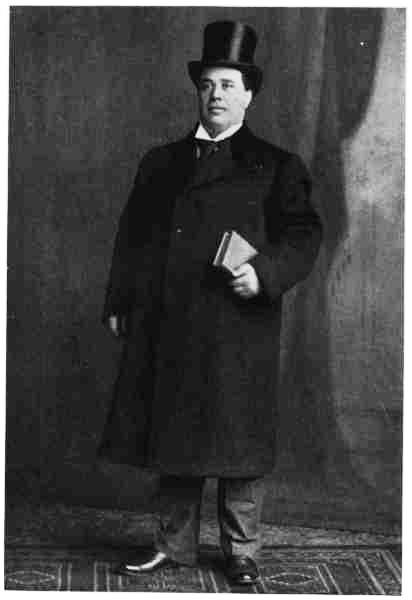
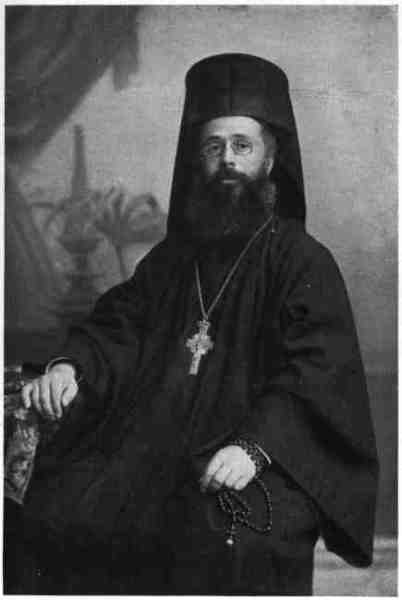
Rev. M. Golden
The Founder of the Greek-Amerikan-Christian-Association
John saw that the service of the physician was
only part of what was needed for the woman's safety.
He went out and procured bedding and food, and
his mother sent over one of her maids, also a trained
nurse.
Soon things were made comfortable for Mrs. Williams,
but she could not rest.
In her delirium she called continually for Ralph
to come home and bring her something to eat.
And where was Ralph? For three days he had
been laying in a drunken stupor in the cellar of a
saloon, but this evening he had sobered somewhat,
and remorse for his cruel neglect of his wife and
children was finding a place in his heart. He recalled
the starving condition in which he had left them.
Perhaps for the first time he began to realize how
dearly his wife must love him to give up the pleasure
and luxury of her girlhood home for him, and there
in that room not fit for cattle, this man cried out in
his anguish, "Oh, God, protect my wife and forgive
me."
He started at once for home but as he neared
the house his heart was filled with fear, his head began
to whirl. Where was Rose? Why was everything
so still?
He opened the door and was met by a little girl
dressed in white and with golden curls.
How beautiful she was; she ran to him and cried,
"Papa has come, Papa has come!"
Then he knew she was his own little daughter.
She led him to the bed on which lay his wife, but
the only words which greeted him were, "Ralph come
home and bring us something to eat."
He called her name but she heard him not.
Again he spoke: "Dear Rose, forgive me, forgive
me."
Dr. Gordon laid his hand on the shoulder of the
stricken man and said: "Ask your God to forgive
you, your wife knows not what you say."
He looked at the doctor a moment, then said in
a low voice, "I did that before I started home. God
has forgiven me and saved me. But tell me what
I can do for my poor wife."
It was indeed true, Ralph Williams was a changed
man. The God who had heard the prayers of the
father and son at the dying woman's bedside, and
restored her to them, vouchsafed his mercy to the
starving wife who prayed for her drink-sodden husband,
and in answer to it the dulled conscience of
the husband was aroused.
Slowly Mrs. Williams improved, until one morning
she said: "Is this Heaven, and are Ralph and my children
here?"
"Yes, Rose," her husband replied, "Ralph and the
children are here, and henceforth I will do all I can
to make this home Heaven on earth."
* * * * *
The years rolling by saw John still fighting the
fight for his Maker. Out of the gratitude Ralph
Williams had felt for the Divine mercy shown him,
had sprung a determination to do all in his power
towards uplifting others. John eagerly accepted his
services, and thus the nucleus of a rapidly growing
power for good was formed.
As more and more came to know the meaning of
"Christ Crucified," they entered heart and soul into
the work of spreading the truth to others and soon a
mightly cohort of Christian workers spread over the
city. Individually and with them John labored night
and day sustained by his faith and enthusiasm.
The work of directing the efforts of so many, the
nightly vigil at the bedside of sick and dying, the
continual breathing of the vitiated air of the lower
quarters of the city, gradually sapped the strength of
John, who did not know the meaning of fatigue when
a call on the service of his Christ sounded.
At last an attack of nervous prostration made him
realize his position, and yielding to the importunities
of his parents and fellow-workers, he consented to
take a vacation.
Where should he go but to the broad, sunny prairies
of Dakota, to his dearly remembered friends, the
Longs and Lily.
She met him with outstretched arms and a glad
smile of welcome. With the glory of dawning
womanhood about her she was more than ever the
"Queen of the Prairie," but by the soft light in her
eyes John saw that she was still his Lily.
During the long pleasant vacation which followed,
John gained strength and vigor once more, and its
close found him ably equipped to take up Christ's
work once more.
Mr. and Mrs. Long were doubly sorrowful at their
second parting from him, for his heart had found its
mate and Lily was accompanying him.
He had gained a lovely bride, and more than that,
an enthusiastic helpmate.
Together they took up the work where John had
left it. Ere long the erstwhile "Queen of the Prairie"
was known as "Angel of the Poor," for her womanly
sympathy could often find its way into darkness which
even John's earnestness failed to penetrate.
One Friday night they both came to take part in
our holiness meeting, and the Spirit revealed to them
that should they submit all their powers unreservedly
to the will of God, He could use them to still higher
and more effective purposes of the cause of Jesus.
So, John and Lily, side by side, came out at the altar
and offered their lives and their services to Jesus for
time and for eternity, they, becoming active members
in my corps, and a great blessing to the suffering
humanity in that community.
Case 2.—The following letter was received from
the girl already mentioned, as the daughter of a
Roman Catholic woman, who tried to drive her converted
daughter, by the worldly pleasures, away from
Jesus:
"Chicago, Ill., Oct. 5, 1906.
Captain Golden,
Salvation Army.
Dear Friend:
I feel that I must let you know what the Lord has
done for me, 'through you.'
Why I ever went to the Salvation Army meeting
is more than I know, because I have always been
told that the Salvation Army was nothing more than
street beggars and a great deal more.
So I never went to their meetings until I went
to No. 4, and I do sincerely thank God that I went,
because now I can see how far from the Lord I was
wandering and so unintentionally because I never
meant to be a sinner, but I just wanted to have a
good time. But now, I can see where some of those
good times lead us.
Captain, I often think how brave you must have
been to go on with the work at No. 4, with so little
help, 'that is, earthly help.' I am sorry that I could
not help you, but you see I was not brave like you.
I could not talk about Jesus to those who scoffed,
but I do want Jesus to help me and strengthen me
to do His will. Captain, do you know there is a song
that always come to me when I am in any difficulty,
'Lead Me Saviour.'
Yours sincerely,
FLOY MAYHEN,
2207, 63d St., Chicago."
It is simply wonderful, that there is no one to
lead us like the Saviour, dear Jesus. Who died on
Calvary's Cross for our redemption. And now, dear
reader, just a word to you. This volume is written
for you; if you are a converted Christian enjoying
the blessings of a clean heart, indeed, blessed you
are, for "Blessed are the pure in heart, for they shall
see God." But, if for some reason, if there can be a
reason for not being saved, you kept back until this
hour, I pray that you may go down upon your knees,
at this very moment, just as you are, and open your
heart to God, and let Jesus come in: and I know
and you will know that the remaining days of your
life will be sweet and happy; and when the roll is
called up yonder you'll be there, in a robe of white
with the angels in the air to meet the Lamb of God,
Who will say unto all that loved Him and worked
for Him, "Well done, thou good and faithful servant:
enter thou into the joy of Thy Lord."
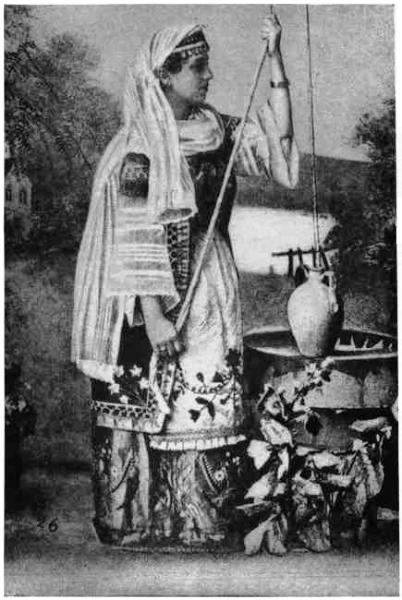
Greek Peasant Woman