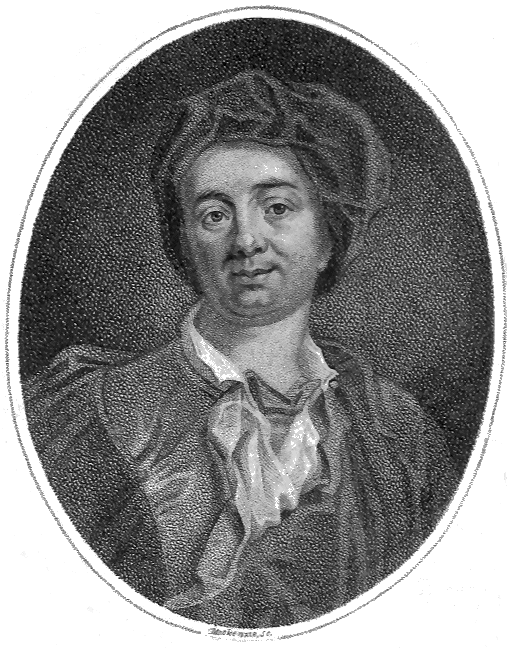
CONVERSATIONS ON THE PLURALITY OF WORLDS . — BERNARD DE FONTENELLE,
FONTENELLE.
BY
One of the Forty belonging to the French Academy; and Secretary to the
Academy of Sciences.
WITH NOTES,
AND A CRITICAL ACCOUNT OF THE AUTHOR'S WRITINGS,
BY
JEROME DE LA LANDE,
SENIOR DIRECTOR OF THE OBSERVATORY AT PARIS.
Translated from a late Paris Edition, by
MISS ELIZABETH GUNNING.
London:
PRINTED BY J. CUNDEE, IVY-LANE;
SOLD BY T. HURST, PATERNOSTER-ROW.
1803.
CRITICAL ACCOUNT OF THE Life and Writings of the Author , BY JEROME DE LA LANDE.
Whenever I have entered into conversation with any
sensible woman on astronomy, I have always found that
she had read Fontenelle's Plurality of Worlds; and that
his book had excited her curiosity on the subject. As it has
been so much read already, it must continue to engage attention:
I therefore thought it would be useful to point
out its faults; to add some observations, without which
the reader would be led into error with respect to the vortices;
to make known the late discoveries; and to shew
what numbers, before our author, had written on the plurality
of worlds. But I have made no alterations in the text;
the reputation of Fontenelle renders him respectable, even
in his mistakes.
The Astronomy for Ladies, which I have published as a
substitute for this book, would be more instructive, but less
amusing; therefore, as it will be but little read, I shall endeavour
to supply the defects of Fontenelle's work, by adding
to the original some ideas more exact than his own.
M. Codrika has translated it into Greek, with explanations
taken from my Astronomy.
M. Bode has translated it into German; and his translation
has already gone through three editions: the last is
that of 1798, Berlin, in octavo, Bernard de Fontenelle,
Dialogen ueber die Mehrheit der Welten.
When Voltaire published, in 1738, his Essays on the
Elements of Newton, he began with these words: "Here
is no Marchioness; no imaginary philosophy." It was supposed
that he here alluded to Fontenelle; this he contradicts
by saying: "so far from having his book in view, I
publicly declare that I consider it one of the best works
that ever were written." (Mem. de Trublet, p. 135).
This book has been printed a hundred times; the handsome
edition of Fontenelle's Works, in folio, published at
the Hague in 1728,[1] with figures by Bernard Pickart; the
still more beautiful edition of the Worlds alone, edited
by Didot the younger, in 1797, in folio, are master-pieces
of typography; but in them nothing is found but the original
work; therefore I consider our edition far preferable.
[1] That edition does not contain the account of the bees, which is in
the present edition.
I shall here give a short account of the author of this
work.
Bernard le Bovier[2] de Fontenelle was born at Bouen,
February 11, 1657. He died January 9, 1757.
[2] Lebeau writes the name le Bouyer, from the family name, in the
Mémoires de l'Académie des Inscriptions; but it is pronounced le Bovier.
(Mem. p. 19.)
The first efforts of his genius were directed to poetry: at
the age of thirteen he had composed a Latin poem: about
the year 1683 he devoted himself to literature and philosophy.
In 1699 he began l'Historie de l'Académie des Sciences,
which he continued with great success during forty-two
years. Few persons have contributed more to the progress
of the sciences than he has done, by accommodating
them to every capacity, and inspiring by his panegyrics, a
love of study. For my part, I feel a pleasure in acknowledging
that I am indebted to him for the germ of that insatiable
activity of mind I have experienced ever since the
age of sixteen. I could find nothing in the world like the
Academy of Sciences, and ardently wished for the happiness
of seeing it, long before I had any idea of the possibility
of one day belonging to it.
In 1727 he published his Elemens de la Géométrie de
l'infini; this was merely the amusement of a man of genius
who had heard a little of geometry, and chose to hazard his
opinions on the subject.
We may find an eulogium on our author in l'Historie de
l'Académie des Sciences for 1757, in the Mémoires de l'Académie
des Belles-Lettres, and in a work written entirely
on the subject, published by Trublet in the year 1761, entitled
Mémoires pour servir à l'Historie de la vie et des Ouvrages
de Fontenelle. In these memoirs a particular critique
shews us the various merits of Fontenelle's works:
there is also an article by Trublet in the edition of Moréri,
published in 1759.
I have remarked in the twentieth book of my Astronomy,
that in every period of time it has been believed that the
planets were inhabited, on account of their resemblance to
the earth. The idea of the plurality of worlds is expressed
in the Orphics, those ancient Grecian poems attributed to
Orpheus (Plut. de Placitis Philosoph. l. 2, cap. 13.) Proclus
has preserved some verses in which we find that the
writer of the Orphics places mountains, men, and cities in
the moon. The Pythagoreans, such as Philolaüs, Hicetas,
Heraclides, taught that the stars were all worlds. Several
ancient philosophers even admitted an infinity of worlds beyond
the reach of our sight. Epicurus, Lucretius, and all
the Epicureans were of the same opinion; and Metrodorus
thought it as absurd to imagine but one world in the immensity
of space, as to say that only one ear of corn could
grow in a great extent of country. Zeno of Eleusis, Anaximenes,
Anaximander, Leucippus, Democritus, asserted
the same thing: in short, there were some philosophers
who, although they did not consider the rest of the planets
inhabited, placed inhabitants in the moon; such were
Anaxagorus, Xenophanes, Lucian, Plutarch, (De Oracular.
defectu. De Facie in orbe Lunæ,) Eusebius, Stobius. We
may see a long list of the ancients who have treated on the
subject, in Fabricius, (Biblio. Græcæ, t. 1. cap. 20.) and in
the Mémoire de Bonamy (Acad. des Inscriptions, tom. ix.)
Hevelius appeared as firmly persuaded of this opinion in
1647, when he talked of the difference between the inhabitants
of the two hemispheres of the moon: he calls them
selenitæ, and examines at length all the phœnomena observed
in their planet, after the example of Kepler (Astron.
Lunaris.) It was maintained at Oxford, in certain themes
which are mentioned in the News of the Republic of Letters,
June 1784, that the system of Pythagoras on the inhabitants
of the moon was well founded: two years afterwards
Fontenelle discussed this subject in his agreeable work.
There are farther details of the different astronomical opinions
at the end of Gregory's book. For the objections,
we may refer to Riccioli. (Almagestum, tom. 1, p. 188,
204). In 1686 the Plurality of Worlds was adorned by
Fontenelle with all the beauties of which a philosophical
work was susceptible. Huygens (who died in 1695) in his
book entitled Cosmothéoros, published in 1698, likewise
enters largely into the subject.
The resemblance between the earth and the other planets
is so striking, that if we allow the earth to have been formed
for habitation, we cannot deny that the planets were
made for the same purpose; for if there is, in the nature of
things, a connection between the earth and the men who
inhabit it, a similar connexion must exist between the planets
and beings who inhabit them.
We see six planets around the sun, the earth is the third;
they all move in elliptical orbits; they have all a rotatory
motion like the earth, as well as spots, irregularities, mountains:
some of them have satellites, the earth has one satellite:
Jupiter is flattened like our world; in short there is
every possible resemblance between the planets and the
earth: is it, then, rational to suppose the existence of living
and thinking beings is confined to the earth? From what
is such a privilege derived but the groveling minds of persons
who can never rise above the objects of their immediate
sensations?
Lambert believed that even the comets were inhabited.
(Systême du Monde, Bouillon; 1770.) Buffon determines
the period when each planet became habitable, and when
it will cease to be so, from its refrigeration. (Suplèmens,
in 4to. tom. 11.) What I have said of planets that turn
round the sun, will naturally extend to all the planetary
systems which environ the fixed stars; every star being an
immoveable and luminous body, having light in itself, may
properly be compared with our sun. We must conclude
that if our sun serves to attract and enlighten the planets
which surround it, the fixed stars have the same use. It is
thought that the sun and fixed stars are uninhabitable because
they are composed of fire; yet M. Knight, in a work
written to explain all the phœnomena of nature, by attraction
and repulsion, endeavours to prove that the sun and
stars may be habitable worlds, and that the people in them
may possibly suffer from extreme cold. M. Herschel likewise
thinks the sun is inhabited (Philos. Trans. 179. p. 155,
et suiv.)
Some timid, superstitious writers have reprobated this
system, as contrary to religion: they little knew how to
promote the glory of their Creator. If the immensity of
his works announce his power, can any idea be more calculated
than this to exhibit their magnificence and sublimity?
We see with the naked eye, several thousands of stars; in
every part of the firmament we discover with telescopes, innumerable
others; with more perfect telescopes, we still
find a multitude more. We compute, from the number
seen through Herschel's telescopes in one region of the sky,
that there are a hundred millions. Imagination pierces beyond
the extent of vision, beholding multitudes of unknown
worlds, infinitely more in number than those which are visible
to our sight; and ranges unrestrained in the boundless
space of creation.
Our only difficulty with respect to the inhabitants of so
many millions of planets, is the obscurity of the final causes,
which it is difficult to admit when we see into what errors
the greatest philosophers have fallen; for instance Fermat,
Leibnitz, Maupertius, &c. in attempting to employ these
final causes or metaphysical suppositions of imagined relations
between effects that we see and the causes we assign
them, or the ends for which we believe them to exist.
If the plurality of worlds be admitted without difficulty;
if the planets are believed to be inhabited, it is because the
earth is considered merely as a habitation for man, from
which it is inferred that were the planets uninhabited they
would be useless: but I will venture to assert that such a
mode of reasoning is confined, unphilosophic, and at the
same time, presumptuous. What are we in comparison of
the universe? Do we know the extent, the properties, the
destination, and the connexions of nature? Is our existence,
formed as we are, of a few frail atoms, to be considered
any thing when we think of the greatness of the
whole? Can we add to the perfection and grandeur of the
universe? These ideas are expressed by Saussure, who in
speaking of a traveller to Mont-blanc says: "if, during
his meditations, the thought of the insignificant beings that
move on the face of the earth offers itself to his mind, if he
compares their duration with the grand epochs of nature,
how great will be his astonishment that man, occupying so
small a space, existing so short a time, can ever imagine
that his being is the only end for which the universe was
created."
From these considerations d'Alembert, in the Encyclopedia,
(art. World) after examining the arguments for supposing
the planets inhabited, concludes by saying: the
subject is enveloped in total obscurity.
But Buffon affirms that wherever there is a certain degree
of heat, the motion produces organized beings; we
need not enquire in what way, but imagine these to be the
inhabitants of the planets: if that should be the case, we
may conclude it highly probable that they are inhabited,
notwithstanding the preceding objections.
LA LANDE.
1802.
LINES ON FONTENELLE.
Muse! if thou canst, this picture's truth excel;
Strive to pourtray the soul of Fontenelle:
Him, to whose works, with wit and judgment warm,
Indulgent Nature, gave a magic charm.—
'Twas his to strew with flowers the toilsome road,
Which leads to Science in her dark abode;
And while he touch'd the pastoral reed, to prove,
That courtly pomp, must yield to rural love.
A Lucian rising from the silent tomb,
'Twas his, to pierce through Error's doubtful gloom;
And, with resistless eye, at once to dart
Full on the hidden secrets of the heart.—
Union divine!—in Fontenelle we find
A glowing genius, and a gentle mind!
PREFACE BY BERNARD DE FONTENELLE.
I find myself nearly in the situation of Cicero, when he
undertook to write in his own language on philosophical subjects,
that, till then, had never been treated of but in Greek.
He tells us that his works were said to be useless, because those
who delighted in philosophy, having taken the pains to study
the books written in Greek, would not afterwards think of
examining his Latin ones, which were not originals; and
that persons who had no taste for philosophy, would neither
care for the Greek nor the Latin.
To which he answers, that exactly the contrary would happen;
that the unlearned would be allured to philosophy by the
facility of reading Latin works; and that the well-informed,
after studying the Greek authors, would be pleased to see how
the subjects were handled in Latin.
Cicero might with propriety speak in this manner; his superior
genius and great celebrity assured him success in this
untried project, but I have not the same advantages to inspire
me with confidence, in a similar undertaking. I was
desirous of representing philosophy in a way that was not
philosophical; I have attempted to compose a book that shall
neither be too abstruse for the gay, nor too amusive for the
learned. But if what was said to Cicero should be repeated
to me, I could not venture to answer as he did: possibly in
attempting to find a middle way which would accommodate
philosophy to every class, I have chosen one that will not be
agreeable to any. It is very difficult to maintain a medium,
and I think I shall never be inclined to make a second attempt
of this nature.
I should warn those that have some knowledge of natural
philosophy, that I do not suppose this book capable of giving
them any information; it will merely afford them some
amusement, by presenting in a lively manner what they have
already become acquainted with by dint of study. I would
also inform those who are ignorant of these subjects that it
has been my design to amuse and instruct them at the same
time: the former will counteract my intention if they here
expect improvement, and the latter, if they here only seek for
entertainment.
I need not say that of all philosophical subjects I have
chosen that which is most calculated to excite curiosity: surely
nothing ought to interest us more than to know how our
own world is formed; and whether there be other worlds
similar to it, and inhabited in the same way: but let no one
be disquieted if unable to answer these enquiries; they who
have time to spare may examine such subjects; many have it
not in their power.
In these Conversations I have represented a woman receiving
information on things with which she was entirely unacquainted.
I thought this fiction would enable me to give the
subject more ornament, and would encourage the female sex
in the pursuit of knowledge, by the example of a woman who
though ignorant of the sciences, is capable of understanding
all she is told, and arranging in her ideas the worlds and
vortices. Why should any woman allow the superiority of
this imaginary Marchioness, who only believes what she
could not avoid understanding?
'Tis true, she gives some attention to the subject, but what
sort of attention is requisite? Not such as will laboriously
penetrate into an obscure thing, or a thing that is spoken of
in an obscure manner; it is needful only to read with sufficient
application to render the ideas familiar. Women may
understand this system of philosophy by giving it as much attention
as they would bestow on the Princess of Cleves, in
order to understand the story and see all the beauties of the
work. I do not deny that the ideas contained in this book are
less familiar to the generality of females than those in the
Princess of Cleves, but they are not more abstruse, and I am
convinced that on a second perusal they would be perfectly
understood.
As I did not wish to establish an imaginary system that
had no foundation, I have employed true philosophical arguments,
and as many of them as were necessary to establish my
opinions; but fortunately the ideas connected with natural
philosophy are in themselves beautiful, and whilst they satisfy
the understanding, give as much pleasure as if formed
only to charm the imagination.
To such parts of my subjects as did not possess these beauties
I have given extraneous ornaments; Virgil has done this
in his Georgics, where he renders a dry subject interesting
by frequent and agreeable digressions: Ovid likewise in his
Art of Love has pursued the same plan, although the matter
of his poem was far more pleasing than any thing he could
add to it: he seems to think it tiresome to speak constantly of
one subject—even of love. I have more need of embellishments
than he, yet I have used them sparingly. I have only
given such as the freedom of conversation authorised; I have
only placed them in parts that I thought required them; I
have inserted most of them in the commencement of the work
to accustom the mind by degrees to the objects I wish to present
to its attention, in short, I have derived them from my
subject, or formed them as much as possible to resemble my
subject.
I did not venture to give any opinions on the inhabitants of
the different worlds, since they must have been entirely chimerical;
I have endeavoured to express all that might reasonably
be imagined, and even the conjectures that are added
are not without foundation. Truth and fiction are in some
measure blended, but always so as to be distinguishable from
each other: I do not undertake to justify such a composition;
the union of philosophy and amusement is the chief aim of
this work, but I know not whether I have adopted the right
method.
It only remains for me now to address one class of persons;
they are perhaps the most difficult to satisfy, not because my
reasoning is inconclusive, but because they feel themselves
privileged to disregard the best arguments: I am speaking of
scrupulous people who may imagine religion is endangered by
placing inhabitants any where but on the earth. I respect
even an excessive scrupulosity when it arises from piety, nor
would I willingly hurt the feelings of any one from whom I
differed: but by rectifying a little error of the imagination
we shall find that this objection cannot affect my system of
giving inhabitants to an infinite number of worlds. When
you are told that the moon is peopled, you immediately figure
to yourself men like ourselves, and then a variety of theological
difficulties occur. The posterity of Adam cannot have
colonized the moon; therefore the inhabitants of that planet
are not descendants of our first parents; now it would be a
difficult point in theology to account for the existence of men
who had any other ancestor. No more need be said; every
imaginable difficulty is included in this, and the expressions
that would be necessary for a more full explanation are too
worthy of reverence to be employed in a work containing so
little of the serious as this. The objection then turns on the
existence of men in the moon, but it is the objectors themselves
who talk of men as its inhabitants; I have asserted no
such thing: I say there are inhabitants, and I likewise say
they may not at all resemble us. What are they then?—I
have never seen them; I do not speak from acquaintance
with them.
Do not consider it a subterfuge, to rid myself of the objection,
when I affirm that the moon is not peopled by men; you
will see that according to the idea I entertain of the endless
diversity of the works of nature, it is impossible such beings
as we, should be placed there. This opinion is supported
throughout the book, and it is an opinion which no philosopher
can deny: I think, therefore, on this ground, the following
conversations will be objected to only by those who have never
read them. But will this consideration suffice to deliver me
from the fear of censure? No; it rather gives me cause to
apprehend objections from every side.
FONTENELLE.
CONVERSATIONS ON THE PLURALITY OF WORLDS . — FIRST EVENING. [5]
TO MR. L——.
You desire me, dear Sir, to give you a particular
account of the manner in which my time
has been spent whilst at the Marchioness of
G—'s[3] in the country. To obey your injunctions
strictly, I shall be obliged to fill a volume,
and what is still more formidable, a volume of
philosophy.
[3] The lady here mentioned was Madame de la Mesangire
of Rouen. She was a beautiful brunette; but in compliance
with her desire to be concealed, the author has
spoken of her in the following pages, as having a fair complexion.
The park belonging to her residence, is described
in the "First Evening."
You expect to be entertained with a history of
splendid feasts, hunting, and card-parties; and
you will hear of nothing, but planets, worlds, and
vortexes:[4] for the discussion of these latter subjects,
formed our principal amusement. Fortunately
you are a philosopher, therefore I have the
less reason to dread raillery from such a quarter;
on the reverse, I may even hope for your congratulations,
on having rendered the Marchioness
sensible to the charms of philosophy: we could
not have made a more valuable acquisition; for
youth and beauty, in every cause holds such
power, that if wisdom herself were desirous of
being welcomed by mortals, and would assume
the form of this lovely woman, surely with such
an exterior, and such fascinating eloquence, she
could not fail to attract every heart.
[4] The Vortexes of Descartes, occupied the attention of
the learned, for nearly a century; but this hypothesis was
superceded by a discovery of the laws of attraction. Although
Newton's famous book on principles was published
in 1687, Fontenelle always retained his educational prejudice
in favour of the Vortexes. A few years before his
death, he consulted me on a little work he had some time
since composed on the subject. I endeavoured to dissuade
him from making it public; but Falconet was afterwards
weak enough to do so. The book is entitled "Theory of
the Cartesian Vortexes, with Reflections on Attraction." The
author's name was never affixed to the work.
Notwithstanding all this, you must not expect
to be transported with admiration, whilst I
repeat the conversations I have held with her ladyship:
my genius should be equal with her's,
to relate what she said, in her own delightful
manner. Conscious of inability, I must relinquish
the attempt, and leave you to discern
through the recital, that rapidity of apprehension,
which characterizes the mind of the Marchioness.
From the wonderful quickness with
which she comprehends the most abstruse subjects,
I consider her already learned: at least, I
may be allowed to say, that after a little study,
she might attain the heights of science; when
many, who spend their lives amid the dull disputes
of vast libraries, remain for ever in the
deepest ignorance.
Before I recount our various conversations,
perhaps you may expect some description of
their scene; some picture of the romantic country,
under whose shades the Marchioness is enjoying
the autumn. If so, you will be disappointed:
so many people have exercised their
talents on this gay species of writing, that I shall
dispense with the ceremony, and merely say,
that on my arrival I had the pleasure of finding
myself the only visitor.
The two first days were passed in relating the
news of Paris, which I had just quitted. When
that subject was exhausted, an evening walk in
the park, suggested the discussion of those learned
topics, the commencement of which you will
find in the next page.
[5] This first book has been translated into a variety of languages;
it is the best eclogue that has been composed in the
last fifty years: the descriptions and imagery it contains are
perfectly suited to the style of pastoral poetry; indeed many
of the images would not have disgraced the pen of a Virgil.
Dubos. Reflections on Poetry and Painting.
THE EARTH IS A PLANET WHICH TURNS ON ITS AXIS,
AND GOES ROUND THE SUN.
After supper we went to take a walk in the
park. We felt the fragrant breeze of evening
peculiarly delightful, as the heat had been intense
during the day: the silvery rays of the
moon, gleaming through the foliage, formed an
agreeable contrast with the darkened shadows of
the landscape. Not a cloud intercepted or veiled
the smallest star. Every orb appeared a mass of
pure gold, rendered more brilliant by the rich
blue of the sky. The beauty of the scenery produced
a gentle reverie, from which, had not the
Marchioness been with me, I should not have
been easily roused; but in the company of so
interesting a woman I could not long abandon
myself to the influence of the moon and stars.
Do you not think, said I, addressing myself to
her, that the charms of a fine night greatly exceed
those of the day? Yes, she replied, the
splendour of day resembles a fair and dazzling
beauty, but the milder radiance of night may be
compared to a woman of less brilliancy of complexion,
and more sweetness of expression. You
are very generous, resumed I, in giving the preference
to the brunette, whilst you are so fair.
It is however true, that an unclouded sun is the
most glorious object in nature; and it is equally
true, that the heroines of romance, the most
beautiful objects imagination can depict, have almost
invariably been represented with fair complexions.
Beauty, answered my companion, is
nothing, unless it interests our feelings. You
will not deny that the finest day never had the
power of inspiring so delightful a reverie as you
were falling into just now in contemplating the
loveliness of the evening. You are right, said I,
but the loveliest night I ever beheld, with all it's
shadowy beauty, would fail to give me such enchanting
sensations as the contemplation of the
fair face of the Marchioness de G——. I should
not be satisfied with your compliment, she replied,
did I even believe you sincere, since the
brightness of day, with which we have been
comparing fair women, has so little influence on
your heart. Why do lovers, who undoubtedly
can judge of what is most touching, address all
their poetic effusions to the night? To the ear
of day they neither confide their transports nor
their sorrows—why is it so entirely excluded
from their confidence? Probably, I answered,
because it is not calculated to inspire that delicious
sentiment, at once impassioned and melancholy,
which we feel in the stillness of night,
whilst all nature seems to repose. The stars appear
to move with more silent progress than the
sun: every object that decorates the heavens is
soft, and attractive to the eye: in short, we resign
ourselves more easily to reverie because we
feel as if no other being was at that time enjoying
the pensive pleasure that expands our soul.
Perhaps, too, the uniformity of day, in which
the sky presents no other object than the sun, is
less favourable to the wild and pleasing illusions
of fancy than the view of innumerable stars, scattered
with sportive irregularity, over the boundless
space. I have always felt what you describe,
said she, I love to see the stars, and am almost
inclined to reproach the sun for hiding them.
Ah! cried I, I cannot forgive him for concealing
so many worlds from my sight! Worlds! she
exclaimed, turning to me with surprise, what do
you mean? Forgive me, said I, you touched
the wildest chord of my imagination—I forget
myself in a romantic idea. And what is this romantic
idea? enquired the Marchioness. Ah!
replied I, I am half ashamed of owning it:—I
have taken it in my head that every star may be
a world. I would not positively assert the truth
of my opinion, but I believe it because it affords
me pleasure; it has possessed my mind with irresistible
force; and I consider pleasure a needful
accessary to truth. Well, said she, since
your whim is such a pleasant one, make me a
partaker of it; I'll believe any thing you chuse
about the stars, provided it contributes to my
happiness. Ah! madam, I replied, 'tis not such
an enjoyment as you would find in seeing one of
Molière's comedies: it is an idea which can only
give delight to the understanding. What! exclaimed
she, do you think I am not susceptible
of pleasures which depend only on reason? I
will convince you of your mistake. Teach me
your system. No, answered I, I will not subject
myself to the reproach of having talked of
philosophy, in such an enchanting walk as this,
to the most interesting woman of my acquaintance.
No, seek for pedants elsewhere.
For a long while I attempted, in vain, to excuse
myself; I was at last obliged to yield: I insisted,
however, for my reputation's sake, on a
promise of secrecy. Every objection being removed,
I wished to begin the subject, but found
the commencement extremely difficult; for, with
a person who was ignorant of natural philosophy,
it was necessary to converse in a very circuitous
manner, to prove that the earth was a planet, the
other planets similar to the earth, and all the
stars so many suns which enlightened a number
of worlds. I once more assured her it would be
much better to talk on such trifles as other people,
in our situation, would amuse themselves
with. In the end, however, to give her a general
idea of philosophy, I pursued the following
plan.
All philosophy, said I, is founded on two
things; an inquisitive mind, and defective sight;
for if your eyes could discern every thing to perfection
you would easily perceive whether each
star is a sun, giving light to a number of worlds;
on the other hand, had you less curiosity, you
would hardly take the trouble to inform yourself
about the matter, and consequently remain in
equal ignorance; but the difficulty consists in
our wanting to become acquainted with more
than we see: besides, it is out of our power to
understand much of what is even within the reach
of our sight, because objects appear to us very
different from what they are. Thus philosophers
pass their lives in disbelieving what they see, and
endeavouring to conjecture what is concealed
from them; such a state of mind is not very enviable.
In thinking on this subject, nature always appears
to me in the same point of view as theatrical
representations. In the situation you occupy
at the opera you do not see the whole of its arrangements:
the machinery and decorations are
so disposed as to produce an agreeable effect at
a distance, and at the same time the weights and
wheels are hidden by which every motion is effected.
You behold all that is passing, without
concerning yourself about the causes; and so
perhaps do all the other spectators, unless among
the number some obscure student of mechanics
is puzzling himself to account for an extraordinary
motion which he cannot understand.
You see the case of this mechanical genius resembles
that of the philosopher studying the
structure of the universe. What, however, augments
the difficulty with respect to philosophers
is, that nature so conceals from us the
means by which her scenery is produced, that
for a long time we were unable to discover the
causes of her most simple movements. Figure
yourself, as spectators of an opera, the Pythagorases,
the Platos, the Aristotles; all these
men whose names are so celebrated. Let
us suppose them viewing the flight of Phæton,
rising on the wind; ignorant at the same time of
the construction of the theatre, and the cords by
which the figure is put in motion. One to explain
the phenomenon, says, it is some hidden
virtue in Phæton which causes him to rise; another
replies, Phæton is composed of certain numbers
which produce his elevation. A third says, Phæton
has a love for the top of the stage; he is uneasy at
any other part. The fourth thinks, it is not essential
to the nature of Phæton to rise in the air, but
he prefers flying up to leaving a vacuum at the top of
the stage. Such were the ridiculous notions of
the ancient philosophers, which to my astonishment
have not ruined the reputation of antiquity.
After all Descartes and some other moderns appear:
they tell you that Phæton rises in consequence
of being drawn by cords, fastened to a descending
weight, which is heavier than himself. It
is no longer believed that a body can have motion,
unless acted upon by another body; that it
can rise and descend without a counterbalancing
weight; thus, whoever examines the mechanism
of nature is only going behind the scenes of a theatre.
If that be the case, answered the Marchioness,
philosophy is a very mechanical affair!
So much so, I replied, that I am afraid it will
fall into disrepute. In short, the universe is but
a watch on a larger scale; all its motions depending
on determined laws and the mutual relation
of its parts. Confess the truth, have you
not hitherto entertained a more exalted idea of
the works of nature? Have you not considered
them with more veneration than they deserve?
I have known some people esteem them less as
their knowledge encreased. For my part, said
she, I contemplate the universe with more awful
delight now I find that such wonderful order is
produced by principles so simple.
I know not, rejoined I, how you have acquired
such rational ideas, for, to say the truth, they
are not very common. The generality are affected
only by the obscure and marvellous. They
admire nature merely because they consider it a
sort of magic; something too occult for the understanding
to reach: to them a thing appears
contemptible as soon as they find the possibility
of explaining its nature: but you, madam, can
reason so clearly, that I have only to draw aside
the veil, and present the world to your inspection.
What we behold at the greatest distance from
our earth is the azure heaven, that immense
arch to which the stars seem firmly to adhere.
They are called fixed, because they appear to
have no other motion than that of their sky, carrying
them from east to west. Between the
earth and the remote firmament are suspended,
at various distances, the sun, moon, and the other
five stars, denominated planets; Mercury,
Venus, Mars, Jupiter and Saturn.[6] These planets
not being stationary at one point in the heavens,
but having unequal motions, vary with
respect to their relative situations; the fixed
stars, on the contrary, always bear the same local
relation to each other. The chariot, for instance,
that you may distinguish, formed of
those seven stars, has always had that configuration,
and is likely to retain it; but the moon
sometimes approaches nearer to the sun; sometimes
retreats farther from it; the same is observed
of the other planets. Such were the observations
made by the Chaldean shepherds whose
continual leisure enabled them to give so much
attention to the heavenly bodies as to form the
rudiments of astronomy, for we learn that that
science took its rise in Chaldea,[7] as Geometry
was first studied in Egypt, where the inundations
of the Nile destroyed the boundaries of different
possessions, made the inhabitants desirous of
exact measures by which they could again separate
their own lands from those of their neighbours.
Thus astronomy is the offspring of idleness,
geometry of interest; and if we enquire into
the origin of poetry, we shall probably find that
she is the daughter of love.
[6] In 1781, M. Herschel discovered a sixth. Astronomy
by Lalande, third edition, 1792, Vol. 1, Art. 116.
I am glad, said the Marchioness, you have
given me this genealogy of the sciences; astronomy
is the only one that will suit me: geometry,
according to your account of it, requires a
more selfish heart than mine; and I have not susceptibility
enough to attempt poetry with success;
I have, however, as much leisure as can
be needful for the study of astronomy; it is another
favourable circumstance that we are in the
country, leading a pastoral life. Do not mistake
madam, answered I, talking of planets and
fixed stars is not all that constitutes a pastoral
life. Was the conversation of the shepherds, in
the golden age, confined to astronomy? Ah,
said she, but it would be dangerous to conform
one's mode of life to their's. No, that of the other
shepherds you mention appears preferable to
me; therefore let us converse, if you please, in
the Chaldean style. After this disposition of the
stars was remarked, what followed? The next
thing, I replied, was to imagine the arrangement
of the different parts of the universe; that is what
the learned call making a system. But before I
explain to you the first of these systems, give
me leave to premise that we are all naturally
disposed to the same sort of madness as a certain
Athenian of whom you have heard, who had taken
it in his head that every vessel which went
into the port of Pyreum belonged to him. We
chuse to believe that every thing in creation is
destined to our service; and when we enquire of
some philosophers the use of such a prodigious
number of fixed stars, of which a smaller proportion
would have been sufficient for all the
offices they appear to perform; they coolly answer,
they were made to gratify our sight. On
this selfish principle it was for a long time supposed
that the earth was motionless in the midst
of the universe, whilst all the heavenly bodies
were created for the sole purpose of journeying
round, and distributing their light to her. Next
to the earth they placed the moon, after the
moon, Mercury, then Venus, the Sun, Mars,
Jupiter, Saturn; beyond all these the firmament
of fixed stars. It was imagined that the earth
was stationed exactly in the middle of the circles
described by these planets which extended in
proportion to their distance from the earth, and
that consequently the most remote planets required
a longer time to perform their revolutions,
which certainly is true. But, interrupted the
Marchioness, I can't see why you should disapprove
such an arrangement of the universe, it
appears to me sufficiently commodious and intelligible,
I really feel quite satisfied with it. I
have taken pains, answered I, to represent this
system in the most favourable point of view;
if I were to explain it exactly as it was
conceived by Ptolemy the author of it, and
his disciples, you would be quite shocked.
As the motions of the planets are irregular,
being sometimes quicker, sometimes
slower; going sometimes in one direction,
sometimes in another; now nearer to the
earth, then at a greater distance from it; the
ancients figured to themselves an endless number
of circles intersecting each other, by which they
endeavoured to understand the great variety of
movements. The confusion, however, caused
by such an infinity of circles was so perplexing
that, at the time no better system was known,
one of the kings of Castile,[8] a profound mathematician,
was daring enough to say, that if the
supreme Being had consulted him when he created
the world, he would have given him some
good advice. We are filled with horror at the
impiety of this expression, but it serves to shew
us how absurd must have been the hypothesis
which could prompt it. The advice this man
wished to have given, undoubtedly regarded the
suppression of so many circles, which did but
prevent the planetary motions from being understood.
Probably he would likewise have expunged
from the system two or three superfluous
firmaments, supposed to be above the fixed
stars. The philosophers, to explain some particular
motion of the heavenly bodies, placed, beyond
the heaven that bounds our view, a sky of
crystal, which communicated this motion to the
lower sky. Was a new movement discovered?
they had nothing to do but to form a second crystal
firmament. In short skies of crystal were made
without any trouble. Why did they always chuse
crystal? enquired the Marchioness; would nothing
else have answered the purpose as well?
No, answered I, it was necessary to have a substance,
at once transparent and solid, for it was
Aristotle's opinion that solidity was essential to
the dignity of their nature, and as this was believed
by a great man, nobody thought of doubting
it. But since that time comets have been
seen which, being higher than was formerly imagined,
must have broken all the crystal of these
skies, in passing through them, and by that
mean, thrown the universe into confusion; it
was therefore found necessary to change the matter
of which these firmaments were composed,
into a fluid, such as air.
It is now discovered with certainty, by the researches
of later ages, that Venus and Mercury
turn round the Sun, and not round the earth, on
this subject the ancient system is absolutely exploded.
I will now acquaint you with another
which provides for every difficulty, one that does
not require any amendments of the king of Castile,
for its simplicity is so charming that one
cannot refuse to believe it. Yours, interrupted
the Marchioness, seems a sort of bargaining philosophy;
whoever offers a system that is effected
at the least expense, has the preference. 'Tis
true, said I; we have no other chance of understanding
the plan by which the operations of nature
are carried on. Nature is a wonderful economist;
if a work is to be effected, and two
ways are practicable, we may be sure she will
adopt that which costs her the least, however
trifling the difference. This economy is notwithstanding
in every respect consistent with the surprising
magnificence which appears in all her
productions. Magnificence is employed in the
design, and frugality in the execution of it. Nothing
should excite our admiration so much as a
stupendous project effected by simple means: but
we are apt to cherish ideas of a very different
kind. We place the frugality in the designs of
nature, and her grandeur in the execution. We
imagine her forming a contracted plan, and executing
it with ten times the labour that is requisite:
what can be so ridiculous? I hope, she
replied, that the system you are going to explain
will strictly imitate nature; the simplicity you so
admire will spare me a great deal of trouble in
comprehending your instructions. Your hope
will be realized, said I, we have now no useless
incumbrances. At the appearance of a certain
German named Copernicus,[9] astronomy became
simplified; he destroyed all the unnecessary circles,
and crushed to pieces the crystalline firmaments.[10]
Animated with philosophic enthusiasm,
he dislodged the earth from the central situation
which had been assigned it, and in its room
placed the sun, who was more worthy of such a
mark of distinction. The planets were no longer
supposed to perform their revolutions round the
earth, and enclose it in the centre of their orbits.
If they afford us light it is as it were by chance,
and in consequence of passing us in their course.
They all turn around the sun; the earth itself
not excepted; and as a punishment for the indolent
repose it had been thought to enjoy, Copernicus
made it take an ample share of the general
activity: in short of all these celestial attendants,
appointed for the service of our little globe,
the moon alone is left to move round it. Stop a
moment, said the Marchioness, your imagination
is so elevated with your subject, you have
explained it in such pompous language, that I
believe I have scarcely understood you. The
sun, you say, is immoveable in the centre of the
universe; which of the planets is next in succession?
'Tis Mercury, I replied. Mercury goes
regularly round the Sun in nearly a circular orbit,
of which that luminary is the central point. Next
to Mercury is Venus, which turns in the same
manner round the Sun. Afterwards comes the
Earth, and being higher than Mercury and Venus,
describes a larger circle round the Sun than
either of those planets. Then follow Mars, Jupiter
and Saturn, in the order I have named
them; thus you see the circle of Saturn must be
the most extensive of all; it likewise requires a
longer time than the other planets to perform its
revolution. But, exclaimed she, you have forgotten
the moon. I shall recollect it presently,
said I; the moon never abandons the earth, but
is constantly going round it; but as the earth is
continually moving onwards in a circle round the
sun, the moon at once follows its motion, and
revolves round it; this attendant planet, therefore
only goes round the sun in consequence of
invariably continuing near to the earth.
[9] He was born in 1472, at Thorn, in Prussia Royal: he
died in 1543.
[10] Several of the ancients were of opinion that we should
admit the motion of the earth. Astron. Art. 1075.
I understand you, said she, and I love the
moon for remaining attached to us when we
were forsaken by all the other planets. Confess
that if your German could have alienated that
too, he would have done it without regret; for
one may see, in every part of his hypothesis, that
he was but little inclined to favour the earth.
He did well, I replied, to humble the vanity of
men who chuse to claim the best situation in the
universe; 'tis with pleasure I consider the world
mixing in the crowd of planets. Pshaw! cried
the Marchioness; do you think vanity can have
any thing to do with a system of astronomy? Do
you suppose I feel humbler for knowing that the
earth goes round the sun? I assure you I esteem
myself just as highly as I did before. Certainly,
madam, I answered, men would be less concerned
about the rank they held in the universe
than that they enjoyed amongst their associates;
neither would the disputes of two planets, for
precedence, be so important in their judgement
as those of two ambassadors. Nevertheless, the
same disposition which induces a man of the
world to aspire after the most honourable place
in a room, will make a philosopher desirous of
placing the globe on which he lives in the most
distinguished situation in the universe. He likes
to consider every thing made for his use; he encourages,
without being aware of his vanity, so
flattering an opinion, and his heart becomes
deeply engaged about an affair of mere speculation.
Upon my word, she exclaimed, you are
calumniating human nature—how happened it
that the opinions of Copernicus were received,
since they are so very humiliating? Copernicus,
answered I, was himself very doubtful of the reception
they would meet with: it was a long while
before he could resolve to publish his system; at
last, however, he yielded to the entreaty of several
distinguished characters; but what do you
think was the consequence?—on the day they
took him the first printed copy of his book, he
died: so he made use of the shortest way to escape
from all the contradictions he had been anticipating.
Listen to me, said the Marchioness: let us
be just to every body: it certainly is difficult to
imagine we turn round the sun, for we never
change places; we rise in the morning where we
went to rest at night——I see from your look
that you are going to tell me, that as the earth
moves altogether——. Assuredly, said I,
it is the same thing as going to sleep in a boat
which was sailing down a river; on waking, you
would find yourself in the same boat, and in the
same part of the boat. Yes, replied she, but
here is a difference; when I awoke I should find
an alteration in the shore, and that would prove
that the boat had changed its place: it is not so
with respect to the earth, I there find every thing
as I left it. No, no, madam, you may observe
an alteration in the shore, as you do in the boat:
you will recollect that beyond all the planets are
the fixed stars, these are what we must consider
the objects on the shore. I am on the earth; the
earth describes a large circle round the sun;
when I look to the middle of this circle I find the
sun, and were not its brightness so dazzling as to
render the stars invisible, I should constantly
see, by looking beyond the centre, some of the
fixed stars opposite to the sun; by viewing them
however at night, I can easily determine how
they were situated in the day, which renders my
observations equally accurate. If the earth remained
in the same place I should always find
the same fixed stars answering to the situation of
the sun, but as the earth moves on in her orbit,
I necessarily see other fixed stars at the point
which I had before examined. Such is our shore,
which is every day varying; and as the earth
goes round the sun in a year, I observe the sun,
during that space of time, successively answering
to different fixed stars which compose a circle;
this circle is called the Zodiac; shall I shew it
you by tracing a figure on the earth? No, said
she, I can dispense with that; it would give my
park too learned an appearance. I think I have
heard that a philosopher, shipwrecked on an
island with which he was unacquainted, cried
out to his companions on perceiving some lines
and circles drawn on the sand; courage, my
friends! the island is inhabited; here are the footsteps
of men. You must consider that such footsteps
ought not to be seen here.
It would certainly, I replied be more in character,
to trace only the footsteps of lovers; that is
to say, your name, engraved by your adorers on
the bark of every tree. No more of adorers,
cried she; let us talk of the sun. I understand
perfectly why we imagined it performing the revolution
which is merely effected by our own motion,
but this circle requires a year; how, then,
does the sun appear to go round us every day?
You undoubtedly know, I replied, that if a ball
were rolled along this walk it would have two
sorts of motion; it would go towards the end of
the walk, and at the same time turn several times
on its own axis, so that the side of the ball which
is at first uppermost will presently descend, and the
other, of course, rise to the top. This is the case
with the earth: whilst she is proceeding, through
the year, in her orbit round the sun, she turns
on her own axis every twenty-four hours: each
part, therefore, of the earth loses, and recovers
sight of the sun during that time. When in the
morning we turn towards the sun, it seems to rise;
and when, by continued rotation, we again are more
distant from it, it appears to descend. That's curious
enough, said she; the earth undertakes every
thing, and the sun does nothing at all: and when
the moon, the other planets, and the fixed stars
appear to pass over us in four-and-twenty hours,
it is merely imagination. Exactly so, I replied,
and produced by the same cause. The planets
perform their revolutions round the sun in unequal
periods of time, in consequence of their different
distances from it; and one which we see
to day answer to a certain point in the zodiac, or
circle of fixed stars, will to-morrow at the same
hour answer to some other point: this is the effect
both of the progress which the planet has
made in its orbit and of that which we have made
in ours. We move onward; the other planets
do the same, but we do not continue all in a line:
this occasions us to see them in such different situations,
and renders their course apparently
irregular. You now understand that such irregularity
depends only on the different points
from which we view them, and that, in reality
all their movements are directed by the most exact
order. It may be so, answered the Marchioness;
but I should be glad if their order did
not cost the earth so much: you seem to have
very little consideration for it, and to require an
astonishing agility in so large a body. But, said
I, do you think it more reasonable for the sun,
and all the other heavenly bodies, which are extremely
large, to perform in four-and-twenty
hours an immense journey round the earth? That
the fixed stars, being in the largest circle, should
travel, in the course of a day, more than twenty-seven
thousand six hundred and sixty times two
hundred millions of leagues?[11] All this must be
if the earth does not turn on her axis every twenty-four
hours. Surely there is much more rationality
in supposing our globe to turn, which would
give to each part but a journey of nine thousand
leagues. Consider what a trifle are nine thousand
in comparison of the terrific number I have
just mentioned.
[11] According to later calculations, it would be a thousand
millions of times a million of leagues; but a person who did
not believe the motion of the earth would have no occasion
to admit this prodigious distance.
Oh! replied the Marchioness; the sun and
stars are made of fire, a swift motion is nothing
to them, but the earth does not seem formed for
motion. And should you think, I answered, if
experience had not proved the fact, that a large
ship, carrying a hundred and fifty pieces of cannon,
three thousand men, and a heavy freight of
merchandize, could be formed for motion?—Yet
a gentle breeze is sufficient to move it forwards,
because the water, being liquid, and easily divided,
makes a very slight resistance to the progress
of the ship, or if it be in the middle of a
river, it follows without difficulty the current of
the water, since there is then no impediment.
In like manner the earth, notwithstanding its
weight, is with facility carried through the sky
which is infinitely more fluid than water, and
which fills the immense space occupied by all
the planets. To what could the earth be fastened
so strongly as to resist the current of this celestial
fluid and remain motionless? We might as
well imagine a little wooden ball could resist the
tide of a river.
But, said she, how can a body so ponderous
as the earth be suspended in your celestial fluid,
which from its great fluidity must be extremely
light? It does not follow, I replied, that a substance
must be extremely light because it is fluid.
What do you think of the great ship we have been
talking of, which, with all its lading, is lighter
than the water that supports it? I won't have
any more to say to you, answered she, half angrily,
if you mention your ship again.[12] But tell
me, is it not dangerous to inhabit such a whirli-gig
as you represent the earth? If you are afraid,
said I, let us have the world supported by
four elephants, as the Indians do. Well! cried
she, here is a new system. I like those people
for providing such good foundations for the earth
to rest on, whilst we Copernicans are imprudent
enough to swim at random in this celestial fluid.
I dare say if the Indians knew there was the least
danger of the earth's being moved, they would
double the number of elephants.
[12] The Marchioness was in the right not to listen to such
an answer. It is absurd to pretend that the ætherial fluid,
so light and rare, can be capable of bearing along those
enormous masses, the planets.
It would be worth while, I replied, laughing
at the thought, we must not be sparing of elephants
if they can enable us to sleep in peace; if
you would find them serviceable to-night we'll
put as many as you please, and then remove
them one or two at a time as you find
your courage return. No, said she, I don't think
there is any need for them, and to speak seriously,
I feel courageous enough to let the world turn
round. And I can venture to predict, answered
I, that in a little while its turning will give you
pleasure; will even inspire the most delightful
ideas, I sometimes imagine myself raised above
the surface of the earth, and remaining motionless
whilst its daily rotation continues. All the
different inhabitants pass in review; some fair,
some copper-coloured, some black. Now I see
heads covered with hats; then with turbans;
some shaven, others with flowing hair. As the
towns pass before me, I observe some have steeples,
some long spires with crosses on them, others
are ornamented with towers of porcelaine.
Then I behold large countries with no other
buildings than little huts: afterwards, immense
seas; then frightful deserts; and in short, all the
boundless variety which is to be found on the face
of the earth.
Really, she replied, it would be worth while
to devote four-and-twenty hours to such a sight.
If I understand you, when we move, other countries
with their inhabitants pass into the situation
we are leaving, and so on, till in four-and-twenty
hours we again arrive at the same place.
Copernicus himself, said I, could not have
comprehended it more clearly. The first that
would succeed us[13] would be the English: we
should probably find them arguing on some political
topic with less gaiety than we are discussing
our philosophy. When we had dismissed them
we should discover a vast sea,[14] on which perhaps
would be some vessel, less at her ease than
we. Then come the Iroquois, eating one of their
prisoners of war, who does not even utter a
groan though still alive when they begin to devour
him.[15] After them the women of Jesso, who
employ all their time in preparing victuals for their
husbands, and painting their lips and eye-brows
blue to appear handsome in the eyes of the most
disgusting men in the world. Then the Tartars,
very devoutly going on a pilgrimage to their high
priest, who dwells in an obscure recess, enlightened
only by lamps, the rays of which direct
these votaries to the object of their adoration.
Afterwards the beautiful Circassians who make
no ceremony of granting all their favours to the
first that solicits them, except what they believe
the essential prerogative of their husbands. Then
the inhabitants of Little Tartary, who go to steal
women for the Turks and Persians. Last of all
our countrymen, whom we should find entertaining
each other with the vagaries of their imagination.
[13] To speak more properly they would be one hundred
leagues northward.
It is amusing enough, said the Marchioness,
to fancy oneself in a situation to see all these
things: but if I were taking the view I should
wish for the power of hastening or retarding the
earth's motion, according to the feelings with
which each object inspired me: I assure you I
should soon push on those that argued on politics,
and the others that devoured their enemies;
but there are some of the people you have been
speaking of that would excite my curiosity; the
handsome Circassians, for instance, whose customs
are so peculiar. But a serious difficulty
occurs to me respecting your system. If the
earth turns, we every moment change our atmosphere,
and respire that of a new climate. By no
means, madam, I replied; the air which surrounds
the earth rises only to a certain height,
twenty leagues perhaps at farthest;[16] this atmosphere
always turns with us. You have doubtless
observed the sort of shell in which a silk-worm
imprisons itself, and which it forms with such astonishing
art. It is composed of silk closely woven,
but covered with a light down. Thus it is
with regard to the earth, it is a solid body covered
with an atmosphere extending to a certain
height, which adheres to, and moves with it, as
the down does with the firmer substance beneath
it. Above our atmosphere is the celestial matter,
incomparably more pure, subtile and active
than air.
[16] Even at two leagues it is no longer discernible.
You represent the earth in a very contemptible
light, said the Marchioness. Nevertheless on
this silk-worm's shell we find stupendous works,
furious wars, and universal agitation. Yes, answered
I, and while all this is going on, nature,
who does not concern herself about such frivolous
things, carries us all along, with an uninterrupted
motion, and amuses herself with the little ball.
It appears very ridiculous, replied she, to give
way to so much anxiety, whilst one is living on
a thing that is perpetually turning; but unfortunately
we are not assured that it does turn, for,
to tell you the truth, all the precautions you take
to convince me that we should not feel its motion
are unsatisfactory. How could it avoid
giving some indication by which we should be
sensible of it?[17] The most common and natural
motions, said I, are the least felt: this observation
is true even in a moral sense: the motions
of self-love are so frequent in our minds, that for
the most part we are not sensible of them, but
believe ourselves actuated by other principles.
Ah! you are beginning to moralize, said
she; moralizing and explaining natural philosophy
are a little different; I fancy you grow tired
of your subject: let us return home, we have had
enough for the first lecture. To-morrow we will
come here again—you with your systems, and I
with my ignorance.
[17] There are several; one of them is the aberration of
the stars. Astron. Book xvii.
In our way to the house, to give her a complete
history of systems, I told her that a third
had been invented by Ticho Brahe, who, from a
determination to keep the earth in a state of rest,
placed her in the centre of the universe, making
the sun revolve round her, and the planets round
the sun; for in consequence of some discoveries
which had been lately made, he found it impossible
to make the planets go round the earth.
The Marchioness, with her usual discernment,
concluded that it was mere whim to exempt the
earth from moving round the sun, when so many
other larger bodies were allowed to perform the
revolution; that the sun was rendered more unfit
for turning round the earth when incumbered
with the other planets, and in short that this system
was only calculated to support a prejudice
in favour of the earth's immobility,[18] without
offering any thing to convince the judgment; we
therefore resolved to retain that of Copernicus,
which is more uniform and pleasing, and at the
same time unmixed with prejudice. In fact its
simplicity convinces, whilst its boldness excites
admiration.
[18] The ridiculous system of Ticho was invented out of
respect to the holy scriptures, not considering that their object
was more important than the refutation of popular
errors on natural philosophy.
SECOND EVENING.
THE MOON IS A HABITABLE GLOBE.
The next morning as soon as the Marchioness
was awake, I sent to enquire how she did, and
whether she had been able to sleep whilst the
globe was turning? I received for answer, that
she already felt quite accustomed to the motion;
and had slept as undisturbedly as Copernicus
himself. Soon afterwards, some company came
to spend the whole day with her; a tiresome custom
which is always observed in the country; yet
long as the visit was, we considered it a great
kindness in the guests, not to prolong it to the
next day; which I find is a common practice in
this part of the world: however, as they had the
civility to leave us, the Marchioness and I had
the evening to ourselves. We immediately went
to the park and resumed our astronomical conversation.
She understood so perfectly all I had
said on the former evening, that she disdained to
hear any repetition of the subject, and desired me
to enter on a new one.—Well then, said I, since
the sun, which we concluded is immovable, can
no longer be considered a planet; and the earth is
proved to be one, and to move round the sun; you
will be the less surprised to hear, that the moon
is a world like ours; and to all appearance, inhabited.—I
never heard speak of peopling the
moon; she replied, but as a ridiculous, visionary
hypothesis.—It may be so, answered I; I only
adopt the interest of any party, in these cases,
as people do in civil wars; in which the uncertainty
of the event, induces them to hold a correspondence
with opposite sides, and even, when
possible, with their enemies. For my part,
though I believe the moon is inhabited, I can be
very civil to any one that disbelieves it; and I
always retain the power of going over to their
side without disgracing myself, if I found they
had the advantage: but in the present state of
the question I have the following reasons for
thinking the moon is inhabited.
Let us suppose that no communication had
ever been carried on between Paris and St. Dennis;
and that a Parisian who had never gone out
of his own city should stand on one of the towers
of Notre-Dame, and at that distance view St.
Dennis: were he asked if he believed that St.
Dennis was inhabited like Paris, he would without
hesitation answer, No; I see inhabitants in
Paris, but I can discover none at St. Dennis, nor
did I ever hear of any being there. Somebody
standing by, might answer, that we certainly cannot
see them from the towers of Notre-Dame,
but that is, because we are at too great a distance;
that from all we can discern of St. Dennis
it is very much like Paris; that it has steeples,
houses, walls; and therefore is very probably inhabited.
All this makes no impression on our
citizen; he insists upon it that St. Dennis is uninhabited
because he does not see any body in it.
The moon is our St. Dennis, and each of us is
this Parisian who has never left the city in which
he resides.
Oh! you wrong us, interrupted the Marchioness;
we are not so stupid as your citizen; when
he sees that St. Dennis is constructed exactly on
the same plan as Paris, he must be out of his
senses not to believe it inhabited: but the moon
is very different from the earth. Be cautious,
madam, said I; if the moon's resemblance to the
earth prove it habitable, I shall force you to believe
that it is inhabited. I confess, answered
she, that if you can shew me the similarity, I
cannot pretend to deny its being inhabited, and
I see so much confidence in your looks that I am
afraid you will be triumphant. The two different
motions of the earth, which I never before
knew any thing about, make me fearful of hastily
rejecting any other opinion; but still, can it
be possible that the earth is luminous like the
moon?—that you know is essential to their similarity.
Indeed, madam, I replied, the luminous
quality of planets depends on less than you imagine.
The sun alone is, in his nature, luminous;
but the planets only reflect the light they receive
from him. He enlightens the moon; the moon
reflects his rays on the earth, and the earth is
undoubtedly in the same manner a source of
light to the moon; it is not farther from us to
the moon, than from the moon to us.
But, enquired the Marchioness, is the earth
equally capable of reflecting the sun's light? I
see, answered I, you have an invincible partiality
for the moon. Light is composed of globules
which rebound from a solid substance, but pass
through any thing in which they find interstices,
such as air or glass: the moon, therefore, gives
us light in consequence of being a hard, solid body,
which sends back these globules. I suppose
you will not dispute the hardness and solidity of
the earth. See then the effect of an advantageous
situation—because the moon is at a distance
we only view her as a luminous body instead of
a large mass of matter similar to the earth. Our
globe, on the contrary, from having the ill luck
to be more closely inspected, appears only a
mass of dark soil, fit for nothing but to produce
food for animals; we do not perceive the splendour
of her light, because we cannot remove to
a distance from her. So it is, answered the Marchioness,
with the different ranks of society: we
are dazzled with the grandeur of situations superior
to our own, without considering how much
every condition of human life resembles all the
rest.
'Tis precisely the same thing, I replied; we take
upon us to decide on every thing, but we are never
in a proper place for making our observations.
We would form an opinion of ourselves, and we
are too near; we would judge of others; they are
too distant from our view. We should be placed
between the earth and the moon to form a just
comparison; a spectator, not an inhabitant of
the world. I shall be inconsolable for the injustice
we do our world, said she, and the partial
regard we have for the moon, unless you can
assure me that the inhabitants of that planet are
as ignorant of their advantages, and consider our
globe a luminous body, without knowing that
from their own we derive so much light. I can
make you easy on that head, answered I; we are
certainly a luminary to them: they do not, it is
true, see us describe a circle round them,[19] but
that does not signify. The reason of our appearing
to remain in the same place is this;—the side
of the moon which was turned towards us at the
creation, has always continued so; we always
observe the same eyes, mouth, and other features
of the face which, by the help of imagination,
we have contrived out of the spots on her
surface.[20] If the other half were presented to us,
we should see spots arranged in a different form:
this does not arise from the moon's not turning
on her axis; she turns in the same time that is
employed in going round the earth, that is, a
month; but whilst she is performing part of her
revolution on her axis, she at the same time performs
an equal part of her circle round the earth,
and thus, by putting herself in a new situation,
continues to shew the same side: therefore although
with regard to the sun and the rest of the
heavenly bodies the moon evidently turns on her
axis, yet when viewed from the earth she does
not appear to do so. All the other luminaries
seem to the moon to rise and set in the space of a
fortnight, but she constantly sees our globe in the
same part of the heavens.[21] This apparent immobility,
were it invariable, would be thought
inconsistent with the nature of a planet; but the
moon has a sort of vibratory motion which sometimes
conceals a small part of the face, and exhibits
a part of the other side. Now, I can venture
to say that the inhabitants attribute this motion
to us, and imagine that we vibrate in the
heavens, like a pendulum.
[19] This is an error, for if they consider the earth's situation
relatively to the firmament, they must see that she
performs a revolution in twenty-seven days: they certainly
always find her answer to their zenith, or at the same distance
from the zenith, but at the same time this zenith is
continually answering to some new point in the heavens.
[20] When the moon is viewed through a telescope its spots
bear no resemblance to the human face; but on contemplating
it with the naked eye, it is easy to imagine that form;
and it is become so common to talk of the face on the moon,
that even an astronomer can hardly divest himself of the
idea.
[21] The earth always answers to one side of the moon, but
not the same point in the sky.
All the planets, said the Marchioness, are like
us human beings, who always attribute to others
what belongs to ourselves. The earth says; it is
not I who turn, it is the sun. The moon says; it
is not I who vibrate, but the earth: there is error
throughout. I would not advise you to attempt
making any reform, answered I; you had better
consider the remaining proofs of the resemblance
which the earth and moon bear to each other.
Figure to yourself those two globes suspended in
the heavens. You know the sun always enlightens
one half of a circular body, whilst the other
half remains in the shade. There is then one
half of both the earth and the moon, which is enlightened
by the sun, or in other words, in which
it is day, and the other half in which it is night.
Observe likewise that as a ball moves with less
force and celerity after it has struck against a
wall from which it flies off to an opposite place, so
the light is weaker when reflected to us from a
body that only receives it. The pale light of the
moon is in reality the brilliancy of the sun, but
as we receive it merely by reflection, in coming
to us, it is deprived of its strength. Of course, it
shines with much greater splendour on the moon,
and for the same reason the dazzling light received
by our globe, from the sun, must appear
faint, when reflected back to the moon. That
part of the moon which to us appears luminous
during the night, is the side which has day-light;
and the part of the earth which is illuminated by
the day, when turned toward the dark side of the
moon, affords equal light to her. All this depends
on the mutual position of the earth and
moon. During the first days of the month, when
the moon is not discernible, she is placed between
the sun and us, and proceeding in the day
time with the sun: the luminous side is therefore
necessarily turned to the sun, whilst the dark
part is towards the earth. We are unable to see
the unenlightened side of the moon, but this dark
half viewing the part of our globe in which it is
day, is assisted by our light, and though invisible
to us, has the advantage of seeing the earth
as a full moon: it is then to the lunar inhabitants
full-earth, if I may so express myself.[22] After
this, the moon advancing in her monthly
round, and no longer between the sun and earth,
turns towards us a small part of her enlightened
half, and that we call the crescent. At the same
time that part of the moon which is involved in
the obscurity of night, ceases so see all the luminous
side of the earth, and finds it continue to
decrease.
[22] We have a convincing proof of the light reflected from
the earth at this time, in the dusky light perceived on a
part of the moon that is not enlightened by the sun. Astron.
Art. 1412.
Enough—said the Marchioness, in her lively
manner; I shall easily learn the rest when I like:
let me stop a moment, and trace the moon through
her monthly circle. I see that in general that
planet and the earth have very different degrees
of light, and I imagine that when we have the
full-moon all the luminous side of the moon is
turned toward all the part of our globe which is
obscure; and that, at that time, the inhabitants
cannot discern us at all, but say they have new-earth.
I should not chuse to be obnoxious to
reproach for obliging you to enter into a long
explanation of any thing so easily understood,
but the eclipses—how are they effected? You
could guess it without difficulty, I replied. When
we have a new moon, and she, being between us
and the sun, presents her dark side to our luminous
half, the shadow of this obscure part falls
on the earth; so that wherever the moon is in a
direct line under the sun, she hides that luminary
from our sight, and darkens a part of the enlightened
side of our globe; this, then, forms an
eclipse of the sun to us during the day-time, and
an eclipse of the earth to the moon during her
night. When the moon is at the full, the earth is
between her and the sun, the shaded side of the
earth towards the light side of the moon. If the
earth's shadow fall directly on the moon, it darkens
the luminous half that we see; 'tis then we
have an eclipse of the moon in our night, and the
moon, an eclipse of the sun in her day. What
prevents an eclipse every time the moon is between
the sun and us, or the earth between the
sun and moon, is this; it often happens that
these three bodies are not placed exactly in a
line, in which case the one that would occasion
the eclipse throws its shadow on one side of the
other and consequently does not obstruct its
light.
I am very much astonished, said the Marchioness,
that there is so little mystery in eclipses,
and that being produced by such simple means,
every body does not discover the cause of them.
In truth, answered I, there are many people, who
from the emotions they feel at one of these phenomena,
appear to have little chance of finding
out the occasion of them at present. Throughout
the East-Indies, when the sun and moon are
eclipsed, the inhabitants believe that a great
dragon with his black claws is going to seize these
luminaries; and all the time the eclipse lasts, you
may see whole rivers covered with the heads of
these Indians, who have put themselves up to the
throat in water, because, according to their notions,
this is a very religious act, and will induce
the sun or moon to defend itself bravely
against the dragon. In America, it was thought
that the sun and moon were angry when they
were eclipsed, and every kind of absurdity was
practised to regain their favour. The Grecians
too, who had arrived at such a height of refinement—did
they not, for a long time, believe that
the moon was eclipsed by the power of sorcery,
and that the magicians caused her to descend
from the skies and cast a baneful influence on the
herbs? And were not we likewise in great alarm,
but two-and-thirty years ago,[23] at a total eclipse
of the sun? Did not an immense number of
people shut themselves up in caves and cellars;
and were they easily persuaded to leave them by
the philosophers who wrote so much to re-assure
them?
[23] 1654. There have been others in Europe in 1724, 1715,
and 1716.
Really, replied she, all that is too ridiculous.
There ought to be a decree passed to prevent any
body from ever talking of eclipses, lest the memory
of these follies should be perpetuated. The
decree, said I, should extend so far as to obliterate
the memory of every subject, for I can think
of nothing in the world which is not the monument
of some human folly.
Answer me this question, said the Marchioness:—Are
the inhabitants of the moon as much
afraid of eclipses as those of the earth? How ridiculous
it is if the Indians of that world put themselves
up to the chin in water; if the Americans
believe the earth is angry with them; if the
Greeks imagine we are enchanted, and suppose
we shall injure their herbs; and in short, if we
are inflicting on them all the terror they have
caused us? I have no doubt but that is the case,
answered I; for why should the good folks in the
moon have more sense than we? What right
have they to frighten us, unless we can frighten
them? I dare say, added I, laughing; that, as
a prodigious number of men have been, and still
are, silly enough to worship the moon; so there
are some in the moon that pay their adorations
to the earth, and that they are kneeling to one
another. If it be so, she replied, we may pretend
to have an influence on the moon, and to
produce the crisis in the diseases of her sick people,
but as a little common sense in the dwellers
on that globe would be sufficient to destroy all
these honours, I must confess I am afraid they
will have the advantage over us.
Don't alarm yourself, said I; 'tis not probable
that we are the only fools in the universe.
There is something in ignorance that is calculated
for general reception, and though I can only
guess the character of the people in question, yet
I have no more doubt, that could we form the
comparison, we should find ourselves equal to
them, than I have that the accounts are true that
we receive of their globe.
What accounts do you receive enquired she.
Those, I replied, that are given us by the learned
who travel there every day by the assistance of
telescopes. They tell us that they have discovered
in the moon earth, seas, lakes, elevated
mountains, and profound abysses.
You astonish me, cried the Marchioness: I
cannot imagine the possibility of discovering
mountains and abysses, from the great irregularity
they cause on the surface of the globe; but
how do they distinguish earth from sea? Because,
answered I, the water,[24] by suffering part of the
light to pass through it, and consequently reflecting
less than the earth, has, at a distance, the
appearance of dark spots; whilst the solid parts,
by reflecting all the light, look much more brilliant.
The illustrious M. Cassini, who has acquired
a greater knowledge of the celestial bodies
than any man in the world, discovered in the
moon something which separates, then re-unites,
and afterwards loses itself in a cavity. We have
reason to believe, from its appearance that this
is a river. In short all these different parts are
now so well known to us, that they have been
named after our great men. One place is called
Copernicus, another Archimedes, another Gabileus.
Other parts have fancy names; there is a
promontory of decams, a sea of nectar, and so
on; in fact our description of the moon is so particular,
that if a learned man was to take a
journey there, he would be in no more danger of
losing himself than I should in Paris.
[24] It is proved that there is no water in the moon, but
there are volcanoes; they may even be seen without a telescope,
which was the case on the 7th of March, 1794. Philos.
Trans.
But, said she, I should like to have a more
detailed account of the interior of the country.
The gentlemen of the observatory are not able to
give it you, I replied; you must make enquiry of
Astolfo, who was taken to the moon by St. John.
That is one of the pleasantest follies of Ariosto,
I'm sure you will be amused with it. I confess
it would have been better if he had not introduced
in it so respectable a name as that of St. John;
poets, however, will take licenses, and we may
venture to excuse this, for the whole poem is dedicated
to a cardinal, and one of our popes has
honoured it with a particular eulogium, which in
some editions is placed before the work. This is
the subject of the piece: Orlando, nephew to
Charlemagne, had lost his senses, because the
beautiful Angelica preferred Medore to him.
Astolfo, a valourous knight-errant was one day
carried by his hippogriffe to the terrestial paradise,
which was at the top of a very high mountain:
there he met with St. John, who informed him
that it was necessary, in order to cure Orlando
of his madness, for them to take a journey together
to the moon. Astolfo, delighted with the
opportunity of seeing a new country, needed no
entreaty, and in a moment the apostle and knight
took their course in a chariot of fire. As Astolfo
was no philosopher, he was surprised to find
the moon much larger than it appeared while he
was on the earth; his astonishment however increased
when he saw in it rivers, lakes, mountains,
towns, forests, and, what I should have
been equally surprised at, nymphs hunting in the
forests. But the most curious thing of all he saw
was a valley in which was to be found every thing
that was lost on the earth: crowns, riches, the
rewards of ambition, hopes without number, all
the time that had been devoted to gaming, all
the alms men had ordered to be distributed after
their death, verses dedicated to monarchs, and
the sighs of lovers.
As to lovers' sighs, rejoined the Marchioness;
I don't know what became of them in Ariosto's
time, but at present I fancy there are none that
go to the moon. We should find a great many,
said I, were they only those that you have occasioned.
In short, the moon is so careful in collecting
all that is lost here that not a single
thing is wanting of the number: Ariosto has
even whispered that Constantine's donation is
there: the popes have assumed the government
of Rome and Italy by virtue of a donation from
that emperor, but the truth is we can't tell what
is become of it. There is but one sort of thing
that has not escaped to the moon, and that is—folly:
the people on earth have taken care not to
part with that; but to make the moon amends,
an incredible quantity of wit has taken its flight
thither, which is there preserved in phials; it is
a very subtile fluid, and easily evaporates unless
carefully corked up: on each of these phials is
written the name of the owner. I think Ariosto
puts them together without any order, but I like
better to imagine them placed neatly in long
rows. Astolfo was astonished to find full phials
belonging to many wise people of his acquaintance.
I am sure, continued I, mine has been
considerably augmented since I began to indulge
myself with you in philosophic and poetic reveries:
but I console myself by supposing that after
listening to all my fancies your wits must inevitably
become so volatile that at least a little phial
full will evaporate, and make its way to the
moon.
Our knight-errant found his own among the
rest, and by St. John's permission took possession
of it and snuffed up all the bottleful like
Hungary water: but according to Ariosto he did
not carry it away with him; for, it soon returned
to the moon, in consequence of an extravagance
he was guilty of some time after. He did not
forget Orlando's phial which had occasioned his
journey; he had a good deal of trouble in carrying
it, for the hero's wit was naturally weighty,
and not a drop was wanting. At the end, Ariosto,
according to his general custom of saying
whatever he pleases, addresses, in beautiful language
the following apostrophe to his mistress:
"Who, my fair one, will ascend to the heavens,
to restore the senses of which your charms has
robbed me? Hitherto I have not complained,
but I know not what may be the extent of my
loss; should I continue the victim of your beauty,
I shall in the end become what I have represented
Orlando to be. However, I do not believe it is
necessary for me to traverse the airy regions for
the recovery of my senses; all the faculties of my
soul, instead of mounting to such unattainable
height, are solacing themselves in the beam of
your eyes, and hovering round your lovely mouth.
Ah! have compassion on me, and suffer me to
take them back with my lips." Is not the thought
pretty? For my part, in adopting Ariosto's way
of thinking, I should dissuade people from ever
letting their wits escape, unless it were from the
influence of love; for you see how near they then
continue, and how easily they may be regained;
but when they are lost in any other way, as we,
for instance, are losing ours, in philosophising,
they fly directly to the moon, and are not caught
again at pleasure. Never mind, said the Marchioness;
ours will have an honourable station
among the philosophic phials; whereas, had we
lost them in the poet's way, they might perhaps
hover around some unworthy object. But, continued
she, to deprive me completely of mine,
tell me seriously whether you believe there are
men living in the moon, for you have not yet
given me a decided opinion. Do I believe it?
replied I; oh no, I don't believe there are men
in the moon. We see how much all nature is
changed even when we have travelled from here
to China; different faces; different figures; different
manners; and almost a different sort of
understandings: from here to the moon the alteration
must be considerably greater. When
adventurers explore unknown countries, the inhabitants
they find are scarcely human; they are
animals in the shape of men, even in that respect
sometimes imperfect; but almost devoid of human
reason; could any of these travellers reach
the moon, they surely would not find it inhabited
by men.
Then what sort of creatures are they? asked
the Marchioness impatiently. Upon my word,
madam, said I, I can't tell. Were it possible for
us to be endowed with reason, and at the same
time not of the human species; were we, I say,
such beings, and inhabitants of the moon, should
we ever imagine that this world contained so fantastical
a creature as man? Could we form in
our minds the image of a being composed of such
extravagant passions, and such wise reflections;
an existence so short, and plans so extensive; so
much knowledge of trifles, and so much ignorance
of the most important things; such ardent
love of liberty, yet such proneness to slavery;
so strong a desire for happiness, with so little
power of being happy? The people in the moon,
must be very clever to imagine such a motley
character. We are incessantly contemplating
our own nature, yet we are still unacquainted
with it. Some have found it so difficult to comprehend,
that they have said the gods had taken
too much nectar when they created men; and
when they had recovered their calm reason, they
could not help laughing at their own work. Well,
we are not in danger of being laughed at by the
inhabitants of the moon, answered the Marchioness,
as they would find it so impossible to imagine
our characters; but I should be very glad if
we could find out theirs, for really, one feels a
painful degree of curiosity in knowing that there
are beings in the moon we see yonder, and not
having the means of discovering what they are.
How is it, I replied, that you have no anxiety to
be acquainted with all the southern part of the
world which is yet unknown to us? We and the
inhabitants of that part of the globe are voyaging
in the same vessel, of which they occupy the
head and we the stern. You see that the head
and the stern have no communication with
each other; that the people at one end know nothing
of the nature or occupations of those at the
other, and yet you want to be acquainted with
all that is going forward in the moon, that separate
vessel which is sailing in a distant part of the
heavens.
Oh! replied she, I consider myself already acquainted
with the inhabitants of the southern
world, for they certainly must be very much like
us; and in short, we may know them better
whenever we chuse to give ourselves the trouble
of going to see them; we cannot miss them, for
they will remain in the same place; but these
folks in the moon——I am in despair about them.
Were I, I replied, gravely to answer you, we know
not what may happen, you would laugh at me, and
I should undoubtedly deserve it; nevertheless I
think I could defend myself in some measure
from your ridicule. A thought has come into
my head, which is whimsical enough, and yet
there is a wonderful deal of probability in it; I
don't know how it has acquired the power of imposing
that on my understanding, being in itself
so extravagant. I dare say I shall likewise bring
you to confess, contrary to reason, that there
may some day be a communication opened between
the earth and the moon. Recollect the
situation of America before it was discovered by
Christopher Columbus. The minds of its inhabitants
were involved in the most profound ignorance;
far from having any knowledge of the
sciences, they were not even acquainted with the
most simple and necessary arts: they went without
clothes; they had no weapon but the bow;
they had no notion that men might be carried by
animals; they supposed the ocean an immense
space, impassable by man, and bounded only by
the sky to which it was joined. It is true that after
they had been several years in contriving to
scoop out the trunk of a great tree, they ventured
to commit themselves to the water in this
rude sort of vessel, and went from one country to
another, borne along by the winds and waves:
but as their bark was very liable to be overset, they
were frequently under the necessity of swimming
to overtake it, so that properly speaking they
were oftener in the water than in their ship. You
must suppose they would not have yielded a very
implicit credence to a person who had told them
that a navigation was carried on, incomparably
superior to theirs; that by its means, every part
of the liquid expanse could be resorted to; that
the vessels might be detained at one spot whilst
the billows were foaming around; that even the
speed with which they moved might be regulated;
in short, that the ocean, whatever its extent might
be, was no obstacle to the commerce of different
people. In a course of time, however, notwithstanding
their incredulity, a spectacle new and astonishing
presents itself to the eyes of these savages.
Enormous bodies, extending their white wings to
the blast, come sailing on the ocean with fearful
rapidity, and discharging fire on every side: these
tremendous machines cast on their shore men covered
with iron; guiding with facility the monsters
that carry them, and darting thunderbolts
from their hands to destroy all who attempt to
resist them.—"Whence come these awful beings?
Who hath given them power to ride on
the waters, and to wield the thunder of heaven?
Are they children of the sun? assuredly they are
not men!" I cannot tell, madam, whether you
feel as strongly as I do, the surprise of the Americans;
surely no event could ever have excited
an astonishment equal to theirs. After thinking of
that, I will not assert that no communication can
be established between our world and the moon.
Did the Americans ever conceive the idea that
there would be any between their country and
Europe, of which they had never heard? There is,
I acknowledge, an immense space of air to travel
through before we could reach the moon; but
did those great seas appear to the Americans more
capable of being crossed? Really, exclaimed
the Marchioness, looking earnestly at me, you
are quite mad! Who denies it? answered I. It
is impossible you should deny it said she. The
Americans were so ignorant that they could not
imagine the practicability of crossing such an
extent of water; but we have science enough to
know that the air is passable, although we have
no machine which can transport us through it.
We do more than conjecture the possibility of
rising in the air, I replied; we have actually began
to fly. Several persons have discovered a
method of fixing on wings which supported them
in the air, of moving these wings, and by their
assistance, flying over rivers; these new-fashioned
birds, did not, to be sure, soar like the eagles,
and their flight has sometimes cost them an
arm or a leg; but, however, these attempts answer
to the first pieces of wood that were launched
into the water, and which served for the commencement
of navigation: there was a vast difference
between these mere planks and great ships,
capable of going round the world; nevertheless,
by gradual improvements we have learned to construct
such vessels. The art of flying is but in
its infancy; in due time it will be brought to perfection,[25]
and some day or other we shall get to
the moon. Can we pretend to know every thing;
to have made every possible discovery? Pray
let us give posterity leave to make some improvements
as well as ourselves. I won't give them
leave, answered she, to break their necks by attempting
to fly. Well, I replied, though flying
be not perfected here, the inhabitants of the
moon, may perhaps excel us; and it will be the
same thing whether we go to them, or they come
to us. We shall then be like the Americans who
knew so little of navigation whilst it was thoroughly
understood at the other side of the globe.
Pugh! cried the Marchioness; if the people in
the moon were so expert, they would have been
here before this time. The Europeans, answered
I, did not find their way to America till
six thousand years had elapsed; they were all
that time in learning the art of navigation so
completely as to pass over the ocean. Probably
the people in the moon are able to take little excursions
into the air, very likely they are now
practising; after they have acquired more experience
they will pay us a visit, and heaven knows
what surprise it will occasion us! You are insupportable,
exclaimed she, to combat me with
such chimerical arguments. Take care, said I;
if you provoke me I shall easily corroborate
them. Remember the earth has been made known
to us by little and little. The ancients positively
asserted that the torrid and frozen zones were
uninhabitable from the excessive heat of the one,
and cold of the others; and in the time of the
Romans the general chart of the world was made
little larger than that of their own empire, this
at once shewed the grand idea they had of themselves,
and their extreme ignorance of the earth.
Men were however discovered, in these extremely
hot, and intensely cold, climates, which discovery
has greatly augmented the number of inhabitants
on our globe. At one time it was believed
that the ocean covered every part of the
earth except what was then known. Antipodes
had never been heard of, and who could imagine
that men would be able to walk with their
heads downwards? Yet after all, the antipodes
were found out. Now the map must be altered;
a new half added to the earth!—You understand,
madam, what I am aiming at; these antipodes,
so unexpectedly discovered, should teach us to
think modestly of our attainments: we may yet
know much more of our own world, and then become
acquainted with the moon; till that time
we must not expect it, because our knowledge is
progressive: when we understand our own habitation,
we may be permitted to study that of our
neighbours. In truth, said she, viewing me attentively,
you enter into the subject so deeply
that one cannot but imagine you in earnest. Indeed
I am not, answered I; I only wished to shew
you the possibility of maintaining an extravagant
opinion, so as to embarrass, though not convince,
a person of sense. Truth alone makes her way
to the understanding; she can even convince
without exhibiting every proof: she is so adapted
to our capacities, that when first discovered,
we seem only to have met with an old acquaintance.
[25] Montgolfier's balloons, invented in 1783, have gone
a great way towards the fulfilling of this prediction, but it
is evidently impossible for it to be accomplished; these
globes can only carry us to a certain height, beyond that
we could not breathe.
Ah! this restores my tranquillity, said she.
Your sophistry disturbed my imagination. Let
us retire; I am now composed and inclined to go
to rest.
THIRD EVENING.
The Marchioness wished to pursue our astronomical
researches during the day; but I told
her that as the moon and stars were the subjects
of our whimsical conversations, they ought to be
our only confidants; we therefore waited till evening,
and then took our usual ramble in the park,
which thus became sacred to learning.
I have a vast deal of news to tell you, said I;
I yesterday told you that the moon, according to
all appearances, was inhabited; but I have recollected
a circumstance which would expose its
inhabitants to so much danger, that I don't
know whether I shall not retract my former opinion.
Indeed I will not suffer you to retract it,
answered she. Yesterday you prepared me to
receive a visit from the inhabitants of the moon,
in a few days; now you are going to refuse them
a place in the creation. You shall not trifle
with me in this way. You told me the moon
was inhabited; I surmounted the difficulty of
believing it, and now I will continue to believe
it. Softly! said I; we should give but half an assent
to an opinion of this nature, and reserve the
other half in case we should find the opposite idea
better supported. I am not contented with
words, she replied; give me facts: remember
your comparison of the moon with St. Dennis.
But, answered I, the moon is not so similar to
the earth as St. Dennis is to Paris. The sun
draws out of the earth and water exhalations,
which rise to a certain height in the air, collect
together, and form themselves into clouds. These
clouds hover about the earth in irregular shapes,
sometimes shadowing one part, and sometimes
another. In viewing the earth from a distance,
the appearance of its surface would continually
vary, because a large space of country darkened
by a cloud would appear less luminous than the
other parts, and as the cloud dispersed, would
resume its brightness: from this cause the spots
on the earth would be seen to change their places,
assume different forms, and sometimes be entirely
dissipated. If, then, the moon had clouds in
its atmosphere, we should observe this variety
of spots; but we find them always confined to
the same place, which proves that the sun raises
no vapours from the moon. It is then a body
incomparably more solid than the earth, and its
more subtile particles easily dissipated as soon
as they are put in motion by the heat. The
moon, therefore must be a mass of rock and
marble from which no evaporation proceeds;
for exhalations so naturally arise where there is
water, that we cannot admit the existence of
water where they are not found. What sort of
beings do you think could inhabit these barren
rocks; this country without water? Ah! cried
she, you forget that you have assured me the
seas in the moon were distinguishable. It was a
mere conjecture,[26] I replied; I am sorry to have
led you astray. These dark places that have
been taken for seas are probably only deep cavities:
at so great a distance it is excusable if we
don't always guess aright. But, said she, will
your objections oblige us to conclude that the
moon has no inhabitants? By no means, answered
I, we will neither decide one way or the
other. I must own my weakness, she replied;
I cannot bear to remain in suspense. I must believe
something: enable me to determine; let us
ascertain the existence of these people, or let us
annihilate them at once, and think no more about
them. But preserve them if possible; I have
formed an attachment for them, of which I shall
not easily divest myself. I will not leave the
moon without inhabitants then, said I; for your
pleasure it shall be repeopled.
[26] This is not, now, even conjectured, for with a telescope
we may see irregularities at the bottom of what were supposed
to be seas.
As the spots in the moon never vary,[27] we certainly,
cannot believe that there are any surrounding
clouds which successively obscure the
surrounding parts; this however is not a proof
that there are no exhalations; our clouds are
formed of vapours, which at their first rising out
of the earth, were in separate particles, too small
to be visible to us; in ascending they meet with
a degree of cold that condenses, and unites them
into conspicuous forms; after which they
float in the air till they dissolve in rain. But
these exhalations frequently remain dispersed
and imperceptible, and fall back on the ground
in gentle dews. I suppose then that vapours of
this kind are exhaled from the moon, for it is incredible
that the moon should be a large mass,
composed of parts all equally solid, all in a state
of equal tranquillity, all incapable of being influenced
by the action of the sun. We know of
no body which has these properties, not even
marble. The most dense bodies are subject to
change, either from some secret and interior motion,
or from the action of external matter. As
the exhalations from the moon, do not form themselves
into clouds, and return in showers, they
can only become dew; for that purpose it is not
necessary that the atmosphere, which apparently
adheres to the moon as ours does to the earth,
should be exactly similar to our air, nor the vapours
exactly like ours; and that I think is probably
the case:[28] the matter must have a different
disposition in the moon, from that in the
earth; consequently the effects be different; however
all that is of no importance; since we find
that there is motion in the parts of the moon,
either internal, or produced by foreign causes,
we may again people it, as we have the means
of affording them subsistence; of producing fruit,
corn, water, and every thing that is needful. I
mean fruit, corn, &c. such as the moon can
produce, the nature of which I am unacquainted
with; and all these in proportion to the wants of
its inhabitants, of which I am likewise ignorant.
[27] M. Herschel has observed variations in them; which
he, with certainty, attributes to the industry of the inhabitants.
[28] The atmosphere of the moon, if there be any, is quite
invisible to us.
That is to say, answered the Marchioness, you
are sure every thing is right, without knowing
how it is; here is a little knowledge placed against
a great deal of ignorance, but we must be
content with it: I am very happy to have inhabitants
restored to the moon; I am glad also that
you give them a surrounding atmosphere, for it
seems to me that a planet would be too naked
without one.
These two different airs, said I, one belonging
to the earth, the other to the moon, tend to
prevent the communication between the two planets.
If it merely depended on the power of flying,
who knows, as I yesterday said, but we may
at some future time be sufficiently expert? All
things considered, I think we must not expect
this communication; the amazing distance at
which they are placed, would be a considerable
difficulty; and were this obstacle removed; were
the two planets nearer together, it would be impossible
to pass from one atmosphere to the other.
Water is the atmosphere of fishes; they never
pass into that of birds, nor the birds into theirs:
they are not prevented by the distance, but the
existence of both depends on their proper element.
Our air, we find, is mixed with more
dense and gross vapours than that of the moon;
therefore an inhabitant of that world would be
drowned if he entered our atmosphere, and fall
lifeless on the earth.
Oh! how glad I should be, exclaimed the
Marchioness, for a shipwreck to cast a good
number of them on the earth, we might then examine
them at our leisure. But, I replied, if
they were clever enough to navigate the surface
of our atmosphere, and from a curiosity to examine
us, should be tempted to draw us up like
fishes; would that please you? Why not? answered
she, laughing. I would voluntarily put
myself in their nets, just for the pleasure of seeing
the fishers.
Remember, said I, you would be very ill by the
time you reached the top of our air; we are not
capable of breathing it above a certain height;[29] it
is said that at the summit of some mountains we
can scarcely do it. I wonder that people who
are silly enough to believe that corporeal genii
inhabit the purest regions of the air, should not
tell us, as the reason for our receiving such short
and unfrequent visits from these genii, that few
of them understand diving, and even those who
excel in it cannot remain long in our gross air.
[29] Respiration is difficult at the height of a league. Half
a league higher it must be impossible.
We see then there are many things to prevent
us from leaving our own world and going to the
moon. To console ourselves let us guess all we
can about it. In the first place I conjecture that
the inhabitants must see the heavens, the sun
and the stars of a very different colour from what
they appear to us. We view those objects through
a sort of glass which alters their appearance;
this glass is our atmosphere, pervaded with exhalations.
Some moderns assert that it is blue
as well as the sea, but we can only distinguish
the colour in the parts of those elements
that are most remote from the eye. The firmament,
say they, in which are the fixed stars, has
no light in itself, and consequently ought to appear
black,[30] but as we see it through our blue
air, it seems to us to be blue. If that is true, the
rays of the sun and stars cannot pass through the
air without receiving a slight tinge from its colour,
and losing a degree of that which is natural to
them. But supposing the air is not coloured, it
is certain that through a thick fog the light of a
flambeau, seen at some distance, appears of a
deep red, which is not its real colour; if therefore
our air be considered only a mist, it must
necessarily alter the colour of the sky, sun, and
stars. The celestial fluid alone could give us
light and colours in their original state. Therefore
as the atmosphere of the moon differs from
ours, it is either of a different colour, or else it
is another sort of mist, which varies the appearance
of the celestial bodies. In a word, the glass
through which the people in the moon view these
objects is of a different nature to ours.
[30] Desaussure tells us it appears black when viewed
at a league's distance from the earth.
On that account, replied the Marchioness, I
prefer our world to the moon; I think it impossible
for the assortment of colours presented to
their sight by the heavenly bodies to be so beautiful
as that they form when viewed through the
medium of our air. Let us suppose a red sky
and green stars; the effect is not so agreeable as
golden stars and a blue sky. One would think,
said I, you were chusing clothes or furniture; but
believe me, nature has a good taste; let us trust
to her for providing a set of colours for the moon,
there is no fear but it will be a pleasing one. She
has undoubtedly varied the appearance of the
universe at each different point of view, and in
all these varieties there is great beauty.
I acknowledge her talents, answered she; at
each point of view she has placed a different sort
of glass, by which mean she has given the appearance
of variety to objects which remain always
the same. With a blue atmosphere, we
have a blue sky, and perhaps with a red atmosphere,
the inhabitants of the moon have a red
sky; yet this sky is absolutely the same. In
like manner she seems to have placed various
sorts of glasses before the eyes of our imagination,
through which the same object presents to
each of us a different appearance. To Alexander,
the earth appeared a proper place to convert
into an empire, for his sway; Celadon,
viewed it only as a fit residence for Astrea; a
philosopher considers it a large planet, travelling
through the heavens, and inhabited by a number
of madmen. I think the spectacle of nature cannot
be more varied than the prospects of different
imaginations.
The varied appearance of objects viewed by
the imagination, I replied, is the most surprising,
for they are exactly the same things though
apparently so dissimilar: whereas there may be
other natural objects visible to the moon, and
some that are visible to us may not be seen
there; perhaps, for instance, there is neither
dawn nor twilight. The air that surrounds us,
rises to some height, receives the rays of light
that would not reach the earth, and by its density,
detains, and conveys to us a part of this
light which was apparently not destined for us:
thus you see the dawn and twilight are particular
favours conferred on us by nature; they are
degrees of light to which we are not regularly entitled,
and which are bestowed on us in addition
to our share. But the atmosphere of the moon,
being purer than ours, is probably not so well
calculated to reflect the rays which it receives before
the sun is risen, or after it is set. The poor
inhabitants have not then this light, which by
its gradual increase prepares us so agreeably for
the brilliancy of the sun; and in the evening reconciles
us to its loss, by a progressive diminution.
The moon, after the profound gloom of
night, receives the ardent blaze of the sun, as if
by the instantaneous drawing up of a curtain: on
the contrary, whilst still enjoying the dazzling
light of day, it is again plunged into extreme
darkness: day and night are not connected by an
agreeable medium, partaking of both. The people
in the moon never see the rainbow; for as
the dawn is produced by the thickness of our air
and vapours, so the rainbow is formed in the
clouds which are dispersed in rain; thus we are
indebted for the most beautiful appearances in
nature, to things, in themselves, far from agreeable.
Since the moon has neither dense vapours
nor rainy clouds, farewell to Aurora, and
the Rainbow! Alas! to what can they liken the
beauties of that country; what a source of comparison
are they deprived of!
I should not much regret those comparisons,
answered the Marchioness; and I think the inhabitants
of the moon have ample amends made
them for the loss of rainbows and twilight by being
exempted from thunder and lightning; for
these likewise are formed in the clouds. They
have constant serenity of weather; never losing
sight of the sun. They have no gloomy
nights in which the stars are concealed. They
are unacquainted with those storms and tempests;
those elemental wars which seem to indicate
the wrath of heaven. Are they then to be
pitied? You speak of the moon as an enchanting
spot, said I; yet I don't know whether it is
very delightful to be exposed throughout a day
that is as long as our fortnight[31] to a blazing sun,
without a cloud to temper the intensity of its
heat. It is perhaps owing to this that nature
has formed cavities in the moon, large enough to
be seen by our telescopes; they are not valleys
situated between mountains, but hollow places
in the midst of large plains. How do we know
whether the inhabitants, oppressed by the perpetual
radiance of the sun, may not take refuge
in these caverns? Perhaps they even build towns,
and constantly reside in these parts. We see
that here our subterraneous Rome is larger than
the Rome which is built on the surface: we have
only to remove the latter, and the other would
be a city such as we should find in the moon. A
large number of the people dwell in each cavern,
and from one cavern to another is a subterraneous
passage for the communication of the inhabitants.
You laugh at this idea; I have no objection:
but seriously, I think you are more
likely to be mistaken than I. You believe the
people in the moon must dwell on the surface,
because we are on the surface of our globe; you
should form quite a different opinion, and think
that because we reside on the surface they dwell
in the interior parts; every thing must be very
differently conducted here and in the moon.
[31] During this time the sun rises and sets as it does in our
day.
It does not signify, replied the Marchioness;
I can't bear the idea of these people living in
perpetual darkness. You would find it still more
difficult to admit the opinion, said I, if you knew
that a great philosopher of ancient times had informed
us that the moon was the dwelling of
souls who had on earth rendered themselves
worthy of very exalted happiness. He supposes
that their felicity consists in listening to the music
of the spheres; but that when the moon comes
under the shadow of the earth, they are no longer
able to hear this celestial harmony, at which
time they utter the most piercing cries, and the
moon hastens on as fast as possible to relieve
them from this agonizing situation. We may
expect then, answered she, to have the virtuous
spirits sent here from the moon, for I suppose
they likewise honour our world by making it an
abode of the blessed: so in these two planets it
is thought a sufficient reward to superior goodness
for the soul to be transported from one
world to the other. Really, I replied, it would
not be a trifling enjoyment to take a survey of
different worlds; I often receive a great deal of
pleasure from such a journey, although but in
imagination; what must it be then to perform it
in reality? It would be much more delightful than
going from here to Japan; in other words, than
crawling from one end of the earth to the other
with great labour, merely for the sake of seeing
men. Well, said she, let us make this tour to
the planets as we can; what should prevent us?
We will place ourselves at all those different
points of view, and at each of them survey the
universe. Have we any thing else to see in the
moon? You are not yet thoroughly acquainted
with that world, I replied. You recollect that
the two motions of the moon, by one of which
she turns on her axis, and by the other round us,
being equal, the latter always prevents the former
from withdrawing any part from our sight,
and consequently we always view the same side.
That half therefore is the only part that can see
our world, and as the moon, with regard to us,
must be considered not to turn on her centre, the
half to which we are visible, sees us always fixed
in the same part of the sky.[32] When it is
night, and the nights there are as long as our
fortnight, she sees at first only a very small part
of the earth enlightened; then a larger portion,
and at length the light seems hourly to spread
over the earth, till it becomes entirely luminous.
On the contrary these changes in the moon are
visible to us only from one night to another, because
we are a long time without seeing her. I
should like to hear the mistakes which the philosophers
of that world fall into from the apparent
immobility of our earth, whilst all the other
heavenly bodies rise and set in the space of a
fortnight. Probably they consider the earth immovable
in consequence of her enormous size,
being sixty times larger than the moon; and
when the poets are disposed to flatter indolent
princes, I have no doubt but they compare them
to this orb in her state of majestic repose. It
does not however appear an entire immobility.
From the moon they must see the earth turn on
her axis. Our Europe, Asia, America, present
themselves one after another, in different shapes,
nearly as they are represented on our maps. Only
imagine what a novel sight this must be to travellers
coming from the other side of the moon
to that which is always facing us! How incredulously
they must have heard the accounts of the
first that spoke of it, who lived at the opposite
side. It is come into my head, said the Marchioness,
that from that half of the moon to the
other they make pilgrimages to come and examine
us, and that particular honours and privileges
are destined for those who have seen the
great planet. At least, answered I, they who
constantly see us have the privilege of being better
illumined during their nights; the inhabitants
of the other side must be much less agreeably
situated in that respect.
[32] That is to say only at the same distance from the zenith
and the horizon.
Now, madam, let us pursue our journey to
the different planets; we have been long enough
at the moon. Next, in the road from the moon
to the sun, we find Venus. In talking of Venus
I shall resume my argument concerning St. Dennis.
Venus, as well as the moon, turns on her
axis and goes round the sun: with telescopes it
is seen that this planet, like the moon, is sometimes
a crescent, sometimes on the decrease
sometimes full, according to her different situations
relatively to the earth. The moon, according
to all appearances, is inhabited; why then
should Venus be destitute of inhabitants? But,
interrupted the Marchioness, with your why nots
you will put inhabitants in all the planets. Certainly,
I replied, this why not has the power of
peopling them all. We find that they are of the
same nature, all opaque bodies, illumined only
by the sun, and the reflection of his rays on each
other; and having all the same motions. So far
then they are alike, and yet we are to suppose
that these great planets were formed to remain
uninhabited, and that such being the natural
condition of them all, an exception should be
made in favour of the earth—let who will believe
it; I cannot. A few minutes, answered she,
have wonderfully confirmed your opinion. Just
now the moon was on the point of being quite
deserted, and you cared very little about the
matter, and now, if one were to presume to
deny that all the planets are as full of inhabitants
as the earth, I see you would be quite in
a passion. It is true, said I, that in the positive
fit I had just now, if you had contradicted me on
the subject of these said inhabitants, I should not
only have maintained their existence, but in all
probability have described their formation. There
are certain moments when we feel assured of a
thing, and I never felt so fully persuaded of my
opinion as I was then; however, though my ardour
is now a little abated, I still think it would
be very strange for the earth to be so well inhabited,
and the other planets perfectly solitary;
and numerous as we know the inhabitants of the
earth to be, we do not see them all, our world
contains as many species of animals that are invisible
to us, as of those that we discern. From
the elephant to the hand-worm we can examine
them; there our sight is bounded: but after the
hand-worm is an infinitude of little animals not
discernible by the naked eye, and to which, in
point of size, he is an elephant. With magnifying
glasses, we may see a drop of water, vinegar,
or any other liquor, filled with little fishes or
serpents, which we should never have thought of
finding there; and some philosophers suppose the
taste of these liquors is produced by punctures
which the little animals make in the tongue.
Mix these liquors with certain things, expose
them to the sun, or leave it to corrupt, and you
will find new sorts of animals.
Many masses, apparently solid, contains
scarcely any thing but a heap of these small animals,
which in so confined a situation find room
enough for their little movements. The leaf of a
tree is a world, inhabited by worms imperceptibly
small, to which it appears an amazing extent,
having mountains and caverns, and so large that
from one side of the leaf to the other the little
worms have no more communication with each
other than we have with the antipodes. From
such considerations I cannot doubt of a great
planet being inhabited. There have been found
even in very hard stones an endless number of
worms lodged in every interstice, feeding on
parts of the stone. Consider the countless numbers
of these little beings, and how many years
they could subsist on a quantity of food as big as
a grain of sand; and then though the moon should
be but a mass of rock, we may let it be eaten by
its inhabitants rather than not assign any to it.
In short every thing is animated; every thing is
full of life. Associate in your calculation all the
species that have been lately discovered, and
those that we may suppose are yet undiscovered,
with all that we are in the habit of seeing, and
you will surely confess that the earth is amply
stocked with living creatures; that nature must
delight in bestowing life since she has created
such infinite variety of beings so small as to elude
our sight. Can you believe that after the earth
has been thus made to abound with life, the rest
of the planets have not a living creature in
them?
My reason is convinced, answered the Marchioness;
but my imagination is overwhelmed
with such an infinite variety and number of inhabitants
existing in each of the planets; for as
there is no dull uniformity in nature, the difference
of species must be in proportion to the
number of beings—how can imagination grasp
such a vast idea? Imagination, I replied, is
not required to represent all this to us; we can
penetrate no farther than we are assisted by our
sight; we can only perceive, from a general
glance, that nature has established an inconceivable
diversity in her works. The human
face is formed every where on the same plan, but
still how great is the difference between the visages
of Europeans and of Africans or Tartars:
not only in separate nations do we find a distinguishing
character of countenance, even among
the same people every family seems formed from
a distinct model. How astonishing is the power
of nature in giving such variety to so simple an
object! In the universe we are but as a little
family whose faces resemble each other; the next
planet contains another family who have a different
style of countenance. Probably the variations
are greater in proportion to the distance,
and could we compare the inhabitants of the
earth and moon, we should easily see that they
were nearer neighbours than those of the earth
and of Saturn. Here, for instance, our thoughts
are made vocal; the people in another planet
only express themselves by gestures; farther off,
they may dispense with any sort of conversation.
Here our reason is matured by experience; elsewhere
experience may add little to the understanding;
at a greater distance, children may
know as much as old men. In this world we give
ourselves more uneasiness about the future than
the past; on another globe, the past afflicts more
than the future; on a third, the people are neither
distressed by one nor the other, and they
perhaps are not the most unhappy. It is said
that we are possibly in want of a sixth sense belonging
to our nature, by means of which our
knowledge would be greatly augmented. This
sense is most likely in some other world, where
one of our five is wanting. There may even be
a very great number of natural senses, but in
the distribution of them among the planets, only
five have fallen to our share, and with these five
we remain satisfied because we don't know of
any more. Our sciences have certain limits
which no human understanding has exceeded:
at a particular point we stop, the rest is reserved
for other worlds, where they are ignorant of many
things that we know. This planet is blest
with the delightful emotions of love, but at the
same time desolated by the fury of war. Another
enjoys perpetual tranquillity, but with this
uninterrupted peace, love is unknown, and calmness
degenerates into ennui. In short whatever
nature has done on a small scale, for the distribution
of happiness and talents among us, she
has undoubtedly performed on a more extensive
plan for the benefit of the universe; at once diversifying
and equalizing all.
Are you satisfied, madam, said I? Have I
given your imagination room to exert itself? Do
you not already see the people of different planets?
No, answered she, with a sigh: all you have been
saying is so vague and unsatisfactory; there is
nothing in it for the mind to fix on. I want
something more determined; more marked.
Well then, I replied, I will not conceal any particulars
that I am acquainted with: I can give
you some information that you will acknowledge
to be undoubted, when I tell you my authorities.
Prepare to listen patiently if you please, for it is
a long story.
In one of the planets, I shall not at present
tell you which, there is a people that are very
active, laborious and skillful. Like some of our
Arabs, they live by pillage, and that is their only
fault. They live together in the most harmonious
manner, labouring incessantly and in concert,
for the common good: above all their chastity
is unexampled; it is true they have no great
merit in it; they are all sterile; there is no difference
of sex among them. But, interrupted
the Marchioness, were you not aware that the
author of this marvellous story wanted to make a
fool of you? How could such a nation be perpetuated?
No, I replied, very coolly, they did
not intend to make a fool of me; all that I have
told you is fact, yet the nation is perpetuated.
They have a queen whose royalty consists, not
in directing the business of the state, not in leading
her subjects to the field of battle, but in her
surprizing fecundity, she has millions of children;
in short the production of them occupies
the whole of her time. She has a large palace,
divided into a vast number of chambers, in each
of which a cradle is prepared for a little prince,
and she is confined successively in all these chambers,
always surrounded by her courtiers who
congratulate her on the noble privilege she enjoys
exclusively of her subjects.
I see, madam, that you wish to enquire who
are her lovers, or, to give them a more respectable
appellation, her husbands. Some of the
eastern queens have seraglios of men; she apparently
does the same, but she keeps it a greater
secret than they; this may arise from modesty,
but it is acting with little dignity. Among these
Arabs who are always in action, are found a few
strangers, in person very much resembling the
natives of the country, though extremely different
in disposition, for they are remarkably indolent;
they never stir out nor engage in any business;
and were not these persons kept for the pleasure
of the queen, they would hardly be suffered to
remain amongst so industrious a people. If, in
reality, notwithstanding the smallness of their
number, they are the fathers of many thousands
of children, they deserve to be excused from any
other employment; and it is a striking proof
that this is their only function, that as soon as
the queen has brought forth her ten thousand
children, the Arabs kill, without mercy, the
unhappy foreigners, then become useless to the
state.
Have you done? enquired the Marchioness.
Thank heavens! Let us now resume a little common
sense, if we can. Where have you picked up
this romance? What poet is the inventor of it?
I again tell you, answered I, that it is no romance.
All this takes place on our globe, even
under our eyes.—If I must explain the mystery,
these Arabs are no other than bees.
After this I gave her the natural history of
bees, of which she had before scarcely ever heard
more than the name. In concluding, you see,
said I, that in attributing to other planets what
is daily passing here, we should be accused of
telling the most extravagant falsehoods. The history
of insects, in particular, is a collection of
wonders. I have no doubt of it, she replied:
the silk-worm alone, with which I was better
acquainted than the bees, would afford abundant
materials for your descriptions. A people
undergoing such wonderful changes as to be totally
unlike what they formerly were; at one
part of their lives crawling, at another, flying:
in short a thousand incredible things might be
told of the character and manners of this nation.
My imagination continued the Marchioness,
is beginning to work on the subject you have
given me—the inhabitants of all the planets: I
am conjecturing their figures; I can discern
some of them very distinctly, but I don't know
how to describe them to you. As to their figures,
said I, I advise you to leave the formation
of them to your dreams: we shall hear to-morrow
what they have suggested, and whether
they have been able to represent the inhabitants
of any of the planets.
FOURTH EVENING.
PARTICULARS CONCERNING THE PLANETS VENUS, MERCURY,
MARS, JUPITER AND SATURN.
The dreams of the Marchioness did not assist
her; they represented nothing that did not bear
a resemblance to what we see here. I had the
same complaints to make as certain people,
whose paintings are always fanciful and grotesque,
do at the sight of our pictures,—Pshaw,
say they, these are all men; here are no objects of
imagination. We therefore resolved to content
ourselves with the conjectures we should be able
to make concerning the inhabitants of the planets
as we continued our journey: we had last night
got as far as Venus. We are assured, said I,
that Venus turns on her axis, but it is not ascertained
in how long a time, consequently we cannot
tell the length of her days. Her years lasts
but about eight months, as she is not longer than
that in performing her revolution round the sun.
She is of the same size as the earth, therefore the
earth and Venus appear equally large to each
other. I am glad of that, said the Marchioness;
then I hope the earth is to Venus the shepherd's
star, and the parent of love, as Venus is to us.
These appellations can be proper only for a pretty
little, brilliant, gay looking planet. True,
answered I; but do you know what makes Venus
look so beautiful at a distance?—it is the effect
of her being very frightful when near. With good
telescopes it has been seen that she is covered
with mountains, much higher than ours, sharp-pointed,
and apparently very dry.[33] This kind
of surface is the best calculated to reflect the
light with great brilliancy. Our earth, whose
surface is very smooth, compared with that of
Venus, and partly covered with water, probably
looks less beautiful at a distance. So much the
worse, said the Marchioness; I should like her
to preside over the loves of the inhabitants of
Venus; they must certainly understand what
love is. Oh! undoubtedly, I replied; the people
in that planet, are all Celadons and
Sylvanders, and their every-day conversations
are finer than the most admired in Clelia. Their
climate is very favourable to the tender passion.
Venus is nearer to the sun than we; and receives
more light and heat: she is about two thirds the
distance of the earth, from the sun.
[33] M. Herschel's observations contradict this idea. Venus
has a very dense atmosphere, which prevents us from distinguishing
any thing on her surface; the brilliant appearance
of this planet arises from her proximity to the earth.
I can see, interrupted the Marchioness, what
sort of people the inhabitants are. They are
much like the Moors of Granada: a little dark,
sun-burnt people, scorched with the sun; full of
wit and animation, always in love, always making
verses, listening to music, having galas,
dances and tournaments. Give me leave to tell
you, madam, answered I, that you know but little
of the inhabitants of Venus. Our Moors of
Granada when compared with them would appear
as cold and stupid as Greenlanders.
But what must the inhabitants of Mercury be?
We are above twice the distance from the sun
that they are. They must be almost mad with
vivacity. Like most of the negroes, they are
without memory; never reflecting; acting by
starts and at random: in short Mercury is the
bedlam of the universe. The sun appears there
nine times larger than it does to us: the light
they receive is so brilliant that our finest days
would be but twilight in comparison of theirs;
perhaps they would find them so dark as not to
be able to distinguish one thing from another.
The heat to which they are accustomed
is so intense, that they would be almost frozen in
our Africa. In all probability our iron, silver
and gold would be melted in their world, and
only be seen in a liquid state, as we in general
have water, which in some degrees of cold becomes
a solid body. The inhabitants of Mercury
would not imagine that in another world those
liquors, which perhaps form their rivers, are the
hardest of all bodies. Their year lasts but three
months. The length of their day is not known to
us, because Mercury is so small and so near the
sun, that it exceeds the art of all our astronomers
to observe him with sufficient accuracy to
determine what sort of motion he has on his
centre: the inhabitants, I think, must wish it to
be performed in a short time, for scorched as
they are with the fierceness of the sun, the coolness
of night is undoubtedly very desirable to
them. The part which by rotation is deprived
of the sun's light, is illumined by Venus and the
earth, which must appear very large. As to the
other planets, being farther off than the earth,
they, seen from Mercury, appear much smaller
than to us, and afford very little light to that
planet.
I don't feel so much for its inhabitants on that
account, replied the Marchioness, as from the
inconvenience they must suffer from such excessive
heat. Let us try if we can't relieve them in
some way. Is it not probable they have long
and plentiful showers, such as we are told fall
continually for four months together, in our hot
countries, at the seasons when the heat is most
intense?
It may be the case, answered I; and we have
another way of giving them relief. There are
some parts of China which from their situation
ought to be very hot, and yet, even in the month
of July and August the weather is so cold that
their rivers freeze. This coldness arises from
the quantities of salt-petre with which the countries
abound; the exhalations, drawn up in
great abundance by the heat are of a cold nature.
Mercury, if you please, shall be a little planet
made of salt-petre, and the sun, by attracting
the cooling exhalations, will thus prevent the
evil it would otherwise be the cause of. However,
we may rest assured that nature would not
place beings where it was impossible for them to
exist; and that habit, and ignorance of a better
climate, render this situation agreeable: Mercury
therefore may perhaps do very well without
salt-petre, or abundant rains.
After Mercury, you know, we find the sun.
We cannot possibly place inhabitants there: the
why not fails in this case. We conclude from the
earth being inhabited that other bodies of the
same nature must be so too: but the sun does
not resemble the earth, and the rest of the planets.
He is the source of all that light which the
planets only reflect to each other after they have
received it from him. They make exchanges, if
I may so express myself, with one another, but
none of them can bestow an original light. The
sun is the sole proprietor of that treasure; which
he distributes freely on every side. The light,
thus issuing from the centre, is reflected from
every solid body it meets, and from one planet
to another it proceeds in bright streams that
intermix, and cross each other in a thousand
directions, forming a splendid tissue of the richest
materials. The grand luminary by being
placed in the centre is in the most advantageous
situation for animating each planet with his heat
and radiance. The sun, then, is of a peculiar
nature, but what that nature is, we find it difficult
to imagine. Formerly it was believed to be
a pure fire, but lately we have been undeceived
by observing spots on the surface. As certain
new planets had just before been discovered, (I
shall give you an account of these planets
hereafter;) which entirely engrossed the attention
of the philosophers, a sort of mania for
new planets seized their minds, and they immediately
concluded these spots were some; that
they performed a circle round the sun, and necessarily
concealed some part of his light by turning
their dark side towards the earth. The
learned already, through these planets, complimented
the different princes of Europe. Some
gave them the name of one prince; some of
another, and perhaps in time there would have
been a great contest to know who had the best
right to name these spots.
I don't like their plan, said the Marchioness.
You told me, the other day, that the different
parts of the moon were named after learned men;
I thought that very proper: as princes monopolize
the earth, it is but fair that astronomers should
have the sky for their share, and not suffer princes
to intrude on their domain. Allow them, however,
I replied, if territory should be wanting, to consign
to them some planet, or some part of the
moon. As to these spots on the sun, they can
make no use of them; for instead of planets, we
find they are only clouds of smoke or dross arising
from the sun. Sometimes these clouds are greatly
accumulated, sometimes we see little of them,
and at other times they totally disappear. Sometimes
a number of them are combined together,
then they are separated into small parts; at one
time they are very dark, at another they grow
pale. It appears as if the sun was some kind of
liquid; many people think it is melted gold, in
a continual state of ebullition, producing impurities,
which the rapidity of its motion casts up
from the surface; they are afterwards consumed
and others produced. Only think what amazing
bodies these are. Some of them are seventeen
hundred times[34] larger than the earth, for
you must know, the earth is more than a million
times smaller than the sun.[35] Imagine therefore
what must be the quantity of this liquid gold, or
the extent of this ocean of light and fire!
[34] The largest of the sun's spots are scarcely three times
larger than the diameter of the earth, or twenty-seven
times its bulk.
[35] The earth is only a hundred, or to speak with more exactness,
a hundred and eleven times, smaller.
Other philosophers say, and with great plausibility,
that the spots, or at least the greatest part
of them, are not newly produced, and then destroyed
after a certain time; but large, solid,
masses, of irregular forms, always subsisting;
sometimes floating on the surface of the sun,
sometimes partly, or entirely buried in the liquid
substance, and presenting to our view different
projections according to the size of the part that
remains uncovered. Perhaps they may be parts
of some great mass of matter which serves as aliment
to the fire of the sun. However, let the
sun be what it will, it does not by any means appear
habitable.[36] It is a pity; the situation
would be advantageous: placed at the centre,
its inhabitants would see the planets going round
them in regular orbits, whilst to us their motions
seem to have perplexing varieties, which are
merely the effect of our not observing them from
the best place; that is, the centre of their circles.
What a sad thing it is: there is but one
spot where the study of the celestial bodies would
be extremely easy, and at that spot there is nobody
to pursue the study. You forget yourself,
answered the Marchioness. Were any one placed
on the sun, he would neither see the planets nor
the fixed stars; would not the light of the sun
efface every other object? The inhabitants
would doubtless think themselves the only people
in existence.
[36] Some natural philosophers have however thought that
the sun might be the cause of heat without being itself hot;
and that there was a possibility of its being inhabited. M.
Herschel believes its population very abundant. Trans.
Philos. 1795. Décade Philosophique.
I acknowledge my error, I replied: I was
thinking of the situation of the sun, without considering
the effect of such an excessive light: but
although you have so properly corrected my mistake,
yet you must allow me to tell you that you
have fallen into one yourself. The inhabitants
of the sun would not see any thing: they would
be either incapable of enduring so immoderate a
light, or, were their eyes sufficiently strong, of
receiving it unless they were at some distance;
therefore the sun could only be a habitation for
people without sight. In short, we have abundant
proofs that this luminary was not intended
to be a dwelling-place; and therefore we may as
well continue our planetary journey. We are
now stopping at the central point which is always
the lowest part in any thing that is round; and,
by the way, I should tell you that in going from
our world to this centre we have travelled thirty-three
millions of leagues. We must now return
the way we came. We pass by Mercury, Venus,
the Earth and the Moon; all which we have visited.
Then we arrive at Mars. I don't know
that there is any thing remarkable in this planet.
The days there are about half an hour longer
than ours; and the years twice the length of ours,
except a month and a half. Mars is four times
less than the earth,[37] and the sun appears rather
smaller and less brilliant than it does to us.—In
short, Mars contains nothing calculated to arrest
our attention.
But what a beautiful object is Jupiter, surrounded
by his four moons, or satellites! These
moons are four little planets which, whilst Jupiter
revolves in twelve years round the sun, constantly
go round him as the moon does round the
earth. But, interrupted the Marchioness, how
is it that there are planets which go round other
planets, no better than themselves? It seems to
me that there would be much more regularity
and uniformity in assigning to all the planets
but one sort of orbit in which they should move
round the sun.
Ah! madam, I replied, were you but acquainted
with the vortices of Descartes; those
vortices, so terrible in name, and so charming
in the ideas they give rise to; you would not talk
in this way. My wits must all go, said she,
laughing. I must know what these vortices are.
Make me quite mad at once: now I have dipped
into philosophy I can't trouble myself about the
care of my senses: spite of the world's laughter,
we will talk of the vortices. I did not know you
had so much enthusiasm, said I; 'tis pity it has
no other object than vortices.
What we call a vortex is a quantity of matter,
whose detached parts move all in the same direction,
but allowed at the same time to have some
little movements peculiar to themselves, provided
they still pursue the general course. A vortex of
wind, for instance, is a vast number of little particles
of air, turning all together in a circular
direction, and involving whatever comes in their
way. The planets you know are borne along by
the celestial fluid, which is prodigiously subtle
and active. All the celestial matter, from the
sun to the fixed stars, constantly turns round,
carries the planets along with it, and makes
them proceed round the sun in the same direction,
but in longer or shorter periods, according
to their distance from the centre. Even the
sun is made to turn on his axis by being exactly
in the midst of this moving matter; you will
therefore observe, that if the earth were in the
central situation she could not be exempted
from this rotation.
Such is the great vortex of which the sun is
master; but the planets, at the same time, form
little vortices in imitation of the sun. Each of
them whilst turning round the sun, turns likewise
on itself, and carries in its motion a certain
portion of the celestial matter, which is ready to
receive any impulse that would not prevent it
from following the general course: this is a
vortex of any particular planet, and it extends
as far as the motion of this planet has any influence.
If a smaller planet comes within the vortex
of a larger one, it is irresistibly carried
round that larger one, and altogether, the large,
and the small planet, and the vortex that encloses
them, perform their revolution round the
sun. Thus at the commencement of creation
we obliged the moon to follow us because
she came within the influence of our vortex, and
was by that mean subjugated to our will. Jupiter,
the planet we were speaking of, was more
fortunate, or more powerful than the earth.
Four little planets were in his neighbourhood,
and he became master of them all; and we, who
are a planet of some importance, would probably
have felt his power if we had been near
him. He is a thousand times larger than the
earth;[38] and would easily have drawn us into his
vortex, and made us one of his moons; instead
of this we have a planet to attend on us: so true
is it that the situation into which we are thrown
decides the fate of our lives.
And how do we know, answered the Marchioness,
that we shall always remain where we
are? I begin to tremble lest we should be foolish
enough to approach such an enterprizing
planet as Jupiter, or that he should come to us,
for the sake of drawing us into his vortex; for I
can't help thinking, from your description of the
agitated state of this celestial fluid, that it must
move the planets irregularly, sometimes urging
them nearer together, sometimes sending them
to a greater distance. We may as well expect to
gain as to lose by such an eccentric motion, said
I; perhaps we may make a conquest of Mercury
or Mars, which are smaller planets, and incapable
of resisting us. However we have no
occasion for either hope or fear; the planets will
remain in their places; and, like the former
kings of China, they are forbidden to aim at conquest.
You have observed that when oil is mixed
with water, the oil swims at the top. Put
any substance that is extremely light on both
these, and the oil will support it, so that it shall
not touch the water: but put a heavier body, of
a certain weight, it will pass through the oil,
which is too weak to stop it, and keep falling
till it meets the water, which has sufficient force
to bear it up. Thus two liquors put together, being
of unequal weight, will not mix, but place
themselves in different situations; and neither
will one rise, nor the other descend: pour on
these other liquors which are of a nature to remain
separate, and the same effect is still produced.
In like manner the celestial matter which
fills this grand vortex, is in separate strata, encircling
each other, and of unequal weight, like
oil and water, and some other liquors. Some
planets likewise are heavier than others,[39] each
therefore stops in the layer which has the degree
of force necessary for supporting it, and
keeping it in a state of equilibrium; and you
must be convinced that it can never go beyond
this stratum.
[39] The Cartesians carried their illusion so far as to believe
that so solid a mass as a planet could be steadily supported
by the ætherial fluid, the most subtle of all fluids.
I understand, replied the Marchioness, that
the different degrees of weight are sufficient to
keep them in their proper ranks. I wish with
all my heart there was some such regulating
power among us, that would serve to fix people
in the situation most suitable to them! You
have quite removed my uneasiness with regard to
Jupiter. I am very glad he will let us remain
quietly with our little vortex, and single moon.
I feel very well contented with one attendant, and
do not envy him his four.
You would do wrong if you did, said I; he
has no more than are necessary. He is five times
farther from the sun than we, that is, a hundred
and sixty-five[40] millions of leagues distant from it,
consequently his moons receive, and reflect, but
a feeble light: the number therefore compensates
for the little effect produced by each: were
they not separately so inefficient, four moons
would appear unnecessary, as Jupiter turns on
his axis in ten hours, and of course the nights are
very short. The satellite which is the nearest to
Jupiter, performs its circle round him in two-and-forty
hours; the next in three days and a
half; the third, in seven; the fourth, in seventeen;
and by the inequality of their progress,
they form a most pleasing spectacle for this
planet. At one time they rise all four together;
then, almost immediately separate; sometimes
they are all at the full, placed in a line, one
above another; afterwards they are seen at equal
distances in the sky; then when two are rising
the other two will set. Above all I should like
to see the perpetual variety of eclipses among
them, for there is not a day passes in which they
do not eclipse each other, or the sun.[41] Surely
as eclipses are so familiar to the inhabitants of
that world, they must be considered a subject of
amusement, rather than terror, as they are
here.
[41] Or; we may add, in which they are not eclipsed by
the shadow of Jupiter, which happens the most frequently.
You will not fail, I suppose, said the Marchioness,
to people these four moons, though
they are only little subaltern planets, intended
merely to give light to another during the night.
Undoubtedly not, I replied. These little planets
are not unworthy of inhabitants because they are
unfortunate enough to be subjected to a larger
planet.
I think, then, answered she, these satellites
ought to be like colonies to Jupiter; that their
inhabitants should, if possible, receive from him
their laws and customs, and in return, render
him some degree of homage, and always consider
the great planet with respect. Would it not be
needful, said I, for the moons occasionally to
send deputies to Jupiter, who should take an oath
of fidelity to him? I must own the little superiority
we possess over the people in our moon
makes me doubt whether Jupiter has much influence
over the inhabitants of his satellites, and
I think the only superiority he can aspire to is
that of impressing them with awe. For of what
a terrific size he must appear! To the planets
nearest to him he looks sixteen hundred times
larger than our moon appears to us.[42] Truly if
the Gauls in ancient times were afraid the heavens
would fall and crush them to death, the inhabitants
of this moon may with greater propriety
apprehend the fall of Jupiter. Perhaps, she
replied, that is the subject of alarm to them instead
of the eclipses, which you assure me they
see without fear;[43] for as they are exempt from
one folly, they must be subject to some other.
Undoubtedly, answered I. The inventor of a
third system, which I mentioned the other day,
the celebrated Tycho Brahe, one of the greatest
astronomers that ever lived, felt none of the
vulgar terror at an eclipse; he was too much accustomed
to study the nature of such a phenomenon;
but what do you think he was afraid of instead?—If
when he first went out of doors the
first person he saw was an old woman; or if a
hare crossed the path he had taken, Tycho Brahe
thought the day would be unfortunate, and returning
in haste to his apartment, he shut himself
up without venturing to engage in any occupation
whatever.
[42] Thirty-six times larger than we see the moon: and
they receive from him one thousand two hundred and ninety
times more light.
[43] Their solar eclipses are of much longer duration than
ours.
It would be unjust, said she, if such a man as
he could not with impunity overcome the fear of
an eclipse, for the inhabitants of the satellite we
were speaking of, to be exempted from it on
easier terms. We will not spare them: they
shall submit to the general doom; and if they
escape one error they shall be liable to another.
A difficulty has just occurred to me, continued
she, you must remove it if you can: if the
earth is so small in comparison of Jupiter, are
we visible to the inhabitants of that planet? I
am afraid we are unknown to them.
Really I think so, answered I; the earth is
certainly too small to be distinguished by them.[44]
[44] The earth at that distance must appear only three seconds
and a half in diameter, as the planet Herschel does
to us; but our nearness to the sun necessarily prevents
them from seeing us at all.
We can only hope that in Jupiter there may be
some astronomers who, after taking great pains
to compose very excellent telescopes, and availing
themselves of the finest nights for making
their observations, may at length discover a very
little planet which they had never seen before.
At first the learned give an account of it in their
journal; the rest of the people either hear nothing
about it, or laugh at it when they do; the
philosophers are discouraged and resolve not to
mention it again, and but a few of the inhabitants
who are more reasonable than the others
will admit the idea. By and by they examine
again; they see the little planet a second time;
they are then assured of its reality, and even
begin to think it has a motion round the sun.
After observing it a thousand times, they find
out that this revolution is performed in a year:
and at last, when the learned have been at great
pains to investigate the subject, the inhabitants
of Jupiter know that our world is in the universe.
The curious eagerly look through their telescopes,
and with all their looking, can scarcely
discern it.
Were it not disagreeable, said she, to know
that from Jupiter we can only be seen through
telescopes, I should amuse myself with the idea
of all the glasses being pointed towards the
earth as ours are towards him, and the mutual
curiosity with which the two planets examine
each other, and enquire, What world is that?
What sort of people inhabit it?
Your imagination is too rapid, I replied; when
the astronomers of Jupiter become acquainted
with our earth, they do not become acquainted
with us: they will not suspect the possibility of
its being inhabited; if any one should venture to
express such an idea, how they would laugh at
him! Perhaps they would even persecute any
philosopher who should maintain the opinion.
After all I think the inhabitants of Jupiter are
too much occupied in making discoveries on their
own globe, to concern themselves about us. Jupiter
is of such extent, that if they are adepts
in navigation their Christopher Columbus must
be fully employed. The inhabitants cannot
know, even by reputation, a hundredth part of
the other inhabitants. In Mercury, on the contrary,
they are all neighbours, living familiarly
together, and hardly considering the tour of their
world more than a pleasant walk. If we are not
visible to Jupiter, much less can Venus be so,
who is at a still greater distance;[45] and Mercury
must be most out of its reach of all, being the
smallest, and the most distant. However, the
inhabitants can see Mars, their own four satellites,
and Saturn with all his moons. Surely
then they have planets enough to perplex their
astronomers; nature, in kindness, has hid from
them the rest.
[45] Venus is not farther from Jupiter, but more concealed
by the rays of the sun.
What! cried the Marchioness; do you consider
it a kindness? Without doubt, answered
I. This great vortex contains sixteen planets;
nature to spare us the trouble of studying the
motions of so many, let us see but seven: is not
that a favour? But not feeling the value of this
mark of consideration, we have, with great pains,
discovered the other nine, which had been concealed
from us: our curiosity brings its own punishment
in the laborious study which astronomy
now requires.
I see, she replied, by the number of planets
you mention, that Saturn must have five moons.[46]
You are right, said I; and it is but just that he
should have so many, as he is thirty years in going
round the sun; and in some parts the nights
last fifteen years, for the same reason that on
our globe, which turns in a year, there are nights,
beneath the poles of six months' duration. But
Saturn, being at twice the distance that Jupiter
is from the sun, consequently ten times farther
than the earth; his five moons, faintly as they
are illumined, would not give sufficient light
during his nights, he has therefore a wonderful
resource, the only one of the kind we have discovered
in the universe: 'tis a large circle or
ring[47] which environs the planet, and which, being
sufficiently elevated to escape almost entirely
the shadow of Saturn, reflects the sun's light on
the darkened parts, and reflects it more strongly
than all the five moons, because it is not so high
as the lowest of them.
[46] He has seven, and Herschel six. In all there are twenty-five
planets, without reckoning ninety-one comets known
in 1800.
[47] Its exterior diameter is sixty seven thousand seven
hundred leagues.
Really, said the Marchioness, with an air of
deep reflection and astonishment, all this is managed
with wonderful order; nature had certainly
in these instances a view to the wants of living
beings; this admirable disposition of light was
not the effect of chance. Only the planets which
are distant from the sun have been provided with
moons—the Earth, Jupiter, and Saturn; for Venus
did not require any; nor Mercury who already
has too much light; whose nights are extremely
short, and probably considered a greater
blessing than even the days. But stop—I think
Mars, who is farther from the sun than we, is
without a moon. We cannot conceal the fact,
I replied; he has none; but he doubtless has
resources for the night which we are ignorant of.
You have seen phosphorus; matters of that kind,
whether liquid or dry, receive and imbibe the
light from the sun, which they emit with some
force when in the dark. Mars perhaps has high
rocks of phosphorus that absorb, in the day-time,
light enough to irradiate the night. You
must own it would be an agreeable sight for the
rocks to light up as soon as the sun was set, and
without art, produce the most magnificent illuminations,
that with all their radiance, would not
have the inconvenience of casting any heat. In
America, you know, there are birds which in
the dark will afford light enough to read by: how
can we tell whether Mars has not a great number
of such birds, who, as soon as the night is come,
disperse themselves on every side, and give an
artificial day?
I am not satisfied, answered she, either with
your rocks or birds. They would be pretty
enough to be sure; but as nature has bestowed
so many moons on Saturn and Jupiter, it shews
that moons are necessary. I should have been
very much pleased to find that all the worlds at
a great distance from the sun had some, if Mars
had not formed a disagreeable exception. Ah!
replied I, if you were more deeply versed in philosophy
you must accustom yourself to see exceptions
to the best systems. We clearly see
that some things are adapted in the most perfect
manner to their end; others we accommodate as
well as we can, or perhaps are obliged to content
ourselves with knowing nothing about
them. Let us do so with respect to Mars, since
our researches are fruitless, and resolve to say
no more about him.
We should be very much surprised, were we
on Saturn, to see during the night a great ring,
extending over our heads in a semi-circular form
from one end of the horizon to the other; and
by reflecting the light of the sun, would have the
effect of a moon at every part of the circle. And
are we not to have inhabitants in this great ring?
said she, laughing. Though I am disposed to
place them wherever I can, answered I, I confess
I dare not tell you there are any there; this ring
appears too irregular a dwelling. As for the five
moons, we can't dispense with inhabitants for
them. If the ring, however, were what some
suppose, only a circle of moons, following each
other very closely, with an equal motion, and
the satellites, five of these moons escaped out of
the ring, what numbers of worlds would the vortex
of Saturn contain! Be that as it may, the
people in Saturn are uncomfortable enough, even
with the help of their ring. It gives then light,
it is true; but what sort of light, at that immense
distance from the sun? The sun himself, which
appears to them a hundred times smaller[48] than
to us, seems but a little pale star, emitting but
a feeble light or heat. And could they be transported
to our coldest countries, such as Greenland
and Lapland, you would see them ready to
expire with the heat. If water were conveyed to
their planet it would no longer be water, but a
polished stone, and spirits of wine which never
freeze here, would become hard as diamond.
Your description of Saturn petrifies me, said
the Marchioness; though just now you almost
threw me into a fever in talking of Mercury.
Two worlds, answered I, which are at the different
extremities of an immense vortex, must
be totally unlike.
Then, replied she, the people are very wise in
Saturn, for you told me they were all mad in
Mercury. If they are not very wise, answered I,
they are at least, I suppose, very phlegmatic.
Their features could not accommodate themselves
to a smile; they require a day's consideration
before they answer any question, and they
would think Cato of Atica unmanly and frivolous.
I am thinking, said she, that all the inhabitants
of Saturn are slow; all those of Mercury
are quick; amongst us some belong to the former
class, some to the latter; may not that be in consequence
of the earth's being placed just in the
middle situation and participating of both extremes?
The men of our world have no determined
character; some are like the inhabitants
of Mercury; others resemble those of Saturn, in
short we are a compound of all the other planets.
That's a good idea, replied I; we form such a
ludicrous assemblage that it might easily be imagined
we had been brought together from a variety
of worlds. We are therefore very well situated
for studying character, for this is an abstract
of all the planets.
At any rate, rejoined the Marchioness, the
situation of our world has one great convenience;
the heat is not oppressive as at Mercury or Venus,
nor the cold so benumbing as at Jupiter or
Saturn. And we are in a part of the earth that
is not subject to the greatest degrees of heat and
cold experienced even on our own globe. If a
certain philosopher returned thanks to his Creator
for having formed him a man, and not a
beast; a Greek and not a Barbarian; I think
we ought to be grateful for being born on the
most temperate planet in the universe, and in
one of the most temperate parts of that planet.
You ought likewise, madam, said I, to be thankful
for being young, and not old; young and
handsome, not young and ugly; a young and
handsome French woman, not a young and handsome
Italian: there are many things to excite
your gratitude besides the temperature of your
climate.
Ah! replied she, let us be grateful for every
thing, even the vortex in which we are placed.
The happiness we enjoy is but little, we must
not lose any of it; it is well to cultivate an interest
in the most common things. If we are
only alive to strong emotions our pleasures will
be few, seldom attainable, and dearly purchased.
Promise me then, said I, that when such animated
pleasures are within your reach you will
think of the vortices and me, and not neglect us
entirely. Very well, said she: but will philosophy
always afford me new enjoyments? For
to-morrow, at least, answered I: I have the
fixed stars in reserve for you, which surpass all
that you have yet examined.
FIFTH EVENING.
EVERY FIXED STAR IS A SUN, WHICH DIFFUSES LIGHT TO
ITS SURROUNDING WORLDS.
The Marchioness was very impatient to know
what the fixed stars were. Are they inhabited,
like the planets? said she, or are they not peopled?
What can we make of them? Perhaps
you would find out what they are, answered I,
if you were to try. The fixed stars cannot be at
less distance from the earth, than twenty-seven
thousand, six hundred and sixty times[49] the
earth's distance from the sun, which is thirty-three
millions of leagues: perhaps some astronomers
would tell you they are farther still. The
space between the Sun and Saturn, the most
distant planet, is only three hundred and thirty
millions of leagues; that is but a trifle in comparison
of the distance between the sun, or earth,
and the fixed stars, in fact, we don't take the
trouble to compute it. Their light, as you perceive,
is brilliant: if they received it from the
sun, it must be very faint after travelling such
an immense journey, and by reflecting it to us
it would be still more weakened. It would be
impossible for light, which had twice gone such a
long space, to appear so bright as that of the fixed
stars. They are therefore luminous in their
nature, or in other words, they are so many
suns.
Do I mistake, cried the Marchioness, or do I
see your drift? Are you not going to say "the
fixed stars are all suns: our sun is the centre of
a vortex which turns around him; why should
not each fixed star be also the centre of a vortex,
turning round it? Our sun enlightens planets;
why should not every fixed star likewise enlighten
planets?" I need make no other answer, replied
I, than Phœdrus made to Enone: thou hast
named it.
But, rejoined she, you are making the universe
so unbounded that I feel lost in it; I don't
know where I am, not what I'm about. What!
are they all vortices heaped in confusion on one
another? Is every fixed star the centre of a vortex,
as large perhaps as ours?[50] The amazing space
comprehending our sun and planets is but a little
portion of the universe? An equal space, occupied
by each of these vortices? The thought is
fearful; overwhelming! For my part, said I,
I think it very pleasing. Were the sky only a
blue arch to which the stars were fixed, the universe
would seem narrow and confined; there
would not be room to breathe: now that we attribute
an infinitely greater extent and depth to
this blue firmament, by dividing it into thousands
of vortices, I seem to be more at liberty;
to live in a freer air; and nature appears with
astonishingly encreased magnificence. Creation is
boundless in treasures; lavish in endowments.
How grand the idea of this immense number of
vortices, the middle of each occupied by a sun,
encompassed with planets which turn around
him! The inhabitants of one of these numberless
vortices, on every side behold the suns of
surrounding vortices, although the planets belonging
to them are invisible, as the light they
receive from their suns cannot penetrate beyond
their own vortex.
[50] That may be the case, but we have no proof that there
are planets turning round these stars.
You are directing my eye, answered she, to
an interminable perspective. I see, plainly enough,
the inhabitants of the earth; then you
enable me to discover, with somewhat less clearness,
those of the moon and other planets contained
in our vortex. After all that you require
me to view the people that dwell in planets belonging
to other vortices. I must confess they are
so much in the back ground that with all my efforts
they are scarcely perceptible to me. In short
do they not seem almost annihilated by the very
expression you are obliged to make use of in describing
them? You must call them the inhabitants
of one of the planets, contained in one,
out of the infinity of vortices. Surely the very
idea of ourselves is as nothing when such a description
is applied to us, when we are thus lost
amongst millions of worlds. For my part, the
earth begins to diminish into such a speck, that
in future I shall hardly consider any object worthy
of eager pursuit. Surely people, who form
unnumbered schemes of aggrandizement, who
are wearing themselves out in following up projects
of ambition, are ignorant of the vortices.
I think my augmentation of knowledge will encrease
my idleness, and when I am reproached
for being indolent I shall reply, Ah! if you knew
the history of the fixed stars! Alexander could
not have been acquainted with it, answered I;
for a certain author, who believes that the moon
is inhabited, tells us very seriously that it was
impossible for Aristotle to avoid receiving so rational
an opinion, (could Aristotle be ignorant
of any truth?) but that he never disclosed it for
fear of displeasing Alexander, who would have
been miserable to hear of a world that he could
not subjugate. There would have been a still
greater reason for keeping the vortices of the fixed
stars a secret; if any body in those days had
known them, they would not have thought of
ingratiating themselves with the monarch by
talking of them. It is unfortunate that I who am
acquainted with the system should not be able to
reap any benefit from it. According to your
reasoning it will only be an antidote to the disquietudes
of ambition; that is not my malady.
The weakness I am most addicted to is an excessive
admiration of beauty, and I fear the vortices
will have no power to assist me in overcoming
it. The immense number of worlds destroys
the grandeur of this, but it does not lessen the
charms of a fine pair of eyes or a beautiful mouth,
they retain their power in spite of all the worlds
that can be created.
Love is a strange thing, said she, laughing;
it escapes every corrective; there is no system
that can abate its influence. But answer me seriously;
have you sufficient reason for believing
this system? To me it appears to rest on an
uncertain foundation. A fixed star is of a luminous
nature like the sun, therefore you say it
must, like the sun, be a centre to a vortex containing
planets which travel round the sun. Now,
is that a necessary consequence?
Listen, madam, I replied; we are so naturally
disposed to mingle the follies of gallantry with
our gravest discussions, that mathematical reasoning
partakes of the nature of love. Grant
ever so little to a lover, and presently you are
forced to grant him a great deal more, and so on
till you don't know how to stop. In like manner
admit any principle a mathematician proposes,
he then draws a consequence which you are
obliged to admit, and from that consequence
another, and thus before you are aware he carries
you so far that on a sudden you wonder
where you have got to: these two characters always
take more than you mean to give them.
You must own that when two things are similar
in all that I know of them, I may reasonably
think them similar in what I am unacquainted
with in respect to them. From that principle I
draw the conclusion of the moon being inhabited
because she resembled the earth; and the other
planets, because they resemble the moon. And
because the fixed stars bear a resemblance to our
sun, I attribute to them all that he possesses.
You have already made too many concessions to
draw back, you must go on; do it therefore with
a good grace. But, said she, in admitting this
resemblance between the fixed stars and our sun,
we must suppose that the inhabitants of another
great vortex see it as a little fixed star, visible
only during their nights.
That is indisputable, I replied. Our sun is
so near to us in comparison of the suns belonging
to other vortices that his light must be incomparably
stronger to us than to them. When he is
risen we can discern no other heavenly body: so,
in another vortex, another sun eclipses ours, and
permits it to appear only at night, with all the
other suns, then visible. With them, fixed to
the blue firmament, our sun forms a part of
some imaginary figure. As to the planets that
go round him, as they are not seen at so great a
distance, they are not so much as thought of.
Thus all the suns are daily luminaries to their
own vortex, and nightly ones to all the other
vortices. Each reigns alone in his own system;
elsewhere, is but one of a great number. Nevertheless,
do not these worlds differ from each
other in a thousand instances, notwithstanding
this equality? for a general resemblance does
not exclude a vast number of dissimilarities.
Surely, answered I: but the difficulty is to find
them out. For ought we know one vortex may
have more planets revolving round its sun, another
fewer. In one there are subaltern planets,
turning round the principal planets; in another
they may be all alike. Here they all collect
round their sun in a circle, beyond which is an
empty space which extends to the neighbouring
vortices; in other parts of the universe they may
have their orbits at the extremities of their vortex
whilst the centre is left empty. And very
likely there are some vortices without any
planets; others, whose suns, not being in the
centre, have a circular revolution, carrying their
planets along with them; others, again, whose
planets may rise and set with regard to their sun
according to the change of that equilibrium
which keeps them suspended—What would you
have more? Surely here is enough for a person
who has never been beyond one vortex.
All that is nothing, she replied, for the number
of worlds. What you have been imagining would
suffice but for five or six, instead of millions.
If you talk of millions now, said I, how will
you count them when I tell you there are many
more fixed stars than you discover; that with telescopes
an endless number are seen which are
invisible to the naked eye; and that in a single
constellation, where we might before have counted
a dozen or fifteen, there have been found as
many as we were accustomed to observe throughout
the heavens?[51]
[51] I conclude, from a pretty accurate calculation, that
we may perceive a hundred millions with a telescope that
has an opening of four feet; I have clearly distinguished
fifty thousand, and my glass is but two inches and a half
in diameter.
Have pity on me, cried she; I yield; you
have overwhelmed me with worlds and vortices.
Ah! said I, but I must add something more still;
you see that white part of the sky, called the
milky-way. Can you guess what it is?—An infinity
of little stars, invisible to our eyes on account
of their smallness, and placed so close to
each other that they seem but a stream of light.
I wish I had a telescope here to shew you this
cluster of worlds. In some measure, they resemble
the Maldivia Isles, those twelve thousand
little islands or banks of sand, separated only by
narrow canals of the sea which one might almost
leap over. The little vortices of the milky-way
must be so close, that from one world to
another the people might converse or shake
hands. The birds, at least, I think, can go from
one world to another; and pigeons may be
taught to carry letters as they do in our Levant
from one town to another. These little worlds
must deviate from the general rule by which the
sun of any vortex effaces, at its rising, all the
other suns. In one of the little vortices contained
in the milky-way the sun of that particular vortex
can hardly appear closer to its planets, or
more brilliant, than a hundred thousand other
suns, in the neighbouring vortices. The sky,
then, is filled with a countless quantity of fires
almost close to each other. When they lose
sight of their own sun, they have thousands still
remaining; and the night is not less enlightened
than the day; at least the difference is so trifling
that we may say there is no night. The inhabitants
of those worlds, accustomed as they are to
perpetual light, would be very much astonished
to hear of miserable creatures who spend half
their time in profound darkness; and who, even
during the light of day, see but one sun. They
would think we had fallen under the displeasure
of nature, and shudder at our condition.
I don't ask you, said the Marchioness, whether
they have any moons in the milky-way; they
could be of no use to the principal planets, since
they have no nights, and besides that, move in
so small a space that they could not be encumbered
with subaltern planets. But, continued
she, by multiplying worlds so liberally, you give
rise to a great difficulty. The vortices, of which
we see the suns, touch our vortex: the vortices
you say are round; can so many circles touch
this single one? I can't understand how it is.
It shews a great deal of sense, answered I, to
discover this difficulty, and even to be unable to
solve it, for it is in itself well founded, and in
the way you conceive it, unanswerable; therefore
there would be but little proof of wisdom in
finding an answer to what was incapable of any.
If our vortex were in the figure of a die, it would
have six flat sides, which is very far from a circle;
on each of these sides might then be placed
a vortex of the same shape. If instead of six, it
had twenty, fifty, or a thousand, flat sides, an
equal number of vortices might come in contact
with it, each resting against one of these sides.
You know the greater number of flat sides a body
has, the nearer it approaches in form to a circle;
so that a diamond cut into a great number of
facets, if they were extremely small, would be
nearly as round as a pearl of the same size. The
vortices are only circular in this manner. They
have an amazing number of flat sides, each of
which is close to another vortex. These sides
are very unequal; some larger, some smaller.
The smallest correspond to those of the milky-way.
If two vortices leave any space between,
which must often be the case, nature, to make
the most of the extent, fills up the vacancy by
one or two, or perhaps a thousand, little vortices,
which without incommoding any of the others,
form one, two, or a thousand more systems of
worlds; so there may be many more worlds than
our vortex has sides; and I dare say, though
these little vortices are formed merely to fill up
spare corners of the universe that would otherwise
have been useless; though they may be overlooked
by the neighbouring vortices, yet they are
quite satisfied with themselves. It is probably
such little vortices whose suns we cannot discover
without telescopes, of which there is a prodigious
number. In short all these vortices are adjusted
in the best order imaginable; and as each of
them must turn round its sun without changing
place, it is formed to move in the most easy
and commodious manner for that purpose.
They, as it were, catch hold of each other, like
the wheels of a watch, and mutually assist the
motion. It is likewise true that in a sense they
counteract one another: each vortex if it had no
external pressure would extend itself; but when
it attempts to swell it is repelled by the surrounding
vortices, which forces it to shrink back; then
it extends again, and so on:[52] some philosophers
think that the fixed stars give such a sparkling,
intermittent light in consequence of this alternate
expansion and contraction of the vortices.
[52] The preservation of the starry system is more satisfactorily
explained by attraction; they are all kept in equilibrium
by their mutual attraction.
There is something agreeable, said the Marchioness,
in the idea of such a combat among
the worlds, and the reciprocal emission of light
produced by it, which apparently is the only
communication carried on between them.
No, no, I replied, that is not the only one.
The neighbouring worlds sometimes send us visitors,
who come, in a very magnificent style.
These visitors are comets,[53] ornamented with
brilliant flowing hair, a venerable beard, or a
majestic train.
[53] It is indisputably proved that the comets belong to our
solar system.
Ah! what ambassadors? said she, laughing.
We could dispense with their company, for they
only frighten us. They only frighten children,
answered I, because their appearance is extraordinary;
but there are many children among us.
The comets are merely planets, belonging to
another system. Their orbit was towards the
extremity of their vortex, which was perhaps
differently compressed by those that surrounded
it; the lower side, on that account was flatter
than the top, and the lower side was next to us.
These planets, beginning at the upper part to
form their circle, did not foresee that it would
extend beyond the limit of their vortex, at the
lower part; in order, therefore, to continue their
circular journey, they were obliged to enter the
extremities of the next vortex, which we will
suppose is ours. They always appear to us extremely
elevated, moving on the other side of
Saturn. Considering the prodigious distance of
the fixed stars, there must be between Saturn and
the extremities of our vortex a great space void
of planets. Our enemies reproach us with the
inutility of this space, but we find there is a use
for it, as it is devoted to the service of foreign
planets that occasionally enter our system.
I understand, said she; we don't allow them
to penetrate into the heart of our vortex, and
mix with our planets; we receive them as the
Grand Signior receives the ambassadors that are
sent to him. He does not honour them with a
lodging in Constantinople, but assigns them one
in the environs. There is another point of resemblance,
I replied, between us and the Ottomans:
they receive ambassadors without sending
any in return; and we receive the comets
without sending any of our planets to return
their visits.
From all these circumstances, answered she,
we seem to be very proud: yet we should not
hastily form that conclusion; these strange planets
have a very menacing air with their beards
and trains; perhaps they are only sent to insult
us; ours not having so imposing an appearance
would not be so well calculated to inspire those
worlds with awe. The tails and beards, I replied,
are merely extraneous: the planets themselves
do not differ from ours; but in entering
our vortex they assume the beard or train from
a certain illumination derived from our sun.
This, by the bye, has not been very well explained
by our astronomers; however, they are
sure it is only some sort of illumination, and
they must tell us more of it when they can. Then
I wish, rejoined she, that our Saturn would take
a beard or a tail, and frighten the other vortices;
then laying aside his terrific appendages, return
to us and perform his ordinary functions. He
would do better to stay where is, answered I.
You recollect I explained to you the shock produced
by the repulsive power of each vortex: I
think a poor planet must be violently shaken in
such a situation, and the inhabitants cannot feel
much the better for passing through it. We
think ourselves vastly unfortunate when a comet
makes its appearance, whereas we ought to consider
the comet most unfortunate. I am not inclined
to pity it, said the Marchioness; I dare
say all its inhabitants arrive here in good health,
and it must be extremely entertaining to them to
go into a new vortex. We who always remain
in our own have but a dull life. If the people in
a comet have the sense to know the time at which
they shall pass into our vortex, those who have
already been the journey, are just before busily
employed in describing to the rest what they
will see. Speaking of Saturn, they say: "You
will presently see a planet with a great ring round
it. Then, you will discover one followed by
four small planets." Some of these people, perhaps
are set to watch the moment of entering our
system: when it is arrived they cry new sun, new
sun, as our sailors exclaim land, land.
I find then, said I, it is useless to attempt
raising your compassion for the comets: I hope,
however, you will not refuse it to the inhabitants
of a vortex whose sun has been extinguished,
and who are thus condemned to perpetual darkness.
Suns extinguished? cried she. Yes, undoubtedly,
I replied. The ancients saw certain
fixed stars which are no longer visible.[54] These
suns have been deprived of their light: ruin must
have ensued throughout the vortex; a general
mortality on all the planets; for how could existence
be maintained without the sun? The
thought is too dreadful, said she; is it not possible
to evade it? I'll tell you, answered I, what
some very intelligent people have imagined. They
think that the fixed stars that have disappeared
are not extinct, but partly darkened; that is to
say, that they have one side obscure; the other
luminous: that as they turn on themselves, they
first present the light part to us, and then the
dark, when that is the case we cease to see them.
Apparently the fifth moon belonging to Saturn is
in this condition, for during one part of its revolution
we entirely lose sight of it; at which time
it is not most remote from the earth; on the
contrary, it is then sometimes nearer than when
visible. Though this moon is a planet, and
therefore cannot exactly guide our opinion with
respect to suns, yet we may suppose that a sun
can be partly covered by fixed spots. To spare
you the pain of believing the other opinion, we
will adopt this, which is more agreeable: but I
can only receive it when applied to such fixed
stars as have a regular time for appearing and
disappearing, as some have lately been observed
to do, otherwise we cannot suppose them half
suns. What must we say to the stars that disappear,
and do not become visible after a time
that would certainly have been sufficient for turning
on their axis? You are too just to require
me to believe that they are half suns: however
I will do all in my power to serve you; we will
conclude that these stars are not extinguished,
but plunged in the unfathomable depth of the
sky, and thus become invisible; in this case the
vortex would accompany its sun, and all go on
as usual. It is true that the greatest part of the
fixed stars have not any motion which removes
them farther from us, for if they were not always
equally distant, they would sometimes appear
larger, sometimes smaller; but that is not the
case.
[54] In 1572 and 1604, some beautiful stars appeared to
burst into light, and afterwards become extinct. Astron.
Art. 792.
We will therefore suppose that some of
the small vortices, being light and active, slip
betwixt the others, and return after they have
made their tour, whilst the larger systems remain
immoveable. But there is one inevitable misfortune:
there are some fixed stars, which for a
long time are alternately visible and invisible,
and at length totally disappear. Half suns
would re-appear at a regular time; others that
had retreated to an immense distance would at
once disappear, and be concealed for a very
long time: exert therefore all your resolution,
madam; these stars are certainly suns which
grow so dark as to be invisible to us, then resume
their brightness, and afterwards are entirely
extinguished. How, exclaimed the Marchioness,
can a sun, a source of light, become darkened?
With the greatest ease, answered I, if
Descartes be in the right. He imagines that the
spots on our sun, being impurities, or vapours,
may grow thick, collect together, form themselves
into a mass, and continue to encrust the
sun till it is quite hid. If, the sun is a fire connected
with a solid matter, serving as its aliment,
we are not in a better condition; the solid matter
may be consumed. 'Tis said we have already
had a fortunate escape: the sun during several
years, (the year, for instance, after the death
of Cæsar;) appeared very pale; owing to the encrustation
which was beginning to form. The
sun had sufficient force to break and disperse it;
had it continued, we should have been lost. You
make me tremble, said the Marchioness. Now
I know the consequences of paleness in the
sun, instead of going to my glass every morning
to see if I am pale, I think I shall go and look
whether the sun is so. Take courage, madam,
I replied, it requires a good deal of time to ruin a
system of worlds. But, answered she, it seems as if
time would inevitably effect it. I cannot take upon
me to deny it, said I. The immense mass of
matter which composes the universe is in continual
motion, even the smallest particles of it,
and since there is this motion we are in danger,
for changes must happen, either slowly or rapidly,
but always in a time proportioned to the effect.
The ancients were so vastly wise as to
imagine the heavenly bodies were of such a nature
as never to alter, because they had not
observed any alteration in them. Had they
leisure to assure themselves of this by experience?
Compared with us the ancients were
young: if flowers that last but a day were to
transmit their histories to each other, the first
would draw the resemblance of their gardener in
a certain way; after fifteen thousand ages of these
flowers had elapsed, others would still describe
him in the same manner. They would say;
"We have always had the same gardener, the
memoirs composed by our ancestors prove this
to be the case; all their representations exactly
apply to him; surely he is not mortal like us;
no change will ever take place in him." Would
the reasoning of these flowers be conclusive?—it
would have a better foundation than that of
the ancients respecting the celestial bodies; and
had there never to this day been observed any
change in the heavens, though they should appear
likely to remain much longer without alteration,
I would not yet decide on them; I should
think more experience necessary. Should the
term of our existence, which is but a moment,
be the measure for other durations? Ought we
to assert that what has lasted a hundred thousand
times longer than we, must last for ever?
No, ages on ages of our duration would scarcely
be any indication of immortality. Truly, said
the Marchioness, I think these worlds can have
no pretensions to it. I shall not do them the honour
to compare them with the gardener who
outlives so many transient flowers; they are
but as those flowers themselves, springing up
and fading away, one after another: for I suppose,
if old stars disappear, new ones become
visible; the species cannot otherwise be continued.
Yes, answered I, we need not fear the
extinction of the species. Some will tell you
these new stars are only suns which re-approach
us after having been for a long time at a distant
part of the heavens. Others think they are suns
that have broken through the crust that began to
cover them. I easily conceive the possibility of
all this; but I think it equally possible for new
suns to be created. Why should not the matter
that is fit to compose a sun, after having been
dispersed in various places, be at length gathered
together in one spot and then become the
foundation of a new system of worlds? I am
the more inclined to this opinion because it answers
better to the grand idea I entertain of the
works of nature. Has she no way of producing
and destroying plants and animals but by a
continual revolution? I am persuaded, and I doubt
not that by this time you are so too, that she exerts
the same power with respect to the worlds.
But on such subjects we can only form conjectures.
The fact is that for nearly a century past,
in which, by the help of telescopes, almost a
new heaven has been discovered, unknown to the
ancients, there have been few of the constellations
in which some sensible alteration has not
taken place;[55] the greatest number of changes is
observed in the milky-way, as if more motion
and bustle existed among this heap of worlds.
Really, said the Marchioness, I find the worlds,
in short all the heavenly bodies, so liable to
change that I have quite overcome the horror I
felt at the idea of the suns being extinguished.
Well, replied I, to prevent you from relapsing,
we will say no more about them, we are arrived
at the uppermost part of the heavens, and to inform
you whether there are any stars beyond
that, exceeds my skill. You may place more
worlds or not; just as you are disposed. These
invisible countries should, in propriety, be left
to the philosophers: they may imagine them to
exist, or not exist, or to exist in any way they
chuse. I shall content myself with having directed
your mind to all that is discernible by your sight.
Ah! she exclaimed, then I am acquainted
with the whole system of the universe! how
learned I am! Yes, said I, you are learned
enough in all reason, and your knowledge is attended
with this convenience,—you may extract
your belief of all I have told you whenever you
think proper. I only ask as a reward for my
trouble, that whenever you see the sun, the sky,
and the stars, you will think on me.[56]
[56] As I have given these conversations to the public, I
think it would not be right to conceal any thing which passed
on the subject I shall publish another dialogue of the
same kind that we had a long while after these. It shall be
entitled the "Sixth Evening," as the rest were evening
scenes.
SIXTH EVENING.
ADDITIONAL THOUGHTS IN CONFIRMATION OF THOSE IN
THE PRECEDING CONVERSATIONS.—DISCOVERIES THAT
HAVE BEEN LATELY MADE IN THE HEAVENS.
For a long time the Marchioness and I said
nothing about the plurality of worlds, we had apparently
forgotten that we had ever talked on the
subject. I went one day to her house, and just
as I entered, two men of some talents and celebrity
were going out. You see, said she, what
visitors I have had; I assure you they are gone
away with a suspicion that you have turned my
brain. I should be very proud of such an achievement
answered I; it would shew my
power, for I think one could not devise a more
difficult undertaking. Well, replied she, I am
afraid you have accomplished it. I don't know
how it happened, but whilst my two friends,
whom you met at the door, were here, the conversation
turned on the plurality of worlds; perhaps
they had an invidious design in directing it
to that subject. I immediately told them all
the planets were inhabited. One of them said
he was certain I could not be of that opinion: in
the most unaffected manner, I maintained my
sincerity; he continued to think I was only feigning,
and I believe he had too great a regard for
me to admit the possibility of my having really
adopted so extravagant an opinion. The other,
from esteeming me less, did not doubt my veracity.
Why have you made me obstinately adhere
to sentiments which people who have the greatest
friendship for me will not suffer themselves to believe
me possessed with? But, madam, answered I,
why did you maintain these opinions seriously,
when talking with persons that I am sure would
not gravely argue on any subject? Should we thus
trifle with the inhabitants of the planets? Let
us, who believe their existence, be content to
remain a little select band, and not disclose our
mysteries to the vulgar. Vulgar! exclaimed
she; do you reckon those two men among the
vulgar? They have good understandings, said
I; but they never reason. Grave reasoners,
who are austere people, would not hesitate to
place them in that class. They however take
their revenge by ridiculing the reasoners. We
should if possible accommodate ourselves to persons
of both characters; it would have been better
to speak jestingly of the planetary inhabitants
to such men as your two friends, since they are
accustomed to pleasantry, than to enter on an
argument, for which they have no talents. You
would have retained their good opinion without
depriving the planets of a single inhabitant.
Would you have meanly sacrificed the truth? answered
she. Where is your conscience? I must
own, I replied, I have not much zeal for truths
of this nature; I would readily forbear to maintain
them if it suited my convenience.
The cause which prevents people from believing
the planets to be inhabited is, that they appear
to them only bodies placed in the heavens
to give light, instead of globes consisting of meadows
and fruitful countries. We readily believe
that meadows and fields are inhabited, but it is
thought ridiculous to assert that mere luminous
bodies are. 'Tis in vain that reason informs
us of fields in the planets; reason comes
too late, the first coup-d'œil has impressed our
minds before-hand, and this impression is not
willingly parted with. The planets, 'tis said, are
only luminous bodies; what sort of inhabitants
then can they have? Our imaginations do not
enable us to distinguish their figures, therefore
it is the shortest way to deny their existence.
Would you require me, for the sake of establishing
the idea of these inhabitants, whose interest
cannot be very dear to me, to attack all the
powers of the senses and the imagination? Such
an enterprize would demand a vast deal of courage.
Men are not easily persuaded to see
through their reason, rather than their eyes.
Some few persons are rational enough to believe,
after a thousand proofs have been given them, that
the planets are worlds like ours, but they do not
believe it in the same way they would do, if they
had not seen them apparently so different; they
always recur to the first idea they had formed,
and can never wholly divest themselves of it.
These people seem to condescend to our opinion,
and only patronize it from a love of singularity.
Is not that enough, said she; for an opinion
that is merely probable? You would be astonished,
answered I, if I told you the word probable
was too modest for the occasion. Is it
merely probable that Alexander has been in existence?
No, you consider it certain; and what
is the ground of your certainty? Is it not that
you have had every proof that such a subject requires,
and that no circumstance leads you to
doubt the fact? You have never seen Alexander,
nor have you any mathematical demonstration
of his existence. What would you say if this
were the case with respect to the inhabitants of
the planets? We cannot shew them to you, nor
can you require us to demonstrate their being,
in a mathematical way; but you have all the
evidence that can be desired: the entire resemblance
between the planets and the inhabited
earth; the impossibility of imagining any other
use for which they could be created; the fruitfulness
and magnificence of nature; the attention
she seems to have paid to the wants of their
inhabitants, such as giving moons to those planets
that were very remote from the sun, and the
greatest number of moons to the most distant:
and it is an important consideration that every
thing is on that side of the question, without any
objections to counterbalance it; you cannot for
a moment doubt unless you resume the vulgar
mode of seeing and thinking. In fact it is impossible
to have more evidence, and evidence of
a more determinate kind; how then can you
treat this opinion as a mere probability? But
do you think, said she, I can feel as certain
that the planets are inhabited, as that Alexander
has been in existence? By no means, I
replied; for although, on the subject we are
speaking of we have as many proofs as in
our situation we can receive, yet these proofs
are not numerous. I protest, exclaimed she,
I'll renounce these planetary inhabitants, for
I don't know whether to believe there are
any or not—it is not certain, yet it is more
than possible—I am quite perplexed. Do
not be discouraged, madam, I replied. Clocks
that are made in the most common manner shew
the hour; those only that are made with more
exquisite art, indicate the minutes; in like manner
common minds see a great difference between
probability and absolute certainty; but it is only
superior understandings that ascertain the degrees
of certainty or of probability, and who, if I may
use the expression, can tell the minutes as well
as the hours. Place the inhabitants of the planets
a little below Alexander in point of certainty,
but above a vast number of historical relations
which are not entirely proved; I think that
is their proper place. I love order, said she,
you do me a kindness in giving arrangement to
my ideas: why did you not do this before? Because,
answered I, whether you attribute to this
idea a little more, or a little less certainty than
it possesses is not of much consequence. I am
certain you do not feel so assured as you ought
to do of the earth's motion: are you the less happy
on that account? Oh! as to that opinion,
I am sure I do my duty; you have no right to
complain of me, for I firmly believe that the
earth turns. Yet I have not given you the most
convincing proof of it, answered I. You use me
very ill, said she, to make one believe things
without sufficient reason; am I unworthy to hear
the best arguments? I wished to prove my opinions,
I replied, by easy, entertaining arguments;
would you have had me make use of
such solid, sturdy ones as I should have attacked
a doctor with? Certainly, said she; now fancy
me a doctor, and let me have this new proof of
the earth's motion.
With all my heart, answered I; it is this, and
I am vastly pleased with it, because I think I
found it out myself; but it is so good and so natural
that I can hardly hope to have been the
inventor. I am sure an obstinate learned man
who wished to oppose it, would be forced to talk
a great deal on the occasion; and that is the only
way in which a scholar can be overcome. It
is evident either that all the heavenly bodies go
round the earth in four-and-twenty hours, or
the earth, turning on her axis, only imagines the
motion in them. It is the most improbable thing
in the world that they should in reality go round
the earth in that short space of time, though we
are not at first aware of the absurdity of such an
opinion. All the planets certainly revolve round
the sun: but these revolutions are unequal from
the unequal distances at which they are placed
from the sun: the most remote, as we might
naturally suppose, take a longer time than the
rest. This order is observed even in the satellites
that go round a large planet. Jupiter's four
moons, and the five belonging to Saturn, require
a longer or shorter time to move round their planet
according to their distance from it. It is
further ascertained that the planets have a rotation
on their own axis; the time of this is likewise
unequal; we cannot tell the cause of such
inequality, whether it depends on the different
size, or the degree of solidity of the planets, or
on the different degrees of rapidity of the vortices
in which they are enclosed, and the liquid matter
by which they are carried along;[57] this inequality
however is certain, and in general we
find that the order of nature is such as to admit
of particular variations in things that are regulated
by the same rules.
[57] We can assign no reason; the irregularity depends on
the original cause, whatever that cause may be, which at
first determined their motions.
I understand, said the Marchioness; I am
quite of your opinion; if the planets moved round
the earth, the time employed by each would be
different, according to their various distances, as
is the case in their revolutions round the sun: is
not that what you mean? Precisely so, madam,
answered I; their unequal distances from the
earth would produce an inequality in their revolutions
round her: and the fixed stars, being so
extremely remote from us, so far beyond all that
could have a general movement round us, at
least situated in a place where such a motion
must be very feeble, is there any probability of
their revolving round us in four-and-twenty hours,
like the moon which is so near to us? Ought
not the comets likewise which do not belong to
our vortex, which have such irregular courses,
and such different degrees of swiftness, to be exempted
from performing this daily circle round
our world? No, planets, fixed stars, and comets
too, must all turn round the earth! Were
there but a few minutes difference in the time of
their revolutions we might be satisfied with it;
but they are all exactly equal, never varying in
the slightest degree; surely this is a suspicious
circumstance.
Oh! replied the Marchioness, I could venture
to say this exactitude existed only in our imaginations.
I am glad that any thing inconsistent
with the genius of nature, which this equality in
so many moving bodies would be, should depend
on our motion, and she, even at our expense, be
free from the charge of inconsistency. For my
part, said I, I dislike a perfect regularity, and
I don't approve of the earth's turning every day
on her axis in exactly twenty-four hours; I am
disposed to think the time varies. Varies! she
exclaimed; do not our clocks shew that it is always
equal? Oh! replied I, I don't depend on
clocks, they cannot always be perfectly right;
and should they be so, and sometimes shew that
the earth has made a longer or shorter tour in
four-and-twenty hours than usual, it would be
thought that we ought rather to suspect them of
being wrong than to attribute any irregularity to
the revolutions of the earth. That is paying an
extravagant respect to her, I should depend no
more on the earth than on a clock; the one might
be put out of sorts almost by the same causes as
the other, only I think it would take longer time
to produce a sensible irregularity in the earth;
that is the only advantage I should allow her to
have over a clock. Might not the earth by degrees
get nearer to the sun, and then, finding
herself in a situation where the matter was agitated
with greater violence, perform her motion
on her axis, and her revolution round the sun,
in a shorter time? In that case the years would
be shorter, and the days too, but we should not
perceive the difference, for we should still divide
the year into three hundred and sixty-five days,
and the days into twenty-four hours. So that without
living longer than we do now, we should live
a greater number of years: and on the contrary,
if the earth were to remove farther from the sun,
we should live fewer years, although our lives
would be as long. In all probability, said she,
if that were possible, a long succession of ages
would make but a trifling difference. True, I
replied; nature does nothing abruptly, her method
is to effect every alteration by such gentle
gradations that it is scarcely perceptible to us.
We hardly observe even the changes of seasons;
others that are produced much more slowly must
in general escape our notice. Nevertheless every
thing is subject to mutability; even a certain lady
who has been seen, through telescopes, in the
moon for about forty years, appears considerably
older. She used to be rather handsome;
now her cheeks are fallen away, her nose and chin
are beginning to meet; in short all her charms
are fled, and it is even feared that her life is near
its close.[58]
[58] We are not assured that this alteration has taken place
in the part of the moon that has some resemblance to a woman's
head: but there must be changes, if we judge by the
volcano which has been repeatedly observed. Astron.
Art. 3339.
What are you talking of? cried the Marchioness.
I am not jesting, I replied. A figure has
been observed in the moon which resembled a
woman's head rising from among the rocks, and
in that part an alteration is perceived. Some
pieces have fallen off a mountain, and left the
points which appear like the forehead, nose and
chin of an old woman. Does it not seem, said
she, as if some malignant power had a spite
against beauty, since the young lady's head is
the only spot in the moon that has undergone a
change. Perhaps, answered I, to make amends,
the alterations on our globe may give additional
beauty to some face observed by the inhabitants
of the moon, I mean some face formed like those
of the people in that planet, for we always try
to discover in distant objects, the resemblance
of what we continually think of. Our astronomers
discern young ladies' faces in the moon;
probably if women were to examine it they would
find handsome male faces. If I to look, I
don't know whether I should not see your likeness,
madam. I must undoubtedly, said she,
feel myself obliged to any body who could find
me there; but let us return to what we were
talking of just now; are there any considerable
alterations on the earth? In all probability there
are, answered I. Many high mountains, at a
great distance from the sea, have on them beds
of shells, which shew that they were formerly
covered with water. Sometimes likewise, at a
distance from the sea, are found stones containing
petrified fishes. How could they have
got to that place unless the water had
been there? Fables tell us, that Hercules separated
with his hands two mountains called
Calpe and Abila, which being situated between
Africa and Spain obstructed the ocean; and the
sea immediately rushed in violently, and formed
the great gulph that we call the Mediterranean.
Fables are not altogether fabulous; they are
histories of remote periods, disguised by two
very ancient and common defects; ignorance, and
a love of the marvellous. It is not very credible
that Hercules separated the two mountains with
his hands; but I can easily believe that in the
time of some Hercules, (for there have been fifty),
the ocean may have torn asunder, perhaps
with the assistance of an earthquake, two mountains
more feeble than the rest and have by that
means rushed in between Europe and Africa. Then
a new spot was discovered on our globe, by the
people in the moon, for you recollect, madam,
that the water forms a dark spot. It is the general
opinion that Sicily has been separated from
Italy, and Cyprus from Syria: new islands have
sometimes been formed in the sea; earthquakes
have ingulfed some mountains, and produced
others, as well as changed the course of rivers.
Philosophers give us reason to fear that the kingdom
of Naples and Sicily, being over great subterranean
vaults filled with sulphur, will some
time or other fall in, when the vaults are no longer
strong enough to resist the fires contained in
them, which now have vent at such openings as
Vesuvius and Ætna. All this will be sufficient
to diversify a little the appearance we make to
the inhabitants of the moon.
I would rather tire them said the Marchioness,
with a monotonous appearance, than entertain
them by the ruin of provinces.
That is nothing, answered I, to what takes
place in Jupiter. He appears to be surrounded
with belts, which are distinguished from each
other, or from the spaces betwixt them, by their
different degrees of light. These are land and seas—or
at least parts of the planet differing in their
nature. Sometimes these lands grow narrower,
sometimes wider. New ones are formed in various
parts, and some of the old ones disappear:
and all these changes visible only through our
best telescopes, are in themselves much more
considerable than if our ocean were to inundate
all the land, and leave its own bed to form new
continents. Unless the inhabitants of Jupiter
are amphibious, and live with equal ease either
on land or in water, I hardly know what can become
of them.[59] We see likewise great alterations
on the surface of Mars, even from one
month to another. In that short time seas overflow
large continents, and retire by a flux and
reflux a thousand times more violent than ours;
or if this be not the case, some change equivalent
to it takes place. Our planet is very quiet
compared with these; we have great reason to
congratulate ourselves, especially if it is true
that in Jupiter countries as extensive as Europe
have been set on fire. Set on fire! cried the
Marchioness; that would be a great piece of
news there. It would indeed, answered I. We
have observed in Jupiter, for perhaps twenty
years, a long stream of light more brilliant than
the rest of the planet.[60] We have had deluges
here, but very seldom; perhaps in Jupiter they
have now and then a large conflagration as well
as frequent deluges. But be that as it may, the
brilliant light I spoke of is very different from
another, which apparently is as old as the world,
though it has but lately been discovered.[61] How
can a light be formed for concealment? said she,
that is something quite out of the common way.
[59] These lands surrounding Jupiter, which are sometimes
few, and sometimes in great numbers, are apparently
clouds.
[60] I don't know that this observation is authentic.
This light, I replied, is only visible at twilight,
which is most frequently long enough, and of
sufficient power to conceal it; and when it is
not hid by the twilight, either the vapours of
the horizon prevent us from seeing it, or without
great attention we may even mistake it for twilight.
However, about thirty years since it was
discovered with certainty, and for some time
gave great delight to the astronomers, whose
curiosity wanted stimulating by something new.
They might find as many new subaltern planets
as they chose without feeling any interest in them.
The two last moons of Saturn, for instance, did
not enrapture them as Jupiter's satellites had
done; custom destroys the power of every thing.
We see, during a month before and after the
equinox of March, when the sun is set and the
twilight disappeared, a sort of whitish light resembling
the tail of a comet. It is seen before
the dawn and sun-rise, towards the equinox of
September, and morning and night towards the
winter solstice. At other times, as I have before
said, the twilight conceals it; for we have
reason to believe it always exists. It has lately
been conjectured that it is produced by a large
mass of matter, somewhat dense, which environs
the sun for a certain extent. The greatest part
of his rays penetrate this covering, and come to
us in a straight line; but some of these rays by
striking against the internal surface are reflected
back to us, either before the direct rays can
reach us in the morning, or after they have
ceased to enlighten us in the evening. As these
reflected rays come from a higher region than
the direct ones, it is therefore earlier when we
receive them, and later before we lose them.
On this ground I must retract what I said on
the probability of the moon having no twilight,
for want of a surrounding atmosphere as dense
as that of the earth. She is no loser by it, if she
can receive a twilight through this thick air
which surrounds the sun, and reflects his light
to places which could not have his direct rays.
Then, enquired the Marchioness, will not this
be a source of twilight to all the planets, without
the necessity of a dense atmosphere to environ
each, since that which surrounds the sun may
produce the same effect for all the planets in the
vortex? From the frugality of nature, I am disposed
to believe she has effected the purpose by
this means only. Yet, said I, in spite of this
frugality, the earth would have two causes of
twilight, one of which (the dense air before the
sun), would be useless, and could only serve as
an object of curiosity to the frequenters of the
observatory: but it may be that the earth alone
sends out exhalations sufficiently gross to produce
twilight; and therefore a general resource has
been provided for the other planets, if their
evaporations are more pure and subtile. We,
perhaps, of the inhabitants of all the worlds in
our vortex breathe the grossest air; did the people
of the other planets know that, with what
contempt they would survey us!
That would be wrong, answered the Marchioness;
we are not contemptible for being surrounded
by a thick atmosphere since the sun himself is
in the same situation. Tell me, is not this air
produced by certain vapours that you formerly
told me issued from the sun; and may it not
be to moderate the power of the first rays which
perhaps would otherwise be excessive? I think
it probable that the sun may be thus veiled, to
accommodate it to our use. That is a happy
idea, madam, said I; you have founded a pretty
little system. We may add that this vapour
possibly falls back in a sort of rain to refresh the
sun, in the same manner as we sometimes throw
water into a forge when the fire becomes too
fierce. We cannot attribute too much to the
power of nature; but all her operations are not
made visible to us, therefore we cannot feel assured
of having discovered her designs, or her
manner of acting. We should not consider any
new discovery a certain foundation for reasoning
on, though we are very much inclined to do it:
philosophers are like elephants, that in walking
never put one foot to the ground till they feel
the other firmly supported. That comparison,
said she, is the more just because the merit
either of elephants or philosophers does not consist
in external charms; we shall however do
well to imitate the superior judgment of both:
inform me more of the new discoveries, and I
promise not to be in a hurry again to form systems.
I have told you, I replied, all the news I have
heard from the sky, and I believe no later intelligence
has been received. I am sorry it is not
so entertaining and wonderful as some observations
I read the other day in an abridgment of
the Annals of China, written in Latin. They
there see a thousand stars at a time fall from the
sky into the ocean with an amazing noise; or
dissolve and disperse in rain. This has not
merely been seen once in China; I have met
with the same account given at two remote periods
of time, besides that of a star which goes
towards the east, and bursts with the noise of a
gun. It is a pity such sights should be confined
to China, while this part of the world is never
favoured with them. It is not long since all our
philosophers thought they had had sufficient
experience to pronounce the heavens and all the
celestial bodies incorruptible and incapable of
change; and at the same time people at the other
end of the world were seeing stars dissolve by
thousands: there appearance must have differed
very much from ours. But, said she, I never
heard that the Chinese were great astronomers.
No, answered I, but the Chinese are gainers
by being at so great a distance from us, as
the Greeks and Romans were by being separated
by a long space of time; whatever is remote assumes
the right of imposing on us.
Really I am more and more of opinion that
Europe is in possession of a degree of genius
which has never extended to any other part of the
globe, at least not to any distant part. It is not
perhaps able to diffuse itself over a great proportion
of the earth at once, and some invincible
fatality prescribes to it very narrow bounds. Let
us then make use of it while it is in our possession:
and let us rejoice that it is not confined to
science and dry speculations, but equally extended
to objects of taste, in which I doubt
whether any people can equal us. Such, madam,
are the things that should engage your attention
and constitute your philosophy.
THE END.
AN ELEGANT POCKET COMPANION FOR THE LADIES.
New Series of the Monthly Visitor and New Family Magazine,
with fine Portraits and additional
Embellishments.
On the first of February, 1803, was published, price One Shilling,
enriched with a fine Portrait of
THE LATE DOCTOR HUNTER,
With valuable Particulars of his Life; also an interesting Scene in Egypt,
taken by M. Denon;
No. 9,
Continued Monthly, of a New Series of
THE MONTHLY VISITOR,
AND
New Family Magazine,
For JANUARY, 1803.
Printed in a neat pocket-size, and containing a valuable Collection of
interesting Matter in the various Branches of Literature.
The following is a List of Embellishments (with Biography) already
given in the New Series.
Duke of Bedford
Dr. Jenner
John Locke
Lord Bacon
Miss De Camp
T. W. Coke, Esq.
Madame Bonaparte
Mrs. Montague
Parisian Male and Female in the
Costume of the Present Day
Turkish Male and Female, &c.
Chinese Male and Female, &c.
Egyptian Male and Female, &c.
Garnerin's Ascent and Descent in the Parachute
Modern British Females
An Egyptian Lady, and Manner of passing the River Nile on a Bundle of Rushes.
⁂ The above Work is recommended to the Attention of the Public
in general, but particularly to Ladies and private Families, being calculated
to inform the Mind on every valuable Topic, and will be found a
very useful Medium of Improvement to the rising Generation.
The most prominent Features in this Miscellany are Memoirs of illustrious
Characters, with Manners and Customs of all Nations—Anecdotes
of eminent Men and Places—Original Communications in Prose and
Poetry—Selections from the most recent Productions of Value—Dramatic
Intelligence—and its Review of new interesting Publications. Nor
is a Miscellany conducted on such a Plan adapted to the Young alone.
To Persons also who possess small Ability for the Purchase of Books, or
have little Time for the Perusal of them, it must prove a valuable Accession
of Knowledge, preferable by far to most other periodical Publications
of the present Day, the Majority of which sell for 1s. 6d.
Each Number contains 108 Pages of small but neat Letter-press, embellished
by an elegant Portrait of the celebrated Individual, whose Memoirs
are presented to the Reader. Also, two whole length Figures of
a Male and Female Inhabitant of some Foreign Country characteristically
drawn, with an Account of the Manners and Customs of the Natives.—Four
Numbers constitute a pocket Volume. It is thus therefore capable
of becoming an instructive and entertaining Companion to those
whose Attention is assiduously directed to the Improvement of their own
Minds.
The Old Series of this valuable Work is contained in Fifteen elegant
Pocket Volumes, enriched with upwards of Seventy Portraits of eminent
public Characters, price 3l. 13s. 6d. boards, or 4l. bound.
Printed for the Proprietors, by J. Cundee, Ivy-Lane, Paternoster-Row;
where Communications (post-paid) are received for the New Series.
A new and interesting Work, entitled
A DICTIONARY OF THE WONDERS OF NATURE.
This day is Published,
Closely and elegantly printed in a Pocket-size, containing
near 500 pages of Letter-press; and enriched with
curious and illustrative Copper Plates,
Price 5s. boards;
A DICTIONARY OF THE WONDERS OF NATURE:
TRANSLATED PRINCIPALLY FROM THE WORKS OF
A. S. S. DELAFOND,
PROFESSOR OF PHYSIC AT BOURGES.
Including extraordinary instances of
Abstinence; Old Age; Curiosities in the Animal Kingdom; Singular
Antipathies; Remarkable Attachments; Extraneous Bodies; Phænomena
of the Human Bones; Brains; Wonderful Caverns; Forward Children;
Extraordinary Conformations; Remarkable Deafness; Apparent
Death; Extraordinary Divers; Wonderful Dwarfs; Dreadful Earthquakes
which have happened in various parts of the World; Extraordinary
Eaters; Curious Structure of the Eye; Instances of Fecundity; Fermentation;
Fire-damps; Subterranean Fires; Curious Fish; Wonderful
Description of Human Hair; Phænomena of Heat and Cold; Dreadful
Hurricanes; Ice, and Ice-houses described; Inundations, and the Properties
of the Loadstone; Powers of the Imagination; History of Mutes;
Northern Lights Described; Dreadful Maladies; Meteors; Remarkable
Instances of Memory; Properties of Mirth; Account of a Curious
White Negro; Deviations from Nature; Effects of Phosphorus; Rains;
Extraordinary Men; Remarkable Accounts of Monsters; Ventriloquists;
Volcanoes; Thunder; Plants; Stones; Rocks; Sleep-walkers; Petrified
Bodies; Trees; Vegetation; Water-spouts; &c. &c. including all the
remarkable
PHÆNOMENA IN NATURE;
philosophically, and physically explained; forming the most curious and
interesting Collection of the Wonders of Nature ever published; the
whole alphabetically arranged; with a complete Index.
To me be NATURE'S volume broad display'd,
And to peruse its all-instructive pages, my sole delight.
⁂ Such is the interesting nature of the contents of this work, that it
is equally calculated to entertain and instruct every class of readers.
London:
Printed by J. Cundee, Ivy-Lane;
Sold by T. HURST, Paternoster-Row; and may be had of
every Bookseller in the Empire.
Transcriber Note
Minor typos corrected. To accommodate placement a footnote, a paragraph
break was added on page 126.