Contributions From the Museum of History and Technology Papers 52-54 On Archeology
Whole book · 6 sections
Contributions From the Museum of History and Technology Papers 52-54 On Archeology
BULLETIN 249
WASHINGTON, D.C.
1968
SMITHSONIAN INSTITUTION
UNITED STATES NATIONAL MUSEUM
MUSEUM OF HISTORY AND TECHNOLOGY
SMITHSONIAN INSTITUTION WASHINGTON, D.C. 1968
Publications of the United States National Museum
The scholarly and scientific publications of the United States National Museum
include two series, Proceedings of the United States National Museum and United
States National Museum Bulletin.
In these series, the Museum publishes original articles and monographs dealing
with the collections and work of its constituent museums—The Museum of Natural
History and the Museum of History and Technology—setting forth newly acquired
facts in the fields of anthropology, biology, history, geology, and technology. Copies
of each publication are distributed to libraries, to cultural and scientific organizations,
and to specialists and others interested in the different subjects.
The Proceedings, begun in 1878, are intended for the publication, in separate
form, of shorter papers from the Museum of Natural History. These are gathered
in volumes, octavo in size, with the publication date of each paper recorded in the
table of contents of the volume.
In the Bulletin series, the first of which was issued in 1875, appear longer, separate
publications consisting of monographs (occasionally in several parts) and volumes
in which are collected works on related subjects. Bulletins are either octavo or
quarto in size, depending on the needs of the presentation. Since 1902 papers relating
to the botanical collections of the Museum of Natural History have been
published in the Bulletin series under the heading Contributions from the United
States National Herbarium, and since 1959, in Bulletins titled "Contributions from
the Museum of History and Technology," have been gathered shorter papers relating
to the collections and research of that Museum.
The present collection of Contributions, Papers 52-54, comprises Bulletin 249.
Each of these papers has been previously published in separate form. The year of
publication is shown on the last page of each paper.
Frank A. Taylor Director, United States National Museum
Papers
Page
52.
Excavations at Clay Bank in Gloucester County, Virginia, 1962-1963
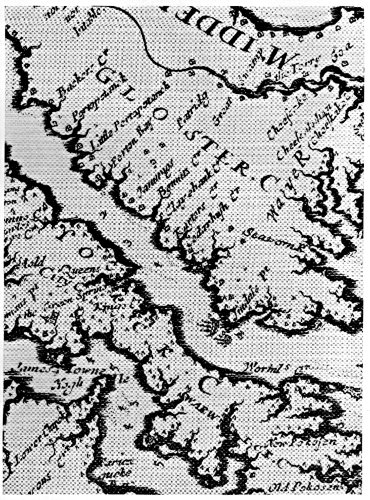
Figure 1.—Detail from Augustine Herman's map of Virginia which was published in 1673.
Ivor Noël Hume
Excavations at CLAY BANK in Gloucester County, Virginia, 1962-1963 — Historical Background — Archeological and Architectural Evidence — Method of Excavation — Archeological Stratigraphy — The Artifacts — Conclusions — Illustrations — FIGURE 8 — FIGURE 9 — FIGURES 10 and 11 — FIGURE 12 — FIGURE 13 — FIGURE 14 — FIGURE 15 — FIGURE 16 — ACKNOWLEDGMENTS — FOOTNOTES:
This paper describes and analyzes artifacts recovered from the
Jenkins site at Clay Bank, Gloucester County, Virginia. The
building which overlay the excavated cellar hole does not appear on
any known map. Among the number of interesting objects recovered
was a large stem and foot from an elaborate drinking glass or candlestick
of fine quality English lead metal. It was found in association
with crude earthenwares, worn out tools, and broken and reused clay
tobacco pipes, suggesting that this material was derived from various
sources.
The Author: Ivor Noël Hume is director of archeology at
Colonial Williamsburg and an honorary research associate of the
Smithsonian Institution.
Early in January 1962 a brick foundation was discovered
at Clay Bank in Gloucester County following
the removal of a walnut tree beside the residence
of Mr. William F. Jenkins. The tree was of no great
antiquity but the foundation beneath it was thought
by Mr. Jenkins to be worthy of archeological examination.
The author, therefore, visited the site late in the
same month and found that the brick footings were
certainly of colonial date. From the small collection
of ceramics and other artifacts also exposed by the
tree, there was reason to suppose that the building
had ceased to exist late in the 17th or perhaps early
in the 18th century.
The site lay on the north bank of the York River on
rising ground immediately west of Clay Bank landing.
Little or nothing was known about the property in
the colonial period and it was apparently identified
on no known maps or land plats. However, the fact
that it was adjacent to part of the 18th-century Page
family plantation (whose mansion house had been included
in previous archeological work[1]) and because
the Clay Bank site gave promise of yielding information
regarding domestic life in the late 17th century,
the author decided to undertake limited excavation
in the area of the structure.
With the assistance of local volunteer labor and the
archeological staff of Colonial Williamsburg, two
trenches were dug, one exposing a larger area of the
brick foundation, and the other parallel to it some 11
feet to the west in the direction of the river. The first
cutting revealed the remains of a massive brick chimney
measuring 10 feet 2 inches by 6 feet using oystershell
mortar and laid in English bond. The brickwork
was not bonded to, or abutting against, any wall
foundation and it was therefore presumed that the
building to which it belonged had stood on piers.
The second trench cut through mixed strata of sand,
black soil, and scattered oystershells extending downward
to a depth of at least 3 feet 9 inches, at which
level a thick layer of shells was found. In the top of
the shell stratum were fragments of glass wine bottles
of the late 17th century and parts of an iron can. It
was clear that the trench was not wide enough to
enable the artifacts to be studied in situ or removed
in safety, and consequently work was halted until
the project could be developed into an area excavation.
Both the stratigraphy and the similarity in date of
artifacts from top to bottom of the test trench strongly
indicated that we were cutting through one deposit,
probably the filling of a cellar belonging to the same
building as the large brick chimney to the east.
Remembering the huge quantities of artifacts that had
been recovered from a single hole at neighboring
Rosewell, it was hoped that yet another significant
contribution would be made to the archeology of
colonial Virginia. But in the final analysis the Clay
Bank site was to prove less rich and less historically
important (owing to a lack of adequate documentation)
than had been anticipated. On the credit side,
however, it did contribute new facts relating to building
construction in 17th-century Virginia, as well as
yielding a series of closely dated tools and miscellaneous
artifacts, plus one piece of glass that is not only
without parallel in America, but which is of sufficient
importance to merit a place in the annals of English
glass. For this one object alone, the Clay Bank
project would have been eminently worthwhile.
Archeology may be termed the handmaiden of
history in that it is truly the servant of the historian,
providing information that is not to be gleaned from
documentary records. At best it is a poor substitute
for the written word, but when the two are used
together the pages of history may acquire an enlivening
new dimension. This is particularly true of
American colonial history where the documentation
often is extremely full.
Unfortunately Gloucester County was one of those
whose Court Records were destroyed during the Civil
War, and it is difficult and often impossible to establish
property histories over an extended period of
time. However, it is debatable just how much of the
blame can be laid at the doors of war, as many of the
county's colonial records had already been destroyed
in a fire at the clerk's office of the Gloucester courthouse
in 1820.
No acceptable evidence has been found to definitely
identify the original owner or the name of the building
revealed by the 1962 excavations, though it has been
supposed that the adjacent "Ardudwy" (the present
home of Mr. and Mrs. Jenkins) was originally named
"New Bottle" and was built by Robert Porteus at
the beginning of the 18th century. It was hoped that
artifacts found on the site might provide evidence to
support the Porteus association, but nothing conclusive
was forthcoming. The only conceivable shred
of evidence, thin to the point of transparency, was
provided by a handsome 17th-century latten spoon
bearing a thistle as its touchmark, suggesting, perhaps,
that it was made by a Scots craftsman. As the family
of Edward Porteus, the emigrant and father of Robert
Porteus, came from New Bottle in Scotland, it might
be argued that the spoon was among Edward's possessions
when he arrived in Virginia. Such a deduction
is readily assailable, but it is no more so than
much other "documentation" relating to the Porteus
family in Virginia.
The distinguished Gloucester County historian, Dr.
William Carter Stubbs undertook considerable research
into the history of the Porteus family, the results
of which may be summarized as follows: Edward
Porteus was living in Gloucester County by 1681 in
which year he married the widow of Robert Lee. He
died in 1694 leaving a widow and one son, "Capt."
Robert Porteus who became heir to "New Bottle"
plantation. Robert married the daughter of John
Smith of "Purton" and after her death he married a
daughter of Governor Edmund Jennings of "Rippon
Hall" in York County. His two wives bore him 19
children, the best known of whom was Beilby Porteus
who was born in 1731 after Robert had returned to
England (in about 1727) to live at York. Beilby
Porteus became Bishop of Chester and then of London,
and died in 1808. Robert lived on in York until his
death in 1758.[2]
The location of "New Bottle" has been the subject
of dispute for many years, and as the recent excavations
have done nothing to resolve the matter, it is
not necessary to explore the conflicting opinions and
evidence in detail. It is enough to recall that the
Vestry Book of Petsworth Parish[3] clearly places Robert
Porteus in the Second Precinct which extended from
Bennit's Creek up the York River to Jones' Creek.
The First Precinct had begun at Clay Bank Creek
and had reached to Bennit's Creek. Today most of
these names have been changed; Clay Bank Creek
is marked as Aberdeen Creek, the creek at Clay Bank
which was apparently originally known as Bennit's
Creek now has no name at all, and only Jones'
Creek remains the same.
The only extant map that shows both Clay Bank
Creek and Bennit's Creek is the Augustine Herman
map of Virginia and Maryland published in 1673
(fig. 1). But this shows Bennit's Creek as being as
long as the present Jones' Creek, while the latter is
omitted from the map altogether. However, as the
parish records delineating the bounds of the precincts
in 1709 refer to both Bennit's Creek and Jones'
Creek there cannot have been any confusion between
them. It is therefore reasonably well established that
the Porteus property lay between those creeks, which
would place it north of the modern community of
Clay Bank and south of Jones' Creek. Although it
has not been proved that the Porteus land included
the York River frontage, it is reasonable to suppose
that it did. Thus, if that conjecture is accepted, it
becomes highly probable that the present "Ardudwy"
and the adjacent early foundation are on what were
once Porteus acres.[4] The Porteus family continued
to own this or other land in the Second Precinct
until at least 1763 as the bounds of that precinct were
ordered to be processioned in 1751, 1755, 1759 and
1763 beginning "on the Land of Robt Porteus Esqr."[5]
As Robert Porteus never returned to Virginia after
1727 and died in 1758, it must either be assumed that
the plantation was taken over by a son or that it
was operated by a tenant or manager on "Capt."
Robert Porteus' behalf. In the absence of any other
documentation indicating the presence of any members
of the Porteus family in Gloucester after October
1725,[6] the latter construction seems most reasonable.
The continuing references to Robert Porteus' land
in the Second Precinct until 1763 may be explained
as referring to the estate of the late Robert Porteus.
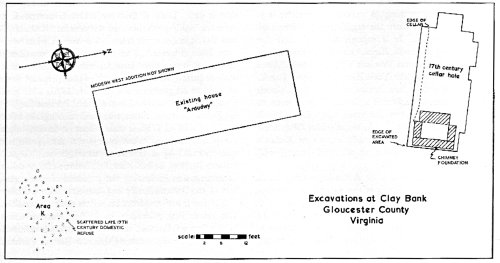
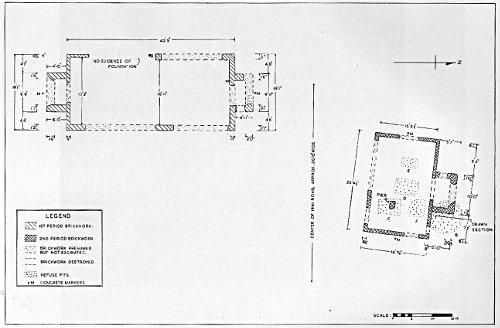
Figure 2.—Plan of excavations in relation to the existing house.
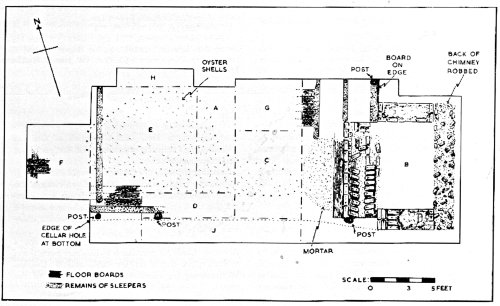
Figure 3.—Plan of excavated areas and structural remains.
Even if the modern Jenkins property is accepted as
having been part of the Porteus plantation it does
not necessarily follow that either the excavated
foundation or the much modernized "Ardudwy"
represent the remains of the Porteus house. However,
there may be some grounds for arguing that the
foundation and cellar hole were part of the house of
Edward Porteus the emigrant. According to legend,
Robert Porteus' property had once belonged to a
Dr. Green at whose house Nathaniel Bacon died in
1676.[7]
Clues to the appearance of Robert Porteus' house
are provided by an entry in the Petsworth Parish
Vestry Book for November 12, 1704. There it was
recorded that the churchwardens drew up an agreement
"... wth Ezra Cotten for ye building of a
gleebhouse & a kitchen ye Sd house to be of ye
Same Dementions as Mr Robt Pourtees. & to be
framed on Good white oak Sills and to Stand upon
blocks & to be lathd. wth Goo[] oak lathes and
Shingled wth Good Siprus Shingles The Sd house to
be 36 foot in Length & 20 foot wide, ye Roof to be
18 Inches Jet and to have two outside Chimnies
and two Closets adjoyning to them, and all things
Ells pertaining according to ye Dementions of ye
above Sd Robt Pourtees house, Viz, ye above Sd
Kitchin to be foot Long & foot wide"[8]
The two important features of these instructions are
the measurements of the building and the fact that it
was raised on blocks and, therefore, did not have a
walled basement beneath it. But while the measurements
are stated to be those of the Porteus House, it
does not necessarily follow that the elevation of the
glebe house on blocks also drew its precedent from that
source.[9] However, if it did, then the modern "Ardudwy"
could not have been the Porteus home as this
building not only measures 47 feet 3 inches by 15 feet
10 inches, but it is also built over a substantial brick-walled
basement. On the other hand, the excavated
cellar hole (though apparently having ended its life
prior to about 1700) was almost certainly part of a
building built on blocks or piers.
It seems reasonable to suggest that Ezra Cotten was
assumed by the churchwardens to know more about
the Porteus House than was given in their specifications,
in which case it might be supposed that he had
actually built that house. By extension it might also
be assumed that the job had been completed a comparatively
short while before the building of the glebe
house was proposed. Therefore, if it can be established
that Robert Porteus built himself a new house
not too long before November 1704, it would probably
follow that he had lived in his father's old house until
that time. If Edward's house was then destroyed, it
would certainly add further support to the theory that
the excavated remains are part of that building.
Unfortunately, there seems little likelihood of obtaining
any additional information regarding either
the site of, or the appearance of Robert Porteus'
house. The glebe house does not survive, having been
abandoned in 1746,[10] and the only other potential
source of information has seemingly been lost. The
Reverend Robert Hodgson in his The Life of the Right
Reverend Beilby Porteus[11] stated that the bishop possessed
"... a singular picture which, though not in the best
style of coloring, was yet thought valuable by Sir
Joshua Reynolds, as a specimen of the extent which
the art of painting had reached at that time in America:
and he himself very highly prized it, as exhibiting
a faithful and interesting representation of his father's
residence." This last statement is assumed to be
hearsay as Beilby Porteus was born in England in 1731
and did not, as far as we know, ever visit Virginia.
Attempts to find the picture have met with no success[12]
and in all probability it has long since been destroyed
or at best, robbed of its identity.
It is not within the purpose of this paper to include
an architectural study of "Ardudwy." Neither the
building's measurements nor its basement lend
credence to the belief that it was once the home of
Robert Porteus. In addition, the 1704 specification
called for exterior chimneys while those of "Ardudwy"
are interior. The basement walls use shell mortar
and include bricks of widely varying sizes, but although
many of them have an early appearance, they
may well have been reused from elsewhere. Interior
details such as mantels and doors would seem to date
from the early 19th century. What little of the framing
that is visible is pegged but is liberally pierced
with both wrought and cut nails. All in all, it seems
probable that "Ardudwy" was built in the very late
18th or early 19th century. Archeological evidence
supports this belief in that the property is richly
scattered with artifacts of the late 17th century and
of all dates after about 1800, but has yielded very few
items that can be attributed to the 18th century.
All appearances point to the abandoning of the immediate
area as a habitation site after the destruction
of the excavated building around 1700. The subsequent
building of "Ardudwy" so close to the early
house may be assumed to be coincidental, though the
site is certainly a desirable and obvious location for a
residence.
Little information as to the above ground appearance
of the 17th-century structure was forthcoming,
partly because it had almost certainly stood on piers
or blocks, and partly because the excavations were
restricted by limitations of time, labor, and the desire
of the owners to retain at least something of their
garden. Neither extensive probing nor a soil resistivity
survey revealed evidence of a second chimney,
nor did they give any clues as to the total length or
breadth of the cellar hole. The back wall of the chimney
had been deliberately dismantled and only a thin
skin of brickbats and mortar on the bottom of the
robber trench survived to mark its position. It is
therefore quite possible that another chimney was
dismantled with sufficient completeness to elude
discovery by either of the exploratory methods used.
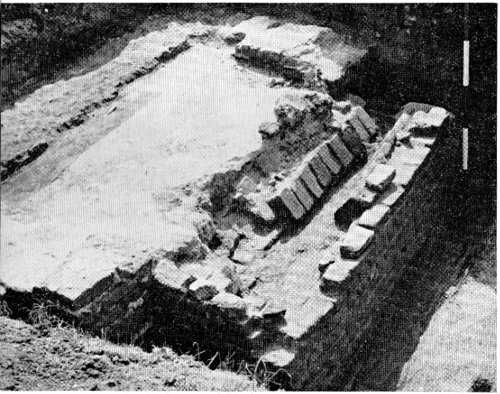
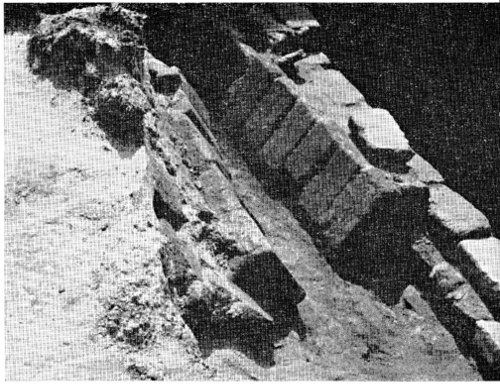
Figure 4.—The chimney and underhearth foundation.
The jambs of the partially surviving chimney (fig. 4)
were laid in English bond and were 1 foot 7 inches
thick and 4 feet 4 inches long.[13] The interior width
of the fireplace measured 7 feet, which was large by
18th-century domestic standards, but not uncommon
in the 17th century before separate kitchens became
the rule.[14] Both jambs were built into the side of the
cellar hole and were seated on a bed of small rocks,
but the robbed back-wall had rested only on the
natural sandy clay at a depth of 2 feet 3 inches below
the modern grade. In front of the chimney, and rising
from the cellar floor, was a massive brick-walled
underhearth 7 feet 6 inches wide and projecting out
from the fireplace to a distance of 5 feet.
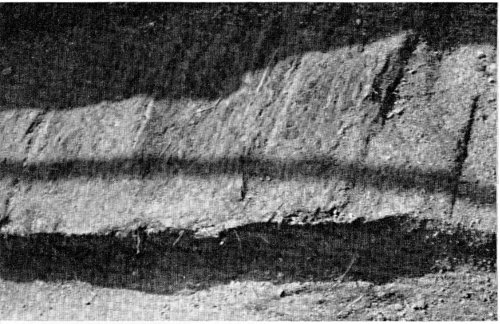
A curious and still unexplained feature of the underhearth
was a 4-by 3-inch channel running across the
top of the surviving foundation for a distance of
6 feet 9 inches, starting at the south face and terminating
9 inches short of the north. This channel had
been bricked over and the remaining bricks had
dropped into it (fig. 5) presumably after a wooden
beam, which once occupied the space, had rotted or
burned out. Traces of burned or carbonized wood
lay on the clay bottom of the channel, but the bricks
over it displayed no evidence of fire. The only conceivable
explanation for the presence of the wood
must be that it was part of a frame used to hold the
block of natural sandy clay together while the underhearth
wall was being erected around it. As the
underhearth foundation would have originally risen
at least another 2 feet 6 inches above the timber to
the floor level of the house, the wood would not have
been in danger of igniting from the heat of the domestic
fire. But if the house ultimately burned, it is
possible that the exposed end of the timber might
have caught fire and slowly been consumed along its
entire length.
The cellar hole had been cut into natural sandy
clay to an average depth of 5 feet 3 inches below the
modern grade. Its backfilling was predominantly of
the same sandy clay and, consequently, the exact
edge of the cellar hole was sometimes hard to determine.
It was probably because of this similarity
between the natural subsoil and the cellar's fill that
the feature failed to show up in the soil resistivity
survey. Owing to previously mentioned limiting
factors, only the southeast corner of the cellar hole
was found and only parts of the south and east walls
were traced out. Consequently, it can merely be said
that the cellar exceeded 27 feet in east/west length
and 11 feet 2 inches in width (fig. 3).
Three post holes were found against the south face,
while the rotted remains of another vertical post were
found north of the chimney supporting a much-decayed
horizontal board that had served to revet
the east face. A broad-bladed chisel (fig. 14, no. 6)
was found behind the board where it had probably
been lost while the timbering was being installed.
Further slight traces of horizontal boards were found
along the south face, suggesting that the soft sides of
the large cellar hole had been supported in this way.
But it was not possible to determine whether the
boards had been placed only on sections of the wall
that seemed in danger of sliding in or whether the
entire interior had been sheathed with planks. The
south side of the cellar hole sloped outwards at an
approximate 65 percent angle and the traces of boards
lay against it.[15] However, it was not possible to tell
whether the vertical posts had been similarly sloped,
but it is reasonable to assume that they would have
done so.
Figure 5.—Detail of collapsed bricks in the underhearth.
(Photo courtesy of E. DeHardit.)
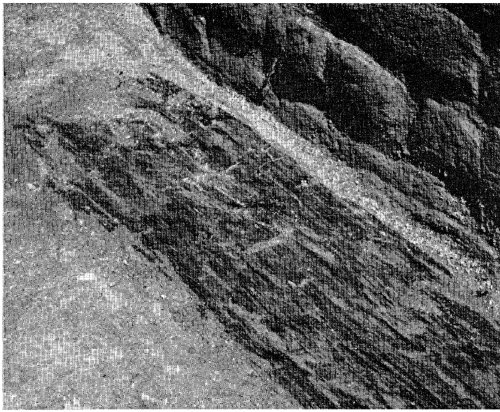
Parts of the cellar's wooden floor still survived (figs.
6 and 7) and comprised boards ranging in width from
5 to 7 inches laid over sleepers or joists 4 to 6 inches
wide. The height of the underlying timbers could
not be determined as the weight of the cellar fill might
be assumed to have pressed the floorboards down as
the wood of the sleepers decayed. Only occasional
floorboards survived and the channels left by decayed
sleepers did not extend across the full width of the
excavated cellar. From these facts it was deduced
that the boards had been cut from woods of different
types, some of which had decayed more completely
than others, and that the sleepers were made from
short and sometimes roughly cut lengths of timber.
These sleepers may, in fact, have served only as a base
for anchoring the ends of floorboards, as was certainly
the case northwest of the underhearth where the nails
from the ends of five boards had dropped through into
the channel left by the decayed sleeper. It may be
supposed, therefore, that the sleepers' location would
have been dictated by the vagaries of board length
rather than by the design of a planned, measured
foundation and that they served as ties for the floor,
rather than joists raising it off the natural clay
beneath.
In addition to the remains of the carefully laid floor,
another much-decayed board, 10 inches wide, and of
uncertain thickness, was found running north/south
immediately west of the underhearth. This board
was partially covered by mortar, suggesting that it
had been set on the dirt during the building of the
brick structure.
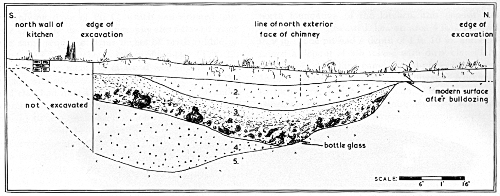
The filling of the cellar in the vicinity of the chimney
and underhearth comprised a single massive deposit
of sandy clay, scattered through which were numerous
iron nails, isolated oystershells and occasional fragments
of pottery, glass, and tobacco-pipe stems. A
similar unified filling was encountered at the western
end of the excavation, but towards the middle a large
and irregular deposit of oystershells was sealed within
the sand at a depth of 4 feet 6 inches sloping upward
to 3 feet 6 inches towards the south wall. The shell
layer averaged from 6 to 9 inches in thickness and was
found to contain many of the more important artifacts.
Figure 6.—Remains of wooden floor boards in the cellar.
(Photo courtesy of E. DeHardit.)
On the wooden floor of the cellar lay a thin ½-to
1-inch layer of wood ash, mortar, and occasional brickbats.
Had this accumulation been considerably
thicker it might have suggested that the building
above had been destroyed by fire. But although the
presence of this skin of debris could not be explained,
it was far from sufficient to support such a conclusion.
The topsoil over the entire area had been disturbed
to a depth of at least 1 foot, presumably by deep plowing.
Over the cellar fill, humus and a sandy loam
extended to a depth of 1 foot 8 inches at the south
edge and to 2 feet 1 inch in the middle. The bottom
of this stratum contained nothing but late 17th-or
early 18th-century artifacts, including an important
and well-preserved latten spoon.[16] A small 19th-century
disturbance cut into the south cellar edge
towards the west end of the excavation, but caused
little disturbance to the main fill. Another, much
larger, late 19th-century trash deposit had been dug
into the fill to the northwest of the chimney and this
had reached to a depth of 3 feet 6 inches below the
modern grade. The removal of the walnut tree had
created a similar disturbance immediately south of
the refuse deposit, while a trench for a 20th-century
water pipe had cut yet another slice through the same
area. None of these disturbances had caused any
damage to the lower filling of the cellar.
DATING EVIDENCE FOR THE CELLAR
The majority of the excavated artifacts were scattered
throughout the cellar fill and were of similar
types from top to bottom of the deposit. These objects
included wine-bottle and drinking-glass fragments,
potsherds of English and perhaps Portuguese tin-enamelled
earthenware, and more that 600 tobacco-pipe
fragments, all of them indicating a terminal date
of about 1700. A quantitative analysis of the tobacco-pipe
stem fragments using the Binford formula[17] provided
a mean date of 1698.
Digging was initially confined to the immediate
vicinity of the chimney foundation (Area B on fig. 3)
and to the previously described test trench (A). An
east/west trench (D) was next dug to link the two and
to isolate the disturbed areas of the tree hole and
19th-century pit in Areas C and G.
Owing to a shortage of labor and the rigors of the
weather, it was necessary to confine the digging to
small areas which could be completed in a single day's
work. Consequently, it was not possible to clear the
whole area, as one part would be back-filled during
the digging of the next. Mr. and Mrs. Jenkins, the
owners of the property, were extremely tolerant of
the damage that was done to their gardens, but after
the clearance of the large area E, they indicated that
the project had gone far enough. Nevertheless, they
were persuaded to permit the cutting of another
smaller test area to the west (F), but when this, too,
failed to find the westerly extremity of the cellar, the
project was abandoned. Subsequently, relatives of
the owners cut into the exposed north face of area E
and extracted a number of potsherds and other fragmentary
objects from the sand filling.[18] The undercutting
of the bank extended to a distance of 1 foot
6 inches without encountering the north edge of the
cellar, thus showing that the total width was in excess
of 14 feet.
Extensive probing all around the total area of
excavation failed to produce any further traces of
the building, though the 1 foot 8 inches of topsoil and
sandy loam was found to be bedded on numerous
small deposits of oystershells and scattered brickbats.
Test holes found that all the located deposits north
and west of the existing house had been laid down or
disturbed in the 19th century. Five test traverses with
a soil resistivity meter west and south of the excavation
area produced numerous anomalies which, when
checked out, all failed to be associated with the 17th-century
cellar. It seemed that the misleading readings
were caused by variations in the density and moisture-retaining
qualities of the natural sandy clay subsoil.
Early in 1963, while planting a small tree to the
south of the existing house, Mr. Jenkins encountered
a stratum of oystershells at approximately 8 inches below
the present grade. (Fig. 2, Area K.) A series of
small test holes was subsequently dug to the south
and southeast of the house, and showed that the layer
of shells (average thickness 4 inches) overlay the subsoil
and was spread over an area at least 15 by 10 feet. A
small number of 19th-century pottery fragments were
found mixed into the stratum, but the vast majority of
the artifacts comprised bottle glass and earthenwares
of similar types to those encountered in the cellar hole
excavation.[19] The most important item was a pewter
spoon handle of late 17th-century character (fig. 15,
no. 27) stamped with the initial "M." The presence
of this obvious domestic refuse was not satisfactorily
explained, but it is concluded that it was originally
deposited on the land surface and later disturbed by
cultivation.
Figure 7.—Remains of decayed board on floor in front of
underhearth. (Photo courtesy of E. DeHardit.)
Landscaping work towards the York River west of
the house had yielded a few widely scattered fragments
of colonial and Indian pottery as well as numerous
19th-century sherds. The colonial material
was predominantly of late 17th-or early 18th-century
date, but two sherds of Staffordshire combed dishes
were of a type unlikely to date before about 1720. No
archeological digging was undertaken in these areas.
Each excavated area was given an identifying letter
(fig. 3) and each stratum a number. Thus an artifact
marked "B2" was found in the archeological area
that contained the chimney and was recovered from
the top stratum of sandy loam and clay. It should be
noted that not all layers and deposits tabled below
were encountered in any one excavation area, while
some were confined to single locations.
1. Topsoil and brown loam to 1 foot 8 inches over
cellar hole.
2. Sandy loam merging into top of sandy clay fill
or silting, spreading over edges of cellar hole
and sealing the chimney remains. About 1690-1700
with some top disturbance.
3. Main sandy clay fill, extending to oystershell
deposit in central areas. About 1690-1700.
3A. Sandy clay fill extending to within 6 inches of
floor in Area B, against wall north of chimney.
The same as Strata 3-5 but without the oystershell
layer that divided them elsewhere. About 1690-1700.
3B. Sandy clay as above, but from areas where
Stratum 4 was absent. About 1690-1700.
4. Oystershell deposit in Areas A, C and E, sealed
by sandy clay Stratum 3. About 1690-1700.
5. Sandy clay under oystershell layer, reaching to
cellar floor. About 1690-1700.
6. Ash and sand layer on remains of cellar floor;
principal artifacts concentrated against south
face of cellar hole in Areas D and E. About
1690-1700.
6A. Similar layer to Stratum 6, confined to Area B
north of the chimney and underhearth foundation.
About 1690-1700. (The same number is
given to a chisel found behind a horizontal wall
board at this level, but which may have been
deposited when the cellar was built rather than
at its date of abandonment. Fig. 14, no. 6.)
7. Objects lying in slots left by rotted-floor sleepers.
About 1690-1700.
8. Late disturbance at southwest corner of excavation,
Area E. 19th century.
9. 3-inch layer of light-grey soil beneath Stratum
2 extending down to top of oystershell layer (4)
from southwest; confined to Areas E and F.
About 1690-1700, possibly disturbed at upper
west edge.
10. Unstratified material from all areas of the cellar-hole
excavation, derived from frost disturbances
and the results of removing the walnut tree.
11. Finds from oystershell and artifact layer beneath
topsoil southeast of the existing house. About
1690-1700 with a few much later intrusions.
(Area K, fig. 2.)
12. Surface finds recovered from field west of existing
house.
The collection of objects from the Clay Bank cellar
hole is important for a small number of rare items
and because the deposit provided accurate dating for
a much larger group of less impressive artifacts. Unfortunately,
neither category included pieces that
were of much help in establishing anything of the
history of the property.
A small cannonball of the 3-pound type used by
light fieldpieces of the minion class was found in the
top of the sand stratum (D3) against the south face
of the cellar. Guns of this caliber may well have
been used during Bacon's Rebellion, and there might
be some who would care to use the excavated ball to
support the legend that Bacon died at Clay Bank.
The ball, it has been argued, could have been left
behind by Bacon's forces when they vacated the site
in the fall of 1676. However, such a conjecture, based
on so little evidence, can hardly be taken seriously.
The single clue pointing to a Porteus family association,
the latten spoon with its presumed Scottish mark,
hardly merits any more serious consideration than
the cannonball. Somewhat more tenable, however,
may be the suggestion furnished by two artifacts, that
the cellar hole was in the vicinity of a cooper's workshop.
The objects in question were a "chisel" (fig.
14, no. 7) used specifically for driving down barrel
hoops, and a race knife (fig. 12, no. 3), a tool frequently
used by coopers to mark the barrels. No
documentary evidence has been found to indicate the
presence of a cooper in the Second Precinct of Petsworth
Parish in the late 17th century though the
Vestry Book does contain an entry for October 4th,
1699, ordering an orphan to be indentured to a
cooper in King and Queen County.[20]
Other tools from the Clay Bank cellar included
spade and hoe blades, a large wedge, and a carpenter's
chisel, a range of items that did nothing to support a
coopering association, but which did tend to indicate
that the artifacts might have come from a variety of
sources.
The pottery included a high percentage of coarse
earthenwares, among which were fragments of two,
or possibly three, lead-glazed tygs and a similarly
glazed cup (fig. 15, nos. 7, 8, and 9), all objects that
would have been best suited either to a yeoman's
household or to a tavern. The large quantity of
tobacco-pipe fragments present might support the
latter construction but the dearth of wine-bottle
pieces does not. Numerous fragments of English delftware
were found scattered through the filling from
top to bottom, most of them in very poor condition.
While none of the pieces was of particularly good
quality, a medium-sized basin with crude chinoiserie
decoration in blue, is of some importance. The vessel
(fig. 15, no. 1) is of a form that is extremely rare from
the 17th century, but which clearly was the ornamental
ancestor of the common washbasins of the 18th
century.[21]
In marked, and even staggering contrast to the
assemblage of cheap and utilitarian earthenware, was
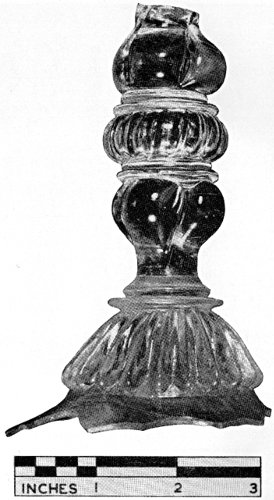
the presence of a massive lead-glass stem from a
"ceremonial" drinking glass or candlestick, a form
undoubtedly made in London in the period 1685-1695
(fig. 10). Although the double-quatrefoil stem units
and central melon knop are paralleled by existing
glasses, the heavily gadrooned foot is seemingly
unknown. This last feature gives the foot such weight
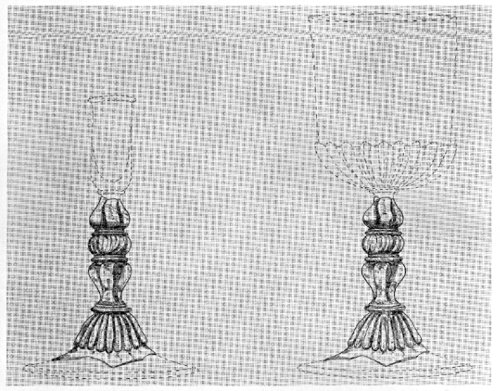
that it has led Mr. R. J. Charleston, Keeper of
Ceramics at the Victoria and Albert Museum in London,
to suggest that the stem may come from a
candlestick (fig. 11) rather than from a large, covered
glass. However, no parallels for such a candlestick
are known.
One might be tempted to believe that a glass candlestick
would be more likely to have been brought to
17th-century Virginia than would a seemingly pretentious,
covered, "ceremonial" drinking-glass. But in
1732, Thomas Jones[22] of Williamsburg made a settlement
upon his wife in case of his death, and among the
possessions listed were "6 glass decanters, 6 glasses
with covers...."[23] Covered glasses ceased to be
popular after about 1720 when fashions in glass were
turning from the icy sparkle of mass towards more
delicate and lighter designs. It is possible, therefore,
that the Jones' glass might have been of the general
type indicated by the Clay Bank stem. But be this as
it may, there is no doubt that the excavated stem is
the finest piece of glass of its period yet discovered in
America, and that it is sufficiently important to be
able to add a paragraph to the history of English glass.
Other glass objects included the powdered remains
of a small quatrefoil-stemmed wineglass, a form
common in the period 1680-1700.[24] Like so many
glasses of its type, the metal was singularly impermanent
when buried in the ground, and little or nothing
could be salvaged of it. Also present were fragments
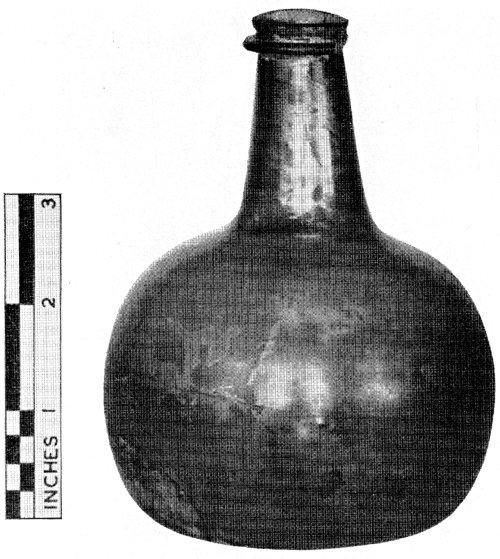
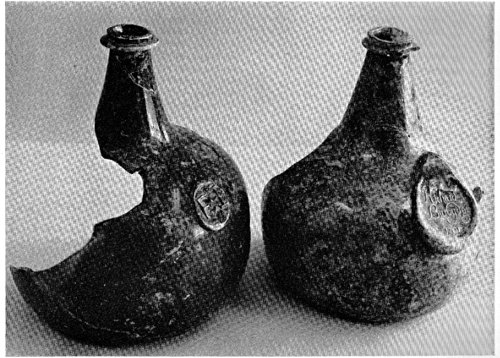
of at least seven wine bottles of the short-necked,
squat-bodied forms of the late 17th century, as well as
one fragment of a short-necked and everted-mouthed
case bottle. A few fragments of cylindrical pharmaceutical
bottles were also found as was a well-preserved
bottle of similar metal but in wine-bottle
shape (fig. 9 and fig. 15, no. 19). Such bottles are
thought to have been used for oils and essences, and
their manufacture seems to have been confined to the
period about 1680-1720.
Tobacco-pipe fragments (fig. 16) were plentiful
throughout the cellar fill and provided a useful range
of bowl forms as well as a key to the dating of the
deposit. All the bowls were of types common in the
last years of the 17th century, a period in which the
two English bowl styles of the second half of the century
(one evolving with a spur and the other with a
heel) merged together into the single spurred form
of the 18th century.[25] In addition, the Clay Bank
cellar contained examples of bowls with neither heel
nor spur, a style never popular in England, and which
seems to have been developed specifically for the
American market initially copying the shape favored
by the Indians.
No fewer than 648 stem fragments were recovered
from the cellar and their stem-hole diameters, using
J. C. Harrington's chart,[26] indicated a manufacture
date in the period 1680-1710. Because pipes are
considered to have had a short life, it is generally
assumed that the dates of manufacture and deposition
are not far apart. Other artifacts from the
deposit, notably the large glass stem, the wine bottles,
small wineglass and, of course, the pipe bowl
shapes, together suggested a terminal date for the
group within the period 1690-1700. Using the Binford
formula,[27] the 648 stem fragments suggested a
mean date of 1698. Experience has shown that the
formula is likely to be accurate to three or four years
either way on a sampling of that size.[28]
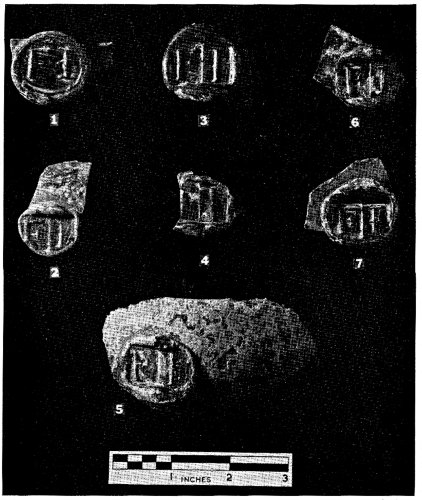
The presence of the same maker's initials, I·F, on
pipe bowls at different levels of the cellar fill strongly
pointed to a homogeneity of deposition. Although
it is impossible to identify the owners of the initials
with any certainty, it is worth noting that there was
a Josiah Fox making pipes in Newcastle-under-Lyme
in and after 1683 whose initials are the same as those
most common in the Clay Bank cellar. The I·F
mark was somewhat unusual in that it was impressed
between two X's across the top of the stem (fig. 16,
no. 11). All other marks, save one, were in the normal
position, to left and right of the heels. These comprised
W F (William Ferry, Marlborough, about
1700?), or perhaps W.P., II I (Henry Jones, London,
1688?)[29] and V R. The remaining mark, S A (fig. 16,
no. 14) occurred on the bases of two bowls with
neither heels nor spurs. From the oystershell layer
south of the existing house came a bowl fragment
ornamented with the name of a well-known Bristol
pipe-making family, I TIPPET, in a raised cartouche on
the side. This was probably Jacob Tippett whose
name appeared in the Bristol Freedom Rolls in 1680.[30]
In addition to the few marked bowls, two stems were
of interest in that they had been ground or pared down
to enable the pipes to be used again, one being only
2¼ inches in length (fig. 16, nos. 12 and 13). Such
frugality might be construed as being associated with
a household of small means. Also present were a few
brown stem fragments and part of one decorated
bowl (fig. 8, no. 9) of Virginia, possibly Indian,
manufacture.
The importance of the Jenkins site cellar hole lies
solely in its provision of a valuable group of closely
dated artifacts. The excavations failed to reveal
either the size of the building or any indication of its
original ownership and purpose. The structure does
not appear on any known map nor can it be equated
with any specifications contained in the Vestry Book of
Petsworth Parish or any other documentary source
now available. Much local legend and speculation
has been considered and regretfully rejected in the
absence of any supporting evidence. The site does
lie in the Second Precinct of Petsworth Parish and it
has been established that the Porteus family did own
land therein. Consequently it is quite possible that
the Jenkins site was once part of that tract. But it
does not necessarily follow that the cellar hole was
part of the Edward Porteus family residence.
A terminus post quem of about 1700 for the filling of the
cellar hole has been well established on the archeological
evidence. The structure itself is represented
by the large cellar hole which had been floored and
walled with boards and vertical posts, and by the
massive chimney at the east end. The absence of any
abutting walling, coupled with our inability to find
any traces of other foundations, strongly suggests that
the building stood on piers or wooden blocks.
The artifacts include a number of extremely interesting
objects; but the curious juxtaposition of the
large glass stem (figs. 10 and 11) with crude earthenwares,
worn-out tools and broken and reused clay
tobacco pipes makes it probable that the refuse was
derived from different sources. Whereas the iron
objects resting on the cellar floor may have been in the
building when it was destroyed, it is clear that the
large oystershell deposit (and therefore, the glass stem
that it contained) must have been brought from elsewhere.
It might therefore be deduced that the excavated
structure had been a kitchen building or,
perhaps, an overseer's house rather than the home
of the owner of the glass stem.
The dearth of 18th-century colonial artifacts on the
Jenkins property seems to indicate, at best, a less
intensive occupation after the destruction of the building
that overlay the excavated cellar hole. It seems
improbable, therefore, that the existing "Ardudwy"
was in existence before the late 18th century.
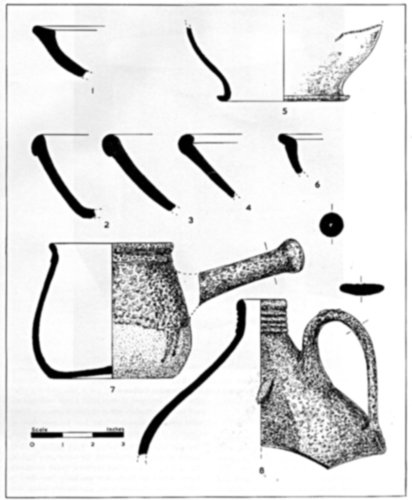
The objects illustrated in figures 8 through 16 are
representative of the principal artifacts found in the
Clay Bank excavations. The dating given below
refers to the objects' period of manufacture; their
terminal or throwaway date is determined by their
archeological contexts, which are indicated by area
and stratum designations. (See p. 11, Archeological
Stratigraphy, and fig. 3.)
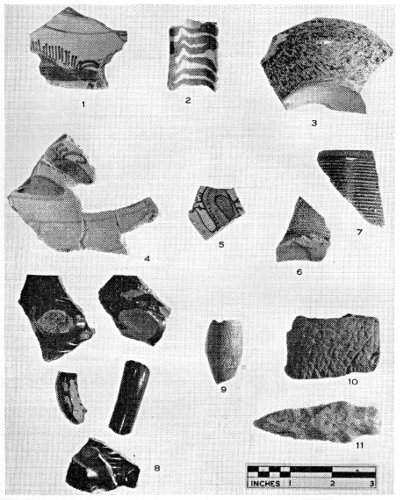
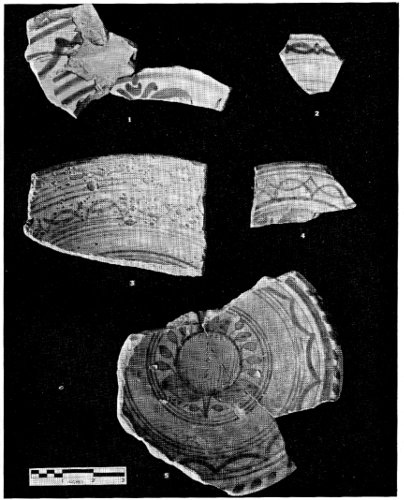
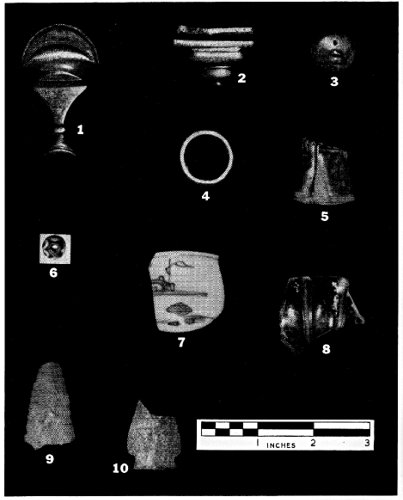
1. Marly fragment from small plate, English delftware,
decorated in blue with chinoiserie design,
probably of Chinamen, rocks, and grasses. The
background color has a very pale-blue tint,
unlike the pure whites and pinkish whites that
are generally associated with London pieces of
the period. The closest parallel for this sherd
is in the Bristol City Museum in England[31] and
is attributed to Brislington. An example of the
style, attributed to Lambeth and dated 1684 is
illustrated by F. H. Garner in his English Delftware;[32]
but unlike the Clay Bank fragment, the
central decoration does not reach to the marly.
About 1680-1690. E4. (Fig. 15, no. 6.)
2. Handle fragment from chamberpot or posset
pot, English delftware, decorated with irregular
horizontal stripes in blue. The handle is pronouncedly
concave in section, and lacking
ornament on its edges (as usually occurs on posset
pots)[33] a chamberpot identification seems most
likely. The form ranges from the late 17th
century at least through the first quarter of the
18th. E2.
3. Mug or jug, lower body and base fragment only,
English delftware, white inside, with manganese
stipple on exterior. Probably Southwark, first
half of the 17th century. E4. (Fig. 15, no. 4).
4. Basin, English delftware, wall fragments only
illustrated (for full reconstruction see fig. 15, no.
1), the glaze, pale blue, ornamented with central
chinoiserie design of similar character to no. 1.
The wall was decorated with narrow horizontal
bands and a wide foliate zone below the everted
rim. The bowl is important in that it is one of
the earliest extant examples of the simple washbasin
form that was to become common throughout
the 18th century. About 1680-1690. Illustrated
sherds A3, C3, F2.
5. Basal fragment of plate, tin-glazed earthenware,
decoration of uncertain form in two tones of blue
outlined in black. Portuguese? 17th century.
C4.
6. Base fragment from globular jug, English brown
salt-glazed stoneware, probably from same vessel
as no. 7. Late 17th or early 18th century. C3.
7. Neck fragment from bulbous mug or jug, decorated
within multiple grooving,[34] ware and
date as above. A3.
8. Tyg fragments, black lead-glazed, red-bodied
earthenware (sometimes called Cistercian ware),
the body decorated with multiple ribbing. (For
reconstruction see fig. 15, no. 7.) Such drinking
vessels were made with up to six or eight handles,
but two was the most usual number and those
were placed close together as indicated here. The
form was prevalent in the period 1600-1675,
though taller examples were common during
the preceding century.[35] A3, C3.
9. Tobacco pipe bowl, pale-brown ware, burnished,
and decorated with impressed crescents and rouletted
lines, local Indian manufacture?[36] Second
half of 17th century. E4.
10. Body fragment of cord-marked Indian cooking
pot, Stony Creek type,[37] light red-tan surface
flecked with ocher and with a localized grey core.
Middle Woodland. B1.
11. Projectile point, buff quartzite, broad stem and
sloping shoulders. Late archaic. E9.
Figure 8.—Fragments of English delftware, stoneware, earthenware, and Indian objects.
Figure 9.--BOTTLE OF GREEN GLASS in the form of a
miniature wine bottle.
A small glass bottle in wine-bottle style but probably
intended for oil or vinegar, and fashioned from a
pale-green metal comparable to that used for pharmaceutical
phials and flasks. The base has a pronounced
conical kick, but is not appreciably thicker
than the walls of the body. The mouth is slightly
everted over a V-sectioned string rim. On the yardstick
of wine-bottle evolution such a bottle is unlikely
to have been manufactured prior to 1680 or later
than about 1720. E5. (See also fig. 15, no. 19.)
Stem and foot fragment from an elaborate drinking
glass or candlestick, English lead metal of splendid
quality. The solid stem is formed from two quatrefoil
balusters between which is a melon knop with
mereses above and below. The stem terminates in
two mereses of increasing size and is attached to an
elaborately gadrooned foot, only part of which survives.
Any suggestion that the foot is actually part
of the base of the bowl is negated by the presence of
a rough pontil scar inside it, as well as by the fact that
the surviving fragment spreads out at so shallow an
angle that no other construction is possible.
Figure 10.—An elaborate stem of English glass,
London, about 1685-1695.
The stem form is most closely paralleled by two
goblets illustrated in W. A. Thorpe's History of
English and Irish Glass,[38] one of which contains within
its stem an English fourpenny piece of 1680. Because
no known goblet exhibits the high, gadrooned foot of
the Clay Bank example, it has been suggested that
the stem may be that of a candlestick.[39] While this
is certainly a reasonable supposition, it must be added
that neither have examples of candlesticks been found
in this form. (For conjectural reconstruction see
fig. 11.) Although it is extremely unfortunate that
no upper fragments were found, there is no doubt as
to the date of the surviving section, nor is there any
denying that it is on a par with the best English glass
of its period. London, about 1685-1695. Height
of fragment 5¼ inches. E4.
Figure 11.—The Clay Bank stem reconstructed as both a drinking glass and a candlestick.
Height of fragment is 5¼ inches. About 1685-1695.
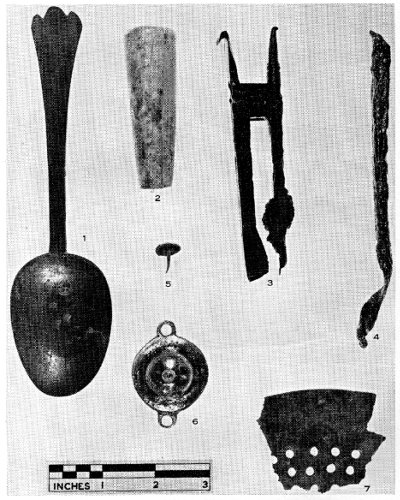
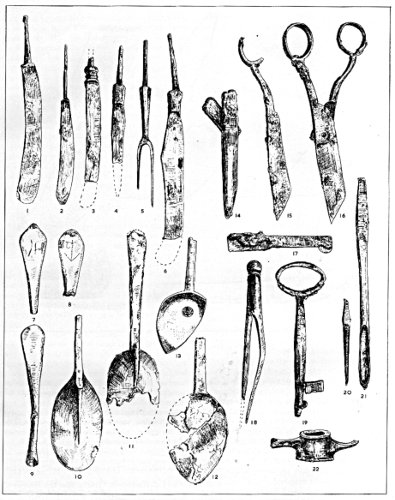
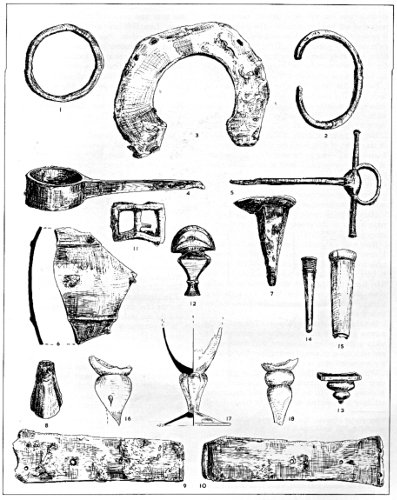
1. Spoon, latten, tinned, the bowl oval and the
handle flat with a trilobed terminal. The back
of the bowl possesses an extremely rudimentary
rat-tail that is little more than a solid V slightly
off-center at the junction of stem and bowl. The
maker's mark inside the bowl bears the initials
W W flanking a thistle, perhaps suggesting a
Scots origin for the spoon. Last quarter of 17th
century. E2.
2. Cutlery handle, bone, roughly round-sectioned
at its junction with the iron shoulder but becoming
triangular towards the top. A4.
3. Race knife, steel, a tool used by coopers and joiners
to inscribe barrels and the ends of timbers. At
one end is a tapering, round-sectioned tang to
which a wooden handle was attached; beside this,
and probably originally recessed into the wood,
is a rectangular-sectioned arm, terminating in
a small blade curved over at the end. The arm
is hinged at the shoulder of the tool and could be
folded back to inscribe large arcs and to be used
as an individual cutting instrument. At the other
end is a small blunt spike with spiral grooving
and raised cordons, and a small fixed knife with
a curved blade that could be used to cut in the
opposite plain to that of the moveable arm.
The arm is stamped with the maker's name WARD.
Attempts to identify an English toolmaker of that
name working in the second half of the 17th
century have been unsuccessful. The tool is
well made and possesses a surprising amount of
decoration on the shoulders, in the shape of
faceting at the corners and sculpturing of the flat
surfaces.[40] E4. (See also fig. 15, no. 22.)
Figure 12.—Latten spoon and other small finds.
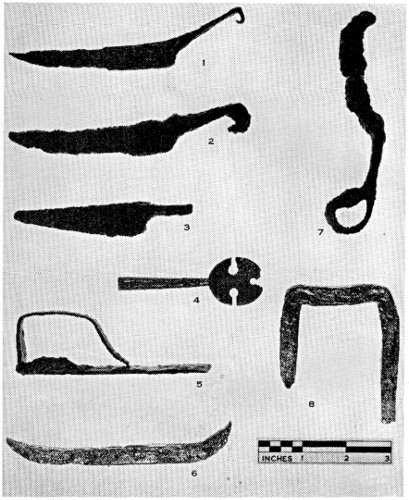
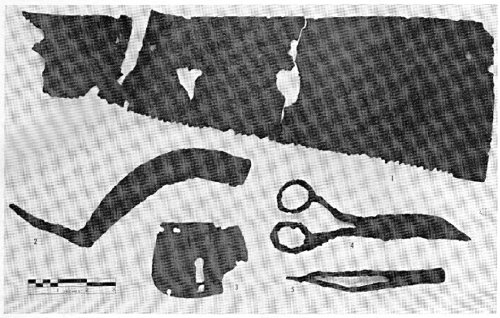
Figure 13.—Cheekpiece from bit, saw set, and other iron objects.
4. Gimlet, iron, the shaft drawn out at the top to
grip the wooden handle, the spoon-shaped blade
is badly distorted but the terminal worm still survives
in part. B6A.
5. Tack, brass, probably from trunk or upholstery,
convex head roughly trimmed, diameter ½ inch.
C3.
6. Boss, cast brass, from cheekpiece of bridle; the
slightly dished edge and central nipple appear to
have been ornamental devices more popular in
the 17th than in the 18th century.[41] This object
overlay the robbed rear-chimney foundation at
its northeast corner. B2.
7. Strainer fragment, brass or bronze; the edge flat
and therefore not part of a colander, probably
originally attached to an iron handle. Diameter
approximately 8½ inches. E2.
1. Object of uncertain purpose, iron, the pointed
"blade" without cutting edge and 1/8 inch in thickness,
the tang drawn out, rectangular in section
and clenched at the end. A2.
2. Object similar to the above,[42] but heavier, the
tang wider than the thickness of the "blade,"
3/8 inch and 3/16 inch respectively. E4.
3. Knife blade, iron, small flaring shoulders and
round-sectioned tang. The blade is of unusual
shape and may have been honed down to its
present size. C4.
4. Saw wrest or saw set, iron, used to grip and bend
the teeth of saws sideways to enlarge the width of
the cut and thus prevent the blade from binding.[43]
C2.
5. Object of uncertain purpose, iron, comprising a
flat strip 5/8 inch in width at one end and tapering
to 9/16 inch at the other which exhibits a small
right-angled flange before turning upwards and
back on itself, narrowing to a thinner strip measuring
5/16 inch in width, and forming a loop.
The base strip has a small notch at its broad end.[44]
C3.
6. Cramp(?), iron, perhaps intended to be set in
mortar and used to join masonry; rectangular in
section and drawn down almost to a point at
either end. E4.
7. Cheekpiece from snaffle bit, iron, incomplete,
angular knee with hole for linking element between
rein and bit. This is a 17th-century characteristic
common at Jamestown[45] but rare among
the many bits from Williamsburg. E2.
8. Staple, iron, both points broken and the back
somewhat bowed, probably as a result of having
been driven. C3.
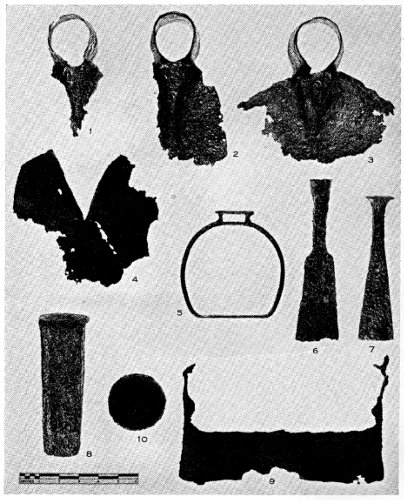
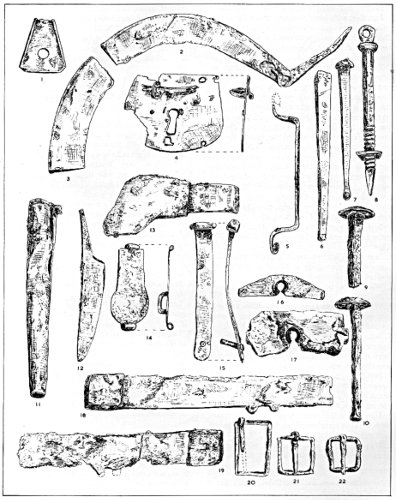
1. Eye of hoe, iron, possibly a grub hoe similar to
no. 2, in an advanced state of decay with the blade
represented only by the narrow triangular spine;
no trace of a maker's mark. C3.
2. Grub hoe, iron, the eye and part of the blade
surviving, the spine thick and narrow, no maker's
mark. The form has no published parallel either
from Jamestown or Williamsburg. An example
with similar shoulders, but with a V-shaped blade
edge, was found on the Challis pottery kiln site in
James City County in a context of about 1730.
[C.S.21F; unpublished.] E4.
3. Broad hoe, iron, with eye and part of the originally
D-shaped blade surviving; the spine
shallow, short and flat, with clearly impressed
maker's initials I H within an oval. Circular and
oval marks are common in the 17th century but
are rare in the 18th.[46] E4.
4. Hoe blade, iron, from which the eye and spine
appear to have been removed. It cannot be
ascertained whether the blade is part of a cut-down
broad hoe or whether it was always
roughly square in form. The latter shape was
well represented in a cache of agricultural tools
of uncertain date found in excavations at Green
Spring in James City County.[47] E4.
5. Stirrup, iron, rectangular footplate with its surface
hammered to increase the grip, the sides
round-sectioned but flattened towards the leather-loop
which is drawn out into ornamental ears.
The style was common in the late 17th century.
E4.
6. Forming chisel, iron, socketed for attachment to
a wooden handle, the socket and shaft square-sectioned,
the blade 2¼ inches wide and the
cutting edge improved by a welded plate of
superior metal extending 1-7/8 inches up the blade.
Found behind a wallboard at floor level. B6A.
7. Cooper's chisel, iron, the blade 1¾ inches in
width and with a groove running the length of
the 1/8-inch broad edge to grip the edge of the
hoop while hammering it into place. The shaft
is round-sectioned and spreads into a flat mushroom
head. C4.
8. Wedge, iron, of large size, rectangular head
measuring 2-3/8 inches by 1-7/8 inches, length 7-3/8
inches and weight 4 pounds. The head shows no
evidence of heavy usage and consequently there
is no clue as to why such an object should have
been thrown away. A close parallel (7¼ inches
in length) was found at Ste Marie I in Canada
on the site of the early Jesuit settlement of
1639-1649.[48] B3A.
9. Spade, iron edge from wooden blade, the upper
edge of the metal split and the extended sides
possessing small winglike projections, and nails
at the ends which together served to attach the
iron to the wood. Iron edges for wooden
spades are not included in the artifact collections
from 18th-century Williamsburg, but were plentiful
in various sizes in mid-17th-century contexts
at Mathews Manor in Warwick County. [Unpublished.]
C3.
10. Projectile, solid iron, cast in a two-piece mold,
diameter 2¾ inches, weight 3 pounds 1 ounce.
This is possibly a ball from a minion[49] whose
shot weight is given in Chambers' Cyclopaedia
(1738) as 3 pounds 4 ounces, the difference
possibly being occasioned by the Clay Bank
specimen's decayed surface. D3.
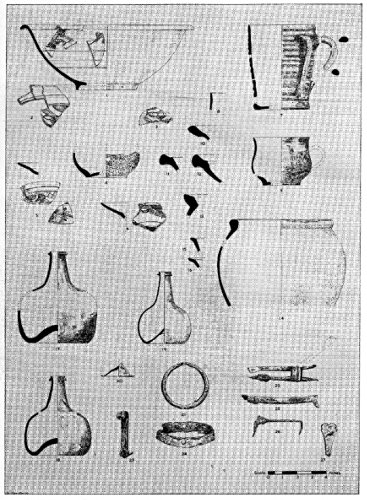
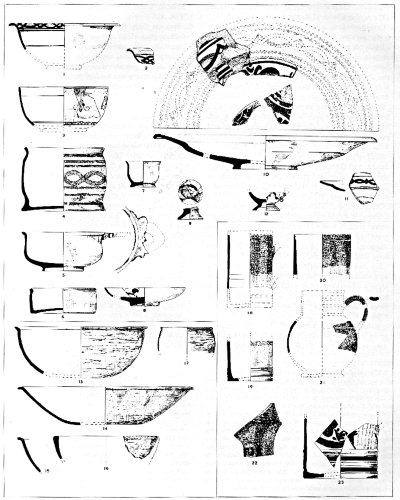
1. Basin, English delftware, reconstruction on basis
of rim, body and base fragments, about 1680-1690.
(Fig. 8, no. 4) A3, B1, B3, C3, C4, E2,
F2, H3.
2. Basin as above, lower body fragments.
3. Basin as above, base fragment.
4. Mug or jug, lower body fragment, manganese
stippled. First half of 17th century(?). (Fig. 8,
no. 3.) E4.
5. Plate, English delftware, rim and base fragments
(also section), decoration in two tones of blue, the
fronds outlined in black. London(?). About
1670-1700. A3, E3.
6. Plate, English delftware, about 1680-1690. (Fig.
8, no. 1.) E4.
8. Tyg, rim sherd only, brown lead-glazed red ware,
thinner than no. 7 and its ribbing not extending
as close to the mouth; diameter approximately
4½ inches, 17th century. B1.
9. Mug, black lead-glazed red ware, thin-walled
bulbous body; handle conjectural. The form's
closest published parallel is a red ware example
which was exhibited at the Burlington Fine Arts
Club, London, in 1914, and bore the legend
MR. THOMAS FENTON in white slip below the rim.
The piece was identified as Staffordshire, about
1670.[50] A comparable mug was found in 1964 in
excavations at Mathews Manor in Warwick
County in a context of the second quarter of the
17th century. [W.S.199; unpublished.] A3,
G3A, H3.
10. Rim sherd from large pan, red body liberally
flecked with ocher, thin lead glaze, the rim folded
and flattened on the upper edge. This fragment
is of importance in that it is almost certainly made
from the local Tidewater Virginia clay, yet the
rim technique has not been found on any of the
pottery kiln sites so far located. Date uncertain.
K11.
Figure 14.—Iron tools, stirrup, and cannon ball.
Figure 15.—Drawings of pottery, glass, and metal objects.
11. Rim sherd from pan or wide bowl, red ware with
greenish-brown lead glaze, the rim thickened and
undercut. This form, and variants on it, were
common from the mid-17th century and on
through the 18th, and they are therefore impossible
to date on stylistic grounds alone. Probably
English. C4.
12. Rim sherd from large shallow pan, red ware with
yellowish-green lead glaze; the rim thickened,
folded and undercut, the upper surface flattened
and with a pronounced ridge at its angle with the
bowl; diameter approximately 1 foot 6 inches.
Dating considerations as no. 11. Probably English.
E4.
13. Rim sherd from storage jar, red ware with brown
lead glaze, the rim thickened, folded, and flattened
on the top; diameter approximately 10½
inches. The form was common from about 1650
to 1750. Probably English. E2.
14. Storage jar or pipkin, pale-pink ware flecked with
ocher and occasional granules of quartz, a clear
lead glaze imparts an orange color to the surface,
and is locally streaked with green. The rim is
heart-shaped in section, having a groove along its
upper surface, and the body is extremely finely
potted. There is good reason to suppose that this
vessel is of Virginia manufacture, in which case the
17th-century colony possessed a potter of greater
ability than any of those whose kilns have yet been
found. Another fragment of this pot, or one
identical to it, was found to the southeast of the
existing house. C4, E4, 10, K11.
15. Rim sherd from wide bowl of Colono-Indian[51]
pottery, grey shell-tempered ware with stick-or
pebble-burnished reduced surface, the rim
everted and flattened. The ware is contemporary
with the European artifacts from the site and is
the earliest datable fragment yet recovered. A3.
16. Rim sherd from bowl of Colono-Indian pottery,
buff shell-tempered ware with stick-or pebble-burnished
oxidized surface, the rim everted,
flattened and very slightly dished. K11.
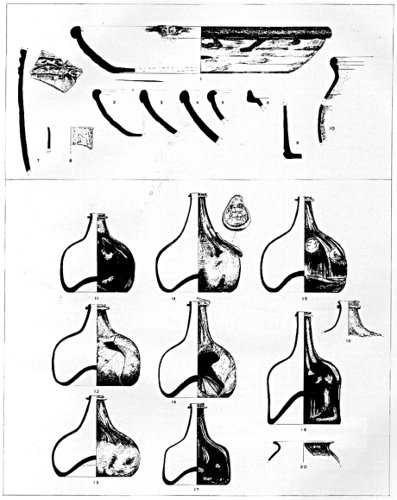
17. Wine bottle, olive-green glass in an advanced
state of decay, the neck short and broad and the
mouth slightly everted over a roughly applied
string rim, the body squat and slightly broader at
the shoulder than at the base, a domed basal
kick and no obvious pontil scar. This is a composite
drawing illustrating the shape typical of
the bottles from the Clay Bank site cellar hole.
The two fragments cannot be proved to be part
of the same bottle. About 1680-1700. Neck
A2. Body F3.
18. Wine bottle, half-bottle size, olive-green glass in
an advanced state of decay, the form similar to
the above but slightly weaker in the shoulder.
About 1680-1700. C4.
19. Bottle, in form of miniature wine bottle, the glass
a pale green similar to that used in the making of
pharmaceutical phials. (Fig. 9.) About 1680-1720.
C4.
20. Base of pharmaceutical bottle, pale-green glass
with pronounced conical kick and rough pontil
scar, the metal very thin. The principal dating
characteristics of these bottles are the shapes of
the mouths and the slope of the shoulders; in the
absence of those, no close dating is possible.[52] C4.
21. Ring, iron, round section, considerable evidence
of wear at one point on the inside edge suggesting
that this object had been attached to a link of
chain or perhaps has been held by a staple or
eye. Such rings are frequently to be found
attached to stalls in stables. B6A.
22. Race knife, the dashed outline indicating the
angle of the hinged blade in its open position.
(See fig. 12, no. 3.) E4.
23. Object of uncertain purpose, iron, slightly convex
on the upper face, flat behind, and with a small,
flat tongue projecting from the rear. A much
rusted lump adhering to the front may conceal a
similar projection or it may have simply attached
itself in the ground. C3.
24. Collar, iron, four unevenly spaced nail holes for
attachment to a wooden shaft having an approximate
diameter of 3½ inches. D6A.
25. Object of uncertain purpose, iron, rectangular-sectioned
bar narrowing to a small blade-like
ear at one end and flattened into the opposite
plain at the other, apparently for attachment.
E4.
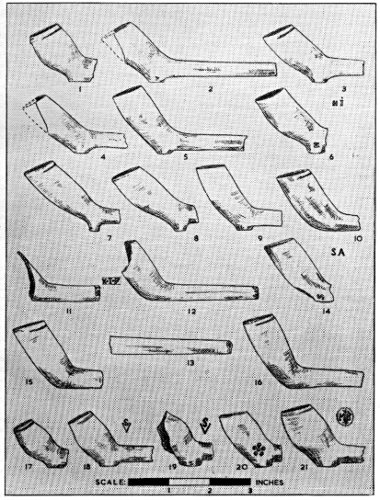
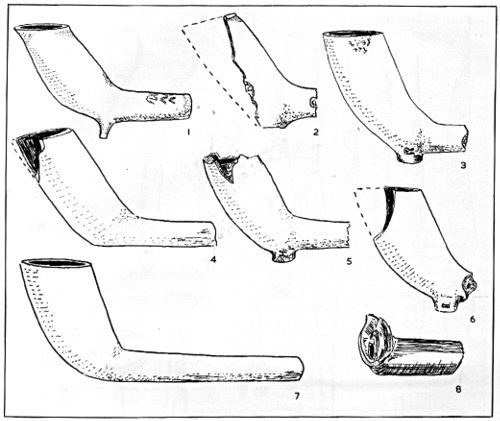
Figure 16.—Drawings of tobacco-pipe bowl shapes from Clay Bank and Aberdeen Creek.
26. Staple or light handle for a small box, the narrow
ends perhaps originally clenched and since
broken. C3.
27. Handle of spoon, pewter, a heart-shaped terminal
above two small lobes, the letter M stamped with
a well-cut die close to the edge, and a roughly
incised cross below it. A late 17th-century
terminal form. K11.
1. Tobacco-pipe bowl, clay, white surface and grey
core, the bowl heavy and bulbous, large flat heel,
rouletted line below the mouth, stem-hole diameter
7/64 inch. (See no. 19 for possible parallel.)
About 1650-1690. E7.
2. Tobacco-pipe bowl and incomplete stem, clay,
white surface and grey core, cylindrical bowl
form with shallow heel extending from the fore
edge of the bowl, initials V R on either side of
heel, stem-hole diameter 6/64 inch. About 1680-1700.
E4. Another example from B6A.
3. Tobacco-pipe bowl, clay, white surface and grey
core, form similar to No. 2, but the heel slightly
more pronounced and with rouletted line below
the mouth, stem-hole diameter 6/64 inch. About
1680-1700. A3.
4. Tobacco-pipe bowl, white clay, form similar to
no. 2, but more slender and the heel smaller,
stem-hole diameter 6/64 inch. About 1675-1700.
E7.
5. Tobacco-pipe bowl, white clay, evolved form of
no. 2, the bowl at a more pronounced angle to
the stem, stem-hole diameter 6/64 inch. About
1690-1720. A3.
6. Tobacco-pipe bowl, white clay, the bowl shape
a cross between no. 2 and the more elegant and
slender style of no. 7, pronounced and somewhat
spreading heel with maker's initials H I on
either side, stem-hole diameter 6/64 inch. About
1670-1700. A3.
7. Tobacco-pipe bowl, clay, white surface and grey
core, narrow "swan-neck" form with small heel
that is almost a spur, rouletted line below the
mouth, stem-hole diameter 7/64 inch, about
1680-1700. E4.
Another example (not illustrated) bears the
maker's initials WP (or R) on the sides of the
heel,[53] stem-hole diameter 6/64 inch. A3.
8. Tobacco-pipe bowl, white clay, form similar to
no. 7 except that the bowl is not quite as long
and the fore edge of the heel is less pronounced,
stem-hole diameter 6/64 inch, about 1680-1700.
A3.
9. Tobacco-pipe bowl, white clay, the bowl broader
and at a sharper angle to the stem than in the
preceding examples, the heel shallow and its fore
edge extending from the bowl as in nos. 2-5,
stem-hole diameter 6/64 inch, about 1690-1720.
A3. This example is significant in that it represents
the evolutionary merging of the cylindrical
and bulbous bowl forms, with their varying heels
and spurs, into a single bowl shape that persisted
through the 18th century. It should be noted that
the illustrated bowl retains the thin-walled circular
mouth common to most examples of its
period. The mouth often becomes more oval and
the walls thicker in specimens dating later into
the 18th century.
10. Tobacco-pipe bowl, white clay, more or less
cylindrical rouletted line below the mouth, and
with neither heel nor spur. The absence of
these last features is thought to have been dictated
by English pipemakers catering for the
American Indian market and initially copying
aboriginal forms. Stem-hole diameter 7/64 inch,
about 1680-1700. H3.
11. Fragment of tobacco-pipe bowl and stem, clay,
white surface and pink core to bowl, but burnt
white through stem; bowl shape apparently similar
to no. 10, stamped initials across top of stem
at the fracture, I·F flanked on either side by a
period and a cross,[54] stem-hole diameter 6/64 inch.
E4.
12. Tobacco-pipe bowl and stem fragment, white
clay, the form very similar to no. 10 but without
rouletting below the mouth. The pipe is of
interest in that the stem fracture has been pared
down after breaking to create a new mouthpiece
and a stem only approximately 2¼ inches in
length. Stem-hole diameter 7/64 inch, about
1680-1700. C4.
13. Tobacco-pipe stem fragment, white clay, broken
off at junction with bowl and pared down at the
other end as no. 12 thus creating a 3-inch stem.
Hole diameter 6/64 inch, date indeterminate. B6A.
14. Tobacco-pipe bowl, white clay, bowl shape similar
to no. 2 but without heel; maker's initials on the
base of the bowl, almost certainly SA though the
companion initial has been lost from the other
side.[55] Stem-hole diameter 6/64 inch, about
1680-1700. C4.
15. Tobacco-pipe bowl, clay, white surface and
grey core, slightly more evolved than no. 10
being more sharply angled at its junction with
the stem as well as being slightly longer and
narrower in the bowl. Note that this pipe still
possesses the rouletted line below the mouth
that tends to be characteristic of 17th-century
examples. Stem-hole diameter 5/64 inch, about
1690-1710. A3.
16. Tobacco-pipe bowl, clay, white surface and grey
core, essentially similar to no. 15, but longer in
the bowl and even more angled at its junction
with the stem. Stem-hole diameter 6/64 inch,
about 1690-1710. B3A.
(Nos. 17-21 are surface finds from an as yet unexcavated
site on farmland owned by Miss
Elizabeth Harwood, approximately a mile and a
quarter south of Clay Bank, and north of Aberdeen
Creek. They are included here as examples
of earlier 17th-century occupation in the Clay
Bank area, and because one of the stem fragments
from this site bears the same X·I·F·X mark as
appears on five examples (no. 11) from the
Jenkins site cellar hole.)
17. Tobacco-pipe bowl, white clay, flat broad heel,
the bowl somewhat bulbous in the mid section,
neat rouletted line below the mouth. Stem-hole
diameter 7/64 inch, about 1630-1670.
18. Tobacco-pipe bowl, white clay with slipped surface,
the bowl shape characteristic of the mid-17th
century, flat heel, and roughly applied
rouletted line below the mouth; maker's mark VS
stamped on upper surface of stem. Stem-hole
diameter 7/64 inch, about 1650-1690.
19. Tobacco-pipe bowl, fragment only, clay, white
surface and grey core, the bowl extremely bulbous
and with a pronounced flat heel. Maker's
mark VS stamped on the upper surface of the stem;
dies different to those used for no. 18, but undoubtedly
the same maker. This is important in
that it illustrates the wide difference in bowl
shapes produced, apparently contemporaneously,
by a single maker. Stem-hole diameter 7/64 inch,
about 1650-1690.
20. Tobacco-pipe bowl, white clay, the bowl and early
form of no. 3 ornamented on the sides with six
molded dots in high relief,[56] the heel similar to
no. 17 though slightly deeper. Stem-hole diameter
8/64 inch, about 1640-1670.
21. Tobacco-pipe bowl, white clay with slipped surface,
heavy bulbous bowl and flat heel with the
maker's mark m b on the base; a narrow rouletted
line around the bowl mouth. Stem-hole diameter
7/64 inch, about 1650-1680.
I am greatly indebted to Mr. and Mrs. William F.
Jenkins for drawing the Clay Bank site to my attention,
for permitting me to do considerable damage to their
garden in the course of its excavation, and for generously
presenting the illustrated artifacts to the Smithsonian
Institution. I also owe much to their daughter Mrs.
William DeHardit for valuable historical information
as well as for her constant and vigorous assistance with
the actual digging. I am equally grateful to my wife,
Audrey Noël Hume, and to Mr. John Dunton of Colonial
Williamsburg for their part in the excavation, also to
Mr. A. E. Kendrew, senior vice president of Colonial
Williamsburg, and Mr. E. M. Frank, its resident
architect, for their comments on both the chimney
foundation and on the age of the existing house. I am
also indebted to Mrs. Carl Dolmetsch of Colonial
Williamsburg's research department for her pursuit of
cartographic evidence.
In addition I wish to express my thanks to Mr. R. J.
Charleston, keeper of ceramics and glass, Victoria and
Albert Museum, London, for examining and commenting
on the glass, and to Mr. W. D. Geiger, director
of craft shops, Colonial Williamsburg, for similar assistance
in identifying the tools.
Finally, I am indebted to Miss Elizabeth Harwood of
Aberdeen Creek for permission to illustrate examples of
tobacco pipes found on her land, and to Colonial
Williamsburg for subsidizing the preparation of this
report.
May 1965
I. N. H.
U.S. Government Printing Office: 1966
For sale by the Superintendent of Documents, U.S. Government Printing Office, Washington, D.C., 20402—
Price 30 cents
[1]Ivor Noël Hume, "Excavations at Rosewell, Gloucester
County, Virginia 1957-1959" (paper 18 in Contributions from
the Museum of History and Technology: Papers 12-18, U.S. National
Museum Bulletin 225, by various authors; Washington: Smithsonian
Institution, 1963), pp. 153-228. Hereafter cited as
Rosewell.
[2]Dr. & Mrs. William Carter Stubbs, Descendants of Mordecai
Cooke and Thomas Booth (New Orleans, 1923), p. 14
(footnote).
[3]Vestry Book of Petsworth Parish, Gloucester County, Virginia
1677-1793, annotated by C. G. Chamberlayne, The Library
Board (Richmond, 1933), p. 97. Hereafter cited as Vestry Book.
[4]Records of Colonial Gloucester County Virginia, compiled by
Polly Cary Mason (Newport News, 1946), vol. 1, p. 86. The
Gloucester rent roll of 1704 showed Robert Porteus owning 892
acres and Madam Porteus (presumably his widowed mother)
with 500 acres. The latter may have been situated elsewhere
in the parish and have been property inherited by her at the
death of her first husband, Robert Lee.
[6]Vestry Book, October 6, 1725, pp. 186-187. "Petso Parish
Detter this Year in Tobacco ... To Robert Portuse Esqr
for Keeping Two barsterd Children vizt John & Watkinson
Marvil 01333 ½."
[7]William & Mary Quarterly (1896), ser. 1, no. 5, p. 279.
"Oldmixon says that Bacon died at Dr. Green's in Gloucester,
and Hening describes this place in 1722 as 'then in the tenure of
Robert Porteus Esq.'" But as Robert Porteus purchased additional
land in 1704, Dr. Green's home site may not have been
the same as that of Edward Porteus.
[8]Vestry Book, p. 85. The kitchen measurements are absent.
[9]Vestry Book, pp. 74-75. At a previous vestry meeting on
28th June, 170[2?] details of the proposed glebe house were
given as follows: "Six & thirty foot Long & twenty foot wide
with two Outside Chemneys two 8 foot Square Clossetts planckt
above & below, with two Chambers above Staires and ye Staires
to Goe up in ye midst of ye house with 3 Large Glass windows
Below Stair [] Each to have 3 Double Lights in ym with a Glass
window in Each Chamber above Staires Each to have 3 Lights
in ym & Each Clossett to have a window in it and Each window
to have 3 Lights." There is no evidence that these specifications
were derived from Robert Porteus' house.
[10]Vestry Book, p. 273. May 28, 1746: "Ordered this Present
Vestry, have thought it Better to Build a New Glebe house rather
then to Repair the old one...." Then follow specifications
for the new building.
[11]Robert Hodgson, The Life of the Right Reverend Beilby
Porteus D.D. (London, 1823) pp. 3-4. Hodgson describes
Newbottle in the following terms: "It consisted chiefly of plantations
of tobacco; and on one of these, called Newbottle (from
a village of that name near Edinburgh, once belonging to his
family, but now in the possession of the Marquis of Lothian),
he usually resided. The house stood upon a rising ground,
with a gradual descent to York river, which was there at least
two miles over: and here he enjoyed within himself every comfort
and convenience that a man of moderate wishes could
desire; living without the burthen of taxes, and possessing, under
the powerful protection of this kingdom, peace, plenty, and
security."
[12] A request for information was published in the English magazine
Country Life (May 24, 1962), vol. 131, no. 3403, p. 1251.
This yielded a reply from the Reverend W. B. Porteus of
Garstang Vicarage, Mr. Preston, Lancashire. He noted that
Bishop Beilby Porteus was buried at Sundridge in Kent and
that prior to the Second World War family connections of the
Bishop's wife named Polhill-Drabble still lived in that village
and were deeply interested in their lineage. The Rev. Porteus
feared that Mr. and Mrs. Polhill-Drabble were now dead, and
as I have been unable to trace them, I assume that this is the
case.
[13] Seven courses surviving, top at 2 ft. 2 in. below modern
grade. Shell mortar. Specimen bricks: 9 in. by 4-1/8 in. by 2-7/8
in. (salmon) and 7½ in. by 4¼ in. by 2 in. (dark red).
[14] A late 17th-or very early 18th-century house at Tutter's
Neck in James City County, measuring 42 ft. 3 in. by 19 ft. 1
in., possessed a chimney at either end with dimensions of 9 ft.
11 in. by 4 ft. 11 in. and 9 ft. 9 in. by 5 ft. The jambs varied
in thickness from 1 ft. 6 in. to 1 ft. 11 in. See footnote 22.
[15]Albert C. Manucy, "The Fort at Frederica," Notes in
Anthropology (Tallahassee: Florida State University, 1962), vol.
5, pp. 51-53. An excavated powder magazine of 1736 exhibited
similar construction.
[18] The undercutting is shown on the plan (fig. 3, area H) as a
straight-edged unit. This has been done for the sake of neatness,
but it should be noted that there was actually a series of
holes that presented an extremely ragged appearance.
[19] An unusual lead-glazed earthenware rim sherd from a jar
was probably from the same pot as other fragments (fig. 15,
no. 14) found in the cellar hole.
[20]Vestry Book, p. 56. "Necholas Lewis" indentured to "Henry
Morris of Straten Major in ye County of King and Quine ...
to Learn ye said orphant ye art of Coopery."
[22] Thomas Jones was the younger brother of Frederick Jones,
whose James City County home site at Tutter's Neck was excavated
in 1961. See Ivor Noël Hume, "Excavations at
Tutter's Neck in James City County, Virginia, 1960-1961"
(paper 53 in Contributions from the Museum of History and Technology;
U.S. National Museum Bulletin 249; Washington: Smithsonian
Institution), 1965, fig. 20, no. 8. Hereafter cited as Tutter's
Neck. A fragment of a lead-glass gadrooned Romer of the same
period as the Clay Bank stem was found on the Tutter's Neck
site.
[23]Mary Stephenson, "Cocke-Jones Lots, Block 31" (MS.,
Research Dept., Colonial Williamsburg, Virginia, 1961), p. 6.
[24]Tutter's Neck, fig. 17, no. 17; also I. Noël Hume, "Some
English Glass from Colonial Virginia," Antiques (July 1963),
vol. 84, no. 1, p. 69, figs. 4 and 5.
[25]Ivor Noël Hume, Here Lies Virginia (New York: Knopf,
1963), fig. 105.
[26]J. C. Harrington, "Dating Stem Fragments of Seventeenth
and Eighteenth Century Clay Tobacco Pipes," Archeological
Society of Virginia, Quarterly Bulletin (September 1954),
vol. 9, no. 1.
[27] Mathematical formula based on Harrington's chart, prepared
by Lewis H. Binford, University of Chicago. See Lewis
H. Binford, "A New Method of Calculating Dates from
Kaolin Pipe Stem Samples," Southeastern Archaeological Newsletter
(June 1962), vol. 9, no. 1, pp. 19-21.
[28]Audrey Noël Hume, "Clay Tobacco-Pipe Dating in the
Light of Recent Excavations," Archeological Society of Virginia,
Quarterly Bulletin (December 1963), pp. 22-25.
[29]Adrian Oswald, "The Archaeology and Economic History
of English Clay Tobacco Pipes," Journal of the Archaeological
Association (London, 1960), ser. 3, vol. 23, pp. 40-102.
[30]Adrian Oswald, "A Case of Transatlantic Deduction,"
Antiques (July 1959), pp. 59-61.
[31]W. J. Pountney, Old Bristol Potteries (Bristol, 1920), pl. 3
(lower left), and p. 37.
[32]F. H. Garner, English Delftware (London, 1948), pl. 26B.
[33] For a posset pot with these handle characteristics attributed
to Brislington, 1706-1734, see W. M. Wright, Catalogue of
Bristol and West of England Delft Collection, (Bath: Victoria Art
Gallery, 1929), pl. 3.
[34] For shape parallel (but not body) see Tutter's Neck, fig. 18,
no. 21.
[35]Barnard Rackham, Mediaeval English Pottery (London:
1948), pl. 94. Barnard Rackham, Catalogue of the Glaisher
Collection of Pottery and Porcelain (Cambridge, 1935), no. 20,
pl. 3A.
Griselda Lewis, A Picture Book of English Pottery (London,
1956), fig. 23.
[36]J. C. Harrington, "Tobacco Pipes from Jamestown,"
Archeological Society of Virginia, Quarterly Bulletin (Richmond:
June 1951), fig. 4.
[37] I am indebted to Dr. B. C. McCary of the Archeological
Society of Virginia for the identification of the prehistoric
Indian artifacts. Clifford Evans, "A Ceramic Study of
Virginia Archeology," (Bureau of American Ethnology Bulletin
160; Washington: Smithsonian Institution, 1955), p. 69.
[38]W. A. Thorpe, A History of English and Irish Glass (London,
1929), vol. 2, pl. 29 and 31, no. 2.
[40]Henry C. Mercer, "Ancient Carpenters' Tools," Bucks
County Historical Society (Doylestown, Pa., 1951), p. 51 and
fig. 49. John L. Cotter, "Archeological Excavations at
Jamestown, Virginia," U.S. National Park Service Archeological
Research Series, no. 4 (Washington, 1958), p. 174, pl. 72 top.
[44] Two larger examples were found in a cache of metal objects
deposited in about 1730 and found on the Challis pottery kiln
site in James City County. Two more were encountered in
excavations on the Hugh Orr house and blacksmith shop site
on Duke of Gloucester Street in Williamsburg where they
apparently dated from the mid-18th century.
[45]Carl Gustkey, "Sir Francis Wyatt's Horse," The National
Horseman (April 1953), [no pagination] fig. 2.
[46] The majority of marked 18th-century hoes excavated in
Virginia exhibit rectangular stamps, while postcolonial marks
tend to be stamped on the blades rather than the raised spines
and without any die edge being impressed.
[47]Louis R. Caywood, "Green Spring Plantation," Archeological
Report, Virginia 350th Anniversary Commission (Yorktown:
United States National Park Service, 1955), pl. 9
(bottom).
[48]Kenneth E. Kidd, The Excavation of Ste Marie I (Toronto:
University of Toronto Press, 1949), p. 108 and pl. 24b.
[49] See p. 12 for a consideration of the ball's possible
significance.
[50]Catalogue of Exhibition of Early English Earthenware, Burlington
Fine Arts Club (London, 1914), p. 29 and fig. 41.
[51]Ivor Noël Hume, "An Indian Ware of the Colonial
Period," Archeological Society of Virginia, Quarterly Bulletin (September
1962), vol. 17, no. 1, p. 5.
[52]Ivor Noël Hume, "A Century of London Glass Bottles,
1580-1680," The Connoisseur Year Book (London, 1956), p. 102,
fig. 14 right.
[53] A William Partridge was named in the Bristol Freedom
Roll for 1689, cf. Oswald, op. cit. (footnote 30), p. 88.
[54]Ibid., p. 70. Perhaps Jacob Fox, Bristol Freedom Roll for
1688, or John Fletcher, Chester Freedom Roll 1673, or Josiah
Fox of Newcastle-under-Lyme who was working in 1684. Other
examples with this mark occur in groups A3 and A4, also on
the Harwood property (surface find) close to the north bank of
Aberdeen (Clay Bank) Creek. See p. 14. A single unstratified
example has been found in Williamsburg, coming from disturbed
topsoil behind Capt. Orr's Dwelling on Duke of
Gloucester Street.
[55] Oswald lists no maker with these initials in the appropriate
period. However, a bowl impressed on the back with the
initials S A over the date 1683 was found in the river Thames
at Queenhithe (London) and is in the author's collection. See
also D. R. Atkinson, "Makers' Marks on Clay Tobacco Pipes
Found in London," Archaeological News Letter (London, April
1962), vol. 7, no. 8, p. 184; no. 24; and fig. 2, no. 24. See also
Rosewell, p. 221 (footnote 96).
[56] A pipe with similar ornament is in the author's collection of
examples from the river Thames at London.
Figure 1.—Top: Hypothetical elevations based on foundations discovered
on Tutter's Neck site. Bottom: Conjectural reconstruction based on elevations
of the Tutter's Neck site, about 1740. Elevations by E. M. Frank,
director of architecture, Colonial Williamsburg; conjectural drawings by
R. Stinely.
Excavations at TUTTER'S NECK in James City County, Virginia, 1960-1961 — Location of the Site — History of the Site — The Excavation — The Residence — The Kitchen — The Refuse Pits — Animal Remains — The Artifacts — Conclusions — Illustrations — FIGURE 14. TOBACCO-PIPE PROFILES — FIGURE 15. CUTLERY AND OTHER SMALL FINDS — FIGURE 16. BUILDERS HARDWARE AND OTHER METAL ITEMS — FIGURE 17. OBJECTS OF IRON, BRASS, BONE, AND GLASS — FIGURE 18 — FIGURE 19 — FIGURE 20. MISCELLANEOUS SMALL FINDS — FOOTNOTES:
Land clearance for reforestation of property leased from Williamsburg
Restoration, Inc., resulted in the exposure of numerous fragments
of early 18th-century pottery and glass. Partial excavation of
the site, known as Tutter's Neck, revealed foundations of a small
colonial dwelling and outbuilding, both of which had ceased to exist
by about 1750.
This paper describes and analyzes the artifacts recovered from
refuse pits on the site. These artifacts, which have been given to
the Smithsonian Institution, are closely dated by context and are
valuable in the general study of domestic life in early 18th-century
Virginia.
The Author: Ivor Noël Hume is director of the department of
archeology at Colonial Williamsburg and an honorary research
associate of the Smithsonian Institution.
In the summer of 1959 the Chesapeake Corporation
undertook land-clearance operations prior to
reforestation on property leased from Williamsburg
Restoration, Inc., lying to the east of College Creek,
which runs into the James River below Jamestown
Island (see fig. 2). In the course of this work the
foundations of a small and hitherto unrecorded
colonial residence were bulldozed and largely
destroyed. In the spring of 1960, Mr. Alden Eaton,
director of landscape construction and maintenance
for Colonial Williamsburg, while walking over the
razed area, picked up numerous fragments of early
18th-century pottery and glass which he later brought
to the writer for identification. As the result of this
find a survey of the site was undertaken, and two
colonial foundations were located and partially
excavated.[57]
The area available for study was limited by the
need to cause as little disturbance as possible to the
newly planted seedlings, by a shortage of time and
labor, and by the remarkable speed with which the
ground became overgrown with locust trees and
infested by mayflies and mosquitoes. The location
of the excavation area, nearly a mile from the nearest
road, and off a track pitted with mud-filled depressions,
made access impossible during most of the
winter months; consequently, work was possible
only in the spring and fall of 1960. By the summer
of 1961 both the approach and the site itself had
become completely overgrown.
Regardless of these limitations it was possible to
obtain full details of the surviving remains of both
the dwelling and its associated kitchen, as well as
recovering a number of informative groups of domestic
artifacts from trash pits under and around the latter
structure. Fortunately, the presence of seal-adorned
wine bottles in two pits provided data that led to the
identification of one of the owners of the property,
and thence to a reconstruction of the history of the
site in general.
It should be noted that whereas the colonial artifacts
that have been excavated from Marlborough
and Rosewell provide a useful range of household
items of the middle and third quarters of the 18th
century, respectively, the Tutter's Neck material
belongs only to the first 40 years of that century, with
the emphasis largely upon the first decade. This
last is a phase of Tidewater archeology about which
little is known, falling as it does after the end of the
Jamestown era and at the beginning of the Williamsburg
period. Although, of course, Williamsburg was
already being built at the turn of the century, so
intensive was the occupation in the following 75
years that few archeological deposits of the city's
early days have remained undisturbed. The fact
that the Tutter's Neck site was abandoned before
1750, and never again occupied, consequently
enhances its archeological importance.
The site lies on a steeply sloping promontory at
the junction of Kingsmill and Tutter's Neck Creeks,
which flow as Halfway Creek into College Creek
approximately 1,050 yards to the west. The house
stood on the crown of the slope facing west, some 260
yards from the junction of the creeks, and thus
possessed a commanding position. Perhaps, at that
time, there was a clear view of all vessels passing
up College Creek—the main waterway to Williamsburg
from the James River. As the crow flew, the
house stood approximately three miles from
Williamsburg, but by road the route was close to
four miles to the eastern edge of the town.
While the largest ships generally unloaded their
cargoes at landings on the James, the smaller vessels
would often carry their cargoes up College Creek
to College Landing, about a mile and a quarter from
Williamsburg. It seems reasonable to suppose that
Halfway Creek was also navigable for these vessels
on the high tide. In view of the fact that the curve
of the creek's main stream today touches the southern
edge of Tutter's Neck, it is likely that a landing
existed there in the 18th century. However, no
traces of such a landing are now visible.
There was no known record of the existence of
the houses when the Chesapeake Corporation stripped
the site in 1959. The only colonial map of the area,
the so-called Desandrouin map of 1781 (fig. 4),
shows the neck covered by thick woodland, but
indicates two or more buildings some distance to the
east. These sites also lay within the bulldozed
area, but, paradoxically, no traces of these have
been found. Comparison of the Desandrouin map
with the aerial photograph (fig. 3) will show that
a small, marsh-flanked stream flowed across the back
of the Neck in the 18th century and emptied into
Kingsmill Creek. This stream has since silted up
and has cut a new channel that causes it to open into
Tutter's Neck Creek to the north of the house site.
Figure 2.—The Tutter's Neck site in relation to College Creek and the James River.
Figure 3.—Aerial photograph of Tutter's Neck taken soon after bulldozing and before the
Jones site (arrow) was found. Photo courtesy City of Williamsburg.
The Desandrouin map suggests that the buildings
on Tutter's Neck had ceased to exist by 1781, and
this conjecture is supported by the artifacts from the
site, none of which date later than mid-century.
Considerable difficulty in establishing the lifespan of
the house and outbuilding has resulted in part from
the fact that any evidence for a terminus ante quem
had been stripped away by the bulldozing and in
part from the absence of any maps that identify this
promontory as Tutter's Neck. Indeed the entire
premise is built upon the discovery of wine-bottle
seals in one refuse pit beneath the kitchen chimney
and in another approximately 125 feet southeast of
the house. These seals, bearing the initials "F I,"
were identified as having belonged to Frederick Jones,
who later became Chief Justice of North Carolina.
The identification was arrived at on the evidence of
the will of David Bray, of James City County, that
was contested in 1732. In the legal action, reference
was made to "... one messuage,[58] plantation, piece
or parcel of land," known as Tutties Neck, or "three
hundred acres, more or less, lying and being in the
parish of Bruton." This land was stated to have been
purchased by Bray's mother, Judith Bray, from
Frederick Jones; it then was obtained by John
Randolph and passed by him in exchange to Thomas
Bray.[59]
Figure 4.—Detail of Colonel Desandrouin's map of 1781. Arrow indicates Jones site.
Thus we know that Frederick Jones had owned a
300-acre tract known as Tutties Neck. Consequently,
the discovery of bottle seals bearing the initials
"F I" in the vicinity of a "messuage" at the mouth
of Tutter's Neck Creek was not without significance.
Further corroboration was provided by a letter of
1721 from Frederick Jones to his brother Thomas, in
Williamsburg, regarding the incorrect marking of
merchandise on the former's account "marked by
mistake F I."[60] It was common practice for plantation
owners to use the same shipping marks that they
used for their wine-bottle seals, and therefore it may
be assumed that Jones also owned bottles bearing
the initials "F I."
Having established with reasonable certainty that
the site in question was the "Tutties Neck" that had
been purchased by Judith Bray from Frederick Jones,
the next step was to attempt to piece together the
history of the site both before and after that transaction.
Unfortunately, during the Civil War the
James City County records were removed for safekeeping
to Richmond where they were destroyed. This
loss makes any research into the early documentary
history of the county extremely difficult, and in many
cases well nigh impossible. Source material must
be drawn from family papers and from passing references
in the records of other counties. Although the
history of Tutter's Neck has many significant facts
missing, it is surprising that the record is as full as it is.
The first reference occurs in 1632 (or 1642) when
mention is made of "great neck at the barren neck,
next adjoining to Tutties neck, a branch of Archers
hope creek."[61] Similar references to "Tutteys"
neck and "lutteyes" neck occurred in 1637[62] and in
1646.[63] Later, in 1679, a deed of sale from Edward
Gray to William South of Gloucester County refers
to a parcel of land at "Tuttis Neck."[64] The same
spelling was used in 1682 in the will of Otho Thorpe,
of the Parish of All Hallows at the Wall in London,
who left to his cousin John Grice and Grice's two
elder children his plantation in Virginia called
"Tuttis Neck."[65] John Grice is recorded as having
been a justice in James City County in 1685 and
1694.[66]
No further references to Tutter's Neck are to be
found until 1711 when Frederick Jones obtained 100
acres commonly called "Lutties neck,"[67] escheated
land,[68] from one Mathew Brown. It is at this point
that we run into trouble, for the contents of the pits
in which the Jones bottles were found included many
items of the late 17th century and none dating
later than the first decade of the 18th century. The
pit beneath the kitchen chimney also contained a
bottle bearing the seal of Richard Burbydge and
dated 1701.[69] The inference, therefore, was that
Frederick Jones was on the site during the first
years of the 18th century. Jones came from England
in 1702,[70] having inherited considerable estates from
his father, Capt. Roger Jones. In 1704 he is shown
in the Virginia Quit Rent Rolls as possessing 300
acres in James City County, 500 acres in New
Kent County, and 2,850 acres in King William
County.[71] Were it not for the purchase of 1711, it
would be reasonable to assume that the 300 acres
in James City County were the same that Jones sold
to Judith Bray at some unspecified date prior to
1722, the year of his death.
Figure 5.—Plan of excavated features.
We know that as early as 1703 Frederick Jones had
interests in North Carolina, because it was in that
year that one Jeremiah Goodridg brought suit against
him and he was then described as "late of London."[72]
In 1707 Jones received a grant of 4,565 acres in what
are now Jones and Craven Counties in North Carolina.[73]
At that time he was living in or near Williamsburg—presumably
on his 300 acres in James
City County; in 1705 he was a vestryman of the
Parish of Bruton with its church in Williamsburg,[74]
and in the same year both he and David Bray were
listed as being among the directors for the building of
Williamsburg.[75] It would seem that he was a man
of consequence in the county at that time.
Among the papers of the Jones family are indentures
dated 1708 transferring property in both King
William and New Kent Counties from Frederick to
his brother Thomas Jones,[76] and it may well be construed
that this transfer occurred at the time that
Frederick moved to North Carolina. In the same
year his plantation in Chowan Precinct, North
Carolina, described as "land whereon the church now
stands" was chosen as the site for a glebe.[77] This is
presumably the same Chowan County plantation on
which Jones died in 1722.
Figure 6.—Frederick Jones' wine-bottle seals showing matrix variations: 1, initials from
single matrix, with right side of "[*struck-through I*
" poorly formed (same die as fig. 7, left); 2, initials
from separate matrices, with large serifs on "F" and small serifs on "I"; 3-5, initials from
separate matrices, with small serifs on both letters; 6, 7, initials from separate matrices,
with heavy serifs on both letters. Seal 5 came from Pit A; all others from Pit B. The
use of single-letter matrices suggests a 17th-century date for the bottles' manufacture,
while the presence of various die combinations makes it probable that the bottles were
not all made at the same time. It is likely that the bottles were among Jones' possessions
when he emigrated to Virginia in 1702.]
In 1711 Frederick Jones and others residing in
North Carolina appealed to Governor Spotswood of
Virginia for help against the Indians.[78] In the same
year his name again occurs on an address to Spotswood
concerning Colonel Cary's rebellion.[79] Almost a
year to the day later, he is recorded as applying at a
council meeting for the return of salt carried from
his house ostensibly for "Supporting ye Garrisons."[80]
In July 1712 Jones acquired an additional 490 acres
in North Carolina.[81] All of this evidence points to
his being well settled in his new home by 1712.
Figure 7.—Wine bottles of Frederick Jones and Richard Burbydge, from Pit B. For scale see figure 19.
The colony of North Carolina developed more slowly
than did Virginia. The first permanent English
settlement in North Carolina was on the Chowan
River in about 1653, with the population being
drawn from Virginia. In 1663 the settled area north
of Albemarle Sound became Albemarle County, when
Charles II granted the territory to eight proprietors,
in whose families it remained until an act of Parliament
in 1729 established an agreement with seven of
them (the eighth refused to sell) and thus turned the
territory into a royal colony. Consequently, when
Jones moved south, North Carolina was still in its
infancy, a haven for piracy and beset by private feuds
and troublesome Indians. In the years 1711-1712
occurred an Indian uprising of proportions comparable
to those that had threatened the life of the
Virginia Colony 90 years before.[82] It was this massacre
of 1712 and its effect on the Jones family that
occasioned the foregoing apparent digression into the
early history of North Carolina.
The war with the Tuscarora Indians had begun in
1711 at about the time that Jones and his neighbors
had appealed to Virginia for aid, and it was not to
end until 1713 when the greater part of the defeated
tribe moved north to New York to become the sixth
part of the Iroquois Confederation. In October 1712
Jones' plantation was attacked; but in a letter from
the president of the council, Pollock, to the Governor
of South Carolina, it was stated that the attackers
were "... beat off, none killed of our people."[83]
Although there was no loss of life, it would appear
that the effect on Jones' plantation was considerable.
In the Journal of the House of Burgesses at Williamsburg
it was recorded that on November 5, 1712,
"Frederick Jones, who some years ago removed two
slaves out of this colony into North Carolina, his
plantation having been totally ruined by the hostilities
there; asks permission to bring his said negroes
back again without paying duty."[84] Although the
petition was granted, there is no indication that Jones
did, in fact, return. The important phrase in this
notice of petition is the "who some years ago," for it
seems probable that this refers to the time when Jones
left James City County to settle in North Carolina.
Working on the assumption that "some years ago"
would be unlikely to refer to a period of time short of
three or four years, it can be construed that the date
of removal fell in 1708 or 1709 at the latest.
However the evidence is interpreted, it still remains
curious that Jones should have purchased the 100 acres
of "Lutties Neck" in 1711 and that he should sell a
300-acre tract known as "Tutties Neck" to Judith
Bray, when in fact he appears to have possessed a total
of 400 acres in James City County, only one of which
is known to bear a name resembling Tutter's or
Tutties' Neck. The only reasonable construction
must be that Mathew Brown's escheated acres adjoined
300 acres that already constituted Tutter's
Neck. But even then there remains the problem of
why only "by estimation, three hundred acres, more
or less"[85] were sold to Mrs. Bray. No evidence has
been found to show what became of the remaining
100 acres, and the only Virginia property mentioned
in Frederick Jones' will of April 9, 1722, was described
as "lying in King William County in Virginia, commonly
called Horns Quarter."[86]
It is unfortunate that the direst gap in the documentary
evidence spans much the same period as does
the archeological data. However, the genealogy of
the Bray family is of some assistance, providing clues
even if it cannot offer direct answers. When Thomas
Bray died on August 2, 1751, he was described as
"Col. Thomas Bray, of 'Little Town,' next to 'Kingsmill,'
on James River."[87] That property, lying to the
east of the Kingsmill tract, can be traced back as far
as 1636, and it is known to have been owned by the
Pettus family in the latter part of the 17th century.[88]
In about 1697 James Bray, son of James Bray, Sr., of
Middle Plantation (later Williamsburg) married
Mourning, widow of Thomas Pettus, Jr., and so
acquired the "Little Town," or "Littletown," tract.[89]
This James Bray had three children, of whom Thomas
was the eldest and thus became heir to his father's
estate.
James Bray, Jr., had two brothers (as well as a
sister). The eldest son, Thomas, died intestate.
David, the youngest of the three, married Judith
(b. 1679, d. Oct. 26, 1720), by whom he had one son,
David, Jr.,[90] who married Elizabeth Page (b. 1702,
d. 1734) and had no heir. The previously discussed
transaction of 1732 following the death of David
Bray, Jr., whereby Thomas Bray obtained the
"Tuttie's Neck" acres that had been purchased at an
unspecified date by Judith Bray,[91] would suggest that
Frederick Jones retained the title until 1717. This
may be deduced on the grounds that Mrs. Bray would
have been unlikely to have purchased land while her
husband, David Bray, Sr., was still alive. Thus Jones
would seem to have sold Tutter's Neck between 1717
and 1720 when Judith Bray died.
Thomas Bray, as stated above, lived at Littletown,
and there is no likelihood that he ever resided at
Tutter's Neck. He married Elizabeth Meriwether
and by her had one child, a daughter named Elizabeth
who married Col. Philip Johnson.[92] The
daughter died in 1765, and when her husband followed
her in 1769 "six hundred acres, with the appurtenances,
called and known by the name of Tutty's
neck" were offered at auction.[93] It was presumably
at this time that the Tutter's Neck land was added to
the neighboring Kingsmill plantation of Lewis
Burwell. William Allen, of Surry County, purchased
Littletown in 1796, and in 1801 he added Kingsmill to
his holdings along, one supposes, with Tutter's Neck;
for in the inventory made at Allen's death in 1832 the
latter property was listed as comprising 923 acres and
valued at $2,330.00.[94]
As the archeological site under consideration was
not occupied beyond the colonial period, there is no
need to pursue its history through the 19th century.
It is enough to note that Tutter's Neck is included in
parcel no. 4 of the Kingsmill Tract now owned by
Williamsburg Restoration, Inc. Part of this parcel is
leased to the Chesapeake Corporation through whose
courtesy excavation was made possible.
Captain Roger Jones and
Frederick Jones
The discovery of the Tutter's Neck site and its
artifacts associated with Frederick Jones arouses
interest in the man himself and his place in colonial
America. While those facets of his career directly
relating to Tutter's Neck have been outlined above, a
few additional facts may serve to round out our
picture of the man.
In 1680 Capt. Roger Jones of London came to
Virginia with Lord Culpeper and was given the task
of suppressing piracy in Chesapeake Bay. His efforts
in this direction resulted in considerable personal
gain and he was able to amass extensive Virginia
property. Eventually Roger Jones' activities caused
so many complaints that he relinquished his office and
returned to London. In 1692 a letter of petition
from the Council of Virginia to the Earl of Nottingham,
King William's principal Secretary of State,
complained bitterly about the ravages by pirates
to ships carrying supplies to the colony and in particular
about the conduct of Roger Jones. This petition,
signed by Francis Nicholson and others of the Council,
contained the following enlightening passage:
".... Capt Roger Jones, some time an Inhabitant of this
Country, but at present residing in London. A man that,
from noething, pretends in a few years to have gained a
great Estate, & since he has declared his disaffection to yr
Maty before his leaveing this Country, by refuseing to serve
in any office, or take the usuall Oaths wee pray yor Lordshps
leave to give you his true caracter. He came into this
Country a souldier under the L Culpeper; was by his
Ldsp made Captaine of a small sloope wh was to have been
furnished with twelve men, & was ordered to cruise in our
great Bay, to look out for & seize all unlawfull Tradrs,
&c. But ye Captaine having learnt to cheate ye King very
early, never had above 8 men, altho he constantly received
pay for 12 men, for wh ye Lord Culpeper endeavoured to
call him to Acct., as well as for his adviseing, trading with
& sheltering severall Pyrates & unlawfull Traders, instead
of doeing his duty in seizing them. By which means ye sd.
Jones laid ye foundation of his p'sent great Estate, as he
gives out he is master of."[95]
In 1701 Roger Jones died in Stepney, London, and
was buried at Mansfield, Nottinghamshire, the home
of his wife Dorothy (née Walker) by whom he had
two sons. The elder son, Frederick, inherited the
larger share of the estate,[96] and both he and his
brother Thomas arrived in Virginia in 1702. Thomas
remained in the colony throughout his life, but, as
already shown, Frederick decided that North Carolina
was more to his liking. In about 1708 Frederick
disposed of most of his Virginia holdings and moved
south, taking with him at least two Negro slaves and
his wife Jane, whom he had married while in
Williamsburg.[97]
There is no doubt that Frederick Jones prospered
in North Carolina, and in 1717 he was appointed
Chief Justice for the colony,[98] replacing the previous
Secretary and Chief Justice, Tobias Knight, who had
resigned in disgrace. The latter had made the
mistake of being too open an accomplice of Edward
"Blackbeard" Teach, the pirate. There is reason to
suppose that even if Governor Eden did not personally
profit from Teach's activities, he was fully aware
that the pirate made his winter quarters in a North
Carolina inlet. Teach was not finally cornered until
November 22, 1718, in the famous exploit of Lieutenant
Maynard off Ocracoke Inlet.[99] Jones had by
then been in office for at least a year and he was
doubtless aware of the Governor's sympathies.
Indeed, with his own father's example to guide him,
Jones was clearly an excellent choice for Chief
Justice if leniency towards piracy was a prerequisite
for the job. Although there is no evidence that
Jones profited from Blackbeard's operations, the
records show that he was quite prepared to turn the
trust of his office to his own advantage. In the end
it was a comparatively small manipulation that
proved his undoing.
In 1721 one Daniel Mack Daniel murdered, by
drowning, a certain Ebanezar Taylor and carried off
his goods and money to a total of £290.0.0d. When
Mack Daniel was apprehended the money was passed
for safekeeping to Frederick Jones, who apparently
pocketed it. On April 4, 1722, the following entry
appeared in the Colonial Records of North Carolina:[100]
It's the Opinion of this Board that the money lodged in
the said Collo ffredk Jones hands late Cheif Justice for the
appearance of Robert Atkins and Daniel Mackdaniel at
the Genl Court ought to have been deliverd to the present
Cheif Justice with the Genl Court Papers & Records.
Orderd that the said Collo ffredrick Jones late Cheif
Justice doe immediately pay to Christopher Gale Cheif
Justice or his Order whatever moneys he has in his hands
lodged as aforesaid ... in case of failure hereof the Attorney
Genl is hereby Orderd to take proper measures for the
recovery thereof.
At the session of July 31 to August 4, 1722, Jones
was due to appear to answer the charge that he had
failed to relinquish the money. But when the session
opened, it was reported that Colonel Jones was
dead.[101] He had made his will only five days after
the initial order of April 4 had been issued.[102]
Frederick Jones was in many respects a worthy and
upright member of the North Carolina Council, or
so one would gather from the opinion of Hugh Jones
(no relation), who wrote: "Col. Frederick Jones, one
of the Council, and in a good post, and of a good
estate in North Carolina, before his death applied to
me, desiring me to communicate the deplorable state
of their Church to the late Bishop of London."[103]
Frederick Jones presumably thought no better of the
state of education in the colony, for we know that in
the period 1719-1721 two of his sons were at school in
Williamsburg.[104]
As stated in the introduction, the area and intensity
of the excavations were limited by time and prevailing
local conditions. Being aware of these restrictions
from the outset, no attempt was made to undertake
the total clearance of either the residence or kitchen.
Instead, carefully restricted cuttings were made across
the foundations to obtain the maximum information
with the minimum effort, at the same time retaining
sufficiently large undisturbed areas to merit total
clearance of the site at some future date. As the
area is now covered by fast-growing trees it is unlikely
that such an operation would be feasible within the
next 15 or 20 years. In the meantime, however,
Colonial Williamsburg has erected concrete markers
(see fig. 5) to record the positions of both buildings.[105]
No excavation of any sort would have been undertaken
at this time had not the foundations been so
extensively and irreparably mutilated by the 1959
bulldozing. The loss of all the topsoil and the
scooping of the upper courses of the foundations into
banks to serve as windbreaks had done such damage
that it was essential that something be done before
the new growth took hold.[106] The operation should
be correctly described, therefore, as a rescue project
rather than an archeological excavation in the classic
manner.
Initial work on the site was confined to a survey
of the area and the recovery of artifacts such as
ceramics, glass, and brickbats scattered on the top
of the disturbed clay. The principal concentration
of artifacts was encountered in the brick-strewn
vicinity of the residence and kitchen, though neither
feature was immediately discernible. This scatter
was flanked on the west by a windbreak of humus,
clay, and fallen trees, and had run out before reaching
a parallel windbreak to the east. Finds extending
in the direction of the latter break included English
white salt-glazed sherds as well as bottle fragments
of the second quarter of the 18th century. A similar
scatter of later artifacts was found extending down
the southern slope of the neck at that extremity
of the two breaks. In no instance were any fragments
of white salt glaze found in stratified deposits, and
it must be assumed that they emanated from the
disturbed topsoil.
To the southeast of the eastern windbreak on
ground sloping towards the secondary stream was
found a scatter of brick dust extending over an area
approximately 12 ft. by 14 ft., in the center of which
was a concentration of large over-burnt brick fragments
with reddened clay beneath. No evidence
of any laid bricks was encountered, and it is possible
that this was the site of brickmaking rather than of
a structure. The only datable artifact found in the
vicinity was the base of a wine bottle of the first
quarter of the 18th century that was lying in the
silted bottom of a nearby rain-washed gully running
towards the stream.
Close to the southern extremity of the east windbreak
was found a refuse pit (Pit A) containing a
quantity of late 17th-century or early 18th-century
wine-bottle fragments, among them one with the
seal "F I." Some 70 feet northwest of this pit was
located an area of laid brickbats that measured 4 ft.
6 in. by 4 ft. 6 in.; around the edges of this area
were found a few fragments of early 18th-century
wine bottles and one bottle base of the mid-century.
This last was the latest fragment found on the site.
No explanation for the presence of the brickbats was
forthcoming, and no further brick deposits were
encountered in the vicinity.
Beyond the west windbreak and in line with the
residence were found numerous glass and pottery
fragments of the first and second quarters of the 18th
century, none of them in situ. It was presumed that
they stemmed from the vicinity of the residence and
were spread about by the bulldozing before the
windbreaks were pushed up. Over and above the
artifacts and features listed above, no other evidence
of colonial occupation was discovered except in the
immediate vicinity of the two buildings.
The location of the structures was at once apparent
on the evidence of large quantities of disturbed bricks
and mortar scooped into east-west furrows by the
bulldozers. Careful probing in the two largest concentrations
of brickbats soon located sections of the
foundations of both buildings. It was then a simple
matter to trace out the plans of each building before
any digging was undertaken. This done, test cuttings
were made at the corners and across the chimney
foundations. Subsequently, additional cuttings were
made within each building to determine whether
or not either possessed a cellar. In the course of
this work on the smaller of the two structures,
numerous refuse pits were located that helped to
provide a terminus post quem for its construction.
Each of these pits was treated as an individual feature
and will be discussed in detail in its proper place.
The house, as previously stated, was built on a
north-south axis with its west face looking toward
College Creek. It looked eastward along the track
that led to the road linking Williamsburg with
Burwell's Ferry (Kingsmill) on the James River. The
residence possessed exterior measurements of 42 ft. 3
in. by 19 ft. 1 in. with a chimney foundation at the
south measuring 9 ft. 9 in. by 5 ft. and another, at
the north, measuring 9 ft. 11 in. by 4 ft. 11 in. These
chimneys had sides of varying thicknesses: 1 ft. 7 in.,
1 ft. 9 in., 1 ft. 6 in., 1 ft. 11 in., 2 ft., and 1 ft. 6 in.
The east and north foundations of the house itself
were a brick and a half (1 ft. 1 in.) in thickness, but
the south wall was only one brick thick (9 in.), although
the two foundations were bonded into one
another at the southeast corner. An even more
curious situation was provided by the west wall which
extended south from the northwest corner at a thickness
of 1 ft. 1 in. and for a distance of 24 ft. 3 in.,
whereupon it stopped. At this point the three surviving
courses were stepped back, indicating that
although there was no flush end, the bond had not
been intended to continue. At a point 9 in. farther
south, one brick and two bats were found continuing
on the same line. No further trace of a west wall was
found until a point was reached 8 ft. from the southwest
corner. Here, stepping down as did the northern
section, the foundation continued to the corner, rising
to a height of four courses, but only one brick in
thickness.[107] Neither the break in the west foundation
nor the curious variation in the thickness of the
foundations has been explained.
It was suspected that the building might have
possessed a porch chamber extending to the west,
but no westerly projecting foundations abutted against
the stepped ends of the west wall. The presence of
the west windbreak made any further excavation in
that direction impossible, and it could be argued
that a porch chamber might not have had foundations
as deep as those of the house proper. If this
were so, then it is conceivable that they were dismantled
along with the rest of the building in the
mid-18th century and that any remaining traces have
been destroyed by the bulldozing.
A single fragment of a polychrome Bristol delftware
charger, with nails and window-glass fragments, was
found in the builder's trench at the southern extremity
of the northern section of the west foundation
(deposit T.N. 27).[108] The sherd is attributed to the
period about 1680-1700, and it is the only clue as to
the construction date of the residence. In loose fill
inside the foundation in the same general area as the
above find were located part of a lead-glass tumbler
and the front of an iron padlock. The tumbler
fragment could not date before the first quarter of the
18th century, and might be later.
Two test cuttings were made inside the building in
the hope of locating a cellar, but none was found.
However, a neck of a wine bottle dating no earlier
than about 1740 was discovered amid the debris of
the house (T.N. 28). It should be noted that this
debris showed no indication of burning.
It was apparent that the house had been of frame
construction resting on brick foundations laid in
English bond. It was a little over twice as long as
it was broad, and appeared even longer when seen
with its massive exterior chimneys at either end.
Such a house would probably have been a story and
a half in height, having an A roof with dormers
probably facing both east and west.[109] Fragments of
small panes and lead window cames found in the
excavations suggest that the windows were leaded
and therefore of casement type. On the first floor
there probably were two rooms, a hall and chamber—perhaps
divided by a central passage with exterior
doors at either end. Prior to the building of
the separate kitchen, the hall may have been used for
cooking. Above, there were probably two rooms
approached by a staircase leading from the passage.
This reconstruction assumes, of course, that no porch
chamber existed on the west side.
Since no evidence of a dirt or brick floor was encountered,
it is assumed that the floors were of wood.
Beyond establishing, from foundation widths, that
the building was of frame construction, it must be
noted that no archeological evidence of the above-grade
appearance of the building was forthcoming.
Mr. E. M. Frank, director of architecture for Colonial
Williamsburg, whose conjectural elevation provides
the frontispiece to this paper, points out that the roof
may have been made from lapping oak strips some
four feet in length, as were found at the Brush-Everard
House in Williamsburg. He further suggests that the
weatherboards could also have taken the form of
similar split-oak strips, precedent for which survives in
the west wall of the John Blair House, also in Williamsburg.
A house of the above proportions and character was
a little better than many a yeoman's home in England,
although it owed its origins to those same homes. It
was larger than the smaller houses of Jamestown, but
only just as large as the smaller houses of Williamsburg,
whose sizes were regulated by an Act of Assembly
in 1705. The Tutter's Neck residence differed
from most of the Williamsburg houses in that it had
no cellar. While it was a perfectly adequate house
for a Williamsburg citizen of average means and
status, one might be tempted to assume that it would
not long have sufficed as the home of Col. Frederick
Jones who, in North Carolina, aspired to 6 children
and 42 slaves.[110]
On the other hand, it may be noted that the Carters
of "Corotoman" on the Rappahannock, one of the
wealthiest families in Virginia at the beginning of the
18th century, had lived in a rather similar house prior
to the building of an imposing and larger brick
mansion. The latter burned in 1729, whereupon
Robert "King" Carter moved back into the old 17th-century
house. Carter's inventory made at the time
of his death in 1732, and now in the possession of the
Virginia Historical Society, identifies the rooms in the
"Old House" as comprising a dining room, chamber
over the dining room, lower chamber, chamber over
the lower chamber, and a porch chamber. This last
strongly suggests that the "Old House" was of 17th-century
date. As other buildings named in the inventory
are noted as being of brick (probably advance
buildings for the burnt mansion), it may be assumed
that the "Old House" was of frame construction and
so might well have been of the same class as the
Tutter's Neck residence. A further similarity is to be
found in the fact that the Carter inventory lists no
cellars beneath the "Old House."
Like the residence, this subsidiary building was not
without its unusual features, the most obvious being
the position of the massive chimney standing against
the main east-west axis of the building instead of at
one of the ends, the normal position. Thus, instead of
being supported by the A of the roof, the chimney was
freestanding above the first floor with the pitch of the
roof running away from it.
The building possessed external measurements of
25 ft. 4½ in. by 16 ft. 7½ in.; the foundations, laid in
English bond, were one brick (9 in.) thick. The
chimney abutted against the north wall, measured
10 ft. by 5½ ft.; its sides were 11 ft., 1 ft. 9 in., and 11
in. thick.[111] Such a building would have stood to a
height of a story and a half with one room on the
first floor and a rude attic above, probably approached
from a ladder.
Cuttings across the foundations showed that the
bricks were unevenly laid. At one point in the
south wall the bricks jogged out to a distance of two
inches, as though the foundation had been laid from
both ends and failed to meet correctly in the middle.
There was no possibility that this unevenness could
have been caused by settling or root action after
building, for the builder's trench was filled with
clearly defined burnt clay that also followed the jog.
The same red clay was packed in the builder's
trench all around the kitchen building. It was also
used to span soft depressions resulting from refuse
pits dug and filled with trash before the building was
erected. For some unexplained reason the kitchen
was constructed over an area that previously had
been set aside for the burying of domestic refuse.
The largest and earliest of the five pits excavated was
situated partially beneath the massive kitchen
chimney, whose foundation, not surprisingly, had
settled into the pit. Another rectangular pit in the
middle of the building was not only topped with a
pad of red clay but was partially covered by a cap
or pier of laid brickbats that perhaps served as a
support for floor joists.
The presence of the pits sealed beneath the kitchen
provided two pieces of information: that the site
had been occupied for some time before its construction,
and that it was not built before about 1730 or
1740—this on the evidence of a wine bottle found
at the bottom of Pit D. If this was the first separate
kitchen building erected on the site, it must be
assumed that the cooking was originally carried on
in one of the first-floor rooms of the residence.
However, the fact that the archeological excavations
were so limited makes any conjecture of that kind
of dubious value.
The unusual construction of the kitchen and its
situation in the trash area at a skew with the residence
might prompt the conclusion that it was built without
much consideration for the beauty of the whole. It
is probable that the kitchen was erected after the
house had ceased to be the residence of the owner
or a tenant of the Tutter's Neck acres, and that the
dwelling was then a slave quarter. Such a conclusion
is supported by the presence in Pits D-F, of numerous
fragments of Colono-Indian pottery, a ware produced
by Tidewater Indians in pseudo-European forms and
probably intended for the use of the slave population.
The construction date of the kitchen in the decade
1731-1740 would place it in the ownership of Col.
Thomas Bray, who resided at Littletown (see p. 40).
Thus the Tutter's Neck residence is at best unlikely
to have been any more than the quarters of an
overseer, or, at worst, communal housing for slaves
working in that area.
Such a conclusion would help to explain the fact
that the majority of artifacts found in the site's later
deposits were of dates much earlier than their contexts
would suggest. Many items of pottery and
cutlery were of late 17th-century date, though found
in refuse pits of about 1730-1740. This would not
be so surprising were it not for the fact that few, if
any, such items have been found in excavations at
Williamsburg, a town that was firmly established
throughout the period covered by the Tutter's Neck
occupancy as determined by the excavations. But
if the kitchen site was used as a slave quarter, it
would be logical to expect that such things as pottery
and cutlery would have been old before being
relegated to that location. A graphic example is
provided by the latten spoon from Pit D that dates
from the period about 1660-1690 (fig. 15, no. 13)
and which had seen such service that it had been
worn down to half its bowl size before being discarded.
A total of six refuse pits were excavated, five of them
entirely or partially sealed beneath the foundations
of the kitchen. All five consequently predated that
structure, though Pit B (see fig. 5) was probably 20
years earlier than the others. Pits C-F, on the other
hand, were probably all dug within a short time of
each other. They were approximately the same size
and depth and were situated within a few inches of
one another, although none overlapped its neighbor.
It may be deduced, therefore, that the pits were dug
in such close succession that the outlines of the
preceding pits were still visible to the digger. It is
possible that they may have been privy pits. Concrete
evidence indicating the close relationships
between these pits was provided by fragments of
the same Colono-Indian bowl found in both Pit
D and Pit E.
PIT A
This deposit (T.N. 31) was located farthest from
the buildings, being situated, as previously noted,
about 125 feet southeast of the residence on the south
slope of the neck. As elsewhere on the site, the
topsoil over the pit had been removed, leaving
only the lower portions of the dirty yellow clay
deposit intact. This pit measured 8 ft. by 5 ft. and
extended to a depth of only 1 ft. 2 in. into the surrounding
natural yellow clay. A tree stump obscured
a small part of this oval pit, but it is believed that
its presence prevented few, if any, artifacts from
avoiding recovery. The finds comprised two or
three sherds of coarse pottery of no identifiable form,
part of the base of an English delftware mug ornamented
with sponged manganese, one clay pipe of
about 1700, and fragments of at least 18 wine bottles
of the period about 1690-1710. One of these fragments
bore an "F I" seal from the same matrix as
another found in Pit B.
The location of Pit A so far from the house and in a
totally different area from the only other pit of the
same date (Pit B) suggests that there was little consistency
in the deposition of trash in the early years
of the century. It is possible that the pits were
created when tree stumps were removed and were
filled with trash no matter where they happened to be.
The fact that modern tree roots invariably sought
the richer soil of the pits' contents makes it quite
probable that there are numerous other pits on the
site that are still hidden beneath standing trees or
cut stumps.
Dating: There is little doubt that Pit A was filled
during the first decade of the 18th century.
PIT B
This pit (T.N. 30) was approximately circular,
with a diameter of 9 ft. 4 in. and a maximum depth
of 2 ft. 8 in. It was covered by part of the kitchen's
north wall and by the whole of the east side of the
kitchen chimney. It was apparent that the builders
knew that the pit was there, for a considerable
number of brickbats were laid under the foundation
of the chimney's northeast corner in an entirely
abortive attempt to prevent it from settling. It is
probable that the pit was initially a stump hole,
there being a large quantity of dirty, greenish-gray
clay at the bottom from which no artifacts were
recovered (see fig. 8.) It is probable that this clay
was redeposited when the stump and attached roots
were dug out. Subsequently, the remaining concavity
served as a rubbish pit into which more than
120 broken wine bottles were thrown. All these
bottles belonged to the same period (1690-1710)
as those in Pit A, and among them were five seals
marked "F I" and one seal bearing the legend
"Richard Burbydge 1701."[112]
Figure 8.—Section through the filling of Pit B.
Other finds included fragments of English delftware,
among them a very large polychrome charger that
had been intended as a wall or dresser ornament, and
a most unusual saucer-shaped vessel, ornamented
with splashes of blue, that resembles a reversed form
of the London copies of Nevers faïence.[113] Additional
finds included North Devon[114] and other coarse
earthenwares, a millefiori bead, and an English wineglass
in the Hawley Bishop style dating about 1690.
Dating: The evidence of the bottles indicates a
filling date in the first decade of the 18th century.
PIT C
Covering the top of this pit was a layer of reddish
clay, the same type of clay that was used in the
backfilling of the builders' trench around the kitchen
foundations. The clay was directly covered by
brick rubble from the building's destruction stratum.
From between the clay and rubble (T.N. 15) came
fragments of an iron saw some 17 in. long and a
brass harness fitting of unusual form. Set into the
clay level was the base of a brick pier made from
brickbats and intended to provide added support
over the soft filling of a pit measuring approximately
6 ft. by 4 ft. 3 in. and having a total depth of 2 ft.
6 in. The walls were carefully trimmed and the
bottom was flat, leaving no doubt that this cavity
was dug as a refuse pit and was not a converted
stump hole.
The red clay described above gave way to a yellow
clay beneath the brick pier from which level (T.N.
16) came a few unimportant pottery fragments, a
shoulder fragment from a wide-mouthed jar, and an
iron harness buckle. Beneath this stratum was encountered
the main pit filling, comprising a thick
stratum of wood ash (T.N. 17) which blended towards
the corners of the pit into pale clay (T.N. 18) that
has probably silted in from the sides. From the ash
deposit came part of a sickle, the bowl of a much-decayed
pewter spoon, objects of turned bone, tobacco
pipes, and a silvered-brass harness ornament. Somewhat
surprisingly, the stratum also contained part of
a plate comparable to the delftware charger from
Pit B, though the date of the deposit was probably
20 or more years later.
The silted clay at the bottom of the pit included
numerous clay-pipe fragments whose stem holes,
following the Harrington theory, pointed to a date in
the period about 1735-1750. Other finds included
coarse earthenwares from Yorktown, delftware, and
part of a pewter spoon handle.
Dating: About 1740.
PIT D
This was a rectangular rubbish pit measuring
approximately 5 ft. 10 in. by 4 ft. and having a maximum
depth of 2 ft. 8 in.—measurements closely
resembling those of Pit C, which was situated only
one foot to the east. Stratigraphy also followed much
the same sequence: Four inches of brick rubble on
the top (T.N. 26), then 6 inches of red clay (T.N. 22)
overlying the main fill of wood ash and becoming
mixed with silted clay at the bottom (T.N. 23). The
red clay had mixed with the top of the pit fill and a
number of artifacts spanned the division of the strata,
among them a rim sherd from a polychrome delftware
charger (about 1670-1690) and part of an inverted
baluster wineglass stem of the beginning of the 18th
century.
Figure 9.—Bowl of buff-colored earthenware with a brown lead glaze and with
"ELIZABETH GOODALL 1721" inscribed in slip. Probably Staffordshire. Height, 7½ in.
This bowl parallels one of similar ware found at Tutter's Neck (fig. 19, no. 9). Colonial
Williamsburg, Department of Collections, no. 1960-430.
The primary ash deposit, which proved to be the
richest on the site, included delft drug-jar fragments,
porringers and bowls, Westerwald tankard sherds,
brown stoneware, Yorktown coarse wares, and much
Colono-Indian pottery. Small finds included pewter
spoons, scissors, part of a sword guard, iron dividers,
and a sickle and table knives of late 17th-century
character. Tobacco-pipe fragments pointed to a
dating in the third decade of the 18th century, as
also did a single wine bottle found at the bottom of
the pit.
Dating: About 1730-1740, on the above evidence.
PIT E
This deposit lay some 3 feet to the west of Pit D,
and it was found on the last day of excavation. Consequently
time only permitted a test hole (measuring
1 ft. 9 in. by 1 ft. 9 in.) to be made into the pit at its
northwest corner, from which point horizontal probing
indicated that the pit measured 4 ft. by 2 ft. 8
in. and was shown by the test cut to be 2 ft. 9 in.
deep. Unlike the other pits in this series, the contents
consisted of a single brown-soil deposit (T.N. 24)
containing brickbats, oystershells, and a small quantity
of ceramics, notably the base of an ornamental
delftware cup and a large part of a Yorktown earthenware
bowl. Of significance was a fragment of Colono-Indian
pottery that joined onto a bowl found in Pit
D, indicating that both deposits were of the same
date. Additional finds included pipe fragments and
an iron horseshoe.
Dating: About 1730-1740, principally on evidence
of matching sherds of Indian pottery.
PIT F
This was an oval pit situated 2 feet north of Pit C.
Being only partially within the area of excavation and
owing to its close proximity to the poorly preserved
north foundation of the kitchen, this deposit was
only partially excavated, i.e., an area 4 ft. 2 in. by 3
ft. 9 in. The pit had a depth of 1 ft. 10 in. and contained
a deposit of ash mixed with dirty clay (T.N.
19). From this filling came several pieces of Colono-Indian
pottery, polychrome delftware, Yorktown
earthenwares, Chinese porcelain, part of a heavy
wineglass knop, and one minute sherd of white salt
glaze on which the pit's terminal dating is based.
Dating: About 1730-1740.
OTHER DEPOSITS YIELDING ARTIFACTS
ILLUSTRATED
Deposits T.N. 1, T.N. 2.—Deposit T.N. 1 was in a
6-inch stratum of rich black soil outside the northwest
corner of the kitchen and partially covered by a
large tree stump. While some of the black dirt overlay
the corner foundation, its looseness suggests that it
was pushed there during the bulldozing. No traces
of the stratum extended inside the kitchen, and the
artifacts were consistently of dates prior to the construction
of the building. Finds included a pewter
spoon handle, brown stoneware with a rare white
interior, a tobacco-pipe bowl with maker's initials
"H S," a wineglass stem comparable to that from
pit B, and panes of window glass measuring 2-1/8 in. by
1-7/8 in. and 1-5/8 in. by 2-7/16 in.
Deposit T.N. 2 was a 2-inch layer of burnt clay
flecked with wood ash. It lay beneath the black soil
level and probably was deposited when the kitchen
was built. Consequently, the upper level can only
have been laid down after that time. Finds included
one sherd of Spanish majolica and a fragment of a
tobacco-pipe bowl bearing the name of Tippet, a
family of Bristol pipemakers in the late 17th and
early 18th centuries.[115]
Dating: It is assumed that the clay (T.N. 2) was
contemporary with the construction date of the
kitchen (about 1730-1740) and that the black fill
(T.N. 1) was deposited soon afterward.
Deposit T.N. 3.—A continuation of the red clay
inside the kitchen chimney. Finds include one
Rhenish "Bellarmine"[116] sherd and a pewter spoon
handle.
Figure 10.—Fragments of similarly ornamented 17th-century delftware from Tutter's
Neck, London, and Holland: 1, with blue and orange decoration, from Tutter's
Neck, Pit B; 2, with blue decoration, from Tutter's Neck, Pit D; 3, bowl waster with
blue, orange, and green decoration, from Toolley Street kiln site, London; 4, plate
with blue decoration from Toolley Street site; 5, plate decorated in blue, orange,
and green, from Dutch Limburg. The Netherlands dish, earlier than the English
examples, clearly indicates the source of the border design.
Figure 11.—Interior bases of delftware salts with identical Carolian
profiles. Left, from Tutter's Neck, Pit D; right, from the Thames at London.
Diameter of each base is 1¾ in.
Dating: Same as T.N. 2, about 1730-1740.
Deposit T.N. 4.—A stratum of black soil overlying
the red clay outside the southwest corner of the kitchen
foundation. Finds include wine-bottle fragments
dating about 1690-1710, brown stoneware, Yorktown
coarse earthenware, and English delftware sherds.
Dating: After kitchen construction, probably in the
same decade, about 1730-1740.
Deposit T.N. 10.—Black humus mixed with plaster
and brickbats outside the west wall of the residence's
north chimney. The only find of importance is a
well-preserved, two-tined, iron table fork.
Dating: The stratum represents the destruction
level of the residence, and the scant dating evidence
recovered from T.N. 18, etc., suggests that the building
had ceased to exist by 1750, or possibly a few years
earlier.
Deposit T.N. 27.—The field number covers two
deposits that blended together in their upper levels.
They comprise the back filling of the builder's trench
against the residence's west foundation (see p. 44)—from
which came a single delftware charger sherd of
about 1680-1700—and a stratum of black humus
mixed with mortar and plaster representing the
destruction layer of the house. The bulldozing had
caused considerable disturbance to both layers, but
it can be safely accepted that the delft sherd belonged
to the construction date of the residence and that a
lead-glass tumbler base and an iron-padlock fragment
came from the destruction stratum.
Dating: The construction date for the house relies
on the insufficient evidence of the single delftware
sherd mentioned above, i.e., after about 1680. The
destruction dating comes not from the items noted
here but from the bottle neck discussed under T.N.
28, after about 1740.
Deposit T.N. 28.—A test cutting inside the residence
on the line of the supposed central hallway that
revealed 9 inches of humus mixed with mortar and
plaster resting on natural clay. From the above
level came one bottle neck of about 1740. On this
evidence and on the evidence of unstratified sherds
found in the occupation area, it is assumed that the
complex had been abandoned by the middle of the
18th century.
Dating: After about 1740.
Animal bones and marine items were largely confined
to the refuse pits previously discussed, although
a few garbage bones and oystershells had been spread
around the site in the course of the bulldozing. Bones
from the pits comprised the usual range of ox, pig,
and deer remains that are to be found amid the
garbage of most colonial sites. A group of the less
readily identifiable bones were submitted to the
Smithsonian Institution for examination and the
following identifications were provided:
Left humerus, wild duck, (white-winged scoter, Melanitta
deglandi). From T.N. 17.
Fibula of pig (Sus scrofa), domestic. From T.N. 17.
Shaft of humerus, domestic goose. From T.N. 22.
Mandible of possum (Didelphis sp. marsupialis, subsp.
virginiana), edible. From T.N. 22.
Mandible of "marine gar," or needlefish, of the Belonidae
family, probably Strongylura marina (Walbaum), a very
common sea fish in this area, which runs in fresh water,
and is frequently eaten. From T.N. 24.
Figure 12.—Colono-Indian cup excavated at Williamsburg which is comparable
to a fragment from Tutter's Neck (fig. 18, no. 17). Height, 3-7/8 in.
Also submitted for examination were specimens from
a number of scallop shells, which were plentiful in
Pits C and D, and examples of mussel and clam shells
from Pit C. The identifications were as follows:
Fresh water mussel of a type eaten by the Indians, Elliptio
complanatus. From T.N. 18.
Fossil clam, Glycymeris sp. From T.N. 18.
Fossil scallop of a variety no longer living in this area.
From T.N. 22.
The identification of the scallop as being fossil was
somewhat surprising in view of the prevalence of such
shells in Pits C and D. However, it should be noted
that Pit E (T.N. 24) contained a fragment of fossil
whale rib. Such bones are plentiful in the Tidewater
marl beds and are frequently found on the shores of
the James and York Rivers.
TOBACCO PIPES
Pipes (fig. 14) were not plentiful, no more than 100
fragments being found in any one deposit. The
datable bowls and fragments of pipes closely followed
the site's two periods as indicated by the various
refuse pits; that is, examples from Pits A and B date
from around 1700-1720, and those from the rest of
the pits are of types loosely attributed to the period
of about 1710-1780. On the evidence of association
and by the use of the Harrington system of stem-hole
dating, there is no reason to date any of the pipes
later than the first half of the 18th century.
A few deposits yielded a sufficient number of stem
fragments to provide tentative dating, as follows:
Deposit
No. of fragments
Stem diameters
Date
4/64"
5/64"
6/64"
7/64"
Pit B (T.N. 30)
91
29%
60%
11%
1700-1720
Pit C (T.N. 17, 18)
82
17%
78%
5%
1730-1750
Pit D (T.N. 23)
49
16%
63%
21%
1730-1740
Kitchen (T.N. 1)
55
57%
43%
1720-1740
It should be noted that in all cases the samplings
are too small for accuracy and that they are based
on Mr. Harrington's elementary chart which he,
himself, claims to be no more than a point of departure
for a new approach to the dating of tobacco-pipe
fragments. Nevertheless, the above results do follow
fairly closely the dating of the groups arrived at on
the evidence of stratigraphy and on the study of
associated artifacts of all types.
Since this report was first written, Lewis Binford
of the University of Chicago has developed a mathematical
formula based on Harrington's chart which
enables one to arrive at a mean date for the deposition
of a group of pipes. Audrey Noël Hume has
subsequently demonstrated that a sampling of approximately
900 fragments is needed to maintain
consistent results, and that the degree of accuracy
rapidly falls off when dealing with groups of pipes
dating earlier than 1670 and later than 1760.[117] Fortunately,
the Tutter's Neck pipes, though few in
number, do fall within the period of greatest accuracy.
The following table illustrates the relationships
between dates arrived at on the basis of all artifactual
and documentary evidence (I), by the use of the
Harrington chart (II), and by the Binford formula
(III).
Deposit
I
II
III
Pit B (T.N. 30)
1702-1710
1700-1720
1709
Pit C (T.N. 17, 18)
ca. 1740
1735-1750
1745
Pit D (T.N. 23)
1730-1740
1730-1740
1739
Stratum (T.N. 1)
ca. 1740
1720-1740
1724
The discrepancy in the dating of layer T.N. 1 must
be explained by the fact that the soil and its contents
were dug from somewhere else and redeposited outside
the kitchen building. Had this stratum predated
the building, it would undoubtedly have been found
on both sides of the foundation and would not have
overlaid the red clay level (T.N. 2) which was similar
and probably identical to that sealing pits C and D,
the latter containing a wine bottle of about 1740
(fig. 19, no. 18).
The following maker's marks were found on pipes:
R M
One initial on either side of the heel. Two
examples (see fig. 14, no. 3). The initials are
not uncommon on pipes of the same shape
found at Williamsburg and Rosewell Plantation.[118]
There were at least seven pipemakers
with these initials working in the late 17th and
early 18th centuries.[119] T.N. 30, Pit B.
H S
One initial on either side of the heel. One
example (fig. 14, no. 5). Other pipes with
these initials have been found at Williamsburg
and Rosewell Plantation. Maker not known.
T.N. 1.
I S
One initial on either side of the heel. One
example (fig. 14, no. 6). The mark is not
recorded among previous finds from either
Jamestown or Williamsburg. At least five
makers with these initials were working in
Bristol in the appropriate period. T.N. 17,
Pit C.
Figure 13.—1, Iron saw fragments found under the Tutter's Neck kitchen (T.N. 15); 2-5, iron
sickle, padlock, scissors, and dividers, respectively, from various deposits on the site (see
figs. 15, 16).
RICH ARDS AYER
Richard Sayer. Two examples had the name
stamped on bases of flat heels; five others had
the stamp on the upper sides of stems (see fig.
14, no. 1). All seven stamps occur on glazed
pipes of good quality. No previous examples of
his pipes have been found at either Jamestown
or Williamsburg. Possibly Richard Sayers who
is recorded by Oswald as having been working
at Newbury in about 1700. T.N. 30, Pit B.
...IP ...ET
This fragmentary stamp on a molded cartouche
on the side of a bowl came from a context of
about 1730-1740 (T.N. 2) and was presumably
made by the Robert Tippet of Bristol who
became a freeman in 1713 and whose pipes
have been found in Williamsburg contexts
dating as late as the mid-18th century.[120]
RICH TYLER
Presumably Richard Tyler, but the last two
letters of the surname are unclear. The stamp
appears on a stem fragment within an oval of
impressed square dots. Oswald lists a Richard
Tyler who was working at Bath in about 1700.
Stem-hole diameter, 5/64 in. Unstratified.
W
Fragment from base of bowl of pipe with neither
heel nor spur, probably similar in shape to
no. 4 of figure 14. The first of a pair of initials
molded on either side of the base.[121] Stem-hole
diameter, 7/64 in. Unstratified.
METAL OBJECTS
Metal items (figs. 15-17) from the site provide a
valuable series of common domestic and agricultural
objects of a period that has as yet received little study.
The majority of the principal items came from a
single refuse pit beneath the kitchen (Pit D, T.N. 23)
and although deposited in the second quarter of the
18th century they are generally of earlier date.
The surprising preponderance of late 17th-century
items in this and other contexts tends to support the
theory that the house served as a quarter toward the
end of its life and that the furnishings, tools, and
utensils consequently were already worn and old-fashioned
when provided for use by the slaves.
CERAMICS
Like the metal items, the ceramics are predominantly
of the late 17th and early 18th century, though
frequently found in contexts of the second quarter
of the latter century. The quality and variety of
the wares is somewhat surprising, the finds including
some items that are today of considerable rarity.
Notable among them is the saucer in a reversed
"Nevers" style that is seemingly without parallel
(fig. 18, no. 8), a London delftware "charger" of
massive proportions and uncommon design (fig. 18,
no. 10), a lead-glazed Staffordshire bowl fragment
(see fig. 19, no. 9), and part of a brown-surfaced white
stoneware jug that may have come from the factory
of John Dwight of Fulham near London.[122]
The majority of the delftwares have the appearance
of London manufacture, rather than that of Bristol
or Liverpool. As a broad generalization it may be
claimed that the former trend in Virginia was
characteristic of the 17th century but was reversed
in the 18th.
An unusually large percentage of Colono-Indian
pottery was present, predominantly in pits dating
from the second quarter of the 18th century. The
same contexts also yielded a high proportion of lead-glazed
earthenware cream pans manufactured at
Yorktown, presumably at the factory of William
Rogers that may have been operating as early as
1725.[123]
Although all the items found on the Tutter's Neck
site emanate from contexts of 18th-century date, most
of the delftwares and some of the stoneware items are
without parallel in nearby Williamsburg, the 18th-century
cultural and economic center of Virginia that
lay only three miles away. Once again, therefore,
the artifacts point to a 17th-century survival and perhaps,
by projection, to a low standard of living.
An indication of a terminal date for the life of the
site is provided by the total absence of English white
salt-glazed stoneware from all except one stratified
deposit (Pit F), a ware that does not seem to have
reached the colonies before the third decade of the
18th century,[124] most of it arriving after about 1740.
It must be recorded, however, that fragments of this
later period were found scattered on the surface, but
it was impossible to determine whence they came.
GLASS BOTTLES
Wine bottles[125] provided the key to the entire
excavation, first by possessing seals (fig. 6) that
identified the owner of the property and secondly by
providing dating evidence for the construction of the
kitchen; thus there was avoided an error of dating that
would otherwise have been inevitable. In addition,
the group of bottles from Pit B (T.N. 30) provided a
valuable series of specimens of varying shapes, all of
which were in use together at the beginning of the
18th century. (See fig. 19, nos. 11-20.)
A few small fragments of green pharmaceutical
phials were also recovered, but none was sufficiently
large to merit illustration.
TABLE GLASS
Although wine-bottle glass was plentiful, table glass
was comparatively scarce. It was confined to the
three wineglasses illustrated as nos. 16-18 of figure 17,
a 17th-century wineglass-stem fragment similar to no.
17 of figure 17 (see footnote 94), heavy tumbler-base
fragments of typical 18th-century type (from T.N. 24,
27), and a fragment from a fine gadrooned Romer of
late 17th-century date (fig. 20, no. 8).
The Tutter's Neck excavations represented the
partial exploration of a small colonial dwelling and
outbuilding, both of which ceased to exist by about
1750. On the basis of the excavated artifacts the
intensity of occupation seems to fall into two periods,
the decade of about 1701-1710 and within the years
about 1730-1740. Documentary evidence indicates
that these periods relate to the respective ownerships
of Frederick Jones and Thomas Bray.
While the groups of artifacts from refuse pits are
closely dated by context and are consequently
valuable in the general study of domestic life in
early 18th-century Virginia, the history of the site is
less well served. The limited nature of the excavation,
the loss of the overburden through bulldozing,
and the destruction of the James City County court
records during the Civil War serve to leave a number
of important gaps in the chronology. It is to be
hoped that at such time as the new trees have grown
up and have been cut there will be archeologists
ready and waiting to complete the excavation of this
small but historically interesting site.
The illustrated items are confined to those that are
sufficiently complete or readily identifiable as to be
of value to archeologists, curators, and historians
who may find comparable items elsewhere. In the
interest of brevity, repetitive or unstratified objects
have been omitted, although occasional exceptions
have been made in the latter category where it is
considered that the objects are of significance to the
study of the structures or the possessions of Tutter's
Neck residents, whether or not they can be closely
dated.
The drawn objects are divided by type and are
arranged in chronological order within each group
where variations of date are apparent. In most
instances the archeological evidence of the date
at which the artifacts were deposited in the ground
is more accurate than is the overall date range of
individual items. Thus the fact that a delftware
form that was developed about 1700 continued to
be manufactured until about 1740 would give us, in
the absence of archeological evidence, a manufacture
date of about 1700-1740, but there would be no
indication of the length of the object's actual life.
On the other hand, the archeological evidence tells
us only when the object was discarded, and not when
it was made. To avoid confusion, the descriptions of
the artifacts only indicate the periods in which the
objects were first made and/or were most popular,
and then only when such dates are clearly at variance
with the archeological termini. Each description
ends with the Tutter's Neck field number that
indicates the source of the item and provides the
terminus post quem for its context. Table 1 provides
a summary of the foregoing report for use in conjunction
with the artifact illustrations.
Table 1.—Location and terminal dates of deposits.
Field Number (T.N.)
Deposit
Terminal Date
1
Kitchen
c. 1740
2
"
c. 1730-1740
3
"
c. 1730-1740
4
"
c. 1740
8
kitchen vicinity
Unstratified
10
residence
c. 1740-1750
15
kitchen
c. 1740
16
"
c. 1730-1740
17
Pit C
c. 1725-1735
18
" "
c. 1725-1735
19
Pit F
c. 1730-1740
22
kitchen
c. 1730-1740
23
Pit D
c. 1730-1740
24
Pit E
c. 1730-1740
27
residence
c. 1740ff1750
28
"
c. 1740-1750
29
slope south of residence
c. 1750-1760
30
Pit B
c. 1702-1710
31
Pit A
c. 1702-1710
32
residence vicinity
Unstratified
1. Pipe with bowl shape reminiscent of the 17th
century but with the lip horizontal instead of
sloping away from the stem as characteristic of the
earlier forms. Mouth somewhat oval; spur small;
the clay very white and glazed. Marked on the
stem with the name Richard Sayer. Stem-hole
diameter 6/64 in. Oswald Type 9d.[126] T.N. 30.
2. Fragmentary bowl of cylindrical form, having a
shallow heel from which the fore-edge of the bowl
springs forward. This is a late 17th-century form.
No mark. Stem-hole diameter 6/64 in. T.N. 30.
3. Bowl of basic 18th-century form, but the narrow
profile is indicative of an early date within the
period. Letters "R M" molded on either side of
the heel. Stem-hole diameter 5/64 in. T.N. 30.
Figure 14.—Tobacco-pipe profiles. Same size.
4. Bowl with neither heel nor spur, but the angle of
the bowl comparable to that of no. 2. No mark.
Stem-hole diameter 5/64 in. T.N. 31.
5. Bowl apparently similar to no. 3, but with the lip
missing; smaller heel with molded initials "IIS,"
but the letters poorly formed and almost illegible.
Stem-hole diameter 6/64 in. T.N. 1.
6. Bowl slightly fatter than the above, initials "IS"
clearly molded on the small heel, the "I" very thick.
Stem-hole diameter 4/64 in. T.N. 17.
7. Bowl with neither heel nor spur, an evolved 18th-century
form in the style of no. 6 but somewhat
larger. This is clearly a later variation of no. 4.[127]
Stem-hole diameter 5/64 in. T.N. 19.
8. Base of bowl and stem fragment, of red clay and of
local Virginia manufacture.[128] Apparently a 17th-century
form, but found here in an 18th-century
context. Stem-hole diameter 10/64 in. T.N. 18.
Figure 15.—Cutlery and other small finds. One-half.
1. Table knife, iron, with sway-backed and round-ended
blade, thin, winglike shoulders, the tang
slightly turned over at the end but originally 1½
in. in length. A late 17th-century to early 18th-century
blade form.[129] T.N. 23.
2. Table knife, iron, smaller but similar form to no.
1, but with the blade end less rounded. The tang
is bent at right angles at approximately its midsection,
a presumably fortuitous feature that has
been omitted from the drawing. T.N. 23.
3. Table knife, iron, with incomplete blade and
broken tang; the blade narrow and somewhat
sway-backed, the shoulders extending into a double
collar below a somewhat heavy tang. The closest
parallel is believed to have been made around 1700.[130]
T.N. 23.
4. Table knife, iron, with the blade much worn and
the tip missing, long and heavy shoulders, possibly
of octagonal form. This knife is of a form typical
of the 17th century.[131] T.N. 23.
5. Table fork, iron, two-tined, with the long octagonal
shank common in the 17th century,[132] terminating
in a rectangular-sectioned tang. T.N. 10.
6. Table knife, iron, with incomplete blade originally
with upswept and rounded end, but seemingly
used after the end was lost. Back of blade hipped
and terminating in octagonal shoulders and rectangular-sectioned
tang. Early 18th century. T.N.
28.
7. Terminal of pewter spoon handle, a weak form
of the "split end" or "trifid" terminal of the late
17th century.[133] Scratches on the upper surface
can be read as the initials "I H." Early 18th
century. T.N. 1.
8. Terminal of pewter spoon handle, spatula form,
the handle broad and thin. A broad arrow mark
(perhaps a rough, merchant's mark) is rouletted
onto the upper surface. On the reverse, an Arabic
figure 2, marked in a multiplicity of small scratched
arcs, is sufficiently large as to make use of the entire
area of the terminal. T.N. 18.
9. Pewter spoon handle, with spatula terminal, in an
advanced stage of decay and broken off at the
junction with the bowl; probably rat-tailed. T.N.
3.
10. Bowl and broken handle of pewter rat-tail spoon,
the rat-tail being unusually long and thin after
sharply constricting at the heel of the bowl. The
handle is narrow and oval in section and could
very well have ended in a terminal section of the
same type and length as no. 9. T.N. 23.
11. Pewter spoon, normal rat-tail bowl, apparently
with spatula handle terminal. This spoon was
intact when found, but was in so advanced a
state of decay that the weaker sections at both
ends lay powdered in the ground and could not be
restored. T.N. 23.
12. Pewter spoon bowl and section of straight handle.
Bowl is of oval form with rudimentary rat-tail;
the handle is rectangular in section. The handle
form is characteristic of the 17th century.[134] The
spoon is in an advanced stage of decay but appears
to have been crudely formed, the bowl being very
shallow. T.N. 17.
13. Latten or brass spoon bowl and section of handle,
tinned; the bowl oval but worn away by long use.
Maker's mark in the bowl: a spoon flanked by the
initials "RS" within two rings between which is
the legend "DOVBLE WHITED."[135] The form is
typical of the second half of the 17th century.
T.N. 23.
14. Blade sections of iron scissors. T.N. 23.
15. Blade and incomplete handle from pair of
scissors. The blade terminates at an angle of 30°
in the manner of modern tailors' scissors, a shape
that was common in the 17th century and less so
in the 18th. The loop of the handle takes the
form of a broad but thin-sectioned band set at
a right angle to the blade, an early characteristic.[136]
T.N. 23.
16. Pair of iron scissors with one blade broken, of
similar type to the above. The loop and shaft of
the left section are much more substantial than the
right, suggesting that although the components
were found attached they were not originally made
for each other. T.N. 23.
17. Left side of iron casing for a fleam. An example
of similar shape and size was found in excavations
at Jamestown. T.N. 23.
18. Pair of iron dividers with bulb terminal and tines
somewhat convex on the outside faces.[137] T.N. 23.
19. Iron key with round-sectioned loop: stem round-sectioned
and narrow at junction with loop and
becoming much wider in midsection, then tapering
again as it approaches the web. The pin is solid
and terminates in a small nipple; the web is divided
and much decayed, with the fore-section represented
by only a small fragment that is much
thinner than its companion. It would appear that
the key had been violently wrenched in a lock,
resulting in the breaking of the web and the
twisting and fracturing of the loop. T.N. 23.
20. Small tool of uncertain purpose, perhaps an awl.
Broad and flat at one end, in the manner of a
screwdriver or drill shank, and becoming round-sectioned
and narrowing to a point at the other
end. T.N. 30.
21. Iron spoon bit with flattened shank terminal.
Spoon convexo-concave in section, saucered upwards
at the lower end to the same height as the walls of
the trough, and terminating in a worm or twist
of two surviving revolutions.[138] T.N. 23.
22. Iron quillon and knuckle bow mounting from
sword.[139] T.N. 23.
1. An object of uncertain purpose, made from sheet
iron rolled at the sides over a wire to provide round-sectioned
edges and more roughly folded for the
same purpose at the lower edge. The central hole
has been deliberately cut. The object, whose
shape resembles the terminal from a cheekpiece of
a snaffle bit, has been broken at the narrow end,
suggesting that it was too light in construction to
have been intended for such a purpose. T.N. 19.
2. Tang and part of blade from an iron sickle.
Blade is triangular in section, and the cutting edge
commences approximately 2½ in. from the haft.
T.N. 23.
3. Blade fragment from sickle of larger size than the
above, triangular in section, and bearing some
indication that the back has been hammered.
T.N. 17.
4. Front plate and part of mechanism of bag-shaped
padlock. The keyhole cover is now missing but
originally it was hinged, and not pivoting as has
been common on locks since the second half of the
18th century.[140] The bolt, which survives, is fitted
with a spring at the rear and has two wards projecting
from its midsection. T.N. 27.
5. Chest or coffin handle, iron. Handhold is ½ in. in
width at its widest point and tapers at either end.
The terminals, of disk form, serve to hold the
handle at right angles to the wood of the chest.
Such handles were attached by means of cotter pins.
The form was common in the 17th century.[141]
T.N. 24.
6. Iron spike of large size, measuring 5-5/8 in. in
(surviving) length, ½ in. by 7/16 in. at the broken top,
and approximately ½ in. by ¼ in. at the bottom.
This was the largest spike found on the site. T.N.
22.
7. Iron spike with heavy square head. Length 4¾
in.; shaft at head measures 7/16 in. by 5/16 in. and is
spatula-ended. T.N. 23.
8. Ring-headed bolt. Collar beneath the loop,
with the shaft round-sectioned and 1-13/16 in. of
threading above the pyramidical point. The nut
measures approximately 7/8 in. by 5/8 in.[142] T.N. 17.
9. Iron bolt or rivet with large thin head 1¼ in. in
diameter; shaft end probably broken. T.N. 23.
Figure 16.—Builders' hardware and other metal items. One-half.
10. Iron rivet with large head approximately rectangular
in shape and measuring 1-3/8 in. by 1-3/16 in.
Shaft originally round-sectioned but now much decayed
and showing evidence of having spread at its
flat terminal. T.N. 23.
11. Tube of sheet iron. Wider at one end than the
other, having an aperture of 3/8 in. at the narrow
end and approximately 7/8 in. at the other end.
Possibly the nozzle from a pair of bellows or, conceivably,
a large ferrule; however, there seem to be
no holes for mounting the iron to wood. The object
has been hammered at its wide end, causing the
metal to spread and roll and the entire object to
buckle and yawn at its midsection. T.N. 23.
12. An object of uncertain purpose sometimes described
as a door or shutter latch. The blade section
is neither pointed nor sharpened, and the shank
or tang is slightly spread at the end.[143] T.N. 18.
13. Fragment of object of uncertain purpose. Sheet
iron is folded over at one edge to grip an iron strap,
only a small section of which survives. T.N. 23.
14. Iron hasp from trunk or chest lock; has rectangular
keeper and rolled terminal for lifting.[144] T.N.
18.
15. Iron strap with rectangular T-shaped terminal at
one end and pierced by a 7/8 in. rivet at the other
end; of uncertain purpose. T.N. 23.
16. Ward plate, possibly from large padlock, iron.
T.N. 22.
17. Ward plate from large rimlock. Lugs at either
end serve as rivets that pass through iron supports
extending back from the front plate. T.N. 17.
18. Bolt, iron, from large rimlock. The head is
approximately ½ in. thick. Two wards extending
from the shaft show that, to lock, the bolt moved
from right to left. Unstratified.
19. Bolt, iron, from large rimlock. The head is
approximately ½ in. thick. The remains of two
wards extend from the shaft and show that, to lock,
the bolt moved from left to right. T.N. 18.
20. Harness buckle, iron. Almost square-sectioned,
with the tang round-sectioned, flattened at the top,
and rolled around the buckle. T.N. 16.
21. Harness buckle, iron. The tang side is round-sectioned,
the other sides flattened. The tang is
pointed, square-sectioned in the shaft, and possesses
an ornamental ridge below the point at which it rolls
over the frame.[145] T.N. 23.
22. Harness buckle, iron, much decayed. Frame and
tang apparently square-sectioned, the former perhaps
unintentionally constricted at one side. T.N.
23.
1. Ring, iron, with evidence of wear at one side;
possibly a handle or a chain terminal. T.N. 23.
2. Loop, iron, with the ends perhaps originally meeting;
possibly a handle or a chain terminal. T.N. 19.
3. Horseshoe, iron. Rudimentary key-hold type,
much decayed but with slight traces of fullering,
probably eight nail holes, four on each side. The
lug at left terminal would seem to have been
created by the loss of a fragment of the outer edge.
This is a typical 17th-century form, but one that
continued into the 18th century.[146] T.N. 24.
4. Handle from scythe, iron. The wooden shaft was
approximately 1-5/8 in. in diameter at point of contact.
T.N. 24.
5. Part of snaffle bit, jointed mouthpiece lozenge-shaped
junction of bit and rein loop. T.N. 23.
6. Fragment of iron pot, with two molded cordons on
the body. T.N. 30.
7. Leg from iron pot, five-sided and tapering to a
point.[147] Base of pot approximately 1/8 in. thick.
T.N. 8.
8. Leg with trifid or cloven foot, from iron pot. Legs
of this type narrow above the foot and spread again
towards the point of junction with the pot base. It
was at the narrow midsection that the illustrated
leg broke. The form was common in the 17th century.
T.N. 18.
9. Tapering iron strap of uncertain purpose. Two
small nail holes at the broad end and two larger
holes down the length of strap. T.N. 19.
Figure 17.—Objects of iron, brass, bone, and glass. One-half.
10. Strap similar to the above. Slightly constricted
at midsection but otherwise without taper; positioning
of nail holes as in no. 9. The strap is bent
in opposite directions at either end, the bend at the
right extremity passing through the line of the nail
holes, indicating that the bending occurred when
the object was used for a purpose other than that
for which it was originally intended. T.N. 23.
11. Shoe buckle, iron. Badly decayed, but traces of
both iron tines and back loop remain. The frame
sides were probably originally only 3/16 in. to ¼ in.
wide. T.N. 23. Shoe buckles of iron are very
rarely encountered.
12. Harness ornament, brass. Originally silver-plated
or tin-plated, of shell form; five tangs that protrude
from the back—four in the area of the shell and one
at the tail—were folded over to grip the leather,
fragments of which still survived when the fitting
was found. The form was common in the 18th
century,[148] but most examples found in Virginia are
much less angular than is this example. T.N. 17.
13. Harness fitting, brass, with rectangular loop at
right angles to the ornamental plate, probably a
strap retainer. T.N. 15.
14. Bone tube or nozzle, possibly part of a syringe.
Internal bore spreads from 1/8 in. at the narrow,
broken end, to 3/8 in. at the other end. The increase
in bore begins at a point ¾ in. from the wide end.
The latter terminates on the exterior in a collar
above six encircling grooves, below which the tube
is trumpet-shaped and ornamented with two shallow
incised rings. T.N. 17.
15. Bone tube of uncertain purpose. Trimmed at the
narrow end to fit within a collar or extension; the
wider end spreading and convex, the interior of this
end with spiral groove to create threading to house
a screw-ended plug or extension. T.N. 17.
16. Wineglass stem. Heavy and solid inverted baluster
with small fortuitous tear; the lead metal
a smoky gray with an almost frosted appearance
resulting from surface decay.[149] The bowl, though
large, was comparatively thin at its junction with
the stem and probably, therefore, was of funnel
form. Late 17th century. T.N. 22.
17. Light wineglass. Pale straw-colored metal;[150] inverted
baluster stem is hollow and gently tooled
into quatrefoil form at its junction with the bowl,[151]
the latter setting firmly into the top of the stem.
The conical foot with central pontil mark is thin
and was undoubtedly folded. This is an important
3-piece glass of a type sometimes attributed to
Hawley Bishop, George Ravenscroft's successor
at the Henley-on-Thames glasshouse.[152] About
1680-1700. T.N. 30.
18. Wineglass stem. Sparkling lead metal; the stem
comprising a solid, inverted baluster beneath a
massive cushion knop, the base of the bowl nestling
firmly within the latter. Late 17th century to early
18th century.[153] T.N. 4.
ENGLISH DELFTWARE
1. Bowl with everted rim ornamented with crudely
overlapping ovals and diamonds in blue; interior
of bowl decorated with rings of the same color.
The conjectural base and foot are derived from
larger bowls of similar form found in excavations at
Williamsburg. The glaze is thick, and very white.
Late 17th century to early 18th century. T.N. 30.
2. Rim sherd from bowl of form similar to the above,
but the blue decoration on the interior of the bowl
and the rim plain. T.N. 23.
3. Hemispherical bowl. The foot conjectural, decorated
in blue on the exterior with a stylized foliate
border made up almost entirely from groups of
straight lines. There is a trellis border above the
missing foot, and the interior is decorated with a
double blue line at the same height, and with a
single line 5/8 in. below the rim. This last is
decorated with red, imitating the red-brown slipped
line that frequently occurs on Chinese export
porcelain. Second quarter of 18th century. T.N.
17; one sherd from T.N. 16.
Figure 18.—English delftware, Indian pottery, and stonewares. One-fourth.
4. Drug jar. Flat and slightly everted rim, straight
body section, and spreading base; the bottom
slightly domed and the glaze thin. Ornamented
in pale blue with groups of horizontal lines and a
body zone decorated with linked ovals created by
the drawing of two overlapping wavy lines. Probably
of London manufacture and of 17th-century
date.[154] T.N. 30.
5. Porringer. Slightly everted rim and handle with
heart-shaped aperture; body slightly bulbous and
incurving to a straight foot; the glaze thick and
gray. Probably of London manufacture.[155] Late
17th century to early 18th century. T.N. 23.
6. Shallow ointment pot or jar. Rim flattened, undercut,
and slightly everted; base markedly domed,
thick pinkish-white glaze. Almost certainly of
London manufacture and dating from latter part
of 17th century. T.N. 30.
7. Ointment pot. Thin, slightly everted rim over a
bulbous body; the foot slightly spreading beneath
it and slightly conical beneath; the glaze thick and
gray. 18th century. T.N. 23.
8. Saucer. Conjectural reconstruction derived from
base and rim sherds. The base thick; the foot
solid and only slightly raised, but the rim thin
and with a much more even finish. The piece has
a thick white glaze with a slight pink cast and is
haphazardly splashed with blue. The technique
would appear to be the reverse of the London
copies of Nevers faïence whereon white dots are
splashed over a blue ground.[156] This object appears
to be without parallel in published sources, but
may tentatively be given the same dating as the
London white on blue, i.e., about 1680-1690.[157]
T.N. 30.
9. Pedestal base from a small salt. Base conical
within; glaze thick and very white; bowl decorated
internally with profile portrait of a cavalier. This
extremely unusual item was, by a remarkable
coincidence, paralleled by an identical fragment
found by the writer on the foreshore of the River
Thames at Queenhithe in London. The two are
shown together in figure 11. About 1660-1680.[158]
T.N. 23.
10. Large dish or charger reconstructed on the basis
of base and rim fragments. Diameter approximately
1 ft. 3 in. The rim turns gently downward
beyond the wide marly, and the foot is squat and
slightly spread. The glaze is thick and white, and
the rim decoration takes the form of broad rings of
blue enclosing a marly zone ornamented with an
alternating lozenge and diamond motif created from
two rows of interlocking arcs, the upper painted in
orange and the lower in blue. The decoration of
the center of the dish is uncertain, but was painted
in the same two colors, perhaps in a stylized pomegranate
design. Such dishes are frequently decorated
on the rim edges with dashes of blue that give
them the name "blue dash chargers,"[159] but there
is sufficient glaze surviving on this example to
indicate that there was no such ornament. Another
somewhat unusual feature is that the back of the
dish is tin-glazed; the majority of such dishes were
coated on the reverse with a thin yellow or yellowish-green
lead glaze. Such dishes were frequently
used as wall or dresser ornaments and not for use at
table; consequently, the footrings are generally
pierced for suspension. No suspension holes occur
on the small sections of the footring that survive on
this example. The dish is believed to be of London
manufacture on the evidence of wasters found in the
Borough of Southwark,[160] London (see fig. 10),
though the style is clearly of Dutch origin.[161]
About 1670-1690. T.N. 30.[162]
11. Rim fragment from plate. The glaze slightly
pink, narrow marly decorated with alternating
lozenge and diamond motif in light blue (see no. 10)
bordered by a single and double line of the same
color. At least two concentric circles adorned the
floor of the plate, but no evidence of the central
design survives. Early 18th century. T.N. 23.
12. Pedestal foot and base of salt or cup. The foot
conical and shelved internally; the bowl flat-based
and with the rolled terminal of a small handle at
one side; the glaze somewhat gray. The foot
decorated with three somewhat irregularly drawn
rings in light blue; the bowl ornamented with rudimentary
floral devices; and the handle terminal
decorated with two horizontal bars of dark blue,
perhaps beneath a vertical, stalked flower. Late
17th century(?). T.N. 24.
INDIAN POTTERY
13. Bowl with flattened and slightly everted rim.
Colono-Indian[163] pottery, pebble-or stick-burnished,
with pink surface; extensive tool marks on
the exterior; the ware flecked with red ocher and few
traces of shell. T.N. 23, T.N. 24.[164]
14. Shallow bowl or pan with flattened and everted
rim. Colono-Indian pottery; the ware buff and
heavily shell-tempered and retaining traces of surface
burnishing. T.N. 23.
15. Rim and wall fragment of bowl with roughly
flattened and everted rim. Colono-Indian pottery,
the body pale buff and finely shell-tempered.
T.N. 19.
16. Rim sherd from bowl of local Indian pottery.
Lip thickened and slightly incurving; body pink to
buff and coarsely shell-tempered; the exterior
stick-burnished. T.N. 19.
17. Rim and wall fragment of cup or small bowl,
the rim slightly everted by tooling beneath it.
Colono-Indian pottery; body pinkish buff with
traces of red ocher in the clay; exterior surface
highly burnished. It is possible that the fragment
came from a vessel comparable to that shown in
figure 12, which was found in excavations at
Williamsburg.[165] T.N. 23.
BROWN SALT-GLAZED STONEWARES
18. Body and handle terminal fragments from pint
(?) tankard. Mottled purplish-brown exterior and
reddish-brown interior; the rim conjectural and
the lower body and basal section modeled on no. 19.
Probably of English manufacture, London or
Bristol.[166] T.N. 1, T.N. 4.
19. Basal and wall fragments of pint (?) tankard.
Similar in form to the above. Two fragments
present, one with the beginning of the red slip
that becomes mottled brown in firing, a feature
that normally extends from the midsection upwards
to the rim. The lower body is gray, as is the interior;
the foot is ornamented with a ridge, cordon, and
double ridge. T.N. 17.
20. Rim sherd of quart (?) tankard. Burnt; the rim
thinned from the inside and ornamented on the
outside with a single groove; dark purplish-brown
mottling on the exterior, a little of the slip from
which extends over the interior of the rim. T.N. 23.
21. Jug or drinking pot. Bulbous body with good
quality tooling at the shoulder; handle with single
groove down the spine; the base and neck conjectural,
but modeled after the forms produced by
Dwight of Fulham in the late 17th century.[167] The
ware is a pale gray and appears white beneath the
internal salt glaze. It is possible that this is an
example of the use of the white salt-glazed body
conceived by Dwight, and that it may have come
from his factory. The refined clay enables the
ware to be thinly and finely potted. T.N. 1.
22. Neck, shoulder, and handle-terminal fragments
of jug. The neck ornamented with multiple
grooving; the handle terminal pressed into the body
with one finger; the glaze a rich purplish brown,
reddish brown inside.[168] A common form manufactured
in London at the close of the 17th century
and made elsewhere, including Yorktown, certainly
through the second quarter of the 18th century.[169]
T.N. 23.
GERMAN SALT-GLAZED STONEWARE
23. Large (Westerwald) tankard, base and lower body
sherds only. Stylized foliate and geometric ornament
incised and filled with cobalt on an extremely
pale-gray body; multiple cordons and grooves
above the base; two concave bands filled with
blue; the base slightly rising and scored with
haphazard lines before firing. T.N. 23.
COARSE EARTHENWARES
1. Cream pan of Yorktown (?) earthenware.[170] The
rim rolled; spout conjectural, based on others from
the same group; base slightly rising; exterior of
body above base displaying potting rings and
knife work; body containing small quantities of
quartz grit, pink-cored and yellow at the edges;
exterior unglazed but orange-pink slipped, and
the interior lead-glazed a ginger brown mottled
with iron. T.N. 24.
2. Cream pan. The rim thickened, incurving and
undercut; ware as of no. 1, but the internal glaze
a darker brown; approximate diameter, 14 in.
T.N. 18.
3. Cream pan. Similar to no. 1 but with spout
(from which the above was copied), and the exterior
slip somewhat more orange in color. T.N. 23.
4. Cream pan. With spout and rolled rim; the ware
red-bodied, flecked with quartz grit and red ocher;
exterior a deep red to black; internal glaze a dark
greenish brown; approximate diameter, 14¾ in.
T.N. 23.
5. Cream pan. The rim thickened, incurving, and
undercut; body pale buff; exterior with pale-orange
slip; internal glaze a lustrous purple,
presumably somewhat overfired. Fragments with
this colored glaze are among the many possible
wasters from Yorktown. Diameter approximately
14 in. T.N. 23.
6. Cream pan. Unusual, shouldered rim sherd,
perhaps intended to take a cover; red body with
ginger-brown glaze; probably English. T.N. 4.
7. Storage jar, body fragments only. Decorated
with medial grooves and applied trails pressed in
piecrust style beneath the missing rim; the body
gray-cored and red at the edges, coated with a
light-brown glaze flecked here and there with pale
green. Presumably English. T.N. 30.
8. Rim fragment from small cup or pot. Hard
yellow body coated with a pale treacly glaze.
Probably Staffordshire. T.N. 18.
9. Large cylindrical jar or bowl. The wall vertical,
undercut above the slightly spread foot. Hard
yellow body as above, coated with thick treacly
and streaky brown glaze of a color much later
often associated with Bennington. A rim sherd
from the same deposit is slightly everted, but since
the glaze is much lighter the piece may not belong
to the same vessel. Base diameter approximately
10½ in. Probably Staffordshire. An example
recently purchased by Colonial Williamsburg
(fig. 9) is dated 1721. T.N. 30.
10. Storage jar. The rim everted and ridged internally,
probably to seat a lid; gravel tempered,
pale-pink earthenware; internal dark apple-green
glaze.[171] West of England manufacture. T.N. 30.
GLASS BOTTLES
11. Wine bottle of early short-necked form. Olive-green
metal; flat string-rim; the mouth everted over
rim. About 1680-1700. T.N. 30.
12. Wine bottle with squat body, short and broad
neck, and roughly applied string-rim; olive-green
metal. The body type may normally be dated
around 1700, but some examples are 10 or 15
years earlier.[172] T.N. 30.
13. Wine bottle of olive-green metal. Squatter than
the above, but the neck somewhat taller and the
shoulder less angular; probably little variation in
date.[173] T.N. 30.
Figure 19.—Coarse earthenwares and glass bottles. One-fourth.
14. Wine bottle of squat form, olive-green metal.
The neck taller than in no. 12 and the string-rim
smaller and V-shaped.[174] Seal, on the shoulder,
bears the legend "Richard Burbydge 1701."
T.N. 30.
15. Wine bottle of squat form, olive-green metal.
Somewhat bulbous and the shoulder weak, the
string-rim broad and flat.[175] A slightly earlier
form than no. 14. The bottle has a seal on its
shoulder with the initials "F I" (Frederick Jones)
stamped from a single matrix.[176] T.N. 30.
16. Wine bottle of somewhat unusual form. The
metal thin olive green has turned black through
decay which has almost entirely destroyed the metal.
The body round-shouldered, and bulbous in the
early manner; but the neck tall and the string-rim
almost round-sectioned rather than V-shaped as
one might expect of a bottle of this basic form.
Were it not for the soft curve of the body and the
shape of the string-rim this bottle might be attributed
to the third decade of the 18th century.
Note brass wire, still attached to neck, that held
cork in place. T.N. 30.
17. Wine bottle of half-bottle size. The metal as in
no. 16; shoulder angular; neck somewhat writhen
with a broad and flat string-rim of 17th-century
character. Without the last feature (and its
context) this bottle might be thought to date as
late as 1725. T.N. 30.
18. Wine bottle, olive-green metal. Short cylindrical
body with conical basal kick, straight neck, and
down-tooled string-rim. Dated examples occur in
the late 1730's, but are more common in the following
decade. T.N. 23.
19. Wine-bottle neck of olive-green metal in an
advanced state of decay. Wide mouth with everted
lip and large round-sectioned string-rim of unusual
character. The angular shoulder suggests that the
neck comes from a body comparable to that of no.
12. T.N. 31.
20. Pickle jar, everted-mouth fragments only. Olive-green
metal in an advanced stage of decay, originally
with square body in the manner of the more common
case bottles.[177] T.N. 18.
3. Brass button. Hollow cast; both back and front
convex; the back with two molding holes on either
side of the flat-sectioned brass loop, which spreads
directly from the back without any intermediary
shank. Such buttons were common in the second
half of the 17th century and the first quarter of the
18th century.[178] Diameter, ¾ in. T.N. 23.
4. Brass curtain ring. The shape cast and then
roughly filed flat on either side. This method of
manufacture is typical of the 17th and 18th centuries.
Diameter, 1 in. T.N. 24.
5. Ornamental brass band from shaft or hilt of uncertain
form. The band has become flattened and
folded, and the condition of the metal precludes
regaining its original shape. However, the band is
almost certainly a truncated cone, ornamented with
a roughly cutout and scored foliate decoration at
the narrow end and plated with a thin band of silver
at the other end. Length, 1-3/16 in. T.N. 18.
6. Millefiori or chevron bead of yellow and black glass,
almost certainly Venetian.[179] The bead is flattened
on its pierced axis and has a diameter of 3/8 in. This
example is probably of 17th-century date, but the
technique can be traced back to Roman times.
T.N. 30.
7. Chinese export porcelain-cup fragment. Decorated
in underglaze blue, rough chevron ornament
below the rim on the interior. Diameter approximately
3 in. T.N. 23.
Figure 20.—Miscellaneous small finds.
8. Lower bowl fragment of lead-glass Romer ornamented
with gadrooning or pillar molding. This
is undoubtedly the finest glass fragment from the
site; it would not have been out of place in the best
English household.[180] About 1685. T.N. 30.
9. Indian projectile point of honey-colored quartzite.
The edges slightly serrated, and the base slightly
concave; the tip missing, but total length originally
about 43 mm. Holland Type C.[181] T.N. 16.
10. Indian projectile point of red quartzite. Eared
or corner-notched variety; original length approximately
45 mm. Holland Type O.[182] This is an
unstratified item discovered on the bared clay surface
on the promontory of Tutter's Neck overlooking
the junction of Tutter's Neck and Kingsmill Creeks.
U.S. Government Printing Office: 1966
For sale by the Superintendent of Documents, U.S. Government Printing Office
Washington, D.C., 20402—Price 70 cents
[57] I am indebted to Colonial Williamsburg, Inc., for permitting
the partial excavation of the site, for its generosity in offering
to present the bulk of the artifact collection to the United
States National Museum, and for its financial assistance in the
preparation of this report. I am also much indebted to Audrey
Noël Hume and John Dunton who represented the full extent
of our field team, and to the latter for his work in the preservation
of the iron and other small finds. My gratitude is also
extended to A. E. Kendrew, senior vice president of Colonial
Williamsburg, and to E. M. Frank, resident architect, the late
S. P. Moorehead, architectural consultant, and Paul Buchanan,
all of Colonial Williamsburg, for their help in the interpretation
of the architectural remains. Further thanks are extended to
Thaddeus Tate of the College of William and Mary for his
valued council throughout the operation and for reading and
commenting on the final report. I also greatly appreciate
comments made by C. Malcolm Watkins, curator of cultural
history at the Smithsonian Institution, in regard to the European
artifacts; the help with the Indian material provided by
Ben C. McCary, president of the Archeological Society of
Virginia; and suggestions for historical sources made by H. G.
Jones, state archivist, North Carolina. Finally, my thanks are
extended to Alden Eaton who first found the site and without
whose interest another relic of Virginia's colonial past would
have been lost.
[58] "Mesuage, in Common law, is used for a dwelling-house,
with Garden, Courtilage, Orchard, and all other things belonging
to it" (E. Phillips, The New World of Words, London,
1671).
[59]William Waller Hening, Statutes at Large ... A Collection
of All the Laws of Virginia ..., vol. 4 (Richmond, 1820), p. 371.
[60] Papers of the Jones Family of Northumberland County,
Virginia, 1649-1889 (MSS. Division, Library of Congress),
vol. 1.
[61] "Patents Issued During the Royal Government," William
and Mary College Quarterly (January 1901), ser. 1, vol. 9, no. 3,
p. 143. In the 17th century prior to the building of the College
of William and Mary, College Creek was known as Archer's
Hope Creek, after the settlement of Archer's Hope at its mouth.
[62] There was a patent dated February 6, 1637, to "Humphry
Higgenson" for 700 acres "called by the name of Tutteys neck,
adj. to Harrop ... E. S. E. upon a gr. swamp parting it from
Harrop land, W. S. W. upon a br. of Archers hope Cr. parting
it from Kingsmells neck, W. N. W. upon another br. of sd.
Cr. parting it from land of Richard Brewsters called by the
name of the great neck alias the barren neck & N. N. W into
the Maine woods." Richard Brewster's 500 acres were described
as beginning "at the great Neck alias the barren neck,
adj. to Tutteys Neck a br. of Archers hope Cr. parting the
same, S. upon a br. of sd. Cr. parting it from Kingsmells
Neck...." Cavaliers and pioneers. Abstracts of Virginia Land
Patents and Grants 1623-1800, abstracted and edited by Neil M.
Nugent (Richmond: Dietz Printing Co., 1934), vol. 1, pp. 80, 81.
[63] On July 19, 1646, a patent was granted to Richard Brewster
for "750 acres, Land & Marsh, called the great Neck of Barren
Neck, next adjoining to lutteyes neck." "Patents Issued ...,"
William and Mary College Quarterly (July 1901), ser. 1, vol. 10,
no. 1, p. 94.
[64] "Notes from Records of York County," Tyler's Quarterly
Historical and Genealogical Magazine (July 1924), vol. 6, no. 1,
p. 61.
[65] "Virginia Gleanings in England," Virginia Magazine of
History and Biography (October 1904), vol. 12, no. 2, p. 179.
[66] "List of Colonial Officers," Virginia Magazine of History and
Biography (January 1901), vol. 8, no. 3, p. 328; and "Lightfoot
Family," William and Mary College Quarterly (October 1894),
ser. 1, vol. 3, no. 2, p. 104.
[67] "Patents Issued ...," William and Mary College Quarterly
(January 1904), ser. 1, vol. 12, no. 3, p. 186. For similar spelling
see note 7, above.
[68] "Escheat, in Common-law, signifieth lands that fall to a
Lord within his Manor, by forfeiture, or the death of his
Tenant without Heirs; it cometh from the French word Escheire,
to fall" (Phillips, New World of Words).
[69] On August 14, 1710, Richard Burbydge was among those
who signed a report on the inspection of the vessel Jamaica
Merchant, lying at anchor in the upper district of the James
River, at the precept of Governor Spotswood. The inspectors
were sworn by Capt. John Geddes, a justice of the peace for
James County. (Calendar of Virginia State Papers and other Manuscripts,
1652-1781, edit. Wm. P. Palmer, M.D., Richmond, 1875,
vol. 1, p. 141.) This is the only reference to Burbydge that has
been found.
[70]L. H. Jones, Captain Robert Jones of London and Virginia
(Albany, 1891), p. 34.
[71] "Virginia Quit Rent Rolls, 1704," Virginia Magazine of
History and Biography, vol. 31, no. 2 (April 1923), p. 157; vol. 31,
no. 3 (July 1923), p. 222; vol. 32, no. 1 (January 1924), p. 72.
[72]Colonial Records of North Carolina, edit. William L. Saunders
(Raleigh 1886), vol. 1, p. 590.
[73]Alonzo T. Dill, "Eighteenth Century New Bern," North
Carolina Historical Review (January 1945), vol. 22, no. 1, p. 18.
[74] "Bruton Church," William and Mary College Quarterly (January
1895), ser. 1, vol. 3, no. 3, p. 180.
[75]Hening, Statutes at Large, vol. 3 (Philadelphia, 1823), p.
431.
[82]Hugh T. Lefler and Albert R. Newsome, The History
of a Southern State, North Carolina (Chapel Hill: University of
North Carolina Press, 1954), pp. 56-60.
[83]Colonial Records of North Carolina, vol. 1, p. 864.
[84] "Notes from the Journal of the House of Burgesses, 1712-1726,"
William and Mary College Quarterly (April 1913), ser. 1,
vol. 21, no. 4, p. 249.
[85]Hening, Statutes at Large, vol. 4 (Richmond, 1820),
p. 371.
[87] "Diary of John Blair. Copied from an Almanac for 1751,
Preserved in Virginia Historical Society," William and Mary
College Quarterly (January 1899), ser. 1, vol. 7, no. 3, p. 151,
note 2.
[88]Conway Robinson, "Notes from Council and General
Court Records," Virginia Magazine of History and Biography
(October 1906), vol. 14, no. 2, p. 188, note 3.
[89] "Bray Family," William and Mary College Quarterly (April
1905), ser. 1, vol. 13, no. 4, p. 266.
[93]Hening, Statutes at Large, vol. 8 (Richmond, 1821), pp. 460-464.
[94] Inventory of William Allen, in Surry County Wills, no. 6,
1830-1834, pp. 341-344.
[95]Calendar of Virginia State Papers, vol. 1, p. 39.
[96] The will of Roger Jones is preserved in the Public Records
Office in London, but it is published in full in L. H. Jones,
Captain Robert Jones, pp. 196-200.
[99]Samuel A. Ashe, History of North Carolina (Greensboro:
C. L. Van Noppen, 1908), vol. 1, pp. 200-204; and Lefler
and Newsome, History of a Southern State, pp. 63-64.
[100]Colonial Records of North Carolina, vol. 2, p. 472.
[102] Text of the will is given in L. H. Jones, Captain Robert Jones,
pp. 200-205.
[103]Hugh Jones, The Present State of Virginia [1724], edit.
Richard L. Morton (Virginia Historical Society, 1956), p. 104.
[104] "The Cocke Family of Virginia," Virginia Magazine of
History and Biography (October 1897), vol. 5, no. 2, p. 192.
[105] Two concrete fenceposts have been set up on the north-south
axis of the residence, the posts being driven immediately
beyond the respective chimney foundations. Two additional
posts have been erected on the east-west axis of the kitchen.
[106] As the work progressed, access to the site became increasingly
difficult, necessitating the abandoning of transport farther
and farther from the scene of operations. However, in the
winter of 1960-1961, after all save the last trench had been
dug, the Chesapeake Corporation crew drove a new road
through the neck, a road which in fact cut right through the
middle of the archeological area. By great good fortune the
road passed between the two buildings without doing much
more damage than had already been done by the earlier
bulldozing.
[107] The builders had made use of oystershell mortar.
Specimen bricks ranging in color from pale salmon to a purplish
red have the following measurements: 8-7/8 in. by 4¼ in. by 2¼ in.
and 8-7/8 in. by 4-1/8 in. by 2½ in.
[108] The "T.N." number in parentheses represents the field
number of the Tutter's Neck deposit.
[109] A house of similar character was photographed at Yorktown
in 1862; see A. Lawrence Kocher and Howard Dearstyne,
Shadows in Silver (New York: Scribner, 1954), p. 82, fig. 3,
no. 17. The Bracken House in Williamsburg also is similar;
see Marcus Whiffen, The Eighteenth-Century Houses of Williamsburg
(Williamsburg, 1960), p. 57, and figs. 5, 6.
[110] Negroes belonging to the estate of Frederick Jones are
listed in Papers of the Jones Family, vol. 1, November 29, 1723.
[111] Oystershell mortar was used. Sample bricks are pale
salmon to overfired red and measure 8 in. by 3-7/8 in. by 2½ in.
and 8¾ in. by 3¾ in. by 2½ in.
[112]Ivor Noël Hume, "The Glass Wine Bottle in Colonial
Virginia," Journal of Glass Studies (Corning Museum, 1961),
vol. 3, p. 99, fig. 3, type 6.
[113] See F. H. Garner, English Delftware (London: Faber and
Faber, 1948), p. 15 and fig. 30a.
[114] See C. Malcolm Watkins, "North Devon Pottery and
Its Export to America in the 17th Century" (paper 13 in
Contributions from the Museum of History and Technology: Papers
12-18, U.S. National Museum Bulletin 225, by various authors;
Washington: Smithsonian Institution, 1963).
[115]Adrian Oswald, "A Case of Transatlantic Deduction,"
Antiques (July 1959), vol. 76, no. 1, pp. 59-61.
[116] For an example of comparable shape and date, see figure
6 of Ivor Noël Hume, "German Stoneware Bellarmines—An
Introduction," Antiques (November 1958), vol. 74, no. 5, pp.
439-441.
[117]J. C. Harrington, "Dating Stem Fragments of Seventeenth
and Eighteenth Century Clay Tobacco Pipes," Quarterly
Bulletin Archeological Society of Virginia (September 1954), vol. 9,
no. 1, no pagination. Audrey Noël Hume, "Clay Tobacco
Pipe Dating in the Light of Recent Excavations," ibid. (December
1963), vol. 18, no. 2, pp. 22-25. Lewis H. Binford,
"A New Method of Calculating Dates from Kaolin Pipe Stem
Samples," Southeastern Archeological Newsletter (June 1962), vol. 9,
no. 1, pp. 19-21.
[118] See Ivor Noël Hume, "Excavations at Rosewell, Gloucester
County, Virginia, 1957-1959" (paper 18 in Contributions from
the Museum of History and Technology: Papers 12-18, U.S. National
Museum Bulletin 225, by various authors; Washington:
Smithsonian Institution, 1963), p. 222, fig. 35, no. 7, and p. 220.
[119]Adrian Oswald, "The Archaeology and Economic History
of English Clay Tobacco Pipes," Journal of the British Archaeological
Association (London, 1960), 3d series, vol. 23, p. 83.
[121]Noël Hume, "Excavations at Rosewell," p. 220, footnote
96.
[122] See: J. F. Blacker, The A B C of English Salt-Glaze
Stoneware from Dwight to Doulton (London: S. Paul & Co.,
1922), p. 34ff.; and Ivor Noël Hume, "Bellarmines and
Mr. Dwight," Wine and Spirit Trade Record (December 17,
1956), pp. 1628-1632.
[123]C. Malcolm Watkins and Ivor Noël Hume, "The 'Poor
Potter' of Yorktown" (paper 54 in Contributions from the Museum
of History and Technology, U.S. National Museum Bulletin 249,
by various authors), Washington: Smithsonian Institution, in
press.
[124] The earliest known importation is indicated in Boston
News-Letter of January 17, 1724 (G. F. Dow, The Arts and
Crafts in New England, 1704-1775, Topsfield, Massachusetts:
The Wayside Press, 1927, p. 82).
[125] The common term "wine bottle" is used here for the sake
of convenience, though it should be realized that bottles were
not specifically shaped to contain wine but were used for any
and all liquids from beer to oil.
[126]Adrian Oswald, "English Clay Tobacco Pipes," Archeological
News Letter (April 1951), vol. 3, no. 10, p. 158. The type
is attributed to the period about 1700-1750, with the distribution
mainly in the southwest of England.
[127] See Noël Hume, "Excavations at Rosewell," p. 220, footnote
96.
[128] See J. C. Harrington, "Tobacco Pipes from Jamestown,"
Quarterly Bulletin Archeological Society of Virginia (June 1951),
vol. 5, no. 4, no pagination.
[129] See J. F. Hayward, English Cutlery (London: Victoria and
Albert Museum handbook, 1956), pp. 15-16, pl. 13b.
[131] For a similar example, see J. Paul Hudson, New Discoveries
at Jamestown (Washington: National Park Service,
1957), p. 34, second knife from bottom.
[132] The 18th-century shanks tend to be bulbous either below
the shoulder or at the midsection.
[133] A complete spoon with this type terminal was found in
excavations at Green Spring Plantation near Jamestown;
see Louis R. Caywood, Excavations at Green Spring Plantation
(Yorktown, Virginia: Colonial National Historical Park,
1955), pl. 11, "G.S. 153." For a Scottish silver spoon with
this type terminal see The Connoisseur (April 1910), vol. 26,
no. 104, and Catalogue of the Guildhall Museum (London, 1908),
pl. 81, no. 16.
[134] A spoon handle with a shaft of similar type was found at
Jamestown. It bears the mark of Joseph Copeland, a pewterer
of Chuckatuck, Virginia, in 1675. See John L. Cotter,
Archeological Excavations at Jamestown, Virginia (Washington:
National Park Service, 1958), pl. 87, fig. at right.
[135] See Catalogue of the Guildhall Museum, pl. 71, fig. 3 (for bowl
shape) and fig. 5 (for mark).
[136] As the 18th century progressed, loops tended to be more
round-sectioned. By the end of the colonial period most loops
display their greatest width on the same plane as that of the
blade. See Noël Hume, "Excavations at Rosewell," p. 198,
fig. 21, no. 13.
[137] For a similar example see Hudson, New Discoveries at Jamestown,
p. 57.
[138] See H. C. Mercer, Ancient Carpenters' Tools (Doylestown,
Pa.: Bucks County Historical Society, 1951), p. 182.
[139] See Noël Hume, "Excavations at Rosewell," p. 198, fig. 21,
no. 14.
[140] Both the baglike shape of the lock and the hinged keyhole
cover are indicative of a date in the late 17th century or early
18th century.
[142] A similarly headed object, but slotted at the other end to
hold a linchpin, was found at Jamestown and considered to be
an item of marine hardware. Hudson, New Discoveries at Jamestown,
p. 85.
[143] For similar example see Noël Hume, "Excavations at
Rosewell," p. 224, no. 8.
[144] For similar example see Hudson, New Discoveries at Jamestown,
p. 20, fig. at top left.
[145] Another example with similar frame, but with a broader
tang and no ornamental ridge, was found in the same context.
[146] See Noël Hume, "Excavations at Rosewell," p. 224, no.
10, and Archaeology in Britain (London: Foyle, 1953), p. 107,
fig. 23, no. 17.
[147] It is possible that this leg originally spread out into a foot in
the style of no. 6. See Hudson, New Discoveries at Jamestown,
p. 30, fig. at left.
[148] For similar examples, see Noël Hume, "Excavations at
Rosewell," p. 200, fig. 22, nos. 6, 7.
[149] For a parallel of the stem form only, see George Bernard
Hughes, English, Scottish and Irish Table Glass from the Sixteenth
Century to 1820 (London: Batsford, 1956), fig. 35, no. 1. A
rather similar baluster shape, about 1695, is shown in E. M.
Elville, "Starting a Collection of Glass," Country Life (June 11,
1959), vol. 125, no. 3256, p. 1329, fig. 1. A tavern glass, attributed
to the period 1685-1690, whose baluster has a large
tear, but which otherwise is a good parallel, is shown in The
Antique Dealer and Collector's Guide (April 1954), p. 29, fig. at left.
[150] The metal was tested for lead with positive results.
[151] A slightly larger stem from a glass of similar form was found
outside the kitchen in deposit T.N. 1; not illustrated.
[152] For a glass of comparable form, but of soda metal, see
G. B. Hughes, "Old English Ale Glasses," Wine and Spirit Trade
Record (April 15, 1954), p. 428 and fig. 1.
[153] For a similar stem shape attributed to the last decade of
the 17th century see A. Hartshorne, Old English Glasses
(London, 1897), p. 245, pl. 34.
[154] The association of color and style of decoration coupled
with the relationship of diameter to height as displayed here
is generally indicative of early date. In the 18th century, jars
of this diameter tended to be taller, less spread at the base,
and with the blue decoration much darker.
[155] Waste products from London delftware kilns were used to
build up the north foreshore of the River Thames between
Queenhithe and Dowgate in the City of London. Among the
many fragments recovered from this source were biscuit porringer
handles of a type similar to the Tutter's Neck example.
The manner in which the rim is folded over the handle seems
to be a London characteristic, Bristol examples more often
being luted straight to the rim. The Thames material was
deposited in the late 17th century and probably came from a
pottery on the Bankside on the south side of the river.
[156] A very small porringer rim sherd of this ware was found
at Tutter's Neck in context T.N. 24; not illustrated.
[157] See Garner, English Delftware, p. 15, fig. 30a.
[158] Dating based on the Carolian appearance of the figure.
[159]E. A. Dowman, Blue Dash Chargers and other Early English
Tin Enamel Circular Dishes (London: T. Werner Laurie Ltd.,
1919).
[160] From a kiln site found during building operations for
Hay's Wharf between Toolley Street and Pickelherring Street
in 1958.
[161] See Ernst Grohne, Tongefässe in Bremen seit dem Mittelalter
(Bremen: Arthur Geist, 1949), p. 120, Abb. 78, Abb. 80a.
[162] The smaller base fragment was found in stratum T.N. 17,
a much later context than the rest. If this fragment does come
from the same dish, it must be assumed that the fragments were
scattered and that the sherd was moved in fill dug from an
earlier deposit.
[163] A name coined to describe pottery made by the Pamunkey
Indians and others in the 18th century that was copied from
English forms and sold to the colonists, presumably for use by
those who could not afford European wares. See Ivor Noël
Hume, "An Indian Wave of the Colonial Period," Quarterly
Bulletin of the Archeological Society of Virginia (September 1962),
vol. 17, no. 1, pp. 2-14.
[164] The bowl was important in that the presence of its fragments
deep in both T.N. 23 and T.N. 24 indicated that both
Pits D and E were filled at approximately the same time.
[166] Brown stonewares similar to those commonly attributed
to Fulham, but more correctly called London, were manufactured
at Yorktown by William Rogers in the second quarter
of the 18th century. See footnote 67.
[167] A comparable vessel, ornamented with medallion containing
Tudor rose and initials of Charles II, is illustrated in
Blacker, The A B C of English Salt-Glaze Stoneware, p. 35.
[168] A similar example from a context of 1763-1772 is illustrated
by Noël Hume, "Excavations at Rosewell," fig. 29, no. 1.
[169]Adrian Oswald, "A London Stoneware Pottery, Recent
Excavations at Bankside," The Connoisseur (January 1951), vol.
126, no. 519, pp. 183-185.
[171] A close parallel that was found at Lewes, Delaware, is
illustrated in Watkins, "North Devon Pottery," p. 45, fig. 25.
[172] See Sheelah Ruggles-Brise, Sealed Bottles (London:
Country Life, 1949), pl. 4, fig. at lower left, and W. A. Thorpe,
"The Evolution of the Decanter," The Connoisseur (April 1929),
vol. 83, no. 332, p. 197, fig. 2.
[173] Another example is illustrated by Noël Hume, "The Glass
Wine Bottle," op. cit. (footnote 56), fig. 3, type 3.
[174] Ibid., fig. 3, type 6, illustrates a similar example.
[175] Ibid., fig. 3, type 5, shows another example.
[176] All other Jones seals from T.N. 30 and T.N. 31 were
stamped from combinations of single-letter matrices. See
fig. 6.
[177] A similar though slightly smaller neck came from T.N. 16,
and a square base, probably from an ordinary case bottle, was
among the surface finds. Another example is illustrated in
Noël Hume, "Excavations at Rosewell," p. 181, fig. 11, no. 13.
[179] Colorful beads of this character were frequently used as
Indian trade goods and are found in Indian graves in Virginia
and elsewhere. A long-established legend that beads were
manufactured at the Jamestown glasshouse is without archeological
evidence. Although many beads have been found on
the shores of the James River near Jamestown, there is reason
to suppose that all those of European form were imported.
[180] See Hughes, English, Scottish and Irish Table Glass, p. 195
and fig. 134.
[181]C. G. Holland, "An Analysis of Projectile Points and
Large Blades," appendix to Clifford Evans, A Ceramic Study
of Virginia Archeology (Bureau of American Ethnology Bulletin
160, Washington, 1955), p. 167.
Figure 1.—Modern Yorktown, Virginia, showing original survey plat on which William Rogers' name
appears on lots 51 and 55. Additional properties which he acquired are mentioned in his will as lots 59,
74, and 75.
The "Poor Potter" of Yorktown — Part I: Documentary Record — The Crown and Colonial Manufacture — The "Poor Potter" and his Wares — APPENDIXES — I: Other Virginians by the Name of William Rogers — II. Evidence of William Rogers' Properties — III: Inventory of William Rogers' Estate [246] — Part II: Pottery Evidence — The Salt-Glazed Stoneware — Stoneware Manufacturing Processes — The Earthenwares — Conclusions — ACKNOWLEDGMENTS — FOOTNOTES:
Pottery making in colonial Virginia, strongly discouraged by
a mercantilistic England, seemingly was almost nonexistent
according to the Governor's reports which mention but one nameless
"poor potter" at Yorktown, whose wares are dismissed as being
low in quantity and quality. This paper, the combined effort
of a historian and an archeologist, provides evidence that the
Yorktown potter was neither poor nor nameless, that his ware was
of sufficient quantity and quality to offer competition to English
imports, and that official depreciation of his economic importance
apparently was deemed politic by the colonial Governor.
The Authors: C. Malcolm Watkins is curator of cultural
history in the Smithsonian Institution's Museum of History and
Technology, and Ivor Noël Hume is director of archeology at
Colonial Williamsburg and an honorary research associate of the
Smithsonian Institution.
C. Malcolm Watkins
In his annual reports on manufactures to the Lords
of the Board of Trade during the 1730s, Virginia's
royal governor, William Gooch, mentioned several
times an anonymous "poor potter" of Yorktown. At
face value, Gooch's reports might seem to indicate
that manufacturing was an insignificant factor in
Virginia's economy and that the only pottery-making
endeavor worth mentioning at all was so trivial it
could be brushed aside as being almost, if not quite,
unworthy of notice. Occasionally, historians have
selected one or another of these references to the "poor
potter" to support the view either that manufacturing
was negligible in colonial Virginia or that ceramic art
was limited to the undeveloped skills of a frontier
potter.[183] The recent development of archeology, however,
as an adjunct of research in cultural history—especially
in the historic areas of Jamestown, Williamsburg,
and Yorktown—has produced substantial evidence
challenging both the accuracy of Gooch's reports
and the conclusions drawn from them, which, contrary
to Gooch's statements, proves that pottery making in
Yorktown was highly skilled and much at odds with
the concept of a "poor potter."
The observation that a remarkably developed
ceramic enterprise had been conducted in or near
Yorktown was first made by Mr. Noël Hume, the
archeologist partner of this paper, in 1956 when he
identified fragments of saggers used in firing stoneware,
which were excavated in association with
numerous stoneware waster sherds and a group of
unglazed earthenware sherds of good quality at the
site of the Swan Tavern in Yorktown.[184] The question
naturally arose, could these expertly made wares have
come from the kilns of the "poor potter"? Although
ultimate proof is still lacking, identification with him
is sufficiently well supported by documentary and
artifactual hints that—until further scientific findings
are forthcoming—it is presented here as a hypothesis
that the "poor potter" did indeed make them. This
portion of the paper considers not only the specifics of
artifacts and documents, but also the state of manufactures
in Virginia before 1750 and their relationship
to the character and attitudes of Governor Gooch.
It should be noted that, in general, the history of
pottery making in colonial America is fragmentary
and inconclusive. Scattered documents bear hints of
potters and their activities, and occasional archeological
deposits contain the broken sherds and other
material evidence of potters' products. Difficulty in
obtaining information about early pottery manufacture
may be related in large part to a reluctance on
the part of the colonists to reveal evidence of manufacturing
activity to the Crown authorities. It was the
established principle of the Mother Country to integrate
the colonial economy into her mercantile system,
which was run primarily for her own benefit. As a
consequence, there increasingly developed a contest
between those who sought to protect English manufactures
by discouraging production of colonial goods
and those who, in America, tried to enlarge colonial
self-sufficiency, the latter inevitably resorting to evasion
and suppression of evidence in order to gain their
advantage.
The outlines of this struggle are suggested in the
laws and official reports relating to colonial manufactures.
In Virginia, during the late 17th and
early 18th centuries, influential landowners encouraged
manufactures as a way to offset the dominance of
tobacco in the colony, while several acts were passed
in the Virginia Assembly to establish official port
towns which, it was thought, would result in flourishing
craft communities. Although, for a variety of
reasons inherent in Virginia's economy and geography,
most of these failed, the acts nonetheless were
consistently opposed by the Crown authorities. The
1704 Act for Ports and Towns, for example, was vetoed
by the Crown in 1709 for the following reasons:
The whole Act is designed to Encourage by great
Priviledges the settling in Townships, and such settlements
will encourage their going on with the Woolen and
other Manufactures there. And should this Act be Confirmed,
the Establishing of Towns and Incorporating of
the Planters as intended thereby, will put them upon
further Improvements of the said manufactures, and take
them off from the Planting of Tobacco, which would be
of very ill consequence, not only in respect to the Exports
of our Woolen and other Goods and Consequently to the
Dependance that Colony ought to have on this Kingdom,
but likewise in respect to the Importation of Tobacco
hither for the home and Foreign Consumption, Besides
a further Prejudice in relation to our shipping and
navigation.[185]
This forthright exposition of official English attitudes
reiterated the policy of colonial economic dependence.
The wording of the veto—"encourage
their going on with the Woolen and other Manufactures"
and "a further Prejudice in relation to our
shipping" [italics supplied]—shows that the dangers
feared by the Board of Trade regarding the establishment
of towns had already become a reality and a
threat to English economic policy.
Victor S. Clark, in The History of Manufactures in
the United States, points out that the colonists passed
so many laws to encourage their own manufactures
"that such British intervention as occurred must be
regarded rather as indicating the passive disposition of
the home government than as defining an administrative
policy vigorously carried out."[186] Nevertheless, from
1700 until the Revolution, reports on American manufactures
made by royal governors to the Board of
Trade demonstrate not only that the Americans were
vigorously promoting manufactures but also that they
were being evasive and secretive in doing so in the face
of official disapproval. The Board of Trade reported
in 1733: "It is not improbable that some former governors
of our colonies ... may, in breach of their
instructions, have given their concurrence to laws, or
have connived for many years at the practice of trades
prejudicial to the interest of Great Britain...."[187]
Governor Belcher of Massachusetts in his report to the
Board of Trade complained that "we cannot conceal
from your lordships that it is with the greatest difficulty
we are able to procure true informations of the trade
and manufactures of New England; which will not
appear extraordinary when we acquaint your lordship,
that the assembly of the Massachusetts Bay had the
boldness to summon ... Mr. Jeremiah Dunbar
[Surveyor General of his Majesty's woods in North
America] before them and pass a severe censure upon
him, for having given evidence at the bar of the House
of Commons of Great Britain with respect to the trade
and manufactures of this province...."[188]
After the Port Act of 1704 was disallowed, the Virginians
were harder pressed than the northern
colonists, who managed to maintain their frowned-upon
industries. Ignoring the Virginians' resentment
at being limited almost exclusively to the growing of
tobacco, additional economic pressures were put
upon them. For example, whereas stripped tobacco—the
leaves separated from the stalks—had constituted
the principal form of exported tobacco, an
Act of Parliament was introduced on January 17, 1729,
containing clauses prohibiting the importation into
England of "Stript Tobacco." John Randolph,
Clerk of the Council of Virginia, wrote a letter to
Parliament, petitioning the repeal of the clause. By
having to export the stalks, he complained, the
planters
are loaded with the duty and Freight of that which is
not only of no Value, but depreciates the pure tobacco at
least 2d in every pound. The Tobacconists are under a
temptation to manufacture the Stalk and mingle it
with the leaf, whereby the Commodity is adulterated, and
of course the consumption of it is lessend. And the
Merchants are obliged to keep great quantities in their
Warehouses, and at last to sell upon long Credit. In
consequence of which the price of the Planters Labors, is
fallen below what they are able to bear. And unless
they can be relieved, they must be driven to a necessity
of Employing themselves more usefully in Manufactures
of Woollen and Linen, as they are not able under the
present circumstances to buy what is Necessary for their
Cloathing, in this Kingdom....[189]
Although the usual covering phrase, "other manufactures,"
was omitted here, it could well have been
included. Under such adverse restraints, enterprising
Virginians were almost forced to turn to surreptitious
manufacturing; perhaps the restraints became excellent
excuses for pursuing such manufactures, which,
perhaps, were in any case inevitable.
Relief came by 1730 with the passage of a new
tobacco act, liberalizing the restrictions on the
planters. Meanwhile, in 1727, William Gooch was
appointed Lieutenant Governor and, owing in part to
his political astuteness and sympathetic awareness of
the colonists' difficulties, the lot of the planter was
greatly improved. Nevertheless, manufacturing persisted
as the colonists increased in strength and numbers.
Although official restrictions may have been a
perverse encouragement to manufactures, the dynamics
of a growing population in a new country predetermined
even more an expansion of enterprise.
Not only did economic depression force the industrious
to turn to manufactures as an alternative to poverty,
but economic prosperity, when it occurred in the
1730s, provided a financial stimulus to further that
prosperity by means of local manufacturing.
Governor Gooch doubtlessly understood this. He
was remarkable among Virginia's colonial governors
for his ability to achieve what the colonists wanted
while pleasing the home government. His administration
created an era of good feeling during which
the Virginians frequently expressed their gratitude and
praise. In 1728, after serving as Governor for seven
months, he was given £500 by the Assembly as well
as an illegal grant by the Council of £300 from the
royal quit-rents, which led George Chalmers, an
English historian, to comment sourly in 1782 that for
this gift "he in return resigned in a great measure, the
government to them."[190]
This was not altogether a fair conclusion, for, though
Gooch, as Campbell in his History of Virginia states,
may have been possessed of "some flexibility of
principle,"[191] he was an extraordinarily successful
Governor. Percy S. Flippin concluded that Gooch
"was a striking example of what an energetic, forceful
royal governor, who was influenced by conditions in
the colony and not altogether by his instructions,
could accomplish, both for the colony and for the
British government."[192] He repeatedly acted in the
interests of the colonists, particularly regarding improved
tobacco laws. He attended almost every
meeting of the Council, whose members constituted
the most influential persons in the colony, and thus
established a close working relationship and understanding
with those who expressed the colonial view-point.
Quite evidently he understood that prosperity
in the colony was a prerequisite to successful trade
with England and to a substantial tax return. In
respect to improving the tobacco laws, we know that
he opposed existing British attitudes; in relation to
colonial manufactures beneficial to colonial prosperity,
we may assume that he was sympathetic, even though
he could not advocate them openly. Certainly, as
Campbell stated, "Owing partly to this coalition
[between Gooch and the planters], partly to a well-established
revenue and a rigid economy, Virginia
enjoyed prosperous repose during his long administration."[193]
Gooch's reports on manufactures to the Board of
Trade provide an exercise in reading between the
lines. They suggest that he was doing his best to
support the colonists while observing the letter of the
Crown's instructions. They allude to manufactures
here and there, but usually in terms that minimize
their importance or that brush aside the possibilities
of their growth. Yet in his depreciations one senses
that while he was trying to state such facts as were
necessary, he actually was trying on occasion to create
an impression that was at variance with the whole
truth. In tracing the Yorktown potter we shall see
that this must have been the case.
In his report of 1732 he made a general statement
calculated to allow the Lords of the Board of Trade
to relax in calm reassurance, while at the same time
encouraging their recognition of his wisdom in initiating
a new tobacco law:
There hath been much Discourse amongst the common
People of Sowing Flax and Cotton, and therewith
supplying themselves with Cloathing: but since the late
Tobacco Law hath begun to raise the Price of that
Staple, all these projected Schemes are laid aside, and in
all probability will Continue so, as long as Tobacco is of
any Value, seeing the necessary Cloathing for the
Planters and their Negroes, may be more easily Purchas'd
with Tobacco than made by themselves. Nor indeed is
there much ground to suspect that any kind of Manufactures
will prevail in a Country where handycraft
Labour is so dear as 'Tis Here; The Heat in Summer,
and severe Colds in Winter, accompani'd with sundry
Diseases proceeding from these Causes, such as Labouring
People in Great Britain undergo, and where the Earth
produces enough to purchase and supply all the necessitys
of life without the drudgery of much Toil, men are
tempted to be lazy.
He then added inconsistently that four ironworks
making pots and "Backs for Fireplaces" had been set
up in Virginia and admitted that one even included
an air furnace. The Lords of the Board of Trade
might well have asked how these were accomplished
without "the drudgery of much Toil."
He also stated that: "there is one poor Potter's work
of course earthen Ware, which is of so little Consequence,
that I dare say there hath not been twenty
Shillings worth less of that Commodity imported since
it was sett up than there was before."[194] It is remarkable
that Gooch felt the need to mention the potter at
all, since pottery making was usually an anonymous,
little-noted craft. Nevertheless, in 1733 he reported
again on this seemingly insignificant enterprise:
As to Manufactures sett up, Wee have at York Town
upon York River one poor Potter's Work for Earthen
Ware, which is so very inconsiderable that I dare Say
there has not been forty Shillings' worth less of that
Commodity imported since it was Erected than there
was before; the poorest Familys being the only Purchasers,
who not being able to send to England for such
Things would do without them, if they could not gett
them Here.[195]
Clearly, we, like the Lords of the Board of Trade,
are led to believe that a semiskilled country potter was
operating a small shop which produced crude pottery
incapable of competing with English wares. The
word "poor" can be interpreted doubly, connoting
both poverty and low quality. Hence, by inference,
it was an enterprise destined to failure. But such an
impression of failure was not supported by Gooch's
own evidence that the pottery works were continuing
year after year. In 1734 he reported:
As to Manufactures We have at York Town, on York
River, one poor Potters' work for earthen Ware, which is
so very inconsiderable, that there has been little less of
that Commodity imported since it was Erected, than
there was before.[196]
The 1735 report was equally depreciating,[197] while
the following year Gooch opened his report with the
comment: "The same poor Potter's Work is still
continued at York Town without any great Improvement
or Advantage to the Owner, or any Injury to
the Trade of Great Britain."[198]
The 1737 report on Trade and Manufactures even
contained a special subheading: "Potters' Work."
There then followed: "The Potter continues his
Business (at York Town in this Colony) of making
Potts and Panns, with very little Advantage to himself,
and without any dammage to Trade."[199] One
wonders why Gooch's persistence in mentioning this
enterprise in such terms almost annually did not lead
the Board of Trade to question his reasons for mentioning
it at all if the pottery was so insignificant.
Perhaps they did question it, because in the next report,
filed in 1739 after a two-year interval, Gooch
dismissed the pottery succinctly, almost impatiently,
as though to turn aside further questions that might
be raised: "The poor Potter's Operation is unworthy
of your Lordships notice." Gooch then proceeded
with an admission that:
The Common People in all Parts of the Colony, and
indeed many of the better Sort, are lately gott into the
use of Loom Weaving coarse cloth for themselves and
Negroes; And our Inhabitants on the other side of the
Mountains, make very good Linnen which they sell up
and down the Country. Nor is the making of Shoes
with Hides of their own Tanning less practiced, tho'
the Leather is very Indifferent.[200]
It was easier, of course, to admit that the "common
People in all Parts of the Colony" were engaged in
domestic manufactures than to allow attention to
concentrate on a single commercial, industrial enterprise.
Only with difficulty could sanctions have
been brought to bear against home industries throughout
the colony—a single manufactory reported almost
annually for eight years was quite another matter.
To have lasted this long, the "poor potter" must have
been less than poor, and his pottery must have had an
importance that either had to be revealed by truthful
statement or dissimulated. It appears that Gooch
chose the latter course: the pottery being a large enterprise
was noticeable; being noticeable it had to be
reported; but being large it contributed to the wealth
of the colony while competing with British imports
which did not, and therefore it should be condoned.
Gooch made a practical decision which may reflect
his obligation to the colonists: the pottery works had
to be downgraded in his reports and attention distracted
from it.
Who, then, was the "poor potter," and how wide of
the mark was Gooch in so designating him?
The first clue was found in a ledger kept between
1725 and 1732 by John Mercer, who was to become
master of the plantation Marlborough in Stafford
County as well as an influential colonial lawyer. In
1725, at the age of 21, Mercer was making his way
in the world by trading up and down the rivers of
Virginia, buying imported goods in towns like Yorktown,
where he had a large account with the wealthy
merchant Richard Ambler, and exchanging these imports
for raw materials at upstream plantations.
Included in John Mercer's ledger is an account
with one William Rogers having the following
entry: "By Earthen Ware amounting to by Invoice
12. 3. 6."[201] So large an amount implies a wholesale
purchase from a potter. Was William Rogers, then,
the "poor potter" of Yorktown?
Scattered throughout the records are references to
several William Rogerses from 17th-and 18th-century
Virginia (see Appendix I), but none seems likely to
refer to the "poor potter" until one reaches Yorktown.
There a deed is recorded from the "Trustees to
the Port Land in Yorktown," granting two lots of
land on May 19, 1711, to "William Rogers aforesaid
Brewer."[202] That he was a brewer admittedly is a
weak clue to his being a potter. But, despite this, it
is necessary to pursue this William Rogers further.
These two lots were granted to Rogers by the Trustees
in accordance with previous acts for establishing
port towns. Yorktown had been established according
to the Act for Ports and Towns in 1691, and
Rogers' lots were numbers 51 and 55 (see plat, fig. 1),
lying contiguously on the northern border of the town
between Read and Nelson Streets. To this day they
continue to bear the same numbers.
Figure 2.—Major Lawrence Smith's original survey plat of Yorktown, Virginia, made according to the
Virginia Port Act of 1691, which set up a port town for each county. This plat, still in the York County
records, bears the names of successive lot holders from 1691 on into the 18th century. William Rogers'
name appears on lots 51 and 55. He was granted this property by the town feoffees in 1711. Additional
properties he acquired are mentioned in his will as lots 59, 74, and 75.
For year after year nothing appears in the York
County records to indicate that William Rogers was
connected even remotely with a pottery works. That
he was soon prospering as a brewer is suggested by the
mention of "Roger's [sic] best Virga aile," as selling
at sixpence per quart, in a list of liquor prices presented
for Yorktown tavern keepers on March 19,
1711.[203] In 1714 an indentured woman servant of
Rogers ran away and was ordered to serve an additional
six months and four days.[204] His name occurs in
1718 in two small court actions to collect bad debts
and in another against Robert Minge for trespass.
He is recorded in these simply as "Wm. Rogers."[205]
There is no other significant mention until 1730,
when the wife of "William Stark, Gent." relinquished
her right of dower to lands in the County, so as to
permit their sale to "William Rogers."[206] Later in
the same year "Mr. Wm. Rogers" was sued by Henry
Ham, a bondservant, for his freedom.[207] In 1734
"William Rogers gent" took oath as "Capt. of the
Troop."[208] Later that year "William Rogers gent"
was appointed "Surveyor of the Landings, Streets,
and Cosways in York Town."[209]
LIST OF PLAT OWNERS
—PARTIAL NAME
* ILLEGIBLE
1. Thomas *; W—
2. Neillson; Buckner
3. John Ande—; Buckner
4. (?) Th[r]e[l]keld
5. (?) Q[u]arl[e]; Read; Buckner
6. John *; Buckner
7. Henry Alexander; P. Lightfoot
8. Thomas Greenwood; J. Walker; (?) Amos *
9. Robert L[e]ighton; Sam. Cooper
10. M^r. Joseph; M^r. J. Walker
11. Ralph *; Lightfoot
12. *; Wm. Cary
13. (?) Owen; David
14. Robert Moore; Wm. Cary
15. William Webb; Jn^o. Trotter
16. M^r. Thomas; Lightfoot
17. M^r. Dudley Diggs; Lightfoot
18. *; Wm. Cary
19. Thomas Collyer; Wm. Cary
20. Thomas Branson; Wm. Cary
21. Nicholas Harrison; Robt. Ballard
22. Thomas *
23. *
24. Jefferson
25. (?) Charles Hansford
26. William Tomkins
27. James Archer; John (?) Douglas
28. *
29. Sam^l. Tompson
30. John R—
31. Will[ia]m Pattisson
32. Thomas (?) Wootton; A. Archer
33. M^r. Edw^d. Moss Jr.; *; Jn^o. Loving
34. Capt. *
35. Capt. Edmond Jennings
36. Coll. W^m. Diggs; Lightfoot
37. Thomas Mountford; Lightfoot
38. Richard Trotter; P. Lightfoot
39. John Wyth; Jn^o. Martin
40. Richard (?) Trotter
41. David *
42. John *; Diggs
43. Dann^{ll}. Taylor
44. Edward Dodds; (?) Jo. Cathafie
45. William Hewit
46. *
47. *
48. Coll. W^m. Cary; 1709
49. James (?) Plowman; 1712
50. Jn^o. Simson; Edw^d. Powers
51. W^m. (?) Anderson; Wm. Rogers
52. *
53. Will[ia]m—son; Edw^d. Smith
54. Edward (?) Gibbs; Ballard
55. James Walker; Wm. Rogers
56. *
57. *; Jn^o. —ton
58. Harrison
59. Harrison
60. Mrs. Young
61. Mrs. Young
62. Let to Morrison; Tho. H—
63. Robt. Morrison (?) Jr.
64. *
65. Edw^d. Power
66. Ed Power
67 and 71. — Gibbons
67. Deed; Geo. Allen
68. Edward * *
69. Jn^o. Wyth; Edw^d. Webb
70. A. Archer; James (?) Paxton; N. Hooke
71 and 67. — Gibbons
71. Geo. Allen
72. *
73. Edward Fuller
74. *
75. *
In the Virginia Gazette for September 10, 1736,
Rogers advertised for rent or sale "The House which
formerly belong'd to Col Jenings, in which the Bristol
store was lately kept ... in Williamsburg," and on
December 22 put in a notice for an overseer.[210] The
following year, on June 20, Rogers was appointed to
build the county prison for £160.[211] In the Gazette for
May 4, 1739, he announced the sale of "A small
shallop ... in York Town: she is about Five Years
old...."[212]
Then, on December 17, 1739, we find that Rogers
had died and that his will was presented in court. He
had identified himself as "Wm. Rogers ... Merchant."
The will lists the distribution of his lands and
property (see Appendix II) to his wife Theodosia, to
one daughter, Mrs. Susanna Reynolds, and to his son
William Rogers—the latter being under age. In addition
to town properties a "Trace of parcel of Land
lying & being and adjoining to Mountford's Mill Dam
in the County of York commonly called & known by
the Name of Tarripin Point" went to William
Rogers, Jr.[213]
It is only when we arrive at this document that we
find the clue we are seeking: "my interest is that no
potters ware not burnt and fit for sale should be
appraised." Who but a potter (or the owner of a
pottery) would have had in his possession unfired
"potters ware" not "fit for sale"?
Any remaining doubts that Rogers operated a
pottery are dispelled by the inventory (see Appendix
III), which describes the estate of a wealthy man, not
a "poor" potter. He owned 29 Negroes, considerable
plate, a clock worth £6, a silver-hilted sword and
spurs, and a silver watch. There were many pictures,
including "a Neat Picture of King Charles the
Second" and "52 pictures in the Hall." Some of the
rooms had "Window Curtains & Vallins," and one
of the beds had "work'd Curtains & Vallins" [presumably
crewel-worked]. The furniture included a
marble table, "12 Chairs with Walnut frames & Cane
bottoms," a "japand corner cupboard," "Couch
Squab and pillows," "pcl Backgammon Tables," and
a great deal more of lavish furnishings. But more
important for us is a grouping of items:[214]
1 p^r large Scales & Weights £2.10 a pcl crakt redware £2
a parcel crakt Stone D^o £5 11 pocket bottles 3/8
½ barrel Gun powder £2.10 1 old Sain & ropes £1.10
1 horse Mill £8 2300 lb. old Iron £9.11. 8
26 doz q^t Mugs £5.4 60 doz p^t D^o 7.10
11 doz Milk pans £2.4 9 large Cream potts 4/6
9 Midle Sized D^o 3/ 12 Small D^o 2/
2 doz red Saucepans 4/ 2 doz porringers 4/
6 Chamber potts 2/ 4 doz bird bottles 12/
3 doz Lamps 9/ 4 doz small stone bottles 6/
4 doz small dishes 8/ 6 doz puding pans 2/
26 Cedar pailes £2.12 40 Bushels Salt £4
With this, added to the provision in the will, we have
adequate proof that Rogers ran a pottery shop and
that he made both stoneware and red earthenware.
Further evidence is found in the Virginia Gazette for
February 4, 1740:
To be Sold by Way of Outcry, at the house of Mr.
William Rogers, deceas'd ... all the Household Goods,
Cattle, and Horses; also a very good drought of Steers,
3 Carts, a Parcel of Wheat, and Salt, a large Parcel of
old Iron, Parcel of Stone and Earthen Ware, a good Worm
Still, a very good Horse Mill to go with one Horse;
also a new Sloop, built last March with all new Rigging,
and very well fitted, with 2 very good Boats and several
other Things.[215]
The horse mill was probably the potter's traditional
clay-grinding mill, while we may assume that the
large amount of salt was intended for stoneware
glaze. Other items in the inventory show that Rogers
was in both the brewing and the distilling business
and every evidence is that he had achieved great
affluence.
Governor Gooch's last report on the "poor potter"
was filed in 1741 (none having been sent in 1740).
In it he stated:
The poor potter is Dead, and the business of making
potts & panns, is of little advantage to his Family, and
as little Damage to the Trade of our Mother Country.[216]
There is little question now that this William Rogers
was, indeed, the "poor potter." We also learn from
this report that the business was being continued by
his family after his death. This is confirmed by a
number of documentary clues, the first of which
occurs in an indenture of 1741 (proved in 1743 in
the York County Deeds). It begins:
I George Rogers of Bra[i]ntree in the County of Essex
[England] coller Maker Send Greeting. Whereas
William Rogers late of Virginia Mercht was in his life
time younger brother to me the said George Rogers and
at the time of his death left an Estate to his only son
named William Rogers which sd last mentioned William
Rogers dyed lately intestate so that in right of Law the
said Estate is devolved & come unto me....
This document served to appoint "Thomas Reynolds
of London Mariner" as his attorney and to assign
to him all his rights in the estate.[217]
We hear no further of George, suggesting that his
claim on the estate was settled permanently, but of
Thomas Reynolds we learn a good deal. On June 6,
1737, as captain of the ship Braxton of London, he
arrived at Yorktown from Boston "where she was
lately built." He brought from New England a cargo
of 80,000 bricks, "Trayn Oyl," woodenware, and
hops.[218] It was he who had married Susanna Rogers.[219]
He sailed to Bristol on September 30, 1737, perhaps
to sell or deliver his new ship in England. In any
case, he returned from London the following April
as master of the ship Maynard. He made several
crossings in her until he docked her at London on
October 10, 1739.[220] While there he must have
learned of the death of his father-in-law; whether for
this reason or some other, his name was no longer
listed among those of shipmasters arriving at and
leaving Yorktown. Since he then would have been
in effect the head of the family, he probably gave up
the sea and settled in Yorktown to manage William
Rogers' enterprises, because William, Jr.,—intended
to take over the principal family properties upon his
coming of age—died within about a year of his
father's death. Reynolds, both on his own account
as Susanna's husband and as attorney for George
Rogers, logically would have succeeded to proprietorship.
In any case, by 1745 he was established so
successfully at Yorktown that he was made a justice of
the peace. At some point he went into partnership
with a Captain Charles Seabrook in a mercantile
venture that involved ownership of the ocean sloop
Judith and two "country cutters" named York and
Eltham.[221]
Reynolds lived next to the Swan Tavern in Yorktown
and was characterized by Courtenay Norton,
wife of the merchant John Norton, as having "shone
in the World in Righteousness."[222] He died in 1758
or 1759.
That the pottery was being operated, presumably
by Reynolds, at least until 1745 is evident from an
advertisement by Frances Webb of Williamsburg in
the Virginia Gazette for June 20, 1745. This called
attention to "all Sorts of Rogers' Earthenware as cheap
as at York." And, although we have no assurance
that the earthenware was made at the Rogers pottery,
we learn from the Gazette that two days prior to this
the sloop Nancy had sailed from Yorktown for Maryland,
bearing a "Parcel of Earthenware."[223]
How long the pottery may have flourished is not
known. There is no further mention of it after 1745,
and the shipping records do not suggest that earthenware
or stoneware products were then being shipped
out of York River.
The most significant fact about the "poor potter" is
the revelation that he made stoneware. Stoneware
manufacture is a sophisticated art, requiring special
clays, high-temperature firing, and the ability to use
salt in glazing. When William Rogers acquired his
first lots in Yorktown in 1711, no stoneware, so far as
we know, was being made in North America. By
1725, when Rogers sold earthenware to John Mercer,
the Duché family apparently had just succeeded in
making stoneware in Philadelphia.[224] Since we have
no documentary evidence of Rogers' first production
of stoneware, we do not know whether his stoneware
antedated that of the Duchés; we know only that
after he died in 1739 numerous pieces of stoneware
were listed in what were obviously the effects of his
pottery shop. There is strong archeological evidence,
however, that it was made about 1730 (see p. 110).
Although Rogers may not have been the first to
make stoneware in colonial North America, that he
was at least one of the first must have elevated him to
a position of prominence among colonial potters.
Far from being a poor potter who conducted a
business "with very little advantage to himself, and
without any damage to Trade," he was supplying a
colonial market that heretofore had been filled solely
from England and Germany. There is a hint that he
may have shipped his wares to North Carolina, because
the Virginia Gazette announced on September 21,
1739: "Cler'd out of York River ... September 11.
Sloop Thomas and Tryal, of North Carolina, John
Nelson, for North Carolina ... some Stone Ware."[225]
Three years before, Rogers had sued in court to
collect "a Bill Payable to him from one Richard
Saunderson of North Carolina."[226] The possibility
that the stoneware in the sloop Thomas and Tryal had
been made by Rogers is highly conjectural, since
European imports often were redistributed and transshipped
in American ports. But, since its cargo as
a whole consisted of non-European materials, this still
remains a possibility.
The most notable inference that Rogers' stoneware
may have infiltrated distant colonial markets is found
in the Petition of Isaac Parker to the Massachusetts
Court to establish a stoneware manufactory in
Charlestown, Massachusetts, filed in September 1742:
"... there are large quantities of said ware imported
into this Province every year from New York, Philadelphia,
& Virginia, for which ... returns are mostly
made in Silver and Gold by the gentn who receive
them here."[227]
Since there is no evidence that stoneware was being
made at this time in Virginia, other than at Yorktown,
it is reasonable to suppose that the "poor potter's"
heirs shipped stoneware all the way to New England
and that they were paid in hard cash, as distinct from
tobacco credits, which would have been the case with
local customers. However this may be, the Rogers
enterprise, even if its products were confined to
Virginia, appears to have been extensive, wealth-producing,
and quite the opposite of Governor Gooch's
appraisal of it in his reports to the Board of Trade.
As to the location of his kilns, we know that Rogers
owned two lots, where he apparently lived, at the
northern boundary of the town. He also owned a
warehouse by the riverside and other lots on which he
was building dwellings when he died. He owned
land at "Tarripin Point" and two lots in Williamsburg.
Governor Gooch repeatedly located the pottery in
Yorktown: "We have here at York Town upon York
River one poor Potter's Work ...," or, "the
Potter continues his Business (at York Town in this
Colony)." This is rather good evidence that the
kilns were within the town limits rather than at some
outside location, such as "Tarripin Point." A
waterfront location would have been desirable for
many reasons, but, since a potter's kiln would have
been a fire hazard not to only Rogers' but to other
warehouses, it is questionable whether nearby kilns
would have been tolerated. English practice was
usually to locate potter's kilns at the far edges of towns
or outside their limits. Nevertheless, there were many
exceptions, and kilns sometimes were located near
the water, especially when practical reasons of convenience
in loading ships outweighed the dangers.
The North Devon potteries were heavily committed
to water transportation, and at least two of the kilns
at Bideford in North Devon in the 17th century, for
example, were located near the water in what were
then densely settled areas.[228] The North Walk Pottery
in nearby Barnstaple was also on the water's edge,
close to a thickly populated area;[229] in 17th-century
America we find a parallel in the pottery of William
Vincent, located at the harbor's edge in Gloucester,
Massachusetts, where it was easy for him to ship his
wares along the coast.[230] The 18th-century potteries of
Charlestown, Massachusetts, which also had wide
markets, were clustered along the harbor shore amid a
welter of wharves and warehouses.[231] It is conceivable,
therefore, that the Yorktown waterfront may have
been similarly exposed to the dangers of a potter's
kiln, since Rogers transported his wares by water.
More logical from the standpoint of safety, however,
would be the pair of lots on the western edge of the
town where Rogers apparently dwelt after they were
granted to him in 1711. Although it is not conclusive,
his inventory, which includes the lists of
earthenwares and stonewares mentioned above, appears
to have been taken in a sequence beginning with
the house and followed by one outbuilding after another.
Presumably these were located close together.
Things pertaining to the kitchen and perhaps to the
quarters follow the contents of the house (in which
the "work room" is mentioned), then the distilling
apparatus followed by the brewing equipment.
Next come the pottery items, then a miscellany of
laundry, garden, and cooking gear, and finally
stable fixtures and a horse. It is not until the end of
the inventory that the boats and their rigging and
equipment, doubtless located at the waterside, are
mentioned. These speculations are offered for what
they are worth in suggesting possibilities for future
archeological discovery of the kiln site.
The question of William Rogers' own role in the
pottery enterprise perhaps will never be solved conclusively,
although, as Mr. Noël Hume points out,
there is no evidence that he himself was a potter. His
beginnings almost surely were humble ones, humble
enough for a potter. We know that his brother
George was a maker of horse collars—a worthy occupation,
but not one to be equated with the role of an
18th-century gentleman—in Braintree, Essex County,
England. There were many potters in Essex in the
17th and early 18th centuries, and one wonders if
William Rogers was trained by one of them. But the
Essex Records do not reveal a William Rogers whose
dates or circumstances fit ours. We do find that a
George Rogers died at Braintree in 1750.[232]
Whatever may have been William's early training,
it is apparent that he knew the art of brewing and that
he engaged in it at Yorktown. To be sure, nearly
every farmer and yeoman in the colonies knew how to
brew. Furthermore, commercial brewing was probably
accepted as an honorable industry by the Crown
authorities, since the colonial demand for beers and
ales must have always been in excess of the exportable
supply. It is possible, we may speculate, that Rogers
was trained as a potter but practiced brewing and
preferred to be known publicly as a brewer. In any
case, he was essentially a businessman whose establishment
made ale as well as pottery for public consumption,
and it is clear that by 1725 he was conducting
a potter's business on a considerable scale. To
have done so he must have employed potters and
apprentices, yet in cursory searches of the York
County records, we have been unable to discover any
reference either to potteries or potters, reinforcing
the suspicion that every effort—including Gooch's
apologetic references—was being made to conduct the
pottery in a clandestine manner.
Thus, the only thing we know with certainty is that
William Rogers was a very successful entrepreneur
who carried on more than one kind of business. We
also can deduce from what is disclosed in the records
that he ascended high in the social scale in Virginia
and that the rate of this ascent was, not surprisingly,
in proportion to the increase of his wealth. Whether
or not he was a trained potter, one thing is certain: he
was not a "poor potter."
As to the role of his son-in-law and successor,
Thomas Reynolds, we know with certainty that
Reynolds was not a potter. For at least five years
and perhaps longer, however, he evidently ran the
pottery, which means that there were trained hands
to produce stonewares and earthenwares. Who they
were or where they came from are not revealed in the
records. If, however, we can prove that the wares
about to be discussed were made by them, it becomes
clear that they were a remarkably competent lot,
often able to equal if not to excel their English peers.
The persistence of the pottery for at least 20 and
perhaps more than 34 years was owing in part, no
doubt, to Governor Gooch's apologetic treatment of
it in his reports to the Lords of the Board of Trade
and to his leniency toward colonial manufacturers in
general. Basically, however, it was a response to
public need and to a growing independence and a
socio-economic situation distinct from the mother
country's. The Virginians had a will and direction
which impelled them beyond the restrictions imposed
upon them to grow tobacco and do little else. The
"poor potter" is significant because he exemplified
the impulse to break these restrictions and to move
the colony toward a craft-oriented economy. Because
his wares were skillfully made and sometimes were
scarcely distinguishable from those of his English competitors,
he was able to hold his position economically
and at the same time to become personally wealthy
and influential. The scope of his enterprise—more
clearly demonstrated in the archeological section of
this presentation—should lead to a reappraisal of
Governor Gooch's attitudes toward the endeavors of
the colonists. His reports to the Board of Trade are
shown to have been dissimulations instead of statements
of fact. They evidence a daring and suggest a
wisdom and a degree of pragmatism on the part of the
Governor that might well have been continued by
the Crown and its authorities. This entire episode
illustrates a remarkably fluid phase of Virginia's history
in which the opportunity for an energetic man
to rise from obscurity to wealth and position foretold
a pattern that became legendary in American society.
Governor Gooch undoubtedly sensed these internal
pressures, as much psychological as economic, to
seek the rewards of industry and enterprise. That
the pottery later ceased to function and Virginia's
manufactures in general failed to develop may reflect
the differences in attitudes between Governor Gooch
and his successors and the stubborn impositions by
the Crown that eventually led to the American
Revolution.
There seems little doubt that the "poor potter,"
William Rogers, and the maker of the pottery so
liberally dispersed around Yorktown and elsewhere in
Virginia are one and the same. Further archeological
investigation and discovery of a kiln or kiln
dump should provide the evidence needed for proof.
In order to feel absolutely certain that the William
Rogers of Yorktown was the "poor potter" so often
mentioned by Governor Gooch, a check was made
through the records of all 17th-and 18th-century
Virginians named William Rogers to see if any others
might possibly have been associated with the Yorktown
pottery.
The earliest William Rogers found was listed as one
of a group of 60 persons transported and assigned to
Richard Cooke in Henrico County.[233] In 1639 a
"Mr. William Rogers" was viewer of the tobacco crop
in Upper Norfolk.[234] In 1718 a William Rogers died
in Richmond County.[235] It is quite evident that none
of these was the "poor potter."
In 1704 a William Rogers owned 200 acres in
Accomack County on the Eastern Shore,[236] and in 1731
a will of William Rogers was recorded there.[237]
In Surry County several men of this name are noted.
One of them was bound as an apprentice in 1681;[238]
this William Rogers was probably the same man who
was listed in 1687 in the Surry militia "for Foot."[239]
In 1702 a William Rogers took up some newly opened
land "on the South side of Blackwater," which was
measured by the surveyor for Charles City County
(only meaning, perhaps, that Surry did not have its
own surveyor).[240] In 1704 a William Roger (sic)
owned 450 acres in Surry.[241] Two years later William
Rogers, Jr., had 220 acres surveyed on the "S. side of
Blackwater" in Surry County.[242] Meanwhile a William
Rogers had recorded a will in Surry in 1701, and
another (presumably William Rogers, Jr.) did so in
1727.[243]
A William Rogers was listed in Lancaster in 1694
as the husband of Elizabeth Skipworth,[244] and he
appears to have been tithable in the Christ Church
parish in 1714.[245] Wills are recorded under the name
in Lancaster County in 1728 and 1768.[64]
None of these records dispute the strong evidence
discovered at Yorktown concerning the identity of the
"poor potter."
Virginia Gazette, SEPTEMBER 10, 1736
"To be Lett or Sold, very reasonably. The House
which formerly belong'd to Col Jenings, in which the
Bristol store was lately kept, being the next House to
John Clayton's, Esq.; in Williamsburg: It is a large
commodious House, with Two Lots, a Garden,
Coach-House, Stable, and other Outhouses and Conveniences.
Enquire of Capt. William Rogers, in York,
or of William Parks, Printer in Williamsburg."
Rogers' Will (1739)
To his wife Theodosia: "... two Lotts—lyeing &
being in the City of Wmsburgh together with the
Dwelling House and other houses thereunto
belonging" and also
"... a Lott lying behind Cheshire's Lott number 63
in York Town that I bought of Mr. George Reade,
with all the Improvements upon it during his life
and after his death." ["Behind Cheshire's Lott"
apparently means Lot 59, next to it. See plat.]
"... one certain Tract or Parcel of Land, lying
being and adjoining to Mountford's Mill Dam in the
County of York commonly called & known by the
Name of Tarripin Point."
"... the parcel of Land that I bought of Mr Edwd
Smith except one Chain and that to be laid off at the
end next the Lott that I bought of Francis Moss with
all the Improvements on it and in case I should dye
before I build upon it, I shall leave all the plank &
framing stuff together with the window frames & all
the other things designed for the House to my Wife
and not to be appraised with my Estate and if my
Carpenter is not free that he shall not be appraised
but serve his time out and with my said Wife."
[Francis Morse owned Lot 75, extreme southwest
corner. Therefore, this was probably Lot 74.]
"unto my son W^m Rogers
all my Lotts in Yorktown where I now dwell with all
the houses thereunto belonging."
"also the warehouse by the waterside and
all other my Lands and Tenements wherever lying
except the Lotts & Land before given to my Wife."
To his daughter Susanna Reynolds: "the Lott that I
bought of Mr Francis Morse known by the No 75
together with the Brickhouse and all other Improvements
upon it also one Chain of the Land that I
bought of Mr Edward Smith to be taken at the end
next to the Lott to her & her heirs for Ever in case I
dye before the House is done I then leave also bricks
enough to finish the house, together wth the window
frames & doors and what other framing was design'd
for her house...."
64 Virginia Wills and Administrations, loc. cit. (footnote 53).
Pursuant to an Order of York Court Dec. the 17th
1739 We the Subscribers being first sworn before
Wm. Nelson junr Gent have appraised the Estate of
Capt. Wm. Rogers decd. as followeth
Vizt.
Waterford £25 Betty £25 Adam £30 Blackwall £30
£110.
0.
0
Nanny £18 Lazarus Son of Nanny £5
23.
0.
0
Amy Daughter of Nanny £16 Grace Daughter of Nanny 8£
24.
0.
0
Barnaby £15 Samson £25 Quaqua £25 Tony £30
95.
0.
0
Jo £30 York £25 Jack £25 George £22 Tom 30
132.
0.
0
Monmouth £30 London £30 Ben £30 Pritty £30
120.
0.
0
Phillis £25 Sarah £30 Harry £25 Lucy £12
92.
0.
0
Little Nanny £25 Phoeby £20 Phil son of Phoeby £5
50.
0.
0
Cato £20 James £18 Peg £16
54.
0.
0
Household Goods &c. 1 Clock £6 one Silver hilt Cutting Sword and one pr. Silver Spurrs 4£
10.
0.
0
1 Tea Pott 5 Spoons 2 pt. Cans and 2 Salts of Silver
11.
15.
0
To a parcel China ware £10 a pcl Glasses & Table Stand £1.10
11.
10.
0
a pcl books £4 a pcl Sheets Table Linnen and one wt. Quilt 22l
26.
—
—
1 Silver Salver 1 pt. Can 2 Salts 11 Spoons and one Soop Do
14.
—
—
1 Silver Watch £4 one horse Colt £4 a Coach & 4 horses £40
48.
—
—
a Neat Picture of King Charles the Second
2.
10.
0
1 Marble Table £2 one corner cupboard wth. a glass face 20/
3.
—
—
1 Looking Glass £1.10 1 pr. Glass Sconces 15/
£2.
5.
0
1 Chimney Glass wth. a pr. brass arms £2 a japaned corner Cupboard
Attention was first drawn to the potential importance
of the 18th-century pottery factory at Yorktown
in 1956 when an examination of the National Park
Service artifacts from the town revealed large quantities
of stoneware sagger fragments visually identical
to those previously retrieved from a site at Bankside
in London.[247] On the assumption that where kiln
"furniture" is found there also must be examples of
the product, a more careful search of the Yorktown
collections was made, yielding numerous fragments of
brown salt-glazed stoneware tankards and bottles
which, although at first sight appearing to be typically
English, were found to have reacted slightly differently
to the vagaries of firing than did the average
examples found in England.
The largest assemblage of stoneware and sagger
fragments came from the vicinity of the restored
Swan Tavern, although the actual relationship of the
pieces, one to another, was not recorded in the National
Park Service's archeological report on the excavations.
Nevertheless, the presence on the same
lot of fragments of pint tankards adorned with a
sprig-molded swan ornament (fig. 3) along with
numerous pieces of sagger (fig. 12) seemed
positive enough evidence. English tavern mugs of
the 18th century were frequently decorated with an
applied panel copying the sign which hung outside
the hostelry.[248] The Swan Tavern at Yorktown
was probably no exception, and to the often illiterate
traveler it would have been identified either by a
painted sign or perhaps by a swan carved in wood
and set above the entrance. The significance of the
swan-decorated tankards is simply that the tavern
keeper would have been unlikely to have sent to
England for such objects when, as the saggers so
loudly proclaim, a local potter could supply them
as needed and without cost of transportation.
The above reasoning seemed to link the saggers
with brown salt-glazed stonewares rather than with
products in the Rhenish tradition, which would have
been the other obvious possibility.[249] Wasters were
thinly represented among the sherds from Yorktown,
although many underfired or overburned pieces were
initially claimed as such. A more mature study of
the Yorktown potter's products has shown that these
variations would not have been considered unsalable,
nor, in all probability, would they have been marked
down as "seconds." Examples exhibiting both extremes
of temperature have been found in domestic
rubbish pits at Williamsburg, clearly showing that
such pieces did find a ready sale. Figure 4 illustrates
a mug fragment from Williamsburg with a large,
heavily salted roof-dripping lodged above the handle
and overflowing the rim, a blemish the presence of
which is hard to explain if the mug was fired in a
sagger. Such a piece found in the vicinity of a kiln
reasonably could be considered a waster. It must be
deduced, therefore, that, providing the Yorktown potter's
vessels would hold water and stand more or less
vertically on a table, they would find a market.
The site of Rogers' kilns in or near Yorktown has
not been found, nor have his waster tips and pits
been located. In the absence of such concrete evidence,
a study of his wares may be thought premature.
But, while numerous questions obviously remain to be
answered, sufficient data have now been gathered to
identify a considerable range of brown stoneware as
being of Tidewater Virginia manufacture. There is,
of course, good reason to suppose that much, if not
all, of it is a product of the Rogers factory, although
until that site is dug one cannot be certain. It can
be argued, perhaps, that if there was one more or
less clandestine stoneware potter at work in the area,
there might well be others. It could also be added
that two earthenware-pottery-making sites have been
discovered in the Jamestown-Williamsburg area for
which no documentary evidence has been found.
The very fact that such enterprise was officially discouraged
reduces the value of the negative evidence
to be derived from the absence of documentation.
The most convincing evidence for the identification
of Rogers' stoneware comes from the already mentioned
Swan Tavern mugs and from a quantity of
sherds found in a 4-to 7-inch layer beneath Yorktown's
Main Street in front of the Digges House in the
spring of 1957. This material was exposed during
the laying of utilities beside the modern roadway.
So tightly packed were the fragments of saggers and
pottery vessels that they appeared to have been deliberately
laid down as metaling for the colonial street.
Several years later Mr. Watkins discovered that in
1734 William Rogers had been appointed "Surveyor
of the Landings, Streets; and Cosways in York Town."
It is reasonable to suppose, therefore, that Rogers
disposed of his kiln waste by using it for hard core to
make good the roads under his jurisdiction. Such a
use of potters' refuse has ample precedent in that the
wasters and sagger fragments from the 17th-century-London
delftware kilns were dumped on the foreshore
of the river Thames to serve the same purpose.
Similarly, stoneware waste from the presumed Bankside
factory[250] was used there to line the bottoms of
trenches for wooden drains.
The pottery fragments found in the Yorktown road
metaling comprised unglazed, coarse-earthenware
pans and bowls; pieces of badly fired, brown, salt-glazed
stoneware jars and bottles; and numerous
sagger fragments.
In the years since interest first was shown in the
products of the Yorktown factory, a useful range of
examples has been gathered from excavations in
Williamsburg and in neighboring counties. The
single most significant item was recovered from
another kiln site in James City County (known as the
Challis site) on the bank of the James River. This
object, a pint mug (fig. 5), is the best preserved
specimen yet found. It is impressed on the upper
wall, opposite the handle, with a pseudo-official
capacity stamp[251] comprising the initials W R beneath
a crown (William III Rex) which, perhaps, might
have led to an intentional misinterpretation as the
mark of William Rogers' factory. The official English
marks generally were incuse or stamped in relief with
the cypher and crown within a borderless oval. They
were always placed close to the rim, just left of the
handle. Rogers' stamp was set in a much more
pretentious position and was enclosed within a
rectangle marking the edges of the matrix (fig. 6).
The Challis site mug was a key piece of evidence,
being the first example found that illustrated the
position of the W R stamp, and it was sufficiently
intact for a drawing to be made, its capacity measured,
and its variations of firing studied. The association
of the Challis mug with the Rogers factory is based on
the fact that there is an identical stamp among the
Park Service's artifacts from Yorktown (fig. 7), along
with another pseudo W R stamp which had been
applied to the base of a tankard.
A measured drawing of the Challis mug was given
to Mr. James E. Maloney of the Williamsburg
Pottery,[252] who kindly agreed to undertake a series of
experiments to reproduce the piece in his own stoneware
kiln, using local Tidewater clay. The results
of the first trials were extremely successful, and they
showed that it would be possible to reproduce exact
copies of the Yorktown wares from this clay (fig. 8).
Thus any doubt as to the supply source was dispelled.
The conditions of firing at the Williamsburg Pottery,
however, are somewhat different from those that
would have prevailed in the 18th century. Mr.
Maloney's kiln is fired by oil rather than wood, so that
the localized variations of color resulting from the
reducing effects of wood smoke have been eliminated.
In addition, Mr. Maloney's pots are fired without the
use of saggers, thus providing more uniform atmospheric
and salting conditions than would have been
possible with the 18th-century method of stacking the
kilns.
Figure 3.—Pint and quart mugs of
brown salt-glazed stoneware made
for the Swan Tavern at Yorktown.
Each mug is decorated with an
applied swan in high relief.
The Yorktown mugs were hand thrown, but a
template was used to shape the ornamental cordoning.
It was first assumed that a single template had
served to fashion both the cordons at the base and the
groove below the lip. We had such a tool made of
aluminum, copying the Challis mug's ornament, and
proportionately enlarged to allow for shrinkage in firing.
But in using this template Mr. Maloney discovered
that it was impossible to shape the whole
exterior of the vessel in one movement without the
tools "chattering" against the wall. Since none of the
Yorktown sherds nor, indeed, any of the brown-stoneware
mugs I have studied in England exhibit
this feature, it is clear that the potters used only a small
template which molded the base cordoning alone, a
technique in marked contrast to that of the German
Westerwald potters of the same period, whose mass-produced
tankards and chamberpots invariably exhibit
considerable "chattering." Shaping the lip of
the Yorktown tankards appears to have been accomplished
entirely by hand as was the application of the
encircling groove below it. Because the clay used
in the manufacture of these brown stonewares is
relatively coarse, it does not lend itself readily to the
thin potting so characteristic of English white salt-glaze
or the refined Nottingham and Burslem brown
stonewares. Consequently, it was necessary to pare
down the mouths of the mugs to make them acceptable
to the lips of the toper. This interior tooling, extending
about half an inch below the rim, is found on all
the Yorktown and English brown stonewares of this
class. The technique is the reverse of that used by
the Westerwald potters, whose mugs are thinned from
the outside, leaving the straight edge on the interior.[253]
Having imbibed from both types of tankard, I believe
that the English (and Yorktown) technique is distinctly
preferable. One's upper lip does most of the
work; the paring of the inside of the vessel shapes the
rim away from that lip and carries the ale smoothly
into the mouth.
Figure 4.—Yorktown stoneware mug fragment
marred by kiln drippings lodged above the handle.
The fragment was found in Williamsburg. Height
of sherd 4 centimeters.
The treatment of the single-reeded handle on the
Challis site mug equals the best English examples,
being thin and of sufficient size to accommodate three
fingers, with the top of its curve remaining below the
edge of the rim so that the thumb cannot slip over it.
In addition, the lower terminal is folded back on
itself and impressed. While it has often been said that
the signature of a potter is found in the shaping of his
rims and his handles, we must remember that in a
large commercial pottery the person who applies the
handles often is not the same workman as he who
throws the pot. This explains the considerable
variety among the handles of supposed Yorktown
tankards, some of them very skillfully fashioned and
applied, others appallingly crude. It is inconceivable
that all can be the work of a single craftsman.
Figure 5.—Yorktown stoneware mug, found in
James City County, which was discarded about
1730. Height 12.5 centimeters; capacity 17 fluid
ounces.
The iron-oxide slip into which the upper part of
the body and handle of the Challis site mug was
dipped provided the vessel with a pleasing purplish-to-green
mottling when struck by the salt, but, compared
to its English prototypes, the variations of
color and the unevenness of the size of the mottling
label it a product of inferior firing. Nevertheless, in
criticizing the Yorktown stoneware, we might remember
Dr. Johnson's comment on women preachers,
whom he likened to a dog walking on its hind legs,
saying: "It is not done well; but you are surprised
to find it done at all."
Figure 6.—Silver reproduction of the matrix
used by the Yorktown potter to apply unofficial
excise stamps. Height 1.45 centimeters.
Figure 7.—Examples of W.R. stamps on Yorktown stoneware mugs. Right,
from below the rim; left, on the underside of the base. Enlarged.
On the evidence of the many fragments of Yorktown
mugs found in Williamsburg excavations, it may
be supposed that the Challis example was of above-average
quality. Many of the Williamsburg sherds
are both badly overfired and poorly mottled, owing
either to inadequate salting or to the use of a slip of
the wrong consistency. The much-restored specimen
shown in figure 9 was found in a mid-18th-century
rubbish deposit[254] and apparently had belonged to
John Coke, who kept tavern in Williamsburg east of
the Public Gaol. In this example, the intended mottled
effect has become a solid band of purple, and the
body color below has turned dark gray. I had long
supposed that both were the result of overfiring.
Experiments by Mr. Maloney, however, clearly
showed that the gray body may result from a reducing
atmosphere as readily as by excessive temperature,
while the purple zone could be due to the slip's being
too thick. Two test mugs fired side by side at a temperature
of 2300° F., using thick and thin slips of iron
oxide, produced the solid-purple band and the brown
mottle respectively.
Figure 8.—Reproduction of a Yorktown salt-glazed
stoneware mug made from local clay at the
Williamsburg pottery. Height 12.8 centimeters.
Figure 9.—Poor-quality mug of probable
local stoneware, discarded in the mid-18th
century. Found in Williamsburg. Height
13.4 centimeters; capacity 23 fluid ounces.
Before dismissing the John Coke mug as merely an
example of wrong slip consistency, it should be noted
that this piece has none of the characteristics of the
Challis mug; the handle is quite different in both size
and shape and is applied without the folded terminal,
the proportions are poor, and the template used for
the base cordoning is so worn on its bottom edge that
the wide upper cordon is more pronounced than the
base itself, thus giving the whole vessel a feeling of
stubby instability. In addition, the body appears to
have been scraped round after the slip had been applied,
possibly to remove the excess. All in all, it is a
miserable mug, and we may be forgiven for wondering
whether it is really a product of William Rogers'
operation. Some of his tankards may have been
made by apprentice potters, which would account for
somewhat varying shapes. But the handle is not an
inept creation as handles go; it is simply an entirely
different type from that used on the English stoneware
that Rogers copied. Even more curious is the question
of the template, which should have been discarded
long before. While the throwing variations
of Rogers' potters may have been overlooked, little
can be said for a master craftsman who would allow
the use of tools so worn as to mar the esthetic quality
of every mug produced. We may wonder whether
there was another stoneware potter at work in Virginia
in the mid-18th century or whether, after
Rogers' death, his factory's standards were allowed to
deteriorate to the level of the John Coke mug.
Although the tavern tankards are the most informative
of the Yorktown products, numerous other
stoneware forms were produced. These are well
represented in the National Park Service and Colonial
Williamsburg collections. The most simple and at the
same time the most attractive of these is a group of
hemispherical bowls (fig. 10), two of which were found
in the same deposit as the Coke mug.[255] One, which
had been dipped into an iron-oxide slip in the same
manner as were the tankards, has a pale gray body
with a narrow band of brown mottling below the rim.
The other Coke bowl has a dirty greenish-gray body,
while the slipped band is a heavy purplish-brown with
little mottling. The entire bowl is too heavily salted,
an infirmity which often may have afflicted these
pieces. A fragment of a slightly smaller and even
more heavily salted bowl was found in 1961 by Mrs.
P. G. Harrison in her flower bed at Yorktown,[256] thus
seeming to confirm the Yorktown origin of the Coke
bowls.
Figure 10.—Hemispherical bowls of Yorktown stoneware, discarded in the mid-18th century.
Found in Williamsburg. Rim diameter of both 17.15 centimeters.
There is no doubt that bottles and jars, some of
considerable size, were among the Yorktown factory's
principal products, but this does not mean necessarily
that all such items found in the vicinity of Yorktown
or Williamsburg are Rogers' pieces. Just as the tavern
tankards were copies of English mugs, so the bottles
and jars had their prototypes among the wares of
English, brown-stoneware potters. The difference is
simply that the kitchen vessels have rarely attracted
the attention of collectors and therefore are poorly
represented in English museums. Consequently we
have little opportunity to study them and to determine
how such pieces differ from those made at Yorktown.
At this stage it is possible to be sure only of the
Virginia origin of those examples whose clay is clearly
of the local variety. Such an identification can be
made only when the piece is markedly underfired and
retains the coloring and impurities characteristic of
earthenwares of proven Virginia manufacture. Fortunately,
the large bottles are small mouthed and
neither slipped nor glazed on the inside, thus ensuring
that, if the piece is underfired the earthenware
characteristics will be readily discernible. Fragments
of underfired stoneware bottles were among the most
common sherds recovered from the colonial roadway
at Yorktown, providing invaluable evidence to aid the
identification of the Rogers stoneware body composition
and color. It must be reiterated, however, that
this guide is confined to underfired products and that
those correctly burned cannot be distinguished as yet
from others of English manufacture.
The globular bottle shown in figure 11 is underfired
and consequently not a true "stoneware," but from
the outside it bears all the characteristics of a good
quality product. This undoubtedly local and almost
certainly Yorktown example was found on the John
Coke site in Williamsburg[257] in a context of about
1765. The body is evenly potted, the cordoning
below the mouth neatly tooled, and the broad strap
handle rugged and tidily shaped into a finger-impressed
rat-tail terminal. The handle can, perhaps, be
faulted, in that it will accommodate only two fingers
with comfort, and it is a little wider in proportion to
its size than any I have seen in England. The iron-oxide
slip which extends to the midsection of the body
is well mottled and predominantly of good color.
Ignoring the under-firing, this bottle may be classed as
a very creditable piece of potting, seemingly quite
as good as most such vessels turned out by English
potters in the mid-18th century.[258]
Figure 11.—An underfired Yorktown "stoneware" bottle, discarded about 1765.
Found in Williamsburg. Surviving height 24.77 centimeters.
Globular-bodied jars with everted collar-like mouths
can be proved to have been made at Yorktown on the
evidence of a few small under-and over-fired sherds
recovered from the old road metaling in front of the
Digges House. The best example recovered from a
dated archeological context in Virginia is a jar found
in a rubbish deposit of about 1763-1772 at the
plantation of Rosewell in Gloucester County.[259] But
like the well-fired bottles, its Yorktown provenance
cannot yet be proved.
The last major category of kitchen stoneware
believed to have been made at the Yorktown pottery
is a group of pipkins (fig. 13, no. 7). These were often
overburned and improperly salted, turning the body
a greenish gray and the iron-oxide slip to a coarse
brown mottling with a similar greenish hue. The
bodies of these vessels are generally bag-shaped and
are broader toward the base than at the rim, which is
slightly everted and tooled into a rounded lip over a
cordon of comparable width. The handles were made
separately in solid rolls that were pierced longitudinally
with a stick or metal rod to avoid warping in
firing or heat retention in use. They possess pestle-like
terminals that were luted to the body after shaping.
No definite evidence has yet been found to identify
these vessels as Yorktown products, but they do
exhibit color characteristics, particularly when overfired,
comparable to those of one of the Coke hemispherical
bowls as well as to some of the tankard
fragments.
Figure 12.—An incomplete sagger and lid for quart tankards, with a
Swan Tavern pint mug seated in it. Found at Yorktown.
Figure 13.—Yorktown stoneware bottle and pipkin, and characteristic earthenware rim forms.
Figure 13
1. Creampan, rim sherd of typical Yorktown
form, slightly flaring externally and incurving
within, hard red earthenware with grey-to-pink
surface and one spot of dark-brown glaze on
the outside; presumably biscuit and rejected
before glazing. Diameter approximately 10¼
inches. Found at Yorktown along with other
similar rims beneath the roadway south of the
Digges House. Colonial Williamsburg collection.
2. Creampan, section from rim to base, a typical
example of the "rolled-rim" technique, the
body poorly fired, pink earthenware flecked
with ocher, presumably biscuit and rejected
before glazing. The sherd is badly twisted and
is an undoubted waster. Diameter approximately
16 inches. National Park Service collection
from Yorktown. No recorded context.
3. Creampan, rim and wall fragment, rim technique
similar to no. 2, but heavier and the
body thicker; pale pink earthenware flecked
with ocher. Presumably biscuit and rejected
before glazing. Diameter uncertain. National
Park Service collection from Yorktown. No
recorded provenance.
4. Creampan, rim and wall fragment, the rim
form a variant on the everted and rolled technique,
seemingly having been turned out and
then rolled back toward the interior. The body
orange-to-pink earthenware flecked with ocher,
presumably biscuit and rejected before glazing.
Diameter approximately 10-1/8 inches. National
Park Service collection from Yorktown. No recorded
provenance. Fragments of three pans
of this type were present in the as-yet-unpublished
group of artifacts from the Challis site in
James City County whence came the key
Rogers stoneware tankard (fig. 3), all of which
were buried around 1730.
5. Funnel, lower rim fragment, lead-glazed pale
pink-bodied earthenware similar to the two
examples illustrated in figure 15; the rim everted
and tooled beneath, a technique paralleled
by those on numerous bowls found at Yorktown
and Williamsburg. A rim sherd of this form
was among the pieces found in front of the
Digges House. The funnel is thin walled, well
potted, and coated with a ginger-to-yellow mottled
glaze both inside and out. National Park
Service collection from Yorktown; no recorded
context. The comparable funnels cited above
were discarded in the mid-18th century.
6. Porringer, small rim fragment only, but bearing
traces of handle luting which thus identifies
the vessel; the rim everted and flattened on the
top, pale pink-bodied earthenware, presumably
biscuit and rejected before glazing. Diameter
approximately 6-1/8 inches. National Park Service
collection from Yorktown; no recorded
provenance.
7. Pipkin, brown salt-glazed stoneware, bag-shaped
body with slightly rising base, the rim
thickened, slightly everted, with a tooled cordon
beneath. The handle (not part of this example)
was made as a solid roll and when soft pierced
longitudinally with a stick. The glaze is well
mottled and a purplish green. The body was
thrown away in the mid-18th century, but the
handle is unstratified. Colonial Williamsburg
archeological collection (body) E. R. 140.27A,
(handle) 30B. Other fragments from Williamsburg
show that the rim usually was drawn
slightly outward at a point at right angles to
the handle to create a simple spout. Excavated
examples of these pipkins range in rim diameter
from 4-1/8 to at least 5-5/8 inches.
8. Bottle, brown salt-glazed stoneware, neck and
handle fragment only, the body dark gray and
the oxide slip a deep purple to yellow as a result
of overfiring. Glazing also occurs on the fractures,
identifying this piece as a waster and
therefore of considerable importance. Other
blemishes include roof drippings on the handle
and body which indicate that the bottle was
fired without the protection of a sagger. The
cordoning on the neck is well proportioned, and
the handle terminates in a neatly fingered rat-tail.
National Park Service collection from the
Swan Tavern site at Yorktown; unstratified.
S. T. 213.
Figure 14.—Brown lead-glazed earthenware creampan of typical Yorktown
type, probably dating from the second quarter of the 18th century. Found
in Williamsburg. Rim diameter 35.56 centimeters.
The types of kiln used by the Yorktown potters as
well as their techniques of manufacture will not be
known until the factory site is located and carefully
excavated. Until that time, the Yorktown stonewares
raise more questions than they answer. The
most important of these is the shape of the kilns and
how they were fired. The wares run the gamut from
such under-burning that the iron-oxide slip has evolved
no further than a zone of bright-red coloring, to overfiring
which has turned the slip a deep purple and the
body to almost the hardness and color of granite. Do
these differences result from a lack of control over
entire batches, or do they stem from temperature
variations inherent in different parts of the kiln?
Mr. Maloney's experiments, made without the use of
saggers, have shown that close proximity to the firebox
can unexpectedly and dramatically affect the wares.
Thus, one mug of his first test series was placed much
closer to the direct heat than were the rest, with the
result that it emerged with an overall dark, highly
glossed surface somewhat reminiscent of Burslem
brown stoneware.
The only real evidence of the Yorktown manufacturing
process comes from the many sagger fragments
that have been found around the town. The largest
single assemblage was discovered on the Swan Tavern
site, but another group of large pieces was recovered
from beneath the Archer Cottage at the foot of the colonial
roadway leading down to the river frontage. In
neither instance is it likely that the sherds were serving
any practical purpose, and so it is hard to imagine
why they would have been taken to these widely
distant locations.
The Park Service Yorktown collection includes
sections through three saggers of different sizes, one
for holding quart tankards (fig. 12), another for pint
mugs, and a third which might have served for the
bowls, the last being 5¾ inches in height and having
an interior base diameter of approximately 8 inches,
with walls ½ inch thick and side apertures 5½ inches
apart.[260] These apertures are pear shaped and are
common to all the Yorktown saggers, as they are
also to the examples excavated at Bankside in London.[261]
The tankard saggers have three such holes
plus a vertical slit which extends from the top to the
bottom to house the handles, but it is not known
whether the wide and shallow example described
above would have possessed this feature. If this example
was intended only for bowls, a slot would not
have been needed and an extra aperture probably
would have been substituted: but were it also used for
pipkins, a handle opening would have been essential.
The purpose of the pear-shaped apertures was to enable
the salt fumes to percolate freely around the vessels
being fired. For the same reason sagger lids
sometimes were jacked up on small pads of clay, or
the sagger rim scooped out here and there to let the
fumes enter from the top. A careful examination of
some of the Yorktown vessels shows that those closest
to the salting holes received excessive fuming through
the sagger apertures, the outlines of which were transferred
to the pots in patches or stripes of heavy greenish
mottling.
Figure 15.—Yellow lead-glazed earthenware creampan of local Tidewater
manufacture, probably dating from the second quarter of the 18th
century. Found in Williamsburg. Rim diameter 34.29 centimeters.
Other kiln furniture found in Yorktown includes
fragments of sagger lids having an average thickness
of ¾ of an inch and various lumps of clay which served
as kiln pads and props.[262] Without knowing the type
of kilns used it is impossible to determine how the
saggers were employed. It is obvious, however, that
they prevented the pots from sticking together in the
kiln, from being dripped upon by the fusing brickwork
of the roof, and from becoming repositories for the
salt as it was thrown or poured into the kiln. But, as
Mr. Maloney demonstrates daily, it is perfectly
possible to make good stoneware without saggers,
though wasters will accrue from the mishaps just
described. If a single-level "crawl-in" or "groundhog"
type kiln is used, the number of pots discarded as
wasters is more than offset by the space saved through
not using saggers. It can be argued, therefore, that
Rogers' kiln was of a type in which the saggers served
the additional function of allowing the pots to be
stacked one on top of the other instead of being spread
over a wide flat area, in which case it is possible that
the kiln or kilns were of the beehive variety.[263]
Figure 16.—Lead-glazed earthenware bowl of typical Yorktown type,
probably dating from the second quarter of the 18th century. Found in
Williamsburg. Rim diameter 18.95 centimeters.
The manufacture of stoneware requires only one
firing at a temperature of about 2300° F., and it takes
Mr. Maloney approximately 13 hours to burn them,
although at Yorktown the use of saggers may have
necessitated prolonged "soaking" of up to 24 hours or
more. The salt was thrown in at the peak temperature
and repeated at least twice at intervals of about
a half hour. When the fire was extinguished the kiln
would have been allowed to cool for up to two days
and two nights before it could be unloaded. Mr.
Maloney has stated that his stoneware kiln, which he
considers small, takes approximately three hours to
load. Thus, if the Yorktown factory worked at full
capacity, it probably would have been possible to fire
each kiln once a week. But, not knowing how many
workmen were engaged in the operation, we would be
unwise even to guess at the size of its output. The
listing of stoneware and coarse earthenware included
in Rogers' inventory is not particularly large, although
£5 worth of "crackt" stoneware might have represented
a considerable quantity of "seconds" or wasters
when one considers that 26 dozen good quart mugs
were worth only 4 shillings more.
Pint mugs are the most commonly found stoneware
relics of the Yorktown factory. Following the "26
doz. qt Mugs £5.4.," a value of 4d. per mug, we find
"60 doz pt Do 7.10."[264] A stock of 60 dozen would be
reasonable because, as Mr. Maloney has stated, a good
potter can throw approximately 12 dozen a day.
Figure 17.—A pair of brown lead-glazed local earthenware funnels, paralleled by a fragment from Yorktown,
discarded in the mid-18th century. Found in Williamsburg. Rim diameters: left, 18.25 centimeters;
right, 18.42 centimeters.
Before leaving the evidence of the inventory it should
be noted that the vessels which we usually term
storage jars are probably synonymous with Rogers'
"9 large Cream Potts 4/6"; but where are the large
stone bottles? The "4 doz small stone bottles 6/" were
likely to have been of quart capacity. We can only
suppose that the large bottles were not included in the
batches fired just before Rogers died and that, consequently,
he had none in stock.
Besides the stonewares, the inventory includes the
following items of earthenware:
11 doz Milk pans £2.4
9 Midle Sized D^o 3/
2 doz red Saucepans 4/
6 Chamber potts 2/
3 doz Lamps 9/
4 doz small dishes 8/
9 large Cream potts 4/6
12 Small D^o 2/
2 doz porringers 4/
4 doz bird bottles 12/
4 doz small stone bottles 6/
6 doz puding pans 2/
This listing might be read to indicate that the Yorktown
factory produced considerably less earthenware
than stoneware, a construction that could be supported
by the earlier inventory reference to "a pcl crakt
redware" with a value of only £2 as against the
£5 worth of "crackt" stoneware. We may wonder
whether a ratio of 40 to 60 percent may not be a
reasonable guide to the proportionate output of
coarse-ware and stoneware, although it must be
admitted that we do not know the relative sizes of the
two parcels of cracked wares. It must be added also
that, besides the inventory, the only extant direct
documentary reference to the Rogers' factory products
(1745) is to earthenware, not stoneware. Furthermore,
we know that 20 years earlier he had sold a
considerable quantity of earthenware to John Mercer
of Marlborough.
Prior to the discovery of the Yorktown evidence we
had known of no stoneware manufacturing in Tidewater
Virginia in the 18th century, but archeological
evidence had revealed the presence of earthenware
kilns in the 17th century, with the possibility of two
or three operating at much the same time.[265] It can
easily be argued that there would have been more in
the 18th century, though no kiln sites have yet been
found. These considerations cannot be ignored, and
consequently we must carefully avoid the trap of
attributing all 18th-century, lead-glazed earthenwares
made from Tidewater clay to the Rogers factory. A
wood-fired Yorktown kiln burning pottery made from
Peninsula clay and coated with a clear lead glaze
would produce wares possessing variations of texture
and color similar to those emerging from a comparable
kiln, say, at Williamsburg.[266] Therefore, in attempting
to assess the range and importance of Rogers' earthenwares
we must use potting techniques alone as our
guide to their identification.
Figure 18.—Unglazed earthenware bottle, probably of Yorktown
manufacture, discarded about 1765. Found in Williamsburg. Surviving
height 23.81 centimeters.
The principal evidence comes from the cut beside
Main Street in Yorktown in front of the Digges
House,[267] where numerous rim fragments of overfired
and unglazed creampans were found. Others were
recovered from the edges of the roadways on three
sides of the adjacent colonial lots 51 and 55, shown on
the 18th-century plat (Watkins, fig. 1) as having
belonged to William Rogers. The rims from these
deposits flared slightly, were tooled inward, and were
flattened on the upper surface (fig. 13, no. 1). Fragments
of such bowls, usually coated on the inside with
a mottled lead glaze varying in color from light
ginger to the tone and appearance of molasses,
depending on the color of the body, are frequently
found in Williamsburg (fig. 14) and on plantation sites
in contexts of the second quarter of the 18th century.
This creampan form is one of two made from Virginia
clay which constantly turn up in contemporaneous
archeological deposits. The second form (figs. 13,
no. 2, and 15) possesses an everted and rolled rim,[268] an
entirely different technique from that described above.
I am inclined to doubt that these and their variants
were made at the Rogers factory and have termed
them products of the "rolled-rim" potter. Nevertheless,
a few unglazed fragments of such pans (fig. 13,
nos. 2-4) are represented in the National Park Service
collections from uncertain archeological contexts in
Yorktown.[269] The fact that they are unglazed suggests
that they may have been made there, though undoubtedly
not by the craftsman who threw the
flattened-rim creampans.
Other earthenware sherds from the Digges House
group include small, folded-rim fragments which may
have come from storage jars or flowerpots. Another
fragment was sharply everted over a pronouncedly incurving
body. This could have been part of a small
bowl or porringer. The Williamsburg archeological
collections include a number of bowls of this form,
one of which is illustrated in figure 16. A similar rim
form is present on a pair of lead-glazed funnels (fig.
17) from a mid-18th-century context at the Coke
Garrett House in Williamsburg and on a presumed
funnel fragment (fig. 13, no. 5) in the Park Service
collection from Yorktown.[270] Also from Yorktown
comes the only known porringer fragment (fig. 13,
no. 6), a biscuit sherd with a flattened rim and traces
of the luting for a handle.[271] Although the type is not
represented among stratified finds from Yorktown,
mention must be made of an unglazed earthenware
water (?) bottle found in Williamsburg,[272] which is
clearly a stoneware form and thus probably was
made at the Yorktown factory (fig. 18).
Perhaps the most baffling item listed in Rogers'
inventory was the reference to "4 doz bird bottles
12/", for it was hard to imagine that he would have
been making the small feeder bottles for cages which
were normally fashioned in glass. However, it now
seems reasonably certain that the Rogers bird bottles
were actually bird houses. Figure 19 illustrates two
bottle-shaped vessels of Virginia earthenware coated
with lead glazes identical in color to examples found
on a creampan and other presumably Rogers products
excavated in Yorktown. The example on the left
has lost its mouth but when complete was undoubtedly
comparable to the specimen at right. The former
was found in 1935 during the demolition of a chimney
of the "Pyle House" at Green Spring near Jamestown.[273]
It was mortared into the chimney twelve
feet above the ground with its broken mouth facing
out but with its base stopping short of the flue. The
bottle is now in the collection of the National Park
Service at Jamestown, and a recent examination
showed that it still contained a lens of washed soil
lying in the belly clearly indicating the position in
which it had been seated in the chimney brickwork.
A stick had been thrust through the wall before firing
and emerged on the inside at the same point that the
lens of dirt was resting. It was apparent, therefore,
that the hole was meant for drainage. The stick hole
was present in both bottles as also was an ante cocturam
cut in the base (fig. 20) which removed almost
half of the bottom plus a vertical triangle. It is
believed that this feature was intended to enable the
bottles to be hooked over pintles or large nails which
latched into the V and prevented them from rolling.
In this way they could have been mounted under the
eaves of frame buildings as nesting boxes (or bottles)
and although firmly secure when hooked, they could
be easily lifted off for cleaning. Evidence of such
use is provided by slight chipping on the inner face
of the vertical V cut of the second bottle (right) where
the bottle had abraded against the nail or pintle.
The date of the Green Spring bottle is uncertain,
though the paper label accompanying it says "Probably
1720, date of building of house." However, it
is clear that the bottle was not installed in the intended
portable manner and it is possible that it was added
at a later date. The complete example (fig. 19, right)
was recently discovered in a sound archeological
context during excavations at the James Geddy House
in Williamsburg, being associated with a large refuse
deposit dating in the period about 1740-60.[274]
It may be noted that in the 1746 inventory of the
estate of John Burdett, tavern keeper of Williamsburg,
there are listed "16 bird Bottles 3/".[275] As it seems
unlikely that a tavern keeper would have a stock of
birdcage bottles when he apparently had no birdcage,
it may be suggested that the reference is to bottles
similar to those discussed here. In support of this
conclusion, attention is drawn to the fact that Rogers'
new bottles were valued at 3d each, while Burdett's
(used?) seven years later were appraised at 2-1/4d.[276]
Figure 19.—Two earthenware "bird bottles" believed to be of Rogers' lead-glazed earthenware
showing drainage holes in sides. Bottle on left is from a house chimney near Green
Spring and, on right, is from the James Geddy House in Williamsburg. Height 18.42 centimeters,
and 21.91 centimeters, respectively.
It seems evident that the Rogers earthenware was
fired to biscuit, glazed, and fired again in a glost
oven; no other explanation accounts for the large
quantities of unglazed earthenware found at Yorktown.
Mr. Maloney's experiments at the Williamsburg
Pottery have amply demonstrated that the
Yorktown earthenware could have been glazed in the
green state and would not have required a second firing.
Furthermore, the study of a late-17th-century
kiln site in James City County has confirmed that not
all potters thought it necessary to make glazing a
separate process. It is curious that the Rogers factory
found it desirable to take this second and seemingly
uneconomical step. The making of stoneware certainly
would not have been a double-firing operation,
and, although some of the pieces actually are fired no
higher than the earthenware, they have been slipped
and salted. Consequently we must accept the bottle
discussed above as an intentional earthenware item
which had passed through only the first kiln. Furthermore,
its presence in Williamsburg indicates that it
was never meant to be glazed. And finally, it should
be noted that an unglazed handle fragment, probably
from a similar bottle, was among the sherds recovered
from the roadway in front of the Digges House.
Figure 20.—Bases of the "bird bottles" depicted in figure 19, showing holes for suspension.
Base diameters: left, 10.48 centimeters; right, 10.16 centimeters.
The Rogers inventory contains such a wide variety
of forms that one may claim without fear of contradiction
that his factory was capable of producing any of
the kinds of kitchen vessels and general-purpose
containers that the colony may have required.
Consequently, a Yorktown origin may reasonably be
considered for any of the wares made from local
clay that turn up in contexts of the appropriate
period. In the Williamsburg collections are such
varied lead-glazed, earthenware items as closestool
pans, chamber pots, straight-sided dishes, lidded
storage jars, wide-mouthed and double-handled
storage bins, pipkins, and chafing dishes. But
whether all these things were made, in fact, at Yorktown
cannot be known until the factory site is
found and excavated.
In the meantime, a few conclusions can be drawn on
the basis of the existing archeological evidence.
There can be no doubt that the Rogers factory at
Yorktown was a sizable operation and that it employed
throwers as capable in their own field as any
in England. Our slender knowledge of Rogers' own
background does not indicate that he himself was a
potter. It must be supposed, therefore, that he
obtained the services of at least a journeyman potter
apprenticed in one of the brown-stoneware factories
in England. One can only guess at the center in
which this unknown craftsman was trained, but it is
more than likely that he came from London and might
have worked at Fulham,[277] or more probably at
Southwark, or even, perhaps, at Lambeth, the types of
sagger and the wares produced at Yorktown being
stylistically identical to the fragments found on the
latter sites.
Not knowing the number of craftsmen employed,
we cannot hope to determine the size of Rogers'
output or the number of kilns in operation. But one
would suppose that he had at least two kilns, one for
stoneware and the other for lead-glazed earthenware,
although they could, conceivably, have been interchangeable.
An indication that lead-glazed wares
were sometimes burned in the salt-glaze kiln is
provided by a single creampan in the Williamsburg
collection,[278] which is both lead-glazed and heavily
incrusted with salt. It is possible, however, that,
knowing that there would be "cold" spots in the
kiln,[279] the potter tried to make use of every available
inch and inserted a few lead-glazed pieces along
with the stoneware.
Documentary evidence relating to the distribution
of Rogers' products has been discussed by Mr.
Watkins (pp. 83-84), and, although some of it tends
to be equivocal, we are left with the impression that
both stoneware and earthenware were shipped for
trade elsewhere, but that such shipments were probably
infrequent and not of large quantities.[280] When
seemingly comparable fragments are unearthed on
sites beyond the environs of the York and James
Rivers one must use extreme caution in attributing
them to Yorktown. Clay of a generally similar
character lies beneath much of Tidewater Virginia,
and, since little serious historical archeology has
been undertaken in the state beyond the Jamestown-Williamsburg-Yorktown
triangle, it is much too
soon to assume that apprentices trained at Yorktown
did not set up their own kilns in other counties.
In short, techniques of manufacture such as are
exhibited by the shaping of earthenware rims and
handles should be the only acceptable guide for
identification, and even these are not infallible. As
for the stoneware, the manufacturing techniques are
so English in character that they are of no help.
Thus, once the Rogers stoneware was shipped out of
Yorktown, it must have lost its identity as totally as
Governor Gooch presumably had hoped that it would.
Archeological evidence for the date range of the
Yorktown ware is not very conclusive. The Challis
site mug seems to have been thrown away around
1730, and this provides the earliest tightly dated context
in which the wares have been found. The largest
single assemblage of probable Yorktown products was
the extensive refuse deposit believed to have been
associated with John Coke's tavern in Williamsburg,
but this was not discarded before mid-century.
Other fragments of stoneware tankards, jars, and pipkins
have been found at the Anthony Hay and New
Post Office Sites in Williamsburg in contexts ranging
from 1750 to 1770, while more, possibly Yorktown
pieces, were encountered in a rubbish deposit interred
in the period 1763-1772 at Rosewell in Gloucester
County. These are, of course, dates at or after which
the pieces were thrown away; they do not necessarily
have a close relationship with the dates of manufacture.
Nevertheless, the recovery of so many fragments
from late contexts does suggest that the factory
continued in operation after the last documented
date of 1745.[281]
The most obvious source for dating evidence is
clearly at Yorktown itself, but, unfortunately, little of
the large National Park Service collection has any
acceptable archeological associations. The fragments
recovered from the roadway in front of the Digges
House were accompanied by no closely datable items.
While it is tempting to associate this deposit with
Rogers' tenure as "Surveyor of the Landings, Streets;
and Cosways" beginning in 1734,[282] it is also possible
that he provided the City of York with road metaling
before that date and that after his death his successors
continued to do so. The quantity of sagger fragments
from the vicinity of the Swan Tavern might
have been associated in some way with the fact that
Thomas Reynolds (see Watkins, p. 83) occupied the
adjacent lot. More sagger fragments were found in
the backfilling of the builder's trench around the
recently restored Digges House on Main Street,
which the National Park Service believes to have been
constructed in about 1760.[283] But it can be argued
that the sagger pieces were scattered so liberally
around the town that their presence in the builder's
trench does not necessarily imply that the factory was
still operating at that date.
In summation, it may be said that the quantities of
stoneware and earthenware with possible Yorktown
associations which have been found in archeological
sites in Tidewater Virginia leave little doubt that the
venture established by William Rogers was of considerable
value to the colony. There can be equally
little doubt that Governor Gooch was aware of this
fact and that he gave his tacit approval to the venture
by minimizing its importance in his reports to the
Board of Trade.
The quality of the products was good by colonial
standards, and their quantity impressive. Consequently,
in spite of Governor Gooch's misleading reports,
William Rogers begins to emerge as one of the pioneers
of industry in Virginia. It is to be hoped that
it will be possible eventually to undertake a full archeological
excavation of his factory site and so enable
Rogers to step out once and for all from behind the
deprecatory sobriquet of the "poor potter" of Yorktown
that has concealed for more than two centuries
his name, his acumen, and his potters' talents.
I am indebted to Colonial Williamsburg for helping to
subsidize the preparation of this paper and for permission
to illustrate specimens from its archeological collections;
also to J. Paul Hudson, National Park Service curator at
Jamestown for similar facilities; as well as to Charles E.
Hatch, senior National Park Service historian at Yorktown,
for access to various archeological reports in his
library.
I am particularly grateful to James E. Maloney of the
Williamsburg Pottery for the immense amount of work
which he so generously undertook not only to reproduce
copies of the Yorktown products but also to recreate the
wasters as well, thus providing information regarding
the colonial technical processes that could not have been
obtained in any other way. I am also grateful to Joseph
Grace, Colonial Williamsburg's watchmaker and engraver
who made an accurate copy of the unofficial
excise stamp used on Rogers' mugs, and to my secretary
Lynn Hill, who toiled long and hard to bring order
into this report.
I am further indebted to Wilcomb E. Washburn,
Chairman, Department of American Studies, at the
Smithsonian Institution, who first drew my attention
to the artifacts in front of the Dudley Digges House;
and to my wife Audrey, to John Dunton and William
Hammes, all of Colonial Williamsburg's department of
archeology, who through the years have helped collect
ceramic evidence from Yorktown.
I. N. H.
U.S. Government Printing Office: 1967
[183] For example: Thomas Jefferson Wertenbaker, The Old
South, The Founding of American Civilization (New York: Scribner's,
1942), p. 265; J. Paul Hudson, "Earliest Yorktown
Pottery," Antiques (May 1958), vol. 73, pp. 472-473.
[184] This material is located in the collection of the Colonial
National Historical Park, Jamestown, Virginia.
[185] "Reasons for Repealing the Acts pass'd in Virginia and
Maryland relating to Ports and Towns," Calendar of Virginia
State Papers and Other Manuscripts, edit. William P. Palmer
(Richmond, 1875), vol. 1, pp. 137-138.
[186]Victor S. Clark, The History of Manufactures in the United
States, 1607-1860 (Washington, D.C.: The Carnegie Institution,
1916), pp. 26-27.
[189] Library of Congress Transcripts: Great Britain, Public
Records Office, Colonial Office 5, vol. 1322, p. 185.
[190]Percy Scott Flippin, "William Gooch: Successful Royal
Governor of Virginia," William & Mary College Quarterly Historical
Magazine (1926), ser. 2, vol. 6, no. 1, pp. 37-38; Flippin,
The Royal Government in Virginia (1624-1775) (New York: Columbia
University Press, 1919), pp. 124 ff.
[191]Charles Campbell, History of the Colony and Ancient Dominion
of Virginia (Philadelphia, 1810), p. 448.
[192]Flippin (1926), op. cit. (footnote 8), p. 38.
[201]C. Malcolm Watkins, The Cultural History of Marlborough,
Virginia, (Contributions from the Museum of History and Technology,
U.S. National Museum Bulletin 253), Washington: Smithsonian
Institution, in press.
[202] York County Records: Deeds & Bonds, vol. 2, 1701-1713,
p. 365 (In York County Courthouse, Yorktown, Va.).
[203] York County Records, Book 14: Orders & Wills, 1716-1720.
[210]Lester J. Cappon and Stella F. Duff, Virginia Gazette
Index, 1736-1780 (Williamsburg, Va.: Institute of Early American
History and Culture, 1950); and the Virginia Gazette,
1736-1780 (Williamsburg, Va.: Issued on microfilm by the
Institute of Early American History and Culture from originals
loaned by other institutions, 1950), reel 1.
[211]Edward M. Riley, "The Colonial Courthouses of York
County, Virginia," William & Mary Quarterly Historical Magazine
(1942), ser. 2 (hereinafter designated WMQ 2), vol. 22, pp.
399-404.
[219]Tyler's Quarterly (Richmond, Va., 1922), vol. 3, p. 296.
[220]Virginia Gazette microfilm, op. cit. (footnote 28), reel 1
(Sept. 30, 1737; April 17, 1738; June 23, 1738; July 7, 1738;
April 20, 1739; July 13, 1739; Aug. 24, 1739; January 25, 1740).
[221] "Reynolds and Rogers," WMQ 1 (1905), vol. 13, pp. 128,
129.
[222]John Norton & Sons, Merchants of London and Virginia, edit.
Frances Norton Mason (Richmond, Va.: Dietz, 1937), p. 518.
[223]Virginia Gazette microfilm (Parks' Virginia Gazette, June
20 and July 4, 1745); I. Noël Hume, Part II, p. 110.
[224] "The Votes of Assembly of the Province of Pennsylvania,"
Pennsylvania Archives (Harrisburg), ser. 8, vol. 3, pp. 2047-2049.
(From Rudolf Hommel, in correspondence with Lura
Woodside Watkins.)
[226] York County Records, Book 18: Orders, Wills, & Inventories,
p. 290.
[227] "Petition of Isaac Parker, September, 1742," Massachusetts
Archives, vol. 59, pp. 332-333 (quoted in Lura Woodside
Watkins, New England Potters and Their Wares [Cambridge:
Harvard University Press, 1950], p. 245).
[228]Bideford-in-Devon: Official Guide to Bideford and District, edit.
Sheila Hutchinson (Bideford, about 1961), p. 35.
[229]C. Malcolm Watkins, "North Devon Pottery and Its Export
to America in the 17th Century" (paper 13 in Contributions
from the Museum of History and Technology: Papers 12-18, U.S.
National Museum Bulletin 225, by various authors; Washington:
Smithsonian Institution, 1963), pp. 28-29.
[230]Lura Woodside Watkins, New England Potters and Their
Wares (Cambridge: Harvard University Press, 1950), p. 16.
[232]The Register of Burials in the Parish of Braintree in the County
of Essex from Michaelmas ... 1740 (MS in Essex County
Record Office, Chelmsford, England), p. 40.
[233] "Abstracts of Virginia Land Patents," prepared by W. G.
Stanard, Virginia Magazine of History & Biography (hereinafter
designated VHM) (1899), vol. 5, p. 186.
[234] "Viewers of Tobacco Crop, 1639," VHM (1898), vol. 5,
p. 121.
[235]Virginia Wills and Administrations 1632-1800, comp. Clayton
Torrence (Richmond, Wm. Byrd Press, Inc., n.d.), pp. 364-365.
[236]English Duplicates of Lost Virginia Records, comp. Louis des
Coquets, Jr. (Princeton, N.J.: Privately printed, 1958), p. 128.
[237]Virginia Wills and Administrations, loc. cit. (footnote 53).
[238]Lyon G. Tyler, "Education in Colonial Virginia,"
William & Mary College Quarterly Historical Magazine (1897),
ser. 1 (hereinafter designated WMQ 1), vol. 5, p. 221.
[239] "Extracts from the Records of Surry County," WMQ 1
(1903), vol. 11, p. 83.
[240]English Duplicates, op. cit. (footnote 54), p. 73.
[243]Virginia Wills and Administrations, loc. cit. (footnote 53).
[244] "Virginia Gleanings in England," VHM (1921), vol. 29,
p. 435.
[245] "Tithables in Lancaster County, 1716," WMQ 1 (1913),
vol. 21, p. 21.
[246] From Orders, Wills, & Inventories, York County Records,
no. 18, pp. 553 ff. The linear totals given in the right-hand
column are not always the sum of the amounts noted in each
line, but they are presented here as faithfully as possible.
[247]Adrian Oswald, "A London Stoneware Pottery, Recent
Excavations at Bankside," The Connoisseur (January 1951), vol.
126, no. 519, pp. 183-185.
[248]J. F. Blacker, The A. B. C. of English Salt-Glaze Stoneware
(London: 1922), pp. 46, 48, 51, 56, 57, 63, and 65.
[249] Kiln waste found in recent excavations in Philadelphia indicate
that Anthony Duché was manufacturing stoneware
there in the style of Westerwald in the 1730s.
[250] No trace of a kiln was found on the Bankside site in
Southwark; it is probable that the waste came from another
location nearby, possibly from the factory established in Gravel
Lane around 1690, which continued under various managements
until about 1750. It may be noted that, in the same
way that much Southwark delftware has been erroneously
attributed to Lambeth, it is likely that brown stonewares in
the so-called style of Fulham was made in Southwark before
Lambeth rose to prominence in that field. See F. H. Garner,
"Lambeth Earthenware," Transactions of the English Ceramic
Circle (London: 1937), vol. 1, no. 4, p. 46; also John Drinkwater,
"Some Notes on English Salt-Glaze Brown Stoneware,"
Transactions of the English Ceramic Circle (London, 1939), vol.
2, no. 6, p. 33.
[251] W. R. excise or capacity stamps continued to be impressed
on tavern mugs long after William III was dead. The latest
published example is dated 1792. Drinkwater, op. cit.
(footnote 69), p. 34 and pl. XIIIb.
[252] The Williamsburg Pottery, on Route 60 near Lightfoot,
specializes in the reproduction of 18th-century stoneware and
slipware.
[253] I. Noël Hume, Here Lies Virginia (New York: Knopf, 1963),
fig. 55.
[254] Colonial Williamsburg, E. R. (Excavation Register)
140.27A.
[257] E. R. 157G.27A (also 159A, 165A, 173, and 173A).
[258] The majority of archeologically documented pieces have
been recovered from English domestic sites and not from kiln
dumps.
[259] I. Noël Hume, "Excavations at Rosewell, Gloucester
County, Virginia, 1957-1959," (paper 18 in Contributions from
the Museum of History and Technology: Papers 12-18, U. S.
National Museum Bulletin 225, by various authors; Washington,
Smithsonian Institution, 1963), p. 208, no. 3 and p. 209,
fig. 28, no. 3.
[260] U.S. National Park Service collection at Jamestown:
Yorktown the first from the Swan Tavern Site and the
others from Project 203, F. S. 8, unstratified material recovered
during sewer digging on Main Street, 1956-1957.
[262] U.S. National Park Service collection at Jamestown:
Yorktown, S. T. 1933.
[263] Mr. Maloney is of the opinion that saggers could just as
usefully have served a "groundhog" kiln where they would
have enabled the pots to be stacked up to four in height.
[266] It must be stressed that no evidence of any such kiln exists.
See also footnote 30.
[267] This material is divided between the colonial archeological
collections of the Smithsonian Institution and of Colonial
Williamsburg.
[268] I. Noël Hume, "Excavations at Tutter's Neck, James
City County in Virginia, 1960-1961," paper 53 in Contributions
from the Museum of History and Technology (U.S. National
Museum Bulletin 249); Washington: Smithsonian Institution,
1966, fig. 19, nos. 1, 3, and 4.
[269] N.P.S. Collection at Jamestown: Yorktown, no provenance.
[270] Bowl IC.1.18C, Funnels E.R. 140.27A, and National Park
Service collection at Jamestown: Yorktown, no provenance.
[271] National Park Service collection at Jamestown: Yorktown,
no provenance.
[273] National Park Service collection, J. 13049 (G.S.), with
label reading "Pyle House Green Spring. Built into brickwork
of chimney—removed in securing brick for Lightfoot House
by C.? T. (10.29.35)."
[274] Colonial Williamsburg archeological collections, E. R.
987D.19B, cat. 3275.
[275] "Inventory and Appraisement of estate of John Burdett,"
York County Records, Book 20, Wills and Inventories, pp. 46-49.
[276] Since this paper was written and the bird bottles identified,
a number of additional fragments have been recognized among
mid-eighteenth-century finds from Williamsburg excavations,
including a small, pierced lug handle fitting the scar on the
Geddy example (fig. 19, right). The hole through the handle
lined up with that through the shoulder clearly indicating that
their combined purpose was to provide an alternative method
of suspension for use when the bottles were hung in trees.
[277] There is a long-established belief that Fulham was the
principal source of 18th-century brown-stoneware vessels.
While the art of making the ware was first developed there
by John Dwight, the factory fell into decline after his death
in 1703 and remained in virtual oblivion until the 19th century.
[279] Mr. Maloney has pointed out that a margin of 150°F.
is sufficient to make the difference between earthenware and
stoneware.
[280] Export records for the York River should be treated with
some caution as goods often were imported from one place
and later exported to another. But if we accept the 1739 and
1745 Virginia Gazette references (Watkins, footnotes 38 and 41)
as being to wares of Yorktown manufacture, by the same
token we must draw comparable conclusions from the Naval
Office Lists for Accomac (Eastern Shore of Virginia), which
show "1 shipment" of "stoneware" exported to Maryland in
1749. Similarly we would have to assume that there was an
earthenware factory operating near the James River in 1755
when the records list the exporting of "2 crates Earthenware"
to the Rappahannock. Such conclusions may, indeed, be
correct, though there is as yet no evidence to support them.
Naval Office Lists, Public Records Office, London; cf. Commodity
Analysis of Imports and Exports, Accomac, Virginia, 1726-1769,
and for the Rappahannock, Virginia, 1726-1769 microfilm books
compiled under the direction of John H. Cox, University of
California, 1939 (unpublished).
[283] Large numbers of wine-bottle fragments also were recovered
from the builder's trench, and provided archeological support
for a construction date after about 1760.
Indians: appeal to governor for help against, 38, 40 Iroquois Confederation, 40 pottery, 11, 15, 16 (illustr.) (See also Colono-Indian pottery) projectile point, 15, 16 (illustr.), 71 (illustr.) 72 tobacco pipes, 14 uprising, 39-40 war with Tuscarora Indians, 39-40
inventory, William Rogers' estate, 82, 88-90, 105, 109
iron, unidentified objects, 20 (illustr.), 21, 24 (illustr.), 25-27 (See also specific items)
tobacco pipes, makers' marks on: H I, 14, 26 (illustr.), 27 H S, 49, 53, 57 (illustr.) I F, 14, 26 (illustr.), 27 I S, 53-54, 57 (illustr.) M B, 26 (illustr.), 28 R M, 53, 57 (illustr.) S A, 14, 26 (illustr.), 28 V R, 14, 26 (illustr.), 27 V^S, 26 (illustr.), 28 W, 54 W F, 14 W P (or R), 14, 26 (illustr.), 27 X·I·F·X, 26 (illustr.), 28
tobacco pipes, makers of: William Ferry, 14 John Fletcher, 27 Jacob Fox, 27 Josiah Fox, 14, 27 Henry Jones, 14 Richard Sayer, 54, 56, 57 (illustr.) I. Tippet, 14, 49 Robert Tippet, 54 Richard Tyler, 54