Martin Lehman is the manager of the Orpheum Theater in Kansas City.
Martin Beck is the general manager of the Orpheum Circuit. Mr. Beck had
wired Lehman to come to New York at once. What Mr. Beck said went. So
Lehman went.
If there is any one thing on earth that Martin Lehman loves better than
another it is not traveling. He is probably the only man on earth who
can get seasick anywhere and everywhere. A sprinkling cart will give him
symptoms. His son Lawrence says that he always has to stand by and hold
his father's hand when he takes a bath. He always walks to and from the
theater because the street car might pass through a mud puddle and he
would get seasick. The next worst thing in the world is a railroad
train. He dies twice a mile regularly. But—Martin Beck said, "Come at
once."
So, with his suit-case full of Green River, Hermitage and other
well-known mineral waters, a couple of lemons (who had been playing for
Louis Shouse at Convention Hall the previous week), and his Orpheum
pass, poor Lehman boarded the night train for Chicago, hoping for the
best but expecting the worst—and getting it.
He got on board early so he could get into his berth before the train
started. Lower seven, right in the middle of the car. He placed his
bottles of life preservers in the little hammock beside him, punched a
little hole in the end of one of the lemons, closed his eyes and said
his evening prayer.
The train started. So did his troubles. The train gained headway. Ditto
the trouble. But, like his forefathers in far-away Prussia, he fought
for freedom. He brought all the strength of his powerful mind to bear.
He tried "The New Thought," "Self-Hypnotism," "Silent Prayer"; he tried
every religious belief he could think of except Mormonism. And finally
he slept; or died; he was not sure which; and he didn't mind; he lost
consciousness; that was all he cared for.
The next thing he knew somebody was shaking him and telling him to
"Change cars!" It seemed that this car had developed a hot box and
passengers would have to change to the car ahead, taking the same
numbered berth in the new car that they had occupied in the first one.
Poor Lehman's getting up and dressing was absolute proof of the power of
mind over matter. But finally, with part of his clothing on his back and
the rest over his arm, he managed to stagger into the other car, only to
discover that he had lost his berth ticket.
The conductor said that the only thing to do was to wait until the other
passengers got located, and the berth that was left would naturally be
his. It doesn't take a mind reader to see what he got. Upper number one;
right over the wheels: just beside a smoky kerosene lamp.
As in all good novels we will now have a line of stars.
* * *
* * * *
Arriving in Chicago, he varied the misery of the trip by a taxicab trip
across the city to catch the New York train: this time drawing lower
nine.
"Troubles never come single." In the seat back of him was a woman with a
baby. The lady in front of him indulged in perfume of a most violent
type. The weather and the porter were warm and humid.
He went up into the smoking room, but some rude drummers were smoking in
there so he had to come back to his seat. The lady in front of him said
something about people "reeking with tobacco smoke," and took another
perfume shower-bath. Then the porter leaned over him to open the window.
So the day passed, and the night came; and Lehman went to bed. About two
o'clock in the morning the end of the world came. Or so Lehman thought
for a moment. It was afterwards discovered that the car he was on had
broken a wheel and jumped the track. Upon coming to and taking account
of stock, Lehman found that his injuries consisted of one fractured
bottle, a dislocated vocabulary and a severe loss of temper.
For the second time on this awful trip he was invited to "change to the
car ahead." The first thing he did was to hunt through his clothes for
his ticket. No more of that upper number one business for your Uncle
Martin! No sir! Having at last found it, he placed it in his mouth,
picked up what there was left of his clothes and made his way up ahead
to the other car.
"Tickets!" said the conductor.
"You bet!" said Lehman, taking the ticket from his mouth and handing it
to the conductor.
The conductor took it, copied the number on to his plan, handed the
ticket to the porter and the porter took him in and put him to bed
again.
Lehman tried to say his evening prayer again, but couldn't remember it.
While he was thinking it over the door at the ladies' end of the car
opened and something came down the aisle. As this "something" came out
of the ladies' apartment, it was presumably a woman. But Lehman disputes
that fact to this day. She was about six feet long, nine inches wide,
all the way, and about the color of a cowhide trunk. Her hair was in
curl papers, her teeth in her pocket and her trust in Heaven. Like a
grenadier she marched down the aisle until she came to the berth where
Lehman was trying to die as painlessly as possible. Upon arriving here
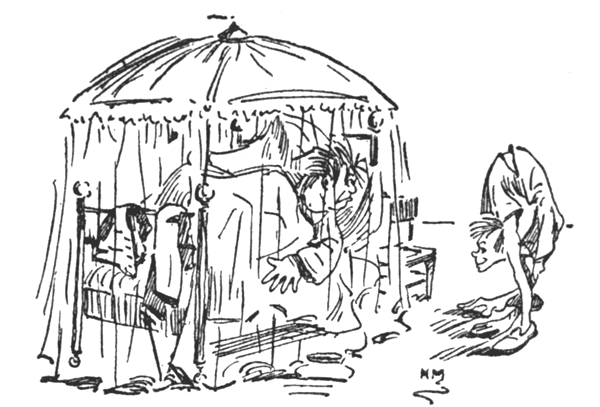
she pulled the curtains aside, sat down on the edge of the berth, jabbed
Lehman in the stomach with her elbow, and said loudly—
"Lay over!"
Lehman groaned, got one look at the female, then placed both feet in the
small of her back and shot her out on to the floor, yelling loudly for
the police.
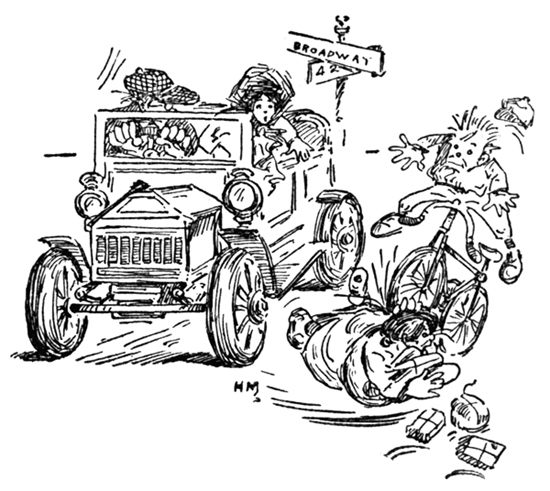
The car was in an uproar in an instant. Lehman was lying on his back,
shouting "Police!" The female was screaming and hunting for her teeth.
The conductor, the porter and the brakeman came running in to see
whether it was a political discussion or just a murder. All the old lady
could do was to mumble and hunt for her teeth. A man across the aisle
swore that he saw Lehman stab the old lady with a bowie knife and throw
her out into the aisle. The woman with the baby corroborated him,
excepting that she thought he hit her with a piece of lead pipe.
By this time the old lady had found part of her Fletcherizing outfit and
informed the congregation that she was neither struck nor stabbed; but
that her husband in the berth there had certainly gone crazy.
There was a sympathetic chorus of "Oh!s" from the other passengers and
the conductor jerked the curtains aside and asked Lehman what he meant
by treating his wife this way.
"My wife?" screamed Lehman. "Why you —— —!$!—&—$&'o$—! Are you
calling that old goat face my wife?"
"Sure that's your wife! Don't you suppose she knows?"
"Well, don't you suppose I know! Do I look as if I would be the
husband of anything that looks like that?"
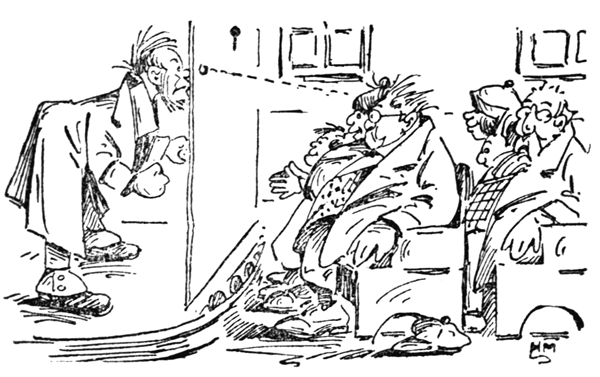
The old lady now caught sight of Lehman for the first time.
"Why," she gasped; "that isn't my husband."
"I know darn well it ain't," said Lehman.
"Then what are you doing in my berth?" demanded the old lady.
"I am not in your berth!"
"You are in my berth!"
"Let's see your tickets," said the conductor.
"Here is mine," said the old lady. "Lower seven."
"And here is mine," said Lehman. "Lower seven."
The conductor looked at them closely; then stepped back under a lamp and
looked at them closer. Then he handed the old lady's back to her. Then
he turned to Lehman and, handing him his ticket, said,
"That is your yesterday's ticket from Kansas City to Chicago." Lehman
looked at it dazed for a moment, then dressed and went up into the
baggage car where he sat on a trunk all the way to New York.
E. M. Chase, a Norfolk (Va.) newspaper man, has for years been
collecting newspaper clippings. The following are from some of his rural
exchanges:
"The funeral was conducted at the home by the Rev. Mr. Browles and was
afterwards buried
in
the old family burying ground."—Lebanon (Va.)
News.
"Mrs. W. G. Neighbors is suffering with a rising corn on her
foot."—Lebanon News.
"J. N. and Alfred Quillen were grafting in our neighborhood a few days
last week."—Gate City Herald.
"Rev. W. C. Hoover preached an excellent sermon at the Union Chapel on
last Sunday, his subject being entitled, 'I go to prepare a place for
you.' Rev. Hoover and family then spent the rest of the day with Mr.
Luther Armentrout and family."—Shenendore Valley Newmarket.
"The members of Moore's Store String Band met Saturday evening and
rendered some very fine music, as follows: W. E. Lloyd, H. E.
Weatherholtz, V. M.
Weatherholtz,
B. H. Golliday, C. S. Moore and 26
spectators."—Shenendore Valley Newmarket.
"Selone Sours is out after a severe cold.
"Her daughter Emma Sours is still nursing her risings.
"Your scribe took a trip to Louray one day last week and purchased three
sacks of fertilizer, one peck of clover seed and a half bushel of
timothy seed.
"We remarked to our little son the other day that it was going to rain,
as certain birds were singing, and he said, 'Pa, rain don't come out of
a bird.'"—The Page News.
There is a sign over in Newark that somehow doesn't just strike my
fancy; it reads—
P. Flem. Delicatessen.
A couple of young country chaps wandered into the lobby of Shea's
Theater in Toronto and stood watching the people go up to the
ticket-office window and purchase tickets; finally they got into the
line, worked their way up to the window, then one of them laid down a
two-dollar bill and said,
"Give me two tickets to Hamilton, Ontario."
"Irish Billie Carrol" was standing in the wings at the old Olympic
Theater in Chicago, watching the show. There was a chap on who was one
of those men who can never let well enough alone; if he said or did
anything that the audience laughed at, he would immediately say or do it
right over again. Billie watched him awhile, then turned to his friend
and said,
"All the trouble with him is, he always takes three bases on a single."
Barney Reiley, then with the Old Homestead Company, now the manager of a
theater in Indianapolis, and I were walking down the street in
Baltimore, when the sun, shining through a magnifying glass, set fire to
an oculist's show window.
"By Golly," said Barney, "it's a lucky thing that didn't happen in the
night, when there was nobody around."
Boston newspapers one week contained the following interesting
announcement:
"At Keith's; Cressy and Dayne; Don't fail to bring the children to see
the Trained Dogs."
At the Majestic Theater in Chicago they have a big, two-sided, electric
sign upon which are displayed the names of the acts playing there. They
place the names of two acts on each side and use no periods. One week
the two sides read—
"CRESSY & DAYNE THE VAGRANTS."
and
"ELBERT HUBBARD NIGHT BIRDS."
Said the Actress to the Landlord,
"Want to see 'The Billboard,' Mister?"
Said the Landlord to the Actress,
"I'd rather see the board bill, Sister."
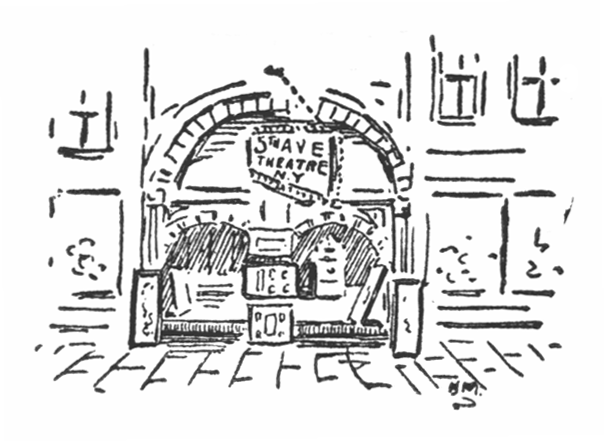
An English actor, just over, was playing at the Fifth Avenue Theater in
New York City. He was in love with America and wanted to see it
all—quick. One night he came to me and said,
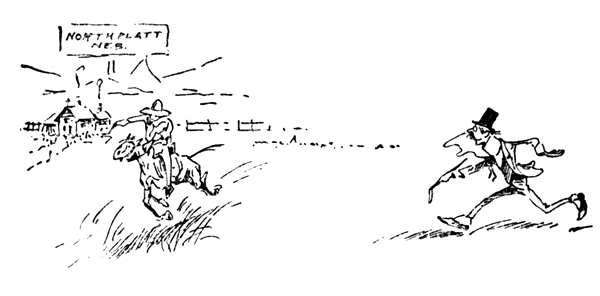
"I think I will take a run over to Buffalo Bill's place in the morning,
before the matinée."
I told him I would; it would be a good run for him.
Buffalo Bill lives in North Platte, Nebraska.
One of the provincial music halls in England has the roof arranged like
a roll-top desk, so that in hot weather it can be rolled back, thus
making a sort of roof garden out of it. An American Song and Dance Team
was making their first European appearance there; their act was a much
bigger hit than they had anticipated; and when they came off at the end
of their act one of them said delightedly to the other,
"Say, we just kicked the roof off of them, didn't we?"
"I beg pawdon, old chap," said the stage manager, overhearing him; "it
rolls off, you know."
James Thornton and Fred Hallen were coming out of the Haymarket Theater
in Chicago; Jim, who was ahead, let the door slam back against Fred.
"Oh, Good Lord," howled Fred, hanging on to his elbow; "right on the
funny bone."
Jim looked at him, and in that ministerial way of his said,
"You haven't a funny bone in your body."
A young man asked me recently what spelled success on the stage. I told
him the only way I had ever found of spelling it was W-O-R-K.