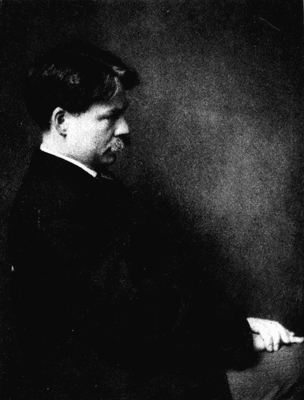
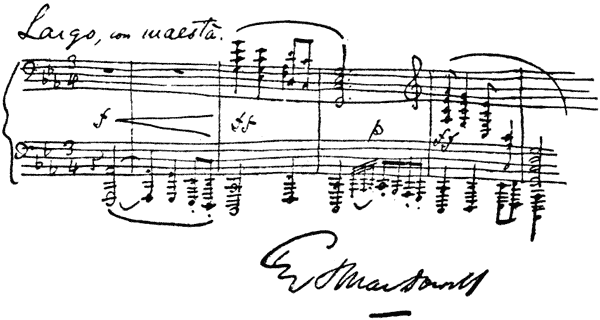
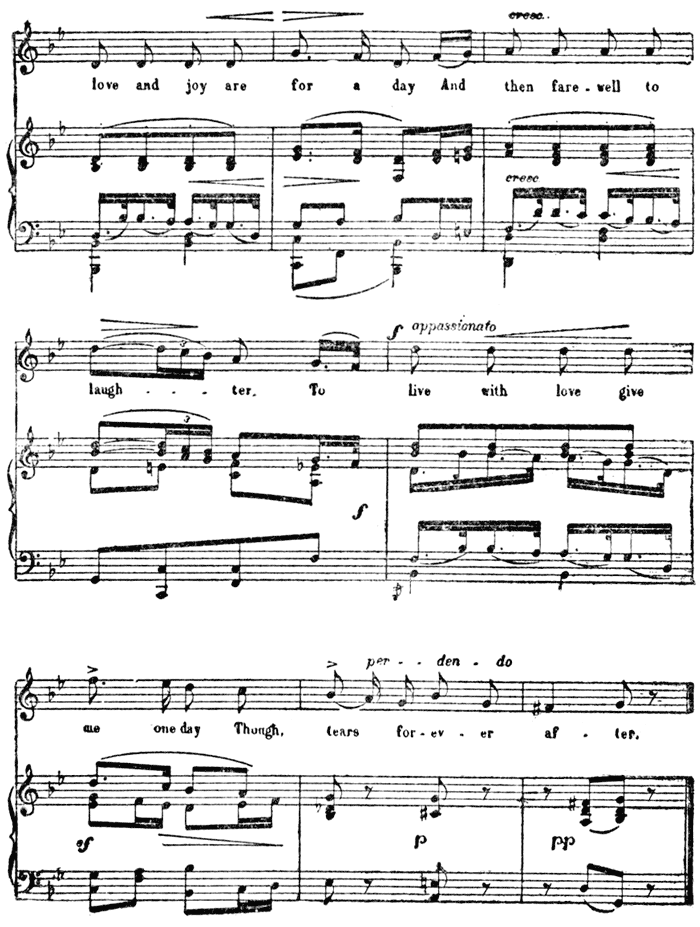
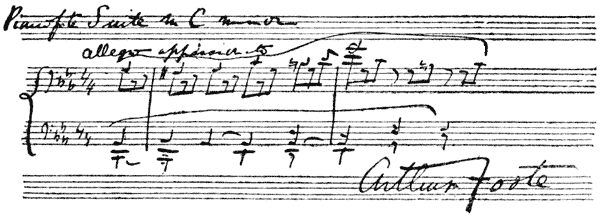
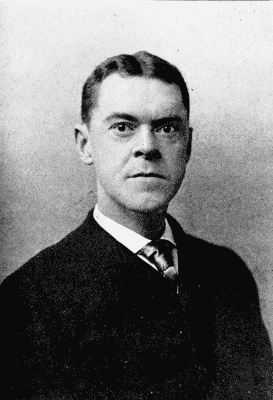
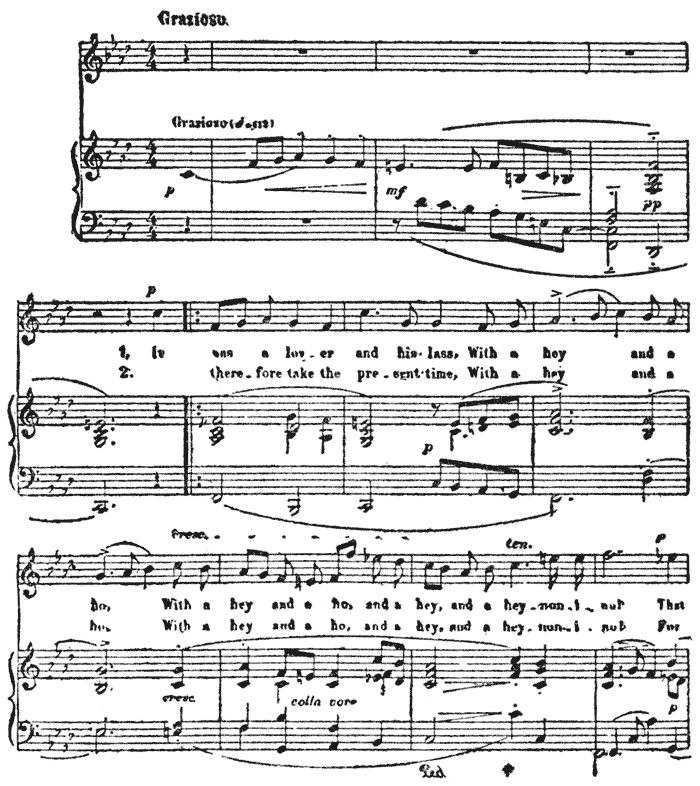
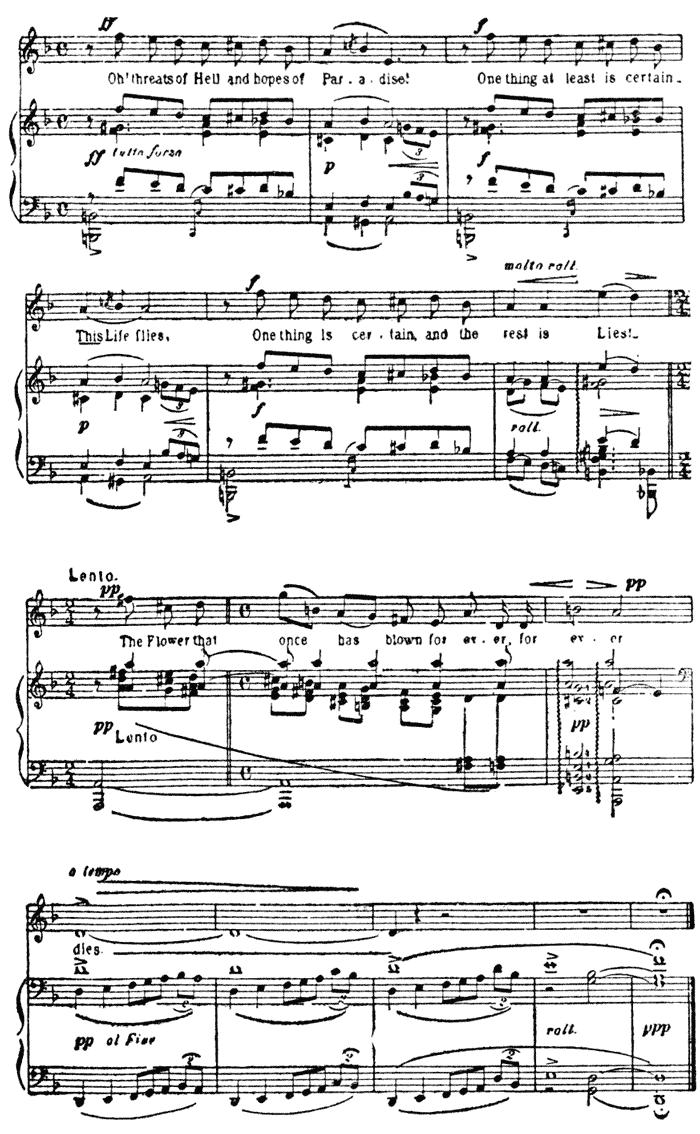
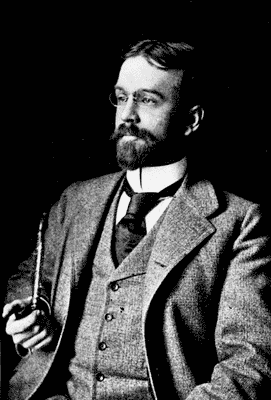
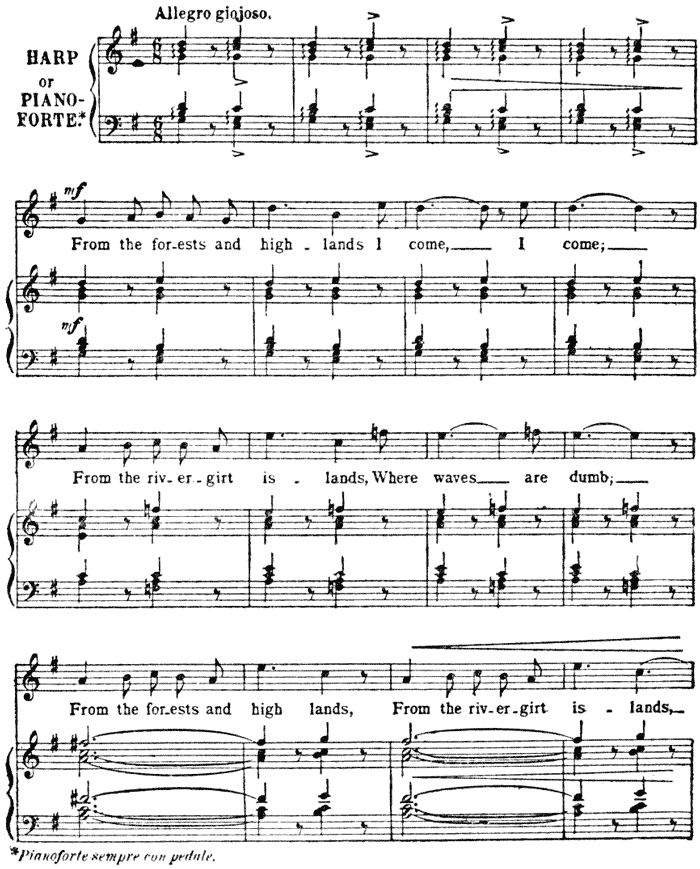
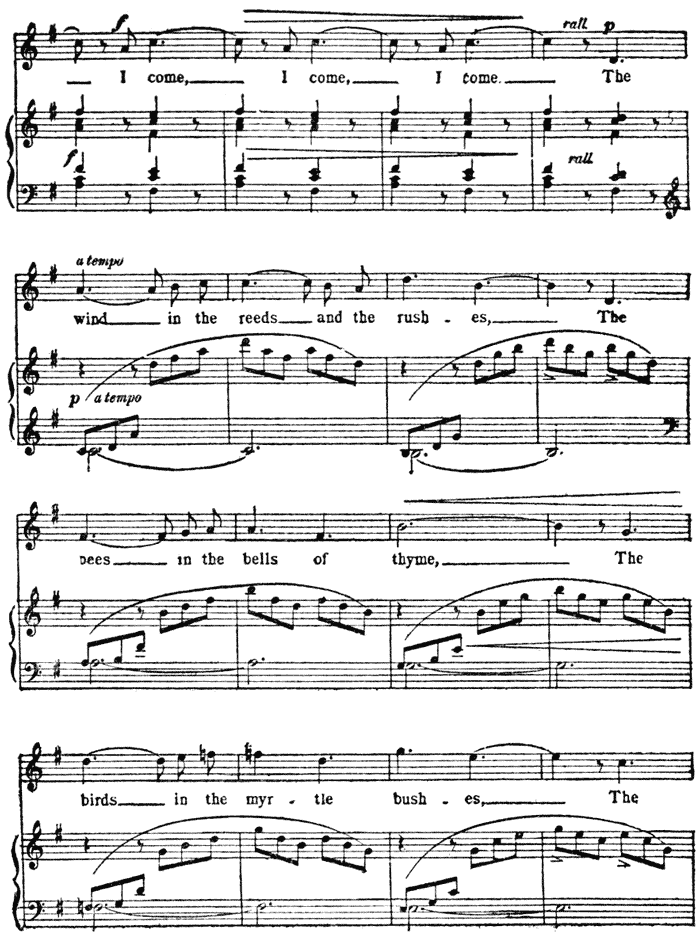
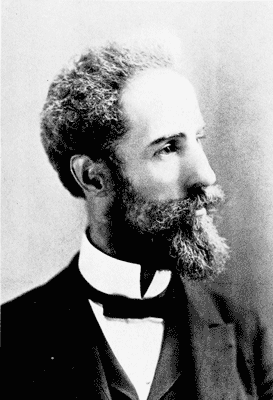
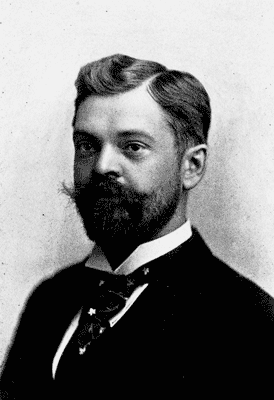
But this, to repeat, is not vital, the main thing being that MacDowell
has a distinct and impressive individuality, and uses his profound
scholarship in the pursuit of novelty that is not cheaply sensational,
and is yet novelty. He has, for instance, theories as to the textures of
sounds, and his chord-formations and progressions are quite his own.
His compositions are superb processions, in which each participant is
got up with the utmost personal splendor. His generalship is great
enough to preserve the unity and the progress of the pageant. With him
no note in the melody is allowed to go neglected, ill-mounted on common
chords in the bass, or cheap-garbed in trite triads. Each tone is made
to suggest something of its multitudinous possibilities. Through any
geometrical point, an infinite number of lines can be drawn. This is
almost the case with any note of a melody. It is the recognition and
the practice of this truth that gives the latter-day schools of music
such a lusciousness and warmth of harmony. No one is a more earnest
student of these effects than MacDowell.
He believes that it is necessary, at this late day, if you would have a
chord "bite," to put a trace of acid in its sweetness. With this clue in
mind, his unusual procedures become more explicable without losing their
charm.
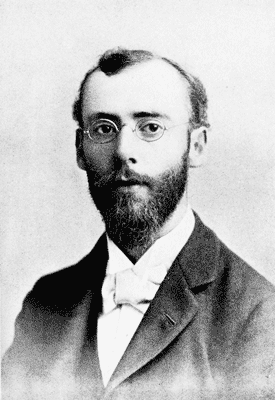
New York is rather the Mecca than the birthplace of artists, but it can
boast the nativity of MacDowell, who improvised his first songs here
December 18, 1861. He began the study of the piano at an early age. One
of his teachers was Mme. Teresa Carreño, to whom he has dedicated
his second concerto for the piano.
In 1876 he went to Paris and entered the Conservatoire, where he studied
theory under Savard, and the piano under Marmontel. He went to
Wiesbaden to study with Ehlert in 1879, and then to Frankfort, where
Carl Heyman taught him piano and Joachim Raff composition. The influence
of Raff is of the utmost importance in MacDowell's music, and I have
been told that the great romancist made a protégé of
him, and would lock him in a room for hours till he had worked out the
most appalling musical problems. Through Raff's influence he became
first piano teacher at the Darmstadt Conservatorium in 1881. The next
year Raff introduced him to Liszt, who became so enthusiastic over his
compositions that he got him the honor of playing his first piano suite
before the formidable Allgemeiner Deutscher Musik Verein, which
accorded him a warm reception. The following years were spent in
successful concert work, till 1884, when MacDowell settled down to
teaching and composing in Wiesbaden. Four years later he came to Boston,
writing, teaching, and giving occasional concerts. Thence he returned
to New York, where he was called to the professorship of music at
Columbia University. Princeton University has given him that unmusical
degree, Mus. Doc.
MacDowell has met little or none of that critical recalcitrance that
blocked the early success of so many masters. His works succeeded from
the first in winning serious favor; they have been much played in
Germany, in Vienna, St. Petersburg, Amsterdam, and Paris, one of them
having been performed three times in a single season at Breslau.
MacDowell's Scotch ancestry is always telling tales on him. The "Scotch
snap" is a constant rhythmic device, the old scale and the old Scottish
cadences seem to be native to his heart. Perhaps one might find some
kinship between MacDowell and the contemporary Glasgow school of
painters, that clique so isolated, so daring, and yet so earnest
and solid. Says James Huneker in a
monograph published some years ago: "His coloring reminds me at times of
Grieg, but when I tracked the resemblance to its lair, I found only
Scotch, as Grieg's grand-folk were Greggs, and from Scotland. It is all
Northern music with something elemental in it, and absolutely free from
the heavy, languorous odors of the South or the morbidezza of Poland."
Some of MacDowell's most direct writing has been in the setting of the
poems of Burns, such as "Deserted" ("Ye banks and braes o' bonnie Doon,"
op. 9), "Menie," and "My Jean" (op. 34). These are strongly marked by
that ineffably fine melodic flavor characteristic of Scottish music,
while in the accompaniments they admit a touch of the composer's own
individuality. In his accompaniments it is noteworthy that he is almost
never strictly contramelodic.
The songs of opera 11 and 12 have a decided Teutonism, but he has found
himself by opus 40, a volume of "Six Love Songs," containing half a
dozen flawless gems it is a pity the public should not know more widely.
A later book, "Eight Songs" (op. 47), is also a cluster of worthies. The
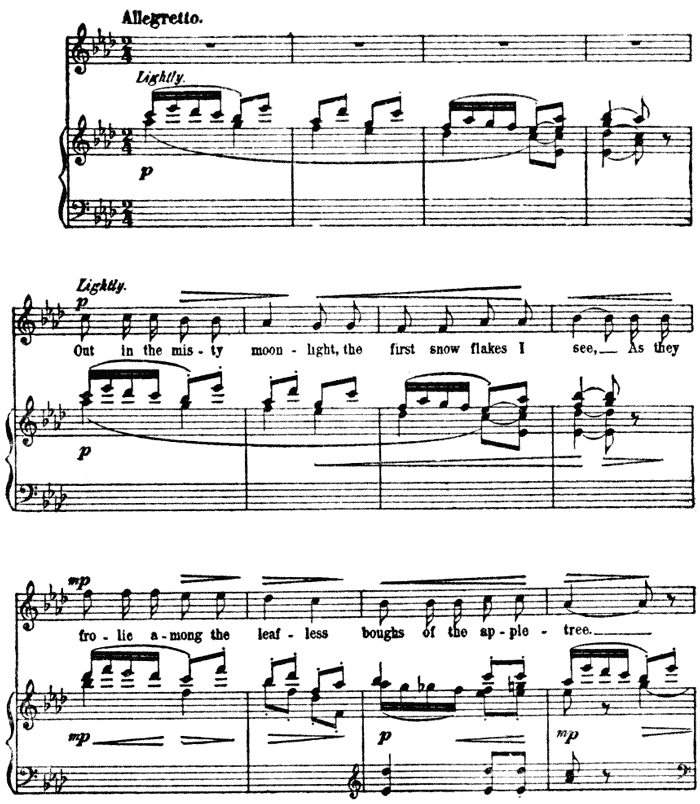
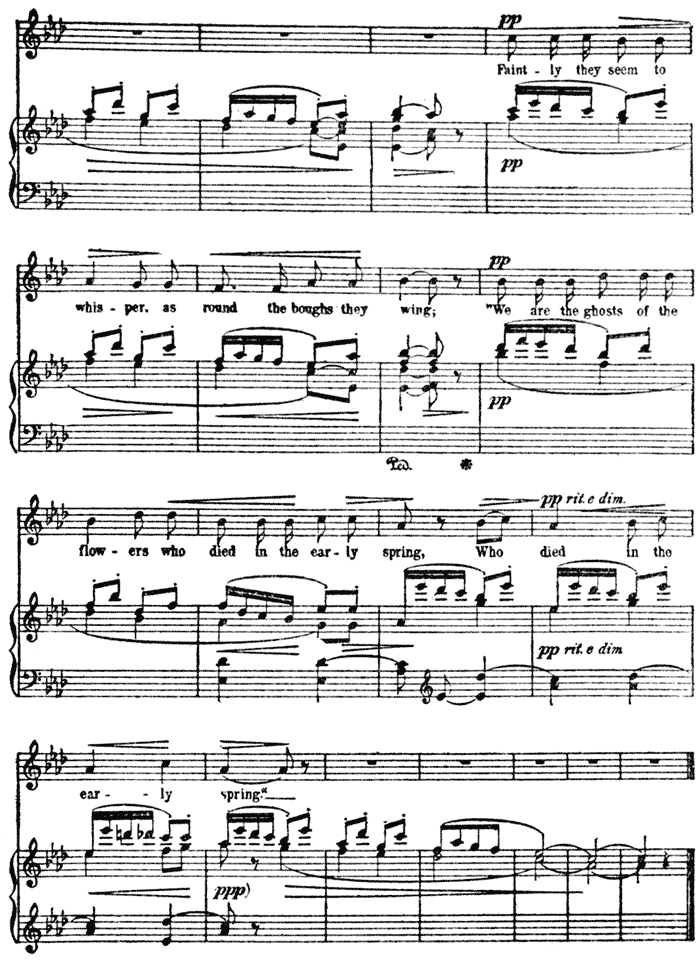
lilt and sympathy of "The Robin Sings in the Apple-tree," and its
unobtrusive new harmonies and novel effects, in strange accord with
truth of expression, mark all the other songs, particularly the
"Midsummer Lullaby," with its accompaniment as delicately tinted as
summer clouds. Especially noble is "The Sea," which has all the boom and
roll of the deep-brooding ocean.
His collections of flower-songs (op. 26) I confess not liking. Though
they are not without a certain exquisiteness, they seem overdainty and
wastefully frail, excepting, possibly, the "Clover" and the "Blue-bell."
It is not at all their brevity, but their triviality, that vexes an
admirer of the large ability that labored over them. They are dedicated
to Emilio Agramonte, one of MacDowell's first prophets, and one of the
earliest and most active agents for the recognition of the American
composer.
In the lyrics in opus 56 and opus 58 MacDowell has turned song to the
unusual purposes of a landscape impressionism of places and moods rather
than people.
For men's voices there are some deftly composed numbers curiously
devoted to lullaby subjects. The barcarolle for mixed chorus and
accompaniment on the piano for four hands obtains a wealth of color,
enhanced by the constant division of the voices.
Studying as he did with Raff, it is but natural that MacDowell should
have been influenced strongly toward the poetic and fantastic and
programmatic elements that mark the "Forest Symphony" and the "Lenore
Overture" of his master.
It is hard to say just how far this descriptive music can go. The
skill of each composer must dictate his own limits. As an example of
successful pieces of this kind, consider MacDowell's "The Eagle." It is
the musical realization of Tennyson's well-known poem:
Of course the crag and the crooked hands and the azure world must be
granted the composer, but general exaltation and loneliness are
expressed in the severe melody of the opening. The wrinkling and
crawling of the sea far below are splendidly achieved in the soft,
shimmering liquidity of the music. Then there are two abrupt, but soft,
short chords that will represent, to the imaginative, the quick fixing
of the eagle's heart on some prey beneath; and there follows a sudden
precipitation down the keyboard, fortississimo, that represents the
thunderous swoop of the eagle with startling effect.
On the other hand, the "Moonshine" seems to be attempting too much.
"Winter" does better, for it has a freezing stream, a mill-wheel, and a
"widow bird." These "four little poems" of opus 32 had been preceded by
six fine "Idylls" based on lyrics of Goethe's. The first, a forest
scene, has a distinct flavor of the woods, the second is all laziness
and drowsiness, and the third is moonlight mystery. The fourth is as
intense in its suppressed spring ecstasy as the radiant poem itself
singing how
The six short "Poems" (op. 31) based on poems of Heine's are
particularly successful, especially in the excellent opportunity of the
lyric describing the wail of the Scottish woman who plays her harp on
the cliff, and sings above the raging of sea and wind. The third catches
most happily the whimsicality of the poet's reminiscences of childhood,
but hardly, I think, the contrasting depth and wildness of his complaint
that, along with childhood's games, have vanished Faith and Love and
Truth. In the last, however, the cheery majesty that realizes Heine's
likening of Death to a cool night after the sultry day of Life, is
superb.
Then there are some four-hand pieces, two collections, that leave no
excuse for clinging to the hackneyed classics or modern trash. They are
not at all difficult, and the second player has something to employ his
mind besides accompanying chords. They are meaty, and effective almost
to the point of catchiness. The "Tale of the Knights" is full of
chivalric fire and martial swing, while the "Ballad" is as exquisitely
dainty as a peach-blossom. The "Hindoo Maiden" has a deal of the
thoroughly Oriental color and feeling that distinguish the three solos
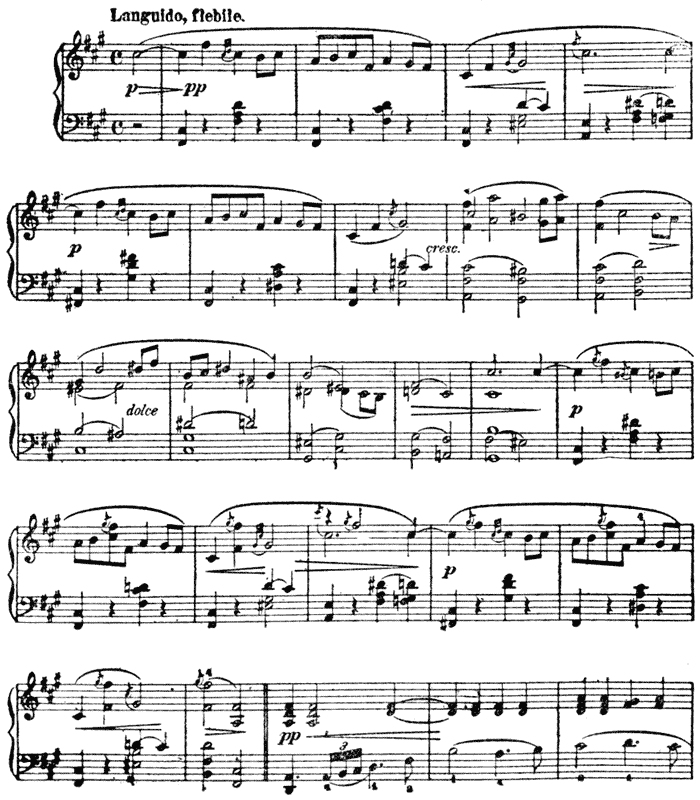
of "Les Orientales," of which "Clair de Lune" is one of his most
original and graceful writings. The duet, "In Tyrol," has a wonderful
crystal carillon and a quaint shepherd piping a faint reminiscence of
the Wagnerian school of shepherds. This is one of a series of "Moon
Pictures" for four hands, based on Hans Christian Andersen's lore. Two
concertos for piano and orchestra are dazzling feats of virtuosity; one
of them is reviewed at length in A.J. Goodrich' book, "Musical
Analysis." He has written also a book of artistic moment called "Twelve
Virtuoso-Studies," and two books of actual gymnastics for piano
practice.
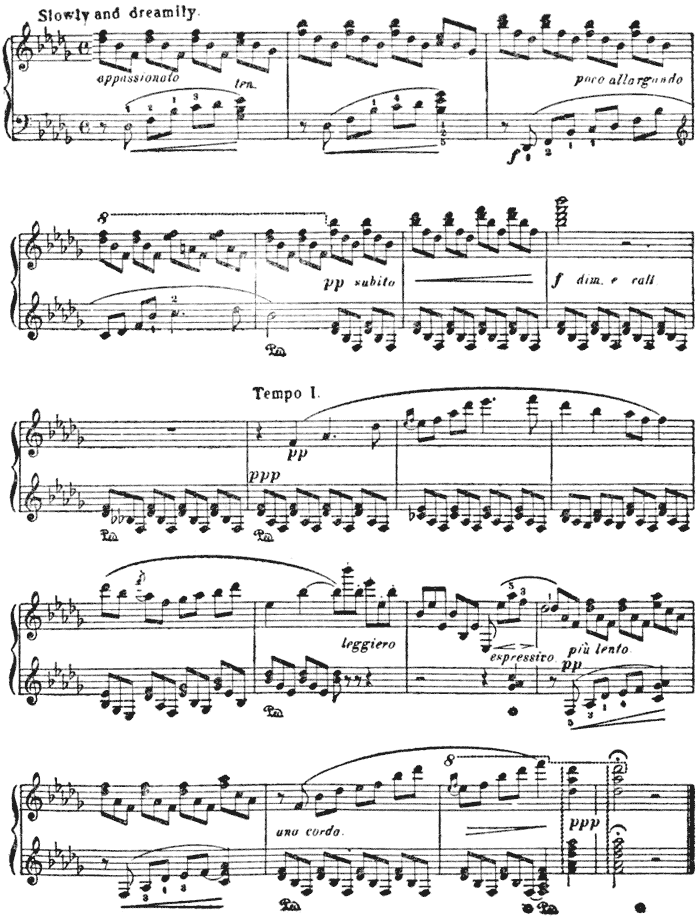
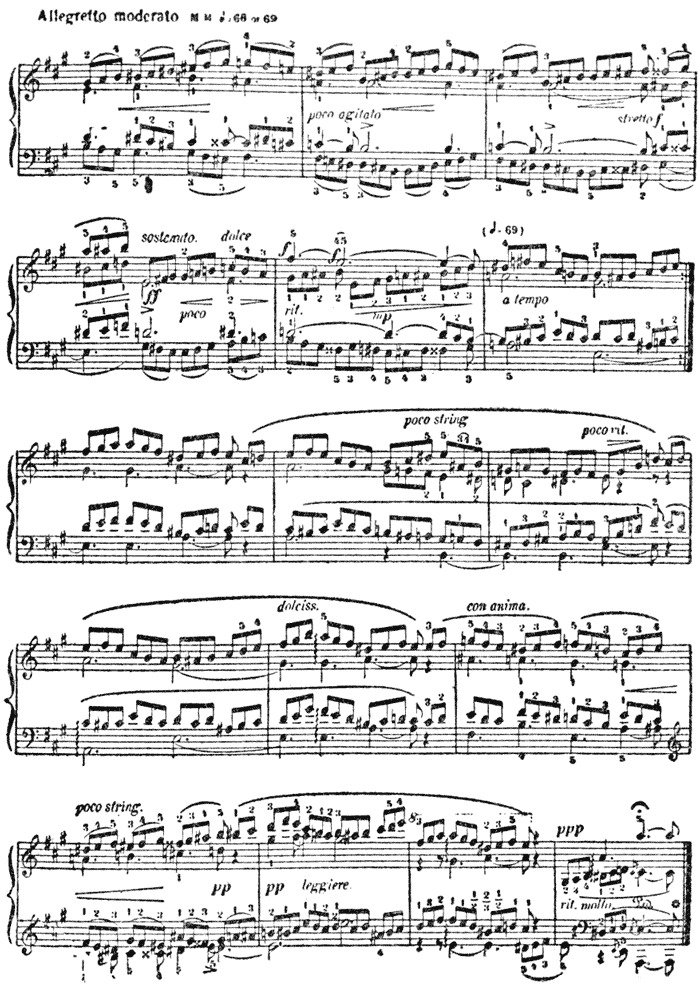
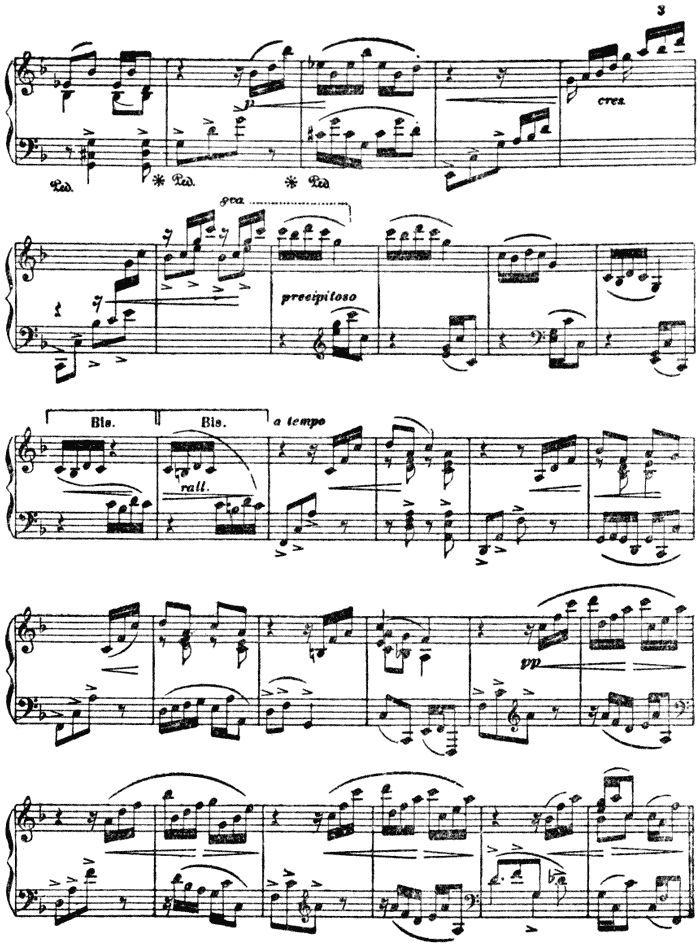
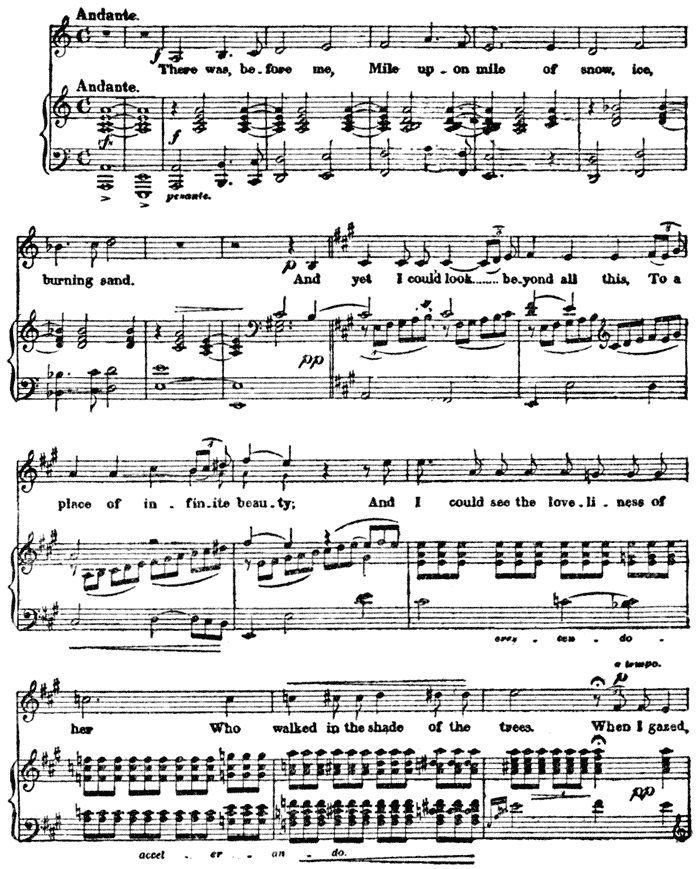
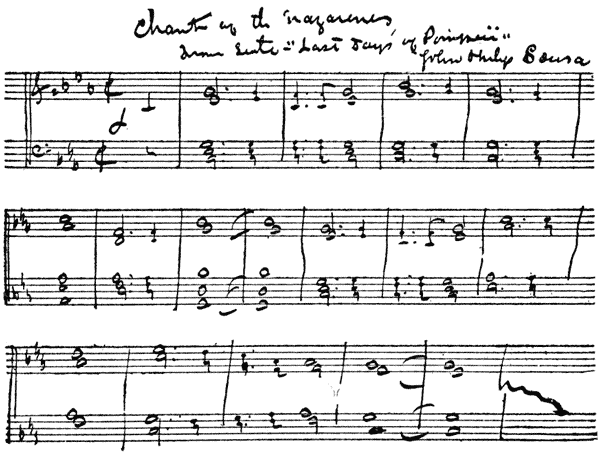
CLAIR DE LUNE. — Edgar Stillman Kelley. — Harvey Worthington Loomis. — Ethelbert Nevin. — John Philip Sousa. — Henry Schoenefeld. — Maurice Arnold. — N. Clifford Page.
La lune était sereine et jouait sur les flots.
La fenêtre enfin libre est ouverte à la brise;
La sultane regarde, et la mer qui se brise,
Là-bas, d'un flot d'argent brode les noir îlots.
(Victor Hugo, "Les Orientales.")
[Listen]
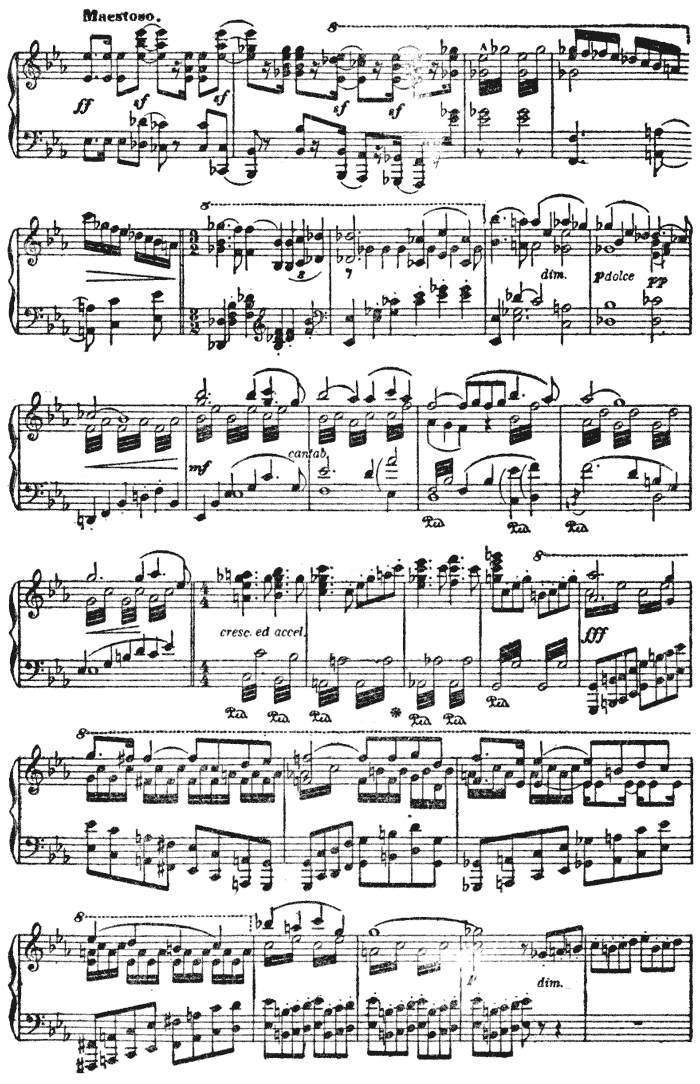
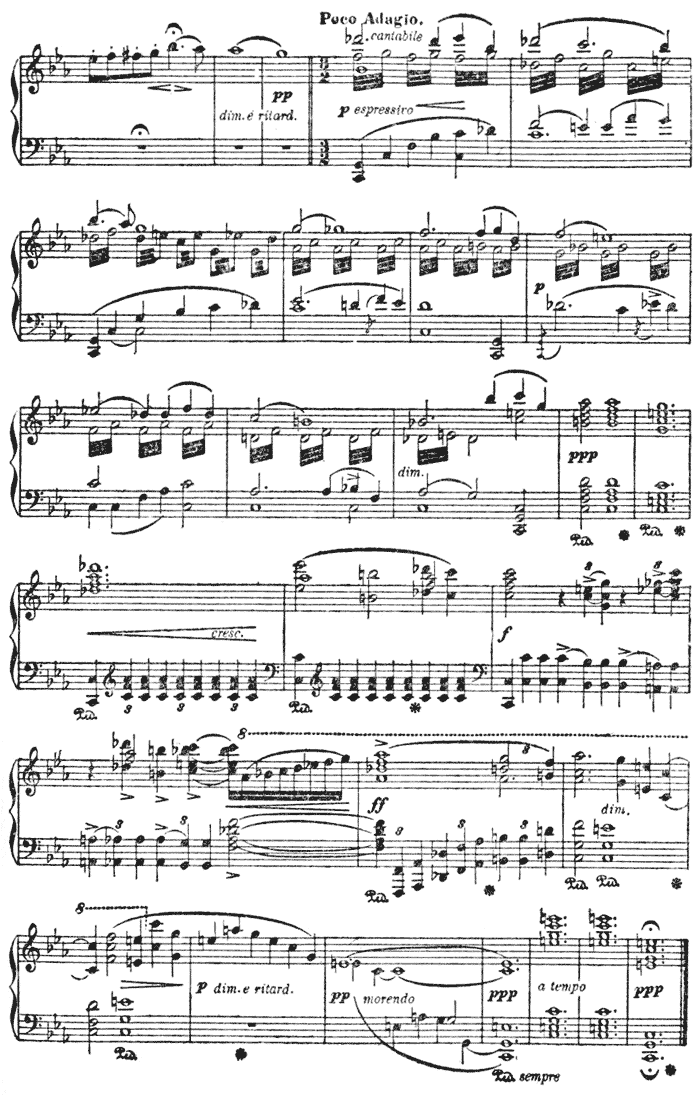
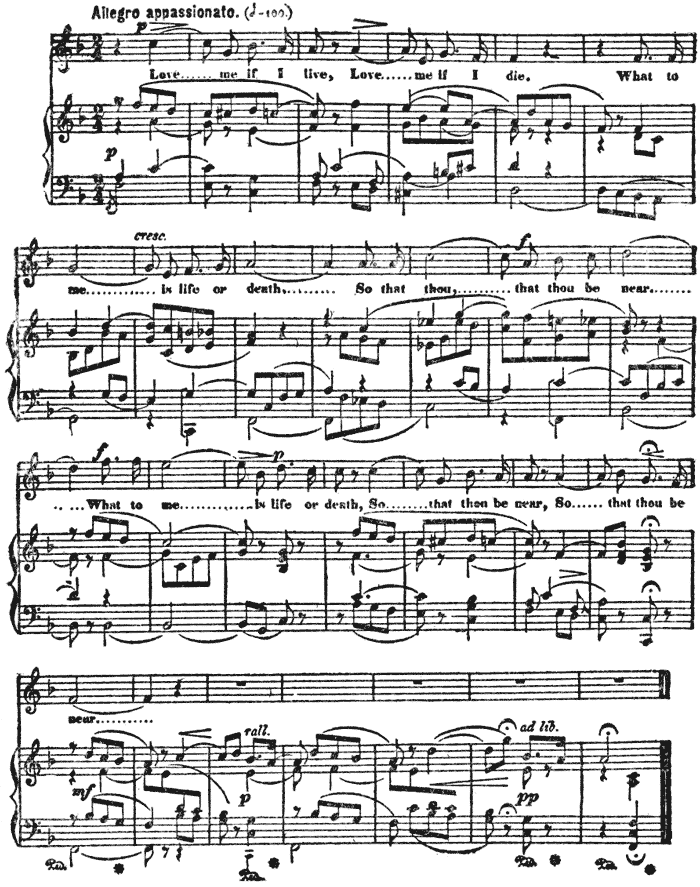
E.A. MACDOWELL, Op. 37, No. 1.
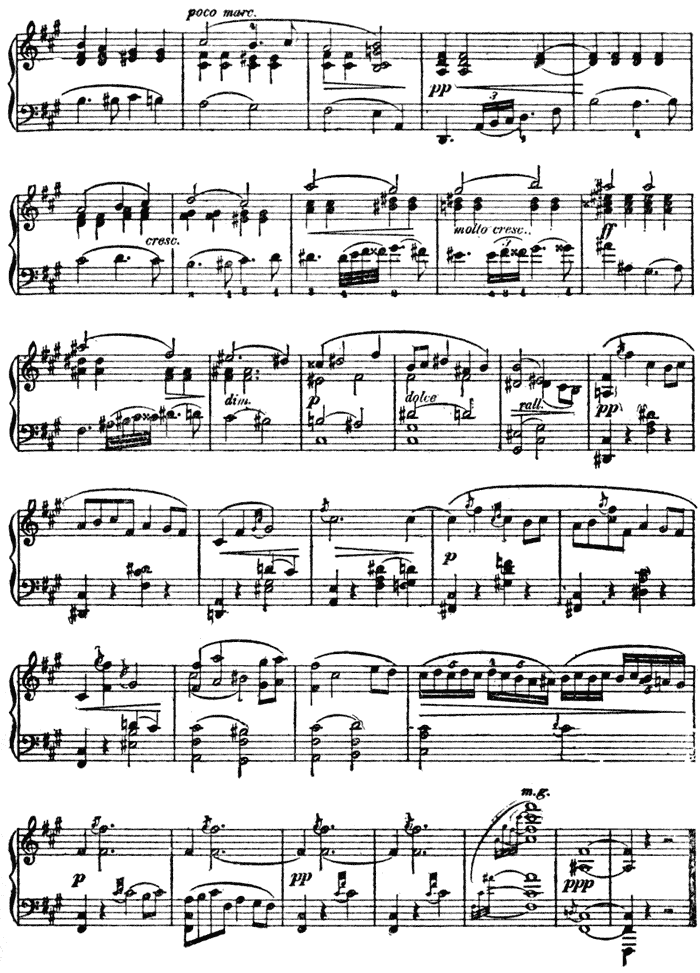
Copyright, 1889, Arthur P. Schmidt.
But MacDowell did not reach his freedom without a struggle against
academia. His opus 10 is a piano suite published at the age of
twenty-two, and opus 14 is another; both contain such obsolescences as a
presto, fugue, scherzino, and the like. But for all the classic garb,
the hands are the hands of Esau. In one of the pieces there is even a
motto tucked, "All hope leave ye behind who enter here!" Can he have
referred to the limbo of classicism?
It is a far cry from these to the liberality that inspired the new
impressionism of "Woodland Sketches" (op. 51) and "Sea Pieces" (op. 55),
in which he gives a legitimate musical presentation of a faintly
perfumed "Wild Rose" or "Water Lily," but goes farther, and paints, with
wonderful tone, the moods inspired by reverie upon the uncouth dignity
and stoic savagery of "An Indian Lodge," the lonely New England twilight
of "A Deserted Farm," and all the changing humors of the sea, majesty of
sunset or star-rise, and even the lucent emerald of an iceberg. His
"From Uncle Remus" is not so successful; indeed, MacDowell is not
sympathetic with negro music, and thinks that if we are to found a
national school on some local manner, we should find the Indian more
congenial than the lazy, sensual slave.
He has carried this belief into action, not only by his scientific
interest in the collection and compilation of the folk-music of our
prairies, but by his artistic use of actual Indian themes in one of his
most important works, his "Indian Suite" for full orchestra, a work that
has been often performed, and always with the effect of a new and
profound sensation, particularly in the case of the deeply impressive
dirge.
A proof of the success of MacDowell as a writer in the large forms is
the fact that practically all of his orchestral works are published in
Germany and here, not only in full score, but in arrangement for four
hands. They include "Hamlet;" "Ophelia" (op. 22); "Launcelot and Elaine"
(op. 26), with its strangely mellow and varied use of horns for
Launcelot, and the entrusting of the plaintive fate of "the lily maid
of Astolat" to the string and wood-wind choirs; "The Saracens" and "The
Lovely Alda" (op. 30), two fragments from the Song of Roland; and the
Suite (op. 42), which has been played at least eight times in Germany
and eleven times here.
The first movement of this last is called "In a Haunted Forest." You are
reminded of Siegfried by the very name of the thing, and the music
enforces the remembrance somewhat, though very slightly.
Everything reminds one of Wagner nowadays,—even his predecessors.
Rudyard Kipling has by his individuality so copyrighted one of the
oldest verse-forms, the ballad, that even "Chevy Chace" looks like an
advance plagiarism. So it is with Wagner. Almost all later music, and
much of the earlier, sounds Wagnerian. But MacDowell has been reminded
of Bayreuth very infrequently in this work. The opening movement
begins with a sotto voce syncopation
that is very presentative of the curious audible silence of a forest.
The wilder moments are superbly instrumented.
The second movement, "Summer Idyl," is delicious, particularly in the
chances it gives the flautist. There is a fragmentary cantilena which
would make the fortune of a comic opera. The third number, "In October,"
is particularly welcome in our music, which is strangely and sadly
lacking in humor. There is fascinating wit throughout this harvest
revel. "The Shepherdess' Song" is the fourth movement. It is not
précieuse, and it is not banal; but its simplicity of pathos is a
whit too simple. The final number, "Forest Spirits," is a brilliant
climax. The Suite as a whole is an important work. It has detail of the
most charming art. Best of all, it is staunchly individual. It is
MacDowellian.
While the modern piano sonata is to me anathema as a rule, there are
none of MacDowell's works that I like better than his writings in this
form. They are to me far the best since Beethoven, not excepting even
Chopin's (pace his greatest prophet, Huneker). They seem to me to be
of such stuff as Beethoven would have woven had he known in fact the
modern piano he saw in fancy.
The "Sonata Tragica" (op. 45) begins in G minor, with a bigly
passionate, slow introduction (metronomed in the composer's copy,
 -50).
The first subject is marked in the same copy, though
not in the printed book,
-50).
The first subject is marked in the same copy, though
not in the printed book,  -69,
and the appealingly pathetic
second subject is a little slower. The free fantasy is full of storm and
stress, with a fierce pedal-point on the trilled leading-tone. In the
reprise the second subject, which was at first in the dominant major, is
now in the tonic major, though the key of the sonata is G minor. The
allegro is metronomed -138,
and it is very short and very
wild. Throughout, the grief is the grief of a strong soul; it never
degenerates into whine. Its largo is like the tread of an
Æschylean choros, its allegro movements are wild with anguish,
and the occasional uplifting into the major only emphasizes the sombre
whole, like the little rifts of clearer harmony in Beethoven's "Funeral
March on the Death of a Hero."
-69,
and the appealingly pathetic
second subject is a little slower. The free fantasy is full of storm and
stress, with a fierce pedal-point on the trilled leading-tone. In the
reprise the second subject, which was at first in the dominant major, is
now in the tonic major, though the key of the sonata is G minor. The
allegro is metronomed -138,
and it is very short and very
wild. Throughout, the grief is the grief of a strong soul; it never
degenerates into whine. Its largo is like the tread of an
Æschylean choros, its allegro movements are wild with anguish,
and the occasional uplifting into the major only emphasizes the sombre
whole, like the little rifts of clearer harmony in Beethoven's "Funeral
March on the Death of a Hero."
The last movement begins with a ringing pomposo, and I cannot explain
its meaning better than by quoting Mrs. MacDowell's words: "Mr.
MacDowell's idea was, so to speak, as follows: He wished to heighten the
darkness of tragedy by making it follow closely on the heels of triumph.
Therefore, he attempted to make the last movement a steadily progressive
triumph, which, at its climax, is utterly broken and shattered. In doing
this he has tried to epitomize the whole work. While in the other
movements he aimed at expressing tragic details, in the last he has
tried to generalize; thinking that the most poignant tragedy is that of
catastrophe in the hour of triumph."
The third sonata (op. 57) is dedicated to Grieg and to the musical
exploitation of an old-time Skald reciting glorious battles, loves, and
deaths in an ancient castle. The atmosphere of mystery and barbaric
grandeur is obtained and sustained by means new to piano literature and
potent in color and vigor. The sonata formula is warped to the purpose
of the poet, but the themes have the classic ideal of kinship. The
battle-power of the work is tremendous. Huneker calls it "an epic of
rainbow and thunder," and Henry T. Finck, who has for many years devoted
a part of his large ardor to MacDowell's cause, says of the work: "It is
MacDowellish,—more MacDowellish than anything he has yet written.
It is the work of a musical thinker. There are harmonies as novel as
those we encounter in Schubert, Chopin, or Grieg, yet with a stamp of
their own."
The "Sonata Eroica" (op. 50) bears the legend "Flos regum Arthurus." It
is also in G minor. The spirit of King Arthur dominates the work
ideally, and justifies not only the ferocious and warlike first subject
with its peculiar and influential rhythm, but the old-fashioned and
unadorned folk-tone of the second subject. In the working out there is
much bustle and much business of trumpets. In the reprise the folk-song
appears in the tonic minor, taken most unconventionally in the bass
under elaborate arpeggiations in the right hand. The coda, as in the
other sonata, is simply a strong passage of climax. Arthur's
supernatural nature doubtless suggested the second movement, with its
elfin airs, its flibbertigibbet virtuosity, and its magic of color. The
third movement might have been inspired by Tennyson's version of
Arthur's farewell to Guinevere, it is such a rich fabric of grief. The
finale seems to me to picture the Morte d'Arthur, beginning with the
fury of a storm along the coast, and the battle "on the waste sand by
the waste sea." Moments of fire are succeeded by exquisite deeps of
quietude, and the death and apotheosis of Arthur are hinted with daring
and complete equivalence of art with need.
Here is no longer the tinkle and swirl of the elf dances; here is no
more of the tireless search for novelty in movement and color. This is
"a flash of the soul that can." Here is Beethoven redivivus. For half
a century we have had so much pioneering and scientific exploration
after piano color and tenderness and fire, that men have neglected its
might and its tragic powers. Where is the piano-piece since Beethoven
that has the depth, the breadth, the height of this huge solemnity?
Chopin's sensuous wailing does not afford it. Schumann's complex
eccentricities have not given it out. Brahms is too passionless. Wagner
neglected the piano. It remained for a Yankee to find the austere
peak again! and that, too, when the sonata
was supposed to be a form as exhausted as the epic poem. But all this is
the praise that one is laughed at for bestowing except on the graves of
genius.
The cautious Ben Jonson, when his erstwhile taproom roisterer, Will
Shakespeare, was dead, defied "insolent Greece or haughty Rome" to show
his superior. With such authority, I feel safe in at least defying the
contemporary schools of insolent Russia or haughty Germany to send forth
a better musicwright than our fellow townsman, Edward MacDowell.
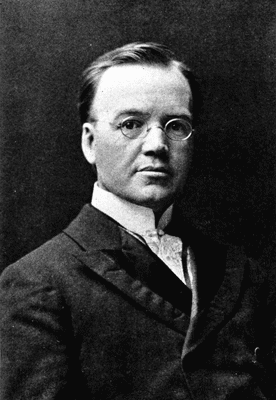
EDGAR STILLMAN KELLEY.
While his name is known wherever
American music is known in its better aspects,
yet, like many another American, his
real art can be discovered only from his
manuscripts. In these he shows a very
munificence of enthusiasm, scholarship, invention,
humor, and originality.
Kelley is as thorough an American by
descent as one could ask for, his maternal
ancestors having settled in this country in
1630, his paternal progenitors in 1640,
A.D. Indeed, one of the ancestors of his
father made the dies for the pine-tree shilling,
and a great-great-grandfather fought in
the Revolution.
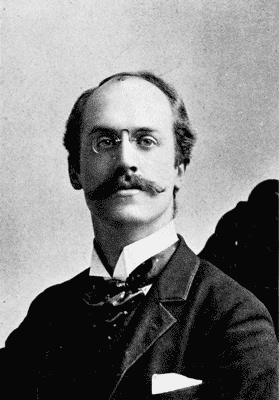
Kelley began his terrestrial career April
14, 1857, in Wisconsin. His father was a
revenue officer; his mother a skilled musician,
who taught him the piano from his
eighth year to his seventeenth, when he went
to Chicago and studied harmony and counterpoint
under Clarence Eddy, and the piano
under Ledochowski. It is interesting to note
that Kelley was diverted into music from
painting by hearing "Blind Tom" play Liszt's
transcription of Mendelssohn's "Midsummer
Night's Dream" music. I imagine that this
idiot-genius had very little other influence of
this sort in his picturesque career.
After two years in Chicago, Kelley went
to Germany, where, in Stuttgart, he studied
the piano with Kruger and Speidel, organ
with Finck, composition and orchestration
with Seiffritz. While in Germany, Kelley
wrote a brilliant and highly successful concert
polonaise for four hands, and a composition
for strings.
In 1880 he was back in America and
settled in San Francisco, with whose musical
life he was long and prominently identified
as a teacher and critic. Here he wrote his
first large work, the well-known melodramatic
music to "Macbeth." A local benefactor,
John Parrot, paid the expenses of a public
performance, the great success of which
persuaded McKee Rankin, the actor, to
make an elaborate production of both play
and music. This ran for three weeks in San
Francisco to crowded houses, which is a remarkable
record for many reasons. A shabby
New York production at an ill-chosen theatre
failed to give the work an advantageous hearing;
but it has been played by orchestras
several times since, and William H. Sherwood
has made transcriptions of parts of it for
piano solo.
The "Macbeth" music is of such solid
value that it reaches the dignity of a flowing
commentary. Beyond and above this it is an
interpretation, making vivid and awesome the
deep import of the play, till even the least
imaginative auditor must feel its thrill.
Thus the gathering of the witches begins
with a slow horror, which is surely Shakespeare's
idea, and not the comic-opera can-can
it is frequently made. As various other
elfs and terrors appear, they are appropriately
characterized in the music, which also adds
mightily to the terror of the murder scene.
Throughout, the work is that of a thinker.
Like much of Kelley's other music, it is also
the work of a fearless and skilled programmatist,
especially in the battle-scenes, where
it suggests the crash of maces and swords,
and the blare of horns, the galloping of
horses, and the general din of huge battle.
Leading-motives are much used, too, with
good effect and most ingenious elaboration,
notably the Banquo motive. A certain
amount of Gaelic color also adds interest
to the work, particularly a stirring Gaelic
march. The orchestration shows both
scholarship and daring.
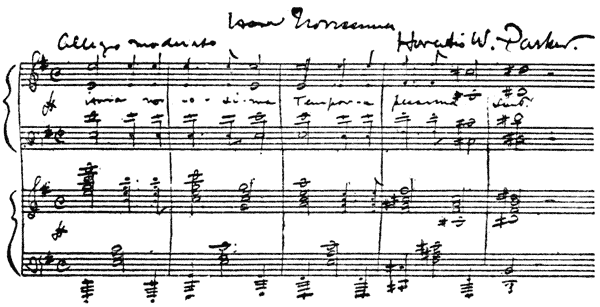
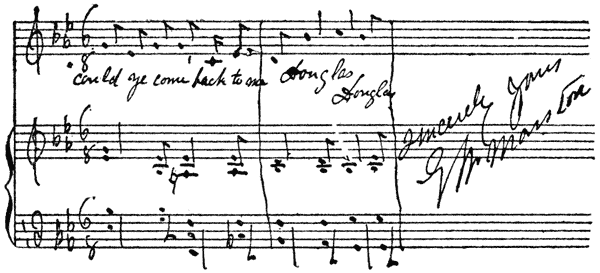
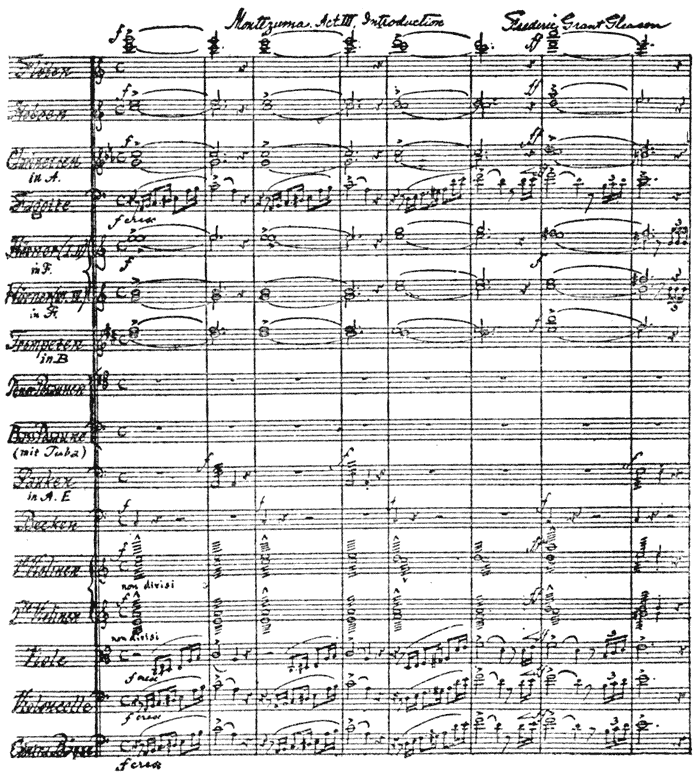
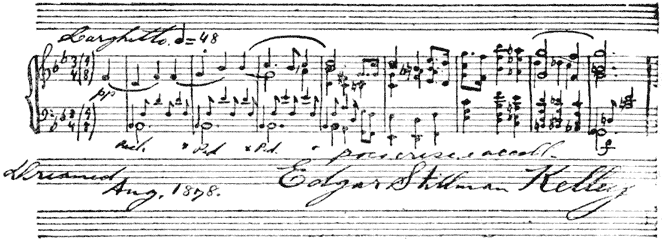
An interesting subject is suggested by
Kelley's experience in hunting out a good
motif for the galloping horses of "Macbeth."
He could find nothing suitably representative
of storm-hoofed chargers till his dreams came
to the rescue with a genuinely inspired theme.
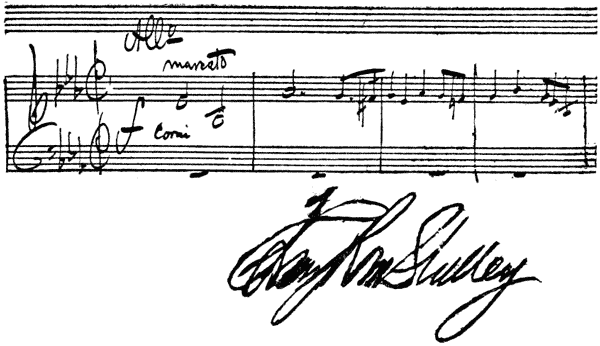
Several other exquisite ideas have come to
him in his sleep in this way; one of them
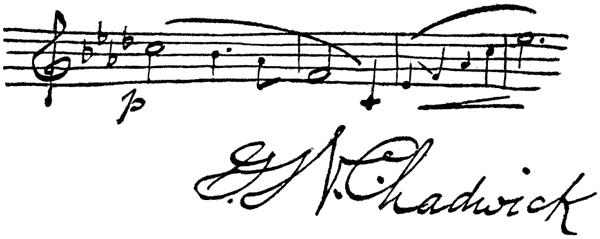
is set down in the facsimile reproduced
herewith. On one occasion he even dreamed
an original German poem and a fitting musical
setting.
Dr. Wm. A. Hammond, in his book on
"Sleep and Its Derangements," is inclined
to scout the possibility of a really valuable
inspiration in sleep. He finds no satisfactory
explanation for Tartini's famous "Devil's
Sonata" or Coleridge' proverbial "Kubla
Khan." He takes refuge in saying that at
least the result could not be equal to the
dreamer's capabilities when awake; but
Kelley's "Macbeth" music was certainly
an improvement on what he could invent out
of the land of Nod.
After composing a comic opera, which
was refused by the man for whom it was written
because it was too good, he drifted into
journalism, and wrote reviews and critiques
which show a very liberal mind capable
of appreciating things both modern and
classic.
Kelley was again persuaded to write a
comic opera to the artistic libretto, "Puritania,"
by C.M.S. McLellan, a brilliant
satirist, who has since won fortune by his
highly successful and frequently artistic burlesquery.
The work won excellent praise in
Boston, where it had one hundred performances.
The work musically was not only
conscientious, but really graceful and captivating.
It received the most glowing encomiums
from people of musical culture, and
largely enhanced Kelley's musical reputation
in its run of something over a year. On its
tour Kelley was also the musical conductor,
in which capacity he has frequently served
elsewhere.
Kelley plainly deserves preëminence among
American composers for his devotion to, and
skill in, the finer sorts of humorous music.
No other American has written so artfully,
so happily, or so ambitiously in this field. A
humorous symphony and a Chinese suite
are his largest works on this order.
The symphony follows the life of "Gulliver
in Lilliput." In development and intertwining
of themes and in brilliance of orchestration,
it maintains symphonic dignity, while in
play of fancy, suggestive programmaticism,
and rollicking enthusiasm it is infectious
with wit. Gulliver himself is richly characterized
with a burly, blustering English
theme. The storm that throws him on the
shores of Lilliput is handled with complete
mastery, certain phrases picturing the toss of
the billows, another the great roll of the
boat, others the rattle of the rigging and the
panic of the crew; and all wrought up to a
demoniac climax at the wreck. As the
stranded Gulliver falls asleep, the music hints
his nodding off graphically. The entrance of
the Lilliputians is perhaps the happiest bit
of the whole delicious work. By adroit devices
in instrumentation, their tiny band
toots a minute national hymn of irresistible
drollery. The sound of their wee hammers
and the rest of the ludicrous adventures are
carried off in unfailing good humor. The
scene finally changes to the rescuing ship.
Here a most hilarious hornpipe is interrupted
by the distant call of Gulliver's aria, and the
rescue is consummated delightfully.
In nothing has Kelley showed such wanton
scholarship and such free-reined fancy as in
his Chinese suite for orchestra, "Aladdin." It
is certainly one of the most brilliant musical
feats of the generation, and rivals Richard
Strauss in orchestral virtuosity.
While in San Francisco, where, as every
one knows, there is a transplanted corner of
China, Kelley sat at the feet of certain Celestial
cacophonists, and made himself adept.
He fathomed the, to us, obscure laws of
their theory, and for this work made a careful
selection of Chinese musical ideas, and
used what little harmony they approve of
with most quaint and suggestive effect upon
a splendid background of his own. The result
has not been, as is usual in such alien
mimicries, a mere success of curiosity.
The work had its first accolade of genius
in the wild protests of the music copyists,
and in the downright mutiny of orchestral
performers.
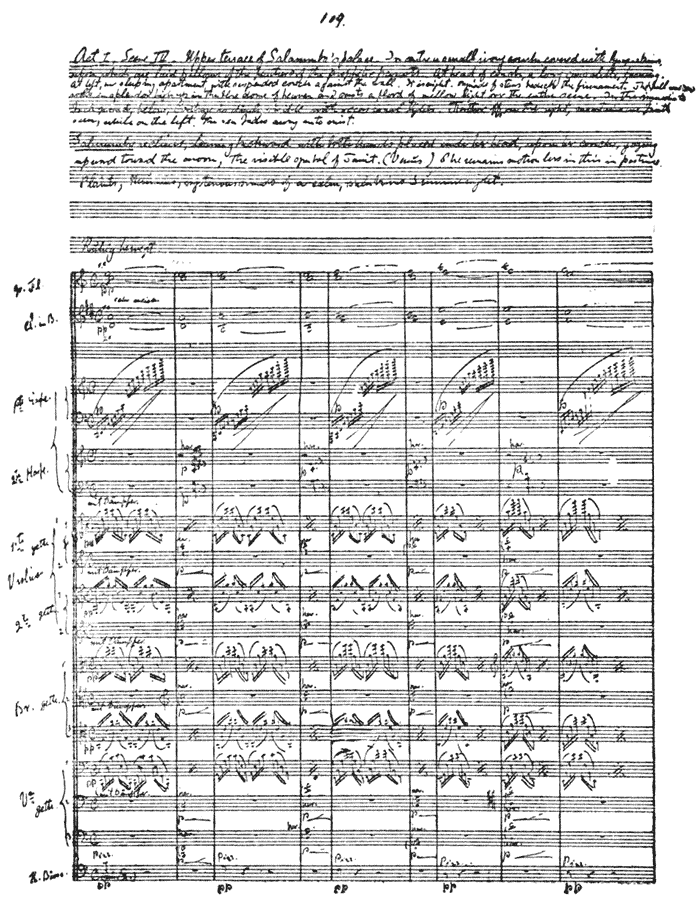
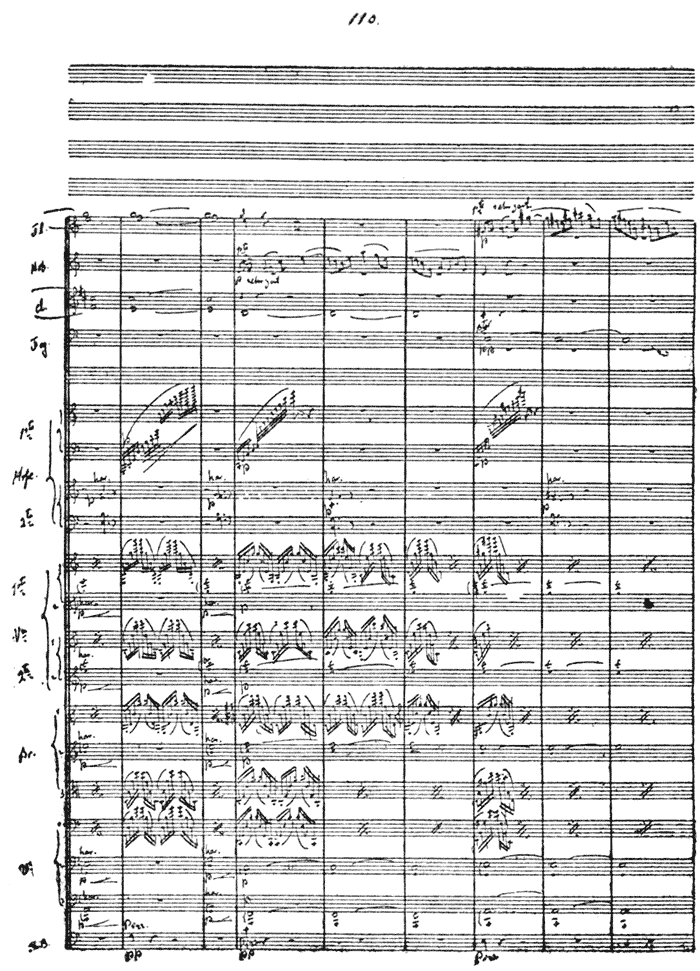
On the first page of the score is this note:
"This should be played with a bow unscrewed,
so that the hairs hang loose—thus the bow
never leaves the string." This direction is
evidently meant to secure the effect of the
Chinese violin, in which the string passes
between the hair and the wood of the bow,
and is played upon the under side. But
what self-respecting violinist could endure
such profanation without striking a blow for
his fanes?
The first movement of the suite is made
up of themes actually learned from Chinese
musicians. It represents the "Wedding of
Aladdin and the Princess," a sort of sublimated
"shivaree" in which oboes quawk,
muted trumpets bray, pizzicato strings flutter,
and mandolins (loved of Berlioz) twitter
hilariously.
The second movement, "A Serenade in
the Royal Pear Garden," begins with a luxurious
tone-poem of moonlight and shadow,
out of which, after a preliminary tuning of
the Chinese lute (or sam-yin), wails a lyric
caterwaul (alternately in 2-4 and 3-4 tempo)
which the Chinese translate as a love-song.
Its amorous grotesque at length subsides into
the majestic night. A part of this altogether
fascinating movement came to Kelley in a
dream.
The third chapter is devoted to the "Flight
of the Genie with the Palace," and there is a
wonderfully vivid suggestion of his struggle
to wrest loose the foundations of the building.
At length he heaves it slowly in the air, and
wings majestically away with it.
It has always seemed to me that the purest
stroke of genius in instrumentation ever
evinced was Wagner's conceit of using tinkling
bells to suggest leaping flames. And
yet quite comparable with this seems Kelley's
device to indicate the oarage of the genie's
mighty wings as he disappears into the
sky: liquid glissandos on the upper harp-strings,
with chromatic runs upon the elaborately
divided violins, at length changed to
sustained and most ethereally fluty harmonics.
It is very ravishment.
The last movement, "The Return and
Feast of the Lanterns," is on the sonata
formula. After an introduction typifying the
opening of the temple gates (a gong giving
the music further locale), the first theme is
announced by harp and mandolin. It is an
ancient Chinese air for the yong-kim (a dulcimer-like
instrument). The second subject
is adapted from the serenade theme. With
these two smuggled themes everything contrapuntal
(a fugue included) and instrumental
is done that technical bravado could suggest
or true art license. The result is a carnival
of technic that compels the layman to wonder
and the scholar to homage.
A transcription for a piano duet has been
made of this last movement.
In Chinese-tone also is Kelley's most popular
song, "The Lady Picking Mulberries,"
which brought him not only the enthusiasm
of Americans but the high commendation of
the Chinese themselves. It is written in the
limited Chinese scale, with harmonies of our
school; and is a humoresque of such catchiness
that it has pervaded even London and
Paris.
This song is one of a series of six lyrics
called "The Phases of Love," with this motive
from the "Anatomy of Melancholy": "I am
resolved, therefore, in this tragi-comedy of
love, to act several parts, some satirically,
some comically, some in a mixed tone." The
poems are all by American poets, and the
group, opus 6, is an invaluable addition to our
musical literature. The first of the series,
"My Silent Song," is a radiantly beautiful
work, with a wondrous tender air to a rapturous
accompaniment. The second is a setting
of Edward Rowland Sill's perfect little poem,
"Love's Fillet." The song is as full of art
as it is of feeling and influence. "What the
Man in the Moon Saw" is an engaging satire,
"Love and Sleep" is sombre, and "In a
Garden" is pathetic.
Besides two small sketches, a waltz and a
gavotte, and his own arrangements, for two
and for four hands, of the Gaelic March in
"Macbeth," Kelley has published only three
piano pieces: opus 2, "The Flower Seekers,"
superb with grace, warm harmony, and May
ecstasies; "Confluentia," whose threads of
liquidity are eruditely, yet romantically, intertangled
to represent the confluence of the
Rhine and the Moselle; and "The Headless
Horseman," a masterpiece of burlesque weirdness,
representing the wild pursuit of Ichabod
Crane and the final hurling of the awful
head,—a pumpkin, some say. It is relieved
by Ichabod's tender reminiscences of Katrina
Van Tassel at the spinning-wheel, and is
dedicated to Joseffy, the pianist, who lives in
the region about Sleepy Hollow.
To supplement his successful, humorously
melodramatic setting of "The Little Old
Woman who Went to the Market her Eggs
for to Sell," Kelley is preparing a series
of similar pieces called "Tales Retold for
Musical Children." It will include "Gulliver,"
"Aladdin," and "Beauty and the
Beast."
Kelley once wrote music for an adaptation
of "Prometheus Bound," made by the
late George Parsons Lathrop for that ill-starred
experiment, the Theatre of Arts and
Letters. The same thoroughness of research
that gave Kelley such a command of Chinese
theories equipped him in what knowledge we
have of Greek and the other ancient music.
He has delivered a course of lectures on
these subjects, and this learning was put to
good and public use in his share in the staging
of the novel "Ben Hur." His music
had a vital part in carrying the play over the
thin ice of sacrilege; it was so reverent and
so appealing that the scrubwomen in the
theatre were actually moved to tears during
its rehearsal, and it gave the scene of the
miraculous cure of the lepers a dignity that
saved it from either ridicule or reproach.
In the first act there is a suggestion of the
slow, soft march of a caravan across the sand,
the eleven-toned Greek and Egyptian scale
being used. In the tent of the Sheik, an old
Arabian scale is employed. In the elaborate
ballets and revels in the "Grove of Daphne"
the use of Greek scales, Greek progressions
(such as descending parallel fourths long forbidden
by the doctors of our era), a trimetrical
grouping of measures (instead of our
customary fourfold basis), and a suggestion
of Hellenic instruments,—all this lore has
not robbed the scene in any sense of an irresistible
brilliance and spontaneity. The weaving
of Arachne's web is pictured with especial
power. Greek traditions have, of course,
been used only for occasional impressionisms,
and not as manacles. Elaborately colored
modern instrumentation and all the established
devices from canon up are employed.
A piano transcription of part of the music is
promised. The "Song of Iras" has been
published. It is full of home-sickness, and
the accompaniment (not used in the production)
is a wonderwork of color.
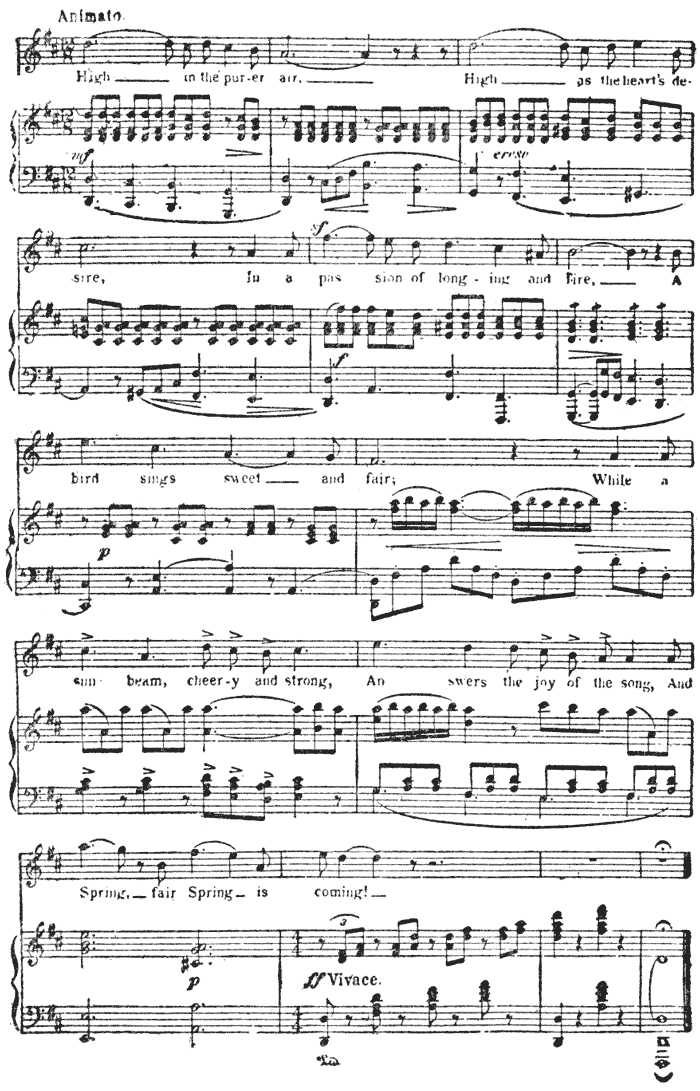
[Listen]
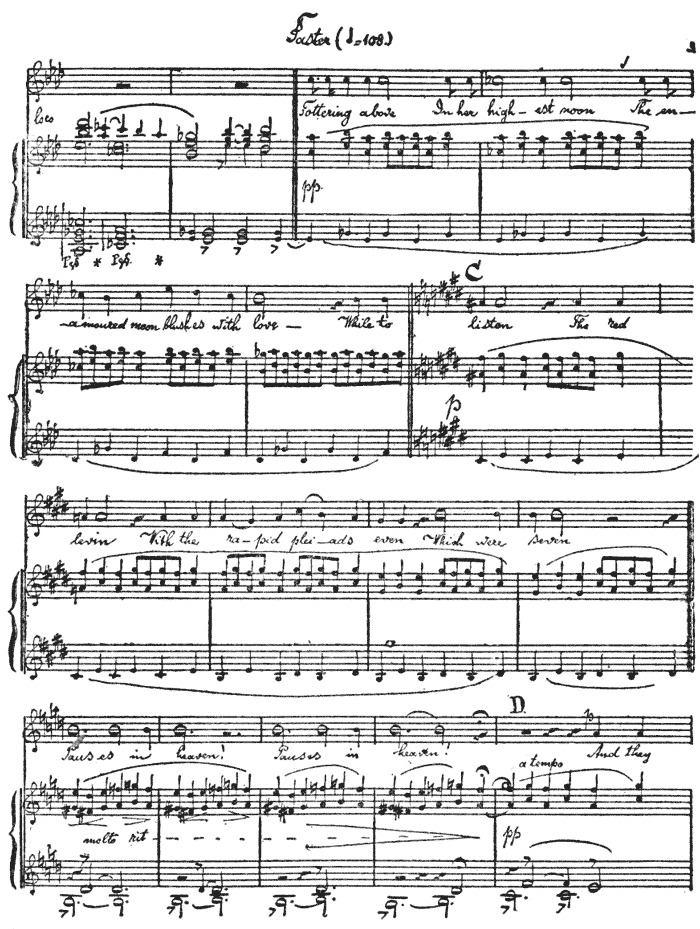
By permission.
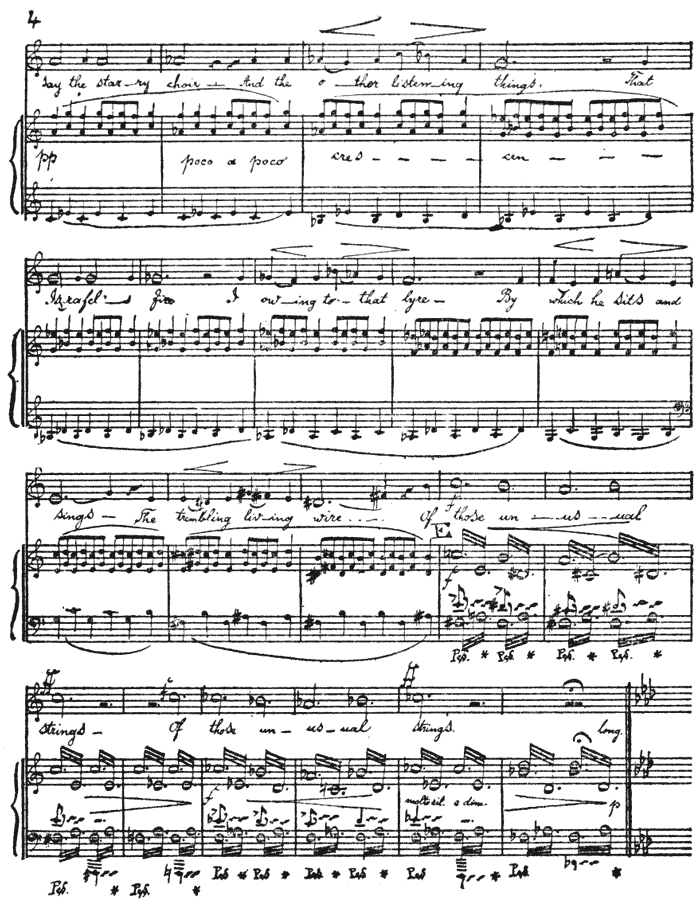
Tottering above
In her highest noon
The enamoured moon blushes with love
While to listen
The red levin
With the rapid pleiads even
Which were seven
Pauses in heaven!
Pauses in heaven!
|
And they say the starry choir
And the other listening things,
That Israfel's fire is owing to that lyre
By which he sits and sings
The trembling living wire
Of those unusual strings
Of those unusual strings.
|
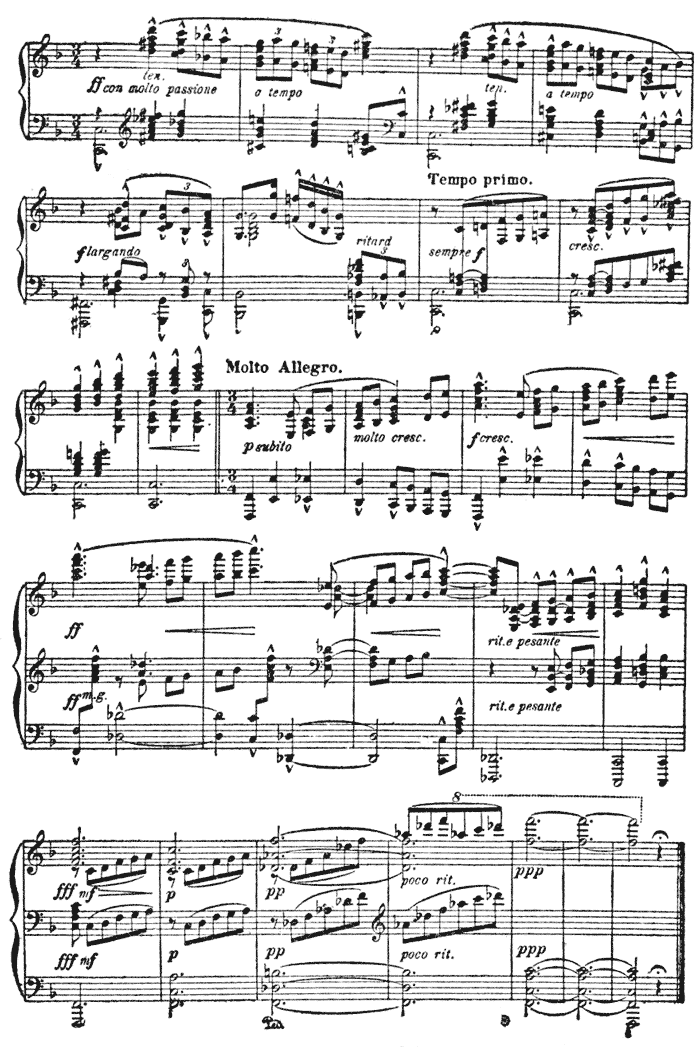
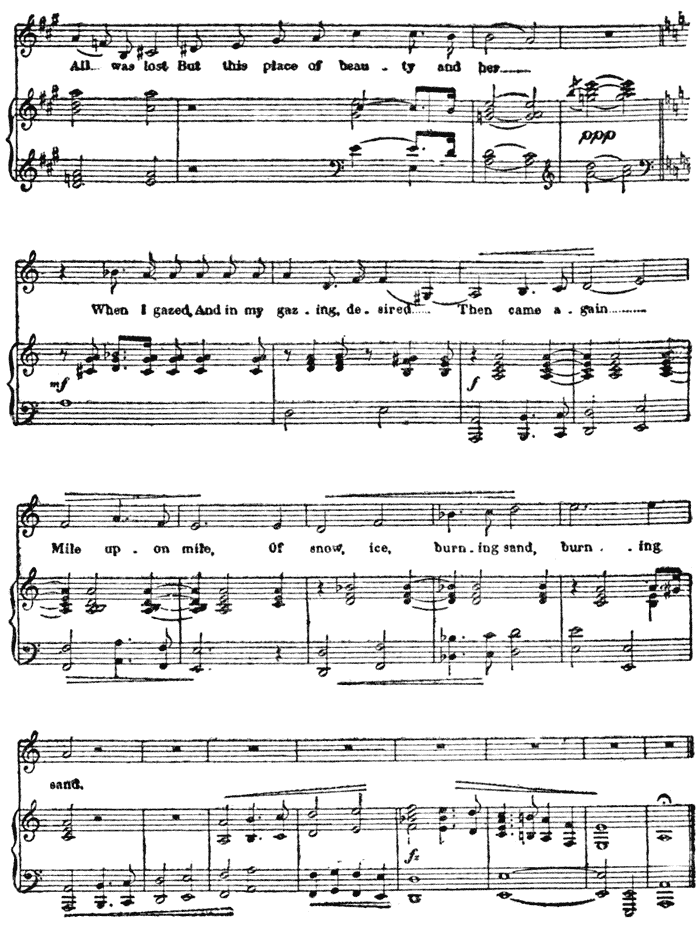
FRAGMENT OF "ISRAFEL," BY EDGAR S. KELLEY.
Kelley has two unpublished songs that
show him at his best, both settings of verse
by Poe,—"Eldorado," which vividly develops
the persistence of the knight, and "Israfel."
This latter poem, as you know, concerns the
angel "whose heart-strings are a lute." After
a rhapsody upon the cosmic spell of the angel's
singing, Poe, with a brave defiance, flings an
implied challenge to him. The verse marks
one of the highest reaches of a genius honored
abroad as a world-great lyrist. It is,
perhaps, praise enough, then, to say that Kelley's
music flags in no wise behind the divine
progress of the words. The lute idea dictates
an arpeggiated accompaniment, whose harmonic
beauty and courage is beyond description
and beyond the grasp of the mind at the
first hearing. The bravery of the climax follows
the weird and opiate harmonies of the
middle part with tremendous effect. The
song is, in my fervent belief, a masterwork
of absolute genius, one of the very greatest
lyrics in the world's music.
In the band of pupils that gathered to
the standard of the invader, Antonin Dvôrák,
when, in 1892, he came over here from Macedonia
to help us, some of the future's best
composers will probably be found.
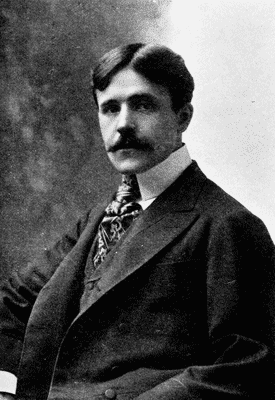
HARVEY WORTHINGTON LOOMIS.
Of this band was Harvey Worthington
Loomis, who won a three years' scholarship
in Doctor Dvôrák's composition class at the
National Conservatory, by submitting an excellent,
but rather uncharacteristic, setting of
Eichendorff's "Frühlingsnacht." Loomis evidently
won Doctor Dvôrák's confidence, for
among the tasks imposed on him was a piano
concerto to be built on the lines of so elaborate
a model as Rubinstein's in D minor.
When Loomis' first sketches showed an elaboration
even beyond the complex pattern,
Dvôrák still advised him to go on. To any
one that knows the ways of harmony teachers
this will mean much.
Loomis (who was born in Brooklyn, February
5, 1865, and is now a resident of New
York) pursued studies in harmony and piano
in a desultory way until he entered Doctor
Dvôrák's class. For his musical tastes he
was indebted to the artistic atmosphere of
his home.
Though Loomis has written something
over five hundred compositions, only a few
works have been published, the most important
of which are "Fairy Hill," a cantatilla
for children, published in 1896 (it was written
on a commission that fortunately allowed
him liberty for not a little elaboration and
individuality), "Sandalphon," and a few
songs and piano pieces.
A field of his art that has won his especial
interest is the use of music as an atmosphere
for dramatic expression. Of this sort are a
number of pantomimes, produced with much
applause in New York by the Academy of
Dramatic Arts; and several musical backgrounds.
The 27th of April, 1896, a concert
of his works was given by a number of
well-known artists.
These musical backgrounds are played in
accompaniment to dramatic recitations. Properly
managed, the effect is most impressive.
Féval's poem, "The Song of the Pear-tree,"
is a typically handled work. The poem tells
the story of a young French fellow, an orphan,
who goes to the wars as substitute for
his friend Jean. After rising from rank to
rank by bravery, he returns to his home just
as his sweetheart, Perrine, enters the church
to wed Jean. The girl had been his one
ambition, and now in his despair he reënlists
and begs to be placed in the thickest of danger.
When he falls, they find on his breast
a withered spray from the pear-tree under
which Perrine had first plighted troth. On
these simple lines the music builds up a
drama. From the opening shimmer and
rustle of the garden, through the Gregorian
chant that solemnizes the drawing of the
lots, and is interrupted by the youth's start
of joy at his own luck (an abrupt glissando);
through his sturdy resolve to go to war in
his friend's place, on through many battles
to his death, all is on a high plane that
commands sympathy for the emotion, and
enforces unbounded admiration for the art.
There is a brief hint of the Marseillaise
woven into the finely varied tapestry of martial
music, and when the lover comes trudging
home, his joy, his sudden knowledge of Perrine's
faithlessness, and his overwhelming
grief are all built over a long organ-point
of three clangorous bride-bells. The leit-motif
idea is used with suggestive clearness
throughout the work.
The background to Longfellow's "Sandalphon"
is so fine an arras that it gives the
poet a splendor not usual to his bourgeois
lays. The music runs through so many
phases of emotion, and approves itself so
original and exaltedly vivid in each that I
put it well to the fore of American compositions.
Hardly less large is the—Loomis calls it
"Musical Symbolism," for Adelaide Ann
Proctor's "The Story of the Faithful Soul."
Of the greatest delicacy imaginable is the
music (for piano, violin, and voice) to William
Sharp's "Coming of the Prince." The
"Watteau Pictures" are poems of Verlaine's
variously treated: one as a head-piece to a
wayward piano caprice, one to be recited during
a picturesque waltz, the last a song with
mandolin effects in the accompaniment.
[Listen]
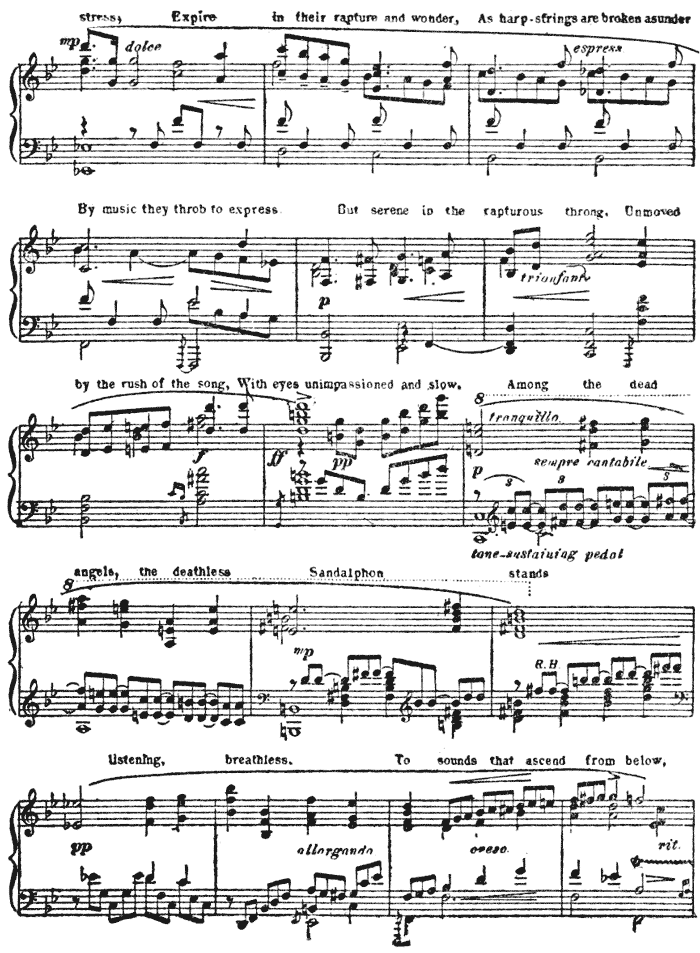
Copyright, 1896, by Edgar S. Werner.
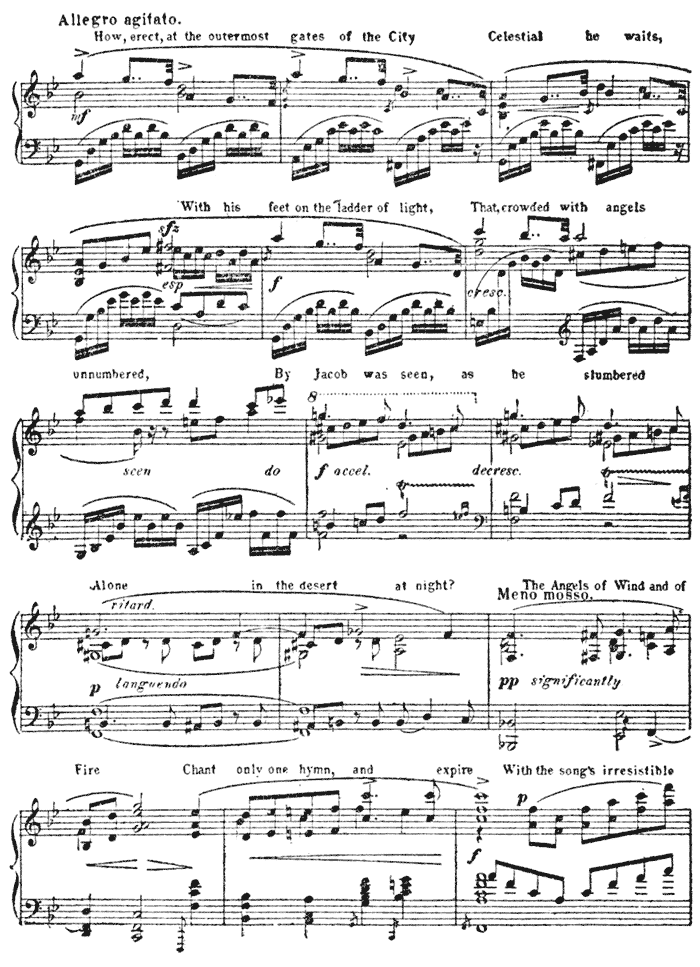
How, erect, at the outermost gates of the City
Celestial he waits,
With his feet on the ladder of light,
That, crowded with angels unnumbered,
By Jacob was seen as he slumbered
Alone in the desert at night?
The Angels of Wind and of Fire
Chant only one hymn, and expire
With the song's irresistible stress,
Expire in their rapture and wonder,
As harp-strings are broken asunder
By music they throb to express.
But serene in the rapturous throng,
Unmoved by the rush of the song,
With eyes unimpassioned and slow,
Among the dead angels, the deathless
Sandalphon stands listening, breathless,
To sounds that ascend from below,...
A FRAGMENT OF "SANDALPHON," BY H.W. LOOMIS.
The pantomimes range from grave to gay,
most of the librettos in this difficult form
being from the clever hand of Edwin Starr
Belknap. "The Traitor Mandolin," "In Old
New Amsterdam," "Put to the Test,"
"Blanc et Noir," "The Enchanted Fountain,"
"Her Revenge," "Love and Witchcraft"
are their names. The music is full
of wit, a quality Loomis possesses in unusual
degree. The music mimics everything
from the busy feather-duster of the
maid to her eavesdropping. Pouring wine,
clinking glasses, moving a chair, tearing up
a letter, and a rollicking wine-song in pantomime
are all hinted with the drollest and
most graphic programmism imaginable.
Loomis has also written two burlesque
operas, "The Maid of Athens" and "The
Burglar's Bride," the libretto of the latter by
his brother, Charles Battell Loomis, the well-known
humorist. This latter contains some
skilful parody on old fogyism.
In the Violin Sonata the piano, while
granting precedence to the violin, approaches
almost to the dignity of a duet. The finale
is captivating and brilliant, and develops some
big climaxes. The work as a whole is really
superb, and ought to be much played. There
are, besides, a "Lyric Finale" to a sonata
not yet written, and several songs for violin,
voice, and piano.
A suite for four hands, "In Summer
Fields," contains some happy manifestations
of ability, such as "A June Roundelay,"
"The Dryad's Grove," and, especially, a humoresque
"Junketing," which is surely destined
to become a classic. From some of
his pantomimes Loomis has made excerpts,
and remade them with new elaboration for
two pianos, under the name of "Exotics."
These are full of variety and of actual novelty,
now of startling discord, now of revelatory
beauty. A so-called "Norland Epic,"
freely constructed on the sonata formula, is
one of Loomis' most brilliant and personal
achievements.
Loomis has an especial aptitude for writing
artistic ballet-music, and for composing in the
tone of different nationalities, particularly
the Spanish. His pantomimes contain many
irresistible dances, one of them including a
Chinese dance alternating 4-4 with 3-4 time.
His strikingly fleet "Harlequin" has been
published.
The gift of adding art to catchiness is a
great one. This Loomis seems to have to an
unusual degree, as is evidenced by the dances
in his pantomimes and his series of six pieces
"In Ballet Costume," all of them rich with
the finest art along with a Strauss-like spontaneity.
These include "L'Amazone," "Pirouette,"
"Un Pas Seul," "La Coryphée," "The
Odalisque," and "The Magyar." One of his
largest works is a concert waltz, "Mi-Carême,"
for two pianos, with elaborate and extended
introduction and coda.
A series of Genre Pictures contains such
lusciousness of felicity as "At an Italian
Festival," and there are a number of musical
moments of engaging charm, for instance,
"N'Importe Quoi," "From a Conservatory
Program," "A Tropical Night," a fascinating
"Valsette," a nameless valse, and
"Another Scandal," which will prove a gilt-edged
speculation for some tardy publisher.
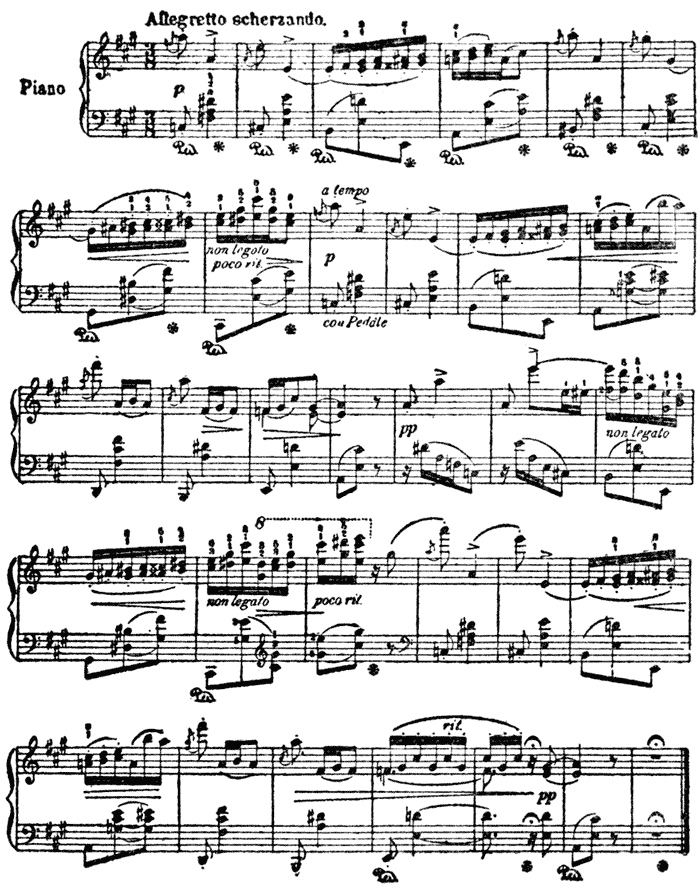
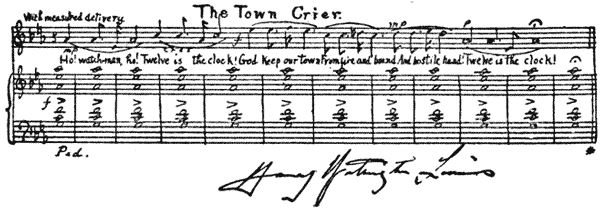
It is brimming with the delicious horror
of excited gossipry. An example of how
thoroughly Loomis is invested with music—how
he thinks in it—is his audacious scherzo,
"The Town Crier," printed herewith.
In songs Loomis has been most prolific.
He has set twenty-two of Shakespeare's lyrics
to music of the old English school, such as
his uproarious "Let me the cannikin clink,"
and his dainty "Tell me where is fancy
bred."
"The Lark" is written in the pentatonic
scale, with accompaniment for two flutes and
a harp.
In the same vein are various songs of
Herrick, a lyrist whose verse is not usually
congenial to the modern music-maker.
Loomis' "Epitaph on a Virgin" must be
classed as a success. Indeed, it reaches positive
grandeur at its climax, wherein is woven
the grim persistence of a tolling bell. In
the same style is a clever setting of Ben
Jonson's much music'd "To Celia."
In German-tone are his veritably magnificent
"Herbstnacht" and his "At Midnight,"
two studies after Franz. Heine's "Des
Waldes Kapellmeister" has been made into
a most hilarious humoresque.
"Bergerie" is a dozen of Norman Gale's
lyrics. "Andalusia" is a flamboyant duet.
In Scotch songs there is a positive embarrassment
of riches, Loomis' fancies finding
especial food and freedom in this school. I
find in these settings far more art and grace
than I see even in Schumann's many Scotch
songs, or those of any other of the Germans.
"Oh, for Ane and Twenty" has bagpipe
effects. Such flights of ecstasy as "My
Wife's a Winsome Wee Thing," and "Bonnie
Wee Thing," are simply tyrannical in their
appeal. Then there is an irresistible "Polly
Stewart;" and "My Peggy's Heart" is fairly
ambrosial. These and several others, like
"There Was a Bonnie Lass," could be made
into an album of songs that would delight a
whole suite of generations.
A number of his songs are published:
they include a "John Anderson, My Jo," that
has no particular right to live; a ballad,
"Molly," with a touch of art tucked into it;
the beautiful "Sylvan Slumbers," and the
quaint and fascinating "Dutch Garden."
Aside from an occasional song like "Thistledown,"
with its brilliantly fleecy accompaniment,
and the setting of Browning's
famous "The Year' at the Spring," for which
Loomis has struck out a superb frenzy, and
a group of songs by John Vance Cheney,
Loomis has found some of his most powerful
inspirations in the work of our lyrist, Aldrich,—such
as the rich carillon of "Wedded,"
and his "Discipline," one of the best of
all humorous songs, a gruesome scherzo all
about dead monks, in which the music
furnishes out the grim irreverence of the
words with the utmost waggery.
Chief among the lyrics by Cheney are
three "Spring Songs," in which Loomis has
caught the zest of spring with such rapture
that, once they are heard, the world seems
poor without them in print. Loomis' literary
culture is shown in the sure taste of his
selection of lyrics for his music. He has
marked aptitudes, too, in creative literature,
and has an excellent idea of the arts kindred
to his own, particularly architecture.
Like Chopin, Loomis is largely occupied in
mixing rich new colors on the inexhaustible
palette of the piano. Like Chopin, he is not
especially called to the orchestra. What the
future may hold for him in this field (by no
means so indispensable to classic repute as
certain pedants assume) it is impossible to
say. In the meantime he is giving most of
his time to work in larger forms.
If in his restless hunt for novelty, always
novelty, he grows too original, too unconventional,
this sin is unusual enough to approach
the estate of a virtue. But his oddity is not
mere sensation-mongering. It is his individuality.
He could make the same reply
to such criticism that Schumann made; he
thinks in strange rhythms and hunts curious
effects, because his tastes are irrevocably so
ordained.
But we ought to show a new genius the
same generosity toward flaws that we extend
toward the masters whose fame is won beyond
the patronage of our petty forgiveness. And,
all in all, I am impelled to prophesy to Loomis
a place very high among the inspired makers
of new music. His harmonies, so indefatigably
searched out and polished to splendor,
so potent in enlarging the color-scale of the
piano; his patient building up, through long
neglect and through long silence, of a monumental
group of works and of a distinct
individuality, must prove at some late day
a source of lasting pride to his country,
neglectful now in spite of itself. But better
than his patience, than his courage, than his
sincerity, better than that insufficient definition
of genius,—the capacity for taking
infinite pains,—is his inspired felicity. His
genius is the very essence of felicity.
It is refreshing to be able to chronicle the
achievements of a composer who has become
financially successful without destroying his
claim on the respect of the learned and
severe, or sacrificing his own artistic conscience
and individuality. Such a composer
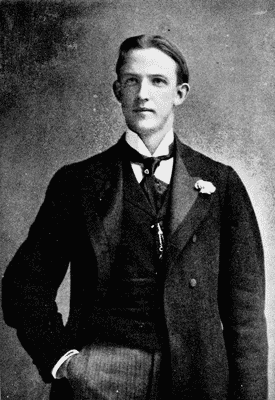
is Ethelbert Nevin.
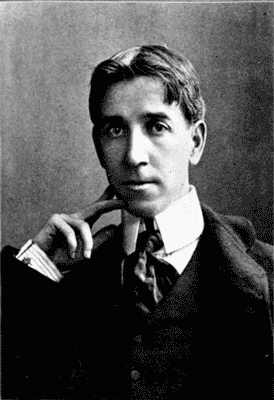
ETHELBERT NEVIN.
His published writings have been altogether
along the smaller lines of composition, and he
has won an enviable place as a fervent worker
in diamonds. None of his gems are paste,
and a few have a perfection, a solidity, and a
fire that fit them for a place in that coronet
one might fancy made up of the richest of
the jewels of the world's music-makers, and
fashioned for the very brows of the Muse
herself.
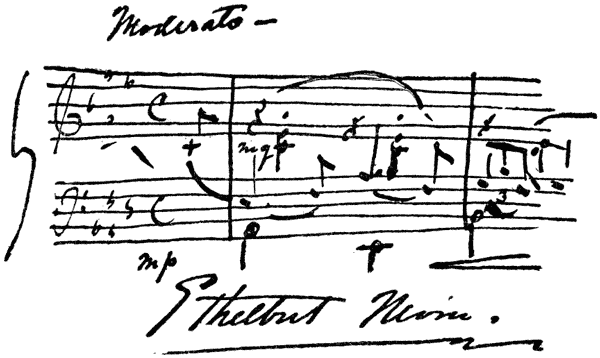
Nevin was born in 1862, at Vineacre, on
the banks of the Ohio, a few miles from Pittsburgh.
There he spent the first sixteen years
of his life, and received all his schooling,
most of it from his father, Robert P. Nevin,
editor and proprietor of a Pittsburgh newspaper,
and a contributor to many magazines.
It is interesting to note that he also composed
several campaign songs, among them
the popular "Our Nominee," used in the day
of James K. Polk's candidacy. The first
grand piano ever taken across the Allegheny
Mountains was carted over for Nevin's
mother.
From his earliest infancy Nevin was musically
inclined, and, at the age of four, was
often taken from his cradle to play for
admiring visitors. To make up for the deficiency
of his little legs, he used to pile
cushions on the pedals so that he might
manipulate them from afar.
Nevin's father provided for his son both
vocal and instrumental instruction, even taking
him abroad for two years of travel and
music study in Dresden under Von Böhme.
Later he studied the piano for two years at
Boston, under B.J. Lang, and composition
under Stephen A. Emery, whose little primer
on harmony has been to American music almost
what Webster's spelling-book was to our
letters.
At the end of two years he went to Pittsburgh,
where he gave lessons, and saved
money enough to take him to Berlin. There
he spent the years 1884, 1885, and 1886,
placing himself in the hands of Karl Klindworth.
Of him Nevin says: "To Herr
Klindworth I owe everything that has come
to me in my musical life. He was a devoted
teacher, and his patience was tireless. His
endeavor was not only to develop the student
from a musical standpoint, but to enlarge
his soul in every way. To do this, he
tried to teach one to appreciate and to feel
the influence of such great minds of literature
as Goethe, Schiller, and Shakespeare. He
used to insist that a man does not become a
musician by practising so many hours a day at
the piano, but by absorbing an influence from
all the arts and all the interests of life, from
architecture, painting, and even politics."
The effect of such broad training—enjoyed
rarely enough by music students—is
very evident in Nevin's compositions. They
are never narrow or provincial. They are
the outpourings of a soul that is not only
intense in its activities, but is refined and
cultivated in its expressions. This effect is
seen, too, in the poems Nevin chooses to set
to music,—they are almost without exception
verses of literary finish and value. His cosmopolitanism
is also remarkable, his songs in
French, German, and Italian having no trace
of Yankee accent and a great fidelity to their
several races.
In 1885, Hans von Bülow incorporated the
best four pupils of his friend, Klindworth,
into an artist class, which he drilled personally.
Nevin was one of the honored four,
and appeared at the unique public Zuhören of
that year, devoted exclusively to the works
of Brahms, Liszt, and Raff. Among the
forty or fifty studious listeners at these
recitals, Frau Cosima Wagner, the violinist
Joachim, and many other celebrities were
frequently present.
Nevin returned to America in 1887, and
took up his residence in Boston, where he
taught and played at occasional concerts.
Eighteen hundred and ninety-two found
him in Paris, where he taught, winning more
pupils than here. He was especially happy
in imparting to singers the proper Auffassung
(grasp, interpretation, finish) of songs, and
coached many American and French artists
for the operatic stage. In 1893 the restless
troubadour moved on to Berlin, where he
devoted himself so ardently to composition
that his health collapsed, and he was exiled
a year to Algiers. The early months of
1895 he spent in concert tours through this
country. As Klindworth said of him, "he
has a touch that brings tears," and it is in
interpretation rather than in bravura that he
excels. He plays with that unusual combination
of elegance and fervor that so individualizes
his composition.
Desirous of finding solitude and atmosphere
for composition, he took up his residence in
Florence, where he composed his suite, "May
in Tuscany" (op. 21). The "Arlecchino"
of this work has much sprightliness, and
shows the influence of Schumann, who made
the harlequin particularly his own; but there
is none of Chopin's nocturnity in the "Notturno,"
which presents the sussurus and the
moonlit, amorous company of "Boccaccio's
Villa." The suite includes a "Misericordia"
depicting a midnight cortège along the Arno,
and modelled on Chopin's funeral march in
structure with its hoarse dirge and its rich
cantilena. The best number of the suite is
surely the "Rusignuolo," an exceedingly
fluty bird-song.
From Florence, Nevin went to Venice,
where he lived in an old casa on the Grand
Canal, opposite the Browning palazzo, and
near the house where Wagner wrote "Tristan
und Isolde." One day his man, Guido, took a
day off, and brought to Venice an Italian
sweetheart, who had lived a few miles from
the old dream-city and had never visited
it. The day these two spent gondoliering
through the waterways, where romance hides
in every nook, is imaginatively narrated in
tone in Nevin's suite, "Un Giorno in Venezia,"
a book more handsomely published even than
the others of his works, which have been
among the earliest to throw off the disgraceful
weeds of type and design formerly worn
by native compositions.
The Venetian suite gains a distinctly Italian
color from its ingenuously sweet harmonies
in thirds and sixths, and its frankly lyric
nature, and "The Day in Venice" begins
logically with the dawn, which is ushered
in with pink and stealthy harmonies, then
"The Gondoliers" have a morning mood of
gaiety that makes a charming composition.
There is a "Canzone Amorosa" of deep fervor,
with interjections of "Io t'amo!" and
"Amore" (which has the excellent authority
of Beethoven's Sonata, op. 81, with its "Lebe
wohl"). The suite ends deliciously with a
night scene in Venice, beginning with a choral
"Ave Maria," and ending with a campanella
of the utmost delicacy.
After a year in Venice Nevin made Paris
his home for a year, returning to America
then, where he has since remained.
Though he has dabbled somewhat in orchestration,
he has been wisely devoting his
genius, with an almost Chopin-like singleness
of mind, to songs and piano pieces. His
piano works are what would be called morceaux.
He has never written a sonata, or
anything approaching the classical forms,
nearer than a gavotte or two. He is very
modern in his harmonies, the favorite
colors on his palette being the warmer keys,
which are constantly blended enharmonically.
He "swims in a sea of tone," being particularly
fond of those suspensions and inversions
in which the intervals of the second clash
passionately, strongly compelling resolution.
For all his gracefulness and lyricism, he
makes a sturdy and constant use of dissonance;
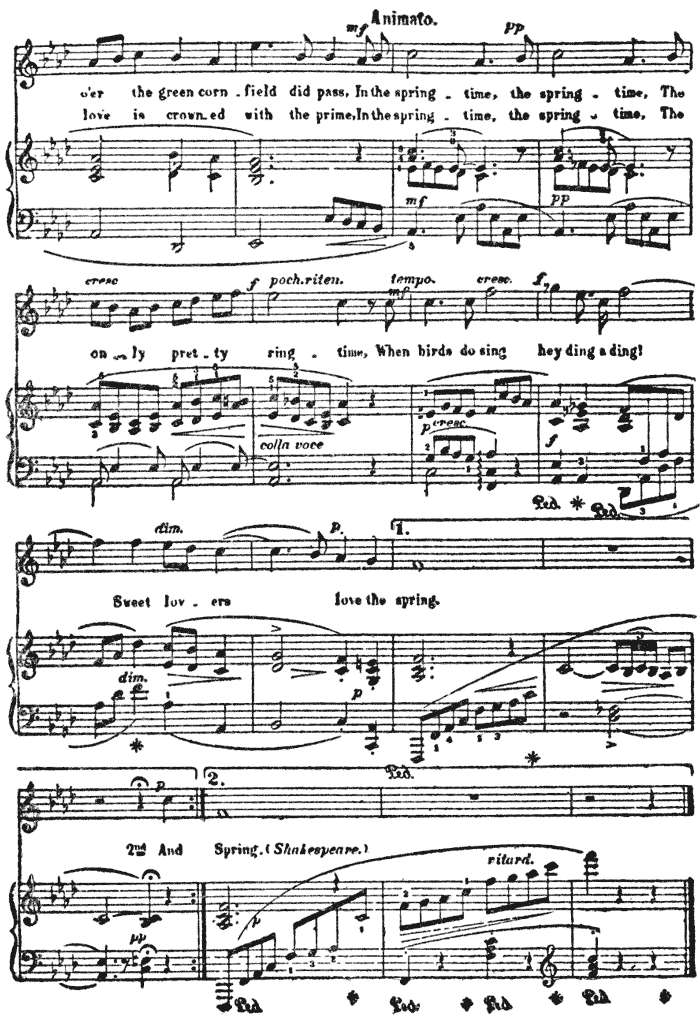
in his song "Herbstgefühl" the
dissonance is fearlessly defiant of conventions.
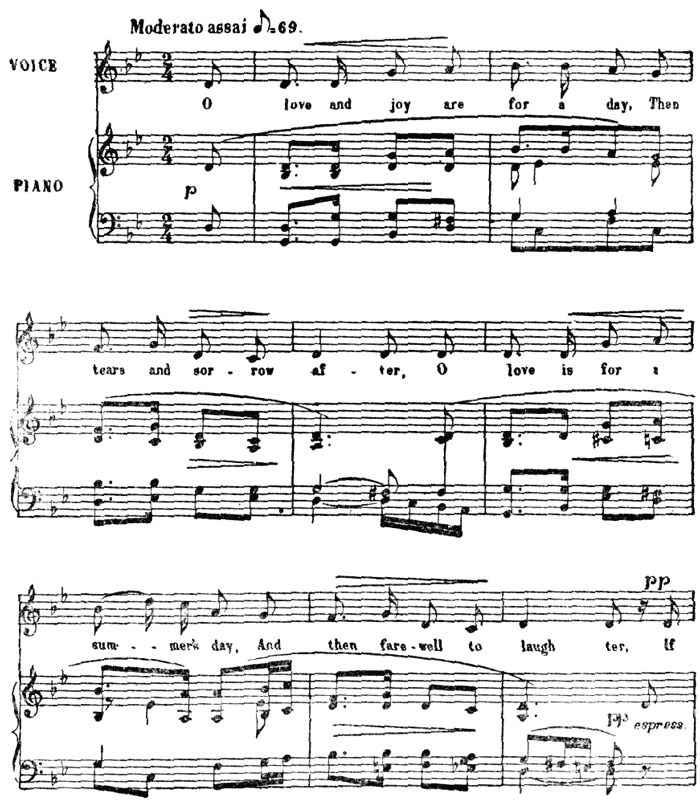
[Listen]
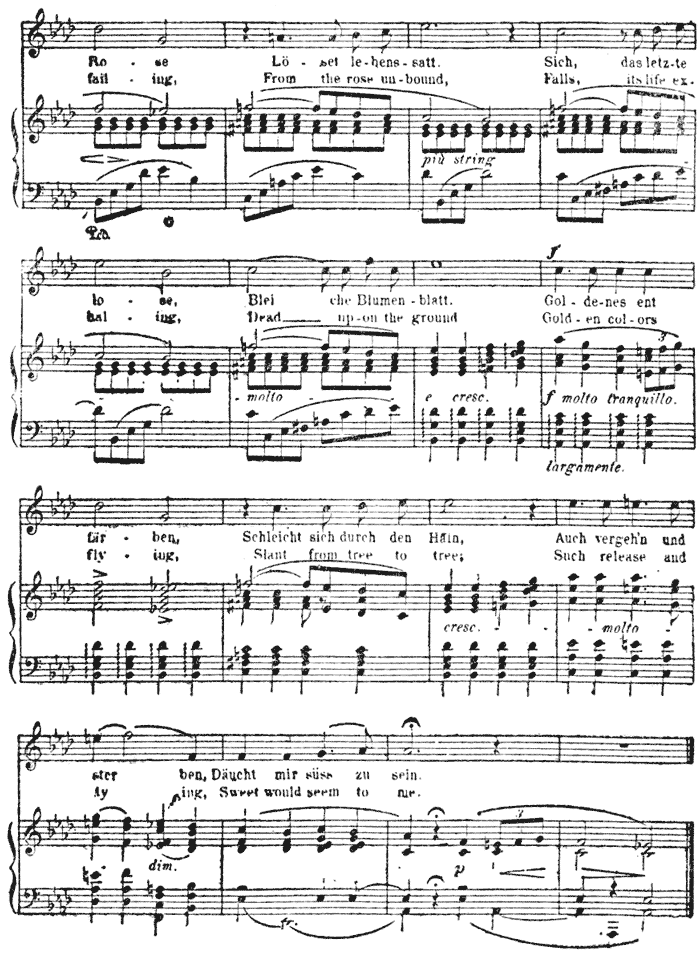
Copyright, 1889, by G. Schirmer, Jr.
... Rose
Löset lebenssatt.
Sich, das letzte lose,
Bleiche Blumenblatt.
Goldenes entfärben,
Schleicht sich durch den Hain,
Auch vergeh'n und sterben,
Däucht mir süss zu sein.
|
... failing,
From the rose unbound,
Falls, its life exhaling,
Dead upon the ground.
Golden colors flying,
Slant from tree to tree;
Such release and dying,
Sweet would seem to me.
|
A FRAGMENT FROM "HERBSTGEFÜHL."
Nevin's songs, whose only littleness is in
their length, though treated with notable
individuality, are founded in principle on the
Lieder of Schumann and Franz. That is to
say, they are written with a high poetical
feeling inspired by the verses they sing, and,
while melodious enough to justify them as
lyrics, yet are near enough to impassioned
recitative to do justice to the words on which
they are built. Nevin is also an enthusiastic
devotee of the position these masters,
after Schubert, took on the question of the
accompaniment. This is no longer a slavish
thumping of a few chords, now and then, to
keep the voice on the key, with outbursts
of real expression only at the interludes; but
it is a free instrumental composition with a
meaning of its own and an integral value,
truly accompanying, not merely supporting
and serving, the voice. Indeed, one of
Nevin's best songs,—"Lehn deine Wang an
meine Wang,"—is actually little more than
a vocal accompaniment to a piano solo. His
accompaniments are always richly colored
and generally individualized with a strong
contramelody, a descending chromatic scale
in octaves making an especially frequent
appearance. Design, though not classical,
is always present and distinct.
Nevin's first published work was a modest
"Serenade," with a neat touch of syncopation,
which he wrote at the age of eighteen.
His "Sketch-Book," a collection of thirteen
songs and piano pieces found an immediate
and remarkable sale that has removed the
ban formerly existing over books of native
compositions.
The contents of the "Sketch-Book" display
unusual versatility. It opens with a
bright gavotte, in which adherence to the
classic spirit compels a certain reminiscence
of tone. The second piece, a song, "I' the
Wondrous Month o' May," has such a springtide
fire and frenzy in the turbulent accompaniment,
and such a fervent reiterance, that
it becomes, in my opinion, the best of all the
settings of this poem of Heine's, not excluding
even Schumann's or that of Franz. The
"Love Song," though a piano solo, is in
reality a duet between two lovers. It is to
me finer than Henselt's perfect "Liebeslied,"
possibly because the ravishing sweetness of
the woman's voice answering the sombre plea
of the man gives it a double claim on the
heart. The setting of "Du bist wie eine
Blume," however, hardly does justice either
to Heine's poem, or to Nevin's art. The
"Serenade" is an original bit of work, but
the song, "Oh, that We Two were Maying!"
with a voice in the accompaniment making it
the duet it should be,—that song can have
no higher praise than this, that it is the complete,
the final musical fulfilment of one of
the rarest lyrics in our language. A striking
contrast to the keen white regret of this
song is the setting of a group of "Children's
Songs," by Robert Louis Stevenson.
Nevin's child-songs have a peculiar and
charming place. He has not been stingy
of either his abundant art or his abundant
humanity in writing them. They include
four of Stevenson's, the best being the captivating
"In Winter I get up at Night," and a
setting of Eugene Field's "Little Boy Blue,"
in which a trumpet figure is used with delicate
pathos.
Nevin's third opus included three exquisite
songs of a pastoral nature, Goethe's rollicking
"One Spring Morning" having an immense
sale. Opus 5 contained five songs, of which
the ecstatic "'Twas April" reached the
largest popularity. Possibly the smallest
sale was enjoyed by "Herbstgefühl." Many
years have not availed to shake my allegiance
to this song, as one of the noblest songs in the
world's music. It is to me, in all soberness, as
great as the greatest of the Lieder of Schubert,
Schumann or Franz. In "Herbstgefühl"
(or "Autumn-mood") Gerok's superb
poem bewails the death of the leaves and
the failing of the year, and cries out in
sympathy:
"Such release and dying
Sweet would seem to me!"
Deeper passion and wilder despair could
not be crowded into so short a song, and the
whole brief tragedy is wrought with a grandeur
and climax positively epic. It is a flash
of sheer genius.
Three piano duets make up opus 6; and
other charming works, songs, piano pieces,
and violin solos, kept pouring from a pen
whose apparent ease concealed a vast deal of
studious labor, until the lucky 13, the opus-number
of a bundle of "Water Scenes,"
brought Nevin the greatest popularity of all,
thanks largely to "Narcissus," which has
been as much thrummed and whistled as any
topical song.
Of the other "Water Scenes," there is
a shimmering "Dragon Fly," a monody,
"Ophelia," with a pedal-point of two periods
on the tonic, and a fluent "Barcarolle" with
a deal of high-colored virtuosity.
His book "In Arcady" (1892) contains
pastoral scenes, notably an infectious romp
that deserves its legend, "They danced as
though they never would grow old." The
next year his opus 20, "A Book of Songs,"
was published. It contains, among other
things of merit, a lullaby, called "Sleep, Little
Tulip," with a remarkably artistic and effective
pedal-point on two notes (the submediant
and the dominant) sustained through the
entire song with a fine fidelity to the words
and the lullaby spirit; a "Nocturne" in which
Nevin has revealed an unsuspected voluptuousness
in Mr. Aldrich' little lyric, and has
written a song of irresistible climaxes. The
two songs, "Dîtes-Moi" and "In der Nacht,"
each so completely true to the idiom of the
language of its poem, are typical of Nevin's
cosmopolitanism, referred to before. This
same unusual ability is seen in his piano
pieces as well as in his songs. He knows
the difference between a chanson and a Lied,
and in "Rechte Zeit" has written with truth
to German soldierliness as he has been sympathetic
with French nuance in "Le Vase
Brisé," the effective song "Mon Desire,"
which in profile suggests Saint-Saëns' familiar
Delilah-song, the striking "Chanson des
Lavandières" and "Rapelle-Toi," one of
Nevin's most elaborate works, in which Alfred
De Musset's verse is splendidly set with much
enharmonious color. Very Italian, too, is
the "Serenade" with accompaniment à la
mandolin, which is the most fetching number
in the suite "Captive Memories," published
in 1899.
Nevin has also put many an English song
to music, notably the deeply sincere "At
Twilight," the strenuous lilt "In a Bower,"
Bourdillon's beautiful lyric, "Before the Daybreak,"
the smooth and unhackneyed treatment
of the difficult stanza of "'Twas April,"
that popular song, "One Spring Morning,"
which has not yet had all the charm sung out
of it, and two songs with obbligati for violin
and 'cello, "Deep in the Rose's Glowing
Heart" and "Doris," a song with a finely
studied accompaniment and an aroma of
Theokritos.
A suite for the piano is "En Passant,"
published in 1899; it ranges from a stately
old dance, "At Fontainebleau," to "Napoli,"
a furious tarantelle with effective glissandi;
"In Dreamland" is a most delicious revery
with an odd repetition that is not preludatory,
but thematic. The suite ends with the most
poetic scene of all, "At Home," which makes
a tone poem of Richard Hovey's word-picture
of a June night in Washington. The depicting
of the Southern moonlight-balm, with
its interlude of a distant and drowsy
negro quartette, reminds one pleasantly of
Chopin's Nocturne (op. 37, No. 1), with its
intermezzo of choric monks, though the
composition is Nevin's very own in spirit
and treatment.
In addition to the works catalogued, Nevin
has written a pantomime for piano and
orchestra to the libretto of that virtuoso
in English, Vance Thompson; it was called
"Lady Floriane's Dream," and was given in
New York in 1898. Nevin has also a cantata
in making.
It needs no very intimate acquaintance
with Nevin's music to see that it is not based
on an adoration for counterpoint as an end.
He believes that true music must come from
the emotions—the intelligent emotions—and
that when it cannot appeal to the emotions
it has lost its power. He says: "Above
everything we need melody—melody and
rhythm. Rhythm is the great thing. We
have it in Nature. The trees sway, and our
steps keep time, and our very souls respond."
In Wagner's "Meistersinger," which he calls
"a symphonic poem with action," Nevin finds
his musical creed and his model.
And now, if authority is needed for all this
frankly enthusiastic admiration, let it be found
in and echoed from Karl Klindworth, who
said of Nevin: "His talent is ungeheures [one
of the strongest adjectives in the German
language]. If he works hard and is conscientious,
he can say for the musical world something
that no one else can say."
In common with most of those that pretend
to love serious music, a certain person was
for long guilty of the pitiful snobbery of
rating march-tunes as the lowest form of the
art. But one day he joined a National Guard
regiment, and his first long march was that
heart-breaking dress-parade of about fifteen
miles through the wind and dust of the day
Grant's monument was dedicated. Most of
the music played by the band was merely
rhythmical embroidery, chiefly in bugle figures,
as helpful as a Clementi sonatina; but
now and then there would break forth a
magic elixir of tune that fairly plucked his
feet up for him, put marrow in unwilling
bones, and replaced the dreary doggedness of
the heart with a great zest for progress, a
stout martial fire, and a fierce esprit de corps;
with patriotism indeed. In almost every
case, that march belonged to one John Philip
Sousa.
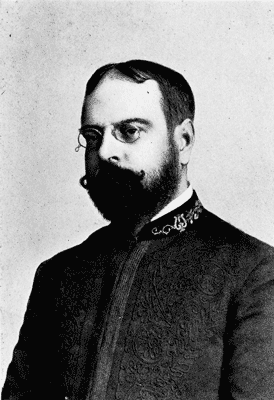
JOHN PHILIP SOUSA.
It came upon this wretch then, that, if it
is a worthy ambition in a composer to give
voice to passionate love-ditties, or vague contemplation,
or the deep despair of a funeral
cortège, it is also a very great thing to instil
courage, and furnish an inspiration that will
send men gladly, proudly, and gloriously
through hardships into battle and death.
This last has been the office of the march-tune,
and it is as susceptible of structural
logic or embellishments as the fugue, rondo,
or what not. These architectural qualities
Sousa's marches have in high degree, as any
one will find that examines their scores or
listens analytically. They have the further
merit of distinct individuality, and the supreme
merit of founding a school.
It is only the plain truth to say that
Sousa's marches have founded a school; that
he has indeed revolutionized march-music.
His career resembles that of Johann Strauss
in many ways. A certain body of old fogies
has always presumed to deride the rapturous
waltzes of Strauss, though they have won
enthusiastic praise from even the esoteric
Brahms, and gained from Wagner such words
as these: "One Strauss waltz overshadows,
in respect to animation, finesse, and real musical
worth, most of the mechanical, borrowed,
factory-made products of the present
time." The same words might be applied to
Sousa's marches with equal justice. They
have served also for dance music, and the
two-step, borne into vogue by Sousa's music,
has driven the waltz almost into desuetude.
There is probably no composer in the
world with a popularity equal to that of
Sousa. Though he sold his "Washington
Post" march outright for $35, his "Liberty
Bell" march is said to have brought him
$35,000. It is found that his music has
been sold to eighteen thousand bands in the
United States alone. The amazing thing is
to learn that there are so many bands in the
country. Sousa's marches have appeared on
programs in all parts of the civilized world.
At the Queen's Jubilee, when the Queen
stepped forward to begin the grand review
of the troops, the combined bands of the
household brigade struck up the "Washington
Post." On other important occasions it
appeared constantly as the chief march of
the week. General Miles heard the marches
played in Turkey by the military bands in
the reviews.
The reason for this overwhelming appeal
to the hearts of a planet is not far to seek.
The music is conceived in a spirit of high
martial zest. It is proud and gay and fierce,
thrilled and thrilling with triumph. Like all
great music it is made up of simple elements,
woven together by a strong personality. It
is not difficult now to write something that
sounds more or less like a Sousa march, any
more than it is difficult to write parodies,
serious or otherwise, on Beethoven, Mozart,
or Chopin. The glory of Sousa is that he
was the first to write in this style; that
he has made himself a style; that he has so
stirred the musical world that countless imitations
have sprung up after him.
The individuality of the Sousa march is
this, that, unlike most of the other influential
marches, it is not so much a musical exhortation
from without, as a distillation of the essences
of soldiering from within. Sousa's
marches are not based upon music-room
enthusiasms, but on his own wide experiences
of the feelings of men who march together in
the open field.
And so his band music expresses all the
nuances of the military psychology: the exhilaration
of the long unisonal stride, the
grip on the musket, the pride in the regimentals
and the regiment,—esprit de corps. He
expresses the inevitable foppery of the severest
soldier, the tease and the taunt of the
evolutions, the fierce wish that all this ploying
and deploying were in the face of an
actual enemy, the mania to reek upon a tangible
foe all the joyous energy, the blood-thirst
of the warrior.
These things Sousa embodies in his music
as no other music writer ever has. To approach
Sousa's work in the right mood, the
music critic must leave his stuffy concert hall
and his sober black; he must flee from the
press, don a uniform, and march. After his
legs and spirits have grown aweary under the
metronomic tunes of others, let him note the
surge of blood in his heart and the rejuvenation
of all his muscles when the brasses flare
into a barbaric Sousa march. No man that
marches can ever feel anything but gratitude
and homage for Sousa.
Of course he is a trickster at times; admitted
that he stoops to conquer at times,
yet in his field he is supreme. He is worthy
of serious consideration, because his thematic
material is almost always novel and forceful,
and his instrumentation full of contrast and
climax. He is not to be judged by the piano
versions of his works, because they are abominably
thin and inadequate, and they are not
klaviermässig. There should be a Liszt or
a Taussig to transcribe him.
When all's said and done, Sousa is the
pulse of the nation, and in war of more
inspiration and power to our armies than ten
colonels with ten braw regiments behind them.
Like Strauss', Mr. Sousa's father was a
musician who forbade his son to devote himself
to dance music. As Strauss' mother
enabled him secretly to work out his own
salvation, so did Sousa's mother help him.
Sousa's father was a political exile from
Spain, and earned a precarious livelihood
by playing a trombone in the very band
at Washington which later became his son's
stepping-stone to fame. Sousa was born at
Washington in 1859. His mother is German,
and Sousa's music shows the effect
of Spanish yeast in sturdy German rye bread.
Sousa's teachers were John Esputa and
George Felix Benkert. The latter Mr. Sousa
considers one of the most complete musicians
this country has ever known. He put him
through such a thorough theoretical training,
that at fifteen Sousa was teaching harmony. At eight he had begun to earn his
own living as a violin player at a dancing-school,
and at ten he was a public soloist.
At sixteen he was the conductor of an orchestra
in a variety theatre. Two years later he
was musical director of a travelling company
in Mr. Milton Nobles' well-known play, "The
Phœnix," for which he composed the incidental
music. Among other incidents in a
career of growing importance was a position
in the orchestra with which Offenbach toured
this country. At the age of twenty-six, after
having played, with face blacked, as a negro
minstrel, after travelling with the late Matt
Morgan's Living Picture Company, and working
his way through and above other such
experiences in the struggle for life, Sousa
became the leader of the United States
Marine Band. In the twelve years of his
leadership he developed this unimportant
organization into one of the best military
bands in the world.
In 1892 his leadership had given him such
fame that he withdrew from the government
service to take the leadership of the band
carrying his own name.
A work of enormous industry was his collection
and arrangement, by governmental
order, of the national and typical tunes of all
nations into one volume, an invaluable book
of reference.
Out of the more than two hundred published
compositions by Sousa, it is not possible
to mention many here. Though some of
the names are not happily chosen, they call
up many episodes of parade gaiety and jauntiness,
or warlike fire. The "Liberty Bell,"
"Directorate," "High School Cadets," "King
Cotton," "Manhattan Beach," "'Sound Off!'"
"Washington Post," "Picador," and others,
are all stirring works; his best, I think, is a
deeply patriotic march, "The Stars and Stripes
Forever." The second part of this has some
brass work of particular originality and vim.
In manuscript are a few works of larger
form: a symphonic poem, "The Chariot
Race," an historical scene, "Sheridan's Ride,"
and two suites, "Three Quotations" and "The
Last Days of Pompeii."
The "Three Quotations" are:
(a) "The King of France, with twenty thousand men,
Marched up a hill and then marched down again,"
which is the motive for a delightful scherzo-march
of much humor in instrumentation;
(b) "And I, too, was born in Arcadia,"
which is a pastorale with delicious touches of
extreme delicacy;
which has a stunning beginning and is a stirring
grotesque in the negro manner Dvôrák
advised Americans to cultivate. All three
are well arranged for the piano.
The second suite is based on "The Last
Days of Pompeii." It opens with a drunken
revel, "In the House of Burbo and Stratonice;"
the bulky brutishness of the gladiators
clamoring for wine, a jolly drinking-song,
and a dance by a jingling clown make up a
superbly written number. The second movement
is named "Nydia," and represents the
pathetic reveries of the blind girl; it is tender
and quiet throughout.
The third movement is at once daring and
masterly. It boldly attacks "The Destruction,"
and attains real heights of graphic suggestion.
A long, almost inaudible roll on
the drums, with occasional thuds, heralds the
coming of the earthquake; subterranean
rumblings, sharp rushes of tremor, toppling
stones, and wild panic are insinuated vividly,
with no cheap attempts at actual imitation.
The roaring of the terrified lion is heard, and,
best touch of all, under the fury of the scene
persists the calm chant of the Nazarenes,
written in one of the ancient modes. The
rout gives way to the sea-voyage of Glaucus
and Ione, and Nydia's swan-song dies away
in the gentle splash of ripples. The work is
altogether one of superb imagination and
scholarly achievement.
Sousa, appealing as he does to an audience
chiefly of the popular sort, makes frequent
use of devices shocking to the conventional.
But even in this he is impelled by the enthusiasm
of an experimenter and a developer.
Almost every unconventional novelty is hooted
at in the arts. But the sensationalism of
to-day is the conservatism of to-morrow, and
the chief difference between a touch of high
art and a trick is that the former succeeds
and the latter does not. Both are likely to
have a common origin.
The good thing is that Sousa is actuated
by the spirit of progress and experiment, and
has carried on the development of the military
band begun by the late Patrick S. Gilmore.
Sousa's concert programs devote what
is in fact the greater part of their space to
music by the very best composers. These,
of course, lose something in being translated
over to the military band, but their effect in
raising the popular standard of musical culture
cannot but be immense. Through such instrumentality
much of Wagner is as truly
popular as any music played. The active
agents of such a result should receive the
heartiest support from every one sincerely
interested in turning the people toward the
best things in music. Incidentally, it is well
to admit that while a cheap march-tune is
almost as trashy as an uninspired symphony,
a good march-tune is one of the best things
in the best music.
Though chiefly known as a writer of
marches, in which he has won glory enough
for the average human ambition, Sousa has
also taken a large place in American comic
opera. His first piece, "The Smugglers,"
was produced in 1879, and scored the usual
failure of a first work. His "Katherine"
was never produced, his "Desirée" was
brought out in 1884 by the McCaull Opera
Company, and his "Queen of Hearts," a one-act
piece, was given two years later. He
forsook opera then for ten years; but in 1896
De Wolf Hopper produced his "El Capitan"
with great success.
The chief tune of the piece was a march
used with Meyerbeerian effectiveness to bring
down the curtain. The stout verve of this
"El Capitan" march gave it a large vogue
outside the opera. Hopper next produced
"The Charlatan," a work bordering upon
opéra comique in its first version. Both of
these works scored even larger success in
London than at home.
[Listen]
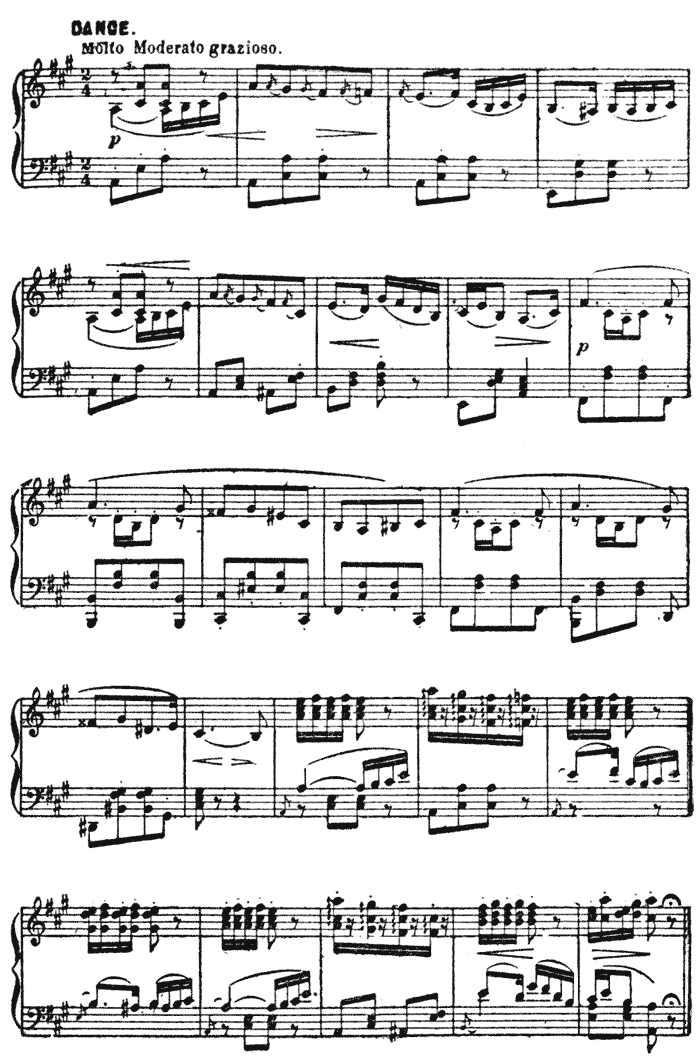
Used by permission of the John Church Company, owners of the
copyright.
A PAGE FROM "EL CAPITAN," BY JOHN PHILIP SOUSA.
In "The Bride Elect," Sousa wrote his
own libretto, and while there was the usual
stirring march as the pièce de resistance, the
work as a whole was less clangorous of the
cymbal than the operas of many a tamer composer.
In "Chris and the Wonderful Lamp,"
an extravaganza, the chief ensemble was
worked up from a previous march, "Hands
Across the Sea."
But Sousa can write other things than
marches, and his scoring is full of variety,
freedom, and contrapuntal brilliance.
Long before Dvôrák discovered America,
we aboriginals had been trying to invent a
national musical dialect which should identify
us as completely to the foreigner as our nasal
intonation and our fondness for the correct
and venerable use of the word "guess." But
Dvôrák is to credit for taking the problem
off the shelf, and persuading our composers
to think. I cannot coax myself into the
enthusiasm some have felt for Dvôrák's own
explorations in darkest Africa. His quartette
(op. 96) and his "New World" symphony are
about as full of accent and infidelity as Mlle.
Yvette Guilbert's picturesque efforts to sing
in English. But almost anything is better
than the phlegm that says, "The old ways are
good enough for all time;" and the Bohemian
missionary must always hold a place in the
chronicle of American music.
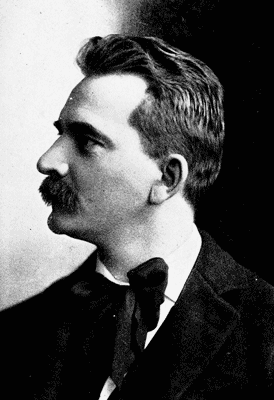
HENRY SCHOENEFELD.
A disciple of Dvôrák's, both in advance and
in retrospect, is Henry Schoenefeld, who
wrote a characteristic suite (op. 15) before the
Dvôrákian invasion, and an overture, "In the
Sunny South," afterward. The suite, which
has been played frequently abroad, winning
the praises of Hanslick, Nicodé, and Rubinstein,
is scored for string orchestra. It opens
with an overly reminiscent waltz-tune, and
ends conventionally, but it contains a movement
in negro-tone that gives it importance.
In this the strings are abetted by a tambourine,
a triangle, and a gong. It is in march-time,
and, after a staccato prelude, begins
with a catchy air taken by the second violins,
while the firsts, divided, fill up the chords.
A slower theme follows in the tonic major;
it is a jollificational air, dancing from the first
violins with a bright use of harmonics. Two
periods of loud chorale appear with the gong
clanging (to hint a church-bell, perhaps). The
first two themes return and end the picture.
The overture (op. 22) has won the high
esteem of A.J. Goodrich, and it seems to
me to be one of the most important of native
works, not because of its nigrescence, but
because of its spontaneity therein. It adds
to the usual instruments only the piccolo,
the English horn, the tambourine, and triangle
and cymbals. The slow introduction
gives forth an original theme in the most
approved and most fetching darky pattern.
The strings announce it, and the wood replies.
The flutes and clarinets toss it in a
blanket furnished by an interesting passage
in the 'cellos and contrabasses. There is a
choral moment from the English horn, the
bassoons, and a clarinet. This solemn thought
keeps recurring parenthetically through the
general gaiety. The first subject clatters in,
the second is even more jubilant. In the
development a dance misterioso is used with
faithful screaming repetitions, and the work
ends regularly and brilliantly. There is much
syncopation, though nothing that is strictly
in "rag-time;" banjo-figurations are freely
and ingeniously employed, and the whole is
a splendid fiction in local color. Schoenefeld's
negroes do not speak Bohemian.
His determined nationalism is responsible
for his festival overture, "The American
Flag," based on his own setting of Rodman
Drake's familiar poem. The work opens
with the hymn blaring loudly from the antiphonal
brass and wood. The subjects are
taken from it with much thematic skill, and
handled artfully, but the hymn, which appears
in full force for coda, is as trite as the
most of its kith.
Schoenefeld was born in Milwaukee, in
1857. His father was a musician, and his
teacher for some years. At the age of seventeen
Schoenefeld went to Leipzig, where he
spent three years, studying under Reinecke,
Coccius, Papperitz, and Grill. A large choral
and orchestral work was awarded a prize over
many competitors, and performed at the
Gewandhaus concerts, the composer conducting.
Thereafter he went to Weimar, where
he studied under Edward Lassen.
In 1879 he came back to America, and
took up his residence in Chicago, where he
has since lived as a teacher, orchestra leader,
and composer. He has for many years
directed the Germania Männerchor.
Schoenefeld's "Rural Symphony" was
awarded the $500 prize offered by the
National Conservatory. Dvôrák was the
chairman of the Committee on Award, and
gave Schoenefeld hearty compliments. Later
works are: "Die drei Indianer," an ode for
male chorus, solo, and orchestra; a most
beautiful "Air" for orchestra (the air being
taken by most of the strings,—the first violins
haunting the G string,—while a harp
and three flutes carry the burden of the accompaniment
gracefully); a pleasant "Reverie"
for string orchestra, harp, and organ;
and two impromptus for string orchestra, a
"Meditation" representing Cordelia brooding
tenderly over the slumbering King Lear,—art
ministering very tenderly to the mood,—and
a cleverly woven "Valse Noble."
Only a few of Schoenefeld's works are published,
all of them piano pieces. It is no slur
upon his orchestral glory to say that these
are for the most part unimportant, except
the excellent "Impromptu" and "Prelude."
Of the eight numbers in "The Festival," for
children, only the "Mazurka" is likely to
make even the smallest child think. The
"Kleine Tanz Suite" is better. The six
children's pieces of opus 41, "Mysteries of
the Wood," make considerable appeal to the
fancy and imagination, and are highly interesting.
They show Grieg's influence very
plainly, and are quite worth recommending.
This cannot be said of his most inelegant
"Valse Élégante," or of his numerous dances,
except, perhaps, his "Valse Caprice."
He won in July, 1899, the prize offered to
American composers by Henri Marteau, for a
sonata for violin and piano. The jury was composed
of such men as Dubois, Pierné, Diemer,
and Pugno. The sonata is quasi fantasia, and
begins strongly with an evident intention to
make use of negro-tone. The first subject is
so vigorously declared that one is surprised
to find that it is elastic enough to express a
sweet pathos and a deep gloom. It is rather
fully developed before the second subject
enters; this, on the other hand, is hardly
insinuated in its relative major before the
rather inelaborate elaboration begins. In the
romanza, syncopation and imitation are much
relied on, though the general atmosphere
is that of a nocturne, a trio of dance-like
manner breaking in. The final rondo combines
a clog with a choral intermezzo. The
work is noteworthy for its deep sincerity and
great lyric beauty.
The plantation dances of Maurice Arnold
have an intrinsic interest quite aside from
their intrinsic value. Arnold, whose full
name is Maurice Arnold-Strothotte, was born
in St. Louis in 1865. His mother was a
prominent pianist and gave him his first lessons
in music. At the age of fifteen he
went to Cincinnati, studying at the College of
Music for three years. In 1883 he went to
Germany to study counterpoint and composition
with Vierling and Urban in Berlin. The
latter discouraged him when he attempted to
imbue a suite with a negro plantation spirit.
Arnold now went upon a tramping tour in
Hungary, Bulgaria, and Turkey. Some of
his compositions show the influence of his
journey. He then entered the Cologne Conservatory,
studying under Wuellner, Neitzel,
and G. Jensen. His first piano sonata was
performed there at a public concert. He
next went to Breslau, where, under the instruction
of Max Bruch, he wrote his cantata,
"The Wild Chase," and gave public performance
to other orchestral work. Returning
now to St. Louis, he busied himself as solo
violinist and teacher, travelling also as a conductor
of opera companies. When Dvôrák
came here Arnold wrote his "Plantation
Dances," which were produced in a concert
under the auspices of the Bohemian composer.
Arnold was instructor of harmony at
the National Conservatory under Dvôrák.
The "Plantation Dances" are Arnold's
thirty-third opus, and they have been much
played by orchestras; they are also published
as a piano duet; the second dance also as a
solo. Arnold has not made direct use of
Ethiopian themes, but has sought the African
spirit. The first of the dances is very
nigresque; the second hardly at all, though
it is a delicious piece of music; the third
dance uses banjo figures and realizes darky
hilarity in fine style; the fourth is a cake
walk and hits off the droll humor of that
pompous ceremony fascinatingly.
Arnold's "Dramatic Overture" shows a fire
and rush very characteristic of him and
likely to be kept up without sufficient contrast.
So also does his cantata, "The Wild
Chase." Arnold has written two comic
operas. I have heard parts of the first and
noted moments of much beauty and humor.
The Aragonaise, which opens the third act,
is particularly delightful. The orchestration
throughout displays Arnold's characteristic
studiousness in picturesque effect.
For piano there is a czardas, and a "Valse
Élégante" for eight hands; it is more Viennese
than Chopinesque. It might indeed be
called a practicable waltz lavishly adorned.
The fruits of Arnold's Oriental journey are
seen in his impressionistic "Danse de la Midway
Plaisance;" a very clever reminiscence of
a Turkish minstrel; and a Turkish march,
which has been played by many German
orchestras. There is a "Caprice Espagnol,"
which is delightful, and a "Banjoënne," which
treats banjo music so captivatingly that
Arnold may be said to have invented a new
and fertile and musical form. Besides these
there are a fugue for eight hands, a "Minstrel
Serenade" for violin and piano, and six
duets for violin and viola.
There are also a few part songs and some
solos, among which mention should be made
of "Ein Märlein," in the old German style,
an exquisitely tender "Barcarolle," and a
setting of the poem, "I Think of Thee in
Silent Night," which makes use of a particularly
beautiful phrase for pre-, inter-, and
postlude. Arnold has also written some
ballet music, a tarantelle for string orchestra,
and is at work upon a symphony, and a
book, "Some Points in Modern Orchestration."
His violin sonata (now in MS.) shows
his original talent at its best. In the first
movement, the first subject is a snappy and
taking example of negro-tone, the second has
the perfume of moonlit magnolia in its lyricism.
(In the reprise this subject, which had
originally appeared in the dominant major,
recurs in the tonic major, the key of the sonata
being E minor.) The second movement
is also in the darky spirit, but full of melancholy.
For finale the composer has flown
to Ireland and written a bully jig full of dash
and spirit.
The influence of Japanese and Chinese art
upon our world of decoration has long been
realized. After considering the amount of
interest shown in the Celestial music by
American composers, one is tempted to
prophesy a decided influence in this line, and
a considerable spread of Japanese influence
in the world of music also. Japanese music
has a decorative effect that is sometimes
almost as captivating as in painting.
The city of San Francisco is the natural
gateway for any such impulse, and not a
little of it has already passed the custom
house. In this field Edgar S. Kelley's influence
is predominating, and it is not surprising
that he should pass the contagion on to
his pupil, Nathaniel Clifford Page, who was
born in San Francisco, October 26, 1866.
His ancestors were American for many years
prior to the Revolution. He composed operas
at the age of twelve, and has used many of
these immature ideas with advantage in the
later years. He began the serious study of
music at the age of sixteen, Kelley being his
principal teacher. His first opera, composed
and orchestrated before he became of age,
was entitled "The First Lieutenant." It
was produced in 1889 at the Tivoli Opera
House in San Francisco, where most of the
critics spoke highly of its instrumental and
Oriental color, some of the scenes being laid
in Morocco.
In instrumentation, which is considered
Page's forte, he has never had any instruction
further than his own reading and investigation.
He began to conduct in opera and
concert early in life, and has had much
experience. He has also been active as a
teacher in harmony and orchestration.
An important phase of Page's writing has
been incidental music for plays, his greatest
success having been achieved by the music
for the "Moonlight Blossom," a play based
upon Japanese life and produced in London
in 1898. The overture was written entirely
on actual Japanese themes, including the
national anthem of Japan. Page was three
weeks writing these twelve measures. He
had a Japanese fiddle arranged with a violin
finger-board, but thanks to the highly characteristic
stubbornness of orchestral players, he
was compelled to have this part played by a
mandolin. Two Japanese drums, a whistle
used by a Japanese shampooer, and a Japanese
guitar were somehow permitted to add their
accent. The national air is used in augmentation
later as the bass for a Japanese song
called "K Honen." The fidelity of the
music is proved by the fact that Sir Edwin
Arnold's Japanese wife recognized the various
airs and was carried away by the national
anthem.
Although the play was not a success, the
music was given a cordial reception, and
brought Page contracts for other work in
England, including a play of Indian life by
Mrs. Flora Annie Steel.
Previously to the writing of the "Moonlight
Blossom" music, Page had arranged the
incidental music for the same author's play,
"The Cat and the Cherub." Edgar S.
Kelley's "Aladdin" music was the source
from which most of the incidental music
was drawn; but Page added some things
of his own, among them being one of the
most effective and unexpected devices for
producing a sense of horror and dread I
have ever listened to: simply the sounding
at long intervals of two gruff single tones
in the extreme low register of the double
basses and bassoons. The grimness of this
effect is indescribable.
An unnamed Oriental opera, and an opera
called "Villiers," in which old English color
is employed (including a grotesque dance of
the clumsy Ironsides), show the cosmopolitan
restlessness of Page's muse. An appalling
scheme of self-amusement is seen in his
"Caprice," in which a theme of eight measures'
length is instrumented with almost every
contrapuntal device known, and with psychological
variety that runs through five movements,
scherzando, vigoroso, con sentimento,
religioso, and a marcia fantastico. The suite
called "Village Fête" is an experiment in
French local color. It contains five scenes:
The Peasants Going to Chapel; The Flower
Girls; The Vagabonds; The Tryst; The
Sabot Dance, and the Entrance of the
Mayor, which is a pompous march.
On the occasion of a performance of this,
Louis Arthur Russell wrote: "His orchestra
is surely French, and as modern as you
please. The idiom is Berlioz's rather than
Wagner's."