At Granada one feels as though his sightseeing
had hardly begun until he has been to the Alhambra,
and it is the same way at Constantinople so long as
the interior of the Old Seraglio has not been explored.
Twenty times a day, wherever you may
be on sea or land, that hillside covered with vivid
green starts into view, tantalizing you with suggestions
of what it has to disclose, forcing itself upon
your attention, riveting the mind upon itself when
you would fain think of other things—an unsolved
enigma, a haunting mystery, which gives you no
peace until at last you yield and go there before the
appointed day, more to have done with it than for
the purpose of enjoying the sight.
There is, in fact, not another spot of earth in
Europe whose mere name calls into life such an extraordinary
mixture of awful and pleasing associations,
about which so much has been talked and
thought and written and guessed, which has given
rise to so many vague and contradictory rumors—been
the object of so much insatiate curiosity, of so
many stupid mistakes and extravagant tales. Now-a-days
any one can go there, and many who do so
come away quite unimpressed; but of one thing we
may be quite certain, and that is that when centuries
shall have elapsed, when possibly the Ottoman power
will be only a memory in Europe, and that exquisite
hill be crowned by the busy streets of a new and
populous city, no traveller will pass through them
without seeing again, in fancy, the imperial kiosks
of former days, and thinking enviously of us in the
nineteenth century who can still behold the speaking,
breathing records of that storied habitation of
the Ottomans. Who knows how many archæologists
will concentrate their painstaking research upon the
identification of a doorway or portion of a wall discovered
in the courtyard of some modern building—how
many poets will break forth into verse over a
few heaps of stones scattered along the shore? On
the other hand, it may be that hundreds of years
from now those walls will still be jealously preserved,
and scholar, lover, and artist, flocking to see them,
that strange picturesque life which was led there
for four hundred years be resuscitated and spread
over the entire surface of the globe in hundreds of
volumes and pictures.
It is not owing to any architectural beauty that
the interest of the whole world is directed toward
the Seraglio. Unlike the Alhambra, it is not a great
artistic monument: the Court of the Lions alone in
the Arabian palace is worth all the kiosks and
towers of the Turkish one put together. No, the
value of the Seraglio lies wholly in its great historic
interest: it illustrates and gives life to almost the
entire history of the Ottoman dynasty; upon its
walls and the trunks of its century-old trees are
engraved the most secret and intimate records of the
empire. Nothing but the period covered by the
past thirtyE years and the two centuries preceding
the conquest of Constantinople are wanting to complete
the chronicle. From Muhammad II., who laid
its foundations, to Abdul-Megid, who abandoned it
to take up his residence in the palace of Dolmabâghcheh,
twenty-five sultans have dwelt there.
Hardly had the dynasty conquered its European
metropolis when it planted its foot upon this spot;
here it climbed to the apex of its glory, and here
its decadence began. It was at once a palace, a
fortress, and a sanctuary; here was the brain of
the empire and the heart of Islamism; it was a city
within a city, an imposing and magnificent stronghold,
inhabited by a people, guarded by an army,
embracing within its walls an infinite variety of
buildings, pleasure-grounds, and prisons, city,
country, palaces, arsenals, schools, offices, and
mosques, where fêtes, executions, religious ceremonies,
love affairs, state functions, and wild revels
succeeded one another with startling rapidity; here
sultans were born, elevated to the throne, deposed,
imprisoned, strangled; here were woven the tangled
webs of every conspiracy that threatened the empire;
here resounded the hoarse cry of every popular
tumult; hither flowed the purest gold and bluest
blood of the Turkish dominions; here was wielded
that shining blade that flashed above the heads of a
hundred different peoples; and upon this spot, for
nearly three centuries, was concentrated the gaze
of uneasy Europe, suspicious Asia, and cowering
Africa, as upon some smoking crater which threatened
at any moment to overflow and engulf the
whole earth.
This huge royal residence is situated upon the
most eastern of Stambul’s seven hills, the one which
inclines gently to the edge of the Sea of Marmora,
the mouth of the Bosphorus, and the Golden Horn.
It is the site formerly occupied by the Acropolis of
Byzantium, a part of the ancient city and one wing
of the great imperial palace, and is by far the most
beautiful hill in Constantinople, as well as the
promontory most favored by nature of the whole
European shore. Here converge as to a common
centre two seas and two straits; to this spot led all
the great military and commercial high-roads of
Eastern Europe; torrents of water poured into it
through the aqueducts constructed by the Byzantine
emperors; the hills of Thracia protect it from
the north winds; the sea bathes it on three sides;
Galata watches over it from the harbor; Skutari
mounts guard from across the Bosphorus; and the
snow-crowned heights of Bithynia close in the
Asiatic horizon. Standing alone at the extreme end
of the great metropolis in an almost isolated position,
in its beauty and strength it seems formed by nature
to act as the pedestal of a great monarchy, and to
encircle and screen the life of those princes who
were half gods.
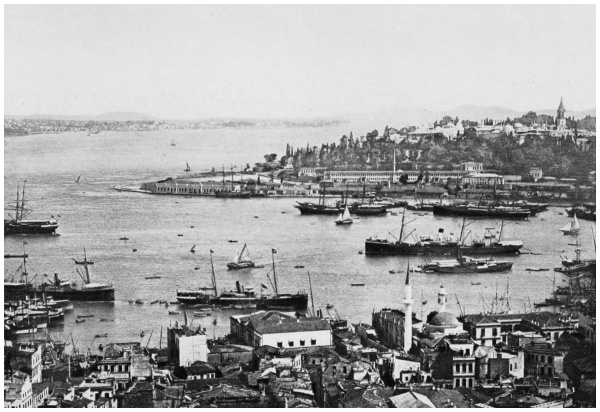
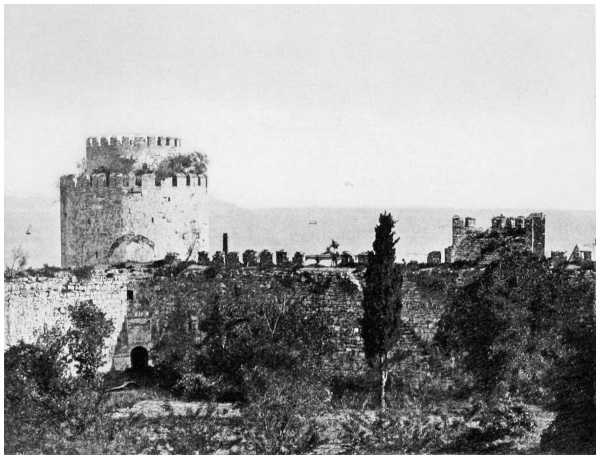
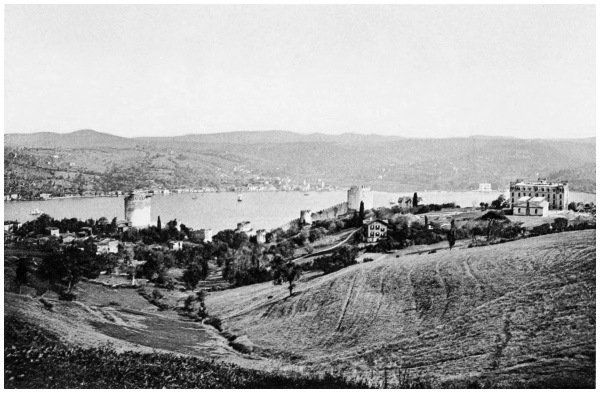
Panorama of the Seraglio.
The entire hill is surrounded at its base by a high
battlemented wall flanked by massive towers. On
the sides toward the Sea of Marmora and the Golden
Horn this is identical with the city wall. On the
land side it was erected by Muhammad II., and
shuts the Seraglio Hill off from that one on which
the mosque of Nûri Osmaniyeh stands. Describing
a right angle near the Sublime Porte, it passes in
front of St. Sophia, and then, making a wide outward
curve, joins the walls of Stambul on the
shore. This is the outer enclosure of the Seraglio.
Properly speaking, what is meant by the Seraglio
is only that part which occupies the summit of the
hill, shut in behind high walls of its own—the
central redoubt, as it were, of the great fortress of
the hill.
It would be, however, nothing but wasted time
and energy to enter into a detailed description of
this spot such as it is at present. The railroad
crosses its outer walls; a disastrous fire destroyed
many of the buildings in 1865; the gardens are
largely despoiled of their beauty; hospitals, barracks,
and military schools have been established within its
precincts; and of the old buildings which are still
standing many have been either so altered or their
original function so changed that, although the most
salient features still remain, and one finds the outline
of the Old Seraglio clearly defined, yet the number
and nature of the minor alterations and the abandonment
and neglect of the past thirty years have so
changed the character of the whole place that it
would be impossible to render a faithful description
of it as it now appears without disappointing even
the most modest expectations.
It will, then, be better for his sake who writes, as
well as his who reads, to describe this famous
Seraglio such as it was at the most glorious period
of the Ottoman power.
Any one who in those old days—say from a lofty
tower or one of the minarets of St. Sophia—could
take in the entire Seraglio Hill must have enjoyed
a sight of extraordinary beauty. Framed by the
deep blue of the sea, the Bosphorus, and the
harbor, with their semicircle of white sails, arose
the great green mass of the hill, girdled by walls
and towers and crowned by guns and sentinels.
From the centre of this forest of lofty trees, through
which innumerable footpaths glistened and flower-beds
flaunted their gay colors, rose the vast rectangle
of the Seraglio buildings, divided into three large
courtyards, or rather little towns, built around three
irregular squares, whose roofs showed in a confused,
many-colored mass—terraces filled with flowers,
gilded cupolas, white minarets, airy pinnacles of
kiosks, great arched doorways, alternating with
gardens and groves, and half buried in foliage. It
was a little white metropolis, glittering, irregular,
light as an encampment of tents, through which
there breathed a spirit at once voluptuous, pastoral,
and warlike. In one part it was all life and movement,
in another silent and deserted as a necropolis;
here open and bathed in sunlight, there plunged in
perpetual gloom and hidden from human gaze. A
thousand zephyrs fanned it, while its unending
succession of contrasting lights and shadows, its
brilliant coloring, and subdued tints of blue and
gray were alike reflected in its marble buildings and
tiny lakes, above which soared flocks of doves and
swallows.
Such was the external aspect of the imperial city,
not, perhaps, so very large to the eye of one overlooking
it from above, but within so divided and
subdivided, so intricate and irregular, that servants
familiar with its inner courts for upward of fifty
years would still grow confused and take the wrong
turn, and the Janissaries when they invaded it for
the third time again lost their way.
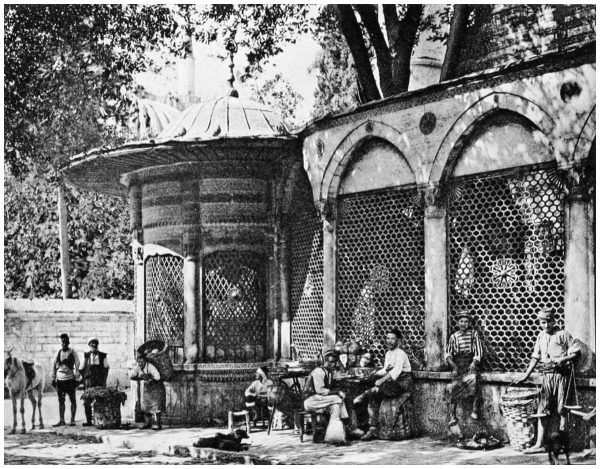
The principal entrance then, as now, was the
Bâb-i-Humayûn, or Imperial Gate, opening on the
little square in which stands the fountain of Sultan
Ahmed, back of St. Sophia. It is a lofty portal
of white and black marble, richly adorned with
arabesques and crowned by a high superstructure
with eight windows and a spreading roof, the architecture
being that mixture of the Arabian and
Persian styles by which almost everything erected
by the Turks in the years immediately following
the conquest can be so readily distinguished, before
they began to copy the Byzantine architecture
around them. Above the entrance, on a marble
scroll, are the inscriptions of Muhammad II.: “May
Allah preserve the glory of its possessor for ever!
May Allah strengthen its buildings! May Allah
establish its foundations!”F Before this gate the
populace of Stambul used to assemble in the morning
to see which of the great men of the court or
state might have been decapitated during the previous
night, it being customary in such cases to
either suspend the heads in the niches which may
still be seen almost intact to right and left of the
entrance, or else place them in a silver basin, with
the accusation and sentence exhibited alongside, the
bodies of those victims who were sentenced to be
strangled being thrown out into the square. Here
detachments of troops from far-off armies awaited
the necessary permission to enter the outer court
bearing their victorious trophies and heaping on the
imperial threshold arms, flags, the skulls of vanquished
enemies, and magnificent uniforms stained
with blood.
The entrance was guarded by a powerful band
of kapuji, the sons of beys and pashas, gorgeously
arrayed, who, from the windows and summits of the
towers overlooked the continual procession of people
coming and going below, or held back with their
great cimeters the silent curious throng collected
without in the hope of catching, through some crack,
a fleeting glimpse of the courtyard, a brief view of
the second gateway, a suggestion at least of that
enormous and mysterious abode which was the
object of so much conjecture and dread. Passing by,
the devout Mussulman would pause to murmur a
prayer for his sublime lord; the poor and ambitious
youth picture to himself the day when he too might
possibly cross that threshold to receive the horse-tail;
the pretty ragged little maid of the street
dream gorgeous dreams, not unmixed with hope, of
the splendid existence of a kadyn; and the relatives
of state victims avert their heads and shudder;
while throughout the entire square a strict silence
was observed, broken only three times a day by the
muezzin’s voice on St. Sophia.
From the Humayûn Gate one enters the so-called
Court of the Janissaries, which was the first enclosure
of the Seraglio. This large courtyard is
still surrounded by various long, irregular buildings
and shaded by groups of trees, among the latter of
which the huge plane tree of the Janissaries is conspicuous
with its mighty trunk, which the outstretched
arms of ten men cannot span. On the
left as you enter stands the church of St. Irene,
founded by Constantine the Great, and converted
into an armory by the Turks; all around stood the
Seraglio hospital, the treasury, the orange storehouses,
imperial stables, kitchens, the barracks of
the kapuji, the mint, and the residences of high officials
of the court. Beneath the plane tree may still be
seen the two small stone pillars which mark the spot
where public executions took place. Through this
enclosure every one had to pass on his way either
to the Divân or the presence of the Pâdishah: it
was like a great open anteroom, always crowded
with people and filled with bustle and confusion.
In the enormous kitchens two hundred cooks with
their assistants presided over a hundred and fifty
ovens, preparing all the food consumed by that vast
family “who ate the bread and salt of the Grand
Seignior,” while opposite crowds of guards and
attendants, feigning illness, tried to gain admission
to the luxurious and sumptuous hospital, in
which twenty physicians and an army of slaves
were kept constantly employed. Long files of mules
and camels brought provisions for the kitchens, or
arms taken from victorious battlefields to the church
of St. Irene, where, with the sword of Muhammad
II., was that of Skanderbeg and the armlet of
Tamerlane. Tax-collectors went by, followed by
slaves laden with gold for that treasury which
already, according to Sokolli, grand vizier under
Suleiman the Magnificent, contained money enough
to pay for the construction of an entire fleet of vessels,
with silken rigging and anchors of silver; and
handsome Bulgarian grooms led up and down the
nine hundred horses of Murad IV., which fed out of
mangers of solid silver. All day long there was a
never-ceasing flash and glitter of gorgeous uniforms.
Here towered the high white turbans of the Janissaries,
and there the heron-quills of the solaks or
silver helmets of the peiks; members of the sultan’s
guard lounged about in their golden tunics fastened
about the waist with jewelled belts; the zuluftu-baltagé,
employed under the officials of the bed-chamber,
could be distinguished by the tuft of wool
hanging from their caps; the kasseki carried their
wands of office, and the balta-gi their axes; while
the grand vizier’s pages were furnished with whips
ornamented with silver chains. Then there were
members of the bostangi, or guards of the gardens,
in big purple caps—the courageous guard, the impetuous
guard, archers, lancers, treasury guards, a
countless variety of colors and devices; white
eunuchs and black, esquires, and sciaus; tall, ponderous
men, whose haughty bearing savored of the
atmosphere of the court, while their scented garments
filled the air with heavy perfume. Confused
and disorganized as this vast throng may have appeared
to the onlooker, it was, in reality, governed
by a strict and minute schedule. Every individual
who came and went through that courtyard was
something like an automaton, moved about on a
board by an unseen but powerful mechanism. At
daybreak there arrived the thirty muezzins of the
court, selected from among the sweetest singers in
Stambul, who on their way to announce the sunrise
from the minarets of the Seraglio mosques would
encounter parties of astronomers and astrologers descending
from lofty terraces where they had passed
the night in studying the heavenly bodies with a
view to determining what hours would be most propitious
for the Sultan’s various undertakings. Next
to arrive would be the head physician of the Seraglio
to inquire touching the health of his lord, and after
him a member of the ulema charged with the religious
instruction of his illustrious pupil. Next the
private secretary would come to read all the petitions
received in the course of the preceding day. Professors
of the arts and sciences passed through on
their way to instruct the imperial pages, and one
after another, each at his appointed hour, every individual
in the personal service of the Grand
Seignior presented himself to receive the orders for
the day. The bostangi-basci, general of the imperial
guard and governor of the Seraglio and of all the
Sultan’s villas scattered along the shores of the Bosphorus
and Propontis, came to inquire if his mighty
lord proposed to make an expedition by water, as
in that case to him belonged the honor of steering,
and to his bostangi that of rowing, the boat. The
master of the hunt, head falconer, and chiefs of the
vulture, white falcon, and hawk-hunt came to inquire
the Pâdishah’s will. Then all the superintendents
of the kitchens, storehouses, mint, and treasury,
and the superintendent-general of the city, arrived,
each one in his appointed order, with his memoranda,
his set speech, his train of servants, and his distinctive
style of dress. Later, the viziers of the
cupola, followed by a crowd of secretaries and hangers-on,
would be seen on their way to the Divân,
while every grade of official, up to the very highest,
would alight from horse or chair or carriage at the
second gate, beyond which no one was permitted to
go except on foot. In some way the position, rank,
or office of every individual in all that great crowd
was so plainly indicated as to be instantly distinguishable.
The shape of the turban, fashion of
the sleeves, quality of the furs, color of the facings,
ornamentation of the saddle, the wearing of moustaches
only or of a beard in addition,—each and all
gave the clue, and there was not the smallest room
for confusion or mistake. The mufti were dressed in
white, the viziers in pale green, the chamberlains in
scarlet; dark blue indicated one of the six chief
justices, the chief of the emirs, and the judges of
Mecca, Medina, and Constantinople; the head ulema
wore violet, the murdâs and sheikhs light blue, while
pale sky-blue denoted a feudal sciaù or vizier’s
agha; deep green was reserved for the aghas of the
imperial staff and sacred standard-bearers; Nile
green was the uniform of the imperial stables; generals
of the army wore red shoes, officials of the
Porte yellow, members of the ulema turquoise-blue.
To all this careful scale of color exactly corresponded
the degree of reverence shown in the
obeisances. The bostangi-basci, chief of the Seraglio
police force and commander of an army of
jailors and executioners, the mere sound of whose
name or echo of whose footfall spread terror and
consternation, strode across the courtyard between
two ranks of heads bowed to the very earth; the
chief eunuch and grand marshal of the court, both
internal and external, approached, and down went
all those turbans, plumes, and helmets as though
struck by a hundred invisible hands. The grand
almoner made his progress amid a flutter of obsequious
bows. Every one in personal attendance
upon the Sultan—such as the master of the stirrup,
who assisted him to mount; master of the bed-chamber,
who brought him his sandals; the silidar
agha, who cleaned his armor; the white eunuch,
who licked the pavement before spreading out his
lord’s rug; the page, who poured out the water for
his ablutions; he who handed him his arquebuse
during the hunt; and those who had charge of his
turbans and robes of black fox skin and dusted off
his jewelled plumes—were the objects of special
curiosity and veneration. A subdued murmur of
voices preceded and followed the passage of the
imâm of the court, and the grand master of the
wardrobe, who was charged with the distribution of
money among the people during the imperial fêtes;
while envious glances followed that fortunate Mussulman
to whose lot it fell every ten days to shave
the head of the Sultan of sultans. The crowd fell
back with marked alacrity before the head surgeon,
who circumcised the imperial princes; the chief
oculist, who prepared washes and unguents for the
eyelids of the kadynas and odalisques; and the
grand master of the flowers, whose life was passed
in carrying out the capricious fancies of a hundred
spoiled beauties, and who carried beneath his caftan
his diploma of poetry ornamented with gilded roses.
The head cook received his adulatory greetings,
while smiles and salutations were showered upon the
keeper of the nightingales and parrots, to whom the
doors of the most secret kiosks were thrown open.
It was a vast hierarchy, composed of thousands
of persons, subject to a ceremonial filling fifty
volumes, and clad in an endless variety of picturesque
costume, which thronged the great courtyard,
intermingling and separating every moment. From
time to time all the heads would turn to look after
the hurrying form of a special emissary: now it was
the vizier khara khulak, despatched by the Sultan
to hold a secret consultation with the grand vizier;
now a kapuji, hastening to the palace of a pasha
fallen under suspicion to acquire his instant attendance
before the Divân; or the bearer of good tidings
on his way to announce to the Pâdishah the safe
arrival of the great caravan at Mecca. Other
special messengers employed between the Sultan
and chief officials of the state, each one distinguished
by a title and some peculiarity of attire, would
traverse the space cleared before him by the crowd
at a run, and disappear through one or other of the
two gateways. Files of kahveji (coffee-bearers)
passed through to the kitchens; troops of imperial
huntsmen bending beneath the weight of their gilded
gamebags; porters laden with rich stuffs preceded
by the Grand Merchant, purchaser for the Sultan;
and bands of galley-slaves led by other slaves to
perform the heavier kinds of work in the Seraglio,—all
could be seen intent upon their several duties.
Twice daily the doors of the kitchens opened to
emit processions of scullions bearing huge pyramids
of rice, and sheep roasted whole, which they distributed
among the guards and attendants scattered
about beneath the plane trees, under the arcades,
and all along the walls, so that the great courtyard
presently assumed the festive appearance of an encampment
of the army holding a revel. By and by
the scene would change, and now it was a foreign
ambassador who would make his stately progress
between two walls of gold and silk to that presence
to which, as Suleiman the Magnificent wrote to
the Shah of Persia, “flowed the entire universe.”
Side by side with ambassadors from Charles V. were
those of Francis I.; envoys from Hungary, Servia,
and Poland entered with representatives of the Genoese
and Venetian republics. The peskesdgi-basci,
who received all the gifts, would go as far as the
Bâb-i-Humayûn to meet the foreign caravans, and
return, amidst the curious gaze of thousands of
spectators, accompanied by elephants with gold
thrones on their backs, enormous gazelles, lions in
cages, Tartary horses, and steeds of the desert
laden with tiger-skins or shields made out of
elephants’ ears; envoys from Persia brought vases
of costly porcelain, and those from the sultans of
India golden boxes filled with jewels; African kings
sent rugs made out of the skins of young camels
torn from their mothers’ bodies, and pieces of silver
brocade which the backs of ten slaves could barely
carry; and ambassadors from northern kingdoms
brought gifts of rare furs and valuable weapons.
After a successful campaign conquered generals,
laden with chains, would be led through for exhibition
before the Pâdishah, and captive princesses
veiled and followed by their mournful little company
of disarmed and helpless attendants; eunuchs of
all colors and ranks, seized as spoils of war or
offered as gifts to the victorious princes; and in the
mean time officers of the conquering army crowded
to the treasury doors to deposit rich booty in the
shape of sabres studded with pearls and magnificent
brocades taken in the sack of some Persian city, the
gold and jewels of the vanquished Mamelukes of
Egypt, cups of gold found among the treasures of
the chevaliers of Rhodes, statues of Diana and
Apollo brought from Greece and Hungary, and the
keys of conquered cities and strongholds; and others
still, led the youths and maidens stolen from the isle
of Lesbos into the inner court. All the enormous
quantities of stores of every description brought to
the Seraglio from the various ports of Africa, Morea,
Caramania, and the Ægean Sea were either received
between those walls or flowed through them to the
inner courts, and an army of majordomos and clerks
were kept constantly occupied in registering what
was brought, giving receipts, paying out money,
and arranging audiences. Merchants from the slave-markets
of Brusa and Trebizond would await their
turn to enter with poets come from Bagdad to recite
their verses in the presence of the Sultan. Governors
fallen into disgrace, bearing basins full of
gold coins wherewith to purchase pardon, stood side
by side with the messenger of a pasha bringing a
beautiful girl of thirteen, found, after months of
careful search, in a cabin in Anatolia, as a present to
the Grand Seignior, and with them emissaries returned
from the farthermost confines of the empire,
tired little family groups just arrived from some far-off
province to seek justice at the hands of their
lord, and women and children of the lowest orders
in Stambul come to present their grievances before
the Divân. On those days when the Divân was to
hold its sessions ambassadors from rebel provinces
would be seen passing slowly through the curious
and mocking crowd, mounted upon asses, with
shaven faces and women’s caps upon their heads, or
the too insolent envoys of some Asiatic prince with
their noses split open by the cimeters of the sciaùs.
Sometimes state officials would pass out bearing a
magnificent shawl which they were to take to a
distant governor as a present from the grand vizier,
quite unconscious that their own death-sentence was
concealed within its folds. Now the radiant face
of some ambitious schemer showed that his plots
had been so far successful, and a sanjak was his,
while the pallid countenance of another proved all
too plainly that he had heard in the Divân the first
dark rumors of approaching disgrace. Messengers
went by with those inexorable hattiscerifs which they
were to carry in their saddle-croups three hundred
miles for the purpose of spreading ruin and death
through the palace of a viceroy, and those terrible
court-mutes sent to strangle illustrious prisoners in
the subterranean dungeons of the Castle of Seven
Towers. Crowds of beys, mollahs, and emirs passed
back and forth, to and from audiences, with bent
heads, eyes on the ground, and hands hidden in
their big sleeves; viziers who made it a habit to
carry a copy of the Koran about with them, so as
to be prepared at a moment’s notice to read the
office of the dead; the despotic grand vizier, constantly
shadowed by an executioner, who never
went abroad without a copy of his will concealed
somewhere about his person, so as to be ready to
face death at any moment.
And all of them maintained the most perfect decorum,
passing by with measured steps and serious
mien, either silent or else conversing only in undertones
and in such circumspect and correct language
as was suitable to the sacred precincts of the Seraglio.
There was a constant interchange of grave, scrutinizing
looks; hands were laid on the forehead or
breast, and momentary breaks occurred in the murmured
conversations—a discreet rustling and patter
of slippers and long cloaks, a subdued clanking of
cimeters, a something monastic and mournful, which
contrasted strangely with the haughty, warlike faces,
pompous coloring, and splendid armor seen on all
sides. In every eye could be read the reflection of
the same ruling idea, on every brow was written the
awe and dread of a single man, high above them all,
wielding an absolute power over each and every
one of them, and before whom all were ready to bow
down, cringe, crawl, efface themselves; it seemed as
though every object bore the imprint of his image,
every sound carried the echo of his name.
From this court the Bâb-el-Selam,G Gate of
Health, gives access to the second court. It is still
standing intact, flanked by two massive towers, and
can only be passed even now on presenting a firman
or order from the Sultan. Formerly the great doors
which shut it on either side enclosed a space between
them which was used as a chamber of execution,
where persons could be detained and secretly despatched.
The cell of the executioner was just below,
and communicated by secret passage-ways with
the hall of the Divân. Persons of rank who had
incurred the displeasure of the Divân would be detained
there while awaiting their sentence, which not
infrequently was first made known to them by being
carried out. At other times a suspected governor
or vizier, summoned to the Seraglio on some pretext
or other, came, passed unsuspiciously beneath that
sinister roof, entered the council hall, and, being
received with benevolent smiles or such mitigated
severity as laid his fears to rest, would pass tranquilly
forth again, to suddenly feel a knife beneath
his shoulders or a cord about his neck, and sink to
the ground without seeing any one or being able
so much as to make one effort at resistance. At
the sound of his dying cry a hundred heads in the
outer court would turn quickly, but in an instant
every one would have resumed his occupation in
perfect silence. Presently the head would be carried
out to the Bâb-i-Humayûn, the body thrown to the
ravens on the shore near St. Stephen’s, the news sent
to the Sultan, and the whole matter be finished.
To the right and under the roof can be seen
the small iron doorway of the chamber into which
those victims were cast whose death-sentence had
been recalled just in time, or others whose agony it
was wished to prolong or who were to be sent into
exile instead.
Passing beneath the gateway, you enter the second
court, and begin to breathe more unmistakably the
sacred atmosphere which surrounded the lord “of
the two seas and two worlds.” Entering there for
the first time, one pauses involuntarily on the
threshold, held back by feelings of awe and veneration
and fear. It was a huge, irregular courtyard, a
sort of enormous open hall, surrounded by graceful
buildings with gold and silver domes: here and
there were groups of tall trees, while two avenues
crossed each other, flanked by great cypresses. All
around it ran a low gallery, supported on graceful
marble columns and protected by a spreading
roof covered with lead. To the left as you enter
was the hall of the Divân, surmounted by a glittering
dome, and beyond it the reception chamber, before
which stood six huge columns of Marmora
marble supporting a wide roof with undulating border.
Bases and capitals, walls, roofs, doorways,
arches, all were embossed, carved, chiselled, painted,
and gilded, and as light and graceful as pavilions
made of lace and encrusted with gems, while a
group of superb plane trees cast their shadows over
it all. On the other side were the apartments where
the robes of state were kept, the archives, the tents,
the residence of the chief of the black eunuchs, and
the kitchens of the court. Here was to be found
that intendant on whom far more devolved than on
one of the ministers of state, under whom were employed
fifty sub-lieutenants and a whole army of
cooks, supplemented on great occasions by chefs collected
from every corner of the empire. On the days
of the Divân, dinner was served here for all the
viziers, and, when such functions as imperial weddings
or circumcisions were in progress, were prepared
those far-famed pastry gardens, sugar swans,
giraffes, falcons, and camels; and roasted sheep from
which flocks of birds issued, to be carried later on
in great pomp to the Hippodrome square; here too
were manufactured those sweetmeats of every conceivable
form and flavor designed to melt away in
the thousand greedy little mouths of the harem.
On fête-days eight hundred workmen swarmed close
by the kitchens, occupied in getting out the Sultan’s
tents and those of the harem, which they were to
erect all about the Seraglio gardens and on the hillsides
overlooking the Bosphorus; and when even
these apparently inexhaustible storehouses gave out,
pavilions were constructed from the sails of the fleet,
and cypress trees taken up by the roots from the
gardens of the imperial villas.
The residence of the chief eunuch near by was a
small royal palace in itself, between which and the
third court flowed a constant stream of black
eunuchs, slaves, and servants. Foreign ambassadors
passed through on their way to the reception-chamber
of the Sultan, and then the gallery would
be hung from one end to the other with scarlet cloth,
while the walls and pavements were as polished and
glittering as the floor of a room. Two hundred Janissaries,
spahis, and silidars, members of the Divân
guard, would stand drawn up in the shade of the
cypress and plane trees, dressed and armed like
princes, while troops of white and black eunuchs,
perfumed and anointed, flanked the entrance. Everything
within this second enclosure indicated the vicinity
of the Grand Seignior: voices were pitched in
a lower key, steps were more measured, and all
noises which indicated labor or toil, and the sounds
of horses’ hoofs, were rigorously banished. Soldiers
and servants alike went back and forth in silence,
and a certain sanctuary-like stillness reigned over
the entire courtyard, broken only from time to time
by the sudden cry of a bird winging its way among
the high branches of the trees or the resounding
clang of the great iron doors being swung to by the
kapuji.
The only one of the buildings in this court visited
by me was the hall of the Divân, which is almost
precisely as it was in the days when the deliberations
of the chief assemblage of the state were held
within its walls. It is a large, vaulted apartment,
lighted from above by small Moorish windows, lined
with marbles, covered with gold arabesques, and
without other furniture save the long divan upon
which the members of the council took their seats.
Directly above the grand vizier’s place may still be
seen the small window covered with a gilded lattice
from behind which first Suleiman I., and after him
all the other pâdishahs, took part unseen, or at all
events were supposed to take part, in the sessions.H
A secret passageway led from this hidden recess to
the imperial apartments in the third enclosure.
Here the great assembly, composed of all the chief
ministers of the empire, met five times a week,
presided over by the grand vizier. It was a most
impressive sight: facing the entrance sat the grand
vizier, and near him the viziers of the dome, the
kapudan pasha, or chief admiral, the two chief
justices of Anadoli and Rumili, representing the
judiciary of the provinces of Asia and Europe; on
one side the imperial treasurers, on the other the
nisciandgi, whose duty it was to affix the Sultan’s
seal to all decrees; beyond, to the right and left,
two long lines of ulemas and chamberlains, and in the
angles the sciaùs to whom were assigned the duties
of bearing the orders and despatches of the assembly
and carrying out the sentences, and who were
trained to comprehend at once the exact significance
of every look and gesture. Before this gathering
the boldest quailed and the most innocent began to
fearfully interrogate their own consciences. Every
one sat with immovable countenance, crossed arms,
and hands concealed in the folds of his garment;
from overhead a flood of pale golden light fell upon
the white turbans, long beards, rich furs, jewelled
dagger-hilts, and motionless figures of the council,
lending them a death-like pallor, as though a row
of statues had been dressed and colored in imitation
of life. Thick matting muffled the footfall of all
who came and went, heavy perfumes filled the air
from the rich furs of the ministers, and the green
branches of the trees in the court without were
reflected in the polished marbles of the walls, while
from time to time the silence was broken by bursts
of melody from the birds, which echoed and re-echoed
beneath the gilded roof. All the surroundings
of that awful tribunal were graceful, charming,
delicate. One at a time the different voices of the
members could be heard, subdued, monotonous, like
the murmur of a brook, so that the accused, standing
erect in the centre of the hall, would not know even
from which particular mouth the sounds issued. A
hundred great eyes were fixed with penetrating scrutiny
upon a single face, whose every shade of expression
was noted, and every smallest word that dropped
from whose lips was taken account of. The deepest,
most hidden secrets of the heart were guessed from
a change of countenance. Sometimes the death-sentence
would be pronounced in a few calm words
after long dialogues carried on in subdued tones
and listened to in sepulchral silence; or, again, it
would fall suddenly, unexpectedly, like a clap of
thunder, having its echoes in the passionate remonstrances
of a tortured soul in its supreme moment,
cut suddenly short when, at a sign from the vizier,
a cimeter would descend, cleaving the skull in twain
and staining the marbles and matting with blood.
Aghas of spahis and Janissaries would fall to the
earth, thrust through with daggers; governors and
kaimacan sink with staring eyes, the noose drawn
tight about their necks. In a few moments the
body would have been laid beneath the plane trees
with a green cloth thrown over it, the blood have
been wiped up, the air perfumed afresh, and, the
executioner having returned to his post, the council
would resume its deliberations with countenances
unmoved, hands still concealed, and unruffled,
monotonous voices, while from the little Moorish
windows above the same long, slanting rays of pale
yellow light fell upon the same white turbans and
black beards. It was those haughty judges’ turn to
tremble, however, when, the Divân having incurred
the displeasure of Murad IV. or the second Selim by
some of its measures, the gilded grating which concealed
the imperial recess was suddenly heard to
resound beneath the furious fist of their supreme
lord; even then, after a long and profound silence,
during which terrified eyes furtively took counsel
of one another, the deliberations were resumed in
solemn tones and with impassive faces, but their
icy fingers trembled beneath the great sleeves and
their souls they commended to the mercy of God.
At the end of this second courtyard, which may
be called, in a certain sense, the diplomatic court
of the Seraglio, stood the third gate, flanked by
marble columns and covered by a wide, overhanging
roof, before which, night and day, a troop of white
eunuchs and a band of kapuji, armed with sabres
and daggers, stood on guard. This was the famous
Bâb-i-Sâdet, or Gate of Felicity, leading to the
third and innermost enclosure—that sacred portal
which for nearly four centuries remained obdurately
closed to every Christian who was not the representative
of a reigning sovereign or a state; that door
at which the supplicating curiosity of thousands of
celebrated and influential travellers has knocked in
vain; that door from out of which flowed, to spread
abroad through every country on the surface of the
earth, so many wild and fantastic and romantic tales,
so many strange and mournful rumors, so many recitals
of love and adventure and shadowy whispers of
intrigues and dark conspiracies—so many volumes
of poetry, voluptuous, fantastic, and horrible. It
was the sacred threshold of the sanctuary of the king
of kings, whose name was only pronounced by the
common people with bated breath and feelings of
secret awe and terror, as though it were the portal
leading to some region of enchantment, passing
which a profane mortal might suddenly find himself
turned to stone or else behold sights which human
language would be powerless to express—a door, in
short, before which even now the most matter-of-fact,
unimaginative traveller pauses with some slight
feeling of awe, while his incredulous glance rests
upon the lengthened shadow of his own stiff hat as
it falls athwart the heavy half-closed doors.
And yet even this sacred precinct was not respected
by the mad billows of military revolt. Indeed, it
may be said that this particular corner of the great
courtyard, situated between the hall of the Divân
and the Bâb-i-Sâdet, is the precise spot in which the
blind fury of rebellion has committed some of its
most daring acts of insubordination. The vicar of
God sometimes beheld that gleaming sword with
which he ruled the world turned against himself,
and that despotism which so jealously guarded every
approach to the Seraglio was the very same which,
on occasion, violated its most secret recesses. Once
the dazzling blades of the cimeters were withdrawn
from around that threatening colossus, it was easily
seen upon how fragile a support its power rested.
Armed hordes of Janissaries and spahis, pounding
down the first and second doors with clubs, poured
through in the dead of night, waving lighted torches
and brandishing on the points of their gleaming
blades the names of those ministers upon whom
they were determined to wreak their vengeance,
while their fierce shouts, reaching far beyond those
invulnerable walls, spread terror and dismay in the
very innermost recesses of their sovereign’s abode.
In vain were bags of gold and silver coins thrown
down from the summits of the walls; in vain did
terrified muftis, sheikhs, ulemas, and all the most
powerful and influential members of the court plead,
reason, implore, promise, try by every means their
fears or ingenuity could suggest to lower those
brawny arms rigid with rage and fury; in vain the
validéh sultans, half dead with fright, appeared at
the grated windows holding up to view their little
innocent children. The blind beast with a thousand
heads was unchained, and nothing would satisfy it
but living human victims, flesh to tear, blood to
pour out, heads to carry stuck on the points of
spears; and then the Sultan would appear in person
between the battlements, even adventure as far
as the barricades of the gateway, surrounded by
trembling eunuchs and terrified pages armed with
useless daggers, and, one by one, plead for each
victim, promising, weeping, begging for mercy in
the name of his mother, his sons, the Prophet, for
the glory of the empire, the peace of the world;
but nothing would avail. A fresh outburst of insults
and threats, a waving of torches and brandishing
of cimeters, was the only response to all
entreaties; and so at last forth from the Gate of
Felicity were led ministers, viziers, generals,
eunuchs, favorites, one after another, cowering,
shrieking, swooning with terror, and on the instant
were torn in pieces by the howling pack, hacked by
a hundred blades, trodden underfoot, mangled past
recognition. Thus Murad III. surrendered his favorite
falconer to be torn in pieces before his very
eyes, as did Muhammad III. the kislaraghà Otman,
and Ghaznèfer, chief of the white eunuchs, being
moreover forced to salute the troops in the actual
presence of their bleeding and mutilated corpses.
And Murad IV. cast down the shrinking form of
his grand vizier, Hafiz, into which seventeen daggers
were instantly buried to the hilt, while Selim III.
sacrificed his entire ministry to the fury of the mob;
and then, as these weak pâdishahs returned to their
own apartments beside themselves with shame and
impotent rage, the triumphant rebels paraded the
streets of Stambul, the lights from thousands of
torches falling upon the torn and bleeding bodies of
their victims dragged in brutal exultation in their
midst.
The Gate of Felicity, like the Bâb-el-Selam, is
a sort of passageway out of which one issues directly
into that mysterious enclosure, the abode of the
“brother of the sun.”
For my description to be effective, or for it to
give a really good idea of the character of this part
of the Seraglio, it should have a running accompaniment
of subdued music full of sudden breaks
and changes.
This small enchanted city, with its strange, confused
architecture, whimsical, graceful, charming,
was buried in a forest of great plane trees and
cypresses, whose mighty branches stretched far
above the roofs, casting their thick shade over an
intricate labyrinth of gardens filled with roses and
verbenas, courtyards reached by small, heavy doorways,
and narrow streets flanked by rows of pavilions
and Chinese kiosks. Footpaths led off under
the trees to little lakes fringed with myrtle, in whose
sparkling bosoms were reflected tiny white mosques
and the silver domes of buildings built to resemble
temples and cloisters, connected by covered galleries
and long files of airy columns, and wooden roofs,
inlaid and painted, overhanging arabesqued doorways,
and flights of stairs leading to balconies furnished
with carved balustrades. In every direction
were long, dim perspectives, through which fountains
could be seen sparkling in the distance, while
glimpses of marble arch and column and terrace
alternated with broad views of the Sea of Marmora,
two shores of the Bosphorus, the harbor, and
Stambul, all framed in by the deep green of the
pines and sycamores; and spreading above this
paradise that wonderful sky.
The buildings had been added on to one another
without any settled plan or design, just as the needs
or whims of the moment might dictate, both imposing
and flimsy, like a stage-setting, and fairly
bristling with secret passage-ways and hidden chambers,
planned by a childish jealousy which, unseen
itself, desired to see and hear everything. Although
swarming with life, this little imperial city looked
almost deserted upon the surface, as though the contemplative,
pastoral character of the ancient Ottoman
princes still brooded over the abode of their
descendants—an encampment of stone, which, with
all its pomp and splendor, still brought to mind that
other one of canvas of the wandering tribes of Tartary;
a great, spreading royal residence composed of
a hundred little princely dwellings hiding behind one
another, combining something of the confinement
and melancholy of a prison with the decorum of a
temple and the gay abandonment of the country.
Before this spectacle, so full of princely magnificence
and fantastic ingenuity, the new-comer pauses to ask
himself what country he lives in or if he has fallen
into another world.
This was the heart of the Seraglio, whence all the
arteries of the empire drew their life, and to which
all its veins led back.
The first building you see on entering is the
throne-room, which is open to visitors. It is a small
square edifice, surrounded by a beautiful marble portico,
entered through a richly ornamented doorway
flanked by two charming fountains. The roof is
covered with gold arabesques, and the walls are
lined with slabs of marble and faïence set in a symmetrical
design: in the centre is a marble fountain,
and it is lighted by means of lofty windows of stained
glass. At the farther end stands the throne, fashioned
like a great bedstead, covered by a canopy
edged with pearls and supported on four slender
columns of gilded copper, ornamented with arabesques
and precious stones, and surmounted by
four golden balls and crescents, from which horses’
tails—the emblem of the military power of the
pâdishahs—are suspended.
Here the supreme lord held his solemn receptions
of state in the presence of the assembled court, and
here at the feet of the newly-installed Sultan were
thrown the bodies of his brothers and nephews murdered
to secure his reign from plots and conspiracies.
My first thought on entering that room was of the
nineteen unfortunate brethren of Muhammad III.
The sound of the guns which announced their father’s
death to Europe and Asia was heard in their
prisons as well, where it meant the death-knell of
them all, and soon after the Seraglio mutes threw
them in one ghastly heap at the foot of the throne:
young and old, it made no difference—some babies
whose golden heads rested upon the sturdy chests of
grown men, while even grizzled locks flowed over
the pavement beneath the feet of boys of ten or
twelve, rough prison caftans and muslin swaddling-bands
all alike enwrapping stiffened limbs and staring
faces. What rivers of blood have been reflected
in those polished marbles and beautiful porcelains
in this spot where the savage fury of Selim II., of
Murad IV., of Ahmed I., and of Ibrahim burst all
bounds, and they stood exulting witnesses of their
victims’ agonies! Here viziers have been beaten
down and trodden under foot by the sciaùs, their
brains dashed out beneath the marble fountain,
and governors conducted all the way from Syria
or Egypt, tied to an agha’s saddle, to have their
heads struck off at last; any one whose conscience
accused him did well to turn on this threshold
and bid an everlasting farewell to the blue sky and
beautiful hills of Asia, while he who came forth
alive greeted the sunshine with the feelings of a man
who had just escaped death.
The throne pavilion is not the only building to
which the public is now admitted. On coming out
from thence we pass through a number of flower-gardens
and courtyards surrounded by small buildings
and Moorish archways supported upon slender
marble columns. Here stood the college where the
imperial pages received such instruction as should fit
them for the highest offices of the state and court,
and their princely residences and recreation halls;
troops of servants waited upon them, and their masters
were selected from among the most gifted and
learned men of the empire. In the centre stood
the library, consisting of a row of graceful Saracenesque
kiosks with open peristyles; one of these
is still standing, and is chiefly noticeable for its great
bronze door ornamented with reliefs in jasper and
lapis lazuli and covered with marvellous arabesques
of foliage, stars, and figures of every conceivable
device, so intricate and so delicately executed as to
hardly seem like the work of mortal hands. Not
far from the library stands the treasury, glistening
with tiles, once the repository of fabulous riches,
consisting for the most part of weapons seized by, or
presented to, victorious sultans, and preserved by
them as curiosities; but Muhammad II., who prided
himself upon his skilful penmanship, left his inkstand
studded with diamonds to the collection. The
greater part of these treasures have now passed,
converted into gold coins, into the coffers of the public
treasury, but in the great days of the empire this
pavilion contained a glittering array of Damascus
cimeters whose hilts were solid masses of pearls and
precious stones; huge pistols, their handles studded
with as many as two hundred diamonds; daggers, a
single one of which was worth a year’s tribute from
an Asiatic province; massive silver and steel clubs,
whose hand-pieces were of solid crystal, all chased
and gilded; and among them the jewelled aigrettes
of the Murads and Muhammads, the agate goblets in
which once sparkled the wines of Hungary at imperial
banquets, cups hollowed out of a single turquoise
which once graced the tables of shahs of
Persia, necklaces of Caramanian diamonds the size
of walnuts, pearl-studded belts, saddles overlaid with
gold, rugs glittering with gems; so that the whole
building seemed to be on fire and one’s sight and
reason alike became dazed. A little farther on, in
the middle of a lonely garden, is the famous “cage”
in which, from the fourth Muhammad’sI time on,
those of the imperial princes whose liberty seemed
to offer a menace to the peace of the throne were
kept in confinement, until, on the death of the reigning
monarch, the shouts and acclamations of the Janissaries
should call one of them to succeed him, or the
appearance of the executioner warn them to prepare
for death. It is built in the form of a small temple,
with massive walls unbroken by windows, and lighted
from above. Against the single door, made of iron,
a heavy stone was always rolled. Here Abdul-Aziz
passed the few days which elapsed between his
downfall and death. Here the Caligula of Ottoman
history, Ibrahim, met his horrible and wretched end,
and his image is the first which rises to confront the
visitor as he pauses at the entrance to that necropolis
of the living. The military aghas, having torn him
from the throne, dragged him hither like any common
criminal, and imprisoned him with two of his favorite
odalisques. After the first wild paroxysms
of despair he grew resigned. “This doom,” said he,
“was written upon my forehead; it is the will of
God.” Of all his great empire and that vast harem,
the scene for so many years of such acts of mad
folly, nothing remained to him but a prison-cell, two
slaves, and the Koran. Believing his life, at all
events, to be safe, his mind was at rest, and he even
cherished a hope that his boon-companions of the
barracks and taverns of Stambul might bring about
a popular reaction in his favor. But, unfortunately,
if he had forgotten that admonition in the Koran,
“When there are two khalifs, kill one of them,” the
muftis, their memories jogged by the aghas and
viziers, had not. And so it came to pass that he sat
one day upon a mat in a corner of his prison reading
aloud from the Koran to the two slaves who
stood erect before him, their arms crossed upon their
breasts; he wore a black caftan fastened about the
waist with a tattered scarf, and upon his head a red
woollen cap, while a ray of pale light falling from
above upon his face showed it to be wasted and
waxen, but composed. Suddenly there was a dull,
hollow noise without, and, leaping to his feet as the
door opened, he confronted a sinister group upon the
threshold whose significance he understood at once.
Raising his eyes to a small grated balcony extending
out from the wall near the roof, he could distinguish
the impassive faces of a group of muftis, aghas, and
viziers upon which his doom was plainly written.
Beside himself with terror, he poured out a torrent
of prayers and supplications: “Mercy! mercy for
the Pâdishah! spare my life! If there be any among
you who have eaten my bread, save me now in God’s
name! You, Mufti Abdul-rahim, be careful of what
you are about to do; you will see very soon that
people are not all blind and stupid. I will tell you
now that Insuf-pasha advised me to have you executed
for a traitor, and I refused, and now you want
to kill me! Read the Koran, as I am doing; read
the word of God, and see how ingratitude and injustice
are condemned! Let me live, Abdul-rahim!
Life! life!”
The trembling executioner raised his eyes inquiringly
toward the gallery; but a hard, dry voice
was heard issuing from among those calm faces as
unmoved and devoid of all expression as so many
statues. “Kara-ali,” it said, “perform your duty.”
The executioner at once attempted to seize Ibrahim
by the shoulders, but he, uttering a loud shriek,
flung himself into a corner behind the two slaves.
Kara-ali, assisted by the sciaùs, however, threw the
women aside, and again laid hold of the Pâdishah.
There was an outburst of curses and maledictions,
the sound of a heavy body being thrown violently to
the ground, a piercing cry which ended in a dull
rattle, and then profound silence. A bit of silken
cord had launched the eighteenth sultan of the house
of Osman into eternity.
Other buildings, in addition to the ones already
described and those of the harem, were scattered
here and there throughout the woods and gardens;
as, for instance, the baths of Selim II., comprising
thirty-two vast apartments, a mass of marbles,
gilding, and painting, and every variety of kiosk,
round and octagonal, surmounted by domes and
fantastic roofs, and enclosing rooms lined with
mother-of-pearl and decorated with Arabian inscriptions.
In every window hung a parrot’s or nightingale’s
cage, and the light streamed through stained-glass
panes in floods of blue or rose color. In some
of these kiosks the pâdishahs were wont to have
the Thousand-and-One Nights read aloud to them
by old dervishes; in others the little princes would
receive their first lessons in reading with appropriate
solemnities. There were little kiosks designed for
meditation, and others for nocturnal meetings; nests
and graceful little prison-houses erected and destroyed
in obedience to some passing fancy, and commanding
the most exquisite views of Skutari empurpled
by the setting sun, or the Olympus bathed
in silver by the rays of the moon, while the soft
winds from the Bosphorus, heavy with perfume,
made the golden crescents tremble and sway from
the summit of each slender pinnacle.
At last we come to where, in the most retired
part of the harem, stands the Temple of Relics, or
apartment of the robes of state. It was built in imitation
of the Golden Room of the Byzantine emperors,
and closed with a door of silver. Here were preserved
the mantle of the Prophet, solemnly exhibited
once a year in the presence of the entire court, his
staff, the bow enclosed in a silver case, the relics
of the Kaaba, and that awful and highly venerated
standard of the Holy War enveloped in no less than
forty silken wrappings, upon which should any
infidel be daring enough to fix his eyes, he would
be struck with instant blindness as from a stroke
of lightning. All the most sacred possessions of
the race, the most precious belongings of the royal
house, the most valuable treasures of the empire,
were preserved in that retired spot, that little veiled
shrine toward which every portion of the huge
metropolis seemed to converge, as a vast multitude
turns to prostrate itself in adoration before some
common centre.
In one corner of the third enclosure, that one
where the shade of the trees was thickest, the
murmur of the fountains most musical, the twittering
of the birds loudest, rose the harem, like a little
separate district of the imperial city, composed of
a great number of small white buildings surmounted
by leaden domes, shaded by orange trees and
umbrella pines, and divided from one another by
little walled gardens overrun with ivy and eglantine
and interspersed with footpaths covered with tiny
shells laid out in mosaic patterns, which wound out
of sight among roses, ebony, and myrtle trees.
Everything was on a small scale, enclosed, divided
up, and subdivided, the balconies roofed, windows
grated, loggias hidden behind rose-colored hangings,
the windows of stained glass, doors barred, and
streets open at one end only. Over all there
brooded a soft twilight, the freshness of the forest,
and a dreamy sense of mystery and calm. Here
lived and loved, suffered and obeyed, all that great
female family of the Seraglio, constantly changing
and being reinforced. It was like some large conventual
establishment whose religion consisted in
pleasure, and whose god was the Sultan. Here
were the imperial apartments; here dwelt the
kadyns, those four members of the imperial harem
who had a recognized position and rank, each one
with her own kiosk, her little court, her state officials,
her barges hung with satin, her gilded coach, her
eunuchs and slaves, and her slipper-money, which
consisted of the entire revenue of a province. Here
too dwelt the validéh sultan with her innumerable
court of ustàs, divided into companies of twenty, each
one charged with a special duty, and all the female
relatives of the Sultan, aunts, sisters, daughters,
nieces, who, with the royal princes, formed a court
within the court. Then there were the gheduelùs,
the twelve most beautiful of whom, having each her
special title and duty, were selected for personal
attendance upon the Sultan; and the shaghirds, or
novices, undergoing the necessary course of instruction
in order to fit them for the vacant posts among
the ustàs; and a swarm of slaves gathered from all
lands, of every shade of complexion and type of
beauty; carefully selected from among thousands of
others, who filled the hive-like compartments of that
huge gynæceum with a rush and stir of eager,
radiant youth, a hot breath of Asiatic and African
voluptuousness, which, mounting to the head of the
god of the temple, expended itself in his fierce
passions throughout the entire empire.
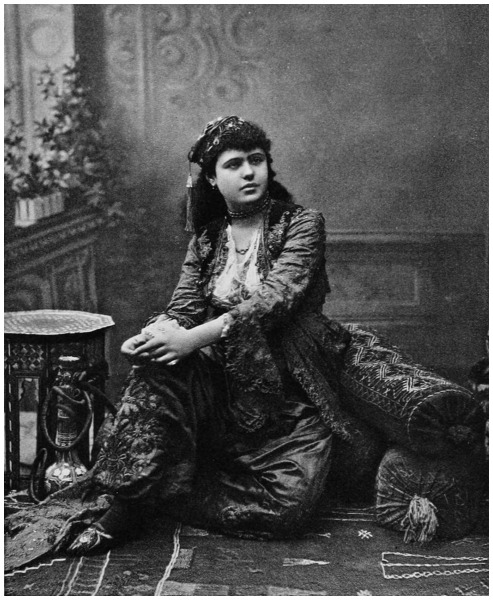
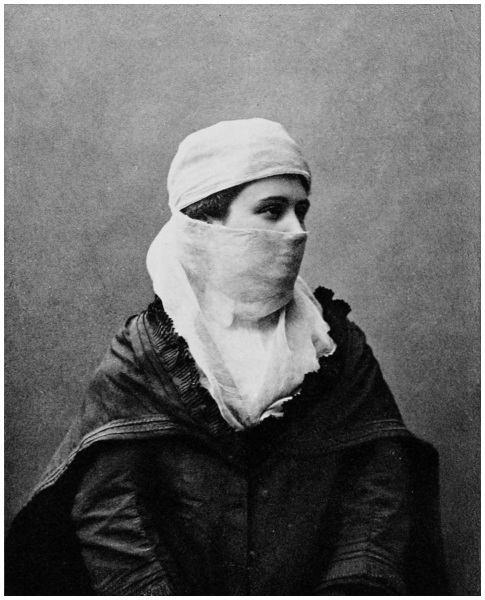
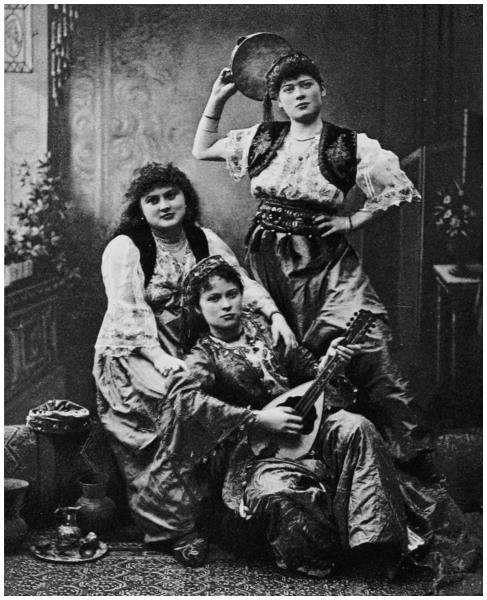
A Turkish Woman.
What associations are connected with the trees of
those gardens and the walls of those little white
kiosks! How many beautiful daughters of the
Caucasus, the Archipelago, the mountains of Albania
and Ethiopia, the desert and the sea, Mussulman,
Nazarene, idolator, conquered by pashas, bought by
merchants, presented by princes, stolen by corsairs,
have passed like shadows beneath those silver domes!
Can these be the selfsame walls and gardens amid
which Ibrahim, his head crowned with flowers, his
beard glittering with jewels, committed his mad acts
of folly—he who raised the price of slaves in every
market in Asia, and caused Arabian perfumes to increase
to double their usual value; which witnessed
the frantic orgies of the third Murad, father of a
hundred sons, and of Murad IV., worn out by excesses
at the age of thirty-one, and which re-echoed
to the delirious ravings of Selim II.? Here were
celebrated those strange nocturnal revels when ships
and vases of flowers were traced in fiery outlines
upon the domes and trees and roofs, their dancing
flames reflected in innumerable little mirrors like a
great burning flower-garden. Crowds of women
pressed around the bazârs overflowing with precious
objects, while eunuchs and slaves went through the
swaying measures of the dance half hidden in
clouds of burning spices and perfumes, which the
breezes from the Black Sea wafted over the entire
Seraglio, and accompanied by strains of barbaric and
warlike music.
Let us try to bring it all to life again, just as it
appeared on some soft April day during the reign of
Suleiman the Magnificent or the third Ahmed.
The sky is clear, the atmosphere heavy with the
odors of spring, the gardens a mass of bloom.
Through the network of paths still wet with dew
black eunuchs wearing gold-colored tunics and
slaves clad in garments of every hue carry baskets
and dishes covered with green cloths back and forth
between the kitchens and the various kiosks. Ustàs
of the validéh, coming hurriedly out of the little
Moorish doorways, run against the Sultan’s gheduclùs,
passing by with haughty mien and followed by
novice slaves carrying the imperial linen. All eyes
follow the youngest of all the gheduclùs, the cup-bearer,
a Syrian child, singled out by Allah, since
she has found such favor in the eyes of the Grand
Seignior that he has bestowed upon her the title of
“daughter of felicity,” and the sable mantle will
follow so soon as she shall have given signs of approaching
maternity. In the distance the Sultan’s
jesters are playing in the shade of the sycamores
dressed in harlequin costumes, and with them a
number of dwarfs with huge turbans on their heads,
while beyond them, again, half concealed by a
hedge, a gigantic eunuch with a slight movement of
head and hand directs five mutes charged with the
duty of carrying out punishments to present themselves
before Kizlar-aghàsi, who needs them for a
secret affair. Youths of an ambiguous beauty and
clad in rich feminine-looking garments run and
chase one another among the borders of a garden
shaded by a single huge plane tree. At another
place a troop of slaves suddenly pause, and, separating
in two lines, bow low before the khasnadâr,
superintendent of the harem, who returns their
greetings with a stately wave of her staff adorned
with tiny silver blades and terminating in the imperial
seal. At the same moment a door opens, and
out comes one of the kadyns, dressed in pale blue
and enveloped in a thick white veil. She is followed
by her slaves, and is on her way to take advantage
of the permission obtained from the superintendent
on the previous day to play at battledore and shuttlecock
with another kadyn. Turning down a shady
alley, she meets and exchanges soft greetings with
one of the Sultan’s sisters going to the bath accompanied
by her children and maid-servants. At the
end of a sequestered path a eunuch stands before
the kiosk of another kadyn, awaiting permission to
admit a Hebrew woman with her wares consisting,
though not entirely, of precious stones. She has
only obtained the right of entrance to the imperial
harem after endless wirepulling and scheming, and
now carries concealed among her jewels more than
one secret missive from an ambitious pasha or daring
lover. At the extreme end of the harem enclosure
the hanum charged with the duty of examining
slaves for admission is looking for the superintendent
to inform her that the young Abyssinian
brought in the day before is, in her opinion, worthy
of being admitted among the gheduclùs, if a tiny
lump on the left shoulder-blade may be overlooked.
In the mean time, the twenty nurses of the little
princes born in the course of the current year
are assembled beneath a high arbor in a pasture
planted with myrtles; a group of slaves play upon
flutes and guitars surrounded by a party of children,
dressed in blue velvet and crimson satin, who
jump and dance about or scramble merrily for the
sugarplums which the validéh sultan throws from a
neighboring terrace. Up and down the shady avenues
pass teachers of music, dancing, and embroidery,
on their way to give instruction to the shaghirds;
eunuchs carrying great platters heaped with sugar
parrots and lions and sweetmeats of various fantastic
shapes; slaves clasping vases of flowers or rugs in
their arms, the gifts of a kadyn to a sultana or the
validéh, or from the validéh to a granddaughter.
Presently the treasurer of the harem arrives, accompanied
by three slaves, and wearing the look of one
who has welcome news to communicate. Sure
enough, word has been received that the imperial
ships sent to intercept a fleet of Genoese and Venetian
galleys came up with them twenty miles from
the port of Sira, and succeeded in buying up the entire
cargo of silk and velvet for the Pâdishah’s harem.
A eunuch, arriving breathless to announce to a trembling
sultana that her son’s circumcision has been
successfully accomplished, is followed by two others
bearing upon silver and gold dishes to the mother
and validéh respectively the instruments used by the
surgeon. There is a continual opening and shutting
of doors and windows, a raising and dropping again
of curtains, that messages, letters, news, gossip may
pass in and out.
Any one whose gaze could have pierced through
those different roofs and domes would have looked
upon many a contrasting scene. In one apartment
a sultana, leaning against the window, gazes mournfully
between the satin curtains at the blue mountains
of Asia, thinking, possibly, of her husband,
a handsome young pasha, governor of a distant
province, who, in accordance with a certain practice,
had been torn from her arms after six short
months of happiness, so that he might have no
sons. In another small room, entirely lined with
marble and looking-glasses, a pretty fifteen-year-old
kadyn, who expects to receive a visit from the
Pâdishah during the day, is frolicking with the slaves
who are engaged in perfuming and anointing her,
setting off her charms to the very best advantage,
and raising little flattering choruses of delight and
surprise at every fresh revelation of her beauty.
Youthful sultanas run up and down the walled
gardens, chasing each other around gleaming marble
basins filled with goldfish, and making the shells
with which the paths are laid rattle beneath their
tiny flying feet encased in white satin slippers;
others, shrinking back in the farthest corner of darkened
rooms with pale set faces and averted looks,
seem to be brooding over some act of despair or
revenge. In one apartment, hung with rich brocades,
children who from the hour of their birth
have been condemned to death nestle upon satin
cushions striped with gold beneath walls of mother-of-pearl;
beautiful princesses lave their shapely
limbs in baths of Paros marble; gheduclùs lie
stretched full length upon rugs fast asleep; groups
of slaves and servants and eunuchs pass back and
forth through covered galleries and dim corridors
and secret stairways and passages; and everywhere
curious faces peering from behind grated windows,
mute signs interchanged between terrace and garden,
furtive signals from behind half-drawn curtains, low
conversations carried on in monosyllables in the
shadow of a wall or archway, broken by a ripple
of half-suppressed laughter, followed by the swish
of feminine garments and patter of flying slippers
dying away among those cloister-like walls.
But lovers’ intrigues and childish escapades were
not the only pursuits which occupied the time and
attention of the occupants of that labyrinth of
gardens and temples. Politics crept in through the
cracks of doors and between window-bars, and
the power exercised there by beautiful eyes over
affairs of state was not one whit less far-reaching than
in any other royal palace of Europe; indeed, the
very monotony and seclusion of the life led by the
inmates gave an added force to their jealousies and
ambitions. Those little jewel-crowned heads from
their perfumed and luxurious prisons bent the court,
the Divân, the entire Seraglio, to their will. By
means of the eunuchs they were enabled to hold
direct communication with the muftis, viziers, and
the aghas of the Janissaries, and, as they were
allowed to have interviews with the administrators
of their personal property from behind a curtain or
through a grating, they had opportunities of keeping
themselves thoroughly informed as to every minutest
detail of the court and city, knew what especial
dangers threatened them, and were perfectly familiar
with the name and character of every official from
whom they had anything to hope or fear. Thus
equipped, they move with a sure hand and infinite
patience all the tangled threads of those conspiracies
by which they compassed the overthrow of their
enemies and the elevation of their especial favorites.
Every department of the court, every corner of the
empire, had a root, a hundred roots, in the harem,
nourished in the hearts of the validéh sultan, the
sisters of the Pâdishah, the kadyns and odalisques.
There was a continual plotting and scheming for the
education of this one’s son, the marriage of that
one’s daughter, to secure a dowry, to obtain precedence
at the fêtes, or the royal succession for one
of the princes—to bring about war or peace. The
whims of these spoiled beauties sent armies of
thirty thousand Janissaries and forty thousand spahis
to strew the banks of the Danube with dead bodies,
and fleets numbering a hundred sails to dye the blue
waters of the Archipelago and Black Sea with blood.
European princes provided themselves with letters to
the harem in order to ensure the success of their
missions. Little white hands assigned the government
of provinces and positions of rank in the
army. It was the caresses of Roxalana which drew
the noose about the necks of the viziers Ahmed and
Ibrahim, and the kisses of Saffié, the beautiful
Venetian, “pearl and shell of the khalifate,” that
maintained for so many years friendly relations
between the Porte and the Venetian republic.
Murad III.’s seven kadyns ruled the empire for the
last twenty years of the sixteenth century, while
the beautiful Makpeiker, “image of the moon,” the
kadyn of the two thousand seven hundred shawls,
held undisputed sway over two seas and two
worlds from the reign of Ahmed I. to the accession
of the fourth Muhammad. Rebia Gulnuz, the
odalisque of the hundred silver carriages, ruled the
imperial Divân for the first ten years of the latter
half of the seventeenth century, and Shekerbuli, the
“little lump of sugar,” kept the sanguinary Ibrahim
travelling back and forth between Stambul and
Adrianople like an automaton to suit her own ends.
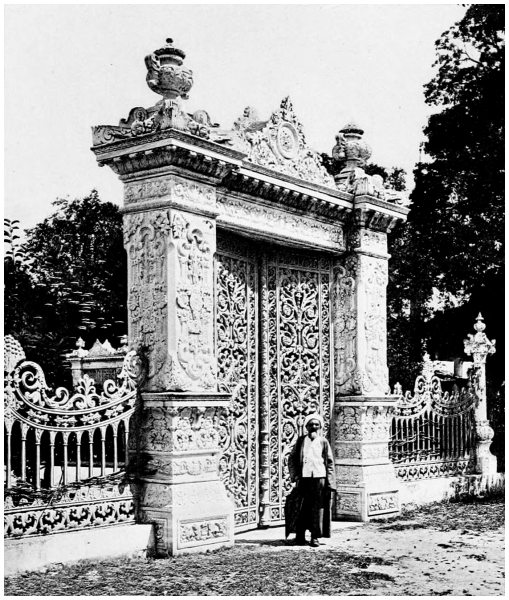
Gateway of the Imperial Palace at the Sweet Waters of Asia.
What opposing interests, what an intricate web of
jealousy, suspicion, intrigue, and petty ambition,
must have been drawn close about that omnipotent
and voluptuous little city! Wandering up and down
those paths and alley-ways, I seemed to hear all
about me the murmur of female voices, now rising
high and shrill, now dying away in the distance—expostulations,
questionings, explanations, supplications—the
entire secret chronicle of the Seraglio;
and a varied and curious one it must have been,
treating of such questions as—which of the kadyns
had been chosen by the Sultan to accompany him in
the summer to his kiosk at the Sweet Waters; what
dot the Pâdishah’s third daughter, who was to
marry the grand admiral, would have; if it were
really true that the herbs procured by the superintendent
Raazgié from the magician Sciugaa for the
third kadyn, childless these five years, had been the
cause of her having a son; if it were settled that
the favorite, Giamfeda, was to have the governorship
of Caramania for the governor of Anatoli.
From one kiosk to another the news flew that the
first kadyn had a child, and that the new grand
vizier, in order to outshine his predecessor, had presented
her with a cradle of solid silver set with emeralds;
that the Sultan’s favorite was not the slave
sent by the governor of Caramania at all, but the
one presented by the Kiaya-harem: that the chief
of the white eunuchs was about to die, and that in
order to obtain the long-coveted position the young
page Mehemet was to sacrifice his manhood: it was
whispered about that the plan proposed by the grand
vizier Sinau for a canal in Asia Minor was to be
abandoned, so that the progress of the work on the
new kiosk building for Baffo Sultan might not be
kept back; that kadyn Saharai, who was thirty-five
years old, had been crying her eyes out for the past
forty-eight hours for fear she was going to be put in
the Old Seraglio; that the buffoon Ahmed had sent
the Sultan off into such a hearty fit of laughter that
he had made him an agha of Janissaries on the spur
of the moment. And then there would be thousands
of choice bits of gossip and news to exchange in
connection with the approaching nuptials of Otman
Pasha with Ummetulla Sultan, when a bronze dragon
was to vomit fire in the At-Meidan; and about the
validéh sultan’s sable robe, whose every button
was a jewel valued at a hundred golden scudis; or
the new carriage of kadyn Kamarigé, “moon of
beauty;” or the tribute from Wallachia; or the little
blood-colored rose found on the neck of the Shamas-hirusta,
care-taker of the Sultan’s linen; or the
pretty, curly, golden hair of the Genoese ambassadress;
or the wonderful letter written with her
own hand by the first wife of the Shah of Persia in
reply to one sent her by Sultana Khurrem, “the joyous
one.” All the news received in the city, every
topic discussed by the Divân, every rumor afloat in
the Seraglio, was talked over and commented upon
in each individual kiosk and garden among groups
of busy, inquisitive little heads. Anonymous madrigals
written by pâdishahs were passed about from
mouth to mouth—the independent and melancholy
verses of Abdul-Baki, the immortal; the sparkling
poems of Abu-Sud, whose “every word was a
diamond;” Fuzuli’s songs, redolent of wine and
opium; and the licentious verses of Gazali. The
whole character and life of the place, however,
would change according to the tastes of the reigning
Pâdishah. Now a current of tenderness and melancholy
would creep across the face of that little
world, leaving the imprint of a certain gentle dignity
upon every brow; the passion for ease and luxury
would subside; morals and customs undergo a process
of reformation; language become purified; a
taste for devotional reading, meditation, and religious
exercises come into fashion; the very fêtes
themselves, although conducted upon the same scale
of royal magnificence, assume more the character of
gay but dignified ceremonials. And then a prince
ascends the throne trained from infancy in every
form of vice and dissipation, and immediately the
scene changes: the god of self-indulgence regains
his kingdom; veils are thrown back, noisy laughter,
free language, and shameless immodesty prevail;
messengers travel the length and width of Georgia
and Circassia in search of beauty; a hundred slaves
boast of the Grand Seignior’s preference; the kiosks
are crowded, the gardens overrun with children;
the public treasury pours out rivers of gold; the
wines of Cyprus and Hungary sparkle on flower-bedecked
tables; Sodom raises its head, Lesbos is
triumphant; faces lit up by great black eyes become
paler and more wasted; the entire harem—mad,
fevered, glutted with self-indulgence, intoxicated
with the fumes of that heavy, sensual perfumed air,
awakes one night dazed and helpless to find itself
confronted by the vengeance of God under the form
of the flashing cimeters of the Janissaries. It was
indeed too true that those nights of horror fell upon
the little flower-imbedded Babylon as well. Revolt
respected that sacred third enclosure no more than
it did the other two, and, beating down the Gate of
Felicity, poured even into the harem itself. A
hundred armed eunuchs, fighting desperately with
daggers at the doors of the kiosks, beheld the Janissaries
climb upon the roofs and break open the
cupolas, from whence, leaping into the rooms below,
they tore the infant princes from their mothers’
arms; validéhs were dragged feet foremost from
their hiding-places, fighting furiously with teeth and
nails, to be overpowered finally, pinned to the floor
by a baltagi’s knee, and strangled with the silken
cords of the window-curtains. Sultanas returning
to their apartments would utter a piercing shriek at
sight of the empty cradle, and, turning wildly to
interrogate their slaves, read the answer in an
ominous silence, which meant, “Go seek your son
at the foot of the throne.” Terrified eunuchs would
bring word to a favorite, whom the sound of distant
tumult had already rendered uneasy, that her head
was demanded by the mob, and she must at once
prepare for death. The third Selim’s three kadyns,
condemned to the noose and sack, were aroused one
after another in the dead of night and heard each
other’s screams, dying in the darkness in the convulsive
grasp of the mutes. Vindictive jealousy
and bitter revenge filled the kiosks with tragedies
and spread terror and dismay throughout the entire
harem. The Circassian mother of Mustafa tore
Roxalana’s face; rival favorites cuffed and boxed
Shekerbuli; Tarkan Sultan beheld the dagger of
Muhammad IV. flash above the head of her offspring;
the first kadyn of Ahmed I. strangled the
slave who dared to be her rival with her own hands,
and in her turn fell at the Pâdishah’s feet stabbed
in the face and uttering shriek on shriek of rage and
pain. Jealous kadyns lay in wait for one another
in dark passage-ways, flinging out the insulting
words “bought flesh” as they pounced like tigresses
and tore their victims’ skin or buried poisoned stilettos
in their backs. Who can form any idea of
the number of secret unrecorded tragedies?—slaves
held in the fountains until they were drowned,
struck down by a blow on the temple from a dagger-hilt,
beaten to death by the eunuch’s colbac, or
crushed in the deadly embrace and arms of steel of
a dozen jealous furies. Veils choke the cries of the
dying, flowers cover up the blood-stains, and two
dusky figures, moving down the dimly-lighted path,
carry a sinister something between them. The sentinels
pacing up and down upon the battlements
which overlook the Sea of Marmora are startled for a
moment by the sound of a heavy splash; then all is
still, and the dawn, awakening the harem to another
day of laughter and pleasure, whispers no tales of
that one among its thousand rooms found empty.
Such fancies as these kept crowding through my
mind as I wandered about that famous spot, raising
my eyes from time to time to the grated windows
of one or another of those kiosks, now as mournful
and neglected-looking as sepulchres. And yet, notwithstanding
all the horrible associations of the
place, one is conscious of a thrill of delicious
excitement, a throbbing of the pulses, a languid,
voluptuous, half-melancholy sense of pleasure, at
the thought of all the youth and beauty and loveliness
which once had its being here. These
little stairways, up and down which I pass, once
felt the pressure of their flying feet; these shady
alleys, through which I walk, have heard the soft
rustle of their garments; the roofs of these little
porticoes, against whose pillars I brush in passing,
have echoed the sound of their infantile laughter.
It seems as though some actual token of their
presence must still linger within those walls, hover
in the very air, and I long to search for it, to cry
aloud those famous names, one after another, over
and over again, when surely some voice, faint,
distant, ghostly, will reward my efforts, some shadowy
white-robed figure flit across a lofty terrace
or appear for a moment at the end of a dim,
leafy vista. What would I not have given, as I
scanned each barred door and grated window, to
have known behind which of them the widow of
Alexius Comnenus was confined—the most beautiful
of all the fair Lesbos prisoners, as well as the most
fascinating Grecian of her time—or where the beloved
daughter of Errizo, governor of Negropont, had
been stabbed for preferring death to the brutal caresses
of Muhammad II.! And Khurrem, Suleiman’s
favorite, at what window did she linger, graceful,
languid, her great black eyes fixed upon the Sea of
Marmora beneath their veil of silken lashes? How
often must this very path have felt the light pressure
of that fascinating Hungarian dancer’s feet who
effaced the image of Saffié from the heart of Murad
III., slipping like a blade of steel between the
imperial arms! Above this flowery bank must
Kesem, that beautiful Grecian and jealous fury who
beheld the reigns of seven sultans, have bent her
pale proud face to pluck a flower in passing. And
that gigantic Armenian who drove Ibrahim insane
for love of her, has she not plunged her great white
arms into the cool depths of this very fountain?
And whose feet were the smaller? The fourth
Muhammad’s “little favorite,” two of whose slippers
together did not measure the length of a stiletto,
or Rebia Gulnuz, “she who drank of the roses of
spring”? And who had the prettiest blue eyes in
the Archipelago? And whose foot left no trace on the
white sand of the garden-walk? Was the hair of
Marhfiruz, “the favorite of the stars of the night,”
thicker and more golden than that of Miliklia, the
youthful Russian odalisque, who kept the ferocity
of the second Osman in check? And those Persian
and Arabian children who lulled Ibrahim to sleep
with their fairy-tales, and the forty maidens who
drank the third Murad’s blood, is there nothing left
of them all—not so much as a tress of hair, a thread
from a single veil, an imprint on the walls? For
answer I saw a strange, weird vision far off where
the great trees grew thickest. Beneath the long
shadowy arcades I beheld a mournful procession:
one after the other, in ghostly, never-ending succession,
they filed by—validéh sultans, sisters of
pâdishahs, kadyns, odalisques, slaves, children hardly
arrived at womanhood, middle-aged, old and white-haired,
timid young maidens, faces contorted with
savage jealousy, rulers of an empire, favorites of a
single day, playthings of an hour, representatives
of ten generations and a hundred peoples—leading
their children by the hand or clasping them convulsively
to their breasts. Around this one’s neck the
noose is still hanging; from that one’s heart sticks
a dagger-hilt; the salt waters of the Sea of Marmora
drip from another’s clothes. Brilliant with jewels,
covered with dagger-thrusts, their faces contorted
from the action of poison or the long-drawn-out
agonies of the Old Seraglio, on they came, an interminable,
mute, but eloquent procession, fading away
one after another in the gloom of the cypress trees,
leaving behind them a trail of faded flowers, of
tears, and of drops of blood, which swept over my
heart in a great wave of indescribable horror and
pity.
Beyond the third enclosure there extends a long
level stretch of ground covered with a luxuriant
vegetation and dotted over with pretty little buildings,
in the midst of which rises the so-called Column
of Theodosius, of gray granite, surmounted by a
beautiful Corinthian capital and supported upon a
large pedestal, on one side of which may still be
traced the last two words of a Latin inscription
which ran as follows: “Fortunæ reduci ob devictos
Gothos.” Here the elevated plain upon which stands
the great central rectangle of the Seraglio buildings
comes to an end; beyond, as far as Seraglio Point,
and covering the entire space between the walls of
the three courts and the outer boundary-walls, rose
a great forest of plane trees, cypresses, pines,
laurels, and terebinths, all along the hillsides, and
poplars draped with vines and creepers, shading a
succession of gardens filled with roses and heliotropes,
and laid out in the form of terraces, from
which wide flights of marble stairs led down to the
shore.
Along the walls facing Skutari rose the new
palace of Sultan Mahmûd, opening out on the
water by a great door of gilded copper. Near
Seraglio Point stood the summer harem, a vast
semicircular building, designed to accommodate five
hundred women, with its great courtyards and
magnificent baths and gardens—the scene of those
ingenious illuminations which under the name of
“tulip festivals” became so famous. Beyond the
walls, opposite the harem and just above the shore,
was placed the celebrated Seraglio Battery, consisting
of twenty guns of different designs and covered
with sculptures and inscriptions: each of these was
captured on some battlefield and from Christian
armies in the course of the earlier European wars.
The walls were furnished with eight gates, three of
them on the city side and five facing toward the sea.
Great marble terraces extended from the walls along
the banks, and subterranean passage-ways leading
from the royal palace to the gates on the Sea of
Marmora offered a means of escape to the sultans,
who could thus take ship for Skutari or Topkhâneh
in case they were besieged from the land.
Nor yet was this all of the Seraglio. Near the
outer walls and all along the sides of the hills there
arose numberless other kiosks, built to imitate little
mosques or forts or tunnels, each one of which communicated
by a narrow footway, concealed behind
lofty screens of foliage, with the smaller gates of the
third court. There was the Yali Kiosk, now destroyed,
which was reflected in the waters of the
Golden Horn; there stands to-day, almost intact,
the New Kiosk, a little royal residence in itself,
circular and covered with gilt ornaments and paintings,
to which the sultans used to repair at sunset
to feast their eyes upon the spectacle of the thousand
ships riding at anchor in the port. Near the summer
harem stood the Looking-glass Kiosk, where
the treaty of peace by which Turkey ceded the
Crimea to Russia was signed in 1784, and the kiosk
of Hassan Pasha, all resplendent with gilding, its
walls covered with mirrors which threw back fantastic
reflections of the fêtes and nocturnal orgies
of the sultans. The Cannon Kiosk, out of whose
windows bodies were thrown into the Sea of
Marmora, stood hard by the battery on Cape
Seraglio. The Kiosk of the Sea, where the validéh
of Muhammad IV. held her secret councils, overhung
the spot where the waters of the Bosphorus
mingle with those of the Sea of Marmora. The
Kiosk of Roses looks out upon the esplanade where
the pages were exercised, and it was here that in
1839 the new constitution of the empire, embodied
in the Hatti Sherif of Gül-Khâneh, was signed.
Some of the kiosks on the other side of the Seraglio
which are still standing are the Review Kiosk, from
which, himself unseen, the Sultan could watch all
who passed by to the Divân; the Alai Kiosk, at that
angle of the walls near St. Sophia whence Muhammad
IV. flung to his mutinous soldiers his favorite
Meleki, together with twenty-nine officials of his
court, to be torn to pieces before his eyes; and at
the far end of the wall the Sepedgiler Kiosk, near
which the sultans gave final audiences to their
admirals about sailing for the seat of war.
Thus the huge palace spread out and down from
the summit of its hills—where were gathered and
carefully defended all its more vital parts—to the
seashore crowned with towers, bristling with cannon,
decked with flowers, its gilded barges shooting
across the waters in all directions, its thousand perfumes
floating heavenward in a great cloud as from
some huge altar; the myriad torches of its fêtes
reflected in the placid waters; flinging from its
battlements gold to the people, dead bodies to the
waves—yesterday the plaything of a slave, to-day
the sport of a maniac, to-morrow at the mercy of
the mob, beautiful as an enchanted island and forbidding
as a living sepulchre.
The night is far advanced: each glittering star is
reflected in the calm bosom of the Sea of Marmora,
while the moon turns the Seraglio’s thousand domes
to silver and whitens the tips of the cypress and
plane trees. Deep shadows are cast across the
open spaces below, and, one by one, the lights in all
those innumerable little windows are extinguished.
Mosque and kiosk rise white as snow against the
dark background of the woods, and each spire and
pointed minaret, aërial crescent, door of bronze,
and gilded grating shines and sparkles among the
trees as though part of a golden city. The imperial
residence sleeps, the last of the three great gates has
just been closed, and the far-off rattle of its huge
keys can be heard as the kapuji turns away. In
front of the Gate of Health a troop of kapujis stand
watch beneath the lofty roof, while stationed along
the wall by the Gate of Felicity, their faces in the
shadow, immovable as so many bas-reliefs, thirty
white eunuchs mount guard. From the walls and
towers hundreds of hidden sentinels keep an active
watch upon all the approaches, the sea and harbor,
the deserted streets of the city, and the huge silent
pile of St. Sophia. An occasional light still gleams
in the huge kitchens of the first court, where some
belated worker is finishing his task; then that too
disappears, and the building becomes dark. Lights
are still burning, though, in the houses of the Veznedar
Agha and the Defterdar Effendi, and there seems
to be some stir about the residence of the chief of
the black eunuchs. Eunuchs patrol the deserted
paths and wander in and out among the dark and
silent kiosks, hearing no sounds save the sighing of
the trees rocked by the sea-breeze and the monotonous
murmur of the fountains. Perfect peace seems
to enfold all that little world in its calm embrace,
but only seemingly, for underneath those myriad
roofs a tide of passionate life is stirring. That vast
family of slaves, soldiers, prisoners, and servants,
with their ambitions and heart-burnings, their loves
and hates, let loose into the stillness of the night a
brood of restless longings, dreams, and visions,
which, scaling the Seraglio walls, find their way to
every corner of the globe, seeking out homes of
childhood, mothers lost in infancy, resuscitating half-forgotten
scenes of horror. Prayers and supplications
mingle with plots of vengeance in the moonlit
walks and the overmastering impulses of secret ambition.
The great palace sleeps, but it is a restless,
disturbed sleep, interrupted by sudden fearful visions
of alarm and terror; mutterings in a hundred
different languages mingle with the voices of the
night. Close together, divided by but a few walls,
sleep the dissolute page, the imâm who has preached
the word of God, the executioner who has strangled
the innocent, the imprisoned prince awaiting death,
and the enamored sultana on the eve of her nuptials.
Unhappy wretches, stripped of everything they possessed
in the world, find themselves side by side
with the possessors of fabulous riches. Beauty
which is almost divine, absurd deformity, every
form of vice and misfortune, every prostitution of
soul and body, are to be found shut in between the
same walls.
Against the starlit sky are outlined the bizarre
shapes of Moorish tower and roof, and shadows of
garlands and leafy festoons play over the walls; the
fountains shimmer in the moonlight like cascades of
diamonds and sapphires; and all the perfumes of the
gardens, gathered into one powerful odor, are swept
by the breeze through every open lattice, every
crack and crevice, leaving in their wake soft, intoxicating
dreams and memories.
At such an hour as this the eunuch seated in the
shadow of the trees, his eyes fixed upon the soft
light issuing from a neighboring kiosk, gnaws out
his heart and touches with trembling fingers his
dagger hilt, and the poor little maid, stolen and sold
into bondage, gazes from the window of her lofty
cell with streaming eyes upon the serene horizon of
Asia, thinking with unutterable longing of the cabin
where she was born and the peaceful valley where
her fathers lie buried. At this hour, too, the galley-slave
laden with chains, the mute stained with blood,
the despised miserable dwarf, reflect with a thrill of
dismay upon the infinity of space which separates
them from that being before whom they all must
bow, and passionately interrogate the “hidden
powers” as to why they must be deprived of liberty,
speech, and the ordinary shape of the human form,
while everything is given to one man. And this,
too, is the hour in which the neglected and unhappy
weep, while those who are great and successful are
haunted with misgivings as they think uneasily of
the future. In some of the buildings lights are still
burning, illuminating the pale, anxious brows of the
treasurers bending over their accounts. Odalisques,
embittered by neglect, toss restlessly among their pillows,
vainly seeking sleep. Janissaries lie stretched
out upon the ground, the savage smile upon their
bronzed faces telling of dreams of carnage and plunder.
Through those thin walls come voluptuous
sighs, sobs, broken expostulations. In one kiosk
flows the accursed liquor amid a circle of dishevelled
revellers; in another a wretched sultana, mother for
but one short moment, stifles her shrieks beneath
the pillows that she may not see her child’s life-blood
flowing from the artery opened by order of the Pâdishah;
and in the marble niches of the Bâb-i-Humayûn
blood is still dropping from the heads of
beys executed at nightfall. Within the loftiest
kiosk of the third enclosure there is a room hung
with crimson brocade and flooded with soft radiance
from a Moorish lamp of chased silver suspended
from the cedar-wood roof. Upon a sable-covered
couch, surrounded by a magnificent disorder of pearl-embroidered
cushions and velvet draperies worked
in gold, there sits a beautiful brunette, enveloped
in a great white veil, who not many years before
conducted her father’s herds across the plains of
Arabia. Bending her timid gaze upon the pallid
countenance of the third Murad, who reclines half
asleep at her feet, she begins in gentle murmuring
tones: “Once upon a time there lived in Damascus
a merchant named Abu-Eiub, who had accumulated
great riches and lived in honor and prosperity.
He had one son, who was handsome and who knew
all sorts of wonderful things, and his name was Slave
of Love, and a daughter who was very beautiful,
and she was named Power of Hearts. Now, it came
to pass that Abu-Eiub died, and he left all his possessions
and all his wealth wrapped up and fastened
with seals, and upon everything was written ‘For
Bagdad.’ So, then, Slave of Love said to his
mother, ‘Why is “For Bagdad” written on everything
my father left?’ And his mother replied, ‘My
son——’” But the Pâdishah has fallen asleep, and
the slave lets her head sink gently down among the
cushions, and sleeps as well. Every door is closed,
every light extinguished, a hundred cupolas gleam
like silver in the moonlight, crescents and gilded
lattices shine through the foliage; the fountain’s
splash and gurgle are heard through the stillness,
and at last the entire Seraglio slumbers.
And so for thirty years has it slept the sleep of
neglect and decay upon its solitary hill. Those
verses of the Persian poet which came into the mind
of Muhammad the Conqueror when he first set foot
in the despoiled palace of the emperors of the East
are equally appropriate here: “In the dwellings of
kings see where the loathsome spider weaves her
busy web, while from Erasciab’s proud summit is
heard the raven’s hoarse cry.”