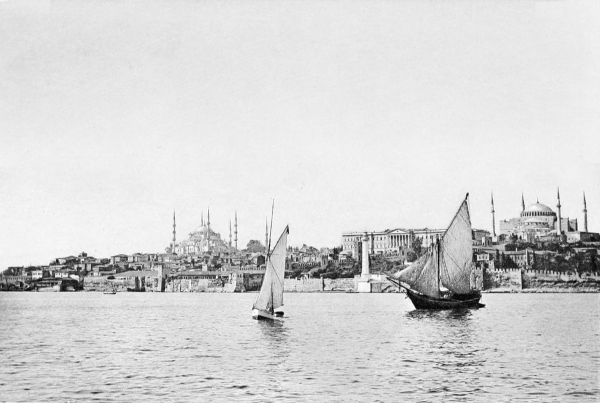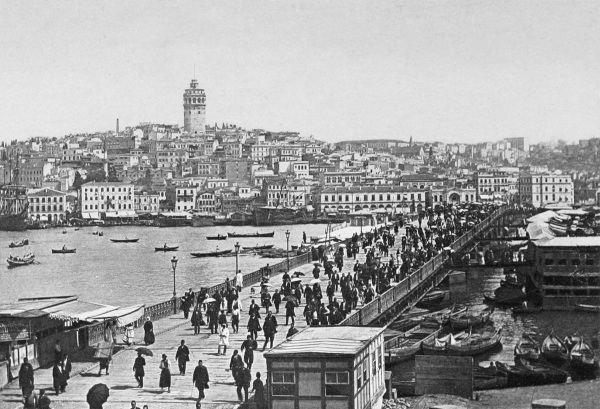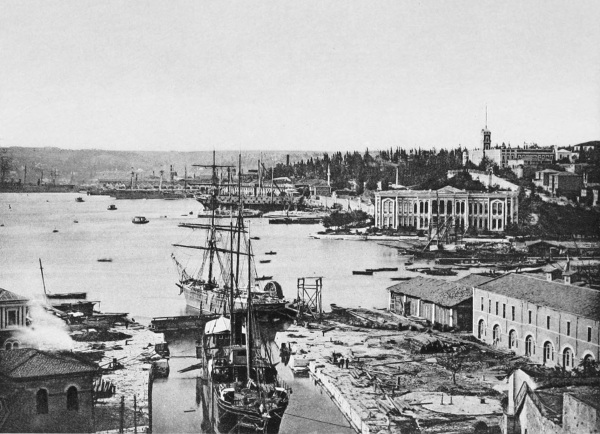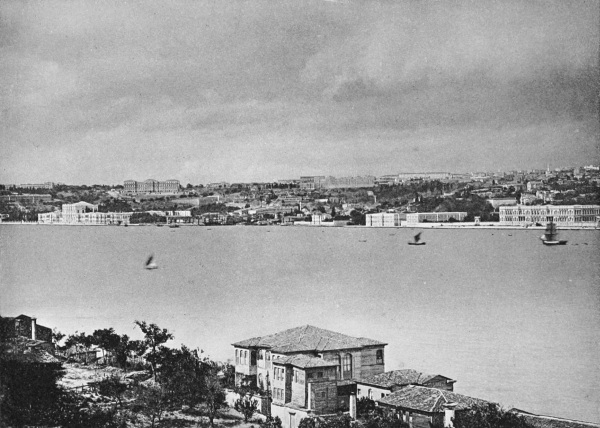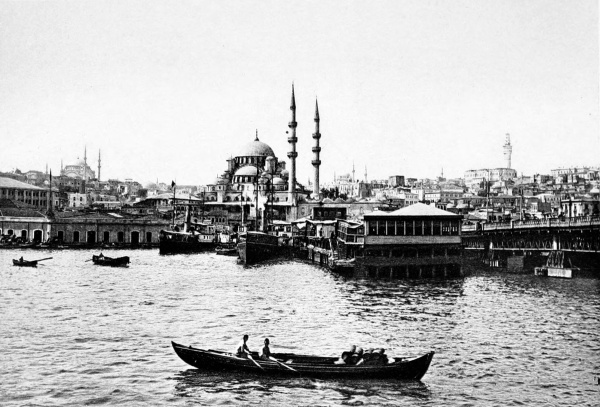
View of Stamboul. Mosque of Validêh and Bridge.
And first of all I must speak of the light. One
of my chief pleasures at Constantinople was to
watch the sun rise and set from the bridge of the
Validéh Sultan. At daybreak in the autumn there
is almost always a light fog hanging over the Golden
Horn, through which the city can only be seen indistinctly,
as though one were looking through those
thin gauze curtains which are lowered across the
stage of a theatre in order to hide the details of some
grand spectacular effect. Skutari is quite invisible;
only her hills, a vague outline, can be faintly traced
against the eastern sky. The bridge, as well as
both banks, is deserted. Constantinople is buried in
slumber, and the profound silence and solitude lend
solemnity and impressiveness to the scene. Presently
behind the Skutari hills the sky begins to
show streaks of gold, and, one by one, against that
luminous background, the inky points of the cypress
trees stand out clear and defined, like a company of
giants drawn up in battle-array on the heights of her
vast cemetery. Now a single ray of light flashes
from one end to the other of the Golden Horn, like
the first faint sigh of returning consciousness, as the
great city stirs and slowly awakens once more to
life. Then, behind the cypresses on the Asiatic shore,
a fiery eye shines forth, and immediately upon the
white summits of St. Sophia’s four minarets an answering
blush is seen. In rapid succession from hill
to hill, from mosque to mosque, to the farthest end
of the Golden Horn, every minaret turns to rose,
every dome to silver. The crimson flush creeps
down from one terrace to another; the light increases,
the veil is lifted, and all of Stambul lies revealed,
rosy and resplendent on the heights, tinged
with blue and violet shadows on the water’s edge,
but everywhere fresh and sparkling as though just
risen from the waves. In proportion as the sun
rises higher and higher the delicacy of the first
coloring disappears, swallowed up in the flood of
dazzling light, which becomes so white and blinding
as in turn to slightly obscure everything, until
toward evening, when the glorious spectacle recommences.
So clear does the atmosphere then become
that from Galata you can easily distinguish each
separate tree on the farthermost point of Kadi-keui.
The huge profile of Stambul is thrown out against
the sky with such distinctness and accuracy of detail
that it would be quite possible to note one by
one every minaret, every spire and cypress tree,
that crowns her heights from Seraglio Point to the
cemetery of Eyûb. The waters of the Bosphorus
and Golden Horn turn to a marvellous ultramarine;
the sky, of the color of amethysts in the east, grows
fiery as it reaches Stambul, lighting up the horizon
with a hundred tints of crimson and gold, making
one think of the first day of creation. Stambul
grows dim, Galata golden, while Skutari, receiving
the full blaze of the setting sun upon her thousand
casements, looks like a city devoured by flames.
And this is the most perfect moment in all the
twenty-four hours in which to see Constantinople.
It is a rapid succession of the most exquisite tints—pale
gold, rose, and lilac—mingling and blending one
with another on the hillsides and water’s surface,
lending to first one part of the city and then to
another the finishing touch to its perfect beauty, and
revealing a thousand modest charms of hill- and
country-side, which were too shy to thrust themselves
into notice beneath the blaze of the noonday
sun. It is then that you see the great melancholy suburbs
losing themselves amid the shadows of the valleys—little
purple-tinted hamlets smiling on the hilltops;
towns and villages which languish and droop
as though their life were ebbing away; others disappear
from view, as you look at them, like fires which
have been suddenly extinguished; others, again,
apparently quite dead, come unexpectedly to life
again, all aglow, and sparkle joyously for still some
moments longer in the last rays of the sun. Finally,
however, nothing remains but two shining summits
on the Asiatic shore—Mt. Bûlgurlù and the point
of the cape which guards the entrance to the Propontis.
At first they are two golden coronets, then
two little crimson caps, then two rubies; and then
Constantinople is plunged in shadow, while ten
thousand voices from ten thousand minarets announce
that the sun has set.
Constantinople possesses a grace and gayety all
her own emanating from her myriads of birds of
every species, objects of especial veneration and
affection among the Turks. Mosque and grove,
ancient wall and garden, palace and courtyard, are
full of song, of the cheerful sound of twittering and
chirping; everywhere there is the rush of wings,
everywhere the busy, active little lives go on. Sparrows
come boldly into the houses and eat from the
women’s and children’s hands; swallows build their
nests over the doorways of cafés and beneath the
roofs of bazârs; innumerable flocks of pigeons,
maintained by means of legacies from different sultans
as well as private individuals, form black and
white garlands around the cornices of the domes and
terraces of the minarets; gulls circle joyously about
the granaries; thousands of turtle-doves bill and coo
among the cypress trees in the cemeteries; all
around the Castle of the Seven Towers ravens croak
and vultures hover significantly; kingfishers come
and go in long lines between the Black Sea and Sea
of Marmora; while storks may be seen resting upon
the domes of solitary mausoleums. For the Turk
each one of these birds possesses some pleasing
quality or lucky influence. The turtle-dove is the
patron of lovers; the swallow will protect from fire
any building where her nest is built; the stork performs
a yearly pilgrimage to Mecca; while the
halcyon carries the souls of the faithful to Paradise.
Hence they feed and protect them both from religious
motives and from gratitude, and in return the
birds make a continual festival around their houses,
on the water, and among the tombs. In every
quarter of Stambul they soar and circle about,
grazing against you in their noisy flights, and filling
the entire city with something of the joyous freedom
of the open country, constantly bringing up before
one’s mind images of nature.
In no other city of Europe do the sites and monuments,
either legendary or historical, act so forcibly
upon the imagination as at Stambul, because in no
other spot do they record events at once so recent
and so picturesque. Elsewhere, in order to get
away from the prose of modern every-day life, one
is obliged to go back for several centuries; at Stambul
a few years suffice. Legend, or what has all
the character and force of legend, dates from yesterday.
It is not many years since, in the square of
Et-Meidan, the celebrated massacre of the Janissaries
took place; not many years since the waters
of the Sea of Marmora cast up upon the banks of
the imperial gardens those twenty sacks containing
each the body of a beauty of Mustafa’s harem; not
long since Brancovano’s family was executed in the
Castle of the Seven Towers, or European ambassadors
were pinioned between two kapuji-basci in the
presence of the Grand Seigneur, upon whose half-averted
countenance there glowed a mysterious
light; or within the walls of the old Seraglio that life—so
extraordinary—a mingling of horrors, love, and
folly, ceased finally to exist, which now seems to
belong to such a far-distant past. Wandering about
the streets of Stambul and reflecting upon all these
things, you cannot help a feeling of astonishment at
the calm, cheerful aspect of the city, gay with color
and vegetation. “Ah, traitoress!” you cry, “what
have you done with all those mountains of heads,
those lakes of blood? How is it possible that everything
has been so cleverly concealed, so wiped out
and obliterated, that not a trace remains?”
On the Bosphorus, beneath the Seraglio walls and
just opposite Leander’s Tower, which rises from the
water like a lover’s monument, you may still behold
the inclined plane down which the bodies of the unfaithful
beauties of the harem were rolled into the
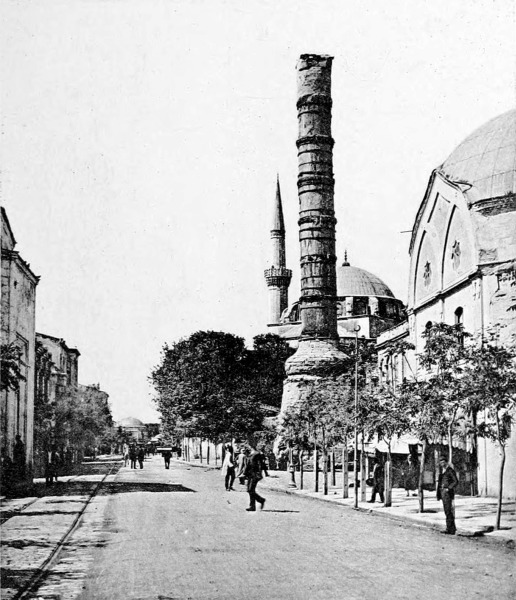
sea; in the middle of the Et-Meidan the serpentine
column still bears witness to the force of Muhammad
the Conqueror’s famous sabre; on the Mahmûd
bridge the spot is still pointed out on which the
fiery sultan annihilated at a single blow the adventurous
dervish who had dared to fling an anathema
in his face; in the Holy Well of the Balukli church
the miraculous fish still swim about which foretold the
fall of the City of the Palæologi; beneath the trees of
the Sweet Waters of Asia you can visit those shady
retreats where a dissolute sultana was wont to bestow
upon the favorite of the hour that fatal love whose
certain sequence was death. Every doorway, every
tower, every mosque and park and open square, records
some strange event—a tragedy, a love-story,
a mystery, the absolutism of a padishah or the reckless
caprice of a sultana; everything has a history
of its own, and wherever you turn the near-by objects,
the distant view, the balmy perfumed air, the
silence, all unite to transport him whose mind is
stored with these histories of the past out of himself,
his era, and the city of to-day, so that not infrequently,
when suddenly confronted with the suggestion
that it is high time to think of returning to
the hotel, he asks himself confusedly what it means,
how can there be a “hotel.”
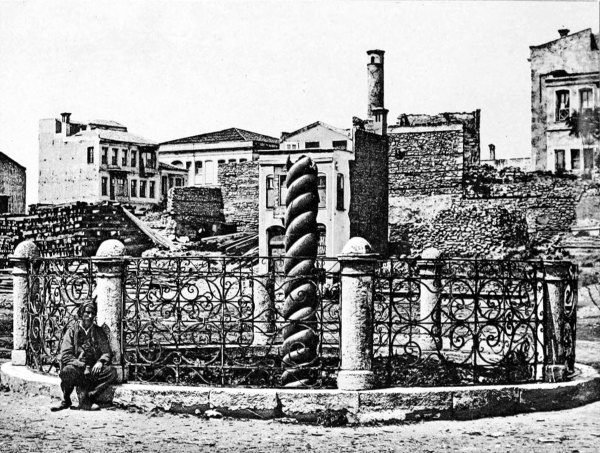
Serpentine Column of Delphi.
In those early days, fresh from reading masses of
Oriental literature, I kept recognizing in the people
I met on the streets famous personages who figure in
the legends and history of the East: sometimes they
answered so entirely to the picture I had drawn in
my own mind of some celebrated character that I
would find myself stopping short in the street to
gaze after them. How often have I seized my
friend’s arm, and, pointing out some passer-by, exclaimed,
“There he goes, by Jove! Don’t you recognize
him?” In the square of the Sultan Validéh
I have many a time seen the gigantic Turk who
hurled down rocks and stones upon the heads of
Baglione’s soldiers before the walls of Nicea; near
one of the mosques I came across Unm Dgiemil, the
old witch of Mecca who sowed thorns and brambles
in front of Mohammed’s house; coming out of the
book bazâr one day, I ran against Digiemal-eddin,
the great scholar of Brusa, who knew all the Arabian
dictionary by heart, walking along with a volume
tucked under his arm; I have passed close enough
to Ayesha, the favorite wife of the Prophet, to receive
a steady look from those eyes “like twin stars
reflected in a well.” I recognized in the Et-Meidan
the beautiful and unfortunate Greek killed at the
foot of the serpentine column by a ball from the
huge guns of Orban; turning a sharp corner of one
of the narrow streets of Phanar, I found myself
suddenly face to face with Kara-Abderrahman, the
handsomest young Turk of the days of Orkhan; I
have seen Coswa, Mohammed’s she-camel, and recognized
Kara-bidut, Selim’s black charger; I have
encountered poor Fighani, the poet, who was condemned
to go about Stambul harnessed to an ass for
having made Ibrahim’s grand vizier the subject of
a lampoon; I saw in one of the cafés the unwieldy
form of Soliman, the fat admiral, whom the united
efforts of four powerful slaves could with difficulty
drag up from his divan; and Ali, the grand vizier,
who failed to find throughout all Arabia a horse fit
to carry him; and Mahmûd Pasha, that ferocious
Hercules who strangled Suleiman’s son; and, established
before the entrance of the copyists’ bazâr
near the Bayezid square, that stupid Ahmed II.,
who would say nothing all day but “Kosc!
kosc!” (Very well! very well!) Every character
in the Thousand and One Nights—the Aladdins, the
Zobeids, the Sinbads, the Gulnars, the old Jew
dealers with their magic lamps and their enchanted
carpets for sale—passed before me one after another
like a procession of so many phantoms.
This is perhaps the very best period in which
to study the dress of the Mussulman population of
Constantinople. In the last generation, as will
probably be the case in the next, it presented too
uniform an appearance. You find it in a sort of
transition stage, and presenting, consequently, a
wonderful variety of form and color. The steady
advance of the reform party, the resistance of the
conservative Turks, the uncertainty and vacillation
of the great mass of the people, hesitating between
the two extremes—every aspect, in short, of the
conflict which is being waged between ancient and
modern Turkey—is faithfully reflected in the dress
of her people. The old-fashioned Turk still wears his
turban, his caftan and sash, and the traditional yellow
morocco slippers, and, if he is one of the more
strict and precise kind, a veritable Turk of the old
school, the turban will be of vast proportions. The
reformed Turk wears a long black coat buttoned
close up under the chin, and dark shoes and trousers,
preserving nothing Turkish in his costume but the
fez. Some among the younger and bolder spirits
have even gone farther, and, discarding the black
frock-coat, substitute for it an open cut-away, light
trousers, fancy cravat and jewelry, and carry a cane,
and a flower in the buttonhole. Between these and
those, the wearers of the caftan and the wearers of the
coat, there is a deep gulf fixed. They no longer have
anything in common but the name of Turk, and are in
reality two separate nations. He of the turban still
believes implicitly in the bridge Sirat, finer than a
hair, sharper than a cimeter, which leads to the infernal
regions; he faithfully performs his ablutions
at the appointed hours, and at sunset shuts himself
into his house. He of the frock-coat, on the contrary,
laughs at the Prophet, has his photograph
taken, talks French, and spends his evening at the
theatre. Between these two extremes are those
who, having departed somewhat from the ancient
dress of their countrymen, are still unwilling to
Europeanize themselves altogether. Some of them,
while wearing turbans, yet have them so exceedingly
small that some day they can be quietly exchanged
for the fez without creating too much
scandal; others who still wear the caftan have
already adopted the fez; others, again, conform to
the general fashion of the ancient costume, but have
left off the sash and slippers as well as the bright
colors, and little by little will get rid of the rest as
well. The women alone still adhere to their veils
and the long mantles covering the entire person;
but the veil has grown transparent, and not infrequently
reveals the outline of a little hat and
feathers, while the mantle as often as not conceals
a Parisian costume of the latest mode. Every year
a thousand caftans disappear to make room for as
many black coats; every day sees the death of a
Turk of the old school, the birth of one of the new.
The newspaper replaces the tespi, the cigar the
chibuk; wine is used instead of flavored water, carriages
instead of the arabà; the French grammar
supersedes the Arabian, the piano the timbur; stone
houses rise on the sites of wooden ones. Everything
is undergoing change and transformation. At the
present rate it may well be that in less than a century
those who wish to find the traces of ancient Turkey
will be obliged to seek for them in the remotest provinces
of Asia Minor, just as we now look for ancient
Spain in the most out-of-the-way villages of Andalusia.
Often, while gazing at Constantinople from the
bridge of the Sultan Validéh, I would be confronted
by the question, “What is to become of this city in
one or two centuries, even if the Turks are not
driven out of Europe?” Alas! there is but little
doubt that the great holocaust of beauty at the
hands of civilization will have been already accomplished.
I can see that Constantinople of the future,
that Oriental London, rearing itself in mournful and
forbidding majesty upon the ruins of the most radiant
city in the world. Her hills will be levelled,
her woods and groves cut down, her many-colored
houses razed to the ground; the horizon will be shut
in on all sides by long rows of palatial dwellings,
factories, and workshops, broken here and there by
huge business-houses and pointed spires; long,
straight streets will divide Stambul into ten thousand
square blocks like a checker-board; telegraph-wires
will interlace like some monster spider-web
above the roofs of the noisy city; across the bridge
of the Sultan Validéh will pour a black torrent of
stiff hats and caps; the mysterious retreats of the
Seraglio will become a zoological garden, the Castle
of the Seven Towers a penitentiary, the Hebdomon
Palace a museum of natural history; everything
will be solid, geometrical, useful, gray, hideous, and
a thick black cloud of smoke will hide the blue
Thracian heavens, to which no more ardent prayers
will be addressed nor poets’ songs nor longing eyes
of lovers. At such thoughts as these I could not
help feeling my heart sink within me, but then
quickly there came the consoling fancy that possibly—who
knows?—some charming Italian bride of the
next century, coming here on her wedding journey,
may be heard to exclaim, “What a pity! what a
dreadful pity it is that Constantinople has changed
so from what it was at the period of that old torn
book of the nineteenth century I found in the bottom
of my grandmother’s clothes-press!”
In those coming days another feature of Constantinopolitan
life will also have disappeared, which is now
one of the most curious of her curiosities—the dogs.
And, as this is a subject which really merits attention,
I am going to devote some little space to it.
Constantinople is one huge dog-kennel; every one
can see this for himself as soon as he gets there.
The dogs constitute a second population in the city,
and, while they are less numerous than the first, they
are hardly less interesting as a study. Every one
knows how the Turks love and protect them, but
just why they do so is not so easy to decide. I
could not, for my own part, make out whether it is
because the Koran recommends all men to be merciful
to animals, or because they are supposed, like
certain birds, to bring good luck, or because the
Prophet loved them, or because they figure in their
sacred books, or because, as some insist, when
Muhammad the Conqueror made his victorious entry
into the city through the breach in the gate of St.
Romanus he was accompanied by a following composed
principally of dogs. Be this as it may, the
fact remains that many Turks leave considerable
sums at their death for their maintenance, and when
Sultan Abdul-Mejid had them all transported to the
island of Marmora the people murmured, so that
they were brought back amid public rejoicings, and
the government has not attempted to interfere with
them since. At the same time, the dog, having
been pronounced by the Koran to be an unclean
animal, not one out of all the innumerable hordes
which infest Constantinople has an owner; any Turk
harboring one would consider his house defiled.
They are associated together in a great republic of
freebooters, without collars or masters or kennels or
homes or laws. Their entire lives are passed in the
streets. There, scratching out little dens for themselves,
they sleep and eat, are born, nourish their
young, and die; and no one, at least in Stambul,
interferes in the smallest degree with their occupations
or their repose. They are the masters of the
road. With us it is customary for the dogs to withdraw
to allow horses and people to pass by. There
it is quite different, people, camels, horses, donkeys,
and vehicles making sometimes quite a considerable
circuit in order not to disturb the dogs: sometimes
in one of the most crowded quarters of Stambul four
or five of them, curled up fast asleep directly in the
middle of the street, will make the entire population
turn out for half a day. And in Pera and Galata it
is nearly as bad, only there it is done less out of respect
for the dogs themselves than for their numbers.
Were you to attempt to clear the road, you would
have to keep up an uninterrupted series of blows
and kicks from the moment you set out until your
return. The utmost they will do voluntarily is,
when they see a carriage and four coming like the
wind down some level street, at the last moment,
when there is no possible hope of its turning out and
the horses’ hoofs are fairly grazing their backs, they
will slowly and unwillingly drag themselves a couple
of feet to one side, nicely calculating the least possible
distance necessary to save their precious necks.
Laziness is the distinguishing quality of the Constantinople
dogs. They lie down in the middle of the
street, five or six or a dozen of them in a row or
group, curled up in such a manner as to look much
more like heaps of refuse than living animals, and
there they will sleep away the entire day, undisturbed
by the din and clamor going on about them,
and not rain or sun, wind or cold, has the least
power to affect them. When it snows, they sleep
under the snow; when it rains, they stay on until they
are so completely covered with mud that when they
finally get up they look like unfinished clay models
of dogs, with nothing to indicate eyes, ears, or
mouth.
The conditions of society, however, in Pera and
Galata are not quite so favorable to the contemplative
life as in Stambul, owing to the greater difficulty
in obtaining food: in the latter place they
live en pension, while in the former they eat à la
carte. They take the place of scavengers, falling
with joy upon refuse which hogs would decline as
food, willing, in fact, to eat pretty much everything
short of stones. No sooner have they swallowed
sufficient to sustain life than they compose themselves
to slumber, and continue to sleep until
aroused again by the pangs of hunger. And they
almost always sleep in the same spot. The canine
population of Constantinople is divided into settlements
and quarters, just as the human population is.
Every street and neighborhood is inhabited, or
rather held possession of, by a certain number of
dogs, the relatives and friends of one family, who
never leave it themselves or allow strangers to come
in. They have a sort of police force, with outposts
and sentries, who go the rounds and act as scouts.
Woe to that dog who, emboldened by hunger, dares
to adventure his person across the boundaries of his
neighbors’ territory! A crowd of infuriated curs
give chase the instant his presence is discovered; if
he is caught, they make short work of him; otherwise
he is pursued as far as the confines of their own
quarter, but no farther, as the enemy’s country is
nearly always both feared and respected. It would
be impossible to convey any just idea of the skirmishes
and pitched battles which arise over a disputed
bone, a reigning belle, or an infringement of
territorial rights. Two dogs encounter one another;
a dispute follows, and instantly reinforcements pour
in from every street, lane, and alley; nothing can
be seen but a confused, moving mass enveloped in
clouds of dust, out of which there issues such a
deafening hurlyburly of howls, yelps, and snarls as
would crack the ear-drums even of a deaf man. At
last the group breaks up again, and, as the dust subsides,
the bodies of the fallen may be seen extended
on the ground. Love-passages, jealousies, duels,
bloodshed, broken limbs, and lacerated skins are the
affairs of every hour. Occasionally they assemble
in such noisy troops in front of some shop that the
owner and his assistants are obliged, in the interests
of trade, to arm themselves with stools and bars and
sally forth in approved military style, taking the
enemy by storm; and then there follows a pandemonium
of howls, yells, and lamentations mingling
with the sound of cracked heads and ribs, enough to
fairly make the welkin ring. In Pera and Galata especially
these wretched beasts are so ill treated, so accustomed
to expect a blow whenever they see a stick,
that at the mere sound of a cane or umbrella on the
sidewalk they make preparations for flight: even
when they seem to be fast asleep they frequently
have the corner of one eye, just the point of a pupil,
open, with which to watch attentively, for a quarter
of an hour at a time, the slightest movement of some
distant object bearing a resemblance, no matter how
slight, to a stick. So unused are they to humane
treatment that if you pat the head of one of them
in passing, a dozen others come running up, fawning
and gambolling and wagging their tails, to receive a
like caress, and accompany the generous patron all
the way to the end of the street, their eyes shining
with joy and gratitude.
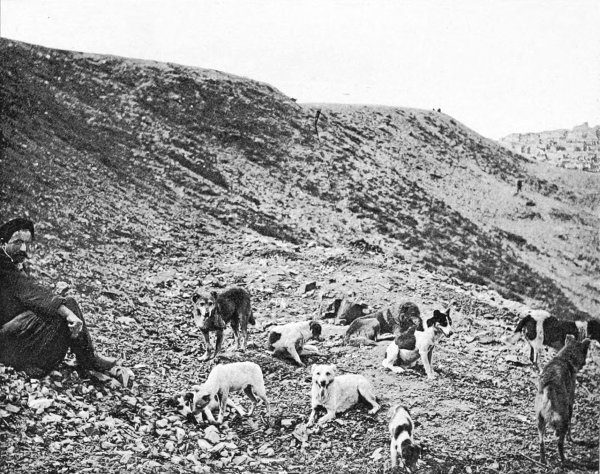
Group of Dogs.
The condition of a dog in Pera and Galata is
worse, all said, than that of a spider in Holland, and
their’s is usually admitted to be the most persecuted
race in all the animal kingdom. When one sees the
existence led by these miserable dogs, it is impossible
not to think that there must be for them, as
well, some compensation in another world. Like
everything else in Constantinople, the sight of them
recalled an historical reminiscence, but in their case
it seemed like the bitterest irony to picture the life
of Bayezid’s famous hunting-pack, who ran about
the imperial forests of Olympia wearing purple trappings
and collars set with pearls. What a contrast
of social conditions! Their unfortunate state has
no doubt a great deal to do with their hideous appearance,
but, apart from that, they are almost all
of the mastiff breed or wolf-dogs, bearing some resemblance
to both foxes and wolves, or rather they
do not bear a resemblance to anything, but are a
horrible race of mongrels, spotted over with strange
colors—about as large as the so-called butcher’s dog,
and so thin that each rib can be counted twenty feet
off. Most of them, moreover, have become so reduced
in the course of a life of incessant warfare
that if you did not see them moving about you would
be apt to take them for the mutilated remains of
dogs. You find them with their tails cut off, ears
torn, with skinned backs, sides laid open, blind in
one eye, lame in two legs, covered with wounds, devoured
by flies, reduced to the last possible stages to
which a living dog can be brought—veritable types
of war, famine, and pestilence. The tail may be
spoken of, in connection with them, as an article of
luxury: rare is it, indeed, for a Constantinople dog
to enjoy the possession of one for more than a couple
of months, at most, of public life. Poor creatures!
they would move a heart of stone to pity, and yet
at times they are so grotesquely maimed and altered,
you see them going along with such a singular gait,
such odd, ungainly movements, that it is almost impossible
not to laugh outright. And, after all,
neither hunger nor blows, nor even warfare, constitutes
their most serious trial, but a cruel custom
which has prevailed for some time in Pera and
Galata. Sometimes in the middle of the night the
peaceful inhabitants of a quarter are aroused from
their slumbers by a diabolical uproar: rushing to
their windows, they behold a crowd of dogs leaping
and dancing about in agony, bounding high in the
air, striking their heads against the walls, or rolling
over and over in the dust: presently the uproar subsides,
and in the morning, by the early light, the
street is seen all strewn with dead bodies. It is the
doctor or apothecary of the quarter, who, being in
the habit of studying at night, has distributed a
handful of pills in order to obtain a fortnight’s
quiet. Through these and other means it happens
that there is some slight decrease in the number of
dogs in Pera and Galata; but what does this avail,
since at Stambul they are so rapidly on the increase
that it is merely a question of time when the supply
of food there will prove insufficient for their support,
and colonists will be sent over to the other shore to
supply the places of those families which have been
exterminated and fill up all blanks caused by war,
famine, or poison.
But there are other beings in Constantinople who
arouse a far more profound sentiment of pity than
the dogs. The eunuchs, who were first introduced
among the Turks in spite of the clear and unmistakable
voice of the Koran, which denounced this infamous
form of degradation in no measured terms,
continue to exist in defiance of recent legislation
prohibiting the inhuman traffic, since stronger than
either law or religion are the abominable thirst for
gold which induces the crime and the cowardly egotism
which derives advantage from it. These unfortunates
are to be met at every street-corner, just
as they are encountered on every page of history.
In the background of every historical scene in
Turkey may be traced one of these sinister forms
grasping the threads of a conspiracy, laden with
gold, or stained with blood—victim, favorite, or instrument
of vengeance; if not openly formidable,
secretly so; standing like a spectre in the shadow
of the throne or blocking the approach to some
mysterious doorway. And the same way in Constantinople:
in the midst of a crowded bazâr,
among the throng of pleasure-seekers at the Sweet
Waters, beneath the columns of the mosques, beside
the carriages, on the steamboats, in käiks, at all the
festivals, wherever people are assembled together,
one sees these phantoms of men, these melancholy
countenances, like a dark shadow thrown across
every aspect of gay Oriental life. With the decline
of the absolutism of the Sultan their political
power has waned, just as the relaxing of Oriental
jealousy has diminished their importance in private
life; the advantages they once enjoyed have consequently
become greatly reduced, and it is only with
considerable difficulty that they are now able to
acquire sufficient wealth or power to in any measure
compensate them for their misfortune. No Ghaznefér
Aghà would now be forthcoming to submit voluntarily
to mutilation in order to become chief of
the white eunuchs; all those of the present day are
unwilling victims, and victims who receive no adequate
compensation. Bought or stolen as children
in Abyssinia or Syria, about one in every three survives
the infamous knife, to be sold in defiance of
the law, and with a pretence of secresy far more revolting
than if it were done openly. There is no
need to have them pointed out: any one can recognize
them at a glance. They are usually tall, fat,
and flabby, with smooth, colorless faces, short waists,
and long legs and arms. They wear fezzes, long
black coats, and European trousers, and carry a
whip made of hippopotamus skin, their badge of
office, walking with long strides, and softly like big
children. When on duty they accompany their
mistresses on foot or horseback, sometimes preceding,
sometimes following after, the carriage, either
singly or in pairs, and looking around them with an
ever-watchful eye, which, at the slightest suggestion
of disrespect either by look or gesture on the part
of a passer-by, becomes so full of angry menace as
to send a cold chill down one’s backbone; but, except
in some such case as this, they have either no
expression at all or else an utter weariness of everything
in the world. I cannot recollect ever having
seen one of them laugh. Some among them, while
very young, look fifty years old, and others, again,
give one the impression of youths who have suddenly,
in the course of a few hours, grown into old
men; many of them, sleek, soft, and well-rounded,
look like carefully-fattened animals. They wear fine
clothing, and are as scrupulously neat and redolent
of perfume as some vain young girl. There are
men so heartless as to laugh in the faces of these
unhappy creatures as they pass them on the street;
possibly they imagine that, having been accustomed to
it from infancy, they are unconscious or nearly so of
the gulf which divides them from the rest of the human
family. But it is perfectly well known that this is
not the case; and, indeed, who, after giving the subject
a moment’s thought, could suppose that it was?
To belong to neither sex; to be merely the phantom
of a man; to live in the midst of life, and yet
not of it; to feel the billows of human passion
surging all about you and be obliged to remain cold,
impassive, unmoved, like a reef in the storm; to
have your very thoughts, the natural, promptings of
your whole being, held in check by an iron band
that no amount of virtuous effort on your part will
ever avail to bend or break; to have constantly
presented before your eyes a picture of happiness
toward which all around you tends, the centre about
which everything circulates, the illuminating cause
of all the conditions of life, and to know yourself
immeasurably far away in the outside darkness, in
a cold immensity of space, like some wandering
spirit accursed of God; and to be, moreover, yourself
the guardian of that happiness in which you
can never participate, the actual barrier which the
jealousy of man has reared between his own felicity
and the outside world, the bolt with which he makes
fast his door, the cloth he uses to conceal his treasures;
to be obliged to live in the very midst of that
sensuous, perfumed existence of youth and beauty
and enjoyment, with shame upon your brow and
fury in your soul, despised, set aside, without name,
without family, without a mother or so much as one
tender memory, cut off from the common ties of
nature and humanity,—who could doubt for one instant
that theirs is a life of torment which the mind
is powerless to grasp, like living with a dagger thrust
into one’s heart?
And this outrage still continues: these unhappy
creatures walk the streets of a European city, live
among men, and, wonderful to relate, refrain from
tearing, biting, stabbing, spitting in the face of that
cowardly humanity which dares to look them in the
eye without either shame or pity, while it busies
itself with international associations for the protection
of dogs and cats! Their whole existence is
nothing but a series of tortures: as soon as the
women of the harem find that they are unwilling to
connive at their intrigues, they look upon them as
spies and jailers, and hate them accordingly, punishing
them by every device of coquetry that lies in
their power until they sometimes drive them quite
beyond all bounds, as in the case of the poor black
eunuch in the Lettere persiane, who put his mistress
in the bath. The very names they bear are a bitter
irony, being called after flowers and perfumes, in
allusion to the ladies whose guardians they are, as
possessors of hyacinths, guardians of lilies, custodians
of roses and of violets. And sometimes, poor
wretches! they fall in love and are jealous and
chafe, and become shedders of blood, or, seeing that
some ardent glance directed toward their lady is returned,
they lose their heads altogether and strike,
as happened once during the Crimean War, when a
eunuch struck a French officer in the face, and had
his own head cut open in consequence by the other’s
sword. Who can tell what they suffer or how the
mere sight of beauty must sometimes torture them,
a caress enrage, a smile torment them, the sound of
a kiss given and returned cause their hands to steal
toward the dagger’s hilt? It is hardly to be wondered
at that in their great empty hearts little
flourishes beside the cold passions of hate, revenge,
and ambition; that they grow up embittered, cowardly,
envious, and savage; that they have either
the dumb, unreasoning devotion of an animal for
their owners, or else are cunning and treacherous;
or that, when they do get into power, they use it to
revenge themselves upon mankind for the affront
put upon them. The more desolate and isolated
their lot, so much the more do they seem to
feel a necessity for female companionship. Unable
to be her lover, they seek to be the friend of woman.
They even marry, sometimes choosing for their
wives women who are pregnant, as Sunbullin,
Ibrahim’s chief eunuch, did, so as to have a child to
love as his own, or, like the head eunuch of Ahmed
II., they have harems filled with virgins in order
that they may enjoy the contemplation and society
of female loveliness; others adopt young girls, so
that in old age they may have a female breast
upon which to recline and not go down to the
grave ignorant of all tenderness and loving care,
having had nothing all their lives but scorn and
contempt, or at best indifference. It is not uncommon
for those who have grown wealthy at court
or in some princely establishment, where they have
combined with the duties of chief eunuch those of
intendant, to purchase in old age a pretty villa on
the Bosphorus, and there to pass the remainder of
their days in feasting and gayety, seeking by these
means to blot out the recollection of their misfortune.
Among all the various tales and anecdotes which
were told me about these unfortunate beings one
stands out with peculiar clearness in my memory.
It was related by a young doctor of Pera in denial
of the statement, sometimes made, that eunuchs do
not suffer.
“One evening,” said he, “I was leaving the house
of a wealthy Mussulman, one of whose four wives
was ill with heart disease; it was my third visit,
and on coming away, as well as on entering, I was
always preceded by a tall eunuch who called aloud
the customary warning, ‘Women, withdraw,’ in
order that the ladies and female slaves might know
that there was a man in the harem and keep out of
sight. On reaching the courtyard the eunuch returned,
leaving me to make my way out alone. On
this occasion, just as I was about to open the door,
I felt a light touch on my arm: turning around, I
found, standing close by me, another eunuch, a good-looking
youth of eighteen or twenty, who stood gazing
silently at me, his eyes filled with tears. Finding
that he did not speak, I asked him what I could
do for him. He hesitated a moment, and then,
clasping my hand convulsively in both of his, he
said in a hoarse voice, in which there was a ring of
despair, ‘Doctor, you know some remedy for every
malady; tell me, is there none for mine?’ I cannot
express to you the effect those simple words produced
upon me: I wanted to answer him, but my voice
seemed to die away, and finally, not knowing what
to do or say, I pulled the door open and fled. But
all that night and for many days after I kept seeing
his face and hearing those mournful words; and I
can tell you that more than once I could feel the
tears rising at the recollection.”
Philanthropists, journalists, ministers, ambassadors,
and you, gentlemen, deputies to the Stambul
Parliament and senators of the Crescent, raise an
outcry in God’s name that this hideous ignominy,
this black stain on the honor of mankind, may in
the twentieth century be merely another dreadful
memory like the Bulgarian atrocities.
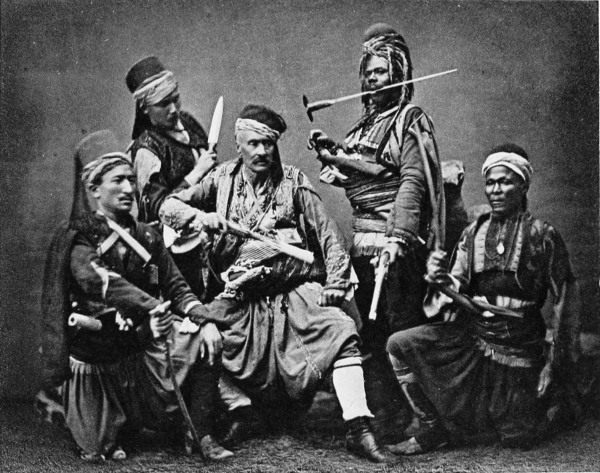
Types of Turkish Soldiers.
Although I was fully aware before going to Constantinople
that no traces of the magnificent army
of former days were still to be seen, nevertheless, as
soldiers are always a source of lively interest to me,
I had no sooner arrived than I began to look about
for them with eager curiosity. What I found, however,
fell short of even what I had been led to expect.
In place of the ancient costume, flowing,
picturesque, and eminently warlike, they have
adopted an ugly, forlorn uniform, consisting of red
trousers, little scant jackets, stripes like a lackey’s
livery, belts like those of college students, and on
every head, from the Sultan’s down to the lowest
man in the ranks, that miserable fez, which, besides
being undignified and puerile, especially when
perched on the head of a big, stout Mussulman, is
the direct cause of any amount of ophthalmia and
headache. The brilliancy of the Turkish army is
lost, without any of that which belongs to the
European military having been gained. The soldiers
looked to me a mournful, half-hearted, dirty
set of men. They may be brave, but they are certainly
not impressive; and as to the nature of their
training, one may form some idea of that from seeing
officers and men employing their fingers in the
street in place of handkerchiefs. One day I saw the
soldier on guard at the bridge, where smoking is not
allowed, bring this fact to the knowledge of a vice-consul
by snatching the cigar out of his mouth; and
on another occasion, in the mosque of the Dancing
Dervishes, on the Rue de Pera, a soldier informed
three Europeans that they were expected to uncover
by knocking their hats off before my eyes: I knew
very well that to raise a protesting voice on such
occasions would mean nothing less than being seized
and carried off bodily, like a bundle of old rags, to
the guard-house. Hence throughout my entire stay
at Constantinople my attitude toward the military
was one of profound deference. On the other hand,
one ceases to wonder at the uncouthness of the soldiers
after seeing what sort of people they are
before donning the uniform. One day in Skutari a
hundred or so recruits, probably brought from the
interior of Asia Minor, passed close by me, and it
was a sight which aroused both my compassion and
my disgust. They looked like those terrible bandits
of Hassin the Mad who passed through Constantinople
toward the close of the sixteenth century
on their way to die by the Austrian cannon on
the plain of Pesth. I can see before me now their
wild, sinister faces, rough shocks of hair, half-naked,
tattooed bodies, and barbarous ornaments,
and I seem to smell again the close, sickening
odor, like that of wild animals’ dens, which they
left behind them in the street. When the first news
was brought of the massacres in Bulgaria, at once
my thoughts turned to them. “My Skutari friends,
beyond a doubt,” I said to myself. It is a fact, however,
that they form the one solitary picturesque
feature which I am able to recall of the Mussulman
army.
O glorious pageant of Bayezid, of Suleiman,
of Muhammad! could one but behold you just once
from the walls of Stambul, drawn up in glittering
array upon the plain of Daûd Pasha! Every
time I passed the triumphal gate of Adrianapolis I
would be haunted by this brilliant vision, and pause
to gaze fixedly at the opening, as though expecting
each moment to see the pasha quartermaster come
forth, heralding the approach of the imperial
troops.
It was, in fact, the pasha quartermaster who
marched at the head of the army, with two horse-tails,
his insignia of rank, while behind him for a
great distance flashed and glistened in the sunlight
certain objects which were nothing less than the
eight thousand brazen spoons fastened in the folds
of the Janissaries’ turbans; in their midst could be
seen the waving herons’ plumes and glittering armor
of the colonels, followed by a crowd of servants
laden with arms and provisions. Behind the Janissaries
came a small troop of volunteers and pages
dressed in silk, with iron mail, and shining head-pieces,
accompanied by a band of music; after
them, the cannoneers, with the cannon fastened
together by means of metal chains; and then another
small band of aghas, pages, chamberlains, and
feudal soldiers, mounted on steeds with plumes and
breast-plates. All of these were only the advance-guard,
above whose closely-packed ranks floated
thousands of brilliantly colored standards, waving
horse-tails, and such a sea of lances, swords, bows,
quivers, and arquebuses that it was not easy to distinguish
the lines of swarthy faces burned by exposure
in the Candian and Persian wars; accompanying
them was the discordant sound of drum and
flute, of trombone and kettledrum, mingling with
the voices of the singers who escorted the Janissaries,
and, with the rattle of arms, clanking of
chains, and hoarse cries of Allah, forming a mighty
roar, at once inspiriting and terrible, which could be
heard from the Daûd Pasha camp to the other bank
of the Golden Horn. O poets and painters, you
who have dwelt with loving touch upon every picturesque
detail of that vanished life of the Orient!
come to my aid now, that together we may recall to
life the Third Muhammad’s famous army and send it
forth, brilliant and complete, from the ancient walls
of Stambul.
Passed the advance-guard, we see another glittering
body of troops. Is it the Sultan? No, as yet
the deity has barely quitted his temple. This is
only the favorite vizier’s retinue, consisting of forty
aghas clad in sable, and mounted upon horses caparisoned
with velvet and with silver bits in their
mouths; behind them are a crowd of pages and gorgeous
grooms, leading other forty horses by the
bridle, with gilded harness, and laden with shields,
maces, and cimeters.
Another troop advances. This is not the Sultan,
either, but a body of state officials—the chief treasurer,
members of the council, and the high dignitaries
of the Seraglio—and with them a band of
players and a throng of volunteers wearing purple
caps decorated with birds’ wings and dressed in
furs, scarlet silk, leopard skins, and Hungarian
kolpaks, armed with long lances entwined with silk
and garlands of flowers.
Still another sparkling wave of horsemen pours
out of the Adrianapolis gate, but it is not the Sultan
yet. This is the train of the grand vizier. First
comes a crowd of mounted arquebusiers, furieri, and
aghas, all high in favor with the Grand Seigneur;
after them forty aghas of the grand vizier, surrounded
by a forest of twelve hundred bamboo
lances, borne by twelve hundred pages, and then
the forty pages of the grand vizier clad in orange
color and armed with bows, their quivers richly ornamented
with gold. Following them are two hundred
more youths, divided into six bands, each band
having a distinctive color, and, riding in their midst,
the governors and relatives of the chief minister;
after these come a throng of grooms, armor-bearers,
employés, servants, pages, and aghas, wearing gold-embroidered
garments, and a troop of standard-bearers
carrying aloft a multitude of silken flags; and
last the kiâya, minister of the interior, escorted by
twelve sciau, or legal executioners, followed by the
grand vizier’s band.
Another host pours out from the city-walls, and
still it is not the Sultan, but a throng of sciau, furieri,
and underlings, gorgeously attired and forming the
retinues of the jurisconsults, the molla and muderri;
close behind them are the head-masters of the falcon,
vulture, hawk, and kite hunts, followed by a
line of horsemen carrying on their saddles leopards
trained for the chase, and a crowd of falconers,
esquires, grooms with ferrets, standard-bearers,
and drummers, and packs of caparisoned and
bejewelled dogs.
Another brilliant concourse sweeps out: the crowds
of spectators prostrate themselves. At last the Sultan?
No, not yet. This is not the head of the army,
but its heart, the holy flame of courage and religious
enthusiasm, the sacred ark of the Mussulman,
around which mountains of decapitated heads have
been reared, torrents of human blood have flowed—the
green ensign of the Prophet, the flag among
flags, taken from its place in the mosque of Sultan
Ahmed, and now floating in the midst of a ferocious
mob of dervishes clad in lion and bear skins, a circle
of rapt-looking preaching sheikhs in camel’s-hair
cloaks, and two companies of emirs, descendants of
the Prophet, wearing the green turban; all of whom
together raise a hoarse clamor of shouts, prayers,
shrill cries, and singing.
Another imposing troop of horsemen herald the
approach, not of the Sultan yet, but of the judiciary,
the judge of Constantinople and chief judge of Asia
and Europe, whose enormous turbans may be seen
towering above the heads of the sciau, who brandish
their silver maces to clear a space for them through
the crowd. With them ride the favorite vizier and
vizier kaimakâm, their turbans decorated with silver
stars and braided with gold; all the viziers of the
Divan, before whom are borne horse-tails dyed with
henné, attached to the ends of long red and blue
poles; and last of all the military judges, followed
by a train of attendants dressed in leopard skins
and armed with lances—pages, armor-bearers, and
sutlers.
The next company pours out, glittering, magnificent.
Surely the Sultan? No—the grand vizier,
wearing a purple caftan lined with sable and
mounted upon a horse fairly covered with steel and
gold, he is followed by a throng of attendants clad
in red velvet, and a crowd of high dignitaries, and
the lieutenant-generals of the Janissaries, among
whom the muftis shine out like swans in the midst
of a flock of peacocks; after these, between two
lines of spearmen carrying gilded spears and two
lines of archers with crescent-shaped plumes, come
the gorgeous grooms of the Seraglio, leading by the
bridle a long file of horses from Arabia, Turkestan,
Persia, and Caramania, their saddles of velvet, reins
gilded, stirrups chased, and trappings covered with
silver spangles, and laden with shields and arms
glittering with jewels; finally the two sacred camels
are seen, bearing one the Koran, the other a fragment
of the Kaaba.
The grand vizier’s retinue has passed, and a
deafening clamor of drums and trumpets assails the
ear. The spectators fly in every direction, cannon
roar, a multitude of running footmen pour through
the gate brandishing their cimeters, and here at last,
in the midst of a thick forest of spears, plumes, and
swords, the central point of those dazzling ranks of
gold and silver head-pieces, beneath a cloud of
waving satin banners, behold the Sultan of sultans,
King of kings, the dispenser of thrones to the
princes of the world, the shadow of God upon earth,
emperor and sovereign lord of the White Sea and of
the Black, of Rumelia and Anatolia, of the province
of Salkadr, of Diarbekr, of Kurdistan, Aderbigian,
Agiem, Sciam, Haleb, Egypt, Mecca, Medina, Jerusalem,
the coasts of Arabia and Yemen, together
with all the other dominions conquered by the arms
of his mighty predecessors and august ancestors or
subdued by his own flaming and triumphant sword.
The solemn and imposing train sweeps slowly by.
Now and again, the serried columns swaying a little
to right or left, a glimpse is caught of the three
jewelled plumes which surmount the turban of the
deity, the serious, pallid countenance, the breast
blazing with diamonds; then the ranks close in once
more, the cavalcade passes on, the threatening cimeters
are lowered, the bystanders raise their bowed
heads, the vision disappears.
After the imperial retinue a crowd of court officials
come, one carrying on his head the Sultan’s
stool, another his sabre, another his turban, another
his mantle, a fifth the silver coffee-pot, a sixth the
golden coffee-pot; then more troops of pages, and
after them the white eunuchs; then three hundred
mounted chamberlains in white caftans, and the hundred
carriages of the harem with silvered wheels,
drawn by oxen hung with garlands of flowers or
horses with velvet trappings, and escorted by a troop
of black eunuchs; then three hundred mules file by
laden with baggage and treasures from the court;
after them a thousand camels carrying water and a
thousand dromedaries laden with provisions; next a
crowd of miners, armorers, and workmen of various
kinds from Stambul, accompanied by a rabble of
buffoons and conjurers; and finally the bulk of the
fighting ranks of the army—hordes of Janissaries,
yellow silidars, purple azabs, spahis with red ensigns,
foreign cavalry with white standards, cannon
that belch forth blocks of lead and marble, the feudal
soldiery from three continents, barbarian volunteers
from the outlying provinces of the empire,
seas of flags, forests of plumes, torrents of turbans—an
iron avalanche on its way to overrun Europe like
a curse sent from God, in whose track will be found
nothing but a desert strewn with smoking ruins and
heaps of skulls.
Although at certain hours of the day Constantinople
wears an air of bustle and activity, in reality
it is probably the laziest city in Europe, and in this
respect both Turk and Frank meet on common
ground. Every one begins by getting up at the
latest possible hour in the morning. Even in summer,
at a time when our cities are up and doing
from one end to the other Constantinople is still
buried in slumber. It is difficult to find a shop open
or so much as to procure a cup of coffee until the
sun is well up in the heavens. Hotels, offices,
bazârs, banks, all snore together in one joyous
chorus, and nothing short of a cannon would arouse
them. Then the holidays! The Turks keep Friday,
the Jews Saturday, and the Christians Sunday, besides
which regular weekly ones are all the feast-days
of the innumerable saints of the Greek and
Armenian calendars, which are scrupulously observed;
and although all of these holidays are supposed
to affect only certain parts of the community
respectively, in reality they provide large numbers,
with whom, properly speaking, they have
nothing whatever to do, with an excuse for being
idle. You can thus form some idea of the amount
of work accomplished in the course of a week.
There are some offices which are only open twenty-four
hours in the seven days. Each day some one
of the five nationalities who go to make up the population
of Constantinople is rambling about over the
big city with no other object in the world than to
kill time. In this art, however, the Turk yields to
none. He can make a cup of coffee, costing two
sous, last half a day, and sit immovable for five
hours at a stretch at the foot of a cypress tree in
one of the innumerable cemeteries. His indolence
is a thing absolute and complete, an inertia resembling
death or sleep, in which all the faculties seem
to be suspended—an utter absence of any sort of
emotion, a phase of existence completely unknown
among Europeans. Turks dislike so much as to
have the idea of movement presented to their minds.
At Stambul, for instance, where there are no public
walks, it is extremely unlikely that the Turks would
frequent them if there were: to go to a place designed
expressly for the purpose of being walked
about in would, to their way of thinking, resemble
work entirely too much. They enter the nearest
cemetery or turn down the first street they come
to, and follow, without any objective point, wherever
their legs or the windings of the path or the people
ahead may lead them. A Turk rarely goes to any
spot merely for the purpose of seeing it. There are
those among them, living in Stambul, who have
never been farther than Kassim Pasha; Mussulman
gentlemen who have never gotten beyond the Isles
of the Princes, where they happen to have a friend
living, or their own villa on the Bosphorus. For
them the height of bliss consists in complete inactivity
of body and mind; hence they abandon to the
restless Christian all those great industries which require
care and thought and travelling about from one
place to another, and content themselves with such
small trades as can be conducted sitting down in
the same spot, and where sight can almost take the
place of speech. Labor, which with us governs and
regulates all the conditions of life, is a thing of quite
secondary importance there, subordinated to what is
pleasant and convenient. We look upon repose as
a necessary interruption to work, while to them work
is merely a suspension of repose. The first object,
at all costs, is to sleep, dream, and smoke for a certain
number of hours out of the twenty-four; whatever
time is left over may be employed in gaining
one’s livelihood. Time, as understood by the Turks,
signifies something altogether different from what it
does to us. The hour, day, month, year, has not
a hundredth part of the value there that it has in
other parts of Europe. The very shortest period
required by any official of the Turkish government
in which to answer the simplest form of inquiry is
two weeks. These people do not know what it is to
desire to finish a thing for the mere pleasure of having
done with it, and, with the single exception of
the porters, one never sees a Turk employed on any
business hurrying in the streets of Stambul. All
walk with the same measured tread, as though their
steps were regulated by the beat of a single drum.
With us life is a seething torrent; with them, a
sleeping pool.
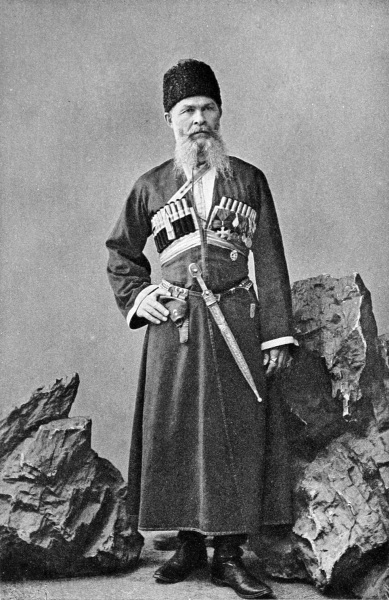
A Turkish Official.
As by day Constantinople is the most brilliant, so
by night it is the gloomiest, city in Europe. Occasional
street-lamps, placed at long distances one from
the other, hardly suffice to pierce the gloom of the
principal streets, while the others are as black as
caves, and not to be ventured into by one who carries
no light in his hand. Hence by nightfall the
city is practically deserted: the only signs of life
are the night-watchmen, prowling dogs, the skulking
figure of some law-breaker, parties of young men
coming out of a subterranean tavern, and mysterious
lights which appear and vanish again like ignis fatui
down some narrow side-street or in a distant cemetery.
This is the hour in which to look at Stambul
from the heights of Pera or Galata. Each one of
her innumerable little windows is illuminated, and,
with the lights from the shipping, reflections in the
water and the starry heavens, helps to light up four
miles of horizon with a great quivering sea of sparkling
points of fire, in which port, city, and sky melt
imperceptibly one into another until they all seem
to be part of one starry firmament. When it is
cloudy, and through a break the moon appears, you
see above the dark mass of the city, above the inky
blots which mark the woods and gardens, the glittering
rows of domes surmounting the imperial mosques,
shining in the moonlight like great marble tombs,
and suggesting the idea of a necropolis of giants.
But most impressive of all is the view when there
is neither moon nor star nor any light at all. Then
one immense black shadow stretches from Seraglio
Point to Eyûb, a great dark profile, the hills
looking like mountains and their many pointed summits
assuming all manner of fantastic shapes—forests
and armies, ruined castles, rocky fortresses—so that
one’s imagination travels off into the region of
dreams and fairy tales. Gazing across at Stambul
on some such night as this from a lofty terrace in
Pera, one’s brain plays all sorts of mad pranks. In
fancy you are carried into the great shadowy city;
wander through those myriad harems, illuminated
by soft, subdued lights: behold the triumphant
beauty of the favorite, the dull despair of the neglected
wife; watch the eunuch who hangs trembling
and impotent outside the door; follow a pair
of lovers as they thread some steep winding byway;
wander through the deserted galleries of the Grand
Bazâr; traverse the great silent cemeteries; lose
yourself amid the interminable rows of columns in
the subterranean cisterns; imagine that you have
been shut up in the gigantic mosque of Suleiman,
and make its shadowy corridors echo again with
lamentations and shrieks of terror, tearing your hair
and invoking the mercy of the Almighty; and then
suddenly exclaim, “What utter nonsense! I am
here on my friend Santoro’s terrace, and in the room
below there not only awaits me a supper for a sybarite,
but a gathering of the most amusing wits in
Pera to help me eat it.”
Every evening a large number of Italians gathered
at the house of my good friend Santoro—lawyers,
artists, doctors, and merchants—among whom I
passed many a delightful hour. How the conversation
flowed! Had I only understood stenography, I
might easily have collected the materials for a delightful
book out of the various anecdotes and bits
of gossip told there night after night. The doctor,
who had just been called to a patient in the harem;
the painter, who was employed upon a pasha’s portrait
somewhere on the Bosphorus; the lawyer, who
was arguing a case before a tribunal; the high
official, who had knotted the threads of an international
love-affair,—each separate experience as
they related it formed a complete and highly entertaining
sketch illustrative of Oriental manners and
customs. Each fresh arrival is the signal for something
new. “Have you heard the news?” one exclaims
on entering: “the government has just paid
the employés’ salaries, due for over three months,
and Galata is flooded with copper money.” Then
another arrives: “What do you suppose happened
this morning? The Sultan got mad at the minister
of finance and threw an inkstand at his head!” A
third tells a story of a Turkish president of a tribunal.
Provoked, it seems, by the wretched arguments
employed by an unscrupulous French lawyer
in defending a bad cause, he paid him this pretty
compliment before the entire audience: “My dear
advocate, it is really quite useless for you to take so
much pains to try to make your case appear good.
——;” And here he pronounced Cambronne’s word
in full: “no matter how you may turn and twist it,
it is still——,” and he said it again.
The conversation naturally covered geographical
ground quite new to me. They used the same easy
familiarity in talking of persons and events in Tiflis,
Trebizond, Teheran, and Damascus as we do when
it is a question of Paris, Vienna, or Geneva, in any
one of which places they had friends or had lately
been or were about going themselves. I seemed to
be in the centre of another world, with new horizons
opening out on all sides, and it was difficult to
avoid a sinking feeling at the thought of the time
when I would be obliged to take up once more the
narrow and contracted routine of my ordinary life.
“How will it ever be possible,” I would ask myself,
“to settle down again to those commonplace occupations
and threadbare topics?” This is the way
every one feels who has spent any time in Constantinople.
After leading the life of that place, all
others must necessarily appear flat and colorless.
Existence there is easier, gayer, more youthful
than in any other city in Europe; it is as though
one were encamped upon foreign soil, surrounded
by an endless succession of strange and unexpected
sights, an ever-changing, shifting scene which
leaves upon one’s mind such a sense of the instability
and uncertainty of all things human that you end
by adopting something of the fatalistic creed of the
Mussulman or else the reckless indifference of the
adventurer.
The apathy of that people is something incredible;
they live, as a poet has said, in a sort of intimate
familiarity with death, looking upon life as a pilgrimage
too short to attempt, even were it worth
their while anyhow, great undertakings requiring
long and sustained effort; and sooner or later this
fatalism attacks the European as well, inducing him
to live in a certain sense from day to day, without
troubling himself more than necessary about the
future, and playing in the world, so far as lies in his
power, the simple and reposeful part of a spectator.
Then the constant intercourse with so many nationalities,
whose language you must speak and whose
views to a certain extent you must adopt, does away
with many of those fixed rules and conventionalities
which have in our countries become iron-bound
laws governing society, and whose observance or
non-observance causes endless vexations and heartburnings.
The Mussulman population forms of itself a never-ending
source of interest and curiosity, always at
hand to be seen and studied, and so stimulating and
enlivening to the imagination as to drive away all
thought of ennui. The very plan of Constantinople
helps to this end. Where in other cities the eye and
mind are almost always imprisoned, as it were, in
one street or narrow circuit, there every step presents
a new outlet through which both may roam
over immeasurable distances of space and scenes of
entrancing beauty, and, finally, there is the absolute
freedom of that life, governed by no one set of
customs. One can do absolutely as he pleases;
nothing is looked upon as out of the way, and the
most astounding performances hardly cause a ripple
of talk, forgotten almost as soon as told in that huge
moral anarchy. Europeans live there in a sort of
republican confederacy, enjoying a freedom from all
restraint such as would only be possible in one of
their own cities during some period of disorder. It is
like a continual Carnival, a perpetual Shrove Tuesday,
and it is this, even more than her beauty,
which endears Constantinople so greatly to the
foreigner, so that, thinking of her after long absence,
one experiences a feeling almost amounting
to home-sickness; while those Europeans who have
made their homes there strike down deep roots and
become as devotedly attached to her as her legitimate
sons. The Turks are certainly not far wrong
when they call her “the enchantress of a thousand
lovers,” or say in their proverb that for him who has
once drunk of the waters of Top-Khâneh there is no
cure—he is infatuated for life.
The Italian colony at Constantinople, while it is
one of the most numerous, is far from being the most
prosperous there. It numbers among it but few rich
persons, and many who are wretchedly poor, especially
those who come from Southern Italy and are
unable to find work: it is also the colony most poorly
represented by the press, when indeed it is represented
at all, its newspapers only making their appearance
to promptly vanish again. When I was
there the colony was awaiting the issue of the Levantino,
and meanwhile a sample copy was put in
circulation setting forth the academic titles and personal
gifts of the editor: I made out seventy-seven
in all, without counting modesty.
One should walk down the Rue de Pera of a Sunday
morning, when the Italian families are on their
way to mass: you hear every dialect in Italy. Sometimes
I used to enjoy it, but not always: it was too
depressing to see so many of one’s fellow-countrymen
homeless wanderers on the face of the earth;
many of them, too, must have been cast up on those
shores by storms of misfortune and strange, uncomfortable
adventures. And then the old people who
would never see Italy again; the children in whose
ears that name meant nothing more than a place—dear,
no doubt, but distant and unknown; and those
young girls, many of whom must inevitably marry
men of other nationalities and found families in
which nothing Italian will survive beyond a proper
name or two and the fond memories of the mother.
I encountered pretty Genoese, looking as though
they might just have come down from the gardens
of Acquasola; charming Neapolitan faces; graceful
little heads which I seemed to have seen a hundred
times beneath the porticoes of Po or the Milanese
arcades. I felt like gathering them all into a bunch,
tying them together with rose-colored ribbons, and
marching them two by two on shipboard, conveying
them back to Italy at the rate of fifteen knots
an hour. I would also have liked to take back
with me, as a curiosity, a sample of the language
spoken by those born in the Italian colony, especially
those of the third or fourth generation. A Crusca
academician, on hearing it, would have taken to his
bed with a raging fever. A language formed by
mingling the Italian spoken by a Piedmontese doorkeeper,
a Lombardy hack-driver, and a Romagnol
porter would, I think, be less outrageous than that
spoken on the banks of the Golden Horn. It is
Italian which, impure at the outset, has been mixed
with four or five other languages, each impure in
their turn; and the most singular part of it is that
in the midst of all these barbarisms you suddenly
come plump upon some such scholarly word or
phrase as puote, imperocche, a ogni pie sospiuto, havvi,
puossi, witnesses to the efforts made by some of our
worthy compatriots, who by dipping into anthologies
seek to preserve the celestial Tuscan speech. But,
as compared with the rest, these might well lay
claim, as Cesari said, to a reputation for using choice
language. Some of them can hardly be understood
at all. One day I was being escorted, I don’t remember
just where, by an Italian youth of sixteen
or seventeen, a friend of a friend of mine, who was
born in Pera. As we walked along I began asking
him some questions, but soon found that he did not
want to talk; he answered me in a low tone and as
shortly as possible, growing red in the face as he did
so and hanging his head; he was so evidently unhappy
that I presently asked him what it was that
troubled him so much. “Oh,” said he with a despairing
sigh, “I talk so badly!” As we continued
our conversation I found that he spoke indeed a
strange dialect, full of outlandish words and strongly
resembling the so-called Frank language, which, as
a French wit once said, consists in pouring out as
rapidly as possible a quantity of Italian, French,
Spanish, and Greek nouns and tenses until you happen
to strike one the listener understands. It is,
however, seldom necessary to go to so much trouble
in Pera or Galata, where almost every one, including
the Turks, can speak, or at least understand,
some Italian, though this language, if you can call it
a language, is almost exclusively a spoken one, if
you can call it speaking. The tongue generally
employed for writing is French. Of Italian literature
there is none. I recollect on one solitary occasion,
in a Galata café crowded with merchants, finding
at the foot of the commercial intelligence and
quotations of the Bourse, printed in French and
Italian, eight mournful little verses all about zephyrs
and stars and sighs. Unhappy poet! it seemed as
though I could see you before me, buried beneath
huge piles of merchandise, composing those verses
with your last breath.
Any one who is blessed with a pretty strong
stomach can pass his evenings while at Constantinople
at the play: he may, moreover, choose among
quite a number of almost equally wretched little
theatres of various sorts, many of which are beer-gardens
and wine-shops as well. At some one of
these one can always find the Italian comedy, or
rather a troupe of Italian actors, whose efforts frequently
make one wish the whole arena could be
converted into a vegetable market. The Turks,
however, frequent by preference those theatres in
which certain bare-necked, brazen-faced, painted
French women sing light songs to the accompaniment
of a wretched orchestra. One of these theatres
was the Alhambra, situated in the Grande Rue
de Pera: it consisted of a long apartment, always
crowded to the utmost, and red with fezzes from
stage to entrance. The nature of those songs, and
the bold gestures which those intrepid ladies employed
in order to make their meaning perfectly
clear, no one could either imagine or credit unless
indeed he had been to the Capellanes at Madrid. At
anything especially coarse or impudent all those
great fat Turks, seated in long lines, broke into loud
roars of laughter, and then the habitual mask of
dignity and reserve would drop from their faces, exposing
the depths of their real nature and every
secret of their grossly sensual lives. There is nothing
that the Turk conceals so habitually and effectually
as the sensual nature of his tastes and manner
of life. He never appears in public accompanied
by a woman, rarely looks at, and never speaks to,
one, and considers it almost an insult to be inquired
of concerning his wives. Judging merely by outside
appearances, one would take this to be the most austere
and straitlaced people in the world, but it is
only in appearance. The same Turk who colors to
the tips of his ears if one so much as asks if his
wife is well, sends his boys, and his girls too, to
listen to the coarse jests of Kara-gyuz, corrupting
their minds before their senses are fairly awakened,
while he himself is fully capable of abandoning the
peaceful enjoyments of his own harem for such excesses
as Bayezid the Thunderbolt set the first example
of, and Mahmûd the Reformer was doubtless
not the last to follow. And, indeed, were proof
needed of the profound corruption which lurks beneath
this mask of seeming austerity, one need go
no farther than to that selfsame Kara-gyuz. It is a
grotesque caricature of a middle-class Turk, a sort
of ombra chinese, whose head, arms, and legs are
made to accompany with appropriate gestures the
developments of some extravagant burlesque having
usually a love-intrigue for its plot. The marionette
is worked behind a transparent curtain, and resembles
a depraved Pulcinello, coarse, cynical, and cunning.
Sensual as a satyr, foul-mouthed as a fishwife,
he throws his audience into paroxysms of
laughter and enthusiasm by every sort of indecent
jest and extravagant gesture. Before the censorship
curbed to some small extent the hitherto unbridled
looseness of this performance, the figure was
made to give visible proof of its corporeal resemblance
to Priapus, and not infrequently upon this
lofty and elevating point the whole plot hinged.
Wishing to investigate for myself the Turkish
manner of cooking, I got my good friends of Pera
to take me to a restaurant ad hoc where every kind
of Turkish dish is to be had, from the most delicious
delicacies of the Seraglio to camel’s meat prepared
as the Arabians eat it, and horseflesh dressed according
to the Turkoman fashion. Santoro ordered the
breakfast, severely Turkish from the opening course
to the fruit, and I, invoking the names of all those
intrepid spirits who have faced death in the cause
of science, conscientiously swallowed a part of each
without so much as a groan. There were upward
of twenty dishes, the Turks being a good deal like
children in their liking to peck at a quantity of different
kinds of food, rather than satisfy their appetite
with a few solid dishes. Shepherds of the day
before yesterday, they seem to disdain a simple table
as though it were a trait of rustic niggardliness. I
cannot give a clear account of each dish, many of
them being now no more than a vague and sinister
memory. I do, however, remember the kibab, which
consisted of little scraps of mutton roasted on the
coals, seasoned with a great deal of pepper and
cloves, and served on two soft, greasy biscuits—a
dish not to be named among the lesser sins. I can
also recall vividly the odor of the pilav, the sine quâ
non of a Turkish meal, consisting of rice and mutton,
meaning to the Turk what maccaroni does to the
Neapolitan or cuscussu to the Arab or puchero to the
Spaniard. I have not forgotten either—and it is the
sole pleasant memory connected with that repast—the
rosh’ab, which is sipped with a spoon at the end of
the meal: it is composed of raisins, plums, apples,
cherries, and other fruits, cooked in water with a
great deal of sugar, and flavored with essence of
musk, citron, and rose-water. Then there were
numberless other preparations of mutton and lamb,
cut in small pieces and boiled until no flavor remained;
fish swimming in oil; rice-balls wrapped in
grape-leaves; sugar syrups; salads served in pastry;
compôtes; conserves; sauces, flavored with every
sort of aromatic herb—a list as long as the articles
of the penal code for relapsed criminals; and finally
the masterpiece of some Arabian pastry-cook, a
huge dish of sweetmeats, among which were conspicuous
a steamboat, a fierce-looking lion, and a
sugar house with grated windows. When all was
over I felt a good deal as though I had swallowed
the contents of a pharmacist’s shop or assisted at one
of those feasts which children prepare with powdered
brickdust, chopped grass, and stale fruit—not
unattractive-looking when seen at a distance. All
the dishes are served rapidly, four or five at a time.
The Turks dive into each with their fingers, the knife
and spoon only, being in common use among them,
and one drinking-goblet serves for the whole company,
the waiter keeping it constantly filled with
flavored water.
These customs, however, were not followed by the
party who were breakfasting at the table adjoining
ours. They were evidently Turks who valued their
ease, even to the extent of poising their slippers
upon the table: each had a plate to himself, and
they plied their forks very skilfully, drinking liquors
freely in despite of Mahomet. I observed,
moreover, that they failed to kiss the bread before
beginning to eat, as every good Mussulman should,
and that more than one longing glance was sent in
the direction of our bottles, although the muftis
pronounce it a sin to so much as cast the eye upon
a bottle of wine. There is, indeed, no doubt that
this “father of abominations,” one drop of which is
sufficient to bring down upon the head of the sinning
Mussulman the “curses of every angel in
heaven and earth,” gains new disciples among the
Turks every day, and that nothing but the fear of
public opinion prevents its open use. Were a thick
cloud to descend upon Constantinople some day, and
after an hour suddenly be lifted, I have little doubt
that the sun would surprise fifty thousand Turks,
each one in the act of lifting the bottle to his lips.
In this, as in almost every other shortcoming of the
Turks, it was the sultans who were the stone of
stumbling and rock of offence. Singular to relate,
it is that very dynasty which rules over a people
among whom it is considered a sin in the sight of
God to drink wine at all, which has produced more
drunkards than any other line of rulers in Europe;
so sweet is forbidden fruit even in the estimation of
the “shadow of God upon earth.” It was, we are
told, Bayezid I. who headed the long list of imperial
tipplers, and here, as in the case of the first sin,
woman was the temptress, the wife of this Bayezid,
a daughter of the king of Servia, offering her husband
his first glass of Tokay. Next Bayezid II.
got intoxicated on Cypress and Schiraz wines; then
the selfsame Suleiman I. who fired every ship in the
port of Constantinople that was laden with wine, and
poured molten lead down the throats of those who
drank the forbidden liquor, himself died when drunk,
shot by one of his own archers. Then comes Selim
II., surnamed the messth (sot), whose debauches
lasted three days, and during whose reign men of
the law and men of religion drank openly. In vain
did Muhammad III. thunder against this “abomination
devised by Satan;” in vain did Ahmed I. close
all the taverns and destroy every wine-press in
Stambul; in vain did Murad IV. patrol the city accompanied
by an executioner, who beheaded in his
presence every unfortunate whose breath witnessed
against him, while he himself, ferocious hypocrite
that he was, staggered about the apartments of the
seraglio like any common frequenter of the pothouse.
Since his day the bottle, like some gay little black
imp, has crept into the seraglio, lurks in the bazâr,
hides beneath the pillow of the soldier, thrusts its
little silver or purple neck from beneath the divan
of the beauty, and, crossing the threshold of the very
mosques themselves, has stained the yellow pages of
the Koran with sacrilegious drops.
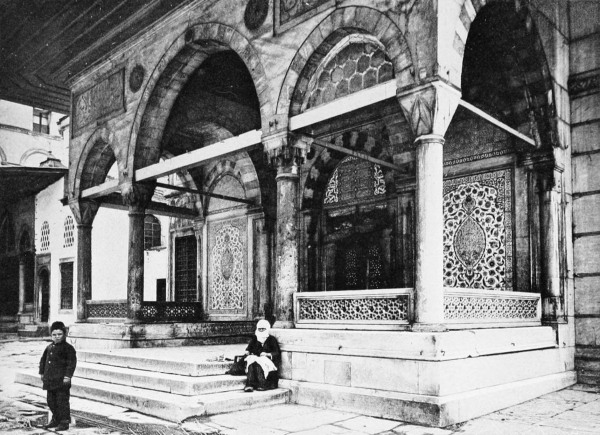
Turbeh of Sultan Selim II in St. Sophia.
Speaking of religion, while wandering about the
streets and byways of Constantinople I used often to
wonder whether, were it not for the voice of the
muezzin, Christians would see anything to remind
them that there was any difference between the religion
of this people and their own. The Byzantine
architecture of the mosques makes them seem very
like churches; of the Islam rites there is no external
evidence; while Turkish soldiers may be seen
escorting the viaticum through the streets. An uneducated
Christian might remain a year in Constantinople
without being aware that Mohammed, not
Christ, claimed the allegiance of the greater part of
the population; and this led me on to reflect upon
the slight nature of the fundamental difference—the
blade of grass, as the Abyssinian Christians called it in
speaking to the first followers of Mohammed—which
divides the two religions, and the trifling cause which
led Arabia to adopt Islamism instead of Christianity,
or, if not Christianity, at all events something so
closely resembling it that, even had it never developed
into that outright, it would have seriously
altered the destinies of the entire Eastern world.
This slight cause was nothing more or less than
the voluptuous nature of a certain handsome young
Arabian, tall, fair, ardent, with black eyes and musical
voice—he lacked the force to dominate his own
passions, and so, instead of cutting at the root of his
people’s prevailing sin, he contented himself with
pruning the branches, and in lieu of proclaiming
conjugal unity as he proclaimed the unity of God,
merely confined within somewhat narrower bounds,
and then proceeded to give the countenance of religion
to, the dissolute selfishness of men. No doubt
he would have had to encounter a more determined
opposition in the one case than in the other, but that
it was in his power to succeed who can question
when it is remembered that in order to establish the
worship of one sole God among a people given over
to idolatry he was obliged to first overthrow an enormous
superstructure of tradition and superstition, including
innumerable grants and privileges all closely
interlaced, the result of centuries of growth, and that
he made them accept, as one of the dogmas of his
religion for which millions of believers subsequently
died, a paradise which at its first announcement
aroused a universal feeling of scorn and indignation?
Unfortunately, however, this handsome young Arab
temporized with his passions, and as a consequence
the face of half the globe is changed, since polygamy
was, without doubt, the besetting vice of his rule
and the principal cause of the decadence of all those
races who have adopted his religion. It is the degradation
of one sex for the benefit of the other,
the open sanction of a glaring injustice which disturbs
the entire course of human rights, corrupts the
rich, oppresses the poor, encourages ignorance,
breaks up the family, and by causing endless complications
in the rights of birth among the reigning
dynasties overturns kingdoms and states, finally
placing an insuperable barrier in the way of the union
of Mussulman society with the people of other faiths
who populate the East. If, to return to the original
proposition, that handsome young Arab had only
been endowed with a little more strength of character,
had the spiritual in his nature but outweighed,
by ever so small an amount, the animal, who knows?—perhaps
we would now have an Orient orderly,
well-governed, and the world be a century nearer
universal civilization.
Happening to be in Constantinople in the month
of Ramazân, the ninth month in the Turkish calendar,
in which the twenty-eight days’ fast falls, I was able
to enjoy every evening a spectacle so exceedingly
comical that I think it merits a description.
Throughout the entire fast the Turks are forbidden
to eat, drink, or smoke from sunrise to sunset. Most
of them make it up by feasting all night, but as long
as the sun is shining the rule is very generally observed,
and no one dares, in public at any rate, to
transgress it.
One morning my friend and I went to call upon a
friend of ours, a young aide-de-camp of the Sultan,
who prided himself upon his liberal views. We
found him in one of the rooms on the ground floor
of the imperial palace with a cup of coffee in his
hand. “Why,” said Yunk, “how do you dare to
drink coffee hours after sunrise?” The young man
shrugged his shoulders, and remarked carelessly
that he did not care a fig for Ramazân or the fast;
but just at that moment, a door near by suddenly
opening, he was in such a hurry to hide the telltale
cup that half its contents were spilled at his feet.
One can readily imagine from this incident how
rigorously all those must abstain whose entire day
is passed beneath the public eye, the boatmen for instance.
To get a really good idea of it one should
stand on the Sultan Validéh bridge at about sunset.
What with the boats at the landings and those which
are going from one place to another, the ones near
at hand and those in the distance, there must be
very nearly a thousand in sight. Every boatman
has fasted since sunrise, and by this time is ravenously
hungry. His supper is all ready in the käik,
and his eyes travel constantly from it to where the
sun is nearing the horizon, and then back again,
while he has the restless, uneasy air of a wild animal
who paces about his cage as the feeding-hour
approaches. Sunset is announced by the firing of a
gun, and until that signal is heard not so much as
a crumb of bread or drop of water crosses the lips
of one of them. Sometimes in a retired spot
in the Golden Horn we would try to induce our
boatman to eat something, but the invariable answer
was, “Jok! jok! jok!” (No! no! no!), accompanied
by an uneasy gesture toward the western horizon.
When the sun gets about halfway down behind the
mountains the men begin to finger their pieces of
bread, inhaling its smell voluptuously. Then it gets
so low that nothing can be seen but a golden arc,
and the rowers lay down their oars. Those who are
busy and those who are idle, some midway across
the Golden Horn, some lying in retired inlets, others
on the Bosphorus, others over near the Asiatic
shore, others, again, who are plying on the Sea of
Marmora, one and all, turning toward the west, remain
immovable, their eyes fixed on the fast-disappearing
disk with mouth open, kindling eye, and
bread firmly clasped in the right hand. Now nothing
can be seen but a tiny point of fire: a thousand
hunks of bread are held close to a thousand mouths,
and then the fiery eye drops out of sight, the cannons
thunders, and on the instant thirty-two thousand
teeth tear a thousand huge mouthsful from a
thousand loaves! But why say a thousand, when in
every house and café and restaurant a similar scene
is being enacted at precisely the same moment, and
for a short time the Turkish city is nothing but a
huge monster whose hundred thousand jaws are all
tearing and devouring at once?
But think what this city must have been in the
great days of the Ottoman glory! I kept thinking
of that all the time. How it must have looked when
not a single cloud of smoke arose from the Bosphorus,
all white with sails, to make ugly, black
marks against the blue of sky and water! In the
port and the inlets of the Sea of Marmora, among the
picturesque battle-ships of that period with their
lofty carved prows, silver crescents, violet standards,
and gilded lanterns, floated the battered and blood-stained
hulks of Spanish, Genoese, and Venetian
galleys. No bridges spanned the Golden Horn,
which was covered with myriads of gayly-decorated
boats plying constantly from one shore to the other,
among which could be distinguished afar off the
snowy-white launches of the Seraglio, covered with
gold-fringed scarlet hangings and propelled by
rowers dressed in silk. Skutari was then no more
than a village: seen from Galata, she only appeared
to have a few houses scattered about on the hillside;
no lofty palaces as yet reared their heads above the
hilltops of Pera; the appearance of the city was
doubtless less impressive than now, but far more
Oriental in character: the law prescribing the use
of colors being then in full force, one could determine
accurately the religion of the occupant from
the color of each house. Except for its public and
sacred edifices, which were white as snow, Stambul
was entirely red and yellow; the Armenian quarters
were light, and the Greek quarters dark gray; the
Hebrew quarter, purple. As in Holland, the passion
for flowers was universal, so that the gardens were
like huge bouquets of hyacinths, tulips, and roses.
The exuberant vegetation not having been as yet
checked on the surrounding hillsides by the growth
of new suburbs, Constantinople presented the appearance
of a city built in a forest. The public
thoroughfares were nothing but lanes and alleys, but
they were rendered picturesque by the varied and
brilliant crowds which thronged them. The huge
turbans worn by the men lent them all an air of
dignity and importance. The women, with the single
exception of the Sultan’s mother, were so rigorously
veiled as to show nothing but the eyes, and so formed
a population apart, anonymous, enigmatical, which
lent to the entire city a certain air of secresy and
mystery. Severe laws controlled the dress of every
individual, so that from the shape of his turban or
color of his caftan one could tell the precise rank,
occupation, office, or condition of every one he met,
as though the city had been one great court. The
horse being as yet almost “man’s only coach,”
thousands of cavaliers filled the crowded streets,
while long files of camels and dromedaries belonging
to the army traversed the city in all directions, giving
it something of the savage and imposing air of
an ancient Asiatic metropolis. Gilded arabas, drawn
by oxen, passed carriages hung with the green
cloth of the ulemi or scarlet cloth of the kâdi-aschieri,
and light talike hung with satin and fantastically
painted. Troops of slaves marched along, representing
every country from Polonia to Ethiopia,
clanking the chains riveted on them in the field of
battle. On the street-corners, in the squares and the
courtyards of the mosques, groups of soldiers collected,
clad in glorious rags, displaying their battered
arms and scars still fresh from wounds received
at Vienna, Belgrade, Rodi, and Damascus.
Hundreds of orators recounted to rapt and enthusiastic
audiences the heroic deeds and brilliant victories
achieved by the army fighting at a distance
of three months’ march from Stambul. Pasha, bey,
agha, musselim, numberless dignitaries and personages
of high rank, clad with theatrical display and
accompanied by throngs of attendants, made their
way through the crowds, who bowed before them
like grain before the wind. Ambassadors representing
every court in Europe, accompanied by princely
retinues, who had come to Stambul to sue for peace
or arrange an alliance, swept by. Caravans laden
with propitiatory gifts from Asiatic and African
kings filed slowly along the principal thoroughfares.
Companies of silidars and spahis, haughty and insolent,
swaggered by, their sabres stained with the
blood of twenty different nations, while the handsome
Greek and Hungarian Seraglio pages, dressed
like little kings, pushed haughtily through the obsequious
multitude, who, recognizing in them the
unnatural caprices of their lord, respected them accordingly.
Here and there a trophy of knotted
clubs before some doorway indicated the presence
of a corps of Janissaries, who at that time acted
as police in the interior of the city. Parties of
Hebrews would be seen hurrying to the Bosphorus
with the dead bodies of the victims of justice.
Every morning a body would be found in the Baluk
Bazâr, lying with the head under the right armpit,
a stone holding in place the sentence affixed to the
breast. Law-breakers to whom summary justice
had been meted out would dangle from a beam or
hook in the public highway, while after nightfall one
was liable to stumble over the body of some unfortunate
who, after having his hands and feet pounded
with clubs, had been thrown from the window of the
torture-chamber. In the broad light of day merchants,
caught in the act of cheating, would be
nailed through the ear to their own shop-doors, and,
there being no law controlling the free right of sepulture,
the work of digging graves and burying the
dead was carried on at all hours and in all places—in
the gardens, in the lanes and open squares, and
before the doors of dwellings. The cries of lambs
and sheep could be heard from the courtyards where
they were being slaughtered in sacrifice to Allah on
the occasion of a circumcision or a birth. From
time to time a troop of eunuchs, galloping by with
warning cries, would be the signal for a general
stampede; the streets would become deserted; doors
and windows fly to, blinds be drawn down, and an
entire neighborhood suddenly assume the look and
air of a city of the dead. Then in long procession
files of gorgeously-decorated coaches filled with the
ladies of the imperial harem would pass by, scattering
around them an atmosphere of perfume and
laughter. Sometimes it would happen that an official
of the court, making his way through some
thoroughfare, would suddenly encounter six quite
ordinary-looking individuals about to enter a shop,
and at that sight grow unaccountably pale. These
six, however, would be the Sultan, four officers of
his court, and an executioner making their rounds
from shop to shop in order to verify the weights and
measures.
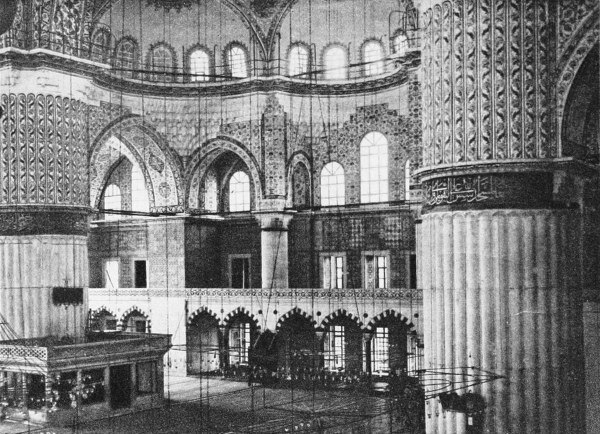
Interior of Mosque of Ahmed.
Throughout the whole of the city’s huge body
there coursed an exuberant and feverish life; the
treasury overflowed with jewels, the arsenal with
arms, the barracks with soldiers, the caravanseries
with strangers; the slave-market was thronged with
merchants and lofty personages come to inspect the
crowds of beautiful slaves. Scholars pressed to examine
the archives of the great mosques; long-winded
viziers prepared for the delectation of future
generations the interminable annals of the Empire;
poets, pensioned by the Seraglio, assembled in the
baths, where they sang the imperial loves and wars;
swarms of Bulgarian and Armenian workmen toiled
at the erection of mighty mosques, employing huge
blocks of granite and Paros marble, while by sea,
columns from the temples of the Archipelago, and
by land, spoils from the churches of Pesth and Ofen,
were brought to contribute to their splendor. In
the harbor a fleet of three hundred sail made ready
to carry terror and dismay to every coast in the
Mediterranean; between Stambul and Adrianapolis
companies of falconers and gamekeepers, to the
number of seven thousand, were stationed; and in
the intervals between military uprisings at home,
foreign wars, and conflagrations which would reduce
twenty thousand houses to ashes in a single night,
revels would be celebrated, lasting thirty days, in
honor of the representatives of every court in Asia,
Africa, and Europe. On these occasions the glorifications
of the Mussulmans degenerated into folly:
sham battles were fought by the Janissaries in the
presence of the Sultan and the court, amid huge
palme di nozze laden with birds, mirrors, and fruits
of various kinds, in order to make room for which
walls and houses were ruthlessly destroyed; and processions
of lions and sugar mermaids, borne on
horses whose trappings were of silver damask, and
mountains of royal gifts sent from every part of the
Empire and every court in the world; dervishes
executed their furious dances, and bloody massacres
of Christian prisoners were followed by public banquets
where ten thousand dishes of cuscussù were
served to the populace; trained elephants and giraffes
danced in the Hippodrome, while bears and wolves,
with fireworks tied to their tails, were let loose
among the people; allegorical pantomimes, grotesque
masquerades, wanton dances, fantastic processions,
games, comedies, symbolic cars, rustic dances,
followed each other in rapid succession. Little by
little as night descended the festival degenerated
into a mad orgy, and then the lights from five hundred
brilliantly illuminated mosques spread a great
aureole of fire over the entire city and announced to
the watching shepherds on the mountain-heights of
Asia and the wayfarers on the Propontis the revels
of this new Babylon.
Such was once Stambul, a haughty sultaness,
voluptuous, formidable, wanton, as compared with
which the city of to-day is little more than some
weary old queen, peevish and hypochondriacal.
Absorbed as I was by the Turks, I had, as may
be readily understood, but little time left in which
to study the characteristics of the three other nationalities—Armenian,
Greek, and Hebrew—which
go to make up the population of Constantinople—a
study requiring a certain amount of time, too, since
all of these people, while preserving to a certain extent
their national character, have outwardly conformed
to the prevailing Mussulman coloring around
them, now in its turn fading into a uniform tint of
European civilization. Thus it is as difficult to catch
a vivid impression of any one of the three as it would
be of a view that was constantly changing. This is
true in a special sense of the Armenians, “Christians
in spirit and faith, Asiatic Mussulmans by birth and
carnal nature,” whom it is not only hard to study intimately,
but even to distinguish at sight, since those
among them who have not adopted the European
costume dress like Turks in all except some very minor
points. All of them have abandoned the ancient
felt cap which was formerly, with certain special
colors, the distinctive sign of their nation. In appearance
they closely resemble the Turks, being for
the most part tall, robust, and corpulent, with a grave,
sedate carriage, but their complexion is light, and
the two striking points of their national character
can usually be read in their faces—the one, a quick,
open, industrious, and persevering spirit, which fits
them in a peculiar way to commercial enterprises;
and the other that adaptability, called by some servility,
which enables them to gain a foothold among
whatever people they may be thrown with from
Hungary to China, and renders them particularly
acceptable to the Turks, whose confidence they
readily succeed in winning, making them faithful
subjects and obsequious friends. There is nothing
heroic or bellicose either about their appearance or
disposition: formerly this may have been otherwise.
Those parts of Asia whence they came are at present
inhabited by a people, descendants of a common
stock, who, it is said, resemble them but little.
Certainly those members of the race who have been
transplanted to the shores of the Bosphorus are a
prudent and managing people, moderate in their
manner of life, intent only upon their trade, and
more sincerely religious, it is affirmed, than any
other nation which inhabits Constantinople. They
are called by the Turks the “camels of the Empire,”
and the Franks assert that every Armenian
is born an accountant. These two sayings are, to
a great extent justified by the facts, since, thanks
to their great physical strength and their quickness
and intelligence, they furnish, in addition to a large
proportion of her architects, engineers, doctors, and
clever and painstaking mechanics, the greater part
of Constantinople’s bankers and porters, the former
amassing fabulous fortunes, and the latter carrying
enormous loads. At first sight, though, one would
hardly be aware that there was an Armenian population
in Constantinople, so completely has the plant,
so to speak, assumed the color of the soil. Their
women, on whose account the house of the Armenian
is almost as rigorously closed to strangers as that of
the Mussulman, have likewise adopted the Turkish
dress, and none but the most expert eye could distinguish
them among their Mohammedan neighbors.
They are generally fair and stout, with the aquiline
Oriental profile, large eyes and long lashes; many
of them are tall, with matronly figures, and, surmounted
by turbans, might well be mistaken for
handsome sheiks. They are universally modest and
dignified in their bearing, and if anything is lacking
it is the intelligence which beams from the eyes of
their Greek sisters.
Difficult as it may be to single out the Armenian
at sight, there is no such trouble about the Greek,
who differs so essentially in character, bearing, appearance,
everything, from all the other subjects of
the Empire that he can be told at once without
even looking at his dress. To appreciate this diversity,
or rather contrast, one need only watch a
Turk and a Greek who happen to be seated beside
one another on board a steamboat or in a café. They
may be about the same age and rank, both dressed
in the European fashion, and even resemble each
other somewhat in feature, and yet it is quite impossible
to mistake them. The Turk sits perfectly motionless;
his face wears a look of quietude and repose,
void of all expression, like a fed animal; if by
any chance some shadow of a thought appears, it
seems to be a reflection as lifeless and inert as his
body; he looks at no one, and is apparently quite
unconscious that any one is looking at him, expressing
by his entire bearing an utter indifference to his
surroundings, a something of the resigned melancholy
of a slave and the cold pride of a despot;
hard, closed, completed, he seems incapable of altering
any resolution once taken, and it would drive
any one to the verge of madness who should undertake
the task of persuading him to any course. In
short, he appears to be a being hewn out of a single
block, with whom it would only be possible to live
either as master or servant, and no amount of intercourse
with whom would ever justify the taking of a
liberty. With the Greek it is altogether different.
His mobile features express every thought that
passes through his mind, and betray a youthful,
almost childish ardor, while he tosses his head with
the free action of an uncurbed and restive horse.
On finding himself observed he at once strikes an
attitude, and if no one looks at him he tries to attract
attention; he seems to be always wanting or
imagining something, and his whole person breathes
of shrewdness and ambition. There is something
so attractive and sympathetic about him that you are
inclined to give him your hand even when you would
hesitate about trusting him with your purse. Seen
side by side, one can readily understand how it is
that one of these men considers the other a proud,
overbearing, brutal savage, and is looked down upon
in his turn as a light creature, untrustworthy, mischievous,
and the cause of endless trouble, and how
they mutually despise and hate one another from the
bottom of their hearts, finding it impossible to live
together in peace. And so with the women. It is
with a distinct feeling of gratification and pleasure
that one first encounters amid the handsome, florid
Turkish and Armenian types, appealing more to the
senses than the mind, the pure and exquisite features
of the Greek women, illuminated by those deep
serious eyes whose every glance recalls an ode,
while their exquisite shapes inspire an immediate
desire to clasp them in one’s arms—with the object
of placing them on pedestals, however, rather than in
the harem. Among them can still be occasionally
found one or two who, wearing their hair after the
ancient fashion—that is, hanging over the shoulders
in long wavy locks, with one thick coil wound around
the top of the head like a diadem—are so noble-looking,
so beautiful and classic, that they might well be
taken for statues fresh from the chisel of a Praxiteles
or a Lysippus, or for youthful immortals discovered
after twenty centuries in some forgotten valley of
Laconia or unknown island of the Egean. But even
among the Greeks these examples of queenly beauty
are exceedingly rare, and are found only in the ranks
of the old aristocracy of the Empire, in the silent
and melancholy quarter of Fanar, where the spirit
of ancient Byzantium has taken refuge. There one
may occasionally see one of these magnificent women
leaning on the railing of a balcony or against the
grating of some lofty window, her eyes fixed upon
the deserted street in the attitude of an imprisoned
queen; and when a crowd of lackeys is not lounging
idly before the door of one of these descendants of
the Palæologi and the Comneni, one may, watching
her from some place of observation, fancy that a rift
in the clouds has revealed for an instant the face of
an Olympian goddess.
With regard to the Hebrews I am prepared to
assert, having been to Morocco myself, that those of
Constantinople have nothing in common with their
fellows of the northern coast of Africa, where observing
experts say they have discovered in all its
primitive purity the original Oriental type of Hebrew
beauty. In the hope of finding some traces of this
same beauty, I summoned up all my courage and
thoroughly explored the vast Ghetto of Balata,
which winds like an unclean reptile along the banks
of the Golden Horn. I penetrated into the most
wretched purlieus, among hovels “encrusted with
mould” like the shores of the Dantesque pool;
through passageways which nothing would induce
me to enter again except on stilts, and, holding my
nose; I peered through windows hung with filthy
rags into dark, malodorous rooms; paused before
damp courtyards exhaling a smell of mould and
decay strong enough to take one’s breath away;
pushed my way through groups of scrofulous children;
brushed up against horrible old men who
looked as though they had died of the plague and
come to life again; avoiding now a dog covered
with sores, now a pool of black mud, dodging under
rows of loathsome rags hung from greasy cords,
or stumbling over heaps of decaying stuff whose
smell was enough to make one faint outright. And,
after all, my heroism met with no reward. Among
all the many women whom I encountered wearing
the national kalpak—an article resembling a sort of
elongated turban, covering the hair and ears—I saw,
it is true, some faces in which could be discovered
that delicate regularity of feature and the expression
of gentle resignation which are supposed to characterize
the Constantinopolitan Jewess; some vague
profiles of a Rebecca or a Rachel, with almond-shaped
eyes full of a soft sweetness; an occasional
graceful, erect figure standing in Raphaelesque attitude
in an open doorway, with one delicate hand
resting lightly on the curly head of a child; but for
the most part my investigations revealed nothing
but discouraging evidences of the degradation of the
race. What a contrast between those pinched faces
and the piercing eyes, brilliant coloring, and well-rounded
forms which aroused my admiration a year
later in the Mellà of Tangiers and Fez!
And the men—thin, yellow, stunted, all their vitality
seems centred in their bright cunning eyes,
never still for a moment, but which roll restlessly
about as though constantly attracted by the sound
of chinking money.
At this point I am quite prepared to hear my
kind critics among the Israelites—who have already
rapped me over the knuckles in regard to their co-religionists
of Morocco—take up the burden of their
song, laying all the blame of the degeneration and
degradation of the Hebrews of Constantinople at the
door of the Turkish oppressor. But it should be
remembered that the other non-Mussulman subjects
of the Porte are all on a precisely similar footing,
both political and civil, with themselves; and, even
were it otherwise, they would find some difficulty in
proving that the filthy habits, early marriages, and
complete abandonment of every sort of hard work,
considered as primal causes of that degeneration,
are the logical results of the loss of liberty and independence.
And should they assert that it is not so
much Turkish oppression as the universal scorn and
petty persecutions which they have had to endure
on all hands that have brought about such complete
loss of self-respect, let them pause and first ask
themselves if the exact opposite may not be nearer
the truth, and the general obloquy in which they are
held be not so much the cause as the result of their
manner of life; and then, instead of trying to cover
up the sore, themselves be the ones to apply the
knife.
After making the tour of Balata the most appropriate
thing to take next seems to be a Turkish
bath. The bath-houses may be easily recognized
from without: they are small, mosque-shaped buildings,
without windows, surmounted by cupolas, and
have high conical chimneys, from which smoke is
constantly rising. So much for the exterior, but he
who desires to penetrate farther and explore the
mysteries of the interior would do well to pause and
ask himself, Quid valeant humeri? since not every
one is able to endure the aspro governo to which he
who enters those salutary walls must be subjected. I
am free to confess that, after all I had been told, I
approached them with some feeling of trepidation,
which I think the reader will admit was not wholly
unjustifiable before he has done. As I recall it all
now, two great drops of perspiration stand out on
my forehead, ready to roll down when I shall be in
the heat of my description. Here then is what was
done to my unhappy person. Entering timidly, I
find myself in a large apartment which leaves one
in doubt for a few moments as to whether he has
gotten by mistake into a theatre or a hospital. A
fountain plays in the centre, decorated on top with
flowers; a wooden gallery runs all around the walls,
upon which some Turks, stretched upon mattresses
and enveloped from head to foot in snow-white
cloths, either slumber profoundly or smoke in a
dreamy state between waking and sleeping. Looking
about for some attendant, I become suddenly
aware of two robust mulattoes, stripped to the
waist, who appear from nowhere like spectres and
ask in deep tones and both together, “Hammamun?”
(bath?). “Evvet” (yes), I reply in a very
weak voice. Motioning me to follow, they lead the
way up a small wooden stair to a room filled with
mats and cushions, where I am given to understand
that I must undress, after which they proceed to
wrap a strip of blue and white stuff about my loins,
tie my head up in a piece of muslin, and, placing a
pair of huge slippers on my feet, grasp me under the
arms like a drunken man, and conduct, or rather
drag, me into another room, warm and half lighted,
where, after laying me on a rug, they stand with
arms akimbo, waiting until my skin shall have become
moist. These preparations, so distressingly
suggestive of some approaching punishment, fill me
with a vague uneasiness, which changes into something
even less admirable when the two cutthroats,
after touching me on the forehead, exchange a
meaning glance, as who should say, “Suppose he
resists?” and then, as though exclaiming, “To the
rack!” again seize me by the arms and lead me
into a third room. This apartment makes a very
singular impression at first sight: it is as though
one found himself in a subterranean temple, where,
through clouds of vapor, high marble walls, rows of
columns, arches, and a lofty vaulted roof, can be indistinctly
seen, colored green and blue and crimson
by the rays of light falling from the cupola, white
spectral figures slide noiselessly back and forth close
to the walls. In the centre half-naked forms are extended
upon the pavement, while others, also half
naked, bend over them in the attitude of doctors
making an autopsy. The temperature is such that
no sooner have we entered than I break out into a
profuse perspiration, and it seems most probable
that should I ever get out at all it will be in the form
of a running stream like the lover of Arethusa.
The two mulattoes convey my body to the centre
of the room and deposit it upon a sort of anatomical
table consisting of a raised slab of white marble,
beneath which are the stoves. The marble, being
extremely hot, burns me and I see stars, but, as long
as I am there, there is no choice but to go through
with the penalty. My two attendants accordingly
begin the vivisection, and, chanting a sort of funeral
dirge the while, pinch my arms and legs, stretch my
muscles, make my joints crack, pound me, rub me,
maul me, and then, rolling me over on my face,
begin over again, only to put me on my back later
and recommence the whole process. They knead
and work me like a dough figure to which they want
to give a certain form they have in mind, and, not
succeeding, have grown angry with; a slight pause
for breath is only followed by renewed pinching,
pulling, and pounding, until I begin to fear that my
last hour is drawing near; and then finally, when
my entire body is streaming with perspiration like a
wet sponge, the blood coursing furiously through
my veins, and it has become evident that I have
reached the last limit of endurance, they gather up
my remains from that bed of torment and carry
them to a corner, where in a small alcove are a
basin and two spigots from which hot and cold water
are running. But, alas! fresh martyrdom awaits me
here; and really the affair at this point begins to
assume so serious an aspect that, joking aside, I
consider whether it would not be possible to strike
out to right and left, and, just as I am, make a break
for life and liberty. It is too late, though: one of
my tormentors, putting on a camel’s-hair glove, has
fallen to rubbing my back, breast, arms, and legs
with the same cheerful energy a lively groom might
employ in currying a horse; after this has been prolonged
for fully five minutes a stream of tepid water is
poured down my back, and I take breath and return
devout thanks to Heaven that it is all over at last.
I soon find, however, that this is premature: that
ferocious mulatto, taking the glove off, promptly
falls to once more with his bare hand, until, losing
all patience, I sign to him to stop, with the result
that, exhibiting his hand, he proves to his own entire
satisfaction and my complete bewilderment that
he must still continue, and does so. Next follows
another deluge of water, and after that a fresh operation:
each of them, now taking a piece of tow
cloth, rubs a quantity of Candia soap upon it, and
then proceeds to soap me well from head to foot;
then another torrent of perfumed water, followed by
the tow cloths again, but, Heaven be praised! without
soap this time, and the process is one of drying me
off. When this has been accomplished they tie up
my head again, wrap the cloth about my body, and
then, enveloping me in a large sheet, reconduct me
to the second room, where I am allowed to rest a
few moments before being taken to the first; here a
warm mattress is in readiness, upon which I stretch
myself luxuriously. The two instruments of justice
give a few final pinches to equalize the circulation
of blood throughout all my members, and then,
placing an embroidered cushion under my head, a
white covering over me, a pipe in my mouth, and a
glass of lemonade at my side, depart, leaving me
light, fresh, airy, perfumed, with a mind serene,
a contented heart, and such a sense of youth and
vitality that I feel as though, like Venus, I had just
been born from the foam of the sea, and seem
to hear the wings of the loves fluttering above my
head.
Feeling thus “airy and meet for intercourse with
the stars,” one could not do better than ascend to the
top of that stone Titan called the Serasker Tower.
I think that should Satan again undertake to offer a
view of the kingdoms of the world by way of a temptation,
his best course would be to select this spot
for the enterprise. The tower, built in the reign of
Mahmûd II., is planted upon the summit of the
most lofty hill in Stambul, on that spot in the centre
of the vast courtyard of the War Office called by the
Turks the umbilicus of the city. It is constructed
mainly of white Marmora marble, on the plan of a
regular polygon with sixteen sides, and rears itself
aloft, erect, and graceful as a column, overtopping to
a considerable extent the gigantic minarets of the
adjacent mosque of Suleiman. Ascending a winding
stair lighted here and there by square windows, you
catch fleeting views now of Galata, now of Stambul
or the villages on the Golden Horn, and before you
are halfway to the top seem already to have reached
the region of the clouds. It may happen that a
slight noise is heard directly over your head, and
almost at the same instant a something flashes by,
apparently an object of some sort being hurled headlong
from above; but, in reality, one of the guards stationed
day and night on the summit to watch for fires
and give the alarm, who, having discovered at some
distant point of the horizon a cloud of suspicious-looking
smoke, is taking word to the seraskier.
After mounting about two hundred steps you reach
a sort of covered terrace running all around the
tower and enclosed with glass, where an attendant
is always at hand to serve visitors with coffee. On
first finding yourself in that transparent cage, suspended
as it were between heaven and earth, with
nothing to be seen but an immense blue space,
and the wind howling and rattling the panes of
glass and making the boards strain and creak, you
are very apt to be attacked with vertigo and to feel
strongly tempted to give up the view; but at sight
of the ladder which leads to the window in the roof
courage returns, and, climbing up with a beating
heart, a cry of astonishment escapes you. It is an
overpowering moment, and for a little while you remain
silent and transfixed.
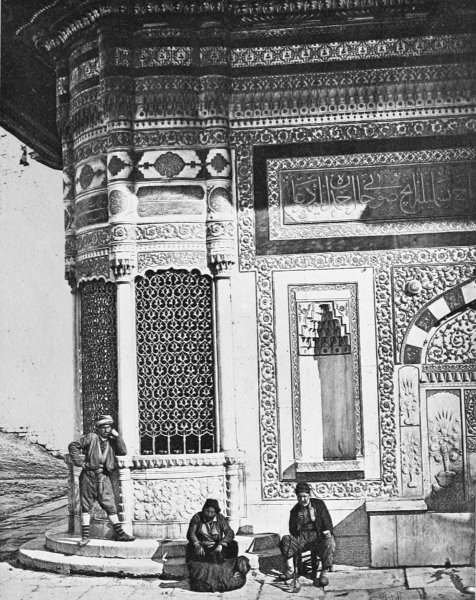
Entrance and Tower of Seraskier.
Constantinople lies spread out before you like a
map, and with the turn of an eye the entire extent
of the mighty metropolis can be embraced—all the
hills and valleys of Stambul from the Castle of the
Seven Towers to the cemetery of Eyûb; all Galata,
all Pera, as though you could drop your sight down
into them like a plumb-line; all Skutari as though it
lay directly beneath you—three lines of buildings,
groves, and shipping, extending as far as the eye
can reach along three shores of indescribable beauty,
and other stretches of garden and village winding
away inland until they fade out of view in the distance;
the entire length of the Golden Horn, smooth
and glassy, dotted over with innumerable käiks,
which look like bright-colored flies swimming about
on the surface of the water; all of the Bosphorus
too, but, owing to the hills which run out into it
here and there, it looks like a series of lakes, and
each lake seems to be surrounded by a city, and
each city festooned about with gardens: beyond the
Bosphorus lies the Black Sea, whose blue surface
melts into the sky; in the opposite direction are the
Sea of Marmora, the Gulf of Nicomedia [Ismid],
the Isles of the Princes, and the two coasts of Asia
and Europe, white with villages; beyond the Sea of
Marmora lie the Dardanelles, shining like a silver
ribbon, and beyond them again a dazzling white
light indicates the Ægean Sea, with a dark line
showing the position of the Troad; beyond Skutari
are seen Bithynia and the Olympus; beyond Stambul
the brown undulating solitudes of Thrace; two
gulfs, two straits, two continents, three seas, twenty
cities, myriads of silver cupolas with gilded pinnacles,
a glory of light, an exuberance of color, until
you doubt whether it is indeed your own planet
spread out before you or some other heavenly body
more highly favored by God.
And so on the Serasker Tower I asked myself, as
I had already done over and over again on the old
bridge, the Tower of Galata, at Skutari, how I could
ever have been so infatuated with Holland; and not
only did Holland now seem a poor dull place which
one would tire of in a month, but Paris, Madrid, Seville
as well. And then I would think miserably of
my wretched descriptions—how often I had used the
expressions superb, beautiful, magnificent, until now
there were none left for this surpassing view; and
yet at the same time I knew I would never be willing
to subtract a syllable from what I had said
about those other parts of Constantinople. My
friend Rossasco would say, “Well, why don’t you
try this?” To which I would reply, “But suppose
I have nothing to say?” And indeed, incredible as
it sounds, there really were times when, in certain
lights and at certain hours of the day, the view did
look almost poor, and I would exclaim in dismay,
“What has become of my beloved Constantinople?”
At others I would experience a feeling of sadness to
think that while I had that immensity of space,
that prodigality of beauty, spread out before me for
the asking, my mother was sitting in a little room
from which nothing could be seen but a dull courtyard
and narrow strip of sky, as though I must
somehow be to blame; and feel that I would give
an eye to have my dear old lady on my arm and
carry her off to see St. Sophia. As a rule, however,
the days flew by as lightly and gayly as the hours at
a feast, and when, by any chance, my friend and I
were attacked by ill-humor, we had a sure and certain
method of curing ourselves. Going to Galata,
we would jump into the two most gayly-decorated
two-oared käiks at the landing, and, calling out,
“Eyûb!” presto, before we knew it, would find ourselves
in the middle of the Golden Horn. The
oarsmen, Mahmûds or Bayezids or Ibrahims, about
twenty years old or so, and endowed with arms of
iron, would usually amuse themselves by racing,
keeping up a series of shouts and cries and laughing
like children. Above, a cloudless sky, below a
smooth transparent sea; throwing back our heads, we
would inhale great breaths of the delicious scented
air, and trail one hand over the side in the soft clear
water. On fly the two käiks; palaces, gardens,
kiosks, and mosques glide by; we seem to be borne
on the wings of the wind across an enchanted world,
and are blissfully conscious that we are young and at
Stambul. Yunk sings, and I, while reciting half
aloud some one of Victor Hugo’s ballads of the
East, can see now on the right hand and now on
the left, near by, afar off, a beloved face crowned
with white hair which wears a tender smile and tells
me, as plainly as though it were a voice speaking,
that she appreciates and fully shares all my enjoyment.