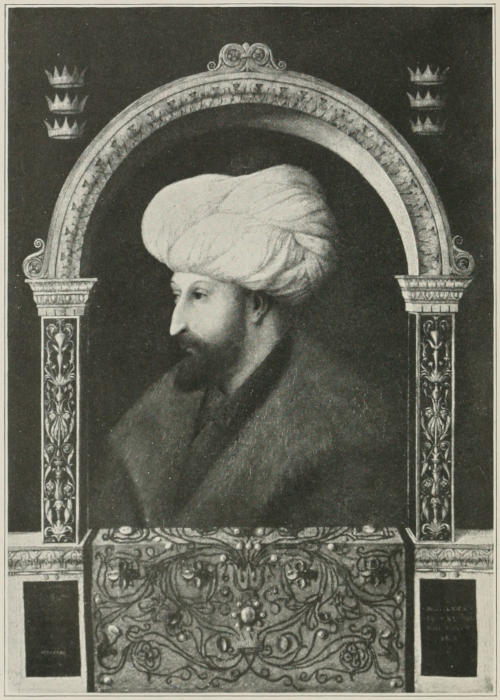
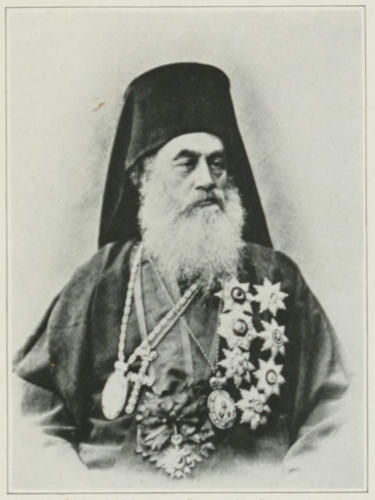
From the portrait by Gentile Bellini in the Layard Collection
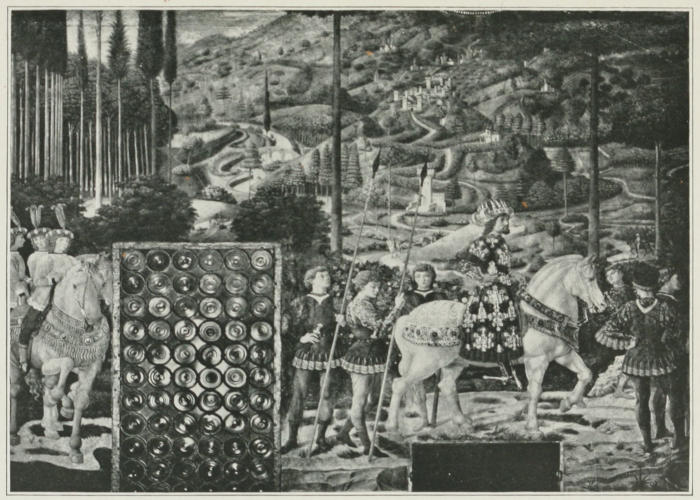
Photograph by Alinari Brothers, Florence
CONSTANTINOPLE
OLD AND NEW
BY
H. G. DWIGHT
ILLUSTRATED
NEW YORK
CHARLES SCRIBNER’S SONS
1915
Copyright, 1915, by
CHARLES SCRIBNER’S SONS
Published September, 1915
OF HIS BOOK
A number of years ago it happened to the writer of
this book to live in Venice. He accordingly read, as
every good English-speaking Venetian does, Mr. Howells’s
“Venetian Life.” And after the first heat of his
admiration he ingenuously said to himself: “I know
Constantinople quite as well as Mr. Howells knew
Venice. Why shouldn’t I write a ‘Constantinople Life’?”
He neglected to consider the fact that dozens of other
people knew Venice even better than Mr. Howells, perhaps,
but could never have written “Venetian Life.”
Nevertheless, he took himself and his project seriously.
He went back, in the course of time, to Constantinople,
with no other intent than to produce his imitation of
Mr. Howells. And the reader will doubtless smile at
the remoteness of resemblance between that perfect
little book and this big one.
Aside, however, from the primary difference between
two pens, circumstances further intervened to deflect
this book from its original aspiration. As the writer
made acquaintance with his predecessors in the field,
he was struck by the fact that Constantinople, in comparison
with Venice and I know not how many other
cities, and particularly that Turkish Constantinople, has
been wonderfully little “exploited”—at least in our
generation and by users of our language. He therefore
turned much of his attention to its commoner aspects—which
Mr. Howells in Venice felt, very happily, under
no obligation to do. Then the present writer found
himself more and more irritated by the patronising or
contemptuous tone of the West toward the East, and he
made it rather a point—since in art one may choose a
point of view—to dwell on the picturesque and admirable
side of Constantinople. And soon after his return
there took place the revolution of 1908, whose
various consequences have attracted so much of international
notice during the last five years. It was but
natural that events so moving should find some reflection
in the pages of an avowed impressionist. Incidentally,
however, it has come about that the Constantinople of
this book is a Constantinople in transition. The first
chapter to be written was the one called “A Turkish
Village.” Since it was originally put on paper, a few
weeks before the revolution, the village it describes has
been so ravaged by a well-meaning but unilluminated
desire of “progress” that I now find it impossible to
bring the chapter up to date without rewriting it in a
very different key. I therefore leave it practically untouched,
as a record of the old Constantinople of which
I happened to see the last. And as years go by much
of the rest of the book can only have a similar documentary
reference.
At the same time I have tried to catch an atmosphere
of Constantinople that change does not affect and to
point out certain things of permanent interest—as in
the chapters on mosque yards, gardens, and fountains, as
well as in numerous references to the old Turkish house.
Being neither a Byzantinist nor an Orientalist, and,
withal, no expert in questions of art, I realise that the
true expert will find much to take exception to. While
in matters of fact I have tried to be as accurate as possible,
I have mainly followed the not infallible Von Hammer,
and most of my Turkish translations are borrowed
from him or otherwise acquired at second hand. Moreover,
I have unexpectedly been obliged to correct my
proofs in another country, far from books and from the
friends who might have helped to save my face before
the critic. I shall welcome his attacks, however, if a
little more interest be thereby awakened in a place and
a people of which the outside world entertains the vaguest
ideas. In this book, as in the list of books at its end,
I have attempted to do no more than to suggest. Of
the list in question I am the first to acknowledge that it
is in no proper sense a bibliography. I hardly need say
that it does not begin to be complete. If it did it would
fill more pages than the volume it belongs to. It contains
almost no original sources and it gives none of the
detailed and classified information which a bibliography
should. It is merely what I call it, a list of books, of
more popular interest, in the languages more commonly
read by Anglo-Saxons, relating to the two great periods
of Constantinople and various phases of the history and
art of each, together with a few better-known works of
general literature.
I must add a word with regard to the spelling of the
Turkish names and words which occur in these pages.
The great difficulty of rendering in English the sound of
foreign words is that English, like Turkish, does not
spell itself. For that reason, and because whatever interest
this book may have will be of a general rather
than of a specialised kind, I have ventured to deviate a
little from the logical system of the Royal Geographical
Society. I have not done so with regard to consonants,
which have the same value as in English, with the exception
that g is always hard and s is never pronounced
like z. The gutturals gh and kh have been so softened
by the Constantinople dialect that I generally avoid
them, merely suggesting them by an h. Y, as I use it, is
half a consonant, as in yes. As for the other vowels,
they are to be pronounced in general as in the Continental
languages. But many newspaper readers might
be surprised to learn that the town where the Bulgarians
gained their initial success during the Balkan war was not
Kîrk Kiliss, and that the second syllable of the first
name of the late Mahmud Shefket Pasha did not rhyme
with bud. I therefore weakly pander to the Anglo-Saxon
eye by tagging a final e with an admonitory h,
and I illogically fall back on the French ou—or that of
our own word through. There is another vowel sound
in Turkish which the general reader will probably give up
in despair. This is uttered with the teeth close together
and the tongue near the roof of the mouth, and is very
much like the pronunciation we give to the last syllable
of words ending in tion or to the n’t in needn’t. It is
generally rendered in foreign languages by i and sometimes
in English by the u of sun. Neither really expresses
it, however, nor does any other letter in the
Roman alphabet. I have therefore chosen to indicate
it by î, chiefly because the circumflex suggests a difference.
For the reader’s further guidance in pronunciation
I will give him the rough-and-ready rule that all
Turkish words are accented on the last syllable. But
this does not invariably hold, particularly with double
vowels—as in the name Hüsséïn, or the word seráï, palace.
Our common a and i, as in lake and like, are really
similar double vowel sounds, similarly accented on the
first. The same rules of pronunciation, though not of
accent, apply to the few Greek words I have had occasion
to use. I have made no attempt to transliterate
them. Neither have I attempted to subject well-known
words or names of either language to my somewhat
arbitrary rules. Stamboul I continue so to call, though
to the Turks it is something more like Îstambol; and
words like bey, caïque, and sultan have long since been
naturalised in the West. I have made an exception,
however, with regard to Turkish personal names, and
in mentioning the reigning Sultan or his great ancestor,
the Conqueror, I have followed not the European but
the Turkish usage, which reserves the form Mohammed
for the Prophet alone.
This is not a book of learning, but I have required a
great deal of help in putting it together, and I cannot
close this prefatory note without acknowledging my indebtedness
to more kind friends than I have space to
name. Most of all I owe to Mr. E. L. Burlingame, of
Scribner’s Magazine, and to my father, Dr. H. O. Dwight,
without whose encouragement, moral and material,
during many months, I could never have afforded the
luxury of writing a book. I am also under obligation
to their Excellencies, J. G. A. Leishman, O. S. Straus,
and W. W. Rockhill, American ambassadors to the
Porte, and especially to the last, for cards of admission,
letters of introduction, and other facilities for collecting
material. Among many others who have taken
the trouble to give me assistance of one kind or another
I particularly wish to express my acknowledgments to
Arthur Baker, Esq.; to Mgr. Christophoros, Bishop of
Pera; to F. Mortimer Clapp, Esq.; to Feridoun Bey,
Professor of Turkish in Robert College; to H. E. Halil
Edhem Bey, Director of the Imperial Museum; to
Hüsseïn Danish Bey, of the Ottoman Public Debt; to
H. E. Ismaïl Jenani Bey, Grand Master of Ceremonies
of the Imperial Court; to H. E. Ismet Bey, Préfet adjoint
of Constantinople; to Kemaleddin Bey, Architect in
Chief of the Ministry of Pious Foundations; to Mahmoud
Bey, Sheikh of the Bektash Dervishes of Roumeli
Hissar; to Professor Alexander van Millingen; to Frederick
Moore, Esq.; to Mr. Panayotti D. Nicolopoulos,
Secretary of the Mixed Council of the Œcumenical Patriarchate;
to Haji Orhan Selaheddin Dedeh, of the Mevlevi
Dervishes of Pera; to A. L. Otterson, Esq.; to Sir Edwin
Pears; to Refik Bey, Curator of the Palace and Treasury
of Top Kapou; to E. D. Roth, Esq.; to Mr. Arshag
Schmavonian, Legal Adviser of the American Embassy;
to William Thompson, Esq.; to Ernest Weakley, Esq.;
and to Zia Bey, of the Ministry of Pious Foundations.
My thanks are also due to the editors of the Atlantic
Monthly, of Scribner’s Magazine, and of the Spectator,
for allowing me to republish those chapters which originally
came out in their periodicals. And I am not least
grateful to the publishers for permitting me to change
the scheme of my book while in preparation, and to substitute
new illustrations for a large number that had already
been made.
I, a Persian and an Ispahani, had ever been accustomed to hold my
native city as the first in the world: never had it crossed my mind that any
other could, in the smallest degree, enter into competition with it, and when
the capital of Roum was described to me as finer, I always laughed the
describer to scorn. But what was my astonishment, and I may add mortification,
on beholding, for the first time, this magnificent city! I had
always looked upon the royal mosque, in the great square at Ispahan, as
the most superb building in the world; but here were a hundred finer, each
surpassing the other in beauty and in splendour. Nothing did I ever conceive
could equal the extent of my native place; but here my eyes became
tired with wandering over the numerous hills and creeks thickly covered
with buildings, which seemed to bid defiance to calculation. If Ispahan
was half the world, this indeed was the whole. And then this gem of cities
possesses this great advantage over Ispahan, that it is situated on the borders
of a beautiful succession of waters, instead of being surrounded by arid and
craggy mountains; and, in addition to its own extent and beauty, enjoys
the advantage of being reflected in one never-failing mirror, ever at hand
to multiply them.... “Oh! this is a paradise,” said I to those around me;
“and may I never leave it!”
—J. J. Morier, “The Adventures of Hajji Baba of Ispahan.”
CONSTANTINOPLE OLD AND NEW — I STAMBOUL
If literature could be governed by law—which, very
happily, to the despair of grammarians, it can not—there
should be an act prohibiting any one, on pain of death,
ever to quote again or adapt to private use Charles
Lamb and his two races of men. No one is better aware
of the necessity of such a law than the present scribe,
as he struggles with the temptation to declare anew that
there are two races of men. Where, for instance, do
they betray themselves more perfectly than in Stamboul?
You like Stamboul or you dislike Stamboul, and
there seems to be no half-way ground between the two
opinions. I notice, however, that conversion from the
latter rank to the former is not impossible. I cannot
say that I ever really belonged, myself, to the enemies
of Stamboul. Stamboul entered too early into my consciousness
and I was too early separated from her to
ask myself questions; and it later happened to me to
fall under a potent spell. But there came a day when
I returned to Stamboul from Italy. I felt a scarcely
definable change in the atmosphere as soon as we crossed
the Danube. Strange letters decorated the sides of cars,
a fez or two—shall I be pedantic enough to say that the
word is really fess?—appeared at car windows, peasants
on station platforms had something about them
that recalled youthful associations. The change grew
more and more marked as we neared the Turkish frontier.
And I realised to what it had been trending when
at last we entered a breach of the old Byzantine wall
and whistled through a long seaside quarter of wooden
houses more tumble-down and unpainted than I remembered
wooden houses could be, and dusty little gardens,
and glimpses of a wide blue water through ruinous masonry,
and people as out-at-elbow and down-at-the-heel
as their houses, who even at that shining hour of a summer
morning found time to smoke hubble-bubbles in
tipsy little coffee-houses above the Marmora or to squat
motionless on their heels beside the track and watch
the fire-carriage of the unbeliever roll in from the West.
I have never forgotten—nor do successive experiences
seem to dull the sharpness of the impression—that
abysmal drop from the general European level of spruceness
and solidity. Yet Stamboul, if you belong to the
same race of men as I, has a way of rehabilitating herself
in your eyes, perhaps even of making you adopt
her point of view. Not that I shall try to gloss over
her case. Stamboul is not for the race of men that
must have trimness, smoothness, regularity, and modern
conveniences, and the latest amusements. She has
ambitions in that direction. I may live to see her attain
them. I have already lived to see half of the Stamboul
I once knew burn to the ground and the other
half experiment in Haussmannising. But there is still
enough of the old Stamboul left to leaven the new. It is
very bumpy to drive over. It is ill-painted and out
of repair. It is somewhat intermittently served by the
scavenger. Its geography is almost past finding out,
for no true map of it, in this year of grace 1914, as
yet exists, and no man knows his street or number.
What he knows is the fountain or the coffee-house near
which he lives, and the quarter in which both are situated,
named perhaps Coral, or Thick Beard, or Eats
No Meat, or Sees Not Day; and it remains for you to
find that quarter and that fountain. Nevertheless, if
you belong to the race of men that is amused by such
things, that is curious about the ways and thoughts of
other men and feels under no responsibility to change
them, that can see happy arrangements of light and
shade, of form and colour, without having them pointed
out and in very common materials, that is not repelled
by things which look old and out of order, that is even
attracted by things which do look so and therefore have
a mellowness of tone and a richness of association—if
you belong to this race of men you will like Stamboul,
and the chances are that you will like it very much.
You must not make the other mistake, however, of
expecting too much in the way of colour. Constantinople
lies, it is true, in the same latitude as Naples; but
the steppes of Russia are separated from it only by the
not too boundless steppes of the Black Sea. The colour
of Constantinople is a compromise, therefore, and not
always a successful one, between north and south.
While the sun shines for half the year, and summer
rain is an exception, there is something hard and unsuffused
about the light. Only on certain days of south
wind are you reminded of the Mediterranean, and more
rarely still of the autumn Adriatic. As for the town
itself, it is no white southern city, being in tone one of
the soberest. I could never bring myself, as some
writers do, to speak of silvery domes. They are always
covered with lead, which goes excellently with the stone
of the mosques they crown. It is only the lesser minarets
that are white; and here and there on some lifted
pinnacle a small half-moon makes a flash of gold. While
the high lights of Stamboul, then, are grey, this stone
Stamboul is small in proportion to the darker Stamboul
that fills the wide interstices between the mosques—a
Stamboul of weathered wood that is just the colour of
an etching. It has always seemed to me, indeed, that
Stamboul, above all other cities I know, waits to be
etched. Those fine lines of dome and minaret are for
copper rather than canvas, while those crowded houses
need the acid to bring out the richness of their shadows.
Stamboul has waited a long time. Besides Frank
Brangwyn and E. D. Roth, I know of no etcher who has
tried his needle there. And neither of those two has
done what I could imagine Whistler doing—a Long
Stamboul as seen from the opposite shore of the Golden
Horn. When the archæologists tell you that Constantinople,
like Rome, is built on seven hills, don’t believe
them. They are merely riding a hobby-horse so ancient
that I, for one, am ashamed to mount it. Constantinople,
or that part of it which is now Stamboul,
lies on two hills, of which the more important is a long
ridge dominating the Golden Horn. Its crest is not
always at the same level, to be sure, and its slopes are
naturally broken by ravines. If Rome, however, had
been built on fourteen hills it would have been just as
easy to find the same number in Constantinople. That
steep promontory advancing between sea and sea toward
a steeper Asia must always have been something
to look at. But I find it hard to believe that the city
of Constantine and Justinian can have marked so noble
an outline against the sky as the city of the sultans.
For the mosques of the sultans, placed exactly where
their pyramids of domes and lance-like minarets tell
most against the light, are what make the silhouette of
Stamboul one of the most notable things in the world.
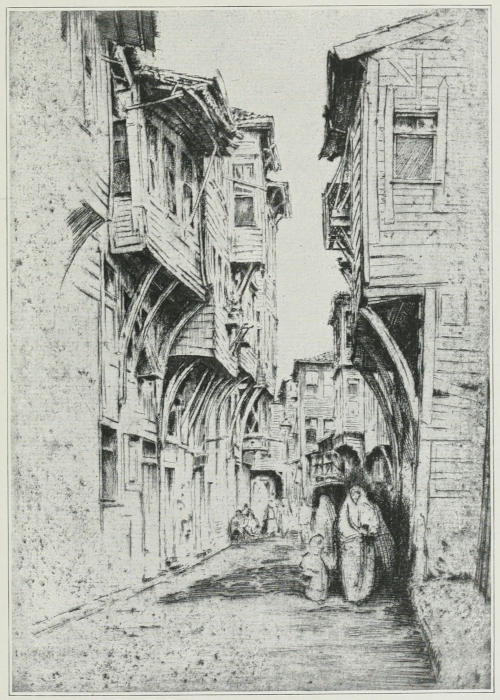
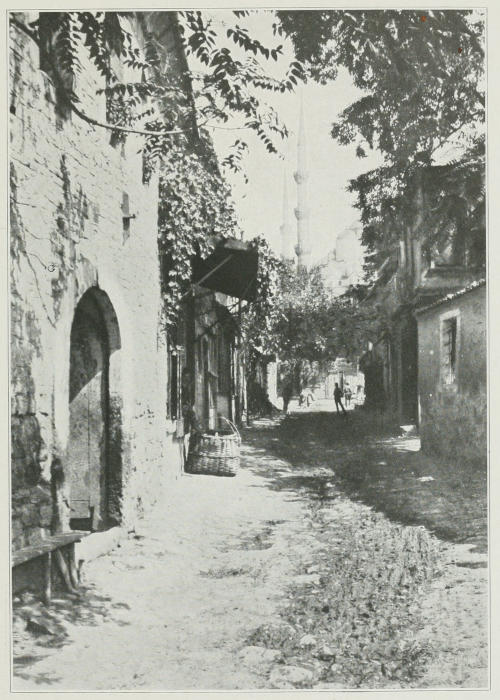
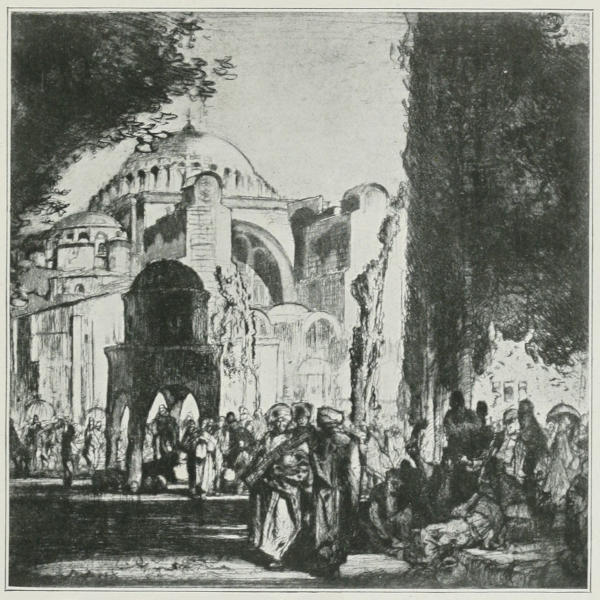
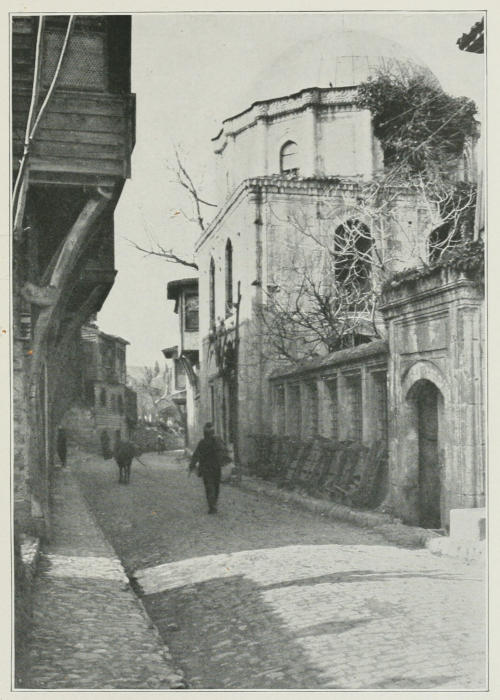
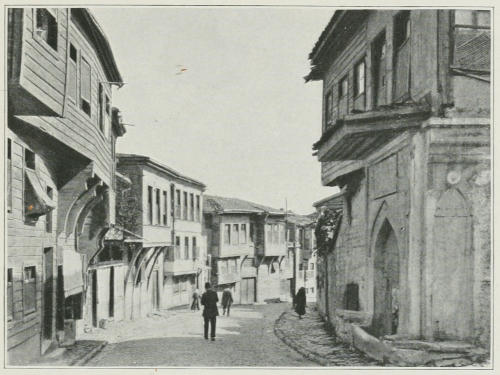
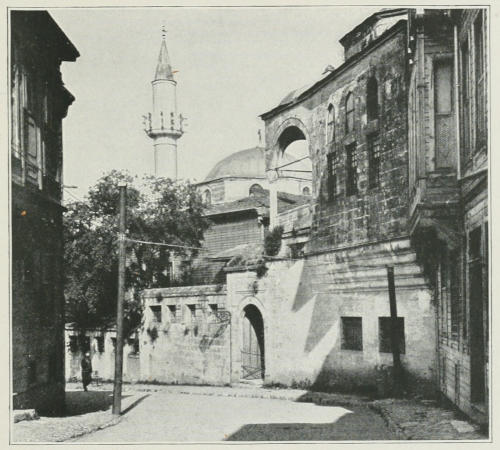
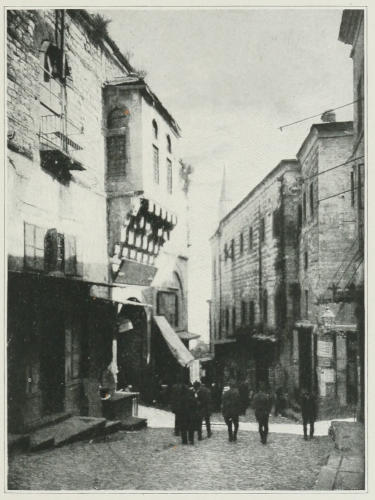
A Stamboul street
From an etching by Ernest D. Roth
Of the many voyagers who have celebrated the panorama
of Constantinople, not a few have recorded their
disappointment on coming to closer acquaintance. De
gustibus ... I have small respect, however, for the
taste of those who find that the mosques will not bear
inspection. I shall presently have something more particular
to say in that matter. But since I am now speaking
of the general aspects of Stamboul I can hardly pass
over the part played by the mosques and their dependencies.
A grey dome, a white minaret, a black cypress—that
is the group which, recurring in every possible
composition, makes up so much of the colour of the
streets. On the monumental scale of the imperial mosques
it ranks among the supreme architectural effects. On a
smaller scale it never lacks charm. One element of this
charm is so simple that I wonder it has not been more
widely imitated. Almost every mosque is enclosed by a
wall, sometimes of smooth ashler with a pointed coping,
sometimes of plastered cobblestones tiled at the top,
often tufted with snapdragon and camomile daisies.
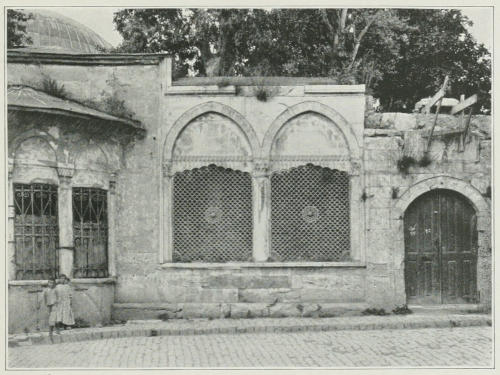
And this wall is pierced by a succession of windows
which are filled with metal grille work as simple or as
elaborate as the builder pleased. For he knew, the
crafty man, that a grille or a lattice is always pleasant
to look through, and that it somehow lends interest to
the barest prospect.
There is hardly a street of Stamboul in which some
such window does not give a glimpse into the peace and
gravity of the East. The windows do not all look into
mosque yards. Many of them open into the cloister of
a medresseh, a theological school, or some other pious
foundation. Many more look into a patch of ground
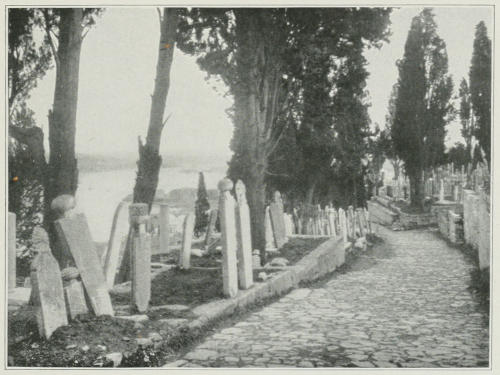
where tall turbaned and lichened stones lean among
cypresses or where a more or less stately mausoleum, a
türbeh, lifts its dome. Life and death seem never very
far apart in Constantinople. In other cities the fact
that life has an end is put out of sight as much as possible.
Here it is not only acknowledged but taken advantage
of for decorative purposes. Even Divan Yolou,
the Street of the Council, which is the principal avenue
of Stamboul, owes much of its character to the tombs
and patches of cemetery that border it. Several sultans
and grand viziers and any number of more obscure persons
lie there neighbourly to the street, from which he
who strolls, if not he who runs, may read—if Arabic
letters be familiar to him—half the history of the
empire.
Of the houses of the living I have already hinted that
they are less permanent in appearance. Until very recently
they were all built of wood, and they all burned
down ever so often. Consequently Stamboul has begun
to rebuild herself in brick and concrete. I shall not complain
of it, for I admit that it is not well for Stamboul to
continue burning down. I also admit that Stamboul
must modernise some of her habits. It is a matter of
the greatest urgency if Stamboul wishes to continue to
exist. Yet I am sorry to have the old wooden house of
Stamboul disappear. It is not merely that I am a fanatic
in things of other times. That house is, at its best,
so expressive a piece of architecture, it is so simple and
so dignified in its lines, it contains so much wisdom for
the modern decorator, that I am sorry for it to disappear
and leave no report of itself. If I could do what I like,
there is nothing I should like to do more than to build,
and to set a fashion of building, from less perishable
materials, and fitted out with a little more convenience,
a konak of Stamboul. They are descended, I suppose,
from the old Byzantine houses. There is almost nothing
Arabic about them, at all events, and their interior arrangement
resembles that of any palazzo of the Renaissance.
Divan Yolou
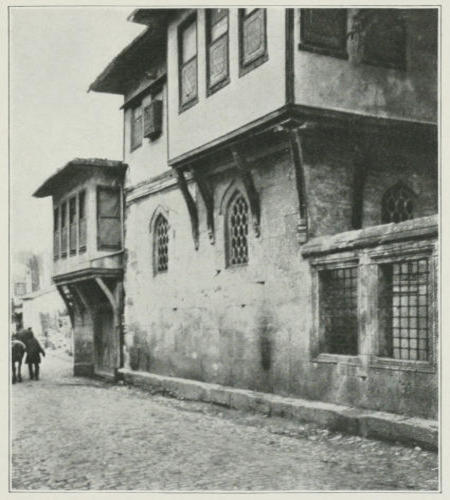
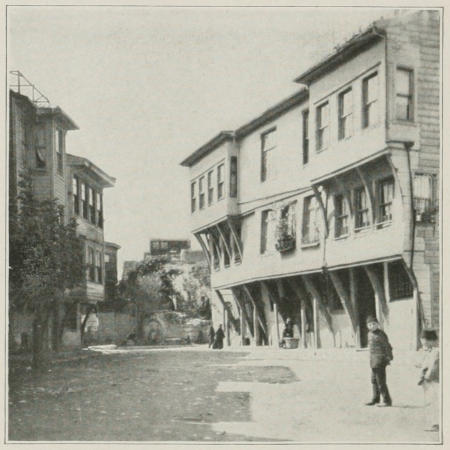
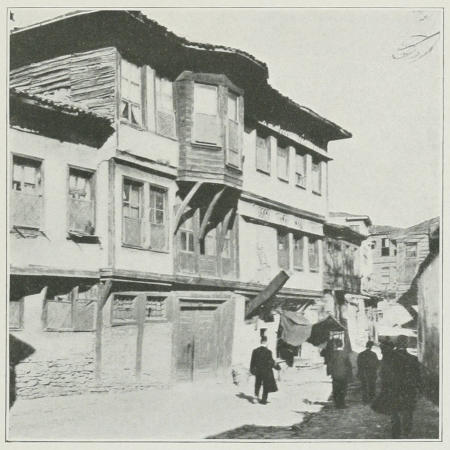
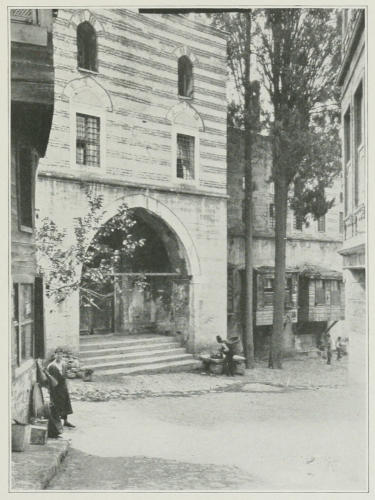
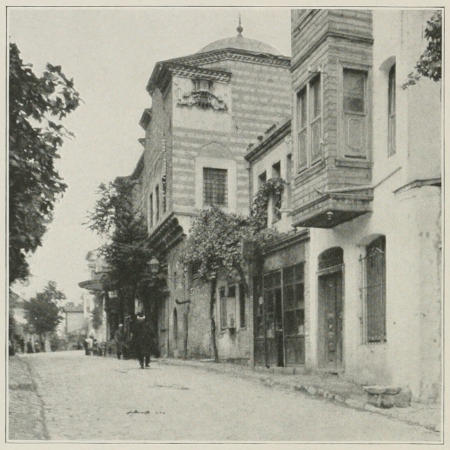
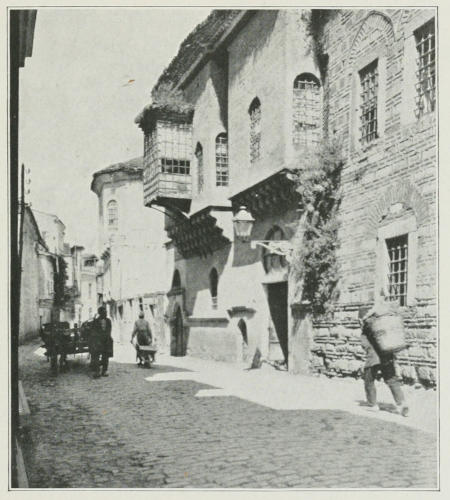
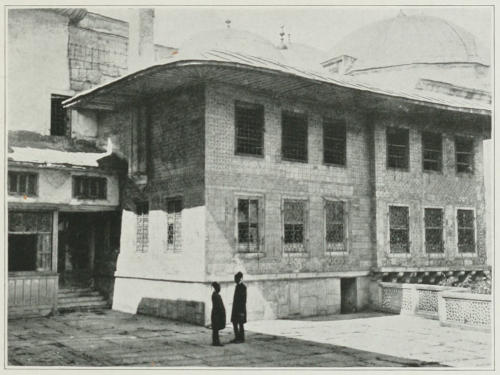
The old wooden house of Stamboul is never very tall.
It sits roomily on the ground, seldom rising above two
storeys. Its effect resides in its symmetry and proportion,
for there is almost no ornament about it. The
doorway is the most decorative part of the façade. Its
two leaves open very broad and square, with knockers
in the form of lyres, or big rings attached to round plates
of intricately perforated copper. Above it there will
often be an oval light filled with a fan or star of swallow-tailed
wooden radii. The windows in general make up
a great part of the character of the house, so big and so
numerous are they. They are all latticed, unless Christians
happen to live in the house; but above the lattices
is sometimes a second tier of windows, for light, whose
small round or oval panes are decoratively set in broad
white mullions of plaster. For the most original part of
its effect, however, the house counts on its upper storey,
which juts out over the street on stout timbers curved
like the bow of a ship. Sometimes these corbels balance
each other right and left of the centre of the house, which
may be rounded on the principle of a New York “swell
front,” only more gracefully, and occasionally a third
storey leans out beyond the second. This arrangement
gives more space to the upper floors than the ground itself
affords and also assures a better view. If it incidentally
narrows and darkens the street, I think the
passer-by can only be grateful for the fine line of the
curving brackets and for the summer shade. He is
further protected from the sun by the broad eaves of the
house, supported, perhaps, by little brackets of their
own. Under them was stencilled of old an Arabic invocation,
which more rarely decorated a blue-and-white
tile and which nowadays is generally printed on paper
and framed like a picture—“O Protector,” “O Conqueror,”
“O Proprietor of all Property.” And over all
is a low-pitched roof, hardly ever gabled, of the red tiles
you see in Italy.
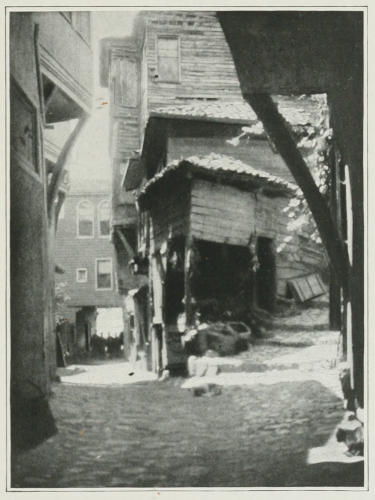
A house in Eyoub
A house at Aya Kapou
The inside of the house is almost as simple as the
outside—or it used to be before Europe infected it. A
great entrance hall, paved with marble, runs through the
house from street to garden, for almost no house in Stamboul
lacks its patch of green; and branching or double
stairways lead to the upper regions. Other big halls are
there, with niches and fountains set in the wall. The
rooms opening out on either hand contain almost no
furniture. The so-called Turkish corner which I fear is
still the pride of some Western interiors never originated
anywhere but in the diseased imagination of an upholsterer.
The beauty of an old Turkish room does
not depend on what may have been brought into it by
chance, but on its own proportion and colour. On one
side, covering the entire wall, should be a series of cupboards
and niches, which may be charmingly decorated
with painted flowers and gilt or coloured moulding. The
ceiling is treated in the same way, the strips of moulding
being applied in some simple design. Of real wood-carving
there is practically none, though the doors are
panelled in great variety and the principle of the lattice
is much used. There may also be a fireplace, not set
off by a mantel, but by a tall pointed hood. And if there
is a second tier of windows they may contain stained glass
or some interesting scheme of mullioning. But do not
look for chairs, tables, draperies, pictures, or any of the
thousand gimcracks of the West that only fill a room
without beautifying it. A long low divan runs under
the windows, the whole length of the wall, or perhaps of
two, furnished with rugs and embroidered cushions.
Other rugs, as fine as you please, cover the floor. Of
wall space there is mercifully very little, for the windows
crowd so closely together that there is no room to put
anything between them, and the view is consciously made
the chief ornament of the room. Still, on the inner walls
may hang a text or two, written by or copied from some
great calligraphist. The art of forming beautiful letters
has been carried to great perfection by the Turks, who
do not admit—or who until recently did not admit—any
representation of living forms. Inscriptions, therefore,
take with them the place of pictures, and they collect
the work of famous calligraphs as Westerners collect
other works of art. While a real appreciation of this art
requires a knowledge which few foreigners possess, any
foreigner should be able to take in the decorative value
of the Arabic letters. There are various systems of forming
them, and there is no limit to the number of ways in
which they may be grouped. By adding to an inscription
its reverse, it is possible to make a symmetrical figure
which sometimes resembles a mosque, or the letters may
be fancifully made to suggest a bird or a ship. Texts
from the Koran, invocations of the Almighty, the names
of the caliphs and of the companions of the Prophet,
and verses of Persian poetry are all favourite subjects
for the calligrapher. I have also seen what might very
literally be called a word-picture of the Prophet. To
paint a portrait of him would contravene all the traditions
of the cult; but there exists a famous description
of him which is sometimes written in a circle, as it were
the outline of a head, on an illuminated panel.
The house of the pipe
However, I did not start out to describe the interior
of Stamboul, of which I know as little as any man.
That, indeed, is one element of the charm of Stamboul—the
sense of reserve, of impenetrability, that pervades its
Turkish quarters. The lattices of the windows, the veils
of the women, the high garden walls, the gravity and perfect
quiet of the streets at night, all contribute to that
sense. From the noisy European quarter on the opposite
bank of the Golden Horn, where life is a thing of shreds
and patches, without coherent associations and without
roots, one looks over to Stamboul and gets the sense of
another, an unknown life, reaching out secret filaments
to the uttermost parts of the earth. Strange faces,
strange costumes, strange dialects come and go, on errands
not necessarily too mysterious, yet mysterious enough
for one who knows nothing of the literature of the East,
its habits, its real thought and hope and belief. We
speak glibly of knowing Turkey and the Turks—we who
have lived five or ten or fifty years among them; but very
few of us, I notice, have ever known them well enough to
learn their language or read their books. And so into
Stamboul we all go as outsiders. Yet there are aspects
of Stamboul which are not so inaccessible. Stamboul at
work, Stamboul as a market-place, is a Stamboul which
welcomes the intruder—albeit with her customary
gravity: if a man buttonholes you in the street and insists
that you look at his wares you may be sure that he
is no Turk. This is also a Stamboul which has never
been, which never can be, sufficiently celebrated. The
Bazaars, to be sure, figure in all the books of travel, and
are visited by every one; but they are rather sighed over
nowadays, as having lost a former glory. I do not sigh
over them, myself. I consider that by its very arrangement
the Grand Bazaar possesses an interest which can
never disappear. It is a sort of vast department store,
on one floor though not on one level, whose cobbled aisles
wander up hill and down dale, and are vaulted solidly
over with stone. And in old times, before the shops or
costumes of Pera were, and when the beau monde came
here to buy, a wonderful department store it must have
been. In our economic days there may be less splendour,
but there can hardly be less life; and if Manchester
prints now largely take the place of Broussa silk and
Scutari velvet, they have just as much colour for the
modern impressionist. They also contribute to the essential
colour of Constantinople, which is neither Asiatic
nor European, but a mingling of both.
A last fragment of old Stamboul is walled in the
heart of this maze, a square enclosure of deeper twilight
which is called the Bezesten. Tradition has it that the
shopkeepers of the Bezesten originally served God as well
as mammon, and were required to give a certain amount
of time to their mosques. Be that as it may, they still
dress in robe and turban, and they keep shorter hours
than their brethren of the outer bazaar. They sit at
the receipt of custom, not in shops but on continuous
platforms, grave old men to whom it is apparently one
whether you come or go, each before his own shelf and
cupboard inlaid with mother-of-pearl; and they deal
only in old things. I do not call them antiques, though
such things may still be picked up—for their price—in
the Bezesten and out of it, and though the word is
often on the lips of the old men. I will say for them,
however, that on their lips it merely means something
exceptional of its kind. They could recommend you
an egg or a spring lamb no more highly than by calling
it antika. At any rate, the Bezesten is almost a little
too good to be true. It might have been arranged by
some Gérôme who studied the exact effect of dusty shafts
of light striking down from high windows on the most
picturesque confusion of old things—stuffs, arms, rugs,
brasses, porcelain, jewelry, silver, odds and ends of
bric-à-brac. In that romantic twilight an antique made
in Germany becomes precious, and the most abominable
modern rug takes on the tone of time.
The real rug market of Constantinople is not in the
Bazaars nor yet in the hans of Mahmoud Pasha, but in
the Stamboul custom-house. There the bales that
come down from Persia and the Caucasus, as well as
from Asia Minor and even from India and China, are
opened and stored in great piles of colour, and there
the wholesale dealers of Europe and America do most
of their buying. The rugs are sold by the square metre
in the bale, so that you may buy a hundred pieces in
order to get one or two you particularly want. Burly
Turkish porters or black-capped Persians are there to
turn over the rugs for you, shaking out the dust of
Asia into the European air. Bargaining is no less long
and fierce than in the smaller affairs of the Bazaars,
though both sides know better what they are up to.
Perhaps it is for this reason that the sale is often made
by a third party. The referee, having first obtained
the consent of the principals to abide by his decision—“Have
you content?” is what he asks them—makes
each sign his name in a note-book, in which he then
writes the compromise price, saying, “Sh-sh!” if they
protest. Or else he takes a hand of each between both
of his own and names the price as he shakes the hands
up and down, the others crying out: “Aman! Do not
scorch me!” Then coffees are served all around and
everybody departs happy. As communications become
easier the buyers go more and more to the headquarters
of rug-making, so that Constantinople will not remain
indefinitely what it is now, the greatest rug market in the
world. But it will long be the chief assembling and
distributing point for this ancient trade.
There are two other covered markets, both in the
vicinity of the Bridge, which I recommend to all hunters
after local colour. The more important, from an architectural
point of view, is called Mîssîr Charshî, Corn or
Egyptian Market, though Europeans know it as the
Spice Bazaar. It consists of two vaulted stone streets
that cross each other at right angles. It was so badly
damaged in the earthquake of 1894 that many of its
original tenants moved away, giving place to stuffy quilt
and upholstery men. Enough of the former are left,
however, to make a museum of strange powders and
electuaries, and to fill the air with the aroma of the
East. And the quaint woodwork of the shops, the dusty
little ships and mosques that hang as signs above them,
the decorative black frescoing of the walls, are quite as
good in their way as the Bezesten. The Dried Fruit
Bazaar, I am afraid, is a less permanent piece of old
Stamboul. It is sure to burn up or to be torn down
one of these days, because it is a section of the long
street—almost the only level one in the city—that
skirts the Golden Horn. I hope it will not disappear,
however, before some etcher has caught the duskiness
of its branching curve, with squares of sky irregularly
spaced among the wooden rafters, and corresponding
squares of light on the cobblestones below, and a dark
side corridor or two running down to a bright perspective
of water and ships. All sorts of nuts and dried
fruits are sold there, in odd company with candles and
the white ribbons and artificial flowers without which
no Greek or Armenian can be properly married.
This whole quarter is one of markets, and some of
them were old in Byzantine times. The fish market, one
of the richest in the world, is here. The vegetable
market is here, too, at the head of the outer bridge,
where it can be fed by the boats of the Marmora. And
all night long horse bells jingle through the city, bringing
produce which is sold in the public square in the
small hours of the morning. Provisions of other kinds,
some of them strange to behold and stranger to smell,
are to be had in the same region. In the purlieus of
Yeni Jami, too, may be admired at its season a kind of
market which is a specialty of Constantinople. The
better part of it is installed in the mosque yard, where
cloth and girdles and shoes and other commodities meet
for the raiment of man and woman are sold under awnings
or big canvas umbrellas. But other sections of it,
as the copper market and the flower market, overflow
beyond the Spice Bazaar. The particularity of this
Monday market is that it is gone on Tuesday, being
held in a different place on every day of the week. Then
this is a district of hans, which harbour a commerce of
their own. Some of these are hotels, where comers
from afar camp out in tiers of stone galleries about
an open court. Others are places of business or of storage
and, as the latter, are more properly known by the
name kapan. The old Fontego or Fondaco dei Turchi
in Venice, and the Fondaco dei Tedeschi, are built on
the same plan and originally served the same purpose.
The Italian word fondaco comes from the Arabic fîndîk,
which in turn was derived from the πανδοχεῖον of Constantinople.
But whether any of these old stone buildings
might trace a Byzantine or Venetian ancestry
I cannot say. The habit of Stamboul to burn up once
in so often made them very necessary, and in spite of
the changes that have taken place in business methods
they are still largely used. And all about them are
the headquarters of crafts—wood-turning, basket-making,
amber-cutting, brass-beating—in alleys which are
highly profitable to explore.
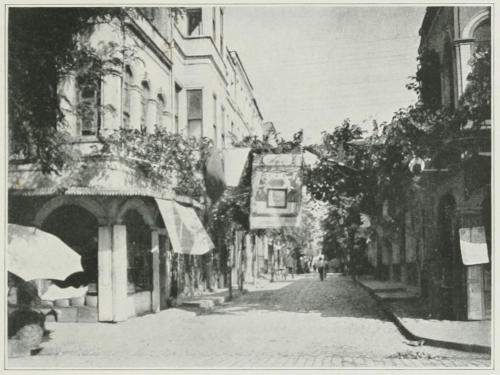
One of the things that make those alleys not least
profitable is the grape-vine that somehow manages to
grow in them. It is no rarity, I am happy to report.
That grape-vine is one of the most decorative elements
of Stamboul streets; and to me, at least, it has a whole
philosophy to tell. It was never planted for the profit
of its fruit. Vines allowed to grow as those vines grow
cannot bear very heavily, and they are too accessible
for their grapes to be guarded. They were planted, like
the traghetto vines in Venice, because they give shade
and because they are good to look upon. Some of them
are trained on wires across the street, making of the
public way an arbour that seduces the passer-by to stop
and taste the taste of life.
Fortunately there are special conveniences for this,
in places where there are vines and places where there
are not. Such are the places that the arriving traveller
sees from his train, where meditative citizens sit cross-legged
of a morning over coffee and tobacco. The traveller
continues to see them wherever he goes, and never
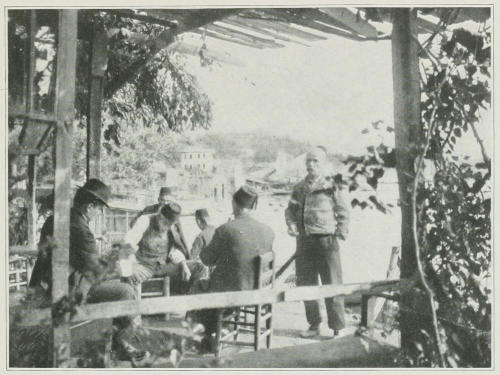
without a meditative citizen or two. The coffee-houses
indeed are an essential part of Stamboul, and in them the
outsider comes nearest, perhaps, to intimacy with that
reticent city. The number of these institutions in Constantinople
is quite fabulous. They have the happiest
tact for locality, seeking movement, strategic corners,
open prospects, the company of water and trees. No
quarter is so miserable or so remote as to be without
one. Certain thoroughfares carry on almost no other
form of business. A sketch of a coffee-shop may often
be seen in the street, in a scrap of sun or shade, according
to the season, where a stool or two invite the passer-by
to a moment of contemplation. And no han or
public building is without its facilities for dispensing the
indispensable.
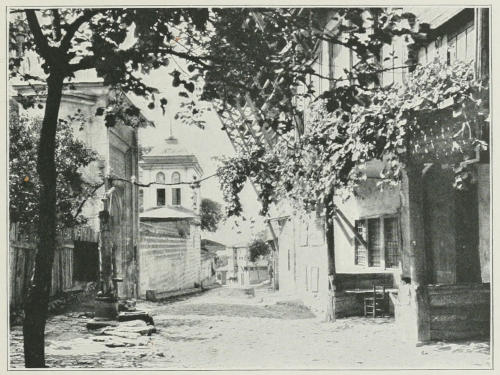
That grape-vine is one of the most decorative elements of
Stamboul streets
I know not whether the fact may contribute anything
to the psychology of prohibition, but it is surprising
to learn how recent an invention coffee-houses are, as
time goes in this part of the world, and what opposition
they first encountered. The first coffee-shop was opened
in Stamboul in 1554, by one Shemsi, a native of Aleppo.
A man of his race it was, an Arab dervish of the thirteenth
century, who is supposed to have discovered the properties
of the coffee berry. Shemsi returned to Syria in
three years, taking with him some five thousand ducats
and little imagination of what uproar his successful enterprise
was to cause. The beverage so quickly appreciated
was as quickly looked upon by the orthodox as insidious
to the public morals—partly because it seemed to merit
the prohibition of the Koran against intoxicants, partly
because it brought the faithful together in places other
than mosques. “The black enemy of sleep and of love,”
as a poet styled the Arabian berry, was variously denounced
as one of the Four Elements of the World of
Pleasure, one of the Four Pillars of the Tent of Lubricity,
one of the Four Cushions of the Couch of Voluptuousness,
and one of the Four Ministers of the Devil—the other
three being tobacco, opium, and wine. The name of the
drug may have had something to do with the hostility
it encountered. Kahveh, whence café and coffee, is a
slight modification of an Arabic word—literally meaning
that which takes away the appetite—which is one of
the names of wine.
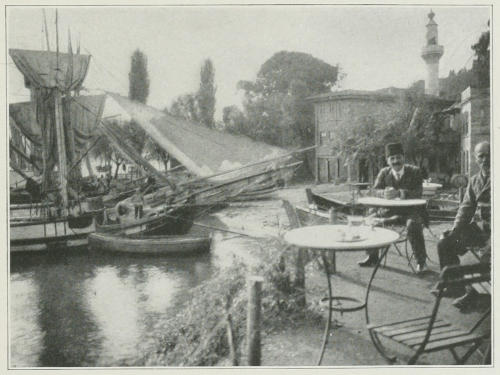
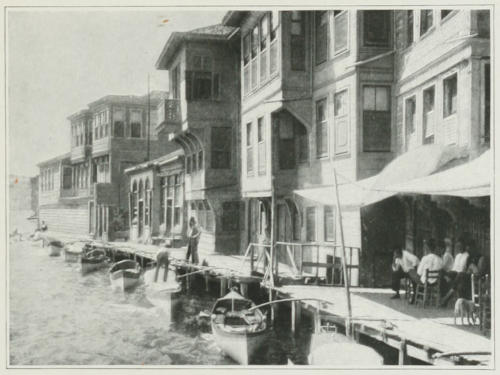
A waterside coffee-house
Süleïman the Magnificent, during whose reign the
kahveji Shemsi made his little fortune, took no notice of
the agitation against the new drink. But some of his
successors pursued those who indulged in it with unheard-of
severity. During the sixteenth and seventeenth centuries
coffee-drinkers were persecuted more rigorously in
Constantinople than wine-bibbers have ever been in
England or America. Their most unrelenting enemy was
the bloody Mourad IV—himself a drunkard—who forbade
the use of coffee or tobacco under pain of death.
He and his nephew Mehmed IV after him used to patrol
the city in disguise, à la Haroun al Rashid, in order to
detect and punish for themselves any violation of the
law. But the Greek taverns only became the more
popular. And the latter sultan was the means of extending
the habit to Europe—which, for the rest, he no
doubt considered its proper habitat. To be sure, it was
merely during his reign that the English made their first
acquaintance of our after-dinner friend. It was brought
back from Smyrna in 1652 by a Mr. Edwards, member
of the Levant Company, whose house was so besieged
by those curious to taste the strange concoction that he
set up his Greek servant in the first coffee-house in
London. There, too, coffee was soon looked upon askance
in high places. A personage no more strait-laced than
Charles II caused a court to hand down the following
decision: “The Retayling of Coffee may be an innocente
Trayde; but as it is used to nourysshe Sedition, spredde
Lyes, and scandalyse Greate Menne, it may also be a
common Nuisaunce.” In the meantime an envoy of
Mehmed IV introduced coffee in 1669 to the court of
Louis XIV. And Vienna acquired the habit fourteen
years later, when that capital was besieged by the same
sultan. After the rout of the Turks by John Sobiesky,
a vast quantity of the fragrant brown drug was found
among the besiegers’ stores. Its use was made known to
the Viennese by a Pole who had been interpreter to a
company of Austrian merchants in Constantinople. For
his bravery in carrying messages through the Turkish
lines he was given the right to establish the first coffee-house
in Vienna.
The history of tobacco in Turkey was very much the
same. It first appeared from the West in 1605, during
the reign of Ahmed I. Under Mourad IV a famous
pamphlet was written against it by an unconscious forerunner
of modernity, who also advocated a mediæval
Postum made of bean pods. Snuff became known in
1642 as an attempt to elude the repressive laws of Sultan
Ibrahim. But the habit of smoking, like the taste for
coffee, gained such headway that no one could stop it.
Mahmoud I was the last sultan who attempted to do so,
when he closed the coffee-houses for political reasons in
1730.
There is, it is true, a coffee habit, whose abuse is no
less demoralising than that of any other drug. But it is
so rare, and Stamboul coffee-houses are so different from
American or even most European cafés, that it is hard
to imagine their causing so much commotion. Nothing
stronger than coffee is dispensed in them—unless I except
the nargileh, the water-pipe, whose effect is wonderfully
soothing and innocent at first, though wonderfully
deadly in the end to the novice. The tobacco used is not
the ordinary weed but a much coarser and stronger one,
called toumbeki. Smoking is the more germane to coffee-shops,
because in the Turkish idiom you drink tobacco.
You may also drink tea, in little glasses, as the Persians
do. And to desecrate it, or coffee either, with the admixture
of milk is an unheard-of sacrilege. But you may
content yourself with so mild a refreshment as a bit of
rahat locoum, more familiar to you, perhaps, as Turkish
Delight, and a glass of water.
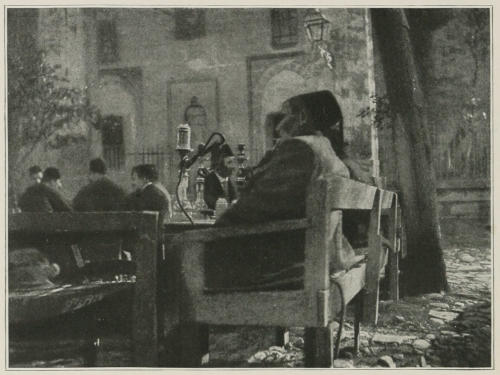
“Drinking” a nargileh
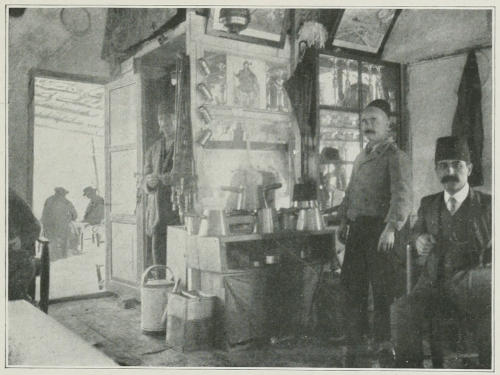
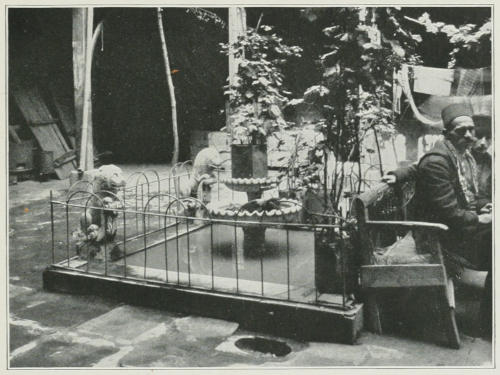
Fez-presser in a coffee-house
The etiquette of the coffee-house, of those coffee-houses
which have not been too much infected by Europe,
is one of their most characteristic features. I have seen
a newcomer salute one after another each person in a
crowded coffee-room, once on entering the door, and
again on taking his seat, and be so saluted in return—either
by putting the right hand on the heart and uttering
the greeting merhaba, or by making the temenna, that
triple sweep of the hand which is the most graceful of
salutes. I have also seen the entire company rise on the
entrance of an old man, and yield him the corner of honour.
As for the essential function of the coffee-house, it
has its own traditions. A glass of water comes with the
coffee, and a foreigner can usually be detected by the
order in which he takes them. A Turk sips his water
first. He lifts his coffee-cup, whether it possess a handle
or no, by the saucer, managing the two in a dexterous
way of his own. And custom favours a rather noisy enjoyment
of the cup that cheers, as expressing appreciation
and general well-being. The current price for a
coffee, in the heart of Stamboul, is ten para—something
like a penny—for which the waiter will say: “May
God give you blessing.” Mark, too, that you do not tip
him. I have often been surprised to be charged no more
than the tariff, although I gave a larger piece to be
changed, and it was perfectly evident that I was a
foreigner. That is an experience which rarely befalls a
traveller even in his own land. It has further happened
to me to be charged nothing at all, nay, to be steadfastly
refused when I persisted in attempting to pay, simply
because I was a traveller, and therefore a “guest.”
Altogether the habit of the coffee-house is one that
requires a certain leisure. Being a passion less violent
and less shameful than others, I suppose, it is indulged
in with more of the humanities. You do not bolt coffee
as you bolt the fire-waters of the West, without ceremony,
in retreats withdrawn from the public eye. Neither, having
taken coffee, do you leave the coffee-house. On the
contrary, there are reasons why you should stay—and
not only to take another coffee. There are benches to
curl up on, if you would do as the Romans do, having
first neatly put off your shoes from off your feet. There
are texts and patriotic pictures to look at, to say nothing
of the wonderful brass arrangements wherein the kahveji
concocts his mysteries. There is, of course, the view.
To enjoy it you sit on a low rush-bottomed stool in front
of the coffee-shop, under a grape-vine, perhaps, or a
scented wistaria, or a bough of a neighbourly plane-tree;
and if you like you may have an aromatic pot of basil
beside you to keep away the flies. Then there are more
active distractions. For coffee-houses are also barber
shops, where men cause to be shaved not only their chins
but different parts of their crowns, according to their
countries; and a festoon of teeth on a string or a suggestive
jar of leeches reminds you how catholic was once
the art of the barber in other parts of the world. There
is also the resource of games—such as backgammon,
which is called tavli and played in Persian, and draughts,
and cards. They say, indeed, that bridge came from
Constantinople. There is a club in Pera which claims
the honour of having communicated that passion to the
Western world. But I must confess that I have yet to
see an open hand of the long narrow cards you find in a
coffee-house.
Playing tavli
The great resource of coffee-houses, however, is the
company you meet there. The company is better at
certain hours than at others. Early in the day the
majority of the habitués may be at work, while late
in the evening they will have disappeared altogether.
For Stamboul has not quite forgotten the habits of the
tent. At night it is a deserted city. But just before
and just after dark the coffee-houses are full of a colour
which an outsider is often content to watch through
lighted windows. They are the clubs of the poorer
classes. Men of a street, a trade, or a province meet
regularly at coffee-houses kept often by one of their
own people. So much are the humbler coffee-houses
frequented by a fixed clientèle that the most vagrant impressionist
can realise how truly the old Turkish writers
called them Schools of Knowledge. Schools of knowledge
they must be, indeed, for those capable of taking part in
their councils. Even for one who is not, they are full
of information about the people who live in Stamboul,
the variety of clothes they wear, the number of dialects
they speak, the infinity of places they come from. I am
at the end of my chapter and I cannot stop to descant
on these things—much less on the historic guilds which
still subsist in the coffee-house world. The guilds are
nearly at the end of their chapter, too. Constitutions
and changes more radical are turning them into something
more like modern trade-unions. Their tradition
is still vivid enough, though, for it to be written, as
in the laws of Medes and Persians, that no man but
one of Iran shall drive a house-builder’s donkey; that
only a Mohammedan Albanian of the south shall lay
a pavement or a southern Albanian who is a Christian
and wears an orange girdle shall lay railroad ties;
that none save a landlubber from the hinterland of
the Black Sea may row a caïque or, they of Konia peddle
yo’ourt, or——
The plane-tree of Chengel-kyöi
It is no use for me to go on. I would fill pages and
I probably would not make it any clearer how clannish
these men are. Other things about them are just as
interesting—to the race of men that likes Stamboul.
That first question, for instance, that comes to one on
the arriving train, at the sight of so many leisurely and
meditative persons, returns again and again to the mind.
How is it that these who burst once out of the East with
so much noise and terror, who battered their way through
the walls of this city and carried the green standard of
the Prophet to the gates of Vienna, sit here now rolling
cigarettes and sipping little cups of coffee? Some conclude
that their course is run, while others upbraid them
for wasting so their time. For my part, I like to think
that such extremes may argue a complexity of character
for whose unfolding it would be wise to wait. I also
like to think that there may be some people in the world
for whom time is more than money. At any rate, it
pleases me that all the people in the world are not the
same. It pleases me that some are content to sit in
coffee-houses, to enjoy simple pleasures, to watch common
spectacles, to find that in life which every one may possess—light,
growing things, the movement of water,
and an outlook on the ways of men.
II MOSQUE YARDS
I often wonder what a Turk, a Turk of the people,
would make of a Western church. In an old cathedral
close, perhaps, he might feel to a degree at home. The
architecture of the building would set it apart from
those about it, the canons’ houses and other subsidiary
structures would not seem unnatural to him, and, though
the arrangement of the interior would be foreign, he
would probably understand in what manner of place
he was—and his religion would permit him to worship
there in his own way. But a modern city church, and
particularly an American city church, would offer almost
nothing familiar to him. It would, very likely, be less
monumental in appearance than neighbouring buildings.
There would be little or no open space about it. And
strangest of all would be the entire absence of life about
the place for six days out of seven. The most active
institutional church can never give the sense a mosque
does of being a living organism, an acknowledged focus
of life. The larger mosques are open every day and all
day, from sunrise to sunset, while even the smallest is
accessible for the five daily hours of prayer. And, what
is more, people go to them. Nor do they go to them
as New Yorkers sometimes step into a down-town
church at noontime, feeling either exceptionally pious or
a little uneasy lest some one catch them in the act. It
is as much a matter of course as any other habit of life,
and as little one to be self-conscious about. By which
I do not mean to imply that there are neither dissenters
nor sceptics in Islam. I merely mean that Islam seems
to be a far more vital and central force with the mass
of those who profess it than Protestant Christianity.
However, I did not set out to compare religions.
All I wish is to point out the importance of mosques
and their precincts in the picture of Constantinople.
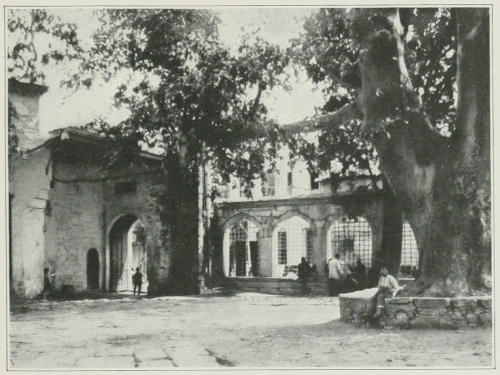
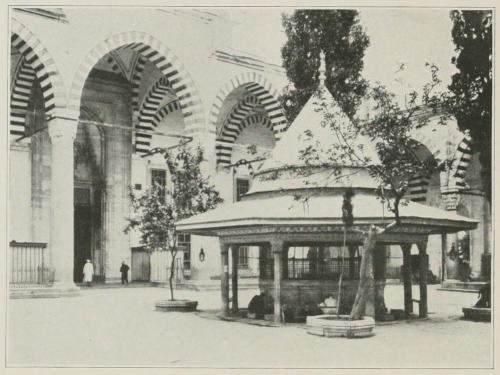
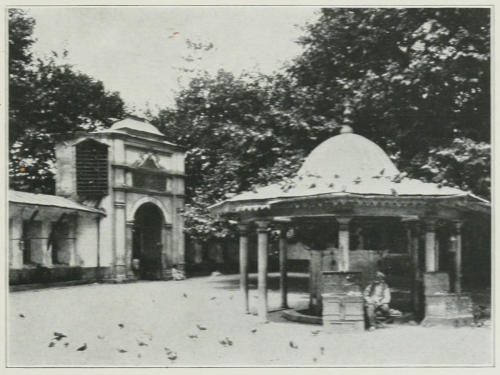
The yards of the imperial mosques take the place, in
Stamboul, of squares and parks. Even many a smaller
mosque enjoys an amplitude of perspective that might
be envied by cathedrals like Chartres, or Cologne, or
Milan. These roomy enclosures are surrounded by the
windowed walls which I have already celebrated. Within
them cypresses are wont to cluster, and plane-trees willingly
cast their giant shadow. Gravestones also congregate
there. And there a centre of life is which can
never lack interest for the race of men that likes Stamboul.
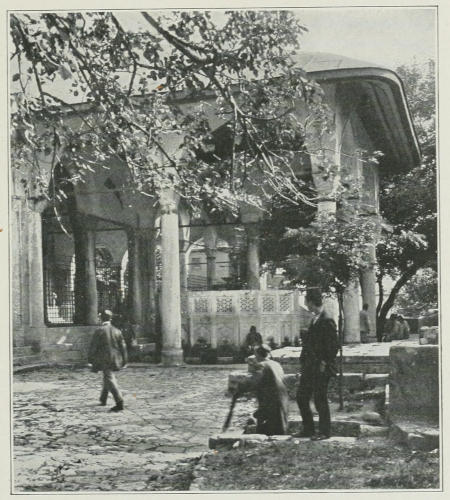
Scribes sit under the trees ready to write letters
for soldiers, women, and others of the less literate
sort. Seal cutters ply their cognate trade, and cut your
name on a bit of brass almost as quickly as you can
write it. Barbers, distinguishable by a brass plate with
a nick in it for your chin, are ready to exercise another
art upon your person. Pedlers come and go, selling
beads, perfumes, fezzes, and sweets which they carry on
their heads in big wooden trays, and drinks which may
tempt you less than their brass receptacles. A more
stable commerce is visible in some mosque yards, or on
the day of the week when a peripatetic market elects
to pitch its tents there; and coffee-houses, of course,
abound. Not that there are coffee-houses in every
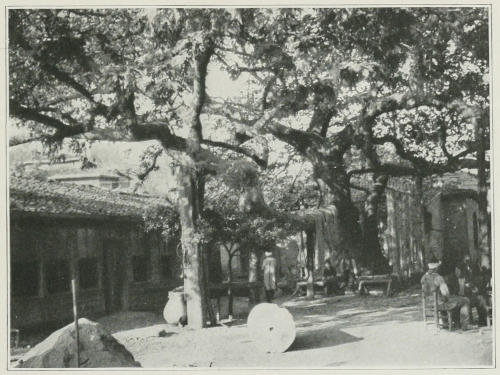
mosque yard. I know one small mosque yard, that of
Mahmoud Pasha—off the busy street of that name
leading to the Bazaars—which is entirely given up to
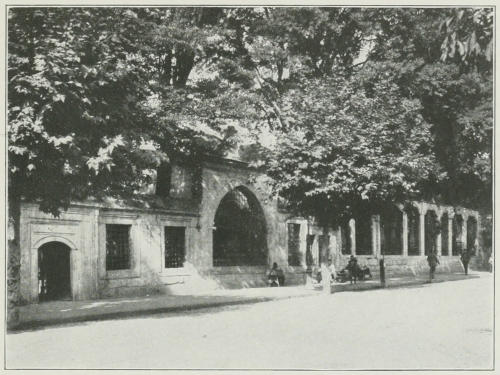
coffee-houses. And a perfect mosque yard it is, grove-like
with trees and looked upon by a great portico of
the time of the Conqueror. There is something both
grave and human about mosque yards and coffee-houses
both that excellently suits them to each other. The
combination is one that I, at any rate, am incapable of
resisting. I dare not guess how many days of my life
I have I cannot say wasted in the coffee-houses of Mahmoud
Pasha, and Yeni Jami, and Baïezid, and Shah-zadeh,
and Fatih. The company has an ecclesiastical
tinge. Turbans bob much together and the neighbouring
fountains of ablution play a part in the scene. And
if the company does not disperse altogether it thins very
much when the voice of the müezin, the chanter, sounds
from his high white tower. “God is most great!” he
chants to the four quarters of the earth. “I bear witness
that there is not a god save God! I bear witness
that Mohammed is the Prophet of God! Hasten to the
worship of God! Hasten to permanent blessedness!
God is most great!”
The yard of Hekim-zadeh Ali Pasha
In the mosque the atmosphere is very much that of
the mosque yard. There may be more reverence, perhaps,
but people evidently feel very much at home.
Men meet there out of prayer time, and women too, for
what looks like, though it may not always be, a sacra conversazione
of the painters. Students con over their Koran,
rocking to and fro on a cushion in front of a little inlaid
table. Solitary devotees prostrate themselves in a corner,
untroubled by children playing among the pillars or
a turbaned professor lecturing, cross-legged, to a cross-legged
class in theology. The galleries of some mosques
are safety-deposit vaults for their parishioners, and when
the parish burns down the parishioners deposit themselves
there too. After the greater conflagration of the
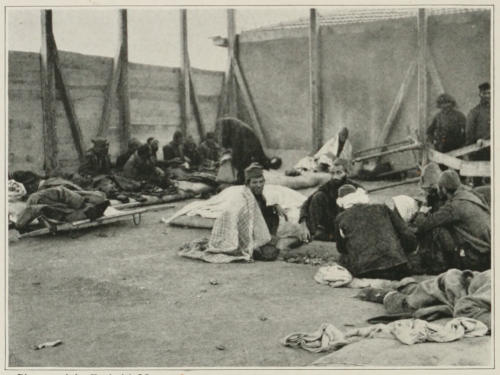
Balkan War thousands of homeless refugees from Thrace
and Macedonia camped out for months in the mosques
of Stamboul. Even the pigeons that haunt so many
mosque yards know that the doors are always open, and
are scarcely to be persuaded from taking up their permanent
abode on tiled cornices or among the marble
stalactites of capitals.
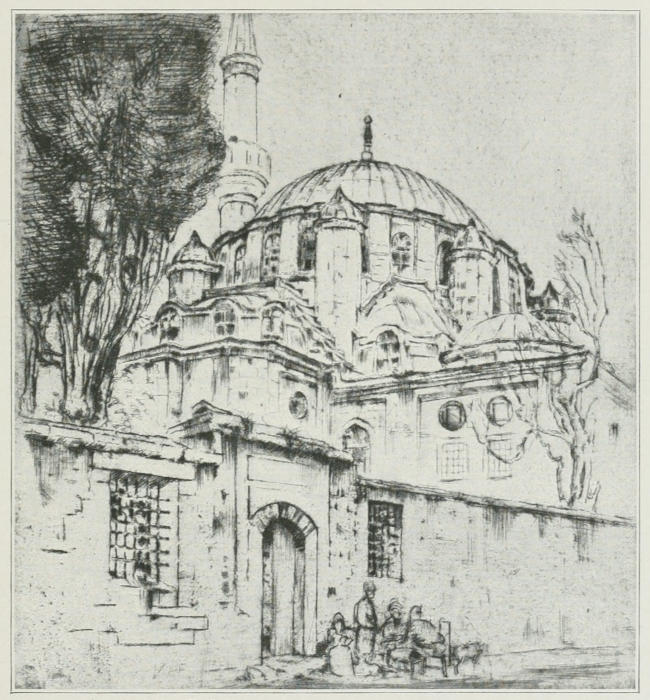
“The Little Mosque”
From an etching by Ernest D. Roth
One thing that makes a mosque look more hospitable
than a church is its arrangement. There are no seats or
aisles to cut up the floor. Matting is spread there, over
which are laid in winter the carpets of the country; and
before you step on to this clean covering you put off
your shoes from off your feet—unless you shuffle about
in the big slippers that are kept in some mosques for foreign
visitors. The general impression is that of a private
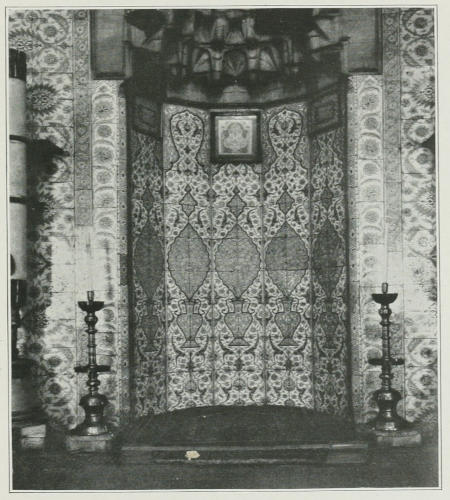
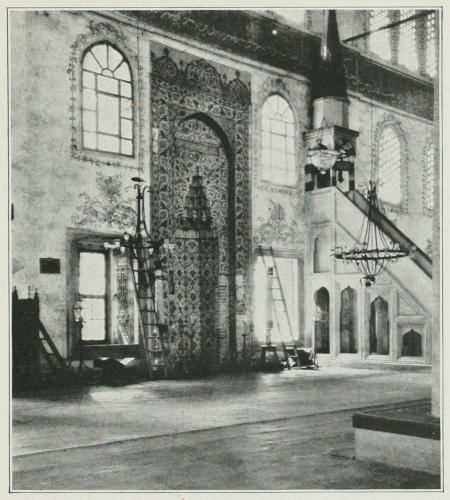
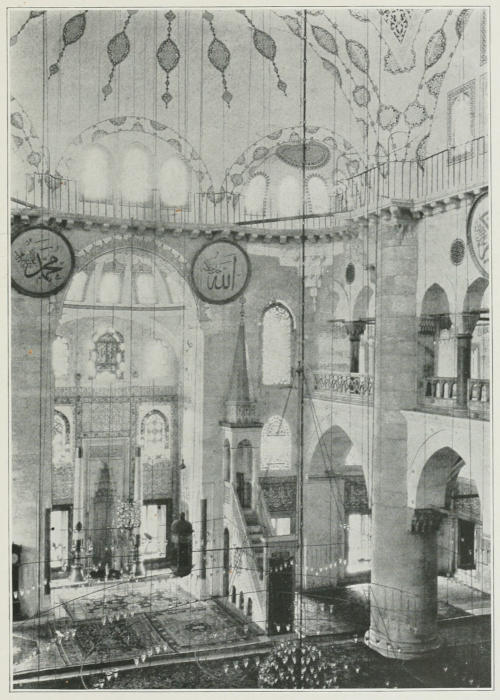
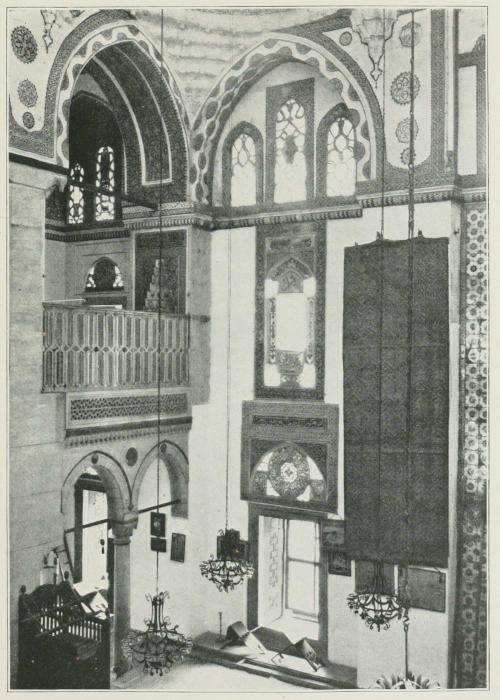
interior magnified and dignified. The central object of
this open space is the mihrab, a niche pointing toward
Mecca. It is usually set in an apse which is raised a
step above the level of the nave. In it is a prayer-rug
for the imam, and on each side, in a brass or silver standard,
an immense candle, which is lighted only on the
seven holy nights of the year and during Ramazan. At
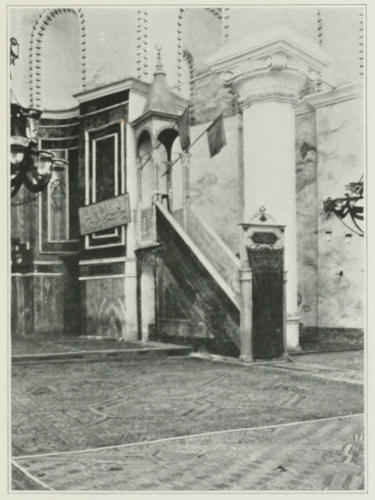
the right of the mihrab, as you face it, stands the mimber,
a sort of pulpit, at the top of a stairway and covered
by a pointed canopy, which is used only for the noon
prayer of Friday or on other special occasions. To the
left, and nearer the door, is a smaller pulpit called the
kürsi. This is a big cushioned armchair or throne,
reached by a short ladder, where the imam sits to speak
on ordinary occasions. There will also be one or more
galleries for singers, and in larger mosques, usually at
the mihrab end of the left-hand gallery, an imperial tribune
enclosed by grille work and containing its own sacred
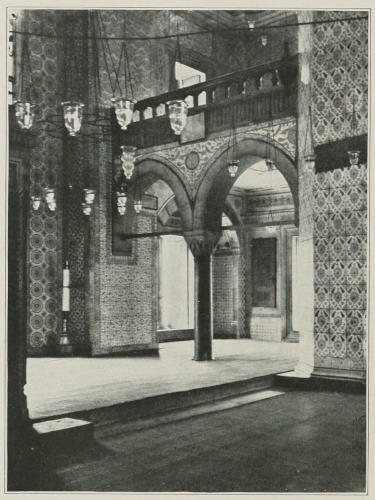
niche. The chandeliers are a noticeable feature of every
mosque, hanging very low and containing not candles
but glass cups of oil with a floating wick. I am afraid,
however, that this soft light will be presently turned into
electricity. From the chandeliers often hang ostrich
eggs—emblems of eternity—and other homely ornaments.
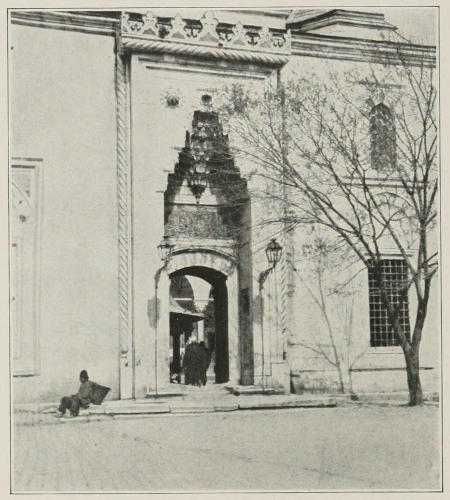
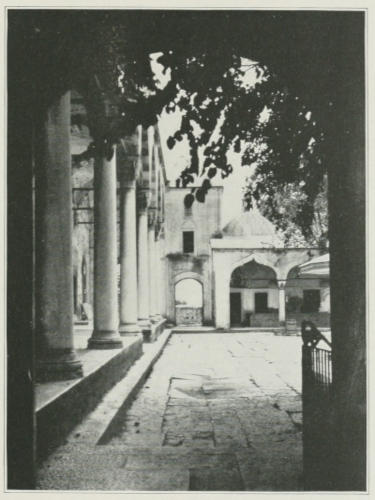
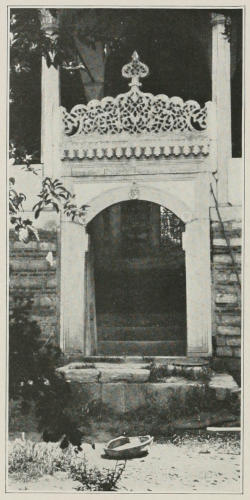
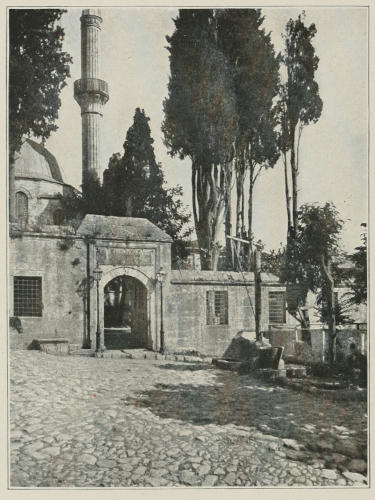
Entrance to the forecourt of Sultan Baïezid II
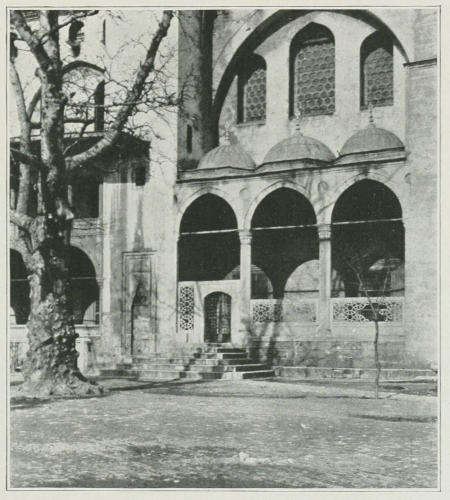
Detail of the Süleïmanieh
The place of the mosque in the Turkish community is
symbolised, like that of the mediæval cathedral, by its
architectural pre-eminence. Mark, however, that Stamboul
has half a dozen cathedrals instead of one. It would
be hard to overestimate how much of the character of
Stamboul depends on the domes and minarets that so
inimitably accident the heights between the Golden
Horn and the Marmora. And on closer acquaintance the
mosques are found to contain almost all that Stamboul
has of architectural pretension. They form an achievement,
to my mind, much greater than the world at large
seems to realise. The easy current dictum that they are
merely more or less successful imitations of St. Sophia
takes no account of the evolution—particularly of the
central dome—which may be traced through the mosques
of Konia, Broussa, and Adrianople, and which reaches
its legitimate climax in Stamboul. The likelier fact is
that the mosque of Stamboul, inspired by the same remote
Asiatic impulse as the Byzantine church, absorbed
what was proper to it in Byzantine art, refining away the
heaviness or overfloridness of the East, until in the hands
of a master like Sinan it attained a supreme elegance
without losing any of its dignity. Yet it would be a
mistake to look for all Turkish architecture in Sinan.
The mosques of Atik Ali Pasha and of Sultan Baïezid II
are there to prove of what mingled simplicity and nobility
was capable an obscure architect of an earlier century.
His name is supposed to have been Haïreddin, and he,
first among the Turks, used the monolithic shaft and the
stalactite capital. How perfect they are, though, in the
arcades of Baïezid! Nothing could be better in its way
than the forecourt of that mosque, and its inlaid minarets
are unique of their kind. Nor did architecture die
with Sinan. Yeni Jami, looking at Galata along the
outer bridge, is witness thereof. The pile of the Süleïmanieh,
whose four minarets catch your eye from so
many points of the compass, is perhaps more masculine.
But the silhouette of Yeni Jami, that mosque of princesses,
has an inimitable grace. The way in which each
structural necessity adds to the general effect, the climactic
building up of buttress and cupola, the curve of the
dome, the proportion of the minarets, could hardly be
more perfect. Although brought up in the vociferous
tradition of Ruskin, I am so far unfaithful to the creed
of my youth as to find pleasure, too, in rococo mosques
like Zeïneb Sultan, Nouri Osmanieh, and Laleli Jami.
And the present generation, under men like Vedad Bey
and the architects of the Evkaf, are reviving their art in
a new and interesting direction.
To give any comprehensive account of the mosques
of Stamboul would be to write a history of Ottoman architecture,
and for that I lack both space and competence.
I may, however, as an irresponsible lounger in mosque
yards, touch on one or two characteristic aspects of
mosques and their decoration which strike a foreigner’s
eye. The frescoing or stencilling of domes and other
curved interior surfaces, for instance, is an art that has
very little been noticed—even by the Turks, judging
from the sad estate to which the art has fallen. Some
people might object to calling it an art at all. Let such
a one be given a series of domes and vaults to ornament
by this simple means, however, and he will find how
difficult it is to produce an effect both decorative and
dignified. The restorers of the nineteenth century spoiled
many a fine interior by their atrocious baroque draperies
or colour-blind colour schemes. If I were a true believer
I could never pray in mosques like Ahmed I or Yeni
Jami, because the decorator evidently noticed that the
prevailing tone of the tiles was blue and dipped his brush
accordingly—into a blue of a different key. Yet there
are domes which prove how fine an art the Turks once
made of this half-mechanical decoration. One of the
best in Stamboul is in the tomb of the princes, behind the
Shah-zadeh mosque. The stencilling is a charming arabesque
design in black, dark red, pale blue, and orange,
perhaps happily toned by time, which a recent restoration
was wise enough to spare. The tomb of Roxelana
and the great tomb beside Yeni Jami also contain a little
interesting stencilling. But the most complete example
of good work of this kind is outside Stamboul, in the
Yeni Valideh mosque of Scutari. The means used are
of the simplest, the colours being merely black and dull
red, with a little dull yellow; but the lines are so fine and
so sapiently spaced on their broad background of white
that the effect is very much that of a Persian shawl.
A study of that ceiling should be made compulsory for
every decorator of a mosque—and might yield suggestions
not a few to his Western cousin.
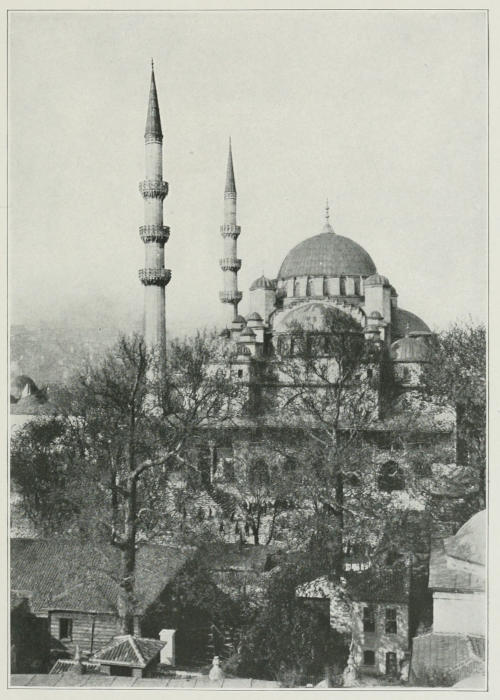
Yeni Jami
The windows of mosques are another detail that
always interests me. They are rarely very large, but
there are a great many of them and they give no dim
religious light, making up a great part as they do of the
human sunniness of the interior. A first tier of square
windows stand almost at the level of the floor, and are
provided with folding shutters which are carved with
many little panels or with a Moorish pattern of interlaced
stars. Higher up the windows are arched and are
made more interesting by the broad plaster mullions of
which I have already spoken. These make against the
light a grille of round, oval, or drop-shaped openings
which are wonderfully decorative in themselves. The
same principle is refined and complicated into a result
more decorative still when the plaster setting forms a
complete design of arabesques, flowers, or writing, sometimes
framing symmetrically spaced circles or quadrangles,
sometimes composing an all-over pattern, and
filled in with minute panes of coloured glass. Huysmans
compared the windows of Chartres to Persian
rugs, because the smallness of the figures and their height
above the floor make them merely conventional arrangements
of colour. Here, however, we have the real
principle of the Oriental rug. Turkish windows contain
no figures at all, nor any of that unhappy attempt at
realism that mars so much modern glass. The secret of
the effect lies in the smallness of the panes used and the
visibility of the plaster design in which they are set.
And what an effect of jewelry may be produced in this
way is to be seen in the Süleïmanieh, and Yeni Jami—where
two slim cypresses make delicious panels of
green light above the mihrab—besides other mosques
and tombs of the sixteenth and seventeenth centuries.
Mosques are even more notable than private houses
for the inscriptions on their walls. Every visitor to
St. Sophia remembers the great green medallions bearing
the names of the chief personages of Islam in letters
of gold. In purely Turkish mosques similar medallions
may be seen, or large inscriptions stencilled like panels
on the white walls, or small texts hanging near the floor.
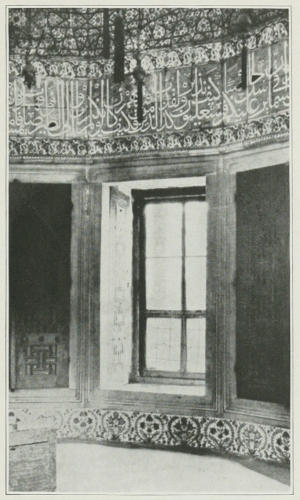
But there is a more architectural use of writing, above
doors and windows or in the form of a frieze. When
designed by a master like Hassan Chelibi of Kara Hissar,
the great calligrapher of Süleïman’s time, and executed
in simple dark blue and white in one of the
imperial tile factories, this art became a means of decoration
which we can only envy the Turks. Such inscriptions
are always from the Koran, of course, and
they are often happily chosen for the place they occupy.
Around the great dome of the Süleïmanieh, and
lighted by its circle of windows, runs this verse: “God
is the light of the heavens and of the earth. His light
is like a window in the wall, wherein a lamp burns, covered
with glass. The glass shines like a star. The lamp
is kindled from the oil of a blessed tree: not of the east,
not of the west, it lights whom he wills.”
It is not only for inscriptions, however, that tiles are
used in mosques. Stamboul, indeed, is a museum of
tiles that has never been adequately explored. Nor, in
general, is very much known about Turkish ceramics.
I suppose nothing definite will be known till the Turks
themselves, or some one who can read their language,
takes the trouble to look up the records of mosques and
other public buildings. The splendid tiles of Süleïman’s
period have sometimes been attributed a Persian and
sometimes a Rhodian origin—for they have many similarities
with the famous Rhodian plates. The Turks
themselves generally suppose that their tiles came from
Kütahya, where a factory still produces work of an inferior
kind. The truth lies between these various theories.
That any number of the tiles of Constantinople
came from Persia is impossible. So many of them could
not have been safely brought so far overland, and it is
inconceivable that they would have fitted into their
places as they do, or that any number of buildings would
have been erected to fit their tiles. The Rhodian theory
is equally improbable, partly for similar reasons though
chiefly because the legend of Rhodes is all but exploded.
The Musée de Cluny is almost the last believer in the
idea that its unrivalled collection of Rhodian plates ever
came from Rhodes. Many of them probably came
from different parts of Asia Minor. That tiles were produced
in Asia Minor long before the capture of Constantinople
we know from the monuments of Broussa,
Konia, and other places. They were quite a different
kind of tile, to be sure, of only one colour or containing
a simple arabesque design, which was varied by
a sort of tile mosaic. Many of them, too, were six-sided.
The only examples of these older tiles in Constantinople
are to be seen at the Chinili Kyöshk of the
imperial museum—the Tile Pavilion—and the tomb of
Mahmoud Pasha. It is a notorious fact, however, that
the sultans who fought against the Persians brought
back craftsmen of all kinds from that country and settled
them in different parts of the empire. Selim I,
for instance, when he captured Tabriz, imported the
best tile makers of that city, as well as from Ardebil
and Kashan—whence one of the words for tiles, kyashi—and
settled them in Isnik. This is the city which
under an older name had already produced the historian
Dion Cassius and the Nicene Creed. Other factories
are known to have existed in Kastambol, Konia, Nicomedia,
and Constantinople itself. One is supposed to
have been in Eyoub, though no trace of it remains to-day
unless in the potteries of Chömlekjiler. Another, I
have been told, flourished at Balat. I know not whether
it may have been the same which Sultan Ahmed III
transferred in 1724 from Nicæa to the ruined Byzantine
palace of Tekfour Seraï. A colony of glass-blowers there
are the last remnant to-day of the tile makers of two
hundred years ago.
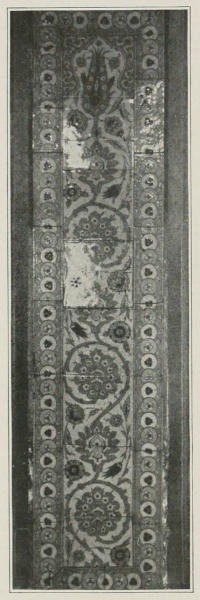
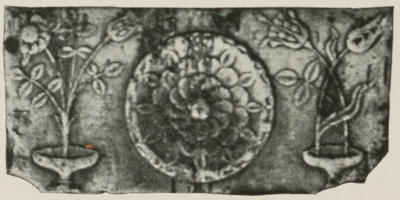
Tile panel in Rüstem Pasha
The art itself declined and gradually died out as the
sultans stopped making conquests and building mosques.
For the imperial mosques are monuments of victory,
built and endowed out of the spoils of war. After the
martial period of the empire came to an end with Süleïman
I only one mosque of importance, that of Ahmed
I, was built by a reigning sultan in his own name. But
the tiles of the imperial factories, after many fires and
much thieving, still make up what is most brilliant and
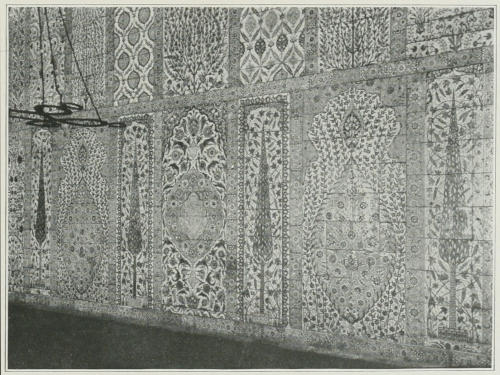
most durable in the colour of Stamboul. The best tiles
are Nicene of the sixteenth century, that extraordinary
cinque-cento, when so many of the best things of the
world were produced. They are distinguished by the
transparent white glaze of their background, on which
are drawn tulips, carnations, wild hyacinths, and a certain
long bent serrated leaf common to the Rhodian
plate. The chief colours are a dark and a turquoise
blue and a tomato red, green and yellow occurring more
rarely. And they are never quite smooth, the red in
particular usually being in slight relief. This gives them
a variety which is absent from many modern tiles.
The feeling for variety, in fact, was one great secret
of Turkish tile making and tile setting. Sinan, for instance,
used tiles very sparingly in his larger buildings.
He was great enough to depend very little on ornament
for his effect, and he knew that tiles would look like
paper or linoleum—if such things existed in his day!—on
a monumental surface. But he had a perfect tact of
using this tapestry wherever he wanted a touch of colour
or distinction—over a window, along a cornice, around a
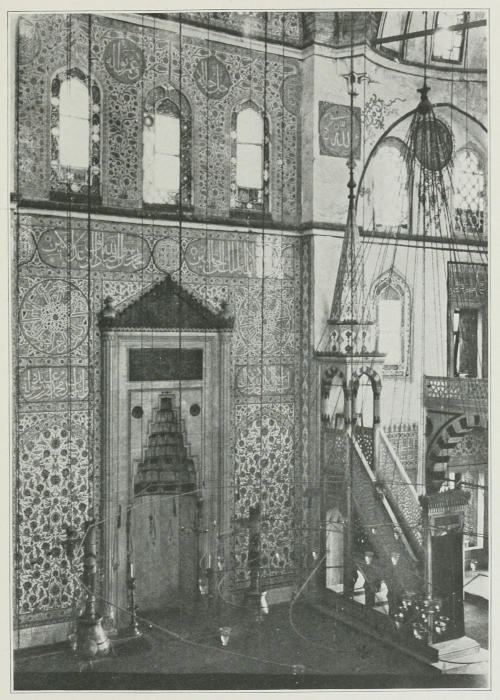
mihrab. His masterpiece in this decoration is the mosque
of Rüstem Pasha, son-in-law and Grand Vizier to Süleïman
the Magnificent. This mosque, lifted on retaining
walls above the noise of its busy quarter, has a portico
which must have been magnificently tiled—judging from
the panel at the left of the main door—and the whole
interior is tiled to the spring of the dome. The mosque
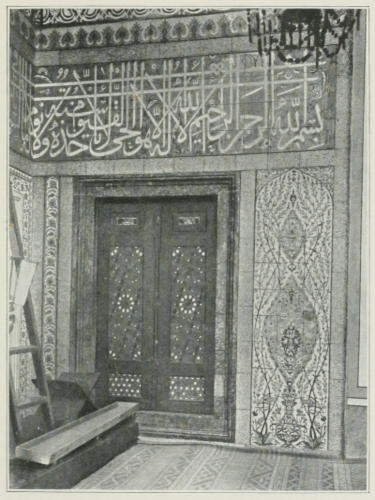
is small enough for the effect of the tiles to tell—and
to be almost ruined by the fearful
modern frescoes of the vaulting.
The guides of Pera have a favourite
legend to the effect that Rüstem
Pasha brought back these tiles from
his wars in Persia and built a mosque
for them to save giving them
up to his imperial master. But no
one need be an expert to see the
impossibility of any such story.
The tiles must have been designed
for the walls which they incrust,
and by a supreme master of decoration.
I should not be surprised
to learn that Sinan himself drew
them all. There is a tall narrow
panel on either side of the mosque,
between two windows, which seems
to me one of the most perfect ways
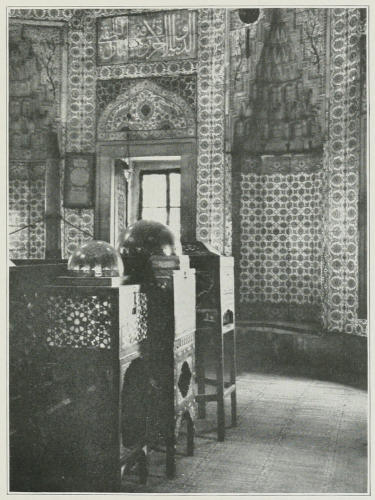
imaginable of filling such a space.
So are the spandrels of the arches
supporting the gallery, and the
niche of the mihrab, and the back
of the mimber. All through the
mosque, however, the way in which
the artist has varied his designs
and colours, while never losing his unity of effect, is a
piece of genius. Narrow spaces and points of special
interest are treated each in its own way; but unbroken
surfaces of wall are never allowed to become monotonous
by covering them with only one form of tile. They are
broken up by narrower border tiles into panels, each of
which is treated differently though harmonising with its
neighbour and balancing the corresponding space on the
opposite side of the mosque. Even within one of these
spaces monotony is avoided by the fact that the tiles
are almost never of a repeating pattern. Two or four
tiles are required to make up the scheme. And then
the pattern does not always fit the tiles, so that the
interstices come in different places in different parts of
the design, and you feel that the tiles could only have
been made for that one space. In the case of special
panels, of course, many tiles are required to make up
the pattern. The splendid flowered panel in the portico
contains forty-five tiles, exclusive of the border, and
every one of them different. Such work was not commercial
tile making. It was an art.
The mihrab of Rüstem Pasha
In Rüstem Pasha
Two mosques of a later period in Stamboul are completely
tiled, that of Sultan Ahmed I and the one begun
by his wife—Yeni Jami. They prove the wisdom of
Sinan in not attempting to tile a large interior. Still,
the gallery of Sultan Ahmed also proves that the architect
was not altogether ignorant of what he was about.
He put his best tiles there, where they can only be seen
at close range. And his best is very good. I have
counted twenty-nine varieties of tiles there, or rather of
designs, divided, like those of Rüstem Pasha, into framed
panels. The tiles facing the mihrab, where the gallery
widens over the main doorway, are so good that I sometimes
ask myself if the architect did not borrow from an
earlier building. Two series of eleven panels, one above
the other, make a tall wainscot whose only fault is that
too much richness is crowded into too narrow a space.
The lower series is the finer. Five panels to the right
balance five panels to the left of a spindle-shaped Persian
design. Its two neighbours are conventionalised cypress
trees, than which nothing more decorative was ever invented.
Then come two magnificent panels of larger
spindles against a thicket of peach-blossoms or Judas blossoms,
red with small blue centres, followed by two more
cypresses. Five panels of the upper series, one of them
forming the axis, are latticed again with blossoming
sprays. In this case there is no spindle to hide the
greater part of the flowers, which are blue with small
red centres. The tiles are very nearly if not quite as
good as those of the preceding century, and they make a
wall more splendid than exists outside the old Seraglio.
Tiles in the gallery of Sultan Ahmed
Yeni Jami is better suited for tiling, being comparatively
a smaller mosque. Its proportions are also much
better and the frescoing is not so bad as that of Sultan
Ahmed. The tiles themselves are not so interesting.
But attached to the mosque, and giving entrance to the
imperial tribune, is a suite of rooms which are also
tiled. This imperial apartment is carried across the
street on a great pointed arch, and is reached from outside
by a covered inclined way which enabled the Sultan
to ride directly up to the level of his gallery. At the
same level is also a little garden, held up by a massive
retaining wall, and a balcony with a rail of perforated
marble once gave a magnificent view over the harbour.
The view has since been cut off by shops, and the apartment
itself has fallen into a sad state of neglect or has
been subjected to unfortunate restorations. A later and
more intelligent restoration has brought to light, under
a vandal coat of brown paint, the old gilding of the woodwork.
But the tiles of the walls remain—except where
they have been replaced by horrible panels of some composition
imitating Florentine mosaic. Among them are
charming cypresses and peach-trees. There are also remains
of lovely old windows, to say nothing of tall
hooded fireplaces and doors incrusted with tortoise-shell
and mother-of-pearl. The tiles are palpably of a
poorer period than those I have described. But there
is a great attractiveness about this quaint apartment,
that only adds to the general distinction of Yeni Jami.
The original founder of the mosque, as I have said,
was the favourite wife of Ahmed I. This princess is
one of the most famous women in Turkish chronicles.
Whether she was a Greek or a Turk, history does not
confirm, though the custom of the sultans to marry none
but slaves would point to the former origin. Her name
in the Seraglio was Mahpeïker—Moon Face. She is
oftenest remembered, however, by the name Kyössem,
Leader of a Flock, from the fact that she was the first of
a troop of slaves presented to the young sultan. During
his reign she gained an increasing voice in the affairs of
the empire, and during those of her sons Mourad IV and
Ibrahim her word was law. The position of empress
mother is an exceptional one in Turkey, as in China, the
occupant of it being the first lady in the palace and the
land. She is known as the valideh soultan, or princess
mother—for the word sultan properly has no sex. Our
word sultana does not exist in Turkish, being a Greek or
Italian invention. The reigning sultan prefixes the title
to his own name, while other persons of his blood put it
after theirs. When the grandson of Kyössem, the boy
Mehmed IV, came to the throne, the great valideh continued,
against all precedent, to inhabit the Seraglio and
to exercise her old influence. But at last the jealousy of
Mehmed’s mother, defrauded of her natural rank, kindled
a palace intrigue that caused the older valideh, at the age
of eighty, to be strangled one night in the Seraglio. Her
mosque, still unfinished, suffered by a fire which ravaged
the quarter; and it was finally completed by her young
rival, a Russian named Tar’han, or Hadijeh. After the
latter the mosque is called to-day the yeni valideh soultan
jamisi, the mosque of the new empress mother. In common
parlance, however, it goes by the name of yeni jami,
the new mosque—though it has had time to become
fairly venerable. And she who became the new valideh
in 1649 now occupies the place of honour under the dome
of the tomb beside the mosque, while the murdered
Kyössem rests near her husband in their little marble
house on the Hippodrome.
The tombs that accompany mosques are only less
interesting than the mosques themselves, both for their
architectural character and for their historical associations.
When space permits they lie in an inner enclosure
of the mosque yard, technically called the garden, behind
the mosque. Long before Constantinople became their
capital the sultans had perfected a type of mausoleum,
or türbeh. This is a domed structure, usually octagonal
in shape, cheerfully lighted by two or three tiers of windows.
Every tomb has its own guardian, called the
türbedar, and some are attached to a school or other
philanthropic institution. These mausoleums are often
extremely elaborate in decoration, but they all retain a
certain primitive simplicity with regard to their central
feature. There is no sarcophagus of marble or porphyry.
The occupant of the türbeh is buried in the floor, and over
his grave stands a plain wooden catafalque covered with
green cloth. Like a Turkish coffin, it is ridged and inclined
from the head, where a wooden standard supports
the turban of the deceased. A woman’s catafalque has
no standard, a scarf being thrown across the head.
Embroideries, of gold on velvet, or of quotations from the
Koran in a zigzag pattern, may cover the green cloth.
Such embroideries are often a piece of a last year’s hanging
from the Kaaba at Mecca or from the Prophet’s
tomb at Medina. But nothing is imposing about the
catafalque unless its size, which indicates the importance
of the person commemorated. The largest one I remember
is that of Sultan Mehmed II, the Conqueror. And
the rail around the catafalque is all that suggests permanence,
and that is generally of wood inlaid with mother-of-pearl.
The simple epitaph is written on a placard which
hangs casually from the rail, or perhaps from an immense
candle to be lighted on holy nights. Near by may be an
inlaid folding stand with an illuminated Koran. The
floor is matted and covered with rugs like a mosque or a
house.
The tomb of Sultan Ahmed I
The tombs attached to the imperial mosques are
naturally the most important. Not every sultan built
his own, however. In the türbeh of Ahmed I two other
sultans are buried, his sons Osman II—who was the
first sultan to be murdered by his own people—and the
bloody Mourad IV. Among the innumerable people
whom the latter put to death was his brother Prince
Baïezid, the hero of Racine’s “Bajazet,” who lies beside
him. In the tomb of Hadijeh at Yeni Jami five sultans
rest: her son Mehmed IV, her grandsons Moustafa II
and Ahmed III, and her great-grandsons Mahmoud I
and Osman III. These and others of the larger tombs
are noticeable for the number of little catafalques they
contain, marking the graves of little princes who were
strangled on the accession of their eldest brother.
The most interesting tombs, from an artistic point of
view, are those of the period of Süleïman the Magnificent.
How this later Solomon came by his European nickname
I can not tell, for the Turks know him as Solomon the
Lawgiver. But magnificent without doubt he was, and
Stamboul would be another city if all trace of his magnificence
were to disappear. His türbeh, behind the mosque
he built in his own name, is perhaps the most imposing
in Constantinople, though neither the largest nor the
most splendidly decorated. A covered ambulatory surrounds
it, and within are handsome tiles and stained-glass
windows. I prefer, however, the tomb of his
famous consort. The legend of this lady has enjoyed
outside of her own country a success that proves again
the capriciousness of fame. For the great Kyössem was
a more celebrated princess whose name has been forgotten
in Europe. It is perfectly true that Süleïman
did put to death his eldest son Moustafa, a prince of the
greatest promise, and that Roxelana’s son, Selim II, did
inherit the throne accordingly—and so cut off the line
of great sultans. But it has yet to be proved that Roxelana
really was the “fatal woman” of popular history,
who instigated her stepson’s murder. I suspect the truth
of the matter was largely that she had a good press, as
they say in French. She happened to fall into the orbit
of one of the greatest men of her time, she furnished copy
for the despatches of one or two famous ambassadors,
and—they gave her a pronounceable name! I have
been told that it is a corruption of a Persian name meaning
red-cheeked; but I have privately wondered if it
had anything to do with the Slavic tribe of Roxolani.
Be that as it may, this princess was a Russian slave of
so great wit and charm that the Lord of the Two Earths
and the Sovereign of All the Seas paid her the unprecedented
compliment of making her his legal wife. He
even built for her, unlike any other sultan I remember,
a tomb to herself. And Sinan subtly put into it a
feminine grace that is set off by the neighbouring mausoleum
of her husband. In the little vestibule are two
panels of rose-red flowers that must have been lovely in
their day. In consequence of some accident the tiles
have been stupidly patched and mixed up. The interior
is sixteen-sided, with alternate windows and pointed
marble niches. The spaces between are delicately tiled,
and most so in the spandrels of the niches, where are
sprays of rose-coloured flowers like those in the vestibule.
In Roxelana’s tomb
There is another tomb behind another mosque of
Süleïman, which is, perhaps, the most perfect monument
of its kind in Stamboul. I did not always think so.
But the more I look at its fluted dome and at the scheme
of its interior tiling, the more I seem to see that here
again Sinan, or the great decorator who worked with
him, exquisitely found means to express an idea of individuality.
This tomb was built, like the mosque to
which it belongs, in memory of Süleïman’s second and
best-beloved son, the young Prince Mehmed. The
mosque—so-called of the Shah-zadeh, the Prince—has
lost its original decoration, but its graceful lines and its
incrusted minarets combine with the smaller buildings
and the trees about it to make one of the happiest architectural
groups in Stamboul. As for the türbeh, it fortunately
remains very much as Sinan left it. The design
of the tiles is more abstract and masculine than those in
Roxelana’s türbeh, being mainly an intricate weaving of
lines and arabesques. But there is about them a refinement,
a distinction, which, it is hardly too fantastic to
say, insensibly suggest the youth and the royal station
of the boy whose burial chamber they beautify. For
the colour—rarest of all in Turkish tiles—is a spring
green and a golden yellow, set off by a little dark blue.
The tomb is also remarkable, as I have already said, for
the stencilling of its dome, as well as for the lovely fragments
of old stained glass in the upper windows and for
a sort of wooden canopy, perforated in the wheel pattern
common to the balustrades of the period, covering the
prince’s catafalque. It is supposed to symbolise the
throne which Süleïman hoped his son might inherit.
Beside the prince, but not under the canopy, rests his
humpbacked younger brother Jihangir. As for the unhappy
Prince Moustafa, he was buried in Broussa, in
the beautiful garden of the Mouradieh.
The türbeh of Prince Mehmed has, in my mind, another
pre-eminence which perhaps it does not deserve.
As in most other public buildings of Stamboul, an inscription
is carved over the door. These inscriptions are generally
in poetry and sometimes very long. The uninitiated
reader would never guess that the last verse of
many of them is also a date, for the Arabic letters, like
certain Roman letters, have a numerical value. And the
date of many a Turkish monument is hidden in a chronogram,
always the last line of the inscription, in which
the arithmetical sum of the letters is equivalent to the
numeral of the year in which the monument was erected.
I am not learned enough to say when this recondite fashion
started, but the chronogram of this tomb is the earliest
I happen to know about in Stamboul. It reads:
“Grant, Lord, to him who rests here to win the grove of
Eden.” The arithmetical value of the line is 950,
which year of the Hegira is equivalent to 1543 of our era.
There are several other interesting tombs in this enclosure,
of which the most important are those of Rüstem
Pasha, builder of the tile mosque we have already
noticed, and of a certain Ibrahim Pasha, Grand Vizier to
Sultan Mourad III. I have a particular fancy for the
latter türbeh, which seems to me in its neglected way a
little masterpiece. Consider me now its door—how admirably
drawn it is, provided with what green bronze
knockers in the shape of lyres! The tiles of the interior,
or the more important of them, are simplified from those
of Prince Mehmed, transposed into another key—dark
red and less dark blue on white—and set between two
encircling inscriptions. There are also certain panels
of flowers between high windows. But I think I am
most undone by a little dado, one tile high, where two
outward curving sprays of wild hyacinth that just do
not fit into the breadth of a tile enclose a small cluster
of tulips and carnations—inimitably conventionalised
and symmetrical. Nothing more simple or more decorative
was ever imagined.
Selim II, the unworthy supplanter of him who might
have been Mehmed III, lies in a tomb handsomer than
he deserves, in the court of a mosque built by a greater
than he—St. Sophia. His large türbeh lacks the elegant
proportion of his brother’s, but the tile panels of its porch
are very effective. So is the tile tapestry of its inner
walls, though a little monotonous—mainly white in
effect, dotted with little tulips and other flowers enclosed
in small Persian spindles. Four other sultans
are buried in the precincts of St. Sophia, the mad Moustafa
I and the dethroned Ibrahim lying in dishonourable
neglect in the bare, whitewashed chamber that was
once the baptistery of
the cathedral. And it
was through having
been the slave of Ibrahim
that the valideh
soultan Hadijeh was
able to complete Yeni
Jami in her own name
and build beside it the
great mausoleum in
which she lies!
The türbeh of Ibrahim Pasha
The court of the Conqueror
These türbehs, with
the fountains of the
outer courtyard and
the trees that shade
them and the minarets
that tower above the
trees, give an oddly
Turkish air to the precincts
of St. Sophia.
It is to a real mosque,
however, that one must
go for a typical mosque
yard. A part of it that is lacking to St. Sophia, and, indeed,
to many mosques, is another inner enclosure called
the haram, or sanctuary. This forecourt of the mosque
is always more architectural than the “garden,” being a
paved quadrangle surrounded by an arcade. In the centre
of the cloister a covered fountain should bubble,
sometimes under trees. I have already mentioned one
of the best examples of such a court. It belongs to the
old mosque of Sultan Baïezid II, more popularly known
as the Pigeon Mosque. This is less of a sanctuary than
any other forecourt in Stamboul. But the reason is that
the mosque lacks an outer yard other than the square
of the War Department. And I would be the last to
find fault with the scribes who sit in the arcades, or to
call them Pharisees who sell beads and perfumes there.
During the month of Ramazan a busy fair is held there,
open only during the afternoon, where the complicated
sweetmeats of the season are sold together with other
things worthy to be given as presents at Baïram. I must
say, however, that I have a weakness for the court of
another old mosque, that of Sultan Selim I, in a less
accessible part of Stamboul. Part of its charm is perhaps
due to the fact that it is more remote and therefore
more subject to silence. Above the barred windows
that look into the outer sunlight are lunettes of
tiles, while around the fountain cypresses and grape-vines
make an inimitable shade. Nor can I pass by
the court of Sokollî Mehmed Pasha, the last and greatest
vizier of Süleïman I. This is supposed to be a lesser
work of Sinan, but I like it almost better than any
other. Within the mosque are treasures of tiles, of
stained glass, of painted wood, of perforated marble.
Without is one of the noblest porticoes in Stamboul,
looking down upon a cloister that is a real cloister. For
into its colonnade open cells where live the students of
a medresseh.
The main entrance to the court of Sokollî Mehmed Pasha
A medresseh is a theological school and law school
combined, since in Islam the teachings of the Prophet,
as embodied in the Koran and the traditions, form not
only the rule of life but the law of the land. It is only
recently that a difference has been recognised between
the Sheriat or sacred law and the civil law, but their
boundaries are still indistinct, and for many men the
same door leads to legal or to spiritual preferment. I
have said so much about tombs and tiles and other
matters that I have left myself no room to speak of
medressehs—or schools of other kinds, or libraries, or
caravansaries, or baths, or hospitals, or soup-kitchens,
or any other of the charitable institutions that cluster
around a mosque yard. We are wont to imagine that
philanthropy was invented in the West, and that the
institutional church is a peculiarly modern development.
But before America was discovered institutional mosques
flourished in Stamboul and all over Asia Minor, and
continue to do so to this day. Almost no mosque, indeed,
has not some philanthropy connected with it.
They are administered, mosques and dependencies and
all, by a separate and very important department of
government called the Ministry of the Erkaf—of Pious
Foundations.
The court of Sokollî Mehmed Pasha
Doorway in the medresseh of Feïzoullah Effendi
The interior of Sokollî Mehmed Pasha
The necessities of space do not always allow these
dependencies to gather around their central mosque yard.
Or sometimes they are independent foundations and
may have a yard of their own of which a small mosque
is merely one feature. Two very interesting examples
are medressehs in the vicinity of the mosque of the Conqueror.
They both belong to the same period and their
founders were both ministers of Sultan Moustafa II, who
was dethroned in 1703. The smaller and more ruinous
was built by Feïzoullah Effendi, Sheï’h ül Islam, a mighty
man of God who did and undid viziers in his day and
perished miserably at Adrianople in the upheaval that
drove his imperial master from the throne. His medresseh
nearly perished too, in 1912, to make way for a new
boulevard. But it was happily saved by the society of
the Friends of Stamboul, and in time its little cloister
may become less of a
jungle. Its chief ornament
is the structure to
the left of the gateway,
where a flight of steps
mounts under a wonderful
arch or crocket of
perforated marble to a
pillared porch with a
mosque on one side and
a library on the other.
The mosque is the more
dilapidated, but it contains
fragments of good
tiling and a charming
little door. The library
has the same little door,
shallow-arched and ornamented
with fine stalactites
of marble. The interior
of the library is
almost filled by a square
cage, which has a corresponding
door of its own
and a dark inner compartment.
On the wired
shelves of this structure big books are piled on their
sides, and their titles and numbers are written on the
edges of the leaves. They are all manuscripts, and
some of them are illuminated or beautifully bound. I
also saw a finely bound catalogue to which nothing has
been added for two hundred years. For that matter
the library does not look as if any one had consulted it
for two hundred years, though the librarian is supposed
to be there every day except Tuesday and Friday. He
accordingly spends most of his time in his book-shop in
the mosque yard of the Conqueror.
Entrance to the medresseh of Kyöprülü Hüsseïn Pasha
The other medresseh, separated from this one by a
straight easterly stretch of the new boulevard, is that
of the Grand Vizier Amouja-zadeh Hüsseïn Pasha—the
Son of the Uncle. I need hardly point out that Hüsseïn
Pasha was not the son of his own uncle, but of that of
a famous cousin of his. For he belonged to the great
family of the Kyöprülü, who gave Turkey five of her
best grand viziers. The head of the house, that iron
old man who stopped for a time the decadence of the
empire—and put to death thirty-six thousand people
in five years—lies in the skeleton türbeh of marble and
bronze on Divan Yolou, near the Burnt Column. Hüsseïn
Pasha’s tomb is also open to the street and to the
rains of heaven. Its tall stones and taller trees stand
behind a cobweb grille to the left of his sebil, where an
attendant gives cups of cold water to thirsty passers-by.
Between the sebil and the gate are two grilles of bronze,
set in two great windows of delicately chiselled marble,
that do much to make this medresseh one of the most
notable corners of Stamboul. There is a big L-shaped
courtyard within, pleasant with trees and a central pagoda
of a fountain, looked upon by white cloisters for
students, by a library containing no books, by a ruined
primary school, and by an octagonal mosque charmingly
set in a square ambulatory of pillars.
The medresseh of Hassan Pasha
Note the bird-house with minarets
I should be afraid to guess how many such institutions
are in Stamboul or how many thousand students attend
them at the expense of their founders. They are a wonderful
tribute to the philanthropy of another day—the
day of the great schools of Bagdad and Cairo and Cordova,
the day of the mediæval cloisters. Stamboul has
needed bitter lessons to learn that that day is past.
Indeed, a good part of old Stamboul has taken refuge in
these courtyards, and would still be true to the old order
which made the mosque the centre of the community
and supposed all knowledge to be in the Koran. For
the race of men that likes Stamboul there is a great charm
in these places, with their picturesqueness and their air,
part gravity, part melancholy, familiar to the East and
particular to all places that have known change and ruin.
There is tragedy in them, too, and menace. For they
teach too many men too little. But there is also a germ
in them of something that might conceivably save Stamboul
in spite of herself. “Seek knowledge, even though
it be in China,” is one of the most famous sayings of the
Prophet, and he taught his followers that the greater
holy war was against ignorance. Halil Bey and Van Berchem,
in their monumental Corps d’Inscriptions Arabes,
quote an epigraph to the same effect from a thirteenth-century
medresseh in Sîvas: “The pursuit of knowledge
is an obligation imposed on every Moslem. The merit
of science is greater than that of devotion.” And the
medresseh of Ali Pasha in Stamboul has this written above
the gate: “Whoever taught me a single word, I was his
slave.” If the spirit that made such utterances could
once touch Islam again, would it not be enough?
III OLD CONSTANTINOPLE
Now you may know that those who had never before seen Constantinople
looked upon it very earnestly, for they never thought there could be
in all the world so rich a city; and they marked the high walls and strong
towers that enclosed it round about, and the rich palaces, and mighty
churches—of which there were so many that no one would have believed it
who had not seen it with his eyes—and the height and length of that city
which above all others was sovereign. And be it known to you, that no
man there was of such hardihood but his flesh trembled; and it was no
wonder, for never was so great an enterprise undertaken by any people
since the creation of the world.—Marzials’ G. de Villehardouin: “De
la Conqueste de Constantinople.”
To many people the colour of Stamboul looks purely
Turkish—at first sight. The simplest peasant of Asia
Minor could not look at it often, however, without noticing
things of an order strange to him—a sculptured capital
lying in the street, bits of flowered marble set into a
wall, a column as high as a minaret standing by itself,
a dome of unfamiliar shape, and mosque walls mysterious
with unreadable letters and the sacrilegious picturing of
human forms, and ruined masonry or dark subterranean
vaultings leading off into myth. For other newcomers
it may become a game of the most engrossing kind to
track out these old things, and mark how Stamboul has
fitted into the ruts of Byzantium, and hunt for some lost
piece of antiquity that no one else has found. And there
are men for whom Stamboul does not exist. Through it
they walk as in some inner city of the mind, seeing only
the vanished capital of the Cæsars. Divan Yolou is for
them the Mese of old. In the Hippodrome they still
hear the thunder of Roman chariots. And many a Turkish
monument has interest for them only because its
marbles are anagrams that spell anew the glory of the
ancient world.
Need I say that I am no such man? The essential
colour of Constantinople is for me, who am neither Byzantinist
nor Orientalist, a composite one, and the richer for
being so. I confess I do not like the minarets of St.
Sophia, but it is only because they are ugly. I am sorry
that the palace of Constantine has so completely disappeared,
but I am Philistine enough to suspect that the
mosque built on its site may lift quite as imposing a mass
against the sky. I like to remember that the most important
street of Stamboul was the Triumphal Way of
the Byzantine emperors—and earlier still the home-stretch
of a famous Roman road, the Via Egnatia, which
continued from Dyrrhachium on the Adriatic, the Durazzo
of Balkan squabbles, the line of the Appian Way;
but it seems to me that the sultans added interest to
that historic thoroughfare. Nevertheless, I am inconsistent
enough to be sorry that Byzantinists are so rare,
and to be a little jealous of
the glory that was Greece,
And the grandeur that was Rome.
I do not pretend to set up Constantinople against
Rome or Athens. Without them, of course, she would
not have been—what she was. But I do maintain that
her history was as long, that she played a rôle no less
important in her later day, and that without her our
modern world could never have been quite what it is.
We are unjustly inclined to forget that link in the chain.
Different from Rome and Athens, as they differed from
each other, Constantinople fused in her own crucible,
with others of Oriental origin, the elements of civilisation
which they furnished. Out of these elements she
formulated a new religion, created the architecture to
embody it, codified a system of law. Having thus collected
and enriched the learning of antiquity, she bequeathed
it to the adolescent Europe of the Renaissance.
We are accustomed to speak of the dark ages that followed
the fall of Rome. There was, properly speaking,
no darker age than had been. The centre of light had
merely moved eastward, and such miserable frontier villages
as London, Paris, and Vienna were merely, for the
time being, the darker. To them Constantinople was
what Paris is to us, the ville lumière, and far more. She
was the centre of a civilisation whose splendour and refinement
were the legend of the West. She contained
such treasures of ancient art as are now scattered in a
thousand museums. Under her shadow Athens became
a sort of present-day Oxford or Venice and Rome not
much more than a vociferous Berlin. Entirely new races—Slavs,
Huns, Turks—began to be drawn into her orbit,
as the Gauls, the Britons, and the Teutons had been drawn
by Rome. If the far-away cities of Bagdad and Cordova
felt her influence, how much more was it so in countries
with which she had more immediate relations? Italy in
particular, and Venice above all other Italian towns, owe
more to Constantinople than has ever been appraised.
Venice would always have been Venice, but a Venice
without the St. Mark’s we know, without the stolen
horses of bronze, without the pillars of the Piazzetta, without
many of the palaces of the Grand Canal, without the
lion, even, which is as Byzantine as Byzantine can be.
Several other Italian cities contain notable examples of
Byzantine architecture or decoration, while in half the
collections of Europe are ivories, reliquaries, bits of
painting and mosaic and goldsmiths’ work that came out
of Byzantium. That jewel of Paris, the Sainte-Chapelle,
is not Byzantine, but it was built to house the church
treasures from Constantinople which were a part of the
loot of the fourth crusade, and some of them may still
be seen in Notre Dame. In indirect ways the account is
harder to reckon. Some authorities find a Byzantine
origin for so remote an architectural language as Romanesque
building, while few now deny that the Italian
school of painting was derived directly from the mosaics
of Constantinople. All admit, at any rate, that the
prodigious movement of the Renaissance was fed by the
humanists who took refuge in Italy from the invading
Turk.
St. Sophia
From an etching by Frank Brangwyn
Reproduced by permission of C. W. Kraushaar, N. Y.
Yet Constantinople has remained, comparatively to
her two great rivals, an undiscovered country. The
Russians are alone to maintain there such a centre of
research as the schools of Rome and Athens, and excavaters
take it for granted that Stamboul hides nothing
worth their trouble. They would have more reason if
the emperors had not collected so many of the masterpieces
of antiquity. For about Athens will always linger
some glamour of the Periclean age, and its sculpture,
like its literature, remains the high-water mark of a certain
artistic achievement. The case of Rome, however,
is more complicated. Rome never created an art so original
as Byzantine architecture or Byzantine mosaic; and
Justinian it was, not Cæsar or Augustus, who carried
Roman law to such a point that no principle has been
added to it since. I think the old odium theologicum
must have something to do with the fact that the age of
Justinian and one or two great periods that followed it
enjoy so little general renown. The split between the
churches originally destroyed the tradition of renown;
and because we are of the West, because we are descended
from the crusaders, because we derive our religious traditions
from Rome, we still entertain some vague ancestral
prejudice against Orthodoxy and its capital. The
present masters of Constantinople have, of course, greatly
encouraged this prejudice by taking no interest themselves
in the history of the city or allowing others to
do so. Then other details of accessibility enter into the
matter, and of language, and a thousand subtleties of
association. Rome, for instance, has long been a province
of European literature. Keats and Shelley and
Browning, to mention only later English poets, and I know
not how many others, besides generations of novelists
and playwrights and historians and travellers and painters
and sculptors, have made a whole public that knows
or cares very little about the Cæsars feel at home in
Rome; whereas Gibbon and Byron and Lady Mary
Montagu are the sole greater English names that attach
themselves to the Bosphorus. It waters, to be
sure, a much larger corner of French literature. And the
immense learning of Gibbon has perhaps done more
than any amount of ignorance and prejudice to weight
the scale against Constantinople.
The Rome of literature is not an Augustan Rome.
It is the Rome of the popes, the Rome of the Renaissance,
the Rome of galleries and haunted palaces and enchanted
villas that had no being till Constantinople was at an
end. Or it is a simpler Rome still, of the liquid light,
of shops and theatres and hotels and a friendly court.
Against these Romes I am the last to set up a cry. I
merely point out that for most eyes they fill up the picture
of the Eternal City; whereas Constantinople can
be looked at through no such magnifying-glass. Sacked
of her wealth, home of the arts no more, guarded by
jealous keepers, and lacking most that is dear to the
modern wanderer’s heart, how should she compete with
Rome? Only in one respect can she hold her own unchallenged
against that potent rival, for by no stretch
of the imagination can Rome, crouching on her seven
ant-hills beside her muddy river, be given the palm of
place over Constantinople. And the campagna of Rome,
that stretches so vast and melancholy on many an eloquent
page, is but a dooryard to the campagna of Constantinople,
which also has imperial aqueducts, and
which regards older than Alban hills and the shining
spaces of the Marmora dotted by high islands, and far
away behind them, like Alps seen across a Venetian
lagoon, the blue range, capped three parts of the year
with snow, of the Bithynian Olympus.
I follow, however, but an unprofitable trail. Rome
is Rome and Constantinople is Constantinople. And a
day will no doubt come for the latter when some other
impressionist will sigh for the unexploited days of yore.
One of the charms of Constantinople, indeed, is that
mystery still has room there and one may always hope
for treasure-trove. The sacks of 1204 and 1453 undoubtedly
made away with the better part of the statuary
and other precious things of which Constantinople was
so unparalleled a museum, but some buried Greek marble
may yet come to light. The soil of Stamboul is virgin
so far as excavation is concerned, and you have no
more than to scratch it to pick up something—if only a
coin or a bit of broken pottery. Until very recently,
digging for foundations was the sole thing of the sort
permitted. Some most interesting discoveries have been
made in this casual way. Quite a museum, for example,
could have been formed of the different objects found in
the grounds where the American missionaries have their
headquarters. While digging, in 1872, for the foundations
of the main building, an ancient burial-ground was
unearthed. The bones, with lamps and other small objects,
were protected by great tiles set triangularly together,
and inside each skull was a Roman coin of early
imperial times, which once paid, I suppose, a passage over
Styx. Near by were ruins of masonry which indicated
by their shape a church. Under a later building coins
and tiles of the period of Constans were found. A beautiful
Corinthian column also came to light, and a life-sized
marble statue. When ground was broken for the
third building, on the site of a Turkish konak, an old man
came to the American in charge and asked for a private
interview. He then introduced himself as an Armenian
whose ancestors had been courtiers of the last emperor
Constantine. From them, he said, a tradition had been
handed down in his family about the ground where the
Turkish house had stood. “When you dig into the
ground,” he said, “you will come to an iron door. When
you open the door you will see stone steps. When you
go down the steps you will come into a sort of room.
Then you will find a passage leading underground in the
direction of St. Sophia—and in it gold, jewels, statues,
all manner of things that the emperor and his friends
put there for safety during the last siege. I only ask
you to give me half!” The missionary thought the
Armenian mad and treated him accordingly. But the
old man spent all his time watching the work. And one
day the diggers uncovered a metal door lying horizontally
in the earth. With some difficulty they succeeded
in jacking the door off the masonry in which the hinges
were embedded, and underneath steps appeared, going
down into a black void. At that the missionary began
to be interested. When the workmen were out of the
way he went down with the Armenian to explore. They
descended into the subterranean vault they expected. It
was held up by marble pillars with crosses on the capitals.
But when they came to look for the passage they
discovered that one end of the vault, the end toward
St. Sophia, had been cut off by a wall of more recent
date. That wall, as it happens, belongs to the great
building known as the Valideh Han, erected by the
famous valideh soultan Kyössem. After her death were
found, among other property of hers stored there, twenty
chests of ducats. And when I read about them I could
not help wondering whether any of those ducats came
from the passage which the sultana’s workmen must accidentally
have struck into in the seventeenth century.
Constantinople is full of stories and legends of the
same sort, in most of which figures a secret passage
leading underground to St. Sophia. I have poked my
own nose into two or three such tunnels, which no Turk
ever constructed, and can vouch for their existence.
In reality, however, there is nothing very mysterious
about them. The soil of Stamboul is honeycombed with
cisterns of all sizes, from the enormous ones picturesquely
called by the Turks the Sunken Palace and the Thousand
and One Columns to the small one of the Bible
House and Valideh Han. Others, like the cistern beside
the mosque of Sultan Selim I, were always uncovered.
These are usually called choukour bostan, hollow garden,
from the fact that vegetable gardens are wont to flourish
in the accumulated silt of their centuries. Brick
conduits connect many of the reservoirs with a water-system
which Hadrian is known to have installed or enlarged
while Rome was still the capital of the empire.
And it was only natural for such conduits to lead toward
St. Sophia, the civic centre of the town. We also know
that Constantine constructed deep sewers, on the lines
of the cloaca of Rome. But as no one has ever been able
to study these systems thoroughly, there remains something
half mythic about them.
The Myrelaion
Another casual but more dramatic way in which old
Constantinople proves her temper of eternity is by means
of the fires that periodically ravage Stamboul. There is
no more striking suggestion of Stambouls within Stamboul
than to look at the ashes of some familiar, of some
regretted quarter, and discover there a solid piece of
antiquity about which houses have been built and
burned who knows how many times. In my own day
the Column of Marcian has reappeared on its hilltop
overlooking the Marmora, having long been lost in the
yard of a Turkish house. And I have seen the obscure
mosque of Boudroun Jami gallantly reassert itself above
the ruin of its quarter as the charming little tenth-century
church of the Myrelaion—the convent of Myrrh
and Oil. The fires which an archæologist might best
have been suspected of setting were those of 1912 and
1913, which swept the slope between the Hippodrome
and the Marmora. This was the site of the Sacred Palace
of the later Roman emperors. No complete account of
it remains, but from the reports of ambassadors and other
visitors of note, from references of historians, and from
the Book of Ceremonies of the emperor Constantine
Porphyrogenitus, scholars have been able to reconstitute
that city of palaces, churches, terraces, and gardens that
overlapped on one side a corner of the present Seraglio
grounds and reached on the other nearly to the church
of SS. Sergius and Bacchus. Constantine the Great was
the founder of this imperial residence. His Palace of
Daphne, so called from a statue of the nymph he brought
from Rome, stood on the site of the mosque of Sultan
Ahmed I, and other structures bordered the Hippodrome,
opening by a monumental gateway into the
Augustæum, now the square of St. Sophia. To Constantine
also was attributed the magnificent hall of the
Magnaura, which Ebersolt places a little south and
west of the present Ministry of Justice. Here was the
throne of Solomon, imitated from the one described in
the Book of Kings, whose fame has come down in the
memoirs of more than one amazed ambassador. It was
guarded by golden lions which, during audiences of state,
rose to their feet, beat their tails on the floor, and roared,
while golden birds in a tree behind the throne began to
chirp and flutter among the golden boughs. Still another
construction attributed to Constantine was the Porphyra,
the little porphyry palace near the sea where the imperial
children were born.
I cannot attempt even to catalogue the other splendours
of this unparalleled enclosure or the names of
those who continued, during six hundred years, to add
palace to palace, one richer than another in jewelled
furniture, in the new jewelry of mosaic, in the spoils of
ancient art. Nicephorus Phocas was the last emperor
to do so, when he enlarged and fortified the waterside
Palace of Bucoleon. By the eleventh century the emperors
had begun to prefer the Palace of Blacherne. But
Boniface, Marquis of Montferrat, found the great ladies
of the court assembled in the Bucoleon when the crusaders
occupied the city in 1204, and after the restoration
of 1261 Michael Palæologus lived there until Blacherne
could be put in order. From that time on the Great
Palace fell rapidly into decay. When the Florentine
Buondelmonte visited it early in the fifteenth century it
was already a ruin. Its condition in 1453 suggested to
the Turkish conqueror the Persian distich which has been
so often requoted: “The spider has woven his web in the
palace of kings, and the owl hath sung her watch-song
on the towers of Afrasiab.” By the sixteenth century
little was left of it but a few columns and the ruins of the
Bucoleon. The colossal group of a lion and a bull, which
gave the smaller palace its name, still stood on the old
quay of the imperial galleys in 1532, when it was turned
around by an earthquake. Is it impossible that that
marble might yet be recovered from the sand of the shore?
The westernmost of the palaces composing the Bucoleon,
the one associated with the name of the Persian prince
Hormisdas, who came as an exile to the court of Constantine
the Great, was pulled down as late as 1871, when the
Roumelian railway was built. Two lions from a balcony
of its sea façade now flank the east staircase of the Imperial
Museum. The ruins of the eastern palace, the
so-called House of Justinian, where the great emperor
may very well have lived before he came to the throne,
were barely saved by the Friends of Stamboul when the
railway was double-tracked in 1912. To-day this pile
of ancient brickwork, rising from the edge of the Marmora,
is almost the last vestige of the palace whose legendary
splendour filled so many mediæval pages. On the
slope behind it the fires to which I have referred laid bare
several Byzantine terraces, the entrances to a number of
vaulted substructures, and a tower which had been incorporated
into the surrounding houses. Might it be,
perhaps, the tower of the Great Admiral Apocaucus,
which he built as a prison for John Cantacuzene but in
which he himself was murdered in 1345? I am not the
one to say. But that Palatine Hill, so long the centre of
the world, where so much has been enacted that is most
coloured and passionate of life, and which now looks so
quietly at its quiet sea—and there is a blue keeps no
trace of all the keels that have scarred it from the time
of the Argonauts!—that Palatine Hill has an immense
attraction for me. And I marvel that no one has yet
taken advantage of its present accessibility to learn precisely
what, after so many fires and earthquakes and other
spoilers, may be left of its old arrangement.
The House of Justinian
A Palatine Hill which might reveal more dominates
the opposite end of the city. This ridge above the
Golden Horn is the site of the palace whose name of
Blacherne—or Vlaherni as I should be tempted to write
it if I were not afraid of my friends the Byzantinists—seems
to have been derived from that of some barbarian
settler. Was he haply a Wallachian? He settled, at all
events, on this hilltop in pre-Constantinian days, and
outside the line of the Constantinian, or even of the
Theodosian, walls. It was only in the seventh century
that the emperor Heraclius threw a wall outside the
quarter. Which emperor first built a palace there is not
known, but Anastasius I enlarged one as early as the
fifth century. In 457 the pious Pulcheria, the virgin
empress of Marcian, founded the celebrated shrine of
the Madonna of Blacherne. Restored and enlarged in
different reigns, it was the object of several of those
annual imperial pilgrimages which played so large a
part in the life of the ancient city. There was even a
day in the year when the emperors bathed in the Holy
Well of the church. This áyazma may still be seen in
the waterside quarter of Balat. The name Balat is a
Turkish corruption of the Greek word for palace, and
Aïvan Seraï, as the adjoining quarter is called, means the
Palace of the Balcony. These names are another reminder
of the palace that figures so often in the chronicles
of the crusades. Of the palace itself more remains than
of the Great Palace, though it still waits for a Labarte or
an Ebersolt. Bits of masonry crop out of the ground or
stand visibly among the houses all the way up the hill.
Indeed, I suspect that a good deal of the hill itself is artificial.
Such, at least, is the case of the high terrace bordering
the city wall where the mosque of Aïvas Effendi
faces two ivy-mantled towers. An innocent-looking hole
in the courtyard of the mosque winds down into a black
subterranean maze of passages, stairways, cells, and tiers
of arches climbing above bottomless pits. So much earth
and rubbish have sifted into this extraordinary labyrinth
that its true extent can only be guessed at until it is
systematically excavated. In the meantime, archæology
has been very busy discussing which of the two contiguous
towers that form a part of it was the tower of Anemas,
and whether either of them was the tower of the emperor
Isaac Angelus. The Anemas in question was a Byzantinised
Arab, descendant of the Emir who surrendered
Crete to Nicephorus Phocas, and he had the honour of
being the first of many prisoners of state to be shut up
in his tower. Whichever it may have been, however,
the most unarchæological visitor is capable of enjoying
a dip into that romantic darkness and the view, from
the terrace, of a cypressed country beside the Golden
Horn.
The Palace of the Porphyrogenitus
On top of the hill stands the well-preserved ruin known
in Turkish as Tekfour Seraï, the Palace of the Crown-Wearer.
As to its real name, there has been the most
fanciful variety of opinions. The palace is now generally
supposed, however, to have been built in the tenth century
by Constantine Porphyrogenitus. It seems to have
been separate from the Palace of Blacherne, though on
the analogy of the Great Palace it may have belonged
to the same group. Architects as well as archæologists
take a particular interest in Tekfour Seraï, because it is
the only authentic piece of domestic building left of
Byzantine Constantinople. The main façade is divided
into three tiers of arched windows and ornamented by a
mosaic of dark and light stone that recalls the brickwork
of later Byzantine churches. What the general effect does
not recall is the Venetian version of Byzantine civil architecture.
We should not take that version too literally,
of course, any more than the Venetian Gothic; but St.
Mark’s is so true a transcription of a Byzantine church—without
the crockets—that one has the more faith
in the palaces. The difference may be chiefly one of
periods. It is noticeable that the spacing of the arches
of Tekfour Seraï is not like that of the Fondaco dei Turchi,
to whose designed irregularity Ruskin drew attention.
Neither has the checker-work of the façade anything in
common with the plaques of porphyry and serpentine reflected
in the Grand Canal. It suggests, rather, the
checker-work of the Ducal Palace. The first tier of
arches, too, looks like the same kind of ground arcade.
Is it possible that any influence interacted between the
two palaces? If so the presumption would be that it
worked in Venice, under a Gothic cloak; for the Ducal
Palace, or the lagoon front of it, belongs to the century
after the Latin occupation of Constantinople. In the
light of my question this latter detail is interesting, since
the features I have noted decorate only the sea façade
of Tekfour Seraï. The question lies so near the fantastic,
however, and so far from any track of sober
archæology where I have happened to browse, that I
merely ask it and hurry on, leaving for some happy expert,
with means to excavate and knowledge to compare,
to state the true affiliations of the Palace of the
Porphyrogenitus.
The richest remains of old Constantinople are its
churches. Little as they are generally known, almost
every one knows something about the greatest of them.
There seems to me a peculiar fitness in the name of
Justinian’s cathedral, which is not exactly rendered by
its current vocable. It was not dedicated to any saint,
but to the Divine Wisdom; and the Turks still call it
Aya Sofya. The cross no longer surmounts that old
cathedral, it is true, nor are Christian forms of worship
permitted within its walls. In the divine wisdom, however,
there is room for more than one form of worship.
And St. Sophia, whose marbles, borrowed from half the
temples of antiquity, have beautified the rites not only
of Mohammed and of Christ, but of Apollo, of Pallas,
of Asiatic Cybele, of Egyptian Isis and Osiris and how
many older divinities of the pagan world, seems to me
more than any other temple to express what is universal
in religion, stripped of all pettinesses of creed. I shall
make no attempt to analyse the elements of so supreme
an expression. One is silenced, too, in the face of so
many human associations. A thousand years before St.
Peter’s that great dome swung in the Byzantine air, and
under it one is bewildered by a cloud of ghosts. Yet
impressions detach themselves—of space, of light, of an
immense distinction. All the little Turkish rearrangements
are swallowed up in it, as must have been the
glitter of the Greek ritual. Decoration has no part in
the nobility of that effect. There is nothing to hide.
Each of those leaping arches and soaring domes does
something—and in a way! But there is also a perfection
of detail, rich, coloured, as if suffused by a glamour
of dusky gold that is between the white morning clarity
of paganism and the Gothic twilight.
The churches of Constantinople neither begin nor
end with St. Sophia, however. The oldest of them is
St. John the Baptist of the Studion, so called from the
Roman senator Studius who about 463 founded a monastery
near the Golden Gate. The monks by whom this
monastery was first peopled belonged to the order known
as the Sleepless Ones, because by a system of relays
they kept up an unending series of offices. Nevertheless,
they found time to gain renown as copyists and illuminators
of manuscripts, and some of the hymns they
wrote are still sung. The monks took the unpopular
side against the iconoclastic emperors, but after the
triumph of the iconodules, in the ninth century, the Studion
became the most important monastery in the city.
Its abbot took precedence of all other abbots. The emperors
visited it annually in state. Two of them even
exchanged their crowns for its habit. In 1054 several
meetings took place there between Constantine X and
the legates who had come from Rome to settle the differences
between the Pope and the Patriarch. Cardinal
Humbert finally settled those differences by laying on
the altar of St. Sophia a bull of excommunication against
the Patriarch Cerularius and all his followers. That
was the first definite schism between the churches. When
Michael Palæologus drove the Latin emperors from Constantinople
in 1261, he made the first part of his triumphal
entry on foot from the Golden Gate to the Studion. In
front of him went in a chariot the famous icon of the
ὀδηγητρία, the Shower of the Way, which he left in
the church. This sacred painting, ascribed to the prolific
brush of St. Luke, was acquired with other relics in
Jerusalem by Eudoxia, empress of Theodosius II. She
gave it to her sister-in-law Pulcheria, who built a special
church for it on Seraglio Point. The relic gradually took
the place of the Palladium which Constantine brought
from Rome. It was prayed to in battles, shown from
the walls in sieges, carried in triumphs, and annually
borne in procession to the Great Palace for the ceremonies
of Easter. The Studion possessed other precious
relics of its own, such as the head of John the Baptist
and the Sacred Lance. Several persons of importance
were buried in the precincts of the monastery. Among
them was a Turkish prince, son of Baïezid the Thunderbolt,
who died there of the plague in 1417. Brought up
as a hostage at the court of Manuel Palæologus, he became
a Christian, but for fear of incurring his father’s
displeasure the monks would not baptise him till his
last illness. It was under Baïezid II that the monastery
passed into Turkish hands. By way of compensation
the Sultan sent to the Pope of the day, who happened to
be Alexander Borgia, the Sacred Lance and other relics.
An order of dervishes followed the monks of the Studion,
and the church of St. John is now called Emir Ahor or
Imrahor Jamisi, the mosque of the Chief of the Stables.
Interior of the Studion
Of the monastery very little remains save a fine cistern
and a few fragments of wall. Little more will soon
be left of the church unless something be done to save
it. A heavy fall of snow crushed in the roof a few years
ago, and the powers that be have not yet found means
or inclination to preserve that monument of a past in
which they had no part. The church is interesting not
only because it is the oldest in Constantinople and associated
with so much history, but because it is the one
pure basilica extant in the city. The best-preserved
parts of it are the walls of the narthex, where are still
visible the remnants of colonnades with a fine entablature
of an early transition period from Corinthian to
Byzantine. After the disuse of the basilica as a mosque,
the Russian Archæological Institute obtained permission
to investigate it and made some interesting discoveries.
The north wall of the mosque yard was scraped of its
plaster and was found to contain ancient bricks disposed
in the form of a cross, proving that the Turkish
court takes the place of an early Christian atrium. In
the south aisle of the interior three graves were found
corresponding perfectly to the description of the last
resting-place of the great abbot Theodore of the ninth
century. An underground passage was also opened,
leading from the bema to the adjoining cistern, and the
foundations contained evidence of a more ancient sub-structure.
But the most interesting discovery was that
of a beautiful marble pavement beneath the Turkish
floor, in which figures of men and animals were framed
in marble between squares, disks, and geometrical curves
of porphyry and serpentine. Unfortunately, some disagreement
arose between the Russians and the Ministry
of Pious Foundations, and the work was stopped.
Nothing was done, however, to protect the ruined basilica,
and the last time I saw it the pavement was lost
in weeds.
There are some twenty-five other buildings in Stamboul
that were originally Byzantine churches. That is,
of course, but a small proportion of the multitude that
astonished Villehardouin and his men. Covering as they
do a period of ten centuries, however, they exhibit most
interestingly the gradual development of ecclesiastical
architecture from the Roman basilica to the high-domed
trefoil church of the fourteenth century. This development
is not always easy to follow, as in some cases the
churches have been much altered to suit Turkish needs.
The orientation of a mosque, for instance, differs from
that of a church, since the mihrab must face Mecca, and
actual changes of structure have occasionally resulted.
Then, of course, all interior decoration too visibly representing
Christian symbols or the human form has been
destroyed or covered up. And a good deal of exterior
brickwork has disappeared under plaster and whitewash.
Consequently the prowler in Stamboul is on the look-out,
if he have the least tinge of archæology in him, for
anything that may hint at a pre-Turkish origin. Not
that very much can remain above ground to discover.
After so much careful searching it will only be a small
built-in structure or fragment that will come to light.
But several of the attributions of churches are disputed.
Their true names were lost with their original worshippers,
and it is a comparatively short time since Christians
have been free to circulate at will in the Turkish
quarters of Stamboul. And there is reason to hope that
under many a piece of baroque stencilling an old mosaic
waits to be laid bare.
The art of mosaic existed, of course, long before
Constantine. But glass mosaics containing a film of
gold were the invention of the later empire, and the
Byzantine architects made vast use of them. What a
museum of this splendid art Constantinople must once
have been we can only guess. Ravenna, however, early
became important for the study of mosaics, for in the
capital of Justinian many of his masterpieces were
destroyed during the iconoclastic controversy. And to-day
Salonica, Venice, Sicily, and a few widely scattered
monasteries contain the chief remaining specimens. In
Constantinople, where palaces, churches, public monuments
and private houses without number were tapestried
with mosaic, there are in 1914 only four buildings
where anything is visible of this lost art. The attendants
of St. Sophia used to make quite an income by selling
mosaics which they picked out of the walls of the
galleries. This infamous commerce has now been checked,
but there is no telling what ravages were committed
while it flourished. The earthquake of 1894 was also
disastrous for the decoration of the mosque, correspondingly
enlarging the area of plaster in the nave. The
vaulting of the aisles and galleries, however, the soffits
of the arcades, and the inner narthex still contain a
greater extent of mosaic, and presumably older, than
exists elsewhere in the city. The church of St. Irene,
long a Turkish armoury and now a military museum, also
contains, in the narthex, a little mosaic which may be
of Justinian’s time. That of the apse belongs to the
restoration of the church during the iconoclastic period.
And in a chapel of the eighth-century church of the
All-blessed Virgin, now Fetieh Jami, where the figures
of Christ and twelve prophets still look down from a
golden dome, we have work of a much later period—probably
the fourteenth century. But a far finer example
of the work of that period is to be seen in Kahrieh
Jami, once Our Saviour in the Fields.
Kahrieh Jami
Kahrieh Jami, popularly known as the mosaic mosque,
is in every way one of the most interesting monuments
of Constantinople. Like Imrahor Jamisi it was originally
the church of a monastery, and its history goes
back as far. Like the Studion, also, it suffered from the
quarrels of iconoclasm, it gave hospitality at a historic
moment—namely during the last siege—to the miraculous
icon of the Shower of the Way, and it fell into
Turkish hands during the reign of Baïezid II. Kahrieh
Jami means the Mosque of Woe, from the scenes that
were enacted there when the Turks stormed the walls.
The church seems always to have had a particular connection
with Syria. The abbot Theodore, an uncle of
Justinian’s empress, came to it from Antioch in 530.
Again in the ninth century, when the iconoclasts were
finally beaten, the celebrated Syrian monk Michael was
made abbot, while pilgrims from Syria always made the
monastery their headquarters. The church we know was
not the church built outside the walls of Constantine as
early, it may be, as the fourth century. The original
church was successively rebuilt in the sixth century—by
Justinian—in the seventh, in the ninth, and in the
eleventh or at the beginning of the twelfth. To this
latter restoration by Mary Ducas, a princess with Bulgarian
blood in her veins, the church owes its present
lines and perhaps a part of its interior decoration.
Mosaic from Kahrieh Jami: Theodore Metochites offering his church to Christ
Photograph by Sébah and Joaillier, Constantinople
The last of the Byzantine restorers was a personage
who recalls, as he anticipated, the humanists of the
Renaissance. His name was Theodore Metochites, and
you may see him in a great striped turban kneeling over
the royal door of the inner narthex, offering a model of
his church to the seated Christ. He was what we call
nowadays, though his history has been repeated in every
time and country, a self-made man; and like more
than one of those who have risen from nothing to the
height of power, he outlived his fortune. Born of poor
parents in Nicæa, the city of the creed, and early left
an orphan, he went as a young man to Constantinople,
where he succeeded by his handsome presence and his
talent as an orator in attracting the attention of the
emperor Andronicus II. He was, however, more than
an orator. He aspired to be a poet as well, and some
of his not too intelligible verses have been translated
into German. In history he took a particular interest.
He became the chief astronomer of his time. His favourite
pupil in the latter science was Nicephorus Gregoras,
a monk of Our Saviour in the Fields, who, three
hundred years before Gregory XIII, proposed to rectify
the Julian calendar. If Greek priests realised this fact,
and how nearly alike were the names of the two churchmen,
they might be more willing to adopt a system
which was christened after a Pope. It was characteristic
of the time that Metochites took as much interest
in astrology as he did in astronomy. Philology was another
subject that engrossed him. He made six hundred
years ago an attempt which is being made in Athens
to-day to restore the Romaic Greek language to its
Attic purity, for he was a devoted student of Aristotle
and particularly of Plato. With all these scholarly
tastes, however, he was a man of affairs. By his success
as an ambassador and in other public posts, he rose
from one responsibility to another till he became Grand
Logothetes—or as we might say, prime minister. He
was far-sighted enough to see, a hundred and fifty years
before the final catastrophe, the imminence of the Turkish
peril. Among his writings, too, are some curiously
modern reflections on absolute monarchy. Nevertheless
he became involved, through his fidelity to his imperial
master, in the long quarrel between Andronicus
II and his grandson Andronicus III. When the latter
usurped the throne in 1328 Metochites was stripped of
his honours and his wealth, his palace—near that of
Blacherne—was razed to the ground, and he was sent
into exile. Allowed to return after two years, he retired
to his own monastery, where he lived only two
years more.
If this great man was unhappy in his death, he was
happier than perhaps he knew in the monument that
has kept alive the memory of his humanism and of
his loyalty. The grace of its proportions, the beauty
of its marbles, the delicacy of its sculpture, everything
about it sets the church apart as a little masterpiece.
Kahrieh Jami is also notable for the faded frescoes in its
side chapel, where a portrait of Andronicus II looks
ghostlike out of a niche, for in no other Constantinople
church does there remain any visible trace of painting—or
any such tomb as the one, in the same chapel, of the
Grand Constable Michael Tornikes, with a long Greek epitaph.
What completes, however, this picture of the last
days of Byzantium, what gives Kahrieh Jami its unique
interest, are its mosaics. In the nave they are still hidden,
waiting as if for the day of release from a strange
enchantment. But in the narthexes Mohammedan sensibilities
have for once spared two long series of scenes from
the life of Christ and the legend of Mary. And they
make one ask oneself again why so noble an art is practically
lost. For richness of effect no other form of surface
ornament can equal it. The modern art of painting
is, of course, far more expressive; for that very reason
it is less suited to mural decoration. Mosaic can carry
farther, and for great spaces or distances it is equally
expressive—witness the tragic Christ of Cefalù. Moreover,
it has decorative effects of its own which painting
never can rival, while its greater brilliancy is better
suited to most architectural settings. And it is infinitely
more durable. Of the great frescoes of the Renaissance
some are already gone, while others crack and darken
year by year. The art of Michelangelo and Leonardo
will one day be as mythic as that of Zeuxis and Apelles,
except for the shadow of it saved by our modern processes
of reproduction. But the mosaics of Venice, Ravenna,
and Sicily, of Salonica and Constantinople, will
last as long as the buildings that contain them.
Mosaic from Kahrieh Jami: the Massacre of the Innocents
Photograph by Sébah and Joaillier, Constantinople
Giotto’s fresco of the Massacre of the Innocents, in the Arena chapel, Padua
Photograph by Alinari Brothers, Florence. Reproduced by permission
In this very matter of the relation between fresco
and mosaic, Kahrieh Jami happens to play a particular
part. The mosaics are disposed with such a mastery
of composition, there is so wide a range of colour in them,
in life and naturalness and sometimes in choice of subject
they differ so greatly from better-known mosaics of
an earlier period, that some critics have seen in them
a fine Italian hand—and one no less fine than that of
Giotto, who painted the Arena chapel in Padua about
the time Metochites restored this church. Not that
any one has gone so far as to ascribe the Byzantine
series to Giotto himself, but that the qualities I have
mentioned, together with certain similarities of detail,
have been ascribed to the revolutionary influence of the
Italian series. It is not yet unanimously decided whether
the mosaics all belong to the same period. Perhaps we
must wait for the evidence of those still hidden in the
nave to know whether any of them belong to the time
of Mary Ducas. The Russian archæologist Schmitt, who
has written the completest monograph on the subject—and
who picked enough plaster away in the nave to assure
himself that mosaics were still there—assigns the
work to the period of Metochites, but surmises it to
have been inspired by some Syrian original of the ninth
century. Diehl, the eminent French Byzantinist, sees
rather in Kahrieh Jami a last revival of Byzantine art,
contemporaneous with but not derived from the early
Tuscan school of painting. When these savants expressed
their opinions neither of them was aware of an
odd little fact quite lately established not by a Byzantinist
but by a layman who was looking at some photographs
of the mosaics.
In the photograph of
the central bay of the
outer narthex he discovered,
above a two-handled
jar which a
servant carries on his
shoulder to the marriage
at Cana, a date in
Arabic numerals—but
real Arabic numerals,
not the ones we have
made out of them. This
date is 6811, which in
the Byzantine system of
chronography is equivalent
to 1303. The find
was interesting in itself
as being the earliest use yet recorded—if I am not mistaken—of
Arabic numerals on a public monument. It
has a further interest in pointing to the Syrian affiliations
of the monastery and in lending colour, however
slight, to Schmitt’s theory with regard to the Syrian
origin of certain of the mosaics. But it tends more definitely
to prove that the mosaics were executed before
Giotto’s frescoes in Padua, which could hardly have been
begun and much less completed by 1303.
Mosaic from Kahrieh Jami: the Marriage at Cana
Photograph by Sébah and Joaillier, Constantinople
I do not know whether any one, in discussing this
matter, has drawn attention to so small a detail as a certain
checkered border of disconcerting similarity in the
two series. Therefore I, who am nothing of an expert in
these questions, will pass it by. But I cannot pass
Kahrieh Jami by without pointing out, from the depth
of my inexpertness, how unlikely it was that Theodore
Metochites, the lover of all things Greek, should send, at
the end of the thirteenth century, for one of those hated
Latins who had just been driven out of Constantinople,
to decorate the church they had left a ruin. Even if it
should be proved that the designer of these mosaics was
an Italian, however, or that he had watched Giotto in
the house of the Scrovegni, it would not alter the fact
that the trend of influence was all the other way. Constantinople
had for the young Italian cities, down to 1453,
an immense artistic prestige. Indeed, the church of the
Salute, recalling as it does the lines of a mosque, seems
to suggest that in Venice, at least, this influence did not
cease with the coming of the Turks. Greek masters of
mosaic were invited time and again to decorate Italian
interiors. The primitive Italian painters drew Byzantine
madonnas on gold backgrounds exactly like mosaicists
working in a new—and possibly a cheaper—medium.
Giotto himself, like his master Cimabue, made pictures
with little cubes of coloured glass. I will not say that the
Italians, in turn, never influenced the Greeks; the very
name of Constantinople is proof to the contrary. Least
of all will I say that Italy had only one source of inspiration.
But I will say that there is room to revise our ideas
of the Renaissance. Most that has been written about
the Renaissance has been written without any first-hand
knowledge of Byzantine art, and in the romantic
view that the Renaissance was a miraculous reflowering
of the classic spirit after a sleep of centuries. Need it
dim the glamour of the Renaissance to look upon it as
something less of an immaculate conception? If the
Renaissance was a reflowering, it was of a plant that had
silently grown in another soil. And Kahrieh Jami is the
last flower of that plant in its own Byzantine ground.
From Kahrieh Jami to the walls is but a step—in
more ways than one. They are the part of old Constantinople
that is most visible. They still form an almost
complete circuit, of some thirteen miles, around Stamboul.
Where the circuit is most broken is along the Golden
Horn, though even there large sections of the wall remain.
On the land side only one breach has been made,
for the railway that leads to Bulgaria and the west.
Whether other breaches will follow remains to be seen.
For the walls lie under sentence of death. In 1909
a bill passed Parliament and was signed by the Sultan,
providing that the walls be pulled down and their
materials sold for the public profit. In spite of the disdain
under which Constantinople generally lies, I am
happy to say that so loud a protest immediately rose to
heaven as to dissuade the astonished Young Turks from
carrying out their law. I can quite understand that that
old rampart of Christendom represents to them merely
so much brick and stone in a very bad state of preservation,
which they began to demolish five hundred years
ago and since have left to encumber the earth. Moreover,
they have been to Vienna, they have been to Paris,
they have been to all sorts of places. They have seen
fine boulevards laid out on the site of ancient fortifications,
and they ask themselves: If the Europeans do it,
why do they make such a fuss when we propose to? I
would rather like to tell them, for Turkey is not the only
place where Young Turks grow. However, as none of
them will ever read this obscure page I will content myself
with saying that I shall never object to the sea-walls
being pulled down—provided the railway be made to
subside into a tunnel, and the gateways along the Golden
Horn be preserved like those of Florence to ornament the
city. As for the land walls, they are too great an asset
ever to be disposed of except under direst stress of over-population,
which now seems remote enough. Only in
that case, dear Young Turks, you will also have to cut
down your cemetery cypresses outside the walls. And
then will double stars be scratched out of many travellers’
handbooks!
Constantinople has long been famous for her walls.
About the rocky headland of Seraglio Point, which was
the acropolis of the first settlers from Megara, may still
lie some blocks of the fortifications built by Pausanias
after the battle of Platæa, when he drove the Persians
out of Byzantium and made it one of the strongest cities
of the ancient world. This wall lasted until it was destroyed
in 196 by the emperor Septimius Severus, in
revenge upon the Byzantines for having taken the part
of his rival Pescennius Niger. He also changed the name
of the city to Antonina and made it subject to Perinthos,
now a sleepy hamlet of the Marmora called Eregli. But
he later refortified the town, on the advice of his son
Caracalla. The Byzantium thus enlarged extended into
the Golden Horn not quite so far as Yeni Jami, and into
the Marmora no farther than the lighthouse of Seraglio
Point. When in 328 Constantine the Great decided to
turn Byzantium into New Rome, he carried the walls to
the vicinity of the Oun Kapan-Azap Kapou bridge on
one side, and on the other to the gate of Daoud Pasha,
in the Psamatia quarter. He set the forum bearing his
name, marked to-day by the so-called Burnt Column, at
the place where the city gate of Septimius Severus opened
on to the Via Egnatia. His own city gate opened on to
that road at the point now called Issa Kapoussou—the
Gate of Jesus. The charming little mosque of Ramazan
Effendi stands on the street which follows the line of the
wall for a short distance to the north. Of the wall itself
nothing that can be identified as such remains visible.
It was the emperor Theodosius II, he who first brought
to Constantinople those much-travelled bronze horses
long since naturalised in Venice, who gave the walls their
present extension. The inner of the two lines of land
walls he built in 413, the outer wall and the moat being
added while Attila was ravaging the Balkan peninsula in
447. Two inscriptions, one in Latin and one in Greek,
still record this achievement over the gate now called
after the Yeni Mevlevi Haneh. Later emperors did no
more than repair the work of Theodosius, except at that
northwestern corner of the city where the growing importance
of the Blacherne quarter necessitated fresh enlargements
or defences. Since the Turkish conquest
more or less extensive repairs have been carried out by
Mehmed II, Mourad IV (1635), and Ahmed III (1721).
The Golden Gate
An infinite variety of interest attaches to these walls—from
the gates that pierce them, the towers that flank
them at intervals of some sixty feet, the devices, monograms,
and inscriptions of every period they contain,
the associations they have had so much time to accumulate.
Two points, however, have a special interest for
expert and layman alike. I have already spoken of
Tekfour Seraï, where the Theodosian wall merges into
later additions, and of the imperial quarter of Blacherne.
I have yet to speak, even more cursorily, of the Golden
Gate. This great triple portal and the marble towers
flanking it existed before the walls themselves, having
been built as a triumphal arch over the Egnatian Way by
Theodosius the Great, after his defeat of Maximus in
388. The statue of the emperor and the other sculptures
that adorned it once are gone, but you can still see over
the central arch the rivet holes of the original inscription:
HAEC LOCA THEVDOSIVS DECORAT POST FATA TYRANNI
AVREA SÆCLO GERIT QVI PORTAM CONSTRVIT AVRO
When the younger Theodosius extended the walls he
made the Golden Gate a part of them, but kept it as the
state entrance to the city. Distinguished guests were
met there—ambassadors, visiting princes, at least one
Pope. Holy processions burned their incense under that
archway. Through it passed emperors in splendour
when they came to the purple, or when they returned
victorious from war. No gateway in Europe can have
seen so much of the pomp and glory of the world. Now
the arches are blind, save for one small postern in the
centre, and that was nearly choked by an earthquake in
1912. One Roman eagle still looks down from a high
marble cornice upon the moat, empty of all but garden
green, and upon a colony of Turkish gravestones that
stand among cypresses where the Via Egnatia started
away for the Adriatic.
On the other side lies a silent enclosure whose own
day has come and gone since the last emperor passed
through the Golden Gate. This is the fortress of the
Seven Towers—three of which were built by the Turkish
conqueror and connected by curtains with the city
wall. In the towers are passages and cells as black as
the subterranean maze of Blacherne, and they were used
for the same purpose. Many are the stories of captivity
in this high-walled place that have been told and remain
to be told. One of them is briefly legible, in Latin,
in a stone of the southeast tower, where it was cut by
a Venetian in the seventeenth century. It used even
to be the fashion to clap an ambassador into prison there
when war broke out between his country and the Porte.
Turkish state prisoners, of course, perished there without
number. And one sultan, Osman II, when he was
no more than eighteen, was barbarously put to death
there in 1622. And all that blood and bitterness, which
was so desperately the whole of reality for so many
breathing men, is now but a pleasant quickening of romance
for the visitor who follows a lantern through the
darkness of the towers or who explores the battlements of
the wall, grassy and anemone-grown in the spring, from
which a magnificent view stretches of the sea and the city
and the long line of ruined turrets marching up the hill.
Outside the land walls
If every ended drama of human greatness must come
at last to a view, the road around the land walls of
Constantinople can do more for the man who walks it
than any such road I know. Other cities have walls,
it is true. Other walls have moats. Some of their
moats contain water, too, while this moat contains only
water-wheels and vegetable-gardens. And how much
more greenly do the vegetables grow, I wonder, because
of all the dead men that have fallen under the ramparts?
Other ramparts wear as picturesque a verdure,
and blossoming fruit-trees have the same trick of setting
them off in the spring. And cypresses are no monopoly
of Constantinople. But no such army of cypresses faces
other walls, from such a camp of strange grey stones.
Nor in any Eternal City does water play so magical a
part of background. The landscape is most dramatically
accidented where you look past the high terraces of Blacherne
toward the landlocked brightness of the Golden
Horn. A view is also to be admired down the valley of
the Lycus, of the whole city stretching to the sea. But
the noblest perspective is the simpler one where the
road, avenue-like between the moat and the cypresses,
dips and rises and dips again toward the Golden Gate
and the Marmora, till a last marble tower stands superbly
out of the blue. The contrast of sea and cypresses and
tawny stones, always perfect, here takes an insensible
colour, I suppose, from the thought of the sentinels who
called from tower to tower in old Byzantine nights; and
of all the horsemen and banners that have ridden against
those walls; and of what they did for the other end of
Europe—the walls—till civilisation was safely planted
there; and of something yet more intangible, that is
deepest and strangest in human fate.
A last marble tower stands superbly out of the blue
IV THE GOLDEN HORN
Why the Golden Horn should be called the Golden
Horn is a question that has agitated many serious pens.
A less serious pen is therefore free to declare itself for
an explanation that does not explain. The Greeks always
seem to have been fond of the word gold. In
their language as in ours it has a pleasant sound, and
it has pleasant implications—the philosophers to the
contrary. At any rate, the Greeks of Constantinople
made much use of it. The state entrance to the city
was through the Golden Gate. One of the most famous
parts of the Great Palace was the Golden Hall. The
suburb of Scutari was anciently known as the City of
Gold. There were in different parts of the town a Golden
Milestone, a Golden Arch, a Golden Roof, and a Golden
Stream, while the Greek church abounds in golden springs
and golden caves. I have even known a Greek serving-maid
to address her mistress in moments of expansion
as “my golden one”! The Golden Horn, then, was probably
named so for even less reason than the orange
valley behind Palermo—because some one a long time
ago liked the sound of the words.
I always wish I might have seen the Golden Horn
before it was bridged. It must have made, opening out
of the lake-like basin where the Bosphorus and the Marmora
come together, one of the most satisfactory pieces
of geography in nature. However, if the bridges cut up
that long curving perspective they add something of
their own to it, and whoever stands upon them must
acknowledge that the Golden Horn is still a satisfactory
piece of geography. Consider, for instance, its colour,
which may not be quite so blue as Naples but which
is far from the muddiness of New York. Consider also
the shores that overlook it—how excellently their
height is proportioned to its breadth, how superlatively
the southern one, in particular, is set off by the pinnacles
of Seraglio Point and the mosques that ride the higher
crests. Yet do not fail to consider that more intimate
element of its character, its busy water life. I say so
with rather a pointed air, as if, having already found
something to write about one bank of the Golden Horn,
I intended to go on and give a compendious account of
the Golden Horn itself, to the last fish that swims in it.
Alas, no! I have admired the Golden Horn from every
conceivable point of view, I have navigated it in every
conceivable sense, I have idled much about its banks
and bridges, I have even ventured to swim in its somewhat
doubtful waters—only to learn how lamentable
is my ignorance in their regard. My one consolation is
that I never encountered any other man who knew very
much about the Golden Horn—save casual watermen
and sea-captains who have much better things to do
than to write books, or read them.
The Golden Horn
From the Specchio Marittimo of Bartolommeo Prato
All harbours bring the ends of the earth together, and
the part of the Golden Horn outside the bridges looks a
little like them all. Flags of every country fly there,
beside stone quays or moored to red buoys in the open.
Trim liners and workaday tramps bring in a little
atmosphere from the Black Sea, the Mediterranean, the
far-off Atlantic. Tugs puff busily about. Cranes take
up the white man’s burden as naturally as in any other
port. Every harbour brings the ends of the earth together
in its own way, however, and so does this. If you
happen to tie up at a buoy instead of alongside, you will
soon make the acquaintance of a gentleman in a row-boat
very much like other row-boats, fringed with bumpers.
This gentleman will probably be a Greek, though he may
be anything, and he will demand all the gold of Ophir to
set you ashore, getting not a little of it in the end. If
you prefer to stay on board you will very likely make the
acquaintance of another gentleman in a trimmer boat,
painted blue and green, pointed at both ends and provided
at each with an upstanding post which is convenient
for tow-lines. This is a bumboat, and the Maltese
in command will furnish you almost anything in the way
of supplies—for a consideration. Should you have a
cargo to land, you must deal with a yet more redoubtable
race of beings. These men are Laz, a race of dare-devils
from the region of Trebizond, which was the ancient
Colchis. You may know them by their tight black
clothes, by the sharpness of their shoes, ending in a
leather thong, and by the pointed hood of two long flaps
which they wear knotted about their heads like a turban.
Some of them are Mohammedans and some of them are
Christians, but all of them speak a mysterious language
of their own. Two sorts of boats are peculiar to these
brothers of Medea: the mahona, a single-masted scow
with a raking stem, and a smaller snub-nosed salapouri.
I do not include the mad little open taka, broad of beam,
high of board, and gay with painted stars, in which they
are not afraid to run down the coast from their own
country. Woe be you if you happen to displease a
mahonaji, for he belongs to a guild that holds the commerce
of the port in no gentle hand. He will neither
discharge your goods nor let any one else, if so it seem
good to him, and not even the government can make him
change his mind.
Lighters
The lightermen are by no means the only guild in
the Golden Horn, though I suppose they are doomed to
follow the way of the others. These old organisations
still persist among the different kinds of watermen.
Each guild has its own station, like the traghetti of Venice,
each has a headquarters, or lonja—which is a corruption
of the Italian loggia—and each a series of officers headed
by a kehaya. This dignitary takes no actual part, as a
usual thing, in the work of the guild, but earns the lion’s
share of the profits, and in return therefor protects the
guild in high quarters. Under the old régime the kehayas
of the principal guilds were members of the palace camarilla.
In older times still the guilds were required to
contribute heavily to the expenses of war in recognition
of their privileges, and even now the lightermen and the
custom-house porters are obliged to give the War Department
so many men on so many days a week.
Sandals
The outer bridge draws a sharp boundary-line between
the cosmopolitan part of the harbour and the part
where local colour is the rule. For any one who takes an
interest in boats and those who have to do with them,
the bit of water between Yeni Jami and the Arsenal is
one of the happiest hunting-grounds in the world. This
is the true home of the water guilds. The lightermen’s
headquarters are here, and their four anchored flotillas
are a distinct note of the scene. Here also are the headquarters
of many lesser watermen such as row you across
the Horn for a piastre—or even less if you do not insist
on a boat to yourself. The smartest ones have their
station just inside the bridge. Most of their boats are
trim skiffs, gay with carving and gilding, and fitted out
with velvet cushions and summer awnings. This skiff,
called a sandal, has almost ousted the true boat of the
Golden Horn, which is the legendary caïque. I am sorry
to say it, because I do not like to see the Turks change
their own customs for European ones, but truth compels
me to add that I have lolled too much in gondolas
to be an unbridled admirer of the caïque. A gondola is
infinitely more roomy and comfortable, and it has the
great advantage of not forcing you to sit nose to nose
with a perspiring boatman. The caïque is swifter and
easier in its gait, however, and, when long enough for two
or three pairs of oars, not even a gondola is more graceful.
Caïques still remain at the ferries higher up the Golden
Horn—and grubby enough most of them are, for they
have fallen greatly in the world since bridges were built
and steamers began to ply.
Caïques
If I were really to open the chapter of caïques I would
never come to the end. The word is a generic one, and
applies to an infinity of boats, from the stubby little
single-oared piadeh kaïk of the Golden Horn ferries to
the big pazar kaïk. You may admire this boat, and the
carving that decorates it, and its magnificent incurving
beak, and the tassel that should dangle therefrom, at the
wharves of Yemish, off the Dried Fruit Bazaar. They
all come, early in the morning, from different villages on
the Bosphorus, rowed by men who stand to the heavy-handled
oars and drop with them to their backs. There
are also caïques with sails, undecked boats built on the
lines of a fishing caïque, that bring fruit and vegetables
from the villages of the Marmora. They are prettier to
look at than to navigate, for they have no keel and their
mainsail is a balloon, to be pulled from one side to the
other of a fearsome stick, boom and gaff in one, that
spears the heavens. The human part of the caïque has
its picturesque points as well. The sail caïques are navigated
more often than not by Greeks. As with fishing
caïques, it depends on the village they come from. The
men of the bazaar caïques are all Turks, and none of them
ever saw a boat till he took ship for Constantinople.
What is odder yet, the same is true of most of the ordinary
boatmen of the inner Horn. Many of them are Laz;
many others are Turkish peasants from the hinterland
of the Black Sea. Those from one village or district
enter one guild, serving a long apprenticeship before they
can be masters of their own craft.
Sailing caïques
Another boundless chapter is that of the larger vessels
that frequent the inner Horn. You get an inkling
of how boundless it is when you stand on the bridge in
front of Yeni Jami and look at the shipping that crowds
along the shores. A perfect museum of navigation is
there. Modern steamers lie beside the caravels of Columbus—as
a matter of fact, the Greeks still call them
karavia—and motor-boats make way for vessels whose
build and rig can have changed very little since the days
of the Argo. One notable armada is anchored off Odoun
Kapan, the wood market, under the mosque of Süleïman,
and the most notable part of it, for me, is always made
up of certain ships called gagalî because their bows have
the curve of a parrot’s beak. They have two eyes, like
the bragozzi of the Adriatic, and their tremendously
tilted bowsprit starts from a little one side of the bow.
But what is most decorative about them is the stern, a
high triangle adorned with much painting and carving
and an open balustrade along the top, from either end
of which a beam juts out horizontally over the sea in the
line of the hull.
Galleons that might have sailed out of the Middle Ages anchor there now
One or two minor fleets, made up of small Greek
alamánas or Turkish chektîrmehs, are usually tied up off
other Stamboul markets. But the most imposing one of
all hides the Galata shore. It begins, distinguishably
enough, just beyond the landing-stage of the skiffs I
have mentioned, with a squadron of lighters and the
raft that makes a bobbing street between certain tubby-looking
sailing vessels. Bombarda is the name of their
class, or vouvartha, if you prefer, and they bring oil and
wine from as far away as the Greek islands. Beyond
them rises so intricate a maze of rigging as would have
baffled even an old German engraver. I wonder a man
can ever find his own ship there, so closely does one elbow
another, nor in any single row, all the way to Azap
Kapou. This is where the Genoese had shipyards of
old, and galleons that might have sailed out of the
Middle Ages anchor there now for repairs, with craft
that look a little more like Western seas. I despair of
ever really knowing anything about them—of ever being
able to tell at first shot a maouna of the Black Sea from
a maouna of the White Sea, or a saïka from either, or to
discover that Flying Dutchman of a craft of whose existence
I have been credibly informed, namely, the Ship of
the Prophet Noah.
The Seven Sleepers of Ephesus
From a Persian miniature
By courtesy of the Bibliothèque Nationale, Paris
The Black and the White Sea play a great part in
these matters, the White Sea meaning the Marmora
and the Mediterranean. In the days when guilds were
more important than they are now the Captains of the
White Sea were the navy, while the Captains of the
Black Sea were the merchant marine, and that must
have something to do with the fact that the watermen
of the Golden Horn still come from the littoral of the
Black Sea. The Prophet Noah also, whom I have just
mentioned, is likewise involved in matters maritime,
as being the father of ship-builders. The archangel
Gabriel, according to Mohammedan tradition, taught
him how to model the keel of the ark from the breast-bone
of a goose, and wrote talismanic invocations on
different parts of the ship—as “O Steadfast One” on
the planks, and “O Allotter of the True Path” upon the
rudder. The patrons of Turkish seamen are, if you
please, the Seven Sleepers of Ephesus! Mohammed
seems to have entertained a sympathy for these mythic
beings, whose adventures are told in the eighteenth
chapter of the Koran. The name of their dog, somewhat
variously known as Kitmir or Al Rakim, used to be written
on the outside of letters in order to ensure their safe
passage across the sea, and this happy animal is one of
the few to whom paradise is specifically promised. Von
Hammer accounts for the association of so curious a
company with seamen on the ground that a verse of the
Koran mentions their entering a ship. But astrologically,
I believe, they are related to the constellation of the
Great Bear; whence it is clear enough why they should
be concerned with navigation. It is further to be noted
of the seamen of the Golden Horn that whether they
belong to the Black Sea or the White, and whether they
sacrifice to the Seven Sleepers or to St. Nicholas, the jargon
of their trade is almost purely Italian. Even the
boatmen in the harbour shout sía when they want each
other to back water, not suspecting that the gondoliers
in Venice do exactly the same—though the gondoliers
may not spell it quite as I do. The names of a few kinds
of ships and of a few parts of them have been slightly
Turkified or Grecicised, as the case may be, but an
Italian sailor would be lost only on a steamer. There a
Turkish captain uses English words as glibly as you or
I. On a motor-boat, however, he would pass to French.
It is rather surprising that the Greeks, who were
always a seafaring people, should have taken over so
much of the ship language of their Latin conquerors.
The case of the Turks is less surprising, for they are tent
men born. Nor have their coreligionaries in general
ever been great adventurers upon the deep. The Caliph
Omar even went so far as to forbid them sea voyages.
Nevertheless, the science of navigation owes much to
the Arabs, and we get from them our words arsenal
and admiral—meaning “house of construction” and
“prince of the sea”—while some of the greatest exploits
of the Turks were connected with the sea. The
deep valley of Kassîm Pasha, inside the Azap Kapou
bridge, is supposed to have been the final scene of one of
the most celebrated of those exploits, the one successfully
carried out by Sultan Mehmed II during his siege
of the city, when he hauled a squadron of eighty galleys
out of the Bosphorus, dragged them over the hills in a
night, and relaunched them inside the chain that locked
the Golden Horn. That chain may be seen to-day in the
military museum of St. Irene. Kassîm Pasha does not
seem to me altogether to fit the contemporary descriptions,
although it would offer the easiest route. There
is no doubt, however, about the famous arsenal that sits
solidly at the mouth of the valley to this day. How
many days it will continue to sit there is another matter,
for its long water-front may become more valuable for
commercial purposes than for those of a modern shipyard.
It was founded by Sultan Selim I in 1515, was enlarged
by his son Süleïman the Magnificent, and reached the
climax of its importance under his grandson Selim II.
Those were the great days when the Captains of the
White Sea were the terror of the Mediterranean, and when
a disaster like the battle of Lepanto, in which the Turks
lost two hundred and twenty-four ships and thirty thousand
men, could not shake the empire. The Grand Vizier
Sokollî Mehmed Pasha said to the Venetian Balio,
apropos of that battle and of the conquest of Cyprus by
the Turks which preceded it: “There is a great difference
between your loss and ours. In taking a kingdom from
you it is an arm of yours that we have cut off, while you,
in beating our fleet, have merely shaved our beard.”
Nor was this a piece of rodomontade. The winter after
Lepanto, 1571-2, one hundred and fifty-eight galleys of
different sizes were laid down in the Arsenal. And when
that famous Prince of the Sea Kîlîj Ali Pasha expressed
a doubt as to whether he could find the rigging and
anchors he needed, the Grand Vizier said to him: “Lord
Admiral, the wealth and power of the empire are such
that if it were necessary we would make anchors of silver,
cables of silk, and sails of satin.”
A few relics of this fallen greatness are to be seen in
the museum of the Arsenal, some distance up the Horn
from the Admiralty proper. Some wonderful figureheads
of galleys are there, flags and pennants of different sorts,
a chart of the time of the Conqueror painted on parchment,
a few interesting models, and one or two of the
big ship lanterns that were the sign of the dignity of an
admiral, corresponding to the horsetails of the vezirs.
A pasha of three lanterns, however, was a much more
important personage than a pasha of three tails. Most
picturesque of all are a number of great gilded caïques,
with swooping bows and high sterns, in which the sultans
used to go abroad. The largest of them is said to have
been a Venetian galley. It has twenty-two rowlocks on
either side, and each oar was rowed by three or four men.
As a matter of fact, the long horizontal overhang of the
bow does look rather like some of the models in the
Arsenal at Venice, while two lions guard the stern. But
the lions have no wings, they were always a favourite
ornament of Turkish as of Byzantine galleys, and the
lines of the hull are precisely those of any caïque. As to
the imperial cabin at the stern there is no doubt. It is
a triple cupola rather, supported by columns, and all
inlaid with tortoise-shell and mother-of-pearl and lumps
of garnet glass. Reclining under this wonderful canopy
Sultan Mehmed IV used to go about the Bosphorus,
while over a hundred men in front of him rose and fell
with their oars. What a splash they must have made!
The Arsenal has given a certain colour to the whole
suburb of Kassîm Pasha. It is chiefly inhabited by
naval officers, who under Abd ül Hamid II outnumbered
their men! There is a quarter of it called Kalliounjou
Koullouk, which means the Guard-house of the Galleon
Men. There are also a number of fountains in Kassîm
Pasha carved with three ship lanterns to show who built
them. And not the least famous of the Princes of the
Sea lies there himself beside the mosque he raised out of
the spoils of his piracies. This Pialeh Pasha was by
birth a Croat and the son of a shoemaker. Captured as
a boy by the Janissaries, he grew up to command the
fleets of his captors, to conquer Chio and sixty-six other
islands, and to marry the daughter of Sultan Selim II.
But he failed to take Malta from the Knights of St.
John, and it was the bitterness of his life. His mosque is
almost unknown, so far does it lie in the back of Kassîm
Pasha. They say that Pialeh dug a canal to its doors.
They also say that he wanted to make it like a ship.
The mosque, at all events, is different from all other
mosques I know. The nave is shallower than it is wide,
its six equal domes being held up by two central pillars
like masts, while the single minaret rises out of the wall
opposite the mihrab. The mihrab itself, contained in no
apse, is perhaps the finest tiled mihrab I know. Some of
the tiles have been stolen, however, and the mosque in
general has a pillaged appearance. I thought from the
bareness of the entrance wall that a large part of the
magnificent frieze of blue and white tiles, an inscription
by the famous Hassan Chelibi, must have been stolen
too, until the imam told me that the frieze originally
stopped there, as no true believer may turn his back on
any part of the Koran. The outside of the mosque is
also unusual, with its deep porch, two-storied at either
end. It is the largest mosque on the left bank of the
Golden Horn, and even without its historical and architectural
interest it would be worth a visit for the charm
of its plane-shaded yard and the cypress grove behind the
mosque where Pialeh lies in a neglected türbeh.
The mihrab of Pialeh Pasha
I perceive that I am now embarked on a chapter more
boundless than any. Yet how can one speak of the Golden
Horn and be silent with regard to its shores? I have
already written three chapters about one of them, to be
sure, and I propose to write a fourth about the other.
But the quiet inner reaches of the Golden Horn contain
much less in the way of water life, and depend much
more upon the colour of their banks. This colour must
have been vivider before steam lengthened the radius of
the dweller in Stamboul and when the Golden Horn was
still a favourite resort of the court. Nevertheless there
is a great deal of character in the quiet, in the not too
prosperous and evidently superseded settlements that
follow the outer bustle of the harbour. One of the most
characteristic of them is the Greek quarter of Phanar—or
Fener, as the Turks call it. In both languages the
name means lantern or lighthouse. It originally pertained
to a gate of the city wall, being derived from a
beacon anciently marking a spit of land in front of the
gate. There stood more anciently an inner fortified enclosure
in this vicinity called the Petrion. A convent of
that name once existed, I know not whether founded by
a certain Petrus, a noble of the time of Justinian, who
lived or owned property in this neighbourhood. It was
here that the Venetians were able to effect their entrance
into the city in 1203 and 1204, by throwing bridges from
their galleys to the battlements of the wall. No galley
would be able to come so close to the wall to-day. But
the wall is still there, or large parts of it. And behind it,
occupying perhaps the site of the old Petrion, the Greek
Patriarchs of Constantinople have had their headquarters
for the past three hundred years.
Old houses of Phanar
You would never guess, to look at the rambling
wooden konak or the simple church beside it, that you
were looking at the Vatican of the Greek world. Neither
would you suspect that the long alley skirting the water,
hemmed in between dark old stone houses with heavily
barred windows and upper stories jutting out toward
each other on massive stone brackets, was once the
Corso of Constantinople. That was when the great
Greek families that furnished princes to Moldavia and
Wallachia and dragomans to the European embassies
and to the Porte maintained the splendour of a court
around the Patriarchate. The ambassadors of the tributary
principalities lived there, too, and a house is still
pointed out as the Venetian embassy. A very different
air blows in the Phanar to-day. Many of the Phanariotes
emigrated to Greece or otherwise disappeared at
the time of the Greek revolution, while those of their
descendants who still remain in Constantinople prefer
the heights of Pera. None but the poorest, together
with Armenians and Jews not a few, now live in those
old stone houses. They are worth looking at, however—and
I hope prefectures bursting with modernity and
the zeal of street-widening will remember it. None of
them, I believe, dates from before the fifteenth century,
but after the Palace of the Porphyrogenitus they are all
that is left to give an idea what a Byzantine house may
have looked like. They also suggest how the old wooden
house of Stamboul may have come by its curving bracket.
If none of them are very decorative on the outside, we
must remember that the house of a mediæval Greek in
Stamboul was very literally his castle. Some of the
houses originally contained no stairs at all, unless secret
ones. Beside the stone house stood a wooden one which
contained the stairs, and each floor of the two houses
communicated by a narrow passage and two or three
heavy iron doors. In case of fire or massacre the inmates
betook themselves to the top floor of their stone
house and barricaded their iron doors until the coast
was clear. Occasionally it was so clear that no wooden
house and no stairs were left them. But you would never
suspect from outside what pillars and arches, what monumental
fireplaces, what plaster mouldings, what marquetry
of mother-of-pearl, what details of painting and
gilding and carving those top floors hide. And under many
of them gardens still run green to the water’s edge.
The outer court of Eyoub
Of a very different character is the hollow of converging
valleys outside the city wall where lies, at the
end of the Golden Horn proper, the suburb of Eyoub
Soultan. Eyoub Soultan, anglice Prince Job, takes its
name from a friend and standard-bearer of the Prophet
who took part in the third Arab siege of Constantinople
in 668 and fell outside the walls. Of this good man and
his last resting-place so many legendary things are related
that I don’t know where my chapter would end if
I repeated only the few of them I have heard. I can only
say that when Sultan Mehmed II was making his own
siege, eight hundred years later, he opportunely discovered
the burial-place of the saintly warrior. This
discovery having stimulated the flagging ardour of the
besiegers, with what results we know, the Conqueror
built a splendid mausoleum above the grave of the
Prophet’s friend and beside it the first of the imperial
mosques. To this, the holiest shrine of Islam in Constantinople,
the sultans come for that ceremony which
takes for them the place of a coronation—to be girded
with the sword of Osman. So holy a shrine is it that
until the re-establishment of the constitution in 1908 no
Christian had ever entered that mosque except in disguise,
or so much as its outer court. Even now it is
not easy for a Christian to see the inside of the türbeh.
I have not, at all events. But I count myself
happy to have seen its outer wall of blue and green
tiles, shaded by broad eaves and pierced in the centre
by an intricate grille of brass which shines where the
fingers of the faithful pass over the letters of the creed.
And I must confess that I lay up no grudge against
the imams for keeping me out. I cannot say it is for
the same reason that another man of God, with whom
I sometimes sit in front of another tomb in Stamboul,
once gave me for never having been himself in the
tomb of Eyoub: that he did not feel himself worthy.
It is, rather, an inconsistent feeling that I am not sorry
if some things and some places still be held sacred in
the world. On one side of the tomb, opening out of the
same tiled wall, is a sebil where an attendant waits to
give cups of cold water to the thirsty. On the other
side a window opens through a grille of small green
bronze hexagons into a patch of garden where a few
rose-bushes stand among graves. And in the centre of
the quadrangle stand two enormous plane-trees, or what
is left of them, planted there by the Conqueror five hundred
years ago. The mosque itself is not very interesting,
having been restored too many times. It contains
one much-prized relic, however, consisting of a print of
the Prophet’s foot in stone. Beside the mosque and
the forecourt is a second court, larger and irregular in
shape, also shaded by plane-trees, where, furthermore,
are a fountain of ablution and painted gravestones in
railings and a colony of pigeons that are pampered like
those of St. Mark’s.
Eyoub
The quarter that has grown up around this mosque
is one of the most picturesque in Constantinople. No
very notable houses are there, but they all have the
grave dignity which the Turks contrive to put into
everything they do, and the streets take a tone from
the great number of pious institutions that line them,
interspersed with cypresses and tombs. The quarter is
indeed, more than any other, the Pantheon of Stamboul,
so many important personages have chosen to be buried
near the friend of the Prophet. The pious Mehmed V,
however, is the first sultan who has chosen to lie to the
last day in the company of all those good and famous
men. Several of the most notable mausoleums, though
the most neglected, are of the period of Süleïman I, and
built by Sinan. In one of them, separated from a little
library by a porch of precious tiles, lies the Bosnian slave,
nicknamed from his birthplace Sokollî Mehmed, whose
destiny it was to become the Treasurer of Süleïman,
successor to the terrible admiral Barbarossa, and Grand
Vizier of the empire. When his imperial master died
on the battle-field of Szigeth, in Hungary, Mehmed
Pasha succeeded in hiding the fact until Selim II could
reach Constantinople. The young sultan was the worst
who had yet ascended the throne, but he stood in such
awe of his father’s great minister that Sokollî ruled
the empire throughout Selim’s reign and part of that
of Mourad III. Three hundred years before De Lesseps
he conceived the idea of the Suez Canal, and might
have carried it out had he lived. He was murdered
in 1579—at the instigation, it was whispered, of the
jealous and cruel Lala Moustafa Pasha. The latter
also has a place in this Turkish Pantheon. He was
the barbarian who flayed alive Marcantonio Bragadin,
the heroic defender of Famagusta, and stuffed his skin
with straw. Having been paraded before the troops in
Cyprus and hung up in the Arsenal at Kassîm Pasha
for the edification of the galley-slaves, this bloody trophy
was at last presented to the Venetians, who gave it honourable
burial in their own Pantheon of SS. Giovanni e
Paolo. Lala Moustafa was himself of Christian origin,
being of the same Serb race as Sokollî Mehmed Pasha,
the admiral Pialeh Pasha, and still another son-in-law
of the imperial house who lies in Eyoub, Ferhad Pasha,
a vizier of Mourad III and Mehmed IV. Although not
born in the faith, Ferhad Pasha was renowned for the
beauty of his calligraphy. Among this group of mausoleums
is that of one real Turk, the celebrated Sheï’h ül
Islam Ebou Sououd Effendi, who drew up and interpreted
the laws of Süleïman.
The türbehs cluster so thickly between the mosque
and the water that one avenue is lined by nothing else,
and from it little paved alleys wander away between
crowded gravestones and arching trees. Few of the
trees are cypresses here. The cypresses inhabit a hill
beyond this silent quarter, and through them climbs the
most picturesque street in Eyoub. Toward the top it
forks. Whichever way you take, you will do well, particularly
in the spring, when the left-hand lane brings
you into sight of a blossoming valley of fruit-trees. But
you will do better after all to take the right-hand turn
and climb a little farther, the cypresses and gravestones
thinning as you climb, till you come to a coffee-house
that did not need Pierre Loti to make it famous. Any
man who gazes from a height upon leagues of space and
many habitations of his fellow men is forced into philosophy.
Here, however, you sip in with your coffee
strange things indeed as you look down from your high
cemetery edge, past cypresses and turbaned stones and
the minarets of the mosque and the procession of siege-battered
towers scaling the slope beyond, upon the
whole picture of the Golden Horn framed between its
two beetling cities. The outer bridge, to be sure, is cut
off by the curve of Galata; but the heights of Scutari,
or sometimes those of the Bithynian Olympus, are visible
to remind you what a meeting-place of nations is
here.
The cemetery of Eyoub
On this hilltop stood in old times the castle of Cosmidion,
where Godfrey of Bouillon and Bohemund
stopped with their men on the way to the first crusade.
The castle took its name from the adjoining church of
SS. Cosmas and Damian, built by Theodosius the Younger
and rebuilt with magnificence by Justinian. In times
still older this was the hill called Semistra—or so I shall
choose to believe until some one proves me wrong.
Walking along its bare crest, where you sometimes meet
camels marching strangely in from the villages of Thrace,
you overlook that last reach of the Golden Horn which
used to be called Argyrolimnai, the Silver Pools. Two
small streams come together here, the Cydaris and the
Barbyses as they once were called, and they played a
particular part in the mythology of Byzantium. Io,
fleeing from the jealousy of Hera, gave birth to her
daughter Keroessa at the foot of the hill where the two
streams meet. The child was nursed by Semistra, who
gave her name to the hill in question, and in whose honour
an altar anciently stood at the meeting-place of the
rivers. Keroessa became in turn the mother of Byzas,
founder of Byzantium. The father of Byzas was no less
a personage than Poseidon, god of the sea, and the son
married Phidalia, daughter of the river Barbyses. How
it happened that Byzas also came from so far away as
Megara I do not pretend to know; but in the name
Keroessa, which seems to be connected with the metamorphosis
of Io, we have the mythic origin of the name of
the Golden Horn.
The two rivers are now called Ali Bey Souyou and
Kiat Haneh Souyou, and a power-house has taken the
place of the altar of Semistra. The upper branches of
both valleys are bridged by a number of aqueducts, of
all periods from Justinian to Süleïman, and emperors and
sultans alike loved to take refuge in this pleasant wilderness.
How it may have been with the Greeks I do not
know, but for the Turks spring has always been the
season of the rivers. The northern extremity of Eyoub,
bordering the Silver Pools, is still called Beharieh, from
a spring palace of Sultan Mahmoud I that exists no more.
It is with the name of his uncle Ahmed III, however, that
the two valleys are chiefly associated. The last words
of Nero might more justly have been uttered by this
humane and splendour-loving prince—qualis artifex
pereo! He delighted above all things in flowers, water,
and illuminations—though I cannot conceal that he also
cherished an extreme admiration for breathing beauty.
He was one of the greatest builders who have reigned in
Constantinople, and he had the good fortune to discover
a grand vizier of like tastes with himself. It happened
that an intelligent young envoy of theirs, known by the
curious name of Twenty-eight Mehmed, from the number of
his years when he signed the Peace of Passarowitz
went, in 1720, on a special embassy to Paris. He brought
back such accounts of the court of Louis XV, such pictures
and presents also, as to change the whole course of
Ottoman architecture. So vivid a description in particular
did the ambassador give of the new palace of
Versailles and of its older rival at Marly-le-Roi, that
Ahmed III resolved to imitate them. He had already
built a seat on the banks of the Ali Bey Souyou, whose
magnificent planes and cypresses may still be admired
there. He then turned his attention to the Kiat Haneh
valley, where he played strange tricks with the river,
laid out gardens, built a palace, and commanded his
courtiers to follow his example—à la Louis XIV and the
Signs of the Zodiac. There grew up as by magic a continuous
line of villas and gardens from the village of Kiat
Haneh to that of Sütlüjeh, opposite Eyoub. And the
fête which the sultan gave when he inaugurated this
new pleasure-ground was the most splendid of the many
that marked his long reign. It befell him, however,
in 1730, to be dethroned. Whereupon a fanatical mob
asked permission of his successor to burn the palaces of
Kiat Haneh. Mahmoud I replied that he could not
allow the palaces to be burned, lest other nations draw
unfavourable conclusions with regard to the inner harmony
of the empire, but that the palaces might be destroyed!
They accordingly were—one hundred and
seventy-three of them. Of so much magnificence not
one stone now remains upon another, and he who rows
past the Silver Pools to-day is almost asphyxiated by the
fumes of the brick-kilns that have replaced the pleasances
of old.
As for the river itself, it comes nearer deserving the
name which Europeans have given it, of the Sweet Waters
of Europe. Why they did so I do not know, unless they
thought the real name too prosaic. Kiat Haneh means
Paper House, from a mill originally built there by Süleïman
I. The valley it waters has remained an open
meadow of occasional trees—perhaps in accordance
with the old Turkish usage, whereby any place where the
sultan pitches his tent belongs thereafter to his people
to the end of time. I presume the meadow of Kiat Haneh
is destined ultimately to become a city park. In the
meantime a palace of Abd ül Aziz, looking rather like a
frosted cake, stands in the walled park of Ahmed III.
The huge rooms are empty of furniture, and no one is
there to watch the river splash down its marble cascades
except two sour custodians and the gentle old imam of
the adjoining mosque. But for a few weeks in spring,
beginning with the open-air festival of Hîdîr Eless, the
lower part of the valley is a favourite place of resort.
Sunday and Friday are the popular days. Then arbours
of saplings thatched with dried boughs follow the curve
of the river; then picnic parties spread rugs or matting
on the grass, partaking of strange meats while masters
of pipe and drum enchant their ears; then groups of
Turkish ladies, in gay silks, dot the sward like tulips;
then itinerant venders of fruit, of sweets, of nuts, of ice-cream,
do hawk about their wares; then fortune-tellers,
mountebanks, bear tamers, dancers, Punch and Judy
shows may be seen; and boats pass and repass on the
river like carriages on the Corso. Most of them are
sandals of the smarter kind. But once in a while the
most elegant craft in the world skims into sight—a
three-oared caïque, with a piece of embroidered velvet,
whose corner tassels trail in the water, thrown over the
little deck behind the seat. The kaïkjis are handsome
fellows, in fuller white cotton knickerbockers than you
can imagine, in white stockings, in shirts of crinkly
Broussa gauze and short sleeveless jackets embroidered
with gold.
Kiat Haneh
Most of the ladies are in the modern Turkish costume,
with a kind of silk mantilla of the same material as the
dress falling from the head to the waist. The effect is
very Spanish and graceful—more so than when the
ladies wear a white scarf over their hair and a long garment
as shapeless as a waterproof. In these degenerate
days veils are more often absent than not. I must warn
you, however, that the Sweet Waters of Europe are not
the Sweet Waters of Asia. I remember noticing one day
on the river a gaudy little skiff rowed by two young and
gaily costumed boatmen. In the stern sat an extremely
fat Turkish lady, steering. She was dressed decorously
in black, and the black veil thrown back from her face
allowed every one to remark that she was neither in her
first youth nor particularly handsome. Yet boatmen
snickered as she passed, and rowdies called after her in
slang which it seemed to me should not be used to a
lady. I said as much to my kaïkji, who told me that the
lady was a famous demi-mondaine, named Madam Falcon,
and that for the rest I must never expect such good
manners at Kiat Haneh as at Gyök Sou. I must confess
that I looked at Madam Falcon with some interest the
next time we passed; for the Turkish half-world is of all
half-worlds the most invisible, and so far as I knew I had
never seen a member of it before. Madam Falcon paid
no attention to the curiosity she aroused. Sitting there
impassively in her black dress, with her smooth yellow
skin, she made one think of a graven image, of some
Indian Bouddha in old ivory. So venerable a person she
seemed, so benevolent, so decorous and dead to the world,
that she only made her half-world more remote and invisible
than ever. But she was a sign—in spite of the
smart brougham driving slowly along the shore with a
Palace eunuch sitting on the box—that the great days
of Kiat Haneh are gone. Nevertheless it has, during its
brief time of early green, a colour of its own. And the
serpentine river, winding between tufts of trees and under
Japanesey wooden bridges, is always a pleasant piece of
line and light in a spring sun. But beware of the coffee-house
men on the shore! For their season is short, and if
they catch you they will skin you alive.
V THE MAGNIFICENT COMMUNITY
Galata, que mes yeux désiraient dès longtemps...
—André Chénier.
In Pera sono tre malanni:
Peste, fuoco, dragomanni.
—Local Proverb.
It is not the fashion to speak well of Pera and Galata.
A good Turk will sigh of another that he has gone
to Pera, by way of saying that he has gone to the dogs.
A foreign resident will scarcely admit that so much as
the view is good. Even a Perote born pretends not to
love his Grande Rue if he happens to have read Loti
or Claude Farrère. And tourists are supposed to have
done the left bank of the Golden Horn when they have
watched the Sultan drive to mosque and have giggled
at the whirling dervishes. A few of the more thorough-going
will, perhaps, take the trouble to climb Galata
Tower or to row up the Sweet Waters of Europe. For
my part, however, who belong to none of these categories,
I am perverse enough to find Pera and Galata
a highly superior place of habitation. I consider that
their greatest fault is to lie under the shadow of Stamboul—though
that gives them one inestimable advantage
which Stamboul herself lacks, namely the view of
the dark old city crowned by her imperial mosques.
Pera—and I now mean the whole promontory between
the Golden Horn and the Bosphorus—Pera occupies a
really magnificent site, it has a history of its own, it
contains monuments that would make the fortune of
any other town, and it fairly drips with that modern
pigment known as local colour. Who knows, it may
even be destined to inherit the renown of the older city.
Stamboul tends to diminish, whereas Pera grows and
has unlimited room for growing. The left bank is already
the seat of the Sultan and of the bulk of the commerce
and finance of the capital. Moreover, the battles
of the revolution fought there in 1909 give the place a
peculiar interest in the eyes of the Young Turks. On
that soil, less encumbered than Stamboul with the débris
of history, they may find conditions more favourable
for the city of their future.
If the story of Pera cannot compare with that of the
grey mother city, it nevertheless can boast associations
of which communities more self-important might be
proud. Jason stopped there on his way to get the
Golden Fleece, and after him Beshiktash was known in
antiquity as Iasonion. In the valley behind that picturesque
suburb there later existed a famous laurel grove,
sacred of course to Apollo, who, with Poseidon, was patron
of Byzantium. The sun-god was also worshipped
at a sacred fount which still exists in Galata, within the
enclosure of the Latin church of St. George. Legend
makes this spring the scene of the martyrdom of St.
Irene, daughter of a Roman ruler, who was put to death
for refusing to sacrifice to Apollo and who became herself
the patron saint of the new Christian city of Constantinople.
Christianity is said to have been brought
there by no less a person than the apostle Andrew. He
is also reputed to have died in Galata, though another
tradition makes Patras the scene of his death; but in any
case he was buried in Constantine’s Church of the Holy
Apostles. The church of St. Irene where he preached,
somewhere in the vicinity of Top Haneh, was restored with
magnificence by Justinian. An earlier emperor, Leo the
Great, had already built in the neighbourhood of Beshiktash
the celebrated church of St. Mamas, together
with a palace that was long a favourite resort of the
imperial family. In the light of recent history it is interesting
to recall that Krum, King of Bulgaria, sacked
and burned the suburb of St. Mamas, with the rest of
Thrace, in 811.
Among the antiquities of the town, its names have
been the subject of much research and confusion. Pera
is a Romaic word meaning opposite or beyond, and first
applied indiscriminately with Galata to the rural suburb
on the north shore of the Golden Horn. This hill
was also called Sykai, from the fig-trees that abounded
there; and when the mortar-loving Justinian beautified
and walled the suburb, he renamed it after himself.
With regard to the word Galata there has been infinite
dispute. I myself thought I had solved the question
when I went to Genoa and saw steep little alleys, for
all the world like those I knew in Genoese Galata, which
were named Calata—a descent to the sea—and of
which the local dialect made the c a g. But the accent
was different, and I lived to learn that the name, as
that of a castle on the water’s edge, has been found in
Byzantine MSS. dating from two hundred years earlier
than the time Genoa founded her colony there. Villehardouin
also speaks of the tower of “Galathas,” which
the crusaders stormed as a preliminary to their capture
of Constantinople. It apparently stood in the vicinity
of the custom-house, and to it was attached the chain
that padlocked the Golden Horn. I would like to believe
that the name came from Brennus and his Gauls,
or Galatians, who passed this way with fire and sword
in the third century B. C. There is more certainty,
however, with regard to its own derivatives. The Italian
word galetta is one of them, more or less familiar
in English and very common in its French form of galette.
Another French word, galetas, is also derived from
Galata, meaning a high garret and hence a poor tenement.
Belonging at first to the castle alone, the name
seems to have spread to the whole surrounding settlement.
It now applies to the lower part of the hill,
formerly enclosed by the Genoese wall, while Pera is the
newer town on top of the hill, “beyond” the old.
The history of the town we know began in the Latin
colonies that originally fringed the opposite shore of the
Golden Horn. Constantinople has always been a cosmopolitan
city. The emperors themselves were of many
races and the empire they governed was as full of unassimilated
elements as it is to-day. Then even from so
far away as England and Denmark men came to trade
in the great city that was named from a citizen of York.
It was natural that Italians should come in the greatest
number, though they felt less and less at home as the
emperors became more and more Greek. The people of
Amalfi and Ancona, the Florentines, the Genoese, the
Lombards, the Pisans, and the Venetians, all had important
colonies in Constantinople. And by the twelfth
century four of them at least had their own settlements
between Seraglio Point and the Azap Kapou Bridge.
The easternmost were the Genoese, whose quarter was
near the present railway station; next came the Pisans,
then the men of Amalfi—not far from Yeni Jami—and
last the Venetians.
The Venetian colony was long the most important.
Basil II, the Slayer of the Bulgarians, as early as 991
granted to Venice definite commercial privileges, which
were greatly extended a hundred years later by Alexius
II in gratitude for the help the Republic had given him
against Robert Guiscard and the Normans. The colony
occupied an important strip of water-front, from the
western side of the outer bridge to the anchorage of the
wood galleons under the Süleïmanieh. During the Latin
occupation the Venetians naturally extended their borders,
since the Republic had taken so important a part in
the Fourth Crusade; and the Doge now added to his
other titles that of Lord of a Quarter and a Half of the
Roman Empire. But in spite of the Greek restoration
of 1261 and the consequent rise of Genoese influence,
the Venetians still maintained their foothold. They
continued to keep their strip of the Golden Horn and
to form an imperium in imperio after the manner of foreign
colonies in Constantinople to-day. The origin, indeed,
of the capitulations which embarrass the Turks so
much is perhaps the Capitulare Baiulis Constantinopolitani
which governed the Balio. This functionary, sent
every two years from Venice, was both the viceroy of
his colony and minister resident to the emperor. As
such he had places of honour in St. Sophia and the
Hippodrome, and the Byzantine government allowed him
certain supplies. The office continued, in fact, down to
the end of the Republic, though under the Turks the
Balio was less viceroy than ambassador. No trace seems
to remain, however, of that long occupation. I have
often wondered if any of the old stone hans in the quarter
of the Dried Fruit Bazaar go back so far, or the two
marble lions which still spout water into a pool in the
court of one of them. I have also asked myself whether
the small medresseh of Kefenek Sinan, with its odd octagonal
tower, ever had anything to do with Venice. But
the only indisputable relic of Venice I have come across
is the Varda! the porters shout when they warn you out
of their way. That is the Venetian dialect for guarda,
or “look out”—as any man can verify in Venice to-day.
Lion fountain in the old Venetian quarter
In the growing rivalry between Venice and Genoa
the former enjoyed a constant advantage in Constantinople
until 1261. Then the Genoese very nearly succeeded
in dislodging the Venetians from Stamboul altogether.
They took possession of the Venetian churches
and destroyed the palace of the Balio, sending its stones
to Genoa to be built into the cathedral of San Lorenzo.
A generation later they provoked a massacre of the
Venetians, in which the Balio himself was killed; and the
fleets of the two republics more than once came to blows
in the Bosphorus. In the meantime Michael Palæologus
had given the Genoese, partly as a reward for their services
against the Venetians, partly to get rid of allies so
formidable, the town of Perinthos, or Eregli, in the Marmora.
About 1267, however, the Genoese succeeded in
obtaining the far more important site of Galata. The
conditions were that they should not fortify it, and that
they should respect the emperor as their suzerain. But
the enmity of Venice and the decadence of the Greeks
brought it about that Galata presently built walls, captured
the old castle of the chain, and otherwise conducted
herself as an independent city. The existing Galata
Tower marks the highest point of the walls, which were
twice enlarged, and which in their greatest extent ran
down on one side to Azap Kapou and on the other
as far as Top Haneh. The colony was governed by
a Podestà, sent every year from Genoa, who, like the
Venetian Balio, was also accredited as minister to the
emperor.
Galata existed as a flourishing Genoese city for nearly
two hundred years. The coming of the Turks in 1453
put an end to the conditions which had made her independence
possible. Although cut off from Genoa, however,
she did not immediately cease to be an Italian city.
Indeed, the Conqueror might have been expected to deal
more hardly with the Latin suburb than he did; for
while the Galatiotes had entered into amicable relations
with the invaders and had in the end voluntarily surrendered,
they had also been the backbone of the Greek
defence. But in accepting the keys of Galata Sultan
Mehmed II assured the colonists the enjoyment of their
goods and their faith, merely enjoining them to build no
more churches, to forego the use of bells, and to throw
down their land fortifications. This last condition seems
never to have been carried out.
Genoese archway at Azap Kapou
Under the new régime Galata proceeded to reorganise
herself as the Magnifica Communità di Pera. The head
of this Magnificent Community was a magnifico, prior of
the Brotherhood of St. Anne, who was aided by a sub-prior
and twelve councillors. Their deliberations chiefly
concerned the churches, since in civil affairs they were
naturally subject to the Porte. The Rue Voïvoda, the
Wall Street of Galata, perpetuates the title of the Turkish
functionary who was the superior temporal power of the
Magnificent Community. The churches diminished in
number, however, as the Latin population dwindled, and
by 1682 their administration had passed into the hands
of religious orders, or of the Patriarchal Vicar. This
dignitary represented that member of the papal court
whose title of Patriarch of Constantinople was the last
shadow of the Latin occupation. The Patriarchal Vicar
has now been succeeded by an Apostolic Delegate. On
the other hand, the ambassadors of the Catholic powers,
and particularly of France, gradually assumed protection
of the Latin colony—which was no longer distinctively
Genoese or Venetian. The Magnificent Community,
accordingly, ceased to have corporate existence.
But the Latin “nation” still forms one of the constituent
elements of the Ottoman empire. And while the population
of Galata is now more Greek, even more Turkish and
Hebrew, than European, it is only within a generation
or two that French has begun to supersede Italian as
the lingua franca of the town, and it still retains an indefinable
Italian air.
Of that old Italian town modern Galata contains little
enough, except for the fanatic in things of other times.
The Tower, of course, the whilom Torre del Cristo, is the
most visible memorial of the Genoese period. The top,
however, has been repeatedly remodelled. This great
round keep was built in 1348, during the first enlargement
of the walls, which originally extended no farther than
the Rue Voïvoda. The Genoese took advantage of the
absence of the emperor John Cantacuzene to carry out
this contravention of his authority, and they further
secured themselves against reprisals by burning his fleet.
He built another one in order to punish his so-called vassals,
but they defeated it and trailed the emperor’s flag
in disgrace through the Golden Horn. Galata Tower has
now degenerated to the peaceful uses of fire watchers and
of those who love a view, the small square at its base
being also visited once a year by a Birnam Wood of
Christmas-trees. Of the fortifications that originally extended
from it there remains here only a reminiscence
in the name of the Rue Hendek—Moat Street. The
greater part of the walls was torn down in 1864, the inscriptions
and coats of arms they contained being ultimately
removed to the imperial museum. Further down
the hill remnants of masonry still exist, and a few turrets.
The garden of the monastery of S. Pierre is bounded by
a fragment of the turreted city wall of 1348, while in the
wall of S. Benoît is another turret, probably of the wall
of 1352. One or two others are to be seen along the
water-front at Yagh Kapan. The most picturesque fragment
of all, and perhaps the oldest, is behind the bath
of Azap Kapou, where a little Turkish street called Akar
Cheshmeh—the Fountain Drips—passes through an
archway in a high wall. Above the arch is a tablet containing
the arms of Genoa—the cross of St. George—between
the escutcheons of the two noble houses of
Doria and De Merude[1]; and an olive-tree waves banner-like
from the top of the wall.
[1] For this information I am indebted to F. W. Hasluck, Esq., of the
British School at Athens.
Galata has always been famous for its fires, to say
nothing of its earthquakes. These, and changes of population,
with the street-widening and rebuilding of our
day, have left us very little idea of the architecture of
the Genoese colony. In the steep alleys on either side of
the Rue Voïvoda are a number of stone buildings, with
corbelled upper stories and heavily grated windows, which
are popularly called Genoese. They bear too close a resemblance
to Turkish structures of the fifteenth and
sixteenth centuries, and to the old houses of the Phanar,
to be so named without more study than any one has
taken the trouble to give them. But they are certainly
mediæval and they suggest how Galata may once have
looked. The façade of one of them, in the Rue Perchembé
Bazaar, is decorated with a Byzantine marble panel.
This was the fashionable quarter of Genoese Galata.
The palace of the Podestà was there, at the northeast
corner of the place where Perchembé Bazaar crosses
Voïvoda. Indeed, this Ducal Palace, much transformed,
still survives as an office building and rejoices in the
name of Bereket Han—the House of Plenty.
Such slender honours of antiquity as Galata may
boast cluster chiefly about certain churches and missions.
The story of these is a picturesque chapter in
the history of the mediæval orders. The Franciscans
were the first to come to Constantinople, opening a mission
on Seraglio Point in 1219, during the lifetime of St.
Francis, and establishing themselves in Galata as early
as 1227. No trace of them now remains in either place,
each of the various branches into which the order divided
having eventually removed to Pera. The church of San
Francesco d’Assisi, belonging to the Conventuals, was
the cathedral of the colony, and one worthy of Genoa the
Superb. Partially destroyed by fire in 1696, it was seized
by the mother of Sultans Moustafa II and Ahmed III,
who built on its site—below the Imperial Ottoman Bank—the
existing Yeni Valideh mosque. The church of
Sant’ Antonio, on the Grande Rue de Pera, is the direct
descendant of the cathedral of San Francesco and the
missionaries of 1219.
The Dominicans were also settled at an early date on
both sides of the Golden Horn. Arab Jami, the mosque
whose campanile-like minaret is so conspicuous from the
water, was formerly their church of San Paolo. Tradition
ascribes its foundation to St. Hyacinth, the great
Dominican missionary of the Levant. The fathers were
dispossessed about 1535 in favour of the Moorish refugees
from Spain, who also invaded the surrounding quarter.
The quarter is still Mohammedan, though the Albanian
costume now gives it most colour. Refugees of a less
turbulent character had come from Spain a few years
earlier and found hospitality at different points along
the Golden Horn. These were the Jews driven out by
Ferdinand and Isabella in 1492. There was already a
considerable colony of Jews in Constantinople. Many of
them had been Venetian subjects and lived on the edge
of the Venetian settlement, at the point where the mosque
of Yeni Jami now stands. When the great sultana
Kyössem acquired that property she exempted forty of
the residents from taxation for life and engaged herself
to pay the Karaïte community an annual ground rent
of thirty-two piastres. This was a considerable sum in
1640, but it now amounts to little more than a dollar a
year! The sultana furthermore granted the Jews new
lands at the place called Hass-kyöi—which might roughly
be translated as Village of the Privy Purse—and a
large Jewish colony still lives there, most of whose members
speak a corrupt Spanish.
As for the Dominican fathers, they took refuge in
what is now the Mission of S. Pierre. The building
had originally been a convent of nuns of St. Catherine
and gardens were added to it by a generous Venetian, in
whose memory a mass is still performed once a year.
This monastery has been burned and remodelled so
many times that little can be left of its original appearance.
Among its other claims to interest, however, is
a Byzantine icon kept in the church, said to be none
other than that celebrated icon of the Shower of the Way
which I have already mentioned. The latter end of this
venerable work of art is involved in as great mystery as
its origin. According to the Greeks it was found in
Kahrieh Jami by the Turks in 1453 and cut to pieces.
Whether they admit the icon of Kahrieh Jami to have
been the identical icon which the emperor Baldwin
presented to St. Sophia in 1204, and which the Venetian
Balio took away by force and put into the church of
Pantocrator, now Zeïrek Kilisseh Jami, I cannot say.
The Latins, however, claim that the Venetians never
lost it, and that consequently it was never cut to pieces
by the Turks, but that it ultimately came into possession
of the Dominican fathers. Where doctors of divinity
disagree so radically, let me not presume to utter an
opinion!
In the court of the church and on the façade of the
monastery toward the Rue Tchinar—the Street of the
Plane-Tree—are stone escutcheons bearing the lilies
of France and the arms of a Comte de St. Priest. He was
a French ambassador at the time of our Revolutionary
War. The building being under French protection and
on the central street of old, of oldest Galata—the one
which climbs past the palace of the Podestà from the
water’s edge to the Tower—was occupied at different
times by the notables of the French colony. Among
these, about the middle of the eighteenth century, was
a merchant named Louis Chénier. Settling as a young
man in Galata, he had become deputy of the nation—an
office peculiar to the colony from the time of Colbert—right-hand-man
to the ambassador, and husband, like
many a European before and after him, of a Levantine
lady. Her family, that is, were of European—in this
case of Spanish—origin, but by long residence in the
Levant and by intermarriage with Greeks had lost their
own language. The seventh child of this couple was
André Chénier, the poet of the French Revolution. His
birthplace is marked by a marble tablet. The poet
never saw the Street of the Plane-Tree, however, after
he was three years old. He grew up in Paris, where, as
every one knows, he was almost the last victim of the
Terror.
The largest mission left in Galata is S. Benoît, whose
walls now overshadow the least monastic quarter of the
town. Its history is even more varied than that of S.
Pierre, having been occupied and reoccupied at different
times by the Benedictines, the Observants, the Capuchins,
and the Jesuits. The last were the longest tenants, carrying
on a devoted work for nearly two hundred years.
After the secularisation of their order in 1773 they were
succeeded by the Lazarists, who have not fallen behind
in the high traditions of the mission. The place has a
distinctly mediæval air, with its high walls, its Gothic
gateway, and its machicolated campanile. Nothing is
left, alas, of the mosaics which used to decorate the
church. After so many fires I fear there is no chance of
their being discovered under modern plaster. But the
pillars of the porch are doubtless those which a diplomatic
father obtained by gift from the Sheï’h ül Islam in 1686.
And there are a number of interesting tablets about the
building. One of them records not too truthfully the
rebuilding of the church by Louis XIV. The most notable,
perhaps, is the tombstone of Rakoczy, Prince of
Transylvania and pretender to the throne of Hungary,
who lived twenty years in exile at Rodosto, on the Sea
of Marmora. When he died there in 1738 his friends
asked permission to bury him in Galata, but were refused.
They accordingly pretended to inter him at Rodosto.
As a matter of fact, his coffin was sent in one of the many
boxes containing his effects to S. Benoît. There the
royal exile was secretly buried in the church, his grave
long remaining unmarked. Another grave, all mark of
which seems to have disappeared, is that of Jan Van
Mour, a Fleming whom Louis XV made “peintre ordinaire
du roy en Levant.” He had the good fortune to
live in Constantinople during the brilliant reign of Ahmed
III, and he was the painter who started in France the
eighteenth-century fashion of turquerie. The Museum
of Amsterdam contains a large collection of Turkish documents
from his brush, while there are others in France
and in the castle of Biby in Sweden.
The stones of Galata have more to tell than those
who ungratefully tread them are wont to imagine. But
they are by no means Christian stones alone. Although
the Latins naturally diminished in number after the
Turkish conquest, the city quickly outgrew its walls.
While part of this growth was due to the influx of Venetians,
and later of Greeks, from the opposite side of the
Horn, a good deal of it came about through Turkish colonisation.
This was chiefly without the walls. You
can almost trace the line of them to-day by the boundary
between populations. The Turkish settlements gathered
around mosques, palaces, and military establishments
built by different sultans in the country about Galata,
mainly on the water-front. One of the oldest of these
settlements grew up in the deep ravine just west of the
Galata wall. It is now engaged in readjusting its relations
to the rest of the world, but it still remains like
a piece of Stamboul, and it is the home of many dervishes.
It took its name from a vizier of Süleïman the Magnificent,
the conqueror of Nauplia and twice governor of Egypt.
He was known as Handsome Kassîm, but he ended his
days in bad odour. His quarter is supposed to take after
him in the latter rather than in the former particular by
those who do not appreciate what Kassîm Pasha adds to
the resources of Pera. No one, however, should be incapable
of appreciating what the cypresses of Kassîm
Pasha do for the windows of Pera. They are all that is
left of the great grove of the Petits Champs des Morts, the
old burial-ground of Galata. As the city grew, the cemeteries,
both Christian and Mohammedan, were removed
to the Grands Champs des Morts at the Taxim. They,
too, have now been overtaken by the streets and turned
in great part to other uses. But a field of the dead was
there again when the Young Turks took Pera from Abd
ül Hamid in 1909.
I have already mentioned the mosque of Pialeh Pasha
and the naval station which are among the greater lions
of the left bank. A detail of history connected with
this famous shipyard is that we perhaps get our word
arsenal from it, through the Italian darsena. The accepted
derivation is from the Arabic dar es sanaat, house
of construction, from an ancient shipyard in Egypt captured
by the founder of this Arsenal. But as likely an
origin is the Turkish word—from the Persian, I believe—terssaneh,
the house of slaves. At all events, this is
where the great bagnio of the galley-slaves used to be.
These were Christians captured in war; and of course
the Christian powers repaid the compliment by capturing
all the Turks they could for their own galleys. At all
times during the fifteenth, sixteenth, and seventeenth
centuries there were from three to four thousand slaves
in the Arsenal, while several thousand more were chained
to the oars of the imperial galleys. No less than fifteen
thousand were said to have been freed at the battle of
Lepanto. As the Turks became less warlike the number
naturally declined, and came to an end with the abolition
of slavery in 1846. One of the principal activities of
the Catholic missions was among the inmates of this and
other bagnios. The fathers were allowed access to the
Arsenal and even maintained chapels there, confessing
the slaves, arranging when they could for their ransom,
and heroically caring for them through epidemics. St.
Joseph of Leonissa, one of the pioneer Capuchins, caught
the plague himself from the slaves but recovered to labour
again in the bagnio—so zealously that he even aspired
to reach the ear of the Sultan. He was accordingly arrested
and condemned to death. The sentence was
already supposed to have been executed when he was
miraculously rescued by an angel and borne away to his
native Italy, living there to a ripe old age. If the angel
might have been discovered to bear some resemblance
to the Venetian Balio, his intervention doubtless seemed
no less angelic to the good missionary.
Another Turkish settlement grew up on the east
side of Galata wall at Top Haneh, Cannon House. The
place has been the seat of artillery works from the beginning
of the Turkish era, for it must be remembered that
Mehmed II, in the siege of Constantinople, was the first
general to prove the practicability of cannon, and that
during the whole of their martial period the Turks had
no superiors in this branch of warfare. The conqueror
turned a church and its adjoining cloisters into a foundery,
and his son Baïezid II built barracks there for the
artillerymen, while Süleïman I and Ahmed III restored
and added to these constructions. There was also another
shipyard at Top Haneh, and another Prince of the
Sea is buried there near the mosque he built.
The mosque of Don Quixote and the fountain of Sultan Mahmoud I
I know not how it is that this mosque has so miraculously
escaped notoriety. The exterior, to be sure, is less
imposing than the neighbouring Nousretieh Jami, but
there is a perfect little stone courtyard, with such doorways
as only Sinan knew how to draw, while the
interior is as happy in proportion as it is in detail.
The mihrab is unusual in being brightly lighted, and
the windows, set among tiles, contain exquisite fragments
of old stained glass. There are also tiled inscriptions,
by Hassan Chelibi of Kara Hissar, above
the other windows. The mimber, too, is a masterpiece
of its kind, with its delicately perforated marbles.
Then the gallery contains a finely designed arcade and
an interesting marble rail and small rose windows—apparently
of brickwork—above the spandrels of the
arches. A characteristic touch is the big ship’s lantern
that swings in front of the mihrab. This beautiful
mosque was built by an Italian. Born in Calabria and
captured by Algerian pirates, he turned Turk after fourteen
years in the galleys, and changed his name of Ochiali
to Oulouj Ali—Big Ali. The ex-galley-slave then became
a commander of galleys. At the battle of Lepanto
he saved a shred of Turkish honour by capturing the
flag-ship of the Knights of Malta, turning the squadron
of Doria, and bringing forty galleys safely back to Constantinople.
For this exploit he was made high admiral
of the fleet and his name was turned into Sword Ali—Kîlîj
Ali. An interesting side-light is thrown on this
picturesque character from so unexpected a source as the
novel of “Don Quixote.” In chapter XXXII of the
first part of that book, “in which the captive relates his
life and adventures,” Cervantes tells, with very little
deviation from the fact, how he himself lost his left hand
in the battle of Lepanto, how four years later he was
captured by pirates and taken to Algiers, and how he
lived there five years as the slave of a cruel Albanian
master. Trying then to escape, he was caught and
brought for trial before a personage whom he calls Uchali,
but who was none other than our friend Kîlîj Ali. The
upshot of the matter was that the builder of our beautiful
mosque bought the author of our immortal novel, whom
he treated with great kindness, and presently accepted
for him, in 1581, the very moderate ransom of five hundred
crowns. So might a half-forgotten building in Top
Haneh be brought back to light as the mosque of Don
Quixote!
Interior of the mosque of Don Quixote
The admiral’s flag of Haïreddin Barbarossa
Drawn by Kenan Bey
The greatest of the Princes of the Sea lies farther up
the Bosphorus, at Beshiktash. The name is a corruption
of besh tash, five stones, from
the row of pillars on the shore
to which he used to moor his
galleys. Known to Europe by
the nickname Barbarossa,
from his great red beard, his
true name was Haïreddin.
Beginning life as a Greek
pirate of Mitylene, he entered
the service of the Sultan of
Tunis, captured Algiers on
his own account, and had the
diplomacy to offer his prize to
Selim I. Under Süleïman the
Magnificent he became the
terror of the Mediterranean
and his master’s chief instrument
in a lifelong rivalry with Charles V. He died in
1546, full of years and honours, leaving a fortune of sixty
thousand ducats and three thousand slaves. He wished
to be buried by the sea, at the spot where he moored so
often in his lifetime; but shanties and boat yards now
shut him off from the water. Nothing could be quainter
or quieter than the little railed garden near the steamer
landing, where a vine-covered pergola leads to the türbeh
of that turbulent man of blood. His green admiral’s flag
hangs over his catafalque, marked in white with inscriptions,
with an open hand, and with the double-bladed
sword that was the emblem of his dignity, while his admiral’s
lanterns hang in niches on either side of the
simple mausoleum.
The harbour of Jason and Barbarossa—and very
likely the one that gave access to the Byzantine suburb
of St. Mamas—is also the place where Sultan Mehmed
II started his ships on their overland voyage. At least
I can never see the valley of Dolma Ba’hcheh—the
Filled-in Garden—into which the sea formerly entered,
without convincing myself that it must have been the
channel of that celebrated cruise and not the steeper hill
of Top Haneh. However that may be, the descendants
of Mehmed II have long shown a partiality for the neighbourhood.
Ahmed I built a summer palace there as
long ago as the beginning of the seventeenth century.
Mehmed IV, Ahmed III, and Mahmoud I constructed
others, while for the last hundred years the sultans have
lived there altogether. The existing palace of Dolma
Ba’hcheh, which occupies most of the old harbour, dates
only from 1853. The villas of Yîldîz are more recent
still. The neighbourhood of majesty has done less for
the imperial suburb than might elsewhere be the case.
No one seems to find anything incongruous in the fact
that one of the Sultan’s nearest neighbours is a gas
house. The ceremony of selamlîk, salutation, when the
Sultan drives in state to mosque on Friday noon, is the
weekly spectacle of Beshiktash—though less dazzling
than it used to be. After his prayer the Sultan gives
audience to ambassadors and visitors of mark. I know
not whether this custom goes back to the time of Albert
de Wyss, ambassador of the Holy Roman Empire, who
used to turn out his embassy when Selim II rode by to
mosque, or to that of the later Byzantine emperors, who
received every Sunday the heads of the Latin communities.
The waterside settlements outside the walls of Galata
were and are prevailingly Turkish. The Christian expansion
followed the crest of the hill, founding the modern
Pera. But there is a leaven of Islam even in Pera.
Baïezid II built a mosque in the quarter of Asmalî Mesjid—Vine
Chapel—and a palace at Galata Seraï. This
palace finally became a school for the imperial pages,
recruited from among the Christian boys captured by
the Janissaries, and existed intermittently as such until
it was turned into the Imperial Lyceum. Galata Seraï
means Galata Palace, which is interesting as showing the
old application of the name. The word Pera the Turks
have never adopted. They call the place Bey O’lou—the
Son of the Bey. There is dispute as to the identity
of this Bey. Some say he was David Comnenus, last
emperor of Trebizond, or Demetrius Palæologus, despot
of Epirus—the youngest son of the latter of whom, at
any rate, turned Turk and was given lands in the vicinity
of the Russian embassy. Others identify the Son of the
Bey with Alvise Gritti, natural son of a Doge of Venice,
who became Dragoman of the Porte during the reign of
Süleïman the Magnificent, and exercised much influence
in the foreign relations of that monarch. Süleïman himself
built in Pera, or on that steep eastward slope of it
which is called Fîndîklî—the Place of Filberts. The
view from the terrace of the mosque he erected there in
memory of his son Jihangir is one of the finest in Constantinople.
It was his father Selim I who established
the Mevlevi, popularly called the Whirling Dervishes, in
Pera. There they remain to this day, though they have
sold the greater part of the vast estates they once owned,
a little island of peace and mysticism in the unbelieving
town that has engulfed them. It is the classic amusement
of tourists on Friday afternoons to visit their tekkeh;
and a classic contrast do the noise and smiles of the
superior children of the West make with the plaintive
piping, the silent turning, the symbolism and ecstasy of
that ritual octagon. Among the roses and ivy of the
courtyard is buried a child of the West who also makes a
contrast of a kind. He was a Frenchman, the Comte de
Bonneval, who, after serving in the French and Austrian
armies and quarrelling with the redoubtable Prince
Eugene, came to Constantinople, became general of bombardiers,
governor of Karamania, and pasha of three tails.
He negotiated the first treaty of alliance made by Turkey
with a Western country, namely, with Sweden, in 1740.
There are many other Turkish buildings in Pera, but
the suburb is essentially Christian and was built up
by the Galatiotes. It began to exist as a distinct community
during the seventeenth century—about the
time, that is, when the Dutch were starting the city
of New York. The French and Venetian embassies
and the Franciscan missions clustered around them were
the nucleus of the settlement on a hillside then known
as The Vineyards. We have already seen how the Conventuals
moved to Pera after the loss of San Francesco.
Their grounds for two hundred years adjoined those of
the French embassy, but have gradually been absorbed
by the latter until the fathers lately built on another
site. The first Latin church in Pera, however, was S.
Louis, of the Capuchins, who have been chaplains for
the French embassy since 1628. Ste. Marie Draperis is
also older in Pera than Sant’ Antonio. The church is
so called from a philanthropic lady who gave land in
Galata to the Observants in 1584. It passed to the
Riformati because of the scandal which arose through
two of the brothers turning Turk, and in 1678 moved
to The Vineyards for the same reason as the Conventuals.
It is now under Austrian protection and serves
as chapel for the embassy of that Power, though the
fathers are still Italians. The Observants, also known
as Padri di Terra Santa, preceded them by a few years
in Pera, where they acted as chaplains for the Venetian
Balio. Their hospice, marked by the cross of Jerusalem
is between Ste. Marie and the Austrian embassy.
The first European ambassadors were not many in
number nor did they regularly follow each other, and
they were usually quartered in a han detailed for that
use in Stamboul, facing the Burnt Column. The Venetian
Balio, I believe, always had a residence of his own.
The French, however, set up a country-seat at The Vineyards
as early as the time of Henri IV. And during the
reign of Sultan Ibrahim, who in his rage at the Venetians
over the Cretan War threatened to kill every
Christian in the empire, beginning with the Balio, the ambassadors
moved to the other side for good. The
Venetians occupied the site since pre-empted by the
Austrians. The Austrian embassy was originally on
the other side of the Grande Rue, beside the now disused
church of the Trinitarians, while the Russian embassy
was the present Russian consulate. The existing Russian
embassy was the Polish embassy. The Dutch and
the Swedes acquired pleasant properties on the same
slope. All these big gateways and gardens opening off
the Grande Rue give colour to another theory for the
Turkish name of Pera—that it was originally Bey Yolou,
or the Street of Grandees.
The British embassy is by no means so young a member
of this venerable diplomatic colony as our own, but
its early traditions are of a special order. They are
bound up with the history of the Levant Company.
This was one of those great foreign trading associations
of which the East India Company and the South Sea
Company are, perhaps, more familiar examples. Hakluyt
tells us that at least as early as 1511 British vessels
were trading in the Levant, and that this trade became
more active about 1575. In 1579 it was in some sort
regularised by letters which were exchanged between
Sultan Mourad III and Queen Elizabeth—“most wise
governor of the causes and affairs of the people and family
of Nazareth, cloud of most pleasant rain, and sweetest
fountain of nobleness and virtue,” as her imperial correspondent
addressed her. At a later date high-sounding
epistles also passed between the Virgin Queen and her
majesty Safieh—otherwise the Pure—favourite wife of
the Grand Turk, who wrote: “I send your majesty so
honourable and sweet a salutation of peace that all the
flock of nightingales with their melody cannot attain to
the like, much less this simple letter of mine.” The
latter lady adds a touch of her own to her time, having
been in reality a Venetian, of the house of Baffo. While
on her way from Venice to Corfu, where her father was
governor, she was kidnapped by Turkish corsairs and
sent as a present to the young prince Mourad. So great
became her influence over him that when he succeeded
to the throne she had to be reckoned with in the politics
of the Porte. Another royal correspondent of the Baffa,
as the Balio called his countrywoman in his reports to
the Council of Ten, was Catherine de’ Medici. In the
meantime Queen Elizabeth had already issued, in 1581,
letters patent to certain London merchants to trade in
the Levant. In 1582 the first ambassador, Master
William Harbone, or Hareborne, who was also chief
factor of the Levant Company, betook himself and his
credentials from London to Constantinople in the good
ship Susan. The charter of “the Right Worshipful the
Levant Company” was revised from time to time, but
it was not definitely surrendered until 1825. And until
1821 the ambassador to the “Grand Signior,” as well as
the consuls in the Levant, were nominated and paid by the
company. It was under these not always satisfactory
conditions that Mr. Wortley Montagu brought his lively
Lady Mary to the court of Ahmed III in 1717. Lord
Elgin, of the marbles, was the first ambassador appointed
by the government. I have not succeeded in gaining
very much light as to the quarters provided by the Levant
Company for its distinguished employees. In the
Rue de Pologne there is a funny little stone house, now
fallen, I believe, to the light uses of a dancing-school,
which was once the British consulate. The present embassy
is a Victorian structure and known to be in a different
place from the one where Lady Mary wrote her
letters.
The town that grew up around these embassies is
one of the most extraordinary towns in creation. First
composed of a few Galatiotes who followed their several
protectors into the wilderness, it has continued ever
since to receive accretions from the various nationalities
of Europe and Asia until it has become a perfect
babel, faintly Italian in appearance but actually no
more Italian than Turkish, no more Turkish than Greek,
no more Greek than anything else you please. Half a
dozen larger worlds and nobody knows how many lesser
ones live there, inextricably intermingled, yet somehow
remaining miraculously distinct. There is, to be sure,
a considerable body of Levantines—of those, namely, who
have mixed—but even they are a peculiar people. The
fact gives Pera society, so far as it exists, a bewildering
hydra-headedness. The court is not the centre of things
in the sense that European courts are. The Palace ladies
do not receive, and it is an unheard-of thing for the Sultan
to go to a private house, while in other ways there
are profound causes of separation between the ruling
race and the non-Moslem elements of the empire. By
the very constitution of the country the Armenians, the
Greeks, the Hebrews, and other fractions of the population
form communities apart. Even the surprisingly
large European colony has historic reasons for tending
to divide into so many “nations.” These have little
in common with the foreign colonies of Berlin, Paris,
or Rome. Not students and people of leisure but merchants
and missionaries make up the better part of the
family that each embassy presides over in a sense unknown
in Western cities. The days are gone by when
the protection of the embassies had the literal meaning
that once attached to many a garden wall. But the
ambassadors cling to the privileges and exemptions
granted them by early treaties, and through the quarter
that grew up around their gates the Sultan himself
passes almost as a stranger.
This diversity of traditions and interests has, of
course, influenced the development of Pera. Not the
least remarkable feature of this remarkable town is its
lack of almost every modern convenience. I must admit,
of course, that a generation before New York
thought of a subway Pera had one—a mile long. And
it is now installing those electric facilities which Abd ül
Hamid always objected to, on the ground that a dynamo
must have something to do with dynamite. But it will
be long before Pera, which with its neighbours sprawls
over as much ground as New York, will really take in
the conception of rapid transit, or even the more primitive
one of home comfort. I hardly need, therefore, go
into the account of the more complicated paraphernalia
of modern life. There are no public pleasure or sporting
grounds other than two dusty little municipal gardens,
laid out in old cemeteries, which you pay to enter.
Pictures, libraries, collections ancient or modern, there
are none. I had almost said there is neither music nor
drama. There are, to be sure, a few modest places of
assembly where excellent companies from Athens may
be heard, where a visitor from the Comédie Française
occasionally gives half a dozen performances, and where
the failures of European music-halls oftenest air their
doubtful charms. On these boards I have beheld a peripatetic
Aïda welcome Rhadames and a conquering host
of five Greek supers; but Brünnhilde and the Rhine
maidens have yet to know the Bosphorus. Not so, however,
a translated “Tante de Charles.” When the
“Merry Widow” first tried to make her début, she
met with an unexpected rebuff. Every inhabitant of
Pera who respects himself has a big Croat or Montenegrin,
who are the same rose under different names, to
decorate his front door with a display of hanging sleeves
and gold embroidery. It having been whispered among
these magnificent creatures that the “Lustige Witwe”
was a slander on the principality—as it was then—of
Nicholas I, they assembled in force in the gallery of
the theatre and proceeded to bombard the stage with
chairs and other detachable objects until the company
withdrew the piece.
Consisting of an accretion of villages, containing the
conveniences of a village, Pera keeps, in strange contradiction
to her urban dimensions, the air of a village, the
separation of a village from the larger world, the love of
a village for gossip and the credulity of a village in rumour.
This is partly due, of course, to the ingrained belief of
the Turks that it is not well for people to know exactly
what is going on. The papers of Pera have always lived
under a strict censorship, and consequently there is
nothing too fantastic for Pera to repeat or believe.
Hence it is that Pera is sniffed at by those who should
know her best, while the tarriers for a night console
themselves with imagining that there is nothing to see.
I have never been able to understand why it should be
thought necessary nowadays for one town to be exactly
like another. I, therefore, applaud Pera for having the
originality to be herself. And within her walls I have
learned that one may be happy even without steam-heat
and telephones. In despite, moreover, of the
general contempt for her want of intellectual resources,
I submit that merely to live in Pera is as good as a university.
No one can hope to entertain relations with
the good people of that municipality without speaking
at least one language beside his own. It is by no means
uncommon for a Perote to have five or six at his tongue’s
end. Turkish and French are the official languages, but
Greek is more common in Pera and Galata proper, while
you must have acquaintance with two or three alphabets
more if you wish to read the signs in the streets or the
daily papers. And then there remain an indeterminate
number of dialects used by large bodies of citizens.
A town so varied in its discourse is not less liberal
in other particulars. Pera observes three holy days
a week: Friday for the Turks, Saturday for the Jews,
Sunday for the Christians. How many holidays she
keeps I would be afraid to guess. She recognises four
separate calendars. Two of them, the Julian and the
Gregorian, followed by Eastern and Western Christians
respectively, are practically identical save that they are
thirteen days apart. There are, however, three Christmases
in Pera, because the Armenians celebrate Epiphany
(Old Style); and sometimes only one Easter. As
for the Jews, they adhere to their ancient lunar calendar,
which is supposed to start from the creation of the world.
The Turks also follow a lunar calendar, not quite the
same, which makes their anniversaries fall eleven days
earlier every year. Their era begins with the Hegira.
But in 1789 Selim III also adopted for financial purposes
an adaptation of the Julian calendar, beginning
on the first of March and not retroactive in calculating
earlier dates. Thus the Christian year 1914 is 5674 for
the Jews, and 1332 or 1330 for the Turks. There are
also two ways of counting the hours of Pera, the most
popular one considering twelve o’clock to fall at sunset.
These independences cause less confusion than might be
supposed. They interfere very little, unless with the
happiness of employers. But where the liberty of Pera
runs to licence is in the matter of post-offices. Of these
there are no less than seven, for in addition to the Turks
the six powers of Europe each maintain their own. They
do not deliver letters, however, and to be certain of getting
all your mail—there is not too much certainty
even then—you must go or send every day to every
one of those six post-offices.
Grande Rue de Pera
For those branches of learning of which Pera is so
superior a mistress, an inimitable hall of learning is her
much-scoffed Grande Rue—“narrow as the comprehension
of its inhabitants and long as the tapeworm of their
intrigues,” as the learned Von Hammer not too good-humouredly
wrote. I am able to point out that it has
broadened considerably since his day, though I must
add that it is longer than ever! It begins under another
name in Galata, in a long flight of steps from
which you see a blue slice of the harbour neatly surmounted
by the four minarets of St. Sophia. It mounts
through a commerce of stalls and small shops, gaining
in decorum as it rises in altitude, till it reaches the height
which was the heart of old Pera. Here was the Stavrothromo
of the Perotes, where the Rue Koumbaradji—Bombardier—climbs
laboriously out of Top Haneh
and tumbles down from the other side of the Grande
Rue into Kassîm Pasha. The Grande Rue now attains
its climax of importance much farther on, between Galata
Seraï and Taxim, whence, keeping ever to the crest
of the hill, it passes out into the country like another
Broadway between apartment-houses and vacant lots.
Other Grandes Rues may be statelier, or more bizarre and
sketchable. This Grande Rue must have been more
sketchable in the time of Von Hammer, who found nothing
picturesque in the balconies almost meeting across the
street, in the semi-oriental costumes of the Perotes and
the high clogs in which they clattered about the town.
But even now the Grande Rue is by no means barren of
possibilities—where a motor-car will turn out for an ox-cart
or a sedan-chair, and where pedestrians are stopped
by an Anatolian peasant carrying a piano on his back,
by a flock of sheep pattering between two gaunt Albanians,
or by a troop of firemen hooting half-naked through
the street with a gaudy little hand-pump on their shoulders.
There are any number of other types that only
need the seeing eye and the revealing pencil which Pera
has too long lacked. And few Grandes Rues can be full
of contrasts more profound than meet you here where
East and West, the modern and the mediæval, come so
strangely together.
The Little Field of the Dead
There are other streets in Pera, and streets that are
visibly as well as philosophically picturesque. There is,
for instance, that noisome shelf which ought to be the
pride of the town, overhanging the Little Field of the
Dead, where cypresses make a tragic foreground to the
vista of the Golden Horn and far-away Stamboul, and
where crows wheel in such gusty black clouds against
red sunsets. There are also the heights of Fîndîklî,
from which you catch glimpses, down streets as steep as
Capri and Turkish as Eyoub, of the kingdoms of the
earth and the glory of them. But for the sketchable,
for the pre-eminently etchable, Galata is the place—humble,
despised, dirty, abandoned Galata, with its outlying
suburbs. If the Grande Rue de Pera is Broadway,
the main street of Galata is the Bowery. It runs along
the curve of the shore from Azap Kapou, at the Arsenal
wall, to the outer bridge and the Bosphorus. And nobody
knows it, but some very notable architecture adorns this
neglected highway. Besides the old Genoese Arab Jami
and the mosque of Don Quixote, there is at Azap Kapou
another masterpiece of Sinan, a lovely little mosque
founded by the great Grand Vizier Sokollî Mehmed
Pasha. At Fîndîklî, too, there is an obscure waterside
mosque whose aspect from the Bosphorus is admirable,
set as it is among boats and trees, with a valley cleaving
the hill behind it. And even the tall Nousretieh at Top
Haneh, built by Sultan Mahmoud II, has its points.
These points, particularly as exemplified in the twin
minarets, are an inimitable slimness and elegance. And
I don’t care if the great door opening on to the
parade-ground, and the court at the north, are rococo;
they are charming. There are also two or three of the
handsomest fountains in all Constantinople on this long
street—notably the big marble one at the corner of this
very parade-ground, by Mahmoud I, and the one of his
mother at Azap Kapou. The same princess left near
Galata Tower, in that old Grande Rue of the Genoese
where the Podestà lived and André Chénier was born,
a wall fountain whose lamentable state of ruin is a reproach
to the city that can boast such a treasure. The
entire left bank, in fact, is particularly rich in these interesting
monuments. This is the only part of the city
for which the sultans installed an entirely new water-system.
The fountain of Azap Kapou
I could easily pass all bounds in enumerating the
glories of Galata, which Murray’s guide-book dismisses
with little more than a remark about the most depraved
population in Europe. Of depravity I am not connoisseur
enough to pass judgment on this dictum. I can only say
that if the Galatiotes are the worst people in Europe,
the world is not in so parlous a state as some persons
have imagined. I presume it must be to the regions
called Kemer Altî—Under the Arch—lying between
Step Street and the pious walls of S. Benoît, that the
critic refers. Here the primrose path of Galata winds
among dark and dismal alleys, Neapolitan save for the
fezzes, the odour of mastic, and the jingling lanterna, the
beloved hand piano of Galata. Yet even here simplicity
would be a truer word than depravity. Among primrose
paths this is at once the least disguised and the least
seductive which I have happened to tread. There is so
little mystery about it, its fantastic inhabitants make so
little attempt to conceal their numerous disadvantages,
that no Ulysses should be compelled to stop his ears
against such sirens.
But Galata is by no means all primrose path. Other,
more laborious paths abound there, of drudgery manifold
but chiefly of those who go down to the sea in ships.
The tangle of narrow streets between the “Bowery” and
the harbour is given up almost entirely to sailors and watermen—their
lodging, their outfitting, and their amusement.
The thickest of these streets in local colour are in
the purlieus of Pershembeh Bazaar. Pershembeh Bazaar
means Thursday Market, and Thursday is a day to come
here. Then awnings shade the little streets around Arab
Jami, and venders of dreadful Manchester prints, of
astonishing footwear, of sweets, of perfumes, of variegated
girdles, leave no more than a narrow lane for
passers-by, and there is infinite bargaining from sunrise
to sunset. The next morning there will be not a sign of
all this commerce. It has gone elsewhere: to be precise,
to Kassîm Pasha. On Tuesdays you will find these
peripatetic merchants near Top Haneh.
Fountain near Galata Tower
The Kabatash breakwater
If the Thursday Market goes, the rest of Galata remains,
and the best of it: the alleys of jutting upper
stories that know so well the value of a grape-vine, the
quaint shops and coffee-houses, the cavernous bakeries,
the place of broken lights where the oar makers ply the
local variation of their trade, the narrow courtyard where
the sailmakers sit, the wharves and landings of the
Golden Horn, the quays of Top Haneh, the breakwater
of Kabatash—which is at its best in a south wind—and
all that enticing region called Kalafat Yeri, the
Place of Pitch, where from time immemorial men have
built boats and caulked them, and fitted them out with
gear. In front of this shore, off the old Galata which
the Genoese originally walled in, lies the noble mass of
shipping of which I have already spoken. That is the
supreme resource of Galata, and one which is hidden
under no bushel, waiting patiently to make the fortune
of the man who will etch it. Where were Mr. Murray’s
eyes when he came to Galata? Her vices would hardly
have attracted his attention if he had taken in the virtue
of her contribution to the pictorial.
VI THE CITY OF GOLD
Under this designation, gentle reader or severe, you
probably never would recognise the straggling settlement
of wooden houses, set off by a few minarets and shut in
from the southeast by a great black curtain of cypresses,
that comes down to the Asiatic shore opposite the mouth
of the Golden Horn. That is because you have forgotten
its old Greek name, and mix it up in your mind with
a certain notorious town in Albania. Moreover, your
guide-book assures you that a day, or even half a day,
will suffice to absorb its interest. Believe no such nonsense,
however. I have reason to know what I am talking
about, for I have spent ten of the best years of my
life in Scutari, if not eleven, and have not yet seen all
its sights. By what series of accidents a New English
infant, whose fathers dwelt somewhere about the Five
Towns long before Mr. Arnold Bennett or even Mr.
Josiah Wedgwood thought of making them famous,
came to see the light in this Ultima Thule of Asia, I hesitate
to explain. I tried to do so once before an election
board in that sympathetic district of New York known
as Hell’s Kitchen, and was very nearly disfranchised for
my pains. Only the notorious example of the mayor,
who also happened to be born on the wrong side of the
Atlantic and who nevertheless had reached his high office
without any intermediate naturalisation, preserved
to me the sacred right of the ballot. But the fact gives
me the right to speak of guide-books as cavalierly as I
please.
Yet it also singularly complicates, I find, my intention
of doing something to draw my native town from the
obscurity into which it has too long relapsed. In considering
its various claims to interest, for instance, my
first impulse is to count among them a certain lordly
member of the race of stone-pines. I used to look up at
it with a kind of awe, so high did its head tower above
my own and so strangely did it parley with the moving
air. Our heads are not much nearer together now; but
unaccountable changes have taken place in the thatch of
mine, while the pine has lost none of the thickness and
colour that delighted me long ago. I suppose, however,
that other pines are equally miraculous, and that the
pre-eminence of this one in my eyes is derived from the
simple fact that I happened to be born in sight of it. I
will therefore struggle as valiantly as I may against the
enormous temptation to do a little Kenneth Grahame over
again, with Oriental variations. For the rest, there must
have been less difference between a Minor Asiatic infancy
and a New English one than might be imagined. It was
conducted, for the most part, in the same tongue. It
was enlivened by the same games and playthings. It was
embittered by the same books and pianos. Its society
was much more limited, however, and it was passed, for
the most part, behind high garden walls, to adventure
beyond which, without governess or guardian of some
sort, was anathema.
Fresco in an old house in Scutari
I could easily lose myself in reminiscences of one or
two Scutari gardens. In fact, I can only save myself—and
the reader—from such a fate by making up my mind
to write a separate chapter about gardens in general.
As for the houses that went with the gardens, they were
very much like the old houses of Stamboul. They were
all halls and windows, and they had enormously high
ceilings, so that in winter they were about as cosy as
the street. I remember one of them with pleasure by
reason of the frescoes that adorned it, with beautiful
deer in them and birds as big
as the deer stalking horizontally
up the trunks of trees.
Another was a vast tumble-down
wooden palace of which
we humbly camped out in one
corner. It had originally belonged
to an Armenian grandee
who rejoiced in the name
of the Son of the Man Who
Was Cooked. The Son of the
Man Who Was Cooked had
the honour to be a friend of
the Sultan of his day, who
not seldom visited him. His
majesty used to come at all
hours, it is said, and sometimes
in disguise. This was
partly because the Son of
the Man Who Was Cooked
loved to go loaded with
jewels, as the legend went, and the Sultan hoped by
finding him in that case to have the better ground for
raising loans. But it is also whispered that other reasons
entered into the matter, and that on the men’s side of
the house a secret stair was built, enabling majesty to
circulate in the house without attracting too much attention.
Certain it is that such a stair, black and
breakneck, existed, for my room was at the top of it—and
as I lay in bed in winter I could look out through
the cracks in the wall and see the snow in the garden.
But I never wondered then, as I have wondered since,
whether the legend that Abd ül Hamid was half an
Armenian had any connection with our house. Another
of its attractions was that it boasted in the cellar a
bottomless pit—or so the servants used to assure us.
These were they who lent, perhaps, the most local
colour to that Minor Asiatic youth. They were daughters
of Armenia, for the most part. And I sometimes think
that if William Watson had enjoyed my opportunities
he never would have written “The Purple East.” Surely
he never squirmed under an Armenian kiss, which in my
day partook both of sniffing and of biting and which
left the victim’s cheek offensively red and moist. Yet
how can I remember with anything but gratitude the
kindly neighbours to whom foreign children, coming and
going between the houses that in those distant days made
a small Anglo-American colony in upper Scutari, were
always a source of interest? For some mysterious reason
that is buried in the heart of exiled Anglo-Saxondom, we
really knew wonderfully little about our neighbours.
We never played with their children or entered other
than strangers the world outside our garden wall. Nor
was it because our neighbours were unwilling to meet us
half-way. They paid us the compliment of naming a
certain place of amusement which existed in our vicinity
the American Theatre, hoping thereby to gain our patronage.
But I fear this hope met with no response.
At any rate, I never came nearer the unknown delights
of the American Theatre than the top of our garden wall,
from which I remember once listening entranced to such
strains of music as never issued from our serious piano.
I recognised them years afterward, with a jump, in an
opera of Suppé. I have also lived to learn that Scutari,
or the part of it where we lived, is a sort of Armenian
Parnassus, perhaps even an Armenian Montmartre,
given over entirely to the muses. Emancipated Armenian
ladies, they tell me, do such unheard-of things as to walk,
on their own two feet, vast distances over the hills of
Asia with emancipated Armenian gentlemen in long
locks and flowing neckties; and imperishable Armenian
odes have celebrated the beauties of Baghlar Bashi and
Selamsîz.
Nevertheless, we did not suffer the consequences of
our aloofness. Between our garden and another one, to
which we were in time allowed to go alone, there existed,
unbeknownst to our elders, certain post stations, as it
were, where a wayfarer might stop for rest and refreshment.
Out of one barred window a lady always
passed me a glass of water. She rather reminded me of
some docile overgrown animal in a cage. Indeed I am
not sure she could have got out if she tried—which apparently
she never did—for she was of immeasurable
proportions. I thought of her when I later came to read
of a certain Palace lady pet-named Little Elephant, who
built a mosque in Scutari. I know not whether this was
the same whom a Sultan, having sent messengers to the
four quarters of the empire in search of the fattest beauty
imaginable, found in my native town, almost under his
palace windows, and led away in triumph. As George
Ade has told us, slim princesses used not to be the fashion
in Turkey. From another window, higher above the
street, attentions of another sort used to be showered
on us by an old gentleman who never seemed to dress.
He was always sitting there in a loose white gown, as if
he had just got up or were just going to bed, and he
would toss us down pinks or chrysanthemums, according
to the season. But the person most popular with us
was a little old woman who lived in a house so old and
so little that I blush when I remember how greedy I
used to be at her expense. She used to reach out between
the bars of her window spoonfuls of the most
heavenly preserve I have ever tasted, thick and white
and faintly flavoured with lemon. So distinguished a
sweetmeat could only possess so distinguished a name as
bergamot.
Returning to Scutari long afterward, it came upon me
with a certain surprise that no one offered me sweets or
flowers, or even a glass of water. My case was oddly
put to me by a man like one of Shakespeare’s fools, who
perhaps should not have been at large but who asked
himself aloud when he met me at a mosque gate: “I
wonder what he is looking for—his country?” If
Scutari tempts me to do Kenneth Grahame over again,
it also tempts me to do Dr. Hale over again, to whose
famous hero I could give other points than that of the
election board in Hell’s Kitchen. The enduring taunt of
my school-days was that I never could be President, and
it was a bitter blow to me when I learned that my name
could never be carved in the Hall of Fame above the
Hudson. Yet when I went back to Scutari, as a man
will go back to the home of his youth, the inhabitants
were so far from recognising me as one of themselves
that the thought occurred to me how amusingly like life
it would be if I, who am not notable for the orthodoxy of
my opinions, were massacred for a Christian in the town
where I was born! Nevertheless I have discovered with
a good deal of surprise, in the room of the vanished
Scutari I used to know, a Scutari that I never saw or
heard of when I was young—I speak, of course, to the
race of men that likes Stamboul—a place of boundless
resources, of priceless possibilities—a true City
of Gold.
The favourite story is that Chrysopolis was so called
because of the Persian satraps who once lived there and
heaped up the gold of tribute. Others have it, and I
like their theory better, that the city took its name from
Chryses, son of Chryseis and Agamemnon, who, fleeing
after the fall of Troy from Ægisthus and Clytemnestra,
met there his end. A few poetic-minded individuals
have found an origin for the word in the appearance the
town presents from Constantinople at sunset with all its
panes on fire. I don’t know that the idea is more far-fetched
than any other. An equal variety of opinion
prevails with regard to the modern name. Certain authorities
claim that it is a corruption of Üsküdar, used
by the Turks, which is from a Persian word meaning a
post messenger. For myself, I am feebly impressed by
all these Persians, who seem to me dragged in by the
ears. A Turkish savant told me once that he believed
Üsküdar to be a corruption of an old Armenian name,
Oskitar or Voskitar, which is merely a translation of
Chrysopolis. When Mehmed II captured Constantinople
he brought a great many Armenians into it, to
repopulate the city and to offset the Greeks; and the
richest of them, who came from Broussa, he settled in
Scutari, which has always retained a certain Armenian
tinge. I learn that in ancient Armenian some such
word could have been made out of Chrysopolis. But the
name Scutari is much older than the Turkish conquest.
Villehardouin and at least one Byzantine historian speak
of the palace of Scutari, on the promontory that juts out
toward Seraglio Point. Also, I seem to remember reading
in Gibbon of a corps of scutarii who had their barracks
on that side of the strait. I have never been able to
lay my hand on those scutarii again, and so cannot found
very much of an argument upon them. Any Latin lexicon,
however, will give you the word scutarius, a shield-bearer,
and tell you that a corps of them existed under
the later empire. Wherefore I formally reject and contemn
Murray, Von Hammer and Company, with their
Persian postboys, and take my stand on those Roman
shields. In all probability the name spread, as in the
case of Galata, from a barracks or a palace to the entire
locality, and Üsküdar must be a Turkish attempt to
pronounce the Greek Σκουτάριον.
Of that oldest Scutari I did not set out to write an
account, but it is convenient that the visitor should be
aware of how ancient and honourable a town he is treading
the streets. I find it a little difficult to write coherently,
however, for two ancient and honourable towns
are there. The second one, lying next to the south and
facing the Marmora instead of the Bosphorus, is the
more ancient, and I suppose in the eyes of the world the
more honourable. Chalcedon was its name—derived,
by one report, from the Homeric soothsayer Chalkas—and
it is represented to-day by the suburbs of Haïdar
Pasha, Kadi Kyöi, and Moda. The history of these adjoining
quarters is so intertwined that it is sometimes
hard to distinguish between Chalcedon and Chrysopolis.
Chalcedon, like Byzantium, was founded by colonists
from Megara, but a few years earlier. Its greater accessibility
and hospitality to ships and the flatness of its
site gave it advantages which Chrysopolis did not possess.
Chrysopolis, on the other hand, nearer Byzantium
and commanding the mouth of the Bosphorus, occupied
the more strategic position with regard to the traffic of
the strait. Both cities suffered greatly during the Persian
wars, and were for a time ruled by the satraps of Darius.
The Athenians seized them early in the history of their
league, in order to levy tolls on passing ships. So early
arose the vexed question of the straits. Philip of Macedon
included the two cities in his siege of Byzantium, but was
driven away by the Athenians. Xenophon stopped a
week in Chrysopolis on his way back from Persia. Hannibal
ended his troubled days in a suburb of Chalcedon.
Nicomedes III of Bithynia left that town in his will to
the Romans, who fought over it with Mithridates of
Pontus. The Goths ravaged it on the occasion of their
first raid into Asia Minor. The fate of the Roman world
was settled on the heights of Chrysopolis in 324, when
that other man without a country, Constantine of York,
vanquished his last rival, Licinius, and took him prisoner.
The experiences and associations of that victory must
have had much to do with the transfer of the capital from
the Tiber to the Bosphorus. From that time onward
the two Asiatic cities lost something in importance but
gained in peace—though Persians, Saracens, and Turks
later troubled them again. The fourth Ecumenical
Council sat in Chalcedon in 451, in that church of St.
Euphemia which had been a temple of Venus. The
famous oracle of Apollo Constantine destroyed, using its
marbles for his own constructions on the opposite side
of the strait. From Chrysopolis he also took a celebrated
statue of Alexander the Great. His example was
followed by the emperor Valens, who utilised the walls
of Chalcedon as a quarry for the aqueduct that still
strides across a valley of Stamboul. And even Süleïman
the Magnificent was able to find materials for his
greatest mosque in the ruins of the church of St. Euphemia
and of the palace of Belisarius.
The Street of the Falconers
To-day a few sculptured capitals remain above ground
in Scutari, and every now and then some one in Kadi
Kyöi digs up in his garden a terra-cotta figurine. Otherwise
there is nothing left to remind you of the antique
cities that sat in front of Byzantium. They have disappeared
as completely as the quaint little Scutari of my
youth. But two settlements still remain there, and still
different, although so long united under one destiny.
When projected trolley-cars and motor roads come into
being, as they are destined shortly to do, I fancy that this
separation will become less and less marked. For the
time being, however, Scutari and Kadi Kyöi might be
on opposite sides of the Bosphorus. Kadi Kyöi, with its
warmer winds, its smoother lands, its better harbours,
its trim yachts, its affluent-looking villas, its international
Bagdadbahn, has acquired a good deal of the outward
appearance of Europe. Whereas Scutari remains Asiatic
and old-fashioned. It is very much what it was
before Bagdad railways, when the caravans of the East
marched through its narrow streets, when the Janissaries
pounded their kettledrums in the square of Doghanjiler—the
Falconers. And it contains almost all that is to
be seen in the two towns of interest to the comer from
afar.
The great sight of Scutari, after all, is Scutari itself—which
very few people ever seem to have noticed.
In front of it opens, somewhat north of west, a nick in
the shore known as the Great Harbour. As a matter of
fact it is very little of a harbour, whose inner waters are
barely safe from the swirl of the Bosphorus as it begins
to squeeze past Seraglio Point. The front door of Scutari
is here, however, and one altogether worthy of the
City of Gold. Seen from the water it is admirably bordered
with boats and boat-houses, being no less admirably
overlooked by minarets and hanging gardens and
climbing roofs and the dark overtopping wall of the
great cemetery, while nearer acquaintance proves it to
be amply provided with local colour in the way of plane-trees,
fountains, and coffee-houses galore. The heart of
the town lies in an irregular amphitheatre which twists
back from the Great Harbour. Into the floor of the
amphitheatre project half a dozen buttresses of an upper
gallery, and through the long narrow corridors between
them streets climb, sometimes by steps, to the cypresses
and their amply sweeping terrace. In this scene, if you
like, a lesser Stamboul is set. It has its old houses, its
vines, its fountains, its windows of grille work, its mosque
yards, its markets, its covered bazaar, even its own edition
of the Sacred Caravan and the Persian solemnity
of Mouharrem. But it has an air of its own, as the
storks will tell you who nest near the flower market. It
does not imitate, it complements Stamboul. And it contains
monuments so remarkable that I am constantly
amazed and scandalised to find out how little people
know about them.
Four mosques in particular are the pride and jewels
of my native town. They were all erected by princesses—the
two oldest after the designs of Sinan. The earliest
one, dating from 1547, is the first you see when you come
to Scutari. It stands, like the mosque of Rüstem Pasha,
on a terrace above the hum of the landing stage. As a
matter of fact it was built by the wife of Rüstem Pasha,
who was also the daughter of Süleïman the Magnificent
and Roxelana. Mihrîmah, this lady was called, which
means Moon and Sun. Her mosque is named after her,
though it is also called the Great Mosque and the Mosque
of the Pitcher—for what reason I have yet to penetrate.
It is a little stiff and severe, to my way of thinking. The
minarets have not the spring that Sinan afterward
learned to evoke, and the interior is rather bare. Perhaps
it has been pillaged. But the courtyard, looking
out through trees to the Bosphorus, is a delightful spot,
and it contains one of the most admirable mosque fountains
I know. There are also other fountains in the
court, and an old sun-dial, too overgrown by leaves to do
its work, and a mouvakît haneh. When I was speaking
of mosque yards in general I did not mention this institution.
It may seem to us that people who count twelve
o’clock at sunset cannot pay much attention to the science
of time keeping. But the exact hours of prayer, like
the exact direction of Mecca, are very important matters
for Mohammedans. The Arabs, I believe, were the first
inventors of clocks. At all events, the first clock seen in
Europe was a present to Charlemagne from Haroun al
Rashid. A clock is an essential part of the furniture of
every mosque. Haroun al Rashid is a long time dead,
however, and most of the clocks seen to-day were made
in England. Mosques of any size, nevertheless, have
their own corps of timekeepers, who do their work in
a pavilion called the mouvakît haneh—the house of time—and
incidentally repair the watches of the neighbourhood.
Some of them also take solar observations with
instruments that were made for a museum.
Fountain in the mosque yard of Mihrîmah
Next in chronological order is the mosque of the
Valideh Atik—which might be translated as the Old or,
more politely, as the Wise Mother. It is more popularly
known as Top Tashi, or Cannon Stone. In a steep street
near the mosque lies a big stone cannon-ball from which
the quarter may take its name. However, the Wise
Mother was a certain Nour Banou, Lady of Light, who
lies buried beside her husband, Sultan Selim II, in the
courtyard of St. Sophia. Her mosque stands on the
second story of Scutari, and its two minarets and contrasting
cypresses, with their encompassing arcade and
massive-walled dependencies, make the most imposing
architectural group in the town. The mosque has recently
undergone a thorough restoration, which is rarely
a very happy proceeding. Luckily the restorers left the
painted wooden ceilings that decorate the under-side of
the gallery—or so much of them as had not been painted
out before. There is also an elaborately perforated marble
mimber, whose two flags would seem to indicate that
a church once stood here. But what is best is the tiled
recess of the mihrab. The tile makers of Nicæa had evidently
not begun to lose their cunning in the day of the
Lady of Light—unless she borrowed from some other
place. In any case, the two panels at right angles to the
mihrab are so high an ornament of my native town that
Scutari deserves to be celebrated for them alone. They
seem to me to rank among the finest tiles in Constantinople,
though Murray passes them by without a word.
In Turkish eyes this mosque has a further interest as
being one of the spots known to have been visited by
Hîdîr or Hîzîr, lord of the Fountain of Life. In the
porch of the mosque hangs an illuminated manuscript
commemorating this illustrious visit, and near it are
three holes by which Hîzîr is supposed to have moved
the mosque in token of his presence.
Tiles in the mosque of the Valideh Atik
Chinili Jami
The third princess to build in Scutari was one whose
acquaintance we have already made, the great valideh
Kyössem. Her mosque also stands on the upper terrace,
at the head of the long corridor known as Chaoush
Deresi. The Turks call it Chinili Jami, which really
means the China Mosque. It is a tiled mosque, much
smaller than Rüstem Pasha, faced on the inside and
along the porch with blue and white tiles of not so good
a period. Between 1582, when the Lady of Light tiled
her mihrab, and 1643 something had evidently happened
in Nicæa. As a matter of fact, I believe the tiles came
from Kütahya. Nevertheless the mosque is charming,
there is the quaintest pagoda-like fountain in one corner
of the court, and the main gate of the yard composes
with the fountain and the mosque and the cypresses
around it in the happiest possible way.
The fountains of the Valideh Jedid
The latest of our four mosques was erected by the sultana
who, being by birth a Greek, took away San Francesco
in Galata from the Conventuals. At least that lady
was the builder if she was the mother of Ahmed III as
well as of Moustafa II. She atoned, however, for that
eminently feminine piece of high-handedness by her
mosque in Scutari. It is popularly called the Valideh
Jedid, the mosque of the New Mother, and it belongs to
that early period of Turkish rococo which Ahmed III
borrowed from Louis XV. For the mosque of a new
mother, the style is admirably adapted. It is to be seen
at its most characteristic in the fountain of marble
embroideries which stands outside the north gate of the
mosque yard. A second fountain stands beside the first,
of the sort where cups of water are filled for passers-by.
Then comes the tomb of the foundress, who lies like the
Kyöprülüs under a skeleton dome of bronze. And you
should see the roses that make a little garden around
her in May. They are an allusion, I suppose, to her
graceful Turkish name, which may be less gracefully
rendered as Rose Attar of Spring. The mosque yard
has no great interest—except on Fridays, when a fair
is established along its outer edge. But I must draw
attention to the bird-house, like a cross-section of a little
mosque with two minarets, on the façade of the forecourt,
and to the small marble beehive that balances
it. This forecourt is the only one of its kind in Scutari.
As for the mosque itself, you may find the windows too
coquettish even for a New Mother. For myself I rather
like their flower-pots and flowers, though they clearly
belong to a day other than that of the old window jewellery
of Sinan’s time. The green tiles about the mihrab
also betray a symptom of decadence in that they are of
a repeating pattern. But the chief point of the mosque
is one to which I drew attention a good many pages back,
namely its stencilling. Being a native of Scutari, I can
without presumption recommend to all Ministers of Pious
Foundations that they preserve that old painting as long
as the last flake of it hangs to the ceiling, and that before
the last flake falls they learn the secret of its effect. So
may they in days to come restore to Rüstem Pasha and
Sultan Ahmed and Yeni Jami a part of their lost dignity.
Interior of the Valideh Jedid
In the gallery at the left is the imperial tribune
The Ahmedieh
You are not to suppose that Scutari has no other
mosques than these. Áyazma Jami and the Selimieh
are two other imperial monuments whose delightful yards
make up for their baroque interiors. And the small
Ahmedieh is an older structure which you must not
attribute to any Sultan Ahmed. Oldest of all is Roum
Mehmed Pasha, once a Greek church. If I pass it by,
however, I simply cannot pass by a mosque which
stands in its own medresseh court on the south side of
Scutari harbour. I would rather study theology there
than anywhere else in the world. At least, I do not
believe any other theological school has so perfect a
little cloister lying so close to the sea. And while other
cloisters were designed by Sinan, I know of no other
that was founded by a poet. The name of this poet
was Shemsi Pasha, and he was a soldier and a courtier
as well. But it was the poetry in him, together with
his quick wit and gay humour, that first drew him into
the notice of Süleïman the Magnificent. Unlike many
men of his circle, he was a real Turk, being descended
from a Seljukian family that reigned at one time on the
shores of the Black Sea. He became a greater favourite
of Selim II than he had been of Süleïman. Selim
made him master of ceremonies to receive the ambassadors
who came to Adrianople to congratulate the new
Sultan on his accession. Among these was a Persian,
whom his European colleagues greatly astonished by
taking off their hats as he rode in with his magnificent
suite. The Persian asked Shemsi Pasha what the extraordinary
gesture might signify, and Shemsi Pasha told him
it was a Christian way of showing that they were ready
to drop their heads at the feet of the Sultan. Under
Mourad III Shemsi Pasha reached an even higher pitch
of fortune, and it was then that he built his medresseh.
He jokingly began to call himself the Falcon of Petitions,
for it was his business to receive petitions that people
brought to the Sultan—and the presents that accompanied them.
One day he came away from the Sultan
in high good humour, saying: “At last I have avenged
the dynasty of my fathers, for if the house of Osman
caused our ruin I have prepared that of the house of
Osman.” Asked what he meant, he explained that he had
just induced the Sultan—for forty thousand ducats—to
sell his favour. “From to-day the Sultan himself will
give the example of corruption, and corruption will dissolve
the empire.”
Shemsi Pasha
Were I a little more didactically inclined, this speech
should inspire the severest reflections on the man who
made it and on the ironical truth of his lightly uttered
prophecy. As it is, I am more inclined to reflect on the
irony of the fact that ill-gotten gains may do more
good or create something nearer the immortal than the
savings of honest toil. At any rate, the medresseh of
Shemsi Pasha is such a place as only a poet or a great
architect could imagine; and many homeless people
found refuge there during the late Balkan War. The
cloister is very small and irregular. There are cells and
a covered arcade on two sides. The third, I think, from
three or four quaint little windows of perforated marble
that remain in a corner of the wall, must once have been
more open to the Bosphorus than it is now. On the
fourth side, and taking up a good deal of the court, are
the mosque and the tomb of the founder. The mosque
must have been a little jewel in its day. It is half a
ruin now. The minaret is gone and so is all but the
pillars of the portico that looked into the court. Within,
however, are intricately panelled shutters, and a little
gallery painted on the under-side, and a carved mimber
of woodwork like that in the tombs of Roxelana and
her sons. The refugees of 1912, poor wretches, saw no
reason why they should not drive as many nails as they
needed into that precious wood. The greatest ornament
of the mosque is a magnificent bronze grille in the archway
that opens into the adjoining tomb. This grille is
rather like one they show you at Ravenna, in a crypt
window of Sant’ Apollinare in Classe, except that it has
an arrow in each of the arched openings; and the surmounting
lunette is a more complicated design. Did
Shemsi Pasha, who seems to have had rather a genius
for picking things up, get hold of a real Byzantine grille
and make this perfect use of it? The tomb itself is in
a piteous state of neglect. Nothing is left to show which
of the three bare and broken wooden catafalques marked
the grave of the dead poet. Windows in the outer wall
look through a little marble portico upon a ruined quay.
And, tempered so, the splash and flicker of the Bosphorus
come into the mosque.
The bassma haneh
Hand wood-block printing
One of the sights of Scutari which always interests
me is to be seen behind Shemsi Pasha, where a bluff first
begins to lift itself above the sea. Here on any summer
day you will notice what you may think to be lines of
clothes drying in the wind. The clothes are really those
soft figured handkerchiefs which are so greatly used in the
East. Bare-legged men dip them in the sea to set the
colours; and from them you may follow a gory trail of
dye till you come to a house with thick wooden bars
tilted strangely out under the eaves like gigantic clothes-horses.
This is the bassma haneh—the printing-house.
It has belonged to the same family for two hundred
years, and during that time it can hardly have changed
its methods of wood-block printing. Every bit of the
work is done by hand. Every stitch of it is lugged down
to the salt water for the colours to be made fast, and
lugged back. And the factory, like other old-fashioned
institutions in Constantinople, is open only from the day
of Hîd’r Eless, in May, to that of Kassîm, in November.
Once, as I rather intrusively poked my way about it, I
came upon a man, whether old or young I could not say,
who sat on the floor blocking out the first pattern on
long white strips of cloth that were ultimately, as he
told me, to make turbans for the people of Kürdistan.
The room was almost dark, and it contained hardly anything
beside the mattress where the man slept at night
and a sizzling caldron beside him. The mixture in
the caldron, into which he kept dipping his block, was
a dye of death: so he told me, literally in those words,
adding that it had already cut ten years off his life. But
his employers never could afford to put some sort of a
chimney over the caldron—and they assured him that
employment like his was to be found in no other country.
Was it true? he asked me. I thought to myself that the
idyllic old days of hand labour, after which so many of
us sigh, may not always have been so idyllic after all.
If you go to the bassma haneh by following the shore
from the Great Harbour, it is very likely that you will
never get there, by reason of the bluff to which I have
just alluded. No road runs along the edge of that bluff
to Haïdar Pasha and Moda, as perhaps in some far distant
day of civic improvement may be the case; but here
and there the houses are set a little back, and so many
streets come vertically down toward the water that
there are plenty of places to take in what the bluff has
to offer. And then you will see why so many sultans
and emperors built palaces there of old. I may, however,
draw your attention for a moment to the island
lighthouse falsely known as Leander’s Tower. In an old
Italian map it is put down as Torre della Bella Leandra,
and I have wondered if there, haply, was a clew to the
name or whether it is simply a sailor’s jumble of the
legend of the Dardanelles. In Turkish it is called Kîz
Koulesi—the Maiden’s Tower—and it has a legend of
its own. This relates to a Greek emperor who, being
told that his daughter would one day be stung by a
serpent, built a little castle for her on that sea-protected
rock. But it happened to her to be seen by an Arab
gallant, who expressed his admiration by bringing her
flowers in disguise. Among them a viper chanced to
creep one day, before the gallant left the mainland, and
the princess’s prophecy was fulfilled. The gallant immediately
sucked the poison out of her wound, however,
and ran away with the princess. He was the celebrated
hero Sid el Battal, forerunner of the Spanish Cid, who
commanded the fifth Arab siege of Constantinople in
739 and who now lies buried in a town named after him
in Asia Minor. The existing Maiden’s Tower was built
in 1763 by Sultan Moustafa III. But a Byzantine one
existed before it, of the emperor Manuel Comnenus,
from which a chain used to be stretched in time of war
across to Seraglio Point. And many centuries earlier
the rock bore the statue of a heifer in memory of Damalis,
wife of that Athenian Chares who drove away Philip
of Macedon. After her the bluff itself used to be called
Damalis—which again may be connected with the intricate
myth of Io and the Bosphorus.
Every one knows the old story of the Delphian Oracle,
who told the colonists of Byzantium to settle opposite
the City of the Blind. The City of the Blind turned
out to be the place whose inhabitants had passed by the
site of Seraglio Point. The reproach cannot be fastened
on the City of Gold, because Chalcedon really incurred
it. But I have already associated the two towns, and
I am willing to do so again. For to live in Scutari is to
prove either that the oracle was blind or that Byzas
made a mistake. No other conclusion is possible for
him who loiters on the bluffs opposite Seraglio Point.
One of the best places to see Stamboul is there, where you
look at it against the light. And it is something to see
in the early morning, with mists melting out of the
Golden Horn and making a fairyland of all those domes
and pinnacles. As for the sunsets of Scutari, with Stamboul
pricking up black against them, they are so notable
among exhibitions of their kind that I cannot imagine
why they were not long ago put down among sunsets
of San Marco and moonlights of the Parthenon and I
know not how many other favourite wonders of the world.
The Bosphorus from the heights of Scutari
I never heard, however, of guides recommending so
simple an excursion. What they will sometimes grudgingly
recommend is to climb the hill of Chamlîja. Chamlîja—the
Place of Pines—is a hill of two peaks, one a
little higher than the other, on the descending terraces
of which amphitheatrically sprawls the City of Gold.
Chamlîja is the highest hill on the Bosphorus, and therefore
is it dear to the Turks, who are like the Canaanites
of old in that they love groves and high places. The
groves, it is true, are now rather thinly represented by
the stone-pines that give the height its name; but Turkish
princes, like their Byzantine predecessors, have villas
among them, while the hill is a favourite resort of their
subjects. The widest prospect, of course, is to be had
from the top of Big Chamlîja. But a more picturesque
one is visible from the south side of Little Chamlîja,
taking in a vivid geography of cypress forest and broken
Marmora coast, and Princes’ Isles seen for once swimming
each in its own blue, and far-away Bithynian mountains;
while to the explorer of a certain northern spur,
running straight to Beïlerbeï Palace, is vouchsafed one
of the most romantic of all visions of the Bosphorus.
Chamlîja has an especial charm for the people of the
country because of its water. No European can quite
understand what that means to a Turk. Being forbidden
to indulge in fermented liquors, he is a connoisseur of
water—not mineral water, but plain H₂O—as other men
are of wine. He calls for the product of his favourite
spring as might a Westerner for a special vintage, and he
can tell when an inferior brand is palmed off on him. A
dervish named Hafid Effendi once published a monograph
on the waters of Constantinople in which he described
the sixteen best springs, which he himself had tested.
I will not enumerate all the conditions which he laid
down for perfect water. One of them is that it must
be “light”; another is that it should flow from south
to north or from west to east. A certain spring of
Chamlîja meets these requirements better than any other
in Constantinople. A sultan, therefore, did not think it
beneath him to house this famous water of my native
town, and gourmets pay a price to put it on their tables.
A second pretext do guides and guide-books, out of
the capriciousness of their hearts, allow outsiders for
visiting Scutari, and that is to see the great cemetery.
For that matter, few people with eyes of their own and a
whim to follow them could look up from the water at
that wood of cypresses, curving so wide and sombre above
the town, without desiring to know more of it. I have
wondered if Arnold Böcklin ever saw it, for in certain
lights, and from the right point of the Bosphorus, Scutari
looks strangely like a greater Island of Death. In spite
of its vast population of old grey stones, however, there
is to me nothing so melancholy there as in our trim
Western places of burial, shut away from the world and
visited only with whispers. There is, of course, a gravity,
the inseparable Turkish gravity, but withal a quiet
colour of the human. For the Turks have a different
attitude toward death from ours. I do not mean that
they lack feeling, but they seem to take more literally
than we their religious teaching on the subject. They
have no conventional mourning, and the living and the
dead seem much nearer to each other. Nor is it merely
that tombs and patches of cemetery ornament the busiest
street. “Visit graves,” says a tradition of the
Prophet: “Of a truth they shall make you think of
futurity.” And “Whoso visiteth every Friday the graves
of his two parents, or one of the two, he shall be written
a pious son, even though he had been disobedient to
them in the world.” And people do visit graves. The
cult of the türbeh is a thing by itself, while every cemetery
is a place of resort. The cypresses of Scutari are,
therefore, the less funereal because the highways of common
life run between them. I speak literally, for the
main thoroughfares between Scutari and Kadi Kyöi
pass through the cemetery. Under the trees the stone-cutters
fashion the quaint marble of the graves. Fountains
are scattered here and there for the convenience
of passers-by. People sit familiarly among the stones
or in the coffee-houses that do not fail to keep them
company. I remember an old man who used to keep
one of the coffee-houses, and how he said to me, like
a Book of Proverbs: “Death in youth and poverty in
age are hard, but both are of God.” He was born in
Bulgaria, he told me, when it was still a part of Turkey,
but he wished to die in Asia, and so he had already taken
up his abode among the cypresses of Scutari. A more
tragic anticipation of that last journey has been made by
a colony of lepers. I went to visit them once, when I
thought less of my skin than I do now. They live in a
stone quadrangle set back from the Haïdar Pasha road,
with windows opening only into their own court. In
front of the gate is a stone post where people leave them
food. When they offered me some of it, out of the hospitality
of their hearts, I must confess I drew the line.
They kept house in families, each in its own little apartment,
and the rooms were clean and comfortable in the
simple Turkish way. But the faces and hands of some
of the inmates were not good to see. It made one’s
heart sick for the children who are born and innocently
grow up in that place of death.
Gravestones
The stones of Scutari are a study which I have often
wished I had the knowledge to take up. Every grave
has a headstone and a footstone, taller and narrower
than our old-fashioned tombstones. You can tell at a
glance whether a man or a woman is buried beneath the
marble slab that generally joins the two stones. In old
times every man wore a special turban, according to his
rank and profession, and when he died that turban was
carved at the top of his headstone. The custom is still
continued, although the fez has now so largely taken the
place of the turban. Women’s stones are finished with
a carving of flowers. Floral reliefs are common on all
monuments, which may also be painted and gilded.
And in the flat slab will be a little hollow to catch the
rain—for thirsty spirits and the birds. The epitaphs
that are the chief decoration are not very different from
epitaphs all over the world, though perhaps a little more
flowery than is now the fashion in the West. The simpler
ones give only the name and estate of the deceased,
with a request for a prayer or a fatiha—the opening
invocation of the Koran—and some such verse as “He
is the Everlasting,” “Every soul shall taste death,” or
“We are God’s and we return to God.” This sentiment
is also characteristic: “Think of the dead. Lift up
your hands in prayer, that men may some time visit
your grave and pray.” The epitaph is often rhymed,
though it may be of a touching simplicity—like “O my
daughter! O! She flew to Paradise and left to her
mother only the sorrow of parting,” or “To the memory
of the spirit of the blessed Fatma, mother of Ömer Agha,
whose children find no way out of their grief.” Others
are more complicated and Oriental, ending, like the inscriptions
on public buildings, in a chronogram. Von
Hammer quotes one, not in this cemetery, which is peculiarly
effective in Turkish:
The joy of the life of Feïsi, inspector of markets,
Has vanished into the other world. O how to help it!
For he has lost his rosebud of a daughter,
Whose like will bloom no more. O how to help it!
The wind of death blew out in the lantern
The light of the feast of life. O how to help it!
In bitterness his eye swells with tears
That are like the tide of the sea. O how to help it!
In bitterness was written the verse of the number of the year:
Hüsseïna has gone away! O how to help it!
Behind the house of the lepers a trail branches away
into the most lonely part of this strange forest, ultimately
leading down a hill, too rough for any but the most
adventurous carriage, to a quaint little stone arch mysteriously
called Bloody Bridge that spans a thread of
water beside a giant plane-tree. On this southward-looking
slope the cypresses attain a symmetry, a slenderness,
a height, a thickness of texture and richness of
colour unmatched in Stamboul. They grow in squares,
many of them, or in magic circles. The stones under
them are older than the others, and more like things of
nature in the flowered grass. On certain happy afternoons,
when the sun brings a fairy depth and softness
of green out of the cypresses, when their shadows fall
lance-like across bare or mossy aisles, and the note of a
solitary bird echoes between them, it is hard not to
imagine oneself in an enchanted wood.
In the eyes of most comers from afar the dervishes,
those who are ignorantly called the howling dervishes,
stand for Scutari and all its works. And the fact always
irritates me because it indicates so perfect a blindness
to the treasures of the City of Gold—and something
else that no sightseer ever pardons in another. The
tourists are not in the least interested in dervishes in
general. The subject of mysticism and its Oriental ramifications
is not one they would willingly go into. They
do not dream that Scutari is full of other kinds of
dervishes. They have never heard of the Halveti, as it
were the descendants of the Sleepless Ones of the Studion,
who consider it a lack of respect to the Creator to sleep
lying down, or even to cross their legs, and who repeat
every night in the year the temjid, the prayer for pity of
insomnia, which is heard elsewhere only in Ramazan. No
one has ever taken a tourist to see so much as the beautiful
ironwork of the tomb of the holy Aziz Mahmoud
Hüdaï, who lived eighteen years in a cell of the ancient
mosque of Roum Mehmed Pasha. They do not even
know that Roufaï is the true name of the dervishes they
go to stare at, and that there is more than one tekkeh of
them in Scutari. The traditional “howling” is all that
concerns them. And if I were the sheikh of that tekkeh
I would shut its doors to all tourists—or at least to more
than one or two of them at a time. They make more
noise than the dervishes.
Scutari Cemetery
Having relieved my mind on this subject, in my quality
of a native of Scutari, I am able to continue in my
other quality of peripatetic impressionist. And incidentally
I may record my observation that tourists have,
after all, rather a knack for choosing sights that are
interesting to see. I am a great admirer of the oblong
wooden hall of the Roufaï, coloured a dull green, with
its weapons and inscriptions and brass candlesticks at
the end of the mihrab, and its recess of tombs, and its
latticed gallery. The floor under the gallery is railed
off and set apart for the spectators, who also overflow
into the central quadrangle in case of need—if they be
of the faith. The ceremony itself has been described
so often that there is no need for me to describe it again,
though I would like to do so with a little more tolerance
for unfamiliar religious observances than some
books show. I have never read, however, of such a
ritual as I once happened to see on the Mohammedan
Ascension Day. Part of the service was a sermon from
the black-bearded sheï’h upon the miraculous event of
the day. At the end of the usual rite all the dervishes
and many of the spectators formed a great ring in the
centre of the hall, holding hands, and circled in a time
of eight beats, calling “Allah! Allah! Al-lah!” The
rhythm grew faster and faster, and the calling louder and
hoarser, until two or three visiting dervishes of another
familiar sect slipped into the middle of the ring and began
to whirl in their own silent way, while an old man with a
rose tucked under his black turban sang with a wildness
of yearning that only Oriental music can convey. Then
the ring broke and they all marched in a long line into
the recess of the tombs, where each man prostrated himself
before the first of the turbaned catafalques.
Whether that was the end I have no means of knowing,
for I was asked to leave. That is always the case,
I notice, when I want to stay after the rest of the sightseers
have got tired and gone away. It rather annoys
me that I should be classed with unbelievers, and made
to sit with them on a bench behind the railing instead of
squatting on a sheepskin mat like the other people of
Scutari. Yet if it were not so it would never have befallen
me to come into contact with so eminent a personality
of my day as Mme. Bernhardt—or at least with
her parasol. The actress has often been to Constantinople,
and she must have seen the howling dervishes
many times. Who knows what so great an expert in
expression may have caught from the ritual frenzy of the
Roufaï? It so happened that one of those times was
also the occasion of my first visit. I went early, in order
to secure a good place. Mme. Bernhardt did not. She
has no doubt learned by long and flattering experience
that however late she arrives she is sure of a good place.
Nor can I suppose she always manages it in the way she
did then. She arrived late, I say, and by the time she
arrived there was no room left in the front row of benches.
I regret to confess that I did not at once hop out of my
seat and put her into it. The performance had already
begun, tourists were all the time coming in, and while I
caught some buzz about the Divine Sarah, I was just then
paying more attention to the men of God in front of me.
Presently, however, I felt a fearful poke in my back. I
knew that poke. It was the eternal feminine. It was
beauty. It was genius. It was the Divine Sarah, desiring
impressions and not to be debarred from them by
a small tourist quelconque—and divinely unconscious
that she might be imparting them, yet not unaware that
many a man would jump into the Seine or the Bosphorus
at a poke from her. What would you? I was young,
the parasol was hard, and the Divine Sarah was the
Divine Sarah. I accordingly slipped out of my place, I
hope not without a gracious smile. And what I saw of
the dervishes that day was through the foliage of a very
complicated hat. I must say that I resented it a little.
But I consoled myself by murmuring behind Sarah’s
back—and the poet’s—
“To poke is human, to forgive divine.”
VII THE GARDENS OF THE BOSPHORUS
Giardini chiusi, appena intraveduti,
o contemplati a lungo pe’ cancelli
che mai nessuna mano al viandante
smarrito aprì come in un sogno! Muti
giardini, cimiteri senza avelli,
ove erra forse qualche spirto amante
dietro l’ombre de’ suoi beni perduti!
—Gabriele D’Annunzio: “Poema Paradisiaco.”
In the matter of gardens the Turk has never acquired
the reputation of his Moorish and Persian cousins. Perhaps
it is that he belongs to a younger race and has
had more conflicting traditions out of which to evolve a
style. For no man likes a garden better than he. He
never could put up with a thing like the city back
yard or the suburban lawn of the New World. He is
given to sitting much out-of-doors, he does not like to
be stared at while he is doing it, and he has a great
love of flowers. This is one of his most sympathetic
traits, and one which was illustrated for me in an unexpected
quarter during the late Balkan War when I saw
soldiers in a temporary camp laying out patches of turf
and pansies around their tents. The fashion of the buttonhole
is not yet perfectly acclimated in Constantinople,
but nothing is commoner than to observe a grave
personage marching along with one rose or one pink
in his hand—of which flowers the Turks are inordinately
fond. Less grave personages do not scorn to wear
a flower over one ear, with its stem stuck under their
fez. And I always remember a fireman I once beheld
who was not too busy squirting water at a burning
house to stop every now and then and smell the rose he
held between his teeth.
I cannot claim to know very much about the gardens
of Stamboul, though no one can walk there without
continually noticing evidences of them—through
gateways, over the tops of walls, wherever there is a
patch of earth big enough for something green to take
root. Any one, however, may know something about the
gardens of the Bosphorus. The nature of the ground
on which they are laid out, sloping sharply back from
the water to an average height of four or five hundred
feet and broken by valleys penetrating more gradually
into the rolling table-lands of Thrace and Asia Minor,
makes it possible to visit many of them without going
into them. And the fact has had much to do with their
character. Gardens already existed on the banks of the
Bosphorus, of course, when the Turk arrived there, and
he must have taken them very much as he found them.
Plane-trees still grow which, without any doubt, were
planted by Byzantine gardeners; and so, perhaps, were
certain great stone-pines. I have also wondered if the
Turks did not find, when they came, the black and white
pebbles, generally arranged in un-Oriental-looking designs,
that pave so many garden paths. I am more inclined
to believe that these originated in the same order
of things as the finer mosaic of church walls than that
they were imported from Italy. Perhaps the Italians imported
them from Constantinople.
It would be interesting to know whether the Byzantine
influence played any part in the gardens of the
Renaissance, as it did in so many other arts. However,
there is no doubt that the Italian influence came back
to Constantinople after the Turkish period. It began
to come most definitely, if by a roundabout road, when
Sultan Ahmed III imitated the gardens of Versailles.
It came again from the same quarter when the successor
of Ahmed III sent the son of Twenty-eight Mehmed on
another mission to Paris. And it came more definitely
still, by a still more roundabout road, when a Russian
ambassador brought to Constantinople, at the end of
the eighteenth century, a painter named Melling. Like
Van Mour, Melling has left most interesting records of
the Bosphorus of his day. In the course of time it befell
him to be recommended as landscape-gardener to a
member of the imperial family, the celebrated Hadijeh
Soultan. Through the good graces of this enlightened
princess he later became architect to her brother, Sultan
Selim III, the Reformer. I do not know whether
it was the painter, in turn, who obtained for the Sultan
the brother of the gardener of Schönbrunn. But altogether
Melling must have done a good deal more for
the gardens of the Bosphorus than to paint them.
At the same time, no one has done more for them
than the Bosphorus itself. A terrace ten feet long may
be as enviable as an estate reaching from the water’s
edge to the top of the hill, since it is the blue panorama
of the strait, with its busy boats and its background of
climbing green, that is the chief ornament of the garden.
The Turks lean, accordingly, to the landscape school.
Their gardens have, really, very little of an Italian air.
The smallest patch of ground in Italy is more architectural
than the largest Turkish estate. However much
stone and mortar the Turks put together in retaining
and enclosing walls, the result has little architectural
effect. They do not trim terraces with marble balustrades,
while the lack of garden sculpture is with them
a matter into which religion enters. Nor do they often
plant trees like the Italians—to balance each other,
to frame a perspective, to make a background. Still
less, I imagine, do they consciously make colour schemes
of flowers. And Lady Mary Montagu noted a long time
ago the absence of the trim parterres to which she was
accustomed. It is perfectly in keeping with Oriental
ideas of design, of course, for a Turkish garden not to
have too much symmetry. Yet it does have more symmetry
than an out-and-out landscaper would countenance,
and definitely artificial features. I always wonder
whether the natural look of so many paths and stone
stairs and terraces is merely a result of time or whether
it is an accidental effect of the kind striven for by a
school of our own gardeners.
In a Turkish garden
If Turkish gardens tend to look a little wild, it is
partly because they contain so many trees. In Constantinople,
at least, there is so little rain in summer
that it would be almost impossible to keep the gardens
green without them—to say nothing of the shade and
privacy they afford. The old gardeners evidently studied
the decorative effect of different kinds of trees.
Those who have never visited Constantinople sometimes
imagine the Bosphorus to be overhung by palms—I
suppose because it washes the coast of Asia and
hows into the Mediterranean. They are accordingly
sadly disillusioned when they come to it at the end of
a winter in other parts of the Mediterranean and encounter
a snow-storm. As a matter of fact, the Bosphorus,
which lies in about the same latitude as Long
Island Sound, has been solidly frozen over two or three
times in history. The last time was in February, 1621.
That winter, if I remember correctly, was also severe
for certain adventurers lately come from England to
Massachusetts Bay. But if palms are as great a rarity
in Constantinople as in New York or Connecticut, the
trees that do grow there belong to a climate more like
northern Italy. Among the most striking of them, and
happily one of the commonest, is the stone-pine. These
are often magnificent, marching in a row along the edge
of a terrace or the top of a hill with full consciousness
of their decorative value. The cypress, even more common,
seems to me never to have been made the most
of. Perhaps the Turks, and the Greeks before them,
associated it too much with death to play with it as
did the Italians of the Renaissance. The Constantinople
variety, it is true, inclines to raggedness rather than
to slenderness or height. Other evergreens, including
the beautiful cedar of Lebanon, have been domesticated
in smaller numbers. Being unscientifically minded, I can
say that the magnolia might properly be classed among
them, the Magnolia grandiflora of our Southern States,
since it keeps its glossy leaves all winter long. One of
the less tenacious brotherhood, the plane-tree, is easily
king of the Bosphorus,
reaching a girth and
height that almost fit it
for the company of the
great trees of California.
It always seems to me
the most treey of trees,
so regularly irregular
are the branches and so
beautiful a pattern do
they make when the
leaves are off. Limes,
walnuts, chestnuts,
horse-chestnuts, Lombardy
poplars, acacias
of various sorts, mulberries,
the Japanese
medlar, the dainty pomegranate,
the classic bay,
are also characteristic.
The pale branches of
the fig are always decorative,
and when the leaves first begin to sprout they look
in the sun like green tulips. The olive and the glorious
oleander will only thrive in sheltered corners, while oranges
and lemons grow in pots. In the hillside parks that are
the pride of the larger estates, nightingale-haunted in the
spring, pleasantly green in rainless summers, and warmly
tawny in the autumn, deciduous trees predominate
altogether. Among them is one of heart-shaped leaves
and dark capricious branches with whose Latin name I
am unacquainted but which is one of the greatest ornaments
of the Bosphorus. The Turks call it ergovan, and
its blossoming is the signal for them to move to their
country houses. In English,
I believe, we call
it the Judas, after some
legend that makes it the
tree on which the traitorous
apostle hanged
himself. He would apparently
have been of
high descent, for the
flowers, which took
thereafter the stain of
his blood, have a decided
violet tinge. They
fledge the branches so
thickly before the leaves
are out that they paint
whole hillsides of April
with their magenta.
A Byzantine well-head
A garden wall fountain
In addition to the
woodiness of the Bosphorus
gardens, Lady
Mary Montagu remarked
another element of their character which, I am afraid, has
become less frequent since her day. However, if garden
sculpture of one kind is rare, garden marbles of another
kind do very definitely exist. Here, too, I fancy the Turk
found something when he came. There is a smiling lion
to be found in certain gardens who, unless I am greatly
mistaken, has Byzantine blood in his veins—if that may
be said of a water spouter. He is cousin german to the lion
of St. Mark, who only improved on him by growing wings.
There are also well-heads which are commonly supposed
to have been turned to that use by the Turks out of
Byzantine capitals. But I do not see why some of them
may not be original well-heads. One sees exactly the
same sort of thing in Italy, except that the style of
ornament is different in the two countries. The purely
Turkish garden marbles are of the same general order,
having to do with water. And, although there was less
need of them when nature had already been so generous,
they are what the Turk brought most of himself
to the gardens of the Bosphorus. The Turkish well-heads
are not particularly interesting, being at their best
not much more than a marble barrel. Much more interesting
are the marble basins and the upright tablets
behind them which mark the head of a water-pipe.
These tablets are sometimes charmingly decorated with
arabesques and low reliefs of flowers. But the real
fountains are the most characteristic, and it seems to
me that they offer the most in the way of suggestion
to the Western gardener. I think no one has ever understood
like the Oriental the poetry of water. Western
architects and gardeners have, of course, made great
use of decorative water; but we never seem to be happy
unless we have a mountain of marble and a torrent of
water to work with. Whereas the architects of the East
have always known in this matter how to get the greatest
effect out of the least material. There are charms
in a shallow pool or a minute trickle of water which are
of an entirely different order from those of an artificial
lake or cascade.
A jetting fountain in the garden of Halil Edhem Bey
Almost every Turkish garden contains visible water
of some sort, which at its simplest is nothing but a shallow
marble pool. In the centre of the pool is sometimes
a fountain which I always think of with regret
when there is pointed out for my admiration a too fat
marble infant struggling with a too large marble fish, or
a dwarf holding an umbrella over its head. This fountain
consists of nothing but a series of jets, generally on
varying levels, set in a circle of those marble stalactites—here
should one call them stalagmites?—which are
so familiar in Oriental architecture. Nothing could be
simpler, apparently, but nothing could combine more
perfectly all the essentials of a jetting fountain. There
is another fountain which deals even more delicately
with the sound of water. This is a dripping fountain,
set always against a wall or a bank. It is a tall marble
tablet, decorated, perhaps, with low reliefs of fruit
and flowers, on the face of which a series of tiny basins
are carved. I have seen one where water started at the
top from the eyes of two doves and trickled into the
first little basin, from which it overflowed into two
below, then back into one, and so on till it came into
three widening semi-circular
pools at the
bottom. Selsebil is
the name of this
fountain in Turkish,
which is the name
of a fountain in
Paradise; and a
fountain of Paradise
it may be indeed
with all its little
streams atinkle. A
more delightful ornament
for a garden
does not exist, being
equally adapted for
the end of a vista or
for a narrow space;
and it requires the
smallest supply of
water.
A selsebil at Kandilli
A selsebil of Halil Edhem Bey
The Turkish architects have not scorned more imposing
effects when they had the means, as did Ahmed
III at Kiat Haneh. The marble cascades into which
he turned the Barbyses are called chaghleyan—something
which resounds. I have seen a smaller chaghleyan
in a garden on the Asiatic shore of the Bosphorus.
This is a series of descending pools, one emptying into
another till the water finally runs into a large round
marble basin. The water starts, between two curved
flights of stone steps, from three marble shells in the retaining
wall of a terrace; and from the terrace an arbour
looks down the perspective of mirroring pools to
an alley that leads from the last basin away between
arching trees. This
beautiful old garden
belongs to the Turkish
painter Ressam-Halil
Pasha, who
studied in Paris at
a time when the
plastic arts were still
anathema among
the Turks. In his
studio are figure
studies, made during
his student days,
which even now he
could scarcely exhibit
in Constantinople;
and it would
be thought a scandalous
thing if he
tried to get Turkish
models to sit for
such pictures. When he heard where I came from he
asked if there were in America a painter called Mr. Cox,
who had studied with him under Gérôme.
There is rivalry between the gardens of the upper,
the middle, and the lower Bosphorus with regard to
their advantages of position. The upper Bosphorus is
the most desirable from the European point of view.
This preference is fairly well established, for Lady Mary
Montagu wrote letters from Belgrade Forest two hundred
years ago, and about the same time a summer
colony composed of Europeans and of the great Phanariote
families began to gather at Büyük Dereh and
Therapia. In much earlier times, however, the Byzantine
emperors built villas at Therapia, and the very
name of the place indicates the antiquity of its repute
as a place of resort. The name has come down in the
story of Jason and the Argo, who sailed between these
shores in the dawn of legend. When those early voyagers
returned from Colchis with Medea, that formidable
passenger threw out poison on the Thracian shore;
whence the name Pharmakia, changed by the euphemism
of the Greeks to Therapia, or Healing. There are
reasons, to be sure, why it is better to look at Therapia
than to be in it. The view it commands is the bleakest
on the Bosphorus, and the prevailing north wind of
midsummer, the meltem, which keeps the strait much
cooler than you would imagine from its latitude, sometimes
gets on one’s nerves. Nevertheless Therapia is a
centre for an extraordinary variety of pleasant excursions,
there are delicious gardens in the clefts of its
hills, and from May till October the embassies impart
to it such gaiety as the somewhat meagre social resources
of Constantinople afford. I shall be surprised
if the proximity of Belgrade Forest and the magnificent
beach of Kilios on the Black Sea, to say nothing of the
various other resources of the Bosphorus and the Marmora,
do not some day make Therapia much more famous
as a summer resort.
In the garden of Ressam Halil Pasha
Constantinople is, I believe, the sole diplomatic post
to which summer residences are attached. Each envoy
also has a launch for keeping in touch with the Sublime
Porte, fifteen miles away. The local legend is that
the birds which are so characteristic a feature of the
Bosphorus—halcyons are they?—for ever skimming
up and down just above the surface of the water, are
the souls of the Phanariote dragomans who used to go
back and forth so often between Therapia and Stamboul.
A despatch-boat, as well, is at the disposal of each
ambassador except the Persian. These dignities came
about very naturally by reason of the epidemics and
disorders which used to break out in the city, the distance
of Constantinople from other European resorts,
and the generosity of the sultans. The English, French,
and German governments all own beautiful estates at
Therapia, presented to them by different sultans, while
the Russians are magnificently established at the neighbouring
village of Büyük Dereh. Their great hillside
park is a perfect wood, so dense in summer that the
water is scarcely visible from it. The Italians also
make villeggiatura at Therapia, the Austrians and Persians
being installed farther down the Bosphorus. Our
ambassador is the sole envoy of his rank obliged to hunt
up hired quarters, though even some of the small legations
occupy their own summer homes. Should Congress
ever persuade itself that diplomatic dignity is a
thing worthy to be upheld, or should some sultan present
us with one of the old estates still available, I hope
we shall build an embassy, like the one the French occupied
so long, in keeping with its surroundings and not
such a monstrosity as other Powers have put up. The
charming old French embassy, which originally belonged
to the famous Ypsilanti family, was one of the sights
of the Bosphorus until it burned up in 1913. The
grounds are not so large as some of the other embassy
gardens, but none of the others seem to me so happily
placed or so sapiently laid out. A bridge led from
the house to the first terrace, whose trees and flowers
irregularly follow the curve of the hillside. A formal
avenue and steep wood paths mount to the grassy upper
terrace, commanding between noble pines and beeches
the mouth of the Black Sea.
The upper terrace of the French embassy garden at Therapia
The garden of the Russian embassy at Büyük Dereh
There are Turks, of course, in the upper Bosphorus,
as there are Christians in the middle Bosphorus. One
of the most conspicuous of all the Bosphorus gardens is
at Beïkos, on the Asiatic shore—which, for the rest, is
much more Turkish than the European. Beïkos is also
connected with the Argonauts, being the place where
they met with so unkind a welcome from Amycus, king
of the Bebryces. He or some other mythic personage
is supposed to have been buried on the hilltop behind
Beïkos. This height, popularly known as Giant’s Mountain,
is the only one on the Bosphorus from which you
can see both the Black Sea and the Marmora—as
Byron recorded in a notorious stanza. A giant grave
is still to be seen there, some twenty feet long, which
the Turks honour as that of rather an unexpected personage.
A little mosque adjoins the grave—built, I believe,
by the ambassador Twenty-eight Mehmed—and
in the mosque is this interesting inscription: “Here lies
his excellency Joshua, the son of Nun, who although not
numbered among the apostles may well be called a true
prophet sent of God. He was despatched by Moses (on
whom be peace) to fight the people of Rome. While the
battle was yet unfinished the sun set. Joshua caused
the sun to rise again and the Romans could not escape.
This miracle convinced them; and when Joshua invited
them, after the battle, to accept the true faith, they
believed and accepted it. If any man doubts, let him
look into the sacred writings at the Holy Places of the
Christians and he will be satisfied.” The garden I have
wandered so far away from rises on a pyramid of terraces
at the mouth of a smiling valley which bears the
grim name of Hounkyar Iskelesi—the Landing-Place
of the Manslayer. A white palace crowns the pyramid,
facing the long river-like vista of the Bosphorus. The
palace was built by the great Mehmed Ali, of Egypt, to
whom the sultan of the day paid the honour of coming
to see his new pleasure-house and of expressing his
admiration of it. The viceroy accordingly assured his
majesty, as Oriental etiquette demands, that the palace
and everything in it was his. Whereupon his majesty,
to the no small chagrin of the viceroy, graciously signified
his acceptance of the gift.
Beïkos and the shores of its great bay were a favourite
resort of sultans long before the day of Mehmed
Ali. In general, however, the Turks have always preferred
the narrow middle stretch of the Bosphorus; and
for most reasons I am with them. The summer meltem—which
some derive from the Italian maltempo—often
intensely irritating near the mouth of the Black Sea, is
here somewhat tempered by the windings of the strait.
Then here the coasts of the two continents approach
each other most closely, are most gracefully modelled
and greenly wooded. The Asiatic shore in particular,
which opposite Therapia is forbidding enough, is here
a land of enchantment, with its gardens, its groves, its
happy valleys, its tempting points and bays, its sky-line
of cypresses and stone-pines, its weathered wooden villages,
its ruined waterside castle of Anadolou Hissar,
its far-famed Sweet Waters—and most so if seen from
Europe in a light of sunset or early morning. If Mehmed
Ali lost his palace at Beïkos—and on Arnaout-kyöi
Point there are the ruins of another one which he
was stopped from building—several of the most enviable
estates along this part of the Bosphorus belong to
his descendants. The beautiful wooded cape of Chibouklou,
on the Asiatic side, is crowned by the mauresque
château of the present Khedive. Directly opposite,
on the southern point of Stenia Bay, is the immense
old tumble-down wooden palace of his grandfather Ismaïl,
the spendthrift Khedive of the Suez Canal, who
died there in exile. The garden behind it is the largest
and, historically, one of the most interesting on the Bosphorus.
The name of the bay is derived, according to
one story, from that of the Temple of Sosthenia, or
Safety, built by the Argonauts after their escape from
King Amycus. A temple of Hecate was also known
there in more authentic times, and a church dedicated
to the Archangel Michael by Constantine the Great.
On a stormy night of 1352, the admirals Nicolò Pisani
of Venice and Paganino Doria of Genoa unwittingly
took shelter in the bay within bow-shot of each other,
during an interval of a long sea-fight which raged between
them the whole length of the Bosphorus. Emirgyan,
the name of the village in which the khedivial
estate is situated, was that of a Persian general who
surrendered Erivan to Sultan Mourad IV in 1635, and
who ended his days in pleasant captivity on this wooded
shore. His beautiful Persian palace of Feridoun was
the wonder of its day. His conqueror used often to
visit him there, for Emirgyan was a man of wit and
an accomplished musician. Not only did he first introduce
into Turkey a sort of Persian bassoon and the
four-stringed Persian chartar from which we get our
guitar, but he marked a new epoch in Turkish music.
There were also other reasons why Mourad used to
visit the palace of Feridoun, where, “in the design of
refreshing his vital spirits and of summoning the warmth
which awakens joy, it pleased” the Sultan “to give rein
to the light courser of the beverage of the sunrise”—as
a discreet historian put that violent young man’s
propensity to strong waters. It was after a debauch
here that he died, at the age of twenty-eight, having
beheaded a hundred thousand of his people and having
entertained a strange ambition to be the last of his line.
He gave orders on his death-bed that the head of his
brother Ibrahim, the last surviving male of his blood,
be brought to him. But his courtiers took advantage of
his condition to dissemble their disobedience, and the
imperial family to-day springs from that brother. As
for the luckless Emirgyan, he saved his head from the
elder brother, only to be deprived of it by the younger.
At Roumeli Hissar, still farther to the south, is a
neglected garden which belonged to Halim Pasha,
brother of the prodigal Ismaïl. In it are two unpretentious
houses which look as if they were built of brown
stucco. There is sentiment in that stucco, however,
for it is really mud brought from the banks of the Nile.
According to the law of Islam Halim would have been
Khedive in turn if Ismaïl had not bound the Turkish
government, by a substantial quid pro quo, to make the
viceroyalty hereditary to the eldest son in his own family.
And Halim Pasha’s family later suffered the misfortune
to be nearly ruined by an English speculator.
But there is one spot in their park which must have
gone far to make up for their disinheritance. It is the
brow of a bluff which seems to drop sheer into the Bosphorus.
There an artful group of cypresses and one
gnarled olive frame the blue below; and there on sunny
afternoons, there most notably on starry evenings, when
shore lights curve fantastically through the underlying
darkness and all land and water sounds have some summer
magic in them, an Antony might dream away content
the loss of Egypt.
Halim Pasha owned another splendid garden on
Bebek Bay. Next to his faded pink wooden yalî in
the dignified old Turkish style, and likewise linked by
bridges across the public road to a park that climbs
the hill behind, is the trim art-nouveau villa of the actual
Khedive’s mother. This majestic old lady is one
of the most familiar figures on the Bosphorus. Her
annual approach and departure on her son’s big turbine
yacht Mahroussah are the signals for spring and
autumn to open their campaigns, while her skimming
mahogany steam-launch is an integral part of summer.
She is, moreover, a person whom the poor of her
neighbourhood have cause to bless. During the lenten
month of Ramazan she provides iftar, the sunset breakfast
of the day, for any who choose to come to her door.
So many choose to come that during that month her
grocery bills must be quite appalling. And on occasions
of public rejoicing she literally keeps open house—or
open garden. She admits any and all within her
gates, offers them coffee, ices, and cigarettes, and entertains
them with music.
The custom, for the rest, is common among the
Turks at all times of festivity. I remember going one
night to another garden in Bebek, not by invitation
but because any one was free to go in order to celebrate
the accession day of his majesty Abd ül Hamid II. The
garden belonged to a younger brother of that personage,
popularly known as Cowherd Solomon Esquire.
For Turkish princes have no title other than that of their
humblest subject. A band was playing in the garden,
which is on the very top of Bebek hill, and the Greeks
of the village were dancing among the flower-beds,
while a row of little princes and princesses in big gilt
armchairs looked solemnly on. Beyond them a clump
of huge umbrella-pines lifted themselves darkly against
the fairy scene of the illuminated Bosphorus. Every
other villa was outlined in light, the water burned with
reflections of architectural designs or of Arabic texts of
fire, and the far-away hill of Chamlîja was one twinkling
field of the cloth of gold. Süleïman Effendi was reported
to be not too strong in the head but to make up for
it by possessing the Evil Eye and the greatest understanding
of cows of any man in Constantinople. Of these he
kept a large herd, selling their milk like any commoner;
and when he wished to add to their number no man
dared refuse to sell to him. If he did the cow in question
was sure to die within the month by reason of
the Evil Eye of the imperial milkman. Abd ül Hamid
caused this eccentric old gentleman much unhappiness,
tormenting him greatly with spies. Süleïman Effendi
lived long enough to see the last of the spies, however,
if not of Abd ül Hamid. And he must have been not
altogether destitute of human qualities, for his wife
died of grief the day after his death.
The Villa of the Sun, Kandilli
The picturesque bay of Bebek and the opposite headland
of Kandilli are so involved with historic memories
that I am more and more tempted to stray out of my
gardens. Kandilli, in particular, is full of plane-trees
and terraces and rows of stone-pines to prove that older
generations were not blind to its enchantments. Among
other sultans, Mehmed IV spent much of his time there.
His favourite wife was the lady of taste and determination
who built the mosque of the New Mother in Scutari.
Discovering once that her lord spent more of his hours
than she found proper in the society of a Circassian
dancing-girl, she caused a man slave of her own to be
educated in the terpsichorean art and presented him to
the Sultan. She then asked one night, as they sat at
the edge of the water at Kandilli, that the two dancers
perform together for her amusement. The slaves accordingly
danced on the terrace before their imperial
masters, nearer and nearer the water, till the man, by a
seemingly careless thrust of his foot, tripped his companion
into the Bosphorus. She was immediately carried
away into the dark by the current, here extremely
swift; and the Sultana doubtless slept the more sweetly,
knowing there was one less dancer in the world.
I do not know whether the imperial villa near the
boat landing that was torn down in 1913 was the scene
of this little drama. Yalî is the true name of such a
country house, if it is built, as it should be, on the edge of
the water, with gateways letting a little of the Bosphorus
into the lower hall and making there a boat-house and
porte cochère in one. In every country place of any size
there is a kyöshk as well, otherwise a kiosk, built somewhere
in the garden and constituting one of its more
formal ornaments. I once had the honour of being received
in a kiosk belonging to a member of the imperial
family, which was larger than the yalî to which it belonged.
It was, alas, no such place as I have read of
in Lady Mary Montagu, who describes a room built by
the sultan of her day for his daughter, “wainscotted
with mother of pearl fastened with emeralds like nails.”
She also speaks of wainscotting of “cedar set off with
silver nails” and “walls all crusted with Japan China,”
“the whole adorned with a profusion of marble, gilding,
and the most exquisite painting of fruit and flowers.”
These splendours were no invention of Lady Mary, for
many other visitors testify to them, as well as Melling,
Van Mour, and all their school of painters of the Bosphorus.
Those villas never were of an enduring architecture,
and the spell of Europe—more potent than ever
for us was that of the gorgeous East—has been more
fatal to them than time and fire. Still, the most modern
yalî, if designed by an architect of the country, almost
always has some saving touch of its own. And in the
middle Bosphorus there are quite a number of houses
which preserve the graceful old architecture.
The number of those which preserve even a remnant
of the old interior decoration is much more limited. One
of them is a kiosk at Emirgyan belonging to the Sherifs of
Mecca. And it is quaint to see what an air, both whimsical
and distinguished, that faded eighteenth-century
decoration gains from the ugly modern furniture set
about a fountain in the cross-shaped saloon of those descendants
of the Prophet. The most complete example
of the work of the same period is the house on Arnaout-kyöi
Point belonging to an Armenian family, unmistakable
by its projecting upper stories and the agreeable
irregularity of its silhouette. Passers along the
quay may catch a glimpse of a high rococo ceiling in
rose and gold. But a glimpse of a more perfect ceiling
is to be caught by any one who rows up the Asiatic shore
from Anadolou Hissar—if he be not too contemptuous
of certain crazy wooden piles which his caïque will pass.
An eighteenth-century villa at Arnaout-kyöi
This ceiling, and the whole room to which it belongs,
is the most precious thing of its kind in all Constantinople,
if not in all the world. The design of the room is
that of the earlier Broussa mosques, a T-shaped arrangement
with the top of the T in the garden and three
square bays, slightly raised above a central square,
leaning out on piles above the water. At the intersection
of the two axes stands a fountain, with a cluster
of marble stalactites rising from a filigree marble pedestal,
in the centre of a shallow square tank of marble.
On the garden side, where the door is, there are no
windows, but a series of cupboards and niches of some
light wood once delicately inlaid with wavy stems and
pointed leaves. On the water side an unbroken succession
of windows, not very tall and set at the level of
the divan, look north and west and south, and bring
the Bosphorus like a great sparkling frieze into the pavilion.
They also make the water light, by reflection,
the upper part of the room. At the height of the window
tops a shelf, slightly carved and gilded, runs entirely
around the walls. Above that rises a frieze of painted
panels in which tall sprays of lilies and other flowers
stand in blue and white jars, each in a pointed arch
and each framed by garlands of tiny conventionalised
flowers. And above all hangs a golden ceiling, domed
over the fountain, over each bay hollowed into an oblong
recess, lovely with latticework and stalactites and carved
bosses and Moorish traceries of interlaced stars, and
strange border loops of a blue that echoes the jars below or
the sea outside, and touches of a deep green, and exquisite
little flowers, all shimmering in a light of restless water.
The golden room of Kyöprülü Hüsseïn Pasha
The creator of this masterpiece was that great friend
of the arts Kyöprülü Hüsseïn Pasha, to whose medresseh
in Stamboul I have already referred. His yalî has disappeared
and his legendary pleasure-grounds are now a
wilderness, albeit superlatively pleasant still either to
look into or to look out of. In them is one of the sixteen
famous springs of Hafid Effendi. Historic garden-parties
were given in this garden, and ambassadors
whom sultans delighted to honour were taken to sit in
the golden room. It used to be a detached kiosk in
Hüsseïn Pasha’s garden. In modern times a house has
been added to it, and a retired provincial governor has
inherited the fallen splendour of the Kyöprülüs. Some
day, I suppose, it will all go up in smoke or tumble
into the Bosphorus. In the meantime the fountain is
still, the precious marquetry has been picked out of the
doors, the woodwork cracks and sags, the blue jars and
the flowers become more and more ghostly, the gold of
the ceiling grows dimmer every day. But even so, the
golden room has a charm that it can never have had
when the afternoon sun first shimmered into it.
The gardens of the lower Bosphorus are in many
ways less picturesque than those nearer the Black Sea.
The hills on which they lie are in general lower, farther
apart, and more thickly covered with houses. With
their milder air, however, their more Mediterranean light,
and their glimpse into the Sea of Marmora, they enjoy
another, a supreme, advantage. The upper Bosphorus—well,
in other places you may see sharply rising
slopes terraced or wooded. Beside the Nordfjord, the
coast of Dalmatia, or Lake Como, where would the
Bosphorus be? But nowhere else may you behold
the silhouette of Stamboul. And that, pricking the sky
above its busy harbour, just not closing the wide perspective
that shines away to the south, is the unparalleled
ornament of the gardens of the lower Bosphorus.
The garden that Melling laid out for the princess Hadijeh
was in this part of the strait, at the point of Defterdar
Bournou, above Orta-kyöi. Abd ül Hamid, who to his
other crimes added a culpable crudity of taste, pulled
down the princess’s charming old house in order to build
two hideous new ones for two daughters of his own. Most
of the finest sites in the neighbourhood, or on the opposite
shore, belong or have belonged to different members
of the imperial family. Abd ül Hamid himself was
brought back from Salonica at the outbreak of the
Balkan War and shut up in the Asiatic garden of Beïlerbeï.
In this old pleasance of the sultans Abd ül
Aziz built a palace for the empress Eugénie when she
went to the East to open the Suez Canal. It must have
been strange to Abd ül Hamid to look out from its windows
at the opposite park where he reigned for thirty-three
years. The city of palaces which grew up around
him there was never known otherwise than as Yîldîz
Kiosk—the Pavilion of the Star—from a kyöshk his
father built. Another pavilion in that park, also visible
from Beïlerbeï, is the Malta Kiosk, where Abd ül
Hamid’s older brother Mourad passed the first months
of his long captivity, and where Midhat Pasha, father
of the Turkish constitution, was iniquitously tried for
the murder of Abd ül Aziz. In the pleasant lower hall
of this little palace, almost filled by a marble basin of
goldfish, it is not easy to reconstitute that drama so
fateful for Turkey—which did not end when Abd ül
Hamid received from Arabia, in a box labelled “Old
Japanese Ivory,” the head of the murdered patriot.
The park of Yîldîz originally belonged to the palace
whose name of Chira’an—The Torches—has been corrupted
by Europeans into Cheragan. Only a ruin stands
there now, on which Abd ül Aziz once squandered half
the revenues of the empire. He stumbled on the threshold
the first time he went into his new house, and never
would live in it; but after his dethronement he either
committed suicide or was murdered there. His successor,
Mourad V, dethroned in turn after a reign of
three months, lived in his unhappy uncle’s palace for
nearly thirty years. Abd ül Hamid is said to have kept
his brother so rigorously that the ladies of the family
were at one time compelled to dress in the curtains
of the palace. The so-called mad Sultan, deprived of
books and even of writing materials, taught his children
to read and write by means of charcoal on the parquet
floor. The imperial prisoner occupied the central rooms
of the palace, the doors leading from which were nailed
up. When architects were called after his death to put
the palace in order they found a foot of water standing
on the marble floor of the state entrance, at the north
end; and street dogs, jumping in and out of the broken
windows, lived in the magnificent throne-room above.
Upon his own dethronement, Abd ül Hamid begged to
be allowed to retire to this splendid residence. It was
presented, instead, to the nation by Sultan Mehmed V
for a parliament house. But after two months of occupancy
as such it was destroyed by fire. It was only
the last of many palaces, one of which was built by
Selim III and in which Melling, again, had a hand.
The name Chira’an goes back, I believe, to the time of
Ahmed III, whose Grand Vizier and son-in-law, Ibrahim
Pasha, had a palace there. This minister, by some
reports a renegade Armenian, is famous in Turkish annals
for his liberal administration, for his many public
buildings, and for his introduction of printing into the
Ottoman Empire. Among his other talents was one
for humouring the tastes of his splendour-loving master.
Ibrahim Pasha gave the Sultan one night at Chira’an a
garden-party, at which countless tortoises, with lights
fastened to their shells, made a moving illumination
among the trees. Whence the name of The Torches.
Ahmed III gave many similar entertainments in his
own gardens on Seraglio Point, sometimes fêtes of lights,
sometimes fêtes of flowers. Of the latter he had such an
admiration that he created at his court a Master of
Flowers, whose credentials, ornamented by gilt roses,
ended thus: “We command that all gardeners recognise
for their chief the bearer of this diploma; that they
be in his presence all eye like the narcissus, all ear like
the rose; that they have not ten tongues like the lily;
that they transform not the pointed pistil of the tongue
into the thorn of the pomegranate, dyeing it in the blood
of inconvenient words. Let them be modest, and let
them keep, like the rosebud, their lips closed. Let them
not speak before their time, like the blue hyacinth,
which scatters its perfume before men ask for it. Finally,
let them humbly incline themselves before him like the
violet, and let them not show themselves recalcitrant.”
The tulip does not seem to be mentioned in this document,
but the culture of tulips under Ahmed III and
his congenial Grand Vizier became as extravagant a rage
as ever it did in Holland. Indeed, tulips were first introduced
into the Low Countries from Constantinople,
by the Fleming Ogier de Busbecq, ambassador of the
Holy Roman Empire to Süleïman the Magnificent.
Under the Latinised form of his name he has left a
quaint memoir of his two embassies. The word tulip
is a corruption of the Turkish word dülbend—turban—which
was a favourite nickname of the flower among
the Turks. Ahmed III always celebrated tulip time,
inviting the grandees of the empire to come and admire
his tulip beds. He devised a way of illuminating them
at night with the small glass cup lamps used in mosques.
Mahmoud I was of a taste to continue this pretty custom.
He also laid out special tulip and hyacinth gardens
behind the summer palace he built at the water’s
edge. Alleys of cypress-trees were there, and a great
pool of marble, and about it the slaves of the harem
would sing and dance in the fairy light of the illuminated
flowers.
Nothing is left now of this garden, or the palace to
which it belonged, or the Gate of the Cannon, after which
they were named. A disastrous fire and the building
of the Bulgarian railway long made a waste of the
tip of Seraglio Point, until in 1913 it was turned into a
public park. Seraglio Point is an Italian misnomer for
the Turkish Seraï Bournou—Palace Point. But a palace
and gardens remain, not far away, and to them has
been transferred the title of Top Kapou—Cannon
Gate. Although this is now the oldest palace in Constantinople,
the name of Eski Seraï—the Old Palace—belongs
to the site of that older one which the Conqueror
built on the hill of the War Department. He was the
first, however, to set apart Seraglio Point as a pleasure-ground
for his family, and he built the Chinili-Kyöshk,
now of the Imperial Museum. His son and grandson
built other pavilions of their own, but it was not until
the reign of his great-grandson Süleïman I that the
court was definitely transferred to the Seraglio. As in
the Palace of Celestial Purity in the Forbidden City, no
woman had up to that time been permitted to sleep
there. And it is perhaps significant that the decadence
of the empire began very soon after the transfer of the
harem to the new palace. From that time on the Old
Palace, whose grounds Süleïman greatly curtailed to make
room for his two principal mosques, was reserved for the
families of deceased sultans, while the new palace was
continually enlarged and beautified. Something legendary
attaches to it in the eyes of the common people,
who are pleasantly inclined to confuse King Solomon,
the friend of the Queen of Sheba, and a great personage
in Mohammedan folklore, with their own Sultan Süleïman.
A soldier from Asia Minor related to me once how
Sultan Solomon sent out four birds to the four quarters
of heaven to discover the most perfect site for a palace,
and how they came back with the news that no place
was to be found in the world so airy or so beautiful as
Seraglio Point. He accordingly built the palace of Top
Kapou. And beneath it he hollowed out a space reaching
far under the sea in which he planted a forest of marble
pillars. I cannot vouch for the last part of the story,
but I am inclined to agree with the Sultan’s birds. Certainly
the garden of the Seraglio has its superb situation
between the Golden Horn and the Marmora, its crescent
panorama of cities, seas, and islands, and its mementoes
of the past, to put it alone among the gardens of the
world. Acropolis of ancient Byzantium, pleasance of
Roman, Greek, and Ottoman emperors for sixteen hundred
years, it is more haunted by associations than any
other garden in Europe. One could make a library alone
of the precious things its triple walls enclose: the column
of Claudius Gothicus, the oldest Roman monument
in the city; the church of St. Irene, originally built by
Constantine, whose mosaics look down as Justinian and
Leo left them on the keys of conquered cities, the battle-flags
of a hundred fields, the arms and trophies of the
martial period of the Turks; the sarcophagus of Alexander,
which is but one of the glories of the museum;
the imperial library, where the MS. of Critobulus was
discovered; the imperial treasury, with its jewels, coins,
rare stuffs, gemmed furniture, the gifts and spoil of
kings, in vaults too dim and crowded for their splendour
to be seen; the sacred relics of the Prophet which
Selim I captured with Egypt and which constitute the
credentials of the sultans to the caliphate of Islam.
The structure in which these are preserved, its broad
eaves and crusting of flowered tiles reflected in a pool
bordered by lanterns to be lit on holy nights, is one of
the things that make that garden incomparable. Then
there are quaint turrets and doorways; there are kiosks;
there are terraces; there are white cloisters a little grassy
and neglected; there are black cypresses and monstrous
plane-trees into which the sun looks with such an air of
antique familiarity.
Of all this every one has written who has ever been
to Constantinople. But not many have written of a
part of the garden which until the fall of Abd ül Hamid
almost no outsider had visited. A few wrote then of
the strange scene which took place there when the
slaves of the deposed Sultan were set at liberty, and
any Circassian who believed himself to have a relative
in the imperial harem was invited to come and take
her away. The dramatic contrasts and disappointments
one could imagine made a true term to all the passionate
associations of that place. No one lives there now.
When a few more years have passed and no breathing
person has any vital memory connected with it, the
harem of the old Seraglio will be, like how many other
places devised by a man to house his own life, a resort
for sightseers at so much a head, a mere piece of the
taste of a time. As it is, the Gate of Felicity does not
open too easily, and one can still feel the irony of its
name.
In the harem of the Seraglio
Photograph by Abdullah Frères, Constantinople
The entrance to the harem is under the pointed tower
which catches the eye from afar. You go first into the
court of the black eunuchs, narrow, high-walled on one
side, overlooked on the other by a tiled porch and by a
series of cells which never can have been light enough for
the tiles that line them to be visible. A great hooded fireplace
terminates the dark passage into which they open.
Up-stairs are roomier and lighter quarters, also tiled, for
the superior dignitaries of this African colony. A few
vestiges of their power remain in the vestibule at the
farther end of the court, in the shape of various instruments
of torture. In a dark angle of this place, which
communicates with the Court of the Pages and the Sultan’s
quarters, a lantern hanging behind a rail marks
where the old valideh Kyössem was strangled with a
curtain cord. Tiles of the same period as her mosque
face one of the side walls with an elegant row of cypress-trees.
Beyond them opens another court. More tiles
are there, and a lane of turf, where only the Sultan might
ride, leads between the flagstones to a marble block.
The interior of the harem is a labyrinth so complicated
that I would have to visit it many more times to bring
away any clear idea of its arrangement. There is very
little of what we would call splendour in those endless
rooms that sultan after sultan added to without order
or plan. They contain, as true Turkish rooms should,
almost no furniture. What furniture they do contain
is late Empire, rather the worse for wear. Ugly European
carpets cover a few floors. Stuffy European hangings
drape a few windows. Gilded canopies cover a
dais or two where a valideh soultan held her court—and
almost the whole of a dark cupboard where a sultana
did not disdain to sleep. There are ceilings more
or less elaborately carved and gilded. There are big
niches for braziers. There are doors inlaid with tortoise-shell
and ivory and mother-of-pearl. There are
wall fountains, some of them lovely with sculptured
reliefs and painting. There are baths, also containing
fountains, and screens of filigree marble, and marble
tanks. There are, above all, tiles and tiles and
tiles. They line almost all the rooms, and many of
them are very bad. The new fashion in taste which
Ahmed III imported from France became more and
more popular until it nearly swallowed up the whole
palace. Who knows what priceless walls were rifled
in order to make room for cheap Dutch tiles and frescoes
of imaginary perspectives! Porcelain and marble
have been visibly painted over in some places, and
panels that end up-stairs or in another room prove how
ruthlessly partitions were put up. Yet there is a seducing
quaintness about the Turkish rococo at its best.
And there are enough good tiles left in the palace to
make up for all the rest. I remember some simple ones
in a passage, representing nothing but the tents of a
camp, and several showing the holy places of Mecca.
These, I believe, were of the time of Mehmed III. Others
are absolutely the most superb things of their kind
in Constantinople. A room of Mourad III, the gallery
so called of Sultan Selim, and a magnificent hall which
Süleïman himself might have built, if he did not, give
an idea of what a magic place that old labyrinth may
originally have been. Two rooms of Ahmed I are also
charming, one a small dining-room delicately painted
with fruit and flowers, the other a library, with inlaid
cupboards for books and a quantity of cool green tiles.
Interesting in another way is the Kafess, the Cage, where
the young princes lived until it was time for them to
ascend the throne—or to be strangled. Sultan Ibrahim
was there when courtiers came to do homage to
him, with the news that his terrible brother Mourad
IV was dead; but he would not believe it until his
mother, the great Kyössem, ordered Mourad’s body to
be shown him. The broad eaves and exterior tiles of
the Cage overhang a court of two levels, through the
middle of whose stone pavement a fantastic little river
is cut for running water. The one open side, guarded
by a balustrade of perforated marble, overlooks a sunken
garden and a bit of the Golden Horn. And I remember
another court, higher in the air, where an upper story
leaned out on brackets, as if for a better view of the
Bosphorus, and where cherry-trees stood in blossom
around a central pool.
The “Cage” of the Seraglio
Photograph by Abdullah Frères, Constantinople
VIII THE MOON OF RAMAZAN
In the name of the most merciful God: Verily we sent down the Koran
in the night of Al Kad’r. And what shall make thee understand how excellent
the night of Al Kad’r is? The night of Al Kad’r is better than a
thousand months. Therein do the angels descend, and the spirit of Gabriel
also, by the permission of their Lord, with his decrees concerning every
matter. It is peace until the rising of the morn.—Sale’s Koran.
While Ramazan is the sole month of the Mohammedan
calendar generally known to the infidel world,
the infidel world has never been very sure whether to
spell its last syllable with a d or with a z. Let the
infidel world accordingly know that either is right
in its own domain. The Arabs say Ramadan, the Persians
and the Turks say Ramazan. And they all observe
throughout the month a species of fast that has no
precise counterpart in the West. So long as the sun is
in the sky, food or drink of any kind may not pass the
true believer’s lips. He is not even allowed the sweet
solace of a cigarette. But from the firing of the sunset
gun until it is light enough to distinguish a white hair
from a black he may feast to surfeiting.
Nothing is more characteristic of late afternoons in
Ramazan than the preparations for the evening meal
which preoccupy all Moslems, particularly those who
work with their hands. As the sun nears the horizon,
fires are lighted, tables are spread, bread is broken,
water is poured out, cigarettes are rolled, and hands are
lifted half-way to the mouth, in expectation of the signal
that gives liberty to eat. This breaking of the daytime
fast is called iftar, which means feast or rejoicing,
and is an institution in itself. The true iftar begins
with hors-d’œuvres of various sorts—olives, cheese, and
preserves, with sweet simits, which are rings of hard
pastry, and round flaps of hot unleavened bread, called
pideh. Then should come a vegetable soup, and eggs
cooked with cheese or pastîrma—the sausage of the
country—and I know not how many other dainties
peculiar to the season, served in bewildering variety
and washed down, it may be, with water from the sacred
well Zemzem in Mecca. Any Turkish dinner is
colossal, but iftar in a great house is well nigh fatal to
a foreigner. Foreigners have the better opportunity to
become acquainted with them because Ramazan is the
proverbial time for dinner-parties. The rich keep open
house throughout the month, while the poorest make it
a point to entertain their particular friends at iftar.
The last meal of the night also has a name of its own,
sohour, which is derived from the word for dawn. Watchmen
patrol the streets with drums to wake people up in
time for it, while another cannon announces when the
fast begins again.
In a primitive community like that of the Prophet’s
Arabia and in a climate where people anyway sleep during
much of the day, Ramazan might be comparatively
easy to keep. Under modern conditions, and especially in
a town containing so large an alien population as Constantinople,
it is not surprising that the fast is somewhat
intermittently observed. The more Europeanised Turks
make no pretence of fasting, to the no small scandal
of their servants. Others strengthen their resolution by
an occasional bite in private or a secret cigarette. Every
now and then some such person is arrested and fined,
for church and state are still officially one in Turkey, and
the Sheriat is a system of Blue Laws that would leave
very little room for individual judgment if it succeeded
in altogether having its way. Those who are most conscientious
are those upon whom the fast falls most
heavily—peasants and workmen who cannot turn day
and night about. So complete a derangement of all
the habits of life naturally has its effect. No one who
employs Turks or does business with them can get anything
done, and tempers habitually mild grow strained
as the month proceeds. Thus in one way or another
does Ramazan continue to colour the whole life of the
cosmopolitan city.
Stamboul, always solemn under her centuries and
proud even in decay, is never prouder or more solemn
than when illuminated for the holy month of Islam.
It is one of the sights of the world to see the dark city
under the moon of Ramazan, constellated with circlets
of light that bead the galleries of numberless minarets.
The imperial mosques that cut out so superb a silhouette
above the climbing roofs have two, four, or six
minarets to illuminate, some of them with three galleries
apiece. And they use a yet more magical device.
Lines are slung between minaret and minaret, and from
them are suspended small glass mosque lamps in some
decorative order. During the first half of the month
they spell, as if in sparks of gold, a simple phrase like
“O Allah!” or “O Mohammed!” After the fifteenth
they often trace in the dark sky the outline of a flower
or a ship. There is something starlike about these
graceful illuminations, but they are called mahieh—moonlight.
Théophile Gautier called Ramazan a Lent lined with
a Carnival. The phrase is a happy one if it does not
lead the reader into attributing a Latin vivacity to
Turkish merrymakings. The streets of Stamboul, ordinarily
so deserted at night, are full of life during the
nights of Ramazan. But their gaiety is little enough
like the uproar of a European Carnival. Even in the
busiest centres of amusement, where a carriage or even
a man often finds difficulty in passing, there is none of
the wild hilarity whereby an Occidental must express
his sense of the joy of life. The people stroll quietly
up and down or sit quietly in the coffee-houses, making
their kef in a way that reveals Turkish character on its
most sympathetic side. They are practically all men.
Early in the evening veiled women in their loose street
costume may sometimes be seen, accompanied by a servant
with a lantern. But as the hours wear on they
disappear, leaving only fezzes and turbans in the streets.
Even the Christian women, who also inhabit their quarters
of Stamboul, observe the custom. It is the rarest
thing in the world for an Armenian or a Greek of the
poorer classes to take his wife out with him at night.
The coffee-houses are, perhaps, the most characteristic
feature of Stamboul streets during the nights
of Ramazan. In the daytime they are closed, or the
purely Turkish ones are, as there is then no scope for
their activities. They are open all night long, however.
And few be they that do not attempt to add in some
way to their customary attractions. This is often accomplished
in a simple manner with the aid of an instrument
that we do not associate with the East—I
mean the gramophone, which enjoys an enormous popularity
in Constantinople. There, however, it has been
taught to utter sounds which might prevent many from
recognising an old friend. I confess that I prefer myself
the living executant to his mechanical echo. One
never has to go far during Ramazan to find him. Itinerant
gipsies, masters of pipe and tom-tom, are then
much in evidence in the humbler coffee-houses. There
they go, two and two, a man and a boy, in the wide
black trousers, the dark-red girdle, and the almost black
fez which they affect. In larger coffee-houses there will
be a whole orchestra, so called, of the fine lute, if one
may so translate its Turkish title—a company of
singers who also play on instruments of strange names
and curves that suit the music they make. One such instrument,
the out, is ancestor to the European lute.
There are those, indeed, who find no music in the broken
rhythms, the mounting minor, of a harmony which the
Russian composers have only recently begun to make
comprehensible to Western ears. For myself, I know
too little of music to tell what relation it may bear to
the antique modes. But I can listen, as long as musicians
will perform, to those infinite repetitions, that
insistent sounding of the minor key. It pleases me to
hear in them a music come from far away—from unknown
river gorges, from camp-fires glimmering on
great plains. There are flashes, too, of light, of song,
the playing of shepherds’ pipes, the swoop of horsemen,
and sudden outcries of savagery. But the note to which
it all comes back is the monotone of a primitive life,
like the day-long beat of camel bells. And more than
all, it is the mood of Asia, elsewhere so rarely understood,
which is neither lightness nor despair.
Dancing is not uncommon in the coffee-houses of
the people during Ramazan. Sometimes it is performed
by the gipsy girls, dressed in vivid cotton prints and
jingling with sequins, who alone of their sex are immodest
enough to enter a coffee-house. Dancing boys are
oftener the performers—gipsies, Greeks, or Turks—who
perpetuate a custom older than the satyr dances of India
or the Phrygian dances of Cybele. Alimeh, whence the
French almée, and köchek are the technical names of
these not too respectable entertainers. Sometimes the
habitués of the coffee-house indulge in the dancing themselves,
if they are not pure Turks, forming a ring and
keeping time to the sound of pipe and drum. Of recent
years, however, all this sort of thing has grown rare.
What has become rarer still is a form of amusement
provided by the itinerant story-teller, the mettagh, who
still carries on in the East the tradition of the troubadours.
The stories he tells are more or less on the order of the
Arabian Nights, and not very suitable for mixed companies—which
for the rest are never found in coffee-shops.
These men are often wonderfully clever at character
monologue or dialogue. They collect their pay at
a crucial moment of the action, refusing to continue
until the audience has testified to the sincerity of its
interest by some substantial token.
A Kara-gyöz poster
A more elaborate form of entertainment is provided
by coffee-houses fortunate enough to possess a garden
or some large back room. This is the marionette theatre,
and it is to be seen at no other time of the year.
The Turkish marionettes, known by the name of their
star performer, Kara-gyöz, are a national institution. In
fact, their repertory includes almost all there is of a
national theatre. In common with other Asiatic marionettes,
they do not appear in person. The proscenium
arch of their miniature stage is filled with a sheet of
lighted paper. The tiny actors, cleverly jointed together
of transparent materials, move between the light and
the paper, so that their coloured shadows are all that
the public sees. It is enough, however, to offer an
amusement worth seeing. The theatre of Kara-gyöz
would make an interesting study in itself, reflecting as
it does the manners of the country. Sometimes, indeed,
it has reflected them so faithfully as to require the intervention
of the censor. But Kara-gyöz himself, otherwise
Black-eye, is always amusing, whatever may be his
lapses from propriety. This truculent individual must
be a relative of Punch, although he is said to be a caricature
of a veritable person, one of Saladin’s viziers.
He is a humpback with a black beard and a raucous
voice, to whom no enterprise is too difficult or too
absurd. He is accompanied by a right-hand man who
points his repartee and is alternately his dupe and his
deceiver. The adventures of this amorous pair and those
of the crack-voiced ladies, the brilliantly costumed gentlemen,
the wonderful dogs, cats, mice, and other creatures
that go to make up the company, create a scene
that a spectator of simple tastes willingly revisits.
Among the elements of his pleasure must be counted
the ill-lighted barrack or tent in which the representation
takes place, the gaily dressed children composing
the better part of the audience—here, for once, ladies
are allowed!—the loquacious venders of sweets and
drinks, and the music of pipe and drum to the accompaniment
of which the little coloured shadows play on
their lighted paper.
The shadow shows are by no means the only species
of the dramatic art to tempt the audiences of Ramazan.
There are full-grown theatres that take themselves, the
drama—everything except the lives of their patrons—more
seriously. They are perfect fire-traps wherein the
play’s the thing, innocent as they in great part are of
those devices of upholstery which are the chief pride of
the modern stage. The pit is aligned with rush-bottomed
stools and chairs, above which rise, in the European fashion,
tiers of not too Sybaritic boxes. A particularity of
them is that, like the cafés and the streets, they contain
no ladies. While there are Turkish theatres which
ladies attend in the daytime, it is contrary to custom
for ladies to take part in public entertainments at night.
Consequently the European ladies who sometimes penetrate
Stamboul during the nights of Ramazan make themselves
more conspicuous than is likely to be pleasant
and the objects of comment which it is well that they
do not understand. Women do appear on the stage,
but they are never Turks. They are usually Armenians,
occasionally Syrians or Greeks, whose murder of the
language is condoned by the exigencies of the case.
The performances last the better part of the night.
They begin at three o’clock Turkish, or three hours after
sunset at any season of the year, and close in time for the
last meal of the night. There is a curtain-raiser, which
is not seldom drawn from the manners of the people.
The piece of resistance, however, is a comedy or melodrama
adapted from the European stage. The first is
more likely to be interesting to an outsider, for the
Turks are capital comedians. But the more serious
pieces are characteristic, too, in their mixture of East
and West. Madam Contess, as she is flatly pronounced,
will be attended by servants in fez and shalvars, and
two gentlemen in top hats will salute each other with
earth-sweeping salaams.
Between the two plays intervene a couple of hours
or so of singing and dancing that are to many the meat
in the sandwich. These entertainments are also highly
characteristic of the city that straddles two continents.
The costume of the performers is supposably European,
although no Western almée would consent to be encumbered
with the skirts and sleeves of her Armenian sister,
or let her locks hang so ingenuously down her back.
She would also be more scrupulous with regard to her
colour schemes. Whatever the tint of their costume,
the ballerine of Stamboul cherish an ineradicable partiality
for pink stockings. As feminine charm increases,
to the eye of an Oriental admirer, in direct proportion
to the avoirdupois of the charmer, the effect is sometimes
startling.
The entertainment offered by these ladies is more of
the East than of the West. It is a combination of song
and dance, accompanied by strings and the clapping of
the castanet. The music is even more monotonous, in
the literal sense of the word, than that of the fine lute.
To the tyro one song sounds exactly like another, each
beginning on the same high note and each glissando to
the same low one. And you are inclined to protest that
a lady suffering from so cruel a cold should never be
permitted to leave her room, much less appear in pink
stockings at midnight on a ramshackle wooden stage.
But there is a melancholy passion in those endless love-songs
that haunts the memory—at least of most of
those present, who listen in the silence of perfect appreciation.
The dancing into which each song dies away
has been a little more tampered with by the West.
While the basis of it is the Arab danse du ventre, it is a
danse du ventre chastened by the cult of the toe. What
there may be of grossness about it is pleasantly tempered
for an occasional spectator by the personal equation.
I remember watching, once, an almée who must
have been in her prime before many of her public were
in their cradles. But they had grown up in her tradition,
and cries of “One more!” greeted each effort of
her poor old cracked voice. There was nothing pitiable
about it. The audience had a frank affection for her,
independent of her overripe enchantments, and she
danced terrible dances for them, eyes half shut, with
a grandmotherly indulgence that entirely took away
from the nature of what she was doing.
So popular is this form of entertainment that it is
thrown in as a sop to sweeten most of the variety performances
with which Ramazan abounds. The street
of Stamboul where the theatres cluster is a perfect
Bowery of cinematographs, music-halls, shooting-galleries,
acrobatic exhibitions, and side-shows of a country
circus. But it is a Bowery with the reputation of
Broadway, and a picturesqueness that neither can boast.
Part of the picturesqueness it had when I first knew it
has gone—in the shape of the quaint arcades that lined
one stretch of it. But the succession of bright little
coffee-houses remains, and the white mosque, ethereal
at night among its dark trees, that Süleïman the Magnificent
built in memory of his dead son. Crowds and
carriages abound in Shah-zadeh-Bashi until two o’clock
in the morning, itinerant peddlers of good things to eat
and drink call their wares, tom-toms beat, and pipes cry
their wild invitation to various smoky interiors.
Wrestlers
One interior to which they invite is the open space,
enclosed by green tent-cloth and not too brilliantly
lighted, where may be seen the great Turkish sport of
wrestling. Spectators of distinction are accommodated
with chairs under an awning; the others squat on their
heels around the ring. The wrestlers, sometimes several
pairs at a time, appear barefooted, in leather breeches
reaching just below the knee. Their first act, if you
please, is to anoint themselves from head to foot with
oil. That done, each couple stand side by side, join
right hands, and bend with the right foot forward, while
an old man recites over them some incomprehensible rubric,
giving their names and recommending them to the
suffrage of the public. They then prance forward to
the tent of honour, alternately clapping their hands and
their leather legs. There they kneel on one knee and
salaam three times. Finally, after more prancing and
slapping, during the course of which they hastily shake
hands once as they run past each other, they are ready
to begin. They do so by facing each other at arm’s
length, putting their hands on each other’s shoulders
and bending forward till their heads touch. They make
no attempt at clinching. That is apparently the one
hold forbidden. The game is to throw their opponent
by pushing his head down till they can get him around
the body or by catching at his legs. Slippery as the
wrestlers are with oil, it is no easy matter. Time after
time one will seem to have his man, only to let him
wriggle away. Then they go at each other again with
a defiant “Ho-ho!” The trick is generally done in the
end by getting hold of the breeches. When, at last, one
of the two is thrown, the oily opponents tenderly embrace
and then make a round of the ring collecting tips.
Celebrated wrestlers, however, collect their money first.
The scene is picturesque enough under the moon of
Ramazan, with the nude figures glistening in the lamplight,
the dimmer ring of faces encircling them, and the
troubled music of pipe and drum mounting into the night.
I must beware of giving the impression that Ramazan
is merely a holiday season. It is a holy month, and
during its term religious zeal rises higher than at any
other time. It is enjoined upon the faithful to read the
Koran through during Ramazan, and to perform other
meritorious deeds. The last prayer of the day, which
occurs two hours after sunset, takes on a special significance.
Ordinarily known as yassî, it is then called
teravi—repose—and in place of the usual five prostrations
twenty-two are performed. The ungodly say that
this is to aid the digestion of those who have just eaten
a heavy iftar. Preaching also takes place every night in
the mosques, and many of the services are attended by
women. This custom was utilised during the Ramazan
of 1326, otherwise 1908, for enlightening the provinces
on the subject of the constitution, as it was in the capital
for various attempts to subvert the same.
Two dates in the month have a particular importance.
On the earlier of these, the fifteenth, takes place
the ceremony of kissing the Prophet’s mantle. It used
to be one of the most picturesque spectacles of the city.
It still must be for those fortunate enough to enter the
Chamber of the Noble Robe in the Seraglio. I have
never done so, nor has any other Christian unless in disguise.
This is the place where the relics of the Prophet
are kept—his cloak, his banner, his sword, his bow,
his staff, one of his teeth, and several hairs of his beard.
One of the last has occasionally been given away as a
mark of the highest possible honour. The swords and
other relics of the first three caliphs and of the companions
of the Prophet are also preserved there, together
with a silver key of the Kaaba. The most important
are the Sacred Standard, which used to lead the Sultan’s
armies to war, and the Sacred Mantle. This was given
by Mohammed to a poet of his day, who composed the
celebrated ode in honour of the Prophet entitled Al
Borda—The Mantle. When, reciting it for the first
time, he came to the verse, “For the Prophet is a sword,
drawn from the scabbard of God,” Mohammed threw
his own cloak over his shoulders. The poet religiously
preserved the gift and handed it down to his descendants,
who performed miracles with the water into which
they dipped it.
To house these treasures Sultan Selim I, who captured
them among the spoils of Cairo, built a pavilion
in the grounds of the Seraglio, which was restored and
enlarged at immense cost by Mahmoud I. Those who
have seen it say that the Chamber of the Noble Robe
is a great domed room lined with magnificent tiles, and
that the sacred relics, under a sort of silver baldacchino,
are kept behind a wrought-silver screen in a chest of
beaten gold. The ceremony of opening them is performed
by the Sultan in person, who is supposed to oversee
the necessary preparations on the fourteenth, and
who, on the morning of the fifteenth, goes in state to the
Seraglio accompanied by the members of his family and
the grandees of the empire. The mantle is said to be
wrapped in forty silk covers. Whether all of them or any
of them are removed for the ceremony I cannot say. At
all events, those who attend it are given the privilege of
kissing the relic, in order of rank. Each time the spot
is wiped with a silk handkerchief inscribed with verses
from the Koran, which is then presented to the person
whose kiss it removed. At the end of the ceremony
the part of the mantle or of its cover which received
the homage of those present is washed in a silver basin,
and the water is preserved in ornamental bottles for the
Sultan and a few other privileged persons. A drop of this
water is considered highly efficacious against all manner
of ills, or is a much-prized addition to the drinking water
of iftar. The ceremony is repeated for the benefit of
the ladies of the palace and other great ladies. And a
sort of replica of it takes place in the mosque of Hekim-zadeh
Ali Pasha, in the back of Stamboul, where a second
mantle of the Prophet is preserved.
Mohammedan doctors have greatly disagreed as to
the most important date of Ramazan. The Turks, at
all events, now celebrate it on the twenty-seventh. They
then commemorate the night when the Koran was sent
down from the highest heaven to the lowest and when
Gabriel began to make revelation of it to the Prophet.
Mohammedans also believe that on that night are issued
the divine decrees for the following year. They call it the
Night of Power, after the ninety-seventh chapter of the
Koran, and keep it as one of the seven holy nights of
the year. Consequently, there is little to be seen in the
pleasure resorts of Stamboul on the Night of Power—which,
as foreigners are inclined to forget, is the eve
of the anniversary. Most people spend the evening in
the mosques. A special service takes the place of the
usual prayer, and after it the larger congregations
break up into a series of groups around mollahs, who
expound the events of the sacred day.
On that one night of the year the Sultan goes to
prayer outside of his palace. The state with which
he does so is a sight to be seen, being a survival of
a curious corollary of the tradition of the day. An
old custom made it obligatory upon the Sultan to
take a new wife on the Night of Power, in the hope
that, as the divine gift of the Koran had come down
on that night to Mohammed, so to his Caliph would
heaven send an heir. Despite the solemnity of the
occasion, therefore, the imperial progress to the mosque
partakes of the nature of a gala procession. This was
particularly so in the time of Abd ül Hamid, who devoutly
maintained the customs of his fathers. I happened
to see the last of the processions with which he
went out on the Night of Power. The short avenue
leading from Yîldîz Palace to the Hamidieh mosque
was lined with arches and loops of light, the mosque
itself was outlined with little oil-lamps, and the dip
beyond was illuminated by Arabic texts and architectural
designs. The effect was fairylike against the dark
background of the harbour and the city, twinkling with
the dim gold of far-away masts and minarets. While
the crowd was smaller than at the ordinary Friday
selamlîk, the police precautions were even stricter. But
Turkish police have their own way of enforcing regulations.
I remember a young man in a fez who approached
the mosque too closely. A gorgeous officer went up to
him: “My bey, stand a little down the hill, I pray
you.” The young man made an inaudible reply, evidently
an objection. The gorgeous officer: “My brother, I
do not reprimand you. I pray you to stand a little
down the hill. It is the order. What can I do, my
child?” The young man stood a little down the hill.
Presently other young men came, to the sound of music,
their bayonets glittering in the lamplight. Some of
them were on horseback, and they carried long lances
with red pennons. They lined the avenue. They blocked
up the cross streets. They surrounded the mosque. Before
the last of them were in place the Palace ladies,
spectators of all pageants in which their lord takes part,
drove down and waited in their carriages in the mosque
yard. For some of them too, possibly, this was an
anniversary. Finally, the voice of the müezin sounded
from the ghostly minaret. In his shrill sweet minor
he began to chant the ezan—the call to prayer. Then
bands broke into the Hamidieh march, fireworks filled
the sky with coloured stars and comets’ tails, and the
imperial cortège poured from the palace gate—a mob
of uniforms and caparisons and big white wedding lanterns,
scintillating about a victoria drawn by two superb
white horses. The man on the box, magnificent in scarlet
and gold, was a more striking figure than the pale,
bent, hook-nosed, grey-bearded man in a military overcoat
behind him, who saluted in response to the soldiers’
“Padisha’m chok yasha!” The procession wheeled
into the mosque yard, and majesty entered the mosque.
For an hour fireworks exploded, horses pranced, and
the crowd circulated very much at its will, while a high
sweet chanting sounded at intervals from within. Then
majesty reappeared, mob and wedding lanterns and all,
the soldiers shouted again, and the tall white archway
once more received the Caliph of Islam.
The imperial cortège poured from the palace gate
Drawn by E. M. Ashe
What takes place within the mosque, and, I suppose,
within all mosques on the Night of Power, Christians
are generally allowed to watch from the gallery of St.
Sophia. The sight is most impressive when the spectators
are most limited in number—as was the case
the first time I went, ostensibly as a secretary of embassy.
But I must add that I was considerably impressed
by the fact that another spectator was pointed
out to me as Sir Arthur Conan Doyle! Of course the
place itself contributes chiefly to the effect. Its hugeness,
its openness, its perfect proportion, its reaching
of pillar into arch, of arch into vault, of vault into dome,
make an interior that predisposes to solemnity. The
gold mosaic that was once its splendour is now largely
hidden under the colour wash of the modern restorer,
but the Night of Power brings out another gold. The
cornices of the three galleries, the arches of the first,
the vast space of the nave, are illuminated by thousands
of wicks whose soft clear burning in glass cups of oil
is reflected by the precious marbles of the walls. You
look down from the gallery through a haze of light
diffused by the chandeliers swinging below. These,
irregularly hung about three central chandeliers, are
scalloped like flowers of six petals. They symbolise the
macrocosm, I believe, but they might be great water-lilies,
floating in their medium of dusky gold. Under
them the nave is striated by lines of worshippers, their
darkness varied by the white of turban or robe, men
all, all shoeless, standing one close to the next with
hands folded and heads down. There is not an exception
to the universal attitude of devotion—save among
the chattering spectators. The imam, from his high
hooded pulpit with the sword and the banners of conquest,
recites the prayers of the evening. Choirs, sitting
cross-legged on raised platforms, chant responses from
the Koran in a soaring minor that sounds like the very
cry of the spirit. Every now and then a passionate
“Allah!” breaks out or a deep “amin” reverberates
from the standing thousands. The long lines bow, hands
on knees, and straighten again. Once more they bow,
drop to their knees, bend forward and touch their foreheads
to the ground, with a long low thunder that rolls
up into the dome. The Temple of the Divine Wisdom
can rarely have witnessed a more moving spectacle of
reverence and faith.
IX MOHAMMEDAN HOLIDAYS
In nothing is the natural soberness of the Turk more
manifest than in his holidays. He keeps fewer of them
than his Christian compatriot, and most of them he
celebrates in such a way that an outsider would scarcely
suspect the fact. This is partly, perhaps, a matter of
temperament, and partly because Islam has not yet
passed a certain stage of evolution. A holiday, that is,
is still a holy day. Secular and patriotic festivals are
everywhere of comparatively recent origin. In Turkey,
where church and state are one to a degree now unknown
in Western countries, there was no real national holiday
until 1909. Then the first anniversary of the re-establishment
of the constitution was celebrated on the 23d
of July (July 10, old style). A highly picturesque celebration
it was, too, in Constantinople at least, with its
magnificent array of rugs and mediæval tents on the
Hill of Liberty, its review of troops by the Sultan, its
procession of the guilds of the city, and its evening illuminations.
Illuminations, however, were not invented by the
constitution. Long before a 23d or a 4th of July were,
the splendour-loving Sultan Ahmed III discovered how
unparalleled a theatre for such displays were the steep
shores of the Golden Horn and the Bosphorus. The
accession day of the reigning sovereign made an annual
occasion for great families to set their houses and gardens
on fire with an infinity of little oil-lamps and, in
all literalness, to keep open house. This was the one
purely secular holiday of the year—unless I except
the day of Hîd’r Eless. I have already pronounced the
name of this mysterious divinity, who is also called
Hîzîr, and whom Mohammedan legend associates with
the Fountain of Life and with the change of the seasons.
He is a distant relative of the prophet Elijah, of the god
Apollo, and I suspect of personages still more antique.
His day coincides with that of the Greek St. George,
namely, April 23d, old style, or May 6th according to
our mode of reckoning. I must add that he is frowned
upon in orthodox circles, and feasted only in Constantinople
or other localities subject to Greek influence.
Nevertheless, many men who scorn the authenticity of
his claims to reverence scorn not to go forth into the
fields on his day, where they roast a lamb on a spit, eat
pilaf, and otherwise rejoice over the return of the sun.
And you should follow them to Kiat Haneh, if you wish
to see a sight—so great and so characteristic is the press
of those who celebrate the day. Perhaps they do so the
more willingly because their coreligionaries the Persians
keep in that way, a few weeks earlier, their own feast of
No-rouz. No-rouz, New Day, is the most sensible New
Year’s I know, falling as it does at the vernal equinox.
The Turks also observe No-rouz, to the degree of sending
each other pots of sweetmeat and poetical wishes that
life may be as free from bitterness.
Having made these exceptions to the rule that holidays
are holy days in Turkey, I now perceive I must
make one more. It is almost as trifling as the last,
however, for New Year’s is scarcely a holiday at all
with the Turks. It is not a day of feasting, of visit-paying,
or of present-giving. Persons of sufficiently
exalted rank go to the palace to felicitate the Sultan or
to inscribe their names in his register, and each receives
a new gold piece—of no great denomination in these
economical days. Ordinary mortals content themselves
with exchanging good wishes and small change—lucky
pennies, as it were. A penny is the luckier if it is obtained
on some pretext, without mentioning the day.
About this day is none of the monotonous invariability
which distinguishes our own calendar. It is, indeed,
the first day of the first month, Mouharrem, but of the
old lunar year of Arabia. It therefore falls eleven days
earlier every year, making the backward round of the
seasons in a cycle of thirty-three years. A further element
of latitude enters into its determination, and that
of other strictly Mohammedan holidays, by the fact
that the month is not supposed to begin until the new
moon has been discovered by the naked eye. In the
good old times this verification of the calendar gave rise
to most refreshing divergences of opinion. New Year’s
might be celebrated in different towns on a number of
different days, according to the cloudiness of the sky;
or, in case of a conflict of authorities, two days might
even be celebrated in the same town. But the advent
of the telegraph and a growing laxity in interpretations
have brought it about that some one in the empire is
pretty sure to see the new moon at the right hour. The
day of the ascertaining of the new moon has a name
of its own, arifeh. And mark that a Mohammedan, like
a Hebrew day, begins and ends at sunset. The celebration
of the eve of a holiday in Western countries is
doubtless due to the old prevalence of the same usage.
The true holidays of Islam are connected with the
life and teachings of its founder. These are seven in
number. They commemorate the birth of the Prophet
(12th of the third moon, Rebi ül Evvel); his conception
(6th of the seventh moon, Rejeb); his ascension—accomplished,
be it remembered, during his lifetime—(27th Rejeb);
the revelation and completion of his mission
(15th of the eighth moon, Shaban, and 27th of the
ninth, Ramazan); the close of the fast of Ramazan
(1st Shevval); and the sacrifice of Abraham (10th of the
last moon, Zilhijeh). This is not the place to discourse
of comparative religions, but it is interesting to note
in passing the relation between these observances and
those of the two other great religions which had their
origin so near Arabia. This relation is further indicated
by the lenten month of Ramazan and by the paschal
week of Kourban Baïram. It is characteristic, however,
of the puritanism of Islam and of the Prophet’s desire
to put from him every pretence of divinity that his own
anniversaries are celebrated the most simply. They
have never been an occasion, like the great Christian
festivals, for general feasting. On Mohammed’s birthday,
to be sure—known as Mevloud, from a celebrated
panegyric of the Prophet read in the mosques on that
day—the hours of prayer are announced by cannon,
and sweets are distributed, particularly to the poor and
to orphan children. On that day, also, the Sultan goes
in state to mosque. But otherwise the outsider knows of
these anniversaries only by the illumination of the galleries
of minarets. Whence the seven holy nights have
come to be called the Nights of Lamps.
Equally characteristic, in a different way, are the
two general holidays of the Mohammedan calendar.
They are both known as Baïram—feast—and the
outsider has no difficulty in being aware of them. Indeed,
it would be rather difficult to remain unaware of
so much cannon firing and flag flying. The month of
Ramazan has certain festal features, but they are largely
discounted by the total fast which every good Moslem
observes during the daylight hours. The close of Ramazan
is marked by three days of unlimited festivity.
This, the lesser Baïram, is called Sheker, or sometimes
Mendil Baïram—Sugar or Handkerchief Feast. Then
people exchange sweets and handkerchiefs, if nothing
else. It is, however, the time to tip servants and dependants,
to make presents, to discharge debts, and in
general to fulfil the law of the Prophet by dispensing
zekyaat, the surplus of one’s goods. I was once presented
with an interesting little leaflet, printed in silver,
which was less a discreet advertisement than a tract as
to the true Moslem’s duty in this regard. It represented
half a fruit of the tree touba, under which in paradise
all true believers will gather on the resurrection day,
and the seeds of this fruit were circles in which were
printed the exact quantity of certain comestibles to be
given away at Baïram. Preparations for this generosity
may be seen during the afternoons of Ramazan, when
the bazaars and the fashionable street of Shah-zadeh-Bashi
are crowded with shoppers. The courtyard of
the mosque of Baïezid is also turned into a fair during
Ramazan. There the beau monde of Stamboul resorts,
that is to say the masculine part of it, two or three hours
before sunset. Sweetmeats are by no means all that you
may buy. Eatables of all sorts, perfumes, tobacco,
cigarette-holders, and beads of amber and other materials
are also sold, besides silks and rugs. In Abd ül Hamid’s
time there was always a booth for the sale of porcelain
from his little factory at Yîldîz. And every year the
ancient pottery works of Kütahya send up a consignment
of their decorative blue ware.
Baïram sweets
Both Baïrams are an occasion for paying visits.
Everybody calls on everybody else, so that it is a wonder
if anybody is found at home. In the case of the
Sultan, however, there is no uncertainty. On the first
morning of each Baïram he holds a great levee, which
is attended by every one of a certain rank. The ceremony
has taken place every year since the time of Baïezid
the Thunderbolt, who held his court in Broussa in
the fourteenth century. Foreigners take no part in this
mouayedeh (exchange of feast-day wishes), or baise-main,
as they prefer to call it, but the diplomatic corps and
other notables of the European colony are invited to watch
it from the gallery of the throne-room. Or sometimes
a humbler individual may be introduced in the suite of
his embassy, as was the fortune of the present scribe
on the occasion of the first baise-main of Sultan Mehmed
V.
It rather reminded me of youthful operatic days to
march through the endless corridors and to climb the
immeasurable stairs of Dolma Ba’hcheh Palace and to
look down at last from the high east gallery of the throne-room.
The top galleries of my youthful days, however,
did not contain gilt chairs upholstered in blue and white
satin or buffets set out with gold plate and presided over
by lackeys in red and gold. The lackeys, though, did look
a little like the stage. While a Turk makes a magnificent
soldier or horseman, he never attains, impassive
though he be, the sublime superiority of a European
footman. Is it that his livery is unnatural, or is the
human in him too strong to be quite purged away? The
operatic impression was further carried out by a crystal
chandelier, swinging from the dome exactly where it
would cut off somebody’s view, and by the rococo arches
surrounding the central square of the throne-room. This
huge space was empty save for a crystal candelabrum
standing at each corner and a covered throne in the
middle of the west side. The throne was a small red-and-gold
sofa, as we presently saw when an old gentleman
removed the cover. He also looked carefully under
the throne, as might a queen apprehensive of burglars
or mice; but I suppose it was to make sure no bomb was
there.
In the meantime the courtiers began to assemble:
the cabinet at the left of the throne, the army and navy—in
much gold lace—at right angles to the cabinet,
the church under the east gallery. On the south side
of the hall, facing the military, stood for the first time
the new parliament. The senators, who have all been
official personages in their day, wore their various uniforms
of state. The deputies looked very European in
evening dress and white gloves, but capped, of course,
with the fez of rigour. Last to come in, taking their
stand at the right of the throne, were the imperial princes.
They had been waiting with the Sultan in an adjoining
room, where they had paid homage to him in private.
Then, preceded by the grand master of ceremonies, the
Sultan himself entered. Every one made a temenna to
the ground, that graceful triple sweep of the hand which
is the Turkish form of salutation, while a choir hidden
under one of the galleries chanted: “Thou wilt live
long with thy glory, O Sultan, if God wills. Great art
thou, but forget not that One is greater.” For those
who had made obeisance the year before and many
other years to Abd ül Hamid II there must have been
something strangely moving in the spectacle of the
kindly faced old man, after all not very majestic in person,
who walked a little as if his shoes were too tight,
yet who took his place at the head of that great company
with the natural dignity of his house and race.
He wore a stubby new beard, acquired since his accession;
for it is not meet that the Commander of the
Faithful should go shorn.
The ceremony was opened by a little old man in
green, the Nakib ül Eshraf, whose business it is to keep
the pedigrees of the descendants of the Prophet. He
appeared from behind one of the crystal candelabra,
bowed low in front of majesty, made a deep temenna,
stepped backward, and offered a prayer. The Sultan and
all the other Moslems present listened to it with their
hands held up in front of them, palms inward. Then
the first chamberlain of the court, holding a red velvet
scarf fringed with gold, took his place at the left of the
throne, the band in the north gallery—and a very good
one—began to play, and the baise-main commenced.
It was not a literal baise-main. I suppose the Sultan
could hardly be expected to hold out his hand long enough
for several hundred people to kiss. It was a baise-écharpe
rather, as the Grand Vizier was the first to prove. He
made the temenna—or salaamed, as we put it in English—stepped
in front of the Sultan and salaamed a second
time, kissed the chamberlain’s scarf and touched it to
his forehead, salaamed a third time, and backed to his
place. Hilmi Pasha was followed by his colleagues in
order. When the last of them had paid homage, the
chamberlain passed behind the throne to the right, and
it was the turn of parliament. The senators, for most of
whom the baise-main was no novelty, followed the example
of the cabinet. But when it came to the deputies,
they emphasised a new order of things by merely saluting,
without kissing the scarf. To their speaker, the ex-exile
Ahmed Riza Bey, the Sultan paid the honour of
offering his hand. Ahmed Riza Bey started to kiss it,
but the Sultan prevented him, at the same time drawing
him forward past the throne and giving him a place at
the left beyond the Grand Vizier.
The most picturesque part of the ceremony was when
the ülema, the dignitaries of the cult, in their gold-collared
robes and white turbans ornamented by a band of gold,
paid homage. They did not come singly, as had their
predecessors, but in a long flowing line of colour. At
their head marched the Sheï’h ül Islam, the highest religious
official in the empire, who is also a minister of state.
He wears white, like the Pope. He was followed by the
Sherif Ali Haïdar Bey, Minister of Pious Foundations.
This handsome green-robed Arab is one of the greatest
aristocrats in Islam, being an authentic descendant of the
Prophet. And he has, if you please, an English wife.
After him came a brilliant company of lesser green robes,
followed by a succession of fawn-coloured and purple
ones. Four dark blues and one sombre greybeard in
black made a period to the procession. The long double
line had, to the detached gallery-god view, the appearance
of a particularly effective ballet as it advanced parallel to
the diplomatic gallery, turned half-way across the hall at
right angles, moved forward to the throne, and backed
out as it came. And the band did not a little to forward
the detachment of the gallery-god view by irreverently
playing a potpourri from “Carmen” as the fathers of the
cult made obeisance before the throne. The ülema were
followed by the heads of the non-Moslem religions of the
empire. This also was an innovation, and the Greek
Patriarch made a brief address in honour of it. Last of
all the army, the navy, and the civil dignitaries took their
turn. This time the band played the march from “Tannhäuser”;
and with real courtiers paying homage to a
real ruler in a real throne-room, to that music, illusion
became fantastic. When the last member of the official
hierarchy had made his last temenna the Sultan withdrew,
followed by the court, while the visitors in the gallery
were invited to refresh themselves at the buffet. Then
the chiefs of missions and their wives—but not humble
individuals in their suites—were invited, by way of
further innovation, to have audience of his majesty.
The unofficial side of Baïram is quite as full of colour
in its more scattered way. Then every man who can
afford it, or whose master can, puts on a new suit of
clothes. He at least dons something new, if only a gay
handkerchief about his fez or neck. It is interesting to
stand at some busy corner in a Turkish quarter and watch
the crowd in its party-coloured holiday finery. Friends
meeting each other stop, seize a hand between their two,
and solemnly rub cheeks. Inferiors try to kiss the hand
of superiors, who try in turn to snatch the hand away,
their success depending on the degree of their superiority.
And everybody wishes everybody else a blessed Baïram.
The bekjis—watchmen who have beaten drums during
the nights of Ramazan in order to get people up in time
for their last meal—march about collecting tips. They
announce themselves by their drums, to which they often
add a pipe or a small violin, and they carry a pole that is
gaudy with the handkerchiefs people give them. The
sound of music, however, often means that dancing is on.
There is sure to be something of the sort wherever Kürds
or Laz gather together. Your true Turk is too dignified
for such frivolities. And be it well understood that the
only women who dance in the open at Baïram are gipsies,
hussies who love to deck themselves out in yellow and who
blush not to reveal their faces or their ankles. I regret
that I am too little of an expert in matters terpsichorean
to enter into the fine points of these performances. I
can no more than sketch out an impression of a big green
tent in some vacant lot, of the high lights of brass that
go with tea and coffee drinking in its shadow, and of
fiercely moustachioed persons in tall felt caps, in hooded
or haply goatskin jackets, and in wide trousers, if they
be Kürds, or of slighter Laz with tight black legs that
bulge out at the top and hoods picturesquely knotted
about their heads, who join hands and begin very slowly
a swaying step that grows wilder and wilder with the
throbbing of a demon drum.
The open spaces of the Mohammedan quarters are utilised for fairs
It is the children, however, to whom Baïram chiefly
belongs. In their honour all the open spaces of the
Mohammedan quarters are utilised for fairs and playgrounds.
The principal resort of the kind is the yard
surrounding the mosque of the Conqueror—or it used
to be before gardens were planted there. I discovered it
quite by accident one day when I went to Stamboul to
see how Baïram was being celebrated and saw a quantity
of carts, dressed out with flags and greens, full of children.
I followed the carts until I came upon the most
festive confusion of voices, of tents, of music, of horses,
of donkeys, of itinerant venders, of fezzed papas, of
charshafed mammas, of small girls in wonderful silks and
satins, and small boys as often as not in the uniform of
generals. Amidst them I remarked with particular
pleasure a decorative Arab in white, who strode about
with a collection of divinatory green birds. A countryman
of his had a funny little peep-show, inlaid with
mother-of-pearl, into which I was dying to look but considered
myself too dignified to do so. Neither did I go
into the tent which bore this ingratiating sign: “Ici on
expose animaux vivans et la demoiselle laquelle à la poitrine
une cavité.” In other tents the physical man was
more particularly catered to. Indeed, stuffing seems to
be the great affair of Baïram. I must not omit, however,
the numerous contrivances for inducing motion more or
less violent. Merry-go-rounds propelled by hand, swings
in the form of boats, milder swings for girls, where one
could sit under an awning like a lady and run no risk of
being dashed to death, and a selection of miniature vehicles
for the very little person, were so many arguments
against Mr. Kipling and the East-is-East theory. Another
argument was put forward by the discreet gambler,
with his quick eye for the police, who in various familiar
ways tempted youth to flirt with destiny.
It was with some misgiving that I first entered this
assemblage, mine being the only hat and camera visible.
But during the several Baïrams that I returned there no
one ever seemed to resent my presence except one young
and zealous police officer who made up his mind that I
had no other purpose in visiting the fair of Fatih than to
take photographs of ladies. At a tent where wrestling
was going on they once demanded a pound of me for admission,
supposing that I was a post-card man and would
make vast gains out of their entertainment. But at another,
where I paid the customary ten cents or less, I
was invited into the place of honour; and there, no seats
being left, a naval officer insisted on my occupying his—because,
as he said, I was an amateur of the great Turkish
sport and a guest, i. e., a foreigner. Occidental hospitality
does not often take that particular form. Another
trait struck my transatlantic eye when I happened once
to be at Fatih on the last day of Baïram. The barkers
had all been shouting: “Come, children! Come! To-morrow
is not Baïram!” Presently cannon banged to
announce ikindi, the afternoon hour of prayer, which is
both the beginning and the end of Baïram. All about me
I heard people saying: “Baïram is finished.” And
Baïram was finished. It was only the middle of a sunny
afternoon, and in any other country the merrymaking
would have gone on till night. But the children went
away, and men began taking down the swings and tents
in the most philosophical manner. In 1911 and 1912
Baïram was hardly celebrated at all, as a mark of mourning
for the Italian and Balkan wars.
The greater Baïram, called Kourban Baïram, or the
Feast of Sacrifice, is more of a religious observance. It
lasts one day longer than the other. It commemorates,
as I have said, the sacrifice of Abraham. According to
Mohammedan tradition, however, Ishmael and not Isaac
was the hero of that occasion. In memory of the miracle
of his escape every household that can afford to do so
sacrifices at least one ram on the 10th Zilhijeh. Among
the rich a ram is provided for each member of the family,
and those who have recently died are not forgotten. It
is also the custom to make presents of rams, as between
friends, engaged couples, and masters and dependants.
The Sultan is naturally distinguished among these donors
by the scale of his generosity. He gives a sacrificial ram
to each of the imperial mosques and theological schools,
as well as to those whom he delights to honour. These
huge creatures belong to a very aristocratic race. They
are bred by a semi-religious, semi-agricultural community
called the Saïeh Ojaghî, established since the early days
of the conquest in the inner valley of the Golden Horn.
The members of this community still maintain their
mediæval customs and costumes and enjoy certain traditional
privileges. In return for these they rear the imperial
rams, which they bring in procession to the Palace
every year about a week before Kourban Baïram. There
the rams are bathed, their horns and hoofs are gilded,
and they are further adorned by velvet muzzles a-glitter
with gold fringe and mirror glass. It is not an uncommon
sight, although in the already mythic days of
Abd ül Hamid it was far more common, to see an immaculate
aide-de-camp driving in an open victoria with
one of these gaudy companions.
It naturally requires a great many rams to supply
the demand of Kourban Baïram. Consequently the open
spaces of the Mohammedan quarters are full of baa-ing
and bargaining for a week or ten days before the sacrifice.
The landing-stages of Scutari and Beshiktash are
headquarters of this traffic, Top Haneh, and the vicinity
of the mosques of Yeni Jami, St. Sophia, Mohammed
II, and Baïezid II. The last is perhaps the largest and
most characteristic of these markets. Single rams that
have been grown for the occasion stand picketed near
the mosque awaiting a well-to-do purchaser. They are
sometimes as large and as gaily dressed as the Sultan’s
rams. They wear a necklace of blue beads to keep off
the Evil Eye, and bits of their uncut fleece will be tied
up with tinsel or ribbon. I remember one which had a
red silk sash on which was printed his name in gold
letters—Arslan, lion. Such a kourban represents a
sacrifice of five to fifteen pounds. Most buyers prefer
to patronise the shepherds who bring their flocks into
the city for the occasion. These shepherds, usually
Albanians, make a very picturesque addition to the scene
with their huge square-shouldered cloaks of felt, fancifully
painted in red and blue. The sheep, too, are daubed
with colour, to distinguish one flock from another. They
sell for rather less than a pound apiece, growing cheaper
as the day of sacrifice approaches. It is amusing to
watch and to listen to the bargaining that goes on between
shepherd and householder until their demands
come within sight of each other. Most amusing, though,
is it to see the ram—which, I suspect, is not seldom a
sheep—when the bargain is made, carried away pickaback
by one of the innumerable hamals who hang around
for such an opportunity. These strange couples are the
characteristic harbinger of Kourban Baïram, the ram
staring over the man’s shoulder with vast apparent interest
in the sights he sees, his hind quarters making
the roundest and most comfortable curve in the small
of the hamal’s back.
Sheep-market at Yeni Jami
The actual sacrifice I have never seen, and I hope
I never may. I once witnessed a cinematographic representation
of what takes place at the Palace, and that
was enough for me. The moving pictures represented
his majesty returning from early morning prayer, alighting
at the great door of Dolma Ba’hcheh, and greeting
the dignitaries there assembled to receive him. He then
read a brief prayer, took a knife from a platter handed
him by an attendant, and passed it to the actual executioner.
In theory, the head of each house is supposed
to perform the sacrifice. The flesh must be given away,
and the fleece, or its proceeds, is used for some charitable
purpose.
X TWO PROCESSIONS
I had been in and out of Constantinople a good
many years before I even heard of the Sacred Caravan.
The first I heard of it then was on the Bridge one day,
when I became aware of a drum beating out a curious
slow rhythm: one, two, three, four, five, six; one, two,
three, four, five, six. I waited to see what would happen,
and presently from the direction of Stamboul straggled
a procession that, of course, I had no camera to
photograph, against the grey dome and springing minarets
of Yeni Jami. It was led by two men with tom-toms
beating in unison the rhythm I had heard. I
later learned that those tom-toms have a special name,
kyöz. After the drummers marched a number of boys
in pairs, carrying small furled flags of red silk embroidered
with gold. Behind the boys strode a serious-looking
person who held a small round shield and a drawn
sword. He was followed by a man bearing a big green
standard, embroidered and fringed with gold, on a white
staff tipped by a sort of brass lyre in which were Arabic
letters. Next came a palanquin of white wood slung
between mules. It had glass windows and wooden
shutters, and looked very cosy with its red silk cushions;
but nobody was there to enjoy them. In the rear
of the palanquin were men carrying staves with bunches
of dyed ostrich feathers at their tips, like enormous
dusters. And then slouched along a magnificent camel.
He wore a green silk saddle-cloth embroidered in white,
and above that a tall green silk hoodah with gold embroidery;
and ostrich plumes nodded from him in tufts,
and at his knees he wore caps of coloured beads. Behind
him trotted a lot of mules in pairs, all loaded with
small hair trunks. I did not know that the trunks
were full of presents for the good people of Mecca and
Medina.
So lamentable a state of ignorance would not be
possible, I suppose, in Cairo, where the annual departure
of the Mahmal is one of the stock sights. But if
the Constantinople caravan attracts less attention in the
larger city, it is the more important of the two. The
Sultan Bibars Boundoukdari, founder of the Mameluke
dynasty of Egypt in the seventh century, was the first
to send every year to Mecca a richly caparisoned camel
with a new cover for the Kaaba. In the process of time
other gifts were sent by the Sacred Caravan to both
the holy cities. The first of the Turkish sultans to imitate
this pious custom was Mehmed I, builder of the
beautiful Green Mosque in Broussa. His great-great-grandson
Selim I conquered Egypt in 1517, and with
Egypt the relics of the Prophet and the insignia of the
caliphate, which were removed to Constantinople. Having
become by virtue of his conquest Protector and
Servitor of the Holy Cities, Selim largely increased the
generosity of his fathers. His descendants of to-day
are unable to display the same munificence, but the
annual sourreh still forms the strongest material bond
between Turkey and Arabia. It consists of money in
bags, of robes, of uncut cloth, of shoes, and even of a
certain kind of biscuit. The total value of these and other
articles, which are all minutely prescribed by tradition
and which are the perquisite of particular families or
dignitaries, now amounts to some £ T. 30,000. As for the
covering of the Kaaba, it is still made in Egypt and sent
from there. The old coverings afford quite a revenue
to the eunuchs in charge of the temple. The smallest
shred is a relic of price, while a waistcoat of the precious
fabric is supposed to make the wearer invulnerable and
is a fit present for princes. The hangings for the Prophet’s
tomb at Medina, changed less frequently, are woven in
Constantinople. The work is a species of rite in itself,
being performed in a room of the old palace, near the
depository of the relics of the Prophet, by men who
must be ceremonially pure, dressed in white.
The arrival of the imperial presents in Mecca is
planned to coincide with the ceremonies of the greater
pilgrimage. These take place at the Feast of Sacrifice,
which with the two days preceding constitutes the holy
week of Islam. Pilgrimage is a cardinal duty of every
Moslem, expressly enjoined in the twenty-second Soura
of the Koran. The first Haj took place during the lifetime
of the Prophet, and every year since then has seen
the faithful gather in Mecca from the four quarters of
the Mohammedan world. Constantinople is one of their
chief rallying places, as being the seat of the Caliph
and the natural point of departure for the pilgrims of
northern Asia. These holy palmers add a note of their
own to the streets of the capital during their seasons
of migration, with their quilted coats of many colours,
their big turbans, and their Mongol cast of feature.
The day for the departure of the Sacred Caravan is the
eve of Berat Gejesi, or the night when Gabriel revealed
his mission to the Prophet. This is nearly four months
before the great day of Kourban Baïram. In the times
when the caravan marched overland from Scutari to
Mecca, four months was none too much. But the pilgrimage
has been vastly shortened in these days of steam,
and will be shorter still when the last links of rail are
laid between Constantinople and Mecca. For the time
being, however, the Sacred Caravan still makes its official
departure on the traditional day, going over to
Scutari and waiting there until it is ready to embark
for Beyrout. It makes a stop of twenty-five days in
Damascus, where the imperial benevolence begins, and
thence it proceeds by the new Hejaz railway to Medina.
There is also a traditional day for the return of the pilgrims.
Part of the ceremony of the Prophet’s birthday
is the delivery to the Sultan of a letter from the Sherif
of Mecca, sent back by the leader of the Sacred Caravan
in response to the Sultan’s own, together with a cluster
of dates from the Holy City.
Church fathers in the Sacred Caravan
Housings in the Sacred Caravan
The ceremonial attending the departure of the Sacred
Caravan is one of the last bits of Oriental colour left in
Constantinople. I have now seen it several times, however,
and every year it seems to lose something. My
best procession was my first, which also happened to be
the last under a Caliph of absolute power to draw upon
the public funds. And although I had a camera with
me that time, I was not allowed to use it. The convoy I
had encountered on the bridge was merely a preliminary
of the true pageant, escorting the sourreh from the Ministry
of Pious Foundations to Yîldîz Palace. There the
presents, installed for two days under rich tents, were
inspected by Abd ül Hamid and given into the custody
of the Sourreh Emini. Then after an imposing religious
ceremony the Sacred Caravan commenced its march.
For a spectator without the palace walls the first intimation
of its approach was given by several carriages of
Palace ladies, who take an unofficial part in most public
spectacles. Religious and military dignitaries also began
sauntering down the road, which was bordered by soldiers,
with an air of dispersing after some important function.
Presently a double line of cavalrymen came into sight,
preceding more religious and military dignitaries on horseback.
One of them was the Emir ül Haj, the official
head of the caravan, with much gold embroidery on his
long coat. His post, still an important one, was far more
so in the days when the caravan was less certain to escape
attack on the way. Some of the horses, particularly of
the ülema, were led by grooms; others were followed by
orderlies carrying big cloth bundles. The body of the
procession was made up of an irregular crowd of priests,
officers, eunuchs, Palace servants, and nondescripts of
various sorts, chanting at the top of their voices, followed
by the big camel I had already seen, and the palanquin.
But there were eight other camels this time, of all sizes,
down to a fluffy little white one that everybody wanted
to pat; and two children were immensely enjoying a ride
in the palanquin. Behind that rode an official holding
out on a red satin cushion an autograph letter from the
Sultan to the Sherif of Mecca, confirming him in his
office for the coming year. Another bore a huge parcel
in his arms, done up in white tissue-paper. This was a
robe of honour sent by the Sultan to the Sherif. Others
still carried silver vessels in which sweet savours burned—“in
honour of the angels,” as a dervish once expressed it
to me. Next marched a second irregular crowd, louder
and more amazing than the first. In front of it were
two rows of black men in scarlet robes, beating on tom-toms
the rhythm I knew, which they alternated with a
quicker one. And midway of the crowd a ring of excited
persons brandished swords and challenged the enemies
of the Prophet to mortal combat. They were an unaccustomed
reminder, in tolerant Constantinople, of the
early days of the faith. And then, tied with very new
rope to the backs of some thirty mules walking two and
two, each gay with flags and ostrich feathers and led by a
solemn artilleryman, were the quaint little hair trunks in
which the Commander of the Faithful sent his gifts to
the far-away people of the Prophet.
The sacred camel
The palanquin
There is another annual procession to be seen in
Constantinople which recalls to Western eyes even more
strangely than that of the sourreh an older day of faith.
Turks take no part in it, however, although they also
observe the 10th of Mouharrem, on which it falls, as
the anniversary of Joseph’s deliverance from prison in
Egypt and of Noah’s exit from the ark. They make in
honour of the occasion and present to their friends a
sweet pudding to which they have given the name of the
anniversary—ashoureh, or tenth day. The basis of it
is boiled wheat, to which are added all manner of grains,
nuts, and dried fruits; and the legend is that Noah and
his people made a similar pudding on Mount Ararat out
of what was left in the bins of the ark.
Tied with very new rope to the backs of some thirty mules ... were
the quaint little hair trunks
It is for the Persians that the day is peculiarly sacred.
They also make a special dish for it, called zerdeh, of rice,
sugar, and saffron. But that is a mere detail of what is
for them the holiest season in the year. The Persians
and the Turks belong to two different sects that have
divided the Mohammedan world since the death of the
Prophet. It is not for an unlettered unbeliever lightly
to declare that so serious a matter was in the beginning
a question of cherchez la femme. Still, it is a fact that
the enmity of Aïsheh, the youngest wife of Mohammed,
toward Ali, the Prophet’s cousin and son-in-law, did much
to embitter those early differences of opinion. This lady,
while on a journey, once caused tongues to wag by
disappearing from her litter at a compromising hour
and being brought back by a man considerably younger
than her distinguished husband. Mohammed was finally
forced to silence the voice of scandal by the twenty-fourth
Soura of the Koran, entitled Light. In the meantime,
however, consulting with his four closest friends
and followers as to what should be done, he was assured
by three of them that there could be no doubt as
to the innocence of the Mother of the Moslems. The
fourth, Ali, ventured to suggest that the matter would
bear investigation. Aïsheh never forgave the doubt of
her step son-in-law, and her enmity was a potent factor
in keeping Ali from the caliphate. He eventually did
succeed, the fourth to do so, twenty-four years after the
Prophet’s death. But the Sunnites regard him as the
least of the first four Caliphs. The Shiïtes, on the other
hand, do not recognise the first three Caliphs at all.
They even fête the anniversary of the death of the second
one, Omar. Ali is for them the vicar of God, and they
hold his descendants to the ninth generation in peculiar
reverence. The twelfth of these Imams, as they are
called, the Mehdi, is supposed never to have died. It is
believed that he will reappear before the last judgment
in order, curiously enough, to overthrow antichrist. As
for Ali, the hatred of Aïsheh pursued him even after he
became Caliph, and stirred up disaffection against him.
He was finally stabbed. His two sons, Hassan and
Hüsseïn, also met violent deaths, the former being poisoned
and the latter falling under thirty-three wounds on
the heroic field of Kerbela. These tragic events are what
the Shiïtes commemorate on the 10th of Mouharrem.
A Persian miniature representing the death of Ali
In Persia the entire month is a time of mourning.
During the first ten days public passion-plays represent
with bloody realism the lives and deaths of the first
Imams. In Sunnite Constantinople, where there are
some six thousand Persians, the commemoration is naturally
less public, although the two sects no longer come
to blows over it. Most of the Persian colony are from
the region of Tabriz, where a Turkish dialect is spoken.
Their headquarters are in a number of old stone hans
near the bazaars and the War Department. Large tents
are put up in the courts of these hans during Mouharrem,
and there every evening mollahs recite the story of the
tragedy of Kerbela. It took place more than a thousand
years ago, and religious feeling has cooled much in those
thousand years, but the story still has a strange power
to draw tears from the crowding Persians who listen to
it. After the third night men with banners and torches
give a greater semblance of reality to the recitation. On
the tenth night, or on the night of the tenth day, which
is the anniversary of the martyrdom of Hüsseïn, the
torches and banners march about to the various hans
where Persians live.
The last time I saw this ceremony it included picturesque
features new to me; and, by way of marking a
dramatic contrast between century and century, an
aeroplane suddenly whirred across the square of sky
visible from the Valideh court. But I shall always remember
the first of the processions that I saw. It was
in the same paved courtyard of Valideh Han, surrounded
by half-ruined cloisters. The central mosque, the temporary
shed in one corner, the sparse trees, the silently
waiting spectators, made so many vague shapes in the
February dusk; and snow was falling. A strange clamour
of pipes and drums and shouting began to make itself
heard in the distance. Suddenly the archway giving entrance
to the han lighted up with a smoky glare, and the
procession surged slowly into the court. It was led by
men carrying flaming cressets of iron basketwork and
three enigmatic steel emblems on long staves. The central
one was a sort of sword-blade above a spindle-shaped
fretting of Arabic letters, while the other two were tridents
springing from a similar base; and from all three
floated streamers of crape. Next came two files of standard-bearers,
dressed in black, with black caps on their
heads. The flags they bore were black or dark-coloured,
triangular in shape, with the names of the Imams and
other holy inscriptions embroidered on them in silver.
On top of some of the staves was an open hand of brass.
I was told that it commemorated the mutilation of
Hüsseïn. Behind the standard-bearers marched more
men in black, chanting in a rhythm of six beats and
striking their bare breasts on the fifth. Even a foreigner
could distinguish the frequent names of Ali and
Hüsseïn. Others held in both hands a chain at the
end of which was a bunch of smaller chains. With
this, first over one shoulder and then over the other,
they beat their backs. The thud kept time with the
chanting, and vigorously enough to leave visible, sometimes
sickening signs, under the torn black of the single
garment they wore. Two white horses followed. The
first, with rich saddle-cloth and head-stall, carried a little
boy on his back. On the saddle of the second, caparisoned
in blood-streaked white, were two doves. Then
came a band of musicians, singing, playing pipes, beating
drums, and clashing cymbals. And last of all, slowly
advancing sidewise in two long lines, appeared a gruesome
company of men in white, who chanted hoarsely
and slashed their shaven heads with bloody swords.
The blood-stained figures in white, the black flagellants,
the symbolic horses, the mourning banners, the points
of steel answering the flare of the torches, made strange
matter indeed for the imagination, moving with desperate
music through that veil of driving snow.
Valideh Han
The procession marched round the courtyard three
times and then went into the tent, where a dirge was
chanted in honour of the martyrs of Kerbela. At different
moments of the ceremony, and particularly at
sight of the child and the doves on horseback—symbolic
of Hüsseïn’s son, who was killed in his arms, and of the
souls of the martyrs—many a Persian among the spectators
sobbed uncontrolledly. Other spectators smiled
at the tears streaming down bearded cheeks and at the
frenzy of the flagellants. For myself, I can never help
feeling respect for any real emotion, however far I may
be from sharing it. People say, indeed, that these processions
are not what they used to be and that much
of the slashing is feigned. That may well enough be.
Still, I found myself compelled to turn aside when the
men in white passed in front of me. More than one
of them, too, had to be helped staggering away before
the procession came to an end. It is not every one who
takes part in these ceremonies. The participants are
men who fulfil a vow of their own or of their parents,
usually in gratitude for some deliverance. Their zeal
is so great that it is necessary to draw up a preliminary
schedule for the processions, so that no two shall
meet and dispute the right of way. Each forms in its
own courtyard, but the men in white do not begin their
cutting till they are in the street. When the marchers
finally return to their own han—having, in the meantime,
visited the public bath—they spread rugs on the
floor of the tent and spend the evening drinking tea and
entertaining their friends.
This ceremony is repeated in a milder form in Scutari,
on the day after ashoureh. Early in the morning the
Persians flock to a valley of cypresses called Seïd Ahmed
Deresi, which is a corner of the great cemetery reserved
for their use. There they rejoice over such as have by
their own blood atoned for that of Hüsseïn. I have followed
them thither only once, but I am happy to say
that no interment took place. Tents were set up on the
edge of the cemetery, of a faded green that admirably
set off the darker cypresses, and close-packed Persians
squatted in them, drinking tea or smoking their terrible
toumbeki. More Persians, recognisable by their black caps
if not by their cast of feature, roamed among the trees.
Most of them were of the humbler sort, in skirted coats
of dull colours. Here and there was one in a long stiff
fuzzy black cloak, with a touch of gold at the throat.
Many had beards decoratively reddened with henna, and
wore their hair shaved high about the neck and off the
middle of the forehead. There was much embracing between
hairy monsters who had not met, perhaps, since
last Mouharrem; and much patronising was there of
ambulatory venders of good things to eat. Finally, at
what signal I know not, a company of men in black
marched out among the graves, bearing triangular flags
of the sort I have already described. At some distance
they joined forces with a company of coloured flags,
headed by the strange ornaments of steel. Two of the
coloured flags should have been in a museum rather than
in Scutari cemetery on a wet winter day. They were
unusually fine examples of the Persian wood-block printing,
and in the centre of each smiled an inimitable lion
with a curly tail. These two companies marched chanting
together to the end of the cemetery, where they met
a third made up of flagellants. But this time there were
no men in white and no bloody blades. Then they all
proceeded down the long road to the water, the steel
emblems and the coloured flags first, the black banners
next, and the flagellants last, chanting, beating their
breasts, and swinging their heavy chains. Every few
steps they stopped and went through their rite with
greater zeal. The stops were longest in front of institutions
and great houses, where a mollah would intone from
a parchment manuscript he carried. And in the picturesque
little square of Top Tashi, where some fallen Greek
pillars lie in front of the madhouse attached to the
mosque of the Valideh Atik, a Roufaï dervish, whom I
remembered to have seen in the tekkeh of Karaja Ahmed,
sang a long threnody in honour of the martyred Hüsseïn.
The procession was followed by hundreds of Persians who
joined in the chanting and breast beating. Their number,
and the many stops, made an opportunity for street
vendors and for beggars. Cripples sat on either side of
the narrow street with a handkerchief spread out in
front of them on which lay a few suggestive coins. Gaudy
gipsy girls were not ashamed to show themselves on so
solemn an occasion. I saw two women of a race strange
to me, with coppery faces and a perpendicular mark
painted in ochre on their foreheads. Strangest of all
was a holy man who stood humbly by the wayside.
Yet, after all, he was of one brotherhood with the mourners
for Hüsseïn. He did not raise his eyes as the procession
passed him, nor did he hold out his hand. What
first attracted my attention to the goodness of his face
were two small round reddish things between which I
saw it. Then I made out the reddish things to be
onions, spitted on either end of a steel skewer that pierced
both his cheeks.
XI GREEK FEASTS
One of the most characteristic things about Constantinople
is that while it has become Turkish it has not
ceased to be Greek. The same is true of Thrace, Macedonia,
and the fringe of Asia Minor, which contain large
Turkish and other populations, but which still form a
part of the Greek world to which they always belonged.
The two races have indisputably influenced each other,
as their languages and certain of their customs prove.
A good deal of Greek blood now flows, too, in Turkish
veins. Nevertheless there has been remarkably little
assimilation, after five hundred years, of one element by
the other. They coexist, each perfectly distinct and
each claiming with perfect reason the land as his own.
This is perhaps one cause why religious festivals are
so common among the Greeks of Turkey. It is as a
religious community that they have remained separate
since the conquest. Through their religious observances
they live what is left them of a national life and assert
their claim to the great tradition of their race. The fact
doubtless has something to do with the persistence of
observances that elsewhere tend to disappear. At all
events, those observances are extremely interesting.
They have a local colour, for one thing, of a kind that has
become rare in Europe and that scarcely ever existed in
America. Then they are reckoned by the Julian calendar,
now thirteen days behind our own, and that puts them
into a certain perspective. Their true perspective, however,
reaches much farther back. Nor is it merely that
they compose a body of tradition from which we of the
West have diverged or separated. Our religious customs
and beliefs did not spring out of our own soil. We
transplanted them in full flower from Rome, and she in
turn had already borrowed largely from Greece and the
East. But in the Levant such beliefs and customs represent
a native growth, whose roots run far deeper than
Christianity.
In the Eastern as in the Western church the essence
of the religious year is that cycle of observances that
begin with Advent and culminate at Easter. It is rather
curious that Protestantism should have disturbed the
symbolism of this drama by transposing its climax.
Christmas with the Greeks is not the greater feast. One
of their names for it, in fact, is Little Easter. It is preceded,
however, by a fast of forty days nearly as strict
as Lent. The day itself is purely a religious festival. A
midnight mass, or rather an early mass, is celebrated at
one or two o’clock on Christmas morning, after which the
fast is broken and people make each other good wishes.
They do not exchange presents or follow the usage of the
Christmas tree, that invention of Northern barbarism,
except in places that have been largely influenced by the
West.
The real holiday of the season is New Year’s Day.
This is called Aï Vassíli, or St. Basil, whose name-day
it is. There is an old ballad relating to this venerable
Bishop of Cappadocia—too long, I regret, to translate
here—which men and boys go about singing on St.
Basil’s eve. The musicians are rewarded with money,
theoretically for the poor of the community. If it happens
to stick in the pockets of the performers, they
doubtless regard themselves as representative of the
brotherhood for whose benefit they sing. This custom is
imitated by small boys who go among the coffee-houses
after dark, begging. They make themselves known by
lanterns that are oftenest wicker bird-cages lined with
coloured paper. I have also seen ships, castles, and aeroplanes
of quite elaborate design. These curious lanterns
are used as well on Christmas and Epiphany eves of
both calendars. The principal feature of St. Basil’s
eve is the vassilópita, a kind of flat round cake or sweet
bread something like the Tuscan schiacciata. At midnight
the head of the house cuts the pita into as many
pieces as there are members of the family. A true pita
should contain a coin, and whoever gets it is sure to have
luck during the new year. The next day people pay
visits, exchange presents, tip servants, and make merry
as they will. They also go, at a more convenient hour
than on Christmas morning, to church, where the ancient
liturgy of St. Basil is read.
Blessing the Bosphorus
Epiphany, or the old English Twelfth-Night, has retained
in the East a significance that it has lost in the
West. The day is supposed to commemorate the baptism
of Christ in the Jordan. Hence it is the day of the
blessing of waters, whether of springs, wells, reservoirs,
rivers, or the sea. Holy water plays a particular rôle in
the Greek Church—although the Roman custom of
moistening the fingers with it, before making the sign of
the cross on entering a church, is not followed. On the
first of every month except January a ceremony called
the Little Blessing takes place in the churches, when
water is blessed; and this ceremony may be repeated by
request in private houses. In January the Little Blessing
takes place on Epiphany eve, the fifth. But on
Epiphany itself, as early in the morning as local custom
may dictate, takes place the Great Blessing. It is performed
in the middle of the church, on a dais decorated
with garlands of bay, and the important feature of the
long ceremony is the dipping of a cross into a silver basin
of water. The water is carefully kept in bottles throughout
the next year and used as occasion may require. It
is sometimes administered, for instance, to those who are
not thought fit to take the full communion. The outdoor
ceremony which follows this one is extremely picturesque.
In Constantinople it may be seen in any of
the numerous Greek waterside communities—by those
who care to get up early enough of a January morning.
One of the best places is Arnaout-kyöi, a large Greek village
on the European shore of the Bosphorus, where the
ceremony is obligingly postponed till ten or eleven
o’clock. At the conclusion of the service in the church
a procession, headed by clergy in gala vestments and
accompanied by candles, incense, banners, and lanterns
on staves of the sort one sees in Italy, marches to the
waterside. There it is added to by shivering mortals in
bathing trunks. They behave in a highly unecclesiastical
manner in their anxiety to get the most advantageous
post on the quay. The banners and lanterns make a
screen of colour on either side of the priests, incense rises,
choristers chant, a bishop in brocade and cloth of gold,
with a domed gilt mitre, holds up a small cross; he makes
the holy sign with it, and tosses it into the Bosphorus.
There is a terrific splash as the rivals for its recovery dive
after it. In days gone by there used to be fights no less
terrific in the water over the precious object. The last
time I saw the ceremony, however, there was nothing of
the kind. The cross was even made of wood, so that there
was no trouble in finding it. The first man who reached
it piously put it to his lips and allowed the fellow nearest
him to do the same. Then the half dozen of them paddled
back to shore and hurried off to get warm. The
finder of the cross is a lucky man in this world and
the world to come. He goes from house to house with the
holy emblem he has rescued from the deep, and people
give him tips. In this way he collects enough to restore
his circulation and to pass a convivial Epiphany. The
cross is his to keep, but he must provide a new one for
the coming year.
The blessing of the waters is firmly believed by many
good people to have one effect not claimed by mother
church. It is supposed, that is, to exorcise for another
year certain redoubtable beings known as kallikántzari.
The name, according to one of the latest authorities on
the subject,[2] means the good centaurs. Goodness, however,
is not their distinguishing trait. They are quarrelsome,
mischievous, and destructive monsters, half man,
half beast, who haunt the twelve nights of the Christmas
season. One of the most efficacious means of scaring
them off is by firebrands, and I have wondered if the coloured
lanterns to which I have alluded might owe their
origin to the same idea. Many pious sailors will not
venture to sea during the twelve days, for fear of these
creatures. The unfurling of the sails is one of the ceremonies
of Epiphany in some seaside communities.
Similarly, no one—of a certain class—would dream of
marrying during the twelve days, while a child so unfortunate
as to be born then is regarded as likely to become
a kallikántzaros himself. Here a teaching of the church
perhaps mingles with the popular belief. But that belief
is far older than the church, going back to Dionysus
and the fauns, satyrs, and sileni who accompanied him.
In many parts of the Greek world it is still the custom
for men and boys to masquerade in furs during the twelve
days. If no trace of the custom seems to survive in
Constantinople it may be because the early fathers of the
church thundered there against this continuance of the
antique Dionysiac revels, which became the Brumalia
and Saturnalia of the Romans.
[2] J. C. Lawson: “Modern Greek Folklore and Ancient Greek Religion.”
I should not say that no trace survives, because Carnival
is, of course, a lineal descendant of those ancient
winter celebrations. As it exists in Constantinople, however,
Carnival is for the most part but a pale copy of an
Italian original, imported perhaps by the Venetians and
Genoese. It affords none the less pleasure to those who
participate in it, and curiosity of various colours to the
members of the ruling race. I remember one night in
Pera overhearing two venerable fezzes with regard to a
troop of maskers that ran noisily by. “What is this
play?” inquired one old gentleman, who evidently had
never seen it before and who as evidently looked upon it
with disapproval. “Eh,” replied the other, the initiated
and the more indulgent old gentleman, “they pass the
time!” The time they pass is divided differently than
with us of the West. The second Sunday before Lent
is called Apokreá and is the day of farewell to meat.
Which for the religious it actually is, although the gaieties
of Carnival are then at their height. The ensuing
Sunday is called Cheese Sunday, because that amount
of indulgence is permitted during the week preceding
it. After Cheese Sunday, however, no man should touch
cheese, milk, butter, oil, eggs, or even fish—though an
exception is made in favour of caviar, out of which a
delicious Lenten savoury is made. Lent begins not on
the Wednesday but on the Monday, which is called Clean
Monday. In fact the first week of Lent is called Clean
Week. Houses are then swept and garnished and the
fast is stricter than at any time save Holy Week. The
very pious eat nothing at all during the first three days
of Lent.
The dancing Epirotes
Clean Monday, nevertheless, is a great holiday. In
Constantinople it is also called Tatavla Day, because
every one goes out to Tatavla, a quarter bordering on
open country between Shishli and Hass-kyöi. A somewhat
similar custom prevails in Venice, where every one
goes on Ash Wednesday to promenade on the ordinarily
deserted quay of the Zattere. But no masks are seen on
the Zattere on Ash Wednesday, whereas masks are the
order of the day at Tatavla on Clean Monday. They
are not so much the order of the day, however, as the
progress of a traditional camel, each of whose legs is a
man. It carries a load of charcoal and garlic, which are
powerful talismans against evil, and it is led about by a
picturesquely dressed camel driver whose face is daubed
with blue. This simple form of masquerading, a common
one at Tatavla, descends directly from the pagan
Dionysia. Another picturesque feature of the day is the
dancing by Epirotes—Greeks or Christian Albanians.
Masquerading with these exiles consists in twisting a
handkerchief about their heads in guise of a fillet and
in putting on the black or white fustanella—with its
accompanying accoutrements—of their native hills.
They form rings in the middle of the crowd, which is kept
back by one of their number called the Shepherd. Like
the Christmas mummers of the Greek islands, he wears
skins and has a big bronze sheep or camel bell fastened
to some part of him. He also carries a staff to which is
attached a bunch of garlic for good luck. He often wears
a mask as well, or is otherwise disguised, and his clowneries
give great amusement. In the meantime his companions
join hands and dance around the ring to the tune
of a pipe or a violin. The first two hold the ends of a
handkerchief instead of joining hands, which enables the
leader to go through more complicated evolutions. Sometimes
he is preceded by one or two sword dancers, who
know how to make the most of their hanging sleeves and
pleated kilts. Some of these romantic young gentlemen
are singularly handsome, which does not prepare one to
learn that they are butchers’ boys.
The Greeks keep no mi-carême, as the Latins do.
Their longer and severer fast continues unbroken till
Easter morning—unless Annunciation Day happens to
fall in Lent. Then they are allowed the indulgence of
fish. Holy Week is with them Great Week. Services
take place in the churches every night except Wednesday,
and commemorate the events of Jerusalem in a more
dramatic way than even in the Roman Church. The symbolic
washing of the disciples’ feet, however, which takes
place in Jerusalem on Holy Thursday, is not performed
in Constantinople except by the Armenians. On Good,
or Great, Friday a cenotaph is erected in the nave of each
church, on which is laid an embroidery or some other
representation of the crucifixion. Sculpture is not permitted
in the Greek Church, although on this one occasion a
statue has sometimes been seen. The faithful
flock during the day to the cenotaph, where they kiss the
embroidery and make some small donation. Each one
receives from the acolyte in charge a jonquil or a hyacinth.
This graceful custom is perhaps a relic of the Eleusinian
Mysteries, which Easter superseded and with whose symbolism,
celebrating as they did the myth of Demeter and
Persephone, it has so much in common. Spring flowers,
at all events, play a part at Easter quite different from
our merely decorative use of them. Flower stands are
almost as common at church doors as candle stands.
For people also make the round of the icons in the
churches, on Good Friday, lighting votive tapers here
and there. The true use of the tapers, however, is after
dark. Then a procession figuring the entombment of
Christ issues from the church with the image of the
cenotaph and makes the circuit of the court or, in purely
Greek communities, of the surrounding streets, accompanied
by a crowd of lighted candles. The image is
finally taken to the holy table, where it remains for forty
days.
An even more striking ceremony takes place on
Saturday night. About midnight people begin to gather
in the churches, which are aromatic with the flowering
bay strewn on the floor. Every one carries a candle
but none are lighted—not even before the icons. The
service begins with antiphonal chanting. The ancient
Byzantine music sounds stranger than ever in the dim
light, sung by the black-robed priests with black veils
over their tall black caps. Finally, the celebrant, in a
purple cope of mourning, withdraws behind the iconostásion,
the screen that in a Greek church divides the holy
table from the chancel. As the chant proceeds candles
are lighted in certain chandeliers. Then the door of the
sanctuary is thrown open, revealing a blaze of light and
colour within. The celebrant comes out in magnificent
vestments, holding a lighted candle and saying: “Come
to the light.” Those nearest him reach out their own
tapers to take the sacred fire, and from them it is propagated
in an incredibly short time through the entire
church. In the meantime the priests march in procession
out-of-doors, headed by a banner emblematic of the
resurrection. And there, surrounded by the flickering
lights of the congregation, the celebrant chants the
triumphant resurrection hymn. At this point tradition
demands that the populace should express their own sentiments
by a volley of pistol-shots. But since the reactionary
uprising of 1909, when soldiers took advantage of the
Greek Easter to make such tragic use of their own arms,
an attempt has been made in Constantinople to suppress
this detail. I have been told that each shot is aimed at
Judas. The unfaithful apostle, at all events, used to be
burned in effigy on Good Friday at Therapia. And I
have heard of other customs of a similar bearing.
The patriarchal church at Phanar is the most interesting
place to see the ceremonies of Easter morning.
They are not for every one to see, by reason of the smallness
of the church. One must have a friend at court in
order to obtain a ticket of admission. Even then one
may miss, as I once did through ignorance, and perhaps
through a lack of that persistence which should be the
portion of the true tourist, certain characteristic scenes
of the day. Thus I failed to witness the robing of the
Patriarch by the prelates of his court. Neither did I
get a photograph of them all marching in procession to
the church, though I had moved heaven and earth—i. e.,
a bishop and an ambassador—for permission to do
so. Nevertheless, I had an excellent view of the ceremony
of the second resurrection, as the Easter morning
vespers are called. The procession entered the church
led by small boys in white and gold who carried a tall
cross, two gilt exeptérigha on staves, symbolic of the six-winged
cherubim, and lighted candles. After them came
choristers singing. The men wore a species of fez entirely
covered by its spread-out tassel. One carried an
immense yellow candle in front of the officiating clergy,
who marched two and two in rich brocaded chasubles.
Their long beards gave them a dignity which is sometimes
lacking to their Western brothers, while the tall black
kalymáfhion, brimmed slightly at the top with a true
Greek sense of outline, is certainly a more imposing head-dress
than the biretta. The Patriarch came next, preceded
and followed by a pair of acolytes carrying two and
three lighted candles tied together with white rosettes.
These candles symbolise the two natures of Christ and
the Trinity; with them His Holiness is supposed to dispense
his blessing. He wore magnificent vestments of
white satin embroidered with blue and green and gold.
A large diamond cross and other glittering objects hung
about his neck. In his hand he carried a crosier of silver
and gold and on his head he wore a domed crown-like
mitre. It was surmounted by a cross of gold, around it
were ornaments of enamel and seed pearls, and in the
gold circlet of its base were set immense sapphires and
other precious stones. The Patriarch was followed by
members of the Russian embassy, of the Greek, Montenegrin,
Roumanian, and Servian legations, and by the
lay dignitaries of his own entourage, whose uniforms and
decorations added what they could to the splendour of
the occasion. These personages took their places in the
body of the nave—standing, as is always the custom in
the Greek Church—while the clergy went behind the
screen of the sanctuary. The Patriarch, after swinging a
silver censer through the church, took his place at the
right of the chancel on a high canopied throne of carved
wood inlaid with ivory. He made a wonderful picture
there with his fine profile and long white beard and gorgeous
vestments. On a lower and smaller throne at his
right sat the Grand Logothete. The Grand Logothete
happens at present to be a preternaturally small man,
and time has greatly diminished his dignities. The glitter
of his decorations, however, and the antiquity of his
office make him what compensation they can. His office
is an inheritance of Byzantine times, when he was a minister
of state. Now he is the official representative of the
Patriarch at the Sublime Porte and accompanies him to
the Palace when His Holiness has audience of the Sultan.
No rite, I suppose, surpasses that of the Greek Church
in splendour. The carved and gilded iconostasis, the
icons set about with gold, the multitude of candles,
precious lamps, and chandeliers, the rich vestments, the
clouds of incense, make an overpowering appeal to the
senses. To the Western eye, however, there is too much
gilt and blaze for perfect taste, there are too many objects
in proportion to the space they fill. And certainly
to the Western ear the Byzantine chant, however interesting
on account of its descent from the antique Greek
modes, lacks the charm of the Gregorian or of the
beautiful Russian choral. At a point of the service
the Gospels were read by different voices in a number
of different languages. I recognised Latin and Slavic
among them. Finally, the Patriarch withdrew in the
same state as he entered. On his way to his own apartments
he paused on an open gallery and made an address
to the crowd in the court that had been unable to get
into the church. Then he held in the great saloon of his
palace a levee of those who had been in the church, and
each of them was presented with gaily decorated Easter
eggs and with a cake called, curiously enough, by the
Persian name of chörek—except that the Greeks mispronounce
it tsouréki. These dainties are the universal
evidence of the Greek Easter—these and the salutation
“Christ is risen,” to which answer is made by lips the
least sanctimonious: “In truth he is risen.” Holy
Thursday is the traditional day for dyeing eggs. On
Holy Saturday the Patriarch sends an ornamental basket
of eggs and chörek to the Sultan. Chörek is like the
Easter cake of northern Italy. It is a sort of big brioche
made in three strands braided together.
Easter Monday is in some ways a greater feast than
Easter itself. In Constantinople the Christian population
is so large that when the Greeks and Armenians stop
work their fellow citizens find it easy to follow suit.
The Phanar is a favourite place of resort throughout the
Easter holidays, an open space between the patriarchate
and the Golden Horn being turned into a large and lively
fair. The traditional place for the celebration of the
day, however, is in the open spaces of the Taxim, on the
heights of Pera. The old travellers all have a chapter
about the festivities which used to take place there, and
remnants of them may still be seen. The Armenians
gather chiefly in a disused cemetery of their cult, where
the tomb of a certain St. Kevork is honoured at this
season and where peasants from Asia Minor may sometimes
be seen dancing among the graves. A larger and
noisier congregation assembles at the upper edge of the
parade-ground across the street. Not a little colour is
given to it by Greeks from the region of Trebizond, who
sometimes are not Greeks at all, but Laz, and who often
wear the hood of that mysterious people knotted around
their heads. They have a strange dance which they continue
hour after hour to the tune of a little violin hanging
from the player’s hand. They hold each other’s fingers
in the air, and as they dance they keep up a quivering in
their thighs, which they vary by crouching to their heels
and throwing out first one leg and then the other with a
shout. An even more positive touch of colour is given to
the scene by the Kürds. They set up a tent in front of
which a space is partially enclosed by screens of the same
material. I remember seeing one such canvas that was
lined with a vivid yellow pattern on a red ground. There
swarthy Kürds in gaily embroidered jackets or waistcoats
gather to smoke, to drink tea, and to dance in their own
more sedate way, while gipsies pipe unto them and pound
a big drum. I once asked one of the dancers how it
was that he, being no Christian, made merry at Easter
time. “Eh,” he answered, “there is no work. Also,
since the constitution we are all one, and if one nation
rejoices, the others rejoice with it. Now all that remains,”
he went on, “is that there should be no rich and
no poor, and that we should all have money together.”
Interesting as I found this socialistic opinion in the mouth
of a Kürdish hamal, I could not help remembering how
it had been put into execution in 1896, when the Kürds
massacred the Armenian hamals and wrested from the
survivors the profitable guild of the street porters. It
was then that the Easter glory departed from the Taxim.
But the place had already been overtaken by the growing
city, while increasing facilities of communication now
daily lengthen the radius of the holiday maker.
One assembly of Easter week which still is to be seen
in something of its pristine glory is the fair of Balîklî.
This takes place on the Friday and lasts through Sunday.
The scene of it is the monastery of Balîklî, outside the
land walls of Stamboul. It is rather curious that the
Turkish name of so ancient a place should have superseded
even among the Greeks its original appellation.
The Byzantine emperors had a villa there and several of
them built churches in the vicinity. The name Balîklî,
however, which might be translated as the Fishy Place,
comes from the legend every one knows of the Greek
monk who was frying fish when news was brought him
that the Turks had taken the city. He refused to believe
it, saying he would do so if his fish jumped out of the
frying-pan—not into the fire, but into the spring beside
him. Which they promptly did. Since when the life-giving
spring, as it is called, has been populated by fish
that look as if they were half fried. The thing on Balîklî
day is to make a pilgrimage to the pool of these
miraculous fish, to drink of the water in which they swim,
to wash one’s hands and face and hair in it, and to take
some of it away in a bottle. The spring is at one end of
a dark chapel, half underground, into which the crowd
squeezes in batches. After receiving the benefits of the
holy water you kiss the icons in the chapel. A priest in
an embroidered stole, who holds a small cross in his
hand, will then make the holy sign with it upon your person
and offer you the cross and his hand as well to kiss,
in return for which you drop a coin into the slot of a big
box beside him. Candles are also to be had for burning
at the various icons. The greater number of these, however,
are in the monastery church hard by. And so many
candles burn before them that attendants go about
every few minutes, blow out the candles, and throw them
into a box, to make room for new candles. There are
also priests to whom you tell your name, which they add
to a long list, and in return for the coin you leave behind
you they pray for blessing upon the name. All this is
interesting to watch, by reason of the great variety of
the pilgrims and the unconscious lingering of paganism
in their faith. And, while there is a hard commercial
side to it all, you must remember that a hospital and
other charitable institutions largely profit thereby.
There are also interesting things to watch outside the
monastery gate. Temporary coffee-houses and eating
places are established there in abundance, and the hum
of festivity that arises from them may be heard afar
among the cypresses of the surrounding Turkish cemetery.
I must add that spirituous liquors are dispensed with
some freedom; for the Greek does not share the hesitation
of his Turkish brother in such matters, and he considers
it well-nigh a Christian duty to imbibe at Easter.
To imbibe too much at that season, as at New Year’s and
one or two other great feasts, is by no means held to
impair a man’s reputation for sobriety. It is surprising,
however, how soberly the pleasures of the day are in
general taken. As you sit at a table, absorbing your own
modest refreshment, you are even struck by a certain
stolidity in those about you. Perhaps it is partly due
to the fact that the crowd is not purely Greek. Armenians
are there, Bulgarians, Albanians, Turks too. Then
many of the pilgrims are peasants, come in ox-carts from
outlying villages and dazzled a little by this urban press.
They listen in pure delight to the music that pours from
a hundred instruments. The crowning glory of such an
occasion is to have a musician sit at the table with you,
preferably a hand-organ man or a gipsy with his pipe.
Gipsy women go about telling fortunes. “You are going
to have great calamities,” utters one darkly when you
refuse to hear your fate. “Is that the way to get a piastre
out of me?” you ask. “But afterward you will become
very rich,” she condescends to add. Other gipsies carry
miniature marionette shows on their backs in glass cases.
Wandering musicians tempt you to employ their arts.
Vendors of unimaginable sweets pick their way among the
tables. Beggars exhibit horrible deformities and make
artful speeches. “May you enjoy your youth!” is one.
“May you know no bitternesses!” exclaims another with
meaning emphasis. “May God forgive your dead,”
utters a third. “The world I hear, but the world I do
not see,” cries a blind man melodramatically: “Little
eyes I have none.” Diminutives are much in favour
among this gentry. And every two minutes some one
comes with a platter or with a brass casket sealed with a
big red seal and says, “Your assistance,” adding, “for the
church,” or “for the school,” or “for the hospital,” if you
seem to fail to take in what is expected of you. Your
assistance need not be very heavy, however, and you
feel that you owe something in return for the pleasures
of the occasion.
Beyond the circle of eating places stretches an open
field which is the scene of the more active enjoyment of
the day. There the boat-swings beloved of Constantinople
children are installed, together with merry-go-rounds,
weights which one sends to the top of a pole by
means of a hammer blow, and many another world-old
device for parting the holiday maker and his money.
One novel variant is an inclined wire, down which boys
slide hanging from a pulley. Dancing is the favourite
recreation of the men. When they happen to be Bulgars
of Macedonia they join hands and circle about one of
their number who plays the bagpipe. Every few steps
the leader stops and, steadied by the man who holds the
other end of his handkerchief, indulges in posturings expressive
of supreme enjoyment. The pas’haliático of the
Greeks is less curious but more graceful. After watching
the other dances, picturesque as they are, one seems to
come back with it to the old Greek sense of measure.
And it is danced with a lightsomeness which is less evident
with other races. The men put their hands on
each other’s shoulders and circle in a sort of barn-dance
step to the strains of a lanterna. Of which more anon.
Bulgarians dancing
Greeks dancing to the strains of a lanterna
The feast of Our Lady of the Fishes is one of the
greatest popular festivals in Constantinople. By no
means, however, is it the only one of its kind. The cult
of holy wells forms a chapter by itself in the observances
of the Greek Church. This cult has an exceptional interest
for those who have been touched by the classic influence,
as offering one of the most visible points at which
Christianity turned to its own use the customs of paganism.
An ἁγίασμα, an áyazma as the Greeks colloquially
call it, is nothing more or less than the sacred
fount of antiquity. Did not Horace celebrate such a
one in his ode to the Fons Bandusiæ? As a matter of
fact, a belief in naiads still persists among Greek peasants.
And you can pay a lady no greater compliment than to
tell her that she looks, or even that she cooks, like a nereid.
For under that comprehensive style the nymphs are now
known. But as guardians of sacred founts they, like some
of the greater divinities, have been baptised with Christian
names. There is an infinity of such springs in and
about Constantinople. Comparatively few of them are
so well housed as the áyazma of Balîklî. Some of them
are scarcely to be recognised from any profane rill in
the open country, while others are in Turkish hands and
accessible only on the day of the saint to which they
are dedicated. On that day, and in the case of an
áyazma of some repute on the days before and after—unless
the nearest Sunday determine otherwise—is celebrated
the paniyíri of the patron of the spring. Paniyíri,
or panayíri as perhaps it is more commonly known,
has the same origin as our word panegyric. For the
reading of the saint’s panegyric is one of the religious
exercises of the day. Which, like the early Christian
agape and the contemporary Italian festa, is another survival
of an older faith. During the Byzantine period
the annual pilgrimage in state of an emperor to one of
the shrines of the city was a πανήγυρις. But religious
exercises are not the essential part of a panayíri to most
of those who take part in one. Nor need a panayíri necessarily
take place at a holy well. The number of them
that do take place is quite fabulous. Still, as the joy of
life was discovered in Greece, who shall blame the Greeks
of to-day for finding so many occasions to manifest it?
And it is natural that these occasions should oftenest
arise during the clement half of the year, when the greater
feasts of the church are done.
One of the earliest “panegyrics” of the season is that
of Aï Saránda, which is held on the 9th/22d of March.
Aï Saránda means St. Forty to many good people, although
others designate thereby the Forty Martyrs of
Sebaste—now the Turkish city of Sîvas. There is a
spring dedicated to these worthies on the outskirts of
Pera, between the place called The Stones and the Palace
of Dolma Ba’hcheh. I find it difficult to share the
popular belief that the forty martyrs of Sîvas ever had
anything to do with this site. It is true that the pious
Empress Pulcheria dug them up in the fifth century and
transported them with great pomp to the church she built
for them on the farther side of the Golden Horn. It is
also true that their church was demolished shortly before
the Turkish conquest, and its marbles used in fortifying
the Golden Gate. But why should a Turkish tomb
on the hillside above the áyazma be venerated by the
Greeks as the last resting-place of “St. Forty”? Has it
anything to do with the fact that the forty martyrs are
commemorated at the vernal equinox, which happens to
be the New Year of the Persians and which the Turks also
observe?
Being ignorant of all these matters, my attention was
drawn quite by accident to the tomb in question by some
women who were tying rags to the grille of a window.
The act is common enough in the Levant, among Christians
and Mohammedans alike. It signifies a wish on
the part of the person who ties the rag, which should be
torn from his own clothing. More specifically, it is sometimes
supposed to bind to the bar any malady with which
he may happen to be afflicted. Near this grille was a
doorway through which I saw people coming and going.
I therefore decided to investigate. Having paid ten
paras for that privilege to a little old Turk with a long
white beard, I found myself in a typical Turkish türbeh.
In the centre stood a ridged and turbaned catafalque,
while Arabic inscriptions adorned the walls. I asked the
hoja in attendance who might be buried there. He told
me that the Greeks consider the tomb to be that of St.
Forty, while the Turks honour there the memory of a
certain holy Ahmed. I would willingly have known more
about this Dr. Jekyll and Mr. Hyde of a saint; but others
pressed behind me, and the hoja asked if I were not going
to “circulate.” He also indicated the left side of the catafalque
as the place for me to begin. I accordingly walked
somewhat leisurely around the room. When I came
back to the hoja he surprised me not a little by throwing
a huge string of wooden beads over my head, obliging
me to step clear of them. He then directed me to circulate
twice more, which I did with more intelligence,
he muttering some manner of invocation the while. The
third time I was considerably delayed by a Greek lady
with two little boys who carried toy balloons. The little
boys and their balloon strings got tangled in the string
of the big wooden beads, and one of the balloons broke
away to the ceiling, occasioning fearful sounds of lamentation
in the holy place. The hoja kept his temper admirably,
however. He was not too put out to inform
me that I owed him a piastre for the service he had rendered
me. I begged his pardon for troubling him to remind
me, saying that I was a stranger. He politely answered
that one must always learn a first time, adding that a
piastre would not make me poor nor him rich. I reserved
my opinion on the latter point when I saw how many of
them he took in. At the foot of the catafalque a Turkish
boy was selling tapers. I bought one, as it were an
Athenian sacrificing to the unknown god, lighted it, and
stuck it into the basin of sand set for the purpose. That
done, I considered myself free to admire the more profane
part of the panaïr—as the Turks say.
Part of it covered the adjoining slopes, where peaceably
inclined spectators, including Turkish women not a
few, might also contemplate the blossoming peach-trees
that added their colour to the occasion, and the farther
panorama of Bosphorus and Marmora. But the crux of
the proceedings was in a small hollow below the tomb.
I must confess that I shrank from joining the press of the
faithful about the grotto of the sacred fount. I contented
myself with hovering on their outskirts. A black
group of priestly cylinders marked the densest part of
the crowd, and near them a sheaf of candles burned
strangely in the clear spring sunlight. A big refreshment
tent was pitched not too far away to receive the
overflow of devotion, reaching out canvas arms to make
further space for tables and chairs. The faded green
common to Turkish tents was lined with dark red, appliquéd
to which were panels of white flower-pots and
flowers. I wondered if the tent-man wittingly repeated
this note of the day. For flowers were everywhere in
evidence. Lilacs, tulips, hyacinths, jonquils, violets, and
narcissi were on sale under big green canvas umbrellas at
the edge of the hollow, while every other pilgrim who
came away from the áyazma carried a bottle of holy
water in one hand and a spring flower in the other.
Interesting as is the panayíri of the forty martyrs, it
does not rank with the later and greater spring festival
of St. George. This also has Turkish affiliations—at
least in Constantinople and Macedonia. Both races
count St. George’s Day, April 23d/May 6th, the official
beginning of summer—of the good time, as modern
Greek pleasantly puts it. The Turks, however, dedicate
the day to Hîd’r Eless. But it is not too difficult to
relate this somewhat vague personage to our more familiar
friend Elijah, who in his character of St. Elias
shares with St. George the mantle of Apollo. Nor is the
heavenly charioteer the only one of the Olympians whose
cult survives to-day among their faithful people. The
Hebrew prophet would doubtless have been much astonished
to learn that he was to be the heir of a Greek god.
He owes it partly to the similarity of his name to the
Greek word for sun and partly to the chariot of fire that
carried him out of the world. As for “the infamous
George of Cappadocia,” as Gibbon denominates the
patron saint of our ancestral island, his part in the heritage
of Apollo is due to his dragon, cousin german to the
python of the Far Darter. The sanctuaries of these two
Christian legatees of Olympus have replaced those of
Apollo on all hilltops, while their name-days are those
when men feasted of old the return and the midsummer
splendour of the sun.
The place among places to celebrate St. George’s
Day is Prinkipo. That delicious island deserves a book
to itself. Indeed, I believe several have been written
about it. One of them is by a political luminary of our
own firmament who flamed for a moment across the
Byzantine horizon and whose counterfeit presentment,
in a bronze happily less enduring than might be, hails
the motor men of Astor Place, New York. Sunset Cox’s
work bears the ingratiating title of “The Pleasures of
Prinkipo; or, The Diversions of a Diplomat”—if that
be the order of the alternatives. The pleasures of Prinkipo
are many as its red and white sage roses, but none
of them is more characteristic than to climb the Sacred
Way through olive and cypress and pine to the little
monastery crowning the higher hill of the island, and to
take part in the ceremonies of rejoicing over the return
of the sun. This is a panayíri much frequented by the
people of the Marmora, who come in their fishing-boats
from distant villages of the Marble Sea. Their costumes
become annually more corrupt, I am pained to state;
but there are still visible among them ladies in print,
sometimes even in rich velvet, trousers of a fulness, wearing
no hat but a painted muslin handkerchief over the
hair, and adorned with dowries in the form of strung gold
coins. They do not all come to make merry. Among
them are not a few ill or deformed, who hope a miracle
from good St. George. You may see them lying pale
and full of faith on the strewn bay of the little church.
They are allowed to pass the night there, in order to
absorb the virtue of the holy place. I have even known
of a sick child’s clothes being left in the church a year in
hope of saving its life.
But these are only incidents in the general tide of
merrymaking. Eating and drinking, music and dance,
go on without interruption for three days and three
nights. The music is made in many ways, of which the
least popular is certainly not the way of the lanterna.
The lanterna is a kind of hand-organ, a hand-piano rather,
of Italian origin but with an accent and an interspersing
of bells peculiar to Constantinople. It should attract the
eye as well as the ear, usually by means of the portrait
of some beauteous being set about with a garland of
artificial flowers. And it is engineered by two young
gentlemen in fezzes of an extremely dark red, in short
black jackets or in bouffant shirt-sleeves of some magnificent
print, with a waistcoat more double-breasted than
you ever saw and preferably worn unbuttoned; also in
red or white girdles, in trousers that flare toward the
bottom like a sailor’s, and in shoes or slippers that should
have no counter. Otherwise the rules demand that the
counter be turned under the wearer’s heel. Thus accoutred
he bears his lanterna on his back from patron to
patron and from one panayíri to another. His companion
carries a camp-stool, whereon to rest his instrument
while turning the handle hour in and hour out. I happen,
myself, to be not a little subject to the spell of music.
I have trembled before Fitzner, Kneisel, and Sevčik quartettes
and I have touched infinity under the subtlest
bows and batons of my time. Yet I must confess that
I am able to listen to a lanterna without displeasure. On
one occasion I listened to many of them, accompanied
by pipes, drums, gramophones, and wandering violins,
for the whole of a May night on St. George’s hilltop in
Prinkipo. What is more, I understood in myself how
the Dionysiac frenzy was fed by the cymbals of the
mænads, and I resented all the inhibitions of a New
England origin that kept me from joining the dancers.
Some of them were the Laz porters of the island, whose
exhausting measure was more appropriate to such an
orgy than to Easter Monday. Others were women, for
once; but they kept demurely to themselves, apparently
untouched by any corybantic fury. The same
could not be said of their men, whose dancing was not
always decent. They were bareheaded, or wore a handkerchief
twisted about their hair like a fillet, and among
them were faces that might have looked out of an Attic
frieze. It gave one the strangest sense of the continuity
of things. In the lower darkness a few faint lights were
scattered. One wondered how, to them, must seem the
glare and clangour of this island hilltop, ordinarily so
silent and deserted. The music went up to the quiet
stars, the revellers danced unwearying, a half-eaten moon
slowly lighted the dark sea, a spring air moved among
the pines, and then a greyness came into the east, near
the Bithynian Olympus, and at last the god of hilltops
rode into a cloud-barred sky.
The second feast of Apollo takes place at midsummer,
namely on St. Elias’s Day (July 20/August 2). Arnaout-kyöi
is where it may be most profitably admired.
Arnaout-kyöi—Albanian Village—is the Turkish name
of a thriving suburb which the Greeks call Great Current,
from the race of the Bosphorus past its long point. It
perhaps requires a fanatical eye to discover anything
Apollonic in that lively settlement. No one will gainsay,
however, that the joy of life is visible and audible enough
in Arnaout-kyöi during the first three days of August.
There also is a sacred way, leading out of an odoriferous
ravine to a high place and a grove, whither all men gather
in the heat of the day to partake of the water of a holy
well. But waters less sanctified begin to flow more freely
as night draws on, along the cool quay and in the purlieus
thereof. Fringes of coloured paper are strung from
house to house, flags hang out of windows or across the
street, wine-shops are splendid with banners, rugs, and
garlands of bay, and you may be sure that the sound of
the lanterna is not unheard in the land. The perfection
of festivity is to attach one of these inspiriting instruments
to your person for the night. The thing may be
done for a dollar or two. You then take a table at a
café and order with your refreshments a candle, which
you light and cause to stand with a little of its own
grease. In the meantime perhaps you buy as many
numbers as your means will allow out of a bag offered
you by a young gentleman with a watermelon under his
arm, hoping to find among them the mystic number that
will make the melon your own. But you never do.
When your candle has burned out—or even before, if
you be so prodigal—you move on with your lanterna to
another café. And so wears the short summer night away.
To the sorrow of those who employ Greek labour,
but to the joy of him who dabbles in Greek folklore,
panayíria increase in frequency as summer draws to a
close. The picturesque village of Kandilli, opposite Arnaout-kyöi—and
any church dedicated to the Metamorphosis—is
the scene of an interesting one on Transfiguration
Day (August 6/19). No good Greek eats
grapes till after the Transfiguration. At the mass of
that morning baskets of grapes are blessed by the priests
and afterward passed around the church. I know not
whether some remnant of a bacchic rite be in this solemnity.
It so happens that the delicious chaoush grapes of
Constantinople, which have spoiled me for all others
that I know, ripen about that time. But as the blessing
of the waters drives away the kallikántzari, so the blessing
of the grapes puts an end to the evil influence of the
thrímes. The thrímes are probably descended from the
dryads of old. Only they now haunt the water, instead
of the trees, and their influence is baleful during the
first days of August. Clothes washed then are sure to
rot, while the fate of him so bold as to bathe during those
days is to break out into sores.
The next great feast is that of the Assumption, which
is preceded by a fortnight’s fast. Those who would see
its panegyric celebrated with due circumstance should
row on the 28th of August to Yeni-kyöi and admire the
plane-shaded avenue of that fashionable village, decorated
in honour of the occasion and musical with mastic
glasses and other instruments of sound. A greater panayíri,
however, takes place a month later in the pleasant
meadows of Gyök Sou, known to Europe as the Sweet
Waters of Asia. Two feasts indeed, the Nativity of the
Virgin and the Exaltation of the Cross (September 8/21
and 14/27), then combine to make a week of rejoicing.
There is nothing to be seen at Gyök Sou that may not
be seen at other fêtes of the same kind. I do recollect,
though, a dance of Anatolian peasants in a ring, who held
each other first by the little finger, then by the hand,
then by the elbow, and lastly by the shoulder. And the
amphoræ of the local pottery works in which people
carry away their holy water give the rites of the áyazma
a classic air. But this panayíri has an ampler setting
than the others, in its green river valley dotted with
great trees, and it enjoys an added importance because
it is to all practical purposes the last of the season. No
one can count on being able to make merry out-of-doors
on St. Demetrius’s Day (October 26 / November 8). St.
Demetrius is as interesting a personality as St. George.
He also is an heir of divinity, for on him, curiously
enough, have devolved the responsibilities of the goddess
Demeter. He is the patron of husbandmen, who discharge
labourers and lease fields on his day. Among
working people his is a favourite season for matrimony.
I know not how it is that some sailors will not go to sea
after Aï Thimítri, until the waters have been blessed at
Epiphany. Perhaps it is that he marks for Greeks and
Turks alike the beginning of winter, being known to the
latter as Kassîm. This division of the seasons is clearly
connected with the Pelasgian myth of Demeter.
The feast of her successor I have never found particularly
interesting, though I must say I have seen it
only at Kourou Cheshmeh. Kourou Cheshmeh, or Dry
Fountain, as the Turks call it, is where Medea, during
her somewhat stormy honeymoon in the Argo, planted
a laurel, and where a very different notability of a later
day, St. Daniel the Stylite, stood for many years on a
pillar. No sign of laurel or pillar are there to-day, or
of the famous Byzantine church of the Archangel Michael,
which existed somewhere in the vicinity and which Sultan
Mehmed II pulled down to build into Cut-Throat Castle.
But there is a remnant of antiquity in Kourou Cheshmeh
which goes very well with feasts of Demeter. This is an
old altar, half buried in the earth near the mosque of the
village, festooned about with garlands between battered
rams’ heads—a curiously vivid symbol of the contrasts
and survivals that are so much of the interest of Constantinople.
The mosque and the Greek altar of Kourou Cheshmeh
I never saw any one lay a sacrifice to the Goddess of
Plenty on that ancient marble. A real rite of sacrifice
may be seen, however, at the last panayíri of the year, in
the village of San Stefano. The panayíri, as you might
suppose, is that of St. Stephen. In the Greek calendar
St. Stephen’s Day falls on the 27th of December (January
9th), instead of the 26th. The most characteristic
part of the panayíri is a church procession which takes
place on the afternoon before the feast, when priests and
choir-boys march through the village with banners and
incense and a small flock of sheep. The sheep are gaily
decorated, like those of Kourban Baïram, and they come
to the same end. In fact, the Greeks apply to their own
sacrifice the Turkish name of kourban. The main difference
is that each animal represents some special votive
offering. And the offering may take different forms,
according to the means of the giver. One rainy winter
afternoon I was watching the sheep, daubed with paint
and decorated with ribbons and artificial flowers, gather
in the yard of the church, when an old crone came into
the porch. She had pulled two or three of her many
skirts over her head to protect herself from the rain, and
when she dropped them into place there appeared in her
arms a big rooster. “My kourban,” she said, showing
him to a neighbour who greeted her, and she made no
bones about taking him with her into the church. Holding
him tightly under one arm she proceeded to buy, at
the stall inside the door, three big candles, one of which
she lighted at the shrine of St. Stephen, another at that
of the Virgin, and a third in front of an icon which I did
not recognise. That done, she made the round of all the
icons in the church, twice over, kissing each one and
piously crossing herself before it. Then she sat down in
a stall at the back of the church, her rooster blinking
around as if determined to pass his last hour with credit.
The old woman encouraged him with pats and with remarks
which I was sorry not to catch. In the meantime
candles multiplied before the icons, a sharp sweet odour
added itself to that of the strewn bay on the floor, a brisk
business was done by a choir-boy who sold, wrapped
up in gay tissue-paper, dried leaves supposed to be of the
plant which sprang from St. Stephen’s crown of martyrdom,
and a big frosted cake was brought in with ceremony
and put between two candles on a table opposite
the bishop’s throne. At last the Bishop himself arrived,
rather wet and out of breath, and was inducted into his
vestments beside the stove at the back of the church,
not far from where the old woman was sitting with her
cock. At that point the latter, unable to contain his
emotions any longer, suddenly filled the holy place with
a loud and pagan crow.
These panayíria are only a few of an inexhaustible
list, for every church and spring has its own. I have not
even mentioned certain famous ones that are not easily
visited. Of this category, though less famous than the
fairs of Darîja, Pyrgos, or Silivri, is the feast of the
Panayía Mavromolítissa. This madonna in the church of
Arnaout-kyöi is a black icon reputed to have been found in
the fields at the mouth of the Black Sea. Every year on
the 5th of September she is carried back in a cortège of
fishing-boats—weeping, it is said—by priests and well-wishers
who hold a picnic panayíri in the vicinity of the
Cyanean Rocks. I have not spoken, either, of Ascension
Day, which it is proper to celebrate by taking your first
sea bath. Or of St. John’s Day, known by its bonfires
and divinations. The Greeks often burn in the fires of
St. John one or two effigies which are said to represent
Judas, though Herod and Salome should rather perish
on that occasion. Then there is May Day, when young
men and maidens get up early in the morning, as they
do in Italy, and go out into the fields to sing, to dance,
to drink milk, to pick flowers, and to make wreaths
which the swain hangs up on the door-post of the lady of
his heart. And equally characteristic, in a different way,
are the days when men eat and drink in honour of their
dead.
No one, I suppose, tries any longer to prove that
the modern Greek is one with his classic ancestor. Yet
he remains curiously faithful to the customs of ancient
Greece. Whereby he affords us an interesting glimpse
into the processes of evolution. In him the antique and
the modern world come together, and we see for ourselves,
more clearly than on the alien soil of the West, how
strangely habit is rooted in the heart of man, and how
the forms of Christianity are those of the paganism that
preceded it.
XII FOUNTAINS
An anonymous American traveller who visited Turkey
something less than a hundred years ago wrote, in comparing
the water facilities of New York and Constantinople,
that “the emporium of the United States is some
centuries behind the metropolis of Turkey.” I doubt
whether the comparison would still hold, since the building
of Croton and other dams. Nevertheless, the fact
remains that water—fresh water, at all events—is an
element less native to the Anglo-Saxon than to the Turk.
We have our proverb about cleanliness and godliness,
and we have our morning tubs, and we have our unrivalled
systems of plumbing; but we also have our Great
Unwashed. In Turkey, however, there is no Great Unwashed—save
among those who are not Turks. The
reason is that for a follower of the Prophet godliness is
next to cleanliness. His religion obliges him to wash his
face, hands, and feet before each of his five daily prayers,
while innumerable public baths exist for the completer
ablutions required of him. Add to that the temperance
enjoined upon him, whence is derived his appreciation of
good drinking water, and you will begin to understand
why there are so many fountains in Stamboul.
The fountains of Constantinople are very little like
those of Rome and Paris. There are no figures about
them, and not many of them spout or splash. In fact, I
recently saw the most famous of them referred to in an
architectural handbook as a kiosk, so little resemblance
does it bear to the customary fountain. Fountains are,
none the less, one of the chief ornaments of Constantinople.
If they are intended more strictly for use than Western
fountains, they also take the place—and often most
happily—of commemorative sculpture in Western countries.
And so faithfully have they followed all the vicissitudes
of the art of building in Turkey, have they reflected
changes of taste and successive foreign influences,
that a study of them would yield valuable material
toward a history of Ottoman architecture.
I do not propose to make any such study of them
now. The variety of these small monuments is so great,
however, that I must be academic enough to divide them
into four or five categories. Of which the first would
include the private fountains alluded to in earlier chapters.
Numerous and interesting as private fountains are,
a foreigner naturally has little opportunity to become
acquainted with them. Their commonest form is that
seen in all Turkish houses—of a niche in the wall containing
a tap set over a marble basin. This arrangement,
of course, amounts to nothing more or less than a
wash-stand. But mark that the hole in the bottom of
the basin contains no stopper. A Mohammedan would
consider that we wash our hands in dirty water, preferring,
himself, to use only the stream running from the
faucet. Turkish houses—real Turkish houses—are
like Japanese ones in that they contain very little furniture
or bric-à-brac. The old architects, therefore, made
the most of the opportunity afforded by the ritual use
of water, and found nothing incongruous in treating a
sanitary fixture architecturally, or even in making it
an important feature of decoration. This they oftenest
accomplished by setting the tap in the lower part of a
tall marble tablet, called the aïna tashi, or mirror stone,
which they shaped to suit the niche in which it stood
and ornamented more or less elaborately with carving
and sometimes with painting too.
Wall fountain in the Seraglio
Photograph by Abdullah Frères
Not many early examples can remain, on account of
the unfortunate propensity of Turkish houses to burn
up. A number, however, are to be
seen in the old palace of Top Kapou.
Perfectly simple but characteristic
and charming of their kind are the
tiny wall fountains of a room in the
“Cage,” at each end of the window-seat
in front of each of the four
windows. The same principle is used
for more ornamental purposes by
putting one basin below another in
such a way that the second will
catch the overflow of the first.
There is a big wall fountain of this
sort in the splendid hall of Süleïman
the Magnificent. In a private house
of much later date I have seen three
graduated basins projecting from
their niche, rounded and scalloped
like shells. There is also a pretty
selsebil of a new kind in one of the
baths of the Seraglio, where the surface
of the mirror stone is notched into a series of overlapping
scales so as to multiply the ripple of the water.
But the prettiest dripping fountain I know is in an old
house in Bebek, on the European shore of the Bosphorus.
It stands in the entrance hall, at an odd little angle
where it will best catch the light, and it combines the
miniature basins of an ordinary selsebil with a lower
surface of marble scales. What is least ordinary about
it, however, are the spaces of marble lace work bordering
the shallow arched niche where the water trickles. There
is a free space behind them in order to give the proper
relief to the design. And there is an irregularity about
the intertwined whorls which a Western artist would
have thought beneath him, but which only adds interest
to the work.
Selsebil in Bebek
The goose fountain at Kazlî
This original selsebil partakes also of the nature of a
fîskieh, as the Turks onomatopoetically call a spurting
fountain. In the stalactites bordering the two shallow
basins at the bottom are jets which used to add to the
complicated tinkle of the fountain. Spurting fountains
seem to be rarer indoors than out, though I have already
mentioned the beautiful one in the Kyöprülü kiosk.
They are not uncommon
in the outer
hall of public baths.
One that contravenes
the canons of
orthodox Mohammedan
art is to be
admired in the
handsome bath of
St. Sophia—a work
of Sinan—where
three dolphins,
their tails in the air,
spout water into a
fluted basin. I have
wondered if these
unorthodox creatures,
like the lions
of so many gardens,
may not perpetuate
a Byzantine
tradition if not
actual Byzantine
workmanship. I have already referred to the pigeons on
a selsebil in Candilli. I have not yet referred to, though
I have been considerably intrigued by, a fat goose that is
the pride of a street fountain outside the Golden Gate.
But on another fountain in Stamboul there is to be seen
another unorthodox creature, that is of unimpeachable
Mohammedan descent. The fountain is of the bubbling
kind which sometimes very pleasantly adorns the centre
of a room. In this case it was put into a niche in the
Tile Pavilion which the Conqueror built in the Seraglio
grounds. The fountain, however, would seem to date
from Sultan Mourad
III, who restored
the kiosk in
1590. On either
side of the deep
rectangular recess
are poetical inscriptions
of that Sultan,
gold on green, with
a quaint little climbing
border picked
out of the marble
in gold, and a surmounting
shell.
That shell, dear to
the Renaissance
designers and how
many before them,
is supposed to have
made its entrance
into Mohammedan
architecture from
this very niche. At the back of the niche is another shell,
and under it the unorthodox creature, a peacock, spreads
his fan. It was perhaps to diminish the importance of
this unorthodox, of this probably heretical Shiïte peacock,
that the artist coloured him more soberly than the flowers
that bloom on either side of him, and made him combine
with the shell to form the outline of a symbolic egg.
The wall fountain of Chinili-Kyöshk
A few interesting interior fountains are to be seen in
mosques, though Constantinople cannot equal Broussa
in this respect. St. Sophia contains two such fountains,
put there by Sultan Mourad III, which are big alabaster
jars fitted with taps. Two more typical ones are in
Sultan Ahmed, their graceful mirror stones set against
two of the enormous piers that hold up the dome. The
real mosque fountains, however, are those which exist
for purposes of ritual ablution outside of the smallest
mesjid. There you will always see a row of small taps,
set near the ground against the wall of the mosque or
its yard, with stepping-stones in front of them. They
are rarely treated with much elaboration except in later
mosques like Nouri Osmanieh, but they agreeably break
up a flat wall surface. And at Eyoub they really form
one element of the picturesqueness of the outer court,
with the bracketed roof that protects them from the
weather and their clambering vine.
Shadrîvan of Kyöprülü Hüsseïn Pasha
Most mosques, as well as medressehs and other pious
institutions, also have a larger and more decorative fountain
which usually stands in the middle of the court.
The technical name of such a fountain is shadrîvan,
or shadîravan, really meaning “for the peace of souls.”
The fountain, that is, not only aids the faithful in their
religious exercises, but adds so much to the celestial
credit of the builder or of the person whom he commemorates.
For many shadrîvans were built, after the mosque
to which they are attached, by another person. Those
in the courts of Baïezid and Selim, for instance, are the
work of Mourad IV, whose soul needed what peace it
could find, while so late a sultan as Mahmoud I built
the fanciful shadrîvan in the somewhat stern court of
the Conqueror as well as that in the court of St. Sophia.
The last two are charming examples of the Turkish
rococo. The commonest form of shadrîvan is a basin or
reservoir, encircled about the bottom by taps and protected
by a roof from sun and rain. The simplest type
is to be seen in the medresseh yard of Kyöprülü Hüsseïn
Pasha, with a perfectly plain reservoir and a pointed
roof held up by wooden pillars. A similar one which
lies more on the track of sightseers is in front of the
mosque known as Little St. Sophia, anciently the church
of Sts. Sergius and Bacchus. Here the reservoir is an
octagon terminating in a cone, while the roof is tiled and
ornamented at the apex with a bronze alem—a lyre or
crescent containing a cobweb of Arabic letters. There
are also seats between the posts for the greater convenience
of those who use the fountain. Some shadrîvans
are partially enclosed and made into pavilions, where it
is very pleasant to rest. An excellent example exists in
the yard of the mosque of Ramazan Effendi, in Issa Kapou.
The perforated marble enclosing the upper part of the
reservoir of this shadrîvan is a thing that is seen in many
such fountains. Sometimes a handsome grille work protects
the water, as at St. Sophia and Sokollî Mehmed
Pasha. The latter fountain is uncommon in that the
large round reservoir is the whole shadrîvan, with projecting
eaves to shelter the people at the taps. But not all
shadrîvans are for purposes of ablution. At the Süleïmanieh
and at Yeni Jami they are merely covered tanks
without taps. The shadrîvan of the Valideh Jedid in
Scutari is of the same kind, except that the water falls
invisibly from the roof of the tank, filling the court with
a mysterious sense of sound and coolness.
Shadrîvan of Ramazan Effendi
Shadrîvan of Sokollî Mehmed Pasha
I do not suppose that street fountains are actually
more numerous than private ones, but they naturally
seem so to a foreigner wandering through Stamboul. It
is not easy to classify them clearly, so many are the forms
they take. They affect, however, two principal types,
known in Turkish as cheshmeh and sebil, either of which
may be attached to a wall or may exist as an independent
structure. The original form is the applied cheshmeh,
which is merely a wall fountain put outside the house, and
enlarged in scale accordingly. These fountains are a very
characteristic feature of Constantinople streets. There
are literally thousands of them, and they offer so great a
variety of interest that it is a wonder no one has taken
the trouble to give them the study they deserve. They
are a wide-spread example, for one thing, of Turkish
philanthropy—and incidentally of a passing conception
of public utilities. Every one of those fountains
was originally a public benefaction, often made by a
Sultan, it is true, and on an imperial scale, but oftener
by a private citizen who wished to commemorate some
member of his family, to ornament the street in which
he lived, or to confer a benefit upon his neighbours. He
therefore endowed his fountain, in many instances.
Such endowments form an appreciable fraction of the
property administered by the Department of Pious
Foundations. Sometimes the benefactor stipulated that
water-carriers or other persons were or were not to have
the right of selling the water of his fountain. The water-carrier,
the saka, belongs to a race by no means yet extinct
in Constantinople, though I doubt if his guilds are
quite what they were. There used to be two such guilds,
of the horse sakas and of the hand sakas. The patron of
both was the hero who attempted to carry water to
Hüsseïn in the battle of Kerbela. The members of both
may be recognised by the dripping goatskins in which
they carry water from house to house. In these degenerate
days, however, a hand saka is more likely to carry
a couple of kerosene tins, slung over his shoulder from
either end of a pole. But if he has the right to be paid
for carrying water, every man has the right to go himself
to the fountain and draw water without money and without
price.
Until a few years ago Constantinople possessed no
other water-system. Now modern water companies operate
in their more invisible ways. But the Ministry of
Pious Foundations is still the greatest water company of
them all. That it was a fairly adequate one our American
traveller of a hundred years ago is witness. Only
recently, however, has the department attempted to
make some sort of order out of the chaos of systems
which it administers—some larger, like the water-supplies
of the Sultans, some limited to the capacity of one
small spring, and all based on the idea of a charity rather
than that of a self-paying utility. Even now I doubt if
any exact and complete map exists of the water-supply
of Constantinople. The knowledge necessary to make
such a map is distributed between an infinity of individuals
known as souyoljîs, waterway men, who alone
can tell, often, just where the pipes lie and how they are
fed. And very useful, if occasionally very trying, gentlemen
are these to know. This is sometimes amusingly
illustrated on the outskirts of the city, where a house or
a group of houses may be supplied from some small independent
source of water. As time has passed and
property has changed hands, the tradition of the waterway
has been preserved only in some humble family that
has profited by its knowledge, perhaps, to cultivate a
tidy vegetable garden. And every now and then the
water runs low or stops altogether in the quarter for
whose benefit it was originally made to flow, until on
payment of a tip to the souyoljî it miraculously begins to
flow again.
This system is probably the one the Turks found in
use when they entered the city. Water still runs in the
aqueducts of Valens and Justinian, and until the present
generation Stamboul had no other water-supply than that
first collected by Hadrian and Constantine. The Sultans
restored and improved it, but I have no doubt that
the conduits of many a Turkish fountain were laid by a
Roman emperor. Of Byzantine fountains remaining to
this day, I am not sure that any can positively be identified
as such. Many of the fountains of Stamboul, however,
must occupy the place of Byzantine fountains,
whose materials may have been used in their construction.
And it would not have been strange if the new
masters of the city adapted to their own use models
which they saw about them. The great quadruple fountain
of Kîrk Cheshmeh—Forty Fountains—is a case in
point. The Turks connect with it the name of Sultan
Süleïman I, who is said to have left forty fountains in the
city. But its original level was considerably below the
existing street, and one of the four niches is ornamented
with a Byzantine relief of peacocks, while other Byzantine
fragments are built into the structure. The arches
of two of the niches, moreover, are round, which was not
characteristic of Süleïman’s period. So we are not without
reasons for thinking that the fountain may have
been a Byzantine one restored by Süleïman—who also
restored the aqueduct that feeds it. The same is likely
of others of his forty fountains. No others of them bear
Byzantine sculptures. In fact, the only other street
fountain on which I have seen any such decoration—unless
the goose of Kazlî be Byzantine—is that of the
small Koumrülü Mesjid, between Fatih and the Adrianople
Gate. But the large Horhor Cheshmeh near Ak
Seraï, and another farther up the hill toward the old
Forum Amastrianon, have a distinct Byzantine air. At
the same time, their general form is that of the Turkish
wall fountain—an arched niche, containing a faucet
above a stone or marble trough.
This form, in its simplest state, without any ornament
or even a “mirror stone,” is found in what may
be the oldest Turkish fountain in Constantinople. It
lies within the enclosure of the castle of Roumeli Hissar.
The niche is deeper than in later fountains, and the
bricks used in its construction are the large flat ones
which the Turks borrowed from their predecessors. If
truth compels me further to record that the arch is
not the pointed one preferred by the Turks until the
eighteenth century, I am able to add that neither are
the arches of the castle itself.
The Byzantine fountain of Kîrk Cheshmeh
I suppose it is natural that few fountains of that early
period remain to us. The newcomers probably found
the city well enough supplied already, and five hundred
years is a long time for such small structures to last in
the open. The oldest inscribed wall fountain I know is
that of Daoud Pasha, outside the mosque of the same
personage, who was Grand Vizier to the Conqueror’s
son Baïezid II (A. H. 890/A. D. 1485). There is little
about the pointed arch or fairly deep niche to attract
attention, save the bold inscription above a small mirror
stone of palpably later date: “The author of charity
deceased, the Grand Vizier Daoud Pasha.” This is the
earliest form of ornament that appears on Turkish fountains—though
I fancy the broad eaves that protect
many of them did not wait long to be invented. I have
already dwelt on the importance of writing in all Turkish
decoration. I therefore need not add that the simplest
inscription on a fountain has for the Turks an importance
of a kind we do not appreciate. Some fountains are
famous merely for the lettering on them—as in its day
was that of Feïzoullah Effendi, outside his medresseh,
whose inscription was designed by the celebrated calligraph
Dourmoush-zadeh Ahmed Effendi.
It must not be inferred that the matter of the inscription
is comparatively of less importance—though
here again the Western critic is not quite competent to
judge. The commonest of all inscriptions is a verse
from the Koran: “By water all things have life.” Other
verses, mentioning the four fountains of Paradise and
the pool Kevser into which they flow, are also frequent,
together with references to the sacred well Zemzem,
which Gabriel opened for Hagar in Mecca, to Hîzîr and
the Spring of Life, and to the battle of Kerbela, in which
Hüsseïn and his companions were cut off from water.
Or the central tenet of Islam, “There is no God but God
and Mohammed is the Prophet of God,” may be carved
above the niche—sometimes without any indication of
the name or epoch of the founder. The majority, however,
are not so modest. They are more likely to give
ampler information than he who runs may read. And
after the time of Süleïman the Magnificent it became increasingly
the fashion for celebrated poets to compose
the verses which celebrated calligraphs designed. Thus
the historian Chelibi-zadeh records the end of the inscription
on a reservoir of Ahmed III: “Seïd Vehbi
Effendi, the most distinguished among the word-wizards
of the time, strung these pearls on the thread of his verse
and joined together the two lines of the following chronographic
distich, like two sweet almonds breast to breast:
‘With what a wall has Ahmed dammed the waters!
For of astonishment stops the flood in the midst of its
course.’”
Chronograms are as common on fountains as they
are on other monuments. The earliest I have happened
to come across is an Arabic one on a fountain near the
Studion, which points the reader’s attention as follows—“The
date fell: We gave thee the fountain of Paradise.”
The latter phrase is from the Koran. Its numerical value
is 970, or 1563 of our era, which is twenty years later
than the chronogram on the tomb of the Prince. The
ideal chronogram should contain the name of the builder
of the fountain and that of the writer of the verse—though
I must confess I never found one that attained
that height of ingenuity. Most of them mention the
founder’s name alone, as “Sultan Mourad’s fountain is a
gift” (994/1586), or “O God, grant Paradise to Moustafa
Pasha!” (1095/1684). But the exigencies of arithmetic
may relegate the names to the earlier part of the inscription—as
on one of two neighbouring fountains in the
quarter of Ak Bîyîk (anglice, White Whisker): “When
the mother of Ali Pasha, Vizier in the reign of Sultan
Mahmoud, quenched the thirst of the people with the
clear and pure water of her charity, Riza of Beshiktash,
the Nakshibendi”—an order of dervishes—“uttered
the following epigraph: Come and drink water of eternal
life from this joyful fountain.” The value of the last
phrase is 1148, or 1735. Even in so general a sentiment,
however, it is not always easy to get the required figure.
Various ingenious devices are resorted to, of which a
handsome Renaissance fountain in Kassîm Pasha is an
excellent example: “The famous Vizier, the victorious
warrior Hassan Pasha, made this fountain as a trophy
for Mohammedans. His aims were always philanthropic
and he provided this fountain with water like Zemzem.
This fountain is so well situated and built in so pleasant
a place that one would take it as the site where flows the
water of eternal life. Those who look upon it drive away
all sorrow from their hearts.” The numerical value of
the last sentence is 2080, a date even farther from the
Mohammedan calendar than from ours. But the value
of the single word “sorrow” is 1040. Drive it away, or
in other words subtract 1040 from 2080, and you get 1040
again, which is evidently the date of the construction
(1631). The light values of this inscription are as enigmatic
as its numerical values, so that I have never been
able to photograph it properly. It also states that the
water rights are free, meaning that no one saka may sell
the water. The builder of this interesting fountain was
in his day a saddler, a cook, and a sergeant, which did
not prevent him from eventually becoming high admiral
of the fleet, inflicting a memorable defeat upon the Russians
in the Black Sea, and marrying the sister of Sultan
Mourad IV.
The two fountains of Ak Bîyîk
The taste for chronograms has continued to this day,
but in time the arithmetic of the reader was helped out
by an incidental date. The earliest numerals I have
found are of the time of Süleïman the Magnificent, on
a fountain built by a Jew in the suburb of Hass-kyöi
(931, 1525). The same fountain is also decorated with
the earliest reliefs I have noted, consisting merely of a
little tracery on the mirror stone. Altogether this period
was an important one for fountains as it was for all
Turkish architecture. But while a few of them are admirably
proportioned, like the little fountain in Avret
Bazaar at the gate of the soup-kitchen of the Hasseki—she
was Hourrem, the Joyous One, who bore to Süleïman
his ill-fated son Moustafa—many of them are disappointingly
heavy. It may be that the great Sinan did
not consider such small monuments worth his while, or
that they have suffered by restoration. At all events,
the lesser sultans who followed Süleïman left fountains
generally more graceful. Ahmed I is said to have built
not less than a hundred of them. In the meantime they
gradually developed in detail. The tracery, less floral
than geometrical, covered more and more of the marble.
Conventionalised cypresses, with tops mysteriously bent,
sprang up on either side of the taps. Conventionalised
roses, often having a mystic symbolism, became a favourite
ornament for the apex of the arch. The occult
pentagram or hexagram, symbolic of microcosm and
macrocosm and talismanic against evil, were sometimes
carved at the corners. And the top, when it was not
shaded by broad eaves, was finished in various decorative
ways.
The golden age of street fountains was in the first
half of the eighteenth century, during the reigns of those
notable builders Ahmed III and his nephew Mahmoud I.
The change which they introduced into the architecture
of their country was in many ways an unhappy one. It
led the Turks out of their own order of tradition, which is
rarely a safe or useful thing to do, into strange byways
of bad taste where they lost themselves for two hundred
years. Still, an architecture that tries experiments is an
architecture that lives, and at its beginning the Turkish
rococo has an inimitable grace and spirit. The fountains
of the period are decorated, as no fountains had
been decorated before, with floral reliefs a little like
those of the Renaissance tombs and with fruits and
flowers in various quaint receptacles. The earlier of the
garden selsebils I have already mentioned is an example,
and a more typical one is the wall fountain of the Valideh
Jedid in Scutari. The sculptures also began to be
touched up with colour and gilding, as in the larger of
the two fountains of Ak Bîyîk. So must have been the
charming fountain, now most lamentably neglected, on
the street that drops from Galata Tower to Pershembeh
Bazaar.
Street fountain at Et Yemez
Until this time the old pointed arch had been preferred,
though, as we have seen, the rounded shell of the
Renaissance had already made its appearance. But now
round or broken arches began to be the order of the day;
and so great richness of detail could only degenerate into
the baroque. Yet I have bad taste enough to like, sometimes,
even the out-and-out baroque. There is a little
fountain, for instance, in the Asiatic suburb of Kanlîja,
with a florid arch and rather heavy traceries and four very
Dutch-looking tiles set into the wall above them, which I
think is delightful. Long after photographing it I came
across some more of those tiles in the imperial tribune of
the mosque built in Scutari by Moustafa III, which gave
me a clew to the date of the fountain. And after that I was
fortunate enough to make the acquaintance of the gentleman
whose summer valî lies across the road from the fountain,
and he told me that the fountain was built by the
Sheï’h ül Islam of Moustafa III. There is, too, a fountain
at Emirgyan, in front of the Khedival garden, which, for
all its baroque lines, seems to me to terminate a vista
very happily. But I do not hesitate to add that few wall
fountains built since the middle of the eighteenth century
are worth any attention.
We can hardly call it a discovery that the architects
made when they first detached a street fountain from the
wall and made something more monumental out of it.
The thing had already been done indoors and in the
courts of mosques. The earliest specimens, however,
show their evolution very clearly. They are nothing
but wall fountains applied to a cube of masonry. I suppose
the religious associations of the shadrîvan kept its
tradition from being followed, but with experience freedom
was gained in the treatment of the detached fountain.
Typical of its kind is a fountain in the waterside
grove of plane-trees at Chibouklou, to which Ibrahim
Pasha, the Grand Vizier of Ahmed III, gave the name of
Feïzabad—Place of the Abundant Blessing of God. A
great oblong pool reflects the trees, and nearer the Bosphorus
is a raised space of the kind the Turks call a turf
sofa. On one side of it a concave tablet, carved with a
lamp swinging from a chain, indicates the direction of
prayer. On the other stands a simple marble fountain,
bearing three chronograms of 1133 or 1721. Twenty-eight
Mehmed was then in Paris, and the new fashion
was not yet launched in fountains. An early and a very
happy experiment in that fashion adorns Ahmed’s park
at Kiat Haneh. But the model and masterpiece of this
little golden age is the great fountain at Top Haneh, beside
the mosque of Don Quixote. It lacks, alas, the
domed roof and broad eaves that Melling represents in
one of his pictures. Moreover a trolley post has been
planted squarely at its most conspicuous corner, while
ugly iron fences attack two of its sides; and the War Department
thinks nothing of making a dumping-ground
of the enclosed angle. Yet none of these indignities affect
the distinction of the floral reliefs that cover its white
marble, or of its frieze of gold inscriptions spaced in a
double row of blue cartouches.
Fountain of Ahmed III in the park at Kiat Haneh
Detail of the fountain of Mahmoud I at Top Haneh
A less ornamental but a deservedly famous fountain
of the same period is to be seen on the upper Bosphorus,
at Beïkos. I suspect, however, that it was once more
ornamental than it is. A tall marble pavilion hospitably
opens its arches on three sides to the streets of the village.
At the bottom of the wall on the fourth side water pours
noisily out of fifteen bronze spouts—or I believe they
are thirteen now—into three marble troughs sunk below
the level of the street, and runs away through a
marble channel in the middle of the pavilion. From
this T-shaped lower level steps rise to two marble platforms
at the outer corners, where you may sip a coffee
while drinking in the freshness and music of the water.
This delightful fountain was also built by Mahmoud I.
I know not whether the inhabitants of Roumeli Hissar
got from Beïkos the idea of a fountain of their own, much
smaller, which is flat on top and furnished with benches
that are very popular on summer evenings. Another, at
Beïlerbeï, has a place of prayer on the top, which you
reach by a steep little stair of stone. Yet another might
be pointed out at Top Haneh, in front of the big mosque,
as at least one good deed of the late Sultan Abd ül
Hamid II. It would not be fair to compare this structure
with its greater neighbour at the other end of the
parade-ground. Nevertheless, in spite of its ugly sculpture,
it is one of the most successful modern fountains
in Constantinople. Suggested, perhaps, by a fountain
behind the Arsenal, built by the Admiral Süleïman Pasha
in 1750, it is much happier in its lines. And the architect
had something like a stroke of genius when he
opened a space above the taps and filled it with twisted
metal work. The little dome was originally surmounted
by an intricately wrought alem. But the winter after the
donor retired to Salonica this ornament disappeared as
well.
Fountain of Abd ül Hamid II
No one can explore much of Stamboul without noticing
certain large grilled windows with metal cups chained
to their sills. These are the windows of sebils, which I
have referred to as one type of street fountain. If I
have not yet mentioned them more fully it is because
their chronological place is after the wall fountain.
They are also much less numerous, though architecturally
rather more important. The word sebil means way or
path: to build a sebil is a step on the way to God. The
water comes into a small room or pavilion, and an attendant
is supposed to keep cups filled where they will be
easily accessible from the street. A simpler form of
foundation provides for a man to go about the streets
giving water to those who ask for it. Or sometimes dervishes
seek this “way” of acquiring merit. They usually
wear green turbans, and the inside of the small brass
bowl into which they pour water from a skin slung over
their shoulders is inscribed with verses from the Koran.
Sebil behind the tomb of Sultan Mehmed III
The Seljukian Turks of Asia Minor, I have been told,
were the inventors of this graceful philanthropy, remembering
the thirst of the martyr Hüsseïn at Kerbela and
the women who brought water to the companions of the
Prophet at the battle of Bed’r. The earliest sebil I know
of in Constantinople, however, is the one at the corner
of the triangular enclosure where the architect Sinan lies
buried, near the great mosque he built for Sultan Süleïman.
Small and simple though it is, the lines have the
elegance that distinguishes the work of this master. And
it proved full of suggestion for succeeding architects.
It showed them, for one thing, how to treat a corner in
a new and interesting way. And while the metal work
of the windows is the simplest, the designers in iron and
bronze found a new field for their craft. One or two
architects took a hint from the openwork that lightens
the wall beyond the sebil and filled their windows with
pierced marble, as in the fountain adjoining the tomb of
Sultan Mehmed III at St. Sophia. But most architects
preferred the lightness and the contrast of metal. Some
of their experiments may be rather too complicated and
spidery. Nevertheless, the grille work of sebil windows
would make an interesting study by itself.
In time sebils were treated in the same variety of
ways as other street fountains. Perhaps the first example
of an applied sebil is that of the eunuch Hafîz Ahmed
Pasha. The fountain forms an angle of his mosque, not
far from that of the Conqueror. Ahmed Pasha was
twice Grand Vizier under Sultan Mourad IV. Shortly
before his death the Conqueror appeared to him in a
dream, angrily reproaching him for building a mosque
so near his own and threatening to kill him. The old
man was greatly troubled by this vision of evil omen;
and, sure enough, he was murdered about two months
afterward. There is something very attractive in his unpretentious
sebil, with its tall pointed windows, its little
arched door, and its lichened cupola. Another applied
corner sebil, built by Sultan Ahmed I behind his mosque,
is unusual in that it is lined with tiles. Similar tiles are to
be seen in the window embrasures of that Sultan’s tomb.
Their conventionalised peacock eyes, a green-rimmed
oval of blue on a white ground, would be too coarse in
the open; but seen in shadow through the small hexagons
of the grille, they are wonderfully decorative. By an
odd chance they were not destroyed by the fire that raged
through this quarter in 1912. Among other fountains
which came off less happily was one uniting a sebil and
a cheshmeh. This experiment, if I am not mistaken, was
first tried in the time of Ahmed III. A beautiful example
is to be seen on the busy street of Shah-zadeh, where
Ahmed’s Grand Vizier, Ibrahim Pasha, is buried within
his own medresseh. Four windows round the corner with
a curve of handsome grille work, while the tall arch of
the cheshmeh decorates the side street with its gilding
and delicate reliefs.
Sebil of Sultan Ahmed III
The most beautiful example of all, the king, in fact,
of Constantinople street fountains, is the one which
Ahmed III built outside the great gate of the Seraglio.
It stands four-square on a circular marble base, having
a curved sebil window at each corner and the pointed
arch of a cheshmeh in the middle of each side. The overhanging
roof is crowned by live fantastic little domes and
gilded alems. The traceries are not quite so delicate,
perhaps, as those of Top Haneh, nor does the whiteness
of marble make up any of the effect of this fountain.
The brightness of its original polychrome decoration has
acquired a soft patina of time. The main effect is given
here by the great gold inscriptions on a blue-green ground,
framed in plain terra-cotta, and by a frieze of blue and
white tiles enclosed between two bands of a delicious
dark velvety green. The principal chronogram of the
fountain, facing St. Sophia, was written by the Sultan
himself. It is said that his first version added up to four
less than the required sum, which should have been 1141
(1729). It read: “The date of Sultan Ahmed flows
from the tongue of the faucet. Praising God, drink of
the fountain and pray for Ahmed Khan.” A witty
ecclesiastic to whom his majesty confided his dilemma
solved the difficulty by suggesting that it was necessary
to turn on the water before it would flow. The imperial
poet thereupon added the word “open” to his second
hemistich and completed the chronogram. The other inscriptions
were chosen by competition from among the
chief poets of the day. This fountain is unsurpassed for
the richness of its detail. Even the under-side of the
eaves is decorated with wavy gilt mouldings and painted
reliefs of fruit and flowers. But the details take nothing
away from the general effect. It is the balance of them,
after all, the admirable silhouette, the perfect proportion,
that give this monument its singular beauty and dignity.
There is another large detached sebil in Galata, near
the bridge of Azap Kapou. It was built soon after the
fountain of Ahmed III by the mother of Sultan
Mahmoud I. Crowded between the surrounding houses,
it enjoys no such advantages of perspective as its more
famous rivals of St. Sophia and Top Haneh. The greater
part of the edifice, indeed, is no more than a blank stone
reservoir. But the side facing the main street is treated
with a masterly sense of its position. Projecting out
from the centre is the circular sebil window, filled with a
rich bronze grille, while set a little back on either side,
and slightly inclined toward either perspective of the
street, are two tall cheshmehs. The niche of each and the
whole face of the structure is incrusted with intricate
floral reliefs more delicate even than those of Top Haneh,
though not executed in so white a stone. There are also
pots and vases of flowers and sheaves of wheat, and above
the tap of each niche is a pointed openwork boss of
bronze. Here, too, the richness of the ornament combines
with the composition and height of the façade and
the sweep of the eaves to reach something not far from
a grand air.
No other sebil of the left bank is executed in so refined
a style as this. But many other fountains, in all
parts of the city, have a happy knack of filling a space
or turning a corner or screening a dark interior with
twisted metal work. The difficulty is to choose instances.
I might mention the sebil of Baïram Pasha at Avret
Bazaar; of Mehmed Emin Effendi, half fountain and half
tomb, which lends its elegance to the neighbourhood of
Dolma Ba’hcheh Palace; of Abd ül Hamid I at Fîndîklî;
of Laleli Jami, the Tulip Mosque, which Moustafa III
built at Ak Seraï. For the Western architect they are
full of unexpected suggestions, if he have the eye to
see, while to the mere irresponsible impressionist they
make up a great part in the strangeness and charm of
the Turkish capital.
XIII A TURKISH VILLAGE
There are larger villages. There are more prosperous
villages. There are villages more fashionable.
Great ladies lift their eyebrows when we pronounce its
name, even ladies not so great, and decide that we will
hardly do for their visiting lists. But few villages
are so picturesque as ours. And in one respect at least
we are surpassed by no village. For we sit on that
cleft promontory of the Bosphorus where, during the
league-long coquetry of the two continents before their
final union, Europe most closely approaches Asia. The
mother of nations, as we see her some eight hundred
yards away, is a slope sunburnt or green according to
the time of year but always discreetly overlooked by
farther heights of blue, a slope sharp enough, not too
high, admirably broken by valleys and points and one
perfect little bay for which I sometimes think I would
give all the rest of the Bosphorus, a slope beaded irregularly
along the bottom with red-roofed summer valîs,
variegated with gardens and hamlets and nestling
patches of wood, and feathered along the top with
cypresses and stone-pines in quite an Italian manner.
For my part, I fail to see why any one should ever have
desired to leave so delectable a continent, particularly
at a period when the hospitality of our village must
have been more scant than it is now. But history has
recorded many a migration to our side of the strait.
Here Xenophon crossed with the remnant of his ten thousand.
Here Darius sat upon a throne of rock and
watched Persia swarm after him against the Scythians.
Here, too, the great emperor Heraclius, returning to
Constantinople after his triumphs in the East, caused a
pontoon bridge to be railed high with woven branches in
order to screen from his eyes the water he dreaded more
than blood. And here Sultan Mehmed II opened the
campaign which ended in the fall of the Roman Empire.
The castle he built in 1452, the summer before he
took Constantinople, is what gives our village its character
and its name. Roumeli Hissar means Roman,
Greek, European, or western castle, distinguishing us
from the opposite village of Andolou Hissar, where stand
the ruins of the earlier fortress of Baïezid the Thunderbolt.
To see the two round towers of Roumeli Hissar
facing each other across a ravine, the polygonal keep at
the water’s edge, the crenelated walls and turrets irregularly
enclosing the steep triangle between them, you
would never guess that they sprang up in about the time
of a New York apartment-house. Yet that they did so
is better attested than the legend that their arrangement
reproduces the Arabic letters of their builder’s name.
Having demanded permission of the Greek emperor to
put up a hunting-lodge on the Bosphorus, the Conqueror
proceeded to employ an army of masons, in addition to
his own troops, with orders to destroy any buildings they
found convenient to use for material. So it is that the
shafts and capitals of columns, the pieces of statues, the
fragments of decorative brick and marble, that give so
interesting a variety of detail to the structure are a last
dim suggestion of the ancient aspects of the village.
One of its Byzantine names was that of the Asomaton,
the Bodiless Angels, to whom a monastery in the place
was dedicated, while earlier still a temple of Hermes had
existed there. In three months the hunting-lodge was
ready for occupancy, and the Sultan called it Cut-Throat
Castle, a play on the Turkish word which means both
throat and strait. It put the Bosphorus at his mercy, as
a Venetian galley that went to the bottom under a big
stone cannon-ball was the first to testify—though the
Genoese commanded the mouth of the Black Sea from
another pair of castles. But in spite of their hasty construction
the walls have withstood the decay and the
earthquakes of nearly five hundred years. Will as much
be said of existing New York apartment-houses in the
twenty-fifth century?
Cut-Throat Castle from the water
The castle of Baïezid the Thunderbolt
Powerful as the fortress was in its day, and interesting
as it remains as a monument to the energy and resource
of its builder, it never played a great part in the
martial history of the Turks. The Bosphorus was not
then the important highway it is now. After the capture
of Constantinople the castle degenerated into a
garrison of Janissaries and a state prison of less importance
than the Seven Towers. Not a few passages
of romance, however, attach to that diminished period.
More than one European diplomat spent a season of repose
within the walls of Cut-Throat Castle, in days when
international law was less finical on such points than it
since has grown. And it formed a residence less agreeable
than the present country embassies, if we may judge
from the account that has come down to us of one such
villeggiatura. This was written by a young Bohemian
attaché who spent two years of the sixteenth century
in enforced retirement at Roumeli Hissar. His name,
Wenceslas Wratislaw, with those of other prisoners, may
still be seen in the stone of a little chamber high in the
north tower. In the same tower, commanding a magnificent
view, the Conqueror lived while preparing his great
siege. Whether this, or the angular tower by the water,
or some other donjon of the Bosphorus was the Black
Tower which has so unsavoury a name in Turkish annals
I have never quite made up my mind.
To-day the castle has outlived even that period of
usefulness. The true cut-throats skulk in the bare hills
at the mouth of the Black Sea, while the ambassadors—with
the single exception, it is true, of our own—pass
their summers in pleasant villas presented to them by
different Sultans. As for the towers, they survive only
to add their picturesqueness to the narrowest part of the
Bosphorus, to flaunt ivy and even sizable trees from their
battlements, and to afford a habitation to bats and carrion-crows.
The last vestige of military uses clinging to
them is the pseudo-classic guard-house that crouches under
the waterside keep. The walls at least subserve the
purpose, however, of sheltering a quarter of our village.
One of our thoroughfares enters the double gate by the
north tower, descends a breakneck alley of steps lattice-bordered
and hung with vine, pauses between a fountain,
a ruined mosque, and a monstrous mulberry-tree, and
finally emerges upon the quay by a low arch that was
once the boat entrance to the sea tower. There is to a
prying foreigner some inheritance of other days in the
inhabitants of this hanging suburb. They are all of the
ruling race and there is about them something intrenched
and aloof. The very dogs seem to belong to an older,
a less tolerant, dispensation. The Constantinople street
dog, notwithstanding the reputation that literature has
attempted to fasten upon him, is in general the mildest
of God’s creatures. But the dog of Cut-Throat Castle
is quite another character. He is a distinct reactionary,
lifting up his voice against the first sign of innovation.
It may be that generations of surrounding walls have engendered
in him the responsibilities of a private dog. At
all events he resents intrusion by day, and by night is
capable of the most obstinate resistance thereto.
The north tower of the castle
Another memento of that older time is to be seen in
the cemetery lying under the castle wall to the south.
It is, perhaps, the oldest Mohammedan burying-ground
in Constantinople, or at least on the European shore of
the Bosphorus. It certainly is the most romantic, with
its jutting rocks, its ragged black cypresses, its round
tower and crenelated wall, overhanging a blue so fancifully
cut by Asiatic hills. It has, too, a spicy odour
quite its own, an odour compounded of thyme, of resinous
woods, of sea-salt, and I know not what aroma of
antiquity. But its most precious characteristic is the
grave informality it shares with other Mohammedan
cemeteries. There is nothing about it to remind one of
conventional mourning—no alignment of tombs, no
rectilinear laying out of walks, no trim landscape gardening.
It lies unwalled to the world, the gravestones scattered
as irregularly on the steep hillside as the cyclamens
that blossom there in February. Many of them have
the same brightness of colour. The tall narrow slabs
are often painted, with the decorative Arabic lettering,
or some quaint floral design, picked out in gold. It is
another expression of the philosophy of the guard-house
soldiers who so often lounge along the water, of the boy
who plays his pipe under a cypress while the village goats
nibble among the graves, of the veiled women who preen
their silks among the rocks on summer afternoons. The
whole place is interfused with that intimacy of life and
death, the sense of which makes the Asiatic so much
more mature than the European. The one takes the
world as he finds it, while the other must childishly beat
his head against stone walls. It is the source of the
strength and of the weakness of the two stocks.
We also love to congregate, or in Empedoclean moods
to muse alone, about another old cemetery. There, on
top of the steep slope behind the castle, you will often
see a row of women, like love-birds contemplating the
universe, or a grave family picnic. There too, especially
on moonlight nights, you will not seldom hear voices uplifted
in the passionate minor which has so compelling a
charm for those who know it of old, accompanied perhaps
by an oboe and the strangely broken rhythm of two little
drums. It is the true music for a hilltop that is called
the Place of Martyrs. The victims of the first skirmish
that took place during the building of the castle lie there,
under a file of oaks and cypresses. At the north end of
the ridge a few broken grey stones are scattered among
tufts of scrub-oak that soon give way to the rounded
bareness of the hillside. At the other end newer and
more honourable graves, protected by railings, attend
a tekkeh of Bektash dervishes. This establishment was
founded by a companion of the Conqueror. Mohammed
gave him, as the story goes, all the land he could see from
the top of the hill. The present sheikh is a descendant
of the founder, but I do not believe he inherited all the
land he can see. The view from the Place of Martyrs is
one of the finest on the Bosphorus. I am not of the
company of certain travellers in the matter of that famous
strait. I have seen hills with greater nobility of
outline and waters of a more satisfying blue. But when
one has made all due reservations in the interest of one’s
private allegiances the fact remains that the Bosphorus
is a charming piece of water enclosed between charmingly
moulded hills. It bends below you like a narrow lake
as you see it from the Place of Martyrs. The northern
sea is invisible; but southward the tops of islands look
over the heights of Scutari, and the Marmora glimmers
to the feet of a ghostly range that sometimes pretends
not to be there.
Nothing could be more abrupt than the contrast between
the slopes facing each other across the busy waterway,
with all their picturesque detail of garden, roof, and
minaret, and the plateau of which the Bosphorus is
nothing but a crooked blue crack. From the Place of
Martyrs it rolls desolately away to the west, almost
without a house or a tree to break its monotony. Gullies
cut it here and there. Patches of scrub-oak darken its
surface. Sheep move slowly across it, looking in the distance
like maggots in a texture of homespun. Otherwise
you would never suppose that life existed there. As you
watch the sun set across those great empty fields it is incredible
that somewhere beyond them tilled lands and
swarming cities are. Your impression is not of mere
wildness, however. Two abandoned stone windmills on
a far-off hill give the note of the impression. Such
silence is the silence that follows upon the beating of
many drums. You may sit upon that hilltop in evening
light and drink melancholy like an intoxication, musing
upon all the change and indifference of the world. Yet
life lingers there still—life that neither indifference nor
change, nor time nor ruin nor death can ever quite stamp
out. Threads of water creep through some of the dry
gullies, swelling after rain into noisy brooks. Above
them hang patches of cultivation, dominated by the
general brownness and bareness, but productive of excellent
strawberries in the spring. That, too, is one of the
times when the brown brightens for a little to green,
while June colours whole tracts of hillside with butcher’s-broom
and the wild rose. And then I have said nothing
of heather, of crocuses, of violets, of I know not how many
flowers scattered along certain lonely lanes. On the
edge of the village these are paved like streets and
pleasantly arched with bay-trees. In the bottoms of
the ravines, also, they have in their season quite a sylvan
air. They lead to stony trails in the open where you
may meet a soldier, an Albanian shepherd, or a peasant
in gay jacket and baggy blue trousers, wandering from
nowhere to nowhere.
But I wander too far from our village, from that larger
part of it which the exigencies of space must long ago
have pushed northward out of the castle close into the
underlying valley. There are those who deprecate our
streets, their many steps, the manner of their paving,
the irresoluteness with which they proceed to their destined
ends, and the desultoriness of their illumination at
night. I, however, am partial to a Gothic irregularity,
and I applaud the law which admonishes us not to go
abroad two hours after sunset without a lantern. We
do not take the admonition too seriously, but there are
chances enough of breaking our necks on moonless nights
to maintain a market among us for paper lanterns.
These, with the candles flaring in front of sacred tombs
and the casual window lamplight so pleasingly criss-crossed
by lattices, make Whistler nocturnes for us that
they may never know who dwell in the glare of electricity.
If I find anything to deprecate it is the tendency
gaining ground among us to depart from the ways of our
fathers in the matter of domestic architecture. The
jig-saw and the paint pot begin to exercise their fatal
fascination upon us who were so long content with simple
lines and the colour of weathered wood. But the pert
gables of the day are still outnumbered by square old
many-windowed houses with low-pitched roofs of red
tiles and corbelled upper stories inherited from the Byzantines.
Under the eaves you will often see a decorative
text from the Koran, framed like a picture, which insures
the protection of heaven better than premium or policy.
No house is too small to have a garden, walled as a garden
should be, and doing more for the outsider by its green
suggestions of withdrawal than by any complete revelation
of its charms. Few of these pleasances do not
enjoy some view of the Bosphorus. I know one such,
containing a Byzantine capital that makes the cedar of
Lebanon above it throw as secular a shade as you please,
so cunningly laid out at length on the hillside that the
Bosphorus is a mere ornamental water of a lower terrace.
This Grand Canal of Constantinople enters bodily into
certain thrice enviable yalîs on the water’s edge. Their
windows overhang the sea, or are separated from it merely
by a narrow causeway. And each contains its own marble
basin for boats, communicating with the open by a water-gate
or by a canal or tunnel through the quay.
Distinctively Turkish as the flavour of our village is,
we yet resemble the city and the empire to which we are
tributary in the variety of our population. Of Greeks
there are few. It was perhaps natural for them to flee
the first stronghold of their conquerors on this side of
the Bosphorus—if they ever inhabited it in any number.
An Armenian quarter, however, scrambles up the
north side of the valley. You can recognise the houses
by their lack of lattices, and the priest by the high
conical crown of his hat. There are also Albanians,
Croats, Jews, Macedonians, and Montenegrins among
us, in addition to nothing less exotic than a small Anglo-American
colony. It dwells on the upper fringe of habitation,
the American part of it being connected, principally,
with the college founded by a Mr. Robert of
New York.
The grey stone buildings stand on a splendid terrace
above the south tower of the castle, visible from afar.
And they always make me sorry that such a chance was
lost for some rare person equal to the opportunity, who
should have combined a knowledge of modern educational
requirements with a feeling for the simple broad-eaved
houses of the country and their picturesque corbels.
However, there the grey stone buildings stand, ugly and
foreign, but solid and sufficient, an object of suspicion
to some, to others an example of the strange vicissitudes
of the world, whereby above a promontory sacred once
to Hermes, later to Byzantine saints, and again to Mohammed,
there should fly to-day the flag of a country so
distant as our own. The condition on which the flag
flies is not the least picturesque of these incongruities.
The proprietors from whom the first land was obtained
were the holy cities of Mecca and Medina, and in conformity
with the law governing such property the college
bound itself to pay them, in addition to the price of
purchase, a yearly tribute of some fourteen dollars.
I might speak of other public institutions flourishing
in our midst: of the primary school by the water
where you hear the children studying aloud while they
rock back and forth over the Koran; of the Sünbüllü
dervishes farther down the quay, to whom laden wood
boats throw out a few sticks as they tow up the five-mile
current; of the howling dervishes, and the clever
ruse by which they obtained their building; of our three
mosques—to say nothing of the imam’s mother of the
smallest of them, an active yet beneficent public institution
in herself, who, when the American college dug
foundations for a wall round a slope long beloved by the
Turkish ladies, threw her ample person most literally
into the breach and could only be persuaded to retire
therefrom by the Ministry of Public Works. Nor should
I pass over our village green, which was once a cemetery,
but which is now a common meeting-place for those of
us who are happy enough to live about it. Some of us
spend most of our time there, in the company of our
wives, our children, our horses, our donkeys, and our
hens. Most notable among the habitués—at least to
an alien eye—is a lady of African descent, espoused to
a meek Caucasian water-carrier and the mother of an
infinite chocolate-and-cream progeny. Her ardent disposition
is reported to have led her through many vicissitudes,
matrimonial and otherwise. On one occasion it
led her to scratch out the eyes of another habituée of the
green, over some matter of mulberries. It is a proof of
the reasonableness of justice among us that when condemned
to a brief term of imprisonment she first succeeded
in postponing the execution of the sentence, I believe
through some expectation of presenting the happy
water-carrier with a new chocolate-cream, and then in
causing her term to be subdivided, alternately languishing
in dungeons and enjoying the society of her family
until she had paid the full penalty of the law.
A larger, the true centre of our municipal life, is the
charshî, or market-place. Very notable, to the mind of
one admirer, is ours among market-places. My admiration
is always divided between that crooked street of it,
darkened by jutting upper stories that sometimes actually
jump across it, wherein are situate the principal
shops, the minor cafés, a fountain or two, and the public
bath, and that adjoining portion of it which lies open to
the sea. The latter certainly offers the most facilities
for the enjoyment of life. Indeed, one end of it is chiefly
given up to a Company for the Promotion of Happiness—if
one may so translate its Turkish name—whose
English steamers carry us to town, seven miles away,
or to the upper Bosphorus, as quickly, as regularly, and
as comfortably as any company I know. It also does
much to promote the happiness of those who do not
travel, through the sociable employees of its wharf and
by affording a picturesque va et vient at almost any hour
of the day. I fear, however, that it does less to promote
the happiness of the boatmen who await custom at the
adjacent wooden quay. They wait in those trim little
skiffs, so much neater than anything of the sort we see
for hire at home, which have almost superseded caïques
because they hold more passengers with greater comfort.
And to one who observes how much of the time
they do wait, and how modestly they are remunerated
for their occasional excursions, it is a miracle how they
contrive to live. There is no fixed tariff. If you know
the ropes you pay two and a half piastres, some twelve
cents, to be rowed across the Bosphorus or to the next
village. For ten they will take you almost anywhere.
But they eke out their incomes by fishing. We are
famous for our lobsters at Roumeli Hissar.
The boatmen, and others with them, often prefer to
wait in certain agreeable resorts along that same wooden
platform. The first of these is the café of the Armenian,
whose corner rakes the Company for the Promotion
of Happiness. He profits thereby not a little, for
when we wish to take a steamer we do not always trouble
ourselves to look up the time-table beforehand. The
Armenian is also a barber, and in his low-ceiled room
of many windows you may hear, to the accompaniment
of banging backgammon boards, the choicest of conversation.
The only thing I have against him is that I
have to pay twice as much for my coffee as a customer
who wears a girdle and a fez.
The village boatmen and their skiffs
A few doors away dwell the Albanians. You may
know them by the gay stockings, red embroidered with
gold, which they wear outside the tight white trousers
of their country. Theirs is the dispensary of ice-cream
in summer and of mahalibi in winter—the latter being
a kind of corn-starch pudding sprinkled with sugar and
rose-water. These comestibles, of which their people
have a practical monopoly, they also peddle about the
streets. But it is better to partake of them in their
shop, surrounded by lithographic royalties and battle
scenes of 1870; and best of all in front of it, sitting comfortably
in a rush-bottomed chair while the never-ending
diorama of the Bosphorus rolls by.
In suggestive proximity to this establishment is a
Greek drug store. It might be Venetian, so impregnate
is it with the sound and light of water. For situation,
however, I never saw its equal in Venice. It has, indeed—especially
when late sunlight warms the opposite
shore—so perfect a view, the platform in front of it is
so favourite a resort, the legend “La Science est Longue,
mais la Vie Courte” curls with such levity about a painted
Hippocrates within, that the place rather gives you the
impression of an operatic drug store. The polyglot
youth in charge of it stands at the door exactly as if he
were waiting for the chorus on the stage outside to give
him his cue; and you cannot help asking yourself whether
there be anything in the porcelain jars about him.
In the market-place
I have spoken with unbridled admiration of our
market-place and its two main branches. How shall I
now speak admiringly enough of the square with which
they both communicate and which unites in itself the
richness of their charms? It is not a square in any
geometric sense. It is a broad stone quay of irregular
width, tree-shaded, awning-hung, festooned with vines
and fish-nets, adorned of a flat-topped fountain whose
benches are a superior place of contemplation, bordered
by a quaintly broken architecture of shops, cafés, and
dwellings, and watched upon by a high white minaret.
It is not subject to the intermittent bustle of the Company
for the Promotion of Happiness, but it carries on
its own more deliberate and more picturesque activities.
Here commerce goes forward, both settled and itinerant,
with loud and leisurely bargaining. Here the kantarji
exercises his function of weighing the freights unloaded
by the picture-book boats at the quay. The headquarters
of one of them is here, in a deep arch over the
water. This is the bazaar caïque, that goes early in the
morning to the Golden Horn for the transport of such
freight and passengers as do not care to patronise the more
expensive Company for the Promotion of Happiness—a
huge row-boat with an incurving beak and a high stern,
to pull whose oars the rowers drop from their feet to their
backs. And here is also the headquarters of the hamals,
most indispensable of men. These are Asiatic peasants
who combine with many others the offices of carts and
carters in flatter towns. They carry our furniture and
fuel from the water on their backs. They chop our wood,
to saw it being what they refuse. They keep guard of
our houses when we go away. They patrol our streets
at night, knocking the hour with their clubs on the pavement
and rousing us with blood-curdling yells if so much
as a hen-coop burn down at the Islands twenty miles
away. They likewise act as town criers; and during the
holy month of Ramazan they beat us up with drums
early enough in the morning to be through breakfast by
the time you can tell a black hair from a white. They
are a strong, a faithful, even—if you choose to expend
a little sentiment upon them—a pathetic race, living in
exile without wife or child, sending money home as they
earn it, going to their “countries” only at long intervals,
and settling there when they are too old to work for their
guild.
Altogether a man might spend his days in that square
and be the better for it. As a matter of fact, a surprising
number of us find it possible to do so, sipping coffee,
smoking cigarettes or water-pipes, and watching life
slip by on the strong blue current of the Bosphorus.
And as I sit there too, treated always with a charming
courtliness yet somehow made to feel the vanity of thanking
God that I am not as other gyaours are, I often ask
myself how these things may be. In other parts of the
world people enjoy no such leisure unless they have rents
or an indifference as to going to destruction. In Roumeli
Hissar we neither go to destruction nor have rents.
The case may be connected with the theory that all inhabitants
of Constantinople are guests of its ruler. We
are not subject to military duty, we are exempt from
certain burdens of taxation, and other inducements are
offered those of the true faith to settle in the City of the
Sultans. I have no means of knowing how persuasive
these may be, but it is astonishing how overwhelming
a proportion of the less skilled labour of the place is performed
by outsiders—witness the Greek shopkeepers of
our village, the Albanian sweet vendors, and the hamals.
The case at all events is not without its charm. We may
not accomplish great things in the world. We may not
perform memorable services for state or humanity. We
may not create works that shall carry our names down the
generations. But we live. We enjoy the sun, we taste
each other’s society, and we are little troubled for the
morrow. Could life be more?
XIV REVOLUTION 1908
Constantinople is finished! So a reactionary impressionist
groaned to himself on a certain summer day—to
be precise, on the 24th of July, 1908—when the
amazing truth became known that the constitution, suppressed
thirty-two years before, had been re-established.
Constitutions were well enough in their place, but their
place was not Constantinople. A Constantinople at
whose gate your Shakespeare was not taken from you
as being a perilous and subversive book, a Constantinople
through whose custom-house you could not bribe your
way, a Constantinople which you might explore ungreeted
by a derisive “Gyaour!” or a casual stone, a Constantinople
of mosques open to the infidel without money and
without price, a Constantinople wherein you were free
to walk at night without a lantern, a Constantinople indifferent
to passports or to ladies’ veils, a Constantinople
where it was possible to paint in the streets, to meet and
see off steamers, to post a local letter—and, what is
more, receive one—a Constantinople without a censor,
a spy, or a dog, might be a Constantinople of a kind;
but it would not be the true Constantinople. It could
never be the impenetrable old Constantinople that lent a
certain verisimilitude to stories like “Paul Patoff” and
made it possible for a romantic Gladstone to be taken
seriously at his most romantic moments. Violated of its
mystery, laid open to the deadly levelling of Western
civilisation, what could save it from becoming a Constantinople
of straight streets, of pseudo-classic architecture,
of glaring lights, of impatient tram and telephone
bells, of the death-dealing motors that Abd ül Hamid
would never allow, of the terrible tourists—the German
Liebespaar, the British old maid, the American mother
and daughter—who insist on making one place exactly
like another?
Well, the Constantinople of a reactionary impressionist
is finished. A good deal of it vanished by magic on
the night of the revolution. Of the outward and visible
remainder more has disappeared already than an outsider
might suppose. The dogs and the beggars went very
soon, followed by the worst of the cobblestones and the
bumpy old bridge that every traveller wrote a chapter
about; and when I took a little journey in the world
after this process was well started it struck me that the
streets of Paris and New York were less clean than those
of Stamboul. As for the censor and the spies, if they
still exist it is in a tempered form. In the meantime the
telephones, the motors, the dynamos so redoubted by
Abd ül Hamid, have made their appearance. And with
them has come a terrifying appetite for civic improvement.
The mosaics of Justinian are about to be lighted
by electricity. Boulevards have been cut through Stamboul.
Old Turkish houses have been torn down by the
hundred in the interests of street widening. Only a
miracle saved the city walls from being sold as building
material. I could wish that the edifices encumbering
the sphendone of the Hippodrome might be sold as building
material, in order to give back to the city its supreme
ornament of a sea view. Imagine what such a wide
blue vision might be, seen from the heart of the town—perhaps
through a dark-green semicircle of cypresses!
In the meantime the Hippodrome has been made to
blossom, not quite as the rose, depriving Stamboul of its
one good square and threatening to hide the beauty of
Sultan Ahmed’s marble mosque. If the new gardens
also do something to hide the Byzantino-Germanico-Turkish
fountain which William II, in remembrance of
a memorable visit, had the courage to erect in line with
the obelisk of Theodosius and the twisted serpents of
Platæa, they will not have been planted altogether in
vain. But direr changes still have the people of Constantinople
witnessed since their revolution night—fire,
pestilence, earthquake, mutiny, war. They have even
lived to hear, from streets of something less than sweet
security, the nearing thunder of cannon, and to ask themselves
if the supreme change were at hand, and Constantinople
itself was to go.
Of all these things more has been written than is
profitable to read. It is still too soon to know very
much about the Young Turks—their real leaders, their
real motives, their real aims, their real accomplishment.
It is fairly safe to conclude, however, that they were
neither the demigods acclaimed in 1908 as the saviours
of their country nor the rascals execrated as its destroyers
in 1912. They were, in all likelihood, men neither
better nor worse than the rest of us, who found their
country in an evil case and who for no shameful reason
lacked the knowledge and the power to make it an earthly
paradise. Yet it seems to me that history will give them
credit for breaking the spell of Abd ül Hamid, that
strange and tragic figure of myth who struggled to keep
the thirteenth century alive in the twentieth. Nor do
I see how they could have matched him otherwise than
as they did, with his own weapon of secrecy. And whatever
their subsequent mistakes may have been, it also
seems to me that history will absolve them from much of
the reproach of losing their European empire. No one
can fairly blame them for wishing to make the Turk the
dominant element in his own empire, and for wishing to
make that empire independent of the foreigner. Neither
they nor any one else, moreover, could in the long run
have saved their European provinces. It is a serious
question whether they will succeed in saving certain of
their provinces that remain—or whether their own
good advises them to do so. There are influences of
common blood and common tradition which no mere
political influence can indefinitely withstand. In any
case, I have come to look upon the Turkish revolution
with other than the eye of a reactionary impressionist.
It would be a reactionary impressionist indeed who put
the picturesqueness of Stamboul before the good of a
people—and a blind one who failed to see what there
was of human colour in those dramatic events. And
although time has only partially fulfilled so many generous
hopes, or has turned them to bitterness, I refuse to
believe that they were totally insincere. I shall always
count it, on the contrary, among the most enlarging experiences
of my life to have been in Constantinople in
1908, and to have seen a people at one of those rare
moments when it really lives.
Badge of the revolution: “Liberty, Justice, Fraternity, Equality.”
It is strange to recall, in the light of all that has happened
since, how silently that momentous change announced
itself. We knew that there were disturbances
in Macedonia; but there were always disturbances in
Macedonia. We gathered that there were dissensions at
the Palace, for on the very day of his decoration by
William II with the Black Eagle, Ferid Pasha, the Albanian
Grand Vizier, fell. But there were usually dissensions
at the Palace. And when, two days later, we
read at the top of our morning papers a bare official announcement
that the constitution had been re-established,
that long-suspended constitution, the promise of which
had brought Abd ül Hamid to the throne, we asked each
other what it meant. Apparently no one could tell—least
of all the diplomats supposed to sit at the fountain-heads
of information. The most frequent conjecture was
of a trick to gain time. It was only later that rumours
began to run about, in the true Constantinople way, of
the revolt of Macedonia; of the telegrams exchanged between
Salonica and Yîldîz, and the memorable night
council at which Abd ül Hamid, fainting with exhaustion
and rage, acknowledged himself beaten at last; of
the mysterious Committee of Union and Progress that
had performed the miracle, and of the men who had gone
about the country, disguised as pedlers and dervishes,
feeding the hunger for liberty and the courage to demand
it, and of the women who carried messages from harem to
harem and so delivered them without writing, and of the
revolutionary circles that flourished under the eyes of
spies, subordinate to the larger circles of Constantinople,
Salonica, and Paris, wherein only one or two members
knew of the definite existence of another circle, and then
of only one or two of its members.
When the lancers rode through the streets that Friday
morning of the 24th of July to guard the Sultan on his
way to mosque, a few Greeks cheered them. The soldiers
looked uneasy. Such a thing had never happened
to them. That afternoon a few shopkeepers hung out
their flags. The police went about zealously taking
down the offenders’ names. By the next day, however,
the police gave up trying to keep track of the flags.
The whole city flapped with them. And other strange
manifestations took place. Music marched through the
streets. Orators sprang up at every corner. Newspapers
quadrupled their editions and burst into extras
at the novelty of containing news. Hawkers everywhere
sold long red badges bearing golden words that it had
been forbidden to utter—Liberty, Justice, Equality,
Fraternity. It was as if a cover had suddenly been
taken off. For thirty years this people had been kept in
constantly closer restriction, had lived under the eyes of
that vast army of informers from which they were not
safe even within their own doors, had been robbed one
by one of all the little liberties of life so common in other
countries that we think nothing of them—to visit one’s
friends, to gather for amusement or discussion, to read
the book of one’s choice, to publish one’s sentiment or
protest, to go out at night, to travel at will. Hundreds
of thousands had grown up to man’s estate knowing no
other manner of life. And from one day to another they
were told that it was all at an end—that they were free.
Was it any wonder that at first they were dazed? Was
it not rather a wonder that they did not lose their heads?
The natural goodness and peaceableness of a race
that has been accounted one of butchers could have had
no more triumphant proof than those trying days when
the whole machinery of government was disorganised.
But of the sanguinary scenes that have marked other revolutions
there were none. In Salonica, to be sure, where
the constitution was proclaimed one day earlier, a policeman
was shot for tearing down the proclamation. Ten
notorious spies were also shot in honour of the date.
Their comrades had the Julian calendar to thank that
the number was not twenty-three! In Broussa another
spy, the infamous Fehim Pasha of Constantinople, was
killed by a crowd he unwisely went out of his way to insult.
In the capital, however, although the Stamboul
troops were ready to occupy Pera and cut off Yîldîz, extreme
measures proved unnecessary. The moderation of
the revolutionists, the astuteness of the Sultan, and the
character of the people combined to make the affair pass
off without bloodshed. If it had not been for foreigners
employed in some of the public services, who promptly
set about fomenting strikes, nothing would have occurred
to disturb the peace. Zeki Pasha, it is true, the man
who would have repeated the Bloody Sunday of St.
Petersburg, had his windows smashed. Otherwise the
hostility of the people toward the ringleaders of the old
régime restricted itself to cartoons of the most primitive
drawing and satire, which had an enormous sale in the
streets and which were ultimately suppressed by the
Committee of Union and Progress. The Committee sedulously
fostered the belief that the real author of the
Hamidian régime had merely been the victim of his
advisers.
The Bloody Sunday which might have been was the
Sunday after the coup d’état, when all day long deputation
after deputation marched up to the Palace in the
July sun, until a hundred thousand fezzes and turbans
packed the avenues of approach. They had been the
day before to each of the ministers in turn, demanding
their oaths to maintain the constitution. They now
came to the Sultan, loyal and unarmed, but asking from
him too an assurance that he would not a second time
withdraw the instrument which he had been the first of
his line to promulgate. The Palace guards did not resist,
but within was such terror as those without had never
dreamed of inspiring. The Sultan, always chary of his
person, uncertain as to the designs of a mob the like of
which he had never seen before, refused to show himself.
He merely sent messages to the people and begged them
to disperse. They would not. Then Zeki Pasha, Grand
Master of Artillery, asked leave to clear the crowd away—with
his cannon. Fortunately, most fortunately, the
old martinet’s advice was not taken. But still the Sultan
did not appear. Finally, late in the evening, the last
deputation of all arrived. It was composed of the more
enlightened element of the population and contained
members of the Committee. Like those who had preceded
them, they respectfully asked to see his majesty. They
were told that his majesty had retired. They insisted,
with what arguments one may never know. And at last,
near midnight, his majesty appeared on a balcony of the
Palace and asked the people what they wished. They,
amid frantic demonstrations of loyalty, said that they
wished to see the imperial master who had so long been
kept from them by traitors, and to hear him swear fealty
to his own constitution. He replied: “My children, be
certain that I shall shrink before no sacrifice for your
happiness. Henceforth your future is assured. I will
work with you in common accord. Live as brothers. I
am overcome by the sentiments of devotion and gratitude
which you show. Return to your homes and take
your rest.” This speech, characteristic of its maker’s
adroitness, satisfied the thousands who did not hear it,
and they went away.
It did not satisfy the instigators of the demonstration,
who later obliged the Sultan to make the desired oath on
the Koran. It was his only chance to save his throne.
But bitter as his surrender doubtless was, he must have
had moments of compensation. One of them occurred on
the succeeding Friday, when a hundred thousand people
gathered again to see him go to mosque. Hours before
the time of the ceremony the precincts of the Palace were
invaded, and hamals kicked their heels from the edge of
the terrace reserved for visitors with cards from their
embassies. A great tree near the mosque was so full of
men and boys that two or three branches cracked off.
When the imperial cortège came down from the Palace
there was such cheering as Abd ül Hamid, accustomed
to the perfunctory “Padishah’m chok yasha!” of his
guard, could scarcely have heard before. The monarch
who all his life had been most afraid of bombs and
bullets may never have been so nervous, but he stood
up like a man, saluting his people with the red-and-white
rosette of the constitution pinned to his shoulder. They
responded in a frenzy of emotion, tears streaming from
many of their eyes. After returning to the Palace the
Sultan showed himself again at a balcony and spoke a few
words. Could there have been only terror for him in the
joyful shouting of a mob that would have torn an assassin
to shreds? Could he have seen there only enemies who
had overcome him by the brute force of numbers? Could
he have felt only the irony of his undoing by the very
schools he had created, by the very means he had taken
to stamp out individual liberty?
There may be question as to whether any real generous
impulse, any true glimmer of repentance, visited that
old lion at bay. But there can be none as to the temper
of the crowds that marched about the streets for days
with flags and music, cheering the army that had freed
them, cheering the Sultan who, they said, had been kept
from them by traitors, cheering the orators who told them
again and again of their happiness and assured them that
thenceforward in the Ottoman Empire there was no distinction
between Armenian, Greek, Jew, and Turk: all
were Ottomans, all were brothers, all were free. It was,
of course, too good to be true. Yet, even in the light of
subsequent history, I persist in remembering those days
as a little golden age which no one was the worse for
having known. A carriage wheel was crushed in the
press. The hat—or should one say the fez?—was instantly
passed around, and the happy jehu was given the
wherewithal to buy fifty new wheels. A shop-window,
again, was accidentally broken. The shopkeeper presently
had reason to wish that the crowd would break a
window every day. Ladies who never before would have
dared go alone through certain streets, or through any
street at certain hours, went unmolested when and where
they chose. Races that had lived under an armed truce,
and not always that, suddenly fell on each other’s necks.
A cold-hearted impressionist more than once found it in
him to smile at respectable old gentlemen who insisted
on kissing fervent young orators on both cheeks. And
when priests of different religions exchanged such salutes
it was even more a case of the lion lying down with the
lamb.
Cartoon representing the exodus of the Palace camarilla
The scattering of the Palace camarilla was one of the
most picturesque of the many picturesque events of the
day. The true story of those precious rascals is a piece
of the Middle Ages—or of the flourishing days of New
York. Some of them were ministers, some chamberlains
and secretaries, one of them no more than an Arab
astrologer, who gained immense credit during the Greek
war of 1897 by holding over telegrams and prophesying
their contents to the Sultan. Without this star-chamber
nothing was done in the empire. The council of ministers
sat at the Sublime Porte, but the true cabinet sat
secretly in Yîldîz Palace. If the Grand Vizier did not
happen to belong to it, so much the worse for him. He
must be prepared to see his orders countermanded and
his promises rendered void. It was always possible to
obtain such a result. Those who knew the ropes knew
the department of each member of the kitchen cabinet,
and his price. For that matter they were willing to be
accommodating. They took from each according to his
means. And they were not too proud to be known as
the kehayas of the industrial guilds. One accepted two
hundred pounds a month from the butchers of Constantinople,
in return for leniency in the matter of inspection.
Another received a handsome allowance from the corporation
of bakers, who were also obliged to subsidise
the police in order to prevent the seizure of undersized
loaves from being too serious. A third drew a dollar for
every bag of flour that came into the city. I even heard
of a pasha who allowed his kitchens to be supplied with
butter by a Kürdish chief. There was no possible source
of revenue which these men had not tapped—public
funds, private enterprises, the distribution of places, the
granting of concessions. It mattered nothing to them
that the country was going to ruin, the development of
its incalculable resources stopped, so long as they built
great palaces on the Bosphorus and fared sumptuously
every day.
The constitution took them more completely than
any by surprise. Accustomed to the variable climate of
the court, they were prepared to fall from favour, to be
exiled, or even to lose their lives. But they were not
prepared for this. Not many of them were quick enough
to grasp the situation. The first to do so was Selim Pasha
Melhameh, a Syrian. As Minister of Agriculture, Mines,
and Forests he was in the way of getting good things
from people who wanted concessions. His already comfortable
fortune was agreeably increased during his last
winter in office by a scarcity of fuel that caused great
misery among the poor of the capital. An imperial
order was issued to bring down wood from the forests of
the interior and sell it at a fixed price. The wood was
brought down and the price fixed—by Selim Pasha.
He is said to have been absent from the all-night council
at which the constitution was granted. At first he would
not believe the news, but when proof was given him he
called for his wife and told her to pack at once. She did
so with such expedition that three days later, borrowing
the Italian embassy launch on the pretext of seeing off
their son, who was going to his post in the Turkish embassy
at Rome, they sailed on the steamer with him.
The next to leave was the notorious Izzet Pasha, the
Sultan’s first chamberlain. There was a mediæval character
for you—that perfect gentleman and connoisseur,
descended from robber Bedouins beyond Damascus, who
became the greatest robber in the empire. He robbed
so shamelessly, he robbed so amusingly, that an irresponsible
impressionist cannot help investing him with a
romantic interest. When the coup d’état took place, his
Syrian wit told him that a country he had plundered for
years was no longer the country for him. He accordingly
bought for eight thousand pounds, in the name of a
French lady, a small Greek passenger steamer worth
some fifteen hundred, and prepared to decamp. When
the captain learned the identity of his new owner he refused
to serve him. Rather than excite suspicion by
drumming up another crew, Izzet proceeded to buy another
steamer, this time under the British flag. Having
been bitten once, he stipulated that the owners should
be paid in three instalments—two thousand pounds
down, fifteen hundred when he should get away, by cash
deposited with a third party, and fifteen hundred more
from his first port of call. When the owners presented
their cheque for two thousand pounds at Izzet Pasha’s
bank they were informed that the latter had withdrawn
his account. Izzet Pasha expressed infinite regret at
the mistake, and courteously wrote out a second cheque
on a bank from which he had withdrawn his account.
Before the owners had time to present that Izzet Pasha,
boarding his steamer from the German embassy launch
and a series of tugs, had got away with three of his
four wives, in spite of the crowd that shook their fists
after him from Galata quay. At the Dardanelles he
was stopped. And perhaps the most novel of all his
experiences was to see a handful of gold he gave to the
officer keeping him under guard thrown scornfully overboard.
But the English register of his boat and a commission
he displayed, sending him abroad on imperial
business, saved his skin. He was not heard from again
till he turned up at Genoa. There, telling his captain
he was going to take his family ashore for a walk, he took
ticket for England. The captain waited patiently till
there was nothing left on board to eat or to burn, and
then he wired to his former owners. They had not received
their third payment, but as the second was duly
made and as they got their boat back they did not come
off so badly.
The rest of the gang were not allowed to escape.
They were entertained at the War Department until they
began to disgorge gold and lands. Zeki Pasha gave up
no more than ten thousand pounds; but Hassan Rami
Pasha, who had been Minister of Marine a year, handed
over some two hundred thousand. This act of penance
performed, they and their colleagues were sent to Prinkipo,
where, under due surveillance, they were granted
the liberties of an island six miles in circumference
until such time as parliament should investigate their
affairs.
In contrast to the scurrying to cover of the old
régime was the return of the exiles. During Abd ül
Hamid’s long reign, and most actively during the latter
part of it, there had been a systematic clearing out of
independent personalities. Men who would not hide
their disapproval of the government, who could not be
bought or silenced in any other way, or whom chance
spies happened to report on adversely, were banished to
remote parts of the empire. Others fled to countries
where life was made less difficult for them. Sixty thousand
exiles are said to have left Constantinople alone.
And there remains the large number of those who were
suppressed in unavowed ways. One of the first acts of
the new government was to issue an amnesty for exiles
and political prisoners. There consequently set in an
immediate tide of return. It happened that the old
French steamship line of the Messagéries Maritimes
brought back most of the exiles, partly because many of
them were settled in Paris, partly because of the sympathy
of educated Turks and of all revolutionaries for
France. So the arrival of the Messagéries boat became a
weekly event of the city. Steamers would be chartered
to go down the Marmora, crowds would blacken the
Galata quay, the windows, balconies, and roofs overlooking
it, the adjacent shipping, the old bridge, to welcome
back with flags, music, cheers, and frantic whistles
men like old Deli Fouad Pasha, mad Fouad Pasha, who
prevented the massacre of Armenians in Scutari in 1896;
like the Armenian Patriarch who proved too intractable
at the same period; like young Prince Sabaëddin, the Sultan’s
nephew, who came back from Paris with the coffin
of his fugitive father. But not all of these returns were
joyful. There were tragic meetings at the coming of
men broken by imprisonment or deadly climates—as
once when a pale figure was carried from the ship in a
chair, amid a silence that was broken only by some one
sobbing on the quay. And there were those who returned
to the quay every week, scanning the decks of arriving
steamers for faces they never found.
Altogether there was matter enough for the eye of
an impressionist resentful of the demolishing of his city.
Space would never suffice me to report the scenes characteristic
or picturesque, the stories romantic and humorous,
that could not fail to mark so great an event. The
sudden outburst of literary and dramatic activity, the
movement toward emancipation of the Turkish women,
the honours paid by the Young Turks to the memory of
the Armenians massacred in 1896, the visits of friendly
deputations from Bulgaria, Greece, and Roumania, the
events in the Balkans and the Austrian boycott, the
manœuvres of the reactionaries, the removal of the Palace
guard, the procedure of the elections, added each
its note of colour. Nothing, perhaps, filled the public
eye quite so obviously as the primary elections for parliament.
Symbolic of what the revolution had striven to
attain, this event was celebrated in each district with
fitting ceremonies. One district in Stamboul solemnly
brought its voting urn to the Sublime Porte on the back
of a camel. Five villages on the Bosphorus, forming
another district, made a water pageant that reminded
one of state days in Venice. But the five great fishing
caïques, with their splendid incurving beaks, their high
poops gay with flags and trailing rugs, their fourteen to
twenty costumed rowers, were no imitation of other days,
like the Venetian Bissone. Most imposing of all was the
procession that carried the urns of Pera through the city
in decorated court carriages, attended by music, banners,
soldiers, school children, and other representative bodies
to the number of several thousand. Two of these were
peculiarly striking. Near the head of the procession, led
by an Arab on a camel, rode a detachment of men representing
the different races of the empire, each in the costume
of his “country.” And later came a long line of
carriages in which imams and Armenian priests, imams
and Greek priests, imams and Catholic priests, imams
and Jewish rabbis, drove two and two in the robes of
their various cults.
The opening of parliament itself, with all the circumstance
that arms and majesty could lend it, marked
a term for those effervescent days. The Young Turks
made it a particular point that the ceremony of December
17 should be held, not in the throne-room of Dolma
Ba’hcheh, as the Sultan wished, but in the place where
the parliament of 1876 had been dissolved. This Palladian
structure behind St. Sophia, originally built for the
university and remodelled after the dissolution of the
first parliament for the uses of the Ministry of Justice,
contained no hall of suitable size. There was not even
room in the chamber of deputies for the two hundred
odd members—if they all had arrived in time for the
opening. The invitations were consequently restricted
to the smallest possible number: to the greater dignitaries
of state, to the heads of foreign missions and their
first dragomans—leaving out disappointed secretaries
and wives—and to a few representatives of the press.
There was perhaps more heartburning among these
spoilt children of the century than among any other section
of the public. Some of them had travelled great
distances to attend this historic inauguration, only to be
shut out of it. The press of the country naturally had
the first claim. The thorny question of allotting tickets
among the press of other countries was settled by giving
each head of a foreign mission two tickets to dispose of
as he chose. Those fortunate enough to get them were
inclined to grumble at the quarters assigned them—a
species of low, dark theatre box above that of the ambassadors,
from which only the ten or fifteen first to
arrive could see the floor. But all could see the imperial
box, directly opposite. And I, for one, being no journalist,
counted myself lucky to be there at all.
The first arrival of importance was that of the diplomatic
corps, led by their formidable German dean,
Baron Marschall von Bieberstein. Not least noticeable
among them was the Persian ambassador, in a coat so
thickly incrusted with gold that one could not tell what
colour it was, and wide scarlet trousers and black astrakhan
cap. The tall chargé d’affaires of Montenegro
was also a striking figure in the national dress of his
country—loose trousers thrust into top-boots, embroidered
bolero and hanging sleeves, and black pill-box
with red top—as was Mgr. Sardi, the Apostolic Delegate,
in his flowing violet robes. Another splash of colour
was presently made to the right of the tribune by
the senators, in gala uniform and decorations. They are
forty in number, appointed for life by the Sultan from
among active or retired functionaries of state. A sprinkling
of green robes of the cult was conspicuous among
them. They were followed by the deputies in a body,
or by as many of them as had arrived. For in the remoter
parts of the empire the elections were not quite
through by the time parliament, already a month late,
opened. Their prevailing soberness of frock coat and fez
was relieved by an occasional military uniform and by a
surprising proportion of religious turbans. There were
also a few Syrian or Arab head-dresses above picturesque
robes of striped silk. In the meantime ministers, religious
dignitaries, and certain unofficial guests of the kind
known in the East as notables, had been taking their
places. The ministers sat at the left of the tribune,
facing the house. They were resplendent in gold lace
and orders, with the single exception of the white-bearded
Sheï’h ül Islam in his simple white robe. Facing the
ministers were the green, purple, and fawn-coloured
robes of the ülema. On the other side of the steps of
the tribune, in front of the senators, were the heads of
the non-Moslem sects of the empire. Their black robes
and head-dresses made a contrastingly sombre group, in
which the red-topped turban of the locum tenens of the
Grand Rabbinate and the crimson hat and veil of the
Armenian Catholic Patriarch were vivid notes of colour.
But the most conspicuous contrast was made by certain
of the “notables” present, among whom were members
of that loquacious body known as the Balkan Committee
and their ladies. I do not know whether the latter appreciated
the honour that was done them, alone of their
sex. These komitajis were prudently tucked as far out
of sight as possible, where, nevertheless, their wayworn
British tweeds and sailor-hats did not fail to attract
musing Oriental eyes, and to suggest to light-minded
impressionists the scenarios of comic operas.
By noon only the president’s tribune and the two
boxes facing those of the diplomats and the journalists,
reserved for guests from the Palace, remained without
an occupant. Great doubt had been expressed as to
whether the imperial box would be filled at all. If the
matter had been left to Abd ül Hamid’s preference the
box would doubtless have remained empty. But the
Committee had found a way of overcoming Abd ül
Hamid’s preferences, and not only did he reopen in person
the parliament he had tried to suppress, but he
drove all the way from Beshiktash to Stamboul to do it.
He had not seen so much of his capital for fifteen years.
The arrival of his brilliant cortège we did not witness
from our black pen under the ceiling of the parliament
chamber. We heard the fanfare of bugles heralding the
approach of majesty, the bands striking up one after the
other the Hamidieh March, the cheers sounding nearer
and nearer till the last rose from the court below. A few
glittering personages near the tribune, a deputy or two
from the front row, who had gone to the windows, resumed
their places. There was a general stir of expectancy,
a last preening of orders and epaulets. After a
few minutes a group of very literally gilded youths was
ushered into the left hand of the three compartments of
the imperial box. They were five of the Sultan’s sons,
accompanied by his cousin Abd ül Mejid Effendi. A
moment later the box above them filled with members
of the imperial suite. In the midst of their gold lace and
jewels the black face and white eyeballs of a Palace
eunuch were a characteristic note.
These personages had time to admire and to be admired
of all beholders before the more august guest of
the occasion arrived. In fact it was a full quarter of an
hour before a new splendour of uniforms was seen to
mount the stairs at the rear of the box, and the Sultan
came in sight. He then made the mistake of entering
the compartment reserved for his brother Mehmed
Reshad Effendi and his cousin Youssouf Izzeddin Effendi,
the next two heirs to the throne—who failed to
honour the occasion. With earth-sweeping salaams the
master of ceremonies inducted his majesty into the central
compartment. There seemed to be something less
than imperial ease in the hesitation with which he lingered
a moment in the rear of the box. He dropped his glove,
and the master of ceremonies picked it up. The dead
silence that greeted him when he did step forward was a
surprise to those who had witnessed European acclamations
of royalty. All rose to their feet and stood with
folded hands in the Oriental attitude of respect. They
did, however, permit themselves to look up. The Sultan
stood with his hand on his sword of empire, looking down,
a figure of dignity in his plain dark military overcoat,
visibly bowed by years and anxiety, yet not so grey as one
might expect, keen-eyed, hawk-nosed, full-bearded, taking
in one by one the faces that represented every race
and region of his wide domains. The silence and the intentness
of that mutual regard grew dramatic as the
seconds gathered into minutes. “A wolf in a cage!”
whispered some one behind me. There was too little
room in the epigram for the strangeness of the scene.
One could fill the silence with what one pleased of historic
visions, of tragic memories, of hatreds and ambitions, of
victory and defeat. But all the East was in that unyielding
surrender and in that uncelebrated triumph.
The silence was suddenly broken by the voice of the
Sultan’s secretary, who began to read, beside the steps
of the tribune, the speech from the throne. My Turkish
is too small and too colloquial to take in much of so high-flown
a document, but I caught references to the perfidy
of Austria and Bulgaria and to the author’s satisfaction
in being able to open again the assembly for which thirty
years ago the country had not been ripe. Twice the
house broke into applause, which the Sultan acknowledged
with a military salute. At the close of the reading
a green-robed mollah offered prayer. The majority of
those present listened to it, as Moslems do, in an attitude
very much like that of the Greek adorante in Berlin,
except that the hands are held lower and closer to the
body. When the prayer came to an end, with a fervent
responsive amin, the Sultan did a thing that no one had
expected. He made a brief speech. But the signal had
already been given, according to programme, for bands
and cannon to announce the inauguration of the new
era. The consequence was that few heard even the
sound of his majesty’s voice. In a moment more he
was gone.
The entire ceremony, during which all remained on
their feet, lasted less than half an hour. When it was
over, those who had lost the spectacle of the Sultan’s
arrival made haste to secure places whence they might
witness that of his departure. The view from the windows
of the parliament house was one never to forget—for
its own picturesqueness, for its historic significance,
for its evocations of the unconquerable vitality, of the
dramatic contrasts and indifferences of life. The sun
was in gala mood that day, to match the mood and to
bring out the predominatingly Asiatic colour of the thousands
that packed the square which had been the Forum
Augustæum of New Rome. Not only did they pack the
square, those Asiatic thousands, and every radiating
open space as far as the eye could reach; they loaded its
bare trees, they filled the windows and lined the roofs
overlooking it, they darkened the buttresses, the cupolas,
the minaret galleries of St. Sophia. Two men even clung
to the standard of the crescent at the apex of the great
dome. The brown chasseurs of Salonica, in recognition
of the part they played in the revolution, were given the
honour of keeping open a narrow lane through the middle
of the square. They were assisted by tall blue Anatolians
of the imperial guard and by deputations with
flags and inscribed banners. A gilded barouche drove
into the courtyard where once had stood the Roman
senate. A scarlet-and-gold coachman drove the four
superb iron-grey horses, and in front of them pranced a
fifth iron-grey mounted by a blue-and-silver outrider.
Three buglers in black and scarlet faced the porte-cochère.
At the sound of their bugles the soldiers presented arms
and a band burst into the imperial march. The thin
blue and brown fringe of guards undulated with the
eddies of motion that surged through the pressing thousands
in their frenzy to see the monarch whom they had
shorn of his power. Then, surrounded by the glitter of
the princes and his aides, preceded and followed by the
scarlet flutter of the lancers’ banderoles, the Caliph of
Islam flashed away toward the column of Constantine.
XV THE CAPTURE OF CONSTANTINOPLE 1909
What could be more aggravating to a greedy impressionist
than to have sat nearly two years in Constantinople,
to have watched the amicable revolution of 1908,
to have been one of a privileged few to assist at the
reopening by Abd ül Hamid of the parliament he suppressed
thirty-two years ago, and then to have been
caught in an ignoble Florentine pension, among ladies
passionate after pictures, when the mutiny of April 13
broke out in Stamboul? And nothing, from the meagre
Italian telegrams, was more difficult to make out than
the origin of that mutiny. Had the Committee of Union
and Progress made the mistakes their friends had feared?
Had the opposition liberals been unconsciously playing
into the hands of reactionaries? Had the Sultan, who
appeared to swallow the revolution in so lamblike a
manner, merely been lying low? The only thing was to
go back and find out, and to get what reparation one
could by seeing the end of the affair—if end there
were. For it must be recorded against the sagacity of
impressionists, or of one particular impressionist, that
he thought nothing at all might happen.
The first hint of anything to the contrary came from
a Neue Freie Presse, obtained at a Croatian railway-station,
which announced that by the 19th a Macedonian
army would concentrate at Chatalja, some
twenty-five miles from Constantinople. The 19th was
the next day, and I was due in Stamboul on the morning
of the 20th. There might, then, be sights to see on
the way. I had a further hint of them after getting
into the Constantinople sleeper that night at Belgrade.
Two men were already in bed in the compartment, and
before morning I became conscious of the porter telling
one of them in Turkish that he must change for Salonica
in twenty minutes. I told myself that he must be a
Young Turk hurrying back from Europe to take part
in—what? I had the strangest sense, as we whistled
through the dark toward Nisch, of forces gathering
silently for an impending drama.
We spent the next day crawling through Bulgaria,
along that old highway of the empire where Janissaries
march behind the sacred banner of the Prophet no more.
Being no master of Slavic languages, I was dependent on
our polyglot porter for news. This gloomy individual, a
Greek from Pera, gathered assurance with each kilometre—and
they were not few, for the philanthropic Baron
Hirsch, who was paid for each one, put in as many of
them as he could—that his family had been massacred.
He looked for confirmation of his fears at Moustafa
Pasha. We reached that humble frontier station about
ten o’clock that night. There was no news, but there
were soldiers of a new kind, sturdy fellows in moccasins
and white leggings, who strode up and down between
tracks with a businesslike air entirely different from the
usual Moustafa Pasha military. I was to see more of
those white leggings.
I got up early the next morning, in order to steal a
march on the lavatory. The porter, gloomier than ever,
assured me that I need not have taken the trouble. We
had been delayed by troop trains and could not reach
Constantinople much before noon. That began to look
interesting. I must confess, though, that the interest
paled as we stood still—and breakfastless—at a small
way station for something over an hour, with no apparent
reason. The reason became apparent at the station
following, where we overtook a long train of freight-cars.
Their freight consisted of horses, of camp baggage, and
notably of soldiers, many of them in moccasins and white
felt leggings bound with black. Many others wore the
strong pointed slippers of the country, with the counter
turned under their heels, and white felt Albanian skull-caps.
All of them were friendly, curious as to a train so
much more comfortable than their own, and good-humouredly
willing to be photographed. A whitecap who
led a party of inspection through our sleeping-car explained
to his companions why I could not instantly present
them with their portraits. He did a little photography
himself, he told me; also that he was by profession
a municipal clerk in Macedonia, although for the moment
a volunteer. I asked him, in my ignorance, what side
he was on and what he was going to do. “We are for
liberty,” he answered gravely. “We are going to kill
Sultan Hamid. In Stamboul the great men sit and eat
pilaf while we starve. We have had enough.” And that
was the general chorus. “Papa Hamid is finished,” said
a young officer whom I later met again in Stamboul.
It was clear what the Macedonians thought of the situation.
The Sultan had had his chance and he had lost it.
Soldiers at Chatalja, April 20
The troop train left us to meditate for two or three
hours on a siding, but toward noon we renewed acquaintance
with it—at Chatalja. That name had yet to
become a household word. Nevertheless I looked with
considerable interest at Chatalja, where the rumoured
concentration should by this time have taken place,
where already existed the line of fortifications that was to
save Constantinople in 1912, and where of old a Byzantine
wall ran from sea to sea. Of Byzantine walls however,
of modern fortifications, or of concentrating armies,
there was no sign. There was merely a red-brown wooden
station, a dusty road, a scarce less dusty coffee-house
beyond it, a group of quarantine shanties farther away,
and on a low rim of green that lifted itself against the
April blue something that looked like a ruined watch-tower.
For the study of this simple mise en scène not
less than five hours were afforded us. The slightest
incident, accordingly, assumed a grave importance. A
plump person in shoulder-straps rattled down the dusty
road in an ancient landau. Was he the generalissimo of
the investing army? I later had occasion to learn that
he was not. A naval officer appeared from somewhere
and was fervently embraced by the officers of our troop
train. He might be bringing them assurance of the loyalty
of the fleet. In fact, I believe he did. Two individuals
in black robes and white turbans were brought
in under guard of a new kind of soldier, smart fellows in
lightish blue. I was told that the priests were agitators
who had been caught trying to corrupt the soldiers,
while their captors belonged to the famous Macedonian
gendarmerie. And after our troop train had gone another
one came, gaily decorated with boughs and flags.
The men were all volunteers—Albanians, Bulgars,
Greeks, Jews, Vlachs. But there was nothing of the tyro
in the way they carried their rifles and cartridge belts.
I have no doubt that many of them were ex-brigands
and komitajis, turned into patriots by the mutiny at
Constantinople. And excellent patriots they made, poor
fellows, many of whom were killed four days later in the
city to which they went so light-heartedly.
So the day passed, with long stops, with short advances,
with pangs of hunger which a disgusted Orient
Express—itself some nine hours late—reluctantly consented
to appease, with melodramatic rumours of battle,
and with a final sight of soldiers making a thin black ant
trail over a bare hill. Night came upon us in the green
valley of Sparta Kouleh, at the end of which a gleam of
the Marmora was visible, and the Bithynian Olympus
ethereal with snow. A bonfire reddened the twilight in
front of us, soldiers were singing not far away, frogs or
tree-toads made a silver music in the distance. To what
grim things, I wondered as we so mysteriously waited,
did nature make this soft antithesis? At last a long
train, fifty-seven empty freight-cars, rumbled out of the
dark from the direction of the city. We then started on
again, stopping only to take on and let off officers at way
stations, and reached town, fourteen and a half hours
late, at half past ten.
Expectation, after a checkered approach, had been
raised to a pitch. But Constantinople proved a most
singularly beleaguered city. I perceived that when I
saw a couple of Macedonian officers get off the train
with me. I perceived it again when I passed the customs
with an unaccustomed ease and drove away through
streets that gave no hint of siege. Still more clearly did
I perceive it during the three long days that followed my
arrival. Beleaguering there was, for rumour peopled the
fields of Thrace with advancing thousands, and Hüsseïn
Hüssnü Pasha, commander of operations at the front,
issued manifestoes. To the garrison he offered immunity
on condition of their taking a solemn oath of obedience
before the Sheï’h ül Islam. To those of the populace
not implicated in the late uprising he promised security
of person and property. And both apparently made
haste to put themselves on the right side. Deputation
after deputation went out to the enemy’s camp in token
of surrender. The War Office made plans for provisioning
the invaders. Parliament assembled at San Stefano
in the shadow of the Macedonian camp, and the fleet
followed suit. At the same time the air was tense with
the feeling that first came to me when the porter of my
sleeping-car called that unknown passenger at Nisch.
What was going to happen? It was an indication of
the colour of people’s thoughts that the outgoing steamers
were crowded during those days, and panics ran
through the town like rumours. Some one would shout:
“They are coming!” The streets would instantly fill
with the rush of feet, the clang of closing shutters.
On Friday, the 23d, I went to Selamlîk. I also
wrote a last will and testament before doing so, which
I left with careless conspicuousness on my desk, for
there was much talk of bombs and depositions. So
much was there that in the diplomatic pavilion, to which
I was admitted by courtesy of our embassy, no heads of
missions were present. There were also fewer general
spectators than usual, and they were kept at a greater
distance. Otherwise the ceremony took place with its
old pomp. I missed the handsome white Albanian and
the blue Arab zouaves, recently expelled from the imperial
guard; but the dark-blue infantry, the black-and-red
marines, the scarlet-pennoned lancers, the matched
cavalry of Daoud Pasha, a brown battalion of sappers,
and even a detachment of the Salonica sharpshooters,
marched up the hill with sounding brass. Before they
had quite banked up the approaches to the Palace and
the mosque the sun, breaking from morning clouds,
brought out all the colour of that pageant set for the
last time. Toward noon five closed court carriages of
ladies drove slowly down the avenue, surrounded by
solemn black eunuchs, and turned into the mosque yard.
A group of officers in gala uniform took their places in
line opposite the diplomatic pavilion. At their head
stood Prince Bourhan ed Din, the Sultan’s favourite son.
His presence excited no little interest, for it had been
reported that he had run away. He looked unusually
pale. Suddenly the müezin’s shrill sweet cry sounded
from the minaret and the bands began to play the
Hamidieh March. Then the Sultan’s cortège—of brilliant
uniforms on foot, of trusty Albanian riflemen,
of blue-and-silver grooms leading blooded chargers—emerged
from an archway in the Palace wall. Abd ül
Hamid, in a hooded victoria drawn by two beautiful
black horses, sat facing Tevfik Pasha, the Grand Vizier
of the moment, and his son Abd ür Rahim Effendi. He
looked bent and haggard, the more because his sunken
cheeks were so palpably rouged. As he passed under the
terrace of the diplomatic pavilion he glanced up to see if
any of the ambassadors were there. The fact that none
of them were was afterward said to have irritated him
intensely. He did not betray it, at all events, as he
passed down the avenue, saluting right and left to his
cheering soldiers. After leaving his carriage at the
mosque door, where his little son Abid Effendi waited
quaintly in the uniform of an officer, he turned and
saluted again before going up the steps.
When the bowed figure disappeared it was as if a
spring were suddenly let go. Guards and spectators
alike relaxed from a tension. There had been no bomb.
There had been no irruption of invading armies. There
had been no sign of disloyalty among troops who were
supposed to have gone over to the Macedonians. Indeed,
they had cheered as I never heard them except at
the Selamlîk after the re-establishment of the constitution.
It did not look very much as if Papa Hamid were
finished, to quote my Macedonian officer. It looked,
on the contrary, as if what an aide-de-camp whispered
might be true—that Papa Hamid took the famous beleaguering
as a bluff, and proposed to call it. The situation
became more equivocal than ever.
In the meantime big English tea baskets were brought
up the avenue, and the soldiers were served with tea,
coffee, and biscuits at the expense of a paternal sovereign.
Then a bugle sounded and they jumped to attention,
gulping down last mouthfuls as the imperial carriage
left the mosque. The Sultan returned with the same
ceremony as before, except that Bourhan ed Din Effendi
accompanied him. After he had entered the Palace the
troops dispersed in review order, marching up one side
of the avenue to the Palace gate and marching down the
other. When most of them were gone the Sultan appeared
for a moment at a window overlooking the terrace
of the diplomatic pavilion. Again he was enthusiastically
cheered.
It was for the last time. But the situation seemed to
clear. That afternoon Mahmoud Shefket Pasha, generalissimo
of the Macedonian forces, whom I did not see at
Chatalja, issued the first of a notable series of manifestoes.
He announced his assumption of command at the
front and his intention to punish only those responsible
for the late disturbance. One phrase attracted particular
attention. He said: “Certain intriguers, in fear of
punishment, have spread the rumour that the above-mentioned
forces have arrived in order to depose the
sovereign. To these rumours I oppose a formal denial.”
Every foreign correspondent in Constantinople thereupon
telegraphed to his paper that the Salonica troops would
make a peaceful entry into the city and that Abd ül
Hamid would remain on the throne.
The next morning, Saturday, I was roused before six
o’clock by a member of our country household. “I don’t
know,” he said, “but do you hear anything?” I listened.
I heard a light air in the garden trees, a pervading twitter
of birds. Then it seemed to me that I heard something
else in the distance, something faintly crackling, followed
occasionally by something more deeply booming. It
sounded like firing, and I suddenly remembered my
friends of the white leggings. Yet the morning was so
delicious, the sky was so soft, the garden so full of birds.
By the time I got down to the wharf a few people were
gathered there, talking gravely in low voices. The shots
we heard did not altogether break the tension of the
last few days. My friend the ticket seller gave me serious
advice. “Go back to your house,” he said. “Sit
in your garden, and be at peace. Lead falls into the sea
like rain at Beshiktash. No steamers run. They have
all been sent back.” I was disinclined to believe him.
It seemed incredible that anything particular was happening—on
such a day, after so many overtures to the
Macedonians. Among those at the scala I saw Habib
the boatman, whom all men know for a liberal and a
reader of papers. “Habib,” I said, “let us row to the
city. It is necessary for me to go, and there seem to be
no steamers. I will pay you a dollar.” Habib regarded
me as one might regard a lunatic for whom one entertains
friendly sentiments. “Effendim,” he replied, “what
do you say? They are fighting at Yîldîz, and not for
one or for many dollars will I go. What have you to do
in town to-day?” I began to be rather annoyed. I had
to get some films, and there was no reason why I shouldn’t,
if they were fighting at Yîldîz. It didn’t occur to me
that there could be trouble anywhere else in the town.
But neither boat nor boatman could be induced to go
down the Bosphorus.
I climbed Hissar hill again, to warn the rest of a town-going
household of the situation and to collect recruits
for a forced march of seven miles across country. They
were not difficult to obtain. Three of us were starting
for a last reconnaissance of the scala, when we heard a
steamer whistle. We were just in time to jump triumphantly
on board. So the croakers were mistaken, after
all! The passengers were few, however. At the next
station of Bebek, where a considerable English colony
lives, a number of friends joined us. At the station below
that the captain threw up the sponge. An up-bound
steamer was there, which had turned back. We told
our captain he was a fool, a coward, and as many other
uncomplimentary things as we could think of, but he
refused to budge. We accordingly got off and took the
stony street following the shore to the city. People
stared at us as Habib had stared at me. The tide of
travel was all the other way. There were carriages full
of Turkish women, with eunuchs on the box. There
were Armenians, Greeks, and Jews of the lower classes—the
last distinguishable by the furred robes of the old
men—hurrying northward on foot, with babies and
bundles in their arms. There were, more notably, soldiers
of the garrison, singly, in groups, with or without
rifles. We stopped the first we saw and asked what was
up. They all declared that they knew nothing, showing
much haste to be on. We afterward realised that they
were running away. We saw some of them bargaining
for boats to take them to the Asiatic side.
There had been no firing for some time, and the sight
of row-boats so much nearer the scene of action than Hissar
convinced me anew of a false alarm. The Macedonians
had probably come into town at last. The Palace guard
might very well have made a row. Perhaps even the
Sultan had been deposed, and had objected to it. But
how was it possible that there should be any general
fighting? At Orta-kyöi, next to the imperial suburb of
Beshiktash, six of us got in to two sandals. We soon
separated. The boat in which I sat had not gone far
toward the harbour before firing broke out again. There
was no doubt about it this time. The crack of musketry,
intensely sharp and sinister in the clear spring morning,
would be followed by the deeper note of a field-piece.
But we could see nothing. The roofs of Yîldîz nestled
serene as ever among their embosoming gardens. The
imperial flag still floated from its accustomed staff. Not
a cloud, not a puff, indicated the direction of the firing.
It was uncanny. What could have happened? We
skirted the artillery magazines of Top Haneh, passed
the embassy despatch-boats, and began rounding into
the harbour. Suddenly the man in the stern of the boat
uttered a quick “By Jove!” and ducked. A bullet had
whizzed behind his ear. Another splashed the water off
our bow. A third sang over our heads. I began to
think that they had not been wrong at Roumeli Hissar
when they advised me to sit in my garden and be at
peace. I was far from being at peace and I decidedly
wished that I were in my garden. The next best place
seemed to be the bottom of the boat. In the face of
public opinion, however, as represented by two Englishmen
and a Turk, the only course left a scared impressionist
was to continue taking uncomfortable impressions in
as erect a posture as possible and be shot like a gentleman.
The sole satisfaction I had was in meditating of
my last will and testament, providently made the day
before, and of its eventual discovery. But it was never
discovered and none of us were laid low. While a few
more bullets spattered around us, we were soon out of
range alongside Galata quay.
The first thing I saw there was a pair of white leggings
on guard at a gate. I went up to the sunburned soldier
who wore them as to a long-lost brother, and asked for
news. My reception, I regret to confess, was not too
cordial. “Do not stop,” admonished the Macedonian.
“If you have business, do it and go. There is no danger,
but the bridge is closed and boats do not run. To-morrow
everything will be the same as yesterday.” In one respect,
at least, he was right. The bridge was closed.
Access not only to Stamboul but to the great street of
Galata was cut off by white leggings. There was, accordingly,
no chance of making the tunnel to Pera. As my
friends were divided as to their projects, I explored certain
noisome alleys leading back from the quay to see if
I could reach the street of steps climbing past the Genoese
tower. On the way I met a party of American
tourists, hurrying for their steamer in charge of an embassy
kavass. They amusingly looked to an impressionist
forgetful of his partiality for the bottoms of boats
as if they doubted whether they would escape with their
lives. Step Street luckily proved open. The shops,
however, were shut, and pedestrians were remarkably
scarce. Moreover most of them wore white leggings, or
grey-blue ones. Young gentlemen so apparelled, with
rifles slung across their backs and cartridges festooned
about them, strolled up and down the streets or lolled in
front of public buildings. There was an engaging negligence
about these picturesque persons, who had an air
of keeping an eye on things in spite of manifold cigarettes.
Rifles might pop desultorily in the distance, but
there was no doubt what had happened. The Macedonians
had captured Constantinople.
Macedonian volunteers
Photograph by W. G. M. Edwards
I went to the American Embassy to obtain details as
to this historic event. I found the gate guarded by cadets
of the War College and Macedonian Blues. One of the
latter smoked cigarettes on the sidewalk and scrutinised
every one who passed. At a sign from him an approaching
group of marines was stopped and searched. A
Turkish hoja was even more roughly handled, for his
honourable cloth had been a favourite disguise for political
agitators. No one suspected of carrying weapons
was let by. The man in blue, it transpired, was one of
many officers who escaped during the mutiny and came
back with the invading army as privates, or so dressed
for strategic reasons. As for news, it was remarkably
meagre. The Macedonians had occupied both banks of
the Golden Horn early in the morning and had encountered
resistance at some of the barracks. There were
conflicting reports of the first shots being due to a mistake
and of treacherous flags of truce. At all events,
the affair was not finished, for every now and then we
heard firing. But so far as any one knew there had been
no fight at Yîldîz.
What made me realise more sharply than anything
else the seriousness of the affair was the further news
that Frederick Moore, of the New York Sun, whom I
had often met during the last six months, had been badly
wounded. I started up Pera Street to see what I could
see. More people were about by that time, but the
shops were shut and no cabs or trams were running.
All the embassies, legations, and consulates were guarded,
like ours, by cadets and Macedonian gendarmes. Other
Macedonians, they of the white caps and white leggings,
they of the careless Mauser and the casual cigarette,
mingled informally with the crowd. As an inhabitant
of a captured city, it was interesting to note the friendliness
of captives and captors. A rare shot was the sole
reminder that there might be more than one side to this
question. By the time
I reached the vicinity
of the Taxim artillery
barracks, however,
there were other reminders.
I saw an iron
shutter neatly perforated
by dozens of small
round holes. The windows
of houses in otherwise
good repair were
riddled and broken.
Walls were curiously
pockmarked, and I saw
a shell embedded in
one. These phenomena
were particularly visible
about the local
guard-house, which I
was told had only just surrendered. Several stretchers
passed me, carrying soldiers in contorted attitudes. A
man went into the guard-house with a ridged pine coffin
on his back, followed by two of the dervishes who wash
the bodies of dead Mohammedans. I didn’t count how
many more coffins and dervishes I saw go into that
guard-house.
A Macedonian Blue
I followed one of the stretchers into the adjoining
French hospital, in hope of hearing from Moore. The
resources of the place were evidently overtaxed, and I
took the liberty of going farther to verify the information
given me by a white-winged sister of charity. At a hospitable
English house across the street I found Mrs.
Moore. Mr. Graves, of the London Times, who had
been reported as dead, was also there, and two English
officers of the Macedonian gendarmerie. They had
come up unofficially from Salonica to see how their men
acquitted themselves. It seemed they and Mr. Booth, of
the Graphic, had been with Moore that morning. They
ran into the firing before they knew it, thinking, as other
people did, that the action was taking place around
Yîldîz. Their position was the more awkward because
the Macedonians were determined to prevent the soldiers
of the garrison from getting down into Pera, and
there was cross-firing from side streets. The two correspondents
were wounded almost at the same moment,
Booth getting a bullet that grazed his scalp, and Moore
being shot clean through the neck. A Greek behind him
was killed, apparently by the same ball. The officers
got Booth into an adjoining house, but by a regrettable
misunderstanding they left Moore lying in the street,
whence he was rescued by a young Greek sculptor.
Taxim artillery barracks, shelled April 24
The streets grew more animated until the Grande Rue
de Pera assumed the appearance of a Sunday afternoon.
But another aspect of the situation was presented to me
when I bearded the Blues of the telegraph office for Mrs.
Moore, and heard clerks politely regretting that all wires
were down except those to Europe by way of Constantza.
I concluded that Shefket Pasha, who did not trouble
Yîldîz until he was sure of the city, proposed to leave no
loophole for reactionary telegrams to the provinces.
Returning to the Taxim for further reconnaissance, I was
taking snap-shots when shots of another kind began to
snap again. They were neither near nor many, but they
caused an extraordinary panic. People ran wildly back
into Pera, the women screaming, the men tucking those
near and dear to them under their arms or abandoning
them to the mercy of the foe as their motor centres dictated.
I, seeing some soldiers grin, waited in the lee of
a tree. When the street was clear I went on to the artillery
barracks that had given so much trouble in the morning.
The big building was quiet enough now, under the
afternoon sun that made jagged black shadows in the
holes torn by Macedonian shells. Beyond, at the far
corner of the Taxim Garden, I saw a group of white
leggings. A bugle blew, and some of them crept around
the wall into the side street. As I came nearer a soldier
ran toward me, brandishing his rifle. “What are you
doing here?” he demanded. I replied as politely as I
could that I was taking photographs. “Is this a time
to take photographs?” he vociferated. “We are killing
men. Go back!” If other argument were needed I had
it in the form of renewed shots that banged behind him,
where I could see through trees the yellow mass of Tash
Kîshla. I went back less rapidly than I might have
done, remembering the people who had just run away.
Opposite the garden was the parade-ground of the barracks,
bounded on its farther side by stables and a strip
of wall behind which heads bobbed. I began to repent
of my retreat, also to thirst for human companionship,
and I resolved to join those comfortably ensconced spectators.
As I strolled toward them across the great empty
space of sun they hailed me from afar. I then perceived
with some embarrassment that they wore white caps, à
la macédonienne, and that a portentous number of rifle
barrels were gaping at me. They were, in fact, reserves
posted for the afternoon attack on Tash Kîshla.
I cannot say that they received me too civilly. Grace,
however, was given me to appreciate that the moment
was not one for civilities, especially from men who had
been under action for twelve hours. I also appreciated
the opportunity, urged without forms upon me, of studying
their picturesque rear. Tired soldiers smoked or
slept on a steep grass slope, and a mule battery lurked in
the gully below. Wondering if it might not yet be possible
to see what was going on, I approached a young
man who stood at the door of a house behind the artillery
stables and asked him in my best French if he objected
to my ascending to a balcony I saw on the top
story of his house. He, being a Greek, replied in his
best English that he would be happy to accompany me
thither. On the way up he pointed out to me, at a
broken window of the opposite stable, the figure of an
artilleryman, his rifle across his knees, sitting dead and
ghastly against a wall. And he told me about the engagement
of which he
had been an uncomfortably
close witness:
how the Macedonians
marched in from the
valley of the Golden
Horn early in the morning;
how the first of
them were allowed to
pass the artillery barracks,
and were even
cheered; how another
lot, who scrambled up
the gully from Kassîm
Pasha, saw a white flag
flying from the artillery
stables, advanced more
confidently, and were
met by a treacherous
fire; how they then retired
for reinforcements,
brought up machine
guns and field-pieces,
and took stable, barracks,
and guard-house after a nasty little fight of five hours.
They were, in fact, reserves posted for
the afternoon attack on Tash Kîshla
From the balcony we had a perfect view of the last
operations around Tash Kîshla. That great yellow barracks
will be memorable in the annals of the Turkish
revolution. Many an officer is said to have been tortured
there on suspicion of being connected with the
Young Turks. It was there that a detachment of the
imperial guard fired on the first sharpshooters brought
up from Salonica to replace them. And there a battalion
of those same sharpshooters, who had been corrupted
into fomenting the late revolt and who knew how little
quarter they might expect from their old comrades, held
out desperately, long after the other barracks had given
in. The last act of the tragedy looked less real than a
stage tragedy on that divine spring afternoon while we
watched, as from a box at the play, the white-legged
figures crouching behind their wall, the farther figures
stealing up the side of a sunny road, the sortie of the last
handful of sharpshooters from their shot-riddled stronghold.
They took refuge in a garden before the barracks,
where rifles blazed and men dropped until a desperate
white handkerchief fluttered among the trees.
The surrender of Tash Kîshla—the Stone Barracks—practically
completed the occupation of the city. But
the tension was not over. There were yet three days of
uncertainty, of waiting, of a strange sense in the air of
contrast between the April sunlight and dark forces
working in silence. For Yîldîz, as ever, remained inscrutable.
From the top of Pera we could see, across
the valley of Beshiktash, the scene of Friday’s Selamlîk.
No sign of life was visible now at the archway in the
Palace wall, on the avenue leading to the mosque. Had
the Sultan surrendered? Had he abdicated? Had he
fled? All we knew, until the end, was that white flags
floated over two of the imperial barracks and that white
leggings nonchalantly appeared on Sunday morning at the
Palace gates. In the meantime Shefket Pasha, the man
of the hour, continued to secure his position. The redoubtable
Selimieh barracks, scene of Florence Nightingale’s
work in Haïdar Pasha, he took on Sunday with
half a dozen shells. On the same day he proclaimed
martial law. No one was allowed in the streets an hour
after sunset, weapons were confiscated, suspicious characters
of all sorts were arrested, and the deserters of the
garrison were rounded up. Thousands of them were
picked out of row-boats on the Bosphorus or caught in
the open country. The poor fellows were more sinned
against than sinning. The most absurd stories had been
spread among them: that the invaders were Christians
come forcibly to convert them; that the son of the King
of England intended to turn Abd ül Hamid off the throne
in order to reign himself; that if taken they would all be
massacred. Dazed by all that had been told them, lost
without their officers, worn out by the excitement and
confusion of the last ten days, their one idea was to
get back to their Asiatic villages. On Monday morning
several hundred of them, including the remnant of the
Tash Kîshla sharpshooters, were marched away to the
court martial at Chatalja. The rest, who were merely
the victims of an ignorant loyalty to their Caliph, were
sent to Macedonia for lessons in liberalism and road
making.
Burial of volunteers, April 26
Photograph by George Freund
I wondered whether it were by accident that the
prisoners sent to Chatalja marched down the hill by which
their captors had entered Pera, as preparations were being
made on the same height, since named of Perpetual
Liberty, for the funeral of the first volunteers killed. A
circular trench was dug on the bare brown hilltop, and in
it fifty ridged deal coffins were symmetrically set toward
the east, each covered with the star and crescent and
each bearing a fez at the head. Then a long double file
of whitecaps drew up beside it, and a young officer made
a spirited address. Not knowing, in my ignorance, who
the officer was or much of what he said—he turned out
to be the famous Nyazi Bey of Resna—I wandered away
to the edge of the bluff. A few tents were still pitched
there, overlooking the upper valley of the Golden Horn.
Seeing a camera and hearing a foreign accent, the men
were willing enough to be photographed. They were
from Cavalla, they said, where an American tobacco
company maintains a factory. One of them offered me
his tobacco-box in English. He had lived two years and
a half in New York. When I got back to the trench the
soldiers had gone and the coffins were almost covered.
One officer was left, who made to the grave-diggers and
the few spectators a speech of a moving simplicity.
“Brothers,” he said, “here are men of every nation—Turks,
Albanians, Greeks, Bulgarians, Jews; but they
died together, on the same day, fighting under the same
flag. Among us, too, are men of every nation, both Mohammedan
and Christian; but we also have one flag
and we pray to one God. Now, I am going to make a
prayer, and when I pray let each one of you pray also,
in his own language, in his own way.” With which he
raised his hands, palms upward, in the Mohammedan
attitude of prayer. The other Mohammedans followed
his example, while the Christians took off their caps or
fezzes and crossed themselves; and a brief “amin” closed
the little ceremony.
Deputies leaving Parliament after deposing Abd ül Hamid, April 27
Photograph by W. G. M. Edwards
By Tuesday, parliament having returned to town the
day before, and having sat in secret session with no
outward result, people began to say again that the Sultan
would keep his throne. As the morning wore on,
however, there began to be indications of a certain nature.
In Pera Street I encountered a long line of open carriages,
each containing two or three black eunuchs and a
Macedonian soldier. The odd procession explained itself.
The eunuchs were from the Palace. Some of them looked
downcast, but the majority stared back at the crowd
with the detachment supposed to be of their nature,
while a few of the younger ones appeared to be enjoying
an unaccustomed pleasure. It was not so with a procession
I saw later, crossing Galata Bridge. This was composed
of the lower servants of the Palace, on foot, marching
four and four between a baker’s dozen of sardonic
Macedonians. There was no air of palaces about them.
Some were in stamboulines, frock coats with a military
collar, that looked the worse for wear. Others wore
a manner of livery, coarse black braided with white.
Others still were in the peasant costume of the country.
They were followed by the last of the Palace guard,
shuffling disarmed and dejected between their sharp-eyed
captors. A few jeers were raised as they passed,
but quickly died away. There was something both
tragic and prophetic about that unhappy company.
Returning to Galata, I found the approaches of the
Bridge guarded by soldiers, who kept the centre of the
street clear. The sidewalks were packed with people
who waited—they did not know for what. More soldiers
passed, with flags and bands. It began to be whispered
that a new sultan was going over to Stamboul
that afternoon. The rumour was presently confirmed
by an extra of the Osmanischer Lloyd, an enterprising
Franco-German paper, which was the first in Constantinople
to publish the news of Abd ül Hamid’s dethronement
and the accession of his brother. But still people
could not believe the news they had been expecting so
long. They continued to wait, to see what would happen.
I met some friends who suggested going to the vicinity
of Dolma Ba’hcheh Palace, the residence of the heir
presumptive. If he went out that afternoon we should
be surer of knowing it than if we joined the crowds in the
city. At the junction of the Pera road with the avenue
behind Dolma Ba’hcheh we were stopped by a white-legginged
Albanian with a Mauser. This tall, fair-haired,
hawk-nosed, and serious young man saw no reason why
we should occupy better posts than the rest of the people—happily
not many—he held at bay. We accordingly
waited with them, being assured by the inexorability of
the Albanian and by the presence of gunners mounting
guard beyond him that we should not wait in vain.
In front of us a wide paved space sloped down to the
Bosphorus, pleasantly broken by fresh-leaved trees and
a stucco clock-tower. To the left ran a tree-shaded perspective
cut off from the water by the white mass of
Dolma Ba’hcheh. Before long we saw three steam-launches
pass close in front of us, making for the harbour.
A few minutes later a cannon banged. Another banged
after it, another, and another, till we could doubt no
longer that what we had been waiting for had really
happened at last. Then, before we had time to taste
the rushing emotion of new and great things, a small-arm
cracked in the distance. That sharp little sound
caused the strangest cold sensation of arrest. More rifles
cracked. People looked at each other. The soldiers
began feeling for their cartridges, their eyes on their
officers. As the firing became a fusillade, and drew nearer,
one of the latter made a sign to our Albanian. “Go
back!” commanded that young man fiercely, thrusting
his musket at us. There was an instant retreat. Could
it be that reactionaries had chosen this moment to make
an attack on the new Sultan, that there had been a reply,
and that battle was beginning again in the streets? We
had not gone far, however, before we saw men shooting
revolvers into the air and laughing. So we returned,
not without sheepishness, to our places. We were just
in time to see our Albanian discharge his rifle with the
delight of a boy. The volley that followed did not last
long. “Who told you to fire?” demanded the officer
who had been so uneasy a moment before. “Eh, the
others are firing,” replied the Albanian. “Never mind
what the others do,” retorted the officer sharply. “We
came here to show that we know how to obey orders.
Now, stop firing.” His soldiers did, although the city
was by that time one roar of powder.
Mehmed V driving through Stamboul on his accession day, April 27
Photograph by W. G. M. Edwards
It was not long after three o’clock. We still had
nearly four hours to wait before Sultan Mehmed V should
land at Seraglio Point, proceed to the War Office for the
first ceremonies of investiture, return to the Seraglio to
kiss the mantle of the Prophet, and then drive past us
to his palace. I could not help thinking of the other
palace on top of the hill from which the servants had been
taken that morning. The boom of saluting guns, the
joyous crackle accompanying it, must have gone up with
cruel distinctness, through the still spring afternoon, to
the ears of one who had heard that very sound, on the
supplanting of a brother by a brother, thirty-three years
before. As the time wore away our Albanian grew less
fierce. The light, unfortunately, did likewise, until all
hope of snap-shots failed. I then took my place at the
edge of the avenue. Finally, toward seven o’clock, a
piqueur galloped into sight from behind the wall that
hid the right-hand stretch of the street. Behind him,
in the distance, rose a faint cheering. It came nearer,
nearer, nearer, until a squadron of dusty cavalry clattered
into sight. After the cavalry clattered a dusty brougham,
drawn by two black horses, and in the brougham an elderly
man with a double chin bowed and smiled from the windows
as the crowd shouted: “Padishah’m chok yasha-a-a!”
I shouted with them as well as I could, not stopping to
inquire why anything should impede the throat of an
indifferent impressionist from oversea, at the spectacle
of a fat old gentleman in a frock coat driving out between
two disreputable columns of cavalry. They made a terrific
dust as they galloped away through the young green
of the avenue toward the white palace—dust which a
condescending sun turned into a cloud of glory.
During the days and nights of flags and illuminations
that followed there were other sights to see. One of
them was the Selamlîk of the ensuing Friday. It took
place at St. Sophia, whither Mehmed II rode to pray
after his conquest of Constantinople, and where popular
opinion willed that a later Mehmed, after this memorable
recapture of the town, should make his first public
prayer. About this ceremony was none of the pomp
that distinguished the one I had witnessed the week
before. A few Macedonian Blues were drawn up by
the mosque, a few Macedonian cavalrymen guarded the
gates of the Seraglio, and they were not all in place by
the time the Sultan, in a new khaki uniform, drove slowly
through the grounds of that ancient enclosure. Again,
on the succeeding Monday, we beheld the grisly spectacle
of those who fomented the mutiny among the soldiers,
and who, in long white shirts, with statements of
their names and deeds pinned to their bosoms, swung
publicly from great tripods at the scene of their several
crimes—three at the Stamboul end of the Bridge, five
in front of Parliament, and five in the square of the War
Department. And the new Sultan was once more the
centre of interest on the day he was girded with the
sword of Osman. He went to the sacred mosque of Eyoub
with little of the pageantry that used to celebrate that
solemn investiture—in a steam-launch, distinguishable
from other steam-launches only by a big magenta silk
flag bearing the imperial toughra. From Eyoub he
drove round the walls to the Adrianople Gate, and then
through the city to the Seraglio. His gala coach, his
scarlet-and-gold coachman, his four chestnut horses, his
blue-and-silver outriders, and his prancing lancers were
the most glittering part of that long procession. The
most Oriental part of it was the train of carriages bearing
the religious heads of the empire, white-bearded survivors
of another time, in venerable turbans and green robes
embroidered with gold. But the most significant group
in the procession was that of the trim staff of the Macedonian
army, on horseback, headed by Mahmoud Shefket
Pasha. Not least notable among the conquerors of
Constantinople will be this grizzled, pale, thin, keen,
kind-looking Arab who, a month before that day, was
an unknown corps commander in Salonica. His destiny
willed that hardly more than four years after that day he
should even more suddenly go again into the unknown.
His fate was a happy one in that it overtook him at the
height of power a Turkish subject may attain, when he
was at once Field-Marshal, Minister of War, and Grand
Vizier, and that it left in suspense the colder judgment of
his time with regard to the actual degree of his greatness.
Legends and hatreds naturally gathered around such a
man. I do not know whether it was true that he took
the city before he was ready, with barely fifteen thousand
men, on a sudden night warning that the desperate
Sultan plotted a massacre for the next day. Neither
was I there to see whether he actually sent back to the
new Sultan his present of a magnificent Arab charger,
saying that he was a poor man and had no stable for
such a steed. The crucial test of the Balkan War he had
no opportunity to undergo. But less than any other
personality discovered by the Turkish revolution does
he need the favouring kindness of uncertainty. At the
moment when if he chose he might have been dictator, he
did not choose. And the decision, the promptness, the
tact, the strategic ability with which he grasped the
situation of the mutiny and threw an army into Chatalja
before the blundering mutineers knew what he
was about, made for him the one clear and positive record
of that confused time. They say he suffered from
an incurable disease, and captured cities for distraction.
Mehmed V on the day of sword-girding, May 10
Photograph by Apollon, Constantinople
I had the honour of meeting Mahmoud Shefket
Pasha a little later, in company with Mr. Booth; and I
owed it to the latter’s bandaged head and to the interest
which the general took in the wounded journalist that I
also obtained the coveted leave to visit Yîldîz. Yîldîz
had so long been a name of legend that one approached
it with the vividest curiosity—even though the innermost
enclosure, jutting out into the park from the crest
of the hill on a gigantic retaining wall, at first remained
impenetrable. When at last the gates of the Forbidden
City itself were opened, it was strange to discover that
the Sultan who stood for all that was conservative and
Oriental, who spent as he pleased the gold of the empire,
who might have created anew the lost splendours of the
Seraglio, had chosen to surround himself with would-be
European cottages, for the most part of wood, with a
profusion of gables and jig-saw carpentry. The more
ornate were those intended for the reception of ministers
and ambassadors. The simplest and the largest was the
long, low, L-shaped structure where Abd ül Hamid lived
with his extensive family. His private apartments gave
a singular picture of that singular man. The rooms were
all jealously latticed, even behind the fortifications of
Yîldîz, and one was scarcely to be distinguished in its
use from another, so full were they all of desks, screens,
couches, weapons, and pianos. In one of the least ambiguous,
where white chairs stood about a long table, was
shown the gilt Vienna Récamier in which Abd ül Hamid
received the notification of his dethronement. An orchestrion
filled one end of the room, where also was a
piano. No less than four of these instruments were in
another room. Farther on were the empty safes where
the old man hoarded his gold and his famous jewels, a
cupboard of ugly tiles that was a mixture of Turkish
hamam and European bath, without the luxuries of either,
and a perfectly appointed carpenter’s shop. It is an
old tradition for the princes of the house of Osman to
learn some trade, in case their kîsmet should suddenly
require them to make their own living. One chamber
had more the air of a bedroom than any other. For the
Sultan rarely slept two nights in succession in the same
place, or undressed to do so. On a table were two of the
bullet-proof waistcoats he wore at Selamlîk. A handsome
case of arms stood by the door. High on the walls hung
some crude pictures which he perhaps painted himself.
He was fond of playing with the brush. A canvas somewhere
else represented a boat full of priests, standing, to
whom a group of plump pink sirens beckoned from an
arsenic shore. The officer in charge told us that the
faces of the priests were those of Midhat Pasha and other
reformers. With all their oddity, the rooms had a familiar
air of habitation. Things of use and of ornament
were where Abd ül Hamid dropped them the night he
was taken away. Writing materials were strewn on the
desks. A photograph of the German imperial family
looked out of a gold frame set in brilliants. In a corner
stood a table, a chair, and a footstool, all with crystal
legs, where the Sultan sat in thunder-storms. The whole
palace was full of small human touches of the suspicious,
ignorant, lonely old man who lived there. And East
and West were strangely jumbled in his well-worn furniture,
as they were in his ancient empire—as they were
in the visitors inquisitively trampling the carpets and
fingering the belongings of the fallen master of the house.
The harem, by a characteristic piece of Oriental reserve,
was not opened even by its despoilers to the gaze
of the profane. But we were allowed to go into the
harem garden, overlooked by the Sultan’s lattices. An
artificial canal wound through the middle of it. Row-boats,
a motor-boat, even a small sailboat, were moored
there. Under the trees stood a miniature replica of the
fountain at Gyök Sou. Pigeons fluttered everywhere
and water-fowl were playing in the canal, while against
the wall cutting off the immense prospect the garden
might have enjoyed stood cages of gaudy birds. At one
spot only did a small kiosk, execrably furnished, give
access to the view. Through the telescope on the upper
floor Abd ül Hamid used to watch the city he dared not
enter. We also saw a little theatre that communicated
by a bridge with the harem. In this bonbon box of red
velvet the singers and variety actors visiting the city
used to be invited to perform—sometimes before a solitary
spectator. King Otto of Bavaria would have found
no kinship with him, though. On the wall a photograph
of Arturo Stravolo, an Italian transformationist, hung
beside a large and bad portrait of Verdi.
Outside this inner citadel the fabled gardens descended
to the sea. Fabled they proved, indeed—as
some city park, perhaps, though not so neatly kept. A
driveway, fabulously dusty, led between the massive retaining
wall and a miniature lake to Merassim Kiosque,
a tawdry little palace in an enclosure of its own which
was built for William II of Germany. I threaded a tortuous
space, at one end of it not quite touching the
bastion of the Forbidden City, where a small iron door
in the kiosk faced a small iron door in the bastion.
They had a potency, those small iron doors, upon
the imagination of a romantic impressionist. Beyond
stretched courts and stables, deserted save for a few last
activities of departure. A eunuch was giving shrill
orders to a soldier. A drove of buffaloes stood mild-eyed
under a plane-tree, waiting to be driven away. A
horse whinnied in the silence. A cat lay blinking in the
sun, indifferent to the destinies of kings.
On a slope of thin shade farther on were grouped an
ornate wooden villa, a castellated porcelain factory, kennels
where a few dogs yelped miserably, and enclosures
for all sorts of animals and birds. The one really charming
part of the park was the ravine behind Chira’an
Palace, cool with secular trees and the splash of water.
Nightingales and strange water-fowl had their habitation
there, and some startled colts galloped away as I descended
a winding path. The look of the paths, neither
wild nor ordered, made me wonder again what four hundred
gardeners did at Yîldîz. I suppose they did what
any gardener would do whose master never came to see
his garden. Chalets and summer-houses with red seals
on their doors stood among the trees. I went into an
open lodge beside a gateway. A bed was torn to pieces,
clothes and papers strewed the floor, a cut loaf and an
open bottle stood on a shelf as if dropped there in some
hasty flight.
There was a point on the hillside whence a long view
opened—of domed Stamboul and cypressed Scutari
reaching toward each other across an incredible blue,
with dim Asiatic mountains in the background. From
the height above he must often have looked out on that
scene who brooded for thirty-three years, in silence and
darkness, behind the walls his terror raised. So noble
against sea and sky, so vastly spreading, so mysterious
in its invisible activities, the city must have been as
redoubtable to him as his bastioned hilltop was to the
city. And I could not help imagining how, during the
days so lately passed, as he watched the city that feared
his power and whose power he feared, sounds must have
come up to him: of the foolish firing he ordered for the
13th of April; of a more sinister firing eleven days later,
when he waited for his deluded and officerless soldiers,
shut up in their barracks, to save his throne; of that
last firing, for him the sound of doom, proclaiming to
his face the joy of the distant city that his power over
it was no more.
As we went away a line of buffalo carts, piled with
nondescript furniture, began to creak down the avenue
where the imperial guard used to parade at Selamlîk. A
Macedonian gendarme stood in the great arched gateway
of the Palace court and checked them as they passed.
Behind him a monkey sat in the coil of a black tail, surveying
the scene with bright, furtive, troubled eyes.
XVI WAR TIME 1912-1913 — I.—THE HORDES OF ASIA — II.—RETROSPECTIVE — III.—RED CROSS AND RED CRESCENT — IV.—RECONNOITRING BY TAXI — V.—SAN STEFANO — VI.—THE PONTIFF OF THE EAST — VII.—REFUGEES — VIII.—SEMIPHILOSOPHIC FINALE
“The hordes of Asia....” That phrase, fished out
of what reminiscence I know not, kept running through
my head as the soldiers poured through the city. Where
did they all come from? On the night of the 3d of
October the streets began to resound portentously with
drums, and out of the dark the voices of criers called
every man, Moslem or Christian, married or single, to
leave his house and defend his country. Then the
crowded transports began to stream down the Bosphorus,
sometimes as many as seven or eight a day. Opposite
each village the whistle blew, the men cheered, and the
people on shore waved handkerchiefs and flags. When
the transports came down after dark it was more picturesque.
Bengal lights would answer each other between
sea and land, and the cheering filled more of the silence.
It somehow sounded younger, too. And it insensibly led
one into sentimentalities—into imaginations of young
wives and children, of old parents, of abandoned fields,
of what other fields in Thrace and Macedonia.
Arriving from Asia
Reserves
The hordes from the Black Sea made no more than
their distant impression, perhaps no less dramatic for
being so; and for them Constantinople can have been
but a fugitive panorama of cypresses and minarets and
waving handkerchiefs. They passed by without stopping
to the ports of the Marmora. Other hordes, however,
poured into the city so fast that no troop train or
barracks could hold them. Hundreds, even thousands,
of them camped every night under the mosaics of St.
Sophia. At first they all wore the new hay-coloured
uniform of Young Turkey. Then older reservists began
to appear in the dark blue piped with red of Abd ül
Hamid’s time. Meanwhile, conscripts and volunteers of
all ages and types and costumes filled the streets. It
took a more experienced eye than mine, generally, to
pick out a Greek or an Armenian marching to war for
the first time in the Turkish ranks. The fact is that a
Roumelian or seaboard Turk looks more European than
an Anatolian Christian. Nevertheless, the diversity of
the empire was made sufficiently manifest to the most
inexperienced eye. The Albanians were always a striking
note. Hundreds of them flocked back from who
knows where, in their white skull-caps and close-fitting
white clothes braided with black. They are leaner and
often taller than the Turks, who incline to be thick-bodied;
fairer, too, as a rule, and keener-eyed. Something
like them are the Laz, who are slighter and darker
men but no less fierce. They have the name of being
able to ride farther in less time than any other tribe of
Asia Minor. Their uniforms were a khaki adaptation of
their tribal dress—zouave-jackets, trousers surprisingly
full at the waist and surprisingly tight about the leg,
and pointed hoods with long flaps knotted into a sort of
turban. This comfortable Laz hood, with slight variations
of cut and colour, has been adapted for the whole
army. I shall always remember it as a symbol of that
winter war. Certain swarthy individuals from the
Russian or Persian frontiers also made a memorable
figure, in long black hairy sleeveless cloaks and tall
caps of black lamb’s wool, tied about with some white
rag. They gave one the impression that they might be
very uncomfortable customers to meet in a blind alley
on a dark night. These gentlemen, none the less, wore in
their caps, like a cockade, what might have seemed to
the vulgar a paint-brush, but what was in reality the
tooth-brush of their country. Last of all the Syrians
began to appear. They were very noticeably different
from the broader, flatter, fairer Anatolian type. On
their heads they wore the scarf of their people, bound
about with a thick black cord, and on cold days some of
them would drape a bournous over their khaki.
Recruits
Hand in hand
Just such soldiers must have followed Attila and
Tamerlane, and the roving horseman who founded the
house of Osman. And just such pack-animals as trotted
across Galata Bridge, balking whenever they came to a
crack of the draw. The shaggy ponies all wore a blue
bead or two against the Evil Eye, and their high pack-saddles
were decorated with beads or small shells or
tufts of coloured worsted. Nor can the songs the soldiers
sang, I imagine, have changed much in six hundred
years. Not that many of them sang, or betrayed their
martial temper otherwise than by the dark dignity of
bearing common to all men of the East. It was strange
to a Westerner to see these proud and powerful-looking
men strolling about hand in hand. Yet it went with
the mildness and simplicity which are as characteristic
of them as their fierceness. One of them showed me a
shepherd’s pipe in his cartridge belt. That was the way
to go to war, he said—as to a wedding. Another played
a violin as he marched, a quaint little instrument like a
pochette or a viole d’amour, hanging by the neck from
his hand. By way of contrast I heard a regimental band
march one day to the train to the tune of “Yankee
Doodle.”
At the train no more emotion was visible than in the
streets. There was a certain amount of arranged band
playing and cheering by command, but the men were
grave and contained as ever. So were the friends who
came to see them off—unless they happened to be
Christians. Nothing could have been more characteristic
than the groups of women, muffled in their black
dominoes and generally veiled, who stood silent while
the trains went out. The only utterance I ever happened
to catch from them was from an old body who watched
a regiment march into the station. “Let them cut,” she
said, half to herself and half to those about her, making
a significant horizontal movement of her hand. “Let
them cut!” I heard of another who rebuked a girl for
crying on a Bosphorus steamer after seeing off some
member of her family. “I have sent my husband and
my son,” she said. “Let them go. They will kill the
unbelievers.”
Demonstration in the Hippodrome
I presume similar sentiments were expressed often
enough by men. Why not, among so much ignorance,
and at a time of so much resentment against the unbeliever?
Yet I did not chance to hear anything of the
sort. On the contrary, I was struck by what seemed to
me a distinctly new temper in Mohammedans. Nazîm
Pasha sounded the note of it when he proclaimed that
this was a political, not a holy, war, and that non-combatants
were to be treated with every consideration. If
the proclamation was addressed partly to Europe, the
fact remains that in no earlier war would a Turkish
general have been capable of making it. It may be, too,
that the disdain with which the Turk started out to
fight his whilom vassals helped his tolerance. Nevertheless,
as I somewhat doubtfully picked my way about
Stamboul, wondering whether it was quite the thing to
do at such a time, the sense grew in me that the common
people were at last capable of classifications less simple
than their old one of the believing and the unbelieving.
It did not strike me, however, that even the uncommon
people had much comprehension of the cause of the war.
If they had I suppose there would have been no war.
“We have no peace because of this Roumelia,” said an
intelligent young man to me. “We must fight. If I
die, what is it? My son at least will have peace.” Yet
there was no particular enthusiasm, save such as the
political parties manufactured. They organised a few
picturesque demonstrations and encouraged roughs to
break the windows of the Balkan legations. But except
for the soldiers—the omnipresent, the omnipassant,
hordes of Asia—an outsider might never have guessed
that anything unusual was in the air. Least of all
would he have guessed it when he heard people exclaim
Mashallah! as the soldiers went by, and learned that they
were saying “What God does will!” So far is it from
Turkish nature to make a display of feeling. The nearest
approach to such a thing I saw was on the day
Montenegro declared war. Then smiles broke out on
every face as the barefooted newsboys ran through
Stamboul with their little extras. And the commonest
phrase I heard that afternoon was: “What will be, let
be.”
Did any one dream, then, what was to be? Yet one
might have known. It was not a question of courage
or endurance. Nobody, after the first surprise, doubted
that. The famous hordes of Asia—they were indeed just
such soldiers as followed Attila and Tamerlane, and the
roving horseman who founded the house of Osman.
That was the trouble with them. They had not learned
that courage and endurance are not enough for modern
warfare. All Europeans who have dealings with the
Turk know that he is the least businesslike of men. He
is constitutionally averse to order, method, promptness,
discipline, responsibility. Numbers and calculations are
beyond him. It is impossible to imagine him as a banker,
a financier, a partner in any enterprise requiring initiative
or the higher organising faculties. He simply hasn’t
got them, or at all events he has never developed them.
Moreover, there is about him a Hamlet-like indecision
which he shares with the rest of Asia. He cannot make
up his mind. He waits until he is forced, and then he
has usually waited too long for his own good.
I could fill pages with anecdotes that were told me
before the war, illustrating the endless dilly-dallying that
was an inevitable part of every army contract. Soldiers
were sent to the front, in consequence, with serious
deficiencies in their equipment. There were not boots
enough to go around, or overcoats enough, or knapsacks
enough, or tents enough. Half the navy, at the beginning
of winter, was in white duck, simply because blue
serge comes from England and had not been ordered in
time. As for ambulances and field-hospitals, there was
practically nothing of the kind. Then, although the
mobilisation took place with a despatch praised by foreign
critics, it became evident that trains were not getting
away with anything like clockwork. Regiments left
hours, in some cases days, after the time appointed.
And there began very early to be rumours that all was
not well with the commissariat. A soldier whom I knew
wrote back from Kîrk Kil’seh, ten days before the fatal
battle, that he and the members of his company lived
like dogs in the street, picking up food and shelter
wherever they could. We heard the same thing from
San Stefano, at the very gates of the capital. And at
that time the general staff of the army was quartered
there. They apparently had not read, marked, and inwardly
digested the opinion put forth at a memorable
council of war in that very town by Enrico Dandolo,
Doge of Venice, in the year of grace 1203, when he said:
“For he that has supplies wages war with more certainty
than he that has none.” Regiments arriving by boat
were given money to supply their own wants, in the absence
of any other provision for them. But the resources
of a village were inadequate to feed an army, and many
soldiers went hungry. Bread was accordingly baked for
them in Constantinople, and continued to be throughout
the war. Sometimes, however, a bread train would return
to the city unloaded, because it had been nobody’s
business to attend to it. And for a while small riots took
place in the capital on account of the shortage in the
customary supply. The thing was the more serious because
bread really is the staff of life in Turkey, and no
one makes his own.
In spite of so many straws to show how the wind blew—and
I have said nothing about the politics that honeycombed
the army, the sweeping changes of personnel that
took place no more than a month or two before the war,
the mistake of sending first to the front untrained reserves
and recruits who had never handled a rifle till they found
themselves on the battle-field—the speed with which
the allies succeeded in developing their campaign must
have surprised the most turcophobe European. As for
the Turks themselves, they have always had a fatalistic—a
fatal—belief that they will one day quit Europe.
Many times before and after the decisive battles I heard
the question uttered as to whether the destined day had
come. But no Turk can have imagined that his army,
victorious on a thousand fields, would smash to pieces
at the first onslaught of an enemy inexperienced in war.
They forgot that the flower of the troops of the conquering
sultans came from those very Balkan mountains.
At first the truth was held back. Long after Kîrk
Kil’seh and Lüleh Bourgass and the loss of Macedonia
there were men in Constantinople who did not know or
could not believe the facts. The case must have been
true much longer in the remote corners of Asia Minor.
When the truth did come out it was crushing. The
Turks had been too sure. Hardly an officer had not
promised his friends post-cards from Sophia or Belgrade
or Cettinje or Athens. And to have been beaten
by the serfs of yesterday! But I, for one, have hardly
yet the heart to say they deserved it. I remember
too well a bey in civil life whom I knew, whose face
two weeks of the war had ravaged like a disease, and the
look with which he said, when I expressed regret at
the passing of some quaint Turkish custom: “Everything
passes in this world.” I quite understood the
Turkish girls who went away in a body from a certain
international school. “We cannot bear the Bulgarians,”
they said. “They look at us—” It was characteristic,
however, that they presently went back. One did
not like, in those days, to meet one’s Turkish friends. It
was like intruding into a house of death. But in this
house something more than life had been lost. And
I pay my tribute to the dignity with which that great
humiliation was borne.
I stood one day at a club window watching a regiment
march through Pera. Two Turkish members
stood near me. “Fine looking men!” exclaimed one—and
he was right. “How could soldiers like that have
run away?” The other considered a moment. “If we
had not announced,” he replied, “that this was not a
holy war, you would have seen!” I am inclined to believe
that there was something in his opinion. At the
time, however, it reminded me of the young man who
complained that the Turks had no peace. They were no
quicker to understand the causes of their defeat than
they had been to understand the causes of the war.
Not long afterward I spent an evening with some
humble Albanians of my acquaintance. Being in a way
foreigners like myself, they could speak with more detachment
of what had happened, although there was no
doubt as to their loyalty to the empire. They asked my
views as to the reason of the disaster. I tried, in very
halting Turkish, to explain how the Turk had been distanced
in the art of war and many other arts, and
how war no longer required courage alone but other
qualities which the Turk does not seem to possess. I
evidently failed to make my idea intelligible. Having
listened with the utmost politeness, my auditors proceeded
to give me their own view of the case. The one
who presented it most eloquently had been himself a
soldier in the Turkish army. It was under the old régime,
too, when men served seven and nine years. He attributed
the universal rout of the Turks less to the incompetence
than to the cupidity of the officers. He believed,
like his companions, and I doubt if anything will ever
shake their belief, that the officers, from Nazîm Pasha
down, had been bribed by the allies. What other possible
explanation could there be of the fact that soldiers
starved amid plenty and that Mohammedans ran—saving
my presence!—from Christians? As for the
European ingenuities that I made so much of—the
ships, the guns, the railroads, the telephones, the automobiles,
the aeroplanes—why should the Turks break their
heads learning to make them when they could buy them
ready-made from Europe? After all, what you need in
war is a heart, and not to be afraid to die. My Albanian
then went on to criticise, none too kindly, the Young
Turk officer. In his day, he said, most of the officers
rose from the ranks. They had been soldiers themselves,
they understood the soldiers, and they could bear hardship
like soldiers. The Young Turks, however, had
changed all that. The ranker officers had been removed
to make room for young mekteblis, schoolmen, who knew
nothing of their troops or of war. They knew how to
wear a collar, perhaps, or how to turn up their moustaches,
à la Guillaume. But they didn’t know how to
march in the rain or to sleep on the ground, and when
the Bulgarians fired they ran away.
I am by way of being a schoolman myself, and I
blushed for my kind as I heard this tall mountaineer
make our indictment. What could I answer him? I
knew that in many ways he was right. The schoolmen
did not understand the fighting men as the rankers had
done. Then there were far too few of them—as there
were too many fighting men of the kind first sent to the
front, whom I saw being recruited with handcuffs. And
there had not been time to establish the new order of
things on a sound footing.
After the hordes of Asia that went so proudly away it
was a very different horde that began very soon to trickle
back. No bands accompanied them this time, and if any
of them had had violins or shepherds’ pipes they had lost
them in the fields of Thrace. It was pitiful to see how
silently, almost how secretly, those broken men came back.
One would occasionally meet companies of them on the
Bridge or in the vicinity of a barracks, in their grey
ulsters and pointed grey hoods, shuffling along so muddy,
so ragged, so shoeless, so gaunt and bowed, that it was
impossible to believe they were the same men. Most of
them, however, came back in the night and were not
able even to shuffle. Two or three pictures are stamped
in my memory as characteristic of those melancholy
days. The first of them I happened to see when I moved
into town for the winter, a few days after Kîrk Kil’seh.
When I landed at dusk from a Bosphorus steamer, with
more luggage than would be convenient to carry, I found
to my relief that the vicinity of the wharf was crowded
with cabs—scores of them. But not one would take a
fare. They had all been commandeered for ambulance
service. Near the first ones stood a group of women,
Turkish and Christian, silently waiting. Some of them
were crying. Another time, coming home late from a
dinner-party, I passed a barracks which had been turned
into a hospital. At the entrance stood a quantity of
cabs, all full of hooded figures that were strangely silent
and strangely lax in their attitudes. No such thing as a
stretcher was visible. Up the long flight of stone steps
two soldiers were helping a third. His arms were on
their shoulders and each of them had an arm around
him. One foot he could not use. In the flare of a gas-jet
at the top of the steps a sentry stood in his big grey
coat, watching. The three slowly made their way up
to him and disappeared into the archway. Again, a
lady who lives in Stamboul told me her own impressions
so vividly that I remember them almost better than my
own—of trains whistling all night long as they came
in from the front, of city rubbish carts rumbling without
end through the dark, and of peering out to see one
under the window, full of wounded, with refugee women
and children trudging behind in the rain.
After Lüleh Bourgass there was scarcely a barracks
or a guard-house or a mosque or a school or a club or
an empty house that was not turned into an impromptu
hospital. For a moment, indeed, the resources of the
city were swamped, and train loads of wounded would
wait in the station for hours before any attempt could be
made to unload them. Even then, thousands must have
died for lack of care, for there were neither beds nor nurses
enough. And it was only the more lightly wounded
who came back. The others, in the general rout and in
the lack of any adequate field-hospital service, died where
they fell—unless the Bulgarians took pity on them.
In either case no news about them was available. No
casualty lists were published. I doubt if any one knew
how many hospitals there were. Women would go
vaguely from one to another asking for Ali or Hassan.
There might be fifty Alis and Hassans in each one, or
five hundred, and who was to know which from which?
In the face of so great an emergency every one, Mohammedan
or Christian, native or foreigner, took some
part in relief work. A number of Turkish ladies of high
rank and the wives of the ambassadors had already organised
sewing-circles. Madame Bompard, I believe, the
French ambassadress, was the first to call the ladies of
her colony together to work for the wounded. Mrs.
Rockhill gave up her passage to America in order to
lend her services. Although our embassy is much smaller
than the others, a room was vacated for a workshop, a
sailor from the despatch-boat Scorpion cut out after
models furnished by the Turkish hospitals, and the
Singer company lent sewing-machines—to any, in fact,
who wanted them for this humanitarian use. Shall I
add that America had a further share in these operations
in that the coarse cotton used in most of the work is
known in the Levant as American cloth? Lady Lowther
organised activities of another but no less useful kind, to
provide for the families of poor soldiers and for refugees.
In the German embassy a full-fledged hospital was installed
by order of the Emperor. At the same time courses
in bandaging and nursing were opened in various Turkish
and European hospitals. And Red Cross missions came
from abroad in such numbers that after the first rush of
wounded was over it became a question to know what to
do with the Red Cross.
There is also a Turkish humane society, which is really
the same as the Red Cross but which the Turks, more
umbrageous than the Japanese with regard to the Christian
symbol, call the Red Crescent. Foreign doctors,
nurses, and orderlies wore the Turkish device on their
caps or sleeves, and at first a small crimson crescent
was embroidered by request on every one of the thousands
of pieces of hospital linen contributed by different
branches of the Red Cross. It is a pity that a work so
purely humanitarian should in so unimportant a detail as
a name arouse the latent hostility between two religious
systems. Is it too late to suggest that some new device
be found which will be equally acceptable to all the races
and religions of the world? To this wholly unnecessary
cause must be attributed much of the friction that took
place between the two organisations. But I think it
was only in humbler quarters that the Red Cross symbol
was resented. At a dinner given by the prefect of Constantinople
in honour of the visiting missions, it was an
interesting thing, for Turkey, to see the hall decorated
with alternate crescents and crosses. For the rest, any
work of the kind is so new in Turkey that it was not
surprising if some people failed to find the right note.
It was entirely natural for the Turks to prefer to care
for their own wounded, when they could, and to resent
any implication that they were incapable of doing so.
And the ignorance of tongues of the foreigners, with their
further ignorance of Turkish tastes and the very doubtful
human material some of them contributed, gave many
just causes for complaint.
This relief-work marked a date in Turkish feminism,
in that Turkish women for the first time acted as nurses
in hospitals. They covered their hair, as our own Scripture
recommends for a woman, but they went unveiled.
Women also served in other capacities, and something
like organised work was done by them in the way of preparing
supplies for the sick. A lady who attended nursing
lectures at a hospital in Stamboul told me that her
companions, most of whom were of the humbler classes,
went to the hospital as they would to the public bath,
with food for the day tied up in a painted handkerchief.
There they squatted on the floor and smoked as they
sewed, resenting it a little when a German nurse in charge
suggested more stitches and fewer cigarettes.
It was also a new thing for men to volunteer for hospital
work, as a good many did under the auspices of the
Red Crescent. They had charming manners, as Turks
usually do; but they proved less efficient than the women,
for the reason that the Turk of any breeding, and particularly
the Constantinople Turk, has no tradition of
working with his hands. It is not a question of snobbishness.
He is in many ways more democratic than we.
He treats servants on a greater equality, and the humble
rise in the world even more easily than with us. But it
is not the thing for him to use his hands except in sport
and in war. He is far too dignified a being to carry a
tray, for instance, in the presence of women or other inferiors.
Add to this his natural disinclination to do anything
he can get any one else to do, and you conceive the
difficulties which might surround the attendance of such
a helper.
Difficulties of another kind were sometimes experienced
when Red Cross and Red Crescent doctors were
thrown together. Medicine is a science to which the
Turks rather lean, I believe, and there are excellent
physicians and surgeons among them. But the excellent
man, in science at any rate, is hardly appreciated in
Constantinople as yet. The persuasive man has the lead
of him. A foreign doctor described in my hearing the
“eminent superficiality” of some of his Turkish colleagues,
who had the graces and elegancies of diplomats
and spoke French perfectly but who seemed to lack the
plain, unvarnished, every-day essentials of surgery. And
some sensitiveness or petty jealousy in them seemed to
make them wish, although there was work enough for
everybody, to make themselves felt wherever their foreign
colleagues were at work. One of them was supposed to
supervise the operations of my informant. The Turk
was very agreeable, and interfered as little as possible,
but reserved the right of prescribing whatever medicine
might be required by the soldiers. This he did with
great zeal, paying small heed to his European colleague’s
opinion of a case. But to ascertain that the patient took
the medicine prescribed he considered no part of his duty.
Whole boxes of pills and powders were regularly found
under the soldiers’ pillows, where they poked them as
soon as the doctor turned his back.
The barracks and guard-houses allotted to some of the
missions were Augean stables which required Herculean
efforts to clean out. It was the more curiously characteristic
because even the lower-class Turk is always cleanly.
His ritual ablutions make him more agreeable at close
quarters than Europeans of the same degree. I have
one infallible way of picking out the Christian soldiers
in a Turkish regiment: by their nails. The Turk’s are
sure to be clean. And in his house he has certain delicacies
undreamt by us. He will not wear his street shoes
indoors. He will not eat without washing his hands before
and after the meal. He considers it unclean—as, after
all, it is—to wash his hands or his body in standing water.
Yet vermin he regards as a necessary evil, while corporate
cleanliness, like anything else requiring organisation and
perseverance, seems as yet to be entirely beyond him.
I heard of a case in point from one of the great barracks
in which two thousand invalids were looked after
by different missions. The men were plentifully supplied
with everything they required, but after the war
had been going on two months or so the supply of linen
began to fall amazingly low. The huge establishment was
in charge of an amiable old pasha without whom nothing
could be done, but who was, of course, much too grand
a person to do anything himself. He asked the Red
Cross to furnish a new supply of linen. The Red Cross
took the liberty of asking him in return if his old linen
had been washed. He replied emphatically that there
could be no doubt of it: the barracks contained a perfect
modern laundry. Nevertheless, no clean linen was forthcoming.
One of the foreign doctors, therefore, began to
explore. He finally discovered the perfect modern laundry,
stuffed to the ceiling with an incalculable accumulation
of dirty linen, not one piece of which had ever been
washed. But the amiable pasha cried “Impossible!”
when he was told of these facts. And he either did not
know them or refused to take official cognisance of them
until two ambassadresses, whom he could not refuse, led
him, one by either hand, and made him stick his exalted
nose into the perfect modern laundry. Shall I add that
that laundry, neither so modern nor so perfect as the
pasha affirmed, was finally taken in hand and run as
long as the Red Cross had need of it by the doctor who
discovered it? And shall I further be so indiscreet as
to add that his name was Major Clyde S. Ford, U. S. A.?
Of the Turk as patient I heard nothing but praise.
And, after all, there were many more of him. I take the
more pleasure in saying it because I have hinted that in
other aspects of the war the Turk did not always strike
a foreign critic as perfect. I had it again and again, from
one source after another, that as patients the Turks were
perfect—docile and uncomplaining, in many ways like
great children, but touchingly grateful. It became quite
the thing for one of them who could write to send a letter
to the Turkish papers in the name of his ward, expressing
thanks to the doctors and nurses. And I wish I had
space to quote some of those letters, so charmingly
were they worded, with such a Lincolnian simplicity. It
must have been a new and strange thing for most of the
men to have women not of their families caring for them.
They took a natural interest in their nurses, expressing
a particular curiosity with regard to their état civil and
wishing them young, rich, and handsome husbands
when they did not happen to be already provided with
such. But I heard of no case of rudeness that could not
be explained by the patient’s condition. On the contrary,
an English nurse told me that she found an innate
dignity and refinement about the men which she would
never expect from the same class of patients in her own
country. They often had a child’s lack of realisation
why one should be allowed what another was not. They
smoked much more than children should, counting more
on their cigarettes than on their food. They were also
naturally inclined to find foreign cooking more medicinal
than palatable. But they were rarely disobedient save
when spirits or opiates were prescribed them. Those they
often steadfastly refused to take. Chloroform, too, they
sometimes objected to, as infringing the commands of
the Prophet with regard to intoxicants. Perhaps they
were a little afraid of it, suspecting in their peasant’s
ignorance some foreign trick. I even heard of a Turkish
doctor who asked a foreign surgeon to perform an operation
for him, but who refused to allow an anaesthetic to
be administered.
Convalescents
I am not fond of going to stare at sick people, but
I happened for one reason or another to visit several
hospitals and I brought away my own very distinct if
very hasty impressions. I remember most vividly a
hospital installed in a building which in times of peace
is an art school. Opposite the door of one ward, by an
irony of which the soldiers in the beds could scarcely be
aware, stood a Winged Victory of Samothrace. Samothrace
itself had a few days before been taken by the
Greeks. The Victory was veiled—partly I suppose to
keep her clean, and partly out of deference to Mohammedan
susceptibilities. But there she stood, muffled and
mutilated, above the beds of thirty or forty broken men
of Asia. I shall always remember the look in their eyes,
mute and humble and grateful and uncomprehending, as
we passed from bed to bed, giving them sweets and
cigarettes. The heads that showed above the thick coloured
quilts were dressed in white skull-caps, for an
Oriental cannot live without something on his hair. It
is a point both of etiquette and of religion. Those who
were farther on the way to recovery prowled mildly
about in baggy white pyjamas and quilted coats of more
colour than length. Their wearers had an admirable
indifference as to who saw them. A great many had a
left hand tied up in a sling—a hand, I suppose, that
some Bulgarian had seen sticking a gun-barrel out of a
trench in Thrace. Some limped painfully or went on
crutches. But it was not always because of a bullet.
There were a vast number of cases of gangrene, simply
from ill-fitting shoes or from puttees too tightly bound
which hands were too cold or too weak to undo. There
were fewer resulting amputations than would have been
the case in other countries. Many of the soldiers refused
absolutely to have their legs cut off. Life would
be of no further use to them, they said. I heard of one
who would not go maimed into the presence of Allah.
He preferred to go the sooner as he was. And he did,
without a word, without a groan, waiting silently till the
poison reached his heart. A European nurse told me
that in all her long experience she had never seen men
die like these ignorant Turkish peasants—so bravely, so
simply, so quietly. They really believe, I suppose. In
any case, they are of Islam, resigned to the will of God.
After death they must lie in a place with no door or window
open, for as short a time as possible. A priest performs
for them the last ritual ablution, and then they are
hurried silently away to a shallow grave.
The war correspondent had arrived from Pekin too
late to go to the front. The front, however, seemed to
be making its way as fast as it could to the war correspondent.
It was near enough, at any rate, to make him
feel a certain independence of permits, passes, and other
pieces of paper of which the War Office was exceeding
chary. What could have made the situation more
patent than that a war correspondent should engage a
taxicab, a common Pera taxi, striped red and black and
presumably not infallible as to its mechanism, and should
invite an amateur and a British resident to help him ascertain
whether the Chatalja lines were as unapproachable
as they were reported?
Stuck in the mud
Our first plan was to strike northwest in the hope of
coming out somewhere between Hadem-kyöi, the headquarters
of Nazîm Pasha, and the forest region of Derkos,
which local rumour had lately peopled with Bulgarians.
I may as well say first as last that this plan did not succeed.
Before we were half-way to the lines our road petered
out into a succession of quagmires and parallel ruts
with heather growing so high between them that it threatened
to scrape off the under works of the car. Into one of
the quagmires we sank so deeply that only a pair of hairy
black buffalo could haul us out. For an irresponsible
amateur, however, the attempt had its impressions.
The most abiding one was that of the Constantinople
campagna. It undulated to the horizon so desolate
in its autumn colour, so bare save for a few tawny
clumps of wood, so empty and wild, that no one would
suspect the vicinity of a great capital. We met almost
no one. A few Greek peasants came or went to market,
apparently oblivious to wars or rumours of them. Not
so a convoy of Turkish refugees, toiling up a hill with all
they had in the world piled under matting on ox-carts
with huge ungainly wheels. We ran through one village
inhabited by Greeks—Pyrgos is its name, and a famous
panayíri is held there in August—who gave us anew
a sense of the strange persistence of their type through
so many vicissitudes. Among them were girls or women
with big double-armed amphoræ on their shoulders that
might have come out of a museum. As we rammed the
furze a mile or two beyond we saw the minaret of a Turkish
village, and heard a müezin call to noonday prayer.
We heard a shot, too, crack suddenly out of the stillness.
It had to do duty with us for an adventure—unless I
mention a couple of deserters we met, one of whom drew
his bayonet as we bore down upon him. But I must not
forget the fine Byzantine aqueduct under which we
stopped to lunch. As we stood admiring the two tiers
of arches marching magnificently across the ravine we
heard a sound of bells afar. The sound came nearer and
nearer, until a string of camels wound into sight. They
took the car as unconcernedly as the car took them, disappearing
one by one through the tall gateway that
Andronicus Comnenus built across that wild valley.
The aqueduct of Andronicus I
Our second attempt was more successful. It led us
through Stamboul and the cemetery cypresses outside
the walls, into a campagna flatter and more treeless than
the one we had seen in the morning, but not so void of
humanity. In the neighbourhood of the city the refugees
made the dominant note, with their clumsy carts and their
obstinate cattle and their veiled women and their own
coats of many colours. Other refugees were camped on
the bare downs. The children would run toward us
when they caught sight of the car, laughing and shouting.
For them war was a picnic. Farther out the soldiers
were more numerous than the refugees. Every time we
met one, at first, we expected to be stopped. Some of
them were driving cattle and horses into the city. Others
were going out with carts of supplies. Once we overtook
a dark mass of redifs making in loose order for the isolated
barracks of Daoud Pasha—where the Janissaries
used to muster for a European campaign. We knew them
by their blue uniforms, piped with red, of Abd ül Hamid’s
time. They looked mildly at us as we charged them,
and mildly made room. So did the officer who rode at
their head. On the ascent beyond him we saw two men
in khaki waiting for us. We concluded that our reconnaissance
was at an end. But we presently perceived
that the men in khaki wore red crescents on their sleeves
and carried no rifles. They merely wanted to see us
pass. It was the same at a gendarmerie station a little
farther on, and at the aerodrome behind San Stefano.
Fleeing from the enemy
Photographed by Frederick Moore
We found the road unexpectedly good, after the
heather and quagmires of the morning. There were bad
bits in it, but they only gave us occasion to bless the
French syndicate that had had time to make the good
ones before the war broke out. After dipping through
one wide hollow we came in sight of the Marmora. A
battle-ship making for the city drew a long smudge of
smoke across the vaporous blue—the German Goeben,
we afterward learned she was. On the low shore the
Russian war monument of 1878 lifted its syringe dome.
Through all the region behind it a faint odour of carbolic
hung in the air, a reminder of the place of horror that
San Stefano had become since cholera broke out. We
passed a few dead cattle. A huge dog was tearing at
one carcass, a creature that twilight would have made
a hyena. Some new-made graves, too, had their own
story to tell.
Suddenly, on the brow of a hill, we came upon the
sunset picture of Küchük Chekmejeh. Below us, at the
left, was a bay into which the sun was dropping. To the
right stretched a shining lake. And between them ran a
long bridge with one fantastically high and rounded arch
that looked at its own image in the painted water. I
would like to believe that that arch is the one mentioned
in the epitaph of the architect Sinan and romantically
likened to the Milky Way; but I believe the true arch
of the Milky Way is at Büyük Chekmejeh. The village
of Küchük Chekmejeh—the Little Drawbridge—made a
huddle of red-brown roofs at the right end of the bridge.
As we ran down to it we encountered more soldiers
guarding a railway line. In front of us a cart crossed the
track with an empty stretcher. Near it two men were
digging or filling a grave. The village itself was full of
soldiers, who also guarded the bridge. We skimmed
across it, no one saying a word to us, and up into another
high bare rolling country bordered by the sea.
We decided to spend the night in Büyük Chekmejeh—the
Great Drawbridge—which is the Marmora end
of the Chatalja lines, and in front of which the Bulgarians
were supposed to be massing for a battle that might
be the end of all things. Soldiers grew thicker as we
ran on. Presently we found ourselves in the midst of a
camp. Fires were burning between the tents and soldiers
went to and fro carrying food. Then we looked
down on another picture, in composition very much like
the first. The bay and the lake were bigger, however,
and we saw no arch of the Milky Way as the bridge went
lengthwise below us. The centre of interest this time
was a man-of-war and half a dozen torpedo-boats. They,
and the twilight in which we saw them, and the high
black shores beyond, had an unexpectedly sinister air.
Nevertheless, we began slowly picking our way down
toward an invisible village. Soldiers were all about us.
A line of them were carrying big round platters. Another
line of them sat beside the road, in what I ingenuously
took to be an unfinished gutter until the war correspondent
called it a trench. We began to ask ourselves
questions. We also asked them of a soldier, inquiring
if we should find room in the village to spend the night.
He assured us that we would find plenty of room: everybody
had gone away. Oh! And where were the Bulgarians?
He pointed over to the black line of hills on
the other side of the bay.
We decided that we would not, after all, spend the
night in Büyük Chekmejeh! Our taxi, that had behaved
irreproachably all day, chose that inauspicious moment
to balk. While the chauffeur was tinkering with it an
officer rode up and recommended him to be off as quickly
as possible. That officer was the first member of his
army who had addressed a question or a remonstrance
to us all day. The chauffeur stated our plight. “Never
mind,” said the officer, as if a car were a mule that only
had to be beaten a little harder to make it move, “you
must go back. And you must be quick, for after six
o’clock no one will be allowed on the roads.” It was then
half past five. And we realised with extreme vividness
that we were between the lines of the two armies, and that
our lamps would make an excellent mark for some Bulgarian
artilleryman if he took it into his head to begin the
battle of Chatalja. As a matter of fact, he obligingly
waited till the next night. In the meantime the car made
up its mind to go on. We sputtered slowly up the long
hill, passing lighted tents that looked cosy enough to an
amateur bound for the rear. But once in open country a
tire gave out and we lost our half-hour of grace.
As we coasted down the hill to the bridge which should
have been of the Milky Way our lamps illuminated a
hooded giant in front of us. He barred the road with
his bayonet, saying pleasantly to the chauffeur:
“It is forbidden, my child.”
“What shall we do?” asked the chauffeur.
“In the name of God, I know not,” replied he of the
hood. “But the bridge is forbidden.”
Personally, I did not much care. A southerly air
warmed the November night, a half-moon lighted it, and
while there was not too much room in the taxi for three
people to sleep, still the thing could be done. The British
resident, however, who had grey hairs and a family,
asked to be taken to the officer in command. The gentleman
in the hood did not object. The British resident
was accordingly escorted across the bridge by another
gentleman in a hood, who mysteriously materialised out
of the moonlight, while we waited until our companion
came back with his story. The point of it was that the
officer in command happened to know the name and the
face of the British resident, and agreed with him that, if
stopping was to be done, it should have been done earlier
in the day. The colonel, therefore, let us through his
lines. But he gave strict orders that no one, thereafter,
was to cross the bridge of Küchük Chekmejeh without a
pass from the War Office.
I forbear to dwell too long upon the rest of our return.
We fell once more into the hands of sentries, who were
somehow softened by the eloquence of the chauffeur.
We broke down again and hung so long on the side of a
hill that we made up our minds to spend the night there.
We fell foul of bits of road that made us think of a choppy
sea; and, in turning off a temporary bridge into a temporary
road, we stuck for a moment with one wheel spinning
over eternity. We passed many military convoys,
going both ways. Our lamps would flare for a moment
on a grey hood, on a high pack-saddle, on a cart piled
with boxes or sacks, and then the road would be ours
again. Camp-fires flickered vaguely over the dark downs.
Sometimes we would overtake a refugee cart, the head of
the house leading the startled bullocks, the women and
children walking behind. As we began to climb out of
the last dip toward the cypresses and the city wall the
road became one confusion of creaking wheels, of tossing
horns, of figured turbans, of women clutching a black
domino about their faces with one hand and with the
other a tired child. Under the sombre trees fires burned
murkily, lighting up strange groups of peasants and
gravestones. And all the air was aromatic with burning
cypress wood.
At the Top Kapou Gate, where Mehmed II made
his triumphal entry in 1453, the press was so thick that
we despaired of getting through. “It is no use,” said a
peasant when we asked him to pull his cart to one side.
“They are letting no one in.” It was true. The outbreak
of cholera had made precautions necessary. A
line of grey hoods stood outside the gate and kept back
the carts that streamed townward more thickly than
ever on the eve of Chatalja. But our infidel car was
allowed to enter the city of the Caliph, although his
true children, fleeing from an unknown terror, waited
outside among the graves. Stamboul was almost deserted
as we sped through the long silent streets, save for an
occasional patrol or a watchman beating out the hour on
the pavement with his club. Twice we met companies
of firemen, pattering half naked after a white linen
lantern, with their little hand-pumps on their shoulders.
Then came the parallel lights of the new bridge, and
dark Galata, and Pera that looked never so urban or so
cheery after those desolate downs.
On the comfortable leather cushions of the club—somehow
they made me think of the refugees among the
cypresses—we told the story of our day.
“So,” said another war correspondent, who had been
lucky enough to see the battle of Lüleh Bourgass through
the eyes of a lost dragoman, “you saw nothing at all?”
“No,” I said. “Nothing at all.”
It is strange how San Stefano, in spite of herself, like
some light little person involuntarily caught into a
tragedy, seems fated to be historic. San Stefano is a
suburb on the flat northwestern shore of the Marmora
that tries perseveringly to be European and gay. San
Stefano has straight streets. San Stefano has not very
serious-looking houses standing in not very interesting-looking
gardens. San Stefano has a yacht-club whose
members, possessing no yachts, spend their time dancing
and playing bridge. And a company recently bought
land and planted groves on the edge of San Stefano with
the idea of making a little Monte Carlo in the Marmora.
Whether San Stefano was trying to be worldly and light-minded
as long ago as 1203, when Enrico Dandolo
stopped there with the men of the fourth crusade, I
cannot say—nor does Villehardouin. Another far-come
army to stop there was that of the Russians, in 1878,
who left not much light-heartedness in San Stefano. In
1909 the events which preceded the fall of Abd ül Hamid
turned the yacht-club for a moment into the parliament
of the empire, and the town into an armed camp.
Turned into an armed camp again at the outbreak of the
Balkan War, San Stefano soon became a camp of a more
dreadful kind.
I did not see San Stefano, myself, at the moment of
its greatest horror. When I did go, one cold grey November
morning, it was rather unwillingly, feeling myself
a little heroic, at all events wanting not to seem too unheroic
in the eyes of the war correspondent and the
other friend he invited to go. I did not know then, in
my ignorance, that cholera can be caught only through
the alimentary canal. And my imagination was still full
of the grisly stories the war correspondent had brought
back from his first visit. There was nothing too grisly
to be seen, however, as we landed at the pier. Chiefly
to be seen were soldiers, coated and hooded in grey, as
usual, who were transferring supplies of different kinds
from small ships to the backs of small pack-animals.
The correspondent accordingly took out his camera;
but he pretended to focus it on us, knowing the susceptibility
of Turks in the matter of photography—a susceptibility
that had been aggravated by the war. Seeing
that the men were interested rather than displeased at
his operations, he went about posing a group of them.
Unfortunately an enterprising young police sergeant appeared
at that moment. He took the trouble to explain
to us at length that to photograph soldiers like that, at
the pier, with hay on their clothes and their caps askew,
was forbidden. People would say, when we showed the
prints in our country, “Ha! That is a Turkish soldier!”
and get a wrong impression of him. The impression I
got was of his size and good looks together with a mildness
amounting to languor. I do not know whether
those men at the pier had been through the two great
battles, or whether the pest-house air of the place depressed
them. A Greek who witnessed our discomfiture came
up and told us of a good picture we could take, unmolested
by the police, a little way out of the village, where
a soldier sat dead beside the railway track with a loaf
of bread in his hands. We thanked the Greek but
thought we would not trouble him to show us his interesting
subject.
As we went on into the village we found it almost
deserted except by soldiers. Every resident who could
do so had run away. A few Greek and Jewish peddlers
hawked small wares about. A man was scattering disinfecting
powder in the street, which the wind carried in
gusts into our faces. Patrols strolled up and down, sentinels
stood at doors, other soldiers, more broken than
any I had yet seen, shuffled aimlessly past. We followed
a street that led toward the railway. On the sea side of
the line we came out into an open space enclosed between
houses and the high embankment. The grass that
tried to grow in this space was strewn with disinfecting
powder, lemon peel, odds and ends of clothing—a boot,
a muddy fez, a torn girdle. That was what was left of
the soldiers who strewed the ground when the correspondent
was there before. There were also one or two
tents. Through the open flap of the nearest one we saw
a soldier lying on his face, ominously still.
We followed our road through the railway embankment.
Sentries were posted on either side, but they
made no objection to our passing. On the farther slope
of the bank men were burning underbrush. A few days
before their fellows, sent back from the front, had been
dying there of cholera. A little beyond we came to a
large Turkish cholera camp. By this time all the soldiers
seemed to be under cover. We passed tents that were
crowded with them, some lying down, others sitting with
their heads in their hands. A few roamed aimlessly in
the open. The ground was in an indescribable condition.
No one was trying to make the men use the latrines that
had been constructed for them. I doubt if any one could
have done so. Some of the soldiers, certainly, were too
weak to get so far. After all they had gone through,
and in the fellowship of a common misery, they were
dulled to the decencies which a Mohammedan is quicker
than another to observe.
Near the station some long wooden sheds were being
run up, to make shelter for the men in the tents and for
those who were yet to come back from Hadem-kyöi.
We made haste to be by, out of the sickening odour and
the sense of a secret danger lurking in the air we breathed.
We crossed the track and went back into the village,
passing always more soldiers. Some were crouching or
lying beside the road, one against the other, to keep
warm. I could never express the shrunken effect the
big fellows made inside their big overcoats, with dog-like
eyes staring out of sallow faces. Some of them were
slowly eating bread, and no doubt taking in infection
with every mouthful. Venders of lemons and lemon-drops
came and went among them. Those they seemed
to crave above everything. In front of the railway
station were men who had apparently just arrived from
Hadem-kyöi. They were being examined by army doctors.
They submitted like children while the doctors
poked into their eyes, looked at their tongues, and divided
them into categories. In a leafless beer-garden
opposite the station tents were pitched, sometimes
guarded by a cordon of soldiers. But only once did a
sentry challenge us or otherwise offer objection to our
going about.
We finally found ourselves at the west edge of the
village, where a street is bordered on one side by open
fields. This was where until a few days before hundreds,
perhaps thousands, of men had lain, those with
cholera and those without, the dying among the dead.
The ground was strewn with such débris of them as we
had seen under the railway embankment, but more
thickly. And, at a certain distance from the road, was a
débris more dreadful still. At first it looked like a great
heap of discarded clothing, piled there to be burned—until
I saw two drawn-up knees sticking out of the pile.
Then I made out, here and there, a clinched hand, a
grey face. A little omnibus came back from somewhere
in the fields and men began loading the bodies into it.
The omnibus was so short that most of the legs stuck
out of the door. Sometimes they had stiffened in the
contortion of some last agony. And half the legs were
bare. In their weakness the poor fellows had foregone
the use of the long girdle that holds together every man
of the East, and as they were pulled off the ground or
hoisted into the omnibus their clothes fell from them.
We did not go to see where they were buried. There
had been so many of them that the soldiers dug trenches
no deeper than they could help. The consequence was
that the dogs of the village pawed into many of the
graves.
There are times when a man is ashamed to be alive,
and that time, for me, was one of them. What had I
done that I should be strolling about the world with
clothes on my back and money in my pocket and a
smug feeling inside of me being a little heroic, and what
had those poor devils done that they should be pitched
half naked into a worn-out omnibus and shovelled into
trenches for dogs to gnaw at? They had left their homes
in order to save their country. Before they had had
time to strike a blow for it they had been beaten by privation
and neglect. Starved, sick, and leaderless, they
had fallen back before an enemy better fed, better drilled,
better officered, fighting in a better cause. Attacked
then, by an enemy more insidious because invisible, they
had been dumped down into San Stefano and penned
there like so many cattle. Some of them were too weak
to get out of the train themselves and were thrown out,
many dying where they fell. Others crawled into the
village in search of food and shelter. A few found tents
to crowd into. The greater number lay where they could
through wet autumn days and nights, against houses,
under trees, side by side in fields, and so died. Out of
some vague idea of keeping the water uncontaminated,
the sentries were ordered to keep the poor fellows away
from the public drinking fountains, and hundreds died
simply from thirst.
The commander of an Austrian man-of-war, hearing
of this horrible state of affairs, went to see San Stefano
for himself. He made no attempt to conceal his disgust
and indignation. He told the authorities that if they
wished to save the last vestige of their country’s honour
they should within twenty-four hours put an end to the
things he had seen. The authorities did so: by shipping
several hundred sick soldiers—prodding them with
bayonets when they were too weak to board the steamer—off
to Touzla, on the Asiatic side of the Marmora, where
they would be safely out of sight of prying foreigners.
We were told several times, both by residents of the village
and by outsiders, that they were actually prevented
from doing anything to help, because, forsooth, the sick
men had betrayed and disgraced their country and only
deserved to die. I cannot believe that any such argument
was responsibly put forward unless by men who
needed to cover up their own stupidity and criminal incompetence.
How could human beings be so inhuman?
Were they simply overwhelmed and half maddened by
their defeat? And, with their constitutional inability
to cope with a crisis, with the lack among them of any
tradition of organised humanitarianism, were they paralysed
by the magnitude of the emergency? I am willing
to believe that the different value which the Oriental
lays on human life entered into the case. In that matter
I am inclined to think that our own susceptibility is
exaggerated. But that does not explain why the Oriental
is otherwise. Part of it is, perhaps, a real difference in
his nervous system. Another part of it is no doubt related
to that in him which has kept him behind the
West in all practical contrivances. Human life was not
of much account in Europe a few hundred years ago.
And in the back of the Turk’s brain there may be some
proud Islamic view of battle and dying therein, descended
from the same remote Asiatic conception as the
Japanese theory of suicide. Certainly the Turk fears
death less and bears it more stoically than we. Does
that give him the right to think less of the life of his
fellow beings?
The Austrian officer raised his voice, at least, for the
soldiers in San Stefano. The first to lift a hand was a
Swiss lady of the place. Her name has been pronounced
so often that I shall not seem yellow-journalistic if I
mention it again. Almost every resident who could possibly
leave San Stefano had already done so. Fräulein
Alt, however, remained. She carried the soldiers the
water from which the sentries kept them. She also
made soup in her own house and took it to the weakest,
comforting as best she could their dying moments. It
was, of course, very little that she could do among so
many. But she was the first who dared to do it. She
was soon joined by another lady of the place, Frau
Schneider. And presently a few Europeans from the
city helped them make a beginning of relief-work on a
larger scale. One of the new recruits was a woman also,
Miss Graham, of the Scotch mission to the Jews. The
others were Rev. Robert Frew, the Scotch clergyman of
Pera; Mr. Hoffman Philip, first secretary of the American
embassy; and two gentlemen who had come to Constantinople
for the war, the English writer Maurice Baring,
and Major Ford, whom I have already mentioned, of
our own army medical staff. English and American
friends and the American Red Cross contributed help in
other ways and obtained that of the authorities. These
half-dozen good Samaritans left their own affairs and
did what they could to make a hospital out of a Greek
school into which sick soldiers had been turned. It was
a heroic thing to do, for at that time no one knew that
the men were chiefly suffering from dysentery brought
on by privation, and Red Cross missions were hesitating
to go. Moreover the sanitary conditions of the school
were appalling. Six hundred men were lying there on
the filthy and infected floor, as well as in a shed which
was the rainy-day playground of the school, and in a few
tents in the yard. Some of the soldiers had been dead
two or three days. Many of them were dying. None
of them had had any food besides the intermittent bread
of the municipality, or any care save such as Fräulein
Alt had been able to give them.
Cholera
Photograph by Frederick Moore
I felt not even a little heroic by the time I went into
the yard of this school, next the field where the heap of
dead soldiers lay, and saw these voluntary exiles coming
and going in their oilskins. I felt rather how rarely, in our
padded modern world, is it given a man to come down to
the primal facts of life. This reflection, I think, came to
me from the smart tan gloves which one of the Samaritans
wore, and which, associating them as I could with embassies
and I know not what of the gaieties of life, looked
so honourably incongruous in that dreadful work. The
correspondent, of course, was under orders to take photographs;
but his camera looked incongruous in another
way in the face of realities so horrible—impertinent, I
might say, if I did not happen to like the correspondent.
A soldier lurched out of the school with the gait and in
the necessity characteristic of his disease. He looked
about, half dazed, and established himself at the foot of
a tree, his hands clasped in front of his knees, his head
sunk forward on his breast. Other soldiers came and
went in the yard, some in their worn khaki, some in their
big grey coats and hoods. One began to rummage in
the circle of débris which marked the place of a recent
tent. He picked up a purse—one of the knitted bags
which the people of Turkey use—unwound the long
string, looked inside, turned the purse inside out, and put
it into his pocket. An older man came up to one of my
companions. “My hands are cold,” he said, “and I
can’t feel anything with them. What shall I do?” We
also wore hats and spoke strange tongues, like the miracle-workers
within: the poor fellow thought we could
perform a miracle for him. As we did not he started to
go into the street, but the sentry at the gate stopped him.
Two orderlies came out of the school carrying a stretcher.
A dead man lay on it, under a blanket. The wasted
body raised hardly more of the blanket than that of a
child.
When we went away the sick soldier was still crouching
at the foot of his tree, his hands clasped about his
knees and his head sunken on his breast.
The incidents of the Balkan War monopolised so much
interest that another incident of those days in Constantinople
attracted less attention. It is, perhaps, natural
that those not on the ground should have small understanding
of the part the Ecumenical Patriarchate has
played in the politics of Turkey. In the Levant, however,
the death of His All-Holiness Joachim III, Patriarch of
Constantinople and ranking prelate of the Greek Orthodox
Church, was an event no less important than in the
West would be the death of the Pope. And for those of
his spiritual flock, as for many outside it, the disappearance,
at such a moment, of that remarkable personality,
together with the circumstances of his funeral, were a
part of the larger aspects of the war.
The organisation of the Eastern church is far less
centralised than that of the Western, and the political
relations of the countries in which it holds sway have
tended to keep it so. There are three other Patriarchs
within the Turkish empire—in Alexandria, Antioch, and
Jerusalem—while the churches of Bulgaria, Greece, Montenegro,
Roumania, Russia, and Servia, as well as of
the Orthodox populations of Austria-Hungary, are independent
of Constantinople. One of these churches, the
Bulgarian, has been excommunicated by the Patriarchate.
Over two others only, those of Greece and Servia,
does the Phanar maintain so much authority as to provide
them with the oils for the sacrament of the Holy
Chrism. But the Patriarch of Constantinople enjoys
dignities accorded to no other primate of his faith, and
as spiritual chief of the Greeks of Turkey he exercises
much of the temporal power claimed by the Pope. The
autocephalous sister churches, moreover, acknowledge
his spiritual supremacy, and have usually been careful
to avoid the name of patriarch in their own hierarchies.
And to his throne attaches all the prestige of its ancient
history. That history, reaching back without a break
to the time of Constantine, has not yet found its Von
Ranke. The schism of East and West and the political
as well as the religious relation of Western Christianity
to Rome has caused Constantinople to be neglected by
Western scholars. But if the Patriarchate can boast no
such brilliant period as that of the papacy during the
Renaissance, its closer association with the establishment
and early development of the church, and with the lands
where Christianity originated, gives it an interest which
the papacy can never claim.
Joachim III, Patriarch of Constantinople
Photograph by Andriomenos, Constantinople
When the Roman Empire came to an end and every
Greek Orthodox country except Russia was overrun by
the Turks, the Patriarchate did not cease to play a great
rôle. As a matter of fact, it began to play a greater one
than for many centuries before. It would be a study
worth undertaking to determine the part the Patriarchs
have acted in the gradual release from Islam of Orthodox
Christendom. The weapon for this release was given
them by the Conqueror himself. On the 1st of June,
1453, three days after Mehmed II stormed the city, he
ordered the clergy left in Constantinople to elect a successor
to the late Patriarch and to consecrate him according
to the historic procedure. The candidate chosen was
the learned monk Gennadius, otherwise known as George
Scholarius, of the monastery of the Pantocrator. This
was where the Venetians had their headquarters during
the Latin occupation, and the palace of the Balio which
the Genoese pulled down in 1261 seems to have been a
part of the monastery. Its great triple church, now
known as Zeïrek Kil’seh Jami, was where the Venetians
put the icon of the Shower of the Way when they stole
it from St. Sophia. Other relics of the church are now
in the treasury of St. Mark’s. I do not know whether
the portrait of Gennadius is to be seen in the Riccardi
Chapel at Florence, where Benozzo Gozzoli painted his
delightful fresco of the Three Kings and put so many
faces of noted men of his time. One of the Three Kings
is none other than John VII Palæologus, whom Gennadius
accompanied in 1438 to the Council of Ferrara in an
attempt to bring about the reunion of the churches. In
1452, however, Gennadius defeated the last effort to
reconcile the two rites, and he became the first Patriarch
under the régime which, as the catchword of the day had
it, preferred the turban of the Turk to the tiara of the
Pope. In the ceremony of his investiture the Sultan
played the part formerly enacted by the Greek emperor,
with the sole exception of receiving the communion from
the hands of the new pontiff. The Conqueror then invited
Gennadius to a private audience, at which he received
him with every distinction. When the Patriarch
took leave the young Sultan presented him with a
jewelled staff of office, and said: “Be Patriarch, and may
Heaven guide you. Do not hesitate to rely on my friendship.
Enjoy all the rights and privileges which your
predecessors have enjoyed.” He then accompanied his
guest to the outer gate, ordering the highest dignitaries
of his own suite to accompany His All-Holiness to the
Patriarchate. Which was done, the Patriarch riding one
of the Sultan’s finest horses. The Conqueror afterward
confirmed his words in writing, making inviolable the person
of the Patriarch, and confirming the Greeks in the
possession of their churches and their cult. Thus the
Greek Patriarch is one of the greater dignitaries of the
Ottoman Empire. He ranks immediately after the members
of the cabinet, taking precedence of every Mohammedan
cleric except a Sheï’h ül Islam in office.
The south pulpit of the Pantocrator
We have already seen how the Sultan made similar
concessions in favour of the Latins of Galata. These
two acts, purely voluntary, created the precedent for
the status of non-Moslems in the Ottoman Empire.
This status is one of the most peculiar features of Turkish
polity. The Armenians, the Greeks, the Jews, the Levantine
Catholics, and various other fractions of races and
religions form each what is called in Turkish a millet—a
nation. Each has its own spiritual head, who also exercises
jurisdiction in all temporal matters of his flock that
concern marriage, the family, and education. Similarly,
those who are not Ottoman subjects enjoy rights and
privileges which no Western country would tolerate for
one moment. This is in virtue of the capitulations
granted by early sultans, partly out of magnanimity,
partly out of disdain. The Conqueror has been praised
for his generosity and statesmanship in granting these
concessions. From the Christian point of view he may
deserve praise. But if I were a Turk I would be more
inclined to denounce his youth and lack of foresight for
creating conditions that entailed the ruin of the empire.
He did not, it is true, altogether create those conditions.
The Byzantine emperors, who ruled an empire more
diverse than his own, set the example which Mehmed II
followed. But if he had shown less mercy as a conqueror
or less deference as a newcomer among old institutions, if
he had cleared the Christians out or forced them to accept
all the consequences of the conquest, he would have spared
his successors many a painful problem. He might even
have assimilated a hopelessly heterogeneous population,
and his flag might fly to-day on the shore of the Adriatic.
Portrait of John VII Palæologus as one of the Three
Wise Men, by Benozzo Gozzoli. Riccardi Chapel, Florence
Photograph by Alinari brothers, Florence
Be that as it may, the Turks lived to regret the policy
of the Conqueror. The whole history of the Patriarchate
during the Turkish period has been one of constant encroachment
on its privileges and constant attempts to
preserve them. During this long struggle not even the
person of the Patriarch has always been safe. At least
four have met violent deaths at the hands of the Turks.
The last was Gregory V, who, in revenge for the part
played by the Phanariotes in the Greek revolution, was
hanged on Easter morning of 1822 in the gateway of his
own palace. This gate, at the top of a re-entering flight
of steps, has never since been opened. The Conqueror
himself, having already seized the glorious cathedral of
Eastern Christianity, so far went back on his word as to
take possession of the Church of the Holy Apostles.
This structure, built by Constantine and magnified by
Justinian, had been an imperial Pantheon. After the
loss of St. Sophia it became the seat of the Patriarchate.
It is true that the Latins had sacked it in 1204, and
that Gennadius had voluntarily moved his throne to the
church of the All-blessed Virgin. Nevertheless, it was not
precisely in accord with the Conqueror’s promises when
he razed to the ground the magnificent church that had
been the model for St. Mark’s of Venice, and built on its
site the first of the mosques bearing a sultan’s name.
This example was so faithfully followed by his successors,
that of the twenty-five or thirty Byzantine churches still
in existence only one is now in Greek hands. It is only
fair to add, however, that a few modern churches in
Stamboul occupy ancient sites, and that the decrease of
the Greek population caused others to be abandoned by
their original worshippers.
The one exception I have noted is a small church in
the Phanar quarter called St. Mary the Mongolian.
This curious name was that of the founder, a natural
daughter of Michael Palæologus. After driving out the
Latins in 1261 the emperor thought to consolidate his
position by offering the hand of the Princess Mary to
Holagou, that redoubtable descendant of Tamerlane who
destroyed the caliphate of Bagdad. Holagou died, however,
while his bride was on her way to him. But the
Palæologina continued her journey and married the son
of her elderly fiancé. After he in turn had gone the way
of his father, the princess returned to Constantinople and
built her church and the monastery of which it formed a
part. The Lady of the Mongols, as the Greeks called
her, was the first member of her house whom the founder
of the house of Osman had seen, and she treated him so
contemptuously that he paid her back by capturing the
city of Nicæa as a base for his future operations against
the empire of her fathers. When, less than two hundred
years later, the descendant of Osman took the capital of
the Palæologi and built there his great mosque, he made
a present of St. Mary the Mongolian to his Greek architect.
So it is that the Greeks have always been able to
retain possession of the church.
Joachim III, two hundred and fifty-fourth in the long
line of Ecumenical Patriarchs of Constantinople, played
a memorable part in the struggle between the two powers.
Like his cousin of the Vatican, he was of humble family.
His father was a fisherman in the village of Boyaji-kyöi,
on the Bosphorus. The boy was given to the church
when he was no more than twelve years old, going in
1846 with his village priest to a monastery of Mount
Athos. After the death of his priest, three years later, he
found a more powerful protector in the person of the
Metropolitan of Cyzicus, who sent him to Bucharest in
charge of the Metropolitan of that city. For in those
days Bucharest was merely the capital of Wallachia, a
Turkish province governed by Phanariote Greeks. In
Bucharest the young ecclesiastic definitely took orders
and was ordained as a deacon at the age of eighteen.
Before his eventual return to Constantinople he found
occasion to see something more of the world, spending
not less than four years in Vienna. These wanderjahren
made up to him in considerable measure his lack of any
systematic education. In 1860 his protector became
Patriarch, and the young priest was called to make part
of his court. Three years later the Patriarch fell from
power. But in 1864 Joachim was elected Metropolitan
of Varna. The fisherman’s son had already become,
that is, and without the favour of his protector, a prince
of the church; for the Metropolitans of the Patriarchate
form a body corresponding to the College of Cardinals.
Eight years later he became a member of the Holy Synod,
which is the executive council of the Patriarchate, composed
of twelve Metropolitans. In 1874 he was transferred
to the important see of Salonica. It is rather
curious that the three cities of his longest ecclesiastical
residence outside of Constantinople should have passed
out of Turkish hands during his lifetime, and in the order
of his residence in them. He remained but four years
in Salonica. In 1878, at the age of forty-four, he was
elected to the throne of St. John Chrysostom.
Sultan Abd ül Hamid II had but recently come to
the throne of Osman. As he took account of his empire,
shaken by a disastrous war, and gathered the reins of
government into his own hands, he discovered that the
Orthodox Church had a stanch defender at its head.
In 1884, however, Joachim III was compelled to retire.
The Sultan, who was no less stanch a defender of the
rights of his people as he saw them, had decreed that in
all questions at law the Greek priests should no longer
be subject to the Patriarchate, but should be tried like
Turkish priests by the Moslem religious courts. This the
Patriarch stoutly objected to; but he finally expressed
his willingness to agree that in criminal cases his priests
should be given up to the Turkish courts. The concession
was to him a verbal one only, since it is not often
that a priest becomes entangled in criminal procedure.
As it involved the whole question of the rights of the
Patriarchate, however, the Holy Synod refused to countenance
even a verbal concession, and Joachim resigned.
He then spent sixteen years in “repose,” visiting the
different Patriarchates of the empire and finally establishing
himself on Mount Athos. He occupied there for
several years the picturesque residence of Milopotamo,
a dependency of the monastery of the Great Lavra. But
in 1901 he was elected a second time to the Patriarchal
throne, which he thereafter occupied to the day of his
death.
His second reign of eleven years coincided with one
of the most crucial periods in Turkish history. The
early days of it were marred by such bitterness between
Greeks and Bulgarians in Macedonia that Joachim III
must have been surprised himself, during the last days
of his life, to see soldiers of the two races fighting together
against a common enemy. He had grown up in a church
that acknowledged no rival and that had formed the
habit of detecting and opposing encroachments on its
privileges. Not only did he live, however, to see the
boundaries of the Patriarchate draw nearer and nearer
Constantinople, but to hear members of its diminished
flock request the right to use languages other than the
Greek of the Gospels, to be served by clergy from among
themselves. He had been a bishop in Bulgaria when
the Turks, past masters in the art of dividing to rule,
listened to the after all not unreasonable plea of the
Bulgars to control their own religious affairs and still
further narrowed the powers of the Patriarchate by
creating a new Bulgarian millet with a primate of its
own called the Exarch. A hundred years previously, as
a matter of fact, the Bulgarians had had a Patriarch of
their own at Ochrida, in Macedonia. But this brought
down, in 1870, the ban of excommunication. There followed
a merciless feud between the two churches and their
followers which reached its height during the second
reign of Joachim III. And the odium theologicum was imbittered
by an old racial jealousy reaching far back into
Byzantine history; for each church was the headquarters
in Turkey of a nationalist propaganda in favour of
brothers across the border.
In the meantime the revolution of 1908 created
new difficulties for the Patriarchate. The Young Turks
avowed more openly than the old Turks had done their
desire to be rid of capitulations, conventions, special
privileges, and all the old tissue of precedent that made
the empire a mass of imperia in imperio. Joachim III,
however, had profited by the lesson of his first reign.
During his retirement the Patriarchate, refusing to yield
to Abd ül Hamid, had answered him by closing the
churches. To us this seems a childish enough protest,
but it is a measure of rigour immensely disliked by the
Turks on account of the discontent it arouses among the
large Greek population. After holding out six years,
the Sultan finally gave in to the Patriarchate, and in 1891
a species of concordat was drawn up between the two
parties. Joachim III, accordingly, met the Young Turks
more vigorously than he had met Abd ül Hamid. So
vigorously did he meet them that Mahmoud Shefket
Pasha, in the heat of a controversy over the military service
of non-Moslems, burst out one day at the Patriarch:
“I will smash the heads of all the Greeks!” The question
of schools also became acute, the government demanding
a supervision of Greek institutions which the
Patriarchate refused to admit. And a policy of pin-pricks
was instituted against all the heads of the non-Moslem
communities, in a belated attempt to retake the positions
lost by Mehmed II and to limit the Patriarchs to
their spiritual jurisdiction. It was only after the outbreak
of the Italian War and the consequent fall of the
Committee of Union and Progress that normal relations
with the Porte were restored.
An outsider is free to acknowledge that it was natural
enough for the Turks to regret the mistakes of a mediæval
policy and to wish to do what they could to unify their
very disparate empire. They made the greater mistake,
however, of not seeing that it was too late; that, if they
were not strong enough to tear up agreements when it
suited them, the only course left was to devise some
frank and just federation between the different elements
of the empire. On the other hand, an outsider is also
free to acknowledge that the Patriarchate was, perhaps,
too prone to fancy itself attacked, too ready to credit
the Turks with stupidity or ill will, too obsessed by the
memory of its own historic greatness. Nevertheless, the
fact remains that Joachim III was a remarkable prelate.
If there was anything personal in his ambition to unite
the churches of the East under the ægis of the Phanar,
he proved that his views had broadened since the days
of the Bulgarian schism and that he held no mean conception
of his rôle as the shepherd of a disinherited people.
Imposing in his presence, a natural diplomat, more
of a scholar than his youthful opportunities had promised,
and for those who knew him a saint, he faced the cunning
Abd ül Hamid like an equal monarch, never allowing
himself to be cozened out of his vigilance. He did more
than protect his people. He gave them weapons. He
wished his clergy and his laymen to be educated, to be
better educated than the masters of the land. He therefore
built great schools for them, and created a press.
He was not only a statesman, however. It was a matter
of concern with him that his church should be alive.
Many interesting questions of reform arose during his
incumbency—of what would be called, in the Roman
Church, Americanism. Indeed, he was sometimes taxed
with being too progressive, almost too protestant. He
and the Archbishop of Canterbury made overtures to
each other, from their two ends of Europe, in the interest
of a closer union of Christendom. I know not what there
may have been of politics in this ecclesiastical flirtation.
At the outbreak of the Balkan War Joachim III was
seventy-eight years old. He was none the less able to
conduct the affairs of his church. No one can have
taken a greater interest than he in the earlier events of
that remarkable campaign. He was still alive when the
Bulgarian cannon drew so near that their thunder was
audible even at the Phanar. What feelings did the sound
rouse in that old enemy of the Exarchate? He must,
at all events, have hoped that to him would be given the
incomparable honour of reconsecrating St. Sophia. That
consummation, which for a moment seemed within the
possibilities, was not granted him. He died while the
negotiations for an armistice were going on at Chatalja.
His funeral took place on the 1st of December, 1912.
The Patriarch Gennadius, as we have seen, first took
up his residence in the church of the Holy Apostles and
afterward in that of the Pammakaristos—the All-blessed
Virgin. There sixteen of his successors reigned in turn
till 1591, when Sultan Mourad III turned that interesting
eighth-century church into Fetieh Jami—the Mosque
of Conquest—in honour of his victories in Persia and
Georgia. Then the Patriarchate moved three times more,
finally settling in 1601 in the church of St. George at the
Phanar. This has been the Vatican of Constantinople
for the past three hundred years. The Patriarchs have
never made, at the Phanar, any attempt at magnificence.
Exiled from St. Sophia, and hoping, waiting, to return
thither, they have preferred to live simply, to camp out
as it were in expectation, thinking their means best
devoted to schools and charitable institutions. The
wooden palace of the Patriarchate is a far from imposing
building, while the adjoining church is small and plain.
It contains little of interest save an old episcopal throne
and a few relics and icons, which are supposed to have
been saved from St. Sophia. Nevertheless the funeral
of Joachim III was a dignified, an imposing, even a splendid
ceremony. To this result the Turkish authorities
contributed not a little, by maintaining a service of order
more perfect than I have seen at any other state pageant
in Constantinople. No one who had not a card of admission
was allowed even in the street through which
the procession was to pass. Along this street black masts
were set at intervals, from which hung black gonfalons
with white crosses in the centre, while black and white
wreaths or garlands decorated all the houses. On either
side of the rising curve from the main street to the gate
of the Patriarchate, students from the theological college
at Halki made a wonderfully picturesque guard of honour
in their flowing black robes and brimless black hats, each
supporting the staff of a tall church lantern shrouded in
black. Within the church even stricter precautions had
been taken to prevent the dignity of the ceremony from
being marred. The number of tickets issued was sternly
limited to the capacity of the narrow nave, and none were
granted to ladies—a severity which brought down a
violent protest from the better half of Byzantium.
Church of the All-blessed Virgin (Fetieh Jami)
A Greek church sometimes impresses a Westerner as
containing too many glittering things within too small a
space. On this occasion the natural twilight of the interior
and the black gauze in which lamps and icons were
veiled toned down any possible effect of tawdriness,
while the tall carved and gilded ikonostasion made the
right background for the splendour of the ceremony.
One hardly realised that it was a funeral. There was no
coffin, no flowers, no mortuary candles. The dead Patriarch,
arrayed in his pontifical cloth of gold and crowned
with his domed gold mitre, sat in his accustomed place
at the right of the chancel, on a throne of purple velvet.
I was prepared to find it ghastly; but in the half light
I found rather a certain Byzantine solemnity. On the
purple dais at the right of the Patriarch stood his handsome
Grand Vicar, in the flowing black of the church.
At the left another priest stood, one of the twelve archimandrites
attached to the Patriarchate, holding the
episcopal staff which the Conqueror is supposed to have
given Gennadius, tipped like Hermes’ caduceus with two
serpents’ heads of gold. In front of the dais burned an
immense yellow candle, symbolic of the Light of the
World, which an acolyte called the Great Candle-bearer
always carries before the Patriarch.
The lantern-bearers
The officiating clergy, consisting of the members of
the Holy Synod and a number of visiting bishops, stood
in front of the ikonostasion, some in simple black, others
in magnificent vestments of white satin embroidered with
gold. The rest of the church was given up to invited
guests. In stalls at the dead Patriarch’s left sat the
heads of the other non-Moslem communities of the empire,
headed by the Armenian Patriarch and including
the Grand Rabbi of Turkey, and even a representative
of the Bulgarian Exarch. At the right were grouped
the representatives of the Sultan, of the cabinet, and of
different departments of government, all in gala uniform
and decorations. On the opposite side of the chancel
was ranged the diplomatic corps, headed by the Russian
ambassador with all his staff and the Roumanian minister.
Their Bulgarian, Greek, Montenegrin, and Servian
colleagues, being absent, seemed at that historic
moment to be only the more present. The other foreign
missions, as less concerned with the Orthodox Church,
were represented by two secretaries apiece. The overflow
of the diplomatic corps, the officers of the international
squadron then in the Bosphorus, and a number of
Greek secular notabilities filled the body of the nave, in
chairs which had been provided for them contrary to all
precedents of the Greek Church. The spectacle was extremely
brilliant, nor less so for the twilight of the church—and
a strange one when one realised that it was all in
honour of the old man in the purple chair, his head
bowed and his eyes closed, sitting so still and white in
his golden robes. But strangest of all was something
unuttered in the air, that reminded me a little of when
Abd ül Hamid opened his second parliament—a feeling
of all that was impersonated there by robe and uniform
and star, a sense of forces interwoven past extricating, a
stirring of old Byzantine ghosts in this hour of death,
which was also in some not quite acknowledged way an
hour of victory. Joachim III would scarcely have had a
more dramatic funeral if it had taken place in St. Sophia.
The ceremony was not very long. It consisted chiefly
of chanting—of humming one might almost say, so low
was the tone in which the priests sang the prayers for the
dead. No instrumental music is permitted in the Greek
rite. At one point of the office two priests in magnificent
chasubles, one of whom carried two candles tied together
and the other three, went in front of the Patriarch,
bowed low, and swung silver censers. Then the secretary
of the Holy Synod mounted a high pulpit and delivered
a panegyric of Joachim III. And at last he was
lifted as he was, sitting on his throne, and carried in
solemn procession to his grave in the monastery of
Balîklî.
The dead Patriarch
I did not see the procession in any ordered picture
but only as a current surging down the steps, from a door
at right angles to the one where Gregory V was hanged
a hundred years ago, and away between the motionless
black figures with their tall lanterns—a crowded current
of robes, of uniforms, of priests swinging censers, of other
priests carrying jewelled decorations on cushions, and
one who bore a silver pitcher of wine to be poured into
the grave in the fashion of the older Greeks. Turkish
soldiers made a guard of honour before the steps, at this
pause of another Greek war. They looked up with a
sort of wondering proud passivity at the figure of the
dead pontiff, and the two-headed Byzantine eagle emblazoned
in gold on the back of his purple throne. I did
not see either the last embarking of Joachim III on the
yacht lent by the government—did not Mehmed II
lend Gennadius his horse?—or his triumphal progress,
surrounded by the prelates of his court, through the
opened bridges of the harbour, to the Marmora side of
the city. We drove, instead, to the monastery of Our
Lady of the Fishes, outside the walls, where the priests
showed us the church darkened with crape and the grave
that was not quite ready. It was an underground room
rather, with tiled floor and cemented walls, and beside
it lay iron girders for roofing over the top. For the
Patriarchs are buried as they come to the grave, sitting,
according to the ancient custom of their church.
Presently a false alarm called us to the open, where
another crowd was waiting. There was still a long time,
however, before the procession came into sight. We
spent it in the cypress lane which leads, between Turkish
cemeteries, to the monastery. Among the graves a camp
of refugees from Thrace was quarantined. Twenty or
thirty new mounds were near them, scattered with
chloride of lime. Ragged peasants leaned over the wall,
grateful, no doubt, for something to break the monotony
of their imprisonment. The names of Kîrk Kil’seh and
Lüleh Bourgass recurred in their talk. At last an advance
guard of cavalry spattered down the muddy lane.
After them came policemen, mounted and on foot, followed
by choir-boys carrying two tall silver crosses and
six of the six-winged silver ornaments symbolising the
cherubim of the Revelation. Then all the Greeks about
us began to exclaim: “There he is!” and we saw the
gold-clad figure coming toward us between the cypresses
on his purple throne. Until then there had seemed to
me nothing ghastly or barbaric about it. I had looked
upon it as a historic survival worthy of all respect. But
the dignity was gone as the tired bearers stumbled
through the mud carrying the heavy dais. And the old
man who had been so handsome and imperious in life
looked now, in the clear afternoon sunlight, weary and
shrunken and pitiful. I was sorry I had come to stare at
him once more. And long afterward an imagination of
him haunted me, and I wondered if he were in his little
tiled room at last, sitting at peace in his purple chair.
They say they do not like Christians to live in the
sacred suburb of Eyoub. But they are used by this time
to seeing us. Too many of us go there, alas, to climb the
hill and look at the view and feel as sentimental as we
can over Aziyadé. And certainly the good people of
Eyoub made no objection to Lady Lowther when she
established in their midst a committee for distributing
food and clothing and fuel to the families of poor soldiers
and to the refugees. The hordes of Asia had not
stopped pouring through the city on their way to the
west before another horde began pouring the other way,
out of Europe. Within a month there could hardly
have been a Turk left between the Bulgarian border and
the Chatalja lines. It was partly, no doubt, due to the
narrowness of the field of operations, lying as it did
between two converging seas, which enabled the conquering
army to drive the whole country in a battue
before it. But I cannot imagine any Western people
trekking with such unanimity. They would have been
more firmly rooted to the soil. The Turk, however, is
still half a tent-man, and he has never felt perfectly at
home in Europe. So village after village harnessed its
black water-buffalo or its little grey oxen to its carts of
clumsy wheels, piled thereon its few effects, covered them
with matting spread over bent saplings, and came into
Constantinople.
How many of them came I do not imagine any one
knows. Thousands and tens of thousands of them were
shipped over into Asia Minor. Other thousands remained,
in the hope of going back to their ruined homes.
The soldiers and the sick had already occupied most
of the spare room that was to be found. The refugees
had to take what was left. I knew one colony of them
that spent the winter in the sailing caïques in which they
fled from the coast villages of the Marmora. Being myself
like a Turk in that I make little of numbers and
computations, I have no means of knowing how many
men, women, and children, from how many villages,
swelled the population of Eyoub. I only know that
their own people took in a good number, that they lived
in cloisters and empty houses, that certain mosques
were given up to them entirely, that sheds, storehouses,
stables, were full of them. I even heard of four persons
who had no other shelter than a water-closet. And still
streets and open spaces were turned into camping grounds,
where small grey cattle were tethered to big carts and
where people in veils and turbans shivered over camp-fires—when
they had a camp-fire to shiver over. They
could generally fall back on cypress wood. It always
gave me a double pang to catch the aroma of such a
fire, betraying as it did the extremity of some poor exile
and the devastation at work among the trees that give
Constantinople so much of its colour.
Exiles
I have done a good deal of visiting in my day, being
somewhat given to seek the society of my kind. But it
has not often happened to me, in the usual course of
visiting, to come so near the realities of life as when,
with another member of our subcommittee, I visited the
mosque of Zal Mahmoud Pasha, in Eyoub. The mosque
of Zal Mahmoud Pasha is worth visiting. It was built
by Sinan, and its founder, a Vizier of Selim II, was nicknamed
Zal, after a famous Persian champion, because,
with his own hands, he finally succeeded in strangling
the strong young prince Moustafa, son of Süleïman the
Magnificent. Like its greater neighbour, the mosque of
Zal Mahmoud Pasha has two courts. They are on two
levels, joined by a flight of steps, each opening into a
thoroughfare of its own. And very cheerless they looked
indeed on a winter day of snow, especially for the cattle
stabled in their cloisters. The mosque itself was open
to any who cared to go in. We did so, pushing aside
the heavy flap that hangs at any public Turkish doorway
in winter. We found ourselves in a narrow vestibule in
which eight or ten families were living. One of them
consisted of two children, a little boy flushed with fever
and a pale and wasted little girl, who lay on the bricks
near the door without mattress or matting under them.
They were not quite alone in the world, we learned.
Their mother had gone away to find them bread. The
same was the case with a larger family of children who
sat around a primitive brazier. The youngest was crying,
and a girl of ten was telling him that their mother
would soon be back with something to eat.
We lifted a second flap. A wave of warm smoky air
met us, sweetened by cypress wood but sickeningly
close. Through the haze of smoke we saw that the square
of the nave, surrounded on three sides by a gallery, was
packed as if by a congregation. The congregation consisted
chiefly of women and children, which is not the
thing in Turkey, sitting on the matted floor in groups,
and all about them were chests and small piles of bedding
and stray cooking utensils. Each of these groups constituted
a house, as they put it. As we went from one
to another, asking questions and taking notes, we counted
seventy-eight of them. Some four hundred people, that
is, were living huddled together under the dome of Zal
Mahmoud Pasha. In the gallery and under it rude partitions
had been made by stretching ropes between the
pillars and hanging up a spare rug or quilt. In the open
space of the centre there was nothing to mark off house
from house save the bit of rug or matting that most of
the families had had time to bring away with them, or
such boundaries as could be drawn by the more solid of
the family possessions and by the row of family shoes.
Under such conditions had not a few of the congregation
drawn their first or their last breath.
Nearly every “house” had a brazier of some kind, if
only improvised out of a kerosene tin. That was where
the blue haze came from and the scent of cypress wood.
Some had a little charcoal, and were daily near asphyxiating
themselves. Others had no fire at all. On a number
of the braziers we noticed curious flat cakes baking,
into whose composition went bran or even straw. We
took them to be some Thracian dainty until we learned
that they were a substitute for bread. The city was
supposed to give each refugee a loaf a day, but many
somehow did not succeed in getting their share. A few
told us that they had had none, unless from their neighbours,
for five days. It struck me, in this connection,
that in no other country I knew would the mosque carpets
still have been lying folded in one corner instead
of making life a little more tolerable for that melancholy
congregation. Of complaint, however, we heard as
little as possible. The four hundred sat very silently in
their smoky mosque. Many of them had not only their
lost homes to think of. A father told us that when Chorlou
was spoiled, as he put it, his little girl of nine had
found a place in the “fire carriage” that went before his,
and he had not seen her since. One old man had lost
the rest of his family. He had been unable to keep up
with them, he said: it had taken him twenty-two days
to walk from Kîrk Kil’seh. A tall ragged young woman,
who told us that her effendi made war in Adrianople,
said she had three children. One of them she rocked
beside her in a wooden washing trough. It came out only
by accident that she had adopted the other two during the
hegira from Thrace. We wondered how, if the effendi
ever came out of Adrianople alive, he would find his wife
and his baby; for hardly one in fifty of these peasants
could read or write, and no exact register of them was
kept. Many of them were ill and lay on the floor under
a coloured quilt. If another member of the family
wanted to take a nap he would crawl under the same
quilt. Is it any wonder that diseases became epidemic
in the mosques? Cholera did not break out in many of
them except St. Sophia, which was used as a barracks.
But in Zal Mahmoud Pasha there were at one time cases
of consumption, pneumonia, typhoid fever, scarlet fever,
measles, mumps, and smallpox. Five cases of the last
were found under one quilt. Still, the refugees would not
be vaccinated if they could help it. The only way to
bring them to it was to cut off their bread. And not
many of them were willing to go away or to let members
of their families be taken away to hospitals. How did
they know whether they would ever see each other again,
they asked? A poor mother we knew, whose husband
had been taken as a soldier and had not been heard of
since, and whose home had burned to the ground before
her eyes, lost her four children, one after the other. A
neighbour afterward remarked of her in wonder that she
seemed to have no mind in her head.
Lady Lowther’s refugees
In distributing Lady Lowther’s relief we did what
we could to systematise. Having visited, quarter by
quarter, to see for ourselves the condition of the people
and what they most needed, we gave the head of each
house a numbered ticket, enabling him or her to draw on
us for certain supplies. Most of the supplies were dealt
out on our own day at home. They say it is more
blessed to give than to receive. I found, however, that
it was most possible to appreciate the humorous and
decorative side of Thrace when we received, in the coffee-shop
of many windows which was our headquarters. It
is astonishing how large a proportion of Thrace is god-daughter
to Hadijeh or Aïsheh, Mothers of the Moslems,
or to the Prophet’s daughter Fatma. Many, nevertheless,
reminded one of Mme. Chrysanthème and Madam
Butterfly. On our visiting list were Mrs. Hyacinth,
Mrs. Tulip, Mrs. Appletree, and Mrs. Nightingale. I
am also happy enough to possess the acquaintance of
Mrs. Sweetmeat, Mrs. Diamond, Mrs. Pink (the colour),
Mrs. Cotton (of African descent), Mrs. Air (though
some know her as Mother Eve), Miss May She Laugh,
and Master He Waited. This last appellation seemed
to me so curious that I inquired into it, and learned that
my young gentleman waited to be born. These are not
surnames, you understand, for no Turk owns such a
thing. Nor yet, I suppose, can one call them Christian
names! To tell one Mistress Hyacinth from another
you add the name of her man; and in his case all you
can do is to call him the son of so and so.
If we found the nomenclature of Mistress Hyacinth
and her family a source of perplexity, she in turn was not
a little confounded by our system of tickets. We had
one for bread. We had another for charcoal. We had
a third for groceries. We had a fourth and a fifth for
fodder. We had a sixth, the most important of all, since
it entitled the bearer to the others, which must be tied
tight in a painted handkerchief and never be lost. “By
God!” cried Mistress Hyacinth in her honoured idiom,
“I know not what these papers mean!” And sometimes
it was well-nigh impossible to explain it to her. A good
part of her confusion, I suspect, should be put down to
our strange accent and grammar, and to our unfamiliarity
with the Thracian point of view. Still, I think the ladies
of that peninsula share the general hesitation of their
race to concern themselves with mathematical accuracy.
Asked how many children they had, they rarely knew
until they had counted up on their fingers two or three
times. It is evidently no habit with them to have the
precise number in mind. So when they made an obvious
mistake we did not necessarily suspect them of an attempt
to overestimate. As a matter of fact, they were
more likely to underestimate. Other failures of memory
were more surprising, as that of a dowager in ebony who
was unable to tell her husband’s name. “How should I
know?” she protested. “He died so long ago!” When
questioned with regard to their own needs they were
equally vague. “I am naked,” was their commonest
reply. “Whatever your eye picks out, I will take.” But
if our eye failed to pick out the right thing, they would
in the end give us a hint.
Altogether it is evident that the indirections of Mistress
Hyacinth follow a compass different from our own.
I remember a girl not more than sixteen or seventeen who
told us she had three children. Two of them were with
her: where was the third, we asked? “Here,” she answered,
patting herself with the simplicity of which the
Anglo-Saxons have lost the secret. Yet she was most
scrupulous to keep her nose and mouth hidden from an
indiscriminate world. Another woman, asked about a
child we knew, replied non-committally: “We have sent
him away.” “Where?” we demanded in alarm, for
we had known of refugees giving away or even selling
their children. “Eh—he went,” returned the mother
gravely. “Have you news of him?” one of us pursued.
“Yes,” she said. And it was finally some one else who
had to enlighten our obtuseness by explaining that it
was to the other world the child had gone. But none of
them hesitated to give the rest of us an opportunity to
go there too. Many women came into our coffee-shop
carrying in their arms a baby who had smallpox, and
were a little hurt because we got rid of them as quickly
as possible.
With great discreetness would Mistress Hyacinth
enter our presence, rarely so far forgetting herself as to
lean on our table or to throw her arms in gratitude about
a benefactress’s neck. For in gratitude she abounds, and
in such expressions of it as “God give you lives” and
“May you never have less.” With a benefactor she
is, I am happy to report, more reserved. Him she addresses,
according to her age, as “my child,” “my brother,”
“my uncle,” or haply “my mother and my father.”
I grew so accustomed to occupying the maternal relation
to ladies of all ages and colours that I felt slighted when
they coldly addressed me as their lord. Imagine, then,
my pleasure when one of them called me her creamy
boy! In the matter of discretion, however, Mistress
Hyacinth is not always impeccable—so far, at least, as
concerns the concealment of her charms. Sometimes,
indeed, she will scarcely be persuaded to raise her veil
even for a lady to recognise her; but at others she appears
not to shrink from the masculine eye. One day
a Turk, passing our coffee-shop, was attracted by the
commotion at the door. He came to the door himself,
looked in, and cried out “Shame!” at the disreputable
spectacle of a mild male unbeliever and a doorkeeper of
his own faith within the same four walls as some of Lady
Lowther’s fairer helpers and a motley collection of refugee
women, many of them unveiled. But the latter retorted
with such promptness that the shame was rather upon
him, for leaving the gyaour to supply their wants, that he
was happy to let the matter drop. On this and other
occasions I gathered a very distinct impression that if
Mistress Hyacinth should ever take it into her head to
turn suffragette she would not wait long to gain her end.
The nails of Mistress Hyacinth—speaking of suffragettes—are
almost always reddened with henna, I
notice, and very clean. The henna often extends to her
fingers as well, to the palms of her hands, and to her
hair. If she happen to be advancing in years, the effect
is sometimes very strange to a Western eye. There is
no attempt to simulate a youthful glow. The dye is
plentifully applied to make a rich coral red. In other
points of fashion Mistress Hyacinth is more independent
than her sisters of the West. What the ladies of Paris
wear must be worn by the ladies of Melbourne, New York,
or St. Petersburg. But no such spirit of imitation prevails
in Thrace, where every village seems to have modes
of its own. We had great difficulty in getting rid of a
quantity of clothing sent out by charitable but unimaginative
persons in England, who could hardly be
expected to know the fashions of Thrace. Articles intended
to be worn out of sight were accepted without a
murmur when nothing better was to be had, such as a
quilted coat of many colours that we bought by the hundred
in the Bazaars, called like the Prophet’s mantle a
hîrka. But when it came to some very good and long
golf capes, the men were more willing to take them than
the women—until they thought of cutting them up into
children’s coats. Mistress Hyacinth herself scorned to
put on even so much of the colour of an unbeliever, preferring
the shapeless black mantle of her country, worn
over her head if need be, and not quite hiding a pair of
full print trousers.
The village whose taste I most admire is that of Vizeh,
the ladies of which weave with their own hands a black
woolen crash for their mantles, with patches of red-and-blue
embroidery where they button, and with trousers
of the same dark blue as the sailor collar of a good many
of them. I wish I might have gone to Vizeh before
the Bulgarians did. There must have been very nice
things to pick up—in the way, for instance, of such
“napkins” as Lady Mary Montagu described to her sister
on the 10th of March, 1718, “all tiffany, embroidered
with silks and gold, in the finest manner, in natural
flowers.” She added: “It was with the utmost regret
that I made use of these costly napkins, as finely wrought
as the finest handkerchiefs that ever came out of this
country. You may be sure that they were entirely
spoiled before dinner was over.” But you, madam, may
be sure they were not, for I bought some of them from
the ladies of Thrace, rather improved than not by their
many washings. They are technically known as Bulgarian
towels, being really Turkish; but it seems to me
that the tradition which persists in this beautiful peasant
embroidery must be Byzantine. Mistress Hyacinth was
able to make it, as well as to sell it. And to turn an honest
penny she and her friends set up their funny little
hand-looms in a house we hired for them, and wove the
narrow cloth of their country, loosely mingled of linen or
cotton and silk, and shot, it might be, with bright colours
of which they had the secret.
Peasant embroidery
The consort of Mistress Hyacinth, I regret to add,
seemed to show less willingness to add to the resources
of the family. Perhaps it was because of an inward conviction
of which I once or twice caught rumours, that as
unbelievers had deprived him of his ordinary means of
sustenance, we other unbelievers were in duty bound to
keep him alive. For the rest he is outwardly and visibly
the decorative member of the family. He inclines less
to bagginess than Mistress Hyacinth, or than his brother
of Asia. He affects a certain cut of trouser which is
popular all the way from the Bosphorus to the Adriatic.
This trouser, preferably of what the ladies call a pastel
blue, is bound in at the waist by a broad red girdle
which also serves as pocket, bank, arsenal, and anything
else he pleases. Over it goes a short zouave jacket, more
or less embroidered, and round my lord’s head twists a
picturesque figured turban, with a tassel dangling in
front of one ear. He is a surprisingly well-made and well-featured
individual—like Mistress Hyacinth herself,
for that matter, and like the roly-poly small fry at their
heels. On the whole they give one the sense of furnishing
excellent material for a race—if only the right artist
could get hold of it.
Young Thrace
One day I stopped on the quay to watch a cheering
transport steam down the Bosphorus. An old Turkish
lady who happened to be passing stopped to watch it
too.
“Poor things! Poor things!” she exclaimed aloud.
“The lions! You would think they were going to a wedding!”
And then turning to me she suddenly asked:
“Can you tell me, effendim, why it is that Europe is
against us? Have we done no good in six hundred
years?”
The attitude of Europe was the crowning bitterness
of the war. In the beginning, Europe had loudly announced
that she would tolerate no change in the status
quo. How then did Europe come to acquiesce so quickly
in the accomplished fact? Why did Germany, the
friend of Abd ül Hamid, and England, the friend of
Kyamil Pasha, and France, the friend of everybody,
raise no finger to help? I am not the one to suggest that
Europe should have done otherwise. There is a logic
of events which sometimes breaks through official twaddle—a
just logic drawing into a common destiny those
who share common traditions and speak a common
tongue. I make no doubt that Austria-Hungary, to
mention only one example, will one day prove it to
her cost. Nevertheless, I am able to see that there is a
Turkish point of view. And my old lady’s question
struck me as being so profound that I made no pretence
of answering it.
I might, to be sure, have replied what so many other
people were saying: “Madam, most certainly you have
done no good in six hundred years. It is solely because
of the evil you have done that you enjoy any renown in
the world. You have done nothing but burn, pillage,
massacre, defile, and destroy. You have stamped out
civilisation wherever your horsemen have trod. And
what you were in the beginning you are now. Your enemy
the Bulgarian has advanced more in one generation
than you have in twenty. You still cling to the forms
of a bloody and barbaric religion, but for what it teaches
of truth and humanity you have no ear. You make one
justice for yourself and one for the owner of the land you
have robbed. Your word has become a byword among
the nations. You are too proud or too lazy to learn
more than your fathers knew. You fear and try to imitate
the West; but of the toil, the patience, the thoroughness,
the perseverance that are the secret of the West you
have no inkling. You will not work yourself, and you
will not let others work—unless for your pocket. You
have no literature, no art, no science, no industry, worth
the name. You are incapable of building a road or a
ship. You take everything from others—only to spoil
it, like those territories where you were lately at war,
like this city, which was once the glory of the world.
You have no shadow of right to this city or to those
territories. The graves of your ancestors are not there.
You took them by the sword, and, like everything else
that comes into your hands, you have slowly ruined them.
It is only just that you should lose them by the sword.
For your sword was the one thing you knew how to use,
and now even that has rusted in your hand. You are
rotten through and through. That is why Europe is
against you. Go back to your tents in Asia, and see if
you will be capable of learning something in another six
hundred years.”
So might I have answered my old lady—had my
Turkish been good enough. But I would scarcely have
convinced her. Nor would I quite have convinced myself.
For while it is a simple and often very refreshing
disposal of a man to damn him up and down, it is not
one that really disposes of him. He still remains there,
solid and unexplained. So while my reason tells me how
incompetent a man the Turk is from most Western points
of view, it reminds me that other men have been incompetent
as well, and even subject to violent inconsistencies
of character; that this man is a being in evolution,
with reasons for becoming what he is, to whom Dame
Nature may not have given her last touch.
In this liberal disposition my reason is no doubt
quickened, I must confess, by the fact that I am at
heart a friend of the Turk. It may be merely association.
I have known him many years. But there is
something about him I cannot help liking—a simplicity,
a manliness, a dignity. I like his fondness for water,
and flowers, and green meadows, and spreading trees.
I like his love of children. I like his perfect manners.
I like his sobriety. I like his patience. I like the way
he faces death. One of the things I like most about him
is what has been perhaps most his undoing—his lack
of any commercial instinct. I like, too, what no one has
much noticed, the artistic side of him. I do not know
Turkish enough to appreciate his literature, and his
religion forbids him—or he imagines it does—to engage
in the plastic arts. But in architecture and certain
forms of decoration he has created a school of his own.
It is not only that the Turkish quarter of any Ottoman
town is more picturesque than the others. The old Palace
of the sultans in Constantinople, certain old houses
I have seen, the mosques, the medressehs, the hans, the
tombs, the fountains, of the Turks are an achievement
that deserves more serious study than has been given
them. You may tell me that they are not Turkish because
they were designed after Byzantine or Saracen
originals, and because Greeks and Persians had much to
do with building them. But I shall answer that every
architecture was derived from another, in days not so
near our own, and that, after all, it was the Turk who
created the opportunity for the foreign artist and ordered
what he wanted.
I have, therefore, as little patience as possible with
the Gladstonian theory of the unspeakable Turk. When
war ceases, when murders take place no more in happier
lands, when the last riot is quelled and the last negro
lynched, it will be time to discuss whether the Turk is
by nature more or less bloody than other men. In the
meantime I beg to point out that he is, as a matter of
fact, the most peaceable, with the possible exception of
the Armenian, of the various tribes of his empire. Arab,
Kürd, and Laz are all quicker with their blades. To his
more positive qualities I am by no means alone in testifying.
If I had time for chapter and verse I might quote
more than one generation of foreign officers in the Turkish
service, and a whole literature of travel—to which Pierre
Loti has contributed his share. But I do not hesitate to
add that this is a matter in which Pierre Loti may be
as unsafe a guide as Mr. Gladstone. For blind praise is
no more intelligent than blind condemnation. Neither
leads one any nearer to understanding the strange case
of the Turk.
To understand him at all, I think one needs to take
a long view of history. When we consider how many
æons man must have lived on this planet and how short
in comparison has been the present phase of Western
civilisation, it does not seem as if we had good ground
for expressing definitive opinions with regard to Eastern
peoples. A hundred years ago there was no hint in the
West of the expansion that was to come through the use
of steam and electricity. Three hundred years ago communications
in most of Europe were not so good as, and I
doubt if life and property were more secure than, they
are in Turkey to-day. For some reason the Turk has
lagged in his development. He is to all practical purposes
a mediæval man, and it is not fair to judge him by
the standards of the twentieth century.
Why it should be that men who have a common origin
should have followed such different roads, and at
such an uneven pace, is in many ways an insoluble problem.
But it should not be, by this time, an unfamiliar
one. It would rather be strange, and the world would
be much poorer than it is, if humanity had marched from
the beginning in a single phalanx—if the world had been
one great India, or one great Egypt, or one great Greece.
The Turk, then, as I have no need of insisting, is a mediæval
man. And one reason why he is so may be that
he has a much shorter heritage of civilisation than the
countries of the West. He is a new man as well as a
mediæval one. In Europe and in Asia alike he is a
parvenu who came on to the scene long after every one
else. It is only verbally that the American is a newer
man; for in the thirteenth century, when the warlike
Turkish nomads first began to make themselves known,
the different states which have contributed to make
America were already formed, while India, China, and Japan
had long before reached a high degree of civilisation.
It seems to me that this fact might well account for
much of the backwardness of the Turk. He has a much
thinner deposit of heredity in his brain cells. It is conceivable,
too, that another matter of heredity may enter
into it. Whether civil life originated in Asia or not, it
is certain that of existing civilisations the Oriental are
older than the Occidental. Perhaps, therefore, the Asiatic
formed the habit of pride and self-sufficiency. Then
as successive tides of emigration rolled away, Asia was
gradually drained of everything that was not the fine
flower of conservatism. He who believed whatever is is
best stayed at home. The others went in search of new
worlds, and found them not only in the field of empire
but in those of science and art. This continual skimming
of the adventurous element can only have confirmed
Asia in the habit of mind so perfectly expressed by the
Book of Ecclesiastes. And the Turk, who was one of
the last adventurers to emerge from Asia, impelled by
what obscure causes we hardly know, must have a profound
racial bent toward the belief that everything is
vanity and vexation of spirit. He asks himself what is
the use, and lets life slip by.
Many people have held that there is something in
Islam which automatically arrests the development of
those who profess it. I cannot think, myself, that the
thesis has been sufficiently proved. While no one can
deny that religion, and particularly that Islam, is a great
cohesive force, it seems to me that people have more to
do with making religions than religions with making
people. The principles at the root of all aspiring life—call
it moral, ethical, or religious, as you will—exist in
every religion. And organised religion has everywhere
been responsible for much of the fanaticism and disorder
of the world. For the rest, I find much in Mohammedanism
to admire. There is a nobility in its stern
monotheism, disdaining every semblance of trinitarian
subtleties. Its daily services impress me as being a
more direct and dignified form of worship than our
self-conscious Sunday mornings with their rustling pews
and operatic choirs. Then the democracy of Islam and
much of what it inculcates with regard to family and
civil life are worthy of all respect, to say nothing of the
hygienic principles which it succeeded in impressing at a
very early stage upon a primitive people. At the same
time there can be no doubt that Mohammedanism suffers
from the fact that it was designed, all too definitely, for
a primitive people. Men at a higher stage of evolution
than were the Arabs of the seventh century require no
religious sanctions to keep themselves clean. For modern
men the social system of Islam, with its degrading
estimate of woman, is distinctly antisocial. And many
of them must find the Prophet’s persuasions to the future
life a little vulgar. The question is whether they will
be able to modernise Islam. It will be harder than modernising
Christianity, for the reason that Islam is a far
minuter system. Is there not something moving in the
spectacle of a people committed to an order which can
never prevail? Even for this one little ironic circumstance
it can never prevail in our hurrying modern world,
because it takes too much time to be a good Mohammedan.
But the whole order is based on a conception which
the modern world refuses to admit. The word Islam
means resignation—submission to the will of God.
And there can be no doubt that the mind of Islam is
saturated with that spirit. Why does one man succeed
and another fail? It is the will of God. Why do some
recover from illness and others die? It is the will of God.
Why do empires rise or fall? It is the will of God. A
man who literally believes such a doctrine has no chance
against the man, however less a philosopher, who believes
that his destiny lies in his own hand.
It would be an interesting experiment to see what
two generations, say, of universal education might do
for the Turks. By education I mean no more than the
three R’s, enough history and geography to know that
Turkey is neither the largest nor the most ancient empire
in the world, and some fundamental scientific notions.
It is incredible how large a proportion of Turks are illiterate,
and what fantastic views of the world and their
place in it the common people hold. To nothing more
than this ignorance must be laid a great part of Turkey’s
troubles. But another part is due to the character of
the empire which it befell the Turk to conquer. If he
had happened, like ourselves, into a remote and practically
empty land he might have developed his own civilisation.
Or if he had occupied a country inhabited by a single
race he would have stood a better chance. Or if, again,
he had appeared on the scene a few centuries earlier,
before Europe had had time to get so far ahead of him,
and before the spread of learning and an increasing ease
of communications made it increasingly difficult for one
race to absorb another, he might have succeeded in assimilating
the different peoples who came under his sway.
Why the conquerors did not exterminate or forcibly
convert the conquered Christians has always been a
question with me. It may have been a real humanity on
the part of the early sultans, who without doubt were
remarkable men and who, perhaps, wished their own
wild followers to acquire the culture of the Greeks. Or
it may have been a politic deference to new European
neighbours. In any case, I am convinced that it was,
from the Turkish point of view, a mistake. For the
Turk has never been able to complete his conquest. On
the contrary, by recognising the religious independence of
his subjects he gave them weapons to win their political
independence. And, beset by enemies within and without,
he has never had time to learn the lessons of peace.
Here, I think, we come very near the root of his difficulties.
Not only has he paid, not only does he continue
and will he long continue to pay, the price of the invader,
incessantly preoccupied as he is with questions of internal
order. He created a form of government which could
not last. At its most successful period it depended on
the spoils of war—not only in treasure but in tribute-boys,
carefully chosen for the most famous corps of the
army and for the highest executive posts in the empire.
This form of government was highly efficient so long as
the frontiers of the empire continued to advance. But it
was not self-contained, and it kept the native-born Turk
from developing normal habits and traditions of government.
The traditions it chiefly fostered in him were
those of plunder and idleness. Much of the proverbial
readiness of Turks in office to receive “presents” is less
a matter of dishonesty than the persistence of a time-honoured
system of making a living in irregular ways.
The system is one that naturally dies out with the disappearance
of irregular sources of income. There must
inevitably follow, however, a painful period of forming
new habits, of creating new traditions. How radical this
process had to be with the Turks can scarcely be realised
by a country like England, for instance, which has been
able to continue for a thousand years developing the same
germ of government. The Turk himself hardly realises
yet how little he can build on the foundations of his
former greatness. And he has been the slower to come
to any such realisation because circumstances have kept
up an illusion of that greatness long after the reality was
gone. If England, if France, if Germany, were to be
left to-morrow without a bayonet or a battle-ship, they
would still be great powers by the greatness of their
economic, their intellectual, their artistic life. Could the
same be said of the Ottoman Empire? For a century or
more that empire has continued to play the rôle of a
great power simply through comparison with smaller or
the mutual jealousies of greater ones. It is a long time
since the Turk has really stood on his own feet. He has
too often been protected against the consequences of his
own acts. And, the last comer into the land he rules,
he has been too ready to ignore the existence of other
rights. But now, stripped of his most distant and most
ungovernable provinces, enlightened by humiliation as to
the real quality of his greatness, he may, let us hope, put
aside illusion and pretence and give himself to the humbler
problems of common life. If he sincerely does he may
find, in the end, that he has unwittingly reached a greatness
beyond that won for him by the Janissaries of old.
MASTERS OF CONSTANTINOPLE
Byzas of Megara founded Byzantium
about B. C. 658
Darius Hystaspes, King of Persia
515
Pausanias of Sparta
478
First Athenian (Delian) League
477
Sparta
440
Alcibiades of Athens
408
Lysander of Sparta
405
Spartan League
404
Thrasybulus of Athens
390
Second Athenian League
378
League of Byzantium, Caria, Chios, Cos, and Rhodes
357
Alexander the Great
334
Rome
196
The Free City of Byzantium
64
Septimius Severus destroyed Byzantium and renamed it Augusta Antonina
A. D. 196
Constantine the Great
323
Dedicated New Rome
330
Constantius II
337
Julian the Apostate
361
Jovian
363
Valens
364
Theodosius I, the Great
378
Arcadius
395
Theodosius II
408
Marcian
450
Leo I
457
Leo II
474
Zeno
474
Anastasius I
491
Justin I
518
Justinian I, the Great
527
Justin II
565
Tiberius
578
Maurice
582
Phocas
602
Heraclius
610
Heraclius Constantine III and Heracleonas
641
Constans II
642
Constantine IV
668
Justinian II
685
Leontius
695
Tiberius III
697
Justinian II (restored)
705
Philippicus
711
Anastasius II
713
Theodosius III
715
Leo III, the Isaurian
717
Constantine V Copronymus
740
Leo IV
775
Constantine VI
779
Irene
797
Nicephorus I
802
Stauracius
811
Michael I Rhangabe
811
Leo V, the Armenian
813
Michael II, the Amorian
820
Theophilus
829
Michael III
842
Basil I, the Macedonian
867
Leo VI, the Wise
886
Constantine VII Porphyrogenitus
912
Co-emperors:
Alexander
912-913
Romanus I Lecapenus
991-945
Constantine VIII and Stephanus reigned five weeks in
944
Romanus II
958
Basil II, the Slayer of the Bulgarians
963
Co-emperors:
Nicephorus II Phocas
965-969
John I Zimisces
969-976
Constantine IX
976-1025
Constantine IX (sole emperor)
1025
Romanus III Argyrus
1028
Michael IV
1034
Michael V
1042
Theodora and Zoe
1042
Constantine X Monomachus
1042
Theodora (restored)
1054
Michael VI Stratioticus
1056
Isaac I Comnenus
1057
Constantine XI Ducas
1059
Michael VII Ducas and Romanus IV Diogenes
1067
Nicephorus III Botoniates
1078
Alexius I Comnenus
1081
John II Comnenus
1118
Manuel I Comnenus
1143
Alexius II Comnenus
1180
Andronicus I Comnenus
1183
Isaac II Angelus
1185
Alexius III Angelus
1195
Isaac II Angelus (restored) and Alexius IV Angelus
1203
Nicholas Canabus
1204
Alexius V Ducas, Murtzuphlus
1204
Baldwin I (Count of Flanders)
1204
Henry
1205
Peter
1217
Robert
1219
John of Brienne
1228
Baldwin II
1237
Michael VIII Palæologus (fifth emperor of Nicæa; succeeded 1260)
1261
Andronicus II Palæologus
1282
Co-emperor: Michael IX
1295-1320
Andronicus III Palæologus
1328
John V Palæologus
1341
Co-emperor: John VI Cantacuzene
1341-1355
Manuel II Palæologus
1391
John VII Palæologus
1425
Constantine XII Palæologus
1448
Mehmed II, the Conqueror (seventh Ottoman sultan; succeeded 1451)
1453
Baïezid II
1481
Selim I
1512
Süleïman I, the Magnificent
1520
Selim II
1566
Mourad III
1574
Mehmed III
1595
Ahmed I
1603
Moustafa I
1617
Osman II
1618
Moustafa I (restored)
1622
Mourad IV
1623
Ibrahim
1640
Mehmed IV
1649
Süleïman II
1687
Ahmed II
1691
Moustafa II
1695
Ahmed III
1703
Mahmoud I
1730
Osman III
1754
Moustafa III
1757
Abd ül Hamid I
1774
Selim III
1788
Moustafa IV
1807
Mahmoud II, the Reformer
1808
Abd ül Mejid
1839
Abd ül Aziz
1861
Mourad V
1876
Abd ül Hamid II
1876
Mehmed V
1909
A CONSTANTINOPLE BOOK-SHELF
Abbott, G. F.: “Turkey in Transition.” 1909.
American, an (J. E. De Kay?): “Sketches of Turkey.” 1833.
Amicis, Edmondo de: “Costantinopoli.” 1877.
Andréossy, Comte A. F.: “Constantinople et le Bosphore.” 1820.
Antoniades, E. M.: “Sainte Sophie.” 1905.
Ashmead-Bartlett, Ellis: “With the Turks in Thrace.” 1913.
Baedeker, Karl: “Konstantinopel und Kleinasien.” 1905.
Baring, Maurice: “Letters from the Near East.” 1912.
Bayet, Ch.: “L’Art Byzantin.” 2d ed. 1904.
Belin, M. A.: “Histoire de la Latinité de Constantinople.” 2d ed.
1894.
Bérard, Victor: “La Révolution Turque.” 1909.
Beylié, L. de: “L’Habitation Byzantine.” 1902.
Bode, Dr. Wilhelm: “Altpersische Knüpfteppiche.” 1904.
⸺ “Vorderasiatische Knüpfteppiche.”
Boppe, A.: “Les Peintres du Bosphore au Dixhuitième Siècle.” 1911.
Brown, John B.: “The Dervishes.” 1868.
Brown, B. M.: “Foreigners in Turkey.” 1914.
Bury, J. B.: “A History of the Later Roman Empire.” 1889.
⸺ Notes to Gibbon.
⸺ “The Ottoman Conquest.” Cambridge Modern History, 1, 3.
Busbecq: “Life and Letters of Ogier Ghiselin de Busbecq.” Translated
by C. T. Forster and F. H. B. Daniell. 1881.
Byron, George Gordon, Lord: “Childe Harold,” 1812, and “Don
Juan.” 1824.
Cervantes, Miguel: “Don Quixote de la Mancha.” 1605-15.
Choiseul-Gouffier, Comte de: “Le Voyage Pittoresque de la Grèce.”
Illustrated. 1782.
Choisy, A.: “L’Art de Bâtir chez les Byzantins.” 1884.
Crawford, F. Marion: “Paul Patoff.” 1887.
Creasy, E. S.: “History of the Ottoman Turks.” 1878.
Diehl, Charles: “Études Byzantines.” 1905.
⸺ “Figures Byzantines.” 2 series.
⸺ “Manuel d’Art Byzantin.”
Djélal Essad: “Constantinople—de Byzance à Stamboul.” 1909.
Djelal Noury: “The Sultan.” 1912.
Dwight, Henry O.: “Constantinople and Its Problems.” 1901.
⸺ “Turkish Life in War Time.” 1879.
Ebersolt, Jean: “Le Grand Palais de Constantinople.” 1910.
⸺ “Églises Byzantines de Constantinople.” 1914.
Edhem Pacha: “L’Architecture Ottomane.” 1873.
Eliot, Sir Charles (Odysseus): “Turkey in Europe.” 2d ed. 1908.
Eliot, Frances: “The Diary of an Idle Woman in Constantinople.”
Epstein, M.: “The Early History of the Levant Company.” 1908.
Evlia Chelibi: “The Voyages of Evlia Chelibi.” Translated from the
Turkish.
Falke, Otto von: “Majolica.”
Farrère, Claude: “L’Homme qui Assassina.”
Fazy, Edmond, and Abdul Halim Memdouh: “Anthologie de l’Amour
Turque.”
Finlay, G.: “A History of Greece.” 1877.
Fouquet, Dr.: “Contribution à l’Etude de la Céramique Orientale.”
1900.
Gallaway, James: “Constantinople Ancient and Modern.” Published
London, 1797.
Gardner, Alice: “Theodore of Studium.”
Garnett, Lucy M. J.: “Mysticism and Magic in Turkey.” 1912.
⸺ “The Turkish People.” 1909.
⸺ “The Women and Folklore of Turkey.”
Gautier, Théophile: “Constantinople.” 1854.
Gibb, E. J. W.: “A History of Ottoman Poetry.” 5 vols. 1900-8.
Gibbon, Edward: “The History of the Decline and Fall of the Roman
Empire.” Edited by J. B. Bury. 7 vols. 1896.
Goodell, William: “Forty Years in the Turkish Empire.” 1876.
Grelot: “Rélation Nouvelle d’un Voyage de Constantinople.” Illustrated
1680.
Le Comte, Prétextat: “Les Arts et Métiers de la Turquie et de l’Orient.”
1902.
Le Hay: “Engraved Costumes of the Levant.” Paris, 1714.
Lethaby and Swainson: “Sancta Sophia.” 1894.
Lewis, G. G.: “The Practical Book of Oriental Rugs.” 2d ed. 1913.
Loti, Pierre: “Aziyadé.” 1876.
⸺ “Les Désenchantées.” 1906.
⸺ “Fantôme d’Orient.” 1892.
⸺ “Turquie Agonisante.” 1913.
Lybyer, Albert H.: “The Government of the Ottoman Empire in the
Time of Süleïman the Magnificent.” (Harvard Historical Studies.)
1913.
Mahmud Mukhtar Pascha: “Meine Führung im Balkankriege, 1912.”
1913.
Margoliouth, D. S.: “Mahommed and the Rise of Islam.” 1906.
McCabe, Joseph: “The Empresses of Constantinople.” 1913.
McCullagh, Francis: “The Fall of Abdul Hamid.” 1910.
Melek Hanoum and Grace Ellison: “Abdul Hamid’s Daughter.” 1913.
Melling: “Le Voyage Pittoresque de Constantinople et des Rives du
Bosphore.” (Plates.) 1819.
Midhat Bey, Ali Haydar: “The Life of Midhat Pasha.” 1903.
Miller, William: “The Costumes of Turkey.” 1802.
Miller, William: “The Latins in the Levant.” 1908.
⸺ “The Ottoman Empire: 1801-1913.” 1913.
Millingen, Alexander van: “Byzantine Churches in Constantinople.”
1912.
⸺ “Byzantine Constantinople: The Walls....” 1899.
⸺ “Constantinople.” 1906.
Montagu, Lady Mary Wortley: “Letters.” 1763 et al.
Mordtmann, Dr.: “Esquisse Topographique de Constantinople.” 1892.
Mour, J. van: “Recueil de Cent Estampes Représentant Différentes
Nations du Levant.” (Plates.) 1712.
Muir, Sir William: “The Life of Mohammad.”
Mumford, J. K.: “Oriental Rugs.” 1901.
“Murray’s Handbook for Travellers in Constantinople....” 1900.
Neale, J. M.: “The Fall of Constantinople.”
Norden, W.: “Das Papsttum und Byzanz.” 1903.
d’Ohsson, Ignatius Mouradgea: “Tableau Général de l’Empire Ottoman.”
Illustrated. 1824.
Oman, C. W. C.: “The Byzantine Empire.” (Story of the Nations
Series.) 1892.
Pardoe, Miss, and W. H. Bartlett: “The Beauties of the Bosphorus.”
Illustrated. 1832.
Pears, Sir Edwin: “The Destruction of the Greek Empire.” 1903.
Pears: “The Fall of Constantinople.” 1885.
⸺ “Turkey and Its People.” 1911.
Racine, Jean: “Bajazet.” 1672.
Ramsay, Sir William M.: “Studies in the History and Art of the Eastern
Provinces of the Roman Empire.” 1906.
⸺ “The Revolution in Constantinople and Turkey.” 1909.
Redhouse, Sir James: “Turkish-English and English-Turkish Dictionary.”
Rémond, Georges: “Avec les Vaincus.” 1913.
Rosedale, H. G.: “Queen Elizabeth and the Levant Company.” 1904.
Saladin, H., and G. Migeon: “Manuel d’Art Musulman.” 1907.
Schiltberger, Johann: “Bondage and Travels.” Translated by J. B.
Telfer. 1879.
Schlumberger, Gustave: “Un Empereur Byzantin au Dixième Siècle.”
1890.
⸺ “L’Épopée Byzantine.” 1896-1905.
⸺ “Les Îles des Princes.” 1884.
Sélim Bey: “Carnet de Campagne d’un Officier Turc.” 1913.
Smith, Francis: “Eastern Costumes.” 1769.
Stanley, Dean: “The Eastern Church.” 1861.
Strzygowski: “Die Byzantinischen Wasserbehälter von Konstantinopel.”
⸺ “Orient oder Rom.” 1901.
Thalasso, A.: “Karagueuz.”
⸺ “Le Théâtre Turc.” 1884.
Tinayre, Marcelle: “Notes d’une Voyageuse en Turquie.” 1909.
Townsend, Meredith: “Asia and Europe.” 3d ed. 1909.
Twain, Mark: “The Innocents Abroad.” 1869.
Vambéry, Arminius: “Manners in Oriental Countries.” 1876.
⸺ “The Story of My Struggles.” 1904.
⸺ “Travels in Central Asia.” 1864.
⸺ “The Turkish People.” 1885.
Vandal, A.: “Une Ambassade Française en Orient sous Louis XV.”
Villehardouin, Geoffroi de: “De la Conqueste de Constantinople....”
Translated by Sir Frank Marzials. (Everyman’s Library.)
Vincent and Dickson: “A Handbook of Modern Greek.” 1904.
Wallace, Lew: “The Prince of India.” 1893.
Walsh, Robert: “Constantinople and the Seven Churches of Asia.”
Illustrated. 1840.
Walsh: “A Residence in Constantinople.” 1836.
Washburn, George: “Fifty Years in Constantinople and Recollections of
Robert College.” 1909.
Whitman, Sidney: “Turkish Reminiscences.” 1913.
Willis, N. P.: “Pencillings by the Way.” 1844.
Wratislaw, A. H., M.A.: “Adventures of Baron Wenceslas Wratislaw of
Mitrowitz; what he saw in the Turkish Metropolis, Constantinople;
experienced in his captivity; and after his happy return to his
country, committed to writing in the year of our Lord 1599.”
Literally translated from the original Bohemian. 1862.
Young, George: “Corps de Droit Ottoman.” 7 vols. 1905.
Zanotti, Angelo: “Autour des Mûrs de Constantinople.” 1911.
Zeyneb Hanoum: “A Turkish Woman’s European Impressions.” 1913.
INDEX
References in italics are chiefly to illustrations.