The first mercantile expedition undertaken by the Greeks, to a distant country, was that
to Colchis, the eastern extremity of the Black Sea, to bring back the allegorical golden
fleece. This distant and perilous voyage, could not fail, in that rude age, to excite
the imagination; so the poets have adorned its historical details with all the fascinations
of fiction; the bold mariners who embarked in the ship Argo are dignified
with the qualities of heroes, and their adventures swelled into portentous and preternatural
events. The Symplegades were placed at the entrance of this dark sea, which
closed upon and crushed the daring ships that presumed to penetrate into its mysteries,
and so for ever shut out all access to strangers. But the intrepid sailors, whose names
are handed down to posterity for their extraordinary physical powers, overcame every
difficulty; and Jason, the Columbus of the ancient world, returned in safety with his
golden freight. From that time the hitherto impervious sea changed its name. It had
been called by the inhospitable appellation of Axenos, because it was inaccessible to
strangers; it was now named Euxenos, as no longer repelling, but, on the contrary,
inviting foreigners to its shores.
The dark Euxine, and all its visionary dangers, soon became familiar to the enterprising
Greeks, and colonies were every where planted on the narrow waters that led to
it. Little, however, was understood of the advantages of selecting a site for these young
cities; and one of the first on record still remains, to attest the ignorance of the founders.
In the year 685 before the Christian era, Argias led a colony from Megara, which he
settled at the mouth of the Bosphorus. The site selected for the town was the shore
of a shallow bay that indented the Asiatic coast, and was exposed to every wind. It
was first called Procerastes, afterwards Colpusa, and finally Chalcedon.
A few years had brought experience to the Greeks, and a more mature judgment led
them to select a better situation. About thirty years after, Byzas led another colony
from Megara. He consulted the oracle, as was usual in such cases, where he should
erect his new city; and the answer was, of course, wrapt in mystery. He was directed to
place it “opposite the city of the blind men.” On exploring the mouth of the strait,
he discovered, on the European shore, a situation unrivalled perhaps by any other in
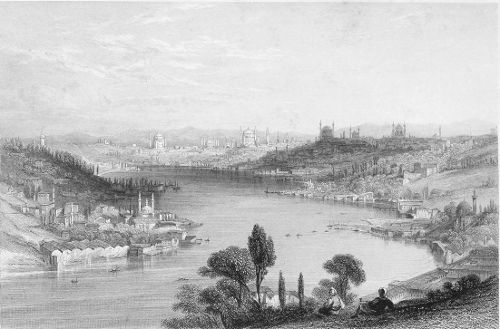
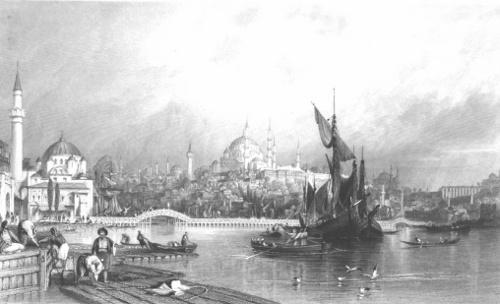
the world. A peninsula of gradual elevation was washed on one side by the Propontis,
and on the other by a magnificent harbour, broad and deep, and sheltered from every
wind, capable of holding in security all the ships of all known nations, and just within
and commanding the mouth of the great watery thoroughfare to the newly discovered
sea. Here they built their city, and called it Byzantium, after its founder Byzas, who,
from his singular judgment and sagacity in maritime affairs, was also denominated the
Son of Neptune. The accomplishment of the mysterious oracle was now apparent. The
striking contrast between his selection and that of his predecessors on the opposite
coast, caused their settlement to be called “the City of the Blind Men,” because its
founder overlooked, or could not see the beauties and benefits of the site of Byzantium,
when he had full liberty to choose. Byzantium was afterwards enlarged and re-edified by
Pausanias, a Spartan, and, in process of time, from the singular superiority of its commanding
situation and local advantages, became one of the most important of the free
and independent republics of the Greeks, and suffered the penalty of its prosperity by
becoming an object of envy and cupidity to its contemporaries.
The sovereigns of Bythinia and Macedon were the most persevering in their attacks.
A siege by the latter is rendered memorable by a circumstance connected with it.
Philip sat down before the city, and attempted to take it by surprise. A dark night was
selected for the purpose, when it was hoped the citizens could not be prepared to
resist the concealed and sudden attack. The moon, however, appeared to emerge from
the black sky with more than common brilliancy, and illumined distinctly every object
around the city. The obscure assailants were thus unexpectedly exposed to view, and
discovered; and the citizens, now upon their guard, easily repulsed them. Grateful for
this seasonable and supposed miraculous interference of the goddess, the Byzantines
adopted Diana as their tutelar deity, and depicted her under the form of a crescent.
By this emblem she is represented on the coins of the city, still extant, with the legend
ΒΥΣΑΝΤ ΣΩΤ, implying that she was the “saviour of Byzantium.” This emblem of the
ancient city was adopted by Constantine, when he transferred hither the seat of
empire, and it was retained by the Turks, like many other representations, when they
took possession of it. The crescent therefore is still its designation, not as a Mohammedan,
but a Byzantine emblem.
After many struggles, with more powerful nations, to maintain its independence,
Byzantium attracted the attention of the Romans. In the contests of the different competitors
for the empire, the possession or alliance of this city was of much importance,
not merely on account of its power and opulence, but because it was the great passage
from Europe to Asia. It was garrisoned by a strong force, and no less than five hundred
vessels were moored in its capacious harbour. When Severus and Niger engaged in
hostilities, this city adhered to the latter, many of whose party fled thither, and found
a secure asylum behind fortifications which were deemed impregnable. Siege was laid
to it by the victorious Severus, but it repelled all his assaults for three years. Its natural
strength was increased by the skill of an engineer named Priscus, who, like another
Archimedes, defended this second Syracuse by the exercise of his extraordinary mechanical
powers. When it did yield, it fell not by force, but famine. Encompassed by the great
Roman armies on every side, its supplies ware at length cut off, as the skill of the artist
was incapable of alleviating the sufferings of starvation. By the cruel and atrocious policy
of the most enlightened ages of the pagan world, the magistrates and soldiers were put
to death without mercy, for their gallant defence, to deter others from similar perseverance;
and to destroy for ever its power and importance, its privileges were suppressed, its walls
demolished, its means of defence taken away; and in this state it continued, an obscure
village, subject to its neighbours the Perenthians, till it was unexpectedly selected to
become the great capital of the Roman empire, an event rendered deeply interesting
because it was connected with the extinction of paganism, and the acknowledgment of
Christianity, as the recognised and accredited religion of the civilized world.
The emperor Diocletian, impelled by his cruel colleague Galerius, had consented to
the extermination of the Christians, now becoming a numerous and increasing community
all over the Roman empire: decrees were issued for this purpose, and so persevering
and extreme were the efforts made to effect it, that medals were struck and columns
erected with inscriptions, implying that “the superstition of Christianity was utterly
extirpated, and the worship of the gods restored.” But while, to all human probability,
it was thus destroyed, the hand of Providence was visibly extended for its preservation;
and mankind with astonishment saw the sacred flame revive from its ashes, and burn
with a more vivid light than ever, and the head of a mighty empire adopt its tenets from
a conviction of their truth, when his predecessor had boasted of its extinction on account
of its falsehood. This first Christian emperor was Constantine.
Christian writers assert that he, like St. Paul, was converted by a sensible miracle
while journeying along a public way. There were at this time six competitors for the Roman
empire. Constantine was advancing towards Rome to oppose one of them−Maxentius:
buried in deep thought at the almost inextricable difficulties of his situation, surrounded
by enemies, he was suddenly roused by the appearance of a bright and shining light;
and looking up, he perceived the representation of a brilliant cross in the sky, with a
notification, that it was under that symbol he should conquer. Whether this was some
atmospheric phenomenon which his vivid imagination converted into such an object,
it is unnecessary to inquire. It is certain that the effects were equally beneficial to
mankind. He immediately adopted the emblem as the imperial standard, and under it
he marched from victory to victory. His last enemy and rival was Licinius, who
commanded in the east, and established himself on the remains of Byzantium, as his
strongest position: but from this he was driven by Constantine, who was now acknowledged
sole emperor of the East.
His first care was to build a city near the centre of his vast empire, which should
control, at the same time, the Persian power in the east, and the barbarians on the
north, who, from the Danube and the Tanais, were continually making inroads on his
subjects. It was with this view that Diocletian had already selected Nicomedia as his
residence; but any imitation of that persecutor of Christianity, was revolting to the
new and sincere convert to the faith,—so he sought another situation. He at one time
had determined on the site of ancient Troy, not only as commanding the entrance of
the Hellespont, and so of all the straits which led to the Euxine Sea, but because this
was the country of his Roman ancestors, to whom, like Augustus, he was fond of
claiming kindred. He was at length induced to adopt the spot on which he had defeated
his last enemy, and he was confirmed in his choice by a vision. While examining the
situation, he fell asleep; and the genius who presided over mortal slumbers, appeared
to him in a dream. She seemed the form of a venerable matron, far advanced in life,
and infirm under the pressure of many years and various injuries. Suddenly she assumed
the appearance of a young and blooming virgin; and he was so struck with the beautiful
transition, that he felt a pride and pleasure in adorning her person with all the ornaments
and ensigns of his own imperial power. On awaking from his dream, he thought himself
bound to obey what he considered a celestial warning, and forthwith commenced his
project. The site chosen had all the advantages which nature could possibly confer
upon any single spot. It was shut in from hostile attack, while it was thrown open
to every commercial benefit. Almost within sight, and within an easily accessible
distance, were Egypt and Africa, with all the riches of the south and west, on the one
hand; on the other were Pontus, Persia, and the indolent and luxurious East. The
Mediterranean sent up its wealth by the Hellespont, and the Euxine sent hers down
by the Bosphorus. The climate was the most bland and temperate to be found on the
surface of the globe; the soil, the most fertile in every production of the earth; and the
harbour, the most secure and capacious that ever opened its bosom to the navigation of
mankind: winding round its promontories, and swelling to its base, it resembled the
cornucopia of Amalthea, filled with fruits of different kinds, and was thence called
“The Golden Horn.”
His first care was to mark out the boundaries. He advanced on foot with a lance
in his hand, heading a solemn procession, ordering its line of march to be carefully
noted down as the new limits. The circuit he took so far exceeded expectation, that his
attendants ventured to remonstrate with him on the immensity of the circumference. He
replied, he would go on till that Being who had ordered his enterprise, and whom he saw
walking before him, should think proper to stop. In this perambulation he proceeded
round six of the hills on which the modern city is built. Having marked out the area,
his next care was to fill it with edifices. On one side of him rose the forests of Mount
Hæmus, whose arms ramify to the Euxine and the mouth of the Bosphorus, covered
with wood; these gave him an inexhaustible supply of timber, which the current of the
strait floated in a few hours into his harbour, and which centuries of use have hardly yet
thinned, or at all exhausted. On the other, at no great distance, was Perconessus, an
island of marble rising out of the sea, affording that material ready to be conveyed by
water also into his harbour, and in such abundance, that it affords at this day, to the
present masters of the city, an inexhaustible store, and lends its name to the sea on
whose shores it so abounds.
The great materials being thus at hand, artists were wanted to work them up.
So much, however, had the arts declined, that none could be found to execute the
emperor’s designs, and it was necessary to found schools every where, to instruct scholars
for the purpose; and, as the pupils became improved and competent, they were despatched
in haste to the new city. But though architects might be thus created for the
ordinary civil purposes, it was impossible to renovate the genius of sculpture, or form anew
a Phidias or a Praxiteles. Orders therefore were sent to collect whatever specimens could
be found of the great artists of antiquity; and, like Napoleon in modern times, he stripped
all other cities of their treasures, to adorn his own capital. Historians record the details
of particular works of art deposited in this great and gorgeous city, as it rose under the
plastic hand of its founder, scarcely a trace of which is to be seen at the present day, and
the few that remain will be described more minutely hereafter. Suffice it to say, that the
baths of Zeuxippus were adorned with various sculptured marble, and sixty bronze
statues of the finest workmanship; that the Hippodrome, or race-course, four hundred
paces long, was filled with pillars and obelisks; a public college, a circus, two
theatres, eight public and one hundred and fifty private baths, five granaries, eight
aqueducts and reservoirs for water, four halls for the meeting of the senate and courts of
justice, fourteen temples, fourteen palaces, and four thousand three hundred and eighty-eight
domes, resembling palaces, in which resided the nobility of the city, seemed to rise,
as if by magic, under the hand of the active and energetic emperor.
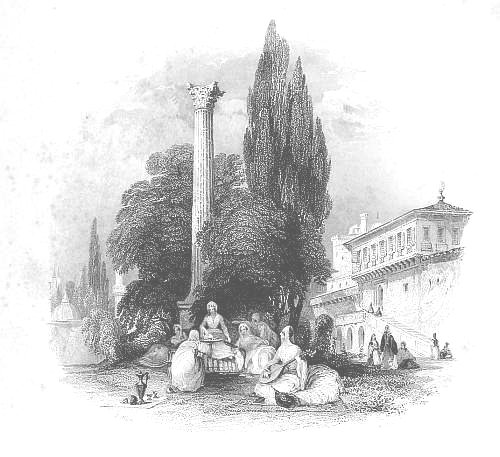
But the erection that gives this city perhaps its greatest interest, and it is one of the
few that has escaped the hand of time or accident, is that which commemorates his conversion
to Christianity. He not only placed the Christian standard on the coins of his
new city, but proclaimed that the new city itself was dedicated to Christ. Among his
columns was one of red porphyry, resting on a base of marble; between both he deposited
what was said to be one of the nails which had fastened our Saviour to the cross, and a part
of one of the miraculous loaves with which he had fed the five thousand; and he inscribed
on the base an epigram in Greek, importing that he had dedicated the city to Christ, and
“placed it under his protection, as the Ruler and Governor of the world.” Whenever
he passed the pillar, he descended from his horse, and caused his attendants to do the
same; and in such reverence did he hold it, that he ordered it, and the place in which it
stood, to be called “The Sacred.” The pillar still stands. The dedication of this first
Christian city took place on the 11th of May, A. D. 330.
Constantine left three sons, who succeeded him; and numerous relatives, who all,
with one exception, adopted the religious opinions he had embraced. This was Julian,
his nephew. He had been early instructed in the doctrines and duties of the new faith,
had taken orders, and read the Scriptures publicly to the people; but meeting with
the sceptic philosophers of Asia, his faith was shaken, and, when the empire descended
to him, he openly abandoned it. With some estimable qualities, was joined a superstitious
weakness, which would not suffer him to rest in the philosophic rejection of
Christianity. He revived, in its place, all the revolting absurdities of heathenism. In
the language of the historian Socrates, “He was greatly afraid of dæmons, and was
continually sacrificing to their idols.” He therefore not only erased the Christian
emblems from his coins, but he replaced them with Serapis, Anubis, and other deities
of Egyptian superstition. He was killed on the banks of the Euphrates, in an expedition
against the Persians, having, happily for mankind, reigned but one year and eight
months, and established for himself the never-to-be-forgotten name of “Julian the
Apostate.”
The family of Constantine ended with Julian, and, as the first had endeavoured to
establish Christianity as the religion of this new capital of the world, so the last had
endeavoured to eradicate it. But his successor Jovian set himself to repair the injury.
He was with Julian’s army at the time of his defeat and death, and with great courage
and conduct extricated it from the difficulties with which it was surrounded. He immediately
proclaimed the restoration of Christianity, and, as the most decided and speedy
way of circulating his opinions, he had its emblems impressed on his first coinage. He is
there represented following on horseback the standard of the Cross, as Constantine had
done, and so was safely led out of similar danger. He caused new temples to be raised
to Christian worship, with tablets or inscriptions importing the cause of their erection,
some of which still continue in their primitive state. He reigned only eight months;
but even that short period was sufficient to revive a faith so connected with human
happiness, and so impressed on the human heart, that little encouragement was required
to call it forth every where into action.
From the time of Jovian, Christianity remained the unobstructed religion of Constantinople;
but an effort was made in the reign of Theodosius to revive paganism in
the old city of Rome. The senate, who had a tendency to the ancient worship, requested
that the altar of Victory, which was removed, might be restored; and an attempt was
made to recall the Egyptian deities. On this occasion, the emperor issued the memorable
decree, that “no one should presume to worship an idol by sacrifice.” The globe
had been a favourite emblem of his predecessors, surmounted with symbols of their
families, some with an eagle, some with a victory, and some with a phœnix; but
Theodosius removed them, and placed a cross upon it, intimating the triumph of
Christianity over the whole earth; and this seems to have been the origin of the globe
and cross, which many Christian monarchs, as well as our own, use at their coronations.
From this time, heathen mythology sunk into general contempt, and was expelled from
the city of Constantinople, where the inquisitive minds of cultivated men had detected
its absurdities: it continued to linger yet a while longer, among the pagi, or villages of
the country, and its professors were for that reason called pagani, or pagans, a name by
which they are known at this day. The Christian city had so increased, that it was
necessary to enlarge its limits. Theodosius ran a new wall outside the former, from
sea to sea, which took within its extent the seventh or last hill. The whole was now
enclosed by three walls, including a triangular area, of which old Byzantium was the
apex. Two of its walls were washed by the waters of the Propontis and the Golden
Horn, and the third separated the city from the country, the whole circuit being twelve
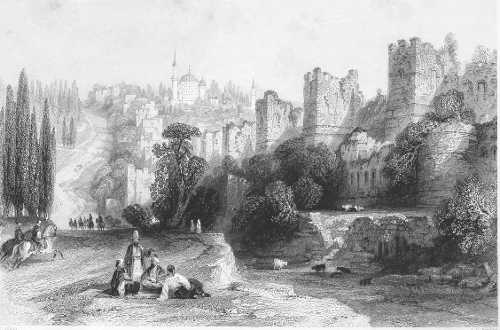
miles. These walls, with their twenty-nine gates, opening on the land and sea, and
the area they enclose, remain without augmentation or diminution, still unaltered in
shape or size, under all the vicissitudes of the city, for fifteen hundred years.
When the city had thus increased in magnitude and opulence, it became the great
mark for the ambition of the barbarians that surrounded it. Placed at the extremity of
Europe, it was the bulwark, as it were, against Asiatic aggression, and, filled with the
riches of the earth, the great object of cupidity. In the year 668, after it had stood
for three centuries unmolested by strangers, the Saracens attempted to take it. They
were at that time a great maritime nation, and had made immense naval preparations.
They had been converted to Mohammedanism about forty years, and were under
an impression that the sins of all those who formed the first expedition against this
Christian town would be forgiven; and they set out with a vast fleet. They disembarked
on the shores of the Sea of Marmora, and assaulted the city on the land-side along the
whole extent of the wall of Theodosius. The height and solidity of it defied them.
For six years they persevered in their attacks, till sickness, famine, and the sword nearly
annihilated their vast army. Their attempts were renewed at several times afterwards,
and defeated by the terror of the Greek fire, which was then for the first time discovered
and made use of.
The attacks of the Saracens having failed, and the Asiatics having desisted from a
hopeless attempt, a new enemy advanced against the devoted city, and from a very different
quarter. In the year 865, in the reign of Michael, son of Theophilus, the Sarmatians,
Scythians, and the barbarous people now composing the empire of Russia, collected
a vast fleet of boats, formed out of the hollowed trunks of single trees, and from hence
called by the Greeks monoxylon. They descended the great rivers, and, from the mouth
of the Borysthenes, fearlessly pushed out into the open sea in those misshapen and
unmanageable logs which are still seen in the same regions. Their vast swarms of boats,
like squadrons of Indian canoes, arrived at the mouth of the Bosphorus, and darkened the
waters of the strait with their countless numbers. But the rude navy of these undisciplined
barbarians was either sunk by the Greek fleet, or consumed by the Greek fire. For
a century they continued, with unsubdued perseverance, in their fierce attacks, fresh
swarms always succeeding to those that were destroyed, till at length one great and
final attempt was made to obtain the object of their cupidity.
In the year 973, a land-army was added to the fleet, and the command given to
Swatislas, a savage of singular habits and ferocity. He slept in the winter in the open
air, having a heap of snow for his bed, wrapped in a bear’s skin, and with no pillow but
his saddle. He quaffed an acid drink, probably the quass of the modern Russians, and
he dined on slices of horse-flesh, which he broiled himself on the embers with the point
of his sword. He was invited by the emperor Nicephorus to repel an invasion of other
barbarians, and he gladly undertook the enterprise. Having proceeded round the coast
of the Euxine in his hollow trees, to the mouth of the Danube, he disembarked;
and, defeating the barbarians against whom he was allied, he advanced to the Balkan
mountains. Here he looked down from the heights on the fertile plains below, and
at once conceived the project of making himself master of the city, and obtaining that
object of ambition, which the Russians never since seem to have abandoned. To this
end, he descended, and first proceeded to Adrianople. The Greeks, finding he had
passed this great barrier, became dreadfully alarmed. They sent a formal demand that
their ally should now evacuate their territory, as they had no longer an occasion for his
services. He replied, he could not think of returning till he had seen the wonders of
their great city. Swatislas, never calculating on a retreat, had neglected to secure the
passes open behind him, that the forces he had left at the mouth of the Danube might
follow him. These passes the Greeks now seized, and cut off the connexion between the
two divisions of his army. Finding himself sorely pressed and in imminent danger, he
made a precipitate retreat, and with loss and difficulty reached the sea-shore, where he
again attempted to establish himself. But he was compelled to abandon this position also,
and, in attempting to escape by sea, became entangled in masses of ice, and unable to
reach the shore. Here the greater part of his barbarous hordes miserably perished, but
the remnant that escaped brought back with them a precious benefit, which compensated
for all their losses. Olga, the mother of Swatislas, had been baptized at Constantinople,
some time before, by the Greek name of Helena. The first seed of the Gospel was thus
sown, and the invaders, when they entered the country, were prepared to adopt the
religion of the people they came amongst. They had been generally baptized there, and
those who escaped brought home with them the faith of the Greeks. The Russians,
thus become members of the Greek church, adopted its discipline and doctrines,—to
which they still adhere.
But an invasion was now meditated from a quarter, whence, of all others, it was
least expected, and the Christians of the East were attacked by their fellow Christians
of the West. The Crusaders were called to arms by a warning which they deemed the
voice of God, and they set out from their own homes to obey it. The sufferings they
brought upon themselves by their ignorance and presumption, the ruin they inflicted
upon others by their vices and passions, could not repress the ardour of these infatuated
fanatics. Three times had new swarms set out from Europe, and the miserable remnants
returned utterly defeated, after desolating the country of friend and foe through
which they passed. The fourth expedition inflicted misery and destruction on the
Christian city of Constantinople. After Peter the Hermit and St. Bernard had excited
and sent forth a countless rabble to the shores of Palestine, Fulk, another illiterate
preacher, issued from his cell at Neuilly, in France, and became an itinerant missionary
of the Cross. He commenced, as usual, by performing miracles, and the fame of his
sanctity and superhuman power gave him all the influence he could wish in a barbarous
and superstitious age; so he excited a fourth crusade against the Infidels, who had, by
their presence, desecrated the holy sepulchre. The former soldiers of the Cross had
suffered so much by their insane expeditions by land, that they now resolved to undertake
one by sea; and for that purpose despatched deputies to the Venetians and the
maritime states of Italy, to supply them with a convoy: their request was granted, and
a fleet accordingly prepared.
Constantinople had hitherto escaped these marauders; they had passed its walls
without inflicting injury, but an occasion now occurred which gave them a pretext for
entering it. The emperor Alexius had deposed, and put out the eyes of his brother
Isaak, whom he kept in prison, and his nephew Alexius, the heir to the throne, was
a fugitive in the west of Europe. He thought it a good opportunity to avail himself of
foreign assistance, and he applied to the leaders of the crusade to aid his cause. They
affected to say, that the recovery of the lime and stone of the holy sepulchre was too
important an object to be postponed for one of justice and humanity; but, tempted by
large pecuniary offers, and calculating on the pretext of taking possession of the great
city, avarice and ambition soon silenced the claims of superstitious piety. Dandolo was
then doge of Venice; he was totally blind, yet he embarked with the crusaders. Their
immense fleets literally covered the narrow waters of the Adriatic, and they arrived in
safety at Chalcedon, under the convoy of the skilful mariners that now conducted them.
They mounted to the heights of Scutari, and from thence contemplated, with longing
eyes, the wealth and splendour of the magnificent city on the opposite shore, spread out
on the seven hills before them.
Constantinople was at this time the emporium of every thing that was grand and
beautiful in the arts, science, and literature of the world. The city contained, it is said,
two millions of inhabitants, and was adorned with the noblest specimens of statuary and
architecture, either the productions of its own artists, or the spoils of Egypt and other
lands.
The usurper, Alexius, arrogant in safety, but abject in danger, after a feeble resistance,
fled from the city with such treasure as he could hastily collect, and the feeble
Isaak was taken from the prison in which he had been immured. It was a singular and
affecting sight, to behold the blind and venerable doge of Venice leading to the throne
the equally blind and venerable emperor of Constantinople.
It was now that the real character of the crusaders developed itself. They claimed
the promised reward for this act of justice and humanity; but it was in vain the young
Alexius attempted to raise the sum he proposed to pay: the present state of his empire
rendered it impossible; so his Christian guests were glad to avail themselves of his
inability, and pay themselves. In the language of the historian, “their rude minds,
insensible to the fine arts, were astonished at the magnificent scenery; and the poverty
of their native towns, enhanced the splendour and richness of this great metropolis of
Christendom;” they longed, therefore, for the pretext and opportunity of its pillage.
A rude but vigorous Greek, named Mourzoufle, who saw their design, assisted by his
countrymen, deposed the weak monarch and his son, who was now associated with him,
and their deaths soon followed. With his iron mace, Mourzoufle stood the defender of
Constantinople against the rapacity of the crusaders, and attempted to burn their galleys.
He was, however, repulsed; and, after various struggles, the imperial city, the head of
the Christian world, was taken by storm, and given up to plunder, by the pious pilgrims of
the Cross, and its fierce defender was dragged to the summit of the pillar of Theodosius,
and from thence cast down and dashed to pieces.
The scenes of carnage that followed are revolting to humanity. The Roman pontiff
himself, who had granted a plenary indulgence to all who engaged in the expedition,
was compelled to denounce their brutality. He accused them of “sparing neither age
nor sex, nor religious profession, of the allies they came to assist; deeds of darkness
were perpetrated in the open day; noble matrons and holy nuns suffered insult in the
Catholic camp.” As an instance of individual suffering, an imperial senator, Nicetas,
an eye-witness, details what he himself endured. His palace being reduced to ashes,
he fled for refuge to an obscure house in the suburbs of the town. Here he concealed
himself, guarded by a friendly Venetian in disguise, till an opportunity occurred of saving
his own life, and the chastity of his daughter, from the ferocious crusaders who were
pillaging the city. On a winter’s night, with his wife and tender child, carrying all
they possessed on their shoulders, they fled for life; and, in order to disguise their rank
and features, smeared their clothes and faces with mud; nor could they rest a moment,
from their pursuers, till they reached a distance of forty miles from the capital. On their
road, they overtook the venerable Greek patriarch, the head of the Christian church in
the East, flying also for his life, mounted on an ass, and almost naked. Nicetas afterwards
lived to instruct and inform the world, by his important history of these events.
Meantime the captors glutted, without restraint, every passion. They burst into the
church of Santa Sophia, and other sacred edifices, which they defiled in the most wanton
manner. They converted sacred chalices into drinking-cups, and trampled under foot the
most venerable objects of Christian worship. In the cathedral, the veil of the sanctuary
was torn to pieces for the sake of the fringe, and the finest monuments of pious art
broken up for their material. It would be too revolting to detail all the particulars of
these impious outrages; let one suffice. They placed on the throne of the patriarch
a harlot, who sang and danced in the church, to ridicule the hymns and processions
of the Oriental Christian worship.
In those excesses it was that this noble city suffered its first dilapidation. The monuments
of ancient art, collected from all parts of the world, were defaced and broken to
pieces, not simply from a bigoted rage against any superstition different from their own,
but from a crusade of ignorance against whatever bore the stamp of literature and science.
A contemporary writer details particular specimens of art that were wantonly broken and
destroyed; and the present denuded state of the city attests that the deeds of those
barbarians were as destructive as those of the equally ignorant Turks. Their utter contempt
for learning was displayed in various ways: in riding through the streets, they
clothed themselves and their horses in painted robes and flowing head-dresses of linen,
and displayed on them pens, ink, and paper, in ridicule of the people who used
such worthless things. It was therefore no exaggeration when the Greeks called them
Αγραμματοι και αναλφαβετοι Βαρβαροι, “Barbarians who could neither read nor write, who
did not even know their alphabet.”
The Latins, who had thus seized on the capital, usurped the whole of the Grecian
territories, and divided it among themselves. Five sovereigns, of the western invaders,
occupied the throne in succession, till it descended to Baldwin. Michael Palæologus
was destined to restore the ancient and rightful dynasty. In the year 1261, Alexius, a
noble Greek, who was dignified with the name of Cæsar, commanded a body of troops in
his service. He crossed the Hellespont into Europe, and advanced cautiously under the
walls of the city. There was a body of hardy peasantry, at that time cultivating the
lands of Thrace, of very doubtful allegiance. They were called volunteers, for they gave
their services freely to any one who paid them. These bold men were induced to join
themselves to the forces of Alexius; and, by stratagem, they entered the town. They
gained the co-operation of a Greek, whose house communicated with the wall by a
subterranean passage. Through this, Alexius was introduced with some of his volunteers;
but he had scarcely passed the golden gate, when the peril of the enterprise struck him,
and his heart failed him. He was pushed on, however, by his bolder companions, and at
length emerged from the dark passage into the Greek house in the heart of the city.
From hence they suddenly issued, and, though few in number, soon filled the streets
with terror and dismay, from the suddenness of their attack, and the unknown extent of
the danger. But every one was predisposed to join the enterprise. They looked upon
the Latin conquest with irrepressible and increasing horror, and the streets were soon
filled with shouts for Michael. Baldwin, utterly unapprehensive and unprepared, was
suddenly roused from his sleep: he made no attempt to preserve his usurped power.
He escaped to Italy, where he lived a private life for thirteen years, an object more of
contempt than pity, vainly soliciting aid to recover a kingdom which he had neither right
to keep, nor courage to defend.
The Greeks were thus restored to their capital, after their Latin allies had held an
unrighteous possession of it for fifty-seven years. As the ravages of their hands were irreparable
and permanent records of their oppression, so the memory of them was indelible.
It caused that irreconcilable animosity between the eastern and western people of the
same faith, which has widened, to an unapproachable distance, the separation of the two
churches, so that it is likely nothing within the probability of human events will ever
diminish it. To such an extent had it reached, and so deeply did it rankle in the minds
of the Greeks, that, two centuries after, when they were about to be overwhelmed by the
resistless power of the Turks, they had rather trust to the tender mercies of the followers
of Mohammed, than seek a perilous aid from their fellow-christians. To this day the
memory of these events is recent in the minds of the people of Constantinople, and it
has generated a lasting hostility to the Latin church, which seems only to increase and
strengthen with revolving years.
Immediately after the restitution of the city to the Greeks, a new feature was added
to it: another western people were received into it, not as allies with arms in their
hands, but as something still more useful−merchants, to cultivate the arts of peace, and
enrich the Eastern empire by their opulence and activity. These were the Genoese.
This enterprising little state had already penetrated to the remotest extremity of the
Black Sea, and the commodities brought from thence were particularly valuable to
the Greeks. The Oriental church prescribes a vast number of fasts, in the observance
of which it is very rigorous. The Genoese had established an extensive fishery at
Caffa, in the Crimea; and sturgeon, strelitz, and other fish brought down by the current
of the Tanais, and fed in the flat and slimy bottom of the Palus Mæotis, were of the
utmost value to the strict disciplinarians of the Eastern church. To vend this necessary
commodity, and always to keep a supply for the demands of the Greek capital, they
were allowed to establish a commercial mart in its vicinity.
On the northern shore of the Golden Horn rises a promontory, similar to that on
which the city is built, and called for that reason by the Greeks pera, because it stood
on the “other side,” or beyond the harbour. The extreme point of this peninsula, and
just opposite the ancient Byzantium, was called Galata, for, as some say, it was the
“milk market” of the Greeks, and it was assigned to these merchants, as the most convenient
site for their imports, having the Bosphorus on one side to receive them, and
the harbour on the other to distribute them through the city. In process of time their
town increased, and, in consequence of some attempt made by their rivals, the Venetians,
they were permitted by the Greek emperor, Cantacuzene, to surround the city with a
wall having turrets and battlements. It ran from sea to sea, shutting up this little
enterprising community in a secure asylum, and still continues in a very perfect state.
They were also allowed to use their own form of government, to elect their podesta, or
chief magistrate, and to practise the forms and discipline of their own worship. Thus
the mart of a few fishermen assumed the port and bearing of a considerable city.
Though their independent estate has been abolished by the absorbing despotism of the
Turks, they have left behind them another memorial of their consequence, beside the
walls of their city: they introduced the Italian language into the East, and it is that
Frank tongue that is now most universally spoken by all classes. The most respectable
portion of the present inhabitants are the descendants of those merchants, and they are
selected as dragomans, or interpreters, by the several European embassies.
But a new power was now preparing to overrun and astonish the world, not by the
sudden and transitory inroad of a barbarous multitude, carrying with it the destruction
of an inundation, and, like it, passing on, and remembered only by the ravages it left
behind; this was a permanent invasion of a stubborn and persevering race, destined
to obliterate the usages of former ancient people, and establish, in their place, its own.
On the banks of the Oxus, beyond the waters of the Caspian Sea, there dwelt a nomadic
people engaged only in the care of their flocks and herds, and for that reason called
Turks, from their rude and rustic habits. They had embraced the Islam, or true faith
of Mohammed, and changed the appellation of Turks, which was a term of reproach, to
Moslemûna, or “the resigned.”1 From their remote obscurity in the centre of Asia,
they issued, to carry the desolation of Islamism into the Christian world.
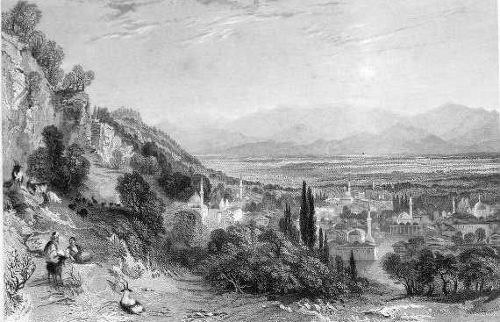
The first of this race who penetrated into the Greek possessions in Asia Minor was
Othman. He seized upon the passes of Mount Olympus, and instead of razing, he
strengthened all the fortified places behind him. His son Orchan conquered all the
Christian cities established there, and finally made himself master of Brusa, the capital of
Bythinia, which became the seat of the Turkish empire in Asia. The Seven Churches of
the Apocalypse shared the same fate. Those lights of the world, swarming with a Christian
people, were reduced to small villages, with a few Moslem inhabitants; even Ephesus,
the great emporium of Asia, celebrated for its noble temple, had “its candlestick so
removed,” that the village of Aysilûk (its modern name) now consists of a few cottages
among its ruins, and contains a Christian population of only three individuals. Philadelphia
was the only city that made an effectual resistance: though remote from the sea,
and abandoned by the feeble Greek emperors, it maintained its Christian independence
for eighty years, against the Moslem invaders. From the fame of this first conqueror,
his race adopted the patronymic as their civil designation, and called themselves, ever
after, Osmanli, or “the children of Othman.”
The first passage of the Turks into Europe was attended with a romantic adventure.
Soliman, the son of Orchan, was engaged in a hunting excursion, and was led by the
chase to the shores of the Hellespont. An insatiable curiosity induced him to wish
to cross to the other side, and visit, for the first time, this new quarter of the globe.
But the terror of the Turkish name had so alarmed the Greeks, that strict orders were
issued, under the severest penalties, to remove every conveyance by which they could
pass from the opposite shore into Europe. Under these circumstances, Soliman formed
a raft of inflated ox-bladders, and, availing himself of a moonlight night, he floated over
with some of his companions. When they landed, they seized on a passing peasant,
who happened to be acquainted with a subterranean entrance into the town of Sestos.
He was induced, by threats and bribes, to point it out, and so a few energetic Turks
seized by surprise on this first European city. By this exploit a communication was at
once established with their companions in Asia. Fresh succours crossed over and seized
on Gallipoli, and thus the Turk first planted his foot in Europe.
Amurath availed himself of all the benefits of his brother’s adventurous enterprise.
He appointed a singular custom at Gallipoli. The marauding Turks, now established on
the European side of the Bosphorus, made slaves of all the Christians they could seize
on, and sent them over to Asia by this passage. Amurath claimed for his share a certain
portion as toll. Of the young males so obtained, he formed that tremendous militia that
were afterwards to terrify and control their own country. He caused them to undergo
the rite, and be instructed in the doctrines and discipline, of his own prophet. A Dervish
named Hadgee Bectash, of great sanctity and influence, was then called in, to give this
corps his benediction. Laying his hand on the head of the foremost, the sleeve of his
coat fell over his back, and he blessed them by the name of yeni cheri, or “new soldiers.”
Both circumstances afterwards distinguished them−the sleeve of the dervish was adopted
as part of their uniform, and the name of janissary, corrupted from yeni cheri, was the
terror of Europe for more than five centuries. With these young and vigorous apostates
to Islamism, he subdued all the country to the base of the Balkan mountains, and having
obtained possession of Roumeli, the “country of the Romans,” as the territory of the
modern Greeks was called, he finally established himself at Adrianople, which now
became the Turkish capital of Europe.
This prince was succeeded by Bajazet, called, from his impetuosity, and the awful
destructiveness of his career, Ilderim, or “the thunderbolt.” He extended his conquests
into the heart of Europe, penetrated into the centre of Hungary, and threatened to proceed
from thence to Rome, to feed his horses with oats on the altar of St. Peter; but first he
resolved to possess himself of the Christian capital of the East. To this end he
advanced against Constantinople, and for ten years pressed it with a close siege.
Its fate, however, was yet delayed by the sudden appearance of another extraordinary
power, which, having subdued the remote parts of the East, and left nothing there
unconquered, in the restlessness of ambition turned itself to the west in search of new
enemies. This was the power of the Tartars, led on by Demur beg, or “the Iron
Prince.”2 To oppose this new enemy, the siege of Constantinople was raised, and its
fate suspended while the legions of barbarians encountered one another, and the Thunderbolt
was to resist the Man of Iron. The battle was fought on the plain of Angora,
where Pompey had defeated Mithridates. After a conflict of two days, the Turks were
totally routed. Bajazet fell into the hands of the conqueror, and the treatment he
experienced was such as one execrable tyrant might expect, or a still more execrable
might inflict. He whose custom it was to celebrate his massacres by pyramids of human
heads, erected at the gates of every city he conquered, would not hesitate to treat the
rival whom he hated, and had subdued, without pity or remorse. He enclosed his
captive in a cage, like a wild beast exposed to public view, and, as he was lame, made
him and his cage a footstool to mount his horse. The end of Bajazet corresponded with
his life; impatient of control, and stung with desperation, he beat out his brains against
the bars of his prison. Tamerlane possessed one redeeming quality, which distinguished
him, in some measure, from his fellow-barbarians. He entertained no hostility to
Christianity: on the contrary, he allowed a temple, dedicated to its worship, to be
erected in Samarcand, his capital. He did not follow up his conquest by renewing the
siege of Constantinople; so that this Christian capital, by his interference, was spared
for half a century longer.
But the time at length arrived, when the man was born who was permitted by
Providence to inflict this destruction. This was Mahomet II., endued with such
opposite and contradictory qualities, that he may be esteemed a monster in the human
race. He was the second son of Amurath II., by a Christian princess; his father had
imbibed so deep an enmity to Christianity, that he brought his son, like Hannibal’s, to the
altar, and made him vow eternal hostility to its professors. He succeeded to the throne at
the age of twenty-one, and his first acts were to strangle all his brothers, to the number
of twenty-two, and to cast into the sea all the wives of his father who might be likely
to give birth to posthumous offspring. The progress of his reign was in conformity
to this commencement. His fixed and never interrupted intention was, to possess
himself of Constantinople, and to convert the great capital of the Christian world into
the chief seat of Islamism, and there was no effort of force or fraud which he did not use
to accomplish it.
He is represented, by historians, as starting from his sleep, excited by dreams of
conquering the city, and as passing his days in devising means for its accomplishment.
Among others, he caused to be cast, at Adrianople, those enormous pieces of
battering cannon, capable of projecting balls of 800 pounds weight, which have been
the wonder and terror of future ages. They still lie at the fortresses which line the
Dardanelles; and the English fleet, under Admiral Duckworth, in modern times,
experienced their tremendous efficacy.
The Greek empire, at this time, was confined to a limited space. The emperor Athanasius
had, some years before, betrayed his weakness by his apprehension. A rude and
fierce people from the shores of the Volga, and thence called Bolgarians, had crossed the
Balkan mountains, and carried their inroads to the walls of the city. As a protection
against their incursions, a wall was commenced at Derkon on the Euxine, and continued
across the peninsula to Heraclea, on the Propontis, enclosing an area of about 140 miles
in circumference, called “the Delta of Thrace,” and beyond which the feeble Byzantine
power could hardly be said to extend. The Turks trampled it down, and, to cut off
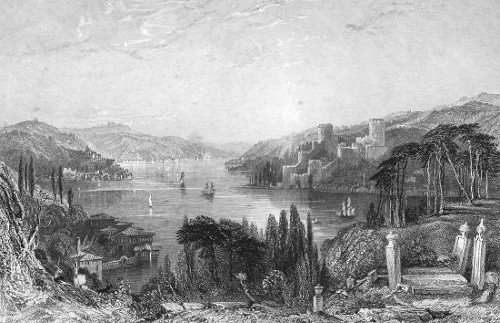
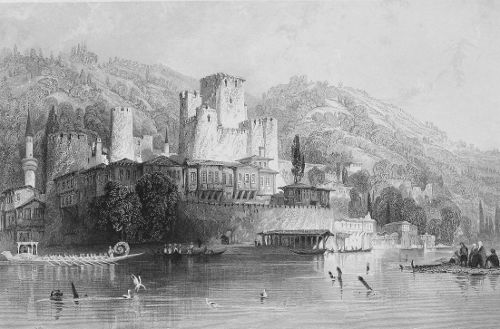
all communication by sea, seized upon and rebuilt the castles of the Bosphorus,
and then beleaguered the city with an army of 200,000 men. Where were now the
fanatics of the Cross, to uphold it in its utmost need? they were applied to, and they
affected to sympathize with their brethren in the East; but not one came to support this
great bulwark of that faith, which the Osmanli had every where suppressed, to establish
the intolerant creed of the Koran. The sovereign pontiff had predicted the fall of the
heretic Eastern church, and withheld his aid till his predictions were accomplished. The
whole force, therefore, to defend the walls, a circuit of twelve miles, and oppose the
countless numbers that surrounded them, was 8000 men.
The invincible courage of this handful of Christians repulsed the Turks in all
their fierce assaults. The fortifications on the land-side were formed of a double
wall, with an interval between. In vain did the enormous artillery of Mahomet batter
large breaches in the outside; there was still another, to which the defenders retired,
and from which they could not be dislodged; and after fruitless attempts to penetrate
this last retreat, Mahomet was about to abandon the siege in despair, when he
thought of an expedient as incredible as apparently hopeless. The city had been
defended on the sea-side by a series of iron chains, drawn across the mouth of the
harbour, which effectually excluded the Turkish fleet. He now conceived the idea
of conveying his ships by land, from the Bosphorus, across the peninsula; and this he
effected. Having prepared every thing, as soon as it was dark his machinery was laid−the
ships were hauled up the valley of Dolma-Bactché and across the ridge which
separated it from the harbour; and the next morning the astonished Greeks, instead of
their own, beheld the Turkish fleet under their walls. A general assault was now commenced
on all sides, the good and gallant Palæologus, the last and best of the Greek
emperors, was killed in one of the breaches, and the Turks poured in over his body.
The Greeks now rushed in despair to the church of Saint Sophia. They were here
assured that an angel would descend from heaven with a sword, and expel their enemies
from the city, and they waited for the promised deliverance; but the Turks, armed
with axes, battered down the outer gates, and rushed in among the infatuated multitude.
The city was given up to plunder, and those who escaped the carnage were sold
as slaves. Among them were 60,000 of the first families−females distinguished
for their beauty and accomplishments, and men eminent for their rank and literary
attainments. Poets, historians, philosophers, and artists, all were reduced to a common
level, and sold as slaves, to hew wood and draw water for the rude and brutal barbarians
who bought them. Such was the end of the great Christian empire of the East,
which was extinguished by the downfall of Constantinople, after it had flourished, from its
first dedication to Christ, 1123 years. It was founded in May 330, and it terminated in
May, 1453. The feebleness of its government, the vices of its emperors, and the weak
superstition of its people, were natural causes to accelerate its fall, and induce us the less
to regret it; while, by the arrangements of a good providence, the lights of literature, the
arts and sciences which improve social life, and the gentle courtesies which endear us to
our kind, hitherto shut up exclusively in this city, were now diffused over a wider
sphere; and the fugitives that escaped, and the slaves that were sold, brought with them
those qualities into various countries, and so were instruments which, no doubt, tended
to improve and ameliorate society wherever they were scattered.
When Mahomet had thus obtained the full fruition of his wishes, he speedily gave
a greater latitude to that selfish cruelty, and disregard for human life, which had
always distinguished him. Some acts of this kind are recorded of him, from which the
ordinary feelings of our nature revolt as altogether incredible. He was particularly fond
of melons, and cultivated them with his own hand. He missed one, and in vain attempted
to discover who took it. There was a certain number of youths, educated as pages, within
the walls of the seraglio, called Ichoglans, and his suspicion fell on them; he ordered
fourteen of them to be seized, and their stomachs to be ripped up in his presence, to discover
the offender. But his treatment of the woman he loved, has no parallel in the
history of human cruelty. He had attached himself to Irené, a Greek, as beautiful and
accomplished as she was good and amiable; she softened his rude nature, and controlled
his ferocity: and such was the ascendancy she had gained over him, that he desisted
from many intended acts of brutal inhumanity, through the gentle influence he suffered
her to exercise. His attachment was so strong, that the Janissaries began to murmur. To
silence their clamour, he assembled them together, and caused Irené to be brought forth
on the steps of the palace; he then unveiled her face. Even those rude and unpitying
soldiers could not contain their admiration: the loveliness of her features and the
sweetness of their expression at once disarmed their resentment, and they murmured
approbation and applause. Mahomet immediately drew his sabre, and severing her head
from her body, cast it among them.−He himself died of an attack of cholera in his
fifty-third year, having reigned thirty. He it was who changed the name of Sultan, by
which the sovereigns of his nation had been hitherto distinguished, into that of Padischah,
which is a prouder title, and which the Turks confer on their own sovereign exclusively
at this day; the appellation of the city was also altered to that of Stambool, or Istambol,
by which the Orientals now distinguish it.3
Selim I. began his reign in 1512, and it was distinguished by some remarkable events.
He is represented, by the historian Chalcocondyles, as exhibiting in his countenance
a singular display of his predominant passions−a cruelty inexorable, an obstinacy
invincible, and an ambition unmeasurable. He had the wrinkled forehead of a Tarquin,
the fearful eye of a Nero, and the livid complexion of a Scythian; and, to complete the
expression of his countenance, his mustaches were rigid, and drawn up to his ears, so that
his head resembled that of a tiger. Yet he had many great qualities, which distinguish
him among the sultans. He erected the Tersana, or arsenal, on the Golden Horn, and
so was the founder of the Turkish navy. He was an historian, a poet, and, contrary to the
law of the Prophet, a painter of human figures, and in this way commemorated his own
battles. He added Egypt to the Turkish dominions. The fierce militia who governed it
had been originally Christian slaves, like his own, and had established a dynasty which had
lasted 200 years; but the Mamelukes now fell before the superior energies of their brethren
the Janissaries. Another accession was made to his subjects. His hatred to Christianity
was extreme, and his persecution of those who professed it relentless; and on this
account he encouraged the Jews to supply their place at Constantinople. This
people had increased exceedingly in Spain, under the Moors; but, on the returning
power of the Spaniards, they were everywhere expelled by the inquisition. They set
out from Spain, to the number of 800,000 persons, and received that protection from
Turks which Christians would not afford them. They were invited to establish themselves
at Constantinople and the villages on the Bosphorus, where 100,000 were located, and
others in different parts of the empire. Several points of their belief and practice recommended
them to the Mohammedans−their strict theology, their abhorrence of swine’s flesh,
their rite of circumcision, were all points of resemblance between them. They called them
Mousaphir, or visitors, and treated them, accordingly, with kindness and hospitality.
They are at this day distinguished as a people, still speaking the Spanish language
in the Turkish capital, which they brought with them from the country from which they
were expelled.
An attempt was made to destroy Selim by a singular poison: Mustapha pasha
composed a ball of soap with various aromatic ingredients, but one of so deadly a poison,
that, like prussic acid, it was immediately absorbed by the skin, and destroyed the person
to whose face it was applied; and this was sent to the sultan’s barber, as a precious
invention, to be used when shaving his master. It was accompanied by a packet enclosed
in a case of lead; a precaution which excited suspicion, and led to discovery. The
pasha, barber, and all connected with them, were strangled, and the sultan escaped. He
afterwards died of a foul cancer, in the eleventh year of his reign, having justly acquired
the name of Yavuz, “the Ferocious.” He displayed his qualification of poet by writing
his own epitaph, which is seen upon his tomb, and describes his “ruling passion,
strong in death.”
“The earth I conquered while alive;
In death to combat yet I strive.
Here lies my body, seamed with scars;
My spirit thirsts for future wars.”
Soliman I. (or as he is by some classed II.) is represented as the greatest prince
that ever sat upon the Turkish throne; and he obtained the name of “the Magnificent,”
for the splendour of his achievements. He commenced his reign in 1520, which lasted
forty years; and made three vows, which he hoped to accomplish before his death:
to complete the hydraulic works of Constantinople−to erect the finest mosque in the
world−and to establish the western capital of Islamism at Vienna. The two first he
effected, and nearly succeeded in the last. After conquering all the countries between the
Euxine, Caspian, and Red seas, he turned his arms to Europe, in order to accomplish
his vows, and penetrated to Vienna, to which he laid siege without success; but he
established a strong garrison at Buda, the capital of Hungary, and held possession of it,
to renew his attempt. In the mean time, his fleets, united with the piratical states
of Barbary, under the banner of Barbarossa, or “Red Beard,” ravaged the shores of the
Mediterranean; and captive nobles from Spain, the most western country in Europe, were
seen in chains among his slaves at Constantinople. Carrying thus his conquering arms
from the Caspian to the Atlantic, and from the centre of Europe to the centre of Africa,
there was but one little spot which opposed his plan of universal empire: that spot
was the island of Malta. The crusaders had left this single remnant behind them, so
excellent and noble as to redeem all their other failings. The knights of St. John had
retired from Palestine to Rhodes, and from thence to Malta; and there they stood, the last
barrier and bulwark of Christianity against the overwhelming torrent of Turkish
dominion. These were now to be exterminated, and their island made the stepping-stone
to establish the religion of the Prophet in the western world. The siege which Malta
sustained on this occasion is the most gallant and interesting to be found in the records
of human actions. The knights amounted but to 700 men; they organized a force
of 8000, and with this they had to oppose a fleet of 200 sail, carrying an army of 50,000.
After incredible acts of heroism and devotedness, they compelled the Turks to withdraw
the remnant of their forces; and the first effectual check was given to their hitherto
resistless power.
The character of Soliman, as drawn by historians, is more perfect than that of any
other sovereign who occupied the throne of the Osmanli. His love of literature, his
enlightened mind, his inviolable faith, placed him in strong contrast with his fellow-sultans;
yet his private life is stained with more than Oriental barbarity. He had children by
two wives, one of whom was the celebrated Roxalana; the elder, Mustapha, was heir
to the throne, and a youth of great promise, but Roxalana was determined to prefer her
own, and to that end stimulated Soliman to put Mustapha to death. He sent for him to
his tent; and as soon as he entered, caused him to be seized by several mutes, who were
in waiting with a bowstring to strangle him. The young man made a vigorous resistance,
when the father, fearing he might escape, raised his head above the canvass partition of the
tent, and with menacing gestures threatened the mutes with his vengeance if they did not
despatch him. The unhappy youth caught his father’s eye, and passively submitted to his
fate. He was strangled, and his body thrown on a carpet, to be exposed in front of the
tent. Mustapha had yet another brother, whom it was necessary to dispose of also.
He was a mere boy, and, as his mother kept him carefully secluded within the walls of her
apartments, the wily Kislar Aga, who was sent to visit her, was obliged to have recourse to
stratagem to separate them. He represented to the mother that Soliman was tortured
with remorse for the death of her eldest son, and wished to repair his fault by affection
for the younger. He was afraid his health would suffer by confinement, and it was his
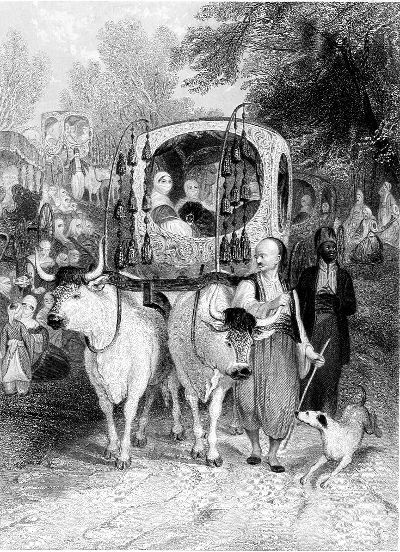
wish that he and his mother should take air and exercise; and for this purpose a horse,
splendidly caparisoned, was sent for the boy, and an arrhuba for herself and her female
slaves. The credulous mother was persuaded, and they set out to visit a beautiful kiosk
on the shores of the Bosphorus. The boy rode on “in merry mood,” with the Kislar
Aga, and she followed in the arrhuba. When arrived at a rough part of the road,
the carriage, which had been previously prepared, broke down, and the truth instantly
flashed upon the wretched mother’s mind; she sprung out, and rushed after her son,
who had by this time entered the kiosk with his companion. She arrived breathless,
and found the door closed; she beat at it with frantic violence, and when at length
it was opened, the first object that presented itself, was her only remaining son, lying on
the ground, strangled, his limbs yet quivering in his last agonies, and the bowstring of
the eunuch yet unloosed from his throat.
The last years of the wretched old man were imbittered by the conduct of the
sons, for whose advancement he had suffered those foul murders to be committed. His
son Bajazet was a rebel to his father’s authority; and Selim, who succeeded him, was the
most weak and wicked of the Mohammedan line. His noble mosque, and the tombs that
contain the ashes of himself and his wife Roxalana, are shown by the Turks to strangers
as the most splendid monuments left by their sultans.
Selim II. succeeded to the throne in 1566, and was entirely devoted to the gratification
of his appetites. His father was temperate in wine, and forbade its use under the
severest penalties. It is said he attributed the failure of the attack on Malta to the
violation of the law of Mohammed in this respect, and he caused caldrons of boiling oil to
be kept in the streets, ready to be poured down the throat of any person, Turk, Jew, or
Christian, who was found intoxicated. Selim, as if in contempt and mockery of his father,
indulged in wine to such excess, that he despatched an expedition to Cyprus, and
annexed that island to the empire, for no other reason but because it produced good
wine. The loss of the sanguinary battle of Lepanto, in his reign, was another blow
following the defeat at Malta, which shook the mighty fabric of the Turkish empire.
Selim died after a reign of eight years and five months, a rigid observer of all the
Prophet’s laws, except sobriety.
The people of the West had now begun to recover from the terror which the first
eruption of these terrible barbarians into Europe had excited, and to consider the many
commercial advantages to be derived from an intercourse with them. The French and
Venetians, in the reign of Selim, had already established this intercourse; and the
English were supplied with Oriental produce by the latter, who sent Argosies, or ships
of Ragusa, in the gulf of Venice, to England, freighted with the wealth of the East.
One of these rich vessels was wrecked on the Goodwin sands, and the Venetians were
afraid to send another. But the English having tasted of Asiatic luxuries, could not
dispense with them; and the enterprising Elizabeth, in whose reign the accident happened,
sent Raleigh and Drake to explore the West, while Harebone was despatched to
open a communication with the East. She wrote a Latin letter, addressed, Augustissimo
invictissmoq. principi Sultan Murad Can; in which she seems not only to prize highly
the incipient reformation in England, but also to recommend herself to the Turk by a
principle common to Islamism, “an unconquerable opposition to idolatry.” Her letter
was well received, and Sir E. Barton was appointed her first resident ambassador. He
accompanied Amurath in his Hungarian wars, and died on his return to Constantinople.
He was buried in the island of Chalki, and his monument still exists in a Greek convent
there. Hence originated an English residence at Constantinople, and the establishment
of the Levant Company, a body of merchants who, for 240 years, have caused the
name of England to be respected in the East, among the most honoured nations of
Europe.
Amurath III. was distinguished by the extraordinary number of his children. He
had attached himself to a fair Venetian, sold to him as a slave, and raised her to the
dignity of Sultana; but she had no children, and the Janissaries began to express their
discontent. They accused her of sorcery, and caused her attendants to be put to the
torture, to discover what philtres she had used to entangle the sultan’s affection. None
were discovered, except a good and amiable disposition. Amurath, however, soon
attached himself to so many others, that he filled the seraglio with 200 of his progeny.
He died in the year 1595, at the age of 50, leaving 48 children alive.
The first care of his successor, Mahomet III. was the usual resort of Turkish policy.
He strangled twenty-four of his brothers−nor was he satisfied with this carnage.
He escaped an insurrection of the janissaries, and, suspecting that his favourite
Sultana and her son were concerned in it, he caused them to be sewed up in sacks,
and drowned in the sea of Marmora. He died in 1603, after a reign of 8 years.
Achmet I. also commenced his reign with a measure of Turkish precaution. He had a
brother, and, to render him incapable of reigning, he caused his eyes to be put out. This
horrid process is performed in various ways−either by scooping out the eyes; by compressing
the forehead till the balls are forced out of their sockets; by rendering the lens
opaque with boiling vinegar; or, finally, by heating a metal bason red-hot, the intense
glow of which, held to the eye, soon destroys the sensibility of the optic nerve. This
latter is said to be the least painful, and has been practised by the more humane.
Not satisfied, however, with the operation, and still apprehensive of the janissaries, he
caused his blind brother to be strangled. He was, notwithstanding, celebrated for his
taste and magnificence; and the mosque, of his erection, and called by his name, is a
lasting memorial of these qualities. He died at the early age of twenty-nine, in the year
1617. His reign is remarkable for the first introduction of tobacco into Constantinople,
by the Dutch, who then began to trade there, and brought with them this plant from
America. It was at first strongly opposed by the mufti as a violation of the koran;
but the grand vizir, who became fond of it, ordered it to be served out in rations to the
janissaries, and they soon silenced all opposition.
Amurath IV. ascended the throne in 1524. He took Babylon, and caused 30,000 of
its inhabitants to be massacred in cold blood, under his own eyes. In addition to the
usual cruelty, and disregard of human life, which distinguished other sultans, he adopted
a practice peculiarly his own. It was his custom to issue from the palace at night
with drawn scimitar in his hand, and not return till he had committed some murder.
Another of his favourite amusements was to place himself in a window with a bow and
arrows, and pin to the opposite wall any casual passenger. Historians represent him as so
fond of shedding human blood, that it seemed to be the aliment on which he lived. His
caprice was equal to his cruelty; he found, or made, cause for displeasure in every thing,
as a pretext to justify him. He sent thirty poor pilgrims to the galleys, because he did not
like their dress. It was his delight to render those unhappy, whom he hesitated to
deprive of life. Whenever an ill-assorted marriage was likely to cause this, he adopted it.
He broke suitable arrangements, and compelled young girls to marry decrepit old men,
and youths of eighteen to unite themselves with women of eighty. He indulged freely
in the use of wine, but disliked tobacco, and was so determined that no one else should
enjoy it, that he instantly stabbed with his yategan the man on whom he detected the smell
of it. One instance only of mercy is recorded in the course of his life. A certain Tiraki
was an inveterate smoker, and, to indulge it, he dug a hole in the ground. Here the
sultan stumbled upon him, and proceeded at once to despatch him; but the smoker
bade him observe, that his edict was issued for the surface of the earth, and was not
meant to extend below it. For the first time, he spared the life of an offender. He died
in 1640. Unfortunately for his subjects, he reigned fourteen years.
Mahomet IV. was placed on the throne at the age of nine years, but the talent of his
vizir compensated for his own want of experience. His reign was distinguished by
several remarkable events. The great island of Crete, or Candia, had hitherto resisted
Turkish rule. It was determined to reduce it, and, after an obstinate resistance of
twenty-four years, it was at length taken by treachery. The Turks lost 200,000 men;
and such were the ravages committed, that this fine island remained a desert. A second
siege of Vienna followed. Tekeli, the noted Hungarian rebel, had raised the standard of
revolt against his sovereign: to aid his plans, the renegade Christian called in the
assistance of the greatest enemy of his faith; and Mahomet advanced with an immense
army, now certain of realizing the plans of Soliman the Magnificent, and declaring himself
Sultan of all Christendom. But his projects were arrested in the moment of their
accomplishment, and from a quarter least expected. John Sobiesky advanced from his
deserts with his gallant Poles, and signally defeated the Turks in two engagements.
They were driven from their strong hold in Pest, the capital of Hungary, of which they
had held obstinate possession for 157 years, and retired behind the Danube. Since
that time, instead of being the assailants, pushing on their advances into Europe, they
merely struggle to keep their position in a European soil. To console himself for his
losses, the Sultan, whose disposition seemed susceptible of other enjoyments besides those
of war, became attached to rural occupations. The Turks have always been distinguished
by their fondness for flowers, and he engaged in the pursuit of cultivating them with more
pleasure than any of his predecessors. To encourage it, his vizir, Cara Mustapha,
collected, in every pashalik of the empire, whatever was rare and curious in the vegetable
world; the seeds, bulbs, and roots of which were conveyed to Constantinople. Hence,
as some erroneously say, originated4 that love of flowers which at this day distinguishes
the Turks; and Europe is supplied with its most beautiful specimens of floriculture by a
rude people, whose coarse and brutal indulgences in other respects, seem incompatible
with so elegant an enjoyment. He shortly after caused his favourite vizir to be strangled,
on the suspicion of intending to master Vienna, in order to establish a dynasty for himself
in Europe. His own death soon followed, by the hands of the discontented Janissaries,
after a reign of thirty-nine years.
Achmet II. was more distinguished by the talents of his grand vizir, Kiuprili, than
by any act of his own. The father of this man was an instance of the singular and
unexpected fortune for which some are remarkable in Turkey. He was a Frenchman,
born in a village called Kuperly, in Champaigne, from whence he took his name. He
committed a murder, and was obliged to fly, but the boat in which he escaped was taken
by Algerine pirates. Under this circumstance, whoever assumes the turban is no longer
a slave. He did not hesitate to abjure his faith, and enrolled himself among the
Janissaries at Constantinople, where he obtained paramount influence in that turbulent
corps. His son was raised to the rank of grand vizir−governed the great Turkish
empire−and set up and deposed sovereigns at his pleasure. His destruction was resolved
on by the Kislar Aga, who feigned a plot in which he was concerned against the sultan,−while
in the act of revealing it, a mute raised the curtain of the tent. Accustomed
to listen rather by sight than sound, he at once learned the subject of the conversation
by the motion of the lips, and revealed it to Kiuprili. The Kislar Aga was strangled,
his secretary hanged in his robes of office with his silver pen-case suspended from his
girdle, and Kiuprili remained in the ascendant. As if to mark his hatred of the religion
for which his father had apostatized, he caused two patriarchs of the Greek church to be
strangled in prison. He was killed in battle in Servia−the Turks were everywhere
defeated−and his master soon after died of grief in 1695.
The reign of Mustapha II. was marked by calamities which have never since ceased
to afflict the Turkish empire. Besides the ordinary inflictions of war, every other seems
to have been laid, by the hand of Providence, on this ruthless nation: Constantinople
and Pera were utterly destroyed by fire−a bolt of thunder fell on the imperial mosque,
and left it in ruins−the caravan of pilgrims proceeding to Mecca was attacked by Arabs,
and 25,000 of them put to the sword−the turbulent Janissaries, availing themselves
of every pretext for discontent, were again in a state of insurrection, and compelled the
sultan to fly for his life to Adrianople, along with the mufti. Here he was obliged to
surrender the unfortunate head of the church, who was treated with every indignity,
and then thrown into the river, where he perished. The new mufti, with his son, were
seized, tortured, and executed; and the sultan himself was soon after deposed in 1703,
and his brother Achmet set on his throne. This military revolt was the most serious
that had afflicted the empire since its foundation, and was a prominent feature of that
principle of total disorganization, which seemed inherent in the political and moral state
of this people.
Achmet III. was called to succeed his brother, and his first act was to avenge himself
on the conspirators, who had placed him on the throne in a truly Turkish manner. He
disarmed their suspicions by rewards and promises, and, having separated them into
various situations of trust and profit, caused every man of them to be strangled in
detail.
Notwithstanding the state of insecurity of every thing in Turkey, it nevertheless
became in his reign the asylum of the Christian monarchs of Europe. Charles XII. of
Sweden, and Stanislaus the king of Poland, whom he had set up, both fled thither for
protection: yet, violent and outrageous as was the conduct of “Macedonia’s madman,”
whom the Turks for folly and obstinacy called “Ironhead,” both kings were treated with
kindness and hospitality. They were followed by their great enemy, the czar Peter,
whose usual sagacity seemed to have deserted him. He was shut up behind the Pruth
by the Turks, and they had now the opportunity of holding three Christian monarchs in
their hands, and dictating what terms they pleased: but avarice, that ruling passion of the
Osmanli, saved Peter and his army−Catherine, his wife, who had accompanied him,
brought in the night all her personal jewels, and as much money as she could collect, to
the czar, who immediately sent them to the grand vizir: he was not able to resist the
offer, and the Russian monarch and his army were allowed to depart in peace.
Another circumstance distinguished the reign of Achmet III., even still more
important than his being the arbiter of the fate of three Christian kings. The art
of printing had now been invented for more than two hundred and fifty years, and every
other state in Europe had adopted the important discovery. The Turks alone rejected
it, and assigned, as a reason, that it was an impious innovation. They allowed no book
but the Koran; they affirmed that it contained every thing necessary for man to know,
and any other knowledge was worse than useless. Such was their veneration for this
book, that it was strictly forbidden to sit, or lay any weight, upon a copy of it; and if a
Frank was detected in the act of doing so, even unwittingly and by accident, he was
immediately put to death. This veneration they extend to paper of any kind, because
it is the material of which the sacred book is composed, and that on which the name
of Allah is written; and hence they strictly prohibit its being desecrated by any common
use, and carefully lay up any fragment of it which they accidentally find. The process
of printing they consider as compressing and defiling a sacred book, and the mufti
denounced it. It was not, then, till the year 1727, that this innovation was tolerated,
and a press established at Constantinople. Even then it was done in such a way as was
attended with no advantage to an ignorant people. It was still prohibited to print the
Koran, and, as that was almost the only book read in the empire, little was added to
Turkish knowledge. Achmet was soon after deposed, and the patron of printing
deemed unfit to reign.
He was succeeded in 1730 by his nephew Mahomet, the fifth of the name who had
ascended the throne of Turkey, but usually called Mahmoud I. It was in his reign the
celebrated usurper, Thamas Kouli Khan, seized on the crown of Persia, and war was
kindled with the Turks. These nations comprise the two great sects into which the
followers of the Prophet are divided. The Persians hold in abhorrence Abubekir and
Omar, whom the Turks revere; and they adhere to the doctrines of Ali, whom the Turks
abhor. The latter call themselves Sunni, or “the orthodox,” and have no fellowship or
communion with the Rafazir or Shiites, “infidels” or “heretics.” They affirm, that Allah
may have mercy on Jews and Christians, but he will have none on the Persians, whom
he hates sixty and ten times as much as the most inveterate infidels. The enmity,
therefore, between the discordant sects of the faithful is even greater than between the
faithful and the infidel. It was the enlightened policy of Thamas Kouli Khan to put
an end to this bloody dissention, and reconcile the different shades of opinion among the
professors of the same religion. It was stipulated as an article in the peace which
followed, that their respective priests should labour assiduously to this end; but, like
all such attempts, it was unavailing, and the enmity is at this day more inveterate
than ever. Mahmoud died in 1754, and was regretted as the least sanguinary of the
Ottoman race.
But the time was now approaching when the dynasty of the Mohammedans in Europe
seemed hastening to its close. The Russians, ever since the capture of Asoph, on
the Mœotis, by Peter the Great, had never ceased advancing on Constantinople. The
Turkish territories on the north of the Euxine were intersected by vast rivers which fell
into that sea; and the policy of the Russians was, to advance from river to river, and, at
the end of every war, to make the last the boundary of their territory, and secure for
themselves all that lay behind it. In this way Catherine pushed her frontier to the
Dnieper, and built a naval arsenal at Cherson, thereby establishing a naval supremacy
on the Black Sea; and, that her object might not be ambiguous, she caused to be
inscribed on the western gate, “This is the road to Constantinople.” Meantime,
the Turkish government seemed to contain within itself the elements of rapid decay.
While all Europe was advancing in the arts and sciences which improve life and
strengthen kingdoms, the Turks alone stood still and refused to move−their ignorance
inveterate, their obstinacy intractable, their cities falling to ruins, their population daily
decreasing, their internal dissensions growing more sanguinary, and, above all, the insolence
of the Janissaries without control−interdicting every improvement, paralyzing
every effort, utterly inefficient as soldiers, and formidable only to their own government.
The first step, therefore, was to establish some force to restrain these men, that the
people might be at liberty to follow other states in the march of amelioration: and
this was now undertaken by the reigning sovereign.
Selim III. was the most amiable and enlightened man that had yet filled the throne
of the Osmanli. He succeeded his uncle, Abdal Hamed Khan, whose sons were infants
at the time of their father’s death in 1789. His anxious wish was to correct the prejudices,
and enlighten the ignorance of his subjects, by gradually introducing European
usages among them. His first improvements were military: a corps was formed,
adopting the European discipline, and called the nizam dgeddit, or “new regulation.”
Against this innovation the Janissaries revolted: they spurned with indignation all
customs but their own; they thought their institutions the perfection of human nature,
and that any change must be a degradation. They therefore deposed Selim in 1807, and
called to the throne his cousin, Mustapha IV., the son of Abdul Hamed Khan, who had
now arrived at adult years. Selim, however, by his many good and amiable qualities,
had secured the affections of a large body of his subjects, who, though they did not accede
to his military plans, were strongly attached to his person: and among these was
Mustapha Bairactar.
This man was a rough soldier, of large stature, and immense bodily strength, fierce in
disposition, and coarse in manners, but susceptible of the most affectionate attachment.
He was called Bairactar because he had been originally a standard-bearer, and, though
now raised to the command of a large army, with the usual pride of a Turk, still retained
the original name of the humble rank from which he had raised himself. When he
heard that the master he loved was deposed and a prisoner, he hastened with his army
to the seraglio, and demanded admission at the great gate of the Babu Humayun.
Mustapha, who was of a light and frivolous, though cruel character, was in the habit of
amusing himself daily on the Bosphorus; and when he heard of this insurrection in favour
of his deposed cousin, he hastened to land at the sea-gate of the seraglio. He here
motioned to his attendant eunuch, who ran to obey his orders. Selim was found in his
private apartment, engaged in the performance of the namaz, at the hour of prayer, which
he never omitted. In this position he was seized by the eunuch, who attempted to strangle
him. He started up, however, and made a vigorous resistance; but his murderer,
twining round his legs, seized him in such a way as gave him exquisite pain: he fainted,
and in this senseless state was strangled. Meantime, the Bairactar thundered at the
great gate, and threatened to batter it down, if the deposed sultan was not produced.
He was answered, that his wish should be immediately complied with. The gate was
thrown open, and the lifeless Selim cast before him: the rough soldier threw himself
upon the body of his gentle master, and wept bitterly.
Another revolution immediately ensued−the cruel and frivolous Mustapha was
deposed, and the soldiers searched for his brother Mahmoud, who was known to be in
the seraglio, but was no where to be found. It was at length discovered, that a slave
attached to his person had immediately seized him when the disturbance began, and
hurried him to an oven, where she shut him in, and kept him concealed. From thence
he was taken, and placed on the throne. His first act of Turkish policy, immutable
in ferocity and disregard of human life, was to cause his brother Mustapha to be
strangled; and his next, to cast into the sea all the females of his brother’s harem,
lest any of their children, even then unborn, should cause a disputed succession.
The present sultan, Mahmoud II., was born in the year 1788; he was the second
son of Abdul Hamed Khan, and is now the only survivor of fifteen male children. He
was placed on the throne on the 28th of July, 1808, and from the moment of his elevation
showed symptoms of that energetic and resolute character which has since distinguished
him. The Russians had advanced from the Pruth to the Danube, and, in
the disorganized state of the Turkish army, there was no force to oppose them. The
young sultan erected the standard of the Prophet at Daud Pasha, just within the walls
of Constantinople; he raised a large army, and the Russians were compelled to retire
without crossing the Balkan mountains, as all Europe expected; but they left behind
them, in the bosom of the Turkish empire, a more formidable force than their own arms−and
this was, the discontented Greeks.
The Greeks, retaining that excitability and impatience of control which ever distinguished
that nation, and which centuries of slavery and oppression could not subdue,
were ever ready instruments in the hands of the Russians, to embarrass and annoy their
enemies. The identity of their religion, the Russians having early become members
of the Greek church, gave them a powerful influence, and in 1790 a deputation of Greeks
waited upon the Empress Catherine, to request her interference. One of her sons was
baptized Constantine, the favourite name of the Greek emperors, brought up by a
Greek nurse, and intended for the throne of Constantinople. Several attempts at revolt
were unsuccessful. Their allies always sacrificed the unfortunate Greeks to their own
plans of ambition: every insurrection was followed by confiscation and massacre, and at
length it was proposed, in the divan, to cut off the whole race, and extirpate the name of
Greek. From this they were preserved by the avarice of the Turks, for, were this measure
executed, there would be no one to pay the capitation tax; and this appeal to their
cupidity alone saved a whole nation.
The Greeks, however, were now become an opulent and intelligent people; availing
themselves of all the lights and advantages which the Turks neglected, they had accompanied
the rest of Europe in the march of improvement, and determined to rely no longer
on Russian faith−but to attempt their own emancipation. A mysterious society, called
Hetairia, was ramified wherever a Greek community was established, who prepared for
another insurrection. In the year 1815 a secret meeting was held at Constantinople,
and it was resolved on. Six years after, the standard of revolution was raised by
Ypselantes, in Moldavia. It was responded to by a general rising in other places, and,
after a sanguinary conflict against the whole power of the vast Turkish empire, their
independence was finally established, a new nation was recognized in Europe, and
modern Greece for ever severed from their barbarian masters.
The utter impotence of the Turkish power was so clearly established by this event,
that it was obvious nothing but a change of its institutions could save it from total dissolution.
Mahmoud therefore was determined to effect this change, or perish in the attempt.
His preliminary step was the extirpation of the Janissaries. This desperate militia
now turned up their kettles in the Atmeidan and 40,000 men rushed round them.
The sultan caused the standard of the Prophet to be displayed in the Mosque of
Achmet, and all the well-affected flocked to it. He required a fetva from the Sheik
Islam, to authorise him to kill the Janissaries if they resisted: it was granted by the
chief of the Faith, and he sent his adherent, Kara Gehenna, or “the black infernal,” to
execute it. The Janissaries were surrounded with artillery, and he at once opened a
discharge with grape-shot on the dense crowd. He battered down their kislas, or barracks,
over their heads, and never ceased till this fierce and formidable body of men were left
a monument in the midst of Constantinople, a mound of mangled flesh and smoking
ashes slaked in blood. To perpetuate the utter destruction of this corps, and ensure
its extinction, a firman was issued, obliterating its very name, and declaring it penal for
any man ever to pronounce it.
Just before the destruction of the Janissaries at Constantinople, that of the Mamelukes
had been effected in Egypt. These descendants of Christian slaves, equally
formidable to the Porte, had been doomed to like destruction by the predecessor of
Mahmoud. They were invited to a feast on board the Capitan Pasha’s ship, when the
most formidable of their chiefs were seized and strangled. The remnant were induced,
by solemn promises of protection to enter the fortress of Cairo, when every man of them
was sacrificed in cold blood, without pity or remorse. Thus these two corps, originally
formed and recruited from a Christian population, became, in the hands of the Osmanli,
for many centuries, the most powerful and unrelenting opponents of the people professing
the faith of their ancestors, and at length became so formidable to their employers as to
render their own destruction necessary. Not a remnant of these extraordinary renegades,
now exists in the world, and the very names of Mameluke and Janissary are
condemned to everlasting oblivion.
The energetic and terrible sultan, having thus silenced opposition, and created
unanimity to his plans, by putting to death every man that presumed to differ from him
in opinion, proceeded rapidly with his reforms. A new order of things was every where
established. The soldiers, who were a mere uncontrollable rabble, every one dressed
according to his own fancy, and doing whatever seemed good in his eyes, were now clad
in regular uniform, subject to discipline, and exercised in European tactics. Civil
usages which stamped the Turks with barbarism, were abolished. Ambassadors, who
represented infidel kings, were no longer dragged by the neck into the presence of the
sovereign of the faithful like criminals, or sent to his prison like malefactors; but, above
all, knowledge was no longer proscribed as an impious acquisition, and ignorance
cherished as a venerable quality. Lancasterian schools were opened; literary works on
various subjects were written by Turks, and published at the press at Constantinople,
now revived for that purpose; and, finally, an innovation was introduced, supposed to
be altogether hopeless and extraordinary, among a people so stubborn and prejudiced:
to spread the lights of European knowledge with more rapidity, and present them daily
to the eyes of every man, four newspapers were established in the capital, in Turkish,
Greek, Armenian, and French, for the different people that compose the population;
and thus 700,000 persons, the calculated number of inhabitants on both peninsulas,
instead of being kept in utter darkness of every thing around them, are now constantly
apprised of all that passes, not only in their own, but in every other country. The arts,
the sciences, the improvements in social life, the incidents and events which happen in
the world, are subjects to which the attention of the Turk is now turned, and the
fictions of his “story-tellers” are superseded by the realities of life. Every day the
distinctions which marked this great capital, as an Asiatic city on an European soil, are
beginning to disappear, and it is probable that, in a few years, such an amalgamation
of its inhabitants with those of other European cities will take place, that the strong
characteristics which lately distinguished it will only be found in our pictorial representations.