BRUMIDI’S art in the Capitol Building is not all accessible to the
casual visitor. The large mural already mentioned which the old master
executed on the wall of the House of Representatives Chamber can be
viewed by visitors only from the galleries of the House, unless some
special dispensation takes the visitor to the Floor of the House of
Representatives for a close-up study. The beautiful frescoes on the
walls and ceilings of six committee rooms, one in the House extension
and five in the Senate extension, can be seen only by special permission
or by attendance at certain committee hearings.
The frescoes in the House of Representatives Committee room, originally
occupied at the time of execution by the Committee on Agriculture, were
finished in 1855. This room displays two large crescent-shaped wall
frescoes, referred to as “lunettes” by Brumidi—“The Calling of
Cincinnatus from the Plow”, and “The Calling of Putnam from the Plow to
the Revolution.” Two portrait heads in imitation sculpture adorn the
other two walls of this room. Beneath the marble-like medallion head of
Washington is a choice panel showing an American harvest scene of early
date, while beneath the medallion head of Jefferson on the opposite wall
is what was then a modern threshing scene, a golden field of grain being
harvested by the new McCormick Reaper. The ceiling is light and gay and
exquisite with designs representing Spring, Summer, Autumn, and Winter.
The blues and golds and inimitable flesh tints of the entire room seem
not to have faded one whit during the ninety years they have spread
cheer and beauty about an otherwise sombre corner of the House extension
of the Capitol.
In spite of all the beauty Brumidi painted into the old Capitol Building
the Congressional Journal for those Brumidi years records occasional
reference on the Floor of the House, criticizing the Italian artist and
his work. In 1858 Congressman Lovejoy ridiculed in the House Chamber
that “brilliant interpretation of the seasons” by Brumidi in his first
frescoed ceiling decorated for the use of the House Agriculture
Committee. Said Mr. Lovejoy in his Congressional speech,
“Overhead we have pictures of Bacchus, Ceres, and so on, surrounded with
cupids, cherubs, etc., to the end of heathen mythology. All this we
have; but not a single specimen of the valuable breeds of cattle,
horses, sheep, etc., which are now found in this country. In another
panel, we have a company of harvesters with the sickle, which is well
enough, only a quarter of a century too late. But worst of all, there is
not a single picture to represent maize. A panel ought to have been
given to this single production. It should have been represented in its
different stages; as it emerges, weak and diminutive, from the ground,
as it sways in its dark luxuriance of June and July; and then as it
waves its tasseled crest, like the plumes of an armed host; and last as
it stands in its rich golden maturity.”
We find Brumidi’s art defended, however, on the Floor of the House of
Representatives about two years later, on June 15, 1860, by Mr. Curtis
of Pennsylvania. Said Mr. Curtis,
“If you go into these committee rooms, and these galleries, of which we
have heard so much, and take any honorable and fair-minded artist with
you, he will himself do justice to the specimens of art that will be
before him, and admit its distinguished worth. What, sir, can be more
beautiful than the fresco work in the room of the Agricultural
Committee?”
Hanging on the side of a bookcase today, in this House Committee Room,
where Brumidi began his Capitol decorations, is a framed bit of verse
put on display evidently by an admirer of the artist. This attempt to
give poetic expression to the worth of Brumidi and his art was written
by Horace C. Carlisle, a present employee of the Architect’s office of
the Capitol. Seven such pieces of verse on Brumidi and his art, written
by Mr. Carlisle, were placed in the Congressional Record by Congressman
Sheppard of California, on April 7, 1944. The verses themselves are
irregular but one line in the frame beneath Brumidi’s first American
fresco is an immortal prophecy. Said Mr. Carlisle, concerning Brumidi
and that first fresco in the Capitol Building:
“Above the rebuke of the scorner he climbed to glory height there.”
In 1874 Brumidi himself referred to his first American fresco in a
statement, “Relative to his employment at the Capitol,” which is now
preserved in the Architect’s office. Said Brumidi, in part,
“The Committee Room on Agriculture in the south wing of the Capitol was
painted in 1855 as the first specimen of real fresco introduced in
America.
“In this connection can be mentioned a curious mistake common in this
country, and that is the calling all and every decoration in oil,
turpentine or glue that is put upon dry walls, real fresco.
“Fresco derives its name from fresh mortar, and is the immediate and
rapid application of mineral colors diluted in water, to the fresh
mortar just put upon the wall, thereby the colors are absorbed by the
mortar during its freshness, and repeating this process in sections day
by day, till the entire picture will be completed.
“This superior method is much admired in the celebrated works of the old
masters, and is proper for historical subjects or classical
ornamentations, like the Loggia of Raphael at the Vatican.”
A most revealing side light on the Cornwallis-Washington mural on the
south wall of the House of Representatives Chamber, earlier referred to,
is brought forth by an anonymous letter written on December 14,
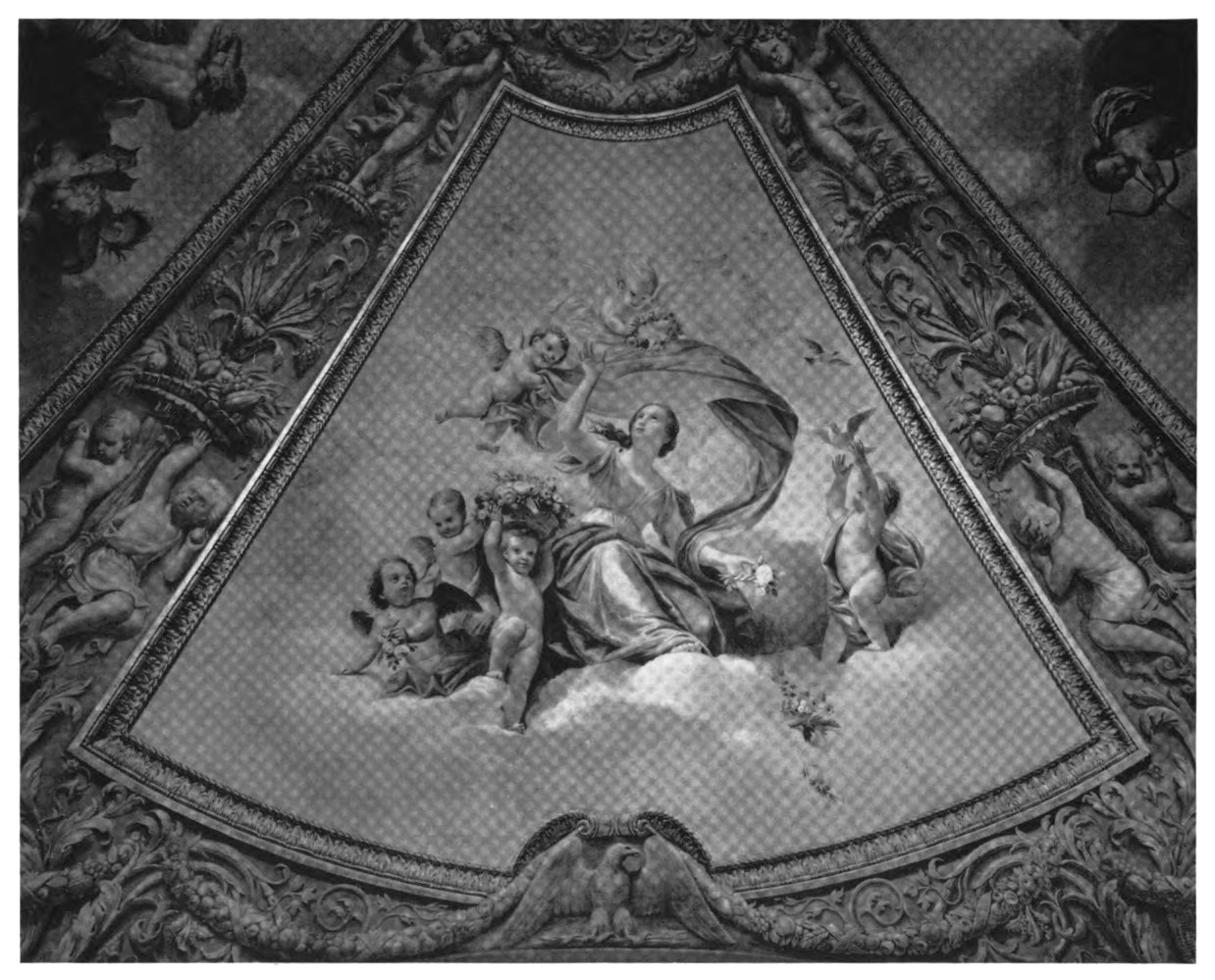
SPRING
One of four pleasing groups on the ceiling of the Old House Agriculture
Committee Room is this Brumidi conception of spring. The four seasons on
this ceiling make up Brumidi’s first fresco in the Capitol
Building—painted in 1855. What appear to be sculptured figures and
attached moldings surrounding the center panel in this picture are
actually painted decorative borders on a flat surface. It was probably
the tender hues of spring on this ceiling that led Congressman Curtis to
say in 1860, “What, sir, can be more beautiful than the fresco work in
the room of the Agriculture Committee?”
1857, to Captain Montgomery C. Meigs, Superintendent of Construction,
two days before the House met in its new “Hall of the House of
Representatives.” The letter protesting this contract follows:
“Dear Sir:
It will be news to you, I dare say, to learn that there is a party
organizing to effect your removal from the Superintendent of the
Capitol extension and I take leave to say to you that the wall
painting, ‘The Surrender of Cornwallis,’ is considered
inappropriate and the execution execrable, in view of all of which
I suggest to you to have the painting wiped out.
Your friend and supporter,
Officious”
Since Captain Meigs could not reply directly to “Officious” he gave vent
to his feelings by penning a note on the above letter. This note gives
among other things an idea of the speed with which Brumidi was able to
work under pressure. The note follows:
“One of many indications. The picture is as good as could be
painted in six weeks. It serves to show what the effect of painting
on the panels will be which is all I intended. It cost little and I
have not the least objections to a better painting being by
Congress put over it, but it is the best that could be done at the
time and no more time was at my immediate disposal.
M. C. M.”
In 1859 a Congressional Committee voiced a criticism which undoubtedly
refers also to the Cornwallis-Washington painting in the House Chamber.
They said,
“Far greater sobriety should be given to these Halls in their general
effect, so as to render them less distracting to the eye. Few are aware
how disturbing to thought the display of gaudy, inharmonious colors can
be made. This very quality renders such combination of colors unsuited
to halls of deliberation where calm thought and unimpassioned reason are
supposed to reside.”
Mr. Curtis of Pennsylvania rose again in the House of Representatives on
June 15, 1860, in defense of Brumidi’s art but with special reference to
the House fresco. Said he,
“I have heard with some regret appeals made to the prejudices of the
country in regard to the specimens of art taste displayed about this
Capitol; and I have been surprised that no one connected with this
Branch of service has risen upon the Floor to do justice to those who
have devoted their lives and energies to the embellishment of our public
buildings. What is more splendid than the fresco in some of the halls
and passages around the Senate Chamber and especially the emblem of
Religion in the President’s
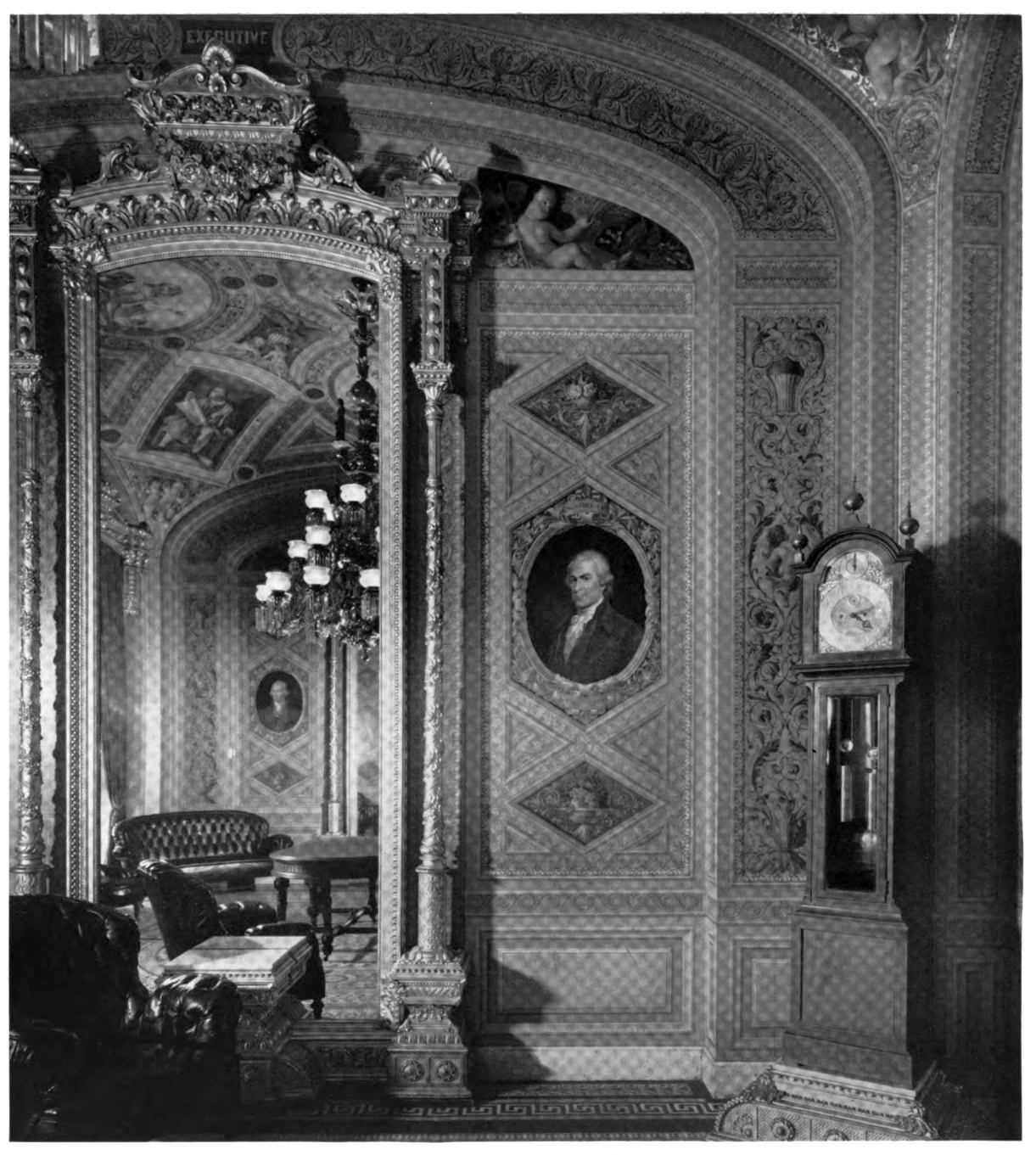
THE PRESIDENT’S ROOM
With its richness of design, its beauty and delicacy of color, the
President’s Room represents Brumidi’s supreme effort “to make beautiful
the Capitol” of the United States. Facing the portrait of Hamilton we
see reflected in the giant golden mirror the portrait of Samuel Osgood.
Reflected also are the ceiling frescoes of Vespucius and Religion and
the treasured mahogany table at which Abraham Lincoln and many other
Presidents have signed legislative bills. The mahogany clock at one time
had hands of gold until a souvenir hunter carried them home. Today all
sightseers get no further than a railing at the doorway.
Room? And in this Hall, where do you find room to criticize the
combination of colors which you see around you? It is easy to invent a
popular criticism and find fault; but I would like to see some of these
gentlemen who are so conversant with matters of taste and art as to
speak with the assurance of masters, bring forward some design, some
specimen from their superior genius that they would themselves insert in
place of that which they see around them.”
The decoration of the President’s Room in the Senate Annex is thought by
many to be Brumidi’s best work in the Capitol Building. Since the
President’s Room in the Capitol was to be set aside for the use of the
President of the United States at any time duty called the President to
the Capitol Building, it may well be supposed that Brumidi wanted that
room to be as beautiful as an artist could make it. He is said to have
spent more than five years on this room alone, but five years seem not
half long enough to create such beauty as is here displayed.
Five colorful ceiling-to-floor panels adorn the walls and in the center
of each hangs a portrait elegantly framed. The five members of
Washington’s first Cabinet are thus honored—Thomas Jefferson of
Virginia, Secretary of State; Edmund Randolph of Virginia, Attorney
General; Henry Knox of Massachusetts, Secretary of War; Alexander
Hamilton of New York, Secretary of the Treasury; and Samuel Osgood of
Massachusetts, Postmaster General. I say these portraits hang in the
panels. If you stood at the door looking hurriedly about the walls, as
most visitors must do at the President’s Room, you would think the
frames as real as the portraits. In truth, though, the beautifully
carved frames are painted on the walls as are the portraits. Mr. Fairman
calls these paintings, “Portraits of Distinction,” and so they are.
But it is the frescoed ceiling in the President’s Room that showers new
light and color and added beauty about the portraits on the walls. Four
symbolic groups on this ceiling look down from their large medallion
gold leaf frames—four life-size Madonnas, symbolizing Religion,
Legislation, Liberty, and Executive Authority—Madonnas of great beauty
and rare coloring. Then at each corner of this frescoed ceiling among
the symbolism and the cherubs are four life-size portraits, full length,
each chosen as representative of a force in civilization. Columbus
memorializes discovery; Vespucius, exploration; Brewster, religion; and
Franklin, history.
The portrait of George Washington, evidently done with Rembrandt Peale’s
Washington in mind, has a position all its own high above the portrait
of Thomas Jefferson. A portion of the Annual Report of Captain Meigs,
dated October 27, 1859, fixed the completion of the Brumidi frescoes in
the President’s Room. Said that report, “The painting of the President’s
Room in the North wing will be completed by the next meeting of
Congress.”
Even during the years that Brumidi created the beauty of the President’s
Room cruel words were hurled against his art. In 1858 a convention of
self-styled American artists assembled and drew up an estimate of their
own worth which they titled: “Memorial of the Artists of the United
States.” This petition of grievance presented to the Congress of the
United States carried the names of 127 individuals, chiefly from New
York, Boston, Philadelphia, and Baltimore with only eight from the
Capital City. Among the signatures were found the names of Rembrandt
Peale, W. D. Washington and Johannes A. Oertel, the latter being the
draughtsman who
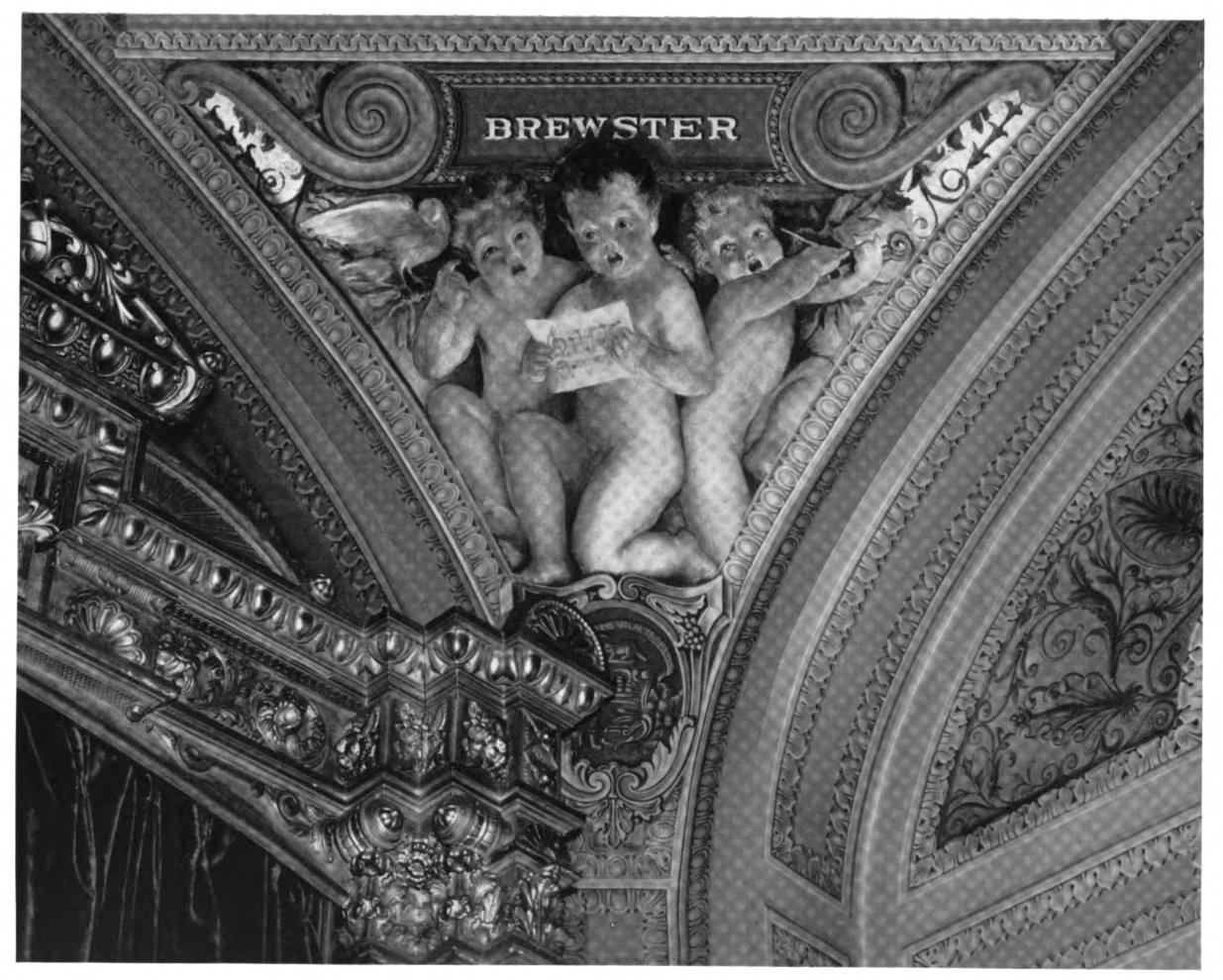
SINGING CHERUBS
These three cherubs occupy a position beneath the portrait of William
Brewster on the ceiling of the President’s Room comparable to that of
the cherub detail beneath the portrait of Benjamin Franklin on the same
ceiling. Since Brewster, as the religious leader of the Pilgrims and
elder of the Plymouth colony, typifies “Religion” in Brumidi’s over all
design in the President’s Room, the singing cherubs with their director,
violinist, dove attendant, and music script must be singing hosannas of
peace and devotion. (Cherubs in chapter tailpieces are from this
ceiling.)
challenged Brumidi’s right, in 1858, to paint the ceiling fresco in the
District of Columbia Committee Room of the Senate.
It is illuminating to know that 88 of the 127 names listed as artists in
the above Memorial do not even appear in the National Encyclopedia of
American Biography while among those that do appear, less than a dozen
are recognized today as artists of note.
The Artists’ Memorial began with these words, “Your memorialists appear
before your honorable bodies to solicit for American art that
consideration and encouragement to which they conceive it to be entitled
at the hands of the general government.” Then the Memorial asked that
Congress “establish an Art Commission composed of those designated by
the united voice of American artists as competent to the office, who
shall be accepted as the exponents of the authority and influence of
American art, who shall be the channels for the distribution of all
appropriations to be made by Congress for art purposes, and who shall
secure to artists an intelligent and unbiased adjudication upon the
designs they may present for the embellishment of our National
buildings.”
The House of Representatives referred the Artists’ Memorial to a select
committee of five. This Committee brought out Report No. 198, March 3,
1859. That Report not only sanctioned the establishment of the suggested
Art Commission to protect the “embellishment of National buildings” but
it voiced criticism by the Congressmen making up the select Committee of
five. Brumidi’s name was not mentioned in the Report but there is no
mistaking the artist to whom they referred. Said the Committee in this
Report:
“A plain coat or two of whitewash is better, in the opinion of this
committee, for a temporary finish than the tawdry and exuberant
ornamentation with which many of the rooms and passages are being
crowded.... An eagle and the National flag may be discovered
occasionally amidst the confusion of scroll work and mythological
figures presented to the eye; but the presence of conventional gods and
goddesses, with meaningless scrolls and arabesques, albeit they may be
wrapped in the red, white and blue, will never suggest to the American,
as he wanders among the halls and committee rooms, any idea to touch his
heart or to inspire his patriotism.... Should he seek an explanation
from those who are manufacturing the cumbrous levities which everywhere
appear through the building he will be eminently fortunate should he
find among them one who speaks the English language.”
The real fight of the petitioners was evidently against the employment
of a foreign artist. However, this was not expressed openly in the
Memorial but the select committee of
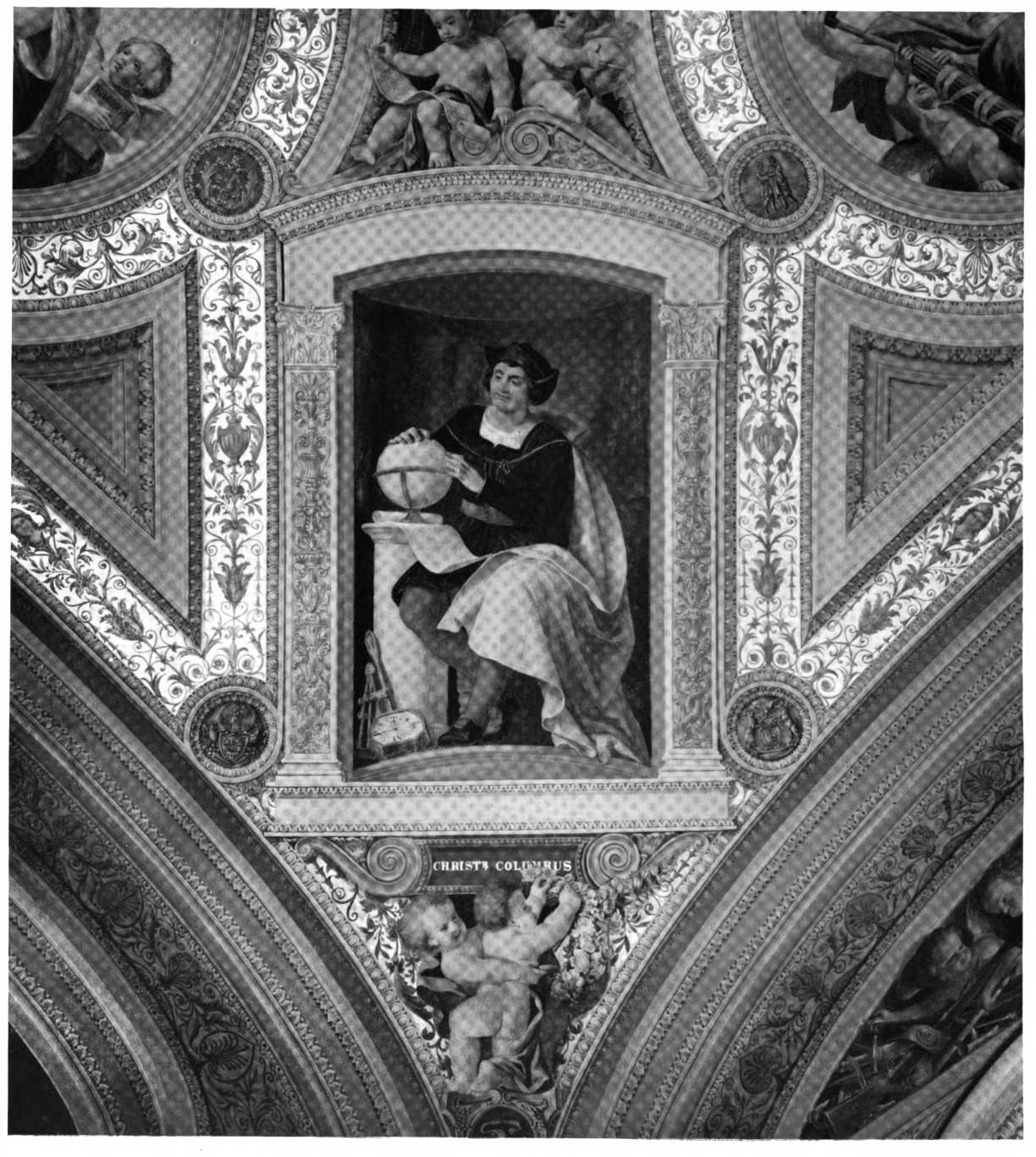
DISCOVERY
The theme of Brumidi’s ceiling fresco in the President’s Room, as
portrayed by Christopher Columbus, is that of “Discovery.” This subject
is intensified by use of the globe and map in the cherub detail above
the portrait. At upper left is a segment of the medallion, “Executive
Authority,” and at the right a portion of another medallion, “Liberty.”
The four small decorative medallions at the portrait corners are State
seals. At the upper left is Vermont; at upper right, Kentucky; lower
left, Arkansas, and lower right, Michigan.
five from the House of Representatives made the open accusation. Said
they in their Report, “The Committee have not been informed that
American artists have been engaged upon the embellishment of the
Capitol, but they have been made painfully conscious that the work has
been prosecuted by foreign workmen under the immediate supervision of a
foreigner. As a consequence the Committee find nothing in the design and
execution of the ornamental work of the Capitol, thus far, which
represents our own country, or the genius and taste of her artists.”
This unjust criticism of Brumidi found expression in the New York Daily
Tribune for May 17, 1858, through that paper’s Washington correspondent.
The New York attack on the artist, however, was answered in the Tribune
for May 31, 1858, by Guglielmo Gajani, a friend of Brumidi’s. Extracts
of this defense of Brumidi follow:
To the Editor of the New York Tribune:
I have lately been at Washington and derived much pleasure from
visiting the National Capital and its splendid buildings and works
of art. I admired them and was much pleased with the frescoes and
decorations of my fellow citizen Signor Constantino Brumidi. But on
my return to New York my attention was directed to a correspondence
of the Tribune (May 17) and to other attacks made against that
artist and his works at the Capitol.
I knew him in Rome, where he was much esteemed and has left
excellent specimens of his artistic skill. I can hardly believe
that ten years of exile could have so entirely destroyed his
capacity or impaired my judgment. Had the attack been confined to
the ground that artists or workmen of foreign birth who are
satisfied with a small compensation should be excluded from the
Capitol in order to have the work done exclusively by natives well
paid, I would have nothing to say for I keep off entirely from your
administrative questions and politics. But on the ground of art and
taste a Roman might be allowed to express an opinion quite
different from that of your own correspondent and his friends.
Fresco painting represents in art what improvisation is in poetry.
The artist must execute his work upon a fresh wall, tracing the
outlines by a steel point and using mineral colors which are
instantly absorbed and do not show their effect until the wall
dries. The artist, therefore, must work with great rapidity and has
no opportunity for corrections. It does not require a greater
capacity than the ordinary painting with oil or water colors on a
dry wall, but the artist must have a peculiar disposition, and this
the Italian possesses to a greater degree than others.
Michelangelo had never practiced fresco painting when Bramante
procured him the commission to paint the ceiling of the Sistine
Chapel with a view to ruin his reputation. Michelangelo called from
Florence his former schoolmate, Granacci, and other fresco
painters, to teach him the art. He was much perplexed at the
beginning but afterward declared it the best style of painting. I
believe that your best painters, by exerting themselves and gaining
experience, might have succeeded in doing the work accomplished by
Brumidi, but it would have required a long time and an enormous
expenditure.
It is a fact that in France, in England, in Belgium, in Italy and
everywhere public buildings have been decorated by competent
artists, you meet the same style and symbols, allegories and
classical memories occasionally adopted by Signor Brumidi. Before
condemning him you must find fault with all the best painters who
preceded him, and especially with Michelangelo and Raphael who
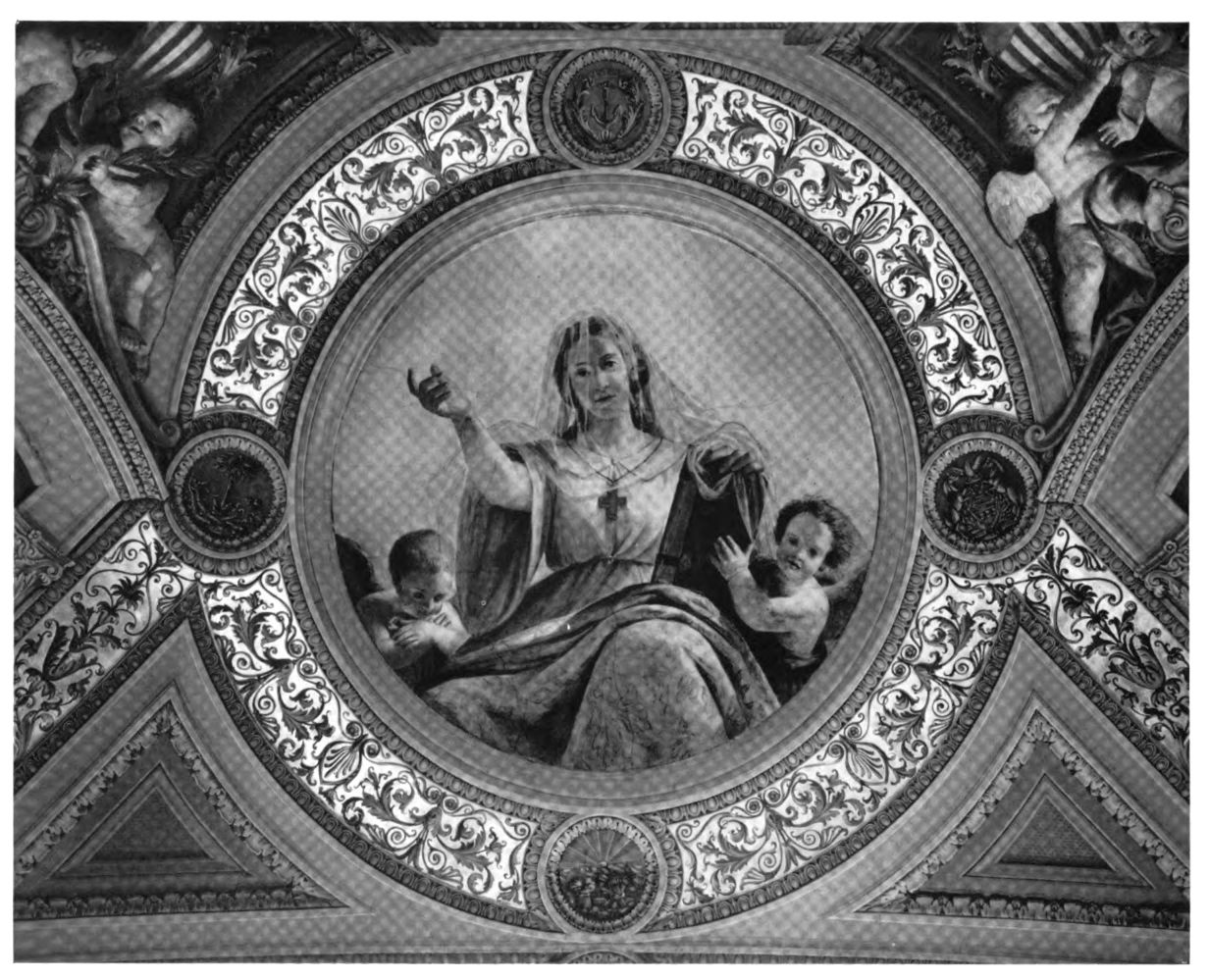
RELIGION
Four Brumidi Madonnas on the frescoed ceiling of the President’s Room
are of great interest to visitors. The most lasting impression, however,
is made by “Religion.” The story is often repeated that Brumidi painted
“Religion” with an “all-seeing eye of God” which will follow any
individual from place to place inside the room. The “connections of the
pieces of plaster” which help to identify real fresco are easily
discernible in this medallion background. The color beauty of “Religion”
is illustrated by “Legislation” in this book’s color section.
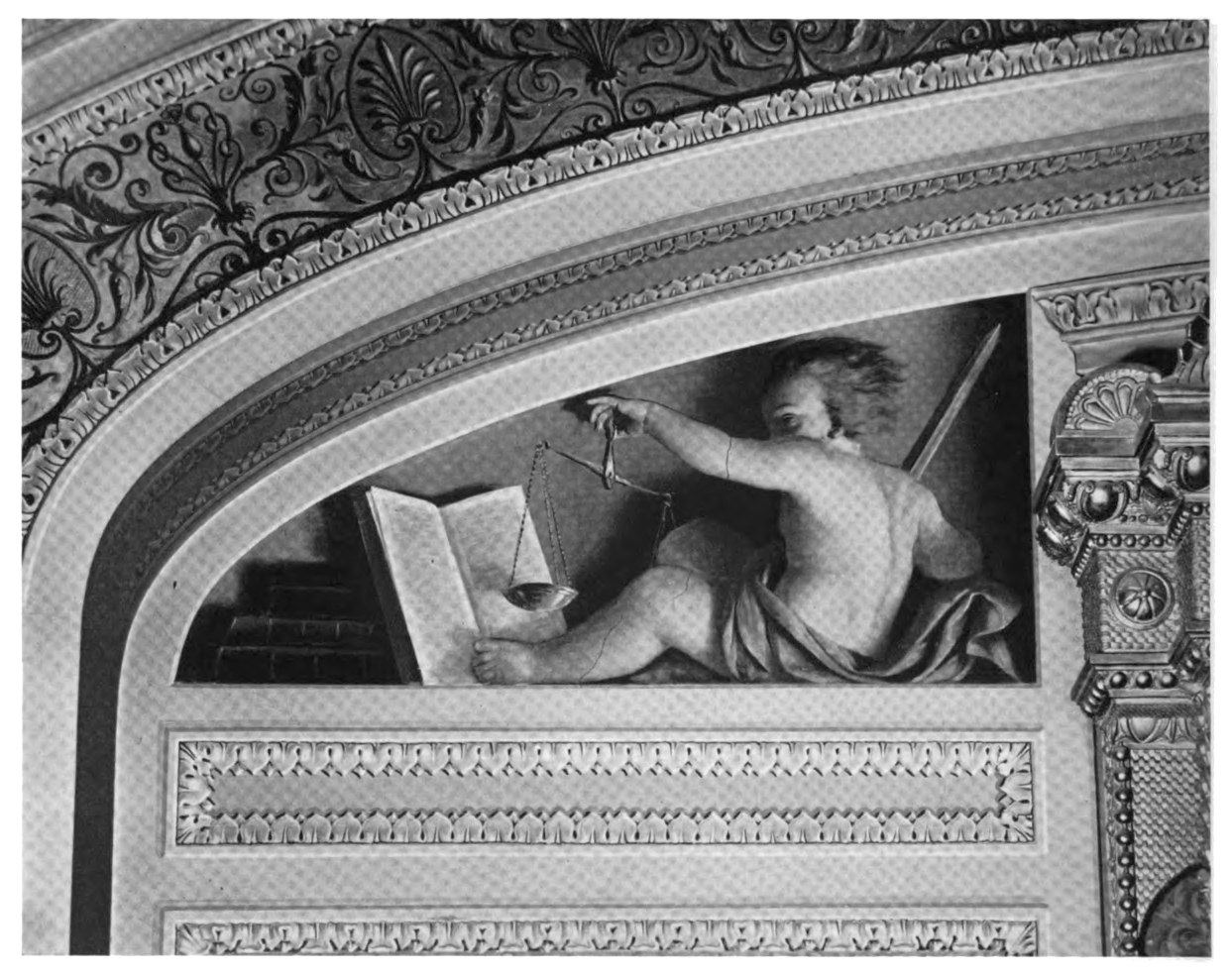
THE CHERUB OF JUSTICE
Well balanced scales and a sword seem to be necessary attributes of
Brumidi’s conception of “Executive Authority” in the President’s Room.
The Cherub of Justice and the many other cherubs used so generously in
the artist’s Capitol frescoes are favorites with art enthusiasts. All
designs and deceptive moldings shown above are painted in oil on dry
plaster. The corner of a tall elaborate mirror frame shows at the
right.
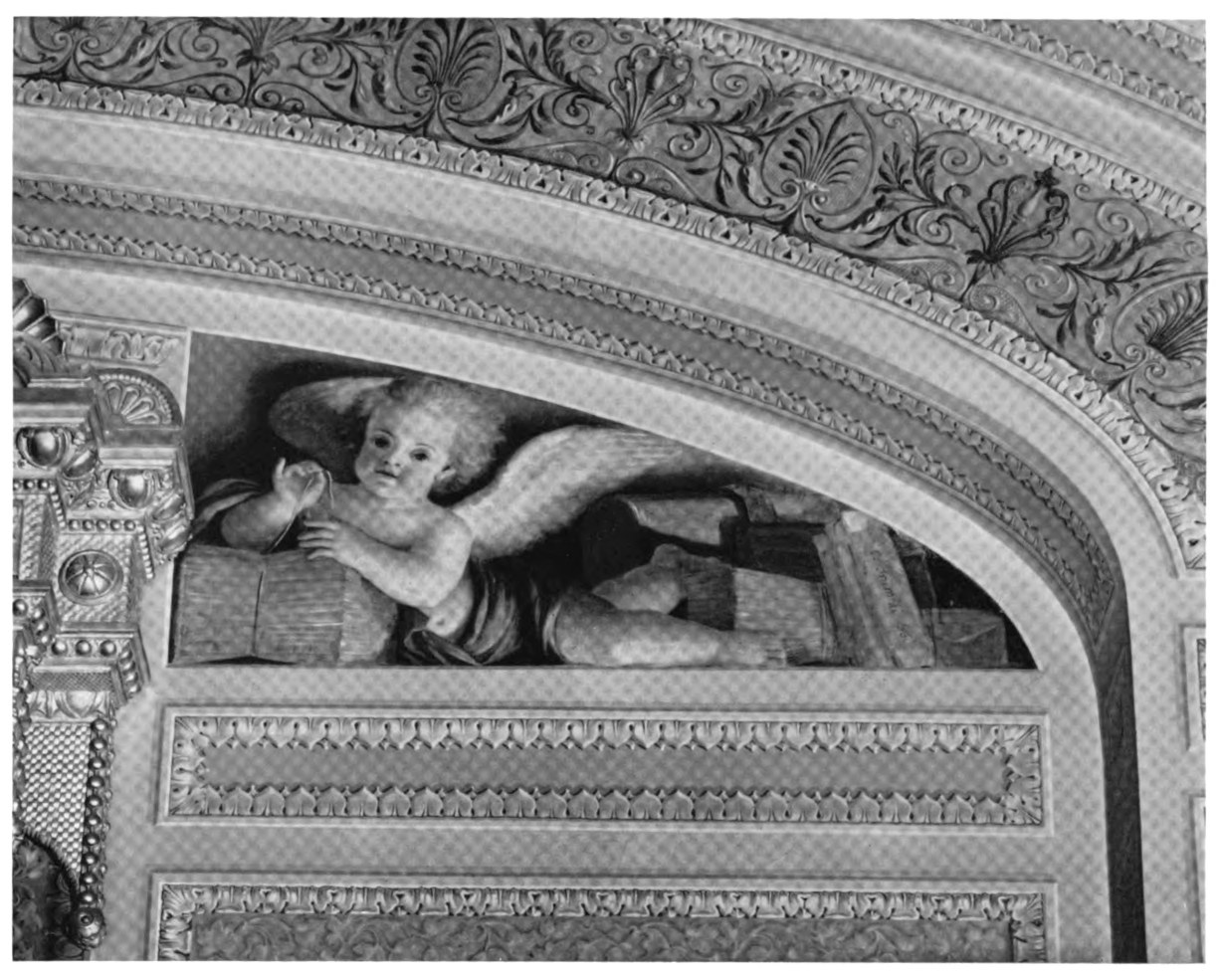
THE WINGED CHERUB
Resting midst bundles of papers, bills, and Congressional debates, the
Winged Cherub suggests another Brumidi theme, “Legislation,” on the
walls of the President’s Room. The signature “C. Brumidi, 1860,” can be
identified on the packet of State papers at the feet of this cherub. The
two cherubs on these pages fill decorative niches high on the walls on
either side of a huge, ceiling-to-floor, gold-framed mirror.
introduced that style of fresco in the Vatican itself.... It is
absurd, therefore, to despise the works of Signor Brumidi because
“they look foreign and betray the Italian element,” that is to say,
because they are classical in the subject and artistic in the
execution.
I confess that my national feelings were a little wounded when I
saw vituperated to some extent in Washington an artist much
esteemed in Rome. Music and the fine arts are all that remain of
our former greatness, and we are naturally jealous of this glory.
Besides, I am convinced that Signor Brumidi is a good artist and an
excellent fresco painter. He has studied long in Rome, even from
his boyhood, and visited for instruction all the most important
schools of art in Italy. Baron Camucini was his master in painting,
and the great Thorwaldsen taught him sculpture. In both arts Signor
Brumidi has left several specimens of his skill in Rome. For
instance, he was employed during eleven years in making frescoes
and decorations of the villa and of the palace of Prince Torlonia
in Rome. These works are admired by visitors. Should an American
admire the works of Signor Brumidi at home and despise them when he
finds them at Washington?
Signor Brumidi was also employed by the Government in Rome,
together with other distinguished artists, to prepare the
chronology of the Popes, in the new Basilica of St. Paul, and was
allowed to finish his work after the revolution, notwithstanding
that he was persecuted for the part which he took in that movement.
The Republican Government of Rome honored Signor Brumidi with an
important commission as he was much esteemed for his talent and
personal qualities. I am glad, myself, that he has already executed
some works at the Capitol. They speak for themselves to those who
have taste for the fine arts.
Guglielmo Gajani
In the Architect’s Report for 1859 we find this reference to the
detrimental influence of the Artist’s Memorial:
“The action of Congress in restricting the expenditure for painting and
sculpture to the completion of the painting of rooms in the North Wing
already partly done ... and to such paintings and sculpture as shall
have been approved, first, by a committee of three American artists, to
be appointed by the President and then by the Library Committee of
Congress, has prevented the commencement of any new works.”
It seems certain, however, that Brumidi was not often continuously
employed on any one picture. As shown by his vouchers, if work was held
up in one direction he could easily employ himself in another. For
example, he began work in the Senate Library in 1858 and the Architect
of the Capitol records

ALEXANDER HAMILTON
This portrait of Alexander Hamilton is one of the five color
representations of Washington’s Cabinet, painted by Brumidi on the walls
of the President’s Room. The color and design of the frame and panel are
equally as beautiful as those surrounding the portrait of Jefferson in
the color section of this book. The portrait of George Washington high
above those of his Cabinet evidently was done with that of Rembrandt
Peale in mind. All others are thought to be Brumidi’s own
conceptions.
the finish of the Senate Library ceiling in 1875. But during those years
the 4,664 square feet of fresco in the Canopy of the Dome was finished
as well as the President’s Room and many committee room frescoes and
hall decorations in the Senate Annex. References in Reports and letters
usually give the finishing date of the fresco while the beginning date
is seldom mentioned.
The huge fresco on the canopy of the Dome of the Capitol Building is
signed “C. Brumidi, 1865.” In the Annual Report dated November 1, 1863,
of Thomas Walter, Architect of the Capitol (1851-1865), we find this
reference to the Dome canopy:
“The cartoons for the picture on the canopy over the eye of the inner
dome are being prepared, and its execution will be commenced as soon as
the iron work which is to receive it can be put in place.”
Certain letters in the National Archives between Brumidi and United
States officials shed interesting light on the 1862 negotiations
relative to the Dome Canopy. Extracts from these letters follow:
From Tho. U. Walter, “architect of extension and new Dome,” to
Constantino Brumidi, August 18, 1862: “It is intended to have a picture
65 ft. in diameter painted in fresco on the concave canopy over the eye
of the New Dome. I would thank you to furnish me with a design for the
said picture at your earliest convenience.... You will also submit with
the design an estimate of the cost of executing it in real fresco
painted on the fresh mortar.”
From Constantino Brumidi to Tho. U. Walter, September 8, 1862. “...I
herewith submit to you my design for the fresco picture to be painted on
the Canopy of the New Dome of the United States Capitol. The six groups
around the border represent, as you will see, War, Science, Navigation,
Commerce, Manufacture and Agriculture. The leading figures will measure
some 15 feet. In the center is an apotheosis of Washington surrounded by
allegorical figures of eminent men of the times of Washington, which
latter will be likenesses.
“As this picture will be seen at a height of 180 ft. the painting must
be of the most decided character possible. It will cover 4664 sq. ft.
and will be worth $50,000 to execute it including the necessary cartoons
and every expense pertaining to the painting.”
From Tho. U. Walter to Constantino Brumidi, December 24, 1862. “Your
letter of the 8th of September was duly received, together with your
design for the proposed picture in fresco, for the canopy over the eye
of the New Dome of the United States Capitol. The design meets my entire
approval. It has also the approval of Major B. B. French, the
Commissioner of Public Buildings. I sent it to the residence of the Hon.
Caleb B. Smith, the Secretary of the Interior, where it has been for
several weeks. Mr. Smith also expresses himself entirely satisfied with
the design. I am therefore free to give it my official approval with but
one condition and that is that you will consent to execute it at a
greatly reduced cost.
“I am aware, as you have expressed to me in conversation that there is
no picture in the world that will compare with this in magnitude and in
difficulty of execution, being painted on a concave surface, and I am
also aware that it covers about eight times more surface than Mr.
Lentze’s picture which cost $20,000. But in view of the exigencies of
the times I do not consider that we would be justified in expending so
large a sum as $50,000.
“Should you execute this work it will be the great work of your life: it
will therefore be worth on your part some sacrifice to accomplish so
great an achievement....”
From Constantino Brumidi to Tho. U. Walter, December 27, 1862: “...I
have come to the conclusion to expedite a settlement as to the price of
the painting to be executed on the canopy over the eye of the Dome of
the United States Capitol by reducing my offer to $40,000, which is
lower, considering the subject, the curved form of the surface on which
it is to be painted and the square feet of painting it contains than any
real fresco picture ever painted....”
From Tho. U. Walter to B. B. French, “Distributing Agent of United
States Capitol,” December 29, 1862: “...I consider the price ($40,000)
exceedingly low in view of the fact that it contains 4664 square feet,
that it is all to be painted on a curved surface, and that Mr. Brumidi
is the only real fresco painter in this country capable of executing the
work. The design is probably the grandest and most imposing that has
ever been executed in the world and Mr. Brumidi has proved by his real
frescoes in the Capitol extension (all of which were painted by his own
hand) that he is fully equal to the task. The grandeur of this picture,
the great distance at which it will be seen, and the peculiarity of its
light will render it intensely imposing.”
From B. B. French to Tho. U. Walter, January 5, 1863: “...as there is
confessedly no artist in the United States, capable of executing a real
fresco painting as it should be done, especially so important a work as
the one in contemplation, except Mr. Brumidi, and, as we know from
experience his excellence in that art, I do not see how we can do
otherwise than employ him....”
From Tho. U. Walter to Constantino Brumidi, March 11, 1863. “...I have
the honor to inform you that your design for painting the Canopy over
the eye of the aforesaid new Dome is adopted. And, inasmuch as Congress
has made the appropriation for the completion of that work you are
hereby authorized to proceed at once with the aforesaid canopy
painting....”
Two letters, one from the Department of the Interior to the Capitol
Dispensing Agent and the other from the Architect of the Capitol to the
Department of the Interior should be quoted at this time as they verify
amounts paid the artist and the length of time used in the actual
painting of the Dome canopy.
From J. P. Usher, Secretary of Interior, dated Nov. 6, 1863.
“...$10,000, one fourth the entire cost of the work (for painting the
canopy over the eye of the new dome of the Capitol in real fresco), has
already been paid to Mr. Brumidi. I am of the opinion that the progress
which has been made does not justify any further payments at present.
You will therefore suspend any advances to Mr. Brumidi until further
orders.”
From Thomas U. Walter, Architect U. S. Capitol, dated December 3, 1864.
“As the canopy for the picture over the eye of the new dome is ready for
Mr. Brumidi and as he is now about to commence to work, I deem it proper
to say that he has not received any payment on account of his contract
since November 6, 1863, and that in the interim he has been occupied in
perfecting the full-size cartoons, which are now ready for the work. I,
therefore, respectfully recommend that payments to him be resumed in
accordance with his contract and that they be continued as the work
progresses until he shall have received the aggregate sum of $30,000,
after which no further payments to be made until the work is completed
and approved.”
In the Annual Report dated November 1, 1865, of Edward Clark, Architect
of the Capitol (1865-1902), we find reference to the completion of the
canopy:
“The picture over the eye of the Dome is all painted in, but the artist
is unwilling to have the scaffolding removed until the plastering is
thoroughly dry and the picture toned. As it will at times be viewed by
gas light, he wishes to have the opportunity of trying it by this light
before dismissing it from his hands.”
The following report by Edward Clark written in longhand to the
Secretary of the Interior and dated November 1, 1866, is preserved in
the National Archives:
“The fresco picture over the eye of the Dome has been exposed to view by
taking away the scaffolding. It is not, however, finished as the artist
intends to soften down the harshness at the joinings of the plastering.
He was under the impression that these imperfections would disappear
when the surface became dry. He holds himself in readiness to do the
proper toning and blending whenever the scaffolding is in place for the
painting of vault of the Rotunda.
“I would call attention to the necessity of ornamenting the ‘Belt’
between the second and third cornices of the Rotunda. The original
intention was to enrich this member in basso-relievo, but it is deemed
advisable to have it painted in fresco in imitation of basso-relievo.
Mr. Brumidi has submitted a design for its embellishment in this manner
consisting of a series of natural pictures arranged in a chronological
order. It is hoped this subject may receive attention, and that his
design may be adapted or modified or other designs invited for this
decoration from artists of acknowledged merit.”
Brumidi was sixty years old at the completion of this Dome Canopy. He
had made 4,664 square feet of fresco in eleven months’ time on the inner
surface of the Capitol’s Dome. This Canopy is 65 feet in diameter, has a
concavity of 21 feet and displays its heroic figures as life-size from
the floor of the Rotunda, 180 feet below.
The artist called this painting on the Dome canopy “The Apotheosis of
Washington.” The outstanding figure is that of our first President
attended by Liberty and Victory. Circling the center of the canopy are
thirteen female figures in draperies of pastel beauty, bearing a
ribbon-like banner which displays our treasured motto, “E Pluribus
Unum.” The colors increase in brilliance and depth toward the outer
borders of the canopy, blending finally into the intense hues of the six
heroic groups about the base.
In these groups we find Minerva, Goddess of Arts and Sciences, as the
center of her allegorical group; Ceres, of Agriculture; Mercury,
messenger of the Gods, symbolizing Commerce; Vulcan, the God of
Mechanics; Neptune, God of the Marine, and Armed Liberty with shield and
sword, symbolizing War.
S. D. Wyeth says, “The fresco of Brumidi (on the canopy of the Dome)
arrests the gaze as though the sky had opened and it were permitted to
look into the beyond.” Wyeth, later, in referring to the same Dome
canopy described it in this way: “Clouds of gold, azure and rose seem
hanging there spanned by a rainbow, and, floating among them, forms of
exquisite beauty. Grand mythological figures, symbolizing Force and
Progress, appear there too, titanic, majestic—almost appalling with
their great significance.”
A letter from Architect Clark to Artist Brumidi, dated September 18,
1865, should be quoted in order to appreciate Brumidi’s reply one day
later:
“I learned in an interview with the Honorable Secretary of the Interior,
this morning, that he was very anxious to have the picture over the eye
of the Dome finished if possible by the meeting of Congress.
“You informed me when I first saw the work in relation to your July
bill, that it was your intention to get it done by that time, and I was
surprised to hear from you on Saturday morning last, that this was not
likely to be done. You stated that you were unwilling to have the
scaffoldings taken away before you had the advantage of trying it by gas
light. In this you are certainly right, and I have to inform you that
arrangements can be made to give you light whenever you need it.
“Please reply as to when it is likely you will have the picture done.”
Brumidi’s reply in which he tells of the final touches to this huge
fresco is still preserved. In this letter the old artist’s concern for
the proper finishing and lighting of his masterpiece is uppermost in his
thought. The letter follows:
Washington, Sept. 19, 1865
Mr. Clark, Architect of the
Capitol Extension
Dear Sir:
Your letter of yesterday was received and you will do a great favor
to me in referring to the Honorable Secretary of Interior, that
about my painting in the Canopy of the Dome, I am working at
present the last group, and for the next week I have finish to put
in color every figure upon the fresh mortar.
That remains to do for the completion of it will require only five
or six weeks, but must do it in the proper time, when the mortar
will be perfectly dry, and the colors do not have any more
changement.
This last work will cover the connections of the pieces of plaster,
put up in sections at every day, and giving more union to the
colors at the said junctions for to obtain the artistic effect.
It is the general rule in doing this kind of work to avoid the damp
atmosphere of the winter season, but I will do this last finish as
soon as the weather will permit, early in the spring, as always I
have done in every other painting in real fresco in the Capitol and
everywhere.
Also would be inadvisable to show that large painting without the
proper light, because the windows of the dome are in the rear part
of the painting and must be placed the reflectors already
calculated in the Capitol’s original plan.
I hope when the appropriation will be passed by the Congress the
said reflectors, and the gas apparatus will be completed, and I
will be ready for my part.
I am always at work but I ask only the bill of August last, and you
can assure the Honorable Secretary of the Interior that I never
will claim any other bill after this, till my work will be entirely
completed.
With respect I am
Your Obedient Servant
C. Brumidi
Apparently negotiations with Brumidi for painting the Dome fresco began
with the letter from Tho. U. Walter, “architect of extension and new
Dome,” dated August 18, 1862. Brumidi was authorized to proceed on March
11, 1863. On December 3, 1864, Tho. U. Walter wrote that the canopy for
the picture over the eye of the Dome was ready for the artist and that
Mr. Brumidi was “about to commence to work.” On November 1, 1865, Edward
Clark, Architect of the Capitol, reported that the picture over the eye
of the Dome was all painted in but that Mr. Brumidi was unwilling to
have the scaffolding removed until the plastering was thoroughly dry and
the colors had no more “changement.”
On January 9, 1866, Edward Clark wrote the following letter to James
Harlan, Secretary of the Interior:
“I have the honor to state that we are now making preparations to take
down the scaffolding over the eye of the Dome to reveal Brumidi’s
picture. It becomes necessary to have some canvas, or other strong
material to place under the scaffolding to catch the dirt, etc., that
would otherwise fall to the floor of the Rotunda which might cause
inconvenience, perhaps accident.
“It is possible that some old sails might be borrowed from the Navy Yard
for that purpose, and I therefore respectfully ask that you make a
request to the Hon. Secretary of the Navy for the loan of such as may be
necessary for this purpose which will be returned as soon as this work
is done.”
On the walls of the Senate Military Committee Room—now one of the
Committee Rooms on Senate Appropriations—are to be found five large
frescoes, lunettes in shape, depicting scenes from American history.
These pictures are filled with action and American atmosphere and could
have been painted only by a lover of American liberty. The artist gave
these titles to his five American lunettes: “Boston Massacre,” “Battle
of Lexington,” “Death of General Wooster,” “Storming of Stony Point,”
and “Washington at Valley Forge.”
The frescoed ceiling in this Senate Committee Room is conventional in
design with victors’ wreaths, shields and other emblems of war
predominating. Here we have such outstanding color combinations as to
lead many Brumidi enthusiasts to vote this ceiling the Capitol’s best.
In this room also are six outstanding panels, rich in color and
different in design, displaying American arms of different periods.
Never were guns, pistols, sabers, tomahawks, and flintlock rifles
displayed with so much beauty and elegance—and the sword across the
shield in the center is said to be a copy of one owned by Washington.
(Keim attributes these panels to another Capitol artist.)
The north room used by the Senate Committee on Appropriations was
decorated for the old Senate Committee on Naval Affairs. The design is
that of a Pompeian fresco with marine gods and goddesses scattered about
the ceiling and with ancient porticoes and antique vessels adorning the
walls. Nine panels in oil with symbolic womanly figures in flowing robes
against dark blue backgrounds to represent various attributes of the
Navy finish the wall decorations.
On February 24, 1880, Senator Voorhees of Indiana referred to the
Brumidi decorations of these two rooms in these words:
“Almost every committee-room announces to the eye by historical or
allegorical paintings in fresco the duties to which it is dedicated. Who
ever passed through the room of the Committee on Military Affairs
without feeling that the very genius of heroism had left there its
immortal inspirations? Who would mistake in after ages the use to which
the room for the Committee on Naval Affairs had been devoted? The
painter has told the whole story in a silent but in an undying
language.”
An 1858 newspaper tells that the following statement was posted that
year in the Senate Committee Room on Naval Affairs for the “edification
of visitors”:
“Senate Committee on Naval Affairs—The decorative paintings of this
room are a specimen of the manner in which the ancient Greeks and Romans
ornamented their splendid buildings, some of which are still extant in
the precious monuments of Pompeii and the baths of Titus. America with
the sea divinities are painted on the ceiling in real fresco. These
mythological figures are delineated agreeably to the poetical
descriptions we have received of them, and they are Neptune, the god of
the seas, Amphitrite, his wife, Aeolus keeping the winds chained to the
rocks, Venus the daughter of the Sea, Oceanus with crampfish claws on
his head, Thetis, his wife, and Nereus, the father of the Nereids, drawn
by Glacus, and the Tritons by marine horses or swans, or else mounted as
sea-monsters.”
Brumidi decorated also the reception room of the Senate where
constituents may still call upon their Senators—and admire the ceiling
frescoes of the old artist. This room has a vaulted ceiling with two
arches. The circular arch has a frescoed center of children and clouds
with allegorical groupings about the center designed to represent
Prudence, Justice, Temperance and Strength portrayed as beautiful
madonnas with pink cheeked children. Four allegorical scenes in the
groined arch hold forth Liberty, Plenty, War, and Peace, in the purity
of other madonna-like groupings.
The walls of the Senate Reception Room have many empty and unfinished
panels but the “elaborate ornaments and gilded mouldings around them”
lend their own beauty to this room. The outstanding Brumidi work in the
Senate Reception Room is a large centerpiece in oil on the south wall
showing George Washington in consultation with Thomas Jefferson and
Alexander Hamilton. At either side, according to Brumidi, are
“decorative figures in light and shade (chiaroscuro).” The old voucher
of 1873, signed by Brumidi, and indicating the sum paid for this mural
in the Senate Reception Room, follows:
“For approximate estimate for painting portraits of Washington,
Jefferson and Hamilton on the walls of the Senate Reception
Room—$500.00.”
Two of the Brumidi letters written in 1871 not only date the frescoes in
the Senate Reception Room and those in the Military Committee Room of
the Senate already described, but also name a lump sum paid the artist
for at least a part of this work. These two letters written to the
Architect of the Capitol Building and dated 1871 follow:
“In reply to your request about the completion of the decorative
figures in light and shade (chiaroscuro) at the three panels in the
reception room of the Senate according to that already painted in
the last year.
“Also for three more panels in the walls of the Senate Military
Committee room in real fresco with three battles of the American
Revolution, and many other small paintings above a door and at the
ceiling, for the completion of the ibid room, for the sum of
$5,300.”
C. Brumidi
New York City
“I read in the Herald the adjournment of the Congress and an extra
session of the Senate will meet again for the tenth of May.
“I think that in this present temporary recess, will be the time to
give orders to the plasterer to finish the panels in the Reception
Room, as the oil work will require the wall to be perfectly dry,
and of course three or four weeks. Every plasterer can do it smooth
like the others already painted.
“I am in attendance of your answer about it, and some information
of Senator Wilson’s decision on the subject, for the fresco of this
room, to prepare some sketch and cartoons.
“I am at work in St. Stephen’s Church and I wish to proceed with it
till you will call me for work in the Senate or if you think
necessary an excursion to fix this preparatory work or directions
to the plasterer.”
C. Brumidi
The 1871 letter quoted above, written from New York, is the only
reference in a Brumidi letter of the Brumidi file in the Architect’s
office to any painting of Brumidi’s outside of Washington. It seems to
have been proven, though, beyond a doubt that The Crucifixion in St.
Stephen’s Church in New York is one of at least four such sacred
paintings. The picture of Saint Peter and Saint Paul was painted in
the Philadelphia Cathedral; The Holy Trinity was done in the Cathedral
at Mexico City, and The First Communion of Saint Aloysius was placed
above the altar in the old Saint Aloysius Church in Washington.
A study of the Saint Aloysius mural brought to light a letter written by
Brumidi in Italian to Father Sestini of Georgetown University back in
1855. Father Sestini is said to have been such a close friend of
Brumidi’s that the artist included the Father in his fresco of St.
Aloysius. This letter to Father Sestini, translated by Father Geib of
Georgetown University, is reproduced in its entirety, it being the only
communication found from Brumidi to a Father in the Catholic Church. The
letter to Father Sestini follows:
November 11, 1855
“I was displeased at not having been in my studios when you came to
talk to me about the painting to be done in Baltimore. Concerning
this, I shall be interested to know whether the Church has a flat
ceiling, since in that case the painting could be easily executed
on canvas, and later on, be placed against the said ceiling; this
being the only way I can actually do anything in the service of the
Society (of Jesus), since my contracted engagements for the Capitol
do not let me move away from Washington, having also to offer my
assistance to other artists of decorative painting and fresco, who
work under my direction.
“If, therefore, there would be room for a picture (frame), as large
as might be its size to be placed in the said way, I could paint it
in tempera and produce the same appearance of a fresco. This is all
I can promise in the circumstances in which now I am, and you would
not attribute the objections already expressed to a lack of good
will. Meanwhile, I profess myself entirely obliged for the favors I
have at all times received from the Society (of Jesus).
“I repeat myself respectfully your most obliged servant,
Constantino Brumidi”
A certain anonymous letter from the Brumidi file in the Architect’s
office at the Capitol should be quoted at this time. It was written on
April 8, 1857, addressed to Mr. Walter, Architect of the Capitol, and
shows Brumidi the target for more criticism. This crude and biased
letter is quoted in full:
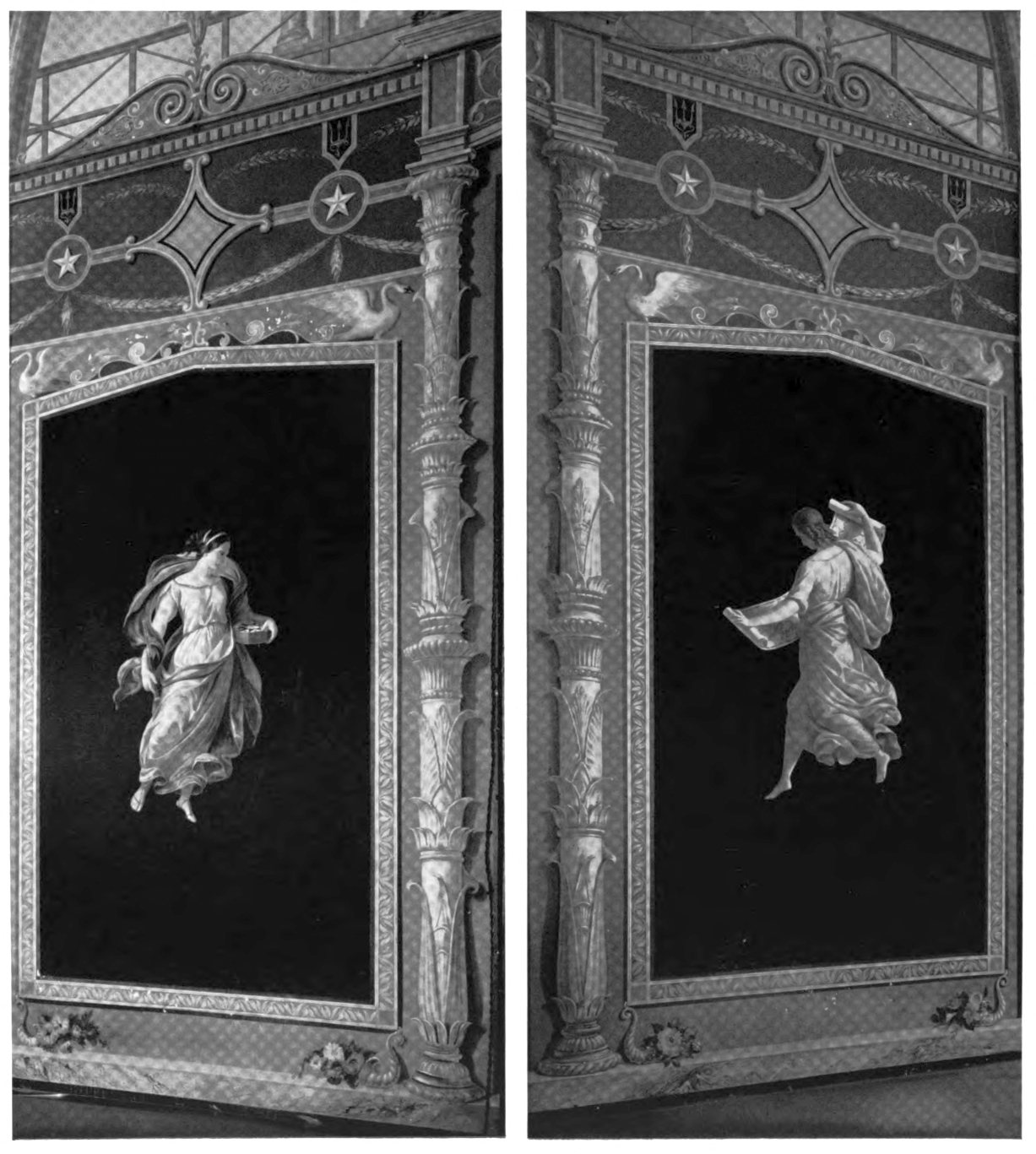
MAIDENS OF THE NAVY
The unrolled map of ocean shoreline, the compass, and the telescope
carried by the Maidens of the Navy, advance the naval theme in the old
Senate Committee Room on Naval Affairs. Seven other such panels of
exquisite design and color complete the wall decorations of this room.
The simulated pillars with seaweed carvings and pearl ornaments are as
deceptive as the sea shell cornucopias on the ledge at the pillars’
base. All are painted in oil on a flat surface of dry plaster.
“The protegé and a kind of informer of Cap’t. Meigs, an Italian painter,
Brumidi, paid $6 daily by Government, did three pictures for the
churches of New York and in Georgetown and for which he received a good
pay in hours and during the time which he had no right to dispose of....
His friend is paid too for the thing that he does not understand nor he
attends to, yet all this is allowed and tolerated. What do you say about
it? Shall we make public notice in papers or will you attend to it?”
Brumidi painted four large, bronze-colored medallions on the walls of
this room, each medallion recording the profile of a noted chairman of
the Foreign Relations Committee.
On the north wall is Henry Clay of Kentucky who served the Committee as
chairman from 1834 to 1836. On the south wall is William S. Allen of
Ohio, Committee chairman from 1845 to 1846. The east wall portrays Simon
E. Cameron of Pennsylvania, who was chairman from 1871 to 1877, while on
the west wall is Charles W. Sumner of Massachusetts, chairman from 1861
to 1871.
The voucher paying Brumidi for this work, dated June 21, 1874, reads as
follows:
“For painting four medallion portraits in the Committee Room of Foreign
Affairs, United States Senate, @ $50 each—$200.”
Two of these Senate Annex rooms, the District of Columbia Committee
Rooms, have unusual frescoed ceilings—that of the larger room being
equal in workmanship to that of the President’s Room. Since this large
Committee Room was originally set apart as a Senate Library the
groupings were chosen with that in mind, for there the artist has
represented Geography, History, Physics, and Telegraph. In each group is
the Brumidi Madonna and the artist’s distinctive cherubs. The walls of
this room were never finished but the ceiling colors are as brilliant
today as though painted yesterday.
In the files of the Architect of the Capitol is to be found a collection
of original Brumidi letters. Among these are two referring to the
Library decorations, both written in 1858—one by a draughtsman,
Johannes Oertel, to Mr. Brumidi, and one by Mr. Brumidi to Captain
Meigs, then superintendent of Capitol construction. The old artist
apparently bothered not to answer ridicule and art criticism but a
“direct reproach” on the discharge of his duty did not go unchallenged.
The two letters follow:
From Mr. Oertel to Mr. Brumidi:
“With much surprise I learned that last Saturday you had commenced to
paint the ceiling at the Senate Library. This room, as you are aware,
was assigned to me by Capt. Meigs. I had consequently made preparation
to begin it, and have spent much time in doing so. The work is now
useless, and my labor in vain.
“Common courtesy should have induced you to consult me before beginning
yourself. I cannot conceive the propriety of your taking work out of my
hands, to which by commission I was fairly entitled. I must regard it as
an unjust interference with my rights, which rights I shall endeavor in
the future to guard from invasion.”
From Mr. Brumidi to Capt. Meigs:
“On the 26th of April 1858, I received from Mr. Oertel the enclosed
letter, which is very remarkable for the injurious sentiments it
contains.
“I remember very well our conversation
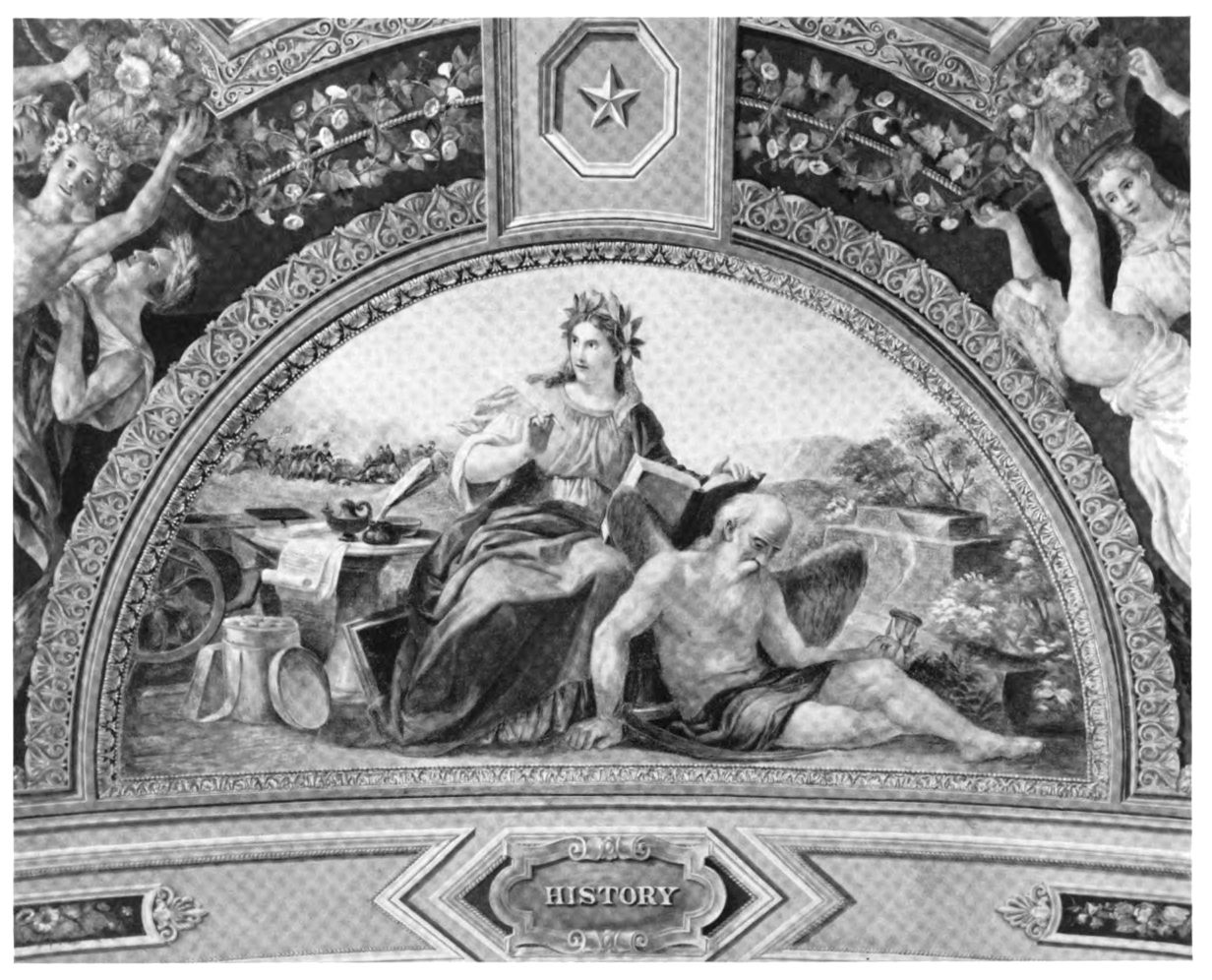
HISTORY
This Brumidi color lunette in the District of Columbia Committee Room of
the Senate, a part of that room’s frescoed ceiling, was given the name
“History” by the artist. All paintings in this room were done with the
thought of a decorative motif for a Senate Library. The allegory in this
lunette might suggest Young America writing her history, confident and
undisturbed either by war or time. If this room has a Brumidi signature
it has not yet been found.
that you had invited a draughtsman to come to Washington to help me with
my cartoons. Some days after, in the beginning of last year (1857), Mr.
Oertel presented himself and told me he was the artist intended to
assist me with my designs. I inquired of him if he could paint. He
answered no, that he was only a draughtsman. In proof of this assertion
he showed to me an oil painting of small dimension, representing the
head of St. Paul. Such was his only experiment in coloring.
“After this I gave him the measure of six circles on the pilasters in
the Navy Room, to make a corresponding number of portraits of celebrated
men in the American Navy, intending to paint them myself. After that day
I did not again see Mr. Oertel, because he had received orders from you
to make the designs for the stained glass in the House of
Representatives. In consequence of which order I could not have his
services. I have never yet received the designs for the aforesaid
portraits, therefore, I made them myself, also the cartoons for my other
work, intending to execute them when the weather was favorable.
“Not being able to work in the room of the Committee of War, as it is at
present occupied, nor in the ante-chamber of the Senate as there are
many workmen employed there, I commenced in the Senate Library not
having received any information that the frescoes there were intended
for Mr. Oertel nor could I think that an artist who himself has
confessed that he had no practice in painting could think of executing
pictures in fresco which is undoubtedly the most difficult of all
varieties of painting.
“If for about fifteen months Mr. Oertel had been under your immediate
orders, I could not again employ him without a new order from you,
notwithstanding I have only painted one panel in the Library, and if you
desire that Mr. Oertel shall make his first experiment in fresco in the
aforesaid room, there still remain three vacant panels.
“In everything concerning the work in the Capitol Extension, it is my
duty to receive orders and whatsoever observations may be needed only
from you. So that I pray you please to make known to Mr. Oertel that
neither he nor any other person has authority to send me such an
insolent letter, containing as it does a direct reproach on the
discharge of my duty, and I consider he has done me a serious injury.”
Although this Senate Library was begun by Brumidi in 1858 it would seem
that only one lunette was finished at that time and that negotiations
for its completion were again resumed on August 12, 1866, when Mr.
Brumidi wrote the following letter to Architect Clark itemizing the
completion costs:
“...The three panels in the ceiling, painted in real fresco
representing allegorical subjects, corresponding to the original plan,
and to the other already painted by myself, for $1,500 each, making an
amount of $4,500—and 500 dollars more for painting all the figures and
ornaments in the same ceiling in correspondence with the others, making
a total cost of $5,000.
“The enclosed account at the old price of daily wages was presented by
me to put under consideration what would have been the cost of the work
if it had been completed six years ago. The mentioned persons, Peruchi
and Geier were employed expressly one to help me as an artist, and the
other to serve me in preparing the cartoons, the colors, and to assist
me in my private studio as well as in the Capitol, and they having
nothing to do with the plasterer who fixes the mortar in the wall,
always furnished by the government.”
Architect Clark’s reply a few days later was short and to the point, “I
do not consider there is three times as much to do as has already been
done.”
Brumidi painted in the Capitol Building throughout the entire war
between the States. In the little ante-room of the Senate District of
Columbia Committee Room, originally the office of the Sergeant at Arms
of the Senate, is his only effort to picture that conflict. This small
room has four allegorical designs painted about its upper walls and one
large fresco in the center of the ceiling. This fresco is signed, “C.
Brumidi, 1876,” and represents “Columbia Welcoming the South Back into
the Union.”
On the east wall is “Secession”—the breaking of the fasces, and the
rival products of the North and South; on the south wall is war and
strife; on the north wall the implements of war are exchanged for those
of peace, while on the west wall the fasces are again united with the
words “E Pluribus Unum.”
These two Senate Committee Rooms present a great contrast in brilliancy
of color. The somber tone of the smaller room might be due to its date
of execution, it having been finished only four years before the
artist’s death. The larger room is said to have had a bit of restoration
at one time during the two restoration periods that some of the Brumidi
frescoes have had in the Capitol.
Charles Ayer Whipple was employed in 1919 to restore some of the Brumidi
paintings especially in the basement corridors in the Senate Annex. This
artist is recorded to have said at that time, “The Brumidi decorations
are second to none in the whole world.” In 1921 Charles E. Moberly also
did some restoration of Brumidi paintings but his work was chiefly in
the House Committee Room where a fire had marred the side walls, and in
the Reception room of the Senate where a bomb explosion in the early
days of World War I damaged the walls and ceiling.
The Senate Appropriations Committee Rooms earlier referred to are
entered from the West Corridor on the ground floor of the Senate
Extension. Above the door leading into these Committee Rooms is the
Brumidi fresco of Bellona, the Roman goddess of War, with her stacked
guns, flag-draped cannon and silent drum and trumpets at her feet. This
West Corridor with vaulted ceiling is elaborately decorated in 15th
Century style, thought to have been inspired by the Loggia of Raphael in
the Vatican at Rome, that portion of the Vatican at one time said to
have been restored by Brumidi. In the Capitol’s West Corridor are
studies of birds, butterflies and children. Among the humming birds,
cardinals, bluejays, and robins are 13 exquisite landscapes and
inimitable medallion profiles of John Hancock, Francis Hopkinson, Robert
Livingston, Roger Sherman, John Jay, Charles Thompson, Charles Carroll
and Robert Morris. In a special ceiling design are the twelve signs of
the zodiac in fields of Pompeian blue.
Senator Voorhees made the following appreciative reference to Brumidi’s
West Corridor designs:
“The poetry of the artist, if I may so express it, had also its field of
display. To one who recalls the great forests of the West before they
were swept away, the birds and the specimens of American animals with
which he has adorned a portion of this Capitol must be a source of
unceasing enjoyment. The birds especially are all there, from the
humming-bird at an open flower to the bald eagle with his fiery eye and
angry feathers. I have been told that the aged artist loved these birds
as a father loves his children and that he often lingered in their midst
as if a strong tie bound him to them.”
The North Corridor is equally as colorful as the West Corridor. Here we
find painted on the walls, parrots and quail, lizards and chipmunks,
squirrels and mice in their own habitat and color, midst every kind of
flower and fruit imaginable. Children dance about the trailing arbutus,
lilies of the valley, morning glories, columbine, bleeding hearts and
peonies. Panels adorned with clusters and baskets of fruit—purple
grapes, pineapples, peaches, plums, currants and cherries help to frame
medallion profiles of Daniel Morgan, Jonathan Trumbull, Horatio Gates,
Israel Putnam, Thomas Mifflin, Silas Deane, Richard Montgomery, Joseph
Warren, Thomas Jefferson and Benjamin Franklin.
In this corridor also are two large frescoes above other Committee room
doors. “The Cession of Louisiana,” picturing Livingston, Monroe and
Barbe-Marbois in the act of negotiating the Louisiana purchase, is at
the west end of this corridor. At the east end of this corridor is “The
Signing of the First Treaty of Peace with Great Britain in 1782” in
which likenesses of Richard Oswald, John Adams, Henry Laurens, John Jay
and Benjamin Franklin are portrayed.
A voucher, signed by Brumidi, and dated November 11, 1874, has been
found referring to this treaty picture:
“For painting in Fresco over the entrance of the room of the Committee
of Foreign Affairs, the picture of the Signing of the First Treaty with
Great Britain—$600.”
On the upper walls of the Patent Corridor at the extreme east end of the
North Corridor are large frescoes of Fulton and his invention on the
Hudson, Fitch working on a steamboat model, and Franklin in his
laboratory, while the ceiling displays many small designs of patents
important to the American people. Roses of all colors, conventionalized
or in tall graceful vases, predominate in this corridor decoration.
Brumidi is reported to have said that his “Palisades of the Hudson” in
the Robert Fulton fresco were not strong enough in perspective and that
he hoped some day to have time to strengthen that portion of his
painting.
A Brumidi voucher dated November 28, 1873, helps to verify the fact that
the Fulton painting is a fresco:
“For painting in fresco the picture of Robert Fulton in the Senate wing,
in the passage in front of the room of the Committee on Patents—$500.”
The Main Corridor on the ground floor of the Senate Extension is said to
follow the Byzantine style of decoration with subdued backgrounds that
display to perfection 14 more oval-shaped landscapes of marvelous depth
and beauty. At the extreme north end of the corridor are the profile
portraits of Andrew Jackson and Henry Clay, large frescoes of Justice
Story and Chancellor Kent and a
bust of Chancellor Livingstone executed in imitation sculpture.
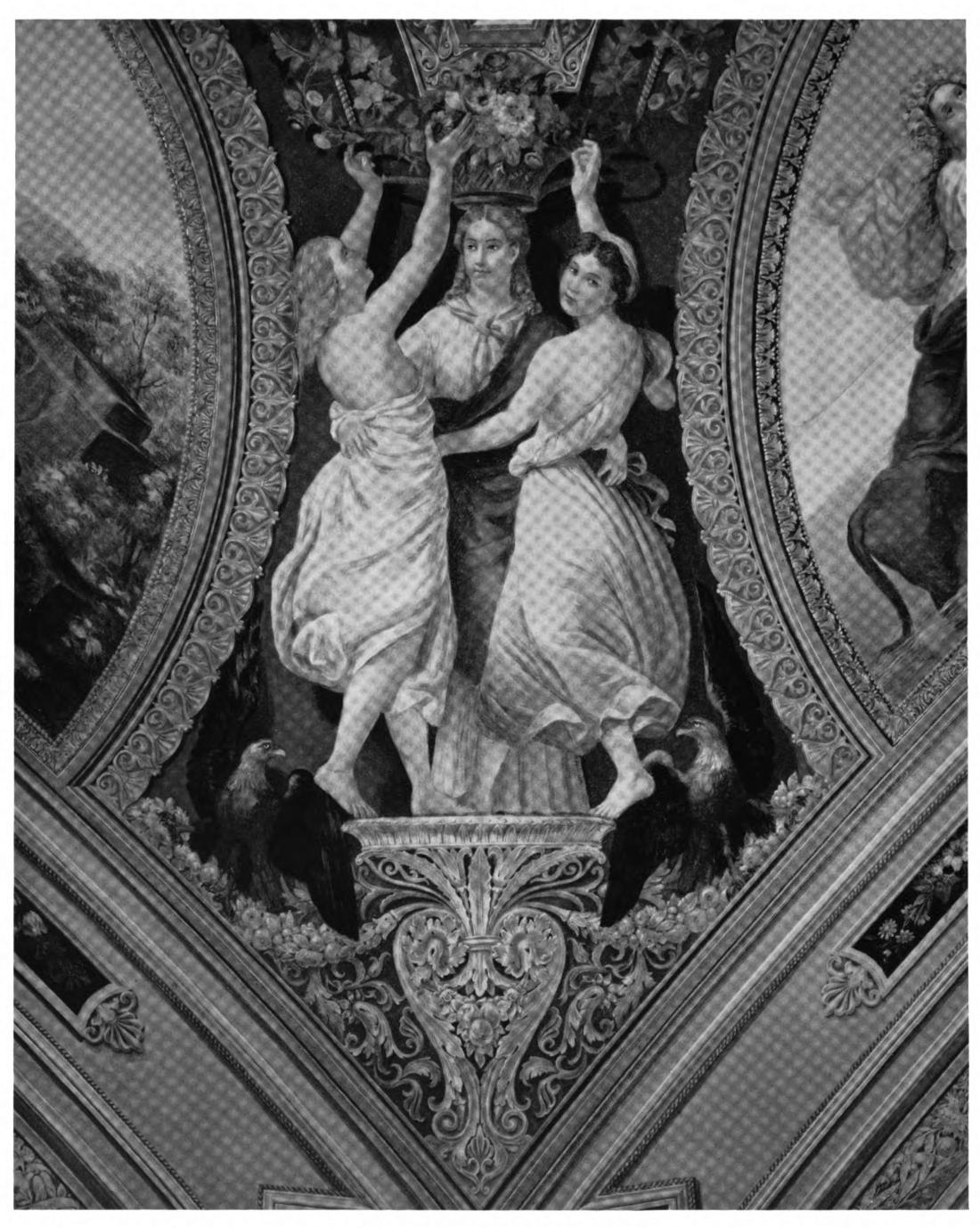
THREE GRACES
Four such groups of Graces in varying attitudes and color combinations
are used by Brumidi as corner motives on the frescoed ceiling of the
District of Columbia Committee Room of the Senate. So delicately
beautiful are the pastel shades in the maidens’ drapery that the studies
of graces are equally as popular as the lunettes which they separate.
Again, all frames and intricate moldings are painted on a smooth ceiling
surface. The working sketch for these Graces is reproduced in black and
white on page 79.
Two vouchers signed by Brumidi and dated August 24, 1874, fix the date,
price and style of painting in the north end of this main corridor:
“For painting bust in light and shade of Chancellor Livingston at north
end of basement story—$100.”
“For painting in fresco the portraits of Justice Story and Chancellor
Kent at north end of basement story—$400.”
There is also a South Corridor on this ground floor of the Senate
Extension done in the same subdued Byzantine style with eight large
studies of animals in oval frames painted in oil on the walls and eight
other ovals of the same size displaying in each the United States
shield.
Two facts concerning Brumidi disturb us at this point in some such way
as Smith D. Fry evidently was disturbed back in 1912 when he wrote his
“Story of the Capitol.” Mr. Fry apparently satisfied his own wonder in
these words:
“Many people inquire how it was possible for Brumidi to accomplish such
an enormous amount of art work. The great designer and decorator
prepared his colors according to methods known only to himself. They
were mixed or triturated by employees under Brumidi’s direction. Leslie
and others covered the walls with backgrounds, under Brumidi’s
direction. Other near artists made outlines, according to directions of
the tireless worker. But all of the artistic work was finished by the
hand of the matchless Brumidi himself. That the name of Brumidi and the
story of his wonderful work have not been known to the American people
is not due to lack of appreciation but to the fact that there has been
no one with time and acquaintance with his work to tell the people about
it.”
On the frieze of the Rotunda Brumidi did his last work in the Capitol
Building. This frieze is a belt nine feet wide which circles the Rotunda
58 feet from the floor. The Rotunda is 300 feet in circumference. On
October 1, 1877, the Architect of the Capitol gave the following report,
“The belt of the Rotunda intended to be enriched with basso relievos is
being embellished in real fresco representing in light and shadow events
in our history arranged in chronological order, begining with the
Landing of Columbus and ending with a period of our Revolutionary
history to be decided later.”
According to Brumidi’s signed statement of 1874, earlier quoted, “That
large frieze in the Rotunda was sketched by order of Captain Meigs
before the war,” but the artist was 72 years old before he actually was
allowed to begin painting the frieze in the difficult Rotunda location.
He had in mind fifteen historical scenes planned to cover fifteen
divisions of the frieze and from his file of letters we know how
desperately he worked to finish these frescoes before sickness should
compel him to lay aside his brush. The following four short letters to
the Architect of the Capitol during Brumidi’s last months show the
heroic effort made by the artist to complete his frieze:
Washington, D. C., October 15, 1878
“I have returned at home, having improved enough and I am
translating in large proportion the cartoon of Pocahontas, and if
Monday the plasterer is ready to proceed with the panel of DeSoto I
desire to go on in that work, if my health will permit me, as I
hope.”
C. Brumidi
Washington, D. C., December 27, 1878
“In this very cold weather I am compelled to suspend the work in
the Rotunda where
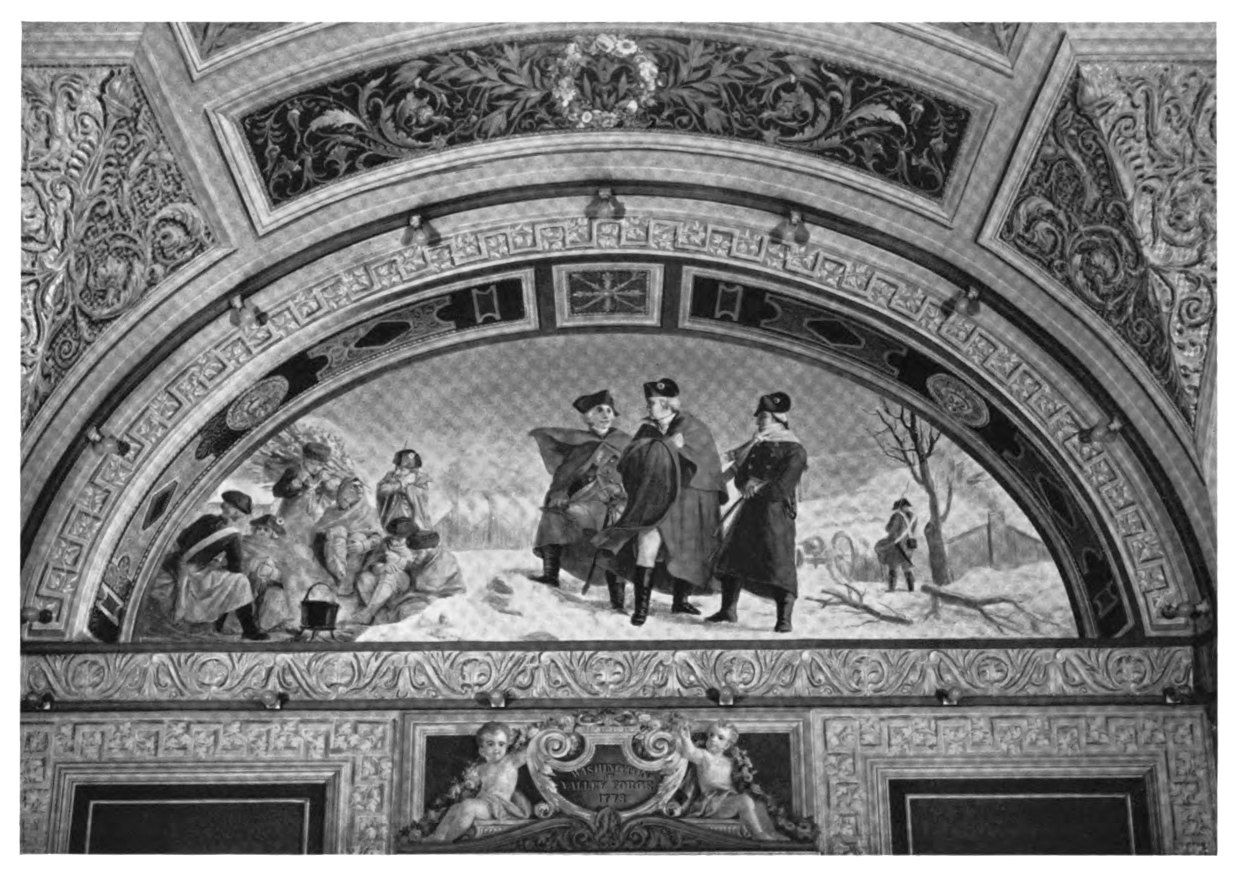
WASHINGTON AT VALLEY FORGE
Another lunette painted by Brumidi high on the walls of the old Senate
Committee Room on Military Affairs was named by Brumidi, “Washington at
Valley Forge.” This portrayal of our Revolutionary General was evidently
painted with these words of Washington in mind: “We have this day no
less than 2,873 men in camp unfit for duty because they are barefooted
and otherwise naked ... numbers are still obliged to sit all night by
fires.” (December 23, 1777.) Could the two soldiers with Washington be
Brumidi’s conception of Baron Steuben and Lafayette?
the heating is not enough to prevent the frost at the surface of
the mortar, that does not remain soft long enough upon the wall for
absorbing the colors till the piece of the day would be completed,
causing injury to the work; for this reason I ask the permission to
suspend the fresco work for some weeks until the weather will be
not so cold.
“I am proceeding with the cartoon of The Landing of the Pilgrims,
where I have no need of the laborer’s assistance.”
C. Brumidi
Orkney Springs, August 11, 1879
“In the month of July you agreed to my request to draw the cartoons
in my studio.
“A short time before I was attacked by the asthma and finding no
relief, was advised to leave the City by Dr. Thompson, and decided
to come here. I suffered only during the night which was very
fortunate as it permitted me to work in the day. I have completed
three cartoons representing the treaty of William Penn and
Settlement of New England which comprises two cartoons. I have
brought one with me on which I work every day. I find the air a
great benefit to me, the water also and expect to be able to
continue the Fresco very soon.”
C. Brumidi
Washington, D. C., August 18, 1879
“Saturday 16th I returned in the city, and ready to proceed with
the work in fresco (with your permission). Three cartoons are near
completed. I am improved in the general health, that was the object
of my trip and not for the pleasure.”
C. Brumidi
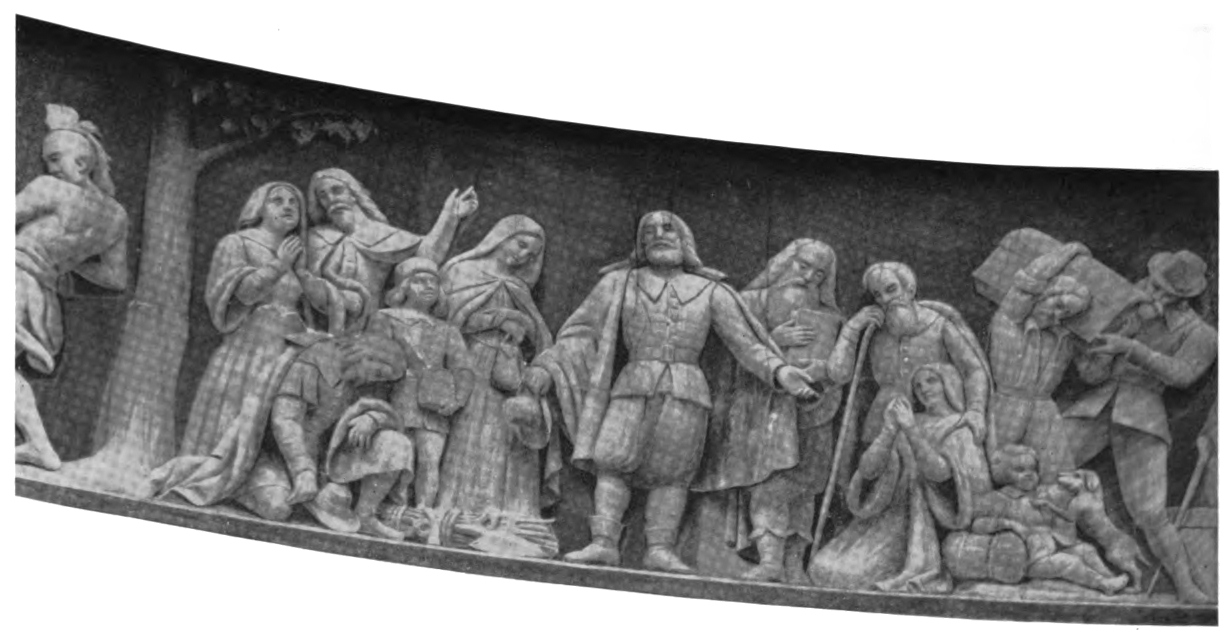
LANDING OF THE PILGRIMS
Of the fifteen historical groups planned by Brumidi for the frescoed
frieze encircling the Rotunda, the “Landing of the Pilgrims” is the one
in which the attitude of prayer predominates. This frieze is 9 feet wide
and 58 feet from the Rotunda floor. Brumidi was 72 years old when he
began its execution but he had drawn the plans probably twenty years
earlier.
But this last task he set for himself was too great. Of the fifteen
scenes Brumidi planned, he finished the following six: Landing of
Columbus, 1492; Entry of Cortez into Mexico, 1521; Pizarro’s
Conquest of Peru, 1533; Midnight Burial of DeSoto, 1541; Pocahontas
saving John Smith, 1606; Landing of the Pilgrims, 1620.
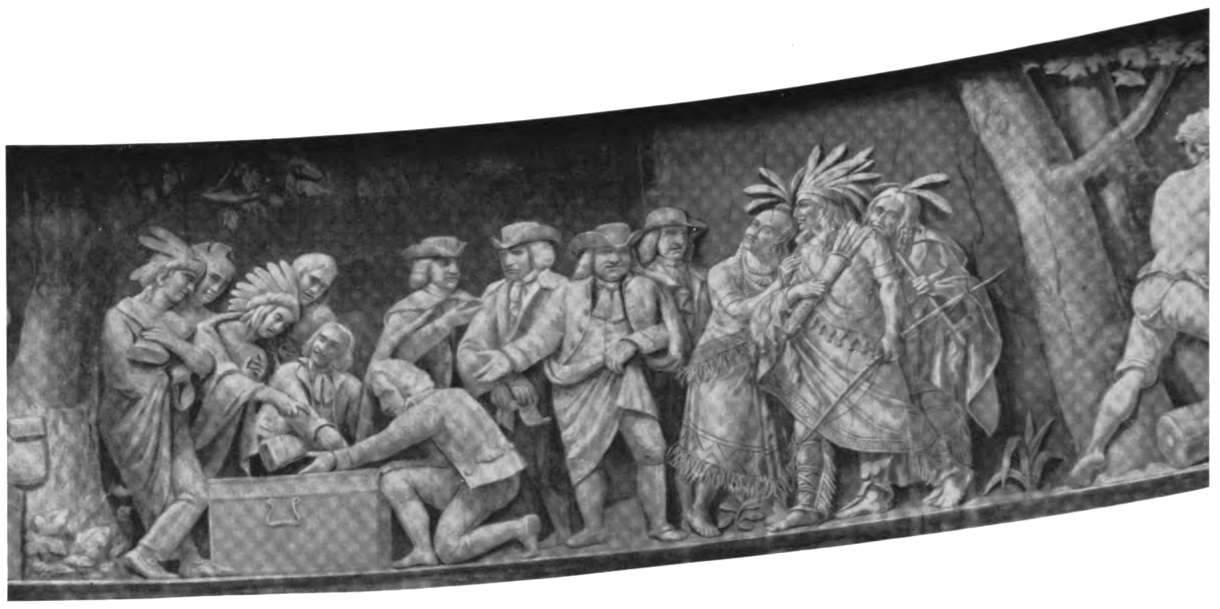
PENN’S TREATY WITH THE INDIANS
The seventh group, chronologically, on the Rotunda frieze is “Penn’s
Treaty with the Indians.” It follows the “Landing of the Pilgrims” in
Brumidi’s design. It was while working on this group that Brumidi fell
on the scaffolding and was never able to return. The three Indians at
the right were left unfinished, the lighter background marking the spot
from which Brumidi fell.
The artist had the seventh scene, Penn’s Treaty with the Indians,
1682, more than half finished when he fell from the suspended chair
from which he worked and was forced to hang by his arms from a ladder
until workmen made the rescue. The last few months of his life he worked
at his studio on the frieze cartoons. Edward Clark, Architect of the
Capitol, makes reference to the unfinished frieze in his Report of
October 1, 1880. Said he at that time, “But little progress has been
made on the frescoes of the belt in the Dome, owing to the illness and
death of the late Constantino Brumidi. Philip Costaggini, an artist of
acknowledged merit, educated in the same school as the former artist, is
now engaged on these frescoes.” One year later, however, on October 1,
1881, Mr. Clark made the following report:
“Mr. Costaggini has painted in fresco on the belt of the Rotunda the
“Settlement of New England,” “Oglethorpe and the Indians,” left
unfinished by Mr. Brumidi, and he is now engaged on the “Reading of the
Declaration of Independence.” It is proper to state here, that Mr.
Brumidi made the designs for these sections only in small size and Mr.
Costaggini has had to make the eight remaining full size cartoons.”
When Mr. Costaggini finished the work of executing the Brumidi designs
on the Rotunda frieze he had space enough left to accommodate two
compositions of his own choosing. Since his designs were never
sanctioned by Congress, Mr. Costaggini died in 1907 leaving an
unfinished frieze.
A third artist, Charles Ayer Whipple, was employed in 1918 at daily
wages to restore some of Brumidi’s paintings on the walls of the Ground
Floor Corridors at the Capitol and to make a sample painting on the
unfinished frieze. This trial painting he called “The Spirit of 1917.”
The Committee charged with final decisions concerning the frieze at that
time decided against Whipple’s further effort.
In 1925 Mr. Whipple referred to his frieze painting in a letter to the
Architect of the Capitol, a portion of which follows:
“As you know I painted a group of figures in the frieze with the
permission of the Library Committee, to prove that I understood the
ancient method of Fresco painting, that is, the method of Michelangelo
in the Sistine Chapel in Rome. The frieze is painted in that method and
of course must be completed in the mode of the great Italian Master,
that of “lime painting on wet plaster.” Mr. Whipple died in 1928. The
frieze is still unfinished and still of current interest.
On August 17, 1950, the President of the United States signed a Joint
Resolution, H. J. Res. 21, “To provide for the utilization of the
unfinished portion of the historical frieze in the Rotunda of the
Capitol to portray (1) the Civil War, (2) the Spanish-American War, and
(3) the birth of aviation in the United States.”
Each new effort to finish the Rotunda Frieze is a testimony to the
artist, Brumidi, and to his inimitable work. Should an artist well
schooled in the Italian fresco process not be found to finish the frieze
it is the author’s thought that the problem might be solved by adorning
the blank portion of the Rotunda belt with a memorial inscription to
Constantino Brumidi.