by
LeRoy W. Sowl
U.S. Fish and Wildlife Service
1011 East Tudor Road
Anchorage, Alaska 99507
The history of ornithological field work in the Gulf of Alaska dates back to 20
July 1741 and Bering's discovery of Alaska. In spite of this long history, the
record is fragmentary and often seemingly contradictory. The coming of the
tanker terminal at Valdez and the pending development of oil and gas resources
on the outer continental shelf threaten massive change for seabirds in the Gulf
of Alaska. Often overlooked, however, is the fact that man has already effected a
change in status for many of these birds. In this paper I examine the scanty,
general record from the exploratory period, roughly 1741 to 1935, and the somewhat
more comprehensive record of the reconnaissance period, 1936-74, and
attempt to develop a basis for better understanding of the change in seabird
status that has already taken place. This paper should be treated as a verbal
model which can be improved as our knowledge of seabirds in the Gulf of Alaska
is expanded.
From the perspective of history, 1970
should prove to have been a momentous year
for Alaska and its seabirds. Two events, the
construction of the Trans-Alaska Pipeline and
the passage of the National Environmental
Policy Act (NEPA) merged head on in 1970
with the decision that Section 2c of NEPA applied
to the proposed pipeline. The systematic
appraisal of potential environmental impacts
required by Section 2c quickly exposed the inadequacy
of the existing data base in many
areas. With respect to seabirds in the Gulf of
Alaska, it was apparent that there had never
been any effort to develop a synthesis of the
information accumulated over 230 years. The
data gaps which were uncovered were appalling.
While the Trans-Alaska Pipeline impact
statement had provided shock therapy, it was
not the only influential event on the horizon.
Two local disturbances had already preceded
the pipeline. These were Project Chariot at
Cape Thompson and the Amchitka Island test
program. Now in quick succession the Wilderness
Act and native land claims added new
urgency to the need for solid resource information.
More recently, the outer continental
shelf minerals leasing program has made the
quick development of base-line information
even more essential.
All of the new activity in Alaska's coastal
waters has the potential to affect seabirds in
one way or another. We must remember, however,
that man's activities have been affecting
seabirds for a long time. We cannot accurately
assess the effect of a tanker terminal at
Valdez or offshore oil activity without first
developing some understanding of the current
status of seabirds in the context of the historical
record.
Seabird work in Alaska can be divided
roughly into three periods. The first is the
early historical or exploratory period; it extended
from Georg Steller's 1741 visit to
Kayak Island to 1935. This was literally a
period of exploration and the collection of information
was dependent upon interest and
opportunity. The second is the reconnaissance
period; during this period investigators were
dispatched to a particular area to gather
general information for management application.
This period begins with Murie's extensive
investigations of the Alaska Peninsula
and the Aleutian Islands; I see it extending
from 1936 to 1975. In 1975 the need for data
became so acute that it was necessary to enter
the third period, one of intensive data gathering.
Knowing where the big seabird colonies
were located and knowing their general
species composition was no longer adequate.
The current intensive data-gathering effort in
the waters over oil and gas leasing areas is a
partial response to the recognition of this
inadequacy.
In this paper I draw some tentative conclusions
relative to the status of the 26 species of
primary seabirds (Fisher and Lockley 1954)
breeding in, or which may have bred in, the
northern and western Gulf of Alaska area.
This area extends from Cape Fairweather,
59°N 138°W, westerly along the coast to Ikatan
Bay, 55°N 163°W, at the end of the
Alaska Peninsula. These bird species tend to
be colonial, but not exclusively so. Two birds
which are primary seabirds, the mew gull
(Larus canus) and Bonaparte's gull (L. philadelphia),
have not been included because they
tend to be more riverine than marine in habit.
Several marine ducks have been excluded because
they are secondary seabirds.
Information from the early exploratory
period is summarized under the next section.
The more detailed information from the reconnaissance
period is discussed in the species
accounts.
The history of ornithological field work in
the Gulf of Alaska goes back 235 years to 20
July 1741. On that day Bering's surgeon/naturalist,
Georg W. Steller, spent a
scant 10 h ashore on Kayak Island. He collected
a single bird. This bird, later named for
Steller, reminded him of a plate of the blue jay
by Make Catesby, the colonial-era predecessor
of Audubon, in Volume 1 of the Natural
History of Carolina, Florida, and the Bahama
Islands (Stejneger's annotated translation of
Steller's journal in Golder 1925). Collection of
the bird confirmed for Steller that the first
Russian Expedition had reached America.
Steller was an accomplished naturalist, but
his overbearing and superior manner had apparently
sorely irritated Bering and his officers
long before the expedition reached Kayak
Island. The seamen made little effort to go
ashore anywhere in Alaska and Steller was
blocked from doing so as well. In addition to
Kayak Island, he was able to go ashore only
on Nagai Island, first with a water party on
30 August and again the next day. He noted
that "all sorts of waterbirds in abundance
were seen." These included two kinds of cormorants,
auks, ducks, gulls, divers, pigeon
guillemots (Cepphus columba), tufted puffins
(Lunda cirrhata), and horned puffins (Fratercula
corniculata).
Stejneger's comment on the identity of the
cormorants is interesting because, based on
his experience, he assumed them to be pelagic
and double-crested cormorants (Phalacrocorax
pelagicus and P. auritus). He gave no
thought to red-faced cormorants (P. urile)
which are now common there.
Steller noted on 6 September off Bird Island
in the Shumagin Islands, that "when we were
out to sea about half a mile we were especially
astonished at the untold numbers of seabirds
which we saw on the northern side of the island."
These birds were listed as cormorants,
auks, horned puffins, fulmars (Fulmarus glacialis),
pigeon guillemots, black oystercatchers
(Haematopus backmani), and a pied
diver which Stejneger assumed was an ancient
murrelet (Synthliboramphus antiquus).
On 15 September when Bering's vessel, the
St. Peter, was south of Amukta Pass, Steller
recorded observing "river gulls." The observation
is not as interesting as Stejneger's
comment (Golder 1925) concerning it. Stejneger
stated that no true river gulls lived in
the Aleutians and these must, therefore, have
been another small gull with red feet. He
thought they must have been the red-legged
kittiwake (Rissa brevirostris), which "inhabits
the Aleutian Islands from Bering Island
to Sannak."
Thirty-seven years after Bering's voyage,
Captain James Cook sailed into the Gulf of
Alaska, arriving off Kayak Island on 11 May
1778. Cook was not accompanied by an able
naturalist. His surgeon, William Anderson,
did have some experience gained on earlier
voyages in preparing skins and taking notes,
but he had contracted tuberculosis and became
so ill that even his notes ceased after 8
June, while the expedition was in Cook Inlet.
Cook was under orders to keep a careful record
of everything he saw. One of the results
was that he had birds collected even though
he had no naturalist to do the work. Several
birds were collected in Prince William Sound
while Cook's vessels were at anchor in Port
Etches. These included two marbled murrelets
(Brachyramphus marmoratus—type
specimens), a black oystercatcher, a surfbird
(Aphriza virgata), a surf scoter (Melanitta perspicillata),
and a red-breasted merganser
(Mergus serrator—type specimen), along with
several forest birds (Stresemann 1949).
The watch journals of Cook and his officers
provide some additional information. Captain
Charles Clerke (Beaglehole 1974) remarked in
his log on the passage out of Prince William
Sound through Montague Strait on 20 May
that "it had almost become tautology to mention
whales and seals and innumerable sea
fowl that so confoundingly kept their
distance."
Between the Trinity Islands and Chirikof
Island on 18 June, Cook's men collected a
single tufted puffin. Later Cook passed close
to the Semidi Islands and the Shumagin Islands
and directly through the Sandman
Reefs. Beaglehole's version of this part of the
voyage makes no mention of seabirds.
There is a gap of 87 years during which
there is almost no hint of published material
bearing on the status of seabirds in the Gulf
of Alaska. In 1865 the Russo-American Telegraph
Expedition touched this area. Dall and
Bannister (1869) provide us with a few scraps
garnered during that expedition, primarily by
Bischoff. The glaucous-winged gull (Larus
glaucescens) was described as the most common
species from California northward.
Bischoff's collections at Kodiak indicate that
the horned and tufted puffins were collected
with ease. He was able also to collect an Aleutian
tern (Sterna aleutica—type specimen)
along with an egg.
Dall (1873) noted in 1872 that the black-legged
kittiwake (Rissa tridactyla) was common
at Round Island and Delarof Harbor,
Unga Island, in the Shumagins. The inference
is that it was more common at these two
places than elsewhere. The Arctic tern (Sterna
paradisaea) was abundant in the Shumagin
Islands and particularly at Range Island in
Popoff Strait. Dall expressed the opinion that
the horned puffin was very abundant in the
Shumagins and appeared to fill the niche of
the tufted puffin, which he did not see there.
The only other bird which he thought to be
very common was the pigeon guillemot. He
did not note the common murre (Uria aalge) at
all.
In 1908 the second of three Alexander Expeditions
conducted field work in the Prince
William Sound area. From Dixon (1908) and
Grinnell (1910) we can derive some basis for
assessing status in a very general way. The
most common seabird noted was the marbled
murrelet. Glaucous-winged gulls and black-legged
kittiwakes were common; the glaucous-winged
gull was the more common.
Horned puffins were judged to be slightly
more common than tufted puffins by both
authors. The northern end of Montague Strait
appears to have been the center of abundance
for puffins. Dixon noted that on 16 July 1908
there were swarms of puffins in the channel
along Green Island. Pigeon guillemots were
common along the rocky coasts. Parakeet
auklets (Cyclorrhyncus psittacula), common
murres, and ancient murrelets were noted
only in very small numbers.
After the Alexander Expeditions there was
another doldrum in which little was done.
During this lull in activity, a note by Townsend
(1913) appeared which compared the
numbers of crested auklets (Aethia cristatella)
at Yukon Harbor, Big Koniuji Island, to the
least auklets (A. pusilla) of St. George Island,
stating that the crested auklets were more
numerous. He sailed into the Yukon Harbor
anchorage on the evening of 1 August and observed
that crested auklets "were present in
myriads. The surface of the water was covered
with them, and the air was filled with them."
The formal record available to researchers
is very shallow for this exploratory period.
With a few exceptions it was compiled by non-scientists,
primarily explorers and egg and
skin collectors.
Setting the Stage
This paper should be viewed as a conceptual
model. While I attempted to be as objective as
possible, subjectivity was unavoidable. Many
of the tentative conclusions are based on very
little data. Each improvement will make it a
better management tool. Because of the space
limitations, it is not possible to go into a detailed
tracking of my reasoning for each
species. In an attempt to overcome this handicap,
I am including some examples of the
sorts of reasoning that went into the process.
In 1973 I led a Fish and Wildlife Service
(FWS) reconnaissance survey team that was
delineating seabird colonies along the Alaska
Peninsula. In the Shumagin Islands we entered
or crossed Koniuji Strait twice (on 11
and 12 June) without even suspecting the
presence of a horned puffin colony. A third
passage through the strait (13 June) was not
so uneventful. The water and the air were
filled with horned puffins. This led to the discovery
that the 430-m mountain on the southeastern
corner of Big Koniuji was also
covered with horned puffins, clear to its top.
The minimum estimate of the birds that were
visible was 140,000. Even this number of
birds would make this the largest horned
puffin colony ever discovered. David Spencer
(personal communication) had noted similar
swarms of horned puffins in this strait in 1956
while flying sea otter surveys in the area. In
1975 a field camp was established at Yukon
Harbor, with study of this colony as one of the
prime objectives of the investigators. As far
as these investigators could tell no such large
colony existed there, even though the nesting
habitat was still there, unaltered. This sort of
event, one of the banes and vagaries of estimating
seabird numbers, is not rare.
In 1973, when FWS personnel delineated
the colony on the southwestern end of Bird Island
in the Shumagins, there were estimated
to be 43,000 kittiwakes, 24,000 murres, and
6,000 cormorants present; no tufted puffins
were seen about the colony. The last time (in
1970) one of the observers, Edgar Bailey, had
visited the colony with Robert Jones, there
was an extremely large colony of tufted
puffins which Jones (E. Bailey, personal communication)
estimated at more than 1 million
birds. We made a particular effort to visit
Jude Island, between the Shumagin Islands
and the Pavlof Islands, because David
Spencer (personal communication) had reported
once having seen the air over the island
filled with an extremely large number of
tufted puffins. However, there were no puffins
at this colony either.
Let us examine the facts in context. On 8
June we had visited High Island where we had
attempted to collect puffin eggs for pesticide
analysis, but had been able to find only one
egg. Also, there were only 6,000 tufted puffins
where George Putney, master/engineer of the
Aleutian Tern, had seen much larger numbers
in 1972. These two facts could easily be related
to explain the current situation because
it was still early in the breeding season. The
horned puffin observations in Koniuji Strait
(11-13 June) were in keeping with this conclusion
also—an indication that these birds had
not yet settled down to a full breeding effort.
The erratic comings and goings of common
puffins (Fratercula arctica) early in the season
have been well documented (Lockley 1962). It
is an easy step to extend this reasoning to the
absence of birds at Bird Island on 11 June,
even though fresh signs of the characteristic
evidence of tufted puffin occupancy were
missing. Jude Island provides a different clue,
however. There were 3,000 pigeon guillemots,
an unheard-of concentration, apparently
occupying abandoned tufted puffin burrows
on 15 June. Also, on 7 June we had made a
very interesting observation that had no
special significance at the time: murres on
Spitz Island were occupying little parapets
created by mashing down the mouths of
puffin burrows which filled the slope above
the cliff portion of their colony.
After looking at all of the observations
cited above, I conclude that tufted puffins
were greatly reduced in numbers on these
sites in 1973 and that they had been absent
from the burrows used by the murres and
pigeon guillemots for more than the current
breeding season. What causes these sorts of
changes? I do not know.
One reason for year-to-year change may be
local movements of colonies. Black-legged
kittiwakes nest at several places in lower Orca
Inlet, Prince William Sound. Counts made at
these sites in 1972 and 1974 yielded almost
identical totals but the numbers of birds
varied between individual sites. This may be
an indication that all of these sites are part of
one large composite colony and that, at least
in this colony and for this species, the birds
shift at will.
The best record of population flux involving
two species has been summarized by Peterson
and Fisher (1955). In 1872 and 1873 the
murres observed on Walrus Island in the
Pribilofs were almost entirely common
murres. In 1890 common and thick-billed
murres (Uria lomvia) were evenly matched in
number. By 1901 the colony was almost exclusively
dominated by thick-billed murres. In
1911 and 1914 the few thick-billed murres
present were almost lost among the then
dominant common murres. In 1940 thick-billed
murres dominated again. When Peterson
and Fisher visited the island in 1953, the
situation was again reversed and common
murres had almost completely replaced the
thick-billed murres. These changes are even
more impressive because of the number of
birds involved, between 1 and 2 million in
1953. There are more tenuous indications that
somewhat the same thing may occur between
two other congener pairs, the pelagic and red-faced
cormorants and the black-legged and
red-legged kittiwakes. The causative factor,
or factors, is not readily apparent. One possibility
is long-term climatic fluctuation.
Dement'ev and Gladkov (1966) provide an
example of abrupt and massive change. Before
1876, the pelagic cormorant abounded on
the Commander Islands. During the winter of
1876-77, the birds were decimated by an unknown
epizootic disease. By spring only a few
individuals remained alive. The record shows
that by 1882 they were already becoming
common again. Red-faced cormorants were
apparently not reduced in number because
Dement'ev and Gladkov (1966) state that
they were common in "the second half of the
last century and the beginning of this." Did
they flourish only while the pelagic cormorants
were reduced in number?
Bowles (1908) gives another indication of
naturally induced population impact. He
noted large numbers of dead seabirds on
Washington beaches and the ocean "rather
plentifully dotted with sick birds ..." He
examined some birds and found "many hundreds"
of tapeworms in every bird. His conclusion
was that their intestines were so
solidly packed with tapeworms that starvation
was "an absolute certainty."
Some apparent disruptions are long term.
In the Gulf of Alaska there is a hiatus in the
distributions of a number of small seabirds
that are active around their colonies only at
night. Repeatedly, the northern Gulf of
Alaska shows up as an area of reduced population,
as a boundary between subspecies, or as
a limit to a range. This same area has a noticeable
lack of total darkness during a substantial
portion of the breeding season.
The nocturnal habit no doubt evolved because
it was advantageous to concentrate on
the breeding grounds only under the cover of
darkness, when diurnal predators were at a
great disadvantage. Cody (1973) states that
Cassin's auklet (Ptychoramphus aleuticus),
which is strictly nocturnal around its colonies,
avoids these colonies on brightly moonlit
nights. He sees this as an apparent response
to gull predation. At higher latitudes the
small alcids have overcome this disadvantage
by swamping predators through their sheer
numbers. In the Gulf of Alaska I suspect that
few of the small seabirds, except possibly the
fork-tailed storm-petrel (Oceanodroma furcata),
have ever achieved great enough numbers
to offset the impact of extended daylight.
Past disruptions of seabird populations are
both natural and man-induced; however, the
documentary record is much too fragmentary
to allow us to fully appreciate what has occurred
or what the long-term effect has been.
To give some perspective to the problems associated
with assessing change and attempting
to understand it, some of the indicators of
natural and unnatural change and flux in seabird
populations are reviewed here.
The flux in bird numbers can be related to
the time of day, season of the year, and atmospheric
conditions on a short-term basis. This
sort of flux or apparent flux can easily be explained.
The underlying cause of some of the
longer term flux is not so easily arrived at.
Murie (1959), Gabrielson and Lincoln (1959),
and Sowl and Bartonek (1974) have noted
some of the man-induced changes. These are
also explored to some extent in the species accounts
as they are found to apply.
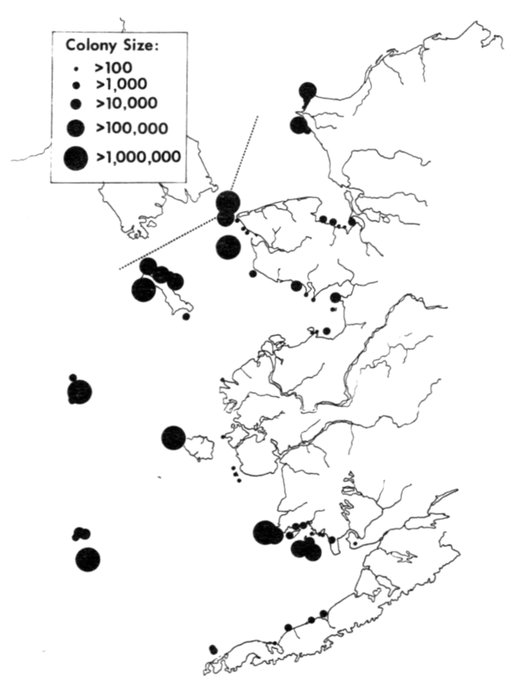
I sometimes refer to a colony size class
when discussing the existing data rather than
to an actual population estimate. The size
classes used are defined as follows:
- Class I—less than 100 birds
- Class II—100-1,000
- Class III—1,000-10,000
- Class IV—10,000-100,000
- Class V—100,000-1,000,000
- Class VI—more than 1,000,000
The Dictionary of Alaska Place Names
(Orth 1967) is the reference for those who wish
to locate some of the less obvious sites. The
Coast Pilot, No. 9 (U.S. Department of Commerce
1964) is another useful reference.
Species Accounts
Northern Fulmar (Fulmarus glacialis)
Petrels of a number of species can be found
in the Gulf of Alaska, some of them in great
numbers. Only the northern fulmar breeds
there.
The fulmar is common in the offshore
waters of the northern Gulf of Alaska
throughout most of the year (Isleib and
Kessel 1973). Most authors, including Clark
(1911), one of the earlier ones, who commented
on the distribution of fulmars farther out in
the Gulf, have considered them to be abundant.
Nichols (1927) raised one of the few
voices of apparent dissent; he noted that in
1926 he encountered the largest number of
fulmars (about 800) on 11 July in Shelikof
Strait after he had left the Gulf. During the
summer, fulmars are very common seaward of
Montague Island, particularly to the northeast
of Patton Bay and in the approaches to
Montague Strait. Data derived from FWS
surveys in July and August 1972 showed an
estimated 10,000 fulmars in a stretch of
waters 19 km wide along the east side of Montague
Island (Isleib and Kessel 1973).
Over the Portlock Banks and in Stevenson
Entrance, fulmars sometimes concentrate in
very large numbers, either by themselves or in
company with sooty shearwaters (Puffinus
griseus). In August 1973, FWS observers
crossing Perenosa Bay saw large numbers of
tube-nosed birds moving northeastward
across the Bay. Although these appeared to
be predominantly shearwaters, there were
also many fulmars. There was a general movement
of birds through Shuyak Strait from
Shelikof Strait into the Gulf of Alaska. It was
not determined whether the fulmars were
moving with the shearwaters or on a regular
feeding flight. Fulmars are often found close
to Afognak Island in the area between Sea
Lion Rocks and Sea Otter Island. Gabrielson
and Lincoln (1959) reported seeing swarms of
fulmars in Marmot Strait and around the
small islands on the north side of Afognak in
early August. Murie (1959) noted fulmars in
Shelikof Strait and again around the Shumagin
Islands. There is nothing in this record
to indicate any change in their distribution at
sea recently.
The Semidi Islands support the Gulf of
Alaska's largest fulmar breeding population,
a Class V colony (U.S. Bureau of Sport
Fisheries and Wildlife 1973). Gabrielson and
Lincoln (1959) considered it to be one of the
four largest colonies in Alaska.
Gabrielson (1940) was told by Captain Sellevold
of the marine vessel Brown Bear that he
thought the birds nested on Sea Otter Island
in Perenosa Bay. Gabrielson also learned that
they probably nested on Sea Lion Rock at the
head of Marmot Strait. In August 1973 I observed
fulmars in close proximity to Sea Lion
Rock. More recently, small numbers of apparently
breeding fulmars have been found in
the Barren Islands (L. W. Sowl, personal observation
and Edgar Bailey, unpublished
FWS report, Anchorage, Alaska). Although
no other colonies are known or suspected, the
evidence suggests the possible existence of
some.
Peterson and Fisher (1955), on noting dark
fulmars between St. Paul and St. George
when only the light morph was present on any
of the colonies in the Pribilofs, expressed no
surprise. They offered the opinion that a
round trip of 960 km to one of the dark morph
colonies in the Aleutians just might be within
the operating range of a fulmar on a 4-day
vacation from nest-tending duties. Using this
as a general yardstick, it appears that the rich
foraging grounds over the Portlock Banks
might also be within the range of breeding fulmars
from the Semidis. The trip up Shelikof
Strait and on to Portlock Bank by way of
Shuyak Strait is only slightly longer than the
one from Chagulak to St. Paul. The feeding
grounds off Montague Island would require a
1,600-km round trip from the colonies in the
Semidi Islands. Birds from the Barren Islands
and any colonies around Shuyak Island
could easily reach the Montague Island
grounds, but why would they cross the Portlock
Banks to do so?
Fulmar colonies may be found in the Chiswell
Islands. It is also a possibility that the
existence of colonies on islands along the
north coast of Afognak Island will be verified
and that others will be found in the vicinity of
Shuyak Island. Gabrielson and Lincoln (1959)
expressed the opinion that there is almost certainly
a colony on Sutwik Island. If there is
one, however, I did not see it on one quick trip
around the island in 1973.
Gabrielson (1940) expressed surprise at the
size of the Semidi Island breeding colony.
Gabrielson and Lincoln (1959) considered
1911 to be the first time breeding fulmars
were found in the Shumagins. They apparently
based this on two eggs collected
there that year and documented in a plate in
Bent (1964). Other than Gabrielson's opinion,
there is nothing to indicate a major change in
fulmar status during this century. If there has
been a change in status, it has probably been
in the direction of increasing populations.
Fork-tailed Storm-petrel (Oceanodroma
furcata)
The fork-tailed storm-petrel probably
breeds throughout the Gulf of Alaska. It is
abundant at sea during the summer in most
offshore waters. Murie (1959) described it as
the dominant petrel in the Bering Sea and the
North Pacific.
In view of its wide distribution and apparent
abundance very little is known about
the fork-tailed storm-petrel's breeding colonies.
Friedmann (1935) recorded specimens
and eggs from Kodiak dating back to 1843.
Murie (1959) noted them as nesting on Sanak
Island and stated that they almost certainly
nested in the Shumagins and on other islands
along the Alaska Peninsula. David Roseneau
(Isleib and Kessel 1973) found this storm-petrel
"breeding by the 10,000's" on East
Amatuli Island in the Barren Islands in June
1965. This was subsequently verified in 1974
by Edgar P. Bailey (unpublished report, FWS,
Anchorage, Alaska).
On 2 July 1972, responding to a tip by
James W. Brooks (personal communication),
M. E. Isleib and I anchored at Fish Island in
the Wooded Islands. We did not locate any
storm-petrel burrows, but a steady flow of
storm-petrels passed over the boat throughout
the darkest part of the night. Surveys
conducted at about that time provided an estimate
of 19,000 fork-tailed storm-petrels in
Prince William Sound, primarily in or close to
Montague Strait, and in coastal waters on the
east side of the Sound's outer islands. In this
area Isleib (personal communication) has
noted a general movement of fork-tailed
storm-petrels westward around Montague Island
and into Prince William Sound through
Montague Strait each morning and a corresponding
countermovement each evening. I
conclude that in 1972 there was a Class IV
colony in the Wooded Islands, numbering between
19,000 and 38,000 birds. Additional
colonies will be discovered in a similar manner
as more systematic searches are made.
No colonies were discovered during the 1973
reconnaissance survey of the islands south of
Alaska Peninsula. Working primarily inshore,
FWS investigators encountered very few
storm-petrels during the day. On the night of
14 June, the FWS vessel, Aleutian Tern, responded
to a Mayday call and was either in
transit or participating in rescue operations
from 2245 to 0420 h on the morning of 15
June. During this period numerous fork-tailed
storm-petrels were encountered, particularly
off Cape Wedge on Nagai Island. After we
anchored in Eagle Harbor on Nagai, more
storm-petrels were heard about the vessel.
At about this same date, National Marine
Fisheries Service enforcement officers flying
fisheries patrols observed storm-petrels in
abundance south of the Shumagin Islands
(James Branson, personal communication).
These observations support the belief that
there are probably substantial undiscovered
colonies in the Shumagin Islands.
Fork-tailed storm-petrels are abundant
summer residents in the northern Gulf of
Alaska and the estimate by Isleib and Kessel
(1973) is that populations using the waters off
the North Gulf Coast probably number in the
millions. Certainly the same estimate is valid
for the rest of the Gulf area west of the Chugach
Islands.
The status of these birds relative to their
historical abundance cannot be derived from
the existing information. There is strong suspicion
that the introduction of fox on many of
the islands in the area during the early part of
this century probably caused a reduction in
their numbers. Murie (1959) said that experience
taught him that wings left from fox kills
or remains of storm-petrels in fox droppings
could be accepted as evidence of the presence
of a colony. Gabrielson and Lincoln (1959) reported
that E. P. Walker visited the Wooded
Islands in 1922 searching for a storm-petrel
colony that had been reported to exist there in
1918. He could not find it even though he
searched diligently. This apparent disappearance
was attributed to the introduction of
fox.
There is another factor to consider, however.
The limited number of specimens now
available from the Gulf of Alaska indicates
that separate subspecies occupy the eastern
and western Gulf of Alaska. The accepted
boundary is somewhere in the vicinity of
Prince William Sound. This is an indication
that there has been a hiatus in this area of
rather long duration. I have speculated that
this sort of break may be in some way related
to the length of day and a period during the
summer when there is little darkness to cover
activities near the colony. Thoresen (1964)
and Cody (1973) have both reported that western
gulls (Larus occidentalis) assemble in
Cassin's auklet colonies on moonlit nights to
prey on arriving adults. It is likely that other
nocturnal species would provoke the same
sort of hunting tactic. A light-related predation
factor implies that the predators rely on
sight. Avian predators are indicated.
Leach's Storm-petrel
(Oceanodroma leucorhoa)
Even less well understood than the breeding
distribution of the fork-tailed storm-petrel is
that of Leach's storm-petrel.
Bendire (1895) quotes notes from Chase
Littlejohn, who found Leach's storm-petrel to
be an abundant breeder on unspecified small
islands near Sanak in 1894. It greatly outnumbered
the fork-tailed storm-petrel. On his
visit in 1937 Murie (1959) learned that all of
the large colonies of seabirds that had once
existed there were gone. He attributed this to
overfishing and associated perturbation and
to the introduction of fox. No systematic assessment
of seabirds on Sanak has been attempted
since Littlejohn's time.
No Leach's storm-petrel colonies have been
encountered during reconnaissance surveys of
the Gulf of Alaska. Small numbers have been
reported from time to time and while it is very
much less abundant than the fork-tailed
storm-petrel, I expect that it will be found in
small numbers at various places in the Gulf of
Alaska when it becomes possible to make
more thorough searches. It may occur in remote
areas like the smaller islands scattered
throughout the Sandman Reefs—possibly
even in large numbers. On the basis of the
Sanak record, we must assume that this
storm-petrel has been greatly reduced in numbers,
at least in the western portion of the
Gulf.
Double-crested Cormorant (Phalacrocorax
auritus)
The white-crested cormorant, the race of
the double-crested cormorant residing in the
Gulf of Alaska, is principally an inhabitant of
the marine environment. This cormorant is a
common, but apparently patchily distributed,
resident throughout the northern and western
Gulf of Alaska.
Gabrielson and Lincoln (1959) thought that
it nested only from Kodiak Island westward
into the Aleutians. However, it probably
breeds from Yakutat Bay westward. Isleib
and Kessel (1973) estimated the abundance of
the double-crested cormorant along the North
Gulf Coast as several thousands, about one-tenth
as common as the pelagic cormorant. It
is the third most abundant of the four cormorant
species nesting in the area. It occurs
as scattered inclusions in many colonies
throughout the area, and at least in the Shumagin
Islands, even occurs in some colonies
by itself.
There are no data on which to base an estimate
of any change in status. It probably is
not much affected by many of the naturally
occurring perturbations.
Brandt's Cormorant (Phalacrocorax
penicillatus)
On 22 July 1972, 13 Brandt's cormorants (4
sitting on nests) were found at Seal Rocks in
Hinchinbrook Entrance, Prince William
Sound (Isleib and Kessel 1973). Two years
later I positively identified two individuals in
breeding plumage among a mixed group of
cormorants in the Chiswell Islands west of
Seward. Are these recent range extensions?
Possibly, but I propose an alternative explanation.
Palmer (1962) showed the distribution of
this cormorant as breeding north to Puget
Sound and as a straggler north to Forrester
Island, Alaska. This viewpoint is shared by
the American Ornithologists' Union (1957),
which regards the bird as casual as far north
as Forrester Island, where this species was
collected by Willet (1918).
Let us look at the other record, the one that
is not supported by specimens. Bent (1964)
thought of Brandt's cormorant as a breeding
resident of Forrester Island. Gabrielson and
Lincoln (1959) admonished bird observers to
be on the lookout for this particular cormorant
in the vicinity of Ketchikan and
Prince of Wales Island. Brandt's cormorant
also appears on the bird list for the Kodiak
National Wildlife Refuge as an accidental
visitor.
Early observers like Bent were explorers.
They carefully examined and made notes on
all the birds they saw because there was always
a chance of a new discovery. It is also
very probable that Bent paid particular attention
to the cormorants when he was at a place
like Forrester Island. He would have undoubtedly
been very interested in trying to
confirm the presence of the now extinct
Palla's cormorant (P. perspiculatus), as he
must have been aware of Schlegel's (1862-64)
list of the birds in the Dresden Museum since
Willet (1914) had recently referred to it. The
staffs for the Kodiak and Aleutian Islands
National Wildlife refuges have included some
very careful observers, such as Frank Beals.
These men would have noticed the difference
if a new bird such as Brandt's cormorant was
seen, verified the sighting visually, and then
noted it in their field diaries. They would not
have bothered to develop the type of proof
needed for an undisputable record, but the
bird would have appeared in the refuge bird
list (as it does).
The outside coasts of the Alexander Archipelago,
Kenai Peninsula, and the Islands of
the Kodiak Archipelago impose some logistical
requirements which discourage all but
the most determined birders. Not many have
been able to reach more than very limited segments
of the entire coast. Given the vast distances
involved, few of the FWS vessels passing
through the area have had the time to
thoroughly examine any cormorant colonies
or roosts bird by bird. Even for those who
pause, the ever present swells and the constant
chop of the summer westerlies make
positive identification difficult.
It is possible that Brandt's cormorant has
been in the area in small numbers for a long
time, either regularly or intermittently. It
could have escaped observation because of the
conditions described above. This species may
be there as a relict, as a pioneer, or only because
surplus birds are being pushed into
marginal habitat by population pressures on
their main range to the south.
Pelagic Cormorant (Phalacrocorax pelagicus)
The pelagic cormorant is the most abundant
of the four cormorants residing in the
Gulf of Alaska. It is found throughout coastal
Alaska south of the Bering Strait and even in
some colonies in the southern Chukchi Sea.
Cormorants have a certain invisibility
which is brought about by their universal
presence. This blindness appears to have affected
everyone, even the earliest observers.
The earliest accounts provide a composite
picture of the distribution and abundance of
the pelagic cormorant which is very similar to
that encountered today. In southeastern
Alaska, beginning at the eastern edge of the
area under discussion, the pelagic cormorant
was pictured as the sole resident cormorant.
However, we know from Willet's collection of
a Brandt's cormorant at Forrester Island that
this might not be quite true. From Yakutat
Bay westward into the Aleutians this species
coexisted with the double-crested cormorant.
In the Western Aleutians there is some disagreement,
but in general it appears to have
been accepted that the red-faced cormorant
occurred there along with pelagic and possibly
double-crested cormorants. In the
Bering Sea this species coexisted with the red-faced
cormorant.
A number of recent authors (Gabrielson
1940, 1944; Murie 1959; and others) have considered
the pelagic cormorant to be the most
widely distributed and abundant of the four
species found in Alaska. Since the modern picture
fits, in a general way at least, it would be
easy to conclude that the species enjoys an
unchanged status. There is just a faint suggestion
that this may not be true.
Dement'ev and Gladkov (1966) refer to a
great die-off of pelagic cormorants referred to
earlier, in the Commander Islands. Stejneger
(1885) enlarges on this disaster. It is true that
Stejneger visited these islands a relatively
short time after the die-off, but he reported
that even though the pelagic cormorants were
increasing, "people having seen their former
multitude think that there is no comparison
between the past and the present." Murie
(1959) thought that the pelagic cormorant,
while numerous, was outnumbered by the red-faced
cormorant in the Aleutians. More recently
there has been the rapid eastward expansion
of the red-faced cormorant. Although
it is not possible to determine what the real
status of the pelagic cormorant is relative to
its past status, I conclude that during this
century its status relative to that of the red-faced
cormorant has declined.
Red-faced Cormorant (Phalacrocorax urile)
The red-faced cormorant, in spite of superficial
similarities to the pelagic cormorant,
just does not look the same to an experienced
observer. However, it would have been possible
for inexperienced observers in the days
before modern optics to overlook the differences.
The problem was further compounded
by the "invisibility" of the ubiquitous cormorants
referred to earlier. Apparent absences
or blank spots in their range may not
have been real.
Dement'ev and Gladkov (1966), reporting
on the Russian record, stated that the red-faced
cormorant was common in the Commander
Islands during the last part of the
19th century and into the early part of the
20th. Older authors had also reported it from
Kamchatka and the Kurile Islands. Now, according
to Dement'ev and Gladkov, it is an
uncommon breeder on Mednyi Island in the
Commander Islands and occurs only as an
autumn visitor to some of the southern Kurile
Islands.
Turner (1885) reported that the double-crested
cormorant was abundant in the Near
Islands and that the pelagic cormorant was
common, but makes no reference to the red-faced
cormorant. One specimen of the latter in
the Leningrad Academy of Science was taken
at Attu on 16 September 1844 (Gabrielson
and Lincoln 1959), which indicates that they
were probably present during the period reported
on by Turner and, therefore, relatively
uncommon. Clark (1911) identified red-faced
cormorants only a few times and in the Aleutians
only once, near Agattu. Dall (1874)
noted two red-faced cormorants collected at
Amchitka but he (Dall 1873) apparently did
not see any east of Unalaska.
Nelson (1887) apparently found red-faced
cormorants breeding on the Siberian and
Alaskan mainlands at either side of Bering
Strait, but Bailey (1948) searched for some
sign of their presence and found none. Nelson
(1887) also reported the red-faced cormorant
from St. Matthew and St. Lawrence islands in
the northern Bering Sea and from St. Michael
and Nelson Island on the Alaskan coast.
Gabrielson and Lincoln (1959) pointed out
that it has not been found breeding north of
the Pribilofs since then. Friedmann (1934) provides
support for Nelson by reporting red-faced
cormorant bones from archeological
sites on St. Lawrence. Gabrielson and Lincoln
(1959) cited two red-faced cormorants in the
Leningrad Academy of Science which were
collected in the Pribilofs in 1843. Dall and
Bannister (1869) reported them to be plentiful
on St. George Island. Baird (1869) also noted
their presence in the Pribilofs.
Bent (1964) makes no mention of seeing the
red-faced cormorant in the Aleutians. He
gives their breeding range as the Bering Sea
region, the Pribilof Islands, and perhaps the
western Aleutians, the Commander Islands,
and the coast of Siberia north of North Cape.
The American Ornithologists' Union (1931)
gave their breeding range as the Pribilof Islands,
the Commander Islands, and Siberia
north to North Cape.
Murie (1959) found a colony of between
4,000 and 5,000 red-faced cormorants nesting
on Amak Island in 1925. In 1936 he was surprised
to find that the red-faced cormorant
was the most abundant breeding cormorant in
the Aleutian Islands. Pelagic cormorants still
appeared to be most numerous, but there were
large numbers of nonbreeding birds. In 1936
he located "a good sized colony" of red-faced
cormorants at Unga in the Shumagin Islands.
He found about 300 birds starting their nests
on 16 May.
In August 1946 Gabrielson (Gabrielson and
Lincoln 1959) visited the colony at Delarof
Harbor, Unga, where several thousand cormorants
were observed. From a number of
small samples he estimated that the red-faced
cormorants outnumbered pelagic cormorants
five to two. In 1973 I observed about 2,000
cormorants, mostly red-faced, in this colony.
Gabrielson also located them at two other
sites in the Shumagins and at Aghiyuk Island
in the Semidi Islands.
Howell (1948) noted only double-crested cormorants
at Double Island, Kodiak. Shortly
after that the leaflet, Birds of the Kodiak Island
National Wildlife Refuge (first issued in
1955), listed red-faced cormorants as common
summer residents. The red-faced cormorant
was next found at Katchemak Bay about
1963. Isleib (Isleib and Kessel 1973) first
noticed red-faced cormorants wintering in
Prince William Sound in 1969. In July 1972
Isleib and Sowl had found a colony containing
75 nests at Point Elrington at the western approach
to Prince William Sound. By 1974
Isleib and Haddock (unpublished data, FWS,
Anchorage, Alaska) found them east of the
Copper River Delta at Wingham Island.
The relatively rapid expansion of the range
and apparent population size of the red-faced
cormorant is remarkable. But has this been a
real expansion into vast stretches of new territory?
The record in the literature which I
have summarized shows, I think, something
else. We can demonstrate a historical range
for the red-faced cormorant that extends on
the Asiatic Coast from North Cape, Siberia,
south to the Kurile Islands, the entire Aleutian
Arc including the Commander Islands,
all the Bering Sea islands north to Bering
Strait, Norton Sound, Nelson Island, and the
islands south of the Alaska Peninsula at least
as far east as Kodiak Island. The recently
occupied coast from Cook Inlet to the Copper
River may represent a real range extension.
The breeding range of this species at the
present time does not include parts of its historical
range west of the Commander Islands
or north of the Pribilof Islands.
The fragmentary record appears to show a
long-term perturbation in the range and populations
of the red-faced cormorant that covers
at least 100 years. I believe that we are probably
seeing a recovery of lost range and a return
to something resembling a former distribution
and abundance.
What caused the perturbation? I am not
prepared to answer this question, but there
are two occurrences which I find suggestive.
It is interesting to note (Dement'ev and
Gladkov 1966) that on the Commander Islands
the red-faced cormorant was most abundant
during the first 50-odd years after the
pelagic cormorants had been wiped out in the
winter of 1876-77. Perhaps some clues are to
be found in the interactions between these
similar species.
It does not appear that the introduction of
fox could have been a causative factor. The
first observations of population expansion
were noted almost concurrently with the heyday
of the fox-farming industry. Because of
its choice of nesting habitat (very steep cliffs),
this cormorant would not have been affected
by predators except for the one that went into
a very rapid population decline at a time that
would fit—the Aleut.
Jochelson (1968) and Hrdlicka (1945) summarized
references to Aleut clothing in the
diaries and reports of early Russian visitors
to the Aleutian Islands. Evidently Aleut
women sometimes wore a long, robe-like
parka made of harbor seal (Phoca vitulina)
skins or, for women of high rank, parkas made
of sea otter (Enhydra lutra). The men in almost
all reports were said to have worn bird-skin
parkas; puffins and guillemots appear to
have been preferred, but cormorants were
sometimes used. It took about 40 puffin skins
to fabricate a parka and a man evidently
needed from one to three of these garments
each year.
Sea otter populations were drastically reduced
by Russian hunters. Rats were introduced
to the Aleutians very early during the
Russian period and must have had a substantial
impact on populations of tufted puffins
and guillemots. The introduction of fox would
have had a further impact on burrow-nesting
birds. Turner (1885) noted that Aleuts in the
Near Islands kept the fox confined to Attu so
that they could keep the fox away from the
birds on Agattu. This is evidence of an Aleut
recognition of serious competition. Could cormorants,
particularly red-faced cormorants,
have been preferred sources of fiber? Were
Aleuts forced to rely more heavily on cormorant
skins as puffin and guillemot numbers
were reduced by rats and fox and sea otters
by men?
Whatever the cause and effect, the status of
red-faced cormorants now appears to be
better in the Gulf of Alaska than for at least
the last 100 years.
Glaucous-winged Gull (Larus glaucescens)
The glaucous-winged gull is apparently one
of the more successful seabirds breeding in
the Gulf of Alaska. While it is outnumbered
(both locally and in total abundance) by the
black-legged kittiwake, it is generally the
most commonly seen and most uniformly distributed
gull in the Gulf of Alaska. Murie
(1959) called it the common breeding gull
about the Alaska Peninsula. Cahalane (1943,
1944) considered it to be numerous to abundant
around Kodiak and in the Shelikoff
Strait area. Gabrielson (1944) reported that it
could be seen in small numbers everywhere.
Most recently, Isleib and Kessel (1973) reported
it to be an abundant resident in the
north Gulf Coast area. My own experience
would confirm these observations.
This gull appears to use a wider variety of
nesting sites than some others (Gabrielson
and Lincoln 1959). Except where man's activities
have created new food sources, there appears
to be a close link between the location of
glaucous-winged gull colonies and those of
murres, kittiwakes, and cormorants. Swartz
(1966) found that during the breeding season
glaucous-winged gulls at Cape Thompson derived
almost all of their food from murre eggs
and chicks. I have noted small numbers of
these gulls nesting, usually on turf near the
tops of cliffs, in most colonies of favored prey
species.
The glaucous-winged gull is the principal
scavenger throughout much of coastal south-central
Alaska. This has sometimes resulted
in the development of large concentrations
near canneries and, more recently, near
dumps.
Two glaucous-winged gull concentrations
stand out in the northern Gulf of Alaska. One
of these is on Egg Island at the western end of
the Copper River Delta. Patten (1976) estimated
that this colony contained 10,000-12,000
gulls in 1975. At times it appears to
spread onto nearby Hinchinbrook Island.
M. E. Isleib (personal communication) has estimated
its size as high as 25,000 gulls. The
other large concentration is on the Susitna
Flats across Cook Inlet from Anchorage. This
colony, or colony cluster, may be larger than
the one at Egg Island. There are no other
known colonies even approaching these in
size. Most colonies range between a few pairs
and 2,000-3,000.
Glaucous-winged gulls do not appear to
have had any great changes in population
that can be detected from the literature.
There have almost certainly been local fluctuations
in the number of breeding birds as
food supplies, such as canneries and dumps,
have appeared or disappeared in an area.
Long-term changes in salmon runs have undoubtedly
had an impact as well. One other
change, the reduced level of egging, has undoubtedly
had an effect also. Along the
Alaska Peninsula and in the Shumagin Islands,
cannery workers of Filipino heritage
and fishermen who have a strong Aleut heritage
still harvest gull eggs for food. However,
this activity is much reduced from what it
must have been.
Herring Gull (Larus argentatus)
The herring gull is a resident of Upper Cook
Inlet and is found up and down the coast from
Prince William Sound to the Alaska Peninsula.
Not too much was learned about it during
the recent FWS reconnaissance. Williamson
and Peyton (1963) reported the interbreeding
of herring gulls and glaucous-winged
gulls in this area. This interbreeding has resulted
in a situation in which assignment of
these gulls to one group or another in the field
can be rather arbitrary. The result has most
often been that field observers tend to lump
them with glaucous-winged gulls unless their
herring gull characteristics are obvious.
Specimens collected by Williamson and Peyton
(1963) indicate that herring gulls have the
edge in numbers in Upper Cook Inlet.
Black-legged Kittiwake (Rissa tridactyla)
The black-legged kittiwake is the most
abundant gull in the northern and western
Gulf of Alaska. Colonies of this species can be
found throughout the entire area, and range
in size from a few pairs (Class I) to more than
100,000 birds (Class V). They may be found in
essentially pure colonies, but are often found
sharing colonies with murres.
The center of abundance for breeding black-legged
kittiwakes in the Gulf of Alaska is in
the Semidi Islands, where Palmer Sekora
(U.S. Bureau of Sport Fisheries and Wildlife
1973) estimated that there were 426,000
breeding kittiwakes in 1972. He located kittiwake
colonies at eight sites, ranging in size
from 1,000 to 109,000 nesting birds. The size
of the average colonial site was 27,000 birds.
Ten sites were Class IV in size and one was a
solid Class V.
The easternmost known colony in the northern
Gulf of Alaska is at Wingham Island. Up
to 1973, 22 colonies had been located in Prince
William Sound. The largest of these contained
only 5,636 nests in 1972 (Isleib and Kessel
1973). Class IV or larger colonies are found at
Cape Resurrection, the Barren Islands, Chisik
Island, Boulder Bay and Cape Chiniak on
Kodiak Island, and at Delarof Harbor and the
Haystacks in the Shumagin Islands. It is interesting
to note that Gabrielson (1940) considered
Whale Island to be one of the largest
known kittiwake colonies in Alaska. He stated
that there were many thousands of pairs extending
over a mile or more of cliff. He saw a
second site which he did not visit but looked
equally large. A photograph in an article by
East (1943) also indicated the presence of a
large colony. C. J. Lensink (personal communication)
estimated that there were about
100,000 kittiwakes in the colony in 1956.
When last visited by Vernon Berns (personal
communication), this colony contained only
3,000 birds. It is also of interest that Gabrielson
(1940, 1944) did not notice either the kittiwakes
or the murres now breeding on Nord Island
in the Barren Islands or the kittiwakes
on East Amatuli Island.
Whale Island and possibly the colonies in
the Barren Islands give evidence of local
population fluctuations, but for the most part
I have not found an indication of a major perturbation
over the past 40 years. Before 1936,
the record is too fragmentary to allow an
assessment.
One of the interesting aspects of kittiwake
ecology in the Gulf of Alaska is the common
occurrence of breeding failure. David Snarski
(December 1943 Quarterly Progress Report,
Alaska Cooperative Wildlife Research Unit,
University of Alaska) observed breeding failure
on colonies in the Tuxedni National Wildlife
Refuge in 1970 and 1971 and obtained circumstantial
evidence of another failure in
1972. In 1973 all of the breeding cliffs were
occupied and nesting was successful. Whatever
the cause of these periodic failures, they
do not yet appear to have had a permanent
impact that we are able to measure.
Red-legged Kittiwake (Rissa brevirostris)
Red-legged kittiwakes are not now known
to breed in the western Gulf of Alaska. Turner
(1886) stated that he saw a few at Sanak in
1878. We also have Stejneger's (1885) statement,
that "red-legged" kittiwakes nest from
Bering Island to Sanak. Friedmann (1937) reported
two humeri from Kodiak Island
middens. During the summer of 1976, two
birds were observed off Kodiak Island by
Irving M. Warner (personal communication),
and one at 158°W and 54°30'-54°20'N south
and east of the Shumagin Islands (Patrick J.
Gould, personal communication).
Turner (1885) listed the red-legged kittiwake
as abundant and breeding in the Near
Islands. Turner (1886) also stated that he had
seen quite a number about a cliff back of the
village on Akutan Island in 1878. He added
that to the westward this kittiwake was more
abundant than the black-legged kittiwake.
Murie (1959) expressed the opinion that
Turner had confused the short-billed gull with
the "short-billed" kittiwake. Clark (1911) also
reported that he had seen the red-legged kittiwake
in small numbers near Unalaska and
that they became progressively more common
west to the Near Islands. Nelson (1887) reported
seeing large numbers of red-legged
kittiwakes at Unalaska. Murie (1959) and
Gabrielson (1940, 1944) did not see any red-legged
kittiwakes in the Aleutian Islands. The
species has recently been discovered breeding
at Buldir and Bogoslof islands (G. Vernon
Byrd, personal communication).
Is it possible that we have here another
species which is exhibiting a response to some
unknown long-term perturbation? The suggestion
that such an event has occurred is
faint, but it is there. Do we have in the red-legged
and black-legged kittiwakes an
example of yet another congener pair that has
been affected by some perturbation in which
one was affected positively and the other
negatively? Clark (1911) reported small numbers
of black-legged kittiwakes to go with
large numbers of red-legged kittiwakes in the
Near Islands, which is the reverse of the current
situation.
Arctic Tern (Sterna paradisaea)
Gabrielson and Lincoln (1959) attribute to
the Arctic tern the most extensive range of
any Alaskan water bird. It is found in suitable
habitat everywhere north of Tracy Arm in
Southeastern Alaska. Murie (1959) stated
that he found it nesting at suitable sites
everywhere he went. Isleib and Kessel (1973)
considered it to be an abundant breeder in
Prince William Sound and along the northern
Gulf Coast.
The Arctic tern was observed in FWS aerial
surveys in Prince William Sound, and surveys
in July and August 1972 provided an estimate
of 45,000 terns in the Sound (Isleib and Kessel
1973). On the other hand, tern colonies were
located only rarely in the FWS colony surveys
before 1975. This is, however, a reflection of
the equipment and methods used and not of
the abundance of terns.
From the fragmentary data available, it is
not possible to detect changes in Arctic tern
status at the present time. We have to assume
that the widespread introduction of fox had at
least local impact. Although this tern uses a
wide variety of nesting sites, it tends to nest
on flat sites where access by mammalian
predators is easy.
Aleutian Tern (Sterna aleutica)
No Aleutian tern colonies were discovered
in the Gulf of Alaska area during FWS colony
surveys in the early 1970's. This is again a reflection
of the fact that surveys were not designed
to locate tern colonies. Aleutian terns
were encountered at least twice, once during
late March 1972 in Hawkins Cutoff, Prince
William Sound, and again when two birds
were noted offshore from the Katmai National
Monument on 30 May 1973 (L. W. Sowl, personal
observations).
The type specimen of the Aleutian tern and
a single egg were collected at Kodiak Island
on 12 June 1868 by Bischoff (Coues 1874).
Fisher (Gabrielson and Lincoln 1959) collected
four more eggs in 1882. The bird was not
found breeding there until Howell (1948)
found a colony of 50 pairs at Bell's Flats in
1944. Walker (1923) found them nesting on
the Situk River, Yakutat, in 1917 and shortly
thereafter saw them at the Alsek River Flats.
He also reported that D. H. Stevenson of the
Bureau of Biological Survey had told him that
they nested on the Isanotski Islands at the
end of the Alaska Peninsula. This latter report
was the only one from the Aleutian Island
chain for many years. Isleib and Kessel
(1973) considered it an uncommon local
breeder in the northern Gulf of Alaska. Isleib
estimated its population at a few hundred pairs
on the Copper River Delta in May 1973 and
300-500 birds in June 1970. He also reported
that they appeared more or less regularly near
Controller Bay and off the Situk River.
In recent years Aleutian terns have been
seen with increasing frequency in many places
in western Alaska and the Aleutian Islands.
This is probably partly due to the increasing
level of field work. At Amchitka Island the
several colonies that have been found in recent
years are almost certainly exhibiting a
response to the removal of fox from the
island.
Although there is no way of determining
what the past status of the Aleutian tern has
been in the Gulf of Alaska area, it has been
there in small numbers since it was first discovered
on Kodiak. It has probably not been
abundant at any time and may have suffered
a long-term decline brought about by the introduction
of fox.
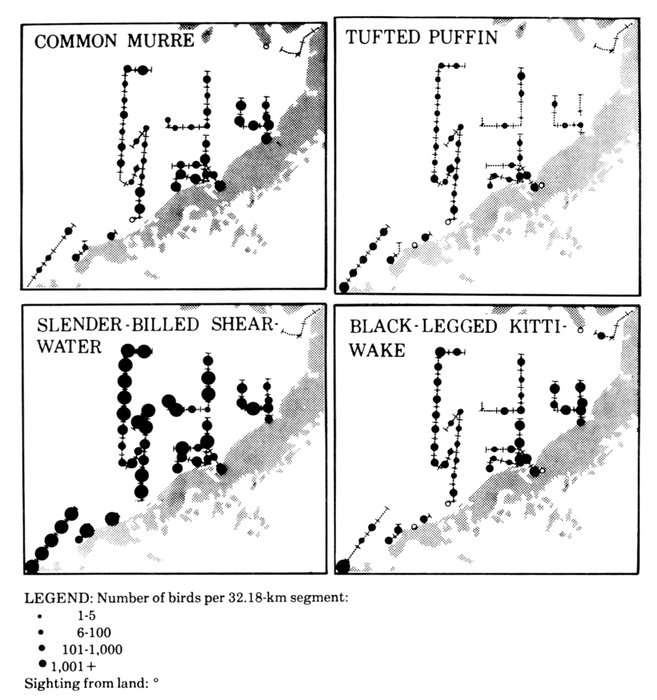
Common Murre (Uria aalge)
The common murre is resident in the northern
and western Gulf of Alaska from Pinnacle
Rock, Kayak Island, westward. East of Cook
Inlet colonies are located at Wingham Island,
the Martin Islands, Middleton Island, Porpoise
Rock in Hinchinbrook Entrance, Barwell
Island/Cape Resurrection, the Chiswell
Islands, the Barren Islands, and Chisik
Island.
For some reason, the islands of the Kodiak-Afognak
Archipelago do not host any known
major murre colonies. There is also a rather
large gap between the Chisik Island colony
and the next major colony at Oil Creek west of
Puale Bay. Directly west of Oil Creek is another
colony at Cape Unalishagvak. Both of
these latter colonies are Class V and they are
the first colonies of this size to be encountered
in the Gulf of Alaska. West of these colonies
the next large colony is at Atkulik Island. To
the south, midway between the last-named
colonies, lies the major composite murre
colony in the Semidi Islands. These sites
make up the only Class VI colony in the Gulf
of Alaska. Westward, the next major colony,
a Class V, is at Spitz Island south of Mitrofania
Island. In the Shumagin Islands one
Class V colony is at Karpa Island, and lesser
colonies with large murre components are
found at the Haystacks, Castle Rock, and
Bird Island. Only minor murre colonies are
found between the Shumagin Islands and the
end of the Alaska Peninsula.
Gabrielson and Lincoln (1959) were aware
only of the colonies at Cape Resurrection
(which Gabrielson considered to be large), at
the Chiswell Islands, and at Chisik Island for
the area from Cook Inlet east. Gabrielson
visited the Barren Islands on 13 June 1940
and apparently did not notice the present
murre colonies, both Class IV, at East Amutuli
(an island which he visited) and Nord
Island.
Gabrielson (Gabrielson and Lincoln 1959)
found a few small colonies at Kodiak, mostly
on small offshore islands. Gabrielson found
common murres to be abundant in the Semidi
Islands and stated that there were no notable
colonies in the Shumagins, although on his return
to the Shumagins in 1949 he did find a
fairly large colony at the Haystacks. That size
description would fit the colony that is there
now. He obviously did not see the other colonies.
Rausch (1958) reported murres from
Middleton Island.
There is quite a difference between the distribution
of murres as we know it today and
the way Gabrielson and Lincoln pictured it.
Why does this difference exist? There are two
possible answers: either the number of colonies
has increased, or the coverage of colony
locations has improved. The latter case, at
least, is established. I must confess to being
puzzled by the way Gabrielson was able to
move about close to what are now known to be
sizeable colonies without seeing them, those
in the Barren Islands and the Shumagin Islands
in particular. Perhaps this represents
the vague outlines of yet another population
change.
The center of abundance for murre distribution
in the Gulf of Alaska today is from Paule
Bay west to eastern Shumagin Islands. The
Semidi Islands are the heartland of this area
of maximum abundance. We have no definitive
data on species composition of these colonies.
Common murres undoubtedly dominate
in most of the colonies; the only ones where we
know of a sizeable thick-billed murre component
are in the Shumagin Islands.
Thick-billed Murre (Uria lomvia)
Thick-billed murre population information
cannot be separated from that of the common
murre on the basis of existing data. A direct
assessment of present-day status is not possible.
After reviewing what we know about
their distribution, I suggest a way to examine
the question indirectly.
The thick-billed murre is found in colonies
with the common murre from Middleton Island
westward; Rausch (1958) noted about
400 murres at Middleton Island and observed
that the thick-billed murre outnumbered the
common murre by several times. Isleib and
Sowl (FWS, unpublished data) saw a thick-billed
murre mixed with common murres at
Porpoise Rock in July 1972. Isleib and Kessel
(1973) expressed the opinion that small numbers
of thick-billed murres will be found in
most common murre colonies in the northern
Gulf of Alaska when it is possible to survey
these colonies in detail. Karpa Island had a
significant component of thick-billed murres
in June 1973, and they constituted 40% of the
colony at the Haystacks (L. W. Sowl, unpublished
data).
Bent (1963) reported that many thick-billed
murre eggs have been taken by collectors at
Round Island in the Shumagin Islands. Dall
and Bannister (1869) reported a thick-billed
murre that was taken at Kodiak in 1867.
The Gulf of Alaska is at the periphery of the
breeding range of the thick-billed murre.
While it probably occurs in mixed colonies
with the common murre throughout this area,
the thick-billed murre is much less abundant.
Occasionally in the Gulf of Alaska, a colony
will be occupied predominantly by the thick-billed
murre. Gabrielson and Lincoln (1959)
noted that the thick-billed murre outnumbered
the common murre in many colonies in
the Aleutians and that it became progressively
more common at higher latitudes.
We have almost no data relative to the
species composition of murre colonies in the
Gulf of Alaska. Until we do it will not be possible
to fully understand the population
status of the thick-billed murre. It appears
that changes in the species composition of
murre colonies in the Bering Sea may be an indicator
of perturbation. The data for the Gulf
of Alaska are still too fragmentary to provide
any indication of whether or not the same indicator
would work there. Close monitoring of
the Shumagin Islands colonies over a number
of years might produce the answer.
Earlier in this paper I noted the dramatic
changes in species composition of murre colonies
on Walrus Island. Gabrielson and Lincoln
(1959) also commented on this well-documented
and anything but static situation. Investigators
who visited this island during
1976 reported seeing no murres on the island
and only small numbers on offshore rocks.
James Bartonek (personal communication)
said that this situation has prevailed for
several years.
There is an indication that a similar population
fluctuation and change in species composition
of murre colonies have also occurred
on St. Matthew Island. Bent (1963) found
mostly common murres and few thick-billed
murres at St. Matthew. Hanna (1916) saw
only thick-billed murres. Later, Gabrielson
(1941) found this to be true in 1940.
Dramatic fluctuation in murre populations
may be common and, at least in some cases,
the two species may be affected differently.
Perhaps this phenomenon has potential for
providing us with an indicator of some natural
perturbations.
Peterson and Fisher (1955) expressed the
opinion that thick-billed murres arrived at the
nesting ledges later than the common murre
and had to take the sites that were left. Tuck
(1960) reported data from the western Atlantic
showing that thick-billed murres arrive
later than common murres. On the other
hand, Belopol'skii (1961) reported data showing
that the two species arrive on breeding
colonies in East Murman simultaneously. At
Cape Thompson, Swartz (1966) found that
thick-billed murres arrived about a week before
common murres. The date of arrival,
while perhaps a contributing factor, is probably
not decisive. Interspecific competition of
another sort is indicated.
In mixed murre colonies where there are
large numbers of common murres, this species
occupies the choice nesting sites. Thick-billed
murres are usually left with the narrower
ledges while the common murres occupy the
longer, broader ledges (Belopol'skii 1961). The
broader ledges have lower chick and egg mortality
(Spring 1971). Spring also noted that
thick-billed murres are excluded from the centers
of mixed colonies. Johnson (1938) found
that this contributes to higher losses of eggs
to predators and to the loss of other social
benefits of occupying the colony center (Johnson
1941).
Kozlova (1961) said that during the occupation
of a colony there is a sharp competitive
struggle between the two species. In the end
thick-billed murres are pushed out to the periphery
of the colonies or left with narrow
ledges or other equally unfavorable sites.
Spring (1971) studied the functional anatomy
of both species and concluded that the common
murre is more successful in these encounters
because it has a more upright gait and
greater agility than the thick-billed murre.
It follows that in a portion of their respective
ranges, where the two species overlap and
where there is an equal chance that either
common murres or thick-billed murres will
dominate a given colony, the common murre
dominates. I conclude from this that where
there are dramatic changes in species composition
of murre colonies, such as at Walrus
Island, it is probably because the common
murre has been greatly reduced in numbers at
the colony.
Spring (1971) concluded that the common
murre is well adapted to pursuit and capture
of pelagic fishes and that the thick-billed
murre is better adapted for deep diving and
the capture of benthic fishes and pelagic and
benthic invertebrates. Having greater latitude
for food selection, the thick-billed murre
would have a greater tolerance for ecological
perturbations affecting the available food
supply. The common murre has an advantage
when pelagic fishes are available but cannot
switch to the other foods as readily as can the
thick-billed murre. The low density of pelagic
fishes in high arctic areas probably also accounts
for the greater success of the thick-billed
murre at higher latitudes relative to
common murres.
Belopol'skii (1961) presented data from
East Murman which indicates that the common
murre restricts its diet almost entirely to
a small number of fish species. Swartz (1966)
found strong indications that there were significant
differences in the food preferences of
the two species of murres. Thick-billed murres
made much greater use of invertebrates.
Bédard (1976) asserted that it is well known
that the common murre is quite partial to zooplankton.
So again the issue is not clear-cut.
The situation is, of course, much more complex
than I have portrayed it. Nonetheless, I
think that it offers potential for use as a tool
in assessing population change and perturbations
in the food supply which should be
studied quite closely.
Pigeon Guillemot (Cepphus columba)
Gabrielson and Lincoln (1959) noted that
the pigeon guillemot was one of the most
regularly observed birds in Alaskan waters. It
is found everywhere throughout the northern
and western Gulf of Alaska area, with only a
few understandable and relatively small
blanks, such as in the silty waters of Upper
Cook Inlet. Because it obviously lacks the
breeding murres' need for close contact with
its nearest neighbors, it is able to exploit the
available nesting habitat to the fullest. It
seems that literally every bit of suitable nesting
habitat is normally occupied.
Because of the dispersed way in which it
breeds and because it does much of its feeding
in the onshore zone (which is hazardous for
boats) the pigeon guillemot is an almost impossible
species to inventory by standard
methods.
There is no evidence that the pigeon guillemot
has been greatly affected by any major
perturbation. Because of its choice of nesting
habitat, it is probably subject to the attack of
only one egg predator, the rat. Because of its
loose social structure and the way it selects
nesting sites, eggs and young do not sustain
loss from panic flights. Its dispersed distribution
should insure that man-made impacts
such as oil spills will have limited impact.
The population levels of the pigeon guillemot
are probably relatively very stable. The
widespread introduction of the rat to most of
its nesting range undoubtedly had impact,
but this impact has gone undocumented. It
would be interesting to follow the response of
guillemot populations on islands where rats
had been totally removed, if that ever becomes
more than a dream.
Marbeled Murrelet (Brachyramphus
marmoratus)
The marbled murrelet apparently breeds
throughout most of the northern and western
Gulf of Alaska. This apparently is a necessary
condition because to date, at least in this part
of Alaska, we can only guess where and under
what conditions this murrelet breeds.
In some relatively sheltered waters like
Prince William Sound, where marbled murrelets
were estimated to number about 250,000
in 1972 (Isleib and Kessel 1973), they are the
most abundant seabirds. We know from
Dixon (1908) and Grinnell (1910) that this has
been so in Prince William Sound since the beginning
of the century. We know also that the
type specimens came from there as well
(Stresemann 1949), which is not necessarily
an indication of abundance but is suggestive
of their abundance relative to species not
collected.
Gabrielson (Gabrielson and Lincoln 1959)
found marbled murrelets common near Yakutat,
in Prince William Sound, in Resurrection
Bay, and at Kodiak, and reported seeing them
at the Chiswell Islands and at Chignik and
Pavlof Bay on the Alaska Peninsula. Cahalane
(1943, 1944) found them to be common in
Kupreanof Strait, and along the Alaska
Peninsula north of Katmai Bay. Murie (1959)
found them all along the Alaska Peninsula.
My own field notes from 1973 indicate that
the only place where they were common along
the Alaska Peninsula was at Wide Bay.
We can sample marbled murrelet numbers
by using standard transect methodology;
however, I have some very serious reservations
about our ability to convert these data
into a population estimate. This is not an unusual
assessment for Alaskan seabirds in
general, but I think it is particularly apropos
to this species.
We are still able only to guess at where the
marbled murrelet nests and we have not a clue
as to what sort of nesting strategy they pursue.
I am not prepared to accept, on the basis
of one North American record (Binford et al.
1975), that tree nesting is its habit throughout
its range. What has been proved is that
the marbled murrelet nests in trees and not,
as these authors would have us believe, that it
does not nest on the ground. It has become
rather fashionable to ignore the Chichagof Island
record (a ground nest), but it has not
been discredited. The color of the Chichagof
egg differs from that of the Big Basin egg, but
does agree with the one taken from an oviduct
by Cantwell (Gabrielson and Lincoln 1959).
My own experience leads me to believe that
tree nesting, if it occurs, is not the common
habit of marbled murrelets nesting in the
Prince William Sound region.
After many hours of observing marbled
murrelets over a period of several years, I am
intrigued by a number of things. These birds,
as often as not, appear to be clustered in
"pairs" as they feed. This occurs even at what
should be the height of the breeding season.
On several occasions I have noted a very pronounced
evening flight of these birds from
gathering areas on the water up into the surrounding
mountains at sunset. This has
moved me to wonder if their nesting strategy
includes incubating at night but less than full-time
attendance on days when the eggs can be
warmed by the sun. We know that periodic
egg-neglect is an aspect of storm-petrel behavior
(Pefaur 1974). Is this behavior also
possible on a more regular basis in an alcid? If
so, it would certainly help explain why nests
are hard to find.
It is apparent that more needs to be known
about the population dynamics and life history
of the marbled murrelet before we can
make a proper estimate of its abundance. In
spite of the fragmentary record, I conclude
that the marbled murrelet probably enjoys
the same relative abundance and distribution
that it did at the beginning of the century.
Kittlitz's Murrelet (Brachyramphus
brevirostris)
The Kittlitz's murrelet is not as abundant
as the marbled murrelet, but locally it is sometimes
found in large numbers. FWS surveys
conducted during July-August 1972 provide
an estimate of 57,000 murrelets of this species
in Prince William Sound. Almost a fifth of
these were concentrated in Unakwik Inlet
above Unakwik Reef. Even more interesting,
about 2,500 of these birds were concentrated
in one loose flock.
In addition to Unakwik Inlet, Kittlitz's
murrelets concentrate in College Fjord in
Prince William Sound and in the waters fronting
the Bering-Malaspina ice-fields (Isleib and
Kessel 1973). Common as they are in these
waters, this species is supposed to be even
more abundant at Glacier Bay. The common
feature of these waters is the amount of ice
that can be found below their tributary
glaciers.
The Kittlitz's murrelet is apparently distributed
from LeConte Bay, east of Petersburg,
Alaska, north to Point Barrow and west
across the Aleutians to Attu, where Murie collected
a pair (Gabrielson and Lincoln 1959). I
once flushed a murrelet from an area of tread
and riser topography near the top of the
highest point on Kiska Island in heavy cloud
cover, and although I could not see this bird
well, I thought it to be of this species. From
the range description in Gabrielson and
Lincoln (1959) and Udvardy's (1963) range
map, it is apparent that the distribution of
this species is rather patchy, but I suspect
that for the more mountainous part of its
range this is more apparent than accurate.
The record is too fragmentary to allow an assessment
of any change in status during the
historical period.
Ancient Murrelet (Synthliboramphus
antiquus)
Chase Littlejohn (Bendire 1895) spent the
spring and summer of 1894 collecting eggs on
islands south of the Alaska Peninsula. He has
left us a detailed record of what he saw but
not where he saw it. Bent (1963) stated flatly
that the site of his collecting was Sanak Island
and this has common acceptance. Several
things in his account point to a site which was
a small island with several peers close by, but
this could not have been Sanak. It could have
been an island in the Sanak Island group or it
could equally well have been somewhere in the
Sandman Reefs. Unfortunately, because of
this the record is clouded. There has never
been anything approaching a survey of the
southern half of the Sandman Reefs. We do
not know what breeding colonies are there.
At any rate, Littlejohn told of the large
numbers of Leach's storm-petrels, fork-tailed
storm-petrels, auklets (of which only Cassin's
is specifically identified), and ancient murrelets
which occupied a large number of small islands.
He could not calculate the number of
breeding murrelets on his small island, the
size of which I interpret to have been of the
same order of magnitude as two others which
he estimated were about 2 acres. He does say
that the murrelets must have numbered
several thousand and could, if left alone by
the Aleuts, have quickly grown too numerous
for the island to accommodate.
Murie (1959) made a brief visit to Sanak in
1937 and learned that there were no longer
any large colonies of seabirds. He attributes
this to exploitation of the fisheries and to the
fox-farming industry. Littlejohn told of the
repeated visits of Aleuts to his small islands,
where they took hundreds of birds each time
and all of the eggs they could find. This kind
of activity could not help but disrupt the
breeding on these islands.
Littlejohn's description of the ancient
murrelet's nest leaves little doubt that the
birds could be reached by fox or rats with
ease. The birds showed no particular care in
selecting a nest site and often worked their
way back no more than about a meter into the
dead vegetative cover from preceding years,
where they scratched out a shallow nest.
There are few records of the ancient murrelet
from the northern and western Gulf of
Alaska. Friedmann (1935) reported the collection
of a series of eggs in 1884 on Kodiak Island.
Chase Littlejohn (Bendire 1895) collected
eggs from somewhere in the Sanak
Group in 1894. In 1908 Dixon (Grinnell 1910)
saw a bird in Port Nellie Juan. Several were
seen by Jaques (1930) near Belkofski in May
1928. Gabrielson collected one bird at Cordova
in September 1941 and another at the
Chiswell Islands in July 1945 (Gabrielson and
Lincoln 1959). He saw numerous flocks in the
Gulf of Alaska on 30 July of an unnamed year.
In 1943, he would have been near Cape
Spencer on that date. In 1945 he would have
been near the Chiswell Islands. In either case,
he was probably somewhere in Blying Sound.
The ancient murrelet is relatively uncommon
but regularly observed in the inshore
waters along the outer coasts of the islands
fronting Prince William Sound. FWS surveys
in July-August 1972 provided an estimate of
almost 1,000 birds, mostly in nonbreeding
plumage, along the outer coast of Prince
William Sound (Isleib and Kessel 1973). Small
numbers were found feeding close to the
Wooded Islands on 24 July (my personal observation).
Rausch (1958) saw a few off
Middleton Island in 1956. Isleib (Isleib and
Kessel 1973) saw 400-500 widely distributed
at the mouth of Yakutat Bay in July and August
1968. The only large numbers of ancient
murrelets encountered on the FWS survey of
the Alaskan Peninsula in 1973 were in the
Shumagin Islands. They were very common in
East Nagai Strait on 9 June and more than
half of the 1,300 seabirds per square nautical
mile encountered between Little Koniuji and
Chernabura Islands on 11 June were ancient
murrelets. At Nagai Island an estimated
5,000 ancient murrelets were observed in the
west bay at Pirate Shake, and later (on
19 June) several were observed in the vicinity
of Midun Island (FWS, Anchorage, Alaska,
unpublished data).
On the basis of the observations recounted
above, I have to conclude that ancient murrelets
are fairly regularly, if patchily, distributed
throughout the northern and western
Gulf of Alaska. I do not believe that the void
in their range shown for the northern Gulf of
Alaska by Udvardy (1963) is correct. Several
colonies are there, awaiting discovery.
Ancient murrelets are not abundant in the
Gulf of Alaska but they are certainly more
numerous than we have been able to prove. It
is not possible to tell from the existing data
whether they were once more abundant than
they are now. I suspect, on the basis of the
Sanak Island experience, that we can conclude
that this species has been reduced in
number by various of man's activities.
Cassin's Auklet (Ptychoramphus aleuticus)
Cassin's auklet is a very uncommon bird in
the northern Gulf of Alaska. In the western
Gulf it is more common, particularly from the
Shumagins west.
This auklet apparently once bred in great
numbers on islands in or near the Sanak
Group where Chase Littlejohn (Bendire 1895)
found them to be twice as numerous as the ancient
murrelets. Murie (1959) did not find
them there.
Littlejohn began encountering Cassin's
auklets at sea some 290 km southeast of
Unga, Shumagin Islands. Murie (1959) encountered
them near the Shumagins in May
1937. During the FWS 1973 reconnaissance
survey of the Alaska Peninsula, these auklets
were not encountered (or at least not identified)
until we reached the vicinity of Unga
Strait where we saw a few in mixed flocks
with other murrelets and auklets. They were
most numerous in East Nagai Strait. We encountered
them only twice in a situation
which indicated they might be breeding—on
Hall and Herendeen islands on the north end
of Little Koniuji Island.
Murie (1959) considered Cassin's auklet to
be no longer common west of Kodiak. In
Gabrielson's many voyages through the
northern and western Gulf of Alaska he encountered
them only twice, once off Cape
Spencer and once in the Chiswell Islands.
Thoresen (1964) commented that throughout
the northern part of its range the Cassin's
auklet has become gradually less frequent. Although
there are no data to dispute this, I believe,
as do Isleib and Kessel (1973), that they
are more numerous than observations would
indicate, and I would apply this to the entire
area. There are certainly colonies remaining in
the Shumagin Islands, and quite probably
along the south coast of the Kenai Peninsula.
When it is possible to fully explore the Sandman
Reefs there is a good probability that
they will be found there.
We can only guess at the reasons for their
decline. Bendire (1895) and Murie (1959) have
described some contributing factors.
Parakeet Auklet (Cyclorrhyncus psittacula)
Gabrielson and Lincoln (1959) described the
parakeet auklet as the least colonial of any of
the Alaskan auklets. They also considered the
Aleutian Islands to be its principal nesting
grounds. There are old records of breeding
parakeet auklets from Kodiak (Friedmann
1935) and Little Koniuji (Bean 1882). Grinnell
(1910) reported two that were seen on Green
Island, Prince William Sound, and several
more that were seen near Knight Island.
Murie (1959) did not see any parakeet auklets
near Kodiak and Afognak islands which
he considered to be the eastern part of their
range. He did not think they were abundant
anywhere along the Alaska Peninsula. He
found a few near Sutwik Island in May 1936
and then noted that they were fairly common
near the Shumagins in May 1937.
Gabrielson found this species to be quite
numerous on the north side of Chowiet Island
in the Semidi Islands in 1945 (Gabrielson and
Lincoln 1959). He also saw numerous individuals
in Marmot Strait and saw one in the
Chiswell Islands during the same year. David
Roseneau (Isleib and Kessel 1973) found hundreds
close to East Amatuli Island in the Barren
Islands in 1965.
During FWS colony surveys, parakeet auklets
have been found in close proximity to six
seabird colonies in Prince William Sound.
During the July-August 1972 surveys, they
were estimated to number about 3,000 in the
Sound. They have also been found closely associated
with Chisik Island (David Snarski,
personal communication), the Chiswell Islands,
Nord and Sud islands in the Barrens,
Sea Otter Island, and Central and Long islands
along the Alaska Peninsula. They were
most numerous in the Shumagin Islands,
where they were found near Castle Rock, Hall
(9,000), Herendeen (3,000), Atkins (more than
5,000), and Little Koniuju islands. They were
again encountered south and west of Cold Bay
at High, Fawn, Let, Amagat, Umga, and
Patton islands. Many of these islands are in
the north half of the Sandman Reefs, the only
portion where any attempt has been made to
survey seabird colonies.
The parakeet auklet may not be abundant
anywhere in the Gulf of Alaska but, based on
the numbers of places it has been seen in recent
years, its population appears to be well
dispersed and probably doing very well. This
auklet is most abundant from the Shumagin
Islands westward. It is almost certainly more
numerous than has been thought. Its habits
are secretive enough so that it could easily
escape notice.
Because the parakeet auklet nests predominantly
under boulders, it probably was not
much affected by fox. Rats would certainly
have reduced its numbers wherever these
were introduced into its breeding habitat. We
have no data to tell us whether there may
have been population fluctuations in the past,
but there undoubtedly were at least minor
ones locally after rats were introduced.
Crested Auklet (Aethia pygmaea)
Udvardy (1963) shows the breeding range of
the crested auklet as extending from southern
Kodiak Island westward. Within the northern
and western Gulf of Alaska, it is certainly
most abundant in the eastern Shumagin
Islands.
Isleib saw this auklet in Prince William
Sound 3 times during the winter of 1972-73.
These are the only records he was aware of for
that area (Isleib and Kessel 1973). David
Roseneau (Isleib and Kessel 1973) saw several
in Amatuli Cove, Barren Islands, in June
1965. I observed one in the vicinity of Cape
Spencer in August 1973.
Friedmann (1935) listed the crested auklet
as a breeding bird at Kodiak, but considered it
to be much more abundant as a wintering
bird. Townsend (1913) has provided us with a
vivid description of the myriads of crested
auklets he encountered at Yukon Harbor,
Little Koniuji Island. Gabrielson and Lincoln
(1959) noted large numbers of crested auklet
around Simeonof and Bird islands in the Shumagin
Islands in 1946 and stated that the
Yukon Harbor colony was still thriving.
Crested auklets were not encountered on
the 1973 FWS reconnaissance survey until we
reached the Shumagin Islands. They were
abundant only at the southeastern end of
Little Koniuji, where we encountered perhaps
10,000 in Yukon Harbor and more than 50,000
in a small cove directly south of Yukon Harbor
on the opposite side of the island. As
numerous as they were, they did not match
Townsend's myriads or even come close to his
assessment that they "were here more
numerous than the 'choochkies' at St.
George." St. George Island in the Pribilofs is
famous for its least auklets which, in the past,
have been estimated to number as high as 36
million (Peterson and Fisher 1955). The numbers
there today do not even approach this
level and we have no way of knowing how
abundant they were when Townsend visited
the Pribilofs, but I think it is safe to say that
they probably numbered in the millions. There
are probably more crested auklets than we observed
on Little Koniuji, but there is certainly
no longer anything approaching millions of
birds. Properly pronounced, Koniuji is the
Aleut name for the crested auklet, so we can
assume that the original inhabitants were impressed
by its numbers.
During the 1973 FWS survey we did not see
crested auklets at either Simeonof or Bird islands.
On the overgrazed and cattle-trampled
Simeonof it does not seem possible that any
could still exist.
I suspect that a cattleman's greed has been
the undoing of any crested auklets that may
have nested on Simeonof Island. This would
not account for the loss of any colonies that
may have been on Bird Island, but the decaying
fox-trapper's cabin on that island undoubtedly
tells the story. Churnabura, with
its feral cattle, presents much the same problem
as Simeonof. As for Little Koniuji, have
horned puffins been partly responsible for the
decrease in crested auklets? The puffin colony
at the south end of Little Koniuji must be
exactly where Townsend's millions of crested
auklets once nested.
Least Auklet (Aethia pusilla)
No least auklets were encountered in FWS
surveys in the Gulf of Alaska in the early
1970's. Udvardy (1963) shows their breeding
range as starting well west in the Aleutians.
Gabrielson and Lincoln (1959) give the eastern
limit of their breeding range as the Shumagin
Islands. Bent (1963) listed their breeding
range as extending east to Kodiak Island,
and Friedmann (1935) knew of only a few
specimens taken in the winter from Kodiak.
Perhaps least auklets nested somewhere in
the western Gulf of Alaska, and they may
still, but at the moment we have no evidence
to prove that they do.
Rhinoceros Auklet (Cerorhinca monocerata)
Udvardy (1963) would have us believe that
the rhinoceros auklet did not nest between
southeastern Alaska and the southern Kurile
Islands. Bent (1963b), on the other hand, lists
their breeding range as extending from Washington
to Agattu. Clark (1910) noted this
species in small numbers at Atka and Agattu.
Because of the lack of proof, Udvardy probably
had no options. I believe that Bent was
probably closer to describing their original
range. I base this assumption on recent observations
and on the additional fragments of information
reported by Gabrielson and Lincoln
(1959). Murie (1959) failed to find this species
anywhere in the Aleutians, but his primary
reason for being there, the fox-farming industry,
may have had a lot to do with his not
being able to find any.
The FWS surveys in Prince William Sound
in July-August 1972 located small numbers of
rhinoceros auklets in breeding plumage at the
Wooded Islands and at Stoney Island and
Channel Island in Montague Strait. These
birds gave every impression of being local
breeders. David Roseneau (Isleib and Kessel
1973) encountered two at the Barren Islands
in June 1965. Isleib and Kessel (1973) list a
few other records from this area.
My own experience leads me to believe that
there is a large colony somewhere on Afognak
Island, probably on or near Tonki Cape. On 30
May 1973 I noted a lone bird north of Afognak
Island. Later, on 8 and 9 August, I saw
several in the same area. On 13 August in
Marmot Strait I observed a number of rhinoceros
auklets, either singly or in groups of
up to 12. Some of these had small fish in their
beaks. As they flushed, they all flew off
toward Tonki Cape. This observation was
made just at last light, and I believe that
there were many others about that could not
be seen in the dying light. We did not encounter
this species along the Alaska Peninsula
during the FWS survey in 1973 until we
reached the end. There I had one quick
glimpse of what I was certain was a rhinoceros
auklet at Amagat Island.
Horned Puffin (Fratercula corniculata)
The horned puffin is one of the most abundant
breeding birds in the Gulf of Alaska.
There are only a few really large colonies but
these birds breed just about anywhere there is
a cliff (even a low one) with suitable fractures
and crevices. During the Alaska Peninsula
surveys in 1973, I estimated that the frequency
with which these birds were seen on
the water was about half that of the tufted
puffin. They have been recorded in so many
places that there is nothing to be gained by a
reiteration of the record in the literature.
The horned puffins reach their greatest density
in the Gulf of Alaska west of Kodiak Island.
Murie (1959) estimated that the colony
at Amagat Island, Morzhovi Bay, contained
15,000 birds, one of the largest he had seen. It
contained at least 50,000 in 1973. Even at
that, it was no match for the colony on Little
Koniuji Island with its minimum 140,000
horned puffins. Other colonies with large
horned puffin components were at High Island
(40,000), Castle Rock (20,000), Mitrofani
Island (35,000), and Sosbee Bay (15,000).
Earlier in this paper, I commented at length
on the great and often rapid fluctuations in
populations of tufted puffins. The same phenomenon
affects horned puffins. In 1975 there
were relatively small numbers of horned
puffins at Little Koniuji where they had
flourished 2 years earlier (James Bartonek,
personal communication). Because they are
apparently subject to erratically oscillating
populations, it is hard to tell how they have
fared over the years.
Tufted Puffin (Lunda cirrhata)
The tufted puffin, as previously indicated,
is also a bird with widely fluctuating populations.
Until we develop an understanding of
their population dynamics and can understand
the underlying cause of these fluctuations
it will not be possible to assess trends in
their populations or understand the implications
of such trends.
Tufted puffins are abundant throughout the
Gulf of Alaska. Small colonies can be located
almost anywhere. Along the Alaska Peninsula
there are a number of colonies with an estimated
breeding population in 1973 of more
than 15,000 birds. These are: Ashiiak Island
(20,000), Central Island (90,000), the Brother
Islands (45,000), The Haystacks (19,000),
Castle Rock (85,000), Bird Island (none, but
may contain 500,000-1,000,000 at times),
Peninsula Islands (35,000), the Twins
(18,000), Amagat Island (40,000), and Umga
Island (22,000). These colonies correspond to
the area where colonies were listed for the
horned puffin.
Tufted puffin populations respond readily
to some undetermined short-term perturbations.
This is clearly demonstrated by their
rapid population fluctuations. Because of
their numbers and because of the apparent
rapidity with which their numbers rebound, it
is not so apparent that they have been affected
by long-term perturbations, as so many
other seabirds apparently have.
There is much unused or underused nesting
habitat suitable for this species. In some
cases there are very strong clues pointing to
why this habitat is vacant. On many islands
along the Alaska Peninsula, which have very
good-looking tufted puffin nesting habitat
and no puffins, there are visible signs of the
presence of fox—either fox trails or abandoned
trappers' cabins. I also suspect that the
brown bear (Ursa arctos) is another possible
contributing factor to population declines of
burrow nesters along this coast. I have seen
brown bears swimming from island to island
on foraging expeditions. George J. Divoky
(personal communication) has found brown
bears visiting Ugaiushak Island, which is
13 km from shore. There are other islands between
Ugaiushak and the mainland but the
shortest route from shore would require one
swim of 7 km. The motivation must be strong.
Tufted puffins may shift from colony to
colony. This could be an explanation for apparent
local population fluctuation, but if so,
I am puzzled by the apparent tenacity with
which puffins cling to some sites. Their constant
occupancy of sites where the vegetative
mat is breakaway tundra (Amundsen 1972) or
is underlain by sand results in the destruction
of these sites. Tufted puffins often cling to
them in spite of the fact that they have been
reduced to "slums."
My conclusion is that in spite of their large
numbers it appears that tufted puffin populations
in the Gulf of Alaska probably have
been reduced to a level below that of their undisturbed
state.
Seabird numbers in the Gulf of Alaska are
not static. Generally, they are probably much
less abundant than they were when Bering
made his voyage of discovery. There are,
nonetheless, considerable numbers of seabirds
breeding along the coasts of these waters.
Some species show signs of recovery from
past insults by man. With enlightened management
there is still time to preserve the
vast natural heritage that they represent and,
in many cases, to improve their status.
In attempting to address a complicated
subject in short space and a relatively narrow
frame of reference, I have certainly erred a
number of times. I would like to see the
wealth of new data that will be derived from
current work applied to this concept. An understanding
of past population fluctuations
and the underlying perturbations that they
reflect is essential for managers faced with
the problem of making good decisions on
measures to mitigate the potential adverse
impact of development.
American Ornithologists' Union. 1931. Check-list of
North American birds, 4th ed. American Ornithologists'
Union, Baltimore, Md. 530 pp.
American Ornithologists' Union. 1957. Check-list of
North American birds, 5th ed. American Ornithologists'
Union, Baltimore, Md. 691 pp.
Amundsen, C. C. 1972. Plant ecology of Amchitka
Island. Amchitka bio-environmental program.
Final Report, Battelle Columbus Lab., Columbus,
Ohio. 27 pp.
Bailey, A. M. 1948. Birds of arctic Alaska. Colo.
Mus. Nat. Hist. Pop. Publ. 8. 316 pp.
Baird, S. F. 1869. On additions to the bird fauna of
North America, made by the scientific corps of
the Russo-American Telegraph Expedition.
Trans. Chic. Acad. Sci. 1(2):311-325.
Beaglehole, J. C. 1974. The life of Captain James
Cook. Stanford Univ. Press, Stanford, Calif.
734 pp.
Bean, T. H. 1882. Notes on birds collected during
the summer of 1880 in Alaska and Siberia. Proc.
U.S. Natl. Mus. 5:144-173.
Bédard, J. 1976. Coexistence, coevolution and convergent
evolution in seabirds: a comment. Ecology
57(1):177-184.
Belopol'skii, L. O. 1961. Ecology of sea colony birds
of the Barents Sea. (Transl. from Russian.) Israel
Program for Scientific Translations, Jerusalem.
346 pp.
Bendire, C. 1895. Notes on the ancient murrelet
(Synthliboramphus antiquus) by Chase Littlejohn
with annotations. Auk 12(3):270-278.
Bent, A. C. 1963. Life histories of North American
diving birds. Dover Publications, Inc., New York.
239 pp.
Bent, A. C. 1964. Life histories of North American
petrels, pelicans and their allies. Dover Publications,
Inc., New York. 335 pp.
Binford, L. C., B. G. Elliot, and S. W. Singer. 1975.
Discovery of the nest and downy young of the
marbled murrelet. Wilson Bull. 87(3):303-319.
Bowles, J. H. 1908. Tapeworm epidemic among
Washington seabirds. Condor 11:33.
Cahalane, V. H. 1943. Notes on the Kodiak-Afognak
Island group. Auk 60(4):536-541.
Cahalane, V. H. 1944. Birds of the Katmai region,
Alaska. Auk 61(3):351-375.
Clark, A. H. 1910. The birds collected and observed
during the cruise of the United States Fisheries
Steamer "Albatross" in the North Pacific Ocean
and in the Bering, Okhotsk, Japan and Eastern
seas from April to December 1906. Proc. U.S.
Natl. Mus. 38:25-74.
Cody, M. L. 1973. Coexistence, coevolution and convergent
evolution in seabirds. Ecology 51(1):31-44.
Coues, E. 1874. Birds of the Northwest. U.S. Geological
Survey of the Territories, Misc. Publ. 3.
791 pp.
Dall, W. H. 1873. Notes on the avifauna of the Aleutian
Islands, from Unalaska eastward. Proc.
Calif. Acad. Sci. 5(1):25-35.
Dall, W. H. 1874. Notes on the avifauna of the Aleutian
Islands, especially those west of Unalaska.
Proc. Calif. Acad. Sci. 5:270-281.
Dall, W. H., and H. M. Bannister. 1869. List of the
birds of Alaska, with biographical notes. Trans.
Chic. Acad. Sci. 1(2):267-310.
Dement'ev, G. P., and N. A. Gladkov, eds. 1966.
Birds of the Soviet Vol. I. (Transl. from Russian.)
Israel Program for Scientific Translations, Jerusalem.
553 pp.
Dixon, J. S. 1908. Field notes from Alaska. Condor
10:139-143.
East, B. 1943. Seabird cities of the Aleutians. Nat.
Hist. 51:64-71.
Fisher, J., and R. M. Lockley. 1954. Seabirds.
William Collins and Sons, London. 320 pp.
Friedmann, H. 1934. Bird bones from Eskimo ruins
on St. Lawrence Island. J. Wash. Acad. Sci.
24:83-96.
Friedmann, H. 1935. The birds of Kodiak Island,
Alaska. Bull. Chic. Acad. Sci. 5(3):13-54.
Friedmann, H. 1937. Bird bones from archeological
sites in Alaska. J. Wash. Acad. Sci. 27:431-438.
Gabrielson, I. N. 1940. America's greatest bird concentrations,
Part I. Bird Lore 42:497-506.
Gabrielson, I. N. 1941. America's greatest bird concentrations,
Part II. Audubon Mag. 43:15-23.
Gabrielson, I. N. 1944. Some Alaskan notes. Auk
61:105-130, 207-287.
Gabrielson, I. N., and F. C. Lincoln. 1959. The birds
of Alaska. The Stackpole Company, Harrisburg,
Penn. 922 pp.
Golder, F. A. 1925. Bering's voyages, Vol. II.
American Geographical Society No. 2. 290 pp.
Grinnell, J. 1910. Birds of the 1908 Alexander Alaskan
Expedition with a note on the avifaunal relationships
of the Prince William Sound district.
Univ. Calif. Publ. Zool. 5:361-428.
Hanna, G. D. 1916. Records of birds new to the
Pribilof Islands, including two new to North
America. Auk 33:400-403.
Howell, J. C. 1948. Observations on certain birds of
the region of Kodiak Island. Auk 65:352-358.
Hrdlicka, A. 1945. The Aleutian and Commander
Islands and their inhabitants. Wistar Institute
Anatomical Biology, Philadelphia. 630 pp.
Isleib, M. E., and B. Kessel. 1973. Birds of the
North Gulf Coast-Prince William Sound region,
Alaska. Biol. Pap. Univ. Alaska No. 14. 148 pp.
Jaques, F. L. 1930. Water birds observed on the
Arctic Ocean and the Bering Sea in 1928. Auk
47:353-366.
Jochelson, W. 1968. History, ethnology and anthropology
of the Aleut. Carnegie Inst. Wash. Publ.
432. 91 pp.
Johnson, R. A. 1938. Predation of gulls in murre
colonies. Wilson Bull. 50(3):161-176.
Johnson, R. A. 1941. Nesting behavior of the Atlantic
murre. Auk 58(2):152-163.
Kozlova, E. V. 1961. Charadriiformes, Suborder
Alcae. Fauna of USSR: Birds 2:1-140. (Transl.
from Russian.) Israel Program for Scientific
Translations, Jerusalem. 140 pp.
Lockley, R. M. 1962. Puffins. The Natural History
Library, Anchor Books, Doubleday and Company,
Inc., Garden City, N. Y. 222 pp.
Murie, O. J. 1959. Fauna of the Aleutian Islands
and the Alaska Peninsula. U.S. Fish Wildl. Serv.,
N. Am. Fauna 61. 406 pp.
Nelson, E. W. 1887. Report upon natural history
collections made in Alaska between the years
1877 and 1881. U.S. Army Signal Corps. Arct.
Ser. Pub. 3.
Nichols, J. T. 1927. Tubinares of the Northwest
Coast. Auk 44(3):326-328.
Orth, D. J. 1967. Dictionary of Alaska place names.
Geol. Surv. Prof. Pap. 567. 1084 pp.
Palmer, R. S. 1962. Handbook of North American
Birds. Vol. I. Yale University Press, New Haven,
Conn. 567 pp.
Patten, S. M., Jr. 1976. Sympatry and interbreeding
of herring and glaucous-winged gulls in southern
Alaska. Pac. Seabird Group Bull. 3(1):25-26.
Pefaur, J. E. 1974. Egg-neglect in the Wilson's
storm petrel. Wilson Bull. 87(1):16-22.
Peterson, R. T., and J. Fisher. 1955. Wild America.
Weather Vane Books, New York. 434 pp.
Rausch, R. L. 1958. The occurrence and distribution
of birds on Middleton Island, Alaska. Condor
60:227-242.
Schlegel, H. 1862-64. A catalogue of birds in the
Dresden Museum of Natural History, Leyden.
Dresden Museum of Natural History, 7 Vols.
Sowl, L. W., and J. C. Bartonek. 1974. Seabirds—Alaska's
most neglected resource. Trans. N. Am.
Wildl. Natl. Resour. Conf. 39:117-125.
Spring, L. 1971. A comparison of functional and
morphological adaptions in the common murre
(Uria aalge) and thick-billed murre (Uria lomvia).
Condor 73:1-27.
Stejneger, L. 1885. Results of ornithological explorations
in the Commander Islands and in
Kamtschatka. Bull. U.S. Natl. Mus. 29:1-382.
Stresemann, E. 1949. Birds collected in the North
Pacific area during Captain James Cook's last
voyage (1778 and 1779). Ibis 91:244-255.
Swartz, L. G. 1966. Sea-cliff birds. Pages 611-678 in
N. J. Wilimovsky and J. N. Wolf, eds. Environment
of the Cape Thomson Region, Alaska. U.S.
Atomic Energy Commission, Oak Ridge, Tenn.
Thoresen, A. C. 1964. The breeding behavior of the
Cassin's auklet. Condor 66:456-476.
Townsend, C. H. 1913. The crested auklet. Bird-Lore
15:133-136.
Tuck, L. M. 1960. The Murres. Queen's Printer,
Ottawa. 260 pp.
Turner, L. M. 1885. Notes on the birds of the Near
Islands, Alaska. Auk 2:154-159.
Turner, L. M. 1886. Contributions to the natural
history of Alaska. Part V, Birds. U.S. Army, Signal
Corps, Washington, D.C. Pages 115-196.
Udvardy, M. D. F. 1963. Zoogeographic study of
the Alcidae. Pages 85-111 in J. L. Gressitt, ed.
Pacific Basin biogeography, a symposium. Pac.
Sci. Congr. Proc. 10.
U.S. Bureau of Sport Fisheries and Wildlife. 1973.
Semidi Islands wilderness report. Semidi Islands,
National Wildlife Refuge. (Unpublished report)
U.S. Department of Commerce. 1964. United
States Coast Pilot, No. 9, Pacific and Arctic
Coasts, Cape Spencer to the Beaufort Sea. Coast
and Geodetic Survey, Washington, D.C. 330 pp.
Walker, E. P. 1923. Definite breeding record for the
Aleutian tern in southern Alaska. Condor 25:113-117.
Willet, G. 1914. Birds of Sitka and vicinity, Southeastern
Alaska. Condor 16:71-91.
Willet, G. 1918. Bird notes from Forrester Island,
Alaska. Condor 20:85.
Williamson, F. S. L., and L. S. Peyton. 1963. Interbreeding
of glaucous-winged herring gulls in the
Cook Inlet Region, Alaska. Condor 65:28.