Soon after dinner the following day two riders,
their bedrolls upon the back of a pack-horse, drew
up and dismounted near the blacksmithshop of
the Round Seven, where Samuels and Red Carney
were busy repairing the grub wagon.
"Where's Tex?" asked one.
"Huntin' horses," answered Samuels.
"Which my name's Tom King, an' hisn's
Leander Stot," introduced the cow puncher. "We
rode the calf round-up fer Y Bar Pierson over
agin' the Highwoods. Which they don't only
shove you three meals a day on the round-up—hot
beans, cold beans, an' sour beans.'
"An' the cook's a breed, an' the bread ain't done
in the middle, an' they feed you tea to drink,"
interrupted Stot, with disgust.
"An' their horses is so tall you got to have a
ladder to fork 'em, an' you wear kidney sores onto
'em where yer spurs comes."
"An' they roust you out so early in the mornin'
you got to light matches to tell what you're gittin'
hold of in the horse corral. Tex he hired us fer to
ride the beef round-up on the Round Seven."
"Wagons'll pull in about a week," informed
Samuels.
"Where's the rest of the riders? Ain't they no
one showed up yet?"
"Oh, yes, 'bout fifteen er so. Me an' Red,
here's two of 'em. The rest of the boys is in the
hay field, or buildin' fence."
"Hayin' an' fencin'!" cried King, in surprise.
"Say, what kind of an outfit is this here? Makin'
riders do ranch hand's work. Well, here's two
that won't freeze onto no fork handle, nor punch
no post holes in the ground, neither, nor likewise
string no wire! Even Y Bar Pierson never tried
that game. Where's the big boss? I ain't afraid
to tell it to him, same as I've told it to you."
Samuels jerked his thumb toward Connie, who
was turning his horse into the corral after a ride
through the hay fields: "He's over yender."
"What! You don't mean that kid?"
"Well," replied Samuels, picking up his hammer,
and drawing a piece of glowing iron from the forge,
"some might call him that. Other folks has kind
of learnt to think of him in bigger figgers."
"They ain't no man kin make me pitch hay er
do fencin'—let alone a kid."
"Mebbe," admitted Samuels, and a shower of
sparks flew about him as his hammer descended
upon the iron.
The two cow punchers strolled over to the horse
corral from which Connie was emerging, bridle in
hand. "Morning, boys," he greeted. "Just
turn your horses into the corral and we'll go up to
the house and see if we can't rustle something to
eat."
"You the big boss?"
"Yes. You can roll your beds off at the bunk house."
"I ain't so sure about rollin' off them beds.
We mightn't be goin' to stop."
"Oh, I thought you were to ride for the Round
Seven. We were expecting a few more men to
show up. The wagons won't pull for about a
week."
"That's what we thought we come here fer.
King's my name, an' this here's Leander Stot,
which we're cow hands an' ain't ranch hands.
The party that's blacksmithin' over there says
how all the riders is fightin' hay, er jobbin' post
holes through the sod. Where we come from
ranch hands does such like, an' riders rides. We
don't figger to pitch no hay, nor neither we don't
do no fencin'."
"That's all right," smiled Connie. "Just put
up your horses. Nobody works around this outfit
unless they want to. Just come up to the house
when you get through and I'll see if I can rustle a
cold bite."
The boy turned away. King looked at Stot
and Stot looked at King. "How about it?" asked
Stot. "Me—I'm hongry."
"If we throw off them beds, they ain't no law
we can't throw 'em on agin'. Bite of hay won't
hurt the cayuses none, neither."
"He says they don't no one work around this
outfit onless'n they want to."
"First time I ever seen a place where they didn't
no one work but them that wanted to—an' everyone
workin', even riders. Must be a bunch of
pilgrims."
"That there Tex ain't no pilgrim—not what
you'd notice, he ain't. An' that bird that's
blacksmithin', he ain't, neither—by the looks
of him."
King grinned: "Mebbe we better hadn't go
up an' eat nothin'. Mebbe he slips somethin' into
the grub that makes folks want to work."
"I'll take a chanct," laughed Stot, as he swung
his saddle to the ground. "I've got the first time
yet to hear myself hollerin' fer work to do, outside
of ridin'."
After the lunch which Walt Jones placed upon
the table had disappeared, Connie waved his hand
toward the bunk house: "Just make yourselves
at home," he smiled. "Spread your beds in any of
the empty bunks that suit you. The rest of the
boys are all working. They figured they would
rather have their pay start now instead of waiting
till the wagons pull out. But, it's all the same to
me if you boys would rather rest up for a few days.
We've got plenty of grub here, and you'll find cards
and dominoes, and checkers, and horseshoes down
at the bunk house."
They had stepped out onto the porch, and King
hitched at his chaps: "Two-handed cards ain't
no fun, an' dominoes is fer Greasers, an' we don't
savvy checkers, an' pitchin' horseshoes gits
tiresome fer an all day job."
"Well, you can sleep, or do anything else you want to."
"Man can't sleep fer a week," commented Stot.
"I wouldn't mind havin' my pay start in now,
neither. I'm broke. Say, boss, ain't you got a
job of ridin' to do? Anythin' jest so it's handlin'
stock of some kind. Ain't you got nothin' to
throw in, or throw out? Or, no broncs to bust?
Or nothin' a cow-hand kin do to fill in the time?"
"Rather do any kind of a riding job than work
in the hay fields, or help with the fencing?" asked
the boy.
"I'll tell a hand, we would."
"Well," reflected Connie, "I ran onto an old
cow this morning, a couple of miles up the creek,
that don't look like she's doing well. You might
catch up a couple of saddle horses and bring her
down and throw her on water just this side of the
hay field gate. The feed's good in there, and she
may pick up."
Connie grinned to himself as both men started
for the corral with alacrity. "Better take it kind
of easy with her, boys," he cautioned. "She isn't
in very good shape."
"We savvy the doggies, all right," reassured
King, "we'll fetch her in."
And a few minutes later, as the two riders
dashed past the house with a whoop on their way
up the creek, Connie Morgan grinned again.
That evening the men from the fields, after
much noisy splashing at the wash bench, trooped
into supper. When the meal was half over
Samuels glanced up and down the table: "They
was a couple of hombres drifted in this afternoon
fer to ride the round-up. They allowed they didn't
have no appetite fer ranch work. Guess they must
of drifted on."
"They's a couple extry beds layin' down by the
bunk house, an' a pack horse, an' couple of strange
ridin' horses in the corral," ventured Dick Grey.
"I guess they'll be along soon,' explained
Connie. 'You see, I wanted to hold them for the
round-up, and they didn't want to do anything but
ride, so I sent them on a little job up the creek."
Down by the bunk house, as darkness settled,
one of the cowboys who had been working in the
hay field, voiced the thought that had been in
many minds: "We're riders, same as them two is.
Looks like if hayin' an' fencin' was good enough
fer us, it's good enough fer them, too. We git
here first, an' then them two comes along an' gits
a ridin' job, an' we shovel hay."
Dick Grey bristled immediately: "What's
eatin' you?" he asked, truculently, "You don't
have to sweat no harder 'cause someone else is
doin' somethin' else, do you? Me—I was satisfied
to work at hayin' to help the boss out to-day, an'
I'll be satisfied to do it to-morrow. It don't make
no difference to me what he sets other folks to
doin'. That's his business. An' you can take it
from me, he's the best doggone boss in Montany.
You're lucky you lit here, no matter what he puts
you at. If he figgers that's the only way he can
hold them birds, it's all right with me. You
bet!"
"What in thunder's that a-comin'?" asked
Campbell staring through the dark at a slowly
moving blur that had come into sight a short
distance up the creek.
The blur resolved itself into figures, and Samuels
gave a low exclamation: "Good gosh! Boys, it's
them two riders, an' they're bringin' in old Eva,
head an' tail! Oh, my granmammy! I mistrusted
the boss was up to somethin'. He was too blame
sober about that there explainin'. Shut up, all of
you, an' make his play good! Don't pay no
'tention to 'em."
The two riders were almost abreast of the bunk
house, where twenty men stood and solemnly
watched their progress along the road that led
down the creek toward the hay field. What they
saw was a rider with his rope around the horns of
an old cow which was close-snubbed to his saddle
horn. Following him was another rider with the
cow's tail snubbed to the horn of his saddle. The
cow had braced herself grotesquely against any
forward motion, and was being pulled and pushed
down the road by main force, taking stiff-legged,
reluctant steps as the horses passed slowly along
the road.
"What's the boss's game? An' what's this here
old Eva business?" asked the cowboy who had
registered his complaint about the newcomers
being given riding jobs.
Samuels grinned broadly: "They was playin'
the boss fer a kid, which he's got more brains into
his head than some folks has got hay. I mistrust
he's outguessed 'em. He give 'em a ridin' job all
right! That there old cow they fetched in is an
old milk cow that got locoed six or seven year ago,
an' they turned her out, an' she's be'n hangin'
around the same bend of the crick ever sence.
They's a patch of loco weed on the side of a little
butte clost by, an' she's got a path wore between
it an' the water." With grins and chuckles, and
digs in the ribs, the cowboys and ranch hands who
had gathered around showed their appreciation of
Connie's joke on the men who had refused to work
in the fields. "They'll be back, d'rectly,"
continued Samuels, "an' we don't want to let on we
seen nothin' out of the ordinary about draggin'
in a locoed cow. I got a hunch the boss ain't
through with 'em yet. It's up to us to keep our
mouth shet—onless'n they catch up their own
private horses, an' throw their beds on their pack
horse—then we'll cut loose an' laugh 'em off'n the
ranch."
After breakfast the following morning Samuels,
who was still tinkering about the grub wagon,
managed to edge into hearing as the two men
reported to Connie at the corral. "Well, did you
get her in all right?" asked the boy.
"Yeh, we fetched her in," answered King, as he
stooped to loosen the rope from his saddle preparatory
to entering the corral. "I hope you ain't
got no more like her to fetch in to-day. If you have,
we'll hitch up a team of work horses an' drag 'em
in on a stone boat.'
"No, I don't think there are any more to bring
in. You won't have any very hard riding to do
to-day. Just ride herd on the one you brought in
yesterday. I don't want to lose her, now we've
got her here." Samuels dived into the blacksmithshop
where he stuffed his bandana into his mouth
to keep from bursting into unseemly laughter.
"Say," cried Stot, "what d'you mean ride
herd! Why, that old critter is locoed so bad she
can't hardly stand on her feet, let alone go no
place! I bet she ain't moved ten foot from where
she bedded down las' night!"
"Maybe not," answered Connie, "but I don't
want her to pull out on us. That's the only
riding job I've got, and there won't be much work
to it. Only, don't lose sight of her for a minute.
You better come in one at a time to dinner and
supper. One of you can hold her while the other
one eats. We won't bother about standing night
guard, though. I don't think she'll try to pull
after she beds down."
Connie saddled his own horse and rode away.
"Well, I'll be doggoned!" muttered Stot, as he
led a Round Seven horse from the corral.
"You an' me—both!" seconded King, as he
threw his saddle on another.
"Course it's his money he's payin' out fer
wages. An' if he wants to pay two men fer holdin'
that ol' cow, it ain't none of our business."
"No—but, jest between you an' me—that kid
ain't got all his buttons."
Through a chink in the blacksmithshop wall
Samuels, convulsed with suppressed mirth,
watched the two ride away down the creek, to take
their places on herd, in full sight of the hay and
fencing crews. Soon thereafter he found excuse to
visit the hay field, and later the fencing crew,
where he spake after this fashion: "The lid's off,
fer as kiddin' them birds goes. The boss has got
'em ridin' herd on that ol' Eva! The way I got it
sized up, if he hadn't wanted 'em kidded he
wouldn't had 'em throw her in where the hull
outfit could see 'em. I dang near busted tryin'
to keep from laughin' when he told 'em they had to
come fer meals, one to a time, so the other one
could hold herd. You'd ort to seen their faces!
An' the boss, he kep' his'n as straight, an' talked
as serious as a preacher. He's got 'em plumb
fooled—they think he's more locoed than what old
Eva is!"
At noon the crews came in from the fields, riding
on hayracks, and as they passed the two riders
who had spent the entire morning watching the
old cow which had not moved from the spot where
she stood with nose to the ground, they cut loose
with a perfect volley of advice: "You hadn't ort
to be off yer horse!" "Suppose she'd charge!"
"Lookout fer a stampede!" "You hadn't ort to
smoke, you might start the hull herd!" "She
looks like she was on the prod!" "Her hair looks
rough, you'd ort to bring out a curry comb!"
"Sing her to sleep, an' then one of you kin come
on in to dinner!" "Try blindfoldin' her, an' she'll
be easier to hold!"
"Eva. Eva.
Oh, my heart's a palpitatin'
All the time that I'm a waitin'
For my E-e-e-e-va."
sang one, joyously.
The wagons passed on, leaving Stot and King
guarding the old cow in stony silence. When the
rattle of the returning wagons sounded from up
the creek, King called across to Stot: "I'm goin'
to dinner! Be back d'rectly."
In the dining room he ate alone, served by Walt
Jones whose face was imperturbable as a face of
stone. "Say, what in thunder is this place, a
ranch, er a lunatic asylum?" questioned King, as
he finished his meal.
The cook regarded him gravely. "This is a
ranch," he explained. "The lunatic asylum is
down to Warm Springs. You git off at the deppo, an'——"
"You go to thunder!" And as King banged the
door behind him, Walt Jones grinned broadly.
At supper time Connie was surprised to see that
both Stot and King had taken their places with the
others at the table. Seeing the eyes of the boy
upon them, King explained: "We lost the herd,
boss."
"Lost it?" asked Connie, gravely.
Producing a flaming bandana, Stot dabbed at
his eyes, and between sniffling sobs blurted out:
"Little Eva's passed away!"
"Passed away! You mean she's dead?"
"Dead as Cleopatra—an' twict as respected,"
announced King, gravely, "The end come,
peacable an' quiet at 4:15 this P.M."
"But what killed her?"
"It might of be'n the sudden takin' away of her
drug. I regret to report she was an addick.'
"Or," ventured Stot, "it might of be'n suicide."
"Or, maybe," supplemented King, "it was a
fit of rage an' shamefulness over some an' sundry
of remarks that was passed in her hearin'."
"Or, it might of be'n a gun shot wound at the
hands of a person, or persons onknown," suggested
Stot, "or jest plain lonesomeness. We didn't
hold no reg'lar inquish, nor no post mortoriam.
Anyways, she ain't lived her life in vain, as the
feller says. You win, boss! You got us fair an'
square. It took us quite a while to savvy you,—but
we ain't like a feller that can't take a joke,
jest because it's on him. Anyone that kin put
anything over with as straight a face as you done, is
good enough fer us to work fer—an' if these other
birds, here, ain't none too good to go into the hay
field, we ain't neither. So if you got a couple extry
pitch forks handy, we'll lean on 'em tomorrow—if
it's suitable to you."
The man's last words were hardly audible in the
roars of laughter that rilled the room—the
whole-hearted laughter of appreciation and comradery.
For not a man in the room but felt, that the two
had come through a trying situation with flying
colors.
"You're good sports," grinned Connie, when
finally he could make himself heard. "The Round
Seven is glad to have you on the payroll."
A long-drawn "Ye-a-a-a!" rose from twenty
throats, and when it subsided the voice of King
could be heard as he looked across the table at
Samuels.
"But—makin' us ride herd on one old cow—ain't
that the limit?"
 "There she is, now some
hair artist comes along an' dobs his rope onto a
calf or a colt an' throws an' hog ties 'em an' goes
to work. Suppose he leaves a ridge of hair shaped
like another Round Seven Bar, reversed, on the
right hand side of that brand, with the two bars
connected like this:
 Now when the critter
gets up, he ain't a Round Seven critter no more—he's
a Flyin' H, plain as day. Of course when the
hair grows out he's a Round Seven critter again,
but by that time he's be'n trailed clean out of the
country, an' sold, an' the hair artist is maybe
five hundred miles away doctorin' brands on some
other range. That's one way.
 Connie stared at the brand that the
cowboy traced on the floor. "Do you get the
idea?" asked Tex. Connie shook his head. "Well,
accordin' to the arithmetic, two times seven is
fourteen. But that there is just common sevens, an' not
Round Sevens with a Bar through 'em. If you add
two of them together, one way you get a Flyin' H,
like I showed you. An' added the other way, you
get a Heart Bar. Take this here reversed Round
Seven Bar,
 an' your Round Seven Bar, an' shove
'em together, an' you get the Heart Bar, an' that's
Bob's brand. The way he works it, he's pretty
safe. He waits till the wagons get way down back
of the Little Rockys where there ain't no ranches
to bother, an' after they get a bunch of calves
branded with your brand, Bob an' Alex, an' Milk
River, an' Kid Owens, they slip away from the
outfit an' round-up anywhere from twenty-five
to a hundred head of cows an' fresh branded calves,
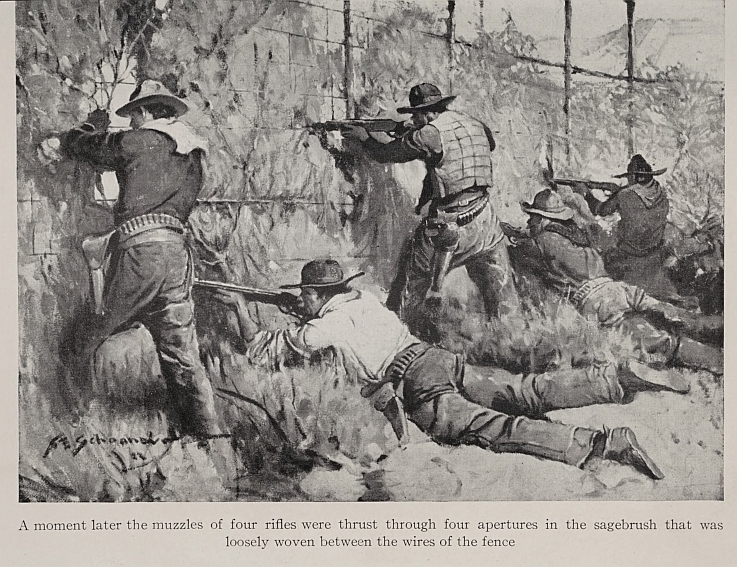
an' drive 'em to a sage brush corral he's got hid
down there somewheres. They run the calves
into the corral, an' leave the cows outside. His
man that looks after his outfit is there waitin' an'
he camps there right handy. Bob an' the boys go
back to the wagons for a week or ten days. Meanwhile
this other bird stays right there an' watches
that corral from some pinnacle where he can see
a good swipe of country. The cows are circlin'
around the fence tryin' to get to the calves, an'
they're bawlin' their heads off. Inside the fence
the calves are tryin' to get out an' they're bawlin'
as loud as the cows. As long as no riders get
within earshot everything is lovely. In about a
week or ten days the cows give it up, an' go away.
All this time this lookout has be'n feedin' the
calves, an' by the time the cows pull out they're
weaned. Then Harmon an' his gang come back,
an' they slap his reversed iron on the calves, makin'
a Heart Bar out of your Round Seven Bar, an'
then they drive them to the river an' ferry 'em
across."