Virginia did not sleep at all that night. She was reaching toward her
new self. Heretofore she had ruled those about her proudly, secure in
her power and influence. Now she saw that all along her influence had
in not one jot exceeded that of the winsome girl. She had no real
power at all. They went mercilessly on in the grim way of their
fathers, dealing justice even-handed according to their own crude
conceptions of it, without thought of God or man. She turned hot all
over as she saw herself in this new light—as she saw those about her
indulgently smiling at her airs of the mistress of it. It angered
her—though the smile might be good-humored, even affectionate.
And she shrank into herself with utter loathing when she remembered
Ned Trent. There indeed her woman's pride was hard stricken. She
recalled with burning cheeks how his intense voice had stirred her;
how his wishes had compelled her; she shivered pitifully as she
remembered the warmth of his shoulder touching carelessly her own. If
he had come to her honestly and asked her aid, she would have given
it; but this underhand pretence at love! It was unworthy of him; and
it was certainly most unworthy of her. What must he think of her? How
he must be laughing at her—and hoping that his spell was working, so
that he could get the coveted rifle and the forty cartridges.
"I hate him!" she cried to herself, the backs of her long, slender
hands pressed against her eyes. She meant that she loved him, but for
the purposes in hand one would do as well as the other.
At earliest daylight she was up. Bathing her face and throat in cold
water, and hastily catching her beautiful light hair under a cap, she
slipped down stairs and out past the stockade to the point. There she
seated herself, a heavy shawl about her, and gave herself up to
reflection. She had approached silently, her moccasins giving no
sound. Presently she became aware that someone was there before her.
Looking toward the river she saw on the next level below her a man,
seated on a bowlder, and gazing to the south.
His very soul was in his eyes. Virginia gasped at the change in him
since last she had seen him. The gay, mocking demeanor which had
seemed an essential part of his very flesh and blood had fallen away
from him, leaving a sad and lofty dignity that ennobled his
countenance. The lines of his face were stern, of his mouth pathetic;
his eyes yearned. He stared toward the south with an almost mesmeric
intensity, as though he hoped by sheer longing to materialize a
vision. Tears sprang to the girl's eyes at the subtle pathos of his
attitude.
He stretched his arms wearily over his head, and sighed deeply and
looked up. His eyes rested on the girl without surprise; the
expression of his features did not change.
"Pardon me," he said, simply. "To-day is my last of plenty. I am up
enjoying it."
Virginia had anticipated the usual instantaneous transformation of his
manner when he should catch sight of her. Her resentment was
dispelled. In face of the vaster tragedies little considerations gave
way.
"Do you leave—to-day?" she asked, in a low voice.
"To-morrow morning, early," he corrected. "To-day I found my
provisions packed and laid at my door. It is a hint I know how to
take."
"You have everything you need?" asked the girl, with an assumption of
indifference.
He looked her in the eyes for a moment.
"Everything," he lied, calmly.
Virginia perceived that he lied, and her heart stood still with a
sudden hope that perhaps, at this eleventh hour, he might have
repented of his unworthy intentions toward herself. She leaned to him
over the edge of the little rise.
"Have you a rifle—for la Longue Traverse?" she inquired, with
meaning.
He stared at her a little the harder.
"Why—why, surely," he replied, in a tone less confident. "Nobody
travels without a rifle in the North."
She dropped swiftly down the slope and stood face to face with him.
"Listen," she began, in her superb manner. "I know all there is to
know. You are a Free Trader, and you are to be sent to your death. It
is murder, and it is done by my father." She held her head proudly,
but the notes of her voice were straining. "I knew nothing of this
yesterday. I was a foolish girl who thought all men were good and
just, and that all those whom I knew were noble. My eyes are open now.
I see injustice being done by my own household, and"—tears were
trembling near her lashes, but she blinked them back—"and I am no
longer a foolish girl! You need not try to deceive me. You must tell
me what I can do, for I cannot permit so great a wrong to be done by
my father without attempting to set it right." This was not what she
had intended to say, but suddenly the course was clear to her. The
influence of the man had again swept over her, drowning her will,
filling her with the old fear, which was now for the moment turned to
pride by the character of the situation.
But to her surprise the man was thinking of something else.
"Who told you?" he demanded, harshly. Then, without waiting for a
reply, "It was that little preacher; I'll have an interview with him!"
"No, no!" protested the girl. "It was not he. It was a friend. I had
the right to know."
"You had no right!" he cried, vehemently. "You and life should have
nothing to do with each other. There is a look in your eyes that was
not in them yesterday, and the one who put it there is not your
friend." He stood staring at her intently, as one who ponders what is
best to do. Then very quietly he took her hands and drew her to a
place beside him on the bowlder.
"I am going to tell you something, little girl," said he, "and you
must listen quietly to the end. Perhaps at the last you may see more
clearly than you do now.
"This old Company of yours has been established for a great many
years. Back in old days, over two centuries ago, it pushed up into
this wilderness to trade for its furs. That you know. And then it
explored ever farther to the west and the north, until its servants
stood on the shores of the Pacific and the stretches of the Arctic
Ocean. And its servants loved it. Enduring immense hardships, cut off
from their kind, outlining dimly with the eye of faith the structure
of a mighty power, they loved it always. Thousands of men were in its
employ, and so loyal were they that its secrets were safe and its
prestige was defended, often to a lonely death. I have known the
Company and its servants for a long time, and if I had leisure I could
instance a hundred examples of devotion and sacrifice beside which
mere patriotism would seem a little thing. Men who had no country
cleaved to her desolate posts, her lakes and rivers and forests; men
who had no home ties felt the tug of her wild life at their hearts;
men who had no God bowed in awe before her power and grandeur. The
Company was a living thing.
"Rivals attempted her supremacy, and were defeated by the
steadfastness of the men who received her meagre wages and looked to
her as their one ideal. Her explorers were the bravest, her traders
the most enterprising and single-minded, her factors and partners the
most capable and potent in all the world. No country, no leader, no
State ever received half the worship her sons gave her. The fierce
Nor'westers, the traders of Montreal, the Company of the X Y, Astor
himself, had to give way. For, although they were bold or reckless or
crafty or able, they had not the ideal which raises such qualities to
invincibility.
"And, little girl, nothing is wrong to men who have such an ideal
before them. They see but one thing, and all means are good that help
them to assure that one thing. They front the dangers, they overcome
the hardships, they crush the rivals. Bloody wars have taken place in
these forests, ruthless deeds have been done, but the men who
accomplished them held the deeds good. So for two hundred years, aided
by the charter from the king, they have made good their undisputed
right.
"Then the railroad entered the west. The charter of monopoly ran out.
Through the Nipissing, the Athabasca, the Edmonton, came the Free
Traders—men who traded independently. These the Company could not
control, so it competed—and to its credit its competition has held
its own. Even far into the Northwest, where the trails are long, the
Free Traders have established their chains of supplies, entering into
rivalry with the Company for a barter it has always considered its
right. The medicine has been bitter, but the servants of the Company
have adjusted themselves to the new conditions, and are holding their
own.
"But one region still remains cut off from the outside world by a
broad band of unexplored waste. The life here at Hudson's
Bay—although you may not know it—is exactly the same to-day that it
was two hundred years ago. And here the Company makes its stand for a
monopoly.
"At first it worked openly. But in the case of Guillaume Sayer, a
daring and pugnacious mètis, it got into trouble with the law. Since
that time it has wrapped itself in secrecy and mystery, carrying on
its affairs behind the screen of five hundred miles of forest. Here it
has still the power; no man can establish himself here, can even
travel here, without its consent, for it controls the food and the
Indians. The Free Trader enters, but he does not stay for long. The
Company's servants are mindful of their old fanatical ideal. Nothing
is ever known, no orders are ever given, but something happens, and
the man never ventures again.
"If he is an ordinary mètis or Canadian, he emerges from the forest
starved, frightened, thankful. If his story is likely to be believed
in high places, he never emerges at all. The dangers of wilderness
travel are many: he succumbs to them. That is the whole story. Nothing
definite is known; no instances can be proved; your father denies the
legend and calls it a myth. The Company claims to be ignorant of it,
perhaps its greater officers really are, but the legend holds so good
that the journey has its name—la Longue Traverse.
"But remember this, no man is to blame—unless it is he who of
knowledge takes the chances. It is a policy, a growth of centuries, an
idea unchangeable to which the long services of many fierce and loyal
men have given substance. A Factor cannot change it. If he did, the
thing would be outside of nature, something not to be understood.
"I am here. I am to take la Longue Traverse. But no man is to blame.
If the scheme of the thing is wrong, it has been so from the very
beginning, from the time when King Charles set his signature to the
charter of unlimited authority. The history of a thousand men gives
the tradition power, gives it insistence. It is bigger than any one
individual. It is as inevitable as that water should flow down hill."
He had spoken quietly, but very earnestly, still holding her two
hands, and she had sat looking at him unblinking from eyes behind
which passed many thoughts. When he had finished, a short pause
followed, at the end of which she asked unexpectedly,
"Last evening you told me that you might come to me and ask me to
choose between my pity and what I might think to be my duty. What are
you going to ask of me?"
"Nothing. I spoke idle words."
"Last evening I overheard you demand something of Mr. Crane," she
pursued, without commenting on his answer. "When he refused you I
heard you say these words, 'Here is where I should have received aid;
I may have to get it where I should not.' What was the aid you asked
of him? and where else did you expect to get it?"
"The aid was something impossible to accord, and I did not expect to
get it elsewhere. I said that in order to induce him to help me."
A wonderful light sprang to the girl's eyes, but still she maintained
her level voice.
"You asked him for a rifle with which to escape. You expected to get
it of me. Deny it if you can."
Ned Trent looked at her keenly a moment, then dropped his eyes.
"It is true," said he.
"And the pity was to give you this weapon; and the duty was my duty to
my father's house."
"It is true," he repeated, dejectedly.
"And you lied to me when you said you had a rifle with which to
journey la Longue Traverse."
"That too is true," he acknowledged.
When next she spoke her voice was not quite so well controlled.
"Why did you not ask me, as you intended? Why did you tell me these
lies?"
The young man hesitated, looked her in the face, turned away, and
murmured,
"I could not."
"Why?" persisted the girl. "Why? You must tell me."
"Because," said Ned Trent—"because it could not be done. Every rifle
in the place is known. Because you would be found out in this, and I
do not know what your punishment might not be."
"You knew this before?" insisted Virginia, stonily.
"Yes."
"Then why did you change your mind?"
"When first I saw you by the gun," began Ned Trent, in a low voice, "I
was a desperate man, clutching at the slightest chance. The thought
crossed my mind then that I might use you. Then later I saw that I had
some influence over you, and I made my plan. But last night—"
"Yes, last night?" urged Virginia, softly.
"Last night I paced the island, and I found out many things. One of
them was that I could not."
"Even though this dreadful journey—"
"I would rather take my chances."
Again there was silence between them.
"It was a good lie," then said Virginia, gently—"a noble lie. And
what you have told me to comfort me about my father has been nobly
said. And I believe you, for I have known the truth about your fate."
He shut his lips grimly. "Why—why did you come?" she cried,
passionately. "Is the trade so good, are your needs then so great,
that you must run these perils?"
"My needs," he replied. "No; I have enough."
"Then why?" she insisted.
"Because that old charter has long since expired, and now this country
is as free for me as for the Company," he explained. "We are in a
civilized century, and no man has a right to tell me where I shall or
shall not go. Does the Company own the Indians and the creatures of
the woods?" Something in the tone of his voice brought her eyes
steadily to his for a moment.
"Is that all?" she asked at length.
He hesitated, looked away, looked back again.
"No, it is not," he confessed, in a low voice. "It is a thing I do not
speak of. My father was a servant of this Company, a good, true
servant. No man was more honest, more zealous, more loyal."
"I am sure of it," said Virginia, softly.
"But in some way that he never knew himself he made enemies in high
places. The cowards did not meet him man to man, and so he never knew
who they were. If he had, he would have killed them. But they worked
against him always. He was given hard posts, inadequate supplies,
scant help, and then he was held to account for what he could not do.
Finally he left the company in disgrace—undeserved disgrace. He
became a Free Trader in the days when to become a Free Trader was
worse than attacking a grizzly with cubs. In three years he was
killed. But when I grew to be a man"—he clenched his teeth—"by God!
how I have prayed to know who did it." He brooded for a moment, then
went on. "Still, I have accomplished something. I have traded in spite
of your factors in many districts. One summer I pushed to the
Coppermine in the teeth of them, and traded with the Yellow Knives for
the robes of the musk-ox. And they knew me and feared my rivalry,
these traders of the Company. No district of the far North but has
felt the influence of my bartering. The traders of all
districts—Fort au Liard, Lapierre's House, Fort Rae, Ile à la Crosse,
Portage la Loche, Lac la Biche, Jasper's House, the House of the
Touchwood Hills—all these, and many more, have heard of Ned Trent."
"Your father—you knew him well?"
"No, but I remember him—a tall, dark man, with a smile always in his
eyes and a laugh on his lips. I was brought up at a school in Winnipeg
under a priest. Two or three times in the year my father used to
appear for a few days. I remember well the last time I saw him. I was
about thirteen years old. 'You are growing to be a man,' said he;
'next year we will go out on the trail.' I never saw him again."
"What happened?"
"Oh, he was just killed," replied Ned Trent, bitterly.
The girl laid her hand on his arm with an appealing little gesture.
"I am so sorry," said she.
"I have no portrait of him," continued the Free Trader, after an
instant. "No gift from his hands; nothing at all of his but this."
He showed her an ordinary little silver match-safe such as men use in
the North country.
"They brought that to me at the last—the Indians who came to tell my
priest the news; and the priest, who was a good man, gave it to me. I
have carried it ever since."
Virginia took it reverently. To her it had all the largeness that
envelops the symbol of a great passion. After a moment she looked up
in surprise.
"Why!" she exclaimed, "this has a name carved on it!"
"Yes," he replied.
"But the name is Graehme Stewart."
"Of course I could not bear my father's name in a country where it was
well known," he explained.
"Of course," she agreed. Impulsively she raised her face to his, her
eyes shining. "To me all this is very fine," said she.
He smiled a little sadly. "At least you know why I came."
"Yes," she repeated, "I know why you came. But you are in trouble."
"The chances of war."
"And they have defeated you after all."
"I shall start on la Longue Traverse singing 'Rouli roulant.' It's a
small defeat, that."
"Listen," said she, rapidly. "When I was quite a small girl Mr.
McTavish, of Rupert's House, gave me a little rifle. I have never used
it, because I do not care to shoot. That rifle has never been
counted, and my father has long since forgotten all about it. You must
take that, and escape to-night. I will let you have it on one
condition—that you give me your solemn promise never to venture into
this country again."
"Yes," he agreed, without enthusiasm nor surprise.
She smiled happily at his gloomy face and listless attitude.
"But I do not want to give up the little rifle entirely," she went on,
with dainty preciosity, watching him closely. "As I said, it was a
present, given to me when I was quite a small girl. You must return it
to me at Quebec, in August. Will you promise to do that?"
He wheeled on her swift as light, the eagerness flashing back into his
face.
"You are going to Quebec?" he cried.
"My father wishes me to. I have decided to do so. I shall start with
the Abítibi brigade in July."
He leaped to his feet.
"I promise!" he exulted, "I promise! To-night, then! Bring the rifle
and the cartridges, and some matches, and a little salt. You must take
me across the river in a canoe, for I want them to guess at where I
strike the woods. I shall cover my trail. And with ten hours' start,
let them catch Ned Trent who can!"
She laughed happily.
"To-night, then. At the south of the island there is a trail, and at
the end of the trail a beach—"
"I know!" he cried.
"Meet me there as soon after dark as you can do so without danger."
He threw his hat into the air and caught it, his face boyishly
upturned. Again that something, so vaguely familiar, plucked at her
with its ghostly, appealing fingers. She turned swiftly, and seized
them, and so found herself in possession of a memory out of her
far-off childhood.
"I know you!" she cried. "I have seen you before this!"
He bent his puzzled gaze upon her.
"I was a very little girl," she explained, "and you but a lad. It was
at a party, I think, a great and brilliant party, for I remember many
beautiful women and fine men. You held me up in your arms for people
to see, because I was going on a long journey."
"I remember, of course I do!" he exclaimed.
A bell clanged, turning over and over, calling the Company's men to
their day.
"Farewell," she said, hurriedly. "To-night."
"To-night," he repeated.
She glided rapidly through the grass, noiseless in her moccasined
feet. And as she went she heard his voice humming soft and low,
"Isabeau s'y promène
Le long de son jardin,
Le long de son jardin,
Sur le bord de l'île,
Le long de son jardin."
"How could he help singing," murmured Virginia, fondly. "Ah, dear
Heaven, but I am the happiest girl alive!"
Such a difference can one night bring about.
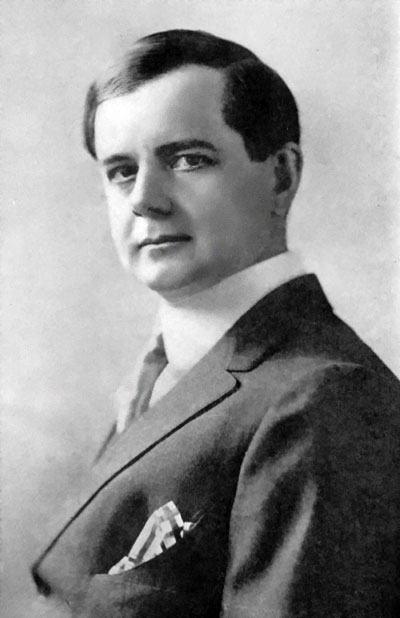 Paul Gilmore,
in "The Call of the North"—The dramatic
version of "Conjuror's House."
Paul Gilmore,
in "The Call of the North"—The dramatic
version of "Conjuror's House."