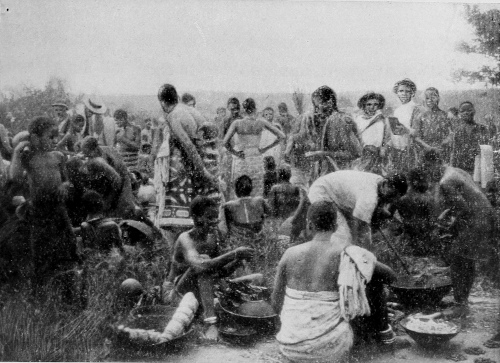
PART I Life on the Congo AS DESCRIBED BY A BRASS ROD — Chapter I En Route to Congo — Chapter II My Journey up the Congo — Chapter III My Overland Journey Begins — Chapter IV We reach the Town of my Owner — Chapter V A Funeral Orgy — Chapter VI Our Town Life — Chapter VII The Search for the Witch — Chapter VIII Visitors Arrive — Chapter IX Some Customs, Games, and a Journey — Chapter X Our Reception and Entertainment — Chapter XI Satu visits the White Man — Chapter XII Native Games and Pastimes — Chapter XIII Bakula accompanies an Embassy — Chapter XIV Bakula stays with the White Man — Chapter XV Satu receives a Title — Chapter XVI Hunting and Bush-burning — Chapter XVII Satu and his People go to War — Chapter XVIII Governing, Marketing, and Trading Customs — Chapter XIX An Accusation and the Ordeal — Chapter XX Bakula at School — Chapter XXI Bakula’s Work checked — Chapter XXII Bakula Falsely Accused and Murdered — Chapter XXIII I Find many Changes — Chapter XXIV A Marriage and a Harvest Festival — Chapter XXV Mikula at the Christmas Festival — NOTES TO PART I
xxiii
1

THE BRASS ROD
[The currency of the Country]]
I am packed in a box--Sent to Congoland--My journey on the
ocean steamer--Curious names of the Kroo boys--Landed at
Banana--Thrown on the deck of a river steamer.
I am much older than you think, for it is more
than twenty-five years ago since I was born
in a great factory in one of your English towns.
The years that have passed since my birthday
have been filled with joy and sorrow, rest and
toil; but in looking back over them I think they
have contained more sorrow and toil than rest and
joy.
When I was born I was very tall--nearly thirty
inches high; but instead of growing taller I have
become shorter, being only[2] eleven inches long
now, for my enemies have cut off one little piece
after another to melt down for brass ornaments.
Folk think more of finery than of honesty. I must
2not, however, anticipate my sorrows, for they came
all too soon.
Soon after I was born I was put with many
other brass rods into a dark box, and nailed in
very tightly; for I heard one of the workmen say
that I was to take a very long journey over sea
and land. There was fortunately a hole in my
box, and looking I saw that we were first put on
a train, and then carried into the hold of a big
ship. Soon after we were all packed carefully
and tightly in the hold, the steamer began to
move, and we could hear the creaking of the rigging
and the rattling of the racing engines, and
feel the pitching and rolling of the great steamer
itself.
I felt very glad when the pitching and rolling
stopped, and the cover was taken from the hold,
and the beautiful sunshine came streaming in,
making the rats scurry off with their young to dark
corners and cracks.
Just then we heard the bang of a cannon and
the shrill scream of a whistle; and, wondering
what was going to happen next, we heard the
babble of many voices, and the patter of naked
feet along the deck; and a voice shouted; “There,
our gang is complete. We don’t want any more,
and the sooner you others get over the side into
your canoes, the better for your health.”
3I heard an old palm-oil barrel who had taken
this journey many times remark to a new one:
“We are now off the Kroo Coast, West Africa,
and have taken on Kroo boys[3] to work the cargo
and keep the decks clean. That bang of the
cannon was to call them, and the whistle was to
hurry them.”
I do not know how many Kroo boys we
engaged; but they were very noisy, and gave us
many a sleepless night. At four o’clock in the
morning, while we were at sea, they began to rub
the decks with stones and scrape the ironwork
with knives, talking incessantly all the time; but
when we were in port it was worse, for they not
only worked the winches right over our heads
from early morn till late at night, but they came
down into the hold, turned us over and pitched us
about so that if I had not had a good wooden box
round me I should have been badly bent and
bruised. Some of my friends were smashed to
pieces, and some bales I knew received deep
gashes in their sides, and others I never saw
again.
It was a sad journey, full of partings, for those
Kroo boys never came into our hold without tying
up some of my friends, and we saw them for a
moment hoisted into the air, and over the side
4they went, into what?--I knew later, but not
then.
What curious names those Kroo boys had!
Some of them still linger in my memory, such
as: Peasoup, Teacup, Bottle-of-Beer, Brass-pan,
Top-hat, Kettle, Arm-chair, Pen-and-ink, Kiss-me-quick,
Flower-vase, Napoleon-Buonaparte,
and Duke-of-Wellington.[4] I learned afterwards
that the reason why they had these names was that
their white masters, not being able to pronounce
their proper country names when they first
engaged them, gave them any name that happened
to come into their heads at the moment, and such
names stuck to them all the days of their service
on the coast. It was amusing to hear these names
called, or, when one was asked his name, to hear
him answer: “Me, massa, me be Bottle-of-Beer.”
The Kroo boys good-humouredly retaliated by
giving their masters names that picturesquely
described any peculiarities they observed in them.
One they called Big-nose, another Skinny-legs,
another Long-legs, and a fourth Bald-head.
There was more appropriateness in the names
they gave their masters than the names they
received from them.
About seven weeks after we started my box was
tied with others, hoisted into the air, and thrown
5over the side of the ship into a big boat, and we
were rowed ashore and landed at Banana. As we
were going a Kroo boy spied me through my peephole,
and tried hard to drag me out of my comfortable
resting-place; but I clung tightly to the
others, and thus successfully resisted his attempts
to steal me. I soon found myself in a large store
filled with huge piles of boxes, bales, and crates,
and long rows of large bottles filled with rum and
other fiery waters.
After a few days a white man came into our
store, and, sorting out a large number of cases,
bales and bottles, sent them away on the heads
and shoulders of Kroo boys. For two days they
were carrying out loads as quickly as they could,
and just as I was thinking that I should not be
disturbed a Kroo boy came and lifted my box in
his strong arms, and, carrying me across the busy,
sunlit yard, threw me with much force on the deck
of a steamer, and I became unconscious.
6
Our captain and tyrant--River scenes--We camp at a trading-station--Native riddles.
When my senses returned I found my box
was piled on deck with many other boxes
like it, and thus I had a fine view. The sun was
rising, flooding the river with its brightness, lighting
up the distant hills and throwing into sombre
shadow the mangrove trees that lined the banks.
There was much hustling and shouting on board
as the ropes were cast loose; and I soon began to
feel the throb of the engines, and hear the rush
of the water as the small steamer pushed its way
against the strong current that was hurrying the
mighty volume of the Congo to the sea.
On reaching mid-channel I could see that the
trading-houses of Banana were built on a narrow
tongue of sand, having on one side the Atlantic
Ocean constantly rolling and sometimes madly
rushing as though it desired to tear the very
tongue out of the mouth of the river; and on the
other side the gentle lap, lap of a back current of
the river itself.
7The Congo is said to be fifteen miles wide at
the mouth--from hills to hills; but it does not
look so wide because of the islands and mangrove
swamps that hinder a clear view of the whole
width, and narrow one’s vision to the channel in
which you are steaming.
From my position I had an easy view of the
deck of our small steamer. There were only two
white men on board--a captain and an engineer;
the former was a short man, who never spoke
without swearing, and never gave an order without
punching or kicking one of the black crew. He
had a large rubicund nose, hideously coloured
by frequent applications to the bottles that were
always on his table. He was privately nicknamed
by his crew as Red-nose, and was thoroughly
feared and hated by them all. Many of them
were slaves and could not get away from him, and
others had contracted for one or two years’ service,
and if they ran away they would have lost their
pay; but notwithstanding this some did escape,
preferring loss of pay to constant brutal treatment.
The current was too strong to remain long in
mid-channel, so the steamer went near to the bank
and pushed and fought its way, with much
rattling, throbbing and panting, from point to
point of the various bays. When the water was
too swift to be conquered at one place, the
8steamer, snorting with defeat, crossed the channel
and worked its way up-river on the other side.
There was not much to be seen--no hippopotami,
no crocodiles, and very few natives in
canoes, and only an occasional trading-station on
low-lying, swampy land surrounded by palm-trees,
plantain groves and vegetable gardens. Here
and there men were to be seen fishing with large
oval nets. They stood on the rocks by which
the water rushed tumbling and foaming in its
hurry to reach the sea, and dipped in their nets
with the mouths up-stream, and, pulling up the
whitebait thus caught, laid them on the rocks
to dry. Others made small fences by the river’s
bank about eighteen inches apart and three feet
long, and into these they put small scoop-shaped
nets, and drew up the small fish that had passed
between the fences.
By sunset we reached a trading-station belonging
to my owners. Our steamer was quickly tied
to the bank, and all made secure for the night.
The men soon had some fires lighted along the
beach, and saucepans of food boiling on them,
and pieces of meat roasting in the ashes. Groups
gathered round the fires, and after a hearty meal
of rice, ship-biscuits and meat, they became very
talkative, and soon started asking riddles. Some
of these riddles I still remember after all these
9changeful years; and I will try to tell you a few
of them.
A Loango man named Tati seemed to know
most riddles,[5] and he was called upon to make a
start. After much persuasion he asked: “What
is this? The stick is very little; but it has a
number of leaves on it.” One after another
attempted to give the answer, but as they all
failed, Tati said: “The answer is--Market, because
it is a small place, but has a lot of people
on it.” They chuckled with delight over the neatness
of the riddle, and demanded Tati to give
them another.
Tati sat in a brown study for a few minutes,
and then, looking up, said: “There were five
buffaloes; but only four tracks.” Semo, who was
Tati’s rival in this game, instantly cried out:
“Fingers” as the answer, because while there are
five fingers on a hand there are only four tracks,
i. e. spaces between them.
Semo was then asked to give one, and without
a moment’s thought he cried out: “My father’s
fowls laid their eggs under the leaves.” All kinds
of guesses were made; but at last admitting their
failure, Semo said: “Peanuts,” and of course
they all saw it at once--peanuts grow under the
ground beneath their own leaves.
10Semo was called upon for another riddle, and
after a short pause he said: “I went to a strange
town, and they gave me one-legged fowls to eat.”
This one also was too difficult for them to guess,
and after many attempts Semo had to give the
answer, viz. Mushrooms, which have only one
stalk (i. e. one leg) on which to stand.
Soon after this the talk became general, and
gradually died away as one by one they rolled
themselves in their mats and went to sleep, leaving
the fires brightly burning to throw out warmth
to the sleepers and to frighten away hippopotami,
crocodiles and sundry other creatures. During
the night the snorting of hippopotami could be
heard as they gambolled in the shallow water near
the bank; and occasionally the switch of a crocodile
became audible as it hurried by in search of
food for its cruel but never-satiated jaws; many
noises also came from the dark forest just beyond
the settlement, that filled the night with weirdness
and made the first glow of dawn welcome to men,
birds and beasts.
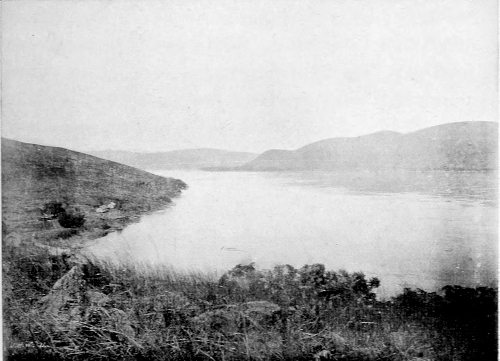
THE LOWER CONGO RIVER ABOUT 90 MILES FROM THE SEA.
Just as the sun peeped above the eastern horizon
bells began to ring, and the whole station awoke
to life. My friends, the crew, hurriedly came from
their mats, and were soon carrying bales, boxes
and bottles ashore, under the directions of a white
man, and in an hour or so all the goods for that
11station were discharged, and the steamer was
pushing its nose against the strong current of
brown, oily-looking water to the next up-river
station.
The higher we ascended the river the narrower
it became, and the more powerful was the rush of
water on its ever-scurrying way to the sea. Whirlpools
opened up at the most unexpected places,
making the steamer roll and pitch, and straining
the engines until they panted and groaned in their
never-ceasing struggle with the giant current.
Twice we were twisted round in a place called the
Devil’s Cauldron and carried down-river, but at
the third attempt the giant was conquered, and an
hour or so later we were tied up to a wharf at the
highest point on the Lower River.
Just below us the river narrows between steep
hills to a mile and a quarter in width, and through
that funnel more than twenty thousand miles of
rivers empty themselves into the “cauldron”
which constantly seethes, bubbles and boils with
the rush of water tearing over its rough, rocky
bottom.
12
The white man’s fetish--I am exchanged with others for rubber
and ivory--My new companions express freely their opinions
about the white men--Why the white men are on the Congo--Native
suspicions and prejudices.
The morning after the steamer arrived all the
goods were taken ashore, put into a huge
store, and arranged in their places. Just opposite
the store door was a large image, gaudily coloured
and grotesquely ugly. It was a fetish[6] that the
white man had bought of a native “medicine man,”
and had placed it there in the store to frighten
the natives and deter them from stealing. Of
course it was no use, for the natives knew that no
“medicine man” would sell a real fetish to the
white man, consequently it did not overawe them,
nor keep them from thieving when they had the
opportunity.
I had not been in the store many days when
the box in which I was packed was carried out
and handed over to some natives who had brought
some tusks of ivory and rubber to the white trader
13for sale. From what I heard it had taken them
a long time to settle the price; but directly that
had been agreed upon they quickly selected their
goods, viz. forty pieces of assorted cloth, ten
barrels of gunpowder, fifteen flintlock guns, one
box of brass rods, two demijohns or large bottles of
rum, five cases of gin, and some common looking-glasses,
knives, beads and various other trinkets.
I was carried, with the other trade goods, to
the native sleeping-quarters, and found my new
owners were not tall men, but wiry, lithe, strong
fellows, who, after they had bound us with ropes
in long baskets, commenced their tedious overland
journey to their town far in the interior. Before
sunset we had crossed the hills, descended the
valley, and forded by means of a canoe the Mposo
river. The boys of the party collected wood
and fetched water, and very soon bright cheerful
fires were blazing, and the camp resounded with
much chatter and laughter.
Most of the talk was about white men and their
strange ways. One laughed at them for having
such a silly fetish in their store. “Why, I know,”
said he, “the ‘medicine man’ who made it; and he
told me himself that he had put no strong charms
in it, as he was not going to hurt his own people
for any white man; but the foolish white man gave
plenty of cloth and gunpowder for it.”
14Another asked if they knew Fomu,[7] a white
man who lived in the next district? “Well, he
put a weight under his scale, and cheated us
for a long time; but we found him out, and at
first we would not trade with him again, until
some one found a way to punish him for defrauding
us.”
“What did you do?” asked another.
“Well,” answered the first, “we procured some
bananas and coated them with rubber, and sold
them to him as solid rubber; and it was a long
time before he discovered it, and then we had to
cut every lump of rubber into pieces; but I think
we recovered what he stole from us.” There was
a hearty and good-humoured laugh over this playing
off of one trick against another.
Just then an old man with a long plaited beard
chimed in: “Yes,” he said, “I had a friend who
lived in a part of the country where, instead of
using brass rods as we do, they use strings of blue
pipe beads as money--a hundred beads on each
string. One day my friend sold some ivory to a
trader there, and received some packets of beads
as part payment; but when he arrived home he
found that instead of there being one hundred
beads on each string there were only sixty. He
was cheated out of forty beads on every string,
15and before he could pass them on the markets he
had to make them up to the proper number.
“After that no native would deal with that
trader unless he gave two strings of beads in
the place of one, so he lost in trying to cheat
us.
“Pish!” exclaimed the old man, “the white
men are cheats! They put heavy pieces of iron
under their scales to rob us; they put lumps of
stuff in their measures to rob us; they give beads
in short numbers to rob us; when we work for
them they beat us just before our term is finished
so that we may run away without our pay, and
when we have carried loads for them they often
pretend we have stolen from them so as to have
an excuse for not paying us.”
The old man had worked himself into a rage as
he recalled wrong after wrong; but his voice was
drowned in a burst of laughter that came from a
group sitting round another fire. “What are you
laughing at?” he shouted aggressively.
“Not at you, father,” respectfully answered one
of the young men. “We are laughing at what
we heard yesterday: A trader had treated his
house boys, his people, and his customers very
badly for some time, so some of them met together
one evening, went to his house, and stripping him
of his clothes, they carried him into the bush, and
16rubbed him well with cow-itch, and then let him
go. He had a very bad time; but he has been
better to his people since that night.”
There was much snapping of fingers and chuckling
over this joke played on the white man.
“For what purpose does the white man buy
rubber and ivory?” asked one of the boys of the
old man with the plaited beard.
“I don’t know,” replied the old man. “When
I was a boy we made pestles and trumpets of the
ivory, and drumstick knobs with the rubber; but I
think the white man only buys rubber and ivory
to hide the real reason of his presence in our
country.”
“What is that?” asked the lad.
“Well,” said the old man, with a knowing look
in his black eyes, “the white man does not like
the work of making cloth, hence they come to this
country to buy up all the bodies of those who die
to send to their country to make cloth for them.
They preserve the bodies in their stores until there
is a good opportunity of sending them away in
their steamers; and when these bodies reach
Mputu (the white man’s country) the spirits are
forced to return to them by the magic of their
great ‘medicine men,’ and then they are compelled
to work for them as their slaves.
“The white men have very strong magic, surpassing
17the magic of our people; but if the white
men were not here, very few, if any, of our people
would die. Why, a friend of mine told me all
about it the other day. He said: ‘In the sea
there is a hole,[8] and the white man goes in his
steamer to this hole and rings a bell, and the water
sprites push up the end of a piece of cloth, and
the white man pulls on it one day, two days, three
days, until he has enough cloth, and then he cuts
it off and measures it into pieces, and binds it into
the bales, as we see in their stores. But before he
leaves the hole he throws into it some bodies he
has bought in our country.’ Yes, the white men
are very wicked, and don’t you have anything to
do with them. Why, all your relatives who have
died are now, perhaps, slaves in Mputu, and some
day you may be the same.”
A thrill of horror went through the gaping
crowd as the old man in graphic language and
with dramatic gestures told these things. When
he had gained his breath he began again.
“The other day I heard of some exceedingly
wicked white men who pretend to tell people
about God, white men who will give you medicine
if you ask for it, and will teach you in a school
how to read and write, and will even take you into
their houses and clothe and feed you. Beware of
18those white men, for they are only trying to secure
you, and you will soon die and become their slaves
in Mputu. The other white men say: ‘We have
come for rubber and ivory,’ and we receive plenty
of trade goods from them in return for our rubbish;
but these very wicked ones say: ‘We have
only come to tell you about the great God, and to
help you.’ They are more crafty, cunning and
wicked than the others. Keep away from them
always, or you will quickly die!”
By the time the old man had finished there was
a large circle of horror-stricken natives around
him, who, with many a cry of rage and hatred
against such evil doings, promised never to go
near such wicked wretches as these white men
were, and with many an oath they threatened they
would kill them if ever they had the opportunity.
Soon after this the fires were replenished, and
men and boys curled themselves in their mats and
cloths, and went to sleep dreaming of the cruel
wickedness of white men. And all through the
night the river went gliding by to the great Congo
and on to the sea to lose itself in the waters of the
Atlantic; and it took no warning to the white
men who were leaving home, friends, and family
to tell such as those who slept on its banks of
the great and good God.
19
Crossing the Mpalabala hills--The head man knocks his toes--It
is an evil omen--He visits the “medicine man”--Finds
his brother dying--Last hours of the dying chief.
The next morning was dull and damp--a
weeping morning, and every one shivered
with the cold as they hastily picked up their loads
and prepared for the steep ascent that would take
them over a spur of the Mpalabala mountains.
The road was a narrow track, steep and stony;
huge boulders were often in the path, and had to
be climbed over or avoided by detours, thus
making the way difficult and tiring. By ten o’clock
the sun was shining brilliantly on the white stones,
making the eyes ache with their glare and the
body perspire with their reflected heat. The men
panted beneath their burdens from the heat, and
water was very scarce.
By midday we had passed the steep and wearisome
hills of Mpalabala and were camped in the
valley by a pleasant stream.
Just before arriving at the resting-place the
head trader unfortunately struck his toes against
a stone, and, being very superstitious, he was filled
20with horror at the evil omen. It was the general
subject of conversation as to what this omen predicted.
One thought that a wife of the head
trader was dead; another suggested that his house
and goods were destroyed by fire; and thus they
prophesied one evil after another until Satu--the
poor fellow who had struck his toes--could hardly
rest at the midday halt; and he certainly put on a
very woebegone appearance, for he had no doubt
some great misfortune had befallen him or was
about to happen to him. This fear so played on
his mind that he had disturbed sleep and bad
dreams that night; and often started out of a
nightmare screaming that his sister or his wife
was dead, or his house was burnt to the ground.
The next day a large town was reached, and
Satu sought out the “medicine man” there, who
was famous through all the countryside for the
wonderful power of his fetish, and the charms he
made from it. Satu told him how he had struck
his toes against a stone, and his fear of the evil
omen, and asked the wizard to avert the evil.
Some of his companions laughed[9] at him for
wasting his money over such nonsense, while
others, who were more superstitious, advised him
to fee the wizard well, and thus enlist his power
to stave off the threatened mischief.
21This particular “medicine man” had a charm
which was called Kimbaji-mbaji (meaning, to-morrow),
and any person who came under its
protection could not be harmed because he who
wanted to hurt him always put off the carrying out
of his evil intentions until to-morrow, and, as you
know, to-morrow never comes. The special charm
used by this wizard was a shell full of various
herbs which had been pounded, mixed and
rammed into it.
The troubled man took a fowl to the wizard,
who killed it and poured some of its blood into
the shell, which he then placed on the ground,
surrounding it with eight little heaps of gunpowder.
After dancing about them for a short
time, and chanting an incantation over them, he
exploded the powder and blew his whistle vigorously.
These ceremonies aroused the charm to
work effectively in the postponement of the evil
spells that were being used against the man. The
wizard received twenty brass rods as his fee; and
Satu went on his journey satisfied that the omen
could not now work against him.
Satu, however, found on his arrival home that
the wizard’s power was ineffectual in his case, for
his brother, the chief of the town, was very ill and
nigh unto death. Hence their arrival, instead of
being acclaimed with the loud shouting of women
22and children, and the firing of many guns, was
greeted with the solemn headshakes of the men,
the crying of the women, and the beating of drums
by the “medicine men.”
The patient was apparently so bad that as a last
resort they had called all the “medicine men” of
the district together in the hope that their combined
force would rescue the man from the malignant
influence of the evil spirit--the ndoki that
was killing him. All night long they had been
drumming, shouting, beating gongs, and parading
about the town calling on the evil spirit to desist,
but without avail, for the chief was now dying,
and Satu had only just arrived in time to receive
his brother’s last wishes about his property and
the names of those who owed him money, and
slaves.
All the goods brought from the coast were piled
in the chief’s house so that he might gloat with
dying eyes on his increased wealth, and curse in
strong, passionate language the ndoki who was
causing his death.
From my fortunate spy-hole I could with ease
view the weird scene. It was a small hut built of
grass and sticks tied neatly and securely together.
There were two doors, but no windows, and the
smoke escaped as best it could through crevices in
the walls and roof.
23In the far corner, lighted by the flickering flame
of the wood fire, was the chief, lying on a bamboo
bed covered with a papyrus mat, and squatting on
the floor were numerous women--the hut was
crowded with them--loudly talking, and freely
giving their advice on the best way of curing the
patient. Some suggested one particular charm,
others argued in favour of certain rites and ceremonies;
but all were angry with the witch (ndoki)
who was regarded as the cause of all the mischief;
and they were unanimous in their demand that the
witch should be discovered, tried by the ordeal,
and killed.
In the early hours of the morning the chief
died. The female members of his family, old
and young, set up a howl of rage and grief--rage
because the witch had killed their chief, grief
because their relative was dead. The men fired
off their guns to frighten away evil spirits, to give
expression to their sorrow, and to inform the
spirits in the great, mysterious forest town, whence
all the souls of the dead go, that a great man was
coming to join them.
Upon Satu rested the responsibility of the
funeral, and every detail had to be scrupulously
observed, or the spirit of the deceased would
trouble them as a family, and perhaps cause their
extinction.
24
Satu becomes chief--Preparations for the funeral feast--My box is
opened--I become a neck ornament--Bakula, my new owner,
is smart, but superstitious--The mourners assemble and present
their gifts--The toilet before eating--Drunkenness and quarrelling--Corpse
is carried to the grave--A white man wants to
steal the ivory trumpets--He is shaved and sent about his
business.
As the deceased chief was a very great man
it was necessary to postpone his burial for
a month or two until fitting arrangements for a
grand funeral could be conveniently made, otherwise
his spirit would not be satisfied, and trouble
would follow.[10] Moreover, if the chief had been
hurriedly buried like an ordinary man, the whole
countryside would have accused the family of
meanness and selfishness in wanting to keep the
dead man’s wealth for themselves. Therefore the
body was dried, wrapped in a cloth and placed
in a hut built for the purpose.
Satu sent to all the markets day after day for
miles round, buying up every goat, sheep and pig
25that was offered for sale. Having collected a
large number of animals he then began to send
out invitations to the funeral ceremonies. It was
decided that on the eighth nkandu[11] market day
the rites should begin. All messengers sent to
chiefs with an invitation had to take with them
one or two goats, according to the chief’s importance,
“to feed them and their followers on the
journey” to the mourning town.
At the commencement of these preparations my
box, in which I had travelled so far, was opened,
and I should have been sent with many other
brass rods to the markets in exchange for goats
or pigs; but a lad took a fancy to me, and begged
to give an old brass rod in my place. My new
master, whose name was Bakula, turned over my
two ends, and, hooking them together, he wore me
round his neck as an ornament, and as he polished
me brightly every day I was well able to see all
that happened about me.
My new owner was a free-born lad of high
spirits, alertness and agility, quick at all games,
successful in all kinds of sports; but like many
of his seniors, held the women and girls in great
contempt except when he wanted a favour, and
then he could cajole and flatter them until their
eyes sparkled with pleasure and they became his
26slaves. He was, however, very superstitious, had
many charms tied about his person, and regarded
the “medicine men” with great awe and admiration.
Bakula quite believed that his success in
hunting, his smartness at games, and his general
good fortune were entirely due to his charms and
the regularity with which he made sacrifices to
them.
The appointed day for the funeral was drawing
nigh, so the preparations were pushed on apace.
Large quantities of cassava flour[12] were prepared
and an immense number of kwanga[13] loaves were
bought at the different markets, and demijohns
and calabashes of palm-wine were ordered for
the three days’ feasting that were to precede the
interment.
The eventful day at last dawned, and during
the morning and early afternoon chiefs with
retinues of wives, followers and slaves were constantly
arriving. They came from all quarters
and entered the town by all the roads leading to
it. Bakula seemed to be ubiquitous, for he
greeted most of the chiefs as they entered the
town, and led them to where Satu was sitting in
state to receive his guests. Those of humble
origin knelt before Satu and paid homage to him;
those of exalted position received homage from
27him; and those who were his equals sat down on
a mat, and solemnly, they and Satu, clapped their
hands at each other.
Every chief, head man, and invited guest
brought a gift of cloth “to wind round the
corpse,” and as soon as the salutations were over
the cloth was presented, piece by piece, to Satu.
The present was supposed to be in proportion to
the giver’s social position. A chief who on account
of his importance had received two goats with his
invitation would be expected to give three times
the value of the goats in cloth, and if he fell short
of this he was considered mean; but if he went
beyond it he was regarded as a generous, wealthy
man, and his name would be in the mouths of all
the mourners, and he could strut about puffed out
with pride.
This cloth, though given ostensibly “to wind
round the dead chief,” was really used to defray
the expenses of the feast; and happy was the
family which had no crushing debt left at the close
of such festivities. Satu carefully noted the value
of every gift, and although he could not write,
yet at the close of the day he could have told
from his well-trained memory the number and
quality of every piece of cloth given by any chief.
Nearly three hundred people had gathered to
the funeral, either by direct invitation, or in
28attendance on their husbands, their chiefs, or their
masters. It was just at the beginning of the dry
season, consequently all the cooking and eating
was done in the open streets; and those who could
not find a house in which to sleep considered it no
hardship to spread their mats and sleep in front of
the houses.
Soon after sunset the ordinary folk gathered
round the fires watching the women cooking, while
the chiefs and head men sat in groups gravely
talking local politics or loudly boasting of their
prowess in bygone hunts and fights. No cloths
were laid for the feast, and no tables were set and
decorated. Everything was in primitive style.
Their fingers were all the cutlery they possessed,
and their loin-cloths were substitutes for serviettes.
Just before the food was served boys and girls
went round with calabashes of water, and each
guest took a large mouthful, with which he
washed his hands, mouth and teeth in the following
manner: Having taken a large mouthful
of water, the operator ejected some of it from his
mouth in a gentle stream on to his hands, which
he washed quickly and vigorously. With the
remainder of the water he cleaned his teeth by
putting the index finger of his right and left hand
alternately into his mouth and rubbing them; then,
29throwing the residue of the water about in his
mouth to rinse it, he spat it out. Lastly, drying
his hands on his loin-cloth or on a bark cloth, he
completed his toilet preparations for dinner.
It was an amusing sight to see scores of men
sitting on their haunches and gravely squirting
water on their hands. The puffed cheeks, filled
with water; the intent looks, and the care shown
to aim the jets of water straight so as not to waste
any, made a humorous picture on my mind. How
simple and how effectual was the operation! I
found that this habit of washing hands, teeth and
mouth not only preceded each principal meal, but
was also repeated after the meal, and largely
accounts for the beautiful, healthy teeth possessed
by the natives.
By now the food was cooked, and the women
were turning it out into every kind of receptacle
they could find--wooden dishes, tin plates,
baskets, saucepans and washhand basins were all
requisitioned. The guests broke up into groups
of from six to ten persons; and each group
received a large vessel of smoking vegetables, and
another of steaming meat and gravy.
At once the fingers were dipped in, and he who
could bolt his food the quickest got the largest
share of what was going.[14] Vessel after vessel was
30emptied, and stomachs visibly distended in the
process; but at last operations became slower and
died away in grunts of satisfaction.
I noticed that the men and boys ate by themselves,
and the women and girls by themselves.
In fact, it was considered beneath his dignity for
a man to eat with a woman; and boys of ten would
receive their portion from their mothers and go
and eat it with the men. As a rule the women
had what was left by the men, or what they could
successfully hide from them. During meals little
or nothing was said, as each diner thought eating
was more important than talking.
At the close of the feast the old men sat in
groups talking and drinking palm-wine. Now and
again voices were raised in angry quarrels; for as
wine entered, prudence retreated; grievances and
jealousies were remembered, revived and wrangled
over again, and some of them had to be forcibly
restrained from fighting.
The younger men and women, hearing the
drums resounding with their rhythmical beating,
went off to dance in the moonlight, and the drinking
and dancing continued far into the night;
pandemonium reigned, law and order were forgotten,
and the stars looked down that night on a
town that had changed into a pig-sty.
These orgies lasted three nights. Through the
31day the men lounged about, sleeping in the shade;
the women did no work, but simply gathered firewood
and water for cooking the evening feasts.
During the day no regular meals were taken, but
the folk ate bananas, or roasted plantain, or a few
peanuts, or stayed their hunger on sugar-canes--all,
by fasting, were preparing for the night’s
feasting.
On the evening of the fourth day, just at sunset,
the corpse was carried to the grave for burial.
The bearers took it first round the town, and
pretended that the corpse was reluctant to
leave the town so they had to struggle with it
to the burial place, and there they buried it with
its feet to the setting sun, and its head towards
the east.
As the corpse was carried by the houses of the
principal men they came out to greet it, and fire
their guns in a parting salute to their late chief;
and after that farewell from the town the funeral
guns were loaded and fired in quick succession to
inform the spirits in the great, mysterious forest
town that an important man was coming.
The Lower Congo natives always buried at
sunset for this reason: During the daytime their
own towns are deserted, because the women and
girls go to the farms and do not return until the
afternoon; and the men and boys go to hunt or
32fish, or work in the forest, or trade on the markets,
and do not return until the evening. Hence the
old, the sick and the children only are left in the
town; consequently any one arriving during that
time would find few, if any, to greet them; but if
the traveller reaches a town between five and six
o’clock the folk will have returned from their
various occupations, and at every step he will be
greeted by the people. They think that the great
forest town of spirits is conducted in the same
way, and to ensure a welcome to the deceased they
bury him just before sunset with much firing of
guns, blowing of ivory trumpets, and beating of
their drums.
Just as the burial rites were completed a white
man, a State officer, arrived. He was greeted, and
a house was cleared out, swept and given to him
for the night. The white man walked freely about
the town that evening and enjoyed the hospitality
of the people. He watched the dances, listened
to the native band composed of ivory trumpets
and various drums, and was free to go and come
as he pleased. In the morning he repaid their
hospitality by demanding the ivory trumpets from
them.
This unreasonable request the natives refused
to obey; a fracas ensued followed by a scuffle,
during which the officer was securely tied.
33One party of the natives wanted to kill him and
pour his blood on the grave of their buried chief;
but another, and stronger, party resisted this
extremity, wishing only to punish him for trying
to enforce an unjust demand. Finally it was
decided to shave the man’s head, beard, moustache
and eyebrows and send him off.
When the officer’s head and face had been
reduced to the smoothness of a billiard ball--native
shaving is not a gentle process--he was
allowed to proceed on his way a sadder, and, perhaps,
a wiser man. I heard that ever after that
encounter with the natives he heartily and thoroughly
abused them to his compatriots, but he
carefully left out of the account his attempt to
steal their ivory trumpets.
The Congos have a proverb that runs thus:
In a court of fowls the cockroach never wins his
case; i. e. the verdict of one race against another
is to be received with caution.
34
Streets are irregular--Houses small and draughty--Their reception,
dining, and drawing rooms are in the open air--Their many
charms and fetishes--Routine of the day--Bakula tells a story:
“How the Sparrow set the Elephant and the Crocodile to pull
against each other”--Tumbu, a slave, relates the tale of “The
Four Fools”--And Bakula tells: “How the Squirrel won a
Verdict for the Gazelle.”
As soon as the funeral festivities were over,
our many visitors returned to their towns
and villages, and I soon became interested in the
normal life of the natives. Our town was not
very large, and its houses were not in regular
streets. A person would build to suit his own
convenience, and in walking from one side of the
town to the other you were obliged to wind in and
out among the houses. As a rule there was plenty
of space between the huts, but here and there
they were crowded together and surrounded by
grass fences. These enclosed places belonged to
the chief and his head men.
The houses were built with grass walls and
roofs, all the work being very neatly done. When
new they were rain-proof, but very draughty.
35The walls were only four feet six inches high,
and the ridge-pole was about seven feet above
the ground. The people cooked their food, ate
it, and sat outside their houses. In the open air
they held their receptions, their social meetings,
their palavers, their courts of justice, and every
other town and domestic function. The houses
were simply for sleeping, for storing their goods,
and for sitting in on cold, windy, stormy days.
There was no privacy about the native manner
of living, but everybody knew everything about
everybody else, and a little more besides.
A great number of charms and fetishes were
to be found in the town, and it seemed as though
they had a charm for every imaginable circumstance
of life. One man possessed a charm to
protect his goods, and another had a charm to
help him steal successfully; one owned a charm
to bring him good luck in trading, and another
wore a charm to aid him in cheating on the markets
the folk with whom he traded. One man whom
I saw had a charm to render him invisible that
he might, unseen, hear conversations, and enter
forbidden places to his own advantage; and many
had bought charms to keep evil spirits from
jumping down their throats.
My owner, Bakula, wore many charms about
his person. One maintained him in good health,
36another helped him in hunting, a third made him
a favourite with the women and girls, and a fourth
brought him good luck in his trading transactions
with the other folk in the town. On the appearance
of every new moon, Bakula would at sunset
catch a chicken, and, cutting its toe, drop a little
blood on each of his charms to keep them in good
humour, or otherwise they would not act on his
behalf.
Every morning soon after sunrise the women
and girls went to work on the farms, carrying with
them their hoes, baskets and babies; and then the
men and boys went to the bush and forests to
hunt for game, to tap the palm-trees for wine, or
to gather materials for house building and repairing.
Others went to the markets with their pigs,
goats, fowls, saucepans, native woven cloth, or
any other article they had for sale, or desired to
exchange for some needed goods.
Towards the middle of the afternoon the women
and girls returned laden with food, firewood
and water, and at once set about the preparations
for the evening meal--the principal one of the
day. Then later came the men and boys firing
guns in their jubilation, if they had been successful
in the hunt, and the female population would
rush out shouting vociferously their congratulations
to the hunters, and passing remarks on the
37bush pig or antelope being carried into the town
ignominiously on a pole between two or more
bearers. The other men arrived from the markets
with the results of the day’s trading, or from the
forests with the building materials they had
collected.
At five o’clock the inhabitants would all be
back, and the town would be very lively--the
children laughing and playing at their various
games; the men lounging about reciting, with
more or less boasting inaccuracy, their doings
during the day, and awaiting with keen appetites
the evening meal. Over all the noises of the
village would be heard the angry voices of the
women quarrelling; but as such disturbances were
of daily occurrence among the women, very few
took any notice of them, except to put in an
occasional word to incite the women to greater
efforts with their tongues.
Soon after sundown the food was ready, and
the women turning it out into baskets and wooden
platters, carried it to their husbands, hiding a
portion for themselves. If you, my reader, had
walked through the town then you would have
seen the head of each family, together with his
sons, male visitors, and friends, sitting around the
vessels containing their food, helping themselves
with their fingers, their hands and mouths having
38already been washed. At some little distance the
women and girls would be eating their portions,
for they were regarded as inferior creatures,
entirely unfit to eat with the men, so they ate in
a half-shamefaced, apologetic fashion out of sight
of their lords and masters.
As you stood looking at them one of the boys
would ask you to have a piece of his pudding,
and if you accepted the invitation and took a piece
you would find it stick to your teeth like toffee.
“Ah!” the lad would laughingly say, “that
is not the way to eat our pudding (luku).[15] This
is the proper way.” And he would pull off a
piece, roll it in his fingers, dip it in some soup,
and opening his mouth let it roll down his throat
without any chewing; afterwards remarking, with
a twinkle in his eye: “You white boys may be
very clever, but you certainly do not know how
to eat pudding.”
It was quite dark by the time the meal was
finished, and the numerous fires flared and
flickered before the houses, lending an air of
cheerfulness to the scene. The elders gathered
around the fire in front of the chief’s house, and
discussed the politics of the day with much
earnestness and eloquence. The lads were
allowed to stand silently around, listening; and
39while my owner, Bakula, was there, a pompous
man made a long, wearisome speech, in which he
showed that he thought more of himself than his
hearers thought of him.
The speech was full of bombastic platitudes
and boastful words, so the chief at last pointed
at him, saying: “Here is a little fowl trying to
lay a big egg.” Such was the effect of this
proverb that the pompous man collapsed, whilst
his audience chuckled and shook their sides with
laughter. And amid the laughter Bakula ran off,
and we soon joined a group of young folk who
were telling stories round the fire.
Bakula was received with shouts of delight, for
he was a merry lad, and appeared to have among
them the reputation for telling good stories.
Hence he was soon called upon for one, and in
a lively, pleasant manner, and with much dramatic
force, he gave them the following account of
“How the Sparrow set the Elephant and the
Crocodile to pull against each other.”
“While the elephant was searching for food
one day he happened to pass near a sparrow’s
nest, and accidentally knocking against the
branch, nearly threw the eggs to the ground.
The sparrow thereupon said to the elephant--
“‘You walk very proudly, and not looking
40where you are going, you nearly upset my
nest. If you come this way again I will tie you
up.’
“‘Truly you are a little bird,’ the elephant
laughingly replied, ‘and are you able to tie up
me--an elephant?’ ‘Indeed,’ the sparrow
answered him, ‘if you come this way to-morrow,
I will bind you.’
“‘All right,’ said the elephant, ‘I will now pass
on, and will come back here to-morrow to look
upon the strength of a sparrow.’ So the elephant
went his way and the sparrow flew off to bathe in
a neighbouring river.
“On reaching the river and finding a crocodile
asleep at her favourite bathing-place, the sparrow
said: ‘Wake up! this is my bathing-place, and
if you come here again I will tie you up.’
“‘Can a little sparrow like you tie up a crocodile?’
the crocodile asked her.
“‘It is true what I tell you,’ retorted the
sparrow, ‘and if you return here to-morrow I will
fasten you up.’
“‘Very well,’ replied the crocodile, ‘I will come
to-morrow to see what you can do.’ And with
that the crocodile floated away, and the sparrow
returned to her nest.
“The next day the sparrow, seeing the elephant
coming, said to him: ‘Yesterday I told you not
41to come this way again, because you endangered
my nest. Now I will tie you, as I warned you.’
“‘All right,’ said the elephant, ‘I want to see
what a little thing like you can do.’
“The sparrow then brought a strong vine rope,
put it round the neck of the elephant, and said
to him: ‘Wait a moment while I go and have a
drink of water, and then you will see how strong
I am.’ To which the elephant replied: ‘Go and
drink plenty of water, for to-day I want to see
what a sparrow can do.’ So the sparrow went
and found the crocodile basking in the sun on the
river’s bank.
“‘Oh! you are here again,’ she said, ‘I will
tie you up as I warned you yesterday, because
you do not listen to what you are told.’ ‘Very
well,’ sneered the crocodile, ‘come and tie me up
and I will see what strength you have.’
“The sparrow took the end of the rope and
tied it round the crocodile, and said: ‘Wait a
moment, I will go a little higher up the hill and
pull.’ So away she flew up the hill on to a tree,
and from there she called out: ‘Pull elephant,
pull crocodile. It is I, the sparrow.’ So the
elephant pulled and the crocodile pulled, and
each thought he was pulling against the sparrow;
not knowing they were pulling against each other.
All the day long they pulled, until the evening,
42but neither out-pulled the other. And during the
whole day the sparrow was crying out: ‘Pull,
elephant, you have the strength; pull harder,
elephant.’ And in the same way she addressed
the crocodile.
“At last the crocodile said: ‘Friend sparrow,
I cannot pull any more, come and unfasten me,
and I will never come to your bathing-place again.’
‘Wait a little while,’ said the sparrow, ‘I am
going up to my village.’ And the elephant said,
as she drew near: ‘Now I know you are very
strong. Please come and undo me, and I will
never come again to shake your nest.’ So the
sparrow loosened the elephant and then went and
removed the rope from the crocodile’s neck; and
from that time the sparrow has never been
troubled by either the elephant or the crocodile.”
At the close of this story there were many comments
on the ’cuteness of the sparrow, and some
sage remarks. One little fellow said that,
although the sparrow was small, she had more wit
and sense than either the big crocodile or the
bigger elephant. Therefore we should not
despise people because they are small.
They begged Bakula to tell them another story;
but he said he could not remember another just
then. They, however, pleaded with him, and at
43last he said: “If Tumbu will now tell one of his
stories, I will try and recall one of mine by the
time he has finished.” Tumbu, who was sitting
at the back, was pushed forward to a place in the
centre, near the fire; and as the light from the
fire fell on him, it revealed a sad face lit with
large, intelligent, but pathetic, eyes.
I knew the boy and his sad story. He was a
slave who, in a time of famine in his district a
few years ago, had been sold by his parents for
a few roots of cassava, and he was forced from
his mother, his village acquaintances, and brought
to this strange town. The boys and girls twitted
him with being a slave, and to make matters worse
they taunted him with the miserable price that had
been paid for him.
His sensitive spirit brooded in his loneliness
over the insults poured upon him, and the marks
of his deep sorrows were seen on his sad face.
He shrank from the gaze of the many eyes that
were now fixed upon him; but Bakula had been
kind to him, and had often defended him, and
he was ready to bear anything for his hero.
Therefore in a glad, shy manner he related the
following adventure, called
“The Story of the Four Fools.”
“A wizard out walking one day met a boy
44crying bitterly. He asked him the reason of his
tears, and the boy said: ‘I have lost my father’s
parrot, and if you can find it I will pay you well.’
So the wizard called a hunter, a carpenter, and a
thief, and told them about the loss and the reward,
and they decided to search for the parrot.
“‘Before starting let us show our skill,’ said
one of the four. ‘You, thief, go and steal an
egg from that fowl without its knowledge.’ The
thief went and stole the egg, and the fowl did
not move. The hunter put up the egg as a mark,
went a long distance off and proved his skill
by hitting the egg. After which the carpenter
showed his cleverness by putting the egg together
again. Then they turned to the wizard for him
to give a proof of his smartness, and after a little
time he said: ‘The parrot has been stolen by the
people in that vessel.’
“All four entered their glass ship[16] and after a
time caught up to the vessel. The thief went on
board, and waved his charm, then he took the
parrot, laid the table, and had a good feast; and
when he had finished eating he picked up the
parrot and returned to his glass ship.
“When the people in the vessel found the
parrot gone, they gave chase to the glass ship.
The captain of the vessel sent down the rain and
45it broke the glass ship, but the carpenter mended
it, and the hunter fired at the rain and killed it.
The captain sent the lightning and it broke the
ship, but the carpenter mended it again, and the
hunter fired at the lightning and killed it. So
they eventually reached the land and took the
parrot to the chief’s son, and said: ‘Here is your
father’s parrot.’
“The lad was so glad to receive it that he told
them to select what they liked from his wealth,
‘even to the wonderful fowl which lays beads,
or anything else you desire.’[17] They chose the
fowl and went their way, but they had not gone
very far before the wizard said: ‘It is my fowl,
for I told you where the parrot was.’ The thief
said: ‘No, it is mine, for I stole the parrot from
the vessel.’ And the carpenter also claimed it,
as he had twice mended the broken ship. Moreover,
the hunter said: ‘Of course it is mine, for
I killed the rain and the lightning.’ Thus they
argued long and angrily, and as they could not
agree, they at last did a thing that was amazingly
stupid. They killed the wonderful fowl, and
divided it into four pieces, each taking his share.
Now who out of these four foolish ones should
have had the fowl?”
46This story excited a great amount of discussion.
Some argued that this one should have
had the fowl, and others argued with much
gesticulation that another should have taken the
fowl. Each character had his supporters; but all
agreed that they were four fools not to let the
fowl lay plenty of beads and share them.
Bakula was now asked again to give his
promised story; and he told them--
“How the Squirrel won a Verdict for the
Gazelle.”
“When the leopard and the gazelle were living
in the same town each of them bought a goat--the
leopard a male and the gazelle a female. One
night the gazelle’s goat gave birth to two kids,
and the leopard, being very greedy, went and stole
the two kids from the gazelle’s goat and put them
with his own goat.
“In the morning the leopard called the gazelle
and said to him: ‘My goat has given birth to two
kids.’ The gazelle was very much surprised at
hearing this, as male goats do not have kids, and
he told the leopard so; but the leopard said:
‘All right, you don’t believe me. We will call
the judges and hear what they say.’ So they
carried the case to the court of animals, who acted
as judges, and they said: ‘The kids belong to the
47leopard’s goat.’ For they were very much afraid
of the leopard, and thought that if they gave the
verdict against him he would kill them.
“The gazelle went and told the squirrel all his
troubles and how he was cheated out of his kids.
‘To-morrow morning,’ said the squirrel, ‘put a
rope across your town for me to run on.’ So the
next morning the gazelle put a rope right by the
leopard’s house and courtyard, which were full of
the folk who had judged the case in favour of
the leopard. And by and by the squirrel came
running along the rope at a great rate.
“‘Where are you going so quickly,’ asked the
leopard, ‘that you cannot rest a little?’ ‘I am
in a hurry to fetch my mother,’ said the squirrel,
‘for my father has just given birth to twins.’
“‘Ah! ah!’ laughed the leopard; ‘can a man
give birth to a child?’
“‘Can a male goat give birth to kids?’ retorted
the squirrel. Whereat the leopard was so angry
and felt so much ashamed of himself, that he went
right away from the town and never returned, for
fear of the animals laughing at him. And the
gazelle carried the kids back to his own goat.”
When this story ended appreciative remarks
were made on the wit of the squirrel, and contempt
was poured on the clumsy leopard who so
48foolishly threw away the verdict given in his
favour.
By this time the moon, full and beautiful, was
riding high in the sky, flooding the village with
its soft, silvery light, so Bakula proposed a dance.
Up jumped the boys and girls from the different
fires; drums were carried out to an open space,
seed rattles were tied round the ankles and wrists
of some of the dancers, and very soon the rhythmic
tap, tap of the drums were heard and answered
by the clap, clap of the dancers’ hands as they
formed two lines--one of girls, and the other of
lads, and began a dance that only ended in the
early morning, and when the performers were
thoroughly exhausted with their exertions.
49
People believe their chief died by witchcraft--They send for the
witch-finder--His arrival and antics--The ceremony of discovering
the witch--Satu’s brother, Mavakala, is accused--Why
was Mavakala accused?--He takes the ordeal--Proves
his innocence--Other tests are forced on him--He is done to
death.
During the illness of the deceased chief
there was a widespread feeling in the town
that some one was bewitching him, and that therefore
the “medicine men” were unable to cure him.
At last one of their wizards stated plainly that a
witch was at work destroying their best efforts;
and although they tried charms to ward off, and
threats to frighten, the witch from pursuing his
(or her) wicked purpose, yet their patient continued
to grow worse, and at last died. And now
that their chief was buried the people demanded
that a proper witch-finder should be engaged to
seek out the witch.
A great witch-finder was called from a distant
town, and on his arrival I noticed that he was a
small, active man with keen piercing eyes that
seemed to jump from face to face and read the
very thoughts of those who stood around.
50He was dressed in the soft skins of monkeys
and bush-cats; around his neck was a necklace of
rats’ teeth mixed with the teeth of crocodiles and
leopards. His body was decorated with pigments
of different colours; thick circles of white surrounded
the eyes, a patch of red ran across the
forehead, broad stripes of yellow chased each
other down the cheeks, bands of red and yellow
went up the arms and across the chest, and spots
of blue promiscuously filled in the vacant spaces.
At the different points of his curious dress were
bells that tinkled at every movement. The boys
looked at him in deep awe, the girls and women
cowered away from him, and the men, though
they feared him, greeted him with a simulated
friendliness that ill-accorded with their nervousness.
The witch-finder (or N gang’ a N gombo) was
supposed to find his own way to the town and
home of his client; for how could they believe in
a man’s occult power to discover a witch if he
had not the ability to walk straight, without being
shown, to the house of his employer.
To meet this difficulty the witch-finder had one
or two apprentices, among whose duties it was to
question cautiously the messenger, and to obtain
from him all the needed information about the
town, house, circumstances attending the death of
51the person, and the relations of the townspeople
to one another. If the messenger would not, or
could not, give the required knowledge, then the
assistant accompanied him back to his town, and,
as he went, he dropped at the cross-roads twigs
or leaves to guide his master--the witch-finder--right
up to the house of his client.
The assistant ferreted out the quarrels of the
family employing his master, and their animosities
towards each other, or towards one of their number.
In every family there is to be found at least
one who is the object of the suspicion, jealousy or
hatred of the family--the unpopular member; and
all the information thus gathered is secretly told
to the witch-finder and the disliked person pointed
out to him.
On the appointed day a great crowd gathered.
No member of the clan was absent, except those
on trading expeditions. The assembled people
formed a great circle, into the middle of which the
witch-finder danced and chanted to the beat of
the drums. It was a hot day and the sun poured
down its scorching rays on the performer, making
him perspire so profusely that the various colours
on his face and body ran into each other, adding
grotesqueness to his ugliness.
As he pranced and danced up and down the
circle he put question after question, and was
52answered by the people with ndungu,[18] or otuama,[19]
as he guessed wrongly or rightly about the dead
man’s ways.
Presently he elicited the fact that the deceased
had had a very bad quarrel with some one, and
then he discovered that it was with a man in
the town. By crafty questions the witch-doctor
narrowed the circle of examination, the people, all
excitement, really helping him though quite unaware
that they did so; and at last, in a fandango
of whirling skins and rotating arms and legs, he
brought himself to a standstill in front of one of
the men, and accused him of being the person who
had bewitched the late chief to death.
It was the unpopular man, Satu’s brother, who
was thus publicly declared the witch, and the
whole crowd was astonished that they had never
thought of him before as the monster who used
witchcraft to do his own brother to death.
Immediately on the declaration there was a
tremendous hubbub of voices; insults were heaped
on the accused, he was jostled about, weapons
were raised threateningly, and each tried to outvie
his neighbour in abusing the denounced man as a
proof of his own guiltlessness.
Amidst the mêlée the accused protested his
own innocence, and demanding to take the ordeal,
53he ran for his gun[20] to shoot the witch-finder who
had, by his false accusation, brought all this
trouble on him. But the crafty nganga had
received his large fee, and was already well on
his way back to his own town. None doubted the
bona fides of the nganga except Mavakala, the
accused man; and how could he prove his guiltlessness
except by voluntarily taking the ordeal.
What had Mavakala done to draw such an
accusation upon himself? On his brother’s death
he had cried as long and as loudly as any of them;
he had neglected his person, worn old clothes,
dressed his hair in mourning fashion, gone unwashed,
and had carefully observed all the usual
ceremonies of “crying” for a near relative, and
yet they charged him with bewitching his brother
to death. Yes, all his neighbours recalled these
facts, but they interpreted them now in the light
of this serious charge. Of course, he had
observed all these rites simply to deceive them.
He must have thought them fools to be duped by
his proofs and protestations. No, he must take
the ordeal, and that quickly, and the ordeal-giver
must be sent for immediately. The whole of
Mavakala’s family was alienated from him, for
was he not accused of the most heinous crime of
which a human being can be guilty--witchcraft?
54What had Mavakala done to render himself so
fatally unpopular? That evening the declaration
of the witch-finder was discussed round all the
fires, and as Bakula went from group to group I
picked up many items of the indictment.
Mavakala was an energetic, successful trader,
and from each trading journey he came back the
richer for his enterprise. They were jealous of
his wealth; but among themselves they whispered
that his increased riches were really due to witchcraft
and not to his ability; and were not their
suspicions justified, for was he not now accused
of selling his brother’s corpse to the white traders?
I heard, too, that Mavakala was a skilled blacksmith,
and had made good knives out of odd
pieces of hoop iron taken from old cases, and
bought, by him, from traders on the river; and had
even made hoes and axes out of old bale iron.
Many other clever things he had done, all of
which were now by these superstitious people
accepted as proofs of his witchcraft. He had
awakened their jealousy by his energy and smartness
in business; his skill and ingenuity in smithing
had aroused their suspicions, and his prosperity
had provoked their hatred. In any other
country his ability would have been admired and
honoured, but on the Congo it was a sign of witchcraft,
and always ended in death by the ordeal.
55It was then I understood the reason for the
backwardness of these people. They destroy
their leaders and their best men, and the only
hope of the people is deliverance from the curse
of the witch-doctors.
The next day the ordeal-giver (or ngol’a nkasa)
arrived, bringing with him the ordeal bark which
he had procured from the nkasa tree in the
following manner. This tree is supposed to have
a spirit; hence, when they are about to cut some
of its bark for ordeal purposes, they address it in
these words: “I come to take a piece of your
bark, and if the man for whom it is intended
is a witch, let my machet bend when I strike
you; but if he is not a witch, let my machet
enter into you, and let the wind stop blowing.”
The machet had bent under the blow, and
the omen being against Mavakala the ordeal-giver
made his preparations with smug satisfaction.
Mavakala, accompanied by many of the men
and lads of the town, was led to the bare top of
a neighbouring hill, where a rough shanty of palm
fronds was built. The accused was pushed into
this, and told to stretch out his arms, and not to
touch anything. The ordeal-giver pushed a stone
towards the poor wretch, with twenty-seven pieces
of nkasa bark on it; and then he ground each
56piece of bark and slowly fed Mavakala with the
powders.
During the process the accused man vomited
three times, and should therefore have been set
free and carried back to the town with shouts of
honour; but was not the omen against him? and
besides, was he not obnoxious to his jealous and
superstitious neighbours?
Consequently, when the ordeal-giver proposed
that further tests should be applied, there were
none to lift up their voices in protest against the
injustice of continuing the cruelty.
Mavakala was dazed with the narcotic effects
of the drug that had been forced on him, and his
wits were dulled and muddled. He was taken
with rough hands from the temporary hut and
made to stand by himself, a swaying, lonely,
pathetic figure--a type of all those who have been
persecuted or have laid down their lives for the
sole crime of being in the vanguard of their
generation.
While Mavakala stood swaying there, six twigs
in rapid succession were thrown at his feet, and
he as quickly had to name the trees to which they
belonged. This he did successfully, and then he
was told to name the birds and butterflies that
were sailing by. Again he unerringly gave each
its proper name; but now, just when he wanted his
57eyes to be at their keenest, he could feel them
becoming blurred with the dregs of the drug he
had been forced to take. His tormentors called
on him to name the ants crawling at his feet. He
faltered, stammered confusedly, and in stooping,
that his poor, hazy eyes might have a better
chance to recognize them, he fell, with a moaning
cry, to the ground.
In an instant the heartless, superstitious crowd
was on him; sticks and machets, knives and guns,
soon did their work on the poor mangled body.
None was too poor or mean to kick his carcass
and spit in his face, and his bruised, gory corpse
was left unburied upon the bare hill-top--a feast
for the beasts of the forests and the birds of the
air.
By and by the stars peeped out, half ashamed
to look on a world where such tragedies were
enacted, and as they looked they saw that thing
there upon the bare hill-top. It was covered with
wounds, and every wound had a tongue that cried
to its God, and to their God: “How long, how
long, shall darkness cover the land, and gross
darkness the people?”
58
The dulness and pettiness of native life--Arrival of two visitors--Bakula
questions them about the white man--They relate the
little they know about him--Old Plaited-Beard stirs the people
up against the white man--They exchange their views about
him--They agree to oppose him--The white man is seen
approaching--He is driven from the town and has to sleep in
the bush.
The excitement of the funeral festivities, and
of the hunt for and murder of the witch
had passed away, leaving a deadly dulness on
the town. The men suspiciously snarled at one
another, and the women quarrelled with monotonous
regularity. Their lives were petty, mean, and
there was not enough dignity in a whole village to
supply one man. For generations they had lived
on a low level, with their eyes, thoughts, and hearts
on the ground, and apparently the art of looking
into the infinite spaces of God above and around
them had been lost in their animalism.
Daily the women went to the farms, or to the
markets to barter their produce; and the men went
to the forests, to the markets, or to the hunt.
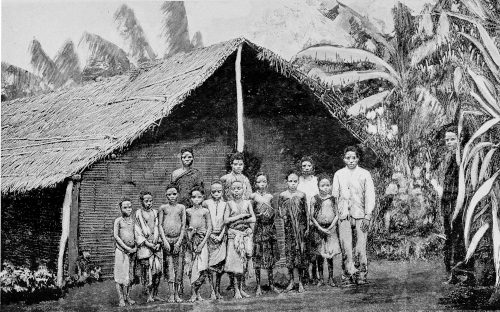
THE BEGINNING OF THE SCHOOL AT NKABA.
But one evening the town was set agog with
59the news that a white man was visiting the various
villages, and would soon arrive in their town.
The men who brought this news had much to tell
about the coming visitor, for he had spent two
or three days in their village. They were the
“lions” of the evening, and their only regret was
that they had not larger stomachs to accept comfortably
all the invitations to the evening meals
that poured in on them.
The visitors had come to transact business with
the chief; consequently Satu’s fire was the centre
that evening of a large and interested gathering.
Men and lads crowded near the chief and visitors,
while the women and girls hovered about the
outskirts of the circle picking up such scraps of
information as filtered through to them.
My owner, Bakula, was there, and put the first
question, or rather series of questions: Who is
this white man? What is he like? Where does
he come from? What is he doing in this country?
And Bakula stopped not because his curiosity was
exhausted, but from sheer lack of breath.
Bakula had put into words what all were longing
to know, so they sat quietly, while one of the
visitors said: “We don’t know who this white man
is. He is not one of the traders whom we have
seen at Mboma,[21] for he is new to these parts, but
60he speaks our language very well, though at times
he makes stupidly amusing mistakes. His
carriers say that he comes from Congo dia
Ngunga[22]--the king’s town away south. He will
not sell us things like a trader, for he only barters
for food for himself and carriers, and not for ivory
or slaves. He offers to give us medicine, but we
are afraid to take it, for who knows but it may
bewitch us to death. He has invited some of our
boys to his school, and has promised to teach
them to read and write, and also how to make
doors, windows and bricks, like white men. He
even promised to clothe and feed them; but we
shall not let any of them go. What we cannot
understand is this: Why should the white man
take all this trouble? Why should he offer to
feed and clothe our children, to teach them, and
to give us medicine?”
“I know why they do all these things,” shouted
the old man with the plaited beard. “They want
to bewitch you; they desire to take your spirits
away, and then they will buy up your bodies and
send them to their own country to turn, by their
great magic, into slaves. You know what I told
you on the road;” and with angry, burning words
and vehement gestures he repeated to the whole
crowd what he had told the few around the fire
61the first night I spent among them; and then, with
foaming lips and glinting eyes, he cried: “This
is the kind of white man against whom I warned
you. If he comes here let us kill him.”
The women clapped their hands in horror of
the wicked white man, and held their children
tightly to them, and the men shifted nervously in
their seats, and loosened the knives in their belts.
If, at that moment, the white man had walked
into the town he would have been murdered, and
his mutilated body thrown into the bush.
It was some time before they had so quieted
as to continue their interrogations of the visitors.
“Well, you have not told us what this white man
is like,” called a voice from the back of the crowd.
“No, I have not,” replied the visitor, “because
Tata stopped our talk with his horrible charges
against the white men. This man who is coming
is a white man, and you have all seen white men.
This one is neither short nor tall, he has no beard,
but he has tin saucepans to cook his food in, and
a funny thing called a frying-pan, which always
makes a lot of noise when it is put on the fire.
He is a dirty white man, for the two days he was
in our village he never washed more than his
hands and face, and he smells just like all the
other white men.”[23] And the speaker and others
62held their noses with expressions of exaggerated
disgust.
“I do not think he is dirty,” chimed in one of
the listeners. “When I was last at the coast I
asked one of the white man’s boys if his master
was dirty, and he said: ‘No, he takes a bath every
day in his house.’ You see this white man is
travelling, and has no bath-house with him, and
consequently in front of you he only washes his
hands and face.“
“Oh, is that it? Perhaps you are right,”
answered the visitor in an unconvinced voice.
“I will tell you something else,” continued the
first speaker. “Once when I was at the coast I
was talking to one of the interpreters there about
this very matter--the smell emitted by white men;
and he said: ‘They give off a bad odour, I know,
but one day I heard one of the white traders say:
“Those wretched niggers do stink badly!”’ So
after all it may be that we smell as badly to
them as they do to us, therefore we must not
complain.”
The man with the plaited beard eyed the
speaker for a few moments in angry contempt,
and then he burst out at him in such a tirade that
I feared his words would choke him.
“You dog,” he cried, “you witch, are you in
the pay of the white man that you should thus
63speak for him? You white man,[24] you bewitched
our chief to death; not Mavakala, I always said
he was innocent and he vomited the ordeal three
times, yet they would kill him; but you are the
witch; you sold our chief’s spirit to these cursed
white men, and now he is slaving for them, and we
shall all die through your witchcraft and greed.”
By the time the old man had finished his invectives
the two chief actors in this scene were
standing by themselves in a circle of anxious,
terror-stricken faces. They were types of the old
order and the new--the old order, slaves to witch-doctors,
charms and superstitions that demanded
the continuance of things as they are; the new
order, men and lads upon whose minds new ideas
were dawning and struggling for the mastery
against their crude, superstitious fears,--men who
were yearning for they knew not what, and were
restless through strange strivings in their hearts.
There, flooded by the glorious, soft moonlight,
stood the two men glaring at each other. Murder
was in their hearts, and their hands were on their
knives. A few moments more and the pent-up
feelings of the surging crowd would have burst
their strained barriers and much blood would have
been shed, for each had his adherents, when Satu,
the chief, stepped between the two men.
64He was still dressed in mourning for his
brother, and the thick coating of oil and soot on
his face--a sign of his sorrow, had not yet been
removed. He was a superstitious man and much
travelled, a man in whose soul what-he-had-seen
was struggling with his ignorant, superstitious
fears.
In a few calm words he poured oil on the
turbulent passions of his people. He scouted the
idea that because a man related what he had seen
and heard that therefore he was a witch; and he
soothed the old man by promising to oppose the
white man.
There was no more talk that night about the
coming white man, for very soon after Satu
uttered the above diplomatic words the people
separated, and went either to whisper their fears
to each other around their own fires, or to spread
their mats for sleep. Several times during that
night women woke from horrid dreams, screaming
that the white man had stolen their children,
or was trying to throttle the souls out of them.[25]
In the morning as the women went to the farms
they related to each other the dreams of the
previous night, but instead of regarding them as
nightmares caused by the exciting events of the
preceding evening, they were taken as undeniable
65proofs of the devilish designs of the white men
to carry out the awful predictions of the old man
with the plaited beard.
A few evenings after these happenings the
much-talked-about Mundele wa N zambi (or white
man of God) was seen descending the hill on the
other side of our valley. The women, screaming,
snatched up their children and fled; the men beat
some loud sounding notes of alarm on the drums;
and then, picking up their guns, machets, knives,
sticks, and any weapon to hand, went hurriedly to
bar the entrance to their town. We saw the white
man hesitate, stand still a moment, and then come
on slowly and deliberately. He evidently knew
the meaning of those excited thuds on the drum
and the screams of the women.
Bakula, with a heavy stick in his hand--how he
longed to have a gun so as to have a shot at those
cruel white men!--ran with the men to the road
by which the white man must come. As we
hurried forward we could hear the men discussing
what was to be done. Some were for killing the
white man at once, but the majority said: “No,
we will hear what he has to say. We will smell
out his wickedness first, and then if there is cause
we will help you to kill him.” Satu said: “We
will neither hear him, nor kill him; but send him
back the way he has come.”
66The white man was now mounting the hill. It
was a narrow, difficult, rough track that led to
our town. He was panting by reason of the steepness
of the ascent; and seemed utterly wearied
with his long journey. He saw the ugly demonstration
in front of him; he heard the yells and
screams of rage and defiance; but he came quietly
on--a lonely man to a surging torrent of wild,
uncontrollable passions. His carriers and boys
hung back, for they were overawed by the
threatening aspect of the crowd.
As he drew near the white man held out his
hand as a sign of his friendship; but Bakula,
filled with the terrible stories he had heard about
white men, struck at the proffered hand, and
missed it in his blind rage.
Then arose a babble of curses, contradictory
shouts, and threats to kill him if he did not go
back. They hustled him about like a battledore.
They tore his clothes; but he was so mixed up
with them that they could neither use guns nor
machets without great risks to their friends,
and he was not worth that. When their fury had
somewhat spent itself, the undaunted white man
calmly asked them for permission to sleep in their
town.
“No, we don’t want you,” the people screamed.
“I have only come to do you good,” he said.
67“No, you have not, you have come to bewitch
us to death,” they shouted.
“If I wanted to bewitch you to death I should
have brought guns and soldiers, but you see I
have neither. I want to speak to you about the
great and good God Who sent His Son into the
world to tell you of His love, and to save you,”
was his quiet reply.
“You are a cunning, crafty witch. We want
neither you, nor your goodness, nor your talk
about God, therefore go away,” they cried.
“It is nearly dark, and the next town is a long,
long way, and my people and I are very tired.
Let me sleep here outside your town!” he
pleaded.
“No, not here,” they said. “It is too close to
us; go and sleep by the stream in the forest.”
“It is cold and damp there, and plenty of fever
and mosquitoes are in that place. Let us sleep
here, we shall not harm you!” he smilingly said.
“No, not here. Down there is good enough
for a witch. Keep the fevers and mosquitoes
away with your magic,” they sneeringly retorted.
Sadly and wearily the white man retraced his
steps, and as he went down the hill he called his
carriers and boys, and that night they put up some
waterproof sheets to serve as a tent to protect
them from the heavy dews and dripping trees.
68Well, it might have been worse, and through
his God-given calmness the white man had come
out of a very difficult and dangerous position with
only a few rents in his clothes and a few bruises
on his body. We heard many things about the
white man next morning when his boys came up
to the town to buy some food from the people.
All through that night the natives in the town
danced around their fetishes to keep them alert
in protecting them from the white man’s devilry:
drums were beaten and gongs sounded to frighten
the evil spirits away; and guns were occasionally
fired to warn off witches, and the lonely white
man down in his camp, as he heard the various
sounds, prayed: “Father, forgive them, they know
not what they do,” and especially did he pray for
the lad who struck at his outstretched hand.
69
The luck-giver is called to bring prosperity on the town--His
mode of procedure--Satu and some of his people go on a
visit to a great chief--Good and bad omens--The game at
“Antelope”--Bakula narrates a story: “How the Fox saved
the Frog’s Life”--Another lad tells why inquiry should come
before anger--The difficult road--Bakula and his friends dress
themselves--Their mixed wardrobes.
Satu, the chief, wished to have a healthy
and prosperous town, and his people were
one with him in this laudable desire. Now the
only way they knew of obtaining their object was
to send for the luck-giver (or, ngang’a zumbi),
who possessed a bag of charms consisting of
pieces of the skins of various animals and reptiles,
bits of herbs, and powders concocted of indescribable
messes. These were supposed, when properly
used, to impart good health to a town, good
luck in breeding animals, and prosperity in trade.
The people clubbed their moneys together, for,
as all were to share in the good fortune to be conferred
by the charm, all were expected to give
towards its expenses; and as the benefits would
be large the cost would also be proportionately
great.
70I had observed that people who owned little
fetishes and expected small benefits only from
them made small offerings to them, such as a little
blood from the foot of a frog, or from the toe of
a chicken that cost them nothing. Those who
wanted larger boons killed fowls and poured their
blood over their fetishes; and those who wished
for greater advantages sacrificed goats every
month--their expectations were in proportion to
their sacrifices.
The fee having been collected, the luck-giver
was called. He was a wizen-faced, withered
man with small, crafty, shiftless eyes. His
appearance seemed to belie his cornucopian
office; but, perhaps, he could give to others the
good fortune that he had apparently failed to
procure for himself.
On his arrival he very carefully selected a hard
wood log and cut a hole in it, and into this hole
he put bits of all the articles from his bag so as
to make the log an effective charm. A hole was
dug in the ground on the outskirts of the town by
the side of the road along which the women
passed when fetching water from the stream. A
goat was then killed and the head put in the hole,
and the fetish stick erected on it--this was supposed
to preserve the post from the attacks of the
white ants,--and then the blood from the slain
71goat was poured over the charms in the post; and
over the hole containing the charms was tied a
piece of palm-tree gossamer, which also was
drenched with the goat’s blood. Earth was
rammed round the stick, and the fetish was now
completed, and ready to work.
But there was one prohibition that the luck-giver
said must be scrupulously observed: nothing
tied in a bundle could be brought into the
town, or the charm would become ineffective, and
its luck-giving power destroyed. Women returning
with firewood must untie their bundles before
reaching the fetish; men with bundles of thatching-grass
must take off the bands; carriers with
loads must either loosen all the cords, or make
a wide detour to avoid the town; and the people
must remove their girdles and belts.
This was a very cunning prohibition, for, if
the town had good health, the animals bred well,
and the trade prospered, then the luck-giver
received all the credit for making such a wonderful
charm; but if no good results followed the
expense and trouble of setting up such a costly
fetish, then some one had broken the taboo and
nullified the luck-giving properties of the fetish
post.
As the luck-giver was there Satu and some
of the head men thought they would invest in
72a luck charm for their own private use. My
owner, Bakula, longed to speculate in one,
and he counted his little store of savings, but
found that he had not near enough for the
fee, etc.
The necessary arrangements having been made
and the fee paid, Satu and the head men selected
strong, young cocks and carried them to the
luck-giver, who took out of his bag of charms
a small portion of each and pounded them carefully
into a well-mixed paste, and a little of this
“medicine” he gave to each cock, and thereupon
they became the very embodiment of luck
and all kinds of good fortune to their happy
owners.
As only rich men could afford such luxuries as
these expensive charms the superstitions respecting
their wealth-giving powers were fostered and
maintained. From that time these fowls were
treated as fetishes. No one was permitted to
beat or hurt a luck fowl (or nsusu a zumbi). It
was respected like a chief, and strutted about the
town crowing aggressively, as though it were fully
cognizant of its own importance.
This fetish fowl was supposed to tell its owner
of coming events as danger to the town or to himself.
By its crow it predicted the future, and, as
only the owner was able to rightly interpret the
73crow, he had therefore exclusive information which
he could use for his own advantage. I found
afterward that when these fowls grow old they
are killed and eaten only by their owners, and the
charm is given to other fowls; and sometimes the
charm is put into a billy-goat or into a male pig,
and they are then treated with respect like the
fetish fowls, and tell their masters by their bleatings
and gruntings of future events.
One day Satu told his people that he was going
in eight days to visit the great chief of a distant
town, and he asked some of his people to go with
him. He had fourteen wives, but he promised
to take only six of them. He reckoned to be
absent about a fortnight, or, as they put it, four
nkandu,[26] i. e. sixteen days. Great preparations
were made for this visit of ceremony. All who
owned bits of finery brought them out of their
hiding-places and furbished them anew. Cassava
roots were dried, peanuts were shelled, and
as the day of departure drew near kwanga[27] bread
was made ready for the journey. Messengers
had been sent to inform the chief of the coming
visit, and had returned with greetings and words
of welcome.
The day at last dawned on which Satu was to
74pay his important visit to a brother chief. Bakula,
with a bundle of Satu’s best cloths,
cosmetics and trinkets, led the way; then came
some ordinary town-folk carrying sleeping-mats,
food for the journey, small bottles of palm-oil,
and cakes of camwood powder. Following these
was our town band, consisting of five ivory trumpets
and three drums. Whenever we drew near
to a village or town our band played to notify the
folk that some great men were coming. Behind
the band came Satu with his six wives, other head
men followed with contingents of wives from
their harems, and Old Plaited-Beard brought up
the rear with three of his wives.
We had not gone very far when a snake darted
out of the grass on one side of the road, but
instead of crossing the path, it turned up towards
the oncoming party. Bakula, terrified at the evil
omen, called a halt and sent word along the line
to ask Satu what was to be done.
While Satu was hesitating Old Plaited-Beard
came up, and as soon as he heard of the ill omen
he insisted that the whole party should return and
start the journey over again. Many protested at
this foolishness, but others, swayed by superstitious
fears, agreed that the only wise course was
to return at once.
Fortunately we were not far from our town, and
75before the sun was very high we were back at the
starting-point, where we rested for a short time,
and received the condolences of those left in the
town.
If the snake had only turned the other way it
would have been an augury of good luck. Bakula,
directly he saw it coming out of the grass, should
have shouted, and then the snake would have
directed its course the opposite way. He might
have turned, by prompt action, an ill omen into a
good augury, and we should have been saved all
this trouble.
After a rest we again started, and as a bird
flew along the path in the direction in which we
were going everybody began to laugh and crack
jokes, for this omen of the bird was entirely in our
favour.
About the middle of the afternoon we reached
a village, where we decided to spend the night.
The chief of this village, being a man of no
family, paid homage to Satu, and gave him and
the other head men houses for the night, but the
ordinary members of the party slept in the open.
Satu also received from the chief presents of different
kinds of food, as bunches of plantain,
baskets of cassava flour, a few fowls, and two
demijohns of palm-wine, which was fizzing loudly
with fermentation and was strong enough to make
76them drunk, only fortunately there was not
enough of it.
While we were resting I noticed the youngsters
in this village played an amusing game called
“Antelope,” and they did it in the following
manner: All the players but one ran about on all-fours
with their faces upwards, one person alone
being allowed to stand up, and he was called the
“antelope,” and the others were called the
“hunters.” They scuttled about in this ridiculous
attitude, and each tried to touch, or kick the
“antelope” with his foot.
A large court had been marked out on the
ground, and the “antelope” was not allowed to
go outside it, and the “hunters” tried to hem him
in a corner; but when the “antelope,” to avoid
being touched, ran out of court all the “hunters”
got on their feet and chased him, and he who first
pretended to cut him up with a knife became the
“antelope.”
A general mêlée usually ensued, for every one
pretended to cut him up with shouts of “a leg for
me,” “head for me,” “some flesh for me.” The
game excited much laughter, and all seemed to
enjoy it thoroughly.
After the evening meal was over, and the men
had lit their pipes and gone to hold high converse
on politics, woman, and sundry other important
77matters, Bakula was called upon by the young
men of the party to tell a story or two before they
rolled themselves in their mats for the night.
Nothing loth, he told, with all his usual grace
and sprightliness, the following story, perhaps
suggested by the fact that they themselves were
on a journey. He called it--
“How the Fox saved the Frog.”
“A Frog, having built a nice town, received a
visit from several well-dressed young men. The
Frog welcomed them, and they very civilly answered
his greetings. The Frog asked them
where they were going, and they replied: ‘We
are not going anywhere in particular; we are just
walking about visiting the towns.’ The Frog
called out his thirty wives to come and pay their
respects to the visitors, and they came out of
their houses and greeted the young men.
“The wives asked their husband how he came
to know them, and he replied: ‘I do not know
them, but seeing them well dressed I saluted
them.’
“‘Oh! you welcomed them because they are
well dressed,’ they retorted; ‘yet ever since we
married you we have never received any new
cloths from you.’[28]
78“‘Never mind,’ he said, ‘I am well known as
a great chief who has built a whole town and
married thirty wives.’
“‘Oh yes,’ they answered, ‘you are well
known; but we work and farm, and have no
cloths, only rags, hence you don’t respect us like
those who are well dressed.’ The Frog was
dumb.
“The Frog asked the young men where and
how he could buy some cloth, and they told him
that if he carried some peanuts to Mboma[29] he
could buy plenty there, and the road was not
difficult to find, for if he followed the river he
would reach there in a few days. The Frog was
glad to hear this, and thereupon he killed six
fowls and made a feast for his friends, and told
each of his wives to bring him a large basket of
peanuts in the morning, for he said: ‘Altho’ I
am a big chief of a large town I feel ashamed,
because my wives have had no new cloths since I
married them, and they do not dress properly.’
“The next morning the peanuts were brought
and tied into a load, and for the journey some
food was prepared, and the Frog started, telling
his wives that he would be back in twenty days.
“On the third day of his journey the Frog
reached a large baobab-tree that had fallen across
79the road, and while he was considering how he,
a person with such short legs, could jump over
it, he heard a voice say: ‘If you are a strong man
please put down your bundle and save me, for as
I was on my way to visit my wife’s family this
tree fell on me and has held me here for twenty
months. Have pity on me and help me now from
under this tree.’
“When the Frog heard this, he at once put down
his load and went under the tree, and swelled and
swelled until he lifted it and the Snake was able
to crawl out; then the Frog let the tree down
again, and went to pick up his load to continue
his journey. The Snake, however, immediately
caught him by the leg, and told him to get ready
to be swallowed.
“The Frog said: ‘What have I done that you
should swallow me, for although I had a right to
be paid for helping you, yet I did not ask for
anything! Let me go on my way to Mboma.’
“While they were arguing about this an Antelope
arrived, and he was asked to judge between
them; but when he had heard the whole matter he
was afraid to settle the affair properly, for he said
to himself: ‘If I let the Frog go, who is right,
but little, then the Snake will kill me.’ So the
Antelope gave the verdict in favour of the Snake.
“The Snake quickly said: ‘Do you hear that?
80Get ready at once and I will swallow you.’ But
the Frog cried: ‘He would have given me the
verdict only he is afraid of you.’
“While they were discussing this point a Fox
arrived on the scene, and he wanted to hear all
about it. When the case was laid before him, the
Snake said: ‘Am I not in the right, for I am
very hungry and want to swallow the Frog?’
“But the Fox would not give the verdict until
he had seen the Frog lift the tree, so he said to
the Snake: ‘Release the Frog’s leg and let him
go and raise the tree,’ which the Frog did at
once.
“The Fox said: ‘Truly the Frog is very strong
to lift so large a tree. Now, Snake, you go under
it, and show us how you were lying beneath the
tree.’ So the Snake went, thinking he would
surely win the case as the judge was taking so
much trouble over it, but the Snake was no sooner
under the tree than the Fox called out: ‘Frog,
let go the tree,’ and down it came right on the
Snake, holding him so that he could not get
away.
“The Fox then said to the Snake: ‘You are
entirely in the wrong, for your friend did a kindness
to you in helping you in your trouble, but
you want to repay him by a bad deed--you want
to swallow him.’
81“Thereupon they all went away, leaving the
Snake under the tree, as no one would help him
again for fear of his ingratitude.
“The Frog thanked the Fox for saving him,
and gave him his load of peanuts, and they
became great friends.”
At the close of this story no one had a word to
say in defence of the Snake’s ingratitude. All
thought he was rightly punished in being left
beneath the tree to starve to death, and Bakula
remarked that: “Ingratitude is a crime so
black that no one ever owned to being guilty
of it, and everybody is ready to condemn it in
others.”
This story had so swept sleep from their eyes
that they begged Bakula to tell them another of
his stories; but he said he could not recall any
more stories that night; and then another lad
volunteered, and, with much laughter, told the
following story of the trick a jocular boy played
on two friends. I call this--
“Inquiry should come before Anger.”
“Once upon a time a Wine-gatherer and a
Fisherman became great friends; they ate together,
walked and talked together, and went to
work together; and when one went to collect wine
82from his palm-trees the other would look after his
fish-traps in the streams and pools near to the
palm-trees; and after their work was finished they
would meet in the booth to drink the wine and
cook and eat the fish together.
“One day, while thus eating and drinking, the
Wine-gatherer said: ‘There is no one who can
break the strong friendship that exists between us
two,’ and the Fisherman assented, saying: ‘Why,
if you had not mentioned it, I was going to remark
that no one can separate us one from the other.’
“A frolicsome boy heard them make this covenant
of friendship, and laughingly said to himself:
‘When they go away I will do that which will test
their friendship for each other.’
“In a short time the two friends returned together
to their town, and when they had gone the
boy took the hoop and climbed up the palm-trees,
and removed all the small calabashes that were
placed there to catch the palm-wine, and then he
went to the pools and streams and gathered all the
fish-traps, and put the calabashes in their place,
and the fish-traps he tied to the palm-trees.
Having thus changed them he returned to his
town.
“Next“Next morning the Wine-gatherer and the
Fisherman awoke, and calling each other they
started for the valley where their work was, and
83there parted--one to look at his calabashes on the
palm-trees, and the other to visit his fish-traps.
“The Wine-gatherer, on arriving at the booth,
took his hoop and climbed a palm-tree, and there
he found, not his calabash, but a fish-trap; he
pulled it off and threw it down in anger, and
descended the palm. Thus he went from palm
to palm and found nothing but fish-traps, which
he collected and carried to the booth, and sat
down to wait for his friend, full of wrath and
indignation.
“While this was happening the Fisherman was
going from pool to stream, finding nothing but
small calabashes floating on the water where he
had put fish-traps the night before. In great anger
he gathered them up and carried them to the
booth, and there he met his friend, who said:
‘Those calabashes, are they not mine?’
“To him the Fisherman replied: ‘Those fish-traps,
are they not mine?’
“‘Why did you put your useless fish-traps in
my palm-trees?’ excitedly asked the Wine-gatherer.
“‘Why did you put your silly calabashes in my
streams and pools?’ retorted the Fisherman.
“And without more ado they stood up and beat
each other, and cut each other, until at last they
fell exhausted to the ground.
84“At this moment the mischievous boy arrived,
and seeing their plight, said: ‘What! are you not
friends? Why have you been beating each other?
I heard your covenant of friendship the other day,
and because I wanted to try it I went and changed
your things. Now you have been quarrelling with
each other without talking matters over. Inquiry
should come first, and anger follow after.’”
This story elicited many a chuckle from the
listeners; but at last, overcome by sleep, they
rolled themselves in their mats and were soon in
the land of dreams. The next morning they were
astir before sunrise, and after traversing many
hills and wading several swamps and streams
Bakula and his friends reached their noon camping-place,
tired, hungry and disagreeable. Everybody
threw down his or her load, and stretched
themselves in the shade.
It was a wearisome road. The hills were steep,
the paths simply rain-washed gutters where all the
earth had been swept away by the torrents, leaving
only the rough stones sticking up, and often
on either side of the track was tall grass from ten
to twelve feet high that interlocked their stalks
when the storm winds played among the hills or
whirled through the valleys, so that the travellers
as they pushed their way forward had frequently
85to put their arms before them to keep the points
of grass out of their eyes and the sharp blades
from cutting their faces.
Photo] JUNGLE PATH THROUGH THE FOREST [Rev. R. H. Kirkland.
(Said to be haunted by bad spirits at night.)
Huge boulders like giants’ marbles were strewn
about the hill-tops, and some were clinging to the
sides of the hills, while others were lying about
the valleys as though the players in their games
had thrown them too far. The travellers had, with
difficulty, to wind round or clamber over them,
and every extra exertion was felt in such a tropical
heat.
After resting they ate some of their kwanga
loaves, and, bathing in the turbid river, they picked
up their burdens to start again on their journey,
when Old Plaited-Beard kicked his foot against a
stone. A look of horror came into his beady eyes
at the ill omen against himself.
The snake omen was against the whole party,
but this was against the individual. On a journey
like this the omen might mean death at the end
of the journey to whomsoever it occurred, and the
only way to counteract its potency in this case
was to go right back home and stay there.
Old Plaited-Beard was too superstitious to disregard
the portend, and with many a muttered
curse on his carelessness he turned his face homewards,
having taken the long fatiguing journey
to no purpose. No one regretted his going, for
86he was as cantankerous as he was superstitious.
His wives and followers at first refused to
return with him; but the old man, infuriated at
their unwillingness, poured upon them a torrent
of abuse, charged them with bewitching him to
kick the stone, and threatened them with the
curses of his various fetishes in such invectives
that they trembled before him, and, gathering
their goods, followed him with hearts full of fear
and hate.
We lost so much time over these events that
instead of reaching our destination that evening
we were compelled to spend another night on the
road. The whole of the next morning was
leisurely spent in resting and dressing.
Satu and his followers bathed during the morning,
using soap-worts, which lather well, instead
of soap. Then one of his wives combed out and
replaited his hair, and dusted it with fine camwood
powder. Another wife very carefully rubbed his
face, body, legs and arms with palm-oil, to render
the skin soft and cool; and a third pounded some
camwood into a fine powder, and, putting it into
a coarse mesh cloth, dabbed the oiled skin with
the cosmetic, giving it a pleasant look and an
appearance of being well groomed. A thick band
of brilliant red was drawn across the forehead,
87and Satu went and lolled on a mat to wait for
those who had not such expert wives.
The wives rubbed one another with palm-oil,
and dusted each other with the red camwood
powder. Bakulu and his friends operated, with
the skill of experience, on each other, and I came
in for such a polishing that I shone like gold on
my owner’s neck.
These toilet operations being completed,
bundles were untied and a miscellaneous assortment
of garments and gaudy coloured cloths were
brought to light, and were donned with all seriousness.
The eight bandsmen were adorned in two old
pairs of trousers, three waistcoats, one pair of
boots--down at the heels and out at the toes, two
jackets with patches of different colours on the
sleeves, and two peaked hats that, like their other
articles of attire, had seen better days in other
climes. The intervals in their dress were filled
with diverse pieces of gaily coloured cloth. Satu
followed, invested in a bright red blanket round
his loins, two waistcoats, old and ill-fitting, across
his chest, a heavy brown coat on his back, and a
large brass fireman’s helmet on his head. Behind
him came his wives, the foremost of whom carried
a red, black and green parasol over her husband’s
head. The sun blazed, and poor Satu perspired
88in the costume that had cost him a heavy tusk of
ivory.
The other head men were arrayed in soldiers’
coats of diverse ranks and regiments--in their
selection they had not been captivated by the
stripes on the arms, but by the colours. Hence
you saw a colonel of one regiment hob-nobbing
with the corporal of another. Bakula wore a cloth
of gorgeous colours round his waist, a brewer’s
cap on his head, one stocking (he owned a pair,
but had lent the other to his particular friend) on
one leg, a boot on the other, and a beaming self-satisfied
smile on his face.
Fortunately we had not far to go. Up a slight
hill, across a plateau, and there stood the town we
had come to honour with our presence.
89
The welcome of Tonzeka and his people--A case judged--We
find the white man in Tonzeka’s town--Tonzeka defends the
white man--He complains of the effect of the white man’s
preaching--A drunken bout.
The whole town turned out to welcome us
with shouts, gun-firing, clapping of hands,
trillings, and the slapping of their open mouths
with the palms of their hands. The folk lined
the paths leading to their chief’s house, and
saluted and chaffed us good-humouredly as we
threaded our way to it preceded by our admired
band. Satu’s brass helmet excited much envy and
many remarks. It was the first time such a head-gear
had been seen in those parts, and naturally
called for various comments on its size, brightness
and value.
Chief Tonzeka received us heartily, and having
exchanged greetings with us, showed Satu and his
followers the quarters they were to occupy during
their visit, and deputed a large number of women
to fetch firewood and water, and also cook for us.
90The women had to supply all the vegetable foods
for our meals, and Tonzeka sent them the necessary
meat and fish. Tonzeka proved the genuineness
of his hospitality by killing a large pig, thus
supplying Satu and his people with the meat that
all Congos love so well.
We incidentally heard there was a white man--one
of those Mundele wa N zambi (white men
of God) visiting the town, but we did not see him
until the next evening.
While the women were busy preparing the evening
meal, Satu and his folk foregathered in the
chief’s courtyard (lumbu) to exchange news, to
talk about trade, about politics, and about the
different cases that had been brought to them for
settlement as chiefs and head men.
Tonzeka gave as an example of the foolishness
of the people in his district the following case that
was brought before him for judgment.
“A pig belonging to the Lumu people was
killed by a Manga man on a farm belonging to
one of his wives. The Lumu folk demanded payment
for the pig; but this was refused on the
ground that any pigs found digging up cassava
roots on a farm can be killed. After a time the
Manga women went to work that piece of ground
again, and the Lumu women met them there, and,
being more numerous, took away the hoes belonging
91to the Manga women, and claimed the land as
their pig was killed on it, and no compensation
had been paid for it. That evening the chief of
Manga sent a message to the chief of Lumu, and
the messenger carried a gun, which he should not
have done, so the Lumu people took the gun away
from him on the plea that he was bringing force
into their town.”
“How did you settle that palaver?” asked
Satu.
“Well, you know,” replied Tonzeka, “that any
pig found on another’s farm may be killed, and in
some parts of the country the man who kills it can
take half the flesh for the trouble of killing it, and
to compensate him for the damage done to his
farm; and the other half he sends to the owner
of the pig. In this part, when a pig is killed for
trespassing, the one who kills it leaves it at the
place where it was slain, and sends to tell the
owner what he has done, and he himself has to
fetch the carcass, and as he finds it on another
person’s farm he has sure proof that it has
trespassed.”
“Yes,” assented Satu, “I know those are the
different customs, and in our district we always
take half the pig.”
“But,” continued Tonzeka, “this case was complicated
because the Manga people allowed their
92messenger to take a gun with him when he was
sent with their message.”
“That was very foolish of them,” said Satu,
“but how did you decide the case?”
“I judged it thus,” answered Tonzeka. “I
fined the Lumu people one pig for attempting to
claim land which did not belong to them, as the
killing of a pig gave them no rights over the land
on which it was killed; and I fined the Manga
people one goat, as the messenger had no right
to carry a gun when he went to deliver a message.
It was taking force into another’s town, and was
also an exhibition of insolence.”
“You judged wisely,” commented Satu, “and I
hope you received a fat pig and a large goat for
your trouble.”
“You will be able to judge that for yourselves,”
laughingly replied Tonzeka, “for the fines[30] only
arrived this morning, and you will be eating the
pig for your evening meal.”
Satu expressed the hope that he would receive
such splendid fines every day.
Tonzeka then informed his visitors that there
was a white man staying in his town, and promised
to take his friend Satu to see him.
“I wonder if it is the same one whom we drove
out of our town?” queried Satu.
93“Why did you drive him away?” asked Tonzeka,
with a note of surprise in his voice. “Surely
he had done no harm to either you or your
people?”
In an apologetic tone Satu admitted that he
had not done them any harm, for they did not give
him an opportunity, as they would not allow him
to enter the town. “But Old Plaited-Beard told
us such horrible things against the white men that
if I had not been there my people would have
killed this one. What is he doing in your town?”
To him Tonzeka replied: "This white man
comes to see us very often, and tells us about God,
and about His Son Jesus Christ, Who, so the white
man says, came to die for us on a cross. I don’t
understand all his palavers; but he washes the
sores of old and young, rich and poor, head men
and slaves, puts good medicine on them, ties them
up with his own white fingers, and the sores are
quickly healed. We understand that! You know
my mother was very ill, and we tried one nganga
after another, but they failed to cure her, although
they ‘ate’ up a lot of money. Then this white
man came on one of his visits, and in two or three
days she was fully restored to health by the white
man’s medicines."
“Yes,” remarked Satu, “perhaps he gave her
the sickness by his witchcraft, and therefore could
94easily cure her. These white men are exceedingly
cunning.”
“I know what you mean,” replied Tonzeka.
“That is what our ngangas do to make money out
of us. The ngangas by means of their charms and
fetishes cause our diseases, and they receive fees
for doing so; by their fetishes they curse us or
try to cure us, and again they receive fees, and
thus they become rich by our complaints. This
white man did not charge for the medicine, and
what is more he gave my mother some of his own
food to make her strong.”
“I did not quite mean that,” said Satu, “but
these white men are here to buy up the dead
bodies of our relatives, which they store in their
houses, and on the first good chance they send
them away in their ships to Mputu to become their
slaves. They have wonderful magic for restoring
the spirits to the bodies.” And as he spoke a look
of alarm and hate came into his eyes, for he called
to mind his fear that his own brother and various
other relatives were, as he was speaking, toiling
in farms and forests for their dreaded white
masters.
With an air of superior knowledge Tonzeka
said to his honoured visitor: "There was a time
when I also firmly believed what you have just
stated; but I and many of my people have been
95to this white man’s station. He received us very
kindly and showed us over his house; and truly,
we saw no shelves[31] there, and no places where
he could keep dead bodies. When we had an
opportunity we entered his stores, medicine-house,
boys’ quarters, and nowhere did we find a place
where he could stow away dead bodies. After two
or three visits we came to the conclusion that these
falsehoods had been started by our ngangas to
protect their own interests."
Satu expressed his astonishment at what he had
heard; but still doubting, asked: “Did you go
into all the rooms in his house, and does he ever
send bales and boxes to the coast?”
“Yes,” replied Tonzeka, “I went into all the
rooms, for one of the boys showed me every nook
and corner one day while the white man was
absent. He does not trade, consequently he has
no bales and boxes to send to the coast. Friend
Satu, do not believe those lies about the white
man. Evidently ivory and rubber have a value
in their country. Why, the white man himself
showed me a coat and a sheet made of rubber
that no water could pass through. I tried them
myself; and I understand that in their country it
rains all the year round, for they have no dry
season as we have, and if they had no rubber they
96could not make rubber coats, and would have to
stay in their houses every day.”
Satu thanked his friend and said: "What you
tell me about rubber coats and sheets quite
accounts for the presence of traders in our
country; but these ‘white men of God’ do not
trade. Why are they here?" And a look of sly
triumph came into his eyes as he continued:
“They don’t buy rubber, they don’t deal in ivory,
they don’t trade in anything, and, according to
your own statement, they don’t even buy dead
bodies. Why are they here? That is what I want
to know?”
“That is the very question I put to this white
man myself,” replied Tonzeka, "and I will try
to give you his answer. He said: A very long
time ago, years and years ago, the people in his
country were just like the people are now in our
country. They were naked, painted savages that
lived in huts in their forests. They had spears
and knives, and fought each other as we do. They
had canoes like ours, and wore brass armlets and
anklets very much the same as ours. They believed
in fetishes, charms and ngangas; and, to
use his own words, his forefathers lived wretched
lives and died miserable deaths without God and
without hope. Then some messengers brought to
his country the wonderful news about God, about
97Jesus Christ, and about the great Salvation, and
the hearts and lives of many thousands were
changed and filled with joy and pity--joy because
they were saved, and pity for us who know not of
God’s great love for all, for so great is His love
that He freely gave His beloved Son to die for
us. Now these people have sent this white man
and others like him to pass on the blessings of
Jesus and His grand salvation to us, for it seems
that this Jesus gave them a command to preach
the good news to everybody all over the world.
“I spent nearly a whole evening in talking
these palavers over with the white man, and I have
told you all I have remembered; but I am afraid
I have forgotten a great many of his words.”
Again Satu thanked his friend, and promised to
ponder in his heart the words he had heard, or,
as he expressed it: “To drink water over them.”
“Well,” said Tonzeka, “I have sent two of my
sons to the white man’s school, and they are learning
to read, write, do carpentry and to make
bricks. They are gaining much knowledge, but
there is one thing I do not like about this white
man.”
“What is that?” eagerly asked Satu.
Tonzeka paused a few moments before replying,
and then he broke out in a self-pitying tone:
"This white man tells me that I am a bad man,
98because I lie, steal, commit adultery and become
often very drunk, and in doing these bad deeds I
am breaking God’s laws, and shall be punished
for doing so. When he talks like that I always
feel very uncomfortable, for I know that what he
says is perfectly true. I never heard before that
God had given any laws for us to obey, because,
as you know, we have no books; yet when we
get drunk, or thieve, or lie, or do any other bad
action, something inside tells us that they are
wrong and condemns us; but we are not ashamed,
because everybody does them. If he would give
us medicine, and teach our boys and girls it would
be all right, but when he talks God’s palavers I
do not like him, for he makes my ‘heart stand
up’ with fear."
Satu was about to condole with him, but there
was a general movement towards the fires, for by
now the saucepans were steaming with cooked
food, and all the folk were eagerly anticipating
the feast of pig and pudding. Satu turned these
matters over in his mind, and remarked to one of
his head men: “After all, there are some disadvantages
in having a white man in one’s town,
if he makes us uncomfortable in our hearts; and,”
he continued, “I am not sure whether Tonzeka is
bewitched by the white man, or is sharing profits
with the white man in the sale of dead bodies.”
99After the evening meal Tonzeka gave another
proof of his hospitality. He opened some cases
of trade gin[32] and two demijohns of rum, and
invited Satu and his party to a drinking bout.
The fiery liquor quickly induced a quarrelsomeness
in the drinkers that I thought would cause
such murderous fights that the town would be
drenched with blood; indeed, Bakula received a
nasty cut on his arm, and several others were
wounded and bruised. But this intoxicated madness
was fortunately soon succeeded by a maudlin
state, in which the carousers embraced each
other, shouted senseless sayings, joined in ribald
refrains, and engaged in obscene dances until at
last the potions gained the mastery and they fell
on the ground in sottish sleep--mere breathing
logs.
Borne on the breeze from a distant part of the
town came the evening hymn of the white man
and his boys, and distinctly the words were carried
to me--
“God loved the world of sinners lost
And ruined by the fall;
Salvation full, at highest cost,
He offers free to all.
Oh, ’twas love, ’twas wondrous love!
The love of God to me!
It brought my Saviour from above
To die on Calvary.”
100
Bakula goes to the white man to have his wound dressed--White
man puts in a good word for the traders--Bakula is touched
by the white man’s kindness--A native dance--An exhibition
of native pride--A long talk with the white man--We gain
many new ideas from our conversation--Bakula has another
interview with the white man, and they become good friends.
The next morning the sun rose with clear-eyed
brightness, oblivious of all that had
occurred during his absence through the night, for
he and the moon never approach near enough
to each other to exchange confidences. Notwithstanding
the sun’s obliviousness, the results of
the night’s debauchery were evident in all who
had taken part in it. Some ate monkey peppers,
others bits of kola-nuts as pick-me-ups, and others
took a plunge bath in the nearest stream; but
headaches, wounds and bruises were not easily
removed by such means.
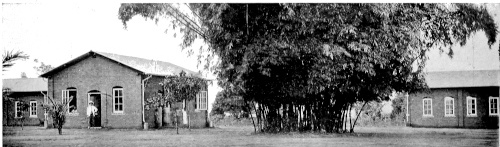
Photo] WATHEN: THE DISPENSARY. [Rev. J. H. Weeks.
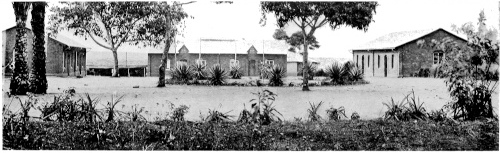
WATHEN: THE BOYS’ QUARTERS.
Bricks made by schoolboys and buildings erected by old school lads.
During the afternoon those who had smarting
cuts went shamefacedly to the white man to have
them bandaged with his soothing ointments, and
among those who went was Bakula. He thought
101the white man would not know him in his “dress
costume”; but I saw that the white man recognized
him at once, though he said nothing at the
time.
The white man carefully dressed the wounds,
and then asked them how they came by them.
“We don’t know,” they answered, “for we got
madly drunk last night on gin and rum, then we
had a fight and cut each other. We were too
stupidly intoxicated to remember which one cut
the other, and who started the quarrel.”
“I am sorry the traders sell you such vile stuff.
It maddens you when you drink it, and it is the
chief cause among you of a great amount of sickness,
and of a large number of the fights that
occur between your towns and villages,” quietly
and sadly replied the white man.
“Yes,” they asserted in chorus, “the traders
are all as bad as the things they sell us.”
“No, they are not all bad,” sharply answered
the white man, “and neither are all the articles
they sell bad. You can buy from them good cloth
for covering yourselves, blankets to keep you
warm in the cold season, nails and tools for building
your houses, soap, candles, saucepans, tins of
provisions, and many other things that are good,
and help to make your lives comfortable.”
“That is so,” they assented, “but when our
102heads ache with the bad gin, we forget the many
good articles we can buy of them.”
“I know many of those traders,” continued the
white man, “who hate selling gin and rum to you,
and wish a law[33] could be enforced to stop all
trade in them; but you are such fools, and will
buy drink; and there is so large a profit on it that
their masters in Mputu make them sell it to you.[34]
Some of the traders are very good men, and
perform many acts of kindness to you black
people. Do your wives throw away all the
pumpkins in their farms because a few have
maggots in them?”
“No, of course not,” they sheepishly replied;
“our wives throw only the rotten ones away.”
“Well,” rejoined the white man, “do not speak
ill of all the traders because some cheat and rob
you; nor condemn all their goods because they
sell these accursed fiery waters that turn your
towns into pandemoniums, and you into beasts
and fiends. Buy the good articles they have, and
let the bad ones alone.”
Bakula was astonished that the white man had
not accused him of striking at his outstretched,
friendly hand. He was in a quandary. Did the
white man recognize him or not? Or was he simply
waiting his opportunity to punish him for what
103he was now heartily ashamed? He was fearful
lest the latter was the explanation, and he had
almost made up his mind to put the matter to the
test, and ask the white man; but just then the
drums began to beat, and hurriedly taking farewell
of their friend who had so patiently dressed
their wounds and given them good counsel, they
ran back to the chief’s courtyard.
To the native there is something electrical,
moving, exhilarating about the beat of a native
drum. Directly he hears it his body begins to
twitch and sway to and fro in rhythm to the beat,
a smile spreads over his face, weariness is forgotten,
dull care is thrown to the winds, and he is
soon shuffling round the circle, or has taken his
place in the line, clapping his hands, and singing
a chorus in admirable time.
Bakula and his townsmen were no exception,
for even now in their running they kept step to the
beat of the drum. On their arrival they took their
place in the line of male dancers. The particular
dance to the fore was called “Sala.” A
medium drum was used, and the formation was in
two lines, one of each sex. This dance was characterized
by a rapid shaking of the whole body;
and during it they made up songs about one
another, causing endless amusement by their
pointed remarks, innuendoes, and by-play.
104While the dance was in progress a member of
Tonzeka’s town went over to the drum, and by
beating on it carried on a conversation such as the
following, asking questions and replying to them
himself.
“Welcome to you, chief Satu. Are you quite
well?”
“I am quite well,” replies the drummer.
“Have you come a long way?”
“Yes, my town is very far away.”
“Are you very rich?”
“Yes, I have plenty of wives, slaves, pigs, goats,
cloth and money. I am so wealthy that I really
don’t know how rich I am. I don’t know what to
do with my money. It fills my bags, boxes and
houses.”
“Have you much with you?”
“Yes, my pouches and bundles are full.”
“Give me some of it, as you are so rich.”
And foolish Satu, flattered by this pretended
conversation out of his usual caution, and in the
vanity and pride of the moment, handed over
some thirty shillings’ worth of brass rods. Gratified
by the largesse the drummer beat away and
sang a recitative in praise of Satu’s generosity,
and the object of all this by-play sat swelling with
self-complacency.
No sooner did the first drummer drop the drum
105than Bakula darted forward, and with laughing
eyes and skilful hands beat out a conversation
in fulsome praise of Tonzeka; his riches, his
prowess in war, his unstinted hospitality--all
received their full meed of wheedling adulation,
and at last came the expected request: “As you
are so rich, so great, so generous a man, give me
some of your money.”
And poor, cajoled Tonzeka had to pass over
thirty-five shillings’ worth of brass rods, for it
would never have done not to surpass his visitor,
Satu.
Bakula went to share his spoils with some
friends; and another man took the drum and
tapped out flatteries about the different head men
with varying success, until he received what he
considered a very mean present.
Then the disappointed drummer rapped out a
song on stinginess so bitingly sarcastic that sharp
words were bandied about from side to side, and
what began as an amusing dance ended in a mêlée
that engendered bad blood between the persons
concerned for many a day.
As soon as the noise had quieted down, Tonzeka
offered to take his visitor to see the white man, but
through an indefinable fear Satu shrank from
going in the broad daylight, and promised to
accept the invitation after the evening meal. So
106at the appointed time Tonzeka called Satu, and
together they walked over to the white man’s
quarters, followed by a large number of people.
The white man had heard of the proposed visit,
and with the help of boxes and rugs had prepared
seats for the coming visitors.
Satu, however, before trusting himself to the
improvised chair, lifted the rug, shook the box to
test its stability, and then gingerly took his seat.
There was more than a rumour afloat that the
King of Congo had murdered his mother by inviting
her to sit on a mat which gave way beneath
her. It had precipitated her, it was said, into a
carefully prepared hole, and directly the wretched
woman disappeared, the unnatural son ordered
her to be buried alive.
The white man was fully conscious of Satu’s
implied distrust, but said nothing; and Tonzeka
pompously introduced Satu and some of the head
men who had accompanied him.
During the speech Satu sat uneasily on his seat,
casting furtive glances at the slim, kindly-faced
white man before him. After all he did not look
so terrible that a whole town should go frantic
with fear of him.
When Tonzeka had concluded his speech the
white man replied: “I am so glad to see Satu, for
I have often heard of him, and a few weeks ago
107I went to visit him, but through some silly prejudice
he would not give me hospitality, and sent
me and my people to sleep in the damp with the
mosquitoes at the bottom of his hill. Since then
I have heard that some of his people wanted to
kill me, but he would not let them;” and leaning
forward he took Satu’s hand in his, and said: “I
thank you very much for not only saving my life,
but the lives of those who were with me. There
was a lad who struck at my outstretched hand.
This afternoon he came for medicine for a bad
cut on his arm, thinking I did not know him.
There he is, standing with the firelight full on his
face. Will he not shake hands and be friends?”
And, rising, the white man went with outstretched
hand to Bakula, who with much trepidation
put his hand nervously into the very hand
at which he had so cruelly aimed a heavy blow.
In broken sentences Bakula begged forgiveness,
which was freely given.
Everybody now felt thoroughly at home with each
other, especially when Satu had cordially invited
the white man to visit him, promising better hospitality
next time; and the white man heartily
accepted the invitation, promising, on his part, to
come soon. Then came a long series of questions
about Mputu (the countries of the white man);
and while the white man told them of the great
108houses with many rooms, the innumerable streets,
the broad roads, the trams, horses, and the size
of the cities and towns, the audience sat with wide-eyed
astonishment, broken only by the snapping
of fingers and exclamations of surprise.
At last one boy put their thoughts into words by
asking if the white man was speaking the truth;
because, said he: “We have always believed that
you white folk live underneath the sea.”
“Why do you think that?” laughingly asked
the white man.
“For two very good reasons,” asserted the boy,
rather aggressively. He did not like being
laughed at before all the others, for he was only
stating what they all believed.
“State your reasons,” said the white man
kindly, for he saw that the boy was hurt by his
laughter.
Encouraged thus, the boy said: "When we
stand on the shore at Ambrezette, or at any other
of the trading-stations on the sea-coast, we see
the ships come in, and what do we notice first?
Not the big part of the ship at the bottom (the
hull), but the stick at the top (the mast), and when
the ship has discharged all its goods on the beach,
and filled up again with palm-oil, rubber, ivory,
palm-kernels and peanuts, it goes away, and the
part that we see last is the topmost post. Of
109course it comes up out of the sea. That is why we
first notice the top of the ‘stick,’ and it goes down
into the sea; that is why the top of the ‘stick’ is
last seen."
“Yes, that is very good! What is your second
reason?” asked the white man.
“The second reason is this: all we people who
live on the earth have curly hair; but all you white
folk, because you live under the sea, have straight
hair. That is because the action of the water has
taken all the curl out of your hair.”
The white man with much difficulty suppressed
his laughter, and proceeded to give them a simple
lesson on the rotundity of the earth. They had
all seen eclipses of the moon, and starting from
that fact, and using his candle and various articles
on the table as his apparatus, he tried to show
them that only round objects threw round
shadows on the wall of the adjacent house. They
were interested, and pretended to be convinced,
but how many of them went to bed that night still
believing in the flatness of the earth he never
knew.
Then came a series of questions, not prompted
by impertinence, but by a healthy and natural
curiosity. Questions such as: “Is there plenty of
food in your country? How many wives have you
in Mputu? Were you once as little as our babies?
110Have you a mother, father, brothers and sisters?
Did they turn you out of your country because
you are a bad man? How do you make matches?
Who makes the cloth and the different articles we
see in the traders’ stores? How do you make
candles, soap, boots, and from what are they
made? Why are you white and we black?” The
white man patiently answered these questions to
the best of his ability; but I noticed that whenever
possible he worked his answers round to God’s
palaver--he told them how a thing was made, that
they themselves could make it, and would, by this
time, have found out how to make it, only their
witch-doctors taught them that anything new, anything
out of the ordinary, anything that showed
skill, was the result of witchcraft, and hence they
killed off their wise and clever men; and lastly,
"God’s palaver, when it enters the heart, sets
them free from all their superstitious fear of the
ngangas, and gives true wisdom and guidance."
It was now far into the night, and Satu was
about to rise when the white man said: “It is very
late, and I have attempted to answer your many
questions. Now I am going to ask you all as a
favour to stay while we have prayers.”
Satu very courteously thanked the white man
for taking so much trouble and for telling them
so many wonderful things. They would willingly
111stay to prayers and listen while the white man
talked to God; but “Excuse us now, we are tired,
and must go to sleep.” The white man looked
sadly disappointed, but bade us “to go and sleep
well.”
As we were returning to our quarters some one
asked Satu: “Why did you not stay for prayers?”
“I was afraid the white man’s God would
bewitch me; or that the white man himself might
do so,” answered Satu. That night Bakula could
not sleep, but frequently I heard him murmur:
“He dressed my wound with the same hand I
tried to strike.”
During the next morning Bakula and a few of
the young men went to greet the white man, whom
they found busy washing and dressing sores, and
dispensing medicine to the sick. Bakula shyly
went forward to have his wound dressed, and
when it was finished the white man asked his
name; but Bakula, filled with fear, gave his Santu
name[35]--Dom Pedro. “No, I don’t want your
Santu,” said the white man, “but your proper
name. Do you still distrust me? Never mind,
tell me when you know me better.”
“I will tell you now,” he replied. “I will not
doubt you any more. My name is Bakula.”
When the white man had finished his medical
112work we all sat down for another talk, and I
noticed that Bakula sat very close to his white
friend’s chair, and hesitatingly he put the following
question: “You tell us your country is very
beautiful; that there is plenty to eat; that your
parents and brothers and sisters are living there;
that you were not turned out for being a bad man.
Why, therefore, have you come to this country,
with its rough roads, its swamps, and its fevers?”
Then the white man unfolded before Bakula
and his companions the wonderful story of Jesus
Christ, from the time He left heaven on His
mission of Redemption, until He returned to
heaven the Author of eternal salvation. The
audience listened attentively to this delightfully
strange story, and Bakula, looking up, exclaimed
in surprised tones--
“Why, Jesus Christ was just like you! He left
all for us, the same as you have done.”
The white man was strangely and deeply
moved as he replied--
“No, Jesus Christ did not copy me, but I try
day by day to imitate Him. It is for His sake,
Bakula, that I forgave you, and have tried to
return good for evil, love for hate, and am willing
to die that you all may hear and believe in His
great salvation.”
After a little more conversation they separated,
113Bakula and his friends returning to their huts
solemnized, for a time, by what they had seen and
heard; and the white man, calling a few of his
lads, went, with his medicines and his message
of God’s love, to spend a few hours in a neighbouring
village.
114
Make-believe games--“Biti” and needle--Game with canna seeds--Hoop
game--“Mbele,” or Knife game--The story of “The
Four Wonders,” or a puzzle story--Conundrums--“The Adventures
of the Twins.”
After the first novelty of our visit had
passed away the women and girls went
daily, with dull regularity, to the farms; but only
those men who were obliged went to the markets
for trading purposes, or to the forests for building
materials for their houses. The men and lads
who were able postponed, out of respect to their
visitors, all those occupations that would not suffer
from delay, and gave themselves to games, asking
conundrums, and telling stories to entertain their
visitors.
The children had their make-believe housekeeping,
cooking, trading and marketing; the
older ones their mimic wars, their mock hunts and
their pretended palavers. The small girls had
their sticks, or pieces of cassava roots, to represent
dolls,[36] and they played with them as such,
carrying them tied by old rags to their backs, or
115on their hips as their mothers had carried the
children themselves when babies.
The small boys procured gourds, old tins, reeds
and small drums, and imitated a band, and they
made about as much music by their efforts as
their elders discoursed from ivory trumpets and
well-made drums. With bits of sticks, reeds and
grass they made toy houses with mud walls; and
with pieces of broken saucepans, old tins and any
odds and ends they could borrow from their
mothers’ houses, they furnished themselves with
the necessary articles for their pretend-game of
housekeeping, receiving visits from each other,
and inviting one another to their make-believe
feasts. The older and more active lads played
at hockey, on which they expended a great amount
of boisterous, if unskilful, energy; and the quieter
ones were very expert in using their fingers and
toes in making cat’s cradles of many and intricate
designs.
Bakula was always selected to find the needle
because of his quick ear, whenever the following
game was played with biti and needle: The
players were divided into two sides, which we will
call A and B. All the players had a musical
instrument called a biti, which is a kind of
marimba. Side A sent out one of its men, and
secreted a needle in his absence in full view of
116side B, which the one sent out had to find guided
only by side B playing simultaneously an agreed-upon
note. Side B decided what the guiding
note should be.
On the return of the needle-seeker, side B
began to play their biti, and when the needle-seeker
approached near the hiding-place of the
needle, the guiding note was played, and as he
receded from it the guiding note was left out of
the tune.
The needle-seeker had not only to find the
needle, but also to name the guiding note. If
he found the needle, it counted one game to his
side, and either he or another on side A went out
again. When he failed in his search then it
counted one game to side B, and one on that side
went out.
Of course the biti players tried to hide the
guiding note by playing rapidly, and covering it
with variations on the other metal reeds. A quick
ear to catch the repetition, or the absence of a
particular note was necessary for this game.
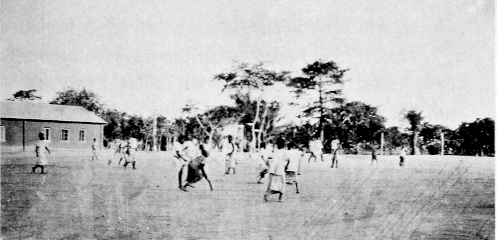
1. SCHOOLBOYS PLAYING HOCKEY.
One day Bakula stopped to watch the following
game that was being played by some lads.
The beautiful, round, black seeds of the canna
plant, which grows wild in most parts of Congo,
are called loso, and that is also the name of the
game. These seeds are about the size of peas.
117The players are divided into two sides, which
for clearness we will call A and B, and they form
a circle as they sit on the ground. Side A plays
first, and the thrower takes about twenty seeds
in each hand. He throws them out from his
hands alternately, counting, as he throws, one,
two, three, and so on up to ten, and the rest he
throws helter-skelter over the cleared space in
front of him, yet in such a way as not to disarrange
the positions of the first ten seeds thrown;
but he tries to do it as indifferently as he possibly
can.
Now before beginning to throw the seeds, side
A has agreed among themselves that seed number
five shall be the playing seed; so the seeds having
been thrown, one lad on the side A withdraws
out of sight and hearing. Then if side B has
spotted the playing seed five, they pick it up and
say: “That is the seed, and its number is five.”
That counts as one game to them. If, however,
they have not spotted the right seed and pick up
the wrong one, then a lad on side A touches the
right seed, and the one who left the circle is
called back and picks up the seed that was
touched by the player on his side. That then
counts as one game to them--to side A. Any
touching or picking up of the wrong seed by a
player is counted as a game to the other side.
118Supposing that side A says that seed five,
which side B touched, is not the playing seed,
then side B removes it, and one on side A to
carry on the cheat touches, say, seed eight, then
the lad who left is recalled and, of course, he
finds seed five is gone, and should he try to help
the cheating by picking up another seed he must
declare its number, and there is every probability
that he will not by chance pick up seed eight, and
also declare the same number as the boy who
touched it.
To find out the right seed and number the
opponents have to watch the throwing for any
hesitation at a particular number, or to see if a
seed is purposely thrown to one side; they have
to listen for any emphasis on a particular number,
and also watch the eyes of their opponents to
see if they are all looking towards one particular
seed.
Again, the lad who leaves the circle must carry
away with him a clear plan of how the seeds lay,
so that he may be sure of picking up the right
one, as any blunder made counts as a game to the
other side.
The boys of the town had another game of
which they were very fond. It was played with
a hoop, and each player had a string two or three
yards long and weighted at each end. Sides were
119arranged which had to take their stand in “towns”
from twenty to twenty-five yards apart. The
hoop is trundled from side A towards side B, and
as it approaches side B all the players on that
side throw their weighted strings (or toy bolases)
at it so as to entangle it, and the boy whose “bolas”
entangles the hoop picks up one end of his string
and swings the hoop round and round his head
as he walks with it towards side A. Should he
deposit it in their town without dropping the
hoop from the bolas, it counts one game to side
B. If the hoop is either not entangled, or drops
while being whirled, the game counts to the other
side, i. e. to side A. Sometimes the winner is
challenged to whirl the hoop near the ground and
to jump over it while spinning without its touching
the ground.
If two or more strings entangle the hoop, then
the boys owning those strings must carry the hoop
between them. The hoop must on no consideration
be touched by the hands of those on side B,
unless no string entangles it, when it is thrown
back to side A and counts as one game to them.
After a set of twenty games the other side trundles
the hoop. A modification is made in the game
by throwing the hoop in the air.
The next game that I observed, and the last that
I shall describe, is called Mbele (or Knife). It
120is played either by the hands and arms, or feet
and legs, or by moving the knees only. The
players form a line, and the first lad in the line
is called “King.” The “King” when he begins
the game faces the lad who stood next to him, and
throws out both his hands, draws them back to
his breast, waves them in front of himself parallel
with his breast, and after making several feints
he shoots out one hand. If the lad standing in
opposition to him is able to meet the “thrust”
three times by throwing out the corresponding
hand, the “King” has to take his place at the
bottom of the line. If, however, no one in the
line is able to meet the “thrust” after three tries,
then the last lad in the line is called a “slave,”
and stands out of the game.
The “King,” who is generally an expert player,
will sometimes go up and down the line until all
the players are “slaves” and he wins. Should
the “King” be out in going down the line, then
when all become “slaves” to another he has the
privilege of winning them back, if he can, from
the last one in by playing him.
There are many modifications in the game.
The movements are very rapid and cause a great
amount of amusement, and help to train the eyes
and render the limbs very supple.
Among other games played were “touch,” a
121kind of “hunt the slipper,” with a palm-nut as
the “slipper”; “tipit” was also played by the
boys sitting in a ring and passing a palm-nut from
one to another, and the lad in the centre had to
catch the boy who really had the nut and they
changed places. Hopping the longest on one leg,
throwing into a hole, and backgammon were also
in vogue at times. A popular game with small
boys was to hide a canna seed in one of five little
heaps of dirt, and the opponent had to sweep away
the four heaps that did not contain the seed and
leave untouched the one heap that hid it. Each
success counted as a game to the winner, and
every failure as a game to the other side.
A never-ending source of amusement for dark
nights when they gathered round their fires in the
streets, or for cold, rainy nights when they sat in
their houses was to be found in their puzzle
stories and conundrums. In nearly every town
and village were expert story-tellers and propounders
of riddles, who were deservedly the
recipients of much local praise and fame for
their voluntary efforts to entertain their neighbours.
Tonzeka’s town was no exception. Almost
every evening, after the meal was over, one or
other of these skilled reciters would be called on
for a story.
122One evening the following wonderful deeds
were related, and aroused a great amount of discussion.
I must preface this story by saying:
The Congo natives think that anything wonderful,
anything out of the ordinary injures their social
and domestic life, or, as they say, “spoils their
country,” and is consequently to be condemned
and punished. Hence the appeal in this story
from one to another to decide who had performed
the most extraordinary feat, and was, therefore,
worthy of the greatest blame.
The narrator called it
“The Story of the Four Wonders.”
"A woman gave birth to a child, who on the
day it was born went by itself down to the river
to bathe. While there a hunter arrived, who fired
his gun.
"‘What are you firing at?’ asked the baby.
‘I am shooting the mosquitoes that are eating my
wife’s cassava,’[37] replied the hunter.
"‘Whoever heard of such a thing before?’ said
the baby. ‘By shooting mosquitoes you are
injuring the country.’
"The hunter denied this grave charge, and
accused the baby of upsetting the proper order of
123things by bathing himself on the very day he was
born.
"After much discussion they submitted the case
to a chief of a neighbouring town. When he had
listened to their wrangling, he said: ‘My mouth
is locked up in that room, and my wives have
taken the key with them to the farms.’
"‘Oh,’ they rejoined, ‘you, by talking when
your mouth is fastened up in another room, have
destroyed our country, for whoever heard of such
a wonder before?’
"After much debate away they went to find
some one to settle the matter for them, and by
and by they met a man who climbed palm-trees
to tap them for palm-wine, and they put the case
to him, each accusing the other of disarranging
the proper order of earthly ways.
"When they had finished the palm climber said:
‘I fell one day from the top of a palm-tree and
broke to pieces, and then I went into the town to
procure men to carry all my pieces back to my
house.’ They thereupon fell on him, accusing
him of spoiling the country by his wonderful
feat. They are still arguing out the matter and
cannot agree as to which is worthy of the greatest
blame."
At the conclusion each actor in this tale of
124wonders had his staunch adherents among the
little crowd of listeners. Some contended that
the baby had performed the most wonderful feat,
and was therefore to be greatly blamed. Others
stood by the hunter, for “whoever before had
heard of shooting mosquitoes?”
“Did you ever hear of a man talking with his
mouth locked up in another room?” aggressively
asked a backer of that wonder.
“You are all wrong,” shouted a big fellow with
a loud voice, “the man who broke to pieces and
yet went for carriers to convey the pieces into
his town did something that surpassed all the
other marvellous deeds.”
Feeling ran high, words were bandied about,
innuendoes respecting the sad lack of sense that
some folk exhibited were freely exchanged; but
during a lull in the throwing of wordy missiles,
Bakula said: “I heard a riddle the other day to
which you cannot give me the answer.”
“What is it?” asked several, and the noisy
discussion on the wonders ceased at once, and all
eyes turned on Bakula.
“Our master sleeps behind the thorns. What
is it?” he asked, and there was a twinkle of fun
in his eye as he propounded the conundrum to
them.
One guessed one thing and another something
125else, and a poor henpecked man suggested it was
a woman behind her hoes; but he was instantly
annihilated by the remark that if he were bossed
by his wives they were not.
They at last called on Bakula to give the solution,
and he said, “Our master sleeps behind the
thorns is our tongue behind the teeth,” and he
saucily continued: “If you don’t let it sleep there
you will soon be fighting.”
They rated him good-humouredly for his insolence,
and pretended to punch him as a punishment;
but promised to let him go if he would state
another riddle.
Bakula, on recovering his breath, asked the
following conundrum: “There are three men
carrying a dead one in their teeth.[38] What is it?”
To this a man instantly gave the answer: “A
ridge pole held by three king posts.”
The guesser of Bakula’s riddle then gave one
as follows: “The slave my father bought on the
market is always standing out (or away) from
him.” After many guesses had been ventured,
Bakula gave the proper one, viz. “Pipe” which
always stands out (or away) from the smoker.
Bakula had now to give another riddle, and
propounded the following one: “The bird with
126its head cut off eats up all the food. What is
it?” After many wild, unsuccessful attempts
one of the men guessed the answer, viz.
“Mortar.”[39] The man who gave this correct
solution belonged to Tonzeka’s town, and as he
said he did not know any conundrums he was
asked to give them a story instead, and to this
request, after a little hesitation, he acceded by
narrating the following tale, called
“The Adventures of the Twins.”
“Mr. Tungi built some houses and then
married. When he had been married about a
year he started on a journey to some distant
markets to buy and trade in peanuts. He had
not been gone very long when Mrs. Tungi gave
birth to male twins.
“When the twins had grown into stout lads
their mother told them that their father had gone
to trade at some distant markets, but would be
returning soon to his town. They at once decided
to go and meet him. Their mother prepared
some native bread and other food, and in a few
days they set out in search of their father.
“After travelling a long way they met a palm-wine
gatherer sitting in a palm-frond drinking-shelter,
127who welcomed them and promised to get
them some fresh palm-wine. He took his climbing-hoop
and together they went to the palm-tree.
Before ascending the tree the twins were
astonished to see the man take out all his bones
and lay them on one side, and then he climbed
the tree and brought down a small calabash of
palm-wine for the boys, picked up his bones and
put them all back again in their places. The
lads asked him why he removed his bones before
ascending the palm-tree.
“‘Oh,’ he said, ‘if I were to fall I should
break them, so I always leave my bones on the
ground, and then, should I fall, nothing will be
broken.’ They drank his palm-wine, thanked
him, and after resting a while started again on
their journey.
“They had not travelled very far when they
met two men walking towards them whose feet
were turned backwards. The twins asked them
what accident had twisted their feet in that way.
“They replied: ‘It is no accident, but we turn
our feet round when travelling to keep our naked
toes from knocking against the stones in the
road.’
“The twins had hardly recovered from their
surprise when they came across some men whose
knees were behind, and others whose arms were
128at the back, and others again whose faces were
at the back of their heads.
“They inquired the reason for these strange
things, and the first said: ‘We have our knees
at the back of our legs so that when we fall they
will not be cut by the stones.’
“The next replied: ‘We have our arms behind
us so that if we fall backwards they will hold us
up, and we shall not hurt ourselves.’
“And the last laughingly said: ‘Oh, we have
our faces behind our heads so that the long grass
by the sides of the roads will neither cut them
nor get into our eyes as we push our way through
it.’
“‘Well, this is a funny country,’ cried the
twins in amazement, ‘people seem to do whatever
they like with their bodies.’
“On they went again, and during the afternoon
they reached the bank of a river, where they rested
under a shady tree. While sitting there they saw
men and women, boys and girls coming down the
hill to bathe, and they noticed that all of them
took out their eyes before they entered the water
and left them on the bank with their clothes.
They inquired the reason for this wonderful thing,
and one of the men said: ‘You see, we bathe
here with our mothers, wives and sisters--men
and women, boys and girls altogether, hence to
129retain our self-respect and modesty we always
take out our eyes before bathing.’ The twins
were no longer astonished at anything they saw
and heard, so they silently assented to what the
man told them.
“They camped by the river that night, and
early next morning renewed the search for their
father. After three or four hours’ travelling over
the hills, across streams and through dense forests,
they arrived at a large market, where all the
people, instead of speaking, were making signs to
one another as they bought and sold their goods.
Upon looking at them more closely they observed
that none of them had lower jaws, hence they
were not able to speak. They could not inquire
into this wonder, as no one was able to talk to
them.
“They pushed on across the market, and after
walking another hour or two they reached a large
river, where they saw a man, with a very heavy
load, trying to cross it, and seeing he was in great
difficulty they helped him over with his load, and
then sat down to have a rest and chat. They told
the man they were twin sons of Tungi, and were
looking for their father, who left his town many
years ago to trade in the distant markets.
“The man said: ‘Why, I am Tungi, you must
be my sons, and I am just returning to my town.’
130“The sons rejoiced in this meeting with their
father, and were glad they had helped him over
the river, otherwise they would not have known
him. They divided the load between them, and
soon started for home.
“As the twins walked with their father, they
told him of all they had seen and heard during
their journey, but they said: ‘In the market we
passed this morning we saw people who did all
their trading by signs, because they had no lower
jaws. Why was that?’
“Their father replied: ‘On the markets in this
country there was so much rowing, quarrelling
and fighting that they made a law that all those
who went to market should leave their lower jaws
at home; for if folk cannot talk they won’t
quarrel, and hence they will have no reason for
fighting. It is talking and wrangling that lead
to rows, riots and fights.’
“The twins and their father reached their town
again safely, where they were noisily welcomed
and feasted; and the twins frequently narrated the
marvellous sights they had seen during their
travels.”
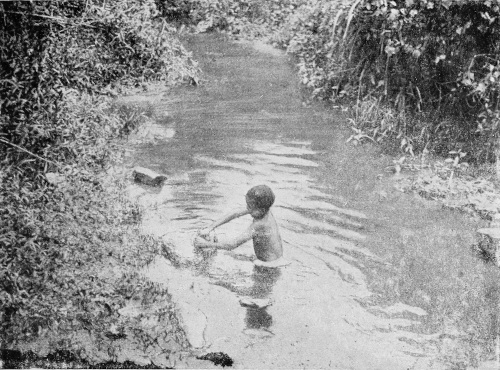
Photo] BUSY WASHING. [Rev. F. Aldrieve.
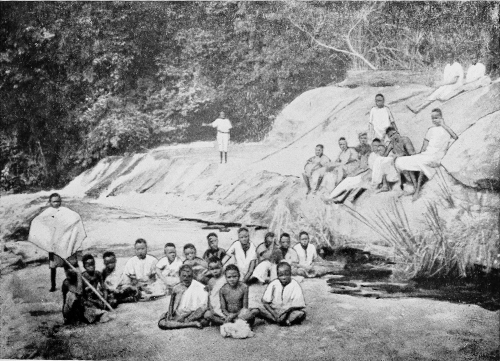
Photo] RESTING AFTER WASHING. [Rev. F. Aldrieve.
131
A title reverts to Satu--He sends Old Plaited-Beard to the King
with a present--The embassy arrives at the King’s town--Has
an audience in the King’s house--King promises to send
a deputy to install Satu--King dines with the white man and
sees a magic lantern--Bakula and the white man renew their
acquaintance--He sleeps on the mission station and hears all
about the King’s household.
Just as Satu’s visit to Tonzeka was drawing
to a close, his departure was hastened by
the death of a chief who had bought a life interest
in a title that belonged to Satu’s family.
It was the custom for a wealthy person to buy
of the King the title, we will say, of Tulante,
for one slave and five thousand strings of blue
pipe beads. If, on his death, his heir is not rich
enough to support the title, or for some reason
does not want it, he can, with the consent of the
King, sell it to another chief for that chief’s lifetime.
When this second buyer dies his heir cannot
take the title unless he has the permission of
the family originally holding it, and for that permission
he must pay, and the King cannot confer
it without the consent of the said family. In
132fact, the title reverts to the family that first
bought it of the King, and the head of that family
can resume it, or pass it on as a life title to any
other family. Whenever the title is conferred
either on the proper heir to it or on the life buyer
of it, the King always receives a large present
from the recipient. It is one of the sources of
his income. This custom apparently applies
only to certain titles of which there can only be
one holder at any given time.
The title that belonged to Satu’s family was
Katendi,[40] and as Satu’s brother was too poor to
take the title when it fell to him, he had sold a
life interest in it to a more wealthy neighbouring
chief.
Satu was now ambitious to resume the title, so
he sent an embassy to request the King to confer
the title on him, and to commission the proper
court officer to act as his delegate. Satu sent as
a present to the King twenty pieces of very good
cloth containing twelve yards each, three goats,
one large pig, and four barrels of gunpowder.[41]
Old Plaited-Beard, who was a man of importance
in our town, was deputed to give the
various articles to his majesty, and ten men and
133lads accompanied him to carry and guard the
goods.
After a few days’ journey we arrived at Congo
dia Ngunga, which is situated on a broad plateau
some 450 feet above the surrounding country.
Along one side of the hill winds the Mposo river,
on two other sides the hill falls abruptly to wide
valleys, and the fourth side undulates gradually
down to the town, where we spent our last night
on the road and where we “dressed” for our
entry into the King’s town.
We arrived about the middle of the morning,
and Old Plaited-Beard sent at once to beg for
an audience with the King. He replied that we
might come in the afternoon, for he undoubtedly
heard from the messenger what a fine present we
were bringing him.
While we were waiting for the call to the King’s
house, the elders of our party rested in a hut
belonging to one of the King’s head men, and
exchanged the gossip of the country with him;
but Bakula paid a visit to his friend the white
man, who had a station there, and was very
cordially welcomed by him.
Bakula was shown over the house, the school,
the medicine-store and other places, and made to
feel perfectly at home. He visited the boys’
house, and quickly struck up an acquaintance with
134two or three lads. He asked them innumerable
questions, pried into every possible nook and
corner, and finally concluded that Tonzeka was
right and Old Plaited-Beard wrong. Before
hurrying back to his party he bade good-bye to
the white man, and was asked to come and spend
a day or two with him when his business with the
King was completed. This he readily promised
to do.
About the middle of the afternoon a messenger
called us to the King. Bakula at once picked up
the twenty pieces of cloth, which were wrapped in
a blanket, and followed Old Plaited-Beard, who
strutted grandly in front filled with an enormous
sense of his own importance. The others came
on behind, and the goats and the pig brought up
the rear.
We made our way towards the middle of the
town, where the King’s lumbu, or enclosure, was
situated. We passed between fences to the
“judging place,” or mbaji a Kongo, in the centre
of the town, where a huge, wide-spreading tree
stood, beneath the shadows of which all important
palavers were held. Crossing this “town square,”
we came to the first entrance of the King’s lumbu,
which was a miniature maze, as we had to negotiate
four fences before arriving at the central
space where the King’s house stood.
135On entering the first opening, we turned to the
left, then right, then right again, and found
another opening in the fence; then by turning
again to the right we worked our way back to a
position near the first opening, where we found the
third opening in the third fence, then turning to
the left and again to the right, there was the
opening leading into the courtyard immediately in
front of the King’s house. There we waited and
sent the messenger to tell the King we had
reached the last entrance.
After standing there a short time we received
permission to advance, and found ourselves in an
open space about fifteen by twenty yards in extent,
with the front door of the “palace” before us.
Old Plaited-Beard and those who were unencumbered
with the presents fell upon their knees,
stretched their bodies forward in a profound bow,
put their palms together, rubbed their little fingers
in the dust, which they smeared on their foreheads
and temples, and then clapped their hands three
times--not by hitting the palms together, but by
arching their hands.
After this obeisance they arose to their feet
and walked to the front of the house, where they
fell again on their knees and repeated the former
ceremony of homage. Again rising they entered
the house, and advancing to within two or three
136yards of the King they fell on their knees and
performed the third and last act of their homage.
The King showed his acceptance of the homage
by putting the palms of his hands across each
other in such a way that the fingers of the right
hand were placed well above the thumb and index
finger of the left, and he waved the extended
fingers up and down. If the King had not
received our homage thus, but had thrust out his
foot and wriggled his toes, the sooner we had
retreated from his presence and returned to our
town the better it would have been for us. It
would have been a sign that the King was angry
with us, wished to insult us, and was meditating
mischief.
As native houses go the King’s “palace” was
large, being about eighteen feet wide by twenty-five
feet long. The walls were of planks, and the
roof of grass. Along one wall was a high, wide
shelf covered with ewers, basins, decanters, china
images of dogs, men, and women gaudily coloured,
jugs, plates, and common vases--the profits of
trading and presents from chiefs and others.
Beneath the shelf were various trunks, undoubtedly
full of trade cloth and other treasures.
I afterwards heard that the King’s bedroom was
next to the one we were in, and beyond that the
houses for his twenty-five wives.
137We found the King sitting on a low seat
covered with blankets, rugs and pillows. His full
title was Dom Pedro V, Ntotela, Ntinu a
Kongo, i. e. Dom Pedro V, Emperor, King of
Congo. His personal name was Elelo, and I
afterwards learned that his sobriquet was: Weni
w’ezulu, or, The Great One of Heaven.
The King received us very graciously and
inquired about Satu and the town, about trade
and the number of people. Old Plaited-Beard
answered cautiously, for it was not wise to give
too much information to his majesty. He then
told the King that Satu wished to have conferred
on him his family title of Katendi, which his uncle
had bought some years previously of his majesty.
Then without waiting for an answer, our leader
beckoned Bakula to come forward with the
present. With considerable nervousness my
owner stepped into the space before the King,
fell on his knees and paid homage as he had seen
the others do, and, removing the covering, he
presented, on his knees, the cloth piece by piece
to the august personage, who counted the pieces,
felt the texture and commented with satisfaction
on the weight and quality of each piece.
The powder, pig and goats were next presented,
and he was asked with proper expressions of
humility to accept the “poor gift.” This he
138deigned to do, and promised that on a certain
day he would send his Kapitau to install Satu
officially in his title of Katendi.
We then retired backward out of the house,
kneeling and paying homage at the right places,
and at last found ourselves winding through the
maze of fences into the town, well pleased with
our reception and impressed with the greatness
and dignity of the King.
Soon after our return to our quarters we
received a present of some food from the King,
and heard that one head man had been instructed
to look after our welfare during the visit.
Just before sunset there was a great stir in the
town, and Bakula, running in the direction of the
noise, was in time to see the King leave his lumbu.
He was about six feet four inches in height, very
stout, being sixty-eight inches[42] round the waist,
his face badly pitted with the small-pox, and he
was ungainly and awkward in his movements by
reason of his obesity. He was dressed in a loin-cloth
of many yards of purple velvet, a scarlet
waistcoat with bright buttons adorned his capacious
stomach, and a general’s coat covered his
back. On his head was a cockade, and from a
belt hung a large and heavy sword, which he
removed and handed to one of his men to carry.
139In the square before his lumbu were six of his
head men, with a hammock gay with bright-coloured
cloths. It was rarely now that the King
left his lumbu, hence there was a large crowd to
witness the unusual sight. It was with difficulty
that he mounted his hammock, and it needed the
combined strength of the six doms, or head men,
to support him in it.
Fortunately they had not far to carry him--about
150 yards, and they landed him safely but
perspiring at the door of the mission-house, to
which Bakula and the crowd followed him.
The white man, who had invited the King to
dine with him that evening, received his majesty
at the door, and after shaking hands with him and
inquiring after his health, led him to a substantial
sofa that stood in the corner of the central room.
The crowd stood around the door, for the head
men allowed only a few in attendance on the King
to enter. To my owner’s eyes it was a large
dining-room, and from the door one commanded
a view of the whole of it.
There in the centre stood a large table with a
white cloth spread over it. On each side a place
was laid with knives and forks for one person.
From the roof a lamp was suspended that threw
a light over the whole room and revealed the
various things on the table, such as some bread,
140biscuits, jugs of water, and a bottle of lime-juice.
The table being already laid, the boys quickly
brought from the kitchen some soup, sweet potatoes,
native greens, a tin of fish, one boiled fowl,
a piece of boiled pork, a sucking pig roasted
whole, a rice pudding and some stewed native
fruit. A native likes to know what he is expected
to eat, and the King could not have read a menu
if there had been one. A smile of complacent
anticipation covered the King’s broad face as his
eyes and nose were greeted by the appearance
of the roasted sucking pig.
All being ready, the white man invited the King
to take his seat at the table. The old man
waddled over to the chair, and when he had seated
himself, his five favourite wives took up a position
on the ground round the back of his chair, while
the head men arranged themselves along the wall.
The white man took his seat opposite the King,
and having said Grace, helped his majesty to
soup.
The old man took a few spoonfuls and handed
the rest down to his wives, who, with suppressed
giggling, finished it. Fish followed, and what
the King did not eat he passed on to his
wives.
The white man said: “In England when boys
141and girls are going to a feast they eat very little
during the day, so as to do full justice to the feast
provided for them.”
“Is that so?” replied the King. “I did not
know that was your custom, for,” he laughingly
continued, “I have eaten nothing all day in order
to have plenty of room for your dinner.” And
the old man chuckled because he was ’cuter than
the white boys, for he had eaten nothing.
A plate piled with boiled pork, fowl and
vegetables was next handed to the visitor. He
worked his way through about half of it, and
passed down the remainder to his waiting wives,
who finished it with gusto.
Then came that roasted sucking pig. Generous
slices of it were laid on a plate--no, he did not
want vegetables. The meat soon disappeared,
and there was nothing but a bone or two this time
to hand down to the women.
The white man, sympathizing with their disappointment,
asked the King to have some more.
Another large portion was placed upon his plate--yes,
he would have some vegetables this time.
The meat vanished again--it was quite true, the
King had eaten nothing surely for a Congo week.
The plate was loaded a third time with the tasty
pork, and the King was at last beaten, for with
a sigh he handed more than half a plateful down
142to his expectant wives, among whom it was quickly
shared and eaten.
“Would the King have some rice pudding and
stewed guavas?” was the next question. A look
of reproach passed across his majesty’s face, as
much as to say: “Why do you have such common
things on such an important occasion?” But he
was too courteous to give expression to his
thoughts, and asked for “a little, very little.”
One of the wives, however, lifted her head and
formed her mouth into the word “Plenty,” and
plenty it was that found its way to the King’s
plate. He toyed with it a few moments, and
his wives cleared the remainder.
The feast was over. The white man told his
boys to share the remnants with the head men
and the King’s wives, “for it is not every day
that the King dines with us,” and to clear the
table as quickly as possible.
While the boys were busy clearing away in a
double sense, the King informed his host of the
prowess of his early years, when he was lithe and
active, and was feared throughout all the district
for his fighting qualities. It was then that he won
the nickname of Weni w’ezulu, i. e. the Great One
of Heaven.
No sooner were the remains of the feast
removed than the white man put a black thing on
143the table and lit it. It was a magic lantern. A
white sheet was lowered from the roof, and the
light from the lantern turned upon it, while the
lamp that illuminated the room was put out.
This caused the King to express some nervous
fears, but a few quiet words from the white man
pacified him. It appeared that the white man
had often given lantern exhibitions in the open
air, because there was no building large enough
to contain the crowds that came to see the wonderful
pictures; and as the sheet was put for convenience
of erection over the front of one of the
houses, and the breezes caused the sheet to gently
move, the natives said: “The spirits came out of
the house and moved about on the sheet.”
The King had heard of these suspicious
rumours, and as he could not mingle with the
crowds, he had asked the white man for a show
all to himself. Hence the invitation to dinner
and the magic lantern display.
Before exhibiting the pictures the white man
referred to this silly talk, and excused it because
the people did not know any better. He raised
the sheet and showed the King the solid stone
wall, explained the working of the lantern, gave
the King one of the slides, and told him how
the picture was thrown by the strong light on to
the sheet.
144After much persuasion the King put his fingers
in front of the lens and saw them magnified on
the sheet. He snapped his fingers and saw the
movements imitated and enlarged, and at last was
quite sure there was no wickedness or witchcraft
about the whole affair.
The white man now threw some pictures of
London on the sheet and explained them, and
they needed a lot of explanation. The tall houses--room
above room; the Queen’s palace and her
soldiers; the big houses where the judges sat day
after day--“It must be a wicked country where
so many judges have to hear cases every day”;
the horses and vehicles, and the people--“The
people! Why, they are as numerous in your
roads as driver-ants!”[43]
The white man then showed a few pictures of
the life of Christ, and with a few words of prayer
brought the visit to a close.
The King, somewhat solemnized by what he
had last seen and heard, thanked the white man
for the dinner and the pictures, and, getting into
his hammock, was carried by his six stalwart
head men back to his house.
Bakula, my owner, had received, by permission
of the white man, an invitation from one of the
elder school lads to sleep in the mission dormitory.
145Consequently, after the King’s departure, he made
his way to the boys’ house and was vociferously
greeted by his new friends, some of whom were
with the white man when he was driven from
Satu’s town. The house he entered was about
twenty feet long by fifteen feet wide. It possessed
several luxuries, such as a door and
windows that moved on hinges, an oil lantern
hanging from the roof, and beds raised about two
feet above the ground.
Bakula had been greatly impressed by his visit
to the King, of whom he had heard much, but
had never seen until that day. After the first
greetings were over he began to ply his new
friends with many questions about the King, and
as a son and a nephew of the King were among
the school-lads, he had his curiosity more than
satisfied by what he was able to learn from them.
He was told that many chiefs sent their sons to
be brought up at the court of the King, and thus
they were able to learn the ceremonies of the
court etiquette in receiving visitors, and how to
settle palavers. These lads waited on the King,
were his errand boys on small occasions, and
finished the food he left after they had served
him at table.
Attached to the King’s court were several
functionaries, as follows: Kapitau was a noble
146whose function it was to confer titles on others
as the representative of the King, who, being too
old and obese to travel with comfort the long,
hilly roads, sent this officer in his stead, as the
chiefs could only be ennobled in their own towns.
Nelumbu was the title of another court officer,
who was supposed never to leave the King’s
lumbu, or enclosure. He was a kind of master
of ceremonies, or a chamberlain, and instructed
the ignorant how to approach the King. After
him came Nempangu, who carried the staff of
the King (from mpangu, staff). This officer went
on embassies for his master to chiefs and towns,
taking the King’s staff with him as a token of
his authority, and a proof that he had come from
the King. Then there was Nembila (from mbila,
summons, call), who was the King’s messenger,
and was sent to summon chiefs and others to the
King’s presence and to inform the people of his
majesty’s wishes and commands. Nejinguzioka
(or “one who walks about”) was an officer who
always stayed by the King, to wait on him and
carry out those important orders that could not be
entrusted to the lads or pages who served the
King. Neloto (from loto, spoon) was lowest in
rank about the court, and was simply the spoon-bearer--probably
a taster of the food before it was given to his master.
147Attached to the court, but outside of it, was
a head man, whose special duty it was to assess
the tax on all trading caravans travelling through
the town or passing through the near district.
He was also to some extent responsible for the
safe-conduct of caravans through that part of
the country of which the King was overlord. Of
course the larger portion of the amounts in kind
received found their way to the King, otherwise
his life would have been of little worth. And,
lastly, there was Nemfilantu (from fila ntu, to
place the head), the noble best liked by the King,
the most trusted of his councillors, the one in
whose “lap he could rest his head.”
During his stay in the King’s town Bakula
had all these high personages shown to him. It
was necessary to have them pointed out, as on
ordinary occasions they were dressed worse[44] than
slaves and dependants, so as to avoid arousing
envy, jealousy, and accusations of witchcraft.
148
The working of a mission station--Buying food--The school--Bakula
is afraid to enter the school--Repairing the station--Boys
work in the gardens--A quarrel, and how it was
settled--An evening’s chat with the white man--Rubbing
evil spirits out of a man--Sunday service--Congregation--Sermon--Visit
to a near town--Religious talk with the
King--Boys pray for their white teacher--Witch-doctor’s
trick exposed.
Next morning, at sunrise, Bakula was
aroused by the sonorous tones of a large
bell, and running out of the house he found the
white man pacing slowly up and down the yard
of the mission station, waiting for the workmen
to arrive. Bakula greeted his friend with a smile,
and an inquiry as to whether he had “slept well,”[45]
and then stood on one side to observe all that
happened. Soon the workmen came, rubbing the
sleep out of their eyes, and the white man, checking
them by his note-book, sent some to cut and
carry in bundles of thatching-grass, others for
fence sticks, and others for posts; three were sent
for papyrus[46] reeds from which to make native
149string for repairing the fences running round the
mission ground, and some were set to work on the
station.
Having started the men at their work, the white
man sat down to his breakfast. It was not like
the dinner to which the King had been invited, for
it consisted of porridge, coffee, roasted plantain[47]
and eggs. During this time women and men were
gathering with various articles for sale, and as
soon as the white man had finished his breakfast
he went out to barter for the different articles he
needed. Women with large baskets of mfumfu,
or cassava flour, and peanuts went with their
goods to the door of a store directly the price was
agreed upon. Eggs were tested, and a string of
a hundred blue pipe beads (worth a farthing) was
paid for each, fowls were bought at from ten to
twenty strings of beads each, according to size.
Yams, sweet potatoes, greens, and small native
tomatoes were also purchased with either the
ordinary blue beads, which were the currency, or
with red, olive, opal or any other coloured beads
that happened to be in stock and took the fancy
of the seller. Men with bamboos, mats, and planks
bartered them for different kinds of trade cloth;
and those with goats sold them for cloth,
blankets, knives, cast-off soldiers’ coats, or large,
150bright-coloured handkerchiefs. Then the white
man hurried over to the store, measured out the
cassava flour and peanuts, and paid the women
according to quantity.
On our markets a great amount of time is
wasted by haggling over prices--the seller asking
a ridiculous sum at first, and gradually bringing
it down to a half or third of the original
demand. But I noticed that the white man
looked keenly at the article for sale, asked the
price, carefully considered for a few moments and
then stated the amount he would give, and the
vender either assented to it at once, or picked up
his goods and left.
There was one man, a stranger, who had a goat
for sale. The white man examined it.
“How much?” he asked.
“Twenty-four fathoms of cloth,” replied the
man.
The white man whistled, smiled, and said: “I
will give you nine fathoms for it, and that is a
fair price.”
“Give me twenty fathoms. I can get that on
the market,” avowed the man.
“Take it to the market, then,” advised the white
man. “Let me see,” he continued, “to-day is
Nkenge market. You will not have far to go.”
And with that he walked on to the next.
151A man standing by said to the goat-seller: "If
you stay here all day he won’t change his price.
He has only ‘one mouth.’ On the market you
may get seven fathoms for the goat, but not more.
You should accept the offer."
He wisely acted on the advice, received his
nine fathoms, and went away with a truer conception
of white men’s knowledge of the prices of
native goods, and delighted that he had sold his
goat before the sun was very high in the sky.
Just now I heard the big bell ring, and shortly
after it was again rung loudly, and the boys on
the station and others from various parts of the
town went hurrying by into the school-house--a
long building of mats, posts, and thatch, built
along one side of the courtyard. There were
about sixty boys of various ages present when the
white man entered. He led them in the singing
of a hymn, talked to them a short time about
God’s palaver, and then they all bowed their
heads in prayer.
After this he called out the names of the boys
from his book, and divided them into four lots:
one group he set to write in books, another
received slates and pencils and wrote down and
worked the sums that were written on a blackboard,
another set of boys sat round their white
teacher and read from books, and over in the
152corner was a class being taught their letters by a
native teacher.
Bakula was asked by the white man to enter
the school, but my owner was too fearful of what
might happen to him--if he did--to accept the
invitation, and at the same time was so interested
in all that he saw and heard that he could not
drag himself away from the door. He asked and
received permission to remain at his place of
observation.
At intervals the white man walked round the
station to see that the workmen had not gone to
sleep, or over to some young men who were learning
carpentry under the verandah of his house,
and needed some further instruction. Occasionally
men came to the door of the school to talk
with the white man on matters of business or to
seek his advice on native palavers.
About the middle of the morning the white
man gave a sign, and the boys left the school
helter-skelter for a short time of play. Hockey-sticks
were quickly brought out, and the station
resounded with peals of laughter and the shouts
of those at play. Another sign and the boys
skurried back to the school-house, and were soon
engaged in other lessons. During the second
school the white teacher gave a short talk on
physiology, and the boys listened to it with much
153attention, and asked many questions. It surprised
them to hear the number of bones in their
body, and the wonderful way in which they were
made.
I noticed that the teacher spoke of the foolishness
of believing that witchcraft could affect the
body, and showed how the witch-doctors tricked,
deceived and robbed them. They sang another
hymn, and repeated together what I afterwards
learned to be the Lord’s Prayer, and the school
was concluded. The midday bell rang, the
workmen stopped work, the boys went to their
house or to the town, and the white man had his
dinner and rested during the heat of the day.
In due time (2 p.m.) the bell sounded, and
Bakula, full of curiosity and interest, went to
see what next the white man would do. He found
him standing at the door telling the workmen to
continue with the repairs of the fence, and allotting
to the boys their work in the garden. At
this time about twenty boys lived on the station,
some of whom came from distant towns. All of
them had their own work allotted to them: thus
two boys swept, cleaned, and did all the necessary
work in the white man’s house; one boy did the
washing and ironing, another did the cooking; one
boy fetched firewood and water for the cook-house;
two boys looked after the goats, cut grass
154and fed them in the dry season; and one boy
fetched the water for the house from the beautiful
spring that gurgled out of the ground half-way
down the hill-side. The rest of the boys worked
on the garden.
Bakula could understand boys working about
the house, kitchen, and goats of the white man;
but he could not understand boys working on the
land like women and girls; and when he went to
look at them, and found them digging with hoes,
he asked: “Why do you do this woman’s work?
Are you girls?”
“No,” they answered, “we are not girls. At
one time we refused to work in the garden, and
told the white man that this kind of work was
only fit for women; but he came and worked with
us day after day, and we thought that the work
a white man was not ashamed to do we black
boys should not be ashamed of. Since then we
have worked as you see us.”
Bakula returned to the courtyard, and found the
white man very busy dressing sores, and dispensing
medicine to the sick, after which he accompanied
him on a visit to various patients about
the town who were too ill to come to the dispensary.
The rest of the afternoon the white
man spent with the carpenter lads, by whose aid
he was building a large store.
155By sunset the white man looked fagged, and I
think it was with a sigh of relief that he drove
the last nail for the day, and gave the order to
ring the stop-work bell. Just then loud shouts
were heard, angry, passionate words came on the
air, and the white man, hurrying in the direction
of the sounds, found a big boy fighting a small
one. He instantly separated them, and turning
on the big fellow upbraided him for cowardice in
striking a little boy, and charged him with breaking
one of the station laws in hitting one smaller
than himself.
“He cursed me and was insolent,” aggressively
answered the law-breaker in defence of his action.
“Yes, I dare say he was cheeky,” said the
judge; “but you know the rule of this place is:
All big boys that hit little boys must be punished
with the cane, and all small boys who curse and
are insolent to their elders must be brought to
the white man for him to cane. There is only
one who punishes on this station, and that is
myself. Is it not so?”
“Yes, that is the law,” they unanimously
assented.
“I have told you repeatedly,” continued the
white man, “that without such a rule you cannot
live happily here. The big ones among you
would constantly harry and make drudges of the
156little ones, and their lives would become unbearable;
and the younger ones, too, would irritate you
older ones with their curses and impudence. It
is a good law, is it not?”
“Yes, it is a good law,” they all agreed.
Thereupon the white man picked up a cane,
and gave the law-breaker six good strokes with
it on his hands, and turning to the small boy, he
said: “If you get cursing or cheeking the other
lads I will give you a thrashing that you will not
quickly forget.”
The boys trooped off to their house. And
Bakula, as he accompanied the lads, was surprised
to hear no angry exclamations against the
white man. The majority acknowledged the rule
to be a good one, and that the white man was
absolutely impartial in enforcing it.
During the evening my owner, together with
eight or ten other lads, went to have a chat with
their white man. On entering his house we found
him reading a book and eating roasted peanuts.
His evening meal was over, and he was just reading
and resting. On our arrival he smiled, and
putting down his book, at once began to chat with
us. There had been a discussion in the boys’
house as to which was the greatest country:
Portugal, Holland, or England,[48] and as the supporters
157of each were about equally divided they
had come to the white man to settle the palaver
for them. He listened to our questions, and
taking down one of his books, told us the size of
each country, the number of people in each, and
the different kinds of articles made in each place.
He then told us a story he had just read, and
asked us to tell him one of our stories, which the
oldest lad amongst us at once did, to our amusement.
It was now late, but before wishing our
white friend “to sleep well,” we all knelt in
prayer and thanked the great God for His goodness,
and especially for the loving gift of His
Son Jesus Christ.
The next day was Saturday, so the boys swept
up the courtyard, and all the various paths about
the station, those also leading to the station
and the “town square.” Bakula entered heartily
into the work of tidying up the place, and by
midday all the rubbish had been carried away
and burnt. The boys had the rest of the day
for themselves--some visited friends in the
neighbourhood, others played hockey, one group
went off to the forest in search of wild fruits,
and another went rat-hunting in the farms and
bush.
While Bakula was walking this afternoon
through the town he saw a man stretched on a
158mat with a fowl tied to his leg, and a witch-doctor
vigorously rubbing him. He was a sick man, and
the “medicine man” had told him to bring a
fowl before he could attempt to cure him. The
fowl had been brought and a string had been tied
from a leg of the fowl to a leg of the outstretched
patient.
The witch-doctor was now kneeling by the side
of the sick man, rubbing the evil spirit out of his
arms into his body; then he chased it out of the
body over towards the leg to which the fowl was
tied; he thereupon worked it out of the other leg
into that to which the fowl was connected by the
string, and thus he followed it until he had
cornered it near to the string, when suddenly he
gave a tremendous push and away it went through
the rest of the leg and through the string into the
fowl. The witch-doctor cut the connecting string,
wrung the neck of the fowl, and threw it over to his
wife to cook for his next meal, for he was not
afraid of any number of evil spirits that might be
in the fowl. The practice was that if a patient
did not recover after this rubbing out of the
malignant spirits, he had to take another and
another fowl until he was either cured or his fowls
were finished.
There was no bell at sunrise the next morning
calling the men to work; but before the sun was
159far above the distant tree-tops a bugle sounded
out over the town.
“What is that?” asked Bakula of a companion,
for he had never heard a bugle before.
“To-day is Sunday,” his friend replied, “and
that is Petelo blowing his bugle to remind the
people that it is the rest day, and those who want
to attend the service to hear God’s palaver must
not go to the farms.”
“I know what God’s palaver means,” said
Bakula. “But what do Sunday and service
mean? I never heard of them before.”
His informant explained the meaning of the
day, and also of the word service. He said that
ever since the white teachers had come to live in
their town many of the folk observed the day and
attended the service, but others laughed at both
and went off to their farms as usual.
By and by my owner went with the other lads
to the school-house, where we found some boys
from the town already assembled. The white
man came in and greeted us, sat down among us
and conducted what I afterwards learned was a
Sunday-school class. He talked to us about
God’s mercy and justice, and we asked him all
kinds of questions. If we started any inquiry
that did not belong to the lesson he told us to
remind him of it one evening when we went for
160a chat with him and he would try to answer it
then.
When the sun was well up the bell was rung
for God’s palaver. All the boys picked up two or
three mats and carried them to the “town square,”
where they spread them along three sides and
placed two of them in the middle. These preparations
being completed, the bell was again
loudly rung, and the white man, locking up his
house, went to the square, followed by a boy
carrying his chair.
By this time the people had gathered--the
women and girls sat on the mats along one side,
the men and boys on the mats extending along
two sides. The school-boys arranged themselves
on the mats that had been put in the middle,
against which the white man’s chair had been
placed, and finally the King sat on a chair with a
few head men about him at the entrance to his
lumbu, or enclosure, which occupied the whole of
the fourth side. He was gorgeously arrayed in
a bright red coat and waistcoat, with a large,
bright blue cloth round his loins and a gaudy
smoking-cap on his head. Most of the people
were dressed in gay-coloured cloths and bright
beads, and had oily faces. Here and there were
young dandies who, to enhance their charms, had
polished their faces with black lead, or streaked
161them with lines of scarlet, blue, or yellow pigments.
It was a strange, grotesque, pathetic gathering
upon which the eyes of the pale-face teacher
rested that radiant Sunday morning. The faces
of the old women portrayed their greed, jealousy,
hatred and vice. From the very youngest girl to
the oldest woman there was not a pure, virgin
soul to be found. Among the older men there
was not one but had broken the whole ten commandments,
and the younger men and boys who
had not broken them all had failed not from lack
of inclination, but of opportunities. There at the
back sat in scarlet and blue the man who had
murdered the very mother who had nursed him
and cared for him in infancy and childhood.
What message had the teacher for these men and
women?
The white man gave out a hymn, and the schoolboys
sang it heartily. Bakula recognized it as the
one he heard in Tonzeka’s town on the night of
the drunken riot--“God loved the world of
sinners lost.”
Then a strange thing happened: the teacher
knelt in prayer, and the men and women, boys
and girls turned over from their squatting
postures on the mats, and bowed their heads while
in reverent tones they repeated the prayers phrase
162by phrase--a confession of guilt, a petition for
strength to do right, a note of thankfulness for
God’s mercy, and, for His great gift of Jesus
Christ, and a request that they might all receive
His pardon and salvation. Then came another
hymn, and the white man spoke to us on God’s
readiness to forgive, if we will but repent and
turn to Him, and he illustrated what he meant by
telling us a story out of God’s book called “The
Prodigal Son.” Another hymn and prayer and
the strange meeting was over. The teacher went
and spoke to the King and greeted all whom he
passed on his way to his empty house.
Soon after dinner the white man called three
or four of his boys, and, taking his long walking-stick,
started for Mputu, to hold a service in that
town. Bakula met the little party and received
permission to join it.
Passing through the town, we descended a
steep side of the hill, and came to the river
Mposo, which we crossed by means of a rickety
bridge, and a long walk up and down low-lying
hills brought us to Mbumba’s town of Mputu.
Apparently the white man was expected, for the
folk gathered before the greetings between the
chief and the teacher were concluded.
A service was conducted similar to the morning
one, the chief and people joining in the hymns
163and prayer, and listening attentively to God’s
palaver. The sun by now was fast sinking, so
the white man bade the chief and his people good-bye
and hurried back to Congo dia Ngunga. On
the way out our white companion had chatted
freely with us, but now he asked us not to talk
to him, as he had to think over what teaching he
should give the King on his return.
In our small party was a lad belonging to the
town we had just left, so Bakula asked him if all
the rumours of cruelty and murder he had heard
about Mbumba were true, for he was notorious
throughout the whole district for cutting off ears
on the slightest provocation, murdering folk for
the smallest offences, and stirring up quarrels
and war between towns for the most trivial causes.
“Yes,” admitted the lad, “it is all true. He cut
off my brother’s ear, because, while sitting in
front of him one day, he happened to stretch out
his legs;[49] and I was present on another occasion
when he ordered a slave to be killed for the same
small offence.”
Mbumba’sMbumba’s record was that of one “whose feet
were swift to shed blood.” He had listened
quietly to the teaching that afternoon, and had
begged the teacher to “come again quickly.”
It was almost sunset by the time we had
164climbed the hill and reached the town. On
arriving at the entrance to the King’s enclosure
the white man turned in, we following at his
heels. The King, hearing us, called to us to
enter without ceremony, and we found his majesty
squatting on a low stool with an empty chair
opposite him. He shook hands cordially with
the white man and, pointing to the chair, invited
him to be seated. And sitting there face to face,
with only a few boys about them, the white man
said--
“The white teachers who first came to live in
your town visited you every Sunday evening to
explain God’s palaver to you, and for many
months now I have been coming, when well, every
Sunday evening for the same purpose. What is
it that keeps your heart closed so tightly against
our message?” Then he pleaded with him to
repent of his many great sins and seek help and
salvation in God. The shadows deepened as the
conversation proceeded, but it was not too dark
to see the tears trickling down the pock-marked
cheeks of the old man.
At last the quiet talk was ended, and the white
man, promising to see him again soon, bade the
King “sleep well,” and returned to the lonely
stone house that echoed with the voices of those
who had lived and worked there before him.
165Soon after dark the white man’s personal boy
came and informed us that his master had taken
some tea and gone to bed with a bad fever, and
he had sent to say that he could not talk with
any of the lads that night, and begged them not
to make much noise, as his head ached severely.
A quietness fell upon us all, and although the
stone house was some distance off, the boys spoke
in whispers for fear of disturbing their teacher.
When the light was put out that night, one of the
elder boys timidly suggested we might pray to
God on behalf of their teacher. As no one dissented
he falteringly prayed: “O God, we do not
know much about you, for we are foolish and do
not learn quickly what our white man tells us
about you; but we beg you to cure him of his
fever, so that he may teach us every day. O God,
take a sharp hoe, dig into our hearts, pull up all
the weeds and sow Thy good seed there. In the
name of Jesus we beg it. Amen.”
Two or three days after the above events
Bakula heard some shouting in the town, and
hurried in the direction of the voices. There, in
the centre of a crowd, was a witch-doctor, dancing
and prancing about in the most ridiculous,
though approved, fashion.
In his hand was a bunch of feathers, which he
flourished in the air and then darted at the grass
166wall of a hut near by. Every time he threw it
the bunch of feathers stuck in the wall, and everybody
shouted with admiration because they
thought it was a great charm, as otherwise simple
feathers would not fly with such accuracy and
stick tightly on a wall. The witch-doctor danced
in triumph, and the crowd of onlookers shouted
and clapped.
Again the feathers are thrown, and, wonder of
wonders, they stick; but before the witch-doctor
has finished his fandango of exultation, a school-lad
darts from the crowd and, grasping the
feathers, he drags them from the wall.
A scream of horror arises from the men and
women, for they expect him to fall dead or
paralyzed on the ground as a punishment for
touching another’s fetish.
But, no, there he stands nervously pulling at
the feathers; and before the witch-doctor can
reach him he extracts from amid the feathers a
sharp iron prong, and throws it and the feathers at
the feet of their maddened owner.
Then the people see the trick that has been
played upon them and, turning on the witch-doctor,
drive him from the town amid hooting,
hisses and laughter.
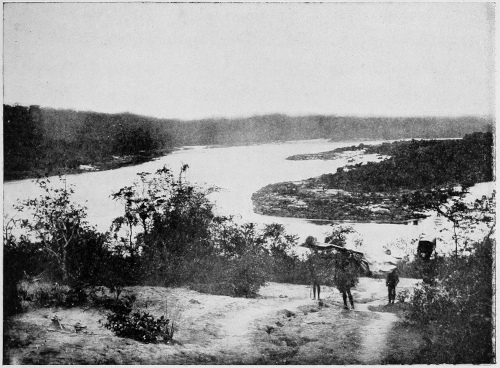
A SCENE IN THE CATARACT REGION OF THE CONGO.
167
The King sends for medicine--He is told to apply to St.
Catherine--The King’s promise--Bakula bids farewell to his
white friend--King’s deputy goes with us to Satu’s town--Ceremony
of conferring the title--Killing a leopard--Satu
redeems his brother--Releases his niece from a hateful
marriage--A story: "Appearances are sometimes Deceptive"--A
chief asks for Satu’s niece in marriage--Marriage money is
paid--The wedding--Satu gains a new slave.
One day Bakula was chatting with the white
man in his house when a head man arrived
from his majesty, saying: “The King has many
pains in his stomach, and he wants some medicine
to stop them. Will you send some?”
“No,” replied the white man, “I will not send
him any. For several weeks I attended the King
during his severe illness, and immediately on his
recovery he, at the request of the padres, went to
their church and thanked St. Catherine for his
restoration to health. Go and tell him that as he
thanked St. Catherine for his recovery, he must
now ask St. Catherine for medicine to stop the
pains in his stomach.”
The messenger could hardly repress a smile as
168he said: “That is only fair,” and hurried off to
deliver his message.
“Will you not send some medicine?” asked the
King’s nephew, who was standing by.
“Yes, perhaps by and by, but not just yet,”
replied the white man. “He has eaten too much,
and colic is the result. It will not hurt him to bear
the gripings for a time; and then I will send him
some medicine and advice. You know,” continued
the speaker, “that I went at sunrise every
morning for five weeks to wash his foul, sloughing
sore, and bind it in clean bandages; and he was
grateful for all that was done for him, and often
said that I had saved his life, and now I want to
teach him that these saints who have rotted away
to dust generations ago cannot help him.”
By now the messenger returned to say that
the King will not go to St. Catherine again if
the white man will send him some medicine at
once.
To him the missionary replied: “Tell the King
he had better wait a little longer before making
such a conditional promise. St. Catherine may be
busy somewhere else, and cannot come to Congo
just now, even for a King. You see, she must
have a lot to do in all parts of the world, and as
she is only a saint, and not God, she cannot be
everywhere at once.”
169Off went the man with the message, and this
time he could not suppress his laughter.
“Tell the cook-boy to make some hot water
quickly,” said the white man to a boy who was
squatting near the door.
The King’s nephew, in apologetic tones, said:
"The King’s position is a very difficult one. He
loves Vianga, Yoani, Bentele, Alli[50] and you very
much. You English were the first to bring God’s
palaver to him and his people, every day you cure
them of their diseases with your medicines, and
you teach them all kinds of good ways; but the
padres give him bales and bales of cloth and
many boxes of beads. You know he is always
greedy for trade goods and fine clothes; and these
he receives in abundance from the Roman
Catholic padres, hence when they asked him to
go to their church to thank St. Catherine for his
recovery, he was afraid to refuse them, although
he believes in his heart what you frequently told
him: that God blessed your medicine to his
restoration. To show how he loves you English
teachers, listen to what happened about a month
ago. All the padres went to the King and told
him that he was to order all his people to attend
their church, and never again to go to your
170services. They were angry because their church
was nearly empty every Sunday. They threatened
to leave the town immediately, and that
would mean a stoppage of all their presents, if he
did not issue the order they requested. The King
absolutely refused to command his people to
attend either service, and said: ‘They shall be
free to go wherever they like.’"
“I have always felt sorry for the trying position
of the King,” said the white man, “and fully
sympathize with him in his difficulties; but he is, as
we say in English, trying to sit on two stools, and
that is always very uncomfortable to the sitter,
and most irritating to the stools.”
Just then three head men came hurrying into
the house to beg again for some medicine, and to
promise on behalf of the King that he would
never again thank St. Catherine for what she did
not, and could not accomplish. So the white man
called for the hot water, and, mixing a glass of
physic, sent it to the King.
In a short time the man returned with the report
that the King felt better directly he drank the
medicine.
“What was it you gave him?” he asked of the
white man.
“Only some peppermint, hot water and sugar,”
replied the missionary. “You tell the King from
171me,” he continued, “that he is not to eat so
much.”
Bakula informed his white friend that he had
come to bid him good-bye, for at “cock-crow”
in the morning he and his party would be starting
back for their town.
“Will you not come and live with me, and let
me teach you God’s palaver?” asked the white
man of the lad.
“For many reasons,” replied Bakula, “I would
like to come and learn to read, write, do carpentry
and hear more about God; but this station is a
long way from my home, and my family will not
let me come so far. My uncle lives in the Ngombe
district, and perhaps they will let me go to the
mission school there.”
“Well, you can learn there as well as here; but
I should have liked you to live with me,” and
there was a note of tenderness in the teacher’s
voice, and tears were not far from his eyes as he
spoke to the lad. And after a quiet talk with my
owner about what he had heard at the services,
and expressing the hope that they would see
each other again soon, the white man and Bakula
separated, never to meet again on earth.
Bakula had frequently tried to induce Old
Plaited-Beard to have some conversation with the
white man, but had failed every time, not through
172lack of earnestness and persistency on Bakula’s
part; but because of the old man’s superstitious
fear and hatred of white men. The discussions
on the subject had been long and often loud, and
when Old Plaited-Beard was unsuccessful in
proving his charges of witchcraft against the white
man, or failed in proving that the white man
bought up dead bodies and sent them to Mputu,
he then fell back on another accusation: that the
white men had come to steal their country from
them.
On one occasion Bakula led the white man towards
the place where Old Plaited-Beard was
sitting; but no sooner did the superstitious old
man see him coming in the distance than he ran
into the inner room of the nearest house, and
would not come out until he was assured that the
white man had gone.
Early next morning Bakula and his party,
accompanied by Kapitau and some followers,
started on their return journey. On the road Old
Plaited-Beard and the Kapitau had long talks,
and although the prejudiced views of the old man
were received with coldness by the King’s deputy,
yet in one point they agreed, and that was “that
the white man would rob them of their country
and make them all slaves.”[51]
173Wherever we stayed for a night the people paid
most humble homage to Kapitau, as representing
the King, and supplied him with plenty of food
and palm-wine; consequently every evening was
spent in feasting and drinking, and there was
scarcely a night that the elders of the party went
to bed sober.
On arriving at Satu’s town Kapitau and his
companions received a great ovation. The people
crowded the road to set eyes on the man who had
been sent by the great King of Congo to confer
a title on their own chief. They vied with each
other in shouting, clapping, and beating their
mouths. Drums were thumped, ivory horns
blown, and guns fired; and the din was such that
it seemed more like pandemonium let loose for a
riot than a friendly welcome to an honoured visitor
and guest. To show due respect to the King’s
deputy a good house was given him, and an
abundant supply of food. In two or three days
the party was rested and the necessary preparations
for the ceremony were completed.
On the appointed day a large crowd gathered,
composed of Satu’s mother’s clan, who were especially
called. Those members of his father’s clan
who desired to be present were welcomed, but
all other clans were carefully excluded. The
assembly formed a large circle, in the centre of
174which a leopard’s skin was spread and a seat
placed on it.
The Kapitau went up to Satu, who was sitting
among his people, and hooking his index finger
in the little finger of Satu’s left hand, led him up
to the leopard’s skin, and walking him round it as
far as the tail, told him to step over it. Then,
leading him to the front of the chair, he seated
him in it, whereupon the crowd of onlookers
slapped the loosely closed fists of their left hands
with the palms of their right hands.
The Kapitau put on the new noble’s head some
lemba-lemba leaves, and wetting his hands with
palm-wine, pressed them to Satu’s temples, to
the back and front of his head, to his shoulders
and to his knees. This was to make him throb
with life, wise in the head, strong in body and
legs. This ceremony was repeated three times,
and a blessing was pronounced in the following
words: May you be happy and lucky, and when
you speak may your words be heard (i. e. obeyed)
by the people. And again the crowd shouted and
clapped.
When the folk had exhausted themselves into
quietness the Kapitau asked loudly three times:
“Do you know this man’s name?” and the people
replied each time: “No, we do not know his
name!” Then the King’s deputy exclaimed
175loudly: “It is Ngudi a nkama Katendi.” The
men and women, hearing this, rounded their
mouths with pursed lips, and beat them with the
extended fingers of their right hands, making
thereby a long series of Wo! Wo! Wo! and
again the drums were beaten, guns fired, and ivory
trumpets sounded until the very air seemed to
quiver with discordant noises.
The Kapitau then instructed the new noble
how he was to deport himself as a man of high
rank. In future he must not, when walking, visiting,
hunting or trading, carry anything except his
walking-stick or gun. In fact, he was never again
to carry anything like a boy or an ordinary man.
Should any person meet him bearing any article,
save his stick or gun, such a person may take
away the said article and either keep it for himself
or sell it. Should he shoot any game he must
send some one for it, for if he attempted to bring
it into the town himself, the first to meet him may
deprive him of his spoils. He must never, under
any circumstances, gather firewood or fetch water;
and, lastly, the new noble must never beat his
wives, and should he so far forget himself as to
do so, he may be mulcted in a fine of several fowls
or one goat. These instructions completed, a
bracelet was put on his arm as a sign of his new
and important rank.
176Satu gave the Kapitau four pieces of cloth and
a pig to compensate him for his trouble; and a
great feast of pigs, goats and palm-wine was prepared
for the people in honour of the occasion.
The night was occupied with gluttony, dancing,
immorality and drunkenness, for men and women,
boys and girls were reeling about in maudlin
intoxication all over the town. Fortunately they
had nothing but palm-wine to drink, which never
makes the drinkers quarrelsome, like the fiery
waters supplied by traders.
Only chiefs are permitted to own and use
leopards’ skins, and when one of these animals
is slain there is considerable local excitement as
to which chief will gain possession of the skin by
his largesse to the fortunate slayer of the brute.
The other week a leopard was killed in our
neighbourhood, and the lucky man who shot it had
it carried from chief to chief in the district. The
front and back paws were tied, and a pole was
passed through the legs and hoisted on to the
shoulders of some men. In this ignominious
fashion--dangling from a pole--the prize was
hawked from place to place. One chief gave four
kegs of gunpowder (worth 16s.); another gave
seven blankets (worth 21s.); another, who already
owned a leopard skin, and could not afford a
second, presented eight looking-glasses (worth
1775s.); and thus each gave, not knowing what the
others had given. Satu gave four blankets, three
kegs of powder, and two rugs (worth in all 30s.),
and thus exceeded the others in generous presents.
Directly it was known who gave the largest sum
to the leopard slayer, Satu went and put his foot
on the beast, and thus established his claim to it.
The animal was removed and in due time skinned.
It could not be flayed until it was trodden on by
its future owner.
The leopard after it is killed is always referred
to with great respect as Mfumu, or chief; and after
the carcass has made the circuit of the chiefs it is
carried back to the hunter’s town, and two or three
days are given wholly to festivities. Guns are
fired, drums are beaten, the people dance and sing
songs in honour of the slayer of Mfumu, and much
palm-wine is drunk. The leopard is then flayed
and eaten. Some ate the flesh believing they
would become lithe, cunning and strong like the
leopard, but others refused to eat it from a superstitious
fear of spots--like the leopard’s--breaking
out on their own skins.
The gifts presented by the various chiefs paid
the expenses of the festivities, and Satu sat on
this skin when he was invested with the high rank
of a noble. If the skin had been given to a chief
out of the district in which the hunter killed the
178animal it would have been resented as an insult,
and the towns and villages would have combined
to fight the hunter’s town or enforced the payment
of a heavy fine.
Satu’s deceased brother was a very poor trader,
and had such frequent losses on his trading journeys
that on one occasion he was compelled to
“pawn” one of his younger brothers to a neighbouring
chief to pay his many debts. He had
borrowed fifty pieces of cloth on his brother, and
although he frequently afterwards possessed more
than that number, and in fact died worth more
than three hundred pieces, yet he never troubled
to redeem his brother, but left him in servitude.
As a “pledge in pawn” the brother received no
pay from the one who held him, no matter how
hard he laboured.
Satu, on the other hand, was a keen, successful
trader, and had accumulated a great amount of
native wealth. Consequently, as a rich man and
a noble, he was expected by public opinion to
redeem his brother out of bondage. One of Satu’s
first acts after his dignity was conferred on him
was to take the fifty pieces of cloth, a calabash of
palm-wine and a white goat; and, calling Bakula
and others to carry the goods and accompany him
as witnesses, went to the town where his brother
was held in slavery.
179On reaching the town he sent for the pawnbroker
or holder, who came at once followed by
a few friends, who all paid homage to Satu as a
great noble. The natives bowed to the King and
rendered homage three times at each of the three
places as they approached; but to Satu they
bowed only once at each place as they drew
near.
When all were seated, the calabash of wine was
handed round and solemnly drunk by the two
principal men and their witnesses. The fifty
pieces of cloth were counted out and handed over,
and the white goat was presented. This white gift
was called nkusw’ a mpemba, or a being rubbed
white. On receiving this white goat the man who
held the pawn in pledge arose to his feet and
rubbed some chalk with his fingers by the side of
the right ear of the pawn. The ceremony is complete,
the pawn is redeemed, and the chalk is a
sign that he is clean from his bondage, and there
is nothing more against him. Satu and his brother
embraced each other and returned together to
their town. The slur of slavery now being wiped
out of the family, no one would again taunt them
with it.
Satu now turned his attention to help his only
niece. It appears that when she was a baby only
one or two days old, a man of middle age entered
180her mother’s house, and dropped a bead into the
saucepan that stood by the fire, and from which
the hot water was taken to wash the baby. The
dropping in of the bead gave the man a claim on
the girl to become his wife when old enough. No
one else could marry her unless the girl were
released by the payment of a heavy sum for breach
of custom.
When the child, Sono, reached the age of seven,
her deceased uncle had acknowledged the claims
of the “bead dropper” to his niece’s hand by
asking him to pay ten pieces of cloth as marriage
money. He could and should have asked more,
but he was in difficulty, and glad to accept any
sum he could get. As Sono came to realize the
small amount that was given for her, she became
angry with her uncle and with the man who
regarded her as his cheaply bought wife; and this
feeling was increased by the girls and boys in her
town jeering at her for not being worth more than
the price of two pigs.
When she arrived at a marriageable age she
refused to marry the old man, and had repeatedly
begged her uncle to release her by returning the
marriage money and another ten pieces as interest
for the use of the money for the past ten years.
Her deceased uncle, who was then the head of her
family, had refused to part with so much cloth
181merely to gratify the whim of a girl, and, besides,
he always pleaded poverty.
There seemed no prospect of release for her
from a very hateful marriage with an old man
who already possessed twelve wives--most of
whom had bad, quarrelsome tempers, and would
make her life miserable. She had determined to
kill herself[52] as her only means of escape; but
now that another and richer uncle was head
of the family she renewed her appeal with
success.
The bridegroom-elect was a crafty old man
who thoroughly recognized the advantage of an
alliance with so great a family if he could coerce
the girl into marrying him, or the possibility of
making some money out of the breaking of the
covenant should her uncle support her in her
continued refusal of him.
He therefore feigned surprise when he was
requested to release Sono from her betrothal to
him, and asked in anger: “Was he not great
enough to become a member of Satu’s family!
Was he not a great man himself, and owned
twelve wives! What objection had lord Satu to
him?”
Satu did not attempt to argue these matters
with the old man, but went straight to the point by
182asking how much he wanted before he would
release his niece.
“Well,” replied the man, “I paid ten pieces of
cloth, besides palm-wine, and various odds and
ends of trade goods, worth in all fifteen pieces, as
marriage money, and your family has had the use
of that amount for ten years; so I shall not take
less than one hundred pieces of cloth to release
her from the betrothal.”
“That is a ridiculous price to put on her,”
retorted Satu angrily. “I will give you twenty-five
pieces, one pig, one keg of gunpowder, one
calabash of palm-wine, and one soldier’s coat.”
“But you are now a great chief, and a noble of
high rank,” contended the old man, “and any
one will give sixty pieces of cloth for your niece as
marriage money in order to marry into so grand
a family. I will not take a fathom less than ninety
pieces. Let me tell you a story of a girl who
refused her betrothed for frivolous reasons, and
was badly treated by her chosen husband.” The
old man then related this story, called
“Appearances are Sometimes Deceptive.”
“Once upon a time a girl was betrothed by her
parents to a Mr. Hawk, and for a time she was
satisfied with her sweetheart; but by and by she
complained that his face was too black. Her
183parents tried to teach her that a man was not to
be accepted simply because he had a beautiful
face, nor rejected for only possessing a very
plain, black one; but she would not listen to
them.
“One day she put on her ornaments and best
cloths, and went to the market, where she met a
young man whose name was Oily-face,[53] because
it was polished so brightly with palm-oil.
“Mr. Oily-face’s country was a long way off,
and when he left home he had a nasty body
covered with pimples and scabs, and his eyes
bulged out. As he passed through the towns he
borrowed a face, some hair, new teeth and a nice
skin; consequently when he reached the market
he looked a very pleasant young man.
“This Mr. Oily-face saw the girl standing in
the market, and said to her: ‘I would like to
marry you.’ She looked at him, and seeing he had
a beautiful light skin, well-plaited hair, and nice
white teeth, she said: ‘All right, come and see my
parents.’
“When they reached her town she said to her
family: ‘Here is a young man who wants to marry
me.’ Oily-face looked so bashful, and showed
such respect to the girl’s mother, that they were
all pleased with him. Very soon they were
184married, and shortly after started for Oily-face’s
country.
“They had not gone very far on the road when
some one called out: ‘Oily-face, return my hair.’
Another shouted: ‘Give me back my teeth.’ In
another town a man requested Oily-face to return
the face that he had lent him; and another said:
‘Give me back my stomach and take your own;
it eats too much.’ Thus at last he was reduced
to his own nasty body, pimply skin and bulging,
ugly eyes.
“After walking many days they reached their
town, and the people came round asking Oily-face
where he had procured his wife. He told them
that she had come from a far country which was
ten days’ journey away. They welcomed her, but
next morning they surrounded the house wishing
to eat her.
“She came outside and said: ‘Wait, don’t eat
me yet; but beat your drums and I will dance.’
“So she danced all day to amuse them, and
sang a song about a Mr. Hawk being very good,
with beautiful, curving feathers; and how sorry
she was for not accepting him as her husband.
Every morning they wanted to kill and eat her;
but she danced and sang to please them.
“One day Mr. Hawk passed that way, and,
looking down, saw the woman, heard her song, and
185felt full of pity for her. He told her parents of
their daughter’s danger, and promised to save her.
Next day, therefore, he flew off, swooped down,
and carried her back to her own family, who were
glad to receive her amongst them again. After a
time she married Mr. Hawk, and never any more
found fault with the colour of his face.”
“There,” continued the narrator, “your niece
will be sorry she did not marry me when she is
badly treated by some dandy who has borrowed
his beauty from other people. Give me eighty
pieces of cloth and I will release her.”
To him Satu replied, with a laugh: “I will take
care that no such dandy marries my niece and
carries her off to a distant country. Besides, my
niece is not so foolish as to make friends with any
swells (etoko dia fioti) on the market.” Satu
offered twenty-eight pieces and the other articles,
and asserted that he would not put another fathom
on the price.
They argued about the affair all that afternoon
and for the two succeeding days, and at last it was
agreed that Satu should pay thirty-five pieces of
cloth to the old man, one pig, one keg of gunpowder,
one soldier’s coat, one gun, and a calabash
of palm-wine, and thus the palaver was
settled to every one’s satisfaction.
186A month or two after the release of Sono, a
young chief of a neighbouring village arrived,
followed by a man carrying a large calabash of
palm-wine. Bakula greeted him, and walked with
him to Satu’s house. There the young man asked
for Satu, who, on appearing, received homage
from the chief and inquired his business.
“I very much wish to marry your niece, Sono,”
replied the young man, “and I have brought a
calabash of palm-wine to start the negotiations.
Will you drink it?”
If Satu had refused to drink the wine the young
chief would have taken it away, knowing that there
was not the smallest hope of him ever marrying
into Satu’s family; but Satu did not refuse the
wine; he accepted it, and sat down and drank it
with the suitor for his niece’s hand.
Having drunk the wine, Satu sent for some
food, so that the young chief might refresh himself
for his return journey; and without giving
him a decided answer he told his niece’s admirer
to come back in four days. So far Satu had not
pledged himself, but had simply listened favourably
to the suit.
On the appointed day the chief, carrying more
palm-wine, returned to Satu, who, having drunk
the wine, informed the aspirant to his niece’s hand
that he was quite willing to regard him as a suitable
187husband for Sono if all other matters could
be arranged; and that the marriage money would
be fifty pieces of cloth, two blankets, one pig, fifty
brass rods, and five round looking-glasses.
This large sum was asked on the ground that
Satu wanted a guarantee that the suitor for his
niece was wealthy before he would admit him into
so great a family.
The young man was staggered at the price
demanded; and tried to reduce it, without success.
He was, however, enamoured of the lady, and at
last promised to collect the various goods. But
it required repeated trading expeditions about the
country and to the coast before the young chief had
added sufficient to his savings to pay the marriage
money and meet the expenses of the wedding.
A few months passed, and Satu received word
that the young chief had gathered the cloth and
other articles; and requesting him to come and
inspect them. This Satu did, and being satisfied
with the quality of the cloth and the size of the
pig, he arranged to return for the goods on a
certain day and to bring the girl’s father[54] to be
introduced to him.
The day arrived, and with it Satu and the girl’s
father, accompanied by a man carrying their calabashes
of palm-wine. The young man called
188some of his friends to help him drink the wine,
and to act as witnesses. The uncle’s wine was
drunk first, as he is always of more importance
in these marriage transactions than the father,
mother, or even the girl herself. After the uncle’s
calabash was finished the father’s wine was drunk.
The “money” was then counted, and the two
blankets and one or two pieces of cloth were given
to the father, but the rest was claimed[55] by the
uncle.
Up to the present neither the girl nor her
mother are supposed to have been consulted; but
he would be indeed a foolish swain who went far
in the “palaver” without knowing something
of the girl’s feelings towards him, or sending
presents to the girl’s mother.
This young man was well acquainted with the
girl’s favourable regard for him, for had she not
received little presents[56] from him? He knew,
too, that his future mother-in-law was on his side,
for he had acted generously towards her; hence,
when questioned on the matter, she readily
agreed[57] that the marriage could take place at
once.
The young chief had seven wives already,
consequently he was well versed in the rites and
ceremonies of marriage. At these affairs there is
189generally a pretence at carrying off the bride;
hence on the wedding-day the bridegroom, accompanied
by many friends, went to the bride’s town,
and as they drew near they beat their drums,
shouted loudly, fired guns, and made as much
noise as possible, as though they were attacking
the town. There was a sham struggle, and at last
the girl was carried off. This great ado was
regarded as an honour to the girl, and a proof of
the bridegroom’s position.
On returning to his own village the bridegroom
told his friends to bring the drums and plenty of
palm-wine, and on that and the succeeding three
days goats and pigs were killed and eaten, palm-wine
was drunk, and guns fired. The bride went
without food the day before the wedding, and as a
new wife she was not allowed to eat in sight of
her husband for three months.
When the crowd had gone the elders met and
gave the girl into the hands of the young chief,
and they taught them both in the presence of
witnesses. To the young woman they said: “You
are to respect your husband and his family; and
you are to behave yourself properly in your house.
You have never had thieving or witchcraft
palavers in the past; continue without them, and
conduct yourselves properly towards each other.”
To the young man they said: “You are to
190respect your wife and her family; you must not
speak harshly to her, nor treat her as a slave, nor
stamp on her things, nor tread her beneath your
feet.”
Then the young man went to one of the witnesses,
and taking him by the wrist, rubbed a
bullet on the palm of the witness’s hand, and
said: “I have heard all the words spoken, and if
I destroy the marriage may I die by this bullet.”
The young woman then stepped forward and
shyly took the same oath. This ceremony completed,
the witnesses went into Sono’s house and
arranged the hearthstones, and instructed the
bride in the duties of a wife.
The young chief, in anticipation of his marriage,
had built a house for his new wife, because
every wife had her own house in which to live and
be mistress. The Congo man is too ’cute to put
two women in one house; perhaps he has learned
by bitter experience the unwisdom of it, and no
matter how many wives he may be fortunate
enough to marry, he builds a house for each, and
one for himself.
Sono, coming as she did from a town which was
half a day’s journey from her new home, had no
farm from which she could draw her supplies of
food for herself and husband, in supporting whom
she had now to take an eighth share. So a few
191days after the marriage she went with the other
women, her fellow-wives, and they helped her to
clear a patch of ground, hoe it, and plant it with
seasonable seeds and roots. In return for their
kindness she assisted them in weeding their farms.
It was the custom for the bridegroom to supply
his bride with all the necessary food until her farm
was matured and yielding; and from that time to
give her meat and fish as frequently as possible,
while she found her own vegetable food and a
share of his. It was also the man’s duty to present
each of his wives with at least one good cloth
every year, and more if he were a wealthy man.
Sono settled down fairly comfortably with her
husband and seven fellow-wives. She had her
farm to cultivate, a house of her own, an occasional
bit of meat or fish sent her from her
husband; what more could she want?
One morning our town was aroused by the firing
of guns and shouts of Nkombo! Nkombo! (Goat!
Goat!)
Bakula ran out of the house and joined most
vigorously in the shouting.
We saw a man covered with perspiration and
panting with running. He hurried by to the chief’s
lumbu or enclosure, and fell at the feet of Satu,
where he paid most humble homage, covering his
face with dirt.
192As soon as he gained his breath he said: “I
have been badly treated by my master Dimbula,
who frequently beat me severely with his whip.
See, here are the marks!” and he showed some
deep wales across his back, legs and chest. “He
not only thrashed me,” he continued, “but he
robbed me of the small earnings to which by right
of custom I am entitled. I have therefore run
away from him to you. Will you accept of me?”
and he looked beseechingly at Satu, for now
his very life depended on the answer. If Satu
refused him, and handed him back to Dimbula as
a runaway slave, it was most probable that his
master, in his rage and shame, would kill him.
Satu considered the matter, and at last, to the
relief of the poor wretch, called for a piece of
goat’s flesh, and giving half to the slave, ate the
other half himself.
The crowd that had gathered, directly they saw
the piece of goat’s meat eaten, shouted: Nkombo!
Nkombo! (Goat! Goat!) and fired off a salvo with
their guns.
The slave was practically now a free man. The
piece of goat eaten by Satu was a pledge that he
would protect the man who had eaten with him
from ever falling again into the hands of his old
master, even though he had to use the last brass
rod, or shed the last drop of blood he possessed, in
193so doing. And the slave, by the eating of his
piece of goat, was bound, as long as life lasted, to
Satu as a free man.
On the next market day Satu took the whilom
slave and showed him on the market as one who
had “eaten his goat,” and was now no longer a
slave. Dimbula was present, and was chagrined
to witness the whole affair; but he was compelled
by custom to accept from Satu the merely nominal
price of a slave. In selling a slave ordinarily the
seller gets as much as he can, and generally makes
a good profit on the exchange; but in a transaction
of this kind he must take what is offered as the
equivalent of a slave, and be satisfied.
Dimbula was a man of ungovernable passions,
and it was not the first time that his slaves had
escaped from his cruelty by “eating goat” with
neighbouring chiefs; while, on the other hand, no
slaves had ever run to him for protection or to
“eat goat” with him. His fierce, hasty temper
was well known and feared.
Slaves free in this way take the name of
Nkombo, or Goat; and these “goats” are very
highly prized by chiefs, as they become very
faithful followers of those with whom they have
“eaten the goat.”
194
Manner of bush-burning--Witch-doctor makes a hunting-charm--Ceremony
is carefully performed--Blazing bush and rushing
animals--Satu arranges with another chief to burn the
bush--Dimbula breaks the law and insults Satu--War is
declared--Old Plaited-Beard being unsuccessful accuses
Bakula of bewitching him--He tries to restore his luck.
As the hunting season was drawing near, Satu
and his people decided to engage a ngang’
a nkongo, or the “medicine man” of the hunting
fetish, to make for them a powerful charm that
would endow them with good luck in all kinds
of hunting. The time for bush-burning had
arrived, when the tall grass in their district would
be thoroughly dry by reason of the long drought,
and would burn like prepared tinder. It is
during the bush fires and the two succeeding
months that systematic hunts are organized. It
was therefore needful to prepare the charm as
quickly as possible.
The first thing that Satu and his people had
to do was to burn carefully a belt of grass, a
hundred yards wide, right round their town, lest
195the great, uncontrollable bush fires should come
roaring up before the wind, and reducing their
dwellings to ashes, destroy also their treasures
and savings at the same time. For the purpose
of burning this belt a damp morning, heavy with
dew, was chosen; then the men and women went
with sticks and knives, and cut or pushed down
the grass all round the town--when the stems of
grass are damp they are very pliable and are easily
pressed down and will remain down as they dry
in the morning sun.
The bush grass is anything from six feet to
fifteen feet high, with stems as thick as a person’s
fingers. When they are burning the steam
generated in the stems causes them to explode
with loud, gun-like reports, and the force of the
explosions sends the burning grass hurtling
through the air like rockets; hence Satu’s people
took care to push down the grass so that the stalks
pointed away from the houses.
After pressing down the grass round the town
the wind was watched, and when it was favourable
the broken-down grass was burnt. The men
and lads, armed with branches, controlled and
directed the flames; Bakula and the other lads just
delighted in this bush-burning season, and looked
forward to it with eager anticipation of the sport
they would enjoy and the game they would secure.
196In dreams and talk they killed many an animal
long before the first grass was fired.
Satu sent Bakula and two other lads to call
the nganga, who made the hunting charms. On
reaching his town they found him engaged in
refreshing and reinvigorating his fetish. He took
a large fowl at sunset, and, turning his face towards
the setting sun, cut the throat of the fowl
and let the running blood fall on the fetish, covering
it with the life-blood of the sacrifice. This
renewed the strength of the fetish, and, refreshing
it, enabled it to impart power to various charms.
He then stood his fetish on the ground and
surrounded it with several small heaps of gunpowder--laying
a train from one heap to another.
When all was ready he exploded the powder, and
blew vigorously on his whistle--this aroused the
fetish, made it alert and active in performing its
work. The nganga had the fowl cooked, and ate
the whole of it himself, for to sell it or to share
it with another would nullify its effect on the fetish
as a sacrifice.
Bakula and his companions stood on one side
keenly interested in these ceremonies, for was not
their future success in hunting dependent in some
way on these mysterious rites? Bakula, however,
since his close intercourse with the white man, had
begun to doubt the pretended powers of these
197ngangas, so turning to his fellow-messengers he
asked: “How can that wooden image, that has
to be refreshed with fowl’s blood and aroused
with explosions of gunpowder, cause us to shoot
straight in our bush lands? And again, how can
it make the antelopes and bush pigs come our
way, instead of going off in another direction?”
He then told the lads what he had seen in the
King’s town respecting the nganga with his charm
of feathers, and the iron prong hidden in them.
And he concluded by saying: “I begin to think
they trick us, take our money and laugh at us.”
The lads could not reply to Bakula’s reasoning,
but they had no doubt that the nganga possessed
powerful “medicines,” and could do anything he
liked; and they told Bakula in a friendly way
not to let Old Plaited-Beard hear him talk in
this manner, or he would quickly accuse him of
witchcraft.
Early next morning they returned with the
“medicine man” to their town; and immediately
on arrival the nganga set to work to make the
necessary charms. It was a busy time with him,
and he would not have come so promptly, but
Satu was a great noble and could pay well. The
nganga procured some red camwood powder, some
leaves of the lupemba-mpemba-tree, some young
spikes of new nianga grass, some parrot feathers,
198cowry shells, wood ashes, a fore-leg of a bat,
some small shot, and some native peppers.
These he thoroughly cut up and well mixed, and
each hunter filled his small horn with the mixture,
and sealed the opening with a little rubber. He
then received his fee and went.
The hunters being now in possession of their
charms, went to visit the grave of a renowned
hunter who had died some years previously. It
was the custom that when a great hunter was
dying he should draw a thread from his mbadi[58]
cloth, and tie it round the forehead or arms of a
young man chosen for the purpose. This person
then became the Kimpovela, or the one who speaks
on behalf of others, i. e. an advocate; and this
advocate was not allowed to marry more than one
wife, and he must never beat her or he would lose
his power as an advocate. Only the man thus
selected by the dying hunter could perform the
ceremonies at this grave. When the great hunter
died, his hair was cut off and buried beneath a
large stone near his place of burial, that the
natives of the district might always know where
the grave was situated.
Satu and his party took with them a calabash
of palm-wine and, calling the Kimpovela, passed
on to the grave of the renowned hunter. The
199advocate went first and kneeled with his back to
the grave and his face towards the hunters, who
approached him slowly, stopping every few steps
to clap their hands. When they reached the
kneeling man they spread out and sat round the
grave, putting the wine and their guns on the
ground near by. The Kimpovela then turned
towards the grave, and shaking his rattle repeatedly,
he thus prayed to the deceased hunter:
“You are blind, but your ears are not deaf. Oh,
ears, hear well! we have come to you, we come
kneeling. When you lived in the town you ate
and you drank, now we who are left die of hunger;
give us male and female animals.” When this
prayer was finished a man put the calabash of wine
on his shoulder, and the Kimpovela, making the
sign of the cross,[59] took a cup of the wine and
poured it as an offering on the grave of the great
hunter. The rest of the wine was drunk by the
hunters sitting around the grave.
After drinking the wine the Kimpovela rubbed
a little of the earth wet with the oblatory wine
on the forehead, temples, fore-arms, wrists, knees
and insteps of each hunter; then he took each
gun and drew his fingers up the butt, and reaching
the barrel he snapped his fingers and handed the
gun to its owner, who on taking it clapped his
200hands, sprang in the air, and holding the gun in
front of him walked backwards a little way, facing
the grave, and sat down to wait for the others.
When all had finished they fired a salute and sang
a song in praise of the great hunter to the rubbing,
grating noise of the antelope drum. More
palm-wine was drunk, and I am sure that by the
time they had exhausted their wine, if they had
seen an antelope not one of them was sober
enough to have fired straight at it.
After these ceremonies were concluded whenever
Satu and his people went hunting they either
took their horns of medicine with them, each
carrying his own under his belt, or they wetted
the rubber stopper and rubbed the butt of their
guns with a little of the moisture. This gave
them accuracy of aim, or they thought so. By
burning the belt of grass round their town they
had secured their houses against fire, and by their
charms and the visit to the grave of the renowned
hunter they had ensured their future success as
sportsmen; they were now consequently able to
turn their attention to those parts of the bush
where animals--antelopes, wild pigs and gazelles--were
likely to be found.
A breezy day was chosen, and the hunters,
taking their places along the portion of bush to
be burned, fired the grass as soon as the night
201dews were dried off. Animals browsing were
startled by the roar of flames, rushed bewildered
before the oncoming fire, and as they ran past
were shot at by the waiting hunters. While the
fire was burning hawks and fish-eagles circled
above the burning bush, not “to drink in the
smoke,” as the natives say, but in search of any
hapless rats and snakes cut off from escape by the
raging fire. These birds could be seen swooping
down and carrying off to their lairs such reptiles
and rats as their keen, hungry eyes detected.
These bush fires have taken place annually for
generations, and undoubtedly account for the
scarcity of wild game on the Lower Congo, the
absence of large reptiles, the shabby appearance
of the trees on the open veldt--they scarcely
recover from one scorching before the dries are
on them and another scorching is due--and the
luxuriant grass, for the burnt remains of one crop
enrich the soil to bear another as stalwart as the
first.
During this season it is very weird to see, night
after night, great bush fires blazing in different
directions. The sky is aglow with them, and you
smell and breathe a smoky atmosphere for days.
Bits of charred grass are carried by the winds in
all directions, and the country looks dressed in
black as though it were mourning with a great
202sorrow, and the sun, as though in sympathy with
the earth, hides for days behind the clouds of
ascended smoke.
During the hunts men are often wounded, and
sometimes killed, by being mistaken for animals
as they push through the rustling grass. Then
follow recriminations, charges of intent to murder,
and long law-suits that ruin the unfortunate family
of the man who did not stop to look before he
fired his gun. Sometimes, when a line of men is
crawling through the grass tracking an animal, the
trigger of a gun will catch in the stalks, the gun
will explode, there will be a scream of a man in
the agony of death, and the scared owner of the
gun will be charged with murder, for there are no
accidents in native law.
The culprit will be fortunate if the deceased is
a member of a poor family, or a slave, for then
he will get off with a heavy fine; but if the dead
man is a person of importance his life will be
forfeited, or he will be sold far away into slavery.
He will be lucky if he is not shipped to St.
Thomé or to Principe to work on the plantations.
During the bush-burning Satu and his men
killed only three wild pigs and four gazelles; but
they had a very serious quarrel with a neighbouring
chief that developed into a war after the
hunting season was over.
203A part of Satu’s land ran by the side of ground
belonging to a neighbouring chief named Dimbula;
and according to custom Satu sent to
Dimbula asking what day would be convenient
for burning that part of the bush where their
properties joined each other. After much palavering
the day was fixed; but when Satu and his
hunters reached the spot they found none of
Dimbula’s people there.
It was against the law of custom for either party
to fire the grass before the arrival of the other
side; consequently Satu and his men sat waiting
all through the long morning, and about noon
they decided to return home--vexed with having
wasted a whole morning. They had not gone
very far when they heard shouts, and looking
round saw the bush blazing. On hurrying back to
the place they had so recently left, they found
Dimbula and his men there.
Satu said: “We arrived here early this morning
according to agreement, and we waited until
midday, but as you and your people did not come,
we did not burn the grass, and were just returning
home intending to make a new appointment
with you. Why have you broken the custom by
firing the grass in our absence?”
“You think that because you are Ngudi a
nkama Katendi that you can do and say what
204you like,” replied Dimbula, with ill-suppressed
anger and bad logic.
“No,” retorted Satu, “that is not so, or I would
have lighted the bush early this morning, and not
have sat here half the day waiting for you.”
“Let me tell you,” shouted Dimbula, “that my
family had the title when your family was too
poor to assume it, and was glad to sell the use
of it.”
“Yes, that is true,” said Satu, “but that is no
reason why you should burn the grass by yourself
when you know my land runs by the side of
yours.”
“You think that because you drove a white man
out of your town and retained my runaway slave,
that you can lord it over us,” said Dimbula, who
by now was choking with unreasonable rage. In
fact, we heard afterwards that Dimbula had
planned the whole affair as an insult to Satu, of
whom he was jealous, both as a rich man and as
a noble of rank; and he also felt hurt because
Satu had kept the “goat” that ran to him for
protection.
Satu put down his gun, and with calmness and
dignity went up to Dimbula and said: “I drove
the white man away because I did not know him,
and I accepted your slave according to native
custom; but they are no excuses for insulting me.
205Listen, I swear by my mother,[60] that if you do not
apologize and pay homage to me by the end of
the hunting season I will fight you”; and turning
his back on Dimbula he picked up his gun and
walked away.
Just as Satu’s party reached the brow of the
next hill, Dimbula sprang forward and shouted
in contemptuous and boastful derision: “O
mighty chief Satu, can I lend you twenty kegs
of powder for the coming fight?”
The town was all excitement when they heard
of the insults that had been heaped on their chief,
and many of the more fiery ones wished to begin
the fight at once; but Satu would not give his
consent, and told them to wait until the hunting
was finished.
A few weeks after the fires were over a fine grass
covered the hill-sides and plateaus with such
delicious fresh verdure that the antelopes and
gazelles were enticed from the forests where they
had fled from the devouring flames, to browse on
it, and so delighted were they with the new sweet
crop that they forgot all dangers, and were easily
surrounded by hunters and shot down.
In these hunts native dogs were used, and a
“medicine man” was usually called to endow
them with good tracking powers. The nganga
206took some chalk, some different leaves and the
head of a viper. These he mixed thoroughly
together and made into a bundle. He then took
a small portion of the bundle and put it in a
funnel-twisted leaf, caught a wasp and pressed
its juice into the funnel, put in a little palm-wine,
and squeezed the juice of this mixture into each
dog’s nose. They then became good trackers and
hunters. The chalk gave them wisdom, the leaves
gave good health, the portion of viper imparted
stealthiness, and just as a wasp makes straight
for its nest, so the dogs would make straight for
the game.
Some of Satu’s people went one day with their
dogs to hunt, and had been gone most of the day
when an antelope was seen by Bakula on the side
of a distant hill. They instantly spread, worked
to leeward and gradually bore down on the unsuspecting
creature. The nearest man fired[61] and
the poor animal fell mortally wounded. Directly
it fell some grass was cut and spread out, and
the antelope was laid on it.
The hunter who killed it put the butt of his
gun to his shoulder and the muzzle on the carcass.
A cross cut was made on the stomach, and the
hunter put his fingers three times to the cut and
to his upper lip, then again three times to the cut,
207and rubbed his fingers each time on his gun.
The antelope was then removed, and the hunter
put the muzzle of his gun under the grass and
turned it over. The animal could not be cut up
until this ceremony was performed, or the hunter
would have lost his “hunting skill,” and, besides,
it established beyond a doubt the ownership of
the antelope.
The flesh of the animals killed in the hunts
is always divided, according to certain well-recognized
rules: the kidneys and strips of meat
from the back were sent to Satu as chief of the
town; one hind-leg was given to the men who were
left in the town, and they shared it with their
wives; one fore-quarter was given to the hunters,
the heart was given to the father of the successful
hunter, certain portions were sent to his mother
and aunt, and the rest belonged to the man who
killed it.
When the antelope was being divided, the
bladder was emptied and filled with blood, and
in a day or two it was carried to the Kimpovela,
or advocate, in charge of the renowned hunter’s
grave. The Kimpovela brought from his house
a small wooden cross and fixed it in the grave.
He then put the successful bullet in the prepared
hole in the cross and poured the blood over the
cross and the grave as an offering, saying as he
208did so: “We thank you for sending us such a
fine animal, and hope you will repeat the favour.”
Only the blood of antelopes is given in this way.
Some of the blood was rubbed on their fetish
charms, and the end of the antelope’s tail was
stuck in the wall over the doorway of the
successful hunter.
During the hunting season Old Plaited-Beard
was unsuccessful in his hunting--not a single
animal fell to his gun, although he had several
fine opportunities. He was exasperated at his
failure, and looked around for the reason why
his charms were ineffective. He now recalled to
mind what the boys who accompanied Bakula
told him on their return about their companion’s
disparaging remarks concerning the “medicine
man,” his fetish, and his trickery. He also
remembered his admiration for the white man,
and the attempts he made to bring about a meeting
between them. Putting all these things
together, he came to the conclusion that Bakula
had bewitched him and his charms, and that consequently
he was unable to kill any game.
Old Plaited-Beard sent for Bakula and accused
him of destroying the power in his charms; and
when the lad strenuously denied the accusation,
he told him what he had sneeringly said in the
nganga’s town about “medicine men” and their
209tricks; of his companionship with the white man
in the King’s town; and how he who used to wear
so many charms had thrown nearly all of them
away. It seemed a very black indictment.
Bakula admitted that he had lost faith in
ngangas, and told with dramatic force of the
nganga’s exposed trickery in the King’s town; he
did not deny his liking for the white man, for had
he not shown kindness to him in forgiving him
and healing his wound? He assented to the charge
of throwing his charms away, for he could not
see that the messes the witch-doctors put into
horns and shells could help them in sickness,
hunting, trading, or anything else.
“Besides,” he said, "if I had power to affect
the charms made by the ‘medicine man’ for the
town, how is it our people have killed pigs,
gazelles and an antelope?"
“You let them shoot the animals, and took the
spirit from my charms, so that I could not kill
any,” unreasonably argued the superstitious old
man.
“I am sorry no game fell to your gun,” soothingly
replied the lad, “but it was through no
fault of mine.”
Old Plaited-Beard looked at the apologetic lad
suspiciously, and he thought that his very conciliatory
attitude was a sign of his guilt. He
210would have understood him better if the spirited
boy had burst into loud, angry abuse, recriminations
and counter-charges. However, he only
said: "Don’t do it again. Leave my charms
alone and do not laugh at ‘medicine men’ and
their fetishes, for you have put me to the expense
of engaging a nganga to renew the power in my
hunting charm."
Old Plaited-Beard went next day to the nganga
nkongo, who made three plaits of nine pieces of
grass in each plait. He then asked for a piece of
the last bird or animal his client had killed. The
old man took from his shoulder-bag the tail of a
gazelle that he had brought for the purpose and
handed it over to the “medicine man.”
A hunter always saves a feather or a claw of
the last bird he killed, or the tail or hoof of the
last animal he shot, and that is why all these odds
and ends are stuck in the front walls of the houses.
At any time he may repeatedly miss, and may
require a piece of the last thing he killed to restore
his luck. The nganga took the gazelle’s tail from
Old Plaited-Beard and put it on the ground; he
then made three little heaps of loose gunpowder
round it, and chalked a cross near the powder, and
on the butt of the hunter’s gun. The nganga
exploded the powder; a little gunpowder was then
put in the gun, and the hunter, standing a few feet
211away, fired at the gazelle’s tail, and blew it from
the spot on which it was resting, thus proving that
his hunting skill had returned to him. If the tail
had not been blown out of its position the “medicine
man” would have repeated his ceremonies.
After the old man had knocked the tail away,
the nganga took the gun from him, and put his
finger in the dirt where the tail had been, and
rubbed a little of the earth three times on the
hunter’s upper lip; the fourth time he put his
fingers on the butt of the gun, and ran them up
the barrel and snapped them in the air. He then
loosened the plaits, and shook the grass about
the gun. Old Plaited-Beard stepped forward,
solemnly clapped his hands, took his gun, sprang
into the air, and returned home satisfied that in
future he would be more successful. He had
never been a good shot, and this season he failed
utterly, and put all the blame on Bakula, on whom
he determined to avenge himself on the first good
opportunity.
212
Satu as the insulted party makes the first move--He sends an
embassy to Dimbula--He asks for an apology or offers a
bullet--The apology is refused, but the bullet is accepted--The
witch-doctor makes a new charm--Mode of fighting--The
ridge-pole of chief’s house is captured--Dimbula sues for
peace with a white goat--Pays homage to Satu--Blood
brotherhood is made.
The hunting season had ended, and Dimbula
had neither come to pay homage to
Satu, nor sent an apology for the insults he had
heaped on him. Dimbula’s attitude, his insolence,
his breaking the bush-burning custom, and
“What would Satu do?” were the general topics
of conversation on the markets and around the
evening fires. The people belonging to both
towns swaggered, boasted of their prowess, and
insulted each other whenever they met. There
was no hope either of Dimbula humbling himself,
or of Satu relinquishing his claims to
homage, or at least his rights to courteous
treatment.
As Satu was the aggrieved party he was consequently
the one to make the first move. Bakula
213and another lad were chosen to carry a message
and a bullet to Dimbula’s town.
It was with much nervous trepidation that they
went on their errand. On arriving at the town
they found the chief and his head men engaged
in a drinking bout. Bakula delivered his message:
“Would Dimbula apologize for his insults
and pay homage to Satu as a noble of high rank,
or would he accept of the bullet Satu had sent
him?” Bakula and his comrade then withdrew
out of hearing while the men consulted about the
answer that should be returned.
When the messengers were recalled, Dimbula
said: “We will accept the bullet, as we never
intend either to apologize or to pay homage to
Satu. Tell him,” angrily boasted the excited
chief, “that I can let him have fifty kegs of gunpowder
if he is short of it,” and then followed a
string of abusive epithets that I do not care to
place on record. The two lads were glad eventually
to find themselves outside the town in
safety; and, on reaching home, delivered their
message faithfully to the waiting people.
Upon the return of the messengers Satu sent
to call in all the neighbouring chiefs, except
Dimbula, and on their arrival he laid clearly
before them the reasons of his quarrel with
Dimbula, and his wish to fight him. After full
214consideration of the matter the chiefs gave their
consent to the fight taking place; and thereupon
Satu killed a pig and distributed it among the
chiefs. The acceptance of this pig’s flesh assured
their neutrality, and was a proof of their consent.
It was now the business of the chiefs to see that
no one went to the assistance of either of the
towns at war; and thus Satu had gained an open
field, and feared no interference while he was
fighting his enemy.
The next thing to be done was to send for the
nganga who made the war charms. On his arrival
Satu and all the men who were to take part in
the fighting assembled to greet and fête him, for
their success, and perhaps their lives, depended
on his good-humour and his care in making their
charms. They told the nganga that they were
willing to pay for the most powerful charms he
could make.
The “medicine man” took a frog and killed
it, then he procured some twigs from three different
trees--the “lembanzau,” the “lolo,” and the
“mfilu”; these four things were carefully burnt
together, and the ashes made into a paste by the
addition of some water. A little of this paste was
put into a large number of snail shells, one of
which was given as a charm to each fighting man.
Then the men walked round one of the above
215trees, and on returning to the town some palm-wine
was mixed with the paste remaining in the
saucepan, and all drank of it. After each one
had drunk a little of this mess, the nganga took
the saucepan down to the road that led to Dimbula’s
town, and placed it right in the middle of
the path. Each man had then to jump over the
pot, and if one had stumbled or touched the pot
with his foot while jumping he would not have
been allowed to go to the fight. The coming
war was a popular one, so every man jumped
carefully and lifted his feet well when he came
to the saucepan.
The twigs used in making this charm were
from “strong medicine trees,” and the frog was
put in the mixture because they had noticed that
the frog’s heart pulsates, or, as they say, “lives,”
for some time after it is taken from the body.
This tenacity of life was what the fighters needed.
Early next morning the warriors assembled in
front of the chief’s home, and he served out the
powder to them. Then the nganga came with a
bowl of palm-wine, and dipping his fingers in the
wine touched the lips of the fighters three times
with the front and back of his fingers, and told
them not to look back, nor enter a house, but go
right away to the fight. This he did each morning
during the war, for this charm put them under
216a spell that removed all possibility of harm or
danger. And the warriors being now secured
from bullets, knives, etc., went off in high spirits
to the fight.
The lads, girls and women who were not permitted
to go to the fight brought out their most
powerful fetish, and placing it in the middle of
a cleared space, danced round it, and as they
circled about the ugly image they sang: “You
fetish, you must kill any one who is bewitching
our fighting men.” Hour after hour, through all
the long morning and afternoon they assiduously
danced and repeated their wearisome and monotonous
injunction to their fetish.
Meanwhile, Satu led his men towards his insulter’s
town; but in a valley that skirted the hill
upon which his enemy’s town was built he saw
Dimbula and his followers drawn up in fighting
array. They were arranged in a long line behind
trees, stones, ants’ nests, hillocks and any other
cover they could find. Satu took his men to
within sixty yards of the enemy, and then spread
them in a long line. Abusive expressions of
defiance were hurled at each other, each side
ridiculing the bravery of the other, and asking if
they had enough powder for the fight.
When they became tired of shouting, they
began to fire their guns at one another across the
217open bush. One man would load, run out and fire
his gun, and return to cover; then another did
the same, and sometimes there was simply a flash
in the pan and no report at all. Through the
whole of the day they fired at one another in this
desultory manner, and not a single person on
either side was hit. Their guns carried only
about thirty yards with any effect, but they
generally fired at a distance of about fifty yards.
Again, as the butts of their guns were not pressed
against their shoulders to steady them while
taking aim, but held against the palms of the
hands, or against nothing at all, they had free
play, and the kick of the guns sent the slugs anywhere
but in a straight line. In fact Tumbu, a
lad, one day was standing well up the hill some
distance above the combatants when a spent slug
struck him on the leg, scratching the skin. You
see it was not steady, calm aiming that caused a
bullet to go straight; but the concoction the
“medicine man” put in their charms, and if the
bullets went in any direction but the right one it
was not their fault, but their charms were not
properly compounded, or their enemies had more
powerful “medicine.”
The fighting had lasted some ten days when it
was noticed by Satu’s party that their enemy’s
firing was neither so frequent nor so loud, an
218evident proof that Dimbula’s boasted supply of
gunpowder was running short.
It was now that a slave belonging to one of
Satu’s head men ran forward in reckless bravado
to fire at the enemy, and was himself struck by
a bullet in the stomach. A fight with knives and
clubbed guns took place over the fallen man.
Dimbula’s men wanted to secure the body, and
Satu’s men resisted the attempt for the following
reason: If the corpse fell into the hands of
the enemy they would cut off the head, and soak
it in water until the skull was freed of all flesh.
Then the victor would either put it in a prominent
place on a pole as a reproach to the conquered,
or he would use it as a drinking-cup.
The spirit of a man thus mutilated haunts and
kills by witchcraft, not the man who slew him,
but the members of his own family. Thus, on
the one hand they fight to preserve the body
intact so as not to have the vengeance of the
spirit falling on them as a family; and on the
other hand they fight to mutilate the enemy’s
body so that his family may be done to death by
the angry spirit. Hence the fight now raged
over the body of the fallen man.
But Satu’s men were too strong, and, at really
close quarters, too brave[62] to give way to the
219insulter of their popular chief, and after a short,
sharp scuffle, in which several were wounded on
both sides, Dimbula’s men took to their heels
and bolted towards their town, shouting loudly
to the women and children to fly to the forest.
Satu, calling his men about him, gave chase
up the hill and into the town, simply to find it
deserted. They raided the houses, taking the
little treasures that had been overlooked in the
hurried flight of their owners, gathered fowls,
goats and pigs, and drove them off to their town;
but before leaving they pulled out the ridge-pole
of Dimbula’s house, and carried it away in
triumph--for to take the ridge-pole of a chief’s
house against whom you are fighting is like capturing
a royal standard in an English battle.
Satu and his fighters returned with their loot
in great jubilation; but on arriving in their town
their victorious ardour was somewhat damped by
hearing that the slave had died from his wound,
and several others had severe cuts and gashes
gained in the mêlée over the fallen man. The
owner of the slave was very much annoyed at
the destruction of his property, and said: “How
is it my slave was killed and no one else? Surely
he was bewitched!” He accused Satu of bewitching
him, and the chief would have had to
take the ordeal to clear himself of the charge;
220but the slain man was a slave, and no free man
or chief ever takes the ordeal on account of a
slave. Satu, however, soothed the vexed man by
promising to make Dimbula pay for the slave,
or give another in his place.
Next morning Satu led his men out again; but
no sooner had they begun to fire than Dimbula’s
voice could be heard shouting: “Luve! luve!
luve!” or “Peace! peace! peace!”
Instantly upon hearing this cry for peace all
fighting, according to custom, must cease; consequently
Satu told his men to stop firing. Then
a small company of men coming across the valley
could be seen, the foremost of whom was Dimbula,
and behind him came a neighbouring chief
carrying on his shoulders a white goat. Dimbula
took the white goat, and kneeling in front of
Satu, said: “I do not want any more fighting,
and in token of my submission I offer you this
white goat.”
Satu accepted the goat, and said: “I am glad
to receive your white goat of submission; but I
cannot promise you a lasting peace until you
have: First, paid homage to me as a noble of
rank; secondly, compensated my head man for
a slave killed in the fight; and lastly, paid one
hundred kegs of gunpowder and fifty pieces of
cloth to compensate us.”
221Dimbula begged for better terms, and pleaded
poverty, stating truly that he had not the powder
and cloth. All the swaggering arrogance of the
bully had gone out of his tone and demeanour as
he cringed on the ground before his conqueror;
and as he crouched there he was seen in his true
character--a coward.
To him Satu replied: “The homage you can
pay now while you are kneeling before me; the
slave you can also repay at once to my head man,
for I know you have slaves; and for the rest you
can hand over one of your brothers and two of
your nephews for me to hold in pawn until you
have paid the agreed price. This is fair, and I
have only one mouth.”
Dimbula knew that it would be waste of time
to plead further, and in his heart he was surprised
that the conditions were so generous; so swallowing
his pride he paid homage to his victor as
N gudi a nkama Katendi. He then called one
of his slaves and offered him to Satu’s head man,
who, being satisfied with his healthy appearance,
accepted him with alacrity. He then called his
young brother and two nephews, and, promising
to redeem them as soon as possible, put their
hands in Satu’s, thus completing the conditions
of peace.
In the meantime, a nganga was called who came
222with some stalks, leaves and palm-wine. He
pressed the juice out of the stalks into the wine,
and well mixing them he dipped the leaves in
the liquid, touched the chiefs with the leaves and
sprinkled the rest of the mixture indiscriminately
over the fighters and people of both sides. Thus
peace was established. To ensure this peace for
all time, so far as these two men were concerned,
the nganga let a little blood from them, and gave
each to drink the blood taken from the other;
then two needles were solemnly buried and the
whilom enemies became henceforth staunch
friends and blood brothers.
Down somewhere in Dimbula’s cruel, bullying,
arrogant nature was a soft place for his
nephews and brother, for at once he began to
trade, nor did he rest until he had gained sufficient
to redeem his relatives by taking the hundred
kegs of powder, the fifty pieces of cloth, and
the necessary three white goats to cleanse them
from all taint of slavery. Besides, he was eager
to reinstate himself with the neighbouring chiefs,
among whom he had lost his position as a defeated
man too poor to meet the terms of peace.
And Satu, as a proof of his increasing friendship
for Dimbula, gave him back the ridge-pole that
had been torn from his house.
223
The making and enforcing of laws--Fines imposed--Division of
fines--Congo week of four days probably named after their
markets--Raids and robberies--Preparing a caravan for the
road--Rules of the road--Arriving at a trading-station--Mode
of trading--Goods given and received.
From this time Satu could not engage in
trading expeditions, but devoted himself to
governing the country by helping to make new
laws or administering old ones. As a noble of
exalted rank he presided over the chiefs of his
district at the big palavers when difficult cases
were judged, or called them together to give their
sanction to new regulations.
Recently there had been much quarrelling on
the markets, resulting in severe wounds and a
few deaths. After much thought and many talks
with his head men, Satu determined to stop these
fatal fights by making a law that in future no
guns should be carried on a market-place nor force
used during market-time. He therefore sent for
all the chiefs of the district, and on their arrival
224laid clearly and forcibly before them the new law
and the reasons for it. He also suggested that
for every breach of the law a fine of three pieces
of good cloth should be inflicted.
This was discussed, and it was finally settled
that for taking a gun on the market the fine should
be two pieces of cloth, and for originating a
quarrel the fine should be five pieces, and the
defaulter to pay all the damages of the
disturbance.
As soon as this was settled Old Plaited-Beard
was nominated as the N enkondo, or enforcer of
the new law; and Satu divided the flesh of three
pigs among the assembled chiefs; and they
accepted it as a proof of their assent to the new
law, and their promised aid in enforcing it. After
this the witnessing chiefs went to a cross-road
and one of their number proclaimed the new law.
Lying on the ground he rubbed his mouth in the
dirt, and then striking his knees with his hands
he called down a bitter curse on any one who
dared to break this edict.
This ceremony has often a very terrifying effect
on the people, and he will be a bold fellow who
risks the curse.
Each chief returned to his village or town, and
told all his people of the new law and its penalties;
thus, a day or two after the new rule was
225made and promulgated at the cross-roads, every
one affected by it had heard of it.
It was now the duty of Old Plaited-Beard to
follow up quickly any infringement of the new
command, no matter who the culprit might be;
and it was not long before a slave of a neighbouring
chief carried a gun on to a market and in a
drunken quarrel severely wounded a man. Old
Plaited-Beard, the N enkondo, had to bestir himself
at once to follow up the man who had broken
the law.
This activity was necessitated by a curious view
taken by the natives of laws in general. From
the time a law was broken until the breaker of it
was punished, that particular law did not exist, it
was broken, dead; hence, for instance, any man
could take a gun on a market and shoot another
person and go unpunished, because the law
against that crime was dead and could not be
mended or brought again to life until the first
breaker of it was punished by paying the penalty.
This ensured quick dealing with culprits, and
impartial administration of the law, for if a chief
broke the law he was judged immediately like an
ordinary man and paid the penalty, otherwise
anarchy reigned until the law was vindicated by
the infliction of the fine on the law-breaker. To
neglect to punish the chief would mean that any
226one could repeat the crime with impunity, for the
law was dead.
The slave was quickly caught and brought
before the chiefs; but as a master is responsible
for the actions of his slave, it was really the owner
who was on his trial and had to pay the fine of
five pieces of cloth and compensate the wounded
man. On meeting all the demands the master
received his slave again, and did with him as he
liked. The slave was his property in the same
sense as his goats, fowls or pigs, and after cruelly
punishing the man he sold him away from his wife
and children to a distant tribe of people, and we
never saw nor heard of him again.
The fines imposed on law-breakers are periodically
divided among the chiefs of the district.
They are one source of their income, and repay
them for the trouble of administering the laws and
governing the people. Satu, of course, took a
larger share of the fines than the other chiefs.
He not only presided over the palavers, but he
also acted as treasurer and stored the fines until
the time of division, and if he had failed to give
the other chiefs their proper share at stated intervals,
they would have refused to judge cases with
him, and the country would have quickly become
unmanageable and disorderly.
A share of the fines, however, would not
227support Satu as a chief and noble; consequently
he had to turn his attention to trading on the markets
and with the white men down at the coast.
Bakula on account of his smartness was often
employed by his chief to sell pigs, cloth, goats,
gunpowder and other goods on the markets.
There are four days in a Congo week--Konzo,
N kenge, N sona and N kandu, and these are also
the names of the markets held on those days.
All the markets on a certain day all over our part
of the Congo are called Konzo, and all the
markets next day are called N kenge, and so on.
These markets are all held in different places,
e. g. all the Konzo markets are held in different
places from all the rest of the markets on the
other three successive days; and these markets
are so arranged that one in four comes within two
to five miles of every town or village on the
Lower Congo.
Thus one of the Konzo markets was only four
miles from our town; the nearest N kenge one was
nine miles away from us, but near some other
towns, the nearest N sona market was sixteen
miles away, and the N kandu market was nearly
twenty miles distant from us, but not far from
some other villages. Again, some of these
markets were famous for certain articles that were
always to be found on sale at them. For instance,
228at one N kenge a person could always find pigs,
and buyers and sellers of pigs consequently
travelled to that particular N kenge; another
N kenge was noted for pots, calabashes and sauce-pans.
One N sona would be noted for cloth
and another for palm-wine. At all the markets
cassava roots, kwanga, or native bread, peanuts,
beans and various other food-stuffs were on sale,
besides the speciality of the market.
There are also five important markets that are
held every eight days, not on the same but on the
successive eighth days. These are called N kenge
Elembelo, held not far from the King’s town;
Konzo Kinsuka, about two days north of the
previous one; two days farther north is Konzo
Kikandikila; three days north of that is Konzo
Makwekwe, and about another two days north, but
on the other side of the great river, is the N kenge
N kila. Perhaps these great markets are to be
found well established much farther north and
south of the points I have named, and are only
limited by the boundaries of the old kingdom of
Congo, which formerly included Landana on the
north and Bihe on the south.
While there were stringent laws against fighting,
raiding, quarrelling and capturing people on
the markets, no law could be enforced to guard
small, unprotected parties on the way to or from
229the markets. Rowdy rascals would lie in wait
and pounce on any defenceless child or adult,
and, hurrying them away to some distant place,
sell them into slavery, to the intense grief of their
relatives.
I heard Bakula once tell how his young sister
was sent by her mother to buy a saucepan at a
market only four miles from home. She had
bought the vessel and was returning to her town
in the company of some neighbours, when, in a
forest, she strayed from the path and was never
heard of again, although the whole town turned
out to search the forest.
Now and again some of these daring, reckless
scamps were caught, and the whole countryside
would wreak its vengeance on them, for there
was scarcely a family but had lost one or more
of its members or some of its goods by these
kidnappings and robberies.
Bakula and some of the men were sent to the
various markets far and near to buy up rubber
and tusks of ivory. Sometimes they would take
pigs and goats to sell, and having sold them
would then buy what rubber and ivory there were
for sale on the market. At other times they would
take cloth and gunpowder to give in exchange for
those products that white men bought at the coast--rubber
and ivory. Occasionally they had to go
230to distant markets to buy pigs for cloth, and then
travel to another market to exchange the pigs for
rubber, peanuts and tusks.
Thus the rubber and ivory were gradually
accumulated by the richer natives, and when
enough were gathered a large caravan of men,
from eighty to a hundred and twenty in number,
was dispatched to the trading houses at the coast.
As the natives could neither read nor write, it
needed a clear head and a complicated system of
knots and notches to keep a record of what was
spent in pigs, goats, cloth and gunpowder in buying
up the little stores of rubber and ivory on
the markets. A man would tie a knot in a string
for every pig sold, another string was used for
every goat, another for every keg of gunpowder,
and a notch was cut in a stick for every piece
of cloth. By counting the knots and notches he
knew just how much the ivory, rubber and peanuts
had cost him; he also knew how much each
man would “eat” on the road, and therefore he
was quite able to ask of, and only accept from,
the white traders a price that would pay for his
stuff, meet the expenses of his carriers, and leave
him a fair margin of profit for his risk of capital
and trouble.
After months of petty trading on the markets,
sufficient rubber, peanuts and ivory were collected
231to warrant a journey to the coast. Satu himself
could not go, so he sent one of his head men, and
told him how much he wanted for the produce
he was sending, which would require forty men
to carry it. Satu’s agent had ten loads, and
neighbouring chiefs and head men joined the
caravan with their porters, so that when all were
ready to start there were nearly one hundred and
forty men and lads in the party, and as most had
knives, guns or spears they were well able to
protect themselves on the long, wearisome road.
When all was arranged for the journey a
“medicine man,” named N gang’ a mpungu, or the
Luck-giver, was called. He came with his bag,
containing pieces of leopard’s skin, hyæna’s skin,
lion’s skin, and, in fact, a piece of the skin of
every strong animal he could procure, and also
some albino’s hair; and he carried with him his
wooden fetish image with grass tied round its
neck, knotted back and front.
The “medicine man” sat in the middle of the
caravan, which stood round him with their bundles
tied ready for the journey, and put the fetish
image in front of him. The nganga spoke to the
image, telling it to give the traders good luck on
the road and at the trading-station. A man then
held a fowl by the head and the “medicine man”
took it by the body and cut its head off and let
232the blood drop on the image. After this the fowl
was cooked and eaten outside the houses; and
during and after this ceremony no one could
enter a house or turn back from the road.
The fowl having been eaten, a shell was
brought containing very small pieces of everything
that was in the fetish bag of charms, and
this shell was placed on the road by which the
men had to travel to the coast. Every one in
the caravan had then to step carefully over the
shell, for if any one had touched it he would not
have been allowed to proceed or he would die
on the journey. Having passed safely over the
shell of charms, we were not to look back or our
luck would have been destroyed. Bakula performed
these various rites in a very half-hearted
manner, for he was losing faith in them.
As we were starting the members of our party
shouted to the people left in the town: “Good
health to you, and let no one follow us to give us
bad luck in trading”; and those left behind said:
“Good journey to you, and do not any of you
return to bewitch us, or carry us to sell to the
white traders.” The idea behind these requests
was that any living person who is a ndoki, or
witch, can visit a place by his nkwiya, or evil
spirit, and take a person away, or work them
great harm by his witchcraft. Hence they live in
233constant fear of each other, and all their charms,
fetishes, and witch-doctors are employed in protecting
them from one another. Before Bakula
reached the shell his mother came hurrying towards
him, and, pretending to spit on his face,
said: “May you have all that you desire, may
you have happiness and good luck, and may your
words find favour with the people.” It was her
mode of saying farewell to her son.
We were now fairly started on the road, and
as all the omens were in our favour and the
nganga had performed his ceremonies without
the slightest hitch, everybody was in good spirits,
and more ready to laugh and sing than grumble
at the weight of the loads. Many points of
etiquette had to be remembered as we passed
through the numerous towns and villages on our
road to the coast.
On passing through a village we were not
allowed to let our sticks touch the ground or
we should destroy the luck of that place and
that would mean a heavy fine. While in the
open country or bush many of the men hitched
up their cloths (exposing their thighs) to give
greater freedom to their legs; but on passing
through a town they dropped their cloths out of
respect to the town, or otherwise they would have
been taken to the chief’s house and well beaten.
234In passing through any town every carrier was
careful not to put his load on his head, as that
was regarded as an exhibition of insolent pride,
and would have aroused the anger of the towns-people,
and a fight, with heavy fines, would have
resulted. If we sat resting on the ground in any
town we had to be careful not to shake off the
dust from our cloths until we got outside the
town, as such an action was regarded as putting
a curse on the place.
Tolls had to be paid for using all bridges and
canoes in crossing the larger rivers in our path;
and a tax, according to the number of carriers
and the value of their loads, was demanded by
the overlords of the districts through which we
passed. The non-observance of these customs
and points of etiquette led sometimes to quarrels
and fights between insolent travellers and insulted
townsfolk.
On our arrival at the coast we were met by a
native interpreter, who had visited our town and
given Satu twenty pieces of cloth on the understanding
that he was to have the privilege of
selling our chief’s “trade produce” to one of the
white traders. This interpreter showed us much
hospitality, hoping thereby to be seller for the
whole caravan.
The morning after our arrival we sorted Satu’s
235stuff into three lots--ten loads of ivory, eight
loads of peanuts, and twenty-two loads of rubber.
It was decided to sell the rubber first, so the
men carried their loads to the trader’s store
accompanied by the interpreter. The following
conversation then took place, the white man and
the interpreter talking Portuguese, and the native
trader and the interpreter talking the vernacular--
Interpreter to white man: “How much for this
rubber?”
The rubber was carefully examined and
weighed.
White man: “I will give 200 pieces of cloth.”
Interpreter to native trader: “He will give you
80 pieces of cloth.”
Native trader: “That is not enough, I want
170 pieces.”
Interpreter to white man: “They want 250
pieces of cloth.”
White man: “That is too much; I will give
210 pieces.”
Interpreter to native trader: “He will give you
90 pieces.”
After much haggling the white man reached
his limit of 220 pieces; and after much talking,
lasting nearly the whole day, the native trader
brought his price down to 150 pieces, and the
interpreter worked his up gradually to that
236amount. Being now agreed, the interpreter told
the white man to take the rubber, and pay 150
pieces to Satu’s agent. Satu had instructed his
agent not to take less than 135 pieces of cloth,
and had also informed him what goods he was
to select from the store. Having received fifteen
pieces more than they anticipated, they reckoned
that they had sold to great advantage.
Having settled the price, we went over to the
store to draw the goods. Arranged round the
store were the trade goods: cloths of various
colours, lengths and qualities; plates, dishes,
basins, ewers, mugs, cups, glasses, looking-glasses
of different sizes, bright beads of gorgeous
colours, machets, knives and guns. In another
store was a huge pile of bags of salt, and isolated
from the other houses was a store full of gunpowder.
Satu’s agent, according to his instructions,
picked out fifty pieces of cloth; gunpowder to
the value of fifty pieces, and fifty pieces worth
of beads, mugs, trinkets, rum and gin.
All these articles were carried over to the shed
in which we were living while transacting our
business with the trader. Then the ivory was
sold in the same manner, and, the price having
been settled, guns, powder, liquor, blankets,
cloth, etc., were selected up to the agreed amount.
237The sale of the peanuts was a very simple matter.
We put the nuts on the scale, and salt was weighed
against them, and when they balanced a gaudy
coloured plate was put on top and the sale was
completed, i. e. we received weight for weight in
salt for our peanuts and a make-weight of a plate
on top of each load.
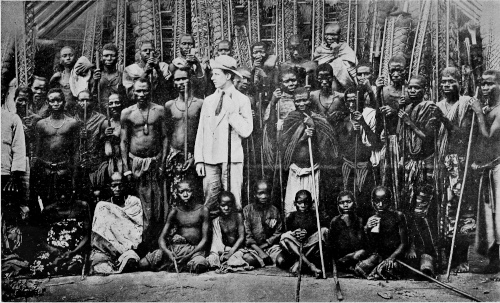
WHITE TRADER AND NATIVE TRADERS AND THEIR PRODUCE.
Every article in the white man’s store had a
price on it. It was either equivalent to one piece
of cloth, or to two or more pieces, or so many
of it equalled the value of one piece. The first
kind of cloth taken to Congo was probably of
a common quality worth about 2s. for a piece
of twelve yards. By and by other qualities were
taken, and they were reckoned as equal to one
and a half, two, or three pieces of the original
quality. Then the natives wanted other things
besides cloth, and as they were introduced the
traders put a cloth value on them, e. g. six knives
were equal to one piece of cloth, eight looking-glasses
ditto, four strings of one kind of beads,
or twenty strings of another sort, were priced at
one piece; and thus through the whole list of
goods stocked by the traders.
If a trader priced his goods high it was quickly
known, and his store was avoided by the natives.
They always went to that store where they
received the best prices for their produce, where
238the articles in the store were cheapest, and where
they were treated properly.
We remained ten days at the coast, selling the
rubber, peanuts and ivory our caravan had
brought from the interior. Some of the native
traders were dissatisfied with the prices offered
by the white trader, or were suspicious that the
interpreter was retaining too much for himself,
and for these reasons went to other white men
and employed other interpreters; others of our
party thought the prices of the store goods were
too high, and went to those traders whom they
thought sold their barter goods at reasonable
rates.
It took us, as I have already stated, ten long,
wearisome days of haggling, bargaining and
chaffering to dispose of our produce to the best
advantage. During this time our food supply
was running low, and we often had not half
enough to eat. Food at the coast was very dear,
and we were all glad when our business was concluded
and we could turn our faces homeward.
The return journey was accomplished without
any incident more serious than the breaking of a
few china ornaments belonging to Old Plaited-Beard,
who had seen such things in the King’s
house and had instructed his men to buy him
similar ones with some of the produce he had
239sent for sale. The man, however, who carried
them slipped on some huge boulders while crossing
a river, and down he fell, cutting his own
knees and smashing the fragile contents of his
load. The old man, when he saw the results of
the accident, did not blame his carrier of carelessness,
but rather accused some one of bewitching
him and thus causing the destruction of the
goods. And with a look of hate in his eyes and
a curse on his lips he threatened to punish the
witch.
All the men and lads of our party were glad
to be again among their own families. During
the whole journey to and from the coast, and
while at the trading centre, they had eaten very
sparingly, as food was heavy to carry and very
dear on the road; but now that they had returned
they made amends for lost time and hungry days.
Huge dishes of food quickly disappeared, and
those who had become thin during the twenty-five
days of short rations began to fill out again,
and those who were feeling exhausted by the
heavy loads they carried up and down hill and
along rugged, narrow tracks began, after some
refreshing, restful sleeps, to feel strong and
active again and ready for the next trading
expedition.
240
Old Plaited-Beard charges Bakula with stealing--The accusation
is denied--Bakula declares his disbelief in charms and witch-doctors--Satu
saves him from immediate death--The missing
cloth is found in Bakula’s house--Tumbu exposes the accuser’s
trickery--He is ridiculed--Bakula submits to the ordeal of the
boiling oil--His arm is badly scalded--During the night
Bakula escapes to the mission station.
A few days after the return of the trading
caravan, the whole town was startled to
hear that some one had stolen two pieces of cloth
from Old Plaited-Beard’s house. He was most
emphatic and circumstantial as to when and where
he had left the cloth, and the disappearance of
the pieces. He borrowed a strong fetish from a
friend, beat it soundly to arouse it to action, held
it three times above his head that its spirit might
rush through the air in pursuit of the thief, held
it also three times head downwards near the
ground to enable the fetish spirit to run along the
earth after the robber, and then hung it by the
neck to the roof of his house. Then the old man
waited a day or two, but the cloth was not
returned.
241Old Plaited-Beard fumed in pretended rage
about the loss of his cloth, and at last accused
Bakula of stealing it. The lad indignantly
denied the charge.
The old man said: “Ever since you met
that white man in Tonzeka’s town you have
been a different lad. You do not enter into
our fetish palavers, you laugh at the witch-doctors,
you destroyed the power of my charms
so that I did not kill a single animal through
the whole of the hunting season, you bewitched
my carrier, thus causing the breaking of all my
crockery ornaments, and now you have stolen my
cloth.”
“I am not guilty of any of these charges,”
stoutly maintained the lad. "I have not stolen
your cloth! Search my house if you like, for
since our return from the trading journey to the
coast I have not been to a market, nor have I
been out of the town except to bathe in the river,
so I have had no opportunity of disposing of the
cloth. It is true that since the white man put
medicine on my wound, and talked to me about
God’s palaver I have lost my faith in charms and
‘medicine men.’"
A great crowd by now was surging round the
two principal persons in this strange scene, and a
howl of derision went up from scores of throats
242when the brave lad daringly avowed his disbelief
in charms and witch-doctors.
“He is a witch! Give him the ordeal!”
shouted some. “Kill him!” screamed others,
“or he will bewitch all of us.”
And women held their children tightly to their
bosoms, and begged them not to follow the
example of “that wicked boy.”
Satu came hurrying up to learn the cause of all
the excitement, and when the whole case was
laid before him he felt a great pity for the lad,
and determined that he should have fair play;
for he liked him, and had admired his smartness
in trade, and alertness in games, dancing and
hunting. Besides, he knew that his accuser, Old
Plaited-Beard, hated the boy for some unknown
reason.
When, therefore, the mob again demanded
either the ordeal or death for the undaunted boy,
the chief at once said: “No, let us search his
house as he desires, and if we find the cloth in it,
then we will have a palaver and punish him
according to our laws.”
A rush was instantly made for Bakula’s house,
where he lived with his mother; but no one
entered until the chief actors arrived, and then
Satu, Old Plaited-Beard, Bakula, and one or two
others entered the house; and after searching
243about the hut for a very short time Old Plaited-Beard
pulled the two pieces of cloth from a
corner of the roof, in the dark inner room, where
they were concealed by some grass.
The discovery of the cloth was hailed with
screams of laughter, shouts of derision, and
whistles of contempt. And if Satu had not been
there, my poor owner, Bakula, would have been
torn to pieces by the infuriated crowd, not because
stealing was such a heinous crime in their eyes--there
was not an honest man, woman or youth
among the whole mob of screamers and shouters;
but the discovery of the cloth in the house was
taken as a proof of his witchcraft and utter
stupidity.
In a very short time Satu was seated with his
head men ready to judge the case. Old Plaited-Beard
sat there with a snigger of triumph on his
evil face, and Bakula, crestfallen, confused, but
undaunted, stood, the centre of all eyes, the object
of ridicule and contempt.
“Why did he not hide the cloth in the bush?
Why was he such a fool as to leave the cloth in
his own house?” were questions everybody was
asking. The crowd derided Bakula for being a
fool, rather than blamed him as a thief.
The court was held on an open space in the
centre of the town, beneath the wide-spreading
244branches of a wild fig-tree. In a simple case like
this there were no advocates, and no sides taken
as in a big law-suit. Old Plaited-Beard told of
the loss of the cloth, of his charging Bakula with
the theft, and the discovery of the cloth by himself
in the accused person’s house.
Bakula strenuously denied the theft, and gave
a very clear account of all that he had done and
the people with whom he had been since his
return a few days ago. He appealed to Satu to
state how he had accounted for every yard of
cloth he had used when trading on the markets
for him, and finished by saying that for some
reason the Nenkondo (the new title of Old
Plaited-Beard) hated him, and had more than
once threatened to do him some harm.
Old Plaited-Beard scornfully asked: “Do you
think I should steal my own cloth and put it in
your house?”
Just then a lad, by name Tumbu, asked Satu
for permission to speak, and, trembling with excitement,
said: “The other day, when the town
was nearly empty of people, I was lying down in
my house, being too ill to go with Bakula and the
other lads to bathe in the river; and while I was
lying there I saw Nenkondo come along, and,
after looking around on every side, enter Bakula’s
house, which is right opposite mine. I watched
245him, and saw that he had something under his
cloth; but when he came out the something was
gone, for his cloth was flat on his thighs. Why did
he go into Bakula’s house? and what did he leave
there?”
Old Plaited-Beard was furious, and, choking
with rage, he snapped out the question: “Is
Bakula a friend of yours?”
“Yes,” bravely answered the lad. “I am, as
you know, a slave, and Bakula has always been
kind to me. He has given me food when I have
been hungry, and defended me from the taunts
of the other boys and girls of the town.”
Bakula, as soon as his friend had finished
speaking, instantly sprang forward, and said: “I
accuse Nenkondo of stealing his own cloth and
putting it in my house. Tumbu is my witness
to that; but there is no witness to show that
I have been in his house. He is the thief,
not I!”
Satu consulted his head men for a considerable
time; but at last said: “There are two persons
before us who accuse each other of thieving, and
it is difficult for us to decide. We will therefore
call the nganga, and will try the case to-morrow
by the ordeal of the boiling oil; and whichever
one is proved guilty must pay a fine of five pieces
of cloth.”
246After this decision the crowd at once broke up,
and that night around the fires there was much
speculation as to which of the two would prove
the guilty one.
Early the next afternoon a nganga arrived with
a deep vessel filled with palm-oil. This was
placed on a fire and attended to, while the
nganga’s assistants walked about the town. One
of these assistants called to Bakula and asked
him to show the way to the stream. When they
were a little out of the town the assistant turned,
and said to Bakula: “If you will give me fifty
brass rods my master will put something on your
hand and arm so that the boiling oil will not burn
you, and you will be proved innocent. Will you
pay me the money?”
“No; I am perfectly innocent of the charge,”
replied Bakula, “and if there is any truth in the
ordeal, it will show all the people that I am
guiltless. For many moons now I have doubted
witch-doctors, and believed that they tricked us,
laughed at us and robbed us.”
“You had better pay the money,” sneeringly
retorted the nganga’s assistant, “otherwise you
will have to pay the five pieces of cloth.”
“Yes, I know your way,” replied the lad. “It
is like this: I promise you fifty rods, then you go
to the other and he promises you sixty, and after
247that you come to me and I promise seventy rods,
and he offers eighty, and it is the one who eventually
gives you the largest amount that wins the
case by ordeal. No, I will not promise a single
brass rod, for I know I am innocent, and if the
ordeal does not prove it I shall know for a certainty
that your ngangas are liars and cheats, and
your ordeals trickeries and swindles.”
The assistant, heaping on him much abuse, and
throwing at him many epithets of reproach, called
him an utter fool, and returned to the town.
Later in the afternoon the drum sounded, and
the people hurried to the judging-place. Women
had not been to the farms that day or had
returned very early; the men had not been to
either market, forest or bush; and people had
come in from the surrounding villages, for everybody
who could be there was present, because no
one wanted to miss so sensational a sight as the
ordeal by boiling oil.
Satu and his head men sat by themselves a
few yards from the saucepan of oil. Bakula and
Old Plaited-Beard were at opposite sides of the
circle of people that watched the proceedings
intently. Old Plaited-Beard was called first, and
approached the saucepan with a jaunty air, smirking
face, and anticipated triumph in every movement.
He submitted his right hand and arm to
248be rubbed with some decoction[63] by the nganga; a
piece of kwanga, or native bread, was dropped
in the oil, and then, with an insolent flourish,
Old Plaited-Beard dipped in his hand and arm
and brought out the piece of kwanga. His skin
was not scalded, he had passed the ordeal
successfully, and was thus proved innocent of
the charge.
On the plea that the first ceremonial use of the
oil had cooled it too much to be a proper test, the
nganga and his assistants heaped fire about the
pot, and it was not until the oil began to bubble
that the “medicine man” pronounced it ready for
the other accused person.
My owner, Bakula, now went forward with set
face and steady step to where the saucepan of oil
was sending up jets of steam. I could feel his
chest heaving, his breath coming and going in
quick, short gasps, his body trembling with the
excitement of the hour, and his heart pulsating
turbulently.
The tension was great, the sea of faces seemed
to crowd about and press in upon him; and as he
drew near the saucepan he could see the glint of
hatred and triumph in the nganga’s eyes, but he
answered them with a look of defiance.
The nganga rubbed something on the lad’s
249arm and hand, and dropped the piece of kwanga
in the bubbling oil.
Every head in that great crowd was bent forward,
and, as a hush fell on the assembly, every
eye was fixed on the lonely, slim, young figure
standing before that saucepan of fiery oil.
Without hesitation, for he was absolutely sure
of his guiltlessness, Bakula boldly dipped his
hand in the boiling liquid, but before he could
reach the kwanga at the bottom of the saucepan,
a paroxysm of pain seized him and, with a scream
of agony, he fell fainting to the ground.
His friend Tumbu and the chief hurried to
him and warded off, by their bodies, any intended
blows upon the prostrate, unconscious lad; and
between them they carried him to his hut.
When Bakula returned to consciousness he was
lying on his rough bamboo bed, and his mother,
with unskilled kindness, was trying to bind up
that burning arm in poultices of leaves, and
Tumbu was weeping by his side.
Tumbu told his suffering friend that Satu had
paid the five pieces of cloth and the nganga’s fee,
and the matter was therefore settled.
“And,” continued he, “although everybody in
the town thinks you stole the cloth, I know you
did not.”
Bakula then told his faithful companion how
250the nganga’s assistant had come to him before
the ordeal, and had asked for money; that there
was no doubt the Nenkondo had given a bribe,
and so had passed the ordeal without a burn;
and, emphatically asserted the lad, “After this I
will never again believe in ngangas, nor in
charms, nor in ordeals. I am innocent, but look
at my arm.”
The two friends sat talking all the evening,
and at last Bakula said: “To-night I am going
to escape to the white man’s station. He will
heal my scalded arm, and teach me God’s
palaver.”
“Wait until the morning,” pleaded Tumbu.
“Don’t travel in the dark, or the evil spirits will
throttle and squeeze the life out of you.”
“Who talks about evil spirits?” asked Bakula.
"Only the ‘medicine men,’ and perhaps what
they tell us about them is as great a lie as their
charms, fetishes and ordeals. I will test that to-night
as I have tested their other teaching to-day."
And a look of undaunted determination
came into the brave fellow’s face, which, being
seen by Tumbu in the flickering firelight, stopped
his further arguments.
It was towards midnight that Bakula took farewell
of his mother, and creeping from his house
with stealthy steps, passed through the sleeping
251town and into the darkness of the silent, tangled,
spirit-haunted bush. What lay before him?
Would it always be the darkness, the tangled
paths environed with fearful spirits? Or would
he come into the light, that would show him the
straight, clear road, and, chasing away the evil
spirits of darkness, reveal the ministering angels
of the white man’s God?
252
After much nursing Bakula recovers--He becomes a school-boy--He
struggles with the alphabet--He learns to understand
pictures--Routine life--Bakula itinerates with his white man--He
does not relish sleeping in the wet bush--He is convicted
of sin--He inquires the way of salvation--The lads play a
trick on a witch-doctor--Bakula is received into the Church--He
returns to his town.
After a long, weary walk Bakula reached
his uncle’s town, and, staying only to tell
him the news, and show him his scalded arm, continued
his journey to the mission station. By the
time he arrived he was feverish and his arm very
painful. The missionary in charge of the medical
work at once dressed the inflamed arm and put
the exhausted lad to bed.
For many days Bakula was delirious, repeating
with monotonous reiteration his innocence and the
dipping of his arm in the boiling oil. At times
the missionaries feared he would die; that the
strain, the scalding, and the fatiguing walk would
prove too much for him; but at last he began
to recover--skilled treatment, regular food, and
253careful attention triumphed; and the lad was in
due time walking about, little the worse, except
for the scars on his arm, for the ordeal through
which he had passed.
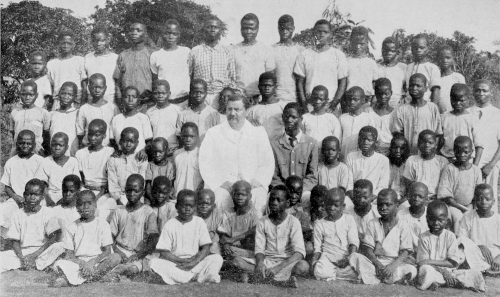
Photo] THE REV. JOHN H. WEEKS AND HIS BOYS. [Rev. J. H. Weeks.
Bakula, on his recovery, found himself in a new
world. When asked if he would like to stay on
the station and be taught, he, immediately and
gladly, accepted the invitation, and was handed
over to the white man in whose district[64] his town
happened to be.
Bakula had always thought that “books
talked” to the white men. In common with other
natives he had said, when he saw a white man looking
at a book and laughing: “The book is saying
something funny to him.” He was therefore disappointed
to find that the white teacher gave him
no “medicine” to cause him to understand “book
language,” and performed no magic over him to
open his ears to the “whispers of book talk”; but
that it was a matter of learning properly those
curiously twisted and contorted marks called
a, b, d, e; and he also found that so many of them
changed their appearance when written, and again
altered “their legs and arms” when they grew
into big letters that he was puzzled, and sometimes
feared that he would never know them.
How elusive those letters were! Just as he
254had mastered them on the printed sheet they
changed themselves on the blackboard; and when
he wanted to write the “full-grown ones,” and
drew them as he remembered them on the sheet,
he was told they were wrong, and had to train
his hand to all kinds of curves and scrolls. It
was like learning four alphabets; but by perseverance
and attention he conquered them, so that,
no matter what their disguises might be, he recognized
them, and would say: “Oh yes, Mr. S; you
can curve your back like this, S, or lean half yourself
on a stick thus,  , but I know you.”
Meanwhile he had learned to put two letters
together and make syllables, and from that accomplishment
he was led on to connect the syllables
and form words; and from that point the school
work became more interesting. Now that the
building was showing above the ground he could
see the reason for all the foundation work. By
the time he had been in the school about two years
he was nearing the top classes, and, laughing at
the mistakes of newer boys, encouraged them, by
his own example, to conquer their difficulties.
Bakula also found there was another language
to learn--that of pictures. He had seen pictures
at a distance in the houses of the traders, and
they had simply been a blurred whole, like the
pages of a book written in unknown characters.
255In the house of the white man, where he spent
many a pleasant evening, he saw some copies of
the Graphic.
At first he was unable to take in a picture as a
whole. He held the illustrations upside down,
or sideways, and more often the wrong way than
the right one. In time, order seemed to emerge
out of the chaos of marks and lines, then he would
pick out a feature and say: “That is a nose, or a
mouth, or an eye,” as the case might be, and
thus he traced out a man or a woman and said:
“Why, it is a person!” He did the same with
a house, picking out the details, as a door or
window, etc., and the same with scenery.
Later he could take in all the details at once.
He had to learn to understand pictures by the
same method that he learned to read--first the
a, b, d, then the t a t a = tata (or father), and lastly
the whole word or sentence at a glance. Sometimes
he had to appeal to the white man to explain
a difficult detail, as a railway, a ship, or a horse;
but gradually the pictures opened up a mine of
information, and introduced him to new worlds of
wonder.
A white man laughingly joked him one day
about the pain and inconvenience Congo women
suffered in wearing heavy brass collars round their
necks, and on their legs anklets of great weight in
256order to be in the fashion; but Bakula quickly
turned over the pictures, and finding a fashion
plate that depicted a woman with a very tiny waist,
he seriously asked: “Which is the more ridiculous--to
wear a brass collar round the neck, or
to have a waist like a wasp’s?”
During all these months Bakula had worked
each day for four hours either on the farm or
in the brick-field--puddling clay, fetching water,
carrying the clay, or, as he became more expert,
making bricks.
The life on the station was very regular. At
6 a.m. the boys rose to the clanging of a bell, and
went to work either on the farm, the brick-field, or
in the houses of the missionaries; from 8 to 9.30
was taken for breakfast and a short service, and
then each gang of boys arranged themselves outside
the house of the white man who was working
the district from which they came. They stood in
lines according to ages. At these parades the
white man listened to all complaints, settled all
palavers, instructed his group of boys in station
matters, taught them, when necessary, on points
of behaviour, and gave them the tickets for the
day’s rations. The hours from 10 to 12 were
spent in school, and from then until 2 p.m. at
dinner and play.
Then came two more hours of schooling, and
257from four o’clock until sunset at six[65] the boys
engaged in farming, brick-making, or working in
their masters’ houses. Thus each day there were
four hours for work, four hours for school, three
hours for eating and playing, and one hour for
religious instruction.
On Saturdays there was no school, but the boys
worked at their various employments or tidied up
the station, except from 8 to 10 a.m., when the
lads had their breakfasts, religious service, and
the usual daily parade outside the houses of their
respective white men. At one o’clock the stop
bell rang, and every boy received a piece of soap
and went off after dinner to do his washing and
have a swim in a neighbouring river.
Besides the employments already mentioned
there were others, as printing, bookbinding, composing,
carpentry, bricklaying, washing and ironing,
cutting out and sewing jackets for the boys
on the station, cooking, and house-cleaning. For
these occupations special lads who showed aptitude
were selected and taught, and they received
small rewards according to their skill and
industry.
On Sundays there were services, and a Sunday-school
on the station, and all scholars, unless ill,
attended them. The missionaries, according to
258opportunity, health and weather, visited the neighbouring
towns, both on week-days and Sundays,
to hold services in them.
Bakula sometimes accompanied his white man
on these preaching journeys to help in the singing
at the services, and to carry a small load. At one
place the people were so hostile that they would
not allow the little party to remain in their village.
They were not sufficiently courageous to demonstrate
against the visitors with guns and knives,
but were superstitious enough to drive them out
with abuse, the shaking of their fetishes, and
threats of what they would do if the white man
and his boys tried to enter their village. It was
a cold, wet evening, and the party was anything
but cheerful sitting there in the bush with the rain
falling in a continuous, monotonous patter about
them.
Bakula now knew what it was to be misunderstood,
and did not relish the experience. His
intentions were friendly. Why were the people so
foolish! He resented the treatment meted out
to him and his white man, and, turning to the
missionary, he said: “God is very strong, ask
Him to punish these people severely for their
conduct to us.”
To him the teacher replied: “Supposing the
white man had asked God to punish you and your
259people for driving him out of your town. Where
would you be now? Not sitting there, but dead,
without an opportunity of hearing of His great
love. We will not ask God to punish them; but
we will pray that He may do for these people
what He has done for you, Satu, and your towns-folk:
so change their hearts and superstitious
thoughts about us that another day they will
gladly invite us to stay in their town.”
Before very long the rain had ceased, some
grass and wood were collected, and the white man,
soaking a paper with kerosene, and putting the
grass and wood over it, soon had a blazing fire
that thawed the hearts and tongues of the lads.
In a few minutes they were laughing and joking
as though they were in their cosy houses on
the station, instead of being in the wet bush outside
a hostile, inhospitable village with a very
superstitious people shaking their charms at
them not fifty yards away. Bakula never forgot
this incident, and his constant prayer was:
“O God, open the hearts of the people to understand
Thy messengers and to receive Thy
message.”
Bakula was a great acquisition to the other boys
on the station. He entered heartily into all their
games, was a leader in many of their sports, and
told them many a story around their evening fires.
260His humorous, merry ways, his amusing manner
in telling a story, his cheerful, obliging disposition,
his common-sense way of looking at
things, his marked ability in school, and his
genuine earnestness made him the favourite of all
on the station, both white and black. He had discarded
all his charms and had learned that a lad’s
position was not due to them, but to his own disposition
and willingness to oblige others.
One morning, when Bakula had been on the
station about three years, he heard one of the
white men give an address on the Parable of the
Ten Virgins, and the narrative and teaching so
stirred his heart with the fear that he would be left
in the outer darkness, that all through the day
he was unusually quiet, and at meal-times scarcely
ate anything.
At night he started up more than once from
horrid dreams with the awful words ringing in his
ears: “I know you not.” For several days he
bore this soul agony, and at last resolved to lay
the whole matter before his white friend.
It was easy to converse with the white man
about pictures, Mputu, and many other palavers
when other boys were about, or even alone; but
Bakula shrank from talking about the inmost feelings
of his heart, although he knew he would
be listened to kindly and sympathetically. With
261much shyness, therefore, he went one evening to
his teacher and asked for a talk with him. He
was received with a smile of welcome and taken
into the white man’s room, and the door was shut
upon them. The white man had noticed Bakula’s
quietness, had partly surmised the reason, and was
not surprised at the request for a talk on God’s
palaver.
Now that Bakula was sitting there he found it
difficult to begin. When he opened his mouth no
sound issued, for a lump seemed to rise in his
throat and block the passage. His friend chatted
to him until he felt more at ease, and then he
poured out all the pent-up feelings of his heart,
and gave expression to the thoughts of his long
broodings. He told the white man of the address
he had heard, of his dreams, of his fears that
Christ would not know him, and of the many sins
of adultery, robbery, cheating, lying and false
accusation of which he had been guilty. He laid
bare his whole previous life in all its ghastly
wickedness until the white man felt it crowding
on and pressing down his own soul.
Tears rolled down the lad’s cheeks as he asked
if God’s Son would know such a guilty one as he,
and could He forgive so many sins? The teacher
spoke to him quietly and earnestly, read to him
various passages from God’s own Word, and, after
262praying with him, dismissed him to his bed comforted
and happy.
It was very late when Bakula left the white
man’s house, but it was quite early when he arose
next morning from a refreshing sleep. The sun
was shining not only on the hills and valleys
around him, but also into his heart, and he could
not repress one hymn he had learned in school,
though he had never fully realized its beauty and
meaning until now: “Jesus loves me, this I know;
for the Bible tells me so.”
The boys who occupied the dormitory with him
turned and asked: “What is the matter with
you?”
“Oh, I had a long talk with the white man last
night about God’s palaver,” he answered cheerfully,
“and I feel very happy now.” And at once
he told them of the address, and pleaded with
them to prepare for the coming of Christ, so that
He might know them on His arrival.
Several months passed, during which time
Bakula took part in the prayer meetings, and at
the services of the Christian Band he often gave
a short address. He was eager to accompany the
teacher to the various towns in the neighbourhood,
and frequently used the scars on his arm as a text.
He then, with soul-earnestness and much eloquence,
declaimed against the trickery and lies of
263the witch-doctors, the uselessness of their charms,
and the deception of their ordeals.
On one occasion the white man, Bakula, and
some other lads were spending the evening in a
town. The service was over, the teacher had
retired to his hut, and Bakula and his companions
had stretched themselves upon their mats in
another hut that had been lent to them. During
the night they were disturbed by the entrance of
a witch-doctor, who hid something in a saucepan.
Thinking he was up to one of his tricks, Bakula
removed the thing and put it in another place.
In the morning the nganga, who was employed
to destroy the power of an evil spirit that was
troubling a family in the town, was up early shouting
at the spirit to desist. He threatened it, fired
his gun repeatedly at it, and after much rushing
about and wild gesticulations, he declared at last
that he had caught the evil spirit. He led the
suffering family to the hut he had visited during
the previous night, and entering it triumphantly,
prepared his clients, by his boastful talk, for a
great dénouement; but, behold, the entrapped
spirit was gone.
When the lads, later in the day, brought out the
“something,” they found it was tied up in imitation
of a corpse, and on opening it, discovered
inside a piece of kwanga, or native bread, and
264inside that a fowl’s bladder full of blood. The
lads had a hearty laugh over the incident, and
their disbelief in ngangas was greatly strengthened
by this exposure of their trickery.
If the witch-doctor had found the bundle where
he had placed it, he would, after much incantation
and dancing, have pierced it with his knife, and as
the blood flowed from it he would have claimed
to have trapped and killed the evil spirit. The
deluded family would have paid him a large fee,
and after a time, feeling no better, would have
sent for another nganga and been deceived in
another way. They were saved at least the payment
of one large fee by the lads to whom they
had lent the house.
The white men on the station watched Bakula
very carefully, and often spoke about him to each
other as one whose life and conduct showed that
he was fully fit to be a member of the Church that
had recently been formed there. But no pressure
was put on him, as it was felt desirable, on account
of the persecution all native Christians then
suffered, that the request for baptism and Church
membership should be entirely spontaneous.
After many months Bakula applied for baptism
and entrance to the Church. He was told of all
it might mean to him--persecution, ridicule, and
perhaps death. But his answers were such that he
265was duly received into the little Church, and
with quivering heart and tears of joyous amazement
in his eyes he partook for the first time of
the Lord’s Supper.
During these years he had paid more than one
visit to his home. His mother had received him
with hearty welcomes, Satu had had long and
frequent talks with him about the white men
and their teaching, and the lads and lasses in
the town had regarded his accomplishments in
reading and writing with awe, envy, and superstitious
fear.
Old Plaited-Beard always looked at him askant,
with eyes full of hatred and malignity; but
Tumbu, his slave friend, never left his side during
those visits except to sleep. He followed him like
a faithful dog, with eyes full of admiration and
humble love.
The time came at last for Bakula to return to
his town and live there. He asked his white
friend for a few slates, pencils, reading-sheets and
spelling-books, as he had decided to start, if
possible, a school among his own people. These
were gladly given to him, and, taking farewell
of his many friends, both black and white, he
commenced his return journey.
How different was this last going from his first
coming! The darkness had given place to the
266light, the tangled, crooked path had become
straight, though narrow and rough, and the evil
spirits of fetishism no longer haunted his life with
terror and horror, for they had been displaced by
the ministering angels of God.
267
The conservatism of the Congo people--Bakula and his scholars
build a school-house--A missionary visits his town--He
encourages Bakula in his work--A “luck fowl” dies--Its death
is put to the credit of the missionary’s visit and teaching--The
school-house is pulled down--Satu is afraid to interfere--Native
way of punishing an unpopular chief.
Bakula had not been back many days
before he asked Satu for permission to
open a school for the boys in the town. The chief
gave his consent, but was very doubtful how the
townsfolk would regard the innovation.
For untold generations they, their fathers, and
their forefathers had gone on in the same way.
They had built their huts with either grass, mud,
or rough plank walls; they had scratched the
ground on their farms with little hoes; and when
ill in health, unlucky in fighting, trading, hunting
or in domestic affairs, they had nearly sixty
wizards, or “medicine men,” to reverse their luck
by their ceremonies, charms, fetishes and magical
decoctions. They had kept their accounts with
knots tied in strings, or notches cut on tallies; they
had always hunted in the same way, fished in the
268same way, traded, travelled, lived and died in the
same way. What, therefore, was the use of
changing now?
They were a very conservative people that had
always killed off the progressives--those troublesome
fellows who wanted to introduce new
methods of building, new articles of trade, new
ideas, and new ways of using old materials. Men
who in other countries were called inventive
geniuses were accounted horrible witches in Satu’s
town. The man who discovered the method of
tapping palm-trees for palm-wine was killed as a
witch; the men who first traded in rubber and
ivory were regarded with suspicion, and treated as
folk full of witchcraft; and the man who took the
first load of gum copal to the traders was told
never to take another, or he “would see plenty
trouble.”
It was in the midst of such a people that Bakula
started his school. Tumbu, of course, attended it.
Many other boys came out of curiosity, and finding
no magic in it, no short-cut to book learning,
their ardour cooled, and they dropped away; and
there were no school inspectors to inflict fines
and penalties for non-attendance. A few had
sufficient courage and perseverance to attend
regularly, and these made some progress in the
mastery of their letters and syllables.
269Bakula so enthused his few scholars that at the
end of the dry season they decided to band together
and build a grass hut in which to hold their
school during the coming rains. It was no small
bit of work for a few lads, with poor tools, to
undertake. Rafters, king posts, stanchions, and
wall plates had to be cut in the forests and conveyed
into the town on their heads or shoulders;
grass must be cut, dried, combed and carried from
the bush to the site; and string had to be prepared
from forest vines and swamp reeds.
Then there was a floor to be raised and beaten,
holes to be dug, and all the materials fitted and
tied together to form the hut. It was a simple
structure with no windows, but a large door that
answered all purposes, and the boys were proud
of it. If you had seen it you might have laughed
at it; but could you have built a better one with
the same tools and materials?
Every morning the school was opened with
prayer, singing, and the reading of a portion from
the Gospel of Matthew--the only Gospel then
translated into the language of the people. Occasionally
men and women came, and, standing
about the door, listened to the simple service.
Many ridiculed the whole palaver; a few, however,
were impressed, and came repeatedly; and,
encouraged by them, Bakula started a Sunday
270service; but out of more than 1,500 people in
the town, only from ten to twenty attended it.
One day Bakula’s heart was gladdened by the
arrival of one of the missionaries on his way from
the Ngombe district to the King’s town. He was
trying to open up the country, visiting the towns
and preaching in them as opportunity offered.
Satu welcomed him heartily, and Bakula and his
small class of scholars were delighted to see him.
The missionary examined the school, and by
his presence and words of praise encouraged the
teacher and his pupils to continue their efforts.
The white man had long talks with Satu, and
suggested that the next day a crier should be sent
through the town to invite the people to come and
hear God’s palaver. The time, however, was not
ripe for such a service, for only a few responded,
and they came more to ingratiate themselves with
their chief than to listen to the white man.
This white man was a zealous teacher, thoroughly
in earnest and well acquainted with the
people’s language. No opportunity was missed
by him of speaking to the twos and threes. Here
he was to be found in conversation with some
swaggering young men, there talking to a few old
men, and again in another place arguing with
some of the head men. He was a man of great
attainments and wide knowledge, yet he exhibited
271no annoyance as he dealt with their puny reasoning,
and unfolded the weak places in their arguments.
He was like a giant handling pigmies,
tenderly and persuasively. Bakula was sorry
when his visitor had to pass on his way to other
towns, and to open up the road across country
upon which his heart was set; but the young
teacher never forgot the words of encouragement he
received from the white man in their private talks.
A short time after this visit the “luck fowl” (or
nsusu a zumbi) belonging to one of the head men
died without any apparent reason. It had probably
eaten unwisely, or had been bitten by a
snake; but the owner put it to the credit of the
white men who had just visited their town. Everybody
remembered that, immediately after the
promised visit of the white man whom they had
previously driven out of the town, a pig died.
They argued thus: "A white man came to us
with God’s palaver, and a pig died soon after
he left; another white man came on the same
errand, and before many days had passed a ‘luck
fowl’ died, therefore it was most foolish to have
anything to do with God’s palaver." They conveniently
forgot all the pigs and “luck fowls”
that had died before the white men ever came near
them, and only remembered these two that had
died after their visits.
272There was a great to-do in the town over the
unfortunate death of this “luck fowl.” The
owner raved against the school that had been
opened by Bakula, against the visits of the white
men, and against the introduction of new ideas of
any kind. The more superstitious folk in the
place combined to close the school and pull down
the school-house. Many were indifferent to the
whole matter, and a few were for letting the boys
alone. There was much discussion; but the party
for the “medicine men,” the fetishes, the charms,
and for maintaining the status quo being the
larger, the noisier, and more dominant faction,
gained their point, and, while demolishing the
school, destroyed as many books and slates as
fell into their possession.
Poor Bakula was nonplussed by this calamity,
and the other boys for a time were disheartened;
but there is a great amount of grit and determination
in the Congo character, and before long the
lads were meeting in Bakula’s house for their
lessons and for such teaching as their young tutor
could give them.
Satu, the chief, tried to stem the current of
popular feeling and turn it away from Bakula,
but he failed even to save the school-house.
Native chiefs have power only to make the people
do what they want to do; and they generally have
273to bow their heads before the whirlwinds of
popular sentiment and feeling. This was Satu’s
case. Neither his heart nor his intellect had been
awakened by the new teaching, consequently he
was not yet prepared to suffer either abuse or
unpopularity for the sake of God’s palaver and
all that it meant.
The natives have a way of their own in punishing
an unpopular chief, as the following incident
will show, which I heard a man relate one day to
Bakula with much laughter: There was a chief of
a neighbouring village who treated his people very
contemptuously, and was always, on one pretext
or another, exacting fowls, cloth or other goods
from them. They bore patiently with him as long
as possible, but at last his unreasonable demands
became too excessive; so one day they bound him
securely, placed him on a shelf in his own house,
made a fire under him, and having sprinkled a
quantity of red pepper on the fire, went out and
shut the door.
The chief sneezed tremendously, and would
have died if sufficient pepper had been put on the
fire. After a time they took him out of the smoke
and tied his extended arms to a cross-stick, and
would have punished him further; but he paid a
heavy fine, and has been much better since the
sneezing cure was tried on him.
274
Failure of various remedies--Witch-doctor engaged--Diagnosing
a case--Different “medicine men” are called in--Bakula
denounces their trickery--Suspicion of witchcraft falls on
Bakula--Native attempts to rid themselves of death, sickness,
etc.--Preparing a corpse for the grave--Bakula is accused of
bewitching his mother to death--He is guarded by Old Plaited-Beard
through the night--He is taken to the hill-top.--He falls
and is done to death--Tumbu buries the mangled body of his
friend.
A few weeks after the closing of the school,
as narrated in the preceding chapter,
Bakula’s mother fell seriously ill of a chest complaint.
Many remedies were tried, but failed to
relieve her. Some neighbourly women sat with
her by day and attended her at night, and numberless
were the sure cures they recommended; but
although applied they proved utterly futile. Her
family at last decided, much against the wish of
Bakula, to send for the “medicine man” who
cures by herbs, fetishes and charms. He was
called ngang’a wuka.
As already stated,[66] each of these various
ngangas (and there are nearly sixty different
275kinds) must find his way to the village and to
the house of his client without either guidance or
instruction, and he must also discover the disease
from which his patient is suffering or the cause
of death without asking a single direct question.
In due time the “medicine man” arrived in
front of his patient’s house, having reached it by
the usual stratagem of his assistant dropping
leaves and twigs to indicate the road. He was a
stout man with shrewd, quick, shifty eyes, and was
dressed in the usual fantastic style, and carried
a bag of charms slung from his shoulder. He
seated himself outside the sick woman’s house,
and a crowd quickly formed a circle round
him.
The native “doctor” in diagnosing the case
could not ask any direct questions of his patient--in
fact she was in the house and he sat outside;
but he met that difficulty thus: He asked a series
of indirect questions, and when those present said
“Ndungu” he knew he was on the wrong tack, and
when they replied “Otuama” he knew at once he
was guessing rightly, and the more excitedly they
called out the latter word the nearer he knew he
was to the truth, and the more indifferently they
uttered “Ndungu” the farther he understood he
was from the real complaint. Hence he started
in this way--
276“There are such things as backaches and headaches.”
“Ndungu,” quietly said the folk.
“Sometimes there are pains in the legs.”
“Ndungu,” was very coldly uttered by the crowd.
The nganga recognized that he was on the wrong
scent; but still he had managed to narrow the
circle of affected parts, so he began again.
“There are such things as pains in the arms
and thighs.” “Ndungu,” indifferently replied
the people.
“Sometimes there are pains in the chest and
stomach.” “Otuama,” uttered the poor folk.
He now knew his patient was suffering either
from a bad stomach or chest, and he continued
to narrow it down in this manner until at last he
said: “Ah! her chest is very bad.” The people
excitedly shouted, “Otuama,” snapped their
fingers, and looked at the nganga with awe-filled
eyes.
The “doctor” now knew that his patient’s chest
was the seat of the trouble. What are the most
common complaints of the chest? Hacking
coughs, asthma, bronchitis, pleurisy, and pneumonia.
So he started off to discover the particular
disease from which the woman was suffering
and the part affected. The people coldly
said “Ndungu” when he missed his guess, or
frantically called out “Otuama”; by this cunning
277process he narrowed the circle smaller and smaller,
until at last, to their astonishment, he said: “The
woman is suffering from pleurisy (ntulu) on the
right side of the chest.”
The people thought that such a clever man,
who had found out all about the disease without
being told and without seeing the patient, was
just the person to cure the complaint. He was
consequently engaged at once and well paid.
He made no proper examination of the patient,
but took out some of his herbs and charms, and
beating them into a paste told them to rub the
woman’s chest with the preparation.
After two or three days, Bakula’s mother feeling
no better, the family sent to ngang’ a moko.
The messenger who went to her, for this witch-doctor
is generally a woman, took with him a red
bead which he gave to the nganga, who put it
under her pillow that she might in a dream discover
the cause of her patient’s complaint--whether
it is a mere ailment, or a bewitchment by
some evil spirit.
The nganga received her fee of one good fowl
and fifty brass rods, and that night placed the
bead beneath her pillow; but whether she
dreamed or not I do not know. However, in the
morning she told the messenger that the first
“doctor” was unable to effect a cure because
278some one was bewitching the sick woman, and the
family must send for a wizard to kill the evil
spirit that was troubling her, and then she would
soon recover from her complaint.
When the message was delivered Bakula, who
was standing by, at once denounced the cheating
trickery of the ngangas, and told how he, with
others, had exposed one of these spirit-killing
wizards in a certain town. He explained the
whole process even to the piece of kwanga
wrapped up to imitate a corpse, with the fowl’s
bladder of blood inside. The people looked at
him with horror-stricken eyes, recoiled from him
in terror, and with raised fingers accused him of
being a ndoki, or evil spirit, as otherwise he could
not have meddled with the nganga and his things
and not have suffered for it.
Bakula denied the cruel charge; but from that
day he was regarded by the people with unfriendly
suspicion, and was shunned by them.
But for his slave friend, Tumbu, and his former
scholars he would have led a very lonely life.
The spirit-killing witch-doctor was called, and
made the night hideous with his shouts, threats,
screams and gun-firing. He worked hard at his
craft, received his fee and went; but the poor
woman still continued ill, and, in fact, became
much worse--the pain at her right side was acute,
279the breathing difficult, and the fever high. Her
moaning was continuous, and the women who
attended her knew not what to do for her relief.
They were unskilled nurses and lacked knowledge
rather than the feminine qualities of caring for
the sick. There were no foods for invalids, no
dainties to tempt a patient’s appetite--the sick
had either to eat what the robust and healthy ate
or go without. Many patients have died of
hunger rather than of the diseases from which
they suffered.
The practice of the witch-doctor was sheer
quackery, and rested more on the exorcism of evil
spirits by magical charms, incantations and concoctions,
than on a knowledge of physiology,
disease and medicine. The wonder was that any
one survived the various treatments, and, in fact,
only the fittest and strongest did recover from
serious illnesses.
Bakula’s mother continued to grow worse.
How he wished they were near the mission station,
where she could have the help of those who cured
his oil-scalded arm and nursed him so carefully;
but the station was too far away! He attended
his mother assiduously, and would have done more
for her, but the women drove him out of the hut
with jeers and curses, after his denouncement of
the witch-doctor and their tricks. Poor creatures!
280they knew no better, they were doing their very
best for the patient. They were simply safeguarding
her from one whom they thought was
full of witchcraft.
Another “doctor” was called, among whose
outfit were several traps especially made for
catching evil spirits. Having put a little fowl’s
blood into each of the traps, he placed them
around the doors of the house in which the sick
woman was tossing in her efforts to breathe freely.
He then pounded some herbs and chalk together,
mixed them in palm-wine, and giving the patient
this decoction to drink, sat down to watch the
entrance of any evil spirit into his traps, disguised
as cockroaches or spiders. Although he caught
and killed several of the supposed evil spirits,
i. e. several spiders and cockroaches, and therefore,
according to his statements, the woman
would now recover quickly, yet she grew worse.
In their desperation the family sent for yet
another wizard who had the power to converse
with spirits, and consequently was able to ask
them why they were inflicting so bad an illness on
the suffering woman! He came with his fetish,
and, before locking himself in a house, told the
people that they would see the house shake as
he talked with the spirits. The family sat around
the place listening and watching intently.
281In a short time they saw the hut quivering and
heard the bitodi fetish speaking and the spirits
talking, and the answering voices were male and
female, old and young.
After a long consultation between the nganga’s
bitodi fetish and the spirits (nkwiya), the wizard
came out, and said: “Some member of the family
is guilty of breaking the country customs, laughing
at ngangas, and throwing his (or her) charms
away, consequently this sickness has come as a
punishment. This same member has also a
ndoki (or evil spirit), and whoever it is must bless
the patient so as to remove the evil influence
from her.”
Suspicion instantly fell on my owner, Bakula,
for who else had broken the country customs but
he! Had he not learned to read! Had he not
accepted the white man’s palaver, and renounced
his charms! Had he not laughed at ngangas
and denounced their rites and ceremonies as cheating
tricks!
Bakula was dragged into the hut to bless his
mother. He solemnly took her right hand and,
pretending to spit on it, said: “May you have
blessing and good fortune.” Then he was hurried
out of the room of his dying mother.
This particular “doctor,” to prove his bona
fides, had heated a machet red hot three times,
282and had drawn it each time across his tongue.
What better proof did the natives need than this
of the nganga’s magical power to converse with
spirits? He received a large fee of more than
ten shillings’ worth of trade goods, and went his
way, leaving his victim to bear the brunt of the
family’s vengeance.
The nganga had not been gone many hours
when the woman breathed her last, and poor
Bakula was left motherless. His neighbours and
relatives eyed his sorrow with contemptuous suspicion,
and already began to whisper among
themselves that he was the ndoki (or evil spirit)
who had caused his own mother’s death. They
thoughtlessly disregarded the true affection that
the young man had always shown for his mother,
his readiness to help her, and his sincere grief
now that she was gone. They only considered
and repeated to each other what the witch-doctor
had said about breaking the country customs,
laughing at wizards, and neglecting his charms.
They could regard him in no other light than
as the real cause of his mother’s illness and
death.
For generations they and their forefathers had
believed that disease and death were unnatural,
and would not exist on the earth for a single day
if there were no wickedly-disposed persons who
283used evil spirits to kill their relatives by incurable
diseases. They did not know that their
“medicine men” covered their ignorance,
quackeries and failures by these charges of witchcraft.
If a patient recovered, then they inflated
themselves with pride and took all the credit of
the cure; but if the patient died, then witchcraft
was at work, a ndoki was “eating” up the patient,
or by his evil spirit was throttling the spirit of
the sick one. Rich men had bought expensive
charms, had sacrificed goats and sheep to costly
fetishes to keep them strong and alert, to protect
their owners from the evil influences of the
ndoki, and yet they had died.
Such deaths did not shake their faith in charms
and fetishes, but rather stimulated them to more
careful observance of all the rites and ceremonies
connected with them. They knew no better
system than that in which they had been nurtured.
One night when Bakula was sitting around the
fire I heard that two men many years ago had
started a crusade against fetishes and charms.
They preached throughout the Lower Congo that
if all fetishes and charms of every kind were
destroyed there would be no more disease and
death. So effective was their condemnation of
witchcraft, charms, and fetishes that whole towns
284and villages made bonfires of their images and
charms, and children were shaken over the fires
to purge them from any charms concealed about
their person.
The deluded natives expected a golden day
would now dawn upon them wherein there would
be no sighing, no tears, no weeping, for disease
and death would be banished from their huts;
but, alas! sickness soon came and death quickly
followed to disillusion them of their bright
hopes.
The only folk who profited by this crusade
were the ngangas, as they received large orders
for charms and fetishes to replace those that had
been burned. But the preachers were sure of the
soundness of their panacea for the country’s woes,
and they could only account for its failure by
charging some of the people with hiding their
charms and fetishes instead of destroying them.
Later still, two other men who were ngangas,
calling themselves by some high-sounding titles,
started another crusade; this time not against
charms and fetishes, but against evil desires and
murderous thoughts harboured in the hearts of
the people. They proclaimed that every one
should confess to them all the witchcraft, hatred,
and bad thoughts they had in their hearts against
others, and those thus confessing should receive
285a peanut and a sip of palm-wine, and thus
disease and death would pass away from their
country.
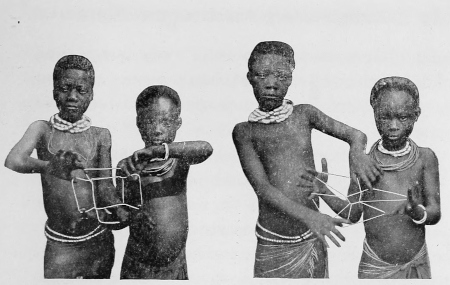
Large numbers flocked to them, paid their fees--five
strings of beads for an adult, and two for a
child--confessed their hatred, witchcraft, and evil
thoughts, and received from the hands of the
new cult of “medicine men” the peanut and palm-wine,
and yearningly hoped that sickness had
been banished from their district and death destroyed.
But again they were quickly undeceived,
for disease continued rampant and death entered
hut after hut. The “medicine men” reaped a
great harvest of beads, swaggered in wealth, and
excused the failure of their system by saying
“that the people had not confessed all their
witchcraft and hatred, and consequently, not
being cleansed from all, the old state of things
had continued, and people suffered and died as
before.”
Thus the people had had their hopes again
and again dashed to the ground, and they had
been flung back on their old “medicine men” and
their fetishes. It has always been a tenet of their
religion that sickness and death were and are
caused by witchcraft, and the most hated person
in all the country is he (or she) who, by the ordeal,
is proved to practise witchcraft. Hold their
286views, and the tenderest heart will hate and kill
the witch as mercilessly as they did.
There is no doubt but that the ngangas received
bribes to render the ordeal non-effective; that the
big men of the town incited the ordinary folk to
bring charges of witchcraft against their enemies,
or those whom they wanted removed from their
path; and the witch-doctors themselves, by the
aid of their assistants, fostered and turned suspicion
against those who desired to introduce a
new and better state of things into the country.
Their position and gains depended on killing off
all such dangerous people. Hence the ordeal and
the charge of witchcraft were often simply acts
of murder, according to the customs of the country
if you like, but nevertheless murder.
The whole of the morning following the death
of Bakula’s mother was spent in decorating the
corpse for burial. Beads were twisted round the
toes, feet, legs, body, arms, hands, fingers and
neck, thus enswathing the whole of the deceased
in a casing of glass beads. Fold after fold of
trade cloths of different colours and qualities
were wound round and round the body until it
was nearly twice its original bulk. At sunset the
corpse was carried to the grave, just outside the
town, and laid to rest with the hum of town life
on one side, and the weird, uncanny noises of the
287eternal bush on the other; but the soul had gone
to that mysterious spirit town in the great forest
where it would utilize all the cloth and beads in
which it had been wrapped.
All through the day women had wailed and
chanted mournful dirges, men had fired off guns
amid much laughter and many jokes, and Bakula,
with tearful eyes, had talked in subdued tones to
his slave friend.
He had often, in the days gone by, conversed
with his mother about the white man’s palaver
concerning God and His great gift of Jesus
Christ. He had poured out his heart to her, had
instructed her in all that he had learned on the
station, and had repeated to her portions of
God’s Word.
He now recalled the eagerness with which she
had heard the words: “God so loved the world
that He gave His only begotten Son”; and, “In
My Father’s house are many mansions. I go to
prepare a place for you”; and he was hopeful of
meeting her, not in the mysterious forest town
that had so many terrors for them, and which was
simply a repetition of their earthly life and its
sorrows, but in the Father’s house where all tears
would be wiped away from their eyes, all sin
banished from their lives, and all sorrow from
their hearts. He grieved not as one without hope.
288Not many days after the funeral the witch-finder
arrived, dressed in his fantastic garb, his
body decorated with gaudy paints and pigments,
and his bells tinkling at every movement. A
crowd quickly gathered and formed itself into a
long oval, up and down the centre of which he
danced. The whole town, with few exceptions,
regarded Bakula as a witch, and the prancing
figure there in the middle knew it. Still, he must
give his employers something for their money, so
through the whole long hours of the afternoon
he gyrated perspiringly, threw his arms and legs
about in the most approved fashion, put question
after question and elicited such answers as confirmed
his opinion that it would be extremely
popular and safe to charge this ridiculer of witch-doctors,
this scorner of fetishes and charms, this
believer in the new religion with the death of his
mother--the woman who had just died.
Bakula was present throughout the whole performance.
Hour after hour he stood calmly
there. As a member of the family he was
compelled to be present; but he took no part
in answering the crafty questions put by the
grotesque figure dancing before him.
Towards the latter part of the afternoon he
noticed that the people were withdrawing from
him; they seemed to shun the spot where he stood,
289all except his faithful slave friend. He trembled
as he observed these signs of popular resentment,
for he fully recognized their meaning.
Towards sunset the witch-doctor increased his
efforts to the admiration of the spectators. He
leaped in the air, gyrated on his heels, flung his
arms and legs about in amazing circles, crouched
and jumped, undulated his body to simulate a
python, and in a whirlwind of shaking skins,
twirling arms and legs, and sounding bells he
brought himself to a sudden halt in front of
Bakula, and with raised finger accused him of
bewitching his mother to death.
Poor Bakula! although he had fully expected
this charge, he was dumbfounded now he stood
accused before all the people. He essayed to
speak, but no words issued from his parched, dry
throat, and he would have fallen if Tumbu had
not supported him in his strong arms.
Why had they accused him of killing his mother
by witchcraft? Accused him of her death! It
was ridiculous, cruel, wicked! Surely no Congo
mother had ever before been loved by a son as
she had been loved! The very teaching he had
imbibed had taught him to honour, reverence and
love his parents. If he had lied, robbed, lived a
loose life and treated his mother with contemptuous
indifference like other young men in the town,
290he would not have stood there charged with killing
his mother by witchcraft.
The crowd surged around him. What ugly,
sinister faces were pushed jeeringly into his!
Sticks were raised and knives drawn to strike
down the witch; but Satu pushed himself in front
of the victim, and demanded that he should not
be killed until the ordeal test had been given
him.
“He will escape in the night to the white
man’s station,” they shouted.
“No, he won’t,” said Old Plaited-Beard, “for
I will bind him strongly and watch him through
the night, if you will hand him over to me.”
This met with the instant approval of the
crowd, and Bakula was handed over to the
guardianship of his superstitious and merciless
enemy.
Old Plaited-Beard, with the help of a few
friends, took the accused youth to his hut, and
with strong cords bound his hands, feet and legs.
No tenderness was displayed in the tying; that
the cords cut into the flesh was regarded by the
tiers with utter unconcern.
To render escape doubly impossible the
prisoner’s neck was securely fastened in a forked
stick.
All through the long night the men took it in
291turns to watch Bakula, who, by reason of his
strained position and tortured limbs, had no
proper sleep, but dozed fitfully in painful semi-consciousness.
Now and again he sang in a poor
quavering voice the hymns he had learned on the
station and had taught his few boys in their little
school; occasionally he prayed for strength and
comfort, and once he attempted to speak to his
captors about the great Saviour--God’s wonderful
gift to the world.
It was not until they threatened to ram a lighted
stick into his mouth--and held one very near to
his lips to emphasize their threat--that he turned
from them to sing: “Jesus, Lover of my soul, Let
me to Thy bosom fly.”
Early the next afternoon Bakula was released
from his bonds, and led away to the top of a
neighbouring hill. The rude hut was quickly
built, and the victim placed in it with extended
arms. The ordeal-giver ground the pieces of
bark into powder, and fed the young man with
them. Before he had taken many of the powders
Bakula began to feel intoxicated by their narcotic
properties. He swayed to and fro like a drunken
man, his vision became blurred, foam came from
his mouth, and at last he fell a writhing heap
on the ground. Sticks and knives immediately
finished the cruel, murderous deed, and the
292corpse, naked, battered and covered with gaping
wounds, was left a prey to wild beasts and
ravenous birds.
Again the stars arose and looked with blinking,
sorrowful gaze on that tragic hill-top--the scene
of many an ordeal murder, and as they looked
they saw a strange sight: coming across the hill
was a lad carrying a hoe. He carefully scanned
every boulder, tuft of grass and shrub, and at
last his eyes fell on the body of the lifeless lad.
With a cry he bounded to its side and sank prostrate
to the ground, and grovelled in heart-stricken
sorrow by the side of his murdered
friend.
When his grief had somewhat spent itself
Tumbu arose and began to dig a grave for the
body of his admired benefactor. It was a fearsome
place, strewn with bones--the remnants of
many trials by ordeal; and weird noises, trying
to the stoutest heart, came on the night air from
the near forest. Tumbu started many a time
during his self-imposed task, and fear gripped his
heart more than once; but he steadied himself by
driving his hoe deeply into the earth, and working
hard to save the body of his kind friend from the
cruel, sharp teeth of savage beasts.
At last the grave was deep enough, and then
Tumbu, spreading some cloth he had brought for
293the purpose, laid the body of his friend upon it;
but before wrapping it around him he took the
Brass Rod from Bakula’s neck, intending to keep
it as a memento of his slain friend.
Tenderly were the remains laid in the grave,
and the earth covered all that was left of my
whilom companion and martyred owner.
294
Mikula while digging the foundations for a brick house discovers
me--The town is changed--There is daily worship--Observance
of the sabbath--Sunday service--Collections for support
of teachers--Christian funeral--Visit to the mission station--Teaching
teachers--Martyrs for the cause.
[Fifteen years are supposed to have elapsed
between the concealment and the unearthing of
the Brass Rod.
The preceding part of this narrative unfolds the
prejudices, superstitions and evil practices rife on
the Congo thirty years ago, while the following
chapters indicate the progress that has been made
in christianizing the people and leading them to
higher and better things.]
After burying Bakula on that sad night,
Tumbu carried me back to his hut; but
being afraid to wear me lest he should be accused
of robbing a dead body, he secretly polished me,
and, wrapping me in an old rag, concealed me
beneath the earth in a corner of his house, hoping
no doubt some day, when all fear of detection had
295passed away, to take me out and wear me in
memory of his friend.
How long I lay buried I know not; but my
finder was a sturdily built, pleasant-faced young
man whose name I heard later was Mikula. When
he had rubbed me clean of all my accumulated
dirt, and found that I was good solid brass, he
well polished my sides and wound me in graceful
rings round his wrist.
I discovered afterwards that my new owner was
digging the foundations of a brick house when he
happened upon me. Mikula had been taught on
the mission station, and had learned there, among
other things, the arts of brickmaking and bricklaying,
and now he had returned to his home he
was busy building a brick house into which he
hoped to bring his future wife. He had already
made and burnt several thousands of bricks, and
was hurrying forward the building of the walls so
as to roof in the house before the rainy season
commenced.
What a change had passed over the town! I
scarcely recognized it for the same place. Here
and there were comfortable brick houses, a few
plank ones, and many others of wattle and daub
nicely colour-washed, while the grass huts were
larger and very neatly made. And as Mikula
walked through the town that evening I noticed
296that many of the homes were lighted either with
candles or lamps, and families--father, mother
and children--were sitting around one common
table partaking together of their food; those
families that could not afford artificial light sat
together round their fires.
Occasionally we came upon some who maintained
the old state of things--broken up families,
the male and female members of which still sat
and ate their food apart from each other.
At six o’clock every morning a small bell rang
out, calling the natives to morning prayers before
they started their daily employments. Mikula,
who was a deacon of the Church, had charge of the
religious work in his own town, and performed
voluntarily the duties of a pastor of the Church
and teacher of the school.
About a hundred men, women and young
people gathered every morning for worship--a
hymn was sung, a portion of the New Testament
was read and commented on, a short prayer was
offered either by Mikula or one of the Christians,
and another hymn brought the simple service to a
close. After that the women went to their farms
and the men to their various occupations. Who
can measure the influence such services exerted
over the lives of the folk who attended them?
Their horizon was no longer confined to the trivial
297affairs of their former mean lives, but extended to
the boundless reaches of heaven and God’s own
eternity; their thoughts no longer grovelled in the
trough of lustful desires and evil passions, but
were lifted to higher, purer and more spiritual concerns;
and their aims were no longer wholly selfish--set
on attaining many women and much wealth,--but
they gave their time, energy and money that
their heathen neighbours might enjoy the same
blessings that had come into their lives, and had
transformed them, by a wondrous alchemy, from
base metal to beautiful gold.
On Sundays the Christians refrained from farm
work, visiting the markets, trading, and any other
form of labour that would desecrate the Lord’s
day; and a large number of those who were not
professing Christians also observed the day; but
there were still many who clung to the old state
of things, who farmed, toiled and traded on that
day as though they had never heard of a day of
rest.
During the Sabbath afternoon the bell rang out,
and more than three hundred natives attended the
service which was held in a large brick building
that had been raised and paid for by the native
Christians themselves. What a pride they seemed
to take in their "House of God"! The walls
were colour-washed and decorated with pictures
298of the life of Christ; the doors and windows,
which were of native carpentry, were nicely
painted, and the roof was of corrugated iron sheets
that they had bought with their own hard-earned
money. There stood their “House of God” on
the finest site, in the very heart of the town.
What a contrast to Bakula’s little grass school-chapel
that had been so ruthlessly destroyed by
some of the very people who had laboured to erect
this new building! Yet the latter, and all it stood
for, was the outcome of the former.
That Sunday was a Communion day--the first
sabbath of the month. Mikula, as deacon-pastor,
took the service. Native Christians living in the
surrounding villages had walked to this centre to
take the Communion. The meetings in their own
villages had been postponed, and, headed by their
teachers, some of them had marched across hills
and dales, forded streams and waded swamps to
be present at that service.
Many of them had walked from five to nine
hours from the more distant parts of their district.
They were in earnest, and expecting a blessing
they did not return disappointed. The building
was not large enough to contain all who attended,
so the overflow sat round the windows and doors
that they might share in the service.
How heartily they sang! What prayers they
299offered--not wholly for themselves, but also for
their neighbours that they too might be saved.
How attentively they listened to Mikula’s teaching,
on “Whatsoever a man soweth that shall he
also reap.” They were an agricultural people,
and knew the truthfulness of the lessons their
teacher enforced with eloquent directness, and
wealth of illustration taken from their own daily
work on the farms.
The first service over, those who were not in
Church membership left to make room for those
who had come so far to take the Communion.
Soon the place was full again, and Mikula,
assisted by the teachers, dispensed the bread and
the cup. Close upon two hundred that afternoon
commemorated the death of their Lord and
Saviour.
During the former service the usual collection
had been made, and at the close of the Communion
Service the teachers from the various
towns handed over to the deacons the amounts
that had been received at the gatherings during
the previous month. Every Church member was
expected to give according to his or her ability for
the support of the native teachers who prosecuted
the local missionary work. And the gifts from
the different towns and villages were recorded
in the deacons’ books, and the offerings of the
300Church members were written in the diaries Sunday
by Sunday by the teachers in charge.
Apparently, from what I heard, two things have
been recognized from the beginning by the white
men who founded the work at the various centres:
(1) that Congo is too big a land for white men
only to evangelize, hence the need for an ever-increasing
supply of native teachers and
preachers; and (2) that if you want a person to
appreciate anything, let them pay for it, for what
costs nothing is very soon valued at about the
same price--nothing; hence every member of the
native Church has been taught to give freely and
generously for the propagation of the gospel
among the villages. No native Christian is financially
bettered by joining the Church; but it costs
him or her something every week to be a member.
These gifts are the expression of their appreciation
of what Christ has done for them.
I would that Bakula could have attended that
Communion Service. He would have felt well
repaid for all his toil, anxieties, disappointments
and death. And who shall say that his spirit was
not hovering over and witnessing the wondrous
sight? How I should have liked to have asked
about Old Plaited-Beard, Satu, Tumbu and many
another, but the natives were very reticent in
speaking about their dead.
301I recognized among the communicants some
who had been taught by Bakula in the old school
hut. Of course they were grown into young men,
and a few of them were married and had children
toddling about their knees.
Two or three weeks after the Communion
described above, a message was brought to Mikula
that an old man, a member of the Church, had
just died, and would he go and bury him. Mikula
fully recognized that this was one of his duties as
a deacon of the Church, and readily promised to
conduct the service on the afternoon of the next
day.
On arriving in the village of the deceased man,
Mikula went straight to the house of mourning,
and spoke a few kindly, comforting words to the
widow who was weeping silently by the corpse of
her lost one. A few young men picked up the
body and carried it reverently to the little chapel.
It was an unpretentious building of wattle and
daub, colour-washed and clean--a house of comfort
and strength, a place of worship to the few
souls in that village who professed the Christian
faith. In front of the small platform the body
was laid, and over it were spread some palm-fronds--symbols
of joy and victory.
Mikula conducted a simple service, and spoke
with much tenderness and force to the heathen
302present, on “Father, forgive them; they know not
what they do.” They listened attentively, and
more than one man dated his conversion to that
address. At the grave a hymn of triumph was
sung, and then the poor wasted body was laid to
rest with these beautiful words as its shroud:
“Death is swallowed up in victory. O death,
where is thy sting? O grave, where is thy victory?
Thanks be to God, who giveth us the victory
through our Lord Jesus Christ.”
No drunken orgies, no dissipated feasts, no
sensual dances accompanied this funeral; neither
was it followed by any smelling out of witches,
nor charges of witchcraft, nor giving of the ordeal,
nor the leaving on some neighbouring hill-top the
stabbed body of a murdered man. Death was now
dressed in another garb, wore a different aspect,
for it was now regarded not as the result of malignant
witchcraft, but the call of the Father to His
child to occupy one of the places in the many
mansions. Consequently there were no howls of
rage, no wails of despair, no sinister threats of
vengeance over the body of the deceased, but the
palm-fronds, the hymns, the promise of a sure and
certain resurrection, and the assurance that the
absent one was present with the Lord--the dead
had received eternal life.
Mikula hurried forward the completion of his
303house, as he desired to visit the station for the
week of special teaching periodically arranged for
teachers, deacons and Christian workers. Soon
after we started on the road we were joined at
different points by teachers and deacons whose
faces, like my owner’s, were turned towards their
Jerusalem--the Mission Station.
We arrived on Saturday afternoon, and were
cordially welcomed by the white men, not one of
whom I recognized as being on the station when
Bakula lived there. I heard that some of them
had died and were buried on the hillside overlooking
a quiet peaceful valley, and others
broken by health, had been compelled to leave
the country; but whether dead or sick, their work
was being prosecuted with zeal by those who had
taken their places.
The foundations so well and truly laid were
now receiving the superstructure, the cornerstone
of which was Christ. Other men had laboured,
and these had entered into their labours; would
they not all rejoice together when the topstone
was placed amid the shouts of men and
angels?
The lessons began in earnest on Monday morning,
and for the next five days the teachers and
others present received five hours a day of special
instruction in such subjects as would help them in
304their work as teachers and leaders of the people--sermon-making,
pastoral theology, Church history,
hygiene, astronomy, geography, and a thorough
study of one of the Gospels. Each attendant had
his exercise-book, and opportunities were given
for taking copious notes. These afterwards became
the bases of many of the addresses they
delivered to their people in the numerous little
chapels dotted about the districts.
There were early morning prayer-meetings, the
usual morning services, and public meetings on
two or three evenings during the week. Between
the lectures the teachers discussed with the white
man who had charge of their particular district the
peculiar difficulties of their spheres of labour, and
sought counsel and guidance on knotty biblical,
doctrinal, or other questions.
It was a busy time for all, white and native
teachers alike; but it was of untold value to the
latter, and undoubtedly exerted a great and beneficial
influence on their life and labours. On the
Sunday following the week of lectures, the Communion
was taken; and the teachers returned
strengthened, mentally and spiritually, to their
work.
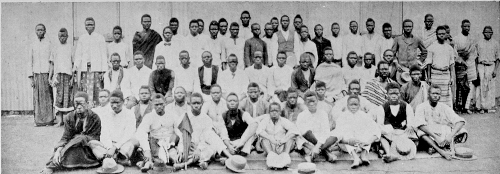
1. TEACHERS WORKING UNDER THE WATHEN CHURCH.
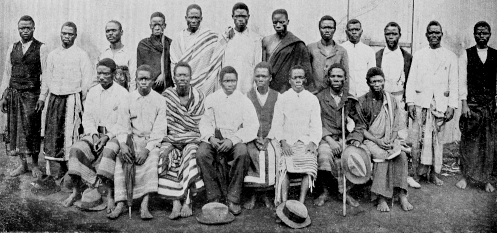
2. DEACONS OF THE WATHEN CHURCH.
On Monday morning my owner, Mikula, bought
a supply of various simple medicines to take back
to his town, and he also asked for and received
305some slates, pencils, and reading-books to meet
the demands of his numerous scholars. By noon
he and the others had said “Good-bye” to their
friends, white and black, and were on the road
again with their faces turned homewards. Mikula
moved with a buoyant step, for his heart was light
and happy. His work as a deacon, teacher and
preacher had received the commendation of his
white man; and he was returning home to be
married--to take to his house, which had cost him
so much time, thought and labour, the girl of his
choice, one who had been taught on the station,
was a member of the Church, and sympathized
with him in all his work.
During the evening, while we were sitting round
the fire, the conversation turned on the days when
much superstitious opposition and prejudice
existed against the Christian religion, and witch-doctors
and their followers exerted their combined
forces to crush it. Mikula told of one
zealous teacher he knew who travelled the country
proclaiming God’s message of salvation, who was
seen to enter a town, but was never known to leave
it. False and misleading reports were spread
concerning him; but after a long period the truth
came to light: the evangelist went into the said
town to preach, the people seized him, hurried him
down the long slope to the river, fastened a great
306stone to his neck, and, hurling him from the rocks,
drowned him in the rushing waters.
“A few months ago,” said one of the teachers
sitting round the fire, “the people in a town I
visited caught me and tied me with my arms extended
on a cross in mockery of my Master; then
they placed me for hours out in the broiling sun,
so that my mouth and throat became parched and
dry like the bottom of a saucepan. As the sun
went down they set me free, and we have a teacher
and some Christians now in that town, for they
were astonished to hear me praying for them
instead of abusing them.”
“Have you heard what happened some months
ago in the district next to ours?” asked another.
“An evangelist went into a town, and the natives
took him and stretched him on a cross in imitation
of our Saviour, and then, spearing him, they
cut off his head and flung his body into the bush.
Christ suffered much for our salvation, and it is
to be expected that we shall have to suffer a little
for Him.”
As they sat there round the fire two or three
engaged in prayer, and singing softly their evening
hymn--“Jesus, Lover of my soul, Let me to
Thy bosom fly,” they rolled themselves in their
blankets, and there in the open around their fires
they stretched themselves in sleep.
307
A Christian wedding--Grateful offerings--Christianity a great
boon to the women--Reunion--Various meetings--Lady
missionaries conduct services--Auction sale of the gifts--Changed
lives--Mikula instructs a stranger in the way of
salvation--Rules for candidates and for Church fellowship.
A few days after Mikula’s return he was
married to the young woman for whom he
had built the brick house. In honour of the occasion
the church was prettily decorated with
flowers, long streamers of vine-like branches and
palm-fronds. A bower was made by arching
some palm-fronds, and beneath this were placed
two chairs, tied together, symbolical of the future
state of those who were to sit upon them.
The town was all agog with the excitement of
the event, every seat and standing place was
occupied, and the doors and windows were
crowded with black but smiling faces.
This was the first time that a deacon-teacher
had been married in their town, and as the bride-groom
was much honoured by Christians and
heathen alike for his happy, kindly, obliging
308disposition and straightforward, consistent life
among them, they had come in large numbers to
his wedding.
The bride was arrayed in a clean muslin dress
of a bright but pretty pattern--the gift of her
white lady teacher as a recognition of her helpful
work among the girls during her stay upon
the station. The bridegroom was dressed in a
nice blue loin cloth and white jacket, the latter
being the work of one of his neighbours who was
expert with the needle.
A fellow deacon had come from a neighbouring
town to perform the ceremony. A marriage
hymn was sung and was followed by two teachers
asking for God’s blessing on those about to be
married; then the deacon read a translation of
the marriage service, during which the bride and
bridegroom took each other’s hand and solemnly
pledged themselves to one another until death.
Another hymn and prayer, and the benediction
concluded the simple but impressive service.
No sooner did the newly wedded pair emerge
from the church than they were greeted with
cheers, shouts and a salvo of guns. Their progress
home took the form of a triumphal procession,
all the folk vying with each other in their
expressions of pleasure, their exclamations of
goodwill, and the guns banged with such tremendous
309reports of jubilation that it was a wonder
they did not burst their sides.
Mikula invited his friends to a great feast of
pig and cassava-flour puddings, washed down
with copious draughts of water, tea and coffee.
There was no wine, no drunkenness, and no debauchery;
but a happy merry-making that left
no bad “after palavers,” and no unpleasant
headaches.
About three or four months after the marriage
the native Christians in Mikula’s town and district
were very busy in preparing their harvest thanksgiving
offerings. Many of the women had hoed
extra patches of peanuts and cassava gardens,
the crops from which, when matured, they sold
on the markets, and the proceeds were given to
Mikula for the coming festival. Mats, baskets
and saucepans were made and sold for the same
purpose. The men also put by a certain portion
of their “trade,” and devoted the result to the
same object. Others laid aside pieces of cloth,
hats, umbrellas and various other articles to take
with them as their gifts.
Mikula carefully noted all the moneys he received,
and everybody concerned was looking forward
with eager interest to the arrival of the
letter that would inform them of the date of the
coming religious fête.
310At last the messenger arrived, the day was proclaimed,
and those members of the Church and
their friends (for everybody--Christian and non-Christian--was
welcome to this festival) prepared
their baskets of food, their offerings, their
children and their clothes for the great event.
As they travelled up to the station they met other
contingents coming from various districts, near
and far. They chatted about the news, compared
their gifts, and the teachers and deacons consulted
and talked over the progress of “God’s
palaver” at the different centres of work.
Oh! wonder of wonders; the men helped the
women in carrying the babies and the loads of
food, etc. A kindly service they never rendered
in the old days, for then the men swaggered along
unencumbered, left their women to trudge after
them as best they could with all the impedimenta
on their backs, heads and in their arms--poor
beasts of burden.
This Christian religion had certainly wrought
a great change for the better in the condition of
the women. Instead of being treated with contempt
as inferiors, they were respected as equals;
instead of receiving the leavings of the men, they
now sat at the same table to eat with them; instead
of being regarded as mere chattels to be
borrowed and loaned, ill-treated, cursed and
311killed, they were cherished as wives; and instead
of being mere children-bearing, farm-making,
food-cooking animals, they were now the companions
of their husbands and the sharers of
their sorrows and joys.
It was early on Saturday afternoon when we
arrived on the station. There across the entrance
to the ground was a red banner with these letters
in white on it: “TUKAIYISI” (= Welcome);
and that was not the only welcome our party received.
The white men and their wives greeted us
very heartily, and showed us houses, and loaned
us mats for our use during our stay. The women
quickly gathered about their lady teachers, and
questions, kindly inquiries, and answers were the
order of the day. My owner, Mikula, recognized,
greeted and conversed with many of the young
men who were lads at school with him in the old
days.
What a happy reunion! How longingly anticipated,
and how fully appreciated! Faces were
missed there that were now present in the cool
glades that border the River of Life; and some
few were absent, because, through heinous sin,
they had been cut off from the Church, and were
ashamed to show themselves at this Christian
festival of gladness and thanksgiving.
One white man had decorated the church with
312palm-fronds, plantain-trees, festoons of creepers,
flowers and flags. The station had been thoroughly
swept, the flags streamed from the apex
of the church to the ground. Another white man
was looking after the comfort of the numerous
visitors, allotting to them their sleeping-places,
mats, and utensils for fetching water and cooking
food. A third was receiving the numerous
gifts, noting the names of the donors and districts,
and arranging the offerings in front and
around the platform.
What a miscellaneous assortment of gifts was
there! Heaps of pumpkin seeds and peanuts;
numerous bunches of plantains and bananas; a
pile of oranges; pieces of cloth of various colours
and qualities; umbrellas, eggs, glasses, fowls,
rabbits, parcels of native tobacco, mats--plain
and ornamented, kwanga loaves of native bread,
pumpkins, calabashes, bundles of native greens,
tomatoes, garden eggs, boxes of gun-caps, tins of
gunpowder, and bottles of kerosene. Those who
could not give garden produce or pieces of cloth
presented mugs, plates, wash-hand basins, saucepans
of native make, and European enamel-ware;
those who had come too far to carry their offerings
in kind, had sold them on the local markets
and brought the results of such sales in francs
and brass rods. Native tailors, who had made
313jackets, dresses and cloths ready for wearing,
presented them as their share.
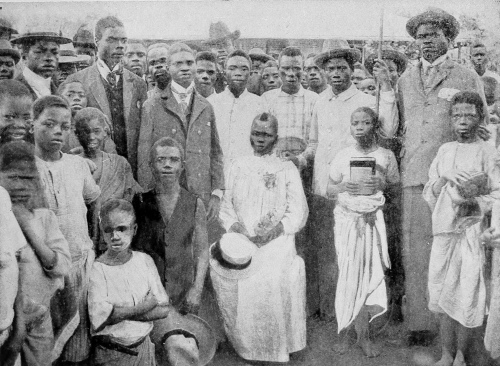
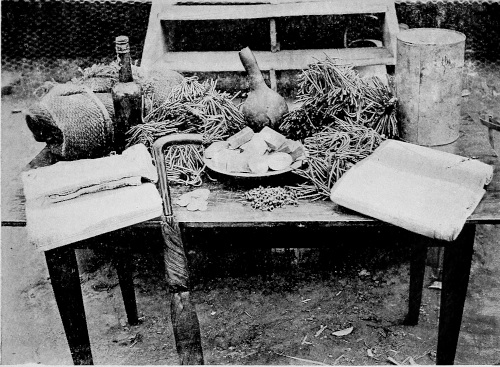
Photo] CHURCH COLLECTION AT WATHEN. [Rev. J. H. Weeks
The Collection consists of:--Tin of gunpowder, calabash of gunpowder, bottle of
kerosene, eggs, matches, gun caps, a plate, umbrella, mat,
cloth, francs, brass rods--in all worth about £3.
Nothing came amiss, no gift was too small and
no article too mean to find its place among those
free-will expressions of a people’s gratitude to
God--for the poor gave to the point of self-sacrifice,
and the comparatively rich gave in
proportion to their wealth.
All through Saturday and Sunday every band
of new arrivals gave in their offerings. Some
had carried their heavy gifts--weighing from
thirty to forty pounds--over hills, streams and
swamps for three and four hours, and came up
smilingly to unload themselves; and with shy,
apologetic words they expressed themselves as
sorry that the loads were not heavier, but that was
all they had to bring.
Sunday with its various services passed all too
quickly for those who had come such long distances
to attend them. The early morning prayer-meeting
was well supported. A native deacon
conducted it, and very earnest were the prayers
for a blessing on the missionary work that was so
zealously maintained in all the districts, nor were
other stations and missions forgotten before the
throne of grace.
It was pathetic to hear their pleadings on behalf
of relatives and friends still in the darkness
314of heathenism; and surely the heart of God has
been very deeply moved by such prayers, for not
a year passes without scores of conversions and
additions to the Church.
The afternoon service was crowded, and
although the building seated over seven hundred
every place was occupied and the doors and
windows were filled with eager listeners as a slim
man of medium height, who had laboured among
them for nearly fifteen years, preached freely and
fluently on their privileges and duties as Christian
men and women. In the evening a deacon-preacher
took the service, and very eloquently
did he enforce the lessons given in the afternoon
that as redeemed men and women, ransomed by
the precious blood of Christ, heirs of God’s
eternal glory, it should be their gladsome duty
to pass on the blessings they had received to
those who were still ignorant of Christ’s salvation.
I ought not to forget the morning service that
was conducted by a white lady--the wife of
one of the missionaries, a woman of large experience
in the work, of wide sympathies, and, from
what I could hear among the natives, a woman
much beloved by them all for her unstinted
labours.
“Why does a white woman take a service every
Sunday?” I once heard asked by a native in
315whose mental bank there were more sneers than
kindly thoughts.
“Well,” replied a teacher who was sitting by,
“the white men practise what they preach. They
tell us to respect and reverence our wives, so they
respect and reverence theirs; they teach us to
treat our wives as equals, so they treat theirs as
equals, hence they have arranged for a white
woman to take one of the two principal services
every Sunday. We have therefore always an
example of what they inculcate that when God
made woman He took a portion, not from the
head of man to show that she should be over
man, nor from the feet of man to show that she
should be under man; but from the middle to
teach that she should be equal to man--from near
the heart to show that she should have his affection,
and from under his arm to show she should
have his protection. My white man told me that
that was written by one of their famous teachers
long ago. They would have that to be the keynote
of our treatment of women as it is of theirs.”
Immediately after the service on Monday
morning one of the white men mounted a table
and began to sell the various gifts by auction to
the highest bidders. The natives, both males
and females, entered most heartily into the
contest. The auctioneer knew the value of the
316different articles and was careful to let nothing
go under price.
The bids were in brass rods, and the rivalry
for possession of the different articles was very
keen. Jokes were cracked, repartees were exchanged,
innocent pleasantries were indulged in,
and amid much laughter one lot after another
was knocked down to the successful bidders. It
was a vivacious scene composed of both sexes of
all ages, dressed in variegated colours, topped by
smiling, black faces, and white, gleaming teeth.
The white men took it in turns to act as
auctioneers, and at the close of the sale it was
found that the total sum received for the local
missionary work, i. e. for the support of native
teachers, amounted to 82,095 brass rods (=
£34 3s. 6d.). Everybody was pleased, and that
night they sung most heartily, “Praise God, from
whom all blessings flow.” And thus ended the
matondo, or harvest thanksgiving festival.
Soon after the final service the natives were
bidding each other “good-bye,” and on the road
again, with their faces turned homeward. How
safe the roads are compared with the bad, old
days! Then natives went armed with guns and
other weapons of defence, now they travel with
nothing but their hymn-books and New Testaments
for days without fear of molestation; woe
317then to the individual who left his party, for he
(or she) was pounced upon by thievish rascals,
and was never heard of again; then men and
women, boys and girls were captured on the
slightest pretext, and even for penny and two-penny
debts, and were sold to end their days in
distant, cruel and unremitting toil as slaves; now
boys and girls take long journeys in unmolested
safety. The Gospel has taught the people that
God cares for them, hence they are caring more
for each other; that He loves them, and thus they
are coming to love one another.
How selfish they used to be! How they
grabbed at everything that came in their way,
and held fast to every article they could put their
fingers upon! How generously they now gave
out of their comparative poverty, that the message
of God that had transformed their lives,
given them peace now, and hope for the great
hereafter, might be proclaimed to others, that they
also might share the same peace and possess the
same buoyant, eternal hope. Then their neighbours
were their own kith and kin only--members
of their own families, and they did not hesitate
to cheat, oppress, enslave or kill any one outside
the family to benefit themselves; now they have
discovered that their neighbours are the members
of all families, clans and tribes under the sun,
318and with all the energy of their renewed natures
they are trying to put into daily practice the
golden rule: Do unto others as you would that
they should do unto you. Then they stole, lied,
swindled and broke every law of man and God
that they might die wealthy and have a grand
funeral that should be the talk of the countryside;
now they walk many a weary mile, cross
many a difficult stream, wade many a nasty
swamp, to preach the news of God’s great salvation,
and give generously of their substance to
support teachers. How marvellous are the workings
of God’s grace in the hearts of whilom
savages!
Mikula, my owner, and his party arrived home
all the stronger in their Christian faith for the
service they had attended; and more determined,
by consecrated lives, by kindly actions, and by
trying to live the life of Jesus Christ in word and
daily deed, to win their heathen neighbours to the
better life. At the station they had heard that
there were more than fifteen hundred members
belonging to their beloved Wathen Church.
Fifteen hundred! a large number indeed! They
would have sung the Hallelujah Chorus if they
had known it. Yet how few fifteen hundred
seemed among the thousands upon thousands in
these large districts still outside the Church.
319There was, however, a growing Christian sentiment,
and a better-informed conscience manifesting
themselves through the whole district, even
among the heathen; and these are resulting in a
keener perception of right and wrong. These
are assets that should be placed to the credit of
the Church, and promise well for its numerical
and spiritual prosperity in the near future.
Had there been any laxity in receiving candidates
into the Church the numbers could have
easily been quadrupled; but the greatest care was
exercised, and the strictest investigations made
over every application for Church membership.
It was quite possible to impose upon the white
teachers, who could not possibly live in a hundred
villages and towns at once; but the candidate
could not deceive his Christian neighbours who
are jealous of the honour of the Church, and who
recognize that a pure Church of true men and
women means a strong and an aggressive Church;
whereas a membership of hypocrites would bring
upon them the contemptuous scorn of their
heathen neighbours, and would result in a weak,
emasculated, stagnant Church worthy only of
ridicule and extinction.
The natives live open lives in their villages,
making their fires in the streets, cooking their
food and eating it in the open, talking, working
320and living such unsecluded lives that in a village
everybody knows everything about everybody
else and a little more besides--there is no hiding
any fact of life from one another, hence when
the name of a candidate for Church fellowship is
submitted there are sure to be present some who
know the life the candidate is living in his or her
town.
One evening, when my owner, Mikula, and his
wife were sitting at their fire, a stranger from a
distant village greeted them, and told the deacon
that he had come to converse with him about
“God’s palaver.” Continuing, he said: “I have
heard the evangelists preach in the different
villages I have been visiting, about the Saviour
Jesus Christ; and I have listened to the white
men more than once, and my heart is standing
up with fear, because I have sinned greatly
against God and broken all His commandments.
When I think of my many sins and that God
will surely punish me for them, I cannot sleep at
night. Tell me more about Jesus, the Saviour.”
And a look of intense longing came into the eyes
of the inquirer.
Mikula unfolded to him clearly and fully God’s
way of salvation. He read passage after passage
from the New Testament to enforce every statement
he made; and Mikula’s wife aided him by
321holding a candle in one hand and shading it with
the other that the light might fall on the sacred
page, and occasionally she recalled to her husband’s
mind such scriptures as would help their
visitor.
Long into the night they sat conversing, fire
after fire along the street died down, and they had
heard the good-night greetings of “sleep well”
as their neighbours retired to rest; but they had
again and again replenished their own fire, and
had continued their earnest talk on the greatest
of all themes--the way of salvation to a sin-stricken
soul. At last their visitor said: “I see it--Christ
died for me, the just for the unjust, the
good one for the bad one, the Son of God in
place of me--the sinner.” And there around the
fire the three bowed their heads while Mikula
lifted up his heart in prayer and praise.
The next evening the visitor again took his
seat at Mikula’s fire, and after the usual greetings
had been exchanged, said: “I want to join with
you Christians and become a member of the
Church. Can I join at once?”
“No,” replied Mikula, “you cannot. You
must go back to your village, and live a Christian
life there for many months, and prove by your
words and actions that you are truly sorry for
your former bad life, and are now a follower of
322Jesus Christ. You must be a total abstainer, and
by this you will avoid the many temptations to
drunkenness. If you like you can now enroll
yourself as a member of the Blue Cross Temperance
Society.”
“Very well, I will do so now,” assented the
visitor. “It will be hard to give up palm-wine,
gin and other drinks, especially at funerals,
marriages and on the markets.”
“Yes, I know it will,” replied Mikula, as he
went for the pledge book; “but there are more
than two thousand members of this Temperance
Society, and God will help you to live a sober
life.” The visitor put his mark against his name
in the pledge book, and I heard that his name
was Tutula.
“The next thing that you must renounce is
dancing,” continued my owner. "You know our
dances lead to adultery, and from that to rows,
fights and murder. Therefore it is a rule of the
Church that its members should not take part in
any of the country dances.
“Then again, you must not call in witch-doctors,
nor may you employ them for any
purpose whatever. Witchcraft and Christianity
cannot mix together any more than you can mix
palm-oil and water. And you must throw away or
destroy all your fetishes and charms--a Christian
323man should trust in God, and not in the paltry,
stupid messes prepared by witch-doctors.”
“Yes,” said Tutula, “I can understand that
the temptations to a man or woman engaging in
our country dances is very great; and to practise
witchcraft and use fetishes and charms would
dishonour God. When I return home I will
destroy my fetishes.” And as he spoke he took
from his neck and wrists some charms and handed
them over to his new friend and teacher, who
dropped them into the fire that was blazing
between them.
“How many wives have you?” asked Mikula.
“I have seven,” replied Tutula, “two of them
are old, three of them are young women, and two
of them mere girls.”
“Perhaps you have heard,” said Mikula, “that
the members of the Church have given up the
practice of marrying many wives, and those who
are married have been wedded to one wife
only by holy matrimony. This is the law of
God.” And he opened his New Testament and
read the various places where this law is clearly
stated.
“Yes, I know that is the practice of your
Christians,” replied Tutula, "and it will cost
me a great amount of money to follow it, for,
being a man of importance in my district, I have
324had the pick of the females, and have given large
sums in ‘marriage money’ for the women I have
borrowed.[67] Cannot I retain three or four of
them?"
“No,” answered Mikula, “we deacons and
Church members have studied this point very
carefully, and the words of Christ are very strong
and definite on the subject. Is it not better to go
to heaven having only one wife, than to be cast
into hell with many women?
“There is one other matter,” continued Mikula,
“and I have done: As a Christian man who has
received pardon for your many sins and a hope
of eternal life through Jesus Christ, you should
pass these blessings on to others by giving freely
according to your means, and regularly, for the
support of native teachers to proclaim the love
of God in Christ Jesus. I am a teacher, but I
do my work as such without any pay, because I
am living in my own town; but there are teachers
who are working in towns and among peoples
not their own, and they must be supported, and
what they receive is very little.”
“I thank God in Jesus Christ for all that He
has done for me!” fervently exclaimed Tutula.
“And listen! if you will find a good teacher I
will give him a house to live in, and pay half the
325cost of his support, for I want the people in my
village and neighbourhood to know of God’s love
and pardon.”
In due time a teacher was selected and sent to
Tutula’s villages, and he taught Tutula, among
others, to read God’s word for himself. Some
months afterwards I was present with Mikula
when Tutula and many of his neighbours were
baptized and received into the Church; counting
wine, women, witchcraft palavers, and native
dances as mere dross that they might win Christ
and be found in union with Him.
326
Months glide quickly by while working hard--Deacon’s
meeting--Church-meeting--The kind of candidates who were rejected--Baptismal
service--The great meeting of the Church--Election
of deacons--The balance sheet--A deficit--Native Christians
wipe out the debt--Local missionary meeting--The great
communion service.
How quickly the months glided by! Mikula,
my owner, was a busy man of affairs.
As deacon and teacher he voluntarily gave many
days every month to his arduous duties--visiting
lukewarm members and absentees from communion,
investigating charges brought against
such as were accused of breaking the Church’s
rules, examining and instructing candidates for
Church fellowship, receiving the contributions
from Church members, paying the teachers of
his district their monthly allowances, performing
the rites of burial and of marriage, preaching in
his own town and frequently visiting other towns
and villages to proclaim the Gospel of Jesus
Christ.
Besides all these labours for the Church, he
327helped his wife by doing the roughest work on
the farm, visited many of the markets for purposes
of trade, for this was his principal means
of subsistence--the means by which he met his
various obligations as a man, a husband, and a
Church member.
If he had devoted the whole of his time to
trading he would have been a rich man. He
was ’cute, smart, and energetic enough; but he
preferred laying up treasure in heaven where
neither white ants, nor rats, nor mildew could
depreciate the value of his wealth.
It was thus the months passed all too quickly,
and brought us to the great Church Festival held
at Christmas-time, and the three principal events
of this gathering were the Church-meetings, the
baptisms, and the communion service.
Messengers and letters had been sent to all the
deacons and teachers spread over the three
thousand square miles that comprised the parish
of the Wathen missionaries. These letters had
informed the officials and Church members of the
date upon which they were to assemble, and
urging them to come in large numbers.
During all the afternoon and evening of the
appointed Saturday, groups of men and women
were continually arriving on the station, and the
housing accommodation was taxed to its utmost
328capacity. The programme for the meeting had
been arranged about a month before, and every
male and female missionary had had their parts
apportioned to them; but unhappily just on the
very eve of the meetings two of the white men
went down with very serious fevers, and the
depleted little band of white folk had to work
the harder to make up for those unfortunately
laid aside.
At four o’clock on the Saturday afternoon the
deacons were assembled, and the business to be
laid before the coming Church meeting was
thoroughly examined, such as cases of discipline,
fitness of applicants for Church membership, the
work, pay, and appointments of teachers to new
spheres, or their removal from one place to
another, and the many other points that demanded
attention and investigation.
Soon after seven o’clock the bell rang out
calling all those concerned to the Church meeting.
About five hundred male and female
members gathered. A hymn was sung, a prayer
offered, a portion of Scripture was read, the
minutes of the previous month were read and
confirmed, and then the business of the meeting
began--of course, everything was conducted in
the vernacular, consequently everybody present
could enter fully into the matters laid before
329them. After various items of business had been
voted upon, the claims of candidates for Church
membership were scrutinized and voted upon by
those present.
While they were considering Mr. A.’s desire
to join the Church, a member arose and stated
that the applicant had a very bad temper, became
enraged at the smallest annoyance, and frequently
for no reason at all; and the speaker thought that
the candidate should by properly and continually
controlling his irritable nature get a better temper
before he was received into the Church. The
other members thought the same, and voted that
Mr. A. should wait for a few months and be
informed of the reason.
A little later the case of Mr. B. was under
consideration, when a native of his village arose
and said that the candidate was a very lazy man,
lounging about the village all day, living on his
wife; and he thought that such a person was
undesirable as a Church member. Let him do
some work and be honestly industrious for a
year and then apply again. The vote was taken,
and Mr. B. was counted as unworthy of Church
membership until he had changed his lazy
habits.
Later still in the evening the name of Mr. D.
was mentioned as desirous of joining the Church,
330when a neighbour of his jumped to his feet saying:
“Mr. D. is in debt to many people in his
village and to others in the surrounding villages.
Now we think that a member of this Church
should not be in debt to any one; let him pay all
his debts first and then apply for membership.”
Hence Mr. D. was informed afterwards that he
must go and pay his debts and apply later.
Others were rejected through lack of knowledge
of the fundamentals of the Christian
religion; others for using fetishes and charms,
thus showing they were not altogether free of
their heathen superstitions; and others because
their lives were not consistent with their Christian
profession. But after all this winnowing there
were more than twenty who were recognized as
worthy of joining the Church.
The following day, Sunday, commenced with
an early morning prayer and praise meeting; then
at the nine o’clock service the missionary preached
a suitable sermon to the accepted candidates on
some of the passages in Revelation, where the
word “overcome” occurs; and at the close the
candidates for baptism arose one by one, and in
simple language, and, often with much nervousness,
bore his or her testimony to the pardoning
love of God in Christ Jesus that had called them
out of the great darkness into His marvellous
331light. And then we adjourned to the place where
the baptismal rite was to be administered.
The place was about a mile from the station,
and the baptistery was formed by the natural
widening of the stream into a pool that answered
the purpose as though it had been designed
especially. The stream came from an open
valley, and, filling the pool, passed beneath the
cool shelter of some trees that threw a shade
over a part of the shore, that by a steepish slope
led down to the water. This incline was covered
with people in their varied coloured dresses and
cloths, tier above tier, that were desirous of
witnessing the baptisms. Many lads and young
men had waded across the water, and had seated
themselves on the edge of the farther bank, from
which point of advantage they gained an uninterrupted
view of all that took place. Around the
nearer side of the pool, occupying positions right
on the very edge of the water, were those who
were to undergo the rite of baptism--the observed
of all observers, nervously conscious of all eyes
being fixed upon them.
A baptismal hymn was very heartily sung, two
deacons offered prayer, and then one by one, the
women first, and then the men, the candidates
entered the pool and were baptized in the name
of the Father, Son, and Holy Spirit--buried with
332Him in the waters, a symbol that the old, heathen
life was finished, and raised again--a sign that
henceforth they were to lead new lives of faith,
purity and love in Jesus Christ.
Soon after ten o’clock on Monday morning the
bell sounded forth its clamorous call to the great
Church meeting. The large building was soon
filled with more than six hundred Church
members--male and female, who had gathered to
elect their deacons for the ensuing year, to hear
of the progress of Christ’s kingdom in their large
parish, and to have laid before them a financial
statement concerning the income and expenditure
of the closing year.
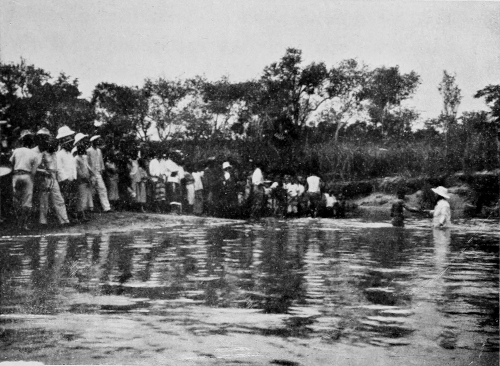
Photo] BAPTISMAL SERVICE, CHRISTMAS, 1905. [J. R. M. Stephens.
All deacons, no matter in what month they were
elected, relinquished office automatically at the
end of the year, therefore one member of the
Church proposed, and another seconded a resolution
of thanks to the deacons for their work
during the past year. This was carried unanimously
with much clapping of hands--a purely
native mode of expressing thanks whether performed
by an individual or a crowd. Then two
others proposed and seconded a request that the
retiring deacons be asked to take office again for
the coming year, with two exceptions. One
deacon during the year had broken a rule of the
Church, and as it was essential for the welfare of
333the Church that their deacons should be blameless
in life and character, he was not re-elected.
Another deacon had exhibited much incapacity
and such an utter lack of zeal in the discharge
of his important duties, that he was asked to
stand on one side to make room for a better man.
The rest were re-elected with acclamation. Their
spokesman replied in a few suitable words, and
begged them to remember their deacons always
in prayer that they might perform their difficult
duties worthily of the Master they all desired
to serve.
It was felt in consequence of the work extending
so rapidly that the number of deacons should
be increased to twenty-five to adequately cope
with the work. Men, therefore, of strong
character, of long, faithful service, and good
Christian lives were chosen and voted to the office
to make up the desired number.
Then the missionary who had charge of the
Church books wrote on a black-board the number
of members in fellowship at the beginning of the
year, the number of those who had been expelled
for inconsistency, the number who had passed to
the eternal home during the twelve months, the
large number that had been baptized on profession
of their faith in Christ, and it was shown
that those who were enjoying all the privileges
334of Church membership made a grand total of
1674. Here and there over the building could
be heard ejaculations of “Tutondele Mfumu
Nzambi!” (“We thank Thee, Lord God!”)
The white man then put another black-board
in position, and wrote on it all the offerings from
the various districts, the amount of the July
Harvest Thanksgiving, and sundry other items to
the credit of the Church accounts--it reached
some hundreds of thousands of brass rods. On
another black-board he wrote down the cost of
the teachers in the different districts, and when
these were added up there was a large deficit.
What were they to do--leave the Church in debt,
or withdraw some of the teachers? No, they
must wipe that debt off!
Another black-board was quickly in position
to receive their offerings for clearing away the
deficit. A white teacher present said: “I will
give two thousand rods towards the debt.” But
a native deacon arose to his feet and said:
“White man, we thank you for your kind offer
to help us; but this is our work for Jesus Christ,
and we intend to do it by paying that debt ourselves.
Christ has done so much for us, that we
must do this little bit of work for Him.”
During the next hour the missionaries were
very busy writing down gifts and promises; and
335gradually the debt shrank until at last it disappeared.
They had contributed over £180 to
meet the entire expenses of their local missionary
work. It was a large sum for poor people; but
it was an expression of their gratitude to God
for all the benefits they had received through
the preaching of the Gospel. If it had been
possible to value all the voluntary work done by
deacons and Church members, the above amount
would have been more than doubled.
That night a missionary meeting was held.
The building was full; bright and inspiring
hymns were sung; and one teacher after another
told of the difficulties and triumphs of the Gospel
in his part of the district. Then two of the white
men spoke of the grand results that had attended
the efforts of other missionaries at the various
stations on the Upper and Lower Congo. They
summed up by saying: that thirty years ago there
was not a single language that had been reduced
to writing, now eight had been mastered, and into
them more or less of God’s Word had been translated;
thirty years ago and there was not a single
person on the Congo who knew how to read or
write, now there were thousands of men and
women, boys and girls who were reading God’s
Word in their own languages; thirty years ago
there was not a single native teacher on the
336Congo, now there were nearly five hundred--two-thirds
of whom were entirely supported by the
free-will offerings of the native Christians, and
the other third doing voluntary work in their own
towns and villages; thirty years ago not a solitary
brass rod was given to God’s work--but hundreds
of thousands of them were spent on
witch-doctors, fetishes and charms, now over
£400 a year are given by native Christians that
others might hear the glad news of Christ’s
redemption; thirty years ago there was not a
single Christian throughout the whole length and
breadth of Congoland, now in fellowship with
the B. M. S. Churches alone there are nearly
3500 Church members, and God Himself alone
knows the great number that has already passed
from the Church militant on earth, through faith
in Christ, to the Church triumphant in heaven
that is gathering around the great white throne
of the Lamb. These are 3500 fulfilments of
God’s promises; 3500 encouragements to continue
the work with zeal and aggressiveness;
3500 proofs of the power of the Gospel to change
the hearts, and purify the lives of men and
women.
It was about eleven o’clock next morning when
that bell called the Christians and their friends
to the last great meeting of the festival. The
337building in which the service was held was long,
wide and rather squatty, with no claim to beauty
or dignity, and no pretensions to architectural
elegance; and although in the eyes of men it
might honestly be styled ugly, yet in the eyes of
angels it must be very beautiful--for it is the
birthplace of many a soul.
It was all too small that day to hold the crowd
that pressed into it. The seats soon filled, and
the mats that had been spread on every available
space quickly received more than their full quota
of people, and the doors and windows rapidly
filled with folk who listened as eagerly as those
who were inside the building. How heartily they
all entered into the simple service!
The preacher knew their difficulties, their
temptations and their weaknesses; he knew the
pit of heathenism from which they had been
digged; and he knew that they were going back
to their towns, villages and homes to live among
superstitious heathen neighbours, so he preached
to them with the power born of full and
deep conviction from 2 Tim. i. 12; and they
by and by returned home strengthened to continue
the fight knowing that God was with
them, and, therefore, they were on the winning
side.
The preaching service over, the non-members
338left the building, and their places were immediately
filled with those Church members who had
been standing round the doors and windows.
Over seven hundred persons were present to take
the communion.
The eyes of the white man who officiated
dimmed with tears as he looked over that crowded
assembly of communicants. He thought of those
who had borne the heat and burden of the day,
those who had toiled and died without knowing
of any results to their labour; he thought of those
who, baffled and defeated by broken health, had
been compelled to retire from the dangerous
climate; he thought of those native teachers who
had lived faithfully and worked arduously to
bring about this grand gathering; and he thought
also of that vast number of friends in the homeland
who by their labours, gifts and prayers had
made this glorious assembly possible. Surely all
would ultimately rejoice together in the great,
glad cry of Harvest Home! Perhaps--who can
tell?--the spirits of those who have passed away,
missionaries and supporters--white and black
workers alike, were, some of them, present at
that service and were rejoicing together over so
numerous a company of ransomed souls.
It was in a tremulous voice that the white man
addressed a few words to those who were to be
339received in that day, and then he took each by
the hand and welcomed him and her into fellowship
in the name of the Church. After that a
prayer was offered that these new brethren and
sisters might ever remain true witnesses for
Christ, the Saviour.
A hymn was then sung that the hearts and
thoughts of all present might be centred on the
purpose of their presence in the gathering--to
commemorate the death of their dear Lord until
He come.
One of the deacons prayed for a blessing
on the “bread,” and it was then dispensed
among the communicants, and after they had
partaken of it they bowed their heads in reverent
worship. The cups were then distributed to
every member in that great assembly. Another
deacon pleaded with God for a blessing on
the cup; and then the missionary arose, and
holding his cup in his hand, said: “This cup is
the New Testament in My blood: this do ye, as
oft as ye drink it, in remembrance of Me. For
as oft as ye eat this bread, and drink this
cup ye do show the Lord’s death until He
come.”
And as soon as his tones had died away seven
hundred cups were raised and drained to the
memory of their Saviour, and seven hundred
340hearts bowed in prayer before the Lord. In
a little time there arose upon the air a song of
faith. It was a translation of that incomparable
hymn--
"There is a fountain filled with blood,
Drawn from Immanuel’s veins;
And sinners, plunged beneath that flood,
Lose all their guilty stains.
"Dear dying Lamb! Thy precious blood
Shall never lose its power
Till all the ransomed Church of God
Be saved to sin no more.
“Then in a nobler, sweeter song,
I’ll sing Thy power to save,
When this poor lisping, stammering tongue,
Lies silent in the grave.”
341
1 Being only eleven inches long (page 1).--Over a very large
part of the Congo soft brass wire of 34 gauge is now, and has
been for many years, the currency and the standard of value
among the natives. This wire was probably, in the first instance,
introduced and used for ornamental purposes, as binding round
spears and knives, or beaten out into ribbons of brass for
decorating the hafts of their best spears and paddles. At first
the wire was bought in long lengths of so many fathoms,
according to the needs of the buyer and the purchasing power
of the article he offered the trader in exchange for it. Later
they found it more easy of manipulation to have it in lengths
of thirty inches, and these were shortened by those who had
large numbers of them cutting off a half-inch from each one
and melting the small pieces down for brass anklets, necklets,
and bracelets, thus procuring their brass for nothing, i. e.
cutting off short pieces from each rod and passing the rods
again into currency at their normal value. So much of this
was done that the thirty-inch rod was reduced to twenty-seven
inches, and sellers of goods consequently demanded more rods
of the shorter ones than of the longer lengths.
This process of snipping off little pieces has gone on for
thirty years, and the result is that the brass rod has gradually
decreased in length until now, on the Lower Congo, it is scarcely
five inches, and among the Boloki of the Monsembe district it
is only eleven inches, and if the introduction of money does
not displace the rod it will become only four or five inches in
that part also.
Of course, as the rod lessens in length the seller of an article
demands more of them for his goods. Thus an article that once
cost three rods of thirty-inch wire now costs thirty of the five-inch
rods; for not only has the rod shortened in length, but
through the introduction of so much brass wire into the country
during the last quarter of a century it has decreased in value.
I hope some day to take the Rod among those people who use
an eleven-inch brass rod as their money.
3422 Kroo boys (p. 3).--These were natives procured from the
Kroo Coast to work the cargo on the steamers that ran along
the west coast of Africa. Only sufficient white sailors were carried
to work the ship from starting port to the Kroo country. On
arrival there, the ship fired a gun to intimate its need of a gang
of Kroo “boys” to handle the cargo. These “boys” were any
age from about eighteen to fifty, and in a gang there were
generally about forty to fifty “boys” under a head man.
Most captains had a head man who gathered a gang ready
by the time his ship returned from its European port. For
example: a ship leaves Liverpool, and on arriving at the coast
picks up its head man and gang of “boys,” who work the
winches, man the boats and handle the cargo all the way
along the coast and back again to their own country, where
they are paid off in barter goods, powder, guns, rum and gin
at the rate of one shilling a day. They then rest after their
arduous work until that ship returns, and they engage themselves
for another trip. The Congo boats now pick up their
Kroo “boys” at Sierra Leone on the outward voyage, and
drop them there on the homeward journey, and pay them in
cash at the rate of about one shilling to one and sixpence per
day and their rations.
When not in port these Kroo “boys” polished the brasswork,
scraped the iron, cleaned the paint, holystoned the deck, etc.;
but when in port they went into the holds, tied up the cargo
in slings, hoisted it by winches, put it over the side into boats,
and rowed it ashore. They were hard-working men who toiled
from 4 a.m. until 10 or 12 p.m., only resting for their meals of
boiled rice, salt beef or fish, and ship’s biscuits.
3 Peasoup (p. 4).--When the writer went to Congo first in
1881 there came on board at the Kroo coast a head man whose
name was Peasoup. For many years he had acted as head man
for the captain of that ship, who, as an acknowledgment of
his various good qualities, and as a joke, presented him with
a brass plate to hang round his neck by means of a chain.
The following words were engraved on it--
PEASOUP
Captain Jolly’s Head Man.
A Rogue, Thief, and a Liar.
343Peasoup was a tall, thin, grey-headed, bandy-legged man;
and I used to see him polish the plate every morning, hang
it across his chest, and with knock-knees and bandy legs strut
the deck and order his men about as proud as any general
with a breast hidden by medals.
Peasoup knew English fairly well, but, of course, could not
read it; but he would never accept as true the accurate rendering
of his much-prized brass plate. Passengers read it correctly
to him; but with a laugh he would retort: "You white men,
you no sabbe read them thing properly. Him live for say:
‘Peasoup, Captain Jolly’s Head Man. Him be plenty, proper,
good man.’"
Since those days Peasoup has passed away, leaving his brass
plate as an heirloom to his family, and if not melted down into
a brass ornament, it may turn up some day as a relic of a joke
played by a master on a decent servant in “the good old days”
on the West African Coast.
4 Riddles and conundrums (p. 9) were called ngwala; ta e
ngwala = to pour out or ask a riddle; twasa e ngwala = to
fetch a riddle here, i. e. give us a riddle; nua e ngwala = give
us the answer, or, lit., to drink the riddle.
Ngwala also means spirits, rum, gin, from a corruption and
a shortening of the Portuguese word aguardente = gwaladente
= ngwala. The “r” is always turned into “l,” and the “g”
takes the nasal “n” before it. It is very probable that they
pun on the double meaning of the word ngwala = riddle, and
gin. Hence the usual form of asking a conundrum is--
Ngwala yeye = here is gin, i. e. here is a riddle.
Ta e ngwala = pour out the gin, i. e. state the riddle (or
twasa e ngwala = bring the gin here).
If those asked cannot give the answer, they say--
Nua e ngwala = drink the gin, i. e. give us the answer
yourself, as we cannot guess it.
The natives of the Lower Congo are very fond of this
pastime, but one needs to understand the customs, language,
and surroundings to properly appreciate the conundrums; consequently
only a few almost self-evident ones, or those easily
explained, are put in the text.
5 It was a fetish (p. 12).--The early traders on the Congo
placed in their large stores a fetish to deter the natives from
344robbing them. It was generally a large, gaudily-coloured, hideous
image put on the top shelf opposite the door, from which
position it was supposed to dominate and guard the contents
of the whole building. Many traders called their store “the
fetish” because of the presence of this ugly figure in it.
This fetish exercised little, if any, deterrent power over the
natives for two reasons: (1) No witch-doctor would waste good
“medicine,” procured with difficulty, on making a fetish powerful
for a mere white man, and the natives knew this; and (2)
supposing the witch-doctor put proper “medicine” into the
fetish, yet it needed periodic reinvigorating at the hands of
the witch-doctor, otherwise it became weak and useless; and
it would also require a sacrifice, certainly not less frequently
than once a month, of either a large fowl or a goat, or it
would become sulky and not act on behalf of its owner. Now
I never heard of a white man renewing the energy of his
fetish by paying a witch-doctor to palaver over it at stated
intervals, nor did I ever hear of a white man offering a sacrifice
to the fetish in his store; therefore while the trader was
relying on his fetish to guard his goods, his native servants
and workpeople were laughing at it as an ineffective carved
figure.
6 In the sea there is a hole (p. 17).--Water sprites are supposed
to make the trade cloth, and as it is so finely woven the
natives think that these particular sprites have only one eye, i. e.
that the visual power of two eyes is focussed in one that it may
see to do such fine work.
7 Some of his companions laughed (p. 20).--We are apt to
think that all natives are equally superstitious, but that is not
so. A man may be a devout believer in charms and fetishes, he
may decorate his person, his house, his children, his pigs, his
goats and his dogs with as many charms as he can afford
to buy, or he may quietly leave all the charms and fetishes
severely alone, and no one will think the better or worse of
him; but he must believe in witchcraft, in witches and their
occult power, or his life will be made wretched with accusations
of witchcraft. I have known some natives to surround themselves
with fetishes and charms, and most scrupulously observe
all rites and ceremonies, and I have known others to disregard
the whole box of tricks and hold them in contempt.
3458 Burial postponed (p. 24).--It is not uncommon to postpone
the funeral of an important person for many months, and even
years. The writer once buried a man who had been dead for
nearly fifteen years. The persons responsible put off the
expense as long as possible, and it is probable they would not
then have interred the corpse, but the King ordered the family
“to finish the palaver.” There was another case of a body
being left unburied for over twenty years because the man who
was responsible for the cost of the funeral believed that he
would “die the day after he buried the corpse.” Many thought
that this was only an excuse to avoid the expense. The body
was dried, wound in cloth, stored in a house specially built for
the purpose, and guarded by relays of young women.
9 Nkandu (p. 25).--See Chapter XVIII on Governing,
Marketing, and Trading (p. 223).
10 Cassava flour (p. 26).--Mandioc (or cassava) was introduced
into Congo from South America about the end of the
fifteenth or beginning of the sixteenth century. Its native name
is madioka, an evident attempt at saying mandioc. The roots
when matured were soaked for a few days in pools, or streams,
by which time they were soft. They were then peeled, cut in
halves or quarters, and put on stones and small platforms in
the sun until the pieces were quite dry. After this the pieces
were laid out on shelves over their fires until friable, and they
were then easily pounded in a mortar, sifted through a fine
sieve, and the result was a very fine, white flour. Raw mandioc
contains prussic acid, but the poison is eliminated by heat.
11 Kwanga (p. 26).--The cassava root was soaked, peeled,
and cored, as under note 10. Then, instead of being dried, it was
thoroughly kneaded and all lumps removed. The dough-like
substance was made into long sausages of various lengths and
thicknesses, according to the districts, or into balls like suet
puddings. I have seen the sausages in one district twenty feet
long and two inches thick, and in another twelve inches long
and four inches thick. But whatever the shape, the dough
was wrapped in palm-leaves, or in leaves like the aspidistra,
and steamed until well cooked. These kwanga would then
keep sweet for several days. They were sold on the markets,
346and an average price would be at the rate of four shillings for
two cwt.; and four pounds were quite sufficient for a man
per day.
12 Bolt his food (p. 29).--It was not the custom at ordinary
meals for the natives to eat greedily, but on occasions such as
this, when all sorts of folk were thrown together, each one ate
as much as he could get. See paragraph on greediness in the
Introduction to the “Folk-Lore Stories.”
13 Luku (p. 38).--The cassava flour is made as under note 10,
and the luku is prepared in the following way: A saucepan of
water is set on the fire, and when the water boils, the cook
takes a basket of the flour and sprinkles it with one hand in
the boiling water and stirs it with a stick held in the right
hand. This process is continued until the porridge is stiff and
can be turned out as one whole pudding from the saucepan.
When a person is eating it, he breaks off a piece, rolls it in
his fingers, dips it in some gravy and then lets it roll down
his throat without masticating, otherwise it will stick to the
teeth like toffee.
14 Glass vessel (p. 44).--In the original it is ekumbi dia pelo
= ship of glass; pelo is from the Portuguese espelho = mirror,
glass, etc. Probably glass was first seen by the natives in the
form of looking-glasses, and ekumbi dia pelo might be translated--the
mirror or looking-glass ship.
The introduction of glass, guns, etc., into their stories are
indicative of native readiness to expand their tales by the free
assimilation of new ideas received from contact with foreigners.
This has also had a wide influence on their language and fetish
religion. This story I first heard in 1882 at San Salvador.
15 Laid beads (p. 45).--In San Salvador and district beads
form the currency. They are round blue beads three-eighths of
an inch in length and about a quarter of an inch thick. One
hundred of these beads threaded on a cotton cost, invoice
price, one farthing, and one egg cost one string of beads. It
was possible to buy little lots of food for ten and fifteen beads.
The phrase “laid beads” is equal to “laid money.” In an
Upper River story the fowl “laid brass rods,” i. e. the currency,
money.
34716 Ndungu (p. 52) is equivalent to our phrase “you are
becoming cold,” and the more indifferently it was uttered by
the crowd, the more certain was the witch-doctor that he had
guessed wide of the mark. See next note.
17 Otuama (p. 52) is our way of saying “you are becoming
hot,” and by this the witch-doctor knew he was getting very
near in his guesses, and the more excitedly it was shouted, the
nearer the guesser knew he was to the facts of the case. In
Chapter XXII the whole trick is more fully explained. See
also preceding note.
18 Ran for his gun (p. 53).--I was talking in 1908 to a former
witch-doctor, who told me that he had been threatened three
times with guns by those whom he had accused of witchcraft,
and if he had not precipitately fled he would have been shot.
Hence those ngangas who engaged in witch-finding always
made sure of their fees first, and sent them away by their
assistants, hurrying off themselves directly they had accused
their man. It was dangerous work.
19 Mboma (pp. 59, 78).--In San Salvador and its neighbourhood
this word meant the south bank of the Congo River from
Ennoki to Matadi, or such trading-stations as existed on that
part of the river. This mboma was from eighty to ninety miles
from San Salvador, and took a caravan about five days to
traverse it. Special letter carriers would cover the distance in
three days. This word we generally translated “coast.”
20 Congo dia Ngungu, or, in its fuller native form, Ekongo
dia Ngunga (p. 60).--Scattered over the country are several
Congos (or Kongos), as Kongo dia Mpalabala, Kongo dia
Lembwa, etc. To distinguish San Salvador from the other towns
bearing the name of Kongo it was known by the natives either
as Kongo dia Ntotela = Kongo of the King, or Kongo dia
N gunga = Kongo of the Bell. The former designation referred
to the town as the capital of the country and the residence of
the King. The latter name is probably due to the fact that the
Portuguese Roman Catholics in the sixteenth century built a
cathedral and monastery there, and used a large bell to call
the people to the services. Such a bell would be a wonder to
the natives, and quite sufficient to cause them to name the
town the Kongo of the Bell.
34821 Smell of white man (p. 61).--However contemptuously we
may talk about the “smell of niggers” or “of Chinese” and
others, there is no doubt that we of the white race emit an
odour that is very noticeable to other races. Repeated bathing
and frequent changes of clothes will not eradicate the odour,
for a black man can tell when another black man has been
within a yard of any white man for a short time. Account
for it how you will, the black, red, yellow and white races
each emits an effluvium peculiarly its own and offensive to the
others--we must, therefore, bear and forbear. We as a white
race are used to our own scent and do not notice it, and when
one lives a long time amongst black people he becomes accustomed
to their odour.
Occasionally I have been with a white man who, in spite of
scrupulous cleanliness, was very malodorous through suffering
from empyreuma; and I have met here and there a native
whose smell was especially offensive, and it was as objectionable
to his black neighbours as to us. The natives have a
definite word for such malodorous emanations. Some lads
have told me that the perspiration of some white men has
made them vomit.
22 You white man (p. 63).--A native has just as much objection
to being called “a white man” as a white man has to being
called “a nigger.” In both languages it is an insult to be
resented.
23 Screaming (p. 64).--In the pioneer years of the mission,
when white folk were seldom seen and were always regarded
with superstitious fear, I was frequently startled out of my sleep
by women screaming out: “The white man has stolen my
child!” And I have wondered on more than one occasion
whether the half-sleepy folk would in a stupid panic turn me
out of their town in the middle of the night or do even worse.
24 Mboma.--See note 19.
25 Fines paid for judging (p. 92).--All fines received by a
native judge are periodically divided among the chiefs of the
district, who combine to enforce the law. If a pig or a goat is
given, then the meat is shared out or the market value put into
the fund. The money or goods are divided according to the rank
and influence of the chiefs, and he who might be called the
349chairman, or principal, received twice as much as any of the
others.
26 No shelves (p. 95).--Many years ago, after much persuasion,
I induced some natives from the Zombo country to come
into my house at San Salvador. The first thing they did was to
scan with much eagerness the walls of my rooms, and on asking
them what they were looking for, they replied, “We have
always heard and believed that you white men bought up the
dead bodies of the black people, stored them on shelves in
your houses, and on the first good opportunity sent them to
Mputu (Europe), where by your wonderful magic you returned
the life of the corpses, and they then worked for you as slaves;
but we cannot see the shelves.”
“But why did you think we bought corpses?” I asked, with
much wonder and amazement.
“We can understand why traders come to this country,” they
answered, “but we cannot understand why your kind of white
men come, for you do not trade, so we think you have some
wicked purpose underlying your presence in our land.”
Believing such ghastly things about us, their opposition to
us and hatred of us were no longer a surprise to me. The
wonder is that they did not murder all of us. We have had
to live down their prejudices, remove their foolish beliefs about
us, and turn their suspicions into confidence and love.
27 Trade gin (p. 99).--Whatever ordinary gin may be, “trade
gin” was the vilest concoction of fusel oil and other ingredients
that was ever put on the market for human consumption. It
always made the drinkers mad drunk, and was responsible for
most of the quarrels and much of the fighting that took place
among the natives. I have known a white man take to drinking
it and be dead in less than a week, and undoubtedly it was the
cause of many deaths among the natives. A dozen reputed
pints in bottles, case, packing, etc., cost only half-a-crown
the lot.
28 Law against the sale of spirits (p. 102).--Since the time
mentioned in the text a law has been passed limiting the sale
of these “fire waters” within certain boundaries, and restricting
the sale of them, so that neither white nor black can procure
them without special “permits.”
35029 Make them sell it (p. 102).--Several traders have told me
how much they hated selling such vile stuff to the natives; how
they had protested against the sale; but that they were compelled
to sell them as they yielded such large profits to their
employers. Surely the curse of both God and man must ever
rest on such gains!
30 His santu (p. 111).--All the men and women in and around
San Salvador, and a large proportion of those living in the other
districts of the Lower Congo, have each a santu, from the
Portuguese word sancto = a christian, or sacred, name.
At birth a native name is given to the boy (or girl), and later
in life--at twelve or fourteen--the lad can take another name of
his own choice if, for any reason, he is dissatisfied with his
birth name, and allow his first one to be forgotten by disuse.
While in their teens they also select a santu which is a
Congoized form of a Portuguese name, as Manwele = Manuel
= Emanuel; Nzwau = Jaõa = John; Petelo = Pedro = Peter,
etc.; and the women take Madia = Maria = Mary, etc. To
their santus they prefix “Dom” and “Donna” respectively.
In San Salvador and the near towns every man and woman
has a santu, but the farther you travel from San Salvador, the
less frequently is the santu found among the people. Undoubtedly
it is a survival of the sancto given by the Roman
Catholics to those who were baptized into their Church.
Although the possession of “Dom” and “Donna” was so
common, yet the use of them was somewhat restricted to the
better class of natives, much the same as our use of Mr. and
Mrs. and Miss. Of some men the natives never spoke without
calling them “Dom,” and to others they never prefixed the
“Dom” except when they wanted to ingratiate themselves or
ask a special favour.
31 To represent dolls (p. 114).--The girls would often procure
pieces of firewood or cassava roots to represent dolls, and play
with them as such, carrying them tied to their backs, or on
their hips, by old rags, just as their mothers carried them when
babies. These dolls they washed in old saucepans, and held
them out for a few minutes in the sun to dry, as they themselves
had been washed and dried. Then they dressed them
in strings of beads and a few imitation charms and re-tied
them on their backs.
351When I first saw this performance--nearly thirty years ago--I
felt great pity for the wee girls having such poor dolls,
and sent home to buy a few for them. In due time they
arrived, and the first girl I met carrying a cassava root (in
shape like a parsnip) I offered her one of my dolls. She
looked at it in great consternation--it was something uncanny
to her. It had legs, arms, body, head and a face just like a
human being. It was only with much persuasion that I prevailed
on her to exchange her root for my doll. A few days
afterwards I heard that my doll was sold on the market at a
good price as a white man’s powerful fetish. The other dolls
remained in the box, although there were many requests for
them. We had not gone there to supply fetishes.
32 Size of the King of San Salvador (p. 138).--On August 3,
1882, I wrote as follows to a friend in England: "I have
done a very foolish thing to-day, for I have promised his
majesty that I will ask you to make him three shirts. I have
not given him a personal present yet, and thought some shirts
would be suitable. I want you to buy three different patterns
of good, strong, showy stuff, with plenty of colour. The shirts
must have cuffs, collars and fronts.
"The measurements are as follows--
"Across the shoulders, 2 feet 11 inches.
"Waist, 5 feet 8 inches in circumference.
"Armholes, 23 inches in circumference.
"Round the neck, 20 inches.
"Arm, 1 foot 3 inches, not including the cuff, which is
5 inches long.
"Cuff, 9 inches round.
"From top to bottom, 3 feet 6 inches.
"I should tell you the King is clever with his needle, and
his twenty-two wives are just as clever at farming.
“One boy wants to know what sort of work our Queen
does.”
The shirts had to be larger than above measurements to be
loose on him.
33 Driver-ants (p. 144), when searching for food, march four
or five abreast in a continuous line across country. I have
known them to be three days and nights hurrying past a given
point, and when disturbed they swarm over the ground. Looking
352at the crowd of people thrown from the photographic slide on to
the sheet impressed the King, and in comparing the numbers
of people to driver-ants covering the ground, he used a very
good simile.
34 Dressed worse than slaves (p. 147).--Except on very special
gala days, the chiefs, head men, and freemen dressed in a very
poor, unpretentious style. This was to avoid suspicion, jealousy,
and the evil eye. Dressing badly, no one would know that they
were rich, and consequently would not cast the evil eye on
them, nor try to render them unlucky, etc., by the aid of
witchcraft. The slaves were known as such, therefore it did
not matter how well they arrayed themselves; no one would
be jealous of them nor try to harm them by paying the fees of
witch-doctors. Thirty years ago the casual visitor would, five
times out of six, mistake the slave for the head man and the
chief for a slave, or poor man, on account of the difference in
their garments.
35 Sleep well (p. 148).--The morning greeting was: Olele
kiambote = Have you slept well? The answer was: Ndele
kwame = I have slept well. Good-night was: Wenda leka
kwambote = Go and sleep well; and the answer: Sala leka
kwambote = Stay and sleep well. To sleep properly and soundly
was regarded as an infallible sign of good health.
36 Papyrus string (p. 148).--The papyrus (diwu) was found
very plentifully in the many swamps around San Salvador, and
was cut in lengths of about nine feet. The outer skin was
peeled off, when fresh and green, in strips of half an inch, one
end of the strip was held between the thumb and index finger
of the left hand, and then the right hand very quickly twisted
the strip, and to keep it from untwisting the two ends were
tied together and it was thrown into the sun. When dry the
strip would retain the twist, and, before using, a dozen of the
twisted strips were soaked in water to render them pliable.
Such string was commonly used for tying fences, and would
last nearly twelve months, i. e. as long as the other materials
in the fence. It was very economical and durable.
37 Roasted plantain (p. 149).--As a rule, bananas were eaten
ripe and raw, and plantain green and roasted. Peel a nice large
plantain, drop it in the hot ashes, turn it from side to side
353until done, scrape off the ash-dirt, then split it, rub in some
butter and salt, and with a very little imagination you have
a hot roll.
38 Portugal, Holland, or England (p. 156).--In the long ago,
Portugal was the only white man’s country known to the natives,
and it is just possible that Mputu (native name for all white
countries) is a corruption and a shortening of Portugal. There
were more Portuguese traders in Congo than from any other
country; next after them were the Dutch or Hollandaise, and
lastly, in numbers, the English, who at that time were only
known as missionaries. The natives consequently thought
that Portugal was a larger and more populous place than the
other countries, then Holland the next in size, and lastly
England, hence their discussion.
39 Stretched out the legs in front of a chief (p. 163).--To
stretch out the legs (and show the soles of one’s feet) before any
one was regarded as extremely rude, and a mark of disrespect
which was resented by him who had the power. To act so
unceremoniously before a king or great chief was punished by
fines, floggings, and sometimes death. It was worse than a
man keeping on his hat in the presence of royalty.
40 Rob them of their country and make them slaves (p. 172).--These
fears were constantly expressed in the early and middle
eighties by both King and people. The following is the true
history of how one treaty was made with a native king--
In 1884, a copy of Le Mouvement Geographique fell into
my hands, and in it was a letter that was said to have been
sent by Dom Pedro V, King of Congo, to the King of
Portugal. In it the former acknowledged the latter as his
liege lord and used every expression of fealty, loyalty, and
submission. I remember that the letter was, at the time, put
forward as a proof of the righteousness of the Portuguese
claim to the Congo; and it certainly helped them in gaining
a part of what is now called Portuguese Congo.
Having occasion to speak with the King about that time,
I asked him if he had written the said letter, and I gave him
a translation of it. The old man was sitting in a high-back,
embossed, leather chair, and rising from it, he said, “My
brother, the King of Portugal, sent me this chair, and I sent
354him a letter thanking him for his gift, and that is the only
letter I ever signed my mark to or ordered to be sent.” He
had signed away his country in saying “thank you for a
chair.”
Attached to the letter were the names of the head Portuguese
Roman Catholic priest, a Portuguese trader, and a French
trader, as witnesses to the King’s mark. Shortly after reading
this letter I met M. D----, the French trader, and told him
I had just seen the said letter. I reminded him of its date,
and asked, “Why was not I requested to sign this letter,
for all the other white men in San Salvador signed it, and I
was here on that date? Am I not a white man?”
M. D---- answered, “We did not ask you to witness the
King’s mark because we felt sure you would not do it until
the King thoroughly understood the real purport of the letter.”
I thanked M. D---- for his estimate of my character, and
gave him my view of the manner in which they had deceived
and defrauded the King.
The King thought he was saying: Thank you for a few
presents sent him by a brother sovereign; but he was signing
away his territory to another power, and in this way he and
his people were defrauded of their true rights. They have every
reason to hate white men for robbing them of their country
and reducing them to slavery.
41 Kill herself (p. 181).--Suicide was not uncommon on the
Lower Congo. Both men and women committed it for much the
same reason as folk do in England.
42 Oily-face (p. 183).--A lightish skin (not the colour of a
half-caste or an albino’s skin) and an oily face were signs of
beauty, hence the proverb: “The toad has an oily face where
his father’s sister is,” i. e. A person is always beautiful to his
own family.
43 Girl’s father of no importance (p. 187).--On the Lower
Congo there is mother-right but no father-right. The children
belong to the mother’s family and not to the father. He has
no rights over them, nor does he arrange for the marriage of
his daughters, and he receives a very small share only of the
marriage money paid for his daughters.
35544 Rest claimed by the uncle (p. 188).--(See also note 43.)
The uncle was the head of his sisters’ families and the guardian
of their children, i. e. of his nieces and nephews. His eldest
sister’s eldest son was his heir. He helped his nephews when
starting in life, and assisted each in paying the marriage money
for his first wife, and arranged for the marriage of his nieces.
He claimed the great bulk of the marriage money for this
reason: Suppose he received £3 for his niece, and after five
years she died, her husband would come to the uncle and say,
“I gave you £3 for the loan of your niece, and she is now
dead. I want my money back, and as you have had the use
of it for five years I expect 20s. interest on top.” Now
probably the uncle would not be able to pay this relatively
large sum, and in lieu of it would give another woman as a
wife to the man. In another five years, we will say, the
second wife dies, and the husband goes to the uncle and says,
“The second woman you let me have is dead, and as you
have had the use of my money for ten years I want it returned
with 40s. interest.” (Sometimes they demand the equivalent
of 80s. to 100s. interest.)
The uncle cannot meet so large a demand, so he gives
another--the third--woman, and should she die the husband
has no further claim either for the capital sum, interest, or
another woman. Should the husband die, then his heir has
the same claim on the uncle up to three women, or the money
with interest; and if the uncle dies, then his heir who receives
his property is responsible for the claims of the husband or of
his heir up to three women or the money. (See note 54.) As
the uncle took the greater risks, it was only right that he
should take most of the money. Whatever the father received
was his absolutely, without any risks.
45 Girl received little presents (p. 188).--After a man has paid
a part or the whole of the marriage money, he will make presents
of cloth, fish, meat and trinkets to his betrothed. Should the
negotiations for her be broken off, he will put an exorbitant
value on those presents, and complicate matters by his demands.
An unbetrothed girl would not receive presents from a young
man without the consent of her family, and if she did do so
without such consent, and the young man applied to the family
for her hand in marriage and was refused, he would demand
all his presents back, or in lieu of them a most extortionate
356price. Hence no girl would accept a present from a man
unless she knew that her uncle and her family regarded his
suit with favour. There are, of course, untractable nieces on
the Congo as there are unreasonable daughters in Europe.
46 Girl’s mother agreed (p. 188).--Every wise young man
would by various presents gain the goodwill of his future
mother-in-law, otherwise she could, under different pretexts,
cause the marriage to be postponed, and make herself very disagreeable
and objectionable when she could no longer hinder it.
47 Sign of the cross (p. 199).--In the latter part of the
fifteenth century the Portuguese Roman Catholics were present
in San Salvador, and during the next half-century they became
predominant in the local, political, and religious life of the people.
They introduced many superstitions, images, relics and rites.
In the early eighties we saw Romish images used as fetishes,
relics and the cross used as charms, and baptismal rites
practised as a superstitious ceremony. The mark of the cross
enters largely into the catalogue of the witch-doctor’s stock-in-trade.
48 I swear by my mother (p. 205).--In the Congo language
there is no lack of oath phrases. And these may be divided into
four classes--
(1) Swearing by one’s relations, as shown in the text. Any
near relative may be substituted for mother. This may be
extended into: By my mother, may I never see her deathbed,
or may my mother desert me.
(2) Swearing by a notable person or place: By the great
King. By Dom Alvaro. By the road to Congo. By the path
to the tomb of the deceased King.
(3) Swearing by the fetishes; and this may be divided into
two classes: (a) Those who swear by the ordinary fetishes, as:
By the lightning fetishes (nzaji), etc., and (b) those who have
been initiated into the ndembo guild and swear by the fetishes
of this secret society, as: May the nkita cause me to go mad.
By the ndembo enclosure. By albinos and dwarfs. These
latter are all powerful in the ndembo guild. (See Folk-Lore,
June 1909, p. 189.)
(4) Swearing by God, as: May God punish me.
35749 Nearest man fired (p. 206).--Hunting laws were very
stringent and had to be carefully observed, or the breaker of
them would one day find that no one would accompany him on
his hunts nor allow him to join them in theirs.
If a man fires at an antelope and it rushes away, the hunter
looks to see if any blood has fallen, or any hairs; if not, it
is decided that he has not killed it, although he may have
mortally wounded it; if another man fires and it drops, it is
the latter’s animal. If there is any dispute as to whether it
was killed by the first shot or the second, the one who is
positive and over-rides all argument must take the heart of the
antelope and eat it (not raw). If his shot really killed it all
is well, but if not, the eating of the heart will destroy his
kinkongo, or hunting skill. Many a man has relinquished
his claim to an animal for fear of spoiling his luck.
50 Brave (p. 218).--When the natives fight with spears,
knives and arrows they are courageous, and, knowing how far
their weapons will carry, they run in to throw them. They will
fight foot to foot with their knives. To them guns are
mysterious things--they pull a trigger and there is a puff, a
bang, and a bullet or slug flies out, and the distance it will
travel is, to them, an unknown quantity. They are not
acquainted with the science of firearms, and are so overawed
by the mysteriousness of these weapons that their natural
bravery has not full play.
51 Some decoction (p. 248).--The witch-doctor procures some
bark of the baobab-tree, presses the juice out of it and rubs this
on hand and arm of the accused person who has well paid him.
He can then dare the boiling oil with impunity.
52 In whose district his town (p. 253).--The “parish” of
Wathen is 3000 square miles in extent, and is divided into four
and sometimes five districts, according to the strength of the
missionary staff for the time being. Each district is in charge of
a white man, and all the boys attending school on the station
from that district are especially in his charge. He looks after
their welfare, cares for them, attends them in sickness, listens
to their palavers, and acts the part of a father to them. All the
girls from the same district are in the special care of his wife
(if he is a married missionary), and she acts as a mother to
358them. All matters connected with the Church members and
teachers of the district are taken first to him, and he settles
them upon well-understood principles, and if any extraordinary
issue arises he consults his colleagues, and they jointly come
to a decision, so that all the districts may be governed on
uniform lines. He acts also as a pastor towards all the Church
members of his district.
53 Sunset at six o’clock (p. 257).--The nights and days are
about equally divided, as there are only some fifteen minutes’
difference during the whole year in the time of the sun’s rising
and setting. Certainly on the Congo there is not that sudden
darkness at sunset so frequently stated in books on the tropics,
for the twilight lasts from thirty to forty minutes.
54 Women I have borrowed (p. 324).--The old word on the
Congo for marriage was sompa nkento, which means to borrow
a woman (see notes 43 and 44), for which loan the man paid
something to the girl’s uncle. All members of the Church are
married by Holy Matrimony, and the word sompa (or to
borrow) has given place to kazala (to take as a wife).