TOWARD the close of February in the year 1894 the health of the Czar
Alexander III. of Russia began to fail.
Those in the confidence of the inner circle of the Imperial Family, who
constituted the small society which used to form the immediate
surroundings of the Sovereign, whispered that the Emperor was taking a
long time to rally from the attack of influenza which had prostrated him
in the beginning of the winter, and that steps ought to be taken to
ascertain whether or not he was suffering from something other than the
weakness which generally follows upon this perfidious ailment. But they
did not dare to mention openly their fears, because it was the tradition
at the Russian Court that the Czar ought not, and could not, be ill;
whenever any bulletins were published concerning his health or that of
any other member of the Imperial Family, it was immediately accepted by
the general public as meaning that the end was approaching. In the case
of Alexander III., his robust appearance, gigantic height and strength,
seemed to exclude the possibility of sickness ever laying its grip upon
him. In reality things were very different. The Czar had been suffering
for years from a kidney complaint, which had been allowed to develop
itself without anything being done to stop, or at least to arrest, its
progress. He was by nature and temperament an indefatigable worker,
accustomed to spending the best part of the day and a considerable
portion of the night, seated at his writing-desk; he rarely allowed
himself any vacations, except during his summer trips to Denmark, and he
never complained when he felt unwell, or would admit that his strength
was no longer what it had been. He had a most wonderful power of
self-control and a very high idea of his duties as a Sovereign. On the
day of his accession to the Throne, when, on his entering for the first
time the Anitchkoff Palace, which was to remain his residence until his
death, he was greeted by the members of his household with the
traditional bread and salt, which is always offered in Russia upon
occasions of the kind. When implored to show himself a father to his
subjects, the giant’s blue eyes had shone with even more kindness in
their expression than was generally the case, and in a very distinct and
quiet voice he had replied:
“Yes, I will try to be always a father to my people.”
This promise, given in the solemn moment when the weight of his new
duties and responsibilities was laid upon him, the late Czar had always
kept faithfully, honestly, with a steadfast purpose and an indomitable
will. He had put upon his program among other things the resolution
never to complain at any personal ailment or misfortune that he might
find himself obliged to bear. This resolution he kept up to the last
moment, and he went on working at his daily task until at last the pen
fell from his weary fingers and he had to own himself beaten. But during
the last memorable year of his life he must have more than once felt
that the end was drawing near, though he never spoke about it, with the
exception of once, when finding himself alone with one of his intimate
friends, General Tcherewine, he told him that he did not think he had
long to live, adding, sadly:
“And what will happen to this country when I am no longer here?”
The General became so alarmed at this avowal of a state of things he had
suspected, without daring to acknowledge, that he tried to open the
eyes of Empress Marie as to the state of health of her husband. But the
Czarina refused to see that anything was the matter, and angrily
reproved the General for daring to suggest such a thing. The latter
subsided, and sought one of the doctors who were generally in attendance
on the Emperor, asking him to tell him honestly his opinion concerning
the Czar. The doctor retrenched himself behind professional secrecy, and
only replied vaguely. The truth of the matter was that he did not wish
to own that he had been rebuffed by Alexander III. when he had asked the
latter to allow him to make an examination of him, and that he had never
dared to insist on its necessity.
At this time, when his father’s life was trembling in the balance, the
heir to the Russian Throne, the Grand-Duke Cesarewitsch, was twenty-six
years old. If the traditions of the House of Romanoff had been adhered
to in regard to him, he ought to have been married already, as it had
been settled by custom that the eldest son of the Czar ought as early as
possible to bring home a bride, so as to insure the succession to the
crown. But the Empress Marie had never looked with favor at the
possibility of seeing her family circle widened by the advent of a
daughter-in-law, and whenever the question of the establishment of her
eldest son was raised she always found objections to offer against any
princess whose name was mentioned to her as that of a possible wife. The
French party at the Imperial Court, which at that moment was in
possession of great influence, tried hard to bring about the betrothal
of the future Czar with the Princess Hélène of Orléans, and at one time
it seemed as if it would be really possible to arrange such a marriage,
in spite of the difference of religion.
But another circumstance interfered; during one of his visits to
Germany, where he often repaired as the guest of his aunt, the
Grand-Duchess Marie Alexandrowna of Coburg, the Grand Duke had fallen in
love with the Princess Margaret of Prussia, the youngest daughter of the
Empress Frederick, and the sister of William II., and had declared that
he would not marry any one else. To this, however, Alexander III.
decidedly objected, saying that he would never consent to a Prussian
princess wearing again the crown of the Romanoffs. He expressed himself
in such positive terms in regard to this matter that the Grand Duke did
not dare to push it forward, and it was soon after this that he was sent
on a journey round the world, while the Princess Margaret was hurried
into a marriage with a Prince of Hesse by her brother, who, furious at
her rejection by the Czar, decided to wed her offhand to the first
eligible suitor who presented himself. The young girl wept profusely,
but had to obey, and the Cesarewitsch for the first time in his life
showed some independence, and declared to his friends that since he had
not been allowed to marry the woman he loved, he would not marry at all.
Before this, however, there had been made by his aunt, the Grand-Duchess
Elisabeth, an attempt to betroth him with the latter’s sister, the
Princess Alix of Hesse, who had spent a winter season in St. Petersburg
as her guest, and who was spoken of as likely to be considered an
eligible bride for the future Emperor of All the Russias. She was not
yet as beautiful as she was to become later on. The awkwardness of her
manners had not impressed favorably St. Petersburg society. Smart women
had ridiculed her and made fun of her dresses, all “made in Germany,”
and had objected to the ungraceful way in which she danced, and declared
her to be dull and stupid. If one is to believe all that was said at the
time, the Grand-Duke Nicholas Alexandrowitch shared this opinion, and it
was related that, one evening during a supper at the mess of the Hussar
regiment of which he was captain, he had declared to his comrades that
there was as much likelihood of his marrying the Princess Alix as there
was of his uniting himself to the Krzesinska, the dancer who for some
years already had been his mistress. But during the spring of the year
1894 things had changed. As the Czar’s health became indifferent, his
Ministers bethought themselves that it was almost a question of state to
marry as soon as possible the Heir to the Throne.
Mr. de Giers, who was in possession of the portfolio of Foreign Affairs,
and who (this by the way) had always been pro-German in his sympathies,
gathered sufficient courage to mention the subject to Alexander III.,
saying that the nation wished to see the young Grand Duke married and
father of a family. The Emperor understood, and a few days later, in
despatching his son to Coburg to attend the nuptials of his cousin, the
Princess Victoria Mélita, with the Grand Duke of Hesse, he told him that
he would like him to ask for the hand of the Princess Alix, and to offer
to the latter the diadem of the Romanoffs.
The Cesarewitsch did not object this time. For one thing, he did not
think his father was really ill, and he was becoming very impatient at
the state of subjection in which he was being kept by his parents. He
imagined that, once he was married, he would be free to live his own
life; what he had seen of the Princess Alix had not given him a very
high opinion of her mental capacities, and therefore he believed that
she would be contented with the grandeur that was being put in her way,
and would shut her eyes to any little excursions he might make outside
the beaten tracks of holy matrimony. The woman he had loved had been
removed from his path, and perhaps in the secret of his soul he was not
so very sorry, after all, to show her that he had consoled himself. It
seems also that Miss Krzesinska, the Polish dancer by whom he had had
two sons, had been won over to the marriage by means about which the
less said the better, and had used her influence over her lover to
persuade him that the Princess Alix was of so meek and mild a
temperament that they would be able to continue their relations after
his marriage with her, which perhaps would not be the case were he to
wed some one gifted with more independence and more intellect. Nicholas
has always been of the same opinion as that of the last person with whom
he spoke. He therefore yielded, went dutifully to Coburg, and just as
dutifully proposed to the young Princess whose arrival in Russia was to
herald so much misfortune to her new family, as well as to her new
country.
The engagement was announced on the 20th of April, 1894, but was not
made in Russia the subject of welcome it had been expected. Everybody
felt that love had played no part in this union, which politics alone
had inspired. The open repugnance which the bride displayed for
everything that was Russian, and the hesitation she had shown before
consenting to adopt the orthodox faith, had not predisposed in her
favor St. Petersburg society. The Empress Marie, whose consent had been
a matter of necessity, did not hide the want of sympathy with which this
marriage inspired her; the Imperial Family did not care to see put over
its head the insignificant Princess it had snubbed two years before; the
nation, violently anti-German as it had become, wondered why it had not
been possible to find for its future Sovereign a wife in some other
country than the one which seemed to consider as its right the privilege
of furnishing Russia with its Empresses.
By a curious anomaly, in Darmstadt, and in Berlin, the betrothal was
exceedingly unpopular, and the press spoke of it as of an open scandal,
on account of the change of religion imposed upon the Princess Alix. The
only two people who rejoiced at her good luck were Queen Victoria, who
always liked to see her daughters and granddaughters well married; and
the Kaiser, who, since his earliest years, had been the particular
friend of the future Czarina, and who had succeeded, at the time when
she had shown herself reticent in regard to all her other relatives, in
winning her confidence and her affection, perhaps out of gratitude,
because he had been the only one who had troubled about her in general.
The first weeks which followed upon the engagement of the Cesarewitsch
were spent by him in England, whither his fiancée had repaired, and
while there he had been very much impressed with the grandeur of Great
Britain, and with the kindness which Queen Victoria showed him. He would
have liked nothing better than to be allowed to remain where he was for
an indefinite time, forgetting all about Russia, which (this is
unfortunately an uncontested fact) he never liked nor troubled about.
Events, however, were progressing, and very soon it became evident even
to the most indifferent onlooker that the days of Alexander III. were
numbered. The dying Sovereign was taken to Livadia in the Crimea,
whither his son was hastily recalled. When the latter arrived there took
place a small incident which, better, perhaps, than anything else, will
give an idea of the young man’s utter want of comprehension of the
gravity of the events which went on around him. A few hours after he had
reached Livadia his father’s friend, General Tcherewine, called upon
him, to make him a report concerning the health of the Czar. The Grand
Duke listened to him in silence, then suddenly inquired:
“What have you been doing the whole time you have been here? Have you
been at the theater, and are there any pretty actresses this year?”
The General, surprised, replied:
“But, Sir, I could not possibly go to the theater while the Emperor is
so ill.”
“Well, what has this got to do with going or not to the theater; one
must spend one’s evenings somewhere.”
Tcherewine, who related to me himself this story a few weeks later,
added:
“He will always remain the same; he will never understand anything that
goes on around him.”
It was during the last days of the useful life of Alexander III. that
the plan of marrying immediately his son and future successor to the
Princess Alix of Hesse, and of performing the ceremony at Livadia, was
suggested, at the instigation, it is said, of the German Ambassador in
St. Petersburg, General von Schweinitz, who had received instructions
from Berlin to try and hasten the event as much as possible. But the
Czar would not hear of it, declaring that the Heir to the Russian Throne
could not be married privately. He consented, however, to a telegram
being sent to the Princess Alix, inviting her to come at once to
Livadia, to be presented to him. She obeyed the summons, but not without
reluctance. She did not care for her future husband, and as she
elegantly expressed it, to a lady whom she honored with her confidence,
she “did not care to find herself in the Crimea at a time when no one
would think of her, and when she would be compelled to be the fifth
wheel to a coach.” She was, however, persuaded, and left for Warsaw,
where her sister, the Grand-Duchess Elisabeth, was to receive her, and
to accompany her farther.
At Berlin she was met by William II., who traveled with her a part of
the way, and during a long interview which lasted over five hours gave
her his instructions as to what she ought to do in the future. As we
shall see, she was to follow them but too well.
The Princess reached Livadia three days before the Czar breathed his
last. He found sufficient strength to receive her, bless her, and wish
her happiness in her new life. She replied (this must be conceded to
her) with great tact to those solemn words of farewell, and, suddenly
surmounting her previous repugnance, she declared herself ready to
abjure at once the Protestant faith, and to embrace that of her future
husband and subjects. Some people say that she declared she wished to
procure this last joy for Alexander III., but this is doubtful,
considering the fact that her conversion took place only on the morrow
of the death of the latter.
As soon as it had become an accomplished fact, she was given the title
of a Russian Grand Duchess and of an Imperial Highness. Her name
appeared in the liturgy, and she was treated with all the honors
pertaining to a future Empress. But she found herself lonely and
forsaken amid her newly acquired grandeur. The Dowager Empress was too
entirely taken up by her grief to pay any attention to the haughty girl,
who, already during those first few days of her new life, showed herself
resentful when she thought that she was not awarded sufficient
importance. The young Czar was so absorbed by the many duties and
obligations which fell upon his shoulders that he had no time to remain
with her as long as she would have wished, perhaps, and his family
simply ignored her. Her days were spent in attending the many funeral
services which, according to etiquette, took place twice, and sometimes
thrice, daily beside the bier of the deceased Monarch. She found herself
placed not only in an awkward, but also in an absurd, position, and if
she did not realize other things, she understood this one but too well.
When the body of Alexander III. was brought back to St. Petersburg, the
Princess Alix accompanied it, together with the other members of the
Imperial Family, and one could see her, deeply veiled, during the
funeral ceremonies which took place at the fortress, standing beside the
Dowager Empress, silent and attentive to all that was going on around
her, and making mental notes as to everything that was taking place. She
began to assume a Sovereign’s attitude, and she tried to take, as if
accidentally, precedence over the Grand Duchesses. One of them, the
Princess Marie Pawlowna, soon perceived the game, and one afternoon as
the future bride was keeping close to her prospective mother-in-law,
seeming to dance attendance upon the latter, the Grand Duchess pushed
her aside most unceremoniously, saying as she did so:
“Not yet, not yet, Alix; this place belongs still to me.”
Affronted, the young girl withdrew; but when she got home to the Palace
belonging to her sister, where she had taken up her abode, she declared
that she wished to return to Darmstadt because her position was too
false in Russia.
Scene followed upon scene; and Nicholas II. was treated for the first
time to the hysterics of which he was to see, later on, so many
repetitions. At last the Prince of Wales, the future Edward VII.,
interfered, and it was partly at his instigation, and that of Queen
Victoria, who wrote upon the subject to the Empress Marie, that it was
at last decided that the marriage of the new Czar with the Princess Alix
was to take place immediately after the funeral of the former’s father.
I shall never forget that day. In the vast halls of the Winter Palace
the whole of Russia was represented, eager to witness this unique
ceremony, the marriage of a Reigning Emperor, an event which had never
taken place before. The bride was on that day the object of great
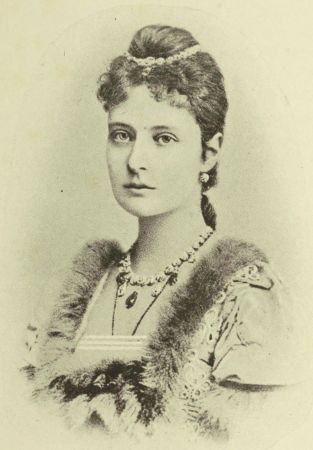 THE CZARINA
When she was Princess Alix of Hesse-Darmstadt, before her betrothal to
the Czar, 1894.
sympathy. One pitied her for finding herself so suddenly placed in a
position for which she had not been at all prepared, and one felt
disposed to grant her every indulgence in case she made a mistake of
some kind or other, which was almost an unavoidable thing. Some people,
whose English sympathies predisposed them in her favor, rejoiced openly
to see the Throne occupied by a granddaughter of Queen Victoria, and
hoped that the latter’s influence and example would induce the new
Empress to try and persuade her husband to renounce the principles of
the tyrannous autocracy followed by his predecessors. The man in the
street, however, remarked that nothing but bad omens surrounded this
hurried marriage, and recalled the old Russian proverb, that
“wedding-bells ought never to be heard in conjunction with funeral
ones.”
The most unconcerned person seemed to be the bride herself as, amid the
hushed expectation of the crowd assembled on her passage, she entered
the chapel of the Winter Palace on the arm of him who since a few days
was Nicholas II., Emperor and Autocrat of All the Russias.
A murmur of admiration followed her as she passed. Seldom has anything
more beautiful graced human eye than Alexandra Feodorowna in her
wedding-dress, as she slowly walked along, with a diamond crown on her
head and a long mantle of cloth of gold lined with ermine falling from
her shoulders, and carried by Court officials in embroidered uniforms.
She was a real vision of loveliness, “divinely tall and divinely fair,”
and in the general feeling of admiration excited by her radiant beauty
but few people noticed the thin, set lips, pressed together in firm
determination, and the hard chin, which gave a disagreeable expression
to what otherwise would have been a faultless face. Behind her, also in
white attired, walked the Empress Marie, sobbing the whole time, and
leaning on the arm of her aged father, the King of Denmark. Every heart
went out to her in her widowhood and loneliness; while many wondered
whether her successor, on the Throne she had graced so well, would ever
become as popular as she had been during her short reign of thirteen
years.
An hour later a State carriage with outriders drove the newly wedded
couple from the Winter Palace to that of Anitchkoff where they were to
take up their residence with the Dowager Empress until their own
apartments were made ready for them. The bride was greeted with
vociferous cheers by the crowds. It was the one solitary occasion in her
life when she could have the illusion of being popular with her newly
acquired subjects. Eighteen months later these were to show to her in an
unmistakable manner that such was far from being the case, when she was
making her entry into that old town of Moscow, where the Imperial Crown
was to be put on her brow, to replace the orange flowers which had
adorned her head on her wedding morning.