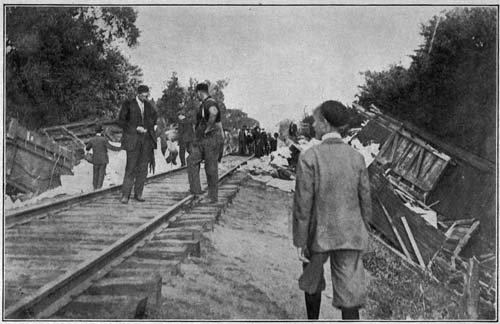
It makes little difference what phase of the situation
between labor and management on American
railroads we choose to investigate, the supreme
importance of personality and personal responsibility
is impressed upon us at every turn. As with the
safety problem in the operating department, so with
all questions relating to piece-work and the bonus
system,—the principle at stake is not only the
absolute right, but the fundamental obligation, of
every man to do his level best under all circumstances,
just as truly and inevitably in the best interests
of a railroad as of human progress and civilization.
The story of the stifling of personality and
of the neglect of the human equation in American
industrial life, and on the railroads in particular,
will probably have to be related and insisted upon
over and over again before public opinion can be
brought to realize the widespread nature and importance
of the issue.
The principles involved in an ordinary preventable
accident on a railroad can be picked out and
followed through different stages of railroad life, all
the way up to the leveling process which, generally
speaking, the labor unions insist upon, in promotion
by seniority and in matters relating to mechanical
work in the railroad shops. The steps in the process
are all as plain and unmistakable as the rounds
of a ladder. Let us begin with one of the first appearances
or germs of the trouble.
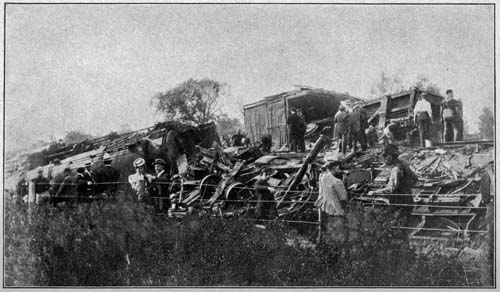
A freight train is backed into a yard or side-track,
and by reason of rough handling or carelessness
a small collision occurs, and several cars loaded
with valuable merchandise are jammed down and
off the end of the track into the swamp. The superintendent
investigates the case and decides that
the engineman was guilty of rough and careless
handling. The engineman appeals from this decision,
claiming that a wrong motion was given by
the brakeman, or the brakes did not hold,—anyway
he appeals, and his contention is taken up and
supported by his organization. After weeks of discussion
and attempted arbitration, the whole business
is quietly dropped, because the men decline to
give in and the management, with the business interests
of a wide section of country in actual peril,
are not prepared to tie up the road and fight the
issue to a finish. It is useless to minimize the widespread
effect of this interference. I have given an
illustration of a principle that is at work on all railroads,
and, in the way I have described, the men
are furnished with a precedent, and the managers
with a very good idea of the difficulties to be expected
in the future. So the manager now goes to
work and orders bunters put up at the end of these
tracks in all yards and sidings. He has been driven
to the conclusion that, although it may be out of
his power to teach and enforce carefulness and personal
responsibility, he can nevertheless put up
bunters which, when butted against, will act as
practical reminders in regard to the location of the
cars and the duties of the trainmen.
Although the incident described is merely a figurative
illustration, the bunter principle itself is of
widespread application, and to-day is practically the
mainstay and sheet anchor of the American railroad
manager. To a much greater extent than an outsider
would imagine, these bunters, derailing
switches, and other mechanical devices for the protection
of life and property, are, in the main, confessions
of weakness and indications that the personality
of the men along these particular lines has
been tried and found wanting.
As another illustration of our topic, but of a
somewhat different nature, let us now take a glance
at what is usually known as the a “Nine-Hour Law,”—more
especially in its application to telegraph
operators.
Twelve or fifteen hours at a stretch is too long a
period for any man or boy to remain in harness.
As I look at it, the primary object of this law is, or
should be, to increase the efficiency of the service.
This is particularly desirable, for the reason that
some of the worst wrecks in the history of railroading
have been attributed to sleepy and careless telegraph
operators. But it by no means follows that,
because the law has increased the operator’s pay
and shortened his day’s work, it has also increased
his efficiency. You can depend upon a good man,
who works twelve hours at a stretch, while you can
place little reliance upon a shiftless fellow who is
called upon to work only nine. To increase efficiency
in any department or industry, you must touch or
act upon personality in some way. This giving of
something for nothing by the United States government
is at best a very questionable proceeding,
and it is a pity that the nine-hour law could not
have been framed with at least some reference to
merit, attention to duty, and length of service.
The man who works eight hours at high pressure
is much more likely to be overworked, and, generally
speaking, is more worthy of assistance than
the twelve-hour man, who may handle on an average
one message per hour, and consequently has
difficulty in keeping awake. Unprejudiced judges
are of the opinion that, as framed at present, the law
will have no effect whatever upon the efficiency of
the service. Of course the function of a railroad
manager is to promote efficiency, but laws of this
description ignore the usual and constituted authority
and divert the attention of the employees
to their unions and to the national government.
But now we will take up this matter of personality
and the human equation from a vastly more important
point of view.
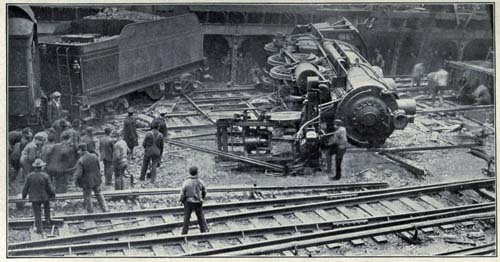
A very serious and somewhat remarkable accident
took place quite recently—an engine attached
to a passenger train ran into an open draw and
dropped thirty feet, leaving the tender and four
coaches, containing seventy-five passengers, on the
brink. The following day, in a report of this accident,
the Boston “Transcript” quoted President
Tuttle of the Boston & Maine Railroad, as follows:—
“You can’t open that draw, you can’t pull the
bolts that block it, until all signals are set for danger,
and they remain at danger while the draw is
open. They do not disappear until the draw is
closed and the signals for a clear track are set.
The engineman knew these signals were there,
and he knew what they meant. A railroad may
supply every safety device known to modern science
for precaution, it may put in the perfection of
safety appliances for the safety of its passengers
and its stock, but you can’t get by the human equation.
You’ve got to stop right there. You can
only discharge the man and get another, and, in
turn, he is liable to do the same thing.”
Every word of the above statement of the president
of the Boston & Maine Railroad is true.
It is the conclusion of common sense, of the law,
and of the prophets on the subject. And yet the
criticism which I intend to apply to it is most damaging.
It is, alas, only too true that practically very
little good is accomplished by discharging a man
who runs a passenger train into an open draw. It
is simply a case of locking the stable door after the
horse has been stolen. But the principle of punishment
for offenses of this nature is universally recognized,
and in the matter of railroad accidents it
thus becomes the duty of the managers, supported
by public opinion, to see to it that this punishment
is inflicted at the right time and in the right place.
On a railroad, with human life and much valuable
property at stake, a system of discipline that does
not punish for trifles is a mockery. As a practical
matter of fact, all mistakes and accidents, without
serious consequences, can be written down as trifles;
and taking the situation in a wide sense, covering
all railroads, it is safe to say that there is no
power in the country to-day that is either able or
willing to discipline enginemen for trifles. When
a passenger train has been brought to the brink
of a draw, it is too late a day to apply your prevention
method.
The battle in regard to this matter has long ago
been fought and won by the men. The Brotherhood
of Locomotive Engineers is now in a position to tire
out any board of railroad management in the country.
The statement made in Faneuil Hall by a railroad
man, that in rush times the management will
“lap up any schedule that is placed before them,”
was no empty boast. The right of unlimited appeal
to be found in the schedules of the organizations
has knocked the ground from under the superintendent
and made the punishment for trifles a practical
impossibility. The public may just as well be
informed of the facts now as later. The men upon
whose vigilance and caution the safety of railroad
travel is altogether dependent are not being educated
in a school in which even the rudiments or
principles of safety are being taught or insisted
upon. That a great majority of railroad employees
are sound in their habits and thoroughly honest
and conscientious in their intentions, is not open
to question; but it is practically the fault of these
good men that the careless individuals are not subject
to discipline, and so cannot be weeded out before
the day of reckoning. But, as a matter of fact,
the system is almost as fatal to the best man as
to the worst, and in the words of President Tuttle,
“You can discharge a man and get another, and,
in turn, he is liable to do the same thing.”
Furthermore, however unpalatable the truth may
be, it is nevertheless an unquestionable fact that the
American railroad man, above all others, is most
in need of an inflexible system of discipline. The
reasons are obvious. To begin with, the railroad
man is a typical American. He is fearless, quick,
clever, and resourceful. He cuts loose, only too
easily, from custom and tradition. He has supreme
confidence in his own individual importance and
ability. In unmistakable quality and quantity he
is in possession of the sterling characteristics that
have made the American the most resourceful antagonist
by land or sea, the cleverest designer and
inventor, the most fearless innovator and reformer,
and the poorest railroad man, from the safety standpoint,
in the world to-day.
Nothing can be more simple than the explanation
of this paradox. In the mental composition of
the American railroad man there is no such idea
or faculty as dogged obedience. And yet it must be
evident to the most superficial thinker on this subject
that never can there be any prospect for, or
approach to, safety in railroad travel, without this
indispensable ingredient of personal character. It
is the sine qua non of successful railroad operation.
“Theirs not to reason why” is the solution of the
safety problem in a single forceful expression. And
yet in a lifetime of railroad service, I can honestly
affirm that I never met more than half a dozen railroad
men who had any conception, either in theory
or practice, of this principle of dogged obedience.
Furthermore, I never came across a manager who
was big enough to preach the doctrine, and I am
equally certain I have never read in the newspapers
or magazines any widespread expression of public
opinion that would lead a railroad manager to expect
public support and approval of any such principle.
Consequently, my argument is an arraignment
not only of the men, the unions, and the
managements, but of the manifest opinion and public
policy of the American people. The price that
is being paid in tribute to this lack of dogged obedience
and its attendant evils is graphically emphasized
in the Twenty-first Annual Report of the
Interstate Commerce Commission, issued December
23, 1907, as follows:—
“Accidents to trains on the railroads in the
United States continue to occur in such large
numbers that the record, as has been repeatedly
declared by conservative judges, is a world-wide
reproach to the railroad profession in America.”
That the men should lack the faculty I speak
of is not, under the circumstances, so very surprising;
but that a great many railroad managers,
as well, should remain uncertain and doubtful as
to its fundamental importance, is by no means so
easy to understand. Some time ago the writer of
this essay received in writing, from the head of
the operating department of one of our largest railroad
systems, the following question:—
“Is it not equally essential that the meaning of
and reason for a rule should be evident on its face
as that the rule itself, that is, its wording, should
be plain and unmistakable?”
My reply was as follows:—
“By no means. From the safety standpoint the
order itself is primary; the reason for its being in
the time-table is secondary. Is it not very significant
that the principle of dogged obedience should
be open to question on a railroad, while, in the
case of a city ordinance or a state law, no liberty
of thought or action in such matters is tolerated
for a minute?”
The following illustration is interesting and well
to the point:—
In our time-tables we have a rule for the guidance
of enginemen on what are called “helping engines,”
which reads something like this: “Never hang up
the numbers of the train you are going to help on
your headlight, until you are actually hitched on
to said train.” The reason for this rule does not
appear on its face, and yet the rigid necessity for
dogged obedience in regard to it will at once be
understood, when we study its origin.
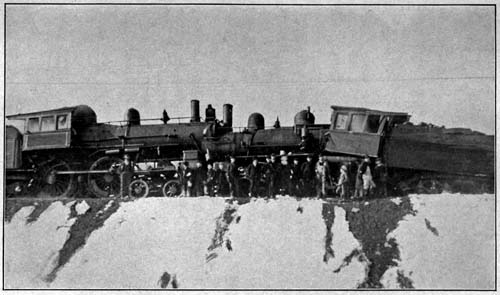
About twenty years ago, while working as telegraph
operator at East Deerfield, Mass., I received
a telegram ordering an extra engine out of the
round-house to help a regular freight train, No. 94,
which was expected in from the east. Meanwhile
the helping engine stood waiting on a siding with
“94” displayed on its headlight. Before long an
extra or “wild” freight train from the west, with
orders to meet No. 94 at East Deerfield on single
track, came along, and, mistaking the engine with
“94” on its headlight for the regular train, kept
on its way without stopping. No. 94 and this wild
freight met in a cut, and “piled up” in probably
the worst “head-on” freight collision in the history
of the old Fitchburg Railroad.
Every rule in the time-table has its history written
in suffering and dollars; and while, of course,
it is advisable for employees to be conversant with
their meaning and significance, it is evident that
the principle of dogged obedience is the only safe
method for employees to pursue in regard to them.
An inflexible enforcement of this principle would
be looked upon as little short of tyranny; and yet,
seriously and fairly considered, it is nothing but
the subordination which every railroad man owes
to the community in the interest of safety and general
efficiency. That the organizations of railroad
men do not insist upon, or even countenance, this
absolute subordination to authority, is thoroughly
understood by every man and manager in the service.
We are all tarred with the same brush, and
rather than acknowledge the weakness of our position,
we prefer to keep calling on the public to pay
the penalty. It is time to call a halt when the liberty
and liberal views of a few endanger the safety
of the many.
But in passing from this branch of my subject, I
wish to call attention to an almost unnoticed fact
in regard to the efficiency of railroad service. Taking
an accident bulletin, issued by the Interstate
Commerce Commission, at random, I copy the
following:—
“The total number of collisions and derailments
during April, May, and June, 1907, was 3777, of
which 220 collisions and 221 derailments affected
passenger trains. The damage to cars, engine,
and roadway by these accidents amounted to
$3,232,673.”
This report, treating as it does exclusively of
collisions and derailments, is serious enough, but
the note that is appended to it is the significant
feature of the situation:—
“Collisions and derailments which cause no death
or personal injury, and which cause not over $150.00
damage to the property of the railroad, are not
reported.”
Seeing that the public should be in possession of
all the facts in regard to efficiency of service, it
occurs to me that a list of narrow escapes and of
collisions and derailments which cause no deaths
or personal injury, would make very interesting
reading. These are the very “trifles” to which I
have already called attention. They are the seed
from which we reap our crop of disasters. They
are well worth reporting and paying attention to,
and no annual or other statement of the situation
on the railroad is worth much if it fails to recognize
the significance of this feature.
But apart from the influence and power of the
railroad organization upon the individuality and personal
conduct of its members in relation to train
wrecks and discipline, there is another branch of
the topic that is perhaps still more interesting,
from a human and national point of view.
Comparatively speaking, public attention has been
but slightly directed in any specific way to the
matter of accidents to employees on American
railroads. It is certainly one of the most distressing
features to be studied in connection with the
safety problem. Collisions, derailments, defective
hand-holds and brake apparatus, and the like, cause
injuries to great numbers of employees. For example,
at Haverhill, N. H., the other day, five employees
were instantly killed, through the alleged carelessness
or oversight of a fellow employee. Such
instances, of course, are particularly painful topics
for discussion among railroad men, and yet this
is the kind of an accident one reads about in
the newspapers almost daily. But in twenty-four
hours the reading public will forget the very worst
of these accidents to employees. Their frequency
takes the edge off their significance. During the
year 1907, on a single American railroad, 104 employees
were killed outright, and 3575 were injured.
The cost of these accidents to the railroad in question
was something like $285,000. With an employers’
liability law in force and operation, as in
countries abroad, the increase in total paid to employees
alone on this road would have carried the
aggregate to half a million dollars. The magnitude
and importance of the safety problem in relation to
employees is still more evident when we consider
that for the year ending June 30, 1907, the casualty
list on American railroads shows a total of all persons
killed, from all causes, of 5000, and injured
72,286; the totals for employees alone being 4353
killed and 62,687 injured.
The following figures in regard to actual train accidents
and the casualties resulting therefrom show
a rather discouraging state of affairs, from the fact
that the employees themselves were in the main
responsible for them. In 1904 the killed and injured
employees in train accidents numbered 7834; in
1905, 7850; in 1906, 8362; and in 1907, 9935. As
with all other items, so with accidents to employees,
the total of casualties has largely increased year by
year.
But one of the most distressing features to be
considered in connection with accidents to employees,
whether caused by their own carelessness
or otherwise, is the absolute indifference with which
news and statistics of such casualties appear to be
received by the average railroad man. So far as an
impartial investigator would be able to discover,
“It’s too bad” is about the limit of criticism and
action in such matters. The indifference I call attention
to, so far as the minds of the employees are
concerned, is not real, and the actual reason and
history of the seeming neglect can easily be located
and analyzed.
WHAT COMES FROM A MISPLACED SWITCH
The railroad employee, as a unit, is whole-souled
and sympathetic; not a suspicion of indifference
can be imputed to him, either as a man or as a
brother. Individually speaking, when a passenger
or an employee is injured, there is no sorrow like
his sorrow; but, unfortunately, the organizations
or machines through which alone his desires and
sympathies can be expressed, have never shown
any disposition to interest themselves in any practical
way in matters relating to the safety of the
public, or of the employees, whenever such interest
is liable to develop into a probe of the conduct and
efficiency of the railroad man. The heads of the national
organizations of railroad men, with particular
reference to those connected with the operating
department, occupy positions that are usually three-quarters
political. The wishes and sentiments of
great majorities of employees on certain railroads
can be, and have been, set aside by the political
shake of the head of one man in Washington or
Chicago. The acquiescence of the rank and file in
this state of affairs is paid for in legislation and
concessions. Nevertheless, from the human and
social point of view, it would seem as if the organizations,
or men-machines as we may call them,
should bestir themselves in this matter of accidents
to their members. In order to do this, coöperation
with the management is necessary; so
the following questions very naturally arise:—
By consultation, or otherwise, has any personality
been put into the business? Have our organizations
ever said to their members, “Come, boys, let us
reason together: when a man runs a signal, or disobeys
orders, it is a disgrace to our machine. In
reality we, the employees, are the principal stock-holders
in a railroad. When passengers, or our own
members, are killed or injured, we have to pay a
large proportion of the bill. We pay in loss of prestige
and character, and every time one of us makes
a mistake, it is a blot on our ’scutcheon. We should
see to it that this matter is made personal to every
member of our organization. We should coöperate
with managers in locating the blame for these accidents,
and, without regard to consequences, we
should insist upon the removal of offenders.”
Is there any evidence to show that this is the
actual state of affairs? If so, I have yet to meet a
man who is aware of it. But, on the other hand, if
no such influence is being exerted by the organizations,
in all candor, and in the name of public safety,
I ask, why not? For, right here, the public puts in
its appearance and the following additional question
must forthwith be answered:—
Are our organizations prepared to say to the
public, “We are sorry, but the fact is, our machine
is constructed purely upon selfish principles. Our
time and efforts are exclusively occupied in fencing
with the management. When passengers, even our
own brothers, are killed, it is up to the superintendent
every time. Let him change the rules if he
thinks fit, but according to precedent and the rules
of our organization in such cases, we are not expected
to show any signs of sympathy or humanity.
Consequently, to all interests apart from what may
be called the political welfare of the whole machine,
we are deaf, dumb, and blind?”
Is this an overdrawn picture? I think not. It is
simply a truthful matter-of-fact description of railroad
organizations, from whose calculations and
behavior the personal and sympathetic element in
regard to these safety questions has been eliminated.
But now, widening our horizon a little, we have
next to take note that these questions of personal
character, personal responsibility, and unhampered
personal effort, are real and intense problems for
thoughtful people to study, not only in relation to
preventable accidents, but in every department of
railroad life.
Some time ago, in an issue of the “Engineering
Magazine,” a note of warning was sounded
against the result of certain American manufacturing
methods. It was pointed out that the principle
of securing the largest output of uniform
character, at minimum cost, made automata of the
operatives, and discouraged skilled and trained
artisans to so great an extent that the quality of the
men to-day, for lack of proper inspiration, was generally
poor and unreliable. According to the opinion
expressed in the article that I refer to, many
American manufacturers are beginning to realize
the necessity of attracting men of high character
to their employ, of surrounding them with an environment
tending towards sobriety, integrity, and
industry, and rewarding them according to their
efforts, in order to avoid the effects of this so-called
“American tendency.”
That American methods of conducting business
should be considered retrogressive, on account of
lack or poverty of inspiration, certainly points to
unhealthy conditions somewhere. If these American
tendencies can be shown to have the effect
of discouraging individual effort and the natural
growth and ambition of the worker on railroads or
elsewhere, the matter certainly calls for serious attention.
To say the least of it, it betokens a very
peculiar state of affairs, for the reason that if there
be one characteristic that more than another distinguishes
the American citizen from the rest of
the world, it is his freedom of personal action, his
propensity for striking new and unexplored trails in
almost every branch of research, industry, and invention.
The American is par excellence the world’s
inventor. And yet, without the utmost liberty of
thought and action, an inventor would cut but a
sorry figure. It follows, therefore, that any curtailment
of or interference with these distinctively
American gifts and instincts will, as they say, bear
watching.
Quite a number of years ago an American firm
secured a contract for the erection of a large factory
somewhere near Manchester, England. The
contractor soon discovered that no persuasion or
encouragement would induce the British workman
to lay more than a certain number of bricks per
hour, according to the fixed law and schedule of
his union. In order to complete the work within
the allotted time, the contractor was compelled to
send for American bricklayers. These men, who
were paid according to their industry and personal
effort, were able to lay four bricks to the Englishman’s
one. The American could beat the Englishman
four to one, not because he was, to that extent,
a cleverer and quicker workman, but because
at that time and place he was a free man. Transferred
to American shops and factories, and in a
different atmosphere, the foreign workman easily
adapts himself to conditions and is able to hold
his own.
According to the writer in the “Engineering
Magazine,” American manufacturers are taking
measures to stimulate and revive the principle of
individual effort, in order to secure excellence in
workmanship; but, according to other authorities,
these efforts are being counteracted by the labor
unions on the railroads and elsewhere, which appear
to be following in the footsteps and adopting
the methods of the British organizations. However,
the ideas and ideals of many wide-awake manufacturers
and managers have found practical exemplification
in various manufacturing establishments,
as well as in railroad shops in different parts of the
country.
Perhaps the best field for a short consideration
of this interesting subject, so far as railroads are
concerned, is to be found on the Santa Fé Railroad
system. The introduction of the individual-effort
reward or bonus system of stimulating employees
to extra or unusual effort, and of compensating
them suitably therefor, is probably the most important
of all the betterment work on this railroad.
The inauguration of the system followed the strike
of the machinists, boiler-makers, and blacksmiths,
in May, 1904. The credit for its introduction on
the Santa Fé is due to Mr. J. W. Kendrick, Second
Vice-President. Mr. Charles H. Fry, associate
editor of the “Railroad Gazette,” who has written
a valuable and comprehensive report of this betterment
work, gives the following as its principal features
and objects:—
“To restore and promote cordial relations, based
on mutual respect and confidence, between employer
and employee;
“To restore the worker to himself by freeing him
from the small and debasing tyrannies of petty and
arbitrary officials on the one side, and from individuality-destroying
union domination on the other;
“To give the company better, more reliable, and
more trustworthy employees;
“To increase automatically, and without fixed
limit, the pay of good men, this increase of pay depending
on themselves and not on their immediate
superiors;
“To increase the capacity of the shops without
adding new equipment;
“To increase the reliability of work turned out
and the efficiency of operation performed;
“To do all these things, not only without cost to
the company, but with a marked reduction in its
expenses.”
The programme was certainly ambitious and
praiseworthy, and in Mr. Fry’s report the results,
after a thorough trial extending over several years,
are given in the following paragraph:—
“It can safely be said that the betterment work
has resulted as anticipated in restoring harmony
between employer and employee, in restoring self-respect
to the latter and increasing his efficiency
and reliability. Also it has raised his wages ten to
twenty per cent on the average. In addition, for
every dollar of supervising and special expense incurred,
the company has saved at least ten dollars
in reduced costs.”
But just here two very important points require
to be noticed and emphasized. In the operations of
a railroad, efficiency must never be sacrificed for
the sake of economy, and on the Santa Fé Railroad,
when questions arise in which there is even the
remote possibility of impairment of efficiency, all
economical propositions or arrangements are at
once postponed or vetoed altogether. Again, it is
manifest that as a result of the improved methods
and greater individual effort, certain reductions in
working force will become possible. In regard to
this matter the Santa Fé management claims that
such reduction, when necessary, can easily be effected,
simply by not replacing men who naturally
drop out. This has been their uniform policy, and
therefore, from their point of view, there is no possible
ground for objection by employees on that
score.
The individual-effort reward system on the Santa
Fé thus far has been limited to the maintenance of
equipment and to locomotive operation. The labor
employed in the shops is, of course, distinctly non-union.
The saving effected under these methods
on tools and machinery alone, at Topeka, was
$119,000, and the total economy on 1633 locomotives
(repairs and renewals) for the year 1906
amounted to $1,737,626. These facts and figures
are derived from a comparison of the cost of actual
and identically similar work before and after the
inauguration of the bonus system.
It is impossible at this time to enter into a minute
explanation or description of the system which is
to-day in actual operation on the Santa Fé Railroad,
and under which satisfactory results, both to employer
and employee, are being obtained. The work
itself is notable not so much because of its economical
results as on account of its moral and sociological
aspects. Without taking any side in the
questions at all, it is evident that the movement and
work on the Santa Fé, from beginning to end, has
been an appeal to individual effort and character, and
a protest against the recognized ideals of the labor
unions. But it will not be found necessary to go into
details of the Santa Fé system in order to illustrate
and emphasize the principles that are at stake and
the nature of the problem that must, before long, be
settled, one way or the other, by an educated and
enlightened public opinion.
On the Santa Fé Railroad, prior to the installation
of the bonus system, a vast number of time-studies
had to be made and schedules prepared.
Every operation or piece of work to be bonused
had to be studied by competent men, to determine,
from the machine and other conditions, a fair or
standard time to apply to it. Thousands of such
studies have been made at the Topeka shops, and
properly recorded and preserved on regular blanks.
The following illustrations are only partially descriptive
of the Santa Fé method, but they are sufficiently
accurate to cover the principles involved,
the benefits that are derived from them, and some
of the objections which have been advanced by the
union men on the railroads, who are opposed to the
bonus system in any form.
You take a certain piece of machinery, say a part
of a locomotive. You make a “study” of this part.
After making one hundred tests, under all sorts of
conditions, you make a schedule in your machine-shop
for this particular operation or piece of work.
You then fix upon a standard time for doing this
work. Standard time is simply the time which it
ought reasonably to take to do the work without
killing effort, but by eliminating every unnecessary
waste. The elimination of waste is the fair and
square proposition you present to your workman.
You say to him, “Make a standard time on this
piece of machinery, and I will pay you twenty per
cent above your hourly rate, that is, above your
regular pay. If you take more than standard time,
your bonus will diminish until at fifty per cent above
standard time it will simply merge into your day
rate. On the other hand, if less than standard time
is taken, your bonus will increase above twenty per
cent. But, under any conditions or circumstances,
you will always receive your full day’s wage.”
The situation becomes still plainer, if you explain
it to your workman in this way. You say to him,
“During the past year I have watched your work
closely, and made hundreds of ‘studies’ in regard
to the ‘part’ you turn out with that machine. I find
that you have averaged about six to the hour. Now
I am convinced that you can just as well turn out
seven. Your pay is now $2.50 per day; if in the
future you can make seven instead of six of these
‘parts’ in an hour, I will pay you $3.00 per day. In
fact, your pay will increase in exact proportion to
your cleverness and industry. Furthermore, if by
any manner or means you can invent a way, such,
for instance, as an improvement in the mechanism
or in the operation of your machine whereby you
are enabled to turn out a dozen of these ‘parts’ in
an hour, I will see to it that your pay is increased
accordingly, without any limit whatever.”
Continuing our general illustration, we will now
take it for granted that you are able to start this
bonus system in your factory or shop, in which,
under ordinary circumstances, you give employment
to one hundred union men. At the end of a certain
period you find, on account of the extra effort put
forth by the most ambitious and cleverest men,
that the number of these “parts” which you require
in your business, or on your railroad, can easily
be turned out by seventy-five men. So without delay
you reduce the working force in your shop accordingly.
It matters not how you do this, whether
by simple discharge or by omitting to fill vacancies
as they occur in a natural way, the fact remains
that at the end of the year you have decreased your
force twenty-five per cent, and besides, without adding
to your equipment, you have made a substantial
reduction in your operating expenses.
Meanwhile the men who have lost their jobs have
lodged a complaint with their union, and you are
soon confronted with a grievance committee. These
gentlemen inform you that the bonus system is all
wrong, from beginning to end. From the union
standpoint they will explain to you that the idea is,
not to offer a reward for quickest and best work,
nor to encourage the best men to get rich quick, or
to vaunt their superiority over their duller and less
fortunate comrades, but to make the job, whatever
it may be, last as long as possible, and thus to afford
employment to the greatest number of workers, at
a fair and fixed rate of wages to every individual,
regardless of ability or ambition, or of the profits
and interests of the establishment. You are further
informed that the grievance committee cannot enter
into the discussion of ethical and sociological questions.
The race is doing pretty well as a whole, and
posterity will accord to labor its due share of credit.
Meanwhile the men will be called out of your shop,
and the issue between the bonus system of reward
for individual effort and the leveling process in
shop-work will be fought to a finish.
Take another illustration: You make a great
many “studies” in relation to the use of oil and
other supplies on a locomotive on your railroad.
You arrive at a fair standard of expense. You conclude
there must be considerable waste going on
somewhere, so you say to the engine crews, “So
much per month is a fair average of expense for
such and such tools and supplies on your engine.
If you can lower this average, we will share the
amount saved in this way.” So you put the system
in force on one thousand locomotives and save
thereby four thousand dollars per month, which
you divide with the men. But in doing this you
have increased the pay of the careful men, and done
nothing for those who are not interested in the general
welfare of your railroad. The grievance committee
takes the matter up with you; it protests
against the whole business, and puts forth the argument
that it is a dangerous proceeding, for you are
guilty of encouraging a certain class of men to let
engines “run hot” in order that they may secure
your bonus for economy. In a word, you are requested
to put a stop to this phase of your bonus
system on the railroad.
Regardless of my somewhat crude and incomplete
method of explaining the working of a bonus
system on a railroad, my illustrations afford a very
good idea of the Santa Fé system, which is in successful
operation at the present day, as well as the
proposed plans of the New York, New Haven &
Hartford management, which quite recently the
labor unions compelled the railroad to abandon.
But apart from successful operation in one quarter
and defeat in another, the principles at stake in
this bonus system are of world-wide interest and
importance. Bearing this in mind, a few direct and
pertinent questions have occurred to me, which I
submit for the thoughtful consideration of my fellow
workers on the railroads, as well as of liberty-loving
people everywhere.
In the interest of human progress, and in particular
with a view to efficiency of railroad service, do
you think a railroad man should be permitted and
encouraged to do his level best under all circumstances?
Would you recognize and promote individual
effort and good work in your sawmill, if you
owned one, for the good of the business and in the
interest of your pocketbook? Would you recognize
and promote individual effort, attention to duty, and
efficiency of service on a railroad, understanding, as
you do, that upon these personal characteristics the
welfare of the railroad and the safety of the traveling
public are almost wholly dependent? Again,
would you hesitate to encourage and reward the
economical administration of the affairs of your own
town or your sawmill, for fear lest the departments
or the machinery might be deliberately ruined by
employees, or by your fellow townsmen, in their
efforts to secure said reward and encouragement?
If, after painstaking experiment, you become convinced
that the plan would result in benefit to the
interests of both management and men, would you
hesitate to offer a bonus, or reward on coöperative
principles, as an incentive to the economical use of
supplies on a locomotive, for fear lest unprincipled
engine crews should play tricks with the engine in
order to secure the bonus?
Furthermore, if the encouragement of the best
men and the best service can be shown to work
against the interests of second-class men and poorer
service, would you be willing, on a railroad, to sacrifice
these second-class men and their interests, in
so far as this action should become necessary, to
secure the greatest possible efficiency for the safeguarding
of the traveling public?
Finally, in the history of the development and
civilization of the human race, is it possible to point
to a single item of real progress, efficiency, or
achievement, that has not been the direct result of
the sacrifice of something below to the more important
interests of something above?
Does it not therefore follow that any legislation
or labor movement that has the effect of checking
individual effort, or of interfering in any way with
the free play of the best that is in any man, must
necessarily reduce the standard and ideals of labor?
for such movements are an inversion of the laws of
progress, and at the same time a reflection on the
best thought and tradition of the American people.