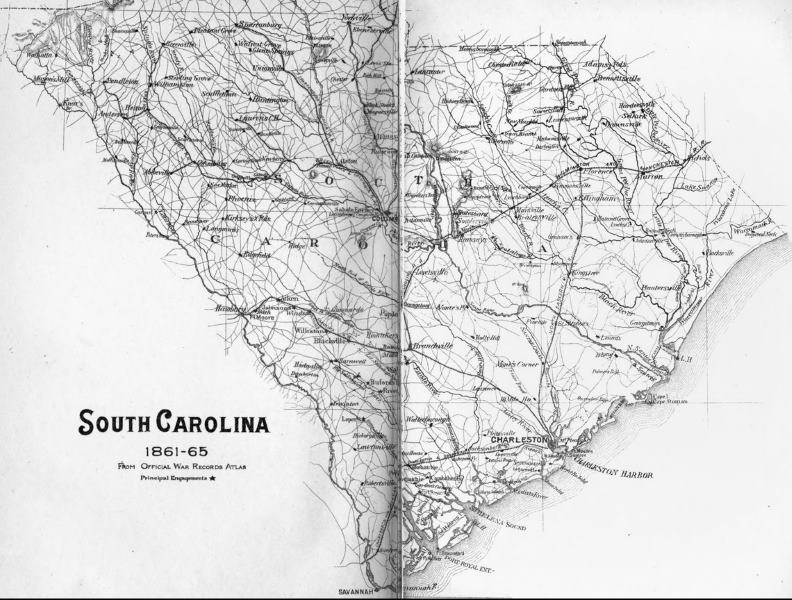
MAJOR-GENERALS AND BRIGADIER-GENERALS, PROVISIONAL
ARMY OF THE CONFEDERATE STATES,
ACCREDITED TO SOUTH CAROLINA.
Brigadier-General Barnard E. Bee was born at Charleston,
S. C., in 1823, the son of Col. Barnard E. Bee, who
removed to Texas in 1835, and grandson of Thomas Bee,
the first Federal judge of the State of South Carolina.
He was appointed as a cadet-at-large to the United States
military academy, and was graduated in 1845, with promotion
to brevet second lieutenant, Third infantry.
Immediately afterward he served in the military occupation
of Texas, and during the war with Mexico participated
in the battles of 1846 at Palo Alto and Resaca de
la Palma, after which he was on recruiting service with
promotion to second lieutenant. In 1847 he took part in
the siege of Vera Cruz, and while storming the enemy's
intrenched heights at Cerro Gordo, was wounded and
earned the brevet of first lieutenant. His gallant record
was continued in the conflicts at Contreras, Churubusco,
Chapultepec and the City of Mexico, winning for him
the rank of brevet captain and a sword of honor from
South Carolina, his native State. After the close of this
war he served as adjutant of the Third infantry at various
army posts on the frontier, until the spring of 1855,
with promotion to first lieutenant in 1851, and to captain
of the Tenth infantry in 1855. For a short time he was
detached at the cavalry school at Carlisle; then was on
frontier duty in Minnesota; marched with Albert Sidney
Johnston to Utah in 1857, and in that territory served as
lieutenant-colonel of the volunteer battalion until the
close of 1858. He was on duty at Fort Laramie, Dak.,
when he resigned in March, 1861, to enter the Confederate
service. First commissioned major of infantry,
C. S. A., he was promoted to brigadier-general, provisional
army, in June, and given command of the Third brigade
of the army of the Shenandoah, under Brig.-Gen. Joseph
E. Johnston, whose other brigade commanders were
Colonels Jackson, Bartow and Elzey. Bee's command
was composed of the Second and Eleventh Mississippi,
Sixth North Carolina and Fourth Alabama regiments,
and Imboden's battery. After participating in the maneuvers
in the valley against Patterson, his brigade was
the first to reinforce Beauregard at Manassas Junction,
arriving there on July 20th. He selected the position
for the artillery on the morning of the 21st near the
Henry house, almost simultaneously with the placing of
Rickett's battery on the opposite hill, and ordered the
opening of the artillery fire which checked the Federal
advance and made the subsequent victory possible. He
was the ranking officer on this part of the field during the
early hours of battle, and supported Evans with his own
and Bartow's brigades, while Jackson followed and took
position on the line he had selected. Forced back by
Federal reinforcements, he rallied his troops, and during
the confusion shouted the historic words: "Look at Jackson's
brigade. It stands there like a stonewall." His
gallant men soon reformed and drove the Federals from
the Henry house plateau which they had gained, and soon
afterward were in turn driven back by the enemy. In
the second charge of the Confederates which swept the
Federals from the disputed position, captured the Rickett
and Griffin batteries, and won the day, General Bee fell
mortally wounded near the Henry house, close to the spot
where he gave his first orders for battle. He died the
following morning, July 22, 1861, in the little cabin on
the field where he had made his headquarters. The
death of General Bee, in this first great battle of the
war, caused universal mourning in the South. He was
an officer of tried courage and capacity, and had the
promise of a glorious career in the great struggle into
which he had entered with such generous enthusiasm.
* * * * *
Brigadier-General Milledge Luke Bonham was born
near Red Bank, Edgefield district, December 22, 1813,
the son of Capt. James Bonham, who came from Virginia
to South Carolina about the close of the last century, and
married Sophie, daughter of Jacob Smith, niece of Capt.
James Butler, head of an illustrious South Carolina family.
The grandfather of General Bonham was Maj. Absalom
Bonham, a native of Maryland and a soldier of the
revolutionary war. General Bonham, after graduation
at the South Carolina college, had his first military
experience as a volunteer in the company of Capt. James
Jones, in the Seminole war, and was promoted to brigade
major, a position corresponding to adjutant-general of
brigade. Subsequently, while beginning his career as a
lawyer and legislator, he continued his association with
the militia and attained the rank of major-general. When
war began with Mexico he went to the front as lieutenant-colonel
of the Twelfth United States infantry, and
served with distinction, earning promotion to colonel,
and remained in Mexico a year after the close of the war,
as military governor of one of the provinces. Then
returning home he resumed the practice of law, was
elected solicitor of the southern circuit, and in 1856, upon
the death of Preston S. Brooks, was chosen as the successor
of that gentleman in Congress. Upon the secession
of the State he promptly resigned and was appointed
commander-in-chief of the South Carolina army, with the
rank of major-general. In this capacity, and waiving all
questions of rank and precedence, at the request of Governor
Pickens, he served upon the coast in hearty co-operation
with General Beauregard, sent there by the provisional
government of the Confederate States. At a
later date he was commissioned brigadier-general in the
provisional army, and he took to Richmond the first
troops, not Virginian, that arrived for the defense of the
capital. His regiments were commanded by Colonels
Kershaw, Williams, Cash and Bacon, and were conspicuous
in the operations before Washington and in the first
battle of Manassas. Afterward, in consequence of a disagreement
with the war department, he resigned and was
elected to the Confederate Congress. In December,
1862, he was elected governor of the State, an office which
he filled with credit. In January, 1865, he was appointed
to command of a brigade of cavalry, in the organization
of which he was engaged at the close of military operations.
His subsequent career was marked by the same
ardent patriotism. As a delegate to President Grant
from the taxpayers' convention, and a supporter of the
revolution of 1876, he rendered the State valuable service.
He was the first railroad commissioner of South
Carolina, in 1878, and subsequently chairman of the commission
until his death, August 27, 1890. As a soldier
he is described as "one of the finest looking officers in
the entire army. His tall, graceful figure, commanding
appearance, noble bearing and soldierly mien, all excited
the admiration and confidence of his troops. He wore a
broad-brimmed hat with a waving plume, and sat his
horse with the knightly grace of Charles the Bold or
Henry of Navarre. His soldiers were proud of him, and
loved to do him homage. While he was a good disciplinarian,
so far as the volunteer service required, he did
not treat his officers with any air of superiority."
* * * * *
Brigadier-General John Bratton was born at Winnsboro,
S. C., March 7, 1831, the son of Dr. William Bratton by
his second wife, Isabella Means. He is a descendant of
Col. William Bratton, of Virginia, who removed to York
county, S. C., and was a conspicuous figure in the war of
the revolution. John Bratton was graduated at the South
Carolina college in 1850, and a few years later embarked
in the practice of medicine at his native town, having
completed a professional course at the Charleston college.
In 1861 he enlisted in the first call for ten regiments
of troops, as a private, and being promoted captain,
served in that capacity during the bombardment of Fort
Sumter, and until the State troops were called upon to
enlist in the Confederate service. His company declining
to respond, he again enlisted as a private, and with twenty-three
men of his old command helped to fill up a company
for the Sixth regiment. This was soon ordered to Virginia,
where he went as second lieutenant of Company C.
Except for the engagement at Dranesville, the year for
which the regiment enlisted was uneventful, but toward
the close he attracted the favorable attention of General
Johnston by advocating the enlistment of his regiment as
a whole for the war, and though this proposition failed,
he was enabled to re-enlist the first company of one
year's men of Johnston's army. It followed that a battalion
of six companies of the Sixth was re-enlisted, and
he was soon elected to the command, and promoted colonel
when the regiment was filled up. He commanded
his regiment with gallantry in Jenkins' brigade, Longstreet's
corps, at Williamsburg, Seven Pines, the Seven
Days' battles, and the succeeding campaigns of the
army of Northern Virginia, and in the Chickamauga and
Knoxville campaigns, where he was in command of the
brigade while Jenkins had charge of Hood's division.
After the death of Jenkins at the battle of the Wilderness,
he was at once promoted brigadier-general on the urgent
request of General Lee, and he continued to lead this
famous brigade to the end. At Appomattox, so well
had his gallant men held together, he had the largest
brigade in the army, a little over 1,500 men, and in fact
it was larger than some of the divisions. His brigade
alone made an orderly march to Danville and secured
railroad transportation for a part of their homeward journey.
When General Bratton reached home he gave his
attention to planting, and in 1866 was elected to the legislature.
In 1876 he was the chairman of the South
Carolina delegation to the national Democratic convention,
in 1880 was chairman of the State committee of his
party, and in 1881 was elected comptroller of the State
to fill an unexpired term. He was a stalwart lieutenant
of Gen. Wade Hampton in the famous campaign of
1876, was elected to Congress in 1884, and was his party's
candidate for governor in 1890. Having been for many
years identified with the agricultural interests of the
State, he was selected as the one man likely to unify his
party. With the single purpose of mitigating the evils
attending division among the whites, he sacrificed himself
on the shrine of duty, as he saw it, and though
defeated, again won the admiration of all classes. Until
his death at Winnsboro, January 12, 1898, he held firmly
the unalloyed love and respect of the people.
* * * * *
Major-General Matthew Calbraith Butler was born near
Greenville, S. C., March 6, 1836. His father was Dr.
William Butler, an assistant surgeon in the United States
navy, and a congressman in 1841; his mother, Jane T.,
daughter of Captain Perry, U. S. N., of Newport, R. I.,
and sister of Commodore Oliver H. Perry and Matthew
Calbraith Perry. Judge A. P. Butler, United States
senator, and Gov. Pierce M. Butler, colonel of the Palmetto
regiment and killed at Churubusco, were his
uncles; his grandfather, Gen. William Butler, was a gallant
officer of the revolutionary army, and his great-grandfather,
Capt. James Butler, a native of Loudoun
county, Va., was the founder of the family in North
Carolina. In childhood he accompanied his father to
Arkansas, but after the latter's death returned to South
Carolina in 1851, and made his home with Senator A. P.
Butler near Edgefield. He was educated at the South
Carolina college, and then reading law was admitted to
practice in 1857. In the following year he was married
to Maria, daughter of Gov. F. W. Pickens. He was
elected to the legislature in 1860, but before the conclusion
of his term, entered the military service of his State
as captain of a company of cavalry in Hampton's legion.
This command took a distinguished part in the first battle
of Manassas, and Captain Butler was promoted major to
date from July 21st, the beginning of his famous career
in the cavalry of the army of Northern Virginia. He
commanded the cavalry of the legion under Stuart in the
withdrawal of the troops from Yorktown, and was warmly
commended for gallantry at Williamsburg. In August,
1862, he was promoted to colonel of the Second regiment,
South Carolina cavalry, Hampton's brigade, and in this
rank he participated in the Second Manassas and Maryland
campaigns, winning favorable mention for gallant
leadership in the affair at Monocacy bridge, and in Stuart's
Chambersburg raid. He commanded the main part
of his brigade in the Dumfries expedition of December,
1862, and in June, 1863, he was one of the most conspicuous
leaders in the famous cavalry battle of Brandy Station.
Here he was severely wounded by a shell, losing
his right foot, and promotion to brigadier-general followed
in September. Returning to service before his
wound healed he was sent home to recover. He succeeded
General Hampton in brigade command, and took
part in the fall campaigns of the army in 1863, and
throughout the famous struggle of 1864, at the Wilderness,
Spottsylvania, and before Richmond in opposition
to Sheridan, he was one of the heroic figures of this last
great campaign of the Confederate armies. The reports
of Sheridan himself attest the splendid fighting of Butler
and his brigade at Hawe's Shop and Cold Harbor. At
Trevilian Station he was in command of Hampton's
division, and repulsed seven distinct and determined
assaults by the largely superior forces under Sheridan,
his command occupying the most important point of the
Confederate line and fighting as infantry. In September
he was promoted major-general, and in the spring of
1865 he was detached with a small division for the campaign
against Sherman in the Carolinas. He commanded
the rear guard of Hardee's army at the evacuation of
Columbia and Cheraw, and at the last had division command
of cavalry, his forces and Gen. Joe Wheeler's forming
the command of Lieut.-Gen. Wade Hampton. The
close of the war left him in financial ruin, but he bravely
met the exigencies of the occasion, and in a short time
attained national repute for the firmness and boldness
with which he handled the political questions which concerned
the essentials of the reorganized social life. While
he powerfully advocated obedience to the reconstruction
measures as the law, law being preferable to chaos, he
receded at no time from a persistent opposition to infringements
on good government, and was largely
instrumental in securing the election of Gov. Wade
Hampton. In 1876 he was elected to the United States
Senate, where his admission was met by a storm of partisan
protest which is memorable in the history of the
nation, but his career of eighteen years in that exalted
body vindicated the good judgment and patriotism of the
State which deputed him as its representative. In the
stormy days of sectional debate in Congress he was one
of the foremost champions of the South, but at a later
period he was enabled to make a splendid record in constructive
statesmanship by his staunch advocacy of a
strong navy, of civil service reform, and other measures
now settled in national policy. After the expiration of
his service in the Senate, March, 1895, he engaged in the
practice of law at Washington, D. C. In 1898 he was
appointed a major-general in the volunteer army of the
United States, for the war with Spain, and after peace
was secured he served as a member of the commission for
the removal of the Spanish forces from Cuba.
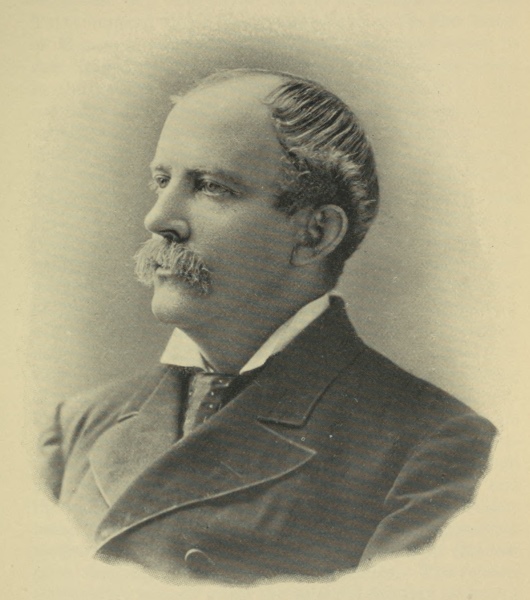
M. C. BUTLER
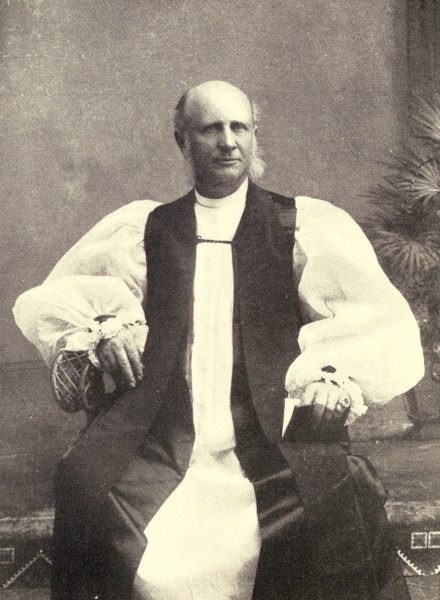
Brigadier-General Ellison Capers, a descendant of an
English family which settled in South Carolina among
the earliest colonists, was born in Charleston, October 14,
1837. His father, grandfather and several generations
of the name, belonged to the parishes of St. Thomas and
St. Denis, in Charleston county, in the territory originally
called Berkeley county. His mother was of Irish extraction,
her father, William McGill, having settled in Kershaw
county, upon coming from Ireland. William
Capers, the grandfather of Ellison, was a soldier of the
revolution, a lieutenant in the Second South Carolina
regiment, and after the fall of Charleston in 1780, one of
Marion's captains in his famous partisan brigade, in
which his only brother, G. Sinclair Capers, held the same
rank. Several thrilling incidents in the career of these
two gallant partisan captains are related by Judge
James, of South Carolina, in his life of Marion. They
were both planters. William Capers, father of Ellison,
was born on his father's plantation, "Bull Head," in St.
Thomas parish, about 20 miles north of Charleston, January
25, 1790. He was graduated at the South Carolina
college in Columbia, entered the Methodist ministry in
1808, and devoted his life and brilliant talents to his
sacred calling. He was elected and consecrated a bishop
in the Methodist Episcopal church South, in 1845, and
died at his home in Anderson, S. C., January 29, 1855.
Ellison Capers, the fourth son of his marriage with Susan
McGill, was graduated at the South Carolina military
academy in November, 1857. The next year he was a
resident graduate and assistant professor of mathematics
and belles lettres in his alma mater. In 1859 he married
Charlotte Rebecca, fourth daughter of John Gendron and
Catherine Cotourier Palmer, of Cherry Grove plantation,
St. John's, Berkeley, S. C. In the fall of this year he
was appointed assistant professor of mathematics in the
South Carolina military academy at Charleston with the
rank of second lieutenant. The active state of affairs in
Charleston during the summer and fall of 1860 roused
the military spirit of the people, and the First regiment
of Rifles was organized in Charleston, of which Lieutenant
Capers was unanimously elected major. He served
with this regiment at Castle Pinckney, and on Morris,
Sullivan's, James and John's islands. His regiment also
constituted a part of the army under Beauregard during
the attack on Fort Sumter. He continued to serve in the
vicinity of Charleston until November, when he resigned
the rank of lieutenant-colonel to which he had been promoted,
in order that he might enter the Confederate
service. Satisfied that a terrible struggle was before his
people, he resigned his professorship at the military
academy and united with Col. Clement H. Stevens, of
Charleston, in enlisting a regiment for the war. The
regiment was mustered into the Confederate service as
the Twenty-fourth South Carolina volunteer infantry,
April 1, 1862, with Clement H. Stevens as colonel, Ellison
Capers, lieutenant-colonel, and H. J. Hammond,
major; on the 4th of April was ordered to Coles' island,
and on the 25th of May was transferred to James island.
On June 3d, Companies A, B, D and E, and the Charleston
battalion, under command of Lieutenant-Colonel
Capers, opened the James Island campaign. In this
engagement Colonel Capers led the attack, and for his
courageous and skillful management of this affair he was
commended in general orders. At the battle of Secessionville,
the Twenty-fourth was again engaged, and Colonel
Capers was praised in orders. He was next detailed
to command a battery of siege guns at Clark's house.
Except a short service at Pocotaligo the regiment was on
James island until December 15, 1862, when it was
ordered to North Carolina to the relief of Wilmington,
and stationed at the railroad crossing of Northeast river
on Island Ford road. On February 13th it was returned
to South Carolina and placed on duty in the Third military
district (W. S. Walker's). Lieutenant-Colonel
Capers, with part of his regiment and other commands,
was detached to command the district between Combahee
and Ashepoo rivers. Charleston being threatened with
attack, the regiment was ordered back to Secessionville,
April 5, 1863. On May 6th it left South Carolina for
Jackson, Miss., being assigned to Gist's brigade, and eight
days later, while commanding the regiment in the battle
at Jackson, Lieutenant-Colonel Capers was wounded.
About the last of August, Gist's brigade was sent to General
Bragg. It participated in the battles of Chickamauga
and Missionary Ridge, and in the former Capers
was again wounded. During the winter at Dalton in
January, 1864, Colonel Stevens was promoted to brigadier-general
and placed in charge of the brigade formerly
commanded by Gen. Claudius C. Wilson. It was while
leading this brigade that General Stevens received his
mortal wound at Peachtree creek, July 20, 1864. Lieutenant-Colonel
Capers was promoted to the colonelcy of
the Twenty-fourth, which he led through the Atlanta and
Tennessee campaigns until the battle of Franklin, where
he was wounded and Gist was killed. On March 1, 1865, on
the recommendations of Generals Johnston, Hardee and
Cheatham, he was commissioned brigadier-general and
assigned to the command of Gist's brigade. After the war
General Capers was elected secretary of state of South
Carolina, December, 1866. In 1867 he entered the ministry
of the Protestant Episcopal church. He was for twenty
years rector at Greenville, S. C., for one year at Selma,
Ala., and for six years at Trinity, Columbia. In 1889 the
degree of D. D. was conferred on him by the university
of South Carolina. On May 4, 1893, he was elected bishop
by the convention of South Carolina on the first ballot,
and on July 20, 1893, was consecrated in this sacred
office.
* * * * *
Brigadier-General James Chestnut, a gallant South
Carolinian, distinguished as a general officer, also served
as aide-de-camp on the staff of President Davis, in which
connection his biography is given in the first volume of
this work.
* * * * *
Brigadier-General James Conner was born at Charleston,
the son of Henry W. Conner, of that city. After
his graduation at the South Carolina college in 1849,
he read law under James L. Petigru, and was admitted
to practice in 1852. In 1856 his ability as a lawyer was
recognized by appointment as United States district
attorney, an office which he resigned in 1860 on account
of the prospect of secession by his State. He was associated
with Judge Magrath and Hon. W. F. Colcock on a
committee which visited the legislature and urged the
calling of a convention, and after the passage of the
ordinance he devoted himself to preparation for the field.
Though appointed Confederate States attorney for the
district, he refused to leave the military service and
deputed his official duties. He entered the Confederate
service as captain of the Montgomery Guards, and in
May, 1861, was chosen captain of Company A, Washington
light infantry, Hampton's legion. He was promoted
major to date from the first battle of Manassas, and in
June, 1862, became colonel of the Twenty-second North
Carolina regiment. Being disabled for duty, he was
detailed as one of the judges of the military court of the
Second corps, with the rank of colonel of cavalry. On
June 1, 1864, he was promoted brigadier-general, and was
assigned to command of McGowan's and Lane's brigades.
Subsequently, as acting major-general, he commanded a
division consisting of the brigades of McGowan, Lane
and Bushrod Johnson. On the return of General McGowan
to duty, General Conner was assigned permanently
to the command of Kershaw's old brigade. In
1865 he was promoted to major-general, and the commission
was made out, and forwarded, but failed to reach
him in the confusion of the final days of the Confederacy.
He was at the bombardment of Fort Sumter, 1861,
and participated in the battles of First Manassas, Yorktown,
New Stone Point, West Point, Seven Pines,
Mechanicsville, Chancellorsville, Riddle's Shop, Darby's
Farm, Fussell's Mill, Petersburg, Jerusalem Plank Road,
Reams' Station, Winchester, Port Republic and Cedar
Creek. He was severely wounded in the leg at Mechanicsville,
and again in the same leg near Fisher's Hill, October,
1864, compelling the amputation of the limb. At
First Manassas the command of the legion was given
him as senior captain, by Colonel Hampton, when the
latter was wounded, and Captain Conner gallantly led in
the charge upon Rickett's battery. As commander of
Kershaw's South Carolinians he was greatly beloved by
his men. After his return to Charleston he resumed the
practice of law, in which he gained distinction. For
many years he was assistant counsel and then solicitor of
the South Carolina railroad, and for the bank of Charleston,
and for some time was receiver of the Greenville &
Columbia railroad. In 1876 he was chairman of the
Democratic executive committee of the State, and was
nominated and elected attorney-general of the State, on
the ticket headed by General Hampton. During the
exciting period of this campaign he was in command of
the rifle-clubs which were depended upon for the preservation
of order, and his calmness and self-control were of
great value to the State. His performance of the duties
of attorney-general elicited the warm official commendation
of Governor Hampton, and thanks were tendered
him by the legislature in the name of the people of the
State.
* * * * *
Brigadier-General Thomas Fenwick Drayton was born
in South Carolina about 1807, of an ancestral line distinguished
in the history of the State. His grandfather,
William Drayton, born in South Carolina in 1733, was
educated in law at the Temple, London; was appointed
chief justice of the province of East Florida in 1768, and
after the revolution was judge of admiralty, associate justice
of the supreme court, and first United States district
judge. His father, William Drayton, born in 1776, a
lawyer, entered the United States service as lieutenant-colonel
in 1812; was promoted colonel, and later inspector-general;
was associated with Generals Scott and Macomb
in the preparation of a system of infantry tactics;
resigned in 1815, afterward served in Congress 1825-33,
and was a warm friend and supporter of President Jackson.
General Drayton was graduated at the United
States military academy in 1828, in the class of Jefferson
Davis, and was in the service as second lieutenant of
Sixth infantry until his resignation in 1836. Subsequently
he was occupied as a civil engineer at Charleston,
Louisville and Cincinnati for two years, then becoming
a planter in St. Luke's parish. He served as captain of
South Carolina militia five years, was a member of the
board of ordnance of the State, a State senator 1853-61,
and president of the Charleston & Savannah railroad
1853-56. September 25, 1861, he was commissioned brigadier-general,
provisional army of the Confederate States,
and was assigned to the command of the Third military
district of the State. He was in command of the Confederate
forces during the bombardment and capture of
Forts Walker and Beauregard, at Port Royal entrance, in
November, 1861, on which occasion his brother, Capt.
Percival Drayton, commanded the steamer Pocahontas,
one of the Federal vessels under Admiral DuPont. He
was in charge of the Fifth military district, under Gen.
R. E. Lee, and the Sixth and Fourth districts under
Pemberton, in the same region, with headquarters at
Hardeeville. During the Second Manassas and Maryland
campaigns he commanded a brigade composed of
the Fifteenth South Carolina, and two Georgia regiments,
which, with Toombs' Georgia brigade, constituted
the division of D. R. Jones, Longstreet's corps, and participated
in the battles of Thoroughfare Gap and Second
Manassas, South Mountain and Sharpsburg. In August,
1863, he was ordered to report to Gen. T. H. Holmes, at
Little Rock, Ark., and was there assigned to command
of a brigade of Sterling Price's division, consisting of
Missouri and Arkansas troops. From the beginning of
1864 he was in command of this division in Arkansas,
until Gen. Kirby Smith relieved Holmes, when he was
transferred to the command of the West sub-district of
Mexico. He was also in command of the Texas cavalry
division composed of the brigades of Slaughter and H. E.
McCullough. In the spring of 1865 he was a member of
the board of inquiry demanded by General Price after
his Missouri expedition. After the close of hostilities,
General Drayton farmed in Dooly county, Ga., until 1872,
afterward was an insurance agent, and in 1878 removed to
Charlotte, N. C., as president of the South Carolina immigration
society. He died at Florence, February 18, 1891.
* * * * *
Brigadier-General John Dunovant held the rank of
major of infantry in the State army during the initial
operations of the war of the Confederacy, and during
the bombardment of Fort Sumter was present at Fort
Moultrie, doing all that was in his power. Subsequently
he became colonel of the First regiment of infantry, and
was stationed for some time on Sullivan's island and at
Fort Moultrie. Later in 1862 he was given command of
the Fifth regiment, South Carolina cavalry, in which
capacity he served in the State, until ordered to Virginia
in March, 1864. There he and his regiment were under
the brigade command of Gen. M. C. Butler, in Wade
Hampton's division of Stuart's cavalry. The regiment
under his leadership did admirable service, General
Ransom reported, at the battle of Drewry's Bluff, May
16th, and subsequently in the encounters with Sheridan's
cavalry, he shared the services of Butler's brigade at
Cold Harbor, Trevilian's and other important conflicts.
On August 2, 1864, President Davis suggested to General
Lee, Dunovant's promotion to temporary rank as brigadier-general,
and it was soon afterward ordered. In
this capacity he had brigade command under General
Hampton until, in the fighting north of the James river,
following the capture of Fort Harrison, he was killed October
1, 1864. On receipt of news of the death of the gallant
soldier, General Lee replied to General Hampton: "I
grieve with you at the loss of General Dunovant and Dr.
Fontaine, two officers whom it will be difficult to replace."
* * * * *
Brigadier-General Stephen Elliott, Jr., was born at
Beaufort, S. C., in 1832, son of Stephen Elliott, first
bishop of the Protestant Episcopal diocese of Georgia
and provisional bishop of Florida; and grandson of
Stephen Elliott, a distinguished naturalist. He passed
his youth on the plantation, devoted to manly sports. At
the beginning of the formation of the Confederate States,
he organized and equipped a light battery, known as the
Beaufort artillery, of which he was commissioned captain.
He was present at the bombardment of Fort Sumter,
aiming several shots from the siege guns, and during
his subsequent service in the State he became famous
for daring and skillful fighting. On guard in 1861 in the
vicinity of Port Royal harbor, he put twenty of his boys
on the tug Lady Davis, and ran out to sea to find a
prize. With indomitable pluck, accompanied by good
fortune, he captured a sailing vessel, of 1,200 tons, and
brought her in to Beaufort. Subsequently he was ordered
to Bay Point, the other side of Port Royal entrance being
held by the German volunteers under Captain Wagener.
There he fought a Federal fleet for two hours, until his
guns were dismounted. After the Federals occupied the
coast islands, he engaged in numerous daring raids. During
one night he burned fourteen plantation settlements;
again he surprised a picket post successfully, and in August,
1862, he commanded an expedition against a Federal
force on Pinckney island, which was very successful and
gained for him the unstinted commendation of his superiors.
His activity also turned to the direction of inventing
floating torpedoes, with which he blew up a tender in
St. Helena bay. He was promoted to chief of artillery
of the Third military district, including Beaufort, near
where, in April, 1863, he captured the Federal steamer
George Washington. Promotion followed to major
and then to lieutenant-colonel. Twice he met the enemy
in open field at Pocotaligo, where his guns put the invaders
to flight. In command of the Charleston battalion
he occupied Fort Sumter, September 5, 1863, and held
the ruins of the famous citadel against the enemy until
May, 1864. Then as colonel of Holcombe's legion he
was ordered to Petersburg, Va., and was soon promoted
to brigadier-general and assigned to the command of
N. G. Evans' old brigade, which included the legion.
He served actively in the defense of Petersburg, his brigade,
a part of Bushrod Johnson's division, holding that
important part of the line selected by the Federals as the
point to be mined, and carried by an assaulting party.
Two of his regiments, the Eighteenth and Twenty-second,
occupied the works blown up on the morning of July 30th,
and the immense displacement of earth which formed the
crater maimed and buried many of the command. But,
undismayed, General Elliott and his brigade received the
onslaught made through the breach of the Confederate
intrenchments. In the words of the division commander,
"Brigadier-General Elliott, the gallant commander of the
brigade which occupied the salient, was making prompt
disposition of his forces to assault the enemy and reoccupy
the remaining portion of the trenches when he was
dangerously wounded." Entirely disabled for further
service he returned to his home at Beaufort, and died
from the effects of his wound, March 21, 1866.
* * * * *
Brigadier-General Nathan George Evans was born in
Marion county, S. C., February 6, 1824, the third son of
Thomas Evans, who married Jane Beverly Daniel, of
Virginia. He was graduated at Randolph-Macon college
before he was eighteen, and at the United States military
academy, which he entered by appointment of John C.
Calhoun, in 1848. With a lieutenancy in the Second
Dragoons, he was first on duty at Fort Leavenworth,
Kan., whence he marched to the Rocky mountains in
1849. In 1850 to 1853 he served in New Mexico, and
began a famous career as an Indian fighter, which was
continued in Texas and Indian Territory after his promotion
to captain in 1856, in various combats with the
hostile Comanches. At the battle of Wachita Village,
October 1, 1858, his command defeated a large body of
the Comanches, and he killed two of their noted chieftains
in a hand-to-hand fight. For this he was voted a handsome
sword by the legislature of South Carolina. In 1860
he was married to a sister of Gen. M. W. Gary, of Abbeville
county. He resigned from the old army in February,
1861, being then stationed in Texas, and taking farewell
of his colonel, Robert E. Lee, proceeded to Montgomery,
and was commissioned major of cavalry, C. S. A.
Being assigned to duty as adjutant-general of the South
Carolina army, he was present at the bombardment of
Fort Sumter and was soon afterward promoted colonel.
Joining the army under General Beauregard at Manassas
Junction, Va., he had a command on the field during the
first encounter at Blackburn's ford, and again in the
great battle of July 21, 1861. At the opening of the latter
engagement, his forces, consisting of the Fourth South
Carolina regiment, a battalion of Louisiana volunteers,
Terry's squadron of cavalry, and a section of Latham's
battery, were stationed at the stone bridge, where he
held the enemy in check in front, until he perceived in
operation the flank movement which was the Federal
plan of battle. Instantly without waiting for orders he
threw his little command in a new line, facing the enemy,
and alone held him in check until reinforced by General
Bee. With great intrepidity he and his men held their
ground against great odds until the Confederate army
could adapt itself to this unexpected attack. As remarked
by a Northern historian: "Evans' action was probably
one of the best pieces of soldiership on either side during
the campaign, but it seems to have received no special
commendation from his superiors." General Beauregard
commended his "dauntless conduct and imperturbable
coolness," but it was not until after the fight at Leesburg
that he was promoted. This latter engagement, known
also as Ball's Bluff, was fought in October, near the
Potomac river, by his brigade, mainly Mississippians, and
a splendid victory was gained over largely superior numbers,
with great loss to the enemy. His promotion to
brigadier-general was made to date from this memorable
affair, and South Carolina again, through her general
assembly, gave him a vote of thanks and presented him
with a gold medal. In 1862 he commanded a brigade
consisting of the Seventeenth, Eighteenth, Twenty-second
and Twenty-third regiments, and Holcombe's legion,
South Carolina troops, and was mentioned by General
Longstreet among the officers most prominently distinguished
in the battles of Second Manassas and Sharpsburg.
In the latter fight he commanded his division.
Thereafter his service was mainly rendered in South
Carolina. In 1863 he moved to the support of Johnston
against Grant. After the fall of Richmond he accompanied
President Davis as far as Cokesbury, S. C. A
year later he engaged in business at Charleston, but was
mainly occupied as a teacher at Midway, Ala., until his
death at that place, November 30, 1868. Gen. Fitzhugh
Lee has written of him: "'Shanks' Evans, as he was
called, was a graduate of the military academy, a native
South Carolinian, served in the celebrated old Second
Dragoons, and was a good type of the rip-roaring, scorn-all-care
element, which so largely abounded in that regiment.
Evans had the honor of opening the fight (First
Manassas), we might say fired the first gun of the war."
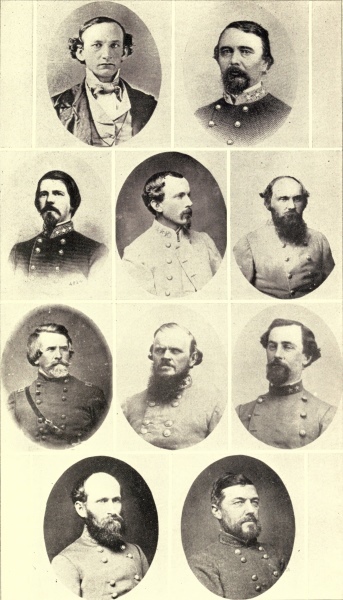
Brig.-Gen. John Dunovant. Brig.-Gen. James Chestnut.
Brig.-Gen. Barnard E. Bee. Maj.-Gen. M. C. Butler. Brig.-Gen. John Bratton.
Brig.-Gen. M. L. Bonham. Brig.-Gen. N. G. Evans. Brig.-Gen. Stephen Elliott, Jr.
Maj.-Gen. M. W. Gary. Brig.-Gen. Thos. F. Drayton.
Brigadier-General Samuel W. Ferguson was born and
reared at Charleston, and was graduated at the United
States military academy in 1857. As a lieutenant of
dragoons he participated in the Utah expedition under
Albert Sidney Johnston, and in 1859-60 was on duty
at Fort Walla Walla, Washington. When informed
of the result of the presidential election of 1860, he
resigned his commission and returned to Charleston, and
on March 1, 1861, entered the service of his native State
with the rank of captain. Being appointed aide-de-camp
to General Beauregard, he received the formal surrender
of Major Anderson, raised the first Confederate flag and
posted the first guards at Fort Sumter. He was then
sent to deliver to the Congress at Montgomery the flag
used at Fort Moultrie, the first standard of the Confederacy
struck by a hostile shot. He remained on Beauregard's
staff and took an active part in the battle of Shiloh,
on the second day being assigned to command a brigade
of the Second corps. At the battle of Farmington
he was also on duty with General Beauregard. At the
same time he held the rank of lieutenant-colonel of the
Twenty-eighth Mississippi regiment cavalry, and subsequently,
stationed at Vicksburg, he had command of cavalry
and outlying pickets until detailed for special duty
along the Yazoo delta, opposing with cavalry and artillery
the advance of the Federal transports. During
Grant's preliminary movements against Vicksburg he
thwarted the attempt of Sherman and Porter to reach the
city in the rear by way of Deer creek. In 1863 he was
promoted to brigadier-general. He was active in command
of cavalry in harassing Sherman's movement to
Chattanooga, and during the Georgia campaign of 1864
his brigade of Alabamians and Mississippians, with
Armstrong's and Ross' brigades, formed the cavalry of
the army of Mississippi, under command of Gen. W. H.
Jackson, operating on the left wing of Johnston's army.
He defeated Wilder's "lightning brigade," and displayed
gallantry on every field. When Sherman began his
march to Savannah, he harassed the Federal flank until
within a few miles of Savannah, when he left his horses
on the South Carolina side of the river, after swimming
it, and entering Savannah with his men as infantry, covered
the rear of Hardee's army at the evacuation. He
subsequently operated in southern Georgia until ordered
to Danville, Va., but on reaching Greensboro was
ordered back, escorting President Davis from Charlotte
to Abbeville, and as far as Washington, Ga., where his
command was disbanded. He then made his home in
Mississippi, and practiced law at Greenville. In 1876 he
was made president of the board of Mississippi levee
commission for several counties, and in 1883 became a
member of the United States river commission. In 1894
he returned to his native city of Charleston, and devoted
himself to the profession of civil engineering. In 1898
he offered his services for the war with Spain.
* * * * *
Brigadier-General Martin Witherspoon Gary was born
in 1831 at Cokesbury, Abbeville county, the third son of
Dr. Thomas Reeder Gary. He was educated at the
South Carolina college and Harvard college, graduating
at the latter institution in 1854. Then studying law he
was admitted to the bar in 1855, and soon acquired distinction
in both law and politics. As a member of the
South Carolina legislature in 1860 and 1861, he advocated
secession, and when the ordinance was enacted, at once
went into the military service as captain of the Watson
Guards, which became Company B of the Hampton
legion. At First Manassas the command of the legion
devolved upon him after Colonel Hampton was wounded,
Lieutenant-Colonel Johnson killed and Captain Conner
disabled. At the reorganization in 1862 he was elected
lieutenant-colonel of the infantry of the legion, a battalion
of eight companies, and after it was filled to a regiment,
he was promoted colonel. He participated in the
battles around Richmond, at Second Manassas, Boonsboro
and Sharpsburg, Fredericksburg, and with Longstreet
at Suffolk, Chickamauga, Bean's Station, Campbell's
Station and Knoxville. His command was subsequently
mounted as cavalry, and served on the north
side of the James before Richmond. After the fight
at Riddle's Shop, in June, 1864, he was promoted
brigadier-general, his cavalry brigade including the
Hampton legion, Seventh South Carolina, Seventh
Georgia and Twenty-fourth Virginia regiments, and
Harkerson's artillery. He led the brigade in all the
heavy fighting north of the James during the siege, and
was the last to leave Richmond. Capt. Clement Sulivane,
left behind to destroy the bridge after Gary had
crossed, relates that at daylight April 3d, when the Union
troops were in sight advancing, and a mob was ravaging
the storehouses, "a long line of cavalry in gray turned
into Fourteenth street, and sword in hand galloped
straight down to the river; Gary had come. The mob
scattered right and left before the armed horsemen, who
reined up at the canal. Presently a single company of
cavalry appeared in sight, and rode at headlong speed to
the bridge. 'My rear guard!' exclaimed Gary. Touching
his hat to me, he called out, 'All over, good-bye!' and
trotted over the bridge." Joining Lee's rear guard he
was one of the heroes of Fitzhugh Lee's command,
engaged in incessant fighting until Appomattox Court
House was reached. There he did not surrender, but cut
his way through the Federal lines, and rode to Greensboro,
where he took command of about 200 men of his
brigade on their way to Virginia, and escorted the President
and his cabinet to Cokesbury, S. C. The cabinet
held one of their last meetings in his mother's house at
that place. Then resuming the practice of law, he continued
in that profession until his death at Edgefield,
April 9, 1881. He was a noted figure in the exciting
political campaign of 1876, and for four years thereafter
held a seat in the State senate.
* * * * *
Brigadier-General States R. Gist was a descendant of
that gallant Marylander, Gen. Mordecai Gist, who distinguished
himself at the battle of Camden in 1780, and
at the Combahee in 1782, and subsequently resided at
Charleston, at his death leaving two sons who bore the
names of Independent and States. At the organization of
the army of South Carolina early in 1861, States R. Gist
was assigned to the position of adjutant and inspector
general, in which capacity he rendered valuable service
in the preparation for the occupation of Charleston harbor
and the reduction of Fort Sumter. He went to Virginia
as a volunteer aide to General Bee, and at the critical
moment in the first battle of Manassas, when Gen.
J. E. Johnston rode to the front with the colors of the
Fourth Alabama at his side, Beauregard relates that
"noticing Col. S. R. Gist, an aide to General Bee, a
young man whom I had known as adjutant-general of
South Carolina, and whom I greatly esteemed, I presented
him as an able and brave commander to the
stricken regiment, who cheered their new leader, and
maintained under him to the end of the day, their previous
gallant behavior." Subsequently he resumed his
duties as adjutant-general, organizing South Carolina
troops for the war, until in March, 1862, he was commissioned
brigadier-general in the Confederate service, and
ordered to report to General Pemberton, then in command
of the department. He was after this on duty on
the South Carolina coast, in command east of James
island in June, on that island from July; temporarily in
command of the first district, and in December, 1862, in
command of the troops ordered to the relief of Wilmington,
until May, 1863, when he was ordered to take command
of a brigade and go to the assistance of General
Pemberton in Mississippi. Reaching Jackson his command
formed part of the troops under J. E. Johnston,
took part in the engagement of May 14th at Jackson,
marched to the Big Black river just before the surrender
of Vicksburg, and then returning to Jackson was
besieged by Sherman. His brigade comprised the Forty-sixth
Georgia, Fourteenth Mississippi and Twenty-fourth
South Carolina, the Sixteenth South Carolina soon afterward
being substituted for the Mississippi regiment, and
was assigned to the division of Gen. W. H. T. Walker.
He fought gallantly at Chickamauga, commanding during
part of the battle Ector's and Wilson's brigades, his
own brigade being led by Colonel Colquitt, and on Sunday
commanding Walker's division. At an important
stage of the fight Gen. D. H. Hill called for Gist's brigade
for dangerous duty, in the performance of which it
suffered severely. He continued in conspicuous and
valuable service; during the battle of Missionary Ridge
commanded Walker's division, and throughout the
Atlanta campaign of 1864 was identified with that division.
After the fall of General Walker he was transferred
to Cheatham's division, which he commanded for some
time during the fall campaign of that year. At the terribly
destructive battle of Franklin, Tenn., he was one
of the noblest of the brave men whose lives were sacrificed.
Attended by Capt. H. D. Garden and Lieut.
Frank Trenholm, of his staff, he rode down the front,
and after ordering the charge and waving his hat to the
Twenty-fourth, rode away in the smoke of battle,
never more to be seen by the men he had commanded on
so many fields. His horse was shot, and he was leading
the right of the brigade on foot when he fell, pierced
through the heart.
* * * * *
Brigadier-General Maxcy Gregg was born in Columbia,
S. C, the son of Col. James Gregg, a distinguished lawyer
of that city, and was educated at the South Carolina
college, where he graduated with the first honors of his
class. He then entered upon the practice of law as a
partner of his father. In 1846 he had his first military
experience as major of a regiment of the second levy of
volunteers sent to Mexico, but did not arrive at the scene
of conflict in time to share in any of the famous battles.
He was a member of the convention of 1860 which determined
upon the secession of the State, and then became
colonel of the First North Carolina regiment, enlisted for
six months' service, with which he was on duty on Sullivan's
and Morris islands during the reduction of Fort
Sumter, and afterward in Virginia. Previous to the battle
of Manassas he was stationed at Centreville, and then
near Fairfax Court House, and commanded the infantry
in the action at Vienna. At the expiration of the term of
enlistment he reorganized his regiment in South Carolina,
and returning to Virginia was stationed at Suffolk.
In December, 1861, he was promoted to brigadier-general
and ordered to South Carolina, where he took command
of a brigade composed of the First, Twelfth, Thirteenth
and Fourteenth regiments. With this brigade he was
attached to the famous light division of A. P. Hill for
the Seven Days' campaign before Richmond. He led the
advance of the division at Cold Harbor, crossing the
creek under fire made what Hill pronounced "the handsomest
charge in line I have seen during the war," and
during the remainder of the battle displayed undaunted
bravery. At Frayser's Farm he charged and captured a
Federal battery. At the battle of August 29th, on the
plains of Manassas, he with his comrades of the division,
fought "with a heroic courage and obstinacy almost
beyond parallel," repelling six determined assaults of the
enemy, who sought to overwhelm Jackson's corps before
Longstreet could arrive. Hill reported: "The reply of
the gallant Gregg to a message of mine is worthy of
note: 'Tell General Hill that my ammunition is exhausted,
but that I will hold my position with the bayonet.'" In
the battle of the 30th and at Ox Hill on September 1st,
he was again distinguished. He participated in the capture
of Harper's Ferry, at Sharpsburg shared with distinguished
gallantry in the heroic work of the Light
division, which reached the field in time to save the Confederate
right, and was wounded in the fight; and at
Shepherdstown, after the crossing of the Potomac by the
army, commanded the line of three brigades which drove
back and terribly punished the enemy's forces, which had
the temerity to pursue the lion-hearted veterans of Lee's
army. His part in the battle of Fredericksburg we may
best describe in the words of the immortal Lee. After
describing the momentary success of the Federals on the
right, he wrote: "In the meantime a large force had penetrated
the wood so far as Hill's reserve, and encountered
Gregg's brigade. The attack was so sudden and unexpected
that Orr's Rifles, mistaking the enemy for our own
troops retiring, were thrown into confusion. While in
the act of rallying them, that brave soldier and true
patriot, Brig.-Gen. Maxcy Gregg, fell mortally wounded."
Again, "In Brigadier-Generals Gregg and Cobb the Confederacy
has lost two of its noblest citizens and the army
two of its bravest and most distinguished officers. The
country consents to the loss of such as these, and the
gallant soldiers who fell with them, only to secure the
inestimable blessing they died to obtain."
* * * * *
Brigadier-General Johnson Hagood was born in Barnwell
county, February 21, 1829. His ancestors were of
English extraction, and the family in America was first
established in Virginia, removing thence to South Carolina
before the revolution. He was graduated at the Citadel
military academy in 1847, and then studying law was
admitted to the bar in 1850. Throughout his subsequent
career he maintained an association with the State military
forces, holding the rank of brigadier-general when
South Carolina seceded. He was then elected colonel of
the First regiment, and after participating in the reduction
of Fort Sumter was ordered to Virginia, where he
was present at the first battle of Manassas. Returning
to South Carolina with his regiment he was engaged in
the operations about Charleston and the battle of Secessionville,
June, 1862, after which he was promoted brigadier-general.
Until May, 1864, he served on the coast
of the State, in defense of Charleston during Gillmore's
siege, and was distinguished for gallantry in the defense
of Fort Wagner and the operations on James island. On
May 6, 1864, part of his brigade arrived at Petersburg
and immediately went into battle at Walthall Junction
with the advancing forces of Butler, and a few hours
later General Hagood arrived with reinforcements. With
three regiments, the Twenty-first, Twenty-fifth and
Twenty-seventh South Carolina, he repulsed Butler's
advance, "at least two brigades," on the 7th; and on the
9th, the remainder of his brigade having come up, the
Eleventh regiment and Seventh battalion, he was again
engaged. As General Beauregard has written: "General
Hagood and his command became the heroes of the
day, and were justly looked upon as the saviors of Petersburg
on that occasion." At the battle of Drewry's Bluff,
May 16th, Hagood, with great vigor and dash, drove the
enemy from the outer lines in his front, capturing a
number of prisoners and three 20-pound Parrotts and two
fine Napoleons. These Parrott guns were afterward used
in shelling Butler's transports, causing him to set about
the famous Dutch Gap canal. In June Hagood and his
gallant men fought at Cold Harbor, and soon afterward
were sent to meet Grant before Petersburg, the brigade
being the first of Hoke's division to reach the field, June
16th, at the critical moment and save Petersburg for the
second time. During the siege which followed his brigade
served in the trenches at one period sixty-seven
days without relief, and was reduced in numbers from
2,300 to 700 present for duty. In August, 1864, during
the fighting on the Weldon railroad, 200 of his men, he
accompanying them, charged into the enemy's works at
a re-entering angle, and found themselves under a severe
cross-fire, and about to be surrounded. A Federal officer
rode up, seized the colors of the Eleventh and called upon
them to surrender, when General Hagood, on foot, his
horse having been killed, demanded the return of the
colors, and ordered the officer back to his lines. This
being refused, he shot the Federal officer from his horse,
the colors were regained by Orderly Stoney, and the
intrepid general mounted his antagonist's horse and
brought off his men. General Beauregard warmly commended
this act of gallantry of a "brave and meritorious
officer," and recommended him for promotion. When
Wilmington was threatened in December, Hagood was
sent to the relief of Fort Fisher. Subsequently he participated
in the North Carolina campaign, including the
battles of Kinston and Bentonville, and was surrendered
with Johnston's army, the brigade then containing less
than 500 officers and men. During the exciting period
of reconstruction he took a conspicuous part in the movement
which finally brought about the election of General
Hampton in 1876, and he was elected on the same ticket
as comptroller-general, having previously rendered services
of great value in investigating the financial condition
of the State and the State bank. He and Gen. James
Conner were the advisers and executive officers of General
Hampton during the perilous period preceding the
recognition by President Hayes of the Hampton government.
In 1878 he was re-elected comptroller, and in 1880
he was honored with the highest office in the gift of the
commonwealth. His admirable reorganization of the
finances of the State was fitly complemented by his honest,
business-like and common-sense administration as
governor. By his marriage to Eloise, daughter of Senator
A. P. Butler, he had one son, Butler Hagood. The
death of General Hagood occurred at Barnwell, January
4, 1898.
* * * * *
Major-General Benjamin Huger was born at Charleston
in 1806, son of Francis Kinlock Huger, whose wife
was a daughter of Gen. Thomas Pinckney. His father,
who was aide-de-camp to General Wilkinson in 1800,
and adjutant-general in the war of 1812, suffered imprisonment
in Austria for assisting in the liberation of
Lafayette from the fortress of Olmutz; his grandfather,
Benjamin Huger, was a famous revolutionary patriot,
killed before Charleston during the British occupation;
and his great-great-grandfather was Daniel Huger, who
fled from France before the revocation of the edict of
Nantes and died in South Carolina in 1711. General
Huger was graduated at West Point in 1825, with a lieutenancy
in the Third artillery. He served on topographical
duty until 1828, then visited Europe on leave of
absence; after being on ordnance duty a year was promoted
captain of ordnance in 1832, a department of the
service in which he had a distinguished career. He was
in command of Fortress Monroe arsenal twelve years,
was member of the ordnance board seven years, and one
year was on official duty in Europe. He went into the
war with Mexico as chief of ordnance on the staff of General
Scott, and received in quick succession the brevets
of major, lieutenant-colonel and colonel, for gallant and
meritorious conduct at Vera Cruz, Molino del Rey and
Chapultepec. In 1852 he was presented a sword by
South Carolina in recognition of the honor his career had
cast upon his native State. After this war he was a
member of the board which prepared a system of artillery
instruction for the army, and was in command of the
armories at Harper's Ferry, Charleston and Pikesville,
Md., with promotion to major of ordnance, until his resignation
from the old army to follow his State in her effort
for independence. He was commissioned colonel of
artillery in the regular army of the Confederate States,
in June, brigadier-general in the provisional service, and
in October, 1861, major-general. In May, 1861, he was
assigned to command of the department of Southern
Virginia and North Carolina, with headquarters at Norfolk,
and after the evacuation of Norfolk and Portsmouth
in the spring of 1862, he commanded a division of the
army under General Johnston and General Lee, during
the campaigns which included the battles of Seven Pines
and the series of important actions ending at Malvern
hill. Subsequently he was assigned as inspector of artillery
and ordnance in the armies of the Confederate
States, and in 1863 was appointed chief of ordnance of
the Trans-Mississippi department. After the conclusion
of hostilities he was engaged for several years in farming
in Fauquier county, Va. His death occurred at his
native city of Charleston, December 7, 1877. His son,
Frank Huger, a graduate of the United States military
academy, 1860, entered the Confederate service as captain
of the Norfolk light artillery and had a conspicuous
career with the army of Northern Virginia, rising to the
rank of lieutenant-colonel and the command of a battalion
of artillery of the First corps.
* * * * *
Brigadier-General Micah Jenkins was born on Edisto
island in 1839. After his graduation at the South Carolina
military academy, at the head of his class, he with
the co-operation of his classmate, Asbury Coward,
founded the King's Mountain military school in 1855.
His military genius was valuable in the first organization
of troops in 1861, and he was elected colonel of the Fifth
regiment, with which he went to Virginia, in the brigade
of Gen. D. R. Jones. In the latter part of 1861
he was in command of that brigade, and had grown
greatly in favor with his division commander, General
Longstreet. Longstreet proposed to begin the reorganization,
a matter approached with much misgiving, in
this brigade, and he declared that he hoped to hold every
man in it if Jenkins could be promoted brigadier-general.
"Besides being much liked by his men, Colonel
Jenkins is one of the finest officers of this army," Longstreet
wrote. Beauregard also added his approval to this
recommendation. Still in the rank of colonel, Palmetto
sharpshooters, he commanded R. H. Anderson's brigade
in the battles of Williamsburg and Seven Pines, and was
warmly commended by Longstreet and D. H. Hill and
by J. E. B. Stuart, whom he supported at Fort Magruder.
He was again distinguished at Gaines' Mill, and at Frayser's
Farm, having been ordered to silence a battery,
Longstreet supposing he would use his sharpshooters
alone, he threw forward his brigade and captured the
guns, bringing on the battle. July 22, 1862, he was promoted
brigadier-general, and continuing in command of
the same brigade, participated in the battles of August 29th
and 30th, Second Manassas, and was severely wounded.
He was on duty again at the battle of Fredericksburg
and during the Suffolk campaign, his division now being
commanded by General Pickett, and was on the Blackwater
under Gen. D. H. Hill, during the Gettysburg
campaign. When Longstreet was sent to the assistance
of Bragg at Chattanooga, Jenkins' brigade was transferred
to Hood's division, and reached the field of Chickamauga
after the battle. During the investment of Chattanooga
he commanded the attack upon the Federal
reinforcements arriving under Hooker, and then accompanied
Longstreet in the Knoxville campaign, commanding
Hood's division. He took a conspicuous part in the
operations in east Tennessee, and then, early in 1864,
returned to Northern Virginia. Field was now in charge
of the division, and Jenkins led his famous old brigade to
battle on May 6th, the second day of the Wilderness fighting,
when the splendid veterans of the First corps arrived
in time to check the current of threatened disaster. As
he rode by the side of Longstreet, he said to his chief, "I
am happy. I have felt despair for the cause for some
months, but now I am relieved, and feel assured that we
will put the enemy across the Rapidan before night."
Immediately afterward, by the mistaken fire of another
body of Confederates, he and Longstreet were both
wounded, Jenkins mortally. General Longstreet has
written of him: "He was one of the most estimable characters
of the army. His taste and talent were for military
service. He was intelligent, quick, untiring, attentive,
zealous in discharge of duty, truly faithful to
official obligations, abreast with the foremost in battle,
and withal a humble, noble Christian. In a moment of
highest earthly hope, he was transported to serenest
heavenly joy; to that life beyond that knows no bugle
call, beat of drum or clash of steel. May his beautiful
spirit, through the mercy of God, rest in peace! Amen!"
* * * * *
Major-General David Rump Jones was born in Orangeburg
county, S. C., in 1825. His family removed to
Georgia in his childhood, and from that State he was
appointed to the United States military academy, where
he was graduated in 1846 in the class with Stonewall
Jackson, McClellan and other famous commanders. As
a lieutenant of the Second infantry he served in the war
with Mexico, participating in the siege of Vera Cruz, the
battles of Cerro Gordo, Contreras, Churubusco, Molino
del Rey, and the capture of the city of Mexico, particularly
being distinguished and earning promotion on the fields
of Contreras and Churubusco. He subsequently served
as adjutant of his regiment, made the voyage to California
in 1848-49, and with promotion to first lieutenant was on
duty there until the fall of 1851, after which he acted as
instructor in infantry tactics at West Point. With the
brevet rank of captain of staff he served from the spring
of 1853, successively as adjutant-general of the Western
department and the Pacific department, as acting judge-advocate
of the Pacific department, and as assistant adjutant-general
of the department of the West, until his
resignation, February 15, 1861. He was commissioned
major in the Confederate States army, and assigned to
duty as chief-of-staff of General Beauregard, in which
capacity he visited Fort Sumter on April 13th and offered
the terms of surrender, which were accepted. On June
17, 1861, he was promoted brigadier-general. With the
army under Beauregard at Manassas, Va., he had command
of a brigade composed of Jenkins' Fifth South
Carolina and Burt's Eighteenth and Featherston's Seventeenth
Mississippi. In the original Confederate plan of
battle, July 21st, he was to have taken a prominent part in
the fight, but the actual events of the day confined him
to demonstrations against the Federal flank. Soon afterward
his brigade was composed of the Fourth, Fifth,
Sixth and Ninth South Carolina regiments, until February,
1862, when he was assigned to command of Gen.
Sam Jones' Georgia brigade. He was in charge of General
Magruder's first division, including the Georgia brigade
of Robert Toombs and his own under George T.
Anderson, during the retreat from Yorktown, and the
battles of Gaines' Mill, Savage Station and Malvern Hill,
and other engagements of the Seven Days before Richmond.
In the Second Manassas campaign he commanded
a division of Longstreet's corps, Drayton's brigade having
been added to the two previously mentioned. He drove
the enemy through Thoroughfare Gap, held the extreme
right next day, confronting Fitz John Porter, and in the
battle of the 30th actively engaged the Federal left. In
the Maryland campaign his division, increased by the
addition of Kemper's and Garnett's Virginia brigades
and Jenkins' South Carolina brigade, had a conspicuous
part, winning renown first by the heroic defense of the
passes of South mountain, and at Sharpsburg fighting
desperately against the advance of Burnside across the
Antietam on the Confederate right. After this battle he
was promoted major-general. His coolness and excellent
judgment as a commanding officer would have doubtless
brought still higher honors, but at this time an affection
of the heart to which he had long been subject was
greatly aggravated, and after a lingering illness he died
at Richmond, January 19, 1863.
* * * * *
Brigadier-General John D. Kennedy was born at Camden,
January 5, 1840, son of a native of Scotland, who
settled in Kershaw county about 1830, and married a
granddaughter of Abraham Belton, a pioneer of Camden
and a soldier of the revolution. He was a student at the
South Carolina college, read law, and was admitted to
practice in January, 1861, but at once gave himself to the
military service of his State. In April, 1861, he became
captain of Company E, Second South Carolina infantry,
under Col. J. B. Kershaw. With this command he was
in the first battle of Manassas, and was struck by a Federal
ball. Upon the promotion of Kershaw to brigadier-general
he became colonel of the Second regiment, and in
that rank participated in the skirmish on the Nine-mile
road near Richmond, in June, 1862, and the battle of
Savage Station, after which he was disabled for some
time by fever. During the investment of Harper's Ferry
he was with Kershaw's brigade in the capture of Maryland
heights, and at Sharpsburg his regiment was the
first of the brigade to come to the relief of Jackson. He
drove the enemy from his front, but fell painfully
wounded in the first charge. At Fredericksburg he was
sent with his own and the Eighth regiment to the support
of General Cobb at Marye's hill, the focus of the hottest
fighting of that memorable battle, and aided materially
in the defeat of the Federal attacks; and at Chancellorsville
he was identified with the gallant action of his brigade.
During 1864 when not disabled he was either in
command of his regiment or of Kershaw's old brigade,
in the Richmond and Shenandoah Valley campaigns, and
in December he was promoted to the temporary rank of
brigadier-general. With his brigade in McLaws' division
of Hardee's corps he took part in the final campaign
in North Carolina against Sherman, including the battle
of Bentonville, and surrendered with the army at Greensboro.
He was six times wounded during his service, and
was hit fifteen times by spent balls. After the close of
hostilities he was mainly engaged in planting until 1877,
when he resumed the profession of law. He was elected
to Congress in 1865, but declined to take the "ironclad"
oath demanded and did not take his seat. In 1878-79 he
represented his county in the legislature, was elected in
1880 and served as lieutenant-governor of the State to
1882, and in the latter year was a prominent candidate
for the nomination of governor. In 1884 he was presidential
elector-at-large on the Democratic ticket, and in
1886 was appointed consul-general at Shanghai, China,
by President Cleveland. Returning from that post in
1889, he continued the practice of law at Camden until
his death in April, 1896.
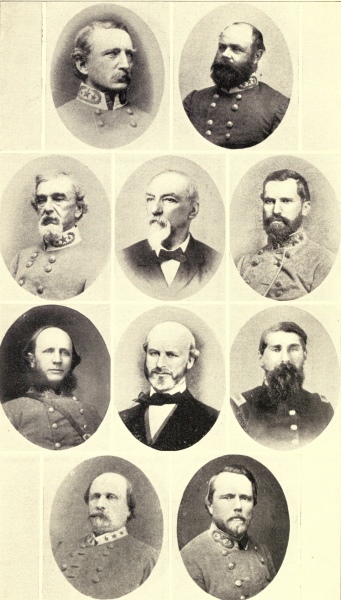
Maj.-Gen. J. B. Kershaw. Brig.-Gen. Roswell S. Ripley.
Maj.-Gen. Benjamin Huger. Brig.-Gen. A. M. Manigault. Brig.-Gen. Abner Perrin.
Brig.-Gen. Ellison Capers. Brig.-Gen. C. H. Stevens. Brig.-Gen. J. B. Villepigue.
Brig.-Gen. W. H. Wallace. Brig.-Gen. Samuel McGowan.
Major-General Joseph Brevard Kershaw was born at
Camden, S. C., January 5, 1822, son of John Kershaw,
member of Congress in 1812-14, whose wife was Harriet,
daughter of Isaac Du Bose, an aide-de-camp of General
Marion. His line of the Kershaw family in South Carolina
was founded by Joseph Kershaw, a native of Yorkshire,
who immigrated in 1750, and served as a colonel in
the war of the revolution. General Kershaw was educated
for the legal profession and began practice in 1844
at Camden. He was a member of the governor's staff
in 1843, and served one year in the Mexican war as first
lieutenant of Company C, Palmetto regiment. From
1852 to 1856 he was a representative in the legislature,
and in 1860 participated in the convention which enacted
the ordinance of secession. In February, 1861, he was
commissioned colonel of the Second South Carolina regiment,
with which he served at Sullivan's island, and in
April went to Virginia. He commanded his regiment, in
the brigade of General Bonham, at the Blackburn's Ford
engagement and the battle of First Manassas, and in
February, 1862, was promoted brigadier-general, to succeed
General Bonham. In this rank he participated in
the Yorktown campaign, and in McLaws' division fought
through the Seven Days' campaign before Richmond,
commanded the troops which captured Maryland heights,
and had a gallant part in the fighting at Sharpsburg. At
Fredericksburg his brigade was sent into the fight at
Marye's hill, where Kershaw was in command after
General Cobb was wounded; at Chancellorsville he was an
active participant, and at Gettysburg he and his brigade
were conspicuous in the defeat of Sickles at the peach
orchard. Reaching the field of Chickamauga in time
for the fighting of September 20th, he was in the grand
line of veterans with which Longstreet overwhelmed the
Federals, commanding McLaws' division, and in the last
grand assault on George H. Thomas also commanding
McNair's, Grade's, Kelly's and Anderson's brigades.
He drove the enemy into their lines at Chattanooga, and
subsequently participated in the Knoxville campaign, at
Bean's Station and other engagements commanding the
division. In the same command he went into the Wilderness
campaign of May, 1864, checked the Federal success
on May 6th with his veterans, sweeping the enemy from
his front and capturing his works. He was riding with
Longstreet and Jenkins when these two generals were
wounded, and fortunately escaped injury. It was his
division which reached Spottsylvania Court House in
time to support Stuart's cavalry and thwart the flank
movement of Grant, and by an attack on Sheridan opened
the bloody struggle at Cold Harbor, where the heaviest
Federal loss was before Kershaw's position. He was
promoted major-general, and after participating in the
Petersburg battles was ordered to the support of Early
in the Shenandoah valley. In September he was ordered
back to Richmond, and while on the way Early was
defeated at Winchester. Then returning to the valley
he opened the attack at Cedar Creek, with great success.
After this, until the fall of Richmond, he served before
that city, north of the James. His last battle was Sailor's
Creek, where he was captured with General Ewell
and the greater part of the remnant of his command. As
a prisoner of war he was held at Fort Warren, Boston,
until August 12, 1865. On his return to South Carolina
he again took up the practice of law, and in the same year
was elected to the State senate and made president of
that body. In 1874 he was the Democratic candidate for
Congress in his district, and three years later was elected
to the position of judge of the Fifth circuit. He served
upon the bench until 1893, when he resigned on account
of failing health and resumed practice as an attorney at
Camden. In February, 1894, he was commissioned postmaster
at that city, but he died on the 12th of April following.
His wife, Lucretia Douglas, to whom he was
married in 1844, four daughters and a son survive him.
The latter is rector of St. Michael's church, Charleston.
* * * * *
Brigadier-General Thomas M. Logan was born at
Charleston, November 3, 1840, the son of Judge George
William and Eliza Staun (Yonge) Logan. His family is
of ancient Scottish descent. He was graduated at the
head of his class at the North Carolina college in 1860,
and was among the early volunteers in 1861 as a private
in the Washington light infantry, with which he served
during the investment of Fort Sumter. Then aiding in
the organization of Company A, Hampton legion, he was
elected first lieutenant and accompanied the legion to
Virginia, where he participated in the first battle of
Manassas, and was soon afterward elected captain.
Though wounded at Gaines' Mill he continued on duty
at Second Manassas, and for conspicuous gallantry at
Sharpsburg was promoted major. His command was
subsequently transferred to Jenkins' brigade, and he was
promoted lieutenant-colonel. During the Suffolk and
Blackwater campaigns under Gen. D. H. Hill he was
distinguished for the successful management of a reconnoissance
in force fifteen miles in advance of the Confederate
lines; and in command of the sharpshooters of Longstreet's
corps in the Chattanooga and Knoxville campaigns,
he gained new laurels as a daring and active
leader. He commanded the advance guard which Longstreet
organized to push Burnside back toward Knoxville
in an attempt to prevent his intrenching, and kept up a
running skirmish with the Federals for several days. On
May 19, 1864, he was promoted colonel of Hampton's
legion, served temporarily on the staff of General Beauregard
during the battle of Drewry's Bluff, and was severely
wounded in the fight at Riddle's shop. Promoted brigadier-general
at the age of twenty-four years, he was
assigned to the command of the old cavalry brigade of
Gen. M. C. Butler, with which he served in the North
Carolina campaign and at the battle of Bentonville, and
made the last charge of this last campaign at the head of
Keitt's battalion. After the close of hostilities General
Logan began the study of law at Richmond, Va., in
which State he has since resided and practiced that profession
for several years. He then became interested in
railroad management, and soon became prominent in the
organization of the Richmond & Danville system, of
which he was elected vice-president.
* * * * *
Brigadier-General Samuel McGowan was born of
Scotch-Irish parentage in Laurens county, October 19,
1819, and was graduated at the South Carolina college in
1841. He embarked in the practice of law at Abbeville,
but answered the call of his country in 1846 and started
for the Mexican war as a private in the Palmetto regiment.
He was soon appointed to the general quartermaster's
staff, with the rank of captain, in which capacity
he served during the war, first on the staff of General
Quitman and afterward with Generals Worth and Twiggs.
As volunteer aide to General Quitman at the storming
of Chapultepec and the capture of Garita de Belen he
was distinguished for gallantry. On his return to South
Carolina he continued with much success the practice of
his profession, and sat twelve years in the lower house of
the State legislature; but also retained his connection
with military matters, becoming major-general in the
State militia. Upon the secession of South Carolina he
was commissioned brigadier-general in the State army and
assigned to command of one of the four brigades first
formed, and in that capacity assisted General Beauregard
during the reduction of Fort Sumter. Upon the transfer
of the troops to the Confederate service he joined General
Bonham in Virginia, and served as a volunteer aide at
the battles of Blackburn Ford and First Manassas. Then
returning to South Carolina he was elected lieutenant-colonel
of the Fourteenth regiment, and in the spring of
1862, while in service on the coast, was promoted colonel.
Soon afterward, with Gregg's brigade, he began a distinguished
career in the army of Northern Virginia. He
was wounded at Cold Harbor, where he led his regiment
in several daring charges; retrieved the ground lost
by another brigade at Frayser's Farm, and continued on
duty in spite of his injury until after Malvern Hill. For
his gallantry in these battles he was recommended by
General Gregg for promotion. After fighting at Cedar
Run he was wounded at Second Manassas, and for some
time disabled, but he rejoined his regiment after the
battle of Sharpsburg and commanded it at Fredericksburg.
There General Gregg was killed, and in January,
1863, Colonel McGowan was promoted brigadier-general
and became Gregg's successor in command of the gallant
brigade. In this capacity he served until the end of the
war, receiving several wounds, the most severe of which
befell him at Chancellorsville and during the fight at the
bloody angle at Spottsylvania Court House. After the
surrender at Appomattox he returned to his home and
resumed the profession from which he had been twice
diverted by war. He was elected to Congress in 1865,
but was not permitted to take his seat; made a thorough
canvass of the State as an elector-at-large on the Democratic
presidential ticket in 1876; in 1878 was elected to
the legislature, and in 1879 was elected associate justice
of the supreme court. In the latter office he won lasting
honor and distinction as he had upon the field of battle.
His death occurred in December, 1893.
* * * * *
Brigadier-General Arthur Middleton Manigault was
born at Charleston in 1824. He was a great-grandson of
Gabriel Manigault, a native of Charleston, and a famous
merchant who was treasurer of the province in 1738; after
the declaration of independence advanced $220,000 from
his private fortune for war purposes, and in 1779, with
his grandson Joseph, served as a private soldier in the
defense of Charleston. General Manigault entered business
life at Charleston in youth. In 1846 he went to the
Mexican war as first lieutenant of a company of the Palmetto
regiment, and served in the army of General Scott
from Vera Cruz to the City of Mexico. Returning to
Charleston he was in the commission business until 1856,
and then was engaged in rice planting until the beginning
of the Confederate war, when he raised a company
of volunteers. He served as inspector-general on the staff
of General Beauregard during the period including the
reduction of Fort Sumter, after which he was elected
colonel of the Tenth South Carolina regiment. Under
Gen. R. E. Lee he commanded the First military district
of South Carolina, with headquarters at Georgetown.
After the battle of Shiloh he and his regiment were
transferred to the army in Mississippi under General
Bragg, forming part of the brigade composed of the
Tenth and Nineteenth South Carolina and three Alabama
regiments, commanded by General Withers until the
latter was given division command, afterward by Patton
Anderson and later by Colonel Manigault. He was in
brigade command from the summer of 1862, and participated
in the occupation of Corinth during the siege, and
the operations of the army in Tennessee and Kentucky.
In April, 1863, he was promoted to brigadier-general.
At the battle of Stone's River his brigade under his gallant
leadership was distinguished in the assaults upon the
Federal line, and at Chickamauga again was conspicuous
in the attacks upon the position held by George H.
Thomas. In both these battles the brigade suffered
severely in the loss of officers and men, but the remnant
fought through the Atlanta campaign of 1864 among the
bravest of the heroes of that memorable struggle, from
Dalton to Ezra church. He subsequently participated in
the operations under General Hood, until he fell severely
wounded in the disastrous battle of Franklin, Tenn.
After the conclusion of hostilities he engaged in rice
planting in South Carolina. In 1880 he was elected
adjutant-general of the State, was continued in this office,
and was about to be re-elected when he died from the
effects of his wound received at Franklin, August 16,
1886.
* * * * *
Brigadier-General Abner M. Perrin was born in Edgefield
district, in 1827. He entered the Confederate States
service as captain of a company of the Fourteenth
regiment, South Carolina infantry, Col. James Jones,
and was present at the engagement at Port Royal
Ferry, January 1, 1862. His regiment was ordered to
Virginia in the spring of 1862, and attached to the
South Carolina brigade of Gen. Maxcy Gregg, the
regiment then being commanded by Col. Samuel McGowan.
Captain Perrin shared the services of the
Fourteenth in the battles before Richmond, at Cedar
run, Second Manassas, Harper's Ferry, Sharpsburg and
Fredericksburg, and then being promoted colonel, commanded
the regiment at Chancellorsville, where, after the
wounding of General McGowan and Colonel Edwards,
he had command of the remnant of the brigade in the
Sunday battle. He continued in charge of this brigade,
consisting of the First, Twelfth, Thirteenth, Fourteenth
South Carolina regiments and First Rifles, Pender's division,
A. P. Hill's corps, during the Gettysburg campaign.
On the afternoon of July 1, 1863, said A. P. Hill, Perrin's
brigade took position after position of the enemy, driving
him through the town of Gettysburg. He maintained
an advanced position throughout the next two days, keeping
up a continual heavy skirmish and repelling several
assaults on the third. On the retreat he repulsed an
attack of cavalry near Falling Waters. He was promoted
to brigadier-general in September, 1863. Previous
to the campaign of May, 1864, in Virginia, General McGowan
returned to the command of the South Carolina
brigade, and General Perrin was transferred to the Alabama
brigade lately commanded by General Wilcox,
Anderson's division. He passed through the fiery ordeal
in the Wilderness, but at Spottsylvania, in the words of
the telegram of General Lee to President Davis, "the
brave General Perrin was killed." It was just after
Hancock had swept over the "bloody angle," early on
May 12th, capturing the larger part of Johnson's division,
and A. P. Hill was called on for reinforcements, that
Perrin came up leading his brigade through a terribly
destructive fire, and fell dead from his horse just as he
reached the works.
* * * * *
Brigadier-General John Smith Preston was born at Salt
Works, near Abingdon, Va., on April 20, 1809, of Irish
descent, his ancestors having emigrated from Donegal,
Ireland, in the early part of the seventeenth century.
He was educated at Hampden-Sidney college and graduated
at that institution in 1824. He then studied law at
the university of Virginia and Harvard college. In 1830
he married Caroline, daughter of Gen. Wade Hampton,
and settled at Abingdon, Va., where he began the practice
of his profession, but later removed to Columbia,
S. C. He was engaged for several years in sugar planting
in Louisiana, also devoted a great deal of his time to literary
pursuits, and the collection of paintings and statuary.
His interest in art led him to assist many struggling
young men of genius, notably Hiram Powers, who in
appreciation, gave him the replica of the "Greek Slave."
General Preston was a distinguished orator, and made
many brilliant addresses, among them the speech of welcome
to the Palmetto regiment on its return from the
Mexican war in 1848. He was an ardent secessionist,
and in May, 1860, was chairman of the South Carolina
delegation to the Democratic convention that met at
Charleston. After the election of President Lincoln, he
was a commissioner to Virginia, and in February, 1861,
made an eloquent plea in favor of the withdrawal of that
State from the Union. He entered the Confederate
army, and served on the staff of General Beauregard
during 1861 and 1862, receiving special commendation for
efficiency in the first battle of Bull Run. He was promoted,
June 10, 1864, brigadier-general in the provisional
army of the Confederate States, and placed in charge of
the bureau of conscription, in which office he rendered
valuable service. He went to England shortly after the
war, and remained several years. After his return he delivered
an address at a commencement of the university of
Virginia, which, as a fervent assertion of the right of
secession, incurred the severe criticism of the Northern
press. His last appearance as an orator was on the
occasion of unveiling the Confederate monument at
Columbia.
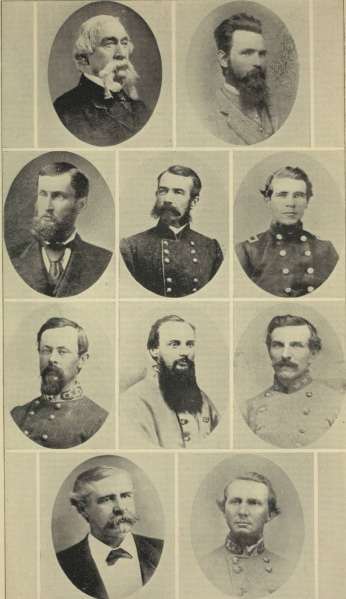
Brig.-Gen. John S. Preston. Brig.-Gen. Maxcy Gregg.
Brig.-Gen. T. M. Logan. Maj.-Gen. David R. Jones. Brig.-Gen. Micah Jenkins.
Brig.-Gen. Johnson Hagood. Brig.-Gen. S. W. Ferguson. Brig.-Gen. James Conner.
Brig.-Gen. John D. Kennedy. Brig.-Gen. S. R. Gist.
Brigadier-General Roswell Sabine Ripley was born at
Worthington, Ohio, March 14, 1823. He was graduated at
the United States military academy, number seven in the
class of 1843, of which Gen. U. S. Grant was twenty-first.
With promotion to brevet second lieutenant, Third artillery,
he served until 1846 on garrison duty, and for a few
months as assistant professor of mathematics at West
Point. In 1846, being commissioned second lieutenant,
he was on the coast survey until ordered to Mexico, where
he fought at Monterey in September. Then being promoted
first lieutenant, Second artillery, he took part in
the siege of Vera Cruz, and at the battle of Cerro Gordo
won the brevet of captain. At Contreras, Churubusco
Molino del Rey, Chapultepec and the capture of the
Mexican capital he won new honors and came out of the
war with the brevet rank of major. After service as
aide-de-camp to General Pillow to July, 1848, he prepared
and published a history of the war in 1849, and
subsequently was engaged in the Indian hostilities in
Florida and in garrison duty until March, 1853, when he
resigned and engaged in business at Charleston, the
home of his wife. At the organization of the South
Carolina army he received the rank of lieutenant-colonel,
commanding the First artillery battalion, and at the
bombardment of Fort Sumter was highly commended by
the generals commanding for his services in charge of
the batteries on Sullivan's island. In August following
he was commissioned brigadier-general in the provisional
army of the Confederate States, and was put in command
of the department of South Carolina, and when that was
merged in a larger department under Gen. R. E. Lee,
he was given charge of the Second military district of the
State. Joining the army of Northern Virginia in June,
1862, he commanded a brigade of D. H. Hill's division,
composed of Georgia and North Carolina regiments, in
the battles of Mechanicsville, Gaines' Mill, Malvern Hill,
South Mountain and Sharpsburg. In the latter engagement
he was shot in the throat, but returned to the fight
after his wound was dressed. About a month later he
took command of the First military district of South
Carolina, including Charleston and its defenses, and was
in immediate command during the memorable attacks of
the Federal fleets and army in 1863 and 1864. In January,
1865, he was ordered to report to General Hood,
and at the last was assigned to command of a division of
Cheatham's corps of the army in North Carolina. Then
going abroad he resided in Paris several years, and upon
his return resumed his business operations at Charleston.
He died at New York, March 26, 1887.
* * * * *
Brigadier-General Clement Hoffman Stevens was born
in Norwich, Conn., August 14, 1821, the son of Lieut.
Clement W. Stevens, United States navy, and Sarah J.
Fayssoux, daughter of Dr. Peter Fayssoux, surgeon-general
of the army in South Carolina during the war of the
revolution. Not long after his birth the father left the
navy and the family settled in Florida, but removed to
Pendleton, S. C., at the outbreak of Indian troubles in
1836. In youth he served for several years as private
secretary to his kinsmen, Commodore William B. Shubrick
and Capt. Edward Shubrick. In 1842 he abandoned
this service at sea, and became an official of the
Planters and Mechanics bank at Charleston, of which he
was cashier at the period of secession. In January, 1861,
he presented to Gen. David F. Jamison, secretary of war
for the State, a design he had prepared for an ironclad
battery, and it being approved, he immediately began
the erection of an armored battery of two guns on Cummings
point, known as the Stevens' iron battery. It
was built of heavy yellow pine timber with great solidity,
and the face, inclined at an angle of forty degrees, was
covered with bars of railroad iron. In this protected
battery, which was of service in the bombardment of Fort
Sumter, was the germ of the armored ship Virginia,
and her class. The floating battery designed by Lieut.
J. R. Hamilton, in use at the same time, approached still
more closely the plan of the famous ironclad of Hampton
Roads. General Stevens' mechanical ingenuity was
later shown in the invention of portable ovens, by the use
of which his regiment was supplied with excellent bread.
Stevens next served as volunteer aide to his cousin,
Gen. Barnard E. Bee, at the battle of First Manassas,
and was severely wounded. Returning home, as soon as
he had recovered from his wound he took charge of a
militia regiment at Charleston, but soon joined in the
organization of the Twenty-fourth regiment, of which he
was elected colonel. In the winter of 1861-62 he was for
some time on duty as aide to General Ripley. In the
fight at Secessionville he commanded the Confederate
forces on the field. In December, 1862, he was assigned
to command one of the brigades to be sent under General
Gist for the support of Wilmington, and in May, 1863,
he and his regiment were ordered to Mississippi under
the brigade command of Gist. With the forces collected
under Gen. J. E. Johnston he participated in the summer
campaign of that year for the relief of Vicksburg, and
the defense of Jackson against Sherman, and subsequently
joined the army at Chattanooga. At the battle
of Chickamauga he was actively engaged until two horses
were killed under him and he was wounded. Gist
alluded to him as the "iron-nerved," and General Walker
reported "that the gallant Stevens, who was severely
wounded, from what I know of his capacity as an officer,
from his gallantry on the field, and from his devotion to
the cause, would grace any position that might be conferred."
January 20, 1864, he was promoted to brigadier-general,
and was assigned to the command of a Georgia
brigade, formerly known as Wilson's, of Walker's division,
which he led with distinction throughout the Atlanta
campaign, until he was killed in the battle of July 20,
1864, near the city of Atlanta.
* * * * *
Brigadier-General James H. Trapier, a native of South
Carolina, was graduated in the United States military
academy, third in the class of 1838, of which General
Beauregard was second and William J. Hardee, Edward
Johnson and Carter L. Stevenson were other famous
members. As a lieutenant of engineers in the United
States service he assisted in the construction of defenses
at Charleston harbor and Fort Pulaski, and was promoted
first lieutenant in 1839. Subsequently he was constructing
engineer of repairs at Forts Macon and Caswell,
and Forts Ontario, Niagara and Porter, New York;
served in the war with Mexico in 1847, and was assistant
engineer connected with the fortification of New York
harbor until his resignation in 1848. Returning to South
Carolina he was engaged as a planter at Georgetown until
the organization of the Confederacy, serving also as chief
of ordnance of the State in 1851-52, and as aide-de-camp,
with the rank of colonel, on the staff of Governor Means.
With the rank of captain of engineers he rendered valuable
service in the construction of the Confederate batteries
for the attack on Fort Sumter, and was engineer-in-chief
on Morris island. Soon afterward he was
promoted major of engineers, and in October was promoted
brigadier-general and assigned to command of the
department of Eastern and Middle Florida, with especial
care of Cumberland sound. Asking to be relieved in
March, 1862, he was ordered to report to General Johnston
in Alabama. He commanded the First division of
General Polk's corps at Corinth and in the battle of Farmington,
May 9, 1862, and in November following was
assigned to command of the Fourth district of South
Carolina, with headquarters at Georgetown. In the
spring of 1863 he was in command on Sullivan's island
during the attack by the Federal fleet, April 7th, and not
long afterward resumed his duties at Georgetown. Surviving
the war he died at Mansfield, S. C, January 2,
1866, at the age of fifty-one years.
* * * * *
Brigadier-General John Bordenave Villepigue was born
at Camden, S. C, July 2, 1830, of French descent. He
was graduated at the United States military academy in
1854, with a brevet lieutenancy in the dragoons; a year
later was promoted to second lieutenant, and in 1857 to
first lieutenant. His military service of about seven
years in the old army was rendered in the Second dragoons,
mainly on the frontier in Kansas and Nebraska,
participating in the Sioux expedition of 1855 and the
march to Fort Lookout, Dakota, in 1856. He took part
in the Utah campaign of 1857-58, and then after a period
spent at the Carlisle cavalry school, was on duty in Utah
until he resigned, March 31, 1861, to enter the service of
the Southern Confederacy. He received the commission
of captain of artillery from the government at Montgomery,
and soon afterward was promoted colonel in the provisional
army, and assigned to the Thirty-sixth Georgia
regiment. In command of Georgia and Mississippi soldiers
he first attracted attention by his heroic defense of
Fort McRee, Pensacola harbor, during the bombardment
of November 22, 1861. General Bragg reported at that
time that for the number and caliber of guns brought
into action it would rank with the heaviest bombardment
of the world. The buildings of the fort were several
times on fire, and Villepigue was seriously wounded, but
his coolness inspired his volunteers to fight with the
tenacity of veterans. Said Bragg: "An educated soldier,
possessing in an eminent degree the love and confidence
of his officers and men, he had been specially
selected for this important and perilous post. The result
fully vindicates the fortunate choice, and presents for
our admiration, blended in perfect harmony, the modest
but heroic soldier with the humble but confiding Christian."
Villepigue was appointed chief of engineers and
artillery on the staff of General Bragg, was for a time in
command at Pensacola, then was at Mobile, and joining
Bragg was promoted brigadier-general early in 1862. He
was assigned to command at Fort Pillow on the Mississippi,
General Beauregard sending him there as "the
most energetic young officer" at his command. Week
after week he held the open batteries, and kept back the
enemy's superior land and naval forces until ordered to
retire, when he blew up his fortifications and brought off
his command in safety, June 4th. He was given command
of a brigade of the army in Mississippi, under General
Van Dorn, and at the battle of Corinth in October
was distinguished both in the attack and in the protection
of the rear during the retreat. Soon after this
arduous and dispiriting campaign the young soldier was
prostrated by a severe illness, which resulted in his
death at Port Hudson, November 9, 1862.
* * * * *
Brigadier-General William Henry Wallace was born in
Laurens county, March 24, 1827, son of Daniel Wallace,
for several terms a member of the legislature, a major-general
of militia, and from 1849 to 1853 representative
in Congress. His grandfather was Jonathan Wallace, a
native of Virginia who removed to South Carolina before
the war of the revolution, in which he was a patriot soldier.
General Wallace was graduated at the South Carolina
college in December, 1849, and in the following
spring was married to Sarah, daughter of Robert Dunlap,
of Newberry. She was the niece of James Dunlap,
appointed governor of Florida by Andrew Jackson, and
granddaughter of William Dunlap, a revolutionary soldier
who was the grandson of John Hunter, a native of
Ireland who was United States senator from South Carolina
in 1801. General Wallace was occupied as planter in
Union county until 1857, when he became the proprietor
of the Union Times newspaper, and in 1859 began the
practice of law at Union. In 1860 as a member of the
legislature he supported the call for a convention, and at
the expiration of his term he enlisted as a private in Company
A, Eighteenth South Carolina volunteers. A few
days later he was appointed adjutant of the regiment by
Col. James M. Gadberry, who was killed at Second Manassas.
Before going into the field the regiment was
reorganized, and Wallace was elected lieutenant-colonel
in May, 1861. The regiment was ordered into Virginia
in time to engage the enemy near Malvern Hill in
August, after which it fought at the battle of Second
Manassas, losing about half its number in battle, including
the gallant Colonel Gadberry. Wallace was at once
promoted colonel, and he led his regiment, in the brigade
of Gen. N. G. Evans, through the battles of South
Mountain and Sharpsburg with the army of Northern
Virginia. Subsequently he was on duty in defense of
Charleston. In the spring of 1864 the brigade under
Gen. Stephen Elliott was ordered to Petersburg, where
Colonel Wallace participated in the defense of the lines
and all the operations of Bushrod Johnson's division.
His brigade suffered most heavily at the battle of the
Crater, four companies of his regiment being blown up
or destroyed by falling earth at the explosion of the
mine, July 30, 1864. In September he was promoted
brigadier-general, and up to the eve of the surrender he
commanded the brigade, fighting gallantly at Gravelly
run and Namozine church on the retreat. At Appomattox
Court House, on the night of April 8th, he was assigned
by General Gordon to the command of Johnson's division,
in which capacity he reported to Gen. Clement A.
Evans and participated in the last action of the army on
the morning of April 9th. After his parole he devoted
himself to the practice of the law, the care of his plantation
and the restoration of good government in the State.
He was one of the few Democrats elected to the legislature
in 1872, and was re-elected in 1874 and 1876. In
1877 he was chosen judge of the Seventh circuit, a position
in which he continued to serve with honor and ability
until 1893, when he retired from public life.