Given the characteristics of the patent-medicine business, its
most difficult and essential function was selling—or what
the Comstocks and their representatives frequently described in
their letters as "putting the pills through." During the full
century within which Dr. Morse's Indian Root Pills and their
companion remedies were distributed widely over North America
and, later, over the entire world, almost every form of
advertising and publicity was utilized. And it is a strong
presumption that the total costs of printing and publicity were
much larger than those of manufacture and packaging.
Initially, the selling was done largely by "travelers" calling
directly upon druggists and merchants, especially those in rural
communities. All of the Comstock brothers, with the exception
perhaps of Lucius, seem to have traveled a large part of their
time, covering the country from the Maritime Provinces to the
Mississippi Valley, and from Ontario—or Canada
West—to the Gulf. Their letters to the "home office" show
that they were frequently absent for extended periods, visiting
points which at the very dawn of the railroad era, in the 1840s
and 1850s, must have been remote indeed. In the surviving letters
we find occasional references to lame horses and other
vicissitudes of travel, and one can also imagine the rigors of
primitive trains, lake and river steamers, stagecoaches, and
rented carriages, not to mention ill-prepared meals and dingy
hotel rooms.
Judson seems to have handled Nova Scotia and New Brunswick. J.
Carlton Comstock, who died in 1853, covered the South and in fact
maintained a residence in New Orleans; prior to the opening of
the railroads, this city was also a point of entry for much of
the West. George Wells Comstock made several extensive tours of
the West, while William Henry spent much of his time in Canada
West and, as we have seen, lived in Brockville after 1860. Andrew
J. White spent most of his time traveling after he joined the
firm in 1855; Moore also covered Canada West intensively, briefly
for the Comstocks and then in opposition to them.
Besides the partners themselves, the several successor Comstock
firms had numerous agents and representatives. As early as 1851,
during the dispute between Lucius and his brothers, it was stated
in a legal brief that the partnership included, besides its
manufacturing house in New York City, several hundred agencies
and depots throughout every state and county in the Union. This
assertion may have stretched the truth a bit, as most of the
agents must have handled other products as well, but the
distribution system for the pills was undoubtedly well organized
and widely extended. Several full-time agents did work
exclusively for the Comstocks; these included Henry S. Grew of
St. John's, Canada East, who said he had traveled 20,000 miles in
three years prior to 1853, and Willard P. Morse in the Middle
West, whose signature is still extant on numerous shipping
documents.
While personal salemanship always must have been most effective
in pushing the pills—and also useful in the allied task of
collecting delinquent accounts—as the business grew the
territory was far too vast to be covered by travelers, and so
advertising was also used heavily. Hardly any method was
neglected, but emphasis was always placed upon two media:
almanacs and country newspapers.
Millions of the almanacs poured out of the small Morristown
railroad station. In the early years of the present century, for
which the record has been found, from July until the following
April shipments of almanacs usually ran well in excess of one
million per month. At various times they were also printed in
Spanish and in German; the Spanish version was for export, but
the German was intended primarily for our own "native" Germans in
Pennsylvania, Wisconsin, and elsewhere throughout the Middle
West.
Around the turn of the century, the patent-medicine almanac was
so common that one could walk into any drug store and pick up
three or four of them. Credit for the origination of the free
patent-medicine almanac has been ascribed to Cyrenius C. Bristol,
founder of the firm which Moore later took over and therefore an
indirect predecessor of the Indian Root Pills. Whether or not
this is strictly accurate, it is known that Bristol's
Sarsaparilla Almanac was being printed as early as 1843 and by
1848 had expanded into an edition of 64 pages.
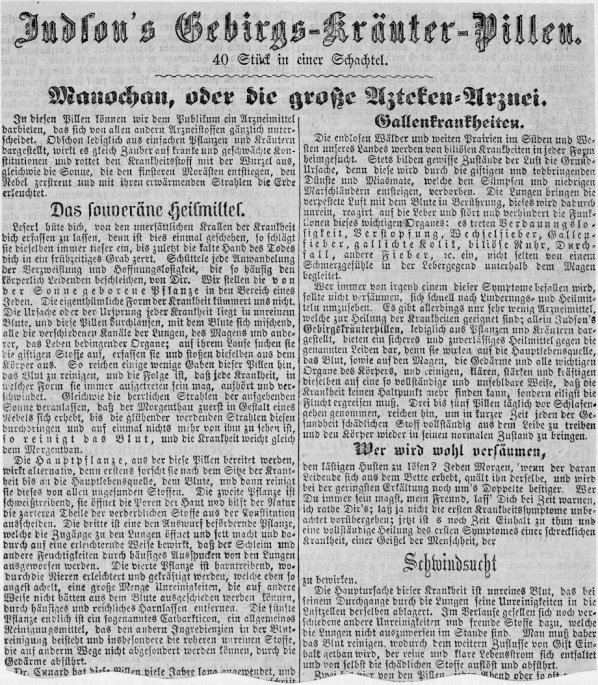 |
FIGURE 18.—German
circular for Judson's Mountain Herb Pills.
|
The Comstocks were almost as early. The first date they printed
almanacs is not known, but by 1853 it was a regular practice, for
the order book of that year shows that large batches of almanacs,
frequently 500 copies, were routinely enclosed with every
substantial order. Over their entire history it is quite
reasonable that somewhere in the vicinity of one billion almanacs
must have been distributed by the Comstock Company and its
predecessors. As a matter of fact, back in the 1850s there was
not merely a Comstock but also a Judson almanac. One version of
the latter was the "Rescue of Tula," which recounted Dr. Cunard's
rescue of the Aztec princess and his reward in the form of the
secret of the Mountain Herb Pills. In the 1880s, Morse's Indian
Root Pill almanac was a 34-page pamphlet, about two thirds filled
with advertising and testimonials—including the familiar
story of the illness of Dr. Morse's father and the dramatic
return of his son with the life-saving herbs—but also
containing calendars, astronomical data, and some homely good
advice. Odd corners were filled with jokes, of which the
following was a typical specimen:
"Pa," said a lad to his father, "I have often read of
people poor
but honest; why don't they sometimes say, 'rich but
honest'"?
"Tut, tut, my son, nobody would believe them," answered the
father.
Before 1900 the detailed story of the discovery of Dr. Morse's
pills was abridged to a brief summary, and during the 1920s this
tale was abandoned altogether, although until the end the
principal ingredients were still identified as natural herbs and
roots used as a remedy by the Indians. In more recent years the
character and purpose of Dr. Morse's pills also changed
substantially. As recently as 1918, years after the passage of
the Federal Food and Drug Act of 1906, they were still being
recommended as a cure for:
Biliousness
Dyspepsia
Constipation
Sick Headache
Scrofula
Kidney Disease |
Liver Complaint
Jaundice
Piles
Dysentery
Colds
Boils |
Malarial Fever
Flatulency
Foul Breath
Eczema
Gravel
Worms |
Female Complaints
Rheumatism
Neuralgia
La Grippe
Palpitation
Nervousness
|
Further, two entire pages were taken in the almanac to explain
how, on the authority of "the celebrated Prof. La Roche of
Paris," appendicitis could be cured by the pills without resort
to the surgeon's knife.
Besides the almanacs, almost every known form of advertising in
the preradio era was employed. Announcements were inserted in
newspapers—apparently mostly rural newspapers—all
over the country; the two remedies pushed most intensively were
the Indian Root Pills and Judson's Mountain Herb Worm Tea. The
latter always bore a true likeness of Tezuco, the Aztec chief who
had originally conferred the secret of the medicine upon Dr.
Cunard. Besides the Mountain Herb Worm Tea, there were also
Mountain Herb Pills; it is not clear how the pills differed from
the tea, but they were recommended primarily as a remedy for
Bowel Complaints Coughs Colds Chest Diseases
Costiveness Dyspepsia Diarrhoea Dropsy Debility Fever and Ague
Female Complaints Headaches Indigestion Influenza Inflammation
Inward Weakness Liver Complaints Lowness of Spirits Piles Stone
and Gravel Secondary Symptoms
with particular stress upon their value as a "great female
medicine." Besides the major advertisement of the pills,
consisting of an eight-inch column to be printed in each issue of
the paper, smaller announcements were provided, to be inserted
according to a specified monthly schedule among the editorial
matter on the inside pages. Sample monthly announcements from the
Judson Mountain Herb Pills contract used in 1860 were:
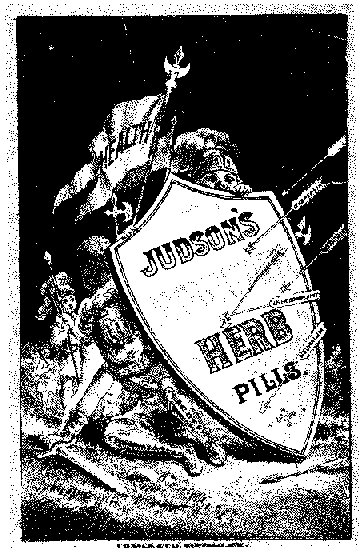 |
FIGURE 19.—Card
used in advertising
Judson's Mountain Herb Pills.
|
JANUARY
THE GREAT FEMALE MEDICINE
The functional irregularities peculiar to the weaker sex,
are
invariably corrected without pain or inconvenience by the use
of
Judson's Mountain Herb Pills. They are the safest and surest
medicine for all the diseases incidental to females of all
ages,
and more especially so in this climate.
Ladies who wish to enjoy health should always have these Pills.
No
one who ever uses them once will ever allow herself to be
without
them. They remove all obstructions, purify the blood and give
to
the skin that beautiful, clear and healthful look so greatly
admired in a beautiful and healthy woman. At certain periods
these
Pills are an indispensable companion. From one to four should
be
taken each day, until relief is obtained. A few doses
occasionally,
will keep the system healthy, and the blood so pure, that
diseases
cannot enter the body.
MARCH
DISEASES OF THE CHEST AND LUNGS
These diseases are too well known to require any description.
How
many thousands are every year carried to the silent grave by
that
dread scourge Consumption, which always commences with a
slight
cough. Keep the blood pure and healthy by taking a few doses
of
JUDSON'S MOUNTAIN HERB PILLS each week, and disease of any kind
is
impossible. Consumption and lung difficulties always arise
from
particles of corrupt matter deposited in the air cells by
bad
blood. Purify that stream of life and it will soon carry off
and
destroy the poisonous matter; and like a crystal river
flowing
through a desert, will bring with it and leave throughout the
body
the elements of health and strength. As the river leaving
the
elements of fertility in its course, causes the before barren
waste
to bloom with flowers and fruit, so pure blood causes the frame
to
rejoice in strength and health, and bloom with unfading
beauty.
Any person who read the notices for both medicines carefully
might have noticed with some surprise that the Mountain Herb
Pills and the Indian Root Pills were somehow often recommended
for many of the same diseases. In fact, the Mountain Herb Pills
and the Indian Root Pills used identical text in explaining their
effect upon several disagreeable conditions. Always prominent in
this advertising were reminders of our fragile mortality and
warnings, if proper medication were neglected, of an untimely
consignment to the silent grave.
Unfortunately, newspapers in the South had been utilized
extensively just on the eve of the Civil War, and it undoubtedly
proved impossible to supply customers in that region during the
ensuing conflict. However, other advertising was given a military
flavor and tied in with the war, as witness the following (for
1865):
      GENERAL ORDERS—No. 1

      Headquarters

      Department of this Continent and adjacent Islands

      Pursuant to Division and Brigade orders issued by 8,000Field
      Officers, "On the Spot", where they are stationed. AllSkedadlers,
      Deserters, Skulkers, and all others—sick, wounded and
      cripples—who have foresaken the cause of General Health,shall
      immediately report to one of the aforesaid officers nearestthe
      point where the delinquent may be at the time this order ismade
      known to him, and purchase one box of

      JUDSON'S
      MOUNTAIN HERB PILLS

      and pay the regulation price therefor. All who comply withthe
      terms of this order, will receive a free pardon for pastoffences,
      and be restored to the Grand Army of General Health.

                                                         A. GOOD HEALTH
                                                         Lieutenant-General

                By order
           Dr. Judson,
                Adjutant-General

                                                         Sold by all dealers.
Twenty years later, when the Civil War had passed out of recent
memory and Confederate currency was presumably becoming a
curiosity, Comstock printed facsimiles of $20 Confederate
bills,
with testimonials and advertisements
upon the reverse side; it can be assumed that these had enough
historical interest to circulate widely and attract attention,
although each possessor must have felt a twinge of disappointment
upon realizing that his bill was not genuine but merely an
advertising gimmick.
Back in the 1850s, the Comstock Company in lower Manhattan had an
advertising agent, one Silas B. Force, whose correspondence by
some unexplained happenstance was also deposited in the loft of
the Indian Root Pill building in Morristown, even though he was
not an exclusive agent and served other clients besides the
Comstocks. One of these was Dr. Uncas Brant, for whom Force had
the following announcement printed in numerous papers:
      AN OLD INDIAN DOCTOR WHO HAD made his fortune and retired from
      business, will spend the remainder of his days in curing that
      dreadful disease—CONSUMPTION—FREE OF CHARGE: his earnest desire
      being to communicate to the world his remedies that have proved
      successful in more than 3,000 cases. He requires each applicant to
      send him a minute description of the symptoms, with two Stamps (6
      cts) to pay the return letter, in which he will return his advice
      prescription, with directions for preparing the medicines &c.

      The Old Doctor hopes that those afflicted will not, on account of
      delicacy, refrain from consulting him because he makes No Charge.
      His sole object in advertising is to do all the good he can, before
      he dies. He feels that he is justly celebrated for cure of
      Consumption, Asthma, Bronchitis, Nervous Affections, Coughs, Colds,
      &c.

               Address


                                                    DOCT. UNCAS BRANT
                                                    Box 3531, P.O., New York
This type of an apparently free diagnosis of medical ills,
prompted solely by the benevolence of some elderly or retired
person, was a familiar petty swindle around the middle of the
last century. The newspapers carried many such announcements from
retired clergymen, old nurses, or Indian doctors, frequently
persons who had themselves triumphed over dread diseases and had
discovered the best remedies only after years of search and
suffering, always offering to communicate the secret of recovery
to any fellow sufferer. The victim would receive in reply a
recipe for the proper medicine, always with the advice that great
care must be taken to prepare it exactly as directed, and with
the further advice that if the ingredients should not prove to be
conveniently available the benevolent old doctor or retired
clergyman could provide them for a trifling sum. Invariably, the
afflicted patient would discover that the ingredients specified
were obscure ones, not kept by one druggist in a hundred and
unknown to most of them. Thus, he would be obliged, if he
persisted in the recommended cure, to send his money to the
kindly old benefactor. Frequently, he would receive no further
reply or, at best, would receive some concoction costing only a
few cents to compound. The scheme was all the safer as it was
carried on exclusively by mail, and the swindler would usually
conclude each undertaking under any given name before
investigation could be initiated.
Besides participating in such schemes, Force apparently devoted a
large part of his energy in collecting accounts due him or, in
turn, in being dunned by and seeking to postpone payment to
newspapers with whom he was delinquent in making settlement.
Other forms of advertising employed over the years included
finely engraved labels, circulars and handbills, printed
blotters, small billboards, fans, premiums sent in return for
labels, a concise—
very
concise—reference
dictionary, and trade cards of various sorts. One trade card
closely resembled a railroad pass; this was in the 1880s when
railroad passes were highly prized and every substantial citizen
aspired to own one. Thus, almost everyone would have felt some
pride in carrying what might pass, at a glance, as a genuine pass
on the K.C.L.R.R.; although it was signed only by "Good Health"
as the general agent, entitled the bearer merely to ride on foot
or horseback and was actually an advertisement of Kingsland's
Chlorinated Tablets. Another card played somewhat delicately but
still unmistakably on the Indian Root Pills' capacity to restore
male virility. This card pictured a fashionably dressed tomcat,
complete with high collar, cane and derby, sitting somewhat
disconsolately on a fence as the crescent moon rose behind him,
with these reflections:
   How terribly lonesome I feel! How queer,
   To be sitting alone, with nobody near,
   Oh, how I wish Maria was here,
                       Mon dieu!
   The thought of it fills me with horrible doubt,
   I should smile, I should blush, I should wail,
           I should shout,
   Just suppose some fellow has cut me out!
                             Me out!
And underneath the lesson is given:
   Dr. Morse's Indian Root Pills
   The Best Family Pill in use
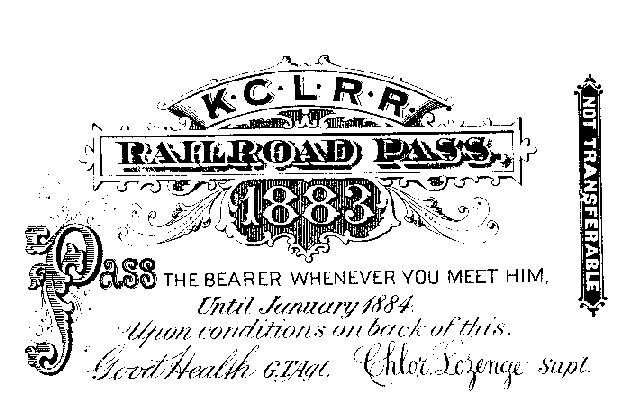 |
FIGURE 20.—A trade
card advertising Kingsland's Chlorinated Tablets, which closely
resembled a railroad pass.
|
Testimonials submitted voluntarily by happy users of the pills
were always widely featured in the almanacs, newspaper
advertisements, and handbills. Although the easy concoction of
the stories about Dr. Morse and Dr. Cunard might suggest that
there would have been no hesitation in fabricating these
testimonials, it is probable that they were genuine; at least,
many have survived in the letters scattered over the floor of the
Indian Root Pill factory. In some cases one might feel that the
testimonials were lacking in entire good faith, for many of them
were submitted by dealers desiring lenient credit or other
favors. Witness, for example, the following from B. Mollohan of
Mt. Pleasant, Webster County, West Va., on April 16, 1879:
     Pleas find here enclosed Two Dollars & 50 cts $2 50 cts for which
     pleas place to my credit and return receipt to me for same. I cant
     praise your Dr Morse pill two high never before in all my
     recolection has there bin a meddison here that has given such
     general satisfaction. I hope the pills will always retain their
     high standing and never bee counterfeited.... I could sell any amt
     Pills allmost if money was not so scarce. I have to let some out on
     credit to the Sick and Poor & wait some time though I am
     accountable to you for all I recd & will pay you as fast as I sell
     & collect ... I have about one Doz Box on hand.
Mollohan's complaint about the shortage of money and the long
delay in collecting many accounts reflected a condition that
prevailed throughout the nineteenth century. Money was scarce,
and the economy of many rural communities was still based largely
on the barter system, so that it was very difficult for farmers
to generate cash for store goods. Consequently, country
storekeepers had to be generous in extending credit, and, in
turn, manufacturers and jobbers had to be lenient in enforcing
collection.
Not all of the storekeepers could write as neatly and clearly as
Mollohan. The following letter, quoted in full, from Thomas
Cathey of Enfield, Illinois, on January 23, 1880, not merely
presented a problem relating to the company's policy of awarding
exclusive territories but offered considerable difficulty in
deciphering:
    mr CumStock der ser i thaut i Wod rite yo
    u a few lineS to inform you that i was the fir
    St agent for you pills in thiS Setlement but th
    as iS Several agent round her and tha ar interfer
    With mee eSpeSly William a StavSon he liveS her
    at enfield he Wanted mee to giv him one of you Sur
    klerS So he Wod be agent but i Wodent let hi
    m hav hit an he rote to you i SupoSe an haS got a
    Suplye of pillS an ar aruning a gant mee he iS Sell
    ing them at 20 centS a box i Want you to St
    op him if you pleeS
    mr CumStock i Sent you too dollars the 21 p
    leeS Credet my a Count With hit mr. Cumsto
    Ck i Want you to Send mee Sum of you pam
    pletS i Want you to Send mee right of three tow
    nShipS aS i am Working up a good trad her i wan
    t indin Cree an enfield an Carnie tonnShipS rite
    Son aS poSSible an let me know whether you will let
    me have thoSe townShipS or not for my territory
    i Sold a box of pillS to melven willSon his gir
    l She haS the ChilS for three yer and he tride eve
    n thang he cood her wan nothing never dun her
    eny good one box of you pills brok them on her
    tha ar the beSt pillS i ever Saw in
    my life tha ar the beSt medeSon for the ChillS
    i ever Saw an rumiteS i am giting
    up a good trad i Want you to Send me Sum of
    you pampletS i want you to Stop theSe oth
    er agentS that iS botheran me an oblige you
    rite Son.
                                              enfield
                                            White Co.
                                                   illS
    thomaS Cathey
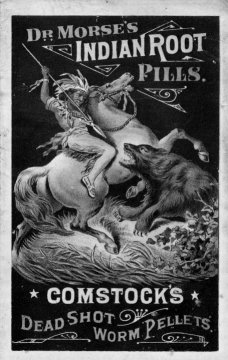 |
FIGURE 21.—Cover
for booklet used as
a circular describing the Indian Root Pills.
|
Sadly, we do not know how the company handled Mr. Cathey's
request for sole representation in three Illinois townships.
After the pills achieved wide recognition and other methods of
publicity, chiefly the almanacs, were well established, newspaper
advertising was terminated. An invitation to agents (about 1885)
declared that
For some years past they have not been advertised in
newspapers, they being filled with sensational advertisements of
quack nostrums got up for no other purpose than catch-penny
articles ...
The Indian Root Pills obviously claimed a more lofty stature than
other, common proprietary remedies. The exclusive representation
scheme was also a partial substitution for newspaper advertising;
the company was aggressive in soliciting additional
agents—aiming at one in every town and village—and
then in encouraging them to push the pills by offering prizes
such as watches, jewelry, and table utensils.
What were the ingredients of the Indian Root Pills and the other
Comstock preparations? Originally, the formulas for the various
remedies were regarded as closely held secrets, divulged only to
proprietors and partners—and not even to all of
them—and certainly never revealed to the purchasers. But
despite this secrecy, charges of counterfeiting and imitating
popular preparations were widespread. In many cases, the alleged
counterfeits were probably genuine—to the extent that
either of these terms has meaning—for it was a recurrent
practice for junior partners and clerks at one drug house to
branch off on their own, taking some of the secrets with
them—just as Andrew B. White left Moore and joined the
Comstocks, bringing the Indian Root Pills with him.
In the latter years, under the rules of the Federal Food and Drug
Act, the ingredients were required to be listed on the package ;
thus we know that the Indian Root Pills, in the 1930s and 1940s,
contained aloes, mandrake, gamboge, jalap, and cayenne
pepper.
Aloe
is a tropical plant of which the best known
medicinal varieties come from Socotra and Zanzibar; those
received by the Comstock factory were generally described as Cape
(of Good Hope)
Aloe
. The juice
Aloes
is extracted
from the leaves of this plant and since antiquity has been
regarded as a valuable drug, particularly for its laxative and
vermifuge properties.
Mandrake
has always been reputed to
have aphrodisiac qualities.
Gamboge
is a large tree native
to Ceylon and Southeast Asia, which produces a resinous gum, more
commonly used by painters as a coloring material, but also
sometimes employed in medicine as a cathartic.
Jalap
is a
flowering plant which grows only at high altitudes in Mexico, and
its root produces an extract with a powerful purgative effect.
All of these ingredients possessed one especial feature highly
prized by the patent-medicine manufacturers of the nineteenth
century, i.e., they were derived from esoteric plants found only
in geographically remote locations. One does find it rather
remarkable, however, that the native Indian chiefs who confided
the secrets of these remedies to Dr. Morse and Dr. Cunard were so
familiar with drugs originating in Asia and Africa.
The Indians may very well have been acquainted
with the properties of jalap, native to this continent, but the
romantic circumstances of its discovery, early in the last
century seem considerably overdrawn, as the medicinal properties
of jalap were generally recognized in England as early as
1600.
Whether the formula for the Indian Root Pills had been constant
since their "discovery"—as all advertising of the company
implied—we have no way of knowing for sure. However, the
company's book of trade receipts for the 1860s shows the
recurring purchase of large quantities of these five drugs, which
suggests that the ingredients did remain substantially unchanged
for over a century. For other remedies manufactured by the
company, the ingredients purchased included:
Anise Seed
Black Antimony
Calomel
Camphor
Gum Arabic |
Gum Asphaltum
Gum Tragacanth
Hemlock Oil
Horehound |
Laudanum
Licorice Root
Magnolia Water
Muriatic Acid |
Saltpetre
Sienna Oil
Sulphur
Wormseed |
It is not known where the calomel (mercurous chloride) and some
of the other harsher ingredients were used—certainly not in
the Indian Root Pills or the Mountain Herb Worm Tea—for the
company frequently incorporated warnings against the use of
calomel in its advertising and even promised rewards to persons
proving that any of its preparations contained calomel.
Less active ingredients used to supply bulk and flavor included
alcohol, turpentine, sugar, corn starch, linseed meal, rosin,
tallow, and white glue. Very large quantities of sugar were used,
for we find that Comstock was buying one 250-pound barrel of
sugar from C.B. Herriman in Ogdensburg approximately once a
month. In the patent-medicine business it was necessary, of
course, that the pills and tonics must be palatable, neutralizing
the unpleasant flavor of some of the active ingredients;
therefore large quantities of sugar and of pleasant-tasting herbs
were required. It was also desirable, for obvious reasons, to
incorporate some stimulant or habit-forming element into the
various preparations.
A register of incoming shipments for the year 1905 shows that
the factory was still receiving large quantities of aloes,
gamboge, mandrake, jalap, and pepper. One new ingredient being
used at this time was talc, some of which originated at
Gouverneur, within a few miles of the pill manufactory, but more
of it was described as "German talc." The same register gives the
formulas for three of the company's other preparations. One of
these, the
Nerve & Bone Liniment
, was simply
compounded of four elements:
    3 gal. Turpentine
    2 qts. Linseed Oil
    2 lbs. Hemlock
    2 lbs. Concentrated Amonia.
The formula for the
Condition Powders
(for horses and
livestock) was far more complex, consisting of:
    4 lbs. Sulphur
    4 lbs. Saltpetre
    4 lbs. Black Antimony
    4 lbs. Feongreek Seed
    8 lbs. Oil Meal
    1-1/2 oz. Arsenic
    2 oz. Tart Antimony
    6 lbs. Powdered Rosin
    2 lbs. Salt
    2 lbs. Ashes
    4 lbs. Brand (Bran-?).
The name of the third preparation was not given, but the
ingredients were:
    1 oz. Dry White Lead
    1 oz. Oxide of Zinc
    1/2 oz. Precipitated Chalk
    3 oz. Glycerine
    Add 1 lb. Glue.
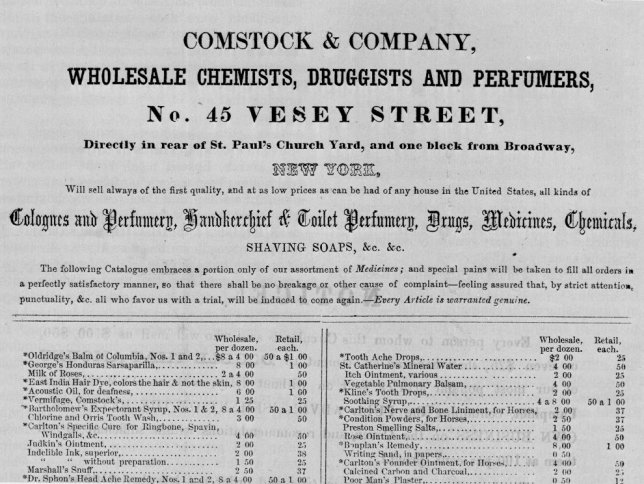 |
FIGURE 22.—A
partial list of remedies offered for sale by Lucius Comstock in
1854, shortly after the separation of the old company into the
rival firms of Comstock & Co. and Comstock & Brother.
|
Originally, Comstock and its predecessor firms marketed a large
number of remedies. In 1854, Comstock & Company—then
controlled by Lucius Comstock—listed nearly forty of its
own preparations for sale, namely:
Oldridge's Balm of Columbia
George's Honduras Sarsaparilla
East India Hair Dye, colors the hair and not the skin
Acoustic Oil, for deafness
Vermifuge
Bartholomew's Expectorant Syrup
Carlton's Specific Cure for Ringbone, Spavin and Wind-galls
Dr. Sphon's Head Ache Remedy
Dr. Connol's Gonorrhea Mixture
Mother's Relief
Nipple Salve
Roach and Bed Bug Bane
Spread Plasters
Judson's Cherry and Lungwort
Azor's Turkish Balm, for the Toilet and Hair
Carlton's Condition Powder, for Horses and Cattle
Connel's Pain Extractor
Western Indian Panaceas
Hunter's Pulmonary Balsam |
Linn's Pills and Bitters
Oil of Tannin, for Leather
Nerve & Bone Liniment (Hewe's)
Nerve & Bone Liniment (Comstock's)
Indian Vegetable Elixir
Hay's Liniment for Piles
Tooth Ache Drops
Kline Tooth Drops
Carlton's Nerve and Bone Liniment, for Horses
Condition Powders, for Horses
Pain Killer
Lin's Spread Plasters
Carlton's Liniment for the Piles, warranted to cure
Dr. Mc Nair's Acoustic Oil, for Deafness
Dr. Larzetti's Acoustic Oil, for Deafness
Salt Rheum Cure
Azor's Turkish Wine
Dr. Larzetti's Juno Cordial, or Procreative Elixir
British Heave Powders
|
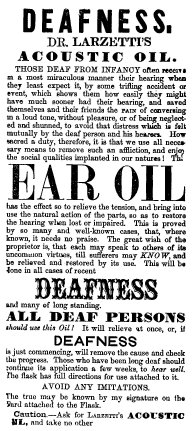 |
FIGURE 23.—Dr.
McNair's and Dr.
Larzetti's acoustic oil apparently
were identical in every respect.
Labels and directions, with the
difference only of the doctors' names,
were quite obviously printed from the
same type.
|
All of the foregoing were medicines for which Lucius claimed to
be the sole proprietor—although it is improbable that he
manufactured all of them: several of them were probably identical
preparations under different labels. In addition to these, he
offered a larger list of medicines as a dealer. Brother J.
Carlton Comstock must have been the main originator of medicines
within the firm; he seems to have specialized largely in
veterinary remedies, although the liniment for the piles also
stood to his credit. Despite Lucius' claim to sole proprietorship
of these remedies, the departing brothers also manufactured and
sold most of the identical items, adding two or three additional
preparations, such as Dr. Chilton's Fever and Ague Pills and
Youatt's Gargling Oil (for animals). Aside from J. Carlton
Comstock and Judson, the originators of most of the other
preparations are cloaked in mystery; most of them were probably
entirely fictitious. Admittedly, William Youatt (1776-1847), for
whom several of the animal remedies were named, was an actual
British veterinarian and his prescriptions were probably genuine,
but whether he authorized their sale by proprietary manufacturers
or was himself rewarded in any way are questions for speculation.
The versatile Dr. Larzetti seems to have experimented both with
impotency and deafness, but his ear oil—a number of
specimens of which were still on hand in the abandoned
factory—was identical in every respect with Dr. McNair's
oil, as the labels and directions, aside only from the names of
the doctors, were exactly the same for both preparations. In
fact, some careless printer had even made up a batch of circulars
headed "Dr. Mc Nair's Acoustic Oil" but concluding with the
admonition, "Ask for Larzetti's Acoustic Oil and take no other."
Presumably simple Americans who were distrustful of foreigners
would take Mc Nair's oil, but more sophisticated persons, aware
of the accomplishments of doctors in Rome and Vienna, might
prefer Larzetti's preparation.
As the century moved along, the Comstock factory at Morristown
reduced the number of remedies it manufactured, and concentrated
on the ones that were most successful, which included, besides
the Indian Root Pills, Judson's Mountain Herb Pills, Judson's
Worm Tea, Carlton's Condition Powders, Carlton's Nerve & Bone
Liniment, and Kingsland's Chlorinated Tablets. At some
undisclosed point, Carlton's Nerve & Bone Liniment for
Horses, originally registered with the Smithsonian Institution on
June 30, 1851, ceased to be a medicine for animals and became one
for humans. And sometime around 1920 the Judson name disappeared,
the worm medicine thereafter was superseded by Comstock's Worm
Pellets. Long before this, Judson had been transposed into
somewhat of a mythical character—"old Dr. Judson"—who
had devised the Dead Shot Worm Candy on the basis of seventy
years' medical experience.
During the final years of the Comstock business in Morristown, in
the 1930s, 1940s, and 1950s, only three items were manufactured
and sold: the Indian Root Pills, the Dead Shot Worm Pellets and
Comstock's N & B Liniment.
The worm
pellets had been devised by Mrs. Hill, "an old English nurse of
various and extended experience in the foundling hospitals of
Great Britain."
Besides its chemicals and herbs, the Comstock factory was a heavy
consumer of pillboxes and bottles. While the company advertised,
in its latter years, that "our pills are packaged in metal
containers—not in cheap wooden boxes," they were, in fact,
packaged for many decades in small oval boxes made of a thin
wooden veneer. These were manufactured by Ira L. Quay of East
Berne, New York, at a price of 12¢ per gross. The pill
factory often must have been a little slow in paying, for Quay
was invariably prodding for prompt remittance, as in this letter
of December 25, 1868:
     Mr Wm h comstock
     Dear sir we have sent you one tierce & 3 cases of pill boxes wich
     we want you to send us a check for as soon as you git this for we
     have to pay it the first of next month & must have the money if you
     want eney moure boxes we will send them & wait for the money till
     the first of april youres truly
                                                 Quay & Champion
Quay continued to supply the boxes for at least fifteen years,
during which his need for prompt payment never diminished.
Comstock also bought large quantities of bottles, corks, packing
boxes, and wrappers. Throughout the company's long existence,
however, more frequent payments were made to printers and
stationers—for the heavy flow of almanacs, handbills,
labels, trade cards, direction sheets, and billheads—than
for all the drugs and packaging materials. In the success
achieved by the Indian Root Pills, the printing press was just as
important a contributor as the pill-mixing machine.
The Final Years — DR. MORSE'S PILLS LIVE ON
When William Henry Comstock, Sr., moved the Indian Root Pill
business to Morristown, in 1867, he was—at age 37—at
least approaching middle life. Yet he was still to remain alive,
healthy, and in direct charge of the medicine business for more
than half a century longer. And the golden era of the
patent-medicine business may be said to have coincided very
closely with Mr. Comstock's active career—from about 1848
to 1919.
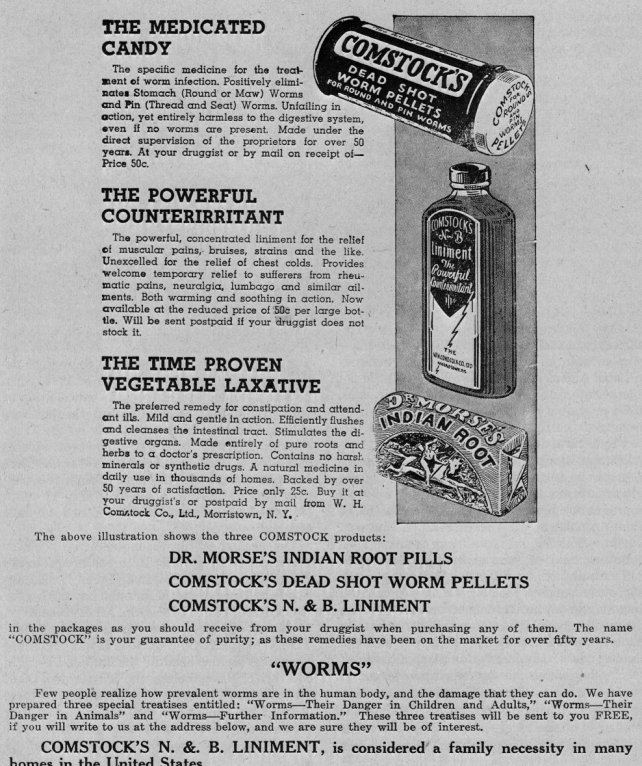 |
FIGURE 24.—In its
final years the Comstock factory discontinued most of its old
remedies and concentrated upon the three most successful:
Comstock's Dead Shot Worm Pellets, Comstock's N. & B.
Liniment, and Dr. Morse's Indian Root Pills.
|
While no schedule of sales, net income, or financial results are
available, the fragmentary records make it obvious that the
business continued to flourish beyond World War I, and long after
the passage of the first Food and Drug Act—in 1906. The
almanacs were still printed as recently as 1938; while the labels
and other advertising matter abandoned their ornate
nineteenth-century style and assumed a distinctly modern
aspect—to the extent of introducing comic-style picture
stories, featuring the small boy who lacked energy to make the
little league baseball team (he had worms), and the girl who
lacked male admirers because of pimples on her face (she suffered
from irregular elimination). Sales volume of the Morristown
factory, however, apparently did reach a peak early in the
present century—perhaps around 1910—and began a more
rapid decline during the 1920s. During this same period the
geographical character of the market shifted significantly; as
domestic orders dropped off, a very substantial foreign business,
particularly in Latin America, sprang up. While this did not
compensate fully for the loss of domestic sales, it did provide a
heavy volume that undoubtedly prolonged the life of the Indian
Root Pill factory by several decades.
William Henry Comstock, Sr., who first came to Brockville in
1860, at a time when the struggle with White for the control of
the pills was still in progress, married a Canadian girl,
Josephine Elliot, in 1864; by this marriage he had one son,
Edwin, who lived only to the age of 28. In 1893 Comstock married,
for a second time, Miss Alice J. Gates, and it is a favorable
testimony to the efficacy of some of his own virility medicines
that at age 67 he sired another son, William Henry Comstock II
(or "Young Bill") on July 4, 1897. In the meanwhile, the elder
Comstock had become one of the most prominent citizens of
Brockville, which he served three terms as mayor and once
represented in the Canadian parliament. Besides his medicine
factories on both sides of the river, he was active in other
business and civic organizations, helped to promote the
Brockville, Westport & Northwestern Railway, and was highly
regarded as a philanthropist. Although he lived well into the
automobile age, he always preferred his carriage, and acquired a
reputation as a connoisseur and breeder of horses. As remarked
earlier, his steam yacht was also a familiar sight in the upper
reaches of the St. Lawrence River.
The medicine business in Morristown was operated as a sole
proprietorship by Comstock from the establishment here in 1867 up
until 1902, when it was succeeded by W.H. Comstock Co., Ltd., a
Canadian corporation. St. Lawrence County deeds record the
transfer of the property—still preserving the 36-foot strip
for the railroad—from personal to corporate ownership at
that time.
Comstock—the same callow youth who had been charged with
rifling Lucius' mail in the primitive New York City of
1851—came to the end of his long life in 1919. He was
succeeded immediately by his son, William Henry II, who had only
recently returned from military service during World War I.
According to Mrs. Planty, former Morristown historian, "Young
Bill" had been active in the business before the war and was
making an inspection of the company's depots in the Orient, in
the summer of 1914, when he was stranded in China by the
cancellation of transpacific shipping services and was therefore
obliged to cross China and Russia by the Transiberian Railway.
This story, however, strains credulity a trifle, as the journey
would have brought him closer to the scene of conflict at that
time, and he was, in any event, only 17 years old when these
events are supposed to have occurred.
The decline of the patent-medicine business was ascribed by
Stewart Holbrook in his
Golden Age of Quackery
to three
main factors: the Pure Food and Drug Acts; the automobile; and
higher standards of public education. All of these were, of
course, strongly in evidence by the 1920s, when William Henry
Comstock II was beginning his career as the head of the Indian
Root Pill enterprise. Nevertheless, the Morristown plant was
still conducting a very respectable business at this time and was
to continue for some four decades longer. The Comstock enterprise
never seemed to have been much embarrassed by the muckraking
attacks that surrounded the passage of the Federal Food and Drug
Act of 1906. Aside from the enforcement of these measures by the
energetic Harvey Wiley, the two most effective private assaults
upon the patent-medicine trade probably were the exposures by
Samuel Hopkins Adams in a series of articles in
Collier's
magazine in 1905-1906, under the title, "The Great American
Fraud," and the two volumes entitled,
Nostrums and
Quackery
, embodying reprints of numerous articles in the
Journal of the American Medical Association
over a period
of years. Both sources named names fearlessly and described
consequences bluntly. But the Comstock remedies, either because
they may have been deemed harmless, or because the company's
location in a small village in a remote corner of the country
enabled it to escape unfriendly attention, seemed to have enjoyed
relative immunity from these attacks. At least, none of the
Comstock remedies was mentioned by name.[13] To be sure, these
preparations—or at least those destined for consumption
within the United States—had to comply with the new drug
laws, to publish their ingredients, and over a period of time to
reduce sharply the extensive list of conditions which they were
supposed to cure. Nevertheless, it seems probable that the
general change in public attitudes rather than any direct
consequences of legislative enforcement caused the eventual
demise of the Dr. Morse's Indian Root Pills.
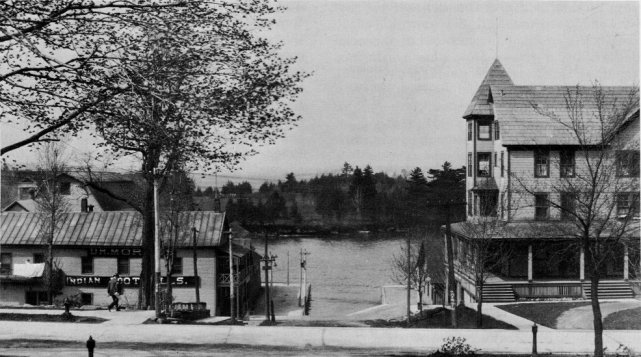 |
FIGURE 25.—Comstock
packaging building (upper floor used as residence for
manager—note laundry) at left, hotel at right. Ferry slip
directly ahead. About 1915.
|
Foreign business began to assume considerable importance after
1900; shipments from Morristown to the West Indies and Latin
America were heavy, and the company also listed branches (perhaps
no more than warehouses or agencies) in London, Hongkong, and
Sydney, Australia. Certain of the order books picked up out of
the litter on the floor of the abandoned factory give a
suggestion of sales volume since 1900:
   SALES OF DR. MORSE'S INDIAN ROOT PILLS
                    gross             Estimated
                                        Dollar
        Domestic   Foreign   Total      Amount
1900        ——       ——     6,238      100,000
1910      5,975      ——       ——        96,000
1920      3,243      ——       ——        52,000
1930        ——     1,893      ——        30,000
1941        316      ——       ——         5,000
The foregoing data show sales of the Indian Root Pills only; this
was by far the most important product, but the factory was also
selling Worm Pellets, Judson's Pills (up to 1920), and N & B
Liniment. Also, this tabulation excludes sales in quantities less
than one gross, and there were actually many such smaller orders.
Only physical shipments were shown in the records recovered, and
the dollar volume is the author's computation at $16 per gross,
the price which prevailed for many years. Through 1900 there was
only a single order book; beginning prior to 1910, separate
domestic and foreign order books were introduced, but most of
them have been lost. On the assumption that there was a fair
volume of foreign sales in 1910, total sales must have continued
to climb through the decade then ending, but by 1920 domestic
sales—and probably total sales—had dropped
materially. The number of employees, apparently about forty at
the peak of the business, had dropped to thirteen according to
the 1915 paybook but recovered slightly to sixteen in 1922. These
fragmentary data suggest that the Morristown branch of the
Comstock enterprise probably never grossed much over $100,000,
but in an era when $12 or $15 represented a good weekly wage and
the clutching grasp of the income-tax collector was still
unknown, this was more than adequate to support the proprietor in
comfort and to number him among the more influential citizens of
the district. It is not known how Morristown sales compared with
those of the Brockville factory, but it may be assumed that the
company utilized its "dual nationality" to the utmost advantage,
to benefit from favorable tariff laws and minimize the
restrictions of both countries. The Morristown plant supplied the
lucrative Latin American trade, while during the era of Imperial
preference, Brockville must have handled the English, Oriental,
and Australian business.
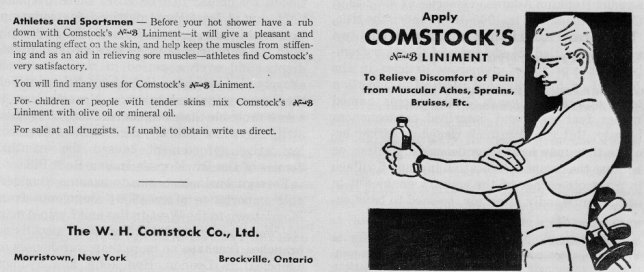 |
FIGURE 26.—In its
final years the Comstock advertising assumed a modern guise.
Depicted here is the N. & B. Liniment (originally registered
with the Smithsonian as Carlton's Celebrated Nerve and Bone
Liniment for horses, in 1851).
|
For many decades—from 1900 at least up into the
1930s—a number of very large shipments, normally 100 gross
or more in single orders, were made to Gilpin, Langdon & Co.,
Baltimore, and to Columbia Warehouse Co. in St. Louis, important
regional distributors.
Many substantial orders were also received from legitimate drug
houses, such as Lehn & Fink; Schieffelin & Co.; Smith,
Kline & French; and McKesson & Robbins. Curiously, A.J.
White & Co. of New York City also appears in the order book,
around 1900, as an occasional purchaser. Among the foreign orders
received in 1930 the United Fruit Company was, by a wide margin,
the largest single customer.
Pills destined for the Latin American market were packaged
alternatively in "glass" or "tin," and were also labeled
"Spanish" or "English," as the purchasers might direct. Spanish
language almanacs and other advertising matter were generally
inserted in the foreign parcels, along with many copies of
"tapes"—the advertisements of the worm pills conspicuously
illustrated with a horrifying picture of an enormous
tapeworm.
Sales volume began to decline more precipitously in the 1930s,
and the Morristown factory was no longer working even close to
capacity. The domestic order book for 1941 shows sales of the
Indian Root Pills, in quantities of one gross or more, of only
316 gross. The Royal Drug Co. of Chicago gave one single order
for 44 gross, and Myers Bros. Drug Co. of St. Louis bought 25
gross in one shot, but otherwise orders in excess of five gross
were rare, and those for one gross alone—or for one half
gross, one fourth gross, or one sixth gross—were far more
common. The number of orders was still substantial, and the
packing and mailing clerks must have been kept fairly busy, but
they were working hard for a sharply reduced total volume. Some
stimulus was provided for the factory during the war years by a
military contract for foot powder, but the decline became even
more precipitous after the conflict. The Comstock Hotel was
destroyed by fire in 1925, never to be rebuilt. And by the late
1940s the once-busy railroad bisecting the factory
property—the old Utica & Black River—had
deteriorated to one lonely train crawling over its track in each
direction, on weekdays only, but still carrying a New York City
sleeping car. The 1950 order book reveals a business that had
withered away to almost nothing. Once again, as in 1900, both
foreign and domestic sales were recorded in a single book, but
now foreign sales greatly outstripped the domestic. In fact, a
mere 18 gross of the pills were sold—in quantities of one
gross or more—in the domestic market in that year,
contrasting sadly with nearly 6,000 gross in 1910. Even the Henry
P. Gilpin Co. of Baltimore, which at one time had been ordering
100 gross or more every month or six weeks, took only a meager
four gross during the entire year. There were a large number of
very small shipments—such as four boxes of pills here, or a
bottle of liniment there—but these did not aggregate very
much and gave the appearance of merely accommodating individual
customers who could no longer find their favorite remedies in
their own local drug stores.
The foreign business—chiefly in the West Indies, Puerto
Rico, and South America—was still fairly substantial in
1950, amounting to 579 gross of the Indian Root Pills, but this
was far from compensating for the virtual disappearance of the
domestic market. At the old price of $16 per gross—which
may no longer have been correct in 1950—the Morristown
factory could not have taken in a great deal more than
$10,000—hardly enough to justify its continued operation.
In any case, it was obviously only the foreign business that kept
the plant operating as long as it did; without that it would
probably have closed its doors 20 years earlier.
A number of customers were, however, faithful to the Comstock
Company for very many years. Schieffelin & Co. and McKesson
& Robbins were both important customers way back in the
1840s, and their favor had been an object of dispute in the split
between Lucius and the other brothers in 1851. Schieffelin still
appeared frequently in the order books up to the 1920s; during
the final years McKesson & Robbins was by far the largest
single domestic customer. A number of other firms—John L.
Thompson Sons & Co. of Troy, N.Y.; T. Sisson & Co. of
Hartford, Conn.; and Gilman Brothers of Boston,
Mass.—appear both in the 1896 and the 1950 order books,
although unfortunately the quantities taken had fallen from one
or two gross at a shot in the earlier year to a mere quarter
gross or a few dozen boxes by 1950.
Toward the end, in the late 1950s, employment in the factory
dropped to only three persons—J.M. Barney (foreman),
Charles Pitcher, and Florence Cree—and they were only doing
maintenance work and filling such few orders, mostly in
quantities of a few dozen boxes only, that came to the factory
unsolicited. Gone were the days of travelers scouring the back
country, visiting country druggists, and pushing the pills, while
simultaneously disparaging rival or "counterfeit" concoctions;
gone were the days when the almanacs and other advertising
circulars poured out of Morristown in the millions of copies;
long since vanished were the sweeping claims of marvelous cures
for every conceivable ailment. In these final days the Indian
Root Pills, now packaged in a flat metal box with a sliding lid,
were described modestly as the Handy Vegetable Laxative. And the
ingredients were now printed on the box; nothing more was heard
of Dr. Morse's remarkable discovery gleaned during his long
sojourn with the Indians of the western plains.
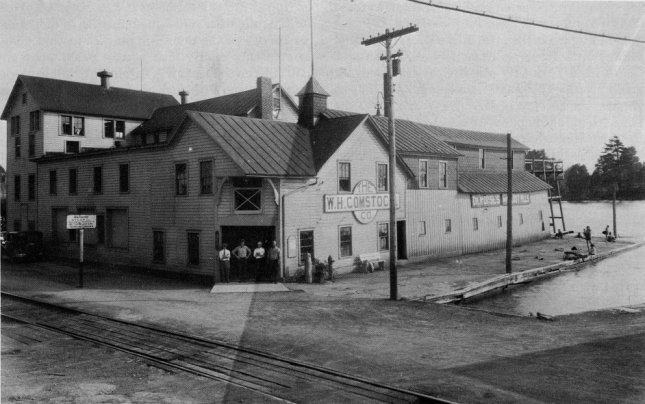 |
FIGURE 27.—The
pill-mixing building, about 1928 (building torn down in
1971).
|
Although the records disclose nothing to this effect, it is a
fair premise that the Comstock family often must have considered
closing the Morristown plant after World War II and, more
particularly, in the decade of the 1950s. Such inclinations may,
however, have been countered by a willingness to let the plant
run as long as a trickle of business continued and it did not
fall too far short of covering expenses. The last few surviving
employees were very elderly, and their jobs may have been
regarded as a partial substitute for pensions. This view is
evidenced by an injury report for George Clute, who suffered a
fit of coughing while mixing pills in January 1941; he was then
77 years old and had been working in the factory for 34 years.
The final paybooks show deductions for Social Security and
unemployment insurance—specimens of vexatious red tape that
the factory had avoided for most of its existence.
The decision to close the Morristown factory was finally forced
upon the family, on May 15, 1959, by the death of William Henry
Comstock II—"Young Bill"—who had been president of
the company since 1921. Like his father, "Young Bill" Comstock
had been a prominent citizen of Brockville for many years, served
a term as mayor—although he was defeated in a contest for a
parliamentary seat—was also active in civic and social
organizations, and achieved recognition as a sportsman and
speedboat operator.
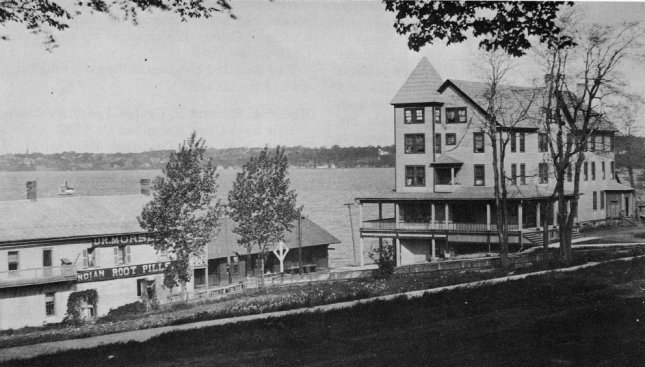 |
FIGURE 28.—The
packaging and office building at left, depot in center, and
Comstock Hotel at right. Canadian shore and city of Brockville
(location of another Comstock factory) in background.
|
The actual end of the business came in the spring of 1960. The
frequency and size of orders had dropped sharply, although the
names of many of the old customers still appeared, as well as
individuals who would send one dollar for three boxes of the
pills. These small shipments were usually mailed, rather than
going by express or freight, as formerly. The very last two
shipments, appropriately, were to old customers: One package of
one-dozen boxes of pills on March 31, 1960, to Gilman Brothers of
Boston, and two-dozen boxes to McKesson & Robbins at Mobile,
Alabama, on April 11. And with this final consignment the factory
closed its doors, concluding ninety-three years of continuous
operation in the riverside village of Morristown.
Very little of this story remains to be told. Mrs. Comstock
became president of the company during its liquidation—and
thus was a successor to her
father-in-law
, who had first
entered the business as a clerk,
119 years earlier
, in
1841. The good will of the company and a few assets were sold to
the Milburn Company of Scarborough, Ontario, but the Comstock
business was terminated, and the long career of Dr. Morse's
Indian Root Pills brought to a close. The few superannuated
employees were assured of protection against all medical
expenses, by the company or by the Comstock family, for the rest
of their lives. A few years later the associated Canadian factory
standing in the heart of Brockville was torn down; during its
lifetime that community had grown up around it, from a village to
a flourishing small city. The buildings in Morristown were sold
to other parties and left to stand untenanted and forlorn for
years. The upper (packaging) building, from which the records
were recovered, remains in fair condition and may yet be
renovated for some further use. The lower (pill-mixing) building,
after standing derelict and at the point of collapse for many
years, was finally torn down in 1971. The hotel, a large water
tank behind the factory, and the combination depot and customs
house have all vanished from the scene. The shed where the
Comstocks kept their yacht has been maintained and still shelters
several boats, but the ferry slip just below the factory steps is
now abandoned, and no longer do vessels ply back and forth across
the river to connect Morristown and Brockville. The railroad only
survived the passing of the factory by a year or two and is now
memorialized by no more than a line of decaying ties. The main
highway leading westward from Ogdensburg toward the Thousand
Islands area has been straightened and rerouted to avoid
Morristown, so that now only the straying or misguided traveler
will enter the village. If he does enter he will find a pleasant
community, scenically located on a small bay of the St. Lawrence
River, commanding an enticing view of the Canadian shore, and
rising in several stages above the lower level, where the factory
once stood; but it is a somnolent village. No longer do river
packet steamers call at the sagging pier, no longer do trains
thread their way between the factory buildings and chug to a halt
at the adjacent station. No longer do hope-giving pills and
elixirs, or almanacs and circulars in the millions, pour out of
Morristown destined for country drugstores and lonely farmhouses
over half a continent. Only memories persist around the empty
ferry slip, the vanished railroad station, and the abandoned
factory buildings—for so many years the home of the
distinguished Dr. Morse's Indian Root Pills.
Footnotes
National Cyclopedia of American
Biography
, VII: 280.
The Comstock brothers' grandmother,
Esther Lee, was apparently unrelated to Dr. Samuel Lee, the
inventor of the Bilious Pills.
Receipts for these registrations were
signed by the prominent librarian, Charles Coffin Jewett, later
to be superintendent of the Boston Public Library for many
years.
Young, James Harvey,
The Toadstool
Millionaires, A Social History of Patent Medicines in America
before Federal Regulation
. Princeton University Press.
1961.
Moore claimed later (his affidavit of
November 22, 1859) that he thought he was hired only by White
personally, and did not realize that A.J. White & Co. was
controlled by the Comstocks.
The "temporary" tax placed upon drug
manufacture as a revenue measure during the Civil War remained in
effect until 1883.
National Cyclopedia of American
Biography
, IV:500.
Or perhaps Mr. Comstock merely failed
to pay for an engraved plate and to order a book; these county
histories were apparently very largely written and edited with an
eye to their subscribers.
These facsimile bills were registered
as a trademark at the United States Patent Office. In his
registration application, Mr. Comstock described himself as a
citizen of the United States, residing at Morristown,
N.Y.—although he had served three terms as mayor of
Brockville, Ontario, prior to this time.
In connection with this offer the
pills were priced to agents at $2 per dozen boxes—$24 per
gross—and were to be retailed at $3 per
dozen—25¢ per box. Other agreements, however, probably
intended for more substantial dealers, specified a price of $16
per gross for the Indian Root Pills.
Actually, the formula for the
Indian Root Pills would seem to have corresponded closely with
that for "Indian Cathartic Pills" given in
Dr. Chase's
Recipes
, published in 1866. These were described as
follows:
Aloes and gamboge, of each 1 oz.; mandrake and
blood-root, with gum myrrh, of each 1/4 oz.; gum camphor and
cayenne, of each 1-1/2 drs.; ginger, 4 oz.; all finely pulverized
and thoroughly mixed, with thick mucilage (made by putting a
little water upon equal quantities of gum arabic and gum
tragacanth) into pill mass; then formed into common sized pills.
Dose: Two to four pills, according to the robustness of the
patient.
However, additional items were
manufactured by the Dr. Howard Medicine Co., affiliated with the
Comstock factory in Brockville. Also, during World War II the
company accepted an Army contract for the manufacture and
packaging of foot powder.
Bibliography
The principal source of information for this history of the
Comstock medicine business comprises the records, letters,
documents, and advertising matter found in the abandoned
pill-factory building at Morristown, New York. Supplemental
information was obtained from biographies, local and county
histories, old city directories, genealogies, back files of
newspapers, and materials from the office of the St. Lawrence
County Historian, at the courthouse, Canton, New York.
Two standard histories of the patent-medicine era in America
are:
Holbrook, Stewart H.
Golden Age of Quackery.
New York
City: Macmillan Co. 1959.
Young, J.H.
The Toadstool Millionaires, A Social History of
Patent Medicines in America Before Federal Regulation.
Princeton University Press. 1961.
Early in the present century, during the "exposure" of the
patent-medicine industry, two principal critical works also were
published, each highly specific and naming names fearlessly:
Adams, Samuel Hopkins.
The Great American Fraud.
Serially
in
Collier's
Magazine in 1905-1906. (Reprinted in book
form, 1906.)
American Medical Association.
Nostrums and Quackery.
Chicago: American Medical Association Press. (Reprints from the
Journal of the American Medical Association
: volume I,
1911; volume II, 1921; volume III, 1936.)
Recently two books have appeared, which are largely pictorial,
essentially uncritical, and strive mainly to recapture the
colorfulness and ingenuity of patent-medicine advertising.
Carson, Gerald.
One for a Man, Two for a Horse.
128 pages.
New York City: Doubleday and Co. 1961.
Hechtlinger, Adelaide.
The Great Patent Medicine Era.
New
York City: Grosset and Dunlap. 1970.
A highly recommended source of information on the very early
history of patent medicines in America is:
Griffenhagen, George B., and James Harvey Young. Old English
Patent Medicines in America.
United States National Museum
Bulletin 218, Contributions from the Museum of History and
Technology
, paper 10: 155-183 1959.
Although the original Comstock enterprise has been dissolved
and
all of its undertakings in North America terminated, as has
been
related herein, Dr. Morse's Indian Root Pills and Comstock's
Worm
Tablets are still being manufactured and sold—by the W.H.
Comstock
Company Pty. Ltd., in Australia. This concern, originally a
subsidiary of the Canadian company, is headed by the former
branch
manager for the Comstocks, who acquired the rights for
Australia
and the Orient following the dissolution of the Brockville
company.
Distribution is also carried out from this source into New
Zealand,
Singapore, and Hong Kong. Packaging and directions are now
modern,
the pills being described as "The Overnight Laxative with the
Tonic
Action," but a reproduction of the old label and the
facsimile
signature of William Henry Comstock, Sr., are still being
portrayed. Thus, the Indian Root Pills have been
manufactured
continuously for at least 115 years and the Comstock
business,
through the original and successor firms, has survived for
nearly
140 years.
|