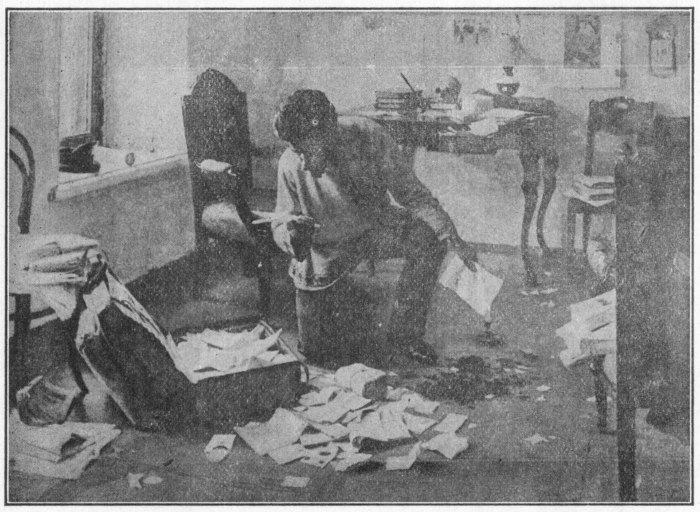
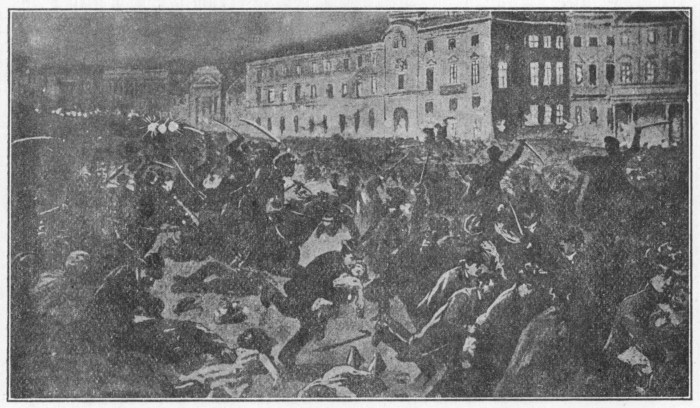
You poets, painters, sculptors, musicians, if you understand your
true mission and the very interests of art itself, come with us.
Place your pen, your pencil, your chisel, your ideas at the service
of the revolution. Figure forth to us, in your eloquent style, or
your impressive pictures, the heroic struggles of the people
against their oppressors, fire the hearts of our youth with that
glorious revolutionary enthusiasm which inflamed the souls of our
ancestors; tell women what a noble career is that of a husband who
devotes his life to the great cause of social emancipation! Show
the people how hideous is their actual life, and place your hands
on the causes of its ugliness; tell us what a rational life would
be, if it did not encounter at every step the follies and ignomies
of our present social order.—P. Kropotkin: An Appeal to the
Young.
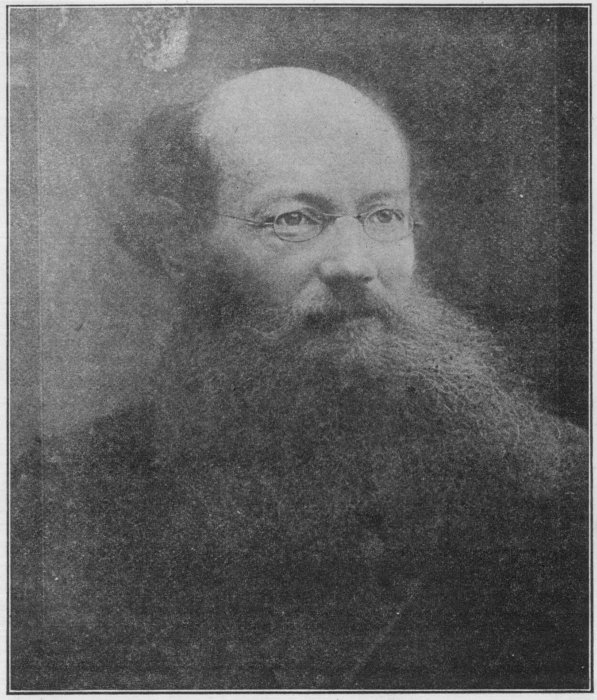
 eter Kropotkin's writings range from obscure articles in unknown papers
read by a handful of faithful subscribers, to cloth-bound far-famed
volumes translated into several languages; include contributions to
periodicals as revolutionary as Revolte and as respectable as the
Atlantic Monthly; embrace all subjects from machinery to music, and
from Tolstoyism to Terrorism.
eter Kropotkin's writings range from obscure articles in unknown papers
read by a handful of faithful subscribers, to cloth-bound far-famed
volumes translated into several languages; include contributions to
periodicals as revolutionary as Revolte and as respectable as the
Atlantic Monthly; embrace all subjects from machinery to music, and
from Tolstoyism to Terrorism.
Judged from a literary standpoint, his work is distinctly
disappointing. It is styleless. But it has one redeeming feature:
clearness. The man is straight. He is not ashamed of his ideas. He
speaks right out. He is one of the few authors who writes for the
peculiar purpose of being understood. He does not bury the flower of his
thought in a wilderness of words.
It cannot be contended that Kropotkin gave up his style because he
writes for workers who are unable to appreciate the beauty of literary
composition. A man may refuse a title with an oath as Carlyle did, or
give it up as Kropotkin himself did, but he who has a style relinquishes
it not, for this is a gift besides which the 'boast of heraldry' is as a
puppy's snappish yelp unto the lion's mighty roar.
Neither can it be claimed that Kropotkin's stylistic deficiency is due
to the fact that he is an economist. So was Henry George, and yet there
is a magical music in Progress and Poverty which makes the phrases
flow like a poem of Pushkin's.
Nor can it be argued that his style has been spoilt by the circumstance
that he writes in various languages, for in none of his work is there
epigram, imagery or imagination—the glorious trinity of the stylists.
But what has a foreign tongue to do with it? Was not Kossuth just as
much an artist in English as in his native pepper? Even when he cried
that we must seize the opportunity by the front hair? Many waters
cannot quench love, and strange alphabets do not wipe out style.
What is a stylist? He is one who handles words, who licks phrases into
shape, who moulds clauses to his bidding, who compels a sentence to
leave a deathless impression, who weaves a connected chain of harmony
from the scattered links of language.
Kropotkin has written very much, but practice does not make a stylist
any more than learning the rules in the Rationale of Verse makes one
capable of producing The Raven. The secret of style is revealed to
few. Its essence is a mystery in which only a handful are initiated. The
elusive occultism of art consists in this—that a single expression has
the power to either damn a passage into oblivion, or to emblazon it
forever in eternity.
To give a striking instance: When Edgar Poe first wrote To Helen,
these lines composed the second stanza:
"On desperate seas long wont to roam,
Thy hyacinth hair, thy classic face,
Thy Naiad airs have brought me home
To the beauty of fair Greece,
And the grandeur of old Rome."
In this case the concluding couplet is cheap and commonplace—"fair
Greece" and "old Rome" being anemic expressions unfit to live. Poe amended it to read:
"To the glory that was Greece,
And the grandeur that was Rome."
Miracle of Art! This is not a change, but an apotheosis. We now have two
lines which lay before us in gorgeous perfection a picture of the past;
two lines as splendid as they were sickly, as magnificent as formerly
they were mediocre. Yet the idea is the same in both cases. What then is
it which makes so much difference? It is the manner of expression—it is
style—it is art.
There is no reason why one man should be a stylist and another should
not, but so it is. Huxley was a stylist; Darwin was not; Herzen, yes; Kropotkin, no.
Being anxious to know Kropotkin's exact attitude towards Art, I wrote to
him asking categorically: "In your opinion, have exquisite poets like
Keats and Pushkin—who never touched social questions, but celebrated
only beauty—been of much benefit to mankind?"
He answered thus: "Not in a direct way, but perhaps very much in an
indirect way: Pushkin by creating language,[42] and Keats by teaching
love of nature. As to "exquisiteness," have we not had too much of those egotistic sweets?"
Closely analysed, and reduced to its ultimate elements, this answer
shows that Kropotkin has no use for art per se. According to him Keats
and Pushkin are benefactors not because of their beautiful verses, but
because of other reasons. Exquisiteness he condemns altogether. He
rejects the doctrine of Art for the sake of Art. He does not subscribe
to the creed of Flaubert, Gautier, Bouilhet, Maupassant, Anatole France
and Lafcadio Hearn.
I think Kropotkin is wrong, and I believe that because his work lacks
artistic finish, much of it is doomed to perish.
Maxim Gorky, in speaking of a brief period when the Russian Censorship
was somewhat suspended, said, "Books fell over the land like flakes of
snow, but their effect was as sparks of fire!"
If Kropotkin wished to express the same idea, he would say it something
like this: "Numerous books of all descriptions were published and
distributed thruout Russia."
How fine Gorky's; how poor Kropotkin's. How vivid the former; how weak
the latter. This is the difference between style and lack of it. Not in
the entire range of Kropotkin's writings is there a single sentence in
any way comparing with the above one of Gorky's; for he who writes
without art holds a crippled pen. I may be mistaken, but in my opinion
this single quotation from the Bitter One is worth all Kropotkin's
Freedom Pamphlets. It is sublime in its similes and exquisite in its
antitheses. There is a power in it which unchains enthusiasm and awakens
intensity. "Books fell over the land like flakes of snow, but their
effect was as sparks of fire." It is art. It is unforgettable, while to
remember a phrase from Modern Science and Anarchism is impossible.
With this introduction, we may proceed to examine his work, much of
which is necessary and valuable, tho none of it is of primal or
epoch-making importance. Stepniak is right when he says, "He is not a
mere manufacturer of books. Beyond his purely scientific labors, he has
never written any work of much moment." And as Herzen said of Ogaryov,
we may remark of Kropotkin: "His chief life-work was the working out of
such an ideal personality as he is himself."
The majority of prominent periodicals in England and America to which
Kropotkin has contributed, are listed in the Reader's Guide which can
be found in any library, and those interested can look them up. Of
course, many of these articles are first-class, but I can stop to
mention only two. See Russia and the Student Riots (Outlook, April
6, 1901), which deals with the disturbances which caused the young
revolutionist, Peter Karpowitch, to kill Bogolepov, Minister of Public
Instruction. It shows with painful clearness the extreme and useless
savagery of that cruel, repulsive, Stead-praised, arch-murderer, Nicholas II.
See also the Present Crisis in Russia, (North American Review, May
1901). In this excellent essay he refers to the Procurator of the Holy
Synod in these words: "Pobedonostzeff, a narrow-minded fanatic of the
state religion, who—if it were only in his power—would have burnt at
the stake all protestants against Orthodoxy and Catholicism."[43]
Who should answer this article, but Pobedonostzeff himself! (Russia and
Popular Education, N. A. R. September 1901). How strange when Light
and Darkness are arrayed against each other![44] Pobedonostzeff calls
Kropotkin "a learned geographer and sociologist;" but says; "Tho a
Russian, he (Kropotkin) does not understand Russia, and is incapable of
understanding his country; for the soul of the Russian people is a
closed book to him which he has never opened." It is noteworthy that he
does not attempt to deny Kropotkin's charge that if it were only in his
power he would burn at the stake all protestants against orthodoxy and
catholicism. Doubtless he considers this his chief crown of glory.
There was a further response from Kropotkin, (Russian Schools and the
Holy Synod, N. A. R. April 1902).
Among his pamphlets which are used assiduously by the anarchists of all
countries for propaganda, and which often cause the arrest of the
devoted distributer, are: Anarchism: Its Philosophy and Ideal. The
State: Its Historic Role. War. Law and Authority. The Paris Commune.
Organized Vengeance—called Justice. Anarchist Communism: Its Basis and
Principles. An Appeal to the Young. The Psychology of Revolution. The
Wage System. These tracts are valuable as eye-openers to uneducated
workmen, but they possess no merit whatsoever for cultured liberals.
Altho Kropotkin has written more than thirty geographical articles for
the Encyclopedia Britannica, it is difficult to think of this
revolutionaire as a contributor to this backward publication. The
Encyclopedia Britannica is not on the trail for truth—it wants
current prejudices. For instance, Professor Samuel Davidson, D. D., LL.
D., was asked to contribute an essay on the Canon. Happening to be a
scholar as well as a theolog, the venerable man was not satisfied with
the logic of Father Irenaeus, that since the earth has four corners, and
there are four winds, and animals have four legs, there must be four
Gospels. His article was so mutilated by the editors of the
Encyclopedia, that in justice to himself, he was obliged to publish
the original version in book form, The Canon of the Bible. When the
Encyclopedia mentions liberty, it is from the reactionary viewpoint.
The American Supplement follows its parent in this respect, for here
are eulogistic accounts of the second and third Alexanders, by Nathan
Haskell Dole.[45] This literat is so ignorant of the most important
epochs in the Russian Revolution, that he writes, "Vera Zasulich
murdered General Trepov;" when all the world knows that Trepov was only
wounded and soon recovered.[46] Luxuriously abound the weeds of his
misstatements.[47] He speaks of the 'private virtues' of Alexander III.
They must have been very private indeed, for no one ever discovered
them. He speaks of his 'noble aspirations,' but the son of Maria of
Hesse-Darmstadt had only this one aspiration: to wipe out freedom as
effectually as a whirlwind blows away a puff of smoke. Such is the
famous publication to which all school-girls resort when they must
prepare a composition on Milton.
Kropotkin's strictly scientific works, the Orography of Asia and the
Glacial Period were written in Russian and have not been translated into English.
During his imprisonment at Clairvaux, appeared his Words of a Rebel,
1885, in French, published by Elisee Reclus. It is a critical exposition
of Anarchism.[48]
In 1886 he published his first book in English, In Russian and French
Prisons. This work soon disappeared from the market. Kropotkin himself
offered a high price for a copy, but could not obtain one. It seems the
agents of the Russian government bought up the entire edition and destroyed it.
In 1892 appeared his Conquest of Bread, in French, which has been
translated into Dutch, German, Spanish, Portuguese, Norwegian, English.
It is perhaps his most important work and has been much reviewed and
quoted. Notice to those who wish to think: Study this volume.
In 1898 appeared his Fields, Factories and Workshops. This highly
excellent work is the splendid outcome of several essays which were
written a decade previous for the Nineteenth Century (1880-1890), and
one for the Forum, (Possibilities of Agriculture, August 1890). If
nations would follow this book, how great would be their gain in
prosperity and happiness![49]
This book is a plea for intensive agriculture, and in view of the great
cry, "Back to the land!" which is sweeping over the nations, it is a
fulfilled prophecy. It is the remedy for social ills—the solution of
the labor problem. Kropotkin shows that by the new method of scientific
farming, a man can make a living from an acre of ground,[50] and as soon
as the workingman realizes this fact—and can get a bit of land—he will
be able to discharge his employer and bounce his boss. By all means read
the chapters on The Possibilities of Agriculture: no fairy-tale is
more miraculous.[51]
In 1899 appeared in book form the Memoirs of a Revolutionist which had
first run serially in the Atlantic Monthly, (September 1898 to
September 1899), under the title, Autobiography of a Revolutionist. In
the magazine, the introduction is by Robert Erskine Ely, who was
Kropotkin's host when the Russian traveled in America. In the book,
however, the preface is by Brandes. Neither of these forewords is
brilliant, but the latter is the worse. When we think of Norway, we
think of only one man—Ibsen. When we think of Denmark, we think of only
one man—Brandes. But in this case his preface was a fizzle. In fact, it
is almost as bad as the erudite Lavrov's preface to Stepniak's splendid
Underground Russia. No better and nobler book than these Memoirs has
been written; nothing higher and purer could be written. Only one thing
is lacking; indeed, it is the chief omission in the cosmos of
Kropotkin—the poetic note. He is good and great, but the passionate
fire is denied him. His soul is not aflame with poesy's burning brand.
He could never cry out like the student Ivan Kalayev, "My soul is
burning with stormy passion; my heart is full of battle-boldness. O, if
I could only see the coming of liberty! O, to pull the mask of falsehood
from the face of the murderer, to strike the tyrant with the steel-arm!
Enuf tears! Let the glorious, victorious struggle arise! The people are
calling us! It is a shame, it is a crime to wait longer! Fall upon the
enemy, my honest hereditary sword! I am thine, altogether thine, O my
country, my mother!" But leaving divine enthusiasm aside, this volume is
perfection. He who peruses its loving pages, gains a tender brother
whose body is unseen, but whose memory becomes imperishable. When you
read it, you cry a little, because the man who wrote it was so kind.
Across the miles you seem to hear his fraternal voice, and you know if
you write to him, he will answer you thus: "Dear Comrade."—If you have
time to read but a single volume a year, and desire one by a Russian,
and ask my advice, I say: Read one of these—Underground Russia, by
Stepniak; or Memoirs of a Revolutionist, by Kropotkin.[52]
In 1902 he wrote Modern Science and Anarchism, a booklet of about one
hundred pages which is much admired and extensively advertised by the anarchists.
By far his most important work of recent years is, Mutual Aid: A Factor
in Evolution.[53] His contention is that in progressive evolution,
mutual aid plays a greater part than mutual struggle. He claims that
most Darwinians have misinterpreted Darwin's ideas. For an able analysis
of this great book, see the review by Professor Vladimir G.
Simkhovitch, (Popular Science Quarterly, December 1903).
In 1905 appeared his Russian Literature[54]—a very good and useful
text-book—which originated in a series of eight lectures, delivered
March 1901, at the Lowell Institute in Boston. It is not perfect, but
this is not the author's fault. With only three hundred pages at his
disposal, it is impossible to treat all adequately, while some writers
had to be omitted entirely. For example, there is not a line about the
famous anti-militarist novelist, Vsevolod Garshin (1855-1888), or of
Simon Nadson (1862-1887), the exquisite and melancholy poet who chanted
songs not at sunrise, but in shadow and solitude, and died in youth and
sadness, leaving to the Outcasts of the Ages another great name to
cherish.[55]
In reading this book we experience a peculiarly uneasy sensation:—
We read of Lomonosov, by far the greatest Russian of his age, whose life
was broken by political persecution.
We read of the moral Novikov, whom Catherine II. sentenced to serve
fifteen years in a secret cell in Schusselburg.
We read of Labzin, who wrote against corruption, and consequently was
forced to end his days in exile.
We read of Radischeff—the first to point out the horrors of
serfdom—who was imprisoned, deported, and died by suicide.
We read of the epoch-making Pushkin who was exiled to Kishinev at
twenty, and later to Mikhailovskoye, and who escaped permanent political
exile in Siberia by accident.
We read of the Byronic Lermontov who was banished to the Caucasus for
writing a poem on the death of Pushkin.
We read of Ryleev, Odoevsky, Shevchenko, Griboyedov, Pisarev,
Chernishevsky, whose martyrdoms I have already mentioned.
We read of the brilliant and poetic Polezhaev, who was send to the
barracks when a minor and died there from consumption.
We read of the popular novelist Bestuzhev, who was exiled to Siberia and
then sent to the Caucasus as a soldier.
We read of the great Gogol who suffered at the hands of the censorship.
We read of Turgenev who was arrested and exiled to his distant estates
for writing a brief obituary notice of Gogol. Had it not been for his
influential friends he would have gone to Siberia.
We read of Leo Tolstoy whose excellent educational experiment was
violently abolished by the government, so enraging this extraordinary
man that he warned Alexander II. he would shoot the first police officer
who would again dare to enter his home.
We read of the high-strung Dostoyevsky who for no reason at all was
sentenced to death, brought to the gibbet, pardoned there, condemned to
hard labor, imprisoned, exiled, deprived of literary work, beaten with
the cat-o'-nine-tails, tortured in a thousand ways, year after year,
till he became a mental and physical wreck. In all the history of the
human race, from the day that primitive man roamed the untamed forests,
and stubbing his naked toe against a root, fell down to worship it, to
placate it, to appease it, until the scientific time that a biologist
like Haeckel absolutely denied the existence of god and soul,—there
has been nothing more horribly cruel than the czarish treatment which
the Russian government meted out to the gifted youth who produced a work
in his early twenties that caused Nekrasov to cry out to Belinsky, "A
new Gogol is born to us!"[56]
We read of Plescheev, one of Russia's foremost poets, who was sent as a
soldier to the Orenburg region, and endured persecution for years.
We read of Mikhail Mikhailov—one of the most valued contributors to the
Sovremennik. (The Contemporary), a wonderful periodical numbering
among its contributors, Chernishevsky, Dobrolubov, Tolstoy,
Nekrasov—who was condemned to hard labor in Siberia where he soon died.
We read of Ostrovsky, the Father of the Russian Drama, who was placed
under police supervision as a suspect.
We read of the loving Levitov—"a pure flower of the Russian
steppes"—who while a student was exiled to the far north, and later
removed to Vologda where he was forced to live in complete isolation
from everything intellectual and in awful poverty verging on starvation.
We read of Petropavlovsky who was early exiled to the Siberian
government of Tobolsk, where he was kept many years and from which he
was released only to die soon after from consumption.
We read of Saltykoff (Schedrin), the greatest of satirists, who was
exiled for several years in the miserable provincial town of Vyatka.
We read of Belinsky, the greatest of critics, who fortunately died young
enuf to escape the fortress. When he was dying an agent of the
state-police would call from time to time to ascertain if he were still
alive. Had he recovered he would have been transfered to Peter and Paul.
We read of the persecution of Palm and Potyekhin; of the years that
Melshin, Korolenko, Zasodimsky, Elpatievsky, etc, spent in exile. By
this time a terrible truth dawns upon the startled mind: In Romanoff's
Russia, scarcely one single writer of worth has escaped imprisonment or
banishment.[57] And these prophets who have been thus persecuted were
not despicable rhymers like Alfred Austin, or duke-and-duchess novelists
like Harold MacGrath. They were great-brained men whose mission was to
uplift a nation. Had the Catherines, Nicholases, and Alexanders been
less powerful, Russia would not now be the foulest blot on our
skull-strewn earth.[58]
Ivan Federof was the first of Russian printers. In 1564 he cast the
Slavonic characters. Being accused of heresy, he fled for his life. The
Lithuanian magnates with whom he sought refuge, forced him to till the
soil. Unhappy Federof said, "It was not my work to sow the grain, but to
scatter thru the earth food for the mind, nourishment for the souls of
all mankind." He perished in Lemberg in extreme poverty.[59] Woful was
his fate—symbolic of the sad destiny which was to befall every
literary man in Knoutland.[60]
Let the Russian who intends to become an author prepare his last will
and testament, and notify the nearest undertaker. No night will be too
dark to keep gendarmes from bursting into his room and hauling him off
to a prison from which he may never emerge. (If he comes from an
aristocratic family let him adopt an empty-eyed skull and yellow
cross-bones as a suitable coat-of-arms). In the den of the bloody bear
there is a blackness as of many clouds. Within this deep shadow, Virtue
is slaughtered and Genius treated like an unwelcome cur.
 fabled king of Thrace fed his horses on human flesh, but a real czar
of Russia washed his streets with blood. On his accession to the red
throne, the Iron Despot immediately expelled progress from his empire by
butchering the Decembrists—those pioneers of freedom who fought for a
constitution and the abolition of serfdom. Exiles began to tramp the
lonely Siberian highway, and from the time of that Nicholas I. to this
Nicholas II.—a period of 75 years—over a million political prisoners
have taken the 'long journey.'
fabled king of Thrace fed his horses on human flesh, but a real czar
of Russia washed his streets with blood. On his accession to the red
throne, the Iron Despot immediately expelled progress from his empire by
butchering the Decembrists—those pioneers of freedom who fought for a
constitution and the abolition of serfdom. Exiles began to tramp the
lonely Siberian highway, and from the time of that Nicholas I. to this
Nicholas II.—a period of 75 years—over a million political prisoners
have taken the 'long journey.' t was a cheerless Saint Petersburg to which Kropotkin returned—a city
in the grip of the powers of darkness. The officials despoiled the
muzhiks of their last copecks, and if the poor peasants sought redress
in institutions ironically known as "courts of justice,"
t was a cheerless Saint Petersburg to which Kropotkin returned—a city
in the grip of the powers of darkness. The officials despoiled the
muzhiks of their last copecks, and if the poor peasants sought redress
in institutions ironically known as "courts of justice,"
 ussia has long been famous for its circles, which far surpass in
interest and excellence, those of any other country. According to the
calculation of the police, each member contributes to the society either
a pint or a quart of blood, but this computation is too conservative.
Those who join Russian Circles do not measure the amount, but are ready
to give unto the last drop. At these meetings, chairmen and ceremony are
unknown. Those present sit on chairs, lean against the window-sill, or
squat on a broken sofa. They sing melancholy songs, smoke cigarettes and
overwork the samovar. They dress carelessly in loose blouses of colored
calico. Their hair is disheveled, their faces are flushed, their eyes
are blazing. All argue at once, and in order to make themselves heard,
interrupt each other, shout animatedly, bang the table, and rattle the
spoon in the glass. The noise is deafening, but from the din of the
debate fly forth sparks which may eventually inflame even this outraged
empire of officials and icons.
ussia has long been famous for its circles, which far surpass in
interest and excellence, those of any other country. According to the
calculation of the police, each member contributes to the society either
a pint or a quart of blood, but this computation is too conservative.
Those who join Russian Circles do not measure the amount, but are ready
to give unto the last drop. At these meetings, chairmen and ceremony are
unknown. Those present sit on chairs, lean against the window-sill, or
squat on a broken sofa. They sing melancholy songs, smoke cigarettes and
overwork the samovar. They dress carelessly in loose blouses of colored
calico. Their hair is disheveled, their faces are flushed, their eyes
are blazing. All argue at once, and in order to make themselves heard,
interrupt each other, shout animatedly, bang the table, and rattle the
spoon in the glass. The noise is deafening, but from the din of the
debate fly forth sparks which may eventually inflame even this outraged
empire of officials and icons.
 he Circle of Chaykovsky exerted an immense influence all over the
empire, forming branches in every province, and producing the greatest
of the Russian Revolutionists. Yet the particular group to which
Kropotkin belonged was daily decreasing, on account of the imprisonment
of its members.
he Circle of Chaykovsky exerted an immense influence all over the
empire, forming branches in every province, and producing the greatest
of the Russian Revolutionists. Yet the particular group to which
Kropotkin belonged was daily decreasing, on account of the imprisonment
of its members. o time crept on with crippled feet, halting and limping on its broken
crutches, held back by heavy ball and clanking chain. Thru the five feet
of granite the sun could not penetrate, but grief came in thru the
mortar. No oxygen passed the Judas, but with noisy wings sorrow flew in
the embrasure. The oaken doors held freedom out, but sadness passed the bars of iron.
o time crept on with crippled feet, halting and limping on its broken
crutches, held back by heavy ball and clanking chain. Thru the five feet
of granite the sun could not penetrate, but grief came in thru the
mortar. No oxygen passed the Judas, but with noisy wings sorrow flew in
the embrasure. The oaken doors held freedom out, but sadness passed the bars of iron.