Of all the beasts of the field, which
we are told, the Lord formed out of the
earth, and brought them unto Adam to
see what he would call them, none has
more engaged the attention of the historian
and the philosopher—none has figured
more in poetry, in war and in love,
than the horse.
None of the writing, to which we could
point the reader, contains more frequent
mention, or more glowing descriptions of
the power and beauty of the horse, than
the great Book of Books.
The Bible teaches us, that from whatever
land this animal may have been
originally brought into Egypt, that country
had already become a great horse
market, even before horses were known
in Arabia, the country with which we are
apt to associate all that is most interesting
of this noble beast. Geological researches,
however, have discovered fossil
remains of the horse in almost ever part
of the world—from the tropical plains of
India, to the frozen regions of Siberia—from
the northern extremities of the new
world, to the southern point of America.
But among the Hebrews, horses were rare
previous to the days of Solomon, who had
horses brought out of Egypt, after his
marriage with the daughter of Pharaoh,
and so rapidly did he multiply them by
purchase and by breeding, that those
kept for his own use required, as it is
written, “four thousand stables, and forty
thousand stalls.” Hence, when honored
by a visit from the beautiful queen of
Sheba, bringing with her, camels bearing
spices, and very much gold and precious
stones, it was doubtless in the contemplation
of his magnificent stud of horses and
chariots, kept for the amusement of his
wives and concubines, as well as for his
other vast displays of power and magnificence,
that her majesty exclaimed, in
the fulness of her admiration: “Howbeit,
I believed not the words, until I came
and mine eyes had seen it, and behold
the half was not told unto me.”
Veterinary science has also made great
progress from that time down to the present,
and in particular, in the last half
century, the structure of the horse—injuries
and diseases to which he is subject,
and the treatment of these, have been
investigated, in this country and abroad,
with much diligence and success, both in
colleges and in societies devoted to the
cultivation of veterinary knowledge, and
by practitioners, whose education and experience
render their observations worthy
of great respect; but notwithstanding all
this, there has always been, to the present
time, one point overlooked, which is of
greater importance, than any one that
has ever been investigated. I refer here
to a complete treatise on the Mare and
Foal at the time of delivery. This has
long been felt as a real want. Not a single
engraving, illustrating this subject
has ever been handed to the public, and
very little has been written on the treatment
of the mare and the foal at the time
of delivery. When the best authors come
to this point, they say, “call in a veterinary
Surgeon.” But, I would ask, where
is the veterinary Surgeon to obtain his
information? And yet, not only the surgeon,
but every farmer and breeder should
possess a full knowledge of it.
The man that first enters the stable
should be able to administer to the wants
of the mare and the foal. There is no
time to be lost—no time now to obtain
information, or to proceed four or five
miles for a surgeon. If all is right, in
five minutes all will be well, but if a false
position is presented, the first person that
approaches the animal should be able to
administer to the wants of the mare and
foal. If not, there is much danger for
the life of the foal, and in a few hours
much danger is to be feared for the safety
of the mare.
I have had a very extensive practice in
the veterinary business for more than
nineteen years, and found it almost universally
to be the case, that in the event
of mal-presentation, the foal had suffocated
before I could reach the spot, although
I was but a very few miles distant.
If the foal is raised from its locality, it
must be exposed to the free atmosphere
in twenty minutes or it will suffocate, and
the life of the mare will be much in danger.
Often, after I had extracted the
foal, I could have obtained twenty
dollars for restoring its life.
I have frequently been urged by farmers
and breeders, to give them full instructions
on this subject, and especially,
at such times, when a difficult case presented
itself, but I always found it impracticable,
as verbal instruction would
soon be forgotten, and as no work, illustrating
this subject was in existence. I
was induced, therefore, in order to benefit
the farmer and breeder, to publish
a complete treatise on the mare and foal,
at the time of delivery, illustrated by
engravings. I had made an effort about
seven years ago, but that little instrument,
the “pen,” in my hand, is what the yoke
is to the ox, and so I abandoned it for
that time. The cart-whip in my hand is
a fine instrument, but the pen is my abhorrence.
Notwithstanding, at the earnest
request of numerous dealers in horses, I
was induced in the Spring of 1869, to
offer this work to the public, for the benefit
of the farmer and breeder, and in
mercy to the mare and foal.
This work, as the reader will discover,
embraces every particular connected with
the subject upon which it treats, with ample
engravings, illustrating the different
positions in which a foal is presented—its
natural delivery—false presentations, etc.,
with lucid explanations and instructions.
CONRAD MITCHELL.
New Berlin, Pa., July, 1869.
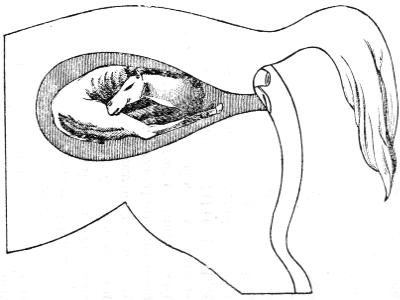
PLATE I.
The above Engraving represents the
Foal, as it is folded up in the womb of
the Mare when fully developed, in the
right flank of the animal, the chest of
the Foal toward the tail of the Mare, the
front legs turned backwards, and the hind
legs turned forward under the body of
the Foal, the head and neck turned back
in its left side, so that the head will rest
on the first false ribs. From the time of
covering the Mare, to the time of foaling,
generally requires a period of three hundred
and thirty days. A few instances,
however, came under my observation, in
which fine, full-grown, and healthy colts
were delivered in three hundred and
twelve days, while others delayed their
appearance for a period of three hundred
and ninety days, before the owner could
rejoice in the valuable prize brought to
his stable. The full chested, round trunked
mare will develope a foal much sooner
than the flat-sided, lean and camel-backed
one.
In nine days after the covering of the
mare, the womb will begin to close about
fifteen inches from the entrance; at the
same time, the fecund seed of the horse
will change into bloody streaks, and the
balance becomes like cream on curdled
milk about six hours after it is strained,
and in from forty to fifty days, the foal
will be regularly shaped, and about the
size of a small rat. At the same time a
membrane or skin will spread around the
entrance inside of the womb, from which
a number of small cords branch out, uniting
together as they run along, until they
form one cord, extending to the navel
of the foal, through which the blood of
the mare circulates in the foal, in order
to give it nourishment. At the same
time another membrane or skin is formed
around the foal, in which are contained
from four to six, and even eight quarts of
yellowish fluid, which answers a twofold
purpose: first, it prevents all friction
between the foal and membrane, and secondly,
it assists in raising the foal from
its locality. At the first throes of the
mare, the action of the womb will cause
the membrane or skin to protrude through
the entrance of the womb, and the fluid
will be forced into it, and the weight will
assist in raising the foal, until it will be
presented when the skin will break and
the channel will be opened for the foal
to breath.
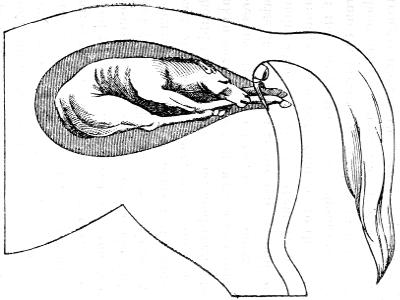
PLATE II.
The above Engraving presents the natural
position of the foal in delivery.
The two front feet will be presented first,
and the muzzle or the nostrils will rest on
the top of the legs, and the membrane
or skin around the foal, spoken of in Plate
I, will already protrude about two feet.
The hind legs will sink down more and
more, until they will be stretched out behind
horizontally. Sometimes one foot
will raise up too high and be forced against
the inside of the entrance. The
hand should be introduced and the foot
pushed back a few inches and then brought
back into the channel. Sometimes the
forehead will project against the upper
part of the entrance, when the hand
should be introduced, and hold should be
taken back of the poll, with a downward
pressure, the other hand to the muzzle to
raise it up, and a gentle pull should be
made, when all will be right in a few
minutes. The cord running to the navel
of the colt should be tied about one inch
from the surface of the skin, then cut off
about one inch from the string, or if no
string is at hand, the cord should be pressed
very tightly between the thumb and
the two first fingers of the hand for a few
minutes, then cut off, and it will bleed no
more. The colt should be drawn away
a few feet, but not toward the mare, as
she should not be disturbed. The mare
will lie down flat, apparently dead, and
will remain in this situation, five, ten,
and even sometimes thirty minutes, according
to the severity of the operation
she has undergone. Suddenly she will raise
her head, look about the stable, lie down
again, and roll three or four times on her
back, but never over her back, which is
done for the purpose of loosening the
membrane or lining of the womb spoken
of in Plate I, when she will rise up, go
after her offspring, lick and dry it, after
which the membrane and the afterbirth
will be discharged. When the colt is
dry, it should be assisted to its mother to
obtain nourishment.
Sometimes the membrane attached to
the womb will remain fast, and in this
manner retain the afterbirth. In this case,
bleeding from three to four quarts, and
giving following dose of medicine in one
pint of flaxseed tea is recommended, viz:
- 1 oz. Laudanum,
- 1 oz. sweet Spirits of Niter.
This will correct everything in a few
hours. In some extreme cases, the membrane,
the afterbirth and the fluid contained
with the foal remained in the womb
after a complete separation from the womb,
causing such a strong inflammation, that
some parts had began to mortify. I have
bled copiously, and given one large tablespoonful
of fever medicine, composed
of
- 4 oz. of Nitre,
- ½ ” ” Digitalis,
- ½ ” ” Tartar Emetic,
in one pint of Linseed tea, every three
hours, and by means of a syringe, or
bladder, with a clean piece of elder tied
in the neck, I have injected into the womb
from four to six quarts of Linseed tea,
which caused a copious discharge of bloody
matter from the womb, amounting sometimes
to a bucket full. In extraordinary
cases, the purifying organs were overpowered
and the mortified blood was carried
through the whole system, and even then
the mare recovered to a certain degree,
until in about a week afterwards her
hoofs came off, caused by the mortified
blood, and she was accordingly destroyed.
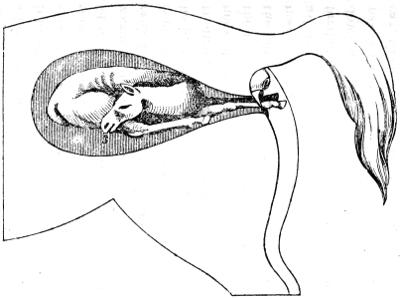
PLATE III.
The above Engraving represents a false
presentation. The two fore feet are presented,
and the head remains behind in
the right flank of the mare. The operator
will be able to tell whether they are
the front or hind feet, by examining the
knee joints. Now, a bowl containing two
or three quarts of very warm water, with
a large tablespoonful of very fine lard or
linseed oil on the surface of the water,
should be at hand. Under no circumstances
should a hand or arm be introduced
to the mare, unless first thoroughly
warmed and greased, otherwise they are
rank poison to the mare. After the arm
is prepared, the fingers and thumb should
be brought to a point, and should be introduced,
following the channel, until the
neck of the foal is reached at Fig. 1, when
the full right hand should grasp the neck,
the left hand being supported against the
mare, when the operator should pull with
all his strength, in order to draw the neck
further up, when the hand should pass
down along the neck, still drawing as it
passes along, until reaching Fig. 2, the
ear, when he can make good progress,
until he can insert the middle finger in
the eye, at which point he is able to raise
the muzzle, Fig. 3, so far, that he may
close his hand over it, and in a minute,
all will be right in the operation. But
let no one suppose, that this is accomplished
in ten or fifteen minutes. Sometimes
it may, but in many instances, I
have labored for an hour, and even two
and a half hours. In some cases, the
severe exertion, and the heat of the mare,
caused my arterial circulation to force so
powerfully in my arm, that I was often
afraid my veins would burst; in this
case I would withdraw my arm for a minute
or two, and then go to work again. In
my entire practice, I have failed but in
three cases, that of two mares and one
cow, to accomplish my object. I was often
called, where two, three, and even
four men had been summoned before me,
owing to the distance I lived away, and
succeeded in every instance where others
failed. I resolved not to fail in any case,
but this determination proved disastrous
to myself, inasmuch, as I became subject
to palpitation of the heart, so that I could
not follow my business for more than
twelve years.
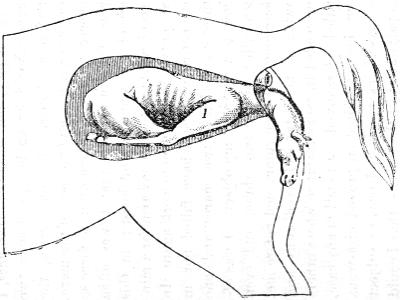
PLATE IV.
Of the cases represented in Plate III, I
had a large number; of such as are presented
in Plate IV, only a few, of which
I will describe only one. On the 13th
of June, 1854, I was called to the premises
of Mr. George Braucher, in Hartley
township, Union county.
In this case the hand and arm must be
prepared, as already described, and inserted
to the elbow, Fig. 1. A great amount of
force is required to raise the leg, until the
knee joint is brought up. The left hand
should then be warmed and greased by
an assistant, and introduced, placing it
on the knee-joint; the right hand should
then be passed down, grasp the foot, and
turn it backwards, when the left hand
should press inward with great force, and
with the right hand bring up the foot,
keeping it turned backwards. When the
foot is brought up, a rope should be attached
to the lower jaw of the foal, when
an assistant should take hold of the rope
and pull in a slightly downward direction;
in this way the foal will be delivered
with the greatest ease. Sometimes
one shoulder will present itself, and the
other will incline a little to the rear. Under
such circumstances, too much force
should not be employed; the foal should
be turned sometimes from right to left,
and then again from left to right, frequently
introducing the hand, and moving
it around the foal. In all cases the
membrane or skin should be kept in its
proper position around the foal, as this
will greatly assist the work, and make it
one of comparative ease.
In the above case, the foal presented
itself in the afternoon of the 12th, and
all the knowing men of the neighborhood
were summoned, and all of them labored
until night, when they were obliged to
give it up and pronounce it a failure.—The
next morning a messenger was sent
for me. I arrived at the spot at half past
ten o’clock, in the morning, and at twelve
o’clock noon, I had the object accomplished,
and we sat down to a hearty dinner.
In December 1868, the mare was
still alive.
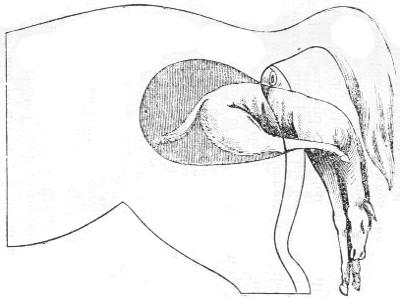
PLATE V.
On the 30th day of April, 1855, when
about ready to retire to bed after a hard
day’s drive, two messengers, Mr. B. Cramer,
from Middlecreek, and Mr. Uriah
Berger, from Centre township, arrived at
my house together. After some consideration,
I concluded to accompany Mr.
Berger, and on arriving, I found a foal,
having presented itself as represented in
the preceding Engraving. Before my arrival,
three men had exerted all their
strength for an hour or more, to extract
it, but having failed, they left before my
arrival.
In this case, the mare is very restless,
repeatedly rising up and lying down again.
It will require one man to attend
to the head of the mare, and two men
must take hold of the foal, raise it up
toward the tail of the mare, and bear inwards
with all their strength, when the
operator must put all his force to one of
the hind feet, and push that in at full
arm’s length; the other side must be
treated in the same manner. But let
each one bear in mind, when the foal is
moved inward, the mare will have pain
and that she will bear towards you, so that
sometimes but little is accomplished.
We labored faithfully from eleven
o’clock until one, when I took a midnight
meal and departed for Middlecreek
township.
In some cases of the above kind, however,
I had accomplished my object in
much less time, than in this one.
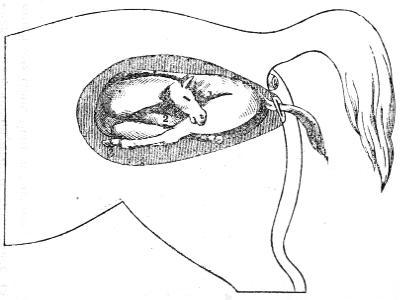
PLATE VI.
On the 5th of May, 1855, I was called
to the premises of John Deabler, in Beaver
township, Snyder county, where I found
a foal presenting the tail, as represented
in Plate VI. Presentations of this kind
occur but rarely. In this case the operator
must prepare his hand and arm as before
stated, and introduce it, taking hold
over the stifle-joint at Fig. 1, then, by
a strong effort, pull upward slipping his
hand down to Fig. 2, when he must draw
up the knee-joint as far as possible; then
place the left hand on the knee joint, and
pass the right hand down to Fig. 3, the
foot, grasp it firmly, and bend it backward,
at the same time pulling upward,
and with left the hand bearing inward,
when the foot will yield in a moment.
The other side must be dealt with in the
same manner.

PLATE VII.
The above Engraving represents the
foal with the hind feet foremost. They
will generally be projected against the
upper part of the entrance. It is best
to extract them in this position, as turning
them is almost impossible. The head
will remain so far behind, that it cannot
be reached. By keeping the membrane
or skin properly over the foal, there will
be but little difficulty experienced in extracting
it. The foal should sometimes
be drawn downward toward the feet of
the mare, and then upwards towards
the tail, frequently turning it half way
round, and then back again. The foal
will necessarily be dead.
Many cases of this kind will occur in
a neighborhood in the course of twenty
years.
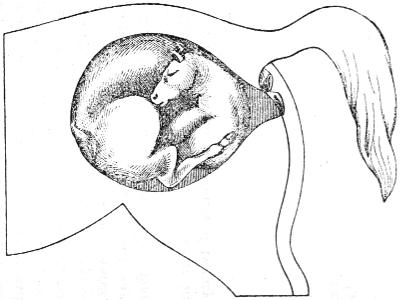
PLATE VIII.
The above Engraving represents a foal
which has died from some cause or other
about nine days ago, the mare wanting
the proper pains to deliver it. The foal
is now bloated to such an extent, that it
is in a condition to rupture the womb,
and the hand can not be passed around
the foal. It is an utter impossibility to
extract it in the usual way. The operator
must procure a knife, very straight in
the blade, from twelve to fifteen inches
in length, wrap the whole blade in a piece
of muslin, take the point of the knife in
his left hand, turning the edge downward,
put his hand in the entrance of the womb
and run it down until he reaches the
chest of the foal. He must then introduce
the right hand, grasp the handle,
and hold it firm; then with the left hand
he will slip the muslin from the blade,
and with the first finger of the left hand
find the spot where the windpipe comes
out of the chest. After the point of the
knife is set, the right hand must force
the blade, to its full length if possible,
through the Diaphragm, and then withdraw
it. The left hand must retain its
hold upon the muslin during the entire
operation, and as the blade is withdrawn
from the foal, it must again be carefully
wrapped around the knife, the left hand
seizing the point in the same manner as
when it was introduced. After the arm
holding the knife is withdrawn, a very
nauseous gas will escape, and in a short
time the front feet may be reached, then
the head, after which the operation will
proceed as described in the foregoing
pages.
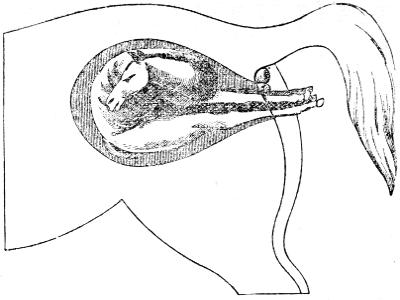
PLATE IX.
On the 20th day of May, 1854, I was
called to the field of Mr. Sem Schoch, of
New Berlin, Union county, Pa., where I
found a mare in the act of foaling, in
which the foal presented the four feet at
once. These cases are of rare occurrence,
and it is well for the veterinary Surgeon,
or his life would be a brief one. I never
injured myself at any work to a greater
extent, than I did in treating these
cases.
Sometimes the hoofs will only protrude
from the entrance, leaving the whole
body of the foal in a curved position
the head being turned backward, as described
in the foregoing Engraving. The
head should be brought forward, but I
always found it impossible in every case
of this description, to accomplish this.
A cord must be looped around the hind
legs, to avoid losing them; then the four
legs must be put back again as far as
possible, and the foal must be turned, in
order to get the head down and the back
up.
If an effort was made to extract the
foal as it is presented, the back would
come in below, and the operation would
be impossible; but if it is properly turned,
it may be extracted in the same manner,
as those which present only the hind
feet, as already described. These cases
require more aid than any others that I
have ever treated. Two or three men
should take hold of the mare’s head and
neck, to keep her down, otherwise she
will plunge about fearfully. One or two
men should assist the Surgeon, as the effort
required for this operation is so great
that one man is soon exhausted.
Two and three hours are often required
to accomplish the object in these cases,
but I have succeeded in every one of them
in preserving the mare alive.