A Description of San Francisco, the Metropolis of the Pacific Coast
Before the Fire—One of the Most Beautiful and Picturesque
Cities in America—Home of the California Bonanza Kings.
SAN FRANCISCO has had many soubriquets. It has been
happily called the “City of a Hundred Hills,” and its title of
the “Metropolis of the Golden Gate” is richly deserved. Its location
is particularly attractive, inasmuch as the peninsula it occupies
is swept by the Pacific Ocean on the west and the beautiful
bay of San Francisco on the north and east. The peninsula itself
is thirty miles long and the site of the city is six miles back from
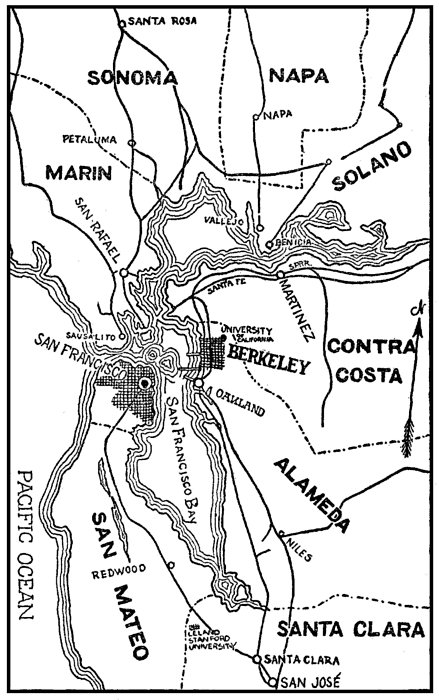
the ocean. It rests on the shore of San Francisco Bay, which,
with its branches, covers over 600 square miles, and for beauty
and convenience for commerce is worthy of its magnificent entrance—the
Golden Gate.
San Francisco was originally a mission colony. It is reported
that “the site of the mission of San Francisco was selected because
of its political and commercial advantages. It was to be
the nucleus of a seaport town that should serve to guard the
dominion of Spain in its vicinity. Most of the other missions
were founded in the midst of fertile valleys, inhabited by large
numbers of Indians.” Both of these features were notably absent
in San Francisco. Even the few Indians there in 1776 left upon
the arrival of the friars and dragoons. Later on some of them
returned and others were added, the number increasing from 215
in 1783, to 1,205 in 1813. This was the largest number ever reported.
Soon after the number began to decrease through epidemics
and emigration, until there was only 204 in 1832.
The commercial life of San Francisco dates from 1835, when
William A. Richardson, an Englishman, who had been living in
Sausalito since 1822, moved to San Francisco. He erected a tent
and began the collection of hides and tallow, by the use of two
30-ton schooners leased from the missions, and which plied between
San Jose and San Francisco. At that time Mr. Richardson
was also captain of the port.
Seventy-five years ago the white adult males, apart from the
Mission colony, consisted of sixteen persons. The local census of
1852 showed a population of 36,000, and ten years later 90,000.
The last general census of 1900 credits the city with a population
of 343,000. The increase in the last six years has been much
greater than for the previous five, and it is generally conceded
that the population at the time of the fire was about 425,000.
California was declared American territory by Commodore
Sleat, at Monterey, on the 7th of July, 1846, who on that day
caused the American flag to be raised in that town. On the following
day, under instructions from the commodore, Captain
Montgomery, of the war sloop Portsmouth, performed a similar
service in Yerba Buena, by which name the city afterwards christened
San Francisco was then known. This ceremony took place
on the plot of ground, afterward set apart as Portsmouth Square,
on the west line of Kearney street, between Clay and Washington.
At that time and for some years afterwards, the waters of
the bay at high tide, came within a block of the spot where this
service occurred. This was a great event in the history of the
United States, and it has grown in importance and in appreciative
remembrance from that day to the present, as the accumulative
evidence abundantly shows.
Referring to the change in name from Yerba Buena to San
Francisco, in 1847, a writer says: “A site so desirable for a city,
formed by nature for a great destiny on one of the finest bays
in the world, looking out upon the greatest, the richest, and the
most pacific of oceans—in the very track of empire—in the
healthiest of latitudes—such a site could not fail to attract the
attention of the expanding Saxon race. Commerce hastened it,
the discovery of gold consummated it.”
Modern San Francisco had its birth following the gold discoveries
which led to the construction of the Central Pacific railway,
and produced a vast number of very wealthy men known
by the general title of California Bonanza Kings. San Francisco
became the home and headquarters of these multi-millionaires,
and large sums of their immense fortunes were invested in palatial
residences and business blocks.
The bonanza king residence section was Nob Hill, an eminence
near the business part of the city.
In the early days of San Francisco’s growth and soon after
the Central Pacific railroad had been built by Leland Stanford,
Charles Crocker, Mark Hopkins, Collis P. Huntington and the
others who devoted the best part of their lives to the project of
crossing the mountains by rail this hill was selected as the most
desirable spot in the city for the erection of homes for the use
of wealthy pioneers.
The eminence is situated northwest of the business section of
the city and commands a view of the bay and all adjacent territory
with the exception of the Pacific Ocean, Russian Hill, Pacific
Heights and several other high spots obscuring the view toward
the west.
Far removed above the din and noise of the city Charles
Crocker was the first to erect his residence on the top of this
historic hill which afterward became known as Nob Hill. The
Crocker home was built of brick and wood originally, but in later
years granite staircases, pillars and copings were substituted. In
its time it was looked upon as the most imposing edifice in the
city and for that reason the business associates of the railroad
magnate decided to vie with him in the building of their homes.
Directly across from the Crocker residence on California
street Leland Stanford caused to be built a residence structure
that was intended to be the most ornate in the western metropolis.
It was a veritable palace and it was within its walls that the boyhood
days of Leland Stanford, Jr., after whom the university is
named, were spent in luxurious surroundings. After the death
of the younger Stanford a memorial room was set apart and the
parents permitted no one to enter this except a trusted man
servant who had been in the family for many years.
But the Stanford residence was relegated to the background
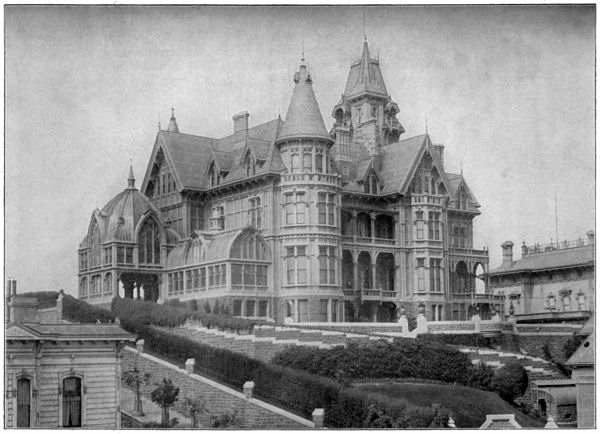
as an object of architectural beauty when Mark Hopkins invaded
the sacred precincts of Nob Hill and erected the residence which
he occupied for three or four years. At his death the palatial
building was deeded to the California Art Institute and as a
tribute to the memory of the sturdy pioneer the building was
called the Hopkins Institute of Art. Its spacious rooms were
laden with the choicest works of art on the Pacific coast and the
building and its contents were at all times a source of interest to
the thousands of tourists who visited the city.
The late Collis P. Huntington was the next of the millionaires
of San Francisco to locate upon the crest of Nob Hill. Within
a block of the Crocker, Stanford and Hopkins palaces this railroad
magnate of the west erected a mansion of granite and marble
that caused all the others to be thrown in the shade. Its exterior
was severe in its simplicity, but to those who were fortunate to
gain entrance to the interior the sight was one never to be forgotten.
The palaces of Europe could not excel it and for several
years Huntington and his wife were its only occupants aside
from the army of servants required to keep the house and grounds
in order.
Not to be outdone by the railroad magnates of the city the
next to acquire property on the crest of the hill was James Flood,
the “bonanza king” and partner with William O’Brien, the names
of both being closely interwoven with the early history of California
and the Comstock lode. After having paid a visit to the
east the millionaire mine owner became impressed with the brown
stone fronts of New York and outdone his neighbors by erecting
the only brown stone structure in San Francisco.
It was in this historic hilltop also that James G. Fair laid the
foundation of a residence that was intended to surpass anything
in the sacred precincts, but before the foundations had been completed
domestic troubles resulted in putting a stop to building
operations and it is on this site that Mrs. Hermann Oelrichs,
daughter of the late millionaire mine owner, erected the palatial
Fairmont hotel, which was one of the most imposing edifices in
San Francisco.
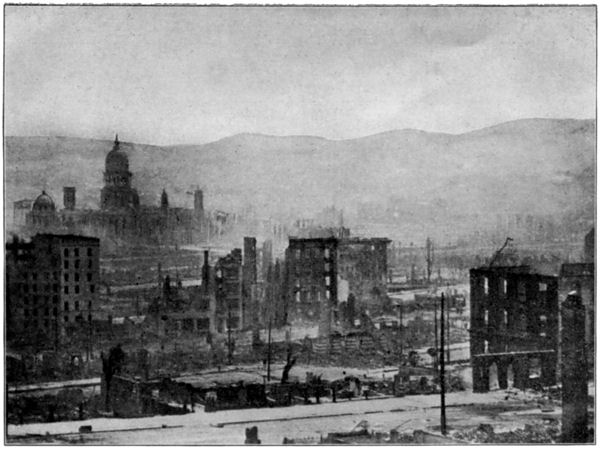
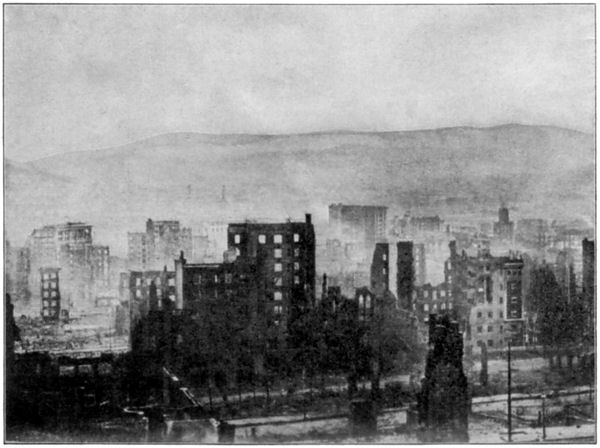
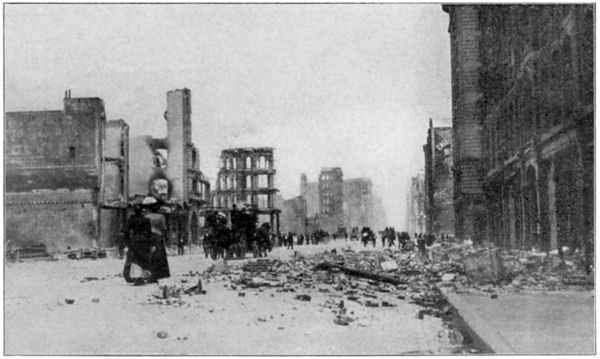
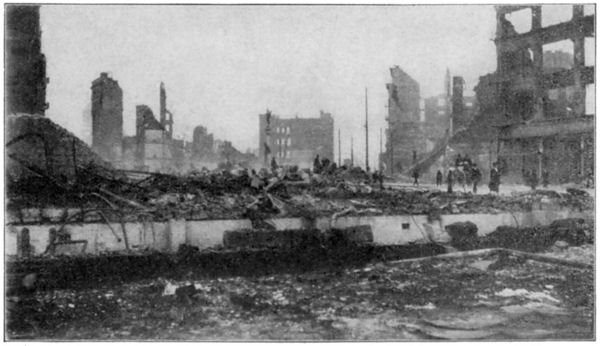
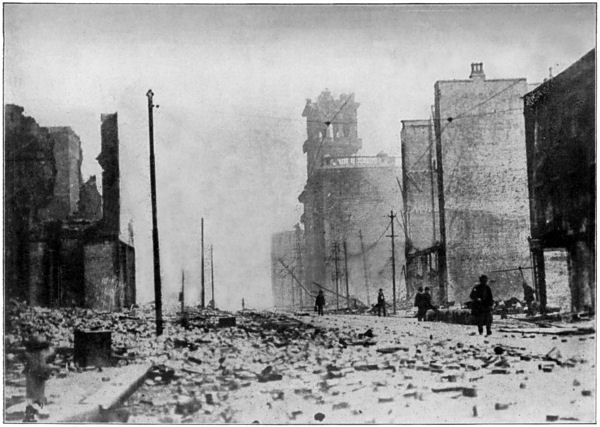
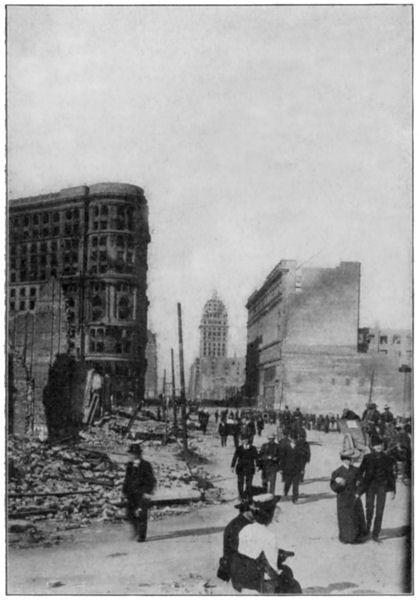
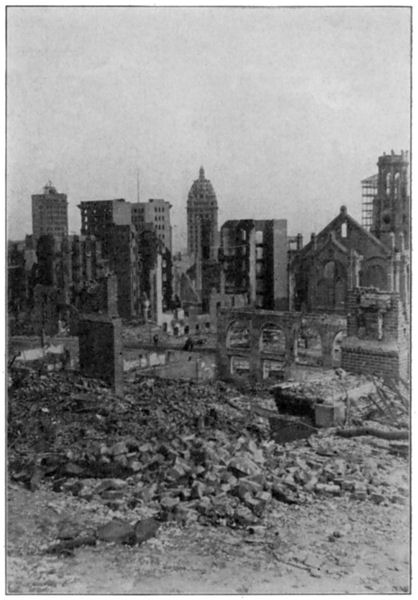
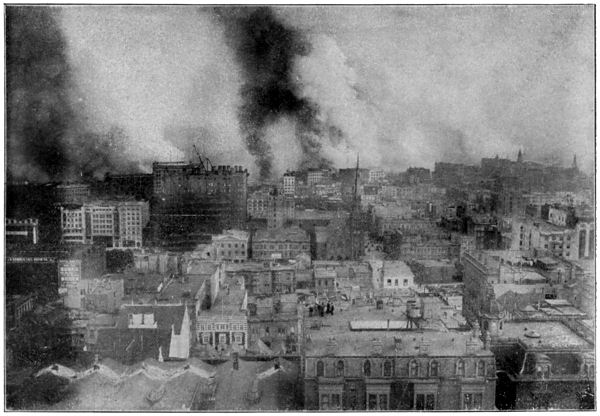
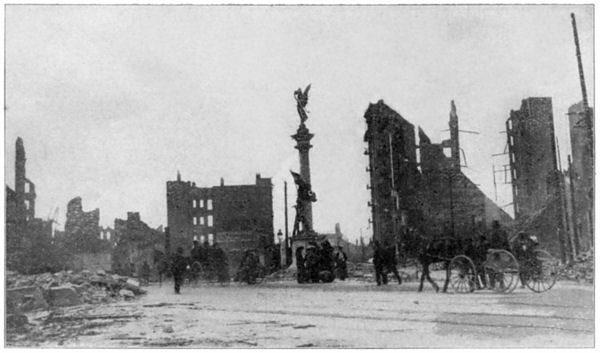
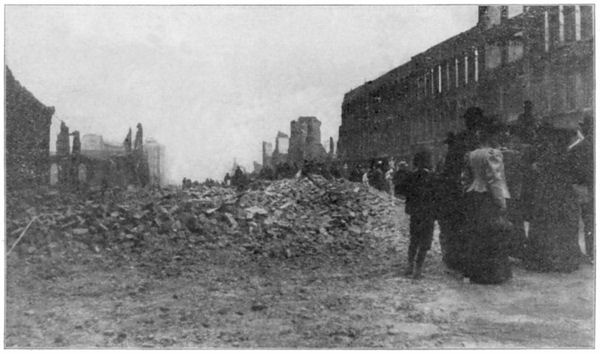
The old San Francisco is dead. The gayest, lightest hearted,
most pleasure loving city of this continent, and in many ways
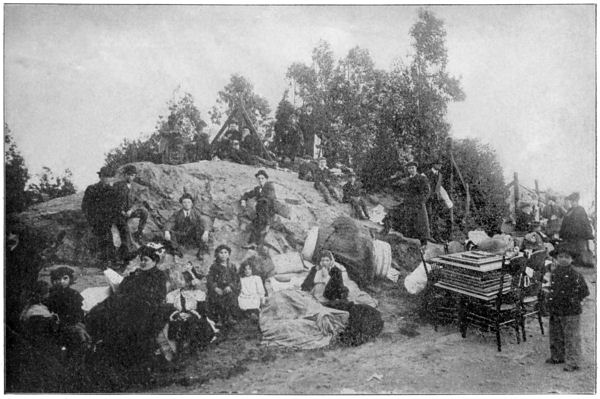
the most interesting and romantic, is a horde of huddled refugees
living among ruins. But those who have known that peculiar
city by the Golden Gate and have caught its flavor of the Arabian
Nights feel that it can never be the same. It is as though a
pretty, frivolous woman had passed through a great tragedy.
She survives, but she is sobered and different. When it rises out
of the ashes it will be a modern city, much like other cities and
without its old flavor.
The city lay on a series of hills and the lowlands between.
These hills are really the end of the Coast Range of mountains
which lie between the interior valleys and the ocean to the south.
To its rear was the ocean; but the greater part of the town fronted
on two sides on San Francisco Bay, a body of water always
tinged with gold from the great washings of the mountains,
usually overhung with a haze, and of magnificent color changes.
Across the bay to the north lies Mount Tamalpais, about 5,000
feet high, and so close that ferries from the water front took one
in less than half an hour to the little towns of Sausalito and
Belvidere, at its foot.
It is a wooded mountain, with ample slopes, and from it on
the north stretch away ridges of forest land, the outposts of the
great Northern woods of Sequoia semperrirens. This mountain
and the mountainous country to the south brought the real forest
closer to San Francisco than to any other American city.
Within the last few years men have killed deer on the slopes
of Tamalpais and looked down to see the cable cars crawling
up the hills of San Francisco to the north. In the suburbs coyotes
still stole and robbed hen roosts by night. The people lived much
out of doors. There was no time of the year, except a short
part of the rainy season, when the weather kept one from the
woods. The slopes of Tamalpais were crowded with little villas
dotted through the woods, and those minor estates ran far up
into the redwood country. The deep coves of Belvidere, sheltered
by the wind from Tamalpais, held a colony of “arks” or
houseboats, where people lived in the rather disagreeable summer
months, going over to business every day by ferry. Everything
invited out of doors.
The climate of California is peculiar; it is hard to give an impression
of it. In the first place, all the forces of nature work
on laws of their own in that part of California. There is no
thunder or lightning; there is no snow, except a flurry once in
five or six years; there are perhaps a dozen nights in the winter
when the thermometer drops low enough so that there is a little
film of ice on exposed water in the morning. Neither is there
any hot weather. Yet most Easterners remaining in San Francisco
for a few days remember that they were always chilly.
For the Gate is a big funnel, drawing in the winds and the
mists which cool off the great, hot interior valleys of the San
Joaquin and Sacramento. So the west wind blows steadily ten
months of the year and almost all the mornings are foggy. This
keeps the temperature steady at about 55 degrees—a little cool
for comfort of an unacclimated person, especially indoors. Californians,
used to it, hardly ever thought of making fires in their
houses except in the few exceptional days of the winter season,
and then they relied mainly upon fireplaces. This is like the custom
of the Venetians and the Florentines.
But give an Easterner six months of it and he too learns to
exist without a chill in a steady temperature a little lower than
that to which he is accustomed at home. After that one goes
about with perfect indifference to the temperature. Summer
and winter San Francisco women wore light tailor-made clothes,
and men wore the same fall weight suits all the year around.
There is no such thing as a change of clothing for the seasons.
And after becoming acclimated these people found the changes
from hot to cold in the normal regions of the earth hard to bear.
Perhaps once in two or three years there comes a day when
there is no fog, no wind and a high temperature in the coast district.
Then there is hot weather, perhaps up in the eighties, and
Californians grumble, swelter and rustle for summer clothes.
These rare hot days were the only times when one saw on the
streets of San Francisco women in light dresses.
Along in early May the rains cease. At that time everything
is green and bright and the great golden poppies, as large as the
saucer of an after dinner coffee cup, are blossoming everywhere.
Tamalpais is green to its top; everything is washed and bright.
By late May a yellow tinge is creeping over the hills. This is
followed by a golden June and a brown July and August. The
hills are burned and dry. The fog comes in heavily, too; and
normally this is the most disagreeable season of the year. September
brings a day or two of gentle rain; and then a change, as
sweet and mysterious as the breaking of spring in the East,
comes over the hills. The green grows through the brown and
the flowers begin to come out.
As a matter of fact, the unpleasantness of summer is modified
by the certainty that one can go anywhere without fear of rain.
And in all the coast mountains, especially the seaward slopes,
the dews and the shelter of the giant underbrush keep the water
so that these areas are green and pleasant all summer.
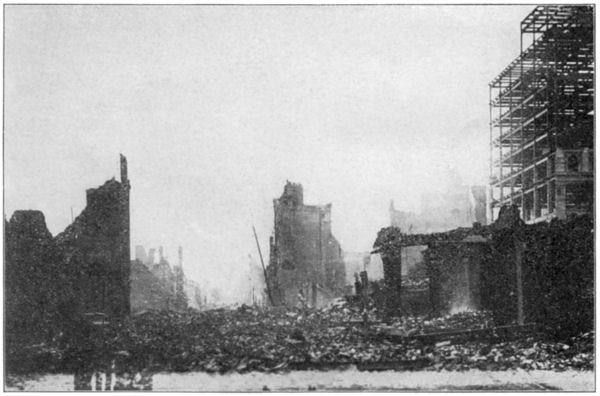
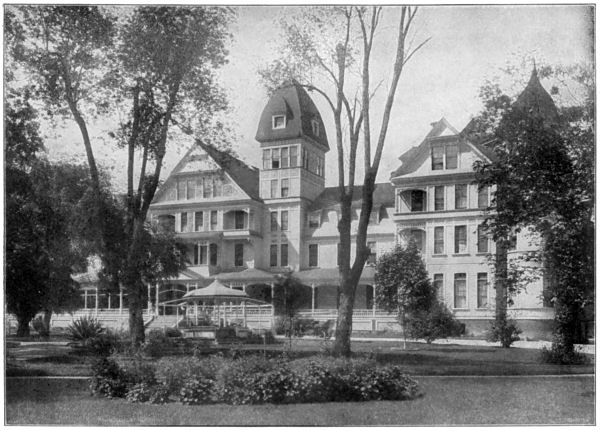
MARK HOPKINS INSTITUTE, NOB HILL.
This Institute which crowned Nob Hill in San Francisco was originally the residence of Mark Hopkins of Central Pacific fame.
Nob Hill was noted for Palatial Homes. They were destroyed by the fire.
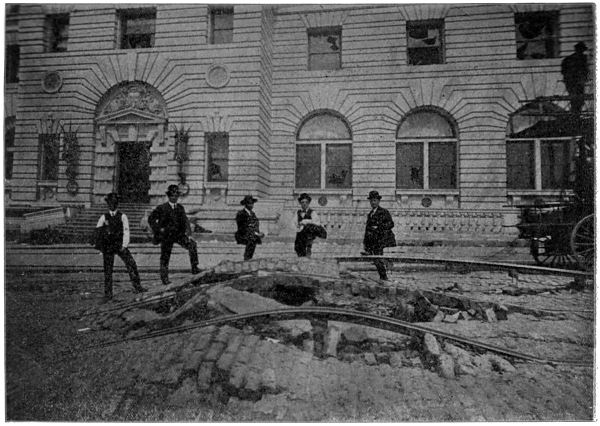
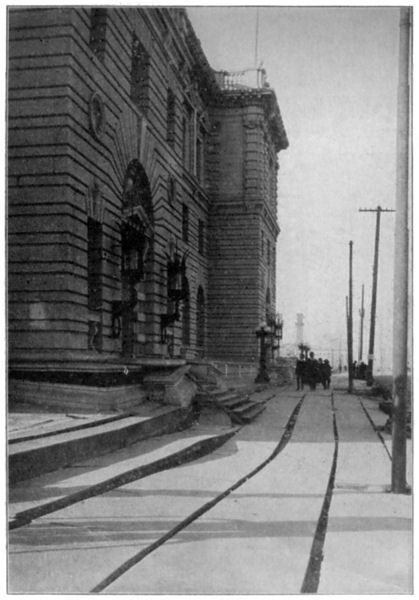
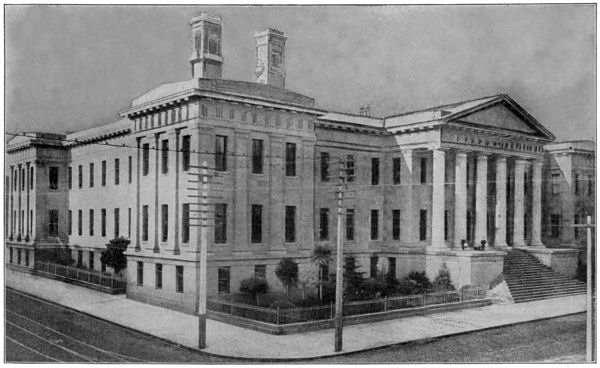
UNITED STATES MINT AND SUB-TREASURY, SAN FRANCISCO, CAL.
This building, which had some $39,000,000 stored in it, remained intact.
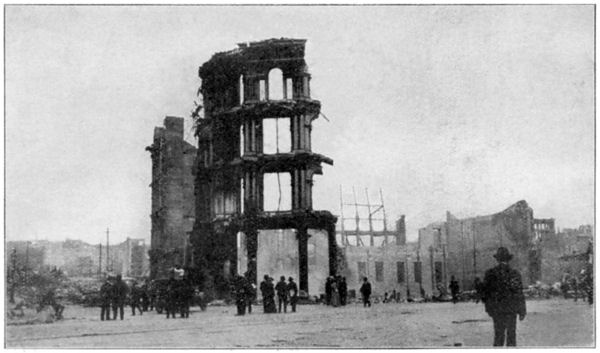
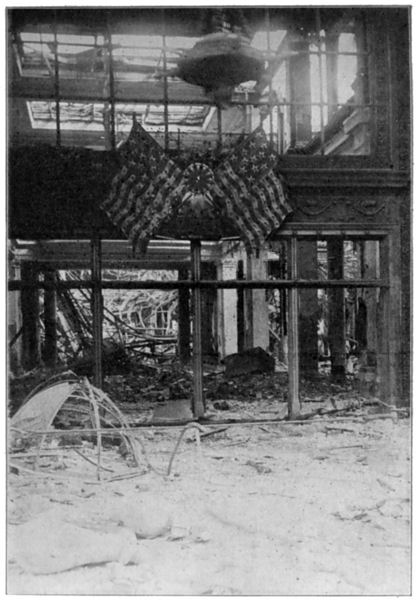
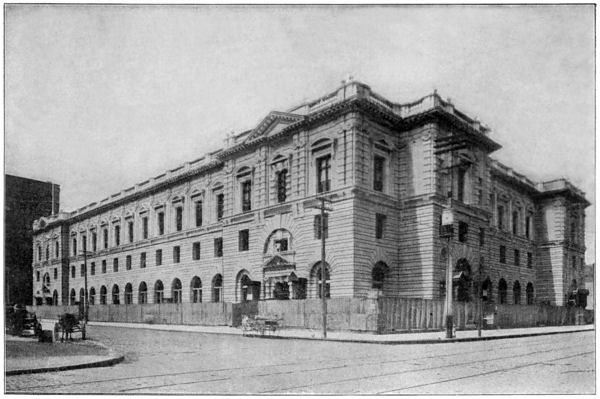
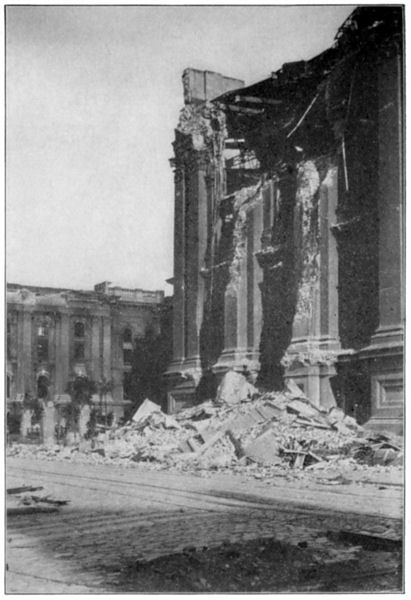
NEW POSTOFFICE BUILDING.
This costly and handsome structure was destroyed by fire.
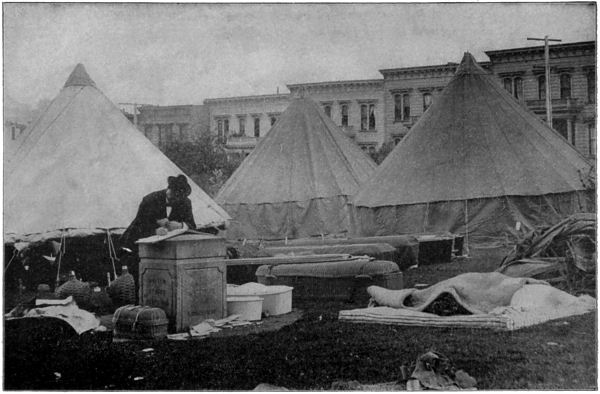
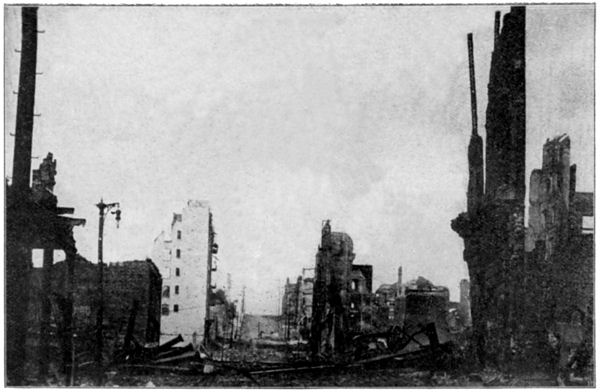
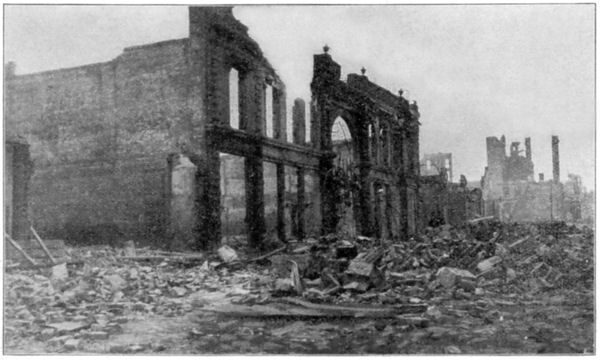
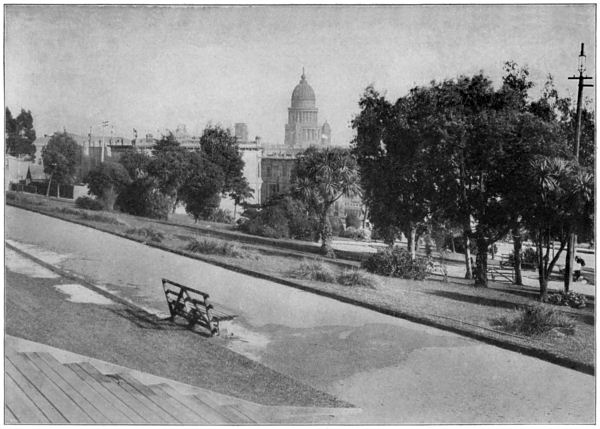
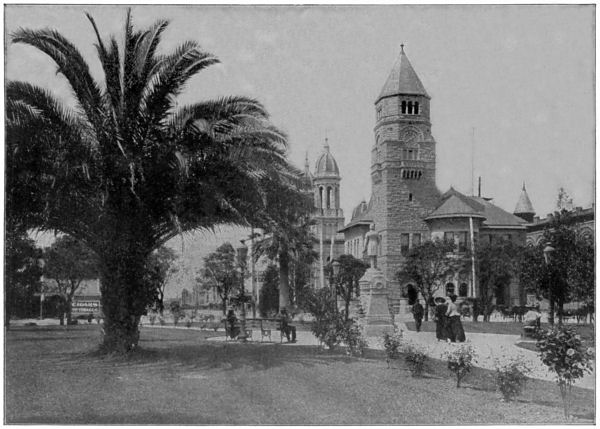
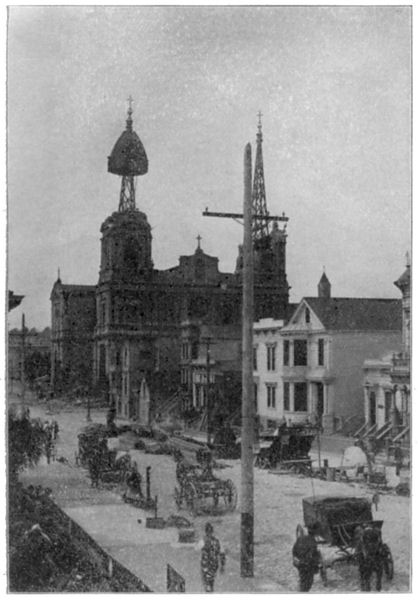
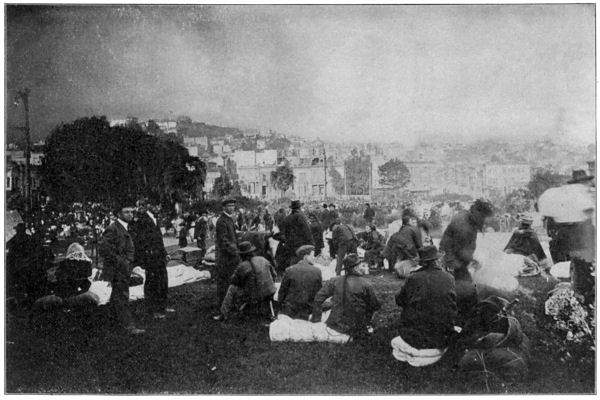
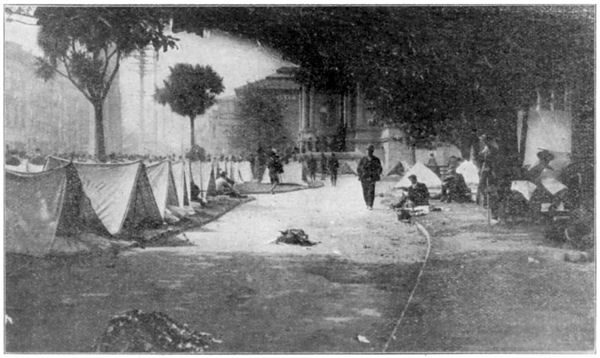
JEFFERSON SQUARE.
All of the buildings shown in the background were destroyed. Tents were erected in this square to shelter the homeless.
In a normal year the rains begin to fall heavily in November;
there will be three or four days of steady downpour and then a
clear and green week. December is also likely to be rainy; and
in this month people enjoy the sensation of gathering for Christmas
the mistletoe which grows profusely on the live oaks, while
the poppies are beginning to blossom at their feet. By the end
of January the rains come lighter. In the long spaces between
rains there is a temperature and a feeling in the air much like
that of Indian summer in the East. January is the month when
the roses are at their brightest.
So much for the strange climate, which invites out of doors
and which has played its part in making the character of the
people. The externals of the city are—or were, for they are no
more—just as curious. One usually entered the city by way of
San Francisco Bay. Across its yellow flood, covered with the
fleets from the strange seas of the Pacific, San Francisco presented
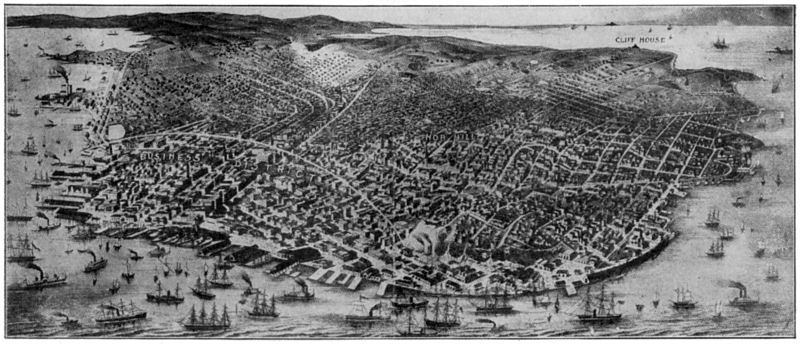
itself in a hill panorama. Probably no other city of the world
could be so viewed and inspected at first sight. It rose above
the passenger, as he reached dockage, in a succession of hill terraces.
At one side was Telegraph Hill, the end of the peninsula, a
height so abrupt that it had a 200 foot sheer cliff on its seaward
frontage. Further along lay Nob Hill, crowned with the Mark
Hopkins mansion, which had the effect of a citadel, and in later
years by the great, white Fairmount. Further along was Russian
Hill, the highest point. Below was the business district,
whose low site caused all the trouble.
Except for the modern buildings, the fruit of the last ten
years, the town presented at first sight a disreputable appearance.
Most of the buildings were low and of wood. In the middle
period of the ’70s, when a great part of San Francisco was
building, there was some atrocious architecture perpetrated. In
that time, too, every one put bow windows on his house, to catch
all of the morning sunlight that was coming through the fog, and
those little houses, with bow windows and fancy work all down
their fronts, were characteristic of the middle class residence district.
Then the Italians, who tumbled over Telegraph Hill, had
built as they listed and with little regard for streets, and their
houses hung crazily on a side hill which was little less than a
precipice. For the most part, the Chinese, although they occupied
an abandoned business district, had remade the houses
Chinese fashion, and the Mexicans and Spaniards had added
to their houses those little balconies without which life is not
life to a Spaniard.
Yet the most characteristic thing after all was the coloring.
For the sea fog had a trick of painting every exposed object a
sea gray which had a tinge of dull green in it. This, under the
leaden sky of a San Francisco morning, had a depressing effect
on first sight and afterward became a delight to the eye. For
the color was soft, gentle and infinitely attractive in mass.
The hills are steep beyond conception. Where Vallejo street
ran up Russian Hill it progressed for four blocks by regular steps
like a flight of stairs. It is unnecessary to say that no teams ever
came up this street or any other like it, and grass grew long
among the paving stones until the Italians who live thereabouts
took advantage of this to pasture a cow or two. At the end of
the four blocks, the pavers had given it up and the last stage to
the summit was a winding path. On the very top, a colony of
artists lived in little villas of houses whose windows got the
whole panorama of the bay. Luckily for these people, a cable
car climbed the hill on the other side, so that it was not much of
a climb to home.
With these hills, with the strangeness of the architecture and
with the green gray tinge over everything, the city fell always
into vistas and pictures, a setting for the romance which hung
over everything, which always hung over life in San Francisco
since the padres came and gathered the Indians about Mission
Dolores.
And it was a city of romance and a gateway to adventure.
It opened out on the mysterious Pacific, the untamed ocean, and
most of China, Japan, the South Sea Islands, Lower California,
the west coast of Central America, Australia that came to this
country passed in through the Golden Gate. There was a sprinkling,
too, of Alaska and Siberia. From his windows on Russian
Hill one saw always something strange and suggestive creeping
through the mists of the bay. It would be a South Sea Island
brig, bringing in copra, to take out cottons and idols; a Chinese
junk with fanlike sails, back from an expedition after sharks’
livers; an old whaler, which seemed to drip oil, back from a year
of cruising in the Arctic. Even the tramp windjammers were
deep chested craft, capable of rounding the Horn or of circumnavigating
the globe; and they came in streaked and picturesque
from their long voyaging.
In the orange colored dawn which always comes through the
mists of that bay, the fishing fleet would crawl in under triangular
lateen sails, for the fishermen of San Francisco Bay were
all Neapolitans who brought their customers and their customs
and sail with lateen rigs shaped like the ear of a horse when
the wind fills them and stained an orange brown.
Along the water front the people of these craft met. “The
smelting pot of the races,” Stevenson called it; and this was always
the city of his soul. There are black Gilbert Islanders, almost
indistinguishable from Negroes; lighter Kanakas from Hawaii
or Samoa; Lascars in turbans; thickset Russian sailors;
wild Chinese with unbraided hair; Italian fishermen in tam o’
shanters, loud shirts and blue sashes; Greeks, Alaska Indians,
little bay Spanish-Americans, together with men of all the European
races. These came in and out from among the queer craft,
to lose themselves in the disreputable, tumbledown, but always
mysterious shanties and small saloons. In the back rooms of
these saloons South Sea Island traders and captains, fresh from
the lands of romance, whaling masters, people who were trying
to get up treasure expeditions, filibusters, Alaskan miners, used
to meet and trade adventures.
There was another element, less picturesque and equally
characteristic, along the water front. For San Francisco was the
back eddy of European civilization—one end of the world. The
drifters came there and stopped, lingered a while to live by their
wits in a country where living after a fashion has always been
marvellously cheap. These people haunted the water front or lay
on the grass on Portsmouth Square.
That square, the old plaza about which the city was built,
Spanish fashion, had seen many things. There in the first burst
of the early days the vigilance committee used to hold its hangings.
There in the time of the sand lot riots Dennis Kearney,
who nearly pulled the town down about his ears, used to make
his orations which set the unruly to rioting. In these later years
Chinatown laid on one side of it and the Latin quarter and the
“Barbary Coast” on the other.
On this square men used to lie all day long and tell strange
yarns. Stevenson lay there with them in his time and learned
the things which he wrote into “The Wrecker” and his South
Sea stories, and in the center of the square there stood the beautiful
Stevenson monument. In later years the authorities put up
a municipal building on one side of this square and prevented the
loungers, for decency’s sake, from lying on the grass. Since
then some of the peculiar character of the old plaza had gone.
The Barbary Coast was a loud bit of hell. No one knows
who coined the name. The place was simply three blocks of
solid dance halls, there for the delight of the sailors of the world.
On a fine busy night every door blared loud dance music from
orchestra, steam pianos and gramophones and the cumulative
effect of the sound which reached the street was at least strange.
Almost anything might be happening behind the swinging doors.
For a fine and picturesque bundle of names characteristic of the
place, a police story of three or four years ago is typical. Hell
broke out in the Eye Wink Dance Hall. The trouble was started
by a sailor known as Kanaka Pete, who lived in the What Cheer
House, over a woman known as Iodoform Kate. Kanaka Pete
chased the man he had marked to the Little Silver Dollar, where
he turned and punctured him. The by-product of his gun made
some holes in the front of the Eye Wink, which were proudly
kept as souvenirs, and were probably there until it went out in
the fire. This was low life, the lowest of the low.
Until the last decade almost anything except the commonplace
and the expected might happen to a man on the water front.
The cheerful industry of shanghaiing was reduced to a science.
A stranger taking a drink in one of the saloons which hung out
over the water might be dropped through the floor into a boat,
or he might drink with a stranger and wake in the forecastle of a
whaler bound for the Arctic. Such an incident is the basis of
Frank Norris’s novel, “Moran of the Lady Letty,” and although
the novel draws it pretty strong, it is not exaggerated. Ten
years ago the police and the foreign consuls, working together,
stopped this.
Kearney street, a wilder and stranger Bowery, was the main
thoroughfare of these people. An exiled Californian, mourning
over the city of his heart, said recently:
“In a half an hour of Kearney street I could raise a dozen
men for any wild adventure, from pulling down a statue to searching
for the Cocos Island treasure.”
This is hardly an exaggeration.
These are a few of the elements which made the city strange
and gave it the glamour of romance which has so strongly attracted
such men as Stevenson, Frank Norris and Kipling.
This lay apart from the regular life of the city, which was distinctive
in itself.
The Californian is the second generation of a picked and
mixed stock. The merry, the adventurous, often the desperate,
always the brave, deserted the South and New England in 1849
to rush around the Horn or to try the perils of the plains. They
found there already grown old in the hands of the Spaniards
younger sons of hidalgos and many of them of the proudest
blood of Spain. To a great extent the pioneers intermarried
with Spanish women; in fact, except for a proud little colony
here and there, the old Spanish blood is sunk in that of the conquering
race. Then there was an influx of intellectual French
people, largely overlooked in the histories of the early days;
and this Latin leaven has had its influence.
Brought up in a bountiful country, where no one really has to
work very hard to live, nurtured on adventure, scion of a free
and merry stock, the real, native Californian is a distinctive type;
so far from the Easterner in psychology as the extreme Southerner
is from the Yankee. He is easy going, witty, hospitable,
lovable, inclined to be unmoral rather than immoral in his personal
habits, and above all easy to meet and to know.
Above all there is an art sense all through the populace which
sets it off from any other part of the country. This sense is almost
Latin in its strength, and the Californian owes it to the
leaven of Latin blood. The true Californian lingers in the north;
for southern California has been built up by “lungers” from
the East and middle West and is Eastern in character and feeling.
With such a people life was always gay. If they did not
show it on the streets, as do the people of Paris, it was because
the winds made open cafes disagreeable at all seasons of the
year. The gayety went on indoors or out on the hundreds of
estates that fringed the city. It was noted for its restaurants.
Perhaps the very best for people who care not how they spend
their money could not be had there, but for a dollar, 75 cents,
50 cents, a quarter or even 15 cents the restaurants afforded the
best fare on earth at the price.
If one should tell exactly what could be had at Coppa’s for
50 cents or at the Fashion for, say, 35, no New Yorker who has
not been there would believe it. The San Francisco French dinner
and the San Francisco free lunch were as the Public Library
to Boston or the stock yards to Chicago. A number of causes
contributed to this consummation. The country all about produced
everything that a cook needed and that in abundance—the
bay was an almost untapped fishing pond, the fruit farms
came up to the very edge of the town, and the surrounding country
produced in abundance fine meats, all cereals and all vegetables.
But the chefs who came from France in the early days and
liked this land of plenty were the head and front of it. They
passed on their art to other Frenchmen or to the clever Chinese.
Most of the French chefs at the biggest restaurants were born in
Canton, China. Later the Italians, learning of this country where
good food is appreciated, came and brought their own style.
Householders always dined out one or two nights of the week,
and boarding houses were scarce, for the unattached preferred
the restaurants. The eating was usually better than the surroundings.
Meals that were marvels were served in tumbledown little
hotels. Most famous of all the restaurants was the Poodle Dog.
There have been no less than four restaurants of this name,
beginning with a frame shanty where, in the early days, a prince
of French cooks used to exchange ragouts for gold dust. Each
succeeding restaurant of the name has moved further downtown;
and the recent Poodle Dog stood on the edge of the Tenderloin
in a modern five story building. And it typified a certain
spirit that there was in San Francisco.
For on the ground floor was a public restaurant where there
was served the best dollar dinner on earth. It ranked with the
best and the others were in San Francisco. Here, especially on
Sunday night, almost everybody went to vary the monotony of
home cooking. Every one who was any one in the town could
be seen there off and on. It was perfectly respectable. A man
might take his wife and daughter there.
On the second floor there were private dining rooms, and to
dine there, with one or more of the opposite sex, was risque but
not especially terrible. But the third floor—and the fourth floor—and
the fifth. The elevator man of the Poodle Dog, who had
held the job for many years and never spoke unless spoken to,
wore diamonds and was a heavy investor in real estate. There
were others as famous in their way—the Zinka, where, at one
time, every one went after the theatre, and Tate’s the Palace
Grill, much like the grills of Eastern hotels, except for the price;
Delmonico’s, which ran the Poodle Dog neck and neck in its
own line, and many others, humbler but great at the price.
The city never went to bed. There was no closing law, so
that the saloons kept open nights and Sundays, at their own
sweet will. Most of them elected to remain open until 3 o’clock
in the morning at least. Yet this restaurant life did not exactly
express the careless, pleasure loving character of the people. In
great part their pleasures were simple, inexpensive and out of
doors. No people were fonder of expeditions into the country, of
picnics—which might be brought off at almost any season of the
year—and often long tours in the great mountains and forests.
And hospitality was nearly a vice.
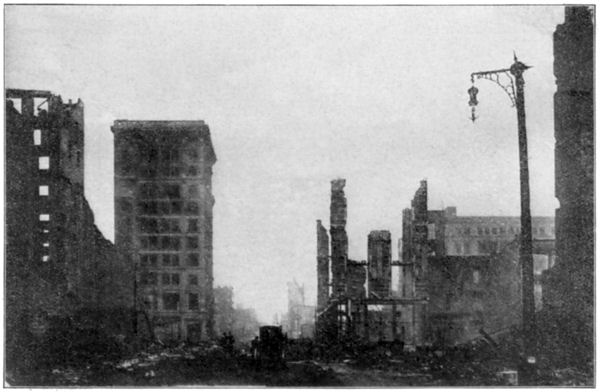
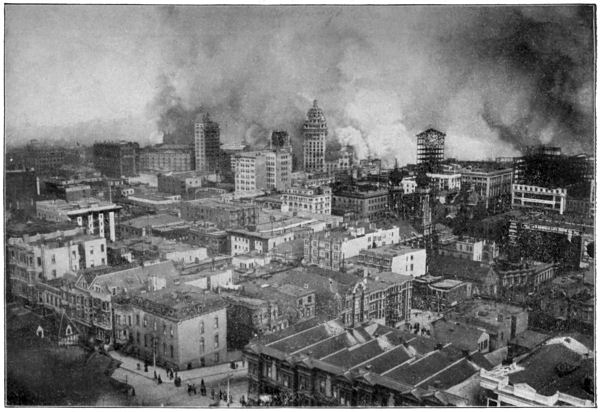
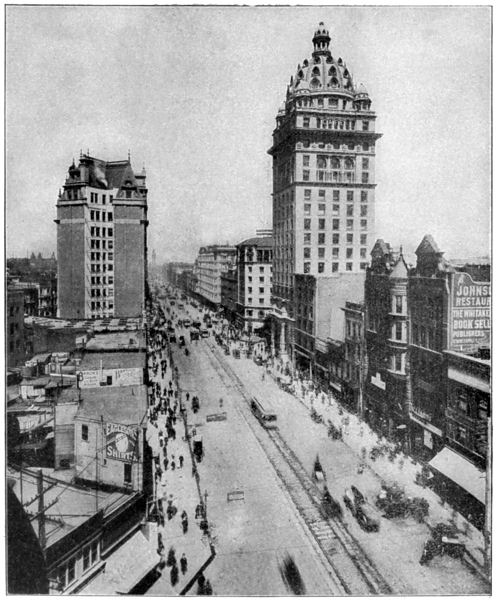
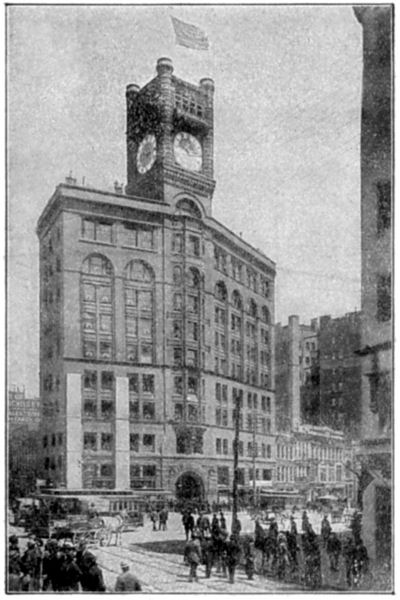
CHRONICLE BUILDING.
(An old landmark.)
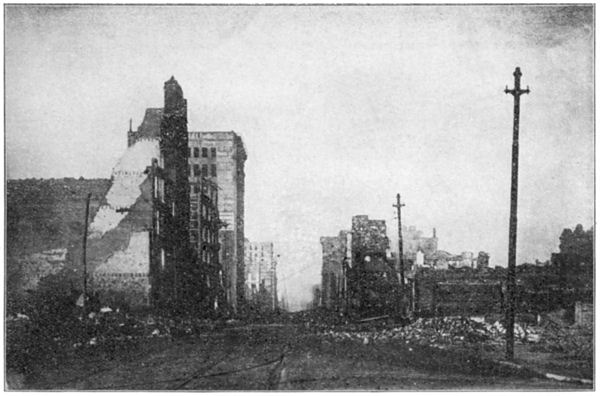
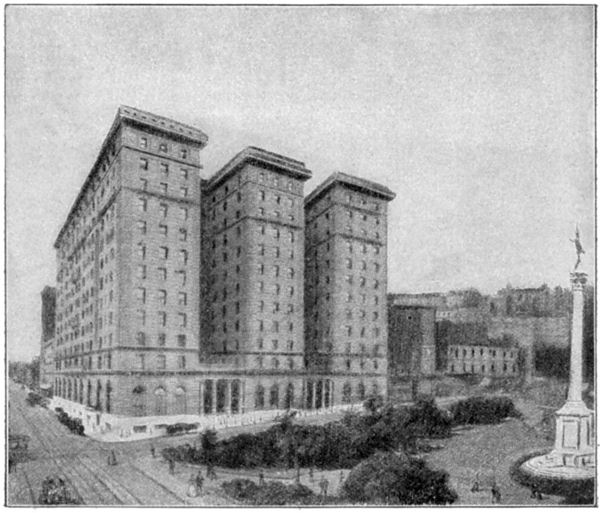
ST. FRANCIS HOTEL, SAN FRANCISCO, CAL.
(Destroyed by fire.)
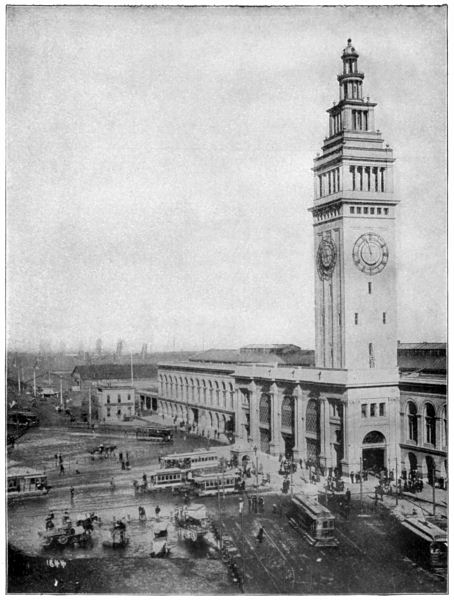
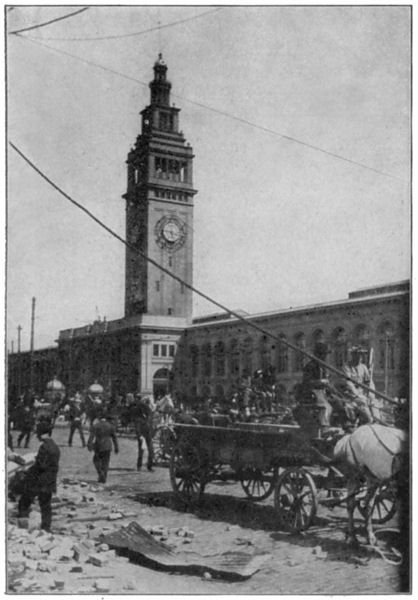
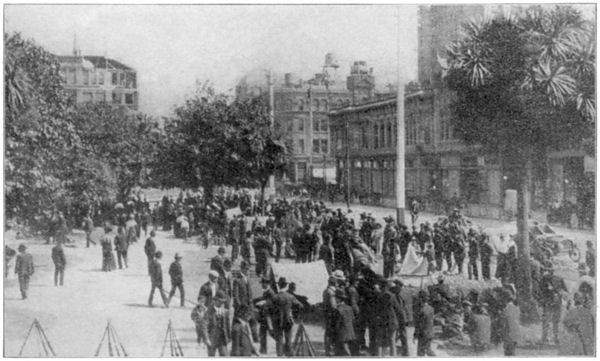
FERRY HOUSE, WHERE INJURED ARE LEAVING CITY.
This is the station of the greatest ferry in the world, just outside the fire belt in San
Francisco. Hundreds of refugees have been taken from it to Oakland and other points.
As in the early mining days, if they liked the stranger the
people took him in. At the first meeting the local man probably
had him put up at the club; at the second, he invited him home
to dinner. As long as he stayed he was being invited to week
end parties at ranches, to little dinners in this or that restaurant
and to the houses of his new acquaintances, until his engagements
grew beyond hope of fulfillment. There was rather too
much of it. At the end of a fortnight a stranger with a pleasant
smile and a good story left the place a wreck. This tendency
ran through all grades of society—except, perhaps, the sporting
people who kept the tracks and the fighting game alive. These
also met the stranger—and also took him in.
Centers of men of hospitality were the clubs, especially the
famous Bohemian and the Family. The latter was an offshoot of
the Bohemian, which had been growing fast and vieing with
the older organization for the honor of entertaining pleasing and
distinguished visitors.
The Bohemian Club, whose real founder is said to have been
the late Henry George, was formed in the ’70s by a number of
newspaper writers and men working in the arts or interested in
them. It had grown to a membership of 750. It still kept for its
nucleus painters, writers, musicians and actors, amateur and professional.
They were a gay group of men, and hospitality was
their avocation. Yet the thing which set this club off from all
others in the world was the midsummer High Jinks.
The club owns a fine tract of redwood forest fifty miles north
of San Francisco, on the Russian River. There are two varieties
of big trees in California: the Sequoia gigantea and the Sequoia
sempervirens. The great trees of the Mariposa grove belong
to the gigantea species. The sempervirens, however, reaches
the diameter of 16 feet, and some of the greatest trees of this
species are in the Bohemian Club grove. It lies in a cleft of the
mountains; and up one hillside there runs a natural out of door
stage of remarkable acoustic properties.
In August the whole Bohemian Club, or such as could get
away from business, went up to this grove and camp out for two
weeks. And on the last night they put on the Jinks proper, a
great spectacle with poetic words, music and effects done by the
club, in praise of the forest. In late years this had been practically
a masque or an opera. It cost about $10,000. It took the
spare time of scores of men for weeks; yet these 700 business
men, professional men, artists, newspaper workers, struggled
for the honor of helping out on the Jinks; and the whole thing
was done naturally and with reverence. It would hardly be
possible anywhere else in this country; the thing which made it
possible is the art spirit which is in the Californian. It runs in
the blood.
Some one has been collecting statistics which prove this point.
“Who’s Who in America” is long on the arts and on learning
and comparatively weak in business and the professions. Now
some one who has taken the trouble has found that more persons
mentioned in “Who’s Who” by the thousand of the population
were born in Massachusetts than in any other State; but that
Massachusetts is crowded closely by California, with the rest
nowhere. The institutions of learning in Massachusetts account
for her pre-eminence; the art spirit does it for California. The
really big men nurtured on California influence are few, perhaps;
but she has sent out an amazing number of good workers
in painting, in authorship, in music and especially in acting.
“High Society” in San Francisco had settled down from the
rather wild spirit of the middle period; it had come to be there a
good deal as it is elsewhere. There was much wealth; and the
hills of the western addition were growing up with fine mansions.
Outside of the city, at Burlingame, there was a fine country club
centering a region of country estates which stretched out to
Menlo Park. This club had a good polo team, which played
every year with teams of Englishmen from southern California
and even with teams from Honolulu.
The foreign quarters were worth a chapter in themselves.
Chief of these was, of course, Chinatown, of which every one
has heard who ever heard of San Francisco. A district six blocks
long and two blocks wide, when the quarter was full, housed
30,000 Chinese. The dwellings were old business blocks of the
early days; but the Chinese had added to them, rebuilt them,
had run out their own balconies and entrances, and had given
it that feeling of huddled irregularity which makes all Chinese
built dwellings fall naturally into pictures. Not only this, they
had burrowed to a depth equal to three stories under the ground,
and through this ran passages in which the Chinese transacted
their dark and devious affairs—as the smuggling of opium, the
traffic in slave girls and the settlement of their difficulties.
There was less of this underground life than formerly, for the
Board of Health had a cleanup some time ago; but it was still
possible to go from one end of Chinatown to the other through
secret underground passages. The Chinese lived there their own
life in their own way. The Chinatown of New York is dull beside
it. And the tourist, who always included Chinatown in his
itinerary, saw little of the real life. The guides gave him a show
by actors hired for his benefit. In reality the place had considerable
importance in a financial way. There were clothing and
cigar factories of importance, and much of the tea and silk importing
was in the hands of the merchants, who numbered several
millionaires. Mainly, however, it was a Tenderloin for the
house servants of the city—for the San Francisco Chinaman was
seldom a laundryman; he was too much in demand at fancy
prices as a servant.
The Chinese lived their own lives in their own way and settled
their own quarrels with the revolvers of their highbinders.
There were two theaters in the quarter, a number of rich joss
houses, three newspapers and a Chinese telephone exchange.
There is a race feeling against the Chinese among the working
people of San Francisco, and no white man, except the very lowest
outcasts, lived in the quarter.
On the slopes of Telegraph Hill dwelt the Mexicans and Spanish,
in low houses, which they had transformed by balconies into
a resemblance of Spain. Above, and streaming over the hill,
were the Italians. The tenement quarter of San Francisco shone
by contrast with that of New York, for while these people lived
in old and humble houses they had room to breathe and a high
eminence for light and air. Their shanties clung on the side of
the hill or hung on the very edge of the precipice overlooking the
bay, on the edge of which a wall kept their babies from falling.
The effect was picturesque, and this hill was the delight of painters.
It was all more like Italy than anything in the Italian quarter
of New York and Chicago—the very climate and surroundings,
wine country close at hand, the bay for their lateen boats,
helped them.
Over by the ocean and surrounded by cemeteries in which
there are no more burials, there is an eminence which is topped
by two peaks and which the Spanish of the early days named
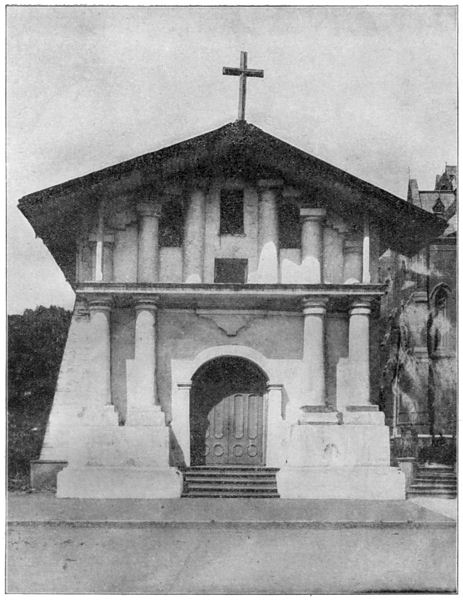
after the breasts of a woman. At its foot was Mission Dolores,
the last mission planted by the Spanish padres in their march up
the coast, and from these hills the Spanish looked for the first
time upon the golden bay.
Many years ago some one set up at the summit of this peak
a sixty foot cross of timber. Once a high wind blew it down,
and the women of the Fair family then had it restored so firmly
that it would resist anything. As it is on a hill it must have
stood. It has risen for fifty years above the gay, careless, luxuriant
and lovable city, in full view from every eminence and from
every alley. It must stand now above the desolation of ruins.