COMPARISON OF WOODS FOR BUTTER BOXES By G. D. TURNBOW — COMPARISON OF WOODS FOR BUTTER BOXES — BUTTER ABSORBS ODOR — CUBE BUTTER IN COLD STORAGE — SIXTY-POUND BOXES PACKED FOR MARKET — NAILING OF BOXES — CONCLUSIONS — Cube Butter in Cold Storage — Sixty-Pound Boxes Packed for Market
UNIVERSITY OF CALIFORNIA PUBLICATIONS
COLLEGE OF AGRICULTURE
AGRICULTURAL EXPERIMENT STATION
BERKELEY, CALIFORNIA
COMPARISON OF WOODS FOR BUTTER BOXES
By G. D. TURNBOW
BULLETIN No. 369
August, 1923
UNIVERSITY OF CALIFORNIA PRESS
BERKELEY
1923
by
G. D. TURNBOW
Butter boxes used in shipping and storing butter in California, are usually made of spruce which is largely shipped in from other states particularly from Washington and Oregon.
With the recent war, however, there came an acute shortage of spruce on the Pacific Coast with a corresponding increase in price. The commercial manufacturers did some work in an attempt to find a substitute for spruce, but the trade did not readily accept a change. There was a demand from both the lumber and the butter interests for investigation to find a suitable substitute for spruce.
The production of spruce is somewhat limited in California, but there is an abundance of white fir and a limited amount of cottonwood available. However, the creamerymen have not used white fir and cottonwood to any extent for butter containers, on account of the belief that these materials would impart a wood flavor to the butter.
Inasmuch as nearly all of the butter made in this State is shipped or stored in wooden containers, the use of white fir or cottonwood, would mean first, a material saving to the butter manufacturers in marketing expense, and second, an opportunity for the lumber interests to use a large amount of raw material already available in California, which heretofore had been of little commercial value or use.
The volatile fats in butter have the property of absorbing odors, which often results in an undesirable flavor. Great care then must be exercised in keeping butter from coming in contact with materials that will impart a foreign flavor. Butter need be exposed to foreign odors only a short length of time before the flavor is permanently affected.
Experiments[1] were conducted, therefore, to determine whether white fir or cottonwood would impart a flavor to the butter and also to determine the possibility of storing butter in cubes and marketing it in 60-pound cases when these woods were used.
The butter for cold storage was packed in white fir, cottonwood, and spruce containers holding ten pounds each. Both seasoned and unseasoned woods were used in each of the three methods of packing.
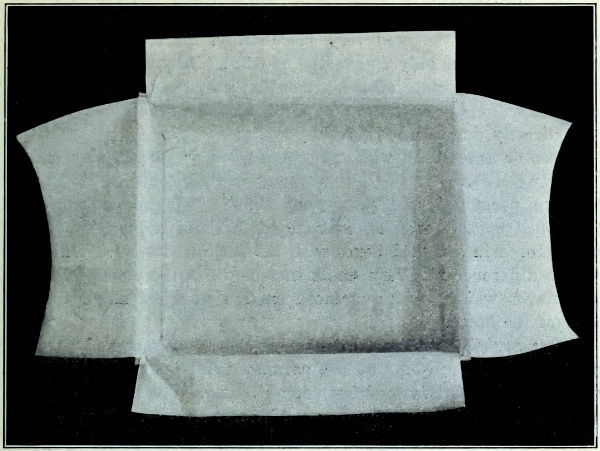
The first set packed with butter were plain unseasoned boxes of each of the woods. The second set had the inner surface paraffined before packing. The method of paraffining was to invert the box over a steam jet and steam thoroughly. This served a double purpose in that it opened the pores of the wood and allowed the paraffin to penetrate, and the heated surface of the wood kept the paraffin in a liquid condition so that it could be put on in a thinner coat than if the paraffin had been applied to a cold surface. After the boxes had been allowed to drain, the inside was then painted with paraffin at 240° F. This method gave a complete covering to the wood, a result which is not always obtained by some of the commercial paraffin atomizers. The third set was paraffined as above and, in addition, lined with good parchment paper so that no butter could come in contact with either wood or paraffin (fig. 1). Twenty-three 10-pound boxes were packed in the three ways.
They were filled with the butter from one churning which scored 92½ after being chilled for 24 hours at 50° F. and were shipped immediately after the first scoring to a cold storage plant in San Francisco and stored at a temperature of 12° F. The butter was scored monthly for six months. The summary of the scoring is given in table 1.
|
TABLE 1 Influence of Various Woods on Cube Butter in Storage [2] |
||||||
| No. of sample |
Kind of wood |
How treated | First score |
Lowest score |
Average of all scores |
Average score of butter in same kind of box |
| 1 | White Fir | Unseasoned No Paraffin No Parchment |
92.5 | 89 | 90.857 | |
| 2 | Cottonwood | Unseasoned No Paraffin No Parchment |
92.5 | 86 | 89.214 | |
| 3 | Spruce | Unseasoned No Paraffin No Parchment |
92.5 | 88 | 90.785 | |
| 4 | Spruce | Seasoned Paraffin No Parchment |
92.5 | 89 | 90.642 | |
| 6 | White Fir | Seasoned Paraffin No Parchment |
92.5 | 90 | 90.857 | |
| 7 | Cottonwood | Seasoned Paraffin No Parchment |
92.5 | 87 | 89.571 | |
| 5 | Cottonwood | Unseasoned Paraffin No Parchment |
92.5 | 88 | 89.857 | |
| 8 | Spruce | Unseasoned Paraffin No Parchment |
92.5 | 90 | 90.928 | |
| 9 | White Fir | Unseasoned Paraffin No Parchment |
92.5 | 89 | 90.571 | |
| 10 | Cottonwood | Unseasoned Paraffin Parchment |
92.5 | 91.0 | 91.714 | |
| 11 | Cottonwood | Unseasoned Paraffin Parchment |
92.5 | 89.0 | 90.571 | 91.142 |
| 18 | Cottonwood | Unseasoned Paraffin Parchment |
92.5 | 89.0 | 91.142 | |
| 12 | Spruce | Unseasoned Paraffin Parchment |
92.5 | 90.5 | 91.5 | |
| 13 | Spruce | Unseasoned Paraffin Parchment |
92.5 | 91.0 | 91.571 | 91.333 |
| 14 | Spruce | Unseasoned Paraffin Parchment |
92.5 | 90.0 | 90.928 | |
| 15 [6] | White Fir | Unseasoned Paraffin Parchment |
92.5 | 89.0 | 90.928 | 91.107 |
| 16 | White Fir | Unseasoned | 92.5 | 90.0 | 91.285 | |
| 17 | White Fir | Seasoned Paraffin Parchment |
92.5 | 89.0 | 90.857 | 91.142 |
| 20 | White Fir | Seasoned Paraffin Parchment |
92.5 | 90.5 | 91.428 | |
| 19 | Cottonwood | Seasoned Paraffin Parchment |
92.5 | 90.5 | 91.571 | |
| 21 | Spruce | Seasoned Paraffin Parchment |
92.5 | 90.0 | 91.214 | |
| 22 | Spruce | Seasoned Paraffin Parchment |
92.5 | 90.0 | 91.571 | 91.523 |
| 23 | Spruce | Seasoned Paraffin Parchment |
92.5 | 91.0 | 91.785 | |
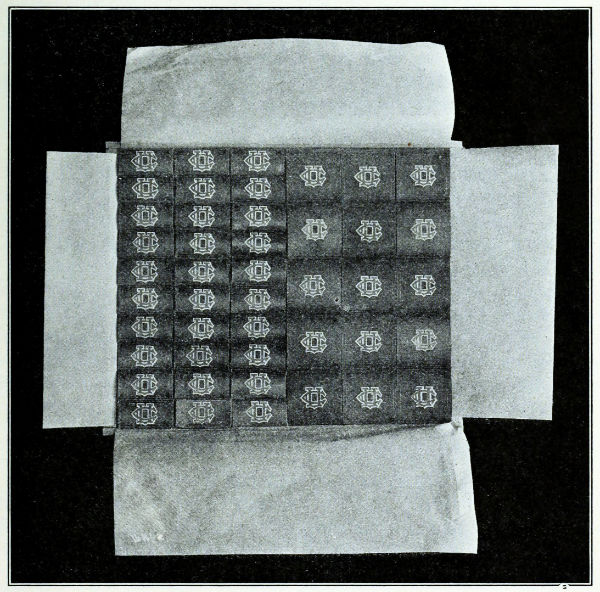
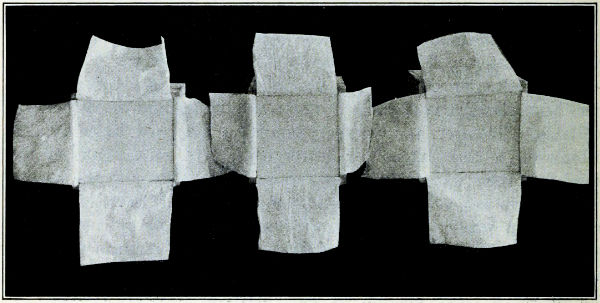
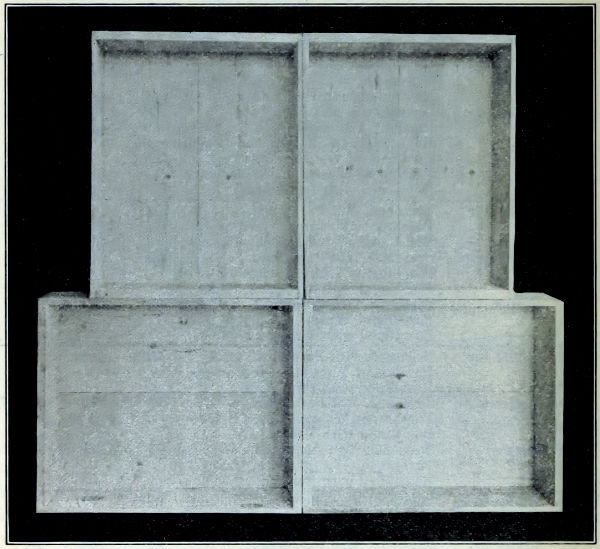
The butter for market was cut into two-pound squares, wrapped and packed in 60-pound containers, made of white fir, cottonwood and spruce (figs. 2, 3 and 4). The butter was stored in a cold room, the temperature of which ranged from 48° to 50° F. It was held in storage twenty-eight days, which is within two days of the maximum time butter may be held and still sold as fresh butter. Butter held over thirty days must be labeled “storage butter.” The butter was scored four times during the storage period. The butter used was all from the same churning which scored 93 after being chilled for twenty-four hours at 50° F.
Table 2 gives a summary of the scores showing the effect upon butter in containers with varying treatments. When paraffined, the inside of the boxes was painted with the paraffin at 240° F.
|
TABLE 2 Influence of Various Woods on Butter Packed in 60-Lb. Boxes [3] |
|||||
| No. of sample |
Kind of wood |
How treated | Highest score |
Lowest score |
Average of all scores |
| 1 | White Fir | Unseasoned, Not Paraffined Parchment Wrapped, Cartons Box Lined with Wrapping Paper |
93 | 93 | 93 |
| 3 | Cottonwood | Unseasoned, Not Paraffined Parchment Wrapped, Cartons Box Lined with Wrapping Paper |
93 | 93 | 93 |
| 7 | Spruce | Unseasoned, Not Paraffined Parchment Wrapped, Cartons Box Lined with Wrapping Paper |
93 | 93 | 93 |
| 1-a | White Fir | Unseasoned, Not Paraffined Parchment Wrapped, No Cartons Box Lined with Parchment |
— | — | — |
| 3-a | Cottonwood | Unseasoned, Not Paraffined Parchment Wrapped, No Cartons Box Lined with Parchment |
93 | 93 | 93 |
| 7-a | Spruce | Unseasoned, Not Paraffined Parchment Wrapped, No Cartons Box Lined with Parchment |
93 | 93 | 93 |
| 2 | White Fir | Seasoned, Not Paraffined Parchment Wrapped, Cartons Box Lined with Wrapping Paper |
93 | 93 | 93 |
| 9 | Cottonwood | Seasoned, Not Paraffined Parchment Wrapped, Cartons Box Lined with Wrapping Paper |
93 | 93 | 93 |
| 8 | Spruce | Seasoned, Not Paraffined Parchment Wrapped, Cartons Box Lined with Wrapping Paper |
93 | 93 | 93 |
| 2-a | White Fir | Seasoned, Not Paraffined Parchment Wrapped, No Cartons Box Lined with Parchment |
93 | 93 | 93 |
| 9-a | Cottonwood | Seasoned, Not Paraffined Parchment Wrapped, No Cartons Box Lined with Parchment |
93 | 90 | 91.175 |
| 8-a | Spruce | Seasoned, Not Paraffined Parchment Wrapped, No Cartons Box Lined with Parchment |
93 | 93 | 93 |
| 4 | Cottonwood | Seasoned, Paraffined Parchment Wrapped, Cartons Box Lined with Wrapping Paper |
93 | 93 | 93 |
| 5 | White Fir | Seasoned, Box Paraffined Parchment Wrapped, Cartons Box Lined with Wrapping Paper |
93 | 93 | 93 |
| 6 | Spruce | Seasoned, Paraffined Parchment Wrapped, Cartons Box Lined with Wrapping Paper |
93 | 93 | 93 |
| 4-a | Cottonwood | Seasoned, Paraffined Parchment Wrapped, No Cartons Box Lined with Parchment |
93 | 93 | 93 |
| 5-a | White Fir | Seasoned, Paraffined Parchment Wrapped, No Cartons Box Lined with Parchment |
93 | 92.75 | 92.562 |
| 6-a | Spruce | Seasoned, Paraffined Parchment Wrapped, No Cartons Box Lined with Parchment |
93 | 93 | 93 |
Five-penny cement-coated nails were used in making the boxes. Practically no splitting was caused by the nails in unseasoned white fir, spruce, or cottonwood. There was very little splitting in seasoned cottonwood. The nails, however, caused a slight splitting in the seasoned spruce and quite a noticeable splitting in the white fir, but not enough in either to cause an appreciable loss.
Boxes paraffined and parchment lined.—White fir and cottonwood can be used in place of spruce for storing butter in cubes, when properly seasoned, paraffined, and parchment lined.
Cottonwood is equal to spruce as a butter container. Butter stored in cottonwood boxes for six months had an average score of 0.048 of a point above spruce treated in the same manner.

White fir may be used very successfully. It scored during the six months’ storage only an average of 0.381 of a point below spruce.
In the final scoring, after six months’ storage, none of the cubes packed in seasoned, paraffined and parchment lined containers received a cut directly due to wood flavor.
Green or unseasoned white fir, cottonwood or spruce, may impart a slight wood flavor to the butter when packed in cubes, even though they are paraffined and parchment lined. The butter stored in unseasoned cubes scored an average of 0.218 of a point below the butter stored in seasoned boxes with the same treatment. While the average difference was very small, in some cases there was a decided wood flavor which was pronounced enough to affect materially the flavor of the butter.
Boxes paraffined but not parchment lined.—Unseasoned boxes of white fir, cottonwood and spruce, paraffined but not parchment lined are not entirely satisfactory for storing butter. The butter so stored was criticized in practically all cases for wood flavor. Butter stored in white fir boxes scored 0.358 of a point lower than that in spruce boxes, while butter in cottonwood boxes scored 1.071 lower than that in spruce. Storing butter in cubes without parchment lining or in cubes carelessly lined with parchment will cause objectionable flavors regardless of the wood.
Boxes neither paraffined nor parchment lined.—Butter allowed to come in direct contact with any of the three untreated woods will always take up wood flavor. The injury to the flavor is about equal from all three woods.
White fir is as good as spruce for 60-pound boxes when seasoned and parchment lined, the butter being wrapped in parchment only. Cottonwood is not quite as satisfactory as either spruce or white fir, there being some criticism on the flavor of the butter.
Butter can be shipped in seasoned white fir or cottonwood boxes, lined with ordinary wrapping paper, if the butter is parchment wrapped and cartoned. There is no advantage in using parchment paper to line the box.
Since there was practically no trouble experienced in the unparaffined boxes, there is no advantage in paraffining the inside of the box.
Since the completion of the investigational work, approximately 40,000 white fir boxes have been used with entire satisfaction for shipping butter at the University Farm.